EP3459894A1 - Elevator motion alert system - Google Patents
Elevator motion alert system Download PDFInfo
- Publication number
- EP3459894A1 EP3459894A1 EP18196646.6A EP18196646A EP3459894A1 EP 3459894 A1 EP3459894 A1 EP 3459894A1 EP 18196646 A EP18196646 A EP 18196646A EP 3459894 A1 EP3459894 A1 EP 3459894A1
- Authority
- EP
- European Patent Office
- Prior art keywords
- beacon
- mechanic
- counterweight
- elevator
- sheave
- Prior art date
- Legal status (The legal status is an assumption and is not a legal conclusion. Google has not performed a legal analysis and makes no representation as to the accuracy of the status listed.)
- Granted
Links
Images




Classifications
-
- G—PHYSICS
- G08—SIGNALLING
- G08B—SIGNALLING SYSTEMS, e.g. PERSONAL CALLING SYSTEMS; ORDER TELEGRAPHS; ALARM SYSTEMS
- G08B21/00—Alarms responsive to a single specified undesired or abnormal condition and not otherwise provided for
- G08B21/18—Status alarms
-
- B—PERFORMING OPERATIONS; TRANSPORTING
- B66—HOISTING; LIFTING; HAULING
- B66B—ELEVATORS; ESCALATORS OR MOVING WALKWAYS
- B66B3/00—Applications of devices for indicating or signalling operating conditions of elevators
- B66B3/002—Indicators
-
- B—PERFORMING OPERATIONS; TRANSPORTING
- B66—HOISTING; LIFTING; HAULING
- B66B—ELEVATORS; ESCALATORS OR MOVING WALKWAYS
- B66B5/00—Applications of checking, fault-correcting, or safety devices in elevators
- B66B5/0006—Monitoring devices or performance analysers
- B66B5/0018—Devices monitoring the operating condition of the elevator system
- B66B5/0025—Devices monitoring the operating condition of the elevator system for maintenance or repair
-
- B—PERFORMING OPERATIONS; TRANSPORTING
- B66—HOISTING; LIFTING; HAULING
- B66B—ELEVATORS; ESCALATORS OR MOVING WALKWAYS
- B66B5/00—Applications of checking, fault-correcting, or safety devices in elevators
- B66B5/0043—Devices enhancing safety during maintenance
- B66B5/005—Safety of maintenance personnel
-
- B—PERFORMING OPERATIONS; TRANSPORTING
- B66—HOISTING; LIFTING; HAULING
- B66B—ELEVATORS; ESCALATORS OR MOVING WALKWAYS
- B66B5/00—Applications of checking, fault-correcting, or safety devices in elevators
- B66B5/0087—Devices facilitating maintenance, repair or inspection tasks
-
- H—ELECTRICITY
- H04—ELECTRIC COMMUNICATION TECHNIQUE
- H04W—WIRELESS COMMUNICATION NETWORKS
- H04W4/00—Services specially adapted for wireless communication networks; Facilities therefor
- H04W4/80—Services using short range communication, e.g. near-field communication [NFC], radio-frequency identification [RFID] or low energy communication
Definitions
- This invention generally relates to an elevator system. More particularly, this invention relates to an elevator motion alert system for alerting a mechanic working inside an elevator hoistway.
- a mechanic working on top of the elevator car must avoid collision with a passing counterweight.
- the mechanic When working in the pit, the mechanic must avoid collision with either a car or a counterweight moving downward into the pit.
- the mechanic When working in an intermediate location between the pit and the overhead, the mechanic must avoid collision with either a car or a counterweight passing by.
- WO 2008/082380 discloses a warning system for mechanics working inside an elevator hoistway which senses elevator cab position within the hoistway and senses the presence of the mechanic. A mechanic will receive a voice-based warning message of approaching danger based upon the sensed elevator and mechanic positions.
- US 2017/137256 A1 discloses an elevator motion alert system configured to alert mechanics working inside an elevator hoistway which detects motion of an elevator car or counterweight and broadcasts a pressure wave indicative of elevator car or counterweight motion. An electronic device receives the pressure wave and alerts the mechanic.
- a method for alerting a mechanic working inside a hoistway comprises mounting a self-power-generating car beacon on an elevator car and a self-power-generating counterweight beacon on a counterweight, receiving a signal transmitted from the car beacon and/or the counterweight beacon and providing an alert to the mechanic whenever the received signal indicates that the elevator car or the counterweight is approaching.
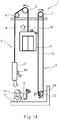
- Fig. 1A schematically shows selected portions of an example elevator system 1.
- An elevator car 2 is connected to a counterweight (CTW) 3 by a plurality of hoisting ropes 4.
- the ropes 4 extend over a traction sheave 5, which is driven by a machine (not shown), and a deflector sheave 6. Traction between the traction sheave 5 and the ropes 4 drives the car 2 and the counterweight 3 vertically through a hoistway 8.
- a governor device 9 prevents the elevator car 2 from exceeding a maximum speed.
- the example governor device 9 includes a governor rope 10 that travels with the elevator car 2.
- a governor sheave 11 and a tension sheave 12 are located at opposite ends of a loop formed by the governor rope 10.
- the configuration of the elevator system components may vary from this example in various aspects. In other words, the invention is not necessarily limited to the example elevator system configuration or the specific components of the illustration.
- An elevator motion alert system of the present invention comprises a first beacon B1 on top of the elevator car 2, a second beacon B2 on the counterweight 3, a third beacon B3 on the tension sheave 12 of the governor device 9 and a mobile device 14 held by the mechanic 15.
- the mobile device 14 is a smart phone in this embodiment, but may be any kind of device carried or worn by the mechanic including but not limited to a cell phone, tablet, lap top computer or a wearable device such as a smart watch or smart glasses.
- the mobile device may also be a dedicated device provided as a headphone, earphone, badge, belt, helmet or cap or in clothing such as a vest or uniform.
- the beacons B may be Bluetooth® low energy beacons which use Bluetooth low energy (BLE) proximity communication technology to periodically transmit signals including ID information via radio waves. Each beacon B may be identified by a unique ID. The coarse distance between each of the beacons B and the smart phone 14 may be determined by a distance-dependent intensity level of the radio waves received by the smart phone 14. The distance-dependent intensity level may be the Received Signal Strength Indication (RSSI).
- RSSI Received Signal Strength Indication
- the approaching or departing of the beacons B with respect to the smart phone 14 may be determined by the change in the distance-dependent intensity level of the radio waves.
- the intensity level is increasing, the beacon B will be moving toward the smart phone 14.
- the intensity level is decreasing, the beacon B will be moving away from the smart phone 14.
- the beacons B respectively have power generating functions which convert vibrational energy into electric power.
- the beacons B generate power and transmit signals whenever vibrational energy is provided to the beacons B, that is, whenever the object on which the beacon B is mounted moves. Since the beacons B are compact and lightweight, they may easily be attached to the car 2, counterweight 3 or tension sheave 12 such as by magnets or double-sided tapes.
- the smart phone 14 has an application program for receiving signals from the beacons B and determining the distance-dependent intensity level of the received radio waves.
- the application Upon receiving a signal from the one or a plurality of the beacons B, the application will identify each beacon B by the ID information included in the signal and determine the approaching or departing of the beacon B based on change in the distance-dependent intensity level of the radio waves as described above.
- the application will provide an alarm and/or a message in response to the signals from the beacons B as will be described in more detail below.
- Fig. 2 is a flowchart showing the sequence performed by the application program of the smart phone 14.
- the application checks if signals are received from any one of beacons B1, B2, B3 (step 101). If no signals are received, it indicates that the elevator system 1 is not moving (step 102) and no alarm is given to the mechanic 15 (step 103).
- step 104 If a signal is received from any one of beacons B1, B2, B3 in step 101, it indicates that the elevator system 1 is moving (step 104).
- the application provides an audible alarm No. 3 and a voice message "the elevator is moving" (step 105) to the mechanic.
- step 106 it is checked if the radio wave intensity of signals received from beacons B1 or B2 are larger than a set level S1 (step 106). If so, it is checked if the radio wave intensity of beacon B1 is increasing (step 107). If the radio intensity of beacon B1 is increasing, it indicates that the elevator car 2 is approaching (step 108) and the application provides an alarm No. 1 and a voice message "the car is approaching" to the mechanic (step 109).
- radio wave intensity of beacon B1 is not increasing in step 107, it is checked if the radio wave intensity of beacon B2 is increasing (step 110). If the radio wave intensity of beacon B2 is increasing, it indicates that the counterweight is approaching (step 111) and the application provides an audible alarm No. 2 and a voice message "the counterweight is approaching" to the mechanic (step 112).
- radio wave intensity of signals received from beacons B1 or B2 are not larger than a set level S1 in step 106 or if the radio wave intensity of beacon B2 is not increasing in step 110, it indicates that the car and counterweight are not approaching (step 113) and the audible alarm No. 3 and the voice message "the elevator is moving" is continued (step 114).
- Figs. 1A to 1C show how the elevator motion alert system works when the mechanic is in the pit P at the bottom of the hoistway 8.
- the elevator car 2 is moving upwards away from the mechanic 15 and the counterweight 3 is in the proximity of the mechanic 15 and is moving downwards towards the mechanic 15.
- the smart phone 14 receives signals from beacons B2 and B3, detects that the radio wave intensity of beacon B2 is larger than the set level S1 and that the radio wave intensity of beacon B2 is increasing. In this case, the smart phone 14 provides an audible alarm No. 2 and a voice message "the counterweight is approaching" to the mechanic 15.
- the mechanic 15 may step forward to avoid collision with the counterweight 3.
- the elevator car 2 is moving downwards towards the mechanic 15 and the counterweight 3 is in the proximity of the mechanic 15 but is moving upwards away from the mechanic 15.
- the smart phone 14 receives signals from beacon B2 and B3, detects that the radio wave intensity of beacon B2 is larger than the set level S1 but does not detect an increasing radio wave intensity of beacon B2. In this case, the smart phone 14 provides an audible alarm No. 3 and a voice message "the elevator is moving" to the mechanic 15. This will enable the mechanic to be aware of elevator movement and to watch out not to touch moving components in the pit.
- the elevator car 2 is moving upwards and the counterweight 3 is moving downwards, but the elevator car 2 and the counterweight 3 are both a safety distance D1 away from the mechanic 15.
- the smart phone 14 provides an audible alarm No. 3 and a voice message "the elevator is moving" to the mechanic 15. This will enable the mechanic to be aware of elevator movement and to watch out not to touch moving components in the pit.
- the "safety distance D1" is a distance which is not immediately hazardous to the mechanic 15 regardless of the direction of movement of the elevator car 2 or counterweight 3.
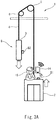
- Figs. 3A to 3C show how the elevator motion alert system works when the mechanic 15 is on top of the elevator car 2.
- the mechanic 15 may move the elevator system 1 in an inspection mode while he or she is on top of the elevator car 2.
- the smart phone 14 will receive and detect signals from beacon B1 on the elevator car 2 but will ignore such signals since the radio wave intensity of the signals from beacon B1 will be constant.
- the elevator car 2 is moving upwards and the counterweight 3 is in the proximity of the mechanic 15 and is moving downwards towards the mechanic 15.
- the smart phone 14 receives signals from beacons B1 and B2, detects that the radio wave intensity of the beacons B1 and B2 are larger than the set level S1 and detects that the radio wave intensity of beacon B2 is increasing. In this case, the smart phone 14 provides an audible alarm No. 2 and a voice message "the counterweight is approaching" to the mechanic 15. The mechanic 15 may step back to avoid collision with the counterweight 3.
- the elevator car 2 is moving downwards and the counterweight 3 is in the proximity of the mechanic 15 but is moving upwards away from the mechanic 15.
- the smart phone 14 receives signals from beacons B1 and B2, detects that the radio wave intensity of beacons B1 and B2 are larger than the set level S1 but does not detect the increasing radio wave intensity of beacons B1 or B2. In this case, the smart phone 14 provides an audible alarm No. 3 and a voice message "the elevator is moving" to the mechanic 15.
- the elevator car 2 is moving upwards and the counterweight 3 is moving downwards, but the counterweight 3 is a safety distance D1 away from the mechanic.
- the smart phone 14 receives a signal from at least beacon B1, detects that the radio wave intensity of beacon B1 is larger than the set level S1, but does not detect that the radio wave intensity of B1 is increasing. Therefore, the smart phone 14 provides an audible alarm No. 3 and a voice message "the elevator is moving" to the mechanic 15.
- beacon B3 is mounted on the tension sheave 12 in this embodiment, beacon B3 may be mounted on a compensation sheave (not shown) in the pit P. Further to alerting the mechanic 15 of elevator movement, the signal from beacon B3 may be used to determine if the mechanic 15 with the smart phone 14 is in the pit P. Beacons B may also be mounted alternatively or additionally to the drive sheave 5, governor sheave 11, car sheave (not shown) or any other rotational body to alert the mechanic 15 of elevator movement. Mounting beacon B3 on a sheave is particularly advantageous in high-rise buildings since the mechanic 15 will be alerted of elevator movement even when the elevator car and counterweight are located away from the mechanic 15.
- the alarm Nos. 1 to 3 may be a beeping sound or a buzzing sound or any kind of sound which may alert the mechanic 15.
- a different sound and/or sound level may be used for each of the alarm Nos. 1 to 3.
- the sound and/or sound level of alarm No. 3 may be different from alarm Nos. 1 and 2 such that the mechanic 15 may perceive that the elevator system 1 is moving but the elevator car 2 and counterweight 3 is still a safety distance D1 away.
- the same sound and/or sound level may be used for all alarms.
- the mobile device may also provide a vibrational alarm to the mechanic. Such vibrational alarm would be particularly effective if the mobile device is a wearable device.
- the elevator motion alert system of the present invention allows ready installation to existing elevators without the need of rewiring and may be easily mounted where required. Further, since the beacons are self-power-generating, it is not necessary to periodically exchange batteries which would require a mechanic to enter the hoistway each time batteries are to be exchanged.
- the elevator motion alert system of the present invention makes detections based on the distance-dependent intensity level of the radio waves, i.e., the estimated distance between the beacons B and the smart phone 14, it is possible to avoid collisions not only on top of the elevator car or in the pit but also at intermediate locations between the pit and the overhead.
- the present invention has been described in relation to an elevator system with one elevator in one hoistway, the present invention can also be applied to a group elevator system with a plurality of elevators sharing one hoistway.
- the mechanic will have a risk of collision with the car or counterweight of adjacent elevators.
- the beacons of adjacent elevators may be distinguished from the beacons of the elevator the mechanic is working at by a unique ID.
- the mechanic may step away from an adjacent elevator in response to an alarm or message that a car or counterweight of an adjacent elevator is approaching.
Landscapes
- Business, Economics & Management (AREA)
- Emergency Management (AREA)
- Physics & Mathematics (AREA)
- General Physics & Mathematics (AREA)
- Engineering & Computer Science (AREA)
- Computer Networks & Wireless Communication (AREA)
- Signal Processing (AREA)
- Maintenance And Inspection Apparatuses For Elevators (AREA)
- Indicating And Signalling Devices For Elevators (AREA)
- Elevator Control (AREA)
Abstract
Description
- This invention generally relates to an elevator system. More particularly, this invention relates to an elevator motion alert system for alerting a mechanic working inside an elevator hoistway.
- Maintenance and repair of elevator systems may require a mechanic to enter the elevator hoistway. The mechanic may need to work within the pit at the bottom of a hoistway, on top of the elevator car or at an intermediate location within the hoistway between the pit and the overhead. Mechanics may be faced with dangerous situations caused by a moving elevator car and a moving counterweight.
- For example, a mechanic working on top of the elevator car must avoid collision with a passing counterweight. When working in the pit, the mechanic must avoid collision with either a car or a counterweight moving downward into the pit. When working in an intermediate location between the pit and the overhead, the mechanic must avoid collision with either a car or a counterweight passing by.
-
WO 2008/082380 discloses a warning system for mechanics working inside an elevator hoistway which senses elevator cab position within the hoistway and senses the presence of the mechanic. A mechanic will receive a voice-based warning message of approaching danger based upon the sensed elevator and mechanic positions.US 2017/137256 A1 discloses an elevator motion alert system configured to alert mechanics working inside an elevator hoistway which detects motion of an elevator car or counterweight and broadcasts a pressure wave indicative of elevator car or counterweight motion. An electronic device receives the pressure wave and alerts the mechanic. - In these prior art systems, various devices for sensing and communicating the position or motion of the elevator car, counterweight and/or mechanic are necessary and power supplies and wiring for signal communication are required. Installation of such devices in existing elevator systems would require additional costs and time since rewiring would be necessary. Further, the location of such devices would be limited.
- In view of the above and other considerations, there is a need for providing an elevator motion alert system for alerting a mechanic working in an elevator hoistway which is easy to install in existing elevators.
- According to one embodiment of the invention, an elevator motion alert system for alerting a mechanic working inside a hoistway comprises a self-power-generating car beacon mounted on an elevator car, a self-power-generating counterweight beacon mounted on a counterweight, and a mobile device carried by the mechanic for receiving signals transmitted from the car beacon and the counterweight beacon and for providing an alert to the mechanic whenever the elevator car or the counterweight is approaching.
- According to another embodiment of the invention, a method for alerting a mechanic working inside a hoistway comprises mounting a self-power-generating car beacon on an elevator car and a self-power-generating counterweight beacon on a counterweight, receiving a signal transmitted from the car beacon and/or the counterweight beacon and providing an alert to the mechanic whenever the received signal indicates that the elevator car or the counterweight is approaching.
-
-
Figs. 1A to 1C are schematic views of an elevator system including the elevator motion alert system of the present invention with the mechanic in the pit of the hoistway. -
Fig. 2 is a flowchart showing a sequence performed by an application of a smart phone of the elevator motion alert system ofFig. 1 . -
Figs. 3A to 3C are schematic views similar toFigs. 1A to 1C with the mechanic on top of the elevator car. - The detailed description explains embodiments of the invention, together with advantages and features, by way of example with reference to the drawings.
-
Fig. 1A schematically shows selected portions of anexample elevator system 1. Anelevator car 2 is connected to a counterweight (CTW) 3 by a plurality of hoistingropes 4. Theropes 4 extend over atraction sheave 5, which is driven by a machine (not shown), and adeflector sheave 6. Traction between thetraction sheave 5 and theropes 4 drives thecar 2 and thecounterweight 3 vertically through ahoistway 8. - A
governor device 9 prevents theelevator car 2 from exceeding a maximum speed. Theexample governor device 9 includes agovernor rope 10 that travels with theelevator car 2. A governor sheave 11 and atension sheave 12 are located at opposite ends of a loop formed by thegovernor rope 10. The configuration of the elevator system components may vary from this example in various aspects. In other words, the invention is not necessarily limited to the example elevator system configuration or the specific components of the illustration. - An elevator motion alert system of the present invention comprises a first beacon B1 on top of the
elevator car 2, a second beacon B2 on thecounterweight 3, a third beacon B3 on thetension sheave 12 of thegovernor device 9 and amobile device 14 held by themechanic 15. Themobile device 14 is a smart phone in this embodiment, but may be any kind of device carried or worn by the mechanic including but not limited to a cell phone, tablet, lap top computer or a wearable device such as a smart watch or smart glasses. The mobile device may also be a dedicated device provided as a headphone, earphone, badge, belt, helmet or cap or in clothing such as a vest or uniform. - The beacons B may be Bluetooth® low energy beacons which use Bluetooth low energy (BLE) proximity communication technology to periodically transmit signals including ID information via radio waves. Each beacon B may be identified by a unique ID. The coarse distance between each of the beacons B and the
smart phone 14 may be determined by a distance-dependent intensity level of the radio waves received by thesmart phone 14. The distance-dependent intensity level may be the Received Signal Strength Indication (RSSI). - Further, the approaching or departing of the beacons B with respect to the
smart phone 14 may be determined by the change in the distance-dependent intensity level of the radio waves. When the intensity level is increasing, the beacon B will be moving toward thesmart phone 14. When the intensity level is decreasing, the beacon B will be moving away from thesmart phone 14. - The beacons B respectively have power generating functions which convert vibrational energy into electric power. The beacons B generate power and transmit signals whenever vibrational energy is provided to the beacons B, that is, whenever the object on which the beacon B is mounted moves. Since the beacons B are compact and lightweight, they may easily be attached to the
car 2,counterweight 3 ortension sheave 12 such as by magnets or double-sided tapes. - The
smart phone 14 has an application program for receiving signals from the beacons B and determining the distance-dependent intensity level of the received radio waves. Upon receiving a signal from the one or a plurality of the beacons B, the application will identify each beacon B by the ID information included in the signal and determine the approaching or departing of the beacon B based on change in the distance-dependent intensity level of the radio waves as described above. The application will provide an alarm and/or a message in response to the signals from the beacons B as will be described in more detail below. -
Fig. 2 is a flowchart showing the sequence performed by the application program of thesmart phone 14. When themechanic 15 is in thehoistway 8, the application checks if signals are received from any one of beacons B1, B2, B3 (step 101). If no signals are received, it indicates that theelevator system 1 is not moving (step 102) and no alarm is given to the mechanic 15 (step 103). - If a signal is received from any one of beacons B1, B2, B3 in
step 101, it indicates that theelevator system 1 is moving (step 104). The application provides an audible alarm No. 3 and a voice message "the elevator is moving" (step 105) to the mechanic. Next, it is checked if the radio wave intensity of signals received from beacons B1 or B2 are larger than a set level S1 (step 106). If so, it is checked if the radio wave intensity of beacon B1 is increasing (step 107). If the radio intensity of beacon B1 is increasing, it indicates that theelevator car 2 is approaching (step 108) and the application provides an alarm No. 1 and a voice message "the car is approaching" to the mechanic (step 109). - If the radio wave intensity of beacon B1 is not increasing in
step 107, it is checked if the radio wave intensity of beacon B2 is increasing (step 110). If the radio wave intensity of beacon B2 is increasing, it indicates that the counterweight is approaching (step 111) and the application provides an audible alarm No. 2 and a voice message "the counterweight is approaching" to the mechanic (step 112). - If the radio wave intensity of signals received from beacons B1 or B2 are not larger than a set level S1 in
step 106 or if the radio wave intensity of beacon B2 is not increasing instep 110, it indicates that the car and counterweight are not approaching (step 113) and the audible alarm No. 3 and the voice message "the elevator is moving" is continued (step 114). -
Figs. 1A to 1C show how the elevator motion alert system works when the mechanic is in the pit P at the bottom of thehoistway 8. InFig. 1A , theelevator car 2 is moving upwards away from themechanic 15 and thecounterweight 3 is in the proximity of themechanic 15 and is moving downwards towards themechanic 15. Thesmart phone 14 receives signals from beacons B2 and B3, detects that the radio wave intensity of beacon B2 is larger than the set level S1 and that the radio wave intensity of beacon B2 is increasing. In this case, thesmart phone 14 provides an audible alarm No. 2 and a voice message "the counterweight is approaching" to themechanic 15. The mechanic 15 may step forward to avoid collision with thecounterweight 3. - In
Fig. 1B , theelevator car 2 is moving downwards towards themechanic 15 and thecounterweight 3 is in the proximity of the mechanic 15 but is moving upwards away from themechanic 15. Thesmart phone 14 receives signals from beacon B2 and B3, detects that the radio wave intensity of beacon B2 is larger than the set level S1 but does not detect an increasing radio wave intensity of beacon B2. In this case, thesmart phone 14 provides an audible alarm No. 3 and a voice message "the elevator is moving" to themechanic 15. This will enable the mechanic to be aware of elevator movement and to watch out not to touch moving components in the pit. - In
Fig. 1C , theelevator car 2 is moving upwards and thecounterweight 3 is moving downwards, but theelevator car 2 and thecounterweight 3 are both a safety distance D1 away from themechanic 15. In this case, only the signal of beacon B3 is received or the signal of beacon B3 and the signal of beacon B1 and/or B2 having a radio wave intensity lower than the set level S1 is received. Therefore, thesmart phone 14 provides an audible alarm No. 3 and a voice message "the elevator is moving" to themechanic 15. This will enable the mechanic to be aware of elevator movement and to watch out not to touch moving components in the pit. - The "safety distance D1" is a distance which is not immediately hazardous to the
mechanic 15 regardless of the direction of movement of theelevator car 2 orcounterweight 3. -
Figs. 3A to 3C show how the elevator motion alert system works when themechanic 15 is on top of theelevator car 2. The mechanic 15 may move theelevator system 1 in an inspection mode while he or she is on top of theelevator car 2. When themechanic 15 is on top of theelevator car 2, thesmart phone 14 will receive and detect signals from beacon B1 on theelevator car 2 but will ignore such signals since the radio wave intensity of the signals from beacon B1 will be constant. - In
Fig. 3A , theelevator car 2 is moving upwards and thecounterweight 3 is in the proximity of themechanic 15 and is moving downwards towards themechanic 15. Thesmart phone 14 receives signals from beacons B1 and B2, detects that the radio wave intensity of the beacons B1 and B2 are larger than the set level S1 and detects that the radio wave intensity of beacon B2 is increasing. In this case, thesmart phone 14 provides an audible alarm No. 2 and a voice message "the counterweight is approaching" to themechanic 15. The mechanic 15 may step back to avoid collision with thecounterweight 3. - In
Fig. 3B , theelevator car 2 is moving downwards and thecounterweight 3 is in the proximity of the mechanic 15 but is moving upwards away from themechanic 15. Thesmart phone 14 receives signals from beacons B1 and B2, detects that the radio wave intensity of beacons B1 and B2 are larger than the set level S1 but does not detect the increasing radio wave intensity of beacons B1 or B2. In this case, thesmart phone 14 provides an audible alarm No. 3 and a voice message "the elevator is moving" to themechanic 15. - In
Fig. 3C , theelevator car 2 is moving upwards and thecounterweight 3 is moving downwards, but thecounterweight 3 is a safety distance D1 away from the mechanic. Thesmart phone 14 receives a signal from at least beacon B1, detects that the radio wave intensity of beacon B1 is larger than the set level S1, but does not detect that the radio wave intensity of B1 is increasing. Therefore, thesmart phone 14 provides an audible alarm No. 3 and a voice message "the elevator is moving" to themechanic 15. - Similar alerts will be provided in situations where the
elevator car 2 moves as described above in relation to thecounterweight 3 and thecounterweight 3 moves as described above in relation to theelevator car 2. - Although beacon B3 is mounted on the
tension sheave 12 in this embodiment, beacon B3 may be mounted on a compensation sheave (not shown) in the pit P. Further to alerting themechanic 15 of elevator movement, the signal from beacon B3 may be used to determine if the mechanic 15 with thesmart phone 14 is in the pit P. Beacons B may also be mounted alternatively or additionally to thedrive sheave 5,governor sheave 11, car sheave (not shown) or any other rotational body to alert themechanic 15 of elevator movement. Mounting beacon B3 on a sheave is particularly advantageous in high-rise buildings since the mechanic 15 will be alerted of elevator movement even when the elevator car and counterweight are located away from themechanic 15. - The alarm Nos. 1 to 3 may be a beeping sound or a buzzing sound or any kind of sound which may alert the mechanic 15. A different sound and/or sound level may be used for each of the alarm Nos. 1 to 3. For example, the sound and/or sound level of alarm No. 3 may be different from alarm Nos. 1 and 2 such that the mechanic 15 may perceive that the
elevator system 1 is moving but theelevator car 2 andcounterweight 3 is still a safety distance D1 away. However, the same sound and/or sound level may be used for all alarms. In addition to or in place of an audible alarm, the mobile device may also provide a vibrational alarm to the mechanic. Such vibrational alarm would be particularly effective if the mobile device is a wearable device. - The elevator motion alert system of the present invention allows ready installation to existing elevators without the need of rewiring and may be easily mounted where required. Further, since the beacons are self-power-generating, it is not necessary to periodically exchange batteries which would require a mechanic to enter the hoistway each time batteries are to be exchanged.
- Furthermore, since the elevator motion alert system of the present invention makes detections based on the distance-dependent intensity level of the radio waves, i.e., the estimated distance between the beacons B and the
smart phone 14, it is possible to avoid collisions not only on top of the elevator car or in the pit but also at intermediate locations between the pit and the overhead. - Although the present invention has been described in relation to an elevator system with one elevator in one hoistway, the present invention can also be applied to a group elevator system with a plurality of elevators sharing one hoistway. In this case, the mechanic will have a risk of collision with the car or counterweight of adjacent elevators. The beacons of adjacent elevators may be distinguished from the beacons of the elevator the mechanic is working at by a unique ID. The mechanic may step away from an adjacent elevator in response to an alarm or message that a car or counterweight of an adjacent elevator is approaching.
- While the invention has been described in detail in connection with only a limited number of embodiments, it should be readily understood that the invention is not limited to such disclosed embodiments. Rather, the invention can be modified to incorporate any number of variations, alterations, substitutions or equivalent arrangements not heretofore described, but which are commensurate with the spirit and scope of the invention. Additionally, while various embodiments of the invention have been described, it is to be understood that aspects of the invention may include only some of the described embodiments. Accordingly, the invention is not to be seen as limited by the foregoing description, but is only limited by the scope of the appended claims.
Claims (15)
- An elevator motion alert system for alerting a mechanic working inside a hoistway, comprising:a self-power-generating car beacon mounted on an elevator car;a self-power-generating counterweight beacon mounted on a counterweight; anda mobile device carried by the mechanic for receiving signals transmitted from the car beacon and the counterweight beacon and for providing an alert to the mechanic whenever the elevator car or the counterweight is approaching.
- The elevator motion alert system of claim 1, further comprising a self-power-generating sheave beacon mounted on a sheave;
wherein the mobile device receives signals transmitted from the sheave beacon and provides an alert whenever the sheave is rotating. - The elevator motion alert system of claim 2, wherein the sheave beacon is mounted on a sheave positioned in the pit of the hoistway.
- The elevator motion alert system of claim 1, 2 or 3, wherein the beacons generate power and transmit signals whenever vibrational energy is provided to the beacons.
- The elevator motion alert system of any preceding claim, wherein the beacons are Bluetooth low energy beacons.
- The elevator motion alert system of any preceding claim, wherein the mobile device detects signals received from the car beacon and/or the counterweight beacon which have a radio wave intensity equal to or larger than a threshold S1.
- The elevator motion alert system of claim 6, wherein the mobile device provides an alert to the mechanic when the radio wave intensity of the detected signals are increasing.
- The elevator motion alert system of any preceding claim, wherein the mobile device is a smart phone, cell phone, tablet, lap top computer or a dedicated device.
- The elevator motion alert system of any preceding claim, wherein the alert is an audible alert and/or a voice message.
- A method for alerting a mechanic working inside a hoistway, comprising:mounting a self-power-generating car beacon on an elevator car and a self-power-generating counterweight beacon on a counterweight;receiving a signal transmitted from the car beacon and/or the counterweight beacon; andproviding an alert to the mechanic whenever the received signal indicates that the elevator car or the counterweight is approaching.
- The method of claim 10, further comprising:detecting a signal received from the car beacon and/or the counterweight beacon which has a radio wave intensity equal to or larger than a threshold S1; andproviding an alert to the mechanic when the radio wave intensity of the detected signal is increasing.
- The method of claim 11, further comprising:mounting a sheave beacon on a sheave;receiving a signal from the sheave beacon; andproviding an alert to the mechanic whenever a signal from the sheave beacon is received;wherein the sheave beacon is preferably mounted on a sheave positioned in the pit of the hoistway.
- The method of claim 10, 11 or 12, wherein the beacons generate power and transmit signals whenever vibrational energy is provided to the beacons.
- The method of any of claims 10 to 13, wherein the beacons are Bluetooth low energy beacons.
- The method of any of claims 10 to 14, wherein providing an alert to the mechanic comprises providing an audible alert and/or a voice message to the mechanic.
Applications Claiming Priority (1)
| Application Number | Priority Date | Filing Date | Title |
|---|---|---|---|
| US15/715,540 US10741049B2 (en) | 2017-09-26 | 2017-09-26 | Elevator motion alert system |
Publications (2)
| Publication Number | Publication Date |
|---|---|
| EP3459894A1 true EP3459894A1 (en) | 2019-03-27 |
| EP3459894B1 EP3459894B1 (en) | 2021-03-03 |
Family
ID=63683795
Family Applications (1)
| Application Number | Title | Priority Date | Filing Date |
|---|---|---|---|
| EP18196646.6A Active EP3459894B1 (en) | 2017-09-26 | 2018-09-25 | Elevator motion alert system |
Country Status (4)
| Country | Link |
|---|---|
| US (1) | US10741049B2 (en) |
| EP (1) | EP3459894B1 (en) |
| JP (1) | JP7236831B2 (en) |
| CN (1) | CN109552958B (en) |
Cited By (3)
| Publication number | Priority date | Publication date | Assignee | Title |
|---|---|---|---|---|
| JP2021134066A (en) * | 2020-02-28 | 2021-09-13 | 株式会社日立ビルシステム | Operator detecting and alarming device, and operator detecting and alarming method |
| US20230121292A1 (en) * | 2020-03-23 | 2023-04-20 | Mitsubishi Electric Corporation | Elevator safety monitoring device |
| CN117755924A (en) * | 2022-09-26 | 2024-03-26 | 奥的斯电梯公司 | System and method for detecting the position of a person in a hoistway |
Families Citing this family (7)
| Publication number | Priority date | Publication date | Assignee | Title |
|---|---|---|---|---|
| JP7395438B2 (en) * | 2020-07-20 | 2023-12-11 | 株式会社日立ビルシステム | Elevator alarm system and elevator alarm method |
| US12159524B1 (en) * | 2020-09-01 | 2024-12-03 | Duncan Harrison | Collision warning system for safety and construction environments |
| CN119731106A (en) * | 2022-08-18 | 2025-03-28 | 三菱电机楼宇解决方案株式会社 | Recovery assisting system and recovery assisting method for lost article in elevator |
| CN119894799A (en) * | 2022-09-20 | 2025-04-25 | 三菱电机楼宇解决方案株式会社 | Elevator device |
| WO2024069675A1 (en) * | 2022-09-26 | 2024-04-04 | 三菱電機ビルソリューションズ株式会社 | Safety system |
| JP7779225B2 (en) * | 2022-10-05 | 2025-12-03 | 三菱電機ビルソリューションズ株式会社 | Counterweights and impact mitigation devices |
| WO2024218948A1 (en) * | 2023-04-20 | 2024-10-24 | 三菱電機ビルソリューションズ株式会社 | Elevator system |
Citations (5)
| Publication number | Priority date | Publication date | Assignee | Title |
|---|---|---|---|---|
| JPH09303684A (en) * | 1996-05-09 | 1997-11-28 | Fanuc Ltd | Safety device |
| WO2008082380A1 (en) | 2006-12-29 | 2008-07-10 | Otis Elevator Company | Warning system for mechanics in elevator hoistways |
| WO2014095511A1 (en) * | 2012-12-21 | 2014-06-26 | Inventio Ag | Monitoring of a hazard zone |
| JP2016055956A (en) * | 2014-09-08 | 2016-04-21 | 三菱電機ビルテクノサービス株式会社 | Elevator warning system |
| US20170137256A1 (en) | 2015-11-17 | 2017-05-18 | Otis Elevator Company | Elevator motion alert system |
Family Cites Families (21)
| Publication number | Priority date | Publication date | Assignee | Title |
|---|---|---|---|---|
| US6202797B1 (en) | 1999-08-26 | 2001-03-20 | Otis Elevator Company | Automatic protection of elevator mechanics |
| DE10108772A1 (en) | 2001-02-23 | 2002-11-21 | Otis Elevator Co | Elevator safety device |
| US7148791B2 (en) | 2001-09-21 | 2006-12-12 | Time Domain Corp. | Wireless danger proximity warning system and method |
| WO2004069714A1 (en) | 2003-02-03 | 2004-08-19 | Otis Elevator Company | Passive ultrasonic rfid elevator positioning reference system |
| WO2005022726A1 (en) * | 2003-08-28 | 2005-03-10 | University Of Southampton | An electromagnetic device for converting mechanical vibrational energy into electrical energy, and manufacture thereof |
| JP2005132543A (en) | 2003-10-29 | 2005-05-26 | Hitachi Building Systems Co Ltd | Elevator maintenance safety device |
| JP2006206311A (en) | 2005-01-31 | 2006-08-10 | Toshiba Elevator Co Ltd | Tool and method for inspecting elevator governor |
| US8232888B2 (en) * | 2007-10-25 | 2012-07-31 | Strata Proximity Systems, Llc | Interactive magnetic marker field for safety systems and complex proximity warning system |
| WO2009073001A1 (en) * | 2007-12-03 | 2009-06-11 | Otis Elevator Company | Passive detection of persons in elevator hoistway |
| CA2617976A1 (en) * | 2008-01-11 | 2009-07-11 | John Dasilva | Personnel safety system utilizing time variable frequencies |
| US8893858B2 (en) * | 2010-06-29 | 2014-11-25 | Empire Technology Development Llc | Method and system for determining safety of elevator |
| US9327953B2 (en) | 2011-09-23 | 2016-05-03 | Ballymore Company, Inc. | Safe zone detection system for lift having a pluarlity of sensors |
| WO2013057750A1 (en) * | 2011-10-18 | 2013-04-25 | 三菱電機株式会社 | Elevator regeneration storage control device |
| JP2013112516A (en) | 2011-11-30 | 2013-06-10 | Toshiba Elevator Co Ltd | Data gathering system for elevator |
| JP5743346B2 (en) | 2013-08-08 | 2015-07-01 | 東芝エレベータ株式会社 | ELEVATOR SYSTEM, ELEVATOR CONTROL DEVICE USED FOR SAME, AND ELEVATOR CONTROL METHOD |
| JP5889980B1 (en) | 2014-09-09 | 2016-03-22 | 東芝エレベータ株式会社 | Elevator hoistway work status confirmation device |
| EP3012217B8 (en) | 2014-10-21 | 2017-08-02 | KONE Corporation | Safety system for elevator |
| US9359171B1 (en) | 2015-01-20 | 2016-06-07 | Inventio Ag | Safety system for a lift installation and safety helmet as individual component of such a safety system |
| EP3064463A1 (en) | 2015-03-02 | 2016-09-07 | Kone Corporation | Safety arrangement of an elevator and method of its operation |
| JP2017010130A (en) | 2015-06-17 | 2017-01-12 | 大日本印刷株式会社 | Pedestrian collision warning system |
| US20190084796A1 (en) * | 2017-09-15 | 2019-03-21 | Otis Elevator Company | Restricted access area safety system |
-
2017
- 2017-09-26 US US15/715,540 patent/US10741049B2/en active Active
-
2018
- 2018-09-25 EP EP18196646.6A patent/EP3459894B1/en active Active
- 2018-09-25 CN CN201811119813.7A patent/CN109552958B/en active Active
- 2018-09-26 JP JP2018179607A patent/JP7236831B2/en active Active
Patent Citations (5)
| Publication number | Priority date | Publication date | Assignee | Title |
|---|---|---|---|---|
| JPH09303684A (en) * | 1996-05-09 | 1997-11-28 | Fanuc Ltd | Safety device |
| WO2008082380A1 (en) | 2006-12-29 | 2008-07-10 | Otis Elevator Company | Warning system for mechanics in elevator hoistways |
| WO2014095511A1 (en) * | 2012-12-21 | 2014-06-26 | Inventio Ag | Monitoring of a hazard zone |
| JP2016055956A (en) * | 2014-09-08 | 2016-04-21 | 三菱電機ビルテクノサービス株式会社 | Elevator warning system |
| US20170137256A1 (en) | 2015-11-17 | 2017-05-18 | Otis Elevator Company | Elevator motion alert system |
Non-Patent Citations (1)
| Title |
|---|
| P. GLYNNE-JONES ET AL: "An electromagnetic, vibration-powered generator for intelligent sensor systems", SENSORS AND ACTUATORS A: PHYSICAL, vol. 110, no. 1-3, 1 February 2004 (2004-02-01), NL, pages 344 - 349, XP055556092, ISSN: 0924-4247, DOI: 10.1016/j.sna.2003.09.045 * |
Cited By (4)
| Publication number | Priority date | Publication date | Assignee | Title |
|---|---|---|---|---|
| JP2021134066A (en) * | 2020-02-28 | 2021-09-13 | 株式会社日立ビルシステム | Operator detecting and alarming device, and operator detecting and alarming method |
| US20230121292A1 (en) * | 2020-03-23 | 2023-04-20 | Mitsubishi Electric Corporation | Elevator safety monitoring device |
| CN117755924A (en) * | 2022-09-26 | 2024-03-26 | 奥的斯电梯公司 | System and method for detecting the position of a person in a hoistway |
| EP4342834A1 (en) * | 2022-09-26 | 2024-03-27 | Otis Elevator Company | Systems and method for detecting a location of a person in a hoistway |
Also Published As
| Publication number | Publication date |
|---|---|
| JP7236831B2 (en) | 2023-03-10 |
| CN109552958B (en) | 2021-05-28 |
| JP2019059620A (en) | 2019-04-18 |
| US10741049B2 (en) | 2020-08-11 |
| CN109552958A (en) | 2019-04-02 |
| US20190096222A1 (en) | 2019-03-28 |
| EP3459894B1 (en) | 2021-03-03 |
Similar Documents
| Publication | Publication Date | Title |
|---|---|---|
| EP3459894B1 (en) | Elevator motion alert system | |
| KR102609384B1 (en) | Work area technician warning system | |
| CN110775757B (en) | Detecting elevator mechanics in an elevator system | |
| EP3170780B1 (en) | Elevator motion alert system | |
| JP6311544B2 (en) | Elevator control system | |
| CN1286207A (en) | Automatic protection of lifter repairman | |
| JP6217568B2 (en) | Elevator warning system | |
| CN113526355A (en) | A kind of anti-collision warning system for personnel in crane working area | |
| JP2012051665A (en) | Safety device of elevator | |
| JP2005132543A (en) | Elevator maintenance safety device | |
| WO2007018540A1 (en) | Warning system for mechanics in elevator hoistways | |
| WO2008082380A1 (en) | Warning system for mechanics in elevator hoistways | |
| EP3643660A1 (en) | System for providing elevator service | |
| US20220411239A1 (en) | Collision prevention system for lifting machinery | |
| KR102682906B1 (en) | Elevator car position detection system | |
| JP2021031237A (en) | Elevator safety device | |
| EP4342834A1 (en) | Systems and method for detecting a location of a person in a hoistway | |
| CN115303906B (en) | Signal receiving and dispatching management system based on unmanned elevator | |
| JP2024161684A (en) | Passenger conveyor radio system | |
| JP2026019410A (en) | Alarm system | |
| WO2024134824A1 (en) | Elevator | |
| JP2003081550A (en) | Device, system and method of detecting approach of adjacent elevator | |
| KR20230062915A (en) | Smart-Watch Based Safety Management System for Worker within Industrial Field |
Legal Events
| Date | Code | Title | Description |
|---|---|---|---|
| PUAI | Public reference made under article 153(3) epc to a published international application that has entered the european phase |
Free format text: ORIGINAL CODE: 0009012 |
|
| STAA | Information on the status of an ep patent application or granted ep patent |
Free format text: STATUS: THE APPLICATION HAS BEEN PUBLISHED |
|
| AK | Designated contracting states |
Kind code of ref document: A1 Designated state(s): AL AT BE BG CH CY CZ DE DK EE ES FI FR GB GR HR HU IE IS IT LI LT LU LV MC MK MT NL NO PL PT RO RS SE SI SK SM TR |
|
| AX | Request for extension of the european patent |
Extension state: BA ME |
|
| STAA | Information on the status of an ep patent application or granted ep patent |
Free format text: STATUS: REQUEST FOR EXAMINATION WAS MADE |
|
| 17P | Request for examination filed |
Effective date: 20190926 |
|
| RBV | Designated contracting states (corrected) |
Designated state(s): AL AT BE BG CH CY CZ DE DK EE ES FI FR GB GR HR HU IE IS IT LI LT LU LV MC MK MT NL NO PL PT RO RS SE SI SK SM TR |
|
| RIC1 | Information provided on ipc code assigned before grant |
Ipc: B66B 5/00 20060101AFI20200930BHEP |
|
| GRAP | Despatch of communication of intention to grant a patent |
Free format text: ORIGINAL CODE: EPIDOSNIGR1 |
|
| STAA | Information on the status of an ep patent application or granted ep patent |
Free format text: STATUS: GRANT OF PATENT IS INTENDED |
|
| INTG | Intention to grant announced |
Effective date: 20201113 |
|
| GRAS | Grant fee paid |
Free format text: ORIGINAL CODE: EPIDOSNIGR3 |
|
| GRAA | (expected) grant |
Free format text: ORIGINAL CODE: 0009210 |
|
| STAA | Information on the status of an ep patent application or granted ep patent |
Free format text: STATUS: THE PATENT HAS BEEN GRANTED |
|
| AK | Designated contracting states |
Kind code of ref document: B1 Designated state(s): AL AT BE BG CH CY CZ DE DK EE ES FI FR GB GR HR HU IE IS IT LI LT LU LV MC MK MT NL NO PL PT RO RS SE SI SK SM TR |
|
| REG | Reference to a national code |
Ref country code: GB Ref legal event code: FG4D |
|
| REG | Reference to a national code |
Ref country code: AT Ref legal event code: REF Ref document number: 1367001 Country of ref document: AT Kind code of ref document: T Effective date: 20210315 Ref country code: CH Ref legal event code: EP |
|
| REG | Reference to a national code |
Ref country code: DE Ref legal event code: R096 Ref document number: 602018013301 Country of ref document: DE |
|
| REG | Reference to a national code |
Ref country code: IE Ref legal event code: FG4D |
|
| REG | Reference to a national code |
Ref country code: LT Ref legal event code: MG9D |
|
| PG25 | Lapsed in a contracting state [announced via postgrant information from national office to epo] |
Ref country code: HR Free format text: LAPSE BECAUSE OF FAILURE TO SUBMIT A TRANSLATION OF THE DESCRIPTION OR TO PAY THE FEE WITHIN THE PRESCRIBED TIME-LIMIT Effective date: 20210303 Ref country code: GR Free format text: LAPSE BECAUSE OF FAILURE TO SUBMIT A TRANSLATION OF THE DESCRIPTION OR TO PAY THE FEE WITHIN THE PRESCRIBED TIME-LIMIT Effective date: 20210604 Ref country code: FI Free format text: LAPSE BECAUSE OF FAILURE TO SUBMIT A TRANSLATION OF THE DESCRIPTION OR TO PAY THE FEE WITHIN THE PRESCRIBED TIME-LIMIT Effective date: 20210303 Ref country code: BG Free format text: LAPSE BECAUSE OF FAILURE TO SUBMIT A TRANSLATION OF THE DESCRIPTION OR TO PAY THE FEE WITHIN THE PRESCRIBED TIME-LIMIT Effective date: 20210603 Ref country code: LT Free format text: LAPSE BECAUSE OF FAILURE TO SUBMIT A TRANSLATION OF THE DESCRIPTION OR TO PAY THE FEE WITHIN THE PRESCRIBED TIME-LIMIT Effective date: 20210303 Ref country code: NO Free format text: LAPSE BECAUSE OF FAILURE TO SUBMIT A TRANSLATION OF THE DESCRIPTION OR TO PAY THE FEE WITHIN THE PRESCRIBED TIME-LIMIT Effective date: 20210603 |
|
| REG | Reference to a national code |
Ref country code: NL Ref legal event code: MP Effective date: 20210303 |
|
| REG | Reference to a national code |
Ref country code: AT Ref legal event code: MK05 Ref document number: 1367001 Country of ref document: AT Kind code of ref document: T Effective date: 20210303 |
|
| PG25 | Lapsed in a contracting state [announced via postgrant information from national office to epo] |
Ref country code: RS Free format text: LAPSE BECAUSE OF FAILURE TO SUBMIT A TRANSLATION OF THE DESCRIPTION OR TO PAY THE FEE WITHIN THE PRESCRIBED TIME-LIMIT Effective date: 20210303 Ref country code: PL Free format text: LAPSE BECAUSE OF FAILURE TO SUBMIT A TRANSLATION OF THE DESCRIPTION OR TO PAY THE FEE WITHIN THE PRESCRIBED TIME-LIMIT Effective date: 20210303 Ref country code: LV Free format text: LAPSE BECAUSE OF FAILURE TO SUBMIT A TRANSLATION OF THE DESCRIPTION OR TO PAY THE FEE WITHIN THE PRESCRIBED TIME-LIMIT Effective date: 20210303 Ref country code: SE Free format text: LAPSE BECAUSE OF FAILURE TO SUBMIT A TRANSLATION OF THE DESCRIPTION OR TO PAY THE FEE WITHIN THE PRESCRIBED TIME-LIMIT Effective date: 20210303 |
|
| PG25 | Lapsed in a contracting state [announced via postgrant information from national office to epo] |
Ref country code: NL Free format text: LAPSE BECAUSE OF FAILURE TO SUBMIT A TRANSLATION OF THE DESCRIPTION OR TO PAY THE FEE WITHIN THE PRESCRIBED TIME-LIMIT Effective date: 20210303 |
|
| PG25 | Lapsed in a contracting state [announced via postgrant information from national office to epo] |
Ref country code: EE Free format text: LAPSE BECAUSE OF FAILURE TO SUBMIT A TRANSLATION OF THE DESCRIPTION OR TO PAY THE FEE WITHIN THE PRESCRIBED TIME-LIMIT Effective date: 20210303 Ref country code: CZ Free format text: LAPSE BECAUSE OF FAILURE TO SUBMIT A TRANSLATION OF THE DESCRIPTION OR TO PAY THE FEE WITHIN THE PRESCRIBED TIME-LIMIT Effective date: 20210303 Ref country code: SM Free format text: LAPSE BECAUSE OF FAILURE TO SUBMIT A TRANSLATION OF THE DESCRIPTION OR TO PAY THE FEE WITHIN THE PRESCRIBED TIME-LIMIT Effective date: 20210303 Ref country code: AT Free format text: LAPSE BECAUSE OF FAILURE TO SUBMIT A TRANSLATION OF THE DESCRIPTION OR TO PAY THE FEE WITHIN THE PRESCRIBED TIME-LIMIT Effective date: 20210303 |
|
| PG25 | Lapsed in a contracting state [announced via postgrant information from national office to epo] |
Ref country code: IS Free format text: LAPSE BECAUSE OF FAILURE TO SUBMIT A TRANSLATION OF THE DESCRIPTION OR TO PAY THE FEE WITHIN THE PRESCRIBED TIME-LIMIT Effective date: 20210703 Ref country code: SK Free format text: LAPSE BECAUSE OF FAILURE TO SUBMIT A TRANSLATION OF THE DESCRIPTION OR TO PAY THE FEE WITHIN THE PRESCRIBED TIME-LIMIT Effective date: 20210303 Ref country code: RO Free format text: LAPSE BECAUSE OF FAILURE TO SUBMIT A TRANSLATION OF THE DESCRIPTION OR TO PAY THE FEE WITHIN THE PRESCRIBED TIME-LIMIT Effective date: 20210303 Ref country code: PT Free format text: LAPSE BECAUSE OF FAILURE TO SUBMIT A TRANSLATION OF THE DESCRIPTION OR TO PAY THE FEE WITHIN THE PRESCRIBED TIME-LIMIT Effective date: 20210705 |
|
| REG | Reference to a national code |
Ref country code: DE Ref legal event code: R097 Ref document number: 602018013301 Country of ref document: DE |
|
| PLBE | No opposition filed within time limit |
Free format text: ORIGINAL CODE: 0009261 |
|
| STAA | Information on the status of an ep patent application or granted ep patent |
Free format text: STATUS: NO OPPOSITION FILED WITHIN TIME LIMIT |
|
| PG25 | Lapsed in a contracting state [announced via postgrant information from national office to epo] |
Ref country code: ES Free format text: LAPSE BECAUSE OF FAILURE TO SUBMIT A TRANSLATION OF THE DESCRIPTION OR TO PAY THE FEE WITHIN THE PRESCRIBED TIME-LIMIT Effective date: 20210303 Ref country code: AL Free format text: LAPSE BECAUSE OF FAILURE TO SUBMIT A TRANSLATION OF THE DESCRIPTION OR TO PAY THE FEE WITHIN THE PRESCRIBED TIME-LIMIT Effective date: 20210303 Ref country code: DK Free format text: LAPSE BECAUSE OF FAILURE TO SUBMIT A TRANSLATION OF THE DESCRIPTION OR TO PAY THE FEE WITHIN THE PRESCRIBED TIME-LIMIT Effective date: 20210303 |
|
| 26N | No opposition filed |
Effective date: 20211206 |
|
| PG25 | Lapsed in a contracting state [announced via postgrant information from national office to epo] |
Ref country code: SI Free format text: LAPSE BECAUSE OF FAILURE TO SUBMIT A TRANSLATION OF THE DESCRIPTION OR TO PAY THE FEE WITHIN THE PRESCRIBED TIME-LIMIT Effective date: 20210303 |
|
| PG25 | Lapsed in a contracting state [announced via postgrant information from national office to epo] |
Ref country code: IT Free format text: LAPSE BECAUSE OF FAILURE TO SUBMIT A TRANSLATION OF THE DESCRIPTION OR TO PAY THE FEE WITHIN THE PRESCRIBED TIME-LIMIT Effective date: 20210303 |
|
| REG | Reference to a national code |
Ref country code: CH Ref legal event code: PL |
|
| REG | Reference to a national code |
Ref country code: BE Ref legal event code: MM Effective date: 20210930 |
|
| PG25 | Lapsed in a contracting state [announced via postgrant information from national office to epo] |
Ref country code: IS Free format text: LAPSE BECAUSE OF FAILURE TO SUBMIT A TRANSLATION OF THE DESCRIPTION OR TO PAY THE FEE WITHIN THE PRESCRIBED TIME-LIMIT Effective date: 20210703 Ref country code: MC Free format text: LAPSE BECAUSE OF FAILURE TO SUBMIT A TRANSLATION OF THE DESCRIPTION OR TO PAY THE FEE WITHIN THE PRESCRIBED TIME-LIMIT Effective date: 20210303 |
|
| PG25 | Lapsed in a contracting state [announced via postgrant information from national office to epo] |
Ref country code: LU Free format text: LAPSE BECAUSE OF NON-PAYMENT OF DUE FEES Effective date: 20210925 Ref country code: IE Free format text: LAPSE BECAUSE OF NON-PAYMENT OF DUE FEES Effective date: 20210925 Ref country code: BE Free format text: LAPSE BECAUSE OF NON-PAYMENT OF DUE FEES Effective date: 20210930 |
|
| PG25 | Lapsed in a contracting state [announced via postgrant information from national office to epo] |
Ref country code: LI Free format text: LAPSE BECAUSE OF NON-PAYMENT OF DUE FEES Effective date: 20210930 Ref country code: CH Free format text: LAPSE BECAUSE OF NON-PAYMENT OF DUE FEES Effective date: 20210930 |
|
| GBPC | Gb: european patent ceased through non-payment of renewal fee |
Effective date: 20220925 |
|
| PG25 | Lapsed in a contracting state [announced via postgrant information from national office to epo] |
Ref country code: CY Free format text: LAPSE BECAUSE OF FAILURE TO SUBMIT A TRANSLATION OF THE DESCRIPTION OR TO PAY THE FEE WITHIN THE PRESCRIBED TIME-LIMIT Effective date: 20210303 |
|
| PG25 | Lapsed in a contracting state [announced via postgrant information from national office to epo] |
Ref country code: HU Free format text: LAPSE BECAUSE OF FAILURE TO SUBMIT A TRANSLATION OF THE DESCRIPTION OR TO PAY THE FEE WITHIN THE PRESCRIBED TIME-LIMIT; INVALID AB INITIO Effective date: 20180925 |
|
| PG25 | Lapsed in a contracting state [announced via postgrant information from national office to epo] |
Ref country code: GB Free format text: LAPSE BECAUSE OF NON-PAYMENT OF DUE FEES Effective date: 20220925 |
|
| PG25 | Lapsed in a contracting state [announced via postgrant information from national office to epo] |
Ref country code: MK Free format text: LAPSE BECAUSE OF FAILURE TO SUBMIT A TRANSLATION OF THE DESCRIPTION OR TO PAY THE FEE WITHIN THE PRESCRIBED TIME-LIMIT Effective date: 20210303 |
|
| PG25 | Lapsed in a contracting state [announced via postgrant information from national office to epo] |
Ref country code: MT Free format text: LAPSE BECAUSE OF FAILURE TO SUBMIT A TRANSLATION OF THE DESCRIPTION OR TO PAY THE FEE WITHIN THE PRESCRIBED TIME-LIMIT Effective date: 20210303 |
|
| PGFP | Annual fee paid to national office [announced via postgrant information from national office to epo] |
Ref country code: DE Payment date: 20250820 Year of fee payment: 8 |
|
| PGFP | Annual fee paid to national office [announced via postgrant information from national office to epo] |
Ref country code: FR Payment date: 20250820 Year of fee payment: 8 |
|
| PG25 | Lapsed in a contracting state [announced via postgrant information from national office to epo] |
Ref country code: TR Free format text: LAPSE BECAUSE OF FAILURE TO SUBMIT A TRANSLATION OF THE DESCRIPTION OR TO PAY THE FEE WITHIN THE PRESCRIBED TIME-LIMIT Effective date: 20210303 |