EP3459491A1 - Scale - Google Patents
Scale Download PDFInfo
- Publication number
- EP3459491A1 EP3459491A1 EP17889529.8A EP17889529A EP3459491A1 EP 3459491 A1 EP3459491 A1 EP 3459491A1 EP 17889529 A EP17889529 A EP 17889529A EP 3459491 A1 EP3459491 A1 EP 3459491A1
- Authority
- EP
- European Patent Office
- Prior art keywords
- scale
- base part
- ceramic
- furnace
- temperature
- Prior art date
- Legal status (The legal status is an assumption and is not a legal conclusion. Google has not performed a legal analysis and makes no representation as to the accuracy of the status listed.)
- Withdrawn
Links
- 239000000919 ceramic Substances 0.000 claims abstract description 36
- 239000011347 resin Substances 0.000 claims abstract description 6
- 229920005989 resin Polymers 0.000 claims abstract description 6
- 238000000465 moulding Methods 0.000 claims description 12
- 229910010293 ceramic material Inorganic materials 0.000 description 14
- 238000010438 heat treatment Methods 0.000 description 8
- 239000000463 material Substances 0.000 description 5
- 230000000875 corresponding effect Effects 0.000 description 2
- 238000002844 melting Methods 0.000 description 2
- 230000008018 melting Effects 0.000 description 2
- 239000002184 metal Substances 0.000 description 2
- 238000000034 method Methods 0.000 description 2
- 230000002596 correlated effect Effects 0.000 description 1
- 230000000694 effects Effects 0.000 description 1
Images





Classifications
-
- B—PERFORMING OPERATIONS; TRANSPORTING
- B28—WORKING CEMENT, CLAY, OR STONE
- B28B—SHAPING CLAY OR OTHER CERAMIC COMPOSITIONS; SHAPING SLAG; SHAPING MIXTURES CONTAINING CEMENTITIOUS MATERIAL, e.g. PLASTER
- B28B17/00—Details of, or accessories for, apparatus for shaping the material; Auxiliary measures taken in connection with such shaping
- B28B17/0063—Control arrangements
- B28B17/0081—Process control
-
- A—HUMAN NECESSITIES
- A61—MEDICAL OR VETERINARY SCIENCE; HYGIENE
- A61C—DENTISTRY; APPARATUS OR METHODS FOR ORAL OR DENTAL HYGIENE
- A61C13/00—Dental prostheses; Making same
-
- A—HUMAN NECESSITIES
- A61—MEDICAL OR VETERINARY SCIENCE; HYGIENE
- A61C—DENTISTRY; APPARATUS OR METHODS FOR ORAL OR DENTAL HYGIENE
- A61C13/00—Dental prostheses; Making same
- A61C13/20—Methods or devices for soldering, casting, moulding or melting
-
- B—PERFORMING OPERATIONS; TRANSPORTING
- B28—WORKING CEMENT, CLAY, OR STONE
- B28B—SHAPING CLAY OR OTHER CERAMIC COMPOSITIONS; SHAPING SLAG; SHAPING MIXTURES CONTAINING CEMENTITIOUS MATERIAL, e.g. PLASTER
- B28B11/00—Apparatus or processes for treating or working the shaped or preshaped articles
- B28B11/24—Apparatus or processes for treating or working the shaped or preshaped articles for curing, setting or hardening
- B28B11/243—Setting, e.g. drying, dehydrating or firing ceramic articles
-
- B—PERFORMING OPERATIONS; TRANSPORTING
- B28—WORKING CEMENT, CLAY, OR STONE
- B28B—SHAPING CLAY OR OTHER CERAMIC COMPOSITIONS; SHAPING SLAG; SHAPING MIXTURES CONTAINING CEMENTITIOUS MATERIAL, e.g. PLASTER
- B28B3/00—Producing shaped articles from the material by using presses; Presses specially adapted therefor
- B28B3/02—Producing shaped articles from the material by using presses; Presses specially adapted therefor wherein a ram exerts pressure on the material in a moulding space; Ram heads of special form
- B28B3/025—Hot pressing, e.g. of ceramic materials
-
- B—PERFORMING OPERATIONS; TRANSPORTING
- B28—WORKING CEMENT, CLAY, OR STONE
- B28B—SHAPING CLAY OR OTHER CERAMIC COMPOSITIONS; SHAPING SLAG; SHAPING MIXTURES CONTAINING CEMENTITIOUS MATERIAL, e.g. PLASTER
- B28B7/00—Moulds; Cores; Mandrels
- B28B7/16—Moulds for making shaped articles with cavities or holes open to the surface, e.g. with blind holes
- B28B7/18—Moulds for making shaped articles with cavities or holes open to the surface, e.g. with blind holes the holes passing completely through the article
-
- B—PERFORMING OPERATIONS; TRANSPORTING
- B28—WORKING CEMENT, CLAY, OR STONE
- B28B—SHAPING CLAY OR OTHER CERAMIC COMPOSITIONS; SHAPING SLAG; SHAPING MIXTURES CONTAINING CEMENTITIOUS MATERIAL, e.g. PLASTER
- B28B7/00—Moulds; Cores; Mandrels
- B28B7/34—Moulds, cores, or mandrels of special material, e.g. destructible materials
- B28B7/342—Moulds, cores, or mandrels of special material, e.g. destructible materials which are at least partially destroyed, e.g. broken, molten, before demoulding; Moulding surfaces or spaces shaped by, or in, the ground, or sand or soil, whether bound or not; Cores consisting at least mainly of sand or soil, whether bound or not
-
- B—PERFORMING OPERATIONS; TRANSPORTING
- B28—WORKING CEMENT, CLAY, OR STONE
- B28B—SHAPING CLAY OR OTHER CERAMIC COMPOSITIONS; SHAPING SLAG; SHAPING MIXTURES CONTAINING CEMENTITIOUS MATERIAL, e.g. PLASTER
- B28B7/00—Moulds; Cores; Mandrels
- B28B7/34—Moulds, cores, or mandrels of special material, e.g. destructible materials
- B28B7/346—Manufacture of moulds
-
- G—PHYSICS
- G01—MEASURING; TESTING
- G01K—MEASURING TEMPERATURE; MEASURING QUANTITY OF HEAT; THERMALLY-SENSITIVE ELEMENTS NOT OTHERWISE PROVIDED FOR
- G01K11/00—Measuring temperature based upon physical or chemical changes not covered by groups G01K3/00, G01K5/00, G01K7/00 or G01K9/00
- G01K11/06—Measuring temperature based upon physical or chemical changes not covered by groups G01K3/00, G01K5/00, G01K7/00 or G01K9/00 using melting, freezing, or softening
- G01K11/08—Measuring temperature based upon physical or chemical changes not covered by groups G01K3/00, G01K5/00, G01K7/00 or G01K9/00 using melting, freezing, or softening of disposable test bodies, e.g. cone
-
- G—PHYSICS
- G01—MEASURING; TESTING
- G01K—MEASURING TEMPERATURE; MEASURING QUANTITY OF HEAT; THERMALLY-SENSITIVE ELEMENTS NOT OTHERWISE PROVIDED FOR
- G01K3/00—Thermometers giving results other than momentary value of temperature
- G01K3/02—Thermometers giving results other than momentary value of temperature giving means values; giving integrated values
- G01K3/04—Thermometers giving results other than momentary value of temperature giving means values; giving integrated values in respect of time
-
- A—HUMAN NECESSITIES
- A61—MEDICAL OR VETERINARY SCIENCE; HYGIENE
- A61C—DENTISTRY; APPARATUS OR METHODS FOR ORAL OR DENTAL HYGIENE
- A61C13/00—Dental prostheses; Making same
- A61C13/0003—Making bridge-work, inlays, implants or the like
- A61C13/0022—Blanks or green, unfinished dental restoration parts
Definitions
- the present invention relates to scales used when dental prostheses are made by pressing.
- a dental prosthesis is arranged on a cavity due to this removal or loss because the tooth does not naturally recover from the removal or loss. While metal is conventionally used as material for a dental prosthesis, ceramic dental prostheses have been increasingly used in recent years in view of aesthetics.
- a ceramic dental prosthesis is made according to the following procedures: first, a wax pattern that is shaped so as to correspond to the shape of a dental prosthesis to be formed is secured to a crucible former (wax model upright holder for making a mold of a dental prosthesis) via a sprue line that is shaped so as to correspond to a sprue line portion described later, to be invested in investment; then, after the investment is cured, the crucible former is removed, and the wax pattern and the sprue line are burned, to form a mold.
- crucible former wax model upright holder for making a mold of a dental prosthesis
- a ceramic blank 50 is arranged in a sprue, heated, and pressed by, for example, a piston.
- a space 51 having a shape corresponding to the dental prosthesis is filled with a ceramic material, which formed the ceramic blank, from the sprue via the sprue line part, which makes it possible to produce a ceramic dental prosthesis of the desired shape (for example, see Patent Literatures 1 and 2).
- the ceramic blank softens due to heating, but its fluidity is low, unlike molten metal. Then, it is necessary to carry out both heating, and pressing by a piston in order to fill the space 51 having a shape corresponding to the dental prosthesis with the ceramic material, which formed the ceramic blank 50 arranged in the sprue as described above.
- the temperature at which the ceramic blank is actually heated sometimes changes according to various conditions such as the combination of the used ceramic material and investment, and the type and size of the furnace, which may lead to insufficient filling of the mold with the ceramic material, to make it impossible to obtain a dental prosthesis of the shape to be aimed. That is, just setting the furnace at a predetermined temperature as indicated does not always make it possible to heat the ceramic blank at a proper temperature, which is problematic.
- An object of the present invention is to provide a scale which makes it possible to adjust the temperature of a furnace so that a ceramic blank can be properly heated even if various conditions such as the combination of the used ceramic blank and investment, and the type and size of the furnace vary.
- One aspect of the present invention is a scale (10) that is for adjusting temperature of a furnace that heats a ceramic blank used in press molding of a dental prosthesis, the scale comprising: a scale part (11); and a base part (12), the scale part and the base part being formed of wax or resin, wherein the base part has a shape of protruding from part of the scale part, a size of the scale part is larger than that of the base part in a direction orthogonal to a protruding direction of the base part.
- the scale part (11) may have a shape of a grid.
- the present invention makes it possible to adjust the temperature of a furnace so that a ceramic blank can be properly heated even if various conditions such as the combination of the used ceramic blank and investment, and the type and size of the furnace vary. Whereby, heating a ceramic blank can lead to proper filling with the ceramic blank when a dental prosthesis is made by press molding.
- Fig. 1A is a plan view of a scale 10 according to one embodiment.
- Fig. 1B is a side view of the scale 10.
- the scale 10 of this embodiment has a boardlike shape as a whole, and is configured to have a scale part 11 and a base part 12.
- the scale 10 is formed so that the base part 12 protrudes from part of the scale part 11, and so that a size Ws of the scale part 11 is larger than a size Wk of the base part 12: the size Wk is a size in a direction orthogonal to a direction in which the base part 12 protrudes (width direction); and the size Ws is a size in a direction parallel to the width direction of the base part 12, in plan view.
- the scale 10 is in a proper mode as a scale for press molding.
- the scale 10 like this is formed of wax or resin, which preferably vanishes due to melting or burning at a temperature within the range of 50°C to 500°C.
- the specific shape of the scale part 11 is not limited. However, as described later, a flow path formed by the scale, where a ceramic material flows, preferably has a predetermined resistance (flow resistance) against flowing of the ceramic material. Whereby, a state of filling a mold 34 formed by the scale (see Figs. 5 and 6 ) with the ceramic material can be properly correlated with temperature.
- the scale part 11 is in the form of a grid. Further, the form of a grid can make it possible to visually measure filling with the ceramic material using the number of cells of the grid without specifically measuring the volume, which can lead to easier determination that the temperature is proper or improper.
- each of the scale part 11 and the base part 12 is not specifically limited as well, may be a quadrilateral, and may be a round.
- the scale part 11 has a quadrilateral cross section, and is in the form of a grid.
- Fig. 2 is a perspective view of a scale mold 20 that is a mold for making the scale 10.
- the scale mold 20 is a boardlike member for making the scale 10.
- a pattern groove 21 that is grooves of a predetermined pattern, and a groove for the base part 22 are formed over one face side of the scale mold 20.
- the scale 10 can be made by pouring material into these pattern groove 21 and groove for the base part 22, to solidify the material. Examples of the material include wax and resin.
- specific patterns of the pattern groove 21 and the groove for the base part 22, and the cross-sectional shapes of the grooves themselves correspond to the form of the scale 10 to be made.
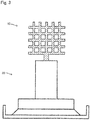
- Figs. 3 to 8B are explanatory views.
- the scale 10 is attached to an end of a crucible former 30 (wax model upright holder for making a mold of a dental prosthesis).
- the crucible former 30 where the scale 10 is held upright is inserted in investment 31 before cured, which is in a container 32, so that the scale 10 is on the lower side. Then, the investment 31 is cured by a proper means.
- the container 32 that contains the cured investment 31, the crucible former 30, and the scale 10 is heated, and as shown in Fig. 5 , the scale 10 is vanished by melting or burning. At this time, the crucible former 30 is also removed. If the scale 10 is molten, wax or resin that formed the scale 10 is drained. Whereby, the mold 34 that corresponds to the form of the scale 10 is formed. After the crucible former 30 is removed, a hole 35 that corresponds to the outer circumference of the crucible former 30 is formed. This hole 35 communicates with the mold 34 at the bottom thereof.
- a ceramic blank 36 that was heated in a furnace at a predetermined temperature is inserted through the hole 35, pressed by a piston 37 from the top, and thrusted toward the mold 34.
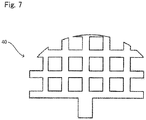
- Fig. 7 shows the form of the ceramic molding 40 when the mold 34 is filled with the ceramic blank 36 that was heated in the furnace at a proper temperature.
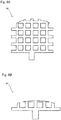
- Figs. 8A and 8B show the forms of ceramic moldings 40' and 40" when the ceramic blanks 36 that were heated in the furnace of improper temperatures are used.
- Fig. 8A shows an example where the temperature of the furnace is higher than a proper temperature
- Fig. 8B shows an example where the temperature of the furnace is lower than a proper temperature.
- the ceramic material flows too much, and in the example shown in Fig. 8B , flowing of the ceramic material is insufficient.
- the indicated temperature of the furnace may be changed so that the shape as shown in Fig. 7 is obtained.
- the indicated temperature of the furnace is different from a determined temperature.
- the inside of the furnace is at a proper temperature.
Landscapes
- Engineering & Computer Science (AREA)
- Ceramic Engineering (AREA)
- Chemical & Material Sciences (AREA)
- Mechanical Engineering (AREA)
- Health & Medical Sciences (AREA)
- Manufacturing & Machinery (AREA)
- Oral & Maxillofacial Surgery (AREA)
- General Physics & Mathematics (AREA)
- Physics & Mathematics (AREA)
- Dentistry (AREA)
- Epidemiology (AREA)
- Life Sciences & Earth Sciences (AREA)
- Animal Behavior & Ethology (AREA)
- General Health & Medical Sciences (AREA)
- Public Health (AREA)
- Veterinary Medicine (AREA)
- Structural Engineering (AREA)
- Automation & Control Theory (AREA)
- Dental Prosthetics (AREA)
Abstract
Description
- The present invention relates to scales used when dental prostheses are made by pressing.
- If a tooth is partially removed or lost by dental treatment or the like, a dental prosthesis is arranged on a cavity due to this removal or loss because the tooth does not naturally recover from the removal or loss. While metal is conventionally used as material for a dental prosthesis, ceramic dental prostheses have been increasingly used in recent years in view of aesthetics.
- For example, a ceramic dental prosthesis is made according to the following procedures:
first, a wax pattern that is shaped so as to correspond to the shape of a dental prosthesis to be formed is secured to a crucible former (wax model upright holder for making a mold of a dental prosthesis) via a sprue line that is shaped so as to correspond to a sprue line portion described later, to be invested in investment; then, after the investment is cured, the crucible former is removed, and the wax pattern and the sprue line are burned, to form a mold. - After the mold is formed, as shown in
Fig. 9 , a ceramic blank 50 is arranged in a sprue, heated, and pressed by, for example, a piston. Whereby, aspace 51 having a shape corresponding to the dental prosthesis is filled with a ceramic material, which formed the ceramic blank, from the sprue via the sprue line part, which makes it possible to produce a ceramic dental prosthesis of the desired shape (for example, see Patent Literatures 1 and 2). - The ceramic blank softens due to heating, but its fluidity is low, unlike molten metal. Then, it is necessary to carry out both heating, and pressing by a piston in order to fill the
space 51 having a shape corresponding to the dental prosthesis with the ceramic material, which formed the ceramic blank 50 arranged in the sprue as described above. -
- Patent Literature 1:
WO 01/021088 A1 - Patent Literature 2:
WO 2015/125807 A1 - However, when a dental prosthesis is made according to a producing method as Patent Literature 1 or 2, there is a problem with filling the mold with the ceramic blank. Specifically, unless the mold is filled with a sufficient ceramic material, a dental prosthesis having the shape to be aimed cannot be obtained. It is necessary for filling the mold with the ceramic material like the above that the ceramic material properly flow in the mold. Therefor, the temperature of heating the ceramic blank is important. The temperature of heating the ceramic blank is approximately grasped for each material, and it seems as if setting a furnace at this temperature did not cause a problem.
- However, the temperature at which the ceramic blank is actually heated sometimes changes according to various conditions such as the combination of the used ceramic material and investment, and the type and size of the furnace, which may lead to insufficient filling of the mold with the ceramic material, to make it impossible to obtain a dental prosthesis of the shape to be aimed. That is, just setting the furnace at a predetermined temperature as indicated does not always make it possible to heat the ceramic blank at a proper temperature, which is problematic.
- An object of the present invention is to provide a scale which makes it possible to adjust the temperature of a furnace so that a ceramic blank can be properly heated even if various conditions such as the combination of the used ceramic blank and investment, and the type and size of the furnace vary.
- Hereinafter the present invention will be described. Here, reference numerals added to the drawings are also described in parentheses for easy understanding. However, the present invention is not limited to them.
- One aspect of the present invention is a scale (10) that is for adjusting temperature of a furnace that heats a ceramic blank used in press molding of a dental prosthesis, the scale comprising: a scale part (11); and a base part (12), the scale part and the base part being formed of wax or resin, wherein the base part has a shape of protruding from part of the scale part, a size of the scale part is larger than that of the base part in a direction orthogonal to a protruding direction of the base part.
- In the scale, the scale part (11) may have a shape of a grid.
- The present invention makes it possible to adjust the temperature of a furnace so that a ceramic blank can be properly heated even if various conditions such as the combination of the used ceramic blank and investment, and the type and size of the furnace vary. Whereby, heating a ceramic blank can lead to proper filling with the ceramic blank when a dental prosthesis is made by press molding.
-
-
Fig. 1A is a plan view of ascale 10, andFig. 1B is a side view of thescale 10. -
Fig. 2 is a perspective view of ascale mold 20. -
Fig. 3 is an explanatory view of an example of using thescale 10. -
Fig. 4 is an explanatory view of the example of using thescale 10. -
Fig. 5 is an explanatory view of the example of using thescale 10. -
Fig. 6 is an explanatory view of the example of using thescale 10. -
Fig. 7 shows a form of a ceramic molding obtained from a ceramic blank that was heated at a proper temperature. -
Figs. 8A and 8B show forms of ceramic moldings obtained from ceramic blanks that were heated at improper temperatures. -
Fig. 9 is an explanatory view of press molding of a ceramic material. - Hereinafter the present invention will be described based on the embodiments shown in drawings. The present invention is not limited to these embodiments.
-
Fig. 1A is a plan view of ascale 10 according to one embodiment.Fig. 1B is a side view of thescale 10. As can be seen fromFigs. 1A and 1B , thescale 10 of this embodiment has a boardlike shape as a whole, and is configured to have ascale part 11 and abase part 12. - The
scale 10 is formed so that thebase part 12 protrudes from part of thescale part 11, and so that a size Ws of thescale part 11 is larger than a size Wk of the base part 12: the size Wk is a size in a direction orthogonal to a direction in which thebase part 12 protrudes (width direction); and the size Ws is a size in a direction parallel to the width direction of thebase part 12, in plan view. Whereby, thescale 10 is in a proper mode as a scale for press molding. - The
scale 10 like this is formed of wax or resin, which preferably vanishes due to melting or burning at a temperature within the range of 50°C to 500°C. - The specific shape of the
scale part 11 is not limited. However, as described later, a flow path formed by the scale, where a ceramic material flows, preferably has a predetermined resistance (flow resistance) against flowing of the ceramic material. Whereby, a state of filling amold 34 formed by the scale (seeFigs. 5 and6 ) with the ceramic material can be properly correlated with temperature. - From such a point of view, in this embodiment, the
scale part 11 is in the form of a grid. Further, the form of a grid can make it possible to visually measure filling with the ceramic material using the number of cells of the grid without specifically measuring the volume, which can lead to easier determination that the temperature is proper or improper. - The cross-sectional shape of each of the
scale part 11 and thebase part 12 is not specifically limited as well, may be a quadrilateral, and may be a round. In this embodiment, as can be seen fromFig. 1B , thescale part 11 has a quadrilateral cross section, and is in the form of a grid. - For example, the
scale 10 like this can be made as follows.Fig. 2 is a perspective view of ascale mold 20 that is a mold for making thescale 10. - As can be seen from
Fig. 2 , thescale mold 20 is a boardlike member for making thescale 10. Apattern groove 21 that is grooves of a predetermined pattern, and a groove for thebase part 22 are formed over one face side of thescale mold 20. Thescale 10 can be made by pouring material into thesepattern groove 21 and groove for thebase part 22, to solidify the material. Examples of the material include wax and resin. Thus, specific patterns of thepattern groove 21 and the groove for thebase part 22, and the cross-sectional shapes of the grooves themselves correspond to the form of thescale 10 to be made. - For example, the
scale 10 as described above is used as follows.Figs. 3 to 8B are explanatory views. - First, as shown in
Fig. 3 , thescale 10 is attached to an end of a crucible former 30 (wax model upright holder for making a mold of a dental prosthesis). - Next, as shown in
Fig. 4 , the crucible former 30 where thescale 10 is held upright is inserted ininvestment 31 before cured, which is in acontainer 32, so that thescale 10 is on the lower side. Then, theinvestment 31 is cured by a proper means. - After that, the
container 32 that contains the curedinvestment 31, the crucible former 30, and thescale 10 is heated, and as shown inFig. 5 , thescale 10 is vanished by melting or burning. At this time, the crucible former 30 is also removed. If thescale 10 is molten, wax or resin that formed thescale 10 is drained. Whereby, themold 34 that corresponds to the form of thescale 10 is formed. After the crucible former 30 is removed, ahole 35 that corresponds to the outer circumference of the crucible former 30 is formed. Thishole 35 communicates with themold 34 at the bottom thereof. - Next, as shown in
Fig. 6 , a ceramic blank 36 that was heated in a furnace at a predetermined temperature is inserted through thehole 35, pressed by apiston 37 from the top, and thrusted toward themold 34. - Whereby, the ceramic blank 36 flows in the
mold 34, and aceramic molding 40 as shown inFig. 7 can be obtained.Fig. 7 shows the form of theceramic molding 40 when themold 34 is filled with the ceramic blank 36 that was heated in the furnace at a proper temperature. - In contrast,
Figs. 8A and 8B show the forms ofceramic moldings 40' and 40" when theceramic blanks 36 that were heated in the furnace of improper temperatures are used.Fig. 8A shows an example where the temperature of the furnace is higher than a proper temperature, andFig. 8B shows an example where the temperature of the furnace is lower than a proper temperature. In the example shown inFig. 8A , the ceramic material flows too much, and in the example shown inFig. 8B , flowing of the ceramic material is insufficient. - For example, in the examples shown in
Figs. 7 ,8A and 8B , there is a case where heating is carried out in different furnaces, and the indicated temperatures of the furnaces are the same in all the examples. That is, there is a case where heating employing the temperature of the furnace as indicated does not always result in heating at a proper temperature. Therefore, it is predicted that using such a furnace as it is for making a dental prosthesis by press molding may lead to an improper shape of the dental prosthesis. - For this, in the case of
Fig. 8A or 8B , the indicated temperature of the furnace may be changed so that the shape as shown inFig. 7 is obtained. In this case, the indicated temperature of the furnace is different from a determined temperature. However, it can be said that the inside of the furnace is at a proper temperature. - As described above, using the
scale 10 makes it possible to adjust the temperature of the furnace so that the ceramic blank can be properly heated. -
- 10 scale
- 11 scale part
- 12 base part
- 20 scale mold
- 21 pattern groove
- 22 groove for base part
- 30 crucible former
- 31 investment
- 32 container
- 34 mold
- 35 hole
- 36 ceramic blank
- 37 piston
- 40, 40', 40" ceramic molding
Claims (2)
- A scale that is for adjusting temperature of a furnace that heats a ceramic blank used in press molding of a dental prosthesis, the scale comprising:a scale part; and a base part, the scale part and the base part being formed of wax or resin, whereinthe base part has a shape of protruding from part of the scale part, a size of the scale part is larger than that of the base part in a direction orthogonal to a protruding direction of the base part.
- The scale according to claim 1, wherein the scale part has a shape of a grid.
Applications Claiming Priority (1)
| Application Number | Priority Date | Filing Date | Title |
|---|---|---|---|
| PCT/JP2017/023977 WO2019003388A1 (en) | 2017-06-29 | 2017-06-29 | Scale |
Publications (2)
| Publication Number | Publication Date |
|---|---|
| EP3459491A1 true EP3459491A1 (en) | 2019-03-27 |
| EP3459491A4 EP3459491A4 (en) | 2019-11-13 |
Family
ID=64742851
Family Applications (1)
| Application Number | Title | Priority Date | Filing Date |
|---|---|---|---|
| EP17889529.8A Withdrawn EP3459491A4 (en) | 2017-06-29 | 2017-06-29 | Scale |
Country Status (4)
| Country | Link |
|---|---|
| US (1) | US20210206023A1 (en) |
| EP (1) | EP3459491A4 (en) |
| AU (1) | AU2017396539A1 (en) |
| WO (1) | WO2019003388A1 (en) |
Family Cites Families (7)
| Publication number | Priority date | Publication date | Assignee | Title |
|---|---|---|---|---|
| US4782585A (en) * | 1981-10-01 | 1988-11-08 | Matsushita Electric Industrial Co., Ltd. | Grid for lead storage battery and method for its production |
| JPH11285506A (en) * | 1998-02-05 | 1999-10-19 | Tokuyama Corp | Manufacturing method of ceramic crown |
| WO2001021088A1 (en) | 1999-09-20 | 2001-03-29 | Tokuyama Corporation | Method of producing ceramic crowns and production kit used therefor |
| JP2007037676A (en) * | 2005-08-02 | 2007-02-15 | Denken:Kk | Casting device for dental technique |
| EP2550929B1 (en) * | 2011-07-25 | 2020-04-01 | Ivoclar Vivadent AG | Dental furnace with muffle size recognition |
| EP3178441B1 (en) * | 2013-12-20 | 2019-09-04 | Ivoclar Vivadent AG | Method for processing a dental material, control device for a dental oven and dental oven |
| US10182894B2 (en) | 2014-02-21 | 2019-01-22 | Gc Corporation | Method for manufacturing dental prosthesis |
-
2017
- 2017-06-29 US US16/074,207 patent/US20210206023A1/en not_active Abandoned
- 2017-06-29 EP EP17889529.8A patent/EP3459491A4/en not_active Withdrawn
- 2017-06-29 WO PCT/JP2017/023977 patent/WO2019003388A1/en not_active Ceased
- 2017-06-29 AU AU2017396539A patent/AU2017396539A1/en not_active Abandoned
Also Published As
| Publication number | Publication date |
|---|---|
| EP3459491A4 (en) | 2019-11-13 |
| WO2019003388A1 (en) | 2019-01-03 |
| US20210206023A1 (en) | 2021-07-08 |
| AU2017396539A1 (en) | 2019-01-17 |
Similar Documents
| Publication | Publication Date | Title |
|---|---|---|
| US7704421B2 (en) | Method for preparing dental restorations | |
| CN103990761B (en) | A kind of production method of hollow turbine vane with impact opening structure | |
| CN106579672B (en) | Sapporo is embedding | |
| CN101376168B (en) | Implantation method of steel disc when casting pattern block of tyre mould at high pressure | |
| KR101954992B1 (en) | Manufactuing method of dental prosthesis and Mold therefor | |
| CN106457364B (en) | Casting tree and assembly method | |
| US10588727B2 (en) | Device for producing dental ceramic | |
| WO2009094354A1 (en) | Method for forming an integral porous region in cast implant | |
| US20210206023A1 (en) | Scale | |
| EP0174339A4 (en) | Spruing assembly. | |
| US1465473A (en) | Means for molding backings for artificial teeth | |
| JP2017144031A (en) | scale | |
| Kakde et al. | Development of customized innovative product using fused deposition modeling technique of rapid prototyping and investment casting | |
| DE50212194D1 (en) | METHOD AND SHAPING MACHINE FOR MANUFACTURING SHAPED PARTS, SUCH AS CASTORS, FOR MOLDING MOLDS FOR MOLDING MELTING | |
| JP6480959B2 (en) | Manufacturing method of dental investment powder, dental investment material, and dental prosthesis | |
| JP7801837B2 (en) | Denture base manufacturing method | |
| CN104385440B (en) | A kind of method of embedded glass tube/earthenware forming ceramic core | |
| CZ20033058A3 (en) | Apparatus and method for producing toe caps for safety shoes and the like shoes and a shoe toe cap produced by using this method and apparatus | |
| CN204100941U (en) | A kind of artificial tooth wax pattern embedding detecting device | |
| RU2014143525A (en) | METHOD AND DEVICE FOR PRODUCING AN OBJECT FROM GLASS AT LEAST WITH ONE THREE-DIMENSIONAL FIGURE CONCLUDED IN IT | |
| CN105473313B (en) | A kind of zirconia ceramics structural member and its forming method | |
| CN104180739B (en) | A kind of artificial tooth wax pattern embeds detector and its detection method | |
| JP2009082967A (en) | Inlay casting and inlay method therefor | |
| JP6466218B2 (en) | Ceramic blank | |
| KR200411331Y1 (en) | Casting metal pieces with flux |
Legal Events
| Date | Code | Title | Description |
|---|---|---|---|
| STAA | Information on the status of an ep patent application or granted ep patent |
Free format text: STATUS: UNKNOWN |
|
| STAA | Information on the status of an ep patent application or granted ep patent |
Free format text: STATUS: THE INTERNATIONAL PUBLICATION HAS BEEN MADE |
|
| PUAI | Public reference made under article 153(3) epc to a published international application that has entered the european phase |
Free format text: ORIGINAL CODE: 0009012 |
|
| STAA | Information on the status of an ep patent application or granted ep patent |
Free format text: STATUS: REQUEST FOR EXAMINATION WAS MADE |
|
| 17P | Request for examination filed |
Effective date: 20180712 |
|
| AK | Designated contracting states |
Kind code of ref document: A1 Designated state(s): AL AT BE BG CH CY CZ DE DK EE ES FI FR GB GR HR HU IE IS IT LI LT LU LV MC MK MT NL NO PL PT RO RS SE SI SK SM TR |
|
| AX | Request for extension of the european patent |
Extension state: BA ME |
|
| A4 | Supplementary search report drawn up and despatched |
Effective date: 20191015 |
|
| RIC1 | Information provided on ipc code assigned before grant |
Ipc: G01K 11/06 20060101ALI20191009BHEP Ipc: A61C 13/00 20060101AFI20191009BHEP Ipc: B28B 7/34 20060101ALI20191009BHEP Ipc: B28B 7/18 20060101ALI20191009BHEP Ipc: B28B 11/24 20060101ALI20191009BHEP Ipc: B28B 17/00 20060101ALI20191009BHEP |
|
| STAA | Information on the status of an ep patent application or granted ep patent |
Free format text: STATUS: THE APPLICATION HAS BEEN WITHDRAWN |
|
| 18W | Application withdrawn |
Effective date: 20200414 |