EP3457288B1 - Computer system and storage access device - Google Patents
Computer system and storage access device Download PDFInfo
- Publication number
- EP3457288B1 EP3457288B1 EP17854531.5A EP17854531A EP3457288B1 EP 3457288 B1 EP3457288 B1 EP 3457288B1 EP 17854531 A EP17854531 A EP 17854531A EP 3457288 B1 EP3457288 B1 EP 3457288B1
- Authority
- EP
- European Patent Office
- Prior art keywords
- storage
- access apparatus
- storage access
- request
- virtual
- Prior art date
- Legal status (The legal status is an assumption and is not a legal conclusion. Google has not performed a legal analysis and makes no representation as to the accuracy of the status listed.)
- Active
Links
Images


Classifications
-
- G—PHYSICS
- G06—COMPUTING OR CALCULATING; COUNTING
- G06F—ELECTRIC DIGITAL DATA PROCESSING
- G06F12/00—Accessing, addressing or allocating within memory systems or architectures
- G06F12/02—Addressing or allocation; Relocation
- G06F12/08—Addressing or allocation; Relocation in hierarchically structured memory systems, e.g. virtual memory systems
- G06F12/0802—Addressing of a memory level in which the access to the desired data or data block requires associative addressing means, e.g. caches
- G06F12/0806—Multiuser, multiprocessor or multiprocessing cache systems
- G06F12/0813—Multiuser, multiprocessor or multiprocessing cache systems with a network or matrix configuration
-
- G—PHYSICS
- G06—COMPUTING OR CALCULATING; COUNTING
- G06F—ELECTRIC DIGITAL DATA PROCESSING
- G06F3/00—Input arrangements for transferring data to be processed into a form capable of being handled by the computer; Output arrangements for transferring data from processing unit to output unit, e.g. interface arrangements
- G06F3/06—Digital input from, or digital output to, record carriers, e.g. RAID, emulated record carriers or networked record carriers
- G06F3/0601—Interfaces specially adapted for storage systems
- G06F3/0628—Interfaces specially adapted for storage systems making use of a particular technique
- G06F3/0662—Virtualisation aspects
- G06F3/0665—Virtualisation aspects at area level, e.g. provisioning of virtual or logical volumes
-
- G—PHYSICS
- G06—COMPUTING OR CALCULATING; COUNTING
- G06F—ELECTRIC DIGITAL DATA PROCESSING
- G06F9/00—Arrangements for program control, e.g. control units
- G06F9/06—Arrangements for program control, e.g. control units using stored programs, i.e. using an internal store of processing equipment to receive or retain programs
- G06F9/44—Arrangements for executing specific programs
- G06F9/455—Emulation; Interpretation; Software simulation, e.g. virtualisation or emulation of application or operating system execution engines
- G06F9/45533—Hypervisors; Virtual machine monitors
- G06F9/45558—Hypervisor-specific management and integration aspects
-
- G—PHYSICS
- G06—COMPUTING OR CALCULATING; COUNTING
- G06F—ELECTRIC DIGITAL DATA PROCESSING
- G06F12/00—Accessing, addressing or allocating within memory systems or architectures
- G06F12/02—Addressing or allocation; Relocation
- G06F12/08—Addressing or allocation; Relocation in hierarchically structured memory systems, e.g. virtual memory systems
-
- G—PHYSICS
- G06—COMPUTING OR CALCULATING; COUNTING
- G06F—ELECTRIC DIGITAL DATA PROCESSING
- G06F3/00—Input arrangements for transferring data to be processed into a form capable of being handled by the computer; Output arrangements for transferring data from processing unit to output unit, e.g. interface arrangements
- G06F3/06—Digital input from, or digital output to, record carriers, e.g. RAID, emulated record carriers or networked record carriers
- G06F3/0601—Interfaces specially adapted for storage systems
- G06F3/0602—Interfaces specially adapted for storage systems specifically adapted to achieve a particular effect
- G06F3/061—Improving I/O performance
- G06F3/0611—Improving I/O performance in relation to response time
-
- G—PHYSICS
- G06—COMPUTING OR CALCULATING; COUNTING
- G06F—ELECTRIC DIGITAL DATA PROCESSING
- G06F3/00—Input arrangements for transferring data to be processed into a form capable of being handled by the computer; Output arrangements for transferring data from processing unit to output unit, e.g. interface arrangements
- G06F3/06—Digital input from, or digital output to, record carriers, e.g. RAID, emulated record carriers or networked record carriers
- G06F3/0601—Interfaces specially adapted for storage systems
- G06F3/0628—Interfaces specially adapted for storage systems making use of a particular technique
- G06F3/0629—Configuration or reconfiguration of storage systems
- G06F3/0631—Configuration or reconfiguration of storage systems by allocating resources to storage systems
-
- G—PHYSICS
- G06—COMPUTING OR CALCULATING; COUNTING
- G06F—ELECTRIC DIGITAL DATA PROCESSING
- G06F3/00—Input arrangements for transferring data to be processed into a form capable of being handled by the computer; Output arrangements for transferring data from processing unit to output unit, e.g. interface arrangements
- G06F3/06—Digital input from, or digital output to, record carriers, e.g. RAID, emulated record carriers or networked record carriers
- G06F3/0601—Interfaces specially adapted for storage systems
- G06F3/0668—Interfaces specially adapted for storage systems adopting a particular infrastructure
- G06F3/067—Distributed or networked storage systems, e.g. storage area networks [SAN], network attached storage [NAS]
-
- G—PHYSICS
- G06—COMPUTING OR CALCULATING; COUNTING
- G06F—ELECTRIC DIGITAL DATA PROCESSING
- G06F9/00—Arrangements for program control, e.g. control units
- G06F9/06—Arrangements for program control, e.g. control units using stored programs, i.e. using an internal store of processing equipment to receive or retain programs
- G06F9/46—Multiprogramming arrangements
- G06F9/50—Allocation of resources, e.g. of the central processing unit [CPU]
- G06F9/5005—Allocation of resources, e.g. of the central processing unit [CPU] to service a request
-
- G—PHYSICS
- G06—COMPUTING OR CALCULATING; COUNTING
- G06F—ELECTRIC DIGITAL DATA PROCESSING
- G06F9/00—Arrangements for program control, e.g. control units
- G06F9/06—Arrangements for program control, e.g. control units using stored programs, i.e. using an internal store of processing equipment to receive or retain programs
- G06F9/46—Multiprogramming arrangements
- G06F9/50—Allocation of resources, e.g. of the central processing unit [CPU]
- G06F9/5061—Partitioning or combining of resources
- G06F9/5077—Logical partitioning of resources; Management or configuration of virtualized resources
-
- G—PHYSICS
- G06—COMPUTING OR CALCULATING; COUNTING
- G06F—ELECTRIC DIGITAL DATA PROCESSING
- G06F9/00—Arrangements for program control, e.g. control units
- G06F9/06—Arrangements for program control, e.g. control units using stored programs, i.e. using an internal store of processing equipment to receive or retain programs
- G06F9/44—Arrangements for executing specific programs
- G06F9/455—Emulation; Interpretation; Software simulation, e.g. virtualisation or emulation of application or operating system execution engines
- G06F9/45533—Hypervisors; Virtual machine monitors
- G06F9/45558—Hypervisor-specific management and integration aspects
- G06F2009/45579—I/O management, e.g. providing access to device drivers or storage
-
- G—PHYSICS
- G06—COMPUTING OR CALCULATING; COUNTING
- G06F—ELECTRIC DIGITAL DATA PROCESSING
- G06F9/00—Arrangements for program control, e.g. control units
- G06F9/06—Arrangements for program control, e.g. control units using stored programs, i.e. using an internal store of processing equipment to receive or retain programs
- G06F9/44—Arrangements for executing specific programs
- G06F9/455—Emulation; Interpretation; Software simulation, e.g. virtualisation or emulation of application or operating system execution engines
- G06F9/45533—Hypervisors; Virtual machine monitors
- G06F9/45558—Hypervisor-specific management and integration aspects
- G06F2009/45595—Network integration; Enabling network access in virtual machine instances
Definitions
- the present application relates to storage technologies, and in particular, to a computer system and a storage access apparatus.
- Virtualization technologies are applied to an increasingly wide scope, and a demand for improving resource utilization through network and storage virtualization and improving performance of network and storage access by a virtual machine is increasingly strong.
- virtual storage resource management is implemented by using a virtualization layer (such as Hypervisor) or a virtual machine manager (Virtual Machine Manager, VMM).
- the virtualization layer or the virtual machine manager encapsulates attached storage resources into virtual hard disks, and allocates the virtual hard disks to different VMs for use.
- a path by which a virtual machine (Virtual Machine, VM) accesses an allocated storage resource is relatively complex.
- the virtual machine needs to be connected to a back-end access interface (the back-end access interface is usually in kennel mode) at the virtualization layer or the virtual machine manager by using a front-end access interface deployed on the virtual machine, then a storage access request is forwarded by the back-end access interface to a storage resource scheduling module deployed at the virtualization layer or the virtual machine manager for physical storage resource scheduling or positioning (the storage resource scheduling module is usually in user mode), and finally the storage access request can be forwarded to a physical storage resource.
- a back-end access interface is usually in kennel mode
- the back-end access interface is usually in kennel mode
- a storage access request is forwarded by the back-end access interface to a storage resource scheduling module deployed at the virtualization layer or the virtual machine manager for physical storage resource scheduling or positioning (the storage resource scheduling module is usually in user mode)
- the storage access request can be forwarded to a physical storage resource.
- the access path is complex and long, and a latency is large; and the access request has to pass the front-end access interface of the virtual machine, and the back-end access interface and the storage resource scheduling module of the virtualization layer or the virtual machine manager. These all need to occupy CPU resources of a host, affecting CPU resource occupation of the host.
- US 2011/179414 A1 discloses a host machine hosting a virtual machine and configured to implement a virtualization intermediary.
- US 2012/102491 A1 discloses a method for virtual function boot in a system including a single-root I/O virtualization (SR-IOV) enabled server.
- SR-IOV single-root I/O virtualization
- Embodiments of the present application provide a computer system and a storage access apparatus, so as to implement direct access of a virtual machine to a storage resource, shorten a storage access path and latency, and reduce occupation of CPU resources in a compute node.
- the present invention is defined by the computing system of independent claim 1 and by the storage access apparatus of independent claim 6, and by the method of storage accessing of independent claim 9. Additional features of the invention are presented in the dependent claims. In the following, parts of the description and drawing referring to embodiments, which are not covered by the claims, are not presented as embodiments of the invention, but as examples useful for understanding the invention.
- an embodiment of the present application provides a computer system, and the computer system includes n compute nodes, n storage access apparatuses, and m network storage devices, where at least one virtual machine VM runs on each compute node, the m network storage devices provide distributed storage resources for the at least one virtual machine, each compute node includes a processor, a memory, and a storage access apparatus, and n and m are integers greater than or equal to 1.
- Each storage access apparatus includes a hardware-form processing unit, a Peripheral Component Interconnect Express PCIe bus interface, and a network interface, one end of the storage access apparatus is connected to a processor of the at least one compute node by using the PCIe interface, and another end of the storage access apparatus is connected to the at least one network storage device by using the network interface.
- the storage access apparatus in this application supports single-root I/O virtualization SR-IOV and is configured to: configure at least one virtual function VF by using a physical function PF of the SR-IOV function, and configure a VM-VF association relationship, so that a direct access path is established between a VM and a VF that are associated, where one VM corresponds to one VF; and the storage access apparatus further supports a distributed storage resource scheduling function and is configured to: obtain, by using the network interface, data block resources provided by the at least one network storage device that is connected to the storage access apparatus, form a plurality of virtual volumes by using the obtained data block resources, and configure a VF-virtual volume association relationship, where one VF corresponds to at least one virtual volume.
- the storage access apparatus provided in this application can directly establish a direct access path between a storage resource and a virtual machine. Therefore, a storage access method supported by the storage access apparatus does not require front-end and back-end software stacks that are used by a VM to access a storage resource in an existing cloud computing virtualization technology, so that a software stack path and a latency are shortened and performance is enhanced. In addition, the method does not require a large quantity of host (a CPU in a compute node) resources, so that host resource utilization is improved.
- a PF back-end driver is deployed in the storage access apparatus provided in this application, and a PF front-end driver is deployed in the compute node connected to the storage access apparatus; after being started, the storage access apparatus loads the PF back-end driver to perform initialization; and the compute node connected to the storage access apparatus loads the PF front-end driver, obtains resource information of the storage access apparatus by using the PF front-end driver, and delivers a configuration command to the storage access apparatus based on the resource information of the storage access apparatus, so that the storage access apparatus performs resource configuration, to allocate corresponding hardware resources to the PF and each VF.
- the storage access apparatus specifically executes a VM-VF association operation as follows: after receiving a first VM association command sent by an upper-layer application, the compute node connected to the storage access apparatus forwards the first VM association command to the PF back-end driver module by using the PF front-end driver module; and after receiving the first VM association command by using the PF back-end driver module, the storage access apparatus configures a corresponding first VF for a first VM designated in the first VM association command, and records an association relationship between the first VM and the first VF.
- the storage access apparatus specifically executes a VF-virtual volume association operation as follows: the storage access apparatus (the storage access apparatus may provide a management interface, such as an interface that provides a command-line interface CLI or a web user interface web UI for a management layer) receives an allocation request for allocating a storage resource to the first VM, determines the first VF associated with the first VM, allocates at least one of the plurality of virtual volumes to the first VM, creates an association relationship between the allocated at least one virtual volume and the first VF, and returns an allocation response, where the allocation response includes information about the at least one virtual volume that is allocated to the first VM.
- a management interface such as an interface that provides a command-line interface CLI or a web user interface web UI for a management layer
- receives an allocation request for allocating a storage resource to the first VM determines the first VF associated with the first VM, allocates at least one of the plurality of virtual volumes to the first VM, creates an association relationship between the allocated
- the storage access apparatus specifically executes a VM read or write request as follows: the first VF of the storage access apparatus receives an I/O request of the first VM by using the direct access path, places the I/O request into an I/O queue of the first VF, determines, based on the virtual volume associated with the first VF, a data block that is in the network storage device and that corresponds to the I/O request, and executes a read or write operation on the data block that is in the network storage device and that corresponds to the I/O request.
- this application further provides a storage access apparatus.
- the storage access apparatus includes a hardware-form processing unit, a Peripheral Component Interconnect Express PCIe bus interface, and a network interface, one end of the storage access apparatus is connected to a processor of a compute node by using the PCIe interface, and another end of the storage access apparatus is connected to at least one network storage device by using the network interface.
- At least one virtual machine VM runs on the compute node, and the at least one network storage device provides distributed storage resources for the at least one virtual machine.
- the storage access apparatus includes a direct access module, where the direct access module supports single-root I/O virtualization SR-IOV and is configured to: perform virtualization to obtain at least one virtual function VF by using a physical function PF of the SR-IOV function, and configure a VM-VF association relationship, so that a direct access path is established between a VM and a VF that are associated, where one VM corresponds to one VF; and the storage access apparatus further includes a resource scheduler, where the resource scheduler supports a distributed storage resource scheduling function and is configured to: obtain, by using the network interface, data block resources provided by the at least one network storage device that is connected to the storage access apparatus, form a plurality of virtual volumes by using the obtained data block resources, and configure a VF-virtual volume association relationship, where one VF corresponds to at least one virtual volume.
- the direct access module supports single-root I/O virtualization SR-IOV and is configured to: perform virtualization to obtain at least one virtual function VF by using a physical
- this application further provides a storage access apparatus, and the storage access apparatus includes a hardware-form processing unit, a first interface (such as a Peripheral Component Interconnect Express PCIe bus interface), and a second interface (such as a network interface).
- a hardware-form processing unit such as a Peripheral Component Interconnect Express PCIe bus interface
- a second interface such as a network interface
- the hardware-form processing unit in the storage access apparatus is configured to: support an SR-IOV function and a distributed storage resource scheduling function; perform virtualization to obtain at least one virtual function VF by using a physical function PF of the SR-IOV function, and configure a VM-VF association relationship, so that a direct access path is established between a VM and a VF that are associated, where one VM corresponds to one VF; and obtain, by using the network interface, data block resources provided by the at least one network storage device that is connected to the storage access apparatus, form a plurality of virtual volumes by using the obtained data block resources, and configure a VF-virtual volume association relationship, where one VF corresponds to at least one virtual volume.
- the hardware-form processing unit in the storage access apparatus is configured to perform the following specific storage access method in this application: After a first VM sends an I/O request, a first VF of the storage access apparatus receives the I/O request of the first VM by using the direct access path, and places the I/O request into an I/O queue of the first VF; and the processing unit then determines, based on a virtual volume associated with the first VF, a data block that is in the network storage device and that corresponds to the I/O request, and executes a read or write operation on the data block that is in the network storage device and that corresponds to the I/O request.
- the storage access method implemented by the storage access apparatus no longer requires passing a front-end interface and a back-end interface that are at a virtualization medium layer, so that a VM access path, a software stack path, and an access latency are shortened, and storage access performance is enhanced.
- the method does not require a large quantity of host (a CPU in a compute node) resources, so that host resource utilization is improved.
- FIG. 1 is a schematic diagram of a computer system configured to perform a storage access method in this application.
- FIG. 1 shows a hardware layer and a software layer of the computer system.
- the hardware layer of the computer system includes n compute nodes (in actual operation, n may be any positive integer greater than or equal to 1), n storage access apparatuses, and m network storage devices (in actual operation, m may be any positive integer greater than or equal to 1).
- Each compute node may be a blade server, a rack server, or another type of server, and is configured to provide computing resources.
- Each network storage device may be a SAN storage device, includes a storage array, an HDD hard disk, an SDD hard disk, or the like, and is configured to provide storage resources.
- the software layer of the computer system includes a virtualization layer (which may be distributed in operating systems OSs of the compute nodes, or may be independently set in an operating system of one of the compute nodes) configured to perform virtualization, and a plurality of virtual machines (Virtual Machine, VM).
- a virtualization layer (which may be distributed in operating systems OSs of the compute nodes, or may be independently set in an operating system of one of the compute nodes) configured to perform virtualization, and a plurality of virtual machines (Virtual Machine, VM).
- VM Virtual Machine
- the compute node 11 includes a CPU 11-1 and a memory 11-2, and may further include some other hardware components, such as a network interface card (which is not shown in the figure).
- the CPU 11-1 may be one or more Intel processor chips, and the memory 11-2 provides a storage capacity for the CPU 11-1, temporarily stores a program and data that are executed by the CPU 11-1, and may be a random access memory (RAM), a read-only memory (ROM), a cache (CACHE), or the like.
- a storage access apparatus 11-3 is a hardware device newly provided in this application and plays a key role in implementing the storage access method in this application.
- the storage access apparatus 11-3 includes a hardware-form processing unit, a PCIe (Peripheral Component Interconnect Express, PCIe) bus interface, and a network interface, one end of the storage access apparatus 11-3 is connected to the CPU 11-1 by using the PCIe (the storage access apparatus 11-3 may be considered as one PCIe endpoint device connected to the CPU 11-1 of the compute node), and another end of the storage access apparatus 11-3 is connected to the network storage devices (such as the network storage devices 21, 22, ..., and 2n) by using the network interface (ETH, ROCE, IB, or the like).
- PCIe Peripheral Component Interconnect Express
- a hardware-form processing unit is included inside the storage access apparatus 11-3, and the processing chip inside the storage access apparatus 11-3 may be implemented by using a system on chip (SOC), an application specific integrated circuit ASIC (Application Specific Integrated Circuit), or the like, or may be implemented by using a CPU.
- Firmware, an OS guide medium, and another hardware device such as a power source or a clock may be further included inside the storage access apparatus 11-3.
- the storage access apparatus 11-3 supports a storage-based single-root I/O virtualization (Single-root I/0 virtualization, SR-IOV) function, and the processing chip inside the storage access apparatus 11-3 provides a PCIe endpoint device interface that supports SR-IOV.
- the storage access apparatus 11-3 that supports an SR-IOV technology includes a physical function (Physical Function, PF) and a virtual function (Virtual Function, VF).
- the PF is a PCIe function that supports an SR-IOV extension function and is used to configure and manage an SR-IOV function characteristic, and the PF is an all-purpose PCIe function and may be discovered, managed, and processed like any other PCIe device.
- the PF owns all resources configured, and may be used to configure or control the storage access apparatus 11-3.
- the VF is a function associated with a physical function, and the VF is a lightweight PCIe function and may share one or more physical resources with the physical function and another VF that is associated with the same physical function as the VF.
- Each SR-IOV device may have at least one PF, and for each PF, one or more VFs associated with the PF may be configured.
- the PF may create a VF by using a register, and the VF is presented in PCIe configuration space.
- Each VF has its own PCIe configuration space.
- the VF may be externally displayed as a physically existing PCIe device, and one or more virtual functions may be allocated to a virtual machine by simulating configuration space.
- the storage access apparatus 11-3 supports SR-IOV and is configured to: configure at least one virtual function VF by using a physical function PF of the SR-IOV function, and configure a VM-VF association relationship, so that a direct access path is established between a VM and a VF that are associated.
- One VM corresponds to one VF.
- the storage access apparatus 11-3 further supports a distributed storage resource scheduling function and is configured to: obtain, by using the network interface, data block resources provided by the at least one network storage device that is connected to the storage access apparatus, form a plurality of virtual volumes by using the obtained data block resources, and configure a VF-virtual volume association relationship, where one VF corresponds to at least one virtual volume.
- a distributed storage resource scheduling function is configured to: obtain, by using the network interface, data block resources provided by the at least one network storage device that is connected to the storage access apparatus, form a plurality of virtual volumes by using the obtained data block resources, and configure a VF-virtual volume association relationship, where one VF corresponds to at least one virtual volume.
- storage resources in the network storage devices are encapsulated into virtual volumes, and the virtual volumes are directly accessed by the VM by using the VF.
- the virtual volume in this application may also be referred to as a virtual disk.
- the virtual disk is mainly a storage resource provided for use by a virtual machine and is usually obtained by integrating physical storage resources.
- the storage access apparatus 11-3 provided in this application can directly establish a direct access path between a storage resource and a VM. Therefore, the storage access method supported by the storage access apparatus 11-3 does not require front-end and back-end software stacks that are used by a VM to access a storage resource in an existing cloud computing virtualization technology, so that a software stack path and a latency are shortened and performance is enhanced. In addition, the method does not require a large quantity of host (a CPU in a compute node) resources, so that host resource utilization is improved.
- Devices 21 to 2n are network storage devices, and the storage access apparatus 11-3 is connected to the devices 21 to 2n by using the network interface.
- the network storage devices 21 to 2n may form a distributed storage resource pool, and a capacity of the storage resource pool can be randomly expanded.
- Each network storage device includes a storage controller and a storage medium, to implement hard disk management and bottom-layer data management, and present a data block and a data block call interface upwards.
- Each network storage device may be remotely deployed rather than deployed on a local compute node.
- the network storage devices 21 to 2n support distributed storage manners including a multi-copy manner, an EC manner, or the like, and can ensure liability of storage resources.
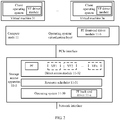
- FIG. 2 is a schematic diagram of a software module composition of a computer system according to this application.
- the storage access apparatus 11-3 includes an operating system 11-30, a resource scheduler 11-31, and a direct access module 11-32.
- a PF back-end driver 11-a is loaded in the operating system 11-30, and the direct access module 11-32 includes a PF and a plurality of VFs.
- a PF front-end driver 11-b is configured in an operating system of a compute node 11.
- a VF driver module is loaded in a client operating system of a virtual machine 31.
- the direct access module 11-32 of the storage access apparatus 11-3 supports SR-IOV and is configured to: configure at least one virtual function VF by using a physical function PF of the SR-IOV function, and configure a VM-VF association relationship, so that a direct access path is established between a VM and a VF that are associated.
- the storage access apparatus 11-3 loads the PF back-end driver 11-a to initialize the SR-IOV function; and the compute node 11 loads the PF front-end driver 11-b, and uses the PF front-end driver 11-b to obtain resource information of the storage access apparatus, configure a queue or interrupt resource for the storage access apparatus, and communicate with the storage access apparatus 11-3.
- the resource scheduler 11-31 of the storage access apparatus 11-3 further supports a distributed storage resource scheduling function and is configured to: obtain, by using a network interface, data block resources provided by at least one network storage device that is connected to the storage access apparatus 11-3, form a plurality of virtual volumes by using the obtained data block resources, configure a virtual volume corresponding to a VF, and record an association relationship between the VF and the corresponding virtual volume.
- the resource scheduler 11-31 encapsulates the data block resources into the virtual volumes by accessing and calling data blocks of the network storage device and metadata of the data blocks, and configures a VF and a virtual volume to form a mapping relationship between the VF and the virtual volume.
- the resource scheduler 11-31 is further responsible for managing metadata of the virtual volumes, and is capable of finding specific physical addresses of data blocks of the network storage device based on a determined virtual volume.
- a management agent unit (not shown in FIG. 2 ) may further be deployed on the storage access apparatus 11-3.
- the management agent unit provides a management interface and is connected to a management layer of the computer system (the management layer of the computer system may be a cloud management component, a storage management component, or another component that is configured to manage the computer system).
- the management layer of the computer system may determine, based on a command of an upper-layer application or based on a pre-configured management policy, to perform virtual machine resource allocation.
- the management layer of the computer system may initiate, by using the management interface, an allocation request for allocating a storage resource to a VM.
- the allocation request for allocating a storage resource to a VM may be a request for creating a volume or attaching a volume.
- a random virtual machine is used as an example, and in this application, a first virtual machine is used to represent the random virtual machine.
- the storage access apparatus 11-3 receives, by using the management interface, an allocation request for allocating a storage resource to the first VM, determines a first VF associated with the first VM, allocates at least one of the plurality of virtual volumes to the first VM, creates an association relationship between the allocated at least one virtual volume and the first VF, and returns an allocation response.
- the allocation response includes information about the at least one virtual volume that is allocated to the first VM.
- the direct access module 11-32 and the resource scheduler 11-31 of the storage access apparatus implement VM-VF association and VF-virtual volume association respectively, direct access between the VM and the virtual volume is implemented in effect.
- the first VF of the storage access apparatus 11-3 receives the I/O request of the first VM by using a direct access path, and places the I/O request into an I/O queue of the first VF.
- the resource scheduler of the storage access apparatus 11-3 determines, based on the virtual volume associated with the first VF, a data block that is in the network storage device and that corresponds to the I/O request, and executes a read or write operation on the data block that is in the network storage device and that corresponds to the I/O request.
- the storage access method in this application does not require passing a front-end interface and a back-end interface that are at a virtualization medium layer, so that a VM access path, a software stack path, and an access latency are shortened, and storage access performance is enhanced.
- the method does not require a large quantity of host (a CPU in a compute node) resources, so that host resource utilization is improved.
- a VF driver (VF driver) is deployed in each VM.
- the VF driver may be a SCSI driver or an NVMe driver and is deployed inside the VM.
- the I/O request is directly sent, by using the VF driver, to a VF associated with the VM, and after the storage access apparatus completes an operation of the I/O request, an operation result of the I/O request is returned, also by using the VF driver, to the VM that sends the I/O request.
- a procedure of initialization configuration of the storage access apparatus and the compute node to implement communication is as follows: After the storage access apparatus 11-3 is started, the storage access apparatus 11-3 loads the PF back-end driver 11-a, and the storage access apparatus 11-3 executes initialization.
- the initialization process may include PF register initialization and VF register initialization, configuration of in-band/out-of-band address translation unit mapping, doorbell (doorbell) address configuration, direct memory access (Direct Memory Access, DMA) initialization, and base address register (Base Address Register, BAR) initialization.
- An objective of the initialization is to ensure that the storage access apparatus 11-3 can be enumerated and recognized by the compute node 11 as a PCIe endpoint device of the compute node 11, so as to implement interrupt transmission and memory access with hardware of the compute node 11.
- the compute node 11 loads the PF front-end driver 11-b, obtains the resource information on the storage access apparatus 11-3, and configures, for example, interrupt, queue, and base address register resources for the PF or the VFs in the storage access apparatus 11-3, to implement communication with the storage access apparatus.
- the PF in the storage access apparatus 11-3 may be used to implement functions such as enabling SR-IOV, querying or allocating a storage medium that is in a storage device, and maintaining a resource allocation table.
- the compute node 11 may load the PF front-end driver 11-b, enable the SR-IOV function, create a management queue, and deliver, by using the management queue of the PF front-end driver, a resource query command to the PF.
- the PF may return statuses of the storage medium, the interrupt resource, and the queue resource included in the storage device to the compute node 11.
- the compute node 11 may send an allocation command to the PF.
- the PF divides an integral storage resource into a plurality of storage sub-resources based on the allocation command, so as to allocate the storage sub-resources, the queue resource, and the interrupt resource to the PF or the VFs.
- a procedure of configuring the VM-VF association relationship is as follows: A VM and a VF may be associated when the VM is being newly created or may be associated after the VM is created.
- a management module or an upper-layer application of the VM sends a VM association command to the PF back-end driver 11-a of the storage access apparatus 11-3 by using the PF front-end driver 11-b on the compute node 11.
- the direct access module 11-32 of the storage access apparatus 11-3 selects an associated VF, and associates the VF and the VM, that is, creating a mapping relationship between the VF and the VM, records an association relationship between the designated VM and the corresponding VF, and returns an association success message to the PF front-end driver 11-b.
- the PF front-end driver 11-b then returns the association success message to the management module or the upper-layer application module of the VM.
- a procedure of integrating data blocks in the network storage device into virtual volumes is as follows: There is no specific timing relationship between this procedure and procedure 2. After the storage access apparatus 11-3 is started, these two procedures may be executed at any time.
- the resource scheduler 11-31 obtains, by using the network interface, storage resources from distributed network storage devices, that is, data block resources of the network storage devices, forms a plurality of virtual volumes by using the obtained data block resources, and records a correspondence between the virtual volumes and physical addresses of the data blocks (management of metadata of the virtual volumes).
- a procedure of configuring the VF-virtual volume association relationship is as follows: Association implemented during volume attachment is used as an example (or association may be implemented during volume creation).
- a user or an upper-layer application initiates a command for attaching a volume to the first VM.
- the storage access apparatus receives the volume attachment command by using the management interface, and determines the first VF associated with the VM.
- the resource schedule 11-31 selects, for the first VM, at least one virtual volume from the plurality of virtual volumes formed in procedure 3, creates an association relationship between the selected at least one virtual volume and the first VF, and returns a volume attachment response.
- the volume attachment response includes information about the at least one virtual volume that is allocated to the first VM.
- a procedure of processing an I/O request of a VM is as follows: The first VM initiates the I/O request. The first VF is further used to receive the I/O request of the first VM by using the direct access path, and place the I/O request into the I/O queue of the first VF.
- the resource scheduler 11-31 determines, based on the virtual volume associated with the first VF, the data block that is in the network storage device and that corresponds to the I/O request, and executes the read or write operation on the data block that is in the network storage device and that corresponds to the I/O request. After completing the operation of the I/O request, the resource scheduler 11-31 returns, by using the VF driver, the operation result of the I/O request to the first VM that sends the I/O request.
- an embodiment of the present application further provides a storage access apparatus 300.
- the storage access apparatus 300 includes a first interface 301, a second interface 302, and a processing unit 303.
- the first interface 301 is a PCIe interface and is configured to connect a CPU of a compute node
- the second interface is a network interface and is configured to connect a network storage device
- the processing unit 303 may be implemented by a hardware-form processing circuit, such as a system on chip , an application specific integrated circuit (Application Specific Integrated Circuit, ASIC), or a field programmable gate array (Field Programmable Gate Array, FPGA), or the processing unit 303 may be implemented in a form of a combination of a CPU and a memory (including corresponding code).
- the storage access apparatus shown in FIG. 3 is configured to implement the functions of the storage access apparatus 11-3 described in FIG. 1 and FIG. 2 . Details are not repeatedly described herein.
- the disclosed system, apparatus, and method may be implemented in other manners.
- the described apparatus embodiment is merely an example.
- the unit division is merely logical function division and may be other division in actual implementation.
- a plurality of units or components may be combined or integrated into another system, or some features may be ignored or not be performed.
- the displayed or discussed mutual couplings or direct couplings or communication connections may be indirect couplings or communication connections through some interfaces, apparatuses, or units, and may be electrical, mechanical or other forms of connections.
- the units described as separate parts may or may not be physically separate. Parts displayed as units may or may not be physical units, and may be located in one position or distributed on a plurality of network units. Some or all of the units may be selected depending on actual requirements to achieve the objectives of the solutions of the embodiments of the present application.
- functional units in the embodiments of the present application may be integrated into one processing unit, or each of the units may exist alone physically, or two or more units are integrated into one unit.
- the integrated unit may be implemented in a form of hardware, or may be implemented in a form of a software functional unit.
- the integrated unit When the integrated unit is implemented in the form of a software functional unit and sold or used as an independent product, the integrated unit may be stored in a computer-readable storage medium. Based on such an understanding, the technical solutions of the present application essentially, or the part contributing to the prior art, or all or some of the technical solutions may be implemented in the form of a software product.
- the computer software product is stored in a storage medium and includes several instructions for instructing a computer device (which may be a personal computer, a server, a network device, or the like) to perform all or some of the steps of the methods described in the embodiments of the present application.
- the foregoing storage medium includes: any medium that can store program code, such as a USB flash drive, a removable hard disk, a read-only memory (Read-Only Memory, ROM), a random access memory (Random Access Memory, RAM), a magnetic disk, or an optical disc.
- program code such as a USB flash drive, a removable hard disk, a read-only memory (Read-Only Memory, ROM), a random access memory (Random Access Memory, RAM), a magnetic disk, or an optical disc.
Landscapes
- Engineering & Computer Science (AREA)
- Theoretical Computer Science (AREA)
- Physics & Mathematics (AREA)
- General Engineering & Computer Science (AREA)
- General Physics & Mathematics (AREA)
- Software Systems (AREA)
- Human Computer Interaction (AREA)
- Mathematical Physics (AREA)
- Information Retrieval, Db Structures And Fs Structures Therefor (AREA)
Description
- The present application relates to storage technologies, and in particular, to a computer system and a storage access apparatus.
- Virtualization technologies are applied to an increasingly wide scope, and a demand for improving resource utilization through network and storage virtualization and improving performance of network and storage access by a virtual machine is increasingly strong.
- In an existing virtualization technology, virtual storage resource management is implemented by using a virtualization layer (such as Hypervisor) or a virtual machine manager (Virtual Machine Manager, VMM). The virtualization layer or the virtual machine manager encapsulates attached storage resources into virtual hard disks, and allocates the virtual hard disks to different VMs for use. A path by which a virtual machine (Virtual Machine, VM) accesses an allocated storage resource is relatively complex. The virtual machine needs to be connected to a back-end access interface (the back-end access interface is usually in kennel mode) at the virtualization layer or the virtual machine manager by using a front-end access interface deployed on the virtual machine, then a storage access request is forwarded by the back-end access interface to a storage resource scheduling module deployed at the virtualization layer or the virtual machine manager for physical storage resource scheduling or positioning (the storage resource scheduling module is usually in user mode), and finally the storage access request can be forwarded to a physical storage resource.
- In the foregoing storage resource access manner, the access path is complex and long, and a latency is large; and the access request has to pass the front-end access interface of the virtual machine, and the back-end access interface and the storage resource scheduling module of the virtualization layer or the virtual machine manager. These all need to occupy CPU resources of a host, affecting CPU resource occupation of the host.
-
US 2011/179414 A1 discloses a host machine hosting a virtual machine and configured to implement a virtualization intermediary. -
US 2012/102491 A1 discloses a method for virtual function boot in a system including a single-root I/O virtualization (SR-IOV) enabled server. - Embodiments of the present application provide a computer system and a storage access apparatus, so as to implement direct access of a virtual machine to a storage resource, shorten a storage access path and latency, and reduce occupation of CPU resources in a compute node. The present invention is defined by the computing system of
independent claim 1 and by the storage access apparatus of independent claim 6, and by the method of storage accessing of independent claim 9. Additional features of the invention are presented in the dependent claims. In the following, parts of the description and drawing referring to embodiments, which are not covered by the claims, are not presented as embodiments of the invention, but as examples useful for understanding the invention. - According to a first aspect, an embodiment of the present application provides a computer system, and the computer system includes n compute nodes, n storage access apparatuses, and m network storage devices, where at least one virtual machine VM runs on each compute node, the m network storage devices provide distributed storage resources for the at least one virtual machine, each compute node includes a processor, a memory, and a storage access apparatus, and n and m are integers greater than or equal to 1.
- Each storage access apparatus includes a hardware-form processing unit, a Peripheral Component Interconnect Express PCIe bus interface, and a network interface, one end of the storage access apparatus is connected to a processor of the at least one compute node by using the PCIe interface, and another end of the storage access apparatus is connected to the at least one network storage device by using the network interface.
- The storage access apparatus in this application supports single-root I/O virtualization SR-IOV and is configured to: configure at least one virtual function VF by using a physical function PF of the SR-IOV function, and configure a VM-VF association relationship, so that a direct access path is established between a VM and a VF that are associated, where one VM corresponds to one VF; and the storage access apparatus further supports a distributed storage resource scheduling function and is configured to: obtain, by using the network interface, data block resources provided by the at least one network storage device that is connected to the storage access apparatus, form a plurality of virtual volumes by using the obtained data block resources, and configure a VF-virtual volume association relationship, where one VF corresponds to at least one virtual volume.
- The storage access apparatus provided in this application can directly establish a direct access path between a storage resource and a virtual machine. Therefore, a storage access method supported by the storage access apparatus does not require front-end and back-end software stacks that are used by a VM to access a storage resource in an existing cloud computing virtualization technology, so that a software stack path and a latency are shortened and performance is enhanced. In addition, the method does not require a large quantity of host (a CPU in a compute node) resources, so that host resource utilization is improved.
- Optionally, a PF back-end driver is deployed in the storage access apparatus provided in this application, and a PF front-end driver is deployed in the compute node connected to the storage access apparatus; after being started, the storage access apparatus loads the PF back-end driver to perform initialization; and the compute node connected to the storage access apparatus loads the PF front-end driver, obtains resource information of the storage access apparatus by using the PF front-end driver, and delivers a configuration command to the storage access apparatus based on the resource information of the storage access apparatus, so that the storage access apparatus performs resource configuration, to allocate corresponding hardware resources to the PF and each VF.
- Optionally, the storage access apparatus provided in this application specifically executes a VM-VF association operation as follows: after receiving a first VM association command sent by an upper-layer application, the compute node connected to the storage access apparatus forwards the first VM association command to the PF back-end driver module by using the PF front-end driver module; and after receiving the first VM association command by using the PF back-end driver module, the storage access apparatus configures a corresponding first VF for a first VM designated in the first VM association command, and records an association relationship between the first VM and the first VF.
- The storage access apparatus provided in this application specifically executes a VF-virtual volume association operation as follows: the storage access apparatus (the storage access apparatus may provide a management interface, such as an interface that provides a command-line interface CLI or a web user interface web UI for a management layer) receives an allocation request for allocating a storage resource to the first VM, determines the first VF associated with the first VM, allocates at least one of the plurality of virtual volumes to the first VM, creates an association relationship between the allocated at least one virtual volume and the first VF, and returns an allocation response, where the allocation response includes information about the at least one virtual volume that is allocated to the first VM.
- Optionally, the storage access apparatus provided in this application specifically executes a VM read or write request as follows: the first VF of the storage access apparatus receives an I/O request of the first VM by using the direct access path, places the I/O request into an I/O queue of the first VF, determines, based on the virtual volume associated with the first VF, a data block that is in the network storage device and that corresponds to the I/O request, and executes a read or write operation on the data block that is in the network storage device and that corresponds to the I/O request.
- According to a second aspect, this application further provides a storage access apparatus. The storage access apparatus includes a hardware-form processing unit, a Peripheral Component Interconnect Express PCIe bus interface, and a network interface, one end of the storage access apparatus is connected to a processor of a compute node by using the PCIe interface, and another end of the storage access apparatus is connected to at least one network storage device by using the network interface.
- At least one virtual machine VM runs on the compute node, and the at least one network storage device provides distributed storage resources for the at least one virtual machine.
- The storage access apparatus provided in this application includes a direct access module, where the direct access module supports single-root I/O virtualization SR-IOV and is configured to: perform virtualization to obtain at least one virtual function VF by using a physical function PF of the SR-IOV function, and configure a VM-VF association relationship, so that a direct access path is established between a VM and a VF that are associated, where one VM corresponds to one VF; and the storage access apparatus further includes a resource scheduler, where the resource scheduler supports a distributed storage resource scheduling function and is configured to: obtain, by using the network interface, data block resources provided by the at least one network storage device that is connected to the storage access apparatus, form a plurality of virtual volumes by using the obtained data block resources, and configure a VF-virtual volume association relationship, where one VF corresponds to at least one virtual volume.
- According to a third aspect, this application further provides a storage access apparatus, and the storage access apparatus includes a hardware-form processing unit, a first interface (such as a Peripheral Component Interconnect Express PCIe bus interface), and a second interface (such as a network interface).
- The hardware-form processing unit in the storage access apparatus provided in this application is configured to: support an SR-IOV function and a distributed storage resource scheduling function; perform virtualization to obtain at least one virtual function VF by using a physical function PF of the SR-IOV function, and configure a VM-VF association relationship, so that a direct access path is established between a VM and a VF that are associated, where one VM corresponds to one VF; and obtain, by using the network interface, data block resources provided by the at least one network storage device that is connected to the storage access apparatus, form a plurality of virtual volumes by using the obtained data block resources, and configure a VF-virtual volume association relationship, where one VF corresponds to at least one virtual volume. The hardware-form processing unit in the storage access apparatus provided in this application is configured to perform the following specific storage access method in this application: After a first VM sends an I/O request, a first VF of the storage access apparatus receives the I/O request of the first VM by using the direct access path, and places the I/O request into an I/O queue of the first VF; and the processing unit then determines, based on a virtual volume associated with the first VF, a data block that is in the network storage device and that corresponds to the I/O request, and executes a read or write operation on the data block that is in the network storage device and that corresponds to the I/O request.
- In this application, the storage access method implemented by the storage access apparatus no longer requires passing a front-end interface and a back-end interface that are at a virtualization medium layer, so that a VM access path, a software stack path, and an access latency are shortened, and storage access performance is enhanced. In addition, the method does not require a large quantity of host (a CPU in a compute node) resources, so that host resource utilization is improved.
- To describe the technical solutions in the embodiments of the present application more clearly, the following briefly describes the accompanying drawings required for describing the embodiments. Apparently, the accompanying drawings in the following description show merely some embodiments of the present application, and a person of ordinary skill in the art may derive other drawings from these accompanying drawings without creative efforts.
-
FIG. 1 is a schematic architectural diagram of a computer system according to this application; -
FIG. 2 is a schematic diagram of composition details of a computer system according to this application; and -
FIG. 3 is a schematic structural diagram of a storage access apparatus according to this application. - The following clearly describes the technical solutions in the embodiments of the present application with reference to the accompanying drawings in the embodiments of the present application. Apparently, the described embodiments are some rather than all of the embodiments of the present application. All other embodiments obtained by a person of ordinary skill in the art based on the embodiments of the present application without creative efforts shall fall within the protection scope of the present application.
- Referring to
FIG. 1, FIG. 1 is a schematic diagram of a computer system configured to perform a storage access method in this application.FIG. 1 shows a hardware layer and a software layer of the computer system. The hardware layer of the computer system includes n compute nodes (in actual operation, n may be any positive integer greater than or equal to 1), n storage access apparatuses, and m network storage devices (in actual operation, m may be any positive integer greater than or equal to 1). Each compute node may be a blade server, a rack server, or another type of server, and is configured to provide computing resources. Each network storage device may be a SAN storage device, includes a storage array, an HDD hard disk, an SDD hard disk, or the like, and is configured to provide storage resources. The software layer of the computer system includes a virtualization layer (which may be distributed in operating systems OSs of the compute nodes, or may be independently set in an operating system of one of the compute nodes) configured to perform virtualization, and a plurality of virtual machines (Virtual Machine, VM). - The following describes a composition of a compute node by using a
compute node 11 inFIG. 1 as an example. Thecompute node 11 includes a CPU 11-1 and a memory 11-2, and may further include some other hardware components, such as a network interface card (which is not shown in the figure). The CPU 11-1 may be one or more Intel processor chips, and the memory 11-2 provides a storage capacity for the CPU 11-1, temporarily stores a program and data that are executed by the CPU 11-1, and may be a random access memory (RAM), a read-only memory (ROM), a cache (CACHE), or the like. - A storage access apparatus 11-3 is a hardware device newly provided in this application and plays a key role in implementing the storage access method in this application. The storage access apparatus 11-3 includes a hardware-form processing unit, a PCIe (Peripheral Component Interconnect Express, PCIe) bus interface, and a network interface, one end of the storage access apparatus 11-3 is connected to the CPU 11-1 by using the PCIe (the storage access apparatus 11-3 may be considered as one PCIe endpoint device connected to the CPU 11-1 of the compute node), and another end of the storage access apparatus 11-3 is connected to the network storage devices (such as the
network storage devices - The storage access apparatus 11-3 further supports a distributed storage resource scheduling function and is configured to: obtain, by using the network interface, data block resources provided by the at least one network storage device that is connected to the storage access apparatus, form a plurality of virtual volumes by using the obtained data block resources, and configure a VF-virtual volume association relationship, where one VF corresponds to at least one virtual volume. In brief, storage resources in the network storage devices are encapsulated into virtual volumes, and the virtual volumes are directly accessed by the VM by using the VF.
- The virtual volume in this application may also be referred to as a virtual disk. Compared with a physical disk, the virtual disk is mainly a storage resource provided for use by a virtual machine and is usually obtained by integrating physical storage resources.
- The storage access apparatus 11-3 provided in this application can directly establish a direct access path between a storage resource and a VM. Therefore, the storage access method supported by the storage access apparatus 11-3 does not require front-end and back-end software stacks that are used by a VM to access a storage resource in an existing cloud computing virtualization technology, so that a software stack path and a latency are shortened and performance is enhanced. In addition, the method does not require a large quantity of host (a CPU in a compute node) resources, so that host resource utilization is improved.
-
Devices 21 to 2n are network storage devices, and the storage access apparatus 11-3 is connected to thedevices 21 to 2n by using the network interface. Thenetwork storage devices 21 to 2n may form a distributed storage resource pool, and a capacity of the storage resource pool can be randomly expanded. Each network storage device includes a storage controller and a storage medium, to implement hard disk management and bottom-layer data management, and present a data block and a data block call interface upwards. Each network storage device may be remotely deployed rather than deployed on a local compute node. Thenetwork storage devices 21 to 2n support distributed storage manners including a multi-copy manner, an EC manner, or the like, and can ensure liability of storage resources. -
FIG. 2 is a schematic diagram of a software module composition of a computer system according to this application. InFIG. 2 , only one storage access apparatus is shown as an example. The storage access apparatus 11-3 includes an operating system 11-30, a resource scheduler 11-31, and a direct access module 11-32. A PF back-end driver 11-a is loaded in the operating system 11-30, and the direct access module 11-32 includes a PF and a plurality of VFs. A PF front-end driver 11-b is configured in an operating system of acompute node 11. A VF driver module is loaded in a client operating system of avirtual machine 31. - The direct access module 11-32 of the storage access apparatus 11-3 supports SR-IOV and is configured to: configure at least one virtual function VF by using a physical function PF of the SR-IOV function, and configure a VM-VF association relationship, so that a direct access path is established between a VM and a VF that are associated.
- Specifically, after being started, the storage access apparatus 11-3 loads the PF back-end driver 11-a to initialize the SR-IOV function; and the
compute node 11 loads the PF front-end driver 11-b, and uses the PF front-end driver 11-b to obtain resource information of the storage access apparatus, configure a queue or interrupt resource for the storage access apparatus, and communicate with the storage access apparatus 11-3. - The resource scheduler 11-31 of the storage access apparatus 11-3 further supports a distributed storage resource scheduling function and is configured to: obtain, by using a network interface, data block resources provided by at least one network storage device that is connected to the storage access apparatus 11-3, form a plurality of virtual volumes by using the obtained data block resources, configure a virtual volume corresponding to a VF, and record an association relationship between the VF and the corresponding virtual volume.
- Specifically, the resource scheduler 11-31 encapsulates the data block resources into the virtual volumes by accessing and calling data blocks of the network storage device and metadata of the data blocks, and configures a VF and a virtual volume to form a mapping relationship between the VF and the virtual volume. In addition, the resource scheduler 11-31 is further responsible for managing metadata of the virtual volumes, and is capable of finding specific physical addresses of data blocks of the network storage device based on a determined virtual volume.
- A management agent unit (not shown in
FIG. 2 ) may further be deployed on the storage access apparatus 11-3. The management agent unit provides a management interface and is connected to a management layer of the computer system (the management layer of the computer system may be a cloud management component, a storage management component, or another component that is configured to manage the computer system). The management layer of the computer system may determine, based on a command of an upper-layer application or based on a pre-configured management policy, to perform virtual machine resource allocation. When determining that virtual machine resource allocation needs to be performed, the management layer of the computer system may initiate, by using the management interface, an allocation request for allocating a storage resource to a VM. Specifically, the allocation request for allocating a storage resource to a VM may be a request for creating a volume or attaching a volume. A random virtual machine is used as an example, and in this application, a first virtual machine is used to represent the random virtual machine. The storage access apparatus 11-3 receives, by using the management interface, an allocation request for allocating a storage resource to the first VM, determines a first VF associated with the first VM, allocates at least one of the plurality of virtual volumes to the first VM, creates an association relationship between the allocated at least one virtual volume and the first VF, and returns an allocation response. The allocation response includes information about the at least one virtual volume that is allocated to the first VM. - After the direct access module 11-32 and the resource scheduler 11-31 of the storage access apparatus implement VM-VF association and VF-virtual volume association respectively, direct access between the VM and the virtual volume is implemented in effect. After the first VM sends an I/O request, the first VF of the storage access apparatus 11-3 receives the I/O request of the first VM by using a direct access path, and places the I/O request into an I/O queue of the first VF. The resource scheduler of the storage access apparatus 11-3 then determines, based on the virtual volume associated with the first VF, a data block that is in the network storage device and that corresponds to the I/O request, and executes a read or write operation on the data block that is in the network storage device and that corresponds to the I/O request.
- The storage access method in this application does not require passing a front-end interface and a back-end interface that are at a virtualization medium layer, so that a VM access path, a software stack path, and an access latency are shortened, and storage access performance is enhanced. In addition, the method does not require a large quantity of host (a CPU in a compute node) resources, so that host resource utilization is improved.
- A VF driver (VF driver) is deployed in each VM. The VF driver may be a SCSI driver or an NVMe driver and is deployed inside the VM. After the VM sends an I/O request, the I/O request is directly sent, by using the VF driver, to a VF associated with the VM, and after the storage access apparatus completes an operation of the I/O request, an operation result of the I/O request is returned, also by using the VF driver, to the VM that sends the I/O request.
- The following specifically describes, with reference to
FIG. 2 , procedures of operations executed by the storage access apparatus. 1. A procedure of initialization configuration of the storage access apparatus and the compute node to implement communication is as follows: After the storage access apparatus 11-3 is started, the storage access apparatus 11-3 loads the PF back-end driver 11-a, and the storage access apparatus 11-3 executes initialization. The initialization process may include PF register initialization and VF register initialization, configuration of in-band/out-of-band address translation unit mapping, doorbell (doorbell) address configuration, direct memory access (Direct Memory Access, DMA) initialization, and base address register (Base Address Register, BAR) initialization. An objective of the initialization is to ensure that the storage access apparatus 11-3 can be enumerated and recognized by thecompute node 11 as a PCIe endpoint device of thecompute node 11, so as to implement interrupt transmission and memory access with hardware of thecompute node 11. Thecompute node 11 loads the PF front-end driver 11-b, obtains the resource information on the storage access apparatus 11-3, and configures, for example, interrupt, queue, and base address register resources for the PF or the VFs in the storage access apparatus 11-3, to implement communication with the storage access apparatus. - In this application, the PF in the storage access apparatus 11-3 may be used to implement functions such as enabling SR-IOV, querying or allocating a storage medium that is in a storage device, and maintaining a resource allocation table. Specifically, the
compute node 11 may load the PF front-end driver 11-b, enable the SR-IOV function, create a management queue, and deliver, by using the management queue of the PF front-end driver, a resource query command to the PF. After receiving the query command, the PF may return statuses of the storage medium, the interrupt resource, and the queue resource included in the storage device to thecompute node 11. After receiving the statuses, of the storage medium, the interrupt resource, and the queue resource, returned by the PF, thecompute node 11 may send an allocation command to the PF. The PF divides an integral storage resource into a plurality of storage sub-resources based on the allocation command, so as to allocate the storage sub-resources, the queue resource, and the interrupt resource to the PF or the VFs. - 2. A procedure of configuring the VM-VF association relationship is as follows: A VM and a VF may be associated when the VM is being newly created or may be associated after the VM is created. A management module or an upper-layer application of the VM sends a VM association command to the PF back-end driver 11-a of the storage access apparatus 11-3 by using the PF front-end driver 11-b on the
compute node 11. The direct access module 11-32 of the storage access apparatus 11-3 selects an associated VF, and associates the VF and the VM, that is, creating a mapping relationship between the VF and the VM, records an association relationship between the designated VM and the corresponding VF, and returns an association success message to the PF front-end driver 11-b. The PF front-end driver 11-b then returns the association success message to the management module or the upper-layer application module of the VM. - 3. A procedure of integrating data blocks in the network storage device into virtual volumes is as follows: There is no specific timing relationship between this procedure and
procedure 2. After the storage access apparatus 11-3 is started, these two procedures may be executed at any time. The resource scheduler 11-31 obtains, by using the network interface, storage resources from distributed network storage devices, that is, data block resources of the network storage devices, forms a plurality of virtual volumes by using the obtained data block resources, and records a correspondence between the virtual volumes and physical addresses of the data blocks (management of metadata of the virtual volumes). - 4. A procedure of configuring the VF-virtual volume association relationship is as follows: Association implemented during volume attachment is used as an example (or association may be implemented during volume creation). A user or an upper-layer application initiates a command for attaching a volume to the first VM. The storage access apparatus receives the volume attachment command by using the management interface, and determines the first VF associated with the VM. The resource schedule 11-31 selects, for the first VM, at least one virtual volume from the plurality of virtual volumes formed in procedure 3, creates an association relationship between the selected at least one virtual volume and the first VF, and returns a volume attachment response. The volume attachment response includes information about the at least one virtual volume that is allocated to the first VM.
- 5. A procedure of processing an I/O request of a VM is as follows: The first VM initiates the I/O request. The first VF is further used to receive the I/O request of the first VM by using the direct access path, and place the I/O request into the I/O queue of the first VF. The resource scheduler 11-31 determines, based on the virtual volume associated with the first VF, the data block that is in the network storage device and that corresponds to the I/O request, and executes the read or write operation on the data block that is in the network storage device and that corresponds to the I/O request. After completing the operation of the I/O request, the resource scheduler 11-31 returns, by using the VF driver, the operation result of the I/O request to the first VM that sends the I/O request.
- As shown in
FIG. 3 , an embodiment of the present application further provides a storage access apparatus 300. The storage access apparatus 300 includes afirst interface 301, asecond interface 302, and aprocessing unit 303. Specifically, thefirst interface 301 is a PCIe interface and is configured to connect a CPU of a compute node, the second interface is a network interface and is configured to connect a network storage device, and theprocessing unit 303 may be implemented by a hardware-form processing circuit, such as a system on chip , an application specific integrated circuit (Application Specific Integrated Circuit, ASIC), or a field programmable gate array (Field Programmable Gate Array, FPGA), or theprocessing unit 303 may be implemented in a form of a combination of a CPU and a memory (including corresponding code). - The storage access apparatus shown in
FIG. 3 is configured to implement the functions of the storage access apparatus 11-3 described inFIG. 1 andFIG. 2 . Details are not repeatedly described herein. - A person of ordinary skill in the art may be aware that the units and algorithm steps in the examples described with reference to the embodiments disclosed in this specification can be implemented by electronic hardware, computer software, or a combination thereof. To clearly describe the interchangeability between hardware and software, the foregoing has generally described compositions and steps in each example based on functions. Whether the functions are performed by hardware or software depends on particular applications and design constraint conditions of the technical solutions. A person skilled in the art may use different methods to implement the described functions for each particular application, but it should not be considered that the implementation goes beyond the scope of the present application.
- It may be clearly understood by a person skilled in the art that, for the purpose of convenient and brief description, for a detailed working process of the foregoing system, apparatus, and unit, reference may be made to a corresponding process in the foregoing method embodiments, and details are not described herein again.
- In the several embodiments provided in this application, it should be understood that the disclosed system, apparatus, and method may be implemented in other manners. For example, the described apparatus embodiment is merely an example. For example, the unit division is merely logical function division and may be other division in actual implementation. For example, a plurality of units or components may be combined or integrated into another system, or some features may be ignored or not be performed. In addition, the displayed or discussed mutual couplings or direct couplings or communication connections may be indirect couplings or communication connections through some interfaces, apparatuses, or units, and may be electrical, mechanical or other forms of connections.
- The units described as separate parts may or may not be physically separate. Parts displayed as units may or may not be physical units, and may be located in one position or distributed on a plurality of network units. Some or all of the units may be selected depending on actual requirements to achieve the objectives of the solutions of the embodiments of the present application.
- In addition, functional units in the embodiments of the present application may be integrated into one processing unit, or each of the units may exist alone physically, or two or more units are integrated into one unit. The integrated unit may be implemented in a form of hardware, or may be implemented in a form of a software functional unit.
- When the integrated unit is implemented in the form of a software functional unit and sold or used as an independent product, the integrated unit may be stored in a computer-readable storage medium. Based on such an understanding, the technical solutions of the present application essentially, or the part contributing to the prior art, or all or some of the technical solutions may be implemented in the form of a software product. The computer software product is stored in a storage medium and includes several instructions for instructing a computer device (which may be a personal computer, a server, a network device, or the like) to perform all or some of the steps of the methods described in the embodiments of the present application. The foregoing storage medium includes: any medium that can store program code, such as a USB flash drive, a removable hard disk, a read-only memory (Read-Only Memory, ROM), a random access memory (Random Access Memory, RAM), a magnetic disk, or an optical disc.
- The foregoing descriptions are merely specific embodiments of the present application, but are not intended to limit the protection scope of the present application. Any modification or replacement readily figured out by a person skilled in the art within the technical scope disclosed in the present application shall fall within the protection scope of the present application. Therefore, the protection scope of the present application shall be subject to the protection scope of the claims.
Claims (11)
- A computer system, wherein the computer system comprises n compute nodes (11, 12 ... 1n), n storage access apparatuses (11-3, 12-3 ... 1n-3), and m network storage devices (21, 22 ... 2n), wherein at least one virtual machine, VM (31, 32 ... 3n), runs on each compute node, the m network storage devices provide distributed storage resources for the at least one virtual machine, and n and m are integers greater than or equal to 1;each storage access apparatus comprises a processing unit, a Peripheral Component Interconnect Express, PCIe, bus interface, and a network interface, the storage access apparatus is connected to a processor of the at least one compute node by using the PCIe interface, and the storage access apparatus is connected to the at least one network storage device by using the network interface;the storage access apparatus supports single-root I/O virtualization, SR-IOV, function and is configured to: configure at least one virtual function, VF (VF1, VF2 ... VFn), by using a physical function, PF, of the SR-IOV function, and configure a VM-VF association relationship, so that a direct access path is established between a VM and a VF that are associated, wherein one VM is associated with one VF; andthe storage access apparatus supports a distributed storage resource scheduling function and is configured to: obtain, by using the network interface, data block resources provided by the at least one network storage device that is connected to the storage access apparatus, form a plurality of virtual volumes by using the obtained data block resources, and configure a VF-virtual volume association relationship, wherein one VF is associated with at least one virtual volume;wherein the storage access apparatus is specifically configured to: receive an allocation request for allocating a storage resource to a first VM, determine the first VF associated with the first VM, allocate at least one of the plurality of virtual volumes to the first VM, create an association relationship between the allocated at least one virtual volume and the first VF, and return an allocation response, wherein the allocation response comprises information about the at least one virtual volume that is allocated to the first VM.
- The computer system according to claim 1, wherein a PF back-end driver is deployed in the storage access apparatus, and a PF front-end driver is deployed in the compute node connected to the storage access apparatus;after being started, the storage access apparatus loads the PF back-end driver to perform initialization configuration; andthe compute node connected to the storage access apparatus loads the PF front-end driver, obtains resource information of the storage access apparatus by using the PF front-end driver, and delivers a configuration command to the storage access apparatus based on the resource information of the storage access apparatus, so that the storage access apparatus performs resource configuration, to allocate corresponding hardware resources to the PF and each VF.
- The computer system according to claim 2, wherein after receiving a first VM association command sent by an upper-layer application, the compute node connected to the storage access apparatus forwards the first VM association command to the PF back-end driver by using the PF front-end driver; and
the storage access apparatus is specifically configured to: after receiving the first VM association command by using the PF back-end driver module, configure a corresponding first VF for the first VM designated in the first VM association command, and record an association relationship between the first VM and the first VF. - The computer system according to one of the claims 1 to 3, wherein the allocation request for allocating a storage resource to the first VM is a request for creating a virtual volume for the first VM or a request for attaching a virtual volume to the first VM.
- The computer system according to one of the claims 1 to 4, wherein the first VF of the storage access apparatus is further configured to: receive an I/O request of the first VM by using the direct access path, place the I/O request into an I/O queue of the first VF, determine, based on the virtual volume associated with the first VF, a data block that is in the network storage device and that corresponds to the I/O request, and execute a read or write operation on the data block that is in the network storage device and that corresponds to the I/O request.
- A storage access apparatus (11-3, 12-3 ... 1n-3), wherein the storage access apparatus comprises a processing unit, a Peripheral Component Interconnect Express, PCIe, bus interface, and a network interface, the storage access apparatus is connected to a processor of a compute node by using the PCIe interface, and the storage access apparatus is connected to at least one network storage device (21, 22 ... 2n), by using the network interface;at least one virtual machine, VM (31, 32 ... 3n), runs on the compute node (11, 12 ... 1n), and the at least one network storage device provides distributed storage resources for the at least one virtual machine;the storage access apparatus comprises a direct access module, wherein the direct access module supports single-root I/O virtualization, SR-IOV, function and is configured to: perform virtualization to obtain at least one virtual function, VF (VF1, VF2 ... VFn), by using a physical function, PF, of the SR-IOV function, and configure a VM-VF association relationship, so that a direct access path is established between a VM and a VF that are associated, wherein one VM is associated with one VF; andthe storage access apparatus further comprises a resource scheduler, wherein the resource scheduler supports a distributed storage resource scheduling function and is configured to: obtain, by using the network interface, data block resources provided by the at least one network storage device that is connected to the storage access apparatus, form a plurality of virtual volumes by using the obtained data block resources, and configure a VF-virtual volume association relationship, wherein one VF is associated with at least one virtual volume;wherein the resource scheduler is specifically configured to: receive an allocation request for allocating a storage resource to a first VM, allocate at least one of the plurality of virtual volumes to the first VM, create an association relationship between the allocated at least one virtual volume and a first VF based on the first VF, associated with the first VM, determined by the direct access module, and return an allocation response, wherein the allocation response comprises information about the at least one virtual volume that is allocated to the first VM.
- The storage access apparatus according to claim 6, wherein the allocation request for allocating a storage resource to the first VM is a request for creating a virtual volume for the first VM or a request for attaching a virtual volume to the first VM.
- The storage access apparatus according to claim 6 or 7, wherein the first VF of the direct access module is further configured to: receive an I/O request of the first VM by using the direct access path, and place the I/O request into an I/O queue of the first VF; and the resource scheduler determines, based on the virtual volume associated with the first VF, a data block that is in the network storage device and that corresponds to the I/O request, and executes a read or write operation on the data block that is in the network storage device and that corresponds to the I/O request.
- A method of storage accessing, the method is applied to a computer system, the computer system comprises n compute nodes (11, 12 ... 1n), n storage access apparatuses (11-3, 12-3 ... 1n-3), and m network storage devices (21, 22 ... 2n), wherein at least one virtual machine, VM (31, 32 ... 3n), runs on each compute node, the m network storage devices provide distributed storage resources for the at least one virtual machine, and n and m are integers greater than or equal to 1; wherein each storage access apparatus comprises a processing unit, a Peripheral Component Interconnect Express, PCIe, bus interface, and a network interface, the storage access apparatus is connected to a processor of the at least one compute node by using the PCIe interface, and the storage access apparatus is connected to the at least one network storage device by using the network interface;
wherein the storage access apparatus supports single-root I/O virtualization, SR-IOV, the method comprises:configuring, by the storage access apparatus, at least one virtual function, VF (VF1, VF2 ... VFn), by using a physical function, PF, of the SR-IOV function, and configuring a VM-VF association relationship, so that a direct access path is established between a VM and a VF that are associated, wherein one VM is associated with one VF; andwherein the storage access apparatus supports a distributed storage resource scheduling function, and the method further comprises:obtaining, by the storage access apparatus by using the network interface, data block resources provided by the at least one network storage device that is connected to the storage access apparatus;forming a plurality of virtual volumes by using the obtained data block resources; andconfiguring a VF-virtual volume association relationship, wherein one VF is associated with at least one virtual volume;the method further comprises:receiving, by the storage access apparatus, an allocation request for allocating a storage resource to a first VM;determining, by the storage access apparatus, the first VF associated with the first VM, allocate at least one of the plurality of virtual volumes to the first VM;creating, by the storage access apparatus, an association relationship between the allocated at least one virtual volume and the first VF; andreturning, by the storage access apparatus, an allocation response, wherein the allocation response comprises information about the at least one virtual volume that is allocated to the first VM - The method of storage accessing according to claim 9, the method further comprises:receiving, by the storage access apparatus, input/output, I/O, request which is send by the first VM;placing, by the storage access apparatus, the I/O request into the I/O queue of the first VF;determining, by the storage access apparatus based on the virtual volume associated with the first VF, the data block that is in the network storage device and that corresponds to the I/O request;executing, by the storage access apparatus, the read or write operation on the at least one data block; andsending, by the storage access apparatus, result of the I/O request to the first VM
- The method of storage accessing according to claim 10, wherein a PF back-end driver is deployed in the storage access apparatus, and a PF front-end driver is deployed in the compute node connected to the storage access apparatus;loading, by the storage access apparatus after being started, the PF back-end driver to perform initialization configuration;receiving, by the storage access apparatus, a configuration command which is send by the compute node;performing, by the storage access apparatus, resource configuration, to allocate corresponding hardware resources to a physical function, PF and each VF.
Applications Claiming Priority (2)
| Application Number | Priority Date | Filing Date | Title |
|---|---|---|---|
| CN201610878406.9A CN107894913B (en) | 2016-09-30 | 2016-09-30 | Computer system and storage access device |
| PCT/CN2017/092816 WO2018059077A1 (en) | 2016-09-30 | 2017-07-13 | Computer system and storage access device |
Publications (3)
| Publication Number | Publication Date |
|---|---|
| EP3457288A1 EP3457288A1 (en) | 2019-03-20 |
| EP3457288A4 EP3457288A4 (en) | 2019-07-17 |
| EP3457288B1 true EP3457288B1 (en) | 2021-11-17 |
Family
ID=61763741
Family Applications (1)
| Application Number | Title | Priority Date | Filing Date |
|---|---|---|---|
| EP17854531.5A Active EP3457288B1 (en) | 2016-09-30 | 2017-07-13 | Computer system and storage access device |
Country Status (4)
| Country | Link |
|---|---|
| US (1) | US20190155548A1 (en) |
| EP (1) | EP3457288B1 (en) |
| CN (1) | CN107894913B (en) |
| WO (1) | WO2018059077A1 (en) |
Families Citing this family (30)
| Publication number | Priority date | Publication date | Assignee | Title |
|---|---|---|---|---|
| US10990445B2 (en) * | 2017-08-04 | 2021-04-27 | Apple Inc. | Hardware resource allocation system for allocating resources to threads |
| US11003372B2 (en) | 2018-05-31 | 2021-05-11 | Portworx, Inc. | Protecting volume namespaces from corruption in a distributed container orchestrator |
| CN108959127B (en) * | 2018-05-31 | 2021-02-09 | 华为技术有限公司 | Address translation method, device and system |
| US11074013B2 (en) * | 2018-08-07 | 2021-07-27 | Marvell Asia Pte, Ltd. | Apparatus and methods for providing quality of service over a virtual interface for solid-state storage |
| CN110825485A (en) | 2018-08-07 | 2020-02-21 | 华为技术有限公司 | Data processing method, device and server |
| JP6957431B2 (en) * | 2018-09-27 | 2021-11-02 | 株式会社日立製作所 | VM / container and volume allocation determination method and storage system in HCI environment |
| CN112148418B (en) * | 2019-06-26 | 2026-02-24 | 昆仑芯(北京)科技股份有限公司 | Method, apparatus, device and medium for accessing data |
| CN112395071B (en) * | 2019-08-12 | 2026-01-02 | 昆仑芯(北京)科技有限公司 | Methods, apparatus, electronic devices and storage media for resource management |
| KR102910539B1 (en) * | 2020-02-18 | 2026-01-09 | 삼성전자주식회사 | Storage device configured to support multi-hosts and operation method thereof |
| CN113312137B (en) * | 2020-04-09 | 2025-06-13 | 阿里巴巴集团控股有限公司 | Data processing method, device, equipment and system |
| CN113657069B (en) * | 2020-05-12 | 2024-07-12 | 北京东土科技股份有限公司 | SOC simulation verification method and device, verification server and storage medium |
| US11822964B2 (en) * | 2020-06-03 | 2023-11-21 | Baidu Usa Llc | Data protection with static resource partition for data processing accelerators |
| CN111949371B (en) * | 2020-08-14 | 2022-07-22 | 苏州浪潮智能科技有限公司 | Command information transmission method, system and device and readable storage medium |
| EP4018304B1 (en) * | 2020-08-19 | 2024-03-13 | Huawei Technologies Co., Ltd. | Interchangeable interface role remapping |
| CN113312143B (en) * | 2021-03-03 | 2024-01-23 | 阿里巴巴新加坡控股有限公司 | Cloud computing system, command processing method and virtualization simulation device |
| US12050807B2 (en) * | 2021-04-23 | 2024-07-30 | EMC IP Holding Company, LLC | Memory management system and method |
| US12039357B2 (en) | 2021-04-23 | 2024-07-16 | Samsung Electronics Co., Ltd. | Mechanism for distributed resource-based I/O scheduling over storage device |
| CN115469962A (en) * | 2021-06-10 | 2022-12-13 | 宏碁股份有限公司 | Device direct connection method of virtual machine and server thereof |
| CN113626139B (en) * | 2021-06-30 | 2023-03-24 | 济南浪潮数据技术有限公司 | High-availability virtual machine storage method and device |
| CN114691298A (en) * | 2022-03-16 | 2022-07-01 | 阿里云计算有限公司 | Data processing method, apparatus, device and storage medium |
| CN114756332B (en) * | 2022-05-19 | 2025-04-25 | 阿里巴巴(中国)有限公司 | Data access method, device and system based on virtual machine device direct access |
| CN114860387B (en) * | 2022-06-08 | 2023-04-18 | 无锡众星微系统技术有限公司 | I/O virtualization method of HBA controller for virtualization storage application |
| CN115185880B (en) * | 2022-09-09 | 2022-12-09 | 南京芯驰半导体科技有限公司 | Data storage method and device |
| CN115913953B (en) * | 2022-11-04 | 2024-06-04 | 陕西浪潮英信科技有限公司 | A cloud resource acceleration method, device and medium thereof |
| CN116048658A (en) * | 2022-12-30 | 2023-05-02 | 中国长城科技集团股份有限公司 | Deployment method, data access method and board of data access module |
| CN115827168B (en) * | 2023-02-01 | 2023-05-12 | 南京芯传汇电子科技有限公司 | Optimization method for virtual machine communication in binary simulation environment |
| CN116069451B (en) * | 2023-03-13 | 2023-06-16 | 苏州浪潮智能科技有限公司 | Virtualization method, device, equipment, medium, accelerator and system |
| CN116627883B (en) * | 2023-06-08 | 2024-10-01 | 北京大禹智芯科技有限公司 | Optimization method and device for on-chip space of PCIe device |
| CN117369734B (en) * | 2023-12-08 | 2024-03-08 | 浪潮电子信息产业股份有限公司 | Storage resource management system, method and storage virtualization system |
| CN120821504A (en) * | 2024-04-11 | 2025-10-21 | 成都华为技术有限公司 | A method and apparatus for configuring PCI device resources |
Family Cites Families (10)
| Publication number | Priority date | Publication date | Assignee | Title |
|---|---|---|---|---|
| US8473947B2 (en) * | 2010-01-18 | 2013-06-25 | Vmware, Inc. | Method for configuring a physical adapter with virtual function (VF) and physical function (PF) for controlling address translation between virtual disks and physical storage regions |
| US8489699B2 (en) * | 2010-08-13 | 2013-07-16 | Vmware, Inc. | Live migration of virtual machine during direct access to storage over SR IOV adapter |
| US9135044B2 (en) * | 2010-10-26 | 2015-09-15 | Avago Technologies General Ip (Singapore) Pte. Ltd. | Virtual function boot in multi-root I/O virtualization environments to enable multiple servers to share virtual functions of a storage adapter through a MR-IOV switch |
| TW201235946A (en) * | 2011-02-18 | 2012-09-01 | Hon Hai Prec Ind Co Ltd | Method and system for configuring USB device in virtual environment |
| CN102255962B (en) * | 2011-07-01 | 2013-11-06 | 华为数字技术(成都)有限公司 | Distributive storage method, device and system |
| CN102650976B (en) * | 2012-04-01 | 2014-07-09 | 中国科学院计算技术研究所 | Control device and method supporting single IO (Input/Output) virtual user level interface |
| CN103870311B (en) * | 2012-12-10 | 2016-12-21 | 华为技术有限公司 | The method of hardware that accesses, rear end is driven to drive and front-end driven by half virtualization |
| US9665309B2 (en) * | 2014-06-27 | 2017-05-30 | International Business Machines Corporation | Extending existing storage devices in virtualized environments |
| CN104461958B (en) * | 2014-10-31 | 2018-08-21 | 华为技术有限公司 | Support storage resource access method, storage control and the storage device of SR-IOV |
| CN105808167B (en) * | 2016-03-10 | 2018-12-21 | 深圳市杉岩数据技术有限公司 | A kind of method, storage equipment and the system of the link clone based on SR-IOV |
-
2016
- 2016-09-30 CN CN201610878406.9A patent/CN107894913B/en active Active
-
2017
- 2017-07-13 WO PCT/CN2017/092816 patent/WO2018059077A1/en not_active Ceased
- 2017-07-13 EP EP17854531.5A patent/EP3457288B1/en active Active
-
2019
- 2019-01-26 US US16/258,575 patent/US20190155548A1/en not_active Abandoned
Non-Patent Citations (1)
| Title |
|---|
| None * |
Also Published As
| Publication number | Publication date |
|---|---|
| CN107894913B (en) | 2022-05-13 |
| EP3457288A1 (en) | 2019-03-20 |
| WO2018059077A1 (en) | 2018-04-05 |
| EP3457288A4 (en) | 2019-07-17 |
| US20190155548A1 (en) | 2019-05-23 |
| CN107894913A (en) | 2018-04-10 |
Similar Documents
| Publication | Publication Date | Title |
|---|---|---|
| US20190155548A1 (en) | Computer system and storage access apparatus | |
| TWI752066B (en) | Method and device for processing read and write requests | |
| US10768862B2 (en) | Extending existing storage devices in virtualized environments | |
| US20200278880A1 (en) | Method, apparatus, and system for accessing storage device | |
| US9529773B2 (en) | Systems and methods for enabling access to extensible remote storage over a network as local storage via a logical storage controller | |
| CN111490949B (en) | Method, network card, host device and computer system for forwarding data packets | |
| CN102591702B (en) | Virtualization processing method, related device and computer system | |
| US20250227026A1 (en) | Acceleration Resource Scheduling Method and Apparatus, and Acceleration System | |
| US11853798B2 (en) | Disaggregated memory pool assignment | |
| CN105700826A (en) | Virtualization method and device | |
| US11016817B2 (en) | Multi root I/O virtualization system | |
| WO2022222977A1 (en) | Method and apparatus for managing memory of physical server for running cloud service instances | |
| CN110704163A (en) | A server and its virtualized storage method and device | |
| JP6760579B2 (en) | Network line card (LC) integration into host operating system (OS) | |
| US20220317910A1 (en) | Array-based copy mechanism for migration, replication, and backup | |
| WO2015043175A1 (en) | Server system and operation system starting method thereof, and starting management node | |
| CN106445650B (en) | A kind of interrupt processing method, IOAPIC and computer system | |
| WO2026066370A1 (en) | Cloud service-based logic node configuration method and cloud management platform | |
| CN116048658A (en) | Deployment method, data access method and board of data access module | |
| CN115910191A (en) | Disk testing method, device, equipment and medium for virtual machine environment | |
| CN112131166A (en) | Lightweight bridge circuit and method of operation |
Legal Events
| Date | Code | Title | Description |
|---|---|---|---|
| STAA | Information on the status of an ep patent application or granted ep patent |
Free format text: STATUS: THE INTERNATIONAL PUBLICATION HAS BEEN MADE |
|
| PUAI | Public reference made under article 153(3) epc to a published international application that has entered the european phase |
Free format text: ORIGINAL CODE: 0009012 |
|
| STAA | Information on the status of an ep patent application or granted ep patent |
Free format text: STATUS: REQUEST FOR EXAMINATION WAS MADE |
|
| 17P | Request for examination filed |
Effective date: 20181210 |
|
| AK | Designated contracting states |
Kind code of ref document: A1 Designated state(s): AL AT BE BG CH CY CZ DE DK EE ES FI FR GB GR HR HU IE IS IT LI LT LU LV MC MK MT NL NO PL PT RO RS SE SI SK SM TR |
|
| AX | Request for extension of the european patent |
Extension state: BA ME |
|
| REG | Reference to a national code |
Ref country code: DE Ref legal event code: R079 Ref document number: 602017049586 Country of ref document: DE Free format text: PREVIOUS MAIN CLASS: G06F0012080000 Ipc: G06F0009455000 |
|
| A4 | Supplementary search report drawn up and despatched |
Effective date: 20190618 |
|
| RIC1 | Information provided on ipc code assigned before grant |
Ipc: G06F 9/50 20060101ALI20190612BHEP Ipc: G06F 3/06 20060101ALI20190612BHEP Ipc: G06F 12/08 20160101ALI20190612BHEP Ipc: H04L 12/46 20060101ALI20190612BHEP Ipc: G06F 9/455 20180101AFI20190612BHEP |
|
| DAV | Request for validation of the european patent (deleted) | ||
| DAX | Request for extension of the european patent (deleted) | ||
| STAA | Information on the status of an ep patent application or granted ep patent |
Free format text: STATUS: EXAMINATION IS IN PROGRESS |
|
| 17Q | First examination report despatched |
Effective date: 20200402 |
|
| GRAP | Despatch of communication of intention to grant a patent |
Free format text: ORIGINAL CODE: EPIDOSNIGR1 |
|
| STAA | Information on the status of an ep patent application or granted ep patent |
Free format text: STATUS: GRANT OF PATENT IS INTENDED |
|
| INTG | Intention to grant announced |
Effective date: 20210201 |
|
| GRAS | Grant fee paid |
Free format text: ORIGINAL CODE: EPIDOSNIGR3 |
|
| GRAA | (expected) grant |
Free format text: ORIGINAL CODE: 0009210 |
|
| STAA | Information on the status of an ep patent application or granted ep patent |
Free format text: STATUS: THE PATENT HAS BEEN GRANTED |
|
| AK | Designated contracting states |
Kind code of ref document: B1 Designated state(s): AL AT BE BG CH CY CZ DE DK EE ES FI FR GB GR HR HU IE IS IT LI LT LU LV MC MK MT NL NO PL PT RO RS SE SI SK SM TR |
|
| REG | Reference to a national code |
Ref country code: GB Ref legal event code: FG4D |
|
| REG | Reference to a national code |
Ref country code: IE Ref legal event code: FG4D |
|
| REG | Reference to a national code |
Ref country code: DE Ref legal event code: R096 Ref document number: 602017049586 Country of ref document: DE |
|
| REG | Reference to a national code |
Ref country code: AT Ref legal event code: REF Ref document number: 1448633 Country of ref document: AT Kind code of ref document: T Effective date: 20211215 |
|
| REG | Reference to a national code |
Ref country code: GB Ref legal event code: 732E Free format text: REGISTERED BETWEEN 20220203 AND 20220209 |
|
| RAP2 | Party data changed (patent owner data changed or rights of a patent transferred) |
Owner name: XFUSION DIGITAL TECHNOLOGIES CO., LTD. |
|
| REG | Reference to a national code |
Ref country code: LT Ref legal event code: MG9D |
|
| REG | Reference to a national code |
Ref country code: NL Ref legal event code: MP Effective date: 20211117 |
|
| REG | Reference to a national code |
Ref country code: AT Ref legal event code: MK05 Ref document number: 1448633 Country of ref document: AT Kind code of ref document: T Effective date: 20211117 |
|
| PG25 | Lapsed in a contracting state [announced via postgrant information from national office to epo] |
Ref country code: RS Free format text: LAPSE BECAUSE OF FAILURE TO SUBMIT A TRANSLATION OF THE DESCRIPTION OR TO PAY THE FEE WITHIN THE PRESCRIBED TIME-LIMIT Effective date: 20211117 Ref country code: LT Free format text: LAPSE BECAUSE OF FAILURE TO SUBMIT A TRANSLATION OF THE DESCRIPTION OR TO PAY THE FEE WITHIN THE PRESCRIBED TIME-LIMIT Effective date: 20211117 Ref country code: FI Free format text: LAPSE BECAUSE OF FAILURE TO SUBMIT A TRANSLATION OF THE DESCRIPTION OR TO PAY THE FEE WITHIN THE PRESCRIBED TIME-LIMIT Effective date: 20211117 Ref country code: BG Free format text: LAPSE BECAUSE OF FAILURE TO SUBMIT A TRANSLATION OF THE DESCRIPTION OR TO PAY THE FEE WITHIN THE PRESCRIBED TIME-LIMIT Effective date: 20220217 Ref country code: AT Free format text: LAPSE BECAUSE OF FAILURE TO SUBMIT A TRANSLATION OF THE DESCRIPTION OR TO PAY THE FEE WITHIN THE PRESCRIBED TIME-LIMIT Effective date: 20211117 |
|
| REG | Reference to a national code |
Ref country code: DE Ref legal event code: R081 Ref document number: 602017049586 Country of ref document: DE Owner name: XFUSION DIGITAL TECHNOLOGIES CO., LTD., ZHENGZ, CN Free format text: FORMER OWNER: HUAWEI TECHNOLOGIES CO., LTD., SHENZHEN, GUANGDONG, CN |
|
| PG25 | Lapsed in a contracting state [announced via postgrant information from national office to epo] |
Ref country code: IS Free format text: LAPSE BECAUSE OF FAILURE TO SUBMIT A TRANSLATION OF THE DESCRIPTION OR TO PAY THE FEE WITHIN THE PRESCRIBED TIME-LIMIT Effective date: 20220317 Ref country code: SE Free format text: LAPSE BECAUSE OF FAILURE TO SUBMIT A TRANSLATION OF THE DESCRIPTION OR TO PAY THE FEE WITHIN THE PRESCRIBED TIME-LIMIT Effective date: 20211117 Ref country code: PT Free format text: LAPSE BECAUSE OF FAILURE TO SUBMIT A TRANSLATION OF THE DESCRIPTION OR TO PAY THE FEE WITHIN THE PRESCRIBED TIME-LIMIT Effective date: 20220317 Ref country code: PL Free format text: LAPSE BECAUSE OF FAILURE TO SUBMIT A TRANSLATION OF THE DESCRIPTION OR TO PAY THE FEE WITHIN THE PRESCRIBED TIME-LIMIT Effective date: 20211117 Ref country code: NO Free format text: LAPSE BECAUSE OF FAILURE TO SUBMIT A TRANSLATION OF THE DESCRIPTION OR TO PAY THE FEE WITHIN THE PRESCRIBED TIME-LIMIT Effective date: 20220217 Ref country code: NL Free format text: LAPSE BECAUSE OF FAILURE TO SUBMIT A TRANSLATION OF THE DESCRIPTION OR TO PAY THE FEE WITHIN THE PRESCRIBED TIME-LIMIT Effective date: 20211117 Ref country code: LV Free format text: LAPSE BECAUSE OF FAILURE TO SUBMIT A TRANSLATION OF THE DESCRIPTION OR TO PAY THE FEE WITHIN THE PRESCRIBED TIME-LIMIT Effective date: 20211117 Ref country code: HR Free format text: LAPSE BECAUSE OF FAILURE TO SUBMIT A TRANSLATION OF THE DESCRIPTION OR TO PAY THE FEE WITHIN THE PRESCRIBED TIME-LIMIT Effective date: 20211117 Ref country code: GR Free format text: LAPSE BECAUSE OF FAILURE TO SUBMIT A TRANSLATION OF THE DESCRIPTION OR TO PAY THE FEE WITHIN THE PRESCRIBED TIME-LIMIT Effective date: 20220218 Ref country code: ES Free format text: LAPSE BECAUSE OF FAILURE TO SUBMIT A TRANSLATION OF THE DESCRIPTION OR TO PAY THE FEE WITHIN THE PRESCRIBED TIME-LIMIT Effective date: 20211117 |
|
| PG25 | Lapsed in a contracting state [announced via postgrant information from national office to epo] |
Ref country code: SM Free format text: LAPSE BECAUSE OF FAILURE TO SUBMIT A TRANSLATION OF THE DESCRIPTION OR TO PAY THE FEE WITHIN THE PRESCRIBED TIME-LIMIT Effective date: 20211117 Ref country code: SK Free format text: LAPSE BECAUSE OF FAILURE TO SUBMIT A TRANSLATION OF THE DESCRIPTION OR TO PAY THE FEE WITHIN THE PRESCRIBED TIME-LIMIT Effective date: 20211117 Ref country code: RO Free format text: LAPSE BECAUSE OF FAILURE TO SUBMIT A TRANSLATION OF THE DESCRIPTION OR TO PAY THE FEE WITHIN THE PRESCRIBED TIME-LIMIT Effective date: 20211117 Ref country code: EE Free format text: LAPSE BECAUSE OF FAILURE TO SUBMIT A TRANSLATION OF THE DESCRIPTION OR TO PAY THE FEE WITHIN THE PRESCRIBED TIME-LIMIT Effective date: 20211117 Ref country code: DK Free format text: LAPSE BECAUSE OF FAILURE TO SUBMIT A TRANSLATION OF THE DESCRIPTION OR TO PAY THE FEE WITHIN THE PRESCRIBED TIME-LIMIT Effective date: 20211117 Ref country code: CZ Free format text: LAPSE BECAUSE OF FAILURE TO SUBMIT A TRANSLATION OF THE DESCRIPTION OR TO PAY THE FEE WITHIN THE PRESCRIBED TIME-LIMIT Effective date: 20211117 |
|
| REG | Reference to a national code |
Ref country code: DE Ref legal event code: R097 Ref document number: 602017049586 Country of ref document: DE |
|
| PLBE | No opposition filed within time limit |
Free format text: ORIGINAL CODE: 0009261 |
|
| STAA | Information on the status of an ep patent application or granted ep patent |
Free format text: STATUS: NO OPPOSITION FILED WITHIN TIME LIMIT |
|
| 26N | No opposition filed |
Effective date: 20220818 |
|
| PG25 | Lapsed in a contracting state [announced via postgrant information from national office to epo] |
Ref country code: AL Free format text: LAPSE BECAUSE OF FAILURE TO SUBMIT A TRANSLATION OF THE DESCRIPTION OR TO PAY THE FEE WITHIN THE PRESCRIBED TIME-LIMIT Effective date: 20211117 |
|
| PG25 | Lapsed in a contracting state [announced via postgrant information from national office to epo] |
Ref country code: SI Free format text: LAPSE BECAUSE OF FAILURE TO SUBMIT A TRANSLATION OF THE DESCRIPTION OR TO PAY THE FEE WITHIN THE PRESCRIBED TIME-LIMIT Effective date: 20211117 |
|
| PG25 | Lapsed in a contracting state [announced via postgrant information from national office to epo] |
Ref country code: MC Free format text: LAPSE BECAUSE OF FAILURE TO SUBMIT A TRANSLATION OF THE DESCRIPTION OR TO PAY THE FEE WITHIN THE PRESCRIBED TIME-LIMIT Effective date: 20211117 |
|
| REG | Reference to a national code |
Ref country code: CH Ref legal event code: PL |
|
| REG | Reference to a national code |
Ref country code: BE Ref legal event code: MM Effective date: 20220731 |
|
| PG25 | Lapsed in a contracting state [announced via postgrant information from national office to epo] |
Ref country code: LU Free format text: LAPSE BECAUSE OF NON-PAYMENT OF DUE FEES Effective date: 20220713 Ref country code: LI Free format text: LAPSE BECAUSE OF NON-PAYMENT OF DUE FEES Effective date: 20220731 Ref country code: CH Free format text: LAPSE BECAUSE OF NON-PAYMENT OF DUE FEES Effective date: 20220731 |
|
| PG25 | Lapsed in a contracting state [announced via postgrant information from national office to epo] |
Ref country code: IT Free format text: LAPSE BECAUSE OF FAILURE TO SUBMIT A TRANSLATION OF THE DESCRIPTION OR TO PAY THE FEE WITHIN THE PRESCRIBED TIME-LIMIT Effective date: 20211117 Ref country code: BE Free format text: LAPSE BECAUSE OF NON-PAYMENT OF DUE FEES Effective date: 20220731 |
|
| PG25 | Lapsed in a contracting state [announced via postgrant information from national office to epo] |
Ref country code: IE Free format text: LAPSE BECAUSE OF NON-PAYMENT OF DUE FEES Effective date: 20220713 |
|
| PG25 | Lapsed in a contracting state [announced via postgrant information from national office to epo] |
Ref country code: HU Free format text: LAPSE BECAUSE OF FAILURE TO SUBMIT A TRANSLATION OF THE DESCRIPTION OR TO PAY THE FEE WITHIN THE PRESCRIBED TIME-LIMIT; INVALID AB INITIO Effective date: 20170713 |
|
| PG25 | Lapsed in a contracting state [announced via postgrant information from national office to epo] |
Ref country code: MK Free format text: LAPSE BECAUSE OF FAILURE TO SUBMIT A TRANSLATION OF THE DESCRIPTION OR TO PAY THE FEE WITHIN THE PRESCRIBED TIME-LIMIT Effective date: 20211117 Ref country code: CY Free format text: LAPSE BECAUSE OF FAILURE TO SUBMIT A TRANSLATION OF THE DESCRIPTION OR TO PAY THE FEE WITHIN THE PRESCRIBED TIME-LIMIT Effective date: 20211117 |
|
| PG25 | Lapsed in a contracting state [announced via postgrant information from national office to epo] |
Ref country code: TR Free format text: LAPSE BECAUSE OF FAILURE TO SUBMIT A TRANSLATION OF THE DESCRIPTION OR TO PAY THE FEE WITHIN THE PRESCRIBED TIME-LIMIT Effective date: 20211117 |
|
| PG25 | Lapsed in a contracting state [announced via postgrant information from national office to epo] |
Ref country code: MT Free format text: LAPSE BECAUSE OF FAILURE TO SUBMIT A TRANSLATION OF THE DESCRIPTION OR TO PAY THE FEE WITHIN THE PRESCRIBED TIME-LIMIT Effective date: 20211117 |
|
| PGFP | Annual fee paid to national office [announced via postgrant information from national office to epo] |
Ref country code: GB Payment date: 20250626 Year of fee payment: 9 |
|
| PGFP | Annual fee paid to national office [announced via postgrant information from national office to epo] |
Ref country code: FR Payment date: 20250623 Year of fee payment: 9 |
|
| PGFP | Annual fee paid to national office [announced via postgrant information from national office to epo] |
Ref country code: DE Payment date: 20250624 Year of fee payment: 9 |