EP3456724A1 - Ligand compound, transition metal compound, and catalyst composition containing same - Google Patents
Ligand compound, transition metal compound, and catalyst composition containing same Download PDFInfo
- Publication number
- EP3456724A1 EP3456724A1 EP17869476.6A EP17869476A EP3456724A1 EP 3456724 A1 EP3456724 A1 EP 3456724A1 EP 17869476 A EP17869476 A EP 17869476A EP 3456724 A1 EP3456724 A1 EP 3456724A1
- Authority
- EP
- European Patent Office
- Prior art keywords
- carbon atoms
- alkyl
- formula
- cycloalkyl
- aryl
- Prior art date
- Legal status (The legal status is an assumption and is not a legal conclusion. Google has not performed a legal analysis and makes no representation as to the accuracy of the status listed.)
- Granted
Links
- 0 *C(C1)=C(*)c2c1[s]c1c2c(*)c(*)c(*)c1* Chemical compound *C(C1)=C(*)c2c1[s]c1c2c(*)c(*)c(*)c1* 0.000 description 2
- LJLWVVCWBURGCC-UHFFFAOYSA-N CC(C)C(C)NC Chemical compound CC(C)C(C)NC LJLWVVCWBURGCC-UHFFFAOYSA-N 0.000 description 1
Classifications
-
- C—CHEMISTRY; METALLURGY
- C08—ORGANIC MACROMOLECULAR COMPOUNDS; THEIR PREPARATION OR CHEMICAL WORKING-UP; COMPOSITIONS BASED THEREON
- C08F—MACROMOLECULAR COMPOUNDS OBTAINED BY REACTIONS ONLY INVOLVING CARBON-TO-CARBON UNSATURATED BONDS
- C08F10/00—Homopolymers and copolymers of unsaturated aliphatic hydrocarbons having only one carbon-to-carbon double bond
- C08F10/02—Ethene
-
- C—CHEMISTRY; METALLURGY
- C07—ORGANIC CHEMISTRY
- C07F—ACYCLIC, CARBOCYCLIC OR HETEROCYCLIC COMPOUNDS CONTAINING ELEMENTS OTHER THAN CARBON, HYDROGEN, HALOGEN, OXYGEN, NITROGEN, SULFUR, SELENIUM OR TELLURIUM
- C07F7/00—Compounds containing elements of Groups 4 or 14 of the Periodic Table
- C07F7/28—Titanium compounds
-
- C—CHEMISTRY; METALLURGY
- C07—ORGANIC CHEMISTRY
- C07D—HETEROCYCLIC COMPOUNDS
- C07D333/00—Heterocyclic compounds containing five-membered rings having one sulfur atom as the only ring hetero atom
- C07D333/50—Heterocyclic compounds containing five-membered rings having one sulfur atom as the only ring hetero atom condensed with carbocyclic rings or ring systems
- C07D333/76—Dibenzothiophenes
-
- C—CHEMISTRY; METALLURGY
- C07—ORGANIC CHEMISTRY
- C07F—ACYCLIC, CARBOCYCLIC OR HETEROCYCLIC COMPOUNDS CONTAINING ELEMENTS OTHER THAN CARBON, HYDROGEN, HALOGEN, OXYGEN, NITROGEN, SULFUR, SELENIUM OR TELLURIUM
- C07F17/00—Metallocenes
-
- C—CHEMISTRY; METALLURGY
- C07—ORGANIC CHEMISTRY
- C07F—ACYCLIC, CARBOCYCLIC OR HETEROCYCLIC COMPOUNDS CONTAINING ELEMENTS OTHER THAN CARBON, HYDROGEN, HALOGEN, OXYGEN, NITROGEN, SULFUR, SELENIUM OR TELLURIUM
- C07F7/00—Compounds containing elements of Groups 4 or 14 of the Periodic Table
- C07F7/02—Silicon compounds
- C07F7/08—Compounds having one or more C—Si linkages
- C07F7/10—Compounds having one or more C—Si linkages containing nitrogen having a Si-N linkage
-
- C—CHEMISTRY; METALLURGY
- C08—ORGANIC MACROMOLECULAR COMPOUNDS; THEIR PREPARATION OR CHEMICAL WORKING-UP; COMPOSITIONS BASED THEREON
- C08F—MACROMOLECULAR COMPOUNDS OBTAINED BY REACTIONS ONLY INVOLVING CARBON-TO-CARBON UNSATURATED BONDS
- C08F2/00—Processes of polymerisation
- C08F2/38—Polymerisation using regulators, e.g. chain terminating agents, e.g. telomerisation
-
- C—CHEMISTRY; METALLURGY
- C08—ORGANIC MACROMOLECULAR COMPOUNDS; THEIR PREPARATION OR CHEMICAL WORKING-UP; COMPOSITIONS BASED THEREON
- C08F—MACROMOLECULAR COMPOUNDS OBTAINED BY REACTIONS ONLY INVOLVING CARBON-TO-CARBON UNSATURATED BONDS
- C08F4/00—Polymerisation catalysts
- C08F4/42—Metals; Metal hydrides; Metallo-organic compounds; Use thereof as catalyst precursors
- C08F4/44—Metals; Metal hydrides; Metallo-organic compounds; Use thereof as catalyst precursors selected from light metals, zinc, cadmium, mercury, copper, silver, gold, boron, gallium, indium, thallium, rare earths or actinides
- C08F4/60—Metals; Metal hydrides; Metallo-organic compounds; Use thereof as catalyst precursors selected from light metals, zinc, cadmium, mercury, copper, silver, gold, boron, gallium, indium, thallium, rare earths or actinides together with refractory metals, iron group metals, platinum group metals, manganese, rhenium technetium or compounds thereof
- C08F4/62—Refractory metals or compounds thereof
- C08F4/64—Titanium, zirconium, hafnium or compounds thereof
-
- C—CHEMISTRY; METALLURGY
- C08—ORGANIC MACROMOLECULAR COMPOUNDS; THEIR PREPARATION OR CHEMICAL WORKING-UP; COMPOSITIONS BASED THEREON
- C08F—MACROMOLECULAR COMPOUNDS OBTAINED BY REACTIONS ONLY INVOLVING CARBON-TO-CARBON UNSATURATED BONDS
- C08F4/00—Polymerisation catalysts
- C08F4/42—Metals; Metal hydrides; Metallo-organic compounds; Use thereof as catalyst precursors
- C08F4/44—Metals; Metal hydrides; Metallo-organic compounds; Use thereof as catalyst precursors selected from light metals, zinc, cadmium, mercury, copper, silver, gold, boron, gallium, indium, thallium, rare earths or actinides
- C08F4/60—Metals; Metal hydrides; Metallo-organic compounds; Use thereof as catalyst precursors selected from light metals, zinc, cadmium, mercury, copper, silver, gold, boron, gallium, indium, thallium, rare earths or actinides together with refractory metals, iron group metals, platinum group metals, manganese, rhenium technetium or compounds thereof
- C08F4/62—Refractory metals or compounds thereof
- C08F4/64—Titanium, zirconium, hafnium or compounds thereof
- C08F4/642—Component covered by group C08F4/64 with an organo-aluminium compound
-
- C—CHEMISTRY; METALLURGY
- C08—ORGANIC MACROMOLECULAR COMPOUNDS; THEIR PREPARATION OR CHEMICAL WORKING-UP; COMPOSITIONS BASED THEREON
- C08F—MACROMOLECULAR COMPOUNDS OBTAINED BY REACTIONS ONLY INVOLVING CARBON-TO-CARBON UNSATURATED BONDS
- C08F4/00—Polymerisation catalysts
- C08F4/42—Metals; Metal hydrides; Metallo-organic compounds; Use thereof as catalyst precursors
- C08F4/44—Metals; Metal hydrides; Metallo-organic compounds; Use thereof as catalyst precursors selected from light metals, zinc, cadmium, mercury, copper, silver, gold, boron, gallium, indium, thallium, rare earths or actinides
- C08F4/60—Metals; Metal hydrides; Metallo-organic compounds; Use thereof as catalyst precursors selected from light metals, zinc, cadmium, mercury, copper, silver, gold, boron, gallium, indium, thallium, rare earths or actinides together with refractory metals, iron group metals, platinum group metals, manganese, rhenium technetium or compounds thereof
- C08F4/62—Refractory metals or compounds thereof
- C08F4/64—Titanium, zirconium, hafnium or compounds thereof
- C08F4/642—Component covered by group C08F4/64 with an organo-aluminium compound
- C08F4/6428—Component covered by group C08F4/64 with an organo-aluminium compound with an aluminoxane, i.e. a compound containing an Al-O-Al- group
-
- C—CHEMISTRY; METALLURGY
- C08—ORGANIC MACROMOLECULAR COMPOUNDS; THEIR PREPARATION OR CHEMICAL WORKING-UP; COMPOSITIONS BASED THEREON
- C08F—MACROMOLECULAR COMPOUNDS OBTAINED BY REACTIONS ONLY INVOLVING CARBON-TO-CARBON UNSATURATED BONDS
- C08F2420/00—Metallocene catalysts
- C08F2420/06—Cp analog where at least one of the carbon atoms of the non-coordinating part of the condensed ring is replaced by a heteroatom
-
- C—CHEMISTRY; METALLURGY
- C08—ORGANIC MACROMOLECULAR COMPOUNDS; THEIR PREPARATION OR CHEMICAL WORKING-UP; COMPOSITIONS BASED THEREON
- C08F—MACROMOLECULAR COMPOUNDS OBTAINED BY REACTIONS ONLY INVOLVING CARBON-TO-CARBON UNSATURATED BONDS
- C08F2500/00—Characteristics or properties of obtained polyolefins; Use thereof
- C08F2500/12—Melt flow index or melt flow ratio
-
- C—CHEMISTRY; METALLURGY
- C08—ORGANIC MACROMOLECULAR COMPOUNDS; THEIR PREPARATION OR CHEMICAL WORKING-UP; COMPOSITIONS BASED THEREON
- C08F—MACROMOLECULAR COMPOUNDS OBTAINED BY REACTIONS ONLY INVOLVING CARBON-TO-CARBON UNSATURATED BONDS
- C08F2500/00—Characteristics or properties of obtained polyolefins; Use thereof
- C08F2500/18—Bulk density
Definitions
- the present invention relates to a novel ligand compound, a transition metal compound, and a catalyst composition including the same.
- CGC Constrained-Geometry Catalyst
- Compound (5) has been reported by T. J. Marks et al. and is characterized in that a cyclopentadiene (Cp) derivative and an oxido ligand are bridged via an ortho-phenylene group (Organometallics 1997, 16, 5958 ).
- Cp cyclopentadiene
- a compound having the same bridged group and a polymerization using thereof have been reported by Mu et al. (Organometallics 2004, 23, 540 ).
- the bridging of an indenyl ligand and an oxido ligand by the same ortho-phenylene group has been reported by Rothwell et al. (Chem. Commun. 2003, 1034 ).
- Compound (6) has been reported by Whitby et al.
- the first technical problem to be solved by the present invention is to provide a novel transition metal compound.
- the second technical problem to be solved by the present invention is to provide a novel ligand compound.
- the third technical problem to be solved by the present invention is to provide a catalyst composition comprising the transition metal compound.
- R 1 is hydrogen; alkyl having 1 to 20 carbon atoms; cycloalkyl having 3 to 20 carbon atoms; alkenyl having 2 to 20 carbon atoms; alkoxy having 1 to 20 carbon atoms; aryl having 6 to 20 carbon atoms; arylalkoxy having 7 to 20 carbon atoms; alkylaryl having 7 to 20 carbon atoms; or arylalkyl having 7 to 20 carbon atoms
- R 2a to R 2e are each independently hydrogen; halogen; alkyl having 1 to 20 carbon atoms; cycloalkyl having 3 to 20 carbon atoms; alkenyl having 2 to 20 carbon atoms; alkoxy having 1 to 20 carbon atoms; or aryl having 6 to 20 carbon atoms
- R 3 is hydrogen; halogen; alkyl having 1 to 20 carbon atoms; cycloalkyl having 3 to 20 carbon atoms; alkenyl having 2 to 20 carbon atoms; aryl having 6 to 20 carbon
- R 1 and R 10 are each independently hydrogen; alkyl having 1 to 20 carbon atoms; cycloalkyl having 3 to 20 carbon atoms; alkenyl having 2 to 20 carbon atoms; alkoxy having 1 to 20 carbon atoms; aryl having 6 to 20 carbon atoms; arylalkoxy having 7 to 20 carbon atoms; alkylaryl having 7 to 20 carbon atoms; or arylalkyl having 7 to 20 carbon atoms
- R 2a to R 2e are each independently hydrogen; halogen; alkyl having 1 to 20 carbon atoms; cycloalkyl having 3 to 20 carbon atoms; alkenyl having 2 to 20 carbon atoms; alkoxy having 1 to 20 carbon atoms; or aryl having 6 to 20 carbon atoms
- R 3 is hydrogen; halogen; alkyl having 1 to 20 carbon atoms; cycloalkyl having 3 to 20 carbon atoms; alkenyl having 2 to 20 carbon atoms; aryl having
- a catalyst composition comprising the transition metal compound represented by Formula 1.
- novel ligand compound and the transition metal compound of the present invention may be useful as a catalyst of polymerization reaction for preparing an olefin-based polymer having high molecular weight in a low density region, and a polymer having a low melt index (MI) and a low molecular weight may be obtained.
- MI melt index
- the transition metal compound of the present invention is represented by the following Formula 1:
- R 1 is hydrogen; alkyl having 1 to 20 carbon atoms; cycloalkyl having 3 to 20 carbon atoms; alkenyl having 2 to 20 carbon atoms; alkoxy having 1 to 20 carbon atoms; aryl having 6 to 20 carbon atoms; arylalkoxy having 7 to 20 carbon atoms; alkylaryl having 7 to 20 carbon atoms; or arylalkyl having 7 to 20 carbon atoms
- R 2a to R 2e are each independently hydrogen; halogen; alkyl having 1 to 20 carbon atoms; cycloalkyl having 3 to 20 carbon atoms; alkenyl having 2 to 20 carbon atoms; alkoxy having 1 to 20 carbon atoms; or aryl having 6 to 20 carbon atoms
- R 3 is hydrogen; halogen; alkyl having 1 to 20 carbon atoms; cycloalkyl having 3 to 20 carbon atoms; alkenyl having 2 to 20 carbon atoms; aryl having 6 to 20 carbon
- the transition metal compound of Formula 1 forms a structure in which cyclopentadiene fused with benzothiophene via a ring type bond and an amido group (N-R 1 ) are stably bridged by Q (Si, C, N or P), and a transition metal in group 4 makes a coordination bond.
- the production of polyolefin with high activity at a high polymerization temperature, a high molecular weight and high copolymerization degree is capable.
- a large amount of alpha-olefin as well as linear polyethylene with a low density to a degree of 0.850 g/cc to 0.930 g/cc may be introduced, and a polymer (elastomer) in a very low density region such as a density of less than 0.910 g/cc may be prepared.
- halogen means fluorine, chlorine, bromine or iodine unless otherwise noted.
- alkyl means linear, cyclic or branched hydrocarbon residue unless otherwise noted.
- cycloalkyl means cyclic alkyl such as cyclopropyl unless otherwise noted.
- aryl means an aromatic group such as phenyl, naphthyl anthryl, phenanthryl, chrysenyl, and pyrenyl unless otherwise noted.
- silyl may be silyl which is substituted with alkyl having 1 to 20 carbon atoms, for example, trimethylsilyl or triethylsilyl.
- R 1 may be hydrogen; alkyl having 1 to 20 carbon atoms; cycloalkyl having 3 to 20 carbon atoms; alkoxy having 1 to 20 carbon atoms; aryl having 6 to 20 carbon atoms; arylalkoxy having 7 to 20 carbon atoms; alkylaryl having 7 to 20 carbon atoms; or arylalkyl having 7 to 20 carbon atoms
- R 2a to R 2e may be each independently hydrogen; halogen; alkyl having 1 to 12 carbon atoms; cycloalkyl having 3 to 12 carbon atoms; alkenyl having 2 to 12 carbon atoms; alkoxy having 1 to 12 carbon atoms; or phenyl
- R 3 may be hydrogen; halogen; alkyl having 1 to 12 carbon atoms; cycloalkyl having 3 to 12 carbon atoms; alkenyl having 2 to 12 carbon atoms; aryl having 6 to 20 carbon atoms;
- R 1 may be hydrogen; alkyl having 1 to 12 carbon atoms; cycloalkyl having 3 to 12 carbon atoms; alkoxy having 1 to 12 carbon atoms; aryl having 6 to 12 carbon atoms; arylalkoxy having 7 to 13 carbon atoms; alkylaryl having 7 to 13 carbon atoms; or arylalkyl having 7 to 13 carbon atoms
- R 2a to R 2e may be each independently hydrogen; halogen; alkyl having 1 to 12 carbon atoms; cycloalkyl having 3 to 12 carbon atoms; alkenyl having 2 to 12 carbon atoms; alkoxy having 1 to 12 carbon atoms; or phenyl
- R 3 may be hydrogen; halogen; alkyl having 1 to 12 carbon atoms; cycloalkyl having 3 to 12 carbon atoms; alkenyl having 2 to 12 carbon atoms; alkylaryl having 7 to 13 carbon
- R 1 may be hydrogen or alkyl having 1 to 12 carbon atoms
- R 2a to R 2e may be each independently hydrogen; alkyl having 1 to 12 carbon atoms; or alkoxy having 1 to 12 carbon atoms
- R 3 may be hydrogen; alkyl having 1 to 12 carbon atoms; or phenyl
- R 4 and R 5 may be each independently hydrogen; or alkyl having 1 to 12 carbon atoms
- R 6 to R 9 may be each independently hydrogen or methyl
- Q may be Si
- M may be Ti
- X 1 and X 2 may be each independently hydrogen or alkyl having 1 to 12 carbon atoms.
- the compound represented by Formula 1 may particularly be one of the compounds represented by the following Formulae 1-1 to 1-10:
- R 1 and R 10 are each independently hydrogen; alkyl having 1 to 20 carbon atoms; cycloalkyl having 3 to 20 carbon atoms; alkenyl having 2 to 20 carbon atoms; alkoxy having 1 to 20 carbon atoms; aryl having 6 to 20 carbon atoms; arylalkoxy having 7 to 20 carbon atoms; alkylaryl having 7 to 20 carbon atoms; or arylalkyl having 7 to 20 carbon atoms
- R 2a to R 2e are each independently hydrogen; halogen; alkyl having 1 to 20 carbon atoms; cycloalkyl having 3 to 20 carbon atoms; alkenyl having 2 to 20 carbon atoms; alkoxy having 1 to 20 carbon atoms; or aryl having 6 to 20 carbon atoms
- R 3 is hydrogen; halogen; alkyl having 1 to 20 carbon atoms; cycloalkyl having 3 to 20 carbon atoms; alkenyl having 2 to 20 carbon atoms; aryl having
- the ligand compound of Formula 2 described in this disclosure forms a structure in which cyclopentadiene fused with benzothiophene via a ring type bond and an amido group (N-R 1 ) are stably bridged by Q (Si, C, N or P) .
- R 1 to R 9 of the compound represented by Formula 2 may be the same as that of the compound represented by Formula 1 which is a transition metal compound.
- R 1 , R 10 and R 11 may be each independently hydrogen; alkyl having 1 to 12 carbon atoms; cycloalkyl having 3 to 12 carbon atoms; alkoxy having 1 to 12 carbon atoms; aryl having 6 to 12 carbon atoms; arylalkoxy having 7 to 13 carbon atoms; alkylaryl having 7 to 13 carbon atoms; or arylalkyl having 7 to 13 carbon atoms
- R 2a to R 2e may be each independently hydrogen; halogen; alkyl having 1 to 12 carbon atoms; cycloalkyl having 3 to 12 carbon atoms; alkenyl having 2 to 12 carbon atoms; alkoxy having 1 to 12 carbon atoms; or phenyl
- R 3 may be hydrogen; halogen; alkyl having 1 to 12 carbon atoms; cycloalkyl having 3 to 12 carbon atoms; alkenyl having 2 to 12 carbon atoms
- R 10 and R 11 may be each independently hydrogen; alkyl having 1 to 12 carbon atoms; cycloalkyl having 3 to 12 carbon atoms; aryl having 6 to 12 carbon atoms; or alkylaryl having 6 to 12 carbon atoms, particularly, hydrogen.
- the compound represented by Formula 2 may be one of the compounds represented by the following Formulae 2-1 to 2-10:
- the transition metal compound of Formula 1 and the ligand compound of Formula 2 may particularly be used for the preparation of a catalyst for polymerizing olefin monomers, but may be applied to other all fields in which the transition metal compound may be used, without limitation.
- the ligand compound represented by Formula 2 of the present invention may be prepared, for example, by the following Reaction 1:
- R 1 to R 10 and Q are the same as defined in Formula 2.
- the ligand compound of Formula 2 may be prepared by the following steps a) and b):
- R 1 to R 10 and Q are the same as defined in Formula 2.
- the compound represented by Formula 4 may be prepared by the following Reaction 2:
- R 4 to R 9 are the same as defined in Formula 1 or Formula 2.
- the transition metal compound represented by Formula 1 may be prepared via the following Reaction 3 using a ligand compound represented by Formula 2:
- R 1 to R 10 , Q, M, X 1 and X 2 are the same as defined in Formula 1 or Formula 2.
- the transition metal compound represented by Formula 1 may have a structure in which a transition metal in group 4 makes a coordination bond with the compound represented by Formula 2 as a ligand.
- R 1 to R 10 , Q, M, X 1 and X 2 are the same as defined in Formula 1.
- the organolithium compound may be, for example, one or more selected from the group consisting of n-butyllithium, sec-butyllithium, methyllithium, ethyllithium, isopropyllithium, cyclohexyllithium, allyllithium, vinyllithium, phenyllithium and benzyllithium.
- the compound represented by Formula 2 and the compound represented by Formula 5 may preferably be mixed in a molar ratio of 1:0.8 to 1:1.5, particularly, 1:1.0 to 1:1.1.
- the organolithium compound may be used in an amount of 180 parts by weight to 250 parts by weight based on 100 parts by weight of the compound represented by Formula 2.
- the reaction may be performed in a temperature range of -80°C to 140°C for 1 to 48 hours.
- the compound represented by Formula 3 and the compound represented by Formula 6 may be used in a molar ratio of 1:0.8 to 1:5.0, particularly, 1:0.9 to 1:4.5, more particularly, 1:1 to 1:4.0.
- the compound represented by Formula 4 and the compound represented by Formula 5 may be used in a molar ratio of 1:0.8 to 1:5.0, particularly, 1:0.9 to 1:4.0, more particularly, 1:1 to 1:3.0.
- reaction may be performed in a temperature range of -80°C to 140°C for 1 to 48 hours.
- the present invention also provides a catalyst composition including the compound of Formula 1.
- the catalyst composition may further include a cocatalyst.
- the cocatalyst may be any one known in this art.
- the catalyst composition may further include at least one of the following Formulae 8 to 10 as a cocatalyst: [Formula 8] -[Al(R 13 )-O] a -
- each R 13 is independently a halogen radical; a hydrocarbyl radical of 1 to 20 carbon atoms; or a halogen substituted hydrocarbyl radical of 1 to 20 carbon atoms; and a is an integer of 2 or more; [Formula 9] D(R 13 ) 3
- D is aluminum or boron; each R 13 is independently the same as defined above; and [Formula 10] [L-H] + [Z(A) 4 ] - or [L] + [Z(A) 4 ] -
- L is a neutral or a cationic Lewis acid
- H is a hydrogen atom
- Z is an element in group 13
- each A is independently aryl having 6 to 20 carbon atoms or alkyl having 1 to 20 carbon atoms, where at least one hydrogen atom may be substituted with a substituent; wherein the substituent is halogen, hydrocarbyl having 1 to 20 carbon atoms, alkoxy having 1 to 20 carbon atoms or aryloxy of 6 to 20 carbon atoms.
- a first preparation method including a step of obtaining a mixture by contacting the transition metal compound represented by Formula 1 with the compound represented by Formula 8 or Formula 9; and a step of adding the compound represented by Formula 10 to the mixture.
- the molar ratio of the compound represented by Formula 8 or Formula 9 with respect to the transition metal compound represented by Formula 1 may be, respectively, from 1:2 to 1:5,000, particularly, from 1:10 to 1:1,000, more particularly, from 1:20 to 1:500.
- the molar ratio of the compound represented by Formula 10 with respect to the transition metal compound represented by Formula 1 may be from 1:1 to 1:25, particularly, from 1:1 to 1:10, more particularly, from 1:1 to 1:5.
- the molar ratio of the compound represented by Formula 8 or Formula 9 with respect to the transition metal compound represented by Formula 1 is less than 1:2, the amount of an alkylating agent is very small, and the alkylation of the metal compound may be incompletely achieved, and if the molar ratio is greater than 1:5,000, the alkylation of the metal compound may be performed, but side reactions between the remaining excessive amount of alkylating agent and the activating agent of Formula 10 may be performed, and the activation of the alkylated metal compound may be incompletely achieved.
- the molar ratio of the compound represented by Formula 10 with respect to the transition metal compound represented by Formula 2 is less than 1:1, the amount of the activating agent is relatively small, the activation of the metal compound may be incompletely achieved, and the activity of the catalyst composition may be reduced, and if the molar ratio is greater than 1:25, the activation of the metal compound may be completely achieved, but the excessive amount of activating agent remained may increase the production cost of the catalyst composition, or the purity of the polymer thus prepared may decrease.
- the molar ratio of the compound represented by Formula 10 with respect to the transition metal compound of Formula 1 may be from 1:1 to 1:500, particularly, from 1:1 to 1:50, more particularly, from 1:2 to 1:25. If the molar ratio is less than 1:1, the amount of the activating agent is relatively small, the activation of the catalyst composition may be incompletely achieved, and the activity of the catalyst composition thus prepared may be reduced, and if the molar ratio is greater than 1:500, the activation of the metal compound may be completely achieved, but the excessive amount of activating agent remained may increase the unit cost of the catalyst composition, or the purity of the polymer thus prepared may decrease.
- reaction solvent used during the preparation of the composition a hydrocarbon solvent such as pentane, hexane, and heptane, or an aromatic solvent such as benzene, and toluene may be used, but the present invention is not limited thereto, and all solvents used in this field may be used.
- transition metal compound of Formula 1 and the cocatalyst may be used in a supported type by a support.
- Silica or alumina may be used as the support.
- the compound represented by Formula 8 is not specifically limited only if alkylaluminoxane is used. Particular examples thereof may include methylaluminoxane, ethylaluminoxane, isobutylaluminoxane, butylaluminoxane, etc., more particularly, methylaluminoxane.
- the compound represented by Formula 9 is not specifically limited, and particular examples thereof may include trimethylaluminum, triethylaluminum, triisobutylaluminum, tripropylaluminum, tributylaluminum, dimethylchloroaluminum, triisopropylaluminum, tri-s-butylaluminum, tricyclopentylaluminum, tripentylaluminum, triisopentylaluminum, trihexylaluminum, trioctylaluminum, ethyldimethylaluminum, methyldiethylaluminum, triphenylaluminum, tri-p-tolylaluminum, dimethylaluminummethoxide, dimethylaluminumethoxide, trimethylboron, triethylboron, triisobutylboron, tripropylboron, tributylboron, etc., and more particularly, selected from trimethylaluminum,
- Examples of the compound represented by Formula 10 may include triethylammoniumtetraphenylboron, tributylammoniumtetraphenylboron, trimethylammoniumtetraphenylboron, tripropylammoniumtetraphenylboron, trimethylammoniumtetra(p-tolyl)boron, trimethylammoniumtetra(o,p-dimethylphenyl)boron, tributylammoniumtetra(p-trifluoromethylphenyl)boron, trimethylammoniumtetra(p-trifluoromethylphenyl)boron, tributylammoniumtetrapentafluorophenylboron, N,N-diethylaniliniumtetraphenylboron, N,N-diethylaniliniumtetraphenylboron, N,N-diethylaniliniumtetrapentafluorophenylboron, diethy
- a polyolefin homopolymer or copolymer may be prepared by contacting a catalyst composition including the transition metal compound of Formula 1; and one or more compounds selected from the compounds represented by Formula 8 to Formula 10, with one or more olefin monomers.
- the most particular preparation process using the catalyst composition is a solution process. If the composition is used together with an inorganic support such as silica, it may also be applied to a slurry process or a gas phase process.
- the activating catalyst composition may be injected after being dissolved or diluted in an aliphatic hydrocarbon solvent of 5 to 12 carbon atoms such as pentane, hexane, heptane, nonane, decane and an isomer thereof, an aromatic hydrocarbon solvent such as toluene and benzene, or a hydrocarbon solvent substituted with a chlorine atom such as dichloromethane and chlorobenzene, which are appropriate for an olefin polymerization process.
- the solvent used may preferably be used after removing a small amount of water or air, which functions as a catalyst poison, by treating with a small amount of alkylaluminum, and may be used by further using a cocatalyst.
- the olefin monomer which is polymerizable using the metal compound and the cocatalyst may include, for example, ethylene, an alpha-olefin, a cyclic olefin, etc., and a diene olefin-based monomer, a triene olefin-based monomer, etc. having two or more double bonds may also be polymerized.
- the monomer may include ethylene, propylene, 1-butene, 1-pentene, 4-methyl-1-pentene, 1-hexene, 1-heptene, 1-octene, 1-decene, 1-undecene, 1-dodecene, 1-tetradecene, 1-hexadecene, 1-icocene, norbornene, norbornadiene, ethylidenenorbornene, phenylnorbornene, vinylnorbornene, dicyclopentadiene, 1,4-butadiene, 1,5-pentadiene, 1,6-hexadiene, styrene, alpha-methylstyrene, divinylbenzene, 3-chloromethylstyrene, etc. Two or more of the monomers may be mixed and copolymerized.
- the catalyst composition has characteristics of preparing a copolymer having high molecular weight and very low density including a polymer density of 0.89 g/cc or less, in a copolymerization reaction of ethylene and a monomer having large steric hindrance such as 1-octene even at a high reaction temperature of 90°C or more.
- the polymer prepared by the preparation method of the present invention has a density of less than 0.891 g/cc.
- the polymer prepared by the preparation method of the present invention has a density of 0.88 g/cc or less.
- the polymer prepared by the preparation method of the present invention has a density of less than 0.87 g/cc.
- the peak of melting temperature (Tm) may have a single phase or two peaks.
- Tm may be obtained by using a differential scanning calorimeter 6000 (DSC) manufactured by PerkinElmer Co. and may be obtained by increasing the polymer temperature to 100C, maintaining at the temperature for 1 minute, then decreasing the temperature to -100C, and then, increasing the temperature again and measuring the apex of a DSC curve as a melting point (melting temperature).
- DSC differential scanning calorimeter 6000
- the polymer prepared by the preparation method of the present invention has Tm of 69 or less.
- Tm of the polymer prepared by the preparation method of the present invention may show one peak or two peaks.
- the polymer prepared by the preparation method of the present invention may have melt index (Mi) of less than 4.
- the polymer prepared by the preparation method of the present invention may have melt index (Mi) of 2 or less.
- the polymer prepared by the preparation method of the present invention may have melt index (Mi) of 1 or less.
- a polymer having high molecular weight may be produced if the melt index is low and less than 2 according to an embodiment of the present invention, and particularly, the polymer may be useful as a multi-layer film for coating or a car compound, which requires a polymer having high molecular weight.
- the THF solution of Li-complex thus stirred was injected into a schlenk flask containing 2.46 g (1.2 eq, 11.982 mmol) of dichloro (o-tolylmethyl) silane and 30 ml of THF at -78°C by cannulation, followed by stirring at room temperature overnight. After stirring, the reaction mixture was vacuum dried and extracted with 100 ml of hexane.
- the THF solution of Li-complex thus stirred was injected into a schlenk flask containing 8.1 ml (1.0 eq, 49.925 mmol) of dichloro (methyl) (phenyl)silane and 70 ml of THF at -78°C by cannulation, followed by stirring at room temperature overnight. After stirring, the reaction mixture was vacuum dried and extracted with 100 ml of hexane.
- the THF solution of Li-complex thus stirred was injected into a schlenk flask containing 2.9 ml (1.0 eq, 13.616 mmol) of dichloro(diphenyl)silane and 30 ml of THF at -78°C by cannulation, followed by stirring at room temperature overnight. After stirring, the reaction mixture was vacuum dried, extracted with 60 ml of toluene, vacuum dried again and washed with hexane to obtain 3.77 g of an ivory solid (66%) .
- the ligand compound of Formula 2-1 (467 mg, 1.1 mmol/1.0 eq) and 5.5 ml (0.2 M) of toluene were added to a 50 ml vial, and stirred first.
- n-BuLi (0.924 ml, 2.31 mmol/2.1 eq, 2.5 M in hexane) was added thereto at -40°C, and then reacted at room temperature overnight.
- ligand compound of Formula 2-2 (4.2 g, 10.8 mmol/1.0 eq) and 54 ml (0.2 M) of toluene were added and stirred.
- n-BuLi (4.3 ml, 9.1 mmol/2.1 eq, 2.5 M in hexane) was added thereto at -40°C, and then stirred at room temperature overnight.
- MeMgBr (10.8 ml, 32.4 mmol/3.0 eq, 3.0 M in diethyl ether) was slowly added thereto dropwisely at -40°C, and TiCl 4 DME (3 g, 10.8 mmol/1 eq) was added in order, followed by stirring at room temperature overnight. Then, the reaction mixture was filtered using hexane.
- ligand compound of Formula 2-3 (4.26 g, 10.501 mmol) and 53 ml (0.2 M) of MTBE were added and stirred.
- n-BuLi (8.6 ml, 21.52 mmol, 2.05 eq, 2.5 M in hexane) was added thereto at -40°C, and then stirred at room temperature overnight.
- MeMgBr (8.8 ml, 26.25 mmol, 2.5 eq, 3.0 M in diethyl ether) was slowly added thereto dropwisely at -40°C, and TiCl 4 (10.50 ml, 10.50 mmol) was added in order, followed by stirring at room temperature overnight. Then, the reaction mixture was filtered using hexane.
- the ligand compound of Formula 2-5 (1.74 g, 4.14 mmol/1.0 eq) and 20.7 ml (0.2 M) of toluene were added to a 50 ml vial and stirred.
- n-BuLi (3.48 ml, 8.7 mmol/2.1 eq, 2.5 M in hexane) was added thereto at -40°C, and then stirred at room temperature overnight.
- the ligand compound of Formula 2-6 (1.06 g, 2.45 mmol/1.0 eq) and 12.25 ml (0.2 M) of toluene were added to a 50 ml vial and stirred.
- n-BuLi (2.06 ml, 5.15 mmol/2.1 eq, 2.5 M in hexane) was added thereto at -40°C, and then stirred at room temperature overnight.
- N-tert-butyl-1-(1,2-dimethyl-3H-benzo[b]cyclopenta[d]thiophene-3-yl)-1,1-dimethylsilaneamine (1.06 g, 3.22 mmol/1.0 eq) and 16.0 ml (0.2 M) of MTBE were added and stirred first.
- n-BuLi (2.64 ml, 6.60 mmol/2.05 eq, 2.5 M in THF) was added thereto at - 40°C, and then stirred at room temperature overnight.
- MeMgBr (2.68 ml, 8.05 mmol/2.5 eq, 3.0 M in diethyl ether) was slowly added thereto dropwisely at -40°C, and TiCl 4 (2.68 ml, 3.22 mmol/1.0 eq, 1.0 M in toluene) was added in order, followed by stirring at room temperature overnight. Then, the reaction mixture was filtered by passing through Celite using hexane. After drying solvents, 1.07 g of a brown solid was obtained (82%).
- the melt index (MI) of each polymer was measured according to ASTM D-1238 (condition E, 190°C, 2.16 kg load)
- the melting temperature (Tm) of each polymer was obtained using a differential scanning calorimeter 6000 (DSC) manufactured by PerkinElmer Co, and the melting temperature of a polymer may be measured as follows. About 0.5 mg to 10 mg of each specimen was charged in a container for measurement, and a nitrogen gas flow rate was controlled to 20 ml/min.
- DSC differential scanning calorimeter 6000
- the temperature of each specimen was increased from 0°C to 150°C with a rate of 20°C/min, decreased from 150°C to -100°C with a rate of 10°C/min and then, increased from -100°C to 150°C with a rate of 10°C/min, and the temperature of the peak of a heating curve on heat flow measured by DSC, that is, heat absorption peak during heating was set as the melting temperature.
- the density of each polymer was obtained by manufacturing a sheet having a thickness of 3 mm and a radius of 2 cm using a press mold at 190°C, annealing thereof at room temperature for 24 hours, and conducting measurement using a Mettler balance.
Landscapes
- Chemical & Material Sciences (AREA)
- Organic Chemistry (AREA)
- Health & Medical Sciences (AREA)
- Chemical Kinetics & Catalysis (AREA)
- Medicinal Chemistry (AREA)
- Polymers & Plastics (AREA)
- Engineering & Computer Science (AREA)
- Materials Engineering (AREA)
- Transition And Organic Metals Composition Catalysts For Addition Polymerization (AREA)
Abstract
Description
- The present application claims the benefit of priority based on Korean Patent Application No.
10-2016-0151391, filed on November 14, 2016 - The present invention relates to a novel ligand compound, a transition metal compound, and a catalyst composition including the same.
- [Me2Si(Me4C5)NtBu]TiCl2 (Constrained-Geometry Catalyst, hereinafter, will be abbreviated as CGC) was reported by Dow Co. in the early 1990s (
U.S. Patent No. 5,064,802 ), and excellent aspects of the CGC in the copolymerization reaction of ethylene and alpha-olefin may be summarized in the following two points when compared to commonly known metallocene catalysts: (1) at a high polymerization temperature, high activity is shown and a polymer having high molecular weight is produced, and (2) the copolymerization degree of alpha-olefin having large steric hindrance such as 1-hexene and 1-octene is excellent. In addition, as various properties of the CGC during performing a polymerization reaction are gradually known, efforts of synthesizing the derivatives thereof and using as a polymerization catalyst has been actively conducted in academy and industry. - As one approach, the synthesis of a metal compound introducing various bridges instead of a silicon bridge and a nitrogen substituent and the polymerization thereof has been conducted. Typical metal compounds known until now are illustrated as Compounds (1) to (4) below (Chem. Rev. 2003, 103, 283).

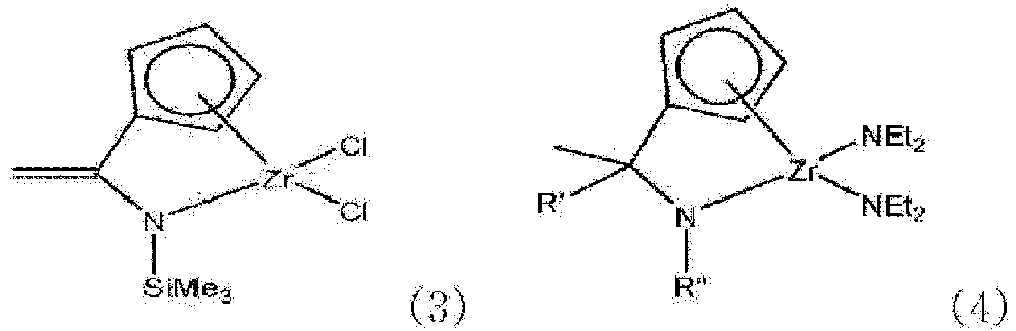
- The above Compounds (1) to (4) introduce a phosphorous bridge (1), an ethylene or propylene bridge (2), a methylidene bridge (3) or a methylene bridge (4) instead of the silicon bridge of a CGC structure. However, improved results on activity, copolymerization performance, etc. could not be obtained by applying an ethylene polymerization or a copolymerization with alpha-olefin when compared to those obtained by applying the CGC.
- In addition, as another approach, a lot of compounds composed of an oxido ligand instead of the amido ligand of the CGC have been synthesized, and an attempt on the polymerization using thereof has been conducted to some extent. Examples thereof are summarized in the following.


- Compound (5) has been reported by T. J. Marks et al. and is characterized in that a cyclopentadiene (Cp) derivative and an oxido ligand are bridged via an ortho-phenylene group (Organometallics 1997, 16, 5958). A compound having the same bridged group and a polymerization using thereof have been reported by Mu et al. (Organometallics 2004, 23, 540). In addition, the bridging of an indenyl ligand and an oxido ligand by the same ortho-phenylene group has been reported by Rothwell et al. (Chem. Commun. 2003, 1034). Compound (6) has been reported by Whitby et al. and is characterized in that a cyclopentadienyl ligand and an oxido ligand are bridged by three carbon atoms (Organometallics 1999, 18, 348). The above catalysts have been reported to show activity in a syndiotactic polystyrene polymerization. Similar compounds have been also reported by Hessen et al. (Organometallics 1998, 17, 1652). Compound (7) has been reported by Rau et al. and is characterized in showing activity in an ethylene polymerization and an ethylene/1-hexene copolymerization at a high temperature and high pressure (210°C, 150 MPa) (J. Organomet. Chem. 2000, 608, 71). In addition, the synthesis of a catalyst (8) having similar structure as that of Compound (7) and a polymerization using the same at a high temperature and a high pressure have been filed by Sumitomo Co. (
U.S. Patent No. 6,548,686 ). However, not many catalysts among the above attempts are practically applied in commercial plants. Accordingly, a catalyst showing further improved polymerization performance is required, and a simple preparation method of the catalyst is required. - The first technical problem to be solved by the present invention is to provide a novel transition metal compound.
- The second technical problem to be solved by the present invention is to provide a novel ligand compound.
- The third technical problem to be solved by the present invention is to provide a catalyst composition comprising the transition metal compound.
- To solve the first technical problem, there is provided in the present invention a transition metal compound represented by the following Formula 1:

- In Formula 1,
R1 is hydrogen; alkyl having 1 to 20 carbon atoms; cycloalkyl having 3 to 20 carbon atoms; alkenyl having 2 to 20 carbon atoms; alkoxy having 1 to 20 carbon atoms; aryl having 6 to 20 carbon atoms; arylalkoxy having 7 to 20 carbon atoms; alkylaryl having 7 to 20 carbon atoms; or arylalkyl having 7 to 20 carbon atoms,
R2a to R2e are each independently hydrogen; halogen; alkyl having 1 to 20 carbon atoms; cycloalkyl having 3 to 20 carbon atoms; alkenyl having 2 to 20 carbon atoms; alkoxy having 1 to 20 carbon atoms; or aryl having 6 to 20 carbon atoms,
R3 is hydrogen; halogen; alkyl having 1 to 20 carbon atoms; cycloalkyl having 3 to 20 carbon atoms; alkenyl having 2 to 20 carbon atoms; aryl having 6 to 20 carbon atoms; alkylaryl having 6 to 20 carbon atoms; arylalkyl having 7 to 20 carbon atoms; alkyl amido having 1 to 20 carbon atoms; aryl amido having 6 to 20 carbon atoms; alkylidene having 1 to 20 carbon atoms; or phenyl which is substituted with one or more selected from the group consisting of halogen, alkyl having 1 to 20 carbon atoms, cycloalkyl having 3 to 20 carbon atoms, alkenyl having 2 to 20 carbon atoms, alkoxy having 1 to 20 carbon atoms and aryl having 6 to 20 carbon atoms,
R4 to R9 are each independently, hydrogen; silyl; alkyl having 1 to 20 carbon atoms; cycloalkyl having 3 to 20 carbon atoms; alkenyl having 2 to 20 carbon atoms; aryl having 6 to 20 carbon atoms; alkylaryl having 7 to 20 carbon atoms; arylalkyl having 7 to 20 carbon atoms; or a metalloid radical of a metal in group 14, which is substituted with hydrocarbyl having 1 to 20 carbon atoms; wherein adjacent two or more of R6 to R9 may be connected to form a ring,
Q is Si, C, N, P or S,
M is a transition metal in group 4, and
X1 and X2 are each independently hydrogen; halogen; alkyl having 1 to 20 carbon atoms; cycloalkyl having 3 to 20 carbon atoms; alkenyl having 2 to 20 carbon atoms; aryl having 6 to 20 carbon atoms; alkylaryl having 7 to 20 carbon atoms; arylalkyl having 7 to 20 carbon atoms; alkylamino having 1 to 20 carbon atoms; arylamino having 6 to 20 carbon atoms; or alkylidene having 1 to 20 carbon atoms. - To solve the second technical problem, there is provided in the present invention a ligand compound represented by the following Formula 2:
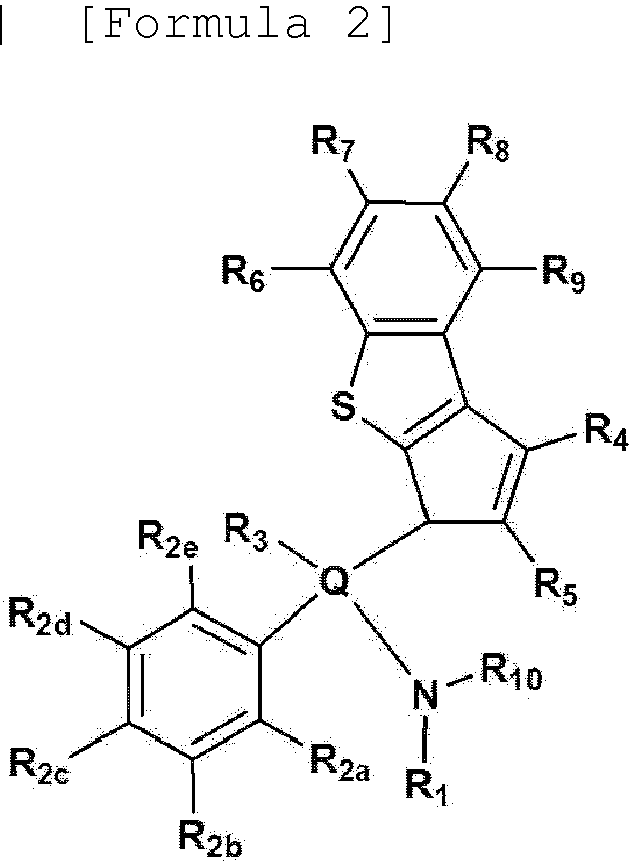
- In Formula 2,
R1 and R10 are each independently hydrogen; alkyl having 1 to 20 carbon atoms; cycloalkyl having 3 to 20 carbon atoms; alkenyl having 2 to 20 carbon atoms; alkoxy having 1 to 20 carbon atoms; aryl having 6 to 20 carbon atoms; arylalkoxy having 7 to 20 carbon atoms; alkylaryl having 7 to 20 carbon atoms; or arylalkyl having 7 to 20 carbon atoms,
R2a to R2e are each independently hydrogen; halogen; alkyl having 1 to 20 carbon atoms; cycloalkyl having 3 to 20 carbon atoms; alkenyl having 2 to 20 carbon atoms; alkoxy having 1 to 20 carbon atoms; or aryl having 6 to 20 carbon atoms,
R3 is hydrogen; halogen; alkyl having 1 to 20 carbon atoms; cycloalkyl having 3 to 20 carbon atoms; alkenyl having 2 to 20 carbon atoms; aryl having 6 to 20 carbon atoms; alkylaryl having 6 to 20 carbon atoms; arylalkyl having 7 to 20 carbon atoms; alkyl amido having 1 to 20 carbon atoms; aryl amido having 6 to 20 carbon atoms; alkylidene having 1 to 20 carbon atoms; or phenyl which is substituted with one or more selected from the group consisting of halogen, alkyl having 1 to 20 carbon atoms, cycloalkyl having 3 to 20 carbon atoms, alkenyl having 2 to 20 carbon atoms, alkoxy having 1 to 20 carbon atoms and aryl having 6 to 20 carbon atoms,
R4 to R9 are each independently, hydrogen; silyl; alkyl having 1 to 20 carbon atoms; cycloalkyl having 3 to 20 carbon atoms; alkenyl having 2 to 20 carbon atoms; aryl having 6 to 20 carbon atoms; alkylaryl having 7 to 20 carbon atoms; arylalkyl having 7 to 20 carbon atoms; or a metalloid radical of a metal in group 14, which is substituted with hydrocarbyl having 1 to 20 carbon atoms; wherein
adjacent two or more of R6 to R9 may be connected to form a ring, and
Q is Si, C, N, P or S. - To solve the third technical problem, there is provided in the present invention a catalyst composition comprising the transition metal compound represented by Formula 1.
- The novel ligand compound and the transition metal compound of the present invention may be useful as a catalyst of polymerization reaction for preparing an olefin-based polymer having high molecular weight in a low density region, and a polymer having a low melt index (MI) and a low molecular weight may be obtained.
- Hereinafter, the present invention will be described in more detail in order to assist the understanding of the present invention.
- It will be understood that words or terms used in the description and claims of the present invention shall not be interpreted as the meaning defined in commonly used dictionaries. It will be further understood that the words or terms should be interpreted as having a meaning that is consistent with their meaning of the technical idea of the invention, based on the principle that an inventor may properly define the meaning of the words or terms to best explain the invention.
- The transition metal compound of the present invention is represented by the following Formula 1:

- In Formula 1,
R1 is hydrogen; alkyl having 1 to 20 carbon atoms; cycloalkyl having 3 to 20 carbon atoms; alkenyl having 2 to 20 carbon atoms; alkoxy having 1 to 20 carbon atoms; aryl having 6 to 20 carbon atoms; arylalkoxy having 7 to 20 carbon atoms; alkylaryl having 7 to 20 carbon atoms; or arylalkyl having 7 to 20 carbon atoms,
R2a to R2e are each independently hydrogen; halogen; alkyl having 1 to 20 carbon atoms; cycloalkyl having 3 to 20 carbon atoms; alkenyl having 2 to 20 carbon atoms; alkoxy having 1 to 20 carbon atoms; or aryl having 6 to 20 carbon atoms,
R3 is hydrogen; halogen; alkyl having 1 to 20 carbon atoms; cycloalkyl having 3 to 20 carbon atoms; alkenyl having 2 to 20 carbon atoms; aryl having 6 to 20 carbon atoms; alkylaryl having 6 to 20 carbon atoms; arylalkyl having 7 to 20 carbon atoms; alkyl amido having 1 to 20 carbon atoms; aryl amido having 6 to 20 carbon atoms; alkylidene having 1 to 20 carbon atoms; or phenyl which is substituted with one or more selected from the group consisting of halogen, alkyl having 1 to 20 carbon atoms, cycloalkyl having 3 to 20 carbon atoms, alkenyl having 2 to 20 carbon atoms, alkoxy having 1 to 20 carbon atoms and aryl having 6 to 20 carbon atoms,
R4 to R9 are each independently, hydrogen; silyl; alkyl having 1 to 20 carbon atoms; cycloalkyl having 3 to 20 carbon atoms; alkenyl having 2 to 20 carbon atoms; aryl having 6 to 20 carbon atoms; alkylaryl having 7 to 20 carbon atoms; arylalkyl having 7 to 20 carbon atoms; or a metalloid radical of a metal in group 14, which is substituted with hydrocarbyl having 1 to 20 carbon atoms; wherein adjacent two or more of R6 to R9 may be connected to form a ring,
Q is Si, C, N, P or S,
M is a transition metal in group 4, and
X1 and X2 are each independently hydrogen; halogen; alkyl having 1 to 20 carbon atoms; cycloalkyl having 3 to 20 carbon atoms; alkenyl having 2 to 20 carbon atoms; aryl having 6 to 20 carbon atoms; alkylaryl having 7 to 20 carbon atoms; arylalkyl having 7 to 20 carbon atoms; alkylamino having 1 to 20 carbon atoms; arylamino having 6 to 20 carbon atoms; or alkylidene having 1 to 20 carbon atoms. - The transition metal compound of Formula 1 according to the present invention forms a structure in which cyclopentadiene fused with benzothiophene via a ring type bond and an amido group (N-R1) are stably bridged by Q (Si, C, N or P), and a transition metal in group 4 makes a coordination bond.
- In applying the catalyst composition for the olefin polymerization, the production of polyolefin with high activity at a high polymerization temperature, a high molecular weight and high copolymerization degree is capable. Particularly, due to the structural characteristics of a catalyst, a large amount of alpha-olefin as well as linear polyethylene with a low density to a degree of 0.850 g/cc to 0.930 g/cc may be introduced, and a polymer (elastomer) in a very low density region such as a density of less than 0.910 g/cc may be prepared.
- In the present invention, the term "halogen" means fluorine, chlorine, bromine or iodine unless otherwise noted.
- In the present invention, the term "alkyl" means linear, cyclic or branched hydrocarbon residue unless otherwise noted.
- In the present invention, the term "cycloalkyl" means cyclic alkyl such as cyclopropyl unless otherwise noted.
- In the present invention, the term "aryl" means an aromatic group such as phenyl, naphthyl anthryl, phenanthryl, chrysenyl, and pyrenyl unless otherwise noted.
- In the present invention, silyl may be silyl which is substituted with alkyl having 1 to 20 carbon atoms, for example, trimethylsilyl or triethylsilyl.
- In the transition metal compound of Formula 1 according to an embodiment of the present invention,
R1 may be hydrogen; alkyl having 1 to 20 carbon atoms; cycloalkyl having 3 to 20 carbon atoms; alkoxy having 1 to 20 carbon atoms; aryl having 6 to 20 carbon atoms; arylalkoxy having 7 to 20 carbon atoms; alkylaryl having 7 to 20 carbon atoms; or arylalkyl having 7 to 20 carbon atoms,
R2a to R2e may be each independently hydrogen; halogen; alkyl having 1 to 12 carbon atoms; cycloalkyl having 3 to 12 carbon atoms; alkenyl having 2 to 12 carbon atoms; alkoxy having 1 to 12 carbon atoms; or phenyl,
R3 may be hydrogen; halogen; alkyl having 1 to 12 carbon atoms; cycloalkyl having 3 to 12 carbon atoms; alkenyl having 2 to 12 carbon atoms; aryl having 6 to 20 carbon atoms; alkylaryl having 7 to 13 carbon atoms; arylalkyl having 7 to 13 carbon atoms; or phenyl which is substituted with one or more selected from the group consisting of halogen, alkyl having 1 to 12 carbon atoms, cycloalkyl having 3 to 12 carbon atoms, alkenyl having 2 to 12 carbon atoms, alkoxy having 1 to 12 carbon atoms and phenyl,
R4 to R9 may be each independently hydrogen; alkyl having 1 to 20 carbon atoms; cycloalkyl having 3 to 20 carbon atoms; aryl having 6 to 20 carbon atoms; alkylaryl having 7 to 20 carbon atoms; or arylalkyl having 7 to 20 carbon atoms,
adjacent two or more of R6 to R9 may be connected to form an aliphatic ring having 5 to 20 carbon atoms or an aromatic ring having 6 to 20 carbon atoms; wherein the aliphatic ring or the aromatic ring may be substituted with halogen, alkyl having 1 to 20 carbon atoms, alkenyl having 2 to 12 carbon atoms, or aryl having 6 to 12 carbon atoms,
Q may be Si,
M may be Ti, and
X1 and X2 may be each independently hydrogen; halogen; alkyl having 1 to 12 carbon atoms; cycloalkyl having 3 to 12 carbon atoms; alkenyl having 2 to 12 carbon atoms; aryl having 6 to 12 carbon atoms; alkylaryl having 7 to 13 carbon atoms; arylalkyl having 7 to 13 carbon atoms; alkylamino having 1 to 13 carbon atoms; arylamino having 6 to 12 carbon atoms; or alkylidene having 1 to 12 carbon atoms. - In addition, in the transition metal compound of Formula 1 according to another embodiment of the present invention,
R1 may be hydrogen; alkyl having 1 to 12 carbon atoms; cycloalkyl having 3 to 12 carbon atoms; alkoxy having 1 to 12 carbon atoms; aryl having 6 to 12 carbon atoms; arylalkoxy having 7 to 13 carbon atoms; alkylaryl having 7 to 13 carbon atoms; or arylalkyl having 7 to 13 carbon atoms,
R2a to R2e may be each independently hydrogen; halogen; alkyl having 1 to 12 carbon atoms; cycloalkyl having 3 to 12 carbon atoms; alkenyl having 2 to 12 carbon atoms; alkoxy having 1 to 12 carbon atoms; or phenyl,
R3 may be hydrogen; halogen; alkyl having 1 to 12 carbon atoms; cycloalkyl having 3 to 12 carbon atoms; alkenyl having 2 to 12 carbon atoms; alkylaryl having 7 to 13 carbon atoms; arylalkyl having 7 to 13 carbon atoms; phenyl; or phenyl which is substituted with one or more selected from the group consisting of halogen, alkyl having 1 to 12 carbon atoms, cycloalkyl having 3 to 12 carbon atoms, alkenyl having 2 to 12 carbon atoms, alkoxy having 1 to 12 carbon atoms and phenyl,
R4 to R9 may be each independently, hydrogen; alkyl having 1 to 12 carbon atoms; cycloalkyl having 3 to 12 carbon atoms; aryl having 6 to 12 carbon atoms; alkylaryl having 7 to 13 carbon atoms; or arylalkyl having 7 to 13 carbon atoms,
adjacent two or more of R6 to R9 may be connected to form an aliphatic ring having 5 to 12 carbon atoms or an aromatic ring having 6 to 12 carbon atoms; where
the aliphatic ring or the aromatic ring may be substituted with halogen, alkyl having 1 to 12 carbon atoms, alkenyl having 2 to 12 carbon atoms, or aryl having 6 to 12 carbon atoms,
Q may be Si,
M may be Ti, and
X1 and X2 may be each independently hydrogen; halogen; alkyl having 1 to 12 carbon atoms; or alkenyl having 2 to 12 carbon atoms. - In addition, in the transition metal compound of Formula 1 according to further another embodiment of the present invention,
R1 may be hydrogen or alkyl having 1 to 12 carbon atoms,
R2a to R2e may be each independently hydrogen; alkyl having 1 to 12 carbon atoms; or alkoxy having 1 to 12 carbon atoms,
R3 may be hydrogen; alkyl having 1 to 12 carbon atoms; or phenyl,
R4 and R5 may be each independently hydrogen; or alkyl having 1 to 12 carbon atoms,
R6 to R9 may be each independently hydrogen or methyl,
Q may be Si,
M may be Ti, and
X1 and X2 may be each independently hydrogen or alkyl having 1 to 12 carbon atoms. - The compound represented by Formula 1 may particularly be one of the compounds represented by the following Formulae 1-1 to 1-10:


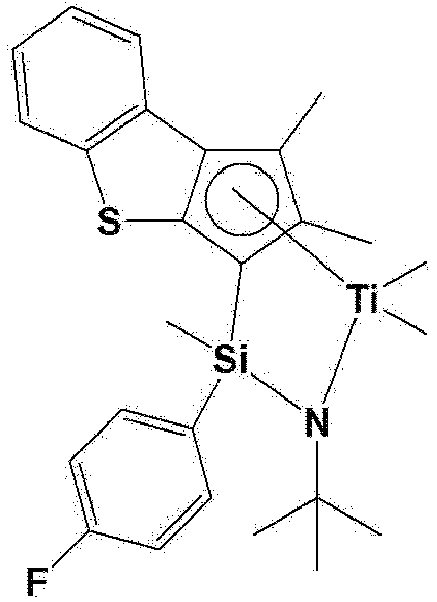

- In addition, to accomplish the above-described second task, there is provided in the present invention a ligand compound represented by the following Formula 2:

- In Formula 2,
R1 and R10 are each independently hydrogen; alkyl having 1 to 20 carbon atoms; cycloalkyl having 3 to 20 carbon atoms; alkenyl having 2 to 20 carbon atoms; alkoxy having 1 to 20 carbon atoms; aryl having 6 to 20 carbon atoms; arylalkoxy having 7 to 20 carbon atoms; alkylaryl having 7 to 20 carbon atoms; or arylalkyl having 7 to 20 carbon atoms,
R2a to R2e are each independently hydrogen; halogen; alkyl having 1 to 20 carbon atoms; cycloalkyl having 3 to 20 carbon atoms; alkenyl having 2 to 20 carbon atoms; alkoxy having 1 to 20 carbon atoms; or aryl having 6 to 20 carbon atoms,
R3 is hydrogen; halogen; alkyl having 1 to 20 carbon atoms; cycloalkyl having 3 to 20 carbon atoms; alkenyl having 2 to 20 carbon atoms; aryl having 6 to 20 carbon atoms; alkylaryl having 6 to 20 carbon atoms; arylalkyl having 7 to 20 carbon atoms; alkyl amido having 1 to 20 carbon atoms; aryl amido having 6 to 20 carbon atoms; alkylidene having 1 to 20 carbon atoms; or phenyl which is substituted with one or more selected from the group consisting of halogen, alkyl having 1 to 20 carbon atoms, cycloalkyl having 3 to 20 carbon atoms, alkenyl having 2 to 20 carbon atoms, alkoxy having 1 to 20 carbon atoms and aryl having 6 to 20 carbon atoms,
R4 to R9 are each independently, hydrogen; silyl; alkyl having 1 to 20 carbon atoms; cycloalkyl having 3 to 20 carbon atoms; alkenyl having 2 to 20 carbon atoms; aryl having 6 to 20 carbon atoms; alkylaryl having 7 to 20 carbon atoms; arylalkyl having 7 to 20 carbon atoms; or a metalloid radical of a metal in group 14, which is substituted with hydrocarbyl having 1 to 20 carbon atoms; wherein adjacent two or more of R6 to R9 may be connected to form a ring, and
Q is Si, C, N, P or S. - The ligand compound of Formula 2 described in this disclosure forms a structure in which cyclopentadiene fused with benzothiophene via a ring type bond and an amido group (N-R1) are stably bridged by Q (Si, C, N or P) .
- In the ligand compound, the definition of R1 to R9 of the compound represented by Formula 2 may be the same as that of the compound represented by Formula 1 which is a transition metal compound.
- In addition, in the ligand compound of Formula 2 according to another embodiment of the present invention,
R1, R10 and R11 may be each independently hydrogen; alkyl having 1 to 12 carbon atoms; cycloalkyl having 3 to 12 carbon atoms; alkoxy having 1 to 12 carbon atoms; aryl having 6 to 12 carbon atoms; arylalkoxy having 7 to 13 carbon atoms; alkylaryl having 7 to 13 carbon atoms; or arylalkyl having 7 to 13 carbon atoms,
R2a to R2e may be each independently hydrogen;
halogen; alkyl having 1 to 12 carbon atoms; cycloalkyl having 3 to 12 carbon atoms; alkenyl having 2 to 12 carbon atoms; alkoxy having 1 to 12 carbon atoms; or phenyl,
R3 may be hydrogen; halogen; alkyl having 1 to 12 carbon atoms; cycloalkyl having 3 to 12 carbon atoms; alkenyl having 2 to 12 carbon atoms; alkylaryl having 7 to 13 carbon atoms; arylalkyl having 7 to 13 carbon atoms; phenyl; or phenyl which is substituted with one or more selected from the group consisting of halogen, alkyl having 1 to 12 carbon atoms, cycloalkyl having 3 to 12 carbon atoms, alkenyl having 2 to 12 carbon atoms, alkoxy having 1 to 12 carbon atoms and phenyl,
R4 to R9 may be each independently, hydrogen; alkyl having 1 to 12 carbon atoms; cycloalkyl having 3 to 12 carbon atoms; aryl having 6 to 12 carbon atoms; alkylaryl having 7 to 13 carbon atoms; or arylalkyl having 7 to 13 carbon atoms,
adjacent two or more of R6 to R9 may be connected to form an aliphatic ring having 5 to 12 carbon atoms or an aromatic ring having 6 to 12 carbon atoms; wherein
the aliphatic ring or the aromatic ring may be substituted with halogen, alkyl having 1 to 12 carbon atoms, alkenyl having 2 to 12 carbon atoms, or aryl having 6 to 12 carbon atoms, and
Q may be Si. - In addition, in Formula 2, R10 and R11 may be each independently hydrogen; alkyl having 1 to 12 carbon atoms; cycloalkyl having 3 to 12 carbon atoms; aryl having 6 to 12 carbon atoms; or alkylaryl having 6 to 12 carbon atoms, particularly, hydrogen.
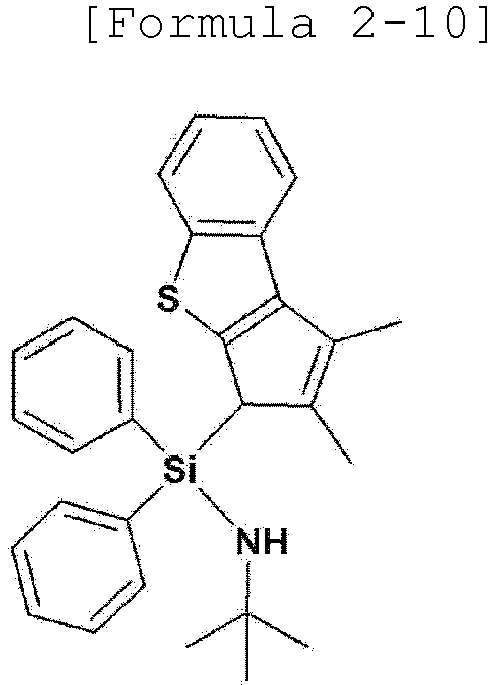
- The compound represented by Formula 2 may be one of the compounds represented by the following Formulae 2-1 to 2-10:







- The transition metal compound of Formula 1 and the ligand compound of Formula 2 may particularly be used for the preparation of a catalyst for polymerizing olefin monomers, but may be applied to other all fields in which the transition metal compound may be used, without limitation.
- The ligand compound represented by Formula 2 of the present invention may be prepared, for example, by the following Reaction 1:
-

- Particularly, the ligand compound of Formula 2 may be prepared by the following steps a) and b):
- a) a step of reacting a compound represented by [Formula 4] below and a compound represented by [Formula 5] below to prepare a compound represented by [Formula 3] below; and
- b) a step of reacting the compound represented by [Formula 3] below with a compound represented by [Formula 6] below to prepare a compound represented by [Formula 2] below:
- In the above formulae, R1 to R10 and Q are the same as defined in Formula 2.
- The compound represented by Formula 4 may be prepared by the following Reaction 2:
-

- In Reaction 2, R4 to R9 are the same as defined in Formula 1 or Formula 2.
- The transition metal compound represented by Formula 1 may be prepared via the following Reaction 3 using a ligand compound represented by Formula 2:
-

- In the above reaction, R1 to R10, Q, M, X1 and X2 are the same as defined in Formula 1 or Formula 2.
- According to an embodiment of the present invention, the transition metal compound represented by Formula 1 may have a structure in which a transition metal in group 4 makes a coordination bond with the compound represented by Formula 2 as a ligand.
- Particularly, as shown in Reaction 3, by reacting the compound represented by Formula 2 with the compound represented by Formula 7 which is a metal precursor and an organolithium compound, the transition metal compound of Formula 1 in which a transition metal in group 4 makes a coordination bond with the compound represented by Formula 2 as a ligand, may be obtained.

[Formula 7] M(X1X2)2

- In the above formulae, R1 to R10, Q, M, X1 and X2 are the same as defined in Formula 1.
- In Reaction 3, the organolithium compound may be, for example, one or more selected from the group consisting of n-butyllithium, sec-butyllithium, methyllithium, ethyllithium, isopropyllithium, cyclohexyllithium, allyllithium, vinyllithium, phenyllithium and benzyllithium.
- The compound represented by Formula 2 and the compound represented by Formula 5 may preferably be mixed in a molar ratio of 1:0.8 to 1:1.5, particularly, 1:1.0 to 1:1.1.
- In addition, the organolithium compound may be used in an amount of 180 parts by weight to 250 parts by weight based on 100 parts by weight of the compound represented by Formula 2.
- In the preparation method according to an embodiment of the present invention, the reaction may be performed in a temperature range of -80°C to 140°C for 1 to 48 hours.
- According to an embodiment of the present invention, the compound represented by Formula 3 and the compound represented by Formula 6 may be used in a molar ratio of 1:0.8 to 1:5.0, particularly, 1:0.9 to 1:4.5, more particularly, 1:1 to 1:4.0.
- In addition, according to an embodiment of the present invention, the compound represented by Formula 4 and the compound represented by Formula 5 may be used in a molar ratio of 1:0.8 to 1:5.0, particularly, 1:0.9 to 1:4.0, more particularly, 1:1 to 1:3.0.
- In addition, the reaction may be performed in a temperature range of -80°C to 140°C for 1 to 48 hours.
- The present invention also provides a catalyst composition including the compound of Formula 1.
- The catalyst composition may further include a cocatalyst. The cocatalyst may be any one known in this art.
- For example, the catalyst composition may further include at least one of the following Formulae 8 to 10 as a cocatalyst:
[Formula 8] -[Al(R13)-O]a-
- In the above formula, each R13 is independently a halogen radical; a hydrocarbyl radical of 1 to 20 carbon atoms; or a halogen substituted hydrocarbyl radical of 1 to 20 carbon atoms; and a is an integer of 2 or more;
[Formula 9] D(R13)3
- In the above formula, D is aluminum or boron; each R13 is independently the same as defined above; and
[Formula 10] [L-H]+[Z(A)4]- or [L]+[Z(A)4]-
- In the above formula, L is a neutral or a cationic Lewis acid; H is a hydrogen atom; Z is an element in group 13; and each A is independently aryl having 6 to 20 carbon atoms or alkyl having 1 to 20 carbon atoms, where at least one hydrogen atom may be substituted with a substituent; wherein the substituent is halogen, hydrocarbyl having 1 to 20 carbon atoms, alkoxy having 1 to 20 carbon atoms or aryloxy of 6 to 20 carbon atoms.
- As a preparation method of the catalyst composition, there is provided a first preparation method including a step of obtaining a mixture by contacting the transition metal compound represented by Formula 1 with the compound represented by Formula 8 or Formula 9; and a step of adding the compound represented by Formula 10 to the mixture.
- Also, there is provided a second preparation method of the catalyst composition by contacting the transition metal compound represented by Formula 1 and the compound represented by Formula 10.
- In the first method of the preparation methods of the catalyst composition, the molar ratio of the compound represented by Formula 8 or Formula 9 with respect to the transition metal compound represented by Formula 1 may be, respectively, from 1:2 to 1:5,000, particularly, from 1:10 to 1:1,000, more particularly, from 1:20 to 1:500.
- Meanwhile, the molar ratio of the compound represented by Formula 10 with respect to the transition metal compound represented by Formula 1 may be from 1:1 to 1:25, particularly, from 1:1 to 1:10, more particularly, from 1:1 to 1:5.
- If the molar ratio of the compound represented by Formula 8 or Formula 9 with respect to the transition metal compound represented by Formula 1 is less than 1:2, the amount of an alkylating agent is very small, and the alkylation of the metal compound may be incompletely achieved, and if the molar ratio is greater than 1:5,000, the alkylation of the metal compound may be performed, but side reactions between the remaining excessive amount of alkylating agent and the activating agent of Formula 10 may be performed, and the activation of the alkylated metal compound may be incompletely achieved. In addition, if the molar ratio of the compound represented by Formula 10 with respect to the transition metal compound represented by Formula 2 is less than 1:1, the amount of the activating agent is relatively small, the activation of the metal compound may be incompletely achieved, and the activity of the catalyst composition may be reduced, and if the molar ratio is greater than 1:25, the activation of the metal compound may be completely achieved, but the excessive amount of activating agent remained may increase the production cost of the catalyst composition, or the purity of the polymer thus prepared may decrease.
- In the second method of the preparation methods of the catalyst composition, the molar ratio of the compound represented by Formula 10 with respect to the transition metal compound of Formula 1 may be from 1:1 to 1:500, particularly, from 1:1 to 1:50, more particularly, from 1:2 to 1:25. If the molar ratio is less than 1:1, the amount of the activating agent is relatively small, the activation of the catalyst composition may be incompletely achieved, and the activity of the catalyst composition thus prepared may be reduced, and if the molar ratio is greater than 1:500, the activation of the metal compound may be completely achieved, but the excessive amount of activating agent remained may increase the unit cost of the catalyst composition, or the purity of the polymer thus prepared may decrease.
- As the reaction solvent used during the preparation of the composition, a hydrocarbon solvent such as pentane, hexane, and heptane, or an aromatic solvent such as benzene, and toluene may be used, but the present invention is not limited thereto, and all solvents used in this field may be used.
- In addition, the transition metal compound of Formula 1 and the cocatalyst may be used in a supported type by a support. Silica or alumina may be used as the support.
- The compound represented by Formula 8 is not specifically limited only if alkylaluminoxane is used. Particular examples thereof may include methylaluminoxane, ethylaluminoxane, isobutylaluminoxane, butylaluminoxane, etc., more particularly, methylaluminoxane.
- The compound represented by Formula 9 is not specifically limited, and particular examples thereof may include trimethylaluminum, triethylaluminum, triisobutylaluminum, tripropylaluminum, tributylaluminum, dimethylchloroaluminum, triisopropylaluminum, tri-s-butylaluminum, tricyclopentylaluminum, tripentylaluminum, triisopentylaluminum, trihexylaluminum, trioctylaluminum, ethyldimethylaluminum, methyldiethylaluminum, triphenylaluminum, tri-p-tolylaluminum, dimethylaluminummethoxide, dimethylaluminumethoxide, trimethylboron, triethylboron, triisobutylboron, tripropylboron, tributylboron, etc., and more particularly, selected from trimethylaluminum, triethylaluminum, and triisobutylaluminum.
- Examples of the compound represented by Formula 10 may include triethylammoniumtetraphenylboron, tributylammoniumtetraphenylboron, trimethylammoniumtetraphenylboron, tripropylammoniumtetraphenylboron, trimethylammoniumtetra(p-tolyl)boron, trimethylammoniumtetra(o,p-dimethylphenyl)boron, tributylammoniumtetra(p-trifluoromethylphenyl)boron, trimethylammoniumtetra(p-trifluoromethylphenyl)boron, tributylammoniumtetrapentafluorophenylboron, N,N-diethylaniliniumtetraphenylboron, N,N-diethylaniliniumtetraphenylboron, N,N-diethylaniliniumtetrapentafluorophenylboron, diethylammoniumtetrapentafluorophenylboron, triphenylphosphoniumtetraphenylboron, trimethylphosphoniumtetraphenylboron, triethylammoniumtetraphenylaluminum, tributylammoniumtetraphenylaluminum, trimethylammoniumtetraphenylaluminum, tripropylammoniumtetraphenylaluminum, trimethylammoniumtetra(p-tolyl)aluminum, tripropylammoniumtetra(p-tolyl)aluminum, triethylammoniumtetra(o,p-dimethylphenyl)aluminum, tributylammoniumtetra(p-trifluoromethylphenyl)aluminum, trimethylammoniumtetra(p-trifluoromethylphenyl)aluminum, tributylammoniumtetrapentafluorophenylaluminum, N,N-diethylaniliniumtetraphenylaluminum, N,N-diethylaniliniumtetraphenylaluminum, N,N-diethylaniliniumtetrapentafluorophenylaluminum, diethylammoniumtetrapentatetraphenylaluminum, triphenylphosphoniumtetraphenylaluminum, trimethylphosphoniumtetraphenylaluminum, triethylammoniumtetraphenylaluminum, tributylammoniumtetraphenylaluminum, trimethylammoniumtetraphenylboron, tripropylammoniumtetraphenylboron, trimethylammoniumtetra(p-tolyl)boron, tripropylammoniumtetra(p-tolyl)boron, triethylammoniumtetra(o,p-dimethylphenyl)boron, trimethylammoniumtetra(o,p-dimethylphenyl)boron, tributylammoniumtetra(p-trifluoromethylphenyl)boron, trimethylammoniumtetra(p-trifluoromethylphenyl)boron, tributylammoniumtetrapentafluorophenylboron, N,N-diethylaniliniumtetraphenylboron, N,N-diethylaniliniumtetraphenylboron, N,N-diethylaniliniumtetrapentafluorophenylboron, diethylammoniumtetrapentafluorophenylboron, triphenylphosphoniumtetraphenylboron, triphenylcarboniumtetra(p-trifluoromethylphenyl)boron, triphenylcarboniumtetrapentafluorophenylboron, etc.
- A polyolefin homopolymer or copolymer may be prepared by contacting a catalyst composition including the transition metal compound of Formula 1; and one or more compounds selected from the compounds represented by Formula 8 to Formula 10, with one or more olefin monomers.
- The most particular preparation process using the catalyst composition is a solution process. If the composition is used together with an inorganic support such as silica, it may also be applied to a slurry process or a gas phase process.
- In the preparation process, the activating catalyst composition may be injected after being dissolved or diluted in an aliphatic hydrocarbon solvent of 5 to 12 carbon atoms such as pentane, hexane, heptane, nonane, decane and an isomer thereof, an aromatic hydrocarbon solvent such as toluene and benzene, or a hydrocarbon solvent substituted with a chlorine atom such as dichloromethane and chlorobenzene, which are appropriate for an olefin polymerization process. The solvent used may preferably be used after removing a small amount of water or air, which functions as a catalyst poison, by treating with a small amount of alkylaluminum, and may be used by further using a cocatalyst.
- The olefin monomer which is polymerizable using the metal compound and the cocatalyst may include, for example, ethylene, an alpha-olefin, a cyclic olefin, etc., and a diene olefin-based monomer, a triene olefin-based monomer, etc. having two or more double bonds may also be polymerized. Particular examples of the monomer may include ethylene, propylene, 1-butene, 1-pentene, 4-methyl-1-pentene, 1-hexene, 1-heptene, 1-octene, 1-decene, 1-undecene, 1-dodecene, 1-tetradecene, 1-hexadecene, 1-icocene, norbornene, norbornadiene, ethylidenenorbornene, phenylnorbornene, vinylnorbornene, dicyclopentadiene, 1,4-butadiene, 1,5-pentadiene, 1,6-hexadiene, styrene, alpha-methylstyrene, divinylbenzene, 3-chloromethylstyrene, etc. Two or more of the monomers may be mixed and copolymerized.
- Particularly, in the preparation method of the present invention, the catalyst composition has characteristics of preparing a copolymer having high molecular weight and very low density including a polymer density of 0.89 g/cc or less, in a copolymerization reaction of ethylene and a monomer having large steric hindrance such as 1-octene even at a high reaction temperature of 90°C or more.
- According to an embodiment of the present invention, the polymer prepared by the preparation method of the present invention has a density of less than 0.891 g/cc.
- According to an embodiment of the present invention, the polymer prepared by the preparation method of the present invention has a density of 0.88 g/cc or less.
- According to an embodiment of the present invention, the polymer prepared by the preparation method of the present invention has a density of less than 0.87 g/cc.
- In addition, according to an embodiment of the present invention, if a polymer is formed using the transition metal catalyst of Formula 1, the peak of melting temperature (Tm) may have a single phase or two peaks.
- Tm may be obtained by using a differential scanning calorimeter 6000 (DSC) manufactured by PerkinElmer Co. and may be obtained by increasing the polymer temperature to 100C, maintaining at the temperature for 1 minute, then decreasing the temperature to -100C, and then, increasing the temperature again and measuring the apex of a DSC curve as a melting point (melting temperature).
- According to an embodiment of the present invention, the polymer prepared by the preparation method of the present invention has Tm of 69 or less.
- According to an embodiment of the present invention, Tm of the polymer prepared by the preparation method of the present invention may show one peak or two peaks.
- According to an embodiment of the present invention, the polymer prepared by the preparation method of the present invention may have melt index (Mi) of less than 4.
- According to an embodiment of the present invention, the polymer prepared by the preparation method of the present invention may have melt index (Mi) of 2 or less.
- According to an embodiment of the present invention, the polymer prepared by the preparation method of the present invention may have melt index (Mi) of 1 or less.
- A polymer having high molecular weight may be produced if the melt index is low and less than 2 according to an embodiment of the present invention, and particularly, the polymer may be useful as a multi-layer film for coating or a car compound, which requires a polymer having high molecular weight.
- Hereinafter, the present invention will be explained more particularly referring to the following examples. However, the examples are for assisting the understanding of the present invention, and the scope of the present invention is not limited thereto.
- Organic reagents and solvents were purchased from Aldrich Co. and used after purifying by a standard method unless otherwise noted. In all steps of syntheses, air and humidity were blocked to increase the reproducibility of experiments.
-


- To a 100 ml schlenk flask, 3 g (1.1 eq, 14.978 mmol) of 1,2-dimethyl-3H-benzo[b]cyclopenta[d]thiophene and 30 ml of THF were added, and 6.5 ml (1.2 eq, 16.339 mmol, 2.5 M in hexane) of n-BuLi was added thereto dropwisely at -30°C, followed by stirring at room temperature overnight. The THF solution of Li-complex thus stirred was injected into a schlenk flask containing 1.1 g (1.0 eq, 4.99 mmol) of dichloro(2-methoxyphenyl)(methyl)silane and 25 ml of THF at - 78°C by cannulation, followed by stirring at room temperature overnight. After stirring, the reaction mixture was vacuum dried, extracted with 50 ml of hexane, vacuum dried again, and washed with hexane to obtain 1.83 mg of an ivory solid (95%, dr=1:1).
- Under a glove box, 314 mg of chloro-1-(1,2-dimethyl-3H-benzo[b]cyclopenta[d]thiophene-3-yl)-1,1-(2-methoxyphenyl)(methyl)silane was weight and injected into a 50 ml vial, and 4 ml of hexane was injected thereto. At room temperature, tBuNH2 (8 eq, 342 µl) was injected, and then reacted at room temperature for 2 days. After finishing the reaction, hexane was removed, and extraction with hexane was performed. After drying solvents, 162.3 mg of a yellow solid was obtained (47%, dr=1:1).
1H-NMR (CDCl3, 500 MHz): δ 7.99(d, 1H), 7.89(d, 1H), 7.67(t, 2H), 7.54(d, 1H), 7.52(t, 1H), 7.48(t, 1H), 7.24(d, 2H), 7.07(t, 2H), 7.01(t, 1H), 6.94(d, 1H), 6.90(t, 1H), 6.59(d, 1H), 6.55(d, 1H), 4.04(s, 1H), 4.02(s, 1H), 3.32(s, 6H), 2.27(s, 3H), 2.24(s, 3H), 1.81(s, 3H), 1.72(s, 3H), 1.09(s, 9H), 1.01(s, 9H), 0.30(s, 3H), 0.15(s, 3H)

- To a 100 ml schlenk flask, 3 g (1 eq, 14.98 mmol) of 1,2-dimethyl-3H-benzo[b]cyclopenta[d]thiophene and 30 ml of THF were added, and 6.3 ml (1.05 eq, 14.98 mmol, 2.5 M in hexane) of n-BuLi was added thereto dropwisely at -30°C, followed by stirring at room temperature overnight. The THF solution of Li-complex thus stirred was injected into a schlenk flask containing 3.5 g (1.0 eq, 14.98 mmol) of dichloro(2-isopropylphenyl)(methyl)silane and 30 ml of THF at -78°C by cannulation, followed by stirring at room temperature overnight. After stirring, the reaction mixture was vacuum dried, extracted with 60 ml of hexane, vacuum dried again, and washed with hexane to obtain 6.0 mg of an ivory solid (99%, dr=1:1).
- To a 100 ml round-bottom flask, 6.03 g (15.4 mmol) of chloro-1-(1,2-dimethyl-3H-benzo[b]cyclopenta[d]thiophene-3-yl)-1,1-(2-isopropylphenyl)(methyl)silane was weighed and injected, and 50 ml of hexane was injected thereto. At room temperature, tBuNH2 (10 eq, 16.2 ml) was injected, and then reacted at room temperature for 2 days. After finishing the reaction, hexane was removed, and extraction with hexane was performed. After drying solvents, 4.54 mg of a yellow solid was obtained (75.3%).
1H-NMR(CDCl3, 500 MHz) : δ 7.98(t, 2H), 7.68(d, 1H), 7.50(t, 3H), 7.29(t, 2H), 7.26(d, 2H), 7.23(d, 1H), 7.21(d, 1H), 7.08(t, 3H), 7.00(t, 1H), 3.73-3.67(m, 1H), 3.57-3.51(m, 1H), 3.68(s, 1H), 3.65(s, 1H), 2.27(s, 3H), 2.21(s, 3H), 2.04(s, 3H), 1.66(s, 3H), 1.32-1.22(m, 12H), 1.07(s, 9H), 1.02(s, 9H), 0.17(s, 3H), 0.09(s, 3H)

- To a 250 ml schlenk flask, 2.0 g (1.0 eq, 9.985 mmol) of 1,2-dimethyl-3H-benzo[b]cyclopenta[d]thiophene and 50 ml of THF were added, and 4.2 ml (1.05 eq, 10.484 mmol, 2.5 M in hexane) of n-BuLi was added thereto dropwisely at -30°C, followed by stirring at room temperature overnight. The THF solution of Li-complex thus stirred was injected into a schlenk flask containing 2.46 g (1.2 eq, 11.982 mmol) of dichloro (o-tolylmethyl) silane and 30 ml of THF at -78°C by cannulation, followed by stirring at room temperature overnight. After stirring, the reaction mixture was vacuum dried and extracted with 100 ml of hexane.
- 4.0 g (1.0 eq, 10.0 mmol) of chloro-1-(1,2-dimethyl-3H-benzo[b]cyclopenta[d]thiophene-3-yl)-1,1-(methyl)(2-methylphenyl)silane was stirred in 10 ml of hexane, and 4.2 ml (4.0 eq, 40.0 mmol) of tBuNH2 was injected thereto at room temperature, and then stirred at room temperature overnight. After stirring, the reaction mixture was vacuum dried and extracted with 150 ml of hexane. After drying solvents, 4.26 g of a sticky liquid was obtained (99%, dr=1:0.83).
1H-NMR(CDCl3, 500 MHz): δ 7.95(t, 2H), 7.70(d, 1H), 7.52(d, 1H), 7.47-7.44(m, 2H), 7.24-7.02(m, 9H), 6.97(t, 1H), 3.59(s, 1H), 3.58(s, 1H), 2.50(s, 3H), 2.44(s, 3H), 2.25(s, 3H), 2.16(s, 3H), 2.06(s, 3H), 1.56(s, 3H), 1.02(s, 9H), 0.95(s, 9H), -0.03(s, 3H), -0.11(s, 3H)
- To a 250 ml schlenk flask, 10 g (1.0 eq, 49.925 mmol) of 1,2-dimethyl-3H-benzo[b]cyclopenta[d]thiophene and 100 ml of THF were added, and 22 ml (1.1 eq, 54.918 mmol, 2.5 M in hexane) of n-BuLi was added thereto dropwisely at -30°C, followed by stirring at room temperature for 3 hours. The THF solution of Li-complex thus stirred was injected into a schlenk flask containing 8.1 ml (1.0 eq, 49.925 mmol) of dichloro (methyl) (phenyl)silane and 70 ml of THF at -78°C by cannulation, followed by stirring at room temperature overnight. After stirring, the reaction mixture was vacuum dried and extracted with 100 ml of hexane.
- To 100 ml of the extracted hexane solution of chloro-1-(1,2-dimethyl-3H-benzo[b]cyclopenta[d]thiophene-3-yl)-1,1-(methyl)(phenyl)silane, 42 ml (8 eq, 399.4 mmol) of t-BuNH2 was injected at room temperature, and then stirred at room temperature overnight. After stirring, the reaction mixture was vacuum dried and extracted with 150 ml of hexane. After drying solvents, 13.36 g of a yellow solid was obtained (68%, dr=1:1).
1H NMR(CDCl3, 500 MHz): δ 7.93(t, 2H), 7.79(d, 1H), 7.71(d, 1H), 7.60(d, 2H), 7.48(d, 2H), 7.40∼7.10(m, 10H, aromatic), 3.62(s, 1H), 3.60(s, 1H), 2.28(s, 6H), 2.09(s, 3H), 1.76(s, 3H), 1.12(s, 18H), 0.23(s, 3H), 0.13(s, 3H)
- To a 100 ml schlenk flask, 2 g (1 eq, 9.99 mmol) of 1,2-dimethyl-3H-benzo[b]cyclopenta[d]thiophene and 50 ml of THF were added, and 4 ml (1 eq, 9.99 mmol, 2.5 M in hexane) of n-BuLi was added thereto dropwisely at -30°C, followed by stirring at room temperature overnight. The THF solution of Li-complex thus stirred was injected into a schlenk flask containing 2.19 ml (1.0 eq, 9.99 mmol) of dichloro(2-ethylphenyl) (methyl) silane and 50 ml of THF at -78°C by cannulation, followed by stirring at room temperature overnight. After stirring, the reaction mixture was vacuum dried, extracted with 60 ml of hexane, vacuum dried again, and washed with hexane to obtain 3.83 g of an ivory solid (99%, dr=1:1).
- To a 100 ml round-bottom flask, 3.87 g (10.1 mmol) of chloro-1-(1,2-dimethyl-3H-benzo[b]cyclopenta[d]thiophene-3-yl)-1,1-(2-ethylphenyl)(methyl)silane was weighed and added, and 40 ml of hexane was injected thereto. t-BuNH2 (10 eq, 10.5 ml) was injected at room temperature, and then reacted at room temperature for 2 days. After finishing the reaction, hexane was removed, and filtering using hexane was performed. After drying solvents, 3.58 g of a yellow solid was obtained (84.4%, dr=1:0.8).
1H-NMR(CDCl3, 500 MHz): δ 7.98(t, 2H), 7.71(d, 1H), 7.55(d, 1H), 7.52(d, 1H), 7.48(d, 1H), 7.30(t, 1H), 7.26-7.22(m, 3H), 7.19(dd, 2H), 7.12-7.06(m, 3H), 7.00(t, 1H), 3.08-2.84(m, 4H) 3.05-2.84(m, 2H), 2.28(s, 3H), 2.20(s, 3H), 2.08(s, 3H), 1.62(s, 3H), 1.26-1.22(m, 6H), 1.06(s, 9H), 0.99(s, 9H), 0.05(s, 3H), -0.02(s, 3H)
- To a 100 ml schlenk flask, 1 g (1 eq, 4.99 mmol) of 1,2-dimethyl-3H-benzo[b]cyclopenta[d]thiophene and 30 ml of THF were added, and 2 ml (1 eq, 4.99 mmol, 2.5 M in hexane) of n-BuLi was added thereto dropwisely at -30°C, followed by stirring at room temperature overnight. The THF solution of Li-complex thus stirred was injected into a schlenk flask containing 1.42 ml (1.22 eq, 6.09 mmol) of dichloro(methyl)(2,4,6-trimethylphenyl)silane and 30 ml of THF at -78°C by cannulation, followed by stirring at room temperature overnight. After stirring, the reaction mixture was vacuum dried, extracted with 60 ml of hexane, vacuum dried again, and washed with hexane to obtain an ivory solid (dr=1:1).
- To a 100 ml round-bottom flask, 2.16 g (4.99 mmol) of chloro-1-(1,2-dimethyl-3H-benzo[b]cyclopenta[d]thiophene-3-yl)-1,1-(methyl)(2,4,6-trimethylphenyl)silane was weighed and added, and t-BuNH2 (50 ml) was injected without solvents at room temperature, followed by reacting at room temperature for 2 days. After finishing the reaction, t-BuNH2 was removed, and filtering using hexane was performed. After drying solvents, 2.13 g of a yellow solid was obtained (98.6%, dr=1:0.8).
1H-NMR(CDCl3, 500 MHz): δ 7.99-7.98(m, 2H), 7.73(d, 1H), 7.42(d, 1H), 7.25(t, 1H), 7.19(t, 1H), 7.10(t, 1H), 6.97(t, 1H), 6.86(s, 2H), 6.78(s, 2H), 3.78(s, 1H), 3.69(s, 1H), 2.52(s, 6H), 2.46(s, 6H), 2.29(s, 3H), 2.20(s, 3H), 2.19(s, 3H), 2.13(s, 3H), 2.11(s, 3H), 1.62(s, 3H), 1.09(s, 9H), 1.02(s, 9H), 0.09(s, 3H), -0.01(s, 3H)

- To a 100 ml schlenk flask, 3 g (1.0 eq, 14.978 mmol) of 1,2-dimethyl-3H-benzo[b]cyclopenta[d]thiophene and 30 ml of THF were added, and 6.6 ml (1.1 eq, 16.475 mmol, 2.5 M in hexane) of n-BuLi was added thereto dropwisely at -30°C, followed by stirring at room temperature overnight. The THF solution of Li-complex thus stirred was injected into a schlenk flask containing 3.38 g (1.0 eq, 14.978 mmol) of dichloro (methyl) (4-chlorophenyl) silane and 30 ml of THF at - 78°C by cannulation, followed by stirring at room temperature overnight. After stirring, the reaction mixture was vacuum dried, extracted with 30 ml of hexane, and vacuum dried again to obtain 5.86 g of an orange sticky solid product (99%, dr=1:1).
- To 2 g (1 eq, 5.136 mmol) of the chloro-1-(1,2-dimethyl-3H-benzo[b]cyclopenta[d]thiophene-3-yl)-1,1-(methyl) (4-chlorophenyl)silane thus prepared, 4.3 ml (8 eq, 41.088 mmol) of t-BuNH2 was injected at room temperature, and then stirred at room temperature overnight. After stirring, the reaction mixture was vacuum dried, extracted with 10 ml of toluene, and vacuum dried again to obtain 1.99 g of a yellow sticky solid (91%, dr=1:1).
1H-NMR(CDCl3, 500 MHz): δ 7.95(d, 2H), 7.79(d, 1H), 7.73(d, 1H), 7.75(d, 4H), 7.35∼7.20(m, 8H), 3.57(s, 1H), 3.54(s, 1H), 2.27(s, 6H), 2.09(s, 3H), 1.78(s, 3H), 1.11(s, 18H), 0.24(s, 3H), 0.16(s, 3H)
- To a 100 ml schlenk flask, 3 g (1.0 eq, 14.978 mmol) of 1,2-dimethyl-3H-benzo[b]cyclopenta[d]thiophene and 30 ml of THF were added, and 6.6 ml (1.1 eq, 16.475 mmol, 2.5 M in hexane) of n-BuLi was added thereto dropwisely at -30°C, followed by stirring at room temperature overnight. The THF solution of Li-complex thus stirred was injected into a schlenk flask containing 3.38 g (1.0 eq, 14.978 mmol) of dichloro (methyl) (3-chlorophenyl) silane and 30 ml of THF at - 78°C by cannulation, followed by stirring at room temperature overnight. After stirring, the reaction mixture was vacuum dried, extracted with 30 ml of hexane, and vacuum dried again to obtain 6.00 g of an orange sticky solid product (99%, dr=1:1).
- To 2 g (1 eq, 5.136 mmol) of chloro-1-(1,2-dimethyl-3H-benzo[b]cyclopenta[d]thiophene-3-yl)-1,1-(methyl)(3-chlorophenyl)silane, 4.3 ml (8 eq, 41.088 mmol) of t-BuNH2 was injected at room temperature, and then stirred at room temperature overnight. After stirring, the reaction mixture was vacuum dried, extracted with 10 ml of toluene, and vacuum dried again to obtain 2.12 g of an orange sticky liquid (97%, dr=1:1).
1H-NMR(CDCl3, 500 MHz): δ 7.93(t, 2H), 7.79(d, 1H), 7.73(d, 1H), 7.52(s, 1H), 7.44(d, 1H), 7.38(s, 1H), 7.35∼7.15(m, 9H), 3.57(s, 1H), 3.54(s, 1H), 2.28(s, 6H), 2.09(s, 3H), 1.78(s, 3H), 1.12(s, 18H), 0.26(s, 3H), 0.17(s, 3H)
- To a 100 ml schlenk flask, 2.7 g (1.0 eq, 13.480 mmol) of 1,2-dimethyl-3H-benzo[b]cyclopenta[d]thiophene and 25 ml of THF were added, and 6.0 ml (1.1 eq, 14.828 mmol, 2.5 M in hexane) of n-BuLi was added thereto dropwisely at -30°C, followed by stirring at room temperature overnight. The THF solution of Li-complex thus stirred was injected into a schlenk flask containing 2.82 g (1.0 eq, 13.480 mmol) of dichloro(methyl) (4-fluorophenyl)silane and 25 ml of THF at - 78°C by cannulation, followed by stirring at room temperature overnight. After stirring, the reaction mixture was vacuum dried, extracted with 30 ml of hexane, and vacuum dried again to obtain 3.93 g of an orange sticky liquid product (78%, dr=1:0.85).
- To 3.93 g (1 eq, 10.543 mmol) of the chloro-1-(1,2-dimethyl-3H-benzo[b]cyclopenta[d]thiophene-3-yl)-1,1-(methyl)(4-fluorophenyl)silane thus prepared,9 ml (8 eq, 84.344 mmol) of t-BuNH2 was injected at room temperature, and then stirred at room temperature overnight. After stirring, the reaction mixture was vacuum dried, extracted with 30 ml of hexane, and vacuum dried again to obtain 2.71 g of an orange sticky solid (63%, dr=1:0.58).
1H-NMR(CDCl3, 500 MHz): δ 7.92(d, 2H), 7.79(d, 1H), 7.72(d, 1H), 7.55(t, 2H), 7.39(t, 2H), 7.35∼7.15(m, 4H), 7.03(t, 2H), 6.98(t, 2H), 3.57(s, 1H), 3.55(s, 1H), 2.27(s, 6H), 2.10(s, 3H), 1.78(s, 3H), 1.13(s, 9H), 1.11(s, 9H), 0.24(s, 3H), 0.16(s, 3H)
- To a 100 ml schlenk flask, 3 g (1.1 eq, 14.978 mmol) of 1,2-dimethyl-3H-benzo[b]cyclopenta[d]thiophene and 30 ml of THF were added, and 6.5 ml (1.2 eq, 16.339 mmol, 2.5 M in hexane) of n-BuLi was added thereto dropwisely at -30°C, followed by stirring at room temperature overnight. The THF solution of Li-complex thus stirred was injected into a schlenk flask containing 2.9 ml (1.0 eq, 13.616 mmol) of dichloro(diphenyl)silane and 30 ml of THF at -78°C by cannulation, followed by stirring at room temperature overnight. After stirring, the reaction mixture was vacuum dried, extracted with 60 ml of toluene, vacuum dried again and washed with hexane to obtain 3.77 g of an ivory solid (66%) .
- To 2 g (1 eq, 4.796 mmol) of the chloro-1-(1,2-dimethyl-3H-benzo[b]cyclopenta[d]thiophene-3-yl)-1,1-(diphenyl)silane thus prepared, 8 ml (16 eq, 76.732 mmol) of t-BuNH2 was injected at room temperature, and then stirred at room temperature overnight. After stirring, the reaction mixture was vacuum dried, extracted with 20 ml of toluene, vacuum dried again and washed with hexane to obtain 2.16 g of an ivory solid (99%).
1H NMR(CDCl3, 500 MHz): δ 7.70(t, 2H), 7.53(d, 2H), 7.38∼7.13(m, 10H), 4.02(s, 1H), 2.05(s, 3H), 2.00(s, 3H), 1.12(s, 9H) -

- Under a glove box, the ligand compound of Formula 2-1 (467 mg, 1.1 mmol/1.0 eq) and 5.5 ml (0.2 M) of toluene were added to a 50 ml vial, and stirred first. n-BuLi (0.924 ml, 2.31 mmol/2.1 eq, 2.5 M in hexane) was added thereto at -40°C, and then reacted at room temperature overnight. Then, MeMgBr (1.1 ml, 3.3 mmol/3 eq, 3.0 M in diethyl ether) was slowly added thereto dropwisely at -40°C, and TiCl4DME (0.307 mg, 1.1 mmol/1.0 eq) was added in order, followed by stirring at room temperature overnight. After drying solvents, the reaction mixture was filtered using hexane. Then, to a filtrate, DME (0.343 ml, 3.3 mmol/3 eq) was added and stirred at room temperature overnight. After drying solvents, filtering was performed using hexane to obtain 144 mg of a yellow solid (26%, dr=1:1).
1H-NMR(CDCl3, 500 MHz): δ 7.79(d, 1H), 7.74(d, 1H), 7.55(d, 1H), 7.39(d, 1H), 7.32(d, 1H), 7.20(d, 1H), 7.18(d, 1H), 7.12-7.04(m, 5H), 7.00(t, 1H), 6.97(t, 1H), 6.93(t, 1H), 6.53(d, 1H), 3.38(S, 3H), 2.25(s, 3H), 2.25(s, 3H), 2.02(s, 3H), 1.77(s, 3H), 1.69(s, 9H), 1.68(s, 9H), 1.53(s, 3H), 1.22(s, 6H), 1.04(s, 6H), 0.86(s, 3H), 0.02(s, 3H) -

- To a 250 ml round-bottom flask, the ligand compound of Formula 2-2 (4.2 g, 10.8 mmol/1.0 eq) and 54 ml (0.2 M) of toluene were added and stirred. n-BuLi (4.3 ml, 9.1 mmol/2.1 eq, 2.5 M in hexane) was added thereto at -40°C, and then stirred at room temperature overnight. Then, MeMgBr (10.8 ml, 32.4 mmol/3.0 eq, 3.0 M in diethyl ether) was slowly added thereto dropwisely at -40°C, and TiCl4DME (3 g, 10.8 mmol/1 eq) was added in order, followed by stirring at room temperature overnight. Then, the reaction mixture was filtered using hexane.
- To a filtrate, DME (5.6 ml, 54 mmol/5 eq) was added and the solution thus obtained was filtered in hexane and concentrated to obtain 1.1 g of a yellow solid (20%, dr=1:0.9).
1H NMR(CDCl3, 500 MHz): δ 7.88(d, 1H), 7.83(d, 1H), 7.74(d, 1H), 7.70(d, 1H), 7.39(d, 2H), 7.34(d, 1H), 7.23(m, 3H), 7.17(d, 1H), 7.12(d, 1H), 7.07(d, 1H), 7.04(d, 1H), 7.00(t, 1H), 6.86(t, 1H), 3.58-3.48(m, 2H), 2.32(s, 3H), 2.22(s, 3H), 1.97(s, 3H), 1.69(s, 9H), 1.68(s, 9H), 1.43(s, 3H), 1.40(d, 3H), 1.31(d, 3H), 1.25(d, 6H), 1.13(s, 3H), 0.88(t, 3H), 0.85(s, 3H), 0.72(s, 3H), 0.19(s, 3H), 0.01(s, 3H) -

- To a 250 ml round-bottom flask, the ligand compound of Formula 2-3 (4.26 g, 10.501 mmol) and 53 ml (0.2 M) of MTBE were added and stirred. n-BuLi (8.6 ml, 21.52 mmol, 2.05 eq, 2.5 M in hexane) was added thereto at -40°C, and then stirred at room temperature overnight.
- Then, MeMgBr (8.8 ml, 26.25 mmol, 2.5 eq, 3.0 M in diethyl ether) was slowly added thereto dropwisely at -40°C, and TiCl4 (10.50 ml, 10.50 mmol) was added in order, followed by stirring at room temperature overnight. Then, the reaction mixture was filtered using hexane.
- To a filtrate, DME (3.3 ml, 31.50 mmol) was added and the solution thus obtained was filtered in hexane and concentrated to obtain 3.42 g of a yellow solid (68%, dr=1:0.68).
1H NMR(CDCl3, 500 MHz) : δ 7.83(d, 1H), 7.80(d, 1H), 7.74(d, 1H), 7.71(d, 1H), 7.68(d, 1H), 7.37(d, 1H), 7.31-6.90(m, 9H), 6.84(t, 1H), 2.54(s, 3H), 2.47(s, 3H), 2.31(s, 3H), 2.20(s, 3H), 1.65(s, 9H), 1.63(s, 9H), 1.34(s, 3H), 1.00(s, 3H), 0.98(s, 3H), 0.81(s, 3H), 0.79(s, 3H), 0.68(s, 3H), 0.14(s, 3H), -0.03(s, 3H) -

- To a 100 ml schlenk flask, 4.93 g (12.575 mmol, 1.0 eq) of the ligand compound of Formula 2-4 and 50 ml (0.2 M) of toluene were added, and 10.3 ml (25.779 mmol, 2.05 eq, 2.5 M in hexane) of n-BuLi was added thereto dropwisely at -30°C, and then stirred at room temperature overnight. After stirring, 12.6 ml (37.725 mmol, 3.0 eq, 3.0 M in diethyl ether) of MeMgBr was added thereto dropwisely, and 13.2 ml (13.204 mmol, 1.05 eq, 1.0 M in toluene) of TiCl4 was added in order, followed by stirring at room temperature overnight. After stirring, the reaction mixture was vacuum dried and extracted with 150 ml of hexane. After removing solvents to 50 ml, 4 ml (37.725 mmol, 3.0 eq) of DME was added dropwisely and stirred at room temperature overnight. After vacuum drying again, extraction with 150 ml of hexane was performed. After drying solvents, 2.23 g of a brown solid was obtained (38%, dr=1:0.5).
1H NMR(CDCl3, 500 MHz): δ 7.98(d, 1H), 7.94(d, 1H), 7.71(t, 6H), 7.50∼7.30(10H), 2.66(s, 3H), 2.61(s, 3H), 2.15(s, 3H), 1.62(s, 9H), 1.56(s, 9H), 1.53(s, 3H), 0.93(s, 3H), 0.31(s, 3H), 0.58(s, 3H), 0.51(s, 3H), -0.26(s, 3H), -0.39(s, 3H) -

- The ligand compound of Formula 2-5 (1.74 g, 4.14 mmol/1.0 eq) and 20.7 ml (0.2 M) of toluene were added to a 50 ml vial and stirred. n-BuLi (3.48 ml, 8.7 mmol/2.1 eq, 2.5 M in hexane) was added thereto at -40°C, and then stirred at room temperature overnight. Then, MeMgBr (4.14 ml, 12.42 mmol/3.0 eq, 3.0 M in diethyl ether) was slowly added thereto dropwisely at -40°C, and TiCl4DME (1.1 g, 4.14 mmol/1.0 eq) was added in order, followed by stirring at room temperature overnight. After drying solvents, the reaction mixture was filtered using hexane. Then, to a filtrate, DME (1.29 ml, 12.42 mmol/3 eq) was added and stirred at room temperature overnight. After drying solvents, filtering was performed using hexane to obtain 335 mg of a yellow solid (16.3%, dr=1:0.8).
1H NMR(CDCl3, 500 MHz): δ 7.90(d, 1H), 7.85(d, 1H), 7.74(d, 1H), 7.71(d, 1H), 7.40(d, 1H), 7.37(d, 1H), 7.27(d, 1H), 7.23(t, 2H), 7.17(t, 2H), 7.13(t, 2H), 7.06(t, 1H), 7.01(t, 1H), 6.86(t, 1H), 2.97-2.91(m, 2H), 2.90-2.82(m, 2H), 2.33(s, 3H), 2.22(s, 3H), 1.96(s, 3H), 1.68(s, 9H), 1.66(s, 9H), 1.38(s, 3H), 1.32(t, 3H), 1.24(t, 3H), 1.07(s, 3H), 0.88(s, 3H), 0.85(s, 3H), 0.72(s, 3H), 0.19(s, 3H), 0.01(s, 3H) -

- The ligand compound of Formula 2-6 (1.06 g, 2.45 mmol/1.0 eq) and 12.25 ml (0.2 M) of toluene were added to a 50 ml vial and stirred. n-BuLi (2.06 ml, 5.15 mmol/2.1 eq, 2.5 M in hexane) was added thereto at -40°C, and then stirred at room temperature overnight. Then, MeMgBr (2.45 ml, 7.35 mmol/3.0 eq, 3.0 M in diethyl ether) was slowly added thereto dropwisely at -40°C, and TiCl4DME (686 mg, 2.45 mmol/1.0 eq) was added in order, followed by stirring at room temperature overnight. After drying solvents, the reaction mixture was filtered using hexane. Then, to a filtrate, DME (1.29 ml, 12.42 mmol/3 eq) was added and stirred at room temperature overnight. After drying solvents, filtering was performed using hexane to obtain 400 mg of a yellow solid (32%, dr=1:1).
1H NMR(CDCl3, 500 MHz): δ 7.55(d, 2H), 7.32(d, 2h), 7.08(t, 2H), 6.95(t, 2H), 6.89(s, 2H), 6.79(s, 2H), 2.73(s, 3H), 2.65(s, 3H), 2.55(s, 3H), 2.33(s, 3H), 2.21(s, 3H), 2.02(s, 6H), 1.94(s, 3H), 1.77(s, 6H), 1.67(s, 3H), 1.64(s, 3H), 1.28(s, 3H), 1.07(s, 3H), 1.04(s, 18H), 0.72(s, 3H), 0.22(s, 3H) -

- To a 100 ml schlenk flask, 1 g (2.347 mmol, 1.0 eq) of the ligand compound of Formula 2-7 and 10 ml (0.2 M) of toluene were added, and 2.0 ml (4.811 mmol, 2.05 eq, 2.5 M in hexane) of n-BuLi was added thereto dropwisely at -30°C, and then stirred at room temperature overnight. After stirring, 2.4 ml (7.041 mmol, 3.0 eq, 3.0 M in diethyl ether) of MeMgBr was added thereto dropwisely, and 2.5 ml (2.464 mmol, 1.05 eq, 1.0 M in toluene) of TiCl4 was added in order, followed by stirring at room temperature overnight. After stirring, the reaction mixture was vacuum dried and extracted with 30 ml of hexane. After removing solvents to 10 ml, 1 ml (7.041 mmol, 3.0 eq) of DME was added dropwisely and stirred at room temperature overnight. After vacuum drying again, extraction with 10 ml of hexane was performed. After drying solvents, 0.63 g of a brown solid was obtained (53%, dr=1:0.38).
1H NMR(CDCl3, 500 MHz): δ 7.98(d, 1H), 7.95(d, 1H), 7.70(d, 1H), 7.64(d, 2H), 7.61(d, 2H), 7.58(d, 1H) 7.45∼7.30(m, 8H), 2.66(s, 3H), 2.61(s, 3H), 2.14(s, 3H), 1.59(s, 3H), 1.55(s, 9H), 1.54(s, 9H), 0.83(s, 3H), 0.80(s, 3H), 0.58(s, 3H), 0.52(s, 3H), -0.25(s, 3H), -0.37(s,3H) -

- To a 100 ml schlenk flask, 1 g (2.347 mmol, 1.0 eq) of the ligand compound of Formula 2-8 and 10 ml (0.2 M) of toluene were added, and 2.0 ml (4.811 mmol, 2.05 eq, 2.5 M in hexane) of n-BuLi was added thereto dropwisely at -30°C, followed by stirring at room temperature overnight.
- After stirring, 2.4 ml (7.041 mmol, 3.0 eq, 3.0 M in diethyl ether) of MeMgBr was added thereto dropwisely, and 2.5 ml (2.464 mmol, 1.05 eq, 1.0 M in toluene) of TiCl4 was added in order, followed by stirring at room temperature overnight. After stirring, the reaction mixture was vacuum dried and extracted with 30 ml of hexane. After removing solvents to 10 ml, 1 ml (7.041 mmol, 3.0 eq) of DME was added dropwisely and stirred at room temperature overnight. After vacuum drying again, extraction with 10 ml of hexane was performed. After drying solvents, 0.79 g of a brown moist solid was obtained (53%, dr=1:0.35).
1H NMR(CDCl3, 500 MHz): δ 7.98(d, 1H), 7.94(d, 1H), 7.70(d, 2H), 7.67(s, 1H), 7.64(s, 1H), 7.58(d, 1H), 7.56(d, 1H), 7.45∼7.30(m, 8H), 2.66(s, 3H), 2.61(s, 3H), 2.14(s, 3H), 1.60(s, 3H), 1.55(s, 18H), 0.92(s, 3H), 0.91(s, 3H), 0.60(s, 3H), 0.53(s, 3H), -0.22(s, 3H), -0.36(s, 3H) -

- To a 100 ml schlenk flask, 0.56 g (1.371 mmol, 1.0 eq) of the ligand compound of Formula 2-9 and 7 ml (0.2 M) of toluene were added, and 1.2 ml (2.810 mmol, 2.05 eq, 2.5 M in hexane) of n-BuLi was added thereto dropwisely at -30°C, followed by stirring at room temperature overnight. After stirring, 1.4 ml (4.113 mmol, 3.0 eq, 3.0 M in diethyl ether) of MeMgBr was added thereto dropwisely, and 1.4 ml (1.440 mmol, 1.05 eq, 1.0 M in toluene) of TiCl4 was added in order, followed by stirring at room temperature overnight. After stirring, the reaction mixture was vacuum dried and extracted with 20 ml of hexane. After removing solvents to 10 ml, 0.5 ml (4.113 mmol, 3.0 eq) of DME was added dropwisely and stirred at room temperature overnight. After vacuum drying again, extraction with 20 ml of hexane was performed. After drying solvents, 0.48 g of a red brown solid was obtained (72%, dr=1:0.36).
1H NMR (CDCl3, 500 MHz) : δ 7.98(d, 1H), 7.95(d, 1H), 7.65∼7.75(m, 5H), 7.56(d, 1H), 7.40(t, 2H), 7.38∼7.10(m, 6H), 2.70(s, 3H), 2.66(s, 3H), 2.14(s, 3H), 1.60(s, 3H), 1.54(s, 18H), 0.92(s, 3H), 0.90(s, 3H), 0.58(s, 3H), 0.52(s, 3H), - 0.25(s, 3H), -0.38(s, 3H) -

- To a 100 ml schlenk flask, 0.6 g (1.322 mmol, 1.0 eq) of the ligand compound of Formula 2-10 and 8 ml (0.2 M) of toluene were added, and 1.1 ml (2.711 mmol, 2.05 eq, 2.5 M in hexane) of n-BuLi was added thereto dropwisely at -30°C, followed by stirring at room temperature overnight. After stirring, 1.4 ml (3.967 mmol, 3.0 eq, 3.0 M in diethyl ether) of MeMgBr was added thereto dropwisely, and 1.4 ml (1.322 mmol, 1.0 eq, 1.0 M in toluene) of TiCl4 was added in order, followed by stirring at room temperature overnight. After stirring, the reaction mixture was vacuum dried and extracted with 40 ml of hexane. After removing solvents to 10 ml, 0.4 ml (3.967 mmol, 3.0 eq) of DME was added dropwisely and stirred at room temperature overnight. After vacuum drying again, extraction with 10 ml of hexane was performed. After drying solvents, 0.5 g of a yellow solid was obtained (72%, dr=1:1).
1H NMR(CDCl3, 500 MHz) : δ 7.98(d, 1H), 7.79(d, 2H), 7.76(d, 2H), 7.55(d, 1H), 7.50(d, 1H), 7.44∼7.35(m, 6H), 7.25(t, 1H), 2.66(s, 3H), 1.75(s, 3H), 1.72(s, 9H), 0.60(s, 3H), -0.26(s, 3H) -

- To a 100 ml schlenk flask, 4.65 g (15.88 mmol) of chloro-1-(1,2-dimethyl-3H-benzo[b]cyclopenta[d]thiophene-3-yl)-1,1-dimethylsilane was weighed and added, and 80 ml of THF was added thereto. At room temperature, tBuNH2 (4 eq, 6.68 mmol) was added thereto, followed by reacting at room temperature for 3 days. After finishing the reaction, THF was removed, and filtering using hexane was performed. After drying solvents, 4.50 g of a yellow liquid was obtained (86%).
1H-NMR(in CDCl3, 500 MHz): 7.99(d, 1H), 7.83(d, 1H), 7.35(dd, 1H), 7.24(dd, 1H), 3.49(s, 1H), 2.37(s, 3H), 2.17(s, 3H), 1.27(s, 9H), 0.19(s, 3H), -0.17(s, 3H)
- To a 50 ml schlenk flask, N-tert-butyl-1-(1,2-dimethyl-3H-benzo[b]cyclopenta[d]thiophene-3-yl)-1,1-dimethylsilaneamine (1.06 g, 3.22 mmol/1.0 eq) and 16.0 ml (0.2 M) of MTBE were added and stirred first. n-BuLi (2.64 ml, 6.60 mmol/2.05 eq, 2.5 M in THF) was added thereto at - 40°C, and then stirred at room temperature overnight. Then, MeMgBr (2.68 ml, 8.05 mmol/2.5 eq, 3.0 M in diethyl ether) was slowly added thereto dropwisely at -40°C, and TiCl4 (2.68 ml, 3.22 mmol/1.0 eq, 1.0 M in toluene) was added in order, followed by stirring at room temperature overnight. Then, the reaction mixture was filtered by passing through Celite using hexane. After drying solvents, 1.07 g of a brown solid was obtained (82%).
1H-NMR (CDCl3, 500 MHz) : δ 7.99(d, 1H), 7.68(d, 1H), 7.40(dd, 1H), 7.30(dd, 1H), 3.22(s, 1H), 2.67(s, 3H), 2.05(s, 3H), 1.54(s, 9H), 0.58(s, 3H), 0.57(s, 3H), 0.40(s, 3H), - 0.45(s, 3H) - To a 2 L autoclave reactor, a hexane solvent (1.0 L) and 1-octene (in an amount shown in Table 1 below) were added, and the reactor was pre-heated to 150°C. At the same time, the pressure of the reactor was charged with ethylene (35 bars) in advance. A dimethylanilinium tetrakis(pentafluorophenyl) borate (AB) cocatalyst (9 µmol) and a compound (3 µmol) of the third column in Table 1 below, which was treated with a triisobutylaluminum (Tibal) compound (0.25 mmol) were injected to the reactor in order by applying argon with high pressure. Then, a copolymerization reaction was performed for 8 minutes. After that, the remaining ethylene gas was exhausted out, and a polymer solution was added to an excessive amount of ethanol to induce precipitation. The precipitated polymer was washed with ethanol twice or three times, and dried in a vacuum oven at 90°C for 12 hours or more, and the physical properties thereof were measured.
- Various polymers were prepared in accordance with the polymerization temperature, a main catalyst and a catalyst listed in Table 1 below, and the results are shown in Table 1 below.
- The melt index (MI) of each polymer was measured according to ASTM D-1238 (condition E, 190°C, 2.16 kg load)
- The melting temperature (Tm) of each polymer was obtained using a differential scanning calorimeter 6000 (DSC) manufactured by PerkinElmer Co, and the melting temperature of a polymer may be measured as follows. About 0.5 mg to 10 mg of each specimen was charged in a container for measurement, and a nitrogen gas flow rate was controlled to 20 ml/min. In order to synchronize the thermal hysteresis of a polyolefin resin, the temperature of each specimen was increased from 0°C to 150°C with a rate of 20°C/min, decreased from 150°C to -100°C with a rate of 10°C/min and then, increased from -100°C to 150°C with a rate of 10°C/min, and the temperature of the peak of a heating curve on heat flow measured by DSC, that is, heat absorption peak during heating was set as the melting temperature.
- The density of each polymer was obtained by manufacturing a sheet having a thickness of 3 mm and a radius of 2 cm using a press mold at 190°C, annealing thereof at room temperature for 24 hours, and conducting measurement using a Mettler balance.
-
[Table 1] Cat. 1-octene injection amount (ml) Cat. (compound) Polymerization temp (°C) Cocat Density (g/cc) Melt index (MI) (g/10 min) Tm (°C) Comparative Experimental Example 1 140 Formula 11-1 (Comparative Example 1) 150 AB 0.888 0.6 - Experimental Example 1 140 Formula 1-1 (Example 1) 150 AB 0.884 0.2 - Comparative Experimental Example 2 310 Formula 11-1 (Comparative Example 1) 150 AB 0.871 2.7 (56.9)/66.8 Experimental Example 2 310 Formula 1-2 (Example 2) 150 AB 0.865 3.2 (47.8)/62.1 Experimental Example 3 310 Formula 1-3 (Example 3) 150 AB 0.866 2.6 (49.8)/61.8 Experimental Example 4 310 Formula 1-4 (Example 4) 150 AB 0.866 1.4 (43.0)/60.3 Comparative Experimental Example 3 330 Formula 11-1 (Comparative Example 1) 150 AB 0.873 7. 9 (60.5)/68.7 Experimental Example 5 280 Formula 1-5 (Example 5) 150 AB 0.868 1.0 (52.5)/62.3 Experimental Example 6 280 Formula 1-6 (Example 6) 150 AB 0.865 1.9 23.3/54.4 Comparative Experimental Example 4 270 Formula 11-1 (Comparative Example 1) 150 AB 0.879 4.1 74.0 Experimental Example 7 270 Formula 1-7 (Example 7) 150 AB 0.870 2.9 64.0 Experimental Example 8 270 Formula 1-8 (Example 8) 150 AB 0.872 2.2 64.0 Experimental Example 9 270 Formula 1-9 (Example 9) 150 AB 0.867 2.5 - Experimental Example 10 260 Formula 1-10 (Example 10) 150 AB 0.873 1.4 64.1 AB: dimethylanilinium tetrakis(pentafluorophenyl) borate cocatalyst - As verified in Table 1, if the compounds of Examples 1 to 10 were used as the catalysts, polymers having lower density could be prepared when compared to a case where the compound of Comparative Example 1 was used as the catalyst, if the injection amount of 1-octene were the same. In addition, irrespective of the injection amount of 1-octene, a certain trend was shown.
- Meanwhile, if the compounds of Examples 1 to 10 were used as the catalysts, low density and low melt index (MI) were shown, and the preparation of a polymer having high molecular weight could be secured.
- Accordingly, if a polymer is prepared using the transition metal compounds prepared in Examples 1 to 10 of the present invention, excellent copolymerization degree could be achieved, and a polymer in a low density region and a polymer having high molecular weight could be prepared.


[Formula 6] R1R10NH


Claims (17)
- A transition metal compound represented by the following Formula 1:
 R1 is hydrogen; alkyl having 1 to 20 carbon atoms; cycloalkyl having 3 to 20 carbon atoms; alkenyl having 2 to 20 carbon atoms; alkoxy having 1 to 20 carbon atoms; aryl having 6 to 20 carbon atoms; arylalkoxy having 7 to 20 carbon atoms; alkylaryl having 7 to 20 carbon atoms; or arylalkyl having 7 to 20 carbon atoms,R2a to R2e are each independently hydrogen; halogen; alkyl having 1 to 20 carbon atoms; cycloalkyl having 3 to 20 carbon atoms; alkenyl having 2 to 20 carbon atoms; alkoxy having 1 to 20 carbon atoms; or aryl having 6 to 20 carbon atoms,R3 is hydrogen; halogen; alkyl having 1 to 20 carbon atoms; cycloalkyl having 3 to 20 carbon atoms; alkenyl having 2 to 20 carbon atoms; aryl having 6 to 20 carbon atoms; alkylaryl having 6 to 20 carbon atoms; arylalkyl having 7 to 20 carbon atoms; alkyl amido having 1 to 20 carbon atoms; aryl amido having 6 to 20 carbon atoms; alkylidene having 1 to 20 carbon atoms; or phenyl which is substituted with one or more selected from the group consisting of halogen, alkyl having 1 to 20 carbon atoms, cycloalkyl having 3 to 20 carbon atoms, alkenyl having 2 to 20 carbon atoms, alkoxy having 1 to 20 carbon atoms and aryl having 6 to 20 carbon atoms,R4 to R9 are each independently hydrogen; silyl; alkyl having 1 to 20 carbon atoms; cycloalkyl having 3 to 20 carbon atoms; alkenyl having 2 to 20 carbon atoms; aryl having 6 to 20 carbon atoms; alkylaryl having 7 to 20 carbon atoms; arylalkyl having 7 to 20 carbon atoms; or a metalloid radical of a metal in group 14, which is substituted with hydrocarbyl having 1 to 20 carbon atoms; wherein adjacent two or more of R6 to R9 may be connected to form a ring,Q is Si, C, N, P or S,M is a transition metal in group 4, andX1 and X2 are each independently hydrogen; halogen; alkyl having 1 to 20 carbon atoms; cycloalkyl having 3 to 20 carbon atoms; alkenyl having 2 to 20 carbon atoms; aryl having 6 to 20 carbon atoms; alkylaryl having 7 to 20 carbon atoms; arylalkyl having 7 to 20 carbon atoms; alkylamino having 1 to 20 carbon atoms; arylamino having 6 to 20 carbon atoms; or alkylidene having 1 to 20 carbon atoms.
 - The transition metal compound of claim 1, wherein
R1 is hydrogen; alkyl having 1 to 20 carbon atoms; cycloalkyl having 3 to 20 carbon atoms; alkoxy having 1 to 20 carbon atoms; aryl having 6 to 20 carbon atoms; arylalkoxy having 7 to 20 carbon atoms; alkylaryl having 7 to 20 carbon atoms; or arylalkyl having 7 to 20 carbon atoms,
R2a to R2e are each independently hydrogen; halogen; alkyl having 1 to 12 carbon atoms; cycloalkyl having 3 to 12 carbon atoms; alkenyl having 2 to 12 carbon atoms; alkoxy having 1 to 12 carbon atoms; or phenyl,
R3 is hydrogen; halogen; alkyl having 1 to 12 carbon atoms; cycloalkyl having 3 to 12 carbon atoms; alkenyl having 2 to 12 carbon atoms; aryl having 6 to 20 carbon atoms; alkylaryl having 7 to 13 carbon atoms; arylalkyl having 7 to 13 carbon atoms; or phenyl which is substituted with one or more selected from the group consisting of halogen, alkyl having 1 to 12 carbon atoms, cycloalkyl having 3 to 12 carbon atoms, alkenyl having 2 to 12 carbon atoms, alkoxy having 1 to 12 carbon atoms and phenyl,
R4 to R9 are each independently hydrogen; alkyl having 1 to 20 carbon atoms; cycloalkyl having 3 to 20 carbon atoms; aryl having 6 to 20 carbon atoms; alkylaryl having 7 to 20 carbon atoms; or arylalkyl having 7 to 20 carbon atoms,
adjacent two or more of R6 to R9 may be connected to form an aliphatic ring having 5 to 20 carbon atoms or an aromatic ring having 6 to 20 carbon atoms; wherein the aliphatic ring or the aromatic ring may be substituted with halogen, alkyl having 1 to 20 carbon atoms, alkenyl having 2 to 12 carbon atoms, or aryl having 6 to 12 carbon atoms,
Q is Si,
M is Ti, and
X1 and X2 are each independently hydrogen; halogen; alkyl having 1 to 12 carbon atoms; cycloalkyl having 3 to 12 carbon atoms; alkenyl having 2 to 12 carbon atoms; aryl having 6 to 12 carbon atoms; alkylaryl having 7 to 13 carbon atoms; arylalkyl having 7 to 13 carbon atoms; alkylamino having 1 to 13 carbon atoms; or arylamino having 6 to 12 carbon atoms. - The transition metal compound of claim 1, wherein
R1 is hydrogen; alkyl having 1 to 12 carbon atoms; cycloalkyl having 3 to 12 carbon atoms; alkoxy having 1 to 12 carbon atoms; aryl having 6 to 12 carbon atoms; arylalkoxy having 7 to 13 carbon atoms; alkylaryl having 7 to 13 carbon atoms; or arylalkyl having 7 to 13 carbon atoms,
R2a to R2e are each independently hydrogen; halogen; alkyl having 1 to 12 carbon atoms; cycloalkyl having 3 to 12 carbon atoms; alkenyl having 2 to 12 carbon atoms; alkoxy having 1 to 12 carbon atoms; or phenyl,
R3 is hydrogen; halogen; alkyl having 1 to 12 carbon atoms; cycloalkyl having 3 to 12 carbon atoms; alkenyl having 2 to 12 carbon atoms; alkylaryl having 7 to 13 carbon atoms; arylalkyl having 7 to 13 carbon atoms; phenyl; or phenyl which is substituted with one or more selected from the group consisting of halogen, alkyl having 1 to 12 carbon atoms, cycloalkyl having 3 to 12 carbon atoms, alkenyl having 2 to 12 carbon atoms, alkoxy having 1 to 12 carbon atoms and phenyl,
R4 to R9 are each independently hydrogen; alkyl having 1 to 12 carbon atoms; cycloalkyl having 3 to 12 carbon atoms; aryl having 6 to 12 carbon atoms; alkylaryl having 7 to 13 carbon atoms; or arylalkyl having 7 to 13 carbon atoms,
adjacent two or more of R6 to R9 may be connected to form an aliphatic ring having 5 to 12 carbon atoms or an aromatic ring having 6 to 12 carbon atoms; wherein
the aliphatic ring or the aromatic ring may be substituted with halogen, alkyl having 1 to 12 carbon atoms, alkenyl having 2 to 12 carbon atoms, or aryl having 6 to 12 carbon atoms,
Q is Si,
M is Ti, and
X1 and X2 are each independently hydrogen; halogen; alkyl having 1 to 12 carbon atoms; or alkenyl having 2 to 12 carbon atoms. - The transition metal compound of claim 1, wherein
R1 is hydrogen or alkyl having 1 to 12 carbon atoms,
R2a to R2e are each independently hydrogen; alkyl having 1 to 12 carbon atoms; or alkoxy having 1 to 12 carbon atoms,
R3 is hydrogen; alkyl having 1 to 12 carbon atoms; or phenyl,
R4 and R5 are each independently hydrogen; or alkyl having 1 to 12 carbon atoms,
R6 to R9 are each independently hydrogen or methyl,
Q is Si,
M is Ti, and
X1 and X2 are each independently hydrogen or alkyl having 1 to 12 carbon atoms. - The transition metal compound of claim 1, wherein the compound represented by Formula 1 is a compound represented by one of the following formulae:





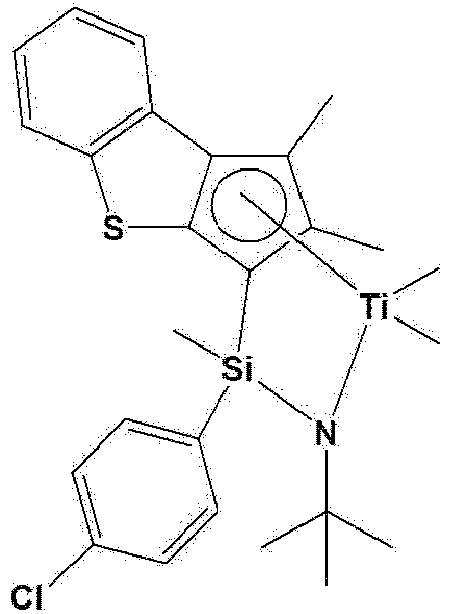


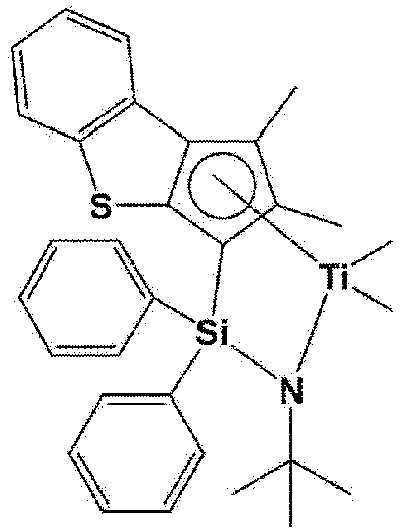
- A ligand compound represented by the following Formula 2:
 R1, and R10 are each independently hydrogen; alkyl having 1 to 20 carbon atoms; cycloalkyl having 3 to 20 carbon atoms; alkenyl having 2 to 20 carbon atoms; alkoxy having 1 to 20 carbon atoms; aryl having 6 to 20 carbon atoms; arylalkoxy having 7 to 20 carbon atoms; alkylaryl having 7 to 20 carbon atoms; or arylalkyl having 7 to 20 carbon atoms,R2a to R2e are each independently hydrogen; halogen; alkyl having 1 to 20 carbon atoms; cycloalkyl having 3 to 20 carbon atoms; alkenyl having 2 to 20 carbon atoms; alkoxy having 1 to 20 carbon atoms; or aryl having 6 to 20 carbon atoms,R3 is hydrogen; halogen; alkyl having 1 to 20 carbon atoms; cycloalkyl having 3 to 20 carbon atoms; alkenyl having 2 to 20 carbon atoms; aryl having 6 to 20 carbon atoms; alkylaryl having 6 to 20 carbon atoms; arylalkyl having 7 to 20 carbon atoms; alkyl amido having 1 to 20 carbon atoms; aryl amido having 6 to 20 carbon atoms; alkylidene having 1 to 20 carbon atoms; or phenyl which is substituted with one or more selected from the group consisting of halogen, alkyl having 1 to 20 carbon atoms, cycloalkyl having 3 to 20 carbon atoms, alkenyl having 2 to 20 carbon atoms, alkoxy having 1 to 20 carbon atoms and aryl having 6 to 20 carbon atoms,R4 to R9 are each independently, hydrogen; silyl; alkyl having 1 to 20 carbon atoms; cycloalkyl having 3 to 20 carbon atoms; alkenyl having 2 to 20 carbon atoms; aryl having 6 to 20 carbon atoms; alkylaryl having 7 to 20 carbon atoms; arylalkyl having 7 to 20 carbon atoms; or a metalloid radical of a metal in group 14, which is substituted with hydrocarbyl having 1 to 20 carbon atoms; wherein adjacent two or more of R6 to R9 may be connected to form a ring, andQ is Si, C, N, P or S.
 - The ligand compound of claim 6, wherein
R1, R10 and R11 are each independently hydrogen; alkyl having 1 to 12 carbon atoms; cycloalkyl having 3 to 12 carbon atoms; alkoxy having 1 to 12 carbon atoms; aryl having 6 to 12 carbon atoms; arylalkoxy having 7 to 13 carbon atoms; alkylaryl having 7 to 13 carbon atoms; or arylalkyl having 7 to 13 carbon atoms,
R2a to R2e are each independently hydrogen; halogen; alkyl having 1 to 12 carbon atoms; cycloalkyl having 3 to 12 carbon atoms; alkenyl having 2 to 12 carbon atoms; alkoxy having 1 to 12 carbon atoms; or phenyl,
R3 is hydrogen; halogen; alkyl having 1 to 12 carbon atoms; cycloalkyl having 3 to 12 carbon atoms; alkenyl having 2 to 12 carbon atoms; alkylaryl having 7 to 13 carbon atoms; arylalkyl having 7 to 13 carbon atoms; phenyl; or phenyl which is substituted with one or more selected from the group consisting of halogen, alkyl having 1 to 12 carbon atoms, cycloalkyl having 3 to 12 carbon atoms, alkenyl having 2 to 12 carbon atoms, alkoxy having 1 to 12 carbon atoms and phenyl,
R4 to R9 are each independently, hydrogen; alkyl having 1 to 12 carbon atoms; cycloalkyl having 3 to 12 carbon atoms; aryl having 6 to 12 carbon atoms; alkylaryl having 7 to 13 carbon atoms; or arylalkyl having 7 to 13 carbon atoms,
adjacent two or more of R6 to R9 may be connected to form an aliphatic ring having 5 to 12 carbon atoms or an aromatic ring having 6 to 12 carbon atoms; wherein
the aliphatic ring or the aromatic ring may be substituted with halogen, alkyl having 1 to 12 carbon atoms, alkenyl having 2 to 12 carbon atoms, or aryl having 6 to 12 carbon atoms, and
Q is Si. - The ligand compound of claim 7, wherein the compound represented by Formula 2 is characterized in being represented by one of the following formulae:


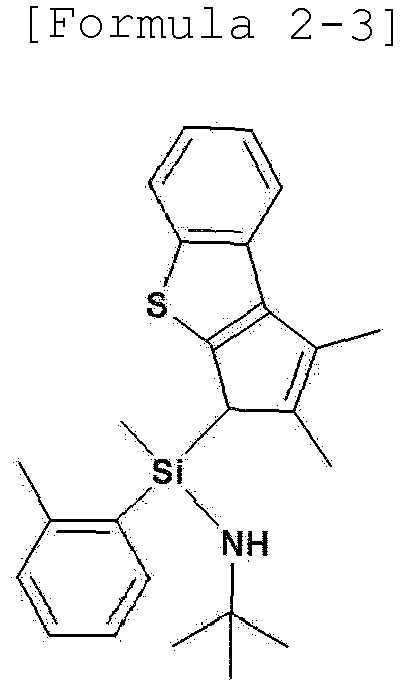





- A method for preparing the ligand compound according to claim 6, the method comprising:a) a step of reacting a compound represented by [Formula 4] below with a compound represented by [Formula 5] below to prepare a compound represented by [Formula 3] below; andb) a step of reacting the compound represented by [Formula 3] below with a compound represented by [Formula 6] below to prepare a compound represented by [Formula 2] below:


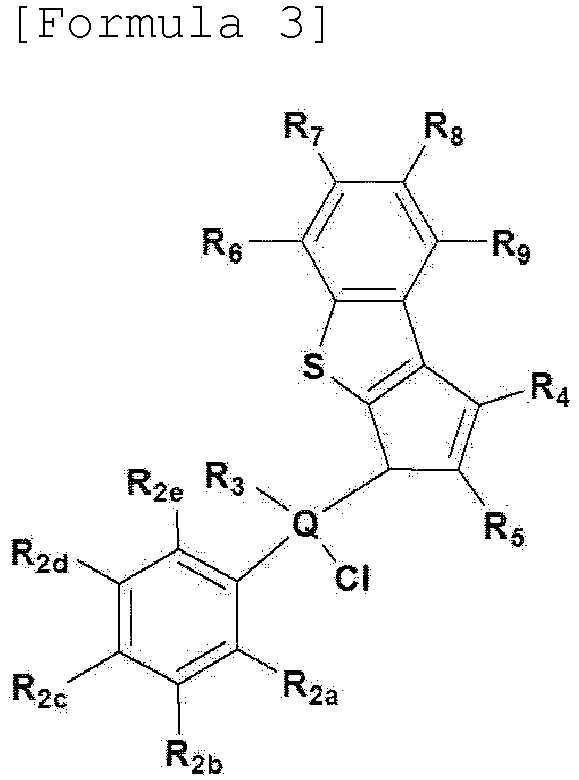
[Formula 6] R1R10NH


- A method for preparing the transition metal compound according to claim 1, by reacting a compound represented by Formula 2 below with a compound represented by Formula 7 below and an organolithium compound:

[Formula 7] M(X1X2)2

- A catalyst composition comprising the transition metal compound according to claim 1, wherein the catalyst composition is a polyethylene polymerization catalyst.
- The catalyst composition of claim 11, which further comprises one or more cocatalysts.
- The catalyst composition of claim 12, wherein the cocatalyst comprises one or more compounds selected from the following Formulae 8 to 10:
[Formula 8] -[Al(R13)-O]a-
where each R13 is independently a halogen radical; a hydrocarbyl radical of 1 to 20 carbon atoms; or a halogen substituted hydrocarbyl radical of 1 to 20 carbon atoms; and a is an integer of 2 or more;
[Formula 9] D(R13)3
where D is aluminum or boron; and each R13 is independently the same as described above;
[Formula 10] [L-H]+[Z(A)4]- or [L]+[2(A)4]-
where L is a neutral or a cationic Lewis acid; H is a hydrogen atom; Z is an element in group 13; and each A is independently aryl having 6 to 20 carbon atoms or alkyl having 1 to 20 carbon atoms, where one or more hydrogen atoms may be independently substituted with a substituent; wherein the substituent is halogen, hydrocarbyl having 1 to 20 carbon atoms, alkoxy having 1 to 20 carbon atoms, or aryloxy of 6 to 20 carbon atoms. - The catalyst composition of claim 12, wherein the catalyst composition further comprises a reaction solvent.
- A method for preparing a polymer using the catalyst composition according to claim 11.
- The method for preparing a polymer of claim 15, wherein the polymer is a homopolymer or a copolymer of polyolefin.
- The method for preparing a polymer of claim 15, wherein the polymer has melt index (Mi) of 3.5 or less, and a density of less than 0.90 g/cc.
Applications Claiming Priority (2)
| Application Number | Priority Date | Filing Date | Title |
|---|---|---|---|
| KR1020160151391A KR102140690B1 (en) | 2016-11-14 | 2016-11-14 | Ligand compound, transition metal compound, and catalystic composition comprising the same |
| PCT/KR2017/012674 WO2018088820A1 (en) | 2016-11-14 | 2017-11-09 | Ligand compound, transition metal compound, and catalyst composition containing same |
Publications (3)
| Publication Number | Publication Date |
|---|---|
| EP3456724A1 true EP3456724A1 (en) | 2019-03-20 |
| EP3456724A4 EP3456724A4 (en) | 2019-06-26 |
| EP3456724B1 EP3456724B1 (en) | 2020-07-29 |
Family
ID=62110758
Family Applications (1)
| Application Number | Title | Priority Date | Filing Date |
|---|---|---|---|
| EP17869476.6A Active EP3456724B1 (en) | 2016-11-14 | 2017-11-09 | Ligand compound, transition metal compound, and catalyst composition containing same |
Country Status (5)
| Country | Link |
|---|---|
| US (1) | US11059917B2 (en) |
| EP (1) | EP3456724B1 (en) |
| KR (1) | KR102140690B1 (en) |
| CN (1) | CN109311918B (en) |
| WO (1) | WO2018088820A1 (en) |
Cited By (2)
| Publication number | Priority date | Publication date | Assignee | Title |
|---|---|---|---|---|
| EP3770188A4 (en) * | 2018-05-04 | 2021-05-26 | Lg Chem, Ltd. | Olefin-based copolymer, and preparation method therefor |
| EP3770189A4 (en) * | 2018-05-04 | 2021-06-02 | Lg Chem, Ltd. | Olefin-based copolymer and preparation method therefor |
Families Citing this family (8)
| Publication number | Priority date | Publication date | Assignee | Title |
|---|---|---|---|---|
| KR102223719B1 (en) * | 2016-11-14 | 2021-03-05 | 주식회사 엘지화학 | Ligand compound, transition metal compound, and catalystic composition comprising the same |
| KR102420366B1 (en) | 2017-12-26 | 2022-07-14 | 주식회사 엘지화학 | Olefin based polymer |
| EP3705503A4 (en) * | 2017-12-26 | 2020-12-30 | Lg Chem, Ltd. | Olefin-based polymer |
| KR102554325B1 (en) * | 2019-02-01 | 2023-07-12 | 주식회사 엘지화학 | Method of removing an inorganic material in a catalytic composition |
| US20220340698A1 (en) * | 2020-04-16 | 2022-10-27 | Lg Chem, Ltd. | Composition for Encapsulant Film and Encapsulant Film Comprising the Same |
| US12528898B2 (en) | 2020-04-16 | 2026-01-20 | Lg Chem, Ltd. | Ethylene/alpha-olefin copolymer with excellent electrical insulation |
| KR102851098B1 (en) * | 2023-06-08 | 2025-08-26 | 롯데케미칼 주식회사 | Method for preparing ethylene alpha-olefin copolymer, ethylene alpha-olefin copolymer, resin composition for encapsulant of solar cell comprising the same and encapsulant for solar cell prepared using the same |
| KR20240174250A (en) * | 2023-06-08 | 2024-12-17 | 롯데케미칼 주식회사 | Catalyst and method for preparing ethylene alpha-olefin copolymer |
Family Cites Families (6)
| Publication number | Priority date | Publication date | Assignee | Title |
|---|---|---|---|---|
| US5064802A (en) | 1989-09-14 | 1991-11-12 | The Dow Chemical Company | Metal complex compounds |
| SG99905A1 (en) | 2000-06-21 | 2003-11-27 | Sumitomo Chemical Co | Transition metal compound, catalyst for addition polymerization, and process for producing addition polymer |
| DE102004027332A1 (en) * | 2004-06-04 | 2005-12-22 | Basell Polyolefine Gmbh | New organometallic transition metal compound useful as catalyst constituents of catalyst systems for the polymerization of ethylene |
| US7655740B2 (en) | 2007-09-04 | 2010-02-02 | Equistar Chemicals, Lp | Olefin polymerization process |
| KR101637982B1 (en) * | 2014-11-07 | 2016-07-11 | 주식회사 엘지화학 | Ligand compound, transition metal compound, and catalystic composition comprising the same |
| CN105985383B (en) * | 2015-02-06 | 2019-09-03 | 中国石油天然气股份有限公司 | Metallocene complex containing heteroatom pi-ligand, its preparation method, its catalyst system and application of catalyst system |
-
2016
- 2016-11-14 KR KR1020160151391A patent/KR102140690B1/en active Active
-
2017
- 2017-11-09 WO PCT/KR2017/012674 patent/WO2018088820A1/en not_active Ceased
- 2017-11-09 US US16/311,509 patent/US11059917B2/en active Active
- 2017-11-09 CN CN201780034939.1A patent/CN109311918B/en active Active
- 2017-11-09 EP EP17869476.6A patent/EP3456724B1/en active Active
Cited By (4)
| Publication number | Priority date | Publication date | Assignee | Title |
|---|---|---|---|---|
| EP3770188A4 (en) * | 2018-05-04 | 2021-05-26 | Lg Chem, Ltd. | Olefin-based copolymer, and preparation method therefor |
| EP3770189A4 (en) * | 2018-05-04 | 2021-06-02 | Lg Chem, Ltd. | Olefin-based copolymer and preparation method therefor |
| US11629208B2 (en) | 2018-05-04 | 2023-04-18 | Lg Chem, Ltd. | Olefin-based copolymer and method for preparing the same |
| US11732071B2 (en) | 2018-05-04 | 2023-08-22 | Lg Chem, Ltd. | Olefin-based copolymer and method for preparing the same |
Also Published As
| Publication number | Publication date |
|---|---|
| CN109311918A (en) | 2019-02-05 |
| CN109311918B (en) | 2021-07-27 |
| KR102140690B1 (en) | 2020-08-04 |
| US20190233553A1 (en) | 2019-08-01 |
| KR20180054059A (en) | 2018-05-24 |
| WO2018088820A1 (en) | 2018-05-17 |
| EP3456724A4 (en) | 2019-06-26 |
| US11059917B2 (en) | 2021-07-13 |
| EP3456724B1 (en) | 2020-07-29 |
Similar Documents
| Publication | Publication Date | Title |
|---|---|---|
| EP3456724B1 (en) | Ligand compound, transition metal compound, and catalyst composition containing same | |
| JP6469832B2 (en) | Ligand compound, transition metal compound and catalyst composition containing the same | |
| EP3219718B1 (en) | Ligand compound, transition metal compound, and catalyst composition containing compounds | |
| KR101606825B1 (en) | Method for preparing of supported hybrid metallocene catalyst | |
| EP2905285B1 (en) | Transition metal compound having heteroatom, a catalyst composition comprising same, and method for preparing polymer using same | |
| EP3173429B1 (en) | Metallocene compound, metallocene supported catalyst, and method for preparing polyolefin using same | |
| KR20150058105A (en) | Olefin based polymer having excellent processibility | |
| KR102236921B1 (en) | Catalystic composition comprising transition metal compound and alkylaluminoxane, preparing method for polymer using the same, and polymer prepared thereby | |
| KR102423660B1 (en) | Transition metal compound, and catalystic composition comprising the same | |
| US8735312B2 (en) | Catalyst composition and process for preparing olefin polymer using the same | |
| EP3783004B1 (en) | Transition metal compound, catalyst composition comprising same, and polymer preparation method using same | |
| US11618759B2 (en) | Ligand compound, transition metal compound, and catalyst composition including the same | |
| EP3868770B1 (en) | Transition metal compound and catalyst composition comprising same | |
| EP3524612B1 (en) | Ligand compound, transition metal compound, and catalyst composition comprising the transition metal compound | |
| KR20100070674A (en) | Group 4 transition metal complexes based on new cyclopentadienone ligand | |
| KR102223719B1 (en) | Ligand compound, transition metal compound, and catalystic composition comprising the same | |
| KR20190013022A (en) | Ligand compound, transition metal compound, and catalystic composition comprising the same |
Legal Events
| Date | Code | Title | Description |
|---|---|---|---|
| STAA | Information on the status of an ep patent application or granted ep patent |
Free format text: STATUS: THE INTERNATIONAL PUBLICATION HAS BEEN MADE |
|
| PUAI | Public reference made under article 153(3) epc to a published international application that has entered the european phase |
Free format text: ORIGINAL CODE: 0009012 |
|
| STAA | Information on the status of an ep patent application or granted ep patent |
Free format text: STATUS: REQUEST FOR EXAMINATION WAS MADE |
|
| 17P | Request for examination filed |
Effective date: 20181214 |
|
| AK | Designated contracting states |
Kind code of ref document: A1 Designated state(s): AL AT BE BG CH CY CZ DE DK EE ES FI FR GB GR HR HU IE IS IT LI LT LU LV MC MK MT NL NO PL PT RO RS SE SI SK SM TR |
|
| AX | Request for extension of the european patent |
Extension state: BA ME |
|
| A4 | Supplementary search report drawn up and despatched |
Effective date: 20190527 |
|
| RIC1 | Information provided on ipc code assigned before grant |
Ipc: C07F 7/28 20060101AFI20190521BHEP Ipc: C07F 7/10 20060101ALI20190521BHEP Ipc: C08F 2/38 20060101ALI20190521BHEP Ipc: C07F 17/00 20060101ALI20190521BHEP Ipc: C08F 4/642 20060101ALI20190521BHEP Ipc: C08F 4/64 20060101ALI20190521BHEP Ipc: C07D 333/76 20060101ALI20190521BHEP |
|
| DAV | Request for validation of the european patent (deleted) | ||
| DAX | Request for extension of the european patent (deleted) | ||
| GRAP | Despatch of communication of intention to grant a patent |
Free format text: ORIGINAL CODE: EPIDOSNIGR1 |
|
| STAA | Information on the status of an ep patent application or granted ep patent |
Free format text: STATUS: GRANT OF PATENT IS INTENDED |
|
| INTG | Intention to grant announced |
Effective date: 20200407 |
|
| GRAS | Grant fee paid |
Free format text: ORIGINAL CODE: EPIDOSNIGR3 |
|
| GRAA | (expected) grant |
Free format text: ORIGINAL CODE: 0009210 |
|
| STAA | Information on the status of an ep patent application or granted ep patent |
Free format text: STATUS: THE PATENT HAS BEEN GRANTED |
|
| AK | Designated contracting states |
Kind code of ref document: B1 Designated state(s): AL AT BE BG CH CY CZ DE DK EE ES FI FR GB GR HR HU IE IS IT LI LT LU LV MC MK MT NL NO PL PT RO RS SE SI SK SM TR |
|
| REG | Reference to a national code |
Ref country code: CH Ref legal event code: EP |
|
| REG | Reference to a national code |
Ref country code: AT Ref legal event code: REF Ref document number: 1295655 Country of ref document: AT Kind code of ref document: T Effective date: 20200815 |
|
| REG | Reference to a national code |
Ref country code: IE Ref legal event code: FG4D |
|
| REG | Reference to a national code |
Ref country code: DE Ref legal event code: R096 Ref document number: 602017020796 Country of ref document: DE |
|
| REG | Reference to a national code |
Ref country code: LT Ref legal event code: MG4D |
|
| REG | Reference to a national code |
Ref country code: NL Ref legal event code: MP Effective date: 20200729 |
|
| REG | Reference to a national code |
Ref country code: AT Ref legal event code: MK05 Ref document number: 1295655 Country of ref document: AT Kind code of ref document: T Effective date: 20200729 |
|
| PG25 | Lapsed in a contracting state [announced via postgrant information from national office to epo] |
Ref country code: HR Free format text: LAPSE BECAUSE OF FAILURE TO SUBMIT A TRANSLATION OF THE DESCRIPTION OR TO PAY THE FEE WITHIN THE PRESCRIBED TIME-LIMIT Effective date: 20200729 Ref country code: AT Free format text: LAPSE BECAUSE OF FAILURE TO SUBMIT A TRANSLATION OF THE DESCRIPTION OR TO PAY THE FEE WITHIN THE PRESCRIBED TIME-LIMIT Effective date: 20200729 Ref country code: SE Free format text: LAPSE BECAUSE OF FAILURE TO SUBMIT A TRANSLATION OF THE DESCRIPTION OR TO PAY THE FEE WITHIN THE PRESCRIBED TIME-LIMIT Effective date: 20200729 Ref country code: NO Free format text: LAPSE BECAUSE OF FAILURE TO SUBMIT A TRANSLATION OF THE DESCRIPTION OR TO PAY THE FEE WITHIN THE PRESCRIBED TIME-LIMIT Effective date: 20201029 Ref country code: PT Free format text: LAPSE BECAUSE OF FAILURE TO SUBMIT A TRANSLATION OF THE DESCRIPTION OR TO PAY THE FEE WITHIN THE PRESCRIBED TIME-LIMIT Effective date: 20201130 Ref country code: FI Free format text: LAPSE BECAUSE OF FAILURE TO SUBMIT A TRANSLATION OF THE DESCRIPTION OR TO PAY THE FEE WITHIN THE PRESCRIBED TIME-LIMIT Effective date: 20200729 Ref country code: BG Free format text: LAPSE BECAUSE OF FAILURE TO SUBMIT A TRANSLATION OF THE DESCRIPTION OR TO PAY THE FEE WITHIN THE PRESCRIBED TIME-LIMIT Effective date: 20201029 Ref country code: GR Free format text: LAPSE BECAUSE OF FAILURE TO SUBMIT A TRANSLATION OF THE DESCRIPTION OR TO PAY THE FEE WITHIN THE PRESCRIBED TIME-LIMIT Effective date: 20201030 Ref country code: ES Free format text: LAPSE BECAUSE OF FAILURE TO SUBMIT A TRANSLATION OF THE DESCRIPTION OR TO PAY THE FEE WITHIN THE PRESCRIBED TIME-LIMIT Effective date: 20200729 Ref country code: LT Free format text: LAPSE BECAUSE OF FAILURE TO SUBMIT A TRANSLATION OF THE DESCRIPTION OR TO PAY THE FEE WITHIN THE PRESCRIBED TIME-LIMIT Effective date: 20200729 |
|
| PG25 | Lapsed in a contracting state [announced via postgrant information from national office to epo] |
Ref country code: PL Free format text: LAPSE BECAUSE OF FAILURE TO SUBMIT A TRANSLATION OF THE DESCRIPTION OR TO PAY THE FEE WITHIN THE PRESCRIBED TIME-LIMIT Effective date: 20200729 Ref country code: RS Free format text: LAPSE BECAUSE OF FAILURE TO SUBMIT A TRANSLATION OF THE DESCRIPTION OR TO PAY THE FEE WITHIN THE PRESCRIBED TIME-LIMIT Effective date: 20200729 Ref country code: LV Free format text: LAPSE BECAUSE OF FAILURE TO SUBMIT A TRANSLATION OF THE DESCRIPTION OR TO PAY THE FEE WITHIN THE PRESCRIBED TIME-LIMIT Effective date: 20200729 Ref country code: IS Free format text: LAPSE BECAUSE OF FAILURE TO SUBMIT A TRANSLATION OF THE DESCRIPTION OR TO PAY THE FEE WITHIN THE PRESCRIBED TIME-LIMIT Effective date: 20201129 |
|
| PG25 | Lapsed in a contracting state [announced via postgrant information from national office to epo] |
Ref country code: NL Free format text: LAPSE BECAUSE OF FAILURE TO SUBMIT A TRANSLATION OF THE DESCRIPTION OR TO PAY THE FEE WITHIN THE PRESCRIBED TIME-LIMIT Effective date: 20200729 |
|
| PG25 | Lapsed in a contracting state [announced via postgrant information from national office to epo] |
Ref country code: DK Free format text: LAPSE BECAUSE OF FAILURE TO SUBMIT A TRANSLATION OF THE DESCRIPTION OR TO PAY THE FEE WITHIN THE PRESCRIBED TIME-LIMIT Effective date: 20200729 Ref country code: CZ Free format text: LAPSE BECAUSE OF FAILURE TO SUBMIT A TRANSLATION OF THE DESCRIPTION OR TO PAY THE FEE WITHIN THE PRESCRIBED TIME-LIMIT Effective date: 20200729 Ref country code: RO Free format text: LAPSE BECAUSE OF FAILURE TO SUBMIT A TRANSLATION OF THE DESCRIPTION OR TO PAY THE FEE WITHIN THE PRESCRIBED TIME-LIMIT Effective date: 20200729 Ref country code: EE Free format text: LAPSE BECAUSE OF FAILURE TO SUBMIT A TRANSLATION OF THE DESCRIPTION OR TO PAY THE FEE WITHIN THE PRESCRIBED TIME-LIMIT Effective date: 20200729 Ref country code: SM Free format text: LAPSE BECAUSE OF FAILURE TO SUBMIT A TRANSLATION OF THE DESCRIPTION OR TO PAY THE FEE WITHIN THE PRESCRIBED TIME-LIMIT Effective date: 20200729 Ref country code: IT Free format text: LAPSE BECAUSE OF FAILURE TO SUBMIT A TRANSLATION OF THE DESCRIPTION OR TO PAY THE FEE WITHIN THE PRESCRIBED TIME-LIMIT Effective date: 20200729 |
|
| REG | Reference to a national code |
Ref country code: DE Ref legal event code: R097 Ref document number: 602017020796 Country of ref document: DE |
|
| PG25 | Lapsed in a contracting state [announced via postgrant information from national office to epo] |
Ref country code: AL Free format text: LAPSE BECAUSE OF FAILURE TO SUBMIT A TRANSLATION OF THE DESCRIPTION OR TO PAY THE FEE WITHIN THE PRESCRIBED TIME-LIMIT Effective date: 20200729 |
|
| PLBE | No opposition filed within time limit |
Free format text: ORIGINAL CODE: 0009261 |
|
| STAA | Information on the status of an ep patent application or granted ep patent |
Free format text: STATUS: NO OPPOSITION FILED WITHIN TIME LIMIT |
|
| PG25 | Lapsed in a contracting state [announced via postgrant information from national office to epo] |
Ref country code: MC Free format text: LAPSE BECAUSE OF FAILURE TO SUBMIT A TRANSLATION OF THE DESCRIPTION OR TO PAY THE FEE WITHIN THE PRESCRIBED TIME-LIMIT Effective date: 20200729 Ref country code: SK Free format text: LAPSE BECAUSE OF FAILURE TO SUBMIT A TRANSLATION OF THE DESCRIPTION OR TO PAY THE FEE WITHIN THE PRESCRIBED TIME-LIMIT Effective date: 20200729 |
|
| REG | Reference to a national code |
Ref country code: CH Ref legal event code: PL |
|
| 26N | No opposition filed |
Effective date: 20210430 |
|
| PG25 | Lapsed in a contracting state [announced via postgrant information from national office to epo] |
Ref country code: LU Free format text: LAPSE BECAUSE OF NON-PAYMENT OF DUE FEES Effective date: 20201109 |
|
| REG | Reference to a national code |
Ref country code: BE Ref legal event code: MM Effective date: 20201130 |
|
| PG25 | Lapsed in a contracting state [announced via postgrant information from national office to epo] |
Ref country code: SI Free format text: LAPSE BECAUSE OF FAILURE TO SUBMIT A TRANSLATION OF THE DESCRIPTION OR TO PAY THE FEE WITHIN THE PRESCRIBED TIME-LIMIT Effective date: 20200729 Ref country code: LI Free format text: LAPSE BECAUSE OF NON-PAYMENT OF DUE FEES Effective date: 20201130 Ref country code: CH Free format text: LAPSE BECAUSE OF NON-PAYMENT OF DUE FEES Effective date: 20201130 |
|
| PG25 | Lapsed in a contracting state [announced via postgrant information from national office to epo] |
Ref country code: IE Free format text: LAPSE BECAUSE OF NON-PAYMENT OF DUE FEES Effective date: 20201109 |
|
| PG25 | Lapsed in a contracting state [announced via postgrant information from national office to epo] |
Ref country code: TR Free format text: LAPSE BECAUSE OF FAILURE TO SUBMIT A TRANSLATION OF THE DESCRIPTION OR TO PAY THE FEE WITHIN THE PRESCRIBED TIME-LIMIT Effective date: 20200729 Ref country code: MT Free format text: LAPSE BECAUSE OF FAILURE TO SUBMIT A TRANSLATION OF THE DESCRIPTION OR TO PAY THE FEE WITHIN THE PRESCRIBED TIME-LIMIT Effective date: 20200729 Ref country code: CY Free format text: LAPSE BECAUSE OF FAILURE TO SUBMIT A TRANSLATION OF THE DESCRIPTION OR TO PAY THE FEE WITHIN THE PRESCRIBED TIME-LIMIT Effective date: 20200729 |
|
| PG25 | Lapsed in a contracting state [announced via postgrant information from national office to epo] |
Ref country code: MK Free format text: LAPSE BECAUSE OF FAILURE TO SUBMIT A TRANSLATION OF THE DESCRIPTION OR TO PAY THE FEE WITHIN THE PRESCRIBED TIME-LIMIT Effective date: 20200729 |
|
| PG25 | Lapsed in a contracting state [announced via postgrant information from national office to epo] |
Ref country code: BE Free format text: LAPSE BECAUSE OF NON-PAYMENT OF DUE FEES Effective date: 20201130 |
|
| PGFP | Annual fee paid to national office [announced via postgrant information from national office to epo] |
Ref country code: DE Payment date: 20251020 Year of fee payment: 9 |
|
| PGFP | Annual fee paid to national office [announced via postgrant information from national office to epo] |
Ref country code: GB Payment date: 20251023 Year of fee payment: 9 |
|
| PGFP | Annual fee paid to national office [announced via postgrant information from national office to epo] |
Ref country code: FR Payment date: 20251021 Year of fee payment: 9 |