EP3456717A1 - Tablets containing 4,6-diamino-quinoline-3-carbonitrile derivatives as cancer osaka thyroid (cot) modulators for treating cancer - Google Patents
Tablets containing 4,6-diamino-quinoline-3-carbonitrile derivatives as cancer osaka thyroid (cot) modulators for treating cancer Download PDFInfo
- Publication number
- EP3456717A1 EP3456717A1 EP18186568.4A EP18186568A EP3456717A1 EP 3456717 A1 EP3456717 A1 EP 3456717A1 EP 18186568 A EP18186568 A EP 18186568A EP 3456717 A1 EP3456717 A1 EP 3456717A1
- Authority
- EP
- European Patent Office
- Prior art keywords
- alkyl
- heterocyclyl
- heteroaryl
- cycloalkyl
- aryl
- Prior art date
- Legal status (The legal status is an assumption and is not a legal conclusion. Google has not performed a legal analysis and makes no representation as to the accuracy of the status listed.)
- Granted
Links
- 0 CC(*)=CCC(CC1C2)C(CC3C(C)=C3)CCCC2[C@]1(*)N(*)c(cc12)cc(*)c1ncc(C#N)c2N* Chemical compound CC(*)=CCC(CC1C2)C(CC3C(C)=C3)CCCC2[C@]1(*)N(*)c(cc12)cc(*)c1ncc(C#N)c2N* 0.000 description 30
- SOKQROSLNCMNNP-UHFFFAOYSA-N Cc1cccc2c1[n](C)cn2 Chemical compound Cc1cccc2c1[n](C)cn2 SOKQROSLNCMNNP-UHFFFAOYSA-N 0.000 description 2
- ZYGYULIGJXJLRW-UHFFFAOYSA-N Cc1cccc2c1cn[nH]2 Chemical compound Cc1cccc2c1cn[nH]2 ZYGYULIGJXJLRW-UHFFFAOYSA-N 0.000 description 2
- NLGFEOYHYIBCJO-UHFFFAOYSA-N C=Nc([s]1)ccc1Cl Chemical compound C=Nc([s]1)ccc1Cl NLGFEOYHYIBCJO-UHFFFAOYSA-N 0.000 description 1
- DSHWWHXODFCFSK-MHZLTWQESA-N CC(C)(C)CNc(c(cc(cc1C#N)N[C@H](c2c[n](C3CC3)nn2)c2c3[s]cnc3ccc2)c1nc1)c1C#N Chemical compound CC(C)(C)CNc(c(cc(cc1C#N)N[C@H](c2c[n](C3CC3)nn2)c2c3[s]cnc3ccc2)c1nc1)c1C#N DSHWWHXODFCFSK-MHZLTWQESA-N 0.000 description 1
- GJSFPVRYRUXQNI-SANMLTNESA-N CC(C)(C)CNc(c1cc(N[C@H](c2c[n](C3CC3)nn2)c2cccc3c2[s]cn3)cc(Br)c1nc1)c1C#N Chemical compound CC(C)(C)CNc(c1cc(N[C@H](c2c[n](C3CC3)nn2)c2cccc3c2[s]cn3)cc(Br)c1nc1)c1C#N GJSFPVRYRUXQNI-SANMLTNESA-N 0.000 description 1
- DIKOZRMXEHSDSY-KDXMTYKHSA-N CC(C)(C)N(CC1)CCC1N1NN(C)C([C@H](c2cccc(C3)c2CN3C2COC2)Nc(cc(c2ncc3C#N)Cl)cc2c3Nc(cc2)cc(Cl)c2F)=C1 Chemical compound CC(C)(C)N(CC1)CCC1N1NN(C)C([C@H](c2cccc(C3)c2CN3C2COC2)Nc(cc(c2ncc3C#N)Cl)cc2c3Nc(cc2)cc(Cl)c2F)=C1 DIKOZRMXEHSDSY-KDXMTYKHSA-N 0.000 description 1
- ACVDXJAVVOZPBJ-HKBQPEDESA-N CC(C)(C)N(CC1)CCC1[n]1nnc([C@H](C2=CCOCC2)Nc(cc2Cl)cc3c2ncc(C#N)c3Nc(cc2)cc(Cl)c2F)c1 Chemical compound CC(C)(C)N(CC1)CCC1[n]1nnc([C@H](C2=CCOCC2)Nc(cc2Cl)cc3c2ncc(C#N)c3Nc(cc2)cc(Cl)c2F)c1 ACVDXJAVVOZPBJ-HKBQPEDESA-N 0.000 description 1
- ABIGPNOPMWRDKZ-HKBQPEDESA-N CC(C)(C)N(CC1)CCC1[n]1nnc([C@H](C2CCOCC2)Nc(cc(c2ncc3C#N)Cl)cc2c3Nc(cc2)cc(Cl)c2F)c1 Chemical compound CC(C)(C)N(CC1)CCC1[n]1nnc([C@H](C2CCOCC2)Nc(cc(c2ncc3C#N)Cl)cc2c3Nc(cc2)cc(Cl)c2F)c1 ABIGPNOPMWRDKZ-HKBQPEDESA-N 0.000 description 1
- IKLIBFKVBNDDNU-DHUJRADRSA-N CC(C)(C)N(CC1)CCC1[n]1nnc([C@H](c2cccc3c2CNC3)Nc(cc23)cc(Cl)c2ncc(C#N)c3Nc(cc2)cc(Cl)c2F)c1 Chemical compound CC(C)(C)N(CC1)CCC1[n]1nnc([C@H](c2cccc3c2CNC3)Nc(cc23)cc(Cl)c2ncc(C#N)c3Nc(cc2)cc(Cl)c2F)c1 IKLIBFKVBNDDNU-DHUJRADRSA-N 0.000 description 1
- JIDBUDDBHHWQDG-UHFFFAOYSA-N CC(C)Oc(nccc1)c1N Chemical compound CC(C)Oc(nccc1)c1N JIDBUDDBHHWQDG-UHFFFAOYSA-N 0.000 description 1
- JHVCXNIMJYVWBU-UHFFFAOYSA-N CC(C)c1c2nc(C(F)(F)F)[nH]c2ccc1 Chemical compound CC(C)c1c2nc(C(F)(F)F)[nH]c2ccc1 JHVCXNIMJYVWBU-UHFFFAOYSA-N 0.000 description 1
- KNNBFVNFKBWUGL-UHFFFAOYSA-N CC(C)c1cccc2c1C=CN(C(C)C)C2=O Chemical compound CC(C)c1cccc2c1C=CN(C(C)C)C2=O KNNBFVNFKBWUGL-UHFFFAOYSA-N 0.000 description 1
- GIMRIQPNAGXOCS-UHFFFAOYSA-N CC(Cc(cccn1)c1OCc1cc(N)cc(OC)n1)C=C Chemical compound CC(Cc(cccn1)c1OCc1cc(N)cc(OC)n1)C=C GIMRIQPNAGXOCS-UHFFFAOYSA-N 0.000 description 1
- LTWFMNOPQFPFSM-QKZTXXNCSA-N CC(Cc1c2cccc1[C@@H](c1c[n](C3(C4)CC4C3)nn1)Nc(cc(c1ncc3C#N)Cl)cc1c3NCC(C)(C)C)N(C)C2=O Chemical compound CC(Cc1c2cccc1[C@@H](c1c[n](C3(C4)CC4C3)nn1)Nc(cc(c1ncc3C#N)Cl)cc1c3NCC(C)(C)C)N(C)C2=O LTWFMNOPQFPFSM-QKZTXXNCSA-N 0.000 description 1
- XRFZIIZTXSWDAF-UHFFFAOYSA-N CC(N(Cc1cccc(C=O)c11)C1=O)=O Chemical compound CC(N(Cc1cccc(C=O)c11)C1=O)=O XRFZIIZTXSWDAF-UHFFFAOYSA-N 0.000 description 1
- LWFOONCAAOLBJT-UHFFFAOYSA-N CCC(CC)CCCCNC Chemical compound CCC(CC)CCCCNC LWFOONCAAOLBJT-UHFFFAOYSA-N 0.000 description 1
- OXIZYKRCAPLHDM-UHFFFAOYSA-N CCc(nccc1)c1N Chemical compound CCc(nccc1)c1N OXIZYKRCAPLHDM-UHFFFAOYSA-N 0.000 description 1
- DLDUIBUZCQRHFU-UHFFFAOYSA-N CCc1c(C)c(CC(N2C)=C(C(C)C)C=CC2=O)cc(F)n1 Chemical compound CCc1c(C)c(CC(N2C)=C(C(C)C)C=CC2=O)cc(F)n1 DLDUIBUZCQRHFU-UHFFFAOYSA-N 0.000 description 1
- MZCZJMFOPNSEKX-UHFFFAOYSA-N CCc1c(C=CN(C(C)C)C2=O)c2ccc1 Chemical compound CCc1c(C=CN(C(C)C)C2=O)c2ccc1 MZCZJMFOPNSEKX-UHFFFAOYSA-N 0.000 description 1
- MWQMIUIGPYFLBX-UHFFFAOYSA-N CNc([s]cc1)c1Cl Chemical compound CNc([s]cc1)c1Cl MWQMIUIGPYFLBX-UHFFFAOYSA-N 0.000 description 1
- FKQDTYKVWIDGNT-UHFFFAOYSA-N C[n]1ncc2cccc(N)c12 Chemical compound C[n]1ncc2cccc(N)c12 FKQDTYKVWIDGNT-UHFFFAOYSA-N 0.000 description 1
- UWDQVEPXORTQFO-UHFFFAOYSA-N Cc(c1c2)c[s]c1ccc2Cl Chemical compound Cc(c1c2)c[s]c1ccc2Cl UWDQVEPXORTQFO-UHFFFAOYSA-N 0.000 description 1
- RXVIXYHMKNJSOH-UHFFFAOYSA-N Cc(cc1)c(C)nc1OC Chemical compound Cc(cc1)c(C)nc1OC RXVIXYHMKNJSOH-UHFFFAOYSA-N 0.000 description 1
- NOVNRALXBRYDQL-UHFFFAOYSA-N Cc(cc1)cnc1N(C)I Chemical compound Cc(cc1)cnc1N(C)I NOVNRALXBRYDQL-UHFFFAOYSA-N 0.000 description 1
- NMJYTYWYEPQTIF-UHFFFAOYSA-N Cc(cc1F)cnc1F Chemical compound Cc(cc1F)cnc1F NMJYTYWYEPQTIF-UHFFFAOYSA-N 0.000 description 1
- BAMPVSWRQZNDQC-UHFFFAOYSA-N Cc1c(C)[s]c(C)n1 Chemical compound Cc1c(C)[s]c(C)n1 BAMPVSWRQZNDQC-UHFFFAOYSA-N 0.000 description 1
- UWSONZCNXUSTKW-UHFFFAOYSA-N Cc1c(C)[s]cn1 Chemical compound Cc1c(C)[s]cn1 UWSONZCNXUSTKW-UHFFFAOYSA-N 0.000 description 1
- FJIIOLWLKQRISR-UHFFFAOYSA-N Cc1c(CN(C2)C(CO)=O)c2ccc1 Chemical compound Cc1c(CN(C2)C(CO)=O)c2ccc1 FJIIOLWLKQRISR-UHFFFAOYSA-N 0.000 description 1
- AIVRHEDMKRDQKQ-UHFFFAOYSA-N Cc1c(NC)nc[o]1 Chemical compound Cc1c(NC)nc[o]1 AIVRHEDMKRDQKQ-UHFFFAOYSA-N 0.000 description 1
- QZVSMTWHHPOUKN-UHFFFAOYSA-N Cc1c(cn[n]2C)c2ccc1 Chemical compound Cc1c(cn[n]2C)c2ccc1 QZVSMTWHHPOUKN-UHFFFAOYSA-N 0.000 description 1
- QCXGJTGMGJOYDP-UHFFFAOYSA-N Cc1c2nc[nH]c2ccc1 Chemical compound Cc1c2nc[nH]c2ccc1 QCXGJTGMGJOYDP-UHFFFAOYSA-N 0.000 description 1
- BLHTXORQJNCSII-UHFFFAOYSA-N Cc1c[n](C)cn1 Chemical compound Cc1c[n](C)cn1 BLHTXORQJNCSII-UHFFFAOYSA-N 0.000 description 1
- OJAWOLWHEQUTDE-UHFFFAOYSA-N Cc1c[n](C)nn1 Chemical compound Cc1c[n](C)nn1 OJAWOLWHEQUTDE-UHFFFAOYSA-N 0.000 description 1
- CCIZNTBFSJFODL-UHFFFAOYSA-N Cc1c[s]c(N2CCOCC2)n1 Chemical compound Cc1c[s]c(N2CCOCC2)n1 CCIZNTBFSJFODL-UHFFFAOYSA-N 0.000 description 1
- ZFNGPLVDNDIZSX-UHFFFAOYSA-N Cc1c[s]c2c1CCNC2 Chemical compound Cc1c[s]c2c1CCNC2 ZFNGPLVDNDIZSX-UHFFFAOYSA-N 0.000 description 1
- GPSFYJDZKSRMKZ-UHFFFAOYSA-N Cc1c[s]cc1C Chemical compound Cc1c[s]cc1C GPSFYJDZKSRMKZ-UHFFFAOYSA-N 0.000 description 1
- NOFXNQNEDAMWKJ-UHFFFAOYSA-N Cc1cc(C(N2CCCC2)=O)cnc1 Chemical compound Cc1cc(C(N2CCCC2)=O)cnc1 NOFXNQNEDAMWKJ-UHFFFAOYSA-N 0.000 description 1
- RSNNHKFOJCLWBX-UHFFFAOYSA-N Cc1ccc(C(F)(F)F)[s]1 Chemical compound Cc1ccc(C(F)(F)F)[s]1 RSNNHKFOJCLWBX-UHFFFAOYSA-N 0.000 description 1
- DRJSEGTWOQNMSY-UHFFFAOYSA-N Cc1cccc2c1nc[n]2C Chemical compound Cc1cccc2c1nc[n]2C DRJSEGTWOQNMSY-UHFFFAOYSA-N 0.000 description 1
- IKJZQDSSSFNYAB-UHFFFAOYSA-N Cc1cccc2n[n](C)cc12 Chemical compound Cc1cccc2n[n](C)cc12 IKJZQDSSSFNYAB-UHFFFAOYSA-N 0.000 description 1
- LMYVCXSKCQSIEQ-UHFFFAOYSA-N Cc1cccc2ncccc12 Chemical compound Cc1cccc2ncccc12 LMYVCXSKCQSIEQ-UHFFFAOYSA-N 0.000 description 1
- QSZANYSGILRCLD-UHFFFAOYSA-N Cc1n[nH]c2c1c(N)ccc2 Chemical compound Cc1n[nH]c2c1c(N)ccc2 QSZANYSGILRCLD-UHFFFAOYSA-N 0.000 description 1
- NODLZCJDRXTSJO-UHFFFAOYSA-N Cc1n[n](C)cc1 Chemical compound Cc1n[n](C)cc1 NODLZCJDRXTSJO-UHFFFAOYSA-N 0.000 description 1
Classifications
-
- C—CHEMISTRY; METALLURGY
- C07—ORGANIC CHEMISTRY
- C07D—HETEROCYCLIC COMPOUNDS
- C07D498/00—Heterocyclic compounds containing in the condensed system at least one hetero ring having nitrogen and oxygen atoms as the only ring hetero atoms
- C07D498/02—Heterocyclic compounds containing in the condensed system at least one hetero ring having nitrogen and oxygen atoms as the only ring hetero atoms in which the condensed system contains two hetero rings
- C07D498/04—Ortho-condensed systems
-
- C—CHEMISTRY; METALLURGY
- C07—ORGANIC CHEMISTRY
- C07D—HETEROCYCLIC COMPOUNDS
- C07D215/00—Heterocyclic compounds containing quinoline or hydrogenated quinoline ring systems
- C07D215/02—Heterocyclic compounds containing quinoline or hydrogenated quinoline ring systems having no bond between the ring nitrogen atom and a non-ring member or having only hydrogen atoms or carbon atoms directly attached to the ring nitrogen atom
- C07D215/16—Heterocyclic compounds containing quinoline or hydrogenated quinoline ring systems having no bond between the ring nitrogen atom and a non-ring member or having only hydrogen atoms or carbon atoms directly attached to the ring nitrogen atom with hetero atoms or with carbon atoms having three bonds to hetero atoms with at the most one bond to halogen, e.g. ester or nitrile radicals, directly attached to ring carbon atoms
- C07D215/38—Nitrogen atoms
- C07D215/42—Nitrogen atoms attached in position 4
- C07D215/44—Nitrogen atoms attached in position 4 with aryl radicals attached to said nitrogen atoms
-
- A—HUMAN NECESSITIES
- A61—MEDICAL OR VETERINARY SCIENCE; HYGIENE
- A61K—PREPARATIONS FOR MEDICAL, DENTAL OR TOILETRY PURPOSES
- A61K31/00—Medicinal preparations containing organic active ingredients
- A61K31/33—Heterocyclic compounds
- A61K31/395—Heterocyclic compounds having nitrogen as a ring hetero atom, e.g. guanethidine or rifamycins
- A61K31/435—Heterocyclic compounds having nitrogen as a ring hetero atom, e.g. guanethidine or rifamycins having six-membered rings with one nitrogen as the only ring hetero atom
- A61K31/47—Quinolines; Isoquinolines
- A61K31/4709—Non-condensed quinolines and containing further heterocyclic rings
-
- A—HUMAN NECESSITIES
- A61—MEDICAL OR VETERINARY SCIENCE; HYGIENE
- A61P—SPECIFIC THERAPEUTIC ACTIVITY OF CHEMICAL COMPOUNDS OR MEDICINAL PREPARATIONS
- A61P1/00—Drugs for disorders of the alimentary tract or the digestive system
-
- A—HUMAN NECESSITIES
- A61—MEDICAL OR VETERINARY SCIENCE; HYGIENE
- A61P—SPECIFIC THERAPEUTIC ACTIVITY OF CHEMICAL COMPOUNDS OR MEDICINAL PREPARATIONS
- A61P1/00—Drugs for disorders of the alimentary tract or the digestive system
- A61P1/02—Stomatological preparations, e.g. drugs for caries, aphtae, periodontitis
-
- A—HUMAN NECESSITIES
- A61—MEDICAL OR VETERINARY SCIENCE; HYGIENE
- A61P—SPECIFIC THERAPEUTIC ACTIVITY OF CHEMICAL COMPOUNDS OR MEDICINAL PREPARATIONS
- A61P1/00—Drugs for disorders of the alimentary tract or the digestive system
- A61P1/04—Drugs for disorders of the alimentary tract or the digestive system for ulcers, gastritis or reflux esophagitis, e.g. antacids, inhibitors of acid secretion, mucosal protectants
-
- A—HUMAN NECESSITIES
- A61—MEDICAL OR VETERINARY SCIENCE; HYGIENE
- A61P—SPECIFIC THERAPEUTIC ACTIVITY OF CHEMICAL COMPOUNDS OR MEDICINAL PREPARATIONS
- A61P1/00—Drugs for disorders of the alimentary tract or the digestive system
- A61P1/06—Anti-spasmodics, e.g. drugs for colics, esophagic dyskinesia
-
- A—HUMAN NECESSITIES
- A61—MEDICAL OR VETERINARY SCIENCE; HYGIENE
- A61P—SPECIFIC THERAPEUTIC ACTIVITY OF CHEMICAL COMPOUNDS OR MEDICINAL PREPARATIONS
- A61P1/00—Drugs for disorders of the alimentary tract or the digestive system
- A61P1/08—Drugs for disorders of the alimentary tract or the digestive system for nausea, cinetosis or vertigo; Antiemetics
-
- A—HUMAN NECESSITIES
- A61—MEDICAL OR VETERINARY SCIENCE; HYGIENE
- A61P—SPECIFIC THERAPEUTIC ACTIVITY OF CHEMICAL COMPOUNDS OR MEDICINAL PREPARATIONS
- A61P1/00—Drugs for disorders of the alimentary tract or the digestive system
- A61P1/12—Antidiarrhoeals
-
- A—HUMAN NECESSITIES
- A61—MEDICAL OR VETERINARY SCIENCE; HYGIENE
- A61P—SPECIFIC THERAPEUTIC ACTIVITY OF CHEMICAL COMPOUNDS OR MEDICINAL PREPARATIONS
- A61P1/00—Drugs for disorders of the alimentary tract or the digestive system
- A61P1/16—Drugs for disorders of the alimentary tract or the digestive system for liver or gallbladder disorders, e.g. hepatoprotective agents, cholagogues, litholytics
-
- A—HUMAN NECESSITIES
- A61—MEDICAL OR VETERINARY SCIENCE; HYGIENE
- A61P—SPECIFIC THERAPEUTIC ACTIVITY OF CHEMICAL COMPOUNDS OR MEDICINAL PREPARATIONS
- A61P11/00—Drugs for disorders of the respiratory system
-
- A—HUMAN NECESSITIES
- A61—MEDICAL OR VETERINARY SCIENCE; HYGIENE
- A61P—SPECIFIC THERAPEUTIC ACTIVITY OF CHEMICAL COMPOUNDS OR MEDICINAL PREPARATIONS
- A61P11/00—Drugs for disorders of the respiratory system
- A61P11/06—Antiasthmatics
-
- A—HUMAN NECESSITIES
- A61—MEDICAL OR VETERINARY SCIENCE; HYGIENE
- A61P—SPECIFIC THERAPEUTIC ACTIVITY OF CHEMICAL COMPOUNDS OR MEDICINAL PREPARATIONS
- A61P13/00—Drugs for disorders of the urinary system
- A61P13/12—Drugs for disorders of the urinary system of the kidneys
-
- A—HUMAN NECESSITIES
- A61—MEDICAL OR VETERINARY SCIENCE; HYGIENE
- A61P—SPECIFIC THERAPEUTIC ACTIVITY OF CHEMICAL COMPOUNDS OR MEDICINAL PREPARATIONS
- A61P17/00—Drugs for dermatological disorders
-
- A—HUMAN NECESSITIES
- A61—MEDICAL OR VETERINARY SCIENCE; HYGIENE
- A61P—SPECIFIC THERAPEUTIC ACTIVITY OF CHEMICAL COMPOUNDS OR MEDICINAL PREPARATIONS
- A61P17/00—Drugs for dermatological disorders
- A61P17/06—Antipsoriatics
-
- A—HUMAN NECESSITIES
- A61—MEDICAL OR VETERINARY SCIENCE; HYGIENE
- A61P—SPECIFIC THERAPEUTIC ACTIVITY OF CHEMICAL COMPOUNDS OR MEDICINAL PREPARATIONS
- A61P17/00—Drugs for dermatological disorders
- A61P17/14—Drugs for dermatological disorders for baldness or alopecia
-
- A—HUMAN NECESSITIES
- A61—MEDICAL OR VETERINARY SCIENCE; HYGIENE
- A61P—SPECIFIC THERAPEUTIC ACTIVITY OF CHEMICAL COMPOUNDS OR MEDICINAL PREPARATIONS
- A61P19/00—Drugs for skeletal disorders
- A61P19/02—Drugs for skeletal disorders for joint disorders, e.g. arthritis, arthrosis
-
- A—HUMAN NECESSITIES
- A61—MEDICAL OR VETERINARY SCIENCE; HYGIENE
- A61P—SPECIFIC THERAPEUTIC ACTIVITY OF CHEMICAL COMPOUNDS OR MEDICINAL PREPARATIONS
- A61P19/00—Drugs for skeletal disorders
- A61P19/06—Antigout agents, e.g. antihyperuricemic or uricosuric agents
-
- A—HUMAN NECESSITIES
- A61—MEDICAL OR VETERINARY SCIENCE; HYGIENE
- A61P—SPECIFIC THERAPEUTIC ACTIVITY OF CHEMICAL COMPOUNDS OR MEDICINAL PREPARATIONS
- A61P19/00—Drugs for skeletal disorders
- A61P19/08—Drugs for skeletal disorders for bone diseases, e.g. rachitism, Paget's disease
-
- A—HUMAN NECESSITIES
- A61—MEDICAL OR VETERINARY SCIENCE; HYGIENE
- A61P—SPECIFIC THERAPEUTIC ACTIVITY OF CHEMICAL COMPOUNDS OR MEDICINAL PREPARATIONS
- A61P21/00—Drugs for disorders of the muscular or neuromuscular system
- A61P21/02—Muscle relaxants, e.g. for tetanus or cramps
-
- A—HUMAN NECESSITIES
- A61—MEDICAL OR VETERINARY SCIENCE; HYGIENE
- A61P—SPECIFIC THERAPEUTIC ACTIVITY OF CHEMICAL COMPOUNDS OR MEDICINAL PREPARATIONS
- A61P21/00—Drugs for disorders of the muscular or neuromuscular system
- A61P21/04—Drugs for disorders of the muscular or neuromuscular system for myasthenia gravis
-
- A—HUMAN NECESSITIES
- A61—MEDICAL OR VETERINARY SCIENCE; HYGIENE
- A61P—SPECIFIC THERAPEUTIC ACTIVITY OF CHEMICAL COMPOUNDS OR MEDICINAL PREPARATIONS
- A61P25/00—Drugs for disorders of the nervous system
-
- A—HUMAN NECESSITIES
- A61—MEDICAL OR VETERINARY SCIENCE; HYGIENE
- A61P—SPECIFIC THERAPEUTIC ACTIVITY OF CHEMICAL COMPOUNDS OR MEDICINAL PREPARATIONS
- A61P25/00—Drugs for disorders of the nervous system
- A61P25/04—Centrally acting analgesics, e.g. opioids
-
- A—HUMAN NECESSITIES
- A61—MEDICAL OR VETERINARY SCIENCE; HYGIENE
- A61P—SPECIFIC THERAPEUTIC ACTIVITY OF CHEMICAL COMPOUNDS OR MEDICINAL PREPARATIONS
- A61P25/00—Drugs for disorders of the nervous system
- A61P25/28—Drugs for disorders of the nervous system for treating neurodegenerative disorders of the central nervous system, e.g. nootropic agents, cognition enhancers, drugs for treating Alzheimer's disease or other forms of dementia
-
- A—HUMAN NECESSITIES
- A61—MEDICAL OR VETERINARY SCIENCE; HYGIENE
- A61P—SPECIFIC THERAPEUTIC ACTIVITY OF CHEMICAL COMPOUNDS OR MEDICINAL PREPARATIONS
- A61P27/00—Drugs for disorders of the senses
- A61P27/02—Ophthalmic agents
-
- A—HUMAN NECESSITIES
- A61—MEDICAL OR VETERINARY SCIENCE; HYGIENE
- A61P—SPECIFIC THERAPEUTIC ACTIVITY OF CHEMICAL COMPOUNDS OR MEDICINAL PREPARATIONS
- A61P29/00—Non-central analgesic, antipyretic or antiinflammatory agents, e.g. antirheumatic agents; Non-steroidal antiinflammatory drugs [NSAID]
-
- A—HUMAN NECESSITIES
- A61—MEDICAL OR VETERINARY SCIENCE; HYGIENE
- A61P—SPECIFIC THERAPEUTIC ACTIVITY OF CHEMICAL COMPOUNDS OR MEDICINAL PREPARATIONS
- A61P3/00—Drugs for disorders of the metabolism
-
- A—HUMAN NECESSITIES
- A61—MEDICAL OR VETERINARY SCIENCE; HYGIENE
- A61P—SPECIFIC THERAPEUTIC ACTIVITY OF CHEMICAL COMPOUNDS OR MEDICINAL PREPARATIONS
- A61P3/00—Drugs for disorders of the metabolism
- A61P3/02—Nutrients, e.g. vitamins, minerals
-
- A—HUMAN NECESSITIES
- A61—MEDICAL OR VETERINARY SCIENCE; HYGIENE
- A61P—SPECIFIC THERAPEUTIC ACTIVITY OF CHEMICAL COMPOUNDS OR MEDICINAL PREPARATIONS
- A61P3/00—Drugs for disorders of the metabolism
- A61P3/08—Drugs for disorders of the metabolism for glucose homeostasis
- A61P3/10—Drugs for disorders of the metabolism for glucose homeostasis for hyperglycaemia, e.g. antidiabetics
-
- A—HUMAN NECESSITIES
- A61—MEDICAL OR VETERINARY SCIENCE; HYGIENE
- A61P—SPECIFIC THERAPEUTIC ACTIVITY OF CHEMICAL COMPOUNDS OR MEDICINAL PREPARATIONS
- A61P31/00—Antiinfectives, i.e. antibiotics, antiseptics, chemotherapeutics
- A61P31/04—Antibacterial agents
-
- A—HUMAN NECESSITIES
- A61—MEDICAL OR VETERINARY SCIENCE; HYGIENE
- A61P—SPECIFIC THERAPEUTIC ACTIVITY OF CHEMICAL COMPOUNDS OR MEDICINAL PREPARATIONS
- A61P35/00—Antineoplastic agents
-
- A—HUMAN NECESSITIES
- A61—MEDICAL OR VETERINARY SCIENCE; HYGIENE
- A61P—SPECIFIC THERAPEUTIC ACTIVITY OF CHEMICAL COMPOUNDS OR MEDICINAL PREPARATIONS
- A61P37/00—Drugs for immunological or allergic disorders
-
- A—HUMAN NECESSITIES
- A61—MEDICAL OR VETERINARY SCIENCE; HYGIENE
- A61P—SPECIFIC THERAPEUTIC ACTIVITY OF CHEMICAL COMPOUNDS OR MEDICINAL PREPARATIONS
- A61P37/00—Drugs for immunological or allergic disorders
- A61P37/02—Immunomodulators
-
- A—HUMAN NECESSITIES
- A61—MEDICAL OR VETERINARY SCIENCE; HYGIENE
- A61P—SPECIFIC THERAPEUTIC ACTIVITY OF CHEMICAL COMPOUNDS OR MEDICINAL PREPARATIONS
- A61P43/00—Drugs for specific purposes, not provided for in groups A61P1/00-A61P41/00
-
- A—HUMAN NECESSITIES
- A61—MEDICAL OR VETERINARY SCIENCE; HYGIENE
- A61P—SPECIFIC THERAPEUTIC ACTIVITY OF CHEMICAL COMPOUNDS OR MEDICINAL PREPARATIONS
- A61P5/00—Drugs for disorders of the endocrine system
- A61P5/48—Drugs for disorders of the endocrine system of the pancreatic hormones
- A61P5/50—Drugs for disorders of the endocrine system of the pancreatic hormones for increasing or potentiating the activity of insulin
-
- A—HUMAN NECESSITIES
- A61—MEDICAL OR VETERINARY SCIENCE; HYGIENE
- A61P—SPECIFIC THERAPEUTIC ACTIVITY OF CHEMICAL COMPOUNDS OR MEDICINAL PREPARATIONS
- A61P7/00—Drugs for disorders of the blood or the extracellular fluid
-
- A—HUMAN NECESSITIES
- A61—MEDICAL OR VETERINARY SCIENCE; HYGIENE
- A61P—SPECIFIC THERAPEUTIC ACTIVITY OF CHEMICAL COMPOUNDS OR MEDICINAL PREPARATIONS
- A61P7/00—Drugs for disorders of the blood or the extracellular fluid
- A61P7/06—Antianaemics
-
- A—HUMAN NECESSITIES
- A61—MEDICAL OR VETERINARY SCIENCE; HYGIENE
- A61P—SPECIFIC THERAPEUTIC ACTIVITY OF CHEMICAL COMPOUNDS OR MEDICINAL PREPARATIONS
- A61P9/00—Drugs for disorders of the cardiovascular system
-
- A—HUMAN NECESSITIES
- A61—MEDICAL OR VETERINARY SCIENCE; HYGIENE
- A61P—SPECIFIC THERAPEUTIC ACTIVITY OF CHEMICAL COMPOUNDS OR MEDICINAL PREPARATIONS
- A61P9/00—Drugs for disorders of the cardiovascular system
- A61P9/06—Antiarrhythmics
-
- C—CHEMISTRY; METALLURGY
- C07—ORGANIC CHEMISTRY
- C07B—GENERAL METHODS OF ORGANIC CHEMISTRY; APPARATUS THEREFOR
- C07B59/00—Introduction of isotopes of elements into organic compounds ; Labelled organic compounds per se
- C07B59/002—Heterocyclic compounds
-
- C—CHEMISTRY; METALLURGY
- C07—ORGANIC CHEMISTRY
- C07D—HETEROCYCLIC COMPOUNDS
- C07D215/00—Heterocyclic compounds containing quinoline or hydrogenated quinoline ring systems
- C07D215/02—Heterocyclic compounds containing quinoline or hydrogenated quinoline ring systems having no bond between the ring nitrogen atom and a non-ring member or having only hydrogen atoms or carbon atoms directly attached to the ring nitrogen atom
- C07D215/16—Heterocyclic compounds containing quinoline or hydrogenated quinoline ring systems having no bond between the ring nitrogen atom and a non-ring member or having only hydrogen atoms or carbon atoms directly attached to the ring nitrogen atom with hetero atoms or with carbon atoms having three bonds to hetero atoms with at the most one bond to halogen, e.g. ester or nitrile radicals, directly attached to ring carbon atoms
- C07D215/38—Nitrogen atoms
- C07D215/42—Nitrogen atoms attached in position 4
-
- C—CHEMISTRY; METALLURGY
- C07—ORGANIC CHEMISTRY
- C07D—HETEROCYCLIC COMPOUNDS
- C07D401/00—Heterocyclic compounds containing two or more hetero rings, having nitrogen atoms as the only ring hetero atoms, at least one ring being a six-membered ring with only one nitrogen atom
- C07D401/02—Heterocyclic compounds containing two or more hetero rings, having nitrogen atoms as the only ring hetero atoms, at least one ring being a six-membered ring with only one nitrogen atom containing two hetero rings
- C07D401/12—Heterocyclic compounds containing two or more hetero rings, having nitrogen atoms as the only ring hetero atoms, at least one ring being a six-membered ring with only one nitrogen atom containing two hetero rings linked by a chain containing hetero atoms as chain links
-
- C—CHEMISTRY; METALLURGY
- C07—ORGANIC CHEMISTRY
- C07D—HETEROCYCLIC COMPOUNDS
- C07D401/00—Heterocyclic compounds containing two or more hetero rings, having nitrogen atoms as the only ring hetero atoms, at least one ring being a six-membered ring with only one nitrogen atom
- C07D401/14—Heterocyclic compounds containing two or more hetero rings, having nitrogen atoms as the only ring hetero atoms, at least one ring being a six-membered ring with only one nitrogen atom containing three or more hetero rings
-
- C—CHEMISTRY; METALLURGY
- C07—ORGANIC CHEMISTRY
- C07D—HETEROCYCLIC COMPOUNDS
- C07D405/00—Heterocyclic compounds containing both one or more hetero rings having oxygen atoms as the only ring hetero atoms, and one or more rings having nitrogen as the only ring hetero atom
- C07D405/14—Heterocyclic compounds containing both one or more hetero rings having oxygen atoms as the only ring hetero atoms, and one or more rings having nitrogen as the only ring hetero atom containing three or more hetero rings
-
- C—CHEMISTRY; METALLURGY
- C07—ORGANIC CHEMISTRY
- C07D—HETEROCYCLIC COMPOUNDS
- C07D409/00—Heterocyclic compounds containing two or more hetero rings, at least one ring having sulfur atoms as the only ring hetero atoms
- C07D409/14—Heterocyclic compounds containing two or more hetero rings, at least one ring having sulfur atoms as the only ring hetero atoms containing three or more hetero rings
-
- C—CHEMISTRY; METALLURGY
- C07—ORGANIC CHEMISTRY
- C07D—HETEROCYCLIC COMPOUNDS
- C07D413/00—Heterocyclic compounds containing two or more hetero rings, at least one ring having nitrogen and oxygen atoms as the only ring hetero atoms
- C07D413/14—Heterocyclic compounds containing two or more hetero rings, at least one ring having nitrogen and oxygen atoms as the only ring hetero atoms containing three or more hetero rings
-
- C—CHEMISTRY; METALLURGY
- C07—ORGANIC CHEMISTRY
- C07D—HETEROCYCLIC COMPOUNDS
- C07D417/00—Heterocyclic compounds containing two or more hetero rings, at least one ring having nitrogen and sulfur atoms as the only ring hetero atoms, not provided for by group C07D415/00
- C07D417/14—Heterocyclic compounds containing two or more hetero rings, at least one ring having nitrogen and sulfur atoms as the only ring hetero atoms, not provided for by group C07D415/00 containing three or more hetero rings
-
- C—CHEMISTRY; METALLURGY
- C07—ORGANIC CHEMISTRY
- C07D—HETEROCYCLIC COMPOUNDS
- C07D471/00—Heterocyclic compounds containing nitrogen atoms as the only ring hetero atoms in the condensed system, at least one ring being a six-membered ring with one nitrogen atom, not provided for by groups C07D451/00 - C07D463/00
- C07D471/02—Heterocyclic compounds containing nitrogen atoms as the only ring hetero atoms in the condensed system, at least one ring being a six-membered ring with one nitrogen atom, not provided for by groups C07D451/00 - C07D463/00 in which the condensed system contains two hetero rings
- C07D471/04—Ortho-condensed systems
-
- C—CHEMISTRY; METALLURGY
- C07—ORGANIC CHEMISTRY
- C07D—HETEROCYCLIC COMPOUNDS
- C07D495/00—Heterocyclic compounds containing in the condensed system at least one hetero ring having sulfur atoms as the only ring hetero atoms
- C07D495/02—Heterocyclic compounds containing in the condensed system at least one hetero ring having sulfur atoms as the only ring hetero atoms in which the condensed system contains two hetero rings
- C07D495/04—Ortho-condensed systems
-
- C—CHEMISTRY; METALLURGY
- C07—ORGANIC CHEMISTRY
- C07B—GENERAL METHODS OF ORGANIC CHEMISTRY; APPARATUS THEREFOR
- C07B2200/00—Indexing scheme relating to specific properties of organic compounds
- C07B2200/05—Isotopically modified compounds, e.g. labelled
Definitions
- the present disclosure relates generally to modulators of Cot (cancer Osaka thyroid) and methods of use and manufacture thereof.
- Cot cancer Osaka thyroid protein is a serine/threonine kinase that is a member of the MAP kinase kinase kinase (MAP3K) family. It is also known as “Tpl2" (tumor progression locus), “MAP3K8” (mitogen-activated protein kinase kinase kinase 8) or “EST" (Ewing sarcoma transformant). Cot was identified by its oncogenic transforming activity in cells and has been shown to regulate oncogenic and inflammatory pathways.
- Cot is known to be upstream in the MEK-ERK pathway and is essential for LPS induced tumor necrosis factor-a (TNF- ⁇ ) production. Cot has been shown to be involved in both production and signaling of TNF ⁇ .
- TNF ⁇ is a pro-inflammatory cytokine and plays an important role in inflammatory diseases, such as rheumatoid arthritis (RA), multiple sclerosis (MS), inflammatory bowel disease (IBD), diabetes, sepsis, psoriasis, misregulated TNF ⁇ expression and graft rejection.
- Agents and methods that modulate the expression or activity of Cot may be useful for preventing or treating such diseases.
- the present disclosure provides compounds that modulate the expression or activity of Cot.
- the disclosure also provides compositions, including pharmaceutical compositions, kits that include the compounds, and methods of using (or administering) and making the compounds.
- the compounds provided herein are useful in treating diseases, disorders, or conditions that are mediated by Cot.
- the disclosure also provides compounds for use in therapy.
- the disclosure further provides compounds for use in a method of treating a disease, disorder, or condition that is mediated by Cot.
- the disclosure provides uses of the compounds in the manufacture of a medicament for the treatment of a disease, disorder or condition that is mediated by (or meadiated, at least in part, by) Cot.
- Some embodiments provide a method of using (or administering) the compounds of Formula I, or additional Formula(s) described throughout, in the treatment of a disease or condition in a mammal, particularly a human, that is amenable to treatment by an Cot modulator.
- the disclosure provides pharmaceutical compositions comprising a therapeutically effective amount of a compound of the disclosure (e.g. a compound of Formula I or additional Formulas described throughout), and at least one pharmaceutically acceptable excipient.
- a compound of the disclosure e.g. a compound of Formula I or additional Formulas described throughout
- a dash (“-") that is not between two letters or symbols is used to indicate a point of attachment for a substituent.
- -C(O)NH 2 is attached through the carbon atom.
- a dash at the front or end of a chemical group is a matter of convenience; chemical groups may be depicted with or without one or more dashes without losing their ordinary meaning.
- a wavy line drawn through a line in a structure indicates a point of attachment of a group. Unless chemically or structurally required, no directionality is indicated or implied by the order in which a chemical group is written or named.
- C u-v indicates that the following group has from u to v carbon atoms.
- C 1-6 alkyl indicates that the alkyl group has from 1 to 6 carbon atoms.
- references to "about” a value or parameter herein includes (and describes) embodiments that are directed to that value or parameter per se.
- the term “about” includes the indicated amount ⁇ 10%.
- the term “about” includes the indicated amount ⁇ 5%.
- the term “about” includes the indicated amount ⁇ 1%.
- to the term “about X” includes description of "X”.
- the singular forms "a” and “the” include plural references unless the context clearly dictates otherwise.
- reference to “the compound” includes a plurality of such compounds and reference to “the assay” includes reference to one or more assays and equivalents thereof known to those skilled in the art.
- alkyl refers to an unbranched or branched saturated hydrocarbon chain. As used herein, alkyl has 1 to 20 carbon atoms ( i.e ., C 1-20 alkyl), 1 to 8 carbon atoms ( i.e., C 1-8 alkyl), 1 to 6 carbon atoms ( i.e ., C 1-6 alkyl), or 1 to 4 carbon atoms ( i.e., C 1-4 alkyl).
- alkyl groups include methyl, ethyl, propyl, isopropyl, n-butyl, sec-butyl, iso-butyl, tert-butyl, pentyl, 2-pentyl, isopentyl, neopentyl, hexyl, 2-hexyl, 3-hexyl, and 3-methylpentyl.
- alkyl residue having a specific number of carbons is named by chemical name or identified by molecular formula, all positional isomers having that number of carbons may be encompassed; thus, for example, "butyl” includes n-butyl (i.e.
- -(CH 2 ) 3 CH 3 sec-butyl (i.e. -CH(CH 3 )CH 2 CH 3 ), isobutyl (i.e. -CH 2 CH(CH 3 ) 2 ) and tert-butyl (i.e. -C(CH 3 ) 3 ); and "propyl” includes n-propyl (i.e. -(CH 2 ) 2 CH 3 ) and isopropyl (i.e. -CH(CH 3 ) 2 .
- Alkenyl refers to an alkyl group containing at least one carbon-carbon double bond and having from 2 to 20 carbon atoms ( i.e ., C 2-20 alkenyl), 2 to 8 carbon atoms ( i.e ., C 2-8 alkenyl), 2 to 6 carbon atoms ( i.e., C 2-6 alkenyl), or 2 to 4 carbon atoms ( i.e., C 2-4 alkenyl).
- alkenyl groups include ethenyl, propenyl, butadienyl (including 1,2-butadienyl and 1,3-butadienyl).
- Alkynyl refers to an alkyl group containing at least one carbon-carbon triple bond and having from 2 to 20 carbon atoms ( i.e ., C 2-20 alkynyl), 2 to 8 carbon atoms ( i.e., C 2-8 alkynyl), 2 to 6 carbon atoms ( i.e., C 2-6 alkynyl), or 2 to 4 carbon atoms ( i.e., C 2-4 alkynyl).
- alkynyl also includes those groups having one triple bond and one double bond.
- Alkoxy refers to the group “alkyl-O-”. Examples of alkoxy groups include methoxy, ethoxy, n-propoxy, iso-propoxy, n-butoxy, tert-butoxy, sec-butoxy, n-pentoxy, n-hexoxy, and 1,2-dimethylbutoxy.
- Haloalkoxy refers to an alkoxy group as defined above, wherein one or more hydrogen atoms are replaced by a halogen.
- Alkylthio refers to the group “alkyl-S-”.
- acyl refers to a group -C(O)R, wherein R is hydrogen, alkyl, cycloalkyl, heterocyclyl, aryl, heteroalkyl, or heteroaryl; each of which may be optionally substituted, as defined herein.
- R is hydrogen, alkyl, cycloalkyl, heterocyclyl, aryl, heteroalkyl, or heteroaryl; each of which may be optionally substituted, as defined herein.
- Examples of acyl include formyl, acetyl, cylcohexylcarbonyl, cyclohexylmethyl-carbonyl, and benzoyl.
- Amido refers to both a "C-amido” group which refers to the group -C(O)NR y R z and an "N-amido” group which refers to the group -NR y C(O)R z , wherein R y and R z are independently selected from the group consisting of hydrogen, alkyl, aryl, haloalkyl, or heteroaryl; each of which may be optionally substituted.
- Amino refers to the group -NR y R z wherein R y and R z are independently selected from the group consisting of hydrogen, alkyl, haloalkyl, aryl, or heteroaryl; each of which may be optionally substituted.
- Aryl refers to an aromatic carbocyclic group having a single ring (e.g. monocyclic) or multiple rings (e.g. bicyclic or tricyclic) including fused systems.
- aryl has 6 to 20 ring carbon atoms ( i.e., C 6-20 aryl), 6 to 12 carbon ring atoms ( i.e ., C 6-12 aryl), or 6 to 10 carbon ring atoms ( i.e., C 6-10 aryl).
- Examples of aryl groups include phenyl, naphthyl, fluorenyl, and anthryl.
- Aryl does not encompass or overlap in any way with heteroaryl defined below. If one or more aryl groups are fused with a heteroaryl, the resulting ring system is heteroaryl. If one or more aryl groups are fused with a heterocyclyl, the resulting ring system is heterocyclyl.
- Carbamoyl refers to both an "O-carbamoyl” group which refers to the group-O-C(O)NR y R z and an "N-carbamoyl” group which refers to the group -NR y C(O)OR z , wherein R y and R z are independently selected from the group consisting of hydrogen, alkyl, aryl, haloalkyl, or heteroaryl; each of which may be optionally substituted.
- Carboxyl refers to -C(O)OH.
- Carboxyl ester refers to both -OC(O)R and -C(O)OR, wherein R is hydrogen, alkyl, cycloalkyl, heterocyclyl, aryl, heteroalkyl, or heteroaryl; each of which may be optionally substituted, as defined herein.
- Cycloalkyl refers to a saturated or partially unsaturated cyclic alkyl group having a single ring or multiple rings including fused, bridged, and spiro ring systems.
- cycloalkyl includes cycloalkenyl groups (i.e. the cyclic group having at least one double bond).
- cycloalkyl has from 3 to 20 ring carbon atoms ( i.e., C 3-20 cycloalkyl), 3 to 12 ring carbon atoms ( i.e., C 3-12 cycloalkyl), 3 to 10 ring carbon atoms ( i.e., C 3-10 cycloalkyl), 3 to 8 ring carbon atoms ( i.e ., C 3-8 cycloalkyl), or 3 to 6 ring carbon atoms ( i.e ., C 3-6 cycloalkyl).
- Examples of cycloalkyl groups include cyclopropyl, cyclobutyl, cyclopentyl, and cyclohexyl.
- Hydrazino refers to -NHNH 2 .
- Imino refers to a group -C(NR)R, wherein each R is alkyl, cycloalkyl, heterocyclyl, aryl, heteroalkyl, or heteroaryl; each of which may be optionally substituted, as defined herein.
- Halogen or “halo” includes fluoro, chloro, bromo, and iodo.
- Haloalkyl refers to an unbranched or branched alkyl group as defined above, wherein one or more hydrogen atoms are replaced by a halogen. For example, where a residue is substituted with more than one halogen, it may be referred to by using a prefix corresponding to the number of halogen moieties attached.
- Dihaloalkyl and trihaloalkyl refer to alkyl substituted with two ("di") or three (“tri") halo groups, which may be, but are not necessarily, the same halogen. Examples of haloalkyl include difluoromethyl (-CHF 2 ) and trifluoromethyl (-CF 3 ).
- Heteroalkyl refers to an alkyl group in which one or more of the carbon atoms (and any associated hydrogen atoms) are each independently replaced with the same or different heteroatomic group.
- the term “heteroalkyl” includes unbranched or branched saturated chain having carbon and heteroatoms. By way of example, 1, 2 or 3 carbon atoms may be independently replaced with the same or different heteroatomic group.
- Heteroatomic groups include, but are not limited to, -NR-, -O-, -S-, -S(O)-, -S(O) 2 -, and the like, where R is H, alkyl, aryl, cycloalkyl, heteroalkyl, heteroaryl or heterocyclyl, each of which may be optionally substituted.
- heteroalkyl groups include-OCH 3 , -CH 2 OCH 3 , -SCH 3 , -CH 2 SCH 3 , -NRCH 3 , and -CH 2 NRCH 3 , where R is hydrogen, alkyl, aryl, arylalkyl, heteroalkyl, or heteroaryl, each of which may be optionally substituted.
- heteroalkyl include 1 to 10 carbon atoms, 1 to 8 carbon atoms, or 1 to 4 carbon atoms; and 1 to 3 heteroatoms, 1 to 2 heteroatoms, or 1 heteroatom.
- Heteroaryl refers to an aromatic group having a single ring, multiple rings, or multiple fused rings, with one or more ring heteroatoms independently selected from nitrogen, oxygen, and sulfur.
- heteroaryl includes 1 to 20 ring carbon atoms ( i.e ., C 1-20 heteroaryl), 3 to 12 ring carbon atoms ( i.e., C 3-12 heteroaryl), or 3 to 8 carbon ring atoms ( i.e., C 3-8 heteroaryl); and 1 to 5 heteroatoms, 1 to 4 heteroatoms, 1 to 3 ring heteroatoms, 1 to 2 ring heteroatoms, or 1 ring heteroatom independently selected from nitrogen, oxygen, and sulfur.
- heteroaryl groups include pyrimidinyl, purinyl, pyridyl, pyridazinyl, benzothiazolyl, and pyrazolyl.
- fused-heteroaryl rings include, but are not limited to, benzo[d]thiazolyl, quinolinyl, isoquinolinyl, benzo[b]thiophenyl, indazolyl, benzo[d]imidazolyl, pyrazolo[1,5-a]pyridinyl, and imidazo[1,5-a]pyridinyl, where the heteroaryl can be bound via either ring of the fused system.
- Heterocyclyl refers to a saturated or unsaturated cyclic alkyl group, with one or more ring heteroatoms independently selected from nitrogen, oxygen and sulfur.
- the term “heterocyclyl” includes heterocycloalkenyl groups (i.e. the heterocyclyl group having at least one double bond), bridged-heterocyclyl groups, fused-heterocyclyl groups, and spiro-heterocyclyl groups.
- a heterocyclyl may be a single ring or multiple rings wherein the multiple rings may be fused, bridged, or spiro.
- any non-aromatic ring containing at least one heteroatom is considered a heterocyclyl, regardless of the attachment (i.e., can be bound through a carbon atom or a heteroatom).
- heterocyclyl is intended to encompass any non-aromatic ring containing at least one heteroatom, which ring may be fused to an aryl or heteroaryl ring, regardless of the attachment to the remainder of the molecule.
- heterocyclyl has 2 to 20 ring carbon atoms ( i.e., C 2-20 heterocyclyl), 2 to 12 ring carbon atoms ( i.e., C 2-12 heterocyclyl), 2 to 10 ring carbon atoms ( i.e., C 2-10 heterocyclyl), 2 to 8 ring carbon atoms ( i.e., C 2-8 heterocyclyl), 3 to 12 ring carbon atoms ( i.e., C 3-12 heterocyclyl), 3 to 8 ring carbon atoms ( i.e., C 3-8 heterocyclyl), or 3 to 6 ring carbon atoms ( i.e., C 3-6 heterocyclyl); having 1 to 5 ring heteroatoms, 1 to 4 ring heteroatoms, 1 to 3 ring heteroatoms, 1 to 2 ring heteroatoms, or 1 ring heteroatom independently selected from nitrogen, sulfur or oxygen.
- ring carbon atoms i.e., C 2-20 heterocyclyl
- a heterocyclyl may contain one or more oxo and/or thioxo groups.
- heterocyclyl groups include pyrrolidinyl, piperidinyl, piperazinyl, oxetanyl, dioxolanyl, azetidinyl, and morpholinyl.
- bridged-heterocyclyl refers to a four- to ten-membered cyclic moiety connected at two non-adjacent atoms of the heterocyclyl with one or more (e.g. 1 or 2) four- to ten-membered cyclic moiety having at least one heteroatom where each heteroatom is independently selected from nitrogen, oxygen, and sulfur.
- bridged- heterocyclyl includes bicyclic and tricyclic ring systems.
- spiro-heterocyclyl refers to a ring system in which a three- to ten-membered heterocyclyl has one or more additional ring, wherein the one or more additional ring is three- to ten-membered cycloalkyl or three- to ten-membered heterocyclyl, where a single atom of the one or more additional ring is also an atom of the three- to ten-membered heterocyclyl.
- spiro-heterocyclyl rings examples include bicyclic and tricyclic ring systems, such as 2-oxa-7-azaspiro[3.5]nonanyl, 2-oxa-6-azaspiro[3.4]octanyl, and 6-oxa-1-azaspiro[3.3]heptanyl.
- fused-heterocyclyl rings include, but are not limited to, 1,2,3,4-tetrahydroisoquinolinyl, 1-oxo-1,2,3,4-tetrahydroisoquinolinyl, 1-oxo-1,2-dihydroisoquinolinyl, 4,5,6,7-tetrahydrothieno[2,3-c]pyridinyl, indolinyl, and isoindolinyl, where the heterocyclyl can be bound via either ring of the fused system.
- Hydroxy or “hydroxyl” refers to the group -OH.
- Hydrophilic alkyl refers to an unbranched or branched alkyl group as defined above, wherein one or more hydrogen atoms are replaced by a hydroxyl.
- Niro refers to the group -NO 2 .
- Sulfonyl refers to the group -S(O) 2 R, where R is alkyl, haloalkyl, heterocyclyl, cycloalkyl, heteroaryl, or aryl. Examples of sulfonyl are methylsulfonyl, ethylsulfonyl, phenylsulfonyl, and toluenesulfonyl.
- Alkylsulfonyl refers to the group -S(O) 2 R, where R is alkyl.
- Alkylsulfinyl refers to the group -S(O)R, where R is alkyl.
- Thiol refers to the group -SR, where R is alkyl, haloalkyl, heterocyclyl, cycloalkyl, heteroaryl, or aryl.
- a divalent group such as a divalent “alkyl” group, a divalent “aryl” group, etc.
- a divalent group such as a divalent “alkyl” group, a divalent “aryl” group, etc.
- combinations of groups are referred to herein as one moiety, e.g. arylalkyl, the last mentioned group contains the atom by which the moiety is attached to the rest of the molecule.
- Tautomers are in equilibrium with one another.
- amide containing compounds may exist in equilibrium with imidic acid tautomers. Regardless of which tautomer is shown, and regardless of the nature of the equilibrium among tautomers, the compounds are understood by one of ordinary skill in the art to comprise both amide and imidic acid tautomers. Thus, the amide containing compounds are understood to include their imidic acid tautomers. Likewise, the imidic acid containing compounds are understood to include their amide tautomers.
- any formula or structure given herein is also intended to represent unlabeled forms as well as isotopically labeled forms of the compounds.
- Isotopically labeled compounds have structures depicted by the formulas given herein except that one or more atoms are replaced by an atom having a selected atomic mass or mass number.
- isotopes that can be incorporated into compounds of the disclosure include isotopes of hydrogen, carbon, nitrogen, oxygen, phosphorous, fluorine and chlorine, such as, but not limited to 2 H (deuterium, D), 3 H (tritium), 11 C, 13 C, 14 C, 15 N, 18 F, 31 P, 32 P, 35 S, 36 Cl and 125 I.
- isotopically labeled compounds of the present disclosure for example those into which radioactive isotopes such as 3 H, 13 C and 14 C are incorporated.
- isotopically labelled compounds may be useful in metabolic studies, reaction kinetic studies, detection or imaging techniques, such as positron emission tomography (PET) or single-photon emission computed tomography (SPECT) including drug or substrate tissue distribution assays or in radioactive treatment of patients.
- PET positron emission tomography
- SPECT single-photon emission computed tomography
- the disclosure also includes "deuterated analogues" of compounds of Formula I in which from 1 to n hydrogens attached to a carbon atom is/are replaced by deuterium, in which n is the number of hydrogens in the molecule.
- deuterated analogues of compounds of Formula I in which from 1 to n hydrogens attached to a carbon atom is/are replaced by deuterium, in which n is the number of hydrogens in the molecule.
- Such compounds exhibit increased resistance to metabolism and are thus useful for increasing the half-life of any compound of Formula I when administered to a mammal, particularly a human. See, for example, Foster, “Deuterium Isotope Effects in Studies of Drug Metabolism," Trends Pharmacol. Sci. 5(12):524-527 (1984 ).
- Such compounds are synthesized by means well known in the art, for example by employing starting materials in which one or more hydrogens have been replaced by deuterium.
- Deuterium labelled or substituted therapeutic compounds of the disclosure may have improved DMPK (drug metabolism and pharmacokinetics) properties, relating to distribution, metabolism and excretion (ADME). Substitution with heavier isotopes such as deuterium may afford certain therapeutic advantages resulting from greater metabolic stability, for example increased in vivo half-life, reduced dosage requirements and/or an improvement in therapeutic index.
- An 18 F labeled compound may be useful for PET or SPECT studies.
- Isotopically labeled compounds of this disclosure and prodrugs thereof can generally be prepared by carrying out the procedures disclosed in the schemes or in the examples and preparations described below by substituting a readily available isotopically labeled reagent for a non-isotopically labeled reagent. It is understood that deuterium in this context is regarded as a substituent in the compound of Formula I.
- the concentration of such a heavier isotope, specifically deuterium may be defined by an isotopic enrichment factor.
- any atom not specifically designated as a particular isotope is meant to represent any stable isotope of that atom.
- a position is designated specifically as “H” or “hydrogen”, the position is understood to have hydrogen at its natural abundance isotopic composition.
- any atom specifically designated as a deuterium (D) is meant to represent deuterium.
- the compounds of this disclosure are capable of forming acid and/or base salts by virtue of the presence of amino and/or carboxyl groups or groups similar thereto.
- “Pharmaceutically acceptable” or “physiologically acceptable” refer to compounds, salts, compositions, dosage forms and other materials which are useful in preparing a pharmaceutical composition that is suitable for veterinary or human pharmaceutical use.
- pharmaceutically acceptable salt of a given compound refers to salts that retain the biological effectiveness and properties of the given compound, and which are not biologically or otherwise undesirable.
- “Pharmaceutically acceptable salts” or “physiologically acceptable salts” include, for example, salts with inorganic acids and salts with an organic acid.
- the free base can be obtained by basifying a solution of the acid salt.
- an addition salt, particularly a pharmaceutically acceptable addition salt may be produced by dissolving the free base in a suitable organic solvent and treating the solution with an acid, in accordance with conventional procedures for preparing acid addition salts from base compounds.
- Pharmaceutically acceptable acid addition salts may be prepared from inorganic and organic acids. Salts derived from inorganic acids include hydrochloric acid, hydrobromic acid, sulfuric acid, nitric acid, phosphoric acid, and the like.
- Salts derived from organic acids include acetic acid, propionic acid, glycolic acid, pyruvic acid, oxalic acid, malic acid, malonic acid, succinic acid, maleic acid, fumaric acid, tartaric acid, citric acid, benzoic acid, cinnamic acid, mandelic acid, methanesulfonic acid, ethanesulfonic acid, p-toluene-sulfonic acid, salicylic acid, and the like.
- pharmaceutically acceptable base addition salts can be prepared from inorganic and organic bases. Salts derived from inorganic bases include, by way of example only, sodium, potassium, lithium, ammonium, calcium and magnesium salts.
- Salts derived from organic bases include, but are not limited to, salts of primary, secondary and tertiary amines, such as alkyl amines (i.e., NH 2 (alkyl)), dialkyl amines (i.e., HN(alkyl) 2 ), trialkyl amines (i.e., N(alkyl) 3 ), substituted alkyl amines (i.e., NH 2 (substituted alkyl)), di(substituted alkyl) amines (i.e., HN(substituted alkyl) 2 ), tri(substituted alkyl) amines (i.e., N(substituted alkyl) 3 ), alkenyl amines (i.e., NH 2 (alkenyl)), dialkenyl amines (i.e., HN(alkenyl) 2 ), trialkenyl amines (i.e.,
- Suitable amines include, by way of example only, isopropylamine, trimethyl amine, diethyl amine, tri(iso-propyl) amine, tri(n-propyl) amine, ethanolamine, 2-dimethylaminoethanol, piperazine, piperidine, morpholine, N-ethylpiperidine, and the like.
- substituted means that any one or more hydrogen atoms on the designated atom or group is replaced with one or more substituents other than hydrogen, provided that the designated atom's normal valence is not exceeded.
- the one or more substituents include, but are not limited to, alkyl, alkenyl, alkynyl, alkoxy, acyl, amino, amido, amidino, aryl, azido, carbamoyl, carboxyl, carboxyl ester, cyano, guanidino, halo, haloalkyl, haloalkoxy, heteroalkyl, heteroaryl, heterocyclyl, hydroxy, hydrazino, imino, oxo, nitro, alkylsulfinyl, sulfonic acid, alkylsulfonyl, thiocyanate, thiol, thione, or combinations thereof.
- impermissible substitution patterns e.g., methyl substituted with 5 fluorines or heteroaryl groups having two adjacent oxygen ring atoms.
- impermissible substitution patterns are well known to the skilled artisan.
- substituted may describe other chemical groups defined herein. Unless specified otherwise, where a group is described as optionally substituted, any substituents of the group are themselves unsubstituted.
- substituted alkyl refers to an alkyl group having one or more substituents including hydroxyl, halo, alkoxy, cycloalkyl, heterocyclyl, aryl, and heteroaryl.
- the one or more substituents may be further substituted with halo, alkyl, haloalkyl, hydroxyl, alkoxy, cycloalkyl, heterocyclyl, aryl, or heteroaryl, each of which is substituted.
- the substituents may be further substituted with halo, alkyl, haloalkyl, alkoxy, hydroxyl, cycloalkyl, heterocyclyl, aryl, or heteroaryl, each of which is unsubstituted.
- pharmaceutically acceptable carrier or “pharmaceutically acceptable excipient” includes any and all solvents, dispersion media, coatings, antibacterial and antifungal agents, isotonic and absorption delaying agents and the like.
- the use of such media and agents for pharmaceutically active substances is well known in the art. Except insofar as any conventional media or agent is incompatible with the active ingredient, its use in the therapeutic compositions is contemplated. Supplementary active ingredients can also be incorporated into the compositions.
- pharmaceutically acceptable carrier or “pharmaceutically acceptable excipient” includes any and all solvents, dispersion media, coatings, antibacterial and antifungal agents, isotonic and absorption delaying agents and the like.
- the use of such media and agents for pharmaceutically active substances is well known in the art. Except insofar as any conventional media or agent is incompatible with the active ingredient, its use in the therapeutic compositions is contemplated. Supplementary active ingredients can also be incorporated into the compositions.
- a “solvate” is formed by the interaction of a solvent and a compound. Solvates of salts of the compounds described herein are also provided. Hydrates of the compounds described herein are also provided. List of Abbreviations and Acronyms Abbreviation Meaning °C Degree Celsius Ac Acetyl aq.
- the compound of Formula I is represented by Formula IA: wherein R 1 -R 6 , R 15 and m are as described herein.
- the compound of Formula I is represented by Formula IB: wherein R 1 -R 6 , R 15 and m are as described herein.
- m is 0. In certain embodiments, R 2 is hydrogen.
- W is N, X is N-Z 3 , and Y is C-Z 3 . In certain embodiments, W is C-Z 3 , X is N-Z 3 , and Y is C-Z 3 .
- the compound of Formula I is represented by Formula IV: wherein R 1 , R 3 , R 5 , R 6 and Z 4 are as defined herein, q is 0, 1, 2, 3 or 4, ring A is a 5- or 6-membered cycloalkyl, heterocyclyl or heteroaryl ring, and ring B is a 6-membered cycloalkyl, heterocyclyl or heteroaryl ring, provided that at least one heteroatom is present in ring A or ring B such that R 4 is an optionally substituted bicyclic heterocyclyl or optionally substituted bicyclic heteroaryl.
- a compound of Formula IVA wherein R 1 , R 3 , R 5 , R 6 , Z 4 , q, ring A and ring B are as defined herein.
- a compound of Formula V wherein W, X, Y, R 1 , R 5 , R 6 , Z 3 , Z 4 , q, n, ring A and ring B are as defined herein.
- a compound of Formula VA wherein W, X, Y, R 1 , R 5 , R 6 , Z 3 , Z 4 , q, n, ring A and ring B are as defined herein.
- the compound of Formula I is represented by Formula VI: wherein R 1 , R 5 , R 6 , Z 3 , Z 4 , q, n, ring A and ring B are as defined herein and Z 9 is hydrogen, halo, -CN, or -O-R 12 .
- the compound of Formula I is represented by Formula VIA: wherein R 1 , R 5 , R 6 , Z 3 , Z 4 , q, n, ring A and ring B are as defined herein and Z 9 is hydrogen, halo, -CN, or -O-R 12 .
- the compound of Formula I is represented by Formula VII: wherein R 1 , R 5 , R 6 , Z 3 , Z 4 , q, n, ring A and ring B are as defined herein.
- the compound of Formula I is represented by Formula VIIA: wherein R 1 , R 5 , R 6 , Z 3 , Z 4 , q, n, ring A and ring B are as defined herein.
- the compound of Formula I is represented by Formula VIII or IX: wherein Z 3 , R 1 , R 4 , R 5 and R 6 are as defined herein and Z 9 is hydrogen, halo,-CN, or -O-R 12 .
- the compound of Formula I is represented by Formula VIIIA or IXA: wherein Z 3 , R 1 , R 4 , R 5 and R 6 are as defined herein and Z 9 is hydrogen, halo, - CN, or -O-R 12 .
- the compound of Formula I is represented by Formula X or XI: wherein Z 3 , R 1 , R 4 , R 5 and R 6 are as defined herein.
- the compound of Formula I is represented by Formula XA or XIA: wherein Z 3 , R 1 , R 4 , R 5 and R 6 are as defined herein.
- R 6 is hydrogen
- Z 3 is hydrogen, C 1-9 alkyl, C 3-15 cycloalkyl, heterocyclyl, aryl, or heteroaryl; wherein said C 1-9 alkyl, C 3-15 cycloalkyl, heterocyclyl, aryl, or heteroaryl, may be optionally substituted with one to four substituents independently selected from the group consisting of -CN, halo, -O-R 12 , -C(O)-R 12 , -OC(O)-R 12 , -C(O)O-R 12 ,-C(O)-N(R 13 )(R 14 ), -N(R 13 )(R 14 ), -N(R 13 ) 2 (R 14 ) + , -S(O) 2 -R 12 , -Si(R 12 ) 3 , C 1-9 alkyl, C 3-15 cycloalkyl, aryl, heterocyclyl, and heteroaryl; and wherein said C 1-9 alkyl
- Z 3 is hydrogen, C 1-9 alkyl, C 3-15 cycloalkyl, heterocyclyl, aryl, or heteroaryl; wherein said C 1-9 alkyl, C 3-15 cycloalkyl, aryl, or heterocyclyl, may be optionally substituted with one to four substituents independently selected from the group consisting of -CN, halo, -O-R 12 , -C(O)-R 12 , -OC(O)-R 12 , -C(O)O-R 12 , -C(O)-N(R 13 )(R 14 ), -N(R 13 )(R 14 ), -N(R 13 ) 2 (R 14 ) + , -S(O) 2 -R 12 , -Si(R 12 ) 3 , C 1-9 alkyl, C 3-15 cycloalkyl, aryl, heterocyclyl, and heteroaryl; and wherein said C 1-9 alkyl, C 3
- Z 3 is hydrogen or C 1-9 alkyl; wherein said C 1-9 alkyl may be optionally substituted with one to four substituents independently selected from the group consisting of -CN, halo, -O-R 12 , -C(O)-R 12 , -OC(O)-R 12 , -C(O)O-R 12 , -C(O)-N(R 13 )(R 14 ), -N(R 13 )(R 14 ),-N(R 13 ) 2 (R 14 ) + , -S(O) 2 -R 12 , -Si(R 12 ) 3 , C 1-9 alkyl, C 3-15 cycloalkyl, aryl, heterocyclyl, and heteroaryl; and wherein said C 1-9 alkyl, C 3-15 cycloalkyl, heterocyclyl, or aryl may be optionally substituted with one to three substituents independently selected from the group consisting of halo,
- Z 3 is hydrogen or C 1-9 alkyl optionally substituted with one to four substituents independently selected from the group consisting of -CN, halo,-O-R 12 , -C(O)O-R 12 , -OC(O)-R 12 , -N(R 13 )(R 14 ), -N(R 13 ) 2 (R 14 ) + , C 1-9 alkyl, heterocyclyl, and heteroaryl.
- Z 3 is C 3-15 cycloalkyl, heterocyclyl, aryl, or heteroaryl; wherein said C 3-15 cycloalkyl, heterocyclyl, aryl, or heteroaryl, may be optionally substituted with one to four substituents independently selected from the group consisting of -CN, halo, -O-R 12 , -C(O)-R 12 , -OC(O)-R 12 , -C(O)O-R 12 , -C(O)-N(R 13 )(R 14 ), -N(R 13 )(R 14 ), -N(R 13 ) 2 (R 14 ) + , -S(O) 2 -R 12 , -Si(R 12 ) 3 , C 1-9 alkyl, C 3-15 cycloalkyl, aryl, heterocyclyl, and heteroaryl; and wherein said C 1-9 alkyl, C 3-15 cycloalkyl, aryl,
- Z 3 is C 3-15 cycloalkyl, heterocyclyl, aryl, or heteroaryl; wherein said C 3-15 cycloalkyl, heterocyclyl, or aryl may be optionally substituted with one to four substituents independently selected from the group consisting of -CN, halo, -O-R 12 , -C(O)-R 12 , -OC(O)-R 12 , -C(O)O-R 12 , -C(O)-N(R 13 )(R 14 ),-N(R 13 )(R 14 ), -N(R 13 ) 2 (R 14 ) + , -S(O) 2 -R 12 , -Si(R 12 ) 3 , C 1-9 alkyl, C 3-15 cycloalkyl, aryl, heterocyclyl, and heteroaryl; and wherein said C 1-9 alkyl, C 3-15 cycloalkyl, aryl, heterocyclyl, and
- Z 3 is hydrogen or C 1-9 alkyl optionally substituted with one to four substituents independently selected from the group consisting of-CN, halo,-O-R 12 , -C(O)O-R 12 , -OC(O)-R 12 , -N(R 13 )(R 14 ), -N(R 13 ) 2 (R 14 ) + , -C(O)N(R 12 )-S(O) 2 R 12 , C 1-9 alkyl, heterocyclyl, aryl, and heteroaryl.
- Z 3 is hydrogen or C 1-9 alkyl optionally substituted with one to four substituents independently selected from the group consisting of -CN, halo,-O-R 12 , -C(O)O-R 12 , -OC(O)-R 12 , -N(R 13 )(R 14 ), -N(R 13 ) 2 (R 14 ) + , C 1-9 alkyl, heterocyclyl, and heteroaryl.
- Z 3 is C 3-15 cycloalkyl, heterocyclyl, aryl, or heteroaryl; and said C 3-15 cycloalkyl, heterocyclyl, aryl, or heteroaryl may be optionally substituted with one to four substituents independently selected from the group consisting of -CN, halo, -O-R 12 , -C(O)-R 12 , -C(O)O-R 12 , -OC(O)-R 12 , -N(R 13 )(R 14 ), -N(R 13 ) 2 (R 14 ) + , C 1-9 alkyl, C 1-8 haloalkyl, C 1-8 hydroxyalkyl, C 3-15 cycloalkyl, heterocyclyl, and heteroaryl.
- Z 3 is C 3-15 cycloalkyl, heterocyclyl, aryl, or heteroaryl; and said C 3-15 cycloalkyl, heterocyclyl, aryl, or heteroaryl may be optionally substituted with one to four substituents independently selected from the group consisting of -CN, halo, -O-R 12 , -C(O)O-R 12 , -OC(O)-R 12 , -N(R 13 )(R 14 ), -N(R 13 ) 2 (R 14 ) + , C 1-9 alkyl, heterocyclyl, and heteroaryl.
- Z 3 is hydrogen, C 1-9 alkyl, C 3-15 cycloalkyl, heterocyclyl, aryl, or heteroaryl; wherein said C 1-9 alkyl, C 3-15 cycloalkyl, or heterocyclyl may be optionally substituted with one to four substituents independently selected from the group consisting of oxo, -CN, halo, -O-R 12 , -C(O)-R 12 , -C(O)O-R 12 , -OC(O)-R 12 , -C(O)-N(R 13 )(R 14 ), -N(R 12 )S(O) 2 (R 12 ) -N(R 13 )(R 14 ), -N(R 13 ) 2 (R 14 ) + , -C(O)N(R 12 )-S(O) 2 R 12 , C 1-9 alkyl, C 1-8 haloalkyl, C 1-8 hydroxyalkyl
- Z 3 is hydrogen, C 1-9 alkyl, C 3-15 cycloalkyl, heterocyclyl, aryl, or heteroaryl; wherein said C 1-9 alkyl, or heterocyclyl may be optionally substituted with one to four substituents independently selected from the group consisting of -CN, halo,-O-R 12 , -C(O)O-R 12 , -OC(O)-R 12 , -N(R 13 )(R 14 ), -N(R 13 ) 2 (R 14 ) + , C 1-9 alkyl, heterocyclyl, and heteroaryl;
- R 1 is C 1-9 alkyl, C 3-15 cycloalkyl, heterocyclyl, aryl, or heteroaryl; wherein said C 1-9 alkyl, heterocyclyl, aryl, or heteroaryl may be optionally substituted with one to three substituents independently selected the group consisting of halo, -CN, -O-R 12 ,
- Z 3 is hydrogen, C 1-9 alkyl, C 3-15 cycloalkyl, heterocyclyl, aryl, or heteroaryl; wherein said C 1-9 alkyl, C 3-15 cycloalkyl, or heterocyclyl may be optionally substituted with one to four substituents independently selected from the group consisting of oxo, -CN, halo, -O-R 12 , -C(O)-R 12 , -C(O)O-R 12 , -OC(O)-R 12 , -C(O)-N(R 13 )(R 14 ), -N(R 12 )S(O) 2 (R 12 ), -N(R 13 )(R 14 ), -N(R 13 ) 2 (R 14 ) + , C 1-9 alkyl, C 3-15 cycloalkyl, aryl, heterocyclyl, and heteroaryl; wherein said C 1-9 alkyl may be optionally substituted with
- R 1 is C 1-9 alkyl, C 3-15 cycloalkyl, heterocyclyl, aryl, or heteroaryl; wherein said C 1-9 alkyl, heterocyclyl, aryl, or heteroaryl may be optionally substituted with one to three substituents independently selected the group consisting of halo, -CN, -O-R 12 , C 1-9 alkyl and aryl;
- R 4 is heterocyclyl or heteroaryl; wherein said heterocyclyl or heteroaryl is optionally substituted with one to three substituents independently selected from the group consisting of -CN, halo, -O-R 12 , -C(O)-R 12 , -N(R 13 )(R 14 ), C 1-9 alkyl, C 1-9 haloalkyl, and heterocyclyl;
- R 5 is -CN, halo, -O-R 7 or -S(O) 2 R 7 ;
- R 6 is hydrogen; each R 7 is
- Z 3 is C 3-15 cycloalkyl optionally substituted with one to four substituents independently selected from the group consisting of -CN, halo, -C(O)-R 12 , -OC(O)-R 12 , -C(O)N(R 13 )(R 14 ), C 1-9 alkyl, C 1-8 haloalkyl, C 1-8 hydroxyalkyl, C 3-15 cycloalkyl, and heteroaryl.
- Z 3 is heterocyclyl optionally substituted with one to four substituents independently selected from the group consisting of -O-R 12 , -C(O)O-R 12 , C 1-9 alkyl, C 1-8 haloalkyl, C 1-8 hydroxyalkyl, and heterocyclyl.
- R 1 is C 1-9 alkyl, C 3-15 cycloalkyl, heterocyclyl, aryl, or heteroaryl; and said C 1-9 alkyl, C 3-15 cycloalkyl, heterocyclyl, aryl, or heteroaryl may be optionally substituted with one to four substituents independently selected the group consisting of halo, -CN, -O-R 12 , C 1-9 alkyl, and aryl.
- R 1 is -O-R 7 , C 1-9 alkyl, C 3-15 cycloalkyl, heterocyclyl, aryl, or heteroaryl; and said C 1-9 alkyl, C 3-15 cycloalkyl, heterocyclyl, aryl, or heteroaryl may be optionally substituted with one to four substituents independently selected the group consisting of halo, -CN, -O-R 12 , -S(O) 2 R 12 , C 1-9 alkyl, C 1-9 haloalkyl, C 3-15 cycloalkyl, heterocyclyl, and aryl, wherein said C 3-15 cycloalkyl may be optionally substituted with one to four substituents independently selected the group consisting of C 1-9 alkyl, and C 1-9 haloalkyl.
- R 1 is -O-R 7 , C 1-9 alkyl, C 3-15 cycloalkyl, heterocyclyl, aryl, or heteroaryl; and said C 1-9 alkyl, C 3-15 cycloalkyl, heterocyclyl, aryl, or heteroaryl may be optionally substituted with one to four substituents independently selected the group consisting of halo, -CN, -O-R 12 , C 1-9 alkyl, C 3-15 cycloalkyl, and aryl.
- R 1 is C 1-9 alkyl, optionally substituted with one to three substituents independently selected the group consisting of halo, -CN, -O-R 12 , -S(O) 2 R 12 , C 3-15 cycloalkyl, heterocyclyl, and aryl, wherein said C 3-15 cycloalkyl or heterocyclyl may be optionally substituted with one to four substituents independently selected the group consisting of C 1-9 alkyl, and C 1-9 haloalkyl.
- R 1 is C 1-9 alkyl, optionally substituted with one to three substituents independently selected the group consisting of halo, -CN, -O-R 12 , C 1-9 alkyl, and aryl.
- R 1 is C 3-15 cycloalkyl, heterocyclyl, or heteroaryl; wherein said C 3-15 cycloalkyl, heterocyclyl, or heteroaryl may be optionally substituted with one to three substituents independently selected from the group consisting of -CN, halo, -O-R 12 , -N(R 13 )(R 14 ), -NH-C(O)O-R 12 , -S(O) 2 -R 12 ,-Si(R 12 ) 3 , C 1-9 alkyl, C 3-15 cycloalkyl, heterocyclyl, aryl, and heteroaryl; and wherein said C 1-9 alkyl, C 3-15 cycloalkyl, aryl,
- R 1 is C 3-15 cycloalkyl, heterocyclyl or heteroaryl, wherein said C 3-15 cycloalkyl, heterocyclyl or heteroaryl is optionally substituted with one to three substituents independently selected the group consisting of halo, -CN, -O-R 12 , C 1-9 alkyl, and aryl.
- R 1 is R 1 is heterocyclyl or heteroaryl, wherein said heterocyclyl or heteroaryl is optionally substituted with one to three substituents independently selected the group consisting of halo, and C 1-9 alkyl.
- R 1 is aryl; wherein said aryl may be optionally substituted with one to three substituents independently selected from the group consisting of -CN, halo, -O-R 12 ,-N(R 13 )(R 14 ), -NH-C(O)O-R 12 , -S(O) 2 -R 12 , -Si(R 12 ) 3 , C 1-9 alkyl, C 3-15 cycloalkyl, heterocyclyl, aryl, and heteroaryl; and wherein said C 1-9 alkyl, C 3-15 cycloalkyl, aryl, or heteroaryl may be optionally substituted with one to three substituents independently selected from the group consisting of -CN, halo, -O-R 12 , -N(R 13 )(R 14 ), C 1-9 alkyl, C 3-15 cycloalkyl, and aryl.
- R 1 is aryl, optionally substituted with one to three substituents independently selected the group consisting of halo, -CN, -O-R 7 , C 1-9 alkyl, and aryl.
- R 1 is aryl, optionally substituted with one to three substituents independently selected the group consisting of halo, - O-R 7 , and C 1-9 alkyl.
- R 1 is (1S,3S,5S,7S)-adamantan-2-yl, (R)-1-phenylethyl, (R)-1-phenylpropyl, (R)-1-pbenylpropyl-1,2,2,3,3,3-d6, (R)-1-phenylpropyl-2,2,3,3,3-d5, (R)-2-cyano-1-phenylethyl, (R)-2-hydroxy-1-phenylethyl, (R)-2-hydroxy-2-methyl-1-phenylpropyl, (R)-2-methoxy-1-phenylethyl, (R)-3-cyano-1-phenylpropyl, (R)-3-fluoro-1-phenylpropyl, (R)-3-hydroxy-1-phenylpropyl, (S)-1-phenylpropyl-2,2,3,3,3-d5, (S)-2-cyano-1-phenylethyl, (S)-2-hydroxy-1-phenylprop
- R 1 is (1S,3S,5S,7S)-adamantan-2-yl, (R)-1-phenylethyl, (R)-1-phenylpropyl, (R)-1-pbenylpropyl-1,2,2,3,3,3-d6, (R)-1-phenylpropyl-2,2,3,3,3-d5, (R)-2-cyano-1-phenylethyl, (R)-2-hydroxy-1-phenylethyl, (R)-2-hydroxy-2-methyl-1-phenylpropyl, (R)-2-methoxy-1-phenylethyl, (R)-3-cyano-1-phenylpropyl, (R)-3-fluoro-1-phenylpropyl, (R)-3-hydroxy-1-phenylpropyl, (S)-1-phenylpropyl-2,2,3,3,3-d5, (S)-2-cyano-1-phenylethyl, (S)-2-hydroxy-1-phenylprop
- R 1 is (R)-1-phenylethyl, (R)-1-phenylpropyl, 3,4-dichloro-2-fluorophenyl, 3-chloro-2-fluorophenyl, 3-chloro-4-fluorophenyl, 5,6-difluoropyridin-3-yl, or neopentyl.
- R 2 is hydrogen. In one embodiment, R 2 is C 1-6 alkyl. In one embodiment, R 2 is methyl.
- R 1 and R 2 together with the nitrogen atom to which they are attached form a heterocyclyl or heterocyclyl. In certain embodiments, R 1 and R 2 together with the nitrogen to which they are attached to form a heterocyclyl or heteroaryl, wherein said heterocyclyl may be optionally substituted with one to three C 1-9 alkyl. In certain embodiments, R 1 and R 2 together with the nitrogen atom to which they are attached form an optionally substituted pyrazolyl. In certain embodiments, R 1 and R 2 together with the nitrogen atom to which they are attached form 3,3-dimethylpiperidin-1-yl.
- R 3 is heterocyclyl or heteroaryl, wherein each heterocyclyl or heteroaryl is optionally substituted with one or more substituents (i.e., Z 3 ) selected from the group consisting of (1R,5S,6r)-3-(oxetan-3-yl)-3-azabicyclo[3.1.0]hexan-6-yl, (1R,5S,6s)-3-(oxetan-3-yl)-3-azabicyclo[3.1.0]hexan-6-yl, (1R,5S,6s)-3-azabicyclo[3.1.0]hexan-6-yl, (3-hydroxyoxetan-3-yl)methyl, (R)-1,1,1-trifluoropropan-2-yl, (R)-1-ethylpyrrolidin-3-yl, (R)-pyrrolidin-3-yl, (S)-1-fluoropropan-2-yl, 1-((benzyloxy)carbonyl)
- R 3 is heterocyclyl or heteroaryl, wherein each heterocyclyl or heteroaryl is optionally substituted with one or more substituents (i.e., Z 3 ) selected from the group consisting of (1R,5S,6r)-3-(oxetan-3-yl)-3-azabicyclo[3.1.0]bexan-6-yl, (1R,5S,6s)-3-(oxetan-3-yl)-3-azabicyclo[3.1.0]hexan-6-yl, (1R,5S,6s)-3-azabicyclo[3.1.0]hexan-6-yl, (3-hydroxyoxetan-3-yl)methyl, (R)-1,1,1 -trifluoropropan-2-yl, (R)-1-ethylpyrrolidin-3-yl, (R)-pyrrolidin-3-yl, (S)-1-fluoropropan-2-yl, 1-((benzyloxy)carbonyl
- R 3 is heterocyclyl or heteroaryl, wherein each heterocyclyl or heteroaryl is optionally substituted with one or more substituents (i.e., Z 3 ) selected from the group consisting of hydrogen, isopropyl, methyl, oxetan-3-yl, 1-(tert-butyl)piperidin-4-yl, 1-ethylpiperidin-4-yl, cyclopropyl, 1-(trifluoromethyl)cyclopropyl, 1-(difluoromethyl)cyclopropyl, 1-(fluoromethyl)cyclopropyl, 1-cyanocyclopropyl, or piperidin-4-yl.
- substituents i.e., Z 3
- R 3 is heterocyclyl or heteroaryl, wherein each heterocyclyl or heteroaryl is optionally substituted with one or more substituents (i.e., Z 3 ) selected from the group consisting of hydrogen, isopropyl, methyl, oxetan-3-yl, 1-(tert-butyl)piperidin-4-yl, 1-ethylpiperidin-4-yl, cyclopropyl, or piperidin-4-yl.
- substituents i.e., Z 3
- R 3 is triazolyl, pyrazolyl, isoxazolyl, isoxazolyl, oxazolyl, pyrazinyl, pyridinyl, pyrimidinyl, imidazolyl, thiadiazolyl, tetrazolyl, or oxadiazolyl, wherein each is optionally substituted by one or more Z 3 groups as described herein.
- R 3 is optionally substituted triazole (e.g., 1H-1,2,3-triazolyl).
- R 3 is triazole substituted with one or more substituents selected from the group consisting of 1-(benzyloxycarbonyl)piperidin-4-yl, 1-(tert-butyl)piperidin-4-yl, 1-ethylpiperidin-4-yl, cyclopropyl, isopropyl, methyl, and piperidin-4-yl.
- R 4 is heterocyclyl or heteroaryl; and said heterocyclyl or heteroaryl is optionally substituted with one to three substituents independently selected from the group consisting of -CN, halo, -O-R 12 , -C(O)-R 12 , C 1-6 alkyl, C 1-6 haloalkyl, and heterocyclyl.
- R 4 is heteroaryl optionally substituted with one to three substituents independently selected from the group consisting of -CN, halo, -O-R 12 ,-C(O)-R 12 , C 1-9 alkyl, C 1-9 haloalkyl, and heterocyclyl.
- R 4 is heterocyclyl optionally substituted with one to three substituents independently selected from the group consisting of -CN, halo, -O-R 12 , -C(O)-R 12 , C 1-9 alkyl, C 1-9 haloalkyl, and heterocyclyl.
- R 4 is heteroaryl optionally substituted with one to three substituents independently selected from the group consisting of -CN, halo, -O-R 12 ,-C(O)-R 12 , -N(R 13 )(R 14 ), C 1-9 alkyl, C 1-9 haloalkyl, and heterocyclyl.
- R 4 is heterocyclyl optionally substituted with one to three substituents independently selected from the group consisting of -CN, halo, -O-R 12 , -C(O)-R 12 , -N(R 13 )(R 14 ), C 1-9 alkyl, C 1-9 haloalkyl, and heterocyclyl.
- R 4 is optionally substituted bicyclic heterocyclyl or optionally substituted bicyclic heteroaryl.
- R 4 is where Z 4 is as defined herein, q is 0, 1, 2, 3 or 4, ring A is a 5- or 6-membered cycloalkyl, heterocyclyl or heteroaryl ring, and ring B is a 6-membered cycloalkyl, heterocyclyl or heteroaryl ring, provided that at least one heteroatom is present in ring A or ring B such that R 4 is an optionally substituted bicyclic heterocyclyl or optionally substituted bicyclic heteroaryl.
- R 4 is optionally substituted bicyclic heteroaryl.
- R 4 is an optionally substituted bicyclic heteroaryl selected from the group consisting of and where Z 4 is as defined herein, q is 0, 1, 2, 3 or 4 and ring A is a 5- or 6-membered heterocyclyl or heteroaryl ring.
- R 4 is or wherein Z 4 is as defined herein and q is 0, 1, 2, 3 or 4.
- R 4 is where Z 4 is as defined herein and q is 0, 1, 2, 3 or 4.
- the compound of Formula I is represented by Formula XII:
- the compound of Formula I is represented by Formula XIIA: wherein q, Z 3 , R 1 , Z 4 , R 5 , and R 6 are as defined herein, ring A ia a 5- or 6-membered heterocyclyl or heteroaryl and and Z 9 is hydrogen, halo, -CN, or -O-R 12 .
- the compound of Formula I is represented by Formula XIIA: wherein q, Z 3 , R 1 , Z 4 , R 5 , and R 6 are as defined herein, ring A ia a 5- or 6-membered heterocyclyl or heteroaryl and and Z 9 is hydrogen, halo, -CN, or -O-R 12 .
- the compound of Formula I is represented by Formula XIII: wherein q, Z 3 , R 1 , Z 4 , R 5 , and R 6 are as defined herein and ring A ia a 5- or 6-membered heterocyclyl or heteroaryl.
- the compound of Formula I is represented by Formula XIIIA: wherein q, Z 3 , R 1 , Z 4 , R 5 , and R 6 are as defined herein and ring A ia a 5- or 6-membered heterocyclyl or heteroaryl.
- the compound of Formula I is represented by Formula XIIIB: wherein q, Z 3 , R 1 , Z 4 , R 5 , and R 6 are as defined herein.
- the compound of Formula I is represented by Formula XIIIC: wherein q, Z 3 , R 1 , Z 4 , R 5 , and R 6 are as defined herein.
- the compound of Formula I is represented by Formula XIIID: wherein q, Z 3 , R 1 , Z 4 , R 5 , and R 6 are as defined herein.
- each Z 4 is independently selected from the group consisting of -CN, halo, -O-R 12 , -C(O)-R 12 , -N(R 13 )(R 14 ), C 1-9 alkyl, C 1-9 haloalkyl, and heterocyclyl. In some embodiments, each Z 4 is independently selected from the group consisting of -CN, halo, -O-R 12 , and C 1-9 alkyl.
- R 4 is optionally substituted monocyclic heteroaryl. In certain embodiments, R 4 is where Z 4 is as defined herein and q is 0, 1, 2, 3 or 4. In certain embodiments, R 4 is where Z 4 is as defined herein. In certain embodiments, the compound of Formula I is represented by Formula XIV: wherein Z 3 , R 1 , Z 4 , R 5 and R 6 are as defined herein. In certain embodiments, the compound of Formula I is represented by Formula XIVA: wherein Z 3 , R 1 , Z 4 , R 5 and R 6 are as defined herein.
- Z 3 is
- each Z 4 is independently selected from the group consisting of-CN, halo, -O-R 12 , -C(O)-R 12 , -N(R 13 )(R 14 ), C 1-9 alkyl, C 1-9 haloalkyl, and heterocyclyl. In some embodiments, each Z 4 is independently selected from the group consisting of -CN, halo, -O-R 12 , and C 1-9 alkyl. In certain embodiments of compounds of Formula IX or X, R 1 is C 1-9 alkyl, optionally substituted with one to three substituents independently selected the group consisting of halo, -CN, -O-R 12 , C 1-9 alkyl, and aryl. In certain embodiments of compounds of Formula IX or X, R 6 is hydrogen. In certain embodiments of compounds of Formula IX or X, R 5 is halo or cyano.
- R 4 is
- R 4 is
- R 4 is
- R 4 is
- R 4 is
- R 4 is
- R 5 is hydrogen, halo, -CN, -O-R 7 , -S(O)-R 7 , -S(O) 2 R 7 , - S(O) 2 N(R 7 ) 2 , -C(O)R 7 , -C(O)N(R 7 ) 2 , C 1-9 alkyl, C 2-6 alkenyl, C 2-6 alkynyl, C 3-15 cycloalkyl, aryl, heterocyclyl, or heteroaryl; wherein each C 1-9 alkyl, C 2-6 alkenyl, C 2-6 alkynyl, C 3-15 cycloalkyl, aryl, heterocyclyl, and heteroaryl may be optionally substituted with one to four Z 5 .
- R 5 is hydrogen, halo, -CN, -C(O)R 7 , or heteroaryl. In one embodiment, R 5 is -CN, halo or -O-R 7 . In certain embodiments, R 5 is hydrogen, halo, -CN, -C(O)R 7 , -O-R 7 , -S(O) 2 R 7 or heteroaryl. In one embodiment, R 5 is halo.
- R 5 is 1H-pyrazol-4-yl, 1-hydroxyethyl, 1-methyl-1H-pyrazol-4-yl, 4-(acetylamino)phenyl, 6-fluoropyridin-3-yl, methyl acetyl, bromo, chloro, cyano, cyclopropyl, dimethylaminocarbonyl, ethynyl, fluoro, iodo, methoxy, methyl, hydroxyl, phenyl, pyridin-3-yl, pyridin-4-yl, pyrimidin-5-yl, acetyl, methylsulfonyl or trifluoromethyl.
- R 5 is chloro.
- n is 0. In another embodiment, m is 1.
- optical isomers, racemates, or other mixtures thereof of the compounds described herein or pharmaceutically acceptable salts or a mixture thereof can be obtained by asymmetric synthesis or by resolution. Resolution can be accomplished, for example, by conventional methods such as crystallization in the presence of a resolving agent, or chromatography, using for example, a chiral high pressure liquid chromatography (HPLC) column.
- HPLC high pressure liquid chromatography
- compositions provided herein that include a compound described herein or pharmaceutically acceptable salts, isomer, or a mixture thereof may include racemic mixtures, or mixtures containing an enantiomeric excess of one enantiomer or single diastereomers or diastereomeric mixtures. All such isomeric forms of these compounds are expressly included herein the same as if each and every isomeric form were specifically and individually listed.
- compositions comprising a mixture of enantiomers (or diastereomers) of a compound described herein or a pharmaceutically acceptable salt thereof, is also provided herein.
- the composition comprises a single enantiomer of the compound and is substantially free of the other enantiomer.
- the compound of Formula I (or another Formula as described herein) contains one or more additional stereogenic atom(s) (e.g., at R 1 and/or R 3 ). In such instances, the composition may contain a mixture of diastereomers.
- the composition comprises a single enantiomer of the compound and is substantially free (i.e., having less than or about 40%, 30%, 25%, 20%, 15%, 10%, 5%, 1%, 0.05%, or 0.01%) of one or more diastereomers.
- composition comprising a mixture of Formula IA, or a pharmaceutically acceptable salt thereof, and Formula IB, or a pharmaceutically acceptable salt thereof.
- m, R 1 , R 2 , R 3 , R 4 , R 5 , R 6 and R 15 are as defined herein.
- the mixture is a racemic mixture.
- the composition comprises a mixture of Formula IA, or a pharmaceutically acceptable salt thereof, and Formula IB, or a pharmaceutically acceptable salt thereof, wherein Formula IA is present in excess of over Formula IB, or a pharmaceutically acceptable salt thereof.
- provided is a composition substantially free of Formula IB, having less than or about 40%, 30%, 25%, 20%, 15%, 10%, 5%, 1%, 0.05%, or 0.01% of compounds of Formula IB.
- composition comprising a mixture of stereoisomers of a compound of Formula I: wherein the mixture comprises compounds of Formula IA and IB in a ratio of at least about 3:1: wherein m, R 1 , R 2 , R 3 , R 4 , R 5 , R 6 and R 15 are as defined herein.
- R4 group depicted in Formula IA may be represented in an alternative way, provided that the configuration of the carbon atom to which it is attached is not altered.
- compounds of Formula 1A may be depicted in any one of the equivalent representations of Formula IA shown below.
- the mixture comprises compounds of Formula IA and IB in a a molar ratio of at least or about 3:1, at least or about 4:1, at least or about 5:1, at least or about 6:1, at least or about 7:1, at least or about 8:1, at least or about 9:1, at least or about 10:1, at least or about 11:1, at least or about 12:1, at least or about 20:1, at least or about 30:1, at least or about 40:1, at least or about 80:1, at least or about 160:1, or at least or about 320:1, respectively.
- chelates non-covalent complexes, and mixtures thereof, of the compounds described herein or a pharmaceutically acceptable salt, tautomer, stereoisomer, mixture of stereoisomers, prodrug, or deuterated analog thereof.
- a “chelate” is formed by the coordination of a compound to a metal ion at two (or more) points.
- a “non-covalent complex” is formed by the interaction of a compound and another molecule wherein a covalent bond is not formed between the compound and the molecule. For example, complexation can occur through van der Waals interactions, hydrogen bonding, and electrostatic interactions (also called ionic bonding).
- prodrugs of the compounds described herein refers to any compound that when administered to a biological system generates the drug substance, or active ingredient, as a result of spontaneous chemical reaction(s), enzyme catalyzed chemical reaction(s), photolysis, and/or metabolic chemical reaction(s).
- a prodrug is thus a covalently modified analog or latent form of a therapeutically active compound.
- prodrugs include ester moieties, quaternary ammonium moieties, glycol moieties, and the like.
- R 6 is and each R 12 is independently as defined herein.
- R 6 is
- R 6 also includes all individual stereoisomers, and mixtures thereof, including but not limited to, chirality at the phosphorous atom such as in the exemplary moieties shown above.
- Such products may result, for example, from the oxidation, reduction, hydrolysis, amidation, esterification, and the like, of the administered compound, primarily due to enzymatic processes.
- Treatment is an approach for obtaining beneficial or desired results including clinical results.
- beneficial or desired clinical results may include one or more of the following: a) inhibiting the disease or condition (e.g., decreasing one or more symptoms resulting from the disease or condition, and/or diminishing the extent of the disease or condition); b) slowing or arresting the development of one or more clinical symptoms associated with the disease or condition (e.g., stabilizing the disease or condition, preventing or delaying the worsening or progression of the disease or condition, and/or preventing or delaying the spread (e.g.
- metastasis of the disease or condition
- relieving the disease that is, causing the regression of clinical symptoms (e.g ., ameliorating the disease state, providing partial or total remission of the disease or condition, enhancing effect of another medication, delaying the progression of the disease, increasing the quality of life, and/or prolonging survival.
- Prevention means any treatment of a disease or condition that causes the clinical symptoms of the disease or condition not to develop.
- Compounds may, in some embodiments, be administered to a subject (including a human) who is at risk or has a family history of the disease or condition.
- Subject refers to an animal, such as a mammal (including a human), that has been or will be the object of treatment, observation or experiment. The methods described herein may be useful in human therapy and/or veterinary applications.
- the subject is a mammal. In one embodiment, the subject is a human.
- terapéuticaally effective amount or "effective amount” of a compound described herein or a pharmaceutically acceptable salt, tautomer, stereoisomer, mixture of stereoisomers, prodrug, or deuterated analog thereof means an amount sufficient to effect treatment when administered to a subject, to provide a therapeutic benefit such as amelioration of symptoms or slowing of disease progression.
- a therapeutically effective amount may be an amount sufficient to decrease a symptom of a disease or condition responsive to inhibition of Cot activity.
- the therapeutically effective amount may vary depending on the subject, and disease or condition being treated, the weight and age of the subject, the severity of the disease or condition, and the manner of administering, which can readily be determined by one or ordinary skill in the art.
- inhibitors indicates a decrease in the baseline activity of a biological activity or process.
- Inhibition of activity of Cot or variants thereof refers to a decrease in activity in Cot as a direct or indirect response to the presence of a compound of the present application relative to the activity Cot in the absence of the compound of the present application.
- Inhibition of Cot refers to a decrease in Cot activity as a direct or indirect response to the presence of a compound described herein relative to the activity of Cot in the absence of the compound described herein.
- the inhibition of Cot activity may be compared in the same subject prior to treatment, or other subjects not receiving the treatment.
- the methods described herein may be applied to cell populations in vivo or ex vivo.
- In vivo means within a living individual, as within an animal or human. In this context, the methods described herein may be used therapeutically in an individual.
- Ex vivo means outside of a living individual. Examples of ex vivo cell populations include in vitro cell cultures and biological samples including fluid or tissue samples obtained from individuals. Such samples may be obtained by methods well known in the art. Exemplary biological fluid samples include blood, cerebrospinal fluid, urine, and saliva. Exemplary tissue samples include tumors and biopsies thereof. In this context, the compounds and compositions described herein may be used for a variety of purposes, including therapeutic and experimental purposes.
- the compounds and compositions described herein may be used ex vivo to determine the optimal schedule and/or dosing of administration of a Cot inhibitor for a given indication, cell type, individual, and other parameters. Information gleaned from such use may be used for experimental purposes or in the clinic to set protocols for in vivo treatment. Other ex vivo uses for which the compounds and compositions described herein may be suited are described below or will become apparent to those skilled in the art.
- the selected compounds may be further characterized to examine the safety or tolerance dosage in human or non-human subjects. Such properties may be examined using commonly known methods to those skilled in the art.
- Non-limiting examples of diseases or conditions mediated by Cot include, without limitation, cancer, diabetes, and inflammatory diseases such as rheumatoid arthritis (RA), multiple sclerosis (MS), inflammatory bowel disease (IBD), sepsis, psoriasis, misregulated TNF expression and graft rejection.
- RA rheumatoid arthritis
- MS multiple sclerosis
- IBD inflammatory bowel disease
- sepsis sepsis
- psoriasis misregulated TNF expression and graft rejection.
- the methods are provided for alleviating a symptom of a disease or disorder mediated by Cot.
- the methods include identifying a mammal having a symptom of a disease or disorder mediated by Cot, and providing to the mammal an amount of a compound as described herein effective to ameliorate (i.e., lessen the severity of) the symptom.
- the disease or condition mediated by Cot is a solid tumor.
- the solid tumor is from pancreatic cancer, bladder cancer, colorectal cancer, breast cancer, prostate cancer, renal cancer, hepatocellular cancer, lung cancer, ovarian cancer, cervical cancer, gastric cancer, esophageal cancer, head and neck cancer, melanoma, neuroendocrine cancers, CNS cancers, brain tumors ( e.g ., glioma, anaplastic oligodendroglioma, adult glioblastoma multiforme, and adult anaplastic astrocytoma), bone cancer, or soft tissue sarcoma.
- the solid tumor is from non-small cell lung cancer, small-cell lung cancer, colon cancer, CNS cancer, melanoma, ovarian cancer, renal cancer, prostate cancer, or breast cancer.
- the disease or condition mediated by Cot is diabetes, which includes any metabolic disorder characterized by impaired insulin production and glucose tolerance.
- diabetes includes type 1 and type 2 diabetes, gestational diabetes, prediabetes, insulin resistance, metabolic syndrome, impaired fasting glycaemia and impaired glucose tolerance.
- Type 1 diabetes is also known as Insulin Dependent Diabetes Mellitus (IDDM).
- IDDM Insulin Dependent Diabetes Mellitus
- Type 2 is also known as Non-Insulin-Dependent Diabetes Mellitus (NIDDM).
- the disease or condition mediated by Cot is an inflammatory disease or LPS induced endotoxin shock.
- the disease is an autoimmune disease.
- the autoimmune disease is systemic lupus erythematosus (SLE), myestenia gravis, rheumatoid arthritis (RA), acute disseminated encephalomyelitis, idiopathic thrombocytopenic purpura, multiple sclerosis (MS), inflammatory bowel disease (IBD), sepsis, psoriasis, Sjoegren's syndrome, autoimmune hemolytic anemia, asthma, or chronic obstructive pulmonary disease (COPD), ankylosing spondylitis, acute gout and ankylosing spondylitis, reactive arthritis, monoarticular arthritis, osteoarthritis, gouty arthritis, juvenile arthritis, juvenile onset rheumatoid arthritis, juvenile rheumatoid arthritis or psoriatic arthritis
- SLE systemic lupus
- the disease or condition mediated by Cot is inflammatory bowel disease (IBD).
- IBD inflammatory bowel disease
- IBD inflammatory bowel disease
- the term "inflammatory bowel disease” or “IBD” as used herein is a collective term describing inflammatory disorders of the gastrointestinal tract, the most common forms of which are ulcerative colitis and Crohn's disease.
- IBD forms of IBD that can be treated with the presently disclosed compounds, compositions and methods include diversion colitis, ischemic colitis, infectious colitis, chemical colitis, microscopic colitis (including collagenous colitis and lymphocytic colitis), atypical colitis, pseudomembranous colitis, fulminant colitis, autistic enterocolitis, indeterminate colitis, Behçet's disease, gastroduodenal CD, jejunoileitis, ileitis, ileocolitis, Crohn's (granulomatous) colitis, irritable bowel syndrome, mucositis, radiation induced enteritis, short bowel syndrome, celiac disease, stomach ulcers, diverticulitis, pouchitis, proctitis, and chronic diarrhea.
- diversion colitis ischemic colitis, infectious colitis, chemical colitis, microscopic colitis (including collagenous colitis and lymphocytic colitis), atypical colitis, pseudomembranous colitis, fulminant
- Treating or preventing IBD also includes ameliorating or reducing one or more symptoms of IBD.
- symptoms of IBD refers to detected symptoms such as abdominal pain, diarrhea, rectal bleeding, weight loss, fever, loss of appetite, and other more serious complications, such as dehydration, anemia and malnutrition. A number of such symptoms are subject to quantitative analysis (e.g. weight loss, fever, anemia, etc.). Some symptoms are readily determined from a blood test (e.g. anemia) or a test that detects the presence of blood (e.g. rectal bleeding).
- the term “wherein said symptoms are reduced” refers to a qualitative or quantitative reduction in detectable symptoms, including but not limited to a detectable impact on the rate of recovery from disease (e.g. rate of weight gain).
- the diagnosis is typically determined by way of an endoscopic observation of the mucosa, and pathologic examination of endoscopic biopsy specimens.
- IBD interleukin deficiency .
- Various methods have been described for characterizing disease activity and severity of IBD as well as response to treatment in subjects having IBD. Treatment according to the present methods are generally applicable to a subject having IBD of any level or degree of disease activity.
- the disease or condition treated by the administration of a compound of composition described herein includes acute gout and ankylosing spondylitis, allergic disorders, Alzheimer's disease, Amyotrophic lateral sclerosis (ALS), Amyotrophic lateral sclerosis and multiple sclerosis, atherosclerosis, bacterial infections, bone cancer pain and pain due to endometriosis, BRAF resistant melanoma, brain stem glioma or pituitary adenomas, burns, bursitis, cancer of the anal region, cancer of the endocrine system, cancer of the kidney or ureter (e.g.
- renal cell carcinoma carcinoma of the renal pelvis cancer of the penis, cancer of the small intestine, cancer of the thyroid, cancer of the urethra, cancers of the bloodsuch as acute myeloid leukemia, cancers of the tongue, carcinoma of the cervix, carcinoma of the endometrium, carcinoma of the fallopian tubes, carcinoma of the renal pelvis, carcinoma of the vagina or carcinoma of the vulva, chronic mueloid leukemia, chronic or acute leukemia, chronic pain, classic Bartter syndrome, common cold conjunctivitis, coronary heart disease, cutaneous or intraocular melanoma, dermatitis, dysmenorrhea, eczema, endometriosis, familial adenomatous polyposis, fibromyalgia, fungal infections, gout, gynecologic tumors, uterine sarcomas, carcinoma of the fallopian tubes, headache, hemophilic arthropathy, Parkinson's disease, AIDS, herpes
- Criteria useful for assessment of disease activity in subjects with ulcerative colitis can be found in, e.g., Truelove et al. (1955) Br Med J 2:1041-1048 .) Using these criteria, disease activity can be characterized in a subject having IBD as mild disease activity or severe disease activity. Subjects who do not meet all the criteria for severe disease activity, and who exceed the criteria for mild disease activity are classified as having moderate disease activity.
- the presently disclosed treatment methods can also be applied at any point in the course of the disease.
- the methods are applied to a subject having IBD during a time period of remission (i.e ., inactive disease).
- the present methods provide benefit by extending the time period of remission (e.g., extending the period of inactive disease) or by preventing, reducing, or delaying the onset of active disease.
- methods may be applied to a subject having IBD during a period of active disease. Such methods provide benefit by reducing the duration of the period of active disease, reducing or ameliorating one or more symptoms of IBD, or treating IBD.
- the disease or condition is immune-mediated liver injury, disease or condition.
- Tp12 can mediate immune related liver diseases or conditions.
- the disease or condition mediated by Cot is alcoholic hepatitis.
- Alcoholic hepatitis is a clinical syndrome characterized by jaundice and liver failure that develops in subjects with chronic and active alcohol abuse. (See Akriviadis E. et. al, Ann Gastroenterol. 2016 Apr-Jun; 29(2): 236-237 ). Alcoholic hepatitis can cause cirrhosis and fibrosis of the liver cells.
- Glucocorticoids, (e.g. prednisolone) and phosophodiesterase inhibitors (e.g. pentoxifylline) can be used to treat alcoholic hepatitis.
- the compounds herein can be used as stand-alone treatments or in combination with the current treatments for alcoholic hepatitis.
- the disease or condition mediated by Cot is systemic lupus erythematosus (SLE), lupus nephritis, lupus-related, or other autoimmune disorders or a symptom of SLE.
- SLE systemic lupus erythematosus
- lupus nephritis lupus-related, or other autoimmune disorders or a symptom of SLE.
- Symptoms of systemic lupus erythematosus include joint pain, joint swelling, arthritis, fatigue, hair loss, mouth sores, swollen lymph nodes, sensitivity to sunlight, skin rash, headaches, numbness, tingling, seizures, vision problems, personality changes, abdominal pain, nausea, vomiting, abnormal heart rhythms, coughing up blood and difficulty breathing, patchy skin color and Raynaud's phenomenon.
- the compounds disclosed herein may be used in combination with one or more additional therapeutic agent that are being used and/or developed to treat inflammatory disorders (e.g., IBD).
- the one or more additional therapeutic agent may be a ⁇ 4 ⁇ 7 inhibitor, a steroid, a MMP-9 antibody, a S1P1 agonist, a TNF biologic, or any combination thereof.
- the one or more additional therapeutic agent may be a ⁇ 4 ⁇ 7 integrin inhibitor, or an agent that inhibits the expression and/or activity of ⁇ 4 ⁇ 7 integrin.
- the inhibitor can be small molecule or biologic.
- the ⁇ 4 ⁇ 7 integrin inhibitor can be natalizumab or vedolizumab.
- the one or more additional therapeutic agent may be a steroid, including but not limited to, corticosteroids.
- Corticosteroids may be administered by various routes, including intravenously (i.e., methylprednisolone, hydrocortisone), orally (i.e., prednisone, prednisolone, budesonide, dexamethasone), or topically (i.e., enema, suppository, or foam preparations).
- the one or more additional therapeutic agent may be an MMP9 inhibitor, or an agent that inhibits the expression and/or activity of MMP9.
- a representative protein sequence for MMP9 is GenBank Accession No. NP_004985.
- the inhibitor can be small molecule or biologic.
- SB-3CT CAS 292605-14-2 .
- siRNA, antisense RNA and antibodies have also been demonstrated to inhibit the expression or activity of MMP9 and are within the scope of the present disclosure.
- an MMP9 inhibitor is a monoclonal anti-MMP9 antibody.
- the one or more additional therapeutic agent includes an MMP9 inhibitor and a nucleoside analog such as gemcitabine.
- the one or more additional therapeutic agent may be a Sphingosine 1-Phosphate Receptor (S1P1) inhibitor, or an agent that inhibits the expression and/or activity of S1P1.
- S1P1 inhibitor can be small molecule or biologic.
- the S1P1 inhibitor can be RPC1063.
- the one or more additional therapeutic agent may be a TNF inhibitor, or an agent that inhibits the expression and/or activity of TNF.
- the inhibitor can be small molecule or biologic.
- the TNF inhibitor can be golimumab.
- the one or more additional therapeutic agent is being used and/or developed to treat ulcerative colitis (UC) and/or Crohn disease (CD).
- the agent can be a biologic or small molecule.
- the agent is a modulator (e.g ., agonist or antagonist) of S1P1, IL-6, CX3CL1, DHODH, ⁇ 4, ⁇ 7, JAK, TNF, CB, IL-12/IL-23, CCL20, TLR9, MAdCAM, CCR9, CXCL10, Smad7, PDE4, MC, VLA-1, GC, GATA-3, Eotaxin, FFA2, LIGHT, FMS, MMP9, CD40, Steroid, 5-ASA, Immunomod, STAT3, and/or EP4.
- a modulator e.g ., agonist or antagonist
- Non-limiting examples of agents being used and/or developed to treat ulcerative colitis include GSK3050002 (CCL20 modulator, by GSK), GS-5745 (MMP9 modulator, by Gilead), AVX-470 (TNF modulator, by Avaxia), Bertilimumab (Eotaxin modulator, by Immune Pharma), Simponi (TNF modulator, by Johnson & Johnson and Merck), RX-10001 (by Resolvyx), IBD-98 (5-ASA modulator, by Holy Stone), SP-333 (GC modulator, by Synergy), KAG-308 (EP4 modulator, by Kaken), SB012 (GATA-3 modulator, by Sterna), AJM300 ( ⁇ 4 modulator, by Ajinomoto), BL-7040 (TLR9 modulator, by BiolineRx), TAK-114 (SAT3 modulator, by Takeda), CyCol (by Sigmoid), GWP-42003 (CB modulator, by GW Pharma), ASP3291
- Non-limiting examples of agents being used and/or developed to treat Crohn disease include FFP102 (CD40 modulator, by Fast Forward), E6011 (CX3CL1 modulator, by Eisai), PF-06480605 (by Pfizer), QBECO SSI (Immunomod modulator, by Qu Biologics), PDA-001 (by Celgene), BI 655066 (IL-12/IL-23 modulator, by Boehringer), TNF ⁇ kinoid (TNF modulator, by Neovacs), AMG 139/MEDI-2070 (IL-12/IL-23 modulator, by AstraZeneca), PF-04236921 (IL-6 modulator, by Pfizer), Tysabri ( ⁇ 7 modulator, marketed by Biogen Idec in the U.S.), Cimzia (marketed by UCB in the U.S.), JNJ-40346527 (FMS modulator, by J&J), SGX-203 (Steroid modulator, by Solgenix), CyCr
- Non-limiting examples of agents being used and/or developed to treat ulcerative colitis (UC) and Crohn disease (CD) include PF-06410293 (by Pfizer), SAN-300 (VLA-1 modulator, by Salix), SAR252067 (LIGHT modualtor, by Sanofi), PF-00547659 (MAdCAM modualtor, by Pfizer), Eldelumab (Smad7 modulator, by BMS), AMG 181/ MEDI-7183 ( ⁇ 7 modulator, by Amgen/AstraZeneca), Etrolizumab ( ⁇ 7 modulator, by Roche), Ustekinumab (IL-12/IL-23 modulator, by J&J), Remicade (TNF modulator, by J&J and Merck), Entyvio ( ⁇ 7 modulator, by Takeda), Humira (TNF modulator, by Abbvie), Infliximab (by Celtrion), PF-06651600 (by Pfizer), GSK2982772 (by G
- the one or more additional therapeutic agent may be a JAK inhibitor, particularly a JAK-1 selective inhibitor.
- the inhibitor can be small molecule or biologic.
- the JAK inhibitor can be Filgotinib, GLPG0634 (JAK modulator, by Galápagos).
- kits that include a compound of Formula I, or a pharmaceutically acceptable salt, tautomer, stereoisomer, mixture of stereoisomers, prodrug, or deuterated analog thereof, and suitable packaging.
- a kit further includes instructions for use.
- a kit includes a compound of Formula I (or any other Formula described herein), or a pharmaceutically acceptable salt, tautomer, stereoisomer, mixture of stereoisomers, prodrug, or deuterated analog thereof, and a label and/or instructions for use of the compounds in the treatment of the indications, including the diseases or conditions, described herein.
- articles of manufacture that include a compound described herein or a pharmaceutically acceptable salt, tautomer, stereoisomer, mixture of stereoisomers, prodrug, or deuterated analog thereof in a suitable container.
- the container may be a vial, jar, ampoule, preloaded syringe, and intravenous bag.
- compositions that contain one or more of the compounds described herein or a pharmaceutically acceptable salt, tautomer, stereoisomer, mixture of stereoisomers, prodrug, or deuterated analog thereof and one or more pharmaceutically acceptable vehicles selected from carriers, adjuvants and excipients.
- Suitable pharmaceutically acceptable vehicles may include, for example, inert solid diluents and fillers, diluents, including sterile aqueous solution and various organic solvents, permeation enhancers, solubilizers and adjuvants.
- Such compositions are prepared in a manner well known in the pharmaceutical art.
- the pharmaceutical compositions may be administered in either single or multiple doses.
- the pharmaceutical composition may be administered by various methods including, for example, rectal, buccal, intranasal and transdermal routes.
- the pharmaceutical composition may be administered by intraarterial injection, intravenously, intraperitoneally, parenterally, intramuscularly, subcutaneously, orally, topically, or as an inhalant.
- Oral administration may be another route for administration of the compounds described herein. Administration may be via, for example, capsule or enteric coated tablets.
- the active ingredient is usually diluted by an excipient and/or enclosed within such a carrier that can be in the form of a capsule, sachet, paper or other container.
- the excipient serves as a diluent, it can be in the form of a solid, semi-solid, or liquid material, which acts as a vehicle, carrier or medium for the active ingredient.
- compositions can be in the form of tablets, pills, powders, lozenges, sachets, cachets, elixirs, suspensions, emulsions, solutions, syrups, aerosols (as a solid or in a liquid medium), ointments containing, for example, up to 10% by weight of the active compound, soft and hard gelatin capsules, sterile injectable solutions, and sterile packaged powders.
- excipients include lactose, dextrose, sucrose, sorbitol, mannitol, starches, gum acacia, calcium phosphate, alginates, tragacanth, gelatin, calcium silicate, microcrystalline cellulose, polyvinylpyrrolidone, cellulose, sterile water, syrup, and methyl cellulose.
- the formulations can additionally include lubricating agents such as talc, magnesium stearate, and mineral oil; wetting agents; emulsifying and suspending agents; preserving agents such as methyl and propylhydroxy-benzoates; sweetening agents; and flavoring agents.
- compositions that include at least one compound described herein or a pharmaceutically acceptable salt, tautomer, stereoisomer, mixture of stereoisomers, prodrug, or deuterated analog thereof can be formulated so as to provide quick, sustained or delayed release of the active ingredient after administration to the subject by employing procedures known in the art.
- Controlled release drug delivery systems for oral administration include osmotic pump systems and dissolutional systems containing polymer-coated reservoirs or drug-polymer matrix formulations. Examples of controlled release systems are given in U.S. Patent Nos. 3,845,770 ; 4,326,525 ; 4,902,514 ; and 5,616,345 .
- Another formulation for use in the methods disclosed herein employ transdermal delivery devices ("patches").
- transdermal patches may be used to provide continuous or discontinuous infusion of the compounds described herein in controlled amounts.
- the construction and use of transdermal patches for the delivery of pharmaceutical agents is well known in the art. See, e.g ., U.S. Patent Nos. 5,023,252 , 4,992,445 and 5,001,139 .
- Such patches may be constructed for continuous, pulsatile, or on demand delivery of pharmaceutical agents.
- the principal active ingredient may be mixed with a pharmaceutical excipient to form a solid preformulation composition containing a homogeneous mixture of a compound described herein or a pharmaceutically acceptable salt, tautomer, stereoisomer, mixture of stereoisomers, prodrug, or deuterated analog thereof.
- a pharmaceutical excipient for preparing solid compositions such as tablets, the principal active ingredient may be mixed with a pharmaceutical excipient to form a solid preformulation composition containing a homogeneous mixture of a compound described herein or a pharmaceutically acceptable salt, tautomer, stereoisomer, mixture of stereoisomers, prodrug, or deuterated analog thereof.
- the active ingredient may be dispersed evenly throughout the composition so that the composition may be readily subdivided into equally effective unit dosage forms such as tablets, pills and capsules.
- the tablets or pills of the compounds described herein may be coated or otherwise compounded to provide a dosage form affording the advantage of prolonged action, or to protect from the acid conditions of the stomach.
- the tablet or pill can include an inner dosage and an outer dosage component, the latter being in the form of an envelope over the former.
- the two components can be separated by an enteric layer that serves to resist disintegration in the stomach and permit the inner component to pass intact into the duodenum or to be delayed in release.
- enteric layers or coatings such materials including a number of polymeric acids and mixtures of polymeric acids with such materials as shellac, cetyl alcohol, and cellulose acetate.
- compositions for inhalation or insufflation may include solutions and suspensions in pharmaceutically acceptable, aqueous or organic solvents, or mixtures thereof, and powders.
- the liquid or solid compositions may contain suitable pharmaceutically acceptable excipients as described herein.
- the compositions are administered by the oral or nasal respiratory route for local or systemic effect.
- compositions in pharmaceutically acceptable solvents may be nebulized by use of inert gases. Nebulized solutions may be inhaled directly from the nebulizing device or the nebulizing device may be attached to a facemask tent, or intermittent positive pressure breathing machine. Solution, suspension, or powder compositions may be administered, preferably orally or nasally, from devices that deliver the formulation in an appropriate manner.
- a dosage may be expressed as a number of milligrams of a compound described herein per kilogram of the subject's body weight (mg/kg). Dosages of between about 0.1 and 150 mg/kg may be appropriate. In some embodiments, about 0.1 and 100 mg/kg may be appropriate. In other embodiments a dosage of between 0.5 and 60 mg/kg may be appropriate.
- Normalizing according to the subject's body weight is particularly useful when adjusting dosages between subjects of widely disparate size, such as occurs when using the drug in both children and adult humans or when converting an effective dosage in a non-human subject such as dog to a dosage suitable for a human subject.
- the daily dosage may also be described as a total amount of a compound described herein administered per dose or per day.
- Daily dosage of a compound of Formula I may be between about 1 mg and 4,000 mg, between about 2,000 to 4,000 mg/day, between about 1 to 2,000 mg/day, between about 1 to 1,000 mg/day, between about 10 to 500 mg/day, between about 20 to 500 mg/day, between about 50 to 300 mg/day, between about 75 to 200 mg/day, or between about 15 to 150 mg/day.
- the total daily dosage for a human subject may be between 1 mg and 1,000 mg, between about 1,000-2,000 mg/day, between about 10-500 mg/day, between about 50-300 mg/day, between about 75-200 mg/day, or between about 100-150 mg/day.
- the compounds of the present application or the compositions thereof may be administered once, twice, three, or four times daily, using any suitable mode described above. Also, administration or treatment with the compounds may be continued for a number of days; for example, commonly treatment would continue for at least 7 days, 14 days, or 28 days, for one cycle of treatment. Treatment cycles are well known in cancer chemotherapy, and are frequently alternated with resting periods of about 1 to 28 days, commonly about 7 days or about 14 days, between cycles. The treatment cycles, in other embodiments, may also be continuous.
- the method comprises administering to the subject an initial daily dose of about 1 to 800 mg of a compound described herein and increasing the dose by increments until clinical efficacy is achieved. Increments of about 5, 10, 25, 50, or 100 mg can be used to increase the dose. The dosage can be increased daily, every other day, twice per week, or once per week.
- the compounds may be prepared using the methods disclosed herein and routine modifications thereof, which will be apparent given the disclosure herein and methods well known in the art. Conventional and well-known synthetic methods may be used in addition to the teachings herein. The synthesis of typical compounds described herein may be accomplished as described in the following examples. If available, reagents may be purchased commercially, e.g ., from Sigma Aldrich or other chemical suppliers.
- Typical embodiments of compounds described herein may be synthesized using the general reaction schemes described below. It will be apparent given the description herein that the general schemes may be altered by substitution of the starting materials with other materials having similar structures to result in products that are correspondingly different. Descriptions of syntheses follow to provide numerous examples of how the starting materials may vary to provide corresponding products. Given a desired product for which the substituent groups are defined, the necessary starting materials generally may be determined by inspection. Starting materials are typically obtained from commercial sources or synthesized using published methods. For synthesizing compounds which are embodiments described in the present disclosure, inspection of the structure of the compound to be synthesized will provide the identity of each substituent group. The identity of the final product will generally render apparent the identity of the necessary starting materials by a simple process of inspection, given the examples herein. In general, compounds described herein are typically stable and isolatable at room temperature and pressure.
- the compounds of this disclosure can be prepared from readily available starting materials using, for example, the following general methods and procedures. It will be appreciated that where typical or preferred process conditions (i.e., reaction temperatures, times, mole ratios of reactants, solvents, pressures, etc.) are given, other process conditions can also be used unless otherwise stated. Optimum reaction conditions may vary with the particular reactants or solvent used, but such conditions can be determined by one skilled in the art by routine optimization procedures.
- protecting groups may be necessary to prevent certain functional groups from undergoing undesired reactions.
- Suitable protecting groups for various functional groups as well as suitable conditions for protecting and deprotecting particular functional groups are well known in the art. For example, numerous protecting groups are described in T. W. Greene and G. M. Wuts (1999) Protecting Groups in Organic Synthesis, 3rd Edition, Wiley, New York , and references cited therein.
- the compounds of this disclosure may contain one or more chiral centers. Accordingly, if desired, such compounds can be prepared or isolated as pure stereoisomers, i.e., as individual enantiomers or diastereomers or as stereoisomer-enriched mixtures. All such stereoisomers (and enriched mixtures) are included within the scope of this disclosure, unless otherwise indicated. Pure stereoisomers (or enriched mixtures) may be prepared using, for example, optically active starting materials or stereoselective reagents well-known in the art. Alternatively, racemic mixtures of such compounds can be separated using, for example, chiral column chromatography, chiral resolving agents, and the like.
- the starting materials for the following reactions are generally known compounds or can be prepared by known procedures or obvious modifications thereof.
- many of the starting materials are available from commercial suppliers such as Aldrich Chemical Co. (Milwaukee, Wisconsin, USA), Bachem (Torrance, California, USA), Emka-Chemce or Sigma (St. Louis, Missouri, USA).
- solvent generally refers to a solvent inert under the conditions of the reaction being described in conjunction therewith (including, for example, benzene, toluene, acetonitrile, tetrahydrofuran (THF), dimethylformamide (DMF), chloroform, methylene chloride (or dichloromethane), diethyl ether, methanol, and the like).
- solvents are inert organic solvents, and the reactions may carried out under an inert gas, preferably argon or nitrogen.
- q.s means adding a quantity sufficient to achieve a stated function, e.g ., to bring a solution to the desired volume (i.e., 100%).
- the compounds of Formula I may prepared by first providing the substituted quinoline core, and optionally further modifying the core as desired to provide the substituents disclosed herein.
- Scheme 1 shows the preparation of the quinoline core to provide compounds of Formula 1-e, where m, R 5 and R 15 are as defined herein, or is a functional group that may be converted thereto using standard reaction conditions.
- Suitable solvent e.g., DMF, etc.
- catalyst e.g., CS 2 CO 3 , etc.
- elevated temperature e.g., about 40-50 °C
- Compound 1-c is then converted to 1-d under thermal cyclization conditions (i.e., about 250 °C) or under microwave conditions.
- Chlorination of 1-d to provide 1-e is achieved using a suitable chlorinating agent (e.g., POCl 3 , SOCl 2 , etc.) at an elevated temperature (e.g., about 110-120 °C) in the presence of a base (e.g.
- pyridine dimethylaniline, diethylaniline, etc.
- a catalyst e.g., DMF, DEF, etc.
- a suitable solvent e.g. chlorobenzene, CH 3 CN, etc.
- solvent-free conditions i.e., neat
- Scheme 2 shows the synthesis of compounds of Formula 2-c and 2-d where m, R 1 , R 2 , R 5 and R 15 are as defined herein.
- Scheme 3 shows the synthesis of compounds 3-d and 3-e, where R 4 is as defined herein.
- deuterated 3-c is provided by reducing suitably substituted aldehyde 3-a with a deuteride-containing reducing agent (e.g., NaBD 4 ), followed by oxidation of 3-b to the corresponding aldehyde 3-c under standard oxidizing conditions (e.g., MnO 2 , Fe 2 O 3 , NiO, CuO, ZnO, ZrO 2 , La 2 O 3 , Sm 2 O 3 , Eu 2 O 3 , Yb 2 O 3 , etc.).
- a deuteride-containing reducing agent e.g., NaBD 4
- standard oxidizing conditions e.g., MnO 2 , Fe 2 O 3 , NiO, CuO, ZnO, ZrO 2 , La 2 O 3 , Sm 2 O 3 , Eu 2 O 3 , Yb 2 O 3 , etc.
- Compound 3-d is obtained in two steps by reaction of 3-c with ethynyl Grignard, followed by acylation of the resulting alcohol with acetic anhydride in the presence of a base (e.g., pyridine, TEA, etc.).
- a base e.g., pyridine, TEA, etc.
- Compound 3-e is provided in a similar two-step process by reacting suitably substituted aldehyde 3-a with ethynyl Grignard, followed by acylation of the resulting alcohol with acetic anhydride.
- Scheme 4 shows the synthesis of suitably protected azide compounds of Formula 4-b, where Lg is a leaving group and Z 3 is as defined herein.
- amine 4-a is treated with a diazo transfer agent (e.g., imidazole-1-sulfonyl azide hydrochloride) to afford corresponding 4-b.
- a diazo transfer agent e.g., imidazole-1-sulfonyl azide hydrochloride
- 4-b may be obtained in two steps from alcohol 4-c by conversion of the hydroxyl moiety to a suitable leaving group (Lg) (e.g., TsO-, MsO-, NsO-, TfO-, etc.) followed by nucleophilic displacement with azide.
- Lg suitable leaving group
- Scheme 5 shows the synthesis of intermediate compounds of Formula 5-c, where R 50 is alkyl and Z 3 is as defined herein.
- Scheme 6 shows a general synthesis of exemplary compounds of Formula I, where Z 3 , m, R 1 , R 2 , R 4 , R 5 and R 15 and are as defined herein.
- compounds of Formula 6-c can be provided via N-alkylation of amine 2-d with 3-d (or 3-e ), followed by cyclization with azide 4-b under standard 1,3-dipolar cycloaddition conditions. Separation of the isomers of Formula 6-a to give compounds of Formula 6-b can be performed using standard chiral separation/resolution techniques (e.g., chiral chromatography, crystallization, etc.).
- compounds of Formula 6-b can be provided via enantioselective N-alkylation of 2-d with 3-d (or 3-e ) using a chiral metal complex (e.g., [Cu(CH 3 CN) 4] PF 6 , CuOTf ⁇ benzene, Cu(OAc) 2 , or Cu(I)I, etc., with a chiral ligand).
- a chiral metal complex e.g., [Cu(CH 3 CN) 4] PF 6 , CuOTf ⁇ benzene, Cu(OAc) 2 , or Cu(I)I, etc.
- Suitable reaction conditions and exemplary chiral ligands/complexes can be found in the literature (see, e.g., Detz, et al. Angew. Chem. Int. Ed. 2008, 47, 3777 -3780 ).
- Contacting compound 6-c with azide 4-b under standard 1,3-dipolar cycloaddition conditions provide compound 6-b.
- Scheme 7 shows an alternate synthesis of compounds of Formula I via imine formation and subsequent nucleophilic addition, where Z 3 , m, R 1 , R 2 , R 3 , R 4 , R 5 and R 15 are as defined herein.
- amine 2-d is reacted with aldehyde 7-a to afford the corresponding imine 7-b under standard imine-forming conditions.
- Compound 7-b is then reacted with Grignard reagent 7-c to provide Formula I.
- 2-d can be reacted with aldehyde 7-d to afford imine 7-e, which is then reacted with ethynyl Grignard to provide compound 7-f.
- Compound 7-f can then be converted to compound 7-g under standard 1,3-dipolar cycloaddition conditions with 4-b as shown in Scheme 6.
- resolution of the isomers of Formula I or compound 7-g can be performed using standard chiral separation/resolution conditions (e.g., chiral chromatography, crystallization, etc.).
- Scheme 8 shows another alternate general synthesis of compounds of Formula I, where m, R 1 , R 2 , R 3 , R 4 , R 5 and R 15 are as defined herein.
- amine 2-d is reacted with appropriately substituted 8-a under nucleophilic substitution conditions, where Lg is a suitable leaving group, such as a halide (e.g., fluoro, chloro, bromo, iodo) or an activated alcohol (e.g., AcO-, TsO-, TfO-, MsO-, etc.) in the presence of a base, to provide compound of Formula I.
- amine 2-d is reacted with ketone 8-b to provide 8-c, which is subsequently reduced to provide compound of Formula I.
- Resolution of the isomers of Formula I can be performed using standard chiral separation/resolution conditions (e.g., chiral chromatography, crystallization, etc.).
- 6-fluoronicotinaldehyde 300 mg, 2.40 mmol was dissolved in THF (15 mL) and brought to 0 °C.
- Ethynylmagnesium bromide 0.5 M in THF, 5.76 mL, 2.88 mmol was added slowly and the resulting solution allowed to stir for 30 minutes.
- Acetic anhydride (0.45 mL, 4.80 mmol) was then added, the cold bath removed, and the reaction mixture allowed to warm to room temperature over 2 hours.
- reaction contents were quenched by the addition of saturated aqueous NH 4 Cl (5 mL), poured into water (5 mL), and extract with EtOAc (3 x 15 mL). The combined organic phase was washed with brine (10 mL), dried over MgSO 4 and concentrated. The crude residue was purified by flash chromatography (eluent: EtOAc / hexanes) to give the desired product.
- 6-fluoronicotin-aldehyde- ⁇ -D 6-fluoronicotinaldehyde (1.14 g, 9.11 mmol) was dissolved in MeOH (8 mL) at room temperature. NaBD 4 (458 mg, 10.9 mmol) was then added as a single portion and the reaction mixture stirred for 20 minutes. The reaction mixture was carefully quenched with water (5 mL) and extracted with EtOAc (3 x 15 mL). The combined organic layers were washed with brine (5 mL), dried over MgSO 4 and concentrated to give crude alcohol which was carried forward without further purification.
- the crude alcohol was re-dissolved in DCM (40 mL) and manganese(IV) oxide (19.9 g, 281 mmol) was added at room temperature. After 2 hours the reaction mixture was filtered through a pad of celite rinsing with DCM and EtOAc. The filtrate was then concentrated to give the desired product with approximately 95% deuterium incorporation.
- ethyl 2-((tert-butoxycarbonyl)amino)benzo[d]thiazole-7-carboxylate 300 mg, 1.35 mmol
- di-tert-butyl dicarbonate 0.34 mL, 1.49 mmol
- DMAP 181 mg, 1.49 mmol
- the reaction mixture was then poured into water (10 mL) and extracted with DCM (2 x 20mL). The combined organic extracts were dried over MgSO 4 ,concentrated, and purified by flash chromatography (eluent: EtOAc / hexanes) to give the desired product.
- tert-butyl (7-(hydroxymethyl)benzo[d]thiazol-2-yl)carbamate ethyl 2-((tert-butoxycarbonyl)amino)benzo[d]thiazole-7-carboxylate (204 mg, 0.63 mmol) was dissolved in THF (7 mL) and brought to 0 °C. LiAlH 4 (72 mg, 1.90 mmol) was added portionwise and the reaction mixture allowed to stir for 90 minutes. The reaction mixture was quenched at 0 °C carefully with water (5 mL) and extracted with EtOAc (3 x 8 mL). The combined organic phases were washed with brine (5 mL), dried over MgSO 4 and concentrated to give the desired product which was used without further purification.
- tert-butyl (7-formylbenzo[d]thiazol-2-yl)carbamate tert-butyl (7-(hydroxymethyl)benzo[d]thiazol-2-yl)carbamate (177 mg, 0.63 mmol) was dissolved in DCM (5 mL) after which Dess-Martin periodinane (321 mg, 0.76 mmol) was added at room temperature. After 30 minutes the reaction contents were quenched by the addition of saturated aqueous Na 2 SO 3 (3 mL) and stirred vigorously for 5 minutes. The reaction mixture was then poured into saturated aqueous NaHCO 3 (5 mL) and extracted with EtOAc (3 x 15 mL). The combined organic phase was washed with brine (5 mL), dried over MgSO 4 and concentrated to give the desired aldehyde which was used without further purification.
- 2-methyl-1-oxoisoindoline-4-carbaldehyde To a solution of 4-bromo-2-methylisoindolin-1-one (200mg, 0.89 mmol) in THF (3 mL), n-BuLi (0.78 mL, 1.95 mmol) was added to the solution at -78 °C. After 30 minutes, DMF (0.273 mL, 3.57 mmol) was added to the solution. After 1 hour, the reaction was warmed up. Diluted with EtOAc and washed with brine. The organic layer was dried over sodium sulfate, and concentrated. The product was purified by chromatography on silica gel (eluent: EtOAc/hexanes) to yield the product after lyophilization from water / MeCN.
- 3-methyl-4-oxo-3,4-dihydroquinazoline-8-carbaldehyde To a suspension of 3,8-dimethylquinazolin-4(3H)-one (300 mg, 2 mmol) (prepared according to Organic and Biomolecular Chemistry, 2011 , vol. 9, No. 17 p. 6089 - 6099 ) and selenium dioxide (955 mg, 9 mmol) in 1,2-dichlorobenzene (1270 mg, 9 mmol) was heated to 170 °C overnight. The organic layer was dried over MgSO 4 , filtered, concentrated, and purified by via silica gel chromatography (eluent: EtOAc / hexanes) to yield the title compound.
- Benzyl 4-hydroxypiperidine-1-carboxylate (1) (17.2 g, 73.1 mmol) and p- toluenesulfonyl chloride (15.3 g, 80.4 mmol) were dissolved in pyridine (50 mL) and stirred at room temperature. After 23 hrs, the pyridine was removed under reduced pressure and the residue was dissolved in EtOAc (300 mL). The organic phase was washed with water (2 x 150 mL) and saturated ammonium chloride (100 mL), dried over sodium sulfate and the solvent was removed under reduced pressure. The residue was subjected to flash chromatography (eluent: ethyl acetate / hexanes). The fractions containing product were combined and the solvent was removed under reduced pressure, providing benzyl 4-(tosyloxy)piperidine-1-carboxylate (2).
- Aqueous hydrochloric acid (1 M, 2.2 mL, 2.2 mmol) was added to a solution of benzyl 4-(4-(diethoxymethyl)-1H-1,2,3-triazol-1-yl)piperidine-1-carboxylate (4) (429 mg, 1.1 mmol) in tetrahydrofuran (4 mL) and water (2 mL). The organic solvent was removed under reduced pressure. The aqueous mixture was diluted with acetonitrile (2 mL) and subjected to lyophilization.
- N,N -Diisopropylethylamine (1.53 mL, 8.82 mmol) was added to a solution of 6-( tert -butoxycarbonyl)-4,5,6,7-tetrahydrothieno[2,3- c ]pyridine-3-carboxylic acid (1.00 g, 3.53 mmol) and N-[(Dimethylamino)-1H-1,2,3-triazolo-[4,5-b]pyridin-1-ylmethylene]-N-methylmethanaminium hexafluorophosphate N-oxide (1.62 g, 4.24 mmol) in dimethylformamide (15 mL).
- N,O -Dimetylhydroxylamine hydrochloride (413 mg, 4.24 mmol) was added. After 16 h the reaction was diluted with ethyl acetate (75 mL) and washed with water (2 x 25 mL), saturated ammonium chloride (2 x 25 mL) and brine (25 mL). The organic phase was dried over sodium sulfate and the solvent was removed under reduced pressure. The residue was subjected to flash chromatography (0-100 % ethyl acetate / hexanes).
- 6-amino-8-chloro-4-(neopentylamino)quinoline-3-carbonitrile 8-chloro-4-(neopentylamino)-6-nitroquinoline-3-carbonitrile (699 mg, 2.2 mmol), calcium chloride (483.6 mg, 3.28 mmol), iron powder (612.3 mg, 10.96 mmol) were heated in ethanol (22 mL) / water (2.2 mL) at 60 °C for 1 hour. The reaction was cooled to room temperature and solids were removed via filtration. The solids were washed with EtOAc and the combined organic layers were washed with aqueous sodium bicarbonate solution, brine, and were dried over sodium sulfate. Filtration and evaporation of all volatiles yielded the product. ES/MS 289.1 (M+H + ).
- the cycloaddition can be performed in a one-pot fashion using the Cu(I) present from the N-alkylation.
- Acetaldehyde (91.8 mg, 2.08 mmol) and sodium triacetoxy borohydride (176 mg, 0.833 mmol) were added and the reaction was stirred at room temperature for 1 hr.
- the reaction was diluted with EtOAc and washed with aqueous sodium bicarbonate solution, brine, and was dried over sodium sulfate.
- the crude material was filtered and the volatiles were removed in vacuo and the crude was purified via chromatography on silica get (eluent: MeOH (20%) in EtOAc / hexanes) to yield the product.
- the reaction was stirred overnight at room temperature. It was diluted with MeOH (2 mL) and sodium borohydride (16 mg, 0.432 mmol) was added. The reaction was stirred for 2 hours, then was diluted with water and treated with 1M NaOH until a pH of -13 was reached. Solids were removed via filtration and washed with DCM. The combined organic layers were dried over sodium sulfate, filtered, and concentrated. The product was purified by chromatography on silica gel (eluent: EtOAc/hexanes) to yield the product after lyophilization from water / MeCN.
- 6-amino-8-chloro-4-((5,6-difluoropyridin-3-yl)amino)quinoline-3-carbonitrile Made from 8-chloro-4-((5,6-difluoropyridin-3-yl)amino)-6-nitroquinoline-3-carbonitrile via step-2 of general procedure 1.
- the vial was heated to 200 °C for 15 minutes in a microwave and allowed to cool to room temperature.
- the reaction mixture was poured into water (4 mL) and extracted with EtOAc (3 x 8 mL). The combined organic phases were washed with brine (5 mL), dried over MgSO 4 and concentrated.
- the crude residue was purified by RP-HPLC (eluent: water / MeCN *0.1% TFA) to yield the product as trifluoro acetate salt.
- 6-amino-4-(neopentylamino)quinoline-3,8-dicarbonitrile Solid Zn(CN) 2 (211 mg, 1.8 mmol) and Pd(PPh) 4 (35 mg, 0.03 mmol) were added to a solution of 6-amino-8-bromo-4-(neopentylamino)quinoline-3-carbonitrile (500 mg, 1.5 mmol) in NMP (20 mL). The resulting mixture was degased by bubbling argon gas through for 5 min. The reaction vessel was sealed then heated to 120 °C for 16 h. The reaction mixture was cooled then loaded directly to silica column to afford the pure nitrile. ES/MS 280.3 (M+H + ).
- the SM 38 mg, 0.05 mmol
- Zn 0.4 mg, 0.007 mmol
- PddppfCl2 0.8 mg, 0.001 mmol
- Zn(CN) 2 7.1 mg, 0.061 mmol
- the mixture was heated in a microwave reactor at 200 °C for 20min.
- the mixture was filtered and purified via RP-HPLC.
- the product fractions were combined and subjected to lyophilization, providing the desired compound as TFA salt.
- SM (0.04 g, 0.06 mmol), Zn powder (0.006 g, 0.09 mmol), Pd(dppf)Cl2 (0.009 g, 0.012 mmol) and Zn(CN)2 (0.021g, 0.18 mmol) were combined in dimethylacetamide (0.7 mL) and degassed for 1 min. The mixture was heated in a microwave reactor at 200 °C for 15min. The mixture was filtered and purified via RP-HPLC. The product fractions were combined and subjected to lyophilization, providing the desired compound as TFA salt.
- the alkyne starting material (1.6 g, 3.67 mmol) was dissolved in MeTHF (16 mL) and azide solution in MTBE (0.5 M, 7.34 mL) and copper(I)thiophenecarboxylate (24 mg, 0.18 mmol) were added and stirring at room temperature was continued. After the SM was consumed, the reaction was diluted with EtOAc and was washed with aqueous sodium bicarbonate solution and dried over sodium sulfate. Filtration and evaporation of solvents gives crude material which was purified via silica gel chromatography (el. EtOAc in hexanes) to yield product.
- silica gel chromatography el. EtOAc in hexanes
- 1,4-Dioxane (4.0 mL) and water (0.5 mL) were added to ( S )-8-Chloro-6-(((1-cyclopropyl-5-iodo-1H-1,2,3-triazol-4-yl)(6-fluoro-2-methylpyridin-3-yl)methyl)amino)-4-(neopentylamino)quinoline-3-carbonitrile (100 mg, 0.155 mmol), cyclopropylboronic acid (20 mg, 0.223 mmol), tetrakis(triphenylphosphine)palladium(0) (35.8 mg, 0.031 mmol), and potassium carbonate (42.8 mg, 0.310 mmol) in a microwave vial.
- the reaction was heated in a microwave reactor for 20 minutes at 130 °C.
- the mixture was diluted with ethyl acetate (10 mL) and washed with brine (5 mL).
- the organic phase was dried over sodium sulfate and the solvent was removed under reduced pressure.
- the residue was subjected to flash chromatography (0 - 100 % ethyl acetate / hexanes). The fractions containing product were combined and the solvent was removed under reduced pressure.
- the residue was taken up in methanol (1 mL) and water (0.5 mL) with 2 drops of trifluoroacetic acid and subjected to preparative HPLC.
- the reaction was diluted with ethyl acetate (10 mL) and washed with brine (5 mL). The organic phase was dried over sodium sulfate and the solvent was removed under reduced pressure. The residue was subjected to flash chromatography (0 - 100 % ethyl acetate / hexanes). The fractions containing product were combined and the solvent was removed under reduced pressure. The residue was taken up in methanol (1 mL) and water (0.5 mL) with 2 drops of trifluoroacetic acid and subjected to preparative HPLC.
- the solution was diluted with ethyl acetate (15 mL) and washed with saturated sodium bicarbonate (5 mL) and brine (5mL). The organic phase was dried over sodium sulfate and the solvent was removed under reduced pressure. The residue was subjected to flash chromatography (0-100 % ethyl acetate / hexanes). The fractions containing product were combined and the solvent was removed under reduced pressure. The residue was taken up in methanol (1 mL) and water (0.5 mL) with 2 drops of trifluoroacetic acid and subjected to preparative HPLC.
- N-Ethyldiisopropylamine (15.47 ⁇ l, 0.09 mmol) was added to a mixture of ( S )-1-(4-(((8-chloro-3-cyano-4-(neopentylamino)quinolin-6-yl)amino)(6-fluoro-2-methylpyridin-3-yl)methyl)-1H-1,2,3-triazol-1-yl)cyclopropane-1-carboxylic acid (25 mg, 0.044 mmol), 2-(7-Aza-1H-benzotriazole-1-yl)-1,1,3,3-tetramethyluronium hexafluorophosphate (HATU), 99% (17.27 mg, 0.05 mmol), and 2M Dimethylamine solution (44.4 ⁇ l, 0.053 mmol) in dimethylformamide (1 mL).
- Zinc bromide (88.6 mg, 0.39 mmol) was added to a solution of tert -butyl ( S )-3-((1-cyclopropyl-1 H -1,2,3-triazol-4-yl)((3,8-dicyano-4-(neopentylamino)quinolin-6-yl)amino)methyl)-4,7-dihydrothieno[2,3-c]pyridine-6(5 H )-carboxylate (50.2 mg, 0.079 mmol) in nitromethane (5 mL). After 50 minutes the solvent was removed under reduced pressure. The residue was partitioned between ethyl acetate (20 mL) and saturated sodium bicarbonate (10 mL).
- the mixture was diluted with ethyl acetate (10 mL) and washed with saturated sodium bicarbonate (2 x 5 mL) and brine (5 mL).
- the organic phase was dried over sodium sulfate and he solvent was removed under reduced pressure.
- the residue was subjected to flash chromatography (0 - 100 % (20% methanol in ethyl acetate) / hexanes). The fractions containing product were combined and the solvent was removed under reduced pressure.
- the organic phase was washed with saturated ammonium chloride (50 mL), saturated sodium bicarbonate (4 x 50 mL) and brine (50mL). The organic phase was dried over sodium sulfate and the solvent was removed under reduced pressure. The residue was subjected to flash chromatography (0 - 70% ethyl acetate / hexanes). The fractions containing product were combined and the solvent was removed under reduced pressure.
- the aqueous layer was back-extracted with EtOAc (2x), and the combined organic layers were dried over Na2SO4 and concentrated.
- the crude residue was purified by reverse-phase HPLC (10-60% MeCN/H 2 O with 0.1% TFA) to provide the product as a TFA salt.
- the product was dissolved in EtOAc and washed with aqueous bicarbonate.
- the aqueous layer was back-extracted with EtOAc (2x), and the combined organic layers were dried over Na 2 SO4 and concentrated.
- the crude residue was purified by normal-phase chromatography (10-50% EtOAc/CH 2 Cl 2 ) to provide the product.
- the slurry was degassed with argon for 5 min and potassium tert-butoxide, 95% (0.06 g, 0.5 mmol) was added. The resulting slurry was heated to 80 °C (external) for 2 h. The reaction mixture was then diluted with EtOAc and washed with aqueous bicarbonate. The aqueous layers were back-extracted and the resulting organic layers were concentrated. The crude oil was then purified by reverse-phase HPLC (10-70% MeCN/H2O with 0.1%TFA). The product was purified a second time by reverse-phase HPLC (10-65% MeCN/H2O with 0.1%TFA) to provide the desired product as a TFA salt.
- reaction mixture was flushed with nitrogen and heated at 100 °C overnight. After cooling to room temperature, 2N HCl (1 mL) was added and the mixture stirred for 2 hours. Reaction was diluted with water and extracted thrice with EtOAc. Combined organics were washed with water and brine and dried (Na 2 SO 4 ). Filtrate was concentrated to yield the crude material which was purified twice by HPLC (eluent: water / MeCN *0.1% TFA) to give the product.
- test compounds are effective inhibitors of Cot.
- Cryopreserved human monocytes (Stem Cell Technologies) were thawed, diluted in RPMI with Glutamax (10mM HEPES, 1X Pen-Strep, 55 ⁇ M ⁇ -mercaptoethanol, 1 mM Sodium pyruvate) media containing 10% FBS to 0.125 X10 ⁇ 6 cells/ml and recovered at 37°C for 2 hours.
- the cell suspension was then plated at a density of 5,000 cells/well onto black 384 well Greiner clear bottom plates. Plates were pre-spotted with test compounds and serially diluted in DMSO where 200 nL/well were delivered using the Echo 550 acoustic liquid dispenser (Labcyte®) for a final DMSO concentration of 0.5%.
- Plated cells were treated with compound for 1 hour at 37°C. Cells were then stimulated with 50 pg/ml of LPS (Sigma) excluding outside columns of plate used for unstimulated cell control wells. Cells were incubated for an additional 4 hours at 37°C. Cells were then spun out of the media and 5 ⁇ l of sample were taken and analyzed for total TNF ⁇ content using the TR-FRET Human TNF ⁇ detection system (CisBio). This system utilizes two labeled antibodies (cryptate and XL665) that bind to two different epitopes of the TNF ⁇ molecule and produce FRET signal proportional to the concentration of TNF ⁇ in the sample. Detection antibodies are mixed 50:50 and 5 ⁇ L were dispensed into each well.
- % Control 100 ⁇ Ratio Sample ⁇ Ratio 0 % Stimulation / Ratio 100 % Stimulation ⁇ Ratio 0 % Stimulation where unstimulated cells (0% stimulation) were the negative control and stimulated cells (100% stimulation) were used as the positive control.
- Human Cot enzyme activity was measured using KinEASE (Cisbio), a time-resolved fluorescence resonance energy transfer (TR-FRET) immunoassay.
- TR-FRET fluorescence resonance energy transfer
- Europium conjugated phospho-tyrosine specific antibody binds the resulting phosphorylated peptide.
- Formation of phosphorylated peptide is quantified by TR-FRET with Europium as the donor and XL665 the acceptor in a 2-step endpoint assay.
- Purified recombinant human Cot catalytic domain (30-397 amino acids) was purchased from Carna Biosciences.
- test compounds serially diluted in DMSO were delivered into Proxy white, low volume, 384 well plates using the Echo 550 acoustic liquid dispenser (Labcyte®).
- Cot enzyme and substrates were dispensed into assay plates using a Multi-Flo (Bio-Tek Instruments).
- the standard 5 ⁇ L reaction mixture contained 400 ⁇ M ATP, 1 ⁇ M STK3 peptide, 5 nM of Cot in reaction buffer (10 mM MOPS, pH 7.0, 0.02% NaN 3 , 0.5 mg/mL BSA, 10 mM MgOAc, 1 mM DTT, 0.025% NP-40, 1.5% glycerol) and 0.1% DMSO.
- Stop and Detect Solution (1:200 Europium Cryptate labeled anti-phosphorylated peptide antibody solution and 125 nM strepavidin-XL665 Tracer in a 50 mM Hepes pH 7.0 detection buffer containing sufficient EDTA) was added. The plate was then further incubated for 120 minutes at room temperature and read using an Envision 2103 Multilabeled reader (PerkinElmer) with excitation/emission/FRET emission at 340 nm/615 nm/665 nm, respectively. Fluorescence intensities at 615 nm and 665 nm emission wavelengths were expressed as a ratio (665 nm/615 nm).
- EGFR activity was measured using KinEASE (Cisbio), a time-resolved fluorescence resonance energy transfer (TR-FRET) immunoassay.
- TR-FRET fluorescence resonance energy transfer
- Europium conjugated phosphor-tyrosine specific antibody binds the resulting phosphorylated peptide.
- Formation of phosphorylated peptide is quantified by TR-FRET with Europium as the donor and XL665 the acceptor.
- the assay was performed in two main steps. The first step is the kinase reaction step and the second step is the detection step with TR-FRET reagents.
- test compounds 1:3 serially diluted in DMSO were delivered into Corning white, low volume, non-binding 384 well plates using the Echo 550 acoustic liquid dispenser (Labcyte®).
- EGFR enzyme Human EGFR, cytoplasmic domain [669-1210] from Carna Biosciences Cat. No. 08-115
- substrates TK substrate-biotin included in Cisbio HTRF KinEASE-TK kit Cat. No. 62TK0PEJ
- Multi-Flo Bio-Tek Instruments
- the standard 10 ⁇ L reaction mixture contained 6 ⁇ M ATP (1XKm) or 12 ⁇ M ATP (2XKm), 1 ⁇ M biotinylated peptide, 0.3 nM EGFR (for 1XKm ATP) or 0.1 nM EGFR (for 2XKm ATP) in reaction buffer (10 mM MOPs, pH 7.0, 1.5% Glycerol, 0.5 mg/ml BSA, 10 mM Mg-Acetate, 1 mM DTT, 0.025% NP-40).
- Stop and Detect Solution (1:400 Europium Cryptate labeled anti-phosphorylated peptide antibody solution and 125 nM strepavidin-XL665 Tracer in a 50 mM Hepes pH 7.0 detection buffer containing sufficient EDTA) was added. The plate was then further incubated for over 60 minutes at room temperature and read using an Envision 2103 Multilabeled reader (PerkinElmer) with excitation/emission/FRET emission at 340 nm/615 nm/665 nm, respectively. Fluorescence intensities at 615 nm and 665 nm emission wavelengths were expressed as a ratio (665 nm/615 nm).
- % Inhibition 100 ⁇ Ratio Sample ⁇ Ratio 0 % Inhibition / Ratio 100 % Inhibition ⁇ Ratio 0 % Inhibition where 0.05% DMSO (0% inhibition) was the negative control and 100 ⁇ M Staurosporine and Gefitinib (100% inhibition) was used as the positive control.
- the compounds of Formula I are inhibitors of Cot (cancer Osaka thyroid).
- Table 3 Cmpd IC 50 HTRF (nM) EC 50 TNF (nM) 1 8 218 2 2 89 3 8 314 4 2 497 5 9 258 7 380 >1000 8 7 302 9 1 20 10 21 283 11 4 154 12 27 214 13 11 765 14 7 196 15 2 545 16 2 115 17 53 1388 18 28 399 19 2 156 20 2 69 21 14 2035 22 2 89 23 4 69 24 12 185 25 2 57 26 6 113 27 2 62 28 12 195 29 17 498 30 34 1322 31 5 5069 32 7 546 33 11 630 34 8 112 35 9 166 36 3 67 37 16 2638 38 25 952 39 11 295 40 6 249 41 8 137 42 135 1926 43 33 915 44 9 129 45 2 178 46 3 1102 47 25 1068 48 2 87 49 118 16684 50 70 3534 51 55 1556 52 4 88
- Table 4 Compound Compound Structure IC 50 / EC 50 [nM] EGFR (IC 50 ) [nM] Comparative Example 1 4 / 310 357 Comparative Example 2 62 / NA NA 362 1 / 46 3984
- Table 5 Compound Compound Structure IC 50 / EC 50 [nM] EGFR (IC 50 ) [nM] Comparative Example 3 67 / > 10000 > 10000 Comparative Example 4 > 10000 / Na > 10000 395 4 / NA NA 406 3 / 102 > 10000
- the invention provides, in particular, the following:
Landscapes
- Health & Medical Sciences (AREA)
- Chemical & Material Sciences (AREA)
- Organic Chemistry (AREA)
- Life Sciences & Earth Sciences (AREA)
- Veterinary Medicine (AREA)
- Public Health (AREA)
- General Health & Medical Sciences (AREA)
- Medicinal Chemistry (AREA)
- Animal Behavior & Ethology (AREA)
- Pharmacology & Pharmacy (AREA)
- Nuclear Medicine, Radiotherapy & Molecular Imaging (AREA)
- General Chemical & Material Sciences (AREA)
- Chemical Kinetics & Catalysis (AREA)
- Bioinformatics & Cheminformatics (AREA)
- Engineering & Computer Science (AREA)
- Diabetes (AREA)
- Neurology (AREA)
- Physical Education & Sports Medicine (AREA)
- Rheumatology (AREA)
- Pain & Pain Management (AREA)
- Hematology (AREA)
- Neurosurgery (AREA)
- Biomedical Technology (AREA)
- Orthopedic Medicine & Surgery (AREA)
- Immunology (AREA)
- Obesity (AREA)
- Pulmonology (AREA)
- Dermatology (AREA)
- Hospice & Palliative Care (AREA)
- Endocrinology (AREA)
- Cardiology (AREA)
- Heart & Thoracic Surgery (AREA)
- Oncology (AREA)
- Communicable Diseases (AREA)
- Nutrition Science (AREA)
- Emergency Medicine (AREA)
- Psychiatry (AREA)
- Otolaryngology (AREA)
- Gastroenterology & Hepatology (AREA)
- Urology & Nephrology (AREA)
Abstract
Description
- This application claims the benefit under 35 U.S.C. 119(e) to
U.S. Provisional Application No. 62/189,158, filed July 6, 2015 U.S. Provisional Application No. 62/269,060, filed December 17, 2015 - The present disclosure relates generally to modulators of Cot (cancer Osaka thyroid) and methods of use and manufacture thereof.
- Cot (cancer Osaka thyroid) protein is a serine/threonine kinase that is a member of the MAP kinase kinase kinase (MAP3K) family. It is also known as "Tpl2" (tumor progression locus), "MAP3K8" (mitogen-activated protein kinase kinase kinase 8) or "EST" (Ewing sarcoma transformant). Cot was identified by its oncogenic transforming activity in cells and has been shown to regulate oncogenic and inflammatory pathways.
- Cot is known to be upstream in the MEK-ERK pathway and is essential for LPS induced tumor necrosis factor-a (TNF-α) production. Cot has been shown to be involved in both production and signaling of TNFα. TNFα is a pro-inflammatory cytokine and plays an important role in inflammatory diseases, such as rheumatoid arthritis (RA), multiple sclerosis (MS), inflammatory bowel disease (IBD), diabetes, sepsis, psoriasis, misregulated TNFα expression and graft rejection.
- Agents and methods that modulate the expression or activity of Cot, therefore, may be useful for preventing or treating such diseases.
- The present disclosure provides compounds that modulate the expression or activity of Cot. The disclosure also provides compositions, including pharmaceutical compositions, kits that include the compounds, and methods of using (or administering) and making the compounds. The compounds provided herein are useful in treating diseases, disorders, or conditions that are mediated by Cot. The disclosure also provides compounds for use in therapy. The disclosure further provides compounds for use in a method of treating a disease, disorder, or condition that is mediated by Cot. Moreover, the disclosure provides uses of the compounds in the manufacture of a medicament for the treatment of a disease, disorder or condition that is mediated by (or meadiated, at least in part, by) Cot.
- In one aspect, provided is a compound having the structure of Formula I:

- R1 is hydrogen, -O-R7, -N(R8)(R9), -C(O)-R7, -S(O)2-R7, -C1-9 alkyl, C2-6 alkenyl, C2-6 alkynyl, C3-15 cycloalkyl, heterocyclyl, aryl, or heteroaryl;
wherein each C1-9 alkyl, C2-6 alkenyl, C2-6 alkynyl, C3-15 cycloalkyl, heterocyclyl, aryl, and heteroaryl may be optionally substituted with one to four Z1; - R2 is hydrogen, -C(O)-R7, -C(O)O-R7, -C(O)N(R7)2, C1-9 alkyl, C2-6 alkenyl, C2-6 alkynyl, C1-6 haloalkyl, C3-15 cycloalkyl, aryl, heterocyclyl, or heteroaryl;
wherein each C1-9 alkyl, C2-6 alkenyl, C2-6 alkynyl, C1-6 haloalkyl, C3-15 cycloalkyl, aryl, heterocyclyl, and heteroaryl may be optionally substituted with one to four Z2; - or R1 and R2 together with the nitrogen to which they are attached to form a heterocyclyl or heteroaryl, wherein each heterocyclyl or heteroaryl is optionally substituted with one to four Z2;
- R3 is heterocyclyl or heteroaryl, wherein each heterocyclyl or heteroaryl is optionally substituted with one to four Z3;
- R4 is heterocyclyl or heteroaryl, wherein each heterocyclyl or heteroaryl is optionally substituted with one to four Z4;
- R5 is hydrogen, halo, -CN, -NO2, -O-R7, -N(R8)(R9), -S(O)-R7, -S(O)2R7, -S(O)2N(R7)2,-C(O)R7, -OC(O)-R7, -C(O)O-R7, -OC(O)O-R7, -OC(O)N(R10)(R11), -C(O)N(R7)2,-N(R7)C(O)(R7), C1-9 alkyl, C2-6 alkenyl, C2-6 alkynyl, C1-9 alkylthio, C1-6 haloalkyl, C3-15 cycloalkyl, aryl, heterocyclyl, or heteroaryl;
wherein each C1-9 alkyl, C2-6 alkenyl, C2-6 alkynyl, C1-9 alkylthio, C1-6 haloalkyl, C3-15 cycloalkyl, aryl, heterocyclyl, and heteroaryl may be optionally substituted with one to four Z5; - R6 is hydrogen, -C(O)-R7, -C(O)O-R7, -C(O)N(R7)2, C1-9 alkyl, C2-6 alkenyl, C2-6 alkynyl, C1-6 haloalkyl, C3-15 cycloalkyl, aryl, heterocyclyl, or heteroaryl;
wherein each C1-9 alkyl, C2-6 alkenyl, C2-6 alkynyl, C1-6 haloalkyl, C3-15 cycloalkyl, aryl, heterocyclyl, and heteroaryl may be optionally substituted with one to four Z6; - each R7 is independently hydrogen, C1-9 alkyl, C2-6 alkenyl, C2-6 alkynyl, C1-6 haloalkyl, C3-15 cycloalkyl, aryl, heterocyclyl, or heteroaryl;
wherein each C1-9 alkyl, C2-6 alkenyl, C2-6 alkynyl, C1-6 haloalkyl, C3-15 cycloalkyl, aryl, heterocyclyl, and heteroaryl may be optionally substituted with one to four Z7; - R8 and R9 at each occurrence are independently hydrogen, -S(O)2R10, -C(O)-
- R10, -C(O)O-R10, -C(O)N(R10)(R11), C1-9 alkyl, C2-6 alkenyl, C2-6 alkynyl, C1-6 haloalkyl, C3-15 cycloalkyl, aryl, heterocyclyl, or heteroaryl;
wherein each C1-9 alkyl, C2-6 alkenyl, C2-6 alkynyl, C1-6 haloalkyl, C3-15 cycloalkyl, aryl, heterocyclyl, or heteroaryl may be optionally substituted with one to four Z8; - R10 and R11 at each occurrence are independently hydrogen, C1-9 alkyl, C2-6 alkenyl, C2-6 alkynyl, C1-6 haloalkyl, C3-15 cycloalkyl, aryl, heterocyclyl, or heteroaryl,
wherein each C1-9 alkyl, C2-6 alkenyl, C2-6 alkynyl, C1-6 haloalkyl, C3-15 cycloalkyl, aryl, heterocyclyl, and heteroaryl optionally is substituted with one to four Z1b; - each Z1, Z2, Z3, Z4, Z5, Z6, Z7, and Z8 is independently hydrogen, oxo, halo, -NO2, -N3,-CN, thioxo, C1-9 alkyl, C2-6 alkenyl, C2-6 alkynyl, C3-15 cycloalkyl, C1-8 haloalkyl, aryl, heteroaryl, heterocyclyl, -O-R12, -C(O)-R12, -C(O)O-R12, -C(O)-N(R13)(R14), -N(R13)(R14), -N(R13)2(R14)+, -N(R12)C(O)-R12, -N(R12)C(O)O-R12, -N(R12)C(O)N(R13)(R14),-N(R12)S(O)2(R12) -NR12S(O)2N(R13)(R14), -NR12S(O)2O(R12), -OC(O)R12, -OC(O)-N(R13)(R14), -P(O)(OR12)2, -OP(O)(OR12)2, -CH2P(O)(OR12)2, -OCH2P(O)(OR12)2,-C(O)OCH2P(O)(OR12)2, -P(O)(R12)(OR12), -OP(O)(R12)(OR12), -CH2P(O)(R12)(OR12),-OCH2P(O)(R12)(OR12), -C(O)OCH2P(O)(R12)(OR12), -P(O)(N(R12)2)2, -OP(O)(N(R2)2)2,-CH2P(O)(N(R12)2)2, -OCH2P(O)(N(R12)2)2, -C(O)OCH2P(O)(N(R1 2)2,-P(O)(N(R12)2)(OR12), -OP(O)(N(R12)2)(OR12), -CH2P(O)(N(R12)2)(OR12),-OCH2P(O)(N(R12)2)(OR12), -C(O)OCH2P(O)(N(R12)2)(OR12), -P(O)(R12)(N(R12)2),-OP(O)(R12)(N(R12)2), -CH2P(O)(R12)(N(R12)2), -OCH2P(O)(R12)(N(R12)2),-C(O)OCH2P(O)(R12)(N(R12)2), -Si(R12)3, -S-R12, -S(O)R12, -S(O)(NH)R12, -S(O)212 or -S(O)2N(R13)(R14);
wherein any alkyl, alkenyl, alkynyl, cycloalkyl, haloalkyl, aryl, heteroaryl or heterocyclyl is optionally substituted with one to four Z1a groups; - each Z1a is independently oxo, halo, thioxo, -NO2, -CN, -N3, C1-9 alkyl, C2-6 alkenyl, C2-6 alkynyl, C3-15 cycloalkyl, C1-8 haloalkyl, aryl, heteroaryl, heterocyclyl, -OR12, -C(O)R12, -C(O)O-R12, -C(O)N(R13)(R14), -N(R13)(R14), -N(R13)2(R14)+, -N(R12)-C(O)R12, -N(R12)C(O)O(R12), -N(R12)C(O)N(R13)(R14), -N(R12)S(O)2(R12), -N(R12)S(O)2-N(R13)(R14), -N(R12)S(O)2O(R12), -OC(O)R12, -OC(O)OR12, -OC(O)-N(R13)(R14), -Si(R12)3, -S-R12, -S(O)R12, -S(O)(NH)R12, -S(O)2R12 or -S(O)2N(R13)(R14);
wherein any alkyl, alkenyl, alkynyl, cycloalkyl, aryl, heteroaryl or heterocyclyl is optionally substituted with one to four Z1b groups; - each R12 is independently hydrogen, C1-9 alkyl, C2-6 alkenyl, C2-6 alkynyl, C3-15 cycloalkyl, aryl, heteroaryl or heterocyclyl,
wherein any alkyl, alkenyl, alkynyl, cycloalkyl, aryl, heteroaryl or heterocyclyl is optionally substituted with one to four Z1b groups; - R13 and R14 at each occurrence are each independently hydrogen, C1-9 alkyl, C2-6 alkenyl, C2-6 alkynyl, C3-15 cycloalkyl, aryl, heteroaryl or heterocyclyl;
wherein any alkyl, alkenyl, alkynyl, cycloalkyl, aryl, heteroaryl or heterocyclyl is optionally substituted with one to four Z1b groups, or R13 and R14 together with the nitrogen to which they are attached form a heterocyclyl, wherein said heterocyclyl is optionally substituted with one to four Z1b groups; - each R15 is independently halo, -CN, -NO2, -O-R7, -N(R8)(R9), -S(O)-R7, -S(O)2R7,-S(O)2N(R7)2, -C(O)R7, -OC(O)-R7, -C(O)O-R7, -OC(O)O-R7, -OC(O)N(R10)(R11),-C(O)N(R7)2, -N(R7)C(O)(R7), C1-9 alkyl, C2-6 alkenyl, C2-6 alkynyl, C1-9 alkylthio, C1-6 haloalkyl, C3-15 cycloalkyl, aryl, heterocyclyl, or heteroaryl; and each Z1b is independently oxo, thioxo, hydroxy, halo, -NO2, -N3, -CN, C1-9 alkyl, C2-6 alkenyl, C2-6 alkynyl, C3-15 cycloalkyl, C1-8 haloalkyl, aryl, heteroaryl, heterocyclyl, -O(C1-9 alkyl), -O(C2-6 alkenyl), -O(C2-6 alkynyl), -O(C3-15 cycloalkyl), -O(C1-8 haloalkyl), -O(aryl), -O(heteroaryl),-O(heterocyclyl), -NH2, -NH(C1-9 alkyl), -NH(C2-6 alkenyl), -NH(C2-6 alkynyl), -NH(C3-15 cycloalkyl), -NH(C1-8 haloalkyl), -NH(aryl), -NH(heteroaryl), -NH(heterocyclyl), -N(C1-9 alkyl)2, -N(C3-15 cycloalkyl)2, -N(C2-6 alkenyl)2, -N(C2-6 alkynyl)2, -N(C3-15 cycloalkyl)2, -N(C1-8 haloalkyl)2, -N(aryl)2, -N(heteroaryl)2, -N(heterocyclyl)2, -N(C1-9 alkyl)(C3-15 cycloalkyl), -N(C1-9 alkyl)(C2-6 alkenyl), -N(C1-9 alkyl)(C2-6 alkynyl), -N(C1-9 alkyl)(C3-15 cycloalkyl), -N(C1-9 alkyl)(C1-8 haloalkyl), -N(C1-9 alkyl)(aryl), -N(C1-9 alkyl)(heteroaryl), -N(C1-9 alkyl)(heterocyclyl), -C(O)(C1-9 alkyl), -C(O)(C2-6 alkenyl),-C(O)(C2-6 alkynyl), -C(O)(C3-15 cycloalkyl), -C(O)(C1-8 haloalkyl), -C(O)(aryl),-C(O)(heteroaryl), -C(O)(heterocyclyl), -C(O)O(C1-9 alkyl), -C(O)O(C2-6 alkenyl), -C(O)O(C2-6 alkynyl), -C(O)O(C3-15 cycloalkyl), -C(O)O(C1-8 haloalkyl),-C(O)O(aryl), -C(O)O(heteroaryl), -C(O)O(heterocyclyl), -C(O)NH2, -C(O)NH(C1-9 alkyl), -C(O)NH(C2-6 alkenyl), -C(O)NH(C2-6 alkynyl), -C(O)NH(C3-15 cycloalkyl), -C(O)NH(C1-8 haloalkyl), -C(O)NH(aryl), -C(O)NH(heteroaryl),-C(O)NH(heterocyclyl), -C(O)N(C1-9 alkyl)2, -C(O)N(C3-15 cycloalkyl)2, -C(O)N(C2-6 alkenyl)2, -C(O)N(C2-6 alkynyl)2, -C(O)N(C3-15 cycloalkyl)2, -C(O)N(C1-8 haloalkyl)2,-C(O)N(aryl)2, -C(O)N(heteroaryl)2, -C(O)N(heterocyclyl)2, -NHC(O)(C1-9 alkyl), -NHC(O)(C2-6 alkenyl), -NHC(O)(C2-6 alkynyl), -NHC(O)(C3-15 cycloalkyl), -NHC(O)(C1-8 haloalkyl), -NHC(O)(aryl), -NHC(O)(heteroaryl),-NHC(O)(heterocyclyl), -NHC(O)O(C1-9 alkyl), -NHC(O)O(C2-6 alkenyl), -NHC(O)O(C2-6 alkynyl), -NHC(O)O(C3-15 cycloalkyl), -NHC(O)O(C1-8 haloalkyl), -NHC(O)O(aryl),-NHC(O)O(heteroaryl), -NHC(O)O(heterocyclyl), -NHC(O)NH(C1-9 alkyl), -NHC(O)NH(C2-6 alkenyl), -NHC(O)NH(C2-6 alkynyl), -NHC(O)NH(C3-15 cycloalkyl), -NHC(O)NH(C1-8 haloalkyl), -NHC(O)NH(aryl),-NHC(O)NH(heteroaryl), -NHC(O)NH(heterocyclyl), -SH, -S(C1-9 alkyl), -S(C2-6 alkenyl), -S(C2-6 alkynyl), -S(C3-15 cycloalkyl), -S(C1-8 haloalkyl), -S(aryl),-S(heteroaryl), -S(heterocyclyl), -NHS(O)(C1-9 alkyl), -N(C1-9 alkyl)(S(O)(C1-9 alkyl),-S(O)N(C1-9 alkyl)2, -S(O)(C1-9 alkyl), -S(O)(NH)(C1-9 alkyl), -S(O)(C2-6 alkenyl), -S(O)(C2-6 alkynyl), -S(O)(C3-15 cycloalkyl), -S(O)(C1-8 haloalkyl), -S(O)(aryl), -S(O)(heteroaryl), -S(O)(heterocyclyl), -S(O)2(C1-9 alkyl), -S(O)2(C2-6 alkenyl), -S(O)2(C2-6 alkynyl), -S(O)2(C3-15 cycloalkyl), -S(O)2(C1-8 haloalkyl),-S(O)2(aryl), -S(O)2(heteroaryl), -S(O)2(heterocyclyl), -S(O)2NH(C1-9 alkyl), or -S(O)2N(C1-9 alkyl)2;
wherein any alkyl, cycloalkyl, aryl, heteroaryl, or heterocyclyl is optionally substituted with one to four halo, C1-9 alkyl, C1-8 haloalkyl, -OH, -NH2, -NH(C1-9 alkyl), -NH(C3-15 cycloalkyl), -NH(C1-8 haloalkyl), -NH(aryl),-NH(heteroaryl), -NH(heterocyclyl), -N(C1-9 alkyl)2, -N(C3-15 cycloalkyl)2, -NHC(O)(C3-15 cycloalkyl), -NHC(O)(C1-8 haloalkyl),-NHC(O)(aryl), -NHC(O)(heteroaryl), -NHC(O)(heterocyclyl), -NHC(O)O(C1-9 alkyl), -NHC(O)O(C2-6 alkynyl), -NHC(O)O(C3-15 cycloalkyl), -NHC(O)O(C1-8 haloalkyl), -NHC(O)O(aryl), -NHC(O)O(heteroaryl), -NHC(O)O(heterocyclyl),-NHC(O)NH(C1-9 alkyl), -S(O)(NH)(C1-9 alkyl), S(O)2(C1-9 alkyl), -S(O)2(C3-15 cycloalkyl), -S(O)2(C1-8 haloalkyl), -S(O)2(aryl), -S(O)2(heteroaryl),-S(O)2(heterocyclyl), -S(O)2NH(C1-9 alkyl), -S(O)2N(C1-9 alkyl)2, -O(C3-15 cycloalkyl), -O(C1-8 haloalkyl), -O(aryl), -O(heteroaryl), -O(heterocyclyl), or -O(C1-9 alkyl); and - m is 0, 1, or 2;
- or a pharmaceutically acceptable salt, tautomer, stereoisomer, mixture of stereoisomers, prodrug, or deuterated analog thereof.
- Some embodiments provide a method of using (or administering) the compounds of Formula I, or additional Formula(s) described throughout, in the treatment of a disease or condition in a mammal, particularly a human, that is amenable to treatment by an Cot modulator.
- In certain embodiments, the disclosure provides pharmaceutical compositions comprising a therapeutically effective amount of a compound of the disclosure (e.g. a compound of Formula I or additional Formulas described throughout), and at least one pharmaceutically acceptable excipient.
- The following description sets forth exemplary methods, parameters and the like. It should be recognized, however, that such description is not intended as a limitation on the scope of the present disclosure but is instead provided as a description of exemplary embodiments.
- As used in the present specification, the following words, phrases and symbols are generally intended to have the meanings as set forth below, except to the extent that the context in which they are used indicates otherwise.
- A dash ("-") that is not between two letters or symbols is used to indicate a point of attachment for a substituent. For example, -C(O)NH2 is attached through the carbon atom. A dash at the front or end of a chemical group is a matter of convenience; chemical groups may be depicted with or without one or more dashes without losing their ordinary meaning. A wavy line drawn through a line in a structure indicates a point of attachment of a group. Unless chemically or structurally required, no directionality is indicated or implied by the order in which a chemical group is written or named.
- The prefix "Cu-v" indicates that the following group has from u to v carbon atoms. For example, "C1-6 alkyl" indicates that the alkyl group has from 1 to 6 carbon atoms.
- Reference to "about" a value or parameter herein includes (and describes) embodiments that are directed to that value or parameter per se. In certain embodiments, the term "about" includes the indicated amount ± 10%. In other embodiments, the term "about" includes the indicated amount ± 5%. In certain other embodiments, the term "about" includes the indicated amount ± 1%. Also, to the term "about X" includes description of "X". Also, the singular forms "a" and "the" include plural references unless the context clearly dictates otherwise. Thus, e.g., reference to "the compound" includes a plurality of such compounds and reference to "the assay" includes reference to one or more assays and equivalents thereof known to those skilled in the art.
- "Alkyl" refers to an unbranched or branched saturated hydrocarbon chain. As used herein, alkyl has 1 to 20 carbon atoms (i.e., C1-20 alkyl), 1 to 8 carbon atoms (i.e., C1-8 alkyl), 1 to 6 carbon atoms (i.e., C1-6 alkyl), or 1 to 4 carbon atoms (i.e., C1-4 alkyl). Examples of alkyl groups include methyl, ethyl, propyl, isopropyl, n-butyl, sec-butyl, iso-butyl, tert-butyl, pentyl, 2-pentyl, isopentyl, neopentyl, hexyl, 2-hexyl, 3-hexyl, and 3-methylpentyl. When an alkyl residue having a specific number of carbons is named by chemical name or identified by molecular formula, all positional isomers having that number of carbons may be encompassed; thus, for example, "butyl" includes n-butyl (i.e. -(CH2)3CH3), sec-butyl (i.e. -CH(CH3)CH2CH3), isobutyl (i.e. -CH2CH(CH3)2) and tert-butyl (i.e. -C(CH3)3); and "propyl" includes n-propyl (i.e. -(CH2)2CH3) and isopropyl (i.e. -CH(CH3)2.
- "Alkenyl" refers to an alkyl group containing at least one carbon-carbon double bond and having from 2 to 20 carbon atoms (i.e., C2-20 alkenyl), 2 to 8 carbon atoms (i.e., C2-8 alkenyl), 2 to 6 carbon atoms (i.e., C2-6 alkenyl), or 2 to 4 carbon atoms (i.e., C2-4 alkenyl). Examples of alkenyl groups include ethenyl, propenyl, butadienyl (including 1,2-butadienyl and 1,3-butadienyl).
- "Alkynyl" refers to an alkyl group containing at least one carbon-carbon triple bond and having from 2 to 20 carbon atoms (i.e., C2-20 alkynyl), 2 to 8 carbon atoms (i.e., C2-8 alkynyl), 2 to 6 carbon atoms (i.e., C2-6 alkynyl), or 2 to 4 carbon atoms (i.e., C2-4 alkynyl). The term "alkynyl" also includes those groups having one triple bond and one double bond.
- "Alkoxy" refers to the group "alkyl-O-". Examples of alkoxy groups include methoxy, ethoxy, n-propoxy, iso-propoxy, n-butoxy, tert-butoxy, sec-butoxy, n-pentoxy, n-hexoxy, and 1,2-dimethylbutoxy.
- "Haloalkoxy" refers to an alkoxy group as defined above, wherein one or more hydrogen atoms are replaced by a halogen.
- "Alkylthio" refers to the group "alkyl-S-".
- "Acyl" refers to a group -C(O)R, wherein R is hydrogen, alkyl, cycloalkyl, heterocyclyl, aryl, heteroalkyl, or heteroaryl; each of which may be optionally substituted, as defined herein. Examples of acyl include formyl, acetyl, cylcohexylcarbonyl, cyclohexylmethyl-carbonyl, and benzoyl.
- "Amido" refers to both a "C-amido" group which refers to the group -C(O)NRyRz and an "N-amido" group which refers to the group -NRyC(O)Rz, wherein Ry and Rz are independently selected from the group consisting of hydrogen, alkyl, aryl, haloalkyl, or heteroaryl; each of which may be optionally substituted.
- "Amino" refers to the group -NRyRz wherein Ry and Rz are independently selected from the group consisting of hydrogen, alkyl, haloalkyl, aryl, or heteroaryl; each of which may be optionally substituted.
- "Amidino" refers to -C(NH)(NH2).
- "Aryl" refers to an aromatic carbocyclic group having a single ring (e.g. monocyclic) or multiple rings (e.g. bicyclic or tricyclic) including fused systems. As used herein, aryl has 6 to 20 ring carbon atoms (i.e., C6-20 aryl), 6 to 12 carbon ring atoms (i.e., C6-12 aryl), or 6 to 10 carbon ring atoms (i.e., C6-10 aryl). Examples of aryl groups include phenyl, naphthyl, fluorenyl, and anthryl. Aryl, however, does not encompass or overlap in any way with heteroaryl defined below. If one or more aryl groups are fused with a heteroaryl, the resulting ring system is heteroaryl. If one or more aryl groups are fused with a heterocyclyl, the resulting ring system is heterocyclyl.
- "Azido" refers to -N3.
- "Carbamoyl" refers to both an "O-carbamoyl" group which refers to the group-O-C(O)NRyRz and an "N-carbamoyl" group which refers to the group -NRyC(O)ORz, wherein Ry and Rz are independently selected from the group consisting of hydrogen, alkyl, aryl, haloalkyl, or heteroaryl; each of which may be optionally substituted.
- "Carboxyl" refers to -C(O)OH.
- "Carboxyl ester" refers to both -OC(O)R and -C(O)OR, wherein R is hydrogen, alkyl, cycloalkyl, heterocyclyl, aryl, heteroalkyl, or heteroaryl; each of which may be optionally substituted, as defined herein.
- "Cyano" or "carbonitrile" refers to the group -CN.
- "Cycloalkyl" refers to a saturated or partially unsaturated cyclic alkyl group having a single ring or multiple rings including fused, bridged, and spiro ring systems. The term "cycloalkyl" includes cycloalkenyl groups (i.e. the cyclic group having at least one double bond). As used herein, cycloalkyl has from 3 to 20 ring carbon atoms (i.e., C3-20 cycloalkyl), 3 to 12 ring carbon atoms (i.e., C3-12 cycloalkyl), 3 to 10 ring carbon atoms (i.e., C3-10 cycloalkyl), 3 to 8 ring carbon atoms (i.e., C3-8 cycloalkyl), or 3 to 6 ring carbon atoms (i.e., C3-6 cycloalkyl). Examples of cycloalkyl groups include cyclopropyl, cyclobutyl, cyclopentyl, and cyclohexyl.
- "Guanidino" refers to -NHC(NH)(NH2).
- "Hydrazino" refers to -NHNH2.
- "Imino" refers to a group -C(NR)R, wherein each R is alkyl, cycloalkyl, heterocyclyl, aryl, heteroalkyl, or heteroaryl; each of which may be optionally substituted, as defined herein.
- "Halogen" or "halo" includes fluoro, chloro, bromo, and iodo. "Haloalkyl" refers to an unbranched or branched alkyl group as defined above, wherein one or more hydrogen atoms are replaced by a halogen. For example, where a residue is substituted with more than one halogen, it may be referred to by using a prefix corresponding to the number of halogen moieties attached. Dihaloalkyl and trihaloalkyl refer to alkyl substituted with two ("di") or three ("tri") halo groups, which may be, but are not necessarily, the same halogen. Examples of haloalkyl include difluoromethyl (-CHF2) and trifluoromethyl (-CF3).
- "Heteroalkyl" refers to an alkyl group in which one or more of the carbon atoms (and any associated hydrogen atoms) are each independently replaced with the same or different heteroatomic group. The term "heteroalkyl" includes unbranched or branched saturated chain having carbon and heteroatoms. By way of example, 1, 2 or 3 carbon atoms may be independently replaced with the same or different heteroatomic group. Heteroatomic groups include, but are not limited to, -NR-, -O-, -S-, -S(O)-, -S(O)2-, and the like, where R is H, alkyl, aryl, cycloalkyl, heteroalkyl, heteroaryl or heterocyclyl, each of which may be optionally substituted. Examples of heteroalkyl groups include-OCH3, -CH2OCH3, -SCH3, -CH2SCH3, -NRCH3, and -CH2NRCH3, where R is hydrogen, alkyl, aryl, arylalkyl, heteroalkyl, or heteroaryl, each of which may be optionally substituted. As used herein, heteroalkyl include 1 to 10 carbon atoms, 1 to 8 carbon atoms, or 1 to 4 carbon atoms; and 1 to 3 heteroatoms, 1 to 2 heteroatoms, or 1 heteroatom.
- "Heteroaryl" refers to an aromatic group having a single ring, multiple rings, or multiple fused rings, with one or more ring heteroatoms independently selected from nitrogen, oxygen, and sulfur. As used herein, heteroaryl includes 1 to 20 ring carbon atoms (i.e., C1-20 heteroaryl), 3 to 12 ring carbon atoms (i.e., C3-12 heteroaryl), or 3 to 8 carbon ring atoms (i.e., C3-8 heteroaryl); and 1 to 5 heteroatoms, 1 to 4 heteroatoms, 1 to 3 ring heteroatoms, 1 to 2 ring heteroatoms, or 1 ring heteroatom independently selected from nitrogen, oxygen, and sulfur. Examples of heteroaryl groups include pyrimidinyl, purinyl, pyridyl, pyridazinyl, benzothiazolyl, and pyrazolyl. Examples of the fused-heteroaryl rings include, but are not limited to, benzo[d]thiazolyl, quinolinyl, isoquinolinyl, benzo[b]thiophenyl, indazolyl, benzo[d]imidazolyl, pyrazolo[1,5-a]pyridinyl, and imidazo[1,5-a]pyridinyl, where the heteroaryl can be bound via either ring of the fused system. Any aromatic ring, having a single or multiple fused rings, containing at least one heteroatom, is considered a heteroaryl regardless of the attachment to the remainder of the molecule (i.e., through any one of the fused rings). Heteroaryl does not encompass or overlap with aryl as defined above.
- "Heterocyclyl" refers to a saturated or unsaturated cyclic alkyl group, with one or more ring heteroatoms independently selected from nitrogen, oxygen and sulfur. The term "heterocyclyl" includes heterocycloalkenyl groups (i.e. the heterocyclyl group having at least one double bond), bridged-heterocyclyl groups, fused-heterocyclyl groups, and spiro-heterocyclyl groups. A heterocyclyl may be a single ring or multiple rings wherein the multiple rings may be fused, bridged, or spiro. Any non-aromatic ring containing at least one heteroatom is considered a heterocyclyl, regardless of the attachment (i.e., can be bound through a carbon atom or a heteroatom). Further, the term heterocyclyl is intended to encompass any non-aromatic ring containing at least one heteroatom, which ring may be fused to an aryl or heteroaryl ring, regardless of the attachment to the remainder of the molecule. As used herein, heterocyclyl has 2 to 20 ring carbon atoms (i.e., C2-20 heterocyclyl), 2 to 12 ring carbon atoms (i.e., C2-12 heterocyclyl), 2 to 10 ring carbon atoms (i.e., C2-10 heterocyclyl), 2 to 8 ring carbon atoms (i.e., C2-8 heterocyclyl), 3 to 12 ring carbon atoms (i.e., C3-12 heterocyclyl), 3 to 8 ring carbon atoms (i.e., C3-8 heterocyclyl), or 3 to 6 ring carbon atoms (i.e., C3-6 heterocyclyl); having 1 to 5 ring heteroatoms, 1 to 4 ring heteroatoms, 1 to 3 ring heteroatoms, 1 to 2 ring heteroatoms, or 1 ring heteroatom independently selected from nitrogen, sulfur or oxygen. A heterocyclyl may contain one or more oxo and/or thioxo groups. Examples of heterocyclyl groups include pyrrolidinyl, piperidinyl, piperazinyl, oxetanyl, dioxolanyl, azetidinyl, and morpholinyl. As used herein, the term "bridged-heterocyclyl" refers to a four- to ten-membered cyclic moiety connected at two non-adjacent atoms of the heterocyclyl with one or more (e.g. 1 or 2) four- to ten-membered cyclic moiety having at least one heteroatom where each heteroatom is independently selected from nitrogen, oxygen, and sulfur. As used herein, bridged- heterocyclyl includes bicyclic and tricyclic ring systems. Also used herein, the term "spiro-heterocyclyl" refers to a ring system in which a three- to ten-membered heterocyclyl has one or more additional ring, wherein the one or more additional ring is three- to ten-membered cycloalkyl or three- to ten-membered heterocyclyl, where a single atom of the one or more additional ring is also an atom of the three- to ten-membered heterocyclyl. Examples of the spiro-heterocyclyl rings include bicyclic and tricyclic ring systems, such as 2-oxa-7-azaspiro[3.5]nonanyl, 2-oxa-6-azaspiro[3.4]octanyl, and 6-oxa-1-azaspiro[3.3]heptanyl. Examples of the fused-heterocyclyl rings include, but are not limited to, 1,2,3,4-tetrahydroisoquinolinyl, 1-oxo-1,2,3,4-tetrahydroisoquinolinyl, 1-oxo-1,2-dihydroisoquinolinyl, 4,5,6,7-tetrahydrothieno[2,3-c]pyridinyl, indolinyl, and isoindolinyl, where the heterocyclyl can be bound via either ring of the fused system.
- "Hydroxy" or "hydroxyl" refers to the group -OH. "Hydroxyalkyl" refers to an unbranched or branched alkyl group as defined above, wherein one or more hydrogen atoms are replaced by a hydroxyl.
- "Oxo" refers to the group (=O) or (O).
- "Nitro" refers to the group -NO2.
- "Sulfonyl" refers to the group -S(O)2R, where R is alkyl, haloalkyl, heterocyclyl, cycloalkyl, heteroaryl, or aryl. Examples of sulfonyl are methylsulfonyl, ethylsulfonyl, phenylsulfonyl, and toluenesulfonyl.
- "Alkylsulfonyl" refers to the group -S(O)2R, where R is alkyl.
- "Alkylsulfinyl" refers to the group -S(O)R, where R is alkyl.
- "Thiocyanate" -SCN.
- "Thiol" refers to the group -SR, where R is alkyl, haloalkyl, heterocyclyl, cycloalkyl, heteroaryl, or aryl.
- "Thioxo" or "thione" refer to the group (=S) or (S).
- Certain commonly used alternative chemical names may be used. For example, a divalent group such as a divalent "alkyl" group, a divalent "aryl" group, etc., may also be referred to as an "alkylene" group or an "alkylenyl" group, an "arylene" group or an "arylenyl" group, respectively. Also, unless indicated explicitly otherwise, where combinations of groups are referred to herein as one moiety, e.g. arylalkyl, the last mentioned group contains the atom by which the moiety is attached to the rest of the molecule.
- The terms "optional" or "optionally" means that the subsequently described event or circumstance may or may not occur, and that the description includes instances where said event or circumstance occurs and instances in which it does not. Also, the term "optionally substituted" refers to any one or more hydrogen atoms on the designated atom or group may or may not be replaced by a moiety other than hydrogen.
- Some of the compounds exist as tautomers. Tautomers are in equilibrium with one another. For example, amide containing compounds may exist in equilibrium with imidic acid tautomers. Regardless of which tautomer is shown, and regardless of the nature of the equilibrium among tautomers, the compounds are understood by one of ordinary skill in the art to comprise both amide and imidic acid tautomers. Thus, the amide containing compounds are understood to include their imidic acid tautomers. Likewise, the imidic acid containing compounds are understood to include their amide tautomers.
- Any formula or structure given herein, is also intended to represent unlabeled forms as well as isotopically labeled forms of the compounds. Isotopically labeled compounds have structures depicted by the formulas given herein except that one or more atoms are replaced by an atom having a selected atomic mass or mass number. Examples of isotopes that can be incorporated into compounds of the disclosure include isotopes of hydrogen, carbon, nitrogen, oxygen, phosphorous, fluorine and chlorine, such as, but not limited to 2H (deuterium, D), 3H (tritium), 11C, 13C, 14C, 15N, 18F, 31P, 32P, 35S, 36Cl and 125I. Various isotopically labeled compounds of the present disclosure, for example those into which radioactive isotopes such as 3H, 13C and 14C are incorporated. Such isotopically labelled compounds may be useful in metabolic studies, reaction kinetic studies, detection or imaging techniques, such as positron emission tomography (PET) or single-photon emission computed tomography (SPECT) including drug or substrate tissue distribution assays or in radioactive treatment of patients.
- The disclosure also includes "deuterated analogues" of compounds of Formula I in which from 1 to n hydrogens attached to a carbon atom is/are replaced by deuterium, in which n is the number of hydrogens in the molecule. Such compounds exhibit increased resistance to metabolism and are thus useful for increasing the half-life of any compound of Formula I when administered to a mammal, particularly a human. See, for example, Foster, "Deuterium Isotope Effects in Studies of Drug Metabolism," Trends Pharmacol. Sci. 5(12):524-527 (1984). Such compounds are synthesized by means well known in the art, for example by employing starting materials in which one or more hydrogens have been replaced by deuterium.
- Deuterium labelled or substituted therapeutic compounds of the disclosure may have improved DMPK (drug metabolism and pharmacokinetics) properties, relating to distribution, metabolism and excretion (ADME). Substitution with heavier isotopes such as deuterium may afford certain therapeutic advantages resulting from greater metabolic stability, for example increased in vivo half-life, reduced dosage requirements and/or an improvement in therapeutic index. An 18F labeled compound may be useful for PET or SPECT studies. Isotopically labeled compounds of this disclosure and prodrugs thereof can generally be prepared by carrying out the procedures disclosed in the schemes or in the examples and preparations described below by substituting a readily available isotopically labeled reagent for a non-isotopically labeled reagent. It is understood that deuterium in this context is regarded as a substituent in the compound of Formula I.
- The concentration of such a heavier isotope, specifically deuterium, may be defined by an isotopic enrichment factor. In the compounds of this disclosure any atom not specifically designated as a particular isotope is meant to represent any stable isotope of that atom. Unless otherwise stated, when a position is designated specifically as "H" or "hydrogen", the position is understood to have hydrogen at its natural abundance isotopic composition. Accordingly, in the compounds of this disclosure any atom specifically designated as a deuterium (D) is meant to represent deuterium.
- In many cases, the compounds of this disclosure are capable of forming acid and/or base salts by virtue of the presence of amino and/or carboxyl groups or groups similar thereto.
- Provided are also pharmaceutically acceptable salts, hydrates, solvates, tautomeric forms, polymorphs, and prodrugs of the compounds described herein. "Pharmaceutically acceptable" or "physiologically acceptable" refer to compounds, salts, compositions, dosage forms and other materials which are useful in preparing a pharmaceutical composition that is suitable for veterinary or human pharmaceutical use.
- The term "pharmaceutically acceptable salt" of a given compound refers to salts that retain the biological effectiveness and properties of the given compound, and which are not biologically or otherwise undesirable. "Pharmaceutically acceptable salts" or "physiologically acceptable salts" include, for example, salts with inorganic acids and salts with an organic acid. In addition, if the compounds described herein are obtained as an acid addition salt, the free base can be obtained by basifying a solution of the acid salt. Conversely, if the product is a free base, an addition salt, particularly a pharmaceutically acceptable addition salt, may be produced by dissolving the free base in a suitable organic solvent and treating the solution with an acid, in accordance with conventional procedures for preparing acid addition salts from base compounds. Those skilled in the art will recognize various synthetic methodologies that may be used to prepare nontoxic pharmaceutically acceptable addition salts. Pharmaceutically acceptable acid addition salts may be prepared from inorganic and organic acids. Salts derived from inorganic acids include hydrochloric acid, hydrobromic acid, sulfuric acid, nitric acid, phosphoric acid, and the like. Salts derived from organic acids include acetic acid, propionic acid, glycolic acid, pyruvic acid, oxalic acid, malic acid, malonic acid, succinic acid, maleic acid, fumaric acid, tartaric acid, citric acid, benzoic acid, cinnamic acid, mandelic acid, methanesulfonic acid, ethanesulfonic acid, p-toluene-sulfonic acid, salicylic acid, and the like. Likewise, pharmaceutically acceptable base addition salts can be prepared from inorganic and organic bases. Salts derived from inorganic bases include, by way of example only, sodium, potassium, lithium, ammonium, calcium and magnesium salts. Salts derived from organic bases include, but are not limited to, salts of primary, secondary and tertiary amines, such as alkyl amines (i.e., NH2(alkyl)), dialkyl amines (i.e., HN(alkyl)2), trialkyl amines (i.e., N(alkyl)3), substituted alkyl amines (i.e., NH2(substituted alkyl)), di(substituted alkyl) amines (i.e., HN(substituted alkyl)2), tri(substituted alkyl) amines (i.e., N(substituted alkyl)3), alkenyl amines (i.e., NH2(alkenyl)), dialkenyl amines (i.e., HN(alkenyl)2), trialkenyl amines (i.e., N(alkenyl)3), substituted alkenyl amines (i.e., NH2(substituted alkenyl)), di(substituted alkenyl) amines (i.e., HN(substituted alkenyl)2), tri(substituted alkenyl) amines (i.e., N(substituted alkenyl)3, mono-, di- or tri- cycloalkyl amines (i.e., NH2(cycloalkyl), HN(cycloalkyl)2, N(cycloalkyl)3), mono-, di- or tri- arylamines (i.e., NH2(aryl), HN(aryl)2, N(aryl)3), or mixed amines, etc. Specific examples of suitable amines include, by way of example only, isopropylamine, trimethyl amine, diethyl amine, tri(iso-propyl) amine, tri(n-propyl) amine, ethanolamine, 2-dimethylaminoethanol, piperazine, piperidine, morpholine, N-ethylpiperidine, and the like.
- The term "substituted" means that any one or more hydrogen atoms on the designated atom or group is replaced with one or more substituents other than hydrogen, provided that the designated atom's normal valence is not exceeded. The one or more substituents include, but are not limited to, alkyl, alkenyl, alkynyl, alkoxy, acyl, amino, amido, amidino, aryl, azido, carbamoyl, carboxyl, carboxyl ester, cyano, guanidino, halo, haloalkyl, haloalkoxy, heteroalkyl, heteroaryl, heterocyclyl, hydroxy, hydrazino, imino, oxo, nitro, alkylsulfinyl, sulfonic acid, alkylsulfonyl, thiocyanate, thiol, thione, or combinations thereof. Polymers or similar indefinite structures arrived at by defining substituents with further substituents appended ad infinitum (e.g., a substituted aryl having a substituted alkyl which is itself substituted with a substituted aryl group, which is further substituted by a substituted heteroalkyl group, etc.) are not intended for inclusion herein. Unless otherwise noted, the maximum number of serial substitutions in compounds described herein is three. For example, serial substitutions of substituted aryl groups with two other substituted aryl groups are limited to ((substituted aryl)substituted aryl) substituted aryl. Similarly, the above definitions are not intended to include impermissible substitution patterns (e.g., methyl substituted with 5 fluorines or heteroaryl groups having two adjacent oxygen ring atoms). Such impermissible substitution patterns are well known to the skilled artisan. When used to modify a chemical group, the term "substituted" may describe other chemical groups defined herein. Unless specified otherwise, where a group is described as optionally substituted, any substituents of the group are themselves unsubstituted. For example, in some embodiments, the term "substituted alkyl" refers to an alkyl group having one or more substituents including hydroxyl, halo, alkoxy, cycloalkyl, heterocyclyl, aryl, and heteroaryl. In other embodiments, the one or more substituents may be further substituted with halo, alkyl, haloalkyl, hydroxyl, alkoxy, cycloalkyl, heterocyclyl, aryl, or heteroaryl, each of which is substituted. In other embodiments, the substituents may be further substituted with halo, alkyl, haloalkyl, alkoxy, hydroxyl, cycloalkyl, heterocyclyl, aryl, or heteroaryl, each of which is unsubstituted.
- As used herein, "pharmaceutically acceptable carrier" or "pharmaceutically acceptable excipient" includes any and all solvents, dispersion media, coatings, antibacterial and antifungal agents, isotonic and absorption delaying agents and the like. The use of such media and agents for pharmaceutically active substances is well known in the art. Except insofar as any conventional media or agent is incompatible with the active ingredient, its use in the therapeutic compositions is contemplated. Supplementary active ingredients can also be incorporated into the compositions.
- As used herein, "pharmaceutically acceptable carrier" or "pharmaceutically acceptable excipient" includes any and all solvents, dispersion media, coatings, antibacterial and antifungal agents, isotonic and absorption delaying agents and the like. The use of such media and agents for pharmaceutically active substances is well known in the art. Except insofar as any conventional media or agent is incompatible with the active ingredient, its use in the therapeutic compositions is contemplated. Supplementary active ingredients can also be incorporated into the compositions.
- A "solvate" is formed by the interaction of a solvent and a compound. Solvates of salts of the compounds described herein are also provided. Hydrates of the compounds described herein are also provided.
List of Abbreviations and Acronyms Abbreviation Meaning °C Degree Celsius Ac Acetyl aq. Aqueous ATP Adenosine triphosphate BOC tert-Butoxycarbonyl br Broad BSA Bovine serum albumin Cbz Carboxybenzyl COD Cyclooctadiene COPD Chronic obstructive pulmonary disease Cot Cancer Osaka Thyroid Cp Cyclopentadienyl d Doublet DABCO 1,4-Diazabicyclo[2.2.2]octane DBU 1,8-Diazabicyclo[5.4.0]undec-7-ene DCE Dichloroethene DCM Dichloromethane dd Doublet of doublets DEF N,N-Diethylformamide DMF Dimethylformamide DMSO Dimethylsulfoxide dppf 1,1'-Bis(diphenylphosphino)ferrocene dt Doublet-triplet DTT Dithiothreitol EC50 The half maximal effective concentration EGFR Epidermal growth factor receptor eq Equivalents ES/MS Electrospray mass spectrometry Et Ethyl FBS Fetal bovine serum g Grams HEPES 2-[4-(2-hydroxyethyl)piperazin-1-yl]ethanesulfonic acid HPLC High pressure liquid chromatography hrs Hours Hz Hertz IBD Inflammatory bowel disease i-pr Isopropyl J Coupling constant (MHz) Kg/kg Kilogram LCMS Liquid chromatography-mass spectrometry LPS Lipopolysaccharide M Molar m multiplet M+ Mass peak M+H+ Mass peak plus hydrogen Me Methyl mg Milligram MHz Megahertz min Minute ml/mL Milliliter mM Millimolar mmol Millimole MOPS 3-Morpholinopropane-1-sulfonic acid MS Mass spectroscopy Ms Mesyl nBu/Bu Butyl nL Nanoliter nm Nanometer NMR Nuclear magnetic resonance NP-40 Nonyl phenoxypolyethoxylethanol Ns Nosyl Pd-C/ Pd/C Palladium on Carbon pg Pictogram Ph Phenyl PPTS Pyridinium p-toluenesulfonate PS Polystyrene p-TSOH/ pTSA p-Toluenesulfonic acid q Quartet q.s. Quantity sufficient to achieve a stated function RBF Round bottom flask RP Reverse phase RPMI Roswell Park Memorial Institute medium rt Room temperature s Singlet sat. Saturated t Triplet TBAF Tetra-n-butylammonium fluoride TBS tert-Butyldimethylsilyl t-Bu tert-Butyl TC Thiophene-2-carboxylate TEA Triethanolamine Tf Trifluoromethanesulfonyl TFA Trifluoroacetic acid THF Tetrahydrofuran Tpl2 Tumor Progression Locus 2 TR-FRET Time-resolved fluorescence energy transfer Ts Tosyl δ Chemical shift (ppm) µL/ µl Microliter µM Micromolar - Provided herein are compounds that function as modulators of Cot. In one aspect, provided is a compound having structure of Formula I:

- R1 is hydrogen, -O-R7, -N(R8)(R9), -C(O)-R7, -S(O)2-R7, -C1-9 alkyl, C2-6 alkenyl, C2-6 alkynyl, C3-15 cycloalkyl, heterocyclyl, aryl, or heteroaryl;
wherein each C1-9 alkyl, C2-6 alkenyl, C2-6 alkynyl, C3-15 cycloalkyl, heterocyclyl, aryl, and heteroaryl may be optionally substituted with one to four Z1; - R2 is hydrogen, -C(O)-R7, -C(O)O-R7, -C(O)N(R7)2, C1-9 alkyl, C2-6 alkenyl, C2-6 alkynyl, C1-6 haloalkyl, C3-15 cycloalkyl, aryl, heterocyclyl, or heteroaryl;
wherein each C1-9 alkyl, C2-6 alkenyl, C2-6 alkynyl, C1-6 haloalkyl, C3-15 cycloalkyl, aryl, heterocyclyl, and heteroaryl may be optionally substituted with one to four Z2; - or R1 and R2 together with the nitrogen to which they are attached to form a heterocyclyl or heteroaryl, wherein each heterocyclyl or heteroaryl is optionally substituted with one to four Z2;
- R3 is heterocyclyl or heteroaryl, wherein each heterocyclyl or heteroaryl is optionally substituted with one to four Z3;
- R4 is heterocyclyl or heteroaryl, wherein each heterocyclyl or heteroaryl is optionally substituted with one to four Z4;
- R5 is hydrogen, halo, -CN, -NO2, -O-R7, -N(R8)(R9), -S(O)-R7, -S(O)2R7, -S(O)2N(R7)2,-C(O)R7, -OC(O)-R7, -C(O)O-R7, -OC(O)O-R7, -OC(O)N(R10)(R11), -C(O)N(R7)2,-N(R7)C(O)(R7), C1-9 alkyl, C2-6 alkenyl, C2-6 alkynyl, C1-9 alkylthio, C1-6 haloalkyl, C3-15 cycloalkyl, aryl, heterocyclyl, or heteroaryl;
wherein each C1-9 alkyl, C2-6 alkenyl, C2-6 alkynyl, C1-9 alkylthio, C1-6 haloalkyl, C3-15 cycloalkyl, aryl, heterocyclyl, and heteroaryl may be optionally substituted with one to four Z5; - R6 is hydrogen, -C(O)-R7, -C(O)O-R7, -C(O)N(R7)2, C1-9 alkyl, C2-6 alkenyl, C2-6 alkynyl, C1-6 haloalkyl, C3-15 cycloalkyl, aryl, heterocyclyl, or heteroaryl;
wherein each C1-9 alkyl, C2-6 alkenyl, C2-6 alkynyl, C1-6 haloalkyl, C3-15 cycloalkyl, aryl, heterocyclyl, and heteroaryl may be optionally substituted with one to four Z6; - each R7 is independently hydrogen, C1-9 alkyl, C2-6 alkenyl, C2-6 alkynyl, C1-6 haloalkyl, C3-15 cycloalkyl, aryl, heterocyclyl, or heteroaryl;
wherein each C1-9 alkyl, C2-6 alkenyl, C2-6 alkynyl, C1-6 haloalkyl, C3-15 cycloalkyl, aryl, heterocyclyl, and heteroaryl may be optionally substituted with one to four Z7; - R8 and R9 at each occurrence are independently hydrogen, -S(O)2R10, -C(O)-R10, -C(O)O-R10, -C(O)N(R10)(R11), C1-9 alkyl, C2-6 alkenyl, C2-6 alkynyl, C1-6 haloalkyl, C3-15 cycloalkyl, aryl, heterocyclyl, or heteroaryl;
wherein each C1-9 alkyl, C2-6 alkenyl, C2-6 alkynyl, C1-6 haloalkyl, C3-15 cycloalkyl, aryl, heterocyclyl, or heteroaryl may be optionally substituted with one to four Z8; - R10 and R11 at each occurrence are independently hydrogen, C1-9 alkyl, C2-6 alkenyl, C2-6 alkynyl, C1-6 haloalkyl, C3-15 cycloalkyl, aryl, heterocyclyl, or heteroaryl,
wherein each C1-9 alkyl, C2-6 alkenyl, C2-6 alkynyl, C1-6 haloalkyl, C3-15 cycloalkyl, aryl, heterocyclyl, and heteroaryl optionally is substituted with one to four Z1b; - each Z1, Z2, Z3, Z4, Z5, Z6, Z7, and Z8 is independently hydrogen, oxo, halo, -NO2, -N3,-CN, thioxo, C1-9 alkyl, C2-6 alkenyl, C2-6 alkynyl, C3-15 cycloalkyl, C1-8 haloalkyl, aryl, heteroaryl, heterocyclyl, -O-R12, -C(O)-R12, -C(O)O-R12, -C(O)-N(R13)(R14), -N(R13)(R14), -N(R13)2(R14)+, -N(R12)C(O)-R12, -N(R12)C(O)O-R12, -N(R12)C(O)N(R13)(R14),-N(R12)S(O)2(R12) -NR12S(O)2N(R13)(R14), -NR2S(O)2O(R12) -OC(O)R12, -OC(O)-N(R13)(R14), -P(O)(OR12)2, -OP(O)(OR12)2, -CH2P(O)(OR12)2, -OCH2P(O)(OR12)2,-C(O)OCH2P(O)(OR12)2, -P(O)(R12)(OR12), -OP(O)(R12)(OR12), -CH2P(O)(R12)(OR12),-OCH2P(O)(R12)(OR12), -C(O)QCH2P(O)(R12)(OR12), -P(O)(N(R2)2)2, -OP(O)(N(R2)2)2,-CH2P(O)(N(R12)2)2, -OCH2P(O)(N(R12)2)2, -C(O)OCH2P(O)(N(R12)2)2,-P(O)(N(R12)2)(OR12), -OP(O)(N(R12)2)(OR12), -CH2P(O)(N(R12)2)(OR12),-OCH2P(O)(N(R12)2)(OR12), -C(O)OCH2P(O)(N(R12)2)(OR12), -P(O)(R12)(N(R12)2),-OP(O)(R12)(N(R12)2), -CH2P(O)(R12)(N(R12)2), -OCH2P(O)(R12)(N(R12)2), - C(O)OCH2P(O)(R12)(N(R12)2), -Si(R12)3, -S-R12, -S(O)R12, -S(O)(NH)R12, -S(O)2R12 or -S(O)2N(R13)(R14);
wherein any alkyl, alkenyl, alkynyl, cycloalkyl, haloalkyl, aryl, heteroaryl or heterocyclyl is optionally substituted with one to four Z1a groups; - each Z1a is independently oxo, halo, thioxo, -NO2, -CN, -N3, C1-9 alkyl, C2-6 alkenyl, C2-6 alkynyl, C3-15 cycloalkyl, C1-8 haloalkyl, aryl, heteroaryl, heterocyclyl, -OR12, -C(O)R12, -C(O)O-R12, -C(O)N(R13)(R14), -N(R13)(R14), -N(F13)2(R14)+, -N(R12)-C(O)R12, -N(R12)C(O)O(R12), -N(R12)C(O)N(R13)(R14), -N(R12)S(O)2(R12), -N(R2)S(O)2-N(R13)(R14), -N(R12)S(O)2O(R12), -OC(O)R12, -OC(O)OR12, -OC(O)-N(R13)(R14), -Si(R12)3, -S-R12, -S(O)R12, -S(O)(NH)R12, -S(O)2R12 or -S(O)2N(R13)(R14);
wherein any alkyl, alkenyl, alkynyl, cycloalkyl, aryl, heteroaryl or heterocyclyl is optionally substituted with one to four Z1b groups; - each R12 is independently hydrogen, C1-9 alkyl, C2-6 alkenyl, C2-6 alkynyl, C3-15 cycloalkyl, aryl, heteroaryl or heterocyclyl,
wherein any alkyl, alkenyl, alkynyl, cycloalkyl, aryl, heteroaryl or heterocyclyl is optionally substituted with one to four Z1b groups; - R13 and R14 at each occurrence are each independently hydrogen, C1-9 alkyl, C2-6 alkenyl, C2-6 alkynyl, C3-15 cycloalkyl, aryl, heteroaryl or heterocyclyl;
wherein any alkyl, alkenyl, alkynyl, cycloalkyl, aryl, heteroaryl or heterocyclyl is optionally substituted with one to four Z1b groups, or R13 and R14 together with the nitrogen to which they are attached form a heterocyclyl, wherein said heterocyclyl is optionally substituted with one to four Z1b groups; - each R15 is independently halo, -CN, -NO2, -O-R7, -N(R8)(R9), -S(O)-R7, -S(O)2R7-S(O)2N(R7)2, -C(O)R7, -OC(O)-R7, -C(O)O-R7, -OC(O)O-R7, -OC(O)N(R10)(R11),-C(O)N(R7)2, -N(R7)C(O)(R7), C1-9 alkyl, C2-6 alkenyl, C2-6 alkynyl, C1-9 alkylthio, C1-6 haloalkyl, C3-15 cycloalkyl, aryl, heterocyclyl, or heteroaryl;
- each Z1b is independently oxo, thioxo, hydroxy, halo, -NO2, -N3, -CN, C1-9 alkyl, C2-6 alkenyl, C2-6 alkynyl, C3-15 cycloalkyl, C1-8 haloalkyl, aryl, heteroaryl, heterocyclyl, -O(C1-9 alkyl), -O(C2-6 alkenyl), -O(C2-6 alkynyl), -O(C3-15 cycloalkyl), -O(C1-8 haloalkyl), -O(aryl), -O(heteroaryl),-O(heterocyclyl), -NH2, -NH(C1-9 alkyl), -NH(C2-6 alkenyl), -NH(C2-6 alkynyl), -NH(C3-15 cycloalkyl), -NH(C1-8 haloalkyl), -NH(aryl), -NH(heteroaryl), -NH(heterocyclyl), -N(C1-9 alkyl)2, -N(C3-15 cycloalkyl)2, -N(C2-6 alkenyl)2, -N(C2-6 alkynyl)2, -N(C3-15 cycloalkyl)2, -N(C1-8 haloalkyl)2, -N(aryl)2, -N(heteroaryl)2, -N(heterocyclyl)2, -N(C1-9 alkyl)(C3-15 cycloalkyl), -N(C1-9 alkyl)(C2-6 alkenyl), -N(C1-9 alkyl)(C2-6 alkynyl), -N(C1-9 alkyl)(C3-15 cycloalkyl), -N(C1-9 alkyl)(C1-8 haloalkyl), -N(C1-9 alkyl)(aryl), -N(C1-9 alkyl)(heteroaryl), -N(C1-9 alkyl)(heterocyclyl), -C(O)(C1-9 alkyl), -C(O)(C2-6 alkenyl),-C(O)(C2-6 alkynyl), -C(O)(C3-15 cycloalkyl), -C(O)(C1-8 haloalkyl), -C(O)(aryl),-C(O)(heteroaryl), -C(O)(heterocyclyl), -C(O)O(C1-9 alkyl), -C(O)O(C2-6 alkenyl), -C(O)O(C2-6 alkynyl), -C(O)O(C3-15 cycloalkyl), -C(O)O(C1-8 haloalkyl),-C(O)O(aryl), -C(O)O(heteroaryl), -C(O)O(heterocyclyl), -C(O)NH2, -C(O)NH(C1-9 alkyl), -C(O)NH(C2-6 alkenyl), -C(O)NH(C2-6 alkynyl), -C(O)NH(C3-15 cycloalkyl), -C(O)NH(C1-8 haloalkyl), -C(O)NH(aryl), -C(O)NH(heteroaryl),-C(O)NH(heterocyclyl), -C(O)N(C1-9 alkyl)2, -C(O)N(C3-15 cycloalkyl)2, -C(O)N(C2-6 alkenyl)2, -C(O)N(C2-6 alkynyl)2, -C(O)N(C3-15 cycloalkyl)2, -C(O)N(C1-8 haloalkyl)2,-C(O)N(aryl)2, -C(O)N(heteroaryl)2, -C(O)N(heterocyclyl)2, -NHC(O)(C1-9 alkyl), -NHC(O)(C2-6 alkenyl), -NHC(O)(C2-6 alkynyl), -NHC(O)(C3-15 cycloalkyl), -NHC(O)(C1-8 haloalkyl), -NHC(O)(aryl), -NHC(O)(heteroaryl),-NHC(O)(heterocyclyl), -NHC(O)O(C1-9 alkyl), -NHC(O)O(C2-6 alkenyl), -NHC(O)O(C2-6 alkynyl), -NHC(O)O(C3-15 cycloalkyl), -NHC(O)O(C1-8 haloalkyl), -NHC(O)O(aryl),-NHC(O)O(heteroaryl), -NHC(O)O(heterocyclyl), -NHC(O)NH(C1-9 alkyl), -NHC(O)NH(C2-6 alkenyl), -NHC(O)NH(C2-6 alkynyl), -NHC(O)NH(C3-15 cycloalkyl), -NHC(O)NH(C1-8 haloalkyl), -NHC(O)NH(aryl),-NHC(O)NH(heteroaryl), -NHC(O)NH(heterocyclyl), -SH, -S(C1-9 alkyl), -S(C2-6 alkenyl), -S(C2-6 alkynyl), -S(C3-15 cycloalkyl), -S(C1-8 haloalkyl), -S(aryl),-S(heteroaryl), -S(heterocyclyl), -NHS(O)(C1-9 alkyl), -N(C1-9 alkyl)(S(O)(C1-9 alkyl),-S(O)N(C1-9 alkyl)2, -S(O)(C1-9 alkyl), -S(O)(NH)(C1-9 alkyl), -S(O)(C2-6 alkenyl), -S(O)(C2-6 alkynyl), -S(O)(C3-15 cycloalkyl), -S(O)(C1-8 haloalkyl), -S(O)(aryl), -S(O)(heteroaryl), -S(O)(heterocyclyl), -S(O)2(C1-9 alkyl), -S(O)2(C2-6 alkenyl), -S(O)2(C2-6 alkynyl), -S(O)2(C3-15 cycloalkyl), -S(O)2(C1-8 haloalkyl),-S(O)2(aryl), -S(O)2(heteroaryl), -S(O)2(beterocyclyl), -S(O)2NH(C1-9 alkyl), or -S(O)2N(C1-9 alkyl)2;
wherein any alkyl, cycloalkyl, aryl, heteroaryl, or heterocyclyl is optionally substituted with one to four halo, C1-9 alkyl, C1-8 haloalkyl, -OH, -NH2, -NH(C1-9 alkyl), -NH(C3-15 cycloalkyl), -NH(C1-8 haloalkyl), -NH(aryl),-NH(heteroaryl), -NH(heterocyclyl), -N(C1-9 alkyl)2, -N(C3-15 cycloalkyl)2, -NHC(O)(C3-15 cycloalkyl), -NHC(O)(C1-8 haloalkyl),-NHC(O)(aryl), -NHC(O)(heteroaryl), -NHC(O)(heterocyclyl), -NHC(O)O(C1-9 alkyl), -NHC(O)O(C2-6 alkynyl), -NHC(O)O(C3-15 cycloalkyl), -NHC(O)O(C1-8 haloalkyl), -NHC(O)O(aryl), -NHC(O)O(heteroaryl), -NHC(O)O(heterocyclyl),-NHC(O)NH(C1-9 alkyl), -S(O)(NH)(C1-9 alkyl), S(O)2(C1-9 alkyl), -S(O)2(C3-15 cycloalkyl), -S(O)2(C1-8 haloalkyl), -S(O)2(aryl), -S(O)2(heteroaryl),-S(O)2(beterocyclyl), -S(O)2NH(C1-9 alkyl), -S(O)2N(C1-9 alkyl)2, -O(C3-15 cycloalkyl), -O(C1-8 haloalkyl), -O(aryl), -O(heteroaryl), -O(heterocyclyl), or -O(C1-9 alkyl); and - m is 0, 1, or 2;
- or a pharmaceutically acceptable salt, tautomer, stereoisomer, mixture of stereoisomers, prodrug, or deuterated analog thereof.
- In another aspect, provided is a compound having structure of Formula I:

- R1 is hydrogen, -O-R7, -N(R8)(R9), -C(O)-R7, -S(O)2-R7, -C1-9 alkyl, C2-6 alkenyl, C2-6 alkynyl, C3-15 cycloalkyl, heterocyclyl, aryl, or heteroaryl;
wherein each C1-9 alkyl, C2-6 alkenyl, C2-6 alkynyl, C3-15 cycloalkyl, heterocyclyl, aryl, and heteroaryl may be optionally substituted with one to four Z1; - R2 is hydrogen, -C(O)-R7, -C(O)O-R7, -C(O)N(R7)2, C1-9 alkyl, C2-6 alkenyl, C2-6 alkynyl, C1-6 haloalkyl, C3-15 cycloalkyl, aryl, heterocyclyl, or heteroaryl;
wherein each C1-9 alkyl, C2-6 alkenyl, C2-6 alkynyl, C1-6 haloalkyl, C3-15 cycloalkyl, aryl, heterocyclyl, and heteroaryl may be optionally substituted with one to four Z2; - or R1 and R2 together with the nitrogen to which they are attached to form a heterocyclyl or heteroaryl, wherein each heterocyclyl or heteroaryl is optionally substituted with one to four Z2;
- R3 is heterocyclyl or heteroaryl, wherein each heterocyclyl or heteroaryl is optionally substituted with one to four Z3;
- R4 is heterocyclyl or heteroaryl, wherein each heterocyclyl or heteroaryl is optionally substituted with one to four Z4;
- R5 is hydrogen, halo, -CN, -NO2, -O-R7, -N(R8)(R9), -S(O)-R7, -S(O)2R7, -S(O)2N(R7)2,-C(O)R7, -OC(O)-R7, -C(O)O-R7, -OC(O)O-R7, -OC(O)N(R10)(R11), -C(O)N(R7)2,-N(R7)C(O)(R7), C1-9 alkyl, C2-6 alkenyl, C2-6 alkynyl, C1-9 alkylthio, C1-6 haloalkyl, C3-15 cycloalkyl, aryl, heterocyclyl, or heteroaryl;
wherein each C1-9 alkyl, C2-6 alkenyl, C2-6 alkynyl, C1-9 alkylthio, C1-6 haloalkyl, C3-15 cycloalkyl, aryl, heterocyclyl, and heteroaryl may be optionally substituted with one to four Z5; - R6 is hydrogen, -C(O)-R7, -C(O)O-R7, -C(O)N(R7)2, C1-9 alkyl, C2-6 alkenyl, C2-6 alkynyl, C1-6 haloalkyl, C3-15 cycloalkyl, aryl, heterocyclyl, or heteroaryl;
wherein each C1-9 alkyl, C2-6 alkenyl, C2-6 alkynyl, C1-6 haloalkyl, C3-15 cycloalkyl, aryl, heterocyclyl, and heteroaryl may be optionally substituted with one to four Z6; - each R7 is independently hydrogen, C1-9 alkyl, C2-6 alkenyl, C2-6 alkynyl, C1-6 haloalkyl, C3-15 cycloalkyl, aryl, heterocyclyl, or heteroaryl;
wherein each C1-9 alkyl, C2-6 alkenyl, C2-6 alkynyl, C1-6 haloalkyl, C3-15 cycloalkyl, aryl, heterocyclyl, and heteroaryl may be optionally substituted with one to four Z7; - R8 and R9 at each occurrence are independently hydrogen, -S(O)2R10 -C(O)-R10, -C(O)O-R10, -C(O)N(R10)(R11), C1-9 alkyl, C2-6 alkenyl, C2-6 alkynyl, C1-6 haloalkyl, C3-15 cycloalkyl, aryl, heterocyclyl, or heteroaryl;
wherein each C1-9 alkyl, C2-6 alkenyl, C2-6 alkynyl, C1-6 haloalkyl, C3-15 cycloalkyl, aryl, heterocyclyl, or heteroaryl may be optionally substituted with one to four Z8; - R10 and R11 at each occurrence are independently hydrogen, C1-9 alkyl, C2-6 alkenyl, C2-6 alkynyl, C1-6 haloalkyl, C3-15 cycloalkyl, aryl, heterocyclyl, or heteroaryl,
wherein each C1-9 alkyl, C2-6 alkenyl, C2-6 alkynyl, C1-6 haloalkyl, C3-15 cycloalkyl, aryl, heterocyclyl, and heteroaryl optionally is substituted with one to four Z1b; - each Z1, Z2, Z3, Z4, Z5, Z6, Z7, and Z8 is independently hydrogen, oxo, halo, -NO2, -N3,-CN, thioxo, C1-9 alkyl, C2-6 alkenyl, C2-6 alkynyl, C3-15 cycloalkyl, C1-8 haloalkyl, aryl, heteroaryl, heterocyclyl, -O-R12, -C(O)-R12, -C(O)O-R12, -C(O)-N(R13)(R14), -N(R13)(R14), -N(R13)2(R14)+, -N(R12)C(O)-R12, -N(R12)C(O)O-R12, -N(R2)C(O)N(R-N(R012)S(O)2(R12), -NR2S(O)2N(R13)(R14) -NR12S(O)2O(R12), -OC(O)R12, -OC(O)-N(R13)(R14), -P(O)(OR12)2, -OP(O)(OR12)2, -CH2P(O)(OR12)2, -OCH2P(O)(OR12)2,-C(O)OCH2P(O)(OR12)2, -P(O)(R12)(OR12), -OP(O)(R12)(OR12), -CH2P(O)(R12)(OR12),-OCH2P(O)(R12)(OR12), -C(O)OCH2P(O)(R12)(OR12), -P(O)(N(R12)2)2, -OP(O)(N(R12)2)2,-CH2P(O)(N(R12)2)2, -OCH2P(O)(N(R12)2)2, -C(O)OCH2P(O)(N(R12)2)2,-P(O)(N(R12)2)(OR12), -OP(O)(N(R12)2)(OR12), -CH2P(O)(N(R12)2)(OR12),-OCH2P(O)(N(R12)2)(OR12), -C(O)OCH2P(O)(N(R12)2)(OR12), -P(O)(R12)(N(R12)2),-OP(O)(R12)(N(R12)2), -CH2P(O)(R12)(N(R12)2), -OCH2P(O)(R12)(N(R12)2),-C(O)OCH2P(O)(R12)(N(R12)2), -Si(R12)3, -S-R12, -S(O)R12, -S(O)(NH)R12, -S(O)2R12 or -S(O)2N(R13)(R14);
wherein any alkyl, alkenyl, alkynyl, cycloalkyl, haloalkyl, aryl, heteroaryl or heterocyclyl is optionally substituted with one to four Z1a groups; - each Z1a is independently oxo, halo, thioxo, -NO2, -CN, -N3, C1-9 alkyl, C2-6 alkenyl, C2-6 alkynyl, C3-15 cycloalkyl, C1-8 haloalkyl, C1-8 hydroxyalkyl, aryl, heteroaryl, heterocyclyl, -O-R12, -C(O)R12, -C(O)O-R12, -C(O)N(R13)(R14), -N(R13)(R14),-N(R13)2(R14)+, -N(R12)-C(O)R12, -N(R2)C(O)O(R12) -N(R12)C(O)N(R13)(R14),-N(R012)S(O)2(R12), -N(R12)S(O)2-N(R13)(R14), -N(R12)S(O)2O(R12) -OC(O)R12,-OC(O)OR12, -OC(O)-N(R13)(R14), -C(O)N(R12)-S(O)2R12, -Si(R12)3, -S-R12, -S(O)R12,-S(O)(NH)R12, -S(O)2R12 or -S(O)2N(R13)(R14);
wherein any alkyl, alkenyl, alkynyl, cycloalkyl, aryl, heteroaryl or heterocyclyl is optionally substituted with one to four Z1b groups; - each R12 is independently hydrogen, C1-9 alkyl, C2-6 alkenyl, C2-6 alkynyl, C3-15 cycloalkyl, aryl, heteroaryl or heterocyclyl,
wherein any alkyl, alkenyl, alkynyl, cycloalkyl, aryl, heteroaryl or heterocyclyl is optionally substituted with one to four Z1b groups; - R13 and R14 at each occurrence are each independently hydrogen, C1-9 alkyl, C2-6 alkenyl, C2-6 alkynyl, C3-15 cycloalkyl, aryl, heteroaryl or heterocyclyl;
wherein any alkyl, alkenyl, alkynyl, cycloalkyl, aryl, heteroaryl or heterocyclyl is optionally substituted with one to four Z1b groups, or R13 and R14 together with the nitrogen to which they are attached form a heterocyclyl, wherein said heterocyclyl is optionally substituted with one to four Z1b groups; - each R15 is independently halo, -CN, -NO2, -O-R7, -N(R8)(R9), -S(O)-R7, -S(O)2R7-S(O)2N(R7)2, -C(O)R7, -OC(O)-R7, -C(O)O-R7, -OC(O)O-R7, -OC(O)N(R10)(R11),-C(O)N(R7)2, -N(R7)C(O)(R7), C1-9 alkyl, C2-6 alkenyl, C2-6 alkynyl, C1-9 alkylthio, C1-6 haloalkyl, C3-15 cycloalkyl, aryl, heterocyclyl, or heteroaryl; and each Z1b is independently oxo, thioxo, hydroxy, halo, -NO2, -N3, -CN, C1-9 alkyl, C2-6 alkenyl, C2-6 alkynyl, C3-15 cycloalkyl, C1-8 haloalkyl, aryl, heteroaryl, heterocyclyl, -O(C1-9 alkyl), -O(C2-6 alkenyl), -O(C2-6 alkynyl), -O(C3-15 cycloalkyl), -O(C1-8 haloalkyl), -O(aryl), -O(heteroaryl),-O(heterocyclyl), -NH2, -NH(C1-9 alkyl), -NH(C2-6 alkenyl), -NH(C2-6 alkynyl), -NH(C3-15 cycloalkyl), -NH(C1-8 haloalkyl), -NH(aryl), -NH(heteroaryl), -NH(heterocyclyl), -N(C1-9 alkyl)2, -N(C3-15 cycloalkyl)2, -N(C2-6 alkenyl)2, -N(C2-6 alkynyl)2, -N(C3-15 cycloalkyl)2, -N(C1-8 haloalkyl)2, -N(aryl)2, -N(heteroaryl)2, -N(heterocyclyl)2, -N(C1-9 alkyl)(C3-15 cycloalkyl), -N(C1-9 alkyl)(C2-6 alkenyl), -N(C1-9 alkyl)(C2-6 alkynyl), -N(C1-9 alkyl)(C3-15 cycloalkyl), -N(C1-9 alkyl)(C1-8 haloalkyl), -N(C1-9 alkyl)(aryl), -N(C1-9 alkyl)(heteroaryl), -N(C1-9 alkyl)(heterocyclyl), -C(O)(C1-9 alkyl), -C(O)(C2-6 alkenyl),-C(O)(C2-6 alkynyl), -C(O)(C3-15 cycloalkyl), -C(O)(C1-8 haloalkyl), -C(O)(aryl),-C(O)(heteroaryl), -C(O)(heterocyclyl), -C(O)O(C1-9 alkyl), -C(O)O(C2-6 alkenyl), -C(O)O(C2-6 alkynyl), -C(O)O(C3-15 cycloalkyl), -C(O)O(C1-8 haloalkyl),-C(O)O(aryl), -C(O)O(heteroaryl), -C(O)O(heterocyclyl), -C(O)NH2, -C(O)NH(C1-9 alkyl), -C(O)NH(C2-6 alkenyl), -C(O)NH(C2-6 alkynyl), -C(O)NH(C3-15 cycloalkyl), -C(O)NH(C1-8 haloalkyl), -C(O)NH(aryl), -C(O)NH(heteroaryl),-C(O)NH(heterocyclyl), -C(O)N(C1-9 alkyl)2, -C(O)N(C3-15 cycloalkyl)2, -C(O)N(C2-6 alkenyl)2, -C(O)N(C2-6 alkynyl)2, -C(O)N(C3-15 cycloalkyl)2, -C(O)N(C1-8 haloalkyl)2,-C(O)N(aryl)2, -C(O)N(heteroaryl)2, -C(O)N(heterocyclyl)2, -NHC(O)(C1-9 alkyl), -NHC(O)(C2-6 alkenyl), -NHC(O)(C2-6 alkynyl), -NHC(O)(C3-15 cycloalkyl), -NHC(O)(C1-8 haloalkyl), -NHC(O)(aryl), -NHC(O)(heteroaryl),-NHC(O)(heterocyclyl), -NHC(O)O(C1-9 alkyl), -NHC(O)O(C2-6 alkenyl), -NHC(O)O(C2-6 alkynyl), -NHC(O)O(C3-15 cycloalkyl), -NHC(O)O(C1-8 haloalkyl), -NHC(O)O(aryl),-NHC(O)O(heteroaryl), -NHC(O)O(heterocyclyl), -NHC(O)NH(C1-9 alkyl), -NHC(O)NH(C2-6 alkenyl), -NHC(O)NH(C2-6 alkynyl), -NHC(O)NH(C3-15 cycloalkyl), -NHC(O)NH(C1-8 haloalkyl), -NHC(O)NH(aryl),-NHC(O)NH(heteroaryl), -NHC(O)NH(heterocyclyl), -SH, -S(C1-9 alkyl), -S(C2-6 alkenyl), -S(C2-6 alkynyl), -S(C3-15 cycloalkyl), -S(C1-8 haloalkyl), -S(aryl),-S(heteroaryl), -S(heterocyclyl), -NHS(O)(C1-9 alkyl), -N(C1-9 alkyl)(S(O)(C1-9 alkyl),-S(O)N(C1-9 alkyl)2, -S(O)(C1-9 alkyl), -S(O)(NH)(C1-9 alkyl), -S(O)(C2-6 alkenyl), -S(O)(C2-6 alkynyl), -S(O)(C3-15 cycloalkyl), -S(O)(C1-8 haloalkyl), -S(O)(aryl), -S(O)(heteroaryl), -S(O)(heterocyclyl), -S(O)2(C1-9 alkyl), -S(O)2(C2-6 alkenyl), -S(O)2(C2-6 alkynyl), -S(O)2(C3-15 cycloalkyl), -S(O)2(C1-8 haloalkyl),-S(O)2(aryl), -S(O)2(heteroaryl), -S(O)2(beterocyclyl), -S(O)2NH(C1-9 alkyl), or -S(O)2N(C1-9 alkyl)2;
wherein any alkyl, cycloalkyl, aryl, heteroaryl, or heterocyclyl is optionally substituted with one to four halo, C1-9 alkyl, C1-8 haloalkyl, -OH, -NH2, -NH(C1-9 alkyl), -NH(C3-15 cycloalkyl), -NH(C1-8 haloalkyl), -NH(aryl),-NH(heteroaryl), -NH(heterocyclyl), -N(C1-9 alkyl)2, -N(C3-15 cycloalkyl)2, -NHC(O)(C3-15 cycloalkyl), -NHC(O)(C1-8 haloalkyl),-NHC(O)(aryl), -NHC(O)(heteroaryl), -NHC(O)(heterocyclyl), -NHC(O)O(C1-9 alkyl), -NHC(O)O(C2-6 alkynyl), -NHC(O)O(C3-15 cycloalkyl), -NHC(O)O(C1-8 haloalkyl), -NHC(O)O(aryl), -NHC(O)O(heteroaryl), -NHC(O)O(heterocyclyl),-NHC(O)NH(C1-9 alkyl), -S(O)(NH)(C1-9 alkyl), S(O)2(C1-9 alkyl), -S(O)2(C3-15 cycloalkyl), -S(O)2(C1-8 haloalkyl), -S(O)2(aryl), -S(O)2(heteroaryl),-S(O)2(beterocyclyl), -S(O)2NH(C1-9 alkyl), -S(O)2N(C1-9 alkyl)2, -O(C3-15 cycloalkyl), -O(C1-8 haloalkyl), -O(aryl), -O(heteroaryl), -O(heterocyclyl), or -O(C1-9 alkyl); - m is 0, 1, or 2;
- or a pharmaceutically acceptable salt, tautomer, stereoisomer, mixture of stereoisomers, prodrug, or deuterated analog thereof.
- In certain embodiments, the compound of Formula I is represented by Formula IA:

- In certain embodiments, the compound of Formula I is represented by Formula IB:

- In certain embodiments, m is 0. In certain embodiments, R2 is hydrogen.
- In certain embodiments, provided is a compound of Formula II:

- In certain embodiments, provided is a compound of Formula IIA:

- In certain embodiments, provided is a compound of Formula III:

- wherein R1, R4, R5 and R6 are as defined herein,
- W, X and Y are each independently N or C;
- n is 1, 2, or 3;
- each Z3 is independently hydrogen, oxo, halo, -NO2, -N3, -CN, thioxo, C1-9 alkyl, C2-6 alkenyl, C2-6 alkynyl, C3-15 cycloalkyl, C1-8 haloalkyl, aryl, heteroaryl, heterocyclyl, -O-R12, -C(O)-R12, -C(O)O-R12, -C(O)-N(R13)(R14), -N(R13)(R14),-N(R13)2(R14)+, -N(R12)C(O)-R12, -N(R12)C(O)O-R12, -N(R12)C(O)N(R13)(R14),-N(R012)S(O)2(R12), -NR12S(O)2N(R13)(R14), -NR12S(O)2O(R12), -OC(O)R12, -OC(O)-N(R13)(R14), -P(O)(OR12)2, -OP(O)(OR)12)2, -CH2P(O)(OR12), -OCH2P(O)(OR12)2,-C(O)OCH2P(O)(OR12)2, -P(O)(R12)(OR12), -OP(O)(R12)(OR12), -CH2P(O)(R12)(OR12),-OCH2P(O)(R12)(OR12), -C(O)OCH2P(O)(R12)(OR12), -P(O)(N(R12)2)2, -OP(O)(N(R12)2)2,-CH2P(O)(N(R12)2)2, -OCH2P(O)(N(R12)2)2, -C(O)OCH2P(O)(N(R12)2)2,-P(O)(N(R12)2)(OR12), -OP(O)(N(R12)2)(OR12), -CH2P(O)(N(R12)2)(OR12),-OCH2P(O)(N(R12)2)(OR12), -C(O)OCH2P(O)(N(R12)2)(OR12), -P(O)(R12)(N(R12)2),-OP(O)(R12)(N(R12)2), -CH2P(O)(R12)(N(R12)2), -OCH2P(O)(R12)(N(R12)2),-C(O)OCH2P(O)(R12)(N(R12)2), -Si(R12)3, -S-R12, -S(O)R12, -S(O)(NH)R12, -S(O)2R12 or -S(O)2N(R13)(R14);
wherein any alkyl, alkenyl, alkynyl, cycloalkyl, haloalkyl aryl, heteroaryl or heterocyclyl is optionally substituted with one to four Z1a groups; - each Z1a is independently oxo, halo, thioxo, -NO2, -CN, -N3, C1-9 alkyl, C2-6 alkenyl, C2-6 alkynyl, C3-15 cycloalkyl, C1-8 haloalkyl, C1-8 hydroxyalkyl, aryl, heteroaryl, heterocyclyl, -O-R12, -C(O)R12, -C(O)O-R12, -C(O)N(R13)(R14), -N(R13)(R14),-N(R13)2(R14)+, -C(O)N(R12)-S(O)2R12, -N(R12)-C(O)R12, -N(R12)C(O)O(R12),-N(R12)C(O)N(R13)(R14), -N(R12)S(O)2(R12), -N(R12)S(O)2-N(R13)(R14),-N(R12)S(O)2O(R12), -OC(O)R12, -OC(O)OR12, -OC(O)-N(R13)(R14), -Si(R12)3, -S-R12,-S(O)R12, -S(O)(NH)R12, -S(O)2R12 or -S(O)2N(R13)(R14);
wherein any alkyl, alkenyl, alkynyl, cycloalkyl, aryl, heteroaryl or heterocyclyl is optionally substituted with one to four Z1b groups; - each R12 is independently hydrogen, C1-9 alkyl, C2-6 alkenyl, C2-6 alkynyl, C3-15 cycloalkyl, aryl, heteroaryl or heterocyclyl,
wherein any alkyl, alkenyl, alkynyl, cycloalkyl, aryl, heteroaryl or heterocyclyl is optionally substituted with one to four Z1b groups; - R13 and R14 at each occurrence are each independently hydrogen, C1-9 alkyl, C2-6 alkenyl, C2-6 alkynyl, C3-15 cycloalkyl, aryl, heteroaryl or heterocyclyl;
wherein any alkyl, alkenyl, alkynyl, cycloalkyl, aryl, heteroaryl or heterocyclyl is optionally substituted with one to four Z1b groups, or R13 and R14 together with the nitrogen to which they are attached form a heterocyclyl, wherein said heterocyclyl is optionally substituted with one to four Z1b groups; and - each Z1b is independently oxo, thioxo, hydroxy, halo, -NO2, -N3, -CN, C1-9 alkyl, C2-6 alkenyl, C2-6 alkynyl, C3-15 cycloalkyl, C1-8 haloalkyl, aryl, heteroaryl, heterocyclyl, -O(C1-9 alkyl), -O(C2-6 alkenyl), -O(C2-6 alkynyl), -O(C3-15 cycloalkyl), -O(C1-8 haloalkyl), -O(aryl), -O(heteroaryl),-O(heterocyclyl), -NH2, -NH(C1-9 alkyl), -NH(C2-6 alkenyl), -NH(C2-6 alkynyl), -NH(C3-15 cycloalkyl), -NH(C1-8 haloalkyl), -NH(aryl), -NH(heteroaryl), -NH(heterocyclyl), -N(C1-9 alkyl)2, -N(C3-15 cycloalkyl)2, -N(C2-6 alkenyl)2, -N(C2-6 alkynyl)2, -N(C3-15 cycloalkyl)2, -N(C1-8 haloalkyl)2, -N(aryl)2, -N(heteroaryl)2, -N(heterocyclyl)2, -N(C1-9 alkyl)(C3-15 cycloalkyl), -N(C1-9 alkyl)(C2-6 alkenyl), -N(C1-9 alkyl)(C2-6 alkynyl), -N(C1-9 alkyl)(C3-15 cycloalkyl), -N(C1-9 alkyl)(C1-8 haloalkyl), -N(C1-9 alkyl)(aryl), -N(C1-9 alkyl)(heteroaryl), -N(C1-9 alkyl)(heterocyclyl), -C(O)(C1-9 alkyl), -C(O)(C2-6 alkenyl),-C(O)(C2-6 alkynyl), -C(O)(C3-15 cycloalkyl), -C(O)(C1-8 haloalkyl), -C(O)(aryl),-C(O)(heteroaryl), -C(O)(heterocyclyl), -C(O)O(C1-9 alkyl), -C(O)O(C2-6 alkenyl), -C(O)O(C2-6 alkynyl), -C(O)O(C3-15 cycloalkyl), -C(O)O(C1-8 haloalkyl),-C(O)O(aryl), -C(O)O(heteroaryl), -C(O)O(heterocyclyl), -C(O)NH2, -C(O)NH(C1-9 alkyl), -C(O)NH(C2-6 alkenyl), -C(O)NH(C2-6 alkynyl), -C(O)NH(C3-15 cycloalkyl), -C(O)NH(C1-8 haloalkyl), -C(O)NH(aryl), -C(O)NH(heteroaryl),-C(O)NH(heterocyclyl), -C(O)N(C1-9 alkyl)2, -C(O)N(C3-15 cycloalkyl)2, -C(O)N(C2-6 alkenyl)2, -C(O)N(C2-6 alkynyl)2, -C(O)N(C3-15 cycloalkyl)2, -C(O)N(C1-8 haloalkyl)2,-C(O)N(aryl)2, -C(O)N(heteroaryl)2, -(O)N(heterocyclyl)2, -NHC(O)(C1-9 alkyl), -NHC(O)(C2-6 alkenyl), -NHC(O)(C2-6 alkynyl), -NHC(O)(C3-15 cycloalkyl), -NHC(O)(C1-8 haloalkyl), -NHC(O)(aryl), -NHC(O)(heteroaryl),-NHC(O)(heterocyclyl), -NHC(O)O(C1-9 alkyl), -NHC(O)O(C2-6 alkenyl), -NHC(O)O(C2-6 alkynyl), -NHC(O)O(C3-15 cycloalkyl), -NHC(O)O(C1-8 haloalkyl), -NHC(O)O(aryl),-NHC(O)O(heteroaryl), -NHC(O)O(heterocyclyl), -NHC(O)NH(C1-9 alkyl), -NHC(O)NH(C2-6 alkenyl), -NHC(O)NH(C2-6 alkynyl), -NHC(O)NH(C3-15 cycloalkyl), -NHC(O)NH(C1-8 haloalkyl), -NHC(O)NH(aryl),-NHC(O)NH(heteroaryl), -NHC(O)NH(heterocyclyl), -SH, -S(C1-9 alkyl), -S(C2-6 alkenyl), -S(C2-6 alkynyl), -S(C3-15 cycloalkyl), -S(C1-8 haloalkyl), -S(aryl),-S(heteroaryl), -S(heterocyclyl), -NHS(O)(C1-9 alkyl), -N(C1-9 alkyl)(S(O)(C1-9 alkyl),-S(O)N(C1-9 alkyl)2, -S(O)(C1-9 alkyl), -S(O)(NH)(C1-9 alkyl), -S(O)(C2-6 alkenyl), -S(O)(C2-6 alkynyl), -S(O)(C3-15 cycloalkyl), -S(O)(C1-8 haloalkyl), -S(O)(aryl), -S(O)(heteroaryl), -S(O)(heterocyclyl), -S(O)2(C1-9 alkyl), -S(O)2(C2-6 alkenyl), -S(O)2(C2-6 alkynyl), -S(O)2(C3-15 cycloalkyl), -S(O)2(C1-8 haloalkyl),-S(O)2(aryl), -S(O)2(heteroaryl), -S(O)2(beterocyclyl), -S(O)2NH(C1-9 alkyl), or -S(O)2N(C1-9 alkyl)2;
wherein any alkyl, cycloalkyl, aryl, heteroaryl, or heterocyclyl is optionally substituted with one to four halo, C1-9 alkyl, C1-8 haloalkyl, -OH, -NH2, -NH(C1-9 alkyl), -NH(C3-15 cycloalkyl), -NH(C1-8 haloalkyl), -NH(aryl),-NH(heteroaryl), -NH(heterocyclyl), -N(C1-9 alkyl)2, -N(C3-15 cycloalkyl)2, -NHC(O)(C3-15 cycloalkyl), -NHC(O)(C1-8 haloalkyl),-NHC(O)(aryl), -NHC(O)(heteroaryl), -NHC(O)(heterocyclyl), -NHC(O)O(C1-9 alkyl), -NHC(O)O(C2-6 alkynyl), -NHC(O)O(C3-15 cycloalkyl), -NHC(O)O(C1-8 haloalkyl), -NHC(O)O(aryl), -NHC(O)O(heteroaryl), -NHC(O)O(heterocyclyl),-NHC(O)NH(C1-9 alkyl), -S(O)(NH)(C1-9 alkyl), S(O)2(C1-9 alkyl), -S(O)2(C3-15 cycloalkyl), -S(O)2(C1-8 haloalkyl), -S(O)2(aryl), -S(O)2(heteroaryl),-S(O)2(beterocyclyl), -S(O)2NH(C1-9 alkyl), -S(O)2N(C1-9 alkyl)2, -O(C3-15 cycloalkyl), -O(C1-8 haloalkyl), -O(aryl), -O(heteroaryl), -O(heterocyclyl), or -O(C1-9 alkyl); - or a pharmaceutically acceptable salt, tautomer, stereoisomer, mixture of stereoisomers, prodrug, or deuterated analog thereof.
- In certain embodiments, provided is a compound of Formula IIIA:

- wherein R1, R4, R5 and R6 are as defined herein,
- W, X and Y are each independently N or C;
- n is 1, 2, or 3;
- each Z3 is independently hydrogen, oxo, halo, -NO2, -N3, -CN, thioxo, C1-9 alkyl, C2-6 alkenyl, C2-6 alkynyl, C3-15 cycloalkyl, C1-8 haloalkyl, aryl, heteroaryl, heterocyclyl, -O-R12, -C(O)-R12, -C(O)O-R12, -C(O)-N(R13)(R14), -N(R13)(R14),-N(R13)2(R14)+, -N(R12)C(O)-R12, -N(R12)C(O)O-R12, -N(R12)C(O)N(R13)(R14),-N(R12)S(O)2(R12), -NR12S(O)2N(R13)(R14), -NR12S(O)2O(R12), -OC(O)R12, -OC(O)-N(R13)(R14), -P(O)(OR12)2, -OP(O)(OR12)2, -CH2P(O)(OR12)2, -OCH2P(O)(OR12)2,-C(O)OCH2P(O)(OR12)2, -P(O)(R12)(OR12), -OP(O)(R12)(OR12), -CH2P(O)(R12)(OR12),-OCH2P(O)(R12)(OR12), -C(O)OCH2P(O)(R12)(OR12), -P(O)(N(R12)2)2, -OP(O)(N(R12)2)2,-CH2P(O)(N(R12)2)2, -OCH2P(O)(N(R12)2)2, -C(O)OCH2P(O)(N(R12)2)2,-P(O)(N(R12)2)(OR12), -OP(O)(N(R12)2)(OR12), -CH2P(O)(N(R12)2)(OR12),-OCH2P(O)(N(R12)2)(OR12), -C(O)OCH2P(O)(N(R12)2)(OR12), -P(O)(R12)(N(R12)2),-OP(O)(R12)(N(R12)2), -CH2P(O)(R12)(N(R12)2), -OCH2P(O)(R12)(N(R12)2),-C(O)OCH2P(O)(R12)(N(R12)2), -Si(R12)3, -S-R12, -S(O)R12, -S(O)(NH)R12, -S(O)2R12 or -S(O)2N(R13)(R14);
wherein any alkyl, alkenyl, alkynyl, cycloalkyl, haloalkyl aryl, heteroaryl or heterocyclyl is optionally substituted with one to four Z1a groups; - each Z1a is independently oxo, halo, thioxo, -NO2, -CN, -N3, C1-9 alkyl, C2-6 alkenyl, C2-6 alkynyl, C3-15 cycloalkyl, C1-8 haloalkyl, aryl, heteroaryl, heterocyclyl, -O-R12, -C(O)R12, -C(O)O-R12, -C(O)N(R13)(R14), -N(R13)(R14), -N(R13)2(R14)+, -N(R12)-C(O)R12, -N(R12)C(O)O(R12), -N(R12)C(O)N(R13)(R14), -N(R12)S(O)2(R12), -N(R12)S(O)2-N(R13)(R14), -N(R12)S(O)2O(R12), -OC(O)R12, -OC(O)OR12, -OC(O)-N(R13)(R14), -Si(R12)3, -S-R12, -S(O)R12, -S(O)(NH)R12, -S(O)2R12 or -S(O)2N(R13)(R14);
wherein any alkyl, alkenyl, alkynyl, cycloalkyl, aryl, heteroaryl or heterocyclyl is optionally substituted with one to four Z1b groups; - each R12 is independently hydrogen, C1-9 alkyl, C2-6 alkenyl, C2-6 alkynyl, C3-15 cycloalkyl, aryl, heteroaryl or heterocyclyl,
wherein any alkyl, alkenyl, alkynyl, cycloalkyl, aryl, heteroaryl or heterocyclyl is optionally substituted with one to four Z1b groups; - R13 and R14 at each occurrence are each independently hydrogen, C1-9 alkyl, C2-6 alkenyl, C2-6 alkynyl, C3-15 cycloalkyl, aryl, heteroaryl or heterocyclyl;
wherein any alkyl, alkenyl, alkynyl, cycloalkyl, aryl, heteroaryl or heterocyclyl is optionally substituted with one to four Z1b groups, or R13 and R14 together with the nitrogen to which they are attached form a heterocyclyl, wherein said heterocyclyl is optionally substituted with one to four Z1b groups; and - each Z1b is independently oxo, thioxo, hydroxy, halo, -NO2, -N3, -CN, C1-9 alkyl, C2-6 alkenyl, C2-6 alkynyl, C3-15 cycloalkyl, C1-8 haloalkyl, aryl, heteroaryl, heterocyclyl, -O(C1-9 alkyl), -O(C2-6 alkenyl), -O(C2-6 alkynyl), -O(C3-15 cycloalkyl), -O(C1-8 haloalkyl), -O(aryl), -O(heteroaryl),-O(heterocyclyl), -NH2, -NH(C1-9 alkyl), -NH(C2-6 alkenyl), -NH(C2-6 alkynyl), -NH(C3-15 cycloalkyl), -NH(C1-8 haloalkyl), -NH(aryl), -NH(heteroaryl), -NH(heterocyclyl), -N(C1-9 alkyl)2, -N(C3-15 cycloalkyl)2, -N(C2-6 alkenyl)2, -N(C2-6 alkynyl)2, -N(C3-15 cycloalkyl)2, -N(C1-8 haloalkyl)2, -N(aryl)2, -N(heteroaryl)2, -N(heterocyclyl)2, -N(C1-9 alkyl)(C3-15 cycloalkyl), -N(C1-9 alkyl)(C2-6 alkenyl), -N(C1-9 alkyl)(C2-6 alkynyl), -N(C1-9 alkyl)(C3-15 cycloalkyl), -N(C1-9 alkyl)(C1-8 haloalkyl), -N(C1-9 alkyl)(aryl), -N(C1-9 alkyl)(heteroaryl), -N(C1-9 alkyl)(heterocyclyl), -C(O)(C1-9 alkyl), -C(O)(C2-6 alkenyl),-C(O)(C2-6 alkynyl), -C(O)(C3-15 cycloalkyl), -C(O)(C1-8 haloalkyl), -C(O)(aryl),-C(O)(heteroaryl), -C(O)(heterocyclyl), -C(O)O(C1-9 alkyl), -C(O)O(C2-6 alkenyl), -C(O)O(C2-6 alkynyl), -C(O)O(C3-15 cycloalkyl), -C(O)O(C1-8 haloalkyl),-C(O)O(aryl), -C(O)O(heteroaryl), -C(O)O(heterocyclyl), -C(O)NH2, -C(O)NH(C1-9 alkyl), -C(O)NH(C2-6 alkenyl), -C(O)NH(C2-6 alkynyl), -C(O)NH(C3-15 cycloalkyl), -C(O)NH(C1-8 haloalkyl), -C(O)NH(aryl), -C(O)NH(heteroaryl),-C(O)NH(heterocyclyl), -C(O)N(C1-9 alkyl)2, -C(O)N(C3-15 cycloalkyl)2, -C(O)N(C2-6 alkenyl)2, -C(O)N(C2-6 alkynyl)2, -C(O)N(C3-15 cycloalkyl)2, -C(O)N(C1-8 haloalkyl)2,-C(O)N(aryl)2, -C(O)N(heteroaryl)2, -C(O)N(heterocyclyl)2, -NHC(O)(C1-9 alkyl), -NHC(O)(C2-6 alkenyl), -NHC(O)(C2-6 alkynyl), -NHC(O)(C3-15 cycloalkyl), -NHC(O)(C1-8 haloalkyl), -NHC(O)(aryl), -NHC(O)(heteroaryl),-NHC(O)(heterocyclyl), -NHC(O)O(C1-9 alkyl), -NHC(O)O(C2-6 alkenyl), -NHC(O)O(C2-6 alkynyl), -NHC(O)O(C3-15 cycloalkyl), -NHC(O)O(C1-8 haloalkyl), -NHC(O)O(aryl),-NHC(O)O(heteroaryl), -NHC(O)O(heterocyclyl), -NHC(O)NH(C1-9 alkyl), -NHC(O)NH(C2-6 alkenyl), -NHC(O)NH(C2-6 alkynyl), -NHC(O)NH(C3-15 cycloalkyl), -NHC(O)NH(C1-8 haloalkyl), -NHC(O)NH(aryl),-NHC(O)NH(heteroaryl), -NHC(O)NH(heterocyclyl), -SH, -S(C1-9 alkyl), -S(C2-6 alkenyl), -S(C2-6 alkynyl), -S(C3-15 cycloalkyl), -S(C1-8 haloalkyl), -S(aryl),-S(heteroaryl), -S(heterocyclyl), -NHS(O)(C1-9 alkyl), -N(C1-9 alkyl)(S(O)(C1-9 alkyl),-S(O)N(C1-9 alkyl)2, -S(O)(C1-9 alkyl), -S(O)(NH)(C1-9 alkyl), -S(O)(C2-6 alkenyl), -S(O)(C2-6 alkynyl), -S(O)(C3-15 cycloalkyl), -S(O)(C1-8 haloalkyl), -S(O)(aryl), -S(O)(heteroaryl), -S(O)(heterocyclyl), -S(O)2(C1-9 alkyl), -S(O)2(C2-6 alkenyl), -S(O)2(C2-6 alkynyl), -S(O)2(C3-15 cycloalkyl), -S(O)2(C1-8 haloalkyl),-S(O)2(aryl), -S(O)2(heteroaryl), -S(O)2(beterocyclyl), -S(O)2NH(C1-9 alkyl), or -S(O)2N(C1-9 alkyl)2;
wherein any alkyl, cycloalkyl, aryl, heteroaryl, or heterocyclyl is optionally substituted with one to four halo, C1-9 alkyl, C1-8 haloalkyl, -OH, -NH2, -NH(C1-9 alkyl), -NH(C3-15 cycloalkyl), -NH(C1-8 haloalkyl), -NH(aryl),-NH(heteroaryl), -NH(heterocyclyl), -N(C1-9 alkyl)2, -N(C3-15 cycloalkyl)2, -NHC(O)(C3-15 cycloalkyl), -NHC(O)(C1-8 haloalkyl),-NHC(O)(aryl), -NHC(O)(heteroaryl), -NHC(O)(heterocyclyl), -NHC(O)O(C1-9 alkyl), -NHC(O)O(C2-6 alkynyl), -NHC(O)O(C3-15 cycloalkyl), -NHC(O)O(C1-8 haloalkyl), -NHC(O)O(aryl), -NHC(O)O(heteroaryl), -NHC(O)O(heterocyclyl),-NHC(O)NH(C1-9 alkyl), -S(O)(NH)(C1-9 alkyl), S(O)2(C1-9 alkyl), -S(O)2(C3-15 cycloalkyl), -S(O)2(C1-8 haloalkyl), -S(O)2(aryl), -S(O)2(heteroaryl),-S(O)2(heterocyclyl), -S(O)2NH(C1-9 alkyl), -S(O)2N(C1-9 alkyl)2, -O(C3-15 cycloalkyl), -O(C1-8 haloalkyl), -O(aryl), -O(heteroaryl), -O(heterocyclyl), or -O(C1-9 alkyl); - or a pharmaceutically acceptable salt, tautomer, stereoisomer, mixture of stereoisomers, prodrug, or deuterated analog thereof.
- In certain embodiments, provided is a compound of Formula IIIA:

- wherein R1, R4, R5 and R6 are as defined in claim 1,
- W, X and Y are each independently N or C;
- n is 1, 2, or 3;
- each Z3 is independently hydrogen, oxo, halo, -NO2, -N3, -CN, thioxo, C1-9 alkyl, C2-6 alkenyl, C2-6 alkynyl, C3-15 cycloalkyl, C1-8 haloalkyl, aryl, heteroaryl, heterocyclyl, -O-R12, -C(O)-R12, -C(O)O-R12, -C(O)-N(R13)(R14), -N(R13)(R14),-N(R13)2(R14)+, -N(R12)C(O)-R12, -N(R12)C(O)O-R12, -N(R12)C(O)N(R13)(R14),-N(R12)S(O)2(R12), -NR12S(O)2N(R13)(R14), -NR12S(O)2O(R12) -OC(O)R12, -OC(O)-N(R13)(R14), -P(O)(OR)12)2 -OP(O)(OR12)2, -CH2P(O)(OR12)2, -OCH2P(O)(OR)12)2, C(O)OCH2P(O)(OR12)2, -P(O)(R12)(OR12), -OP(O)(R12)(OR12), -CH2P(O)(R12)(OR12),-OCH2P(O)(R12)(OR12), -C(O)OCH2P(O)(R12)(OR12), -P(O)(N(R12)2)2, -OP(O)(N(R12)2)2,-CH2P(O)(N(R12)2)2, -OCH2P(O)(N(R12)2)2, -C(O)OCH2P(O)(N(R12)2)2,-P(O)(N(R12)2)(OR12), -OP(O)(N(R12)2)(OR12), -CH2P(O)(N(R12)2)(OR12),-OCH2P(O)(N(R12)2)(OR12), -C(O)OCH2P(O)(N(R12)2)(OR12), -P(O)(R12)(N(R12)2),-OP(O)(R12)(N(R12)2), -CH2P(O)(R12)(N(R12)2), -OCH2P(O)(R12)(N(R12)2),-C(O)OCH2P(O)(R12)(N(R12)2), -Si(R12)3, -S-R12, -S(O)R12, -S(O)(NH)R12, -S(O)2R12 or -S(O)2N(R13)(R14);
wherein any alkyl, alkenyl, alkynyl, cycloalkyl, haloalkyl aryl, heteroaryl or heterocyclyl is optionally substituted with one to four Z1a groups; - each Z1a is independently oxo, halo, thioxo, -NO2, -CN, -N3, C1-9 alkyl, C2-6 alkenyl, C2-6 alkynyl, C3-15 cycloalkyl, C1-8 haloalkyl, C1-8 hydroxyalkyl, aryl, heteroaryl, heterocyclyl, -O-R12, -C(O)R12, -C(O)O-R12, -C(O)N(R13)(R14), -N(R13)(R14),-N(R13)2(R14)+, -C(O)N(R12)-S(O)2R12, -N(R12)-C(O)R12, -N(R12)C(O)O(R12),-N(R12)C(O)N(R13)(R14), -N(R12)S(O)2(R12), -N(R12)S(O)2-N(R13)(R14),-N(R12)S(O)2O(R12), -OC(O)R12, -OC(O)OR12, -OC(O)-N(R13)(R14), -Si(R12)3, -S-R12,-S(O)R2, -S(O)(NH)R12, -S(O)2R12 or -S(O)2N(R13)(R14);
wherein any alkyl, alkenyl, alkynyl, cycloalkyl, aryl, heteroaryl or heterocyclyl is optionally substituted with one to four Z1b groups; - each R12 is independently hydrogen, C1-9 alkyl, C2-6 alkenyl, C2-6 alkynyl, C3-15 cycloalkyl, aryl, heteroaryl or heterocyclyl,
wherein any alkyl, alkenyl, alkynyl, cycloalkyl, aryl, heteroaryl or heterocyclyl is optionally substituted with one to four Z1b groups; - R13 and R14 at each occurrence are each independently hydrogen, C1-9 alkyl, C2-6 alkenyl, C2-6 alkynyl, C3-15 cycloalkyl, aryl, heteroaryl or heterocyclyl;
wherein any alkyl, alkenyl, alkynyl, cycloalkyl, aryl, heteroaryl or heterocyclyl is optionally substituted with one to four Z1b groups, or R13 and R14 together with the nitrogen to which they are attached form a heterocyclyl, wherein said heterocyclyl is optionally substituted with one to four Z1b groups; and - each Z1b is independently oxo, thioxo, hydroxy, halo, -NO2, -N3, -CN, C1-9 alkyl, C2-6 alkenyl, C2-6 alkynyl, C3-15 cycloalkyl, C1-8 haloalkyl, aryl, heteroaryl, heterocyclyl, -O(C1-9 alkyl), -O(C2-6 alkenyl), -O(C2-6 alkynyl), -O(C3-15 cycloalkyl), -O(C1-8 haloalkyl), -O(aryl), -O(heteroaryl),-O(heterocyclyl), -NH2, -NH(C1-9 alkyl), -NH(C2-6 alkenyl), -NH(C2-6 alkynyl), -NH(C3-15 cycloalkyl), -NH(C1-8 haloalkyl), -NH(aryl), -NH(heteroaryl), -NH(heterocyclyl), -N(C1-9 alkyl)2, -N(C3-15 cycloalkyl)2, -N(C2-6 alkenyl)2, -N(C2-6 alkynyl)2, -N(C3-15 cycloalkyl)2, -N(C1-8 haloalkyl)2, -N(aryl)2, -N(heteroaryl)2, -N(heterocyclyl)2, -N(C1-9 alkyl)(C3-15 cycloalkyl), -N(C1-9 alkyl)(C2-6 alkenyl), -N(C1-9 alkyl)(C2-6 alkynyl), -N(C1-9 alkyl)(C3-15 cycloalkyl), -N(C1-9 alkyl)(C1-8 haloalkyl), -N(C1-9 alkyl)(aryl), -N(C1-9 alkyl)(heteroaryl), -N(C1-9 alkyl)(heterocyclyl), -C(O)(C1-9 alkyl), -C(O)(C2-6 alkenyl),-C(O)(C2-6 alkynyl), -C(O)(C3-15 cycloalkyl), -C(O)(C1-8 haloalkyl), -C(O)(aryl),-C(O)(heteroaryl), -C(O)(heterocyclyl), -C(O)O(C1-9 alkyl), -C(O)O(C2-6 alkenyl), -C(O)O(C2-6 alkynyl), -C(O)O(C3-15 cycloalkyl), -C(O)O(C1-8 haloalkyl),-C(O)O(aryl), -C(O)O(heteroaryl), -C(O)O(heterocyclyl), -C(O)NH2, -C(O)NH(C1-9 alkyl), -C(O)NH(C2-6 alkenyl), -C(O)NH(C2-6 alkynyl), -C(O)NH(C3-15 cycloalkyl), -C(O)NH(C1-8 haloalkyl), -C(O)NH(aryl), -C(O)NH(heteroaryl),-C(O)NH(heterocyclyl), -C(O)N(C1-9 alkyl)2, -C(O)N(C3-15 cycloalkyl)2, -C(O)N(C2-6 alkenyl)2, -C(O)N(C2-6 alkynyl)2, -C(O)N(C3-15 cycloalkyl)2, -C(O)N(C1-8 haloalkyl)2,-C(O)N(aryl)2, -C(O)N(heteroaryl)2, -C(O)N(heterocyclyl)2, -NHC(O)(C1-9 alkyl), -NHC(O)(C2-6 alkenyl), -NHC(O)(C2-6 alkynyl), -NHC(O)(C3-15 cycloalkyl), -NHC(O)(C1-8 haloalkyl), -NHC(O)(aryl), -NHC(O)(heteroaryl),-NHC(O)(heterocyclyl), -NHC(O)O(C1-9 alkyl), -NHC(O)O(C2-6 alkenyl), -NHC(O)O(C2-6 alkynyl), -NHC(O)O(C3-15 cycloalkyl), -NHC(O)O(C1-8 haloalkyl), -NHC(O)O(aryl),-NHC(O)O(heteroaryl), -NHC(O)O(heterocyclyl), -NHC(O)NH(C1-9 alkyl), -NHC(O)NH(C2-6 alkenyl), -NHC(O)NH(C2-6 alkynyl), -NHC(O)NH(C3-15 cycloalkyl), -NHC(O)NH(C1-8 haloalkyl), -NHC(O)NH(aryl),-NHC(O)NH(heteroaryl), -NHC(O)NH(heterocyclyl), -SH, -S(C1-9 alkyl), -S(C2-6 alkenyl), -S(C2-6 alkynyl), -S(C3-15 cycloalkyl), -S(C1-8 haloalkyl), -S(aryl),-S(heteroaryl), -S(heterocyclyl), -NHS(O)(C1-9 alkyl), -N(C1-9 alkyl)(S(O)(C1-9 alkyl),-S(O)N(C1-9 alkyl)2, -S(O)(C1-9 alkyl), -S(O)(NH)(C1-9 alkyl), -S(O)(C2-6 alkenyl), -S(O)(C2-6 alkynyl), -S(O)(C3-15 cycloalkyl), -S(O)(C1-8 haloalkyl), -S(O)(aryl), -S(O)(heteroaryl), -S(O)(heterocyclyl), -S(O)2(C1-9 alkyl), -S(O)2(C2-6 alkenyl), -S(O)2(C2-6 alkynyl), -S(O)2(C3-15 cycloalkyl), -S(O)2(C1-8 haloalkyl),-S(O)2(aryl), -S(O)2(heteroaryl), -S(O)2(heterocyclyl), -S(O)2NH(C1-9 alkyl), or -S(O)2N(C1-9 alkyl)2;
wherein any alkyl, cycloalkyl, aryl, heteroaryl, or heterocyclyl is optionally substituted with one to four halo, C1-9 alkyl, C1-8 haloalkyl, -OH, -NH2, -NH(C1-9 alkyl), -NH(C3-15 cycloalkyl), -NH(C1-8 haloalkyl), -NH(aryl),-NH(heteroaryl), -NH(heterocyclyl), -N(C1-9 alkyl)2, -N(C3-15 cycloalkyl)2, -NHC(O)(C3-15 cycloalkyl), -NHC(O)(C1-8 haloalkyl),-NHC(O)(aryl), -NHC(O)(heteroaryl), -NHC(O)(heterocyclyl), -NHC(O)O(C1-9 alkyl), -NHC(O)O(C2-6 alkynyl), -NHC(O)O(C3-15 cycloalkyl), -NHC(O)O(C1-8 haloalkyl), -NHC(O)O(aryl), -NHC(O)O(heteroaryl), -NHC(O)O(heterocyclyl),-NHC(O)NH(C1-9 alkyl), -S(O)(NH)(C1-9 alkyl), S(O)2(C1-9 alkyl), -S(O)2(C3-15 cycloalkyl), -S(O)2(C1-8 haloalkyl), -S(O)2(aryl), -S(O)2(heteroaryl),-S(O)2(heterocyclyl), -S(O)2NH(C1-9 alkyl), -S(O)2N(C1-9 alkyl)2, -O(C3-15 cycloalkyl), -O(C1-8 haloalkyl), -O(aryl), -O(heteroaryl), -O(heterocyclyl), or -O(C1-9 alkyl); - or a pharmaceutically acceptable salt, tautomer, stereoisomer, mixture of stereoisomers, prodrug, or deuterated analog thereof.
- In certain embodiments, W is N, X is N-Z3, and Y is C-Z3. In certain embodiments, W is C-Z3, X is N-Z3, and Y is C-Z3.
- In certain embodiments, the compound of Formula I is represented by Formula IV:
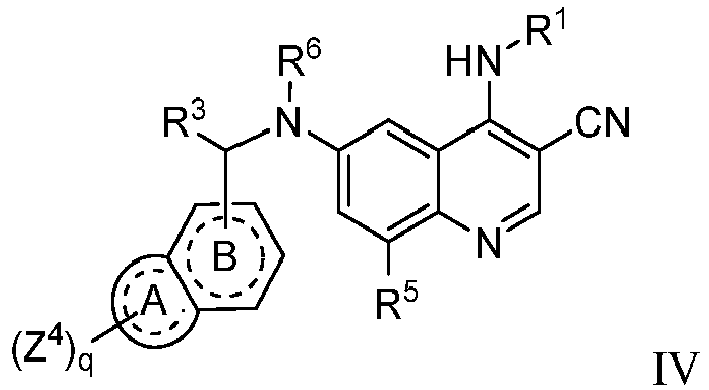
- In certain embodiments, provided is a compound of Formula IVA:

- In certain embodiments, provided is a compound of Formula V:

- In certain embodiments, provided is a compound of Formula VA:

- In certain embodiments, the compound of Formula I is represented by Formula VI:

- In certain embodiments, the compound of Formula I is represented by Formula VIA:

- In certain embodiments, the compound of Formula I is represented by Formula VII:

- In certain embodiments, the compound of Formula I is represented by Formula VIIA:

- In certain embodiments, the compound of Formula I is represented by Formula VIII or IX:

- In certain embodiments, the compound of Formula I is represented by Formula VIIIA or IXA:
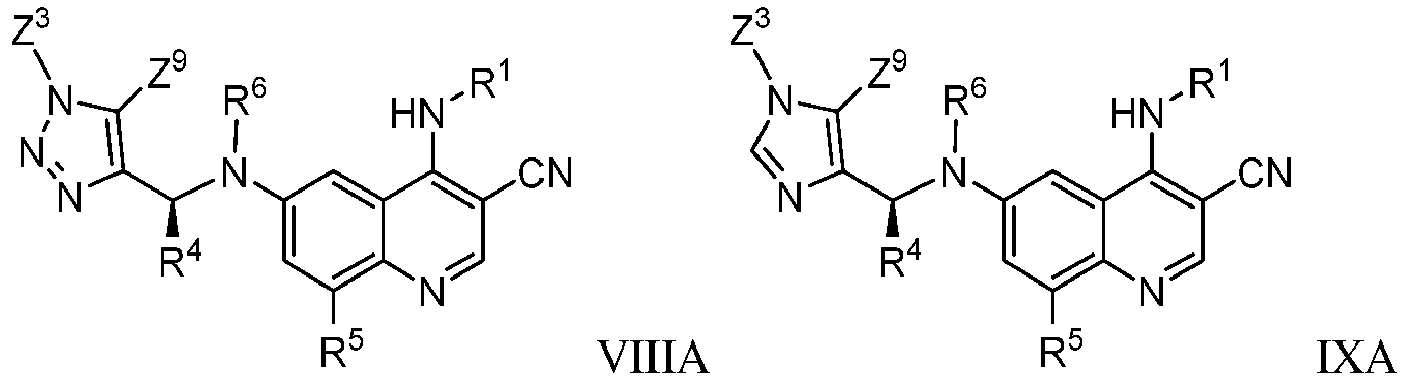
- In certain embodiments, the compound of Formula I is represented by Formula X or XI:

- In certain embodiments, the compound of Formula I is represented by Formula XA or XIA:

- In certain embodiments, R6 is hydrogen.
- In certain embodiments, Z3 is hydrogen, C1-9 alkyl, C3-15 cycloalkyl, heterocyclyl, aryl, or heteroaryl;
wherein said C1-9 alkyl, C3-15 cycloalkyl, heterocyclyl, aryl, or heteroaryl, may be optionally substituted with one to four substituents independently selected from the group consisting of -CN, halo, -O-R12, -C(O)-R12, -OC(O)-R12, -C(O)O-R12,-C(O)-N(R13)(R14), -N(R13)(R14), -N(R13)2(R14)+, -S(O)2-R12, -Si(R12)3, C1-9 alkyl, C3-15 cycloalkyl, aryl, heterocyclyl, and heteroaryl; and
wherein said C1-9 alkyl, C3-15 cycloalkyl, heterocyclyl, aryl, or heteroaryl may be optionally substituted with one to three substituents independently selected from the group consisting of halo, -O(C1-9 alkyl), -C(O)N(C1-9 alkyl)2, C1-9 alkyl, and heterocyclyl. - In certain embodiments, Z3 is hydrogen, C1-9 alkyl, C3-15 cycloalkyl, heterocyclyl, aryl, or heteroaryl;
wherein said C1-9 alkyl, C3-15 cycloalkyl, aryl, or heterocyclyl, may be optionally substituted with one to four substituents independently selected from the group consisting of -CN, halo, -O-R12, -C(O)-R12, -OC(O)-R12, -C(O)O-R12, -C(O)-N(R13)(R14), -N(R13)(R14), -N(R13)2(R14)+, -S(O)2-R12, -Si(R12)3, C1-9 alkyl, C3-15 cycloalkyl, aryl, heterocyclyl, and heteroaryl; and
wherein said C1-9 alkyl, C3-15 cycloalkyl, heterocyclyl, or aryl may be optionally substituted with one to three substituents independently selected from the group consisting of halo, -O(C1-9 alkyl), -C(O)N(C1-9 alkyl)2, C1-9 alkyl, and heterocyclyl. - In certain embodiments, Z3 is hydrogen or C1-9 alkyl;
wherein said C1-9 alkyl may be optionally substituted with one to four substituents independently selected from the group consisting of -CN, halo, -O-R12, -C(O)-R12, -OC(O)-R12, -C(O)O-R12, -C(O)-N(R13)(R14), -N(R13)(R14),-N(R13)2(R14)+, -S(O)2-R12, -Si(R12)3, C1-9 alkyl, C3-15 cycloalkyl, aryl, heterocyclyl, and heteroaryl; and
wherein said C1-9 alkyl, C3-15 cycloalkyl, heterocyclyl, or aryl may be optionally substituted with one to three substituents independently selected from the group consisting of halo, -O(C1-9 alkyl), -C(O)N(C1-9 alkyl)2, C1-9 alkyl, and heterocyclyl. - In certain embodiments, Z3 is hydrogen or C1-9 alkyl optionally substituted with one to four substituents independently selected from the group consisting of -CN, halo,-O-R12, -C(O)O-R12, -OC(O)-R12, -N(R13)(R14), -N(R13)2(R14)+, C1-9 alkyl, heterocyclyl, and heteroaryl.
- In certain embodiments, Z3 is C3-15 cycloalkyl, heterocyclyl, aryl, or heteroaryl;
wherein said C3-15 cycloalkyl, heterocyclyl, aryl, or heteroaryl, may be optionally substituted with one to four substituents independently selected from the group consisting of -CN, halo, -O-R12, -C(O)-R12, -OC(O)-R12, -C(O)O-R12, -C(O)-N(R13)(R14), -N(R13)(R14), -N(R13)2(R14)+, -S(O)2-R12, -Si(R12)3, C1-9 alkyl, C3-15 cycloalkyl, aryl, heterocyclyl, and heteroaryl; and
wherein said C1-9 alkyl, C3-15 cycloalkyl, aryl, heterocyclyl, or heteroaryl may be optionally substituted with one to three substituents independently selected from the group consisting of halo, -O(C1-9 alkyl), -C(O)N(C1-9 alkyl)2, C1-9 alkyl, and heterocyclyl. - In certain embodiments, Z3 is C3-15 cycloalkyl, heterocyclyl, aryl, or heteroaryl;
wherein said C3-15 cycloalkyl, heterocyclyl, or aryl may be optionally substituted with one to four substituents independently selected from the group consisting of -CN, halo, -O-R12, -C(O)-R12, -OC(O)-R12, -C(O)O-R12, -C(O)-N(R13)(R14),-N(R13)(R14), -N(R13)2(R14)+, -S(O)2-R12, -Si(R12)3, C1-9 alkyl, C3-15 cycloalkyl, aryl, heterocyclyl, and heteroaryl; and
wherein said C1-9 alkyl, C3-15 cycloalkyl, heterocyclyl, or aryl may be optionally substituted with one to three substituents independently selected from the group consisting of halo, -O(C1-9 alkyl), -C(O)N(C1-9 alkyl)2, C1-9 alkyl, and heterocyclyl. - In certain embodiments, Z3 is hydrogen or C1-9 alkyl optionally substituted with one to four substituents independently selected from the group consisting of-CN, halo,-O-R12, -C(O)O-R12, -OC(O)-R12, -N(R13)(R14), -N(R13)2(R14)+, -C(O)N(R12)-S(O)2R12, C1-9 alkyl, heterocyclyl, aryl, and heteroaryl.
- In certain embodiments, Z3 is hydrogen or C1-9 alkyl optionally substituted with one to four substituents independently selected from the group consisting of -CN, halo,-O-R12, -C(O)O-R12, -OC(O)-R12, -N(R13)(R14), -N(R13)2(R14)+, C1-9 alkyl, heterocyclyl, and heteroaryl.
- In certain embodiments, Z3 is C3-15 cycloalkyl, heterocyclyl, aryl, or heteroaryl; and said C3-15 cycloalkyl, heterocyclyl, aryl, or heteroaryl may be optionally substituted with one to four substituents independently selected from the group consisting of -CN, halo, -O-R12, -C(O)-R12, -C(O)O-R12, -OC(O)-R12, -N(R13)(R14), -N(R13)2(R14)+, C1-9 alkyl, C1-8 haloalkyl, C1-8 hydroxyalkyl, C3-15 cycloalkyl, heterocyclyl, and heteroaryl.
- In certain embodiments, Z3 is C3-15 cycloalkyl, heterocyclyl, aryl, or heteroaryl; and said C3-15 cycloalkyl, heterocyclyl, aryl, or heteroaryl may be optionally substituted with one to four substituents independently selected from the group consisting of -CN, halo, -O-R12, -C(O)O-R12, -OC(O)-R12, -N(R13)(R14), -N(R13)2(R14)+, C1-9 alkyl, heterocyclyl, and heteroaryl.
- In certain embodiments, Z3 is hydrogen, C1-9 alkyl, C3-15 cycloalkyl, heterocyclyl, aryl, or heteroaryl;
wherein said C1-9 alkyl, C3-15 cycloalkyl, or heterocyclyl may be optionally substituted with one to four substituents independently selected from the group consisting of oxo, -CN, halo, -O-R12, -C(O)-R12, -C(O)O-R12, -OC(O)-R12, -C(O)-N(R13)(R14), -N(R12)S(O)2(R12) -N(R13)(R14), -N(R13)2(R14)+, -C(O)N(R12)-S(O)2R12, C1-9 alkyl, C1-8 haloalkyl, C1-8 hydroxyalkyl, C3-15 cycloalkyl, aryl, heterocyclyl, and heteroaryl;
Z9 is hydrogen;
R1 is C1-9 alkyl, C3-15 cycloalkyl, heterocyclyl, aryl, or heteroaryl;
wherein said C1-9 alkyl, heterocyclyl, aryl, or heteroaryl may be optionally substituted with one to three substituents independently selected the group consisting of halo, -CN, -O-R12, -S(O)2R12, C1-9 alkyl, C1-9 haloalkyl, heterocyclyl, and aryl, wherein said C3-15 cycloalkyl may be optionally substituted with one to four substituents independently selected the group consisting of C1-9 alkyl, and C1-9 haloalkyl;
R4 is heterocyclyl or heteroaryl;
wherein said heterocyclyl or heteroaryl is optionally substituted with one to three substituents independently selected from the group consisting of -CN, halo, -O-R12, -C(O)-R12, -N(R13)(R14), C1-9 alkyl, C1-9 haloalkyl, and heterocyclyl;
R5 is -CN, halo, -O-R7 or -S(O)2R7;
R6 is hydrogen;
each R7 is independently hydrogen or C1-9 alkyl;
wherein said C1-9 alkyl may be optionally substituted with one to three substituents independently selected from the group consisting of hydroxyl, halo,-O(C1-9 alkyl) and aryl;
each R12 is independently hydrogen, C1-9 alkyl or heterocyclyl;
wherein said C1-9 alkyl may be optionally substituted with one to three substituents independently selected from the group consisting of hydroxyl, halo,-O(C1-9 alkyl) and aryl; and
each R13 and R14 is independently hydrogen or C1-9 alkyl;
wherein said C1-9 alkyl may be optionally substituted with one to three substituents independently selected from the group consisting of hydroxyl, halo,-O(C1-9 alkyl) and aryl;
or a pharmaceutically acceptable salt, tautomer, stereoisomer, mixture of stereoisomers, or deuterated analog thereof. - In certain embodiments, Z3 is hydrogen, C1-9 alkyl, C3-15 cycloalkyl, heterocyclyl, aryl, or heteroaryl;
wherein said C1-9 alkyl, or heterocyclyl may be optionally substituted with one to four substituents independently selected from the group consisting of -CN, halo,-O-R12, -C(O)O-R12, -OC(O)-R12, -N(R13)(R14), -N(R13)2(R14)+, C1-9 alkyl, heterocyclyl, and heteroaryl;
R1 is C1-9 alkyl, C3-15 cycloalkyl, heterocyclyl, aryl, or heteroaryl;
wherein said C1-9 alkyl, heterocyclyl, aryl, or heteroaryl may be optionally substituted with one to three substituents independently selected the group consisting of halo, -CN, -O-R12, C1-9 alkyl and aryl;
R4 is heterocyclyl or heteroaryl;
wherein said heterocyclyl or heteroaryl is optionally substituted with one to three substituents independently selected from the group consisting of -CN, halo, -O-R12, -C(O)-R12, C1-9 alkyl, C1-9 haloalkyl, and heterocyclyl;
R5 is -CN, halo, or -O-R7;
R6 is hydrogen;
each R7 is independently hydrogen or C1-9 alkyl;
wherein said C1-9 alkyl may be optionally substituted with one to three substituents independently selected from the group consisting of hydroxyl, halo,-O(C1-9 alkyl) and aryl;
each R12 is independently hydrogen or C1-9 alkyl;
wherein said C1-9 alkyl may be optionally substituted with one to three substituents independently selected from the group consisting of hydroxyl, halo,-O(C1-9 alkyl) and aryl; and
each R13 and R14 is independently hydrogen or C1-9 alkyl;
wherein said C1-9 alkyl may be optionally substituted with one to three substituents independently selected from the group consisting of hydroxyl, halo,-O(C1-9 alkyl) and aryl;
or a pharmaceutically acceptable salt, tautomer, stereoisomer, mixture of stereoisomers, prodrug, or deuterated analog thereof. - In certain embodiments, Z3 is hydrogen, C1-9 alkyl, C3-15 cycloalkyl, heterocyclyl, aryl, or heteroaryl;
wherein said C1-9 alkyl, C3-15 cycloalkyl, or heterocyclyl may be optionally substituted with one to four substituents independently selected from the group consisting of oxo, -CN, halo, -O-R12, -C(O)-R12, -C(O)O-R12, -OC(O)-R12, -C(O)-N(R13)(R14), -N(R12)S(O)2(R12), -N(R13)(R14), -N(R13)2(R14)+, C1-9 alkyl, C3-15 cycloalkyl, aryl, heterocyclyl, and heteroaryl;
wherein said C1-9 alkyl may be optionally substituted with one to four substituents independently selected from the group consisting of halo and hydroxyl.
R1 is C1-9 alkyl, C3-15 cycloalkyl, heterocyclyl, aryl, or heteroaryl;
wherein said C1-9 alkyl, heterocyclyl, aryl, or heteroaryl may be optionally substituted with one to three substituents independently selected the group consisting of halo, -CN, -O-R12, C1-9 alkyl and aryl;
R4 is heterocyclyl or heteroaryl;
wherein said heterocyclyl or heteroaryl is optionally substituted with one to three substituents independently selected from the group consisting of -CN, halo, -O-R12, -C(O)-R12, -N(R13)(R14), C1-9 alkyl, C1-9 haloalkyl, and heterocyclyl;
R5 is -CN, halo, -O-R7 or -S(O)2R7;
R6 is hydrogen;
each R7 is independently hydrogen or C1-9 alkyl;
wherein said C1-9 alkyl may be optionally substituted with one to three substituents independently selected from the group consisting of hydroxyl, halo,-O(C1-9 alkyl) and aryl;
each R12 is independently hydrogen, C1-9 alkyl or heterocyclyl;
wherein said C1-9 alkyl may be optionally substituted with one to three substituents independently selected from the group consisting of hydroxyl, halo,-O(C1-9 alkyl) and aryl; and
each R13 and R14 is independently hydrogen or C1-9 alkyl;
wherein said C1-9 alkyl may be optionally substituted with one to three substituents independently selected from the group consisting of hydroxyl, halo,-O(C1-9 alkyl) and aryl;
or a pharmaceutically acceptable salt, tautomer, stereoisomer, mixture of stereoisomers, or deuterated analog thereof. - In certain embodiments, Z3 is C3-15 cycloalkyl optionally substituted with one to four substituents independently selected from the group consisting of -CN, halo, -C(O)-R12, -OC(O)-R12, -C(O)N(R13)(R14), C1-9 alkyl, C1-8 haloalkyl, C1-8 hydroxyalkyl, C3-15 cycloalkyl, and heteroaryl.
- In certain embodiments, Z3 is heterocyclyl optionally substituted with one to four substituents independently selected from the group consisting of -O-R12, -C(O)O-R12, C1-9 alkyl, C1-8 haloalkyl, C1-8 hydroxyalkyl, and heterocyclyl.
- In certain embodiments, R1 is C1-9 alkyl, C3-15 cycloalkyl, heterocyclyl, aryl, or heteroaryl; and said C1-9 alkyl, C3-15 cycloalkyl, heterocyclyl, aryl, or heteroaryl may be optionally substituted with one to four substituents independently selected the group consisting of halo, -CN, -O-R12, C1-9 alkyl, and aryl.
- In certain embodiments, R1 is -O-R7, C1-9 alkyl, C3-15 cycloalkyl, heterocyclyl, aryl, or heteroaryl; and said C1-9 alkyl, C3-15 cycloalkyl, heterocyclyl, aryl, or heteroaryl may be optionally substituted with one to four substituents independently selected the group consisting of halo, -CN, -O-R12, -S(O)2R12, C1-9 alkyl, C1-9 haloalkyl, C3-15 cycloalkyl, heterocyclyl, and aryl, wherein said C3-15 cycloalkyl may be optionally substituted with one to four substituents independently selected the group consisting of C1-9 alkyl, and C1-9 haloalkyl.
- In certain embodiments, R1 is -O-R7, C1-9 alkyl, C3-15 cycloalkyl, heterocyclyl, aryl, or heteroaryl; and said C1-9 alkyl, C3-15 cycloalkyl, heterocyclyl, aryl, or heteroaryl may be optionally substituted with one to four substituents independently selected the group consisting of halo, -CN, -O-R12, C1-9 alkyl, C3-15 cycloalkyl, and aryl. In certain embodiments, R1 is C1-9 alkyl, optionally substituted with one to three substituents independently selected the group consisting of halo, -CN, -O-R12, -S(O)2R12, C3-15 cycloalkyl, heterocyclyl, and aryl, wherein said C3-15 cycloalkyl or heterocyclyl may be optionally substituted with one to four substituents independently selected the group consisting of C1-9 alkyl, and C1-9 haloalkyl.
- In certain embodiments, R1 is C1-9 alkyl, optionally substituted with one to three substituents independently selected the group consisting of halo, -CN, -O-R12, C1-9 alkyl, and aryl.
In certain embodiments, R1 is C3-15 cycloalkyl, heterocyclyl, or heteroaryl;
wherein said C3-15 cycloalkyl, heterocyclyl, or heteroaryl may be optionally substituted with one to three substituents independently selected from the group consisting of -CN, halo, -O-R12, -N(R13)(R14), -NH-C(O)O-R12, -S(O)2-R12,-Si(R12)3, C1-9 alkyl, C3-15 cycloalkyl, heterocyclyl, aryl, and heteroaryl; and
wherein said C1-9 alkyl, C3-15 cycloalkyl, aryl, or heteroaryl may be optionally substituted with one to three substituents independently selected from the group consisting of -CN, halo, -O-R12, -N(R13)(R14), C1-9 alkyl, C3-15 cycloalkyl, and aryl. - In certain embodiments, R1 is C3-15 cycloalkyl, heterocyclyl or heteroaryl, wherein said C3-15 cycloalkyl, heterocyclyl or heteroaryl is optionally substituted with one to three substituents independently selected the group consisting of halo, -CN, -O-R12, C1-9 alkyl, and aryl.
- In certain embodiments, R1 is R1 is heterocyclyl or heteroaryl, wherein said heterocyclyl or heteroaryl is optionally substituted with one to three substituents independently selected the group consisting of halo, and C1-9 alkyl.
- In certain embodiments, R1 is aryl;
wherein said aryl may be optionally substituted with one to three substituents independently selected from the group consisting of -CN, halo, -O-R12,-N(R13)(R14), -NH-C(O)O-R12, -S(O)2-R12, -Si(R12)3, C1-9 alkyl, C3-15 cycloalkyl, heterocyclyl, aryl, and heteroaryl; and
wherein said C1-9 alkyl, C3-15 cycloalkyl, aryl, or heteroaryl may be optionally substituted with one to three substituents independently selected from the group consisting of -CN, halo, -O-R12, -N(R13)(R14), C1-9 alkyl, C3-15 cycloalkyl, and aryl. - In certain embodiments, R1 is aryl, optionally substituted with one to three substituents independently selected the group consisting of halo, -CN, -O-R7, C1-9 alkyl, and aryl.
- In certain embodiments, R1 is aryl, optionally substituted with one to three substituents independently selected the group consisting of halo, - O-R7, and C1-9 alkyl.
- In one embodiment, R1 is (1S,3S,5S,7S)-adamantan-2-yl, (R)-1-phenylethyl, (R)-1-phenylpropyl, (R)-1-pbenylpropyl-1,2,2,3,3,3-d6, (R)-1-phenylpropyl-2,2,3,3,3-d5, (R)-2-cyano-1-phenylethyl, (R)-2-hydroxy-1-phenylethyl, (R)-2-hydroxy-2-methyl-1-phenylpropyl, (R)-2-methoxy-1-phenylethyl, (R)-3-cyano-1-phenylpropyl, (R)-3-fluoro-1-phenylpropyl, (R)-3-hydroxy-1-phenylpropyl, (S)-1-phenylpropyl-2,2,3,3,3-d5, (S)-2-cyano-1-phenylethyl, (S)-2-hydroxy-1-phenylethyl, (S)-2-hydroxy-2-methyl-1-phenylpropyl, (S)-3-cyano-1-phenylpropyl, (S)-3-hydroxy-1-phenylpropyl, 1-phenylpropyl-2,2,3,3,3-d5, 2-cyano-1-phenylethyl, 3,3-dimethyltetrahydro-2H-pyran-4-yl, 3,4-dichloro-2-fluorophenyl, 3,4-difluorophenyl, 3-chloro-2,6-difluorophenyl, 3-chloro-2-fluorophenyl, 3-chloro-2-methoxyphenyl, 3-chloro-4-fluorophenyl, 3-chloro-4-methoxyphenyl, 3-chlorophenyl, 3-cyano-1-phenylpropyl, 5,6-difluoropyridin-3-yl, 5-chloro-6-fluoropyridin-3-yl, 5-chloropyridin-3-yl, cycloheptyl, cyclohexyl, neopentyl, neopentyl-1,1-d2, (1-(difluoromethyl)cyclopropyl)methyl, (1-methylcyclobutyl)methyl, (1R,5S)-bicyclo[3.1.0]hexan-6-yl, (1R,5S,6r)-3-oxabicyclo[3.1.0]hexan-6-yl, (R)-2,2-dimethyltetrahydrofuran-3-yl, (R)-3,3-dimethylbutan-2-yl, (R)-3,3-dimethyltetrahydro-2H-pyran-4-yl, (R)-cyclopropyl(phenyl)methyl, (S)-2,2-dimethyltetrahydrofuran-3-yl, (S)-3,3-dimethyltetrahydro-2H-pyran-4-yl, 2,2-dimethylpropyl-1,1-d2, 2,2-dimethyltetrahydrofuran-3-yl, 2-cyano-2-methylpropyl, 2-methyl-2-phenylpropyl, 3-chloro-2,2-dimethylpropyl, 3-cyano-2,2-dimethylpropyl, 3-hydroxy-2,2-dimethylpropyl, tert-butoxy, or tetrahydro-2H-pyran-4-yl.
- In one embodiment, R1 is (1S,3S,5S,7S)-adamantan-2-yl, (R)-1-phenylethyl, (R)-1-phenylpropyl, (R)-1-pbenylpropyl-1,2,2,3,3,3-d6, (R)-1-phenylpropyl-2,2,3,3,3-d5, (R)-2-cyano-1-phenylethyl, (R)-2-hydroxy-1-phenylethyl, (R)-2-hydroxy-2-methyl-1-phenylpropyl, (R)-2-methoxy-1-phenylethyl, (R)-3-cyano-1-phenylpropyl, (R)-3-fluoro-1-phenylpropyl, (R)-3-hydroxy-1-phenylpropyl, (S)-1-phenylpropyl-2,2,3,3,3-d5, (S)-2-cyano-1-phenylethyl, (S)-2-hydroxy-1-phenylethyl, (S)-2-hydroxy-2-methyl-1-phenylpropyl, (S)-3-cyano-1-phenylpropyl, (S)-3-hydroxy-1-phenylpropyl, 1-phenylpropyl-2,2,3,3,3-d5, 2-cyano-1-phenylethyl, 3,3-dimethyltetrahydro-2H-pyran-4-yl, 3,4-dichloro-2-fluorophenyl, 3,4-difluorophenyl, 3-chloro-2,6-difluorophenyl, 3-chloro-2-fluorophenyl, 3-chloro-2-methoxyphenyl, 3-chloro-4-fluorophenyl, 3-chloro-4-methoxyphenyl, 3-chlorophenyl, 3-cyano-1-phenylpropyl, 5,6-difluoropyridin-3-yl, 5-chloro-6-fluoropyridin-3-yl, 5-chloropyridin-3-y, cycloheptyl, cyclohexyl, neopentyl, neopentyl-1,1-d2, or tetrahydro-2H-pyran-4-yl.
- In another embodiment, R1 is (R)-1-phenylethyl, (R)-1-phenylpropyl, 3,4-dichloro-2-fluorophenyl, 3-chloro-2-fluorophenyl, 3-chloro-4-fluorophenyl, 5,6-difluoropyridin-3-yl, or neopentyl.
- In one embodiment, R2 is hydrogen. In one embodiment, R2 is C1-6 alkyl. In one embodiment, R2 is methyl.
- In one embodiment, R1 and R2 together with the nitrogen atom to which they are attached form a heterocyclyl or heterocyclyl. In certain embodiments, R1 and R2 together with the nitrogen to which they are attached to form a heterocyclyl or heteroaryl, wherein said heterocyclyl may be optionally substituted with one to three C1-9 alkyl. In certain embodiments, R1 and R2 together with the nitrogen atom to which they are attached form an optionally substituted pyrazolyl. In certain embodiments, R1 and R2 together with the nitrogen atom to which they are attached form 3,3-dimethylpiperidin-1-yl.
- In one embodiment, R3 is heterocyclyl or heteroaryl, wherein each heterocyclyl or heteroaryl is optionally substituted with one or more substituents (i.e., Z3) selected from the group consisting of (1R,5S,6r)-3-(oxetan-3-yl)-3-azabicyclo[3.1.0]hexan-6-yl, (1R,5S,6s)-3-(oxetan-3-yl)-3-azabicyclo[3.1.0]hexan-6-yl, (1R,5S,6s)-3-azabicyclo[3.1.0]hexan-6-yl, (3-hydroxyoxetan-3-yl)methyl, (R)-1,1,1-trifluoropropan-2-yl, (R)-1-ethylpyrrolidin-3-yl, (R)-pyrrolidin-3-yl, (S)-1-fluoropropan-2-yl, 1-((benzyloxy)carbonyl)piperid-4-yl, 1-((benzyloxy)carbonyl)pyrrolidin-4-yl, 1-((tert-butyloxy)carbonyl)methyl, 1-((tert-butyloxy)carbonyl)piperid-4-yl, oxetan-3-yl, 1-(oxetan-3-yl)piperidin-4-yl, 1-(tert-butyl)piperidin-4-yl, 1,1-difluoro-2-hydroxyethyl, 1-ethylpiperidin-4-yl, 1-propylpiperidin-4-yl, 2-(2-hydroxyethoxy)ethyl, 2-(2-methoxyethoxy)ethyl, 2-(diethyl(methyl)ammonio)ethyl, 2-(dimethylamino)ethyl, 2-(piperidin-1-yl)ethyl, 2,2,2-trifluoroethyl, 2,2,6,6-tetramethylpiperidin-4-yl, 2-aminoethyl, 2-fluoroethyl, 2-hydroxyethyl, 2-methoxyethyl, 2-morpholinoethyl, 3-(dimethylamino)propyl, 3-(pyrrolidin-1-yl)propyl, carboxymethyl, cyanomethyl, cyclopentyl, cyclopropyl, hydrogen, isopropyl, methyl, oxetan-3-yl, phenyl, piperidin-4-yl, pyridin-2-ylmethyl, pyridin-3-yl, (1R,2S)-2-fluorocyclopropyl, [1,1'-bi(cyclopropan)]-1-yl, 1-(difluoromethyl)cyclopropyl, 1-(fluoromethyl)cyclopropyl, 1-(hydroxymethyl)cyclopropyl, 1-(morpholine-4-carbonyl)cycloprop-1-yl, 1-(pyridin-4-yl)cyclopropyl, 1-(pyrrolidine-1-carbonyl)cycloprop-1-yl, 1-(trifluoromethyl)cyclopropyl, 1,1,1-trifluoro-2-methylpropan-2-yl, 1,1-difluoro-2-methylpropan-2-yl, 1-carbamoylcyclobut-1-yl, 1-carbamoylcycloprop-1-yl, 1-carboxycyclopropyl, 1-cyanocyclobutyl, 1-cyanocyclopropyl, 1-fluoro-2-methylpropan-2-yl, 1-methylcyclopropyl, 1-N,N-dimethylcarbamoylcycloprop-1-yl, 2-(methylsulfonamido)-2-oxoethyl, 2,2-difluoroethyl, 2,6-difluorobenzyl, 3-(hydroxymethyl)oxetan-3-yl, 3-(trifluoromethyl)oxetan-3-yl, 3,3-difluoro-1-(carboxy)cyclobut-1-yl, 3,3-difluorocyclobutyl, bicyclo[1.1.1]pentan-1-yl, chloro, cyano, fluoro, iodo, or tert-butyl.
- In one embodiment, R3 is heterocyclyl or heteroaryl, wherein each heterocyclyl or heteroaryl is optionally substituted with one or more substituents (i.e., Z3) selected from the group consisting of (1R,5S,6r)-3-(oxetan-3-yl)-3-azabicyclo[3.1.0]bexan-6-yl, (1R,5S,6s)-3-(oxetan-3-yl)-3-azabicyclo[3.1.0]hexan-6-yl, (1R,5S,6s)-3-azabicyclo[3.1.0]hexan-6-yl, (3-hydroxyoxetan-3-yl)methyl, (R)-1,1,1 -trifluoropropan-2-yl, (R)-1-ethylpyrrolidin-3-yl, (R)-pyrrolidin-3-yl, (S)-1-fluoropropan-2-yl, 1-((benzyloxy)carbonyl)piperid-4-yl, 1-((benzyloxy)carbonyl)pyrrolidin-4-yl, 1-((tert-butyloxy)carbonyl)methyl, 1-((tert-butyloxy)carbonyl)piperid-4-yl, oxetan-3-yl, 1-(oxetan-3-yl)piperidin-4-yl, 1-(tert-butyl)piperidin-4-yl, 1,1-difluoro-2-hydroxyethyl, 1-ethylpiperidin-4-yl, 1-propylpiperidin-4-yl, 2-(2-hydroxyethoxy)ethyl, 2-(2-methoxyethoxy)ethyl, 2-(diethyl(methyl)ammonio)ethyl, 2-(dimethylamino)ethyl, 2-(piperidin-1-yl)ethyl, 2,2,2-trifluoroethyl, 2,2,6,6-tetramethylpiperidin-4-yl, 2-aminoethyl, 2-fluoroethyl, 2-hydroxyethyl, 2-methoxyethyl, 2-morpholinoethyl, 3-(dimethylamino)propyl, 3-(pyrrolidin-1-yl)propyl, carboxymethyl, cyanomethyl, cyclopentyl, cyclopropyl, hydrogen, isopropyl, methyl, oxetan-3-yl, phenyl, phenyl, piperidin-4-yl, pyridin-2-ylmethyl, pyridin-3-yl, or tert-butyl.
- In another embodiment, R3 is heterocyclyl or heteroaryl, wherein each heterocyclyl or heteroaryl is optionally substituted with one or more substituents (i.e., Z3) selected from the group consisting of hydrogen, isopropyl, methyl, oxetan-3-yl, 1-(tert-butyl)piperidin-4-yl, 1-ethylpiperidin-4-yl, cyclopropyl, 1-(trifluoromethyl)cyclopropyl, 1-(difluoromethyl)cyclopropyl, 1-(fluoromethyl)cyclopropyl, 1-cyanocyclopropyl, or piperidin-4-yl.
- In another embodiment, R3 is heterocyclyl or heteroaryl, wherein each heterocyclyl or heteroaryl is optionally substituted with one or more substituents (i.e., Z3) selected from the group consisting of hydrogen, isopropyl, methyl, oxetan-3-yl, 1-(tert-butyl)piperidin-4-yl, 1-ethylpiperidin-4-yl, cyclopropyl, or piperidin-4-yl.
- In one embodiment, R3 is triazolyl, pyrazolyl, isoxazolyl, isoxazolyl, oxazolyl, pyrazinyl, pyridinyl, pyrimidinyl, imidazolyl, thiadiazolyl, tetrazolyl, or oxadiazolyl, wherein each is optionally substituted by one or more Z3 groups as described herein. In one embodiment, R3 is optionally substituted triazole (e.g., 1H-1,2,3-triazolyl).
- In certain embodiments, R3 is triazole substituted with one or more substituents selected from the group consisting of 1-(benzyloxycarbonyl)piperidin-4-yl, 1-(tert-butyl)piperidin-4-yl, 1-ethylpiperidin-4-yl, cyclopropyl, isopropyl, methyl, and piperidin-4-yl.
- In one embodiment, R4 is heterocyclyl or heteroaryl; and said heterocyclyl or heteroaryl is optionally substituted with one to three substituents independently selected from the group consisting of -CN, halo, -O-R12, -C(O)-R12, C1-6 alkyl, C1-6 haloalkyl, and heterocyclyl.
- In certain embodiments, R4 is heteroaryl optionally substituted with one to three substituents independently selected from the group consisting of -CN, halo, -O-R12,-C(O)-R12, C1-9 alkyl, C1-9 haloalkyl, and heterocyclyl.
- In certain embodiments, R4 is heterocyclyl optionally substituted with one to three substituents independently selected from the group consisting of -CN, halo, -O-R12, -C(O)-R12, C1-9 alkyl, C1-9 haloalkyl, and heterocyclyl.
- In certain embodiments, R4 is heteroaryl optionally substituted with one to three substituents independently selected from the group consisting of -CN, halo, -O-R12,-C(O)-R12, -N(R13)(R14), C1-9 alkyl, C1-9 haloalkyl, and heterocyclyl.
- In certain embodiments, R4 is heterocyclyl optionally substituted with one to three substituents independently selected from the group consisting of -CN, halo, -O-R12, -C(O)-R12, -N(R13)(R14), C1-9 alkyl, C1-9 haloalkyl, and heterocyclyl.
- In certain embodiments, R4 is optionally substituted bicyclic heterocyclyl or optionally substituted bicyclic heteroaryl. In certain embodiments, R4 is

- In certain embodiments, R4 is optionally substituted bicyclic heteroaryl. In certain embodiments, R4 is an optionally substituted bicyclic heteroaryl selected from the group consisting of


- R4 is





- In certain embodiments, R4 is


- In certain embodiments, the compound of Formula I is represented by Formula XII:

- Wherein q, Z3, R1, Z4, R5, and R6 are as defined herein, ring A ia a 5- or 6-membered heterocyclyl or heteroaryl and and Z9 is hydrogen, halo, -CN, or -O-R12. In certain embodiments, the compound of Formula I is represented by Formula XIIA:

- In certain embodiments, the compound of Formula I is represented by Formula XIII:


- In certain embodiments, the compound of Formula I is represented by Formula XIIIB:

- In certain embodiments, the compound of Formula I is represented by Formula XIIIC:

- In certain embodiments, the compound of Formula I is represented by Formula XIIID:

- In certain embodiments, each Z4 is independently selected from the group consisting of -CN, halo, -O-R12, -C(O)-R12, -N(R13)(R14), C1-9 alkyl, C1-9 haloalkyl, and heterocyclyl. In some embodiments, each Z4 is independently selected from the group consisting of -CN, halo, -O-R12, and C1-9 alkyl.
- In certain embodiments, R4 is optionally substituted monocyclic heteroaryl. In certain embodiments, R4 is


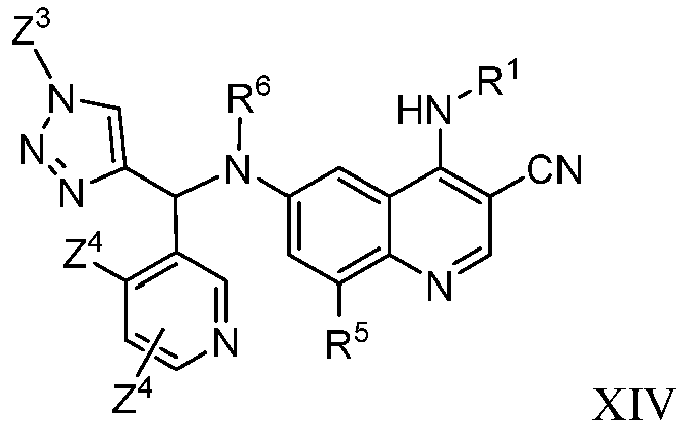

- In certain embodiments, Z3 is


- In certain embodiments, each Z4 is independently selected from the group consisting of-CN, halo, -O-R12, -C(O)-R12, -N(R13)(R14), C1-9 alkyl, C1-9 haloalkyl, and heterocyclyl. In some embodiments, each Z4 is independently selected from the group consisting of -CN, halo, -O-R12, and C1-9 alkyl. In certain embodiments of compounds of Formula IX or X, R1 is C1-9 alkyl, optionally substituted with one to three substituents independently selected the group consisting of halo, -CN, -O-R12, C1-9 alkyl, and aryl. In certain embodiments of compounds of Formula IX or X, R6 is hydrogen. In certain embodiments of compounds of Formula IX or X, R5 is halo or cyano.
- In one embodiment, R4 is






- In one embodiment, R4 is


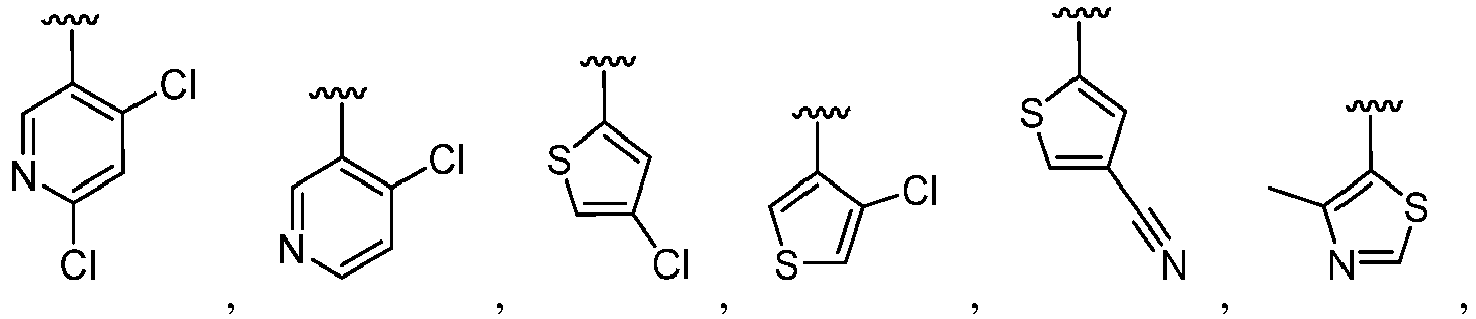


- In one embodiment, R4 is








- In one embodiment, R4 is


- In one embodiment, R4 is


- In certain embodiments, R4 is


- In certain embodiments, R5 is hydrogen, halo, -CN, -O-R7, -S(O)-R7, -S(O)2R7, - S(O)2N(R7)2, -C(O)R7, -C(O)N(R7)2, C1-9 alkyl, C2-6 alkenyl, C2-6 alkynyl, C3-15 cycloalkyl, aryl, heterocyclyl, or heteroaryl; wherein each C1-9 alkyl, C2-6 alkenyl, C2-6 alkynyl, C3-15 cycloalkyl, aryl, heterocyclyl, and heteroaryl may be optionally substituted with one to four Z5.
- In certain embodiments, R5 is hydrogen, halo, -CN, -C(O)R7, or heteroaryl. In one embodiment, R5 is -CN, halo or -O-R7. In certain embodiments, R5 is hydrogen, halo, -CN, -C(O)R7, -O-R7, -S(O)2R7 or heteroaryl. In one embodiment, R5 is halo.
- In certain embodiments, R5 is 1H-pyrazol-4-yl, 1-hydroxyethyl, 1-methyl-1H-pyrazol-4-yl, 4-(acetylamino)phenyl, 6-fluoropyridin-3-yl, methyl acetyl, bromo, chloro, cyano, cyclopropyl, dimethylaminocarbonyl, ethynyl, fluoro, iodo, methoxy, methyl, hydroxyl, phenyl, pyridin-3-yl, pyridin-4-yl, pyrimidin-5-yl, acetyl, methylsulfonyl or trifluoromethyl. In one embodiment, R5 is chloro.
- In one embodiment, m is 0. In another embodiment, m is 1.
- In general, the specific compounds exemplified herein are named using ChemBioDraw Ultra. However, it is understood that other names may be used to identify compounds of the same structure. In particular, the compounds may also be named using other nomenclature systems and symbols that are commonly recognized in the art of chemistry including, for example, Chemical Abstract Service (CAS) and International Union of Pure and Applied Chemistry (IUPAC). Other compounds or radicals may be named with common names, or systematic or non-systematic names.
- In certain embodiments, provided are optical isomers, racemates, or other mixtures thereof of the compounds described herein or pharmaceutically acceptable salts or a mixture thereof. In those situations, the single enantiomer or diastereomer, i.e., optically active form, can be obtained by asymmetric synthesis or by resolution. Resolution can be accomplished, for example, by conventional methods such as crystallization in the presence of a resolving agent, or chromatography, using for example, a chiral high pressure liquid chromatography (HPLC) column.
- Compositions provided herein that include a compound described herein or pharmaceutically acceptable salts, isomer, or a mixture thereof may include racemic mixtures, or mixtures containing an enantiomeric excess of one enantiomer or single diastereomers or diastereomeric mixtures. All such isomeric forms of these compounds are expressly included herein the same as if each and every isomeric form were specifically and individually listed.
- A composition comprising a mixture of enantiomers (or diastereomers) of a compound described herein or a pharmaceutically acceptable salt thereof, is also provided herein. In some embodiments, the composition comprises a single enantiomer of the compound and is substantially free of the other enantiomer. In certain embodiments, the compound of Formula I (or another Formula as described herein) contains one or more additional stereogenic atom(s) (e.g., at R1 and/or R3). In such instances, the composition may contain a mixture of diastereomers. In some embodiments, the composition comprises a single enantiomer of the compound and is substantially free (i.e., having less than or about 40%, 30%, 25%, 20%, 15%, 10%, 5%, 1%, 0.05%, or 0.01%) of one or more diastereomers.
- Accordingly, in certain embodiments, provided is a composition comprising a mixture of Formula IA, or a pharmaceutically acceptable salt thereof, and Formula IB, or a pharmaceutically acceptable salt thereof.

- In one embodiment, the mixture is a racemic mixture. In other embodiments, the composition comprises a mixture of Formula IA, or a pharmaceutically acceptable salt thereof, and Formula IB, or a pharmaceutically acceptable salt thereof, wherein Formula IA is present in excess of over Formula IB, or a pharmaceutically acceptable salt thereof. In certain embodiments, provided is a composition substantially free of Formula IB, having less than or about 40%, 30%, 25%, 20%, 15%, 10%, 5%, 1%, 0.05%, or 0.01% of compounds of Formula IB.
- In certain embodiments, provided here in is a composition comprising a mixture of stereoisomers of a compound of Formula I:


- The stereochemistry of the R4 group depicted in Formula IA may be represented in an alternative way, provided that the configuration of the carbon atom to which it is attached is not altered. For example, compounds of Formula 1A may be depicted in any one of the equivalent representations of Formula IA shown below.

- In other embodiments, the mixture comprises compounds of Formula IA and IB in a a molar ratio of at least or about 3:1, at least or about 4:1, at least or about 5:1, at least or about 6:1, at least or about 7:1, at least or about 8:1, at least or about 9:1, at least or about 10:1, at least or about 11:1, at least or about 12:1, at least or about 20:1, at least or about 30:1, at least or about 40:1, at least or about 80:1, at least or about 160:1, or at least or about 320:1, respectively.
- In certain embodiments, provided are also chelates, non-covalent complexes, and mixtures thereof, of the compounds described herein or a pharmaceutically acceptable salt, tautomer, stereoisomer, mixture of stereoisomers, prodrug, or deuterated analog thereof. A "chelate" is formed by the coordination of a compound to a metal ion at two (or more) points. A "non-covalent complex" is formed by the interaction of a compound and another molecule wherein a covalent bond is not formed between the compound and the molecule. For example, complexation can occur through van der Waals interactions, hydrogen bonding, and electrostatic interactions (also called ionic bonding).
- In certain embodiments, provided are prodrugs of the compounds described herein. "Prodrug" refers to any compound that when administered to a biological system generates the drug substance, or active ingredient, as a result of spontaneous chemical reaction(s), enzyme catalyzed chemical reaction(s), photolysis, and/or metabolic chemical reaction(s). A prodrug is thus a covalently modified analog or latent form of a therapeutically active compound. Non-limiting examples of prodrugs include ester moieties, quaternary ammonium moieties, glycol moieties, and the like.
- In certain embodiments, provided is a compound of Formula I, IA, IB, II, IIA, III, IIIA, IV, IVA, V, VA, VI, VIA, VII, VIIA, VIII, VIIIA, IX, IXA, X, XA,XI, XIA, XII, XIIA, XIII, XIIIA, XIV, or XIVA, wherein R6 is


- where each R12 is independently hydrogen, C1-9 alkyl, C2-6 alkenyl, C2-6 alkynyl, C3-15 cycloalkyl, aryl, heteroaryl or heterocyclyl;
wherein any alkyl, alkenyl, alkynyl, cycloalkyl, aryl, heteroaryl or heterocyclyl is optionally substituted with one to four Z1b groups; and - each Z1b is independently oxo, thioxo, hydroxy, halo, -NO2, -N3, -CN, C1-9 alkyl, C2-6 alkenyl, C2-6 alkynyl, C3-15 cycloalkyl, C1-8 haloalkyl, aryl, heteroaryl, heterocyclyl, -O(C1-9 alkyl), -O(C2-6 alkenyl), -O(C2-6 alkynyl), -O(C3-15 cycloalkyl), -O(C1-8 haloalkyl), -O(aryl), -O(heteroaryl), - O(heterocyclyl), -NH2, -NH(C1-9 alkyl), -NH(C2-6 alkenyl), -NH(C2-6 alkynyl), -NH(C3-15 cycloalkyl), -NH(C1-8 haloalkyl), -NH(aryl), -NH(heteroaryl), -NH(heterocyclyl), -N(C1-9 alkyl)2, -N(C3-15 cycloalkyl)2, -N(C2-6 alkenyl)2, -N(C2-6 alkynyl)2, -N(C3-15 cycloalkyl)2, -N(C1-8 haloalkyl)2, -N(aryl)2, -N(heteroaryl)2, -N(heterocyclyl)2, -N(C1-9 alkyl)(C3-15 cycloalkyl), -N(C1-9 alkyl)(C2-6 alkenyl), -N(C1-9 alkyl)(C2-6 alkynyl), -N(C1-9 alkyl)(C3-15 cycloalkyl), -N(C1-9 alkyl)(C1-8 haloalkyl), -N(C1-9 alkyl)(aryl), -N(C1-9 alkyl)(heteroaryl), -N(C1-9 alkyl)(heterocyclyl), -C(O)(C1-9 alkyl), -C(O)(C2-6 alkenyl), - C(O)(C2-6 alkynyl), -C(O)(C3-15 cycloalkyl), -C(O)(C1-8 haloalkyl), -C(O)(aryl), - C(O)(heteroaryl), -C(O)(heterocyclyl), -C(O)O(C1-9 alkyl), -C(O)O(C2-6 alkenyl), -C(O)O(C2-6 alkynyl), -C(O)O(C3-15 cycloalkyl), -C(O)O(C1-8 haloalkyl), - C(O)O(aryl), -C(O)O(heteroaryl), -C(O)O(heterocyclyl), -C(O)NH2, -C(O)NH(C1-9 alkyl), -C(O)NH(C2-6 alkenyl), -C(O)NH(C2-6 alkynyl), -C(O)NH(C3-15 cycloalkyl), -C(O)NH(C1-8 haloalkyl), -C(O)NH(aryl), -C(O)NH(heteroaryl), - C(O)NH(heterocyclyl), -C(O)N(C1-9 alkyl)2, -C(O)N(C3-15 cycloalkyl)2, -C(O)N(C2-6 alkenyl)2, -C(O)N(C2-6 alkynyl)2, -C(O)N(C3-15 cycloalkyl)2, -C(O)N(C1-8 haloalkyl)2, - C(O)N(aryl)2, -C(O)N(heteroaryl)2, -C(O)N(heterocyclyl)2, -NHC(O)(C1-9 alkyl), -NHC(O)(C2-6 alkenyl), -NHC(O)(C2-6 alkynyl), -NHC(O)(C3-15 cycloalkyl), -NHC(O)(C1-8 haloalkyl), -NHC(O)(aryl), -NHC(O)(heteroaryl), - NHC(O)(heterocyclyl), -NHC(O)O(C1-9 alkyl), -NHC(O)O(C2-6 alkenyl), -NHC(O)O(C2-6 alkynyl), -NHC(O)O(C3-15 cycloalkyl), -NHC(O)O(C1-8 haloalkyl), -NHC(O)O(aryl), - NHC(O)O(heteroaryl), -NHC(O)O(heterocyclyl), -NHC(O)NH(C1-9 alkyl), -NHC(O)NH(C2-6 alkenyl), -NHC(O)NH(C2-6 alkynyl), -NHC(O)NH(C3-15 cycloalkyl), -NHC(O)NH(C1-8 haloalkyl), -NHC(O)NH(aryl), - NHC(O)NH(heteroaryl), -NHC(O)NH(heterocyclyl), -SH, -S(C1-9 alkyl), -S(C2-6 alkenyl), -S(C2-6 alkynyl), -S(C3-15 cycloalkyl), -S(C1-8 haloalkyl), -S(aryl), - S(heteroaryl), -S(heterocyclyl), -NHS(O)(C1-9 alkyl), -N(C1-9 alkyl)(S(O)(C1-9 alkyl), - S(O)N(C1-9 alkyl)2, -S(O)(C1-9 alkyl), -S(O)(NH)(C1-9 alkyl), -S(O)(C2-6 alkenyl), -S(O)(C2-6 alkynyl), -S(O)(C3-15 cycloalkyl), -S(O)(C1-8 haloalkyl), -S(O)(aryl), -S(O)(heteroaryl), -S(O)(heterocyclyl), -S(O)2(C1-9 alkyl), -S(O)(C2-6 alkenyl), -S(O)(C2-6 alkynyl), -S(O)(C3-15 cycloalkyl), -S(O)2(C1-8 haloalkyl), - S(O)2(aryl), -S(O)2(heteroaryl), -S(O)2(heterocyclyl), -S(O)2NH(C1-9 alkyl),
or -S(O)2N(C1-9 alkyl)2; - wherein any alkyl, cycloalkyl, aryl, heteroaryl, or heterocyclyl is optionally substituted with one to four halo, C1-9 alkyl, C1-8 haloalkyl, -OH, -NH2, -NH(C1-9 alkyl), -NH(C3-15 cycloalkyl), -NH(C1-8 haloalkyl), -NH(aryl), - NH(heteroaryl), -NH(heterocyclyl), -N(C1-9 alkyl)2, -N(C3-15 cycloalkyl)2, -NHC(O)(C3-15 cycloalkyl), -NHC(O)(C1-8 haloalkyl), - NHC(O)(aryl), -NHC(O)(heteroaryl), -NHC(O)(heterocyclyl), -NHC(O)O(C1-9 alkyl), -NHC(O)O(C2-6 alkynyl), -NHC(O)O(C3-15 cycloalkyl), -NHC(O)O(C1-8 haloalkyl), -NHC(O)O(aryl), -NHC(O)O(heteroaryl), -NHC(O)O(heterocyclyl), - NHC(O)NH(C1-9 alkyl), -S(O)(NH)(C1-9 alkyl), S(O)2(C1-9 alkyl), -S(O)(C3-15 cycloalkyl), -S(O)(C1-8 haloalkyl), -S(O)2(aryl), -S(O)2(heteroaryl), - S(O)2(beterocyclyl), -S(O)2NH(C1-9 alkyl), -S(O)2N(C1-9 alkyl)2, -O(C3-15 cycloalkyl), -O(C1-8 haloalkyl), -O(aryl), -O(heteroaryl), -O(heterocyclyl),
or -O(C1-9 alkyl). - In certain embodiments, R6 is

- In certain embodiments, R6 is

- R6 also includes all individual stereoisomers, and mixtures thereof, including but not limited to, chirality at the phosphorous atom such as in the exemplary moieties shown above.
- Also provided herein are the in vivo metabolic products of the compounds described herein. Such products may result, for example, from the oxidation, reduction, hydrolysis, amidation, esterification, and the like, of the administered compound, primarily due to enzymatic processes.
- "Treatment" or "treating" is an approach for obtaining beneficial or desired results including clinical results. Beneficial or desired clinical results may include one or more of the following: a) inhibiting the disease or condition (e.g., decreasing one or more symptoms resulting from the disease or condition, and/or diminishing the extent of the disease or condition); b) slowing or arresting the development of one or more clinical symptoms associated with the disease or condition (e.g., stabilizing the disease or condition, preventing or delaying the worsening or progression of the disease or condition, and/or preventing or delaying the spread (e.g., metastasis) of the disease or condition); and/or c) relieving the disease, that is, causing the regression of clinical symptoms (e.g., ameliorating the disease state, providing partial or total remission of the disease or condition, enhancing effect of another medication, delaying the progression of the disease, increasing the quality of life, and/or prolonging survival.
- "Prevention" or "preventing" means any treatment of a disease or condition that causes the clinical symptoms of the disease or condition not to develop. Compounds may, in some embodiments, be administered to a subject (including a human) who is at risk or has a family history of the disease or condition.
- "Subject" refers to an animal, such as a mammal (including a human), that has been or will be the object of treatment, observation or experiment. The methods described herein may be useful in human therapy and/or veterinary applications. In some embodiments, the subject is a mammal. In one embodiment, the subject is a human.
- The term "therapeutically effective amount" or "effective amount" of a compound described herein or a pharmaceutically acceptable salt, tautomer, stereoisomer, mixture of stereoisomers, prodrug, or deuterated analog thereof means an amount sufficient to effect treatment when administered to a subject, to provide a therapeutic benefit such as amelioration of symptoms or slowing of disease progression. For example, a therapeutically effective amount may be an amount sufficient to decrease a symptom of a disease or condition responsive to inhibition of Cot activity. The therapeutically effective amount may vary depending on the subject, and disease or condition being treated, the weight and age of the subject, the severity of the disease or condition, and the manner of administering, which can readily be determined by one or ordinary skill in the art.
- The term "inhibition" indicates a decrease in the baseline activity of a biological activity or process. "Inhibition of activity of Cot" or variants thereof refers to a decrease in activity in Cot as a direct or indirect response to the presence of a compound of the present application relative to the activity Cot in the absence of the compound of the present application. "Inhibition of Cot" refers to a decrease in Cot activity as a direct or indirect response to the presence of a compound described herein relative to the activity of Cot in the absence of the compound described herein. In some embodiments, the inhibition of Cot activity may be compared in the same subject prior to treatment, or other subjects not receiving the treatment.
- The methods described herein may be applied to cell populations in vivo or ex vivo. "In vivo" means within a living individual, as within an animal or human. In this context, the methods described herein may be used therapeutically in an individual. "Ex vivo" means outside of a living individual. Examples of ex vivo cell populations include in vitro cell cultures and biological samples including fluid or tissue samples obtained from individuals. Such samples may be obtained by methods well known in the art. Exemplary biological fluid samples include blood, cerebrospinal fluid, urine, and saliva. Exemplary tissue samples include tumors and biopsies thereof. In this context, the compounds and compositions described herein may be used for a variety of purposes, including therapeutic and experimental purposes. For example, the compounds and compositions described herein may be used ex vivo to determine the optimal schedule and/or dosing of administration of a Cot inhibitor for a given indication, cell type, individual, and other parameters. Information gleaned from such use may be used for experimental purposes or in the clinic to set protocols for in vivo treatment. Other ex vivo uses for which the compounds and compositions described herein may be suited are described below or will become apparent to those skilled in the art. The selected compounds may be further characterized to examine the safety or tolerance dosage in human or non-human subjects. Such properties may be examined using commonly known methods to those skilled in the art.
- The compounds disclosed herein are useful for the treatment of diseases or conditions mediated by Cot. Non-limiting examples of diseases or conditions mediated by Cot include, without limitation, cancer, diabetes, and inflammatory diseases such as rheumatoid arthritis (RA), multiple sclerosis (MS), inflammatory bowel disease (IBD), sepsis, psoriasis, misregulated TNF expression and graft rejection.
- In further embodiments, the methods are provided for alleviating a symptom of a disease or disorder mediated by Cot. In some embodiments, the methods include identifying a mammal having a symptom of a disease or disorder mediated by Cot, and providing to the mammal an amount of a compound as described herein effective to ameliorate (i.e., lessen the severity of) the symptom.
- In some embodiments, the disease or condition mediated by Cot is a solid tumor. In particular embodiments, the solid tumor is from pancreatic cancer, bladder cancer, colorectal cancer, breast cancer, prostate cancer, renal cancer, hepatocellular cancer, lung cancer, ovarian cancer, cervical cancer, gastric cancer, esophageal cancer, head and neck cancer, melanoma, neuroendocrine cancers, CNS cancers, brain tumors (e.g., glioma, anaplastic oligodendroglioma, adult glioblastoma multiforme, and adult anaplastic astrocytoma), bone cancer, or soft tissue sarcoma. In some embodiments, the solid tumor is from non-small cell lung cancer, small-cell lung cancer, colon cancer, CNS cancer, melanoma, ovarian cancer, renal cancer, prostate cancer, or breast cancer.
- In some embodiments, the disease or condition mediated by Cot is diabetes, which includes any metabolic disorder characterized by impaired insulin production and glucose tolerance. In some embodiments, diabetes includes type 1 and type 2 diabetes, gestational diabetes, prediabetes, insulin resistance, metabolic syndrome, impaired fasting glycaemia and impaired glucose tolerance. Type 1 diabetes is also known as Insulin Dependent Diabetes Mellitus (IDDM). Type 2 is also known as Non-Insulin-Dependent Diabetes Mellitus (NIDDM).
- In some embodiments, the disease or condition mediated by Cot is an inflammatory disease or LPS induced endotoxin shock. In some embodiments, the disease is an autoimmune disease. In particular embodiments, the autoimmune disease is systemic lupus erythematosus (SLE), myestenia gravis, rheumatoid arthritis (RA), acute disseminated encephalomyelitis, idiopathic thrombocytopenic purpura, multiple sclerosis (MS), inflammatory bowel disease (IBD), sepsis, psoriasis, Sjoegren's syndrome, autoimmune hemolytic anemia, asthma, or chronic obstructive pulmonary disease (COPD), ankylosing spondylitis, acute gout and ankylosing spondylitis, reactive arthritis, monoarticular arthritis, osteoarthritis, gouty arthritis, juvenile arthritis, juvenile onset rheumatoid arthritis, juvenile rheumatoid arthritis or psoriatic arthritis. In other embodiments, the disease is inflammation. In yet other embodiments, the disease is excessive or destructive immune reactions, such as asthma, rheumatoid arthritis, multiple sclerosis, chronic obstructive pulmonary disease (COPD), and lupus.
- In some embodiments, the disease or condition mediated by Cot is inflammatory bowel disease (IBD). The term "inflammatory bowel disease" or "IBD" as used herein is a collective term describing inflammatory disorders of the gastrointestinal tract, the most common forms of which are ulcerative colitis and Crohn's disease. Other forms of IBD that can be treated with the presently disclosed compounds, compositions and methods include diversion colitis, ischemic colitis, infectious colitis, chemical colitis, microscopic colitis (including collagenous colitis and lymphocytic colitis), atypical colitis, pseudomembranous colitis, fulminant colitis, autistic enterocolitis, indeterminate colitis, Behçet's disease, gastroduodenal CD, jejunoileitis, ileitis, ileocolitis, Crohn's (granulomatous) colitis, irritable bowel syndrome, mucositis, radiation induced enteritis, short bowel syndrome, celiac disease, stomach ulcers, diverticulitis, pouchitis, proctitis, and chronic diarrhea.
- Treating or preventing IBD also includes ameliorating or reducing one or more symptoms of IBD. As used herein, the term "symptoms of IBD" refers to detected symptoms such as abdominal pain, diarrhea, rectal bleeding, weight loss, fever, loss of appetite, and other more serious complications, such as dehydration, anemia and malnutrition. A number of such symptoms are subject to quantitative analysis (e.g. weight loss, fever, anemia, etc.). Some symptoms are readily determined from a blood test (e.g. anemia) or a test that detects the presence of blood (e.g. rectal bleeding). The term "wherein said symptoms are reduced" refers to a qualitative or quantitative reduction in detectable symptoms, including but not limited to a detectable impact on the rate of recovery from disease (e.g. rate of weight gain). The diagnosis is typically determined by way of an endoscopic observation of the mucosa, and pathologic examination of endoscopic biopsy specimens.
- The course of IBD varies, and is often associated with intermittent periods of disease remission and disease exacerbation. Various methods have been described for characterizing disease activity and severity of IBD as well as response to treatment in subjects having IBD. Treatment according to the present methods are generally applicable to a subject having IBD of any level or degree of disease activity.
- In some embodiments, the disease or condition treated by the administration of a compound of composition described herein includes acute gout and ankylosing spondylitis, allergic disorders, Alzheimer's disease, Amyotrophic lateral sclerosis (ALS), Amyotrophic lateral sclerosis and multiple sclerosis, atherosclerosis, bacterial infections, bone cancer pain and pain due to endometriosis, BRAF resistant melanoma, brain stem glioma or pituitary adenomas, burns, bursitis, cancer of the anal region, cancer of the endocrine system, cancer of the kidney or ureter (e.g. renal cell carcinoma carcinoma of the renal pelvis), cancer of the penis, cancer of the small intestine, cancer of the thyroid, cancer of the urethra, cancers of the bloodsuch as acute myeloid leukemia, cancers of the tongue, carcinoma of the cervix, carcinoma of the endometrium, carcinoma of the fallopian tubes, carcinoma of the renal pelvis, carcinoma of the vagina or carcinoma of the vulva, chronic mueloid leukemia, chronic or acute leukemia, chronic pain, classic Bartter syndrome, common cold conjunctivitis, coronary heart disease, cutaneous or intraocular melanoma, dermatitis, dysmenorrhea, eczema, endometriosis, familial adenomatous polyposis, fibromyalgia, fungal infections, gout, gynecologic tumors, uterine sarcomas, carcinoma of the fallopian tubes, headache, hemophilic arthropathy, Parkinson's disease, AIDS, herpes zoster, Hodgkin's disease, Huntington's, hyperprostaglandin E syndrome, influenza, iritis, juvenile arthritis, juvenile onset rheumatoid arthritis, juvenile rheumatoid arthritis, low back and neck pain, lynphocytic lymphomas, myofascial disorders, myositis, neuralgia, neurodegenerative disorders such as Alzheimer's disease, neuroinflammatory disorders, neuropathic pain, carcinoma of the vulva, Parkinson's disease, pediatric malignancy, pulmonary fibrosis rectal cancer, rhinitis, sarcoidosis, sarcomas of soft tissues, scleritis, skin cancer, solid tumors of childhood, spinal axis tumors, sprains and strains, stomach cancer, stroke, subacute and chronic musculoskeletal pain syndromes such as bursitis, surgical or dental procedures, symptoms associated with influenza or other viral infections, synovitis, toothache, ulcers, uterine cancer, uterine sarcomas, uveitis, vasculitis, viral infections, viral infections {e.g. influenza) and wound healing.
- Criteria useful for assessment of disease activity in subjects with ulcerative colitis can be found in, e.g., Truelove et al. (1955) Br Med J 2:1041-1048.) Using these criteria, disease activity can be characterized in a subject having IBD as mild disease activity or severe disease activity. Subjects who do not meet all the criteria for severe disease activity, and who exceed the criteria for mild disease activity are classified as having moderate disease activity.
- The presently disclosed treatment methods can also be applied at any point in the course of the disease. In certain embodiments, the methods are applied to a subject having IBD during a time period of remission (i.e., inactive disease). In such embodiments, the present methods provide benefit by extending the time period of remission (e.g., extending the period of inactive disease) or by preventing, reducing, or delaying the onset of active disease. In other embodiments, methods may be applied to a subject having IBD during a period of active disease. Such methods provide benefit by reducing the duration of the period of active disease, reducing or ameliorating one or more symptoms of IBD, or treating IBD.
- Measures for determining efficacy of treatment of IBD in clinical practice have been described and include, for example, the following: symptom control; fistula closure; extent of corticosteroid therapy required; and, improvement in quality of life. Heath-related quality of life (HRQL) can be assessed using the Inflammatory Bowel Disease Questionnaire (IBDQ), which is extensively used in clinical practice to assess quality of life in a subject with IBD. (See Guyatt et al. (1989) Gastroenterology 96:804-810.) In some embodiments, the disease or condition is immune-mediated liver injury, disease or condition. Tp12 can mediate immune related liver diseases or conditions. (Vyrla et. al., The Journal of Immunology, 2016, 196; Perugorria et. al., Hepatology, 2013;57:1238-1249)
- In some embodiments, the disease or condition mediated by Cot is alcoholic hepatitis. Alcoholic hepatitis is a clinical syndrome characterized by jaundice and liver failure that develops in subjects with chronic and active alcohol abuse. (See Akriviadis E. et. al, Ann Gastroenterol. 2016 Apr-Jun; 29(2): 236-237). Alcoholic hepatitis can cause cirrhosis and fibrosis of the liver cells. Glucocorticoids, (e.g. prednisolone) and phosophodiesterase inhibitors (e.g. pentoxifylline) can be used to treat alcoholic hepatitis. The compounds herein can be used as stand-alone treatments or in combination with the current treatments for alcoholic hepatitis.
- In some embodiments, the disease or condition mediated by Cot is systemic lupus erythematosus (SLE), lupus nephritis, lupus-related, or other autoimmune disorders or a symptom of SLE. Symptoms of systemic lupus erythematosus include joint pain, joint swelling, arthritis, fatigue, hair loss, mouth sores, swollen lymph nodes, sensitivity to sunlight, skin rash, headaches, numbness, tingling, seizures, vision problems, personality changes, abdominal pain, nausea, vomiting, abnormal heart rhythms, coughing up blood and difficulty breathing, patchy skin color and Raynaud's phenomenon.
- Improvements in any of the foregoing response criteria are specifically provided by the methods of the present disclosure.
- In one embodiment, the compounds disclosed herein may be used in combination with one or more additional therapeutic agent that are being used and/or developed to treat inflammatory disorders (e.g., IBD). The one or more additional therapeutic agent may be a α4β7 inhibitor, a steroid, a MMP-9 antibody, a S1P1 agonist, a TNF biologic, or any combination thereof.
- In some embodiments, the one or more additional therapeutic agent may be a α4β7 integrin inhibitor, or an agent that inhibits the expression and/or activity of α4β7 integrin. The inhibitor can be small molecule or biologic. For example, the α4β7 integrin inhibitor can be natalizumab or vedolizumab.
- In some embodiments, the one or more additional therapeutic agent may be a steroid, including but not limited to, corticosteroids. Corticosteroids may be administered by various routes, including intravenously (i.e., methylprednisolone, hydrocortisone), orally (i.e., prednisone, prednisolone, budesonide, dexamethasone), or topically (i.e., enema, suppository, or foam preparations).
- In some embodiments, the one or more additional therapeutic agent may be an MMP9 inhibitor, or an agent that inhibits the expression and/or activity of MMP9. A representative protein sequence for MMP9 is GenBank Accession No. NP_004985. The inhibitor can be small molecule or biologic. For instance, Gu et al., The Journal of Neuroscience, 25(27): 6401-6408 (2005) discloses a specific MMP9 inhibitor, SB-3CT (CAS 292605-14-2). Further, siRNA, antisense RNA and antibodies have also been demonstrated to inhibit the expression or activity of MMP9 and are within the scope of the present disclosure. In one embodiment, an MMP9 inhibitor is a monoclonal anti-MMP9 antibody. In some embodiment, the one or more additional therapeutic agent includes an MMP9 inhibitor and a nucleoside analog such as gemcitabine.
- In some embodiments, the one or more additional therapeutic agent may be a Sphingosine 1-Phosphate Receptor (S1P1) inhibitor, or an agent that inhibits the expression and/or activity of S1P1. The inhibitor can be small molecule or biologic. For example, the S1P1 inhibitor can be RPC1063.
- In some embodiments, the one or more additional therapeutic agent may be a TNF inhibitor, or an agent that inhibits the expression and/or activity of TNF. The inhibitor can be small molecule or biologic. For example, the TNF inhibitor can be golimumab.
- In some embodiments, the one or more additional therapeutic agent is being used and/or developed to treat ulcerative colitis (UC) and/or Crohn disease (CD). The agent can be a biologic or small molecule. In some embodiments, the agent is a modulator (e.g., agonist or antagonist) of S1P1, IL-6, CX3CL1, DHODH, α4, β7, JAK, TNF, CB, IL-12/IL-23, CCL20, TLR9, MAdCAM, CCR9, CXCL10, Smad7, PDE4, MC, VLA-1, GC, GATA-3, Eotaxin, FFA2, LIGHT, FMS, MMP9, CD40, Steroid, 5-ASA, Immunomod, STAT3, and/or EP4.
- Non-limiting examples of agents being used and/or developed to treat ulcerative colitis (UC) include GSK3050002 (CCL20 modulator, by GSK), GS-5745 (MMP9 modulator, by Gilead), AVX-470 (TNF modulator, by Avaxia), Bertilimumab (Eotaxin modulator, by Immune Pharma), Simponi (TNF modulator, by Johnson & Johnson and Merck), RX-10001 (by Resolvyx), IBD-98 (5-ASA modulator, by Holy Stone), SP-333 (GC modulator, by Synergy), KAG-308 (EP4 modulator, by Kaken), SB012 (GATA-3 modulator, by Sterna), AJM300 (α4 modulator, by Ajinomoto), BL-7040 (TLR9 modulator, by BiolineRx), TAK-114 (SAT3 modulator, by Takeda), CyCol (by Sigmoid), GWP-42003 (CB modulator, by GW Pharma), ASP3291 (MC modulator, by Drais), GLPG0974 (FFA2 modulator, by Galapagos), Ozanimod (S1P1 modulator, by Receptos), ASP015K (JAK modulator, by Astellas), Apremilast (PDE4 modulator, by Celgene), Zoenasa (by Altheus), Kappaproct (TLR9 modulator, by InDex), Phosphatidylcholine (by Dr Falk/Lipid Tx), Tofacitinib (JAk modulator, by Pfizer), Cortment (Steroid modulator, by Ferring), Uceris (Steroid modulator, by Salix), and 5-ASA modulators such as Delzicol (by Actavis), Canasa (by Aptalis), Asacol (by Actavis), Pentasa (by Shire/Ferring), Lialda (by Shire), Mezavant (by Shire), Apriso (by Salix), Colazal (by Salix), Giazo (by Salix), and Salofalk (by Dr Falk). Non-limiting examples of agents being used and/or developed to treat Crohn disease (CD) include FFP102 (CD40 modulator, by Fast Forward), E6011 (CX3CL1 modulator, by Eisai), PF-06480605 (by Pfizer), QBECO SSI (Immunomod modulator, by Qu Biologics), PDA-001 (by Celgene), BI 655066 (IL-12/IL-23 modulator, by Boehringer), TNFα kinoid (TNF modulator, by Neovacs), AMG 139/MEDI-2070 (IL-12/IL-23 modulator, by AstraZeneca), PF-04236921 (IL-6 modulator, by Pfizer), Tysabri (β7 modulator, marketed by Biogen Idec in the U.S.), Cimzia (marketed by UCB in the U.S.), JNJ-40346527 (FMS modulator, by J&J), SGX-203 (Steroid modulator, by Solgenix), CyCron (by Sigmoid), CCX507 (CCR9 modulator, by ChemoCentryx), MT1303 (S1P1 modulator, by Mitsubishi), 6-MP (by Teva), ABT-494 (JAk modulator, by Abbvie), Tofacitinib (JAk modulator, by Pfizer), GLPG0634 (JAk modulator, by Galapagos), TRK-170 (β7 modulator, by Toray), Mongersen (Smad7 modulator, by Celgene), RHB-104 (by Redhill), Rifaxmin EIR (by Salix), Budenofalk (by Dr Falk), and Entocort (by AstraZeneca).
- Non-limiting examples of agents being used and/or developed to treat ulcerative colitis (UC) and Crohn disease (CD) include PF-06410293 (by Pfizer), SAN-300 (VLA-1 modulator, by Salix), SAR252067 (LIGHT modualtor, by Sanofi), PF-00547659 (MAdCAM modualtor, by Pfizer), Eldelumab (Smad7 modulator, by BMS), AMG 181/ MEDI-7183 (β7 modulator, by Amgen/AstraZeneca), Etrolizumab (β7 modulator, by Roche), Ustekinumab (IL-12/IL-23 modulator, by J&J), Remicade (TNF modulator, by J&J and Merck), Entyvio (β7 modulator, by Takeda), Humira (TNF modulator, by Abbvie), Infliximab (by Celtrion), PF-06651600 (by Pfizer), GSK2982772 (by GSK), GLPG1205 (FFA2 modulator, by Galapagos), AG014 (by Intrexon) and Vidofludimus (DHODH modulator, by 4SC).
- In some embodiments, the one or more additional therapeutic agent may be a JAK inhibitor, particularly a JAK-1 selective inhibitor. The inhibitor can be small molecule or biologic. For example, the JAK inhibitor can be Filgotinib, GLPG0634 (JAK modulator, by Galápagos).
- Provided herein are also kits that include a compound of Formula I, or a pharmaceutically acceptable salt, tautomer, stereoisomer, mixture of stereoisomers, prodrug, or deuterated analog thereof, and suitable packaging. In one embodiment, a kit further includes instructions for use. In one aspect, a kit includes a compound of Formula I (or any other Formula described herein), or a pharmaceutically acceptable salt, tautomer, stereoisomer, mixture of stereoisomers, prodrug, or deuterated analog thereof, and a label and/or instructions for use of the compounds in the treatment of the indications, including the diseases or conditions, described herein.
- Provided herein are also articles of manufacture that include a compound described herein or a pharmaceutically acceptable salt, tautomer, stereoisomer, mixture of stereoisomers, prodrug, or deuterated analog thereof in a suitable container. The container may be a vial, jar, ampoule, preloaded syringe, and intravenous bag.
- Compounds provided herein are usually administered in the form of pharmaceutical compositions. Thus, provided herein are also pharmaceutical compositions that contain one or more of the compounds described herein or a pharmaceutically acceptable salt, tautomer, stereoisomer, mixture of stereoisomers, prodrug, or deuterated analog thereof and one or more pharmaceutically acceptable vehicles selected from carriers, adjuvants and excipients. Suitable pharmaceutically acceptable vehicles may include, for example, inert solid diluents and fillers, diluents, including sterile aqueous solution and various organic solvents, permeation enhancers, solubilizers and adjuvants. Such compositions are prepared in a manner well known in the pharmaceutical art. See, e.g., Remington's Pharmaceutical Sciences, Mace Publishing Co., Philadelphia, Pa. 17th Ed. (1985); and Modern Pharmaceutics, Marcel Dekker, Inc. 3rd Ed. (G.S. Banker & C.T. Rhodes, Eds.).
- The pharmaceutical compositions may be administered in either single or multiple doses. The pharmaceutical composition may be administered by various methods including, for example, rectal, buccal, intranasal and transdermal routes. In certain embodiments, the pharmaceutical composition may be administered by intraarterial injection, intravenously, intraperitoneally, parenterally, intramuscularly, subcutaneously, orally, topically, or as an inhalant.
- One mode for administration is parenteral, for example, by injection. The forms in which the pharmaceutical compositions described herein may be incorporated for administration by injection include, for example, aqueous or oil suspensions, or emulsions, with sesame oil, corn oil, cottonseed oil, or peanut oil, as well as elixirs, mannitol, dextrose, or a sterile aqueous solution, and similar pharmaceutical vehicles.
- Oral administration may be another route for administration of the compounds described herein. Administration may be via, for example, capsule or enteric coated tablets. In making the pharmaceutical compositions that include at least one compound described herein or a pharmaceutically acceptable salt, tautomer, stereoisomer, mixture of stereoisomers, prodrug, or deuterated analog thereof, the active ingredient is usually diluted by an excipient and/or enclosed within such a carrier that can be in the form of a capsule, sachet, paper or other container. When the excipient serves as a diluent, it can be in the form of a solid, semi-solid, or liquid material, which acts as a vehicle, carrier or medium for the active ingredient. Thus, the compositions can be in the form of tablets, pills, powders, lozenges, sachets, cachets, elixirs, suspensions, emulsions, solutions, syrups, aerosols (as a solid or in a liquid medium), ointments containing, for example, up to 10% by weight of the active compound, soft and hard gelatin capsules, sterile injectable solutions, and sterile packaged powders.
- Some examples of suitable excipients include lactose, dextrose, sucrose, sorbitol, mannitol, starches, gum acacia, calcium phosphate, alginates, tragacanth, gelatin, calcium silicate, microcrystalline cellulose, polyvinylpyrrolidone, cellulose, sterile water, syrup, and methyl cellulose. The formulations can additionally include lubricating agents such as talc, magnesium stearate, and mineral oil; wetting agents; emulsifying and suspending agents; preserving agents such as methyl and propylhydroxy-benzoates; sweetening agents; and flavoring agents.
- The compositions that include at least one compound described herein or a pharmaceutically acceptable salt, tautomer, stereoisomer, mixture of stereoisomers, prodrug, or deuterated analog thereof can be formulated so as to provide quick, sustained or delayed release of the active ingredient after administration to the subject by employing procedures known in the art. Controlled release drug delivery systems for oral administration include osmotic pump systems and dissolutional systems containing polymer-coated reservoirs or drug-polymer matrix formulations. Examples of controlled release systems are given in
U.S. Patent Nos. 3,845,770 ;4,326,525 ;4,902,514 ; and5,616,345 . Another formulation for use in the methods disclosed herein employ transdermal delivery devices ("patches"). Such transdermal patches may be used to provide continuous or discontinuous infusion of the compounds described herein in controlled amounts. The construction and use of transdermal patches for the delivery of pharmaceutical agents is well known in the art. See, e.g.,U.S. Patent Nos. 5,023,252 ,4,992,445 and5,001,139 . Such patches may be constructed for continuous, pulsatile, or on demand delivery of pharmaceutical agents. - For preparing solid compositions such as tablets, the principal active ingredient may be mixed with a pharmaceutical excipient to form a solid preformulation composition containing a homogeneous mixture of a compound described herein or a pharmaceutically acceptable salt, tautomer, stereoisomer, mixture of stereoisomers, prodrug, or deuterated analog thereof. When referring to these preformulation compositions as homogeneous, the active ingredient may be dispersed evenly throughout the composition so that the composition may be readily subdivided into equally effective unit dosage forms such as tablets, pills and capsules.
- The tablets or pills of the compounds described herein may be coated or otherwise compounded to provide a dosage form affording the advantage of prolonged action, or to protect from the acid conditions of the stomach. For example, the tablet or pill can include an inner dosage and an outer dosage component, the latter being in the form of an envelope over the former. The two components can be separated by an enteric layer that serves to resist disintegration in the stomach and permit the inner component to pass intact into the duodenum or to be delayed in release. A variety of materials can be used for such enteric layers or coatings, such materials including a number of polymeric acids and mixtures of polymeric acids with such materials as shellac, cetyl alcohol, and cellulose acetate.
- Compositions for inhalation or insufflation may include solutions and suspensions in pharmaceutically acceptable, aqueous or organic solvents, or mixtures thereof, and powders. The liquid or solid compositions may contain suitable pharmaceutically acceptable excipients as described herein. In some embodiments, the compositions are administered by the oral or nasal respiratory route for local or systemic effect. In other embodiments, compositions in pharmaceutically acceptable solvents may be nebulized by use of inert gases. Nebulized solutions may be inhaled directly from the nebulizing device or the nebulizing device may be attached to a facemask tent, or intermittent positive pressure breathing machine. Solution, suspension, or powder compositions may be administered, preferably orally or nasally, from devices that deliver the formulation in an appropriate manner.
- The specific dose level of a compound of the present application for any particular subject will depend upon a variety of factors including the activity of the specific compound employed, the age, body weight, general health, sex, diet, time of administration, route of administration, and rate of excretion, drug combination and the severity of the particular disease in the subject undergoing therapy. For example, a dosage may be expressed as a number of milligrams of a compound described herein per kilogram of the subject's body weight (mg/kg). Dosages of between about 0.1 and 150 mg/kg may be appropriate. In some embodiments, about 0.1 and 100 mg/kg may be appropriate. In other embodiments a dosage of between 0.5 and 60 mg/kg may be appropriate. Normalizing according to the subject's body weight is particularly useful when adjusting dosages between subjects of widely disparate size, such as occurs when using the drug in both children and adult humans or when converting an effective dosage in a non-human subject such as dog to a dosage suitable for a human subject.
- The daily dosage may also be described as a total amount of a compound described herein administered per dose or per day. Daily dosage of a compound of Formula I may be between about 1 mg and 4,000 mg, between about 2,000 to 4,000 mg/day, between about 1 to 2,000 mg/day, between about 1 to 1,000 mg/day, between about 10 to 500 mg/day, between about 20 to 500 mg/day, between about 50 to 300 mg/day, between about 75 to 200 mg/day, or between about 15 to 150 mg/day.
- When administered orally, the total daily dosage for a human subject may be between 1 mg and 1,000 mg, between about 1,000-2,000 mg/day, between about 10-500 mg/day, between about 50-300 mg/day, between about 75-200 mg/day, or between about 100-150 mg/day.
- The compounds of the present application or the compositions thereof may be administered once, twice, three, or four times daily, using any suitable mode described above. Also, administration or treatment with the compounds may be continued for a number of days; for example, commonly treatment would continue for at least 7 days, 14 days, or 28 days, for one cycle of treatment. Treatment cycles are well known in cancer chemotherapy, and are frequently alternated with resting periods of about 1 to 28 days, commonly about 7 days or about 14 days, between cycles. The treatment cycles, in other embodiments, may also be continuous.
- In a particular embodiment, the method comprises administering to the subject an initial daily dose of about 1 to 800 mg of a compound described herein and increasing the dose by increments until clinical efficacy is achieved. Increments of about 5, 10, 25, 50, or 100 mg can be used to increase the dose. The dosage can be increased daily, every other day, twice per week, or once per week.
- The compounds may be prepared using the methods disclosed herein and routine modifications thereof, which will be apparent given the disclosure herein and methods well known in the art. Conventional and well-known synthetic methods may be used in addition to the teachings herein. The synthesis of typical compounds described herein may be accomplished as described in the following examples. If available, reagents may be purchased commercially, e.g., from Sigma Aldrich or other chemical suppliers.
- Typical embodiments of compounds described herein may be synthesized using the general reaction schemes described below. It will be apparent given the description herein that the general schemes may be altered by substitution of the starting materials with other materials having similar structures to result in products that are correspondingly different. Descriptions of syntheses follow to provide numerous examples of how the starting materials may vary to provide corresponding products. Given a desired product for which the substituent groups are defined, the necessary starting materials generally may be determined by inspection. Starting materials are typically obtained from commercial sources or synthesized using published methods. For synthesizing compounds which are embodiments described in the present disclosure, inspection of the structure of the compound to be synthesized will provide the identity of each substituent group. The identity of the final product will generally render apparent the identity of the necessary starting materials by a simple process of inspection, given the examples herein. In general, compounds described herein are typically stable and isolatable at room temperature and pressure.
- The compounds of this disclosure can be prepared from readily available starting materials using, for example, the following general methods and procedures. It will be appreciated that where typical or preferred process conditions (i.e., reaction temperatures, times, mole ratios of reactants, solvents, pressures, etc.) are given, other process conditions can also be used unless otherwise stated. Optimum reaction conditions may vary with the particular reactants or solvent used, but such conditions can be determined by one skilled in the art by routine optimization procedures.
- Additionally, as will be apparent to those skilled in the art, conventional protecting groups may be necessary to prevent certain functional groups from undergoing undesired reactions. Suitable protecting groups for various functional groups as well as suitable conditions for protecting and deprotecting particular functional groups are well known in the art. For example, numerous protecting groups are described in T. W. Greene and G. M. Wuts (1999) Protecting Groups in Organic Synthesis, 3rd Edition, Wiley, New York, and references cited therein.
- Furthermore, the compounds of this disclosure may contain one or more chiral centers. Accordingly, if desired, such compounds can be prepared or isolated as pure stereoisomers, i.e., as individual enantiomers or diastereomers or as stereoisomer-enriched mixtures. All such stereoisomers (and enriched mixtures) are included within the scope of this disclosure, unless otherwise indicated. Pure stereoisomers (or enriched mixtures) may be prepared using, for example, optically active starting materials or stereoselective reagents well-known in the art. Alternatively, racemic mixtures of such compounds can be separated using, for example, chiral column chromatography, chiral resolving agents, and the like.
- The starting materials for the following reactions are generally known compounds or can be prepared by known procedures or obvious modifications thereof. For example, many of the starting materials are available from commercial suppliers such as Aldrich Chemical Co. (Milwaukee, Wisconsin, USA), Bachem (Torrance, California, USA), Emka-Chemce or Sigma (St. Louis, Missouri, USA). Others may be prepared by procedures or obvious modifications thereof, described in standard reference texts such as Fieser and Fieser's Reagents for Organic Synthesis, Volumes 1-15 (John Wiley, and Sons, 1991), Rodd's Chemistry of Carbon Compounds, Volumes 1-5, and Supplementals (Elsevier Science Publishers, 1989) organic Reactions, Volumes 1-40 (John Wiley, and Sons, 1991), March's Advanced Organic Chemistry, (John Wiley, and Sons, 5th Edition, 2001), and Larock's Comprehensive Organic Transformations (VCH Publishers Inc., 1989).
- The term "solvent" generally refers to a solvent inert under the conditions of the reaction being described in conjunction therewith (including, for example, benzene, toluene, acetonitrile, tetrahydrofuran (THF), dimethylformamide (DMF), chloroform, methylene chloride (or dichloromethane), diethyl ether, methanol, and the like). Unless specified to the contrary, the solvents are inert organic solvents, and the reactions may carried out under an inert gas, preferably argon or nitrogen.
- The term "q.s." means adding a quantity sufficient to achieve a stated function, e.g., to bring a solution to the desired volume (i.e., 100%).
- The compounds of Formula I may prepared by first providing the substituted quinoline core, and optionally further modifying the core as desired to provide the substituents disclosed herein. Scheme 1 shows the preparation of the quinoline core to provide compounds of Formula 1-e, where m, R5 and R15 are as defined herein, or is a functional group that may be converted thereto using standard reaction conditions.

- In Scheme 1, suitably substituted 1-a and 1-b are condensed in a suitable solvent (e.g., DMF, etc.) in the presence of catalyst (e.g., CS2CO3, etc.) at an elevated temperature (e.g., about 40-50 °C) to provide 1-c. Compound 1-c is then converted to 1-d under thermal cyclization conditions (i.e., about 250 °C) or under microwave conditions. Chlorination of 1-d to provide 1-e is achieved using a suitable chlorinating agent (e.g., POCl3, SOCl2, etc.) at an elevated temperature (e.g., about 110-120 °C) in the presence of a base (e.g. pyridine, dimethylaniline, diethylaniline, etc.) or a catalyst (e.g., DMF, DEF, etc.) and in a suitable solvent (e.g. chlorobenzene, CH3CN, etc.) or solvent-free conditions (i.e., neat).
- Scheme 2 shows the synthesis of compounds of Formula 2-c and 2-d where m, R1, R2, R5 and R15 are as defined herein.

- In Scheme 2, 1-e is reacted with a suitable amine under standard nucleophilic aromatic substitution conditions in the presence of a base (e.g., NEt3, etc.) and at elevated temperature (e.g., 150 °C) to obtain 2-a. Compounds of Formula I where R5 and/or R15 is cyano are provided by reacting 2-a with a suitable cyanating agent (e.g., CuCN, Zn(CN)2, etc.) in the presence of a catalyst (e.g., palladium, nickel, copper, etc.). Compounds 2-c and 2-d are then provided via reduction of the nitro group of compounds 2-a or 2-b, respectively (using e.g., Fe, SnCl2, etc.).
- Scheme 3 shows the synthesis of compounds 3-d and 3-e, where R4 is as defined herein.

- In Scheme 3, deuterated 3-c is provided by reducing suitably substituted aldehyde 3-a with a deuteride-containing reducing agent (e.g., NaBD4), followed by oxidation of 3-b to the corresponding aldehyde 3-c under standard oxidizing conditions (e.g., MnO2, Fe2O3, NiO, CuO, ZnO, ZrO2, La2O3, Sm2O3, Eu2O3, Yb2O3, etc.). Compound 3-d is obtained in two steps by reaction of 3-c with ethynyl Grignard, followed by acylation of the resulting alcohol with acetic anhydride in the presence of a base (e.g., pyridine, TEA, etc.). Compound 3-e is provided in a similar two-step process by reacting suitably substituted aldehyde 3-a with ethynyl Grignard, followed by acylation of the resulting alcohol with acetic anhydride.
- Scheme 4 shows the synthesis of suitably protected azide compounds of Formula 4-b, where Lg is a leaving group and Z3 is as defined herein.

- In Scheme 4, suitably substituted amine 4-a is treated with a diazo transfer agent (e.g., imidazole-1-sulfonyl azide hydrochloride) to afford corresponding 4-b. Alternatively, 4-b may be obtained in two steps from alcohol 4-c by conversion of the hydroxyl moiety to a suitable leaving group (Lg) (e.g., TsO-, MsO-, NsO-, TfO-, etc.) followed by nucleophilic displacement with azide.
- Scheme 5 shows the synthesis of intermediate compounds of Formula 5-c, where R50 is alkyl and Z3 is as defined herein.

- In Scheme 5, suitably substituted triazole 5-b is obtained by reaction of 4-b with 5-a using standard 1,3-dipolar cycloaddition conditions. Acetal 5-b is converted to the corresponding aldehyde 5-c under standard carbonyl deprotection conditions (e.g., aqueous acid).
- Scheme 6 shows a general synthesis of exemplary compounds of Formula I, where Z3, m, R1, R2, R4, R5 and R15 and are as defined herein.
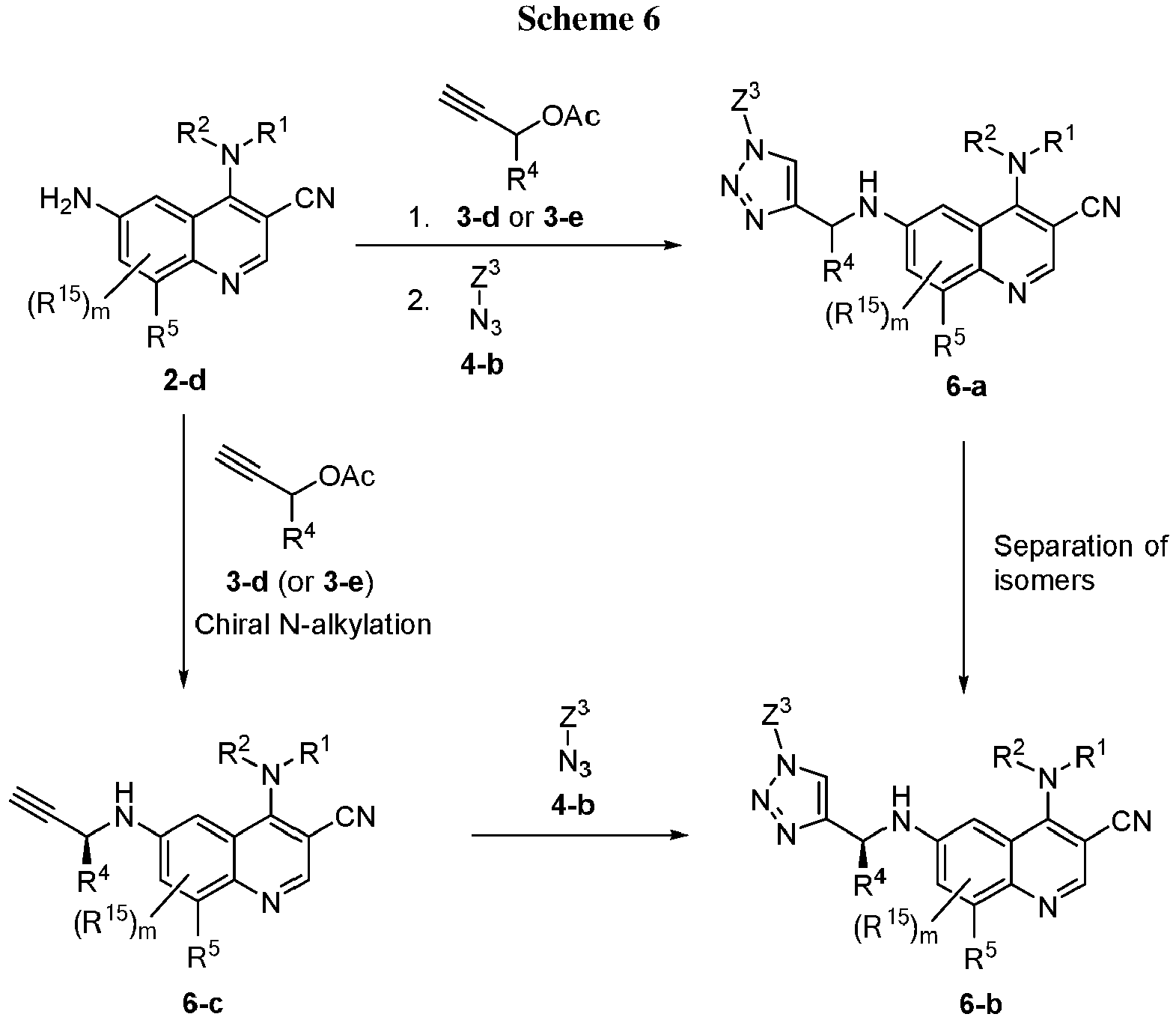
- In Scheme 6, compounds of Formula 6-c can be provided via N-alkylation of amine 2-d with 3-d (or 3-e), followed by cyclization with azide 4-b under standard 1,3-dipolar cycloaddition conditions. Separation of the isomers of Formula 6-a to give compounds of Formula 6-b can be performed using standard chiral separation/resolution techniques (e.g., chiral chromatography, crystallization, etc.). Alternatively, compounds of Formula 6-b can be provided via enantioselective N-alkylation of 2-d with 3-d (or 3-e) using a chiral metal complex (e.g., [Cu(CH3CN)4]PF6, CuOTf·benzene, Cu(OAc)2, or Cu(I)I, etc., with a chiral ligand). Suitable reaction conditions and exemplary chiral ligands/complexes can be found in the literature (see, e.g., Detz, et al. Angew. Chem. Int. Ed. 2008, 47, 3777 -3780). Contacting compound 6-c with azide 4-b under standard 1,3-dipolar cycloaddition conditions provide compound 6-b. 6-c may or may not be isolated prior to the addition of compound 4-b.
- Scheme 7 shows an alternate synthesis of compounds of Formula I via imine formation and subsequent nucleophilic addition, where Z3, m, R1, R2, R3, R4, R5 and R15 are as defined herein.

- In Scheme 7, amine 2-d is reacted with aldehyde 7-a to afford the corresponding imine 7-b under standard imine-forming conditions. Compound 7-b is then reacted with Grignard reagent 7-c to provide Formula I. Alternatively, 2-d can be reacted with aldehyde 7-d to afford imine 7-e, which is then reacted with ethynyl Grignard to provide compound 7-f. Compound 7-f can then be converted to compound 7-g under standard 1,3-dipolar cycloaddition conditions with 4-b as shown in Scheme 6. Further, resolution of the isomers of Formula I or compound 7-g can be performed using standard chiral separation/resolution conditions (e.g., chiral chromatography, crystallization, etc.).
- Scheme 8 shows another alternate general synthesis of compounds of Formula I, where m, R1, R2 , R3, R4, R5 and R15 are as defined herein.

- In Scheme 8, amine 2-d is reacted with appropriately substituted 8-a under nucleophilic substitution conditions, where Lg is a suitable leaving group, such as a halide (e.g., fluoro, chloro, bromo, iodo) or an activated alcohol (e.g., AcO-, TsO-, TfO-, MsO-, etc.) in the presence of a base, to provide compound of Formula I. Alternatively, amine 2-d is reacted with ketone 8-b to provide 8-c, which is subsequently reduced to provide compound of Formula I. Resolution of the isomers of Formula I can be performed using standard chiral separation/resolution conditions (e.g., chiral chromatography, crystallization, etc.).
- The following examples are included to demonstrate specific embodiments of the disclosure. It should be appreciated by those of skill in the art that the techniques disclosed in the examples which follow represent techniques to function well in the practice of the disclosure, and thus can be considered to constitute specific modes for its practice. However, those of skill in the art should, in light of the present disclosure, appreciate that many changes can be made in the specific embodiments which are disclosed and still obtain a like or similar result without departing from the spirit and scope of the disclosure.
List of Abbreviations and Acronyms Abbreviation Meaning °C Degree Celsius Ac Acetyl aq. Aqueous ATP Adenosine triphosphate BOC tert-Butoxycarbonyl br Broad BSA Bovine serum albumin Cbz Carboxybenzyl COD Cyclooctadiene COPD Chronic obstructive pulmonary disease Cp Cyclopentadienyl d Doublet DABCO 1,4-Diazabicyclo[2.2.2]octane DBU 1,8-Diazabicyclo[5.4.0]undec-7-ene DCE Dichloroethene DCM Dichloromethane dd Doublet of doublets DEF N,N-Diethylformamide DMF Dimethylformamide DMSO Dimethylsulfoxide dppf 1,1'-Bis(diphenylphosphino)ferrocene dt Doublet-triplet DTT Dithiothreitol EC50 The half maximal effective concentration EGFR Epidermal growth factor receptor eq Equivalents ES/MS Electrospray mass spectrometry Et Ethyl FBS Fetal bovine serum g Grams HEPES 2-[4-(2-hydroxyethyl)piperazin-1-yl]ethanesulfonic acid HPLC High pressure liquid chromatography hrs Hours Hz Hertz IBD Inflammatory bowel disease i-pr Isopropyl J Coupling constant (MHz) Kg/kg Kilogram LCMS Liquid chromatography-mass spectrometry LPS Lipopolysaccharide M Molar m multiplet M+ Mass peak M+H+ Mass peak plus hydrogen Me Methyl mg Milligram MHz Megahertz min Minute ml/mL Milliliter mM Millimolar mmol Millimole MOPS 3-Morpholinopropane-1-sulfonic acid MS Mass spectroscopy Ms Mesyl nBu/Bu Butyl nL Nanoliter nm Nanometer NMR Nuclear magnetic resonance NP-40 Nonyl phenoxypolyethoxylethanol Ns Nosyl Pd-C/ Pd/C Palladium on Carbon pg Pictogram Ph Phenyl PPTS Pyridinium p-toluenesulfonate PS Polystyrene p-TSOH/ pTSA p-Toluenesulfonic acid q Quartet q.s. Quantity sufficient to achieve a stated function RBF Round bottom flask RP Reverse phase RPMI Roswell Park Memorial Institute medium rt Room temperature s Singlet sat. Saturated t Triplet TBAF Tetra-n-butylammonium fluoride TBS tert-Butyldimethylsilyl t-Bu tert-Butyl TC Thiophene-2-carboxylate TEA Triethanolamine Tf Trifluoromethanesulfonyl TFA Trifluoroacetic acid THF Tetrahydrofuran Tpl-2 Tumor Progression Locus 2 TR-FRET Time-resolved fluorescence energy transfer Ts Tosyl δ Chemical shift (ppm) µL/ µl Microliter µM Micromolar -

- A mixture of 2-chloro-4-nitroaniline (1 eq), (Z)-ethyl 2-cyano-3-ethoxyacrylate (1.3 eq) and Cs2CO3 (1.3 eq) in DMF was heated at 45 °C overnight. After being cooled to room temperature, the mixture was poured into water. The formed solid was filtered, and washed with water and dried to give the title compound as a solid which was used for the next step without further purification. 1H NMR (DMSO-d 6, 300 MHz): δ 11.28 (d, J = 12.9 Hz, 1H), 8.84 (d, J = 12.9 Hz, 1H), 8.42 (d, J = 2.4 Hz, 1H), 8.26-8.22 (m, 1H), 8.02 (d, J = 9.3 Hz, 1H), 4.27 (q, J = 7.2 Hz, 2H), 1.27 (t, J = 7.2 Hz, 3H).
-

- A suspension of (Z)-ethyl 3-((2-chloro-4-nitrophenyl)amino)-2-cyanoacrylate in diphenyl ether under nitrogen was heated to reflux with a sand bath in a heating mantle for 24 hours. After cooling to room temperature, the reaction mixture was poured into hexane and stirred for 2 hours. The mixture was filtered and the filter cake was washed with hexane twice to give title compound as a brown solid. 1H NMR (DMSO-d 6, 300 MHz): δ 12.86 (br s, 1H), 8.73-8.71 (m, 3H).
-

- A suspension of 8-chloro-6-nitro-4-oxo-1,4-dihydroquinoline-3-carbonitrile and five drops of DMF in POCl3 was heated at 115 °C overnight. The brown clear solution was cooled down to room temperature and excess of POCl3 was removed. The residue was dissolved in DCM, washed with sat. NaHCO3, brine and dried over Na2SO4. The solution was filtered and concentrated to give a crude product. The residue was triturated with hexane and EtOAc to afford the title compound as a brown solid. 1H NMR (DMSO-d 6, 300 MHz): δ 9.50 (s, 1H), 8.98 (d, J = 2.4 Hz, 1H), 8.89 (d, J = 2.4 Hz, 1H).
-

- 1-(6-fluoropyridin-3-yl)prop-2-yn-1-yl acetate : 6-fluoronicotinaldehyde (300 mg, 2.40 mmol) was dissolved in THF (15 mL) and brought to 0 °C. Ethynylmagnesium bromide (0.5 M in THF, 5.76 mL, 2.88 mmol) was added slowly and the resulting solution allowed to stir for 30 minutes. Acetic anhydride (0.45 mL, 4.80 mmol) was then added, the cold bath removed, and the reaction mixture allowed to warm to room temperature over 2 hours. The reaction contents were quenched by the addition of saturated aqueous NH4Cl (5 mL), poured into water (5 mL), and extract with EtOAc (3 x 15 mL). The combined organic phase was washed with brine (10 mL), dried over MgSO4 and concentrated. The crude residue was purified by flash chromatography (eluent: EtOAc / hexanes) to give the desired product.
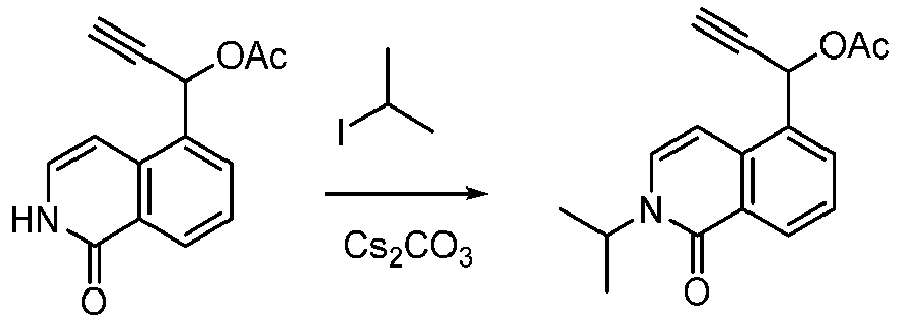
- 1-(1-oxo-1,2-dihydroisoquinolin-5-yl)prop-2-yn-1-yl acetate (200 mg, 0.83 mmol) was dissolved in DMF (2 mL) after which cesium carbonate (405 mg, 1.2 mmol) and 2-iodopropane (211 mg, 1.2 mmol) were added and the resulting mixture stirred at 25 °C under ambient atmosphere overnight. The reaction mixture was poured into water (3 mL) and extracted with EtOAc (3 x 5 mL). The organic layer was dried over MgSO4, filtered, concentrated, and purified by via silica gel chromatography (eluent: EtOAc / hexanes) to give the N-alkylated product. Note: The same alkylation protocol could be performed on the preceding 1-oxo-1,2-dihydroisoquinoline-5-carbaldehyde.
-

- 6-fluoronicotin-aldehyde-α-D: 6-fluoronicotinaldehyde (1.14 g, 9.11 mmol) was dissolved in MeOH (8 mL) at room temperature. NaBD4 (458 mg, 10.9 mmol) was then added as a single portion and the reaction mixture stirred for 20 minutes. The reaction mixture was carefully quenched with water (5 mL) and extracted with EtOAc (3 x 15 mL). The combined organic layers were washed with brine (5 mL), dried over MgSO4 and concentrated to give crude alcohol which was carried forward without further purification. The crude alcohol was re-dissolved in DCM (40 mL) and manganese(IV) oxide (19.9 g, 281 mmol) was added at room temperature. After 2 hours the reaction mixture was filtered through a pad of celite rinsing with DCM and EtOAc. The filtrate was then concentrated to give the desired product with approximately 95% deuterium incorporation.

- 2-acetyl-3-oxoisoindoline-4-carbaldehyde : 3 -oxoisoindoline-4-carbaldehyde (300 mg, 1.86 mmol) was dissolved in THF (5 mL) at room temperature. Acetic anhydride (0.53 mL, 5.59 mmol) and DMAP (45 mg, 0.37 mmol) were added and the reaction mixture stirred overnight. The reaction contents were quenched by the addition of saturated aqueous NH4Cl (3 mL), poured into water (3 mL), and extracted with EtOAc (3 x 8 mL). The combined organic phases were washed with brine (5 mL), dried over MgSO4 and concentrated. The crude residue was purified by flash chromatography (eluent: EtOAc / hexanes) to give the desired product.
-

- ethyl 2-((tert-butoxycarbonyl)amino)benzo[d]thiazole-7-carboxylate : ethyl 2-aminobenzo[d]thiazole-7-carboxylate (300 mg, 1.35 mmol), di-tert-butyl dicarbonate (0.34 mL, 1.49 mmol) and DMAP (181 mg, 1.49 mmol) were dissolved in DCM (10 mL) and stirred at room temperature for 3 hours. The reaction mixture was then poured into water (10 mL) and extracted with DCM (2 x 20mL). The combined organic extracts were dried over MgSO4,concentrated, and purified by flash chromatography (eluent: EtOAc / hexanes) to give the desired product.
- tert-butyl (7-(hydroxymethyl)benzo[d]thiazol-2-yl)carbamate : ethyl 2-((tert-butoxycarbonyl)amino)benzo[d]thiazole-7-carboxylate (204 mg, 0.63 mmol) was dissolved in THF (7 mL) and brought to 0 °C. LiAlH4 (72 mg, 1.90 mmol) was added portionwise and the reaction mixture allowed to stir for 90 minutes. The reaction mixture was quenched at 0 °C carefully with water (5 mL) and extracted with EtOAc (3 x 8 mL). The combined organic phases were washed with brine (5 mL), dried over MgSO4 and concentrated to give the desired product which was used without further purification.
- tert-butyl (7-formylbenzo[d]thiazol-2-yl)carbamate : tert-butyl (7-(hydroxymethyl)benzo[d]thiazol-2-yl)carbamate (177 mg, 0.63 mmol) was dissolved in DCM (5 mL) after which Dess-Martin periodinane (321 mg, 0.76 mmol) was added at room temperature. After 30 minutes the reaction contents were quenched by the addition of saturated aqueous Na2SO3 (3 mL) and stirred vigorously for 5 minutes. The reaction mixture was then poured into saturated aqueous NaHCO3 (5 mL) and extracted with EtOAc (3 x 15 mL). The combined organic phase was washed with brine (5 mL), dried over MgSO4 and concentrated to give the desired aldehyde which was used without further purification.

- 2-methyl-1-oxoisoindoline-4-carbaldehyde: To a solution of 4-bromo-2-methylisoindolin-1-one (200mg, 0.89 mmol) in THF (3 mL), n-BuLi (0.78 mL, 1.95 mmol) was added to the solution at -78 °C. After 30 minutes, DMF (0.273 mL, 3.57 mmol) was added to the solution. After 1 hour, the reaction was warmed up. Diluted with EtOAc and washed with brine. The organic layer was dried over sodium sulfate, and concentrated. The product was purified by chromatography on silica gel (eluent: EtOAc/hexanes) to yield the product after lyophilization from water / MeCN.

- 1-methyl-6-oxo-1,6-dihydropyridine-3-carbaldehyde: To a solution of 6-chloro-2-methylnicotinaldehyde (1.0 g, 6.43 mmol) in conc. HCl (3 mL), was heated to 90 °C for O.N. Cooled it down and poured it to ice water (20 mL). Filtered and dried with vacuum. Used without further purification.
- To a suspension of 6-oxo-1,6-dihydropyridine-3-carbaldehyde (300 mg, 2.19 mmol) in DMF, sodium hydride (96 mg, 2.4 mmol) was added to the suspension under ice bath condition. Iodomethane (0.15 mL, 2.4 mmol) was added to the suspension. Then it was stirred for overnight. Diluted with EtOAc and washed with brine. The organic layer was dried and concentrated. Used without further purification.

- 3-methyl-4-oxo-3,4-dihydroquinazoline-8-carbaldehyde: To a suspension of 3,8-dimethylquinazolin-4(3H)-one (300 mg, 2 mmol) (prepared according to Organic and Biomolecular Chemistry, 2011 , vol. 9, No. 17 p. 6089 - 6099) and selenium dioxide (955 mg, 9 mmol) in 1,2-dichlorobenzene (1270 mg, 9 mmol) was heated to 170 °C overnight. The organic layer was dried over MgSO4, filtered, concentrated, and purified by via silica gel chromatography (eluent: EtOAc / hexanes) to yield the title compound.
-

- (2,2-dimethylpropyl-1,1-d2)amine HCl : LiAlD4 (252 mg, 6.02 mmol) was suspended in Et2O (10 mL) at room temperature. Trimethylacetonitrile (0.67 mL, 6.02 mmol) was then added slowly as a solution in Et2O (6 mL) keeping the temperature below reflux. After 30 minutes the reaction mixture was quenched by careful, slow addition of water until gas evolution ceased. Saturated aqueous Rochelle's salt solution (50 mL) was then added and the resulting solution stirred vigorously for 2 hours. The phases were then separated and the aqueous extracted with Et2O (3 x 30 mL). The combined organic phases were washed with brine (15 mL), dried over MgSO4 and filtered. To the product solution in ether was added HCl (1.0M in ether, 15 mL, 15 mmol) after which the newly formed HCl salt was collected by filtration.
-

- Ellman auxiliary condensation: (S)-(-)-2-methyl-2-propanesulfinamide (862 mg, 7.12 mmol) was dissolved in DCM (15 mL). PPTS (81 mg, 0.32 mmol), MgSO4 (3.89 g, 32.3 mmol), and benzaldehyde-d were then added and the resulting mixture allowed to stir at room temperature for 4 hours. The reaction mixture was filtered through celite rinsing with DCM, concentrated and purified by flash chromatography (eluent: EtOAc / hexanes) to give the desired product.
- Grignard formation and addition to sulfinimine: Ethylbromide-d5 (1.00 g, 8.77 mmol) as a solution in dry THF (2 mL) was added to a suspension of magnesium turnings (426 mg, 17.5 mmol) in dry THF (7 mL) and stirred at room temperature for 2 hours. Heat generation and discoloration indicate successful Grignard reagent formation to give an approximately 1.0M solution of EtMgBr-d5 in THF. EtMgBr-d5 (1.0M in THF, 7.2 mL, 7.2mmol) was added dropwise to a solution of sulfinimine (752 mg, 3.58 mmol) in DCM (10 mL) at -78 °C. After stirring for 3 hours at -78 °C, the reaction mixture was allowed to warm to room temperature overnight. The reaction contents were quenched by the addition of saturated aqueous NH4Cl (5 mL), poured into water (5 mL) and extracted with EtOAc (3 x 30 mL). The combined organic phases were washed with brine (15 mL), dried over MgSO4 and concentrated. The crude residue was purified by flash chromatography (eluent: EtOAc / hexanes) to give the desired product.
- Auxilliary removal: Starting material (451 mg, 1.84 mmol) was dissolved in MeOH (0.9mL) at room temperature. HCl (4.0M in dioxane, 0.92 mL, 3.69 mmol) was added and the solution stirred for 30 minutes. Reaction mixture was diluted with Et2O (20 mL) and the resulting precipitate collected by filtration to give the desired product as an HCl salt.
-

- 2-benzoylcyclopropanecarbonitrile: Phenacyl chloride (10.0 g, 64.7 mmol) and DABCO (7.26 g, 64.7 mmol) were dissolved in THF (200 mL) and DMSO (50 mL) at room temperature and stirred for 30 minutes. Na2CO3 (10.3 g, 97.0 mmol) and acrylonitrile (8.48 mL, 129.4 mmol) were then added and the resulting mixture heated to 90 °C overnight. The reaction contents were quenched by the addition of saturated aqueous NH4Cl (40 mL), poured into water (20 mL) and extracted with EtOAc (3 x 150 mL). The combined organic phases were washed with brine (40 mL), dried over MgSO4 and concentrated. The crude residue was purified by flash chromatography (eluent: EtOAc / hexanes) to give trans-2-benzoylcyclopropanecarbonitrile (5.91 g, 53%) and cis-2-benzoylcyclopropanecarbonitrile separately and both as racemic mixtures.
- (R)-N-(((1S,2S)-2-cyanocyclopropyl)(phenyl)methylene)-2-methylpropane-2-sulfinamide and (R)-N-(((1R,2R)-2-cyanocyclopropyl)(phenyl)methylene)-2-methylpropane-2-sulfinamide: Racemic trans-2-benzoylcyclopropanecarbonitrile (1.00 g, 5.84 mmol), (R)-(+)-2-methyl-2-propanesulfinamide (2.12 g, 17.5 mmol) and titanium(IV) ethoxide (7.35 mL, 35.1 mmol) were combined and heated to 85 °C for 3 hours. The reaction mixture was cooled to room temperature, diluted with EtOAc (100 mL) followed by water (5 mL) and allowed to stir for 30 minutes). The white precipitate was removed via filtration and the filtrate was washed with brine and concentrated. The crude residue was purified by flash chromatography (eluent: EtOAc / hexanes) to give (R)-N-(((1R,2R)-2-cyanocyclopropyl)(phenyl)methylene)-2-methylpropane-2-sulfinamide and (R)-N-(((1S,2S)-2-cyanocyclopropyl)(phenyl)methylene)-2-methylpropane-2-sulfinamide as pure enantiomers.
- (R)-N-((S)-((1R,2R)-2-cyanocyclopropyl)(phenyl)methyl)-2-methylpropane-2-sulfinamide : (R)-N-(((1R,2R)-2-cyanocyclopropyl)(phenyl)methylene)-2-methylpropane-2-sulfinamide (250 mg, 0.91 mmol) was dissolved in THF and brought to -78 °C. NaBH4 (70.0 mg, 1.85 mmol) was added as a single portion and the reaction mixture allowed to warm slowly to room temperature. Upon reaching room temperature the reaction contents were quenched with water (2 mL) and extracted with EtOAc (3 x 8 mL). The combined organic phases were washed with brine (5 mL), dried over MgSO4 and concentrated. The crude residue was purified by flash chromatography (eluent: EtOAc / hexanes) to give (R)-N-((R)-((1R,2R)-2-cyanocyclopropyl)(phenyl)methyl)-2-methylpropane-2-sulfinamide (56 mg, 22%) and (R)-N-((S)-((1R,2R)-2-cyanocyclopropyl)(phenyl)methyl)-2-methylpropane-2-sulfinamide as pure enantiomers.
- (1R,2R)-2-((S)-amino(phenyl)methyl)cyclopropanecarbonitrile : (R)-N-((S)-((1R,2R)-2-cyanocyclopropyl)(phenyl)methyl)-2-methylpropane-2-sulfinamide (143 mg, 0.52 mmol) was dissolved in MeOH (0.5mL) at room temperature. HCl (4.0M in dioxane, 0.26 mL, 1.04 mmol) was added and the solution stirred for 30 minutes. Reaction mixture was diluted with Et2O (20 mL) and the resulting precipitate collected by filtration to give the desired product as an HCl salt.
-

- 1-chloro-2-cyclopropoxy-3-nitrobenzene : To a solution of NaH (60% dispersion in mineral oil, 319 mg, 7.98 mmol) in THF (10 mL) was slowly added cyclopropyl alcohol (0.35 mL, 5.58 mmol). After 15 minutes of stirring, 1-chloro-2-fluoro-3-nitrobenzene (700 mg, 3.99 mmol) was added and the resulting solution heated to 75 °C for 1 hour. The reaction mixture was cooled to room temperature, quenched with water (5 mL) and extracted with EtOAc (3 x 15 mL). The combined organic phases were washed with brine (5 mL), dried over MgSO4 and concentrated. The crude residue was purified by flash chromatography (eluent: EtOAc / hexanes) to give the desired product.
- 3-chloro-2-cyclopropoxyaniline : 1-chloro-2-cyclopropoxy-3-nitrobenzene (420 mg, 1.97 mmol) was dissolved in EtOH (8 mL) at room temperature. Iron (549 mg, 9.83 mmol), CaCl2 (327 mg, 2.95 mmol) and water (1 mL) were then added and the resulting mixture heated to 75 °C for 3 hours. The solids were removed by filtration washing with MeOH and EtOAc, the filtrate concentrated, and then redissolved in EtOAc (100 mL). The organic phase was washed with saturated aqueous NaHCO3 (2 x 20 mL), brine (20 mL), dried over MgSO4 and concentrated to give the product which was used without further purification.
-

- 3-(Aminomethyl)oxetan-3-ol (50 mg, 0.49 mmol) was added to a suspension of 1H-imidazole-1-sulfonyl azide hydrochloride (129.5 mg, 0.62 mmol), potassium carbonate (136 mg, 0.99 mmol), and copper (II) sulfate pentahydrate (12.3 mg, 0.049 mmol) in methanol (1.0 mL). The blue mixture was stirred at room temperature for 16 hrs and was used without workup in the Click chemistry (Example 4). Reference: E. D. Goddard, et. al., Org. Lett., 2007, p. 3797.
-
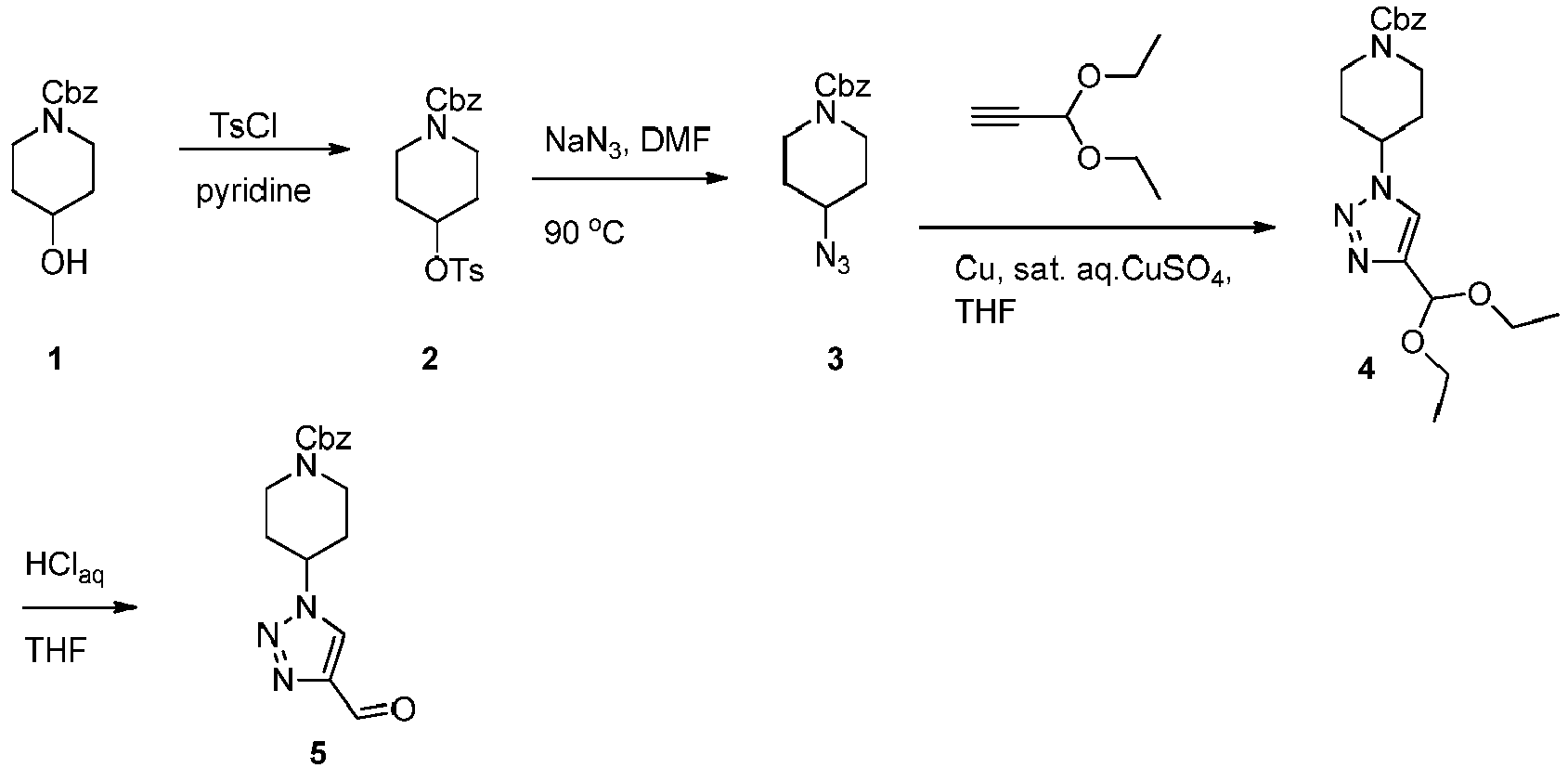
- Benzyl 4-hydroxypiperidine-1-carboxylate (1) (17.2 g, 73.1 mmol) and p-toluenesulfonyl chloride (15.3 g, 80.4 mmol) were dissolved in pyridine (50 mL) and stirred at room temperature. After 23 hrs, the pyridine was removed under reduced pressure and the residue was dissolved in EtOAc (300 mL). The organic phase was washed with water (2 x 150 mL) and saturated ammonium chloride (100 mL), dried over sodium sulfate and the solvent was removed under reduced pressure. The residue was subjected to flash chromatography (eluent: ethyl acetate / hexanes). The fractions containing product were combined and the solvent was removed under reduced pressure, providing benzyl 4-(tosyloxy)piperidine-1-carboxylate (2).
- Sodium azide (2.48 g, 38.2 mmol) was added to a solution of benzyl 4-(tosyloxy)piperidine-1-carboxylate (2) (12.4 g, 31.8 mmol) in dimethylformamide (100 mL). The mixture was heated at 90 °C for 30 minutes. The mixture was cooled and diluted with ethyl acetate (250 mL) and washed with water (2 x 15 mL), 5% aqueous lithium chloride (10 mL) and brine (10 mL). The organic phase was dried over sodium sulfate and concentrated (NOT to dryness) providing the desired material. All material was used in the next step.
- Copper powder (2.0 g, 31.5 mmol), was added to a solution of benzyl 4-azidopiperidine-1-carboxylate (3) (8.2 g, 31.5 mmol) 3,3-diethoxyprop-1-yne (4.44 g, 34.6 mmol) and saturated copper (II) sulfate (8 mL) in tetrahydrofuran (100 mL). After 17 hrs, the mixture was filtered through a pad of celite. The solvent was removed under reduced pressure and the residue was taken up in ethyl acetate (200 mL). The organic phase was washed with brine (3x100 mL), dried over sodium sulfate and concentrated. The residue was subjected to flash chromatography on silica gel (eluent: ethyl acetate / hexanes). The fractions containing product were combined and the solvent was removed under reduced pressure providing benzyl 4-(4-(diethoxymethyl)-1H-1,2,3-triazol-1-yl)piperidine-1-carboxylate (4).
- Aqueous hydrochloric acid (1 M, 2.2 mL, 2.2 mmol) was added to a solution of benzyl 4-(4-(diethoxymethyl)-1H-1,2,3-triazol-1-yl)piperidine-1-carboxylate (4) (429 mg, 1.1 mmol) in tetrahydrofuran (4 mL) and water (2 mL). The organic solvent was removed under reduced pressure. The aqueous mixture was diluted with acetonitrile (2 mL) and subjected to lyophilization.
-

- N,N-Diisopropylethylamine (1.53 mL, 8.82 mmol) was added to a solution of 6-(tert-butoxycarbonyl)-4,5,6,7-tetrahydrothieno[2,3-c]pyridine-3-carboxylic acid (1.00 g, 3.53 mmol) and N-[(Dimethylamino)-1H-1,2,3-triazolo-[4,5-b]pyridin-1-ylmethylene]-N-methylmethanaminium hexafluorophosphate N-oxide (1.62 g, 4.24 mmol) in dimethylformamide (15 mL). After 2 min N,O-Dimetylhydroxylamine hydrochloride (413 mg, 4.24 mmol) was added. After 16 h the reaction was diluted with ethyl acetate (75 mL) and washed with water (2 x 25 mL), saturated ammonium chloride (2 x 25 mL) and brine (25 mL). The organic phase was dried over sodium sulfate and the solvent was removed under reduced pressure. The residue was subjected to flash chromatography (0-100 % ethyl acetate / hexanes). The fractions containing product were combined and the solvent was removed under reduced pressure, providing tert-butyl 3-(methoxy(methyl)carbamoyl)-4,7-dihydrothieno[2,3-c]pyridine-6(5H)-carboxylate.

- A solution of diisobutylaluminum hydride in tetrahydrofuran (4.42 mL, 1.0 M, 4.42 mmol) was added dropwise to a solution of tert-butyl 3-(methoxy(methyl)carbamoyl)-4,7-dihydrothieno[2,3-c]pyridine-6(5H)-carboxylate (1.03 g, 3.15 mmol) in tetrahydrofuran (20 mL) at -78 °C under an atmosphere of argon. After 5h at -78 °C the reaction was 40% complete. A solution of diisobutylaluminum hydride in tetrahydrofuran (3.15 mL, 1.0 M, 3.15 mmol was added dropwise. After 30 min the reaction was quenched with saturated ammonium chloride (20 mL) at -78 °C and allowed to warm to room temperature. The organic phase was shaken with water (20 mL) and ethyl acetate (75 mL) (causing a gel to form). Hydrochloric acid (2 N, 5 mL) was added and the solid was removed by filtration through a pad of celite. The organic phase was washed with saturated sodium bicarbonate (25 mL) and brine (25 mL). The organic phase was dried over sodium sulfate and concentrated. The residue was subjected to flash chromatography (0-50 % ethyl acetate / hexanes). The fractions containing product were combined and the solvent was removed under reduced pressure, providing tert-butyl 3-formyl-4,7-dihydrothieno[2,3-c]pyridine-6(5H)-carboxylate.
-

- 8-chloro-4-(neopentylamino)-6-nitroquinoline-3-carbonitrile: 4,8-dichloro-6-nitroquinoline-3-carbonitrile (615 mg, 2.29 mmol), neopentylamine (220 mg, 0.25 mmol) and triethylamine (278 mg, 2.75 mmol) in iso-propanol (4 mL) were heated under microwave conditions at 150 °C for 45 minutes. The reaction was cooled to room temperature. Water was added and the resulting precipitate was collected via filtration. The crude product was used in the next step without further purification.
ES/MS 319.1 (M+H+). - Alternative reaction conditions for this transformation: 4,8-dichloro-6-nitroquinoline-3-carbonitrile (3000 mg, 11.2 mmol), neopentylamine (1073 mg, 12.3 mmol) and triethylamine (1246 mg, 12.3 mmol) in iso-propanol (60 mL) were heated at 80 °C for 4 hrs. The reaction was cooled to room temperature. Removed the solvents and purified the crude reaction product via chromatography on silica gel (eluent: EtOAc / hexanes) yielding the product.
ES/MS (M+H+) 319.1. - 6-amino-8-chloro-4-(neopentylamino)quinoline-3-carbonitrile: 8-chloro-4-(neopentylamino)-6-nitroquinoline-3-carbonitrile (699 mg, 2.2 mmol), calcium chloride (483.6 mg, 3.28 mmol), iron powder (612.3 mg, 10.96 mmol) were heated in ethanol (22 mL) / water (2.2 mL) at 60 °C for 1 hour. The reaction was cooled to room temperature and solids were removed via filtration. The solids were washed with EtOAc and the combined organic layers were washed with aqueous sodium bicarbonate solution, brine, and were dried over sodium sulfate. Filtration and evaporation of all volatiles yielded the product.
ES/MS 289.1 (M+H+). - Alternative reduction conditions with tin chloride: 8-chloro-4-(neopentylamino)-6-nitroquinoline-3-carbonitrile (2,000 mg, 6.2 mmol) and tin chloride (7079 mg, 31.3 mmol) heated at 70 °C for 4h. More tin chloride (2832 mg, 12.6 mmol) was added. After 5 hrs, the reaction was complete. The reaction was cooled to room temperature. Half of the ethanol was removed under reduced pressure. The mixture was added to NaHCO3 (200 mL) and diluted with EtOAc (500 mL). The organic phase was washed with brine (200 mL) and dried over sodium sulfate. The solvent was removed under reduced pressure, providing the desired material.
1H NMR (400 MHz, DMSO-d6) δ 8.19 (s, 1H), 7.32 (d, J = 2.1 Hz, 1H), 7.29 (t, J = 7.3 Hz, 1H), 7.18 (d, J = 2.3 Hz, 1H), 5.74 (s, 2H), 3.66 (d, J = 6.6 Hz, 2H), 0.96 (s, 9H).
ES/MS 289.1 (M+H+). - (S)-8-chloro-6-(((1-cyclopropyl-1H-1,2,3-triazol-4-yl)(4-fluoro-3-pyridyl)methyl-d)amino)-4-(neopentylamino)quinoline-3-carbonitrile: 6-amino-8-chloro-4-(neopentylamino)quinoline-3-carbonitrile (75 mg, 0.26 mmol), CuI (3.6 mg, 0.019 mmol) and 2,6-bis((4S,5R)-4,5-diphenyl-4,5-dihydrooxazol-2-yl)pyridine [oxazoline ligand] (9.9 mg, 0.019 mmol) were sonicated in MeOH (3.5 mL) for ~ 1 minute. Alkynyl acetate (44.4 mg, 0.23 mmol) and di-isopropyl ethyl amine (29.4 mg, 0.229 mmol) were added and the reaction was stirred at room temperature overnight. Tert-butyl azide (45 mg, 0.454 mmol) was added and the reaction was stirred or additional 24 hrs at room temperature. Solvents were removed in vacuo and the crude material was purified via RP-HPLC (eluent: water / MeCN *0.1% TFA) to yield the product as trifluoro acetate salt.
1H NMR (400 MHz, DMSO-d6) δ 8.37 (m, 2H), 8.17 (s, 1H), 8.05 (m, 1H), 7.79 (brs, 1H), 7.62 (d, J = 2.2 Hz, 1H), 7.51 (br s, 1H), 7.15 (m, 2H), 4.03 (m, 1H), 3.44 (dd, J = 13.9 / 5.5 Hz, 1H), 1.59 (s, 9H), 0.88 (s, 9H).
ES/MS 522.2 (M+H+). -

- (R)-8-chloro-6-nitro-4-((1-phenylpropyl)amino)quinoline-3-carbonitrile: 4,8-dichloro-6-nitroquinoline-3-carbonitrile (200 mg, 0.75 mmol), (R)-ethyl benzylamine (121 mg, 0.895 mmol) in iso-propanol (3 mL) were heated under microwave conditions at 150 °C for 45 minutes. The reaction was cooled to room temperature. Water and EtOAc were added. The aqueous layer was extracted with EtOAc and the combined organic layers were dried over sodium sulfate. Filtration and evaporation of solvents yielded the crude product which was used in the next step without further purification.
ES/MS 367.1 (M+H+). - 6-amino-8-chloro-4-((1-phenylpropyl)amino)quinoline-3-carbonitrile: (R)-6-amino-8-chloro-4-((1-phenylpropyl)amino)quinoline-3-carbonitrile (287 mg, 0.78 mmol), calcium chloride (172.6 mg, 1.17 mmol), iron powder (218.5 mg, 3.91 mmol) were heated in ethanol (5 mL) / water (0.5 mL) at 60 °C for 1 hour. The reaction was cooled to room temperature and solids were removed via filtration. The solids were washed with EtOAc and the combined organic layers were washed with aqueous sodium bicarbonate solution, brine, and were dried over sodium sulfate. Filtration and evaporation of all volatiles yielded the product.
ES/MS 337.1 (M+H+). - 8-chloro-6-(((R)-1-(2-methylpyridin-3-yl)prop-2-yn-1-yl)amino)-4-(((R)-1-phenylethyl)amino)quinoline-3-carbonitrile: CuI (2.0 mg,0.01 mmol) and 2,6-bis((4S,5R)-4,5-diphenyl-4,5-dihydrooxazol-2-yl)pyridine [oxazoline ligand] (6.9 mg, 0.013 mmol) were sonicated in MeOH (3.0 mL) for ~ 5 minutes. 1-(2-methylpyridin-3-yl)prop-2-yn-1-yl acetate (50 mg, 0.27 mmol) in MeOH (1 mL), (R)-6-amino-8-chloro-4-((1-phenylpropyl)amino)quinoline-3-carbonitrile (75 mg, 0.223 mmol), and di-isopropyl ethyl amine (34 mg, 0.27 mmol) were added and the reaction was stirred at room temperature overnight. The crude reaction product was purified by silica gel chromatography (20% - 100% EtOAc in hexanes) to provide the product.
ES/MS 465.99 (M+H+).
8-chloro-6-(((S)-(1-isopropyl-1H-1,2,3-triazol-4-yl)(2-methylpyridin-3-yl)methyl)amino)-4-(((R)-1-phenylpropyl)amino)quinoline-3-carbonitrile: 8-chloro-6-(((R)-1-(2-methylpyridin-3-yl)prop-2-yn-1-yl)amino)-4-(((R)-1-phenylethyl)amino)quinoline-3-carbonitrile (45 mg, 0.10 mmol) was dissolved in THF (0.5 mL) at room temperature and copper (I) thiophene carboxylate (5.7 mg, 0.030 mmol) was added. 2-azidopropane (10 mg, 0.120 mmol) was added and the reaction was stirred for 4 hours at room temperature. The reaction was partitioned between aqueous sodium bicarbonate solution and EtOAc. The aqueous layer was extracted with EtOAc and the combined layers were washed with saturated sodium bicarbonate solution and dried over sodium sulfate. Filtration and evaporation of solvents gives crude material. The crude material was purified RP-HPLC (eluent: water / MeCN *0.1% TFA) to yield the product as trifluoroacetate salt.
1H NMR (400 MHz, CD3OD) δ 8.61 (m, 1H), 8.37 (m, 1H), 8.29 (m, 1H), 8.05 (m, 1H), 7.73 (m, 1H), 7.60 (s, 1H), 7.32 (m, 5H), 7.14 (m, 1H), 6.46 (s, 1H), 5.64 (m, 1H), 4.88 (m, 1H), 2.83 (s, 3H), 2.17 - 2.02 (m, 2H), 1.56 (d, 6H), 0.97 (m, 3H).
ES/MS 551.09 (M+H+). -
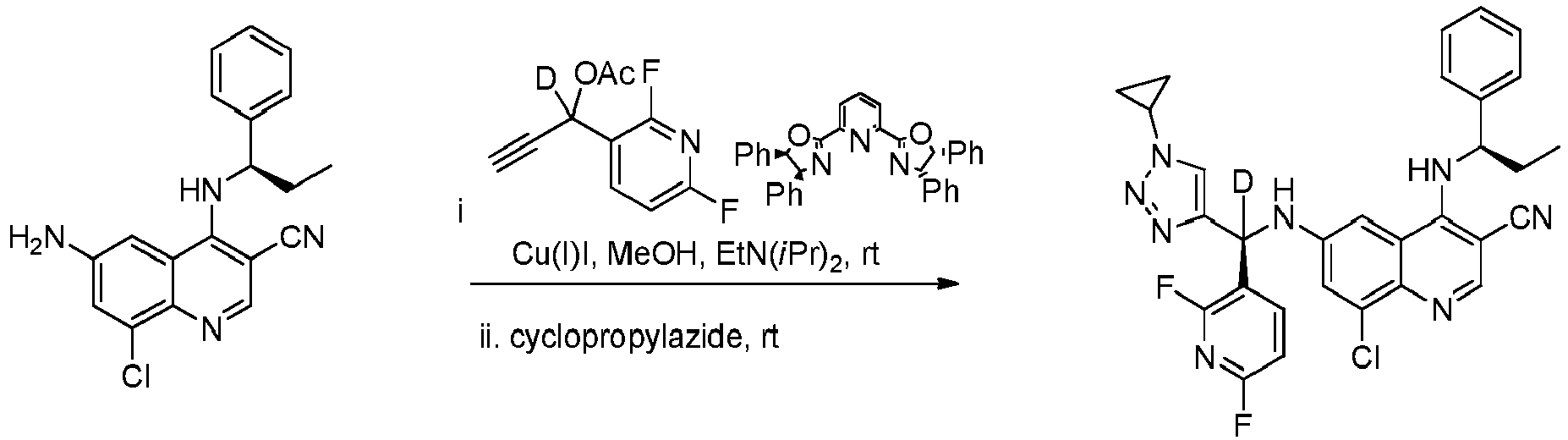
- 8-chloro-6-(((S)-(1-cyclopropyl-1H-1,2,3-triazol-4-yl)(2,6-difluoropyridin-3-yl)methyl-d))amino)-4-(((R)-1-phenylpropyl)amino)quinoline-3-carbonitrile: CuI (2.0 mg, 0.01 mmol) and 2,6-bis((4S,5R)-4,5-diphenyl-4,5-dihydrooxazol-2-yl)pyridine [oxazoline ligand] (4.6 mg, 0.009 mmol) were sonicated in MeOH (3.0 mL) for ∼ 5 minutes. alkynyl acetate (79 mg, 0.37 mmol) in MeOH (1 mL), (R)-6-amino-8-chloro-4-((1-phenylpropyl)amino)quinoline-3-carbonitrile (50 mg, 0.148 mmol), and di-isopropyl ethyl amine (23 mg, 0.18 mmol) were added and the reaction was stirred at room temperature overnight. The crude reaction mixture was used directly for the next step.
ES/MS: 489.19 (M+H+). - To the reaction mixture was added cyclopropylazide (16 mg, 0.192mmol). After 1 hour at room temperature, the mixture was filtered and then purified by RP-HPLC (eluent: water / MeCN *0.1% TFA) to yield the product as trifluoroacetate salt.
1H NMR (400 MHz, CD3OD) δ 8.43 (m, 1H), 8.05 (m, 1H), 8.01 (m, 1H), 7.64 (m, 1H), 7.42 - 7.25 (m, 6H), 6.98 (m, 1H), 5.80 - 5.66 (m, 1H), 3.97 - 3.84 (m, 1H), 2.25 - 2.01 (m, 2H), 1.28 - 1.11 (m, 4H), 1.01 (m, 3H).
ES/MS: 572.24 (M+H+). -

- 8-chloro-6-(((S)-(1-((3-hydroxyoxetan-3-yl)methyl)-1H-1,2,3-triazol-4-yl)(pyridin-3-yl)methyl)amino)-4-(((R)-1-phenylpropyl)amino)quinoline-3-carbonitrile: 8-chloro-4-(((R)-1-phenylpropyl)amino)-6-(((R)-1-(pyridin-3-yl)prop-2-yn-1-yl)amino)quinoline-3-carbonitrile (20 mg, 0.046 mmol), copper powder (15 mg, 0.23 mmol), acetic acid (118 uL, 1.8 mmol) and saturated aqueous copper (II) sulfate (0.1 mL) and THF (3 mL) were added to the stock solution of 3-(azidomethyl)oxetan-3-ol (0.049 mmol). After 2 hrs, the reaction was complete and volatiles were removed in vacuo. The crude was partitioned between ethyl acetate (15 mL) and water. The organic layer was washed with saturated sodium bicarbonate, brine, dried over Na2SO4 and concentrated after filtration. The residue was taken up in water (1 mL) and MeOH (1 mL) with 2 drops of TFA and subjected to RP-HPLC (eluent: water / MeCN * 0.1% TFA). The fractions containing the desired product were combined and subjected to lyophilization, providing the desired compound.
1H NMR (400 MHz, DMSO-d6) δ 8.84 (dd, J = 14.0, 2.2 Hz, 1H), 8.64 - 8.52 (m, 1H), 8.23 (d, J = 2.1 Hz, 1H), 8.14 (d, J = 7.8 Hz, 1H), 8.05 (d, J = 6.7 Hz, 1H), 7.65 - 7.54 (m, 2H), 7.46 (d, J = 9.5 Hz, 1H), 7.43 - 7.38 (m, 1H), 7.38 - 7.31 (m, 2H), 7.28 - 7.21 (m, 2H), 7.21 - 7.15 (m, 3H), 6.48 (d, J = 6.9 Hz, 1H), 5.48 (q, J = 7.7 Hz, 1H), 4.68 (d, J = 2.0 Hz, 2H), 4.50 (dd, J = 6.2, 4.5 Hz, 3H), 4.41 (dd, J = 6.7, 3.4 Hz, 2H), 2.12 (dt, J = 14.5, 7.4 Hz, 1H), 2.04 - 1.78 (m, 1H), 0.94 (t, J = 7.3 Hz, 3H).
ES/MS 581.2 (M+H+). -

- (R)-8-chloro-4-((3-chloro-4-fluorophenyl)amino)-6-((1-(2,5-dichlorothiophen-3-yl)prop-2-yn-1-yl)amino)quinoline-3-carbonitrile: CuI (4.1 mg, 0.022 mmol) and 2,6-bis((4S,5R)-4,5-diphenyl-4,5-dihydrooxazol-2-yl)pyridine [oxazoline ligand] (13.5 mg, 0.026 mmol) were sonicated in MeOH (1 mL) for ~ 5 minutes. Additional MeOH (4 mL) was added. Alkynyl acetate (150.7 mg, 0.61 mmol), 6-amino-8-chloro-4-((4-chloro-3-fluorophenyl)amino)quinoline-3-carbonitrile (150 mg, 0.43 mmol), and di-isopropyl ethyl amine (67 mg, 0.52 mmol) were added and the reaction was stirred at -15 °C for 4 days. The solvents were removed in vacuo. The crude reaction product was purified via silica gel chromatography (eluent: EtOAc / hexanes) to yield the product.
1H NMR (400 MHz, DMSO-d6) δ 9.51 (s, 1H), 8.45 (s, 1H), 7.54 (dd, J = 6.4, 2.4 Hz, 2H), 7.43 (t, J = 9.0 Hz, 1H), 7.38 (d, J = 2.3 Hz, 1H), 7.30 (d, J = 4.3 Hz, 1H), 7.27 (s, 1H), 7.11 (d, J = 8.6 Hz, 1H), 5.54 (dd, J = 8.6, 2.2 Hz, 1H), 3.51 (d, J = 2.2 Hz, 1H).
ES/MS 534.9 (M+H+). - (S)-tert-butyl 4-(4-(((8-chloro-4-((3-chloro-4-fluorophenyl)amino)-3-cyanoquinolin-6-yl)amino)(2,5-dichlorothiophen-3-yl)methyl)-1H-1,2,3-triazol-1-yl)piperidine-1-carboxylate: (R)-8-chloro-4-((3-chloro-4-fluorophenyl)amino)-6-((1-(2,5-dichlorothiophen-3-yl)prop-2-yn-1-yl)amino)quinoline-3-carbonitrile (174 mg, 0.324 mmol) and N-Boc piperidine 4 azide (73.4 mg, 0.324 mmol) were dissolved in THF (5 mL). Copper thiophenecarboxylate (6.2 mg, 0.032 mmol) was added and the reaction was stirred at room temperature for 16 hrs. The volatiles were removed under reduced pressure and the residue was purified by chromatography on silica gel (eluent: EtOAc / hexanes). The fractions containing product were combined and the solvent was removed under reduced pressure, providing the product.
1H NMR (400 MHz, DMSO-d6) δ 9.41 (s, 1H), 8.47 (s, 1H), 8.16 (s, 1H), 7.60 (d, J = 2.2 Hz, 1H), 7.40 - 7.33 (m, 2H), 7.27 (d, J = 8.3 Hz, 1H), 7.14 (dd, J = 7.1, 2.0 Hz, 2H), 7.10 (s, 1H), 5.96 (d, J = 8.2 Hz, 1H), 4.72 - 4.59 (m, 1H), 4.01 (q, J = 9.1, 8.1 Hz, 3H), 2.86 (d, J = 17.5 Hz, 2H), 1.96 (d, J = 5.0 Hz, 3H), 1.77 (qd, J = 12.2, 4.4 Hz, 2H), 1.39 (s, 9H).
ES/MS 762.9 (M+H+). - Alternatively, the cycloaddition can be performed in a one-pot fashion using the Cu(I) present from the N-alkylation.
- (S)-8-chloro-4-((3-chloro-4-fluorophenyl)amino)-6-(((2,5-dichlorothiophen-3-yl)(1-(piperidin-4-yl)-1H-1,2,3-triazol-4-yl)methyl)amino)quinoline-3-carbonitrile: (S)-tert-butyl 4-(4-(((8-chloro-4-((3-chloro-4-fluorophenyl)amino)-3-cyanoquinolin-6-yl)amino)(2,5-dichlorothiophen-3-yl)methyl)-1H-1,2,3-triazol-1-yl)piperidine-1-carboxylate (157 mg, 0.206 mmol) was suspended in DCM (0.5 mL). HCl in dioxane (5 mL; 4M) was added and the reaction was stirred at room temperature for 30 minutes. The solvents were removed under reduced pressure. The residue was subjected to flash chromatography (eluent: (20% MeOH in EtOAc) / hexanes). The fractions containing product were combined and the solvent was removed under reduced pressure. The residue was taken up in EtOAc / aqueous saturated sodium bicarbonate solution. The organic layer was isolated and dried over sodium sulfate. Filtration and evaporation of the solvent in vacuo gave the product.
1H NMR (400 MHz, DMSO-d6) δ 9.41 (s, 1H), 8.45 (s, 1H), 8.10 (s, 1H), 7.59 (d, J = 2.1 Hz, 1H), 7.37 (t, J = 8.9 Hz, 2H), 7.26 (d, J = 8.1 Hz, 1H), 7.13 (d, J = 10.0 Hz, 3H), 5.96 (d, J = 8.2 Hz, 1H), 4.48 (tt, J = 11.8, 4.3 Hz, 1H), 3.75 - 3.62 (m, 1H), 3.55 (s, 1H), 3.46 (dq, J = 9.7, 5.2 Hz, 1H), 2.99 (d, J = 12.2 Hz, 2H), 2.55 (td, J = 12.5, 2.4 Hz, 2H), 1.92 (dd, J = 11.9, 3.7 Hz, 2H), 1.75 (t, J = 12.0 Hz, 3H).
ES/MS 662.1 (M+H+). - (S)-8-chloro-4-((3-chloro-4-fluorophenyl)amino)-6-(((2,5-dichlorothiophen-3-yl)(1-(1-ethylpiperidin-4-yl)-1H-1,2,3-triazol-4-yl)methyl)amino)quinoline-3-carbonitrile: (S)-8-chloro-4-((3-chloro-4-fluorophenyl)amino)-6-(((2,5-dichlorothiophen-3-yl)(1-(piperidin-4-yl)-1H-1,2,3-triazol-4-yl)methyl)amino)quinoline-3-carbonitrile (138 mg, 0.208 mmol) was dissolved in THF (3 mL) and dichloro ethane (3 mL). Acetaldehyde (91.8 mg, 2.08 mmol) and sodium triacetoxy borohydride (176 mg, 0.833 mmol) were added and the reaction was stirred at room temperature for 1 hr. The reaction was diluted with EtOAc and washed with aqueous sodium bicarbonate solution, brine, and was dried over sodium sulfate. The crude material was filtered and the volatiles were removed in vacuo and the crude was purified via chromatography on silica get (eluent: MeOH (20%) in EtOAc / hexanes) to yield the product.
1H NMR (400 MHz, DMSO-d6) δ 9.41 (s, 1H), 8.47 (s, 1H), 8.14 (s, 1H), 7.60 (d, J = 2.3 Hz, 1H), 7.41 - 7.34 (m, 2H), 7.27 (d, J = 8.2 Hz, 1H), 7.15 (dd, J = 9.1, 3.3 Hz, 2H), 7.12 (s, 1H), 5.96 (d, J = 8.1 Hz, 1H), 4.50 - 4.32 (m, 1H), 3.00 - 2.83 (m, 2H), 2.42 - 2.25 (m, 2H), 2.18 - 1.81 (m, 6H), 0.98 (t, J = 7.2 Hz, 3H).
ES/MS 689.9 (M+H+). -

- Benzyl 4-(4-(((8-chloro-4-((3-chloro-4-fluorophenyl)amino)-3-cyanoquinolin-6-yl)amino)(3-pyridyl)methyl)-1H-1,2,3-triazol-1-yl)piperidine-1-carboxylate: A suspension of the 6-amino-8-chloro-4-((4-chloro-3-fluorophenyl)amino)quinoline-3-carbonitrile (159 mg, 0.51 mmol), aldehyde (176 mg, 0.51 mmol) and pTSA (9.6 mg, 0.05 mmol) in toluene (12 mL) was heated at reflux (50 mL RBF equipped with a Hickman still). After 4 hrs, the solvent was removed under reduced pressure. The solid was dissolved in methyl-THF and 3-pyridylmagnesium bromide (2.03 mmol; 8.1 mL 0.25-M Me-THF) was added dropwise at -10 C. After 130 min, the reaction was quenched with sat NH4Cl (3 mL). The layers were separated and the aqueous phase was extracted with EtOAc (15 mL). The combined organic layers were washed with brine (5 mL), dried over sodium sulfate and concentrated. The residue was subjected to flash chromatography on silica gel (eluent: EtOAc / hexanes). The fractions containing product were combined and the solvent was removed providing the product.
- 8-chloro-4-((3-chloro-4-fluorophenyl)amino)-6-(((1-(1-ethylpiperidin-4-yl)-1H-1,2,3-triazol-4-yl)(pyridin-3-yl)methyl)amino)quinoline-3-carbonitrile: Benzyl 4-(4-(((8-chloro-4-((3-chloro-4-fluorophenyl)amino)-3-cyanoquinolin-6-yl)amino)(pyridin-3-yl)methyl)-1H-1,2,3-triazol-1-yl)piperidine- 1-carboxylate (57 mg, 0.079 mmol) Acetaldehyde (34.7 mg, 0.79 mmol) and Pd-C (25 mg, 10%) in EtOH (3 mL) / EtOAc (2 mL) were stirred under an atmosphere of hydrogen. After 43 hrs, the reaction was filtered and the volatiles were removed in vacuo and the crude was purified via RP-HPLC (eluent: water / MeCN 0.1%TFA) to yield the product as trifluoro acetate salt.
1H NMR (400 MHz, DMSO-d 6) δ 9.41 (s, 1H), 8.74 (d, J = 2.2 Hz, 1H), 8.54 (dd, J = 5.0, 1.5 Hz, 1H), 8.41 (s, 1H), 8.13 (s, 1H), 8.00 (d, J = 8.0 Hz, 1H), 7.67 (d, J = 2.2 Hz, 1H), 7.49 (tt, J = 6.8, 3.7 Hz, 3H), 7.42 (t, J = 9.0 Hz, 1H), 7.26 (d, J = 2.5 Hz, 1H), 7.25 - 7.21 (m, 1H), 6.20 (d, J = 7.8 Hz, 2H), 4.79 - 4.69 (m, 1H), 3.61 (d, J = 12.4 Hz, 2H), 3.26 - 2.98 (m, 4H), 2.34 (d, J = 13.9 Hz, 2H), 2.15 (q, J = 12.5, 11.6 Hz, 2H), 1.22 (t, J = 7.3 Hz, 3H).
ES/MS: 616.1 (M+H+). - Compounds of this sequence can be separated into the respective stereoisomers via appropriate means (eg. chromatography with chiral stationary phase, crystallography) after the C6 N-alkylation has been performed.
- Removal of the protecting group in the absence of a reaction partner yields the corresponding un-alkylated amine derivatives.
-

- 8-chloro-4-((3-chloro-4-fluorophenyl)amino)-6-((pyridin-2-yl(pyridin-3-yl)methyl)amino)quinoline-3-carbonitrile: To a suspension of the 6-amino-8-chloro-4-((4-chloro-3-fluorophenyl)amino)quinoline-3-carbonitrile (50 mg, 0.144 mmol) and pyridin-2-yl(pyridin-3-yl)methanone (27 mg, 0.144 mmol) in DCM (1 mL) was added triethylamine (35 mg, 0.346 mmol) followed by TiCl4 in DCM (0.086 mmol / 0.086 mL). The reaction was stirred overnight at room temperature. It was diluted with MeOH (2 mL) and sodium borohydride (16 mg, 0.432 mmol) was added. The reaction was stirred for 2 hours, then was diluted with water and treated with 1M NaOH until a pH of -13 was reached. Solids were removed via filtration and washed with DCM. The combined organic layers were dried over sodium sulfate, filtered, and concentrated. The product was purified by chromatography on silica gel (eluent: EtOAc/hexanes) to yield the product after lyophilization from water / MeCN.
1H NMR (400 MHz, DMSO-d6) δ 9.42 (s, 1H), 8.66 (dd, J = 2.4, 0.8 Hz, 1H), 8.56 (ddd, J = 4.9, 1.8, 0.9 Hz, 1H), 8.47 - 8.39 (m, 2H), 7.87 - 7.75 (m, 3H), 7.61 - 7.19 (m, 8H), 6.08 (d, J = 8.7 Hz, 1H).
ES/MS: 515.1 (M+H+). -

- 8-chloro-4-((5,6-difluoropyridin-3-yl)amino)-6-nitroquinoline-3-carbonitrile: 4,8-dichloro-6-nitroquinoline-3-carbonitrile (1.4 g, 5.22 mmol), 2,6-difluoropyridin-3-amine (755 mg, 5.74 mmol) and pyridine hydrochloride (1.8 g, 15.6 mmol) in iso-propanol (40 mL) was heated at 70 °C overnight. The reaction was cooled to room temperature. Water was added and the resulting precipitate was collected via filtration. The crude product was used in the next step without further purification. ES/MS 362.0 (M+H+).
- 6-amino-8-chloro-4-((5,6-difluoropyridin-3-yl)amino)quinoline-3-carbonitrile: Made from 8-chloro-4-((5,6-difluoropyridin-3-yl)amino)-6-nitroquinoline-3-carbonitrile via step-2 of general procedure 1. ES/MS 332.0 (M+H+).
- (S)-8-chloro-4-((5,6-difluoropyridin-3-yl)amino)-6-(((1-isopropyl-1H-1,2,3-triazol-4-yl)(pyridin-3-yl)methyl)amino)quinoline-3-carbonitrile): Made from 6-amino-8-chloro-4-((5,6-difluoropyridin-3-yl)amino)quinoline-3-carbonitrile by step-3 of general procedure 1. ES/MS 532.1 (M+H+).
-

- (S)-6-((benzo[d]thiazol-7-yl(1-cyclopropyl-1H-1,2,3-triazol-4-yl)methyl)amino)-4-(neopentylamino)quinoline-3,8-dicarbonitrile () : DMF (2 mL) was added to (S)-6-((benzo[d]thiazol-7-yl(1-cyclopropyl-1H-1,2,3-triazol-4-yl)methyl)amino)-8-bromo-4-(neopentylamino)quinoline-3-carbonitrile (38 mg, 0.064 mmol) and CuCN (41 mg, 0.46 mmol) in a microwave vial. The vial was heated to 200 °C for 15 minutes in a microwave and allowed to cool to room temperature. The reaction mixture was poured into water (4 mL) and extracted with EtOAc (3 x 8 mL). The combined organic phases were washed with brine (5 mL), dried over MgSO4 and concentrated. The crude residue was purified by RP-HPLC (eluent: water / MeCN *0.1% TFA) to yield the product as trifluoro acetate salt.1H NMR (400 MHz, Methanol-d 4) δ 9.20 (s, 1H), 8.34 (s, 1H), 8.05 (dd, J = 7.3, 1.9 Hz, 1H), 7.86 (d, J = 2.5 Hz, 1H), 7.82 (s, 1H), 7.64 - 7.54 (m, 2H), 7.16 (d, J = 2.6 Hz, 1H), 6.34 (s, 1H), 3.97 (d, J = 13.7 Hz, 1H), 3.91 - 3.80 (m, 1H), 3.49 (d, J = 13.7 Hz, 1H), 1.23 - 1.07 (m, 4H), 0.81 (s, 9H). ES/MS 534.1 (M+H+).
-

- 6-amino-4-(neopentylamino)quinoline-3,8-dicarbonitrile: Solid Zn(CN)2 (211 mg, 1.8 mmol) and Pd(PPh)4 (35 mg, 0.03 mmol) were added to a solution of 6-amino-8-bromo-4-(neopentylamino)quinoline-3-carbonitrile (500 mg, 1.5 mmol) in NMP (20 mL). The resulting mixture was degased by bubbling argon gas through for 5 min. The reaction vessel was sealed then heated to 120 °C for 16 h. The reaction mixture was cooled then loaded directly to silica column to afford the pure nitrile. ES/MS 280.3 (M+H+).
- Further elaboration to final compound according to procedures outlined in this document
-

- (S)-6-((benzo[d]thiazol-6-yl(1H-1,2,3-triazol-4-yl)methyl)amino)-8-chloro-4-((3-chloro-4-fluorophenyl)amino)quinoline-3-carbonitrile: (R)-6-((1-(benzo[d]thiazol-6-yl)prop-2-yn-1-yl)amino)-8-chloro-4-((3-chloro-4-fluorophenyl)amino)quinoline-3-carbonitrile (40.0 mg, 0.077 mmol) was dissolved in THF (2 mL). Cu(I)-thiophene-2-carboxylate (4.4 mg, 0.023 mmol) and azidomethyloxy pivalate (0.018 mL, 0.12 mmol) were added and the resulting solution stirred at room temperature for 30 minutes. The reaction contents were poured into saturated aqueous NaHCO3 solution (5 mL) and extracted with EtOAc (3 x 8 mL). The combined organic layers were washed with brine (5 mL), dried over MgSO4 and concentrated. The resulting crude residue was then dissolved in MeOH (2 mL). NaOH (1.0M in water, 0.17 mL, 0.17 mmol) was added and the reaction allowed to stir at room temperature for 30 min. HCl (1.0M in water, 0.17 mL, 0.17 mmol) was then added, the resulting solution poured into water (5mL) and extracted with EtOAc (3 x 8 mL). The combined organic layers were washed with brine (5 mL), dried over MgSO4 and concentrated. The resulting crude residue was purified by RP-HPLC (eluent: water / MeCN *0.1% TFA) to yield the product as trifluoro acetate salt.
ES/MS 561.0 (M+H+). -
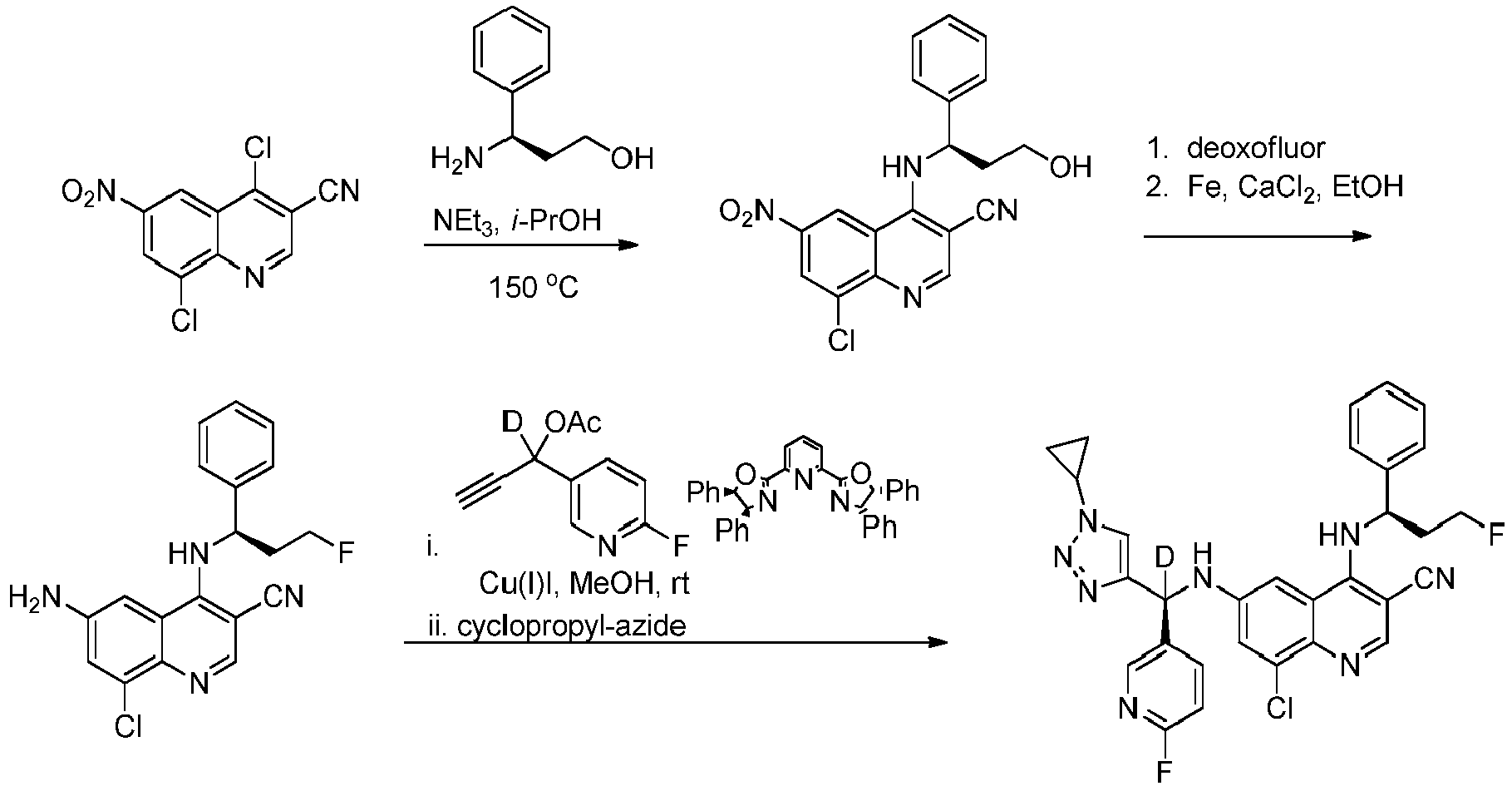
- (R)-8-chloro-4-((3-hydroxy-1-phenylpropyl)amino)-6-nitroquinoline-3-carbonitrile: 4,8-dichloro-6-nitroquinoline-3-carbonitrile (400 mg, 1.49 mmol), (R)-3-amino-3-phenylpropan-1-ol (270.76 mg, 1.79 mmol) in iso-propanol (1.5 mL) were heated under microwave conditions at 150 °C for 45 minutes. The reaction was cooled to room temperature. Water and Et2O were added. The aqueous layer was extracted with Et2O and the combined organic layers were dried over sodium sulfate. Filtration and evaporation of solvents yielded the crude product which was used in the next step without further purification.
ES/MS 383.1 (M+H+). - (R)-8-chloro-4-((3-fluoro-1-phenylpropyl)amino)-6-nitroquinoline-3-carbonitrile: (R)-8-chloro-4-((3-hydroxy-1-phenylpropyl)amino)-6-nitroquinoline-3-carbonitrile (100 mg, 0.26 mmol) was treated with deoxofluor ® (0.6 mL) at room temperature for 16 hours. The reaction mixture was cooled in an ice bath and carefully quenched with saturated sodium bicarbonate solution, then extracted with ethyl acetate. The organic phase was dried over sodium sulfate, filtered and concentrated to give the crude product (115 mg) which was used without further purification.
ES/MS 385.1 (M+H+). - (R)-6-amino-8-chloro-4-((3-fluoro-1-phenylpropyl)amino)quinoline-3-carbonitrile: (R)-8-chloro-4-((3-fluoro-1-phenylpropyl)amino)-6-nitroquinoline-3-carbonitrile (115 mg, 0.3 mmol), Calcium chloride dihydrate (66 mg, 0.45 mmol), and iron powder (83 mg, 1.49 mmol) were heated in ethanol (3 mL) / water (0.3 mL) at 60 °C for 12 hours. The reaction was cooled to room temperature and solids were removed via filtration. The solids were washed with EtOAc and the combined organic layers were washed with aqueous sodium bicarbonate solution, brine, and were dried over sodium sulfate. Filtration and evaporation of all volatiles yielded the product.
ES/MS 355.0 (M+H+). - 8-chloro-6-(((S)-(1-cyclopropyl-1H-1,2,3-triazol-4-yl)(4-fluorophenyl)methyl)amino)-4-(((R)-3-fluoro-1-phenylpropyl)amino)quinoline-3-carbonitrile: (R)-6-amino-8-chloro-4-((3-fluoro-1-phenylpropyl)amino)quinoline-3-carbonitrile (50 mg, 0.14 mmol), CuI (1.4 mg, 0.05 eq) and 2,6-bis((4S,5R)-4,5-diphenyl-4,5-dihydrooxazol-2-yl)pyridine [oxazoline ligand] (4.4 mg,0.06 eq) were sonicated in MeOH (2.0 mL) for ~ 1 minute. Alkynyl acetate (68 mg, 0.35 mmol) and di-isopropyl ethyl amine (22 mg, 0.17 mmol) were added and the reaction was stirred overnight. Cyclopropylazide (16 mg) was added and the reaction was stirred for additional 16 hrs at room temperature. Solvents were removed in vacuo and the crude material was purified by RP-HPLC (eluent: water / MeCN *0.1% TFA) to yield the product as trifluoroacetate salt.
ES/MS 572.0 (M+H+). -
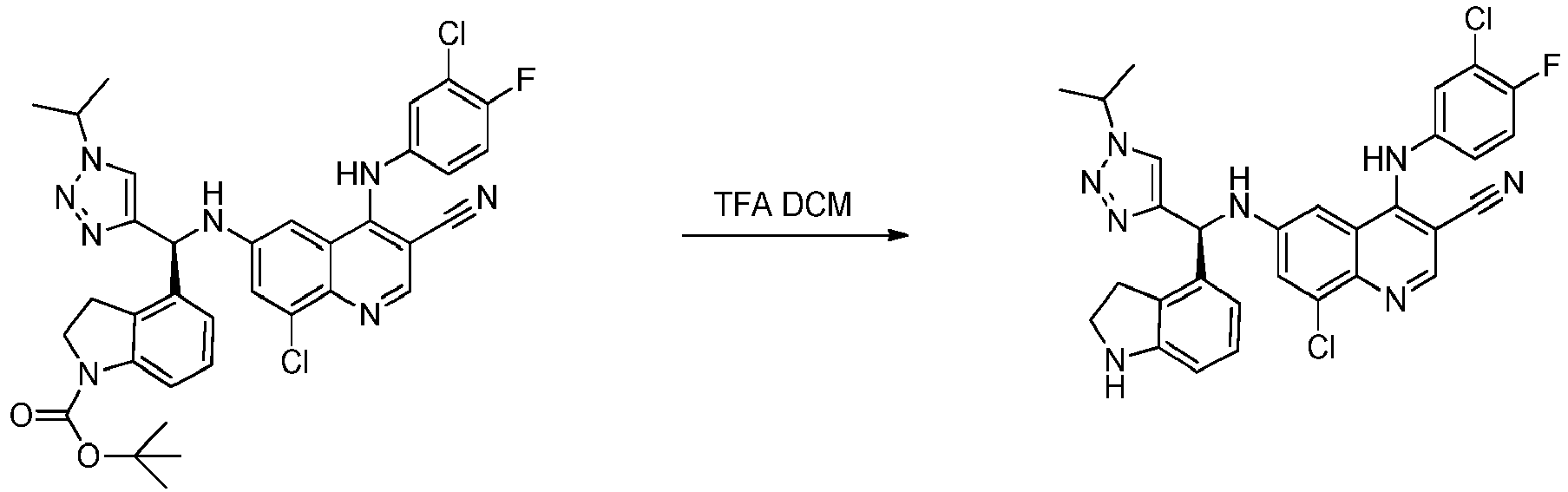
- (S)-8-chloro-4-((3-chloro-4-fluorophenyl)amino)-6-((indolin-4-yl(1-isopropyl-1H-1,2,3-triazol-4-yl)methyl)amino)quinoline-3-carbonitrile: (S)-tert-butyl 4-(((8-chloro-4-((3-chloro-4-fluorophenyl)amino)-3-cyanoquinolin-6-yl)amino)(1-isopropyl-1H-1,2,3-triazol-4-yl)methyl)indoline-1-carboxylate (45 mg, 0.065 mmol) was dissolved in DCM and trifluoroacetic acid and stirred at room temperature. After 30 minutes the reaction mixture was concentrated to dryness and the residue purified by RP-HPLC (eluent: water / MeCN *0.1% TFA) to yield the product as trifluoro acetate salt.
ES/MS 586.9 (M+H+). -

- (S)-6-(((1-(1-(tert-butyl)piperidin-4-yl)-1H-1,2,3-triazol-4-yl)(2-ethylisoindolin-4-yl)methyl)amino)-8-chloro-4-((3-chloro-4-fluorophenyl)amino)quinoline-3-carbonitrile: (S)-6-(((1-(1-(tert-butyl)piperidin-4-yl)-1H-1,2,3-triazol-4-yl)(isoindolin-4-yl)methyl)amino)-8-chloro-4-((3-chloro-4-fluorophenyl)amino)quinoline-3-carbonitrile (80.0 mg, 0.12 mmol) was dissolved in MeOH (3 mL) and AcOH (1 mL) at room temperature. Acetaldehyde (0.066 mL, 1.17 mmol) and polymer bound PS-CNBH3 (467 mg, 1.17 mmol) were then added and the reaction stirred at room temperature. After 1 hour additional acetaldehyde (0.066 mL, 1.17 mmol) and polymer bound PS-CNBH3 (467 mg, 1.17 mmol) were added. After 1 additional hour the PS-CNBH3 was removed via vacuum filtration and the filtrate concentrated to dryness. The resulting crude residue was purified by RP-HPLC (eluent: water / MeCN *0.1% TFA) to yield the product as trifluoro acetate salt.
ES/MS 712.1 (M+H+). -

- (S)-6-(((1-(1-(tert-butyl)piperidin-4-yl)-1H-1,2,3-triazol-4-yl)(2-(oxetan-3-yl)isoindolin-4-yl)methyl)amino)-8-chloro-4-((3-chloro-4-fluorophenyl)amino)quinoline-3-carbonitrile: (S)-6-(((1-(1-(tert-butyl)piperidin-4-yl)-1H-1,2,3-triazol-4-yl)(isoindolin-4-yl)methyl)amino)-8-chloro-4-((3-chloro-4-fluorophenyl)amino)quinoline-3-carbonitrile (15 mg, 0.022 mmol) was dissolved in a 1:1 mixture of THF and DCE after which oxetanone (0.007 mL, 0.11 mmol) and sodium triacetoxyborohydride (23.2 mg, 0.11 mmol) were added. After 1.5 hours the reaction mixture was poured into saturated aqueous NaHCO3 and extracted with EtOAc. The combined organic phases were washed with brine, dried over MgSO4 and concentrated. The crude residue was purified by RP-HPLC (eluent: water / MeCN *0.1% TFA) to yield the product as trifluoro acetate salt.
ES/MS 740.0 (M+H+). -

- (S)-6-(((1-(1-(tert-butyl)piperidin-4-yl)-1H-1,2,3-triazol-4-yl)(2-(2-hydroxyacetyl)isoindolin-4-yl)methyl)amino)-8-chloro-4-((3-chloro-4-fluorophenyl)amino)quinoline-3-carbonitrile: (S)-6-(((1-(1-(tert-butyl)piperidin-4-yl)-1H-1,2,3-triazol-4-yl)(isoindolin-4-yl)methyl)amino)-8-chloro-4-((3-chloro-4-fluorophenyl)amino)quinoline-3-carbonitrile (10.0 mg, 0.015 mmol) was dissolved in DMF (1 mL) after which glycolic acid (5.6 mg, 0.073 mmol), diisopropylethylamine (0.008 mL, 0.044 mmol) and HATU (7.1 mg, 0.022 mmL) were added at room temperature. The reaction mixture was stirred for 20 minutes at which point it was poured into water (4 mL) and extracted with EtOAc (3 x 8 mL). The combined organic phases were washed with brine (5 mL), dried over MgSO4 and concentrated. The crude residue was purified by RP-HPLC (eluent: water / MeCN *0.1 % TFA) to yield the product as trifluoro acetate salt.
ES/MS 742.1 (M+H+). -

- Ethyl 2-azido-2,2-difluoroacetate (47 mg, 0.29 mmol) was added to a solution of 8-chloro-4-(((R)-1-phenylpropyl)amino)-6-(((R)-1-(pyridin-3-yl)prop-2-yn-1-yl)amino)quinoline-3-carbonitrile (130 mg, 0.26 mmol) and copper(I) thiophene-2-carboxylate (4.9 mg, 0.026 mmol) in THF (2 mL). After 1 h the solvent was removed under reduced pressure. The residue was taken up in methanol (6 mL) and sodium borohydride (19.5 mg, 0.52 mmol) was added to the solution. After 1h the reaction was quenched with water and extracted with ethyl acetate (3 x 10 mL). The combined organic phases were washed with brine, dried over sodium sulfate and concentrated. The residue was subjected to flash chromatography (0-100% (20% methanol in ethyl acetate) vs hexanes). The fractions containing product were combined and the solvent was removed under reduced pressure. The residue was taken up in methanol / water with two drops of trifluoroacetic acid and subjected to preparative HPLC eluted with acetonitrile / water with 0.1 % trifluoroacetic acid. Fractions containing product were combined and subjected to lyophilization, providing 8-chloro-6-(((S)-(1-(1,1-difluoro-2-hydroxyethyl)-1H-1,2,3-triazol-4-yl)(pyridin-3-yl)methyl)amino)-4-(((R)-1-phenylpropyl)amino)quinoline-3-carbonitrile.
1H NMR (400 MHz, DMSO-d6) δ 8.92 - 8.83 (m, 1H), 8.67 (d, J = 9.5 Hz, 1H), 8.65 - 8.58 (m, 1H), 8.24 (d, J = 3.3 Hz, 1H), 8.15 (d, J = 7.7 Hz, 1H), 7.64 - 7.56 (m, 2H), 7.52 (d, J = 8.3 Hz, 1H), 7.42 (d, J = 8.5 Hz, 1H), 7.39 - 7.29 (m, 2H), 7.29 - 7.16 (m, 6H), 6.54 (d, J = 7.8 Hz, 1H), 5.47 (q, J = 7.6 Hz, 1H), 4.32 (t, J = 12.0 Hz, 2H), 2.11 (m, 1H), 2.04 - 1.83 (m, 1H), 0.93 (t, J = 7.3 Hz, 3H).
ES/MS 575.1 (M + H+). -

- NaH (60% dispersion in mineral oil, 26.6 mg, 0.66 mmol) added to iPrOH (2 mL) at 0 °C for 20 minutes. (S)-6-(((1-(1-(tert-butyl)piperidin-4-yl)-1H-1,2,3-triazol-4-yl)(6-fluoropyridin-3-yl)methyl)amino)-8-chloro-4-((3-chloro-4-fluorophenyl)amino)quinoline-3-carbonitrile (22 mg, 0.033 mmol) in DMF (0.5 mL) then added to newly formed alkoxide. The cold bath was removed and the resulting solution heated to 70 °C for 1 hour. The reaction mixture was quenched by water (1 mL) and extracted with EtOAc (3 x 8 mL). The combined organic phases were then washed with brine (5 mL), dried over MgSO4 and concentrated. The crude residue was purified by RP-HPLC (eluent: water / MeCN *0.1% TFA) to yield the product as trifluoro acetate salt.
-

- (S)-6-(((1-(1-(tert-butyl)piperidin-4-yl)-1H-1,2,3-triazol-4-yl)(3,6-dihydro-2H-pyran-4-yl)methyl)amino)-8-chloro-4-((3-chloro-4-fluorophenyl)amino)quinoline-3-carbonitrile (20.0 mg, 0.023 mmol), 10% Pd/C (2.5 mg, 0.002 mmol) and EtOH (1.5 mL) were combined and H2 was bubbled through the reaction mixture for 5 minutes. The reaction mixture was allowed to stir overnight under 1 atm of H2 after which it was filtered through celite washing with EtOAc and EtOH. The filtrate was then concentrated and purified by RP-HPLC (eluent: water / MeCN *0.1% TFA) to yield the product as trifluoro acetate salt.
-

- (S)-6-(((2-acetyl-3-oxoisoindolin-4-yl)(1-cyclopropyl-1H-1,2,3-triazol-4-yl)methyl)amino)-4-(neopentylamino)quinoline-3,8-dicarbonitrile (34 mg, 0.059 mmol) was dissolved in MeOH (2 mL) at room temperature. NaOH (1.0M aq, 0.30 mL, 0.30 mmol) was added and the reaction stirred for 30 minutes. HCl ((1.0M aq, 0.30 mL, 0.30 mmol) was added after which the reaction mixture was poured into water (3 mL) and extracted with EtOAc (3 x 8 mL). The combined organic phases were washed with brine (5 mL), dried over MgSO4 and concentrated. The crude residue was purified by RP-HPLC (eluent: water / MeCN *0.1% TFA) to yield the product as trifluoro acetate salt.
-

- The title compound was prepared as conditions for the final step as follows: (S)-8-chloro-4-((3-chloro-4-fluorophenyl)amino)-6-(((1-(piperidin-4-yl)-1H-1,2,3-triazol-4-yl)(thiazol-4-yl)methyl)amino)quinoline-3-carbonitrile (74.31 mg, 0.13 mmol) was dissolved in 1.20 mL of 3:1 2-methyltetrahyrdofuran : acetic acid and treated with acetaldehyde (10.52 µl, 0.19 mmol) and PS-BH3CN (polystyrene supported cyanoborohydride, 58 mg, 2.28 mmol/g). The mixture was stirred overnight. Additional acetaldehyde and 0.1 mL of methanol were added, and the reaction was complete in one hour. The resin was filtered and the resulting filtrate was concentrated, dissolved in dichloromethane, washed with saturated sodium bicarbonate, dried over sodium sulfate, filtered and concentrated. Purification using RP-HPLC (eluent: water / MeCN *0.1% TFA) provided the product as trifluoroacetate salt.
1H NMR (400 MHz, CD3OD) δ 9.02 (m, 1H), 8.46 (s, 1H), 8.01 (m, 1H), 7.68 (m, 1H), 7.60 (m, 1H), 7.52 (m, 1H), 7.33 (m, 4H), 6.31 (s, 1H), 3.75 (m, 2H), 3.25 - 3.13 (m, 3H), 2.45 (m, 2H), 2.36 (m, 2H), 2.25 - 2.01 (m, 2H), 1.37 (m, 3H),
ES/MS 622.0 (M+H+) -

- A misture of (S)-6-(((5-bromopyridin-3-yl)(1-isopropyl-1H-1,2,3-triazol-4-yl)methyl)amino)-8-chloro-4-((3-chloro-4-fluorophenyl)amino)quinoline-3-carbonitrile (200 mg, 0.32 mmol), pyrrolidine (580.6 mg, 8.16 mmol), and Dichloro 1,1-bis(diphenylphosphino)ferrocene palladium(II) dichloromethane (269.1 mg, 0.32 mmol) in DMF (1.2 ml) was degassed and purged with carbon monoxide twice, the heated at 80 °C for 5 hours. The solution was cooled and poured into water, then extracted with ethyl acetate. The combined organic layers were dried over sodium sulfate, filtered and concentrated. The crude product was purified by RP-HPLC (eluent: water / MeCN *0.1% TFA) to yield the product as trifluoroacetate salt.
ES/MS 644.1 (M+H+) -

- 6-(((S)-(6-fluoropyridin-3-yl)(1-methyl-1H-1,2,3-triazol-4-yl)methyl-d)amino)-4-(((R)-1-phenylpropyl)amino)quinoline-3,8-dicarbonitrile: 1.0 M solution of TBAF (0.38 mL, 0.38 mmol) in THF was added to the stirring solution of 6-(((R)-(6-fluoropyridin-3-yl)(1-((trimethylsilyl)methyl)-1H-1,2,3-triazol-4-yl)deteromethyl)amino)-4-(((R)-1-phenylpropyl)amino)quinoline-3,8-dicarbonitrile (150 mg, 0.25 mmol) in THF (5 mL). The resulting solution was stirred for 2 h then concentrated to give crude material. HPLC purification afforded the title compound.
1H NMR (400 MHz, DMSO-d6) δ 8.49 - 8.38 (m, 1H), 8.28 (d, J = 5.1 Hz, 1H), 8.13 - 8.02 (m, 2H), 7.84 (t, J = 2.4 Hz, 1H), 7.65 - 7.52 (m, 2H), 7.42 - 7.31 (m, 1H), 7.31 - 7.15 (m, 4H), 5.49 (q, J = 7.7 Hz, 1H), 4.04 (s, 3H), 3.20 - 3.11 (m, 1H), 2.20 - 2.05 (m, 1H), 2.05 - 1.85 (m, 1H), 1.63 - 1.50 (m, 1H), 1.37 - 1.20 (m, 1H), 0.99 - 0.83 (m, 3H).
ES/MS 519.2 (M+H+). -

- The CuI (2.6 mg, 0.014 mmol) and ligand (8.7 mg, 0.017 mmol) were suspended in MeOH (1mL) and sonicated under argon for 5 min. The remaining MeOH was added followed by the acetate (70.3 mg, 0.36 mmol) and amine (80 mg, 0.27 mmol) and DIPEA (43 mg, 0.33 mmol) in that order at room temperature. After 14 h the N-alkylation reactions was complete. Evaporation and purification on silica get (eluent: EtOAc in hexanes) yielded 95 mg of N-alkylated product. The material was taken into THF (2mL). Azide stock (1 mL / 1eq.), Cu and CuSO4 were added. Stirring at room temperature for 1 hr. Diluted with EtOAc, washed with NaHCO3 brine and dried over sodium sulfate. Filtration, evaporation, and purification via RP-HPLC (eluent: water / MeCN *0.1 TFA) yielded the product as the TFA salt.
1H NMR (400 MHz, Methanol-d4) δ 8.79 (s, 1H), 8.49 (s, 1H), 8.00 (s, 1H), 7.69 (d, J = 2.3 Hz, 1H), 7.26 (d, J = 2.3 Hz, 1H), 6.31 (s, 1H), 5.91 (t, J = 54.8 Hz, 1H), 4.09 (d, J = 13.9 Hz, 1H), 3.93 (d, J = 14.0 Hz, 1H), 2.56 (s, 3H), 1.50 (m, 4H), 1.05 (s, 9H). -
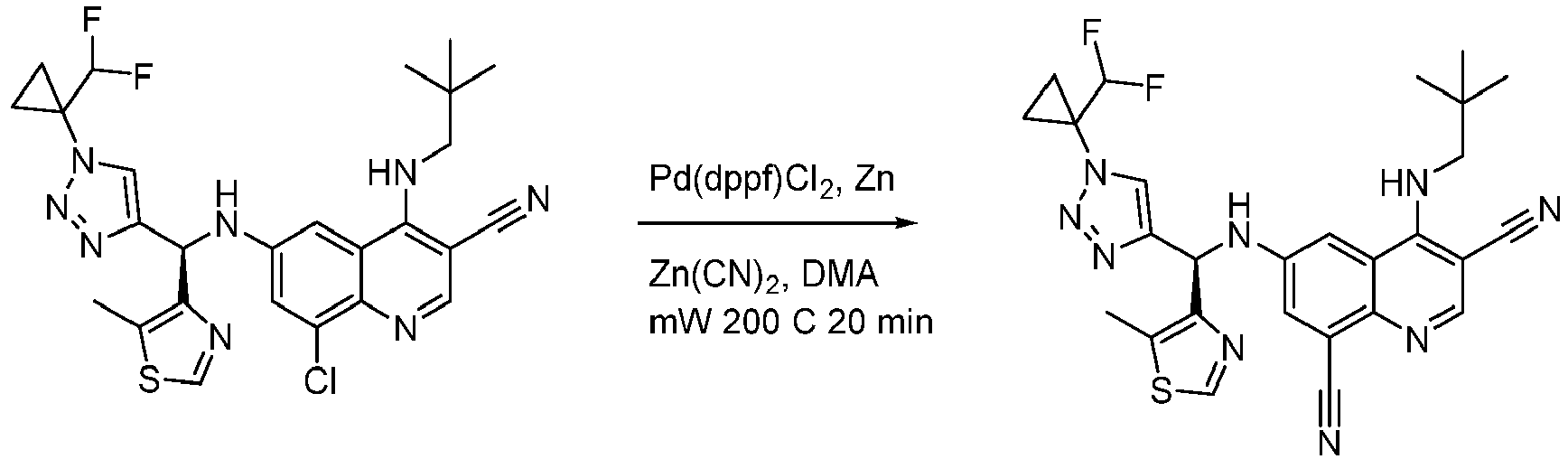
- The SM (38 mg, 0.05 mmol), Zn (0.4 mg, 0.007 mmol), PddppfCl2 (0.8 mg, 0.001 mmol) and Zn(CN)2 (7.1 mg, 0.061 mmol) were combined in dimethylacetamide (1 mL) and degassed for 2 min. The mixture was heated in a microwave reactor at 200 °C for 20min. The mixture was filtered and purified via RP-HPLC. The product fractions were combined and subjected to lyophilization, providing the desired compound as TFA salt.
1H NMR (400 MHz, Methanol-d4) δ 8.78 (s, 1H), 8.37 (s, 1H), 8.02 (s, 1H), 7.83 (d, J = 2.5 Hz, 1H), 7.44 (d, J = 2.5 Hz, 1H), 6.32 (s, 1H), 5.92 (t, J = 54.8 Hz, 1H), 3.96 (d, J = 13.9 Hz, 1H), 3.80 (d, J = 13.9 Hz, 1H), 2.56 (s, 3H), 1.50 (m, 4H), 1.02 (s, 9H). -

- SM (0.04 g, 0.06 mmol), Zn powder (0.006 g, 0.09 mmol), Pd(dppf)Cl2 (0.009 g, 0.012 mmol) and Zn(CN)2 (0.021g, 0.18 mmol) were combined in dimethylacetamide (0.7 mL) and degassed for 1 min. The mixture was heated in a microwave reactor at 200 °C for 15min. The mixture was filtered and purified via RP-HPLC. The product fractions were combined and subjected to lyophilization, providing the desired compound as TFA salt.
1H NMR (400 MHz, Methanol-d4) δ 9.61 (s, 1H), 8.69 (d, J = 6.1 Hz, 1H), 8.33 (s, 1H), 8.23 (s, 1H), 8.17 (d, J = 7.6 Hz, 1H), 8.16 (d, J = 6.1 Hz, 1H), 8.02 (d, J = 7.6 Hz, 1H), 7.83 (d, J = 2.5 Hz, 1H), 7.02 (d, J = 2.5 Hz, 1H), 6.91 (s, 1H), 3.82 (d, J = 13.8 Hz, 1H), 3.42 (d, J = 13.7 Hz, 1H), 1.79 - 1.55 (m, 4H), 0.62 (s, 9H). -

- To (S)-8-chloro-6-(((1-cyclopropyl-1H-1,2,3-triazol-4-yl)(2-fluoropyridin-3-yl)methyl-d)amino)-4-(neopentylamino)quinoline-3-carbonitrile (TFA salt, 24 mg, 0.04 mmol) was added dimethylamine (2M solution in MeOH, 0.9 mL). The solution was heated to 100 °C (external temperature, µW) for 8 h. The resulting solution was concentrated, purified via preparative HPLC (Gemini column, 10-42% MeCN/H2O/0.1% TFA) and lyophilized to provide the product as the corresponding TFA salt.
1H NMR (400 MHz, Methanol-d4) δ 8.38 (s, 1H), 8.06 (dd, J = 5.4, 1.8 Hz, 1H), 7.92 (s, 1H), 7.81 (dd, J = 7.6, 1.8 Hz, 1H), 7.49 (d, J = 2.3 Hz, 1H), 7.06 (d, J = 2.3 Hz, 1H), 7.02 (dd, J = 7.6, 5.4 Hz, 1H), 4.10 (d, J = 14.0 Hz, 1H), 3.78 (ddd, J = 11.4, 7.1, 4.2 Hz, 1H), 3.63 (d, J = 14.0 Hz, 1H), 2.97 (s, 6H), 1.12 - 1.02 (m, 4H), 0.91 (s, 9H). -

- Cu(I)iodide (16.5 mg, 0.09 mmol) and bis-oxazoline ligand (54.2 mg) were sonicated in MeOH (10 mL) for 5 minutes. The mixture was cooled to 0 °C. A solution of alkynyl actetate (687 mg, 3.3 mmol) in MeOH (7 mL) was added followed by quinoline (500 mg, 1.73 mmol) and di-iso-propyl ethyl amine (268.5 mg, 2.08 mmol). Stirring at 0 °C was continued. After consumption of starting material, the reaction volume was reduced and the crude material was purified via silica gel chromatography (el: EtOAc in hexanes) to yield the product.
1H NMR (400 MHz, Acetonitrile-d3) δ 8.34 (s, 1H), 8.14 (t, J = 8.2 Hz, 1H), 7.43 (d, J = 2.3 Hz, 1H), 6.95 - 6.82 (m, 2H), 5.98 (t, J = 6.4 Hz, 1H), 5.64 (dd, J = 7.1, 2.2 Hz, 1H), 5.52 (d, J = 7.2 Hz, 1H), 3.81 (dd, J = 13.4, 6.7 Hz, 1H), 3.67 (dd, J = 13.4, 6.0 Hz, 1H), 2.88 (d, J = 2.2 Hz, 1H), 2.56 (s, 3H), 2.23 (s, 1H), 1.01 (s, 9H).
ES/MS m/z: 436.2. - The alkyne starting material (1.6 g, 3.67 mmol) was dissolved in MeTHF (16 mL) and azide solution in MTBE (0.5 M, 7.34 mL) and copper(I)thiophenecarboxylate (24 mg, 0.18 mmol) were added and stirring at room temperature was continued. After the SM was consumed, the reaction was diluted with EtOAc and was washed with aqueous sodium bicarbonate solution and dried over sodium sulfate. Filtration and evaporation of solvents gives crude material which was purified via silica gel chromatography (el. EtOAc in hexanes) to yield product.
1H NMR (400 MHz, Chloroform-d) δ 8.45 (s, 1H), 7.93 (t, J = 8.1 Hz, 1H), 7.41 (s, 1H), 7.35 (d, J = 2.3 Hz, 1H), 6.80 (dd, J = 8.4, 3.2 Hz, 1H), 6.25 (s, 1H), 5.93 (s, 1H), 5.91 (t, J = 56.0 Hz, 1H), 5.27 (s, 1H), 3.57 (m, 2H), 2.58 (s, 3H), 1.55 - 1.50 (m, 4H), 0.94 (s, 9H).
ES/MS m/z: 569.6. -

- Copper (I) iodide (172.5 mg, 0.906 mmol) and iodine monochloride (147 mg, 0.906 mmol) were added to a solution of (R)-8-chloro-6-((1-(6-fluoro-2-methylpyridin-3-yl)prop-2-yn-1-yl)amino)-4-(neopentylamino)quinoline-3-carbonitrile (394 mg, 0.906 mmol), cyclopropyl azide (79.1 mg 0.906 mmol), and triethylamine (151.6 uL, 1.09 mmol) in tetrahydrofuran (15 mL). After 16 h the reaction was diluted with ethyl acetate (50 mL) and washed with water (25 mL) and brine (25 mL). The organic phase was dried over sodium sulfate and the solvent was removed under reduced pressure. The material was mixed with ethyl acetate (5 mL) and the solid was isolated by filtration providing (S)-8-chloro-6-(((1-cyclopropyl-5-iodo-1H-1,2,3-triazol-4-yl)(6-fluoro-2-methylpyridin-3-yl)methyl)amino)-4-(neopentylamino)quinoline-3-carbonitrile.
-

- 1,4-Dioxane (4.0 mL) and water (0.5 mL) were added to (S)-8-Chloro-6-(((1-cyclopropyl-5-iodo-1H-1,2,3-triazol-4-yl)(6-fluoro-2-methylpyridin-3-yl)methyl)amino)-4-(neopentylamino)quinoline-3-carbonitrile (100 mg, 0.155 mmol), cyclopropylboronic acid (20 mg, 0.223 mmol), tetrakis(triphenylphosphine)palladium(0) (35.8 mg, 0.031 mmol), and potassium carbonate (42.8 mg, 0.310 mmol) in a microwave vial. The reaction was heated in a microwave reactor for 20 minutes at 130 °C. The mixture was diluted with ethyl acetate (10 mL) and washed with brine (5 mL). The organic phase was dried over sodium sulfate and the solvent was removed under reduced pressure. The residue was subjected to flash chromatography (0 - 100 % ethyl acetate / hexanes). The fractions containing product were combined and the solvent was removed under reduced pressure. The residue was taken up in methanol (1 mL) and water (0.5 mL) with 2 drops of trifluoroacetic acid and subjected to preparative HPLC. The clean fractions were combined and subjected to lyophilization, providing (S)-8-Chloro-6-(((1,5-dicyclopropyl-1H-1,2,3-triazol-4-yl)(6-fluoro-2-methylpyridin-3-yl)methyl)amino)-4-(neopentylamino)quinoline-3-carbonitrile.
-

- Acetonitrile (1.0 mL) and water (1.0 mL) were added to (S)-8-Chloro-6-(((1-cyclopropyl-5-iodo-1H-1,2,3-triazol-4-yl)(6-fluoro-2-methylpyridin-3-yl)methyl)amino)-4-(neopentylamino)quinoline-3-carbonitrile (50 mg, 0.078 mmol) and potassium fluoride (22.5 mg, 0.388 mmol) in a microwave vial. The vial was sealed and the reaction was heated in a microwave reactor at 180 °C for 12 minutes. The reaction was diluted with ethyl acetate (10 mL) and washed with brine (5 mL). The organic phase was dried over sodium sulfate and the solvent was removed under reduced pressure. The residue was subjected to flash chromatography (0 - 100 % ethyl acetate / hexanes). The fractions containing product were combined and the solvent was removed under reduced pressure. The residue was taken up in methanol (1 mL) and water (0.5 mL) with 2 drops of trifluoroacetic acid and subjected to preparative HPLC. The clean fractions were combined and subjected to lyophilization, providing (S)-8-chloro-6-(((1-cyclopropyl-5-fluoro-1H-1,2,3-triazol-4-yl)(6-fluoro-2-methylpyridin-3-yl)methyl)amino)-4-(neopentylamino)quinoline-3-carbonitrile.
-

- Sodium methoxide (26 uL, 0.119 mmol, 25% pure in THF) was added to a solution of (S)-8-chloro-6-(((1-cyclopropyl-5-fluoro-1H-1,2,3-triazol-4-yl)(6-fluoro-2-methylpyridin-3-yl)methyl)amino)-4-(neopentylamino)quinoline-3-carbonitrile (42.6 mg, 0.079 mmol) in tetrahydrofuran (2.0 mL). The solution was heated at 90 °C for 30 minutes and the reaction was quenched with 2 drops of acetic acid. The solution was diluted with ethyl acetate (15 mL) and washed with saturated sodium bicarbonate (5 mL) and brine (5mL). The organic phase was dried over sodium sulfate and the solvent was removed under reduced pressure. The residue was subjected to flash chromatography (0-100 % ethyl acetate / hexanes). The fractions containing product were combined and the solvent was removed under reduced pressure. The residue was taken up in methanol (1 mL) and water (0.5 mL) with 2 drops of trifluoroacetic acid and subjected to preparative HPLC. The clean fractions containing product were combined and subjected to lyophilization, providing (S)-8-chloro-6-(((1-cyclopropyl-5-methoxy-1H-1,2,3-triazol-4-yl)(6-fluoro-2-methylpyridin-3-yl)methyl)amino)-4-(neopentylamino)quinoline-3-carbonitrile.
-

- Aldehyde (223 mg, 1.4 mmol) was dissolved in acetonitrile (8 mL). Triethylamine (0.29 mL, 2.1 mmol) and DMAP (34 mg, 0.28 mmol) were added followed by Boc2O (365 mg, 1.7 mmol) and the resulting mixture stirred for 2 minutes. Upon completion the reaction contents were concentrated directly then purified via silica gel chromatography (EtOAc in hexanes) to yield the product.
- The newly formed material was taken up in THF (15 mL) and brought to 0 °C. Ethynylmagnesium bromide (0.5M in THF, 3.7 mL, 1.8 mmol) was added dropwise and the resulting solution stirred for 30 minutes at which point acetic anhydride (0.29 mL, 3.1 mmol) was added and the reaction contents allowed to warm to room temperature over 1h. The reaction was quenched by the addition of saturated aqueous NH4Cl and extracted with EtOAc. The organic layers were washed with brine, dried over magnesium sulfate, filtered and concentrated to give the crude propargyl acetate which was used without further purification.
- The CuI (6.6 mg, 0.035 mmol) and ligand (22 mg, 0.042 mmol) were suspended in MeOH (5mL) and sonicated under argon for 5 min. The acetate (136 mg, 0.42 mmol) as a solution in MeOH (2 mL), amine (100 mg, 0.35 mmol) and DIPEA (54 mg, 0.42 mmol) were added in that order at room temperature. After 2 h reaction mixture was concentrated directly and purified on silica gel (EtOAc in hexanes) to give the alkylated product.
- The material was taken into THF (2mL). Azide stock (1 mL / 1eq.), Cu and CuSO4 were added and the resulting mixture stirred at room temperature for 30 min. Diluted with EtOAc, washed with water, brine and dried over magnesium sulfate. Filtration and concentration gave the crude product which was then stirred in 1mL of a 1:1 DCM:trifluoroacetic acid mixture for 30 min. The DCM and TFA were removed by rotary evaporation after which the crude residue was purified RP-HPLC (eluent: water / MeCN *0.1 TFA) yielded the product as TFA salt.
-

- A solution of the alkyne starting material (50 mg, 0.115 mmol) in deuterated methanol (CD3OD, 2 mL) was treated with azide solution in DCM (25% by weight, 80mg, 0.138 mmol) and copper(I)thiophenecarboxylate (1 mg) at room temperature. After 1 hour, the reaction was diluted with EtOAc and was washed with aqueous sodium bicarbonate solution and dried over sodium sulfate. Filtration and evaporation of solvents gives crude material which was purified via reverse phase HPLC to yield clean product.
1H NMR (400 MHz, Acetonitrile-d3) δ 8.44 (s, 1H), 7.82 (t, J = 8.2 Hz, 1H), 7.49 (d, J = 2.3 Hz, 1H), 6.84 (dd, J = 8.4, 3.2 Hz, 1H), 6.78 (s, 1H), 6.17 (s, 1H), 3.83 (m, 2H), 1.78 - 1.65 (m, 2H), 1.65 (m, 2H), 0.95 (s, 9H).
ES/MS m/z: 588.31. -
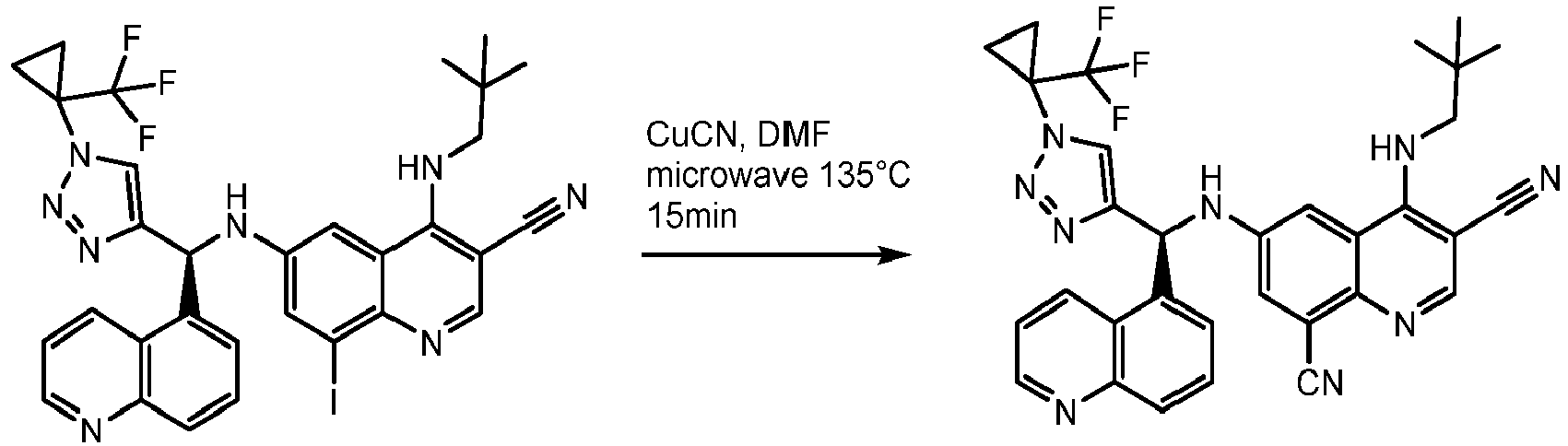
- A mixture of (S)-8-iodo-4-(neopentylamino)-6-((quinolin-5-yl(1-(1-(trifluoromethyl)cyclopropyl)-1H-1,2,3-triazol-4-yl)methyl)amino)quinoline-3-carbonitrile (61 mg, 0.09 mmol) and Cuprous cyanide (23.53 mg, 0.26 mmol)in DMF (2 mL) was heated at 135°C in the microwave for 15 minutes. The solution was treated with Si-thiol, filtered and purified by reverse phase HPLC to provide (S)-4-(neopentylamino)-6-((quinolin-5-yl(1-(1-(trifluoromethyl)cyclopropyl)-1H-1,2,3-triazol-4-yl)methyl)amino)quinoline-3,8-dicarbonitrile as the bis-trifluoroacetate salt.
1H NMR (400 MHz, Methanol-d4) δ 9.11 (s, 1H), 9.04 (d, J = 8.7 Hz, 1H), 8.30 (s, 1H), 8.21 (s, 1H), 8.18 - 8.10 (m, 1H), 7.99 - 7.90 (m, 1H), 7.90 - 7.82 (m, 2H), 7.80 (s, 1H), 7.14 - 7.08 (m, 1H), 6.94 (s, 1H), 3.79 (d, J = 13.8 Hz, 1H), 3.48 (d, J = 13.8 Hz, 1H), 1.75 - 1.56 (m, 4H), 0.66 (s, 9H).
ES/MS m/z: 596.35. -

- N-Ethyldiisopropylamine (15.47 µl, 0.09 mmol) was added to a mixture of (S)-1-(4-(((8-chloro-3-cyano-4-(neopentylamino)quinolin-6-yl)amino)(6-fluoro-2-methylpyridin-3-yl)methyl)-1H-1,2,3-triazol-1-yl)cyclopropane-1-carboxylic acid (25 mg, 0.044 mmol), 2-(7-Aza-1H-benzotriazole-1-yl)-1,1,3,3-tetramethyluronium hexafluorophosphate (HATU), 99% (17.27 mg, 0.05 mmol), and 2M Dimethylamine solution (44.4 µl, 0.053 mmol) in dimethylformamide (1 mL). After 3 hours half of the solvent was removed under reduced pressure. The solution was diluted with methanol (0.75 mL) water (0.5 mL) and TFA (50 uL). This solution was subjected to preperative HPLC. The cleaner fractions containing product were combined and subjected to lyophilization, providing the desired compound. The lyophilized solid was taken up in methanol (0.5 mL) and passed through a carbonate resin with methanol washing (5 mL). The solvent was removed under reduced pressure and the residue was taken up in ACN (1 mL) and water (1 mL) with TFA (0.02 mL) and subjected to lyophilization providing the (S)-1-(4-(((8-chloro-3-cyano-4-(neopentylamino)quinolin-6-yl)amino)(6-fluoro-2-methylpyridin-3-yl)methyl)-1H-1,2,3-triazol-1-yl)-N,N-dimethylcyclopropane-1-carboxamide.
-

- A solution of (S)-8-chloro-6-(((1-cyclopropyl-5-iodo-1H-1,2,3-triazol-4-yl)(6-fluoro-2-methylpyridin-3-yl)methyl)amino)-4-(neopentylamino)quinoline-3-carbonitrile (33 mg, 0.051 mmol), copper (I) cyanide (13.7 mg, 0.15 mmol) in dimethylformamide (1 mL) was heated in a microwave reactor at 200 C for 20 min. The mixture was diluted with ethyl acetate (10 ml) and washed with 5% lithium chloride (2 x 5 mL) and brine (5 mL). The organic phase was dried over sodium sulfate and the solvent was removed under reduced pressure. The residue was subjected to flash chromatography (0-100 % EtOAc / hexanes). The fractions containing product were combined and the solvent was removed under reduced pressure. The residue was taken up in water (0.5 ml) and methanol (1 mL) with 2 drops of TFA and subjected to preperative HPLC. The clean fractions combined and subjected to lyophilization, providing (S)-8-chloro-6-(((5-cyano-1-cyclopropyl-1H-1,2,3-triazol-4-yl)(6-fluoro-2-methylpyridin-3-yl)methyl)amino)-4-(neopentylamino)quinoline-3-carbonitrile.
-

- A solution of tert-Butyl (S)-3-(((3-cyano-8-iodo-4-(neopentylamino)quinolin-6-yl)amino)(1-cyclopropyl-1H-1,2,3-triazol-4-yl)methyl)-4,7-dihydrothieno[2,3-c]pyridine-6(5H)-carboxylate (60.3 mg, 0.082 mmol), tetrakis(triphenylphosphine)palladium(0) (7.55 mg, 0.01 mmol), and zinc cyanide (23.96 mg, 0.20 mmol) was degassed with argon for 10 minutes, The mixture was heated in a sealed vial at 100 °C. After 36 h the reaction was diluted with ethyl acetate (20 ml) and washed with 5% lithium chloride (2 x 5 mL) and brine (5 mL). The organic phase was dried over sodium sulfate and the solvent was removed under reduced pressure. The residue was subjected to flash chromatography (0 -100 % (20% methanol / ethyl acetate) / hexanes). The fractions containing product were combined and the solvent was removed under reduced pressure, providing tert-butyl (S)-3-((1-cyclopropyl-1H-1,2,3-triazol-4-yl)((3,8-dicyano-4-(neopentylamino)quinolin-6-yl)amino)methyl)-4,7-dihydrothieno[2,3-c]pyridine-6(5H)-carboxylate.

- Zinc bromide (88.6 mg, 0.39 mmol) was added to a solution of tert-butyl (S)-3-((1-cyclopropyl-1H-1,2,3-triazol-4-yl)((3,8-dicyano-4-(neopentylamino)quinolin-6-yl)amino)methyl)-4,7-dihydrothieno[2,3-c]pyridine-6(5H)-carboxylate (50.2 mg, 0.079 mmol) in nitromethane (5 mL). After 50 minutes the solvent was removed under reduced pressure. The residue was partitioned between ethyl acetate (20 mL) and saturated sodium bicarbonate (10 mL). Solid formed which was removed by filtration. The organic phase was washed with saturated sodium bicarbonate (10 mL) and brine (10 mL). The organic phase was dried over sodium sulfate and the solvent was removed under reduced pressure, providing (S)-6-(((1-cyclopropyl-1H-1,2,3-triazol-4-yl)(4,5,6,7-tetrahydrothieno[2,3-c]pyridin-3-yl)methyl)amino)-4-(neopentylamino)quinoline-3,8-dicarbonitrile.
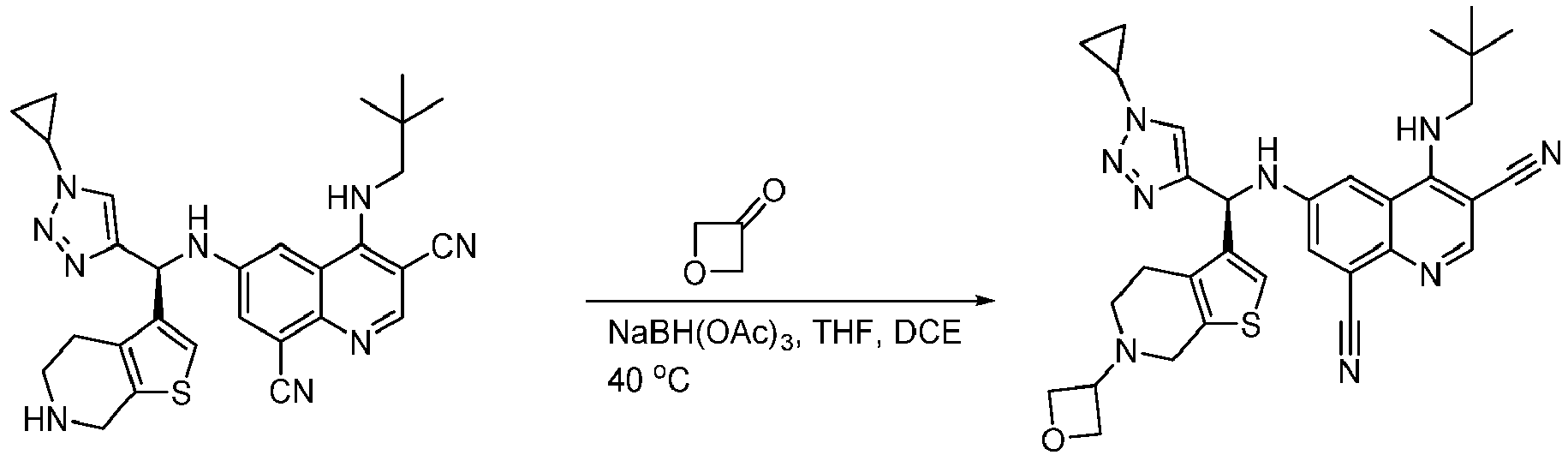
- 3-Oxetanone (38.75 µl, 0.6 mmol) was added to a mixture of (S)-6-(((1-cyclopropyl-1H-1,2,3-triazol-4-yl)(4,5,6,7-tetrahydrothieno[2,3-c]pyridin-3-yl)methyl)amino)-4-(neopentylamino)quinoline-3,8-dicarbonitrile (32.5 mg, 0.060 mmol) and sodium triacetoxyborohydride (128.1 mg, 0.60 mmol) in tetrahydrofuran (2 mL) dichloroethane (2 mL) and heated at 40 °C for 16h. The mixture was diluted with ethyl acetate (10 mL) and washed with saturated sodium bicarbonate (2 x 5 mL) and brine (5 mL). The organic phase was dried over sodium sulfate and he solvent was removed under reduced pressure. The residue was subjected to flash chromatography (0 - 100 % (20% methanol in ethyl acetate) / hexanes). The fractions containing product were combined and the solvent was removed under reduced pressure. The residue was taken up in methanol (0.5 mL) / water (0.5 mL) with 2 drops of TFA and subjected to preperative HPLC (eluted with 0 - 100% acetonitrile an water with 0.05 % trifluoroacetic acid). The clean fractions were combined and subjected to lyophilization, (S)-6-(((1-cyclopropyl-1H-1,2,3-triazol-4-yl)(6-(oxetan-3-yl)-4,5,6,7-tetrahydrothieno[2,3-c]pyridin-3-yl)methyl)amino)-4-(neopentylamino)quinoline-3,8-dicarbonitrile.
-

- (S)-6-((benzo[d]thiazol-7-yl(1-cyclopropyl-1H-1,2,3-triazol-4-yl)methyl)amino)-4-(tert-butoxyamino)quinoline-3,8-dicarbonitrile: To (S)-6-((benzo[d]thiazol-7-yl(1-cyclopropyl-1H-1,2,3-triazol-4-yl)methyl)amino)-4-(tert-butoxyamino)-8-iodoquinoline-3-carbonitrile (59 mg, 0.093 mmol) in N-methyl-2-pyrrolidone (1 mL) was added zinc cyanide (27 mg, 0.232 mmol) and palladium tetrakis triphenylphosphine (9 mg, 0.007 mmol). The reaction mixture was degassed with nitrogen for 5 minutes, then stirred at 100 °C overnight. The reaction was then brought to room temperature and diluted with water and EtOAc. Aqueous layer was extracted once more with EtOAc. Combined organics were washed with water, brine, dried (Na2SO4) and concentrated to give the crude product which was purified by HPLC (eluent: water / MeCN *0.1% TFA) to yield the title product. ES/MS 536.20 (M+H+).
-

- (S)-6-((benzo[d]thiazol-7-yl(1-(1-(trifluoromethyl)cyclopropyl)-1H-1,2,3-triazol-4-yl)methyl)amino)-8-(methylsulfonyl)-4-(neopentylamino)quinoline-3-carbonitrile: To (S)-6-((benzo[d]thiazol-7-yl(1-(1-(trifluoromethyl)cyclopropyl)-1H-1,2,3-triazol-4-yl)methyl)amino)-8-bromo-4-(neopentylamino)quinoline-3-carbonitrile (31 mg, 0.047 mmol), (L) -proline (1.1 mg, 0.009 mmol), Cu(I)I (1 mg, 0.005 mmol), sodium methylsulfonate (5.8 mg, 0.057 mmol), and Cs2CO3 (15 mg, 0.047 mmol) was added DMSO (0.8 mL). The reaction mixture was placed under an atmosphere of nitrogen stirred at 110 °C overnight. The reaction was then brought to room temperature and diluted with water and EtOAc. Aqueous layer was extracted once more with EtOAc. Combined organics were washed with water, brine, dried (Na2SO4) and concentrated to give the crude product which was purified by HPLC (eluent: water / MeCN *0.1% TFA) to yield the title product. ES/MS 655.7 (M+H+).
-

- 6-(((6-Fluoro-2-methylpyridin-3-yl)(1-(1-(trifluoromethyl)cyclopropyl)-1H-1,2,3-triazol-4-yl)methyl)amino)-8-(3-hydroxy-3-methylbut-1-yn-1-yl)-4-(neopentylamino)quinoline-3-carbonitrile: 6-(((6-Fluoro-2-methylpyridin-3-yl)(1-(1-(trifluoromethyl)cyclopropyl)-1H-1,2,3-triazol-4-yl)methyl)amino)-8-iodo-4-(neopentylamino)quinoline-3-carbonitrile (30 mg, 0.044 mmol), copper iodide (0.84 mg, 0.004 mg), and 2-methyl-3-butyn-2-ol (18.6 mg, 0.22 mmol) were dissolved in Me-THF. Then Bis(triphenylphosphine)palladium(II) dichloride (3.1 mg, 0.004 mmol) was add to the mixture followed by diethylamine (0.05 ml, 0.44 mmol). The reaction was heated to 80 C for one hour, then diluted with EtOAc and brine, the organic layer was kept, dried over sodium sulfate, and concentrated. The crude residue was purified by RP-HPLC (eluent: water / MeCN *0.1% TFA) to yield the product as trifluoro acetate salt.
-

- (S)-8-Chloro-6-(((1-(1-(difluoromethyl)cyclopropyl)-1H-1,2,3-triazol-4-yl)(6-fluoro-2-methylpyridin-3-yl)methyl)amino)-5-fluoro-4-(neopentylamino)quinoline-3-carbonitrile: (S)-8-Chloro-6-(((1-(1-(difluoromethyl)cyclopropyl)-1H-1,2,3-triazol-4-yl)(6-fluoro-2-methylpyridin-3-yl)methyl)amino)-4-(neopentylamino)quinoline-3-carbonitrile (100 mg, 0.18 mmol) was dissolved in ACN. Selectfluor (31.8 mg, 0.176 mmol) was added to the stirring mixture. The reaction was stopped after 20 minutes, diluted with EtOAc and water. The organic layer was dried over sodium sulfate, and concentrated. The product was purified by chromatography on silica gel (eluent: EtOAc/hexanes) to yield the product after lyophilization from water / MeCN.
-
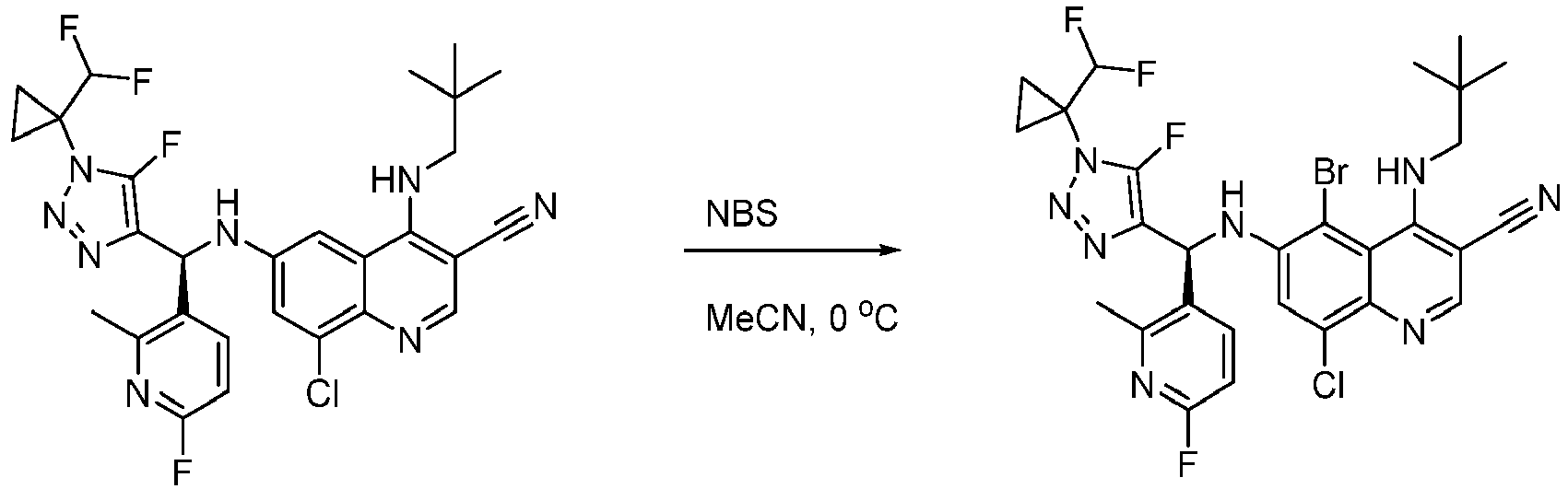
- (S)-5-bromo-8-chloro-6-(((1-(1-(difluoromethyl)cyclopropyl)-5-fluoro-1H-1,2,3-triazol-4-yl)(6-fluoro-2-methylpyridin-3-yl)methyl)amino)-4-(neopentylamino)quinoline-3-carbonitrile: N-Bromosuccinimide (7.8 mg, 0.044 mmol) was added to a solution of (S)-8-chloro-6-(((1-(1-(difluoromethyl)cyclopropyl)-5-fluoro-1H-1,2,3-triazol-4-yl)(6-fluoro-2-methylpyridin-3-yl)methyl)amino)-4-(neopentylamino)quinoline-3-carbonitrile (26 mg, 0.044 mmol) in acetonitrile (1 mL) at 0 °C. After 24 h at room temperature trifluoroacetic acid (4 drops) was added and the mixture was diluted with water . The yellow solution was subjected to preparative HPLC. The fractions containing product were combined and the solvent was reduced pressure, providing the (S)-5-bromo-8-chloro-6-(((1-(1-(difluoromethyl)cyclopropyl)-5-fluoro-1H-1,2,3-triazol-4-yl)(6-fluoro-2-methylpyridin-3-yl)methyl)amino)-4-(neopentylamino)quinoline-3-carbonitrile as the TFA salt.
-

- 1-Azidobicyclo[1.1.11]pentane: A solution of 2-azido-1,3-dimethylimidazolinium hexafluorophosphate (429 mg, 1.5 mmol) in acetonitrile (2 mL) was added to solution of the bicyclo[1.1.1]pentan-1-amine hydrochloride (150 mg, 1.25 mmol) and1,8-diazabicyclo[5.4.0]undec-7-ene (420 mg, 4.2 mmol) in acetonitrile (3mL) dropwise over 1 min. After 16h at RT the reaction was heated at 40 C for 3h. The reaction was assumed to be complete and was added to the Click reaction as is.
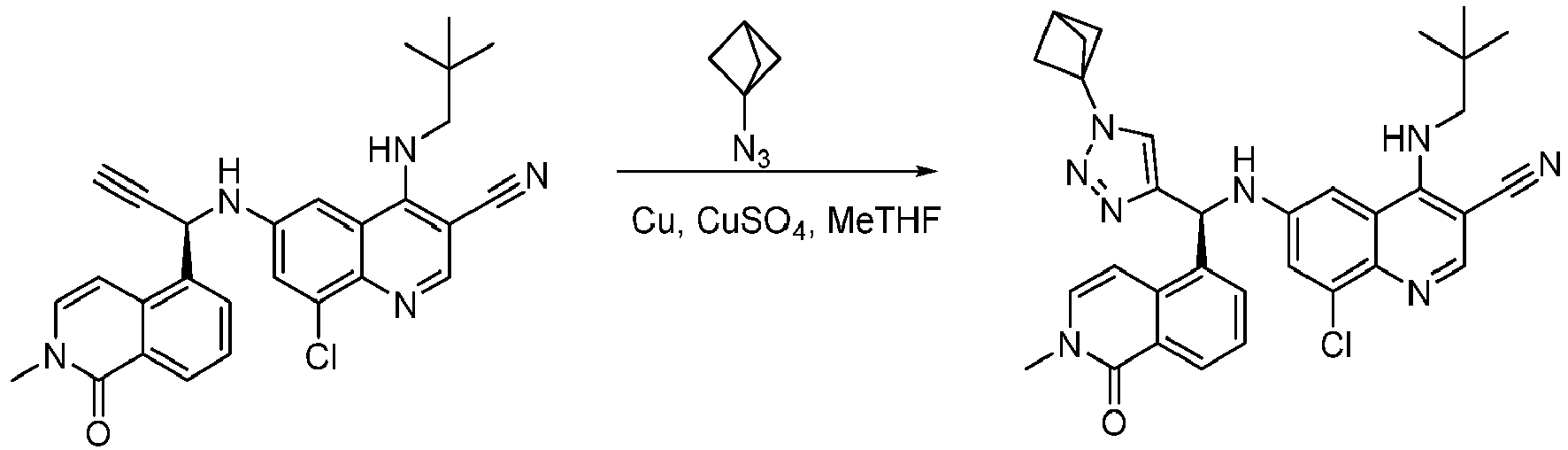
- (S)-6-(((1-(bicyclo[1.1.1]pentan-1-yl)-1H-1,2,3-triazol-4-yl)(2-methyl-1-oxo-1,2-dihydroisoquinolin-5-yl)methyl)amino)-8-chloro-4-(neopentylamino)quinoline-3-carbonitrile: 2-Methyltetrahydrofuran (12 mL), copper powder (394 mg, 6.2 mmol) and (R)-8-chloro-6-((1-(2-methyl-1-oxo-1,2-dihydroisoquinolin-5-yl)prop-2-yn-1-yl)amino)-4-(neopentylamino)quinoline-3-carbonitrile (500 mg, 1.03 mmol) were combined. Saturated copper (II) sulfate (0.6 mL) was added followed by acetic acid (236 uL, 4.13 mmol). A solution of 1-azidobicyclo[1.1.1]pentane (137 mg, 1.25 mmol) in acetonitrile (5 mL - reaction mixture from above) was added . After 1 h the solids were removed by filtration. The mixture was partitioned with ethyl acetate (50 mL) and saturated ammonium chloride (50 mL). An emulsion formed with a light solid. The solid was removed by filtration through celite. The organic phase was washed with saturated ammonium chloride (50 mL), saturated sodium bicarbonate (4 x 50 mL) and brine (50mL). The organic phase was dried over sodium sulfate and the solvent was removed under reduced pressure. The residue was subjected to flash chromatography (0 - 70% ethyl acetate / hexanes). The fractions containing product were combined and the solvent was removed under reduced pressure. The residue was taken up in acetonitrile (15 mL) and water (15 mL) and subjected to lyophilization providing (S)-6-(((1-(bicyclo[1.1.1]pentan-1-yl)-1H-1,2,3-triazol-4-yl)(2-methyl-1-oxo-1,2-dihydroisoquinolin-5-yl)methyl)amino)-8-chloro-4-(neopentylamino)quinoline-3-carbonitrile.
-

- (S)-8-chloro-6-(((6-fluoro-2-methylpyridin-3-yl)(4,5,6,7-tetrahydro-[1,2,3]triazolo[1,5-a]pyridin-3-yl)methyl)amino)-4-(neopentylamino)quinoline-3-carbonitrile: A mixture of the bromoalkane (54 mg, 0.09 mmol) in 4.4mL toluene was purged with argon for 45 minutes. It was heated to reflux and
then Tris(trimethylsilyl)silane (43.74 mg, 0.18 mmol) was added, followed by dropwise addition of 2,2'-Azobisisobutyronitrile,98% (1.44 mg, 0.01 mmol) in 0.44mL toluene. After 16 hours heating at reflux, another portion of the silane was added and heating was continued for 4 hours more. The mixture was concentrated and purified by RP-HPLC to yield the product as the trifluoroacetate salt. -

- (S)-8-chloro-6-(((6,7-dihydro-5H-[1,2,3]triazolo[5,1-b][1,3]oxazin-3-yl)(6-fluoro-2-methylpyridin-3-yl)methyl)amino)-4-(neopentylamino)quinoline-3-carbonitrile and (S)-8-chloro-6-(((6-fluoro-2-methylpyridin-3-yl)(1-(3-hydroxypropyl)-1H-1,2,3-triazol-4-yl)methyl)amino)-4-(neopentylamino)quinoline-3-carbonitrile: (S)-8-chloro-6-(((5-fluoro-1-(3-hydroxypropyl)-1H-1,2,3-triazol-4-yl)(6-fluoro-2-methylpyridin-3-yl)methyl)amino)-4-(neopentylamino)quinoline-3-carbonitrile (37 mg, 0.07 mmol, prepared as for example 23) was dissolved in DMF and cooled in an ice water bath. Sodium hydride 60 % dispersion in mineral oil (5.6 mg, 0.23 mmol) was added NaH and the mixture was allowed to warm to room temperature. After 1 hour, the reaction was complete by UPLC-MS and contained dehalogenated, uncyclized product as well. Purification by RP HPLC 15 minutes 10-49% gave the two products independently as the corresponding trifluoroacetate salts.
- (S)-8-chloro-6-(((6,7-dihydro-5H-[1,2,3]triazolo[5,1-b][1,3]oxazin-3-yl)(6-fluoro-2-methylpyridin-3-yl)methyl)amino)-4-(neopentylamino)quinoline-3-carbonitrile: ES/MS m/z: 535.34. 1H NMR (400 MHz, Acetonitrile-d3) δ 8.42 (s, 1H), 7.92 (m, 1H), 7.48 (s, 1H), 6.79 (m, 1H), 6.70 (s, 1H), 5.97 (s, 1H), 4.35 (m, 4H), 3.90 (m, 1H), 3.68 (m, 1H), 2.50 (s, 3H), 2.23 (m, 2H), 0.94 (s, 9H).
- (S)-8-chloro-6-(((6-fluoro-2-methylpyridin-3-yl)(1-(3-hydroxypropyl)-1H-1,2,3-triazol-4-yl)methyl)amino)-4-(neopentylamino)quinoline-3-carbonitrile: ES/MS m/z: 537.27. 1H NMR (400 MHz, Acetonitrile-d3) δ 8.41 (s, 1H), 7.84 (m, 1H), 7.66 (m, 1H), 7.48 (m, 1H), 6.82 (m, 1H), 6.74 (m, 1H), 6.15 (m, 1H), 4.42 (m, 2H), 3.76 (m, 2H), 3.48 (m, 2H), 2.51 (s, 3H), 1.98 (m, 2H), 0.94 (s, 9H).
-

- (S)-6-(((6-fluoro-2-methylpyridin-3-yl)(1-(1-(trifluoromethyl)cyclopropyl)-1H-1,2,3-triazol-4-yl)methyl)amino)-4-(neopentylamino)-8-(pyrimidin-5-yl)quinoline-3-carbonitrile: 6-(((6-fluoro-2-methylpyridin-3-yl)(1-(1-(trifluoromethyl)cyclopropyl)-1H-1,2,3-triazol-4-yl)methyl)amino)-8-iodo-4-(neopentylamino)quinoline-3-carbonitrile (20 mg, 0.03 mmol), potassium carbonate (0.03 mL, 0.06 mmol), and pyrimidin-5-ylboronic acid (5.3 mg, 0.045 mmol) were dissolved in DME. Then bis(triphenylphosphine)palladium(II) dichloride (1.0 mg, 0.002 mmol) was add to the mixture. The reaction was heated to 110 °C in microwave reactor for 5 minutes, then diluted with EtOAc and brine, the organic layer was kept, dried over sodium sulfate, and concentrated. The crude residue was purified by RP-HPLC (eluent: water / MeCN *0.1% TFA) to yield the product as trifluoro acetate salt.
-

- (S)-8-chloro-6-(((6-fluoro-2-methylpyridin-3-yl)(5-iodo-1-(1-methylcyclopropyl)-1H-1,2,3-triazol-4-yl)methyl)amino)-4-(neopentylamino)quinoline-3-carbonitrile: To (R)-8-chloro-6-((1-(6-fluoro-2-methylpyridin-3-yl)prop-2-yn-1-yl)amino)-4-(neopentylamino)quinoline-3-carbonitrile (100 mg, 0.23 mmol) in MeTHF (2 mL) was added Copper(i) iodide (4 mg, 0.02 mmol) and N-iodomorpholine hydriodide (95 mg, 0.28 mmol). The solution was stirred at room temperature for 5 h. The resulting solution was filtered through a carbonate resin and concentrated to give the crude (S)-8-chloro-6-((1-(6-fluoro-2-methylpyridin-3-yl)-3-iodoprop-2-yn-1-yl)amino)-4-(neopentylamino)quinoline-3-carbonitrile.
- To a solution of (S)-8-chloro-6-((1-(6-fluoro-2-methylpyridin-3-yl)-3-iodoprop-2-yn-1-yl)amino)-4-(neopentylamino)quinoline-3-carbonitrile in MeTHF (2 mL) was added triethylamine (0.05 mL, 0.36 mmol), Copper (I) iodide (4 mg, 0.02 mmol), and 1-azido-1-methylcyclopropane (0.5 mL, 0.5 M in MTBE, 0.25 mmol). The resulting solution was stirred at room temperature for 3 days and then washed with aqueous bicarbonate. The aqueous layer was back-extracted with EtOAc (2x), and the combined organic layers were dried over Na2SO4 and concentrated. The crude residue was purified by reverse-phase HPLC (10-60% MeCN/H2O with 0.1% TFA) to provide the product as a TFA salt. The product was dissolved in EtOAc and washed with aqueous bicarbonate. The aqueous layer was back-extracted with EtOAc (2x), and the combined organic layers were dried over Na2SO4 and concentrated. The crude residue was purified by normal-phase chromatography (10-50% EtOAc/CH2Cl2) to provide the product.
1H NMR (400 MHz, Methanol-d4) δ 8.51 (d, J = 1.1 Hz, 1H), 7.81 (t, J = 8.1 Hz, 1H), 7.65 (d, J = 2.3 Hz, 1H), 6.86 (dd, J = 8.6, 2.7 Hz, 1H), 6.83 (d, J = 2.3 Hz, 1H), 6.07 (s, 1H), 4.13 (d, J = 13.9 Hz, 1H), 3.70 (d, J = 13.9 Hz, 1H), 2.40 (s, 3H), 1.64 (s, 3H), 1.44 - 1.31 (m, 2H), 1.22 (t, J = 2.0 Hz, 2H), 0.89 (s, 9H).
ES/MS: 659.255 (M+H+). -

- (S)-8-chloro-6-(((6-fluoro-2-methylpyridin-3-yl)(1-(1-(trifluoromethyl)cyclopropyl)-1H-1,2,3-triazol-4-yl)methyl)(methyl)amino)-4-(neopentylamino)quinoline-3-carbonitrile: To a slurry of 6-amino-8-chloro-4-(neopentylamino)quinoline-3-carbonitrile (1 g, 3.46 mmol) in H2O (35 mL) and H2SO4 (1.8 mL) at 0 °C (external) was dropwise added 1.5M aqueous NaNO2 (2.8 ml). The resulting solution was stirred at 0 °C for 1.5 h before potassium iodide (1.2 g, 7.23 mmol) in H2O (15 mL) was added. The resulting slurry was vigorously stirred at room temperature for 18 h. The slurry was neutralized with NaOH (2M), filtered,and washed twice with H2O. The resulting filtrate was dissolved in EtOAc and washed with aqueous NaCl. The aqueous layer was back-extracted with EtOAc and the combined organic layers were dried over MgSO4 and concentrated. The crude material was purified by SiO2 chromatography (5-25-100% EtOAc/Hex, 20% MeOH/EtOAc wash) to provide the desired product.
1H NMR (400 MHz, DMSO-d6) δ 8.82 (d, J = 1.7 Hz, 1H), 8.55 (s, 1H), 8.25 (d, J = 1.5 Hz, 1H), 8.19 (t, J = 7.0 Hz, 1H), 3.72 (d, J = 6.8 Hz, 2H), 0.96 (s, 9H).
ES/MS: 400.428 (M+H+).
- To a solution of (S,E)-2-methyl-N-(3-(trimethylsilyl)prop-2-yn-1-ylidene)propane-2-sulfinamide (0.5 g, 2.18 mmol) in THF (7.5 mL) was added Cu(I) 2-thiophene carboxylate (50 mg, 0.26 mmol), 2,6-Lutidine (1.3 ml, 11.16 mmol), and Cyclopropyl azide (17% in MTBE, 1 ml, 7.82 mmol). The resulting solution was stirred at 40 °C (external) for 18 h and then diluted with EtOAc. The solution was washed with H2O and twice with aqueous NH4Cl. The aqueous layers were back-extracted with EtOAc and the combined organic layers were dried over MgSO4 and concentrated. The crude residue was purified by SiO2 chromatography (15-50% EtOAc/CH2Cl2) to provide the desired product.
1H NMR (400 MHz, Chloroform-d) δ 8.78 (d, J = 1.2 Hz, 1H), 8.26 (s, 1H), 1.82 - 1.75 (m, 2H), 1.72 (dt, J = 8.0, 4.9 Hz, 2H), 1.26 (d, J = 1.2 Hz, 9H).
ES/MS: 309.100 (M+H+).
- To a solution of 3-bromo-6-fluoro-2-methylpyridine (370 mg, 1.95 mmol) in MeTHF (7.5 mL) at -78 °C (external). An n-Butyllithium solution (2.5 M in hexanes, 1.25 ml) was added dropwise and the reaction was stirred at -78 °C for 1.5 h. To the yellow/orange solution was added (S,E)-2-methyl-N-((1-(1-(trifluoromethyl)cyclopropyl)-1H-1,2,3-triazol-4-yl)methylene)propane-2-sulfinamide (200 mg, 0.65 mmol) in MeTHF (2 mL), and the resulting solution was warmed to room temperature for 2 h. The reaction was diluted with 50 % NH4Cl and extracted twice with EtOAc. The combined organic layers were dried over Na2SO4 and concentrated. The crude material was purified by SiO2 chromatography (25-60% EtOAc(5% MeOH)/CH2Cl2) to provide the desired product as a single isomer.
1H NMR (400 MHz, Chloroform-d) δ 7.91 - 7.81 (m, 1H), 7.52 (s, 1H), 6.81 (dd, J = 8.5, 3.3 Hz, 1H), 5.93 (d, J = 3.4 Hz, 1H), 4.41 (d, J = 3.5 Hz, 1H), 2.55 (s, 3H), 1.74 - 1.59 (m, 4H), 1.24 (d, J = 0.8 Hz, 9H).
ES/MS: 420.099 (M+H+).
- A solution of (S)-N-((S)-(6-fluoro-2-methylpyridin-3-yl)(1-(1-(trifluoromethyl)cyclopropyl)-1H-1,2,3-triazol-4-yl)methyl)-2-methylpropane-2-sulfinamide (0.1 g, 0.25 mmol) in THF (3 mL) was cooled to 0 °C. Sodium hydride (60 % dispersion in mineral oil, 0.01 g, 0.29 mmol) was added and stirred for 30 min before iodomethane was added (0.02 mL, 0.32 mmol). The resulting solution was stirred at room temperature for 24 h and diluted with EtOAc. The solution was washed with 50% NH4Cl and the aqueous solution was back-extracted with EtOAc. The combine organic layers were dried over Na2SO4 and concentrated. The crude residue was purified by SiO2 chromatography (20-50-60% EtOAc (5% MeOH)/CH2Cl2) to provide the desired product.
1H NMR (400 MHz, Chloroform-d) δ 7.95 (t, J = 8.2 Hz, 1H), 7.78 (s, 1H), 6.83 (dd, J = 8.5, 3.3 Hz, 1H), 5.99 (s, 1H), 2.58 (s, 3H), 2.46 (s, 3H), 1.63 (d, J = 62.7 Hz, 4H), 1.17 (s, 9H).
ES/MS: 433.820 (M+H+).
- To a solution of (S)-N-((S)-(6-fluoro-2-methylpyridin-3-yl)(1-(1-(trifluoromethyl)cyclopropyl)-1H-1,2,3-triazol-4-yl)methyl)-N,2-dimethylpropane-2-sulfinamide (0.07 g, 0.17 mmol) in MeOH (1 mL) was added 4M HCl in dioxane (0.45 ml). The resulting solution was stirred at room temperature for 2h and concentrated. The crude residue was diluted with EtOAc and washed with aqueous bicarbonate. The aqueous layer was back-extracted with EtOAc and the combine organic layers were dried over Na2SO4 and concentrated. The crude amine was dissolved in a 1:1 mixture of CH2Cl2 and toluene and concentrated to dryness to provide the desired product.
ES/MS: 329.872 (M+H+).
- To a solution of (S)-1-(6-fluoro-2-methylpyridin-3-yl)-N-methyl-1-(1-(1-(trifluoromethyl)cyclopropyl)-1H-1,2,3-triazol-4-yl)methanamine (0.05 g, 0.17 mmol) in toluene (3.5 mL) was added 8-chloro-6-iodo-4-(neopentylamino)quinoline-3-carbonitrile (0.07 g, 0.17 mmol), 2-(di-t-butylphosphino)biphenyl (0.02 g, 0.07 mmol), and tris(dibenzylideneacetone)dipalladium (O) (0.03 g, 0.03 mmol). The slurry was degassed with argon for 5 min and potassium tert-butoxide, 95% (0.06 g, 0.5 mmol) was added. The resulting slurry was heated to 80 °C (external) for 2 h. The reaction mixture was then diluted with EtOAc and washed with aqueous bicarbonate. The aqueous layers were back-extracted and the resulting organic layers were concentrated. The crude oil was then purified by reverse-phase HPLC (10-70% MeCN/H2O with 0.1%TFA). The product was purified a second time by reverse-phase HPLC (10-65% MeCN/H2O with 0.1%TFA) to provide the desired product as a TFA salt.
1H NMR (400 MHz, Methanol-d4) δ 8.55 (d, J = 1.6 Hz, 1H), 8.32 (s, 1H), 7.88 (d, J = 2.6 Hz, 1H), 7.59 (t, J = 8.1 Hz, 1H), 7.40 (d, J = 2.6 Hz, 1H), 6.92 (dd, J = 8.5, 2.8 Hz, 1H), 6.76 (s, 1H), 4.09 (d, J = 14.1 Hz, 1H), 3.96 (d, J = 14.1 Hz, 1H), 2.97 (s, 3H), 2.35 (s, 3H), 1.80 - 1.70 (m, 4H), 1.02 (d, J = 3.2 Hz, 9H).
ES/MS: 601.367 (M+H+). -

- To (S)-6-(((1-(1-(difluoromethyl)cyclopropyl)-1H-1,2,3-triazol-4-yl)(6-fluoro-2-methylpyridin-3-yl)methyl)amino)-8-iodo-4-(neopentylamino)quinoline-3-carbonitrile (37 mg, 0.056 mmol) and bis(triphenylphosphine)palladium(II) dichloride (5 mg, 0.006 mmol) in toluene (1 mL) was added tributyl(2-ethoxyallyl)stannane (23 mg, 0.062 mmol). The reaction mixture was flushed with nitrogen and heated at 100 °C overnight. After cooling to room temperature, 2N HCl (1 mL) was added and the mixture stirred for 2 hours. Reaction was diluted with water and extracted thrice with EtOAc. Combined organics were washed with water and brine and dried (Na2SO4). Filtrate was concentrated to yield the crude material which was purified twice by HPLC (eluent: water / MeCN *0.1% TFA) to give the product.
- The following compounds were prepared according to the Examples and Procedures described herein (and indicated in Table 1 under Example/Procedure) using the appropriate starting material(s) and appropriate protecting group chemistry as needed.


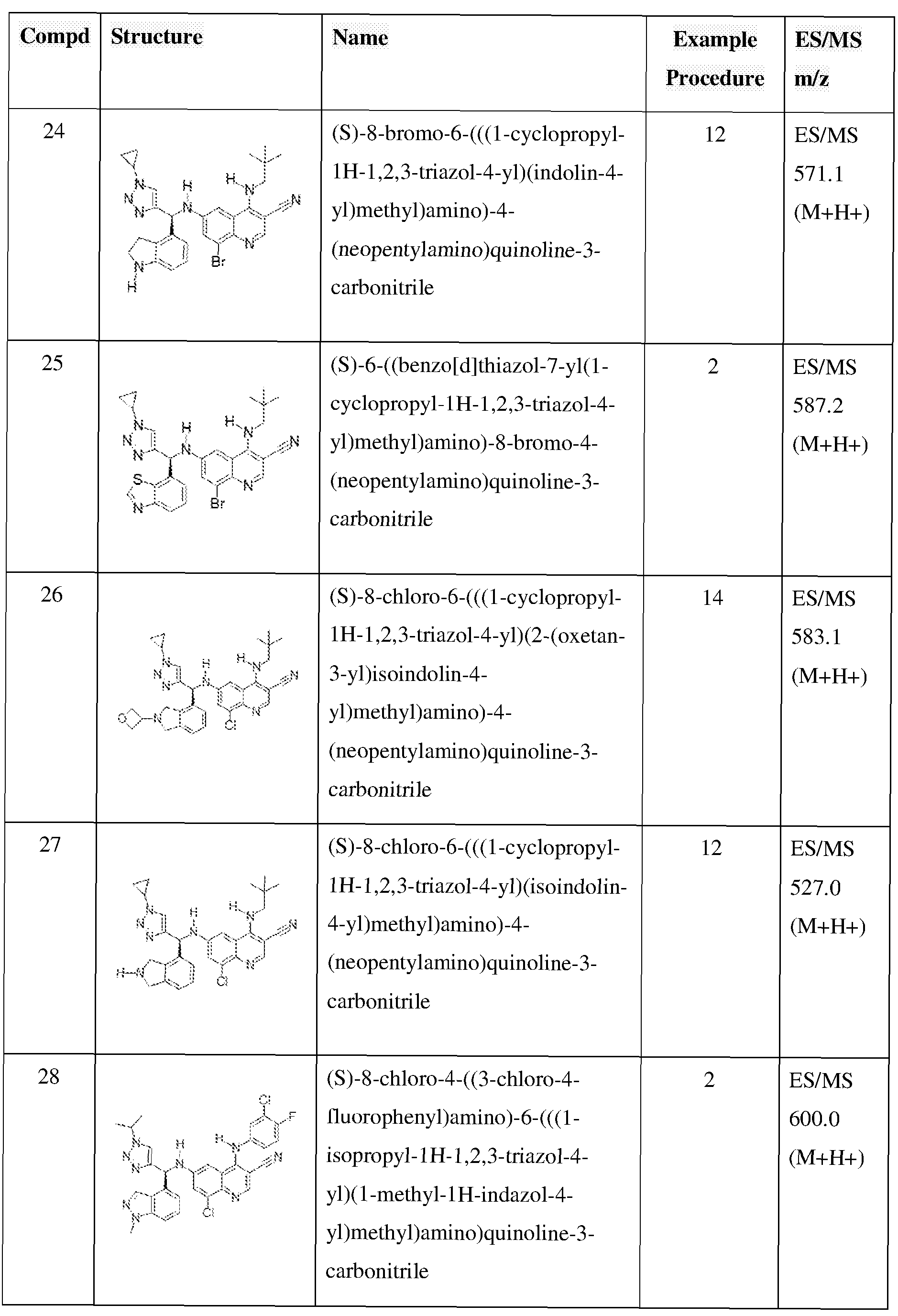


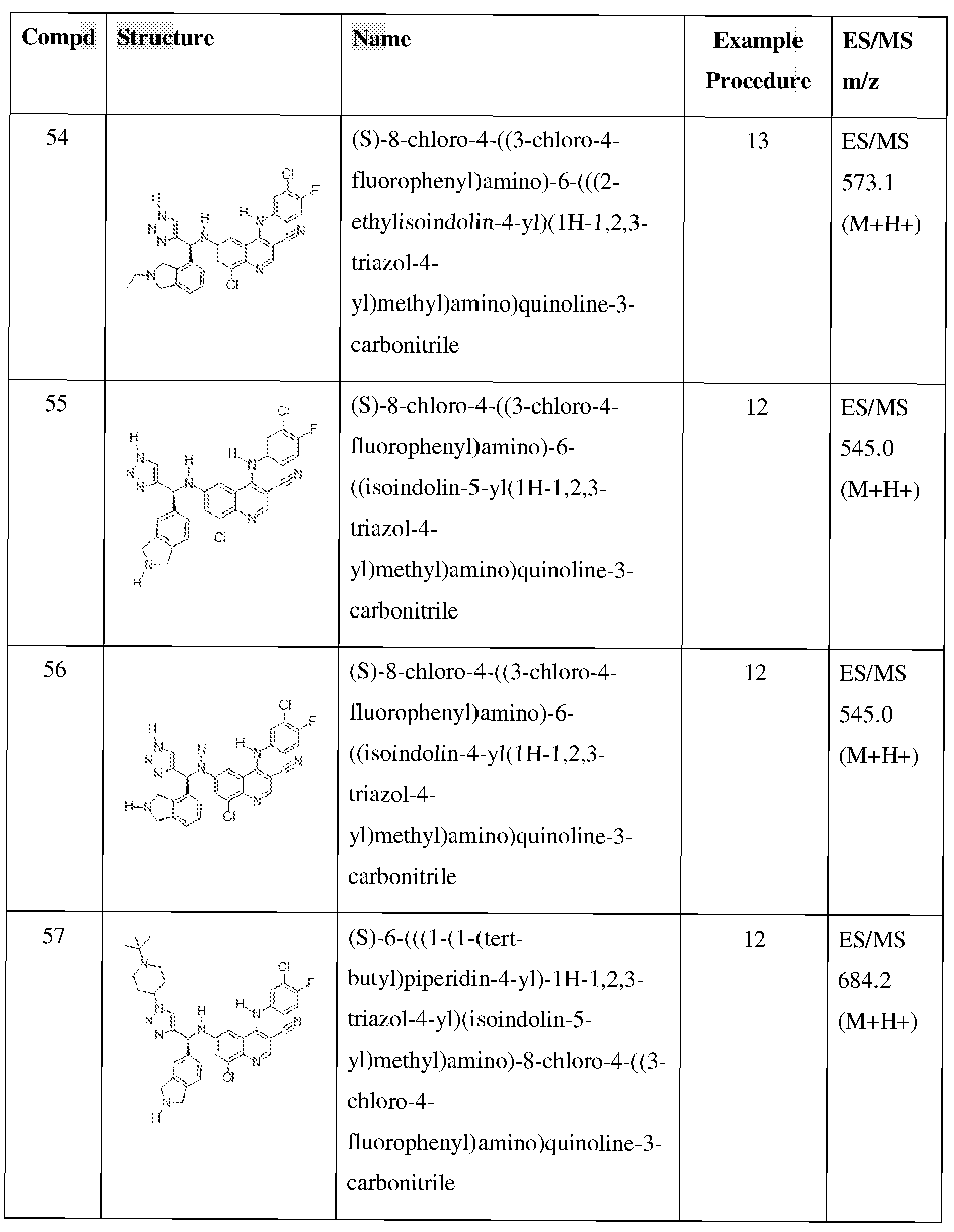


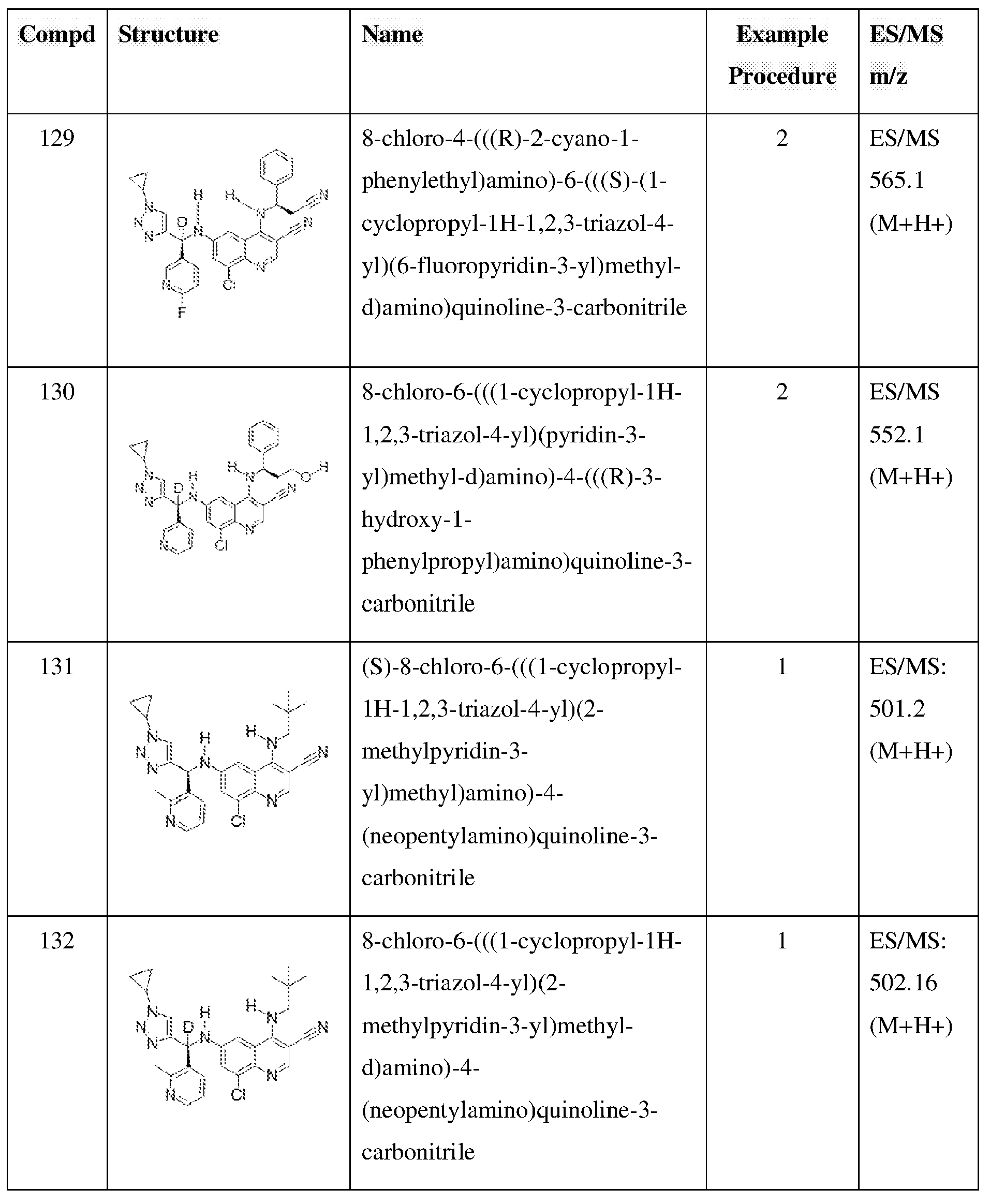

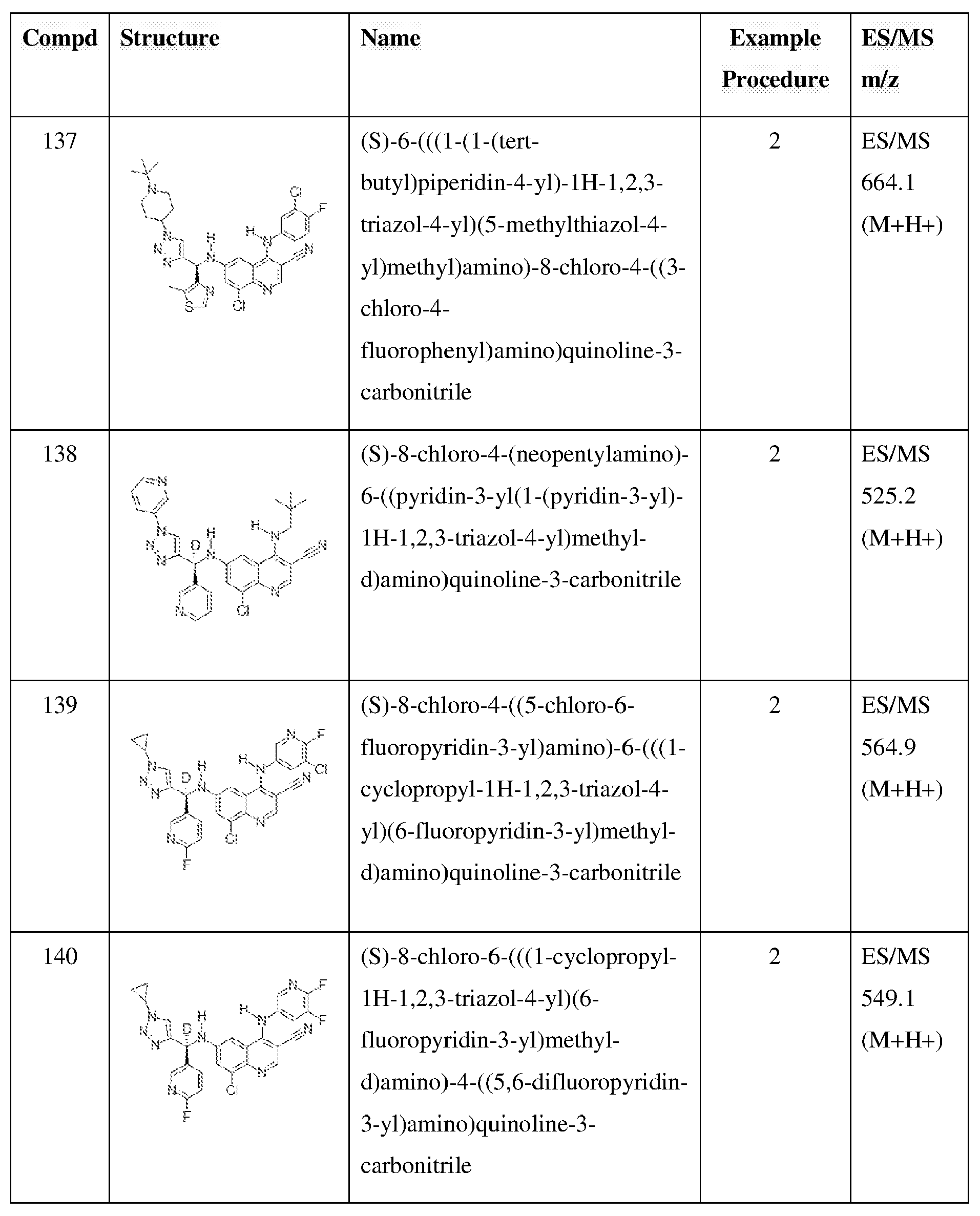


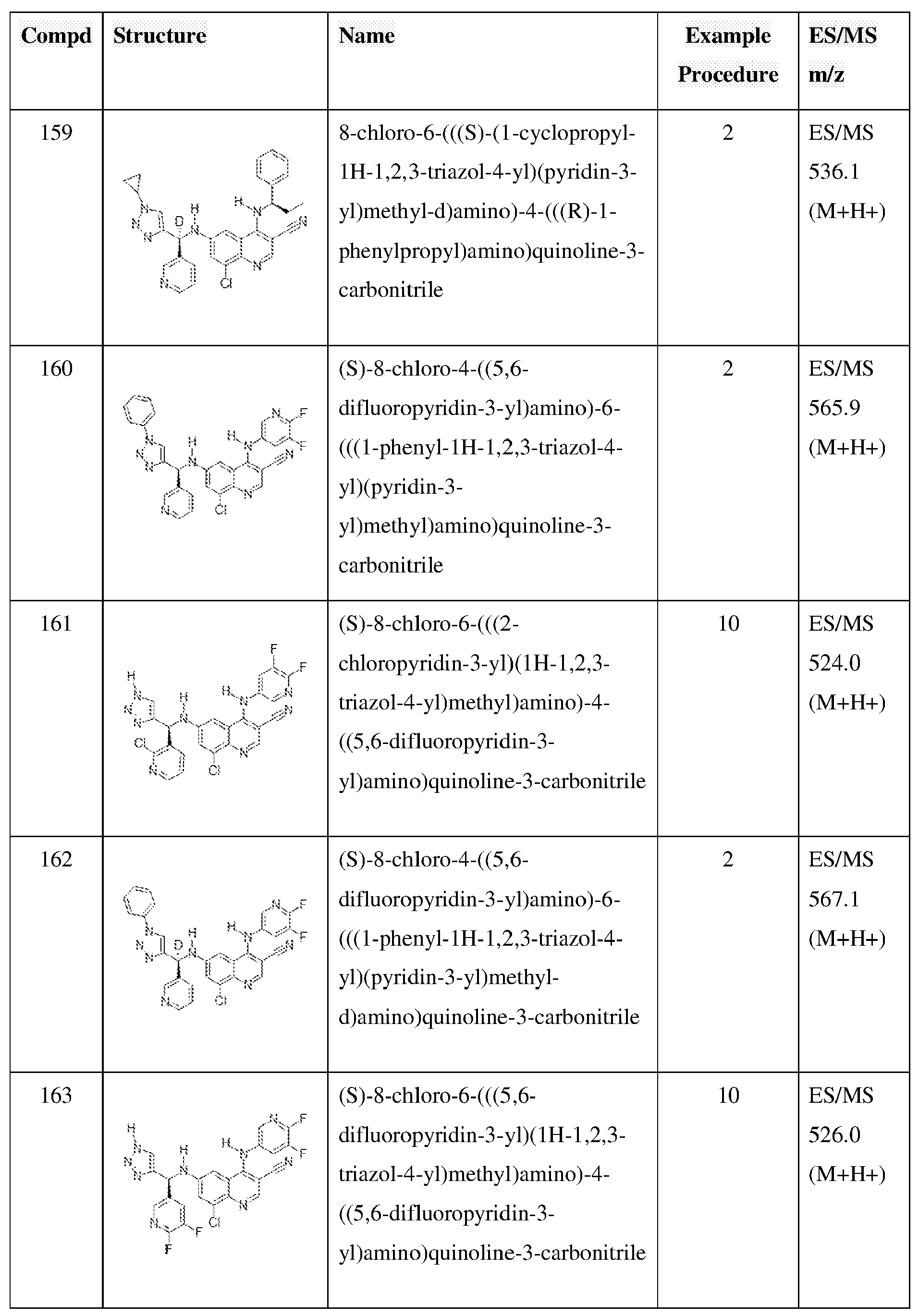
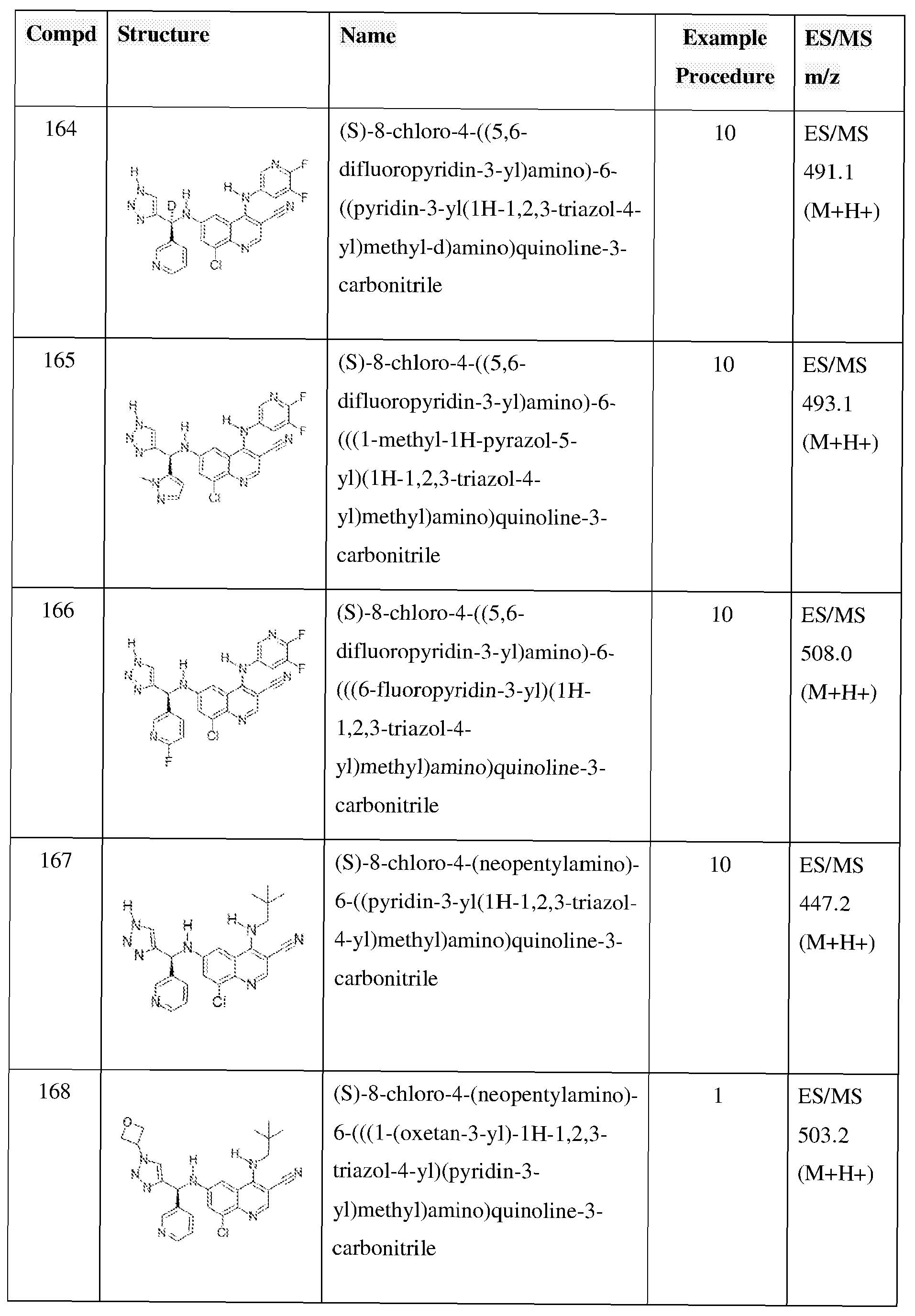


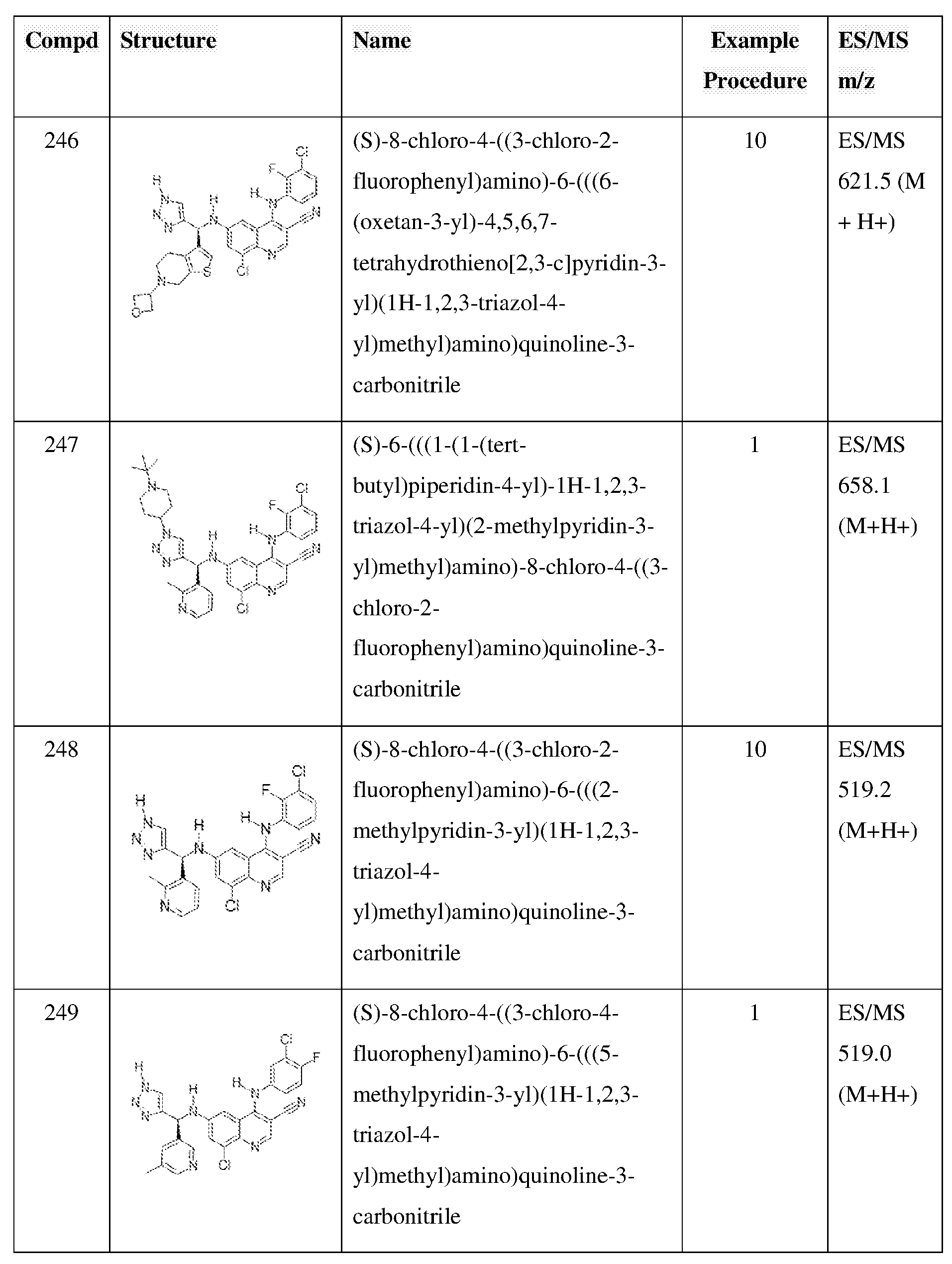
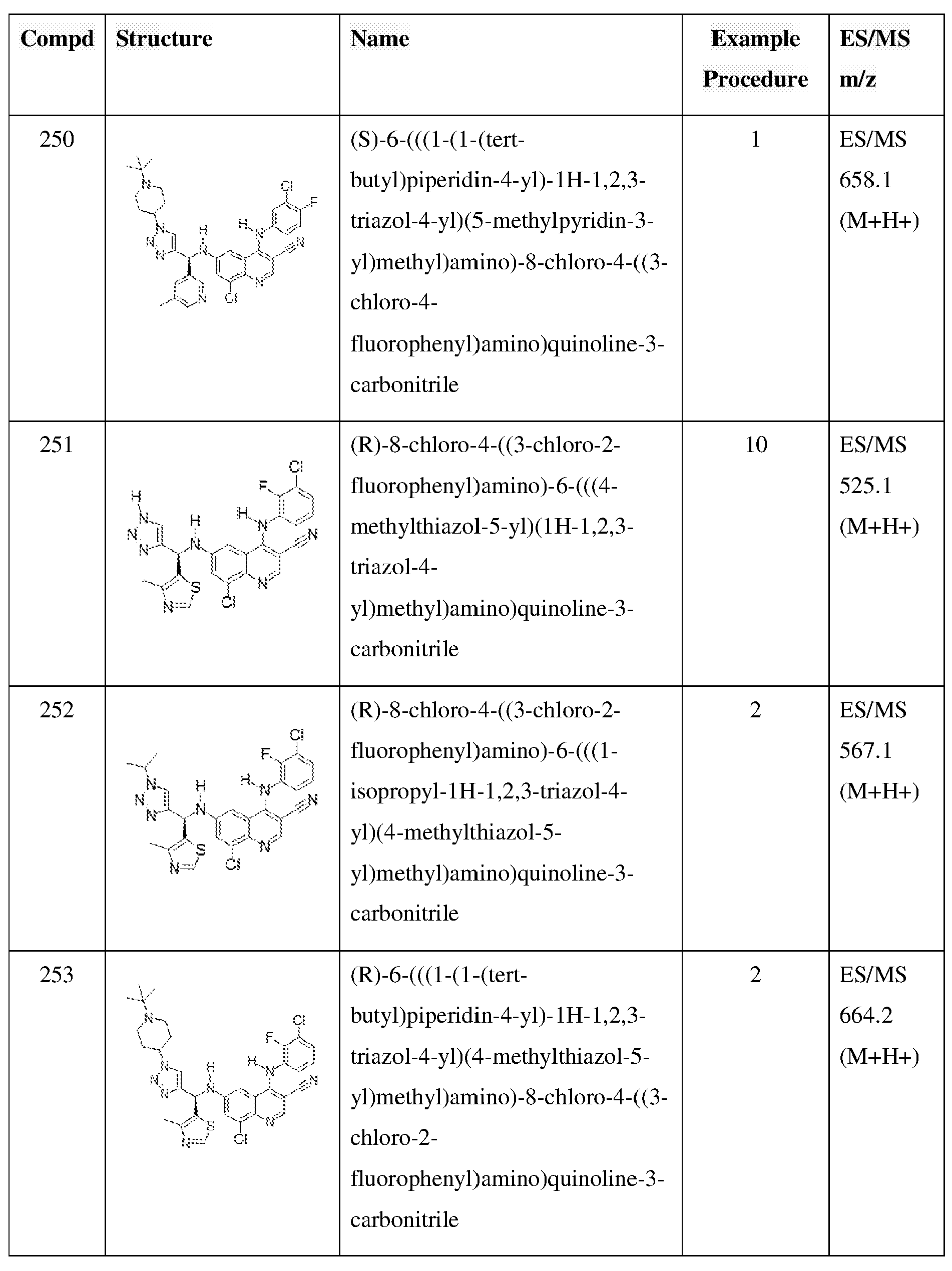
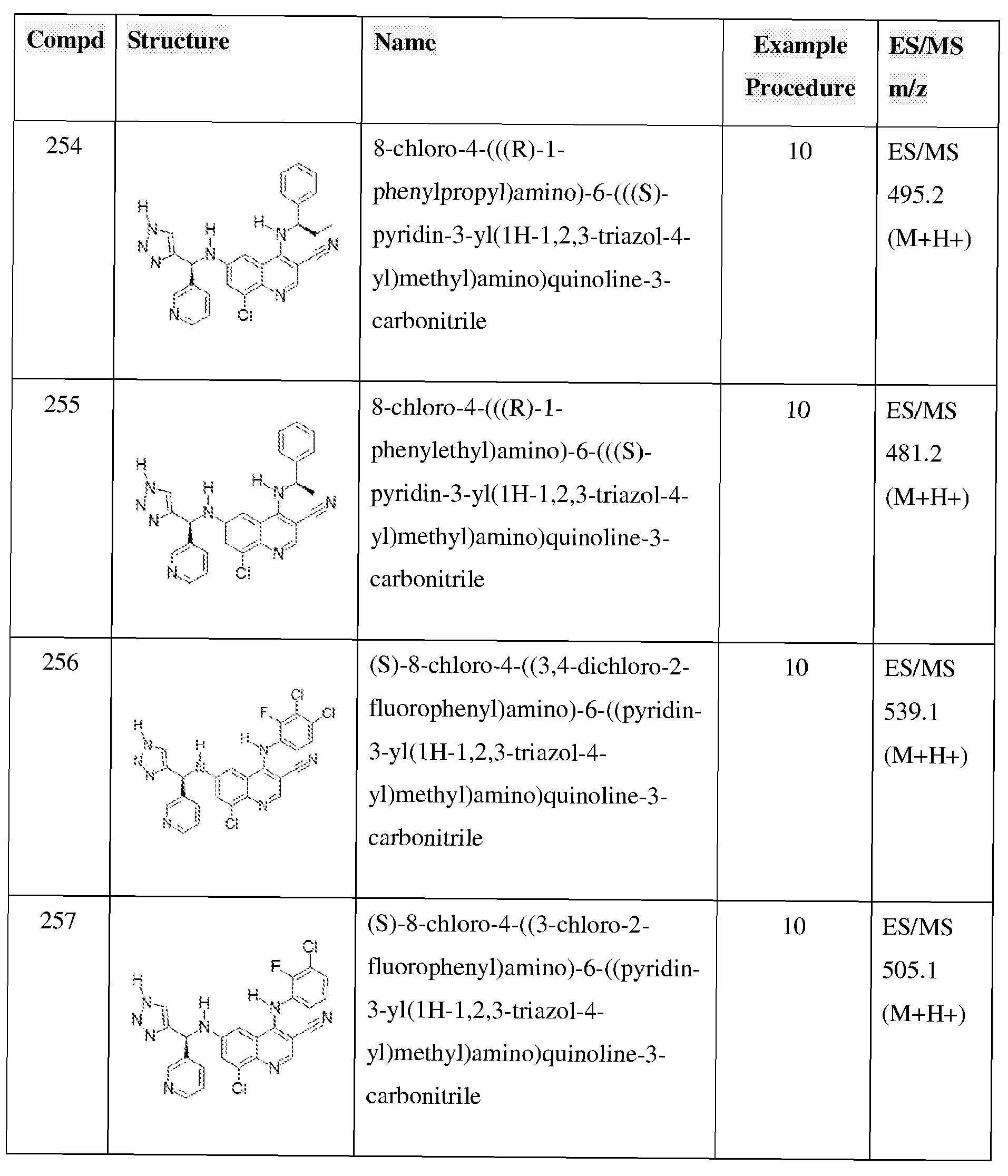


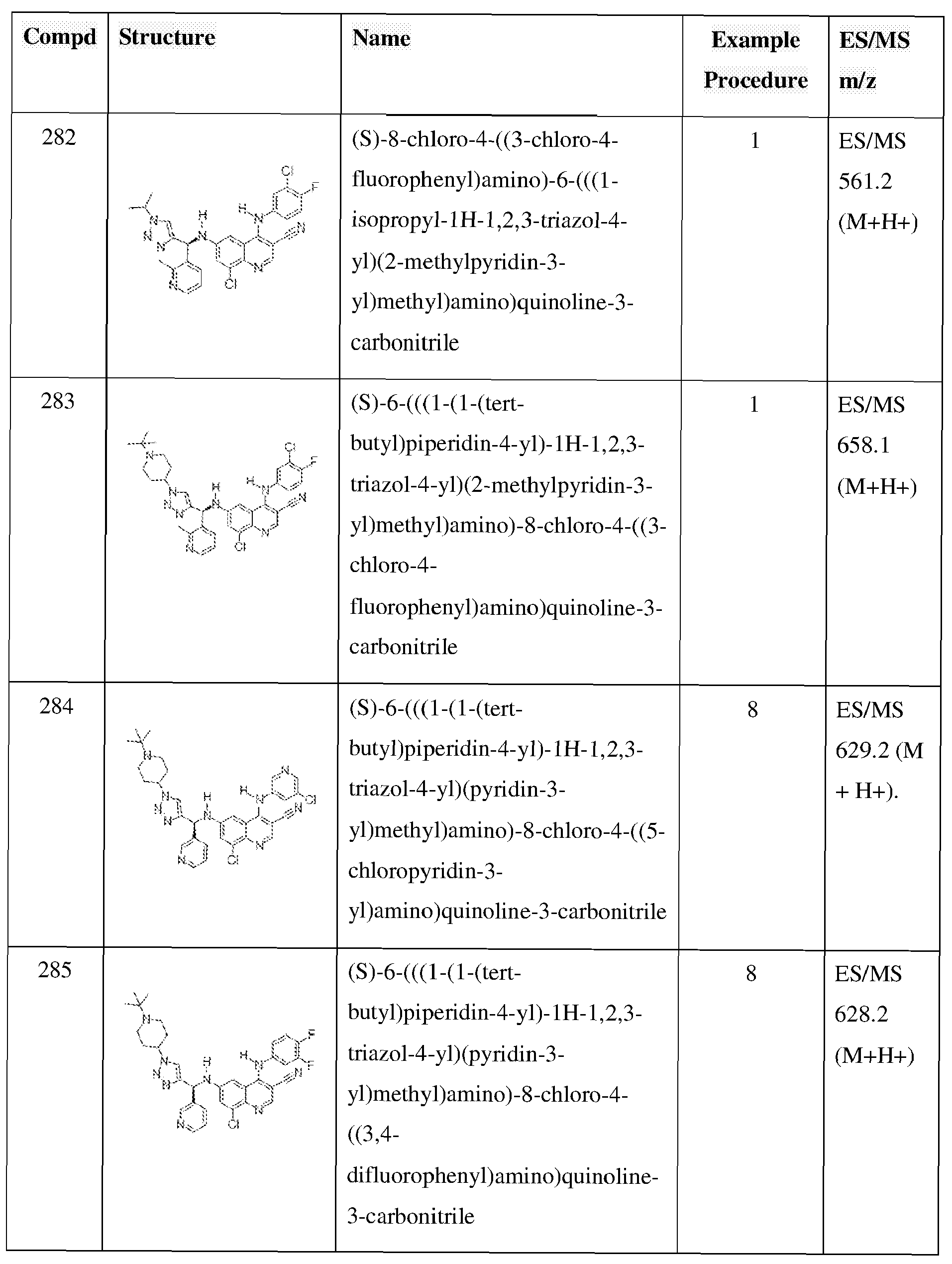


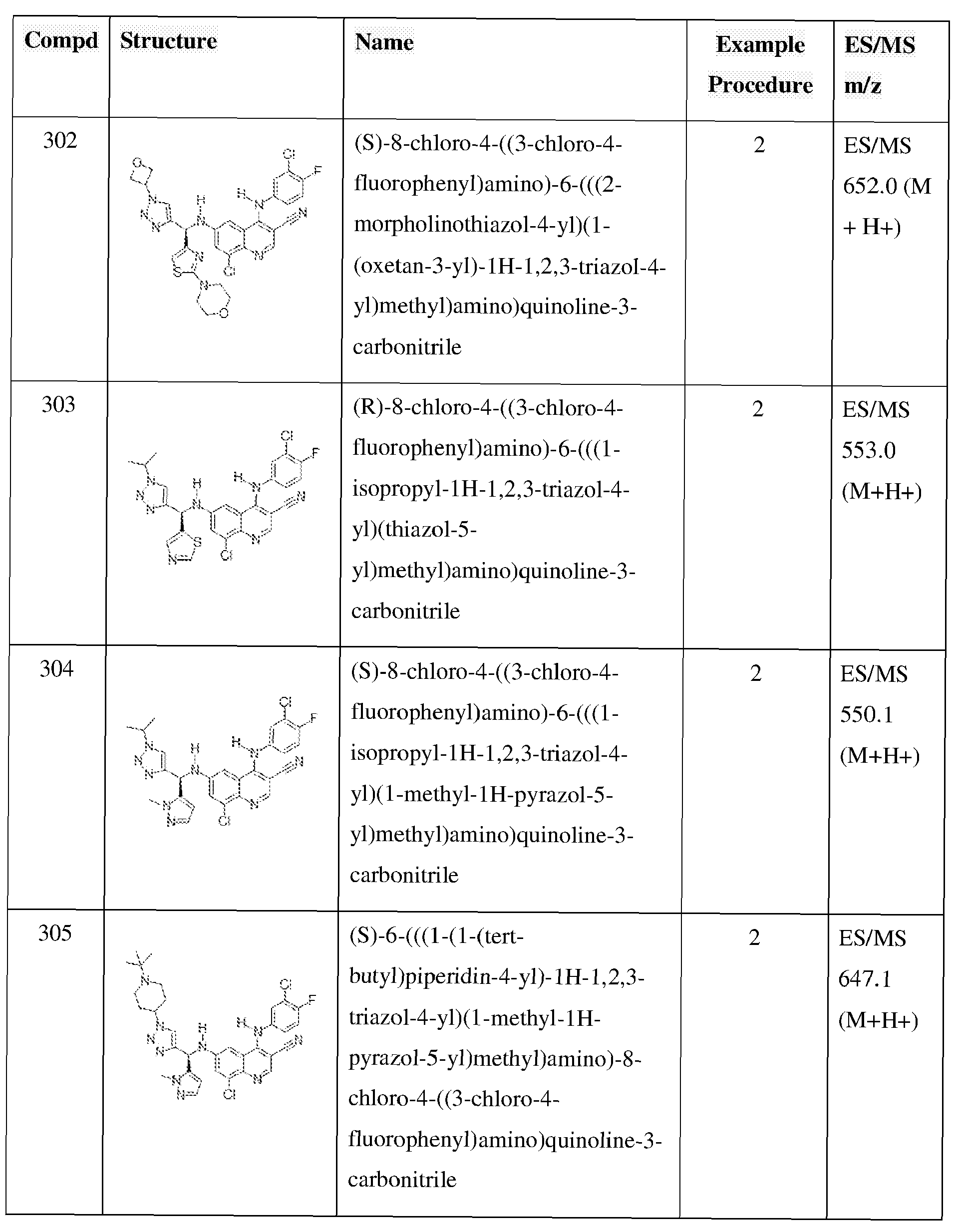


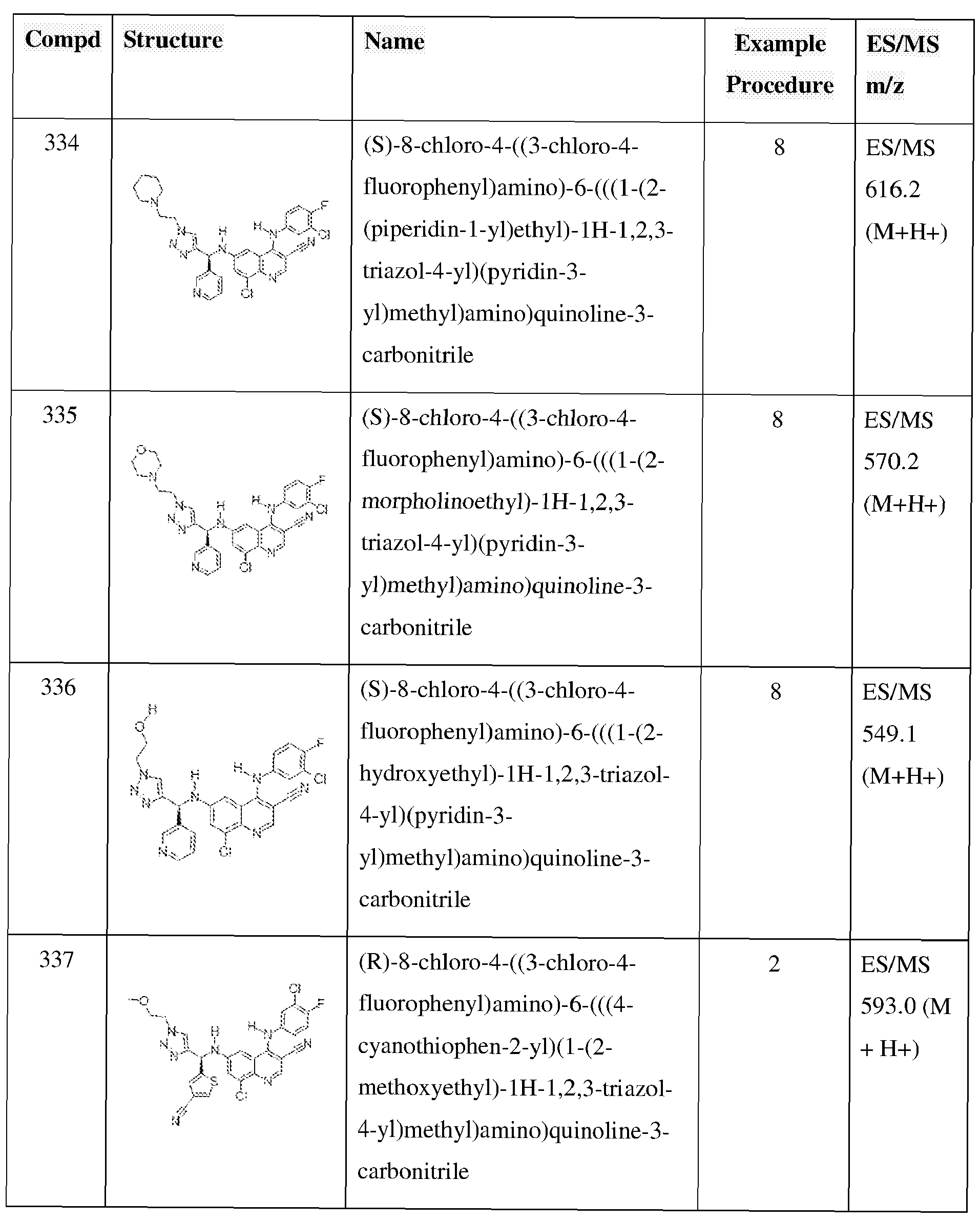


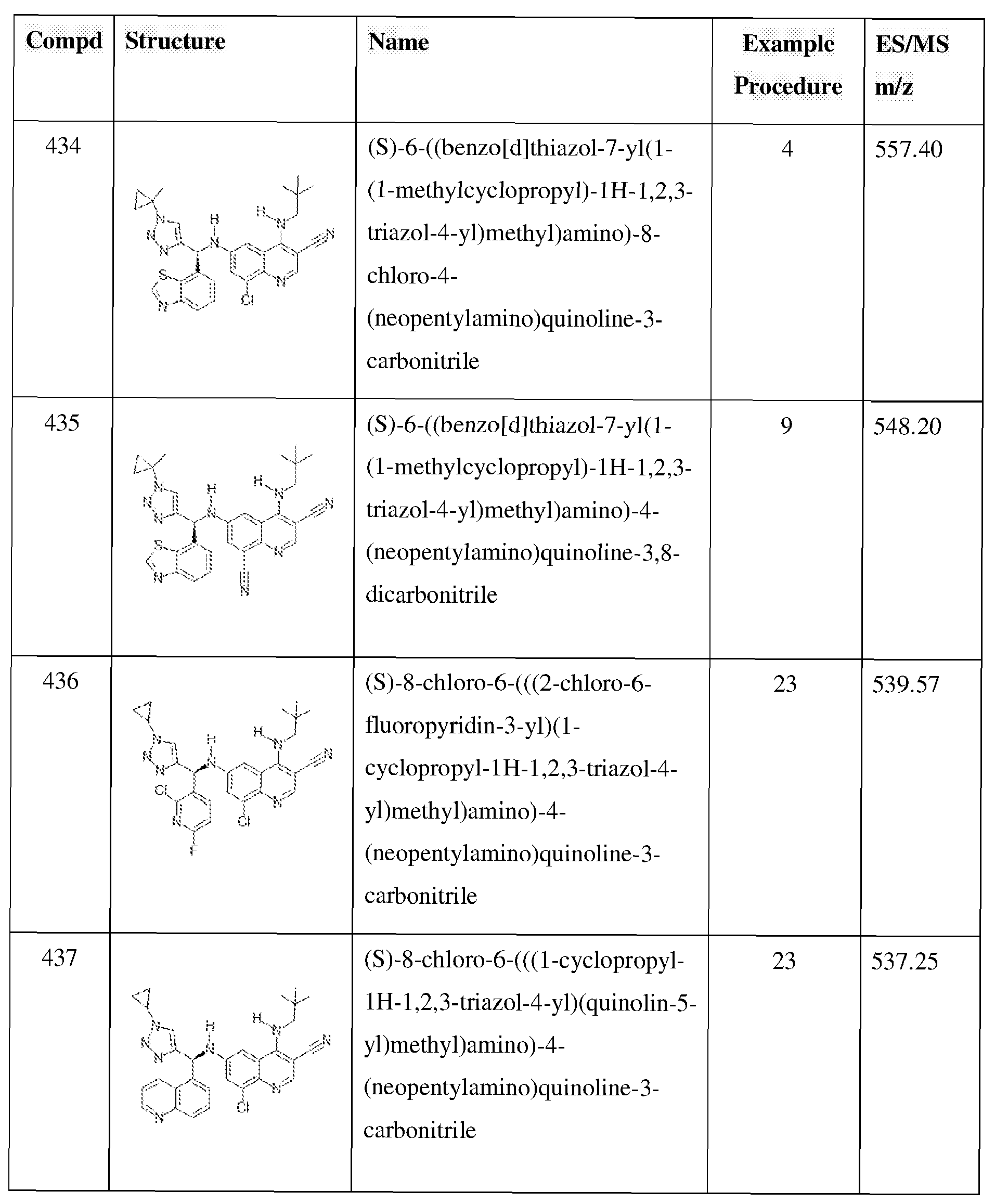


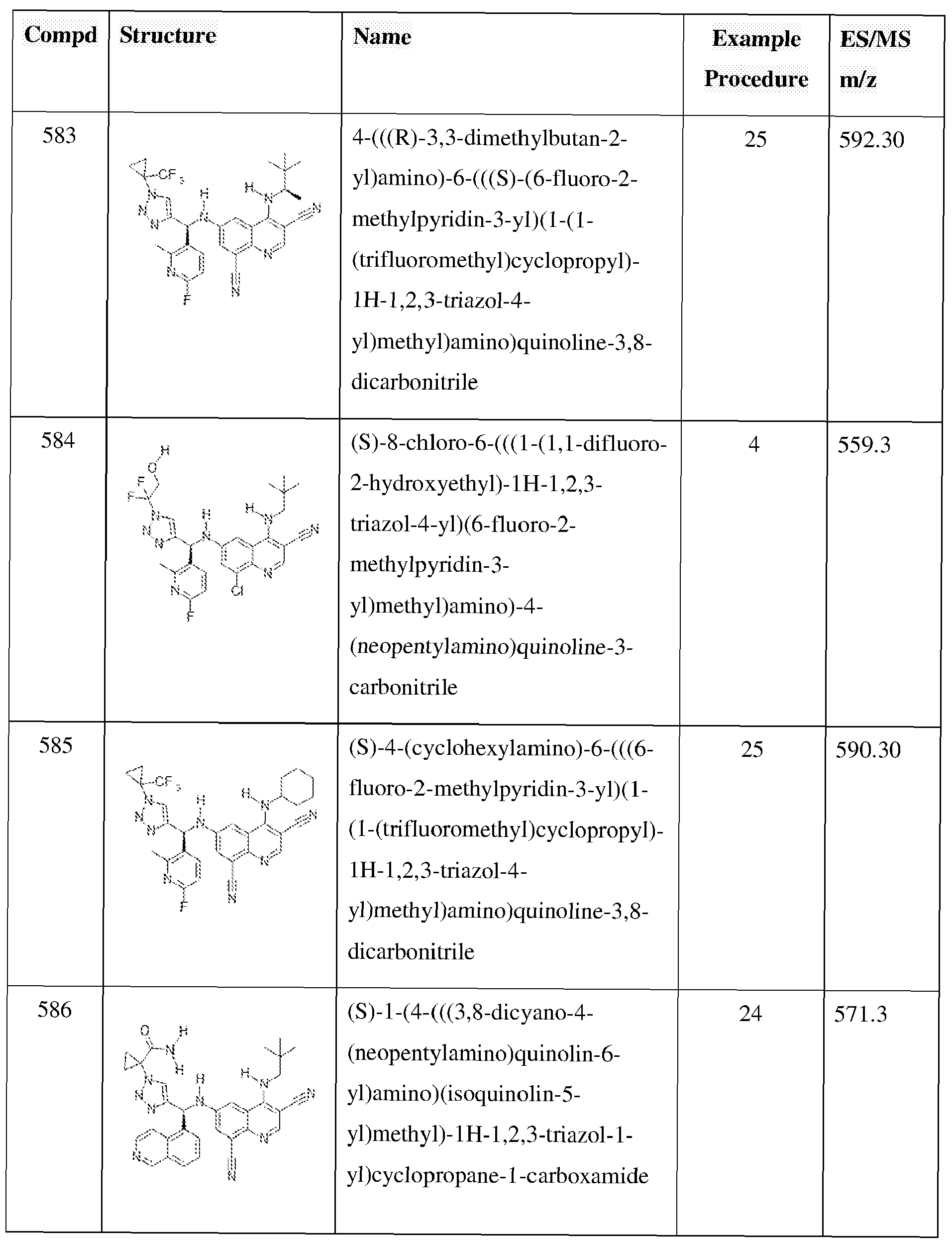


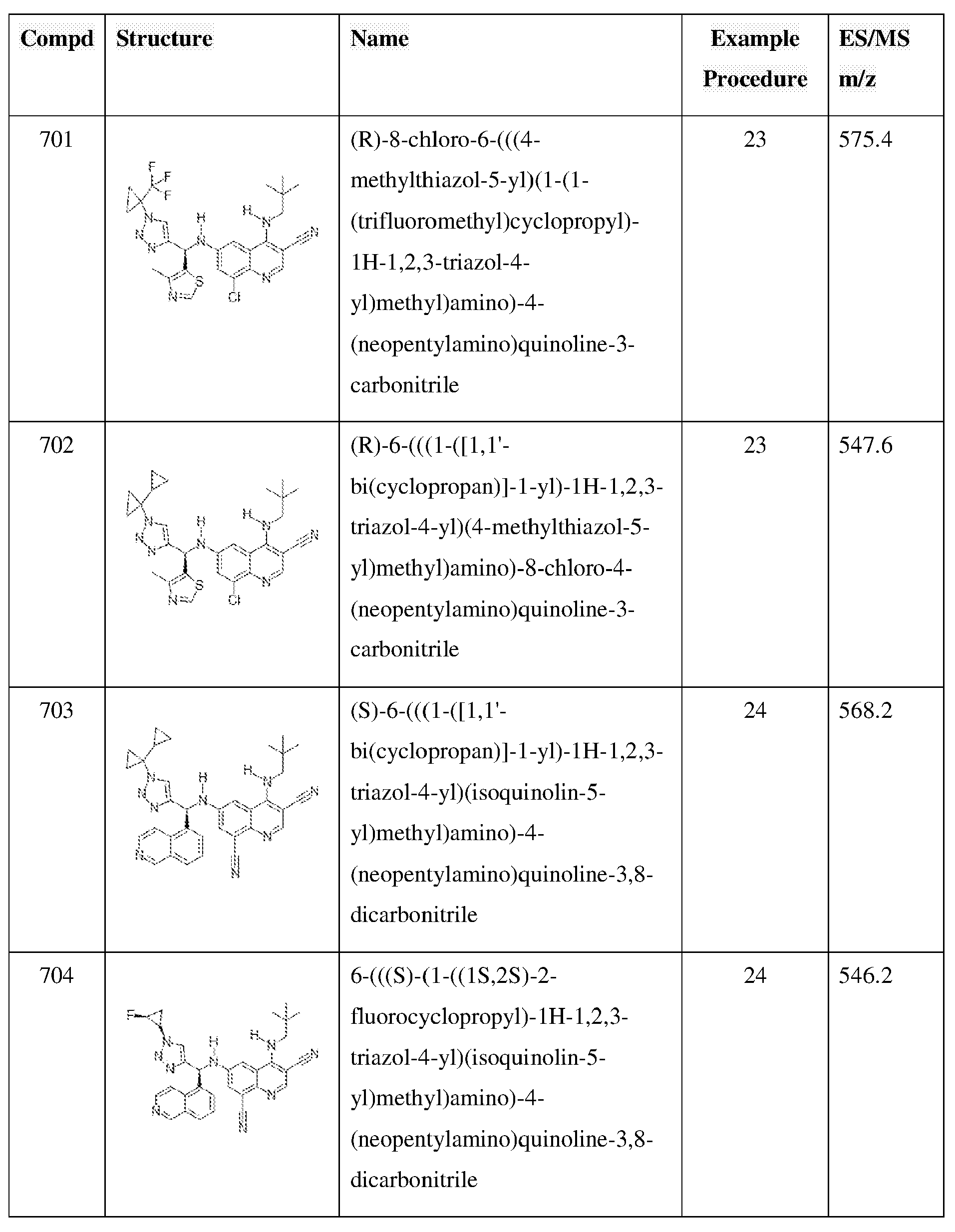


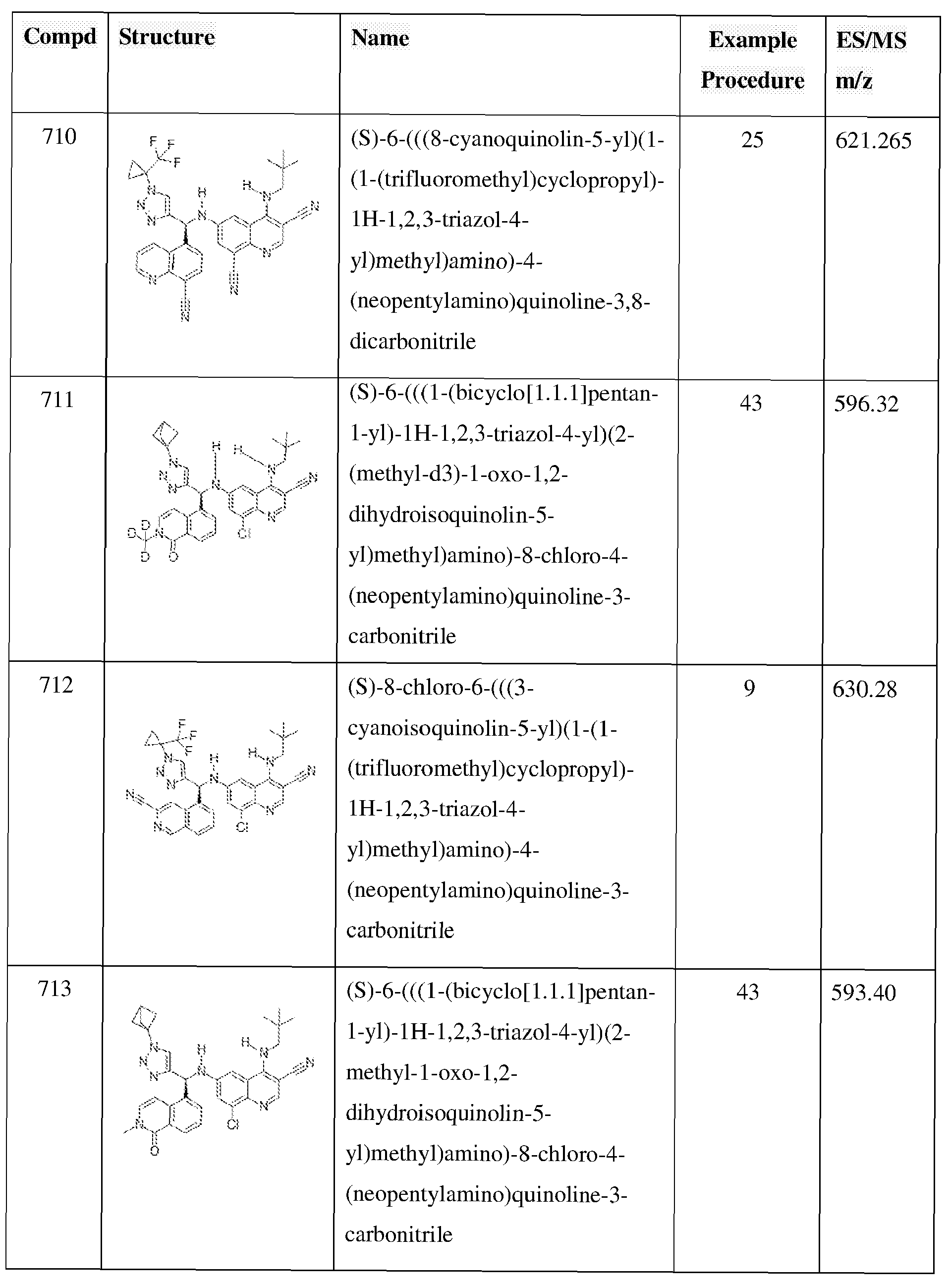


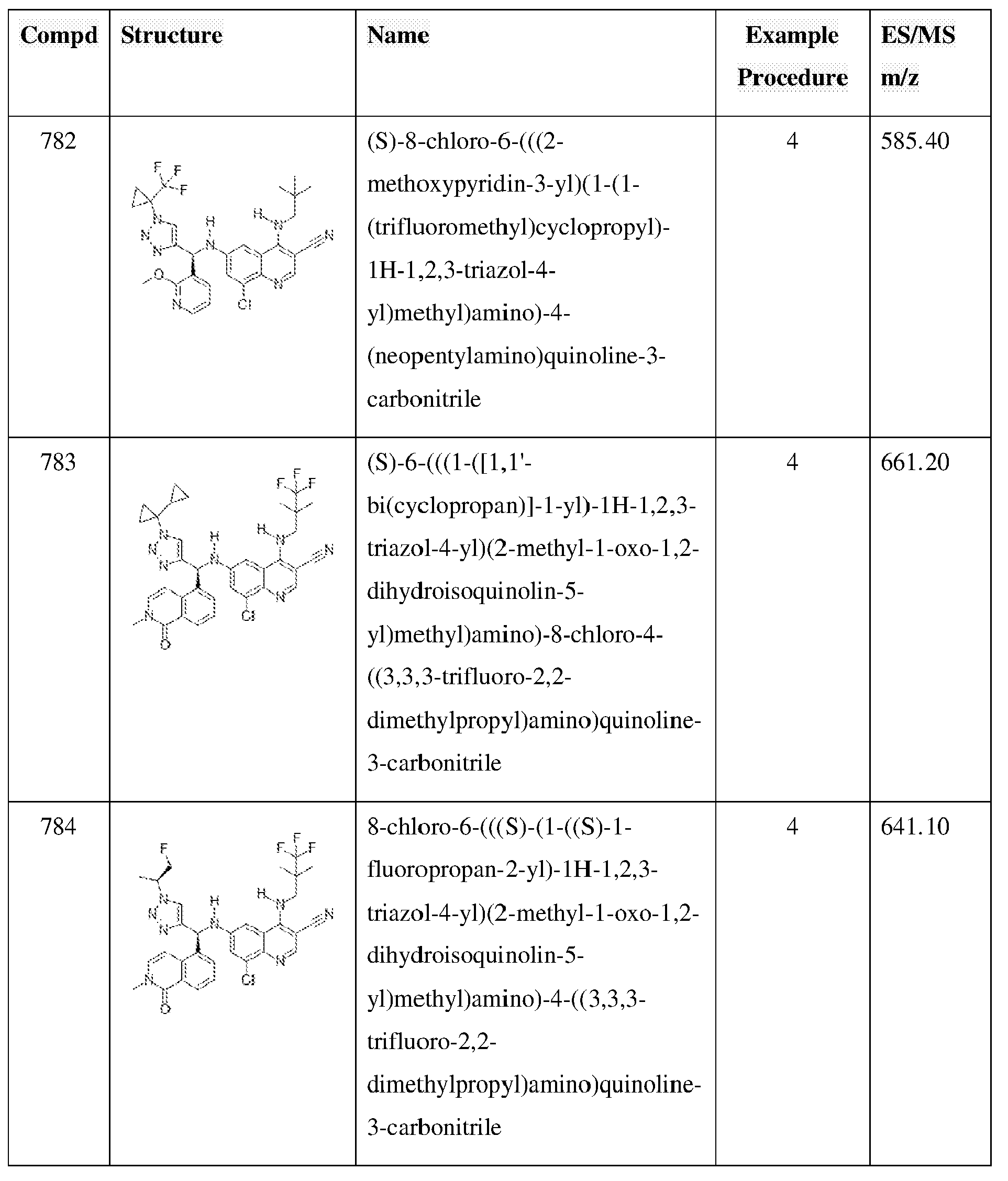


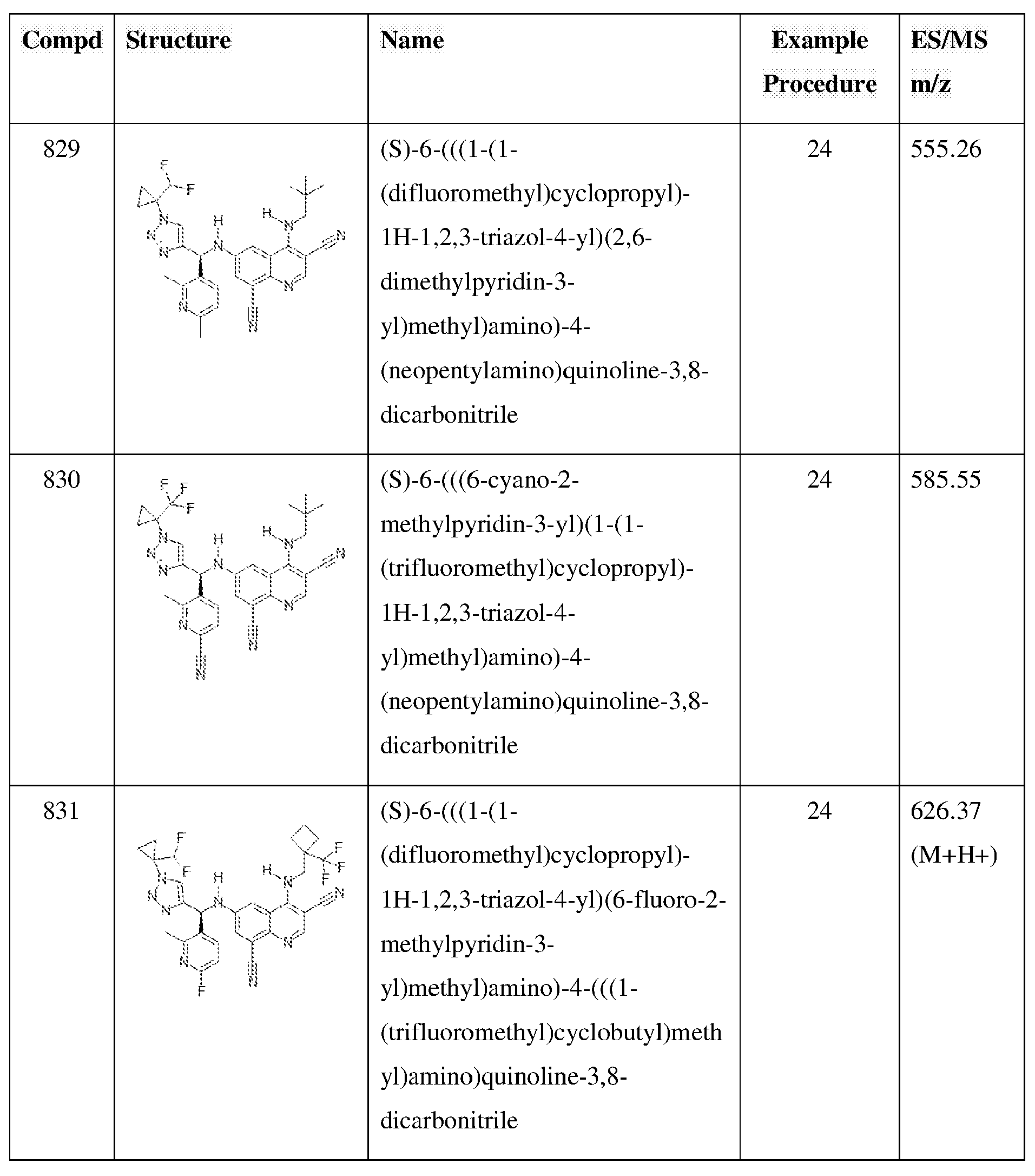


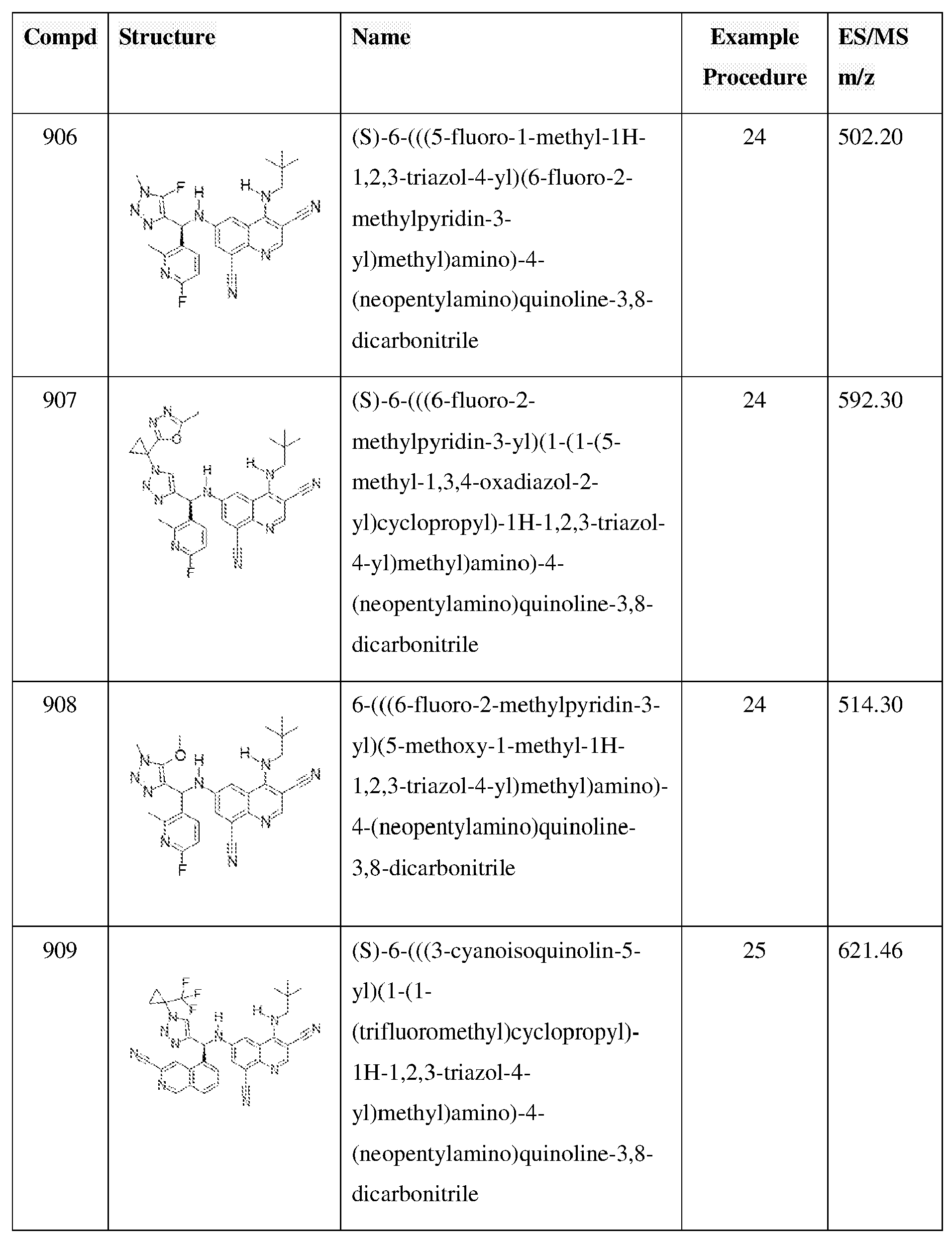


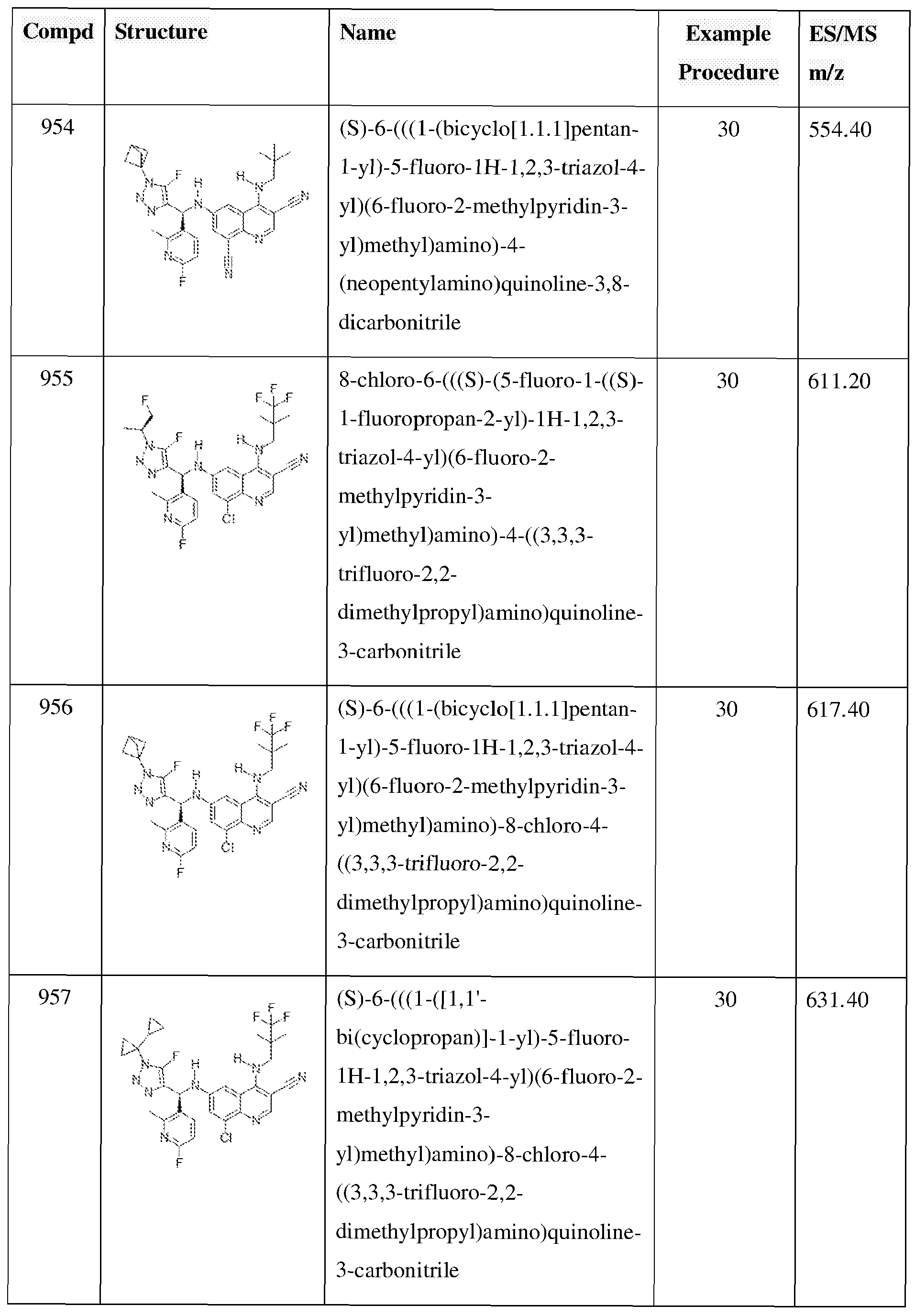


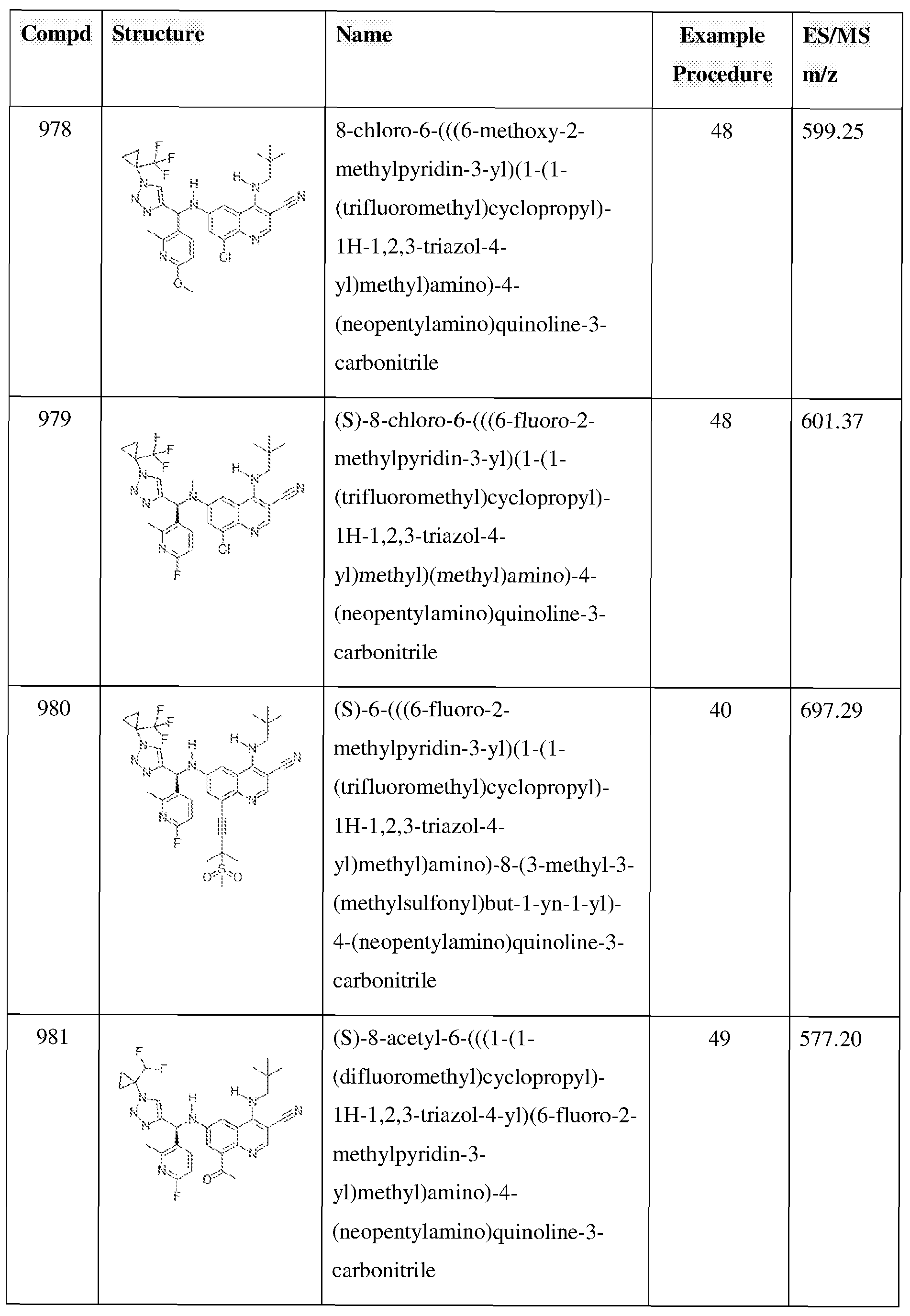


- Proton NMR data for select compounds is shown below in Table 2.


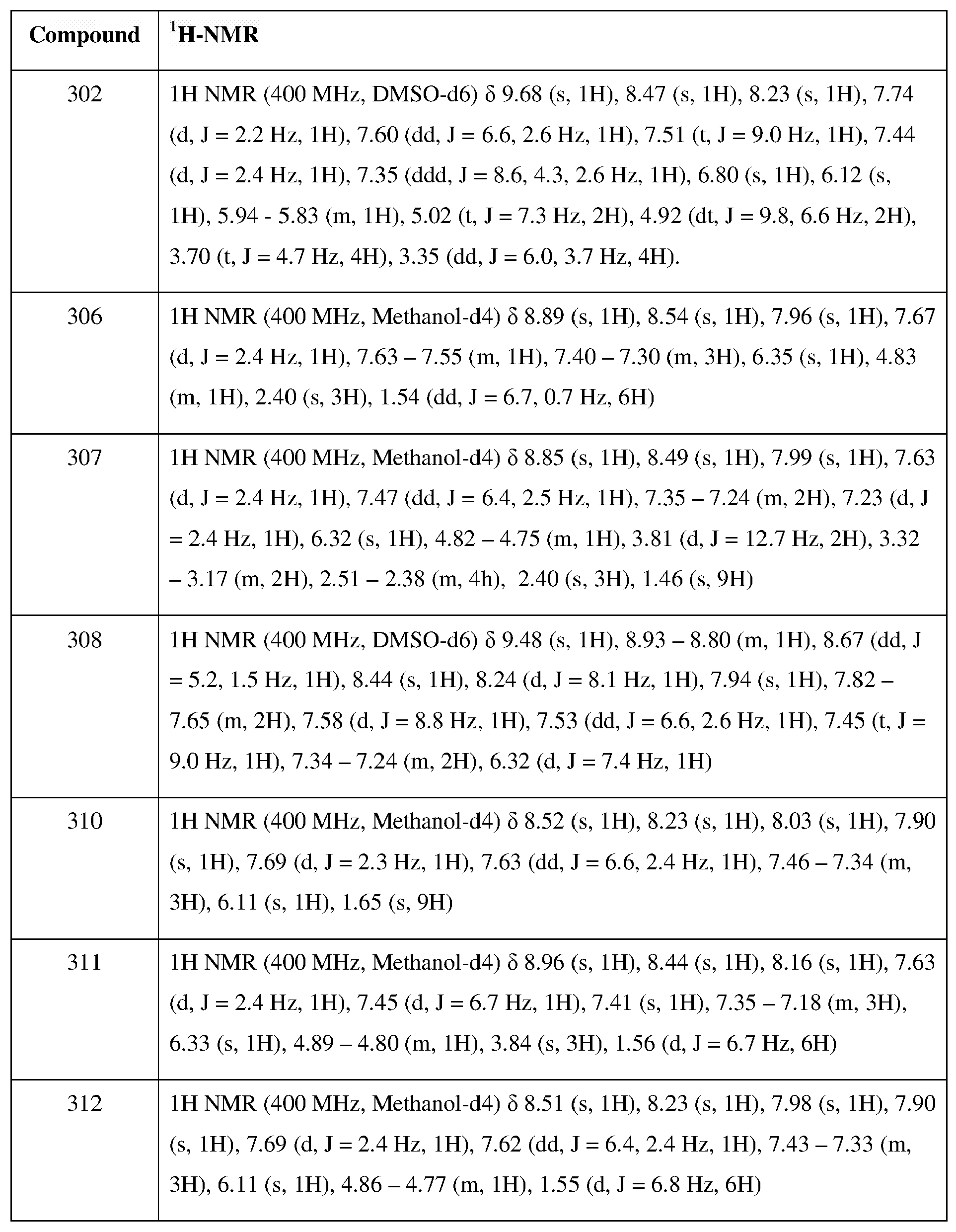


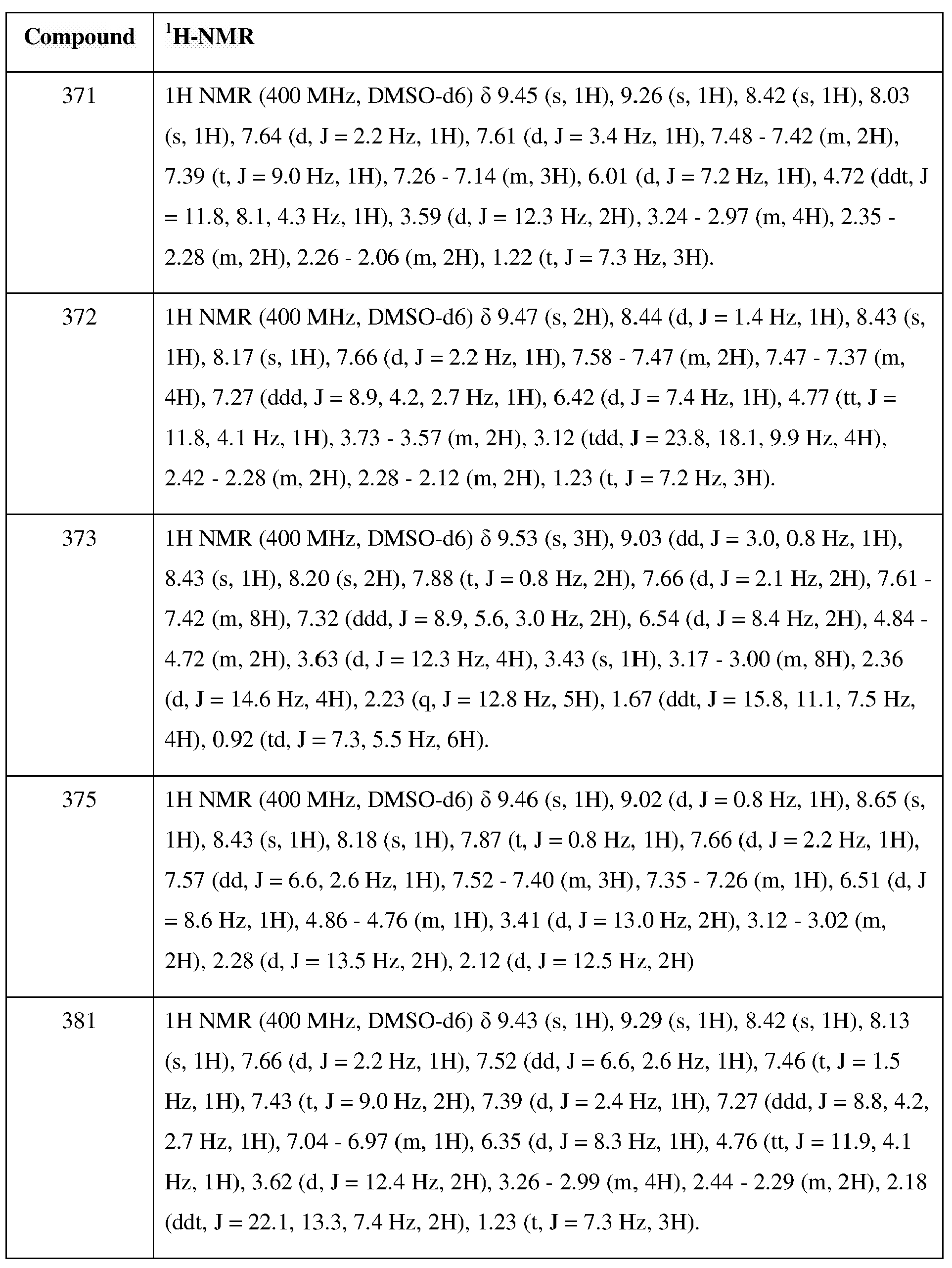


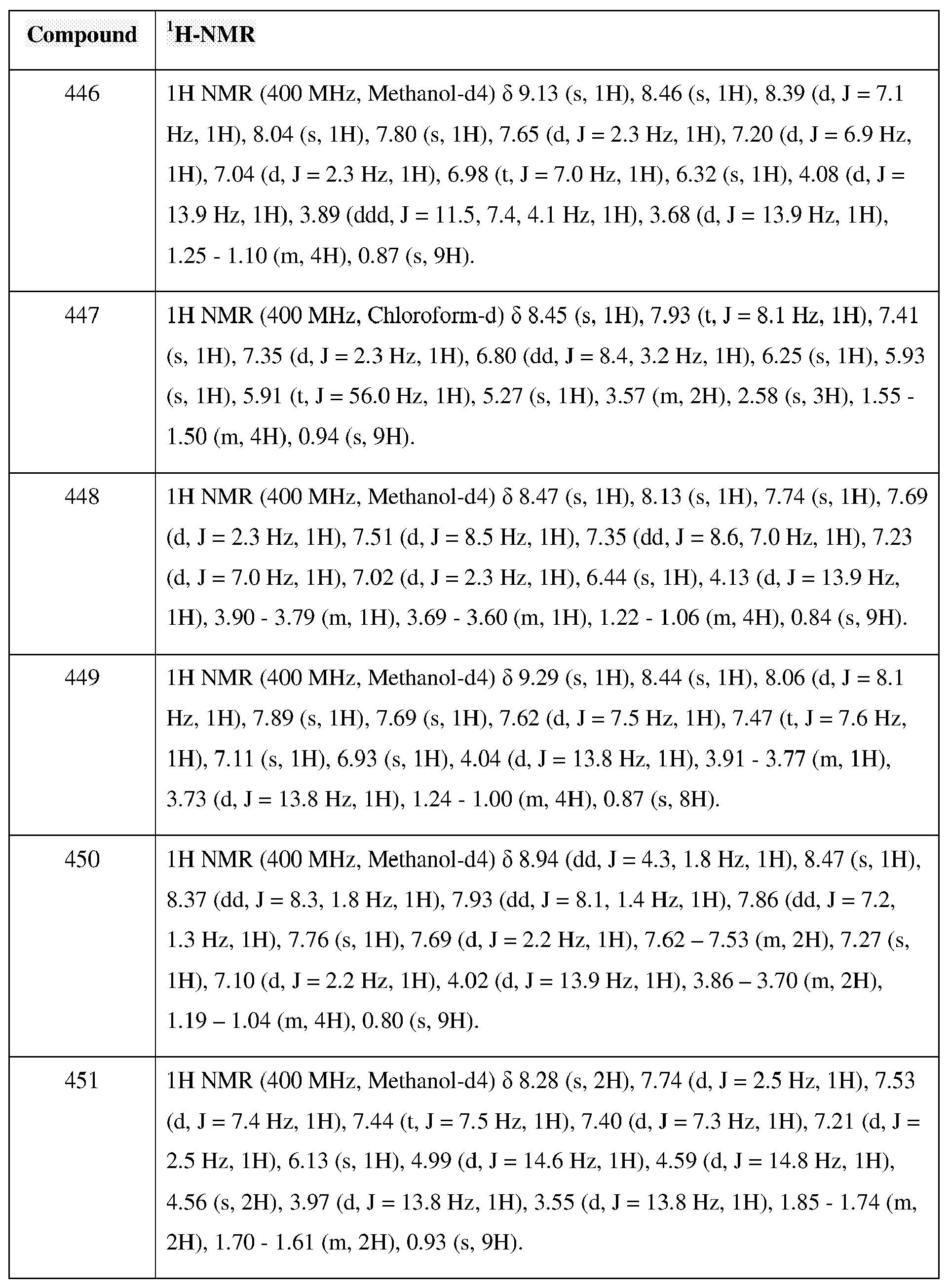


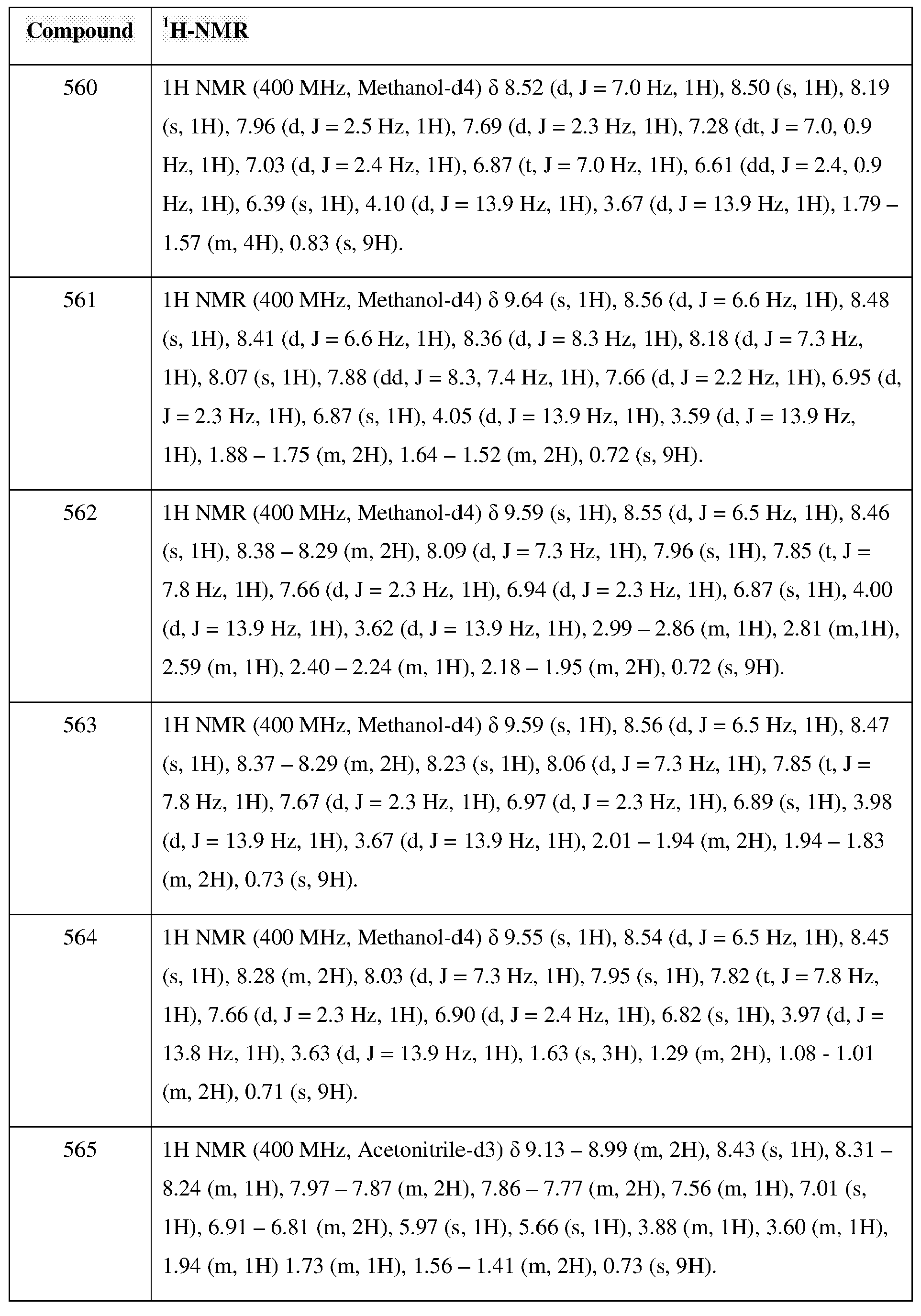


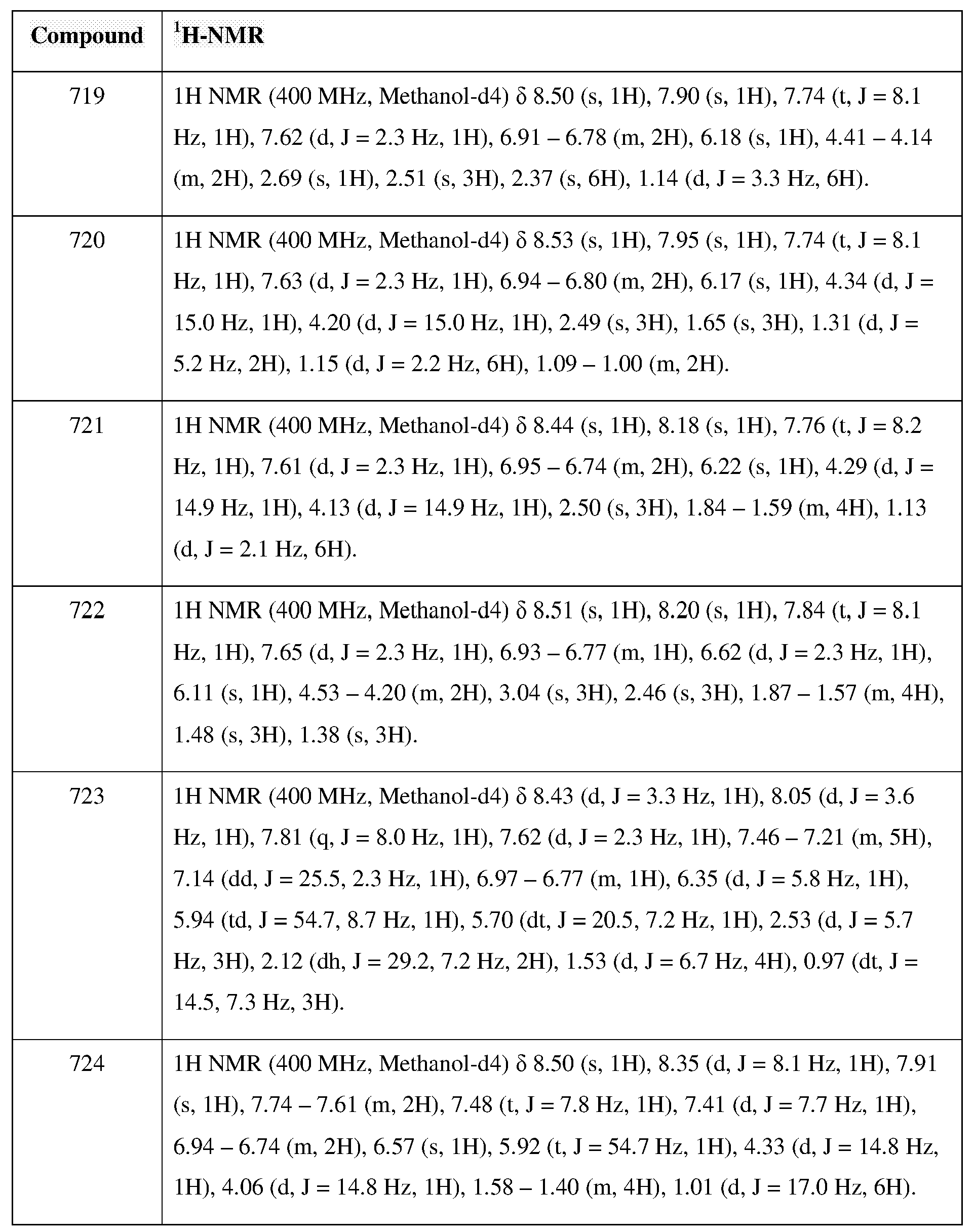


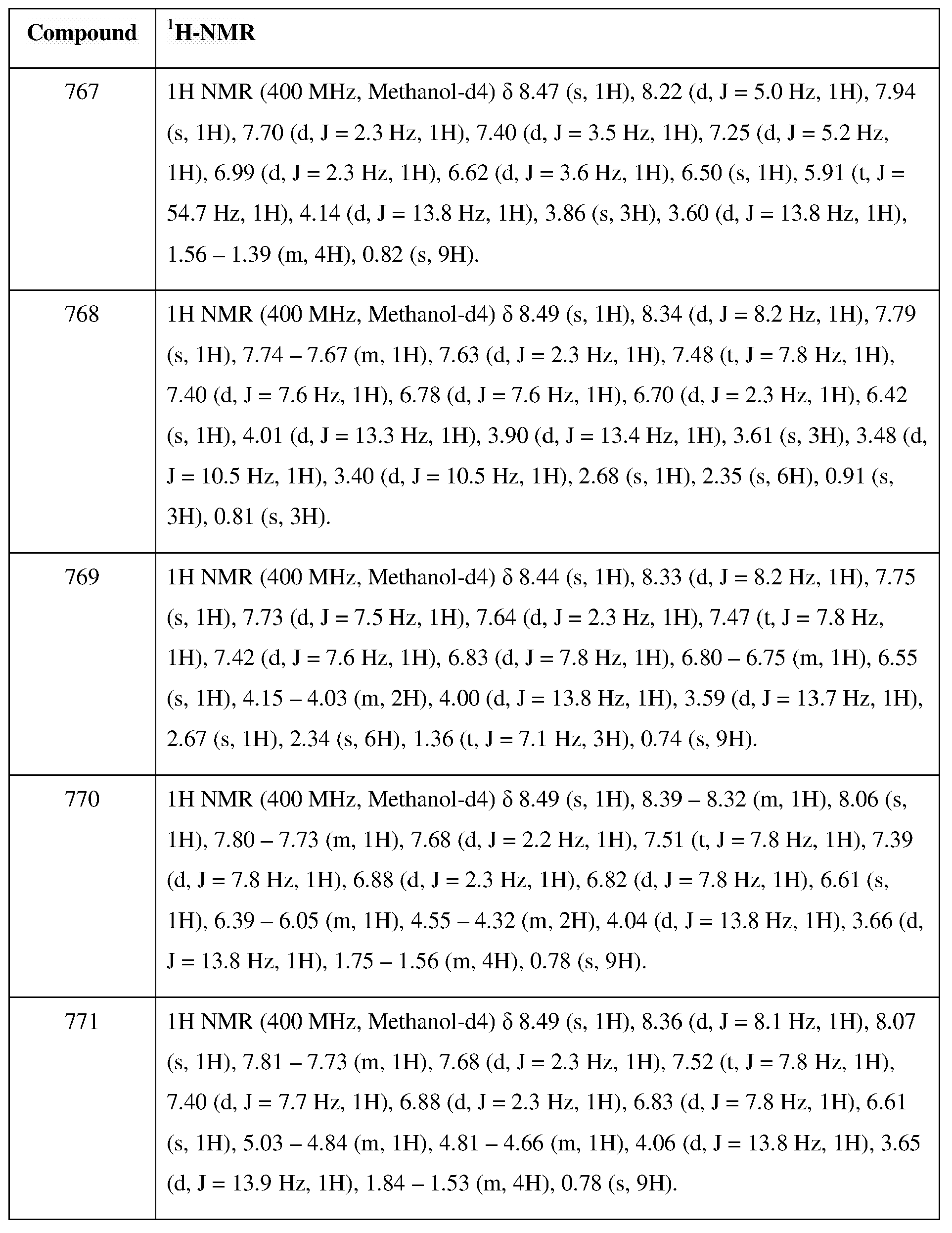


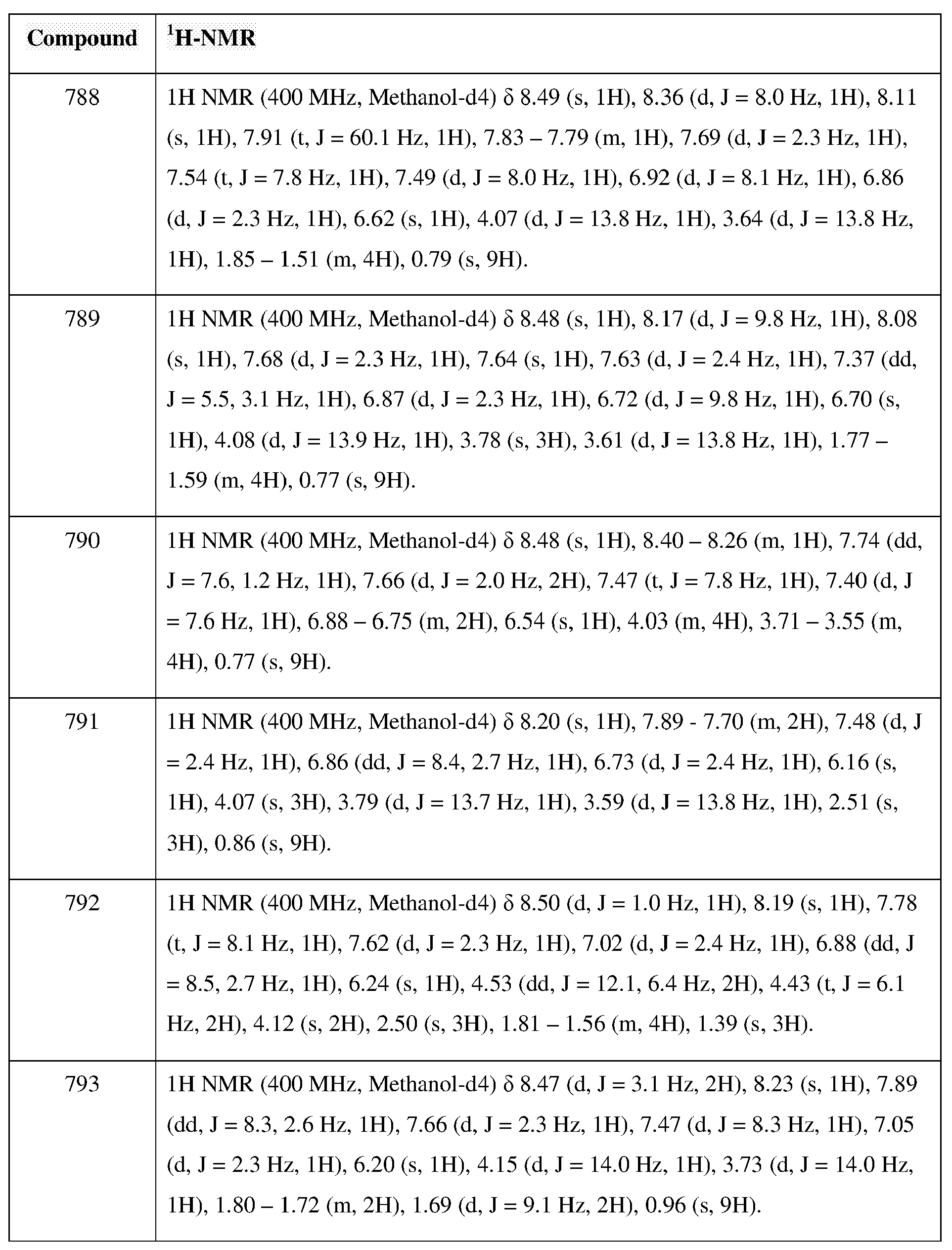


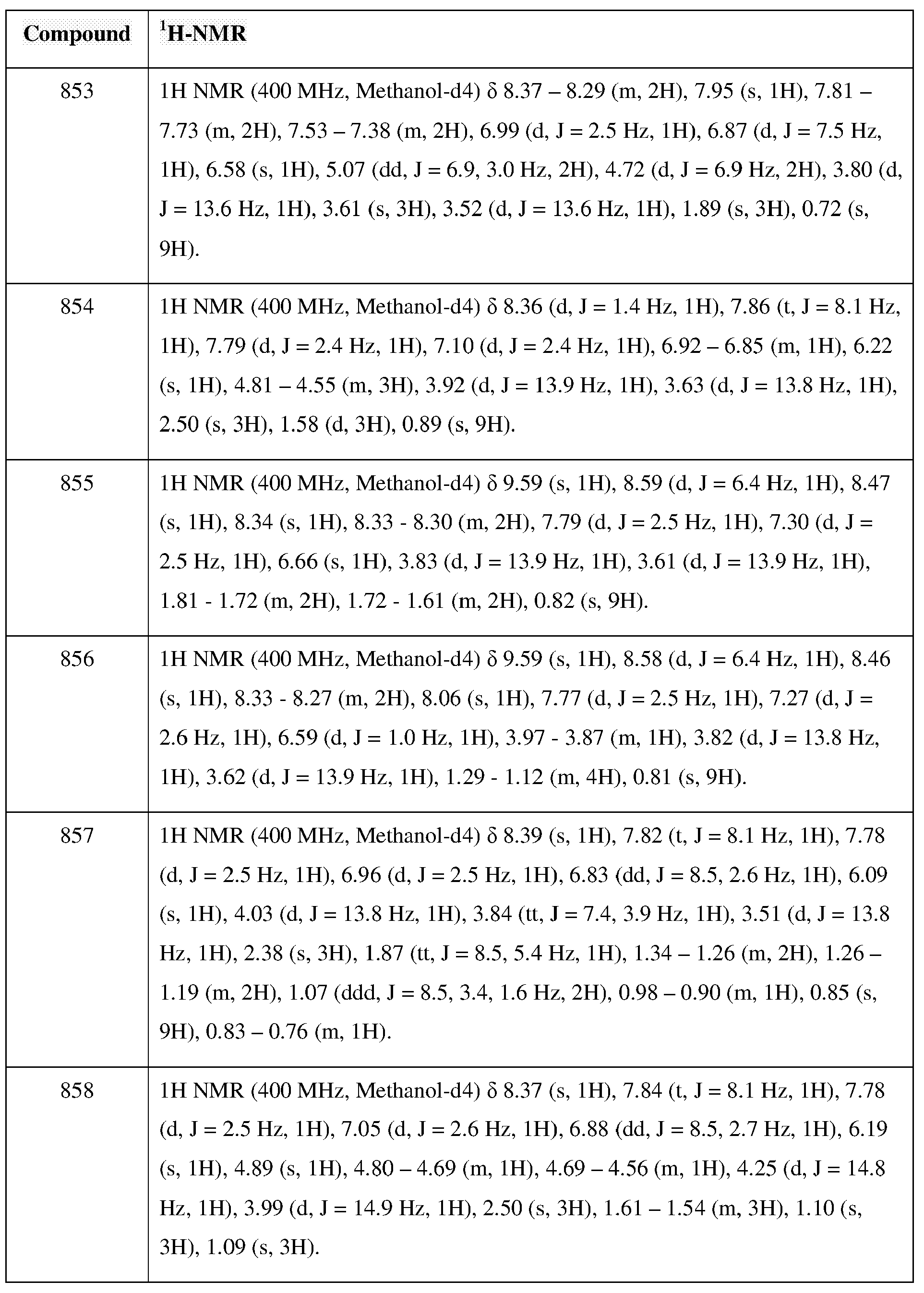


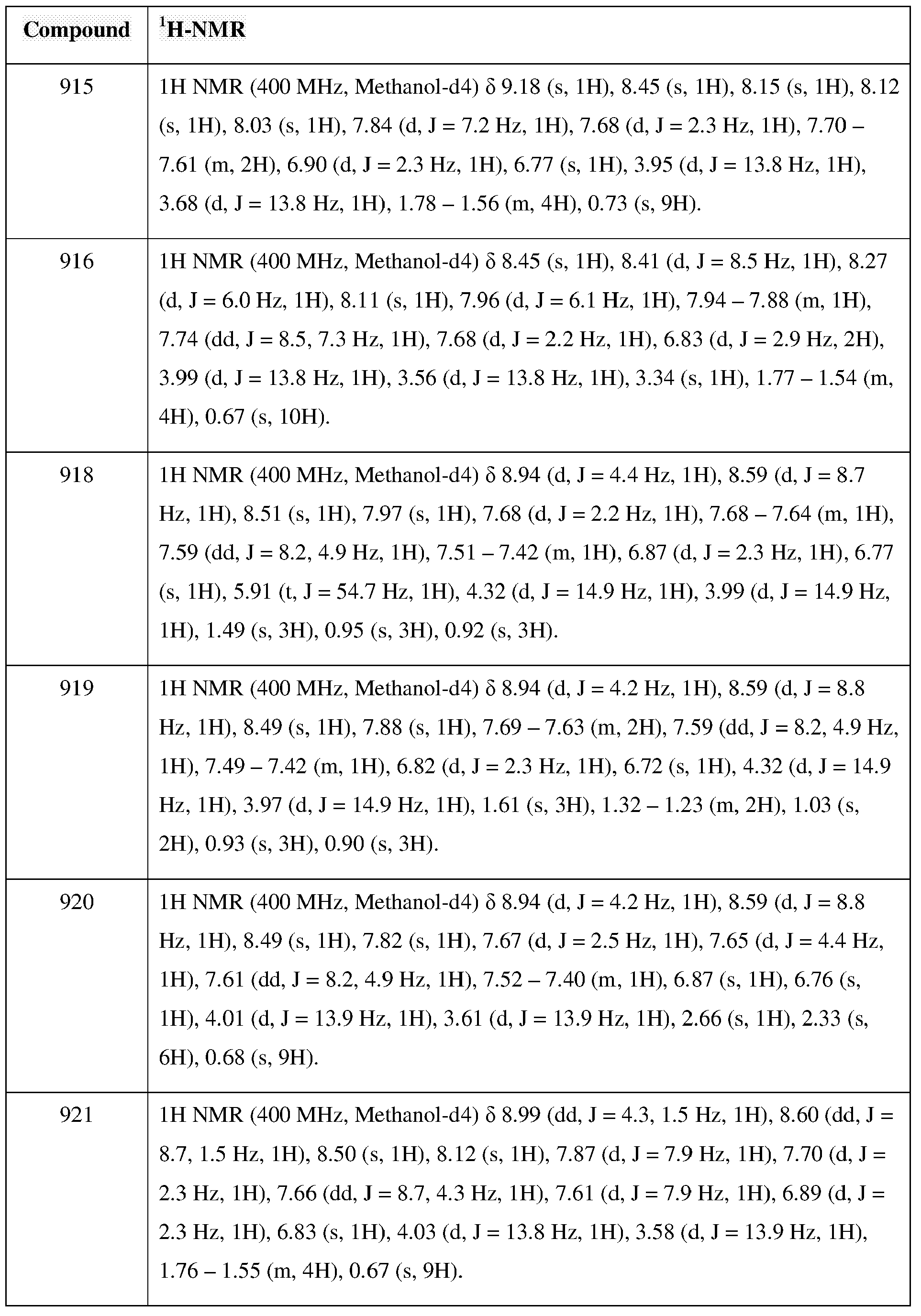


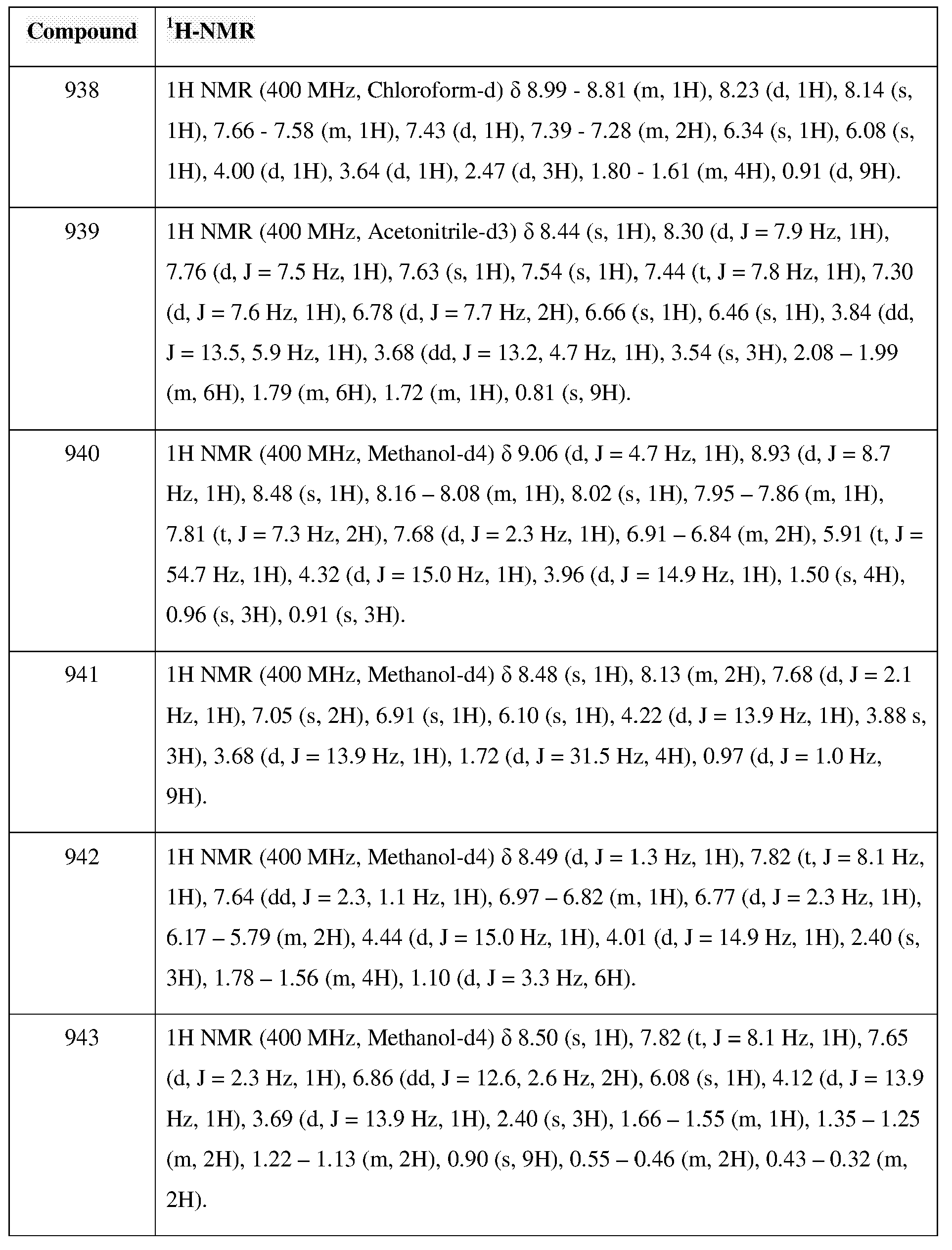


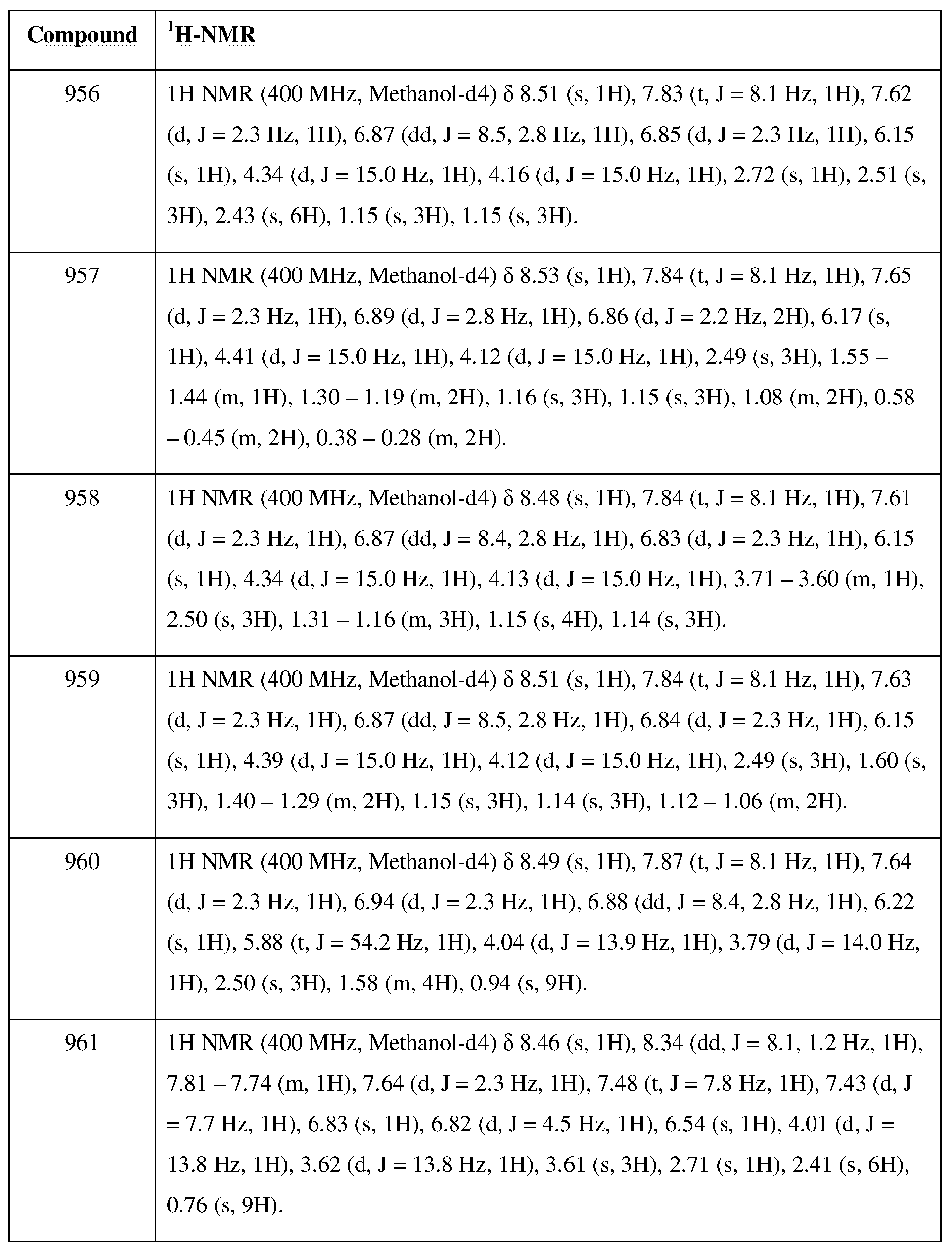


- The following examples, from Examples 40 to 42, describe biological assays for measuring certain test compounds' activity against TNFα, Cot (also known as Tpl2), and EGFR. As summarized in Table 3, the test compounds are effective inhibitors of Cot.
- Cryopreserved human monocytes (Stem Cell Technologies) were thawed, diluted in RPMI with Glutamax (10mM HEPES, 1X Pen-Strep, 55 µM β-mercaptoethanol, 1 mM Sodium pyruvate) media containing 10% FBS to 0.125 X10^6 cells/ml and recovered at 37°C for 2 hours. The cell suspension was then plated at a density of 5,000 cells/well onto black 384 well Greiner clear bottom plates. Plates were pre-spotted with test compounds and serially diluted in DMSO where 200 nL/well were delivered using the Echo 550 acoustic liquid dispenser (Labcyte®) for a final DMSO concentration of 0.5%. Plated cells were treated with compound for 1 hour at 37°C. Cells were then stimulated with 50 pg/ml of LPS (Sigma) excluding outside columns of plate used for unstimulated cell control wells. Cells were incubated for an additional 4 hours at 37°C. Cells were then spun out of the media and 5 µl of sample were taken and analyzed for total TNFα content using the TR-FRET Human TNFα detection system (CisBio). This system utilizes two labeled antibodies (cryptate and XL665) that bind to two different epitopes of the TNFα molecule and produce FRET signal proportional to the concentration of TNFα in the sample. Detection antibodies are mixed 50:50 and 5 µL were dispensed into each well. Plates were covered with clear seals and incubated at room temp overnight. The following morning plates were read using an Envision 2103 Multilabeled reader (PerkinElmer) with excitation/emission/FRET emission at 340 nm/615 nm/665 nm, respectively. Fluorescence intensities at 615 nm and 665 nm emission wavelengths were expressed as a ratio (665 nm/615 nm). Percent of control was calculated as follows:

- Human Cot enzyme activity was measured using KinEASE (Cisbio), a time-resolved fluorescence resonance energy transfer (TR-FRET) immunoassay. In this assay, Cot-catalyzes the phosporylation of a XL665-labeled peptide substrate. Europium conjugated phospho-tyrosine specific antibody binds the resulting phosphorylated peptide. Formation of phosphorylated peptide is quantified by TR-FRET with Europium as the donor and XL665 the acceptor in a 2-step endpoint assay. Purified recombinant human Cot catalytic domain (30-397 amino acids) was purchased from Carna Biosciences. In brief, test compounds serially diluted in DMSO were delivered into Proxy white, low volume, 384 well plates using the Echo 550 acoustic liquid dispenser (Labcyte®). Cot enzyme and substrates were dispensed into assay plates using a Multi-Flo (Bio-Tek Instruments). The standard 5µL reaction mixture contained 400 µM ATP, 1 µM STK3 peptide, 5 nM of Cot in reaction buffer (10 mM MOPS, pH 7.0, 0.02% NaN3, 0.5 mg/mL BSA, 10 mM MgOAc, 1 mM DTT, 0.025% NP-40, 1.5% glycerol) and 0.1% DMSO. After 2.5 hrs of incubation at room temperature, 5 µL of Stop and Detect Solution (1:200 Europium Cryptate labeled anti-phosphorylated peptide antibody solution and 125 nM strepavidin-XL665 Tracer in a 50 mM Hepes pH 7.0 detection buffer containing sufficient EDTA) was added. The plate was then further incubated for 120 minutes at room temperature and read using an Envision 2103 Multilabeled reader (PerkinElmer) with excitation/emission/FRET emission at 340 nm/615 nm/665 nm, respectively. Fluorescence intensities at 615 nm and 665 nm emission wavelengths were expressed as a ratio (665 nm/615 nm). Percent inhibition was calculated as follows:

- EGFR activity was measured using KinEASE (Cisbio), a time-resolved fluorescence resonance energy transfer (TR-FRET) immunoassay. In this assay, EGFR-catalyzes the phosphorylation of a universal Tyrosine kinase peptide substrate labeled with XL665. Europium conjugated phosphor-tyrosine specific antibody binds the resulting phosphorylated peptide. Formation of phosphorylated peptide is quantified by TR-FRET with Europium as the donor and XL665 the acceptor. The assay was performed in two main steps. The first step is the kinase reaction step and the second step is the detection step with TR-FRET reagents. In brief, test compounds 1:3 serially diluted in DMSO were delivered into Corning white, low volume, non-binding 384 well plates using the Echo 550 acoustic liquid dispenser (Labcyte®). EGFR enzyme (Human EGFR, cytoplasmic domain [669-1210] from Carna Biosciences Cat. No. 08-115) and substrates TK substrate-biotin (included in Cisbio HTRF KinEASE-TK kit Cat. No. 62TK0PEJ) were dispensed into assay plates using a Multi-Flo (Bio-Tek Instruments). The standard 10 µL reaction mixture contained 6 µM ATP (1XKm) or 12 µM ATP (2XKm), 1 µM biotinylated peptide, 0.3 nM EGFR (for 1XKm ATP) or 0.1 nM EGFR (for 2XKm ATP) in reaction buffer (10 mM MOPs, pH 7.0, 1.5% Glycerol, 0.5 mg/ml BSA, 10 mM Mg-Acetate, 1 mM DTT, 0.025% NP-40). After 60 min of incubation at room temperature, 10 µL of Stop and Detect Solution (1:400 Europium Cryptate labeled anti-phosphorylated peptide antibody solution and 125 nM strepavidin-XL665 Tracer in a 50 mM Hepes pH 7.0 detection buffer containing sufficient EDTA) was added. The plate was then further incubated for over 60 minutes at room temperature and read using an Envision 2103 Multilabeled reader (PerkinElmer) with excitation/emission/FRET emission at 340 nm/615 nm/665 nm, respectively. Fluorescence intensities at 615 nm and 665 nm emission wavelengths were expressed as a ratio (665 nm/615 nm). Percent inhibition was calculated as follows:

- As shown in Table 3, the compounds of Formula I are inhibitors of Cot (cancer Osaka thyroid).
Table 3 Cmpd IC50 HTRF (nM) EC50 TNF (nM) 1 8 218 2 2 89 3 8 314 4 2 497 5 9 258 7 380 >1000 8 7 302 9 1 20 10 21 283 11 4 154 12 27 214 13 11 765 14 7 196 15 2 545 16 2 115 17 53 1388 18 28 399 19 2 156 20 2 69 21 14 2035 22 2 89 23 4 69 24 12 185 25 2 57 26 6 113 27 2 62 28 12 195 29 17 498 30 34 1322 31 5 5069 32 7 546 33 11 630 34 8 112 35 9 166 36 3 67 37 16 2638 38 25 952 39 11 295 40 6 249 41 8 137 42 135 1926 43 33 915 44 9 129 45 2 178 46 3 1102 47 25 1068 48 2 87 49 118 16684 50 70 3534 51 55 1556 52 4 88 53 81 4018 54 11 652 55 58 10816 56 6 2521 57 60 5990 58 72 2982 59 2 892 60 12 131 61 11 238 62 10 216 63 5 257 64 42 2652 65 6 538 66 3 53 67 1 32 68 1 51 69 2 33 70 19 804 71 2 36 72 1 11 73 2 33 74 1 14 75 2 79 76 1 981 77 3 154 78 3 332 79 1 203 80 1 23 81 400 >1000 82 2 151 83 942 1000 84 1 10 85 4 >1000 86 2 37 87 25 590 88 1161 >1000 89 520 >1000 90 1 18 91 2 52 92 6 65 93 7 74 94 2 130 95 10 445 96 11 173 97 20 358 98 49 821 99 3 143 100 3 142 101 5 348 102 3 461 103 3 133 104 1 99 105 3 144 106 2 76 107 182 >10000 108 913 >10000 109 2 54 110 2 56 111 2 77 112 2 61 113 13 253 114 10 233 115 5 119 116 3 144 117 3 94 118 6 150 119 4 99 120 5 137 121 7 171 122 6 240 123 6 193 124 8 376 125 3 78 126 3 146 127 16 194 128 698 >10000 129 2 81 130 6 147 131 2 49 132 4 97 133 25 978 134 6 197 135 23 660 136 10 291 137 15 235 138 3 141 139 2 92 140 3 183 141 2 121 142 2 66 143 16 898 144 2 77 145 4 221 146 10 370 147 12 1139 148 5 174 149 8 381 150 4 154 151 8 1305 152 10 904 153 44 3759 154 26 1667 155 2 79 156 8 1191 157 5 127 159 2 95 160 11 484 161 12 1668 162 7 429 163 67 4142 164 5 1802 165 9 2368 166 6 1425 167 4 506 168 6 394 169 14 1217 170 6 1262 171 10 320 172 10 832 173 7 1112 174 2 54 175 3 73 176 2 31 177 2 79 178 7 931 179 265 >10000 180 1 104 181 2 92 182 13 1041 183 357 >10000 184 8 387 185 305 9745 186 118 6618 187 67 2114 188 >10000 >10000 189 8 1061 190 9 238 191 2 104 192 3 186 193 2 107 194 2 111 195 4 132 196 6 668 197 9 599 198 17 982 199 9 2522 200 7 558 201 56 5595 202 >10000 >10000 203 6923 9089 204 8513 >10000 205 72 2048 206 3 211 207 5 931 208 12 465 209 23 941 210 10 424 211 16 544 212 44 9151 213 3 103 214 >10000 >10000 215 258 >10000 216 38 1187 217 12 264 218 26 2711 219 4449 >10000 220 4 348 221 2 28 222 19 739 223 7 94 224 12 2628 225 10 1488 226 8 880 227 44 6419 228 18 2307 229 12 1467 230 9 252 231 8 230 232 15 346 233 8 114 234 21 504 235 17 370 236 9 172 237 1 29 238 3 901 239 16 928 240 16 631 241 2 32 242 143 5801 243 41 9492 244 4 328 245 2 125 246 6 652 247 2 102 248 4 398 249 12 332 250 5 127 251 5 347 252 6 119 253 4 66 254 3 230 255 10 766 256 16 341 257 6 212 258 2 33 259 6 158 260 6 126 261 14 344 262 11 130 263 13 242 264 2 70 265 14 426 266 37 28752 267 30 5120 268 12 234 269 6 326 270 4 666 271 9 826 272 5 297 273 51 1564 274 12 370 275 7 2334 276 6 789 277 7 923 278 3 269 279 3 457 280 16 811 281 13 575 282 3 87 283 3 50 284 14 1305 285 8 219 286 4 121 287 20 373 288 26 1058 289 37 837 290 12 185 291 35 478 292 17 327 294 9 166 295 23 565 296 80 1104 297 9 200 298 39 1503 299 18 739 300 7 165 301 14 414 302 10 472 303 14 868 304 6 234 305 3 84 306 6 202 307 4 60 308 4 286 309 8 181 310 40 2342 312 13 1235 313 5 373 314 15 302 315 4 132 316 6 298 317 16 251 318 8 271 319 5 165 321 10 212 322 33 369 323 86 666 325 20 650 326 34 3753 328 4 272 331 3 173 334 4 82 335 10 405 339 13 1010 340 8 328 341 6 843 342 38 6094 344 3 151 345 3 73 346 3 208 347 4 278 348 13 444 349 41 718 350 26 4511 351 10 744 352 12 565 353 4 184 354 3 983 355 5 194 357 5 235 358 3 130 359 3 729 360 4 151 361 13 746 362 1 46 363 4 257 364 7 241 366 5 336 367 13 338 368 649 6296 369 3 89 370 8 232 371 2 173 372 2 81 373 3 81 374 37 480 375 4 1511 376 182 >1000 377 398 >1000 378 2 168 379 6 179 380 14 609 381 7 303 382 14 768 389 11 328 395 4 403 9 290 405 2 1044 406 3 102 6 2 293 32 311 30 320 60 324 10 327 15 329 14 330 59 332 65 333 3 336 2 337 16 338 13 343 504 356 2 365 38 384 153 385 14 386 36 387 18 388 10 390 343 391 282 392 3 393 5 394 147 396 43 397 46 398 435 399 58 400 119 401 10 402 19 404 232 408 1 88 409 1 559 410 113 1000 411 5 76 412 7 157 413 4 44 414 1 35 415 3 67 416 2 124 417 9 218 418 2 45 419 3 49 420 2 25 421 4 100 422 2 57 423 3 71 424 2 37 425 7 1000 426 2 95 427 2 41 428 1 69 429 2 56 430 5 214 431 1 21 432 6 89 433 1 65 434 2 61 435 1 24 436 5 289 437 2 82 438 473 1000 439 13 299 440 7 171 441 2 26 442 56 2686 443 1 19 444 2 33 445 2 71 446 3 156 447 2 40 448 2 44 449 19 407 450 20 356 451 3 138 452 4 73 453 9 184 454 2 32 455 29 222 456 51 1000 457 315 1000 458 4 87 459 3 50 460 5 156 461 17 154 462 162 8766 463 2 63 464 1 16 465 2 155 466 28 926 467 2 47 468 1 18 469 4 69 470 2 46 471 3 45 472 4 78 473 2 26 474 2 26 475 20 258 476 3 71 477 2 185 478 1 77 479 5 78 480 2 60 481 6 391 482 3 86 483 7 108 484 3 73 485 3 29 486 3 991 487 1 245 488 3 79 489 2 129 490 1 1000 491 3 40 492 2 21 493 31 1000 494 1 444 495 3 50 496 6 467 497 6 379 498 19 689 499 3 97 500 8 321 501 3 55 502 6 206 503 2 45 504 1 38 505 5 277 506 8 528 507 2 87 508 4 96 509 267 1000 510 5 222 511 6 133 512 10 418 513 9 154 514 4 77 515 199 1000 516 2 34 517 3 1000 518 7 207 519 3 158 520 123 926 521 27 256 522 5 52 523 2 63 524 12 77 525 4 164 526 5 73 527 3 78 528 3 60 529 2 50 530 3 70 531 3 70 532 3 78 533 3 96 534 20 394 535 2 47 536 3 51 537 2 75 538 5 109 539 1 12 540 50 760 541 6 180 542 2 40 543 13 422 544 8 210 545 4 108 546 2 42 547 2 33 548 8 124 549 4 68 550 2 29 551 2 27 552 2 26 553 3 64 554 5 151 555 7 208 556 8 120 557 5 117 558 3 72 559 2 42 560 11 287 561 2 433 562 2 231 563 2 63 564 3 69 565 2 306 566 2 190 567 2 66 568 5 170 569 7 171 570 184 1000 571 2 77 572 4 79 573 66 751 574 4 86 575 1 974 576 1 433 577 1 49 578 2 32 579 2 24 580 2 84 581 2 32 582 14 184 583 4 121 584 2 53 585 37 838 586 2 1000 587 1 489 588 55 629 589 2 34 590 3 57 591 5 106 592 5 78 593 8 298 594 2 33 595 209 1000 596 79 826 597 3 150 598 5 198 599 13 316 600 5 113 601 4 32 602 3 69 603 7 107 604 3 71 605 3 30 606 2 27 607 21 225 608 42 314 609 2 46 610 2 199 611 20 229 612 11 171 613 13 144 614 9 154 615 33 588 616 12 104 617 9 77 618 3 37 619 7 189 620 102 1000 621 1 12 622 1 24 623 1 27 624 11 1000 625 2 26 626 5 35 627 4 46 628 450 1000 629 181 1000 630 68 1000 631 2 32 632 380 1000 633 28 267 634 2 43 635 3 60 636 69 720 637 3 85 638 58 858 639 58 806 640 3 65 641 55 811 642 5 182 643 5 1000 644 7 88 645 11 66 646 3 40 647 3 133 648 3 114 649 2 14 650 179 1000 651 14 135 652 4 40 653 4 37 654 3 36 655 12 104 656 4 86 657 37 806 658 29 374 659 41 279 660 43 839 661 2 103 662 6 335 663 3 62 664 12 154 665 6 198 666 13 246 667 10 71 668 13 408 669 1 7 670 5 102 671 2 32 672 2 22 673 142 808 674 22 301 675 1 7 676 6 112 677 4 133 678 5 131 679 13 710 680 3 98 681 2 26 682 7 66 683 35 283 684 14 101 685 4 39 686 4 77 687 15 178 688 30 437 689 9 81 690 21 250 691 6 66 692 3 38 693 15 141 694 7 84 695 3 39 696 2 14 697 1 11 698 27 684 699 12 386 700 2 179 701 10 147 702 4 188 703 2 22 704 1 23 705 6 61 706 2 14 707 16 230 708 6 176 709 17 187 710 5 148 711 2 32 713 2 21 714 6 57 715 3 91 716 2 54 717 8 100 718 9 112 719 2 24 720 2 35 721 6 109 722 43 403 723 4 84 724 3 44 725 3 56 726 4 127 727 3 48 728 7 154 729 5 108 730 10 89 731 11 179 732 11 779 733 42 835 734 41 313 735 47 478 736 117 645 737 3 91 738 2 40 739 21 254 740 45 311 741 6 120 742 17 199 743 5 116 744 3 33 745 2 28 746 13 178 747 4 36 748 5 47 749 6 66 750 11 194 751 15 230 752 5 57 753 5 59 754 3 31 755 25 365 756 3 26 757 5 60 758 4 50 759 2 42 760 2 58 761 6 69 762 3 50 763 3 40 764 4 46 765 4 131 766 2 30 767 18 209 768 6 86 769 2 28 770 4 108 771 4 293 772 2 33 773 2 35 774 2 40 775 3 27 776 2 24 777 5 46 778 4 30 779 3 26 780 5 52 781 2 22 782 23 177 783 2 23 784 3 51 785 2 23 786 5 47 787 2 65 788 23 208 789 13 156 790 5 82 791 22 242 792 89 843 793 35 782 794 15 130 795 34 530 796 2 31 797 3 77 798 7 90 799 4 46 800 2 25 801 3 31 802 4 36 803 7 97 804 9 137 805 28 778 806 3 28 807 3 31 808 3 29 809 3 32 810 4 54 811 11 333 812 5 68 813 2 24 814 2 16 815 3 39 816 1 23 817 10 116 818 6 176 819 2 28 820 3 33 821 3 60 822 10 687 823 4 53 824 5 59 825 7 113 826 51 1000 827 2 38 828 22 253 829 4 66 830 16 384 831 8 202 832 2 44 833 2 22 834 5 68 835 4 53 836 4 52 837 7 121 838 3 84 839 6 94 840 4 52 841 2 41 842 3 563 843 4 104 844 13 417 845 20 1000 846 2 17 847 31 296 848 31 247 849 16 261 850 6 65 851 3 21 852 2 58 853 1 98 854 4 17 855 2 53 856 1 29 857 4 180 858 7 44 859 2 53 860 3 31 861 7 40 862 8 49 863 2 35 864 2 37 865 4 23 866 2 18 867 3 27 868 2 70 869 2 37 870 2 169 871 1 32 872 1 15 873 5 97 874 3 73 875 2 166 876 2 385 877 2 34 878 2 31 879 1 13 880 3 80 881 2 13 882 2 18 883 1 13 884 1 19 885 10 132 886 3 30 887 3 33 888 2 165 889 9 104 890 6 68 891 1 12 892 2 44 893 4 99 894 3 54 895 3 41 896 3 30 897 2 18 898 5 56 899 2 29 900 3 30 901 484 1000 902 3 36 903 3 36 904 5 78 905 15 212 906 4 39 907 4 51 908 12 238 909 8 116 910 5 148 911 7 85 912 6 78 913 6 86 914 9 116 915 44 324 916 13 269 917 3 31 918 3 42 919 2 49 920 3 28 921 17 187 922 11 225 923 16 258 926 13 174 927 6 124 928 6 99 929 11 157 930 33 504 931 10 134 932 14 205 933 29 247 934 7 81 935 24 424 936 18 287 937 23 277 938 26 223 939 18 104 940 7 86 941 64 804 945 17 142 946 5 153 947 3 39 948 5 99 949 4 34 950 17 260 951 9 61 952 4 36 953 36 353 954 7 16 955 6 50 956 7 44 957 5 54 958 2 56 959 3 41 960 7 55 961 3 48 962 13 135 963 4 51 964 3 105 965 4 78 966 15 191 967 2 94 968 2 94 969 8 258 970 34 722 971 11 301 972 1817 1000 973 3 34 974 11 60 975 1231 1000 976 21 276 978 9 303 979 244 1000 980 1000 1000 981 4 20 982 1000 1000 983 9644 1000 984 10 169 985 13 126 986 5 141 - The data in Table 4 and Table 5 shows that the compounds disclosed herein are effective inhibitors of cancer Osaka thyroid (Cot). In addition, the claimed compounds are not significant EGFR ligands.
Table 4 Compound Compound Structure IC50 / EC50 [nM] EGFR (IC50) [nM] Comparative Example 1 
4 / 310 357 Comparative Example 2 
62 / NA NA 362 
1 / 46 3984 Table 5 Compound Compound Structure IC50 / EC50 [nM] EGFR (IC50) [nM] Comparative Example 3 
67 / > 10000 > 10000 Comparative Example 4 
> 10000 / Na > 10000 395 
4 / NA NA 406 
3 / 102 > 10000 - The invention provides, in particular, the following:
- 1. A compound of Formula I:

- R1 is hydrogen, -O-R7, -N(R8)(R9), -C(O)-R7, -S(O)2-R7, -C1-9 alkyl, C2-6 alkenyl, C2-6 alkynyl, C3-15 cycloalkyl, heterocyclyl, aryl, or heteroaryl;
wherein each C1-9 alkyl, C2-6 alkenyl, C2-6 alkynyl, C3-15 cycloalkyl, heterocyclyl, aryl, and heteroaryl may be optionally substituted with one to four Z1; - R2 is hydrogen, -C(O)-R7, -C(O)O-R7, -C(O)N(R7)2, C1-9 alkyl, C2-6 alkenyl, C2-6 alkynyl, C1-6 haloalkyl, C3-15 cycloalkyl, aryl, heterocyclyl, or heteroaryl;
wherein each C1-9 alkyl, C2-6 alkenyl, C2-6 alkynyl, C1-6 haloalkyl, C3-15 cycloalkyl, aryl, heterocyclyl, and heteroaryl may be optionally substituted with one to four Z2; - or R1 and R2 together with the nitrogen to which they are attached to form a heterocyclyl or heteroaryl, wherein each heterocyclyl or heteroaryl is optionally substituted with one to four Z2;
- R3 is heterocyclyl or heteroaryl, wherein each heterocyclyl or heteroaryl is optionally substituted with one to four Z3;
- R4 is heterocyclyl or heteroaryl, wherein each heterocyclyl or heteroaryl is optionally substituted with one to four Z4;
- R5 is hydrogen, halo, -CN, -NO2, -O-R7, -N(R8)(R9), -S(O)-R7, -S(O)2R7, -S(O)2N(R7)2,-C(O)R7, -OC(O)-R7, -C(O)O-R7, -OC(O)O-R7, -OC(O)N(R10)(R11), -C(O)N(R7)2,-N(R7)C(O)(R7), C1-9 alkyl, C2-6 alkenyl, C2-6 alkynyl, C1-9 alkylthio, C1-6 haloalkyl, C3-15 cycloalkyl, aryl, heterocyclyl, or heteroaryl;
wherein each C1-9 alkyl, C2-6 alkenyl, C2-6 alkynyl, C1-9 alkylthio, C1-6 haloalkyl, C3-15 cycloalkyl, aryl, heterocyclyl, and heteroaryl may be optionally substituted with one to four Z5; - R6 is hydrogen, -C(O)-R7, -C(O)O-R7, -C(O)N(R7)2, C1-9 alkyl, C2-6 alkenyl, C2-6 alkynyl, C1-6 haloalkyl, C3-15 cycloalkyl, aryl, heterocyclyl, or heteroaryl;
wherein each C1-9 alkyl, C2-6 alkenyl, C2-6 alkynyl, C1-6 haloalkyl, C3-15 cycloalkyl, aryl, heterocyclyl, and heteroaryl may be optionally substituted with one to four Z6; - each R7 is independently hydrogen, C1-9 alkyl, C2-6 alkenyl, C2-6 alkynyl, C1-6 haloalkyl, C3-15 cycloalkyl, aryl, heterocyclyl, or heteroaryl;
wherein each C1-9 alkyl, C2-6 alkenyl, C2-6 alkynyl, C1-6 haloalkyl, C3-15 cycloalkyl, aryl, heterocyclyl, and heteroaryl may be optionally substituted with one to four Z7; - R8 and R9 at each occurrence are independently hydrogen, -S(O)2R10, -C(O)-R10, -C(O)O-R10, -C(O)N(R10)(R11), C1-9 alkyl, C2-6 alkenyl, C2-6 alkynyl, C1-6 haloalkyl, C3-15 cycloalkyl, aryl, heterocyclyl, or heteroaryl;
wherein each C1-9 alkyl, C2-6 alkenyl, C2-6 alkynyl, C1-6 haloalkyl, C3-15 cycloalkyl, aryl, heterocyclyl, or heteroaryl may be optionally substituted with one to four Z8; - R10 and R11 at each occurrence are independently hydrogen, C1-9 alkyl, C2-6 alkenyl, C2-6 alkynyl, C1-6 haloalkyl, C3-15 cycloalkyl, aryl, heterocyclyl, or heteroaryl,
wherein each C1-9 alkyl, C2-6 alkenyl, C2-6 alkynyl, C1-6 haloalkyl, C3-15 cycloalkyl, aryl, heterocyclyl, and heteroaryl optionally is substituted with one to four Z1b; - each Z1, Z2, Z3, Z4, Z5, Z6, Z7, and Z8 is independently hydrogen, oxo, halo, -NO2, -N3,-CN, thioxo, C1-9 alkyl, C2-6 alkenyl, C2-6 alkynyl, C3-15 cycloalkyl, C1-8 haloalkyl, aryl, heteroaryl, heterocyclyl, -O-R12, -C(O)-R12, -C(O)O-R12, -C(O)-N(R13)(R14), -N(R13)(R14), -N(R13)2(R14)+, -N(R12)C(O)-R12, -N(R12)C(O)O-R12, -N(R12)C(O)N(R13)(R14),-N(R12)S(O)2(R12), -NR12S(O)2N(R13)(R14), -NR12S(O)2O(R12), -OC(O)R12, -OC(O)-N(R13)(R14), -P(O)(OR12)2, -OP(O)(OR12)2, -CH2P(O)(OR12)2, -OCH2P(O)(OR12)2,-C(O)OCH2P(O)(OR12)2, -P(O)(R12)(OR12), -OP(O)(R12)(OR12), -CH2P(O)(R12)(OR12),-OCH2P(O)(R12)(OR12), -C(O)OCH2P(O)(R12)(OR12), -P(O)(N(R12)2)2, -OP(O)(N(R12)2)2,-CH2P(O)(N(R12)2)2, -OCH2P(O)(N(R12)2)2, -C(O)OCH2P(O)(N(R12)2)2,-P(O)(N(R12)2)(OR12), -OP(O)(N(R12)2)(OR12), -CH2P(O)(N(R12)2)(OR12),-OCH2P(O)(N(R12)2)(OR12), -C(O)OCH2P(O)(N(R12)2)(OR12), -P(O)(R12)(N(R12)2),-OP(O)(R12)(N(R12)2), -CH2P(O)(R12)(N(R12)2), -OCH2P(O)(R12)(N(R12)2),-C(O)OCH2P(O)(R12)(N(R12)2), -Si(R12)3, -S-R12, -S(O)R12, -S(O)(NH)R12, -S(O)2R12 or -S(O)2N(R13)(R14);
wherein any alkyl, alkenyl, alkynyl, cycloalkyl, haloalkyl, aryl, heteroaryl or heterocyclyl is optionally substituted with one to four Z1a groups; - each Z1a is independently oxo, halo, thioxo, -NO2, -CN, -N3, C1-9 alkyl, C2-6 alkenyl, C2-6 alkynyl, C3-15 cycloalkyl, C1-8 haloalkyl, aryl, heteroaryl, heterocyclyl, -OR12, -C(O)R12, -C(O)O-R12, -C(O)N(R13)(R14), -N(R13)(R14), -N(R13)2(R14)+, -N(R12)-C(O)R12, -N(R12)C(O)O(R12), -N(R12)C(O)N(R13)(R14), -N(R12)S(O)2(R12), -N(R12)S(O)2-N(R13)(R14), -N(R12)S(O)2O(R12), -OC(O)R12, -OC(O)OR12, -OC(O)-N(R13)(R14), -Si(R12)3, -S-R12, -S(O)R12, -S(O)(NH)R12, -S(O)2R12 or -S(O)2N(R13)(R14);
wherein any alkyl, alkenyl, alkynyl, cycloalkyl, aryl, heteroaryl or heterocyclyl is optionally substituted with one to four Z1b groups; - each R12 is independently hydrogen, C1-9 alkyl, C2-6 alkenyl, C2-6 alkynyl, C3-15 cycloalkyl, aryl, heteroaryl or heterocyclyl,
wherein any alkyl, alkenyl, alkynyl, cycloalkyl, aryl, heteroaryl or heterocyclyl is optionally substituted with one to four Z1b groups; - R13 and R14 at each occurrence are each independently hydrogen, C1-9 alkyl, C2-6 alkenyl, C2-6 alkynyl, C3-15 cycloalkyl, aryl, heteroaryl or heterocyclyl;
wherein any alkyl, alkenyl, alkynyl, cycloalkyl, aryl, heteroaryl or heterocyclyl is optionally substituted with one to four Z1b groups, or R13 and R14 together with the nitrogen to which they are attached form a heterocyclyl, wherein said heterocyclyl is optionally substituted with one to four Z1b groups; - each R15 is independently halo, -CN, -NO2, -O-R7, -N(R8)(R9), -S(O)-R7, -S(O)2R7,-S(O)2N(R7)2, -C(O)R7, -OC(O)-R7, -C(O)O-R7, -OC(O)O-R7, -OC(O)N(R10)(R11),-C(O)N(R7)2, -N(R7)C(O)(R7), C1-9 alkyl, C2-6 alkenyl, C2-6 alkynyl, C1-9 alkylthio, C1-6 haloalkyl, C3-15 cycloalkyl, aryl, heterocyclyl, or heteroaryl; and
- each Z1b is independently oxo, thioxo, hydroxy, halo, -NO2, -N3, -CN, C1-9 alkyl, C2-6 alkenyl, C2-6 alkynyl, C3-15 cycloalkyl, C1-8 haloalkyl, aryl, heteroaryl, heterocyclyl, -O(C1-9 alkyl), -O(C2-6 alkenyl), -O(C2-6 alkynyl), -O(C3-15 cycloalkyl), -O(C1-8 haloalkyl), -O(aryl), -O(heteroaryl),-O(heterocyclyl), -NH2, -NH(C1-9 alkyl), -NH(C2-6 alkenyl), -NH(C2-6 alkynyl), -NH(C3-15 cycloalkyl), -NH(C1-8 haloalkyl), -NH(aryl), -NH(heteroaryl), -NH(heterocyclyl), -N(C1-9 alkyl)2, -N(C3-15 cycloalkyl)2, -N(C2-6 alkenyl)2, -N(C2-6 alkynyl)2, -N(C3-15 cycloalkyl)2, -N(C1-8 haloalkyl)2, -N(aryl)2, -N(heteroaryl)2, -N(heterocyclyl)2, -N(C1-9 alkyl)(C3-15 cycloalkyl), -N(C1-9 alkyl)(C2-6 alkenyl), -N(C1-9 alkyl)(C2-6 alkynyl), -N(C1-9 alkyl)(C3-15 cycloalkyl), -N(C1-9 alkyl)(C1-8 haloalkyl), -N(C1-9 alkyl)(aryl), -N(C1-9 alkyl)(heteroaryl), -N(C1-9 alkyl)(heterocyclyl), -C(O)(C1-9 alkyl), -C(O)(C2-6 alkenyl),-C(O)(C2-6 alkynyl), -C(O)(C3-15 cycloalkyl), -C(O)(C1-8 haloalkyl), -C(O)(aryl),-C(O)(heteroaryl), -C(O)(heterocyclyl), -C(O)O(C1-9 alkyl), -C(O)O(C2-6 alkenyl), -C(O)O(C2-6 alkynyl), -C(O)O(C3-15 cycloalkyl), -C(O)O(C1-8 haloalkyl),-C(O)O(aryl), -C(O)O(heteroaryl), -C(O)O(heterocyclyl), -C(O)NH2, -C(O)NH(C1-9 alkyl), -C(O)NH(C2-6 alkenyl), -C(O)NH(C2-6 alkynyl), -C(O)NH(C3-15 cycloalkyl), -C(O)NH(C1-8 haloalkyl), -C(O)NH(aryl), -C(O)NH(heteroaryl),-C(O)NH(heterocyclyl), -C(O)N(C1-9 alkyl)2, -C(O)N(C3-15 cycloalkyl)2, -C(O)N(C2-6 alkenyl)2, -C(O)N(C2-6 alkynyl)2, -C(O)N(C3-15 cycloalkyl)2, -C(O)N(C1-8 haloalkyl)2,-C(O)N(aryl)2, -C(O)N(heteroaryl)2, -C(O)N(heterocyclyl)2, -NHC(O)(C1-9 alkyl), -NHC(O)(C2-6 alkenyl), -NHC(O)(C2-6 alkynyl), -NHC(O)(C3-15 cycloalkyl), -NHC(O)(C1-8 haloalkyl), -NHC(O)(aryl), -NHC(O)(heteroaryl),-NHC(O)(heterocyclyl), -NHC(O)O(C1-9 alkyl), -NHC(O)O(C2-6 alkenyl), -NHC(O)O(C2-6 alkynyl), -NHC(O)O(C3-15 cycloalkyl), -NHC(O)O(C1-8 haloalkyl), -NHC(O)O(aryl),-NHC(O)O(heteroaryl), -NHC(O)O(heterocyclyl), -NHC(O)NH(C1-9 alkyl), -NHC(O)NH(C2-6 alkenyl), -NHC(O)NH(C2-6 alkynyl), -NHC(O)NH(C3-15 cycloalkyl), -NHC(O)NH(C1-8 haloalkyl), -NHC(O)NH(aryl),-NHC(O)NH(heteroaryl), -NHC(O)NH(heterocyclyl), -SH, -S(C1-9 alkyl), -S(C2-6 alkenyl), -S(C2-6 alkynyl), -S(C3-15 cycloalkyl), -S(C1-8 haloalkyl), -S(aryl),-S(heteroaryl), -S(heterocyclyl), -NHS(O)(C1-9 alkyl), -N(C1-9 alkyl)(S(O)(C1-9 alkyl),-S(O)N(C1-9 alkyl)2, -S(O)(C1-9 alkyl), -S(O)(NH)(C1-9 alkyl), -S(O)(C2-6 alkenyl), -S(O)(C2-6 alkynyl), -S(O)(C3-15 cycloalkyl), -S(O)(C1-8 haloalkyl), -S(O)(aryl), -S(O)(heteroaryl), -S(O)(heterocyclyl), -S(O)2(C1-9 alkyl), -S(O)2(C2-6 alkenyl), -S(O)2(C2-6 alkynyl), -S(O)2(C3-15 cycloalkyl), -S(O)2(C1-8 haloalkyl),-S(O)2(aryl), -S(O)2(heteroaryl), -S(O)2(heterocyclyl), -S(O)2NH(C1-9 alkyl), or -S(O)2N(C1-9 alkyl)2;
wherein any alkyl, cycloalkyl, aryl, heteroaryl, or heterocyclyl is optionally substituted with one to four halo, C1-9 alkyl, C1-8 haloalkyl, -OH, -NH2, -NH(C1-9 alkyl), -NH(C3-15 cycloalkyl), -NH(C1-8 haloalkyl), -NH(aryl),-NH(heteroaryl), -NH(heterocyclyl), -N(C1-9 alkyl)2, -N(C3-15 cycloalkyl)2, -NHC(O)(C3-15 cycloalkyl), -NHC(O)(C1-8 haloalkyl),-NHC(O)(aryl), -NHC(O)(heteroaryl), -NHC(O)(heterocyclyl), -NHC(O)O(C1-9 alkyl), -NHC(O)O(C2-6 alkynyl), -NHC(O)O(C3-15 cycloalkyl), -NHC(O)O(C1-8 haloalkyl), -NHC(O)O(aryl), -NHC(O)O(heteroaryl), -NHC(O)O(heterocyclyl),-NHC(O)NH(C1-9 alkyl), -S(O)(NH)(C1-9 alkyl), S(O)2(C1-9 alkyl), -S(O)2(C3-15 cycloalkyl), -S(O)2(C1-8 haloalkyl), -S(O)2(aryl), -S(O)2(heteroaryl),-S(O)2(heterocyclyl), -S(O)2NH(C1-9 alkyl), -S(O)2N(C1-9 alkyl)2, -O(C3-15 cycloalkyl), -O(C1-8 haloalkyl), -O(aryl), -O(heteroaryl), -O(heterocyclyl), or -O(C1-9 alkyl); - m is 0, 1, or 2;
- or a pharmaceutically acceptable salt, stereoisomer, mixture of stereoisomers, or deuterated analog thereof.
- R1 is hydrogen, -O-R7, -N(R8)(R9), -C(O)-R7, -S(O)2-R7, -C1-9 alkyl, C2-6 alkenyl, C2-6 alkynyl, C3-15 cycloalkyl, heterocyclyl, aryl, or heteroaryl;
- 2. The compound of item 1, wherein R2 is hydrogen, or a pharmaceutically acceptable salt thereof.
- 3. The compound of item 1 or 2, wherein m is 0, or a pharmaceutically acceptable salt thereof.
- 4. A compound of Formula II:

- 5. A compound of Formula IIA:

- 6. A compound of Formula IIIA:

- wherein R1, R4, R5 and R6 are as defined in item 1,
- W, X and Y are each independently N or C;
- n is 1, 2, or 3;
- each Z3 is independently hydrogen, oxo, halo, -NO2, -N3, -CN, thioxo, C1-9 alkyl, C2-6 alkenyl, C2-6 alkynyl, C3-15 cycloalkyl, C1-8 haloalkyl, aryl, heteroaryl, heterocyclyl, -O-R12, -C(O)-R12, -C(O)O-R12, -C(O)-N(R13)(R14), -N(R13)(R14),-N(R13)2(R14)+, -N(R12)C(O)-R12, -N(R12)C(O)O-R12, -N(R12)C(O)N(R13)(R14),-N(R12)S(O)2(R12), -NR12S(O)2N(R13)(R14), -NR12S(O)2O(R12), -OC(O)R12, -OC(O)-N(R13)(R14), -P(O)(OR12)2, -OP(O)(OR12)2, -CH2P(O)(OR12)2, -OCH2P(O)(OR12)2,-C(O)OCH2P(O)(OR12)2, -P(O)(R12)(OR12), -OP(O)(R12)(OR12), -CH2P(O)(R12)(OR12),-OCH2P(O)(R12)(OR12), -C(O)OCH2P(O)(R12)(OR12), -P(O)(N(R12)2)2, -OP(O)(N(R12)2)2,-CH2P(O)(N(R12)2)2, -OCH2P(O)(N(R12)2)2, -C(O)OCH2P(O)(N(R12)2)2,-P(O)(N(R12)2)(OR12), -OP(O)(N(R12)2)(OR12), -CH2P(O)(N(R12)2)(OR12),-OCH2P(O)(N(R12)2)(OR12), -C(O)OCH2P(O)(N(R12)2)(OR12), -P(O)(R12)(N(R12)2),-OP(O)(R12)(N(R12)2), -CH2P(O)(R12)(N(R12)2), -OCH2P(O)(R12)(N(R12)2),-C(O)OCH2P(O)(R12)(N(R12)2), -Si(R12)3, -S-R12, -S(O)R12, -S(O)(NH)R12, -S(O)2R12 or -S(O)2N(R13)(R14);
wherein any alkyl, alkenyl, alkynyl, cycloalkyl, haloalkyl aryl, heteroaryl or heterocyclyl is optionally substituted with one to four Z1a groups; - each Z1a is independently oxo, halo, thioxo, -NO2, -CN, -N3, C1-9 alkyl, C2-6 alkenyl, C2-6 alkynyl, C3-15 cycloalkyl, C1-8 haloalkyl, aryl, heteroaryl, heterocyclyl, -O-R12, -C(O)R12, -C(O)O-R12, -C(O)N(R13)(R14), -N(R13)(R14), -N(R13)2(R14)+, -N(R12)-C(O)R12, -N(R12)C(O)O(R12), -N(R12)C(O)N(R13)(R14), -N(R12)S(O)2(R12), -N(R12)S(O)2-N(R13)(R14), -N(R12)S(O)2O(R12), -OC(O)R12, -OC(O)OR12, -OC(O)-N(R13)(R14), -Si(R12)3, -S-R12, -S(O)R12, -S(O)(NH)R12, -S(O)2R12 or -S(O)2N(R13)(R14);
wherein any alkyl, alkenyl, alkynyl, cycloalkyl, aryl, heteroaryl or heterocyclyl is optionally substituted with one to four Z1b groups; - each R12 is independently hydrogen, C1-9 alkyl, C2-6 alkenyl, C2-6 alkynyl, C3-15 cycloalkyl, aryl, heteroaryl or heterocyclyl,
wherein any alkyl, alkenyl, alkynyl, cycloalkyl, aryl, heteroaryl or heterocyclyl is optionally substituted with one to four Z1b groups; - R13 and R14 at each occurrence are each independently hydrogen, C1-9 alkyl, C2-6 alkenyl, C2-6 alkynyl, C3-15 cycloalkyl, aryl, heteroaryl or heterocyclyl;
wherein any alkyl, alkenyl, alkynyl, cycloalkyl, aryl, heteroaryl or heterocyclyl is optionally substituted with one to four Z1b groups, or R13 and R14 together with the nitrogen to which they are attached form a heterocyclyl, wherein said heterocyclyl is optionally substituted with one to four Z1b groups; and - each Z1b is independently oxo, thioxo, hydroxy, halo, -NO2, -N3, -CN, C1-9 alkyl, C2-6 alkenyl, C2-6 alkynyl, C3-15 cycloalkyl, C1-8 haloalkyl, aryl, heteroaryl, heterocyclyl, -O(C1-9 alkyl), -O(C2-6 alkenyl), -O(C2-6 alkynyl), -O(C3-15 cycloalkyl), -O(C1-8 haloalkyl), -O(aryl), -O(heteroaryl),-O(heterocyclyl), -NH2, -NH(C1-9 alkyl), -NH(C2-6 alkenyl), -NH(C2-6 alkynyl), -NH(C3-15 cycloalkyl), -NH(C1-8 haloalkyl), -NH(aryl), -NH(heteroaryl), -NH(heterocyclyl), -N(C1-9 alkyl)2, -N(C3-15 cycloalkyl)2, -N(C2-6 alkenyl)2, -N(C2-6 alkynyl)2, -N(C3-15 cycloalkyl)2, -N(C1-8 haloalkyl)2, -N(aryl)2, -N(heteroaryl)2, -N(heterocyclyl)2, -N(C1-9 alkyl)(C3-15 cycloalkyl), -N(C1-9 alkyl)(C2-6 alkenyl), -N(C1-9 alkyl)(C2-6 alkynyl), -N(C1-9 alkyl)(C3-15 cycloalkyl), -N(C1-9 alkyl)(C1-8 haloalkyl), -N(C1-9 alkyl)(aryl), -N(C1-9 alkyl)(heteroaryl), -N(C1-9 alkyl)(heterocyclyl), -C(O)(C1-9 alkyl), -C(O)(C2-6 alkenyl),-C(O)(C2-6 alkynyl), -C(O)(C3-15 cycloalkyl), -C(O)(C1-8 haloalkyl), -C(O)(aryl),-C(O)(heteroaryl), -C(O)(heterocyclyl), -C(O)O(C1-9 alkyl), -C(O)O(C2-6 alkenyl), -C(O)O(C2-6 alkynyl), -C(O)O(C3-15 cycloalkyl), -C(O)O(C1-8 haloalkyl),-C(O)O(aryl), -C(O)O(heteroaryl), -C(O)O(heterocyclyl), -C(O)NH2, -C(O)NH(C1-9 alkyl), -C(O)NH(C2-6 alkenyl), -C(O)NH(C2-6 alkynyl), -C(O)NH(C3-15 cycloalkyl), -C(O)NH(C1-8 haloalkyl), -C(O)NH(aryl), -C(O)NH(heteroaryl),-C(O)NH(heterocyclyl), -C(O)N(C1-9 alkyl)2, -C(O)N(C3-15 cycloalkyl)2, -C(O)N(C2-6 alkenyl)2, -C(O)N(C2-6 alkynyl)2, -C(O)N(C3-15 cycloalkyl)2, -C(O)N(C1-8 haloalkyl)2,-C(O)N(aryl)2, -C(O)N(heteroaryl)2, -C(O)N(heterocyclyl)2, -NHC(O)(C1-9 alkyl), -NHC(O)(C2-6 alkenyl), -NHC(O)(C2-6 alkynyl), -NHC(O)(C3-15 cycloalkyl), -NHC(O)(C1-8 haloalkyl), -NHC(O)(aryl), -NHC(O)(heteroaryl),-NHC(O)(heterocyclyl), -NHC(O)O(C1-9 alkyl), -NHC(O)O(C2-6 alkenyl), -NHC(O)O(C2-6 alkynyl), -NHC(O)O(C3-15 cycloalkyl), -NHC(O)O(C1-8 haloalkyl), -NHC(O)O(aryl),-NHC(O)O(heteroaryl), -NHC(O)O(heterocyclyl), -NHC(O)NH(C1-9 alkyl), -NHC(O)NH(C2-6 alkenyl), -NHC(O)NH(C2-6 alkynyl), -NHC(O)NH(C3-15 cycloalkyl), -NHC(O)NH(C1-8 haloalkyl), -NHC(O)NH(aryl),-NHC(O)NH(heteroaryl), -NHC(O)NH(heterocyclyl), -SH, -S(C1-9 alkyl), -S(C2-6 alkenyl), -S(C2-6 alkynyl), -S(C3-15 cycloalkyl), -S(C1-8 haloalkyl), -S(aryl),-S(heteroaryl), -S(heterocyclyl), -NHS(O)(C1-9 alkyl), -N(C1-9 alkyl)(S(O)(C1-9 alkyl),-S(O)N(C1-9 alkyl)2, -S(O)(C1-9 alkyl), -S(O)(NH)(C1-9 alkyl), -S(O)(C2-6 alkenyl), -S(O)(C2-6 alkynyl), -S(O)(C3-15 cycloalkyl), -S(O)(C1-8 haloalkyl), -S(O)(aryl), -S(O)(heteroaryl), -S(O)(heterocyclyl), -S(O)2(C1-9 alkyl), -S(O)2(C2-6 alkenyl), -S(O)2(C2-6 alkynyl), -S(O)2(C3-15 cycloalkyl), -S(O)2(C1-8 haloalkyl),-S(O)2(aryl), -S(O)2(heteroaryl), -S(O)2(heterocyclyl), -S(O)2NH(C1-9 alkyl), or -S(O)2N(C1-9 alkyl)2;
wherein any alkyl, cycloalkyl, aryl, heteroaryl, or heterocyclyl is optionally substituted with one to four halo, C1-9 alkyl, C1-8 haloalkyl, -OH, -NH2, -NH(C1-9 alkyl), -NH(C3-15 cycloalkyl), -NH(C1-8 haloalkyl), -NH(aryl),-NH(heteroaryl), -NH(heterocyclyl), -N(C1-9 alkyl)2, -N(C3-15 cycloalkyl)2, -NHC(O)(C3-15 cycloalkyl), -NHC(O)(C1-8 haloalkyl),-NHC(O)(aryl), -NHC(O)(heteroaryl), -NHC(O)(heterocyclyl), -NHC(O)O(C1-9 alkyl), -NHC(O)O(C2-6 alkynyl), -NHC(O)O(C3-15 cycloalkyl), -NHC(O)O(C1-8 haloalkyl), -NHC(O)O(aryl), -NHC(O)O(heteroaryl), -NHC(O)O(heterocyclyl),-NHC(O)NH(C1-9 alkyl), -S(O)(NH)(C1-9 alkyl), S(O)2(C1-9 alkyl), -S(O)2(C3-15 cycloalkyl), -S(O)2(C1-8 haloalkyl), -S(O)2(aryl), -S(O)2(heteroaryl),-S(O)2(heterocyclyl), -S(O)2NH(C1-9 alkyl), -S(O)2N(C1-9 alkyl)2, -O(C3-15 cycloalkyl), -O(C1-8 haloalkyl), -O(aryl), -O(heteroaryl), -O(heterocyclyl), or -O(C1-9 alkyl);
or a pharmaceutically acceptable salt, stereoisomer, mixture of stereoisomers or deuterated analog thereof.
- 7. The compound of any one of items 1-6, wherein R5 is hydrogen, halo, -CN, O-R7, -S(O)-R7, -S(O)2R7, -S(O)2N(R7)2, -C(O)R7, -C(O)N(R7)2, C1-9 alkyl, C2-6 alkenyl, C2-6 alkynyl, C3-15 cycloalkyl, aryl, heterocyclyl, or heteroaryl;
wherein each C1-9 alkyl, C2-6 alkenyl, C2-6 alkynyl, C3-15 cycloalkyl, aryl, heterocyclyl, and heteroaryl may be optionally substituted with one to four Z5, or a pharmaceutically acceptable salt thereof. - 8. The compound of any one of items 1-6, wherein R5 is hydrogen, halo, -CN,-C(O)R7, -O-R7, -S(O)2R7 or heteroaryl, or a pharmaceutically acceptable salt thereof.
- 9. The compound of any one of items 1-8, wherein R6 is hydrogen, or a pharmaceutically acceptable salt thereof.
- 10. The compound of any one of items 1-9, wherein R1 is -O-R7, C1-9 alkyl, C3-15 cycloalkyl, heterocyclyl, aryl, or heteroaryl; and said C1-9 alkyl, C3-15 cycloalkyl, heterocyclyl, aryl, or heteroaryl may be optionally substituted with one to four substituents independently selected the group consisting of halo, -CN, -O-R12,-S(O)2R12, C1-9 alkyl, C1-9 haloalkyl, C3-15 cycloalkyl, heterocyclyl, and aryl, wherein said C3-15 cycloalkyl may be optionally substituted with one to four substituents independently selected the group consisting of C1-9 alkyl, and C1-9 haloalkyl, or a pharmaceutically acceptable salt thereof.
- 11. The compound of any one of items 1-9, wherein R1 is C1-9 alkyl, optionally substituted with one to three substituents independently selected the group consisting of halo, -CN, -O-R12, -S(O)2R12, C3-15 cycloalkyl, heterocyclyl, and aryl, wherein said C3-15 cycloalkyl or heterocyclyl may be optionally substituted with one to four substituents independently selected the group consisting of C1-9 alkyl, and C1-9 haloalkyl, or a pharmaceutically acceptable salt thereof.
- 12. The compound of item 6, wherein W is N, X is N-Z3, and Y is C-Z3, or a pharmaceutically acceptable salt thereof.
- 13. The compound of any one of items 1-9, wherein R1 is C3-15 cycloalkyl, heterocyclyl or heteroaryl, wherein said C3-15 cycloalkyl, heterocyclyl or heteroaryl is optionally substituted with one to three substituents independently selected the group consisting of halo, -CN, -O-R12, C1-9 alkyl, and aryl, or a pharmaceutically acceptable salt thereof.
- 14. The compound of any one of items 1-9, wherein R1 is heterocyclyl or heteroaryl, wherein said heterocyclyl or heteroaryl is optionally substituted with one to three substituents independently selected the group consisting of halo, and C1-9 alkyl, or a pharmaceutically acceptable salt thereof.
- 15. The compound of any one of items 1-9, wherein R1 is aryl, optionally substituted with one to three substituents independently selected the group consisting of halo, -CN, -O-R7, C1-9 alkyl, and aryl, or a pharmaceutically acceptable salt thereof.
- 16. The compound of any one of items 1-9, wherein R1 is aryl, optionally substituted with one to three substituents independently selected the group consisting of halo, - O-R7, and C1-9 alkyl, or a pharmaceutically acceptable salt thereof.
- 17. The compound of item 6 or 12, wherein Z3 is hydrogen or C1-9 alkyl optionally substituted with one to four substituents independently selected from the group consisting of -CN, halo, -O-R12, -C(O)O-R12, -OC(O)-R12, -N(R13)(R14),-N(R13)2(R14)+, -C(O)N(R12)-S(O)2R12, C1-9 alkyl, heterocyclyl, aryl, and heteroaryl, or a pharmaceutically acceptable salt thereof.
- 18. The compound of item 6 or 12, wherein Z3 is C3-15 cycloalkyl, heterocyclyl, aryl, or heteroaryl; and said C3-15 cycloalkyl, heterocyclyl, aryl, or heteroaryl may be optionally substituted with one to four substituents independently selected from the group consisting of -CN, halo, -O-R12, -C(O)-R12, -C(O)O-R12, -OC(O)-R12,-N(R13)(R14), -N(R13)2(R14)+, C1-9 alkyl, C1-8 haloalkyl, C1-8 hydroxyalkyl, C3-15 cycloalkyl, heterocyclyl, and heteroaryl, or a pharmaceutically acceptable salt thereof.
- 19. A compound of Formula VIIIA:

- 20. The compound of item 19, wherein:
- Z3 is hydrogen, C1-9 alkyl, C3-15 cycloalkyl, heterocyclyl, aryl, or heteroaryl;
wherein said C1-9 alkyl, C3-15 cycloalkyl, or heterocyclyl may be optionally substituted with one to four substituents independently selected from the group consisting of oxo, -CN, halo, -O-R12, -C(O)-R12, -C(O)O-R12, -OC(O)-R12, -C(O)-N(R13)(R14), -N(R12)S(O)2(R12), -N(R13)(R14), -N(R13)2(R14)+, -C(O)N(R12)-S(O)2R12, C1-9 alkyl, C1-8 haloalkyl, C1-8 hydroxyalkyl, C3-15 cycloalkyl, aryl, heterocyclyl, and heteroaryl; - Z9 is hydrogen;
- R1 is C1-9 alkyl, C3-15 cycloalkyl, heterocyclyl, aryl, or heteroaryl;
wherein said C1-9 alkyl, heterocyclyl, aryl, or heteroaryl may be optionally substituted with one to three substituents independently selected the group consisting of halo, -CN, -O-R12, -S(O)2R12, C1-9 alkyl, C1-9 haloalkyl, heterocyclyl, and aryl, wherein said C3-15 cycloalkyl may be optionally substituted with one to four substituents independently selected the group consisting of C1-9 alkyl, and C1-9 haloalkyl; - R4 is heterocyclyl or heteroaryl;
wherein said heterocyclyl or heteroaryl is optionally substituted with one to three substituents independently selected from the group consisting of -CN, halo, -O-R12, -C(O)-R12, -N(R13)(R14), C1-9 alkyl, C1-9 haloalkyl, and heterocyclyl; - R5 is -CN, halo, -O-R7 or -S(O)2R7;
- R6 is hydrogen;
- each R7 is independently hydrogen or C1-9 alkyl;
wherein said C1-9 alkyl may be optionally substituted with one to three substituents independently selected from the group consisting of hydroxyl, halo,-O(C1-9 alkyl) and aryl; - each R12 is independently hydrogen, C1-9 alkyl or heterocyclyl;
wherein said C1-9 alkyl may be optionally substituted with one to three substituents independently selected from the group consisting of hydroxyl, halo,-O(C1-9 alkyl) and aryl; and - each R13 and R14 is independently hydrogen or C1-9 alkyl;
wherein said C1-9 alkyl may be optionally substituted with one to three substituents independently selected from the group consisting of hydroxyl, halo,-O(C1-9 alkyl) and aryl; - or a pharmaceutically acceptable salt, stereoisomer, mixture of stereoisomers thereof.
- Z3 is hydrogen, C1-9 alkyl, C3-15 cycloalkyl, heterocyclyl, aryl, or heteroaryl;
- 21. The compound of item 20, wherein Z3 is C3-15 cycloalkyl optionally substituted with one to four substituents independently selected from the group consisting of -CN, halo, -C(O)-R12, -OC(O)-R12, -C(O)N(R13)(R14), C1-9 alkyl, C1-8 haloalkyl, C1-8 hydroxyalkyl, C3-15 cycloalkyl, and heteroaryl, or a pharmaceutically acceptable salt thereof.
- 22. The compound of item 20, wherein Z3 is heterocyclyl optionally substituted with one to four substituents independently selected from the group consisting of -O-R12, -C(O)O-R12, C1-9 alkyl, C1-8 haloalkyl, C1-8 hydroxyalkyl, and heterocyclyl, or a pharmaceutically acceptable salt thereof.
- 23. The compound of item 19 or 20, wherein R5 is cyano or halo, or a pharmaceutically acceptable salt thereof.
- 24. The compound of item 19 or 20, wherein R6 is hydrogen, or a pharmaceutically acceptable salt thereof.
- 25. The compound of any preceding item, wherein R4 is heterocyclyl or heteroaryl; and said heterocyclyl or heteroaryl is optionally substituted with one to three substituents independently selected from the group consisting of -CN, halo, -O-R12, -C(O)-R12, -N(R13)(R14), C1-9 alkyl, C1-9 haloalkyl, and heterocyclyl, or a pharmaceutically acceptable salt thereof.
- 26. The compound of item 25, wherein R4 is heteroaryl optionally substituted with one to three substituents independently selected from the group consisting of -CN, halo, -O-R12, -C(O)-R12, -N(R13)(R14), C1-9 alkyl, C1-9 haloalkyl, and heterocyclyl, or a pharmaceutically acceptable salt thereof.
- 27. The compound of item 25, wherein R4 is heterocyclyl optionally substituted with one to three substituents independently selected from the group consisting of -CN, halo, -O-R12, -C(O)-R12, -N(R13)(R14), C1-9 alkyl, C1-9 haloalkyl, and heterocyclyl, or a pharmaceutically acceptable salt thereof.
- 28. The compound of item 29, wherein R4 is





- 29. The compound of item 17, wherein R4 is


- 30. The compound of item 29, wherein R4 is

- 31. The compound of any one of items 28-30, wherein each Z4 is independently selected from the group consisting of -CN, halo, -O-R12, -C(O)-R12, -N(R13)(R14), C1-9 alkyl, C1-9 haloalkyl, and heterocyclyl, or a pharmaceutically acceptable salt thereof.
- 32. The compound of item 1, wherein R4 is


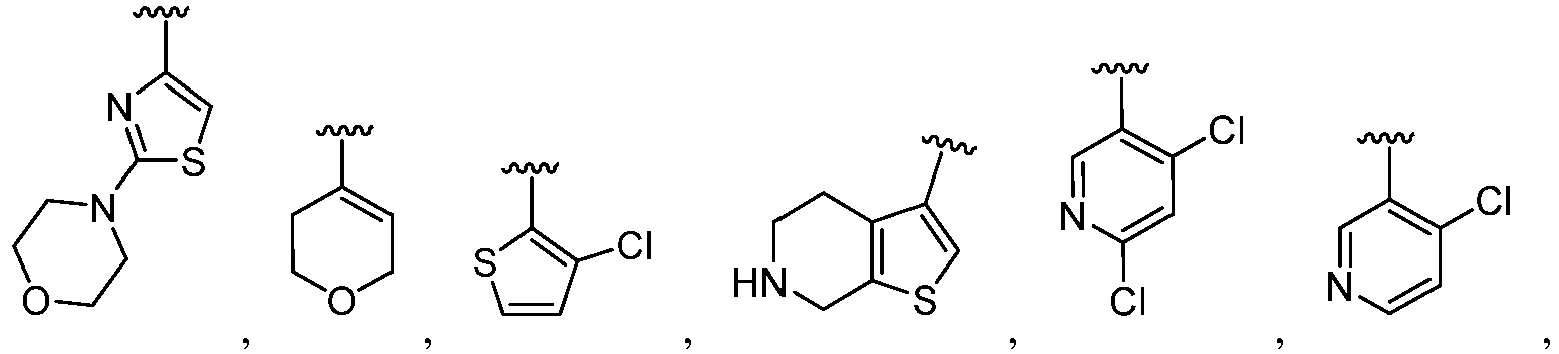




- 33. A compound selected from Table 1, or a pharmaceutically acceptable salt thereof.
- 34. A composition comprising a compound of any one of items 1-33 and a pharmaceutically acceptable carrier.
- 35. A composition comprising a mixture of stereoisomers of a compound of Formula I:


- 36. A method for treating a disease or condition mediated by cancer Osaka thyroid (Cot) in a human patient in need thereof, comprising administering to the patient an effective amount of the composition of item 34 or 35.
- 37. The method of item 36, wherein the disease or condition is cancer.
- 38. The method of item 36, wherein the disease or condition is diabetes.
- 39. The method of item 36, wherein the disease or condition is an inflammatory disease.
- 40. The method of item 36, wherein the disease or condition is inflammatory bowel disease (IBD).
- 41. A compound having the formula:

- 42. A composition comprising a compound according to item 41 and a pharmaceutically acceptable carrier.
- 43. A compound having the formula:

- 44. A composition comprising a compound according to item 43 and a pharmaceutically acceptable carrier.
- 45. A compound having the formula:

- 46. A composition comprising a compound according to item 45 and a pharmaceutically acceptable carrier.
- 47. A compound having the formula:

- 48. A composition comprising a compound according to item 47 and a pharmaceutically acceptable carrier.
- 49. A compound having the formula:

- 50. A composition comprising a compound according to item 49 and a pharmaceutically acceptable carrier.
- 51. A compound having the formula:

- 52. A composition comprising a compound according to item 51 and a pharmaceutically acceptable carrier.
- 53. A compound having the formula:

- 54. A composition comprising a compound according to item 53 and a pharmaceutically acceptable carrier.
- 55. A method for treating a disease or condition mediated by cancer Osaka thyroid (Cot) in a human patient in need thereof, comprising administering to the patient an effective amount of the composition of item 42, 44, 46, 48, 50, 52 or 54.
- 56. The method of item 55, wherein the disease or condition is cancer.
- 57. The method of item 55, wherein the disease or condition is diabetes.
- 58. The method of item 55, wherein the disease or condition is an inflammatory disease.
- 59. The method of item 55, wherein the disease or condition is inflammatory bowel disease (IBD).
- 60. The method according to item 36 or 55 wherein said disease or condition is a solid tumor selected from pancreatic cancer, bladder cancer, colorectal cancer, breast cancer, prostate cancer, renal cancer, hepatocellular cancer, lung cancer, ovarian cancer, cervical cancer, gastric cancer, esophageal cancer, head and neck cancer, melanoma, neuroendocrine cancers, CNS cancers, brain tumors (e.g., glioma, anaplastic oligodendroglioma, adult glioblastoma multiforme, and adult anaplastic astrocytoma), bone cancer, and soft tissue sarcoma.
- 61. The method according to item 36 or 55 wherein said disease or condition is selected from type 1 and type 2 diabetes, gestational diabetes, prediabetes, insulin resistance, metabolic syndrome, impaired fasting glycaemia and impaired glucose tolerance.
- 62. The method according to item 36 or 55 wherein said disease or condition is selected from systemic lupus erythematosus (SLE), myestenia gravis, rheumatoid arthritis (RA), acute disseminated encephalomyelitis, idiopathic thrombocytopenic purpura, multiple sclerosis (MS), inflammatory bowel disease (IBD), sepsis, psoriasis, Sjoegren's syndrome, autoimmune hemolytic anemia, asthma, or chronic obstructive pulmonary disease (COPD), ankylosing spondylitis, reactive arthritis, monoarticular arthritis, osteoarthritis, gouty arthritis, juvenile arthritis, juvenile onset rheumatoid arthritis, juvenile rheumatoid arthritis, and psoriatic arthritis.
- 63. The method according to item 36 or 55 wherein said disease or condition is selected from diversion colitis, ischemic colitis, infectious colitis, chemical colitis, microscopic colitis (including collagenous colitis and lymphocytic colitis), atypical colitis, pseudomembranous colitis, fulminant colitis, autistic enterocolitis, indeterminate colitis, Behçet's disease, gastroduodenal CD, jejunoileitis, ileitis, ileocolitis, Crohn's (granulomatous) colitis, irritable bowel syndrome, mucositis, radiation induced enteritis, short bowel syndrome, celiac disease, stomach ulcers, diverticulitis, pouchitis, proctitis, and chronic diarrhea.
- 64. The method according to item 36 or 55 wherein said disease or condition is alcoholic hepatitis.
- 65. The method according to item 36 or 55 wherein said disease or condition is selected from systemic lupus erythematosus (SLE), lupus nephritis, lupus-related, and autoimmune disorders or a symptom of SLE.
- 66. The method according to item 65 wherein said symptom of SLE is selected from joint pain, joint swelling, arthritis, fatigue, hair loss, mouth sores, swollen lymph nodes, sensitivity to sunlight, skin rash, headaches, numbness, tingling, seizures, vision problems, personality changes, abdominal pain, nausea, vomiting, abnormal heart rhythms, coughing up blood and difficulty breathing, patchy skin color and Raynaud's phenomenon.
- 67. The use of a compound or composition according to any one of items 1-35 and 41-54 in the manufacture of a medicament.
- 68. The use of a compound or composition according to any one of items 1-35 and 41-54 in the manufacture of a medicament for the treatment of a disease or condition mediated by cancer Osaka thyroid (Cot) in a human patient.
- 69. The use according to item 68 wherein said disease or condition is selected from cancer, diabetes, inflammatory disease and inflammatory bowel disease (IBD).
- 70. The use according to item 68 wherein said disease or condition is a solid tumor selected from pancreatic cancer, bladder cancer, colorectal cancer, breast cancer, prostate cancer, renal cancer, hepatocellular cancer, lung cancer, ovarian cancer, cervical cancer, gastric cancer, esophageal cancer, head and neck cancer, melanoma, neuroendocrine cancers, CNS cancers, brain tumors (e.g., glioma, anaplastic oligodendroglioma, adult glioblastoma multiforme, and adult anaplastic astrocytoma), bone cancer, and soft tissue sarcoma.
- 71. The use according to item 68 wherein said disease or condition is selected from type 1 and type 2 diabetes, gestational diabetes, prediabetes, insulin resistance, metabolic syndrome, impaired fasting glycaemia and impaired glucose tolerance.
- 72. The use according to item 68 wherein said disease or condition is selected from systemic lupus erythematosus (SLE), myestenia gravis, rheumatoid arthritis (RA), acute disseminated encephalomyelitis, idiopathic thrombocytopenic purpura, multiple sclerosis (MS), inflammatory bowel disease (IBD), sepsis, psoriasis, Sjoegren's syndrome, autoimmune hemolytic anemia, asthma, or chronic obstructive pulmonary disease (COPD), ankylosing spondylitis, reactive arthritis, monoarticular arthritis, osteoarthritis, juvenile arthritis, juvenile onset rheumatoid arthritis, juvenile rheumatoid arthritis, gouty arthritis and psoriatic arthritis.
- 73. The use according to item 68 wherein said disease or condition is selected from diversion colitis, ischemic colitis, infectious colitis, chemical colitis, microscopic colitis (including collagenous colitis and lymphocytic colitis), atypical colitis, pseudomembranous colitis, fulminant colitis, autistic enterocolitis, indeterminate colitis, Behçet's disease, gastroduodenal CD, jejunoileitis, ileitis, ileocolitis, Crohn's (granulomatous) colitis, irritable bowel syndrome, mucositis, radiation induced enteritis, short bowel syndrome, celiac disease, stomach ulcers, diverticulitis, pouchitis, proctitis, and chronic diarrhea.
- 74. The use according to item 68 wherein said disease or condition is alcoholic hepatitis.
- 75. The use according to item 68 wherein said disease or condition is systemic lupus erythematosus (SLE), lupus nephritis, lupus-related, and autoimmune disorders or a symptom of SLE.
- 76. A composition comprising a compound or composition according to any one of claims items 1-35 and 41-54 and an additional anti-inflammatory agent.
- 77. The composition according to item 76 wherein said additional anti-inflmmatory agent is an α4β7 inhibitor, a steroid, a MMP-9 antibody, a S1P1 agonist, a TNF biologic, or any combination thereof.
Claims (15)
- A pharmaceutical composition in the form of a tablet, wherein the pharmaceutical composition comprises a pharmaceutically acceptable carrier and a compound of Formula I:
 R1 is hydrogen, -O-R7, -N(R8)(R9), -C(O)-R7, -S(O)2-R7, -C1-9 alkyl, C2-6 alkenyl, C2-6 alkynyl, C3-15 cycloalkyl, heterocyclyl, aryl, or heteroaryl;
wherein each C1-9 alkyl, C2-6 alkenyl, C2-6 alkynyl, C3-15 cycloalkyl, heterocyclyl, aryl, and heteroaryl may be optionally substituted with one to four Z1;R2 is hydrogen, -C(O)-R7, -C(O)O-R7, -C(O)N(R7)2, C1-9 alkyl, C2-6 alkenyl, C2-6 alkynyl, C1-6 haloalkyl, C3-15 cycloalkyl, aryl, heterocyclyl, or heteroaryl;
wherein each C1-9 alkyl, C2-6 alkenyl, C2-6 alkynyl, C1-6 haloalkyl, C3-15 cycloalkyl, aryl, heterocyclyl, and heteroaryl may be optionally substituted with one to four Z2;or R1 and R2 together with the nitrogen to which they are attached form a heterocyclyl or heteroaryl, wherein each heterocyclyl or heteroaryl is optionally substituted with one to four Z2;R3 is heterocyclyl or heteroaryl, wherein each heterocyclyl or heteroaryl is optionally substituted with one to four Z3;R4 is heterocyclyl or heteroaryl, wherein each heterocyclyl or heteroaryl is optionally substituted with one to four Z4;R5 is hydrogen, halo, -CN, -NO2, -O-R7, -N(R8)(R9), -S(O)-R7, -S(O)2R7, -S(O)2N(R7)2, -C(O)R7, -OC(O)-R7, -C(O)O-R7, -OC(O)O-R7, -OC(O)N(R10)(R11), -C(O)N(R7)2, -N(R7)C(O)(R7), C1-9 alkyl, C2-6 alkenyl, C2-6 alkynyl, C1-9 alkylthio, C1-6 haloalkyl, C3-15 cycloalkyl, aryl, heterocyclyl, or heteroaryl;
wherein each C1-9 alkyl, C2-6 alkenyl, C2-6 alkynyl, C1-9 alkylthio, C1-6 haloalkyl, C3-15 cycloalkyl, aryl, heterocyclyl, and heteroaryl may be optionally substituted with one to four Z5;R6 is hydrogen, -C(O)-R7, -C(O)O-R7, -C(O)N(R7)2, C1-9 alkyl, C2-6 alkenyl, C2-6 alkynyl, C1-6 haloalkyl, C3-15 cycloalkyl, aryl, heterocyclyl, or heteroaryl;
wherein each C1-9 alkyl, C2-6 alkenyl, C2-6 alkynyl, C1-6 haloalkyl, C3-15 cycloalkyl, aryl, heterocyclyl, and heteroaryl may be optionally substituted with one to four Z6;each R7 is independently hydrogen, C1-9 alkyl, C2-6 alkenyl, C2-6 alkynyl, C1-6 haloalkyl, C3-15 cycloalkyl, aryl, heterocyclyl, or heteroaryl;
wherein each C1-9 alkyl, C2-6 alkenyl, C2-6 alkynyl, C1-6 haloalkyl, C3-15 cycloalkyl, aryl, heterocyclyl, and heteroaryl may be optionally substituted with one to four Z7;R8 and R9 at each occurrence are independently hydrogen, -S(O)2R10, -C(O)-R10, -C(O)O-R10, -C(O)N(R10)(R11), C1-9 alkyl, C2-6 alkenyl, C2-6 alkynyl, C1-6 haloalkyl, C3-15 cycloalkyl, aryl, heterocyclyl, or heteroaryl;
wherein each C1-9 alkyl, C2-6 alkenyl, C2-6 alkynyl, C1-6 haloalkyl, C3-15 cycloalkyl, aryl, heterocyclyl, or heteroaryl may be optionally substituted with one to four Z8;R10 and R11 at each occurrence are independently hydrogen, C1-9 alkyl, C2-6 alkenyl, C2-6 alkynyl, C1-6 haloalkyl, C3-15 cycloalkyl, aryl, heterocyclyl, or heteroaryl,
wherein each C1-9 alkyl, C2-6 alkenyl, C2-6 alkynyl, C1-6 haloalkyl, C3-15 cycloalkyl, aryl, heterocyclyl, and heteroaryl optionally is substituted with one to four Z1b;each Z1, Z2, Z3, Z4, Z5, Z6, Z7, and Z8 is independently hydrogen, oxo, halo, -NO2, -N3, -CN, thioxo, C1-9 alkyl, C2-6 alkenyl, C2-6 alkynyl, C3-15 cycloalkyl, C1-8 haloalkyl, aryl, heteroaryl, heterocyclyl, -O-R12, -C(O)-R12, -C(O)O-R12, -C(O)-N(R13)(R14), -N(R13)(R14), -N(R13)2(R14)+, -N(R12)C(O)-R12, -N(R12)C(O)O-R12, -N(R12)C(O)N(R13)(R14), -N(R12)S(O)2(R12), -NR12S(O)2N(R13)(R14), -NR12S(O)2O(R12), -OC(O)R12, -OC(O)-N(R13)(R14), -P(O)(OR12)2, -OP(O)(OR12)2, -CH2P(O)(OR12)2, -OCH2P(O)(OR12)2, -C(O)OCH2P(O)(OR12)2, -P(O)(R12)(OR12), -OP(O)(R12)(OR12), -CH2P(O)(R12)(OR12), -OCH2P(O)(R12)(OR12), -C(O)OCH2P(O)(R12)(OR12), -P(O)(N(R12)2)2, -OP(O)(N(R12)2)2, -CH2P(O)(N(R12)2)2, -OCH2P(O)(N(R12)2)2, -C(O)OCH2P(O)(N(R12)2)2, -P(O)(N(R12)2)(OR12), -OP(O)(N(R12)2)(OR12), -CH2P(O)(N(R12)2)(OR12), -OCH2P(O)(N(R12)2)(OR12), -C(O)OCH2P(O)(N(R12)2)(OR12), -P(O)(R12)(N(R12)2), -OP(O)(R12)(N(R12)2), -CH2P(O)(R12)(N(R12)2), -OCH2P(O)(R12)(N(R12)2), -C(O)OCH2P(O)(R12)(N(R12)2), -Si(R12)3, -S-R12, -S(O)R12, -S(O)(NH)R12, -S(O)2R12 or -S(O)2N(R13)(R14);
wherein any alkyl, alkenyl, alkynyl, cycloalkyl, haloalkyl, aryl, heteroaryl or heterocyclyl is optionally substituted with one to four Z1a groups;each Z1a is independently oxo, halo, thioxo, -NO2, -CN, -N3, C1-9 alkyl, C2-6 alkenyl, C2-6 alkynyl, C3-15 cycloalkyl, C1-8 haloalkyl, aryl, heteroaryl, heterocyclyl, -O-R12 , -C(O)R12, -C(O)O-R12, -C(O)N(R13)(R14), -N(R13)(R14), -N(R13)2(R14)+, -N(R12)-C(O)R12, -N(R12)C(O)O(R12), -N(R12)C(O)N(R13)(R14), -N(R12)S(O)2(R12), -N(R12)S(O)2-N(R13)(R14), -N(R12)S(O)2O(R12), -OC(O)R12, -OC(O)OR12, -OC(O)-N(R13)(R14), -Si(R12)3, -S-R12, -S(O)R12, -S(O)(NH)R12, -S(O)2R12 or -S(O)2N(R13)(R14);
wherein any alkyl, alkenyl, alkynyl, cycloalkyl, aryl, heteroaryl or heterocyclyl is optionally substituted with one to four Z1b groups;each R12 is independently hydrogen, C1-9 alkyl, C2-6 alkenyl, C2-6 alkynyl, C3-15 cycloalkyl, aryl, heteroaryl or heterocyclyl,
wherein any alkyl, alkenyl, alkynyl, cycloalkyl, aryl, heteroaryl or heterocyclyl is optionally substituted with one to four Z1b groups;R13 and R14 at each occurrence are each independently hydrogen, C1-9 alkyl, C2-6 alkenyl, C2-6 alkynyl, C3-15 cycloalkyl, aryl, heteroaryl or heterocyclyl;
wherein any alkyl, alkenyl, alkynyl, cycloalkyl, aryl, heteroaryl or heterocyclyl is optionally substituted with one to four Z1b groups, or R13 and R14 together with the nitrogen to which they are attached form a heterocyclyl, wherein said heterocyclyl is optionally substituted with one to four Z1b groups;each R15 is independently halo, -CN, -NO2, -O-R7, -N(R8)(R9), -S(O)-R7, -S(O)2R7, -S(O)2N(R7)2, -C(O)R7, -OC(O)-R7, -C(O)O-R7, -OC(O)O-R7, -OC(O)N(R10)(R11), -C(O)N(R7)2, -N(R7)C(O)(R7), C1-9 alkyl, C2-6 alkenyl, C2-6 alkynyl, C1-9 alkylthio, C1-6 haloalkyl, C3-15 cycloalkyl, aryl, heterocyclyl, or heteroaryl; andeach Z1b is independently oxo, thioxo, hydroxy, halo, -NO2, -N3, -CN, C1-9 alkyl, C2-6 alkenyl, C2-6 alkynyl, C3-15 cycloalkyl, C1-8 haloalkyl, aryl, heteroaryl, heterocyclyl, -O(C1-9 alkyl), -O(C2-6 alkenyl), -O(C2-6 alkynyl), -O(C3-15 cycloalkyl), -O(C1-8 haloalkyl), -O(aryl), -O(heteroaryl), - O(heterocyclyl), -NH2, -NH(C1-9 alkyl), -NH(C2-6 alkenyl), -NH(C2-6 alkynyl), -NH(C3-15 cycloalkyl), -NH(C1-8 haloalkyl), -NH(aryl), -NH(heteroaryl), -NH(heterocyclyl), -N(C1-9 alkyl)2, -N(C2-6 alkenyl)2, -N(C2-6 alkynyl)2, -N(C3-15 cycloalkyl)2, -N(C1-8 haloalkyl)2, -N(aryl)2, -N(heteroaryl)2, -N(heterocyclyl)2, -N(C1-9 alkyl)(C2-6 alkenyl), -N(C1-9 alkyl)(C2-6 alkynyl), -N(C1-9 alkyl)(C3-15 cycloalkyl), -N(C1-9 alkyl)(C1-8 haloalkyl), -N(C1-9 alkyl)(aryl), -N(C1-9 alkyl)(heteroaryl), -N(C1-9 alkyl)(heterocyclyl), -C(O)(C1-9 alkyl), -C(O)(C2-6 alkenyl), -C(O)(C2-6 alkynyl), -C(O)(C3-15 cycloalkyl), -C(O)(C1-8 haloalkyl), -C(O)(aryl), -C(O)(heteroaryl), -C(O)(heterocyclyl), -C(O)O(C1-9 alkyl), -C(O)O(C2-6 alkenyl), -C(O)O(C2-6 alkynyl), -C(O)O(C3-15 cycloalkyl), -C(O)O(C1-8 haloalkyl), -C(O)O(aryl), -C(O)O(heteroaryl), -C(O)O(heterocyclyl), -C(O)NH2, -C(O)NH(C1-9 alkyl), -C(O)NH(C2-6 alkenyl), -C(O)NH(C2-6 alkynyl), -C(O)NH(C3-15 cycloalkyl), -C(O)NH(C1-8 haloalkyl), -C(O)NH(aryl), -C(O)NH(heteroaryl), -C(O)NH(heterocyclyl), -C(O)N(C1-9 alkyl)2, -C(O)N(C2-6 alkenyl)2, -C(O)N(C2-6 alkynyl)2, -C(O)N(C3-15 cycloalkyl)2, -C(O)N(C1-8 haloalkyl)2, -C(O)N(aryl)2, -C(O)N(heteroaryl)2, -C(O)N(heterocyclyl)2, -NHC(O)(C1-9 alkyl), -NHC(O)(C2-6 alkenyl), -NHC(O)(C2-6 alkynyl), -NHC(O)(C3-15 cycloalkyl), -NHC(O)(C1-8 haloalkyl), -NHC(O)(aryl), -NHC(O)(heteroaryl), -NHC(O)(heterocyclyl), -NHC(O)O(C1-9 alkyl), -NHC(O)O(C2-6 alkenyl), -NHC(O)O(C2-6 alkynyl), -NHC(O)O(C3-15 cycloalkyl), -NHC(O)O(C1-8 haloalkyl), -NHC(O)O(aryl), -NHC(O)O(heteroaryl), -NHC(O)O(heterocyclyl), -NHC(O)NH(C1-9 alkyl), -NHC(O)NH(C2-6 alkenyl), -NHC(O)NH(C2-6 alkynyl), -NHC(O)NH(C3-15 cycloalkyl), -NHC(O)NH(C1-8 haloalkyl), -NHC(O)NH(aryl), -NHC(O)NH(heteroaryl), -NHC(O)NH(heterocyclyl), -SH, -S(C1-9 alkyl), -S(C2-6 alkenyl), -S(C2-6 alkynyl), -S(C3-15 cycloalkyl), -S(C1-8 haloalkyl), -S(aryl), -S(heteroaryl), -S(heterocyclyl), -NHS(O)(C1-9 alkyl), -N(C1-9 alkyl)S(O)(C1-9 alkyl), -S(O)N(C1-9 alkyl)2, -S(O)(C1-9 alkyl), -S(O)(NH)(C1-9 alkyl), -S(O)(C2-6 alkenyl), -S(O)(C2-6 alkynyl), -S(O)(C3-15 cycloalkyl), -S(O)(C1-8 haloalkyl), -S(O)(aryl), -S(O)(heteroaryl), -S(O)(heterocyclyl), -S(O)2(C1-9 alkyl), -S(O)2(C2-6 alkenyl), -S(O)2(C2-6 alkynyl), -S(O)2(C3-15 cycloalkyl), -S(O)2(C1-8 haloalkyl), -S(O)2(aryl), -S(O)2(heteroaryl), -S(O)2(heterocyclyl), -S(O)2NH(C1-9 alkyl), or -S(O)2N(C1-9 alkyl)2;
wherein any alkyl, cycloalkyl, aryl, heteroaryl, or heterocyclyl is optionally substituted with one to four halo, C1-9 alkyl, C1-8 haloalkyl, -OH, -NH2, -NH(C1-9 alkyl), -NH(C3-15 cycloalkyl), -NH(C1-8 haloalkyl), -NH(aryl), -NH(heteroaryl), -NH(heterocyclyl), -N(C1-9 alkyl)2, -N(C3-15 cycloalkyl)2, -NHC(O)(C3-15 cycloalkyl), -NHC(O)(C1-8 haloalkyl), -NHC(O)(aryl), -NHC(O)(heteroaryl), -NHC(O)(heterocyclyl), -NHC(O)O(C1-9 alkyl), -NHC(O)O(C2-6 alkynyl), -NHC(O)O(C3-15 cycloalkyl), -NHC(O)O(C1-8 haloalkyl), -NHC(O)O(aryl), -NHC(O)O(heteroaryl), -NHC(O)O(heterocyclyl), -NHC(O)NH(C1-9 alkyl), -S(O)(NH)(C1-9 alkyl), S(O)2(C1-9 alkyl), -S(O)2(C3-15 cycloalkyl), -S(O)2(C1-8 haloalkyl), -S(O)2(aryl), -S(O)2(heteroaryl), -S(O)2(heterocyclyl), -S(O)2NH(C1-9 alkyl), -S(O)2N(C1-9 alkyl)2, -O(C3-15 cycloalkyl), -O(C1-8 haloalkyl), -O(aryl), -O(heteroaryl), -O(heterocyclyl), or -O(C1-9 alkyl);m is 0, 1, or 2;or a pharmaceutically acceptable salt, stereoisomer, mixture of stereoisomers, or deuterated analog thereof. - The pharmaceutical composition of claim 1, wherein(a) R2 is hydrogen and/or m is 0, or a pharmaceutically acceptable salt thereof;(b) the compound has the Formula IIA:
 (c) the compound has the Formula IIIA:
 wherein R1, R4, R5, R6 and Z3 are as defined in claim 1,W, X and Y are each independently N or C; andn is 1, 2, or 3;
or a pharmaceutically acceptable salt, stereoisomer, mixture of stereoisomers or deuterated analog thereof. - The pharmaceutical composition of claim 1 or 2, wherein(i) R5 is hydrogen, halo, -CN, O-R7, -S(O)-R7, -S(O)2R7, -S(O)2N(R7)2, -C(O)R7, -C(O)N(R7)2, C1-9 alkyl, C2-6 alkenyl, C2-6 alkynyl, C3-15 cycloalkyl, aryl, heterocyclyl, or heteroaryl;
wherein each C1-9 alkyl, C2-6 alkenyl, C2-6 alkynyl, C3-15 cycloalkyl, aryl, heterocyclyl, and heteroaryl may be optionally substituted with one to four Z5, or a pharmaceutically acceptable salt thereof, or
R5 is hydrogen, halo, -CN, -C(O)R7, -O-R7, -S(O)2R7 or heteroaryl, or a pharmaceutically acceptable salt thereof; and/or(ii) R6 is hydrogen, or a pharmaceutically acceptable salt thereof; and/or(iii) R1 is -O-R7, C1-9 alkyl, C3-15 cycloalkyl, heterocyclyl, aryl, or heteroaryl; and said C1-9 alkyl, C3-15 cycloalkyl, heterocyclyl, aryl, or heteroaryl may be optionally substituted with one to four substituents independently selected the group consisting of halo, -CN, -O-R12, -S(O)2R12, C1-9 alkyl, C1-9 haloalkyl, C3-15 cycloalkyl, heterocyclyl, and aryl, wherein said C3-15 cycloalkyl may be optionally substituted with one to four substituents independently selected the group consisting of C1-9 alkyl, and C1-9 haloalkyl, or a pharmaceutically acceptable salt thereof, or
R1 is C1-9 alkyl, optionally substituted with one to three substituents independently selected the group consisting of halo, -CN, -O-R12, -S(O)2R12, C3-15 cycloalkyl, heterocyclyl, and aryl, wherein said C3-15 cycloalkyl or heterocyclyl may be optionally substituted with one to four substituents independently selected the group consisting of C1-9 alkyl, and C1-9 haloalkyl, or a pharmaceutically acceptable salt thereof, or
R1 is C3-15 cycloalkyl, heterocyclyl or heteroaryl, wherein said C3-15 cycloalkyl, heterocyclyl or heteroaryl is optionally substituted with one to three substituents independently selected the group consisting of halo, -CN, -O-R12, C1-9 alkyl, and aryl, or a pharmaceutically acceptable salt thereof, or
R1 is heterocyclyl or heteroaryl, wherein said heterocyclyl or heteroaryl is optionally substituted with one to three substituents independently selected the group consisting of halo, and C1-9 alkyl, or a pharmaceutically acceptable salt thereof, or
R1 is aryl, optionally substituted with one to three substituents independently selected the group consisting of halo, -CN, -O-R7, C1-9 alkyl, and aryl, or a pharmaceutically acceptable salt thereof, or
R1 is aryl, optionally substituted with one to three substituents independently selected the group consisting of halo, - O-R7, and C1-9 alkyl, or a pharmaceutically acceptable salt thereof. - The pharmaceutical composition of claim 2(c), wherein(1) W is N, X is N-Z3, and Y is C-Z3, or a pharmaceutically acceptable salt thereof; and/or(2) Z3 is hydrogen or C1-9 alkyl optionally substituted with one to four substituents independently selected from the group consisting of -CN, halo, -O-R12, -C(O)O-R12, -OC(O)-R12, -N(R13)(R14), -N(R13)2(R14)+, -C(O)N(R12)-S(O)2R12, C1-9 alkyl, heterocyclyl, aryl, and heteroaryl, or a pharmaceutically acceptable salt thereof, orZ3 is C3-15 cycloalkyl, heterocyclyl, aryl, or heteroaryl; and said C3-15 cycloalkyl, heterocyclyl, aryl, or heteroaryl may be optionally substituted with one to four substituents independently selected from the group consisting of -CN, halo, -O-R12, -C(O)-R12, -C(O)O-R12, -OC(O)-R12, -N(R13)(R14), -N(R13)2(R14)+, C1-9 alkyl, C1-8 haloalkyl, C1-8 hydroxyalkyl, C3-15 cycloalkyl, heterocyclyl, and heteroaryl, or a pharmaceutically acceptable salt thereof.
- The pharmaceutical composition of claim 1 having the Formula VIIIA:

- The pharmaceutical composition of claim 5, wherein:Z3 is hydrogen, C1-9 alkyl, C3-15 cycloalkyl, heterocyclyl, aryl, or heteroaryl;
wherein said C1-9 alkyl, C3-15 cycloalkyl, or heterocyclyl may be optionally substituted with one to four substituents independently selected from the group consisting of oxo, -CN, halo, -O-R12, -C(O)-R12, -C(O)O-R12, -OC(O)-R12, -C(O)-N(R13)(R14), -N(R12)S(O)2(R12), -N(R13)(R14), -N(R13)2(R14)+, -C(O)N(R12)-S(O)2R12, C1-9 alkyl, C1-8 haloalkyl, C1-8 hydroxyalkyl, C3-15 cycloalkyl, aryl, heterocyclyl, and heteroaryl;Z9 is hydrogen;R1 is C1-9 alkyl, C3-15 cycloalkyl, heterocyclyl, aryl, or heteroaryl;
wherein said C1-9 alkyl, heterocyclyl, aryl, or heteroaryl may be optionally substituted with one to three substituents independently selected the group consisting of halo, -CN, -O-R12, -S(O)2R12, C1-9 alkyl, C1-9 haloalkyl, heterocyclyl, and aryl, wherein said C3-15 cycloalkyl may be optionally substituted with one to four substituents independently selected the group consisting of C1-9 alkyl, and C1-9 haloalkyl;R4 is heterocyclyl or heteroaryl;
wherein said heterocyclyl or heteroaryl is optionally substituted with one to three substituents independently selected from the group consisting of -CN, halo, -O-R12, -C(O)-R12, -N(R13)(R14), C1-9 alkyl, C1-9 haloalkyl, and heterocyclyl;R5 is -CN, halo, -O-R7 or -S(O)2R7;R6 is hydrogen;each R7 is independently hydrogen or C1-9 alkyl;
wherein said C1-9 alkyl may be optionally substituted with one to three substituents independently selected from the group consisting of hydroxyl, halo, -O(C1-9 alkyl) and aryl;each R12 is independently hydrogen, C1-9 alkyl or heterocyclyl;
wherein said C1-9 alkyl may be optionally substituted with one to three substituents independently selected from the group consisting of hydroxyl, halo, -O(C1-9 alkyl) and aryl; andeach R13 and R14 is independently hydrogen or C1-9 alkyl;
wherein said C1-9 alkyl may be optionally substituted with one to three substituents independently selected from the group consisting of hydroxyl, halo, -O(C1-9 alkyl) and aryl;or a pharmaceutically acceptable salt, stereoisomer, mixture of stereoisomers thereof. - The pharmaceutical composition of claim 6, wherein Z3 is C3-15 cycloalkyl optionally substituted with one to four substituents independently selected from the group consisting of -CN, halo, -C(O)-R12, -OC(O)-R12, -C(O)N(R13)(R14), C1-9 alkyl, C1-8 haloalkyl, C1-8 hydroxyalkyl, C3-15 cycloalkyl, and heteroaryl, or a pharmaceutically acceptable salt thereof, or
Z3 is heterocyclyl optionally substituted with one to four substituents independently selected from the group consisting of -O-R12, -C(O)O-R12, C1-9 alkyl, C1-8 haloalkyl, C1-8 hydroxyalkyl, and heterocyclyl, or a pharmaceutically acceptable salt thereof. - The pharmaceutical composition of claim 5 or 6, wherein R5 is cyano or halo, or a pharmaceutically acceptable salt thereof; or R6 is hydrogen, or a pharmaceutically acceptable salt thereof.
- The pharmaceutical composition of any preceding claim, wherein(i) R4 is heterocyclyl or heteroaryl; and said heterocyclyl or heteroaryl is optionally substituted with one to three substituents independently selected from the group consisting of -CN, halo, -O-R12, -C(O)-R12, -N(R13)(R14), C1-9 alkyl, C1-9 haloalkyl, and heterocyclyl, or a pharmaceutically acceptable salt thereof;(ii) R4 is heteroaryl optionally substituted with one to three substituents independently selected from the group consisting of -CN, halo, -O-R12, -C(O)-R12, -N(R13)(R14), C1-9 alkyl, C1-9 haloalkyl, and heterocyclyl, or a pharmaceutically acceptable salt thereof;(iii) R4 is heterocyclyl optionally substituted with one to three substituents independently selected from the group consisting of -CN, halo, -O-R12, -C(O)-R12, -N(R13)(R14), C1-9 alkyl, C1-9 haloalkyl, and heterocyclyl, or a pharmaceutically acceptable salt thereof;(iv) R4 is


 (v) R4 is
 (vi) R4 is
wherein each Z4 of (iv) to (vi) may be independently selected from the group consisting of -CN, halo, -O-R12, -C(O)-R12, -N(R13)(R14), C1-9 alkyl, C1-9 haloalkyl, and heterocyclyl, or a pharmaceutically acceptable salt thereof;(vii) R4 is


- The pharmaceutical composition of claim 1, wherein the compound is selected from Table 1, or a pharmaceutically acceptable salt thereof.
- The pharmaceutical composition of claim 1, wherein the compound has(i) the formula
 (ii) the formula
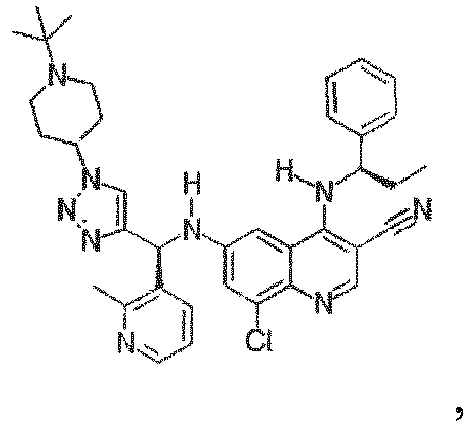 (iii) the formula
 (iv) the formula
- The pharmaceutical composition of claim 1, wherein the compound has one of the following formulas:

- A pharmaceutical composition according to any one of claims 1-12 further comprising an α4β7 inhibitor, a steroid, a MMP-9 antibody, a S1P1 agonist, a TNF biologic, or any combination thereof.
- The pharmaceutical composition according to any one of claims 1-13, wherein the tablet is coated.
- The pharmaceutical composition according to any one of claims 1-14 for use in a method for treating a disease or condition mediated by cancer Osaka thyroid (Cot) in a human patient in need thereof, wherein the disease or condition is preferably selected from the group consisting of:(A) cancer;(B) diabetes;(C) an inflammatory disease such as inflammatory bowel disease (IBD);(D) a solid tumor selected from pancreatic cancer, bladder cancer, colorectal cancer, breast cancer, prostate cancer, renal cancer, hepatocellular cancer, lung cancer, ovarian cancer, cervical cancer, gastric cancer, esophageal cancer, head and neck cancer, melanoma, neuroendocrine cancers, CNS cancers, brain tumors (e.g., glioma, anaplastic oligodendroglioma, adult glioblastoma multiforme, and adult anaplastic astrocytoma), bone cancer, and soft tissue sarcoma;(E) type 1 and type 2 diabetes, gestational diabetes, prediabetes, insulin resistance, metabolic syndrome, impaired fasting glycaemia and impaired glucose tolerance;(F) systemic lupus erythematosus (SLE), myasthenia gravis, rheumatoid arthritis (RA), acute disseminated encephalomyelitis, idiopathic thrombocytopenic purpura, multiple sclerosis (MS), inflammatory bowel disease (IBD), sepsis, psoriasis, Sjoegren's syndrome, autoimmune hemolytic anemia, asthma, or chronic obstructive pulmonary disease (COPD), ankylosing spondylitis, reactive arthritis, monoarticular arthritis, osteoarthritis, gouty arthritis, juvenile arthritis, juvenile onset rheumatoid arthritis, juvenile rheumatoid arthritis, and psoriatic arthritis;(G) diversion colitis, ischemic colitis, infectious colitis, chemical colitis, microscopic colitis (including collagenous colitis and lymphocytic colitis), atypical colitis, pseudomembranous colitis, fulminant colitis, autistic enterocolitis, indeterminate colitis, Behçet's disease, gastroduodenal CD, jejunoileitis, ileitis, ileocolitis, Crohn's (granulomatous) colitis, irritable bowel syndrome, mucositis, radiation induced enteritis, short bowel syndrome, celiac disease, stomach ulcers, diverticulitis, pouchitis, proctitis, and chronic diarrhea;(H) alcoholic hepatitis;(I) systemic lupus erythematosus (SLE), lupus nephritis, lupus-related, and autoimmune disorders or a symptom of SLE, wherein said symptom of SLE is preferably selected from joint pain, joint swelling, arthritis, fatigue, hair loss, mouth sores, swollen lymph nodes, sensitivity to sunlight, skin rash, headaches, numbness, tingling, seizures, vision problems, personality changes, abdominal pain, nausea, vomiting, abnormal heart rhythms, coughing up blood and difficulty breathing, patchy skin color and Raynaud's phenomenon;(J) ulcerative colitis;(K) Crohn's disease.
Priority Applications (4)
| Application Number | Priority Date | Filing Date | Title |
|---|---|---|---|
| EP21162393.9A EP3896064B1 (en) | 2015-07-06 | 2016-06-30 | 4,6-diamino-quinoline-3-carbonitrile derivatives as cancer osaka thyroid (cot) modulators for treating crohn's disease and ulcerative colitis |
| PL18186568T PL3456717T3 (en) | 2015-07-06 | 2016-06-30 | 4,6-diamino-quinoline-3-carbonitrile derivative as cancer osaka thyroid (cot) modulator for treating inflammatory disease |
| SI201631197T SI3456717T1 (en) | 2015-07-06 | 2016-06-30 | 4,6-diamino-quinoline-3-carbonitrile derivative as cancer osaka thyroid (cot) modulator for treating inflammatory disease |
| EP25176778.6A EP4613332A3 (en) | 2015-07-06 | 2016-06-30 | Cot modulators and methods of use thereof |
Applications Claiming Priority (4)
| Application Number | Priority Date | Filing Date | Title |
|---|---|---|---|
| US201562189158P | 2015-07-06 | 2015-07-06 | |
| US201562269060P | 2015-12-17 | 2015-12-17 | |
| EP16738976.6A EP3191470B1 (en) | 2015-07-06 | 2016-06-30 | Cot modulators and methods of use thereof |
| PCT/US2016/040520 WO2017007689A1 (en) | 2015-07-06 | 2016-06-30 | Cot modulators and methods of use thereof |
Related Parent Applications (2)
| Application Number | Title | Priority Date | Filing Date |
|---|---|---|---|
| EP16738976.6A Division-Into EP3191470B1 (en) | 2015-07-06 | 2016-06-30 | Cot modulators and methods of use thereof |
| EP16738976.6A Division EP3191470B1 (en) | 2015-07-06 | 2016-06-30 | Cot modulators and methods of use thereof |
Related Child Applications (2)
| Application Number | Title | Priority Date | Filing Date |
|---|---|---|---|
| EP25176778.6A Division EP4613332A3 (en) | 2015-07-06 | 2016-06-30 | Cot modulators and methods of use thereof |
| EP21162393.9A Division EP3896064B1 (en) | 2015-07-06 | 2016-06-30 | 4,6-diamino-quinoline-3-carbonitrile derivatives as cancer osaka thyroid (cot) modulators for treating crohn's disease and ulcerative colitis |
Publications (2)
| Publication Number | Publication Date |
|---|---|
| EP3456717A1 true EP3456717A1 (en) | 2019-03-20 |
| EP3456717B1 EP3456717B1 (en) | 2021-03-17 |
Family
ID=56411943
Family Applications (4)
| Application Number | Title | Priority Date | Filing Date |
|---|---|---|---|
| EP21162393.9A Active EP3896064B1 (en) | 2015-07-06 | 2016-06-30 | 4,6-diamino-quinoline-3-carbonitrile derivatives as cancer osaka thyroid (cot) modulators for treating crohn's disease and ulcerative colitis |
| EP16738976.6A Active EP3191470B1 (en) | 2015-07-06 | 2016-06-30 | Cot modulators and methods of use thereof |
| EP25176778.6A Pending EP4613332A3 (en) | 2015-07-06 | 2016-06-30 | Cot modulators and methods of use thereof |
| EP18186568.4A Active EP3456717B1 (en) | 2015-07-06 | 2016-06-30 | 4,6-diamino-quinoline-3-carbonitrile derivative as cancer osaka thyroid (cot) modulator for treating inflammatory disease |
Family Applications Before (3)
| Application Number | Title | Priority Date | Filing Date |
|---|---|---|---|
| EP21162393.9A Active EP3896064B1 (en) | 2015-07-06 | 2016-06-30 | 4,6-diamino-quinoline-3-carbonitrile derivatives as cancer osaka thyroid (cot) modulators for treating crohn's disease and ulcerative colitis |
| EP16738976.6A Active EP3191470B1 (en) | 2015-07-06 | 2016-06-30 | Cot modulators and methods of use thereof |
| EP25176778.6A Pending EP4613332A3 (en) | 2015-07-06 | 2016-06-30 | Cot modulators and methods of use thereof |
Country Status (41)
Families Citing this family (39)
| Publication number | Priority date | Publication date | Assignee | Title |
|---|---|---|---|---|
| ES2553449T3 (en) | 2011-07-06 | 2015-12-09 | Gilead Sciences, Inc. | Compounds for HIV treatment |
| WO2016057931A1 (en) | 2014-10-10 | 2016-04-14 | The Research Foundation For The State University Of New York | Trifluoromethoxylation of arenes via intramolecular trifluoromethoxy group migration |
| KR20220129667A (en) * | 2015-07-06 | 2022-09-23 | 길리애드 사이언시즈, 인코포레이티드 | Cot modulators and methods of use thereof |
| EP3319955B1 (en) | 2015-07-06 | 2020-11-25 | Gilead Sciences, Inc. | 6-amino-quinoline-3-carbonitrils as cot modulators |
| ES2800339T3 (en) | 2016-06-30 | 2020-12-29 | Gilead Sciences Inc | 4,6-diaminoquinazolines as cradle modulators and methods of using them |
| TW202138365A (en) * | 2016-08-19 | 2021-10-16 | 美商基利科學股份有限公司 | Therapeutic compounds |
| EA036921B1 (en) * | 2017-02-10 | 2021-01-15 | Джилид Сайэнс, Инк. | Therapeutic compounds useful for the prophylactic or therapeutic treatment of an hiv virus infection |
| CN108794516A (en) * | 2017-04-26 | 2018-11-13 | 上海时莱生物技术有限公司 | Boric acid and boric acid ester compound and its preparation method and application |
| TWI687415B (en) | 2017-08-17 | 2020-03-11 | 美商基利科學股份有限公司 | Solid forms of an hiv capsid inhibitor |
| AR112412A1 (en) | 2017-08-17 | 2019-10-23 | Gilead Sciences Inc | CHOLINE SALT FORMS OF AN HIV CAPSID INHIBITOR |
| JPWO2019065516A1 (en) * | 2017-09-26 | 2020-09-10 | 日本曹達株式会社 | Quinoline compounds and fungicides for agriculture and horticulture |
| CN111836805B (en) | 2018-02-15 | 2023-07-14 | 吉利德科学公司 | Pyridine derivatives and their use in the treatment of HIV infection |
| TWI745652B (en) | 2018-02-16 | 2021-11-11 | 美商基利科學股份有限公司 | Methods and intermediates for preparing therapeutic compounds |
| US11760701B2 (en) | 2018-02-27 | 2023-09-19 | The Research Foundation For The State University Of New Yrok | Difluoromethoxylation and trifluoromethoxylation compositions and methods for synthesizing same |
| CN110294660B (en) * | 2018-03-23 | 2021-09-24 | 中国农业大学 | A kind of reduction deuteration method of unsaturated organic compound containing carbon-carbon triple bond and/or carbon-nitrogen triple bond |
| CN108658996A (en) * | 2018-06-25 | 2018-10-16 | 中国药科大学 | A kind of preparation method of deuterated Fiduxosin |
| US11944611B2 (en) | 2018-07-16 | 2024-04-02 | Gilead Sciences, Inc. | Capsid inhibitors for the treatment of HIV |
| TWI915558B (en) | 2019-06-14 | 2026-02-21 | 美商基利科學股份有限公司 | Cot modulators and methods of use thereof |
| US12404295B2 (en) | 2019-08-09 | 2025-09-02 | Idorsia Pharmaceuticals Ltd | (Hetero)aryl-methyl-thio-beta-D-galactopyranoside derivatives |
| ES2974680T3 (en) | 2019-08-09 | 2024-07-01 | Idorsia Pharmaceuticals Ltd | Derivatives of (2-acetamidyl)thio-beta-D-galactopyranosides |
| UA128909C2 (en) | 2019-08-15 | 2024-11-20 | Ідорсія Фармасьютікалз Лтд | 2-HYDROXYCYCLOALKANE-1-CARBAMOYL DERIVATIVES |
| PH12022550436A1 (en) | 2019-08-29 | 2022-12-19 | Idorsia Pharmaceuticals Ltd | Alpha-d-galactopyranoside derivatives |
| EP4643882A3 (en) | 2019-11-26 | 2026-01-14 | Gilead Sciences, Inc. | Capsid inhibitors for the prevention of hiv |
| KR102924836B1 (en) * | 2020-03-30 | 2026-02-09 | 길리애드 사이언시즈, 인코포레이티드 | Solid form of Cot inhibitor compound, (S)-6-(((1-(bicyclo[1.1.1]pentan-1-yl)-1H-1,2,3-triazol-4-yl)2-methyl-1-oxo-1,2-dihydroisoquinolin-5-yl)methyl)))amino8-chloro-(neopentylamino)quinoline-3-carbonitrile |
| TWI778562B (en) | 2020-04-02 | 2022-09-21 | 美商基利科學股份有限公司 | Process for preparing a cot inhibitor compound |
| JP7520162B2 (en) | 2020-06-25 | 2024-07-22 | ギリアード サイエンシーズ, インコーポレイテッド | Capsid inhibitors for the treatment of HIV - Patents.com |
| AU2021356076A1 (en) | 2020-10-06 | 2023-06-08 | Idorsia Pharmaceuticals Ltd | Spiro derivatives of alpha-d-galactopyranosides |
| IL302421A (en) | 2020-11-02 | 2023-06-01 | Idorsia Pharmaceuticals Ltd | 2-Hydroxycycloalkane-1-carbamoyl compounds inhibit galectin-3 |
| JP7844491B2 (en) | 2021-02-09 | 2026-04-13 | イドルシア・ファーマシューティカルズ・リミテッド | Hydroxyheterocycloalkane-carbamoyl derivatives |
| EP4301748B1 (en) | 2021-03-03 | 2025-05-07 | Idorsia Pharmaceuticals Ltd | Triazolyl-methyl substituted alpha-d-galactopyranoside derivatives |
| TW202345826A (en) * | 2021-06-04 | 2023-12-01 | 美商基利科學股份有限公司 | Methods of treating nash |
| EP4352058A4 (en) * | 2021-06-11 | 2025-09-24 | Neuronascent Inc | Methods and compositions for the lipid formulation of lipophilic small molecule therapies of the heterocyclic type |
| WO2023102523A1 (en) | 2021-12-03 | 2023-06-08 | Gilead Sciences, Inc. | Therapeutic compounds for hiv virus infection |
| PT4440702T (en) | 2021-12-03 | 2025-08-13 | Gilead Sciences Inc | Therapeutic compounds for hiv virus infection |
| JP7765637B2 (en) | 2021-12-03 | 2025-11-06 | ギリアード サイエンシーズ, インコーポレイテッド | Therapeutic compounds for HIV virus infections |
| WO2024245157A1 (en) * | 2023-05-30 | 2024-12-05 | 浙江星浩澎博医药有限公司 | Azaquinoline ring derivative |
| WO2024249983A1 (en) * | 2023-06-02 | 2024-12-05 | Westol, Llc | 2,8-dihydroxyquinoline glucuronide derivatives with enhanced properties for use as anticancer, antiviral, antimicrobial, and other therapeutic applications |
| WO2025020886A1 (en) * | 2023-07-27 | 2025-01-30 | 浙江星浩澎博医药有限公司 | Azaquinazoline ring derivative and use thereof |
| KR102732584B1 (en) | 2024-03-28 | 2024-11-21 | (주)신한티이씨 | Fire extinguishing device for detecting and suppressing fire hazards in electric distribution boards |
Citations (8)
| Publication number | Priority date | Publication date | Assignee | Title |
|---|---|---|---|---|
| US3845770A (en) | 1972-06-05 | 1974-11-05 | Alza Corp | Osmatic dispensing device for releasing beneficial agent |
| US4326525A (en) | 1980-10-14 | 1982-04-27 | Alza Corporation | Osmotic device that improves delivery properties of agent in situ |
| US4902514A (en) | 1988-07-21 | 1990-02-20 | Alza Corporation | Dosage form for administering nilvadipine for treating cardiovascular symptoms |
| US4992445A (en) | 1987-06-12 | 1991-02-12 | American Cyanamid Co. | Transdermal delivery of pharmaceuticals |
| US5001139A (en) | 1987-06-12 | 1991-03-19 | American Cyanamid Company | Enchancers for the transdermal flux of nivadipine |
| US5023252A (en) | 1985-12-04 | 1991-06-11 | Conrex Pharmaceutical Corporation | Transdermal and trans-membrane delivery of drugs |
| US5616345A (en) | 1983-12-22 | 1997-04-01 | Elan Corporation Plc | Controlled absorption diltiazen formulation for once-daily administration |
| WO1998043960A1 (en) * | 1997-04-03 | 1998-10-08 | American Cyanamid Company | Substituted 3-cyano quinolines |
Family Cites Families (61)
| Publication number | Priority date | Publication date | Assignee | Title |
|---|---|---|---|---|
| US3930837A (en) | 1971-12-31 | 1976-01-06 | Ici Australia Limited | 3-chloro-5-acetamidaisoquinoline as a herbicide |
| IT7819093A0 (en) | 1977-01-10 | 1978-01-06 | Ciba Geigy | ANTIHELMINTIC PRODUCTS AND THEIR USE. |
| JP2634438B2 (en) | 1988-07-26 | 1997-07-23 | 三井東圧化学株式会社 | Asymmetric bisoxazolylpyridine derivative and method for producing the same |
| DE4014171A1 (en) | 1990-05-03 | 1991-11-07 | Basf Ag | cyanoquinoline |
| GB9310700D0 (en) | 1993-05-24 | 1993-07-07 | Zeneca Ltd | Novel composition |
| NZ503079A (en) | 1997-08-28 | 2002-07-26 | Nissan Chemical Ind Ltd | Cyanoacrylate-containing antibacterial and antifungal agents, algicides and antifouling agents |
| ATE360634T1 (en) | 1998-07-10 | 2007-05-15 | Massachusetts Inst Technology | LIGANDS FOR METALS AND IMPROVED METAL-CATALYzed PROCESSES BASED THEREOF |
| AU6159499A (en) | 1998-09-29 | 2000-04-17 | Wyeth Holdings Corporation | Substituted 3-cyanoquinolines as protein tyrosine kinases inhibitors |
| WO2003080047A1 (en) | 2002-03-20 | 2003-10-02 | Bristol-Myers Squibb Company | Phosphate prodrugs of fluorooxindoles |
| RU2327689C2 (en) | 2003-03-03 | 2008-06-27 | Ф.Хоффманн-Ля Рош Аг | 2,5-substituted tetrahydroisoquinoline and a pharmaceutical modulation composition 5-нт6 |
| CA2535385A1 (en) | 2003-08-19 | 2005-03-03 | Wyeth Holdings Corporation | Process for the preparation of 4-amino-3-quinolinecarbonitriles |
| US7399865B2 (en) * | 2003-09-15 | 2008-07-15 | Wyeth | Protein tyrosine kinase enzyme inhibitors |
| TW200529846A (en) * | 2004-02-20 | 2005-09-16 | Wyeth Corp | 3-quinolinecarbonitrile protein kinase inhibitors |
| GB0420722D0 (en) | 2004-09-17 | 2004-10-20 | Addex Pharmaceuticals Sa | Novel allosteric modulators |
| EP1888529A2 (en) * | 2005-05-18 | 2008-02-20 | Wyeth | 3-cyanoquinoline inhibitors of tpl2 kinase and methods of making and using the same |
| WO2006124944A1 (en) * | 2005-05-18 | 2006-11-23 | Wyeth | 4, 6-diamino-[1,7] naphthyridine-3-carbonitrile inhibitors of tpl2 kinase and methods of making and using the same |
| US8232309B2 (en) | 2005-10-28 | 2012-07-31 | Abbott Laboratories | Prodrugs of compounds that inhibit TRPV1 receptor |
| WO2007117465A2 (en) | 2006-03-31 | 2007-10-18 | Abbott Laboratories | Indazole compounds |
| US7741354B2 (en) | 2006-11-09 | 2010-06-22 | Probiodrug Ag | Inhibitors of glutaminyl cyclase |
| US8389544B2 (en) | 2007-01-17 | 2013-03-05 | The Hong Kong University Of Science And Technology | Isoquinolone compounds as subtype-selective agonists for melatonin receptors MT1 and MT2 |
| GB0820856D0 (en) | 2008-11-14 | 2008-12-24 | Univ Leuven Kath | Novel inhibitors of flavivirus replication |
| TWI491606B (en) | 2009-07-13 | 2015-07-11 | Gilead Sciences Inc | Inhibitor of kinases that regulate apoptosis signaling |
| GB0922302D0 (en) * | 2009-12-22 | 2010-02-03 | Imp Innovations Ltd | Compounds |
| EP2545187B1 (en) | 2010-03-09 | 2018-09-05 | Dana-Farber Cancer Institute, Inc. | Methods of diagnosing and treating cancer in patients having or developing resistance to a first cancer therapy |
| ES2773693T3 (en) * | 2010-06-09 | 2020-07-14 | Tianjin Hemay Oncology Pharmaceutical Co Ltd | Cyanoquinoline derivatives |
| US9453021B2 (en) | 2011-05-10 | 2016-09-27 | Kyowa Hakko Kirin Co., Ltd. | Pyrimidodiazepinone compound |
| US9173395B2 (en) | 2011-07-04 | 2015-11-03 | Bayer Intellectual Property Gmbh | Use of substituted isoquinolinones, isoquinolindiones, isoquinolintriones and dihydroisoquinolinones or in each case salts thereof as active agents against abiotic stress in plants |
| EP2545964A1 (en) | 2011-07-13 | 2013-01-16 | Phenex Pharmaceuticals AG | Novel FXR (NR1H4) binding and activity modulating compounds |
| CN103889951B (en) | 2011-10-27 | 2016-12-14 | 大正制药株式会社 | Azole derivative |
| ES2665580T3 (en) | 2011-11-11 | 2018-04-26 | Gilead Apollo, Llc | ACC inhibitors and uses thereof |
| UY34573A (en) | 2012-01-27 | 2013-06-28 | Gilead Sciences Inc | QUINASE INHIBITOR REGULATING THE APOPTOSIS SIGNAL |
| CN103483363B (en) | 2012-06-13 | 2016-12-21 | 上海赛迦化工产品有限公司 | Multifarious chiral aminoboronic acid and its preparation method and application |
| WO2014064215A1 (en) | 2012-10-24 | 2014-05-01 | INSERM (Institut National de la Santé et de la Recherche Médicale) | TPL2 KINASE INHIBITORS FOR PREVENTING OR TREATING DIABETES AND FOR PROMOTING β-CELL SURVIVAL |
| CN103408572B (en) | 2013-07-12 | 2015-12-02 | 上海工程技术大学 | Chiral aminoboronic acid derivative and its preparation method and application |
| EP3080072A4 (en) | 2013-12-12 | 2017-07-19 | Kalyra Pharmaceuticals, inc. | Bicyclic alkyl compounds and synthesis |
| CN113336653A (en) | 2014-03-07 | 2021-09-03 | 里科瑞尔姆Ip控股有限责任公司 | Propalane derivatives and synthesis |
| EP3166938A4 (en) * | 2014-07-11 | 2018-01-17 | Northwestern University | 2-imidazolyl-pyrimidine scaffolds as potent and selective inhibitors of neuronal nitric oxide synthase |
| CN106999451B (en) | 2014-09-17 | 2021-04-02 | 里科瑞尔姆Ip控股有限责任公司 | bicyclic compounds |
| SG11201701723XA (en) | 2014-09-24 | 2017-04-27 | Gilead Sciences Inc | Methods of treating liver disease |
| MA41252A (en) | 2014-12-23 | 2017-10-31 | Gilead Sciences Inc | SOLID FORMS OF AN ASK 1 INHIBITOR |
| WO2016106384A1 (en) | 2014-12-23 | 2016-06-30 | Gilead Sciences, Inc. | Processes for preparing ask1 inhibitors |
| US20180021341A1 (en) | 2015-01-09 | 2018-01-25 | Gilead Apollo, Llc | Acc inhibitor combination therapy for the treatment of non-alcoholic fatty liver disease |
| EP3852036A1 (en) | 2015-01-16 | 2021-07-21 | 3M Innovative Properties Co. | Systems and methods for selecting grid actions to improve grid outcomes |
| EP3319955B1 (en) * | 2015-07-06 | 2020-11-25 | Gilead Sciences, Inc. | 6-amino-quinoline-3-carbonitrils as cot modulators |
| KR20220129667A (en) | 2015-07-06 | 2022-09-23 | 길리애드 사이언시즈, 인코포레이티드 | Cot modulators and methods of use thereof |
| KR102264012B1 (en) | 2015-12-31 | 2021-06-10 | 히트젠 주식회사 | Sulfonamide derivatives and their manufacturing method and application |
| BR112018067408A2 (en) | 2016-03-02 | 2018-12-26 | Gilead Apollo Llc | solid forms of a thienopyrimidinedione ac inhibitor and methods for producing them |
| EP3473715B1 (en) | 2016-06-21 | 2021-08-04 | PHC Holdings Corporation | Catalase inhibitor and method for measuring analyte using catalase inhibitor |
| ES2800339T3 (en) | 2016-06-30 | 2020-12-29 | Gilead Sciences Inc | 4,6-diaminoquinazolines as cradle modulators and methods of using them |
| CN106512014A (en) | 2016-10-27 | 2017-03-22 | 武汉大学 | Function of tumor progress site 2 in treatment of fatty liver and type 2 diabetes as well as application thereof |
| AU2018227588B2 (en) | 2017-03-03 | 2021-01-21 | Gilead Sciences, Inc. | Processes for preparing ACC inhibitors and solid forms thereof |
| CN110461328A (en) | 2017-03-28 | 2019-11-15 | 吉利德科学公司 | Combinations of treatments for liver disease |
| US20180333401A1 (en) | 2017-04-12 | 2018-11-22 | Gilead Sciences, Inc. | Methods of treating liver disease |
| TWI814744B (en) | 2017-10-06 | 2023-09-11 | 美商基利科學股份有限公司 | Combination therapy comprising an acc inhibitor |
| US11524005B2 (en) | 2019-02-19 | 2022-12-13 | Gilead Sciences, Inc. | Solid forms of FXR agonists |
| US20220143153A1 (en) | 2019-03-08 | 2022-05-12 | The Regents Of The University Of California | Compositions and methods for treating acne |
| TWI915558B (en) | 2019-06-14 | 2026-02-21 | 美商基利科學股份有限公司 | Cot modulators and methods of use thereof |
| AR119594A1 (en) | 2019-08-09 | 2021-12-29 | Gilead Sciences Inc | THIENOPYRIMIDINE DERIVATIVES AS ACC INHIBITORS AND USES THEREOF |
| KR102924836B1 (en) | 2020-03-30 | 2026-02-09 | 길리애드 사이언시즈, 인코포레이티드 | Solid form of Cot inhibitor compound, (S)-6-(((1-(bicyclo[1.1.1]pentan-1-yl)-1H-1,2,3-triazol-4-yl)2-methyl-1-oxo-1,2-dihydroisoquinolin-5-yl)methyl)))amino8-chloro-(neopentylamino)quinoline-3-carbonitrile |
| TWI778562B (en) | 2020-04-02 | 2022-09-21 | 美商基利科學股份有限公司 | Process for preparing a cot inhibitor compound |
| TW202345826A (en) | 2021-06-04 | 2023-12-01 | 美商基利科學股份有限公司 | Methods of treating nash |
-
2016
- 2016-06-30 KR KR1020227031078A patent/KR20220129667A/en not_active Ceased
- 2016-06-30 NZ NZ750707A patent/NZ750707A/en unknown
- 2016-06-30 EP EP21162393.9A patent/EP3896064B1/en active Active
- 2016-06-30 PT PT16738976T patent/PT3191470T/en unknown
- 2016-06-30 KR KR1020187003221A patent/KR101974793B1/en active Active
- 2016-06-30 PL PL21162393.9T patent/PL3896064T3/en unknown
- 2016-06-30 SI SI201630202T patent/SI3191470T1/en unknown
- 2016-06-30 MY MYPI2018700007A patent/MY196173A/en unknown
- 2016-06-30 SG SG11201702041PA patent/SG11201702041PA/en unknown
- 2016-06-30 EP EP16738976.6A patent/EP3191470B1/en active Active
- 2016-06-30 KR KR1020197011792A patent/KR102073641B1/en active Active
- 2016-06-30 MA MA39422A patent/MA39422B1/en unknown
- 2016-06-30 RS RS20190498A patent/RS58639B1/en unknown
- 2016-06-30 IL IL274568A patent/IL274568B/en unknown
- 2016-06-30 SI SI201631197T patent/SI3456717T1/en unknown
- 2016-06-30 HR HRP20190853TT patent/HRP20190853T1/en unknown
- 2016-06-30 SI SI201631907T patent/SI3896064T1/en unknown
- 2016-06-30 PE PE2017002804A patent/PE20180462A1/en unknown
- 2016-06-30 CR CR20170599A patent/CR20170599A/en unknown
- 2016-06-30 PT PT211623939T patent/PT3896064T/en unknown
- 2016-06-30 NZ NZ738525A patent/NZ738525A/en unknown
- 2016-06-30 KR KR1020207002878A patent/KR102443575B1/en active Active
- 2016-06-30 HU HUE16738976A patent/HUE043310T2/en unknown
- 2016-06-30 EP EP25176778.6A patent/EP4613332A3/en active Pending
- 2016-06-30 AU AU2016290820A patent/AU2016290820B2/en active Active
- 2016-06-30 PT PT181865684T patent/PT3456717T/en unknown
- 2016-06-30 CA CA2971640A patent/CA2971640C/en active Active
- 2016-06-30 DK DK16738976.6T patent/DK3191470T3/en active
- 2016-06-30 EP EP18186568.4A patent/EP3456717B1/en active Active
- 2016-06-30 CN CN202210008753.1A patent/CN114380799B/en active Active
- 2016-06-30 KR KR1020247000058A patent/KR20240008398A/en not_active Ceased
- 2016-06-30 US US15/199,534 patent/US20170008905A1/en not_active Abandoned
- 2016-06-30 CN CN202411260421.8A patent/CN119143730A/en active Pending
- 2016-06-30 CN CN201680050602.5A patent/CN107922390B/en active Active
- 2016-06-30 IL IL293770A patent/IL293770B2/en unknown
- 2016-06-30 ES ES18186568T patent/ES2872076T3/en active Active
- 2016-06-30 PL PL18186568T patent/PL3456717T3/en unknown
- 2016-06-30 UA UAA201712984A patent/UA123010C2/en unknown
- 2016-06-30 CU CUP2017000172A patent/CU20170172A7/en unknown
- 2016-06-30 PL PL16738976T patent/PL3191470T3/en unknown
- 2016-06-30 EA EA201792613A patent/EA036788B1/en unknown
- 2016-06-30 ES ES21162393T patent/ES3034100T3/en active Active
- 2016-06-30 CN CN201910292757.5A patent/CN109879859B/en active Active
- 2016-06-30 MX MX2017004737A patent/MX370984B/en active IP Right Grant
- 2016-06-30 JP JP2018500585A patent/JP6430060B2/en active Active
- 2016-06-30 LT LTEP16738976.6T patent/LT3191470T/en unknown
- 2016-06-30 WO PCT/US2016/040520 patent/WO2017007689A1/en not_active Ceased
- 2016-06-30 SM SM20190244T patent/SMT201900244T1/en unknown
- 2016-06-30 ME MEP-2019-117A patent/ME03425B/en unknown
- 2016-06-30 ES ES16738976T patent/ES2734713T3/en active Active
- 2016-07-04 BR BR102016015656-4A patent/BR102016015656B1/en active IP Right Grant
- 2016-07-05 TW TW109122003A patent/TWI748539B/en active
- 2016-07-05 TW TW107117905A patent/TWI699361B/en active
- 2016-07-05 TW TW105121281A patent/TWI634112B/en active
- 2016-07-06 UY UY0001036771A patent/UY36771A/en not_active Application Discontinuation
-
2017
- 2017-02-09 US US15/429,086 patent/US9878995B2/en active Active
- 2017-04-18 SA SA517381350A patent/SA517381350B1/en unknown
- 2017-12-20 IL IL256433A patent/IL256433B/en active IP Right Grant
- 2017-12-22 CL CL2017003356A patent/CL2017003356A1/en unknown
- 2017-12-22 EC ECIEPI201784635A patent/ECSP17084635A/en unknown
- 2017-12-22 CO CONC2017/0013351A patent/CO2017013351A2/en unknown
- 2017-12-22 SV SV2017005605A patent/SV2017005605A/en unknown
- 2017-12-26 DO DO2017000311A patent/DOP2017000311A/en unknown
-
2018
- 2018-01-03 PH PH12018500031A patent/PH12018500031B1/en unknown
- 2018-02-07 US US15/891,163 patent/US20180237455A1/en not_active Abandoned
- 2018-09-13 JP JP2018171794A patent/JP6781221B2/en active Active
-
2019
- 2019-04-23 US US16/391,673 patent/US20190248807A1/en not_active Abandoned
- 2019-05-03 AU AU2019203122A patent/AU2019203122B2/en active Active
- 2019-05-20 CY CY20191100535T patent/CY1121750T1/en unknown
- 2019-05-29 IL IL266995A patent/IL266995B/en active IP Right Grant
- 2019-07-26 JP JP2019137759A patent/JP6906021B2/en active Active
- 2019-12-17 US US16/717,074 patent/US11066414B2/en active Active
-
2020
- 2020-09-06 PH PH12020551397A patent/PH12020551397A1/en unknown
- 2020-10-20 AU AU2020257055A patent/AU2020257055B2/en active Active
- 2020-12-16 JP JP2020208330A patent/JP7138155B2/en active Active
-
2021
- 2021-05-11 US US17/317,041 patent/US11905299B2/en active Active
-
2022
- 2022-04-11 JP JP2022065168A patent/JP2022082816A/en not_active Withdrawn
- 2022-06-10 AU AU2022204050A patent/AU2022204050B2/en active Active
-
2023
- 2023-12-11 US US18/534,800 patent/US20240254137A1/en not_active Abandoned
-
2024
- 2024-05-17 JP JP2024081151A patent/JP2024100865A/en not_active Withdrawn
- 2024-07-17 AU AU2024204902A patent/AU2024204902A1/en not_active Abandoned
-
2025
- 2025-04-14 US US19/177,702 patent/US20250346609A1/en active Pending
Patent Citations (8)
| Publication number | Priority date | Publication date | Assignee | Title |
|---|---|---|---|---|
| US3845770A (en) | 1972-06-05 | 1974-11-05 | Alza Corp | Osmatic dispensing device for releasing beneficial agent |
| US4326525A (en) | 1980-10-14 | 1982-04-27 | Alza Corporation | Osmotic device that improves delivery properties of agent in situ |
| US5616345A (en) | 1983-12-22 | 1997-04-01 | Elan Corporation Plc | Controlled absorption diltiazen formulation for once-daily administration |
| US5023252A (en) | 1985-12-04 | 1991-06-11 | Conrex Pharmaceutical Corporation | Transdermal and trans-membrane delivery of drugs |
| US4992445A (en) | 1987-06-12 | 1991-02-12 | American Cyanamid Co. | Transdermal delivery of pharmaceuticals |
| US5001139A (en) | 1987-06-12 | 1991-03-19 | American Cyanamid Company | Enchancers for the transdermal flux of nivadipine |
| US4902514A (en) | 1988-07-21 | 1990-02-20 | Alza Corporation | Dosage form for administering nilvadipine for treating cardiovascular symptoms |
| WO1998043960A1 (en) * | 1997-04-03 | 1998-10-08 | American Cyanamid Company | Substituted 3-cyano quinolines |
Non-Patent Citations (24)
| Title |
|---|
| "Fieser and Fieser's Reagents for Organic Synthesis", vol. 1-15, 1991, JOHN WILEY, AND SONS |
| "GenBank", Database accession no. NP_004985 |
| "Larock's Comprehensive Organic Transformations", 1989, VCH PUBLISHERS INC. |
| "March's Advanced Organic Chemistry", 2001, JOHN WILEY, AND SONS |
| "Modern Pharmaceutics", MARCEL DEKKER, INC. |
| "organic Reactions", vol. 1-40, 1991, JOHN WILEY, AND SONS |
| "Remington's Pharmaceutical Sciences", 1985, MACE PUBLISHING CO. |
| "Rodd's Chemistry of Carbon Compounds", vol. 1-5, 1989, ELSEVIER SCIENCE PUBLISHERS |
| AKRIVIADIS E., ANN GASTROENTEROL., vol. 29, no. 2, April 2016 (2016-04-01), pages 236 - 237 |
| CHEMICAL ABSTRACTS, Columbus, Ohio, US; abstract no. 292605-14-2 |
| DETZ ET AL., ANGEW. CHEM. INT. ED., vol. 47, 2008, pages 3777 - 3780 |
| E. D. GODDARD, ORG. LETT., 2007, pages 3797 |
| FOSTER: "Deuterium Isotope Effects in Studies of Drug Metabolism", TRENDS PHARMACOL. SCI., vol. 5, no. 12, 1984, pages 524 - 527, XP025943358, DOI: doi:10.1016/0165-6147(84)90534-0 |
| GU ET AL., THE JOURNAL OF NEUROSCIENCE, vol. 25, no. 27, 2005, pages 6401 - 6408 |
| GUYATT ET AL., GASTROENTEROLOGY, vol. 96, 1989, pages 804 - 810 |
| KAILA ET AL: "Identification of a novel class of selective Tpl2 kinase inhibitors: 4-Alkylamino-[1,7]naphthyridine-3-carbonitriles", BIOORGANIC & MEDICINAL CHEMISTRY, PERGAMON, GB, vol. 15, no. 19, 4 July 2007 (2007-07-04), pages 6425 - 6442, XP022192446, ISSN: 0968-0896, DOI: 10.1016/J.BMC.2007.06.054 * |
| NEAL GREEN ET AL: "Inhibitors of Tumor Progression Loci-2 (Tpl2) Kinase and Tumor Necrosis Factor [alpha] (TNF-[alpha]) Production: Selectivity and in Vivo Antiinflammatory Activity of Novel 8-Substituted-4-anilino-6-aminoquinoline-3-carbonitriles", JOURNAL OF MEDICINAL CHEMISTRY, vol. 50, no. 19, 2007, US, pages 4728 - 4745, XP055294201, ISSN: 0022-2623, DOI: 10.1021/jm070436q * |
| ORGANIC AND BIOMOLECULAR CHEMISTRY, vol. 9, no. 17, 2011, pages 6089 - 6099 |
| PERUGORRIA, HEPATOLOGY, vol. 57, 2013, pages 1238 - 1249 |
| RAKESH K GOYAL ET AL: "Models for anti-inflammatory activity of 8-substituted-4-anilino-6-aminoquinoline-3-carbonitriles", MEDICINAL CHEMISTRY RESEARCH, BIRKHÄUSER-VERLAG, BOSTON, vol. 21, no. 7, 19 March 2011 (2011-03-19), pages 1044 - 1055, XP035060999, ISSN: 1554-8120, DOI: 10.1007/S00044-011-9613-5 * |
| T. W. GREENE; G. M. WUTS: "Protecting Groups in Organic Synthesis", 1999, WILEY |
| TRUELOVE ET AL., BR MED J, vol. 2, 1955, pages 1041 - 1048 |
| VYRLA, THE JOURNAL OF IMMUNOLOGY, 2016, pages 196 |
| WU J ET AL: "Selective inhibitors of tumor progression loci-2 (Tpl2) kinase with potent inhibition of TNF-alpha production in human whole blood", BIOORGANIC & MEDICINAL CHEMISTRY LETTERS, PERGAMON, AMSTERDAM, NL, vol. 19, no. 13, 7 May 2009 (2009-05-07), pages 3485 - 3488, XP026155092, ISSN: 0960-894X, [retrieved on 20090507], DOI: 10.1016/J.BMCL.2009.05.009 * |
Also Published As
Similar Documents
| Publication | Publication Date | Title |
|---|---|---|
| EP3191470B1 (en) | Cot modulators and methods of use thereof | |
| EP3478674B1 (en) | 4,6-diaminoquinazolines as cot modulators and methods of use thereof | |
| HK40130859A (en) | Cot modulators and methods of use thereof | |
| HK40059922A (en) | 4,6-diamino-quinoline-3-carbonitrile derivatives as cancer osaka thyroid (cot) modulators for treating crohn's disease and ulcerative colitis | |
| HK1240938B (en) | Cot modulators and methods of use thereof | |
| HK1240938A1 (en) | Cot modulators and methods of use thereof | |
| HK40005586B (en) | 4,6-diamino-quinoline-3-carbonitrile derivative as cancer osaka thyroid (cot) modulator for treating inflammatory disease | |
| HK40005586A (en) | 4,6-diamino-quinoline-3-carbonitrile derivative as cancer osaka thyroid (cot) modulator for treating inflammatory disease | |
| HK40071620A (en) | Cot modulators and methods of use thereof | |
| HK40004362A (en) | Cot modulators and methods of use thereof | |
| HK40008224A (en) | 4,6-diaminoquinazolines as cot modulators and methods of use thereof | |
| HK40008224B (en) | 4,6-diaminoquinazolines as cot modulators and methods of use thereof |
Legal Events
| Date | Code | Title | Description |
|---|---|---|---|
| PUAI | Public reference made under article 153(3) epc to a published international application that has entered the european phase |
Free format text: ORIGINAL CODE: 0009012 |
|
| STAA | Information on the status of an ep patent application or granted ep patent |
Free format text: STATUS: THE APPLICATION HAS BEEN PUBLISHED |
|
| AC | Divisional application: reference to earlier application |
Ref document number: 3191470 Country of ref document: EP Kind code of ref document: P |
|
| AK | Designated contracting states |
Kind code of ref document: A1 Designated state(s): AL AT BE BG CH CY CZ DE DK EE ES FI FR GB GR HR HU IE IS IT LI LT LU LV MC MK MT NL NO PL PT RO RS SE SI SK SM TR |
|
| AX | Request for extension of the european patent |
Extension state: BA ME |
|
| STAA | Information on the status of an ep patent application or granted ep patent |
Free format text: STATUS: REQUEST FOR EXAMINATION WAS MADE |
|
| 17P | Request for examination filed |
Effective date: 20190919 |
|
| RAV | Requested validation state of the european patent: fee paid |
Extension state: MA Effective date: 20190919 |
|
| RBV | Designated contracting states (corrected) |
Designated state(s): AL AT BE BG CH CY CZ DE DK EE ES FI FR GB GR HR HU IE IS IT LI LT LU LV MC MK MT NL NO PL PT RO RS SE SI SK SM TR |
|
| STAA | Information on the status of an ep patent application or granted ep patent |
Free format text: STATUS: EXAMINATION IS IN PROGRESS |
|
| 17Q | First examination report despatched |
Effective date: 20191210 |
|
| REG | Reference to a national code |
Ref country code: HK Ref legal event code: DE Ref document number: 40005586 Country of ref document: HK |
|
| GRAP | Despatch of communication of intention to grant a patent |
Free format text: ORIGINAL CODE: EPIDOSNIGR1 |
|
| STAA | Information on the status of an ep patent application or granted ep patent |
Free format text: STATUS: GRANT OF PATENT IS INTENDED |
|
| RIC1 | Information provided on ipc code assigned before grant |
Ipc: A61P 35/00 20060101ALI20200911BHEP Ipc: C07D 471/04 20060101ALI20200911BHEP Ipc: C07D 401/14 20060101AFI20200911BHEP Ipc: A61K 31/4709 20060101ALI20200911BHEP Ipc: C07D 417/14 20060101ALI20200911BHEP Ipc: C07D 413/14 20060101ALI20200911BHEP Ipc: C07D 405/14 20060101ALI20200911BHEP Ipc: C07D 401/12 20060101ALI20200911BHEP Ipc: A61P 29/00 20060101ALI20200911BHEP Ipc: C07D 409/14 20060101ALI20200911BHEP Ipc: C07D 498/04 20060101ALI20200911BHEP Ipc: C07D 495/04 20060101ALI20200911BHEP |
|
| INTG | Intention to grant announced |
Effective date: 20201002 |
|
| GRAS | Grant fee paid |
Free format text: ORIGINAL CODE: EPIDOSNIGR3 |
|
| GRAA | (expected) grant |
Free format text: ORIGINAL CODE: 0009210 |
|
| STAA | Information on the status of an ep patent application or granted ep patent |
Free format text: STATUS: THE PATENT HAS BEEN GRANTED |
|
| AC | Divisional application: reference to earlier application |
Ref document number: 3191470 Country of ref document: EP Kind code of ref document: P |
|
| AK | Designated contracting states |
Kind code of ref document: B1 Designated state(s): AL AT BE BG CH CY CZ DE DK EE ES FI FR GB GR HR HU IE IS IT LI LT LU LV MC MK MT NL NO PL PT RO RS SE SI SK SM TR |
|
| REG | Reference to a national code |
Ref country code: GB Ref legal event code: FG4D |
|
| REG | Reference to a national code |
Ref country code: CH Ref legal event code: EP |
|
| REG | Reference to a national code |
Ref country code: DE Ref legal event code: R096 Ref document number: 602016054672 Country of ref document: DE |
|
| REG | Reference to a national code |
Ref country code: IE Ref legal event code: FG4D |
|
| REG | Reference to a national code |
Ref country code: AT Ref legal event code: REF Ref document number: 1372137 Country of ref document: AT Kind code of ref document: T Effective date: 20210415 |
|
| REG | Reference to a national code |
Ref country code: CH Ref legal event code: NV Representative=s name: E. BLUM AND CO. AG PATENT- UND MARKENANWAELTE V, CH |
|
| REG | Reference to a national code |
Ref country code: PT Ref legal event code: SC4A Ref document number: 3456717 Country of ref document: PT Date of ref document: 20210526 Kind code of ref document: T Free format text: AVAILABILITY OF NATIONAL TRANSLATION Effective date: 20210518 |
|
| REG | Reference to a national code |
Ref country code: SE Ref legal event code: TRGR |
|
| REG | Reference to a national code |
Ref country code: NL Ref legal event code: FP |
|
| REG | Reference to a national code |
Ref country code: SK Ref legal event code: T3 Ref document number: E 37239 Country of ref document: SK |
|
| REG | Reference to a national code |
Ref country code: GR Ref legal event code: EP Ref document number: 20210401395 Country of ref document: GR Effective date: 20210709 |
|
| REG | Reference to a national code |
Ref country code: LT Ref legal event code: MG9D Ref country code: NO Ref legal event code: T2 Effective date: 20210317 |
|
| PG25 | Lapsed in a contracting state [announced via postgrant information from national office to epo] |
Ref country code: FI Free format text: LAPSE BECAUSE OF FAILURE TO SUBMIT A TRANSLATION OF THE DESCRIPTION OR TO PAY THE FEE WITHIN THE PRESCRIBED TIME-LIMIT Effective date: 20210317 Ref country code: HR Free format text: LAPSE BECAUSE OF FAILURE TO SUBMIT A TRANSLATION OF THE DESCRIPTION OR TO PAY THE FEE WITHIN THE PRESCRIBED TIME-LIMIT Effective date: 20210317 Ref country code: BG Free format text: LAPSE BECAUSE OF FAILURE TO SUBMIT A TRANSLATION OF THE DESCRIPTION OR TO PAY THE FEE WITHIN THE PRESCRIBED TIME-LIMIT Effective date: 20210617 |
|
| PG25 | Lapsed in a contracting state [announced via postgrant information from national office to epo] |
Ref country code: LV Free format text: LAPSE BECAUSE OF FAILURE TO SUBMIT A TRANSLATION OF THE DESCRIPTION OR TO PAY THE FEE WITHIN THE PRESCRIBED TIME-LIMIT Effective date: 20210317 Ref country code: RS Free format text: LAPSE BECAUSE OF FAILURE TO SUBMIT A TRANSLATION OF THE DESCRIPTION OR TO PAY THE FEE WITHIN THE PRESCRIBED TIME-LIMIT Effective date: 20210317 |
|
| PG25 | Lapsed in a contracting state [announced via postgrant information from national office to epo] |
Ref country code: SM Free format text: LAPSE BECAUSE OF FAILURE TO SUBMIT A TRANSLATION OF THE DESCRIPTION OR TO PAY THE FEE WITHIN THE PRESCRIBED TIME-LIMIT Effective date: 20210317 Ref country code: EE Free format text: LAPSE BECAUSE OF FAILURE TO SUBMIT A TRANSLATION OF THE DESCRIPTION OR TO PAY THE FEE WITHIN THE PRESCRIBED TIME-LIMIT Effective date: 20210317 Ref country code: LT Free format text: LAPSE BECAUSE OF FAILURE TO SUBMIT A TRANSLATION OF THE DESCRIPTION OR TO PAY THE FEE WITHIN THE PRESCRIBED TIME-LIMIT Effective date: 20210317 |
|
| REG | Reference to a national code |
Ref country code: ES Ref legal event code: FG2A Ref document number: 2872076 Country of ref document: ES Kind code of ref document: T3 Effective date: 20211102 |
|
| PG25 | Lapsed in a contracting state [announced via postgrant information from national office to epo] |
Ref country code: RO Free format text: LAPSE BECAUSE OF FAILURE TO SUBMIT A TRANSLATION OF THE DESCRIPTION OR TO PAY THE FEE WITHIN THE PRESCRIBED TIME-LIMIT Effective date: 20210317 Ref country code: IS Free format text: LAPSE BECAUSE OF FAILURE TO SUBMIT A TRANSLATION OF THE DESCRIPTION OR TO PAY THE FEE WITHIN THE PRESCRIBED TIME-LIMIT Effective date: 20210717 |
|
| REG | Reference to a national code |
Ref country code: AT Ref legal event code: UEP Ref document number: 1372137 Country of ref document: AT Kind code of ref document: T Effective date: 20210317 |
|
| REG | Reference to a national code |
Ref country code: DE Ref legal event code: R097 Ref document number: 602016054672 Country of ref document: DE |
|
| PLBE | No opposition filed within time limit |
Free format text: ORIGINAL CODE: 0009261 |
|
| STAA | Information on the status of an ep patent application or granted ep patent |
Free format text: STATUS: NO OPPOSITION FILED WITHIN TIME LIMIT |
|
| PG25 | Lapsed in a contracting state [announced via postgrant information from national office to epo] |
Ref country code: AL Free format text: LAPSE BECAUSE OF FAILURE TO SUBMIT A TRANSLATION OF THE DESCRIPTION OR TO PAY THE FEE WITHIN THE PRESCRIBED TIME-LIMIT Effective date: 20210317 Ref country code: DK Free format text: LAPSE BECAUSE OF FAILURE TO SUBMIT A TRANSLATION OF THE DESCRIPTION OR TO PAY THE FEE WITHIN THE PRESCRIBED TIME-LIMIT Effective date: 20210317 Ref country code: MC Free format text: LAPSE BECAUSE OF FAILURE TO SUBMIT A TRANSLATION OF THE DESCRIPTION OR TO PAY THE FEE WITHIN THE PRESCRIBED TIME-LIMIT Effective date: 20210317 |
|
| 26N | No opposition filed |
Effective date: 20211220 |
|
| PG25 | Lapsed in a contracting state [announced via postgrant information from national office to epo] |
Ref country code: LU Free format text: LAPSE BECAUSE OF NON-PAYMENT OF DUE FEES Effective date: 20210630 |
|
| PG25 | Lapsed in a contracting state [announced via postgrant information from national office to epo] |
Ref country code: IS Free format text: LAPSE BECAUSE OF FAILURE TO SUBMIT A TRANSLATION OF THE DESCRIPTION OR TO PAY THE FEE WITHIN THE PRESCRIBED TIME-LIMIT Effective date: 20210717 |
|
| PG25 | Lapsed in a contracting state [announced via postgrant information from national office to epo] |
Ref country code: CY Free format text: LAPSE BECAUSE OF FAILURE TO SUBMIT A TRANSLATION OF THE DESCRIPTION OR TO PAY THE FEE WITHIN THE PRESCRIBED TIME-LIMIT Effective date: 20210317 |
|
| PG25 | Lapsed in a contracting state [announced via postgrant information from national office to epo] |
Ref country code: HU Free format text: LAPSE BECAUSE OF FAILURE TO SUBMIT A TRANSLATION OF THE DESCRIPTION OR TO PAY THE FEE WITHIN THE PRESCRIBED TIME-LIMIT; INVALID AB INITIO Effective date: 20160630 |
|
| PG25 | Lapsed in a contracting state [announced via postgrant information from national office to epo] |
Ref country code: MK Free format text: LAPSE BECAUSE OF FAILURE TO SUBMIT A TRANSLATION OF THE DESCRIPTION OR TO PAY THE FEE WITHIN THE PRESCRIBED TIME-LIMIT Effective date: 20210317 |
|
| VS25 | Lapsed in a validation state [announced via postgrant information from nat. office to epo] |
Ref country code: MA Free format text: LAPSE BECAUSE OF FAILURE TO SUBMIT A TRANSLATION OF THE DESCRIPTION OR TO PAY THE FEE WITHIN THE PRESCRIBED TIME-LIMIT Effective date: 20210317 |
|
| PG25 | Lapsed in a contracting state [announced via postgrant information from national office to epo] |
Ref country code: MT Free format text: LAPSE BECAUSE OF FAILURE TO SUBMIT A TRANSLATION OF THE DESCRIPTION OR TO PAY THE FEE WITHIN THE PRESCRIBED TIME-LIMIT Effective date: 20210317 |
|
| PGFP | Annual fee paid to national office [announced via postgrant information from national office to epo] |
Ref country code: SE Payment date: 20250310 Year of fee payment: 10 |
|
| PGFP | Annual fee paid to national office [announced via postgrant information from national office to epo] |
Ref country code: NL Payment date: 20250516 Year of fee payment: 10 |
|
| PGFP | Annual fee paid to national office [announced via postgrant information from national office to epo] |
Ref country code: PL Payment date: 20250414 Year of fee payment: 10 Ref country code: DE Payment date: 20250507 Year of fee payment: 10 |
|
| PGFP | Annual fee paid to national office [announced via postgrant information from national office to epo] |
Ref country code: GB Payment date: 20250508 Year of fee payment: 10 |
|
| PGFP | Annual fee paid to national office [announced via postgrant information from national office to epo] |
Ref country code: NO Payment date: 20250610 Year of fee payment: 10 |
|
| PGFP | Annual fee paid to national office [announced via postgrant information from national office to epo] |
Ref country code: BE Payment date: 20250516 Year of fee payment: 10 Ref country code: IT Payment date: 20250522 Year of fee payment: 10 |
|
| PGFP | Annual fee paid to national office [announced via postgrant information from national office to epo] |
Ref country code: PT Payment date: 20250612 Year of fee payment: 10 |
|
| PGFP | Annual fee paid to national office [announced via postgrant information from national office to epo] |
Ref country code: FR Payment date: 20250508 Year of fee payment: 10 |
|
| PGFP | Annual fee paid to national office [announced via postgrant information from national office to epo] |
Ref country code: GR Payment date: 20250516 Year of fee payment: 10 |
|
| PGFP | Annual fee paid to national office [announced via postgrant information from national office to epo] |
Ref country code: AT Payment date: 20250528 Year of fee payment: 10 |
|
| PGFP | Annual fee paid to national office [announced via postgrant information from national office to epo] |
Ref country code: TR Payment date: 20250626 Year of fee payment: 10 Ref country code: SK Payment date: 20250523 Year of fee payment: 10 |
|
| PGFP | Annual fee paid to national office [announced via postgrant information from national office to epo] |
Ref country code: CZ Payment date: 20250618 Year of fee payment: 10 |
|
| PGFP | Annual fee paid to national office [announced via postgrant information from national office to epo] |
Ref country code: IE Payment date: 20250509 Year of fee payment: 10 |
|
| PGFP | Annual fee paid to national office [announced via postgrant information from national office to epo] |
Ref country code: SI Payment date: 20250424 Year of fee payment: 10 |
|
| PGFP | Annual fee paid to national office [announced via postgrant information from national office to epo] |
Ref country code: ES Payment date: 20250707 Year of fee payment: 10 |
|
| PGFP | Annual fee paid to national office [announced via postgrant information from national office to epo] |
Ref country code: CH Payment date: 20250701 Year of fee payment: 10 |