EP3456711A1 - Caspase inhibitor and pharmaceutical composition, use and therapeutic method thereof - Google Patents
Caspase inhibitor and pharmaceutical composition, use and therapeutic method thereof Download PDFInfo
- Publication number
- EP3456711A1 EP3456711A1 EP17795569.7A EP17795569A EP3456711A1 EP 3456711 A1 EP3456711 A1 EP 3456711A1 EP 17795569 A EP17795569 A EP 17795569A EP 3456711 A1 EP3456711 A1 EP 3456711A1
- Authority
- EP
- European Patent Office
- Prior art keywords
- compound
- mmol
- added
- give
- reaction
- Prior art date
- Legal status (The legal status is an assumption and is not a legal conclusion. Google has not performed a legal analysis and makes no representation as to the accuracy of the status listed.)
- Pending
Links
- 0 *C(C[C@@](C(COc(c(F)c(C=C)cc1F)c1F)=O)NC(C(C1)C23C1NC2CC3)=*)=O Chemical compound *C(C[C@@](C(COc(c(F)c(C=C)cc1F)c1F)=O)NC(C(C1)C23C1NC2CC3)=*)=O 0.000 description 13
- GZZHNVXPOYJJJC-UHFFFAOYSA-N CC(C(NC)=O)=O Chemical compound CC(C(NC)=O)=O GZZHNVXPOYJJJC-UHFFFAOYSA-N 0.000 description 1
- AXHVNJGQOJFMHT-UHFFFAOYSA-N CC(C)(C)c1c(C)cccc1 Chemical compound CC(C)(C)c1c(C)cccc1 AXHVNJGQOJFMHT-UHFFFAOYSA-N 0.000 description 1
- WRXHAZYPEFDJCL-FQEVSTJZSA-N CC(C)(C)c1cccc(NC(C(N(CC2)CCC2C(N[C@@H](CC(O)=O)C(COc(c(F)c(cc2F)F)c2F)=O)=O)=O)=O)c1 Chemical compound CC(C)(C)c1cccc(NC(C(N(CC2)CCC2C(N[C@@H](CC(O)=O)C(COc(c(F)c(cc2F)F)c2F)=O)=O)=O)=O)c1 WRXHAZYPEFDJCL-FQEVSTJZSA-N 0.000 description 1
- SOIRQIFBKDBZOM-ITKSXJDCSA-N CC(C)[C@H](CC[C@@H](C)C1)[C@@H]1OC(N(CC1)CCC1C(N[C@@H](CC(O)=O)C(COc(c(F)c(cc1F)F)c1F)=O)=O)=O Chemical compound CC(C)[C@H](CC[C@@H](C)C1)[C@@H]1OC(N(CC1)CCC1C(N[C@@H](CC(O)=O)C(COc(c(F)c(cc1F)F)c1F)=O)=O)=O SOIRQIFBKDBZOM-ITKSXJDCSA-N 0.000 description 1
- FSVITSVGNCYLCD-INIZCTEOSA-N CC1(CCCC1)C(N(CC1)CCC1C(N[C@@H](CC(O)=O)C(COc(c(F)c(cc1F)F)c1F)=O)=O)=O Chemical compound CC1(CCCC1)C(N(CC1)CCC1C(N[C@@H](CC(O)=O)C(COc(c(F)c(cc1F)F)c1F)=O)=O)=O FSVITSVGNCYLCD-INIZCTEOSA-N 0.000 description 1
- HRKHTXAGPDSGHP-UHFFFAOYSA-N CC1C(CC2)C(Cc3n[s]c4c3cccc4)C2C1 Chemical compound CC1C(CC2)C(Cc3n[s]c4c3cccc4)C2C1 HRKHTXAGPDSGHP-UHFFFAOYSA-N 0.000 description 1
- HVUXFKKSBYDBDQ-UHFFFAOYSA-N CN(C)C(C=O)=O Chemical compound CN(C)C(C=O)=O HVUXFKKSBYDBDQ-UHFFFAOYSA-N 0.000 description 1
- WGBKESSICUWUHH-UHFFFAOYSA-N Cc(c(C(F)(F)F)c1)ccc1Cl Chemical compound Cc(c(C(F)(F)F)c1)ccc1Cl WGBKESSICUWUHH-UHFFFAOYSA-N 0.000 description 1
- XGMKETPVXJWGBA-UHFFFAOYSA-N Cc(cc(c(F)c1OCC(C(CC(O)=O)NC(C(CC2)CCN2C(C(Nc(cc(cc2)Cl)c2Cl)=O)=O)=O)=O)F)c1F Chemical compound Cc(cc(c(F)c1OCC(C(CC(O)=O)NC(C(CC2)CCN2C(C(Nc(cc(cc2)Cl)c2Cl)=O)=O)=O)=O)F)c1F XGMKETPVXJWGBA-UHFFFAOYSA-N 0.000 description 1
- VJYXZJGDFJJDGF-UHFFFAOYSA-N Cc1cc(C(F)(F)F)ccc1 Chemical compound Cc1cc(C(F)(F)F)ccc1 VJYXZJGDFJJDGF-UHFFFAOYSA-N 0.000 description 1
- OJKTXOJUNHMUMT-UHFFFAOYSA-N Cc1cc(Cc2ccccn2)cnc1 Chemical compound Cc1cc(Cc2ccccn2)cnc1 OJKTXOJUNHMUMT-UHFFFAOYSA-N 0.000 description 1
- RWXLVNJPMZXECS-UHFFFAOYSA-N Cc1cc(Cl)ccc1C(F)(F)F Chemical compound Cc1cc(Cl)ccc1C(F)(F)F RWXLVNJPMZXECS-UHFFFAOYSA-N 0.000 description 1
- DVFVNJHIVAPTMS-UHFFFAOYSA-N Cc1ccccc1C(F)(F)F Chemical compound Cc1ccccc1C(F)(F)F DVFVNJHIVAPTMS-UHFFFAOYSA-N 0.000 description 1
- FKNQCJSGGFJEIZ-UHFFFAOYSA-N Cc1ccncc1 Chemical compound Cc1ccncc1 FKNQCJSGGFJEIZ-UHFFFAOYSA-N 0.000 description 1
- LNJMHEJAYSYZKK-UHFFFAOYSA-N Cc1ncccn1 Chemical compound Cc1ncccn1 LNJMHEJAYSYZKK-UHFFFAOYSA-N 0.000 description 1
- WTKCRPLRJZZCMJ-UHFFFAOYSA-N Ic1nc(cccc2)c2[s]1 Chemical compound Ic1nc(cccc2)c2[s]1 WTKCRPLRJZZCMJ-UHFFFAOYSA-N 0.000 description 1
- PQVKIKYXHJFZCJ-SFHVURJKSA-N N#Cc1ccccc1NC(C(N(CC1)CCC1C(N[C@@H](CC(O)=O)C(COc(c(F)c(cc1F)F)c1F)=O)=O)=O)=O Chemical compound N#Cc1ccccc1NC(C(N(CC1)CCC1C(N[C@@H](CC(O)=O)C(COc(c(F)c(cc1F)F)c1F)=O)=O)=O)=O PQVKIKYXHJFZCJ-SFHVURJKSA-N 0.000 description 1
- XFPUZPYDXRYDHA-KRWDZBQOSA-N OC(C[C@@H](C(COc(c(F)c(cc1F)F)c1F)=O)NC(C(CC1)CCN1C(C(Nc1ccccc1F)=O)=O)=O)=O Chemical compound OC(C[C@@H](C(COc(c(F)c(cc1F)F)c1F)=O)NC(C(CC1)CCN1C(C(Nc1ccccc1F)=O)=O)=O)=O XFPUZPYDXRYDHA-KRWDZBQOSA-N 0.000 description 1
- JOCXFGCDDHECQY-INIZCTEOSA-N OC(C[C@@H](C(COc(c(F)c(cc1F)F)c1F)=O)NC(C(CC1)CCN1C(Oc1ccccc1C(F)(F)F)=O)=O)=O Chemical compound OC(C[C@@H](C(COc(c(F)c(cc1F)F)c1F)=O)NC(C(CC1)CCN1C(Oc1ccccc1C(F)(F)F)=O)=O)=O JOCXFGCDDHECQY-INIZCTEOSA-N 0.000 description 1
- MQRFKNNWGGSQEG-INIZCTEOSA-N OC(C[C@@H](C(COc(c(F)c(cc1F)F)c1F)=O)NC(C(CC1)CCN1C(c1n[s]c2c1cccc2)=O)=O)=O Chemical compound OC(C[C@@H](C(COc(c(F)c(cc1F)F)c1F)=O)NC(C(CC1)CCN1C(c1n[s]c2c1cccc2)=O)=O)=O MQRFKNNWGGSQEG-INIZCTEOSA-N 0.000 description 1
- ZPUQOFQCQKTPMU-PXAZEXFGSA-N OC(C[C@@H](C(COc(c(F)c(cc1F)F)c1F)=O)NC([C@H](C1)COCCN1C(C(Nc1cc(C(F)(F)F)ccc1)=O)=O)=O)=O Chemical compound OC(C[C@@H](C(COc(c(F)c(cc1F)F)c1F)=O)NC([C@H](C1)COCCN1C(C(Nc1cc(C(F)(F)F)ccc1)=O)=O)=O)=O ZPUQOFQCQKTPMU-PXAZEXFGSA-N 0.000 description 1
- WVDDGKGOMKODPV-UHFFFAOYSA-N OCc1ccccc1 Chemical compound OCc1ccccc1 WVDDGKGOMKODPV-UHFFFAOYSA-N 0.000 description 1
Classifications
-
- C—CHEMISTRY; METALLURGY
- C07—ORGANIC CHEMISTRY
- C07C—ACYCLIC OR CARBOCYCLIC COMPOUNDS
- C07C225/00—Compounds containing amino groups and doubly—bound oxygen atoms bound to the same carbon skeleton, at least one of the doubly—bound oxygen atoms not being part of a —CHO group, e.g. amino ketones
- C07C225/22—Compounds containing amino groups and doubly—bound oxygen atoms bound to the same carbon skeleton, at least one of the doubly—bound oxygen atoms not being part of a —CHO group, e.g. amino ketones having amino groups bound to carbon atoms of six-membered aromatic rings of the carbon skeleton
-
- A—HUMAN NECESSITIES
- A61—MEDICAL OR VETERINARY SCIENCE; HYGIENE
- A61K—PREPARATIONS FOR MEDICAL, DENTAL OR TOILETRY PURPOSES
- A61K31/00—Medicinal preparations containing organic active ingredients
- A61K31/33—Heterocyclic compounds
- A61K31/395—Heterocyclic compounds having nitrogen as a ring hetero atom, e.g. guanethidine or rifamycins
- A61K31/435—Heterocyclic compounds having nitrogen as a ring hetero atom, e.g. guanethidine or rifamycins having six-membered rings with one nitrogen as the only ring hetero atom
- A61K31/44—Non condensed pyridines; Hydrogenated derivatives thereof
- A61K31/445—Non condensed piperidines, e.g. piperocaine
-
- A—HUMAN NECESSITIES
- A61—MEDICAL OR VETERINARY SCIENCE; HYGIENE
- A61K—PREPARATIONS FOR MEDICAL, DENTAL OR TOILETRY PURPOSES
- A61K31/00—Medicinal preparations containing organic active ingredients
- A61K31/33—Heterocyclic compounds
- A61K31/395—Heterocyclic compounds having nitrogen as a ring hetero atom, e.g. guanethidine or rifamycins
- A61K31/435—Heterocyclic compounds having nitrogen as a ring hetero atom, e.g. guanethidine or rifamycins having six-membered rings with one nitrogen as the only ring hetero atom
- A61K31/46—8-Azabicyclo [3.2.1] octane; Derivatives thereof, e.g. atropine, cocaine
-
- A—HUMAN NECESSITIES
- A61—MEDICAL OR VETERINARY SCIENCE; HYGIENE
- A61P—SPECIFIC THERAPEUTIC ACTIVITY OF CHEMICAL COMPOUNDS OR MEDICINAL PREPARATIONS
- A61P43/00—Drugs for specific purposes, not provided for in groups A61P1/00-A61P41/00
-
- C—CHEMISTRY; METALLURGY
- C07—ORGANIC CHEMISTRY
- C07C—ACYCLIC OR CARBOCYCLIC COMPOUNDS
- C07C237/00—Carboxylic acid amides, the carbon skeleton of the acid part being further substituted by amino groups
- C07C237/02—Carboxylic acid amides, the carbon skeleton of the acid part being further substituted by amino groups having the carbon atoms of the carboxamide groups bound to acyclic carbon atoms of the carbon skeleton
- C07C237/04—Carboxylic acid amides, the carbon skeleton of the acid part being further substituted by amino groups having the carbon atoms of the carboxamide groups bound to acyclic carbon atoms of the carbon skeleton the carbon skeleton being acyclic and saturated
- C07C237/12—Carboxylic acid amides, the carbon skeleton of the acid part being further substituted by amino groups having the carbon atoms of the carboxamide groups bound to acyclic carbon atoms of the carbon skeleton the carbon skeleton being acyclic and saturated having the nitrogen atom of at least one of the carboxamide groups bound to an acyclic carbon atom of a hydrocarbon radical substituted by carboxyl groups
-
- C—CHEMISTRY; METALLURGY
- C07—ORGANIC CHEMISTRY
- C07D—HETEROCYCLIC COMPOUNDS
- C07D205/00—Heterocyclic compounds containing four-membered rings with one nitrogen atom as the only ring hetero atom
- C07D205/02—Heterocyclic compounds containing four-membered rings with one nitrogen atom as the only ring hetero atom not condensed with other rings
- C07D205/04—Heterocyclic compounds containing four-membered rings with one nitrogen atom as the only ring hetero atom not condensed with other rings having no double bonds between ring members or between ring members and non-ring members
-
- C—CHEMISTRY; METALLURGY
- C07—ORGANIC CHEMISTRY
- C07D—HETEROCYCLIC COMPOUNDS
- C07D207/00—Heterocyclic compounds containing five-membered rings not condensed with other rings, with one nitrogen atom as the only ring hetero atom
- C07D207/02—Heterocyclic compounds containing five-membered rings not condensed with other rings, with one nitrogen atom as the only ring hetero atom with only hydrogen or carbon atoms directly attached to the ring nitrogen atom
- C07D207/04—Heterocyclic compounds containing five-membered rings not condensed with other rings, with one nitrogen atom as the only ring hetero atom with only hydrogen or carbon atoms directly attached to the ring nitrogen atom having no double bonds between ring members or between ring members and non-ring members
- C07D207/06—Heterocyclic compounds containing five-membered rings not condensed with other rings, with one nitrogen atom as the only ring hetero atom with only hydrogen or carbon atoms directly attached to the ring nitrogen atom having no double bonds between ring members or between ring members and non-ring members with radicals, containing only hydrogen and carbon atoms, attached to ring carbon atoms
-
- C—CHEMISTRY; METALLURGY
- C07—ORGANIC CHEMISTRY
- C07D—HETEROCYCLIC COMPOUNDS
- C07D211/00—Heterocyclic compounds containing hydrogenated pyridine rings, not condensed with other rings
- C07D211/04—Heterocyclic compounds containing hydrogenated pyridine rings, not condensed with other rings with only hydrogen or carbon atoms directly attached to the ring nitrogen atom
- C07D211/06—Heterocyclic compounds containing hydrogenated pyridine rings, not condensed with other rings with only hydrogen or carbon atoms directly attached to the ring nitrogen atom having no double bonds between ring members or between ring members and non-ring members
- C07D211/36—Heterocyclic compounds containing hydrogenated pyridine rings, not condensed with other rings with only hydrogen or carbon atoms directly attached to the ring nitrogen atom having no double bonds between ring members or between ring members and non-ring members with hetero atoms or with carbon atoms having three bonds to hetero atoms with at the most one bond to halogen, e.g. ester or nitrile radicals, directly attached to ring carbon atoms
- C07D211/60—Carbon atoms having three bonds to hetero atoms with at the most one bond to halogen, e.g. ester or nitrile radicals
-
- C—CHEMISTRY; METALLURGY
- C07—ORGANIC CHEMISTRY
- C07D—HETEROCYCLIC COMPOUNDS
- C07D211/00—Heterocyclic compounds containing hydrogenated pyridine rings, not condensed with other rings
- C07D211/04—Heterocyclic compounds containing hydrogenated pyridine rings, not condensed with other rings with only hydrogen or carbon atoms directly attached to the ring nitrogen atom
- C07D211/06—Heterocyclic compounds containing hydrogenated pyridine rings, not condensed with other rings with only hydrogen or carbon atoms directly attached to the ring nitrogen atom having no double bonds between ring members or between ring members and non-ring members
- C07D211/36—Heterocyclic compounds containing hydrogenated pyridine rings, not condensed with other rings with only hydrogen or carbon atoms directly attached to the ring nitrogen atom having no double bonds between ring members or between ring members and non-ring members with hetero atoms or with carbon atoms having three bonds to hetero atoms with at the most one bond to halogen, e.g. ester or nitrile radicals, directly attached to ring carbon atoms
- C07D211/60—Carbon atoms having three bonds to hetero atoms with at the most one bond to halogen, e.g. ester or nitrile radicals
- C07D211/62—Carbon atoms having three bonds to hetero atoms with at the most one bond to halogen, e.g. ester or nitrile radicals attached in position 4
-
- C—CHEMISTRY; METALLURGY
- C07—ORGANIC CHEMISTRY
- C07D—HETEROCYCLIC COMPOUNDS
- C07D221/00—Heterocyclic compounds containing six-membered rings having one nitrogen atom as the only ring hetero atom, not provided for by groups C07D211/00 - C07D219/00
- C07D221/02—Heterocyclic compounds containing six-membered rings having one nitrogen atom as the only ring hetero atom, not provided for by groups C07D211/00 - C07D219/00 condensed with carbocyclic rings or ring systems
- C07D221/04—Ortho- or peri-condensed ring systems
-
- C—CHEMISTRY; METALLURGY
- C07—ORGANIC CHEMISTRY
- C07D—HETEROCYCLIC COMPOUNDS
- C07D221/00—Heterocyclic compounds containing six-membered rings having one nitrogen atom as the only ring hetero atom, not provided for by groups C07D211/00 - C07D219/00
- C07D221/02—Heterocyclic compounds containing six-membered rings having one nitrogen atom as the only ring hetero atom, not provided for by groups C07D211/00 - C07D219/00 condensed with carbocyclic rings or ring systems
- C07D221/22—Bridged ring systems
-
- C—CHEMISTRY; METALLURGY
- C07—ORGANIC CHEMISTRY
- C07D—HETEROCYCLIC COMPOUNDS
- C07D223/00—Heterocyclic compounds containing seven-membered rings having one nitrogen atom as the only ring hetero atom
- C07D223/02—Heterocyclic compounds containing seven-membered rings having one nitrogen atom as the only ring hetero atom not condensed with other rings
- C07D223/04—Heterocyclic compounds containing seven-membered rings having one nitrogen atom as the only ring hetero atom not condensed with other rings with only hydrogen atoms, halogen atoms, hydrocarbon or substituted hydrocarbon radicals, directly attached to ring carbon atoms
-
- C—CHEMISTRY; METALLURGY
- C07—ORGANIC CHEMISTRY
- C07D—HETEROCYCLIC COMPOUNDS
- C07D227/00—Heterocyclic compounds containing rings having one nitrogen atom as the only ring hetero atom, according to more than one of groups C07D203/00 - C07D225/00
- C07D227/02—Heterocyclic compounds containing rings having one nitrogen atom as the only ring hetero atom, according to more than one of groups C07D203/00 - C07D225/00 with only hydrogen or carbon atoms directly attached to the ring nitrogen atom
- C07D227/04—Heterocyclic compounds containing rings having one nitrogen atom as the only ring hetero atom, according to more than one of groups C07D203/00 - C07D225/00 with only hydrogen or carbon atoms directly attached to the ring nitrogen atom with only hydrogen atoms, hydrocarbon or substituted hydrocarbon radicals, attached to ring carbon atoms
-
- C—CHEMISTRY; METALLURGY
- C07—ORGANIC CHEMISTRY
- C07D—HETEROCYCLIC COMPOUNDS
- C07D239/00—Heterocyclic compounds containing 1,3-diazine or hydrogenated 1,3-diazine rings
- C07D239/02—Heterocyclic compounds containing 1,3-diazine or hydrogenated 1,3-diazine rings not condensed with other rings
- C07D239/24—Heterocyclic compounds containing 1,3-diazine or hydrogenated 1,3-diazine rings not condensed with other rings having three or more double bonds between ring members or between ring members and non-ring members
- C07D239/26—Heterocyclic compounds containing 1,3-diazine or hydrogenated 1,3-diazine rings not condensed with other rings having three or more double bonds between ring members or between ring members and non-ring members with only hydrogen atoms, hydrocarbon or substituted hydrocarbon radicals, directly attached to ring carbon atoms
-
- C—CHEMISTRY; METALLURGY
- C07—ORGANIC CHEMISTRY
- C07D—HETEROCYCLIC COMPOUNDS
- C07D265/00—Heterocyclic compounds containing six-membered rings having one nitrogen atom and one oxygen atom as the only ring hetero atoms
- C07D265/28—1,4-Oxazines; Hydrogenated 1,4-oxazines
- C07D265/30—1,4-Oxazines; Hydrogenated 1,4-oxazines not condensed with other rings
-
- C—CHEMISTRY; METALLURGY
- C07—ORGANIC CHEMISTRY
- C07D—HETEROCYCLIC COMPOUNDS
- C07D333/00—Heterocyclic compounds containing five-membered rings having one sulfur atom as the only ring hetero atom
- C07D333/02—Heterocyclic compounds containing five-membered rings having one sulfur atom as the only ring hetero atom not condensed with other rings
- C07D333/04—Heterocyclic compounds containing five-membered rings having one sulfur atom as the only ring hetero atom not condensed with other rings not substituted on the ring sulphur atom
- C07D333/06—Heterocyclic compounds containing five-membered rings having one sulfur atom as the only ring hetero atom not condensed with other rings not substituted on the ring sulphur atom with only hydrogen atoms, hydrocarbon or substituted hydrocarbon radicals, directly attached to the ring carbon atoms
- C07D333/08—Hydrogen atoms or radicals containing only hydrogen and carbon atoms
- C07D333/10—Thiophene
-
- C—CHEMISTRY; METALLURGY
- C07—ORGANIC CHEMISTRY
- C07D—HETEROCYCLIC COMPOUNDS
- C07D333/00—Heterocyclic compounds containing five-membered rings having one sulfur atom as the only ring hetero atom
- C07D333/50—Heterocyclic compounds containing five-membered rings having one sulfur atom as the only ring hetero atom condensed with carbocyclic rings or ring systems
- C07D333/72—Benzo[c]thiophenes; Hydrogenated benzo[c]thiophenes
-
- C—CHEMISTRY; METALLURGY
- C07—ORGANIC CHEMISTRY
- C07D—HETEROCYCLIC COMPOUNDS
- C07D401/00—Heterocyclic compounds containing two or more hetero rings, having nitrogen atoms as the only ring hetero atoms, at least one ring being a six-membered ring with only one nitrogen atom
- C07D401/02—Heterocyclic compounds containing two or more hetero rings, having nitrogen atoms as the only ring hetero atoms, at least one ring being a six-membered ring with only one nitrogen atom containing two hetero rings
- C07D401/06—Heterocyclic compounds containing two or more hetero rings, having nitrogen atoms as the only ring hetero atoms, at least one ring being a six-membered ring with only one nitrogen atom containing two hetero rings linked by a carbon chain containing only aliphatic carbon atoms
-
- C—CHEMISTRY; METALLURGY
- C07—ORGANIC CHEMISTRY
- C07D—HETEROCYCLIC COMPOUNDS
- C07D409/00—Heterocyclic compounds containing two or more hetero rings, at least one ring having sulfur atoms as the only ring hetero atoms
- C07D409/02—Heterocyclic compounds containing two or more hetero rings, at least one ring having sulfur atoms as the only ring hetero atoms containing two hetero rings
- C07D409/06—Heterocyclic compounds containing two or more hetero rings, at least one ring having sulfur atoms as the only ring hetero atoms containing two hetero rings linked by a carbon chain containing only aliphatic carbon atoms
-
- C—CHEMISTRY; METALLURGY
- C07—ORGANIC CHEMISTRY
- C07D—HETEROCYCLIC COMPOUNDS
- C07D413/00—Heterocyclic compounds containing two or more hetero rings, at least one ring having nitrogen and oxygen atoms as the only ring hetero atoms
- C07D413/02—Heterocyclic compounds containing two or more hetero rings, at least one ring having nitrogen and oxygen atoms as the only ring hetero atoms containing two hetero rings
- C07D413/06—Heterocyclic compounds containing two or more hetero rings, at least one ring having nitrogen and oxygen atoms as the only ring hetero atoms containing two hetero rings linked by a carbon chain containing only aliphatic carbon atoms
-
- C—CHEMISTRY; METALLURGY
- C07—ORGANIC CHEMISTRY
- C07D—HETEROCYCLIC COMPOUNDS
- C07D451/00—Heterocyclic compounds containing 8-azabicyclo [3.2.1] octane, 9-azabicyclo [3.3.1] nonane, or 3-oxa-9-azatricyclo [3.3.1.0<2,4>] nonane ring systems, e.g. tropane or granatane alkaloids, scopolamine; Cyclic acetals thereof
- C07D451/02—Heterocyclic compounds containing 8-azabicyclo [3.2.1] octane, 9-azabicyclo [3.3.1] nonane, or 3-oxa-9-azatricyclo [3.3.1.0<2,4>] nonane ring systems, e.g. tropane or granatane alkaloids, scopolamine; Cyclic acetals thereof containing not further condensed 8-azabicyclo [3.2.1] octane or 3-oxa-9-azatricyclo [3.3.1.0<2,4>] nonane ring systems, e.g. tropane; Cyclic acetals thereof
Definitions
- the present application relates to a class of novel compounds and pharmaceutically acceptable salts thereof as a caspase inhibitor, and to pharmaceutical compositions containing these compounds and methods using such pharmaceutical compositions.
- Necrotic cell death is one of the forms of cell death, characterized by pathological cell death caused by trauma or cell damage. Necrotic cell death is harmful to tissues, such as, by leading to inflammation. In contrast, another physiological form of cell death occurs in an orderly, controlled manner. This orderly, controlled form of cell death is called as apoptotic cell death ( Barr, et al., Bio/Technology, 12: 487-497, 1994 ;
- apoptotic cell death Barr, et al., Bio/Technology, 12: 487-497, 1994 ;
- apoptotic cell death Barr, et al., Bio/Technology, 12: 487-497, 1994 ;
- apoptotic cell death Through this programmed manner of apoptotic cell death, organisms eliminate unwanted cells (activity and presence of the cells that are no longer needed) without damaging other tissues. Therefore, apoptotic cell death is an extremely important physiological process to maintain the normal development and dynamic equilibrium of an organism.
- caspase cyste aspartate-specific protease
- Capase is a type of cysteine protease, and many important proteins in cells are its substrate.
- the process of apoptotic cell death includes decomposing cells by action of caspase enzymes to form cell debris, and absorbing the cell debris by other cells or eliminating them by macrophages and the like, without inflammation, etc.
- the present application provides a compound represented by formula (I), a pharmaceutically acceptable salt or tautomer thereof, wherein,
- the above R is selected from halogen; CN; OH; NH 2 ; COOH; or C 1-4 alkyl, C 1-4 alkoxy, or phenyl, which is optionally substituted with 1, 2 or 3 R'.
- the above R is selected from F; Cl; CN; OH; NH 2 ; COOH; or methyl, ethyl, propyl, isopropyl, tert-butyl, methoxy, ethoxy or phenyl, which is optionally substituted with 1, 2 or 3 R'.
- the above R is selected from F, Cl, CN, OH, NH 2 , COOH, Me, MeO, Et, CF 3 , CHF 2 , CH 2 F,
- the above R is selected from F, Cl, CN, OH, NH 2 , COOH, Me, MeO, Et, CF 3 , CHF 2 , CH 2 F,
- the above R' is selected from F or Cl.
- R 1 is selected from C 1-6 alkyl, C 3-10 cycloalkyl, 4- to 7-membered heterocycloalkyl, phenyl, naphthyl, or 5- to 12-membered heteroaryl containing 1, 2 or 3 atoms independently selected from N, O, S, which is optionally substituted with 1, 2 or 3 R.
- the above R 1 is selected from C 1-5 alkyl, C 3-10 cycloalkyl, azetidinyl, pyrrolidinyl, piperidinyl, tetrahydropyranyl, morpholinyl, oxazolyl, isoxazolyl, thiazolyl, isothiazolyl, thienyl, furyl, imidazolyl, pyrazolyl, pyrrolyl, phenyl, pyridyl, pyrimidinyl, pyrazinyl, naphthyl, quinolyl, isoquinolyl, indolyl, benzimidazolyl, benzothiazolyl, benzisothiazolyl, benzoxazolyl, benzisoxazolyl, benzothienyl or quinazolinyl, which is optionally substituted with 1, 2 or 3 R.
- R 1 is selected from Me, Et, or which is optionally substituted with 1, 2 or 3 R.
- R 1 is selected from Me
- A is selected from the following groups optionally substituted with R: ---NHR 2 ---, wherein R 2 is selected from (CH 2 ) 2 , phenylene, or cyclohexylidene; wherein p, q are independently selected from 1, 2, 3, 4, or 5;
- A is selected from the following groups optionally substituted with R: ---NHR 2 ---, wherein R 2 is selected from (CH 2 ) 2 , phenylene, or cyclohexylidene; wherein p, q are independently selected from 1, 2, 3 or 4;
- A is selected from the following groups optionally substituted with R:
- A is selected from:
- R 3 is OH
- the present application provides a compound represented by formula (II), a pharmaceutically acceptable salt or tautomer thereof, wherein R 1 , m, L, A are as defined in the compound of formula (I).
- the compound of formula (I) is selected from:
- compositions comprising a therapeutically effective amount of the compound of formula (I) or the pharmaceutically acceptable salt thereof, and a pharmaceutically acceptable carrier or excipient.
- the pharmaceutical composition of the present application can further comprise one or more additional therapeutic agents.
- the pharmaceutical composition of the present invention can be prepared by combining a compound of the present invention, or the pharmaceutically acceptable salt or tautomer thereof with suitable pharmaceutically acceptable carrier(s).
- suitable pharmaceutically acceptable carrier(s) for example, it can be formulated into solid, semi-solid, liquid or gaseous preparations, such as tablets, pills, capsules, powders, granules, ointments, emulsions, suspensions, solutions, suppositories, injections, inhalants, gels, microspheres, aerosols and the like.
- Typical administration routes of the compounds of the present invention, or the pharmaceutically acceptable salts or tautomers thereof, or the pharmaceutical compositions thereof includes, but not limited to, oral, rectal, transmucosal, intestinal administration, or topical, transdermal, inhalation, parenteral, sublingual, intravaginal, intranasal, intraocular, intraperitoneal, intramuscular, subcutaneous, and intravenous administration.
- the pharmaceutical composition of the present invention may be manufactured by methods well-known in the art, such as a conventional mixing method, a dissolution method, a granulation method, a method for preparing sugar-coated pills, a grinding method, an emulsification method, a freeze-drying method and the like.
- the pharmaceutical composition can be formulated by mixing an active compound with a pharmaceutically acceptable carrier well-known in the art. These carriers can allow the compounds of the present invention to be formulated into tablets, pills, troches, dragees, capsules, liquids, gels, slurries, suspensions and the like, for oral administration to patients.
- a solid oral composition can be prepared by conventional mixing, filling or tableting methods. For example, it can be obtained by the following methods: mixing the active compound with solid excipients, optionally milling the resultant mixture, adding additional suitable adjuvants if necessary, and then processing the mixture into granules, to produce tablet cores or dragee cores.
- Suitable adjuvants include, but not limited to, adhesives, diluents, disintegrants, lubricants, glidants, sweeteners, flavoring agents or the like, such as, microcrystalline cellulose, glucose solution, arabic gum slurry, gelatin solution, sucrose and starch paste; talcum, starch, magnesium stearate, calcium stearate or stearic acid; lactose, sucrose, starch, mannitol, sorbitol or dicalcium phosphate; silicon dioxide; croscarmellose sodium, pregelatinized starch, sodium starch glycolate, alginic acid, corn starch, potato starch, methylcellulose, agar, carboxymethyl cellulose, crosslinked polyvinylpyrrolidone and the like.
- the dragee core can be optionally coated, especially with an enteric coating, according to methods recognized in common practice for drugs.
- the pharmaceutical composition can also be suitable for parenteral administration, such as sterile solutions, suspensions or freeze-dried products in a suitable unit dosage form.
- An appropriate excipient such as a bulking agent, a buffer agent, or surfactant can be used.
- the compound of formula (I) or the pharmaceutically acceptable salt, solvate or hydrate thereof in the present invention can be administered by any suitable routes and methods, for example orally or parenterally (e.g., intravenously) administration.
- the therapeutically effective amount of the compound of formula (I) ranges from about 0.0001 mg/Kg of body weight to 20 mg/Kg of body weight per day, for example from 0.001 mg/Kg of body weight to 10 mg/Kg of body weight per day.
- the dosing frequency of the compound of formula (I) depends on needs of individual patients, for example, once or twice every day or more times every day. Administration can be intermittent, for example, where during a period of several days, patients receives a daily dose of the compound of formula (I), and during a period of next several or more days, they do not receive a daily dose of said compound.
- Another object of the present application is to provide use of the compound of formula (I), or the pharmaceutically acceptable salt or tautomer thereof, or the above pharmaceutical composition in the preparation of a medicament for treating diseases related to caspase receptors.
- Another aspect of the present application provides a method of treating diseases related to caspase receptors, the method comprising administering a therapeutically effective amount of the compound of formula (I), the pharmaceutically acceptable salt or tautomer thereof, or the above pharmaceutical composition.
- diseases related to caspase receptors are selected from non-alcoholic fatty liver disease, hepatitis or liver fibrosis.
- C 1-12 refers to C 1 , C 2 , C 3 , C 4 , C 5 , C 6 , C 7 , C 8 , C 9 , C 10 , C 11 and C 12
- C 3-12 refers to C 3 , C 4 , C 5 , C 6 , C 7 , C 8 , C 9 , C 10 , C 11 and C 12 .
- C m refers to that said moiety has m carbon atoms.
- C 4 alkyl means that said alkyl group has 4 carbon atoms. Where alkylene groups have 0 carbon atom, this group is a bond.
- pharmaceutically acceptable refers to those compounds, materials, compositions, and/or dosage forms which are, within the scope of sound medical judgment, suitable for use in contact with the tissues of human beings and animals without excessive toxicity, irritation, allergic response, or other problem or complication, commensurate with a reasonable benefit/risk ratio.
- pharmaceutically acceptable salt refers to the salt of the compound of the present application, which is prepared from the compound with specific substituents found in the present application and a relatively nontoxic acid or base.
- the base addition salts thereof can be obtained by contacting the neutral form of such compound with a sufficient amount of base in a pure solution or suitable inert solvent.
- Pharmaceutically acceptable base addition salts include sodium, potassium, calcium, ammonium, organic ammonia or magnesium salts.
- the acid addition salts thereof can be obtained by contacting the neutral form of such compound with a sufficient amount of acid in a pure solution or suitable inert solvent.
- Examples of pharmaceutically acceptable acid addition salts include, inorganic acid salts, the inorganic acid including, for example, hydrochloric acid, hydrobromic acid, nitric acid, carbonic acid, hydrogen carbonate, phosphoric acid, monohydrogen phosphate, dihydrogen phosphate, sulfuric acid, hydrogen sulfate, hydroiodic acid, phosphorous acid, etc.; and organic acid salts, the organic acid including, for example, acetic acid, propionic acid, isobutyric acid, maleic acid, malonic acid, benzoic acid, succinic acid, suberic acid, fumaric acid, lactic acid, mandelic acid, phthalic acid, benzenesulfonic acid, p-toluenesulfonic acid, citric acid, tartaric acid, methanesulfonic acid and the like; also include salts of amino acids (such as arginine, etc.) and salts of organic acids such as glucuronic acid, etc. (see Berge
- the compounds provided by the present application also include the form of prodrugs.
- Prodrugs of the compounds described herein readily occurr chemical changes under physiological conditions, to be converted to the compounds of the present application.
- prodrugs can be converted to the compounds of the present application by chemical or biochemical methods in vivo.
- Certain compounds of the present application may have asymmetric carbon atoms (optical centers) or double bonds. Racemates, diastereomers, geometric isomers, and individual isomers are all included within the scope of the present application.
- the compounds of the present application may exist in specific geometric or stereoisomeric forms. All such compounds envisaged by the present application include cis and trans isomers, (-)- and (+)-enantiomer pairs, ( R )- and ( S )-enantiomers, diastereomers, ( D )-isomers, ( L )-isomers, and racemic mixtures and other mixtures thereof, such as enantiomers or diastereomers enriched mixtures, all of which fall within the scope of the present application. Other asymmetric carbon atoms may be present in the substituents such as alkyl. All these isomers and their mixtures are included in the scope of the present application.
- optically active ( R )- and ( S )-isomers as well as the D and L isomers can be prepared by chiral synthesis or chiral reagents or other conventional techniques. If an enantiomer of a certain compound of the present application is desired, it may be prepared by asymmetric synthesis, or by derivatization with a chiral auxiliary, wherein the resulting diastereomeric mixture is separated and the ancillary group is cleaved to provide the pure desired enantiomers.
- a molecule when a molecule contains a basic functional group (such as an amino) or an acidic functional group (such as a carboxyl), it forms a salt of diastereomer with a suitable optically active acid or base, and then a diastereomer resolution is performed by methods well known in the art, followed by recovering to give pure enantiomers.
- a diastereomer resolution is performed by methods well known in the art, followed by recovering to give pure enantiomers.
- the separation of the enantiomers and diastereomers is generally accomplished by the use of chromatography adopting a chiral stationary phase, and optionally in combination with chemical derivatization method (e.g., forming carbamates from amines).
- the compounds of the present application may contain non-natural proportions of atomic isotopes on one or more atoms which constitute the compound.
- the compound may be labeled with a radioisotope, such as tritium ( 3 H), iodine-125 ( 125 I) or C-14 ( 14 C).
- a radioisotope such as tritium ( 3 H), iodine-125 ( 125 I) or C-14 ( 14 C).
- Any isotopic composition transformations of the compounds of the present application, whether are radioactive or not, are included in the scope of the present application.
- pharmaceutically acceptable carrier refers to any formulation or carrier medium capable of delivering an effective amount of the active substance of the present application, without interfering with the biological activity of the active substance and having no toxic side effects on the host or patient.
- Representative carriers include water, oils, vegetables and minerals, cream bases, lotion bases, ointment bases, etc. These bases include suspensions, tackifiers, transdermal enhancers, etc. Their formulations are well known to the skilled in the cosmetic field or topical drug field. Other information about carriers can refer to Remington: The Science and Practice of Pharmacy, 21st Ed., Lippincott, Williams & Wilkins (2005 ), the contents of which are incorporated herein by reference.
- excipient generally refers to the carrier, diluent and/or medium which is required to formulate an effective pharmaceutical composition.
- an effective amount or “therapeutically effective amount” refers to a sufficient amount of a drug or agent that can achieve the desired effect.
- the determination of the effective amount varies with each individual, depending on the age and general condition of the subject, as well as the specific active substance.
- the appropriate effective amount in each case can be determined by the skilled in the art according to routine experiments.
- active ingredient refers to a chemical entity that can effectively treat target disorders, diseases or conditions.
- substituted means that any one or more hydrogens on the designated atom is replaced with a substituent, including heavy hydrogen and variants of hydrogen, provided that the valence of the designated atom is normal and the substitution results in a stable compound.
- optionally substituted means that it may be substituted or not, and unless otherwise specified, the species and numbers of substituents may be arbitrary provided that it is chemically achievable.
- any variable eg, R
- its definition is independent in each occurrence.
- R e.g., R
- a group is showed to be substituted with 0-2 R, said group may optionally be substituted with up to two R, and R at each occurrence is selected independently from the definition of R.
- substituents and/or variables thereof are permissible only if such combinations result in stable compounds.
- linking group When the number of a linking group is 0, such as -(CH 2 ) 0 -, it means that said linking group is a bond.
- one of the variables When one of the variables is selected from a bond, it means that the two groups to which they are attached are directly linked to each other. For example, when L represents a single bond in A-L-Z, the structure is actually A-Z.
- substituent When a substituent is vacant, it means that the substituent does not exist. For example, when X is vacant in A-X, the structure is actually A. When a bond of one substituent can cross-link to two atoms on one ring, this substituent may be bonded to any atom on the ring. When it does not specify through which atom the listed substituent is linked to a compound included but not specifically mentioned in a chemical structure formula, this substituent may be bonded through any of its atoms. The combination of substituents and/or variants thereof is allowable only if such combination will result in stable compounds. For example, the structural unit indicates that a substitution may occur at any position on cyclohexyl or cyclohexadiene.
- halo or halogen refers to fluorine, chlorine, bromine and iodine.
- alkyl refers to a straight- or branched-chain saturated aliphatic hydrocarbon group consisting of carbon and hydrogen atoms, which links to the rest of the molecule by a single bond.
- said alkyl may have 1 to 6 carbon atoms (represented by C 1-6 alkyl), preferably 1 to 4 carbon atoms.
- Non-limiting examples of alkyl include, but not limited to, methyl (Me), ethyl (Et), propyl, 2-propyl, n-butyl, isobutyl, tert-butyl, n-pentyl, 2-methylbutyl, neopentyl, n-hexyl.
- a "ring” refers to a substituted or unsubstituted cycloalkyl, heterocycloalkyl, cycloalkenyl, heterocycloalkenyl, cycloalkynyl, heterocycloalkynyl, aryl, or heteroaryl.
- the ring includes a monocyclic ring, a bicyclic ring, a spiro ring, a fused ring, or a bridged ring.
- the number of atoms in a ring is typically defined by the number of members in the rings.
- a "5- to 7-membered ring” refers to 5 to 7 atoms arranged in a circle.
- the term "5- to 7-membered heterocycloalkyl” includes azetidinyl, tetrahydropyrrolyl, piperidinyl etc.
- cycloalkyl refers to a saturated or unsaturated, non-aromatic cyclic hydrocarbon group.
- Non-limiting examples of cycloalkyl include, but not limited to, cyclopropyl, cyclobutyl, cyclopentyl, cyclohexyl, cycloheptyl and adamantane etc.
- heterocycle refers to a stable mono-, bi-, or tri-cyclic ring containing a heteroatom or heteroatom radical, which may be saturated, partially unsaturated, or aromatic, and they contain carbon atoms and 1, 2, 3, or 4 cyclic heteroatoms independently selected from N, O, and S.
- the nitrogen and sulfur heteroatoms may be optionally oxidized (i.e., NO and S(O) p , p is 1 or 2).
- the nitrogen atom may be substituted or unsubstituted (i.e., N or NR, wherein R is H or other substituents as already defined herein).
- heterocyclic rings described herein may be substituted on carbon or on nitrogen atoms if the resulting compound is stable.
- N atom in the heterocycle is optionally quaternized. It is preferred that when the total number of S and O atoms in the heterocycle exceeds 1, these heteroatoms are not adjacent to each another. It is preferred that the total number of S and O atoms in the heterocycle is not more than 1.
- aromatic heterocyclic group refers to a stable 5-, 6- or 7-membered monocyclic or bicyclic, or 7-, 8-, 9- or 10-membered bicyclic aromatic heterocycle radical, which contains carbon atoms and 1, 2, 3, or 4 cyclic heteroatoms independently selected from N, O, and S.
- the nitrogen atom may be substituted or unsubstituted (i.e., N or NR, wherein R is H or other substituents as already defined herein).
- the nitrogen and sulfur heteroatoms may be optionally oxidized (i.e., NO and S(O) p , and p is 1 or 2).
- bridged rings are also included in the definition of heterocycles.
- a bridged ring occurs when one or more atoms (i.e., C, O, N, or S) link two non-adjacent carbon or nitrogen atoms.
- Preferred bridged rings include, but not limited to, one carbon atom, two carbon atoms, one nitrogen atom, two nitrogen atoms, and a carbon-nitrogen group. It is noted that a bridge always converts a monocyclic ring into a tricyclic ring. In a bridged ring, substituents recited for the ring may also be present on the bridge.
- heterocyclic compounds include, but not limited to, acridinyl, azocinyl, benzimidazolyl, benzofuranyl, benzomercaptofuranyl, benzomercaptophenyl, benzoxazolyl, benzooxazolinyl, benzothiazolyl, benzotriazolyl, benzotetrazolyl, benzoisoxazolyl, benzoisothiazolyl, benzoimidazolinyl, carbazolyl, 4a H -carbazolyl, carbolinyl, chromanyl, chromene, cinnoline decahydroquinolinyl, 2 H ,6 H -1,5,2-dithiazinyl, dihydrofuro[2,3-b]tetrahydrofuranyl, furyl, furastanyl, imidazolidinyl, imidazolinyl, imidazolyl, 1 H -indazolyl, in
- alkoxy refers to those alkyl groups which are linked to the remainder of the molecule respectively through an oxygen atom, an amino group or a sulfur atom.
- aryl means all-carbon monocyclic or fused polycyclic aromatic ring groups having a conjugated ⁇ -electron system, which may be mono-, di-, or poly-substituted, or may be monovalent, divalent, or polyvalent, or which may be a single ring or multiple rings (such as 1 to 3 rings; at least one of which is aromatic).
- heteroaryl refers to an aryl group containing one to four heteroatoms. In some embodiments, the heteroatom is selected from N, O, and S. A heteroaryl group can be attached to the remainder of the molecule through a heteroatom.
- Non-limiting examples of aryl or heteroaryl groups include phenyl, 1-naphthyl, 2-naphthyl, 4-biphenyl, 1-pyrrolyl, 2-pyrrolyl, 3-pyrrolyl, 3-pyrazole, 2-imidazolyl, 4-imidazolyl, pyrazinyl, 2-oxazolyl, 4-oxazolyl, 2-phenyl-4-oxazolyl, 5-oxazolyl, 3-isoxazolyl, 4-isoxazolyl, 5-isoxazolyl, 2-thiazolyl, 4-thiazolyl, 5-thiazolyl, 2-furyl, 3-furyl, 2-thienyl, 3-thienyl, 2-pyridyl, 3-pyridyl, 4-pyridyl, 2-pyrimidyl, 4-pyrimidyl, 5-benzothiazolyl, purinyl, 2-benzimidazolyl, 5-indolyl, 1-isoquinolin
- A when A is selected from wherein p and q are 2, it may represent (but is not limited thereto) the following groups having unsaturated bonds or not:
- leaving group refers to a functional group or atom which can be substited with anther functional group or atom through a substitution reaction, such as a nucleophilic substitution reaction.
- representative leaving groups include trifluoromethanesulfonate; chloro, bromo and iodo; sulfonic acid ester groups, such as mesylate, tosylate, brosylate, p-toluenesulfonate and the like; and acyloxy groups, such as acetoxy, trifluoroacetoxy and the like.
- protecting groups includes, but not limited to "amino protecting group”, “hydroxyl protecting group”, or “thiol protecting group”.
- amino protecting group refers to a protecting group suitable for preventing undesired reactions at N position of an amino group.
- Representative amino protecting groups include, but not limited to: formyl; acyl, for example, alkane acyl (such as acetyl, trichloroacetyl or trifluoroacetyl); alkoxycarbonyl, such as tert-butoxycarbonyl (Boc); aryl methoxycarbonyl, such as benzyloxycarbonyl (Cbz) and 9-fluorenylmethoxycarbonyl (Fmoc); aryl methyl, such as benzyl (Bn), trityl (Tr), 1,1-di(4'-methoxyphenyl) methyl; silyl, such as trimethylsilyl (TMS), tert-butyldimethylsilyl (TBS), and the like.
- alkane acyl such as acetyl, trichloroacetyl or trifluoroacetyl
- alkoxycarbonyl such as tert-butoxy
- hydroxyl protecting group refers to a protecting group suitable for preventing undesired reactions at a hydroxyl group.
- Representative hydroxyl protecting groups include, but not limited to: alkyl, such as methyl, ethyl, and tert-butyl; acyl, for example, alkane acyl (such as acetyl); aryl methyl, such as benzyl (Bn), p-methoxybenzyl (PMB), 9-fluroenylmethyl (Fm), benzhydryl (diphenylmethyl, DPM); silyl, such as trimethylsilyl (TMS), tert-butyldimethylsilyl (TBS), and the like.
- alkyl such as methyl, ethyl, and tert-butyl
- acyl for example, alkane acyl (such as acetyl)
- aryl methyl such as benzyl (Bn), p-methoxybenz
- the compounds of the present application may be prepared by various synthesis methods well known to the skilled in the art, including the specific embodiments listed below, the embodiments formed by combining the specific embodiments with other chemical synthesis methods, and equivalent replacements well known to the skilled in the art, and the preferred embodiments include, but not limited to, the Examples of the present application.
- Solvents used in the present application are commercially available. The following abbreviations are used in the present application: eq represents equivalent; EDCI represents N-(3-dimethylaminopropyl)-N'-ethylcarbodiimide hydrochloride; HOBt represents 1-hydroxybenzotriazole; NMM represents N-methylmorpholine; DMF represents N,N-dimethylformamide; PIDA represents phenyliodonium diacetate; TEMPO represents 2,2,6,6-tetramethylpiperidine-N-oxide; TFA represents trifluoroacetic acid; DCM represents dichloromethane; t-BuOK represents potassium tert-butoxide; THF represents tetrahydrofuran; EtOAc represents ethyl acetate; CbzCl represents benzyl chloroformate; NaCNBH 3 represents sodium cyanoborohydride; DIEA represents N,N-diisopropylethylamine; HATU represents 2-
- the compounds are named manually or the ChemDraw® software, and the supplier's catalog names are used for the commercially available compounds.
- the combined filtrate was poured into a three-necked flask, and the temperature was maintained at 0°C.
- a CH 2 N 2 -diethyl ether solution (370 mL) was added into the flask under the protection of nitrogen gas, stirred at 0°C for 20 min, warmed up to 20°C and stirred for aonther 2 hours.
- the reaction mixture was then cooled down to 0°C and treated with HBr (30 mL, 35% acetic acid solution). The mixture was stirred at 0°C for 15 min, warmed up to 20°C and stirred for another 45 min. After the reaction was completed, the reaction mixture was extracted with ethyl acetate (500 mL) and water (400 mL), and separated.
- reaction solution was poured into 50 mL of water, and extracted with ethyl acetate (50 mL ⁇ 3). The organic phases were combined, and washed with water (50 mL) and saturated brine (50 mL), dried over anhydrous sodium sulfate, filtered and concentrated to give compound 6-d (170.00 mg, crude), which was used directly in the next step.
- Step 4 synthesis of compounds 9-e, 9-f and 9-g
- Compound 9-e was isolated via SFC (Column: Lux Cellulose-2 150 ⁇ 4.6mm I.D., 3 ⁇ m; Mobile phase: A:CO 2 , B: methanol (0.05% diethylamine); Gradient: 5% ⁇ 40% of mobile phase B (0 ⁇ 5.5min), hold 40% of mobile phase B for 3 min, and 5% of mobile phase B for 1.5 min; Flow rate: 2.5 mL/min; Column temp.: 40°C), to give compounds 9-f (Retention time: 4.18 min, 80% ee) and 9-g (Retention time: 4.47 min, 99% ee).;
- Step 4 synthesis of compounds 11-e, 11-f and 11-g
- reaction solution was warmed up to 15°C, and stirred for 2 hours. After the reaction was completed, the reaction solution was quenched with saturated sodium hydrogen carbonate (500 mL), and added with water (500 mL) and ethyl acetate (800 mL) for extraction. The organic phase was washed respectively with saturated NaHSO 3 (500 mL ⁇ 2) and saturated brine (500 mL), then dried over anhydrous sodium sulfate, filtered and concentrated to give a crude product.
- saturated sodium hydrogen carbonate 500 mL
- water 500 mL
- ethyl acetate 800 mL
- the organic phase was washed respectively with saturated NaHSO 3 (500 mL ⁇ 2) and saturated brine (500 mL), then dried over anhydrous sodium sulfate, filtered and concentrated to give a crude product.
- reaction solution was added with 150 mL of water, and extracted with dichloromethane (150 mL ⁇ 3). The organic phases were combined, dried over anhydrous sodium sulfate, filtered and concentrated to give a crude product.
- Step 6 synthesis of compounds 16-g and 16-h
- Step 6 synthesis of compounds 18-g and 18-h
- compound 20-a (2.57 g, 10.00 mmol, 1.00 eq ) was dissolved in tetrahydrofuran (100 mL). The system was cooled down to -78°C, added with LDA (2 M, 5.50 mL, 1.10 eq ), and stirred at -78°C for 1 hour. Mel (3.68 g, 25.93 mmol, 1.61 mL, 2.59 eq ) was then added to the above solution, slowly brought back to room temperature from -78°C, and stirred for another 15 hours.
- reaction solution was 150 mL of water and separated, and the aqueous phase was further extracted with dichloromethane (200 mL ⁇ 2).
- the organic phases were combined, and washed with saturated sodium hydrogen carbonate solution (150 mL) and saturated brine (100 mL).
- LCMS m/z 375.2 [M+H] + .
- compound 20-a (2.57 g, 10.00 mmol, 1.00 eq ) was dissolved in tetrahydrofuran (100 mL). The system was cooled down to 0°C, added with LDA (2 M, 5.50 mL, 1.10 eq ), and stirred at 0°C for 1 hour. NFSI (3.94 g, 12.50 mmol, 1.25 eq ) was then added to the above solution, slowly brought back to room temperature from 0°C, and stirred for 15 hours. After the reaction was completed, the solvent was spin-dried, following by adding ethyl acetate (150 mL) for dilution.
- reaction solution was adjusted to pH of 5 with 2 N dilute hydrochloric acid, added with 150 mL of water, and extracted with dichloromethane (150 mL ⁇ 3). The organic phase was dried over anhydrous sodium sulfate, filtered and concentrated to give the product of compound 26-c (1.30 g, yield: 91%), which was used directly in the next step without purification.
- Triethylamine (4.05 g, 40.00 mmol, 5.55 mL, 2.00 eq ) and CDI (3.41 g, 21.00 mmol, 1.05 eq) were dissolved in dichloromethane (100 mL), and added with compound 29-a (6.15 g, 20.00 mmol, 1.00 eq ) in an ice bath.
- the reaction solution was stirred at room temperature for 19 hours. After the reaction was completed, the reaction solution was added with 150 mL of dichloromethane for dilution, and washed with water (150 mL) and saturated brine (100 mL). The organic phase was dried over anhydrous sodium sulfate, filtered, concentrated, to give the product of compound 29-b (4.85 g, crude).
- LCMS m/z 251.9 [M+H] + .
- Triethylamine (2.02 g, 20.00 mmol, 2.77 mL, 4.00 eq ) and compound 29-a (1.54 g, 5.00 mmol, 1.00 eq ) were dissolved in dichloromethane (100 mL), and added with compound 30-a (919.13 mg, 7.50 mmol, 1.04 mL, 1.50 eq ) in an ice bath. The reaction was warmed up to room temperature, and stirred for 18 hours. After the reaction was completed, the reaction solution was added with 150 mL of dichloromethane for dilution, and washed with saturated sodium hydrogen carbonate solution (150 mL) and saturated NH 4 Cl (100 mL).
- reaction solution was added with 400 mL of water, and extracted with dichloromethane (400 mL ⁇ 3). The organic phases were combined, dried over anhydrous sodium sulfate, filtered and concentrated to give a crude product.
- reaction solution was cooled down to 20°C, adjusted to pH of 7 with 2 N dilute hydrochloric acid, and then extracted with ethyl acetate (250 mL ⁇ 3). The organic phases were combined, washed with water (100 mL) and brine (100 mL), dried over anhydrous sodium sulfate, filtered, and then concentrated to about 30 mL of solvent. After filtration, the filter cake was washed twice with petroleum ether (100 mL), and concentrated to give the product of compound 41-c (8.00 g, crude) as a pale yellow solid, which was used directly in the next step without purification.
- reaction solution was added with 100 mL of water, and extracted with dichloromethane (100 mL ⁇ 3). The organic phases were combined, dried over anhydrous sodium sulfate, filtered and concentrated to give a crude product.
- reaction solution was added with 100 mL of water, and extracted with dichloromethane (100 mL ⁇ 3). The organic phases were combined, dried over anhydrous sodium sulfate, filtered and concentrated to give a crude product.
- reaction solution was diluted with 40 mL of water, and extracted with dichloromethane (50 mL ⁇ 3). The organic phases were combined, washed with saturated brine (100 mL), dried over anhydrous sodium sulfate, filtered, and concentrated to give a crude product.
- Oxalyl chloride (89.97 g, 708.79 mmol, 62.05 mL, 1.38 eq ) was dissolved in tetrahydrofuran (250 mL), and compound 51-a (56.59 g, 513.61 mmol, 52.40 mL, 1.00 eq ) was dissolved in tetrahydrofuran (250 mL).
- a solution of oxalyl chloride in tetrahydrofuran was slowly added dropwise to the solution of compound 51-a in tetrahydrofuran. After the dropwise addition was completed, the reaction solution was stirred at 50°C for 48 hours. After the reaction was completed, the reaction solution was directly concentrated and spin-dried to give compound 51-b (131.41 g, crude).
- reaction solution was added with 100 mL of water, and extracted with dichloromethane (100 mL ⁇ 3). The organic phases were combined, dried over anhydrous sodium sulfate, filtered and concentrated to give a crude product.
- reaction solution was added with 150 mL of water, and extracted with dichloromethane (80 mL ⁇ 3). The organic phases were combined, dried over anhydrous sodium sulfate, filtered and concentrated to give a crude product.
- compound 56-a (230.00 mg, 2.03 mmol, 1.00 eq ) was dissolved in dichloromethane (5 mL), and then HOBt (376.55 mg, 2.79 mmol, 1.37 eq ), EDCI (534.22 mg, 2.79 mmol, 1.37 eq ), NMM (617.26 mg, 6.10 mmol, 670.93 ⁇ L, 3.00 eq ) were added thereto, and finally compound 7-a (415.72 mg, 2.64 mmol, 407.57 ⁇ L, 1.30 eq ) as a substrate was added thereto. The reaction was stirred at 15°C for 18 hours.
Landscapes
- Chemical & Material Sciences (AREA)
- Organic Chemistry (AREA)
- Health & Medical Sciences (AREA)
- Animal Behavior & Ethology (AREA)
- Public Health (AREA)
- Pharmacology & Pharmacy (AREA)
- Veterinary Medicine (AREA)
- Life Sciences & Earth Sciences (AREA)
- Medicinal Chemistry (AREA)
- General Health & Medical Sciences (AREA)
- Epidemiology (AREA)
- Emergency Medicine (AREA)
- Engineering & Computer Science (AREA)
- Bioinformatics & Cheminformatics (AREA)
- Chemical Kinetics & Catalysis (AREA)
- General Chemical & Material Sciences (AREA)
- Nuclear Medicine, Radiotherapy & Molecular Imaging (AREA)
- Pharmaceuticals Containing Other Organic And Inorganic Compounds (AREA)
Abstract
Description
- This application claims the benefits of Chinese patent application No.
201610310917.0, filed on May 11, 2016 201710058653.9, filed on January 23, 2017 - The present application relates to a class of novel compounds and pharmaceutically acceptable salts thereof as a caspase inhibitor, and to pharmaceutical compositions containing these compounds and methods using such pharmaceutical compositions.
- The control of the number of mammalian cells depends on the balance between reproduction and death of the cells to some extent. Necrotic cell death is one of the forms of cell death, characterized by pathological cell death caused by trauma or cell damage. Necrotic cell death is harmful to tissues, such as, by leading to inflammation. In contrast, another physiological form of cell death occurs in an orderly, controlled manner. This orderly, controlled form of cell death is called as apoptotic cell death (Barr, et al., Bio/Technology, 12: 487-497, 1994; Steller, et al., 267: 1445-1449, 1995). Through this programmed manner of apoptotic cell death, organisms eliminate unwanted cells (activity and presence of the cells that are no longer needed) without damaging other tissues. Therefore, apoptotic cell death is an extremely important physiological process to maintain the normal development and dynamic equilibrium of an organism.
- There are many factors that can cause apoptotic cell death. Among them, the most important factor is a class of proteases called caspase (cysteine aspartate-specific protease, 14 caspase proteases are known). Capase is a type of cysteine protease, and many important proteins in cells are its substrate. The process of apoptotic cell death includes decomposing cells by action of caspase enzymes to form cell debris, and absorbing the cell debris by other cells or eliminating them by macrophages and the like, without inflammation, etc.
- The present application provides a compound represented by formula (I), a pharmaceutically acceptable salt or tautomer thereof,

- R1 is selected from C1-6 alkyl, C3-12 cycloalkyl, 3- to 12-membered heterocycloalkyl, 6- to 12-membered aryl, or 5- to 12-membered heteroaryl, which is optionally substituted with 1, 2 or 3 R;
- m is 0, 1, 2 or 3;
- L is selected from a bond; C(=O); S(=O); S(=O)2;


- A is selected from the following groups optionally substituted with R: ---NHR2---, wherein
- R2 is selected from (CH2)2-4, phenylene, cyclohexylidene;


- R3 is selected from OH, OR7 or

- R7 is selected from C1-6 alkyl or C3-6 cycloalkyl, which is optionally substituted with 1, 2 or 3 R;
- R is selected from halogen; CN; OH; NH2; COOH; or C1-6 alkyl, C1-6 alkoxy, C3-6cycloalkyl, 3-to 6-membered heterocycloalkyl, phenyl, or 5- to 6-membered heteroaryl, which is optionally substituted with 1, 2 or 3 R';
- R' is selected from halogen, OH, CN, NH2, COOH, Me, Et, CF3, CHF2, CH2F, NHCH3 or N(CH3)2.
- In some embodiments of the present application, the above R is selected from halogen; CN; OH; NH2; COOH; or C1-4 alkyl, C1-4 alkoxy, or phenyl, which is optionally substituted with 1, 2 or 3 R'.
- In some embodiments of the present application, the above R is selected from F; Cl; CN; OH; NH2; COOH; or methyl, ethyl, propyl, isopropyl, tert-butyl, methoxy, ethoxy or phenyl, which is optionally substituted with 1, 2 or 3 R'.
- In some embodiments of the present application, the above R is selected from F, Cl, CN, OH, NH2, COOH, Me, MeO, Et, CF3, CHF2, CH2F,

- In some embodiments of the present application, the above R is selected from F, Cl, CN, OH, NH2, COOH, Me, MeO, Et, CF3, CHF2, CH2F,

- In some embodiments of the present application, the above R' is selected from F or Cl.
- In some embodiments of the present application, the above R1 is selected from C1-6 alkyl, C3-10 cycloalkyl, 4- to 7-membered heterocycloalkyl, phenyl, naphthyl, or 5- to 12-membered heteroaryl containing 1, 2 or 3 atoms independently selected from N, O, S, which is optionally substituted with 1, 2 or 3 R.
- In some embodiments of the present application, the above R1 is selected from C1-5 alkyl, C3-10 cycloalkyl, azetidinyl, pyrrolidinyl, piperidinyl, tetrahydropyranyl, morpholinyl, oxazolyl, isoxazolyl, thiazolyl, isothiazolyl, thienyl, furyl, imidazolyl, pyrazolyl, pyrrolyl, phenyl, pyridyl, pyrimidinyl, pyrazinyl, naphthyl, quinolyl, isoquinolyl, indolyl, benzimidazolyl, benzothiazolyl, benzisothiazolyl, benzoxazolyl, benzisoxazolyl, benzothienyl or quinazolinyl, which is optionally substituted with 1, 2 or 3 R.
- In some embodiments of the present application, the above R1 is selected from Me, Et,


- In some embodiments of the present application, the above R1 is selected from Me,


- In some embodiments of the present application, the above L is selected from a bond, C(=O), S(=O)2,

- In some embodiments of the present application, A is selected from the following groups optionally substituted with R:
---NHR2---, wherein R2 is selected from (CH2)2, phenylene, or cyclohexylidene;

- In some embodiments of the present application, A is selected from the following groups optionally substituted with R:
---NHR2---, wherein R2 is selected from (CH2)2, phenylene, or cyclohexylidene;


- In some embodiments of the present application, A is selected from the following groups optionally substituted with R:


- In some embodiments of the present application, A is selected from:


- In some embodiments, R3 is OH.
- The present application provides a compound represented by formula (II), a pharmaceutically acceptable salt or tautomer thereof,

- In some embodiments, the compound of formula (I) is selected from:













- Another aspect of the present application provides a pharmaceutical composition comprising a therapeutically effective amount of the compound of formula (I) or the pharmaceutically acceptable salt thereof, and a pharmaceutically acceptable carrier or excipient. The pharmaceutical composition of the present application can further comprise one or more additional therapeutic agents.
- The pharmaceutical composition of the present invention can be prepared by combining a compound of the present invention, or the pharmaceutically acceptable salt or tautomer thereof with suitable pharmaceutically acceptable carrier(s). For example, it can be formulated into solid, semi-solid, liquid or gaseous preparations, such as tablets, pills, capsules, powders, granules, ointments, emulsions, suspensions, solutions, suppositories, injections, inhalants, gels, microspheres, aerosols and the like.
- Typical administration routes of the compounds of the present invention, or the pharmaceutically acceptable salts or tautomers thereof, or the pharmaceutical compositions thereof includes, but not limited to, oral, rectal, transmucosal, intestinal administration, or topical, transdermal, inhalation, parenteral, sublingual, intravaginal, intranasal, intraocular, intraperitoneal, intramuscular, subcutaneous, and intravenous administration.
- The pharmaceutical composition of the present invention may be manufactured by methods well-known in the art, such as a conventional mixing method, a dissolution method, a granulation method, a method for preparing sugar-coated pills, a grinding method, an emulsification method, a freeze-drying method and the like.
- For oral administration, the pharmaceutical composition can be formulated by mixing an active compound with a pharmaceutically acceptable carrier well-known in the art. These carriers can allow the compounds of the present invention to be formulated into tablets, pills, troches, dragees, capsules, liquids, gels, slurries, suspensions and the like, for oral administration to patients. A solid oral composition can be prepared by conventional mixing, filling or tableting methods. For example, it can be obtained by the following methods: mixing the active compound with solid excipients, optionally milling the resultant mixture, adding additional suitable adjuvants if necessary, and then processing the mixture into granules, to produce tablet cores or dragee cores. Suitable adjuvants include, but not limited to, adhesives, diluents, disintegrants, lubricants, glidants, sweeteners, flavoring agents or the like, such as, microcrystalline cellulose, glucose solution, arabic gum slurry, gelatin solution, sucrose and starch paste; talcum, starch, magnesium stearate, calcium stearate or stearic acid; lactose, sucrose, starch, mannitol, sorbitol or dicalcium phosphate; silicon dioxide; croscarmellose sodium, pregelatinized starch, sodium starch glycolate, alginic acid, corn starch, potato starch, methylcellulose, agar, carboxymethyl cellulose, crosslinked polyvinylpyrrolidone and the like. The dragee core can be optionally coated, especially with an enteric coating, according to methods recognized in common practice for drugs.
- The pharmaceutical composition can also be suitable for parenteral administration, such as sterile solutions, suspensions or freeze-dried products in a suitable unit dosage form. An appropriate excipient such as a bulking agent, a buffer agent, or surfactant can be used.
- The compound of formula (I) or the pharmaceutically acceptable salt, solvate or hydrate thereof in the present invention can be administered by any suitable routes and methods, for example orally or parenterally (e.g., intravenously) administration. The therapeutically effective amount of the compound of formula (I) ranges from about 0.0001 mg/Kg of body weight to 20 mg/Kg of body weight per day, for example from 0.001 mg/Kg of body weight to 10 mg/Kg of body weight per day.
- The dosing frequency of the compound of formula (I) depends on needs of individual patients, for example, once or twice every day or more times every day. Administration can be intermittent, for example, where during a period of several days, patients receives a daily dose of the compound of formula (I), and during a period of next several or more days, they do not receive a daily dose of said compound.
- Another object of the present application is to provide use of the compound of formula (I), or the pharmaceutically acceptable salt or tautomer thereof, or the above pharmaceutical composition in the preparation of a medicament for treating diseases related to caspase receptors.
- Another aspect of the present application provides a method of treating diseases related to caspase receptors, the method comprising administering a therapeutically effective amount of the compound of formula (I), the pharmaceutically acceptable salt or tautomer thereof, or the above pharmaceutical composition.
- In some embodiments, diseases related to caspase receptors are selected from non-alcoholic fatty liver disease, hepatitis or liver fibrosis.
- Unless otherwise specified, the following terms and phrases as used herein have the following meanings ascribed to them. A particular term or phrase should not be considered to be indefinite or unclear in the absence of a specific definition, but should be interpreted as its ordinary meanings. When a trade name appears herein, it is intended to refer to the corresponding commodity or active ingredient thereof.
- The numerical ranges herein refer to each integer within the given range. For example, "C1-12" refers to C1, C2, C3, C4, C5, C6, C7, C8, C9, C10, C11 and C12; "C3-12" refers to C3, C4, C5, C6, C7, C8, C9, C10, C11 and C12.
- As used herein, Cm refers to that said moiety has m carbon atoms. "C4 alkyl" means that said alkyl group has 4 carbon atoms. Where alkylene groups have 0 carbon atom, this group is a bond.
- The term "pharmaceutically acceptable" refers to those compounds, materials, compositions, and/or dosage forms which are, within the scope of sound medical judgment, suitable for use in contact with the tissues of human beings and animals without excessive toxicity, irritation, allergic response, or other problem or complication, commensurate with a reasonable benefit/risk ratio.
- The term "pharmaceutically acceptable salt" refers to the salt of the compound of the present application, which is prepared from the compound with specific substituents found in the present application and a relatively nontoxic acid or base. When the compound of the present invention contains relatively acidic functional groups, the base addition salts thereof can be obtained by contacting the neutral form of such compound with a sufficient amount of base in a pure solution or suitable inert solvent. Pharmaceutically acceptable base addition salts include sodium, potassium, calcium, ammonium, organic ammonia or magnesium salts. When the compound of the present invention contains relatively basic functional groups, the acid addition salts thereof can be obtained by contacting the neutral form of such compound with a sufficient amount of acid in a pure solution or suitable inert solvent. Examples of pharmaceutically acceptable acid addition salts include, inorganic acid salts, the inorganic acid including, for example, hydrochloric acid, hydrobromic acid, nitric acid, carbonic acid, hydrogen carbonate, phosphoric acid, monohydrogen phosphate, dihydrogen phosphate, sulfuric acid, hydrogen sulfate, hydroiodic acid, phosphorous acid, etc.; and organic acid salts, the organic acid including, for example, acetic acid, propionic acid, isobutyric acid, maleic acid, malonic acid, benzoic acid, succinic acid, suberic acid, fumaric acid, lactic acid, mandelic acid, phthalic acid, benzenesulfonic acid, p-toluenesulfonic acid, citric acid, tartaric acid, methanesulfonic acid and the like; also include salts of amino acids (such as arginine, etc.) and salts of organic acids such as glucuronic acid, etc. (see Berge et al., "Pharmaceutical Salts", Journal of Pharmaceutical Science 66: 1-19 (1977)). Certain specific compounds of the present application contain basic and acidic functional groups, and thus can be converted to base or acid addition salts.
- In addition to the form of salts, the compounds provided by the present application also include the form of prodrugs. Prodrugs of the compounds described herein readily occurr chemical changes under physiological conditions, to be converted to the compounds of the present application. In addition, prodrugs can be converted to the compounds of the present application by chemical or biochemical methods in vivo.
- Certain compounds of the present application may exist in unsolvated or solvated forms, including hydrated forms. In general, solvated forms are equivalent to unsolvated forms, and are intended to be encompassed within the scope of the present application.
- Certain compounds of the present application may have asymmetric carbon atoms (optical centers) or double bonds. Racemates, diastereomers, geometric isomers, and individual isomers are all included within the scope of the present application. For example,


- The graphic representations of racemic, ambiscalemic and scalemic or enantiomerically pure compounds herein are from Maehr, J. Chem. Ed. 1985, 62: 114-120. When the compounds described herein contain olefinic double bonds or other geometric asymmetrical centers, unless otherwise specified, they include E, Z geometric isomers. Likewise, all tautomeric forms are included within the scope of the present application.
- The compounds of the present application may exist in specific geometric or stereoisomeric forms. All such compounds envisaged by the present application include cis and trans isomers, (-)- and (+)-enantiomer pairs, (R)- and (S)-enantiomers, diastereomers, (D)-isomers, (L)-isomers, and racemic mixtures and other mixtures thereof, such as enantiomers or diastereomers enriched mixtures, all of which fall within the scope of the present application. Other asymmetric carbon atoms may be present in the substituents such as alkyl. All these isomers and their mixtures are included in the scope of the present application.
- The optically active (R)- and (S)-isomers as well as the D and L isomers can be prepared by chiral synthesis or chiral reagents or other conventional techniques. If an enantiomer of a certain compound of the present application is desired, it may be prepared by asymmetric synthesis, or by derivatization with a chiral auxiliary, wherein the resulting diastereomeric mixture is separated and the ancillary group is cleaved to provide the pure desired enantiomers. Alternatively, when a molecule contains a basic functional group (such as an amino) or an acidic functional group (such as a carboxyl), it forms a salt of diastereomer with a suitable optically active acid or base, and then a diastereomer resolution is performed by methods well known in the art, followed by recovering to give pure enantiomers. In addition, the separation of the enantiomers and diastereomers is generally accomplished by the use of chromatography adopting a chiral stationary phase, and optionally in combination with chemical derivatization method (e.g., forming carbamates from amines).
- The compounds of the present application may contain non-natural proportions of atomic isotopes on one or more atoms which constitute the compound. For example, the compound may be labeled with a radioisotope, such as tritium (3H), iodine-125 (125I) or C-14 (14C). Any isotopic composition transformations of the compounds of the present application, whether are radioactive or not, are included in the scope of the present application.
- The term "pharmaceutically acceptable carrier" refers to any formulation or carrier medium capable of delivering an effective amount of the active substance of the present application, without interfering with the biological activity of the active substance and having no toxic side effects on the host or patient. Representative carriers include water, oils, vegetables and minerals, cream bases, lotion bases, ointment bases, etc. These bases include suspensions, tackifiers, transdermal enhancers, etc. Their formulations are well known to the skilled in the cosmetic field or topical drug field. Other information about carriers can refer to Remington: The Science and Practice of Pharmacy, 21st Ed., Lippincott, Williams & Wilkins (2005), the contents of which are incorporated herein by reference.
- The term "excipient" generally refers to the carrier, diluent and/or medium which is required to formulate an effective pharmaceutical composition.
- The term "effective amount" or "therapeutically effective amount" refers to a sufficient amount of a drug or agent that can achieve the desired effect. The determination of the effective amount varies with each individual, depending on the age and general condition of the subject, as well as the specific active substance. The appropriate effective amount in each case can be determined by the skilled in the art according to routine experiments.
- The term "active ingredient", "therapeutic agent", "active substance" or "active agent" refers to a chemical entity that can effectively treat target disorders, diseases or conditions.
- The term "substituted" means that any one or more hydrogens on the designated atom is replaced with a substituent, including heavy hydrogen and variants of hydrogen, provided that the valence of the designated atom is normal and the substitution results in a stable compound. When the substituent is a ketone group (i.e., =O), it means that two hydrogen atoms are substituted, and the ketone substitution will not occur on an aromatic group. The term "optionally substituted" means that it may be substituted or not, and unless otherwise specified, the species and numbers of substituents may be arbitrary provided that it is chemically achievable.
- When any variable (eg, R) occurs more than one time in constituent or structure of a compound, its definition is independent in each occurrence. Thus, for example, if a group is showed to be substituted with 0-2 R, said group may optionally be substituted with up to two R, and R at each occurrence is selected independently from the definition of R. In addition, combinations of substituents and/or variables thereof are permissible only if such combinations result in stable compounds.
- When the number of a linking group is 0, such as -(CH2)0-, it means that said linking group is a bond.
- When one of the variables is selected from a bond, it means that the two groups to which they are attached are directly linked to each other. For example, when L represents a single bond in A-L-Z, the structure is actually A-Z.
- When a substituent is vacant, it means that the substituent does not exist. For example, when X is vacant in A-X, the structure is actually A. When a bond of one substituent can cross-link to two atoms on one ring, this substituent may be bonded to any atom on the ring. When it does not specify through which atom the listed substituent is linked to a compound included but not specifically mentioned in a chemical structure formula, this substituent may be bonded through any of its atoms. The combination of substituents and/or variants thereof is allowable only if such combination will result in stable compounds. For example, the structural unit

- The term "halo" or "halogen" refers to fluorine, chlorine, bromine and iodine.
- The term "alkyl" refers to a straight- or branched-chain saturated aliphatic hydrocarbon group consisting of carbon and hydrogen atoms, which links to the rest of the molecule by a single bond. For example, said alkyl may have 1 to 6 carbon atoms (represented by C1-6 alkyl), preferably 1 to 4 carbon atoms. Non-limiting examples of alkyl include, but not limited to, methyl (Me), ethyl (Et), propyl, 2-propyl, n-butyl, isobutyl, tert-butyl, n-pentyl, 2-methylbutyl, neopentyl, n-hexyl.
- Unless otherwise specified, the term "hetero" refers to a heteroatom or a heteroatom radical (i.e., a radical containing a heteroatom), including an atom other than carbon (C) and hydrogen (H), and a radical containing these heteroatoms, for example including oxygen (O), nitrogen (N), sulfur (S), silicon (Si), boron (B), -O-, -S-, -C(=O)O-, -C(=O)-, -C(=S)-, -S(=O),-S(=O)2-, and -C(=O)N(H)-, -N(H)-, -C(=NH)-, -S(=O)2N(H)- or -S(=O)N(H)- which is optionally substituted.
- Unless otherwise specified, a "ring" refers to a substituted or unsubstituted cycloalkyl, heterocycloalkyl, cycloalkenyl, heterocycloalkenyl, cycloalkynyl, heterocycloalkynyl, aryl, or heteroaryl. The ring includes a monocyclic ring, a bicyclic ring, a spiro ring, a fused ring, or a bridged ring. The number of atoms in a ring is typically defined by the number of members in the rings. For example, a "5- to 7-membered ring" refers to 5 to 7 atoms arranged in a circle. For example, the term "5- to 7-membered heterocycloalkyl" includes azetidinyl, tetrahydropyrrolyl, piperidinyl etc.
- The term "cycloalkyl" refers to a saturated or unsaturated, non-aromatic cyclic hydrocarbon group. Non-limiting examples of cycloalkyl include, but not limited to, cyclopropyl, cyclobutyl, cyclopentyl, cyclohexyl, cycloheptyl and adamantane etc.
- Unless otherwise specified, the term "heterocycle" or "heterocyclyl" refers to a stable mono-, bi-, or tri-cyclic ring containing a heteroatom or heteroatom radical, which may be saturated, partially unsaturated, or aromatic, and they contain carbon atoms and 1, 2, 3, or 4 cyclic heteroatoms independently selected from N, O, and S. The nitrogen and sulfur heteroatoms may be optionally oxidized (i.e., NO and S(O)p, p is 1 or 2). The nitrogen atom may be substituted or unsubstituted (i.e., N or NR, wherein R is H or other substituents as already defined herein). The heterocyclic rings described herein may be substituted on carbon or on nitrogen atoms if the resulting compound is stable. N atom in the heterocycle is optionally quaternized. It is preferred that when the total number of S and O atoms in the heterocycle exceeds 1, these heteroatoms are not adjacent to each another. It is preferred that the total number of S and O atoms in the heterocycle is not more than 1. As used herein, the term "aromatic heterocyclic group" or "heteroaryl" refers to a stable 5-, 6- or 7-membered monocyclic or bicyclic, or 7-, 8-, 9- or 10-membered bicyclic aromatic heterocycle radical, which contains carbon atoms and 1, 2, 3, or 4 cyclic heteroatoms independently selected from N, O, and S. The nitrogen atom may be substituted or unsubstituted (i.e., N or NR, wherein R is H or other substituents as already defined herein). The nitrogen and sulfur heteroatoms may be optionally oxidized (i.e., NO and S(O)p, and p is 1 or 2). It is to be noted that the total number of S and O atoms in the aromatic heterocycle is not more than 1. Bridged rings are also included in the definition of heterocycles. A bridged ring occurs when one or more atoms (i.e., C, O, N, or S) link two non-adjacent carbon or nitrogen atoms. Preferred bridged rings include, but not limited to, one carbon atom, two carbon atoms, one nitrogen atom, two nitrogen atoms, and a carbon-nitrogen group. It is noted that a bridge always converts a monocyclic ring into a tricyclic ring. In a bridged ring, substituents recited for the ring may also be present on the bridge.
- Examples of heterocyclic compounds include, but not limited to, acridinyl, azocinyl, benzimidazolyl, benzofuranyl, benzomercaptofuranyl, benzomercaptophenyl, benzoxazolyl, benzooxazolinyl, benzothiazolyl, benzotriazolyl, benzotetrazolyl, benzoisoxazolyl, benzoisothiazolyl, benzoimidazolinyl, carbazolyl, 4aH-carbazolyl, carbolinyl, chromanyl, chromene, cinnoline decahydroquinolinyl, 2H,6H-1,5,2-dithiazinyl, dihydrofuro[2,3-b]tetrahydrofuranyl, furyl, furastanyl, imidazolidinyl, imidazolinyl, imidazolyl, 1H-indazolyl, indole alkenyl, indolinyl, indolizinyl, indolyl, 3H-indolyl, isobenzofuranyl, isoindolyl, isoindolinyl, isoquinolinyl, isothiazolyl, isoxazolyl, methylenedioxyphenyl, morpholinyl, naphthyridinyl, octahydro isoquinolinyl, oxadiazolyl, 1,2,3-oxadiazolyl, 1,2,4-oxadiazolyl, 1,2,5-oxadiazolyl, 1,3,4-oxadiazolyl, oxazolidinyl, oxazolyl, hydroxyindolyl, pyrimidinyl, phenanthridinyl, phenanthrolinyl, phenazine, phenothiazine, benzoxanthinyl, phenoxazinyl, phthalazinyl, piperazinyl, piperidinyl, piperidone, 4-piperidone, piperonyl, pteridinyl, purinyl, pyranyl, pyrazinyl, pyrazolidinyl, pyrazolinyl, pyrazolyl, pyridazinyl, pyridooxazole, pyridoimidazole, pyridothiazole, pyridyl, pyrrolidinyl, pyrrolinyl, 2H-pyrrolyl, pyrrolyl, quinazolinyl, quinolinyl, 4H-quinolizinyl, quinoxalinyl, quinuclidinyl, tetrahydrofuranyl, tetrahydroisoquinolinyl, tetrahydroquinolinyl, tetrazolyl, 6H-1,2,5-thiadiazinyl, 1,2,3-thiadiazolyl, 1,2,4-thiadiazolyl, 1,2,5-thiadiazolyl, 1,3,4 thiadiazolyl, thianthrenyl, thiazolyl, isothiazolylthiophenyl, thienooxazolyl, thienothiazolyl, thienoimidazolyl, thienyl, triazinyl, 1,2,3-triazolyl, 1,2,4-triazolyl, 1,2,5-triazolyl, 1,3,4-triazolyl, and xanthenyl. Fused rings and spiro compounds are also included.
- The terms "alkoxy", "alkylamino" and "alkylthio" (or thioalkoxy) belong to idiomatic expressions and refer to those alkyl groups which are linked to the remainder of the molecule respectively through an oxygen atom, an amino group or a sulfur atom.
- Unless otherwise stated, the term "aryl" means all-carbon monocyclic or fused polycyclic aromatic ring groups having a conjugated π-electron system, which may be mono-, di-, or poly-substituted, or may be monovalent, divalent, or polyvalent, or which may be a single ring or multiple rings (such as 1 to 3 rings; at least one of which is aromatic). The term "heteroaryl" refers to an aryl group containing one to four heteroatoms. In some embodiments, the heteroatom is selected from N, O, and S. A heteroaryl group can be attached to the remainder of the molecule through a heteroatom. Non-limiting examples of aryl or heteroaryl groups include phenyl, 1-naphthyl, 2-naphthyl, 4-biphenyl, 1-pyrrolyl, 2-pyrrolyl, 3-pyrrolyl, 3-pyrazole, 2-imidazolyl, 4-imidazolyl, pyrazinyl, 2-oxazolyl, 4-oxazolyl, 2-phenyl-4-oxazolyl, 5-oxazolyl, 3-isoxazolyl, 4-isoxazolyl, 5-isoxazolyl, 2-thiazolyl, 4-thiazolyl, 5-thiazolyl, 2-furyl, 3-furyl, 2-thienyl, 3-thienyl, 2-pyridyl, 3-pyridyl, 4-pyridyl, 2-pyrimidyl, 4-pyrimidyl, 5-benzothiazolyl, purinyl, 2-benzimidazolyl, 5-indolyl, 1-isoquinolinyl, 5-isoquinolinyl, 2-quinoxalinyl, 5-quinoxalinyl, 3-quinolinyl, and 6-quinolinyl.
- For example, "---NHR2---, wherein, R2 is selected from phenylene" refers to


- For example, in R1-(CH2)m-L-A-, when L is selected from a bond, C(=O), S(=O)2,


- For example, when A is selected from


- The term "leaving group" refers to a functional group or atom which can be substited with anther functional group or atom through a substitution reaction, such as a nucleophilic substitution reaction. By way of example, representative leaving groups include trifluoromethanesulfonate; chloro, bromo and iodo; sulfonic acid ester groups, such as mesylate, tosylate, brosylate, p-toluenesulfonate and the like; and acyloxy groups, such as acetoxy, trifluoroacetoxy and the like.
- The term "protecting groups" includes, but not limited to "amino protecting group", "hydroxyl protecting group", or "thiol protecting group". The term "amino protecting group" refers to a protecting group suitable for preventing undesired reactions at N position of an amino group. Representative amino protecting groups include, but not limited to: formyl; acyl, for example, alkane acyl (such as acetyl, trichloroacetyl or trifluoroacetyl); alkoxycarbonyl, such as tert-butoxycarbonyl (Boc); aryl methoxycarbonyl, such as benzyloxycarbonyl (Cbz) and 9-fluorenylmethoxycarbonyl (Fmoc); aryl methyl, such as benzyl (Bn), trityl (Tr), 1,1-di(4'-methoxyphenyl) methyl; silyl, such as trimethylsilyl (TMS), tert-butyldimethylsilyl (TBS), and the like. The term "hydroxyl protecting group" refers to a protecting group suitable for preventing undesired reactions at a hydroxyl group. Representative hydroxyl protecting groups include, but not limited to: alkyl, such as methyl, ethyl, and tert-butyl; acyl, for example, alkane acyl (such as acetyl); aryl methyl, such as benzyl (Bn), p-methoxybenzyl (PMB), 9-fluroenylmethyl (Fm), benzhydryl (diphenylmethyl, DPM); silyl, such as trimethylsilyl (TMS), tert-butyldimethylsilyl (TBS), and the like.
- The compounds of the present application may be prepared by various synthesis methods well known to the skilled in the art, including the specific embodiments listed below, the embodiments formed by combining the specific embodiments with other chemical synthesis methods, and equivalent replacements well known to the skilled in the art, and the preferred embodiments include, but not limited to, the Examples of the present application.
- Solvents used in the present application are commercially available. The following abbreviations are used in the present application: eq represents equivalent; EDCI represents N-(3-dimethylaminopropyl)-N'-ethylcarbodiimide hydrochloride; HOBt represents 1-hydroxybenzotriazole; NMM represents N-methylmorpholine; DMF represents N,N-dimethylformamide; PIDA represents phenyliodonium diacetate; TEMPO represents 2,2,6,6-tetramethylpiperidine-N-oxide; TFA represents trifluoroacetic acid; DCM represents dichloromethane; t-BuOK represents potassium tert-butoxide; THF represents tetrahydrofuran; EtOAc represents ethyl acetate; CbzCl represents benzyl chloroformate; NaCNBH3 represents sodium cyanoborohydride; DIEA represents N,N-diisopropylethylamine; HATU represents 2-(7-azabenzotriazolyl)-N,N,N',N'-tetramethyluronium hexafluorophosphate; LDA represents lithium diisopropylamide; NFSI represents N-fluoro-N-(phenylsulfonyl)benzenesulfonamide; CDI represents carbonyldiimidazole; DMP represents dimethyl phthalate; T3P represents propylphosphonic anhydride; DMSO represents dimethyl sulfoxide; Dess-Martin periodinane represents Dess-Martin oxidant, specifically 1,1,1-triacetoxy-1,1-dihydro-1,2-benziodoxol-3-(1H)-one; EtOH represents ethanol; mp represents melting point; aq represents water; m-CPBA represents 3-chloroperoxybenzoic acid; DIAD represents diisopropyl azodicarboxylate; Cbz represents benzyloxycarbonyl; Boc represents t-butyloxycarbonyl; HOAc represents acetic acid; r.t. represents room temperature; O/N represents reacting overnight; DIPEA represents diisopropylethylamine; SOCl2 represents thionyl chloride; CS2 represents carbon disulfide; TsOH represents p-toluenesulfonic acid; NCS represents 1-chloropyrrolidine-2,5-dione; n-Bu4NF represents tetrabutylammonium fluoride; iPrOH represents 2-propanol; PE represents petroleum ether.
- The compounds are named manually or the ChemDraw® software, and the supplier's catalog names are used for the commercially available compounds.
- The present application is described in detail below by way of examples, but is not intended to be construed as limition. The present application has been described in detail herein, and the specific embodiments thereof are disclosed. Various changes and modifications made to the embodiments of the present application will be apparent to persons skilled in the art, without departing from the spirit and scope of the present application.
-

- Compound 1-a (10.00 g, 67.01 mmol, 1.00 eq) and triethylamine (7.46 g, 73.71 mmol, 1.10 eq) were added to dichloromethane (100 mL) and stirred at 0-5°C for 15 min. Compound 1-b (9.03 g, 73.71 mmol, 1.10 eq) was then added to the above solution, and stirred at 10-20°C for 16 hours. After the reaction was completed, 100 mL of water was added thereto and then separated. The aqueous phase was further extracted with dichloromethane (200 mL × 2). The organic phases were combined, and washed with dilute hydrochloric acid (0.1 M, 150 mL) and water (100 mL). The organic phases were dried over anhydrous sodium sulfate, filtered and concentrated, to give the product of compound 1-c (14.0 g, yield: 88.8%). 1H NMR (400 MHz, CHLOROFORM-d)□δ=9.04-9.31 (m, 1H), 7.97 (d, J=8.03 Hz, 1H), 7.43 (d, J=7.53 Hz, 1H), 7.25-7.32 (m, 1H), 7.15-7.22 (m, 1H), 4.00 (s, 3H), 1.47 (s, 9H).
- Compound 1-c (12.50 g, 53.13 mmol, 1.00 eq) was dissolved in 1,4-dioxane, an aqueous solution (63.00 mL) formulated with LiOH·H2O (2.23 g, 53.13 mmol, 1.00 eq) was added thereto, and after completion of the addition, the mixture was stirred at room temperature for 16 hours. After the reaction was completed, 200 mL of water was added to the reaction mixture, stirred, and washed with 200 mL of ethyl acetate. The aqueous phase was adjusted to pH=2 with hydrochloric acid, and then extracted with ethyl acetate (200 mL × 2). The organic phases were combined, washed with 200 mL of water, dried over anhydrous sodium sulfate, filtered and concentrated, to give compound 1-d (11.00 g, yield: 93.58%). 1H NMR (400 MHz, CHLOROFORM-d) δ = 9.38 (br. s., 1H), 7.92 (dd, J=3.01, 7.53 Hz, 1H), 7.46 (d, J=7.53 Hz, 1H), 7.19-7.34, (m, 2H), 1.47 (s, 9H).
- Compound 1-d (1.00 g, 4.52 mmol, 1.00 eq) and compound 1-e (694.28 mg, 4.52 mmol, 1.00 eq) were dissolved in dichloromethane (20.00 mL), and EDCI (866.44 mg, 4.52 mmol, 1.00 eq), HOBt (610.71 mg, 4.52 mmol, 1.00 eq) and NMM (1.83 g, 18.08 mmol, 1.99 mL, 4.00 eq) were added thereto. After completion of the addition, the reaction was purged with nitrogen gas three times and stirred at 25°C for 12 hours. After the reaction was completed, the reaction mixture was concentrated, then directly purified with flash column machine (petroleum ether: ethyl acetate = 1:0-1:1), and concentrated, to give compound 1-f (900.00 mg, yield: 62.15%) as a yellow oil. 1H NMR (400MHz, CHLOROFORM-d) δ= 9.65-9.55 (m, 1H), 8.02-8.00 (m, 2H), 7.49-7.38 (m, 1H), 7.27-7.26 (m, 1H), 7.22-7.13 (m, 1H), 4.19 (d, J=7.0 Hz, 2H), 3.76-3.62 (m, 2H), 2.64 (s, 2H), 1.47 (s, 9H), 1.29 (t, J=7.3 Hz, 3H).
- Compound 1-f (600.00 mg, 1.87 mmol, 1.00 eq) was dissolved in a mixed solvent of tetrahydrofuran (10.00 mL) and water (10.00 mL), and LiOH·H2O (314.33 mg, 7.49 mmol, 4.00 eq) was added thereto. The mixture was stirred at 25°C for 1 hour. After the reaction was completed, the reaction mixture was added to 50 mL of water, and adjusted to pH of about 2 with dilute hydrochloric acid. The aqueous phase was extracted with ethyl acetate (50 mL × 3). The organic phases were combined, washed with water (50 mL) and brine (50 mL), dried, filtered and concentrated, to give compound 1-g (450.00 mg, yield: 82.32%). 1H NMR (400MHz, DMSO-d6) δ= 10.02-9.82 (m, 1H), 9.25-8.84 (m, 1H), 7.64-7.36 (m, 2H), 7.36-7.13 (m, 2H), 4.18-3.96 (m, 1H), 3.49-3.39 (m, 2H), 2.59-2.52 (m, 2H), 1.36 (s, 9H).
- Compound 1-h (30.00 g, 92.78 mmol, 1.00 eq) and 4-methylmorpholine (15.02 g, 148.45 mmol, 16.33 mL, 1.60 eq) were dissolved in tetrahydrofuran (468 mL) at -10°C under the protection of nitrogen gas. Compound 1-i (19.01 g, 139.17 mmol, 18.28 mL, 1.50 eq) was slowly added dropwise, and stirred for 40 min at -10°C. The reaction mixture was filtered, and the filter cake was washed with tetrahydrofuran (200 mL). The combined filtrate was poured into a three-necked flask, and the temperature was maintained at 0°C. A CH2N2-diethyl ether solution (370 mL) was added into the flask under the protection of nitrogen gas, stirred at 0°C for 20 min, warmed up to 20°C and stirred for aonther 2 hours. The reaction mixture was then cooled down to 0°C and treated with HBr (30 mL, 35% acetic acid solution). The mixture was stirred at 0°C for 15 min, warmed up to 20°C and stirred for another 45 min. After the reaction was completed, the reaction mixture was extracted with ethyl acetate (500 mL) and water (400 mL), and separated. The organic phase was further washed successively with water (400 mL), saturated sodium hydrogen carbonate solution (400 mL) and saturated brine (400 mL), dried over anhydrous sodium sulfate and concentrated to give a crude product. The crude product was purified with column chromatography, to give compound 1-j (30.00 g, yield: 76%) as a colorless oil.
- Compounds 1-j (25.00 g, 62.46 mmol, 1.00 eq) and 1-k (12.45 g, 74.95 mmol, 1.20 eq) were dissolved in DMF (350.00 mL), and KF (14.52 g, 249.84 mmol, 5.85 mL, 4.00 eq) was added thereto under the protection of nitrogen gas. The reaction was stirred at 20°C for 15 hours. After the reaction was completed, it was added with 500 mL of ethyl acetate, and washed successively with saturated sodium hydrogen carbonate solution (350 mL), water (350 mL) and saturated brine (350 mL). The organic phase was dried over anhydrous sodium sulfate and concentrated to give a crude product. The crude product was purified by column chromatography (petroleum ether : ethyl acetate = 1:0∼3:1) to give compound 1-l (18.00 g, yield: 56%).
- Compound 1-l (9.50 g, 19.57 mmol, 1.00 eq) was added to a mixed solvent of methanol (30.00 mL) and tetrahydrofuran (30.00 mL), and sodium borohydride (2.96 g, 78.28 mmol, 4.00 eq) was added thereto at 0°C. After the addtion was completed, the reaction mixture was stirred at 25°C for 1 hour. After the reaction was completed, the reaction mixture was added to water (200 mL), added with NH4Cl (200 mL, aq, 10%), and then extracted with ethyl acetate (500 mL × 3). The combined organic phases were washed with water (500 mL) and brine (500 mL), dried over anhydrous sodium sulfate and filtered, to give compound 1-m (9.00 g, crude) as a colorless oil, which was used directly in the next step without purification.
- Compound 1-m (9.00 g, 18.46 mmol, 1.00 eq) was dissolved in methanol (500.00 mL), and Pd-C (10%, 2.5 g) was added thereto. The mixture was purged with hydrogen gas three times, maintained at a pressure of 15 psi and stirred at 25°C for 4 hours. After the reaction was completed, the reaction mixture was filtered and concentrated to give compound 1-n (6.10 g, crude) as a yellow oil, which was used directly in the next step without purification.
- Compounds 1-g (400.00 mg, 1.37 mmol, 1.00 eq) and 1-n (483.44 mg, 1.37 mmol, 1.00 eq) were dissolved in dichloromethane (10.00 mL), and EDCI (359.36 mg, 1.87 mmol, 1.37 eq), HOBt (253.30 mg, 1.87 mmol, 1.37 eq) and NMM (415.22 mg, 4.10 mmol, 451.32 µL, 3.00 eq) were added thereto. The reaction mixture was purged with nitrogen gas three times, and stirred at 25°C for 10 hours. After the reaction was completed, the reaction mixture was directly concentrated and purified by column chromatography (petroleum ether : ethyl acetate = 1:0∼1:1), to give compound 1-o (400.00 mg, yield: 47%). 1H NMR (400MHz, CHLOROFORM-d) δ= 9.69-9.55 (m, 1H), 8.21-8.09 (m, 1H), 8.06-7.96 (m, 1H), 7.52-7.39 (m, 1H), 7.22-7.06 (m, 1H), 6.90-6.63 (m, 2H), 4.50-4.35 (m, 1H), 4.14 (d, J=7.0 Hz, 4H), 3.72 (d, J=6.3 Hz, 2H), 2.56 (s, 4H), 1.47 (d, J=7.5 Hz, 17H).
- Compound 1-o (300.00 mg, 478.00 µmol, 1.00 eq) was dissolved in dichloromethane (5.00 mL), and PIDA (615.85 mg, 1.91 mmol, 4.00 eq) and TEMPO (15.03 mg, 95.60 µmol, 0.20 eq) were added thereto. The mixture was stirred at 25°C for 12 hours. After the reaction was completed, the reaction mixture was directly concentrated to give a crude product. The crude product was purified by column chromatography (petroleum ether : ethyl acetate = 1:0∼1:1), to give compound 1-p (200.00 mg, yield: 67%). 1H NMR (400MHz, CHLOROFORM-d) δ= 9.66-9.52 (m, 1H), 8.16-7.93 (m, 2H), 7.46-7.38 (m, 1H), 7.21-7.06 (m, 1H), 6.84-6.68 (m, 2H), 5.21-4.95 (m, 3H), 3.84-3.63 (m, 2H), 3.06-2.92 (m, 1H), 2.83-2.70 (m, 1H), 2.61 (s, 2H), 2.21 (s, 1H), 1.50-1.38 (m, 17H).
- Compound 1-p (200.00 mg, 319.69 µmol, 1.00 eq) was dissolved in dichloromethane (2.00 mL), and TFA (1.00 mL) was added thereto. The mixture was stirred at 25°C for 2 hours. The reaction mixture was directly concentrated and purified by preparative HPLC, to give compound 1 (30.00 mg, yield: 16%). 1H NMR (400MHz, DMSO-d6) δ= 9.96-9.89 (m, 1H), 9.09-8.96 (m, 1H), 8.58-8.45 (m, 1H), 7.62-7.48 (m, 2H), 7.47-7.38 (m, 1H), 7.30-7.18 (m, 2H), 5.39-5.07 (m, 2H), 4.74-4.59 (m, 1H), 2.78-2.63 (m, 2H), 2.46 (br. s., 2H), 1.35 (s, 9H).
-

- Compound 2-a (1.00 g, 9.89 mmol, 1.00 eq) was dissolved in methanol (50.00 mL), and thionyl chloride (2.44 g, 20.54 mmol, 1.49 mL, 2.08 eq) was added dropwise thereto at 0°C, maintained at 0°C and stirred for 15 min, followed by stirring at 25°C for 2 hours. After the reaction was completed, the reaction solution was spin-dried, added with toluene, and further spin-dried, to give the pale yellow product of compound 2-b (1.40 g, crude), which was used directly in the next step without purification. 1H NMR (400 MHz, DMSO-d6) δ=9.71 (br. s., 1H), 9.39 (br. s., 1H), 4.05 (d, J=10.54 Hz, 4H), 3.69-3.76 (m, 1H), 3.67 (s, 3H).
- Compound 1-d (1.90 g, 8.59 mmol, 1.00 eq) was dissolved in dichloromethane (80.00 mL), and HOBt (1.59 g, 11.77 mmol, 1.37 eq), EDCI (2.26 g, 11.77 mmol, 1.37 eq), compound 2-b (1.30 g, 8.59 mmol, 1.00 eq, HCl) and NMM (3.48 g, 34.36 mmol, 3.78 mL, 4.00 eq) were added thereto. The reaction solution was stirred at 25°C for 15 hours. After the reaction was completed, 150 mL of water was added to the reaction solution, and extracted with dichloromethane (150 mL × 3). The organic phase was dried over anhydrous sodium sulfate, filtered and concentrated to give a crude product. The crude product was subjected to column chromatography (petroleum ether : ethyl acetate = 1:0∼3:1) to give the product of compound 2-c (1.65 g, yield: 57%) as a colorless oil. 1H NMR (400 MHz, CHLOROFORM-d) δ= 9.58 (br. s., 1H), 7.95 (dd, J=0.88, 7.91 Hz, 1H), 7.42 (dd, J=1.13, 7.91 Hz, 1H), 7.23-7.26 (m, 1H), 7.13-7.19 (m, 1H), 4.86-4.98 (m, 2H), 4.38 (d, J=7.53 Hz, 2H), 3.79 (s, 3H), 3.50-3.62 (m, 1H), 1.46 (s, 9H).
- Compound 2-c (1.65 g, 5.18 mmol, 1.00 eq) was dissolved in tetrahydrofuran (40.00 mL), and a solution of LiOH·H2O (260.96 mg, 6.22 mmol, 1.20 eq) dissolved in water (40.00 mL) was added into the above solution at 0°C. The reaction solution was maintained at 0°C and stirred for 30 min. After the reaction was completed, the reaction solution was adjusted to pH=6 with 2N dilute hydrochloric acid, added with 150 mL of water, and extracted with dichloromethane (150 mL × 3). The organic phase was dried over anhydrous sodium sulfate, filtered and concentrated to give the product of compound 2-d (1.50 g, crude) as a colorless oil, which was used directly in the next step without purification. 1H NMR (400 MHz, CHLOROFORM-d) δ= 9.57 (s, 1H), 7.88-7.94 (m, 1H), 7.39-7.46 (m, 1H), 7.22-7.26 (m, 1H), 7.14-7.20 (m, 1H), 4.87-5.02 (m, 2H), 4.41 (d, J=7.53 Hz, 2H), 3.58 (quin, J=7.53 Hz, 1H), 1.45 (s, 9H).
- Compound 1-n (400.00 mg, 1.13 mmol, 1.00 eq) was dissolved in dichloromethane (40.00 mL), and compound 2-d (343.90 mg, 1.13 mmol, 1.00 eq), EDCI (296.77 mg, 1.55 mmol, 1.37 eq), HOBt (209.18 mg, 1.55 mmol, 1.37 eq) and NMM (342.90 mg, 3.39 mmol, 372.72 µL, 3.00 eq) were added thereto. The reaction solution was stirred at 27°C for 15 hours under the protection of nitrogen gas. After the reaction was completed, the reaction solution was added with 100 mL of water and extracted with dichloromethane (100 mL × 3). After combining, the organic phases were dried over anhydrous sodium sulfate, filtered and concentrated to give a crude product. The crude product was subjected to column chromatography (petroleum ether : ethyl acetate = 10:1∼1:1) to give the product of compound 2-e (400.00 mg, yield: 54%) as a colorless oil. 1H NMR (400 MHz, CHLOROFORM-d) δ= 9.57 (s, 1H), 7.93 (dd, J=1.76, 7.78 Hz, 1H), 7.41 (d, J=8.03 Hz, 1H), 7.22-7.26 (m, 1H), 7.12-7.18 (m, 1H), 6.77-6.88 (m, 1H), 6.72 (d, J=8.53 Hz, 1H), 4.83-4.95 (m, 2H), 4.16-4.47 (m, 5H), 4.05-4.11 (m, 0.5H), 3.36-3.44 (m, 1.5H), 2.56-2.81 (m, 2H), 1.46 (d, J=3.01 Hz, 18H).
- Compound 2-e (400.00 mg, 625.36 µmol, 1.00 eq) was dissolved in dichloromethane (40.00 mL), and PIDA (779.53 mg, 2.42 mmol, 3.87 eq) and TEMPO (19.67 mg, 125.07 µmol, 0.20 eq) were added thereto. The reaction solution was stirred at 27°C for 15 hours under the protection of nitrogen gas. After the reaction was completed, 150 mL of ethyl acetate was added to the reaction solution. The reaction solution was washed successively with saturated sodium hydrogen carbonate (70 mL), saturated brine (70 mL) and water (70 mL). The organic phase was dried over anhydrous sodium sulfate, filtered and concentrated to give a crude product. The crude product was subjected to column chromatography (petroleum ether : ethyl acetate = 1:0∼2:1) to give the product of compound 2-f (350.00 mg, yield: 83%) as a colorless oil. 1H NMR (CHLOROFORM-d, 400MHz) δ= 9.57 (s, 1H), 7.90-7.97 (m, 1H), 7.42 (d, J=7.8 Hz, 1H), 7.22-7.26 (m, 1H), 7.12-7.19 (m, 1H), 6.77-6.86 (m, 2H), 4.83-5.16 (m, 5H), 4.30-4.46 (m, 2H), 3.42-3.52 (m, 1H), 3.03 (dd, J=17.1, 4.5 Hz, 1H), 2.82 (dd, J=17.1, 5.0 Hz, 1H), 1.45 ppm (d, J=8.5 Hz, 18H).
- Compound 2-f (300.00 mg, 470.50 µmol, 1.00 eq) was dissolved in dichloromethane (12.00 mL), and trifluoroacetic acid (9.65 g, 84.60 mmol, 6.27 mL, 179.81 eq) was added thereto. The reaction solution was stirrd at 27°C for 1 hour under the protection of nitrogen gas. After the reaction was completed, the reaction solution was spin-dried to give a crude product. The crude product was purified by preparative HPLC (under a condition of formic acid) and lyophilized to give the product of compound 2 (125.00 mg, yield: 46%). 1H NMR (400 MHz, DMSO-d6) δ= 9.87 (s, 1H), 8.62 (br. s., 1H), 7.58 (d, J=7.53 Hz, 1H), 7.37-7.48 (m, 2H), 7.17-7.28 (m, 2H), 5.26 (br. s., 1H), 4.67 (dt, J=4.02, 9.54 Hz, 2H), 4.51 (dd, J=5.77, 10.29 Hz, 1H), 4.13-4.23 (m, 1H), 4.01-4.10 (m, 1H), 3.45-3.55 (m, 1H), 2.57-2.86 (m, 2H), 1.34 (s, 9H); LCMS m/z = 582.2[M+H]+.
-
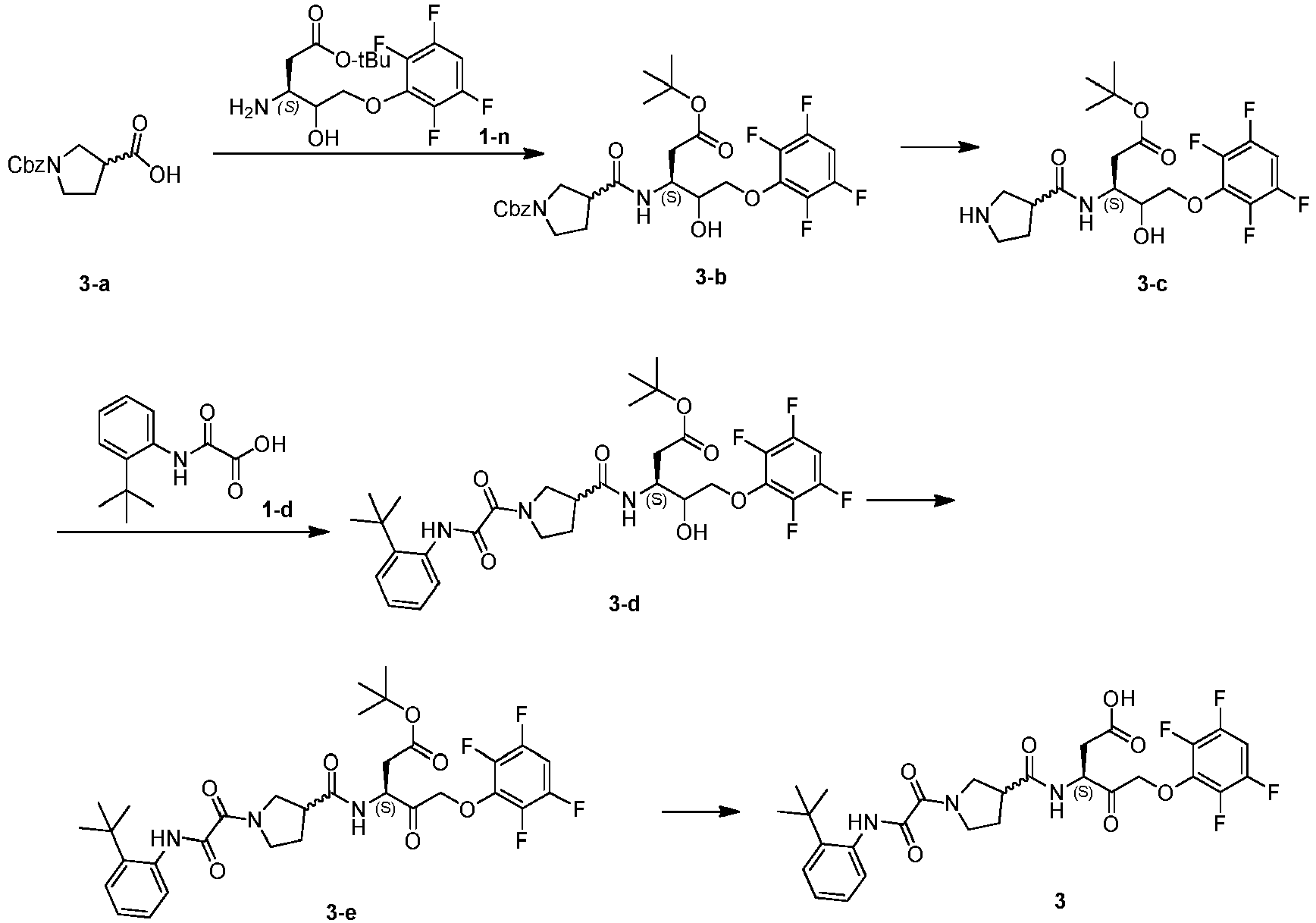
- Compounds 1-n (311.84 mg, 882.61 µmol, 1.10 eq) and 3-a (200.00 mg, 802.38 µmol, 1.00 eq) were dissolved in dichloromethane (5 mL), and EDCI (210.73 mg, 1.10 mmol, 1.37 eq), HOBt (148.53 mg, 1.10 mmol, 1.37 eq) and NMM (243.48 mg, 2.41 mmol, 264.65 µL, 3.00 eq) were added to the solution. After the addition was completed, the reaction was purged with nitrogen gas three times, and stirred at 25°C for 12 hours. After the reaction was completed, the reaction mixture was directly concentrated and purified by column chromatography (petroleum ether : ethyl acetate = 1:0∼1:1) to give compound 3-b (450.00 mg, yield: 88%) as a colorless oil.
- Compound 3-b (200.00 mg, 342.14 µmol, 1.00 eq) was dissolved in methanol (250.00 mL), and Pd-C (10%, 100 mg) was added thereto. The mixture was purged with hydrogen three times, and stirred at 25°C for 2 hours under the pressure of 15 psi. After filtration, the filtrate was concentrated to give compound 3-c (70.00 mg, yield: 45%) as a yellow oil.
- Compounds 1-d (24.56 mg, 111.01 µmol, 1.00 eq) and 3-c (50.00 mg, 111.01 µmol, 1.00 eq) were dissolved in dichloromethane (10 mL), and EDCI (28.94 mg, 150.97 µmol, 1.36 eq), HOBt (20.40 mg, 150.97 µmol, 1.36 eq) and NMM (33.69 mg, 333.02 µmol, 36.61 µL, 3.00 eq) were added thereto, purged with nitrogen gas three times, and stirred at 25°C for 12 hours. After the reaction was completed, the reaction solution was directly concentrated to give a crude product, which was purified by column chromatography (petroleum ether : ethyl acetate = 1:0∼1:1) to give compound 3-d (40.00 mg, yield: 55%) as a yellow oil.
- Compound 3-d (30.00 mg, 45.90 µmol, 1.00 eq) was dissolved in dichloromethane (5.00 mL), and PIDA (59.13 mg, 183.58 µmol, 4.00 eq) and TEMPO (1.44 mg, 9.18 µmol, 0.20 eq) were added thereto. The mixture was stirred at 25°C for 5 hours. After the reaction was completed, the reaction solution was directly concentrated, and purified and separated by preparative silica gel plates (petroleum ether : ethyl acetate = 2:1), to give compound 3-e (20.00 mg, yield: 67%) as a yellow oil.
- Compound 3-e (40.00 mg, 61.38 µmol, 1.00 eq) was dissolved in dichloromethane (2.00 mL), and TFA (1.00 mL) was added thereto. The mixture was stirred at 25°C for 0.8 hour. After the reaction was completed, the reaction solution was directly concentrated, purified by preparative HPLC, and lyophilized to give the product of compound 3 (10.00 mg, yield: 25%). 1H NMR (400MHz, DMSO-d6) δ= 10.00-9.89 (m, 1H), 8.71-8.59 (m, 1H), 7.65-7.48 (m, 1H), 7.44-7.33 (m, 2H), 7.26-7.17 (m, 2H), 5.25 (br. s., 2H), 4.70-4.58 (m, 1H), 4.09-3.76 (m, 3H), 3.16-3.00 (m, 2H), 2.81-2.56 (m, 3H), 2.24-1.78 (m, 2H), 1.33 (s, 9H).
-

- Compound 1-d (2.81 g, 12.72 mmol, 1.00 eq) was dissolved in dichloromethane (100.00 mL), and HOBt (2.35 g, 17.43 mmol, 1.37 eq), EDCI (3.34 g, 17.43 mmol, 1.37 eq), compound 4-a (2.00 g, 12.72 mmol, 1.00 eq) and NMM (3.86 g, 38.16 mmol, 4.20 mL, 3.00 eq) were added thereto. The reaction solution was stirred at 25°C for 15 hours. After the reaction was completed, the reaction solution was added with 150 mL of water, and extracted with dichloromethane (150 mL × 3). The organic phase was dried over anhydrous sodium sulfate, filtered and concentrated to give a crude product. The crude product was subjected to column chromatography (petroleum ether : ethyl acetate = 1:0∼5:1) to give the product of compound 4-b (3.80 g, yield: 83%) as a colorless oil. 1H NMR (400 MHz, CHLOROFORM-d) δ= 9.45 (d, J=18.57 Hz, 1H), 7.86 (t, J=7.03 Hz, 1H), 7.39-7.46 (m, 1H), 7.23-7.27 (m, 1H), 7.14-7.21 (m, 1H), 4.91-5.09 (m, 1H), 4.13-4.60 (m, 3H), 3.08-3.89 (m, 2H), 2.54-2.73 (m, 1H), 2.06-2.21 (m, 1H), 1.66-1.94 (m, 3H), 1.46 (d, J=1.51 Hz, 9H), 1.25-1.30 (m, 3H).
- Compound 4-b (3.80 g, 10.54 mmol, 1.00 eq) was dissolved in tetrahydrofuran (30.00 mL), and a solution of LiOH·H2O (1.33 g, 31.62 mmol, 3.00 eq) dissolved in water (30.00 mL) was added to the above solution. The reaction solution was maintained at 25°C and stirred for 40 min. After the reaction was completed, the reaction solution was adjusted to pH=6 with 2 N dilute hydrochloric acid, added with 200 mL of water, and extracted with dichloromethane (200 mL × 3). The organic phase was dried over anhydrous sodium sulfate, filtered and concentrated to give the product of compound 4-c (3.50 g, crude) as a colorless oil, which was used directly in the next step without purification. 1H NMR (400 MHz, CHLOROFORM-d) δ= 9.32-9.49 (m, 1H), 7.73-7.93 (m, 1H), 7.39-7.47 (m, 1H), 7.13-7.27 (m, 2H), 4.58-5.04 (m, 1H), 3.94-4.04 (m, 1H), 3.77 (t, J=6.40 Hz, 2H), 3.31-3.41 (m, 1H), 2.59-2.78 (m, 1H), 2.10-2.23 (m, 1H), 1.88-1.98 (m, 1H), 1.59-1.85 (m, 2H), 1.41-1.49 (m, 9H).
- Compound 4-c (471.99 mg, 1.42 mmol, 1.00 eq) was dissolved in dichloromethane (30.00 mL), and compound 1-n (500.00 mg, 1.42 mmol, 1.00 eq), EDCI (372.93 mg, 1.95 mmol, 1.37 eq), HOBt (262.86 mg, 1.95 mmol, 1.37 eq) and NMM (430.90 mg, 4.26 mmol, 468.37 µL, 3.00 eq) were added thereto. The reaction solution was stirred at 27°C for 16 hours under the protection of nitrogen gas. After the reaction was completed, the reaction solution was added with 80 mL of water, and extracted with dichloromethane (80 mL × 3). The organic phase was combined, dried over anhydrous sodium sulfate, filtered and concentrated to give a crude product. The crude product was subjected to column chromatography (petroleum ether : ethyl acetate = 1:0∼2:1) to give the product of compound 4-d (507.00 mg, yield: 49%) as a colorless oil. 1H NMR (400 MHz, CHLOROFORM-d) δ=9.45 (d, J=5.52 Hz, 1H), 7.83 (dd, J=5.40, 7.40 Hz, 1H), 7.43 (d, J=8.03 Hz, 1H), 7.14-7.26 (m, 2H), 6.73-6.86 (m, 1H), 4.70-5.03 (m, 1H), 4.10-4.47 (m, 4H), 3.66-3.93 (m, 1H), 3.18-3.53 (m, 2H), 2.40-2.81 (m, 3H), 1.76-2.05 (m, 3H), 1.57-1.65 (m, 1H), 1.41-1.52 (m, 18H).
- Compound 4-d (507.00 mg, 759.33 µmol, 1.00 eq) was dissolved in dichloromethane (26.00 mL), and PIDA (946.53 mg, 2.94 mmol, 3.87 eq) and TEMPO (23.88 mg, 151.87 µmol, 0.20 eq) were added thereto. The reaction solution was stirred at 27°C for 18 hours under the protection of nitrogen gas. After the reaction was completed, 100 mL of ethyl acetate was added to the reaction solution. The solution was washed successively with saturated sodium hydrogen carbonate (50 mL), saturated brine (50 mL) and water (50 mL). The organic phase was dried over anhydrous sodium sulfate, filtered and concentrated to give a crude product. The crude product was subjected to column chromatography (petroleum ether : ethyl acetate = 1:0∼2:1) to give the product of compound 4-e (420.00 mg, yield:78%) as a colorless oil. LCMS m/z = 666.3 [M+H]+.
- Compound 4-e (500.00 mg, 751.12 µmol, 1.00 eq) was dissolved in dichloromethane (16.00 mL), and trifluoroacetic acid (12.32 g, 108.05 mmol, 8.00 mL, 143.85 eq) was added thereto. The reaction solution was stirred at 27°C for 1 hour under the protection of nitrogen gas. After the reaction was completed, the reaction solution was spin-dried to give a crude product. The crude product was purified by preparative HPLC (under a condition of trifluoroacetic acid), and lyophilized to give a solid product. The solid was dissolved in acetonitrile (20 mL), added with hydrochloric acid solution (0.1 M, 20 mL), mixed uniformly, and lyophilized to give the product of compound 4 (300.80 mg, yield: 66%). 1H NMR (400 MHz, DMSO-d6) δ=10.02 (d, J=3.01 Hz, 1H), 8.60 (t, J=8.03 Hz, 1H), 7.50-7.69 (m, 1H), 7.43 (dd, J=3.51, 6.02 Hz, 1H), 7.18-7.31 (m, 2H), 7.04-7.14 (m, 1H), 5.15-5.34 (m, 2H), 4.64 (q, J=6.69 Hz, 1H), 4.12-4.43 (m, 1H), 3.96 (d, J=13.05 Hz, 1H), 3.08-3.31 (m, 1H), 2.55-2.98 (m, 4H), 2.28-2.46 (m, 1H), 1.90-2.05 (m, 1H), 1.78 (d, J=12.55 Hz, 1H), 1.63 (q, J=12.05 Hz, 1H), 1.39-1.54 (m, 1H), 1.33 (d, J=5.52 Hz, 9H); LCMS m/z = 610.1 [M+H]+.
-

- Compound 1-n (320.00 mg, 905.72 µmol, 1.00 eq) was dissolved in dichloromethane (5.00 mL), and HOBt (167.66 mg, 1.24 mmol, 1.37 eq), EDCI (237.87 mg, 1.24 mmol, 1.37 eq), compound 5-a (238.47 mg, 905.72 µmol, 1.00 eq) and NMM (274.84 mg, 2.72 mmol, 298.74 µL, 3.00 eq) were added thereto. The reaction solution was stirred at 25°C for 12 hours. After the reaction was completed, the reaction solution was added with 20 mL of water, and extracted with dichloromethane (20 mL × 3). The organic phase was dried over anhydrous sodium sulfate, filtered and concentrated to give a crude product. The crude product was subjected to column chromatography (petroleum ether : ethyl acetate=1:0∼1:1) to give the product of compound 5-b (350.00 mg, crude) as a colorless oil.
- Compound 5-b (400.00 mg, 668.25 µmol, 1.00 eq) was dissolved in methanol (50.00 mL), and Pd-C (10%, 100 mg) was added thereto. The reaction mixture was purged with hydrogen gas three times, maintained at a hydrogen pressure of 15 psi, and stirred at 25°C for 2 hours. After the reaction was completed, the filtrate was concentrated to give compound 5-c (250.00 mg, crude) as a colorless oil.
- Compounds 1-d (119.09 mg, 538.27 µmol, 1.00 eq) and 5-c (250.00 mg, 538.27 µmol, 1.00 eq) were dissolved in dichloromethane (10.00 mL), and EDCI (140.33 mg, 732.05 µmol, 1.36 eq), HOBt (98.91 mg, 732.05 µmol, 1.36 eq) and NMM (163.34 mg, 1.61 mmol, 177.54 µL, 3.00 eq) were added thereto. After the addition was completed, the reaction was purged with nitrogen gas three times, and stirred at 25°C for 12 hours. After the reaction was completed, the reaction solution was directly concentrated and purified by column chromatography (petroleum ether : ethyl acetate = 1:0∼1:1) to give compound 5-d (200.00 mg, yield: 56%) as a yellow oil.
- Compound 5-d (180.00 mg, 269.59 µmol, 1.00 eq) was dissolved in dichloromethane (5.00 mL), and PIDA (347.33 mg, 1.08 mmol, 4.00 eq) and TEMPO (8.48 mg, 53.92 µmol, 0.20 eq) were added thereto. The mixture was stirred at 25°C for 5 hours. After the reaction was completed, the reaction mixture was directly concentrated and purified by preparative silica gel plates (petroleum ether: ethyl acetate = 2:1) to give compound 5-e (90.00 mg, yield: 50%) as a yellow oil. 1H NMR (400MHz, CHLOROFORM-d) δ= 9.50-9.41 (m, 1H), 7.89-7.85 (m, 1H), 7.84-7.79 (m, 1H), 7.48-7.42 (m, 1H), 7.24-7.09 (m, 2H), 6.83-6.74 (m, 1H), 5.22-5.17 (m, 1H), 5.15 (s, 1H), 5.11-5.07 (m, 1H), 5.07-5.02 (m, 1H), 5.00-4.75 (m, 3H), 4.38-4.29 (m, 1H), 4.17-4.06 (m, 1H), 3.96-3.86 (m, 1H), 3.65-3.56 (m, 1H), 3.51-3.42 (m, 1H), 3.34-3.26 (m, 1H), 3.01-2.90 (m, 1H), 2.84-2.76 (m, 1H), 2.70-2.51 (m, 2H), 1.49-1.43 (m, 10H).
- Compound 5-e (80.00 mg, 120.18 µmol, 1.00 eq) was dissolved in dichloromethane (2.00 mL), and TFA (1.00 mL) was added thereto. The mixture was stirred at 25°C for 1 hour. After the reaction was completed, the reaction solution was directly concentrated, purified by preparative HPLC, and lyophilized to give the product of compound 5 (10.00 mg, yield: 11%). 1H NMR (400MHz, DMSO-d6) δ = 10.02 (s, 1H), 8.67-8.40 (m, 1H), 7.69-7.50 (m, 1H), 7.47-7.39 (m, 1H), 7.31-7.17 (m, 2H), 7.15-7.06 (m, 1H), 5.31-5.03 (m, 1H), 4.73-4.58 (m, 1H), 4.41-4.30 (m, 1H), 4.26-4.16 (m, 1H), 4.06-3.91 (m, 1H), 3.20-3.10 (m, 2H), 2.88-2.59 (m, 4H), 2.44-2.32 (m, 1H), 2.05-1.87 (m, 1H), 1.84-1.71 (m, 1H), 1.69-1.54 (m, 1H), 1.34 (s, 9H).
-

- Compound 1-n (504.53 mg, 1.43 mmol, 1.10 eq) was dissolved in dichloromethane (5.00 mL), and compound 6-a (360.00 mg, 1.30 mmol, 1.00 eq), HOBt (240.31 mg, 1.78 mmol, 1.37 eq), EDCI (340.94 mg, 1.78 mmol, 1.37 eq) and NMM (393.93 mg, 3.89 mmol, 428.19 µL, 3.00 eq) were added thereto. The reaction solution was stirred at 25°C for 12 hours. After the reaction was completed, the reaction solution was added with 20 mL of water, and extracted with dichloromethane (20 mL × 3). The organic phase was dried over anhydrous sodium sulfate, filtered and concentrated to give a crude product. The crude product was subjected to column chromatography (petroleum ether : ethyl acetate = 1:0∼1:1) to give the product of compound 6-b (500.00 mg, yield: 63%) as a colorless oil.
- Compound 6-b (300.00 mg, 489.71 µmol, 1.00 eq) was dissolved in methanol (100.00 mL), and Pd-C (10%, 100 mg) was added thereto. The reaction mixture was purged with hydrogen gas three times, maintained at a hydrogen pressure of 15 psi, and stirred at 25°C for 2 hours. After the reaction was completed, the reaction solution was filtered. The filtrate was concentrated to give compound 6-c (170.00 mg, crude). 1H NMR (400MHz, CHLOROFORM-d) δ = 6.91-6.75 (m, 1H), 6.60-6.49 (m, 1H), 4.38-4.19 (m, 2H), 2.85-2.54 (m, 3H), 2.14-1.85 (m, 6H), 1.82-1.59 (m, 4H), 1.41 (s, 9H) 1.19-1.04 (m, 1H).
- Compounds 1-d (89.05 mg, 402.49 µmol, 1.00 eq) and 6-c (170.00 mg, 402.49 µmol, 1.00 eq) were dissolved in dichloromethane (5.00 mL), and EDCI (104.93 mg, 547.39 µmol, 1.36 eq), HOBt (73.96 mg, 547.39 µmol, 1.36 eq) and NMM (122.14 mg, 1.21 mmol, 132.76 µL, 3.00 eq) were added thereto. After the addition was completed, the reaction was purged with nitrogen gas three times, and stirred at 25°C for 12 hours. After the reaction was completed, the reaction solution was poured into 50 mL of water, and extracted with ethyl acetate (50 mL × 3). The organic phases were combined, and washed with water (50 mL) and saturated brine (50 mL), dried over anhydrous sodium sulfate, filtered and concentrated to give compound 6-d (170.00 mg, crude), which was used directly in the next step.
- Compound 6-d (100.00 mg, 146.69 µmol, 1.00 eq) was dissolved in dichloromethane (5.00 mL), and PIDA (189.00 mg, 586.76 µmol, 4.00 eq) and TEMPO (4.61 mg, 29.34 µmol, 0.20 eq) were added thereto. The mixture was stirred at 25°C for 12 hours. After the reaction was completed, the reaction mixture was directly concentrated and purified by preparative silica gel plates (petroleum ether: ethyl acetate = 2:1) to give compound 6-e (60.00 mg, yield: 35%).
- Compound 6-e (60.00 mg, 88.27 µmol, 1.00 eq) was dissolved in dichloromethane (8.00 mL), and TFA (4.00 mL) was added thereto. The mixture was stirred at 25°C for 0.8 hour. After the reaction was completed, the reaction solution was directly concentrated, purified by preparative HPLC, and lyophilized to give the product of compound 6 (16.00 mg, yield: 27%). 1H NMR (400MHz, DMSO-d6) δ = 9.99-9.88 (m, 1H), 8.99-8.85 (m, 1H), 8.49-8.35 (m, 1H), 7.62-7.49 (m, 2H), 7.48-7.14 (m, 3H), 5.33-5.13 (m, 2H), 4.67-4.51 (m, 1H), 3.73-3.56 (m, 1H), 2.82-2.65 (m, 1H), 2.65-2.54 (m, 2H), 2.24-2.06 (m, 1H), 1.88-1.68 (m, 4H), 1.56-1.39 (m, 4H), 1.36 (s, 9H).
-

- Compound 1-d (4.14 g, 18.70 mmol, 1.05 eq) and HOBt (3.61 g, 26.72 mmol, 1.50 eq) were dissolved in dichloromethane (100 mL), and EDCI (5.12 g, 26.72 mmol, 1.50 eq) were added thereto and stirred at room temperature for 15 min. Compound 7-a (2.80 g, 17.81 mmol, 2.75 mL, 1.00 eq) and N,N-diisopropylethylamine (4.60 g, 35.62 mmol, 6.22 mL, 2.00 eq) were then dissolved in dichloromethane, added to the above solution, and stirred at room temperature for 16 hours. After the reaction was completed, the reaction solution was added with 100 mL of water, and separated. The aqueous phase was extracted with dichloromethane (200 mL × 2). The organic phases were combined and washed with saturated sodium hydrogen carbonate solution (150 mL) and saturated brine (100 mL). The organic phase was dried over anhydrous sodium sulfate, filtered, concentrated, and separated by column chromatography (petroleum ether : ethyl acetate=1:0∼5:1) to give the product of compound 7-b (560.00 mg, yield: 9%). LCMS m/z = 361.1 [M+H]+.
- Compound 7-b (790.00 mg, 2.19 mmol, 1.00 eq) was dissolved in tetrahydrofuran (20.00 mL), and a solution of LiOH·H2O (183.93 mg, 4.38 mmol, 2.00 eq) dissolved in water (20.00 mL) was added to the above solution. The reaction solution was maintained at 25°C and stirred for 2 hours. After the reaction was completed, the reaction solution was adjusted to pH of 6 with 2 N dilute hydrochloric acid, added with 200 mL of water, and extracted with dichloromethane (200 mL × 3). The organic phase was dried over anhydrous sodium sulfate, filtered and concentrated to give the product of compound 7-c (0.65 g, crude) as a pale yellow oil, which was used directly in the next step without purification. LCMS m/z = 355.1 [M+Na]+.
- Compound 7-c (900.00 mg, 2.71 mmol, 1.05 eq) and HOBt (488.23 mg, 3.61 mmol, 1.40 eq) were dissolved in dichloromethane (10 mL), and EDCI (692.68 mg, 3.61 mmol, 1.40 eq) was added thereto and stirred at room temperature for 15 min. Compound 1-n (911.00 mg, 2.58 mmol, 1.00 eq) and NMM (783.19 mg, 7.74 mmol, 851.29 µL, 3.00 eq) were then dissolved in dichloromethane, added to the above solution, and stirred at room temperature for 60 hours. After the reaction was completed, the reaction solution was added with 80 mL of water, and extracted with dichloromethane (80 mL × 3). The organic phases were combined, dried over anhydrous sodium sulfate, filtered and concentrated to give a crude product. The crude product was subjected to column chromatography (petroleum ether : ethyl acetate=1:0∼3:1) to give the product of compound 7-d (1.24 g, yield: 66%) as a yellow oil. LCMS m/z = 690.4 [M+Na]+.
- Compound 7-d (1.24 g, 1.86 mmol, 1.00 eq) was dissolved in dichloromethane (50.00 mL), and PIDA (2.40 g, 7.44 mmol, 4.00 eq) and TEMPO (58.50 mg, 372.00 µmol, 0.20 eq) were added thereto. The reaction solution was stirred at room temperature for 24 hours. After the reaction was completed, the reaction solution was added with saturated sodium hydrogen carbonate solution (50 mL) and saturated sodium sulfite solution (50 mL), extracted with dichloromethane (80 mL×3) and washed with saturated brine (100 mL). The organic phase was dried over anhydrous sodium sulfate, filtered and concentrated to give a crude product. The crude product was subjected to column chromatography (petroleum ether : ethyl acetate=1:0∼5:2), to give the product of compound 7-e (738.00 mg, yield: 48%) as a yellow oil. LCMS m/z = 688.3 [M+Na]+.
- Compound 7-e (700.00 mg, 1.05 mmol, 1.00 eq) was dissolved in dichloromethane (6.00 mL), and trifluoroacetic acid (4.62 g, 40.52 mmol, 3.00 mL) was added thereto. The reaction solution was stirred at room temperature for 2 hours. After the reaction was completed, the reaction solution was spin-dried to give a crude product. The crude product was purified by preparative HPLC (under trifluoroacetic acid condition), to give the product of compound 7 (484.00 mg, yield: 75%). 1H NMR (400MHz, DMSO-d6) δ= 8.52 (d, J=7.6 Hz, 1H), 7.54 (br. s, 1H), 7.45 (d, J=7.6 Hz, 1H), 7.30-7.21 (m, 2H), 7.13 (d, J=6.0 Hz, 1H), 5.25 (dd, J=14.8, 7.6 Hz, 2H), 4.63 (d, J=4.8 Hz, 1H), 4.38-4.26 (m, 1H), 4.03 (d, J=7.6 Hz, 1H), 3.22 (t, J=7.6 Hz, 1H), 2.89-2.71 (m, 2H), 2.68-2.55 (m, 2H), 1.86-1.75 (m, 2H), 1.62-1.49 (m, 2H), 1.35
- (s, 9H); LCMS m/z = 610.3 [M+H]+, 632.3 [M+Na]+.
-

- Compound 1-n (400.00 mg, 1.13 mmol, 1.00 eq) was dissolved in dichloromethane (12.00 mL), and compound 8-a (299.74 mg, 1.13 mmol, 1.00 eq), EDCI (296.77 mg, 1.55 mmol, 1.37 eq), HOBt (209.18 mg, 1.55 mmol, 1.37 eq) and NMM (342.90 mg, 3.39 mmol, 372.72 µL, 3.00 eq) were added thereto. The reaction solution was stirred at 27°C for 16 hours. After the reaction was completed, the reaction solution was added with 150 mL of water, and extracted with dichloromethane (150 mL × 3). The organic phase was dried over anhydrous sodium sulfate, filtered and concentrated to give a crude product. The crude product was subjected to column chromatography (petroleum ether : ethyl acetate=1:0∼2:1) to give the product of compound 8-b (417.00 mg, yield: 58%) as a colorless oil. 1H NMR (400 MHz, CHLOROFORM-d) δ=7.29-7.45 (m, 5H), 6.75-6.87 (m, 1H), 5.10-5.21 (m, 2H), 4.10-4.53 (m, 5H), 3.88-4.04 (m, 3H), 3.59 (t, J=11.04 Hz, 1H), 2.57-2.89 (m, 3H), 1.43-1.51 (m, 9H).
- Compound 8-b (300.00 mg, 499.54 µmol, 1.00 eq) was dissolved in methanol (15.00 mL), and Pd/C (40.00 mg, purity of 10%) was added to the solution. The reaction solution was stirred at 27°C for 2 hours in hydrogen atmosphere (hydrogen balloon). After the reaction was completed, the reaction solution was filtered through diatomaceous earth, and the filter cake was washed with methanol (100 mL). The resulting filtrate was concentrated to give the product of compound 8-c (240.00 mg, crude) as a colorless oil, which was used directly in the next step without purification. LCMS m/z = 467.2 [M+H]+.
- Compound 1-d (94.87 mg, 428.80 µmol, 1.00 eq) was dissolved in dichloromethane (5.00 mL), and compound 8-c (200.00 mg, 428.80 µmol, 1.00 eq), EDCI (112.61 mg, 587.46 µmol, 1.37 eq), HOBt (79.38 mg, 587.46 µmol, 1.37 eq) and NMM (130.12 mg, 1.29 mmol, 141.43 µL, 3.00 eq) were added thereto. The reaction solution was stirred at 27°C for 18 hours under the protection of nitrogen gas. After the reaction was completed, the reaction solution was added with 100 mL of water, and extracted with dichloromethane (100 mL × 3). The organic phases were combined, dried over anhydrous sodium sulfate, filtered and concentrated to give a crude product. The crude product was subjected to column chromatography (petroleum ether : ethyl acetate=1:0∼1:2) to give the product of compound 8-d (120.00 mg, yield: 41%) as a colorless oil. LCMS m/z = 670.3 [M+H]+.
- Compound 8-d (120.00 mg, 179.20 µmol, 1.00 eq) was dissolved in dichloromethane (6.00 mL), and PIDA (223.37 mg, 693.50 µmol, 3.87 eq) and TEMPO (5.64 mg, 35.84 µmol, 0.20 eq) were added thereto. The reaction solution was stirred at 27°C for 16 hours under the protection of nitrogen gas. After the reaction was completed, the reaction solution was added with 100 mL of ethyl acetate. The solution was washed successively with saturated sodium hydrogen carbonate (50 mL), saturated brine (50 mL) and water (50 mL). The organic phase was dried over anhydrous sodium sulfate, filtered and concentrated to give a crude product. The crude product was subjected to column chromatography (petroleum ether : ethyl acetate=1:0∼2:1) to give the product of compound 8-e (110.00 mg, yield: 85%) as a colorless oil. LCMS m/z = 668.3 [M+H]+.
- Compound 8-e (110.00 mg, 164.76 µmol, 1.00 eq) was dissolved in dichloromethane (4.00 mL), and trifluoroacetic acid (2.70 g, 23.70 mmol, 1.75 mL, 143.85 eq) was added thereto. The reaction solution was stirred at 27°C for 1 hour under the protection of nitrogen gas. After the reaction was completed, the reaction solution was spin-dried to give a crude product. The crude product was purified by preparative HPLC (under trifluoroacetic acid condition), and lyophilized to give the product of compound 8 (55.10 mg, yield: 55%). 1H NMR (400 MHz, DMSO-d6) δ=10.05-10.14 (m, 1H), 8.38-8.47 (m, 1H), 7.52-7.68 (m, 1H), 7.40-7.48 (m, 1H), 7.21-7.31 (m, 2H), 7.08-7.20 (m, 1H), 5.16-5.33 (m, 2H), 4.73-4.83 (m, 1H), 3.97-4.49 (m, 5H), 3.55-3.70 (m, 1H), 3.27-3.45 (m, 1H), 2.76-3.12 (m, 2H), 2.60-2.71 (m, 1H), 1.34 (s, 9H); LCMS m/z = 612.1 [M+H]+.
-

- Compound 1-d (1.15 g, 5.19 mmol, 1.40 eq) and HOBt (751.94 mg, 5.57 mmol, 1.50 eq) were dissolved in dichloromethane (70 mL), added with EDCI (1.07 g, 5.57 mmol, 1.50 eq), and stirred at room temperature for 15 min. Then, compound 9-a (635.30 mg, 3.71 mmol, 1.00 eq) and N,N-diisopropylethylamine (958.96 mg, 7.42 mmol, 1.30 mL, 2.00 eq) were dissolved in dichloromethane, added to the above solution, and stirred at room temperature for 18 hours. After the reaction was completed, the reaction solution was added with 100 mL of water and separated, and the aqueous phase was further extracted with dichloromethane (200 mL × 2). The organic phases were combined, and washed with saturated sodium hydrogen carbonate solution (150 mL) and saturated brine (100 mL). The organic phase was dried over anhydrous sodium sulfate, filtered, concentrated, and separated by column chromatography (petroleum ether : ethyl acetate=1:0∼10:1) to give the product of compound 9-b (386.00 mg, yield: 23%). LCMS m/z = 397.2 [M+Na]+.
- Compound 9-b (350.00 mg, 934.65 µmol, 1.00 eq) was dissolved in tetrahydrofuran (10.00 mL), and a solution of LiOH·H2O (78.44 mg, 1.87 mmol, 2.00 eq) dissolved in water (20.00 mL) was added to the above solution. The reaction solution was maintained at 25°C and stirred for 2 hours. After the reaction was completed, the reaction solution was adjusted to pH of 6 with 2 N dilute hydrochloric acid, added with 200 mL of water, and extracted with dichloromethane (200 mL × 3). The organic phase was dried over anhydrous sodium sulfate, filtered and concentrated to give the product of compound 9-c (0.65 g, crude) as a pale yellow oil, which was used directly in the next step without purification. LCMS m/z =347.1[M+H]+, 369.1[M+Na]+.
- Compound 9-c (323.56 mg, 933.90 µmol, 1.10 eq) and HOBt (160.60 mg, 1.19 mmol, 1.40 eq) were dissolved in dichloromethane (50 mL), added with EDCI (227.85 mg, 1.19 mmol, 1.40 eq), and stirred at room temperature for 15 min. Then, compound 1-n (299.96 mg, 849.00 µmol, 1.00 eq) and NMM (257.63 mg, 2.55 mmol, 280.03 µL, 3.00 eq) were dissolved in dichloromethane, added to the above solution, and stirred at room temperature for 62 hours. After the reaction was completed, the reaction solution was added with 80 mL of water, and extracted with dichloromethane (80 mL × 3). The organic phases were combined, dried over anhydrous sodium sulfate, filtered, and concentrated to give a crude product. The crude product was subjected to column chromatography (petroleum ether : ethyl acetate=1:0∼3:1) to give the product of compound 9-d (448.00 mg, yield: 75%) as a yellow oil. LCMS m/z = 704.4 [M+Na]+.
- Compound 9-d (440.00 mg, 645.44 µmol, 1.00 eq) was dissolved in dichloromethane (50.00 mL), and PIDA (831.58 mg, 2.58 mmol, 4.00 eq) and TEMPO (20.30 mg, 129.09 µmol, 0.20 eq) were added thereto. The reaction solution was stirred at room temperature for 54 hours. After the reaction was completed, the reaction solution was added with saturated sodium hydrogen carbonate solution (50 mL) and saturated sodium sulfite solution (50 mL), extracted with dichloromethane (80 mL × 3), and washed with saturated brine (100 mL). The organic phase was dried over anhydrous sodium sulfate, filtered and concentrated to give a crude product. The crude product was subjected to column chromatography (petroleum ether : ethyl acetate=1:0∼3:1) to give the product of compound 9-e (415.00 mg, yield: 94%) as yellow oil. LCMS m/z = 702.3 [M+Na]+. Compound 9-e was isolated via SFC (Column: Lux Cellulose-2 150×4.6mm I.D., 3µm; Mobile phase: A:CO2, B: methanol (0.05% diethylamine); Gradient: 5%∼40% of mobile phase B (0∼5.5min), hold 40% of mobile phase B for 3 min, and 5% of mobile phase B for 1.5 min; Flow rate: 2.5 mL/min; Column temp.: 40°C), to give compounds 9-f (Retention time: 4.18 min, 80% ee) and 9-g (Retention time: 4.47 min, 99% ee).;
- Compound 9-f (72.00 mg, 105.93 µmol, 1.00 eq) was dissolved in dichloromethane (6.00 mL), and trifluoroacetic acid (4.62 g, 40.52 mmol, 1.5 mL) was added thereto. The reaction solution was stirred at room temperature for 2 hours. After the reaction was completed, the reaction solution was spin-dried to give a crude product. The crude product was purified by preparative HPLC (under trifluoroacetic acid condition), and lyophilized to give the product of compound 9 (59.00 mg, yield: 88%). 1H NMR (400MHz, DMSO-d6) δ = 10.06 (s, 1H), 8.64-8.50 (m, 1H), 7.62-7.52 (m, 1H), 7.47-7.38 (m, 1H), 7.30-7.08 (m, 3H), 5.29-5.21 (m, 2H), 4.59-4.65 (m, 1H), 3.95-3.89 (m, 1H), 3.75-3.65 (m, 3H), 3.42-3.31 (m, 1H), 2.83-2.62 (m, 1H), 2.62-2.53 (m, 1H), 1.90-1.56 (m, 5H), 1.52-1.38 (m, 1H), 1.34 (s, 9H); LCMS m/z = 624.1 [M+H]+, 646.1 [M+Na]+.
-

- Compound 9-g (53.00 mg, 77.98 µmol, 1.00 eq) was dissolved in dichloromethane (5.00 mL), and trifluoroacetic acid (4.62 g, 40.52 mmol, 1.50 mL) was added thereto. The reaction solution was stirred at room temperature for 2 hours. After the reaction was completed, the reaction solution was spin-dried to give a crude product. The crude product was purified by preparative HPLC (under trifluoroacetic acid condition), and lyophilized to give the product of compound 10 (59.00 mg, yield: 88%). 1H NMR (400MHz, DMSO-d6) δ = 10.03 (s, 1H), 8.58 (dd, J=7.4, 11.2 Hz, 1H), 7.62-7.42 (m, 1H), 7.46-7.40 (m, 1H), 7.29-7.18 (m, 2H), 7.16-7.08 (m, 1H), 5.34-5.15 (m, 2H), 4.62 (t, J=6.8 Hz, 1H), 3.95 (dt, J=5.0, 13.2 Hz, 1H), 3.85-3.68 (m, 1H), 3.59 (dd, J=9.9, 14.4 Hz, 1H), 3.30-3.22 (m, 1H), 2.83-2.69 (m, 2H), 2.67-2.55 (m, 1H), 1.89-1.57 (m, 4H), 1.52-1.38 (m, 1H), 1.34 (s, 9H); LCMS m/z = 624.1 [M+H]+, 646.2 [M+Na]+.
-

- Compound 1-d (1.15 g, 5.19 mmol, 1.40 eq) and HOBt (751.94 mg, 5.57 mmol, 1.50 eq) were dissolved in dichloromethane (80 mL), added with EDCI (1.07 g, 5.57 mmol, 1.50 eq), and stirred at room temperature for 15 min. Compound 11-a (627.33 mg, 3.71 mmol, 1.00 eq) and N,N-diisopropylethylamine (958.96 mg, 7.42 mmol, 1.30 mL, 2.00 eq) were then dissolved in dichloromethane, added to the above solution, and stirred at room temperature for 65 hours. After the reaction was completed, the reaction solution was added with 150 mL of water and separated, and the aqueous phase was further extracted with dichloromethane (200 mL × 2). The organic phases were combined, and washed with saturated sodium hydrogen carbonate solution (150 mL) and saturated brine (100 mL). The organic phase was dried over anhydrous sodium sulfate, filtered, concentrated, and separated by column chromatography (petroleum ether : ethyl acetate = 1:0∼5:1) to give the product of compound 11-b (430.00 mg, yield: 27%). LCMS m/z = 395.1 [M+Na]+.
- Compound 11-b (430.00 mg, 1.15 mmol, 1.00 eq) was dissolved in tetrahydrofuran (10.00 mL), and a solution of LiOH·H2O (96.88 mg, 2.31 mmol, 2.00 eq) dissolved in water (10.00 mL) was added to the above solution. The reaction solution was maintained at 25°C and stirred for 2 hours. After the reaction was completed, the reaction solution was adjusted to pH of 6 with 2N dilute hydrochloric acid, added with 200 mL of water, and extracted with dichloromethane (200 mL × 3). The organic phase was dried over anhydrous sodium sulfate, filtered and concentrated to give the product of compound 11-c (408.00 mg, crude) as a pale yellow oil, which was used directly in the next step without purification. LCMS m/z = 367.1 [M+Na]+.
- Compound 11-c (396.06 mg, 1.15 mmol, 1.15 eq) and HOBt (189.17 mg, 1.40 mmol, 1.40 eq) were dissolved in dichloromethane (10 mL), added with EDCI (268.38 mg, 1.40 mmol, 1.40 eq), and stirred at room temperature for 15 min. Compound 1-n (353.31 mg, 1.00 mmol, 1.00 eq) and NMM (303.45 mg, 3.00 mmol, 329.84 µL, 3.00 eq) were then dissolved in dichloromethane, added to the above solution, and stirred at room temperature for 18 hours. After the reaction was completed, the reaction solution was added with 80 mL of water, and extracted with dichloromethane (80 mL × 3). The organic phases were combined, dried over anhydrous sodium sulfate, filtered and concentrated to give a crude product. The crude product was subjected to column chromatography (petroleum ether : ethyl acetate = 1:0∼3:1) to give the product of compound 11-d (500.00 mg, yield: 72%) as a yellow oil. LCMS m/z = 702.3 [M+Na]+.
- Compound 11-d (500.00 mg, 735.62 µmol, 1.00 eq) was dissolved in dichloromethane (10.00 mL), and PIDA (947.77 mg, 2.94 mmol, 4.00 eq) and TEMPO (23.14 mg, 147.12 µmol, 0.20 eq) were added thereto. The reaction solution was stirred at room temperature for 54 hours. After the reaction was completed, the reaction solution was added with saturated sodium hydrogen carbonate solution (50 mL) and saturated sodium sulfite solution (50 mL), extracted with dichloromethane (80 mL × 3), and washed with saturated brine (100 mL). The organic phase was dried over anhydrous sodium sulfate, filtered and concentrated to give a crude product. The crude product was subjected to column chromatography (petroleum ether : ethyl acetate = 1:0∼3:1) to give the product of compound 11-e (325.00 mg, yield: 63%) as yellow oil. LCMS m/z = 702.2 [M+Na]+. Compound 11-e was separated via SFC (Column: Chiralpak AD-3 100×4.6mm I.D., 3um; Mobile phase: A: CO2, B: isopropanol (0.05% diethylamine); Gradient: 5%∼40% of mobile phase B (0∼4.5 min), hold 40% of mobile phase B for 2.5 min, and 5% of mobile phase B for 1.0 min; Flow rate: 2.8 mL/min; Column temp.: 40°C), to give compounds 11-f (Retention time: 2.90 min, 95% ee) and 11-g (Retention time: 3.08 min, 95% ee).
- Compound 11-f (65.00 mg, 95.92 µmol, 1.00 eq) was dissolved in dichloromethane (3.00 mL), and trifluoroacetic acid (4.62 g, 40.52 mmol, 1.5 mL) was added thereto. The reaction solution was stirred at room temperature for 2 hours. After the reaction was completed, the reaction solution was spin-dried to give a crude product. The crude product was purified by preparative HPLC (under trifluoroacetic acid condition), and lyophilized to give the product of compound 11 (58.00 mg, yield: 95%). 1H NMR (400MHz, DMSO-d6) δ = 10.14-10.02 (m, 1H), 8.65 (t, J=12.0 Hz, 1H), 7.64-7.52 (m, 1H), 7.46-7.40 (m, 1H), 7.30-7.19 (m, 3H), 7.17-7.10 (m, 1H), 5.80-5.68 (m, 2H), 5.35-5.17 (m, 2H), 4.65 (q, J=5.9 Hz, 1H), 4.42-4.25 (m, 1H), 4.22-4.04 (m, 2H), 3.96-3.84 (m, 2H), 3.07-2.86 (m, 1H), 2.83-2.72 (m, 1H), 2.70-2.58 (m, 1H), 2.42-2.33 (m, 1H), 1.34 (s, 9H) ; LCMS m/z = 622.1 [M+H]+, 644.1 [M+Na]+.
-

- Compound 11-g (56.00 mg, 82.63 µmol, 1.00 eq) was dissolved in dichloromethane (3.00 mL), and trifluoroacetic acid (4.62 g, 40.52 mmol, 1.5 mL) was added thereto. The reaction solution was stirred at room temperature for 2 hours. After the reaction was completed, the reaction solution was spin-dried to give a crude product. The crude product was purified by preparative HPLC (under trifluoroacetic acid condition), and lyophilized to give the product of compound 12 (49.00 mg, yield: 93%). 1H NMR (400MHz, DMSO-d6) δ= 10.13-10.00 (m, 1H), 8.62 (dd, J=7.5, 19.1 Hz, 1H), 7.66-7.52 (m, 1H), 7.47-7.39 (m, 1H), 7.31-7.20 (m, 2H), 7.16-7.09 (m, 1H), 5.75 (br. s., 2H), 5.35-5.16 (m, 2H), 4.70-4.59 (m, 1H), 4.35-4.13 (m, 1H), 4.09 (br. s., 1H), 3.95-3.87 (m, 2H), 3.73-3.67 (m, 1H), 3.06-2.88 (m, 1H), 2.84-2.72 (m, 1H), 2.68-2.58 (m, 1H), 2.39-2.32 (m, 1H), 1.34 (s, 9H); LCMS m/z = 622.1 [M+H]+, 644.3 [M+Na]+.
-

- Compound 1-d (1.00 g, 4.52 mmol, 1.00 eq) was dissolved in dichloromethane (8.00 mL), and HOBt (836.68 mg, 6.19 mmol, 1.37 eq) and EDCI (1.19 g, 6.19 mmol, 1.37 eq) were added thereto at 0°C. The above solution was stirred at 0°C for 10 min, and then added with compound 13-a (993.04 mg, 4.52 mmol, 1.00 eq, HCl) and NMM (1.37 g, 13.56 mmol, 3.00 eq). The reaction solution was stirred at 20°C for 39 hours. After the reaction was completed, the reaction solution was added with 50 mL of water, and extracted with dichloromethane (50 mL × 3). The organic phase was dried over anhydrous sodium sulfate, filtered and concentrated to give a crude product. The crude product was subjected to column chromatography (petroleum ether : ethyl acetate = 1:0∼3:1) to give the product of compound 13-b (1.00 g, yield: 56%) as a colorless oil. 1H NMR (400 MHz, CHLOROFORM-d) δ = 9.71-9.84 (m, 1H), 7.93-8.06 (m, 1H), 7.41 (d, J=7.28 Hz, 1H), 7.21-7.26 (m, 1H), 7.10-7.19 (m, 1H), 5.67-6.11 (m, 1H), 4.77-5.20 (m, 1H), 3.92-4.16 (m, 2H), 2.61 (dd, J=5.77, 19.07 Hz, 1H), 2.22-2.45 (m, 1H), 1.73-2.18 (m, 5H), 1.47 (d, J=12.30 Hz, 9H), 1.18-1.30 (m, 3H).
- Compound 13-b (1.00 g, 2.59 mmol, 1.00 eq) was dissolved in methanol (10.00 mL), and a solution of LiOH·H2O (325.71 mg, 7.77 mmol, 3.00 eq) dissolved in water (15.00 mL) was added to the above solution. The reaction solution was maintained at 20°C and stirred for 15 hours. After the reaction was completed, the reaction solution was adjusted to pH of 6 with 2 N dilute hydrochloric acid, added with 50 mL of water, and extracted with ethyl acetate (60 mL × 3). The organic phase was dried over anhydrous sodium sulfate, filtered and concentrated to give compound 13-c (940.00 mg, crude) as a colorless solid, which was used directly in the next step without purification. 1H NMR (400 MHz, CHLOROFORM-d) δ = 9.66-9.79 (m, 1H), 7.76-8.05 (m, 1H), 7.37-7.46 (m, 1H), 7.09-7.26 (m, 2H), 5.62-6.07 (m, 1H), 4.74-5.20 (m, 1H), 2.55 (dd, J=5.52, 16.06 Hz, 1H), 2.06-2.37 (m, 2H), 1.62-2.02 (m, 6H), 1.43-1.48 (m, 9H).
- Compound 1-n (200.00 mg, 566.08 µmol, 1.00 eq) was dissolved in dichloromethane (12.00 mL), and compound 13-c (202.90 mg, 566.08 µmol, 1.00 eq), EDCI (148.67 mg, 775.53 µmol, 1.37 eq), HOBt (104.79 mg, 775.53 µmol, 1.37 eq) and NMM (171.78 mg, 1.70 mmol, 186.72 µL, 3.00 eq) were added thereto. The reaction solution was stirred at 27°C for 16 hours under the protection of nitrogen gas. After the reaction was completed, the reaction solution was added with 80 mL of water, and extracted with dichloromethane (80 mL × 3). The organic phases were combined, dried over anhydrous sodium sulfate, filtered and concentrated to give a crude product. The crude product was subjected to column chromatography (petroleum ether : ethyl acetate = 1:0∼2:1) to give the product of compound 13-d (220.00 mg, yield: 55%) as a colorless oil. 1H NMR (400 MHz, CHLOROFORM-d) δ = 9.53-10.11 (m, 1H), 7.84-8.03 (m, 1H), 7.34-7.48 (m, 1H), 6.94-7.26 (m, 2H), 6.68-6.85 (m, 1H), 5.66-6.05 (m, 1H), 5.33-5.56 (m, 1H), 4.77-5.09 (m, 1H), 4.16-4.47 (m, 2H), 3.74-4.09 (m, 1H), 2.07-2.90 (m, 5H), 1.72-2.03 (m, 5H), 1.52-1.64 (m, 1H), 1.35-1.51 (m, 18H).
- Compound 13-d (270.00 mg, 389.21 µmol, 1.00 eq) was dissolved in dichloromethane (10.00 mL), and PIDA (485.16 mg, 1.51 mmol, 3.87 eq) and TEMPO (12.24 mg, 77.84 µmol, 0.20 eq) were added thereto. The reaction solution was stirred at 27°C for 16 hours under the protection of nitrogen gas. After the reaction was completed, the reaction solution was added with 100 mL of ethyl acetate. The solution was washed successively with saturated sodium hydrogen carbonate (50 mL), saturated brine (50 mL) and water (50 mL). The organic phase was dried over anhydrous sodium sulfate, filtered and concentrated to give a crude product. The crude product was subjected to column chromatography (petroleum ether: ethyl acetate = 1:0∼2:1) to give the product of compound 13-e (220.00 mg, yield: 76%) as a pale yellow oil. 1H NMR (400 MHz, CHLOROFORM-d) δ = 9.56-9.95 (m, 1H), 7.81-8.11 (m, 1H), 7.38-7.51 (m, 1H), 7.09-7.26 (m, 2H), 6.65-6.83 (m, 1H), 5.49-6.05 (m, 1H), 4.65-5.29 (m, 4H), 2.07-3.04 (m, 5H), 1.63-2.04 (m, 5H), 1.59 (br. s., 1H), 1.39-1.49 (m, 18H).
- Compound 13-e (200.00 mg, 289.14 µmol, 1.00 eq) was dissolved in dichloromethane (6.00 mL), and trifluoroacetic acid (4.74 g, 41.59 mmol, 3.08 mL, 143.85 eq) was added thereto. The reaction solution was stirred at 27°C for 1 hour under the protection of nitrogen gas. After the reaction was completed, the reaction solution was spin-dried to give a crude product. The crude product was purified by preparative HPLC (under trifluoroacetic acid condition), and lyophilized to give a solid product. The solid was dissolved in acetonitrile (20 mL), added with hydrochloric acid solution (0.1 M, 20 mL), mixed uniformly, and lyophilized to give compound 13 (128.50 mg, yield: 70%). 1HNMR (400 MHz, DMSO-d6) δ = 9.59-10.05 (m, 1H), 8.37-8.61 (m, 1H), 6.97-7.68 (m, 5H), 4.80-5.68 (m, 3H), 4.40-4.68 (m, 2H), 2.55-2.84 (m, 3H), 1.39-2.34 (m, 9H), 1.27-1.38 (m, 9H); LCMS m/z = 636.1 [M+H]+.
-

- A mixed solution of t-BuOK (6.97 g, 62.14 mmol, 1.40 eq) and anhydrous tetrahydrofuran (260 mL) was cooled with an ice bath, and then added with methyltriphenylphosphonium bromide (23.15 g, 64.81 mmol, 1.46 eq) with stirring under the protection of nitrogen gas. After the addition was completed, the above mixed solution was stirred in the ice bath for 15 min, followed by heating to 70°C for 45 min. After cooling down to 15°C, a solution of compound 14-a (10.00 g, 44.39 mmol, 1.00 eq) dissolved in anhydrous tetrahydrofuran (50 mL) was added dropwise thereto. After the dropwise addition was completed, the reaction solution was maintained at 15°C and stirred for 2 hours. After the reaction was completed, the reaction solution was added with acetone (44 mL) for quenching, and the solid was removed by filtering. The filtrate was evaporated to remove the solvent therein, added with water (200 mL), and extracted with ethyl acetate (300 mL × 3). The organic phase was dried over anhydrous sodium sulfate, filtered and concentrated to give a crude product. The crude product was subjected to column chromatography (petroleum ether : ethyl acetate = 1:0-10:1) to give the product of compound 14-b (10.00 g, yield: 93%) as a colorless oil. 1H NMR (400 MHz, CHLOROFORM-d) δ = 4.84 (s, 2H), 4.15-4.33 (m, 2H), 2.34-2.59 (m, 2H), 2.08 (s, 2H), 1.82-1.90 (m, 2H), 1.53-1.61 (m, 2H), 1.47 (s, 9H).
- Compound 14-b (10.62 g, 47.56 mmol, 1.00 eq) was dissolved in tetrahydrofuran (1.10 L), and BH3·THF (1 M, 95.11 mL, 2.00 eq) was added to the above solution at 0°C. After the addition was completed, the reaction solution was slowly warmed up to 15°C, and stirred at this temperature for 16 hours. The reaction solution was then cooled down to 0°C, and sodium hydroxide solution (2 M, 53.03 mL, 2.23 eq) and H2O2 (30 % aqueous solution, 26 mL) were successively added. After the addition was completed, the reaction solution was warmed up to 15°C, and stirred for 2 hours. After the reaction was completed, the reaction solution was quenched with saturated sodium hydrogen carbonate (500 mL), and added with water (500 mL) and ethyl acetate (800 mL) for extraction. The organic phase was washed respectively with saturated NaHSO3 (500 mL × 2) and saturated brine (500 mL), then dried over anhydrous sodium sulfate, filtered and concentrated to give a crude product. The crude product was subjected to column chromatography (petroleum ether : ethyl acetate = 5:1∼1:1) to give the product of compound 14-c (9.70 g, yield: 67%) as a colorless oil. 1H NMR (400 MHz, CHLOROFORM-d) δ = 4.11-4.27 (m, 2H), 3.63 (d, J=8.03 Hz, 2H), 2.04-2.26 (m, 2H), 1.96 (d, J=4.52 Hz, 2H), 1.81-1.89 (m, 2H), 1.53-1.64 (m, 2H), 1.45 (s, 9H), 1.41 (br. s., 1H).
- Compound 14-c (8.00 g, 33.15 mmol, 1.00 eq) was dissolved in dichloromethane (60.00 mL), and HCl/EtOAc (4 M, 100.03 mL, 12.07 eq) was added thereto at 0°C. The reaction solution was stirred at 0°C for 10 min, and further stirred at 20°C for 50 min. After the reaction was completed, the reaction solution was concentrated to give the product of compound 14-d (4.50 g, crude), which was used directly in the next step without purification. 1H NMR (400 MHz, DMSO-d6) δ = 3.85 (br. s., 2H), 3.39 (br. s., 2H), 2.02-2.12 (m, 2H), 1.91-2.01 (m, 2H), 1.72-1.86 (m, 3H), 1.67 (d, J=14.56 Hz, 2H).
- Compound 14-d (4.50 g, 25.33 mmol, 1.00 eq, HCl) was dissolved in acetonitrile (80.00 mL), and triethylamine (7.69 g, 75.99 mmol, 3.00 eq) was added thereto. The above solution was cooled down to 0°C, and added with CbzCl (6.48 g, 38.00 mmol, 1.50 eq). After the addition was completed, the reaction solution was warmed up to 20°C, and stirred for 16 hours. After the reaction was completed, the reaction solution was added with 100 mL of water, and extracted with dichloromethane (150 mL × 3). The organic phases were combined, dried over anhydrous sodium sulfate, filtered and concentrated to give a crude product. The crude product was subjected to column chromatography (petroleum ether : ethyl acetate = 5:1∼1:1) to give the product of compound 14-e (5.00 g, yield: 70%) as a colorless oil. 1H NMR (400 MHz, CHLOROFORM-d) δ =7.28-7.41 (m, 5H), 5.15 (s, 2H), 4.29 (br. s., 2H), 3.65 (d, J=7.03 Hz, 2H), 2.06-2.27 (m, 2H), 1.94-2.04 (m, 2H), 1.81-1.92 (m, 1H), 1.63 (d, J=7.28 Hz, 2H), 1.49 (d, J=14.05 Hz, 2H).
- Compound 14-e (2.50 g, 9.08 mmol, 1.00 eq) was dissolved in a mixed solution of acetonitrile (8.30 mL), ethyl acetate (8.30 mL) and water (12.50 mL), and NaIO4 (8.93 g, 41.77 mmol, 4.60 eq) and RuCl3·H2O (102.35 mg, 454.00 µmol, 0.05 eq) were added successively thereto. The reaction solution stirred at 20°C for 16 hours. After the reaction was completed, the reaction solution was added with 150 mL of water, and extracted with dichloromethane (150 mL × 3). The organic phases were combined, dried over anhydrous sodium sulfate, filtered and concentrated to give a crude product. The crude product was subjected to column chromatography (petroleum ether : ethyl acetate = 5:1∼1:2) to give the product of compound 14-f (1.82 g, yield: 64%). 1H NMR (400 MHz, CHLOROFORM-d) δ = 7.29-7.40 (m, 5H), 5.16 (s, 2H), 4.30 (d, J=9.03 Hz, 2H), 2.67-2.76 (m, 1H), 2.30 (d, J=14.05 Hz, 2H), 2.13 (d, J=8.78 Hz, 1H), 2.04 (d, J=15.06 Hz, 1H), 1.87-1.96 (m, 2H), 1.78 (d, J=8.53 Hz, 2H).
- Compound 1-n (700.00 mg, 1.98 mmol, 1.00 eq) was dissolved in dichloromethane (36.00 mL), and compound 14-f (573.24 mg, 1.98 mmol, 1.00 eq), EDCI (520.34 mg, 2.71 mmol, 1.37 eq), HOBt (366.76 mg, 2.71 mmol, 1.37 eq) and NMM (601.21 mg, 5.94 mmol, 653.49 µL, 3.00 eq) were added thereto. The reaction solution was stirred at 27°C for 16 hours under the protection of nitrogen gas. After the reaction was completed, the reaction solution was added with 150 mL of water, and extracted with dichloromethane (150 mL × 3). The organic phases were combined, dried over anhydrous sodium sulfate, filtered and concentrated to give a crude product. The crude product was subjected to column chromatography (petroleum ether : ethyl acetate = 1:0∼2:1) to give the product of compound 14-g (600.00 mg, yield: 44%) as a brownish yellow oil. 1H NMR (400 MHz, CHLOROFORM-d) δ = 7.29-7.41 (m, 5H), 6.75-6.87 (m, 1H), 6.37-6.68 (m, 1H), 5.15 (s, 2H), 4.11-4.44 (m, 6H), 3.61 (br. s., 1H), 2.52-2.82 (m, 2H), 2.49 (br. s., 1H), 2.16-2.30 (m, 1H), 2.06-2.14 (m, 1H), 1.71-2.04 (m, 6H), 1.42-1.51 (m, 9H).
- Compound 14-g (250.00 mg, 400.24 µmol, 1.00 eq) was dissolved in dichloromethane (10.00 mL), and PIDA (498.91 mg, 1.55 mmol, 3.87 eq) and TEMPO (12.59 mg, 80.05 µmol, 0.20 eq) were added thereto. The reaction solution was stirred at 27°C for 16 hours under the protection of nitrogen gas. After the reaction was completed, the reaction solution was added with 100 mL of ethyl acetate. The solution was washed successively with saturated sodium hydrogen carbonate (50 mL), saturated brine (50 mL) and water (50 mL). The organic phase was dried over anhydrous sodium sulfate, filtered and concentrated to give a crude product. The crude product was subjected to column chromatography (petroleum ether: ethyl acetate = 1:0∼2:1) to give the product of compound 14-h (200.00 mg, yield: 75%) as a pale yellow oil. 1H NMR (400 MHz, CHLOROFORM-d) δ = 7.29-7.41 (m, 5H), 6.81 (tt, J=7.22, 9.85 Hz, 1H), 6.73 (d, J=7.28 Hz, 1H), 4.93-5.19 (m, 5H), 4.29 (br. s., 2H), 2.98 (dd, J=4.64, 16.69 Hz, 1H), 2.79 (dd, J=5.14, 16.69 Hz, 1H), 2.54 (br. s., 1H), 2.07-2.28 (m, 2H), 1.65-2.05 (m, 6H), 1.43 (s, 9H).
- Compound 14-h (180.00 mg, 289.11 µmol, 1.00 eq) was dissolved in dichloromethane (6.00 mL), and trifluoroacetic acid (4.74 g, 41.59 mmol, 3.08 mL, 143.85 eq) was added thereto. The reaction solution was stirred at 27°C for 1 hour under the protection of nitrogen gas. After the reaction was completed, the reaction solution was spin-dried to give a crude product. The crude product was purified by preparative HPLC (under trifluoroacetic acid condition), and lyophilized to give a solid product. The solid was dissolved in acetonitrile (20 mL), added with hydrochloric acid solution (0.1 M, 20 mL), mixed uniformly, and lyophilized to give compound 14 (86.80 mg, yield: 53%). 1H NMR (400 MHz, DMSO-d6) δ =8.32 (d, J=7.03 Hz, 1H), 7.50-7.65 (m, 1H), 7.27-7.41 (m, 5H), 5.23 (s, 2H), 5.08 (s, 2H), 4.64 (q, J=6.86 Hz, 1H), 4.08 (br. s., 2H), 2.73-2.87 (m, 1H), 2.52-2.61 (m, 2H), 1.84-2.10 (m, 4H), 1.71 (br. s., 4H); LCMS m/z = 567.1 [M+H]+.
-

- Compound 14-g (350.00 mg, 560.34 µmol, 1.00 eq) was dissolved in methanol (15.00 mL), and Pd/C (80.00 mg, purity of 10%) was added to the solution. The reaction solution was stirred at 27°C for 6 hours in a hydrogen atmosphere (hydrogen balloon). After the reaction was completed, the reaction solution was filtered through diatomaceous earth, and the filter cake was washed with methanol (100 mL). The resulting filtrate was concentrated to give the product of compound 15-a (250.00 mg, crude) as a pale yellow oil, which was used directly in the next step without purification. LCMS m/z = 491.2 [M+H]+.
- Compound 15-a (200.00 mg, 407.76 µmol, 1.00 eq) was dissolved in dichloromethane (8.00 mL), and compound 1-d (90.22 mg, 407.76 µmol, 1.00 eq), EDCI (107.09 mg, 558.63 µmol, 1.37 eq), HOBt (75.48 mg, 558.63 µmol, 1.37 eq) and NMM (123.73 mg, 1.22 mmol, 134.49 µL, 3.00 eq) were added thereto. The reaction solution was stirred at 27°C for 16 hours under the protection of nitrogen gas. After the reaction was completed, the reaction solution was added with 100 mL of water, and extracted with dichloromethane (100 mL × 3). The organic phases were combined, dried over anhydrous sodium sulfate, filtered and concentrated to give a crude product. The crude product was subjected to column chromatography (petroleum ether : ethyl acetate = 1:0∼2:1) to give the product of compound 15-b (112.00 mg, yield: 33%) as a colorless oil. 1H NMR (400 MHz, CHLOROFORM-d) δ=9.80 (br. s., 1H), 7.99 (d, J=8.03 Hz, 1H), 7.43 (d, J=8.03 Hz, 1H), 7.25 (s, 1H), 7.12-7.20 (m, 1H), 6.82 (tt, J=7.15, 9.91 Hz, 1H), 6.67 (dd, J=3.76, 8.03 Hz, 1H), 5.61 (br. s., 1H), 4.74-4.84 (m, 1H), 4.17-4.46 (m, 3H), 3.57 (d, J=3.26 Hz, 1H), 2.54-2.83 (m, 3H), 2.16-2.41 (m, 4H), 1.81-2.05 (m, 4H), 1.41-1.51 (m, 18H).
- Compound 15-b (112.00 mg, 161.45 µmol, 1.00 eq) was dissolved in dichloromethane (6.00 mL), and PIDA (201.25 mg, 624.81 µmol, 3.87 eq) and TEMPO (5.08 mg, 32.29 µmol, 0.20 eq) were added thereto. The reaction solution was stirred at 27°C for 16 hours under the protection of nitrogen gas. After the reaction was completed, the reaction solution was added with 100 mL of ethyl acetate. The solution was washed successively with saturated sodium hydrogen carbonate (50 mL), saturated brine (50 mL) and water (50 mL). The organic phase was dried over anhydrous sodium sulfate, filtered and concentrated to give a crude product. The crude product was subjected to column chromatography (petroleum ether : ethyl acetate = 1:0∼2:1) to give the product of compound 15-c (88.00 mg, yield: 77%) as a colorless oil. 1H NMR (400 MHz, CHLOROFORM-d) δ=9.80 (br. s., 1H), 7.99 (dd, J=3.76, 7.03 Hz, 1H), 7.43 (d, J=7.28 Hz, 1H), 7.25-7.29 (m, 1H), 7.13-7.20 (m, 1H), 6.72-6.87 (m, 2H), 5.63 (br. s., 1H), 4.95-5.16 (m, 3H), 4.79 (br. s., 1H), 3.00 (dd, J=4.89, 16.69 Hz, 1H), 2.82 (ddd, J=1.88, 5.02, 16.69 Hz, 1H), 2.63 (t, J=7.78 Hz, 1H), 2.14-2.45 (m, 4H), 1.79-2.05 (m, 4H), 1.46 (d, J=17.32 Hz, 18H).
- Compound 15-c (110.00 mg, 159.03 µmol, 1.00 eq) was dissolved in dichloromethane (4.00 mL), and trifluoroacetic acid (2.61 g, 22.88 mmol, 1.69 mL, 143.85 eq) was added thereto. The reaction solution was stirred at 27°C for 1 hour under the protection of nitrogen gas. After the reaction was completed, the reaction solution was spin-dried to give a crude product. The crude product was purified by preparative HPLC (under trifluoroacetic acid condition), and lyophilized to give the product of compound 15 (43.40 mg, yield: 43%). 1H NMR (400 MHz, DMSO-d6) δ=10.00 (s, 1H), 8.38 (d, J=7.03 Hz, 1H), 7.50-7.69 (m, 1H), 7.38-7.46 (m, 1H), 7.28-7.34 (m, 1H), 7.19-7.27 (m, 2H), 5.25 (s, 2H), 4.77 (br. s., 1H), 4.66 (d, J=3.51 Hz, 1H), 4.50 (br. s., 1H), 2.74-2.88 (m, 1H), 2.54-2.69 (m, 2H), 1.96-2.23 (m, 4H), 1.62-1.89 (m, 4H), 1.35 (s, 9H); LCMS m/z = 636.2 [M+H]+.
-

- Compound 16-a (1.00 g, 5.77 mmol, 1.00 eq) was dissolved in methanol (15.00 mL), and thionyl chloride (2.06 g, 17.31 mmol, 1.26 mL, 3.00 eq) was added thereto at 0°C. The above reaction solution was stirred at 80°C for 14 hours. After the reaction was completed, the reaction solution was spin-dried, to give the product of compound 16-b (1.00 g, crude), which was used directly in the next step without purification. 1H NMR (400 MHz, methanol) δ =9.82 (s, 1H), 9.72 (s, 1H), 8.52-8.58 (m, 1H), 8.30-8.42 (m, 2H), 8.05-8.14 (m, 1H), 4.13 (s, 3H).
- Compound 16-b (1.00 g, 5.34 mmol, 1.00 eq) was dissolved in methanol (12.50 mL), and NaBH3CN (1.68 g, 26.70 mmol, 5.00 eq) and HCl/dioxane (4 M, 8.00 mL, 5.99 eq) were added thereto. The reaction solution was stirred at 25°C for 12 hours. After the reaction was completed, the reaction solution was added with 50 mL of water, and adjusted to pH of 7 with saturated sodium hydrogen carbonate solution. The above solution was extracted with ethyl acetate (100 mL × 3). The organic phases were combined, washed successively with brine (100 mL) and water (100 mL), dried over anhydrous sodium sulfate, filtered and concentrated to give a crude product. The crude product was subjected to column chromatography (petroleum ether : ethyl acetate = 1:0∼1:1) to give the product of compound 16-c (800.00 mg, yield: 65%) as a yellow oil. LCMS m/z = 192.0 [M+H]+.
- Compounds 1-d (890.88 mg, 4.03 mmol, 1.10 eq), 16-c (700.00 mg, 3.66 mmol, 1.00 eq), DIEA (1.42 g, 10.98 mmol, 1.92 mL, 3.00 eq) and HATU (2.78 g, 7.32 mmol, 2.00 eq) were dissolved in dichloromethane (10.00 mL). The solution was stirred at 25°C for 3 hours under the protection of nitrogen gas. After the reaction was completed, the reaction solution was directly concentrated to give a crude product. The crude product was subjected to column chromatography (petroleum ether : ethyl acetate = 1:0∼1:1) to give the product of compound 16-d (1.10 g, yield: 72%). LCMS m/z = 395.3 [M+H]+.
- Compound 16-d (900.00 mg, 2.28 mmol, 1.00 eq) was dissolved in tetrahydrofuran (15.00 mL), and a solution of LiOH·H2O (143.60 mg, 3.42 mmol, 1.50 eq) dissolved in water (15.00 mL) was added to the above solution at 0°C. The reaction solution was maintained at 25°C and stirred for 40 min. After the reaction was completed, the reaction solution was adjusted to pH of 6 with 2 N dilute hydrochloric acid, added with 200 mL of watern, and extracted with dichloromethane (200 mL × 3). The organic phase was dried over anhydrous sodium sulfate, filtered and concentrated to give the product of compound 16-e (900.00 mg, crude) as a pale yellow oil, which was used directly in the next step without purification. 1H NMR (400 MHz, DMSO-d6) δ =9.93-10.20 (m, 1H), 7.09-7.54 (m, 7H), 6.86 (d, J=7.03 Hz, 1H), 4.20 (d, J=12.30 Hz, 1H), 3.78 (br. s., 1H), 3.60 (t, J=6.27 Hz, 2H), 2.96-3.15 (m, 1H), 1.28-1.39 (m, 9H).
- Compound 16-e (462.84 mg, 1.31 mmol, 1.00 eq) was dissolved in dichloromethane (50.00 mL), and compound 1-n (500.00 mg, 1.31 mmol, 1.00 eq), EDCI (344.04 mg, 1.79 mmol, 1.37 eq), HOBt (242.50 mg, 1.79 mmol, 1.37 eq) and NMM (397.52 mg, 3.93 mmol, 432.09 µL, 3.00 eq) were added thereto. The reaction solution was stirred at 25°C for 15 hours under the protection of nitrogen gas. After the reaction was completed, the reaction solution was added with 150 mL of water, and extracted with dichloromethane (150 mL × 3). The organic phases were combined, dried over anhydrous sodium sulfate, filtered and concentrated to give a crude product. The crude product was subjected to column chromatography (petroleum ether : ethyl acetate = 1:0∼2:1) to give the product of compound 16-f (516.00 mg, yield: 45%) as a colorless oil. LCMS m/z = 738.3 [M+Na]+.
- Compound 16-f (516.00 mg, 720.94 µmol, 1.00 eq) was dissolved in dichloromethane (20.00 mL), and PIDA (898.67 mg, 2.79 mmol, 3.87 eq) and TEMPO (34.01 mg, 216.28 µmol, 0.30 eq) were added thereto. The reaction solution was stirred at 25°C for 16 hours under the protection of nitrogen gas. After the reaction was completed, the reaction solution was added with 200 mL of ethyl acetate. The solution was washed successively with saturated sodium hydrogen carbonate (100 mL), saturated brine (50 mL) and water (50 mL). The organic phase was dried over anhydrous sodium sulfate, filtered and concentrated to give a crude product. The crude product was separated by column chromatography (petroleum ether : ethyl acetate = 1:0∼2:1) and SFC (Column: Chiralcel OD-3 150×4.6mm I.D., 3um ; Mobile phase: A: CO2 B: isopropanol (0.05% diethylamine); Gradient: 5∼40% of B (0∼5 min), 40% of B (2.5 min), 5% of B (2.5 min); Flow rate: 2.5 mL/min; Column temp.: 35°C) to give the colorless solid product of compounds 16-g (Retention time: 4.55 min, 136.00 mg, yield: 25%) and 16-h (Retention time: 5.65 min, 120.00 mg, yield: 23%). 16-g: LCMS m/z = 714.1 [M+H]; 16-h: LCMS m/z = 714.2 [M+H]+.
- Compound 16-g (136.00 mg, 190.55 µmol, 1.00 eq) was dissolved in dichloromethane (4.00 mL), and trifluoroacetic acid (3.13 g, 27.41 mmol, 2.03 mL, 143.85 eq) was added thereto. The reaction solution was stirred at 25°C for 1 hour under the protection of nitrogen gas. After the reaction was completed, the reaction solution was evaporated to remove the solvent and trifluoroacetic acid therein, and lyophilized to give the product of compound 16 (118.40 mg, yield: 94%). 1H NMR (400 MHz, DMSO-d6) δ =9.81 (br. s., 1H), 8.86 (d, J=6.53 Hz, 1H), 7.51-7.69 (m, 1H), 7.41 (br. s., 2H), 7.10-7.33 (m, 5H), 6.83 (d, J=6.53 Hz, 1H), 5.16-5.35 (m, 2H), 4.66 (br. s., 1H), 3.96-4.20 (m, 1H), 3.83-3.91 (m, 1H), 2.85-3.17 (m, 3H), 2.72-2.83 (m, 1H), 2.59-2.69 (m, 1H), 1.30 (br. s., 9H); LCMS m/z = 658.1 [M+H]+.
-

- Compound 16-h (120.00 mg, 168.13 µmol, 1.00 eq) was dissolved in dichloromethane (4.00 mL), and trifluoroacetic acid (2.76 g, 24.19 mmol, 1.79 mL, 143.85 eq) was added thereto. The reaction solution was stirred at 25°C for 1 hour under the protection of nitrogen gas. After the reaction was completed, the reaction solution was evaporated to remove the solvent and trifluoroacetic acid therein, and lyophilized to give the product of compound 17 (83.80 mg, yield: 76%). 1H NMR (400 MHz, DMSO-d6) δ =9.81 (br. s., 1H), 8.83 (d, J=6.53 Hz, 1H), 7.52-7.70 (m, 1H), 7.41 (br. s., 2H), 7.09-7.34 (m, 5H), 6.83 (d, J=6.53 Hz, 1H), 5.12-5.36 (m, 2H), 4.68 (br. s., 1H), 3.93-4.18 (m, 1H), 3.80 (dd, J=8.03, 12.05 Hz, 1H), 2.86-3.20 (m, 3H), 2.72-2.82 (m, 1H), 2.60-2.70 (m, 1H), 1.30 (br. s., 9H); LCMS m/z = 658.1 [M+H]+.
-

- Under the protection of nitrogen gas, PtO2 (200.35 mg, 882.30 µmol, 0.51 eq) was added to a solution of compound 18-a (300.00 mg, 1.73 mmol, 1.00 eq) in acetic acid (4.00 mL). The reaction system was purged with hydrogen gas three times and then stirred in an hydrogen atmosphere (hydrogen balloon) at 25°C for 42 hours. After the reaction was completed, the reaction solution was filtered. The filtrate was concentrated to give the product of compound 18-b (350.00 mg, crude), which was used directly in the next step without purification. LCMS m/z = 183.9 [M+H]+.
- Compound 18-b (300.00 mg, 1.64 mmol, 1.00 eq) was dissolved in methanol (12.00 mL), and thionyl chloride (292.67 mg, 2.46 mmol, 178.46 µL, 1.50 eq) was added thereto at 0°C. After the addition was completed, the reaction solution was stirred at 25°C for 18 hours. After the reaction was completed, the reaction solution was spin-dried, to give the product of compound 18-c (350.00 mg, crude), which was used directly in the next step without purification.
- Compound 1-d (640.52 mg, 2.90 mmol, 1.50 eq) was dissolved in dichloromethane (20.00 mL), and compound 18-c (380.00 mg, 1.93 mmol, 1.00 eq), HATU (1.47 g, 3.86 mmol, 2.00 eq) and N,N-diisopropylethylamine (997.73 mg, 7.72 mmol, 1.35 mL, 4.00 eq) were added thereto. The reaction solution was stirred at 25°C for 15 hours. After the reaction was completed, the reaction solution was added with 150 mL of water, and extracted with dichloromethane (150 mL × 3). The organic phase was dried over anhydrous sodium sulfate, filtered and concentrated to give a crude product. The crude product was subjected to column chromatography (petroleum ether : ethyl acetate = 1:0∼5:1) to give the product of compound 18-d (555.00 mg, yield: 70%) as a colorless oil. 1H NMR (400 MHz, CHLOROFORM-d) δ =9.48 (br. s., 1H), 7.87 (d, J=8.03 Hz, 1H), 7.40-7.45 (m, 1H), 7.25-7.28 (m, 1H), 7.14-7.20 (m, 1H), 3.68-3.75 (m, 3H), 2.73 (dt, J=3.01, 6.02 Hz, 1H), 1.60-2.42 (m, 9H), 1.49-1.58 (m, 1H), 1.47 (s, 9H), 1.23-1.45 (m, 3H), 0.96-1.22 (m, 1H).
- Compound 18-d (555.00 mg, 1.39 mmol, 1.00 eq) was dissolved in tetrahydrofuran (15.00 mL), and a solution of LiOH·H2O (174.97 mg, 4.17 mmol, 3.00 eq) dissolved in water (15.00 mL) was added to the above solution. The reaction solution was stirred at 25°C for 16 hours. After the reaction was completed, the reaction solution was adjusted to pH of 6 with 2 N dilute hydrochloric acid, added with 150 mL of water, and extracted with dichloromethane (150 mL × 3). The organic phase was dried over anhydrous sodium sulfate, filtered and concentrated to give the product of compound 18-e (550.00 mg, crude) as a colorless oil, which was used directly in the next step without purification. 1H NMR (400 MHz, CHLOROFORM-d) δ =9.30-9.63 (m, 1H), 7.81-7.93 (m, 1H), 7.40-7.48 (m, 1H), 7.25-7.33 (m, 1H), 7.14-7.21 (m, 1H), 3.72-3.81 (m, 1H), 2.72-2.81 (m, 1H), 1.49-2.44 (m, 9H), 1.47 (s, 9H), 1.12-1.44 (m, 4H).
- Compound 1-n (501.70 mg, 1.42 mmol, 1.00 eq) was dissolved in dichloromethane (27.00 mL), and compound 18-e (550.00 mg, 1.42 mmol, 1.00 eq), EDCI (372.93 mg, 1.95 mmol, 1.37 eq), HOBt (262.86 mg, 1.95 mmol, 1.37 eq) and NMM (430.90 mg, 4.26 mmol, 468.37 µL, 3.00 eq) were added thereto. The reaction solution was stirred at 25°C for 18 hours under the protection of nitrogen gas. After the reaction was completed, the reaction solution was added with 150 mL of water, and extracted with dichloromethane (150 mL × 3). The organic phases were combined, dried over anhydrous sodium sulfate, filtered and concentrated to give a crude product. The crude product was subjected to column chromatography (petroleum ether : ethyl acetate = 1:0∼2:1) to give the product of compound 18-f (435.00 mg, yield: 42%) as a colorless solid. LCMS m/z = 744.3 [M+Na]+.
- Compound 18-f (435.00 mg, 602.68 µmol, 1.00 eq) was dissolved in dichloromethane (20.00 mL), and PIDA (751.25 mg, 2.33 mmol, 3.87 eq) and TEMPO (28.43 mg, 180.80 µmol, 0.30 eq) were added thereto. The reaction solution was stirred at 25°C for 18 hours under the protection of nitrogen gas. After the reaction was completed, the reaction solution was added with 200 mL of ethyl acetate. The solution was washed successively with saturated sodium hydrogen carbonate (100 mL), saturated brine (50 mL) and water (50 mL). The organic phase was dried over anhydrous sodium sulfate, filtered and concentrated to give a crude product. The crude product was separated by column chromatography (petroleum ether : ethyl acetate = 1:0∼2:1) and SFC (Column: Lux Cellulose-2 150×4.6mm I.D., 3µm; Mobile phase: A: CO2, B: methanol (0.05% diethylamine); Gradient: 5%∼40% of mobile phase B (0-5.5 min), hold 40% of mobile phase B for 3 min, and 5% of mobile phase B for 1.5 min; Flow rate: 2.5 mL/min; Column temp.: 40°C) to give the product of compounds 18-g (Retention time: 4.84, 119.00 mg, yield: 27%) and 18-h (Retention time: 5.24, 72.00 mg, yield: 17%) as a colorless oil. 18-g: LCMS m/z = 742.1 [M+Na]+; 18-h: LCMS m/z = 742.2 [M+Na]+.
- Compound 18-g (119.00 mg, 165.33 µmol, 1.00 eq) was dissolved in dichloromethane (3.50 mL), and trifluoroacetic acid (2.71 g, 23.78 mmol, 1.76 mL, 143.85 eq) was added thereto. The reaction solution was stirred at 20°C for 1 hour under the protection of nitrogen gas. After the reaction was completed, the reaction solution was evaporated to remove the solvent and trifluoroacetic acid therein, and lyophilized to give the product of compound 18 (100.60 mg, yield: 90%). 1H NMR (400 MHz, DMSO-d6) δ =10.00 (s, 1H), 8.50-8.74 (m, 1H), 7.50-7.70 (m, 1H), 7.38-7.46 (m, 1H), 7.18-7.31 (m, 2H), 6.95-7.16 (m, 1H), 5.16-5.42 (m, 2H), 4.64-4.77 (m, 1H), 4.17 (br. s., 1H), 2.55-2.93 (m, 3H), 1.37-2.44 (m, 9H), 1.34 (s, 9H), 0.82-1.30 (m, 4H); LCMS m/z = 664.1 [M+H]+.
-
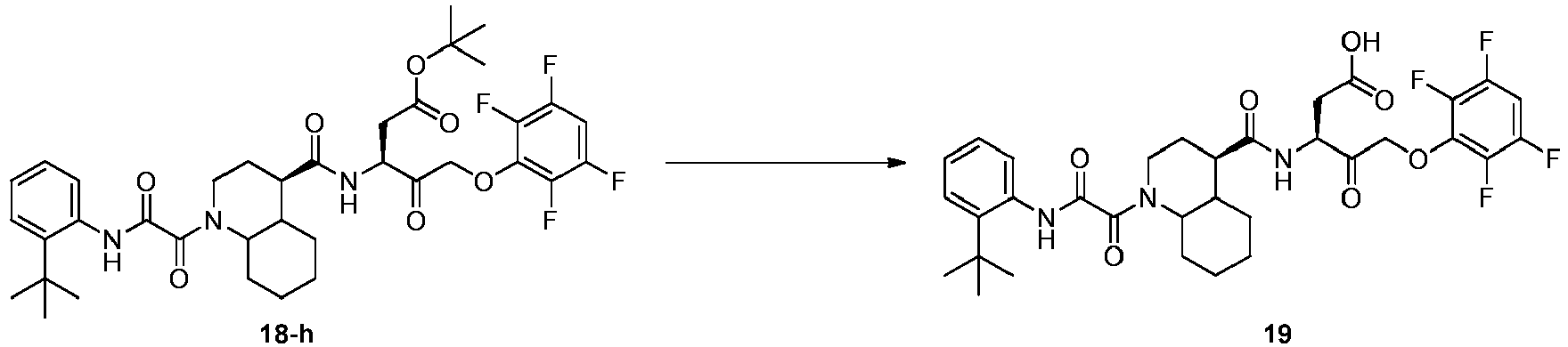
- Compound 18-h (72.00 mg, 100.03 µmol, 1.00 eq) was dissolved in dichloromethane (2.00 mL), and trifluoroacetic acid (1.64 g, 14.39 mmol, 1.07 mL, 143.85 eq) was added thereto. The reaction solution was stirred at 20°C for 1 hour under the protection of nitrogen gas. After the reaction was completed, the reaction solution was evaporated to remove the solvent and trifluoroacetic acid therein, and lyophilized to give the product of compound 19 (51.80 mg, yield: 78%). 1H NMR (400 MHz, DMSO-d6) δ =9.99 (br. s., 1H), 8.64-8.84 (m, 1H), 7.51-7.71 (m, 1H), 7.38-7.47 (m, 1H), 7.18-7.30 (m, 2H), 6.94-7.15 (m, 1H), 5.27 (s, 2H), 4.60 (q, J=6.53 Hz, 1H), 4.06-4.27 (m, 1H), 2.56-2.85 (m, 3H), 1.36-2.45 (m, 9H), 1.34 (s, 9H), 1.09-1.30 (m, 4H); LCMS m/z = 664.1 [M+H]+.
-

- Under the protection of nitrogen gas, compound 20-a (2.57 g, 10.00 mmol, 1.00 eq) was dissolved in tetrahydrofuran (100 mL). The system was cooled down to -78°C, added with LDA (2 M, 5.50 mL, 1.10 eq), and stirred at -78°C for 1 hour. Mel (3.68 g, 25.93 mmol, 1.61 mL, 2.59 eq) was then added to the above solution, slowly brought back to room temperature from -78°C, and stirred for another 15 hours. After the reaction was completed, the reaction solution was added with 150 mL of saturated ammonium chloride solution for quenching, and extracted with ethyl acetate (200 mL × 3). The organic phases were combined, and washed with saturated brine (100 mL). The organic phase was dried over anhydrous sodium sulfate, filtered, concentrated, and separated by column chromatography (petroleum ether : ethyl acetate = 1:0∼10:1) to give the product of compound 20-b (1.64 g, yield: 57%). 1H NMR (400MHz, CHLOROFORM-d) δ = 4.18 (q, J=7.2 Hz, 2H), 3.77 (br. s., 2H), 2.99 (t, J=11.2 Hz, 2H), 2.08 (d, J=13.6 Hz, 2H), 1.46 (s, 9H), 1.41-1.32 (m, 2H), 1.27 (t, J=7.0 Hz, 3H), 1.21 (s, 3H); LCMS m/z = 171.8 [M-Boc+H]+.
- Compound 20-b (1.60 g, 5.90 mmol, 1.00 eq) was dissolved in dichloromethane (15.00 mL), and trifluoroacetic acid (7 mL) was added to the above solution. The reaction solution was maintained at 25°C and stirred for 1.5 hours. After the reaction was completed, the reaction solution was concentrated to give the product of compound 20-c (1.12 g, crude) as a yellow oil, which was used directly in the next step without purification. LCMS m/z = 171.8 [M+H]+.
- Compound 1-d (1.70 g, 7.67 mmol, 1.30 eq) and HATU (4.49 g, 11.80 mmol, 2.00 eq) were dissolved in dichloromethane (80 mL), and stirred at room temperature for 15 min. Compound 20-c (1.01 g, 5.90 mmol, 1.00 eq) and N,N-diisopropylethylamine (2.29 g, 17.70 mmol, 3.09 mL, 3.00 eq) were then added thereto, and stirred at room temperature for 65 hours. After the reaction was completed, the reaction solution was 150 mL of water and separated, and the aqueous phase was further extracted with dichloromethane (200 mL × 2). The organic phases were combined, and washed with saturated sodium hydrogen carbonate solution (150 mL) and saturated brine (100 mL). The organic phase was dried over anhydrous sodium sulfate, filtered, concentrated, and separated by column chromatography (petroleum ether : ethyl acetate = 1:0∼12:1) to give the product of compound 20-d (2.17 g, yield: 90%). LCMS m/z = 375.2 [M+H]+.
- Compound 20-d (187.24 mg, 500.00 µmol, 1.00 eq) was dissolved in tetrahydrofuran (5.00 mL), and a solution of LiOH·H2O (41.96 mg, 1.00 mmol, 2.00 eq) dissolved in water (5.00 mL) was added to the above solution. The reaction solution was maintained at 25°C and stirred for 48 hours. After the reaction was completed, the reaction solution was adjusted to pH of 6 with 2 N dilute hydrochloric acid, added with 200 mL of water, and extracted with dichloromethane (200 mL × 3). The organic phase was dried over anhydrous sodium sulfate, filtered and concentrated to give the product of compound 20-e (193.00 mg, crude) as a pale yellow oil, which was used directly in the next step without purification. LCMS m/z = 347.1 [M+H]+; 369.0 [M+Na]+.
- Compound 20-e (173.21 mg, 500.00 µmol, 1.25 eq) and HOBt (75.67 mg, 560.00 µmol, 1.40 eq) were dissolved in dichloromethane (10 mL), added with EDCI (107.35 mg, 560.00 µmol, 1.40 eq), and stirred at room temperature for 15 min. Compound 1-n (141.32 mg, 400.00 µmol, 1.00 eq) and NMM (121.38 mg, 1.20 mmol, 131.93 µL, 3.00 eq) were then dissolved in dichloromethane, added to the above solution, and stirred at room temperature for 18 hours. After the reaction was completed, the reaction solution was added with 80 mL of water, and extracted with dichloromethane (80 mL × 3). The organic phases were combined, dried over anhydrous sodium sulfate, filtered and concentrated to give a crude product. The crude product was subjected to column chromatography (petroleum ether : ethyl acetate = 1:0∼3:1) to give the product of compound 20-f (74.00 mg, yield: 26%) as a yellow oil. LCMS m/z = 704.2 [M+Na]+.
- Compound 20-f (74.00 mg, 108.55 µmol, 1.00 eq) was dissolved in dichloromethane (20.00 mL), and PIDA (139.85 mg, 434.20 µmol, 4.00 eq) and TEMPO (3.41 mg, 21.71 µmol, 0.20 eq) were added thereto. The reaction solution was stirred at room temperature for 72 hours. After the reaction was completed, the reaction solution was added with saturated sodium hydrogen carbonate solution (50 mL) and saturated sodium sulfite solution (50 mL), extracted with dichloromethane (80 mL × 3), and washed with saturated brine (100 mL). The organic phase was dried over anhydrous sodium sulfate, filtered and concentrated to give a crude product. The crude product was subjected to column chromatography (petroleum ether : ethyl acetate = 1:0∼5:2) to give the product of compound 20-g (25.00 mg, yield: 30%) as a yellow oil. LCMS m/z = 702.2 [M+Na]+.
- Compound 20-g (22.00 mg, 32.37 µmol, 1.00 eq) was dissolved in dichloromethane (3.00 mL), and trifluoroacetic acid (4.62 g, 40.52 mmol, 1.5 mL) was added thereto. The reaction solution was stirred at room temperature for 2 hours. After the reaction was completed, the reaction solution was spin-dried to give a crude product. The crude product was purified by preparative HPLC (under trifluoroacetic acid condition), and lyophilized to give the product of compound 20 (15.00 mg, yield: 74%). 1H NMR (400MHz, CHLOROFORM-d) δ = 9.44 (br. s., 1H), 7.82-7.64 (m, 1H), 7.43 (d, J=7.5 Hz, 1H), 7.29-7.22 (m, 1H), 7.21-7.14 (m, 1H), 6.83 (d, J=7.0 Hz, 1H), 5.10-4.81 (m, 2H), 4.60 (br. s., 1H), 4.45-4.27 (m, 1H), 4.17-3.96 (m, 1H), 3.96-3.63 (m, 1H), 3.51-3.25 (m, 1H), 3.11-2.63 (m, 2H), 2.28-2.06 (m, 2H), 1.73-1.50 (m, 2H), 1.44 (s, 9H), 1.28 (s, 3H); LCMS m/z = 624.1 [M+H]+.
-

- Under the protection of nitrogen gas, compound 20-a (2.57 g, 10.00 mmol, 1.00 eq) was dissolved in tetrahydrofuran (100 mL). The system was cooled down to 0°C, added with LDA (2 M, 5.50 mL, 1.10 eq), and stirred at 0°C for 1 hour. NFSI (3.94 g, 12.50 mmol, 1.25 eq) was then added to the above solution, slowly brought back to room temperature from 0°C, and stirred for 15 hours. After the reaction was completed, the solvent was spin-dried, following by adding ethyl acetate (150 mL) for dilution. The organic phase was washed successively with water (100 mL), 1 N hydrochloric acid (100 mL), saturated sodium hydrogen carbonate solution (100 mL) and saturated brine (100 mL). The organic phase was dried over anhydrous sodium sulfate, filtered, concentrated, and separated by column chromatography (petroleum ether : ethyl acetate = 1:0∼10:1) to give the product of compound 21-a (1.00 g, yield: 24%). LCMS m/z = 175.3 [M-Boc+H]+.
- Compound 21-a (1.00 g, 3.63 mmol, 1.00 eq) was dissolved in dichloromethane (15.00 mL), and trifluoroacetic acid (7 mL) was added to the above solution. The reaction solution was maintained at 25°C and stirred for 1.5 hours. After the reaction was completed, the reaction solution was concentrated to give the product of compound 21-b (0.712 g, crude) as a yellow oil, which was used directly in the next step without purification. LCMS m/z = 175.9 [M+H]+.
- Compound 1-d (1.04 g, 4.72 mmol, 1.30 eq) and HATU (2.76 g, 7.26 mmol, 2.00 eq) were dissolved in dichloromethane (80 mL), and stirred at room temperature for 15 min. Compound 21-b (635.98 mg, 3.63 mmol, 1.00 eq) and N,N-diisopropylethylamine (1.41 g, 10.89 mmol, 1.90 mL, 3.00 eq) were then added, and stirred at room temperature for 18 hours. After the reaction was completed, the reaction solution was added with 150 mL of water and separated, and the aqueous phase was further extracted with dichloromethane (200 mL × 2). The organic phases were combined, and washed with saturated sodium hydrogen carbonate solution (150 mL) and saturated brine (100 mL). The organic phase was dried over anhydrous sodium sulfate, filtered, concentrated, and separated by column chromatography (petroleum ether : ethyl acetate = 1:0∼4:1) to give the product of compound 21-c (852.00 mg, yield: 61%). 1H NMR (400MHz, CHLOROFORM-d) δ =9.54 (br. s., 1H), 7.88 (dd, J=1.0, 7.8 Hz, 1H), 7.45 (dd, J=1.1, 7.9 Hz, 1H), 7.32-7.25 (m, 1H), 7.24-7.15 (m, 1H), 5.39-5.31 (m, 1H), 4.58 (d, J=13.6 Hz, 1H), 4.29 (q, J=7.0 Hz, 2H), 3.65-3.53 (m, 1H), 3.28-3.17 (m, 1H), 2.36-2.06 (m, 4H), 1.49 (s, 9H), 1.34 (t, J=7.2 Hz, 3H); LCMS m/z = 361.0 [M-F+H] +.
- Compound 21-c (567.66 mg, 1.50 mmol, 1.00 eq) was dissolved in tetrahydrofuran (5.00 mL), and a solution of LiOH·H2O (125.88 mg, 3.00 mmol, 2.00 eq) dissolved in water (5.00 mL) was added to the above solution. The reaction solution was maintained at 25°C and stirred for 48 hours. After the reaction was completed, the reaction solution was adjusted to pH of 6 with 2 N dilute hydrochloric acid, added with 50 mL of water, and extracted with dichloromethane (50 mL × 3). The organic phase was dried over anhydrous sodium sulfate, filtered and concentrated to give the product of compound 21-d (852.00 mg, crude) as a pale yellow oil, which was used directly in the next step without purification. LCMS m/z = 351.1 [M+H]+.
- Compound 21-d (315.34 mg, 900.00 µmol, 1.50 eq) and HATU (456.28 mg, 1.20 mmol, 2.00 eq) were dissolved in dichloromethane (10 mL), and stirred at room temperature for 15 min. Compound 1-n (211.99 mg, 600.00 µmol, 1.00 eq) and N,N-diisopropylethylamine (232.63 mg, 1.80 mmol, 314.37 µL, 3.00 eq) were then added, and stirred at room temperature for 18 hours. After the reaction was completed, the reaction solution was added with 80 mL of water, and extracted with dichloromethane (80 mL × 3). The organic phases were combined, dried over anhydrous sodium sulfate, filtered and concentrated to give a crude product. The crude product was subjected to column chromatography (petroleum ether : ethyl acetate = 1:0∼3:1) to give the product of compound 21-e (190.00 mg, yield: 39%) as a yellow oil. LCMS m/z = 708.2 [M+Na]+.
- Compound 21-e (190.00 mg, 278.71 µmol, 1.00 eq) was dissolved in dichloromethane (20.00 mL), and PIDA (359.09 mg, 1.11 mmol, 4.00 eq) and TEMPO (8.77 mg, 55.74 µmol, 0.20 eq) were added thereto. The reaction solution was stirred at room temperature for 72 hours. After the reaction was completed, the reaction solution was added with saturated sodium hydrogen carbonate solution (50 mL) and saturated sodium sulfite solution (50 mL), extracted with dichloromethane (80 mL × 3), and washed with saturated brine (100 mL). The organic phase was dried over anhydrous sodium sulfate, filtered and concentrated to give a crude product. The crude product was subjected to column chromatography (petroleum ether : ethyl acetate = 1:0∼3:1) to give the product of compound 21-f (127.00 mg, yield: 60%) as a yellow oil. LCMS m/z = 706.2 [M+Na]+.
- Compound 21-f (120.00 mg, 175.53 µmol, 1.00 eq) was dissolved in dichloromethane (3.00 mL), and trifluoroacetic acid (4.62 g, 40.52 mmol, 1.5 mL) was added thereto. The reaction solution was stirred at room temperature for 2 hours. After the reaction was completed, the reaction solution was spin-dried to give a crude product. The crude product was purified by preparative HPLC (under trifluoroacetic acid condition), and lyophilized to give the product of compound 21 (108.00 mg, yield: 94%). 1H NMR (400MHz, DMSO-d6) δ =10.16 (s, 1H), 8.79 (d, J=6.5 Hz, 1H), 7.65-7.53 (m, 1H), 7.48-7.41 (m, 1H), 7.32-7.21 (m, 2H), 7.18-7.11 (m, 1H), 5.25 (d, J=4.5 Hz, 2H), 4.78 (d, J=7.0 Hz, 1H), 4.32 (d, J=11.0 Hz, 1H), 4.03 (d, J=13.1 Hz, 1H), 3.10-2.99 (m, 2H), 2.85 (dd, J=6.0, 16.6 Hz, 1H), 2.64 (dd, J=7.0, 16.6 Hz, 1H), 2.25-1.90 (m, 4H), 1.35 (s, 9H); LCMS m/z = 624.1 [M+H]+.
-

- Compound 3-b (100.00 mg, 171.07 µmol, 1.00 eq) was dissolved in dichloromethane (5.00 mL), and PIDA (220.41 mg, 684.28 µmol, 4.00 eq) and TEMPO (5.38 mg, 34.21 µmol, 0.20 eq) were added thereto. The reaction solution was stirred at room temperature for 12 hours. After the reaction was completed, the reaction solution was added with saturated sodium hydrogen carbonate solution (50 mL) and saturated sodium sulfite solution (50 mL), extracted with dichloromethane (80 mL × 3), and washed with saturated brine (100 mL). The organic phase was dried over anhydrous sodium sulfate, filtered and concentrated to give a crude product. The crude product was purified by preparative silica gel plates (petroleum ether : ethyl acetate = 2:1) to give the product of compound 22-a (50.00 mg, yield: 44%) as a yellow oil.
- Compound 22-a (100.00 mg, 171.66 µmol, 1.00 eq) was dissolved in dichloromethane (20.00 mL), and trifluoroacetic acid (10 mL) was added thereto. The reaction solution was stirred at room temperature for 0.8 hour. After the reaction was completed, the reaction solution was spin-dried to give a crude product. The crude product was purified by preparative HPLC (under trifluoroacetic acid condition), and lyophilized to give the product of compound 22 (14.00 mg, yield: 15%). 1H NMR (400MHz, DMSO-d6) δ =8.71-8.39 (m, 1H), 7.71-7.45 (m, 1H), 7.32-7.25 (m, 1H), 7.34 (s, 5H), 5.34-5.08 (m, 1H), 5.06-5.00 (m, 2H), 4.70-4.57 (m, 1H), 3.60-3.50 (m, 2H), 3.10-2.56 (m, 4H), 2.38-2.24 (m, 1H), 2.16-1.82 (m, 2H), 1.34-1.12 (m, 1H).
-

- Compound 23-a (1.78 g, 13.00 mmol, 1.00 eq) and sodium hydrogen carbonate solution (8.74 g, 104.00 mmol, 4.05 mL, 8.00 eq) were dissolved in water (100 mL) and dioxane (100 mL). The system was cooled down to 0°C, added with CbzCl (2.33 g, 13.65 mmol, 1.94 mL, 1.05 eq), and the reaction was stirred at room temperature for 15 hours. After the reaction was completed, 1 N dilute hydrochloric acid was added to adjust the pH of the solution to about 3, and precipitates appeared. The precipitates were filtered, washed with water, and dried to give the product of compound 23-b (1.43 g, yield: 41%).
- Compound 23-b (455.73 mg, 1.68 mmol, 1.40 eq) and HOBt (227.00 mg, 1.68 mmol, 1.40 eq) were dissolved in dichloromethane (10 mL), added with EDCI (322.06 mg, 1.68 mmol, 1.40 eq), and stirred at room temperature for 15 min. Compound 1-n (423.97 mg, 1.2 mmol, 1.00 eq) and NMM (364.14 mg, 3.60 mmol, 395.80 µL, 3.00 eq) were then dissolved in dichloromethane, added to the above solution, and stirred at room temperature for 16 hours. After the reaction was completed, the reaction solution was added with 80 mL of water, and extracted with dichloromethane (80 mL × 3). The organic phases were combined, dried over anhydrous sodium sulfate, filtered and concentrated to give a crude product. The crude product was subjected to column chromatography (petroleum ether : ethyl acetate = 1:0∼3:1) to give the product of compound 23-c (400.00 mg, yield: 49%) as a yellow oil. LCMS m/z = 729.2 [M+Na]+.
- Compound 23-c (150.00 mg, 247.30 µmol, 1.00 eq) was dissolved in dichloromethane (10.00 mL), and PIDA (318.62 mg, 989.20 µmol, 4.00 eq) and TEMPO (7.78 mg, 49.46 µmol, 0.20 eq) were added thereto. The reaction solution was stirred at room temperature for 24 hours. After the reaction was completed, the reaction solution was added with saturated sodium hydrogen carbonate solution (20 mL) and saturated sodium sulfite solution (20 mL), extracted with dichloromethane (30 mL × 3), and washed with saturated brine (100 mL). The organic phase was dried over anhydrous sodium sulfate, filtered and concentrated to give a crude product. The crude product was subjected to column chromatography (petroleum ether : ethyl acetate = 1:0∼3:1) to give the product of compound 23-d (130.00 mg, yield: 74%) as a yellow oil. LCMS m/z = 605.3 [M+H]+.
- Compound 23-d (130.00 mg, 215.04 µmol, 1.00 eq) was dissolved in dichloromethane (6.00 mL), and trifluoroacetic acid (4.62 g, 40.52 mmol, 3.00 mL) was added thereto. The reaction solution was stirred at room temperature for 2 hours. After the reaction was completed, the reaction solution was spin-dried to give a crude product. The crude product was purified by preparative HPLC (under trifluoroacetic acid condition), and lyophilized to give the product of compound 23 (75.00 mg, yield: 64%). 1H NMR (400MHz, DMSO-d6) δ =10.11 (s, 1H), 8.84 (d, J=7.5 Hz, 1H), 7.82 (d, J=8.5 Hz, 2H), 7.63-7.51 (m, 3H), 7.47-7.36 (m, 6H), 5.30 (d, J=4.5 Hz, 2H), 5.19 (s, 2H), 4.84 (d, J=7.0 Hz, 1H), 2.90 (dd, J=6.5, 16.6 Hz, 1H), 2.66 (dd, J=7.0, 16.6 Hz, 1H); LCMS m/z = 549.1 [M+H]+.
-

- Compound 8-b (117.00 mg, 194.82 µmol, 1.00 eq) was dissolved in dichloromethane (4.00 mL), and PIDA (242.85 mg, 753.95 µmol, 3.87 eq) and TEMPO (6.13 mg, 38.96 µmol, 0.20 eq) were added thereto. The reaction solution was stirred at 27°C for 16 hours under the protection of nitrogen gas. After the reaction was completed, the reaction solution was added with 100 mL of ethyl acetate. The solution was washed successively with saturated sodium hydrogen carbonate (50 mL), saturated brine (50 mL) and water (50 mL). The organic phase was dried over anhydrous sodium sulfate, filtered and concentrated to give a crude product. The crude product was purified by preparative silica gel plates (petroleum ether: ethyl acetate = 2:1) to give the product of compound 24-a (90.00 mg, yield: 63%) as a colorless oil. LCMS m/z = 621.3 [M+Na]+.
- Compound 24-a (90.00 mg, 150.37 µmol, 1.00 eq) was dissolved in dichloromethane (3.20 mL), and trifluoroacetic acid (2.47 g, 21.63 mmol, 1.60 mL, 143.85 eq) was added thereto. The reaction solution was stirred at 27°C for 1 hour under the protection of nitrogen gas. After the reaction was completed, the reaction solution was spin-dried to give a crude product. The crude product was purified by preparative HPLC (under trifluoroacetic acid condition), and lyophilized to give the product of compound 24 (25.60 mg, yield: 31%). 1H NMR (400 MHz, DMSO-d6) δ =8.36 (dd, J=3.76, 7.78 Hz, 1H), 7.51-7.70 (m, 1H), 7.28-7.42 (m, 5H), 5.15-5.28 (m, 2H), 5.11 (s, 2H), 4.69-4.78 (m, 1H), 3.86-4.10 (m, 3H), 3.50-3.58 (m, 2H), 2.75-3.14 (m, 3H), 2.58-2.68 (m, 1H); LCMS m/z = 543.0 [M+H]+.
-

- Compound 6-b (150.00 mg, 244.85 µmol, 1.00 eq) was dissolved in dichloromethane (5.00 mL), and PIDA (315.47 mg, 979.42 µmol, 4.00 eq) and TEMPO (7.70 mg, 48.97 µmol, 0.20 eq) were added thereto. The reaction solution was stirred at 25°C for 5 hours under the protection of nitrogen gas. After the reaction was completed, the reaction solution was added with 100 mL of ethyl acetate. The solution was washed successively with saturated sodium hydrogen carbonate (50 mL), saturated brine (50 mL) and water (50 mL). The organic phase was dried over anhydrous sodium sulfate, filtered and concentrated to give a crude product. The crude product was purified by preparative silica gel plates (petroleum ether : ethyl acetate = 2:1) to give the product of compound 25-a (130.00 mg, crude) as a colorless oil.
- Compound 25-a (100.00 mg, 163.78 µmol, 1.00 eq) was dissolved in dichloromethane (20.00 mL), and trifluoroacetic acid (10 mL) was added thereto. The reaction solution was stirred at 25°C for 0.8 hour under the protection of nitrogen gas. After the reaction was completed, the reaction solution was spin-dried to give a crude product. The crude product was purified by preparative HPLC (under trifluoroacetic acid condition), and lyophilized to give the product of compound 25 (15.00 mg, yield: 15%). 1H NMR (400MHz, DMSO-d6) δ = 8.39-8.28 (m, 1H), 7.63-7.49 (m, 1H), 7.33 (s, 5H), 7.22-7.11 (m, 1H), 5.18 (d, J=9.5 Hz, 2H), 4.98 (s, 2H), 4.62-4.49 (m, 1H), 3.28-3.15 (m, 1H), 2.76-2.64 (m, 1H), 2.60-2.52 (m, 1H), 2.15-1.93 (m, 1H), 1.89-1.64 (m, 4H), 1.22 (br. s., 5H).
-

- Compound 26-a (907.54 mg, 7.95 mmol, 864.33 µL, 1.00 eq) was dissolved in dichloromethane (30.00 mL), and compound 4-a (1.25 g, 7.95 mmol, 1.00 eq), EDCI (2.09 g, 10.89 mmol, 1.37 eq), HOBt (1.47 g, 10.89 mmol, 1.37 eq) and NMM (2.41 g, 23.85 mmol, 2.62 mL, 3.00 eq) were added thereto. The reaction solution was stirred at 18°C for 15 hours under the protection of nitrogen gas. After the reaction was completed, the reaction solution was added with 200 mL of water, and extracted with dichloromethane (200 mL × 3). The organic phase was dried over anhydrous sodium sulfate, filtered and concentrated to give a crude product. The crude product was subjected to column chromatography (petroleum ether : ethyl acetate = 1:0∼5:1) to give the product of compound 26-b (1.60 g, yield: 79%) as a colorless oil. LCMS m/z = 254.4 [M+H]+.
- Compound 26-b (1.60 g, 6.32 mmol, 1.00 eq) was dissolved in tetrahydrofuran (20.00 mL), and a solution of LiOH·H2O (397.51 mg, 9.48 mmol, 1.50 eq) dissolved in water (20.00 mL) was added to the above solution. The reaction solution was stirred at 18°C for 1 hour, then supplementarily added with LiOH·H2O (397.51 mg, 9.48 mmol, 1.50 eq), and stirred for another 1 hour. After the reaction was completed, the reaction solution was adjusted to pH of 5 with 2 N dilute hydrochloric acid, added with 150 mL of water, and extracted with dichloromethane (150 mL × 3). The organic phase was dried over anhydrous sodium sulfate, filtered and concentrated to give the product of compound 26-c (1.30 g, yield: 91%), which was used directly in the next step without purification. 1H NMR (400 MHz, CHLOROFORM-d) δ =4.17-4.64 (m, 1H), 3.79-4.05 (m, 1H), 3.06-3.42 (m, 1H), 2.84-3.05 (m, 2H), 2.50 (d, J=3.26 Hz, 1H), 2.05-2.17 (m, 1H), 1.66-1.94 (m, 9H), 1.57 (d, J=4.52 Hz, 2H).
- Compound 1-n (500.00 mg, 1.42 mmol, 1.00 eq) was dissolved in dichloromethane (20.00 mL), and compound 26-c (319.90 mg, 1.42 mmol, 1.00eq), EDCI (372.93 mg, 1.95 mmol, 1.37 eq), HOBt (262.86 mg, 1.95 mmol, 1.37 eq) and NMM (430.90 mg, 4.26 mmol, 468.37 µL, 3.00 eq) were added thereto. The reaction solution was stirred at 18°C for 13 hours under the protection of nitrogen gas. After the reaction was completed, the reaction solution was added with 150 mL of water, and extracted with dichloromethane (150 mL × 3). The organic phases were combined, dried over anhydrous sodium sulfate, filtered and concentrated to give a crude product. The crude product was subjected to column chromatography (petroleum ether : ethyl acetate = 1:0∼5:4) to give the product of compound 26-d (550.00 mg, yield: 65%) as a colorless oil. LCMS m/z = 561.6 [M+H] +.
- Compound 26-d (550.00 mg, 981.13 µmol, 1.00 eq) was dissolved in dichloromethane (20.00 mL), and PIDA (1.22 g, 3.80 mmol, 3.87 eq) and TEMPO (46.28 mg, 294.34 µmol, 0.30 eq) were added thereto. The reaction solution was stirred at 18°C for 15 hours under the protection of nitrogen gas. After the reaction was completed, the reaction solution was added with 200 mL of ethyl acetate. The solution was washed successively with saturated sodium hydrogen carbonate (100 mL), saturated brine (100 mL) and water (100 mL). The organic phase was dried over anhydrous sodium sulfate, filtered and concentrated to give a crude product. The crude product was subjected to column chromatography (petroleum ether : ethyl acetate = 10:1∼5:4) to give the product of compound 26-e (230.00 mg, yield: 36%) as a pale yellow oil. LCMS m/z = 559.2 [M+H]+.
- Compound 26-e (230.00 mg, 411.77 µmol, 1.00 eq) was dissolved in dichloromethane (9.00 mL), and trifluoroacetic acid (6.75 g, 59.23 mmol, 4.38 mL, 143.85 eq) was added thereto. The reaction solution was stirred at 15°C for 1 hour under the protection of nitrogen gas. After the reaction was completed, the reaction solution was spin-dried to give a crude product. The crude product was purified by preparative HPLC (under trifluoroacetic acid condition), and lyophilized to give the product of compound 26 (121.20 mg, yield: 59%). 1H NMR (400 MHz, DMSO-d6) δ =8.45-8.57 (m, 1H), 7.50-7.66 (m, 1H), 5.14-5.30 (m, 2H), 4.60 (q, J=6.53 Hz, 1H), 4.20-4.39 (m, 1H), 3.89 (d, J=13.05 Hz, 1H), 2.91-3.13 (m, 2H), 2.54-2.81 (m, 3H), 2.18-2.38 (m, 1H), 1.16-1.93 (m, 12H); LCMS m/z = 503.0 [M+H]+.
-

- Compound 27-a (2.00 g, 23.49 mmol, 2.33 mL, 1.00 eq) was dissolved in dichloromethane (40.00 mL), and triethylamine (4.75 g, 46.98 mmol, 6.51 mL, 2.00 eq) and compound 1-b (3.85 g, 28.19 mmol, 3.16 mL, 1.20 eq) were successively added thereto. The reaction solution was stirred at 20°C for 16 hours. After the reaction was completed, the reaction solution was added with water (150 mL) and ethyl acetate (250 mL) for extraction. The organic phase was washed with water (150 mL) and brine (150 mL), dried over anhydrous sodium sulfate, filtered, and concentrated to give a crude product. The crude product was subjected to column chromatography (petroleum ether : ethyl acetate = 1:0∼2:1) to give the product of compound 27-b (4.20 g, yield: 95%) as a yellow oil. 1H NMR (400 MHz, CHLOROFORM-d) δ =7.05 (br. s., 1H), 4.34 (q, J=7.28 Hz, 2H), 4.23 (sxt, J=7.08 Hz, 1H), 1.97-2.09 (m, 2H), 1.57-1.77 (m, 4H), 1.47 (qd, J=6.38, 12.49 Hz, 2H), 1.38 (t, J=7.15 Hz, 3H).
- Compound 27-b (500.00 mg, 2.70 mmol, 1.00 eq) was dissolved in tetrahydrofuran (8.00 mL), and a solution of LiOH·H2O (339.88 mg, 8.10 mmol, 3.00 eq) dissolved in water (8.00 mL) was added to the above solution. The reaction solution was stirred at 20°C for 1 hour. After the reaction was completed, the reaction solition was adjusted to pH of 6 with 2 N dilute hydrochloric acid, added with water (50 mL), and extracted with dichloromethane (50 mL × 3). The organic phase was dried over anhydrous sodium sulfate, filtered and concentrated to give the product of compound 27-c (290.00 mg, crude) as a pale yellow solid, which was used directly in the next step without purification. 1H NMR (400 MHz, CHLOROFORM-d) δ =7.29 (br. s., 1H), 4.21 (sxt, J=6.98 Hz, 1H), 1.98-2.11 (m, 2H), 1.60-1.81 (m, 4H), 1.47-1.60 (m, 2H).
- Compound 27-c (612.96 mg, 3.90 mmol, 1.20 eq) and HATU (2.47 g, 6.50 mmol, 2.00 eq) were dissolved in dichloromethane (60 mL), and stirred at room temperature for 15 min. Compound 4-a (510.93 mg, 3.25 mmol, 1.00 eq) and N,N-diisopropylethylamine (1.26 g, 9.75 mmol, 1.70 mL, 3.00 eq) were then added, and stirred at room temperature for 18 hours. After the reaction was completed, the reaction solution was added with 150 mL of water, and extracted with dichloromethane (80 mL × 3). The organic phases were combined, dried over anhydrous sodium sulfate, filtered and concentrated to give a crude product. The crude product was subjected to column chromatography (petroleum ether : ethyl acetate = 1:0∼3:1) to give the product of compound 27-d (608.00 mg, yield: 59%) as a yellow oil. 1H NMR (400MHz, CHLOROFORM-d) δ = 7.17 (br. s., 1H), 4.75-4.61 (m, 1H), 4.49 (d, J=13.1 Hz, 0.5H), 4.20-4.07 (m, 3H), 4.06-4.00 (m, 0.5H), 3.62-3.53 (m, 0.5H), 3.17 (t, J=12.2 Hz, 0.5H), 3.04 (t, J=11.5 Hz, 0.5H), 3.00-2.91 (m, 0.5H), 2.64-2.54 (m, 0.5H), 2.48 (t, J=10.4 Hz, 0.5H), 2.13-1.91 (m, 4H), 1.83-1.59 (m, 6H), 1.49-1.39 (m, 2H), 1.27-1.19 (m, 3H); LCMS m/z = 297.1 [M+H]+.
- Compound 27-d (444.54 mg, 1.50 mmol, 1.00 eq) was dissolved in tetrahydrofuran (5.00 mL), and a solution of LiOH·H2O (96.88 mg, 2.31 mmol, 2.00 eq) dissolved in water (5.00 mL) was added to the above solution. The reaction solution was maintained at 25°C and stirred for 2 hours. After the reaction was completed, the reaction solution was adjusted to pH of 6 with 2 N dilute hydrochloric acid, added with 20 mL of water, and extracted with dichloromethane (20 mL × 3). The organic phase was dried over anhydrous sodium sulfate, filtered and concentrated to give the product of compound 27-e (254.00 mg, crude) as a pale yellow oil, which was used directly in the next step without purification. LCMS m/z = 269.0 [M+H]+; 290.9 [M+Na]+.
- Compound 27-e (254.89 mg, 950.00 µmol, 1.19 eq) and HATU (608.37 mg, 1.60 mmol, 2.00 eq) were dissolved in dichloromethane (15 mL), and stirred at room temperature for 15 min. Compound 1-n (282.65 mg, 800.00 µmol, 1.00 eq) and N,N-diisopropylethylamine (310.18 mg, 2.40 mmol, 419.16 µL, 3.00 eq) were then added, and stirred at room temperature for 18 hours. After the reaction was completed, the reaction solution was added with 150 mL of water, and extracted with dichloromethane (80 mL × 3). The organic phases were combined, dried over anhydrous sodium sulfate, filtered and concentrated to give a crude product. The crude product was subjected to column chromatography (petroleum ether : ethyl acetate = 1:0∼2:1) to give the product of compound 27-f (138.00 mg, yield: 22%) as a yellow oil. LCMS m/z = 626.1 [M+Na]+.
- Compound 27-f (138.00 mg, 228.63 µmol, 1.00 eq) was dissolved in dichloromethane (10.00 mL), and PIDA (294.56 mg, 914.51 µmol, 4.00 eq) and TEMPO (7.19 mg, 45.73 µmol, 0.20 eq) were added thereto. The reaction solution was stirred at room temperature for 54 hours. After the reaction was completed, the reaction solution was added with saturated sodium hydrogen carbonate solution (50 mL) and saturated sodium sulfite solution (50 mL), extracted with dichloromethane (80 mL × 3), and washed with saturated brine (100 mL). The organic phase was dried over anhydrous sodium sulfate, filtered and concentrated to give a crude product. The crude product was subjected to column chromatography (petroleum ether : ethyl acetate = 1:0∼2:1) to give the product of compound 27-g (75.00 mg, yield: 47%) as a yellow oil. LCMS m/z = 624.3 [M+Na]+.
- Compound 27-g (70.00 mg, 116.36 µmol, 1.00 eq) was dissolved in dichloromethane (3.00 mL), and trifluoroacetic acid (4.62 g, 40.52 mmol, 1.5 mL) was added thereto. The reaction solution was stirred at room temperature for 2 hours. After the reaction was completed, the reaction solution was spin-dried to give a crude product. The crude product was purified by preparative HPLC (under trifluoroacetic acid condition), and lyophilized to give the product of compound 27 (62.00 mg, yield: 97%). 1H NMR (400MHz, DMSO-d6) δ= 8.67-8.56 (m, 2H), 7.63-7.52 (m, 1H), 5.32-5.14 (m, 2H), 4.68-4.55 (m, 1H), 4.32-4.17 (m, 1H), 4.06-4.01 (m, 1H), 3.62 (t, J=13.8 Hz, 1H), 3.19-2.95 (m, 1H), 2.78-2.68 (m, 2H), 2.65-2.57 (m, 1H), 2.46-2.29 (m, 1H), 2.01-1.87 (m, 1H), 1.86-1.76 (m, 2H), 1.65-1.38 (m, 9H); LCMS m/z = 546.1 [M+H]+.
-

- Compound 28-a (775.17 mg, 9.00 mmol, 815.97 µL, 3.00 eq) and CDI (1.46 g, 9.00 mmol, 3.00 eq) were dissolved in tetrahydrofuran (40 mL), and stirred at room temperature for 1.5 hours. Compound 4-a (921.90 mg, 3.00 mmol, 1.00 eq) and triethylamine (1.52 g, 15.00 mmol, 2.08 mL, 5.00 eq) were then added, and stirred at 80°C for 15 hours. After the reaction was completed, the reaction solution was added with 150 mL of dichloromethane for dilution, and washed with saturated sodium hydrogen carbonate solution (150 mL) and saturated NH4Cl (100 mL). The organic phase was dried over anhydrous sodium sulfate, filtered, concentrated, and separated by column chromatography (petroleum ether : ethyl acetate = 1:0∼10:1) to give the product of compound 28-b (245.00 mg, yield: 10%). 1H NMR (400MHz, CHLOROFORM-d) δ = 5.09 (t, J=5.8 Hz, 1H), 4.13 (q, J=7.0 Hz, 2H), 3.93 (br. s., 1H), 2.99 (br. s., 1H), 2.88-2.75 (m, 1H), 2.42 (br. s., 1H), 2.09-2.00 (m, 1H), 1.82 (dd, J=5.5, 11.0 Hz, 2H), 1.76-1.66 (m, 6H), 1.64-1.52 (m, 3H), 1.49-1.39 (m, 1H), 1.25 (t, J=7.0 Hz, 3H); LCMS m/z = 270.0 [M+H] +.
- Compound 28-b (240.00 mg, 891.07 µmol, 1.00 eq) was dissolved in tetrahydrofuran (5.00 mL), and a solution of LiOH·H2O (74.78 mg, 1.78 mmol, 2.00 eq) dissolved in water (5.00 mL) was added to the above solution. The reaction solution was maintained at 25°C and stirred for 2 hours. After the reaction was completed, the reaction solution was adjusted to pH of 6 with 2 N dilute hydrochloric acid, added with 30 mL of water, and extracted with dichloromethane (20 mL × 3). The organic phase was dried over anhydrous sodium sulfate, filtered and concentrated to give the product of compound 28-c (178.00 mg, crude) as a pale yellow oil, which was used directly in the next step without purification. LCMS m/z = 264.1 [M+Na]+.
- Compound 28-c (175.17 mg, 726.00 µmol, 1.21 eq) and HATU (456.28 mg, 1.20 mmol, 2.00 eq) were dissolved in dichloromethane (15 mL), and stirred at room temperature for 15 min. Compound 1-n (211.99 mg, 600.00 µmol, 1.00 eq) and N,N-diisopropylethylamine (232.63 mg, 1.80 mmol, 314.37 µL, 3.00 eq) were then added, and stirred at room temperature for 18 hours. After the reaction was completed, the reaction solution was added with 150 mL of water, and extracted with dichloromethane (80 mL × 3). The organic phases were combined, dried over anhydrous sodium sulfate, filtered and concentrated to give a crude product. The crude product was subjected to column chromatography (petroleum ether : ethyl acetate = 1:0∼2:1) to give the product of compound 28-d (310.00 mg, yield: 78%) as a yellow oil. LCMS m/z = 577.1 [M+H]+; 599.1 [M+Na]+.
- Compound 28-d (310.00 mg, 537.65 µmol, 1.00 eq) was dissolved in dichloromethane (20.00 mL), and PIDA (692.71 mg, 2.15 mmol, 4.00 eq) and TEMPO (16.91 mg, 107.53 µmol, 0.20 eq) were added thereto. The reaction solution was stirred at room temperature for 48 hours. After the reaction was completed, the reaction solution was added with saturated sodium hydrogen carbonate solution (50 mL) and saturated sodium sulfite solution (50 mL), extracted with dichloromethane (80 mL × 3), and washed with saturated brine (100 mL). The organic phase was dried over anhydrous sodium sulfate, filtered and concentrated to give a crude product. The crude product was subjected to column chromatography (petroleum ether : ethyl acetate = 1:0∼3:1) to give the product of compound 28-e (247.00 mg, yield: 69%) as a yellow oil. LCMS m/z = 575.1 [M+H]+; 597.1 [M+Na]+.
- Compound 28-e (247.00 mg, 429.89 µmol, 1.00 eq) was dissolved in dichloromethane (5.00 mL), and trifluoroacetic acid (4.62 g, 40.52 mmol, 3.00 mL) was added thereto. The reaction solution was stirred at room temperature for 1.5 hours. After the reaction was completed, the reaction solution was spin-dried to give a crude product. The crude product was purified by preparative HPLC (under trifluoroacetic acid condition), and lyophilized to give the product of compound 28 (202.00 mg, yield: 88%). 1H NMR (400MHz, DMSO-d6) δ= 8.54 (d, J=7.0 Hz, 1H), 7.63-7.51 (m, 1H), 5.29-5.15 (m, 2H), 4.96 (br. s., 1H), 4.61 (q, J=6.5 Hz, 1H), 3.94-3.80 (m, 2H), 2.88-2.70 (m, 3H), 2.60 (dd, J=6.8, 16.8 Hz, 1H), 2.31 (t, J=10.5 Hz, 1H), 1.88-1.72 (m, 4H), 1.62-1.52 (m, 6H), 1.39-1.27 (m, 2H); LCMS m/z = 519.1 [M+H]+; 541.0 [M+Na]+.
-

- Triethylamine (4.05 g, 40.00 mmol, 5.55 mL, 2.00 eq) and CDI (3.41 g, 21.00 mmol, 1.05 eq) were dissolved in dichloromethane (100 mL), and added with compound 29-a (6.15 g, 20.00 mmol, 1.00 eq) in an ice bath. The reaction solution was stirred at room temperature for 19 hours. After the reaction was completed, the reaction solution was added with 150 mL of dichloromethane for dilution, and washed with water (150 mL) and saturated brine (100 mL). The organic phase was dried over anhydrous sodium sulfate, filtered, concentrated, to give the product of compound 29-b (4.85 g, crude). LCMS m/z = 251.9 [M+H] +.
- Compound 29-b (4.85 g, 19.30 mmol, 1.00 eq) was dissolved in acetonitrile (20.00 mL), and Mel (9.37 g, 66.01 mmol, 4.11 mL, 3.42 eq) was added to the above solution. The reaction solution was maintained at 25°C and stirred for 24 hours. After the reaction was completed, the organic solvent was concentrated to give the product of compound 29-c (7.83g, crude) as a pale yellow oil, which was used directly in the next step without purification.
- Compound 29-c (1.18 g, 3.00 mmol, 1.00 eq) was dissolved in dichloromethane (15 mL), and added with compound 27-a (255.45 mg, 3.00 mmol, 297.03 µL, 1.00 eq) and triethylamine (303.57 mg, 3.00 mmol, 415.85 µL, 3 eq). The reaction was warmed up to room temperature, and stirred for 24 hours. After the reaction was completed, the reaction solution was added with dichloromethane (150 mL) for dilution, and washed with 2 N dilute hydrochloric acid (100 mL). The organic phases were combined, dried over anhydrous sodium sulfate, filtered and concentrated to give a crude product. The crude product was subjected to column chromatography (petroleum ether : ethyl acetate = 1:0~5:2) to give the product of compound 29-d (700.00 mg, yield: 76%) as a yellow oil. 1H NMR (400MHz, CHLOROFORM-d) δ= 4.58 (d, J=6.0 Hz, 1H), 4.19-4.04 (m, 3H), 3.79 (dd, J=3.5, 13.1 Hz, 1H), 3.50 (td, J=4.6, 13.3 Hz, 1H), 3.23-3.08 (m, 2H), 2.49 (td, J=4.6, 8.8 Hz, 1H), 2.03-1.91 (m, 3H), 1.81-1.71 (m, 2H), 1.69-1.54 (m, 5H), 1.40-1.30 (m, 2H), 1.26 (t, J=7.3 Hz, 3H); LCMS m/z = 269.0 [M+H]+.
- Compound 29-d (335.44 mg, 1.25 mmol, 1.00 eq) was dissolved in tetrahydrofuran (10.00 mL), and a solution of LiOH·H2O (104.90 mg, 2.50 mmol, 2.00 eq) dissolved in water (10.00 mL) was added to the above solution. The reaction solution was maintained at 25°C and stirred for 2 hours. After the reaction was completed, the reaction solution was adjusted to pH of 6 with 2 N dilute hydrochloric acid, added with 30 mL of water, and extracted with dichloromethane (20 mL × 3). The organic phase was dried over anhydrous sodium sulfate, filtered and concentrated to give the product of compound 29-e (320.00 mg, crude) as a pale yellow oil, which was used directly in the next step without purification. LCMS m/z = 263.0
- [M+Na]+.
- Compound 29-e (300.38 mg, 1.25 mmol, 1.25 eq) and HATU (760.46 mg, 2.00 mmol, 2.00 eq) were dissolved in dichloromethane (15 mL), and stirred at room temperature for 15 min. Compound 1-n (353.31 mg, 1.00 mmol, 1.00 eq) and N,N-diisopropylethylamine (387.72 mg, 3.00 mmol, 523.95 µL, 3.00 eq) were then added, and stirred at room temperature for 18 hours. After the reaction was completed, the reaction solution was added with 150 mL of water, and extracted with dichloromethane (80 mL × 3). The organic phases were combined, dried over anhydrous sodium sulfate, filtered and concentrated to give a crude product. The crude product was subjected to column chromatography (petroleum ether : ethyl acetate = 1:0∼0:1) to give the product of compound 29-f (330.00 mg, yield: 28%) as a yellow oil. LCMS m/z = 576.2 [M+H]+; 598.2 [M+Na]+.
- Compound 29-f (330.00 mg, 573.32 µmol, 1.00 eq) was dissolved in dichloromethane (20.00 mL), and PIDA (738.67 mg, 2.29 mmol, 4.00 eq) and TEMPO (18.03 mg, 114.66 µmol, 0.20 eq) were added thereto. The reaction solution was stirred at room temperature for 72 hours. After the reaction was completed, the reaction solution was added with saturated sodium hydrogen carbonate solution (50 mL) and saturated sodium sulfite solution (50 mL), extracted with dichloromethane (80 mL × 3), and washed with saturated brine (100 mL). The organic phase was dried over anhydrous sodium sulfate, filtered and concentrated to give a crude product. The crude product was subjected to column chromatography (petroleum ether: ethyl acetate = 1:0∼5:4) to give the product of compound 29-g (29.00 mg, yield: 9%) as a yellow oil.
- Compound 29-g (29.00 mg, 50.56 µmol, 1.00 eq) was dissolved in dichloromethane (3.00 mL), and trifluoroacetic acid (4.62 g, 40.52 mmol, 3.00 mL) was added thereto. The reaction solution was stirred at room temperature for 1.5 hours. After the reaction was completed, the reaction solution was spin-dried to give a crude product. The crude product was purified by preparative HPLC (under trifluoroacetic acid condition), and lyophilized to give the product of compound 29 (7.80 mg, yield: 30%). LCMS m/z = 518.1 [M+H]+; 540.1 [M+Na]+.
-

- Triethylamine (2.02 g, 20.00 mmol, 2.77 mL, 4.00 eq) and compound 29-a (1.54 g, 5.00 mmol, 1.00 eq) were dissolved in dichloromethane (100 mL), and added with compound 30-a (919.13 mg, 7.50 mmol, 1.04 mL, 1.50 eq) in an ice bath. The reaction was warmed up to room temperature, and stirred for 18 hours. After the reaction was completed, the reaction solution was added with 150 mL of dichloromethane for dilution, and washed with saturated sodium hydrogen carbonate solution (150 mL) and saturated NH4Cl (100 mL). The organic phases were combined, dried over anhydrous sodium sulfate, filtered and concentrated to give a crude product. The crude product was subjected to column chromatography (petroleum ether : ethyl acetate = 1:0∼10:1) to give the product of compound 30-b (1.09 g, yield: 90%) as a yellow oil. LCMS m/z = 244.0 [M+H]+.
- Compound 30-b (364.95 mg, 1.50 mmol, 1.00 eq) was dissolved in tetrahydrofuran (10.00 mL), and a solution of LiOH·H2O (125.88 mg, 3.00 mmol, 2.00 eq) dissolved in water (10.00 mL) was added to the above solution. The reaction solution was maintained at 25°C and stirred for 2 hours. After the reaction was completed, the reaction solution was adjusted to pH of 6 with 2 N dilute hydrochloric acid, added with 50 mL of water, and extracted with dichloromethane (30 mL × 3). The organic phase was dried over anhydrous sodium sulfate, filtered and concentrated to give the product of compound 30-c (430.00 mg, crude) as a pale yellow oil, which was used directly in the next step without purification. LCMS m/z = 238.0 [M+Na]+.
- Compound 30-c (322.87 mg, 1.50 mmol, 1.25 eq) and HATU (912.55 mg, 2.40 mmol, 2.00 eq) were dissolved in dichloromethane (20 mL), and stirred at room temperature for 15 min. Compound 1-n (423.97 mg, 1.20 mmol, 1.00 eq) and N,N-diisopropylethylamine (465.26 mg, 3.60 mmol, 628.73 µL, 3.00 eq) were then added, and stirred at room temperature for 18 hours. After the reaction was completed, the reaction solution was added with 150 mL of water, and extracted with dichloromethane (80 mL × 3). The organic phases were combined, dried over anhydrous sodium sulfate, filtered and concentrated to give a crude product. The crude product was subjected to column chromatography (petroleum ether : ethyl acetate = 1:0∼3:1) to give the product of compound 30-d (709.00 mg, yield: 58%, purity: 53.8%) as a yellow oil. LCMS m/z = 573.1 [M+Na]+.
- Compound 30-d (660.65 mg, 1.20 mmol, 1.00 eq) was dissolved in dichloromethane (20.00 mL), and PIDA (1.55 g, 4.80 mmol, 4.00 eq) and TEMPO (37.74 mg, 240.00 µmol, 0.20 eq) were added thereto. The reaction solution was stirred at room temperature for 48 hours. After the reaction was completed, the reaction solution was added with saturated sodium hydrogen carbonate solution (50 mL) and saturated sodium sulfite solution (50 mL), extracted with dichloromethane (80 mL × 3), and washed with saturated brine (100 mL). The organic phase was dried over anhydrous sodium sulfate, filtered and concentrated to give a crude product. The crude product was subjected to column chromatography (petroleum ether : ethyl acetate = 1:0∼3:1) to give the product of compound 30-e (427.00 mg, yield: 56%) as a yellow oil. LCMS m/z = 571.1 [M+Na]+.
- Compound 30-e (420.00 mg, 765.70 µmol, 1.00 eq) was dissolved in dichloromethane (3.00 mL), and trifluoroacetic acid (4.62 g, 40.52 mmol, 3.00 mL) was added thereto. The reaction solution was stirred at room temperature for 1.5 hours. After the reaction was completed, the reaction solution was spin-dried to give a crude product. The crude product was purified by preparative HPLC (under trifluoroacetic acid condition), and lyophilized to give the product of compound 30 (292.00 mg, yield: 77%). 1H NMR (400MHz, DMSO-d6) δ = 8.54 (d, J=7.0 Hz, 1H), 7.63-7.51 (m, 1H), 5.29-5.15 (m, 2H), 4.96 (m., 1H), 4.61 (q, J=6.5 Hz, 1H), 3.94-3.80 (m, 2H), 2.88-2.70 (m, 3H), 2.60 (dd, J=6.8, 16.8 Hz, 1H), 2.31 (t, J=10.5 Hz, 1H), 1.88-1.79 (m, 1H), 1.72-1.62 (m, 1H), 1.57-1.46 (m, 1H), 1.38-1.27 (m, 1H), 1.19 (s, 3H), 1.17 (s, 3H); LCMS m/z = 493.0 [M+H]+; 515.1 [M+Na]+.
-

- Compound 4-a (500.00 mg, 3.18 mmol, 1.00 eq) and triethylamine (643.66 mg, 6.36 mmol, 881.73 µL, 2.00 eq) were dissolved in dichloromethane (15.00 mL), and compound 31-a (746.84 mg, 4.77 mmol, 597.47 µL, 1.50 eq) was added thereto. The reaction solution was stirred at 18°C for 15 hours. After the reaction was completed, the reaction solution was added with 150 mL of water, and extracted with dichloromethane (150 mL × 3). The organic phase was dried over anhydrous sodium sulfate, filtered and concentrated to give a crude product. The crude product was subjected to column chromatography (petroleum ether : ethyl acetate = 1:0∼4:1) to give the product of compound 31-b (700.00 mg, yield: 79%) as a colorless oil. LCMS m/z = 277.9 [M+H]+.
- Compound 31-b (300.00 mg, 1.08 mmol, 1.00 eq) was dissolved in tetrahydrofuran (8.00 mL), and a solution of LiOH·H2O (67.98 mg, 1.62 mmol, 1.50 eq) dissolved in water (8.00 mL) was added to the above solution. The reaction solution was stirred at 6°C for 1.5 hours. After the reaction was completed, the reaction solution was adjusted to pH of 5 with 2 N dilute hydrochloric acid, added with 100 mL of water, and extracted with dichloromethane (100 mL × 3). The organic phase was dried over anhydrous sodium sulfate, filtered and concentrated to give the product of compound 31-c (250.00 mg, crude) as a colorless oil, which was used directly in the next step without purification. 1H NMR (400 MHz, CHLOROFORM-d) δ=7.32-7.41 (m, 2H), 7.17-7.24 (m, 1H), 7.11 (d, J=7.78 Hz, 2H), 4.28 (d, J=14.31 Hz, 1H), 3.90-4.21 (m, 1H), 3.36-3.82 (m, 1H), 3.05-3.18 (m, 1H), 2.64 (br. s., 1H), 2.16 (br. s., 1H), 1.55-1.91 (m, 3H).
- Compound 1-n (353.31 mg, 1.00 mmol, 1.00 eq) was dissolved in dichloromethane (15.00 mL), and compound 31-c (250.00 mg, 1.00 mmol, 1.00 eq), EDCI (262.63 mg, 1.37 mmol, 1.37 eq), HOBt (185.11 mg, 1.37 mmol, 1.37 eq) and NMM (303.45 mg, 3.00 mmol, 329.84 µL, 3.00 eq) were added thereto. The reaction solution was stirred at 6°C for 15 hours under the protection of nitrogen gas. After the reaction was completed, the reaction solution was added with 150 mL of water, and extracted with dichloromethane (150 mL × 3). The organic phases were combined, dried over anhydrous sodium sulfate, filtered and concentrated to give a crude product. The crude product was subjected to column chromatography (petroleum ether : ethyl acetate = 1:0∼3:2) to give the product of compound 31-d (350.00 mg, yield: 58%) as a colorless solid. LCMS m/z = 607.3 [M+Na]+.
- Compound 31-d (300.00 mg, 513.21 µmol, 1.00 eq) was dissolved in dichloromethane (10.00 mL), and PIDA (639.73 mg, 1.99 mmol, 3.87 eq) and TEMPO (24.21 mg, 153.96 µmol, 0.30 eq) were added thereto. The reaction solution was stirred at 15°C for 17 hours under the protection of nitrogen gas. After the reaction was completed, the reaction solution was added with 150 mL of ethyl acetate. The solution was washed successively with saturated sodium hydrogen carbonate (80 mL), saturated brine (80 mL) and water (80 mL). The organic phase was dried over anhydrous sodium sulfate, filtered and concentrated to give a crude product. The crude product was subjected to column chromatography (petroleum ether: ethyl acetate = 1:0∼2:1) to give the product of compound 31-e (190.00 mg, yield: 46%) as a colorless oil. LCMS m/z = 605.1 [M+Na]+.
- Compound 31-e (190.00 mg, 326.16 µmol, 1.00 eq) was dissolved in dichloromethane (6.00 mL), and trifluoroacetic acid (4.62 g, 40.52 mmol, 3.00 mL, 124.23 eq) was added thereto. The reaction solution was stirred at 15°C for 1 hour under the protection of nitrogen gas. After the reaction was completed, the reaction solution was spin-dried to give a crude product. The crude product was purified by preparative HPLC (under trifluoroacetic acid condition), and lyophilized to give the product of compound 31 (89.50 mg, yield: 52%). 1H NMR (400 MHz, DMSO-d6) δ =12.41 (br. s., 1H), 8.58 (d, J=7.53 Hz, 1H), 7.50-7.68 (m, 1H), 7.34-7.41 (m, 2H), 7.17-7.25 (m, 1H), 7.11 (d, J=8.03 Hz, 2H), 5.14-5.32 (m, 2H), 4.63 (q, J=6.53 Hz, 1H), 3.79-4.15 (m, 2H), 3.10-3.47 (m, 1H), 2.83-3.08 (m, 2H), 2.70-2.80 (m, 1H), 2.55-2.65 (m, 1H), 1.91 (d, J=11.04 Hz, 1H), 1.74 (d, J=8.03 Hz, 1H), 1.54-1.67 (m, 1H), 1.46 (br. s., 1H); LCMS m/z = 527.0 [M+H]+.
-
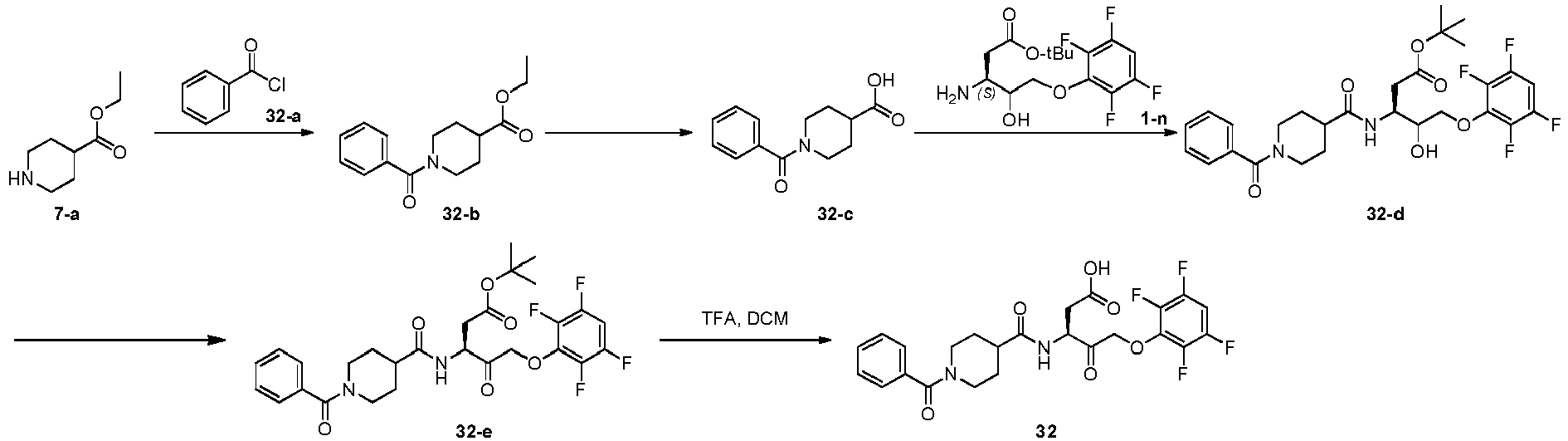
- Compound 7-a (559.19 mg, 3.56 mmol, 548.23 µL, 1.00 eq) and triethylamine (1.08 g, 10.68 mmol, 1.48 mL, 3.00 eq) were dissolved in dichloromethane (10.00 mL), and compound 32-a (500.00 mg, 3.56 mmol, 413.22 µL, 1.00 eq) was slowly added thereto with the temperature maintained at 0°C. After the addition was completed, the reaction was maintained at a temperature of 25°C and stirred for 1 hour. After the reaction was completed, the reaction solution was added with water (50 mL) for quenching, and then extracted with dichloromethane (20 mL × 3). The organic phases were combined, washed with water (30 mL) and saturated brine (30 mL), dried over anhydrous sodium sulfate, and then concentrated to give a crude product. The crude product was purified by column chromatography (petroleum ether : ethyl acetate = 1:0∼1: 1) to give compound 32-b (500.00 mg, yield: 54%). 1H NMR (400MHz, CHLOROFORM-d) δ= 7.39 (brs, 5H), 5.29 (s, 1H), 4.64-4.48 (m, 1H), 4.20-4.10 (m, 2H), 3.91-3.57 (m, 1H), 3.12-2.97 (m, 2H), 2.71-2.45 (m, 1H), 1.80-1.67 (m, 2H), 1.26 (t, J=7.0 Hz, 3H).
- Compound 32-b (500.00 mg, 1.91 mmol, 1.00 eq) was dissolved in a mixed solvent of tetrahydrofuran (10.00 mL) and water (10.00 mL), and LiOH·H2O (321.14 mg, 7.65 mmol, 4.00 eq) was added thereto. The mixture was stirred at a temperature of 25°C for 2 hours. After the reaction was completed, the reaction solution was adjusted to pH of about 6 with dilute hydrochloric acid (1 N). The aqueous phase was then extracted with ethyl acetate (50 mL × 3). The combined organic phases were washed with brine (50 mL) and water (50 mL), dried over anhydrous sodium sulfate, filtered and concentrated to give compound 32-c (400.00 mg, yield: 90%) as a yellow oil. 1H NMR (400MHz, CHLOROFORM-d) δ = 7.45-7.33 (m, 5H), 4.66-4.36 (m, 1H), 3.88-3.67 (m, 2H), 3.08 (br. s., 2H), 2.62 (s, 1H), 2.14-1.59 (m, 4H).
- Compounds 32-c (200.00 mg, 857.41 µmol, 1.00 eq) and 1-n (302.93 mg, 857.41 µmol, 1.00 eq) were dissolved in dichloromethane (20 mL), and EDCI (225.18 mg, 1.17 mmol, 1.37 eq), HOBt (158.72 mg, 1.17 mmol, 1.37 eq) and NMM (260.18 mg, 2.57 mmol, 282.80 µL, 3.00 eq) were added thereto and stirred at room temperature for 15 min. The reaction was stirred at room temperature for another 2 hours. After the reaction was completed, the reaction solution was added with 150 mL of water, and extracted with dichloromethane (80 mL × 3). The organic phases were combined, dried over anhydrous sodium sulfate, filtered and concentrated to give a crude product. The crude product was purified by preparative TLC (petroleum ether : ethyl acetate = 2:1) to give the product of compound 32-d (220.00 mg, yield: 45%). 1H NMR (400MHz, CHLOROFORM-d) δ = 7.40 (br. s., 5H), 6.89-6.76 (m, 1H), 6.73-6.61 (m, 1H), 4.82-4.60 (m, 1H), 4.36-4.15 (m, 3H), 4.14-4.04 (m, 1H), 3.92-3.73 (m, 1H),3.59-3.41 (m, 1H), 3.13-2.81 (m, 3H), 2.74 (s, 1H), 2.60 (d, J=4.5 Hz, 2H), 2.46-2.31 (m, 1H), 1.65-1.60 (m., 2H), 1.46 (s, 9H).
- Compound 32-d (150.00 mg, 263.82 µmol, 1.00 eq) was dissolved in dichloromethane (20.00 mL), and PIDA (339.91 mg, 1.06 mmol, 4.00 eq) and TEMPO (8.30 mg, 52.76 µmol, 0.20 eq) were added thereto. The reaction solution was stirred at room temperature for 5 hours. After the reaction was completed, the reaction solution was added with saturated sodium hydrogen carbonate solution (25 mL) and saturated sodium sulfite solution (25 mL), extracted with dichloromethane (40 mL × 3), and washed with saturated brine (50 mL). The organic phase was dried over anhydrous sodium sulfate, filtered and concentrated to give a crude product. The crude product was purified by preparative TLC (petroleum ether : ethyl acetate = 2:1) to give the product of compound 32-e (40.00 mg, crude) as a yellow oil, which was used directly in the next step without purification.
- Compound 32-e (40.00 mg, 70.60 µmol, 1.00 eq) was dissolved in dichloromethane (2.00 mL), and trifluoroacetic acid (1.00 mL) was added thereto. The reaction solution was stirred at room temperature for 2 hours. After the reaction was completed, the reaction solution was spin-dried to give a crude product. The crude product was purified by preparative HPLC (under trifluoroacetic acid condition), and lyophilized to give the product of compound 32 (8.00 mg, yield: 11%). 1H NMR (400MHz, DMSO-d6) δ= 8.45-8.33 (m, 1H), 7.59-7.49 (m, 1H), 7.43 (br. s., 3H), 7.35 (br. s., 2H), 5.26-5.00 (m, 2H), 4.69-4.53 (m, 1H), 4.49-4.31 (m, 1H), 2.91-2.61 (m, 5H), 1.86-1.34 (m, 6H).
-

- Compound 33-a (1.73 g, 10.05 mmol, 1.00 eq) and HOBT (2.04 g, 15.08 mmol, 1.50 eq) were dissolved in dichloromethane (10 mL), added with EDCI (2.89 g, 15.08 mmol, 1.50 eq), and stirred at room temperature for 15 min. Compound 7-a (1.58 g, 10.05 mmol, 1.55 mL, 1.00 eq) and N,N-diisopropylethylamine (2.60 g, 20.10 mmol, 3.51 mL, 2.00 eq) were then dissolved in dichloromethane, added to the above solution, and stirred at room temperature for 15 hours. After the reaction was completed, the reaction solution was added with 80 mL of water, and extracted with dichloromethane (80 mL × 3). The organic phases were combined, dried over anhydrous sodium sulfate, filtered and concentrated to give the product of compound 33-b (4.37 g, crude) as a yellow oil, which was used directly in the next step without purification. LCMS m/z = 311.9 [M+H]+.
- Compound 33-b (3.13 g, 10.05 mmol, 1.00 eq) was dissolved in tetrahydrofuran (50.00 mL), and a solution of LiOH·H2O (843.40 mg, 20.10 mmol, 2.00 eq) dissolved in water (50.00 mL) was added to the above solution. The reaction solution was maintained at 25°C and stirred for 2 hours. After the reaction was completed, the reaction solution was adjusted to pH of 6 with 2 N dilute hydrochloric acid, added with 100 mL of water, and extracted with dichloromethane (60 mL × 3). The organic phase was dried over anhydrous sodium sulfate, filtered and concentrated to give the product of compound 33-c (3.48g, crude) as a pale ayellow oil, which was used directly in the next step without purification. LCMS m/z = 283.9 [M+H]+.
- Compound 33-c (176.42 mg, 622.69 µmol, 1.10 eq) and HOBT (114.72 mg, 849.12 µmol, 1.50 eq) were dissolved in dichloromethane (15 mL), added with EDCI (162.75 mg, 849.12 µmol, 1.50 eq), and stirred at room temperature for 15 mins. Compound 1-n (200.00 mg, 566.08 µmol, 1.00 eq) and N,N-diisopropylethylamine (146.32 mg, 1.13 mmol, 197.73 µL, 2.00 eq) were then dissolved in dichloromethane, added to the above solution, and stirred at room temperature for 15 hours. After the reaction was completed, the reaction solution was added with 80 mL of water, and extracted with dichloromethane (80 mL × 3). The organic phases were combined, dried over anhydrous sodium sulfate, filtered and concentrated to give a crude product. The crude product was subjected to column chromatography (petroleum ether : ethyl acetate = 1:0∼2:1) to give the product of compound 33-d (228.00 mg, yield: 65%) as a yellow oil. LCMS m/z = 619.3 [M+H]+; 641.3 [M+Na]+.
- Compound 33-d (130.00 mg, 210.15 µmol, 1.00 eq) was dissolved in dichloromethane (20.00 mL), and sodium hydrogen carbonate solution (88.27 mg, 1.05 mmol, 40.87 µL, 5.00 eq) and DMP (178.26 mg, 420.30 µmol, 130.12 µL, 2.00 eq) were added thereto. The reaction solution was stirred at room temperature for 15 hours. After the reaction was completed, the reaction solution was added with saturated sodium hydrogen carbonate solution (50 mL) and saturated sodium sulfite solution (50 mL), extracted with dichloromethane (80 mL × 3), and washed with saturated brine (100 mL). The organic phase was dried over anhydrous sodium sulfate, filtered and concentrated to give a crude product. The crude product was subjected to column chromatography (petroleum ether : ethyl acetate = 1:0∼2:1) to give the product of compound 33-e (119.00 mg, yield: 63%) as a yellow oil. LCMS m/z = 617.3 [M+H]+; 639.3 [M+Na]+.
- Compound 33-e (85.00 mg, 137.85 µmol, 1.00 eq) was dissolved in ethyl acetate (5.00 mL), and HCl/EtOAc (4 M, 6.00 mL) was added thereto. The reaction solution was stirred at room temperature for 1.5 hours. After the reaction was completed, the reaction solution was spin-dried to give a crude product. The crude product was purified by preparative HPLC (under formic acid condition), and lyophilized to give the product of compound 33 (45.00 mg, yield: 58%). 1H NMR (400MHz, DMSO-d6) δ = 8.42 (br. s, 1H),7.97 (d, J=7.6 Hz, 2H), 7.73 (d, J=24.8 Hz, 1H),7.56 (d, J=6.0 Hz, 4H), 7.40 (dd, J=24.8, 6.8 Hz, 1H), 4.63 (br. s, 2H), 3.28-3.21 (m, 1H), 3.00-2.93 (m, 2H), 2.69-2.60 (m, 2H), 1.86 (br. s, 1H), 1.64-1.43 (m, 2H), 1.22 (br. s, 1H); LCMS m/z = 561.2 [M+H]+; 583.2 [M+Na]+.
-

- Compound 7-a (500.00 mg, 3.18 mmol, 1.00 eq) was dissolved in dichloromethane (80.00 mL) and H2O (80.00 mL), and sodium hydrogen carbonate solution (11.76 g, 139.94 mmol, 5.44 mL, 2.20 eq) and CbzCl (12.04 g, 70.61 mmol, 10.03 mL, 1.11 eq) were added thereto. The reaction solution was stirred at 27°C for 2 hours. After the reaction was completed, the reaction solution was extracted with dichloromethane (800 mL × 3). The organic phase was dried over anhydrous sodium sulfate, filtered and concentrated to give a crude product. The crude product was subjected to column chromatography (petroleum ether : ethyl acetate = 1:0~5:1) to give the product of compound 34-a (8.20 g, yield: 44%) as a colorless oil. 1H NMR (400 MHz, CHLOROFORM-d) δ =7.28-7.40 (m, 5H), 5.08-5.19 (m, 2H), 4.12-4.19 (m, 3H), 4.04-4.09 (m, 1H), 2.87-3.01 (m, 2H), 2.46 (tt, J=3.89, 10.92 Hz, 1H), 1.89 (br. s., 2H), 1.65-1.73 (m, 2H), 1.24-1.28 (m, 3H).
- Compound 34-a (8.87 g, 30.45 mmol, 1.00 eq) was dissolved in tetrahydrofuran (60.00 mL), and a solution of LiOH·H2O (3.83 g, 91.34 mmol, 3.00 eq) dissolved in H2O (60.00 mL) was added to the above solution. The reaction solution was stirred at 27°C for 2 hours. After the reaction was completed, the reaction solution was adjusted to pH of 6 with 2 N dilute hydrochloric acid, added with 300 mL of water, and extracted with dichloromethane (300 mL × 3). The organic phase was dried over anhydrous sodium sulfate, filtered and concentrated to give the product of compound 34-b (7.45 g, crude) as a colorless oil, which was used directly in the next step without purification. 1H NMR (400 MHz, CHLOROFORM-d) δ =7.28-7.41 (m, 5H), 5.14 (s, 2H), 3.72-3.81 (m, 1H), 2.96 (t, J=11.04 Hz, 2H), 2.52 (tt, J=3.83, 10.73 Hz, 1H),1.82-2.01 (m, 3H), 1.61-1.76 (m, 2H).
- Compound 1-n (5.00 g, 14.15 mmol, 1.00 eq) was dissolved in dichloromethane (90.00 mL), and compound 34-b (3.73 g, 14.15 mmol, 1.00 eq), EDCI (3.72 g, 19.39 mmol, 1.37 eq), HOBt (2.62 g, 19.39 mmol, 1.37 eq) and NMM (4.29 g, 42.45 mmol, 4.66 mL, 3.00 eq) were added thereto. The reaction solution was stirred at 27°C for 16 hours under the protection of nitrogen gas. After the reaction was completed, the reaction solution was added with 400 mL of water, and extracted with dichloromethane (400 mL × 3). The organic phases were combined, dried over anhydrous sodium sulfate, filtered and concentrated to give a crude product. The crude product was subjected to column chromatography (petroleum ether : ethyl acetate = 1:0∼3:1) to give the product of compound 34-c (4.60 g, yield: 43%) as a colorless oil. 1H NMR (400 MHz, CHLOROFORM-d) δ = 7.29-7.40 (m, 5H), 6.75-6.87 (m, 1H), 6.63 (d, J=8.28 Hz, 1H), 5.13 (s, 2H), 4.09-4.41 (m, 7H), 3.50-3.59 (m, 1H), 2.75 (dd, J=6.40, 16.44 Hz, 1H), 2.64-2.70 (m, 1H), 2.53-2.62 (m, 1H), 2.29 (tt, J=3.67, 11.39 Hz, 1H), 1.81 (br. s., 2H), 1.57-1.67 (m, 2H), 1.45-1.47 (m, 9H).
- Compound 34-c (4.25 g, 7.10 mmol, 1.00 eq) was dissolved in methanol (200.00 mL), and Pd/C (420.00 mg, purity of 10%) was added to the solution. The reaction solution was stirred in a hydrogen atmosphere (hydrogen balloon) at 27°C for 2 hours. After the reaction was completed, the reaction solution was filtered through diatomaceous earth, and the filter cake was washed with methanol (200 mL). The resulting filtrate was concentrated to give the product of compound 34-d (3.26 g, crude), which was used directly in the next step without purification. 1H NMR (400 MHz, CHLOROFORM-d) δ = 6.75-6.87 (m, 1H), 6.29-6.64 (m, 1H), 4.05-4.37 (m, 4H), 2.98-3.18 (m, 2H), 2.44-2.93 (m, 4H), 2.18-2.30 (m, 1H), 2.01 (s, 1H), 1.52-1.86 (m, 5H), 1.37-1.49 (m, 9H).
- Compound 34-d (60.00 mg, 129.19 µmol, 1.00 eq) was dissolved in dichloromethane (8.00 mL), and compound 34-e (22.37 mg, 129.19 µmol, 1.00 eq), EDCI (33.93 mg, 176.98 µmol, 1.37 eq), HOBt (23.91 mg, 176.98 µmol, 1.37 eq) and NMM (39.20 mg, 387.56 µmol, 42.61 µL, 3.00 eq) were added thereto. The reaction solution was stirred at 27°C for 16 hours under the protection of nitrogen gas. After the reaction was completed, the reaction solution was added with 80 mL of water, and extracted with dichloromethane (80 mL × 3). The organic phases were combined, dried over anhydrous sodium sulfate, filtered and concentrated to give a crude product. The crude product was subjected to column chromatography (dichloromethane/methanol; 0-10%) to give the product of compound 34-f (61.00 mg, yield: 59%) as a colorless oil. LCMS m/z = 620.3 [M+H]+.
- Compound 34-f (61.00 mg, 75.81 µmol, 1.00 eq) was dissolved in dichloromethane (4.00 mL), and PIDA (94.50 mg, 293.38 µmol, 3.87 eq) and TEMPO (3.58 mg, 22.74 µmol, 0.30 eq) were added thereto. The reaction solution was stirred at 27°C for 16 hours under the protection of nitrogen gas. After the reaction was completed, the reaction solution was added with 100 mL of ethyl acetate. The solution was washed successively with saturated sodium hydrogen carbonate (50 mL), saturated brine (50 mL) and water (50 mL). The organic phase was dried over anhydrous sodium sulfate, filtered and concentrated to give a crude product. The crude product was purified by preparative silica gel plates (dichloromethane : methanol = 15:1) to give the product of compound 34-g (36.00 mg, yield: 68%) as a colorless oil. LCMS m/z = 618.3 [M+H]+.
- Compound 34-g (36.00 mg, 58.29 µmol, 1.00 eq) was dissolved in dichloromethane (2.00 mL), and trifluoroacetic acid (956.08 mg, 8.39 mmol, 620.83 µL, 143.85 eq) was added thereto. The reaction solution was stirred at 25°C for 1 hour under the protection of nitrogen gas. After the reaction was completed, the reaction solution was spin-dried to give a crude product. The crude product was purified by preparative HPLC (under trifluoroacetic acid condition), and lyophilized to give the product of compound 34 (21.00 mg, yield: 64%). 1H NMR (400 MHz, DMSO-d6) δ =8.44-8.55 (m, 2H), 8.06 (d, J=8.03 Hz, 1H), 7.88-7.95 (m, 2H), 7.85 (t, J=7.53 Hz, 1H), 7.70-7.76 (m, 1H), 7.48-7.63 (m, 1H), 5.11-5.29 (m, 2H), 4.54-4.67 (m, 2H), 3.18 (d, J=13.55 Hz, 1H), 2.94-3.07 (m, 2H), 2.65-2.78 (m, 1H), 2.52-2.62 (m, 2H), 1.89 (t, J=8.78 Hz, 1H), 1.50-1.70 (m, 2H), 1.34-1.48 (m, 1H); LCMS m/z = 562.1 [M+H]+.
-

- Compound 35-a (43.09 mg, 350.00 µmol, 1.40 eq) and HOBT (50.67 mg, 375.00 µmol, 1.50 eq) were dissolved in dichloromethane (20 mL), added with EDCI (71.89 mg, 375.00 µmol, 1.50 eq), and stirred at room temperature for 15 min. Compound 34-d (116.11 mg, 250.00 µmol, 1.00 eq) and NMM (75.86 mg, 750.00 µmol, 82.46 µL, 3.00 eq) were then added, and stirred at room temperature for 16 hours. After the reaction was completed, the reaction solution was added with 150 mL of water, and extracted with dichloromethane (80 mL × 3). The organic phases were combined, dried over anhydrous sodium sulfate, filtered and concentrated to give the product of compound 35-b (182 mg, crude) as a yellow oil, which was used directly in the next step without purification. LCMS m/z = 570.3 [M+H]+; 592.3 [M+Na]+.
- Compound 35-b (142.39 mg, 250.00 µmol, 1.00 eq) was dissolved in dichloromethane (20.00 mL), and PIDA (322.10 mg, 1.00 mmol, 4.00 eq) and TEMPO (7.86 mg, 50.00 µmol, 0.20 eq) were added thereto. The reaction solution was stirred at room temperature for 54 hours. After the reaction was completed, the reaction solution was added with saturated sodium hydrogen carbonate solution (50 mL) and saturated sodium sulfite solution (50 mL), extracted with dichloromethane (80 mL × 3), and washed with saturated brine (100 mL). The organic phase was dried over anhydrous sodium sulfate, filtered and concentrated to give a crude product. The crude product was subjected to column chromatography (dichloromethane : methanol = 1:0∼10:1) to give the product of compound 35-c (105.00 mg, yield: 34%) as a yellow oil. LCMS m/z = 568.2 [M+H]+.
- Compound 35-c (113.00 mg, 199.11 µmol, 1.00 eq) was dissolved in dichloromethane (3.00 mL), and trifluoroacetic acid (4.62 g, 40.52 mmol, 3.00 mL) was added thereto. The reaction solution was stirred at room temperature for 1.5 hours. After the reaction was completed, the reaction solution was spin-dried to give a crude product. The crude product was purified by preparative HPLC (under trifluoroacetic acid condition), and lyophilized to give the product of compound 35 (24.40 mg, yield: 24%). 1H NMR (400MHz, DMSO-d6) δ = 8.60 (d, J=5.0 Hz, 1H), 8.47 (d, J=7.6 Hz, 1H), 7.94 (t, J=7.6 Hz, 1H), 7.62-7.52 (m, 2H), 7.49 (dd, J=4.8, 7.6 Hz, 1H), 5.22 (dd, J=3.6, 10.2 Hz, 2H), 4.62 (d, J=6.4 Hz, 1H), 4.47 (d, J=13.2 Hz, 1H), 3.09-3.01 (m, 1H), 2.93-2.81 (m, 1H), 2.75 (dd, J=6.0, 12 Hz, 1H), 2.64-2.53 (m, 2H), 1.82 (br. s., 1H), 1.72-1.60 (m, 1H), 1.60-1.47 (m, 2H); LCMS m/z = 512.1 [M+H]+.
-

- Compound 34-d (200.00 mg, 430.62 µmol, 1.00 eq) was dissolved in dichloromethane (5.00 mL), and compound 36-a (53.01 mg, 430.62 µmol, 36.06 µL, 1.00 eq), EDCI (113.09 mg, 589.95 µmol, 1.37 eq), HOBt (79.71 mg, 589.95 µmol, 1.37 eq) and NMM (130.67 mg, 1.29 mmol, 142.03 µL, 3.00 eq) were added thereto. The reaction solution was stirred at 27°C for 16 hours under the protection of nitrogen gas. After the reaction was completed, the reaction solution was added with 100 mL of water, and extracted with dichloromethane (100 mL × 3). The organic phases were combined, dried over anhydrous sodium sulfate, filtered and concentrated to give a crude product. The crude product was purified by preparative silica gel plates (dichloromethane : methanol = 15:1) to give the product of compound 36-b (120.00 mg, yield: 46%) as a colorless oil. LCMS m/z = 570.3 [M+H]+.
- Compound 36-b (120.00 mg, 210.70 µmol, 1.00 eq) was dissolved in dichloromethane (6.00 mL), and PIDA (262.64 mg, 815.39 µmol, 3.87 eq) and TEMPO (6.63 mg, 42.14 µmol, 0.20 eq) were added thereto. The reaction solution was stirred at 27°C for 16 hours under the protection of nitrogen gas. After the reaction was completed, the reaction solution was added with 100 mL of ethyl acetate. The solution was washed successively with saturated sodium hydrogen carbonate (50 mL), saturated brine (50 mL) and water (50 mL). The organic phase was dried over anhydrous sodium sulfate, filtered and concentrated to give a crude product. The crude product was purified by preparative silica gel plates (dichloromethane : methanol = 15:1) to give the product of compound 36-c (110.00 mg, yield: 86%) as a colorless oil. LCMS m/z = 568.2 [M+H]+.
- Compound 36-c (110.00 mg, 193.82 µmol, 1.00 eq) was dissolved in dichloromethane (4.00 mL), and trifluoroacetic acid (3.18 g, 27.88 mmol, 2.06 mL, 143.85 eq) was added thereto. The reaction solution was stirred at 27°C for 1 hour under the protection of nitrogen gas. After the reaction was completed, the reaction solution was spin-dried to give a crude product. The crude product was purified by preparative HPLC (under trifluoroacetic acid condition), and lyophilized to give the product of compound 36 (46.10 mg, yield: 47%). 1H NMR (400 MHz, DMSO-d6) δ = 8.65-8.78 (m, 2H), 8.46 (d, J=7.53 Hz, 1H), 8.02 (d, J=8.03 Hz, 1H), 7.50-7.69 (m, 2H), 5.13-5.30 (m, 2H), 4.61 (q, J=7.03 Hz, 1H), 4.23-4.52 (m, 2H), 3.55 (d, J=10.54 Hz, 1H), 3.12 (br. s., 1H), 2.86 (d, J=9.03 Hz, 1H), 2.64-2.78 (m, 1H), 2.58 (dd, J=6.78, 16.81 Hz, 1H), 1.44-1.88 (m, 4H); LCMS m/z = 512.1 [M+H]+.
-

- Compound 34-d (200.00 mg, 430.62 µmol, 1.00 eq) was dissolved in dichloromethane (5.00 mL), and compound 37-a (63.62 mg, 516.74 µmol, 1.20 eq), EDCI (112.27 mg, 585.64 µmol, 1.36 eq), HOBt (79.13 mg, 585.64 µmol, 1.36 eq) and NMM (130.67 mg, 1.29 mmol, 142.03 µL, 3.00 eq) were added thereto. The reaction solution was stirred at 25°C for 12 hours under the protection of nitrogen gas. After the reaction was completed, the reaction solution was added with 100 mL of water, and extracted with dichloromethane (50 mL × 3). The organic phases were combined, dried over anhydrous sodium sulfate, filtered and concentrated to give a crude product. The crude product was subjected to column chromatography (dichloromethane : methanol = 100:0∼100:10) to give the product of compound 37-b (150.00 mg, yield: 48) as a yellow oil.
- Compound 37-b (100.00 mg, 175.58 µmol, 1.00 eq) was dissolved in dichloromethane (5.00 mL), and PIDA (226.22 mg, 702.32 µmol, 4.00 eq) and TEMPO (5.52 mg, 35.12 µmol, 0.20 eq) were added thereto. The reaction solution was stirred at 25°C for 12 hours under the protection of nitrogen gas. After the reaction was completed, the reaction solution was added with 50 mL of ethyl acetate. The solution was washed successively with saturated sodium hydrogen carbonate (20 mL), saturated brine (20 mL) and water (20 mL). The organic phase was dried over anhydrous sodium sulfate, filtered and concentrated to give a crude product. The crude product was purified by preparative silica gel plates (petroleum ether : ethyl acetate=2:1) to give the product of compound 37-c (70.00 mg, yield: 23%) as a yellow oil.
- Compound 37-c (50.00 mg, 88.10 µmol, 1.00 eq) was dissolved in dichloromethane (4.00 mL), and trifluoroacetic acid (1 mL) was added thereto. The reaction solution was stirred at 25°C for 0.8 hour under the protection of nitrogen gas. After the reaction was completed, the reaction solution was spin-dried to give a crude product. The crude product was purified by preparative HPLC (under trifluoroacetic acid condition), and lyophilized to give the product of compound 37 (10.00 mg, yield: 21%), LCMS m/z = 512.2 [M+H]+.
-
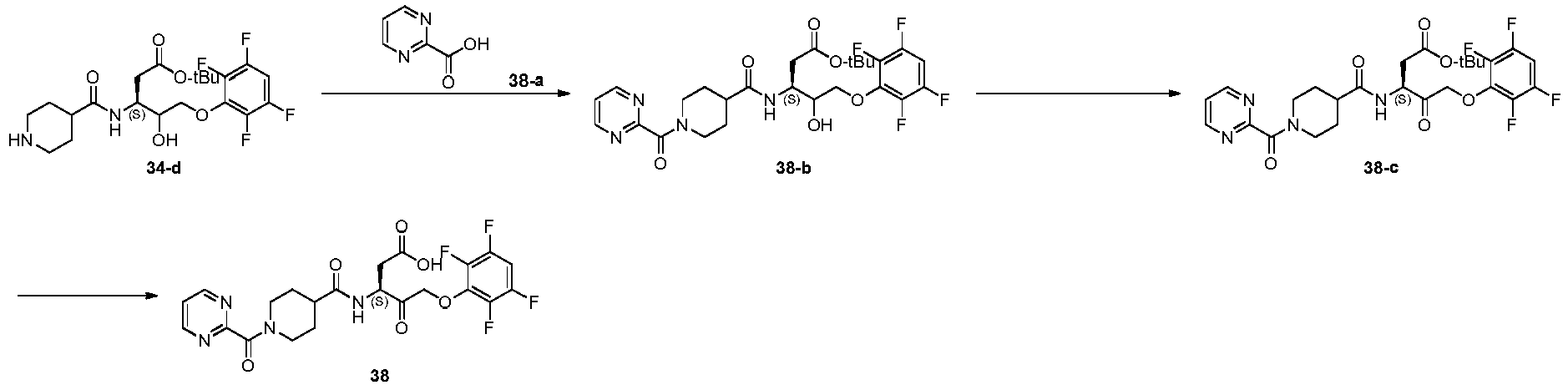
- Compound 38-a (43.43 mg, 350.00 µmol, 1.40 eq) and HOBT (50.67 mg, 375.00 µmol, 1.50 eq) were dissolved in dichloromethane (20 mL), added with EDCI (71.89 mg, 375.00 µmol, 1.50 eq), and stirred at room temperature for 15 min. Compound 34-d (116.11 mg, 250.00 µmol, 1.00 eq) and NMM (75.86 mg, 750.00 µmol, 82.46 µL, 3.00 eq) were then added, and stirred at room temperature for 16 hours. After the reaction was completed, the reaction solution was added with 150 mL of water, and extracted with dichloromethane (80 mL × 3). The organic phases were combined, dried over anhydrous sodium sulfate, filtered and concentrated to give the product of compound 38-b (182 mg, crude) as a yellow oil, which was used directly in the next step without purification. LCMS m/z = 571.3 [M+H]+; 593.3 [M+Na]+.
- Compound 38-b (142.63 mg, 250.00 µmol, 1.00 eq) was dissolved in dichloromethane (20.00 mL), and PIDA (322.10 mg, 1.00 mmol, 4.00 eq) and TEMPO (7.86 mg, 50.00 µmol, 0.20 eq) were added thereto. The reaction solution was stirred at room temperature for 54 hours. After the reaction was completed, the reaction solution was added with saturated sodium hydrogen carbonate solution (50 mL) and saturated sodium sulfite solution (50 mL), extracted with dichloromethane (80 mL × 3), and washed with saturated brine (100 mL). The organic phase was dried over anhydrous sodium sulfate, filtered and concentrated to give a crude product. The crude product was subjected to column chromatography (dichloromethane : methanol = 1:0∼10:1) to give the product of compound 38-c (113.00 mg, yield: 52%) as a yellow oil. LCMS m/z = 569.2 [M+H]+; 591.2 [M+Na]+.
- Compound 38-c (113.00 mg, 198.76 µmol, 1.00 eq) was dissolved in dichloromethane (3.00 mL), and trifluoroacetic acid (4.62 g, 40.52 mmol, 3.00 mL) was added thereto. The reaction solution was stirred at room temperature for 1.5 hours. After the reaction was completed, the reaction solution was spin-dried to give a crude product. The crude product was purified by preparative HPLC (under trifluoroacetic acid condition), and lyophilized to give the product of compound 38 (8.80 mg, yield: 7%). 1H NMR (400MHz, CHLOROFORM-d) δ = 8.84 (d, J=5.0 Hz, 2H), 7.43 (t, J=7.6 Hz, 1H),6.81 (br. s., 2H), 5.20-4.90 (m, 1H), 4.66 (br. s., 1H), 4.37 (br. s., 1H), 3.64 (d, J=13.2 Hz, 1H), 3.16 (d, J=10.0 Hz, 1H), 3.01 (br. s., 2H), 2.75 (br. s., 3H), 2.06 (br. s., 1H), 1.84 (d, J=10.0 Hz, 3H); LCMS m/z = 513.1 [M+H]+.
-

- Compound 34-d (110.00 mg, 236.84 µmol, 1.00 eq) was dissolved in dichloromethane (8.00 mL), and compound 39-a (30.35 mg, 236.84 µmol, 1.00 eq), EDCI (62.20 mg, 324.47 µmol, 1.37 eq), HOBt (43.84 mg, 324.47 µmol, 1.37 eq) and NMM (71.87 mg, 710.52 µmol, 78.12 µL, 3.00 eq) were added thereto. The reaction solution was stirred at 25°C for 16 hours under the protection of nitrogen gas. After the reaction was completed, the reaction solution was added with 80 mL of water, and extracted with dichloromethane (80 mL × 3). The organic phases were combined, dried over anhydrous sodium sulfate, filtered and concentrated to give a crude product. The crude product was subjected to column chromatography (petroleum ether : ethyl acetate = 1:0∼1:1) to give the product of compound 39-b (75.00 mg, yield: 46%) as a colorless oil. LCMS m/z = 575.1 [M+H]+.
- Compound 39-b (75.00 mg, 130.53 µmol, 1.00 eq) was dissolved in dichloromethane (4.00 mL), and PIDA (162.71 mg, 505.14 µmol, 3.87 eq) and TEMPO (6.16 mg, 39.16 µmol, 0.30 eq) were added thereto. The reaction solution was stirred at 25°C for 16 hours under the protection of nitrogen gas. After the reaction was completed, the reaction solution was added with 100 mL of ethyl acetate. The solution was washed successively with saturated sodium hydrogen carbonate (50 mL), saturated brine (50 mL) and water (50 mL). The organic phase was dried over anhydrous sodium sulfate, filtered and concentrated to give a crude product. The crude product was purified by preparative silica gel plates (petroleum ether : ethyl acetate = 1:1) to give the product of compound 39-c (51.00 mg, yield: 64%) as a colorless oil. LCMS m/z = 573.1 [M+H]+.
- Compound 39-c (51.00 mg, 89.07 µmol, 1.00 eq) was dissolved in dichloromethane (2.00 mL), and trifluoroacetic acid (1.46 g, 12.81 mmol, 948.05 µL, 143.85 eq) was added thereto. The reaction solution was stirred at 25°C for 1 hour under the protection of nitrogen gas. After the reaction was completed, the reaction solution was spin-dried to give a crude product. The crude product was purified by preparative HPLC (under trifluoroacetic acid condition), and lyophilized to give the product of compound 39 (24.40 mg, yield: 53%). 1H NMR (400 MHz, DMSO-d6) δ = 8.47 (d, J=7.53 Hz, 1H), 7.74 (d, J=5.02 Hz, 1H), 7.51-7.64 (m, 1H), 7.38 (d, J=3.01 Hz, 1H), 7.09-7.14 (m, 1H), 5.14-5.30 (m, 2H), 4.61 (q, J=6.86 Hz, 1H), 4.15-4.40 (m, 2H), 3.03 (br. s., 2H), 2.70-2.79 (m, 1H), 2.58 (dd, J=6.78, 16.81 Hz, 2H), 1.76 (d, J=4.52 Hz, 2H), 1.45-1.60 (m, 2H); LCMS m/z = 517.0 [M+H]+.
-

- Compound 34-d (200.00 mg, 430.62 µmol, 1.00 eq) was dissolved in dichloromethane (8.00 mL), and compound 40-a (92.09 mg, 516.74 µmol, 1.20 eq), EDCI (112.27 mg, 585.64 µmol, 1.36 eq), HOBt (79.13 mg, 585.64 µmol, 1.36 eq) and NMM (130.67 mg, 1.29 mmol, 142.03 µL, 3.00 eq) were added thereto. The reaction solution was stirred at 25°C for 12 hours under the protection of nitrogen gas. After the reaction was completed, the reaction solution was added with 80 mL of water, and extracted with dichloromethane (80 mL × 3). The organic phases were combined, dried over anhydrous sodium sulfate, filtered and concentrated to give a crude product. The crude product was subjected to column chromatography (petroleum ether : ethyl acetate = 100:0∼100:100) to give the product of compound 40-b (160.00 mg, yield: 54%).
- Compound 40-b (100.00 mg, 160.09 µmol, 1.00 eq) was dissolved in dichloromethane (4.00 mL), and PIDA (206.26 mg, 640.37 µmol, 4.00 eq) and TEMPO (5.03 mg, 32.02 µmol, 0.20 eq) were added thereto. The reaction solution was stirred at 25°C for 5 hours under the protection of nitrogen gas. After the reaction was completed, the reaction solution was added with 50 mL of ethyl acetate. The solution was washed successively with saturated sodium hydrogen carbonate (20 mL), saturated brine (20 mL) and water (20 mL). The organic phase was dried over anhydrous sodium sulfate, filtered and concentrated to give a crude product. The crude product was purified by preparative silica gel plates (petroleum ether: ethyl acetate = 2:1) to give the product of compound 40-c (60.00 mg, yield: 54%) as a yellow oil.
- Compound 40-c (60.00 mg, 96.37 µmol, 1.00 eq) was dissolved in dichloromethane (2.00 mL), and trifluoroacetic acid (1 mL) was added thereto. The reaction solution was stirred at 25°C for 0.8 hour under the protection of nitrogen gas. After the reaction was completed, the reaction solution was spin-dried to give a crude product. The crude product was purified by preparative HPLC (under trifluoroacetic acid condition), and lyophilized to give the product of compound 40 (15.00 mg, yield: 26%). 1H NMR (400MHz, DMSO-d6) δ = 8.51-8.45 (m, 1H), 8.05-7.97 (m, 1H), 7.95-7.86 (m, 1H), 7.69 (s, 1H), 7.47-7.40 (m, 2H), 5.29-5.14 (m, 2H), 4.65-4.57 (m, 1H), 4.40-4.17 (m, 3H), 2.79-2.52 (m, 4H), 1.87-1.72 (m, 3H), 1.65-1.50 (m, 3H).
-

- Compound 41-a (10.00 g, 55.20 mmol, 1.00 eq) was dissolved in ethanol (120.00 mL), and H2SO4 (4.60 g, 46.92 mmol, 2.50 mL, 0.85 eq) was added thereto. The reaction solution was stirred under reflux for 2 hours. After the reaction was completed, the reaction solution was concentrated, then added with ethyl acetate (250 mL) and saturated sodium carbonate (100 mL), and separated. The organic phase was further washed with saturated sodium carbonate (100 mL) and brine (100 mL), and then dried over anhydrous sodium sulfate, filtered, and concentrated to give the product of compound 41-b (11.00 g, crude) as a pale yellow solid, which was used directly in the next step without purification. 1H NMR (400 MHz, CHLOROFORM-d) δ = 8.12 (d, J=8.03 Hz, 1H), 7.56-7.65 (m, 1H), 7.44-7.53 (m, 1H), 7.37 (d, J=7.53 Hz, 1H), 4.18 (q, J=7.28 Hz, 2H), 4.03 (s, 2H), 1.26 (t, J=7.15 Hz, 3H).
- Compound 41-b (12.60 g, 60.23 mmol, 1.00 eq) was dissolved in ethanol (130.00 mL), isoamyl nitrite (8.04 g, 68.66 mmol, 9.24 mL, 1.14 eq) was added thereto, and the reaction solution was heated up to 60°C. And then, a solution of sodium ethoxide prepared from sodium (1.52 g, 66.25 mmol, 1.57 mL, 1.10 eq) and ethanol (63.00 mL) was added dropwise to the above solution. After the addition was completed, the reaction solution was maintained at 60°C, and heated with stirring for 2 hours. After the reaction was completed, the reaction solution was cooled down to 20°C, adjusted to pH of 7 with 2 N dilute hydrochloric acid, and then extracted with ethyl acetate (250 mL × 3). The organic phases were combined, washed with water (100 mL) and brine (100 mL), dried over anhydrous sodium sulfate, filtered, and then concentrated to about 30 mL of solvent. After filtration, the filter cake was washed twice with petroleum ether (100 mL), and concentrated to give the product of compound 41-c (8.00 g, crude) as a pale yellow solid, which was used directly in the next step without purification. 1H NMR (400 MHz, DMSO-d6) δ = 12.75 (s, 1H), 8.15-8.23 (m, 1H), 7.81-7.88 (m, 1H), 7.66-7.75 (m, 1H), 7.53 (dd, J=1.00, 7.53 Hz, 1H), 4.21 (q, J=7.19 Hz, 2H), 1.16-1.27 (m, 3H).
- Compound 41-c (8.00 g, 33.59 mmol, 1.00 eq) was dissolved in diglyme (80.00 mL), and the above solution was added dropwise to a mixed solution of sodium hydride (2.02 g, 50.39 mmol, purity of 60%, 1.50 eq) and diglyme (110.00 mL) with vigorously stirring under the protection of nitrogen gas. The reaction solution was slowly warmed up to 150°C, and stirred for 5 hours. After the reaction was completed, the reaction solution was added with 200 mL of water, and extracted with ethyl acetate (400 mL). The organic phase was washed with water (150 mL × 2), dried over anhydrous sodium sulfate, filtered, concentrated, and then dissolved in heated petroleum ether. The above solution was cooled down to 0°C, the precipitated solid was filtered, and the product of compound 41-d (3.32 g, yield: 44%) as a pale yellow solid was obtained by concentration. 1H NMR (400 MHz, DMSO-d6) δ=8.04-8.11 (m, 1H), 7.91 (d, J=8.53 Hz, 1H), 7.76 (t, J=7.78 Hz, 1H), 7.55 (t, J=7.53 Hz, 1H), 4.48 (q, J=7.36 Hz, 2H), 1.40 (t, J=7.03 Hz, 3H).
- Compound 41-d (3.32 g, 17.37 mmol, 1.00 eq) was dissolved in 70% sulfuric acid solution (80.00 mL), and the resulting reaction solution was stirred at 80°C for 3.5 hours. After the reaction was completed, the reaction solution was added with 150 mL of ice water, and extracted with ethyl acetate (300 mL). The organic phase was washed with water (100 mL × 2), dried over anhydrous sodium sulfate, filtered and concentrated to give the product of compound 41-e (1.50 g, crude) as a gray solid, which was used directly in the next step without purification. 1H NMR (400 MHz, DMSO-d6) δ = 8.09 (d, J=8.03 Hz, 1H), 7.89 (d, J=8.53 Hz, 1H), 7.74 (t, J=7.53 Hz, 1H), 7.52 (t, J=7.53 Hz, 1H).
- Compound 34-d (250.00 mg, 538.27 µmol, 1.00 eq) was dissolved in dichloromethane (5.00 mL), and compound 41-e (87.81 mg, 538.27 µmol, 1.00 eq), EDCI (141.37 mg, 737.43 µmol, 1.37 eq), HOBt (99.64 mg, 737.43 µmol, 1.37 eq) and NMM (163.34 mg, 1.61 mmol, 177.54 µL, 3.00 eq) were added thereto. The reaction solution was stirred at 27°C for 18 hours under the protection of nitrogen gas. After the reaction was completed, the reaction solution was added with 100 mL of water, and extracted with dichloromethane (100 mL × 3). The organic phases were combined, dried over anhydrous sodium sulfate, filtered and concentrated to give a crude product. The crude product was subjected to column chromatography (petroleum ether : ethyl acetate = 1:0∼1:1) to give the product of compound 41-f (185.00 mg, yield: 50%) as a pale yellow oil. LCMS m/z = 632.2 [M+Na]+.
- Compound 41-f (185.00 mg, 303.50 µmol, 1.00 eq) was dissolved in dichloromethane (6.00 mL), and PIDA (378.32 mg, 1.17 mmol, 3.87 eq) and TEMPO (9.55 mg, 60.70 µmol, 0.20 eq) were added thereto. The reaction solution was stirred at 27°C for 16 hours under the protection of nitrogen gas. After the reaction was completed, the reaction solution was added with 100 mL of ethyl acetate. The solution was washed successively with saturated sodium hydrogen carbonate (50 mL), saturated brine (50 mL) and water (50 mL). The organic phase was dried over anhydrous sodium sulfate, filtered and concentrated to give a crude product. The crude product was subjected to column chromatography (petroleum ether: ethyl acetate = 1:0∼1:1) to give the product of compound 41-g (36.00 mg, yield: 20%) as a colorless oil. LCMS m/z = 630.2 [M+Na]+.
- Compound 41-g (170.00 mg, 279.81 µmol, 1.00 eq) was dissolved in dichloromethane (6.00 mL), and trifluoroacetic acid (4.59 g, 40.25 mmol, 2.98 mL, 143.85 eq) was added thereto. The reaction solution was stirred at 27°C for 1 hour under the protection of nitrogen gas. After the reaction was completed, the reaction solution was spin-dried to give a crude product. The crude product was purified by preparative HPLC (under trifluoroacetic acid condition), and lyophilized to give the product of compound 41 (82.70 mg, yield: 54%). 1H NMR (400 MHz, DMSO-d6) δ = 8.49 (d, J=7.03 Hz, 1H), 7.83-7.92 (m, 2H), 7.74 (t, J=7.78 Hz, 1H), 7.52-7.64 (m, 1H), 7.48 (t, J=7.53 Hz, 1H), 5.14-5.30 (m, 2H), 4.62 (q, J=6.53 Hz, 1H), 4.52 (d, J=13.05 Hz, 1H), 3.98 (d, J=13.55 Hz, 1H), 3.24 (t, J=11.54 Hz, 1H), 3.02 (t, J=11.80 Hz, 1H), 2.65-2.80 (m, 1H), 2.59 (dd, J=6.78, 16.31 Hz, 2H), 1.88 (br. s., 1H), 1.75 (br. s., 1H), 1.48-1.66 (m, 2H); LCMS m/z = 552.1 [M+H]+.
-

- Compound 42-a (250.52 mg, 1.55 mmol, 1.03 eq) and HATU (1.14 g, 3.00 mmol, 2.00 eq) were dissolved in dichloromethane (20 mL), and stirred at room temperature for 15 min. Compound 7-a (235.82 mg, 1.50 mmol, 231.19 µL, 1.00 eq) and N,N-diisopropylethylamine (581.58 mg, 4.50 mmol, 785.92 µL, 3.00 eq) were then added, and stirred at room temperature for 18 hours. After the reaction was completed, the reaction solution was added with 150 mL of water, and extracted with dichloromethane (80 mL × 3). The organic phases were combined, dried over anhydrous sodium sulfate, filtered and concentrated to give a crude product. The crude product was subjected to column chromatography (petroleum ether : ethyl acetate = 1:0∼5:2) to give the product of compound 42-b (288.00 mg, yield: 50%) as a yellow oil. LCMS m/z = 302.0 [M+H]+.
- Compound 42-b (118.00 mg, 391.58 µmol, 1.00 eq) was dissolved in tetrahydrofuran (5.00 mL), and a solution of LiOH·H2O (32.86 mg, 783.17 µmol, 2.00 eq) dissolved in H2O (5.00 mL) was added to the above solution. The reaction solution was maintained 25°C and stirred for 2 hours. After the reaction was completed, the reaction solution was adjusted to pH of 6 with 2 N dilute hydrochloric acid, added with 50 mL of water, and extracted with dichloromethane (30 mL × 3). The organic phase was dried over anhydrous sodium sulfate, filtered and concentrated to give the product of compound 42-c (98.00 mg, crude) as a pale yellow oil, which was used directly in the next step without purification. LCMS m/z = 273.9 [M+H]+.
- Compound 42-c (98.00 mg, 358.59 µmol, 1.02 eq) and HATU (266.16 mg, 700.00 µmol, 2.00 eq) were dissolved in dichloromethane (20 mL), and stirred at room temperature for 15 min. Compound 1-n (123.66 mg, 350.00 µmol, 1.00 eq) and N,N-diisopropylethylamine (135.70 mg, 1.05 mmol, 183.38 µL, 3.00 eq) were then added, and stirred at room temperature for 18 hours. After the reaction was completed, the reaction solution was added with 150 mL of water, and extracted with dichloromethane (80 mL × 3). The organic phases were combined, dried over anhydrous sodium sulfate, filtered and concentrated to give a crude product. The crude product was subjected to column chromatography (petroleum ether : ethyl acetate = 1:0∼2:1) to give the product of compound 42-d (100.00 mg, yield: 46%) as a yellow oil, LCMS m/z = 609.2 [M+H]+.
- Compound 42-d (100.00 mg, 164.32 µmol, 1.00 eq) was dissolved in dichloromethane (20.00 mL), and PIDA (211.71 mg, 657.27 µmol, 4.00 eq) and TEMPO (5.17 mg, 32.86 µmol, 0.20 eq) were added thereto. The reaction solution was stirred at room temperature for 62 hours. After the reaction was completed, the reaction solution was added with saturated sodium hydrogen carbonate solution (50 mL) and saturated sodium sulfite solution (50 mL), extracted with dichloromethane (30 mL × 3), and washed with saturated brine (50 mL). The organic phase was dried over anhydrous sodium sulfate, filtered and concentrated to give a crude product. The crude product was subjected to column chromatography (petroleum ether: ethyl acetate = 1:0∼2:1) to give the product of compound 42-e (45.00 mg, yield: 45%) as a yellow oil. LCMS m/z = 607.3 [M+H]+.
- Compound 42-e (45.00 mg, 74.19 µmol, 1.00 eq) was dissolved in dichloromethane (3.00 mL), and trifluoroacetic acid (4.62 g, 40.52 mmol, 3.00 mL) was added thereto. The reaction solution was stirred at room temperature for 1.5 hours. After the reaction was completed, the reaction solution was spin-dried to give a crude product. The crude product was purified by preparative HPLC (under trifluoroacetic acid condition), and lyophilized to give the product of compound 42 (38.00 mg, yield: 88%). 1H NMR (400MHz, DMSO-d6) δ = 8.53 (d, J=7.5 Hz, 1H), 7.65 (dd, J=3.1, 5.9 Hz, 2H), 7.61-7.49 (m, 1H), 7.29 (dd, J=3.3, 6.0 Hz, 2H), 5.40 (d, J=13.1 Hz, 1H), 5.32-5.15 (m, 2H), 4.63 (q, J=6.7 Hz, 1H), 4.53 (d, J=12.8 Hz, 1H), 3.36 (t, J=11.8 Hz, 1H), 2.95 (t, J=11.9 Hz, 1H), 2.82-2.71 (m, 1H), 2.66-2.55 (m, 2H), 1.84 (br. s., 2H), 1.71-1.50 (m, 2H); LCMS m/z = 550.9 [M+H]+.
-

- Compound 42-b (132.00 mg, 438.04 µmol, 1.00 eq) was dissolved in DMF (20 mL), added with K2CO3 (181.63 mg, 1.31 mmol, 3.00 eq) and Mel (506.00 mg, 3.56 mmol, 221.93 µL, 8.14 eq), and stirred at room temperature for 2.5 hours. After the reaction was completed, the reaction solution was added with 150 mL of water, and extracted with ethyl acetate (80 mL × 3). The organic phases were combined, dried over anhydrous sodium sulfate, filtered and concentrated to give the product of compound 43-a (150 mg, crude) as a yellow oil, which was used directly in the next step without purification. LCMS m/z = 316.0 [M+H]+.
- Compound 43-a (126.15 mg, 400.00 µmol, 1.00 eq) was dissolved in tetrahydrofuran (5.00 mL), and a solution of LiOH·H2O (33.57 mg, 800.00 µmol, 2.00 eq) dissolved in H2O (5.00 mL) was added to the above solution. The reaction solution was maintained at 25°C and stirred for 2 hours. After the reaction was completed, the reaction solution was adjusted to pH of 6 with 2 N dilute hydrochloric acid, added with 50 mL of water, and extracted with dichloromethane (30 mL × 3). The organic phase was dried over anhydrous sodium sulfate, filtered and concentrated to give the product of compound 43-b (150.00 mg, crude) as a pale yellow oil, which was used directly in the next step without purification. LCMS m/z = 287.9 [M+H]+.
- Compound 43-b (114.92 mg, 400.00 µmol, 1.05 eq) and HATU (288.97 mg, 760.00 µmol, 2.00 eq) were dissolved in dichloromethane (20 mL), and stirred at room temperature for 15 min. Compound 1-n (134.26 mg, 380.00 µmol, 1.00 eq) and N,N-diisopropylethylamine (147.33 mg, 1.14 mmol, 199.10 µL, 3.00 eq) were then added, and stirred at room temperature for 18 hours. After the reaction was completed, the reaction solution was added with 150 mL of water, and extracted with dichloromethane (80 mL × 3). The organic phases were combined, dried over anhydrous sodium sulfate, filtered and concentrated to give a crude product. The crude product was subjected to column chromatography (petroleum ether : ethyl acetate = 1:0∼2:1) to give the product of compound 43-c (200.00 mg, yield: 50%) as a yellow oil. LCMS m/z = 623.3 [M+H]+.
- Compound 43-c (200.00 mg, 321.23 µmol, 1.00 eq) was dissolved in dichloromethane (20.00 mL), and PIDA (413.87 mg, 1.28 mmol, 4.00 eq) and TEMPO (10.10 mg, 64.25 µmol, 0.20 eq) were added thereto. The reaction solution was stirred at room temperature for 72 hours. After the reaction was completed, the reaction solution was added with saturated sodium hydrogen carbonate solution (50 mL) and saturated sodium sulfite solution (50 mL), extracted with dichloromethane (30 mL × 3), and washed with saturated brine (50 mL). The organic phase was dried over anhydrous sodium sulfate, filtered and concentrated to give a crude product. The crude product was subjected to column chromatography (petroleum ether : ethyl acetate = 1:0∼3:2) to give the product of compound 43-d (16.00 mg, yield: 7%) as a yellow oil. LCMS m/z = 621.1 [M+H]+; 643.1 [M+Na]+.
- Compound 43-d (16.00 mg, 25.78 µmol, 1.00 eq) was dissolved in dichloromethane (3.00 mL), and trifluoroacetic acid (4.62 g, 40.52 mmol, 3.00 mL) was added thereto. The reaction solution was stirred at room temperature for 1.5 hours. After the reaction was completed, the reaction solution was spin-dried to give a crude product. The crude product was purified by preparative HPLC (under trifluoroacetic acid condition), and lyophilized to give the product of compound 43 (12.00 mg, yield: 76%). 1H NMR (400MHz, DMSO-d6) δ = 8.60 (d, J=7.0 Hz, 1H), 7.79-7.68 (m, 2H), 7.63 (d, J=6.0 Hz, 1H), 7.47-7.32 (m, 2H), 5.29 (dd, J=3.5, 12.5 Hz, 2H), 4.68 (q, J=6.9 Hz, 1H), 4.57 (d, J=13.1 Hz, 1H), 4.36-4.32 (m., 1H), 4.13-4.10 (m., 1H), 3.90 (s, 3H), 3.25 (t, J=11.5 Hz, 1H), 3.07-2.97 (m, 1H), 2.82 (dd, J=5.5, 16.6 Hz, 1H), 2.69-2.62 (m, 2H), 1.92 (br. s., 1H), 1.85-1.75 (m, 1H), 1.74-1.59 (m, 2H); LCMS m/z = 565.0 [M+H]+.
-

- Compound 44-a (840.86 mg, 4.80 mmol, 1.20 eq) and HATU (3.04 g, 8.00 mmol, 2.00 eq) were dissolved in dichloromethane (20 mL), and stirred at room temperature for 15 min. Compound 7-a (628.84 mg, 4.00 mmol, 616.51 µL, 1.00 eq) and N,N-diisopropylethylamine (1.55 g, 12.00 mmol, 2.10 mL, 3.00 eq) were then added, and stirred at room temperature for 18 hours. After the reaction was completed, the reaction solution was added with 150 mL of water, and extracted with dichloromethane (80 mL × 3). The organic phases were combined, dried over anhydrous sodium sulfate, filtered and concentrated to give a crude product. The crude product was subjected to column chromatography (petroleum ether : ethyl acetate = 1:0∼3:1) to give the product of compound 44-b (1.09 g, yield: 87%) as a yellow oil. LCMS m/z = 315.0 [M+H]+.
- Compound 44-b (475.00 mg, 1.51 mmol, 1.00 eq) was dissolved in tetrahydrofuran (5.00 mL), and a solution of LiOH·H2O (126.80 mg, 3.02 mmol, 2.00 eq) dissolved in H2O (5.00 mL) was added to the above solution. The reaction solution was maintained at 25°C and stirred for 2 hours. After the reaction was completed, the reactin solution was adjusted to pH of 6 with 2 N dilute hydrochloric acid, added with 50 mL of water, and extracted with dichloromethane (30 mL × 3). The organic phase was dried over anhydrous sodium sulfate, filtered and concentrated to give the product of compound 44-c (483.00 mg, crude) as a pale yellow oil, which was used directly in the next step without purification. LCMS m/z = 286.9 [M+H]+.
- Compound 44-c (372.23 mg, 1.30 mmol, 1.30 eq) and HATU (760.46 mg, 2.00 mmol, 2.00 eq) were dissolved in dichloromethane (20 mL), and stirred at room temperature for 15 min. Compound 1-n (353.31 mg, 1.00 mmol, 1.00 eq) and N,N-diisopropylethylamine (387.72 mg, 3.00 mmol, 523.95 µL, 3.00 eq) were then added, and stirred at room temperature for 18 hours. After the reaction was completed, the reaction solution was added with 150 mL of water, and extracted with dichloromethane (80 mL × 3). The organic phases were combined, dried over anhydrous sodium sulfate, filtered and concentrated to give a crude product. The crude product was subjected to column chromatography (petroleum ether : ethyl acetate = 1:0∼2:1) to give the product of compound 44-d (424.00 mg, yield: 65%) as a yellow oil. LCMS m/z = 622.2 [M+H]+.
- Compound 44-d (250.00 mg, 402.17 µmol, 1.00 eq) was dissolved in dichloromethane (20.00 mL), and PIDA (518.16 mg, 1.61 mmol, 4.00 eq) and TEMPO (12.65 mg, 80.43 µmol, 0.20 eq) were added thereto. The reaction solution was stirred at room temperature for 20 hours. After the reaction was completed, the reaction solution was added with saturated sodium hydrogen carbonate solution (50 mL) and saturated sodium sulfite solution (50 mL), extracted with dichloromethane (30 mL × 3), and washed with saturated brine (50 mL). The organic phase was dried over anhydrous sodium sulfate, filtered and concentrated to give a crude product. The crude product was subjected to column chromatography (petroleum ether: ethyl acetate = 1:0~5:3) to give the product of compound 44-e (105.00 mg, yield: 26%) as a yellow oil. LCMS m/z = 620.2 [M+H]+; 642.2 [M+Na]+.
- Compound 44-e (100.00 mg, 161.39 µmol, 1.00 eq) was dissolved in dichloromethane (3.00 mL), and trifluoroacetic acid (4.62 g, 40.52 mmol, 3.00 mL) was added thereto. The reaction solution was stirred at room temperature for 2 hours. After the reaction was completed, the reaction solution was spin-dried to give a crude product. The crude product was purified by preparative HPLC (under trifluoroacetic acid condition), and lyophilized to give the product of compound 44 (39.00 mg, yield: 39%). 1H NMR (400MHz, DMSO-d6) δ= 8.51 (d, J=7.5 Hz, 1H), 7.63-7.54 (m, 2H), 7.51 (d, J=8.5 Hz, 1H), 7.25 (t, J=7.5 Hz, 1H), 7.13-7.07 (m, 1H), 6.63 (s, 1H), 5.31-5.16 (m, 2H), 4.63 (q, J=7.0 Hz, 1H), 4.11-4.03 (m, 2H), 3.75 (s, 3H), 3.15-3.04 (m, 1H), 2.99-2.90 (m, 1H), 2.81-2.72 (m, 1H), 2.64-2.54 (m, 2H), 1.83-1.75 (m, 2H), 1.61-1.54 (m, 2H); LCMS m/z = 564.1 [M+H]+.
-

- Compound 45-a (2.69 g, 20.99 mmol, 2.61 mL, 1.10 eq) and HOBT (3.87 g, 28.62 mmol, 1.50 eq) were dissolved in dichloromethane (90 mL), added with EDCI (5.49 g, 28.62 mmol, 1.50 eq), and stirred at room temperature for 15 min. Compound 7-a (3.00 g, 19.08 mmol, 2.94 mL, 1.00 eq) and N,N-diisopropylethylamine (4.93 g, 38.16 mmol, 6.66 mL, 2.00 eq) were then dissolved in dichloromethane, added to the above solution, and stirred at room temperature for 15 hours. After the reaction was completed, the reaction solution was added with 80 mL of water, and extracted with dichloromethane (80 mL × 3). The organic phases were combined, dried over anhydrous sodium sulfate, filtered and concentrated to give the product of compound 45-b (7.57 g, crude) as a yellow oil, which was used directly in the next step without purification. LCMS m/z = 268.0 [M+H]+.
- Compound 45-b (5.10 g, 19.08 mmol, 1.00 eq) was dissolved in tetrahydrofuran (50.00 mL), and a solution of LiOH·H2O (1.60 g, 38.16 mmol, 2.00 eq) dissolved in H2O (50.00 mL) was added to the above solution. The reaction solution was maintained at 25°C and stirred for 2 hours. After the reaction was completed, the reaction solution was adjusted to pH of 6 with 2 N dilute hydrochloric acid, added with 200 mL of water, and extracted with dichloromethane (100 mL × 3). The organic phase was dried over anhydrous sodium sulfate, filtered and concentrated to give the product of compound 45-c (5.91g, crude) as a pale yellow oil, which was used directly in the next step without purification. LCMS m/z = 239.9 [M+H]+.
- Compound 45-c (135.47 mg, 566.08 µmol, 1.00 eq) and HOBT (114.72 mg, 849.12 µmol, 1.50 eq) were dissolved in dichloromethane (20 mL), added with EDCI (162.75 mg, 849.12 µmol, 1.50 eq), and stirred at room temperature for 15 min. Compound 1-n (200.00 mg, 566.08 µmol, 1.00 eq) and N,N-diisopropylethylamine (146.32 mg, 1.13 mmol, 197.73 µL, 2.00 eq) were then dissolved in dichloromethane, added to the above solution, and stirred at room temperature for 15 hours. After the reaction was completed, the reaction solution was added with 80 mL of water, and extracted with dichloromethane (80 mL × 3). The organic phases were combined, dried over anhydrous sodium sulfate, filtered and concentrated to give a crude product. The crude product was subjected to column chromatography (petroleum ether : ethyl acetate = 1:0∼2:1) to give the product of compound 45-d (254.00 mg, yield: 78%) as a yellow oil. LCMS m/z = 575.3 [M+H]+; 597.3 [M+Na]+.
- Compound 45-d (226.00 mg, 393.32 µmol, 1.00 eq) was dissolved in dichloromethane (20.00 mL), and sodium hydrogen carbonate solution (165.21 mg, 1.97 mmol, 76.49 µL, 5.00 eq) and DMP (333.64 mg, 786.63 µmol, 243.54 µL, 2.00 eq) were added thereto. The reaction solution was stirred at room temperature for 0.5 hour. After the reaction was completed, the reaction solution was added with saturated sodium hydrogen carbonate solution (50 mL) and saturated sodium sulfite solution (50 mL), extracted with dichloromethane (80 mL × 3), and washed with saturated brine (100 mL). The organic phase was dried over anhydrous sodium sulfate, filtered and concentrated to give a crude product. The crude product was subjected to column chromatography (petroleum ether : ethyl acetate = 1:0∼2:1) to give the product of compound 45-e (171.00 mg, yield:76%) as a yellow oil. LCMS m/z = 573.2 [M+H]+; 595.3 [M+Na]+.
- Compound 45-e (120.00 mg, 209.57 µmol, 1.00 eq) was dissolved in ethyl acetate (5.00 mL), and HCl/EtOAc (7.00 mL) was added thereto. The reaction solution was stirred at room temperature for 2 hours. After the reaction was completed, the reaction solution was spin-dried to give a crude product. The crude product was purified by preparative HPLC (under formic acid condition), and lyophilized to give the product of compound 45 (61.00 mg, yield: 56%). 1H NMR (400MHz, DMSO-d6) δ= 8.40 (d, J=7.5 Hz, 1H), 7.61-7.52 (m, 1H), 4.61 (d, J=6.0 Hz, 1H), 4.35 (d, J=12.0 Hz, 1H), 3.92 (d, J=12.0 Hz, 1H), 3.01 (d, J=12.0 Hz, 1H), 2.67 (td, J=12.0 Hz, 6.0 Hz 1H), 2.53-2.55 (m, 2H), 2.45-2.43 (m, 1H), 1.72-1.52 (m, 7H), 1.48-1.08 (m., 7H); LCMS m/z = 517.2 [M+H]+; 539.2 [M+Na]+.
-

- Compound 34-d (250.00 mg, 538.27 µmol, 1.00 eq) was dissolved in dichloromethane (8.00 mL), and compound 46-a (46.34 mg, 538.27 µmol, 42.51 µL, 1.00 eq), EDCI (141.37 mg, 737.43 µmol, 1.37 eq), HOBt (99.64 mg, 737.43 µmol, 1.37 eq) and NMM (163.34 mg, 1.61 mmol, 177.54 µL, 3.00 eq) were added thereto. The reaction solution was stirred at 27°C for 16 hours under the protection of nitrogen gas. After the reaction was completed, the reaction solution was added with 100 mL of water, and extracted with dichloromethane (100 mL × 3). The organic phases were combined, dried over anhydrous sodium sulfate, filtered and concentrated to give a crude product. The crude product was purified by preparative silica gel plates (petroleum ether : ethyl acetate = 1:1) to give the product of compound 46-b (150.00 mg, yield: 49%) as a colorless oil. 1H NMR (400 MHz, CHLOROFORM-d) δ = 6.76-6.88 (m, 1H), 6.68 (d, J=8.28 Hz, 1H), 4.49-4.68 (m, 1H), 4.07-4.41 (m, 5H), 3.08-3.25 (m, 1H), 2.54-2.80 (m, 3H), 2.33-2.44 (m, 1H), 1.71-1.78 (m, 3H), 1.61 (dd, J=6.27, 11.29 Hz, 1H), 1.41-1.52 (m, 9H), 1.22-1.33 (m, 1H), 0.93-1.02 (m, 2H), 0.71-0.80 (m, 2H). LCMS m/z = 533.3 [M+H]+.
- Compound 46-b (150.00 mg, 281.67 µmol, 1.00 eq) was dissolved in dichloromethane (6.00 mL), and PIDA (351.11 mg, 1.09 mmol, 3.87 eq) and TEMPO (8.86 mg, 56.33 µmol, 0.20 eq) were added thereto. The reaction solution was stirred at 27°C for 16 hours under the protection of nitrogen gas. After the reaction was completed, the reaction solution was added with 100 mL of ethyl acetate. The solution was washed successively with saturated sodium hydrogen carbonate (50 mL), saturated brine (50 mL) and water (50 mL). The organic phase was dried over anhydrous sodium sulfate, filtered and concentrated to give a crude product. The crude product was purified by preparative silica gel plates (petroleum ether : ethyl acetate = 1:1) to give the product of compound 46-c (116.00 mg, yield: 71%) as a colorless oil. LCMS m/z = 531.3 [M+H]+.
- Compound 46-c (116.00 mg, 218.66 µmol, 1.00 eq) was dissolved in dichloromethane (5.00 mL), and trifluoroacetic acid (3.59 g, 31.45 mmol, 2.33 mL, 143.85 eq) was added thereto. The reaction solution was stirred at 27°C for 1 hour under the protection of nitrogen gas. After the reaction was completed, the reaction solution was spin-dried to give a crude product. The crude product was purified by preparative HPLC (under trifluoroacetic acid condition), and lyophilized to give the product of compound 46 (58.70 mg, yield: 57%). 1H NMR (400 MHz, DMSO-d6) δ = 8.45 (d, J=7.53 Hz, 1H), 7.51-7.66 (m, 1H), 5.14-5.29 (m, 2H), 4.60 (q, J=7.03 Hz, 1H), 4.17-4.40 (m, 2H), 3.10 (br. s., 1H), 2.70-2.79 (m, 1H), 2.53-2.68 (m, 2H), 2.44 (br. s., 1H), 1.91-2.02 (m, 1H), 1.60-1.83 (m, 2H), 1.20-1.57 (m, 2H), 0.62-0.75 (m, 4H); LCMS m/z = 475.1 [M+H]+.
-

- Compound 34-d (250.00 mg, 538.27 µmol, 1.00 eq) was dissolved in dichloromethane (8.00 mL), and compound 47-a (53.89 mg, 538.27 µmol, 51.32 µL, 1.00 eq), EDCI (141.37 mg, 737.43 µmol, 1.37 eq), HOBt (99.64 mg, 737.43 µmol, 1.37 eq) and NMM (163.34 mg, 1.61 mmol, 177.54 µL, 3.00 eq) were added thereto. The reaction solution was stirred at 27°C for 16 hours under the protection of nitrogen gas. After the reaction was completed, the reaction solution was added with 100 mL of water, and extracted with dichloromethane (100 mL × 3). The organic phases were combined, dried over anhydrous sodium sulfate, filtered and concentrated to give a crude product. The crude product was purified by preparative silica gel plates (petroleum ether : ethyl acetate = 1:1) to give the product of compound 47-b (150.00 mg, yield: 45%) as a colorless oil. 1H NMR (400 MHz, CHLOROFORM-d) δ = 6.76-6.87 (m, 1H), 6.66 (d, J=8.03 Hz, 1H), 4.58 (d, J=12.80 Hz, 1H), 4.03-4.40 (m, 4H), 3.75 (d, J=13.80 Hz, 1H), 3.24 (quin, J=8.53 Hz, 1H), 2.97 (t, J=12.67 Hz, 1H), 2.71-2.79 (m, 1H), 2.51-2.69 (m, 2H), 2.28-2.40 (m, 3H), 2.14 (dd, J=3.76, 8.03 Hz, 2H), 1.80-2.06 (m, 5H), 1.54-1.65 (m, 2H), 1.41-1.50 (m, 9H). LCMS m/z = 569.3 [M+Na]+.
- Compound 47-b (150.00 mg, 274.45 µmol, 1.00 eq) was dissolved in dichloromethane (6.00 mL), and PIDA (342.11 mg, 1.06 mmol, 3.87 eq) and TEMPO (8.63 mg, 54.89 µmol, 0.20 eq) were added thereto. The reaction solution was stirred at 27°C for 16 hours under the protection of nitrogen gas. After the reaction was completed, the reaction solution was added with 100 mL of ethyl acetate. The solution was washed successively with saturated sodium hydrogen carbonate (50 mL), saturated brine (50 mL) and water (50 mL). The organic phase was dried over anhydrous sodium sulfate, filtered and concentrated to give a crude product. The crude product was purified by preparative silica gel plates (petroleum ether: ethyl acetate = 1:1) to give the product of compound 47-c (114.00 mg, yield: 70%) as a colorless oil. LCMS m/z = 567.2 [M+Na]+.
- Compound 47-c (114.00 mg, 209.35 µmol, 1.00 eq) was dissolved in dichloromethane (5.00 mL), and trifluoroacetic acid (3.43 g, 30.11 mmol, 2.23 mL, 143.85 eq) was added thereto. The reaction solution was stirred at 27°C for 1 hour under the protection of nitrogen gas. After the reaction was completed, the reaction solution was spin-dried to give a crude product. The crude product was purified by preparative HPLC (under trifluoroacetic acid condition), and lyophilized to give the product of compound 47 (53.40 mg, yield: 52%). 1H NMR (400 MHz, DMSO-d6) δ = 8.42 (d, J=7.03 Hz, 1H), 7.57 (tt, J=7.28, 10.79 Hz, 1H), 5.13-5.28 (m, 2H), 4.59 (q, J=6.53 Hz, 1H), 4.24-4.38 (m, 1H), 3.69 (br. s., 2H), 3.32 (quin, J=8.53 Hz, 1H), 2.83-2.98 (m, 1H), 2.66-2.77 (m, 1H), 2.54-2.61 (m, 2H), 2.30-2.44 (m, 1H), 2.00-2.20 (m, 4H), 1.80-1.94 (m, 1H), 1.60-1.78 (m, 3H), 1.22-1.46 (m, 2H); LCMS m/z = 489.1 [M+H]+.
-

- Compound 34-d (200.00 mg, 430.62 µmol, 1.00 eq) was dissolved in dichloromethane (1.00 mL), and compound 48-a (50.02 mg, 430.62 µmol, 53.79 µL, 1.00 eq), EDCI (113.09 mg, 589.95 µmol, 1.37 eq), HOBt (79.71 mg, 589.95 µmol, 1.37 eq) and NMM (130.67 mg, 1.29 mmol, 142.03 µL, 3.00 eq) were added thereto. The reaction solution was stirred at 27°C for 16 hours under the protection of nitrogen gas. After the reaction was completed, the reaction solution was added with 100 mL of water, and extracted with dichloromethane (100 mL × 3). The organic phases were combined, dried over anhydrous sodium sulfate, filtered and concentrated to give a crude product. The crude product was purified by preparative silica gel plates (petroleum ether : ethyl acetate = 1:1) to give the product of compound 48-b (94.00 mg, yield: 33%) as a colorless oil. LCMS m/z = 563.3 [M+H]+.
- Compound 48-b (94.00 mg, 167.08 µmol, 1.00 eq) was dissolved in dichloromethane (5.00 mL), and PIDA (208.28 mg, 646.60 µmol, 3.87 eq) and TEMPO (5.25 mg, 33.42 µmol, 0.20 eq) were added thereto. The reaction solution was stirred at 27°C for 16 hours under the protection of nitrogen gas. After the reaction was completed, the reaction solution was added with 100 mL of ethyl acetate. The solution was washed successively with saturated sodium hydrogen carbonate (50 mL), saturated brine (50 mL) and water (50 mL). The organic phase was dried over anhydrous sodium sulfate, filtered and concentrated to give a crude product. The crude product was purified by preparative silica gel plates (petroleum ether: ethyl acetate = 1:1) to give the product of compound 48-c (80.00 mg, yield: 62%) as a colorless oil. LCMS m/z = 583.3 [M+Na]+.
- Compound 48-c (70.00 mg, 124.87 µmol, 1.00 eq) was dissolved in dichloromethane (4.00 mL), and trifluoroacetic acid (2.05 g, 17.96 mmol, 1.33 mL, 143.85 eq) was added thereto. The reaction solution was stirred at 27°C for 1 hour under the protection of nitrogen gas. After the reaction was completed, the reaction solution was spin-dried to give a crude product. The crude product was purified by preparative HPLC (under trifluoroacetic acid condition), and lyophilized to give the product of compound 48 (22.70 mg, yield: 36%). 1H NMR (400 MHz, DMSO-d6) δ=8.42 (br. s., 1H), 7.51-7.65 (m, 1H), 5.20 (br. s., 1H), 4.60 (br. s., 1H), 4.34 (d, J=13.05 Hz, 1H), 3.86 (d, J=13.55 Hz, 1H), 2.99 (t, J=12.05 Hz, 1H), 2.70 (dd, J=10.79, 16.81 Hz, 1H), 2.57 (d, J=12.55 Hz, 1H), 2.36-2.47 (m, 2H), 2.20-2.35 (m, 2H), 1.61-1.77 (m, 2H), 1.18-1.53 (m, 8H), 0.86 (t, J=6.78 Hz, 3H); LCMS m/z = 505.1 [M+H]+.
-

- Compound 34-d (250.00 mg, 538.27 µmol, 1.00 eq) was dissolved in dichloromethane (6.00 mL), and compound 49-a (61.44 mg, 538.27 µmol, 58.51 µL, 1.00 eq), EDCI (141.37 mg, 737.43 µmol, 1.37 eq), HOBt (99.64 mg, 737.43 µmol, 1.37 eq) and NMM (163.34 mg, 1.61 mmol, 177.54 µL, 3.00 eq) were added thereto. The reaction solution was stirred at 27°C for 16 hours under the protection of nitrogen gas. After the reaction was completed, the reaction solution was added with 100 mL of water, and extracted with dichloromethane (100 mL × 3). The organic phases were combined, dried over anhydrous sodium sulfate, filtered and concentrated to give a crude product. The crude product was purified by preparative silica gel plates (petroleum ether : ethyl acetate = 1:1) to give the product of compound 49-b (130.00 mg, yield: 40%) as a colorless oil. LCMS m/z = 583.3 [M+Na]+.
- Compound 49-b (130.00 mg, 231.90 µmol, 1.00 eq) was dissolved in dichloromethane (6.00 mL), and PIDA (289.07 mg, 897.46 µmol, 3.87 eq) and TEMPO (10.94 mg, 69.57 µmol, 0.30 eq) were added thereto. The reaction solution was stirred at 27°C for 16 hours under the protection of nitrogen gas. After the reaction was completed, the reaction solution was added with 100 mL of ethyl acetate. The solution was washed successively with saturated sodium hydrogen carbonate (50 mL), saturated brine (50 mL) and water (50 mL). The organic phase was dried over anhydrous sodium sulfate, filtered and concentrated to give a crude product. The crude product was purified by preparative silica gel plates (petroleum ether : ethyl acetate = 1:1) to give the product of compound 49-c (100.00 mg, yield: 71%) as a colorless oil. LCMS m/z = 581.2 [M+Na]+.
- Compound 49-c (100.00 mg, 179.03 µmol, 1.00 eq) was dissolved in dichloromethane (4.00 mL), and trifluoroacetic acid (2.94 g, 25.75 mmol, 1.91 mL, 143.85 eq) was added thereto. The reaction solution was stirred at 27°C for 1 hour under the protection of nitrogen gas. After the reaction was completed, the reaction solution was spin-dried to give a crude product. The crude product was purified by preparative HPLC (under trifluoroacetic acid condition), and lyophilized to give the product of compound 49 (18.20 mg, yield: 20%). 1H NMR (400 MHz, DMSO-d6) δ=8.44 (d, J=7.03 Hz, 1H), 7.48-7.68 (m, 1H), 5.12-5.30 (m, 2H), 4.59 (q, J=6.53 Hz, 1H), 4.25-4.40 (m, 1H), 3.97 (d, J=13.05 Hz, 1H), 2.82-3.07 (m, 2H), 2.68-2.79 (m, 1H), 2.53-2.64 (m, 2H), 2.31-2.45 (m, 1H), 1.21-1.81 (m, 13H); LCMS m/z = 503.3 [M+H]+.
-

- Compound 7-a (2.00 g, 12.72 mmol, 1.96 mL, 1.0 eq) was dissolved in dichloromethane (20.00 mL), and triethylamine (3.86 g, 38.16 mmol, 5.29 mL, 3.00 eq) was added to the solution in one portion at 0°C. Compound 50-a (1.36 g, 12.72 mmol, 1.33 mL, 1 eq) was then added dropwise to the reaction solution at 0°C. The reaction solution was stirred at 0°C for 2 hours, followed by stirring at 20°C for another 2 hours. After the reaction was completed, the reaction solution was diluted with 40 mL of water, and extracted with dichloromethane (50 mL × 3). The organic phases were combined, washed with saturated brine (100 mL), dried over anhydrous sodium sulfate, filtered, and concentrated to give a crude product. The crude product was subjected to column chromatography (petroleum ether : ethyl acetate = 10:1∼4:1) to give the product of compound 50-b (2.20 g, yield: 76%) as a yellow oil. 1H NMR (400MHz, CHLOROFORM-d) δ= 4.46 (d, J=12.8 Hz, 1H), 4.15 (dq, J=1.9, 7.1 Hz, 2H), 3.90 (d, J=13.3 Hz, 1H), 3.12 (t, J=12.4 Hz, 1H), 2.85-2.72 (m, 2H), 2.59-2.48 (m, 1H), 1.95 (d, J=12.4 Hz, 2H), 1.75-1.55 (m, 2H), 1.26 (dt, J=1.9, 7.1 Hz, 3H), 1.12 (br. s., 6H).
- Compound 50-b (500.00 mg, 2.20 mmol, 1.00 eq) was dissolved in THF (10.00 mL) and H2O (10.00 mL), and LiOH·H2O (276.90 mg, 6.60 mmol, 3.00 eq) was added to the solution, followed by stirring at room temperature (T=10°C) for 12 hours. After the reaction was completed, the reaction solution was washed with dichloromethane (30 mL × 3), and then the aqueous phase was adjusted to pH=3 with 2N dilute hydrochloric acid (10 mL). The aqueous phase was extracted with dichloromethane (30 mL × 3). The organic phases were combined, washed with saturated brine (30 mL × 2), dried over anhydrous sodium sulfate, filtered and concentrated, to give compound 50-c (340.00 mg, yield: 78%), which was used directly in the next step without purification. LCMS m/z = 200.1[M+1]+.
- Compound 1-n (203.92 mg, 577.16 µmol, 1.00 eq) was dissolved in dichloromethane (10.00 mL). Compound 50-c (115.00 mg, 577.16 µmol, 1.00 eq), NMM (175.14 mg, 1.73 mmol, 190.37 µL, 3.00 eq), HOBt (106.84 mg, 790.72 µmol, 1.37 eq) and EDCI (151.58 mg, 790.72 µmol, 1.37 eq) were added to the solution under the protection of nitrogen gas. The reaction solution was stirred at 18°C for 24 hours. After the reaction was completed, the reaction solution was added with 20 mL of water, and extracted with dichloromethane (30 mL × 3). The organic phases were combined, dried over anhydrous sodium sulfate, filtered and concentrated to give a crude product. The crude product was subjected to column chromatography (petroleum ether : ethyl acetate = 10:0∼1:1) to give the product of compound 50-d (520.00 mg, yield: 92%) as a colorless oil. LCMS m/z = 535.1 [M+H]+.
- Compound 50-d (230.00 mg, 430.28 µmol, 1.00 eq) was dissolved in dichloromethane (10.00 mL), and PIDA (536.35 mg, 1.67 mmol, 3.87 eq) and TEMPO (20.30 mg, 129.08 µmol, 0.30 eq) were added thereto. The reaction solution was stirred at room temperature of 10°C for 12 hours. After the reaction was completed, the reaction solution was added with saturated NaHSO3 (20 mL), and extracted with dichloromethane (30 mL × 3). The organic phase was washed with saturated brine (20 mL × 3), dried over anhydrous sodium sulfate, filtered and concentrated to give a crude product. The crude product was subjected to column chromatography (petroleum ether : ethyl acetate = 10:1∼2:1) to give the product of compound 50-e (200.00 mg, yield: 87%) as a colorless oil. LCMS m/z = 533.1 [M+H]+, 1H NMR (400 MHz, DMSO-d6) δ=8.43 (d, J=7.70 Hz, 1 H), 7.50-7.69 (m, 1 H), 5.15-5.25 (m, 2 H), 4.58-4.71 (m, 1 H), 4.36 (d, J=12.59 Hz, 1 H), 3.95 (d, J=12.72 Hz, 1 H), 3.04 (t, J=12.29 Hz, 1 H), 2.80-2.92 (m, 1 H), 2.67-2.78 (m, 1 H), 2.52-2.64 (m, 2 H), 2.37-2.49 (m, 2 H), 1.37 (s, 9 H), 0.98 (t, J=5.56 Hz, 6 H).
- Compound 50-e (210.00 mg, 392.86 µmol, 1.00 eq) was dissolved in dichloromethane (10.00 mL), and trifluoroacetic acid (7.70 g, 67.53 mmol, 5.00 mL, 171.90 eq) was added thereto at 0°C. The reaction solution was stirred at 0°C-10°C for 12 hours. After the reaction was completed, the reaction solution was spin-dried to give a crude product. The crude product was purified by preparative HPLC (under trifluoroacetic acid condition), and lyophilized to give the product of compound 50 (44.50 mg, yield: 24%). 1H NMR (400 MHz, DMSO-d6) δ=8.46 (d, J=7.53 Hz, 1 H), 7.52-7.61 (m, 1 H), 5.15-5.27 (m, 2 H), 4.58-4.69 (m, 1 H), 4.24-4.43 (m, 2 H), 3.00-3.10 (m, 1 H), 2.85-2.91 (m, 1 H), 2.72-2.79 (m, 1 H), 2.58 (dd, J=16.88, 6.84 Hz, 4 H), 2.40-2.50 (m, 2 H), 0.98-1.01 (m, 6 H).
-

- Oxalyl chloride (89.97 g, 708.79 mmol, 62.05 mL, 1.38 eq) was dissolved in tetrahydrofuran (250 mL), and compound 51-a (56.59 g, 513.61 mmol, 52.40 mL, 1.00 eq) was dissolved in tetrahydrofuran (250 mL). A solution of oxalyl chloride in tetrahydrofuran was slowly added dropwise to the solution of compound 51-a in tetrahydrofuran. After the dropwise addition was completed, the reaction solution was stirred at 50°C for 48 hours. After the reaction was completed, the reaction solution was directly concentrated and spin-dried to give compound 51-b (131.41 g, crude).
- Compound 51-b (131.41 g, crude) was dissolved in dichloromethane (300.00 mL), and AlCl3 (95.19 g, 713.90 mmol, 1.09 eq) was added slowly in portions to the reaction solution at 0°C. After the addition was completed, the reaction solution was stirred at 40°C for 1.5 hours. After the reaction was completed, the above reaction solution was cooled down to 25 °C, carefully poured into ice water with stirring (500.00 mL), and then separated. The organic phase was washed respectively with saturated sodium hydrogen carbonate solution (300 mL) and saturated brine (500.00 mL), dried over anhydrous sodium sulfate, filtered, and concentrated to give a crude product. The crude product was recrystallized in dichloromethane and cyclohexane (V:V = 1:1) to give compound 51-c (36.80 g, crude). 1H NMR (400MHz, CHLOROFORM-d) δ = 7.86 (d, J=7.7 Hz, 1H), 7.71 (dt, J=1.4, 7.7 Hz, 1H), 7.47-7.37 (m, 2H).
- Compound 51-c (2.00 g, 12.18 mmol, 1.0 eq) was dissolved in ammonium hydroxide (10.00 mL), and the reaction solution was added with hydrogen peroxide (1.38 g, 12.18 mmol, 1.17 mL, content of 30%, 1.00 eq) at 5°C-10°C. The above reaction solution was stirred at 5°C-10°C for another 2 hours. After the reaction was completed, the reaction solution was filtered. The filter cake was washed with water (20.00 mL), and then dried to give compound 51-d (1.65 g, crude). 1H NMR (400MHz, CHLOROFORM-d) δ= 8.97 (dd, J=1.1, 7.2 Hz, 1H), 7.99-7.95 (m, 1H), 7.61-7.51 (m, 2H), 7.31 (br. s., 1H), 5.80 (br. s., 1H). LCMS m/z 179.0[M+H]+.
- Compound 51-d (1.65 g, 9.26 mmol, 1.0 eq) was dissolved in 1M sodium hydroxide solution (10.00 mL), and the above reaction solution was stirred at 100°C for 1 hour. After the reaction was completed, the above reaction solution cooled down to room temperature, added with water (20.00 mL), and then extracted three times with dichloromethane (30.00 mL × 3). The aqueous phase was adjusted to pH of 3-4 with 6M hydrochloric acid, and then white precipitate was precipitated, filtered and dried to give compound 51-e (310.00 mg, yield: 19%). 1H NMR (400MHz, DMSO-d6) δ= 8.65 (d, J=8.2 Hz, 1H), 8.33 (d, J=8.2 Hz, 1H), 7.72-7.58 (m, 2H). LCMS m/z 180.0[M+H]+.
- Compound 51-e (310.00 mg, 1.73 mmol, 1.00 eq) was dissolved in dichloromethane (10.00 mL) and tetrahydrofuran (5.00 mL). Oxalyl chloride (241.54 mg, 1.90 mmol, 166.58 µL, 1.10 eq) and DMF (1.26 mg, 17.30 µmol, 1.33 µL, 0.01 eq) were then slowly added dropwise to the reaction solution. The above reaction solution was stirred at 20°C for 2 hours. After the reaction was completed, the reaction solution was directly concentrated under vacuum to give compound 51-f (340.00 mg, crude).
- Compounds 51-f (340 mg, 1.72 mmol, 1.0 eq) and 7-a (405.60 mg, 2.58 mmol, 397.65 µL, 1.50 eq) were dissolved in dichloromethane (10.00 mL), and then triethylamine (522.23 mg, 5.16 mmol, 715.38 µL, 3.00 eq) was added to the above solution at 0°C. The reaction solution was then stirred at 20°C for 2 hours. After the reaction was completed, the above reaction solution was added with water (50.00 mL), and extracted three times with dichloromethane (30 mL × 3). The organic phases were combined, washed with saturated brine (50.00 mL), dried, concentrated, and purified by column chromatography (petroleum ether : ethyl acetate = 10:1-5:1) to give compound 51-g (460.00 mg, yield: 84%). 1H NMR (400MHz, CHLOROFORM-d) δ =8.23 (d, J=8.2 Hz, 1H), 7.97 (d, J=8.2 Hz, 1H), 7.57 (dt, J=1.1, 7.6Hz, 1H), 7.52-7.46 (m, 1H), 4.69-4.58 (m, 1H), 4.17 (q, J=7.2 Hz, 2H), 4.04 (td, J=3.5, 13.8 Hz, 1H), 3.30-3.12 (m, 2H), 2.64 (tt, J=4.1, 10.6 Hz, 1H), 2.16-2.07 (m, 1H), 1.99-1.75 (m, 3H), 1.30-1.25 (m, 3H). LCMS m/z 319.0[M+H]+.
- Compound 51-g (460.00 mg, 1.44 mmol, 1.00 eq) was dissolved in a mixed solution of tetrahydrofuran (10.00 mL) and water (10.00 mL), and then LiOH·H2O (90.63 mg, 2.16 mmol, 1.50 eq) was added to the above solution. The above reaction solution was stirred at 25°C for 16 hours. After the reaction was completed, the reaction solution was added with water (50.00 mL), and extracted with dichloromethane (20 mL × 3) three times. The pH aqueous phase was adjusted to pH of 3-4 with 6M hydrochloric acid. The aqueous phase was then extracted reversely with ethyl acetate (30 mL × 3). The organic phases were combined, washed with saturated brine (60.00 mL), dried, filtered, and concentrated to give compound 51-h (430.00 mg, crude). 1H NMR (400MHz, DMSO-d6) δ= 12.35 (s, 1H), 8.31 (d, J=8.2 Hz, 1H), 8.09 (d, J=8.2 Hz, 1H), 7.71-7.65 (m, 1H), 7.60-7.53 (m, 1H), 4.45 (d, J=13.2 Hz, 1H), 3.65-3.58 (m, 2H), 3.23-3.06 (m, 2H), 2.69-2.56 (m, 1H), 1.84-1.74 (m, 2H), 1.67-1.43 (m, 1H).
- Compounds 51-h (215.00 mg, 740.51 µmol, 1.00 eq) and 1-n (261.63 mg, 740.51 µmol, 1.00 eq) were dissolved in dichloromethane (10.00 mL), and EDCI (194.48 mg, 1.01 mmol, 1.37 eq), HOBt (137.08 mg, 1.01 mmol, 1.37 eq) and NMM (224.71 mg, 2.22mmol, 244.25 µL, 3.00 eq) were added to the above reaction solution. The reaction solution was then stirred at 18°C for 5 hours under a nitrogen gas atmosphere. After the reaction was completed, the above reaction solution was added with water (50.00 mL), and extracted with dichloromethane (30 mL × 3) three times. The organic phases were combined, washed with saturated brine (50.00 mL), dried, concentrated, and purified by column chromatography (petroleum ether : ethyl acetate = 5:1∼1:1) to give compound 51-i (210.00 mg, yield: 45%). LCMS m/z 570.0[M-56+H]+.
- Compound 51-i (210.00 mg, 335.66 µmol, 1.0 eq) was dissolved in dichloromethane (10.00 mL), and TEMPO (15.83 mg, 100.70 µmol, 0.30 eq) and PIDA (418.41 mg, 1.30 mmol, 3.87 eq) were added to the above reaction solution. The above reaction solution was the stirred at 25°C for 64 hours under a nitrogen gas atmosphere. After the reaction was completed, the above reaction solution was added with water (50.00 mL), and extracted with dichloromethane (30 mL × 3) three times. The organic phases were combined, washed with saturated brine (60.00 mL), dried, concentrated, and purified by column chromatography (petroleum ether : ethyl acetate = 5:1∼1:1) to give compound 51-j (170.00 mg, yield: 81%). LCMS m/z 568.1[M-56+H]+.
- Compound 51-j (170.00 mg, 272.61 µmol, 1.00 eq) was dissolved in dichloromethane (6.0 mL), and trifluoroacetic acid (4.63 g, 40.65 mmol, 3.01 mL, 149.12 eq) was added thereto. The reaction solution was stirred at 25°C for 2 hours. After the reaction was completed, the reaction solution was spin-dried to give a crude product. The crude product was purified by preparative HPLC (under trifluoroacetic acid condition), and lyophilized to give the product of compound 51 (30.00 mg, yield: 19%). 1H NMR (400MHz, DMSO-d6) δ = 8.50 (d, J=7.5 Hz, 1H), 8.30 (d, J=8.2 Hz, 1H), 8.08 (d, J=8.2 Hz, 1H), 7.68 (t, J=7.5 Hz, 1H), 7.61-7.51 (m, 2H), 5.31-5.13 (m, 2H), 4.67-4.51 (m, 2H), 3.71 (d, J=13.4 Hz, 1H), 3.19-3.08 (m, 1H), 3.00 (t, J=11.9 Hz, 1H), 2.81-2.69 (m, 1H), 2.64-2.54 (m, 2H), 1.89 (br. s., 1H), 1.73-1.45 (m, 3H). LCMS: 568.1[M+H]+.
-

- A mixture solution of compound 52-a (15.00 g, 131.42 mmol, 14.29 mL, 1.00 eq), ethanol (70.00 mL) and concentrated sulfuric acid (1.84 g, 18.40 mmol, 1.00 mL, 98%, 0.14 eq) was stirred under reflux for 5 hours. After the reaction was completed, the reaction solution was concentrated, cooled down to room temperature, slowly added with crushed ice (150 mL) with stirring, and extracted with dichloromethane (200 mL). The organic phase was washed with saturated sodium hydrogen carbonate (150 mL) and water (100 mL), and then dried over anhydrous sodium sulfate, filtered, and concentrated to give a crude product. The crude product was subjected to column chromatography (petroleum ether : ethyl acetate = 1:0∼9:1) to give the product of compound 52-b (10.00 g, yield: 54%) as a colourless liquid. 1H NMR (400 MHz, CHLOROFORM-d) δ=4.05-4.16 (m, 2H), 2.70 (q, J=7.97 Hz, 1H), 1.50-1.94 (m, 8H), 1.24 (t, J=7.03 Hz, 3H).
- Compound 52-b (2.00 g, 14.06 mmol, 1.00 eq) was dissolved in tetrahydrofuran (130.00 mL), and LDA (2 M, 7.03 mL, 1.00 eq) was added dropwise under the protection of nitrogen gas at -78°C. After stirring at -78°C for 2 hours, the above solution was added with Mel (3.50 g, 24.66 mmol, 1.54 mL, 1.75 eq), and the reaction solution was stirred at 20°C for 16 hours. After the reaction was completed, the reaction solution was added with water at 0°C for quenching, and then extracted with ethyl acetate (100 mL × 3). The organic phases were combined, washed with brine (150 mL), dried over anhydrous sodium sulfate, filtered, and concentrated to give a crude product. The crude product was subjected to column chromatography (petroleum ether : ethyl acetate = 1:0∼9:1) to give the product of compound 52-c (1.70 g, yield: 77%) as a yellow liquid. 1H NMR (400 MHz, CHLOROFORM-d) δ=4.12 (q, J=7.19 Hz, 2H), 2.04-2.15 (m, 2H), 1.62-1.74 (m, 4H), 1.41-1.52 (m, 2H), 1.21-1.29 (m, 6H).
- Compound 52-c (537.00 mg, 3.44 mmol, 1.00 eq) was dissolved in methanol (3.00 mL), and sodium hydroxide solution (2 M, 2.29 mL, 1.33 eq) was added to the above solution. The reaction solution was maintained at 60°C, with stirring for 16 hours. After the reaction was completed, the reaction solution was concentrated, and adjusted to pH of 5 with 2 N dilute hydrochloric acid. This solution was added with 100 mL of water, and extracted with ethyl acetate (100 mL × 2). The organic phases were combined, washed with brine (100 mL), dried over anhydrous sodium sulfate, filtered, and concentrated to give the product of compound 52-d (390.00 mg, crude) as a yellow liquid, which was used directly in the next step without purification. 1H NMR (400 MHz, CHLOROFORM-d) δ= 2.08-2.21 (m, 2H), 1.71 (d, J=3.26 Hz, 4H), 1.45-1.56 (m, 2H), 1.28 (s, 3H).
- Compound 52-d (370.00 mg, 2.89 mmol, 1.00 eq) was dissolved in dichloromethane (30.00 mL), and compound 7-a (545.20 mg, 3.47 mmol, 534.51 µL, 1.20 eq), EDCI (759.00 mg, 3.96 mmol, 1.37 eq), HOBt (534.98 mg, 3.96 mmol, 1.37 eq) and NMM (876.97 mg, 8.67 mmol, 953.23 µL, 3.00 eq) were added thereto. The reaction solution was stirred at 20°C for 18 hours. After the reaction was completed, the reaction solution was added with 100 mL of water, and extracted with dichloromethane (100 mL × 3). The organic phases were combined, dried over anhydrous sodium sulfate, filtered and concentrated to give a crude product. The crude product was subjected to column chromatography (petroleum ether : ethyl acetate = 1:0∼2:1) to give the product of compound 52-e (430.00 mg, yield: 49%) as a colorless oil. 1H NMR (400 MHz, CHLOROFORM-d) δ=4.17-4.34 (m, 2H), 4.14 (q, J=7.03 Hz, 2H), 2.84-3.02 (m, 2H), 2.47-2.58 (m, 1H), 2.12-2.23 (m, 2H), 1.92 (dd, J=2.64, 13.18 Hz, 2H), 1.51-1.71 (m, 8H), 1.23-1.28 (m, 6H).
- Compound 52-e (430.00 mg, 1.61 mmol, 1.00 eq) was dissolved in tetrahydrofuran (15.00 mL), and a solution of LiOH·H2O (202.67 mg, 4.83 mmol, 3.00 eq) dissolved in H2O (15.00 mL) was added to the above solution. The reaction solution was stirred at 15°C for 2 hours. After the reaction was completed, the reaction solution was adjusted to pH of 5 with 2 N dilute hydrochloric acid. This solution was added with 100 mL of water, and extracted with dichloromethane (100 mL × 3). The organic phase was dried over anhydrous sodium sulfate, filtered and concentrated to give the product of compound 52-f (390.00 mg, crude) as a pale yellow solid, which was used directly in the next step without purification. 1H NMR (400 MHz, CHLOROFORM-d) δ=4.24 (br. s., 2H), 2.98 (br. s., 2H), 2.54-2.66 (m, 1H), 2.12-2.23 (m, 2H), 1.97 (dd, J=3.01, 13.55 Hz, 2H), 1.55-1.74 (m, 8H), 1.27 (s, 3H).
- Compound 1-n (140.00 mg, 396.25 µmol, 1.00 eq) was dissolved in dichloromethane (15.00 mL), and compound 52-f (170.00 mg, 710.38 µmol, 1.79 eq), EDCI (104.07 mg, 542.87 µmol, 1.37 eq), HOBt (73.35 mg, 542.87 µmol, 1.37 eq) and NMM (120.24 mg, 1.19 mmol, 130.70 µL, 3.00 eq) were added thereto. The reaction solution was stirred under the protection of nitrogen gas at 20°C for 16 hours. After the reaction was completed, the reaction solution was added with 100 mL of water, and extracted with dichloromethane (100 mL × 3). The organic phases were combined, dried over anhydrous sodium sulfate, filtered and concentrated to give a crude product. The crude product was subjected to column chromatography (petroleum ether : ethyl acetate = 4:1∼1:1) to give the product of compound 52-g (170.00 mg, yield: 51%) as a colorless oil. LCMS m/z = 575.1 [M+H]+.
- Compound 52-g (170.00 mg, 295.85 µmol, 1.00 eq) was dissolved in dichloromethane (15.00 mL), and PIDA (368.79 mg, 1.14 mmol, 3.87 eq) and TEMPO (13.96 mg, 88.76 µmol, 0.30 eq) were added thereto. After stirring under the protection of nitrogen gas at 15°C for 16 hours, the reaction solution was added with TEMPO (17.85 mg, 113.49 µmol, 0.30 eq), and stirred for another 48 hours. After the reaction was completed, the reaction solution was added with 100 mL of ethyl acetate. The solution was washed successively with saturated sodium hydrogen carbonate (80 mL), saturated brine (80 mL) and water (80 mL). The organic phase was dried over anhydrous sodium sulfate, filtered and concentrated to give a crude product. The crude product was subjected to column chromatography (petroleum ether: ethyl acetate = 4:1∼1:1) to give the product of compound 52-h (140.00 mg, yield: 65%) as a yellow oil. LCMS m/z = 573.2 [M+H]+.
- Compound 52-h (140.00 mg, 193.16 µmol, 1.00 eq) was dissolved in dichloromethane (5.00 mL), and trifluoroacetic acid (3.83 g, 33.60 mmol, 2.49 mL, 173.95 eq) was added thereto. The reaction solution was stirred under the protection of nitrogen gas at 15°C for 1 hour. After the reaction was completed, the reaction solution was spin-dried to give a crude product. The crude product was purified by preparative HPLC (under neutral condition), and lyophilized to give the product of compound 52 (50.30 mg, yield: 49%). 1H NMR (400 MHz, DMSO-d6) δ=8.42 (d, J=7.03 Hz, 1H), 7.48-7.64 (m, 1H), 5.04-5.31 (m, 2H), 4.52 (q, J=6.53 Hz, 1H), 4.16 (br. s., 2H), 2.65-2.90 (m, 2H), 2.54 (br. s., 1H), 2.05 (d, J=5.52 Hz, 2H), 1.30-1.76 (m, 12H), 1.18 (s, 3H); LCMS m/z = 517.2 [M+H]+.
-

- Compound 53-a (600 mg, 3.37 mmol, 1.00 eq) was dissolved in dichloromethane (15 mL), added with oxalyl chloride (855.51 mg, 6.74 mmol, 590.01 µL, 2.00eq) and DMF (123.16 mg, 1.69 mmol, 129.64 µL, 0.5 eq) at an ice bath. After stirring at the ice bath for 10 min, the reaction solution was warmed up to room temperature with stirring for 1 hour. After the reaction was completed, the reaction solution was concentrated to give a crude product of compound 53-b (670 mg, crude), which was used directly in the next step without purification.
- Compound 7-a (481.06 mg, 3.06 mmol, 471.63 µL, 2.00 eq) was dissolved in dichloromethane (5.00 mL), added with triethylamine (464.46 mg, 4.59 mmol, 636.25 µL, 3.00 eq) at an ice bath. After stirring for 10 min, compound 53-b (300.00 mg, 1.53 mmol, 1.00 eq) was dissolved in dichloromethane (3 mL), and added to the above reaction solution. The reaction solution was warmed up to room temperature, and stirred for 15 hours. After the reaction was completed, the reaction solution was concentrated to give a crude product. The crude product was purified by column chromatography (petroleum ether : ethyl acetate = 4:1), to give the product of compound 53-c (300 mg, yield: 59%) as a colorless oil. LCMS m/z = 340.0 [M+Na]+.
- LiOH·H2O (79.31 mg, 1.89 mmol, 2.00 eq) was dissolved in water (5.00 mL), and added to a solution of compound 53-c (300.00 mg, 945.12 µmol, 1.00 eq) dissloved in THF (5.00 mL). The reaction was stirred at room temperature for 1.5 hours. After the reaction was completed, the reaction solution was added with water (10 mL), adjusted to pH of 3∼4 with 1 N dilute hydrochloric acid, and extracted with dichloromethane/methanol (30 mL, v/v = 10:1). The organic phase was dried over anhydrous sodium sulfate, filtered, and concentrated to give the product of compound 53-d (300.00 mg, crude) as a colorless oil, which was used directly in the next step without purification. LCMS m/z = 289.9 [M+H]+.
- Compound 1-n (224.14 mg, 764.21 µmol, 1.50 eq) was dissolved in dichloromethane (8 mL), and N-methylmorpholine (154.60 mg, 1.53 mmol, 168.04 µL, 3.00 eq), EDCI (195.33 mg, 1.02 mmol, 2.00 eq), HOBt (137.68 mg, 1.02 mmol, 2.00 eq) and compound 53-d (180.00 mg, 509.47 µmol, 1.00 eq) were added thereto. The reaction was stirred at room temperature for 15 hours. After the reaction was completed, the reaction solution was concentrated to give a crude product. The crude product was purified by column chromatography (petroleum ether : ethyl acetate = 3:2), to give the product of compound 53-e (270.00 mg, yield: 76%) as a colorless oil. LCMS m/z = 625.3 [M+H]+.
- Compound 53-e (270.00 mg, 432.24 µmol, 1.00 eq) was dissolved in dichloromethane (10.00 mL), and PIDA (974.57 mg, 3.03 mmol, 7.00 eq) and TEMPO (67.97 mg, 432.24 µmol, 1.00 eq) were added thereto. The reaction was stirred at room temperature for 40 hours. After the reaction was completed, the reaction solution was diluted with dichloromethane (50 mL), and washed with saturated sodium hydrogen carbonate solution (40 mL) and saturated brine (40 mL × 2). The organic phase was dried over anhydrous sodium sulfate, filtered, and concentrated to give a crude product. The crude product was purified by column chromatography (petroleum ether : ethyl acetate = 1:1), to give the product of compound 53-f (210.00 mg, yield: 64%) as a yellow oil. LCMS m/z = 623.1 [M+H]+.
- Compound 53-f (210.00 mg, 337.27 µmol, 1.00 eq) was dissolved in dichloromethane (8.00 mL), and TFA (4.00 mL, 54.03 mmol, 160.19 eq) was added thereto. The reaction was stirred at room temperature for 1 hour. After the reaction was completed, the reaction solution was spin-dried to give a crude product. The crude product was purified by preparative HPLC (in TFA condition), and lyophilized to give compound 53 (100.00 mg, yield: 52%). 1H NMR (400MHz, DMSO-d6) δ=8.51 (br. s., 1H), 7.45-7.72 (m, 2H), 7.17-7.41 (m, 2H), 7.03 (br. s., 1H), 5.22 (br. s., 2H), 4.86 (br. s., 1H), 4.37-4.65 (m, 2H), 2.65-3.08 (m, 4H), 1.82 (br. s., 1H), 0.95-1.67 (m, 13H); LCMS m/z = 567.2 [M+H]+.
-
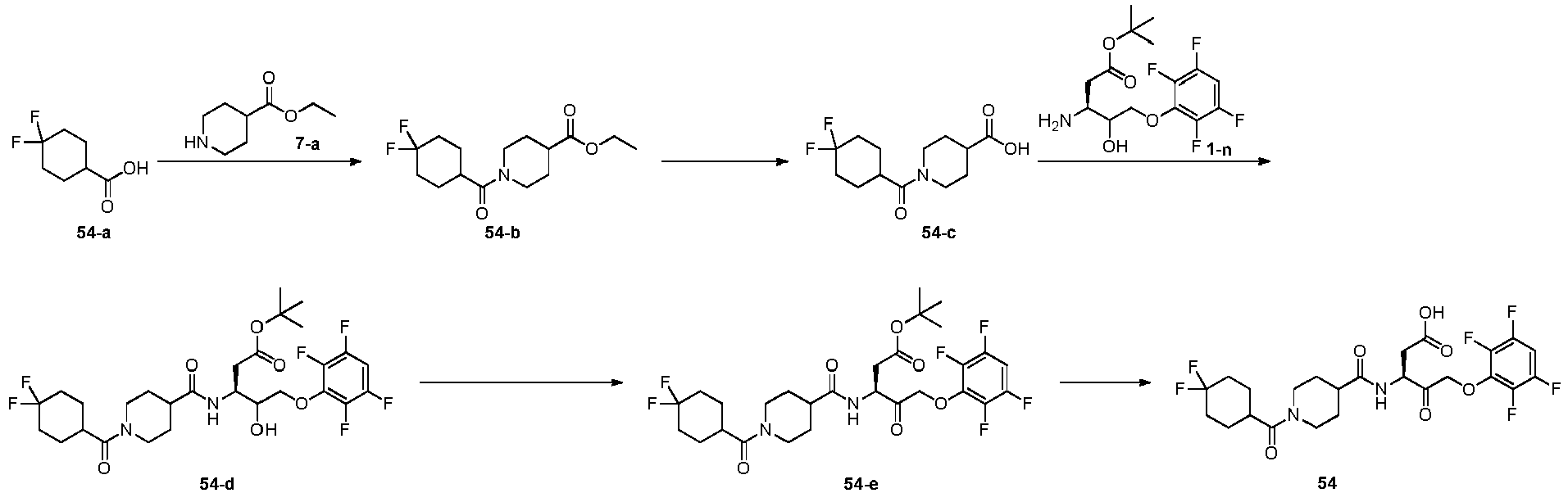
- Compound 54-a (361.13 mg, 2.20 mmol, 1.10 eq) and HATU (1.14 g, 3.00 mmol, 1.50 eq) were dissolved in dichloromethane (20 mL), and stirred at room temperature for 15 min. Compound 7-a (314.42 mg, 2.00 mmol, 308.25 µL, 1.00 eq) and N,N-diisopropylethylamine (775.44 mg, 6.00 mmol, 1.05 mL, 3.00 eq) were then added, followed by stirring at room temperature for 18 hours. After the reaction was completed, the reaction solution was added with 150 mL of water, and extracted with dichloromethane (80 mL × 3). The organic phases were combined, dried over anhydrous sodium sulfate, filtered and concentrated to give a crude product. The crude product was subjected to column chromatography (petroleum ether : ethyl acetate = 1:0∼3:1) to give the product of compound 54-b (892.00 mg, yield: 94%) as a yellow oil. 1H NMR (400MHz, CHLOROFORM-d) δ= 4.40 (d, J=13.3 Hz, 1H), 4.18-4.07 (m, 2H), 3.83 (d, J=13.3 Hz, 1H), 3.13 (t, J=11.7 Hz, 1H), 2.60-2.48 (m, 2H), 2.22-2.07 (m, 2H), 1.98-1.52 (m, 11H), 1.24 (t, J=7.2 Hz, 3H); LCMS m/z = 304.0 [M+H]+.
- Compound 54-b (473.98 mg, 1.00 mmol, 1.00 eq) was dissolved in tetrahydrofuran (10.00 mL), and a solution of LiOH·H2O (62.94 mg, 1.50 mmol, 1.50 eq) dissolved in H2O (10.00 mL) was added to the above solution. The reaction solution was maintained at 25°C and stirred for 2 hours. After the reaction was completed, the reaction solution was adjusted to pH of 6 with 2 N dilute hydrochloric acid. This solution was added with 50 mL of water, and extracted with dichloromethane (30 mL × 3). The organic phase was dried over anhydrous sodium sulfate, filtered and concentrated to give the product of compound 54-c (308.00 mg, crude) as a pale yellow oil, which was used directly in the next step without purification. LCMS m/z = 275.9 [M+H]+.
- Compound 54-c (178.94 mg, 650.00 µmol, 1.30 eq) and HATU (380.23 mg, 1.00 mmol, 2.00 eq) were dissolved in dichloromethane (20 mL), and stirred at room temperature for 15 min. Compound 1-n (176.66 mg, 500.00 µmol, 1.00 eq) and N,N-diisopropylethylamine (193.86 mg, 1.50 mmol, 261.97 µL, 3.00 eq) were then added, followed by stirring at room temperature for 18 hours. After the reaction was completed, the reaction solution was added with 150 mL of water, and extracted with dichloromethane (80 mL × 3). The organic phases were combined, dried over anhydrous sodium sulfate, filtered and concentrated to give a crude product. The crude product was subjected to column chromatography (petroleum ether : ethyl acetate = 1:0∼5:3) to give the product of compound 54-d (233.00 mg, yield: 74%) as a yellow oil. LCMS m/z = 633.1 [M+Na]+.
- Compound 54-d (230.00 mg, 376.68 µmol, 1.00 eq) was dissolved in dichloromethane (20.00 mL), and PIDA (485.32 mg, 1.51 mmol, 4.00 eq) and TEMPO (11.85 mg, 75.34 µmol, 0.20 eq) were added thereto. The reaction solution was stirred at room temperature for 62 hours. After the reaction was completed, the reaction solution was added with saturated sodium hydrogen carbonate solution (50 mL) and saturated sodium sulfite solution (50 mL), extracted with dichloromethane (30 mL × 3), and washed with saturated brine (50 mL). The organic phase was dried over anhydrous sodium sulfate, filtered and concentrated to give a crude product. The crude product was subjected to column chromatography (petroleum ether: ethyl acetate = 1:0∼5:3) to give the product of compound 54-e (106.00 mg, yield: 43%) as a yellow oil. LCMS m/z = 609.1 [M+H]+; 631.1 [M+Na]+.
- Compound 54-e (106.00 mg, 174.18 µmol, 1.00 eq) was dissolved in dichloromethane (4.00 mL), and trifluoroacetic acid (4.62 g, 40.52 mmol, 3.00 mL) was added thereto. The reaction solution was stirred at room temperature for 2 hours. After the reaction was completed, the reaction solution was spin-dried to give a crude product. The crude product was purified by preparative HPLC (in trifluoroacetic acid condition), and lyophilized to give the product of compound 54 (80.00 mg, yield: 77%). 1H NMR (400MHz, DMSO-d6) δ= 8.52-8.45 (m, 1H), 7.64-7.52 (m, 1H), 5.22 (d, J=11.0 Hz, 2H), 4.60 (d, J=7.0 Hz, 1H), 4.41-4.25 (m, 2H), 3.99 (d, J=13.1 Hz, 1H), 3.12-2.98 (m, 1H), 2.87-2.68 (m, 2H), 2.63-2.55 (m, 2H), 2.47-2.49 (m., 1H), 2.07-1.87 (m., 4H), 1.79-1.65 (m, 5H), 1.61-1.49 (m, 2H), 1.39-1.27 (m, 1H); LCMS m/z = 575.1 [M+Na]+.
-

- Compound 55-a (299.42 mg, 2.20 mmol, 1.10 eq) and HATU (1.14 g, 3.00 mmol, 1.50 eq) were dissolved in dichloromethane (20 mL), and stirred at room temperature for 15 min. Compound 7-a (314.42 mg, 2.00 mmol, 308.25 µL, 1.00 eq) and N,N-diisopropylethylamine (775.44 mg, 6.00 mmol, 1.05 mL, 3.00 eq) were then added, followed by stirring at room temperature for 18 hours. After the reaction was completed, the reaction solution was added with 150 mL of water, and extracted with dichloromethane (80 mL × 3). The organic phases were combined, dried over anhydrous sodium sulfate, filtered and concentrated to give a crude product. The crude product was subjected to column chromatography (petroleum ether : ethyl acetate = 1:0∼3:1) to give the product of compound 55-b (374.00 mg, yield: 68%) as a yellow oil. 1H NMR (400MHz, CHLOROFORM-d) δ= 4.39 (td, J=3.5, 13.1 Hz, 1H), 4.16 (q, J=7.0 Hz, 2H), 3.76-3.65 (m, 1H), 3.16-3.02 (m, 2H), 2.99-2.83 (m, 3H), 2.79-2.67 (m, 2H), 2.61-2.50 (m, 1H), 2.01-1.88 (m, 2H), 1.72-1.57 (m, 2H), 1.27 (t, J=7.2 Hz, 3H); LCMS m/z = 275.9 [M+H]+.
- Compound 55-b (192.70 mg, 700.00 µmol, 1.00 eq) was dissolved in tetrahydrofuran (10.00 mL), and a solution of LiOH·H2O (58.74 mg, 1.40 mmol, 2.00 eq) dissolved in H2O (10.00 mL) was added to the above solution. The reaction solution was maintained at 25°C and stirred for 2 hours. After the reaction was completed, the reaction solution was adjusted to pH of 6 with 2 N dilute hydrochloric acid. This solution was added with 50 mL of water, and extracted with dichloromethane (30 mL × 3). The organic phase was dried over anhydrous sodium sulfate, filtered and concentrated to give the product of compound 55-c (193.00 mg, crude) as a pale yellow oil, which was used directly in the next step without purification. LCMS m/z = 247.8 [M+H]+.
- Compound 55-c (81.66 mg, 600.00 µmol, 1.20 eq) and HATU (380.23 mg, 1.00 mmol, 2.00 eq) were dissolved in dichloromethane (20 mL), and stirred at room temperature for 15 min. Compound 1-n (176.66 mg, 500.00 µmol, 1.00 eq) and N,N-diisopropylethylamine (193.86 mg, 1.50 mmol, 261.97 µL, 3.00 eq) were then added, followed by stirring at room temperature for 18 hours. After the reaction was completed, the reaction solution was added with 150 mL of water, and extracted with dichloromethane (80 mL × 3). The organic phases were combined, dried over anhydrous sodium sulfate, filtered and concentrated to give a crude product. The crude product was subjected to column chromatography (petroleum ether : ethyl acetate = 1:0∼5:3) to give the product of compound 55-d (169.00 mg, yield: 53%) as a yellow oil. LCMS m/z = 605.1 [M+Na]+.
- Compound 55-d (168.00 mg, 288.40 µmol, 1.00 eq) was dissolved in dichloromethane (20.00 mL), and PIDA (371.57 mg, 1.15 mmol, 4.00 eq) and TEMPO (9.07 mg, 57.68 µmol, 0.20 eq) were added thereto. The reaction solution was stirred at room temperature for 40 hours. After the reaction was completed, the reaction solution was added with saturated sodium hydrogen carbonate solution (50 mL) and saturated sodium sulfite solution (50 mL), extracted with dichloromethane (30 mL × 3), and washed with saturated brine (50 mL). The organic phase was dried over anhydrous sodium sulfate, filtered and concentrated to give a crude product. The crude product was subjected to column chromatography (petroleum ether: ethyl acetate = 1:0∼5:3) to give the product of compound 55-e (126.00 mg, yield: 67%) as a yellow oil. LCMS m/z = 603.1 [M+Na]+.
- Compound 55-e (126.00 mg, 217.05 µmol, 1.00 eq) was dissolved in dichloromethane (4.00 mL), and trifluoroacetic acid (4.62 g, 40.52 mmol, 3.00 mL) was added thereto. The reaction solution was stirred at room temperature for 2 hours. After the reaction was completed, the reaction solution was spin-dried to give a crude product. The crude product was purified by preparative HPLC (in trifluoroacetic acid condition), and lyophilized to give the product of compound 55 (84.00 mg, yield: 72%). 1H NMR (400MHz, DMSO-d6) δ = 8.45 (d, J=7.5 Hz, 1H), 7.64-7.52 (m, 1H), 5.22 (d, J=10.0 Hz, 1H), 4.60 (d, J=7.0 Hz, 1H), 4.32-4.25 (m., 1H), 3.76 (d, J=13.6 Hz, 1H), 3.31-3.17 (m, 1H), 3.05-2.92 (m, 1H), 2.81-2.71 (m, 5H), 2.67-2.55 (m, 2H), 2.48-2.38 (m., 1H), 1.71 (br. s., 2H), 1.51-1.30 (m, 2H); LCMS m/z = 525.1 [M+H]+; 547.1 [M+Na]+.
-
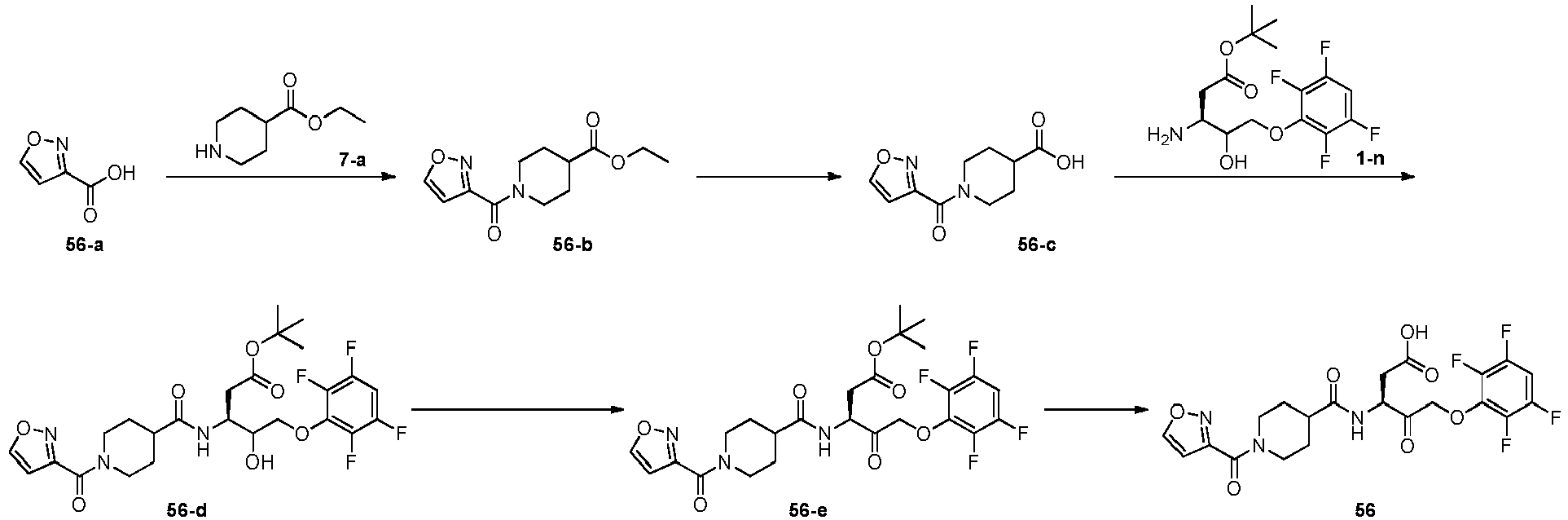
- Under the protection of nitrogen gas, compound 56-a (230.00 mg, 2.03 mmol, 1.00 eq) was dissolved in dichloromethane (5 mL), and then HOBt (376.55 mg, 2.79 mmol, 1.37 eq), EDCI (534.22 mg, 2.79 mmol, 1.37 eq), NMM (617.26 mg, 6.10 mmol, 670.93 µL, 3.00 eq) were added thereto, and finally compound 7-a (415.72 mg, 2.64 mmol, 407.57 µL, 1.30 eq) as a substrate was added thereto. The reaction was stirred at 15°C for 18 hours. The reaction system was added with 40 mL of ethyl acetate and 40 mL of water, and separated. The aqueous phase was further extracted once with ethyl acetate (30 mL). The combined organic phases were washed once with 50 mL of water and 50 mL of saturated brine. The organic phase was dried over anhydrous sodium sulfate, filtered and concentrated to give a crude product. The crude product was subjected to column chromatography (petroleum ether : ethyl acetate = 1:0∼3:2) to give compound 56-b (243.00 mg, yield: 47%) as a brown liquid. LCMS m/z = 252.9 [M+H]+.
- Compound 56-b (240.00 mg, 951.36 µmol, 1.00 eq) was dissolved in tetrahydrofuran (6 mL), and then a solution of LiOH·H2O (36.46 mg, 1.52 mmol, 1.60 eq) dissolved in H2O (6 mL) was added thereto. The reaction system was stirred at 15°C for 2 hours. The reaction system was acidified to pH of about 4 with 1N hydrochloric acid, and then extracted four times with ethyl acetate (30 mL). The combind organic phases were washed with 40 mL of saturated brine, dried over anhydrous sodium sulfate, and then spin-dried to give the crude liquid product of compound 56-c (186 mg, crude) as a yellow oil. LCMS m/z = 224.9 [M+H]+; 247[M+Na]+.
- Under the protection of nitrogen gas, compound 56-c (152.62 mg, 680.71 µmol, 1.30 eq) was dissolved in dichloromethane (5 mL), and then HATU (398.19 mg, 1.05 mmol, 2.00 eq), N,N-diisopropylethylamine (203.02 mg, 1.57 mmol, 274.35 µL, 3.00 eq) were added thereto, and finally compound 1-n (185.00 mg, 523.62 µmol, 1.00 eq) as a substrate was added thereto. The reaction was stirred at 15°C for 16 hours. The reaction system was added with 20 mL of ethyl acetate and 20 mL of water, and separated. The aqueous phase was further extracted once with ethyl acetate (20 mL). The combined organic phases were separately washed once with 30 mL of water and 30 mL of saturated brine, and then dried and spin-dried to give a crude product. The crude product was subjected to column chromatography (petroleum ether : ethyl acetate = 1:0∼1:2) to give compound 56-d (234.00 mg, yield: 80%) as a brown liquid. LCMS m/z = 582.0 [M+Na]+.
- Compound 56-d (234.00 mg, 418.22 µmol, 1.00 eq) was dissolved in dichloromethane (6 mL), and PIDA (269.42 mg, 836.44 µmol, 2.00 eq) and TEMPO (39.46 mg, 250.93 µmol, 0.60 eq) were added under the protection of nitrogen gas. The reaction system was stirred at 15°C for 60 hours. The system was added with ethyl acetate (20 mL), and washed respectively with saturated sodium hydrogen carbonate solution (20 mL), water (20 mL) and saturated brine (20 mL). The organic phase was dried over anhydrous sodium sulfate, filtered, and spin-dried to give a crude product. The crude product was subjected to column chromatography (petroleum ether : ethyl acetate = 1:0∼1:2) to give compound 56-e (135.00 mg, yield: 58%) as a brown liquid. LCMS m/z =580 [M+Na]+.
- Compound 56-e (135.00 mg, 242.16 µmol, 1.00 eq) was dissolved in dichloromethane (5 mL), and trifluoroacetic acid (5.52 g, 48.43 mmol, 3.58 mL, 200.00 eq) was added thereto under the protection of nitrogen gas. The system was stirred at 15°C for 1 hour. After the reaction was completed, the reaction solution was spin-dried to give a crude product. The crude product was purified by preparative HPLC (in trifluoroacetic acid condition), spin-dried, and dissolved in acetonitrile (20 mL), and the solution was added with water (20 mL), evenly mixed, and lyophilized to give compound 56 (58.00 mg, yield: 48%). 1H NMR (400 MHz, DMSO-d6) δ=9.07 (s, 1H), 8.48 (d, J=7.53 Hz, 1H), 7.50-7.66 (m, 1H), 6.81 (s, 1H), 5.08-5.32 (m, 2H), 4.55-4.67 (m, 1H), 4.42 (d, J=13.05 Hz, 1H), 4.12-4.21 (m, 2H), 3.85 (d, J=13.55 Hz, 2H), 3.15 (t, J=11.80 Hz, 1H), 2.90 (t, J=11.80 Hz, 1H), 2.67-2.79 (m, 1H), 1.64-1.88 (m, 2H), 1.42-1.59 (m, 2H).
-

- Compound 7-a (314.42 mg, 2.00 mmol, 308.25 µL, 1.00 eq) and N,N-diisopropylethylamine (387.72 mg, 3.00 mmol, 523.95 µL, 1.50 eq) were dissolved in dichloromethane (10 mL), and compound 57-a (417.25 mg, 2.10 mmol, 1.05 eq) was added thereto, followed by stirring at room temperature for 1.5 hours. After the reaction was completed, the reaction solution was added with 150 mL of water, and extracted with dichloromethane (80 mL × 3). The organic phases were combined, dried over anhydrous sodium sulfate, filtered and concentrated to give a crude product. The crude product was subjected to column chromatography (petroleum ether : ethyl acetate = 1:0∼3:1) to give the product of compound 57-b (612.00 mg, yield: 96%) as a yellow oil. 1H NMR (400MHz, CHLOROFORM-d) δ= 4.37 (d, J=13.1 Hz, 2H), 4.13 (q, J=7.0 Hz, 2H), 2.95 (t, J=11.5 Hz, 2H), 2.59-2.47 (m, 1H), 2.07-1.95 (m, 9H), 1.91 (dd, J=3.0, 13.6 Hz, 2H), 1.77-1.59 (m, 8H), 1.25 (t, J=7.3 Hz, 3H); LCMS m/z = 342.1 [M+Na]+.
- Compound 57-b (223.61 mg, 700.00 µmol, 1.00 eq) was dissolved in tetrahydrofuran (10.00 mL), and a solution of LiOH·H2O (58.74 mg, 1.40 mmol, 2.00 eq) dissolved in H2O (10.00 mL) was added to the above solution. The reaction solution was maintained at 25°C and stirred for 2 hours. After the reaction was completed, the reaction solution was adjusted to pH of 6 with 2 N dilute hydrochloric acid. This solution was added with 50 mL of water, and extracted with dichloromethane (30 mL × 3). The organic phase was dried over anhydrous sodium sulfate, filtered and concentrated to give the product of compound 57-c (221.00 mg, crude) as a pale yellow oil, which was used directly in the next step without purification. LCMS m/z = 292.1 [M+H]+.
- Compound 57-c (145.69 mg, 500.00 µmol, 1.00 eq) and HATU (380.23 mg, 1.00 mmol, 2.00 eq) were dissolved in dichloromethane (20 mL), followed by stirring at room temperature for 15 min. Compound 1-n (176.66 mg, 500.00 µmol, 1.00 eq) and N,N-diisopropylethylamine (193.86 mg, 1.50 mmol, 261.97 µL, 3.00 eq) were then added, and stirred at room temperature for 18 hours. After the reaction was completed, the reaction solution was added with 150 mL of water, and extracted with dichloromethane (80 mL × 3). The organic phases were combined, dried over anhydrous sodium sulfate, filtered and concentrated to give a crude product. The crude product was subjected to column chromatography (petroleum ether : ethyl acetate = 1:0∼5:3) to give the product of compound 57-d (303.00 mg, yield: 88%) as a yellow oil. LCMS m/z = 627.2 [M+H]+; 649.2 [M+Na]+.
- Compound 57-d (303.00 mg, 483.50 µmol, 1.00 eq) was dissolved in dichloromethane (20.00 mL), and PIDA (622.94 mg, 1.93 mmol, 4.00 eq) and TEMPO (15.21 mg, 96.70 µmol, 0.20 eq) were added thereto. The reaction solution was stirred at room temperature for 40 hours. After the reaction was completed, the reaction solution was added with saturated sodium hydrogen carbonate solution (50 mL) and saturated sodium sulfite solution (50 mL), extracted with dichloromethane (30 mL × 3), and washed with saturated brine (50 mL). The organic phase was dried over anhydrous sodium sulfate, filtered and concentrated to give a crude product. The crude product was subjected to column chromatography (petroleum ether: ethyl acetate = 1:0∼5:3) to give the product of compound 57-e (252.00 mg, yield: 77%) as a yellow oil. LCMS m/z = 625.2 [M+H]+; 647.2 [M+Na]+.
- Compound 57-e (252.00 mg, 403.42 µmol, 1.00 eq) was dissolved in dichloromethane (4.00 mL), and trifluoroacetic acid (4.62 g, 40.52 mmol, 3.00 mL) was added thereto. The reaction solution was stirred at room temperature for 2 hours. After the reaction was completed, the reaction solution was spin-dried to give a crude product. The crude product was purified by preparative HPLC (in trifluoroacetic acid condition), and lyophilized to give the product of compound 57 (174.00 mg, yield: 73%). 1H NMR (400MHz, DMSO-d6) δ = 8.46 (d, J=7.5 Hz, 1H), 7.61-7.51 (m, 1H), 5.29-5.15 (m, 2H), 4.61 (q, J=6.5 Hz, 1H), 4.35 (d, J=12.5 Hz, 2H), 2.86-2.71 (m, 4H), 2.58 (dd, J=7.0, 16.6 Hz, 1H), 2.49-2.42 (m, 1H), 1.97 (br. s., 3H), 1.89 (br. s., 6H), 1.73-1.65 (m, 8H), 1.45-1.34 (m, 2H); LCMS m/z = 569.1 [M+H]+; 591.1 [M+Na]+.
-

- Under the protection of nitrogen gas, compound 58-a (300.00 mg, 1.67 mmol, 1.00 eq) was dissolved in DMF (5 mL), and then HATU (1.27 g, 3.34 mmol, 2.00 eq), N,N-diisopropylethylamine (647.49 mg, 5.01 mmol, 874.99 µL, 3.00 eq) were added thereto, and finally compound 7-a (341.30 mg, 2.17 mmol, 334.61 µL, 1.30 eq) as a substrate was added thereto. The reaction was stirred at 20°C for 18 hours. The reaction system was added with 20 mL of ethyl acetate and 20 mL of water, and separated. The aqueous phase was further extracted three times with ethyl acetate (30 mL). The combined organic phases were washed separately with 50 mL of water and 50 mL of saturated brine, and then dried and spin-dried to give a crude product. The crude product was subjected to column chromatography (petroleum ether : ethyl acetate = 1:0∼7:3) to give compound 58-b (187.00 mg, yield: 33%) as a brown liquid. LCMS m/z = 318.9 [M+H]+.
- Compound 58-b (186.00 mg, 584.19 µmol, 1.00 eq) was dissolved in tetrahydrofuran (5 mL), and then LiOH·H2O (27.98 mg, 1.17 mmol, 2.00 eq) was dissolved in water (5 mL). The formulated solution was slowly added to compound 58-b. The reaction system was stirred at 15°C for 2 hours. The reaction system was acidified to pH of about 4 with 1N hydrochloric acid, and then extracted four times with ethyl acetate (10 mL). The combind organic phases were washed once with 20 mL of saturated brine, dried over anhydrous sodium sulfate, and then spin-dried to give the crude liquid product of compound 58-c (135.00 mg, crude) as a yellow oil, LCMS m/z = 290.9 [M+H]+.
- Under the protection of nitrogen gas, compound 58-c (135.00 mg, 464.97 µmol, 1.20 eq) was dissolved in dichloromethane (5 mL), and then HATU (294.66 mg, 774.95 µmol, 2.00 eq), N,N-diisopropylethylamine (150.23 mg, 1.16 mmol, 203.02 µL, 3.00 eq) were added thereto, and finally compound 1-n (136.90 mg, 387.48 µmol, 1.00 eq) as a substrate was added thereto. The reaction was stirred at 15°C for 58 hours. The reaction system was added with 20 mL of ethyl acetate and 20 mL of water, and separated. The aqueous phase was further extracted once with ethyl acetate (20 mL). The combined organic phases were washed separately with 30 mL of water and 30 mL of saturated brine, and then dried and spin-dried to give a crude product. The crude product was subjected to column chromatography (petroleum ether : ethyl acetate = 1:0∼1:2) to give compound 58-d (135.00 mg, yield: 55%) as a colorless liquid. LCMS m/z = 626.1 [M+H]+.
- Compound 58-d (135.00 mg, 215.78 µmol, 1.00 eq) was dissolved in dichloromethane (5 mL), and PIDA (208.51 mg, 647.34 µmol, 3.00 eq) and TEMPO (23.75 mg, 151.05 µmol, 0.70 eq) was added thereto under the protection of nitrogen gas. The reaction system was stirred at 20°C for 60 hours. The reaction system was added with ethyl acetate (20 mL), and washed respectively with saturated sodium hydrogen carbonate solution (20 mL), water (20 mL) and saturated brine (20 mL). The organic phase was dried over anhydrous sodium sulfate, filtered, and spin-dried to give a crude product. The crude product was subjected to column chromatography (petroleum ether : ethyl acetate = 1:0∼1:2) to give compound 58-e (101.00 mg, yield: 75%) as a brown liquid. LCMS m/z =624.1[M+H]+; 646.1[M+H]+.
- Compound 58-e (101.00 mg, 161.96 µmol, 1.00 eq) was dissolved in dichloromethane (5 mL), and trifluoroacetic acid (3.32 g, 29.15 mmol, 2.16 mL, 180.00 eq) was added thereto under the protection of nitrogen gas. The system was stirred at 15°C for 1 hour. After the reaction was completed, the reaction solution was spin-dried to give a crude product. The crude product was purified by preparative HPLC (in trifluoroacetic acid condition), spin-dried and then dissolved with acetonitrile (20 mL), and the obtained solution was added with water (20 mL), evenly mixed and lyophilized to give compound 58 (20.00 mg, yield: 22%). 1H NMR (400 MHz, DMSO-d6) δ=8.49 (d, J=7.53 Hz, 1H), 8.09-8.23 (m, 2H), 7.51-7.65 (m, 3H), 5.14-5.31 (m, 2H), 5.06 (d, J=13.55 Hz, 1H), 4.62 (q, J=6.86 Hz, 1H), 4.45 (d, J=13.05 Hz, 1H), 2.90-3.07 (m, 1H), 2.64-2.81 (m, 2H), 2.59 (dd, J=7.03, 16.56 Hz, 2H), 1.84 (br. s., 2H), 1.48-1.71 (m, 2H).
-

- Compound 59-a (200.00 mg, 1.09 mmol, 1.00 eq) was dissolved in dichloromethane (5.00 mL), and triethylamine (220.59 mg, 2.18 mmol, 302.18 µL, 2.00 eq) and compound 1-b (141.38 mg, 1.04 mmol, 115.88 µL, 0.95 eq) were successively added thereto at 0°C. After the reaction solution was stirred at 10°C for 6 hours, compound 1-b (44.65 mg, 327.00 µmol, 36.59 µL, 0.30 eq) was supplemented. After the above reaction solution was stirred for 15 hours, compound 1-b (100.00 mg, 732.44 µmol, 81.97 µL, 0.67 eq) was further supplemented, and the reaction solution was maintained at 10°C and reacted for another 0.5 hour. After the reaction was completed, added with water (100 mL), and extracted with dichloromethane (100 mL × 3). The organic phases were combined, dried over anhydrous sodium sulfate, filtered and concentrated to give a crude product. The crude product was subjected to column chromatography (petroleum ether : ethyl acetate = 1:0∼9:1) to give the product of compound 59-b (260.00 mg, yield: 72%). 1H NMR (400 MHz, CHLOROFORM-d) δ=9.21 (br. s., 1H), 8.00 (d, J=8.78 Hz, 1H), 7.39 (d, J=2.01 Hz, 1H), 7.25 (d, J=2.01 Hz, 1H), 4.46 (q, J=7.28 Hz, 2H), 1.42-1.51 (m, 12H).
- Compound 59-b (260.00 mg, 916.30 µmol, 1.00 eq) was dissolved in tetrahydrofuran (10.00 mL), and a solution of LiOH·H2O (57.67 mg, 1.37 mmol, 1.50 eq) dissolved in H2O (10.00 mL) was added to the above solution. The reaction solution was stirred at 10°C for 1 hour. After the reaction was completed, the reaction solution was adjusted to pH of 5 with 2 N dilute hydrochloric acid. This solution was added with water (80 mL), and extracted with dichloromethane (80 mL × 3). The organic phase was dried over anhydrous sodium sulfate, filtered and concentrated to give the product of compound 59-c (210.00 mg, crude), which was used directly in the next step without purification. 1H NMR (400 MHz, CHLOROFORM-d) δ=9.31 (br. s., 1H), 7.92 (d, J=8.53 Hz, 1H), 7.42 (d, J=2.01 Hz, 1H), 7.29 (d, J=2.51 Hz, 1H), 1.47 (s, 9H).
- Compound 59-c (210.00 mg, 821.27 µmol, 1.00 eq) was dissolved in dichloromethane (10.00 mL), and compound 7-a (142.02 mg, 903.40 µmol, 139.24 µL, 1.10 eq), EDCI (215.69 mg, 1.13 mmol, 1.37 eq), HOBt (152.03 mg, 1.13 mmol, 1.37 eq) and NMM (249.22 mg, 2.46 mmol, 270.89 µL, 3.00 eq) were added thereto. The reaction solution was stirred under the protection of nitrogen gas at 10°C for 14 hours. After the reaction was completed, the reaction solution was added with water (100 mL), and extracted with dichloromethane (100 mL × 3). The organic phases were combined, dried over anhydrous sodium sulfate, filtered and concentrated to give a crude product. The crude product was subjected to column chromatography (petroleum ether : ethyl acetate = 0-20%) to give the product of compound 59-d (190.00 mg, yield: 56%) as a colorless oil. LCMS m/z = 395.1 [M+H]+.
- Compound 59-d (190.00 mg, 481.15 µmol, 1.00 eq) was dissolved in tetrahydrofuran (8.00 mL), and a solution of LiOH·H2O (40.38 mg, 962.30 µmol, 2.00 eq) dissolved in H2O (8.00 mL) was added to the above solution. The reaction solution was stirred at 10°C for 1 hour. After the reaction was completed, the reaction solution was adjusted to pH of 5 with 2 N dilute hydrochloric acid. This solution was added with water (80 mL), and extracted with dichloromethane (80 mL × 5). The organic phase was dried over anhydrous sodium sulfate, filtered and concentrated to give the product of compound 59-e (190.00 mg, crude), which was used directly in the next step without purification. LCMS m/z = 389.0 [M+Na]+.
- Compound 59-e (190.00 mg, 517.94 µmol, 1.00 eq) was dissolved in dichloromethane (10.00 mL), and compound 1-n (201.29 mg, 569.73 µmol, 1.10 eq), EDCI (136.03 mg, 709.57 µmol, 1.37 eq), HOBt (95.88 mg, 709.57 µmol, 1.37 eq) and NMM (157.17 mg, 1.55 mmol, 170.83 µL, 3.00 eq) were added thereto. The reaction solution was stirred under the protection of nitrogen gas at 10°C for 14 hours. After the reaction was completed, the reaction solution was added with water (100 mL), and extracted with dichloromethane (100 mL × 3). The organic phases were combined, dried over anhydrous sodium sulfate, filtered and concentrated to give a crude product. The crude product was subjected to column chromatography (petroleum ether : ethyl acetate = 1:0∼4:1) to give the product of compound 59-f (220.00 mg, yield: 60%) as a colorless oil. LCMS m/z = 702.2 [M+H]+.
- Compound 59-f (220.00 mg, 313.33 µmol, 1.00 eq) was dissolved in dichloromethane (15.00 mL), and PIDA (390.58 mg, 1.21 mmol, 3.87 eq) and TEMPO (14.78 mg, 94.00 µmol, 0.30 eq) were added thereto. After the reaction solution was stirred under the protection of nitrogen gas at 10°C for 15 hours, TEMPO (49.27 mg, 313.33 µmol, 1.00 eq) was supplemented, and the reaction was stirred for another 5 hours. After the reaction was completed, the reaction solution was added with 150 mL of ethyl acetate. The solution was washed successively with saturated sodium hydrogen carbonate (80 mL), saturated brine (80 mL) and water (80 mL). The organic phase was dried over anhydrous sodium sulfate, filtered and concentrated to give a crude product. The crude product was subjected to column chromatography (petroleum ether : ethyl acetate = 1:0∼3:2) to give the product of compound 59-g (140.00 mg, yield: 56%) as a colorless oil. LCMS m/z = 700.3 [M+H]+.
- Compound 59-g (140.00 mg, 199.97 µmol, 1.00 eq) was dissolved in dichloromethane (6.00 mL), and trifluoroacetic acid (4.49 g, 39.34 mmol, 2.91 mL, 196.71 eq) was added thereto. The reaction solution was stirred under the protection of nitrogen gas at 10°C for 1 hour. After the reaction was completed, the reaction solution was concentrated to give a crude product. The crude product was purified by preparative HPLC (in trifluoroacetic acid condition), and lyophilized to give the product of compound 59 (50.40 mg, yield: 39%). 1H NMR (400 MHz, DMSO-d6) δ=10.11 (s, 1H), 8.49 (d, J=7.53 Hz, 1H), 7.50-7.64 (m, 1H), 7.39 (d, J=2.01 Hz, 1H), 7.32 (dd, J=2.26, 8.28 Hz, 1H), 7.16 (d, J=8.53 Hz, 1H), 5.15-5.30 (m, 2H), 4.62 (q, J=7.03 Hz, 1H), 4.30 (d, J=13.05 Hz, 1H), 3.98 (d, J=13.05 Hz, 1H), 3.20 (t, J=12.30 Hz, 1H), 2.71-2.93 (m, 2H), 2.53-2.65 (m, 2H), 1.73-1.85 (m, 2H), 1.45-1.69 (m, 2H), 1.33 (s, 9H); LCMS m/z = 644.0 [M+H]+.
-

- Compound 60-a (6.00 g, 30.68 mmol, 4.32 mL, 1.00 eq) was dissolved in dichloromethane (80.00 mL), and triethylamine (6.21 g, 61.36 mmol, 8.51 mL, 2.00 eq) and compound 1-b (5.03 g, 36.82 mmol, 4.12 mL, 1.20 eq) were successively added thereto. The reaction solution was stirred at 15°C for 16 hours. After the reaction was completed, water (250 mL) and dichloromethane (250 mL) were added for extraction. The organic phase was washed with hydrochloric acid solution (1 N, 250 mL) and brine (250 mL), dried over anhydrous sodium sulfate, filtered, and concentrated to give a crude product. The crude product was subjected to column chromatography (petroleum ether : ethyl acetate = 1:0∼4:1) to give the product of compound 60-b (8.00 g, yield: 86%) as a pale yellow solid. 1H NMR (400 MHz, CHLOROFORM-d) δ=9.34 (br. s., 1H), 8.37 (d, J=9.03 Hz, 1H), 7.65 (d, J=2.01 Hz, 1H), 7.59 (d, J=9.03 Hz, 1H), 4.46 (q, J=7.28 Hz, 2H), 1.45 (t, J=7.03 Hz, 3H).
- Compound 60-b (600.00 mg, 2.03 mmol, 1.00 eq) was dissolved in tetrahydrofuran (10.00 mL), and a solution of LiOH·H2O (127.77 mg, 3.04 mmol, 1.50 eq) dissolved in H2O (10.00 mL) was added to the above solution. The reaction solution was stirred at 15°C for 1 hour. After the reaction was completed, the reaction solution was adjusted to pH of 5 with 2 N dilute hydrochloric acid. This solution was added with water (100 mL), and extracted with dichloromethane (100 mL × 3). The organic phase was dried over anhydrous sodium sulfate, filtered and concentrated to give the product of compound 60-c (290.00 mg, crude), which was used directly in the next step without purification. 1H NMR (400 MHz, CHLOROFORM-d) δ= 9.39 (br. s., 1H), 8.28 (d, J=8.78 Hz, 1H), 7.68 (s, 1H), 7.61 (d, J=8.78 Hz, 1H).
- Compound 60-c (430.00 mg, 1.61 mmol, 1.00 eq) was dissolved in dichloromethane (8.00 mL), and compound 7-a (253.11 mg, 1.61 mmol, 248.15 µL, 1.00 eq), EDCI (422.83 mg, 2.21 mmol, 1.37 eq), HOBt (298.03 mg, 2.21 mmol, 1.37 eq) and NMM (488.55 mg, 4.83 mmol, 531.04 µL, 3.00 eq) were added thereto. The reaction solution was stirred under the protection of nitrogen gas at 15°C for 14 hours. After the reaction was completed, the reaction solution was added with water (100 mL), and extracted with dichloromethane (100 mL × 3). The organic phases were combined, dried over anhydrous sodium sulfate, filtered and concentrated to give a crude product. The crude product was subjected to column chromatography (petroleum ether : ethyl acetate = 1:0∼2:1) to give the product of compound 60-d (260.00 mg, yield: 38%) as a colorless oil. LCMS m/z = 407.0 [M+H]+.
- Compound 60-d (260.00 mg, 639.17 µmol, 1.00 eq) was dissolved in tetrahydrofuran (8.00 mL), and a solution of LiOH·H2O (40.23 mg, 958.75 µmol, 1.50 eq) dissolved in H2O (8.00 mL) was added to the above solution. The reaction solution was stirred at 15°C for 1 hour. After the reaction was completed, the reaction solution was adjusted to pH of 5 with 2 N dilute hydrochloric acid. This solution was added with water (100 mL), and extracted with dichloromethane (100 mL × 3). The organic phase was dried over anhydrous sodium sulfate, filtered and concentrated to give the product of compound 60-e (230.00 mg, crude) as a colorless oil, which was used directly in the next step without purification. LCMS m/z = 379.0 [M+H]+.
- Compound 1-n (236.02 mg, 668.02 µmol, 1.10 eq) was dissolved in dichloromethane (15.00 mL), and compound 60-e (230.00 mg, 607.29 µmol, 1.00 eq), EDCI (159.49 mg, 831.99 µmol, 1.37 eq), HOBt (112.42 mg, 831.99 µmol, 1.37 eq) and NMM (184.28 mg, 1.82 mmol, 200.31 µL, 3.00 eq) were added thereto. The reaction solution was stirred under the protection of nitrogen gas at 15°C for 14 hours. After the reaction was completed, the reaction solution was added with water (100 mL), and extracted with dichloromethane (100 mL × 3). The organic phases were combined, dried over anhydrous sodium sulfate, filtered and concentrated to give a crude product. The crude product was subjected to column chromatography (petroleum ether : ethyl acetate = 1:0∼3:2) to give the product of compound 60-f (260.00 mg, yield: 60%). LCMS m/z = 714.1 [M+H]+.
- Compound 60-f (210.00 mg, 294.11 µmol, 1.00 eq) was dissolved in dichloromethane (10.00 mL), and PIDA (366.62 mg, 1.14 mmol, 3.87 eq) and TEMPO (13.87 mg, 88.23 µmol, 0.30 eq) were added thereto. The reaction solution was stirred under the protection of nitrogen gas at 15°C for 15 hours. The reaction solution was added with 150 mL of ethyl acetate. The solution was washed successively with saturated sodium hydrogen carbonate (80 mL), saturated brine (80 mL) and water (80 mL). The organic phase was dried over anhydrous sodium sulfate, filtered and concentrated to give a crude product. The crude product was subjected to column chromatography (petroleum ether : ethyl acetate = 1:0∼3:2) to give the product of compound 60-g (160.00 mg, yield: 70%). LCMS m/z = 712.2 [M+H]+.
- Compound 60-g (160.00 mg, 224.72 µmol, 1.00 eq) was dissolved in dichloromethane (6.50 mL), and trifluoroacetic acid (5.04 g, 44.20 mmol, 3.27 mL, 196.71 eq) was added thereto. The reaction solution was stirred under the protection of nitrogen gas at 15°C for 1 hour. After the reaction was completed, the reaction solution was concentrated to give a crude product. The crude product was purified by preparative HPLC (in trifluoroacetic acid condition), and lyophilized to give the product of compound 60 (45.00 mg, yield: 31%). 1H NMR (400 MHz, DMSO-d6) δ=10.65 (s, 1H), 8.49 (d, J=7.53 Hz, 1H), 7.87 (d, J=2.01 Hz, 1H), 7.78-7.85 (m, 1H), 7.51-7.67 (m, 2H), 5.14-5.30 (m, 2H), 4.61 (q, J=6.02 Hz, 1H), 4.28 (d, J=13.05 Hz, 1H), 3.84 (d, J=13.55 Hz, 1H), 3.17 (t, J=11.80 Hz, 1H), 2.65-2.88 (m, 2H), 2.53-2.64 (m, 2H), 1.78 (d, J=9.54 Hz, 2H), 1.44-1.67 (m, 2H); LCMS m/z = 656.1 [M+H]+.
-
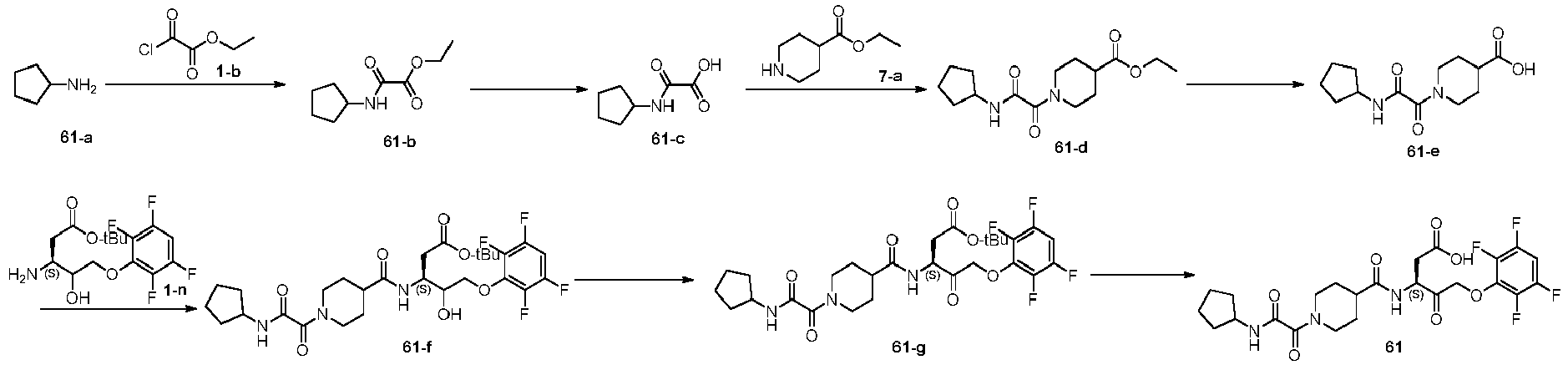
- Compound 61-a (2.00 g, 23.49 mmol, 2.33 mL, 1.00 eq) was dissolved in dichloromethane (40.00 mL), and triethylamine (4.75 g, 46.98 mmol, 6.51 mL, 2.00 eq) and compound 1-b (3.85 g, 28.19 mmol, 3.16 mL, 1.20 eq) were successively added thereto. The reaction solution was stirred at 20°C for 16 hours. After the reaction was completed, water (150 mL) and ethyl acetate (250 mL) was added for extraction. The organic phase was washed with water (150 mL) and brine (150 mL), dried over anhydrous sodium sulfate, filtered, and concentrated to give a crude product. The crude product was subjected to column chromatography (petroleum ether : ethyl acetate = 1:0∼2:1) to give the product of compound 61-b (4.20 g, yield: 95%) as a yellow oil. 1H NMR (400 MHz, CHLOROFORM-d) δ=7.05 (br. s., 1H), 4.34 (q, J=7.28 Hz, 2H), 4.23 (sxt, J=7.08 Hz, 1H), 1.97-2.09 (m, 2H), 1.57-1.77 (m, 4H), 1.47 (qd, J=6.38, 12.49 Hz, 2H), 1.38 (t, J=7.15 Hz, 3H).
- Compound 61-b (500.00 mg, 2.70 mmol, 1.00 eq) was dissolved in tetrahydrofuran (8.00 mL), and a solution of LiOH·H2O (339.88 mg, 8.10 mmol, 3.00 eq) dissolved in H2O (8.00 mL) was added to the above solution. The reaction solution was stirred at 20°C for 1 hour. After the reaction was completed, the reaction solution was adjusted to pH of 6 with 2 N dilute hydrochloric acid. This solution was added with water (50 mL), and extracted with dichloromethane (50 mL × 3). The organic phase was dried over anhydrous sodium sulfate, filtered and concentrated to give the product of compound 61-c (290.00 mg, crude) as a pale yellow solid, which was used directly in the next step without purification. 1H NMR (400 MHz, CHLOROFORM-d) δ=7.29 (br. s., 1H), 4.21 (sxt, J=6.98 Hz, 1H), 1.98-2.11 (m, 2H), 1.60-1.81 (m, 4H), 1.47-1.60 (m, 2H).
- Compound 61-c (145.00 mg, 922.57 µmol, 1.00 eq) was dissolved in dichloromethane (8.00 mL), and compound 7-a (145.04 mg, 922.57 µmol, 142.20 µL, 1.00 eq), EDCI (242.29 mg, 1.26 mmol, 1.37 eq), HOBt (170.78 mg, 1.26 mmol, 1.37 eq) and NMM (279.95 mg, 2.77 mmol, 304.29 µL, 3.00 eq) were added thereto. The reaction solution was stirred under the protection of nitrogen gas at 20°C for 15 hours. After the reaction was completed, the reaction solution was added with water (80 mL), and extracted with dichloromethane (80 mL × 3). The organic phases were combined, dried over anhydrous sodium sulfate, filtered and concentrated to give a crude product. The crude product was subjected to column chromatography (petroleum ether : ethyl acetate = 1:0∼2:1) to give the product of compound 61-d (166.00 mg, yield: 58%) as a colorless oil. 1H NMR (400 MHz, CHLOROFORM-d) δ=7.16 (d, J=5.52 Hz, 1H), 4.81 (td, J=3.42, 13.74 Hz, 1H), 4.33 (td, J=3.39, 13.55 Hz, 1H), 4.10-4.22 (m, 3H), 3.35 (ddd, J=2.76, 11.04, 13.55 Hz, 1H), 2.89-3.00 (m, 1H), 2.51-2.63 (m, 1H), 1.99 (dd, J=3.26, 13.30 Hz, 4H), 1.54-1.86 (m, 6H), 1.39-1.52 (m, 2H), 1.26 (t, J=7.15 Hz, 3H).
- Compound 61-d (166.00 mg, 560.13 µmol, 1.00 eq) was dissolved in tetrahydrofuran (8.00 mL), and a solution of LiOH·H2O (35.25 mg, 840.20 µmol, 1.50 eq) dissolved in H2O (8.00 mL) was added to the above solution. The reaction solution was stirred at 20°C for 1 hour. After the reaction was completed, the reaction solution was adjusted to pH of 6 with 2 N dilute hydrochloric acid. This solution was added with water (80 mL), and extracted with dichloromethane (80 mL × 3). The organic phase was dried over anhydrous sodium sulfate, filtered and concentrated to give the product of compound 61-e (160.00 mg, crude) as a colorless oil, which was used directly in the next step without purification. LCMS m/z = 268.9 [M+H]+.
- Compound 61-e (160.00 mg, 596.33 µmol, 1.00 eq) was dissolved in dichloromethane (8.00 mL), and compound 1-n (210.69 mg, 596.33 µmol, 1.00 eq), EDCI (156.61 mg, 816.97 µmol, 1.37 eq), HOBt (110.39 mg, 816.97 µmol, 1.37 eq) and NMM (180.95 mg, 1.79 mmol, 196.69 µL, 3.00 eq) were added thereto. The reaction solution was stirred under the protection of nitrogen gas at 20°C for 15 hours. After the reaction was completed, the reaction solution was added with water (80 mL), and extracted with dichloromethane (80 mL × 3). The organic phases were combined, dried over anhydrous sodium sulfate, filtered and concentrated to give a crude product. The crude product was subjected to column chromatography (petroleum ether : ethyl acetate = 1:0∼1:2) to give the product of compound 61-f (200.00 mg, yield: 45%) as a pale yellow oil. LCMS m/z = 626.3 [M+Na]+.
- Compound 61-f (200.00 mg, 331.35 µmol, 1.00 eq) was dissolved in dichloromethane (5.00 mL), and PIDA (413.03 mg, 1.28 mmol, 3.87 eq) and TEMPO (15.63 mg, 99.41 µmol, 0.30 eq) were added thereto. The reaction solution was stirred under the protection of nitrogen gas at 20°C for 15 hours. After the reaction was completed, the reaction solution was added with 100 mL of ethyl acetate. The solution was washed successively with saturated sodium hydrogen carbonate (50 mL), saturated brine (50 mL) and water (50 mL). The organic phase was dried over anhydrous sodium sulfate, filtered and concentrated to give a crude product. The crude product was subjected to column chromatography (petroleum ether: ethyl acetate = 1:0∼1:1) to give the product of compound 61-g (130.00 mg, yield: 55%) as a pale yellow oil. LCMS m/z = 624.2 [M+Na]+.
- Compound 61-g (130.00 mg, 216.09 µmol, 1.00 eq) was dissolved in dichloromethane (4.60 mL), and trifluoroacetic acid (3.54 g, 31.08 mmol, 2.30 mL, 143.85 eq) was added thereto. The reaction solution was stirred under the protection of nitrogen gas at 18°C for 1 hour. After the reaction was completed, the reaction solution was concentrated and lyophilized to give the product of compound 61 (95.30 mg, yield: 81%). 1H NMR (400 MHz, DMSO-d6) δ=8.64 (d, J=7.03 Hz, 1H), 8.47 (d, J=7.53 Hz, 1H), 7.50-7.69 (m, 1H), 5.13-5.30 (m, 2H), 4.60 (q, J=6.53 Hz, 1H), 4.21 (d, J=13.05 Hz, 1H), 3.96-4.09 (m, 1H), 3.64 (d, J=13.55 Hz, 2H), 3.05 (t, J=12.05 Hz, 1H), 2.65-2.79 (m, 2H), 2.58 (dd, J=7.03, 17.07 Hz, 1H), 1.35-1.87 (m, 12H); LCMS m/z = 546.1 [M+H]+.
-

- Compound 62-a (100.00 mg, 883.39 µmol, 1.00 eq) was dissolved in dichloromethane (8.00 mL), and triethylamine (178.78 mg, 1.77 mmol, 244.90 µL, 2.00 eq) and compound 1-b (144.73 mg, 1.06 mmol, 118.63 µL, 1.20 eq) were successively added thereto. The reaction solution was stirred at 10°C for 14 hours. After the reaction was completed, the reaction solution was added with water (80 mL), and extracted with dichloromethane (80 mL × 3). The organic phase was dried over anhydrous sodium sulfate, filtered and concentrated to give a crude product. The crude product was subjected to column chromatography (petroleum ether : ethyl acetate = 1:0∼4:1) to give the product of compound 62-b (170.00 mg, yield: 89%) as a colorless oil. 1H NMR (400 MHz, CHLOROFORM-d) δ=7.11 (br. s., 1H), 4.34 (q, J=7.03 Hz, 2H), 3.29-3.41 (m, 2H), 1.72-1.86 (m, 3H), 1.46-1.67 (m, 6H), 1.39 (t, J=7.28 Hz, 3H), 1.12 (br. s., 2H).
- Compound 62-b (170.00 mg, 797.11 µmol, 1.00 eq) was dissolved in tetrahydrofuran (8.00 mL), and a solution of LiOH·H2O (50.17 mg, 1.20 mmol, 1.50 eq) dissolved in H2O (8.00 mL) was added to the above solution. The reaction solution was stirred at 10°C for 1 hour. After the reaction was completed, the reaction solution was adjusted to pH of 5 with 2 N dilute hydrochloric acid. This solution was added with water (80 mL), and extracted with dichloromethane (80 mL × 3). The organic phase was dried over anhydrous sodium sulfate, filtered and concentrated to give the product of compound 62-c (150.00 mg, crude), which was used directly in the next step without purification.
- Compound 62-c (150.00 mg, 809.85 µmol, 1.00 eq) was dissolved in dichloromethane (8.00 mL), and compound 7-a (140.05 mg, 890.84 µmol, 137.30 µL, 1.10 eq), EDCI (212.69 mg, 1.11 mmol, 1.37 eq), HOBt (149.91 mg, 1.11 mmol, 1.37 eq) and NMM (245.75 mg, 2.43 mmol, 267.12 µL, 3.00 eq) were added thereto. The reaction solution was stirred under the protection of nitrogen gas at 10°C for 15 hours. After the reaction was completed, the reaction solution was added with water (80 mL), and extracted with dichloromethane (80 mL × 3). The organic phases were combined, dried over anhydrous sodium sulfate, filtered and concentrated to give a crude product. The crude product was subjected to column chromatography (petroleum ether : ethyl acetate = 1:0∼2:1) to give the product of compound 62-d (190.00 mg, yield: 70%) as a colorless oil. 1H NMR (400 MHz, CHLOROFORM-d) δ=7.19 (br. s., 1H), 4.82 (d, J=13.80 Hz, 1H), 4.28-4.39 (m, 1H), 4.15 (q, J=7.11 Hz, 2H), 3.33-3.41 (m, 1H), 3.25-3.33 (m, 2H), 2.91-3.02 (m, 1H), 2.51-2.64 (m, 1H), 1.99 (dd, J=3.64, 13.68 Hz, 2H), 1.65-1.88 (m, 5H), 1.46-1.65 (m, 6H), 1.26 (t, J=7.15 Hz, 3H), 1.12 (d, J=3.51 Hz, 2H).
- Compound 62-d (190.00 mg, 585.66 µmol, 1.00 eq) was dissolved in tetrahydrofuran (8.00 mL), and a solution of LiOH·H2O (36.86 mg, 878.49 µmol, 1.50 eq) dissolved in H2O (8.00 mL) was added to the above solution. The reaction solution was stirred at 10°C for 1 hour. After the reaction was completed, the reaction solution was adjusted to pH of 5 with 2 N dilute hydrochloric acid. This solution was added with water (80 mL), and extracted with dichloromethane (80 mL × 5). The organic phase was dried over anhydrous sodium sulfate, filtered and concentrated to give the product of compound 62-e (180.00 mg, crude) as a colorless oil, which was used directly in the next step without purification.
- Compound 62-e (180.00 mg, 607.37 µmol, 1.00 eq) was dissolved in dichloromethane (10.00 mL), and compound 1-n (214.59 mg, 607.37 µmol, 1.00 eq), EDCI (159.51 mg, 832.10 µmol, 1.37 eq), HOBt (112.43 mg, 832.10 µmol, 1.37 eq) and NMM (184.31 mg, 1.82 mmol, 200.34 µL, 3.00 eq) were added thereto. The reaction solution was stirred under the protection of nitrogen gas at 10°C for 15 hours. After the reaction was completed, the reaction solution was added with water (80 mL), and extracted with dichloromethane (80 mL × 3). The organic phases were combined, dried over anhydrous sodium sulfate, filtered and concentrated to give a crude product. The crude product was subjected to column chromatography (petroleum ether : ethyl acetate = 4:1∼1:1) to give the product of compound 62-f (230.00 mg, yield: 60%) as a colorless oil. LCMS m/z = 654.3 [M+Na]+.
- Compound 62-f (230.00 mg, 364.13 µmol, 1.00 eq) was dissolved in dichloromethane (15.00 mL), and PIDA (453.89 mg, 1.41 mmol, 3.87 eq) and TEMPO (17.18 mg, 109.24 µmol, 0.30 eq) were added thereto. After the reaction solution was stirred under the protection of nitrogen gas at 10°C for 14 hours, TEMPO (34.36 mg, 218.48 µmol, 0.60 eq) was supplemented, and the solution was further reacted for another 3 hours. After the reaction was completed, the reaction solution was added with 100 mL of ethyl acetate. The solution was washed successively with saturated sodium hydrogen carbonate (80 mL), saturated brine (80 mL) and water (80 mL). The organic phase was dried over anhydrous sodium sulfate, filtered and concentrated to give a crude product. The crude product was subjected to column chromatography (petroleum ether : ethyl acetate = 9:1∼1:1) to give the product of compound 62-g (140.00 mg, yield: 55%) as a pale yellow oil. LCMS m/z = 652.3 [M+Na]+.
- Compound 62-g (140.00 mg, 222.35 µmol, 1.00 eq) was dissolved in dichloromethane (4.70 mL), and trifluoroacetic acid (3.65 g, 31.99 mmol, 2.37 mL, 143.85 eq) was added thereto. The reaction solution was stirred under the protection of nitrogen gas at 10°C for 1 hour. After the reaction was completed, the reaction solution was concentrated to give a crude product. The crude product was purified by preparative HPLC (in trifluoroacetic acid condition), and lyophilized to give the product of compound 62 (97.00 mg, yield: 76%). 1H NMR (400 MHz, DMSO-d6) δ=8.63 (t, J=5.27 Hz, 1H), 8.46 (d, J=7.03 Hz, 1H), 7.50-7.68 (m, 1H), 5.13-5.29 (m, 2H), 4.60 (q, J=6.86 Hz, 1H), 4.22 (d, J=13.05 Hz, 1H), 3.70 (br. s., 2H), 3.01-3.20 (m, 3H), 2.64-2.79 (m, 2H), 2.58 (dd, J=7.03, 17.07 Hz, 1H), 1.73 (br. s., 5H), 1.35-1.62 (m, 8H), 1.06 (br. s., 2H); LCMS m/z = 574.1 [M+H]+.
-

- Compound 63-a (200.00 mg, 2.02 mmol, 1.00 eq) and triethylamine (715.41 mg, 7.07 mmol, 980.02 µL, 3.50 eq) were dissolved in dichloromethane (8.00 mL), and stirred 10°C for 0.5 hour. Compound 1-b (330.41 mg, 2.42 mmol, 270.83 µL, 1.20 eq) was added to the above solution, and the reaction solution was maintained at 10°C and stirred for 15 hours. After the reaction was completed, the reaction solution was added with water (80 mL), and extracted with dichloromethane (80 mL × 3). The organic phase was dried over anhydrous sodium sulfate, filtered and concentrated to give a crude product. The crude product was subjected to column chromatography (petroleum ether : ethyl acetate = 1:0∼4:1) to give the product of compound 63-b (270.00 mg, yield: 65%) as a colorless oil. 1H NMR (400 MHz, CHLOROFORM-d) δ=7.14 (br. s., 1H), 4.35 (q, J=7.03 Hz, 2H), 3.29 (t, J=6.65 Hz, 2H), 2.03-2.15 (m, 1H), 1.72-1.84 (m, 2H), 1.61-1.70 (m, 2H), 1.50-1.59 (m, 2H), 1.39 (t, J=7.15 Hz, 3H), 1.14-1.30 (m, 2H).
- Compound 63-b (270.00 mg, 1.36 mmol, 1.00 eq) was dissolved in tetrahydrofuran (8.00 mL), and a solution of LiOH·H2O (85.29 mg, 2.03 mmol, 1.50 eq) dissolved in H2O (8.00 mL) was added to the above solution. The reaction solution was stirred at 10°C for 1 hour. After the reaction was completed, the reaction solution was adjusted to pH of 5 with 2 N dilute hydrochloric acid. This solution was added with water (80 mL), and extracted with dichloromethane (80 mL × 3). The organic phase was dried over anhydrous sodium sulfate, filtered and concentrated to give the product of compound 63-c (230.00 mg, crude), which was used directly in the next step without purification.
- Compound 63-c (230.00 mg, 1.34 mmol, 1.00 eq) was dissolved in dichloromethane (8.00 mL), and compound 7-a (232.34 mg, 1.48 mmol, 227.78 µL, 1.10 eq), EDCI (352.85 mg, 1.84 mmol, 1.37 eq), HOBt (248.71 mg, 1.84 mmol, 1.37 eq) and NMM (407.70 mg, 4.03 mmol, 443.15 µL, 3.00 eq) were added thereto. The reaction solution was stirred under the protection of nitrogen gas at 10°C for 15 hours. After the reaction was completed, the reaction solution was added with water (100 mL), and extracted with dichloromethane (100 mL × 3). The organic phases were combined, dried over anhydrous sodium sulfate, filtered and concentrated to give a crude product. The crude product was subjected to column chromatography (petroleum ether : ethyl acetate = 1:0∼2:1) to give the product of compound 63-d (250.00 mg, yield: 57%) as a colorless oil. 1H NMR (400 MHz, CHLOROFORM-d) δ=7.21 (br. s., 1H), 4.75-4.86 (m, 1H), 4.28-4.38 (m, 1H), 4.15 (q, J=7.19 Hz, 2H), 3.35 (ddd, J=2.76, 11.04, 13.55 Hz, 1H), 3.23 (t, J=6.78 Hz, 2H), 2.90-3.03 (m, 1H), 2.52-2.63 (m, 1H), 2.03-2.13 (m, 1H), 1.99 (dd, J=3.51, 13.55 Hz, 2H), 1.69-1.86 (m, 4H), 1.49-1.67 (m, 4H), 1.15-1.31 (m, 5H).
- Compound 63-d (250.00 mg, 805.44 µmol, 1.00 eq) was dissolved in tetrahydrofuran (10.00 mL), and a solution of LiOH·H2O (50.69 mg, 1.21 mmol, 1.50 eq) dissolved in H2O (10.00 mL) was added to the above solution. The reaction solution was stirred at 10°C for 1 hour. After the reaction was completed, the reaction solution was adjusted to pH of 5 with 2 N dilute hydrochloric acid. This solution was added with water (100 mL), and extracted with dichloromethane (100 mL × 3). The organic phase was dried over anhydrous sodium sulfate, filtered and concentrated to give the product of compound 63-e (220.00 mg, crude) as a colorless oil, which was used directly in the next step without purification.
- Compound 63-e (160.00 mg, 566.71 µmol, 1.11 eq) was dissolved in dichloromethane (10.00 mL), and compound 1-n (180.00 mg, 509.47 µmol, 1.00 eq), EDCI (133.80 mg, 697.97 µmol, 1.37 eq), HOBt (94.31 mg, 697.97 µmol, 1.37 eq) and NMM (154.60 mg, 1.53 mmol, 168.04 µL, 3.00 eq) were added thereto. The reaction solution was stirred under the protection of nitrogen gas at 10°C for 15 hours. After the reaction was completed, the reaction solution was added with water (80 mL), and extracted with dichloromethane (80 mL × 3). The organic phases were combined, dried over anhydrous sodium sulfate, filtered and concentrated to give a crude product. The crude product was subjected to column chromatography (petroleum ether : ethyl acetate = 4:1∼1:1) to give the product of compound 63-f (210.00 mg, yield: 65%) as a colorless oil. LCMS m/z = 618.3 [M+H]+.
- Compound 63-f (210.00 mg, 340.01 µmol, 1.00 eq) was dissolved in dichloromethane (15.00 mL), and PIDA (423.83 mg, 1.32 mmol, 3.87 eq) and TEMPO (16.04 mg, 102.00 µmol, 0.30 eq) were added thereto. The reaction solution was stirred under the protection of nitrogen gas at 10°C for 15 hours. The reaction solution was added with 100 mL of ethyl acetate. The solution was washed successively with saturated sodium hydrogen carbonate (80 mL), saturated brine (80 mL) and water (80 mL). The organic phase was dried over anhydrous sodium sulfate, filtered and concentrated to give a crude product. The crude product was subjected to column chromatography (petroleum ether : ethyl acetate = 4:1∼1:1) to give the product of compound 63-g (150.00 mg, yield: 66%) as a pale yellow oil. LCMS m/z = 616.3 [M+H]+.
- Compound 63-g (150.00 mg, 243.66 µmol, 1.00 eq) was dissolved in dichloromethane (5.20 mL), and trifluoroacetic acid (4.00 g, 35.05 mmol, 2.60 mL, 143.85 eq) was added thereto. The reaction solution was stirred under the protection of nitrogen gas at 10°C for 1 hour. After the reaction was completed, the reaction solution was concentrated to give a crude product. The crude product was purified by preparative HPLC (in trifluoroacetic acid condition), and lyophilized to give the product of compound 63 (91.00 mg, yield: 67%). 1H NMR (400 MHz, DMSO-d6) δ=8.68 (t, J=5.52 Hz, 1H), 8.47 (d, J=7.03 Hz, 1H), 7.46-7.68 (m, 1H), 5.12-5.30 (m, 2H), 4.60 (q, J=6.69 Hz, 1H), 4.22 (d, J=13.05 Hz, 1H), 3.69 (d, J=13.05 Hz, 1H), 2.96-3.14 (m, 3H), 2.65-2.79 (m, 2H), 2.58 (dd, J=7.03, 17.07 Hz, 1H), 2.47 (br. s., 1H), 1.95-2.09 (m, 1H), 1.60-1.80 (m, 4H), 1.38-1.58 (m, 6H), 1.10-1.25 (m, 2H); LCMS m/z = 560.1 [M+H]+.
-

- Compound 1-d (1.00 g, 4.52 mmol, 1.00 eq) was dissolved in dichloromethane (15 mL), and N-methylmorpholine (1.37 g, 13.56 mmol, 1.49 mL, 3.00eq), HOBt (836.72 mg, 6.19 mmol, 1.37 eq), EDCI (1.19 g, 6.19 mmol, 1.37 eq) and compound 7-a (852.66 mg, 5.42 mmol, 835.94 µL, 1.20 eq) were added thereto. The reaction was stirred at room temperature for 16 hours. After the reaction was completed, the reaction solution was added with dichloromethane (50 mL) for dilution, and then washed with saturated brine (30 mL × 2). The organic phase was dried over anhydrous sodium sulfate, filtered, and concentrated to give a crude product. The crude product was purified by column chromatography (petroleum ether : ethyl acetate = 1:0∼3:1), to give the product of compound 64-a (1.11 g, yield: 68%) as a colorless oil. LCMS m/z = 361.2 [M+H]+.
- Compound 64-a (900 mg, 2.50 mmol, 1.00 eq) was dissolved in DMF (20.00 mL), and CS2CO3 (2.44 g, 7.5 mmol, 3.00 eq) was added thereto. After stirring for 10 min at room temperature, the reaction solution was added with methyl iodide (532.28 mg, 3.75 mmol, 233.46 µL, 1.50 eq), and stirred at room temperature for 16 hours. After the reaction was completed, the reaction solution was added with ethyl acetate (60 mL) for dilution, and then washed with water (40 mL) and saturated brine (40 mL). The organic phase was dried over anhydrous sodium sulfate, filtered, and concentrated to give a crude product. The crude product was purified by column chromatography (petroleum ether : ethyl acetate = 2:1), to give the product of compound 64-b (760 mg, yield: 77%) as a colorless oil. LCMS m/z = 375.3 [M+H]+.
- LiOH·H2O (166.69 mg, 6.96 mmol, 3.00 eq) was dissolved in water (8.00 mL), and then added to a solution of compound 64-b (870.00 mg, 2.32 mmol, 1.00 eq) dissloved in THF (8.00 mL). The reaction was stirred at room temperature for 3 hours. After the reaction was completed, the reaction solution was added with water (30 mL), adjusted to pH of 3-4 with 1 N dilute hydrochloric acid, and extracted with dichloromethane/methanol (50 mL × 3, v/v = 10:1). The organic phases were combined, dried over anhydrous sodium sulfate, filtered, and concentrated to give compound 64-c (822.00 mg, crude), which was used directly in the next step without purification. LCMS m/z = 347.2 [M+H]+.
- Compound 64-c (247.09 mg, 713.26 µmol, 1.40 eq) was dissolved in dichloromethane (10 mL), and N-methylmorpholine (154.60 mg, 1.53 mmol, 168.04 µL, 3.00 eq), EDCI (195.33 mg, 1.02 mmol, 2.00 eq), HOBt (137.68 mg, 1.02 mmol, 2.00 eq) and compound 1-n (180.00 mg, 509.47 µmol, 1.00 eq) were added thereto. The reaction was stirred at room temperature for 16 hours. After the reaction was completed, the reaction solution was added with dichloromethane (50 mL) for dilution, and then washed with water (30 mL) and saturated brine (30 mL × 2). The organic phase was dried over anhydrous sodium sulfate, filtered, and concentrated to give a crude product. The crude product was purified by column chromatography (petroleum ether : ethyl acetate = 1:4), to give the product of compound 64-d (276.00 mg, yield: 71%) as a colorless oil. LCMS m/z = 682.3 [M+H]+.
- Compound 64-d (276.00 mg, 404.86 µmol, 1.00 eq) was dissolved in dichloromethane (10.00 mL), and PIDA (504.67 mg, 1.57 mmol, 3.87 eq) and TEMPO (63.66 mg, 404.86 µmol, 1.00 eq) were added thereto. The reaction was stirred at room temperature for 64 hours. After the reaction was completed, the reaction solution was added with dichloromethane (50 mL) for dilution, and washed with saturated sodium hydrogen carbonate solution (30 mL) and saturated brine (30 mL × 2). The organic phase was dried over anhydrous sodium sulfate, filtered, and concentrated to give a crude product. The crude product was purified by column chromatography (petroleum ether : ethyl acetate = 1:1.5), to give the product of compound 64-e (215.00 mg, yield: 64%) as a yellow oil. LCMS m/z = 680.1 [M+H]+.
- Compound 64-e (215.00 mg, 316.32 µmol, 1.00 eq) was dissolved in dichloromethane (10.00 mL), and TFA (4.61 mL, 62.22 mmol, 196.71 eq) was added thereto. The reaction was stirred at room temperature for 2 hours. After the reaction was completed, the reaction was spin-dried to give a crude product. The crude product was purified by preparative HPLC (in TFA condition), and lyophilized to give compound 64 (105.00 mg, yield: 53%). 1H NMR (400MHz, DMSO-d6) δ=8.40-8.58 (m, 1H), 7.50-7.60 (m, 2H), 7.24-7.39 (m, 2H), 7.08-7.15 (m, 1H), 5.12-5.32 (m, 2H), 4.52-4.67 (m, 1H), 4.30 (br d, J=9.54 Hz, 1H), 3.79-3.96 (m, 1H), 3.71 (br d, J=13.80 Hz, 1H), 3.12-3.20 (m, 3H), 2.87 (br t, J=12.42 Hz, 1H), 2.70-2.79 (m, 1H), 2.57 (br dd, J=6.53, 16.31 Hz, 2H), 1.77 (br d, J=16.06 Hz, 2H), 1.47-1.64 (m, 2H), 1.32-1.38 (m, 9H); LCMS m/z = 624.1 [M+H]+.
-

- Compound 65-a (2.00 g, 13.40 mmol, 2.11 mL, 1.00 eq) was dissolved in dichloromethane (30.00 mL), and triethylamine (2.71 g, 26.80 mmol, 3.71 mL, 2.00 eq) and compound 1-b (2.20 g, 16.08 mmol, 1.80 mL, 1.20 eq) were successively added thereto at 0°C. The reaction solution was stirred at 15°C for 16 hours. After the reaction was completed, the reaction solution was added with water (150 mL), and extracted with dichloromethane (150 mL × 3). The organic phase was dried over anhydrous sodium sulfate, filtered and concentrated to give a crude product. The crude product was subjected to column chromatography (petroleum ether : ethyl acetate = 1:0∼4:1) to give the product of compound 65-b (3.00 g, yield: 90%) as a pale yellow solid. 1H NMR (400 MHz, CHLOROFORM-d) δ= 8.88 (br. s., 1H), 7.57 (d, J=8.78 Hz, 2H), 7.40 (d, J=8.78 Hz, 2H), 4.36-4.47 (m, 2H), 1.43 (t, J=7.15 Hz, 3H), 1.32 (s, 9H).
- Compound 65-b (1.00 g, 4.01 mmol, 1.00 eq) was dissolved in tetrahydrofuran (15.00 mL), and a solution of LiOH·H2O (504.91 mg, 12.03 mmol, 3.00 eq) dissolved in H2O (15.00 mL) was added to the above solution. The reaction solution was stirred at 15°C for 1 hour. After the reaction was completed, the reaction solution was adjusted to pH of 5 with 2 N dilute hydrochloric acid. This solution was added with water (150 mL), and extracted with dichloromethane (150 mL × 3). The organic phase was dried over anhydrous sodium sulfate, filtered and concentrated to give the product of compound 65-c (890.00 mg, crude) as a pale yellow solid,which was used directly in the next step without purification.
- Compound 65-c (890.00 mg, 4.02 mmol, 1.00 eq) was dissolved in dichloromethane (8.00 mL), and compound 7-a (758.38 mg, 4.82 mmol, 743.51 µL, 1.20 eq), EDCI (1.06 g, 5.51 mmol, 1.37 eq), HOBt (744.64 mg, 5.51 mmol, 1.37 eq) and NMM (1.22 g, 12.06 mmol, 1.33 mL, 3.00 eq) were added thereto. The reaction solution was stirred under the protection of nitrogen gas at 15°C for 14 hours. After the reaction was completed, the reaction solution was added with water (100 mL), and extracted with dichloromethane (100 mL × 3). The organic phases were combined, dried over anhydrous sodium sulfate, filtered and concentrated to give a crude product. The crude product was subjected to column chromatography (petroleum ether : ethyl acetate = 1:0∼2:1) to give the product of compound 65-d (780.00 mg, yield: 53%). 1H NMR (400 MHz, CHLOROFORM-d) δ= 9.12 (br. s., 1H), 7.52 (d, J=8.53 Hz, 2H), 7.38 (d, J=8.78 Hz, 2H), 4.89-4.99 (m, 1H), 4.39 (td, J=3.45, 13.43 Hz, 1H), 4.17 (q, J=7.03 Hz, 2H), 3.45 (ddd, J=2.76, 10.98, 13.61 Hz, 1H), 2.99-3.09 (m, 1H), 2.56-2.67 (m, 1H), 2.03 (dd, J=3.26, 13.55 Hz, 2H), 1.73-1.92 (m, 2H), 1.32 (s, 9H), 1.27 (t, J=7.15 Hz, 3H).
- Compound 65-d (770.00 mg, 2.14 mmol, 1.00 eq) was dissolved in tetrahydrofuran (15.00 mL), and a solution of LiOH·H2O (269.38 mg, 6.42 mmol, 3.00 eq) dissolved in H2O (15.00 mL) was added to the above solution. The reaction solution was stirred at 15°C for 1 hour. After the reaction was completed, the reaction solution was adjusted to pH of 5 with 2 N dilute hydrochloric acid. This solution was added with water (100 mL), and extracted with dichloromethane (100 mL × 3). The organic phase was dried over anhydrous sodium sulfate, filtered and concentrated to give the product of compound 65-e (700.00 mg, crude), which was used directly in the next step without purification. 1H NMR (400 MHz, CHLOROFORM-d) δ=9.23 (s, 1H), 7.53 (d, J=8.78 Hz, 2H), 7.38 (d, J=8.53 Hz, 2H), 4.89 (d, J=13.80 Hz, 1H), 4.34-4.43 (m, 1H), 3.43-3.53 (m, 1H), 3.03-3.13 (m, 1H), 2.63-2.73 (m, 1H), 2.02-2.12 (m, 2H), 1.78-1.86 (m, 2H), 1.32 (s, 9H)
- Compound 65-e (300.00 mg, 902.55 µmol, 1.77 eq) was dissolved in dichloromethane (10.00 mL), and compound 1-n (180.00 mg, 509.47 µmol, 1.00 eq), EDCI (133.80 mg, 697.97 µmol, 1.37 eq), HOBt (94.31 mg, 697.97 µmol, 1.37 eq) and NMM (154.60 mg, 1.53 mmol, 168.04 µL, 3.00 eq) were added thereto. The reaction solution was stirred under the protection of nitrogen gas at 15°C for 16 hours. After the reaction was completed, the reaction solution was added with water (100 mL), and extracted with dichloromethane (100 mL × 3). The organic phases were combined, dried over anhydrous sodium sulfate, filtered and concentrated to give a crude product. The crude product was subjected to column chromatography (petroleum ether : ethyl acetate = 4:1∼1:1) to give the product of compound 65-f (280.00 mg, yield: 75%) as a colorless oil. LCMS m/z = 668.1 [M+H]+.
- Compound 65-f (280.00 mg, 419.36 µmol, 1.00 eq) was dissolved in dichloromethane (20.00 mL), and PIDA (522.74 mg, 1.62 mmol, 3.87 eq) and TEMPO (19.78 mg, 125.81 µmol, 0.30 eq) were added thereto. The reaction solution was stirred under the protection of nitrogen gas at 15°C for 16 hours, and supplemented with TEMPO (19.78 mg, 125.81 µmol, 0.30 eq), followed by stirring for another 24 hours. After the reaction was completed, the reaction solution was added with 100 mL of ethyl acetate. The solution was washed successively with saturated sodium hydrogen carbonate (80 mL), saturated brine (80 mL) and water (80 mL). The organic phase was dried over anhydrous sodium sulfate, filtered and concentrated to give a crude product. The crude product was subjected to column chromatography (petroleum ether : ethyl acetate = 4:1∼1:1) to give the product of compound 65-g (200.00 mg, yield: 66%) as a pale yellow oil. LCMS m/z = 666.1 [M+H]+.
- Compound 65-g (200.00 mg, 300.45 µmol, 1.00 eq) was dissolved in dichloromethane (8.00 mL), and trifluoroacetic acid (5.96 g, 52.26 mmol, 3.87 mL, 173.95 eq) was added thereto. The reaction solution was stirred at 15°C under the protection of nitrogen gas for 1 hour. After the reaction was completed, the reaction solution was concentrated to give a crude product. The crude product was purified by preparative HPLC (in trifluoroacetic acid condition), and lyophilized to give the product of compound 65 (109.20 mg, yield: 60%). 1H NMR (400 MHz, DMSO-d6) δ=10.67 (s, 1H), 8.48 (d, J=6.53 Hz, 1H), 7.49-7.66 (m, 3H), 7.35 (d, J=8.53 Hz, 2H), 5.14-5.30 (m, 2H), 4.61 (q, J=6.02 Hz, 1H), 4.28 (d, J=12.55 Hz, 1H), 3.76 (d, J=13.05 Hz, 1H), 3.14 (t, J=11.54 Hz, 1H), 2.69-2.87 (m, 2H), 2.59 (dd, J=7.03, 17.07 Hz, 2H), 1.68-1.84 (m, 2H), 1.44-1.65 (m, 2H), 1.26 (s, 9H); LCMS m/z = 610.1 [M+H]+.
-

- Compound 7-a (2.00 g, 12.72 mmol, 1.96 mL, 1.00 eq) was dissolved in dichloromethane (20.00 mL), and triethylamine (2.57 g, 25.44 mmol, 3.53 mL, 2.00 eq) and compound 66-a (2.10 g, 22.22 mmol, 1.72 mL, 1.75 eq) were successively added thereto at 0°C. The reaction solution was stirred at 10°C for 18 hours. After the reaction was completed, the reaction solution was added with water (150 mL), and extracted with dichloromethane (150 mL × 3). The organic phase was dried over anhydrous sodium sulfate, filtered and concentrated to give a crude product. The crude product was subjected to column chromatography (petroleum ether : ethyl acetate = 1:0∼4:1) to give the product of compound 66-b (2.30 g, yield: 84%) as a colorless oil. 1H NMR (400 MHz, CHLOROFORM-d) δ=4.14 (q, J=7.11 Hz, 2H), 3.90-4.10 (m, 2H), 3.64-3.72 (m, 3H), 2.90 (t, J=11.67 Hz, 2H), 2.45 (tt, J=3.89, 10.92 Hz, 1H), 1.88 (d, J=11.80 Hz, 2H), 1.56-1.70 (m, 2H), 1.25 (t, J=7.15 Hz, 3H).
- Compound 66-b (300.00 mg, 1.39 mmol, 1.00 eq) was dissolved in tetrahydrofuran (10.00 mL), and a solution of LiOH·H2O (87.72 mg, 2.09 mmol, 1.50 eq) dissolved in H2O (10.00 mL) was added to the above solution. The reaction solution stirred at 10°C for 1 hour. After the reaction was completed, the reaction solution was adjusted to pH of 5 with 2 N dilute hydrochloric acid. This solution was added with water (100 mL), and extracted with dichloromethane (100 mL × 3). The organic phase was dried over anhydrous sodium sulfate, filtered and concentrated to give the product of compound 66-c (260.00 mg, crude) as a colorless oil, which was used directly in the next step without purification. 1H NMR (400 MHz, CHLOROFORM-d) δ=3.92-4.18 (m, 2H), 3.62-3.73 (m, 3H), 2.93 (t, J=11.54 Hz, 2H), 2.45-2.57 (m, 1H), 1.93 (d, J=11.80 Hz, 2H), 1.58-1.76 (m, 2H).
- Compound 66-c (130.00 mg, 694.48 µmol, 1.23 eq) was dissolved in dichloromethane (10.00 mL), and compound 1-n (200.00 mg, 566.08 µmol, 1.00 eq), EDCI (148.67 mg, 775.52 µmol, 1.37 eq), HOBt (104.79 mg, 775.52 µmol, 1.37 eq) and N-methylmorpholine (171.78 mg, 1.70 mmol, 186.71 µL, 3.00 eq) were added thereto. The reaction solution was stirred under the protection of nitrogen gas at 10°C for 14 hours. After the reaction was completed, the reaction solution was added with water (80 mL), and extracted with dichloromethane (80 mL × 3). The organic phases were combined, dried over anhydrous sodium sulfate, filtered and concentrated to give a crude product. The crude product was subjected to column chromatography (petroleum ether : ethyl acetate = 10:1∼1:1) to give the product of compound 66-d (200.00 mg, yield: 60%) as a colorless oil. LCMS m/z =545.1 [M+Na]+.
- Compound 66-d (200.00 mg, 382.78 µmol, 1.00 eq) was dissolved in dichloromethane (15.00 mL), and PIDA (477.15 mg, 1.48 mmol, 3.87 eq) and TEMPO (18.06 mg, 114.83 µmol, 0.30 eq) were added thereto. The reaction solution was stirred under the protection of nitrogen gas at 10°C for 15 hours. The reaction solution was added with 100 mL of ethyl acetate. The solution was washed successively with saturated sodium hydrogen carbonate (80 mL), saturated brine (80 mL) and water (80 mL). The organic phase was dried over anhydrous sodium sulfate, filtered and concentrated to give a crude product. The crude product was subjected to column chromatography (petroleum ether : ethyl acetate = 10:1∼1:1) to give the product of compound 66-e (140.00 mg, yield: 60%) as a pale yellow oil. LCMS m/z =543.1 [M+Na]+.
- Compound 66-e (118.00 mg, 226.72 µmol, 1.00 eq) was dissolved in dichloromethane (4.80 mL), and trifluoroacetic acid (369.60 mg, 3.24 mmol, 240.00 µL, 14.30 eq) was added thereto. The reaction solution was stirred under the protection of nitrogen gas at 0°C for 1 hour. After the reaction was completed, the reaction solution was concentrated to give a crude product. The crude product was purified by preparative HPLC (in trifluoroacetic acid condition), and lyophilized to give the product of compound 66 (61.90 mg, yield: 59%). 1H NMR (400 MHz, DMSO-d6) δ=8.44 (d, J=7.53 Hz, 1H), 7.50-7.64 (m, 1H), 5.13-5.28 (m, 2H), 4.59 (q, J=7.03 Hz, 1H), 3.94 (d, J=10.04 Hz, 2H), 3.58 (s, 3H), 2.69-2.91 (m, 3H), 2.57 (dd, J=6.78, 16.81 Hz, 1H), 2.31-2.44 (m, 1H), 1.67 (br. s., 2H), 1.40 (q, J=11.54 Hz, 2H); LCMS m/z = 465.0 [M+H]+.
-

- Compound 7-a (4.00 g, 25.44 mmol, 3.92 mL, 1.00 eq) was dissolved in tetrahydrofuran (80 mL), and CDI (4.54 g, 27.98 mmol, 1.10 eq) was added thereto, followed by stirring for another 16 hours upon heating to reflux. After the reaction was completed, the reaction solution was directly spin-dried to give yellow oil. It was dissolved in dichloromethane (150 mL), washed with water (150 mL × 2), dried over anhydrous sodium sulfate, filtered and concentrated, to give the product of compound 67-a (6.27 g, crude) as a yellow oil, which was used directly in the next step without purification. LCMS m/z = 252.0 [M+H]+.
- Compound 67-a (6.20 g, 24.67 mmol, 1.00 eq) was dissolved in acetonitrile (46.00 mL), and methyl iodide (15.26 g, 107.51 mmol, 6.69 mL, 4.36 eq) was added to the above solution. The reaction solution was stirred at 25°C for 17 hours. After the reaction was completed, the reaction solution was directly spin-dried, to give compound 67-b (9.18 g, crude) as a yellow oil, which was used directly in the next step without purification. 1H NMR (400 MHz, CHLOROFORM-d) d 10.00 (s, 1H), 7.73 (s, 1H), 7.66 (s, 1H), 4.24 (s, 3H), 4.13 (q, J=7.11 Hz, 2H), 4.06 (d, J=14.81 Hz, 2H), 3.49 (t, J=11.17 Hz, 2H), 2.60-2.72 (m, 1H), 2.09 (dd, J=3.64, 13.93 Hz, 2H), 1.77-1.91 (m, 2H), 1.25 (t, J=7.15 Hz, 3H).
- Compound 67-b (983.05 mg, 2.50 mmol, 1.00 eq) was dissolved in trifluoroethanol (5 mL), and triethylamine (252.98 mg, 2.50 mmol, 346.55 µL, 1.00 eq) was added thereto, followed by stirring at room temperature for 38 hours. After the reaction was completed, the reaction solution was directly spin-dried, and then subjected to column chromatography (petroleum ether : ethyl acetate = 1:0∼10:1) to give the product of compound 67-c (689.00 mg, yield: 97%) as a yellow oil. 1H NMR (400MHz, CHLOROFORM-d) δ= 4.57-4.41 (m, 2H), 4.16 (q, J=7.3 Hz, 2H), 4.06 (t, J=16.7 Hz, 2H), 3.09-2.90 (m, 2H), 2.50 (tt, J=3.9, 10.8 Hz, 1H), 1.94 (br. s., 2H), 1.76-1.62 (m, 2H), 1.27 (t, J=7.2 Hz, 3H); LCMS m/z = 283.9 [M+H]+.
- Compound 67-c (424.86 mg, 1.50 mmol, 1.00 eq) was dissolved in tetrahydrofuran (5.00 mL), and a solution of LiOH·H2O (125.88 mg, 3.00 mmol, 2.00 eq) dissolved in H2O (5.00 mL) was added to the above solution. The reaction solution was stirred at 25°C for 2 hours. After the reaction was completed, the reaction solution was adjusted to pH of 6 with 2 N dilute hydrochloric acid. This solution was added with water (30 mL), and extracted with dichloromethane (20 mL × 3). The organic phase was dried over anhydrous sodium sulfate, filtered and concentrated to give the product of compound 67-d (415.00 mg, crude) as a pale yellow oil, which was used directly in the next step without purification.
- Compound 67-d (382.79 mg, 1.50 mmol, 1.50 eq) and HATU (760.46 mg, 2.00 mmol, 2.00 eq) were dissolved in dichloromethane (15 mL), with stirring at room temperature for 15 min. Compound 1-n (353.31 mg, 1.00 mmol, 1.00 eq) and N,N-diisopropylethylamine (387.72 mg, 3.00 mmol, 523.95 µL, 3.00 eq) were then added, followed by stirring at room temperature for another 72 hours. After the reaction was completed, the reaction solution was added with water (150 mL), and extracted with dichloromethane (80 mL × 3). The organic phases were combined, dried over anhydrous sodium sulfate, filtered and concentrated to give a crude product. The crude product was subjected to column chromatography (petroleum ether: ethyl acetate = 1:0∼2:1) to give the product of compound 67-e (540.00 mg, yield: 74%) as a yellow oil. LCMS m/z = 613.1 [M+Na]+.
- Compound 67-e (540.00 mg, 914.49 µmol, 1.00 eq) was dissolved in dichloromethane (20.00 mL), and PIDA (1.18 g, 3.66 mmol, 4.00 eq) and TEMPO (28.76 mg, 182.90 µmol, 0.20 eq) were added thereto. The reaction solution was stirred at room temperature for 72 hours. After the reaction was completed, the reaction solution was added with saturated sodium hydrogen carbonate solution (50 mL) and saturated sodium sulfite solution (50 mL), extracted with dichloromethane (80 mL × 3), and washed with saturated brine (100 mL). The organic phase was dried over anhydrous sodium sulfate, filtered and concentrated to give a crude product. The crude product was subjected to column chromatography (petroleum ether : ethyl acetate = 1:0∼3:1) to give the product of compound 67-f (342.00 mg, yield: 61%) as a yellow oil. LCMS m/z = 611.1 [M+Na]+.
- Compound 67-f (342.00 mg, 581.17 µmol, 1.00 eq) was dissolved in dichloromethane (3.00 mL), and trifluoroacetic acid (4.62 g, 40.52 mmol, 3.00 mL) was added thereto. The reaction solution was stirred at room temperature for 1.5 hours. After the reaction was completed, the reaction solution was spin-dried to give a crude product. The crude product was purified by preparative HPLC (in trifluoroacetic acid condition), and lyophilized to give the product of compound 67 (174.00 mg, yield: 53%). 1H NMR (400MHz, DMSO-d6) δ= 8.48 (d, J=7.5 Hz, 1H), 7.63-7.54 (m, 1H), 5.30-5.14 (m, 2H), 4.70 (q, J=9.0 Hz, 2H), 4.61 (q, J=6.5 Hz, 1H), 3.96 (br. s., 2H), 3.02-2.82 (m, 2H), 2.79-2.71 (m, 1H), 2.59 (dd, J=6.8, 16.8 Hz, 1H), 2.48-2.40 (m, 1H), 1.73 (br. s., 2H), 1.51-1.39 (m, 2H); LCMS m/z = 533.0 [M+H]+; 554.9 [M+Na]+.
-

- Compound 7-a (1.00 g, 6.36 mmol, 980.39 µL, 1.00 eq) and triethylamine (1.29 g, 12.72 mmol, 1.76 mL, 2.00 eq) were dissolved in dichloromethane (50.00 mL), and compound 30-a (1.33 g, 10.81 mmol, 1.51 mL, 1.70 eq) was added to the above solution. The reaction solution was stirred at 18°C for 16 hours. After the reaction was completed, the reaction solution was added with water (150 mL), and extracted with dichloromethane (150 mL × 3). The organic phase was dried over anhydrous sodium sulfate, filtered and concentrated to give a crude product. The crude product was subjected to column chromatography (petroleum ether : ethyl acetate = 1:0∼3:1) to give the product of compound 68-a (1.50 g, yield: 73%) as a colorless oil. 1H NMR (400 MHz, CHLOROFORM-d) δ=4.91 (m, 1H), 4.14 (q, J=7.03 Hz, 2H), 4.07 (d, J=16.06 Hz, 2H), 2.87 (t, J=11.54 Hz, 2H), 2.44 (tt, J=3.83, 10.98 Hz, 1H), 1.88 (d, J=11.54 Hz, 2H), 1.55-1.70 (m, 2H), 1.17-1.32 (m, 9H).
- Compound 68-a (1.40 g, 5.75 mmol, 1.00 eq) was dissolved in tetrahydrofuran (25.00 mL), and a solution of LiOH·H2O (362.17 mg, 8.63 mmol, 1.50 eq) dissolved in H2O (25.00 mL) was added to the above solution. The reaction solution was stirred at 18°C for 1 hour. After the reaction was completed, the reaction solution was adjusted to pH of 5 with 2 N dilute hydrochloric acid. This solution was added with water (150 mL), and extracted with dichloromethane (150 mL × 3). The organic phase was dried over anhydrous sodium sulfate, filtered and concentrated to give the product of compound 68-b (1.05 g, crude) as a colorless solid, which was used directly in the next step without purification. 1H NMR (400 MHz, CHLOROFORM-d) δ=4.92 (spt, J=6.19 Hz, 1H), 3.95-4.19 (m, 2H), 2.90 (t, J=11.42 Hz, 2H), 2.51 (tt, J=3.83, 10.85 Hz, 1H), 1.83-1.98 (m, 2H), 1.57-1.74 (m, 2H), 1.24 (d, J=6.27 Hz, 6H).
- Compound 68-b (304.62 mg, 1.42 mmol, 1.00 eq) was dissolved in dichloromethane (20.00 mL), and compound 1-n (500.00 mg, 1.42 mmol, 1.00 eq), EDCI (371.67 mg, 1.94 mmol, 1.37 eq), HOBt (261.97 mg, 1.94 mmol, 1.37 eq) and N-methylmorpholine (429.44 mg, 4.25 mmol, 466.78 µL, 3.00 eq) were added thereto. The reaction solution was stirred under the protection of nitrogen gas at 18°C for 15 hours. After the reaction was completed, the reaction solution was added with water (150 mL), and extracted with dichloromethane (150 mL × 3). The organic phases were combined, dried over anhydrous sodium sulfate, filtered and concentrated to give a crude product. The crude product was subjected to column chromatography (petroleum ether : ethyl acetate = 1:0∼3:1) to give the product of compound 68-c (550.00 mg, yield: 69%) as a colorless oil. LCMS m/z =573.2 [M+Na]+.
- Compound 68-c (550.00 mg, 999.02 µmol, 1.00 eq) was dissolved in dichloromethane (20.00 mL), and PIDA (1.25 g, 3.87 mmol, 3.87 eq) and TEMPO (47.13 mg, 299.71 µmol, 0.30 eq) were added thereto. The reaction solution was stirred under the protection of nitrogen gas at 18°C for 16 hours. The reaction solution was added with ethyl acetate (200 mL). The solution was washed successively with saturated sodium hydrogen carbonate (100 mL), saturated brine (100 mL) and water (100 mL). The organic phase was dried over anhydrous sodium sulfate, filtered and concentrated to give a crude product. The crude product was subjected to column chromatography (petroleum ether : ethyl acetate = 1:0∼3:1) to give the product of compound 68-d (350.00 mg, yield: 54%) as a pale yellow oil. LCMS m/z =571.3 [M+Na]+.
- Compound 68-d (350.00 mg, 638.08 µmol, 1.00 eq) was dissolved in dichloromethane (20.00 mL), and trifluoroacetic acid (7.70 g, 67.53 mmol, 5.00 mL, 105.84 eq) was added thereto. The reaction solution was stirred under the protection of nitrogen gas at 0°C for 1 hour. After the reaction was completed, the reaction solution was concentrated to give a crude product. The crude product was purified by preparative HPLC (in trifluoroacetic acid condition), and lyophilized to give the product of compound 68 (212.20 mg, yield: 68%). 1H NMR (400 MHz, DMSO-d6) δ=8.44 (d, J=7.53 Hz, 1H), 7.50-7.68 (m, 1H), 5.12-5.31 (m, 2H), 4.71-4.81 (m, 1H), 4.59 (q, J=7.03 Hz, 1H), 3.94 (d, J=12.05 Hz, 2H), 2.65-2.92 (m, 3H), 2.57 (dd, J=6.78, 16.81 Hz, 1H), 2.32-2.44 (m, 1H), 1.66 (d, J=2.51 Hz, 2H), 1.39 (q, J=12.05 Hz, 2H), 1.17 (d, J=6.53 Hz, 6H); LCMS m/z = 493.0 [M+H]+.
-
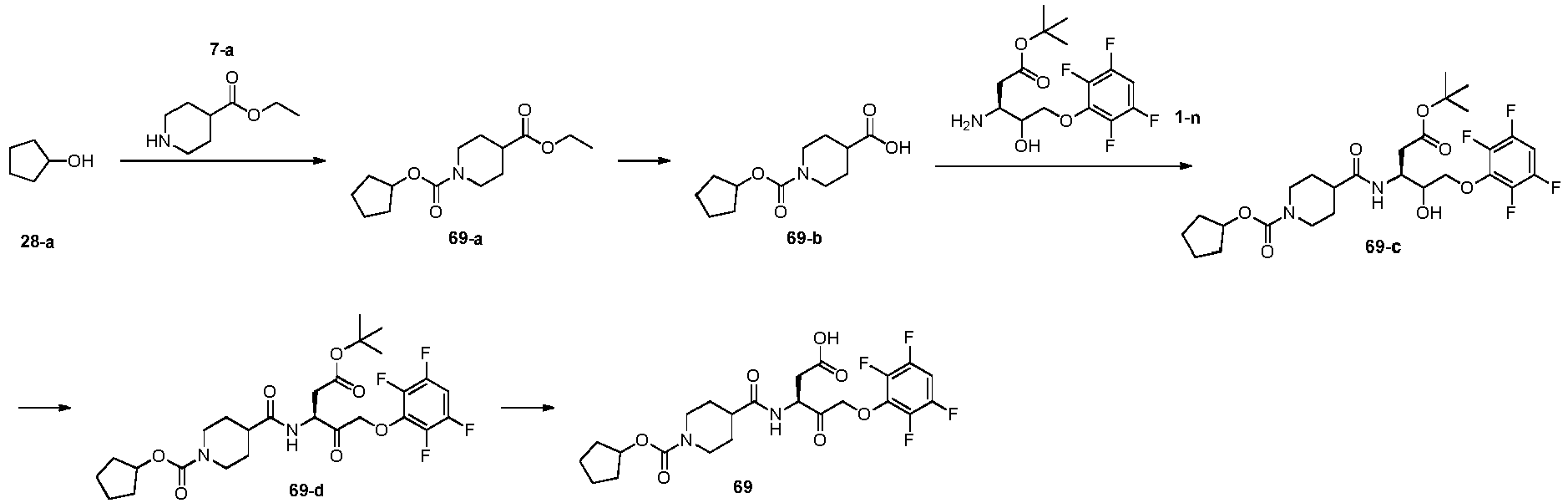
- Compound 28-a (1.33 g, 10.81 mmol, 1.51 mL, 1.70 eq) and CDI (2.99 g, 18.44 mmol, 2.90 eq) were dissolved in tetrahydrofuran (14.00 mL). The above solution was stirred at 18°C for 1 hour, and then added with compound 7-a (1.00 g, 6.36 mmol, 980.39 µL, 1.00 eq) and triethylamine (2.38 g, 23.53 mmol, 3.26 mL, 3.70 eq). The reaction solution was stirred at 80°C for 15 hours. After the reaction was completed, the reaction solution was added with water (150 mL), and extracted with dichloromethane (150 mL × 3). The organic phase was dried over anhydrous sodium sulfate, filtered and concentrated to give a crude product. The crude product was subjected to column chromatography (petroleum ether : ethyl acetate = 1:0∼3:1) to give the product of compound 69-a (1.70 g, yield: 99%) as a colorless oil. 1H NMR (400 MHz, CHLOROFORM-d) δ=5.08 (t, J=5.77 Hz, 1H), 4.13 (q, J=7.19 Hz, 2H), 3.85-4.08 (m, 2H), 2.85 (t, J=11.29 Hz, 2H), 2.43 (tt, J=3.83, 10.98 Hz, 1H), 1.77-1.93 (m, 5H), 1.55-1.70 (m, 7H), 1.18-1.29 (m, 3H).
- Compound 69-a (1.60 g, 5.94 mmol, 1.00 eq) was dissolved in tetrahydrofuran (25.00 mL), and a solution of LiOH·H2O (373.89 mg, 8.91 mmol, 1.50 eq) dissolved in H2O (25.00 mL) was added to the above solution. The reaction solution wad stirred at 18°C for 1 hour. After the reaction was completed, the reaction solution was adjusted to pH of 5 with 2 N dilute hydrochloric acid. This solution was added with water (150 mL), and extracted with dichloromethane (150 mL × 3). The organic phase was dried over anhydrous sodium sulfate, filtered and concentrated to give the product of compound 69-b (1.37 g, crude) as a colorless solid, which was used directly in the next step without purification. 1H NMR (400 MHz, CHLOROFORM-d) δ=5.10 (t, J=5.77 Hz, 1H), 3.93-4.16 (m, 2H), 2.89 (t, J=11.29 Hz, 2H), 2.50 (tt, J=3.83, 10.85 Hz, 1H), 1.60-2.01 (m, 12H).
- Compound 69-b (342.62 mg, 1.42 mmol, 1.00 eq) was dissolved in dichloromethane (20.00 mL), and compound 1-n (500.00 mg, 1.42 mmol, 1.00 eq), EDCI (372.93 mg, 1.95 mmol, 1.37 eq), HOBt (262.86 mg, 1.95 mmol, 1.37 eq) and N-methylmorpholine (430.90 mg, 4.26 mmol, 468.37 µL, 3.00 eq) were added thereto. The reaction solution was stirred under the protection of nitrogen gas at 18°C for 15 hours. After the reaction was completed, the reaction solution was added with water (150 mL), and extracted with dichloromethane (150 mL × 3). The organic phases were combined, dried over anhydrous sodium sulfate, filtered and concentrated to give a crude product. The crude product was subjected to column chromatography (petroleum ether : ethyl acetate = 1:0∼3:1) to give the product of compound 69-c (550.00 mg, yield: 64%) as a colorless oil. LCMS m/z =577.3 [M+H]+.
- Compound 69-c (550.00 mg, 953.90 µmol, 1.00 eq) was dissolved in dichloromethane (20.00 mL), and PIDA (1.19 g, 3.69 mmol, 3.87 eq) and TEMPO (45.00 mg, 286.17 µmol, 0.30 eq) were added thereto. The reaction solution was stirred under the protection of nitrogen gas at 18°C for 16 hours. The reaction solution was added with ethyl acetate (200 mL). The solution was washed successively with saturated sodium hydrogen carbonate (100 mL), saturated brine (100 mL) and water (100 mL). The organic phase was dried over anhydrous sodium sulfate, filtered and concentrated to give a crude product. The crude product was subjected to column chromatography (petroleum ether : ethyl acetate = 1:0∼3:1) to give the product of compound 69-d (380.00 mg, yield: 60%) as a pale yellow oil. LCMS m/z =597.3 [M+Na]+.
- Compound 69-d (380.00 mg, 661.38 µmol, 1.00 eq) was dissolved in dichloromethane (20.00 mL), and trifluoroacetic acid (15.40 g, 135.06 mmol, 10.00 mL, 204.22 eq) was added thereto. The reaction solution was stirred under the protection of nitrogen gas at 18°C for 1 hour. After the reaction was completed, the reaction solution was concentrated to give a crude product. The crude product was purified by preparative HPLC (in trifluoroacetic acid condition), and lyophilized to give the product of compound 69 (201.50 mg, yield: 59%). 1H NMR (400 MHz, DMSO-d6) δ=8.43 (d, J=7.53 Hz, 1H), 7.50-7.64 (m, 1H), 5.12-5.28 (m, 2H), 4.96 (t, J=5.77 Hz, 1H), 4.59 (q, J=6.53 Hz, 1H), 3.91 (br. s., 2H), 2.64-2.91 (m, 3H), 2.57 (dd, J=7.03, 16.56 Hz, 1H), 2.38 (ddd, J=3.51, 7.91, 11.17 Hz, 1H), 1.72-1.85 (m, 2H), 1.47-1.70 (m, 8H), 1.30-1.46 (m, 2H); LCMS m/z = 519.0 [M+H]+.
-

- Compound 7-a (500.00 mg, 3.18 mmol, 490.20 µL, 1.00 eq) and triethylamine (643.57 mg, 6.36 mmol, 881.60 µL, 2.00 eq) were dissolved in dichloromethane (25 mL), and compound 31-a (864.54mg, 5.41 mmol, 677.23 µL, 1.7eq) was slowly added to the solution, followed by stirring at room temperature (18°C) for 3 hours. After the reaction was completed, the reaction solution was added with water (30mL), and separated. The aqueous phase was further extracted with ethyl acetate (40 mL × 3). The organic phases were combined, washed with saturated brine (40 mL × 2), dried over anhydrous sodium sulfate, filtered, concentrated, and then separated with column chromatography (petroleum ether : ethyl acetate = 10:1∼2:1), to give the product of compound 70-a (800.00 mg, yield: 91%). LCMS m/z = 278.1 [M+1]+.
- Compound 70-a (800.00 mg, 2.88 mmol, 1.00 eq) was dissolved in tetrahydrofuran (16.00 mL), and a solution of LiOH·H2O (181.27 mg, 4.32 mmol, 1.50 eq) dissolved in H2O (16.00 mL) was added to the above solution. The reaction solution was stirred at 30°C for 3 hours. After the reaction was completed, this solution was added with water (15mL). The aqueous phase was washed with ethyl acetate (30 mL × 3), adjusted to pH of 3 with 1 N dilute hydrochloric acid, and extracted with dichloromethane (30 mL × 3). The combined organic phases were washed with saturated brine solution (30 mL × 2), dried over anhydrous sodium sulfate, filtered, and concentrated, to give compound 70-b (600.00 mg, yield: 84%), which was used directly in the next step without purification. LCMS m/z = 250.1 [M+H]+.
- Compound 1-n (340.79 mg, 964.55 µmol, 1.00 eq) was dissolved in dichloromethane (10.00 mL). Under the protection of nitrogen gas, compound 70-b (360.64 mg, 1.45 mmol, 1.50 eq), N-methylmorpholine (292.69 mg, 2.89 mmol, 318.14 µL, 3.00 eq), HOBt (178.55 mg, 1.32 mmol, 1.37 eq) and EDCI (253.32 mg, 1.32 mmol, 1.37 eq) were added to the solution. The reaction solution was stirred at 20°C for 16 hours. After the reaction was completed, the reaction solution was added with water (40mL), and extracted with dichloromethane (30 mL × 3). The organic phases were combined, then washed with saturated brine solution (30 mL × 2), dried over anhydrous sodium sulfate, filtered, and concentrated to give a crude product. The crude product was subjected to column chromatography (petroleum ether : ethyl acetate = 10:1∼2:1) to give the product of compound 70-c (520.00 mg, yield: 92%) as a colorless oil. LCMS m/z = 607.2 [M+Na]+.
- Compound 70-c (520.00 mg, 889.56 µmol, 1.00 eq) was dissolved in dichloromethane (20.00 mL), and PIDA (1.11 g, 3.44 mmol, 3.87 eq) and TEMPO (41.96 mg, 266.87 µmol, 0.30 eq) were added thereto. The reaction solution was stirred at room temperature (18°C) for 24 hours. When the compound was not completely reacted, TEMPO (13.99 mg, 88.96 µmol, 0.10 eq) and PIDA (315.18 mg, 978.52 µmol, 1.10 eq) were further added to the solution. After the reaction was completed, the reaction solution was added with saturated sodium bisulfite (50 mL), and extracted with dichloromethane (30 mL × 3). The organic phase was washed with saturated brine (25 mL × 2), dried over anhydrous sodium sulfate, filtered, and concentrated to give a crude product. The crude product was subjected to column chromatography (petroleum ether : ethyl acetate = 10:0∼2:1) to give the product of compound 70-d (450.00 mg, yield: 87%) as a colorless oil. 1H NMR (400 MHz, DMSO-d6) δ=1.37 (s, 9 H) 4.66 (q, J=7.24 Hz, 1 H) 5.22 (d, J=5.27 Hz, 2 H) 5.76 (s, 1 H) 7.11 (d, J=7.53 Hz, 2 H) 7.16-7.27 (m, 1 H) 7.36-7.44 (m, 2 H) 7.58 (tt, J=10.90, 7.29 Hz, 1 H) 8.45 (d, J=7.78 Hz, 1 H); LCMS m/z = 605.4 [M+Na]+.
- Compound 70-d (170.00 mg, 291.83 µmol, 1.00 eq) was dissolved in dichloromethane (9.00 mL), and trifluoroacetic acid (5.17 g, 45.33 mmol, 3.36 mL, 176.05 eq) was added thereto at 0°C. The reaction solution was stirred at 0°C-10°C for 12 hours. After the reaction was completed, the reaction solution was spin-dried to give a crude product. The crude product was purified by preparative HPLC (in trifluoroacetic acid condition), and lyophilized to give the product of compound 70 (50.00 mg, yield: 36%). 1H NMR (400 MHz, DMSO-d 6) δ=8.48 (d, J=7.58 Hz, 1 H), 7.57 (tt, J=10.93, 7.41 Hz, 1 H), 7.37 (d, J=7.70 Hz, 2 H), 7.19-7.23 (m, 1 H), 7.11 (d, J=7.70 Hz, 2 H), 5.32-5.18 (m, 2 H), 4.62 (q, J=6.81 Hz, 1 H), 4.15-4.01 (m, 2 H), 3.89-3.52 (m, 2 H), 2.72-2.81 (m, 1 H), 2.57-2.62 (m, 1 H), 2.43-2.49 (m, 2 H), 1.76 (brs, 2 H), 1.56 (brs, 2 H); LCMS m/z = 527.1 [M+H]+.
-

- Compound 34-c (100.00 mg, 167.06 µmol, 1.00 eq) was dissolved in dichloromethane (5.00 mL), and PIDA (215.24 mg, 668.25 µmol, 4.00 eq) and TEMPO (5.25 mg, 33.42 µmol, 0.20 eq) were added thereto. The reaction solution was stirred under the protection of nitrogen gas at 25°C for 12 hours. After the reaction was completed, the reaction solution was added with ethyl acetate (100 mL). The solution was washed successively with saturated sodium hydrogen carbonate (50 mL), saturated brine (50 mL) and water (50 mL). The organic phase was dried over anhydrous sodium sulfate, filtered and concentrated to give a crude product. The crude product was purified by preparative silica gel plates (petroleum ether : ethyl acetate = 2:1) to give the product of compound 71-a (50.0 mg, yield: 50%) as a yellow oil; LCMS m/z = 619.1 [M+Na]+.
- Compound 71-a (50.00 mg, 83.81 µmol, 1.00 eq) was dissolved in dichloromethane (4.00 mL), and trifluoroacetic acid (1 mL) was added thereto. The reaction solution was stirred under the protection of nitrogen gas at 25°C for 2 hours. After the reaction was completed, the reaction solution was spin-dried to give a crude product. The crude product was purified by preparative HPLC (in trifluoroacetic acid condition), and lyophilized to give the product of compound 71 (10.00 mg, yield: 22%). 1H NMR (400MHz, CHLOROFORM-d) δ = 7.40-7.29 (m, 5H), 6.89-6.77 (m, 1H), 6.54-6.37 (m, 1H), 5.12 (s, 2H), 4.95-4.83 (m, 1H), 4.72-4.58 (m, 1H), 4.30-4.16 (m, 2H), 3.12-2.97 (m, 1H), 2.96-2.68 (m, 3H), 2.36 (br. s., 2H), 1.83 (br. s., 2H), 1.66 (d, J=11.5 Hz, 2H); LCMS m/z = 541.2 [M+H]+.
-

- Compound 72-a (500.00 mg, 3.51 mmol, 1.00 eq) was dissolved in acetonitrile (15.00 mL), and triethylamine (532.77 mg, 5.27 mmol, 729.82 µL, 1.50 eq) and compound 67-b (1.93 g, 4.91 mmol, 1.40 eq) were added thereto, followed by warming up to 80°C and stirring for 20 hours. After the reaction was completed, the reaction solution was added with ethyl acetate (50 mL) for dilution, and then washed with water (30 mL) and saturated brine (40 mL × 2). The organic phase was dried over anhydrous sodium sulfate, filtered, and concentrated to give a crude product. The crude product was purified by column chromatography (petroleum ether : ethyl acetate = 1:0∼4:1), to give the product of compound 72-b (1.06 g, yield: 89%) as a colorless oil. LCMS m/z = 326.1 [M+H] +.
- LiOH·H2O (272.74 mg, 6.50 mmol, 2.00 eq) was dissolved in water (5.00 mL), and the solution was added to a solution of compound 72-b (1.06 g, 3.25 mmol, 1.00 eq) dissloved in tetrahydrofuran (5.00 mL). The reaction was stirred at room temperature for 5 hours. After the reaction was completed, the reaction solution was added with water (30 mL), adjusted to pH of 3∼4 with 1 N dilute hydrochloric acid, and extracted with dichloromethane/methanol (50 mL, 10:1). The organic phase was dried over anhydrous sodium sulfate, filtered, and concentrated to give the product of compound 72-c (960.00 mg, crude) as a colorless oil, which was used directly in the next step without purification. LCMS m/z = 297.9 [M+H]+.
- Compound 72-c (227.53 mg, 764.21 µmol, 1.50 eq) was dissolved in dichloromethane (10 mL), and N-methylmorpholine (154.60 mg, 1.53 mmol, 168.04 µL, 3.00 eq), HOBt (137.68 mg, 1.02 mmol, 2.00 eq), EDCI (195.33 mg, 1.02 mmol, 2.00 eq) and compound 1-n (180.00 mg, 509.47 µmol, 1.00 eq) were added thereto. The reaction was stirred at room temperature for 5 hours. After the reaction was completed, the reaction solution was concentrated to give a crude product. The crude product was purified by column chromatography (petroleum ether : ethyl acetate = 1:0∼2:1), to give the product of compound 72-d (280.00 mg, yield: 72%) as a colorless oil. LCMS m/z = 655.2[M+Na]+.
- Compound 72-d (280.00 mg, 442.32 µmol, 1.00 eq) was dissolved in dichloromethane (10.00 mL), and PIDA (551.36 mg, 1.71 mmol, 3.87 eq) and TEMPO (48.69 mg, 309.62 µmol, 0.70 eq) were added thereto. The reaction was stirred at room temperature for 64 hours. After the reaction was completed, the reaction solution was added with dichloromethane (50 mL) for dilution, and washed with saturated sodium hydrogen carbonate solution (30 mL) and saturated brine (30 mL × 2). The organic phase was dried over anhydrous sodium sulfate, filtered, and concentrated to give a crude product. The crude product was purified by column chromatography (petroleum ether : ethyl acetate = 1:0∼2:1), to give the product of compound 72-e (250.00 mg, yield:59%) as a yellow oil, LCMS m/z = 653.1 [M+Na]+.
- Compound 72-e (250.00 mg, 427.89 µmol, 1.00 eq) was dissolved in dichloromethane (10.00 mL), and trifluoroacetic acid (5.00 mL, 67.53 mmol, 157.83 eq) was added thereto. The reaction was stirred at room temperature for 2 hours. After the reaction was completed, the reaction solution was spin-dried to give a crude product. The crude product was purified by preparative HPLC (in trifluoroacetic acid condition), and lyophilized to give compound 72 (153.00 mg, yield: 62%). 1H NMR (400MHz, DMSO-d6) δ= 12.50 (br s, 1H), 8.51 (br s, 1H), 7.59 (br s, 1H), 7.41 (d, J=8.03 Hz, 1H), 7.13 (s, 1H), 7.09 (br d, J=8.03 Hz, 1H), 5.24 (br d, J=10.04 Hz, 2H), 4.62 (br s, 1H), 4.17 (br d, J=11.54 Hz, 1H), 3.99 (br d, J=12.05 Hz, 1H), 3.11 (br s, 1H), 2.94 (br s, 1H), 2.70-2.82 (m, 1H), 2.56-2.70 (m, 1H), 2.43-2.49 (m, 1H), 2.30 (s, 3H), 1.76 (br s, 2H), 1.47-1.64 (m, 2H); LCMS m/z = 575.0 [M+H]+.
-

- Compound 73-a (500.00 mg, 3.33 mmol, 588.24 µL, 1.00 eq) was dissolved in acetonitrile (15.00 mL), and triethylamine (505.44 mg, 5.00 mmol, 692.39 µL, 1.50 eq) and compound 67-b (1.83 g, 4.66 mmol, 1.40 eq) were added thereto, followed by warming up to 80°C and stirring for 20 hours. After the reaction was completed, the reaction solution was added with ethyl acetate (50 mL) for dilution, and then washed with water (30 mL) and saturated brine (40 mL × 2). The organic phase was dried over anhydrous sodium sulfate, filtered, and concentrated to give a crude product. The crude product was purified by column chromatography (petroleum ether : ethyl acetate = 1:0∼4:1), to give the product of compound 73-b (1.10 g, yield: 99%) as a colorless oil. LCMS m/z = 334.4 [M+H] +.
- LiOH·H2O (276.94 mg, 6.60 mmol, 2.00 eq) was dissolved in water (5.00 mL), and the solution was added to a solution of compound 73-b (1.10 g, 3.30 mmol, 1.00 eq) dissloved in tetrahydrofuran (5.00 mL). The reaction was stirred at room temperature for 5 hours. After the reaction was completed, the reaction solution was added with water (30 mL), adjusted to pH of 3∼4 with 1 N dilute hydrochloric acid, and extracted with dichloromethane/methanol (50 mL, 10:1). The organic phase was dried over anhydrous sodium sulfate, filtered, and concentrated to give the product of compound 73-c (996.00 mg, crude) as a colorless oil, which was used directly in the next step without purification. LCMS m/z = 328.0 [M+Na]+.
- Compound 73-c (233.37 mg, 764.21 µmol, 1.50 eq) was dissolved in dichloromethane (10 mL), and N-methylmorpholine (154.60 mg, 1.53 mmol, 168.04 µL, 3.00 eq), HOBt (137.68 mg, 1.02 mmol, 2.00 eq), EDCI (195.33 mg, 1.02 mmol, 2.00 eq) and compound 1-n (180.00 mg, 509.47 µmol, 1.00 eq) were added thereto. The reaction was stirred at room temperature for 5 hours. After the reaction was completed, the reaction solution was concentrated to give a crude product. The crude product was purified by column chromatography (petroleum ether : ethyl acetate = 1:0∼2:1), to give the product of compound 73-d (260.00 mg, yield: 72%) as a colorless oil. LCMS m/z = 663.0[M+Na]+.
- Compound 73-d (260.00 mg, 405.83 µmol, 1.00 eq) was dissolved in dichloromethane (10.00 mL), and PIDA (505.88 mg, 1.57 mmol, 3.87 eq) and TEMPO (44.67 mg, 284.08 µmol, 0.70 eq) were added thereto. The reaction was stirred at room temperature for 48 hours. After the reaction was completed, the reaction solution was added with dichloromethane (50 mL) for dilution, and washed with saturated sodium hydrogen carbonate solution (30 mL) and saturated brine (30 mL × 2). The organic phase was dried over anhydrous sodium sulfate, filtered, and concentrated to give a crude product. The crude product was purified by column chromatography (petroleum ether : ethyl acetate = 1:0∼2:1), to give the product of compound 73-e (170.00 mg, yield: 38%) as a yellow oil. LCMS m/z = 661.2 [M+Na]+.
- Compound 73-e (170.00 mg, 266.19 µmol, 1.00 eq) was dissolved in dichloromethane (8.00 mL), and trifluoroacetic acid (4.00 mL, 28.86 mmol, 108.41 eq) was added thereto. The reaction was stirred at room temperature for 2 hours. After the reaction was completed, the reaction solution was spin-dried to give a crude product. The crude product was purified by preparative HPLC (in trifluoroacetic acid condition), and lyophilized to give compound 73 (48.00 mg, yield: 31%). 1H NMR (400MHz, DMSO-d6) δ=12.48 (br s, 1H), 8.53 (br s, 1H), 7.57 (br s, 1H), 7.34 (br s, 1H), 7.06-7.28 (m, 2H), 6.95 (br s, 1H), 5.23 (br s, 2H), 4.61 (br s, 1H), 3.98-4.26 (m, 2H), 2.60-3.19 (m, 5H), 1.78 (br s, 2H), 1.49 (br s, 2H), 1.29 (br s, 9H); LCMS m/z = 583.3 [M+H]+.
-

- Compound 74-a (200.00 mg, 1.05 mmol, 145.99 µL, 1.00 eq) was dissolved in dichloromethane (5 mL), and triethylamine (148.75 mg, 1.47 mmol, 203.77 µL, 1.40 eq) was added thereto, followed by stirring under the protection of nitrogen gas. Compound 7-a (214.59 mg, 1.37 mmol, 210.38 µL, 1.30 eq) was slowly added thereto with stirring, since the reaction was exothermic. After the addition was completed, the reaction system was stirred at 15°C for 16 hours. After the reaction was completed, the reaction solution was added with 20 mL of water and 20 mL of dichloromethane, acidified to pH of about 4 with 1 N hydrochloric acid, followed by separation and extraction. The aqueous phase was further extracted once with 20 mL of ethyl acetate. The combined organic phases were washed separately with 40 mL of water and 40 mL of saturated brine, dried over anhydrous sodium sulfate, and then spin-dried to give a crude product. The crude product was subjected to column chromatography (petroleum ether : ethyl acetate = 1:0∼10:3) to give compound 74-b (260.00 mg, yield: 79.43%) as a colorless liquid, LCMS m/z = 311.9 [M+H]+.
- Compound 74-b (260.00 mg, 833.97 µmol, 1.00 eq) was dissolved in tetrahydrofuran (6 mL), and then LiOH·H2O (43.94 mg, 1.83 mmol, 2.20 eq) was dissolved in water (6 mL). The formulated solution was slowly added to the above solution. The reaction system was stirred at 15°C for 2 hours. The reaction system was acidified to pH of about 4 with 1N hydrochloric acid, and then extracted four times with ethyl acetate (30 mL). The combind organic phases were washed once with saturated brine (50 mL), dried over anhydrous sodium sulfate, and then spin-dried to give the crude liquid product of compound 74-c (1.28 g, crude) as a yellow oil, LCMS m/z = 283.9 [M+H]+.
- Under the protection of nitrogen gas, compound 74-c (255.00 mg, 898.81 µmol, 1.76 eq) was dissolved in dichloromethane (5 mL), HATU (387.43 mg, 1.02 mmol, 2.00 eq), N,N-diisopropylethylamine (197.53 mg,1.53 mmol, 266.93 µL, 3.00 eq) were then added thereto, and finally compound 1-n (180.00 mg, 509.47 µmol, 1.00 eq) as a substrate were added thereto. The reaction was stirred at 15°C for 16 hours. The reaction system was added with ethyl acetate (30 mL) and water (30 mL), and separated. The aqueous phase was further extracted once with ethyl acetate (30 mL). The combined organic phases were washed once with each of water (50 mL) and saturated brine (50 mL), dried over anhydrous sodium sulfate, and then spin-dried to give a crude product. The crude product was subjected to column chromatography (petroleum ether : ethyl acetate = 1:0~3:2) to give compound 74-d (230.00 mg, yield: 59%) as a brown liquid, LCMS m/z = 563.1 [M-55+H]+.
- Compound 74-d (230.00 mg, 371.57 µmol, 1.00 eq) was dissolved in dichloromethane (10 mL), and PIDA (239.36 mg, 743.13 µmol, 2.00 eq) and TEMPO (35.06 mg, 222.94 µmol, 0.60 eq) was added thereto under the protection of nitrogen gas. The reaction system was stirred at 15°C for 42 hours. The system was added with ethyl acetate (30 mL), and washed once with each of saturated sodium hydrogen carbonate solution (30 mL), water (30 mL) and saturated brine (30 mL). The organic phase was dried over anhydrous sodium sulfate, filtered, and spin-dried to give a crude product. The crude product was subjected to column chromatography (petroleum ether : ethyl acetate = 4:1∼5:3) to give compound 74-e (125.00 mg, yield: 43.62%) as a brown liquid, LCMS m/z =639.1 [M+Na]+.
- Compound 74-e (125.00 mg, 202.60 µmol, 1.00 eq) was dissolved in dichloromethane (5 mL), and trifluoroacetic acid (4.16 g, 36.47 mmol, 2.70 mL, 180.00 eq) was added thereto under the protection of nitrogen gas. The system was stirred at 15°C for 1 hour. After the reaction was completed, the reaction solution was spin-dried to give a crude product. The crude product was purified by preparative HPLC (in trifluoroacetic acid condition), spin-dried, and then dissolved with acetonitrile (20 mL). The obtained solution was added with water (20 mL), evenly mixed, and lyophilized to give compound 74 (8.00 mg, yield: 6.83%). 1H NMR (400 MHz, DMSO-d6) □ 12.49 (br. s., 1H), 8.50 (d, J=7.53 Hz, 1H), 7.50-7.62 (m, 2H), 7.34-7.41 (m, 1H), 7.25-7.33 (m, 2H), 5.10-5.39 (m, 2H), 4.63 (q, J=6.78 Hz, 1H), 4.19 (d, J=12.05 Hz, 1H), 3.99 (d, J=11.80 Hz, 1H), 3.12 (t, J=11.92 Hz, 1H), 2.86-3.02 (m, 1H), 2.71-2.82 (m, 1H), 2.60 (dd, J=6.78, 16.81 Hz, 2H), 1.78 (br. s., 2H), 1.45-1.67 (m, 2H). LCMS m/z =561 [M+H]+.
-

- Compound 75-a (500.00 mg, 3.89 mmol, 381.68 µL, 1.00 eq) was dissolved in acetonitrile (25.00 mL), and triethylamine (590.33 mg, 5.84 mmol, 808.67 µL, 1.50 eq) and compound 67-b (2.14 g, 5.45 mmol, 1.40 eq) were added thereto, followed by warming up to 80°C and stirring for 20 hours. After the reaction was completed, the reaction solution was added with ethyl acetate (50 mL) for dilution, and then washed with water (40 mL) and saturated brine (40 mL). The organic phase was dried over anhydrous sodium sulfate, filtered and concentrated to give a crude product. The crude product was purified by column chromatography (petroleum ether : ethyl acetate = 1:0∼4:1) to give the product of compound 75-b (1.20 g, yield: 90%) as a colorless oil. LCMS m/z = 311.9 [M+H] +.
- LiOH·H2O (269.38 mg, 6.42 mmol, 2.00 eq) was dissolved in water (8.00 mL), and the solution was added to a solution of compound 75-b (1.00 g, 3.21 mmol, 1.00 eq) dissloved in tetrahydrofuran (8.00 mL). The reaction was stirred at room temperature for 2 hours. After the reaction was completed, the reaction solution was added with water (10 mL), adjusted to pH of 3∼4 with 1 N dilute hydrochloric acid, and extracted with dichloromethane/methanol (50 mL × 2, 10:1). The organic phase was dried over anhydrous sodium sulfate, filtered and concentrated to give the product of compound 75-c (1.13 g, crude) as a colorless oil, which was used directly in the next step without purification. LCMS m/z = 283.9 [M+H]+.
- Compound 75-c (224.84 mg, 792.51 µmol, 1.40 eq) was dissolved in dichloromethane (10 mL), and N-methylmorpholine (171.78 mg, 1.70 mmol, 186.71µL, 3.00 eq), HOBt (152.98 mg, 1.13 mmol, 2.00 eq), EDCI (217.04 mg, 1.13 mmol, 2.00 eq) and compound 1-n (200.00 mg, 566.08 µmol, 1.00 eq) were added thereto. The reaction was stirred at room temperature for 15 hours. After the reaction was completed, the reaction solution was concentrated to give a crude product. The crude product was purified by column chromatography (petroleum ether : ethyl acetate = 1:0∼2:1), to give the product of compound 75-d (350.00 mg, yield: 91%) as a colorless oil. LCMS m/z = 641.1[M+Na]+.
- Compound 75-d (520.00 mg, 840.06 µmol, 1.00 eq) was dissolved in dichloromethane (15.00 mL), and PIDA (1.35 g, 4.20 mmol, 5.00 eq) and TEMPO (132.10 mg, 840.06 µmol, 1.00 eq) were added thereto. The reaction was stirred at room temperature for 39 hours. After the reaction was completed, the reaction solution was added with dichloromethane (40 mL) for dilution, and washed with saturated sodium hydrogen carbonate solution (30 mL) and saturated brine (30 mL × 2). The organic phase was dried over anhydrous sodium sulfate, filtered and concentrated to give a crude product. The crude product was purified by column chromatography (petroleum ether : ethyl acetate = 1:0∼2:1), to give the product of compound 75-e (500.00 mg, yield: 68%) as a yellow oil. LCMS m/z = 639.0 [M+Na]+.
- Compound 75-e (500.00 mg, 810.39 µmol, 1.00 eq) was dissolved in dichloromethane (5.00 mL), and trifluoroacetic acid (5.00 mL, 67.53 mmol, 83.33 eq) was added thereto. The reaction was stirred at room temperature for 2 hours. After the reaction was completed, the reaction solution was spin-dried to give a crude product. The crude product was purified by preparative HPLC (in trifluoroacetic acid condition),and lyophilized to give compound 75 (300.00 mg, yield: 66%). 1H NMR (400MHz, DMSO-d6) δ=8.48 (br. s., 1H), 7.56 (br. s., 1H), 7.43 (d, J=8.53 Hz, 2H), 7.16 (d, J=8.53 Hz, 2H), 5.23 (br. s., 2H), 4.62 (br. s., 1H), 3.95-4.15 (m, 2H), 2.84-3.12 (m, 3H), 2.58-2.78 (m, 2H), 1.76 (br. s., 2H), 1.55 (br. s., 2H); LCMS m/z = 583.1 [M+Na]+.
-

- Compound 76-a (500.00 mg, 4.62 mmol, 480.77 µL, 1.00 eq) was dissolved in acetonitrile (25.00 mL), and triethylamine (701.25 mg, 6.93 mmol, 960.61 µL, 1.50 eq) and compound 67-b (2.54 g, 6.47 mmol, 1.40 eq) were added thereto, followed by warmed up to 80°C and stirring for 15 hours. After the reaction was completed, the reaction solution was concentrated, added with dichloromethane (50 mL) for dissolution, and then washed with water (40 mL) and saturated brine (40 mL). The organic phase was dried over anhydrous sodium sulfate, filtered and concentrated to give a crude product. The crude product was purified by column chromatography (petroleum ether : ethyl acetate = 1:0∼9:1), to give the product of compound 76-b (1.30 g, yield: 90%) as a colorless oil. LCMS m/z = 292.4 [M+H] +.
- LiOH·H2O (374.28 mg, 8.92 mmol, 2.00 eq) was dissolved in water (8.00 mL), and the solution was added to a solution of compound 76-b (1.30 g, 4.46 mmol, 1.00 eq) dissloved in tetrahydrofuran (8.00 mL). The reaction was stirred at room temperature for 5 hours. After the reaction was completed, the reaction solution was added with water (10 mL), adjusted to pH of 3∼4 with 1 N dilute hydrochloric acid, and extracted with dichloromethane/methanol (50 mL × 2, 10:1). The organic phase was dried over anhydrous sodium sulfate, filtered, and concentrated to give the product of compound 76-c (1.15 g, crude) as a colorless oil, which was used directly in the next step without purification. LCMS m/z = 263.9 [M+H]+.
- Compound 76-c (208.66 mg, 792.51 µmol, 1.40 eq) was dissolved in dichloromethane (10 mL), and triethylamine (171.84 mg, 1.70 mmol, 235.40 µL, 3.00 eq), T3P (360.23 mg, 1.13 mmol, 336.66 µL, 2.00 eq) and compound 1-n (200.00 mg, 566.08 µmol, 1.00 eq) were added thereto. The reaction was stirred at room temperature for 15 hours. After the reaction was completed, the reaction solution was added with dichloromethane (30 mL) for dilution, and washed with water (30 mL) and saturated brine (30 mL × 2). The organic phase was dried over anhydrous sodium sulfate, filtered and concentrated to give a crude product. The crude product was purified by column chromatography (petroleum ether : ethyl acetate = 1:0∼1:1), to give the product of compound 76-d (300.00 mg, yield: 89%) as a colorless oil. LCMS m/z = 621.1[M+Na]+.
- Compound 76-d (300.00 mg, 501.09 µmol, 1.00 eq) was dissolved in dichloromethane (10.00 mL), and PIDA (624.75 mg, 1.94 mmol, 3.87 eq) and TEMPO (78.81 mg, 501.09 µmol, 1.00 eq) were added thereto. The reaction was stirred at room temperature for 39 hours. After the reaction was completed, the reaction solution was added with dichloromethane (40 mL) for dilution, and washed with saturated sodium hydrogen carbonate solution (30 mL) and saturated brine (30 mL). The organic phase was dried over anhydrous sodium sulfate, filtered and concentrated to give a crude product. The crude product was purified by column chromatography (petroleum ether : ethyl acetate = 1:0∼2:1), to give the product of compound 76-e (290.00 mg, yield: 74.68%) as a yellow oil. LCMS m/z = 619.1 [M+Na]+.
- Compound 76-e (290.00 mg, 486.11 µmol, 1.00 eq) was dissolved in dichloromethane (5.00 mL), and trifluoroacetic acid (5.00 mL, 67.53 mmol, 138.92 eq) was added thereto. The reaction was stirred at room temperature for 2 hours. After the reaction was completed, the reaction solution was spin-dried to give a crude product. The crude product was purified by preparative HPLC (in trifluoroacetic acid condition), and lyophilized to give compound 76 (150.00 mg, yield: 57%). 1H NMR (400MHz, DMSO-d6) δ=12.43 (br. s., 1H), 8.48 (br. s., 1H), 7.54 (br. s., 1H), 7.17 (br. s., 4H), 4.72-5.52 (m, 2H), 3.85-4.65 (m, 3H), 2.60-3.17 (m, 5H), 2.09 (br. s., 3H), 1.32-1.86 (m, 4H); LCMS m/z = 541.1 [M+H]+.
-

- Compound 77-a (15.00 g, 9.60 mmol, 1.00 eq) (pyridine, 10 %) and CDI (20.24 g, 124.80 mmol, 13.00 eq) were dissolved in tetrahydrofuran (140.00 mL). The above solution was stirred at 15°C for 3 hours. After the reaction was completed, the reaction solution was added with water (250 mL), and extracted with dichloromethane (200 mL × 3). The organic phase was dried over anhydrous sodium sulfate, filtered and concentrated to give a crude product. The crude product was subjected to column chromatography (petroleum ether : ethyl acetate = 1:0∼5:1) to give the product of compound 77-b (2.15 g, yield: 89%) as a colorless oil. 1H NMR (400 MHz, CHLOROFORM-d) δ= 8.13 (s, 1H), 7.42 (s, 1H), 7.07 (s, 1H), 4.89 (dt, J=4.39, 10.98 Hz, 1H), 2.13-2.21 (m, 1H), 1.92 (dtd, J=2.64, 6.92, 13.90 Hz, 1H), 1.69-1.79 (m, 2H), 1.48-1.62 (m, 2H), 1.06-1.22 (m, 2H), 0.87-1.00 (m, 7H), 0.82 (d, J=7.03 Hz, 3H).
- Compounds 77-b (270.00 mg, 1.08 mmol, 1.00 eq) and 7-a (203.74 mg, 1.30 mmol, 199.75 µL, 1.20 eq) were dissolved in tetrahydrofuran (10.00 mL), and triethylamine (437.14 mg, 4.32 mmol, 598.82 µL, 4.00 eq) was added to the above solution. The reaction solution was stirred at 80°C for 14 hours, then supplemented with compound 7-a (407.49 mg, 2.59 mmol, 399.50 µL, 2.40 eq) and triethylamine (437.14 mg, 4.32 mmol, 598.82 µL, 4.00 eq). The reaction solution was stirred at 80°C for 72 hours. After the reaction was completed, the reaction solution was added with water (100 mL), and extracted with dichloromethane (100 mL × 3). The organic phase was dried over anhydrous sodium sulfate, filtered and concentrated to give a crude product. The crude product was subjected to column chromatography (petroleum ether : ethyl acetate = 1:0∼5:1) to give the product of compound 77-c (250.00 mg, yield: 68%) as a colorless oil. 1H NMR (400 MHz, CHLOROFORM-d) δ= 4.55 (dt, J=4.39, 10.85 Hz, 1H), 4.15 (q, J=7.03 Hz, 2H), 4.07 (d, J=10.29 Hz, 2H), 2.82-2.95 (m, 2H), 2.45 (tt, J=3.83, 10.98 Hz, 1H), 2.05 (d, J=11.80 Hz, 1H), 1.81-1.96 (m, 3H), 1.60-1.72 (m, 4H), 1.42-1.55 (m, 1H), 1.32-1.41 (m, 1H), 1.26 (t, J=7.15 Hz, 3H), 1.00-1.13 (m, 1H), 0.92-0.99 (m, 1H), 0.90 (d, J=6.78 Hz, 6H), 0.82-0.88 (m, 1H), 0.79 (d, J=7.03 Hz, 3H).
- Compound 77-c (250.00 mg, 736.44 µmol, 1.00 eq) was dissolved in tetrahydrofuran (15.00 mL), and a solution of LiOH·H2O (185.41 mg, 4.42 mmol, 6.00 eq) dissolved in H2O (15.00 mL) was added to the above solution. The reaction solution was stirred at 15°C for 1 hour. After the reaction was completed, the reaction solution was adjusted to pH of 5 with 2 N dilute hydrochloric acid. This solution was added with water (100 mL), and extracted with dichloromethane (100 mL × 3). The organic phase was dried over anhydrous sodium sulfate, filtered and concentrated to give the product of compound 77-d (230.00 mg, crude) as a colorless oil, which was used directly in the next step without purification.
- Compound 77-d (230.00 mg, 738.55 µmol, 1.30 eq) was dissolved in dichloromethane (20.00 mL), and compound 1-n (200.00 mg, 566.08 µmol, 1.00 eq), EDCI (148.67 mg, 775.53 µmol, 1.37 eq), HOBt (104.79 mg, 775.53 µmol, 1.37 eq) and N-methylmorpholine (171.78 mg, 1.70 mmol, 186.72 µL, 3.00 eq) were added thereto. The reaction solution was stirred under the protection of nitrogen gas at 15°C for 15 hours. After the reaction was completed, the reaction solution was added with water (100 mL), and extracted with dichloromethane (100 mL × 3). The organic phases were combined, dried over anhydrous sodium sulfate, filtered and concentrated to give a crude product. The crude product was subjected to column chromatography (petroleum ether : ethyl acetate = 1:0∼3:1) to give the product of compound 77-e (340.00 mg, yield: 81%) as a colorless oil. LCMS m/z =669.1 [M+Na]+.
- Compound 77-e (340.00 mg, 525.74 µmol, 1.00 eq) was dissolved in dichloromethane (25.00 mL), and PIDA (655.35 mg, 2.03 mmol, 3.87 eq) and TEMPO (24.80 mg, 157.72 µmol, 0.30 eq) were added thereto. The above solution was stirred under the protection of nitrogen gas at 15°C for 16 hours, and then supplemented with TEMPO (24.8 mg, 157.72 µmol, 0.30 eq). The reaction solution was stirred at 15°C for another 24 hours. After the reaction was completed, the reaction solution was added with 150 mL of ethyl acetate. The solution was washed successively with saturated sodium hydrogen carbonate (100 mL), saturated brine (100 mL) and water (100 mL). The organic phase was dried over anhydrous sodium sulfate, filtered and concentrated to give a crude product. The crude product was subjected to column chromatography (petroleum ether : ethyl acetate = 1:0∼3:1) to give the product of compound 77-f (257.00 mg, yield: 75%) as a pale yellow oil. LCMS m/z =667.2 [M+Na]+.
- Compound 77-f (310.00 mg, 480.84 µmol, 1.00 eq) was dissolved in dichloromethane (12.00 mL), and trifluoroacetic acid (9.24 g, 81.04 mmol, 6.00 mL, 168.54 eq) was added thereto. The reaction solution was stirred under the protection of nitrogen gas at 15°C for 1 hour. After the reaction was completed, the reaction solution was concentrated to give a crude product. The crude product was purified by preparative HPLC (in trifluoroacetic acid condition), and lyophilized to give the product of compound 77 (189.90 mg, yield: 67%). 1H NMR (400 MHz, DMSO-d6) δ=8.45 (d, J=7.53 Hz, 1H), 7.50-7.68 (m, 1H), 5.12-5.29 (m, 2H), 4.58 (q, J=6.53 Hz, 1H), 4.43 (dt, J=4.02, 10.79 Hz, 1H), 3.95 (d, J=12.05 Hz, 2H), 2.64-2.92 (m, 3H), 2.57 (dd, J=7.03, 17.07 Hz, 1H), 2.31-2.45 (m, 1H), 1.76-1.94 (m, 2H), 1.56-1.72 (m, 4H), 1.27-1.50 (m, 4H), 0.90-1.10 (m, 2H), 0.86 (dd, J=4.77, 6.27 Hz, 6H), 0.77-0.84 (m, 1H), 0.73 (d, J=6.53 Hz, 3H); LCMS m/z = 611.1 [M+Na]+.
-

- Compound 67-b (1.50 g, 5.65 mmol, 1.00 eq) was dissolved in dichloromethane (15.00 mL), and compound 78-a (605.40 mg, 5.65 mmol, 617.76 µL, 1.00 eq) and triethylamine (571.72 mg, 5.65 mmol, 783.18 µL, 1.00 eq) were added to the above solution. The reaction solution was stirred at 25°C for 48 hours. After the reaction was completed, the reaction solution was added with dichloromethane (50 mL), and the resulting solution was washed with 2 M dilute hydrochloric acid (25 mL × 2). The organic phase was dried over anhydrous sodium sulfate, filtered and concentrated to give a crude product. The crude product was subjected to column chromatography (petroleum ether : ethyl acetate = 1:0∼1:1) to give the product of compound 78-b (1.21 g, yield: 74%) as a pale yellow solid. LCMS m/z =290.9 [M+H]+.
- Compound 78-b (1.21 g, 4.17 mmol, 1.00 eq) was dissolved in tetrahydrofuran (10.00 mL) and water (10.00 mL), and LiOH·H2O (349.95 mg, 8.34 mmol, 2.00 eq) was added to the above solution in an ice bath. The reaction solution was stirred at 0°C for 1.5 hours. After the reaction was completed, the reaction solution was concentrated, and adjusted to pH of 2 with 2 N dilute hydrochloric acid. The precipitated pale yellow solid product was filtered out, and spin-dried to give the product of compound 78-c (1.02 g, yield: 93%), which was used directly in the next step without purification. LCMS m/z =262.9 [M+H]+.
- Compound 78-c (163.33 mg, 622.69 µmol, 1.10 eq) and HOBt (114.72 mg, 849.12 µmol, 1.50 eq) were dissolved in dichloromethane (10.00 mL), and EDCI (162.75 mg, 849.12 µmol, 1.50 eq) was added thereto. The above solution was stirred for 15 min, and then added with a solution of compound 1-n (200.00 mg, 566.08 µmol, 1.00 eq) and N,N-diisopropylethylamine (146.32 mg, 1.13 mmol, 197.73 µL, 2.00 eq) dissolved in dichloromethane (5.00 mL). The reaction solution was stirred at 25°C for 15 hours. After the reaction was completed, the reaction solution was added with dichloromethane, and washed respectively with saturated sodium hydrogen carbonate solution (50 mL × 2) and saturated sodium chloride solution (50 mL). The organic phase was dried over anhydrous sodium sulfate, filtered and concentrated to give a crude product. The crude product was subjected to column chromatography (petroleum ether : ethyl acetate = 1:0∼1:2) to give the product of compound 78-d (300.00 mg, yield: 89%) as a offwhite oil. LCMS m/z =620.3 [M+Na]+.
- Compound 78-d (226.00 mg, 378.18 µmol, 1.00 eq) was dissolved in dichloromethane (10.00 mL), and DMP (352.88 mg, 832.00 µmol, 257.58 µL, 2.20 eq) was added thereto under the protection of nitrogen gas at 0°C. The reaction solution was stirred at 0°C for 5min, and then warmed up to 30°C and stirred for another 50 min. After the reaction was completed, the reaction solution was cooled down to 0°C, and washed with saturated sodium hydrogen carbonate solution/sodium sulfite solution (1:1, 10 mL × 2). The aqueous phase was extracted with dichloromethane (20 mL). The organic phases were combined, dried over anhydrous sodium sulfate, filtered, and concentrated to give a crude product. The crude product was subjected to column chromatography (petroleum ether : ethyl acetate = 5:1∼1:1) to give the product of compound 78-e (186.00 mg, yield: 77%). 1H NMR (400 MHz, CHLOROFORM-d) δ=7.25-7.38 (m, 5H), 6.74-6.84 (m, 2H), 4.98-5.17 (m, 2H), 4.90-4.97 (m, 1H), 4.78 (t, J=5.02 Hz, 1H), 4.43 (d, J=5.52 Hz, 2H), 4.01 (dd, J=4.02, 8.03 Hz, 2H), 2.98 (dd, J=4.77, 16.81 Hz, 1H), 2.82-2.92 (m, 2H), 2.75 (dd, J=5.27, 16.81 Hz, 1H), 2.36 (tt, J=3.64, 11.42 Hz, 1H), 1.80-1.94 (m, 2H), 1.75 (d, J=4.02 Hz, 1H), 1.66 (d, J=4.02 Hz, 1H), 1.43 (s, 9H); LCMS m/z = 596.3 [M+H]+.
- Compound 78-e (160.00 mg, 268.65 µmol, 1.00 eq) was dissolved in ethyl acetate (5.00 mL), and hydrochloric acid ethyl acetate solution (20.00 mmol, 10.00 mL, 74.45 eq) was added thereto in an ice bath. After the addition was completed, the reaction solution was stirred at 30°C for 50 min. After the reaction was completed, the reaction solution was spin-dried to give a crude product. The crude product was purified by preparative HPLC (in formic acid condition), and lyophilized to give the product of compound 78 (64.10 mg, yield: 44%). 1H NMR (400 MHz, CHLOROFORM-d) δ=7.28-7.36 (m, 3H), 7.25 (br. s., 2H), 6.74-6.85 (m, 1H), 5.04 (br. s., 1H), 4.94 (d, J=6.78 Hz, 1H), 4.37 (d, J=4.52 Hz, 2H), 3.94 (d, J=12.55 Hz, 3H), 3.01 (dd, J=7.15, 17.19 Hz, 2H), 2.85 (t, J=12.55 Hz, 2H), 2.37 (br. s., 1H), 1.83 (br. s., 2H), 1.57-1.72 (m, 2H); LCMS m/z = 540.3 [M+H]+.
-
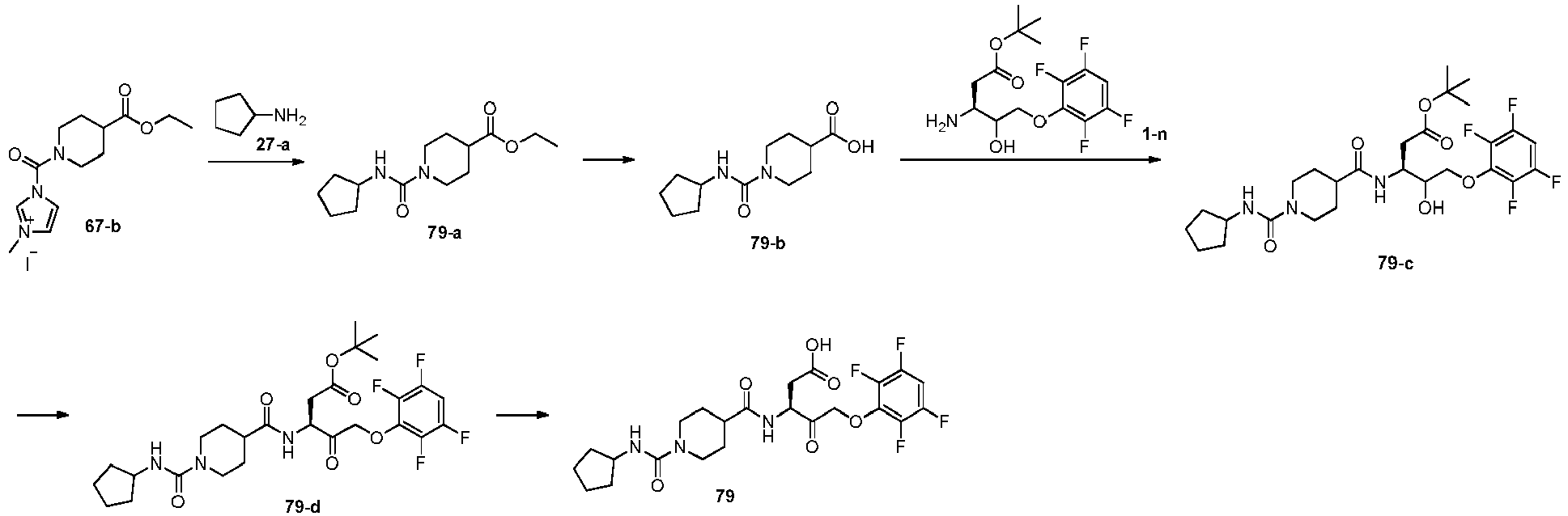
- Compound 67-b (1.50 g, 3.81 mmol, 1.00 eq) was dissolved in dichloromethane (37.50 mL), and compound 27-a (324.42 mg, 3.81 mmol, 377.23 µL, 1.00 eq) and triethylamine (385.53 mg, 3.81 mmol, 528.13 µL, 1.00 eq) were added to the above solution. The reaction solution was stirred at 18°C for 17 hours. After the reaction was completed, dichloromethane (100 mL) was added, and the resulting solution was washed respectively with 1 N dilute hydrochloric acid (80 mL × 2), saturated sodium chloride (80 mL) and water (80 mL). The organic phase was dried over anhydrous sodium sulfate, filtered and concentrated to give the product of compound 79-a (890.00 mg, crude) as a yellow solid, which was used directly in the next step without purification. 1H NMR (400 MHz, CHLOROFORM-d) δ=4.37 (d, J=6.02 Hz, 1H), 4.02-4.19 (m, 3H), 3.85 (td, J=3.33, 13.43 Hz, 2H), 2.80-2.92 (m, 2H), 2.44 (tt, J=3.92, 10.89 Hz, 1H), 1.94-2.05 (m, 2H), 1.90 (dd, J=3.14, 13.43 Hz, 2H), 1.52-1.74 (m, 6H), 1.28-1.40 (m, 2H), 1.25 (t, J=7.15 Hz, 3H).
- Compound 79-a (890.00 mg, 3.32 mmol, 1.00 eq) was dissolved in tetrahydrofuran (25.00 mL), and a solution of LiOH·H2O (208.96 mg, 4.98 mmol, 1.50 eq) dissolved in water (25.00 mL) was added to the above solution. The reaction solution was stirred at 18°C for 1 hour. After the reaction was completed, the reaction solution was adjusted to pH of 5 with 2 N dilute hydrochloric acid. This solution was added with water (150 mL), and extracted with dichloromethane (150 mL × 3). The organic phase was dried over anhydrous sodium sulfate, filtered and concentrated to give the product of compound 79-b (800.00 mg, crude) as a pale yellow oil, which was used directly in the next step without purification. LCMS m/z = 240.9 [M+H]+.
- Compound 79-b (270.00 mg, 1.12 mmol, 1.00 eq) was dissolved in dichloromethane (20.00 mL), and compound 1-n (395.71 mg, 1.12 mmol, 1.00 eq), EDCI (294.14 mg, 1.53 mmol, 1.37 eq), HOBt (207.33 mg, 1.53 mmol, 1.37 eq) and N-methylmorpholine (339.86 mg, 3.36 mmol, 369.42 µL, 3.00 eq) were added thereto. The reaction solution was stirred under the protection of nitrogen gas at 18°C for 15 hours. After the reaction was completed, the reaction solution was added with water (100 mL), and extracted with dichloromethane (100 mL × 3). The organic phases were combined, dried over anhydrous sodium sulfate, filtered and concentrated to give a crude product. The crude product was subjected to column chromatography (petroleum ether : ethyl acetate = 5:1∼1:2) to give the product of compound 79-c (300.00 mg, yield: 44%) as a pale yellow oil. LCMS m/z = 576.3 [M+H]+.
- Compound 79-c (300.00 mg, 521.20 µmol, 1.00 eq) was dissolved in dichloromethane (6.00 mL), and PIDA (649.70 mg, 2.02 mmol, 3.87 eq) and TEMPO (24.59 mg, 156.36 µmol, 0.30 eq) were added thereto. The reaction solution was stirred under the protection of nitrogen gas at 18°C for 16 hours. The reaction solution was added with 150 mL of ethyl acetate. The solution was washed successively with saturated sodium hydrogen carbonate (80 mL), saturated brine (80 mL) and water (80 mL). The organic phase was dried over anhydrous sodium sulfate, filtered and concentrated to give a crude product. The crude product was subjected to column chromatography (petroleum ether : ethyl acetate = 1:0∼1:2) to give the product of compound 79-d (180.00 mg, yield: 57%) as a colorless oil. LCMS m/z =574.3 [M+H]+.
- Compound 79-d (180.00 mg, 313.82 µmol, 1.00 eq) was dissolved in dichloromethane (6.70 mL), and trifluoroacetic acid (5.15 g, 45.14 mmol, 3.34 mL, 143.85 eq) was added thereto. The reaction solution was stirred under the protection of nitrogen gas at 18°C for 1 hour. After the reaction was completed, the reaction solution was concentrated to give a crude product. The crude product was purified by preparative HPLC (in trifluoroacetic acid condition), and lyophilized to give the product of compound 79 (81.00 mg, yield: 50%). 1H NMR (400 MHz, DMSO-d6) δ=12.45 (br. s., 1H), 8.40 (d, J=7.28 Hz, 1H), 7.50-7.66 (m, 1H), 6.18 (d, J=6.78 Hz, 1H), 5.13-5.28 (m, 2H), 4.58 (q, J=6.78 Hz, 1H), 3.82-4.00 (m, 3H), 2.69-2.78 (m, 1H), 2.54-2.67 (m, 3H), 2.28-2.39 (m, 1H), 1.70-1.82 (m, 2H), 1.61 (br. s., 4H), 1.29-1.52 (m, 6H); LCMS m/z = 518.1 [M+H]+.
-

- Compound 34-d (200.00 mg, 430.62 µmol, 1.00 eq) was dissolved in dichloromethane (3.00 mL), and compound 80-a (2.61 g, 21.91 mmol, 2.37 mL, 50.88 eq) was added thereto. The mixture was stirred at 20°C for 2 hours. After the reaction was completed, the reaction solution was added with water (10 mL) for quenching, and extracted with dichloromethane (10 mL × 3). The organic phases were combined, dried over anhydrous sodium sulfate, filtered, and concentrated to give a crude product. The crude product was purified by column chromatography (petroleum ether : ethyl acetate = 9:1~0:1) to give compound 80-b (159.00 mg, yield: 51%) as a pale yellow oil.
- Compound 80-b (149.00 mg, 255.32 µmol, 1.00 eq) was dissolved in dichloromethane (1.00 mL), and PIDA (149.00 mg, 255.32 µmol, 1.00 eq) and TEMPO (20.07 mg, 127.66 µmol, 0.50 eq) were added thereto. The reaction solution was stirred under the protection of nitrogen gas at 20°C for 1 hour. The reaction solution was added with 70 mL of ethyl acetate. The solution was washed successively with saturated sodium hydrogen carbonate (40 mL), saturated brine (80 mL) and water (40 mL). The organic phase was dried over anhydrous sodium sulfate, filtered and concentrated to give a crude product. The crude product was subjected to column chromatography (petroleum ether : ethyl acetate = 5:1∼1:1) to give the product of compound 80-c (27.00 mg, yield: 16%) as a pale yellow solid.
- Compound 80-c (27.00 mg, 46.43 µmol, 1.00 eq) was dissolved in dichloromethane (2.00 mL), and trifluoroacetic acid (0.2 mL) was added thereto. The reaction solution was stirred under the protection of nitrogen gas at 20°C for 1 hour. After the reaction was completed, the reaction solution was concentrated to give a crude product. The crude product was purified by preparative HPLC (in trifluoroacetic acid condition), and lyophilized to give the product of compound 80 (13.00 mg, yield: 53%). 1H NMR (400 MHz, DMSO-d6) δ=8.47 (s, 1 H), 8.39 (d, J=7.03 Hz, 1 H), 7.50-7.64 (m, 1 H), 7.44 (d, J=7.53 Hz, 2 H), 7.21 (t, J=7.78 Hz, 2 H), 6.91 (t, J=7.28 Hz, 1 H), 5.11 (br. s., 1 H) 4.63 (d, J=6.53 Hz, 1 H), 4.10 (d, J=13.05 Hz, 2 H), 2.81 (t, J=12.80 Hz, 2 H), 2.56-2.76 (m, 2 H), 2.43 (t, J=11.29 Hz, 1 H), 1.70 (br. s., 2 H), 1.48 (q, J=11.71 Hz, 2 H); LCMS m/z =526.1 [M+H]+.
-

- Compound 7-a (1.16 g, 7.36 mmol, 1.13 mL, 1.30 eq) and triethylamine (1.72 g, 16.99 mmol, 2.35 mL, 3.00 eq) were dissolved in dichloromethane (10.00 mL), followed by slowly adding compound 81-a (1.00 g, 5.66 mmol, 724.64 µL, 1.00 eq) and stirring at room temperature for 2 hours. After the reaction was completed, the reaction was added with 100 mL of water, and extracted with dichloromethane (50 mL × 3). The organic phases were combined, washed with water (50 mL) and brine (50 mL), dried over anhydrous sodium sulfate, filtered, concentrated and purified by column chromatography (petroleum ether : ethyl acetate = 1:0∼1:1) to give compound 81-b (1.10 g, yield: 65%).
- Compound 81-b (400.00 mg, 1.35 mmol, 1.00 eq) was dissolved in a mixed solvent of tetrahydrofuran (10.00 mL) and water (10.00 mL), and LiOH·H2O (225.77 mg, 5.38 mmol, 4.00 eq) was added thereto. The mixture was stirred at 25°C for 2 hours. After the reaction was completed, the reaction mixture was added with water (50 mL), adjusted to pH = 7 with dilute hydrochloric acid (1N), and extracted with ethyl acetate (50 mL × 3). The organic phases were combined, washed with water (50 mL) and brine (50 mL), dried over anhydrous sodium sulfate, filtered, and concentrated to give compound 81-c (300.00 mg, yield: 83%). 1H NMR (400MHz, CHLOROFORM-d) δ= 7.76 (d, J=7.5 Hz, 2H), 7.60 (d, J=7.0 Hz, 1H), 7.57-7.49 (m, 2H), 3.75-3.61 (m, 2H), 2.47 (dt, J=2.3, 11.4 Hz, 2H), 2.36-2.25 (m, 1H), 1.99 (dd, J=3.5, 13.6 Hz, 2H), 1.90-1.73 (m, 2H).
- Compound 81-c (250.00 mg, 928.26 µmol, 1.00 eq) was dissolved in dichloromethane (10.00 mL), and compound 1-n (327.96 mg, 928.26 µmol, 1.00 eq), EDCI (243.79 mg, 1.27 mmol, 1.37 eq), HOBt (171.83 mg, 1.27 mmol, 1.37 eq) and NMM (281.68 mg, 2.78 mmol, 306.18 µL, 3.00 eq) were added thereto. The reaction solution was stirred under the protection of nitrogen gas at 25°C for 12 hours. After the reaction was completed, the reaction solution was added with water (50 mL), and extracted with dichloromethane (50 mL × 3). The organic phases were combined, dried over anhydrous sodium sulfate, filtered and concentrated to give a crude product. The crude product was subjected to column chromatography (petroleum ether : ethyl acetate = 1:0∼5:4) to give the product of compound 81-d (350.00 mg, yield of 62%). 1H NMR (400MHz, CHLOROFORM-d) δ= 7.83-7.72 (m, 2H), 7.65-7.59 (m, 1H), 7.57-7.51 (m, 2H), 6.85-6.75 (m, 1H), 6.64-6.54 (m, 1H), 6.36-6.27 (m, 1H), 4.40-4.00 (m, 5H), 3.86-3.74 (m, 2H), 2.39 (br. s., 6H), 2.11-1.74 (m, 6H), 1.46-1.37 (m, 9H).
- Compound 81-d (150.00 mg, 248.09 µmol, 1.00 eq) was dissolved in dichloromethane (5.00 mL), and DMP (231.49 mg, 545.80 µmol, 168.97 µL, 2.20 eq) was added thereto. The reaction solution was stirred at 25°C for 5 hours. The reaction solution was added with 150 mL of ethyl acetate. The solution was washed successively with saturated sodium hydrogen carbonate (80 mL), saturated brine (80 mL) and water (80 mL). The organic phase was dried over anhydrous sodium sulfate, filtered and concentrated to give a crude product. The crude product was purified by preparative silica gel plates (petroleum ether : ethyl acetate = 2:1) to give the product of compound 81-e (80.00 mg, yield: 45%) as a colorless oil.
- Compound 81-e (80.00 mg, 132.76 µmol, 1.00 eq) was dissolved in dichloromethane (4 mL), and trifluoroacetic acid (1 mL) was added thereto. The reaction solution was stirred under the protection of nitrogen gas at 25°C for 1 hour. After the reaction was completed, the reaction solution was concentrated to give a crude product. The crude product was purified by preparative HPLC (in trifluoroacetic acid condition), and lyophilized to give the product of compound 81 (12.00 mg, yield of 17%). 1H NMR (400MHz, DMSO-d6) δ= 8.38-8.21 (m, 1H), 7.87-7.46 (m, 6H), 5.27-4.88 (m, 2H), 4.65-4.49 (m, 1H), 3.59 (d, J=11.3 Hz, 3H), 2.65 (br. s., 2H), 2.29 (t, J=11.4 Hz, 3H), 2.05-1.89 (m, 1H), 1.84-1.38 (m, 4H), 1.22 (br. s., 1H).
-

- Compounds 82-a (190.00 mg, 1.04 mmol, 1.00 eq), 7-a (196.32 mg, 1.25 mmol, 192.47 µL, 1.20 eq) and K2CO3 (431.48 mg, 3.12 mmol, 3.00 eq) were dissolved in DMSO (8.00 mL). The above solution was stirred at 110°C for 18 hours. After the reaction was completed, the reaction solution was added with ethyl acetate (150 mL), and washed with water (100 mL × 3). The organic phase was dried over anhydrous sodium sulfate, filtered and concentrated to give a crude product. The crude product was subjected to column chromatography (petroleum ether : ethyl acetate = 1:0∼5:1) to give the product of compound 82-b (138.00 mg, yield: 41%) as a yellow oil. 1H NMR (400 MHz, CHLOROFORM-d) δ=8.96 (s, 1H), 7.56 (dd, J=4.77, 9.29 Hz, 1H), 7.44 (dt, J=2.76, 8.91 Hz, 1H), 7.29 (d, J=2.51 Hz, 1H), 4.82 (td, J=3.39, 13.30 Hz, 2H), 4.11-4.21 (m, 2H), 3.08-3.20 (m, 2H), 2.61 (tt, J=3.64, 11.17 Hz, 1H), 2.03 (dd, J=3.01, 13.55 Hz, 2H), 1.70-1.83 (m, 2H), 1.27 (t, J=7.28 Hz, 3H).
- Compound 82-b (138.00 mg, 454.95 µmol, 1.00 eq) was dissolved in tetrahydrofuran (10.00 mL), and a solution of LiOH·H2O (190.90 mg, 4.55 mmol, 10.00 eq) dissolved in H2O (10.00 mL) was added to the above solution. The reaction solution was stirred at 10°C for 2 hours. After the reaction was completed, the reaction solution was adjusted to pH of 5 with 2 N dilute hydrochloric acid. This solution was added with water (100 mL), and extracted with dichloromethane (100 mL × 3). The organic phase was dried over anhydrous sodium sulfate, filtered and concentrated to give the product of compound 82-c (129.00 mg, crude) as a yellow solid, which was used directly in the next step without purification. LCMS m/z = 275.9 [M+H]+.
- Compound 82-c (129.00 mg, 468.61 µmol, 1.00 eq) was dissolved in dichloromethane (15.00 mL), and compound 1-n (180.47 mg, 510.78 µmol, 1.09 eq), EDCI (123.07 mg, 642.00 µmol, 1.37 eq), HOBt (86.75 mg, 642.00 µmol, 1.37 eq) and NMM (142.20 mg, 1.41 mmol, 154.57 µL, 3.00 eq) were added thereto. The reaction solution was stirred under the protection of nitrogen gas at 20°C for 15 hours. After the reaction was completed, the reaction solution was added with water (100 mL), and extracted with dichloromethane (100 mL × 3). The organic phases were combined, dried over anhydrous sodium sulfate, filtered and concentrated to give a crude product. The crude product was subjected to column chromatography (petroleum ether : ethyl acetate = 5:1∼1:1) to give the product of compound 82-d (200.00 mg, yield: 69%) as a yellow solid. LCMS m/z =611.2 [M+H]+.
- Compound 82-d (200.00 mg, 327.56 µmol, 1.00 eq) was dissolved in dichloromethane (20.00 mL), and PIDA (408.32 mg, 1.27 mmol, 3.87 eq) and TEMPO (51.51 mg, 327.56 µmol, 1.00 eq) were added thereto. The reaction solution was stirred under the protection of nitrogen gas at 20°C for 63 hours. The reaction solution was added with 100 mL of ethyl acetate. The solution was washed successively with saturated sodium hydrogen carbonate (80 mL), saturated brine (80 mL) and water (80 mL). The organic phase was dried over anhydrous sodium sulfate, filtered and concentrated to give a crude product. The crude product was subjected to column chromatography (petroleum ether : ethyl acetate = 1:0∼2:1) to give the product of compound 82-e (100.00 mg, yield: 41%) as a yellow solid. LCMS m/z =609.1 [M+H]+.
- Compound 82-e (100.00 mg, 164.32 µmol, 1.00 eq) was dissolved in dichloromethane (5.00 mL), and trifluoroacetic acid (3.53 g, 30.93 mmol, 2.29 mL, 188.24 eq) was added thereto. The reaction solution was stirred under the protection of nitrogen gas at 10°C for 1 hour. After the reaction was completed, the reaction solution was concentrated to give a crude product. The crude product was purified by preparative HPLC (in trifluoroacetic acid condition), and lyophilized to give the product of compound 82 (26.70 mg, yield: 29%) as a pale yellow solid. 1H NMR (400 MHz, DMSO-d6) δ=9.22 (s, 1H), 8.47 (d, J=7.53 Hz, 1H), 7.62-7.71 (m, 2H), 7.51-7.61 (m, 2H), 5.14-5.29 (m, 2H), 4.77 (d, J=13.05 Hz, 2H), 4.60 (q, J=7.03 Hz, 1H), 3.04 (t, J=11.80 Hz, 2H), 2.70-2.80 (m, 1H), 2.58 (dd, J=6.78, 16.81 Hz, 2H), 1.74-1.86 (m, 2H), 1.53 (q, J=11.54 Hz, 2H); LCMS m/z = 553.0 [M+H]+.
-

- Compound 83-a (500.00 mg, 3.26 mmol, 370.37 µL, 1.00 eq) was dissolved in dichloromethane (10.00 mL), and triethylamine (329.88 mg, 3.26 mmol, 451.89 µL, 1.00 eq) was added in one portion. Compound 7-a (512.50 mg, 3.26 mmol, 502.46 µL, 1.00 eq) was further added to the solution. The reaction solution was stirred at 15°C for 16 hours. After the reaction was completed, the reaction solution was diluted with 20 mL of water, and extracted with dichloromethane (30 mL × 3). The organic phases were combined, washed with saturated brine (20 mL × 2), dried over anhydrous sodium sulfate, filtered, and concentrated to give the product of compound 83-b (880.00 mg, yield: 98%) as a yellow oil. The product was used directly in the next step without purification. 1H NMR (400 MHz, CHLOROFORM-d) δ=7.36 (d, J=7.28 Hz, 1 H), 7.25 (d, J=8.16 Hz, 1 H), 7.17 (td, J=7.65, 1.00 Hz, 1 H), 6.99-7.06 (m, 1 H), 4.24 (dt, J=13.55, 3.89 Hz, 2 H), 4.08-4.21 (m, 2 H), 3.15-3.31 (m, 2 H), 2.57 (tt, J=10.84, 3.84 Hz, 1 H), 1.98-2.12 (m, 2 H), 1.74-1.93 (m, 2 H), 1.14-1.40 (m, 3 H).
- Compound 83-b (920.00 mg, 3.35 mmol, 1.00 eq) was dissolved in THF (18.00 mL) and H2O (18.00 mL), and LiOH·H2O (421.70 mg, 10.05 mmol, 3.00 eq) was added to the solution. The reaction solution was stirred at 18°C for 3 hours. After the reaction was completed, the reaction solution was adjusted to pH=3 with 2N dilute hydrochloric acid solution (20 mL), and then extracted with dichloromethane (30 mL × 3). The organic phases were combined, washed with saturated brine (30 mL × 2), dried over anhydrous sodium sulfate, filtered, concentrated and separated to give compound 83-c (800.00 mg, yield: 97%), which was used directly in the next step without purification. 1H NMR (300 MHz, METHANOL-d4) δ= 7.25-7.35 (m, 2 H), 7.17 (td, J=7.68, 1.04 Hz, 1H), 6.98-7.10 (m, 1 H), 4.17 (dt, J=13.42, 3.56 Hz, 2 H), 3.22-3.30 (m, 2 H), 2.63 (tt, J=10.83, 3.96 Hz, 1 H), 1.98-2.18 (m, 2 H), 1.64-1.90 (m, 2 H).
- Compound 83-c (200 mg, 566.16 µmol, 1 eq) was dissolved in dichloromethane (5.00 mL). Compound 1-n (170.00 mg, 690.62 µmol, 1.22 eq), EDCI (223.55 mg, 1.17 mmol, 2.06 eq), HOBt (157.57 mg, 1.17 mmol, 2.06 eq), NMM (257.67 mg, 2.55 mmol, 280.08 µL, 4.50 eq) was added to the above solution under the protection of nitrogen gas. Under the protection of nitrogen gas, the reaction solution was stirred at 10°C for 16 hours. After the reaction was completed, the reaction solution was added with 10 mL of water, and extracted with dichloromethane (30 mL × 3). The organic phases were combined, washed with saturated brine (30 mL × 2), dried over anhydrous sodium sulfate, filtered and concentrated to give a crude product. The crude product was subjected to column chromatography (petroleum ether : ethyl acetate = 10:1∼2:1) to give the product of compound 83-d (220.00 mg, yield: 64.16%) as a colorless oil. LCMS m/z = 582.1 [M+H]+.
- Compound 83-d (220.00 mg, 378.29 µmol, 1.00 eq) was dissolved in dichloromethane (10.00 mL), and PIDA (605.58 mg, 1.88 mmol, 4.97 eq) and TEMPO (23.79 mg, 151.32 µmol, 0.40 eq) were added thereto. The reaction solution was stirred at room temperature (10°C) for 12 hours. After the reaction was completed, the reaction solution was added with saturated NaHSO3 (20 mL), and extracted with dichloromethane (30 mL × 4). The organic phase was washed with saturated brine (30 mL × 2), dried over anhydrous sodium sulfate, filtered and concentrated to give a crude product. The crude product was subjected to column chromatography (petroleum ether : ethyl acetate = 10:1∼2:1) to give the product of compound 83-e (170.00 mg, crude) as a colorless oil. LCMS m/z = 580.1[M+H]+.
- Compound 83-e (170.00 mg, 293.34 µmol, 1.00 eq) was dissolved in dichloromethane (10.00 mL), and trifluoroacetic acid (7.70 g, 67.53 mmol, 5.00 mL, 171.90 eq) was added thereto at 0°C. Under the protection of nitrogen gas, the reaction solution was stirred at 0°C-10°C for 12 hours. After the reaction was completed, the reaction solution was spin-dried to give a crude product. The crude product was purified by preparative HPLC (in trifluoroacetic acid condition), and lyophilized to give the product of compound 83. 1H NMR (400 MHz, DMSO-d6) δ=8.49 (d, J=7.58 Hz, 1 H), 7.49-7.68 (m, 1 H), 7.39 (d, J=7.95 Hz, 1 H), 7.28 (d, J=7.83 Hz, 1 H), 7.11-7.16 (m, 1 H), 6.99-7.03 (m, 1 H), 5.16-5.33 (m, 2 H), 4.61 (q, J=6.77 Hz, 1 H), 4.13 (d, J=13.20 Hz, 2 H), 3.12-3.19 (m, 2 H), 2.72-2.80 (m, 1 H), 2.54-2.62 (m, 2 H), 1.75-1.85 (m., 2 H), 1.61 (d, J=9.17 Hz, 2 H).
-

- Compound 84-a (2.00 g, 14.80 mmol, 1.00 eq) and triethylamine (4.49 g, 44.40 mmol, 6.15 mL, 3.00 eq) were dissolved in dichloromethane (20.00 mL). After the above solution was cooled in an ice bath, a solution of trifluoromethanesulfonic anhydride (5.01 g, 17.76 mmol, 2.93 mL, 1.20 eq) in dichloromethane (8 mL) was added dropwise. The reaction solution was stirred at 0°C for 1 hour. After the reaction was completed, the reaction solution was added with ice water (200 mL), and extracted with dichloromethane (150 mL × 3). The organic phase was dried over anhydrous sodium sulfate, filtered and concentrated to give a crude product. The crude product was subjected to column chromatography (petroleum ether : ethyl acetate = 1:0∼5:1) to give the product of compound 84-b (4.00 g, crude) as a brown oil, which was used directly in the next step without purification.
- Compound 84-b (4.00 g, 14.97 mmol, 1.00 eq) was dissolved in acetonitrile (48.00 mL), and compound 7-a (3.22 g, 20.51 mmol, 3.16 mL, 1.37 eq) and Cs2CO3 (7.37 g, 22.60 mmol, 1.51 eq) were added to the above solution. The reaction solution was stirred at 20°C for 16 hours. After the reaction was completed, the reaction solution was added with water (150 mL), and extracted with dichloromethane (150 mL × 3). The organic phase was dried over anhydrous sodium sulfate, filtered and concentrated to give a crude product. The crude product was subjected to column chromatography (petroleum ether : ethyl acetate = 1:0∼5:1) to give the product of compound 84-c (150.00 mg, yield: 4%) as a pale yellow oil. LCMS m/z =274.9 [M+H]+.
- Compound 84-c (150.00 mg, 546.83 µmol, 1.00 eq) was dissolved in tetrahydrofuran (10.00 mL), and a solution of LiOH·H2O (137.67 mg, 3.28 mmol, 6.00 eq) dissolved in H2O (10.00 mL) was added to the above solution. The reaction solution was stirred at 10°C for 2 hours. After the reaction was completed, the reaction solution was adjusted to pH of 5 with 2 N dilute hydrochloric acid. This solution was added with water (100 mL), and extracted with dichloromethane (100 mL × 3). The organic phase was dried over anhydrous sodium sulfate, filtered and concentrated to give the product of compound 84-d (135.00 mg, crude) as a pale yellow solid, which was used directly in the next step without purification. LCMS m/z =246.8 [M+H]+.
- Compound 84-d (135.00 mg, 548.20 µmol, 1.00 eq) was dissolved in dichloromethane (15.00 mL), and compound 1-n (193.68 mg, 548.20 µmol, 1.00 eq), EDCI (143.97 mg, 751.03 µmol, 1.37 eq), HOBt (101.48 mg, 751.03 µmol, 1.37 eq) and NMM (166.35 mg, 1.64 mmol, 180.82 µL, 3.00 eq) were added thereto. The reaction solution was stirred under the protection of nitrogen gas at 20°C for 16 hours. After the reaction was completed, the reaction solution was added with water (100 mL), and extracted with dichloromethane (100 mL × 3). The organic phases were combined, dried over anhydrous sodium sulfate, filtered and concentrated to give a crude product. The crude product was subjected to column chromatography (petroleum ether : ethyl acetate = 1:0∼2:1) to give the product of compound 84-e (220.00 mg, yield: 67%) as a colorless oil. LCMS m/z = 582.1 [M+H]+.
- Compound 84-e (220.00 mg, 378.30 µmol, 1.00 eq) was dissolved in dichloromethane (20.00 mL), and PIDA (220.00 mg, 378.30 µmol, 1.00 eq) and TEMPO (17.85 mg, 113.49 µmol, 0.30 eq) were added thereto. The above solution was stirred under the protection of nitrogen gas at 15°C for 16 hours, and then TEMPO (17.85 mg, 113.49 µmol, 0.30 eq) was supplemented. The reaction solution was stirred at 15°C for another 24 hours. After the reaction was completed, the reaction solution was added with 100 mL of ethyl acetate. The solution was washed successively with saturated sodium hydrogen carbonate (80 mL), saturated brine (80 mL) and water (80 mL). The organic phase was dried over anhydrous sodium sulfate, filtered and concentrated to give a crude product. The crude product was subjected to column chromatography (petroleum ether : ethyl acetate = 1:0∼2:1) to give the product of compound 84-f (180.00 mg, yield: 71%) as a pale yellow oil. LCMS m/z =580.1 [M+H]+.
- Compound 84-f (180.00 mg, 310.59 µmol, 1.00 eq) was dissolved in dichloromethane (8.00 mL), and trifluoroacetic acid (6.16 g, 54.03 mmol, 4.00 mL, 173.95 eq) was added thereto. The reaction solution was stirred under the protection of nitrogen gas at 15°C for 1 hour. After the reaction was completed, the reaction solution was concentrated to give a crude product. The crude product was purified by preparative HPLC (in trifluoroacetic acid condition), and lyophilized to give the product of compound 84 (62.00 mg, yield: 38%). 1H NMR (400 MHz, DMSO-d6) δ=8.49 (d, J=7.53 Hz, 1H), 7.98 (d, J=8.03 Hz, 1H), 7.50-7.64 (m, 3H), 7.23-7.33 (m, 1H), 5.15-5.32 (m, 2H), 4.62 (q, J=6.86 Hz, 1H), 4.02 (d, J=12.55 Hz, 2H), 3.03 (t, J=11.54 Hz, 2H), 2.71-2.80 (m, 1H), 2.59 (dd, J=6.78, 16.81 Hz, 1H), 2.44-2.48 (m, 1H), 1.66-1.88 (m, 4H); LCMS m/z = 524.1 [M+H]+.
-

- Compound 85-a (200.00 mg, 1.77 mmol, 1.00 eq) was dissolved in dichloromethane (15.00 mL), and compound 7-a (305.88 mg, 1.95 mmol, 299.88 µL, 1.10 eq), EDCI (464.54 mg, 2.42 mmol, 1.37 eq), HOBt (327.43 mg, 2.42 mmol, 1.37 eq) and NMM (536.75 mg, 5.31 mmol, 583.42 µL, 3.00 eq) were added thereto. The reaction solution was stirred at 10°C for 15 hours. After the reaction was completed, the reaction solution was added with water (100 mL), and extracted with dichloromethane (100 mL × 3). The organic phases were combined, dried over anhydrous sodium sulfate, filtered and concentrated to give a crude product. The crude product was subjected to column chromatography (petroleum ether : ethyl acetate = 1:0∼2:1) to give the product of compound 85-b (380.00 mg, yield: 85%) as a colorless oil. 1H NMR (400 MHz, CHLOROFORM-d) δ=8.31 (d, J=1.51 Hz, 1H), 6.75 (d, J=1.51 Hz, 1H), 4.44 (d, J=13.05 Hz, 1H), 4.14-4.22 (m, 2H), 4.08 (d, J=12.55 Hz, 1H), 3.30 (t, J=11.29 Hz, 1H), 3.10 (t, J=11.04 Hz, 1H), 2.57-2.68 (m, 1H), 1.99 (br. s., 2H), 1.77-1.87 (m, 2H), 1.26-1.29 (m, 3H).
- Compound 85-b (380.00 mg, 1.51 mmol, 1.00 eq) was dissolved in tetrahydrofuran (6.50 mL), and a solution of LiOH·H2O (94.81 mg, 2.26 mmol, 1.50 eq) dissolved in H2O (6.50 mL) was added to the above solution. The reaction solution was stirred at 10°C for 1 hour. After the reaction was completed, the reaction solution was adjusted to pH of 5 with 2 N dilute hydrochloric acid. This solution was added with water (80 mL), and extracted with dichloromethane (100 mL × 3). The organic phase was dried over anhydrous sodium sulfate, filtered and concentrated to give the product of compound 85-c (320.00 mg, crude) as a brown oil, which was used directly in the next step without purification.
- Compound 85-c (148.50 mg, 662.31 µmol, 1.30 eq) was dissolved in dichloromethane (10.00 mL), and compound 1-n (180.00 mg, 509.47 µmol, 1.00 eq), EDCI (133.80 mg, 697.97 µmol, 1.37 eq), HOBt (94.31 mg, 697.97 µmol, 1.37 eq) and NMM (154.60 mg, 1.53 mmol, 168.04 µL, 3.00 eq) were added thereto. The reaction solution was stirred under the protection of nitrogen gas at 10°C for 14 hours. After the reaction was completed, the reaction solution was added with water (80 mL), and extracted with dichloromethane (80 mL × 3). The organic phases were combined, dried over anhydrous sodium sulfate, filtered and concentrated to give a crude product. The crude product was subjected to column chromatography (petroleum ether : ethyl acetate = 5:1∼1:2) to give the product of compound 85-d (80.00 mg, yield: 25.82%) as a yellow oil. LCMS m/z = 582.1 [M+Na]+.
- Compound 85-d (70.00 mg, 125.11 µmol, 1.00 eq) was dissolved in dichloromethane (14.00 mL), and PIDA (155.95 mg, 484.18 µmol, 3.87 eq) and TEMPO (5.90 mg, 37.53 µmol, 0.30 eq) were added thereto. The reaction solution was stirred under the protection of nitrogen gas at 10°C for 16 hours. After the reaction was completed, the reaction solution was added with 100 mL of ethyl acetate. The solution was washed successively with saturated sodium hydrogen carbonate (80 mL), saturated brine (80 mL) and water (80 mL). The organic phase was dried over anhydrous sodium sulfate, filtered and concentrated to give a crude product. The crude product was subjected to column chromatography (petroleum ether: ethyl acetate = 5:1∼1:2) to give the product of compound 85-e (35.00 mg, yield: 48%) as a yellow oil. LCMS m/z = 580.0 [M+Na]+.
- Compound 85-e (40.00 mg, 71.75 µmol, 1.00 eq) was dissolved in dichloromethane (3.00 mL), and trifluoroacetic acid (1.54 g, 13.51 mmol, 1.00 mL, 188.24 eq) was added thereto. The reaction solution was stirred under the protection of nitrogen gas at 10°C for 1 hour. After the reaction was completed, the reaction solution was concentrated and lyophilized to give the product of compound 85 (30.00 mg, yield: 83%). 1H NMR (400 MHz, DMSO-d6) δ=8.74 (d, J=1.51 Hz, 1H), 8.49 (d, J=7.53 Hz, 1H), 7.48-7.69 (m, 1H), 6.92 (d, J=1.51 Hz, 1H), 5.13-5.31 (m, 2H), 4.61 (q, J=6.86 Hz, 1H), 4.36 (d, J=12.55 Hz, 1H), 3.77 (d, J=13.05 Hz, 1H), 3.20 (t, J=12.05 Hz, 1H), 2.85-2.99 (m, 1H), 2.69-2.80 (m, 1H), 2.54-2.64 (m, 2H), 1.48-1.58 (m, 2H), 1.27-1.39 (m, 2H); LCMS m/z = 502.1 [M+H]+.
-

- Compound 86-a (2.00 g, 21.48 mmol, 1.96 mL, 1.00 eq) was dissolved in dichloromethane (20.00 mL), and triethylamine (3.04 g, 30.07 mmol, 4.16 mL, 1.40 eq) and compound 1-b (3.52 g, 25.78 mmol, 2.89 mL, 1.20 eq) were successively added to the above solution. The reaction solution was maintained at 20°C and stirred for 2 hours. After the reaction was completed, the reaction solution was added with water (80 mL), and extracted with ethyl acetate (200 mL). The organic phase was washed with water (80 mL) and saturated sodium chloride (80 mL), dried over anhydrous sodium sulfate, filtered, and concentrated to give the product of compound 86-b (4.00 g, crude) as a pale yellow solid, which was used directly in the next step without purification. LCMS m/z = 193.8 [M+H]+.
- Compound 86-b (3.70 g, 19.15 mmol, 1.00 eq) was dissolved in tetrahydrofuran (37.00 mL), and a solution of LiOH·H2O (2.41 g, 57.45 mmol, 3.00 eq) dissolved in H2O (37.00 mL) was added to the above solution. The reaction solution was stirred at 25°C for 2 hours. After the reaction was completed, the reaction solution was adjusted to pH of 6 with 2 N dilute hydrochloric acid. This solution was added with water (80 mL), and extracted with ethyl acetate (100 mL). The organic phase was washed with water (50 mL × 2), dried over anhydrous sodium sulfate, filtered, and concentrated to give the product of compound 86-c (1.00 g, crude) as a pale yellow solid, which was used directly in the next step without purification. 1H NMR (400 MHz, DMSO-d6) δ=10.69 (s, 1H), 7.76 (d, J=7.78 Hz, 2H), 7.35 (t, J=7.91 Hz, 2H), 7.09-7.18 (m, 1H).
- Compound 86-c (974.00 mg, 5.90 mmol, 1.00 eq) was dissolved in dichloromethane (30.00 mL), and compound 7-a (1.11 g, 7.08 mmol, 1.09 mL, 1.20 eq), EDCI (1.55 g, 8.08 mmol, 1.37 eq), HOBt (1.09 g, 8.08 mmol, 1.37 eq) and NMM (1.79 g, 17.70 mmol, 1.95 mL, 3.00 eq) were added thereto. The reaction solution was stirred at 10°C for 15 hours. After the reaction was completed, the reaction solution was added with water (100 mL), and extracted with dichloromethane (100 mL × 3). The organic phases were combined, dried over anhydrous sodium sulfate, filtered and concentrated to give a crude product. The crude product was subjected to column chromatography (petroleum ether : ethyl acetate = 1:0∼5:1) to give the product of compound 86-d (1.00 g, yield: 42%) as a colorless oil. 1H NMR (400 MHz, CHLOROFORM-d) δ=9.18 (br. s., 1H), 7.60 (d, J=7.78 Hz, 2H), 7.36 (t, J=7.78 Hz, 2H), 7.13-7.20 (m, 1H), 4.94 (d, J=13.55 Hz, 1H), 4.39 (d, J=13.30 Hz, 1H), 4.17 (q, J=7.11 Hz, 2H), 3.39-3.52 (m, 1H), 2.98-3.12 (m, 1H), 2.55-2.67 (m, 1H), 2.04 (d, J=12.55 Hz, 2H), 1.72-1.92 (m, 2H), 1.27 (t, J=7.15 Hz, 3H).
- Compound 86-d (350.00 mg, 1.15 mmol, 1.00 eq) was dissolved in tetrahydrofuran (10.00 mL), and a solution of LiOH·H2O (72.38 mg, 1.73 mmol, 1.50 eq) dissolved in H2O (10.00 mL) was added to the above solution. After the above reaction solution was stirred at 10°C for 1 hour, LiOH·H2O (72.38 mg, 1.73 mmol, 1.50 eq) was supplemented. The reaction solution was stirred at 10°C for another 0.5 hour. After the reaction was completed, the reaction solution was adjusted to pH of 5 with 2 N dilute hydrochloric acid. This solution was added with water (100 mL), and extracted with dichloromethane (100 mL × 3). The organic phase was dried over anhydrous sodium sulfate, filtered and concentrated to give the product of compound 86-e (310.00 mg, crude) as colorless oil, which was used directly in the next step without purification.
- Compound 86-e (310.00 mg, 1.12 mmol, 1.98 eq) was dissolved in dichloromethane (15.00 mL), and compound 1-n (200.00 mg, 566.08 µmol, 1.00 eq), EDCI (148.67 mg, 775.53 µmol, 1.37 eq), HOBt (104.79 mg, 775.53 µmol, 1.37 eq) and NMM (171.78 mg, 1.70 mmol, 186.72 µL, 3.00 eq) were added thereto. The reaction solution was stirred under the protection of nitrogen gas at 10°C for 15 hours. After the reaction was completed, the reaction solution was added with water (100 mL), and extracted with dichloromethane (100 mL × 3). The organic phases were combined, dried over anhydrous sodium sulfate, filtered and concentrated to give a crude product. The crude product was subjected to column chromatography (petroleum ether : ethyl acetate = 4:1∼1:1) to give the product of compound 86-f (200.00 mg, yield: 57.19%). LCMS m/z = 612.2 [M+H]+.
- Compound 86-f (200.00 mg, 327.02 µmol, 1.00 eq) was dissolved in dichloromethane (15.00 mL), and PIDA (407.64 mg, 1.27 mmol, 3.87 eq) and TEMPO (15.43 mg, 98.11 µmol, 0.30 eq) were added thereto. After the reaction solution was stirred under the protection of nitrogen gas at 10°C for 16 hours, TEMPO (15.43 mg, 98.11 µmol, 0.30 eq) was supplemented. The reaction solution was stirred at 10°C for another 24 hours. The reaction solution was added with 100 mL of ethyl acetate. The solution was washed successively with saturated sodium hydrogen carbonate (80 mL), saturated brine (80 mL) and water (80 mL). The organic phase was dried over anhydrous sodium sulfate, filtered and concentrated to give a crude product. The crude product was subjected to column chromatography (petroleum ether : ethyl acetate = 1:0∼1:1) to give the product of compound 86-g (190.00 mg, yield: 88%) as a yellow oil. LCMS m/z = 610.2 [M+H]+.
- Compound 86-g (190.00 mg, 311.70 µmol, 1.00 eq) was dissolved in dichloromethane (8.70 mL), and trifluoroacetic acid (6.69 g, 58.67 mmol, 4.34 mL, 188.24 eq) was added thereto. The reaction solution was stirred under the protection of nitrogen gas at 10°C for 1 hour. After the reaction was completed, the reaction solution was concentrated to give a crude product. The crude product was purified by preparative HPLC (in trifluoroacetic acid condition), and lyophilized to give the product of compound 86 (91.60 mg, yield: 53%). 1H NMR (400 MHz, DMSO-d6) δ=10.75 (s, 1H), 8.48 (d, J=6.02 Hz, 1H), 7.64 (d, J=8.03 Hz, 2H), 7.51-7.60 (m, 1H), 7.34 (t, J=8.03 Hz, 2H), 7.08-7.15 (m, 1H), 5.14-5.30 (m, 2H), 4.56-4.65 (m, 1H), 4.28 (d, J=12.55 Hz, 1H), 3.77 (d, J=13.55 Hz, 1H), 3.15 (t, J=11.80 Hz, 1H), 2.69-2.89 (m, 2H), 2.59 (dd, J=6.78, 16.81 Hz, 2H), 1.77 (d, J=11.54 Hz, 2H), 1.44-1.64 (m, 2H); LCMS m/z = 554.0 [M+H]+.
-

- Compound 87-a (2.00 g, 13.97 mmol, 1.96 mL, 1.00 eq) was dissolved in dichloromethane (30.00 mL), and triethylamine (2.83 g, 27.94 mmol, 3.88 mL, 2.00 eq) and compound 1-b (2.29 g, 16.76 mmol, 1.88 mL, 1.20 eq) were successively added to the above solution at 0°C. The reaction solution was maintained at 15°C and stirred for 15 hours. After the reaction was completed, the reaction solution was added with water (150 mL), and extracted with dichloromethane (150 mL × 3). The organic phase was dried over anhydrous sodium sulfate, filtered and concentrated to give a crude product. The crude product was subjected to column chromatography (petroleum ether : ethyl acetate = 1:0∼5:1) to give the product of compound 87-b (3.00 g, yield: 88%). 1H NMR (400 MHz, CHLOROFORM-d) δ= 9.45 (br. s., 1H), 8.18 (d, J=7.53 Hz, 1H), 7.90 (d, J=8.78 Hz, 2H), 7.75 (d, J=8.03 Hz, 1H), 7.48-7.62 (m, 3H), 4.48 (q, J=7.28 Hz, 2H), 1.48 (t, J=7.15 Hz, 3H).
- Compound 87-b (1.00 g, 4.11 mmol, 1.00 eq) was dissolved in tetrahydrofuran (15.00 mL), and a solution of LiOH·H2O (517.47 mg, 12.33 mmol, 3.00 eq) dissolved in H2O (15.00 mL) was added to the above solution. The reaction solution was stirred at 15°C for 1 hour. After the reaction was completed, the reaction solution was adjusted to pH of 5 with 2 N dilute hydrochloric acid. This solution was added with water (150 mL), and extracted with dichloromethane (150 mL × 3). The organic phase was dried over anhydrous sodium sulfate, filtered and concentrated to give the product of compound 87-c (860.00 mg, crude), which was used directly in the next step without purification.
- Compound 87-c (860.00 mg, 4.00 mmol, 1.00 eq) was dissolved in dichloromethane (25.00 mL), and compound 7-a (753.91 mg, 4.80 mmol, 739.12 µL, 1.20 eq), EDCI (1.05 g, 5.47 mmol, 1.37 eq), HOBt (739.77 mg, 5.47 mmol, 1.37 eq) and NMM (1.21 g, 11.99 mmol, 1.32 mL, 3.00 eq) were added thereto. The reaction solution was stirred under the protection of nitrogen gas at 15°C for 15 hours. After the reaction was completed, the reaction solution was added with water (100 mL), and extracted with dichloromethane (100 mL × 3). The organic phases were combined, dried over anhydrous sodium sulfate, filtered and concentrated to give a crude product. The crude product was subjected to column chromatography (petroleum ether : ethyl acetate = 1:0∼3:1) to give the product of compound 87-d (710.00 mg, yield: 49%). 1H NMR (400 MHz, CHLOROFORM-d) δ=9.78 (br. s., 1H), 8.09 (d, J=7.28 Hz, 1H), 7.87-7.97 (m, 2H), 7.74 (d, J=8.28 Hz, 1H), 7.46-7.61 (m, 3H), 5.07 (td, J=3.45, 13.43 Hz, 1H), 4.46 (td, J=3.58, 13.18 Hz, 1H), 4.18 (q, J=7.11 Hz, 2H), 3.52 (ddd, J=2.76, 10.98, 13.61 Hz, 1H), 3.11 (ddd, J=3.14, 10.98, 13.49 Hz, 1H), 2.60-2.71 (m, 1H), 2.06-2.12 (m, 1H), 2.01-2.05 (m, 1H), 1.78-1.96 (m, 2H), 1.28 (t, J=7.03 Hz, 3H).
- Compound 87-d (710.00 mg, 2.00 mmol, 1.00 eq) was dissolved in tetrahydrofuran (15.00 mL), and a solution of LiOH·H2O (251.76 mg, 6.00 mmol, 3.00 eq) dissolved in H2O (15.00 mL) was added to the above solution. The reaction solution was stirred at 15°C for 1 hour. After the reaction was completed, the reaction solution was adjusted to pH of 5 with 2 N dilute hydrochloric acid. This solution was added with water (100 mL), and extracted with dichloromethane (100 mL × 3). The organic phase was dried over anhydrous sodium sulfate, filtered and concentrated to give the product of compound 87-e (650.00 mg, crude) as a colorless solid, which was used directly in the next step without purification.
- Compound 87-e (221.69 mg, 679.30 µmol, 1.20 eq) was dissolved in dichloromethane (10.00 mL), and compound 1-n (200.00 mg, 566.08 µmol, 1.00 eq), EDCI (148.67 mg, 775.53 µmol, 1.37 eq), HOBt (104.79 mg, 775.53 µmol, 1.37 eq) and NMM (171.78 mg, 1.70 mmol, 186.72 µL, 3.00 eq) were added thereto. The reaction solution was stirred under the protection of nitrogen gas at 15°C for 15 hours. After the reaction was completed, the reaction solution was added with water (100 mL), and extracted with dichloromethane (100 mL × 3). The organic phases were combined, dried over anhydrous sodium sulfate, filtered and concentrated to give a crude product. The crude product was subjected to column chromatography (petroleum ether : ethyl acetate = 5:1∼1:2) to give the product of compound 87-f (360.00 mg, yield: 94%) as a colorless solid. LCMS m/z = 684.1 [M+Na]+.
- Compound 87-f (260.00 mg, 392.96 µmol, 1.00 eq) was dissolved in dichloromethane (8.00 mL), and Dess-Martin periodinane (200.00 mg, 471.55 µmol, 145.99 µL, 1.20 eq) was added thereto. After the reaction solution at was stirred at 15°C for 1 hour, Dess-Martin periodinane (200.00 mg, 471.55 µmol, 145.99 µL, 1.20 eq) was supplemented. The reaction solution was stirred at 15°C for another 0.5 hour. After the reaction was completed, the reaction solution was added with 150 mL of ethyl acetate. The solution was washed successively with 1 M sodium thiosulfate (100 mL), saturated sodium hydrogen carbonate (100 mL) and saturated sodium chloride (100 mL). The organic phase was dried over anhydrous sodium sulfate, filtered and concentrated to give a crude product. The crude product was subjected to column chromatography (petroleum ether : ethyl acetate = 5:1∼1:2) to give the product of compound 87-g (220.00 mg, yield: 79%) as a yellow oil, LCMS m/z = 682.2 [M+Na]+.
- Compound 87-g (208.00 mg, 315.33 µmol, 1.00 eq) was dissolved in dichloromethane (8.00 mL), and trifluoroacetic acid (6.06 g, 53.15 mmol, 3.94 mL, 168.54 eq) was added thereto. The reaction solution was stirred under the protection of nitrogen gas at 15°C for 1 hour. After the reaction was completed, the reaction solution was concentrated to give a crude product. The crude product was purified by preparative HPLC (in trifluoroacetic acid condition), and lyophilized to give the product of compound 87 (113.30 mg, yield: 60%). 1H NMR (400 MHz, DMSO-d6) δ=10.82 (s, 1H), 8.52 (d, J=7.53 Hz, 1H), 7.94-8.06 (m, 2H), 7.85 (d, J=8.03 Hz, 1H), 7.68 (d, J=7.03 Hz, 1H), 7.50-7.63 (m, 4H), 5.16-5.33 (m, 2H), 4.63 (q, J=6.53 Hz, 1H), 4.34 (d, J=13.05 Hz, 1H), 3.87 (d, J=13.55 Hz, 1H), 3.24 (t, J=12.05 Hz, 1H), 2.87 (t, J=11.54 Hz, 1H), 2.72-2.80 (m, 1H), 2.53-2.71 (m, 2H), 1.81 (br. s., 2H), 1.50-1.75 (m, 2H); LCMS m/z = 604.1 [M+H]+.
-

- Compound 88-a (1.00 g, 5.11 mmol, 1.00 eq) was dissolved in dichloromethane (25.00 mL), and triethylamine (1.03 g, 10.22 mmol, 1.42 mL, 2.00 eq) and compound 1-b (837.74 mg, 6.13 mmol, 686.67 µL, 1.20 eq) were successively added to the above solution at 0°C. The reaction solution was maintained at 15°C and stirred for 16 hours. After the reaction was completed, the reaction solution was added with water (100 mL), and extracted with dichloromethane (100 mL × 3). The organic phase was dried over anhydrous sodium sulfate, filtered and concentrated to give a crude product. The crude product was subjected to column chromatography (petroleum ether : ethyl acetate = 1:0∼9:1) to give the product of compound 88-b (1.07 g, yield: 60%) as a colorless oil. 1H NMR (400 MHz, CHLOROFORM-d) δ=9.39 (br. s., 1H), 8.48 (s, 1H), 7.59 (d, J=8.53 Hz, 1H), 7.30 (s, 1H), 4.46 (q, J=7.03 Hz, 2H), 1.45 (t, J=7.15 Hz, 3H).
- Compound 88-b (1.07 g, 3.62 mmol, 1.00 eq) was dissolved in tetrahydrofuran (15.00 mL), and a solution of LiOH·H2O (227.84 mg, 5.43 mmol, 1.50 eq) dissolved in H2O (15.00 mL) was added to the above solution. The reaction solution was stirred at 15°C for 1 hour. After the reaction was completed, the reaction solution was adjusted to pH of 5 with 2 N dilute hydrochloric acid. This solution was added with water (150 mL), and extracted with dichloromethane (150 mL × 3). The organic phase was dried over anhydrous sodium sulfate, filtered and concentrated to give the product of compound 88-c (950.00 mg, crude) as a pale yellow oil, which was used directly in the next step without purification. 1H NMR (400 MHz, CHLOROFORM-d) δ=9.45 (br. s., 1H), 8.42 (s, 1H), 7.63 (d, J=8.53 Hz, 1H), 7.34 (d, J=8.28 Hz, 1H).
- Compound 88-c (950.00 mg, 3.55 mmol, 1.00 eq) was dissolved in dichloromethane (25.00 mL), and compound 7-a (725.52 mg, 4.62 mmol, 711.29 µL, 1.30 eq), EDCI (932.39 mg, 4.86 mmol, 1.37 eq), HOBt (657.19 mg, 4.86 mmol, 1.37 eq) and NMM (1.08 g, 10.65 mmol, 1.17 mL, 3.00 eq) were added thereto. The reaction solution was stirred at 15°C for 15 hours. After the reaction was completed, the reaction solution was added with water (100 mL), and extracted with dichloromethane (100 mL × 3). The organic phases were combined, dried over anhydrous sodium sulfate, filtered and concentrated to give a crude product. The crude product was subjected to column chromatography (petroleum ether : ethyl acetate = 1:0~9:1) to give the product of compound 88-d (788.00 mg, yield: 53%) as a pale yellow oil. 1H NMR (400 MHz, CHLOROFORM-d) δ=9.84 (br. s., 1H), 8.44 (s, 1H), 7.58 (d, J=8.53 Hz, 1H), 7.25 (d, J=9.04 Hz, 1H), 4.93-5.03 (m, 1H), 4.32-4.44 (m, 1H), 4.17 (q, J=7.03 Hz, 2H), 3.43-3.57 (m, 1H), 3.01-3.15 (m, 1H), 2.57-2.69 (m, 1H), 1.99-2.11 (m, 2H), 1.75-1.94 (m, 2H), 1.28 (t, J=7.03 Hz, 3H).
- Compound 88-d (788.00 mg, 1.94 mmol, 1.00 eq) was dissolved in tetrahydrofuran (15.00 mL), and a solution of LiOH·H2O (121.93 mg, 2.91 mmol, 1.50 eq) dissolved in H2O (15.00 mL) was added to the above solution. After stirring at 15°C for 1 hour, the reaction solution was supplemented with LiOH·H2O (121.93 mg, 2.91 mmol, 1.50 eq). The reaction solution was stirred at 15°C for another 1 hour. After the reaction was completed, the reaction solution was adjusted to pH of 3 with 2 N dilute hydrochloric acid. This solution was added with water (150 mL), and extracted with dichloromethane (150 mL × 3). The organic phase was dried over anhydrous sodium sulfate, filtered and concentrated to give the product of compound 88-e (660.00 mg, crude), which was used directly in the next step without purification.
- Compound 88-e (267.00 mg, 704.99 µmol, 1.25 eq) was dissolved in dichloromethane (10.00 mL), and compound 1-n (200.00 mg, 566.08 µmol, 1.00 eq), EDCI (148.67 mg, 775.53 µmol, 1.37 eq), HOBt (104.79 mg, 775.53 µmol, 1.37 eq) and NMM (171.78 mg, 1.70 mmol, 186.72 µL, 3.00 eq) were added thereto. The reaction solution was stirred under the protection of nitrogen gas at 15°C for 14 hours. After the reaction was completed, the reaction solution was added with water (100 mL), and extracted with dichloromethane (100 mL × 3). The organic phases were combined, dried over anhydrous sodium sulfate, filtered and concentrated to give a crude product. The crude product was subjected to column chromatography (petroleum ether : ethyl acetate = 1:0∼2:1) to give the product of compound 88-f (370.00 mg, yield: 91%). LCMS m/z = 736.1 [M+Na]+.
- Compound 88-f (370.00 mg, 518.19 µmol, 1.00 eq) was dissolved in dichloromethane (25.00 mL), and PIDA (645.94 mg, 2.01 mmol, 3.87 eq) and TEMPO (24.45 mg, 155.46 µmol, 0.30 eq) were added thereto. After stirring at 15°C for 16 hours, the reaction solution was supplemented with TEMPO (24.45 mg, 155.46 µmol, 0.30 eq). The reaction solution was stirred at 15°C for another 24 hours. After the reaction was completed, the reaction solution was added with 100 mL of ethyl acetate. The solution was washed successively with saturated sodium hydrogen carbonate (80 mL), saturated brine (80 mL) and water (80 mL). The organic phase was dried over anhydrous sodium sulfate, filtered and concentrated to give a crude product. The crude product was subjected to column chromatography (petroleum ether : ethyl acetate = 1:0∼2:1) to give the product of compound 88-g (270.00 mg, yield: 66%) as a yellow solid. LCMS m/z = 734.1 [M+Na]+.
- Compound 88-g (270.00 mg, 379.21 µmol, 1.00 eq) was dissolved in dichloromethane (10.00 mL), and trifluoroacetic acid (7.29 g, 63.91 mmol, 4.73 mL, 168.54 eq) was added thereto. The reaction solution was stirred under the protection of nitrogen gas at 15°C for 1 hour. After the reaction was completed, the reaction solution was concentrated to give a crude product. The crude product was purified by preparative HPLC (in trifluoroacetic acid condition), and lyophilized to give the product of compound 88 (205.90 mg, yield: 83%). 1H NMR (400 MHz, DMSO-d6) δ=10.70 (s, 1H), 8.50 (d, J=7.03 Hz, 1H), 7.82 (d, J=8.53 Hz, 1H), 7.73 (s, 1H), 7.48-7.65 (m, 2H), 5.13-5.31 (m, 2H), 4.62 (q, J=6.53 Hz, 1H), 4.28 (d, J=13.55 Hz, 1H), 3.90 (d, J=13.55 Hz, 1H), 3.17 (t, J=12.05 Hz, 1H), 2.66-2.93 (m, 2H), 2.53-2.65 (m, 2H), 1.77 (br. s., 2H), 1.43-1.68 (m, 2H); LCMS m/z = 656.0 [M+H]+.
-

- Compound 89-a (500.00 mg, 7.03 mmol, 588.24 µL, 1.00 eq) was dissolved in dichloromethane (10.00 mL), and triethylamine (1.42 g, 14.06 mmol, 1.95 mL, 2.00 eq) and compound 67-b (2.76 g, 7.03 mmol, 1.00 eq) were added in an ice bath. After stirring for 30 min, the reaction solution was warmed up to room temperature and then stirred for 16 hours. After the reaction was completed, the reaction solution was added with dichloromethane (30 mL) for dilution, and then washed with water (30 mL) and saturated brine (50 mL × 2). The organic phase was dried over anhydrous sodium sulfate, filtered, and concentrated to give a crude product. The crude product was purified by column chromatography (petroleum ether : ethyl acetate = 1:1∼1:9), to give the product of compound 89-b (1.30 g, yield: 73%) as a colorless oil. LCMS m/z = 255.0 [M+H] +.
- LiOH·H2O (123.99 mg, 2.96 mmol, 1.50 eq) was dissolved in H2O (5.00 mL), and the solution was added to a solution of compound 89-b (500.00 mg, 1.97 mmol, 1.00 eq) dissolved in THF (5.00 mL). The reaction was stirred at room temperature for 1 hour. After the reaction was completed, the reaction solution was added with water (20 mL), adjusted to pH of 3∼4 with 1 N dilute hydrochloric acid, and extracted with dichloromethane/methanol (50 mL × 3, 10:1). The organic phases were combined, dried over anhydrous sodium sulfate, filtered, and concentrated to give compound 89-c (400.00 mg, crude), which was used directly in the next step without purification. LCMS m/z = 227.0 [M+H]+.
- Compound 89-c (400.00 mg, 1.77 mmol, 1.00 eq) was dissolved in dichloromethane (10 mL), and N-methylmorpholine (537.11 mg, 5.31 mmol, 583.82 µL, 3.00 eq), HOBt (327.65 mg, 2.42 mmol, 1.37 eq), EDCI (464.85 mg, 2.42 mmol, 1.37 eq) and compound 1-n (625.36 mg, 1.77 mmol, 1.00 eq) were added thereto. The reaction was stirred at room temperature for 16 hours. After the reaction was completed, the reaction solution was added with dichloromethane (30 mL) for dilution, and then washed with water (30 mL) and saturated brine (50 mL). The organic phase was dried over anhydrous sodium sulfate, filtered, and concentrated to give a crude product. The crude product was purified by column chromatography (petroleum ether : ethyl acetate = 1:1∼1:8), to give the product of compound 89-d (620.00 mg, yield: 60%) as a colorless oil. LCMS m/z = 584.1 [M+Na]+.
- Compound 89-d (620.00 mg, 1.10 mmol, 1.00 eq) was dissolved in dichloromethane (20.00 mL), and PIDA (1.37 g, 4.26 mmol, 3.87 eq) and TEMPO (51.89 mg, 330.00 µmol, 0.30 eq) were added thereto. The reaction was stirred at room temperature for 40 hours. After the reaction was completed, the reaction solution was added with ethyl acetate (50 mL) for dilution, and washed with saturated sodium hydrogen carbonate solution (40 mL) and saturated brine (40 mL × 2). The organic phase was dried over anhydrous sodium sulfate, filtered, and concentrated to give a crude product. The crude product was purified by column chromatography (petroleum ether : ethyl acetate = 1:1∼1:8), to give the product of compound 89-e (308.00 mg, yield: 50%) as a yellow oil. LCMS m/z = 560.2 [M+H]+.
- Compound 89-e (308.00 mg, 550.44 µmol, 1.00 eq) was dissolved in dichloromethane (16.00 mL), and TFA (8.00 mL, 108.28 mmol, 196.71 eq) was added thereto. The reaction was stirred at room temperature for 1 hour. After the reaction was completed, the reaction solution was spin-dried to give a crude product. The crude product was purified by preparative HPLC (in TFA condition), and lyophilized to give compound 89 (80.00 mg, yield: 29%). 1H NMR (400MHz, DMSO-d6) δ=12.47 (brs, 1H), 8.43 (d, J = 7.28 Hz, 1H), 7.52-7.66 (m, 1H), 5.12-5.32 (m, 2H), 4.60 (d, J = 7.03 Hz, 1H), 3.64 (d, J = 13.05 Hz, 2H), 3.25 (brs., 4H), 2.54-2.79 (m, 4H), 2.31-2.42 (m, 1H), 1.74 (brs., 4H), 1.60-1.70 (m, 2H), 1.41-1.56 (m, 2H); LCMS m/z = 504.1 [M+H]+.
-
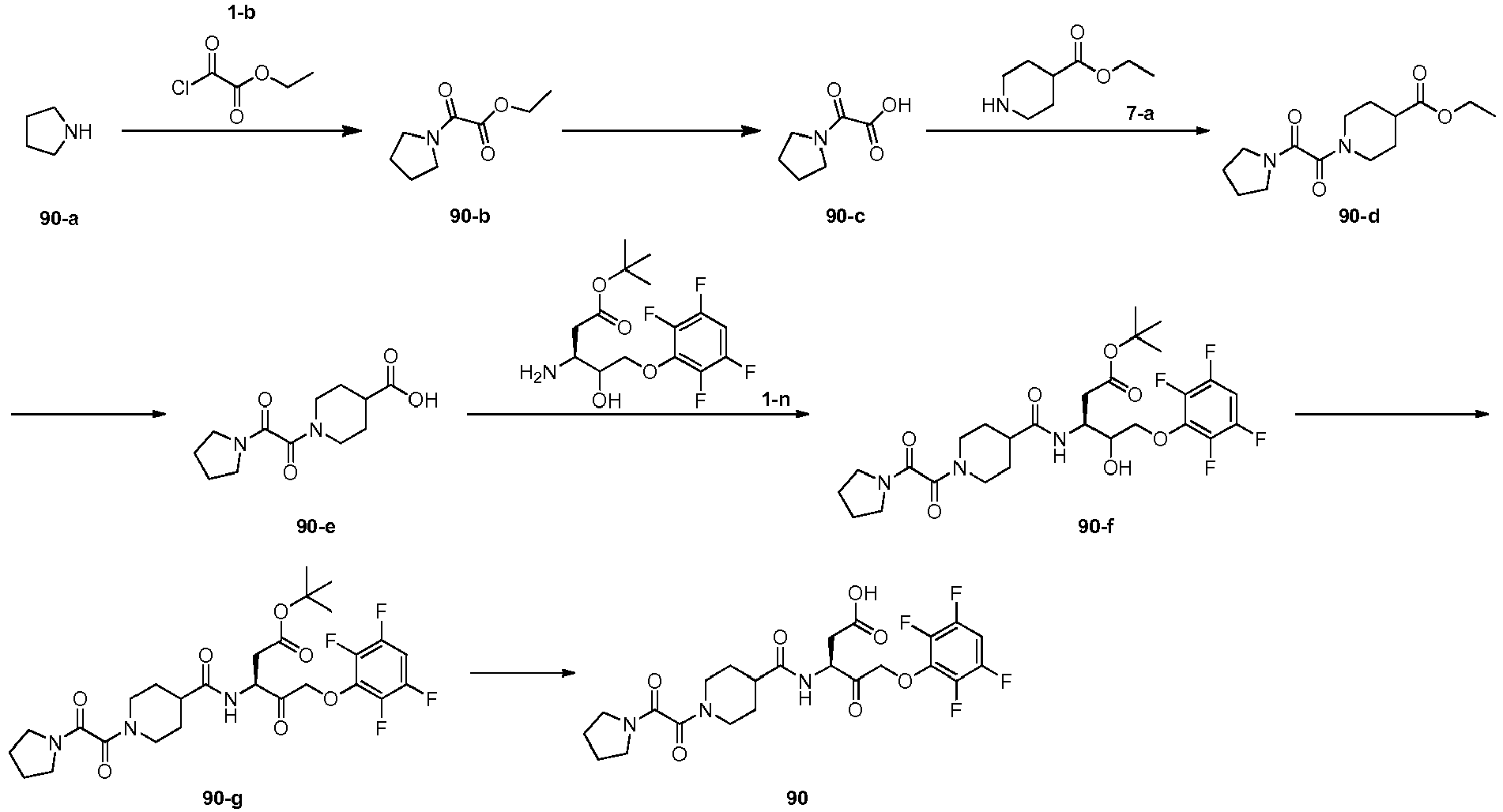
- Compound 90-a (1.00 g, 14.06 mmol, 1.18 mL, 1.00 eq) was dissolved in dichloromethane (20.00 mL). Triethylamine (2.85 g, 28.12 mmol, 3.90 mL, 2.00 eq) and compound 1-b (2.30 g, 16.87 mmol, 1.89 mL, 1.20 eq) were added in an ice bath. After stirring for 30 min, the reaction solution was warmed up to room temperature and stirred for 3 hours. After the reaction was completed, the reaction solution was added with dichloromethane (30 mL) for dilution, and then washed with water (30 mL × 2) and saturated brine (50 mL × 2). The organic phase was dried over anhydrous sodium sulfate, filtered, and concentrated to give a crude product. The crude product was purified by column chromatography (petroleum ether : ethyl acetate = 3:1), to give the product of compound 90-b (1.70 g, yield: 70%) as a colorless oil. LCMS m/z = 171.8 [M+H]+.
- LiOH·H2O (183.78 mg, 4.38 mmol, 1.50 eq) was dissolved in water (5.00 mL), and the solution was added to a solution of compound 90-b (500.00 mg, 2.92 mmol, 1.00 eq) dissolved in THF (5.00 mL). The reaction was stirred at room temperature for 1 hour. After the reaction was completed, the reaction solution was added with water (20 mL), adjusted to pH of 3-4 with 1 N dilute hydrochloric acid, and extracted with dichloromethane/methanol (50 mL × 3, 10:1). The organic phases were combined, dried over anhydrous sodium sulfate, filtered, and concentrated to give compound 90-c (400.00 mg, crude), which was used directly in the next step without purification. LCMS m/z = 144.1 [M+H]+.
- Compound 90-c (400.00 mg, 2.79 mmol, 1.00 eq) was dissolved in dichloromethane (10 mL), and N-methylmorpholine (846.63 mg, 8.37 mmol, 920.25 µL, 3.00 eq), HOBt (516.47 mg, 3.82 mmol, 1.37 eq), EDCI (732.73 mg, 3.82 mmol, 1.37 eq) and compound 7-a (526.34 mg, 3.35 mmol, 516.02 µL, 1.20 eq) were added thereto. The reaction was stirred at room temperature for 16 hours. After the reaction was completed, the reaction solution was added with dichloromethane (30 mL) for dilution, and then washed with water (30 mL) and saturated brine (50 mL). The organic phase was dried over anhydrous sodium sulfate, filtered, and concentrated to give a crude product. The crude product was purified by column chromatography (petroleum ether : ethyl acetate = 1:1∼1:8), to give the product of compound 90-d (450.00 mg, yield: 55%) as a colorless oil. LCMS m/z = 283.0 [M+H]+.
- LiOH·H2O (100.07 mg, 2.38 mmol, 1.50 eq) was dissolved in water (5.00 mL), and the solution was added to a solution of compound 90-d (450.00 mg, 1.59 mmol, 1.00 eq) dissolved in THF (5.00 mL). The reaction was stirred at room temperature for 2 hours. After the reaction was completed, the reaction solution was added with water (20 mL), adjusted to pH of 3-4 with 1 N dilute hydrochloric acid, and extracted with dichloromethane/methanol (50 mL × 3, 10:1). The organic phases were combined, dried over anhydrous sodium sulfate, filtered, and concentrated to give the product of compound 90-e (400.00 mg, crude) as a colorless oil, which was used directly in the next step without purification. LCMS m/z = 254.9 [M+H]+.
- Compound 90-e (200.00 mg, 786.53 µmol, 1.00 eq) was dissolved in dichloromethane (20 mL), and N-methylmorpholine (238.67 mg, 2.36 mmol, 259.43 µL, 3.00 eq), HOBt (145.60 mg, 1.08 mmol, 1.37 eq), EDCI (206.57 mg, 1.08 mmol, 1.37 eq) and compound 1-n (277.89 mg, 786.53 µmol, 1.00 eq) were added thereto. The reaction was stirred at room temperature for 5 hours. After the reaction was completed, the reaction solution was added with dichloromethane (30 mL) for dilution, and then washed with water (50 mL). The aqueous phase was washed with dichloromethane (50 mL × 2). The organic phases were combined, dried over anhydrous sodium sulfate, filtered, and concentrated to give a crude product. The crude product was purified by column chromatography (petroleum ether : ethyl acetate = 1:1∼1:10), to give the product of compound 90-f (260.00 mg, yield: 47%) as a colorless oil. LCMS m/z = 590.1 [M+H]+.
- Compound 90-f (260.00 mg, 441.00 µmol, 1.00 eq) was dissolved in dichloromethane (10.00 mL), and PIDA (549.72 mg, 1.71 mmol, 3.87 eq) and TEMPO (20.80 mg, 132.30 µmol, 0.30 eq) were added thereto. The reaction was stirred at room temperature for 40 hours. After the reaction was completed, the reaction solution was added with ethyl acetate (40 mL) for dilution, and washed with saturated sodium hydrogen carbonate solution (40 mL) and saturated brine (40 mL × 2). The organic phase was dried over anhydrous sodium sulfate, filtered, and concentrated to give a crude product. The crude product was purified by column chromatography (petroleum ether : ethyl acetate = 1:1∼1:9), to give the product of compound 90-g (210.00 mg, yield: 64%) as a yellow oil. LCMS m/z = 588.1 [M+H]+.
- Compound 90-g (210.00 mg, 357.41 µmol, 1.00 eq) was dissolved in dichloromethane (10.00 mL), and TFA (5.21 mL, 70.31 mmol, 196.71 eq) was added thereto. The reaction was stirred at room temperature for 1 hour. After the reaction was completed, the reaction solution was spin-dried, to give a crude product. The crude product was purified by preparative HPLC (in TFA conditiotn), and lyophilized to give compound 90 (60.00 mg, yield: 32%). 1H NMR (400MHz, DMS0-d6) δ=8.50 (d, J = 7.53 Hz, 1H), 7.49-7.69 (m, 1H), 5.13-5.31 (m, 2H), 4.61 (q, J = 6.53 Hz, 1H), 4.24 (d, J=12.80 Hz, 1H), 3.55 (d, J = 13.30 Hz, 1H), 3.23-3.40 (m, 4H), 3.11 (t, J = 11.67 Hz, 1H), 2.70-2.85 (m, 2H), 2.59 (dd, J = 7.03, 16.81 Hz, 1H), 2.35-2.48 (m, 1 H), 1.66-1.91 (m, 6H), 1.34-1.53 (m, 2H); LCMS m/z = 532.0 [M+H]+.
-

- Compound 91-a (3.38 g, 19.08 mmol, 3.00 eq) and CDI (2.99 g, 18.44 mmol, 2.90 eq) were dissolved in THF (20.00 mL). After stirring at room temperature for 1 hour, the reaction solution was added with triethylamine (2.38 g, 23.53 mmol, 3.26 mL, 3.70 eq) and compound 7-a (1.00 g, 6.36 mmol, 980.39 µL, 1.00 eq), warmed up to 80°C under the protection of nitrogen gas, and stirred for 16 hours. After the reaction was completed, the reaction solution was added with ethyl acetate (50 mL) for dilution, and then washed with water (50 mL). The organic phase was dried over anhydrous sodium sulfate, filtered, and concentrated to give a crude product. The crude product was purified by column chromatography (petroleum ether : ethyl acetate = 5:1∼3:1), to give the product of compound 91-b (2.34 g, crude) as a colorless oil. LCMS m/z = 360.1 [M+H]+.
- LiOH·H2O (87.36 mg, 2.08 mmol, 1.50 eq) was dissolved in H2O (5.00 mL), and the solution was added to a solution of compound 91-b (500.00 mg, 1.39 mmol, 1.00 eq) dissolved in THF (5.00 mL). The reaction was stirred at room temperature for 2 hours. After the reaction was completed, the reaction solution was added with water (30 mL), adjusted to pH of 3∼4 with 1 N dilute hydrochloric acid, and extracted with dichloromethane/methanol (50 mL × 2, 10:1). The organic phases were combined, dried over anhydrous sodium sulfate, filtered, and concentrated to give the product of compound 91-c (460.00 mg, crude) as a colorless oil, which was used directly in the next step without purification.
- Compound 91-c (200.00 mg, 602.08 mmol, 1.00 eq) was dissolved in dichloromethane (10 mL), and N-methylmorpholine (182.70 mg, 1.81 mmol, 198.59 µL, 3.00 eq), HOBt (111.45 mg, 824.85 µmol, 1.37 eq), EDCI (158.12 mg, 824.85 µmol, 1.37 eq) and compound 1-n (233.99 mg, 662.29 µmol, 1.10 eq) were added thereto. The reaction was stirred at room temperature for 16 hours. After the reaction was completed, the reaction solution was added with water (20 mL), and then extracted with dichloromethane (20 mL × 2). The organic phases were combined, dried over anhydrous sodium sulfate, filtered, and concentrated to give a crude product. The crude product was purified by column chromatography (petroleum ether : ethyl acetate = 1.5:1), to give the product of compound 91-d (200.00 mg, yield: 50%) as a colorless oil. LCMS m/z = 689.1 [M+Na]+.
- Compound 91-d (200.00 mg, 299.64 µmol, 1.00 eq) was dissolved in dichloromethane (10.00 mL), and PIDA (373.51 mg, 1.16 mmol, 3.87 eq) and TEMPO (14.14 mg, 89.89 µmol, 0.30 eq) were added thereto. The reaction was stirred at room temperature for 40 hours. After the reaction was completed, the reaction solution was added with dichloromethane (50 mL) for dilution, and washed with saturated sodium hydrogen carbonate solution (30 mL) and saturated brine (30 mL × 2). The organic phase was dried over anhydrous sodium sulfate, filtered, and concentrated to give a crude product. The crude product was purified by column chromatography (petroleum ether : ethyl acetate = 2.3:1), to give the product of compound 91-e (160.00 mg, crude) as a yellow oil. LCMS m/z = 687.1 [M+Na]+.
- Compound 91-e (160.00 mg, 240.44 µmol, 1.00 eq) was dissolved in dichloromethane (7.00 mL), and TFA (3.50 mL, 47.30 mmol, 196.71 eq) was added thereto. The reaction was stirred at room temperature for 2 hours. After the reaction was completed, the reaction solution was spin-dried to give a crude product. The crude product was purified by preparative HPLC (in TFA condition), and lyophilized to give compound 91 (137.00 mg, yield: 94%). 1H NMR (400MHz, DMSO-d6) δ=8.44 (br s, 1H), 7.42-7.77 (m, 4H), 4.99-5.49 (m, 4H), 4.60 (br s, 1H), 3.98 (br d, J=12.55 Hz, 2H), 2.85 (br s, 2H), 2.69 (br s, 1H), 2.29-2.48 (m, 2H), 1.69 (br s, 2H), 1.43 (br d, J=11.54 Hz, 2H); LCMS m/z = 608.9 [M+H]+.
-

- Compound 92-a (300.00 mg, 2.35 mmol, 1.00 eq) was dissolved in dichloromethane (6 mL), and triethylamine (380.74 mg, 3.76 mmol, 521.56 µL, 1.60 eq) was added thereto, and stirred under the protection of nitrogen gas. Compound 1-b (417.39 mg, 3.06 mmol, 1.30 eq) was slowly added thereto with stirring, since the reaction was exothermic. After the addition was completed, the reaction system was stirred at 15°C for 16 hours. After the reaction was completed, the reaction solution was added with 20 mL of water, and then separated and extracted. The aqueous phase was extracted once with 20 mL of ethyl acetate. The combined organic phase was washed once separately with each of hydrochloric acid and saturated brine (10 mL), dried over anhydrous sodium sulfate, and then spin-dried to give a crude product. The crude product was subjected to column chromatography (petroleum ether : ethyl acetate = 1:0∼5:1) to give compound 92-b (250.00 mg, yield: 47%) as a colorless liquid. LCMS m/z = 227.8 [M+H]+.
- Compound 92-b (250.00 mg, 1.10 mmol, 1.00 eq) was dissolved in tetrahydrofuran (5mL), and then LiOH·H2O (39.52 mg, 1.65 mmol, 1.50 eq) was dissolved in water (6 mL). The formulated solution was slowly added to compound 92-b. The reaction system was stirred at 15°C for 2 hours. The reaction system was acidified to pH of about 4 with 1N hydrochloric acid, and then extracted four times with ethyl acetate (10 mL). The combind organic phases were washed once with 10 mL of saturated brine, dried over anhydrous sodium sulfate, and then spin-dried to give a crude product of compound 92-c (230.00 mg, crude).
- Under the protection of nitrogen gas, compound 92-c (230.00 mg, 1.20 mmol, 1.00 eq) was dissolved in dichloromethane (6 mL). EDCI (315.80 mg, 1.65 mmol, 1.37 eq), HOBt (222.59 mg, 1.65 mmol, 1.37 eq), and NMM (364.89 mg, 3.61 mmol, 396.62 µL, 3.00 eq) were added thereto, and compound 1-e (207.94 mg, 1.32 mmol, 203.87 µL, 1.10 eq) as a substrate was finally added thereto. The reaction was stirred at 15°C for 16 hours. The reaction system was added with 40 mL of ethyl acetate and 40 mL of water, and separated. The aqueous phase was further extracted once with ethyl acetate (20 mL). The combined organic phases were washed once separately with each of water and saturated brine (40 mL), and then dried and spin-dried to give a crude product. The crude product was subjected to column chromatography (petroleum ether : ethyl acetate = 1:0∼1:1) to give compound 92-d (170.00 mg, yield: 42%) as a brown liquid. LCMS m/z = 338.9 [M+H]+.
- Compound 92-e (170.00 mg, 501.79 µmol, 1.00 eq) was dissolved in tetrahydrofuran (4 mL), and then LiOH·H2O (18.03 mg, 752.69 µmol, 1.50 eq) was dissolved in water (4 mL). The formulated solution was slowly added to compound 92-d. The reaction system was stirred at 15°C for 2 hours. The reaction system was acidified to pH of about 4 with 1N hydrochloric acid, and then extracted twice with ethyl acetate (20 mL). The combind organic phases were washed once separately with water (20 mL) and saturated brine (20 mL), dried over anhydrous sodium sulfate, and then spin-dried to give the crude product of compound 92-e (140.00 mg, crude) as a colorless liquid, LCMS m/z = 310.9 [M+H]+, 333.0 [M+Na]+.
- Under the protection of nitrogen gas, compound 92-e (140.00 mg, 450.55 µmol, 1.10 eq) was dissolved in dichloromethane (5 mL). EDCI (107.57 mg, 561.14 µmol, 1.37 eq), HOBt (75.82 mg, 561.14 µmol, 1.37 eq), NMM (124.29 mg, 1.23 mmol, 135.10 µL, 3.00 eq) were then added thereto, and compound 1-n (144.71 mg, 409.59 µmol, 1.00 eq) as a substrate was finally added thereto. The reaction was stirred at 15°C for 18 hours. After the reaction was completed, the reaction system was added with 20mL of ethyl acetate and 20mL of water once, and separated. The aqueous phase was further extracted once with ethyl acetate (20 mL). The combined organic phases were washed once separately with water (20mL) and saturated brine (20mL), and then dried and spin-dried to give a crude product. The crude product was subjected to column chromatography (petroleum ether : ethyl acetate = 1:0∼10:7) to give compound 92-f (76.00 mg, yield: 29%) as a brown liquid, LCMS m/z = 668.0 [M+Na]+.
- Compound 92-f (72.00 mg, 111.45 µmol, 1.00 eq) was dissolved in dichloromethane (5 mL), and PIDA (143.59 mg, 445.80 µmol, 4.00 eq) and TEMPO (8.76 mg, 55.72 µmol, 0.50 eq) was added under the protection of nitrogen gas. The reaction system was stirred at 15°C for 16 hours. The system was added with ethyl acetate (20 mL), and washed once separately with saturated sodium hydrogen carbonate solution (20 mL), water (20 mL) and saturated brine (20 mL). The organic phase was dried over anhydrous sodium sulfate, filtered, and spin-dried to give a crude product. The crude product was subjected to column chromatography (petroleum ether : ethyl acetate = 1:1) to give compound 92-g (34.00 mg, yield: 47%) as a brown liquid, LCMS m/z = 666.1 [M+Na]+.
- Compound 92-g (34.00 mg, 52.79 µmol, 1.00 eq) was dissolved in dichloromethane (5 mL), and trifluoroacetic acid (1.20 g, 10.56 mmol, 781.70 µL, 200.00 eq) was added under the protection of nitrogen gas. The system was stirred at 15°C for 1 hour. After the reaction was completed, the reaction solution was spin-dried to give a crude product. The crude product was purified by preparative HPLC (in trifluoroacetic acid condition), spin-dried, and then dissolved with acetonitrile (20 mL). The obtained solution was added with water (20 mL), evenly mixed, and lyophilized to give compound ,2 (8.30 mg, yield: 25%). 1H NMR (1H NMR (400 MHz, CHLOROFORM-d) δ=9.66 (br. s., 1H), 8.33 (d, J=7.78 Hz, 1H), 7.41 (d, J=8.03 Hz, 1H), 7.27-7.35 (m, 1H), 7.07-7.16 (m, 1H), 6.84 (br. s., 1H), 6.24 (br. s., 1H), 5.13 (d, J=13.05 Hz, 2H), 4.80 (br. s., 1H), 4.58 (d, J=13.05 Hz, 1H), 4.25-4.47 (m, 1H), 3.31 (t, J=11.92 Hz, 2H), 2.85-3.01 (m, 2H), 2.53 (br. s., 1H), 2.00 (d, J=11.80 Hz, 2H), 1.67-1.91 (m, 2H).
-
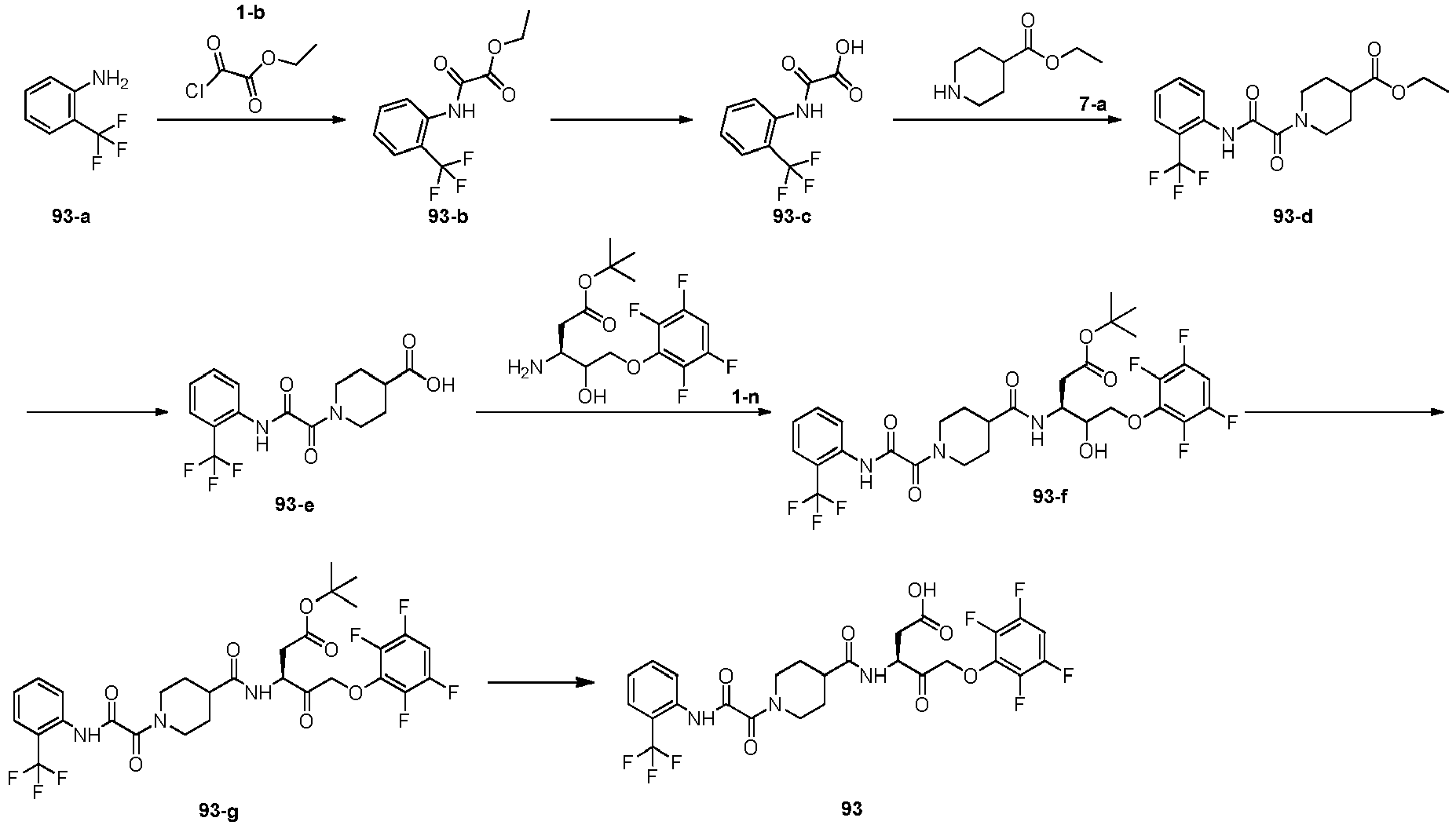
- Compound 93-a (1.00 g, 6.21 mmol, 781.25 µL, 1.00 eq) was dissolved in dichloromethane (6 mL), and triethylamine (879.75 mg, 8.69 mmol, 1.21 mL, 1.40 eq) was added thereto, and stirred under the protection of nitrogen gas. Compound 1-b (1.10 g, 8.07 mmol, 903.45 µL, 1.30 eq) was slowly added thereto with stirring, since the reaction was exothermic. After the addition was completed, the reaction system was stirred at 15°C for 16 hours. After the reaction was completed, the reaction solution was added with 20 mL of water and 20 mL of ethyl acetate, and acidified to pH of about 4 with 1N hydrochloric acid, followed by separation and extraction. The aqueous phase was extracted once with 20 mL of ethyl acetate. The combined organic phases were washed once separately with 10 mL of water and 10 mL of saturated brine, dried over anhydrous sodium sulfate, and then spin-dried to give a crude product. The crude product was subjected to column chromatography (petroleum ether : ethyl acetate = 1:0~5:1) to give compound 93-b (1.50 g, yield: 92%) as a colorless liquid. 1H NMR (400 MHz, DMSO-d6) δ=9.36 (br s, 1H), 8.37 (br d, J=8.28 Hz, 1H), 7.67 (br d, ùm; .78 Hz, 1H), 7.58-7.63 (m, 1H), 7.31 (br t, J=7.65 Hz, 1H), 4.45 (q, J=7.03 Hz, 2H), 1.45 (t, J=7.15 Hz, 3H).
- Compound 93-b (1.50 g, 5.74 mmol, 1.00 eq) was dissolved in tetrahydrofuran (20 mL), and then LiOH·H2O (219.96 mg, 9.18 mmol, 1.60 eq) was dissolved in water (20 mL). The formulated solutions were slowly added to compound 93-b. The reaction system was stirred at 15°C for 2 hours. The reaction system was acidified to pH of about 4 with 1N hydrochloric acid, and then extracted four times with ethyl acetate (70 mL). The combind organic phases were washed once with 150 mL of saturated brine, dried over anhydrous sodium sulfate, and then spin-dried to give the crude liquid product of compound 93-c (1.28 g, crude) as a yellow oil. 1H NMR (400 MHz, CHLOROFORM-d) δ=9.91 (br. s., 1H), 9.43 (br. s., 1H), 8.27 (d, J=8.28 Hz, 1H), 7.70 (d, J=8.03 Hz, 1H), 7.65 (t, J=7.78 Hz, 1H), 7.37 (t, J=7.65 Hz, 1H).
- Under the protection of nitrogen gas, compound 93-c (244.69 mg, 1.05 mmol, 1.10 eq) was dissolved in dichloromethane (6 mL). HATU (725.58 mg, 1.91 mmol, 2.00 eq) and N,N-diisopropylethylamine (369.94 mg, 2.86 mmol, 499.92 µL, 3.00 eq) were then added thereto, and compound 7-a (150.00 mg, 954.14 µmol, 147.06 µL, 1.00 eq) as a substrate was finally added thereto. The reaction was stirred at 15°C for 16 hours. The reaction system was added with 40mL of ethyl acetate and 40mL of water, and separated. The aqueous phase was further extracted once with ethyl acetate (20 mL). The combined organic phases were washed once separately with water and saturated brine (40mL of each), and then dried and spin-dried to give a crude product. The crude product was subjected to column chromatography (petroleum ether : ethyl acetate = 1:0~5:2) to give compound 93-d (240.00 mg, yield: 68%) as a brown liquid. 1H NMR (400 MHz, CHLOROFORM-d) δ=9.66 (br. s., 1H), 8.26 (d, J=8.28 Hz, 1H), 7.66 (d, J=7.78 Hz, 1H), 7.59 (t, J=7.91 Hz, 1H), 7.27-7.32 (m, 1H), 4.95 (td, J=3.54, 13.74 Hz, 1H), 4.39 (td, J=3.70, 13.18 Hz, 1H), 4.14-4.20 (m, 2H), 3.47 (ddd, J=3.01, 10.92, 13.68 Hz, 1H), 3.08 (ddd, J=3.01, 10.85, 13.49 Hz, 1H), 2.56-2.66 (m, 1H), 1.99-2.08 (m, 2H), 1.75-1.93 (m, 2H), 1.23-1.27 (m, 3H).
- Compound 93-d (240.00 mg, 644.57 µmol, 1.00 eq) was dissolved in tetrahydrofuran (6 mL), and then LiOH·H2O (24.70 mg, 644.57 µmol, 1.60 eq) was dissolved in water (6 mL). The formulated solutions were slowly added to compound 93-d, and the reaction system was stirred at 15°C for 3 hours. The reaction system was acidified to pH of about 4 with 1N hydrochloric acid, and then extracted four times with ethyl acetate (10 mL). The combind organic phases were washed once separately with water (20 mL) and saturated brine (20 mL), dried over anhydrous sodium sulfate, and then spin-dried to give the crude liquid product of compound 93-e (300.00 mg, crude) as a yellow oil. 1H NMR (400 MHz, CHLOROFORM-d) δ=9.66 (br. s., 1H), 8.26 (d, J=8.28 Hz, 1H), 7.66 (d, J=7.78 Hz, 1H), 7.59 (t, J=8.03 Hz, 1H), 7.28-7.33 (m, 1H), 4.95 (d, J=13.80 Hz, 1H), 4.39 (d, J=13.80 Hz, 1H), 4.12 (q, J=7.03 Hz, 1H), 3.52 (t, J=10.92 Hz, 1H), 3.07-3.21 (m, 1H), 2.64-2.76 (m, 1H), 2.11 (s, 1H), 1.79-1.96 (m, 2H).
- Under the protection of nitrogen gas, compound 93-e (240.00 mg, 697.09 µmol, 1.10 eq) was dissolved in dichloromethane (10 mL). EDCI (166.43 mg, 868.19 µmol, 1.37 eq), HOBt (117.31 mg, 868.19 µmol, 1.37 eq), NMM (192.30 mg, 1.90 mmol, 209.02 µL, 3.00 eq) were then added thereto, and compound 1-n (223.90 mg, 633.72 µmol, 1.00 eq) as a substrate was finally added thereto. The reaction was stirred at 15°C for 40 hours. After the reaction was completed, the reaction system was added with ethyl acetate and water (20 mL of each), and separated. The aqueous phase was further extracted once with ethyl acetate (20 mL). The combined organic phases were washed once separately with water and saturated brine (20mL of each), and then dried and spin-dried to give a crude product. The crude product was subjected to column chromatography (petroleum ether : ethyl acetate = 1:0∼10:7) to give compound 93-f (183.00 mg, yield: 42%) as a brown liquid, LCMS m/z = 702.0 [M+Na]+.
- Compound 93-f (183.00 mg, 269.28 µmol, 1.00 eq) was dissolved in dichloromethane (10 mL), and PIDA (425.00 mg, 1.32 mmol, 4.90 eq) and TEMPO (30.00 mg, 190.78 µmol, 0.71 eq) were added thereto under the protection of nitrogen gas. The reaction system was stirred at 15°C for 40 hours. The system was added with ethyl acetate (40 mL), and washed once respectively with saturated sodium hydrogen carbonate solution (40 mL), water (40 mL) and saturated brine (40 mL). The organic phase was dried over anhydrous sodium sulfate, filtered, and spin-dried to give a crude product. The crude product was subjected to column chromatography (petroleum ether : ethyl acetate = 1:1~1:4) to give compound 93-g (155.00 mg, yield: 85%) as a brown liquid, LCMS m/z = 700.1 [M+Na]+.
- Compound 93-g (34.00 mg, 52.79 µmol, 1.00 eq) was dissolved in dichloromethane (5 mL), and trifluoroacetic acid (1.20 g, 10.56 mmol, 781.70 µL, 200.00 eq) was added under the protection of nitrogen gas. The system was stirred at 15°C for 1 hour. After the reaction was completed, the reaction solution was spin-dried to give a crude product. The crude product was purified by preparative HPLC (in trifluoroacetic acid condition), spin-dried, and then dissolved with acetonitrile (20 mL). The obtained solution was added with water (20 mL), evenly mixed, and lyophilized to give compound 93 (8.30 mg, yield: 25%). 1H NMR (1H NMR (400 MHz, CHLOROFORM-d) δ=9.66 (br. s., 1H), 8.33 (d, J=7.78 Hz, 1H), 7.41 (d, J=8.03 Hz, 1H), 7.27-7.35 (m, 1H), 7.07-7.16 (m, 1H), 6.84 (br. s., 1H), 6.24 (br. s., 1H), 5.13 (d, J=13.05 Hz, 2H), 4.80 (br. s., 1H), 4.58 (d, J=13.05 Hz, 1H), 4.25-4.47 (m, 1H), 3.31 (t, J=11.92 Hz, 2H), 2.85-3.01 (m, 2H), 2.53 (br. s., 1H), 2.00 (d, J=11.80 Hz, 2H), 1.67-1.91 (m, 2H).
-

- Compound 94-a (1.00 g, 6.70 mmol, 1.00 eq) and triethylamine (1.36 g, 13.40 mmol, 1.86 mL, 2.00 eq) were added to dichloromethane (100 mL), maintained at 0-5°C and stirred for 15 min. Compound 1-b (960.49 mg, 7.04 mmol, 787.29 µL, 1.05 eq) was then added to the above solution, maintained at 10°C-20°C and stirred for 16 hours. After the reaction was completed, the reaction solution was added with 100 mL of water, and separated. The aqueous phase was further extracted with dichloromethane (200 mL × 2). The organic phases were combined, and washed with dilute hydrochloric acid (0.1 M, 150 mL) and water (100 mL). The organic phase was dried over anhydrous sodium sulfate, filtered, concentrated, and subjected to column chromatography (petroleum ether : ethyl acetate = 1:0∼5:2) to give the product of compound 94-b (1.62 g, yield: 96%) as a yellow oil. 1H NMR (400MHz, CHLOROFORM-d) δ = 7.11 (br. s., 1H), 6.99 (d, J=7.5 Hz, 1H), 6.93-6.85 (m, 2H), 4.27 (q, J=7.0 Hz, 2H), 3.52-3.43 (m, 2H), 2.77 (t, J=7.3 Hz, 2H), 2.23 (s, 6H), 1.31 (t, J=7.0 Hz, 3H); LCMS m/z = 250.0 [M+H]+.
- Compound 94-b (1.65 g, 6.62 mmol, 1.00 eq) was dissolved in tetrahydrofuran (10.00 mL), and a solution of LiOH·H2O (555.43 mg, 13.24 mmol, 2.00 eq) dissolved in H2O (10.00 mL) was added to the above solution. The reaction solution was maintained at 25°C and stirred for 2 hours. After the reaction was completed, the reaction solution was adjusted to pH of 6 with 2 N dilute hydrochloric acid. This solution was added with 50 mL of water, and extracted with dichloromethane (30 mL × 3). The organic phase was dried over anhydrous sodium sulfate, filtered and concentrated to give the product of compound 94-c (1.81 g, crude) as a pale yellow oil, which was used directly in the next step without purification. LCMS m/z = 222.0 [M+H]+.
- Compound 94-c (1.22 g, 5.50 mmol, 1.10 eq) and DIPEA (1.94 g, 15.00 mmol, 2.62 mL, 3.00 eq) were dissolved in dichloromethane (10 mL), and compound 7-a (786.05 mg, 5.00 mmol, 770.64 µL, 1.00 eq) was added thereto. The reaction solution was stirred at room temperature for 1.5 hours. After the reaction was completed, the reaction solution was added with 150 mL of water, and extracted with dichloromethane (80 mL × 3). The organic phases were combined, dried over anhydrous sodium sulfate, filtered and concentrated to give a crude product. The crude product was subjected to column chromatography (petroleum ether : ethyl acetate = 1:0∼3:1) to give the product of compound 94-d (1.62 g, yield: 80%) as a yellow oil. 1H NMR (400MHz, CHLOROFORM-d) δ= 7.25 (br. s., 1H), 7.05 (d, J=7.5 Hz, 1H), 6.99-6.93 (m, 2H), 4.75 (d, J=14.1 Hz, 1H), 4.32 (d, J=13.6 Hz, 1H), 4.15 (q, J=7.0 Hz, 2H), 3.55-3.45 (m, 2H), 3.38-3.28 (m, 1H), 3.00-2.90 (m, 1H), 2.86-2.81 (m, 2H), 2.57 (t, J=4.0 Hz, 1H), 2.30 (d, J=2.5 Hz, 6H), 1.98 (dd, J=3.3, 13.8 Hz, 2H), 1.84-1.66 (m, 2H), 1.26 (t, J=7.3 Hz, 3H); LCMS m/z = 383.1 [M+Na]+.
- Compound 94-d (360.00 mg, 998.75 µmol, 1.00 eq) was dissolved in tetrahydrofuran (10.00 mL), and a solution of LiOH·H2O (83.82 mg, 2.00 mmol, 2.00 eq) dissolved in H2O (10.00 mL) was added to the above solution. The reaction solution was maintained at 25°C and stirred for 2 hours. After the reaction was completed, the reaction solution was adjusted to pH of 6 with 2 N dilute hydrochloric acid. This solution was added with 50 mL of water, and extracted with dichloromethane (30 mL × 3). The organic phase was dried over anhydrous sodium sulfate, filtered and concentrated to give the product of compound 94-e (356.00 mg, crude) as pale yellow oil, which was used directly in the next step without purification. LCMS m/z = 355.1 [M+Na]+.
- Compound 94-e (282.53 mg, 850.00 µmol, 1.70 eq) and HATU (380.23 mg, 1.00 mmol, 2.00 eq) were dissolved in dichloromethane (20 mL), and stirred at room temperature for 15 min. Compound 1-n (176.66 mg, 500.00 µmol, 1.00 eq) and DIPEA (193.86 mg, 1.50 mmol, 261.97 µL, 3.00 eq) were then added, and stirred at room temperature for another 18 hours. After the reaction was completed, the reaction solution was added with 150 mL of water, and extracted with dichloromethane (80 mL × 3). The organic phases were combined, dried over anhydrous sodium sulfate, filtered and concentrated to give a crude product. The crude product was subjected to column chromatography (petroleum ether : ethyl acetate = 1:0∼2:1) to give the product of compound 94-f (156.00 mg, yield: 43%) as a yellow oil. LCMS m/z = 668.4 [M+H]+; 690.3 [M+Na]+.
- Compound 94-f (150.00 mg, 224.66 µmol, 1.00 eq) was dissolved in dichloromethane (20.00 mL), and PIDA (289.45 mg, 898.62 µmol, 4.00 eq) and TEMPO (7.07 mg, 44.93 µmol, 0.20 eq) were added thereto. The reaction solution was stirred at room temperature for 40 hours. After the reaction was completed, the reaction solution was added with saturated sodium hydrogen carbonate solution (50 mL) and saturated sodium sulfite solution (50 mL), extracted with dichloromethane (30 mL × 3), and washed with saturated brine (50 mL). The organic phase was dried over anhydrous sodium sulfate, filtered and concentrated to give a crude product. The crude product was subjected to column chromatography (petroleum ether: ethyl acetate = 1:0~5:3) to give the product of compound 94-g (75.00 mg, yield: 43%) as a yellow oil. LCMS m/z = 666.3 [M+H]+; 688.3 [M+Na]+.
- Compound 94-g (75.00 mg, 112.67 µmol, 1.00 eq) was dissolved in dichloromethane (4.00 mL), and trifluoroacetic acid (4.62 g, 40.52 mmol, 3.00 mL) was added thereto. The reaction solution was stirred at room temperature for 2 hours. After the reaction was completed, the reaction solution was spin-dried to give a crude product. The crude product was purified by preparative HPLC (in trifluoroacetic acid condition), and lyophilized to give the product of compound 94 (40.00 mg, yield: 56%). 1H NMR (400MHz, DMSO-d6) δ= 8.76 (t, J=5.0 Hz, 1H), 8.45 (br. s., 1H), 7.65-7.50 (m, 1H), 7.01 (d, J=7.0 Hz, 1H), 6.95 (s, 1H), 6.91 (br. s., 1H), 5.21 (br. s., 2H), 4.63 (br. s., 1H), 4.22 (d, J=12.5 Hz, 1H), 3.57 (d, J=3.5 Hz, 1H), 3.33-3.21 (m, 3H), 2.98 (t, J=11.8 Hz, 1H), 2.78-2.58 (m, 5H), 2.24 (s., 3H), 2.22 (s., 3H), 1.79-1.60 (m, 2H), 1.53-1.36 (m, 2H); LCMS m/z = 610.2 [M+H]+.
-
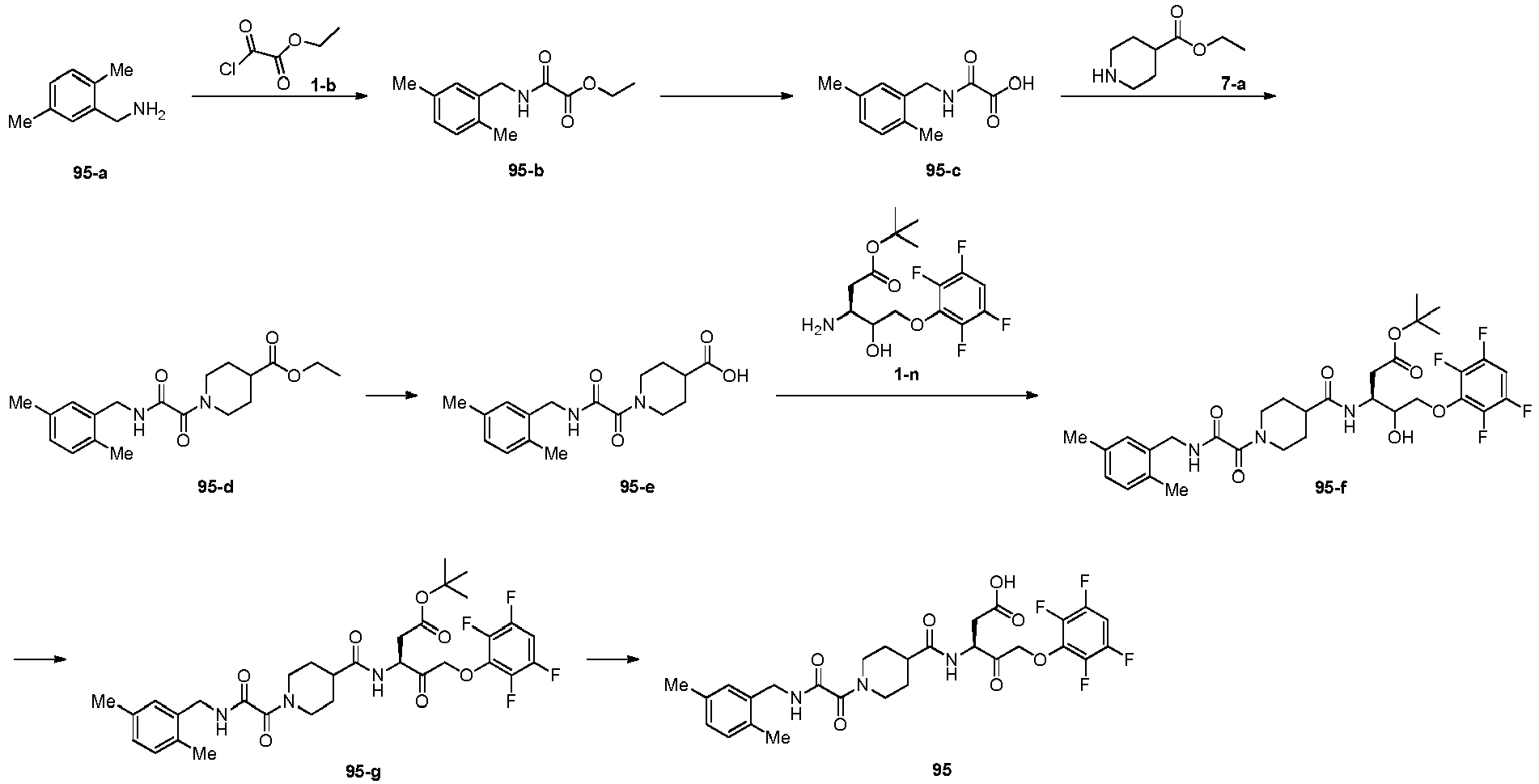
- Compound 95-a (906.52 mg, 6.70 mmol, 1.00 eq) and triethylamine (1.36 g, 13.40 mmol, 1.86 mL, 2.00 eq) were added to dichloromethane (100 mL), maintained at 0-5°C and stirred for 15 min. Compound 1-b (960.49 mg, 7.04 mmol, 787.29 µL, 1.05 eq) was then added to the above solution, maintained at 10-20°C and stirred for 16 hours. After the reaction was completed, the reaction solution was added with 100 mL of water, and separated. The aqueous phase was further extracted with dichloromethane (200 mL × 2). The organic phases were combined, and washed with dilute hydrochloric acid (0.1 M, 150 mL) and water (100 mL). The organic phase was dried over anhydrous sodium sulfate, filtered, concentrated, and subjected to column chromatography (petroleum ether : ethyl acetate = 1:0~5:2) to give the product of compound 95-b (1.23 g, yield: 78%) as a yellow oil. 1H NMR (400MHz, CHLOROFORM-d) δ= 7.19 (br. s., 1H), 7.12-7.02 (m, 3H), 4.49 (d, J=6.0 Hz, 2H), 4.36 (q, J=7.4 Hz, 2H), 2.30 (d, J=9.5 Hz, 6H), 1.39 (t, J=7.3 Hz, 3H); LCMS m/z = 235.9 [M+H]+.
- Compound 95-b (1.23 g, 5.23 mmol, 1.00 eq) was dissolved in tetrahydrofuran (10.00 mL), and a solution of LiOH·H2O (438.72 mg, 10.46 mmol, 2.00 eq) dissolved in H2O (10.00 mL) was added to the above solution. The reaction solution was maintained at 25°C and stirred for 2 hours. After the reaction was completed, the reaction solution was adjusted to pH of 6 with 2 N dilute hydrochloric acid. This solution was added with 50 mL of water, and extracted with dichloromethane (30 mL × 3). The organic phase was dried over anhydrous sodium sulfate, filtered and concentrated to give the product of compound 95-c (1.01 g, crude) as a pale yellow oil, which was used directly in the next step without purification.
- Compound 95-c (980.20 mg, 4.73 mmol, 1.10 eq), HATU (3.27 g, 8.60 mmol, 2.0 eq) and DIPEA (1.67 g, 12.90 mmol, 2.25 mL, 3.00 eq) were dissolved in dichloromethane (10 mL), and compound 7-a (676.00 mg, 4.30 mmol, 662.75 µL, 1.00 eq) was added thereto. The reaction solution was stirred at room temperature for 18 hours. After the reaction was completed, the reaction solution was added with 150 mL of water, and extracted with dichloromethane (80 mL × 3). The organic phases were combined, dried over anhydrous sodium sulfate, filtered and concentrated to give a crude product. The crude product was subjected to column chromatography (petroleum ether : ethyl acetate = 1:0~5:1) to give the product of compound 95-d (1.24 g, yield: 82%) as a yellow oil. 1H NMR (400MHz, CHLOROFORM-d) δ= 7.30 (br. s., 1H), 7.02-6.91 (m, 3H), 4.75 (td, J=3.7, 13.2 Hz, 1H), 4.35 (d, J=5.5 Hz, 2H), 4.24 (td, J=3.7, 13.2 Hz, 1H), 4.12-4.01 (m, 2H), 3.30 (ddd, J=3.0, 10.9, 13.7 Hz, 1H), 2.88 (ddd, J=3.3, 10.9, 13.4 Hz, 1H), 2.56-2.45 (m, 1H), 2.22 (d, J=8.0 Hz, 6H), 1.96-1.86 (m, 2H), 1.79-1.59 (m, 2H), 1.19 (t, J=7.3 Hz, 3H); LCMS m/z = 347.1 [M+H]+.
- Compound 95-d (340.00 mg, 981.47 µmol, 1.00 eq) was dissolved in tetrahydrofuran (10.00 mL), and a solution of LiOH·H2O (82.36 mg, 1.96 mmol, 2.00 eq) dissolved in H2O (10.00 mL) was added to the above solution. The reaction solution was maintained at 25°C and stirred for 2 hours. After the reaction was completed, the reaction solution was adjusted to pH of 6 with 2 N dilute hydrochloric acid. This solution was added with 50 mL of water, and extracted with dichloromethane (30 mL × 3). The organic phase was dried over anhydrous sodium sulfate, filtered and concentrated to give the product of compound 95-e (394.00 mg, crude) as a pale yellow oil, which was used directly in the next step without purification.
- Compound 95-e (270.61 mg, 850.00 µmol, 1.70 eq) and HATU (380.23 mg, 1.00 mmol, 2.00 eq) were dissolved in dichloromethane (20 mL), and stirred at room temperature for 15 min. Compound 1-n (176.66 mg, 500.00 µmol, 1.00 eq) and DIPEA (193.86 mg, 1.50 mmol, 261.97 µL, 3.00 eq) were then added, and stirred at room temperature for 18 hours. After the reaction was completed, the reaction solution was added with 150 mL of water, and extracted with dichloromethane (80 mL × 3). The organic phases were combined, dried over anhydrous sodium sulfate, filtered and concentrated to give a crude product. The crude product was subjected to column chromatography (petroleum ether : ethyl acetate = 1:0∼2:1) to give the product of compound 95-f (240.00 mg, yield: 65%) as a yellow oil. LCMS m/z = 654.4 [M+H]+; 676.3 [M+Na]+.
- Compound 95-f (260.00 mg, 397.76 µmol, 1.00 eq) was dissolved in dichloromethane (20.00 mL), and PIDA (512.47 mg, 1.59 mmol, 4.00 eq) and TEMPO (12.51 mg, 79.55 µmol, 0.20 eq) were added thereto. The reaction solution was stirred at room temperature for 40 hours. After the reaction was completed, the reaction solution was added with saturated sodium hydrogen carbonate solution (50 mL) and saturated sodium sulfite solution (50 mL), extracted with dichloromethane (30 mL × 3), and washed with saturated brine (50 mL). The organic phase was dried over anhydrous sodium sulfate, filtered and concentrated to give a crude product. The crude product was subjected to column chromatography (petroleum ether : ethyl acetate = 1:0∼5:3) to give the product of compound 95-g (167.00 mg, yield: 61%) as a yellow oil. LCMS m/z = 674.3 [M+Na]+.
- Compound 95-g (175.00 mg, 268.55 µmol, 1.00 eq) was dissolved in dichloromethane (4.00 mL), and trifluoroacetic acid (4.62 g, 40.52 mmol, 3.00 mL) was added thereto. The reaction solution was stirred at room temperature for 2 hours. After the reaction was completed, the reaction solution was spin-dried to give a crude product. The crude product was purified by preparative HPLC (in trifluoroacetic acid condition), and lyophilized to give the product of compound 95 (82.00 mg, yield: 50%). 1H NMR (400MHz, DMSO-d6) δ= 9.06 (br t, J=5.77 Hz, 1H), 8.48 (d, J=7.03 Hz, 1H), 7.55 (ddd, J=3.51, 7.28, 10.79 Hz, 1H), 6.92-7.10 (m, 3H), 5.12-5.30 (m, 2H), 4.61 (q, J=6.53 Hz, 1H), 4.14-4.43 (m, 4H), 3.71 (br d, J=13.55 Hz, 1H), 3.09 (br t, J=11.54 Hz, 1H), 2.68-2.80 (m, 2H), 2.53-2.63 (m, 1H), 2.23 (s, 6H), 1.65-1.81 (m, 2H), 1.38-1.64 (m, 2H); LCMS m/z = 596.0 [M+H]+.
-

- Compound 96-a (1.00 g, 5.65 mmol, 1.00 eq) and CDI (2.75 g, 16.95 mmol, 3.00 eq) was dissolved in tetrahydrofuran (20 mL), and stirred at 20°C for 1 hour. Compound 7-a (1.78 g, 11.30 mmol, 1.74 mL, 2.00 eq) and triethylamine (1.72 g, 16.95 mmol, 2.35 mL, 3.00 eq) were then added to the above solution, and stirred at 80°C for another 15 hours. After the reaction was completed, the reaction solution was added with 100 mL of water, and separated. The aqueous phase was further extracted with dichloromethane (200 mL × 2). The organic phases were combined, and washed with saturated sodium hydrogen carbonate solution (150 mL) and saturated brine (100 mL). The organic phase was dried over anhydrous sodium sulfate, filtered, concentrated, and separated by column chromatography (petroleum ether : ethyl acetate = 10:1∼6:1) to give the product of compound 96-b (1.9 g, yield: 93%). 1HNMR (400MHz, CHLOROFORM-d) δ= 7.38 (d, J=2.4Hz, 1H), 7.34-7.28 (m, 1H), 7.26-7.22 (m, 1H), 5.21 (br. s., 2H), 4.17 (q, J=7.2 Hz, 4H), 3.09-2.89 (m, 2H), 2.50 (s, 1H), 1.99-1.89 (m, 2H), 1.76-1.64 (m, 2H), 1.28 (t, J=7.1 Hz, 3H). LCMS m/z = 360.0 [M+H]+.
- Compound 96-b (900.00 mg, 2.50 mmol, 1.00 eq) was dissolved in tetrahydrofuran (10.00 mL) and water (10.00 mL), and LiOH·H2O (157.35 mg, 3.75 mmol, 1.50 eq) was then added slowly to the above solution. The reaction mixture was stirred at 18°C for 16 hours. After the reaction was completed, the reaction solution was added with 100 mL of water, and separated. The aqueous phase was further extracted with dichloromethane (30 mL × 3). The aqueous phase was adjusted to pH of 5 with 4M hydrochloric acid, and white precipitates appeared in the solution. The aqueous phase was further extracted three times with ethyl acetate (50 mL × 3), and the organic phase after extraction was washed with saturated brine (100 mL). The organic phase was dried over anhydrous sodium sulfate, filtered and concentrated to give compound 96-c (700 mg, yield: 84%). 1H NMR (400MHz, DMSO) δ= 12.43-12.18 (m, 1H), 7.64-7.38 (m, 3H), 5.12 (s, 2H), 3.90 (d, J=13.4 Hz, 2H), 2.95 (br. s., 2H), 2.35-2.47 (m, 1H), 1.83 (dd, J=3.0, 13.3 Hz, 2H), 1.49-1.35 (m, 2H). LCMS m/z = 331.9 [M+H]+.
- Compound 96-c (320.00 mg, 2.50 mmol, 1.00 eq) and compound 1-n (340.36 mg, 960.33 µmol, 1.00 eq) as an intermediate were dissolved in dichloromethane (10 mL), and EDCI (253.00 mg, 1.32 mmol, 1.37 eq), HOBt (178.33 mg, 1.32 mmol, 1.37 eq), NMM (292.32 mg, 2.89mmol, 317.74 µL, 3.00 eq) were then added to the reaction solution under nitrogen atmosphere. The reaction mixture was stirred at 18°C for 4 hours. After the reaction was completed, the reaction solution was added with water (30 mL), and then extracted with dichloromethane (30 mL × 3). The organic phases were combined, and washed with saturated brine (100 mL). The organic phase was dried over anhydrous sodium sulfate, filtered, and concentrated to give compound 96-d (590.00 mg, yield: 92%). LCMS m/z = 689.1 [M+Na]+.
- Compound 96-d (295.00 mg, 441.97 µmol, 1.00 eq) was dissolved in dichloromethane (10 mL), and PIDA (550.92 mg, 1.71 mmol, 3.87 eq) and TEMPO (20.85 mg, 132.59 µmol, 0.30 eq) were then added to the reaction solution under nitrogen atmosphere. The reaction solution was stirred at 20°C for 15 hours under nitrogen atmosphere. After the reaction was completed, the reaction solution was added with water (50 mL), and then extracted with dichloromethane (30 mL × 3). The organic phases were combined, and washed with saturated brine (100 mL). The organic phase was dried over anhydrous sodium sulfate, filtered, concentrated, and separated with column chromatography (petroleum ether : ethyl acetate = 10:1∼2:1) to give the product of compound 96-e (200.00 mg, yield: 68%). LCMS m/z = 609.0 [M-55]+.
- Compound 96-e (200.00 mg, 300.54 µmol, 1.00 eq) was dissolved in dichloromethane (4.60 mL), and trifluoroacetic acid (4.62 g, 40.52 mmol, 3.00 mL, 134.82 eq) was added thereto. The reaction solution was stirred under the protection of nitrogen gas at 18°C for 1 hour. After the reaction was completed, the reaction solution was spin-dried to give a crude product. The crude product was purified by preparative HPLC (in trifluoroacetic acid condition), and lyophilized to give the product of compound 96 (14 mg, yield: 8%). 1H NMR (400MHz, DMSO-d6) δ = 8.45 (d, J=7.5 Hz, 1H), 7.63-7.49 (m, 3H), 7.49-7.44 (m, 1H), 5.28-5.15 (m, 2H), 5.12 (s, 2H), 4.60 (q, J=6.7 Hz, 1H), 3.99 (d, J=13.1 Hz, 2H), 2.79-2.65 (m, 1H), 2.58 (dd, J=7.0, 17.0 Hz, 1H), 2.46-2.39 (m, 3H), 1.70 (br. s., 2H), 1.50-1.39 (m, 2H), LCMS m/z = 609.0 [M+H]+.
-
Example number Compound 1HNMR MS Reference Examples Example 97 
1H NMR (400 MHz, DMSO-d6) δ= 12.17-12.67 (br s, 1H), 8.47 (d, J=7.03 Hz, 1H), 7.69-7.50 (m, 1H), 5.36-5.07 (m, 2H), 4.59 (d, J=6.27 Hz, 1H), 4.48-4.38 (m, 1H), 3.95 (d, J=10.54 Hz, 2H), 2.74 (dd, J=5.40, 16.44 Hz, 3H), 2.59 (d, J=6.53 Hz, 1H), 2.42-2.37 (m, 1H), 1.86 (d, J=14.81 Hz, 2H), 1.68-1.60 (m, 4H), 1.47-1.28 (m, 4H), 1.03 (d, J=11.29 Hz, 1H), 0.97-0.80 (m, 8H), 0.73 (d, J=5.77 Hz, 3H) LCMSm/ z= 611.1 [M+Na]+ Refer to the synthetic route of Example 91 Example 98 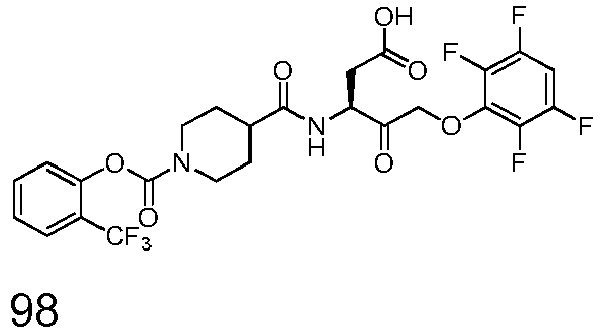
1H NMR (400 MHz, DMSO-d6) δ= 12.42 (br s, 1H), 8.51 (d, J=7.28 Hz, 1H), 7.69-7.77 (m, 2H), 7.50-7.62 (m, 1H), 7.39-7.46 (m, 2H), 5.14-5.32 (m, 2H), 4.57-4.67 (m, 1H), 4.13 (d, J=12.30 Hz, 1H), 4.00 (d, J=12.55 Hz, 1H), 3.10 (t, J=12.17 Hz, 1H), 2.94 (t, J=12.42 Hz, 1H), 2.71-2.82 (m, 1H), 2.60 (dd, J=6.78, 16.81 Hz, 1H), 2.44-2.49 (m, 1H), 1.77 (s, 2H), 1.46-1.59 (m, 2H) 3.03-3.05 (m, 1H), 2.89-2.91 (m, 1H), 2.72-2.81 (m, 1H), 2.60 (dd, J=6.78, 16.81 Hz, 1H), 2.45-2.47 (m, 1H), 1.74 (br s, 2H), 1.48-1.68 (m, 2H) LCMSm/ z= 617.1 [M+Na]+ Refer to the synthetic route of Example 72 Example 99 
1H NMR (400 MHz, DMSO-d6) δ= 8.49 (d, J=7.53 Hz, 1H), 7.51-7.68 (m, 1H), 7.16-7.23 (m, 1H), 7.03-7.12 (m, 2H), 6.93 (dt, J=1.25, 7.65 Hz, 1H), 5.24 (d, J=11.04 Hz 2H), 4.63 (q, J=6.53 Hz 1H), 4.12-4.15 (m, 1H), 3.94-3.98 (m, 1H), 3.77 (s, 3H), LCMSm/ z= 557.1 [M+H]+ Refer to the synthetic route of Example 72 Example 100 
1H NMR (400 MHz, DMSO-d6) δ= 8.44 (d, J=7.53 Hz, 1H), 7.49-7.66 (m, 1H), 5.13-5.31 (m, 2H), 4.60 (q, J=6.86 Hz, 1H), 4.43 (d, J=6.53 Hz, 1H), 3.94 (d, J=12.05 Hz, 2H), 2.66-2.84 (m, 3H), 2.58 (dd, J=6.78, 16.81 Hz, 1H), 2.34-2.44 (m, 1H), 2.23 (s, 2H), 1.59-1.72 (m, 3H), 1.31-1.49 (m, 6H), 1.01-1.17 (m, 3H) LCMSm/ z= 545.1 [M+H]+ Refer to the synthetic route of Example 91 Example 101 
1H NMR (400 MHz, DMSO-d6) δ= 10.63 (s, 1H), 8.49 (br d, J=7.03 Hz, 1H), 7.85 (br d, J=2.01 Hz, 1H), 7.53-7.64 (m, 2H), 7.37 (dd, J=2.51, 8.53 Hz, 1H), 5.14-5.31 (m, 2H), 4.62 (q, J=6.53 Hz, 1H), 4.28 (br d, J=13.05 Hz, 1H), 3.93 (br d, J=13.55 Hz, 1H), 3.18 (br t, J=12.30 Hz, 2H), 2.65-2.92 (m, 2H), 2.60 (br dd, J=6.53, 17.07 Hz, 1H), 1.46-1.86 (m, 4H), 1.24 (br s, 1H) LCMSm/ z= 622.1 [M]+ Refer to the synthetic route of Example 86 Example 102 
1H NMR (400 MHz, DMSO-d6) δ=11.09 (s, 1H), 8.48 (d, J=6.02 Hz, 1H), 7.88 (d, J=7.53 Hz, 1H), 7.71-7.77 (m, 1H), 7.50-7.67 (m, 2H), 7.45 (t, J=7.78 Hz, 1H), 5.15-5.30 (m, 2H), 4.62 (q, J=6.53 Hz, 1H), 4.29 (d, J=13.55 Hz, 1H), 3.99 (d, J=13.05 Hz, 1H), 3.21 (t, J=11.54 Hz, 1H), 2.85 (t, J=11.29 Hz, 1H), 2.70-2.79 (m, 1H), 2.53-2.68 (m, 2H), 1.71-1.86 (m, 2H), 1.45-1.69 (m, 2H) LCMSm/ z= 579.4 [M+H]+ Refer to the synthetic route of Example 86 Example 103 
1H NMR (400MHz, DMSO-d6) δ= 12.47(br, s, 1H), 8.51 (d, J=7.5 Hz, 1H), 7.66-7.57 (m, 1H), 7.57-7.51 (m, 1H), 7.41 (t, J=8.1 Hz, 1H), 7.37-7.31 (m, 1H), 5.32-5.15 (m, 2H), 4.63 (q, J=6.8 Hz, 1H), 4.18 (br d, J=12.5 Hz, 1H), 3.98 (br d, J=12.2 Hz, 1H), 3.14 (br t, J=11.5 Hz, 1H), 3.04-2.91 (m, 1H), 2.83-2.72 (m, 2H), 2.60 (dd, J=6.9, 16.8 Hz, 1H), 1.78 (br s, 2H), 1.67-1.42 (m, 2H). LCMS m/z = 594.9[M +H]+ Refer to the synthetic route of Example 72 Example 104 
1H NMR (400 MHz, DMSO-d6) δ=8.48 (d, J=7.53 Hz, 1 H), 7.51-7.64 (m, 1 H), 7.35-7.39 (m, 1 H), 7.08-7.12 (m, 1 H), 6.78-6.83 (m, 1 H), 5.12-5.32 (m, 2 H), 4.60 (q, J=6.78 Hz, 1 H), 4.11 (d, J=13.18 Hz, 2 H), 3.13-3.20 (m, 2 H), 2.70-2.79 (m, 1 H), 2.60 (d, J=6.90 Hz, 2 H), 1.77-1.83 (m, 2 H), 1.59 (dd, J=12.17, 3.01 Hz, 2 H) LCMS m/z =542.0[ M+H]+ Refer to the synthetic route of Example 83 Example 105 
1H NMR (400MHz, DMSO-d6) δ=8.54 (dd, J=3.0, 7.4 Hz, 1H), 7.72-7.57 (m, 1H), 5.44-5.07 (m, 2H), 4.60 (quin, J=6.4 Hz, 1H), 4.20 (t, J=8.3 Hz, 1H), 3.89 (t, J=8.9 Hz, 1H), 3.79 (dd, J=5.7, 8.2 Hz, 1H), 3.53-3.44 (m, 2H), 2.93-2.80 (m, 1H), 2.74 (dd, J=6.0, 17.0 Hz, 1 H),2.62-2.56(m, 2H), 1.75-1.67 (m, 2H), 1.60-1.46 (m, 6H). LCMS m/z = 489.1 M+H]+. Refer to the synthetic route of Example 26 Example 106 
1H NMR (400MHz, DMSO-d6) δ = 8.42-8.23 (m, 1H), 7.71-7.49 (m, 1H), 5.35-5.10 (m, 2H), 4.60 (q, J=6.7 Hz, 1H), 3.32 (br s, 2H), 3.09-2.89 (m, 2H), 2.79-2.70 (m, 1H), 2.62-2.53 (m, 2H), 2.00-1.81 (m, 4H), 1.73-1.36 (m, 13H). LCMS m/z = 543.2[M +H]+ Refer to the synthetic route of Example 26 Example 107 
1H NMR (400 MHz, DMSO-d6) δ= 10.65 (s, 1H), 8.47 (br d, J=7.28 Hz, 1H), 7.65 (s, 1H), 7.48-7.62 (m, 2H), 7.26 (t, J=7.91 Hz, 1H), 7.15 (br d, J=7.78 Hz, 1H), 5.13-5.31 (m, 2H), 4.56-4.67 (m, 1H), 4.28 (br d, J=12.05 Hz, 1H), 3.78 (br d, J=13.30 Hz, 1H), 3.15 (br t, J=11.54 Hz, 1H), 2.65-2.92 (m, 2H), 2.53-2.64 (m, 2H), 1.77 (br d, J=9.79 Hz, 2H), 1.43-1.67 (m, 2H), 1.26 (s, 9H) LCMS m/z = 610.2 [M+H]+ Refer to the synthetic route of Example 86 Example 108 
1H NMR (400 MHz, DMSO-d6) δ= 10.63 (s, 1H), 8.44-8.53 (m, 1H), 7.70-7.79 (m, 1H), 7.50-7.65 (m, 1H), 7.16-7.34 (m, 3H), 5.15-5.30 (m, 2H), 4.62 (q, J=6.11 Hz, 1H), 4.28 (br d, J=13.30 Hz, 1H), 3.79 (br d, J=13.30 Hz, 1H), 3.17 (br t, J=11.67 Hz, 1H), 2.66-2.88 (m, 2H), 2.52-2.63 (m, 2H), 1.77 (br d, J=11.54 Hz, 2H), 1.45-1.69 (m, 2H) LCMS m/z = 572.1 [M+H]+ Refer to the synthetic route of Example 86 -

- Compounds 109-a (2.00 g, 12.10 mmol, 1.96 mL, 1.00 eq) and 109-b (1.99 g, 12.10 mmol, 1.86 mL, 1.00 eq) were dissolved in EtOH (20.00 mL). The reaction solution was stirred at 40°C for 15 hours. After the reaction was completed, the reaction solution was concentrated to give compound 109-c (4.00 g, crude) as a colorless oil, which was used directly in the next step without purification. LCMS m/z = 330.1 [M+H]+.
- NaH (1.21 g, 30.35 mmol, 60%, 2.50 eq) was added to a mixed solution of compound 109-c (4.00 g, 12.14 mmol, 1.00 eq) in tetrahydrofuran (40.00 mL) in an ice bath, and after stirring at 0°C for half an hour, compound 109-d (3.24 g, 14.57 mmol, 1.20 eq) was added. The reaction solution was stirred at 25°C for 4 hours. After the reaction was completed, the reaction solution was added with saturated sodium hydrogen carbonate (50 mL), concentrated and spin-dried, extracted with ethyl acetate (100 mL × 2), and separated. The organic phase was further washed with saturated brine (80 mL × 2), dried over anhydrous sodium sulfate and concentrated to give a crude product. The crude product was subjected to flash column chromatography on silica gel (petroleum ether : ethyl acetate = 85:15) to give compound 109-e (1.08 g, yield: 23.51%) as a colorless oil. LCMS m/z = 312.1 [M+H]+.
- Compound 109-e (800.00 mg, 2.57 mmol, 1.00 eq) was dissolved in methanol (20.00 mL), and after purging with argon gas three times, Pd(OH)2-C (10%, 992.56 mg) was added thereto. The mixture was purged with hydrogen three times, and stirred for 16 hours at a pressure of 50 psi and a temperature of 45°C. After the reaction was completed, the reaction solution was filtered, and concentrated to give compound 109-f (360 mg, crude) as a colorless oil, which was used directly in the next step without purification. LCMS m/z = 132.0 [M+H]+.
- Compound 1-d (674.70 mg, 3.05 mmol, 1.00 eq), NMM (925.36 mg, 9.15 mmol, 1.01 mL, 3.00 eq), HOBt (564.50 mg, 4.18 mmol, 1.37 eq) and EDCI (800.88 mg, 4.18 mmol, 1.37 eq) were dissolved in dichloromethane (10.00 mL), and after stirring at 25°C for 15 min, a solution of compound 109-f (400.00 mg, 3.05 mmol, 1.00 eq) dissolved in dichloromethane (25.00 mL) was added dropwise thereto. The reaction solution was stirred at 25°C for 15 hours. After the reaction was completed, the reaction solution was directly concentrated to give a crude product. The crude product was subjected to flash column chromatography on silica gel (petroleum ether : ethyl acetate = 7:3) to give compound 109-g (640 mg, yield: 62.8%) as a pale yellow oil. 1H NMR (400 MHz, CHLOROFORM-d) δ 9.50-9.68 (m, 1H), 7.86 (ddd, J=1.51, 7.91, 13.68 Hz, 1H), 7.45 (dd, J=1.00, 8.03 Hz, 1H), 7.30-7.31 (m, 1H), 7.25-7.30 (m, 1H), 7.17-7.22 (m, 1H), 4.32-4.90 (m, 1H), 4.01-4.25 (m, 3H), 3.35-3.90 (m, 6H), 2.07-2.15 (m, 1H), 1.48 (s, 9H).
- Compound 109-g (640.00 mg, 1.91 mmol, 1.00 eq) and saturated NaHCO3 (26.00 mL) were dissolved in acetone (88.00 mL). The obtained solution was maintained at a temperature of 0°C, added with solid NaBr (58.96 mg, 573.00 µmol, 18.43 µL, 0.30 eq) and TEMPO (9.01 mg, 57.30 µmol, 0.03 eq), and finally added with trifluoroisocyanuric acid (976.59 mg, 4.20 mmol, 2.20 eq) slowly. After the addition was completed, the reaction solution was warmed up to 25°C, and stirred for 15 hours. After the reaction was completed, the reaction mixture was added with isopropanol (10 mL), stirred at 25°C for 30 min, and then filtered. The filtrate was concentrated, then added with saturated Na2CO3 (30 mL), and washed with ethyl acetate (50 mL). The aqueous phase was acidified to pH=3-4 with hydrochloric acid solution (2N), and further extracted with ethyl acetate (50 mL × 2). The organic phases after extraction were combined, dried over anhydrous sodium sulfate, filtered and concentrated to give compound 109-i (510.00 mg, yield: 76.7%) as a white solid, which was used directly in the next step. 1H NMR (400 MHz, CHLOROFORM-d) δ 9.55 (br d, J=17.32 Hz, 1H), 7.83-7.94 (m, 1H), 7.38-7.49 (m, 1H), 7.26-7.31 (m, 2H), 7.17-7.24 (m, 1H), 4.61-5.32 (m, 2H), 4.32-4.47 (m, 1H), 4.20-4.29 (m, 1H), 3.66-3.89 (m, 3H), 3.46-3.58 (m, 1H), 3.25-3.36 (m, 1H), 1.48 (d, J=3.26 Hz, 9H); LCMS m/z =349.1 [M+H]+.
- Compound 109-i (400.00 mg, 1.15 mmol, 1.00 eq) was dissolved in dichloromethane (20.00 mL), and compound NMM (581.61 mg, 5.75 mmol, 632.19 µL, 5.00 eq), HOBt (212.88 mg, 1.58 mmol, 1.37 eq), EDCI (302.02 mg, 1.58 mmol, 1.37 eq) and compound 1-n (406.31 mg, 1.15 mmol, 1.00 eq) were added thereto. The reaction solution was stirred at 15°C for 15 hours. After the reaction was completed, the reaction solution was directly concentrated to give a crude product. The crude product was subjected to flash column chromatography on silica gel (petroleum ether : ethyl acetate = 1:1) to give compound 109-j (400 mg, yield: 50.89%) as a pale yellow oil. LCMS m/z = 684.4 [M+H]+.
- Compound 109-j (400.00 mg, 585.06 µmol, 1.00 eq) was dissolved in dichloromethane (20.00 mL), and diacetoxyiodobenzene (729.29 mg, 2.26 mmol, 3.87 eq) and TEMPO (176.64 mg, 1.12 mmol, 0.60 eq) were added thereto. The reaction solution was stirred at 25°C for 39 hours. After the reaction was completed, the reaction solution was added with dichloromethane (50 mL). The solution was washed successively with water (40 mL), saturated sodium hydrogen carbonate (40 mL) and brine (40 mL). The organic phase was dried over anhydrous Na2SO4, filtered, and concentrated to give a crude product. The crude product was subjected to flash column chromatography on silica gel (petroleum ether : ethyl acetate = 7:3) to give compound 109-k (300.00 mg, yield: 75.3%) as a pale yellow oil. LCMS m/z = 682.1 [M+H]+.
- Compound 109-k (140.00 mg, 205.38 µmol, 1.00 eq) was dissolved in dichloromethane (6.00 mL), and trifluoroacetic acid (770.00 mg, 6.75 mmol, 500.00 µL, 32.88 eq) was added thereto. The reaction solution was stirred at 25°C for 4 hours. After the reaction was completed, the reaction solution was concentrated to give a crude product. The crude product was purified by prep-HPLC (in trifluoroacetic acid condition), and lyophilized to give the tilte compound 109 (40.00 mg, yield: 30.95%). 1H NMR (400 MHz, DMSO-d6) δ 12.46 (br s, 1H), 10.07 (s, 1H), 7.98-8.45 (m, 1H), 7.52-7.67 (m, 1H), 7.44 (dd, J=3.51, 5.52 Hz, 1H), 7.08-7.32 (m, 3H), 5.09-5.41 (m, 2H), 4.69-4.98 (m, 1H), 4.22-4.38 (m, 2H), 3.79-4.15 (m, 2H), 3.42-3.76 (m, 3H), 2.77-2.98 (m, 1H), 2.59-2.70 (m, 1H), 1.95 (br s, 2H), 1.35 (s, 9H); LCMS m/z = 626.0 [M+H]+.
-
Example number compound 1HNMR MS Reference Examples Exam ple 110 
1H NMR (400 MHz, DMSO-d6) δ= 12.48 (br s, 1H), 10.07 (br s, 1H), 8.43 (br s, 1H), 6.96-7.77 (m, 5H), 5.26 (s, 2H), 4.67-5.02 (m, 1H), 3.93-4.51 (m, 3H), 3.46-3.92 (m, 4H), 2.80-2.93 (m, 2H), 1.92-2.11 (m, 2H), 1.34 (s, 9H) LCMSm/ z= 626.3 [M+H]+ Refer to the synthetic route of Example 109 Example 111 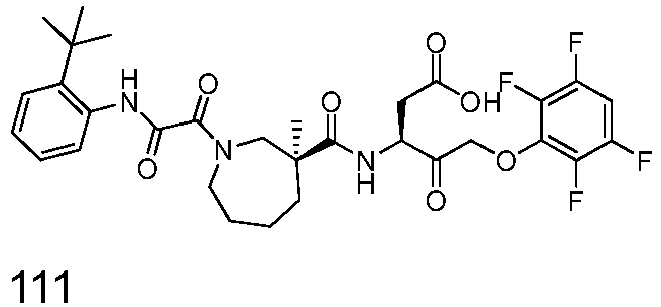
1H NMR (400 MHz, DMSO-d6) δ= 9.95-9.98 (m, 1H), 9.88 (s, 1H), 9.83 (s, 1H), 8.21-8.30 (m, 1H), 7.49-7.80 (m, 1H), 7.38-7.46 (m, 1H), 7.17-7.29 (m, 2H), 7.08-7.13 (m, 1H), 5.16-5.28 (m, 2H), 4.65 (br d, J=7.03 Hz, 1H), 3.62-3.85 (m, 2H), 2.75-2.93 (m, 1H), 2.53-2.59 (m, 1H), 1.90-2.04 (m, 1H), 1.43-1.80 (m, 5H), 1.30-1.36 (m, 1H), 1.33 (s, 8H), 1.19 (s, 3H) LCMS m/z = 638.3 [M+H]+ Refer to Examples 20 and 9 Example 112 
1H NMR (400 MHz, DMSO-d6) δ= 9.87-9.97 (m, 1H), 8.15-8.28 (m, 1H), 7.50-7.67 (m, 1H), 7.37-7.46 (m, 1H), 7.04-7.29 (m, 3H), 5.17-5.28 (m, 2H), 4.62-4.75 (m, 1H), 3.61-3.89 (m, 2H), 2.76-2.85 (m, 1H), 2.75-2.95 (m, 1H), 2.53-2.57 (m, 1H), 1.90-2.05 (m, 1H), 1.70 (br dd, J=6.78, 12.80 Hz, 2H), 1.44-1.63 (m, 4H), 1.32-1.35 (m, 10H), 1.19 (s, 3H) LCMS m/z = 638.3 [M+H]+ Refer to Examples 20 and 9 Example 113 
1H NMR (400 MHz, DMSO-d6) δ= 10.00 (s, 1H), 8.51-8.62 (m, 1H), 7.51-7.66 (m, 1H), 7.38-7.46 (m, 1H), 7.17-7.30 (m, 2H), 7.06-7.14 (m, 1H), 5.15-5.34 (m, 2H), 4.56-4.69 (m, 1H), 3.24-3.93 (m, 4H), 2.86-3.05 (m, 1H), 2.70-2.81 (m, 1H), 2.55-2.68 (m, 1H), 1.42-1.85 (m, 8H), 1.31-1.36 (m, 9H) LCMS m/z = 638.3 [M+H]+ Refer to the synthetic route of Example 9 Example 114 
1H NMR (400 MHz, DMSO-d6) δ= 9.97-10.03 (m, 1H), 8.48-8.62 (m, 1H), 7.50-7.64 (m, 1H), 7.37-7.47 (m, 1H), 7.15-7.30 (m, 2H), 7.06-7.14 (m, 1H), 5.16-5.34 (m, 2H), 4.64 (quin, J=7.03 Hz, 1H), 3.22-3.94 (m, 4H), 2.85-3.03 (m, 1H), 2.70-2.81 (m, 1H), 2.55-2.68 (m, 1H), 1.39-1.88 (m, 8H), 1.29-1.36 (m, 9H) LCMS m/z =638.3 [M+H]+ Refer to the synthetic route of Example 9 -

- Compound 115-a (3.70 g, 13.34 mmol, 1.00 eq) was dissolved in dichloromethane (40.00 mL), and NMM (4.05 g, 40.02 mmol, 4.40 mL, 3.00 eq), HOBt (2.47 g, 18.28 mmol, 1.37 eq), EDCI (3.50 g, 18.28 mmol, 1.37 eq) and compound 1-n (4.95 g, 14.01 mmol, 1.05 eq) were added thereto. The reaction solution was stirred at 25°C for 5 hours. After the reaction was completed, the reaction solution was directly concentrated to give a crude product. The crude product was subjected to flash column chromatography on silica gel (petroleum ether : ethyl acetate = 72:28) to give compound 115-b (4.3 g, yield: 47.51%) as a colorless oil. LCMS m/z = 613.3 [M+H]+.
- Compound 115-b (4.30 g, 7.02 mmol, 1.00 eq) was dissolved in methanol (45.00 mL) and tetrahydrofuran (45.00 mL), and Pd-C (10%, 430.00 mg) was added after purging with argon gas three times. The mixture was purged with hydrogen three times, and stirred for 2 hours at a pressure of 15 psi and at a temperature of 25°C. After the reaction was completed, the reaction solution was filtered and concentrated to give compound 115-c (3.5 g, crude) as a pale yellow oil, which was used directly in the next step without purification. LCMS m/z = 479.2 [M+H]+.
- Compound 115-d (143.19 mg, 877.78 µmol, 1.05 eq) was dissolved in dichloromethane (40.00 mL), and HATU (476.80 mg, 1.25 mmol, 1.50 eq), DIEA (540.21 mg, 4.18 mmol, 730.01 µL, 5.00 eq) and compound 115-c (399.77 mg, 835.98 µmol, 1.00 eq) were added thereto. The reaction solution was stirred at 25°C for 15 hours. After the reaction was completed, the reaction solution was directly concentrated to give a crude product. The crude product was subjected to flash column chromatography on silica gel (petroleum ether : ethyl acetate = 65:35) to give compound 115-e (280 mg, yield: 39.75%) as a colorless oil. LCMS m/z = 624.3 [M+H]+.
- Compound 115-e (420.00 mg, 673.52 µmol, 1.00 eq) was dissolved in dichloromethane (20.00 mL), and diacetoxyiodobenzene (839.56 mg, 2.61 mmol, 3.87 eq) and TEMPO (105.91 mg, 673.52 µmol, 1.00 eq) were added thereto. The reaction solution was stirred at 25°C for 15 hours. After the reaction was completed, the reaction solution was added with dichloromethane (50 mL). The solution was washed successively with water (30 mL), saturated sodium hydrogen carbonate (30 mL) and brine (30 mL). The organic phase was dried over anhydrous Na2SO4, filtered, and concentrated to give a crude product. The crude product was subjected to flash column chromatography on silica gel (petroleum ether : ethyl acetate = 7:3) to give compound 115-f (310.00 mg, yield: 59.83%) as a pale yellow oil. LCMS m/z =622.1 [M+H]+.
- Compound 115-f (60.00 mg, 96.53 µmol, 1.00 eq) was dissolved in dichloromethane (5.00 mL), and trifluoroacetic acid (770.00 mg, 6.75 mmol, 500.00 µL, 69.96 eq) was added thereto. The reaction solution was stirred at 25°C for 2 hours. After the reaction was completed, the reaction solution was concentrated to give a crude product. The crude product was purified by prep-HPLC (in trifluoroacetic acid condition), and lyophilized to give the title compound 115 (25.00 mg, yield: 44.88%). 1H NMR (400 MHz, DMSO-d6) δ 8.64 (br d, J=7.03 Hz, 1H), 7.80-7.87 (m, 1H), 7.67-7.78 (m, 1H), 7.54-7.65 (m, 1H), 7.44-7.52 (m, 1H), 7.21-7.30 (m, 1H), 5.08-5.37 (m, 2H), 4.47-4.71 (m, 1H), 4.00-4.17 (m, 1H), 3.81-3.93 (m, 1H), 3.57-3.71 (m, 1H), 3.46-3.53 (m, 1H), 2.71-2.89 (m, 2H), 2.55-2.68 (m, 1H), 1.74-1.87 (m, 4H), 1.55-1.69 (m, 1H), 1.37-1.51 (m, 1H); LCMS m/z = 566.1 [M+H]+.
-
Example number compound 1HNMR MS Reference Examples Example 116 
1H NMR (400 MHz, DMSO-d6) δ= 8.54 (s, 1H), 7.46-7.70 (m, 1H), 5.24 (s, 2H), 4.47-4.76 (m, 1H), 3.59-3.84 (m, 2H), 3.00-3.20 (m, 2H), 2.94 (br s, 1H), 2.57-2.73 (m, 3H), 1.43-1.81 (m, 14H) LCMS m/z =517.3[ M+H]+ Refer to the synthetic route of Example 115 Example 117 
1H NMR (400 MHz, DMSO-d6) δ= 8.60 (s, 1H), 7.50-7.69 (m, 1H), 7.33-7.46 (m, 5H), 5.18-5.37 (m, 1H), 4.99-5.13 (m, 1H), 4.62 (br t, J=7.03 Hz, 1H), 4.01-4.13 (m, 1H), 3.38-3.34 (m, 2H), 2.77 (br dd, J=5.90, 16.69 Hz, 1H), 2.55-2.71 (m, 2H), 2.29-2.37 (m, 1H), 1.36-1.84 (m, 6H) LCMS m/z = 525.3 [M+H]+ Refer to the synthetic route of Example 115 Example 118 
1H NMR (400 MHz, DMSO-d6) δ= 8.48-8.63 (m, 1H), 7.50-7.68 (m, 1H), 7.38 (br d, J=8.03 Hz, 1H), 7.35-7.45 (m, 1H), 7.22 (br s, 1H), 7.11 (br d, J=7.78 Hz, 2H), 5.12-5.35 (m, 2H), 4.61 (br d, J=6.02 Hz, 1H), 3.55-3.96 (m, 2H), 2.74-2.82 (m, 1H), 2.65-2.74 (m, 2H), 2.57-2.64 (m, 1H), 2.33 (br s, 1H), 1.37-1.90 (m, 6H) LCMS m/z = 541.2 [M+H]+ Refer to the synthetic route of Example 115 Example 119 
1H NMR (400 MHz, DMSO-d6) δ= 8.11-8.69 (m, 1H), 7.18-7.65 (m, 5H), 4.91-5.45 (m, 2H), 4.32-4.68 (m, 1H), 4.00-4.18 (m, 1H), 3.53-3.71 (m, 1H), 3.05-3.21 (m, 2H), 2.52-2.84 (m, 3H), 1.32-1.91 (m, 6H) LCMS m/z= 559.0 [M+H]+ Refer to the synthetic route of Example 115 Example 120 
1H NMR (400 MHz, DMSO-d6) δ= 8.54 (t, J=7.03 Hz, 1H), 7.46-7.60 (m, 2H), 7.32-7.40 (m, 1H), 7.20-7.30 (m, 2H), 5.09-5.29 (m, 2H), 4.59 (qd, J=6.78, 13.05 Hz, 1H), 3.88-4.44 (m, 1H), 3.71-3.80 (m, 1H), 3.58-3.66 (m, 1H), 3.19-3.26 (m, 1H), 2.84 (d, J=5.77 Hz, 1H), 2.69-2.77 (m, 1H), 2.57 (dd, J=6.90, 16.94 Hz, 1H), 1.40-1.92 (m, 6H) LCMS m/z= 575.0 [M+H]+ Refer to Examples 115 and 9 Example 121 
1H NMR (400 MHz, DMSO-d6) δ= 8.56 (t, J=7.28 Hz, 1H), 7.48-7.64 (m, 2H), 7.19-7.41 (m, 3H), 5.06-5.32 (m, 2H), 4.49-4.63 (m, 1H), 3.86-4.40 (m, 1H), 3.57-3.83 (m, 2H), 3.20 (dd, J=5.77, 13.55 Hz, 1H), 2.80-2.94 (m, 1H), 2.68-2.76 (m, 1H), 2.55-2.62 (m, 1H), 1.36-1.91 (m, 6H) LCMS m/z= 575.0 [M+H]+ Refer to Examples 115 and 9 Example 122 
1H NMR (400 MHz, DMSO-d6) δ= 12.54 (br s, 1H), 8.64 (br s, 1H), 7.84 (dd, J=5.52, 8.53 Hz, 1H), 7.68-7.78 (m, 1H), 7.46-7.65 (m, 2H), 7.20-7.30 (m, 1H), 5.11-5.39 (m, 2H), 4.48-4.74 (m, 1H), 4.01-4.17 (m, 1H), 3.81-3.94 (m, 1H), 3.57-3.74 (m, 1H), 3.46 (dd, J=10.54, 13.55 Hz, 1H), 2.58-2.89 (m, 3H), 1.55-1.91 (m, 5H), 1.38-1.52 (m, 1H) LCMS m/z= 565.9 [M+Na] + Refer to Examples 115 and 9 -

- Compound 1-d (1.87 g, 8.43 mmol, 1.10 eq) was dissolved in dichloromethane (15.00 mL), and compound 123-a (1.50 g, 7.67 mmol, 1.00 eq, HCl), HATU (4.37 g, 11.50 mmol, 1.50 eq) and DIPEA (4.95 g, 38.34 mmol, 6.70 mL, 5.00 eq) were added thereto. The reaction solution was stirred at 25°C for 15 hours. After the reaction was completed, the reaction solution was directly concentrated to give a crude product. The crude product was subjected to column chromatography (petroleum ether : ethyl acetate = 1:0~5:1) to give compound 123-b (940.00 mg, yield: 31.53%) as a yellow oil. LCMS m/z = 363.1 [M+H]+.
- Compound 123-b (877.00 mg, 2.42 mmol, 1.00 eq) was dissolved in tetrahydrofuran (20.00 mL), and a solution of LiOH·H2O (293.30 mg, 6.99 mmol, 3.00 eq) dissolved in H2O (20.00 mL) was added to the above solution. The reaction solution was stirred at 15°C for 1 hour, and supplemented with LiOH·H2O (97.77 mg, 2.33 mmol, 1.00 eq). The reaction solution was stirred at 15°C for another 1 hour. After the reaction was completed, the reaction solution was adjusted to pH of 3 with 2N HCl. This solution was added with water (80 mL), and extracted with dichloromethane (120 mL × 3). The organic phase was dried over Na2SO4, filtered, and concentrated to give compound 123-c (820.00 mg, crude) as a pale yellow oil, which was used directly in the next step without purification. LCMS m/z = 371.1 [M+Na]+.
- Compound 123-c (820.00 mg, 2.35 mmol, 1.00 eq) was dissolved in dichloromethane (30.00 mL), and compound 1-n (913.31 mg, 2.59 mmol, 1.10 eq), EDCI (617.18 mg, 3.22 mmol, 1.37 eq), HOBt (435.02 mg, 3.22 mmol, 1.37 eq) and NMM (713.11 mg, 7.05 mmol, 775.12 µL, 3.00 eq) were added thereto. The reaction solution was stirred at 15°C for 17 hours. After the reaction was completed, the reaction solution was directly concentrated to give a crude product. The crude product was subjected to column chromatography (petroleum ether : ethyl acetate = 4:1-1:1) to give compound 123-d (1.27 g, yield: 73.51%) as a pale yellow oil. LCMS m/z = 706.2 [M+Na]+.
- Compound 123-d (1.28 g, 1.87 mmol, 1.00 eq) was dissolved in dichloromethane (50.00 mL), and diacetoxyiodobenzene (2.33 g, 7.25 mmol, 3.87eq) and TEMPO (176.64 mg, 1.12 mmol, 0.60 eq) were added thereto. The reaction solution was stirred at 15°C for 16 hours, and supplemented with TEMPO (176.64 mg, 1.12 mmol, 0.60 eq). The reaction solution was stirred at 25°C for another 24 hours. After the reaction was completed, the reaction solution was added with 160 mL of dichloromethane. The solution was washed successively with saturated sodium hydrogen carbonate (160 mL) and water (160 mL). The organic phase was dried over Na2SO4, filtered and concentrated to give a crude product. The crude product was subjected to column chromatography (petroleum ether : ethyl acetate = 9:1-2:1) to give compound 123-e (902.00 mg, yield: 67.86%) as a pale yellow oil. LCMS m/z = 704.2 [M+Na]+.
- Compound 123-e (902.00 mg, 1.32 mmol, 1.00 eq) was separated via SFC to give compounds 123-f (347 mg, yield: 37.41%) and 123-g (332 mg, yield: 35.42%) as a colorless oil. 123-f: LCMS m/z = 704.4 [M+Na]+; 123-g: LCMS m/z =682.4 [M+H]+.
- Compound 123-f (347.00 mg, 509.04 µmol, 1.00 eq) was dissolved in dichloromethane (31.00 mL), and trifluoroacetic acid (24.29 g, 212.99 mmol, 15.77 mL, 418.41 eq) was added thereto. The reaction solution was stirred at 15°C for 1 hour. After the reaction was completed, the reaction solution was concentrated to give a crude product. The crude product was purified by prep-HPLC (in trifluoroacetic acid condition), and lyophilized to give the title compound 123 (252.00 mg, yield: 79.14%). 1H NMR (400 MHz, DMSO-d6) δ=10.06 (d, J=2.76 Hz, 1H), 8.64 (t, J=7.53 Hz, 1H), 7.48-7.68 (m, 1H), 7.37-7.45 (m, 1H), 7.09-7.29 (m, 3H), 5.14-5.34 (m, 2H), 4.62 (quin, J=6.40 Hz, 1H), 3.30-3.82 (m, 8H), 2.88-3.10 (m, 1H), 2.54-2.82 (m, 2H), 1.33 (d, J=3.01 Hz, 9H); LCMS m/z = 625.9 [M+H]+.
-
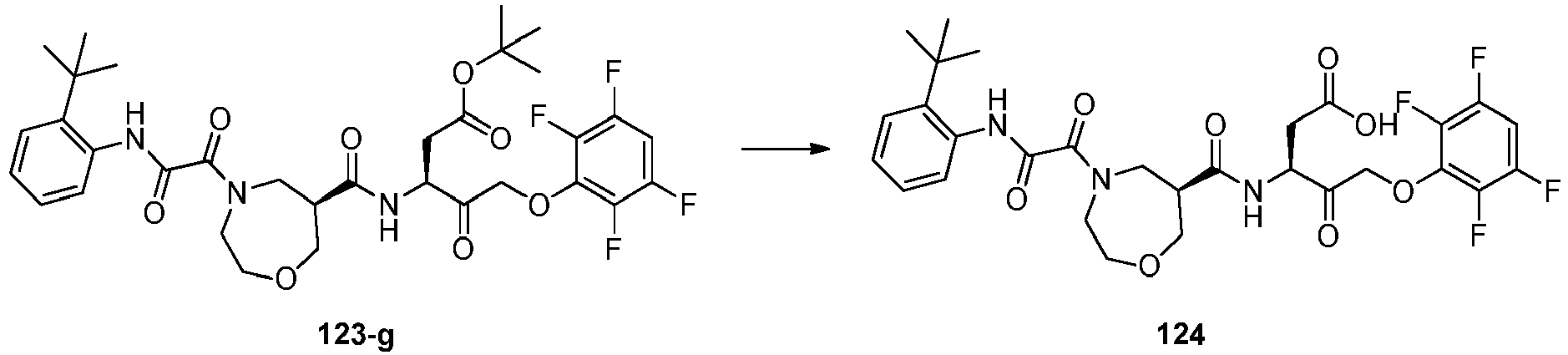
- Compound 123-g (332.00 mg, 487.04 µmol, 1.00 eq) was dissolved in dichloromethane (30.00 mL), and trifluoroacetic acid (23.24 g, 203.78 mmol, 15.09 mL, 418.41 eq) was added thereto. The reaction solution was stirred at 15°C for 1 hour. After the reaction was completed, the reaction solution was concentrated to give a crude product. The crude product was purified by prep-HPLC (in trifluoroacetic acid condition), and lyophilized to give the title compound 124 (241.00 mg, yield: 79.10%). 1H NMR (400 MHz, DMSO-d6) δ= 10.06 (s, 1H), 8.58-8.68 (m, 1H), 7.50-7.69 (m, 1H), 7.38-7.47 (m, 1H), 7.19-7.30 (m, 2H), 7.11-7.18 (m, 1H), 5.13-5.35 (m, 2H), 4.65 (td, J=6.40, 13.30 Hz, 1H), 3.30-4.15 (m, 8H), 2.94-3.11 (m, 1H), 2.68-2.81 (m, 1H), 2.56-2.68 (m, 1H), 1.34 (s, 9H); LCMS m/z = 625.9 [M+H]+.
-
Example number compound 1HNMR MS Reference Examples Example 125 
1H NMR (400 MHz, DMSO-d6) δ=8.65 (t, J=7.40 Hz, 1H), 7.95 (dt, J=2.01, 8.03 Hz, 1H), 7.65-7.73 (m, 1H), 7.46-7.62 (m, 3H), 7.26-7.31 (m, 1H), 5.12-5.34 (m, 2H), 4.51-4.70 (m, 1H), 4.15-4.41 (m, 2H), 3.98-4.13 (m, 1H), 3.86-3.92 (m, 1H), 3.41-3.83 (m, 4H), 2.95-3.08 (m, 1H), 2.53-2.82 (m, 2H) LCMS m/z = 628.1 [M+H]+ Refer to the synthetic route of Example 123/124 Example 126 
1H NMR (400 MHz, DMSO-d6) δ= 8.58-8.71 (m, 1H), 7.86-7.99 (m, 1H), 7.68 (ddd, J=1.38, 7.72, 15.25 Hz, 1H), H), 7.43-7.62 (m, 3H), 7.26-7.32 (m, 1H), 5.10-5.37 (m, 2H), 4.54-4.68 (m, 1H), 3.96-4.41 (m, 2H), 3.84-3.92 (m, 2H), 3.40-3.82 (m, 4H), 2.95-3.07 (m, 1H), 2.53-2.82 (m, 2H) LCMS m/z = 628.1 [M+H]+ Refer to the synthetic route of Example 123/124 Example 127 
1H NMR (400 MHz, DMSO-d6) δ= 8.56-8.72 (m, 1H), 7.80-7.95 (m, 2H), 7.74 (dt, J=6.40, 7.34 Hz, 1H), 7.43-7.62 (m, 2H), 5.08-5.36 (m, 2H), 4.44-4.72 (m, 1H), 3.98-4.37 (m, 3H), 3.88-3.93 (m, 1H), 3.46-3.84 (m, 4H), 2.94-3.16 (m, 1H), 2.52-2.84 (m, 2H) LCMS m/z = 568.0 [M+H]+ Refer to the synthetic route of Example 123/124 Example 128 
1H NMR (400 MHz, DMSO-d6) δ= 8.55-8.76 (m, 1H), 7.67-7.96 (m, 3H), 7.43-7.62 (m, 2H), 5.05-5.39 (m, 2H), 4.45-4.69 (m, 1H), 3.99-4.31 (m, 2H), 3.83-3.91 (m, 3H), 3.46-3.79 (m, 3H), 2.93-3.15 (m, 1H), 2.51-2.85 (m, 2H) LCMS m/z = 568.0 [M+H]+ Refer to the synthetic route of Example 123/124 Example 129 
1H NMR (400 MHz, DMSO-d6) δ= 10.47-10.56 (m, 1H), 8.64 (t, J=7.91 Hz, 1H), 7.65 (d, J=8.03 Hz, 1H), 7.50-7.62 (m, 2H), 7.33-7.41 (m, 1H), 7.24-7.32 (m, 1H), 5.12-5.33 (m, 2H), 4.56-4.71 (m, 1H), 3.96-4.10 (m, 3H), 3.70-3.79 (m, 2H), 3.30-3.68 (m, 3H), 2.94-3.09 (m, 1H), 2.54-2.81 (m, 2H) LCMS m/z = 604.1 [M+H]+ Refer to the synthetic route of Example 123/124 Example 130 
1H NMR (400 MHz, DMSO-d6) δ= 10.46-10.56 (m, 1H), 8.64 (br dd, J=7.53, 11.54 Hz, 1H), 7.46-7.69 (m, 3H), 7.20-7.41 (m, 2H), 5.12-5.35 (m, 2H), 4.61 (qd, J=6.96, 14.24 Hz, 1H), 3.83-4.10 (m, 3H), 3.28-3.80 (m, 5H), 2.92-3.06 (m, 1H), 2.53-2.82 (m, 2H) LCMS m/z = 604.1 [M+H]+ Refer to the synthetic route of Example 123/124 Example 131 
1H NMR (400 MHz, DMSO-d6) δ= 10.59-10.70 (m, 1H), 8.63 (br t, J=8.16 Hz, 1H), 7.67-7.76 (m, 1H), 7.48-7.65 (m, 1H), 7.14-7.34 (m, 3H), 5.12-5.35 (m, 2H), 4.54-4.69 (m, 1H), 3.29-3.89 (m, 8H), 2.93-3.08 (m, 1H), 2.53-2.81 (m, 2H) LCMS m/z = 588.1 [M+H]+ Refer to the synthetic route of Example 123/124 Example 132 
1H NMR (400 MHz, DMSO-d6) δ= 10.64 (d, J=13.55 Hz, 1H), 8.64 (dd, J=7.53, 11.54 Hz, 1H), 7.67-7.76 (m, 1H), 7.47-7.65 (m, 1H), 7.10-7.35 (m, 3H), 5.09-5.35 (m, 2H), 4.53-4.68 (m, 1H), 3.27-4.08 (m, 8H), 2.93-3.05 (m, 1H), 2.52-2.82 (m, 2H) LCMS m/z = 588.1 [M+H]+ Refer to the synthetic route of Example 123/124 Example 133 
1H NMR (400 MHz, DMSO-d6) δ= 10.79-10.88 (m, 1H), 8.62 (t, J=8.28 Hz, 1H), 7.66 (tdd, J=2.35, 4.77, 6.84 Hz, 2H), 7.48-7.62 (m, 1H), 7.10-7.23 (m, 1H), 7.11 (br s, 1H), 5.09-5.34 (m, 2H), 4.52-4.68 (m, 1H), 3.29-3.85 (m, 8H), 2.92-3.08 (m, 1H), 2.52-2.81 (m, 2H) LCMS m/z = 588.1 [M+H]+ Refer to the synthetic route of Example 123/124 Example 134 
1H NMR (400 MHz, DMSO-d6) δ= 10.86 (br d, J=7.53 Hz, 1H), 8.64 (dd, J=7.53, 12.80 Hz, 1H), 7.63-7.71 (m, 2H), 7.47-7.62 (m, 1H), 7.09-7.24 (m, 2H), 5.10-5.35 (m, 2H), 4.53-4.69 (m, 1H), 3.54-4.10 (m, 8H), 2.92-3.06 (m, 1H), 2.53-2.81 (m, 2H) LCMS m/z = 588.2 [M+H]+ Refer to the synthetic route of Example 123/124 Example 135 
1HNMR(400MHz, CHLOROFORM-d) δ= 9.70 (br s, 1H), 9.61 (br s, 1H), 8.07-8.27 (m, 1H), 7.46-7.73 (m, 3H), 7.31 (br t, J=7.53 Hz, 1H), 6.79 (br s, 1H), 4.74-5.26 (m, 2H), 4.63 (br dd, J=4.39, 14.18 Hz, 1H), 4.24-4.48 (m, 2H), 3.86-4.15 (m, 6H), 3.30-3.46 (m, 1H), 3.03 (br dd, J=7.78, 17.32 Hz, 2H) LCMS m/z = 638.1 [M+H]+ Refer to the synthetic route of Example 123/124 Example 136 
1HNMR(400MHz,CHLO ROFORM-d) δ= 9.63 (br s, 1H), 9.55 (br s, 1H), 8.03-8.23 (m, 1H), 7.47-7.65 (m, 3H), 7.21-7.28 (m, 1H), 6.73 (br s, 1H), 4.67-5.15 (m, 2H), 4.56 (br d, J=10.04 Hz, 1H), 4.30 (br d, J=19.83 Hz, 2H), 3.84-4.11 (m, 6H), 3.31 (br s, 1H), 2.96 (br d, J=19.58 Hz, 2H) LCMS m/z = 638.1[M +H]+ Refer to the synthetic route of Example 123/124 Example 137 
1HNMR(400MHz, CHLOROFORM-d) δ= 9.23 (br s, 1H), 9.13 (br s, 1H), 7.87 (br s, 1H), 7.43-7.65 (m, 1H), 7.24 (br d, J=7.53 Hz, 2H), 7.16 (br d, J=6.53 Hz, 1H), 6.82 (br s, 1H), 4.78-5.28 (m, 2H), 4.65 (br d, J=12.05 Hz, 1H), 3.72-4.50 (m, 8H), 3.39 (br s, 1H), 3.19 (br s, 1H), 2.94-3.12 (m, 1H), 2.25-2.37 (m, 3H) LCMS m/z = 584.2 [M+H]+ Refer to the synthetic route of Example 123/124 Example 138 
1HNMR(400MHz, CHLOROFORM-d) δ= 9.13 (br s, 1H), 9.04 (br s, 1H), 7.81 (br s, 1H), 7.29-7.54 (m, 1H), 7.16 (br d, J=4.52 Hz, 2H), 7.02-7.10 (m, 1H), 6.73 (br s, 1H), 4.67-5.16 (m, 1H), 4.60 (br d, J=13.80 Hz, 1H), 3.67-4.40 (m, 8H), 3.31 (br s, 1H), 2.84-3.15 (m, 2H), 2.24 (d, J=7.53 Hz, 3H) LCMS m/z = 584.2 [M+H]+ Refer to the synthetic route of Example 123/124 -
- 1) Cells: Human acute lymphoblastic T-cell leukemia cells, Jurkat Clone E6-1, purchased from ATCC (Cat. No. TIB-152). RPMI 1640 medium (Invitrogen) supplemented with 10% fetal bovine serum (Corning), 100 U/mL penicillin and 100 µg/mL streptomycin (Hyclone) was used and culturing the cells was performed at 37°C, 5% CO2 in an incubator.
- 2) Reagents: Anti-Fas antibody, clone CH11, purchased from Millipore (Cat. No. 05-201); Ac-DEVD-AMC, purchased from Sigma (Cat. No. A1086).
- 3) Instruments: Multi-function microplate reader, Molecular Devices (SpectraMax M2e).
-
- 1) Jurkat clone E6-1 cells were inoculated with 50 µL/well in black 96-well cell culture plates (Greiner) at a density of 100,000 cells/well.
- 2) The compounds were serial diluted to 200× test concentration with DMSO, and then diluted to 4x test concentration with cell culture medium and added to the test plates. 6 concentration points were tested for the test compounds and control compounds; and the test concentration range was: from 1000 nM to 0.32 nM. The cell culture medium with 2% DMSO only was added in the control wells (0% inhibition); and the control compound (final concentration: 1000 nM) was further added in the control wells (100% inhibition). The final concentration of DMSO in the cell culture medium was 0.5%.
- 3) Anti-Fas was diluted with the cell culture medium, and then added to the test plates, with the final concentration of 50 ng/mL.
- 4) The cell test plates were cultured at 37°C, 5% CO2 in the incubator for 24 hours. After centrifugation, the supernatant was discarded. The cells were lysed with 1% NP40 cell lysis solution, and Caspase 3 fluorescent substrate Ac-DEVD-AMC (final concentration: 10 µM) was added and incubated at 37°C for 3-4 hours. The fluorescence intensity was measured using a multi-function microplate reader (excitation light wavelength of 360 nm, emission light wavelength of 460 nm).
- 5) Compound inhibition curve was fitted and EC50 values were calculated using GraphPad Prism software.
- The experimental results were shown in Table 1.
Table 1 Test results of the activity EC50 for Anti-Fas-induced Jurkat cells Test samples EC50 (nM) Example 1 137.6 Example 2 213 Example 3 37.37 Example 4 20.72 Example 5 265 Example 6 552.1 Example 7 66.63 Example 8 124.5 Example 9 65.5 Example 10 41.59 Example 11 27.22 Example 12 52.54 Example 13 75.2 Example 14 275.3 Example 15 244 Example 16 417.2 Example 17 288.7 Example 18 557.3 Example 19 224 Example 20 698.1 Example 21 97.9 Example 22 34.16 Example 23 214.8 Example 24 49.7 Example 25 70.65 Example 26 12.61 Example 27 21.12 Example 28 22.05 Example 29 57.43 Example 30 14.54 Example 31 21.43 Example 32 33.08 Example 33 43.74 Example 34 42.99 Example 35 25.44 Example 36 10.35 Example 37 23.94 Example 38 22.04 Example 39 9.956 Example 40 17.72 Example 41 18.83 Example 42 25.2 Example 43 38.61 Example 44 39.74 Example 45 29.89 Example 46 6.405 Example 47 6.51 Example 48 10.39 Example 49 5.835 Example 50 12.25 Example 51 27.24 Example 52 20.99 Example 53 67.47 Example 54 18.32 Example 55 10.06 Example 56 20.37 Example 57 19.93 Example 58 16.58 Example 59 156.8 Example 60 49.56 Example 61 50.4 Example 62 42.37 Example 63 38.01 Example 64 64.67 Example 65 130.3 Example 66 17.71 Example 67 14.55 Example 68 23.2 Example 69 29.62 Example 70 13.83 Example 71 29.28 Example 72 17.93 Example 73 30.23 Example 74 12.28 Example 75 25.79 Example 76 14.11 Example 77 96.02 Example 78 35.93 Example 79 26 Example 80 17.51 Example 81 959 Example 82 43.98 Example 83 23.98 Example 84 35.02 Example 85 16.3 Example 86 40.06 Example 87 42.61 Example 88 33.83 Example 89 8.98 Example 90 44.24 Example 91 61.96 Example 92 78.55 Example 93 25.52 Example 94 43.88 Example 95 33.21 Example 96 52.84 Example 97 111.70 Example 98 24.39 Example 99 20.41 Example 100 31.46 Example 101 61.33 Example 102 26.79 Example 103 19.8 Example 104 29.8 Example 105 27.6 Example 106 17.5 Example 107 112.0 Example 108 26.6 Example 109 191.7 Example 110 383 Example 111 23 Example 112 164.9 Example 113 46.2 Example 114 66.3 Example 122 5.80 Example 123 38.9 Example 124 28.74 Example 125 16.16 Example 126 9.37 Example 127 7.14 Example 128 9.15 Example 129 5.65 Example 130 8.1 - The mice were randomly divided into two groups (one intravenous group and one oral group) or only oral group, 3 males in each group. The compounds were formulated into the designated preparations. The intravenous preparations should be filtered to provide clear solutions, and the oral preparations can be clear or can be uniform suspensions. All animals in the intravenous group were intravenously injected with the given doses of the compound preparations through tail veins. The oral group was administrated with the given doses of the preparations by gavage.
- Whole blood samples were collected from the other side of the tail vein at 8 time points (2 min, 5 min, 15 min, 30 min, 1 h, 2 h, 4 h and 8 h after administration) in the intravenous group, about 25 µL for each sample; whole blood samples were collected from the tail vein at 8 time points (2 min, 5 min, 15 min, 30 min, 1 h, 2 h, 4 h and 8 h after administration) in the oral group, about 25 µL for each sample..
- The plasma samples were added to a centrifuge tube containing anticoagulants, and centrifuged at 4°C, 3000 g for 15 min. The supernatant plasma was quickly frozen on dry ice and stored in a□ refrigerator at -70°C ± 10°C until LC-MS/MS analysis was performed.
- The concentration data of plasma drug for the compounds were processed with the non-compartmental model using WinNonlin™ Version 6.3.0 (Pharsight, Mountain View, CA) pharmacokinetic software. The peak concentration (Cmax), time to peak concentration (Tmax) and last time for quantitative were obtained directly from the blood concentration-time chart.
- The following pharmacokinetic parameters were calculated by using Log-linear Trapezoidal method: elimination phase half-life (T1/2); apparent volume of distribution (Vdss) and clearance rate (CL); the average residence time of the drug in vivo from 0 to the last time point (MRT0-last); the average residence time of the drug in vivo from zero time to infinity (MRT0-inf); the area under time-plasma concentration curve from 0 to the last time point (AUC0-last); the area under time-plasma concentration curve from zero time to infinity (AUC0-inf); initial concentration (C0).
- For individual plasma concentrations of less than BQL, the concentrations appeared before Tmax were calculated as 0, and the concentrations appeared after Tmax were directly excluded. All parameters and ratios were reported in the forms of three significant digits.
- The pharmacokinetic parameters of this experiment were calculated according to the theoretical blood collection times and the theoretical dose concentrations as described in the protocol. The deviations between the actual dose concentrations and the theoretical concentrations were within the range of ±20%. The deviations between the actual blood collection times and the theoretical blood collection times were in conformity with the relevant SOP (the point within 1 hour after administration was within the range of ± 1 min, and the others were within 5% of the theoretical time).
- The experimental results of the test compounds were shown in Table 2.
Table 2. Pharmacokinetic study of the test compounds Test Compounds IDN-6556 Example 7 Example 49 Example 69 Intravenous injection (1 mpk) Half-life (h) 0.25 N/A 0.87 N/A Apparent volume of distribution (L/kg) 0.82 0.653 Clearance rate (mL/min/kg) 106 38.6 Area under the concentration-time curve (nM.h) 446 852 Oral administration (10 mpk) Time to peak concentration (h) 0.25 0.833 1 0.5 Peak concentration (nM) 227 1636 405 1993 Area under the concentration-time curve (nM.h) 197 3657 1708 4180 Bioavailability (%) 4.4% N/A 20.1 N/A - As can be seen from the above Table 2, the reference compound IDN-6556 had a relatively short half-life, low in vivo exposure, and oral bioavailability of no more than 4%. The in vivo exposures of the compounds shown in Examples 7, 49 and 69 were significantly improved compared to the reference compound IDN-6556. The oral bioavailability and half-life of the compound shown in Example 7 were also significantly improved, which gives the possibility for reducing the frequency of clinical dosing, such as reducing the twice-daily dosing of IDN-6556 to once-a-day dosing.
Claims (20)
- A compound represented by formula (I), or a pharmaceutically acceptable salt or tautomer thereof,
 R1 is selected from C1-6 alkyl, C3-12 cycloalkyl, 3- to 12-membered heterocycloalkyl, 6- to 12-membered aryl or 5- to 12-membered heteroaryl, which is optionally substituted with 1, 2 or 3 R;m is 0, 1, 2 or 3;L is selected from a bond; C(=O); S(=O); S(=O)2;
 A is selected from the following groups optionally substituted with R: ---NHR2---, wherein R2 is selected from (CH2)2-4, phenylene, cyclohexylidene;
 3, 4 or 5;
 R3 is selected from OH, OR7 or
 R7 is selected from C1-6 alkyl or C3-6 cycloalkyl, which is optionally substituted with 1, 2 or 3 R;R is selected from halogen; CN; OH; NH2; COOH; or C1-6 alkyl, C1-6 alkoxy, C3-6 cycloalkyl, 3- to 6-membered heterocycloalkyl, phenyl or 5- to 6-membered heteroaryl, which is optionally substituted with 1, 2 or 3 R';R' is selected from halogen, OH, CN, NH2, COOH, Me, Et, CF3, CHF2, CH2F, NHCH3 or N(CH3)2.
 - The compound of claim 1, wherein R is selected from halogen; CN; OH; NH2; COOH; or C1-4 alkyl, C1-4 alkoxy, or phenyl, which is optionally substituted with 1, 2 or 3 R'.
- The compound of claim 2, wherein R is selected from F; Cl; CN; OH; NH2; COOH; or methyl, ethyl, propyl, isopropyl, tert-butyl, methoxy, ethoxy or phenyl, which is optionally substituted with 1, 2 or 3 R'.
- The compound of claim 3, wherein R is selected from F, Cl, CN, OH, NH2, COOH, Me, MeO, Et, CF3, CHF2, CH2F,

- The compound of claim 4, wherein R is selected from F, Cl, CN, OH, NH2, COOH, Me, MeO, Et,

- The compound of claim 1, wherein R' is selected from F or Cl.
- The compound of claim 1, wherein R1 is selected from C1-6 alkyl, C3-10 cycloalkyl, 4- to 7-membered heterocycloalkyl, phenyl, naphthyl or 5- to 12-membered heteroaryl containing 1, 2 or 3 atoms independently selected from N, O or S, which is optionally substituted with 1, 2 or 3 R.
- The compound of claim 7, wherein R1 is selected from C1-5 alkyl, C3-10 cycloalkyl, azetidinyl, pyrrolidinyl, piperidinyl, tetrahydropyranyl, morpholinyl, oxazolyl, isoxazolyl, thiazolyl, isothiazolyl, thienyl, furyl, imidazolyl, pyrazolyl, pyrrolyl, phenyl, pyridyl, pyrimidinyl, pyrazinyl, naphthyl, quinolyl, isoquinolyl, indolyl, benzimidazolyl, benzothiazolyl, benzisothiazolyl, benzoxazolyl, benzisoxazolyl, benzothienyl or quinazolinyl, which is optionally substituted with 1, 2 or 3 R.
- The compound of claim 8, wherein R1 is selected from Me, Et,


- The compound of claim 9, wherein R1 is selected from Me,









- The compound of claim 1, wherein L is selected from a bond, C(=O), S(=O)2,


- The compound of claim 1, wherein A is selected from the following groups optionally substituted with R:
---NHR2---, wherein R2 is selected from (CH2)2, phenylene or cyclohexylidene;

- The compound of claim 12, wherein A is selected from the following groups optionally substituted with R:
---NHR2---, wherein R2 is selected from (CH2)2, phenylene or cyclohexylidene;

- The compound of claim 12, wherein A is selected from the following groups optionally substituted with R:




- The compound of claim 14, wherein A is selected from


- The compound of claim 1, wherein R3 is OH.
- The compound of claim 1, wherein the compound of formula (I) is selected from:


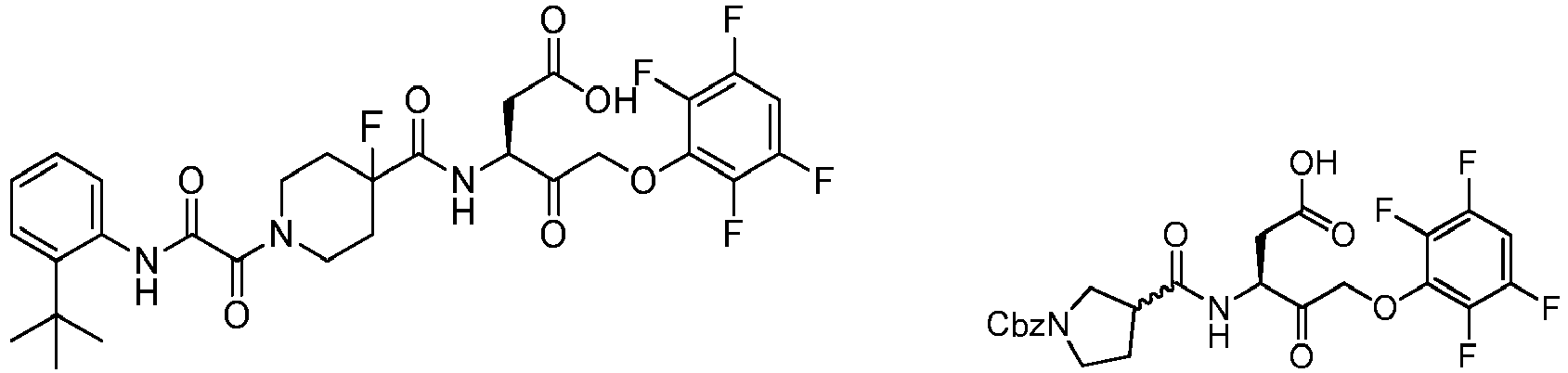





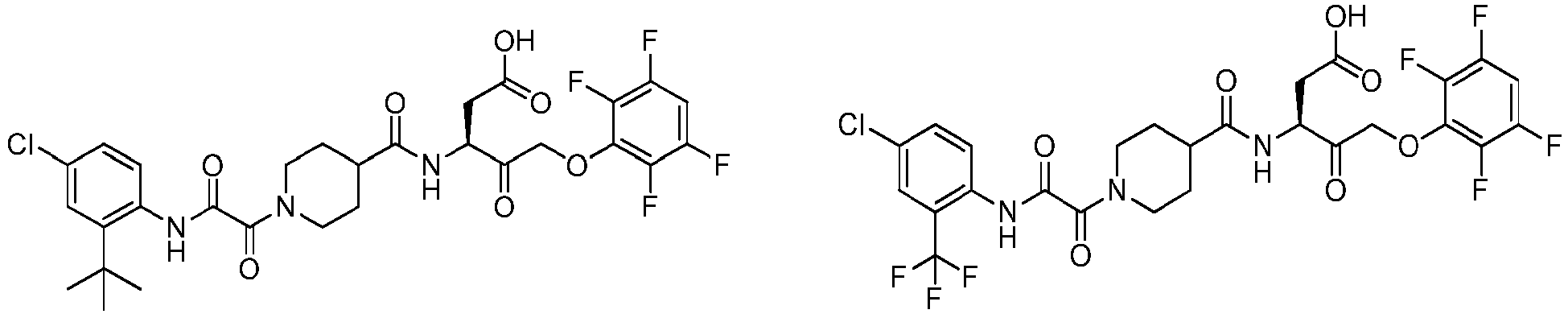




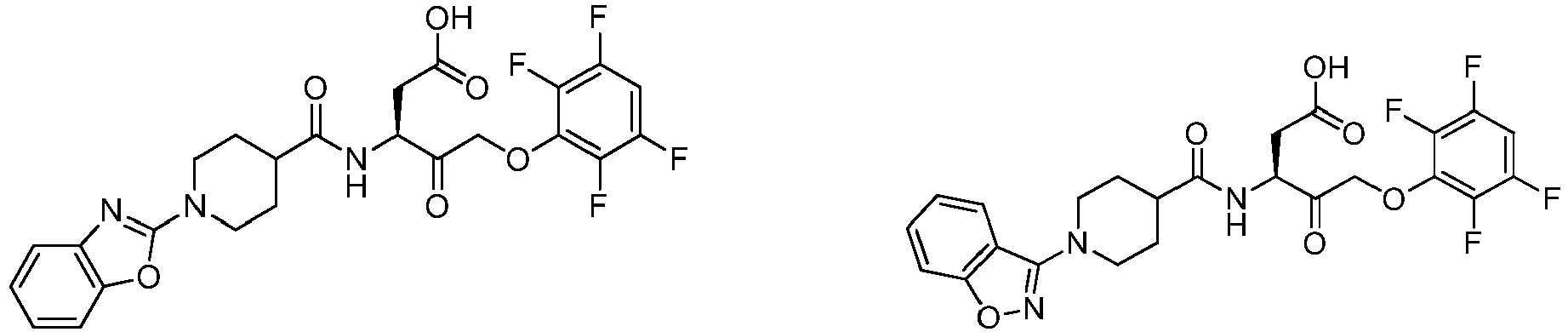







- A pharmaceutical composition comprising a therapeutically effective amount of the compound of any one of claims 1 to 17, and a pharmaceutically acceptable carrier or excipient.
- Use of the compound of any one of claims 1 to 17, or the pharmaceutical composition of claim 18 in the preparation of a medicament for treating diseases related to caspase receptors.
- A method of treating diseases related to caspase receptors, comprising administering a therapeutically effective amount of the compound of any one of claims 1 to 17, or the pharmaceutical composition of claim 18.
Applications Claiming Priority (3)
| Application Number | Priority Date | Filing Date | Title |
|---|---|---|---|
| CN201610310917 | 2016-05-11 | ||
| CN201710058653 | 2017-01-23 | ||
| PCT/CN2017/083909 WO2017193951A1 (en) | 2016-05-11 | 2017-05-11 | Caspase inhibitor and pharmaceutical composition, use and therapeutic method thereof |
Publications (2)
| Publication Number | Publication Date |
|---|---|
| EP3456711A1 true EP3456711A1 (en) | 2019-03-20 |
| EP3456711A4 EP3456711A4 (en) | 2019-10-16 |
Family
ID=60266179
Family Applications (1)
| Application Number | Title | Priority Date | Filing Date |
|---|---|---|---|
| EP17795569.7A Pending EP3456711A4 (en) | 2016-05-11 | 2017-05-11 | CASPASE INHIBITOR AND PHARMACEUTICAL COMPOSITION THEREOF, USE AND THERAPEUTIC METHOD THEREOF |
Country Status (5)
| Country | Link |
|---|---|
| US (1) | US10981860B2 (en) |
| EP (1) | EP3456711A4 (en) |
| CN (1) | CN108884045B (en) |
| TW (1) | TW201739734A (en) |
| WO (1) | WO2017193951A1 (en) |
Families Citing this family (5)
| Publication number | Priority date | Publication date | Assignee | Title |
|---|---|---|---|---|
| EP3766873A4 (en) * | 2018-03-13 | 2021-12-15 | Chia Tai Tianqing Pharmaceutical Group Co., Ltd. | Method for preparing caspase inhibitor |
| CN115677608B (en) * | 2022-09-08 | 2024-06-07 | 复旦大学 | Benzisoxazole-3-carboxamide compounds and their synthesis and application |
| CN115894837B (en) * | 2022-11-24 | 2024-09-27 | 明月镜片股份有限公司 | An optical polyurethane-based composite material suitable for precision hot pressing molding, and its preparation method and application |
| CN116143726B (en) * | 2022-12-02 | 2024-09-06 | 广州市联瑞制药有限公司 | A method for preparing cyclic adenosine monophosphate impurities |
| CN115778930B (en) * | 2022-12-08 | 2024-02-27 | 陕西中医药大学 | Application of dithioacetal compound with vasodilation activity in preparation of medicament with vasodilation activity |
Family Cites Families (8)
| Publication number | Priority date | Publication date | Assignee | Title |
|---|---|---|---|---|
| US6197750B1 (en) * | 1998-07-02 | 2001-03-06 | Idun Pharmaceuticals, Inc. | C-terminal modified oxamyl dipeptides as inhibitors of the ICE/ced-3 family of cysteine proteases |
| US6242422B1 (en) | 1998-10-22 | 2001-06-05 | Idun Pharmacueticals, Inc. | (Substituted)Acyl dipeptidyl inhibitors of the ice/ced-3 family of cysteine proteases |
| US6790989B2 (en) * | 2000-01-13 | 2004-09-14 | Idun Pharmaceuticals, Inc. | Inhibitors of the ICE/ced-3 family of cysteine proteases |
| EP1283827A2 (en) * | 2000-05-23 | 2003-02-19 | Vertex Pharmaceuticals Incorporated | Caspase inhibitors and uses thereof |
| EP1381602A1 (en) * | 2001-04-19 | 2004-01-21 | Vertex Pharmaceuticals Incorporated | Heterocyclyldicarbamides as caspase inhibitors |
| BRPI0613459A2 (en) | 2005-07-11 | 2011-01-11 | Pfizer Ltd | combination of anti-madcam antibody and antifibrotic caspase inhibitor to treat liver fibrosis |
| WO2012021800A2 (en) * | 2010-08-13 | 2012-02-16 | Banyan Biomarkers | Caspase inhibitors as therapeutics for neural and organ injury and imaging |
| EP3142649B1 (en) * | 2014-05-12 | 2019-07-24 | Conatus Pharmaceuticals, Inc. | Treatment of the complications of chronic liver disease with caspase inhibitor emricasan |
-
2017
- 2017-05-11 EP EP17795569.7A patent/EP3456711A4/en active Pending
- 2017-05-11 WO PCT/CN2017/083909 patent/WO2017193951A1/en not_active Ceased
- 2017-05-11 TW TW106115592A patent/TW201739734A/en unknown
- 2017-05-11 US US16/099,989 patent/US10981860B2/en active Active
- 2017-05-11 CN CN201780018826.2A patent/CN108884045B/en active Active
Also Published As
| Publication number | Publication date |
|---|---|
| CN108884045A (en) | 2018-11-23 |
| EP3456711A4 (en) | 2019-10-16 |
| US20190135733A1 (en) | 2019-05-09 |
| CN108884045B (en) | 2020-12-04 |
| TW201739734A (en) | 2017-11-16 |
| US10981860B2 (en) | 2021-04-20 |
| WO2017193951A1 (en) | 2017-11-16 |
Similar Documents
| Publication | Publication Date | Title |
|---|---|---|
| US12428442B2 (en) | Compounds, compositions and methods for synthesis | |
| EP4015520B1 (en) | Oxygen-containing heterocyclic compound, preparation method and application thereof | |
| US10981860B2 (en) | Caspase inhibitor and pharmaceutical composition, use and therapeutic method thereof | |
| CN111574577B (en) | Chenodeoxycholic acid derivatives | |
| RU2154633C2 (en) | Amidinonaphtyl derivatives and pharmaceutical composition | |
| EP3575285A1 (en) | Lsd1 inhibitor and preparation method and application thereof | |
| AU2022271549A1 (en) | Sulfoximine-containing atr inhibitor compound | |
| EP4488275A1 (en) | Compound containing five-membered heteroaromatic ring structure, and pharmaceutical composition and use thereof | |
| CA2950807A1 (en) | Dihydropyrimido fused ring derivative as hbv inhibitor | |
| EP3587420B1 (en) | Tri-cycle compound and applications thereof | |
| EP3778573B1 (en) | Compound with anticancer activity | |
| CN120897915A (en) | Compounds as CTPS1 inhibitors | |
| EP3486231B1 (en) | Pyrrolidine derivative serving as ppar agonist | |
| EP0327127B1 (en) | Pyranobenzoxadiazole derivatives, preparation, use and compositions comprising them | |
| EP3773577B1 (en) | Tricyclic ask1 inhibitors | |
| KR100886805B1 (en) | Taxane Derivative Crystal and Its Manufacturing Method | |
| EP3892623B1 (en) | Compounds having pde9a inhibitory activity, and pharmaceutical uses thereof | |
| EP3492465A1 (en) | S1p1 agonist and application thereof | |
| KR19980702707A (en) | Optically active thiazolidinone derivatives | |
| EP4263517B1 (en) | A substituted tetrahydroisoquinoline derivative as a d1 positive allosteric modulator | |
| EP1935879B1 (en) | Substituted cycloalkene derivative | |
| EP4685151A1 (en) | Proteasome inhibitor | |
| US20240083925A1 (en) | Prodrugs of 2-(3,5-Dichloro-1-methyl-indazol-4-yl)-1-[(1S,3R)-3-(hydroxymethyl)-5-(1-hydroxy-1-methyl-ethyl)-1-methyl-3,4-dihydro-1H-isoquinolin-2-yl]ethanone | |
| HK40104948A (en) | Nitrogen-containing heterocyclic compound, preparation method therefor and application thereof | |
| EP4212511A1 (en) | Aromatic ethylene compound and preparation method therefor, and intermediate, pharmaceutical composition, and application thereof |
Legal Events
| Date | Code | Title | Description |
|---|---|---|---|
| STAA | Information on the status of an ep patent application or granted ep patent |
Free format text: STATUS: THE INTERNATIONAL PUBLICATION HAS BEEN MADE |
|
| PUAI | Public reference made under article 153(3) epc to a published international application that has entered the european phase |
Free format text: ORIGINAL CODE: 0009012 |
|
| STAA | Information on the status of an ep patent application or granted ep patent |
Free format text: STATUS: REQUEST FOR EXAMINATION WAS MADE |
|
| 17P | Request for examination filed |
Effective date: 20181122 |
|
| AK | Designated contracting states |
Kind code of ref document: A1 Designated state(s): AL AT BE BG CH CY CZ DE DK EE ES FI FR GB GR HR HU IE IS IT LI LT LU LV MC MK MT NL NO PL PT RO RS SE SI SK SM TR |
|
| AX | Request for extension of the european patent |
Extension state: BA ME |
|
| DAV | Request for validation of the european patent (deleted) | ||
| DAX | Request for extension of the european patent (deleted) | ||
| A4 | Supplementary search report drawn up and despatched |
Effective date: 20190913 |
|
| RIC1 | Information provided on ipc code assigned before grant |
Ipc: A61P 43/00 20060101ALI20190910BHEP Ipc: A61P 35/00 20060101ALI20190910BHEP Ipc: C07D 211/60 20060101ALI20190910BHEP Ipc: C07D 451/02 20060101ALI20190910BHEP Ipc: C07D 205/04 20060101ALI20190910BHEP Ipc: C07D 409/06 20060101ALI20190910BHEP Ipc: A61K 31/445 20060101ALI20190910BHEP Ipc: C07D 401/06 20060101ALI20190910BHEP Ipc: C07D 211/62 20060101AFI20190910BHEP Ipc: A61K 31/46 20060101ALI20190910BHEP Ipc: C07C 237/12 20060101ALI20190910BHEP |
|
| RAP1 | Party data changed (applicant data changed or rights of an application transferred) |
Owner name: CHIA TAI TIANQING PHARMACEUTICAL GROUP CO., LTD. |
|
| STAA | Information on the status of an ep patent application or granted ep patent |
Free format text: STATUS: EXAMINATION IS IN PROGRESS |
|
| 17Q | First examination report despatched |
Effective date: 20220225 |