EP3456710A1 - Novel prostaglandin derivative - Google Patents
Novel prostaglandin derivative Download PDFInfo
- Publication number
- EP3456710A1 EP3456710A1 EP17796123.2A EP17796123A EP3456710A1 EP 3456710 A1 EP3456710 A1 EP 3456710A1 EP 17796123 A EP17796123 A EP 17796123A EP 3456710 A1 EP3456710 A1 EP 3456710A1
- Authority
- EP
- European Patent Office
- Prior art keywords
- group
- compound
- carbon atoms
- blood flow
- alkyl group
- Prior art date
- Legal status (The legal status is an assumption and is not a legal conclusion. Google has not performed a legal analysis and makes no representation as to the accuracy of the status listed.)
- Granted
Links
- 0 C[C@]([C@](CO)C1)[C@@](CC*C*=C)C1=O Chemical compound C[C@]([C@](CO)C1)[C@@](CC*C*=C)C1=O 0.000 description 6
- RCHKWSJDBIEGIK-UHFFFAOYSA-N CC(C(C1)C=CC1=O)=C=C Chemical compound CC(C(C1)C=CC1=O)=C=C RCHKWSJDBIEGIK-UHFFFAOYSA-N 0.000 description 1
- FANUXFPFCJZFJQ-NDQFNPHDSA-N CC/C(/C)=C/[C@H](CC(CCC(OCC(O1)=C(C)OC1=O)=O)CCI)C(/C=C/C(CC(C1)=O)[C@@H]1O)=O Chemical compound CC/C(/C)=C/[C@H](CC(CCC(OCC(O1)=C(C)OC1=O)=O)CCI)C(/C=C/C(CC(C1)=O)[C@@H]1O)=O FANUXFPFCJZFJQ-NDQFNPHDSA-N 0.000 description 1
Classifications
-
- C—CHEMISTRY; METALLURGY
- C07—ORGANIC CHEMISTRY
- C07C—ACYCLIC OR CARBOCYCLIC COMPOUNDS
- C07C405/00—Compounds containing a five-membered ring having two side-chains in ortho position to each other, and having oxygen atoms directly attached to the ring in ortho position to one of the side-chains, one side-chain containing, not directly attached to the ring, a carbon atom having three bonds to hetero atoms with at the most one bond to halogen, and the other side-chain having oxygen atoms attached in gamma-position to the ring, e.g. prostaglandins ; Analogues or derivatives thereof
- C07C405/0008—Analogues having the carboxyl group in the side-chains replaced by other functional groups
- C07C405/0016—Analogues having the carboxyl group in the side-chains replaced by other functional groups containing only hydroxy, etherified or esterified hydroxy groups
-
- A—HUMAN NECESSITIES
- A61—MEDICAL OR VETERINARY SCIENCE; HYGIENE
- A61K—PREPARATIONS FOR MEDICAL, DENTAL OR TOILETRY PURPOSES
- A61K31/00—Medicinal preparations containing organic active ingredients
- A61K31/557—Eicosanoids, e.g. leukotrienes or prostaglandins
- A61K31/5575—Eicosanoids, e.g. leukotrienes or prostaglandins having a cyclopentane, e.g. prostaglandin E2, prostaglandin F2-alpha
-
- A—HUMAN NECESSITIES
- A61—MEDICAL OR VETERINARY SCIENCE; HYGIENE
- A61K—PREPARATIONS FOR MEDICAL, DENTAL OR TOILETRY PURPOSES
- A61K47/00—Medicinal preparations characterised by the non-active ingredients used, e.g. carriers or inert additives; Targeting or modifying agents chemically bound to the active ingredient
- A61K47/30—Macromolecular organic or inorganic compounds, e.g. inorganic polyphosphates
- A61K47/36—Polysaccharides; Derivatives thereof, e.g. gums, starch, alginate, dextrin, hyaluronic acid, chitosan, inulin, agar or pectin
- A61K47/40—Cyclodextrins; Derivatives thereof
-
- A—HUMAN NECESSITIES
- A61—MEDICAL OR VETERINARY SCIENCE; HYGIENE
- A61K—PREPARATIONS FOR MEDICAL, DENTAL OR TOILETRY PURPOSES
- A61K47/00—Medicinal preparations characterised by the non-active ingredients used, e.g. carriers or inert additives; Targeting or modifying agents chemically bound to the active ingredient
- A61K47/50—Medicinal preparations characterised by the non-active ingredients used, e.g. carriers or inert additives; Targeting or modifying agents chemically bound to the active ingredient the non-active ingredient being chemically bound to the active ingredient, e.g. polymer-drug conjugates
- A61K47/69—Medicinal preparations characterised by the non-active ingredients used, e.g. carriers or inert additives; Targeting or modifying agents chemically bound to the active ingredient the non-active ingredient being chemically bound to the active ingredient, e.g. polymer-drug conjugates the conjugate being characterised by physical or galenical forms, e.g. emulsion, particle, inclusion complex, stent or kit
- A61K47/6949—Medicinal preparations characterised by the non-active ingredients used, e.g. carriers or inert additives; Targeting or modifying agents chemically bound to the active ingredient the non-active ingredient being chemically bound to the active ingredient, e.g. polymer-drug conjugates the conjugate being characterised by physical or galenical forms, e.g. emulsion, particle, inclusion complex, stent or kit inclusion complexes, e.g. clathrates, cavitates or fullerenes
- A61K47/6951—Medicinal preparations characterised by the non-active ingredients used, e.g. carriers or inert additives; Targeting or modifying agents chemically bound to the active ingredient the non-active ingredient being chemically bound to the active ingredient, e.g. polymer-drug conjugates the conjugate being characterised by physical or galenical forms, e.g. emulsion, particle, inclusion complex, stent or kit inclusion complexes, e.g. clathrates, cavitates or fullerenes using cyclodextrin
-
- A—HUMAN NECESSITIES
- A61—MEDICAL OR VETERINARY SCIENCE; HYGIENE
- A61P—SPECIFIC THERAPEUTIC ACTIVITY OF CHEMICAL COMPOUNDS OR MEDICINAL PREPARATIONS
- A61P9/00—Drugs for disorders of the cardiovascular system
-
- A—HUMAN NECESSITIES
- A61—MEDICAL OR VETERINARY SCIENCE; HYGIENE
- A61P—SPECIFIC THERAPEUTIC ACTIVITY OF CHEMICAL COMPOUNDS OR MEDICINAL PREPARATIONS
- A61P9/00—Drugs for disorders of the cardiovascular system
- A61P9/08—Vasodilators for multiple indications
-
- A—HUMAN NECESSITIES
- A61—MEDICAL OR VETERINARY SCIENCE; HYGIENE
- A61P—SPECIFIC THERAPEUTIC ACTIVITY OF CHEMICAL COMPOUNDS OR MEDICINAL PREPARATIONS
- A61P9/00—Drugs for disorders of the cardiovascular system
- A61P9/10—Drugs for disorders of the cardiovascular system for treating ischaemic or atherosclerotic diseases, e.g. antianginal drugs, coronary vasodilators, drugs for myocardial infarction, retinopathy, cerebrovascula insufficiency, renal arteriosclerosis
-
- A—HUMAN NECESSITIES
- A61—MEDICAL OR VETERINARY SCIENCE; HYGIENE
- A61P—SPECIFIC THERAPEUTIC ACTIVITY OF CHEMICAL COMPOUNDS OR MEDICINAL PREPARATIONS
- A61P9/00—Drugs for disorders of the cardiovascular system
- A61P9/12—Antihypertensives
-
- C—CHEMISTRY; METALLURGY
- C07—ORGANIC CHEMISTRY
- C07C—ACYCLIC OR CARBOCYCLIC COMPOUNDS
- C07C405/00—Compounds containing a five-membered ring having two side-chains in ortho position to each other, and having oxygen atoms directly attached to the ring in ortho position to one of the side-chains, one side-chain containing, not directly attached to the ring, a carbon atom having three bonds to hetero atoms with at the most one bond to halogen, and the other side-chain having oxygen atoms attached in gamma-position to the ring, e.g. prostaglandins ; Analogues or derivatives thereof
-
- C—CHEMISTRY; METALLURGY
- C07—ORGANIC CHEMISTRY
- C07C—ACYCLIC OR CARBOCYCLIC COMPOUNDS
- C07C405/00—Compounds containing a five-membered ring having two side-chains in ortho position to each other, and having oxygen atoms directly attached to the ring in ortho position to one of the side-chains, one side-chain containing, not directly attached to the ring, a carbon atom having three bonds to hetero atoms with at the most one bond to halogen, and the other side-chain having oxygen atoms attached in gamma-position to the ring, e.g. prostaglandins ; Analogues or derivatives thereof
- C07C405/0008—Analogues having the carboxyl group in the side-chains replaced by other functional groups
- C07C405/0041—Analogues having the carboxyl group in the side-chains replaced by other functional groups containing nitrogen
-
- C—CHEMISTRY; METALLURGY
- C07—ORGANIC CHEMISTRY
- C07H—SUGARS; DERIVATIVES THEREOF; NUCLEOSIDES; NUCLEOTIDES; NUCLEIC ACIDS
- C07H3/00—Compounds containing only hydrogen atoms and saccharide radicals having only carbon, hydrogen, and oxygen atoms
- C07H3/06—Oligosaccharides, i.e. having three to five saccharide radicals attached to each other by glycosidic linkages
-
- C—CHEMISTRY; METALLURGY
- C07—ORGANIC CHEMISTRY
- C07C—ACYCLIC OR CARBOCYCLIC COMPOUNDS
- C07C2601/00—Systems containing only non-condensed rings
- C07C2601/06—Systems containing only non-condensed rings with a five-membered ring
- C07C2601/08—Systems containing only non-condensed rings with a five-membered ring the ring being saturated
Definitions
- the present invention relates to a novel prostaglandin derivative having an alkynyl group on the ⁇ -chain of a prostaglandin, a pharmaceutically acceptable salt thereof, or a cyclodextrin clathrate compound thereof, particularly, a novel prostaglandin derivative having a double bond at the 2-position of a prostaglandin and an alkynyl group on the ⁇ -chain.
- the present invention relates to a medicament containing at least one of the prostaglandin derivative, a pharmaceutically acceptable salt thereof, and a cyclodextrin clathrate compound thereof as an active ingredient, particularly a medicament for the prophylaxis or treatment of a blood flow disorder.
- Peripheral arterial occlusive disease is a disease in which the artery is constricted or occluded due to arteriosclerosis and thrombus formation, the periphery, particularly the lower limb, falls into an ischemic state, and exhibits symptoms such as cryaesthesia, intermittent claudication, pain, and ulcer or necrosis of lower limb. Improvement of the blood flow to the ischemic part is important for improving the lower limb symptoms, and treatments aiming at resuming blood circulation by drugs or physical methods are performed. Drugs having vasodilating action and platelet aggregation inhibiting action are used for drug therapy.
- Peripheral vascular disease also manifests as atherosclerotic stenosis of the renal artery and can lead to renal ischemia and kidney dysfunction.
- Chronic diabetes can also lead to atherosclerosis and vascular complications involving large vessel, arteriole and capillary.
- Diabetic patients are at high risk of developing foot ulcer due to long-term complications of, for example, neuropathy and ischemia.
- Spinal canal stenosis is a disease in which the spinal canal is narrowed due to hypertrophy degeneration of the spine and the ligamentum flavum that constitute the spinal canal and protrusion of the intervertebral disc, and neural tissues such as the nerve root and cauda equina are compressed and various symptoms are exhibited.
- Spinal canal stenosis is classified into extensive spinal canal stenosis, thoracic spinal canal stenosis, lumbar spinal canal stenosis and the like according to the narrow portion of the spinal canal.
- the symptoms thereof include lumbago, pain in the upper limb or lower limb, numbness and the like due to nerve compression.
- intermittent claudication when the cauda equina is injured, lumbago, lower limb pain, numbness, weakness become severe during walking, and this symptom is called intermittent claudication.
- Natural prostaglandins are a group of bioactive substances synthesized in vivo, and regulate cellular functions of each tissue of the body as a topical hormone having various physiological activities.
- PGE1s which are one kind of natural PGs, have, for example, a vasodilating action, an angiogenesis action, a platelet aggregation suppressive action, and an epithelial regeneration promoting action. They are used as an antiplatelet agent, an agent for improving peripheral blood flow disorders and the like in the drug therapy of the above-mentioned diseases.
- PGEs may be applicable to other indications, natural PGEs are extremely unstable chemically and metabolically. Thus, the development of PGE derivatives which are more stable and effective, and cause fewer side effects has been extensively studied.
- a PG derivative having a double bond at the 2-position of PG and a production method thereof are reported in the following patent documents 1 - 5 and non-patent documents 1 - 2.
- a PG derivative having an alkynyl group in the ⁇ -chain of PG and a production method thereof are reported in the following patent documents 6 - 7.
- An object of the present invention is to provide a blood flow improving agent that can be administered orally, causes fewer side effects, shows higher safety, and is superior in the effectiveness and pharmacokinetic property, especially, a compound useful as a therapeutic agent for blood flow disorder and pain associated with spinal canal stenosis.
- (2E)-7-((1R,2R,3R)-3-hydroxy-2-((1E,3S,5S)-3-hydroxy-5-methylnon-1-en-1-yl)-5-oxocyclopentyl)hept-2-enoic acid is a compound showing superior efficacy, and blood flow improving agents containing limaprost as an active ingredient are being used for the treatment of pain and cryaesthesia associated with thromboangiitis obliterans and spinal canal stenosis in the actual medical field.
- limaprost has side effects on the gastrointestinal tract, and there is still room for improvement in the blood flow increasing action and sustainability of drug efficacy.
- the side effect of limaprost that has a high smooth muscle contraction action and causes diarrhea is left as a problem to be solved. Therefore, the development of a PGE1 derivative having physiological activities similar to those of natural type, causing low side effects and having high sustainability has been intensively studied in and out.
- the present inventors have synthesized novel PG compounds and conducted studies in an attempt to clarify the properties and physiological activities. As a result, they have found that a compound represented by the following formula (1) (hereinafter sometimes to be indicated as compound (1)) or a pharmaceutically acceptable salt thereof (hereinafter compound (1) and a pharmaceutically acceptable salt thereof are sometimes to be generically indicated as "the compound of the present invention"), or cyclodextrin clathrate compounds thereof have superior properties and pharmacological action, and further that they are extremely superior compounds as blood flow improving agents, especially therapeutic drugs for blood flow disorder and pain associated with spinal canal stenosis, which resulted in the completion of the present invention.
- formula (1) hereinafter sometimes to be indicated as compound (1)
- compound (1) and a pharmaceutically acceptable salt thereof are sometimes to be generically indicated as "the compound of the present invention”
- cyclodextrin clathrate compounds thereof have superior properties and pharmacological action, and further that they are extremely superior compounds as blood flow improving agents, especially therapeutic drugs for blood flow disorder and pain
- the present invention provides the following.
- the compound of the present invention has a very potent suppressive action on platelet aggregation in human and rat, and a superior blood flow increasing action when intravenously administered to rat in a cauda equine blood flow test.
- the compound is useful as a prophylactic or therapeutic agent for blood flow disorders.
- the compound of the present invention is less susceptible to oxidative metabolism by PG dehydrogenase and has high metabolic stability since an alkyl group (particularly a methyl group) is bonded to the 16-position carbon atom adjacent to the 15-position hydroxy group of the PG skeleton. Consequently, the compound has a long half-life in blood and can maintain the effective blood concentration for a long time as compared to natural type PG compounds.
- the improved metabolic stability can markedly improve bioavailability of a drug containing the compound of the present invention.
- alkyl group may be a linear chain or a branched chain.
- the alkyl group is preferably an alkyl group having 1 - 6 carbon atoms, particularly preferably an alkyl group having 1 - 4 carbon atoms.
- Examples of the alkyl group include methyl group, ethyl group, propyl group, isopropyl group, butyl group, isobutyl group, sec-butyl group, tert-butyl group, pentyl group, hexyl group.
- alkenyl group may be a linear chain or a branched chain.
- the alkenyl group is preferably an alkenyl group having 2 - 6 carbon atoms.
- Examples of the alkenyl group include vinyl group, allyl group, 1-propenyl group, isopropenyl group, 3-butenyl group, 3-pentenyl group, 4-hexenyl group and the like.
- alkynyl group may be a linear chain or a branched chain.
- the alkynyl group is preferably an alkynyl group having 2 - 6 carbon atoms.
- Examples of the alkynyl group include ethynyl group, 1-propynyl group, 2-propynyl group, 3-butynyl group, 3-pentynyl group, 4-hexynyl group and the like.
- alkoxy group is a group in which an oxygen atom is bonded to the terminal carbon atom of the alkyl group.
- the alkoxy group may be a linear chain or a branched chain.
- the alkoxy group is preferably an alkoxy group having 1 - 6 carbon atoms, and particularly preferably an alkoxy group having 1 - 4 carbon atoms. Examples of the alkoxy group include methoxy group, ethoxy group, propoxy group, butoxy group and the like.
- halogen atom is a fluorine atom, a chlorine atom, a bromine atom, or an iodine atom.
- aryl group is an aromatic hydrocarbon group, preferably an aryl group having 6 - 18 carbon atoms, particularly preferably an aryl group having 6 - 10 carbon atoms.
- aryl group include phenyl group, naphthyl group, anthryl group and the like, and phenyl group is particularly preferable.
- the "aralkyl group” is an alkyl group to which an aryl group is bonded.
- the aryl group of the aralkyl group is preferably an aryl group having 6 - 10 carbon atoms, particularly preferably a phenyl group.
- the alkyl group of the aralkyl group is preferably an alkyl group having 1 - 4 carbon atoms. Examples of the aralkyl group include benzyl group, benzhydryl group, trityl group, phenylethyl group and the like.
- cycloalkyl group is a cyclic alkyl group having a ring with three or more members, preferably a 3- to 6-membered cycloalkyl group.
- examples of the cycloalkyl group include cyclopropyl group, cyclopropyl group, cyclobutyl group, cyclopentyl group, cyclohexyl group, cycloheptyl group and the like.
- alkylsulfonyl group is a monovalent group in which -S(O) 2 - is bonded to the terminal carbon atom of the alkyl group.
- the carbon number of the alkyl group of the alkylsulfonyl group is preferably 1 to 6.
- Examples of the alkylsulfonyl group include methanesulfonyl group, ethanesulfonyl group, propanesulfonyl group, butanesulfonyl group, pentanesulfonyl group, hexanesulfonyl group and the like.
- the "arylsulfonyl group” is a monovalent group in which - S(O) 2 - is bonded to the binding end of the aryl group.
- a group having 6 - 10 carbon atoms is preferable, and a group similar to the aforementioned aryl group is preferable.
- the arylsulfonyl group include an arylsulfonyl group having 6 - 10 carbon atoms such as benzenesulfonyl group, 1-naphthalenesulfonyl group, and 2-naphthalenesulfonyl group, and benzenesulfonyl group is preferable.
- the "acyl group” is a monovalent group obtained by removing a hydroxy group from the carboxy group of carboxylic acid.
- carboxylic acid carboxylic acid having 1 - 10 carbon atoms is preferable, formic acid, saturated aliphatic carboxylic acid (e.g., alkylcarboxylic acid such as acetic acid, propionic acid, and butyric acid), unsaturated aliphatic carboxylic acid (e.g., alkenylcarboxylic acid such as acrylic acid), carbocyclic carboxylic acid, heterocyclic carboxylic acid and the like can be mentioned.
- saturated aliphatic carboxylic acid e.g., alkylcarboxylic acid such as acetic acid, propionic acid, and butyric acid
- unsaturated aliphatic carboxylic acid e.g., alkenylcarboxylic acid such as acrylic acid
- carbocyclic carboxylic acid e.g., alkenylcarboxylic acid such
- carbocyclic carboxylic acid examples include saturated cyclic aliphatic carboxylic acid (e.g., cycloalkylcarboxylic acid such as cyclopropylcarboxylic acid, cyclopentylcarboxylic acid, and cyclohexylcarboxylic acid), unsaturated cyclic aliphatic carboxylic acid (e.g., cycloalkenylcarboxylic acid such as cyclohexenylcarboxylic acid) and aromatic carboxylic acid.
- saturated cyclic aliphatic carboxylic acid e.g., cycloalkylcarboxylic acid such as cyclopropylcarboxylic acid, cyclopentylcarboxylic acid, and cyclohexylcarboxylic acid
- unsaturated cyclic aliphatic carboxylic acid e.g., cycloalkenylcarboxylic acid such as cyclohexenylcarboxylic acid
- the aromatic carboxylic acid is a compound in which the aforementioned aryl group is bonded to a carboxy group and, for example, arylcarboxylic acid such as benzoic acid and naphthylcarboxylic acid can be mentioned.
- the heterocyclic carboxylic acid is a compound in which a heterocyclic group is bonded to the carboxy group.
- heterocyclic group is preferably a 3- to 10-membered monovalent saturated or unsaturated heterocyclic group containing at least one hetero atom selected from the group consisting of a nitrogen atom, an oxygen atom and a sulfur atom.
- the 3- to 10-membered saturated or unsaturated heterocycle include aziridine, azetidine, pyrrole, pyrroline, pyrrolidine, imidazole, imidazoline, imidazolidine, pyrazole, pyrazoline, pyrazolidine, pyridine, piperidine, pyrazine, piperazine, pyrimidine, pyridazine, thiazole, thiazoline, thiazolidine, isothiazole, isothiazoline, isothiazolidine, oxazole, oxazoline, oxazolidine, isoxazole, isoxazoline, isoxazoline, isoxazolidine, morpholine, azepane,
- halogenation substitution of one or more hydrogen atoms in a group with a halogen atom is called halogenation.
- a halogenated alkoxy group is a group in which one or more hydrogen atoms of an alkoxy group is/are substituted by a halogen atom.
- the halogen atom a fluorine atom or a chlorine atom is preferable.
- a preferable example of the halogenated group having a halogenated alkyl group in its structure is a halogenated lower alkyl group, and fluoromethyl group, difluoromethyl group, trifluoromethyl group, trifluoroethyl group, pentafluoroethyl group, chloromethyl group, bromomethyl group and the like can be mentioned.
- alkoxyalkyl group is an alkyl group in which one of the hydrogen atoms in the alkyl group is substituted by an alkoxy group.
- the alkoxy group in the alkoxyalkyl group is preferably an alkoxy group having 1 - 4 carbon atoms.
- the alkyl group in the alkoxyalkyl group is preferably an alkyl group having 1 - 4 carbon atoms.
- the carbon number of the alkoxyalkyl group is preferably 2 to 6, more preferably 2 to 4. Examples of the alkoxyalkyl group include methoxymethyl group, ethoxymethyl group, propoxymethyl group, ethoxymethyl group, ethoxyethyl group and the like.
- the "hydroxyalkyl group” is a group in which one or more hydrogen atoms in the alkyl group is/are substituted by a hydroxy group.
- the carbon number of the hydroxyalkyl group is preferably 2 to 6.
- the number of hydroxy groups of the hydroxyalkyl group is preferably one. Examples of the hydroxyalkyl group include 2-hydroxyethyl group, 3-hydroxypropyl group, 2-hydroxypropyl group, 4-hydroxybutyl group and the like.
- alkoxycarbonyl group is a group in which the aforementioned alkoxy group is bonded the carbonyl group.
- the alkoxycarbonyl group is preferably an alkoxycarbonyl group in which an alkoxy group having 1 - 6 carbon atoms is bonded to a carbonyl group.
- Examples of the alkoxycarbonyl group include methoxycarbonyl group, ethoxycarbonyl group, n-propoxycarbonyl group, isopropoxycarbonyl group, n-butoxycarbonyl group, t-butoxycarbonyl group, amyloxycarbonyl group and the like.
- the substituted alkyl group is a group in which one or more hydrogen atoms of the alkyl group is/are substituted by a substituent(s).
- substituents include halogen atom, hydroxy group, alkoxy group, halogenated alkoxy group, acyl group, acyloxy group, halogenated acyloxy group, alkylsulfonyloxy group, halogenated alkylsulfonyloxy group, arylsulfonyloxy group, arylsulfonyloxy group substituted halogenated alkyl group, alkoxycarbonyloxy group, amino group, substituted amino group, aryl group, heterocyclic group and the like, with preference given to halogen atom, hydroxy group or alkoxy group.
- the substituted cycloalkyl group is a group in which one or more hydrogen atoms in the cycloalkyl group is/are substituted by a substituent(s).
- substituents include alkyl group, halogenated alkyl group, halogen atom, hydroxy group, alkoxy group, halogenated alkoxy group, acyloxy group, halogenated acyloxy group, alkylsulfonyloxy group, halogenated alkylsulfonyloxy group, arylsulfonyloxy group, halogenated arylsulfonyloxy group, arylsulfonyloxy group substituted by alkyl, alkoxycarbonyloxy group and the like, with preference given to alkyl group, halogen atom or alkoxy group.
- Examples of the substituted cycloalkyl group include 2-methylcyclopropyl group, 2,2-dimethylcyclopropyl group, 2-fluorocyclopropyl group, 2-methylcyclobutyl group, 2,2-dimethylcyclobutyl group, 2-methylcyclopentyl group, 2-methylcyclohexyl group and the like.
- the substituted aryl group is a group in which one or more hydrogen atoms of the aryl group is/are substituted by a substituent(s).
- the substituent of the substituted aryl group is halogen atom, alkyl group, halogenated alkyl group, hydroxy group, alkoxy group, halogenated alkoxy group, alkylenedioxy group having 1 - 3 carbon atoms (e.g., methylenedioxy group and ethylenedioxy group) or the like, with preference given to halogen atom, alkyl group, halogenated alkyl group, or alkoxy group.
- substituted aryl group examples include mono-halophenyl group (e.g., 1-, 2- or 3-chlorophenyl group, 1-, 2- or 3-fluorophenyl group, and 1-, 2- or 3-bromophenyl group), (halogenated alkyl)phenyl group (e.g., 1-, 2- or 3-trifluoromethylphenyl group), and alkoxyphenyl group (e.g., 1-, 2- or 3-methoxyphenyl group and 1-, 2- or 3-ethoxyphenyl group).
- mono-halophenyl group e.g., 1-, 2- or 3-chlorophenyl group, 1-, 2- or 3-fluorophenyl group, and 1-, 2- or 3-bromophenyl group
- halogenated alkyl e.g., 1-, 2- or 3-trifluoromethylphenyl group
- alkoxyphenyl group e.g., 1-, 2- or 3-methoxyphenyl group and 1-, 2- or 3-eth
- the substituted alkylsulfonyl group is a group in which one or more hydrogen atoms of the alkylsulfonyl group is/are substituted by a substituent(s).
- a substituent of the substituted alkylsulfonyl group a halogen atom is preferable.
- the substituted alkylsulfonyl group include trifluoromethanesulfonyl group, pentafluoroethanesulfonyl group and the like.
- the substituted arylsulfonyl group is a group in which one or more hydrogen atoms of the arylsulfonyl group is/are substituted by a substituent(s).
- the substituent of the substituted arylsulfonyl group is preferably halogen atom, alkyl group, halogenated alkyl group, or alkoxy group.
- substituted arylsulfonyl group examples include monohalogenated phenylsulfonyl group (e.g., 1-, 2- or 3-chlorobenzenesulfonyl group, 1-, 2- or 3-fluorobenzenesulfonyl group, and 1-, 2- or 3-bromobenzenesulfonyl group), (alkyl)phenylsulfonyl group (e.g., p-toluenesulfonyl group), (halogenated alkyl)phenylsulfonyl group (e.g., trifluoromethylbenzenesulfonyl group) and (alkoxy)phenyl group (e.g., methoxybenzenesulfonyl group and ethoxybenzenesulfonyl group).
- monohalogenated phenylsulfonyl group e.g., 1-, 2- or 3-chlorobenzenesulfony
- the substituted amino group is a group in which one or two hydrogen atoms of the amino group is/are substituted.
- the substituents may be the same or different.
- Examples of the substituent of the substituted amino group include the amino-protecting groups described in " Greene's/Protective/Groups/in/Organic/Synthesis 4th Edition" (P. G. M. Wuts, T. W. Greene, J. Wiley & Sons, 2007 ) and the like.
- alkyl group having 1 - 6 carbon atoms alkoxy group having 1 - 6 carbon atoms, alkenyl group having 2 - 6 carbon atoms, alkynyl group having 2 - 6 carbon atoms, aryl group having 6 - 10 carbon atoms, monovalent heterocyclic group, aralkyl group having 7 - 14 carbon atoms, benzhydryl group, trityl group, acyl group, tri-organosilyl group and the like can be mentioned.
- substituent is a group containing a hydrogen atom
- one or more of the hydrogen atoms may be further substituted by a substituent(s) (hereinafter to be indicated as substituent 2).
- halogen atom alkyl group having 1 - 6 carbon atoms, alkoxy group having 1 - 6 carbon atoms, alkoxycarbonyl group having 1 - 6 carbon atoms, cyano group, nitro group and the like can be mentioned.
- substituent of the substituted amino group examples include methyl group, ethyl group, isopropyl group, benzyl group, phenyl group, pyridyl group, methoxy group, acetyl group, trifluoroacetyl group, pivaloyl group, benzoyl group, naphthoyl group, tert-butoxycarbonyl group, 2,2,2-trichloroethoxycarbonyl group, benzyloxycarbonyl group, 9-fluorenylmethyloxycarbonyl group, benzhydryl group, trityl group, phthaloyl group, allyloxycarbonyl group, methanesulfonyl group, trifluoromethanesulfonyl group, p-toluenesulfonyl group, o-nitrobenzenesulfonyl group, trimethylsilylethoxycarbonyl group, dimethylcarbamoyl group and the like.
- the substituent is a group selected from alkyl group, halogenated alkyl group, alkoxy group and halogenated alkoxy group, or a group having the selected group as a partial structure
- the selected group is preferably a lower group.
- Both Z 1 and Z 2 in compound ( ⁇ 1) are preferably hydrogen atoms or fluorine atoms.
- Z 1 is a hydrogen atom, E is preferable, and when Z 1 is a fluorine atom, Z is preferable.
- compound ( ⁇ 1) is preferably compound ( ⁇ 1-1) or compound ( ⁇ 1-2), and compound ( ⁇ 2) is preferably compound ( ⁇ 2-1) or ( ⁇ 2-2).
- X is OR 4 or NR 5 R 6 , preferably OR 4 .
- R 4 of OR 4 is preferably a hydrogen atom, an alkyl group having 1 - 4 carbon atoms or a substituted alkyl group having 1 - 4 carbon atoms.
- substituent hydroxy group, acyl group, acyloxy group, alkoxycarbonyloxy group, substituted amino group, aryl group, heterocyclic group and the like can be mentioned, and acyl group and heterocyclic group are particularly preferable.
- a compound in which X is OR 4 and R 4 is an alkyl group having 1 - 6 carbon atoms or a substituted alkyl group having 1 - 6 carbon atoms can also be led from a compound in which the COX moiety (i.e., CO 2 R 4 moiety) has a structure that produces a prodrug of carboxylic acid.
- COX moiety i.e., CO 2 R 4 moiety
- R 4 include hydrogen atom, methyl group, ethyl group, n-propyl group, isopropyl group, n-butyl group, isobutyl group, sec-butyl group, tert-butyl group, benzyl group, pivaloylmethyl group, (5-methyl-2-oxo-1,3-dioxol-4-yl)methyl group, 2-hydroxyethyl group, 2-(dimethylamino)ethyl group, 2-(morpholino)ethyl group, 4-pyridylmethyl group, pivaloyloxymethyl group, 1- ⁇ [(1-cyclohexyloxy)carbonyl]oxy ⁇ ethyl group and the like.
- R 6 is a hydrogen atom, an alkyl group having 1 - 6 carbon atoms or a substituted alkyl group having 1 - 6 carbon atoms.
- the alkyl group having 1 - 6 carbon atoms include methyl group, ethyl group, n-propyl group, isopropyl group, n-butyl group, isobutyl group, sec-butyl group, tert-butyl group and the like.
- R 5 is preferably a hydrogen atom, a methyl group, an ethyl group or the like.
- R 6 is a hydrogen atom, an alkyl group having 1 - 6 carbon atoms, a substituted alkyl group having 1 - 6 carbon atoms, an alkylsulfonyl group having 1 - 6 carbon atoms, a substituted alkylsulfonyl group having 1 - 6 carbon atoms, an arylsulfonyl group having 6 - 10 carbon atoms or a substituted arylsulfonyl group having 6 - 10 carbon atoms.
- R 6 is an alkyl group having 1 - 6 carbon atoms or a substituted alkyl group having 1 - 6 carbon atoms
- examples thereof include lower alkyl group such as methyl group, ethyl group, n-propyl group, isopropyl group, n-butyl group, isobutyl group, sec-butyl group, and tert-butyl group, hydroxyalkyl group such as 2-hydroxyethyl group, 3-hydroxypropyl group, 2-hydroxypropyl group, and 2,3-dihydroxypropyl group, and the like.
- R 6 is an alkylsulfonyl group having 1 - 6 carbon atoms or a substituted alkylsulfonyl group having 1 - 6 carbon atoms
- examples thereof include methanesulfonyl group, ethanesulfonyl group and the like.
- the arylsulfonyl group having 6 - 10 carbon atoms or a substituted arylsulfonyl group having 6 - 10 carbon atoms include phenylsulfonyl group, p-toluenesulfonyl group and the like.
- R 6 is preferably a hydrogen atom, a methyl group, an ethyl group, a hydroxyethyl group, a methanesulfonyl group, an ethanesulfonyl group or the like.
- the structure of the A-B moiety is preferably a carbon-carbon single bond or a carbon-carbon double bond, and the configuration of the group bonded to the double bond is preferably E.
- the hydroxy group bonded by a wavy line shows that the orientation of the bond of the hydroxy group is ⁇ -configuration (binding downward on the paper surface), ⁇ -configuration (binding upward on the paper surface) or a mixed configuration of ⁇ -configuration and ⁇ -configuration.
- the configuration of the hydroxy group is preferably ⁇ -configuration, or a mixed configuration of ⁇ -configuration and ⁇ -configuration, particularly preferably ⁇ -configuration.
- Y is CH 2 , S or O, preferably CH 2 or S, particularly preferably CH 2 .
- n is the number of methylene units. When n is 0, the methylene unit is absent. In this case, the carbon atom to which R 1 and R 2 are bonded, and the carbon atom of the triple bond are directly bonded to each other. n is preferably 1 or 2, particularly preferably 1.
- R 1 and R 2 are each independently a hydrogen atom, an alkyl group having 1 - 3 carbon atoms or a substituted alkyl group having 1 - 3 carbon atoms. It is preferable that one of R 1 and R 2 is a hydrogen atom and the other is an alkyl group having 1 - 2 carbon atoms (preferably a methyl group), or R 1 and R 2 are alkyl groups having 1 - 2 carbon atoms (preferably a methyl group). It is more preferable that R 1 is a hydrogen atom and R 2 is an alkyl group having 1 - 2 carbon atoms, and particularly preferably, R 1 is a hydrogen atom and R 2 is a methyl group.
- R 3 is an alkyl group having 1 - 4 carbon atoms, a substituted alkyl group having 1 - 4 carbon atoms, a cycloalkyl group having 3 - 6 carbon atoms, a substituted cycloalkyl group having 3 - 6 carbon atoms, an aryl group having 6 - 10 carbon atoms or a substituted aryl group having 6 - 10 carbon atoms.
- alkyl group having 1 - 4 carbon atoms or a cycloalkyl group having 3 - 6 carbon atoms particularly preferably an alkyl group having 2 - 4 carbon atoms or a cycloalkyl group having 3 - 6 carbon atoms, further preferably an alkyl group having 2 - 3 carbon atoms or a cycloalkyl group having 3 - 5 carbon atoms, especially preferably a cycloalkyl group having 3 - 5 carbon atoms.
- R 3 examples include ethyl group, n-propyl group, isopropyl group, cyclopropyl group, cyclobutyl group, cyclopentyl group, phenyl group and the like.
- Ethyl group, cyclopropyl group or cyclobutyl group is preferable, and cyclopropyl group is particularly preferable.
- compound (1) of the present invention a compound wherein ⁇ -chain has the following structure is preferable.
- Y is CH 2 or S
- R 1 is a hydrogen atom
- R 2 is an alkyl group having 1 - 2 carbon atoms
- R 3 is an alkyl group having 1 - 4 carbon atoms (preferably an alkyl group having 2 - 3 carbon atoms) or a cycloalkyl group having 3 - 6 carbon atoms (preferably a cycloalkyl group having 3 - 5 carbon atoms)
- X is OR 4
- R 4 is a hydrogen atom, an alkyl group having 1 - 6 carbon atoms or a substituted alkyl group having 1 - 6 carbon atoms.
- the substituent of the substituted alkyl group having 1 - 6 carbon atoms is preferably a group selected from hydroxy group, acyl group, acyloxy group, alkoxycarbonyloxy group, substituted amino group, aryl group and heterocyclic group.
- compound (1) of the present invention a compound wherein the structure of ⁇ -chain and ⁇ -chain is the following structure is preferable from the aspects of pharmacological activity and property.
- R 30 is an alkyl group having 1 - 4 carbon atoms (preferably an alkyl group having 2 - 3 carbon atoms), or a cycloalkyl group having 3 - 6 carbon atoms (preferably a cycloalkyl group having 3 - 5 carbon atoms).
- R 1 is a hydrogen atom
- R 2 is an alkyl group having 1 - 2 carbon atoms
- X is OR 4
- R 4 is a hydrogen atom or an alkyl group having 1 - 4 carbon atoms.
- R 30 is an alkyl group having 1 - 4 carbon atoms (preferably an alkyl group having 2 - 3 carbon atoms), or a cycloalkyl group having 3 - 6 carbon atoms (preferably a cycloalkyl group having 3 - 5 carbon atoms).
- R 1 is a hydrogen atom
- R 2 is an alkyl group having 1 - 2 carbon atoms
- X is OR 4
- R 4 is a hydrogen atom or 1 - 4 carbon.
- Z 1 and Z 2 are preferably hydrogen atoms or fluorine atoms.
- the configuration of a hydroxy group bonded by a wavy line is ⁇ -configuration, ⁇ -configuration, or a mixed configuration of ⁇ -configuration and ⁇ -configuration
- Y is CH 2 , S or O
- R 1 is preferably a hydrogen atom
- R 2 is preferably an alkyl group having 1 - 2 carbon atoms
- R 3 is preferably an alkyl group having 1 - 4 carbon atoms or a cycloalkyl group having 3 - 6 carbon atoms
- Z 1 and Z 2 are each independently a hydrogen atom or a fluorine atom
- X is preferably OR 4
- R 4 is preferably a hydrogen atom, an alkyl group having 1 - 6 carbon atoms, or an alkyl group having 1 - 6 carbon atoms substituted by a substituent(s) selected from the group consist
- the configuration of the group bonded to the double bond may be E or Z, when Z 1 is a hydrogen atom, E is preferable, and when Z 1 is a fluorine atom, Z is preferable. Note that 7-((1R,2R,3R)-3-hydroxy-2-((1E,3S,4RS)-3-hydroxy-4-methyloct-1-en-6-yn-1-yl)-5-oxocyclopentyl)heptanoic acid is excluded.
- the configuration of a hydroxy group bonded by a wavy line is ⁇ -configuration, ⁇ -configuration, or a mixed configuration of ⁇ -configuration and ⁇ -configuration
- Y is preferably CH 2 or S
- R 1 is preferably a hydrogen atom
- R 2 is preferably an alkyl group having 1 - 2 carbon atoms
- R 3 is preferably an alkyl group having 2 - 3 carbon atoms or a cycloalkyl group having 3 - 5 carbon atoms
- Z 1 and Z 2 are each independently a hydrogen atom or a fluorine atom
- X is preferably OR 4
- R 4 is preferably a hydrogen atom, an alkyl group having 1 - 6 carbon atoms, or an alkyl group having 1 - 6 carbon atoms substituted by a substituent(s) selected from the group consisting
- the configuration of the group bonded to the double bond may be E or Z, when Z 1 is a hydrogen atom, E is preferable, and when Z 1 is a fluorine atom, Z is preferable.
- the configuration of a hydroxy group bonded by a wavy line is ⁇ -configuration, ⁇ -configuration, or a mixed configuration of ⁇ -configuration and ⁇ -configuration
- R 1 is preferably a hydrogen atom
- R 2 is preferably an alkyl group having 1 - 2 carbon atoms
- R 3 is preferably an alkyl group having 2 - 3 carbon atoms
- Z 1 is a hydrogen atom or a fluorine atom
- X is preferably OR 4
- R 4 is preferably a hydrogen atom or an alkyl group having 1 - 4 carbon atoms.
- the configuration of a hydroxy group bonded by a wavy line is ⁇ -configuration, ⁇ -configuration, or a mixed configuration of ⁇ -configuration and ⁇ -configuration
- R 1 is preferably a hydrogen atom
- R 2 is preferably an alkyl group having 1 - 2 carbon atoms
- R 3 is preferably a cycloalkyl group having 3 - 5 carbon atoms
- Z 1 is a hydrogen atom or a fluorine atom
- X is preferably OR 4
- R 4 is preferably a hydrogen atom or an alkyl group having 1 - 4 carbon atoms.
- the configuration of a hydroxy group bonded by a wavy line is ⁇ -configuration, ⁇ -configuration, or a mixed configuration of ⁇ -configuration and ⁇ -configuration
- R 1 is preferably a hydrogen atom
- R 2 is preferably an alkyl group having 1 - 2 carbon atoms
- R 3 is preferably an alkyl group having 2 - 3 carbon atoms
- Z 1 and Z 2 are each independently a hydrogen atom or a fluorine atom
- X is preferably OR 4
- R 4 is preferably a hydrogen atom or an alkyl group having 1 - 4 carbon atoms.
- the configuration of a hydroxy group bonded by a wavy line is ⁇ -configuration, ⁇ -configuration, or a mixed configuration of ⁇ -configuration and ⁇ -configuration
- R 1 is preferably a hydrogen atom
- R 2 is preferably an alkyl group having 1 - 2 carbon atoms
- R 3 is preferably a cycloalkyl group having 3 - 5 carbon atoms
- Z 1 and Z 2 are each independently a hydrogen atom or a fluorine atom
- X is preferably OR 4
- R 4 is preferably a hydrogen atom or an alkyl group having 1 - 4 carbon atoms.
- Particularly preferable examples of compound (1) include the following compounds.
- the compound of the present invention may be a pharmaceutically acceptable salt of compound (1).
- the salt is a salt of a carboxylic acid moiety with a basic substance (nontoxic inorganic base or nontoxic organic base), and has a structure in which the carboxylic acid moiety is -COO - and the hydrogen atom of the carboxylic acid is a cation.
- the pharmaceutically acceptable salt is, for example, a salt derived from a nontoxic inorganic base or a salt derived from a nontoxic organic base, and a salt derived from a nontoxic inorganic base is preferable.
- Examples of the base derived from an inorganic salt include sodium salt, potassium salt, calcium salt, magnesium salt, zinc salt, aluminum salt, ammonium salt and the like, as well as lithium salt, copper salt, ferric salt, ferrous salt, manganese salt, manganous salt and the like, and sodium salt, potassium salt, calcium salt, magnesium salt and ammonium salt are preferable, and sodium salt and potassium salt are particularly preferable.
- Examples of the salt derived from an organic base include salts with primary amine, secondary amine, tertiary amine, substituted amine of these (including naturally present substituted amine), cyclic amine, basic amino acid, basic ion exchange resin and the like.
- organic amine and amino acid examples include isopropylamine, diethylamine, triethylamine, trimethylamine, tripropylamine, ethylenediamine, N,N'-dibenzylethylenediamine, 2-diethylaminoethanol, 2-dimethylaminoethanol, morpholine, N-ethyl-morpholine, piperazine, piperidine, N-ethylpiperidine, betaine, caffeine, choline, glucamine, glucosamine, histidine, hydrabamine, methylglucamine, lysine, arginine, polyamine resin, procaine, purine, theobromine and the like.
- Compound (1) or a pharmaceutically acceptable salt thereof may take the form of a hydrate or solvate.
- Compound (1) of the present invention may be derived from a pharmaceutically acceptable prodrug of compound (1).
- the pharmaceutically acceptable prodrug is a compound having a group converted to a hydroxy group, a carboxy group or the like by solvolysis or under physiological conditions. Examples of the group forming a prodrug include the groups described in Prog. Med., 1985, vol. 5, pp. 2157-2161 , and " IYAKUHIN no KAIHATSU (Development of Pharmaceuticals)", Vol. 7, Design of Molecules, pp. 163-198, Published by HIROKAWA SHOTEN (1990 ).
- a prodrug of compound (1) is preferably a compound converted to a compound by a reaction due to an enzyme, gastric acid and the like in the body.
- Compound (1-1) wherein the hydroxy group in compound (1) is acylated, alkylated, phosphorylated or borated. Specifically, a compound wherein the hydroxy group in compound (1) is acetylated, propanoylated, butanoylated, pivaloylated, oleylated, palmitoylated, succinylated, fumarylated, alanylated, or dimethylaminomethylcarbonylated.
- Compound (1-2) wherein the carboxy group in compound (1) is esterified or amidated. Specifically, a compound wherein the carboxy group in compound (1) is phenyl-esterified or phthalidyl-esterified, and the like.
- Compound (1-1) - compound (1-4) can be produced by a known method.
- Compound (1-1) - compound (1-4) may be a hydrate or a non-hydrate.
- Compound (1) of the present invention or a pharmaceutically acceptable salt thereof may take the form of a clathrate compound of cyclodextrin.
- cyclodextrin ⁇ -cyclodextrin, ⁇ -cyclodextrin, ⁇ -cyclodextrin, sulfobutylether- ⁇ -cyclodextrin, hydroxypropyl- ⁇ -cyclodextrin, or a mixture of one or more kinds selected from these is used.
- cyclodextrin ⁇ -cyclodextrin or ⁇ -cyclodextrin is preferable, and ⁇ -cyclodextrin is particularly preferable.
- a cyclodextrin clathrate compound As the production method of a cyclodextrin clathrate compound, methods generally known widely as emulsion method, saturated aqueous solution method, kneading method, mixing and pulverizing method and the like can be used. Specifically, it can be produced using compound (1) or a pharmaceutically acceptable salt thereof, and cyclodextrin and by the method described in JP-B-50-3362 , JP-B-2-31404 or JP-B-61-52146 . By formulating compound (1) as a cyclodextrin clathrate compound, properties such as stability and water solubility increase, and properties preferable as pharmaceutical products can be imparted.
- the compound of the present invention can be synthesized by a general PG synthesis method.
- the concept of the synthetic route is shown in the following formulas.
- a compound wherein the -A-B- moiety is a double bond can be synthesized using a compound in which ⁇ -chain is introduced into Corey lactone as a starting material, by reducing the 15-position carbonyl group of the ⁇ , ⁇ -unsaturated carbonyl moiety in the ⁇ -chain (compound of the following formula wherein W is H) introduced by a Horner-Wadsworth-Emmons reaction, introducing a double bond into the ⁇ -chain when desired, oxidizing the 9-position and deprotecting the hydroxy-protecting group.
- a PG derivative having fluorine at the 2-position can be synthesized by, for example, synthesizing the starting material by introducing ⁇ -chain having a difluoro unit into Corey lactone, and performing a reaction similar to the above-mentioned reaction.
- a compound wherein the -A-B- moiety is a single bond can be synthesized by performing 1,4-reduction of the ⁇ , ⁇ -unsaturated carbonyl moiety in the ⁇ -chain (W in the following formula is H) introduced by a Horner-Wadsworth-Emmons reaction using Stryker's reagent ([(Ph 3 P)CuH] 6 ), and a reducing agent such as sodium dithionite.
- a compound wherein the -A-B- moiety is a triple bond can be synthesized by reducing, in the presence of a bromination agent such as N-bromosuccinimide and 1,3-dibromo-5,5-dimethylhydantoin, the 15-position carbonyl group of the ⁇ -bromo- ⁇ , ⁇ -unsaturated carbonyl moiety in the ⁇ -chain (W in the following formula is a bromine atom) introduced by a Horner-Wadsworth-Emmons reaction, and performing a dehydrobromination reaction using sodium hydroxide, potassium tert-butoxide, or a base such as cesium acetate/18-crown-6.
- a bromination agent such as N-bromosuccinimide and 1,3-dibromo-5,5-dimethylhydantoin
- R 7 , R 8 and R 9 are each independently a hydroxy-protecting group
- W is a hydrogen atom or a bromine atom
- each of other symbols is as defined above.
- hydroxy-protecting group for R 7 - R 9 the hydroxy-protecting groups described in " Greene's/Protective/Groups/in/Organic/Synthesis 4th Edition" (by P. G. M. Wuts, T. W. Greene, J. Wiley & Sons, 2007), pp. 16-430 and the like can be used.
- acyl group, tri-organosilyl group, alkoxyalkyl group, a monovalent group having a cyclic ether structure and the like can be mentioned.
- acyl group acetyl group, benzoyl group, chloroacetyl group, dichloroacetyl group, trichloroacetyl group, trifluoroacetyl group and the like are preferable.
- tri-organosilyl group a group in which three of alkyl group, aryl group, aralkyl group and alkoxy group are bonded to the silicon atom is preferable.
- tert-butyldimethylsilyl group tert-butyldiphenylsilyl group, trimethylsilyl group, triethylsilyl group, triphenylsilyl group, triisopropylsilyl group and the like are preferable.
- alkoxyalkyl group methoxymethyl group, benzyloxymethyl group, tert-butoxymethyl group, 2-methoxyethoxymethyl group, 1-ethoxyethyl group, 1-methyl-1-methoxyethyl group and the like are preferable.
- tetrahydropyranyl group As the monovalent group having a cyclic ether structure, tetrahydropyranyl group, tetrahydrofuranyl group and the like are preferable. Acetyl group, benzoyl group, tetrahydropyranyl group, tert-butyldimethylsilyl group, tert-butyldiphenylsilyl group and the like are particularly preferable.
- the hydroxy-protecting groups can be deprotected easily by a conventional method. Specifically, for example, they can be deprotected by the methods described in " Greene's/Protective/Groups/in/Organic/Synthesis 4th Edition" (by P. G. M. Wuts, T. W. Greene, J. Wiley & Sons, 2007), pp. 16-430 and the like.
- a PG derivative in which the 5-position (Y) of the ⁇ -chain is a hetero atom can be synthesized as shown in the following by using Corey lactone that constructed ⁇ -chain as a starting material, reducing the lactone moiety to give diol, introducing ⁇ -chain, oxidizing the 9-position, and deprotecting other hydroxy-protecting groups.
- the starting material in the aforementioned formulas is aldehyde (A-1) described in JP-B-60-36422 and the like, and ⁇ , ⁇ -unsaturated ketone (A-3) is obtained from aldehyde (A-1) and phosphonate (A-2) by the Horner-Wadsworth-Emmons reaction. After reduction of the 15-position carbonyl group, deprotection is performed to give diol (A-4). After protection of the hydroxy group, hydrolysis is performed to give carboxylic acid (A-5). The unprotected hydroxy group on the 5-membered ring is oxidized and deprotected, whereby compound (A-6) of the present invention (compound (1)-9) can be synthesized.
- esterification of the carboxy group of compound (A-6) or (A-9) of the present invention a general method, for example, the method described in "Shinjikken Kagaku Koza (Courses in Experimental Chemistry) 14 synthesis and reaction of organic compound (II)" (Maruzen Company, Limited) can be used.
- methods such as esterification by condensation with alcohols and phenols, esterification by an O-alkylating agent, esterification using alkenes and alkynes, esterification by dialkyl sulfate and halogenated hydrocarbons and the like are used.
- conversion to acylamides and sulfonamides for example, the method of Tithereley et al. (J. Chem.
- the compound of the present invention has an asymmetric carbon in the structure thereof. Thus, various stereoisomers and optical isomers are present.
- the present invention encompasses all stereoisomers, optical isomers, and mixtures thereof.
- the compound of the present invention is a derivative less susceptible to metabolism in vivo and having improved stability.
- Compound (1) has an alkyl group at the 16-position carbon atom, and therefore, the hydroxy group at the 15-position of the PG skeleton is less susceptible to metabolism by PG dehydrogenase and shows high metabolic stability. Thus, it has a long half-life in blood and can maintain effective blood concentration for a long time as compared to natural type PG. Having improved metabolic stability, the compound can improve bioavailability of drugs.
- the compound of the present invention has an alkynyl group in the ⁇ -chain and shows very potent actions such as platelet aggregation suppressive activity.
- a derivative having a cycloalkyl group on the end of the alkynyl group is stable and exhibits potent activity.
- the compound of the present invention and a cyclodextrin clathrate compound thereof are useful as medicaments, and can show a superior effect as a drug for circulatory diseases, central nervous system diseases, inflammatory diseases, pain and the like.
- the circulatory diseases include peripheral circulation disorder, Buerger's disease, Raynaud's disease, angina pectoris, myocardial infarction, cardiac failure, pulmonary hypertension, pulmonary obliteration, diabetes, cerebral infarction, cerebral thrombus, deafness, Meniere's disease and the like.
- the central nervous system diseases include sleeplessness, anxiety, depression, schizophrenia, dementia and the like.
- the inflammatory diseases include acute hepatitis, chronic hepatitis, cirrhosis, cholecystitis, cholangitis, acute pancreatitis, chronic pancreatitis, chronic peritonitis, acute peritonitis, cystitis, acute nephritis, chronic nephritis, encephalitis, polyneuritis, meningitis, myelitis, arthritis, rheumatoid arthritis, bronchitis, pneumonia, pleurisy, phlebitis, pericarditis, rhinitis, pharyngitis, labyrinthitis, otitis externa and the like.
- a medicament containing the compound of the present invention or a cyclodextrin clathrate compound thereof is particularly useful as a medicament for the prophylaxis or treatment of blood flow disorders.
- the medicament of the present invention may be a medicament containing the compound of the present invention and optionally containing a pharmaceutically acceptable carrier and other therapeutic components.
- the daily dose varies depending on the age and body weight of patients, pathology and severity in patients, and the like. It is generally 0.00001 mg to 1 mg, preferably 0.0001 mg to 0.3 mg, as compound (1), which is desirably administered in one to several portions. For example, 0.0001 mg to 0.3 mg, particularly 0.001 mg to 0.1 mg, is preferable for oral administration. Meanwhile, 0.00001 mg to 0.1 mg, particularly 0.0001 mg to 0.03 mg, is preferable for intravenous administration.
- the dose can be appropriately increased or decreased according to the disease or pathology, and continuous drip administration is sometimes desirable in the case of injection.
- the medicament of the present invention can be administered to the body by oral administration or parenteral administration (e.g., blood vessel (intravenous and intraarterial) administration, intrarectal administration, and intraarticular administration).
- oral administration forms such as tablet (including orally disintegrating tablet and sublingual tablet), film (including oral films), capsule (including soft capsule and microcapsule), granule, powder, troche, and syrup, and parenteral administration forms such as liquid injection such as solution, emulsion, and suspension (e.g., subcutaneous injection, intravenous injection, intramuscular injection, intraperitoneal injection, and drip infusion), suppository (e.g., rectal suppository and vaginal suppository), eye drop, nasal drop, external preparation (e.g., transdermal preparation such as adhesive preparation, ointment, and cream), and pulmonary preparation (inhalant etc.).
- These preparations may be controlled-release preparations such as rapid release preparation and sustained-release preparation.
- the preparation in the aforementioned administration form can be produced by adding additives necessary for preparations such as general carrier, excipient, lubricant, disintegrant, binder, and stabilizer to the medicament of the present invention and formulating the resulting mixture by a conventional method.
- the preparation when it is a tablet, granule, powder or the like, it can be produced using any pharmaceutical carriers suitable for producing a solid preparation, for example, excipient, lubricant, disintegrant, and binder.
- excipient examples include lactose, glucose, fructose, maltose, isomerized lactose, reduced lactose, lactose crystal, saccharose, D-mannitol, erythritol, maltitol, xylitol, palatinose, trehalose, sorbitol, cornstarch, potato starch, wheat starch, rice starch, crystalline cellulose, dextrans (e.g., dextran, dextran 40, and dextran 70), pullulan, dextrin, talc, silicic anhydride, anhydrous calcium phosphate, precipitated calcium carbonate, calcium silicate and the like.
- dextrans e.g., dextran, dextran 40, and dextran 70
- lubricant examples include magnesium stearate, calcium stearate, sucrose fatty acid ester, sodium stearyl fumarate, stearic acid, talc, polyethylene glycol, beeswax and the like.
- disintegrant examples include starch, carboxymethylcellulose, hydroxypropylcellulose, carmellose, carmellose calcium, sodium carboxymethyl starch, croscarmellose sodium, hydroxypropylstarch and the like.
- binder examples include crystalline cellulose, hydroxypropylcellulose, hydroxypropylmethylcellulose, hydroxyethylcellulose, methylcellulose, sodium carboxymethylcellulose, partially pregelatinized starch, pregelatinized starch, sodium alginate, pullulan, gum arabic, dextrin, polyvinylpyrrolidone, poly(vinyl alcohol), gelatin and the like.
- a preparation in the aforementioned administration form may contain inert diluent, lubricant, stabilizer, solubilizing agent, corrigent and the like as necessary.
- inert diluent include calcium carbonate, sodium carbonate, lactose, calcium phosphate, sodium phosphate and the like.
- lubricant include magnesium stearate, stearic acid, colloidal silica, talc and the like.
- the stabilizer include ascorbic acid, sodium sulfite, glycine, L-aspartic acid, tocopheryl acetate, ⁇ -cyclodextrin, fumaric acid and the like.
- solubilizing agent examples include polyethylene glycol, propylene glycol, glutamic acid, aspartic acid and the like.
- examples of the corrigent include citric acid, ascorbic acid, lactic acid, acetic acid, tartaric acid, malic acid, aspartame, acesulfame potassium, thaumatin, saccharin sodium, dipotassium glycyrrhetinate, sodium glutamate, sodium 5'-inosinate, sodium 5'-guanylate and the like.
- These tablets may be uncoated, or coated by a known technique to delay disintegration and absorption in the gastrointestinal tract, thereby ensuring a sustained action for a longer time.
- a time delay material for example, glyceryl monostearate or glyceryl distearate may be used.
- the medicament of the present invention may be provided as a hard gelatin capsule containing a mixture with an inert solid diluent, for example, calcium carbonate, sodium carbonate, lactose, calcium phosphate, sodium phosphate or kaolin.
- an inert solid diluent for example, calcium carbonate, sodium carbonate, lactose, calcium phosphate, sodium phosphate or kaolin.
- the medicament of the present invention may be provided as a soft gelatin capsule containing a mixture with water-miscible solvent, for example, alcohols such as propylene glycol, polyethylene glycol, glycerol, and ethanol and an oil medium.
- oil medium examples include fatty acid ester, liquid paraffin, vegetable oil such as peanut oil and olive oil and the like.
- Fatty acid ester is a compound in which a carboxy group of fatty acid forms an ester bond with alcohol and, specifically, glyceride optionally having a saturated or unsaturated branched chain, fatty acid ester composed of an ester compound of fatty acid and monohydric alcohol and the like can be mentioned.
- Preferable fatty acid is medium-chain or long-chain fatty acid having 6 - 24 carbon atoms, and caproic acid, caprylic acid, capric acid, lauric acid, myristic acid, palmitic acid, palmitoleic acid, stearic acid, oleic acid, linoleic acid, linolenic acid, ricinoleic acid, arachidonic acid and the like can be mentioned.
- Preferable alcohols include monohydric alcohols having 1 - 6 carbon atoms, polyols which are polyhydric alcohols such as glycerol, polyethylene glycol, and propylene glycol and the like.
- Preferable fatty acid esters include glyceride optionally having saturated or unsaturated branch, glycerol fatty acid ester, and propyleneglycol fatty acid ester.
- glyceride optionally having saturated or unsaturated branch
- glycerol fatty acid ester and propyleneglycol fatty acid ester.
- a mixture of two or more kinds of glycerides can also be used.
- the mixtures of glycerides include a mixture of caprylic acid triglyceride and capric acid triglyceride, vegetable oil such as castor oil, corn oil, olive oil, sesame oil, rape seed oil, salad oil, cottonseed oil, camellia oil, peanut oil, palm oil, and sunflower oil.
- fatty acid ester composed of an ester compound of fatty acid and monohydric alcohol
- examples of the fatty acid ester composed of an ester compound of fatty acid and monohydric alcohol include isopropyl myristate, isopropyl palmitate, ethyl linoleate, ethyl oleate and the like.
- the major component of the coating film of the capsule is not particularly limited and, for example, various known components such as gelatin, carrageenan, pectin, pullulan, sodium alginate, starch, hypromellose, and hydroxypropylcellulose can be mentioned.
- plasticizer used for the production of the coating film of soft capsules include polyhydric alcohol such as glycerol, ethylene glycol, polyethylene glycol, propylene glycol, and polypropylene glycol, sugar alcohol such as sorbitol, mannitol, xylitol, maltitol, cornstarch-derived sugar alcohol solution, and reduced maltose syrup, and the like. Two or more kinds of these plasticizers may be used in combination.
- the preparation When the preparation is liquid such as syrup, solution, emulsion, and suspension, for example, it can be produced by appropriately selecting stabilizer, suspending agent, corrigent, aromatic, soothing agent and the like.
- injection When injection is produced, it can be aseptically prepared by dissolving the active ingredient together with a pH adjuster such as hydrochloric acid, sodium hydroxide, sodium lactate, acetic acid, sodium hydrogen phosphate, and sodium dihydrogen phosphate; an isotonicity agent such as sodium chloride, glucose, D-sorbitol, glycerol, and D-mannitol; a surfactant such as stearylethanolamine, sodium lauryl sulfate, lauryl aminopropionate, lecithin, benzalkonium chloride, and glycerol monostearate; a suspending agent such as poly(vinyl alcohol), polyvinylpyrrolidone, sodium carboxymethylcellulose, methylcellulose, hydroxymethylcellulose, hydroxyethylcellulose
- injection to be dissolved when in use may be prepared by adding mannitol, dextrin, cyclodextrin, gelatin and the like and freeze-drying the resulting mixture in vacuum.
- a liposome preparation may also be prepared by a known method and used as an injection.
- a lipoid preparation in which the compound of the present invention is dissolved in fine fat emulsion particles can also be prepared, and it can be produced by mixing an oil component such as fatty acid glycerides; phospholipid such as egg-yolk lecithin and soybean lecithin; and additives such as emulsion adjuvant, stabilizer, polymer substance, and isotonicity agent as necessary.
- oil component such as fatty acid glycerides
- phospholipid such as egg-yolk lecithin and soybean lecithin
- additives such as emulsion adjuvant, stabilizer, polymer substance, and isotonicity agent as necessary.
- an intrarectal administration preparation may be prepared by using a base for suppository such as cacao butter, fatty acid triglyceride, fatty acid diglyceride, fatty acid monoglyceride, and polyethylene glycol.
- a base for suppository such as cacao butter, fatty acid triglyceride, fatty acid diglyceride, fatty acid monoglyceride, and polyethylene glycol.
- an intrarectally injecting ointment can also be prepared by adjusting to a suitable viscosity with a water-soluble base such as polyethylene glycol, polypropylene glycol, glycerol, and glycerolgelatin, an oily base such as white petrolatum, hard fat, paraffin, liquid paraffin, plastibase, lanolin, and purified lanolin, and the like.
- the medicament of the present invention can be administered topically to the skin or mucosa, i.e., transdermally or transmucosally.
- the general dosage form for this object include gel, hydrogel, lotion, solution, cream, ointment, dusting powder, dressing agent, foam preparation, film, skin patch, wafer, implant, sponge, fiber, bandage, microemulsion and the like.
- the general carrier include alcohol, water, mineral oil, liquid paraffin, white petrolatum, glycerol, polyethylene glycol, propylene glycol and the like.
- the medicament can be directly administered to the eye or ear, in the form of an isotonic, pH controlled eye drop of a suspension of fine powder or solution in sterile saline.
- dosage forms suitable for ocular or aural administration include ointment, biodegradable implant, non-biodegradable implant, wafer, lens, microparticles such as liposome, and the like.
- Crosslinked polyacrylic acid, poly(vinyl alcohol), hyaluronic acid, cellulose polymers such as hydroxypropylmethyl cellulose, hydroxyethyl cellulose, and methyl cellulose, or polymers such as complex polysaccharides such as gellan gum can be mixed with a preservative such as benzalkonium chloride.
- the medicament of the present invention is dissolved or dispersed in a conventional spray and filled in a pressure resistant container. It can also be pulmonarily administered as a liposome preparation by a known method.
- the medicament can be further mixed with cyclodextrin and an appropriate derivative thereof or a soluble polymer unit of polyethylene glycol-containing polymer and the like.
- cyclodextrin can also be used as an auxiliary additive, i.e., carrier, excipient or solubilizer.
- ⁇ -cyclodextrin, ⁇ -cyclodextrin, hydroxypropyl-p-cyclodextrin, ⁇ -cyclodextrin and the like are generally used.
- the compound of the present invention may be a pharmaceutically acceptable salt of a compound represented by the formula (1).
- the salt those mentioned above can be recited.
- other therapeutic components to be contained in the medicament of the present invention are not particularly limited as long as they are drugs that supplement and/or enhance the prophylactic and/or therapeutic effect of the compound of the present invention on blood flow disorders (e.g., spinal canal stenosis) and the like, drugs that can improve pharmacokinetics and absorption of the compound of the present invention and reduce the dose of the compound of the present invention, drugs that reduce the side effects of the compound of the present invention and the like.
- Examples of other drugs for supplementing and/or enhancing the prophylactic and/or therapeutic effect of the compound of the present invention on blood flow disorders include, but are not limited to, prostaglandins, prostaglandin derivative preparations, vasodilators, anti-platelet drugs (platelet aggregation inhibitors), analgesic drugs, vitamins, muscle relaxants, antidepressants and the like.
- Examples of the prostaglandins include PG receptor agonist, PG receptor antagonist and the like.
- Examples of the PG receptor include PGE receptor (EP1, EP2, EP3, and EP4), PGD receptor (DP and CRTH2), PGF receptor (FP), PGI receptor (IP), TX receptor (TP) and the like.
- Examples of the prostaglandin derivative preparation include limaprost, beraprost and the like.
- vasodilator examples include angiotensin converting enzyme inhibitor (e.g., captopril, enalapril, and delapril), angiotensin II antagonist (e.g., candesartan cilexetil, losartan, eprosartan, valsartan, telmisartan, irbesartan, olmesartan medoxomil, tasosartan, 1- ⁇ [2'-(2,5-dihydro-5-oxo-4H-1,2,4-oxadiazol-3-yl)biphenyl-4-yl]methyl ⁇ -2-ethoxy-1H-benzimidazole-7-carboxylic acid), calcium channel blocker (e.g., manidipine, nifedipine, nicardipine, amlodipine, and efonidipine), potassium channel opener (e.g., levcromakalim, L-27152, AL06
- anti-platelet drug examples include clopidogrel sulfate, ticlopidine hydrochloride, cilostazol, ethyl icosapentate, sarpogrelate hydrochloride and the like.
- analgesic drug examples include acetaminophen, non-steroidal antiinflammatory drugs, neuropathic pain relieving drugs, pyrazolone drugs and the like.
- Examples of the vitamin include mecobalamin and the like.
- muscle relaxant examples include tolperisone hydrochloride, chlorzoxazone, chlormezanone, methocarbamol, phenprobamate, pridinol mesylate, chlorphenesin, baclofen carbamate, eperisone hydrochloride, afloqualone, tizanidine hydrochloride, alcuronium chloride, suxamethonium chloride, tubocurarine chloride, dantrolene sodium, pancuronium bromide, vecuronium bromide and the like.
- antidepressant examples include tricyclic or tetracyclic antidepressant, SSRI (selective serotonin reuptake inhibitor), SNRI (serotonin-noradrenaline reuptake inhibitor) and the like.
- tricyclic antidepressant examples include imipramine hydrochloride, desipramine hydrochloride, clomipramine hydrochloride, trimipramine maleate, amitriptyline hydrochloride, nortriptyline hydrochloride, lofepramine hydrochloride, amoxapine, dosulepin hydrochloride and the like
- examples of the tetracyclic antidepressant include maprotiline, mianserin and the like.
- SSRI examples include paroxetine hydrochloride hydrate and the like
- SNRI examples include milnacipran hydrochloride, duloxetine hydrochloride and the like.
- the weight ratio of the compound of the present invention to other drugs is not particularly limited, and any two or more kinds of other drugs may be administered in combination.
- room temperature is generally about 10°C to about 30°C.
- the ratios of mixed solvents are volume mixing ratios. % shows mol/mol% for yield and wt% for others.
- Lithium chloride (4.24 g) and zinc powder (9.15 g) were dried under reduced pressure, and tetrahydrofuran (THF) (100 mL), 1,2-dibromoethane (0.433 mL) and trimethylchlorosilane (0.127 mL) were added thereto at room temperature.
- THF tetrahydrofuran
- 1,2-dibromoethane 0.433 mL
- trimethylchlorosilane (0.127 mL)
- Methyl 7-((1R,2R,3R,5S)-5-acetoxy-2-hydroxymethyl-3-((tetrahydro-2H-pyran-2-yl)oxy)cyclopentyl)heptanoate (3.0 g) was dissolved in ethyl acetate (48 mL), and N,N-diisopropylethylamine (7.6 mL) was added thereto under ice-cooling. To the mixture was added a solution of SO 3 -pyridine (3.6 g) in dimethylsulfoxide (24 mL), and the mixture was stirred for 30 min under ice-cooling.
- reaction mixture was poured into ethyl acetate (50 mL) and water (50 mL), partitioned by adding aqueous sodium hydrogen carbonate, and the organic layer was concentrated under reduced pressure. Hexane was added to the residue, and the mixture was washed successively with an aqueous copper sulfate solution, saturated brine and water. The organic layer was dried over anhydrous sodium sulfate and concentrated under reduced pressure to give the title compound (2.75 g).
- reaction mixture was diluted with ethyl acetate, partitioned by adding saturated aqueous sodium hydrogen carbonate and water, and the aqueous layer was extracted with ethyl acetate. The organic layers were combined, washed with saturated brine, dried over anhydrous sodium sulfate, and concentrated under reduced pressure to give the title compound (2.45 g) as a crude product.
- the aforementioned crude product (2.45 g) was dissolved in THF (9.3 mL), a 65% aqueous acetic acid solution (93 mL) was added thereto, and the mixture was stirred at 45°C for 2 hr.
- the reaction mixture was allowed to cool to room temperature, water (100 mL) was added thereto, and the mixture was extracted with an ethyl acetate-hexane (1:1) mixed solvent.
- the organic layers were combined, dried over anhydrous sodium sulfate, and concentrated under reduced pressure.
- the reaction mixture was diluted with a mixed solvent of hexane and ethyl acetate (10:1), partitioned by adding saturated aqueous sodium hydrogen carbonate, and the organic layer was washed successively with water and saturated brine. The organic layer was dried over anhydrous sodium sulfate and concentrated under reduced pressure to give silylether form (366.1 mg) as a crude product.
- the title compound was synthesized in the same manner as in Reference Example 3 from (3aR,4S,5R,6aS)-4-(((tert-butyldimethylsilyl)oxy)methyl)hexahydro-5-((tetrahydro-2H-pyran-2-yl)oxy)-2H-cyclopenta[b]furan-2-ol by using 4-(1-carboxy-2,2-difluorobutyl)triphenylphosphonium bromide instead of 4-(carboxybutyl)triphenylphosphonium bromide.
- reaction mixture was diluted with diethylether, an aqueous sodium sulfate solution was added thereto, and the mixture was filtered through celite and washed with ethyl acetate. The filtrate was concentrated under reduced pressure to give the title compound (953 mg) as a viscous oil.
- Example 1 methyl 4-((2-((1R,2R,3R)-3-hydroxy-2-((1E,3RS,4S)-3-hydroxy-4-methylnon-1-en-6-yn-1-yl)-5-oxocyclopentyl)ethyl)thio)butanoate [compound (1)-1]
- the reaction mixture was diluted with ethyl acetate, partitioned by adding a saturated aqueous ammonium chloride solution, and the aqueous layer was extracted with ethyl acetate. The organic layers were combined, dried over anhydrous magnesium sulfate, and concentrated under reduced pressure. The residue was dissolved in methylene chloride (1 mL), 3,4-dihydro-2H-pyran (10.5 ⁇ L) and p-toluenesulfonic acid monohydrate (0.73 mg) were added thereto at 0°C, and the mixture was stirred at the same temperature for 1 hr.
- the reaction mixture was partitioned by adding ethyl acetate and saturated aqueous sodium hydrogen carbonate, and the aqueous layer was extracted with ethyl acetate. The organic layers were combined, dried over anhydrous magnesium sulfate, and concentrated under reduced pressure. To the residue were added methanol (0.5 mL) and potassium carbonate (10.6 mg), and the mixture was stirred at room temperature for 16 hr. The reaction mixture was partitioned by adding ethyl acetate and a saturated aqueous ammonium chloride solution, and the aqueous layer was extracted with ethyl acetate, dried over anhydrous magnesium sulfate, and concentrated under reduced pressure.
- the obtained oxo-bis THP ether form as a crude product (53.7 mg) was dissolved in THF (0.252 mL), a 65% aqueous acetic acid solution (2.52 mL) was added thereto, and the mixture was stirred at 45°C for 2 hr and at room temperature for 1 hr. Water was added to the reaction mixture, and the mixture was extracted with ethyl acetate. The organic layer was washed with saturated brine, dried over anhydrous magnesium sulfate, and concentrated under reduced pressure.
- Example 8 (5-methyl-2-oxo-1,3-dioxol-4-yl)methyl 7-((1R,2R,3R)-3-hydroxy-2-((1E,3S,4S)-3-hydroxy-4-methylnon-1-en-6-yn-1-yl)-5-oxocyclopentyl)heptanoate [compound (1)-4]
- the oxo-bis THP ether form (200.9 mg) obtained as an intermediate in Example 6 in the same manner as in Example 4 was dissolved in acetone (3.7 mL), and 1-chloropinacolone (28.2 mg), sodium iodide (14 mg) and 1,8-diazabicyclo[5.4.0]undec-7-ene (16.6 mg) were added thereto at 0°C, and the mixture was stirred at the same temperature for 17 hr. To the reaction mixture were added diethylether and saturated aqueous sodium hydrogen carbonate, and the aqueous layer was extracted with diethylether. The organic layer was dried over anhydrous sodium sulfate, and concentrated under reduced pressure.
- the total amount of 1), 2), and 3) and 30 g of 4) are kneaded with water, vacuum dried and sieved.
- the sieved powder is mixed with 14 g of 4) and 1 g of 5), and the mixture is punched by a tableting machine. In this manner, 1000 tablets containing 3 ⁇ g of the Example compound per tablet are obtained.
- PPP platelet-rich plasma
- the platelet aggregation ability was measured by a platelet aggregometer (PRP313 M, IMI Co., Ltd.) according to the method of Born (Nature, 1962, vol. 194, pp.927-929 ).
- PRP 190 ⁇ L
- limaprost positive control substance
- vehicle control 0.25 vol% dimethyl sulfoxide [DMSO]
- ADP LMS Co., Ltd.
- 5 ⁇ L as a platelet aggregation agent was added at 3 ⁇ mol/L in a final concentration to cause aggregation, and the maximum response of the aggregation was measured.
- the aggregation inhibition ratio of a test substance was determined by defining the maximum aggregation ratio of control as 100%, and IC 50 value was determined by using "Dx calculation (linear fitting): non-logit transformation" of SAS System Version 9.1.3 (Stat Preclinica Client Ver. 1.1 SAS Institute Japan, Ltd.). Furthermore, the relative activity (%) of each test substance was calculated by defining the activity of IC 50 value of limaprost as 100.
- IC 50 values were determined from the aggregation inhibition ratio of the test substance, and the relative activity (%) of each test substance was calculated by defining the activity of IC 50 value of PGE1 as 100.
- a single oral dose of the compound of the present invention (3 doses of 79, 132 and 263 nmol/kg), limaprost (positive control substance: 3 doses of 79, 263 and 789 nmol/kg) or vehicle control (water for injection containing 0.26 vol% DMSO) was administered at 10 mL/kg to 4-to 10-week-old male Hartley guinea pigs. Blood samples were collected from the abdominal artery 4 hr later, platelet aggregation ability was measured, and the IC 50 value was calculated from the aggregation inhibitory activity (aggregation was induced by 0.5 ⁇ mol/L ADP) in the same manner as in the above-mentioned Experimental Example 1(3).
- a single oral dose showing the IC 50 value determined in the above-mentioned test (1) of compound (1)-7 (168 nmol/kg), compound (1)-9 (178 nmol/kg), compound (1)-10 (187 nmol/kg) or limaprost (266 nmol/kg) was administered.
- Blood samples were collected from the abdominal artery of the guinea pig at 1, 2, 4, 6, 10, 16 and 24 hr later.
- the maximum aggregation inhibition ratio of the test substance based on the maximum aggregation inhibition ratio of the control group as 0% was determined from the maximum coagulation ratio of the control group and the maximum coagulation ratio of the test substance when IC 50 values were calculated. Furthermore, in a graph showing time course changes of the maximum aggregation inhibition ratio, wherein the vertical axis shows the maximum aggregation inhibition ratio (%) and the horizontal axis shows time (hr) after administration of test substance, the area of the part surrounded by the line connecting the points of the maximum aggregation inhibition ratios plotted at each measurement time and the horizontal axis was determined as AUC. In addition, the assumed time at which the maximum aggregation inhibition ratio became 0% on the graph was determined as the time at which inhibition of aggregation disappeared (inhibition 0 hr).
- the compounds of the present invention showed higher AUC values from 6 hr after administration to inhibition 0 hr (AUC: 6-inhibition 0 hr) and a longer time up to the disappearance of inhibitory of aggregation (inhibition 0 hr) in comparison with limaprost. It was therefore confirmed that the compounds of the present invention are superior to limaprost in the persistent efficacy.
- the compound of the present invention or limaprost (positive control substance) as a test substance was injected at 0.263, 0.789 and 2.63 nmol/kg in principle to Slc:Wistar male rats (body weight: about 200 - 250 g) from the tail vein at a flow rate of 0.2 mL/min for 10 min with an infusion pump (model 11, Harvard Apparatus).
- a vehicle (1 vol% DMSO-physiological saline) was similarly injected to the control group (5 - 6 mice in each group).
- the rats were fixed in a prone position under halothane anesthesia and kept warm by a heater (Nippon Medical & Chemical Instruments Co., Ltd.). The lower back of the rats was shaved, dissected to expose the spine, the vertebral arch of the fifth lumbar vertebra was excised and cauda equina was exposed.
- the cauda equine blood flow was measured by a laser Doppler blood flow meter (TBF-LN1, Unique Medical Co., Ltd.) via a noncontact type probe (LP-NC special type, Unique Medical Co., Ltd.) fixed perpendicularly to a position of the exposed cauda equina upper by about 1 mm from before administration of each test substance until 60 min after the administration.
- TBF-LN1 Unique Medical Co., Ltd.
- LP-NC special type Unique Medical Co., Ltd.
- the obtained data was taken into a personal computer via PowerLab8/30 (registered trade mark, ML870, ADInstruments) every 1/400 second, and analyzed using LabChart (registered trade mark, ADInstruments).
- the analysis time points were before administration (administration 0 min), and 3, 5, 8, 10, 13, 15, 18, 20, 30, 40, 50 and 60 min after administration, or before administration (administration 0 min), and 3, 5, 10, 15, 20, 30, 40, 50 and 60 min after administration.
- the mean value for 10 seconds at each time point was taken as the measurement value, and the change rate (%) relative to the value before administration was obtained by the following equation.
- the rate of change (%) (measurement value at each time point after administration - measurement value before administration)/measurement value before administration x 100
- the dose at which the cauda equine blood flow increases by 20% was determined by linear regression equation, and the relative activity (%) of each test substance was calculated based on the activity of ED 20 value of limaprost as 100.
- the prostaglandin derivative of the present invention is useful as an active ingredient of a medicament.
- a medicament containing the prostaglandin derivative of the present invention as an active ingredient is useful as a medicament for the prophylaxis or treatment of blood flow disorders, particularly, a medicament for the prophylaxis or treatment of a blood flow disorder associated with spinal canal stenosis or chronic arterial occlusion.
Landscapes
- Health & Medical Sciences (AREA)
- Chemical & Material Sciences (AREA)
- Organic Chemistry (AREA)
- Life Sciences & Earth Sciences (AREA)
- General Health & Medical Sciences (AREA)
- Veterinary Medicine (AREA)
- Public Health (AREA)
- Medicinal Chemistry (AREA)
- Animal Behavior & Ethology (AREA)
- Pharmacology & Pharmacy (AREA)
- Engineering & Computer Science (AREA)
- Bioinformatics & Cheminformatics (AREA)
- Chemical Kinetics & Catalysis (AREA)
- Nuclear Medicine, Radiotherapy & Molecular Imaging (AREA)
- General Chemical & Material Sciences (AREA)
- Heart & Thoracic Surgery (AREA)
- Cardiology (AREA)
- Epidemiology (AREA)
- Vascular Medicine (AREA)
- Urology & Nephrology (AREA)
- Inorganic Chemistry (AREA)
- Biochemistry (AREA)
- Biotechnology (AREA)
- Genetics & Genomics (AREA)
- Molecular Biology (AREA)
- Pharmaceuticals Containing Other Organic And Inorganic Compounds (AREA)
- Organic Low-Molecular-Weight Compounds And Preparation Thereof (AREA)
- Medicinal Preparation (AREA)
Abstract
Description
- The present invention relates to a novel prostaglandin derivative having an alkynyl group on the ω-chain of a prostaglandin, a pharmaceutically acceptable salt thereof, or a cyclodextrin clathrate compound thereof, particularly, a novel prostaglandin derivative having a double bond at the 2-position of a prostaglandin and an alkynyl group on the ω-chain. In addition, the present invention relates to a medicament containing at least one of the prostaglandin derivative, a pharmaceutically acceptable salt thereof, and a cyclodextrin clathrate compound thereof as an active ingredient, particularly a medicament for the prophylaxis or treatment of a blood flow disorder.
- Peripheral arterial occlusive disease is a disease in which the artery is constricted or occluded due to arteriosclerosis and thrombus formation, the periphery, particularly the lower limb, falls into an ischemic state, and exhibits symptoms such as cryaesthesia, intermittent claudication, pain, and ulcer or necrosis of lower limb. Improvement of the blood flow to the ischemic part is important for improving the lower limb symptoms, and treatments aiming at resuming blood circulation by drugs or physical methods are performed. Drugs having vasodilating action and platelet aggregation inhibiting action are used for drug therapy.
- Peripheral vascular disease also manifests as atherosclerotic stenosis of the renal artery and can lead to renal ischemia and kidney dysfunction. Chronic diabetes can also lead to atherosclerosis and vascular complications involving large vessel, arteriole and capillary. Diabetic patients are at high risk of developing foot ulcer due to long-term complications of, for example, neuropathy and ischemia.
- Spinal canal stenosis is a disease in which the spinal canal is narrowed due to hypertrophy degeneration of the spine and the ligamentum flavum that constitute the spinal canal and protrusion of the intervertebral disc, and neural tissues such as the nerve root and cauda equina are compressed and various symptoms are exhibited. Spinal canal stenosis is classified into extensive spinal canal stenosis, thoracic spinal canal stenosis, lumbar spinal canal stenosis and the like according to the narrow portion of the spinal canal. The symptoms thereof include lumbago, pain in the upper limb or lower limb, numbness and the like due to nerve compression. In particular, when the cauda equina is injured, lumbago, lower limb pain, numbness, weakness become severe during walking, and this symptom is called intermittent claudication.
- Natural prostaglandins (hereinafter prostaglandin is to be indicated as PG) are a group of bioactive substances synthesized in vivo, and regulate cellular functions of each tissue of the body as a topical hormone having various physiological activities. In particular, PGE1s, which are one kind of natural PGs, have, for example, a vasodilating action, an angiogenesis action, a platelet aggregation suppressive action, and an epithelial regeneration promoting action. They are used as an antiplatelet agent, an agent for improving peripheral blood flow disorders and the like in the drug therapy of the above-mentioned diseases. While PGEs may be applicable to other indications, natural PGEs are extremely unstable chemically and metabolically. Thus, the development of PGE derivatives which are more stable and effective, and cause fewer side effects has been extensively studied.
- A PG derivative having a double bond at the 2-position of PG and a production method thereof are reported in the following patent documents 1 - 5 and non-patent documents 1 - 2. In addition, a PG derivative having an alkynyl group in the ω-chain of PG and a production method thereof are reported in the following patent documents 6 - 7.
-
- Patent document 1:
JP-A-50-71649 - Patent document 2:
JP-A-50-116452 - Patent document 3:
JP-A-52-85151 - Patent document 4:
JP-A-53-149954 - Patent document 5:
JP-A-55-100360 - Patent document 6:
JP-A-51-131860 - Patent document 7:
JP-A-54-12352 -
- Non-patent document 1: Ann. Acad. N. Y. Sci., 1971, vol. 180, p. 181.
- Non-patent document 2: Prostaglandins, 1974, vol. 8, p. 341.
- An object of the present invention is to provide a blood flow improving agent that can be administered orally, causes fewer side effects, shows higher safety, and is superior in the effectiveness and pharmacokinetic property, especially, a compound useful as a therapeutic agent for blood flow disorder and pain associated with spinal canal stenosis. Among the compounds described in the aforementioned documents, particularly, (2E)-7-((1R,2R,3R)-3-hydroxy-2-((1E,3S,5S)-3-hydroxy-5-methylnon-1-en-1-yl)-5-oxocyclopentyl)hept-2-enoic acid (limaprost) is a compound showing superior efficacy, and blood flow improving agents containing limaprost as an active ingredient are being used for the treatment of pain and cryaesthesia associated with thromboangiitis obliterans and spinal canal stenosis in the actual medical field. However, limaprost has side effects on the gastrointestinal tract, and there is still room for improvement in the blood flow increasing action and sustainability of drug efficacy. In particular, the side effect of limaprost that has a high smooth muscle contraction action and causes diarrhea is left as a problem to be solved. Therefore, the development of a PGE1 derivative having physiological activities similar to those of natural type, causing low side effects and having high sustainability has been intensively studied in and out.
- However, a PG compound having a double bond at the 2-position of PG and an alkynyl group in the ω-chain has not been reported. Furthermore, synthetic examples, properties, physiological activities and the like of a PGE compound having a double bond at the 2-position of PG and a triple bond at the 18-position have not been reported.
- In addition, synthetic examples, properties, physiological activities and the like of a PGE compound having a triple bond at the 18-position of PG and a cycloalkyl group on the end of the triple bond have not been reported at all.
- The present inventors have synthesized novel PG compounds and conducted studies in an attempt to clarify the properties and physiological activities. As a result, they have found that a compound represented by the following formula (1) (hereinafter sometimes to be indicated as compound (1)) or a pharmaceutically acceptable salt thereof (hereinafter compound (1) and a pharmaceutically acceptable salt thereof are sometimes to be generically indicated as "the compound of the present invention"), or cyclodextrin clathrate compounds thereof have superior properties and pharmacological action, and further that they are extremely superior compounds as blood flow improving agents, especially therapeutic drugs for blood flow disorder and pain associated with spinal canal stenosis, which resulted in the completion of the present invention.
- Therefore, the present invention provides the following.
- [1] A compound represented by the following formula (1) or a pharmaceutically acceptable salt thereof;

- RA is -CH2-CZ1Z2(COX) or -CH=CZ1(COX), Z1 and Z2 are each independently a hydrogen atom or a fluorine atom, X is OR4 or NR5R6, R4 is a hydrogen atom, an alkyl group having 1 - 6 carbon atoms or a substituted alkyl group having 1 - 6 carbon atoms, R5 is a hydrogen atom, an alkyl group having 1 - 6 carbon atoms or a substituted alkyl group having 1 - 6 carbon atoms, R6 is a hydrogen atom, an alkyl group having 1 - 6 carbon atoms, a substituted alkyl group having 1 - 6 carbon atoms, an alkylsulfonyl group having 1 - 6 carbon atoms, a substituted alkylsulfonyl group having 1 - 6 carbon atoms, an arylsulfonyl group having 6 - 10 carbon atoms or a substituted arylsulfonyl group having 6 - 10 carbon atoms;
- Y is CH2, S or O;
- A-B is a carbon-carbon single bond, a carbon-carbon double bond or a carbon-carbon triple bond;
- a hydroxy group bonded by a wavy line is a hydroxy group having α-configuration, β-configuration or a mixed configuration of α-configuration and β-configuration;
- R1 and R2 are each independently a hydrogen atom, an alkyl group having 1 - 3 carbon atoms or a substituted alkyl group having 1 - 3 carbon atoms;
- n is an integer of 0 - 2;
- R3 is an alkyl group having 1 - 4 carbon atoms, a substituted alkyl group having 1 - 4 carbon atoms, a cycloalkyl group having 3 - 6 carbon atoms, a substituted cycloalkyl group having 3 - 6 carbon atoms, an aryl group having 6 - 10 carbon atoms or a substituted aryl group having 6 - 10 carbon atoms;
- excluding 7-((1R,2R,3R)-3-hydroxy-2-((1E,3S,4RS)-3-hydroxy-4-methyloct-1-en-6-yn-1-yl)-5-oxocyclopentyl)heptanoic acid;
- [2] the compound or a pharmaceutically acceptable salt thereof of [1], wherein Y is CH2;
- [3] the compound or a pharmaceutically acceptable salt thereof of [1] or [2], wherein RA is -CH=CZ1(COX);
- [4] the compound or a pharmaceutically acceptable salt thereof of [1] or [2], wherein RA is -CH2-CZ1Z2(COX) ;
- [5] the compound or a pharmaceutically acceptable salt thereof of any of [1] - [4], wherein n is 1;
- [6] the compound or a pharmaceutically acceptable salt thereof of any of [1] - [5], wherein A-B is a carbon-carbon double bond;
- [7] the compound of or a pharmaceutically acceptable salt thereof any of [1] - [6], wherein R1 is a hydrogen atom and R2 is an alkyl group having 1 - 3 carbon atoms;
- [8] the compound or a pharmaceutically acceptable salt thereof of any of [1] - [7], wherein R3 is an alkyl group having 2 - 3 carbon atoms or a cycloalkyl group having 3 - 5 carbon atoms;
- [9] the compound or a pharmaceutically acceptable salt thereof of any of [1] - [8], wherein R3 is a cycloalkyl group having 3 - 5 carbon atoms;
- [10] the compound or a pharmaceutically acceptable salt thereof of any of [1] - [9], wherein X is OR4;
- [11] a cyclodextrin clathrate compound of the compound of any of [1] - [10] or a pharmaceutically acceptable salt thereof;
- [12] a medicament comprising the compound or a pharmaceutically acceptable salt thereof of any of [1] - [10], or the cyclodextrin clathrate compound of [11] as an active ingredient;
- [13] the medicament of [12], which is a prophylactic or therapeutic agent for a blood flow disorder;
- [14] the medicament of [13], wherein the blood flow disorder is a blood flow disorder of nerve;
- [15] the medicament of [14], wherein the blood flow disorder of nerve is a blood flow disorder associated with spinal canal stenosis;
- [16] the medicament of [13], wherein the blood flow disorder is a blood flow disorder of peripheral artery, skin or brain;
- [17] the medicament of [16], wherein the blood flow disorder of peripheral artery is a blood flow disorder associated with chronic arterial occlusion or pulmonary hypertension;
- [18] the medicament of [16], wherein the blood flow disorder of skin is a blood flow disorder associated with pressure ulcer;
- [19] the medicament of [16], wherein the blood flow disorder of brain is a blood flow disorder associated with suppression of recurrence after cerebral infarction;
- [20] a method for prophylaxis or treatment of a blood flow disorder, comprising administering an effective amount of the compound or a pharmaceutically acceptable salt thereof of any of [1] - [10], or the cyclodextrin clathrate compound of [11] to a patient in need thereof;
- [21] the method of [20], wherein the blood flow disorder is a blood flow disorder of nerve;
- [22] the method of [21], wherein the blood flow disorder of nerve is a blood flow disorder associated with spinal canal stenosis;
- [23] the method of [20], wherein the blood flow disorder is a blood flow disorder of peripheral artery, skin or brain;
- [24] the method of [23], wherein the blood flow disorder of peripheral artery is a blood flow disorder associated with chronic arterial occlusion or pulmonary hypertension;
- [25] the method of [23], wherein the blood flow disorder of skin is a blood flow disorder associated with pressure ulcer;
- [26] the method of [23], wherein the blood flow disorder of brain is a blood flow disorder associated with suppression of recurrence after cerebral infarction;
- [27] the compound or a pharmaceutically acceptable salt thereof of any of [1] - [10], or the cyclodextrin clathrate compound of [11] for use in the treatment of a blood flow disorder;
- [28] the compound or a pharmaceutically acceptable salt thereof, or the cyclodextrin clathrate compound for use of [27], wherein the blood flow disorder is a blood flow disorder of nerve;
- [29] the compound or a pharmaceutically acceptable salt thereof, or the cyclodextrin clathrate compound for use of [28], wherein the blood flow disorder of nerve is a blood flow disorder associated with spinal canal stenosis;
- [30] the compound or a pharmaceutically acceptable salt thereof, or the cyclodextrin clathrate compound for use of [27], wherein the blood flow disorder is a blood flow disorder of peripheral artery, skin or brain;
- [31] the compound or a pharmaceutically acceptable salt thereof, or the cyclodextrin clathrate compound for use of [30], wherein the blood flow disorder of peripheral artery is a blood flow disorder associated with chronic arterial occlusion or pulmonary hypertension;
- [32] the compound or a pharmaceutically acceptable salt thereof, or the cyclodextrin clathrate compound for use of [30], wherein the blood flow disorder of skin is a blood flow disorder associated with pressure ulcer;
- [33] the compound or a pharmaceutically acceptable salt thereof, or the cyclodextrin clathrate compound for use of [30], wherein the blood flow disorder of brain is a blood flow disorder associated with suppression of recurrence after cerebral infarction;
- [34] use of the compound or a pharmaceutically acceptable salt thereof of any of [1] - [10], or the cyclodextrin clathrate compound of [11] in the manufacture of a prophylactic or therapeutic agent for a blood flow disorder;
- [35] the use of [34], wherein the blood flow disorder is a blood flow disorder of nerve;
- [36] the use of [35], wherein the blood flow disorder of nerve is a blood flow disorder associated with spinal canal stenosis;
- [37] the use of [34], wherein the blood flow disorder is a blood flow disorder of peripheral artery, skin or brain;
- [38] the use of [37], wherein the blood flow disorder of peripheral artery is a blood flow disorder associated with chronic arterial occlusion or pulmonary hypertension;
- [39] the use of [37], wherein the blood flow disorder of skin is a blood flow disorder associated with pressure ulcer;
- [40] the use of [37], wherein the blood flow disorder of brain is a blood flow disorder associated with suppression of recurrence after cerebral infarction
and the like. - The compound of the present invention has a very potent suppressive action on platelet aggregation in human and rat, and a superior blood flow increasing action when intravenously administered to rat in a cauda equine blood flow test. Thus, the compound is useful as a prophylactic or therapeutic agent for blood flow disorders.
- In addition, the compound of the present invention is less susceptible to oxidative metabolism by PG dehydrogenase and has high metabolic stability since an alkyl group (particularly a methyl group) is bonded to the 16-position carbon atom adjacent to the 15-position hydroxy group of the PG skeleton. Consequently, the compound has a long half-life in blood and can maintain the effective blood concentration for a long time as compared to natural type PG compounds. The improved metabolic stability can markedly improve bioavailability of a drug containing the compound of the present invention.
- The definition of each symbol in the formula (1) is described in detail below.
- For naming of the compounds in the present specification, the IUPAC nomenclature is used in principle. To indicate the position of the PG skeleton, numerical numbering based on the prostanoic acid skeleton may sometimes be indicated as appropriate. In the present specification, a group in which a hydrogen atom of the alkyl group is substituted is also indicated as a substituted alkyl group. Similar indication is adopted for other groups as well. The "lower" means that the carbon number is 1 - 6, and 1 - 4 is preferable.
- The "alkyl group" may be a linear chain or a branched chain. The alkyl group is preferably an alkyl group having 1 - 6 carbon atoms, particularly preferably an alkyl group having 1 - 4 carbon atoms. Examples of the alkyl group include methyl group, ethyl group, propyl group, isopropyl group, butyl group, isobutyl group, sec-butyl group, tert-butyl group, pentyl group, hexyl group.
- The "alkenyl group" may be a linear chain or a branched chain. The alkenyl group is preferably an alkenyl group having 2 - 6 carbon atoms. Examples of the alkenyl group include vinyl group, allyl group, 1-propenyl group, isopropenyl group, 3-butenyl group, 3-pentenyl group, 4-hexenyl group and the like.
- The "alkynyl group" may be a linear chain or a branched chain. The alkynyl group is preferably an alkynyl group having 2 - 6 carbon atoms. Examples of the alkynyl group include ethynyl group, 1-propynyl group, 2-propynyl group, 3-butynyl group, 3-pentynyl group, 4-hexynyl group and the like.
- The "alkoxy group" is a group in which an oxygen atom is bonded to the terminal carbon atom of the alkyl group. The alkoxy group may be a linear chain or a branched chain. The alkoxy group is preferably an alkoxy group having 1 - 6 carbon atoms, and particularly preferably an alkoxy group having 1 - 4 carbon atoms. Examples of the alkoxy group include methoxy group, ethoxy group, propoxy group, butoxy group and the like.
- The "halogen atom" is a fluorine atom, a chlorine atom, a bromine atom, or an iodine atom.
- The "aryl group" is an aromatic hydrocarbon group, preferably an aryl group having 6 - 18 carbon atoms, particularly preferably an aryl group having 6 - 10 carbon atoms. Examples of the aryl group include phenyl group, naphthyl group, anthryl group and the like, and phenyl group is particularly preferable.
- The "aralkyl group" is an alkyl group to which an aryl group is bonded. The aryl group of the aralkyl group is preferably an aryl group having 6 - 10 carbon atoms, particularly preferably a phenyl group. The alkyl group of the aralkyl group is preferably an alkyl group having 1 - 4 carbon atoms. Examples of the aralkyl group include benzyl group, benzhydryl group, trityl group, phenylethyl group and the like.
- The "cycloalkyl group" is a cyclic alkyl group having a ring with three or more members, preferably a 3- to 6-membered cycloalkyl group. Examples of the cycloalkyl group include cyclopropyl group, cyclopropyl group, cyclobutyl group, cyclopentyl group, cyclohexyl group, cycloheptyl group and the like.
- The "alkylsulfonyl group" is a monovalent group in which -S(O)2- is bonded to the terminal carbon atom of the alkyl group. The carbon number of the alkyl group of the alkylsulfonyl group is preferably 1 to 6. Examples of the alkylsulfonyl group include methanesulfonyl group, ethanesulfonyl group, propanesulfonyl group, butanesulfonyl group, pentanesulfonyl group, hexanesulfonyl group and the like.
- The "arylsulfonyl group" is a monovalent group in which - S(O)2- is bonded to the binding end of the aryl group. As the aryl group of the arylsulfonyl group, a group having 6 - 10 carbon atoms is preferable, and a group similar to the aforementioned aryl group is preferable. Examples of the arylsulfonyl group include an arylsulfonyl group having 6 - 10 carbon atoms such as benzenesulfonyl group, 1-naphthalenesulfonyl group, and 2-naphthalenesulfonyl group, and benzenesulfonyl group is preferable.
- The "acyl group" is a monovalent group obtained by removing a hydroxy group from the carboxy group of carboxylic acid. As the carboxylic acid, carboxylic acid having 1 - 10 carbon atoms is preferable, formic acid, saturated aliphatic carboxylic acid (e.g., alkylcarboxylic acid such as acetic acid, propionic acid, and butyric acid), unsaturated aliphatic carboxylic acid (e.g., alkenylcarboxylic acid such as acrylic acid), carbocyclic carboxylic acid, heterocyclic carboxylic acid and the like can be mentioned.
- Examples of the carbocyclic carboxylic acid include saturated cyclic aliphatic carboxylic acid (e.g., cycloalkylcarboxylic acid such as cyclopropylcarboxylic acid, cyclopentylcarboxylic acid, and cyclohexylcarboxylic acid), unsaturated cyclic aliphatic carboxylic acid (e.g., cycloalkenylcarboxylic acid such as cyclohexenylcarboxylic acid) and aromatic carboxylic acid. The aromatic carboxylic acid is a compound in which the aforementioned aryl group is bonded to a carboxy group and, for example, arylcarboxylic acid such as benzoic acid and naphthylcarboxylic acid can be mentioned. The heterocyclic carboxylic acid is a compound in which a heterocyclic group is bonded to the carboxy group.
- The "heterocyclic group" is preferably a 3- to 10-membered monovalent saturated or unsaturated heterocyclic group containing at least one hetero atom selected from the group consisting of a nitrogen atom, an oxygen atom and a sulfur atom. Examples of the 3- to 10-membered saturated or unsaturated heterocycle include aziridine, azetidine, pyrrole, pyrroline, pyrrolidine, imidazole, imidazoline, imidazolidine, pyrazole, pyrazoline, pyrazolidine, pyridine, piperidine, pyrazine, piperazine, pyrimidine, pyridazine, thiazole, thiazoline, thiazolidine, isothiazole, isothiazoline, isothiazolidine, oxazole, oxazoline, oxazolidine, isoxazole, isoxazoline, isoxazolidine, morpholine, azepane, azepine and the like.
- In the present specification, substitution of one or more hydrogen atoms in a group with a halogen atom is called halogenation. For example, a halogenated alkoxy group is a group in which one or more hydrogen atoms of an alkoxy group is/are substituted by a halogen atom. The same applies to other groups. As the halogen atom, a fluorine atom or a chlorine atom is preferable.
- A preferable example of the halogenated group having a halogenated alkyl group in its structure is a halogenated lower alkyl group, and fluoromethyl group, difluoromethyl group, trifluoromethyl group, trifluoroethyl group, pentafluoroethyl group, chloromethyl group, bromomethyl group and the like can be mentioned.
- The "alkoxyalkyl group" is an alkyl group in which one of the hydrogen atoms in the alkyl group is substituted by an alkoxy group. The alkoxy group in the alkoxyalkyl group is preferably an alkoxy group having 1 - 4 carbon atoms. The alkyl group in the alkoxyalkyl group is preferably an alkyl group having 1 - 4 carbon atoms. The carbon number of the alkoxyalkyl group is preferably 2 to 6, more preferably 2 to 4. Examples of the alkoxyalkyl group include methoxymethyl group, ethoxymethyl group, propoxymethyl group, ethoxymethyl group, ethoxyethyl group and the like.
- The "hydroxyalkyl group" is a group in which one or more hydrogen atoms in the alkyl group is/are substituted by a hydroxy group. The carbon number of the hydroxyalkyl group is preferably 2 to 6. The number of hydroxy groups of the hydroxyalkyl group is preferably one. Examples of the hydroxyalkyl group include 2-hydroxyethyl group, 3-hydroxypropyl group, 2-hydroxypropyl group, 4-hydroxybutyl group and the like.
- The "alkoxycarbonyl group" is a group in which the aforementioned alkoxy group is bonded the carbonyl group. The alkoxycarbonyl group is preferably an alkoxycarbonyl group in which an alkoxy group having 1 - 6 carbon atoms is bonded to a carbonyl group. Examples of the alkoxycarbonyl group include methoxycarbonyl group, ethoxycarbonyl group, n-propoxycarbonyl group, isopropoxycarbonyl group, n-butoxycarbonyl group, t-butoxycarbonyl group, amyloxycarbonyl group and the like.
- The substituted alkyl group is a group in which one or more hydrogen atoms of the alkyl group is/are substituted by a substituent(s). Examples of the substituent include halogen atom, hydroxy group, alkoxy group, halogenated alkoxy group, acyl group, acyloxy group, halogenated acyloxy group, alkylsulfonyloxy group, halogenated alkylsulfonyloxy group, arylsulfonyloxy group, arylsulfonyloxy group substituted halogenated alkyl group, alkoxycarbonyloxy group, amino group, substituted amino group, aryl group, heterocyclic group and the like, with preference given to halogen atom, hydroxy group or alkoxy group.
- The substituted cycloalkyl group is a group in which one or more hydrogen atoms in the cycloalkyl group is/are substituted by a substituent(s). Examples of the substituent include alkyl group, halogenated alkyl group, halogen atom, hydroxy group, alkoxy group, halogenated alkoxy group, acyloxy group, halogenated acyloxy group, alkylsulfonyloxy group, halogenated alkylsulfonyloxy group, arylsulfonyloxy group, halogenated arylsulfonyloxy group, arylsulfonyloxy group substituted by alkyl, alkoxycarbonyloxy group and the like, with preference given to alkyl group, halogen atom or alkoxy group.
- Examples of the substituted cycloalkyl group include 2-methylcyclopropyl group, 2,2-dimethylcyclopropyl group, 2-fluorocyclopropyl group, 2-methylcyclobutyl group, 2,2-dimethylcyclobutyl group, 2-methylcyclopentyl group, 2-methylcyclohexyl group and the like.
- The substituted aryl group is a group in which one or more hydrogen atoms of the aryl group is/are substituted by a substituent(s). The substituent of the substituted aryl group is halogen atom, alkyl group, halogenated alkyl group, hydroxy group, alkoxy group, halogenated alkoxy group, alkylenedioxy group having 1 - 3 carbon atoms (e.g., methylenedioxy group and ethylenedioxy group) or the like, with preference given to halogen atom, alkyl group, halogenated alkyl group, or alkoxy group.
- Examples of the substituted aryl group include mono-halophenyl group (e.g., 1-, 2- or 3-chlorophenyl group, 1-, 2- or 3-fluorophenyl group, and 1-, 2- or 3-bromophenyl group), (halogenated alkyl)phenyl group (e.g., 1-, 2- or 3-trifluoromethylphenyl group), and alkoxyphenyl group (e.g., 1-, 2- or 3-methoxyphenyl group and 1-, 2- or 3-ethoxyphenyl group).
- The substituted alkylsulfonyl group is a group in which one or more hydrogen atoms of the alkylsulfonyl group is/are substituted by a substituent(s). As the substituent of the substituted alkylsulfonyl group, a halogen atom is preferable. Examples of the substituted alkylsulfonyl group include trifluoromethanesulfonyl group, pentafluoroethanesulfonyl group and the like.
- The substituted arylsulfonyl group is a group in which one or more hydrogen atoms of the arylsulfonyl group is/are substituted by a substituent(s). The substituent of the substituted arylsulfonyl group is preferably halogen atom, alkyl group, halogenated alkyl group, or alkoxy group. Examples of the substituted arylsulfonyl group include monohalogenated phenylsulfonyl group (e.g., 1-, 2- or 3-chlorobenzenesulfonyl group, 1-, 2- or 3-fluorobenzenesulfonyl group, and 1-, 2- or 3-bromobenzenesulfonyl group), (alkyl)phenylsulfonyl group (e.g., p-toluenesulfonyl group), (halogenated alkyl)phenylsulfonyl group (e.g., trifluoromethylbenzenesulfonyl group) and (alkoxy)phenyl group (e.g., methoxybenzenesulfonyl group and ethoxybenzenesulfonyl group).
- The substituted amino group is a group in which one or two hydrogen atoms of the amino group is/are substituted. When two hydrogen atoms of the amino group are substituted by substituents, the substituents may be the same or different. Examples of the substituent of the substituted amino group include the amino-protecting groups described in "Greene's/Protective/Groups/in/Organic/Synthesis 4th Edition" (P. G. M. Wuts, T. W. Greene, J. Wiley & Sons, 2007) and the like. Specifically, alkyl group having 1 - 6 carbon atoms, alkoxy group having 1 - 6 carbon atoms, alkenyl group having 2 - 6 carbon atoms, alkynyl group having 2 - 6 carbon atoms, aryl group having 6 - 10 carbon atoms, monovalent heterocyclic group, aralkyl group having 7 - 14 carbon atoms, benzhydryl group, trityl group, acyl group, tri-organosilyl group and the like can be mentioned. When the aforementioned substituent is a group containing a hydrogen atom, one or more of the hydrogen atoms may be further substituted by a substituent(s) (hereinafter to be indicated as substituent 2). As the substituent 2, halogen atom, alkyl group having 1 - 6 carbon atoms, alkoxy group having 1 - 6 carbon atoms, alkoxycarbonyl group having 1 - 6 carbon atoms, cyano group, nitro group and the like can be mentioned.
- Examples of the substituent of the substituted amino group include methyl group, ethyl group, isopropyl group, benzyl group, phenyl group, pyridyl group, methoxy group, acetyl group, trifluoroacetyl group, pivaloyl group, benzoyl group, naphthoyl group, tert-butoxycarbonyl group, 2,2,2-trichloroethoxycarbonyl group, benzyloxycarbonyl group, 9-fluorenylmethyloxycarbonyl group, benzhydryl group, trityl group, phthaloyl group, allyloxycarbonyl group, methanesulfonyl group, trifluoromethanesulfonyl group, p-toluenesulfonyl group, o-nitrobenzenesulfonyl group, trimethylsilylethoxycarbonyl group, dimethylcarbamoyl group and the like.
- In the compound of the present invention, when the substituent is a group selected from alkyl group, halogenated alkyl group, alkoxy group and halogenated alkoxy group, or a group having the selected group as a partial structure, the selected group is preferably a lower group.
- In compound (1) of the present invention, RA in the α-chain is -CH2-CZ1Z2 COX) or -CH=CZ1(COX). That is, compound (1) is a compound represented by the following formula (α1) or the following formula (α2).

- Both Z1 and Z2 in compound (α1) are preferably hydrogen atoms or fluorine atoms.
- The configuration of the group bonded to the double bond of the CH=CZ1(COX) moiety of compound (α2) may be E or Z. When Z1 is a hydrogen atom, E is preferable, and when Z1 is a fluorine atom, Z is preferable.
- Furthermore, compound (α1) is preferably compound (α1-1) or compound (α1-2), and compound (α2) is preferably compound (α2-1) or (α2-2).


- In the aforementioned formulas, X is OR4 or NR5R6, preferably OR4. R4 of OR4 is preferably a hydrogen atom, an alkyl group having 1 - 4 carbon atoms or a substituted alkyl group having 1 - 4 carbon atoms. As the substituent, hydroxy group, acyl group, acyloxy group, alkoxycarbonyloxy group, substituted amino group, aryl group, heterocyclic group and the like can be mentioned, and acyl group and heterocyclic group are particularly preferable.
- A compound in which X is OR4 and R4 is an alkyl group having 1 - 6 carbon atoms or a substituted alkyl group having 1 - 6 carbon atoms can also be led from a compound in which the COX moiety (i.e., CO2R4 moiety) has a structure that produces a prodrug of carboxylic acid.
- Specific examples of R4 include hydrogen atom, methyl group, ethyl group, n-propyl group, isopropyl group, n-butyl group, isobutyl group, sec-butyl group, tert-butyl group, benzyl group, pivaloylmethyl group, (5-methyl-2-oxo-1,3-dioxol-4-yl)methyl group, 2-hydroxyethyl group, 2-(dimethylamino)ethyl group, 2-(morpholino)ethyl group, 4-pyridylmethyl group, pivaloyloxymethyl group, 1-{[(1-cyclohexyloxy)carbonyl]oxy}ethyl group and the like. Preferred are hydrogen atom, alkyl group having 1 - 4 carbon atoms (e.g., methyl group and ethyl group), pivaloylmethyl group, and (5-methyl-2-oxo-1,3-dioxol-4-yl)methyl group, and particularly preferred are hydrogen atom, methyl group and ethyl group.
- R5 when X is NR5R6 is a hydrogen atom, an alkyl group having 1 - 6 carbon atoms or a substituted alkyl group having 1 - 6 carbon atoms. Examples of the alkyl group having 1 - 6 carbon atoms include methyl group, ethyl group, n-propyl group, isopropyl group, n-butyl group, isobutyl group, sec-butyl group, tert-butyl group and the like. R5 is preferably a hydrogen atom, a methyl group, an ethyl group or the like.
- R6 is a hydrogen atom, an alkyl group having 1 - 6 carbon atoms, a substituted alkyl group having 1 - 6 carbon atoms, an alkylsulfonyl group having 1 - 6 carbon atoms, a substituted alkylsulfonyl group having 1 - 6 carbon atoms, an arylsulfonyl group having 6 - 10 carbon atoms or a substituted arylsulfonyl group having 6 - 10 carbon atoms.
- When R6 is an alkyl group having 1 - 6 carbon atoms or a substituted alkyl group having 1 - 6 carbon atoms, examples thereof include lower alkyl group such as methyl group, ethyl group, n-propyl group, isopropyl group, n-butyl group, isobutyl group, sec-butyl group, and tert-butyl group, hydroxyalkyl group such as 2-hydroxyethyl group, 3-hydroxypropyl group, 2-hydroxypropyl group, and 2,3-dihydroxypropyl group, and the like.
- When R6 is an alkylsulfonyl group having 1 - 6 carbon atoms or a substituted alkylsulfonyl group having 1 - 6 carbon atoms, examples thereof include methanesulfonyl group, ethanesulfonyl group and the like. Examples of the arylsulfonyl group having 6 - 10 carbon atoms or a substituted arylsulfonyl group having 6 - 10 carbon atoms include phenylsulfonyl group, p-toluenesulfonyl group and the like.
- R6 is preferably a hydrogen atom, a methyl group, an ethyl group, a hydroxyethyl group, a methanesulfonyl group, an ethanesulfonyl group or the like.
- The structure of the moiety expressed by A-B shows that the A-B structure is a carbon-carbon single bond (i.e., -CH2-CH2-), a carbon-carbon double bond (i.e., -CH=CH-), or a carbon-carbon triple bond (i.e., -C≡C-). The structure of the A-B moiety is preferably a carbon-carbon single bond or a carbon-carbon double bond, and the configuration of the group bonded to the double bond is preferably E.
- The hydroxy group bonded by a wavy line shows that the orientation of the bond of the hydroxy group is α-configuration (binding downward on the paper surface), β-configuration (binding upward on the paper surface) or a mixed configuration of α-configuration and β-configuration. The configuration of the hydroxy group is preferably α-configuration, or a mixed configuration of α-configuration and β-configuration, particularly preferably α-configuration.
- Y is CH2, S or O, preferably CH2 or S, particularly preferably CH2.
- In the structure shown by (CH2)n, n is the number of methylene units. When n is 0, the methylene unit is absent. In this case, the carbon atom to which R1 and R2 are bonded, and the carbon atom of the triple bond are directly bonded to each other. n is preferably 1 or 2, particularly preferably 1.
- R1 and R2 are each independently a hydrogen atom, an alkyl group having 1 - 3 carbon atoms or a substituted alkyl group having 1 - 3 carbon atoms. It is preferable that one of R1 and R2 is a hydrogen atom and the other is an alkyl group having 1 - 2 carbon atoms (preferably a methyl group), or R1 and R2 are alkyl groups having 1 - 2 carbon atoms (preferably a methyl group). It is more preferable that R1 is a hydrogen atom and R2 is an alkyl group having 1 - 2 carbon atoms, and particularly preferably, R1 is a hydrogen atom and R2 is a methyl group.
- R3 is an alkyl group having 1 - 4 carbon atoms, a substituted alkyl group having 1 - 4 carbon atoms, a cycloalkyl group having 3 - 6 carbon atoms, a substituted cycloalkyl group having 3 - 6 carbon atoms, an aryl group having 6 - 10 carbon atoms or a substituted aryl group having 6 - 10 carbon atoms. It is preferably an alkyl group having 1 - 4 carbon atoms or a cycloalkyl group having 3 - 6 carbon atoms, particularly preferably an alkyl group having 2 - 4 carbon atoms or a cycloalkyl group having 3 - 6 carbon atoms, further preferably an alkyl group having 2 - 3 carbon atoms or a cycloalkyl group having 3 - 5 carbon atoms, especially preferably a cycloalkyl group having 3 - 5 carbon atoms. Specific examples of R3 include ethyl group, n-propyl group, isopropyl group, cyclopropyl group, cyclobutyl group, cyclopentyl group, phenyl group and the like. Ethyl group, cyclopropyl group or cyclobutyl group is preferable, and cyclopropyl group is particularly preferable.
- In compound (1) of the present invention, a compound wherein ω-chain has the following structure is preferable.
-

- The symbols in the formula (ω-1) have the same meanings as in the formula (1). It is preferable that Y is CH2 or S, R1 is a hydrogen atom, R2 is an alkyl group having 1 - 2 carbon atoms, R3 is an alkyl group having 1 - 4 carbon atoms (preferably an alkyl group having 2 - 3 carbon atoms) or a cycloalkyl group having 3 - 6 carbon atoms (preferably a cycloalkyl group having 3 - 5 carbon atoms), X is OR4, R4 is a hydrogen atom, an alkyl group having 1 - 6 carbon atoms or a substituted alkyl group having 1 - 6 carbon atoms. Note that 7-((1R,2R,3R)-3-hydroxy-2-((1E,3S,4RS)-3-hydroxy-4-methyloct-1-en-6-yn-1-yl)-5-oxocyclopentyl)heptanoic acid is excluded from compound (ω-1). Furthermore, the substituent of the substituted alkyl group having 1 - 6 carbon atoms is preferably a group selected from hydroxy group, acyl group, acyloxy group, alkoxycarbonyloxy group, substituted amino group, aryl group and heterocyclic group.
- As compound (1) of the present invention, a compound wherein the structure of α-chain and ω-chain is the following structure is preferable from the aspects of pharmacological activity and property.
-

- The symbols in the formula (ω-10) have the same meanings as in the formula (1). R30 is an alkyl group having 1 - 4 carbon atoms (preferably an alkyl group having 2 - 3 carbon atoms), or a cycloalkyl group having 3 - 6 carbon atoms (preferably a cycloalkyl group having 3 - 5 carbon atoms).
- It is preferable that R1 is a hydrogen atom, R2 is an alkyl group having 1 - 2 carbon atoms, X is OR4, and R4 is a hydrogen atom or an alkyl group having 1 - 4 carbon atoms.
-

- The symbols in the formula (ω-11) have the same meanings as in the formula (1). R30 is an alkyl group having 1 - 4 carbon atoms (preferably an alkyl group having 2 - 3 carbon atoms), or a cycloalkyl group having 3 - 6 carbon atoms (preferably a cycloalkyl group having 3 - 5 carbon atoms).
- It is preferable that R1 is a hydrogen atom, R2 is an alkyl group having 1 - 2 carbon atoms, X is OR4, and R4 is a hydrogen atom or 1 - 4 carbon. Both Z1 and Z2 are preferably hydrogen atoms or fluorine atoms.
- Preferable compounds (1) are shown below.
-

- In the formula (1)-A, the configuration of a hydroxy group bonded by a wavy line is α-configuration, β-configuration, or a mixed configuration of α-configuration and β-configuration, Y is CH2, S or O, R1 is preferably a hydrogen atom, R2 is preferably an alkyl group having 1 - 2 carbon atoms, R3 is preferably an alkyl group having 1 - 4 carbon atoms or a cycloalkyl group having 3 - 6 carbon atoms, RA is -CH2-CZ1Z2(COX) or -CH=CZ1(COX), Z1 and Z2 are each independently a hydrogen atom or
a fluorine atom, X is preferably OR4, and R4 is preferably a hydrogen atom, an alkyl group having 1 - 6 carbon atoms, or an alkyl group having 1 - 6 carbon atoms substituted by a substituent(s) selected from the group consisting of a hydroxy group, an acyl group, an acyloxy group, an alkoxycarbonyloxy group, a substituted amino group, an aryl group and a heterocyclic group. When RA is -CH=CZ1(COX), the configuration of the group bonded to the double bond may be E or Z, when Z1 is a hydrogen atom, E is preferable, and when Z1 is a fluorine atom, Z is preferable. Note that 7-((1R,2R,3R)-3-hydroxy-2-((1E,3S,4RS)-3-hydroxy-4-methyloct-1-en-6-yn-1-yl)-5-oxocyclopentyl)heptanoic acid is excluded. -

- In the formula (1) -B, the configuration of a hydroxy group bonded by a wavy line is α-configuration, β-configuration, or a mixed configuration of α-configuration and β-configuration, Y is preferably CH2 or S, R1 is preferably a hydrogen atom, R2 is preferably an alkyl group having 1 - 2 carbon atoms, R3 is preferably an alkyl group having 2 - 3 carbon atoms or a cycloalkyl group having 3 - 5 carbon atoms, RA is -CH2-CZ1Z2(COX) or -CH=CZ1(COX), Z1 and Z2 are each independently a hydrogen atom or a fluorine atom, X is preferably OR4, and R4 is preferably a hydrogen atom, an alkyl group having 1 - 6 carbon atoms, or an alkyl group having 1 - 6 carbon atoms substituted by a substituent(s) selected from the group consisting of a hydroxy group, an acyl group, an acyloxy group, an alkoxycarbonyloxy group, a substituted amino group, an aryl group and a heterocyclic group. When RA is -CH=CZ1(COX), the configuration of the group bonded to the double bond may be E or Z, when Z1 is a hydrogen atom, E is preferable, and when Z1 is a fluorine atom, Z is preferable.
-

- In the formula (1)-C, the configuration of a hydroxy group bonded by a wavy line is α-configuration, β-configuration, or a mixed configuration of α-configuration and β-configuration, R1 is preferably a hydrogen atom, R2 is preferably an alkyl group having 1 - 2 carbon atoms, R3 is preferably an alkyl group having 2 - 3 carbon atoms, Z1 is a hydrogen atom or a fluorine atom, X is preferably OR4, and R4 is preferably a hydrogen atom or an alkyl group having 1 - 4 carbon atoms.
-
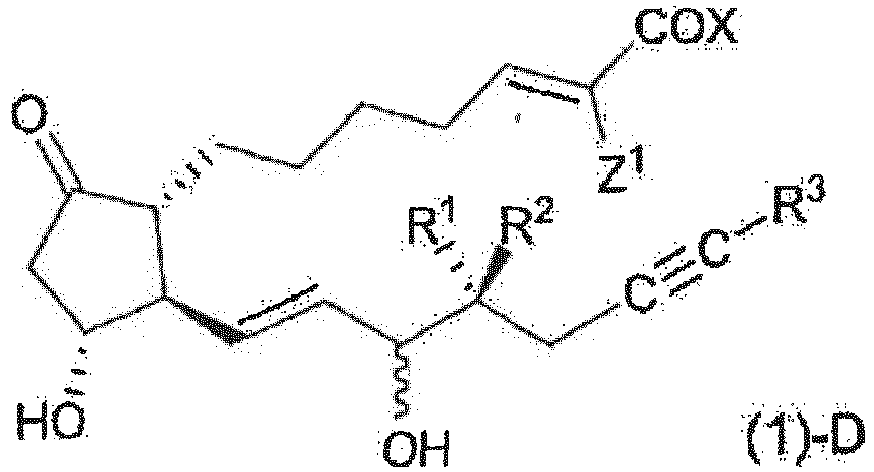
- In the formula (1)-D, the configuration of a hydroxy group bonded by a wavy line is α-configuration, β-configuration, or a mixed configuration of α-configuration and β-configuration, R1 is preferably a hydrogen atom, R2 is preferably an alkyl group having 1 - 2 carbon atoms, R3 is preferably a cycloalkyl group having 3 - 5 carbon atoms, Z1 is a hydrogen atom or a fluorine atom, X is preferably OR4, and R4 is preferably a hydrogen atom or an alkyl group having 1 - 4 carbon atoms.
-

- In the formula (1)-E, the configuration of a hydroxy group bonded by a wavy line is α-configuration, β-configuration, or a mixed configuration of α-configuration and β-configuration, R1 is preferably a hydrogen atom, R2 is preferably an alkyl group having 1 - 2 carbon atoms, R3 is preferably an alkyl group having 2 - 3 carbon atoms, Z1 and Z2 are each independently a hydrogen atom or a fluorine atom, X is preferably OR4, and R4 is preferably a hydrogen atom or an alkyl group having 1 - 4 carbon atoms.
-

- In the formula (1)-F, the configuration of a hydroxy group bonded by a wavy line is α-configuration, β-configuration, or a mixed configuration of α-configuration and β-configuration, R1 is preferably a hydrogen atom, R2 is preferably an alkyl group having 1 - 2 carbon atoms, R3 is preferably a cycloalkyl group having 3 - 5 carbon atoms, Z1 and Z2 are each independently a hydrogen atom or a fluorine atom, X is preferably OR4, and R4 is preferably a hydrogen atom or an alkyl group having 1 - 4 carbon atoms.
- Particularly preferable examples of compound (1) include the following compounds.
- Methyl 4-((2-((1R,2R,3R)-3-hydroxy-2-((1E,3RS,4S)-3-hydroxy-4-methylnon-1-en-6-yn-1-yl)-5-oxocyclopentyl)ethyl)thio)butanoate [compound (1)-1],
methyl (2E)-4-((2-((1R,2R,3R)-3-hydroxy-2-((1E,3RS,4S)-3-hydroxy-4-methylnon-1-en-6-yn-1-yl)-5-oxocyclopentyl)ethyl)thio)but-2-enoate [compound (1)-2],
methyl ((1R,2R,3R)-3-hydroxy-2-((1E,3RS,4S)-3-hydroxy-4-methylnon-1-en-6-yn-1-yl)-5-oxocyclopentyl)heptanoate [compound (1)-3],
(5-methyl-2-oxo-1,3-dioxol-4-yl)methyl 7-((1R,2R,3R)-3-hydroxy-2-((1E,3S,4S)-3-hydroxy-4-methylnon-1-en-6-yn-1-yl)-5-oxocyclopentyl)heptanoate [compound (1)-4],
3,3-dimethyl-2-oxobutyl 7-((1R,2R,3R)-3-hydroxy-2-((1E,3S,4S)-3-hydroxy-4-methylnon-1-en-6-yn-1-yl)-5-oxocyclopentyl)heptanoate [compound (1)-5],
7-((1R,2R,3R)-3-hydroxy-2-((1E,3S,4S)-3-hydroxy-4-methylnon-1-en-6-yn-1-yl)-5-oxocyclopentyl)heptanoic acid [compound (1)-6],
(2E)-7-((1R,2R,3R)-3-hydroxy-2-((1E,3S,4S)-3-hydroxy-4-methylnon-1-en-6-yn-1-yl)-5-oxocyclopentyl)hept-2-enoic acid [compound (1)-7],
2,2-difluoro-7-((1R,2R,3R)-3-hydroxy-2-((1E,3S,4S)-3-hydroxy-4-methylnon-1-en-6-yn-1-yl)-5-oxocyclopentyl)heptanoic acid [compound (1)-8],
7-((1R,2R,3R)-2-((1E,3S,4S)-7-cyclopropyl-3-hydroxy-4-methylhept-1-en-6-yn-1-yl)-3-hydroxy-5-oxocyclopentyl)heptanoic acid [compound (1)-9], and
(2E)-7-((1R,2R,3R)-2-((1E,3S,4S)-7-cyclopropyl-3-hydroxy-4-methylhept-1-en-6-yn-1-yl)-3-hydroxy-5-oxocyclopentyl)hept-2-enoic acid [compound (1)-10]. - The compound of the present invention may be a pharmaceutically acceptable salt of compound (1). The salt is a salt of a carboxylic acid moiety with a basic substance (nontoxic inorganic base or nontoxic organic base), and has a structure in which the carboxylic acid moiety is -COO- and the hydrogen atom of the carboxylic acid is a cation.
- The pharmaceutically acceptable salt is, for example, a salt derived from a nontoxic inorganic base or a salt derived from a nontoxic organic base, and a salt derived from a nontoxic inorganic base is preferable.
- Examples of the base derived from an inorganic salt include sodium salt, potassium salt, calcium salt, magnesium salt, zinc salt, aluminum salt, ammonium salt and the like, as well as lithium salt, copper salt, ferric salt, ferrous salt, manganese salt, manganous salt and the like, and sodium salt, potassium salt, calcium salt, magnesium salt and ammonium salt are preferable, and sodium salt and potassium salt are particularly preferable.
- Examples of the salt derived from an organic base include salts with primary amine, secondary amine, tertiary amine, substituted amine of these (including naturally present substituted amine), cyclic amine, basic amino acid, basic ion exchange resin and the like. Examples of the organic amine and amino acid include isopropylamine, diethylamine, triethylamine, trimethylamine, tripropylamine, ethylenediamine, N,N'-dibenzylethylenediamine, 2-diethylaminoethanol, 2-dimethylaminoethanol, morpholine, N-ethyl-morpholine, piperazine, piperidine, N-ethylpiperidine, betaine, caffeine, choline, glucamine, glucosamine, histidine, hydrabamine, methylglucamine, lysine, arginine, polyamine resin, procaine, purine, theobromine and the like.
- Compound (1) or a pharmaceutically acceptable salt thereof may take the form of a hydrate or solvate.
- Compound (1) of the present invention may be derived from a pharmaceutically acceptable prodrug of compound (1). The pharmaceutically acceptable prodrug is a compound having a group converted to a hydroxy group, a carboxy group or the like by solvolysis or under physiological conditions. Examples of the group forming a prodrug include the groups described in Prog. Med., 1985, vol. 5, pp. 2157-2161, and "IYAKUHIN no KAIHATSU (Development of Pharmaceuticals)", Vol. 7, Design of Molecules, pp. 163-198, Published by HIROKAWA SHOTEN (1990).
- A prodrug of compound (1) is preferably a compound converted to a compound by a reaction due to an enzyme, gastric acid and the like in the body.
- As the compound, the following compound (1-1) - compound (1-4) can be mentioned.
- Compound (1-1) wherein the hydroxy group in compound (1) is acylated, alkylated, phosphorylated or borated. Specifically, a compound wherein the hydroxy group in compound (1) is acetylated, propanoylated, butanoylated, pivaloylated, oleylated, palmitoylated, succinylated, fumarylated, alanylated, or dimethylaminomethylcarbonylated.
- Compound (1-2) wherein the carboxy group in compound (1) is esterified or amidated. Specifically, a compound wherein the carboxy group in compound (1) is phenyl-esterified or phthalidyl-esterified, and the like.
- Compound (1-3) wherein the carboxy group in compound (1) is substituted by a hydroxymethyl group.
- Compound (1-4) wherein the carbonyl group of the 5-membered ring moiety in compound (1) is enol-esterified.
- These compound (1-1) - compound (1-4) can be produced by a known method. Compound (1-1) - compound (1-4) may be a hydrate or a non-hydrate.
- Compound (1) of the present invention or a pharmaceutically acceptable salt thereof may take the form of a clathrate compound of cyclodextrin. As the cyclodextrin, α-cyclodextrin, β-cyclodextrin, γ-cyclodextrin, sulfobutylether-β-cyclodextrin, hydroxypropyl-β-cyclodextrin, or a mixture of one or more kinds selected from these is used. As the cyclodextrin, α-cyclodextrin or β-cyclodextrin is preferable, and α-cyclodextrin is particularly preferable.
- As the production method of a cyclodextrin clathrate compound, methods generally known widely as emulsion method, saturated aqueous solution method, kneading method, mixing and pulverizing method and the like can be used. Specifically, it can be produced using compound (1) or a pharmaceutically acceptable salt thereof, and cyclodextrin and by the method described in
JP-B-50-3362 JP-B-2-31404 JP-B-61-52146 - The compound of the present invention can be synthesized by a general PG synthesis method. The concept of the synthetic route is shown in the following formulas.
- For example, a compound wherein the -A-B- moiety is a double bond can be synthesized using a compound in which α-chain is introduced into Corey lactone as a starting material, by reducing the 15-position carbonyl group of the α, β-unsaturated carbonyl moiety in the ω-chain (compound of the following formula wherein W is H) introduced by a Horner-Wadsworth-Emmons reaction, introducing a double bond into the α-chain when desired, oxidizing the 9-position and deprotecting the hydroxy-protecting group.
- A PG derivative having fluorine at the 2-position can be synthesized by, for example, synthesizing the starting material by introducing α-chain having a difluoro unit into Corey lactone, and performing a reaction similar to the above-mentioned reaction.
- A compound wherein the -A-B- moiety is a single bond can be synthesized by performing 1,4-reduction of the α, β-unsaturated carbonyl moiety in the ω-chain (W in the following formula is H) introduced by a Horner-Wadsworth-Emmons reaction using Stryker's reagent ([(Ph3P)CuH]6), and a reducing agent such as sodium dithionite.
- A compound wherein the -A-B- moiety is a triple bond can be synthesized by reducing, in the presence of a bromination agent such as N-bromosuccinimide and 1,3-dibromo-5,5-dimethylhydantoin, the 15-position carbonyl group of the α-bromo-α, β-unsaturated carbonyl moiety in the ω-chain (W in the following formula is a bromine atom) introduced by a Horner-Wadsworth-Emmons reaction, and performing a dehydrobromination reaction using sodium hydroxide, potassium tert-butoxide, or a base such as cesium acetate/18-crown-6.

- In the formulas, R7, R8 and R9 are each independently a hydroxy-protecting group, W is a hydrogen atom or a bromine atom, and each of other symbols is as defined above.
- As the hydroxy-protecting group for R7 - R9, the hydroxy-protecting groups described in "Greene's/Protective/Groups/in/Organic/Synthesis 4th Edition" (by P. G. M. Wuts, T. W. Greene, J. Wiley & Sons, 2007), pp. 16-430 and the like can be used. Specifically, acyl group, tri-organosilyl group, alkoxyalkyl group, a monovalent group having a cyclic ether structure and the like can be mentioned. As the acyl group, acetyl group, benzoyl group, chloroacetyl group, dichloroacetyl group, trichloroacetyl group, trifluoroacetyl group and the like are preferable. As the tri-organosilyl group, a group in which three of alkyl group, aryl group, aralkyl group and alkoxy group are bonded to the silicon atom is preferable. Specifically, for example, tert-butyldimethylsilyl group, tert-butyldiphenylsilyl group, trimethylsilyl group, triethylsilyl group, triphenylsilyl group, triisopropylsilyl group and the like are preferable. As the alkoxyalkyl group, methoxymethyl group, benzyloxymethyl group, tert-butoxymethyl group, 2-methoxyethoxymethyl group, 1-ethoxyethyl group, 1-methyl-1-methoxyethyl group and the like are preferable. As the monovalent group having a cyclic ether structure, tetrahydropyranyl group, tetrahydrofuranyl group and the like are preferable. Acetyl group, benzoyl group, tetrahydropyranyl group, tert-butyldimethylsilyl group, tert-butyldiphenylsilyl group and the like are particularly preferable.
- The hydroxy-protecting groups can be deprotected easily by a conventional method. Specifically, for example, they can be deprotected by the methods described in "Greene's/Protective/Groups/in/Organic/Synthesis 4th Edition" (by P. G. M. Wuts, T. W. Greene, J. Wiley & Sons, 2007), pp. 16-430 and the like.
- A PG derivative in which the 5-position (Y) of the α-chain is a hetero atom can be synthesized as shown in the following by using Corey lactone that constructed ω-chain as a starting material, reducing the lactone moiety to give diol, introducing α-chain, oxidizing the 9-position, and deprotecting other hydroxy-protecting groups.

- In the formulas, each symbol is as defined above.
- Representative examples of the production method of compound (1) can be shown by the following formulas.
- In the following formulas, the following abbreviations are used.
Me: methyl
Ac: acetyl
THP: tetrahydro-2H-pyran-2-yl
- The starting material in the aforementioned formulas is aldehyde (A-1) described in
JP-B-60-36422 - After protection of two hydroxy groups of compound (A-4), deacetylation is performed to give alcohol (A-7). The α-position of the ester is phenylselenylated, an elimination reaction with hydrogen peroxide water is performed and ester hydrolysis is performed to give α, β-unsaturated carboxylic acid (A-8). The unprotected hydroxy group on the 5-membered ring is oxidized and deprotected, whereby compound (A-9) of the present invention (compound (1)-10) can be obtained.
- For esterification of the carboxy group of compound (A-6) or (A-9) of the present invention, a general method, for example, the method described in "Shinjikken Kagaku Koza (Courses in Experimental Chemistry) 14 synthesis and reaction of organic compound (II)" (Maruzen Company, Limited) can be used. For example, methods such as esterification by condensation with alcohols and phenols, esterification by an O-alkylating agent, esterification using alkenes and alkynes, esterification by dialkyl sulfate and halogenated hydrocarbons and the like are used. For conversion to acylamides and sulfonamides, for example, the method of Tithereley et al. (J. Chem. Soc., 1904, vol. 85, p. 1673), the method of Lynch et al. (Can. J. Chem., 1972, vol. 50, p. 2143), the method of Davidson et al. (J. Am. Chem. Soc., 1958, vol. 80, p. 376) and the like can be adopted. In addition, a method including converting carboxylic acid to acid halide or active ester, then a condensation reaction directly with amides or sulfonamides, or a reaction with amines to once convert to amides, followed by acylation or sulfonylation and the like is used.
- The compound of the present invention has an asymmetric carbon in the structure thereof. Thus, various stereoisomers and optical isomers are present. The present invention encompasses all stereoisomers, optical isomers, and mixtures thereof.
- The compound of the present invention is a derivative less susceptible to metabolism in vivo and having improved stability. Compound (1) has an alkyl group at the 16-position carbon atom, and therefore, the hydroxy group at the 15-position of the PG skeleton is less susceptible to metabolism by PG dehydrogenase and shows high metabolic stability. Thus, it has a long half-life in blood and can maintain effective blood concentration for a long time as compared to natural type PG. Having improved metabolic stability, the compound can improve bioavailability of drugs.
- The compound of the present invention has an alkynyl group in the ω-chain and shows very potent actions such as platelet aggregation suppressive activity. In particular, a derivative having a cycloalkyl group on the end of the alkynyl group is stable and exhibits potent activity.
- The compound of the present invention and a cyclodextrin clathrate compound thereof are useful as medicaments, and can show a superior effect as a drug for circulatory diseases, central nervous system diseases, inflammatory diseases, pain and the like. Specifically, the circulatory diseases include peripheral circulation disorder, Buerger's disease, Raynaud's disease, angina pectoris, myocardial infarction, cardiac failure, pulmonary hypertension, pulmonary obliteration, diabetes, cerebral infarction, cerebral thrombus, deafness, Meniere's disease and the like. The central nervous system diseases include sleeplessness, anxiety, depression, schizophrenia, dementia and the like. The inflammatory diseases include acute hepatitis, chronic hepatitis, cirrhosis, cholecystitis, cholangitis, acute pancreatitis, chronic pancreatitis, chronic peritonitis, acute peritonitis, cystitis, acute nephritis, chronic nephritis, encephalitis, polyneuritis, meningitis, myelitis, arthritis, rheumatoid arthritis, bronchitis, pneumonia, pleurisy, phlebitis, pericarditis, rhinitis, pharyngitis, labyrinthitis, otitis externa and the like.
- A medicament containing the compound of the present invention or a cyclodextrin clathrate compound thereof (hereinafter to be indicated as "the medicament of the present invention") is particularly useful as a medicament for the prophylaxis or treatment of blood flow disorders. The medicament of the present invention may be a medicament containing the compound of the present invention and optionally containing a pharmaceutically acceptable carrier and other therapeutic components.
- When the medicament of the present invention is administered to patients as an agent for the prophylaxis or treatment of the aforementioned diseases, the daily dose varies depending on the age and body weight of patients, pathology and severity in patients, and the like. It is generally 0.00001 mg to 1 mg, preferably 0.0001 mg to 0.3 mg, as compound (1), which is desirably administered in one to several portions. For example, 0.0001 mg to 0.3 mg, particularly 0.001 mg to 0.1 mg, is preferable for oral administration. Meanwhile, 0.00001 mg to 0.1 mg, particularly 0.0001 mg to 0.03 mg, is preferable for intravenous administration. The dose can be appropriately increased or decreased according to the disease or pathology, and continuous drip administration is sometimes desirable in the case of injection.
- The medicament of the present invention can be administered to the body by oral administration or parenteral administration (e.g., blood vessel (intravenous and intraarterial) administration, intrarectal administration, and intraarticular administration). Examples of the administration form include oral administration forms such as tablet (including orally disintegrating tablet and sublingual tablet), film (including oral films), capsule (including soft capsule and microcapsule), granule, powder, troche, and syrup, and parenteral administration forms such as liquid injection such as solution, emulsion, and suspension (e.g., subcutaneous injection, intravenous injection, intramuscular injection, intraperitoneal injection, and drip infusion), suppository (e.g., rectal suppository and vaginal suppository), eye drop, nasal drop, external preparation (e.g., transdermal preparation such as adhesive preparation, ointment, and cream), and pulmonary preparation (inhalant etc.). These preparations may be controlled-release preparations such as rapid release preparation and sustained-release preparation.
- The preparation in the aforementioned administration form can be produced by adding additives necessary for preparations such as general carrier, excipient, lubricant, disintegrant, binder, and stabilizer to the medicament of the present invention and formulating the resulting mixture by a conventional method. For example, when the preparation is a tablet, granule, powder or the like, it can be produced using any pharmaceutical carriers suitable for producing a solid preparation, for example, excipient, lubricant, disintegrant, and binder.
- Examples of the excipient include lactose, glucose, fructose, maltose, isomerized lactose, reduced lactose, lactose crystal, saccharose, D-mannitol, erythritol, maltitol, xylitol, palatinose, trehalose, sorbitol, cornstarch, potato starch, wheat starch, rice starch, crystalline cellulose, dextrans (e.g., dextran, dextran 40, and dextran 70), pullulan, dextrin, talc, silicic anhydride, anhydrous calcium phosphate, precipitated calcium carbonate, calcium silicate and the like.
- Examples of the lubricant include magnesium stearate, calcium stearate, sucrose fatty acid ester, sodium stearyl fumarate, stearic acid, talc, polyethylene glycol, beeswax and the like.
- Examples of the disintegrant include starch, carboxymethylcellulose, hydroxypropylcellulose, carmellose, carmellose calcium, sodium carboxymethyl starch, croscarmellose sodium, hydroxypropylstarch and the like.
- Examples of the binder include crystalline cellulose, hydroxypropylcellulose, hydroxypropylmethylcellulose, hydroxyethylcellulose, methylcellulose, sodium carboxymethylcellulose, partially pregelatinized starch, pregelatinized starch, sodium alginate, pullulan, gum arabic, dextrin, polyvinylpyrrolidone, poly(vinyl alcohol), gelatin and the like.
- A preparation in the aforementioned administration form may contain inert diluent, lubricant, stabilizer, solubilizing agent, corrigent and the like as necessary. Examples of the inert diluent include calcium carbonate, sodium carbonate, lactose, calcium phosphate, sodium phosphate and the like. Examples of the lubricant include magnesium stearate, stearic acid, colloidal silica, talc and the like. Examples of the stabilizer include ascorbic acid, sodium sulfite, glycine, L-aspartic acid, tocopheryl acetate, β-cyclodextrin, fumaric acid and the like. Examples of the solubilizing agent include polyethylene glycol, propylene glycol, glutamic acid, aspartic acid and the like. Examples of the corrigent include citric acid, ascorbic acid, lactic acid, acetic acid, tartaric acid, malic acid, aspartame, acesulfame potassium, thaumatin, saccharin sodium, dipotassium glycyrrhetinate, sodium glutamate, sodium 5'-inosinate, sodium 5'-guanylate and the like.
- These tablets may be uncoated, or coated by a known technique to delay disintegration and absorption in the gastrointestinal tract, thereby ensuring a sustained action for a longer time. For example, a time delay material, for example, glyceryl monostearate or glyceryl distearate may be used.
- The medicament of the present invention may be provided as a hard gelatin capsule containing a mixture with an inert solid diluent, for example, calcium carbonate, sodium carbonate, lactose, calcium phosphate, sodium phosphate or kaolin. In addition, the medicament of the present invention may be provided as a soft gelatin capsule containing a mixture with water-miscible solvent, for example, alcohols such as propylene glycol, polyethylene glycol, glycerol, and ethanol and an oil medium.
- Examples of the oil medium include fatty acid ester, liquid paraffin, vegetable oil such as peanut oil and olive oil and the like. Fatty acid ester is a compound in which a carboxy group of fatty acid forms an ester bond with alcohol and, specifically, glyceride optionally having a saturated or unsaturated branched chain, fatty acid ester composed of an ester compound of fatty acid and monohydric alcohol and the like can be mentioned. Preferable fatty acid is medium-chain or long-chain fatty acid having 6 - 24 carbon atoms, and caproic acid, caprylic acid, capric acid, lauric acid, myristic acid, palmitic acid, palmitoleic acid, stearic acid, oleic acid, linoleic acid, linolenic acid, ricinoleic acid, arachidonic acid and the like can be mentioned. Preferable alcohols include monohydric alcohols having 1 - 6 carbon atoms, polyols which are polyhydric alcohols such as glycerol, polyethylene glycol, and propylene glycol and the like. Preferable fatty acid esters include glyceride optionally having saturated or unsaturated branch, glycerol fatty acid ester, and propyleneglycol fatty acid ester. In addition, a mixture of two or more kinds of glycerides can also be used. The mixtures of glycerides include a mixture of caprylic acid triglyceride and capric acid triglyceride, vegetable oil such as castor oil, corn oil, olive oil, sesame oil, rape seed oil, salad oil, cottonseed oil, camellia oil, peanut oil, palm oil, and sunflower oil. Examples of the fatty acid ester composed of an ester compound of fatty acid and monohydric alcohol include isopropyl myristate, isopropyl palmitate, ethyl linoleate, ethyl oleate and the like.
- The major component of the coating film of the capsule is not particularly limited and, for example, various known components such as gelatin, carrageenan, pectin, pullulan, sodium alginate, starch, hypromellose, and hydroxypropylcellulose can be mentioned.
- Preferable examples of the plasticizer used for the production of the coating film of soft capsules include polyhydric alcohol such as glycerol, ethylene glycol, polyethylene glycol, propylene glycol, and polypropylene glycol, sugar alcohol such as sorbitol, mannitol, xylitol, maltitol, cornstarch-derived sugar alcohol solution, and reduced maltose syrup, and the like. Two or more kinds of these plasticizers may be used in combination.
- When the preparation is liquid such as syrup, solution, emulsion, and suspension, for example, it can be produced by appropriately selecting stabilizer, suspending agent, corrigent, aromatic, soothing agent and the like. When injection is produced, it can be aseptically prepared by dissolving the active ingredient together with a pH adjuster such as hydrochloric acid, sodium hydroxide, sodium lactate, acetic acid, sodium hydrogen phosphate, and sodium dihydrogen phosphate; an isotonicity agent such as sodium chloride, glucose, D-sorbitol, glycerol, and D-mannitol; a surfactant such as stearylethanolamine, sodium lauryl sulfate, lauryl aminopropionate, lecithin, benzalkonium chloride, and glycerol monostearate; a suspending agent such as poly(vinyl alcohol), polyvinylpyrrolidone, sodium carboxymethylcellulose, methylcellulose, hydroxymethylcellulose, hydroxyethylcellulose, and hydroxypropylcellulose; and a soothing agent such as benzyl alcohol in distilled water for injection. It may also be prepared using an inert non-aqueous diluent such as propylene glycol, polyethylene glycol, olive oil, ethanol, and polysorbate 80. Furthermore, injection to be dissolved when in use may be prepared by adding mannitol, dextrin, cyclodextrin, gelatin and the like and freeze-drying the resulting mixture in vacuum. For stabilization and improving lesion reachability, a liposome preparation may also be prepared by a known method and used as an injection. What is called a lipoid preparation (fat emulsion) in which the compound of the present invention is dissolved in fine fat emulsion particles can also be prepared, and it can be produced by mixing an oil component such as fatty acid glycerides; phospholipid such as egg-yolk lecithin and soybean lecithin; and additives such as emulsion adjuvant, stabilizer, polymer substance, and isotonicity agent as necessary.
- In addition, an intrarectal administration preparation may be prepared by using a base for suppository such as cacao butter, fatty acid triglyceride, fatty acid diglyceride, fatty acid monoglyceride, and polyethylene glycol. Furthermore, an intrarectally injecting ointment can also be prepared by adjusting to a suitable viscosity with a water-soluble base such as polyethylene glycol, polypropylene glycol, glycerol, and glycerolgelatin, an oily base such as white petrolatum, hard fat, paraffin, liquid paraffin, plastibase, lanolin, and purified lanolin, and the like.
- The medicament of the present invention can be administered topically to the skin or mucosa, i.e., transdermally or transmucosally. Examples of the general dosage form for this object include gel, hydrogel, lotion, solution, cream, ointment, dusting powder, dressing agent, foam preparation, film, skin patch, wafer, implant, sponge, fiber, bandage, microemulsion and the like. Examples of the general carrier include alcohol, water, mineral oil, liquid paraffin, white petrolatum, glycerol, polyethylene glycol, propylene glycol and the like.
- The medicament can be directly administered to the eye or ear, in the form of an isotonic, pH controlled eye drop of a suspension of fine powder or solution in sterile saline. Other dosage forms suitable for ocular or aural administration include ointment, biodegradable implant, non-biodegradable implant, wafer, lens, microparticles such as liposome, and the like. Crosslinked polyacrylic acid, poly(vinyl alcohol), hyaluronic acid, cellulose polymers such as hydroxypropylmethyl cellulose, hydroxyethyl cellulose, and methyl cellulose, or polymers such as complex polysaccharides such as gellan gum can be mixed with a preservative such as benzalkonium chloride.
- To produce a pulmonary administration preparation, the medicament of the present invention is dissolved or dispersed in a conventional spray and filled in a pressure resistant container. It can also be pulmonarily administered as a liposome preparation by a known method.
- In order to use the medicament of the present invention in any of the aforementioned administration forms and improve solubility, dissolution rate, bioavailability and/or stability thereof, the medicament can be further mixed with cyclodextrin and an appropriate derivative thereof or a soluble polymer unit of polyethylene glycol-containing polymer and the like. For example, a mixture, a complex etc. of these have been confirmed to be generally useful for most dosage forms and administration routes. Both inclusion and non-inclusion complexes can be used. As an alternative method for directly forming a complex with a drug, cyclodextrin can also be used as an auxiliary additive, i.e., carrier, excipient or solubilizer. For these objects, α-cyclodextrin, β-cyclodextrin, hydroxypropyl-p-cyclodextrin, γ-cyclodextrin and the like are generally used.
- The compound of the present invention may be a pharmaceutically acceptable salt of a compound represented by the formula (1). As the salt, those mentioned above can be recited.
- Other therapeutic components (hereinafter to be also referred simply to as "other drugs") to be contained in the medicament of the present invention are not particularly limited as long as they are drugs that supplement and/or enhance the prophylactic and/or therapeutic effect of the compound of the present invention on blood flow disorders (e.g., spinal canal stenosis) and the like, drugs that can improve pharmacokinetics and absorption of the compound of the present invention and reduce the dose of the compound of the present invention, drugs that reduce the side effects of the compound of the present invention and the like.
- Examples of other drugs for supplementing and/or enhancing the prophylactic and/or therapeutic effect of the compound of the present invention on blood flow disorders (e.g., spinal canal stenosis) and the like include, but are not limited to, prostaglandins, prostaglandin derivative preparations, vasodilators, anti-platelet drugs (platelet aggregation inhibitors), analgesic drugs, vitamins, muscle relaxants, antidepressants and the like.
- Examples of the prostaglandins include PG receptor agonist, PG receptor antagonist and the like. Examples of the PG receptor include PGE receptor (EP1, EP2, EP3, and EP4), PGD receptor (DP and CRTH2), PGF receptor (FP), PGI receptor (IP), TX receptor (TP) and the like. Examples of the prostaglandin derivative preparation include limaprost, beraprost and the like.
- Examples of the vasodilator include angiotensin converting enzyme inhibitor (e.g., captopril, enalapril, and delapril), angiotensin II antagonist (e.g., candesartan cilexetil, losartan, eprosartan, valsartan, telmisartan, irbesartan, olmesartan medoxomil, tasosartan, 1-{[2'-(2,5-dihydro-5-oxo-4H-1,2,4-oxadiazol-3-yl)biphenyl-4-yl]methyl}-2-ethoxy-1H-benzimidazole-7-carboxylic acid), calcium channel blocker (e.g., manidipine, nifedipine, nicardipine, amlodipine, and efonidipine), potassium channel opener (e.g., levcromakalim, L-27152, AL0671, and NIP-121), clonidine and the like.
- Examples of the anti-platelet drug (platelet aggregation inhibitor) include clopidogrel sulfate, ticlopidine hydrochloride, cilostazol, ethyl icosapentate, sarpogrelate hydrochloride and the like.
- Examples of the analgesic drug include acetaminophen, non-steroidal antiinflammatory drugs, neuropathic pain relieving drugs, pyrazolone drugs and the like. For example, sodium salicylate, aspirin, aspirin-dialuminate formulation, diflunisal, indomethacin, suprofen, ufenamate, dimethylisopropylazulene, bufexamac, felbinac, diclofenac, tolmetin sodium, clinoril, fenbufen, nabumetone, proglumetacin, indomethacin farnesyl, acemetacin, proglumetacin maleate, amfenac sodium, mofezolac, etodolac, ibuprofen, ibuprofen piconol, naproxen, flurbiprofen, flurbiprofen axetil, ketoprofen, fenoprofen calcium, tiaprofen, oxaprozin, pranoprofen, loxoprofen sodium, alminoprofen, zaltoprofen, mefenamic acid, mefenamic acid aluminum, tolfenamic acid, floctafenine, ketophenylbutazone, oxyphenbutazone, piroxicam, tenoxicam, ampiroxicam, epirizole, tiaramide hydrochloride, tinoridine hydrochloride, emorfazone, neurotropin, pregabalin, sulpyrine, migrenin, pyrine cold remedies, dimetotiazine mesylate, simetride combination drug, non-pyrine cold remedies and the like can be mentioned.
- Examples of the vitamin include mecobalamin and the like.
- Examples of the muscle relaxant include tolperisone hydrochloride, chlorzoxazone, chlormezanone, methocarbamol, phenprobamate, pridinol mesylate, chlorphenesin, baclofen carbamate, eperisone hydrochloride, afloqualone, tizanidine hydrochloride, alcuronium chloride, suxamethonium chloride, tubocurarine chloride, dantrolene sodium, pancuronium bromide, vecuronium bromide and the like.
- Examples of the antidepressant include tricyclic or tetracyclic antidepressant, SSRI (selective serotonin reuptake inhibitor), SNRI (serotonin-noradrenaline reuptake inhibitor) and the like. Examples of the tricyclic antidepressant include imipramine hydrochloride, desipramine hydrochloride, clomipramine hydrochloride, trimipramine maleate, amitriptyline hydrochloride, nortriptyline hydrochloride, lofepramine hydrochloride, amoxapine, dosulepin hydrochloride and the like, and examples of the tetracyclic antidepressant include maprotiline, mianserin and the like. Examples of SSRI include paroxetine hydrochloride hydrate and the like, and examples of SNRI include milnacipran hydrochloride, duloxetine hydrochloride and the like.
- The weight ratio of the compound of the present invention to other drugs is not particularly limited, and any two or more kinds of other drugs may be administered in combination.
- Preferable embodiments of the present invention are the following inventions.
- <1> Compound (1) or a pharmaceutically acceptable salt thereof;
- <2> the compound or a pharmaceutically acceptable salt thereof of the above-mentioned <1>, wherein Y is CH2 or S;
- <3> the compound or a pharmaceutically acceptable salt thereof of the above-mentioned <2>, wherein Y is CH2;
- <4> the compound or a pharmaceutically acceptable salt thereof of any of the above-mentioned <1> - <3>, wherein RA is - CH=CZ1(COX);
- <5> the compound or a pharmaceutically acceptable salt thereof of any of the above-mentioned <1> - <3>, wherein RA is -CH2-CZ1Z2(COX) ;
- <6> the compound or a pharmaceutically acceptable salt thereof of any of the above-mentioned <1> - <5>, wherein n is 1;
- <7> the compound or a pharmaceutically acceptable salt thereof of any of the above-mentioned <1> - <6>, wherein A-B is a carbon-carbon double bond;
- <8> the compound or a pharmaceutically acceptable salt thereof of any of the above-mentioned <1> - <7>, wherein Z1 and Z2 are hydrogen atoms;
- <9> the compound or a pharmaceutically acceptable salt thereof of any of the above-mentioned <1> - <8>, wherein R1 is a hydrogen atom and R2 is an alkyl group having 1 - 3 carbon atoms;
- <10> the compound or a pharmaceutically acceptable salt thereof of the above-mentioned <9>, wherein R2 is a methyl group;
- <11> the compound or a pharmaceutically acceptable salt thereof of any of the above-mentioned <1> - <10>, wherein R3 is an alkyl group having 1 - 4 carbon atoms or a cycloalkyl group having 3 - 6 carbon atoms;
- <12> the compound or a pharmaceutically acceptable salt thereof of the above-mentioned <11>, wherein R3 is an alkyl group having 2 - 4 carbon atoms or a cycloalkyl group having 3 - 6 carbon atoms;
- <13> the compound or a pharmaceutically acceptable salt thereof of the above-mentioned <12>, wherein R3 is a cycloalkyl group having 3 - 6 carbon atoms;
- <14> the compound or a pharmaceutically acceptable salt thereof of the above-mentioned <12>, wherein R3 is an alkyl group having 2 - 3 carbon atoms or a cycloalkyl group having 3 - 5 carbon atoms;
- <15> the compound or a pharmaceutically acceptable salt thereof of the above-mentioned <14>, wherein R3 is a cycloalkyl group having 3 - 5 carbon atoms;
- <16> the compound or a pharmaceutically acceptable salt thereof of any of the above-mentioned <1> - <15>, wherein X is OR4;
- <17> the compound or a pharmaceutically acceptable salt thereof of the above-mentioned <16>, wherein R4 is a hydrogen atom, an alkyl group having 1 - 6 carbon atoms or a substituted alkyl group having 1 - 6 carbon atoms;
- <18> the compound or a pharmaceutically acceptable salt thereof of the above-mentioned <17>, wherein R4 is a hydrogen atom, an alkyl group having 1 - 6 carbon atoms, or an alkyl group having 1 - 6 carbon atoms substituted by a substituent(s) selected from the group consisting of a hydroxy group, an acyl group, an acyloxy group, an alkoxycarbonyloxy group, a substituted amino group, an aryl group and a heterocyclic group;
- <19> the compound or a pharmaceutically acceptable salt thereof of the above-mentioned <17>, wherein R4 is a hydrogen atom, an alkyl group having 1 - 4 carbon atoms or a substituted alkyl group having 1 - 4 carbon atoms;
- <20> the compound or a pharmaceutically acceptable salt thereof of the above-mentioned <19>, wherein R4 is a hydrogen atom, an alkyl group having 1 - 4 carbon atoms, or an alkyl group having 1 - 4 carbon atoms substituted by a substituent(s) selected from the group consisting of a hydroxy group, an acyl group, an acyloxy group, an alkoxycarbonyloxy group, a substituted amino group, an aryl group and a heterocyclic group;
- <21> the compound or a pharmaceutically acceptable salt thereof of the above-mentioned <20>, wherein R4 is a hydrogen atom, an alkyl group having 1 - 4 carbon atoms, a pivaloylmethyl group or a (5-methyl-2-oxo-1,3-dioxol-4-yl)methyl group;
- <22> a cyclodextrin clathrate compound or a pharmaceutically acceptable salt thereof of the compound of any of the above-mentioned <1> - <21>;
- <23> a medicament comprising the compound or a pharmaceutically acceptable salt thereof of any of the above-mentioned <1> - <21>, or the cyclodextrin clathrate compound of the above-mentioned <22> as an active ingredient;
- <24> the medicament of the above-mentioned <23>, which is a prophylactic or therapeutic agent for a blood flow disorder;
- <25> the medicament of the above-mentioned <24>, wherein the blood flow disorder is a blood flow disorder of nerve;
- <26> the medicament of the above-mentioned <25>, wherein the blood flow disorder of nerve is a blood flow disorder associated with spinal canal stenosis;
- <27> the medicament of the above-mentioned <24>, wherein the blood flow disorder is a blood flow disorder of peripheral artery, skin or brain;
- <28> the medicament of the above-mentioned <27>, wherein the blood flow disorder of peripheral artery is a blood flow disorder associated with chronic arterial occlusion or pulmonary hypertension;
- <29> the medicament of the above-mentioned <27>, wherein the blood flow disorder of skin is a blood flow disorder associated with pressure ulcer;
- <30> the medicament of the above-mentioned <27>, wherein the blood flow disorder of brain is a blood flow disorder associated with suppression of recurrence after cerebral infarction;
- <31> the compound or a pharmaceutically acceptable salt thereof of any of the above-mentioned <1> - <21>, or the cyclodextrin clathrate compound of the above-mentioned <22> for use in the prophylaxis or treatment of a blood flow disorder;
- <32> the compound or a pharmaceutically acceptable salt thereof, or the cyclodextrin clathrate compound for use of the above-mentioned <31>, wherein the blood flow disorder is a blood flow disorder of nerve;
- <33> the compound or a pharmaceutically acceptable salt thereof, or the cyclodextrin clathrate compound for use of the above-mentioned <32>, wherein the blood flow disorder of nerve is a blood flow disorder associated with spinal canal stenosis;
- <34> the compound or a pharmaceutically acceptable salt thereof, or the cyclodextrin clathrate compound for use of the above-mentioned <31>, wherein the blood flow disorder is a blood flow disorder of peripheral artery, skin or brain;
- <35> the compound or a pharmaceutically acceptable salt thereof, or the cyclodextrin clathrate compound for use of the above-mentioned <34>, wherein the blood flow disorder of peripheral artery is a blood flow disorder associated with chronic arterial occlusion or pulmonary hypertension;
- <36> the compound or a pharmaceutically acceptable salt thereof, or the cyclodextrin clathrate compound for use of the above-mentioned <34>, wherein the blood flow disorder of skin is a blood flow disorder associated with pressure ulcer;
- <37> the compound or a pharmaceutically acceptable salt thereof, or the cyclodextrin clathrate compound for use of the above-mentioned <34>, wherein the blood flow disorder of brain is a blood flow disorder associated with suppression of recurrence after cerebral infarction;
- <38> a method for prophylaxis or treatment of a blood flow disorder in a mammal, comprising administering an effective amount of the compound or a pharmaceutically acceptable salt thereof of any of the above-mentioned <1> - <21>, or the cyclodextrin clathrate compound of the above-mentioned <22> to the mammal;
- <39> the method of the above-mentioned <38>, wherein the blood flow disorder is a blood flow disorder of nerve;
- <40> the method of the above-mentioned <39>, wherein the blood flow disorder of nerve is a blood flow disorder associated with spinal canal stenosis;
- <41> the method of the above-mentioned <38>, wherein the blood flow disorder is a blood flow disorder of peripheral artery, skin or brain;
- <42> the method of the above-mentioned <41>, wherein the blood flow disorder of peripheral artery is a blood flow disorder associated with chronic arterial occlusion or pulmonary hypertension;
- <43> the method of the above-mentioned <41>, wherein the blood flow disorder of skin is a blood flow disorder associated with pressure ulcer;
- <44> the method of the above-mentioned <41>, wherein the blood flow disorder of brain is a blood flow disorder associated with suppression of recurrence after cerebral infarction;
- <45> use of the compound or a pharmaceutically acceptable salt thereof of any of the above-mentioned <1> - <21>, or the cyclodextrin clathrate compound of the above-mentioned <22> in the manufacture of a prophylactic or therapeutic agent for a blood flow disorder;
- <46> the use of the above-mentioned <45>, wherein the blood flow disorder is a blood flow disorder of nerve;
- <47> the use of the above-mentioned <46>, wherein the blood flow disorder of nerve is a blood flow disorder associated with spinal canal stenosis;
- <48> the use of the above-mentioned <45>, wherein the blood flow disorder is a blood flow disorder of peripheral artery, skin or brain;
- <49> the use of the above-mentioned <48>, wherein the blood flow disorder of peripheral artery is a blood flow disorder associated with chronic arterial occlusion or pulmonary hypertension;
- <50> the use of the above-mentioned <48>, wherein the blood flow disorder of skin is a blood flow disorder associated with pressure ulcer; and
- <51> the use of the above-mentioned <48>, wherein the blood flow disorder of brain is a blood flow disorder associated with suppression of recurrence after cerebral infarction.
- The present invention is explained in more detail in the following by referring to Reference Examples, Examples, Preparation Examples and Experimental Examples. The present invention is not limited by these Examples and the like and may be changed within the scope of the present invention.
- Unless otherwise specified, the apparatuses, reagents and the like used in the present Examples and the like are easily obtained or prepared according to the methods generally conducted in the pertinent technical field, or commercially available.
- In the following Reference Examples and Examples, the "room temperature" is generally about 10°C to about 30°C. Unless otherwise specified, the ratios of mixed solvents are volume mixing ratios. % shows mol/mol% for yield and wt% for others.
- The following abbreviations are used in the Reference Examples and Examples.
Me: methyl
Et: ethyl
Pr: propyl
Bu: butyl
Ph: phenyl
Ac: acetyl
THP: tetrahydro-2H-pyran-2-yl
TBS: tert-butyldimethylsilyl
KHMDS: potassium bistrimethylsilylamide
DBU: 1,8-diazabicyclo[5.4.0]undec-7-ene
DMAP: 4-dimethylaminopyridine
Py: pyridine
DMSO: dimethyl sulfoxide
DME: 1,2-dimethoxyethane
p-TsOH: p-toluenesulfonic acid
aq: aqueous solution -

- Lithium chloride (4.24 g) and zinc powder (9.15 g) were dried under reduced pressure, and tetrahydrofuran (THF) (100 mL), 1,2-dibromoethane (0.433 mL) and trimethylchlorosilane (0.127 mL) were added thereto at room temperature. To the mixture was added dropwise a solution of methyl (R)-3-iodo-2-methylpropionate (22.8 g) in THF (30 mL), and the mixture was stirred at 40°C for 1.5 hr to prepare an organozinc reagent. In another reaction container were added lithium chloride (7.63 g), copper(I) cyanide (8.06 g) and THF (90 mL), and the mixture was stirred for 1 hr. The mixture was cooled to -10°C, and the aforementioned organo zinc reagent was added dropwise thereto. The reaction mixture was stirred at -10°C for 10 min, cooled to -78°C, and a solution of 2-(bromoethynyl)cyclopropane (14.5 g) in THF (50 mL) was added dropwise. The mixture was stirred at the same temperature for 15 hr and poured into an aqueous ammonium chloride solution, and the mixture was extracted with ethyl acetate. The organic layer was washed with water, and the insoluble material was filtered off and washed with ethyl acetate. The filtrate was concentrated under reduced pressure, and the residue was purified by silica gel column chromatography (diethyl ether:hexane = 1:30 - 1:5) to give the title compound (9.93 g). Yield: 66%.
- 1H NMR (400 MHz, CDCl3) δ 3.69 (s, 3H), 2.59 (dq, J = 6.8, 7.2 Hz, 1H), 2.46 (ddd, J = 2.0, 6.0, 16.4 Hz, 1H), 2.29 (ddd, J = 2.0, 7.8, 16.4 Hz, 1H), 1.23 (d, J = 7.2 Hz, 3H), 1.22 (m, 1H), 0.71 (m, 2H), 0.60 (m, 2H).
-

- THF (25 mL) was added to dimethyl methylphosphonate (4.34 mL), and 1.6 M n-butyllithium (23.7 mL) was added dropwise thereto at -78°C. The reaction mixture was stirred at -78°C for 1 hr, a solution of methyl (S)-5-cyclopropyl-2-methylpent-4-ynoate obtained in Reference Example 1 in THF (10 mL) was added thereto, and the mixture was stirred at the same temperature for 4 hr. To the reaction mixture was added an aqueous ammonium chloride solution, and the mixture was extracted with ethyl acetate, dried over anhydrous magnesium sulfate, and concentrated under reduced pressure. The residue was purified by silica gel column chromatography (ethyl acetate:hexane = 1:3 - ethyl acetate alone) to give the title compound (2.36 g). Yield: 61%.
1H NMR (400 MHz, CDCl3) δ 3.81 (s, 3H), 3.78 (s, 3H), 3.20 (ddd, J = 14.4, 22.8, 28.4 Hz, 2H), 2.91 (q, J = 6.8 Hz, 1H), 2.33 (dddd, J = 2.0, 6.8, 16.8, 44.4 Hz, 2H), 1.18 (d, J = 7.2 Hz, 3H), 1.18 (m, 1H), 0.71 (m, 2H), 0.60 (m, 2H). -

- To a suspension of 4-(carboxybutyl)triphenylphosphonium bromide (14.06 g) in THF (86 mL) was added 1M potassium bistrimethylsilylamide (64 mL), and the mixture was stirred for 1 hr. The mixture was cooled to -78°C, and a solution of (3aR,4S,5R,6aS)-4-(((tert-butyldimethylsilyl)oxy)methyl)hexahydro-5-((tetrahydro-2H-pyran-2-yl)oxy)-2H-cyclopenta[b]furan-2-ol (3.92 g) in THF (50 mL) was added thereto. The mixture was stirred at the same temperature for 30 min, heated to room temperature, and stirred overnight. Water was added to the reaction mixture, and the mixture was extracted with tert-butylmethylether, acidified with disodium citrate, and extracted with ethyl acetate. The organic layer was dried over anhydrous sodium sulfate and concentrated under reduced pressure, and acetone (390 mL) was added thereto. Diisopropylethylamine (9.16 mL), iodomethane (2.95 mL) and 1,8-diazabicyclo[5.4.0]undec-7-ene (7.85 mL) were added thereto at 0°C. The mixture was stirred at room temperature for 3.5 hr, saturated aqueous sodium hydrogen carbonate was added thereto, and the mixture was extracted with ethyl acetate. After concentration under reduced pressure, the residue was purified by silica gel column chromatography to give a viscous oil (3.21 g). Methanol (220 mL) was added to the oil (3.13 g), and the mixture was stirred using 5% Pd/C (1.13 g) under a hydrogen atmosphere for 40 min. The catalyst was filtered off, and the filtrate was concentrated under reduced pressure. To the residue were added pyridine (14 mL), acetic anhydride (14 mL), and 4-dimethylaminopyridine (170 mg), and the mixture was stirred for 1 hr. Water was added to the reaction mixture, and the mixture was extracted with a hexane-ethyl acetate mixed solvent. The organic layer was dried over anhydrous sodium sulfate and concentrated under reduced pressure. THF (32 mL) was added to the residue, and the mixture was ice-cooled. 1M tetrabutylammonium fluoride (6.7 mL) was added thereto, and the mixture was stirred at room temperature for 3 days. The reaction mixture was concentrated under reduced pressure, and the residue was purified by silica gel column chromatography (hexane:ethyl acetate = 3:1 - 1:3) to give the title compound (2.60 g).
1H NMR (300 MHz, CDCl3) δ 5.07 (m, 1H), 4.71 (m, 0.55H), 4.54 (m, 0.45H), 4.15-4.04 (m, 1H), 4.04-3.88 (m, 1H), 3.88-3.73 (m, 2H), 3.66 (s, 3H), 3.60-3.48 (m, 2H), 2.29 (m, 2H), 2.04 (t, J = 7.5 Hz, 2H), 1.95-1.15 (m, 20H). -

- Methyl 7-((1R,2R,3R,5S)-5-acetoxy-2-hydroxymethyl-3-((tetrahydro-2H-pyran-2-yl)oxy)cyclopentyl)heptanoate (3.0 g) was dissolved in ethyl acetate (48 mL), and N,N-diisopropylethylamine (7.6 mL) was added thereto under ice-cooling. To the mixture was added a solution of SO3-pyridine (3.6 g) in dimethylsulfoxide (24 mL), and the mixture was stirred for 30 min under ice-cooling. The reaction mixture was poured into ethyl acetate (50 mL) and water (50 mL), partitioned by adding aqueous sodium hydrogen carbonate, and the organic layer was concentrated under reduced pressure. Hexane was added to the residue, and the mixture was washed successively with an aqueous copper sulfate solution, saturated brine and water. The organic layer was dried over anhydrous sodium sulfate and concentrated under reduced pressure to give the title compound (2.75 g).
1H NMR (300 MHz, CDCl3) δ 9.77 (dd, J = 16.1, 3.2 Hz, 1H), 5.13 (m, 1H), 4.70-4.50 (m, 1H), 4.41 (m, 1H), 3.81 (m, 2H), 3.66 (s, 3H), 3.46 (m, 2H), 3.40-2.92 (m, 0.46H), 2.88-2.78 (m, 0.54H), 2.28 (t, J = 7.5 Hz, 2H), 2.50-2.20 (m, 1H), 2.06 (s, 3H), 1.98-1.52 (m, 16H). -

- To sodium hydride (60%, dispersion in oil) (575 mg) was added 1,2-dimethoxyethane (126 mL), and a solution of dimethyl (S)-(+)-(6-cyclopropyl-3-methyl-2-oxohex-5-yn-1-yl)phosphonate (3.41 g) synthesized in Reference Example 2 in 1,2-dimethoxyethane (20 mL) was added dropwise thereto under ice-cooling. The mixture was stirred under ice-cooling for 1 hr, a solution of methyl 7-((1R,2R,3R,5S)-5-acetoxy-2-formyl-3-((tetrahydro-2H-pyran-2-yl)oxy)cyclopentyl)heptanoate (2.75 g) synthesized in Reference Example 4 in 1,2-dimethoxyethane (40 mL) was added dropwise thereto, and the mixture was stirred at the same temperature for 3 hr. To the reaction mixture were added ethyl acetate (290 mL) and saturated brine (290 mL), the mixture was diluted with water to carry out a liquid separation, and the aqueous layer was extracted with ethyl acetate. The organic layer was dried over anhydrous sodium sulfate and concentrated under reduced pressure, and the residue was purified by silica gel column chromatography (hexane:ethyl acetate = 86:14 - ethyl acetate alone) to give the title compound (3.43 g) as a colorless oil. Yield: 61% (2 step yield from methyl 7-((1R,2R,3R,5S)-5-acetoxy-2-hydroxymethyl-3-((tetrahydro-2H-pyran-2-yl)oxy)cyclopentyl)heptanoate obtained in Reference Example 3).
1H NMR (400 MHz, CDCl3) δ 6.80 (m,1H), 6.28 (m, 1H), 5.12 (brt, J = 5.7 Hz, 1H), 4.54 (dt, J = 12.8, 3.0 Hz, 1H), 4.12-3.96 (m, 1H), 3.83-3.58 (m, 2H), 3.65 (s, 3H), 3.50-3.38 (m, 1H), 3.14-2.83 (m, 1H), 2.75-2.16 (m, 4H), 2.06 (s, 3H), 1.95-1.05 (m, 20H), 1.18 (d, J = 7.2 Hz, 3H), 0.75-0.54 (m, 4H). -

- Methyl 7-((1R,2R,3R,5S)-5-acetoxy-2-((1E,4S)-7-cyclopropyl-4-methyl-3-oxohept-1-en-6-yn-1-yl)-3-((tetrahydro-2H-pyran-2-yl)oxy)cyclopentyl)heptanoate (2.47 g) synthesized in Reference Example 5 was dissolved in methanol (42 mL), cerium chloride heptahydrate (1.74 g) was added thereto, and the mixture was cooled to -40°C. To the mixture was added sodium borohydride (90.2 mg), and the mixture was stirred at the same temperature for 75 min. The reaction mixture was diluted with ethyl acetate, partitioned by adding saturated aqueous sodium hydrogen carbonate and water, and the aqueous layer was extracted with ethyl acetate. The organic layers were combined, washed with saturated brine, dried over anhydrous sodium sulfate, and concentrated under reduced pressure to give the title compound (2.45 g) as a crude product.
1H NMR (400 MHz, CDCl3) δ 5.65-5.45 (m, 2H), 5.09 (brs, 1H), 4.60 (m, 1H), 4.14-3.98 (m, 1H), 3.92-3.78 (m, 2H), 3.66 (s, 3H), 2.60-2.30 (m, 1H), 2.28 (t, J = 7.6 Hz, 2H), 2.30-2.13 (m, 2H), 2.04 (s, 3H), 1.85-1.10 (m, 23H), 0.96 (m, 3H), 0.72-0.58 (m, 4H). - The aforementioned crude product (2.45 g) was dissolved in THF (9.3 mL), a 65% aqueous acetic acid solution (93 mL) was added thereto, and the mixture was stirred at 45°C for 2 hr. The reaction mixture was allowed to cool to room temperature, water (100 mL) was added thereto, and the mixture was extracted with an ethyl acetate-hexane (1:1) mixed solvent. The organic layers were combined, dried over anhydrous sodium sulfate, and concentrated under reduced pressure. The residue was purified by silica gel column chromatography (hexane:ethyl acetate = 67:33 - ethyl acetate alone) to give the title compound (723 mg) and a stereoisomer thereof (1.23 g).
- 1H NMR (400 MHz, CDCl3)
- The title compound: δ 5.58 (dd, J = 15.2, 7.4 Hz, 1H), 5.45 (dd, J = 15.2, 9.2 Hz, 1H), 5.14 (brt, J = 4.6 Hz, 1H), 3.97 (t, J = 7.4 Hz, 1H), 3.87 (q, J = 8.5 Hz, 1H), 3.66 (s, 3H), 2.72-2.56 (m, 2H), 2.50 (dq, J = 8.5, 6.5 Hz, 1H), 2.28 (t, J = 7.6 Hz, 2H), 2.30-2.17 (m, 2H), 2.05 (s, 3H), 1.80-1.49 (m, 6H), 1.49-1.00 (m, 9H), 0.93 (d, J = 6.5 Hz, 3H), 0.75-0.68 (m, 2 H), 0.62-0.57 (m, 2H).
- Isomer of the title compound: δ 5.61 (dd, J = 15.2, 5.6 Hz, 1H), 5.50 (dd, J = 15.2, 8.6 Hz, 1H), 5.15 (brt, J = 4.6 Hz, 1H), 4.18 (t, J = 4.8 Hz, 1H), 3.90 (m, 1H), 3.65 (s, 3H), 2.48 (dq, J = 8.6, 6.4 Hz, 1H), 2.28 (t, J = 7.6 Hz, 2H), 2.05 (s, 3H), 1.86-1.17 (m, 10H), 1.49-1.00 (m, 9H), 0.96 (d, J = 6.4 Hz, 3H), 0.72-0.68 (m, 2H), 0.62-0.58 (m, 2H).
-

- Methyl 7-((1R,2R,3R,5S)-5-acetoxy-2-((1E,3S,4S)-7-cyclopropyl-3-hydroxy-4-methylhept-1-en-6-yn-1-yl)-3-hydroxycyclopentyl)heptanoate (67.6 mg) synthesized in Reference Example 6 was dissolved in methylene chloride (1 mL), 3,4-dihydro-2H-pyran (41.3 µL) and p-toluenesulfonic acid monohydrate (2.9 mg) were added thereto at 0°C, and the mixture was stirred at the same temperature for 30 min. To the reaction mixture were added diethylether (10 mL) and saturated aqueous sodium hydrogen carbonate (10 mL), the mixture was partitioned, and the aqueous layer was extracted with diethylether. The organic layers were combined, dried over anhydrous sodium sulfate, and concentrated under reduced pressure to give acetoxy-bis tetrahydropyranyl (THP) ether form (117.1 mg) as a crude product.
- 1H NMR (400 MHz, CDCl3) δ 5.56-5.26 (m, 2H), 5.10 (m, 1H), 4.81-4.58 (m, 2H), 4.20-3.80 (m, 6H), 3.65 (s, 3H), 3.48-3.40 (m, 2H), 2.60-2.31 (m, 1H), 2.28 (t, J = 7.6 Hz, 2H), 2.31-2.10 (m, 3H), 2.04 (s, 3H), 1.90-1.10 (m, 22H), 0.93 (m, 3H), 0.70-0.68 (m, 2H), 0.62-0.58 (m, 2H).
- The crude product (117 mg) of acetoxy-bis THP ether form obtained above was dissolved in methanol (0.7 mL), a 1N aqueous sodium hydroxide solution (0.45 mL) was added thereto at 0°C, and the mixture was stirred at room temperature for 26 hr. To the reaction mixture was added an aqueous citric acid solution, and the mixture was extracted with ethyl acetate. The organic layers were combined, dried over anhydrous magnesium sulfate, and concentrated under reduced pressure, and the residue was purified by silica gel column chromatography (hexane:ethyl acetate = 1:1 - 1:3) to give the title compound (70.9 mg).
1H NMR (400 MHz, CDCl3) δ 5.55-5.25 (m, 2H), 4.71 (m, 2H), 4.15-3.84 (m, 6H), 3.47 (m, 2H), 2.50-2.35 (m, 1H), 2.34 (t, J = 7.2 Hz, 2H), 2.25-2.10 (m, 2H), 1.97-1.20 (m, 28H), 0.94 (m, 3H), 0.71-0.68 (m, 2H), 0.60-0.58 (m, 2H). -

- To acetoxy-bis THP ether form synthesized in the same manner as in Reference Example 7 (682.4 mg) were added methanol (6 mL) and potassium carbonate (382.8 mg), and the mixture was stirred at 40°C for 2 hr. The reaction mixture was allowed to cool to room temperature, diluted with ethyl acetate, neutralized with acetic acid, and partitioned by adding saturated aqueous sodium hydrogen carbonate. The organic layer was washed with saturated brine, dried over anhydrous sodium sulfate, and concentrated under reduced pressure, and the residue was purified by silica gel column chromatography (hexane:ethyl acetate = 84:16 - ethyl acetate alone) to give the title compound (566.6 mg).
1H NMR (400 MHz, CDCl3) δ 5.58-5.42 (m, 1.5H), 5.28-5.18 (m, 0.5H), 4.77-4.60 (m, 2H), 4.18-4.08 (m, 2H), 3.90-3.75 (m, 3H), 3.66 (s, 3H), 3.51-3.38 (m, 2H), 2.50-2.00 (m, 5H), 2.29 (t, J = 7.4 Hz, 2H), 2.00-1.40 (m, 26H), 0.92 (dddd, J = 17.2, 17.2, 6.8, 6.8 Hz, 3H), 0.74-0.68 (m, 2H), 0.62-0.58 (m, 2H). -

- To methyl 7-((1R,2R,3R,5S)-2-((1E,3S,4S)-7-cyclopropyl-4-methyl-3-((tetrahydro-2H-pyran-2-yl)oxy)hept-1-en-6-yn-1-yl)-5-hydroxy-3-((tetrahydro-2H-pyran-2-yl)oxy)cyclopentyl)heptanoate (364.4 mg) synthesized in Reference Example 8 was added pyridine (2 mL), and the mixture was cooled to 0°C. Trimethylchlorosilane (0.12 mL) was added thereto, and the mixture was stirred at the same temperature for 30 min. The reaction mixture was diluted with a mixed solvent of hexane and ethyl acetate (10:1), partitioned by adding saturated aqueous sodium hydrogen carbonate, and the organic layer was washed successively with water and saturated brine. The organic layer was dried over anhydrous sodium sulfate and concentrated under reduced pressure to give silylether form (366.1 mg) as a crude product.
- The crude product (366.1 mg) of silylether form was dissolved in THF (2.5 mL), a THF solution (1.41 mL) of 1.12 M lithium diisopropylamide was added thereto at -78°C, and the mixture was stirred at the same temperature for 30 min. To the mixture was added dropwise a solution of diphenyldiselenide (412.9 mg) in THF (1 mL) at -78°C, and the mixture was stirred at the same temperature for 45 min and at 0°C for 1 hr. The reaction mixture was diluted with ethyl acetate, partitioned by adding saturated ammonium chloride, and the aqueous layer was extracted with ethyl acetate. The organic layers were combined, washed with saturated brine, dried over anhydrous sodium sulfate, and concentrated under reduced pressure to give Selenylated form (763 mg) as a crude product.
- To the crude product (763 mg) of the Selenylated form were added ethyl acetate (4 mL), THF (2 mL) and sodium hydrogen carbonate (179.2 mg), and the mixture was stirred. To the mixture was added 30% hydrogen peroxide water (0.21 mL), and the mixture was stirred at 35°C for 1 hr. The reaction mixture was diluted with ethyl acetate, saturated aqueous sodium hydrogen carbonate was added thereto, and the mixture was extracted with ethyl acetate. The organic layers were combined, washed with saturated brine, dried over anhydrous sodium sulfate, and concentrated under reduced pressure. The residue was dissolved in methanol (5 mL), a 1N aqueous sodium hydroxide solution (1.9 mL) was added thereto at 0°C, and the mixture was stirred at room temperature for 43 hr. The reaction mixture was diluted with ethyl acetate, neutralized with a saturated aqueous disodium citrate solution, and extracted with ethyl acetate. The extract was dried over anhydrous sodium sulfate, concentrated under reduced pressure, and purified by silica gel column chromatography (hexane:ethyl acetate = 3:1 - ethyl acetate - ethyl acetate:methanol = 20:1) to give the title compound (169.8 mg).
1H NMR (400 MHz, CDCl3) δ 7.00-6.87 (m, 1H), 5.81 (d, J = 14.8 Hz, 1H), 5.63-5.41 (m, 2H), 5.30-5.18 (m, 1H), 4.82-4.60 (m, 2H), 4.20-3.52 (m, 6H), 3.72 (s, 3H), 3.53-3.39 (m, 2H), 2.59-1.00 (m, 25H), 0.92 (m, 3H), 0.74-0.63 (m, 2H), 0.60-0.52 (m, 2H). -

- The title compound was synthesized in the same manner as in Reference Example 5 from dimethyl (S)-3-methyl-2-oxooct-5-yn-1-yl)phosphonate and methyl 7-((1R,2R,3R,5S)-5-acetoxy-2-formyl-3-((tetrahydro-2H-pyran-2-yl)oxy)cyclopentyl)heptanoate synthesized in Reference Example 4.
1H NMR (300 MHz, CDCl3) δ 6.76 (m, 1H), 6.29 (m, 1H), 5.13 (m, 1H), 4.58 (m, 1H), 4.12-3.44 (m, 3H), 3.66 (s, 3H), 2.89 (m, 1H), 2.74-2.10 (m, 5H), 2.07 (s, 3H), 1.99-1.08 (m, 21H), 1.20 (d, J = 7.2 Hz, 3H), 1.10 (t, J = 7.4 Hz, 3H). -

- The title compound was synthesized in the same manner as in Reference Example 3 from (3aR,4S,5R,6aS)-4-(((tert-butyldimethylsilyl)oxy)methyl)hexahydro-5-((tetrahydro-2H-pyran-2-yl)oxy)-2H-cyclopenta[b]furan-2-ol by using 4-(1-carboxy-2,2-difluorobutyl)triphenylphosphonium bromide instead of 4-(carboxybutyl)triphenylphosphonium bromide.
1H NMR (300 MHz, CDCl3) δ 5.64 (dt, J = 5.2, 5.2, 2.0 Hz, 1H), 4.70 (dd, J = 4.0, 0.8 Hz, 0.5H), 4.53 (dd, J = 5.1, 2.4 Hz, 0.5H), 4.08 (dddd, J = 8.4, 6.6, 4.8, 4.4 Hz, 0.5H), 4.53 (dd, J = 8.0, 6.2, 4.4, 4.4 Hz, 0.5H), 3.96-3.71 (m, 2H), 3.85 (s, 3H), 3.58-3.43 (m, 2H), 3.00 (brs, 1H), 2.29 (m, 2H), 2.12-1.15 (m, 18H), 2.03 (d, J = 2.4 Hz, 3H). 19F NMR (282.65 MHz, CD3OD) δ -106.26 (t, J = 17.3 Hz, 2F). -

- (3aR,4R,5R,6aS)-hexahydro-5-hydroxy-4-((1E,3RS,4S)-3-hydroxy-4-methyl-1-nonen-6-ynyl)-2H-cyclopenta[b]furan-2-one (3.50 g) was dissolved in methylene chloride (61 mL), 2,3-dihydropyran (3.3 mL) and p-toluenesulfonic acid monohydrate (24.5 mg) were added thereto under ice-cooling, and the mixture was stirred at room temperature for 30 min. The reaction mixture was poured into saturated aqueous sodium hydrogen carbonate, and the mixture was extracted with ethyl acetate. The organic layer was dried over anhydrous sodium sulfate and concentrated under reduced pressure, and the residue was purified by silica gel column chromatography (hexane:ethyl acetate = 85/15 - ethyl acetate) to give bis THP ether form (7.26 g). The bis THP ether form (994 mg) was dissolved in THF (4 mL) and added to a suspension of lithium aluminum hydride (75 mg) in THF (4 mL) under ice-cooling. The mixture was stirred at the same temperature for 40 min. The reaction mixture was diluted with diethylether, an aqueous sodium sulfate solution was added thereto, and the mixture was filtered through celite and washed with ethyl acetate. The filtrate was concentrated under reduced pressure to give the title compound (953 mg) as a viscous oil.
- 1H NMR (300 MHz, CDCl3) δ 5.60-5.26 (m, 2H), 4.77-4.65 (m, 2H), 4.30-3.60 (m, 7H), 3.48 (m, 2H), 2.20-1.40 (m, 25H), 1.13 (t, J = 6.9 Hz, 3H), 0.96 (m, 3H).
-

- 2-((1S,2R,3R,5S)-5-hydroxy-2-((1E,3RS,4S)-4-methyl-3-((tetrahydro-2H-pyran-2-yl)oxy)non-1-en-6-yn-1-yl)-3-((tetrahydro-2H-pyran-2-yl)oxy)cyclopentyl)ethanol (122 mg) synthesized in Reference Example 12 was dissolved in THF (2 mL), diisopropylethylamine (91 µL) and methanesulfonyl chloride (30 µL) were added thereto at -20°C, and the mixture was stirred for 1 hr. To the reaction mixture were added diisopropylethylamine (44 µL) and methanesulfonyl chloride (10 µL), and the mixture was stirred at -10°C for 1 hr. Diisopropylamine (91 µL) and chlorotrimethylsilane (40 µL) were added thereto, and the mixture was stirred for 1 hr. Furthermore, a solution of S-potassium thioacetate (92 mg) in N,N-dimethylformamide (2.5 mL) was added thereto at -10°C, potassium carbonate (211 mg) was added thereto, and the mixture was stirred at room temperature overnight. Water was added to the reaction mixture, the mixture was extracted with a mixed solvent of ethyl acetate and hexane (1:1), and the organic layer was washed with saturated brine, dried over anhydrous sodium sulfate, and concentrated under reduced pressure. The residue was dissolved in methanol (1 mL), methyl 4-iodobutanoate (72 mg) and potassium carbonate (86 mg) were added thereto, and the mixture was stirred at room temperature for 1.5 hr. Thereafter, a saturated aqueous ammonium chloride solution was added thereto, the mixture was extracted with tert-butylmethylether, dried over anhydrous sodium sulfate, and concentrated under reduced pressure, and the residue was purified by silica gel column chromatography (hexane:ethyl acetate = 4:1 - 1:1) to give the title compound (71 mg).
- 1H NMR (300 MHz, CDCl3) δ 5.55 (m, 2H), 4.68 (m, 2H), 4.30-3.70 (m, 5H), 3.67 (s, 3H), 3.46 (m, 2H), 2.60-2.40 (m, 4H), 2.23 (m, 2H), 2.10-1.40 (m, 26H), 1.13 (t, J = 6.9 Hz, 3H), 0.96 (m, 3H).
-

- To methyl 4-((2-((1R,2R,3R,5S)-5-hydroxy-2-((1E,3RS,4S)-4-methyl-3-((tetrahydro-2H-pyran-2-yl)oxy)non-1-en-6-yn-1-yl)-3-((tetrahydro-2H-pyran-2-yl)oxy)cyclopentyl)ethyl)thio)butanoate (70 mg) synthesized in Reference Example 13 were added ethyl acetate (0.8 mL) and N,N-diisopropylethylamine (0.15 mL), a solution of SO3-pyridine (63 mg) in dimethylsulfoxide (0.67 mL) was slowly added thereto at 0°C, and the mixture was stirred for 20 min. Thereafter, the mixture was diluted with ethyl acetate, and partitioned by adding water. The organic layer was washed with 1N hydrochloric acid and saturated aqueous sodium hydrogen carbonate, dried over anhydrous sodium sulfate, and concentrated under reduced pressure, and the residue was purified by silica gel column chromatography (hexane:ethyl acetate = 93/7 - 20/80) to give the corresponding 5-oxo-bis THP ether form (52 mg). To the 5-oxo-bis THP ether form (52 mg) were added THF (0.2 mL) and 65% acetic acid (3.6 mL), and the mixture was stirred at 45°C for 1 hr, diluted with water, and extracted with a mixed solvent of hexane and ethyl acetate (1:1). The organic layer was dried over anhydrous sodium sulfate and dried under reduced pressure, and the residue was purified by silica gel column chromatography (hexane:ethyl acetate = 50:50 - 35:65) to give the title compound (29 mg).
1H NMR (300 MHz, CDCl3) δ 5.64 (dddd, J = 15.1, 15.1, 8.0, 6.9 Hz, 2H), 4.12-4.03 (m, 2H), 3.70 (s, 1H), 3.68 (s, 2H), 2.76 (dd, J = 7.5, 6.6 Hz, 1H), 2.62 (dt, J = 7.2, 3.2 Hz, 2H), 2.51 (t, J = 7.4 Hz, 2H), 2.43 (t, J = 7.4 Hz, 2H), 2.39-2.10 (m, 7H), 2.10-1.61 (m, 7H), 1.12 (t, J = 7.5 Hz, 3H), 0.97 (d, J = 6.6 Hz, 3H). -

- The title compound was obtained by synthesis in the same manner as in Reference Example 13 and Example 1 by using methyl 4-bromo-2-butenoate instead of methyl 4-iodobutanoate from 2-((1S,2R,3R,5S)-5-hydroxy-2-((1E,3RS,4S)-4-methyl-3-((tetrahydro-2H-pyran-2-yl)oxy)non-1-en-6-yn-1-yl)-3-((tetrahydro-2H-pyran-2-yl)oxy)cyclopentyl)ethanol synthesized in Reference Example 12.
1H NMR (300 MHz, CDCl3) δ 6.86 (ddd, J = 15.6, 7.6, 7.6 Hz, 1H), 6.07 (dt, J = 15.6, 9.5 Hz, 1H), 5.92-5.56 (m, 2H), 4.30-4.00 (m, 2H), 3.75 (s, 3H), 3.60-3.00 (m, 2H), 2.90-2.70 (m, 2H), 2.70-2.08 (m, 9H), 2.05-1.64 (m, 4H), 1.13 (t, J = 7.2 Hz, 3H), 1.02-0.95 (m, 3H). -

- Methyl 7-((1R,2R,3R,5S)-5-acetoxy-2-((1E,4S)-4-methyl-3-oxonon-1-en-6-yn-1-yl)-3-((tetrahydro-2H-pyran-2-yl)oxy)cyclopentyl)heptanoate (44 mg) synthesized in Reference Example 10 was dissolved in methanol (0.5 mL), cerium chloride heptahydrate (9.5 mg) and sodium borohydride (1.9 mg) were added thereto under ice-cooling, and the mixture was stirred at room temperature for 30 min. The reaction mixture was diluted with ethyl acetate, partitioned by adding a saturated aqueous ammonium chloride solution, and the aqueous layer was extracted with ethyl acetate. The organic layers were combined, dried over anhydrous magnesium sulfate, and concentrated under reduced pressure. The residue was dissolved in methylene chloride (1 mL), 3,4-dihydro-2H-pyran (10.5 µL) and p-toluenesulfonic acid monohydrate (0.73 mg) were added thereto at 0°C, and the mixture was stirred at the same temperature for 1 hr. The reaction mixture was partitioned by adding ethyl acetate and saturated aqueous sodium hydrogen carbonate, and the aqueous layer was extracted with ethyl acetate. The organic layers were combined, dried over anhydrous magnesium sulfate, and concentrated under reduced pressure. To the residue were added methanol (0.5 mL) and potassium carbonate (10.6 mg), and the mixture was stirred at room temperature for 16 hr. The reaction mixture was partitioned by adding ethyl acetate and a saturated aqueous ammonium chloride solution, and the aqueous layer was extracted with ethyl acetate, dried over anhydrous magnesium sulfate, and concentrated under reduced pressure. The residue was purified by silica gel column chromatography (hexane:ethyl acetate = 84:16 - 50:50) to give methyl 7-((1R,2R,3R,5S)-2-((1E,3RS,4S)-4-methyl-3-((tetrahydro-2H-pyran-2-yl)oxy)non-1-en-6-yn-1-yl)-5-hydroxy-3-((tetrahydro-2H-pyran-2-yl)oxy)cyclopentyl)heptanoate (33 mg). The obtained compound was treated in the same manner as in Example 1 to give the title compound.
1H NMR (300 MHz, CDCl3) δ 5.75-5.55 (m, 2H), 4.22-3.98 (m, 2H), 3.66 (s, 3H), 2.75 (dd, J = 18.4, 7.2 Hz, 1H), 2.43-1.28 (m, 22H), 1.12 (t, J = 7.3 Hz, 3H) 0.97 (d, J = 6.9 Hz, 3H). -

- 7-((1R,2R,3R,5S)-2-((1E,3S,4S)-7-cyclopropyl-4-methyl-3-((tetrahydro-2H-pyran-2-yl)oxy)hept-1-en-6-yn-1-yl)-5-hydroxy-3-((tetrahydro-2H-pyran-2-yl)oxy)cyclopentyl)heptanoic acid (70.9 mg) synthesized in Reference Example 7 was dissolved in acetone, and 2.67 M Jones reagent (70.8 µL) was added dropwise thereto at -20°C. The mixture was stirred at the same temperature for 30 min. Then, the Jones reagent (7.1 µL) was added thereto, and the mixture was further stirred for 10 min. The reaction mixture was partitioned by adding 2-propanol (0.15 mL), diethyl ether (10 mL) and water (6 mL). The aqueous layer was extracted with diethylether, and the organic layers were combined, washed successively with water and brine, dried over anhydrous magnesium sulfate, and concentrated under reduced pressure to give oxo-bis THP ether form (53.7 mg) as a crude product.
- The obtained oxo-bis THP ether form as a crude product (53.7 mg) was dissolved in THF (0.252 mL), a 65% aqueous acetic acid solution (2.52 mL) was added thereto, and the mixture was stirred at 45°C for 2 hr and at room temperature for 1 hr. Water was added to the reaction mixture, and the mixture was extracted with ethyl acetate. The organic layer was washed with saturated brine, dried over anhydrous magnesium sulfate, and concentrated under reduced pressure. The residue was purified by silica gel column chromatography (hexane:ethyl acetate = 1:2 - ethyl acetate alone - ethyl acetate:methanol = 20:1) to give the title compound (29.5 mg).
- 1H NMR (400 MHz, CDCl3) δ 5.69 (dd, J = 15.2, 7.6 Hz, 1H), 5.60 (dd, J = 15.2, 8.8, 1H), 4.13-4.03 (m, 2H), 2.75 (dd, J = 18.4, 7.2 Hz, 1H), 2.43-1.20 (m, 22 H), 0.94 (d, J = 6.4 Hz, 3H), 0.75-0.71 (m, 2H), 0.63-0.59 (m, 2H).
-

- The title compound was synthesized by Jones oxidation followed by deTHP reaction in the same manner as in Example 4 by using (2E)-7-((1R,2R,3R,5S)-2-((1E,3S,4S)-7-cyclopropyl-4-methyl-3-((tetrahydro-2H-pyran-2-yl)oxy)hept-1-en-6-yn-1-yl)-5-hydroxy-3-((tetrahydro-2H-pyran-2-yl)oxy)cyclopentyl)hept-2-enoic acid synthesized in Reference Example 9. Yield: 66.4%.
1H NMR (400 MHz, CDCl3) δ 6.98 (dt, J = 15.6, 6.9 Hz, 1H), 5.98 (brs, 2H), 5.77 (d, J = 15.6 Hz, 1H), 5.58 (dddd, J = 15.3, 15.3, 7.4, 6.8 Hz, 2H), 4.05-3.93 (m, 2H), 2.71 (dd, J = 18.2, 7.4 Hz, 1H), 2.40-1.00 (m, 16H), 0.89 (d, J = 6.8 Hz, 3H), 0.71-0.67 (m, 2H), 0.59-0.55 (m, 2H). -

- The title compound was synthesized in the same manner as in Reference Example 6, Reference Example 7 and Example 4 from methyl 7-((1R,2R,3R,5S)-5-acetoxy-2-((1E,4S)-4-methyl-3-oxonon-1-en-6-yn-1-yl)-3-((tetrahydro-2H-pyran-2-yl)oxy)cyclopentyl)heptanoate synthesized in Reference Example 10.
1H NMR (400 MHz, CDCl3) δ 5.65 (dddd, J = 15.3, 15.3, 8.3, 7.2 Hz, 2H), 4.12-4.01 (m, 2H), 2.74 (dd, J = 18.0, 7.2 Hz, 1H), 2.45-1.96 (m, 11H), 1.79 (m, 1H), 1.50-1.40 (m, 4H), 1.40-1.30 (m, 7H), 1.13 (t, J = 6.9 Hz, 3H), 0.96 (d, J = 6.9 Hz, 3H). -

- The title compound was synthesized in the same manner as in Reference Example 6, Reference Example 7, Reference Example 8, Reference Example 9 and Example 5 from methyl 7-((1R,2R,3R,5S)-5-acetoxy-2-((1E,4S)-4-methyl-3-oxonon-1-en-6-yn-1-yl)-3-((tetrahydro-2H-pyran-2-yl)oxy)cyclopentyl)heptanoate synthesized in Reference Example 10.
- 1H NMR (300 MHz, CDCl3) δ 7.01 (dt, J = 15.4, 7.0 Hz, 1H), 5.80 (d, J = 15. 4 Hz, 1H), 5.62 (dddd, J = 15.3, 15.3, 8.2, 7.7 Hz, 2H), 4.08-3. 80 (m, 2H), 2.73 (dd, J = 18.3, 7.5 Hz, 1H), 2.46-1.70 (m, 11H), 1.87-1.30 (m, 8H), 1.14 (t, J = 7.4 Hz, 3H), 0.94 (t, J = 6.9 Hz, 3H).
-

- The oxo-bis THP ether form (250 mg) obtained as an intermediate in Example 6 in the same manner as in Example 4 was dissolved in acetone (4.5 mL), and 4-chloromethyl-5-methyl-1,3-dioxol-2-one (20.8 mg) was added dropwise thereto at 0°C. Sodium iodide (68.4 mg) and 1,8-diazabicyclo[5.4.0]undec-7-ene (82.2 mg) were added thereto, and the mixture was stirred at the same temperature for 21 hr. To the reaction mixture were added diethylether and saturated aqueous sodium hydrogen carbonate, and the aqueous layer was extracted with diethylether, dried over anhydrous sodium sulfate, and concentrated under reduced pressure. The residue was purified by silica gel column chromatography (hexane alone - hexane:ethyl acetate = 16:84 - ethyl acetate alone - ethyl acetate:methanol = 98:2) to give ester form (278 mg). Then, THF (0.95 mL) and a 65% aqueous acetic acid solution (9.5 mL) were added to the obtained ester form (278 mg), and the mixture was stirred at 45°C for 1 hr. Water was added to the reaction mixture, and the mixture was extracted with ethyl acetate. The organic layer was washed with saturated brine, dried over anhydrous magnesium sulfate, and concentrated under reduced pressure. The residue was purified by silica gel column chromatography (hexane:ethyl acetate = 3:1 - 1:5 - ethyl acetate alone - ethyl acetate:methanol = 50:1) to give the title compound (168.2 mg).
1H NMR (300 MHz, CDCl3) δ 5.64 (dddd, J = 15.2, 15.2, 8.4, 7.1 Hz, 2H), 4.83 (s, 2H), 4.13-3.99 (m, 2H), 2.74 (dd, J = 17.7, 7.5 Hz, 1H), 2.46-1.94 (m, 11H), 1.85-1.19 (m, 14H), 1.13 (d, J = 7.4 Hz, 3H), 0.95 (d, J = 4.2 Hz, 3H). -

- The oxo-bis THP ether form (200.9 mg) obtained as an intermediate in Example 6 in the same manner as in Example 4 was dissolved in acetone (3.7 mL), and 1-chloropinacolone (28.2 mg), sodium iodide (14 mg) and 1,8-diazabicyclo[5.4.0]undec-7-ene (16.6 mg) were added thereto at 0°C, and the mixture was stirred at the same temperature for 17 hr. To the reaction mixture were added diethylether and saturated aqueous sodium hydrogen carbonate, and the aqueous layer was extracted with diethylether. The organic layer was dried over anhydrous sodium sulfate, and concentrated under reduced pressure. The residue was purified by silica gel column chromatography (hexane alone - hexane:ethyl acetate = 16:84 - ethyl acetate alone - ethyl acetate:methanol = 95:5) to give ester form (163.6 mg). Then, THF (0.95 mL) and a 65% aqueous acetic acid solution (9.5 mL) were added to the obtained ester form (21.6 mg), and the mixture was stirred at 45°C for 2.5 hr. Water was added to the reaction mixture, and the mixture was extracted with ethyl acetate. The organic layer was washed with saturated brine, dried over anhydrous magnesium sulfate, and concentrated under reduced pressure. The residue was purified by silica gel column chromatography (hexane:ethyl acetate = 3:1 - ethyl acetate alone) to give the title compound (116.6 mg).
- 1H NMR (300 MHz, CDCl3) δ 5.76-5.57 (m, 2H), 4.88 (s, 2H), 4.18-4.00 (m, 2H), 2.82-2.68 (m, 1H), 2.46-1.95 (m, 10H), 1.85-1.17 (m, 12H), 1.21 (d, J = 4.7 Hz, 9H), 1.14 (dt, J = 7.4, 4.7 Hz, 3H), 0.97 (dd, J = 6.9, 4.5 Hz, 3H).
-

- The title compound was synthesized in the same manner as in Reference Example 4 - Reference Example 7 and Example 4 from methyl 7-((1R,2R,3R,5S)-5-acetoxy-2-hydroxymethyl-3-((tetrahydro-2H-pyran-2-yl)oxy)cyclopentyl)-2,2-difluoroheptanoate synthesized in Reference Example 11.
1H NMR (400 MHz, CDCl3) δ 5.60 (dddd, J = 15.2, 15.2, 8.4, 7.4 Hz, 2H), 4.03 (dd, J = 17.2, 8.4 Hz, 1H), 3.97 (t, J = 7.6 Hz, 1H), 2.86-2.65 (m, 1H), 2.51-1.88 (m, 9H), 1.74 (m, 1H), 1.72-1.17 (m, 11H), 1.12 (t, J = 7.4 Hz, 3H), 0.94 (d, J = 6.8 Hz, 3H). 19F NMR (282.65 MHz, CD3OD) δ -106.42 (t, J = 15.4 Hz, 2F) . -
1) compound (1) 0.003 g 2) lactose 50 g 3) cornstarch 15 g 4) calcium carboxymethylcellulose 44 g 5) magnesium stearate 1 g 1000 tablets total 110.003 g - The total amount of 1), 2), and 3) and 30 g of 4) are kneaded with water, vacuum dried and sieved. The sieved powder is mixed with 14 g of 4) and 1 g of 5), and the mixture is punched by a tableting machine. In this manner, 1000 tablets containing 3 µg of the Example compound per tablet are obtained.
-
1) compound (1) 0.003 g 2) fine powder cellulose 10 g 3) lactose 19 g 4) magnesium stearate 1 g total 30.003 g - 1), 2), 3) and 4) are mixed and filled in gelatin capsules to give 1000 capsules containing 3 µg of the Example compound per capsule.
- Using 3.8 w/v% sodium citrate as an anticoagulant, blood samples were collected from human brachial vein at a ratio of sodium citrate solution:blood (volume ratio) = 1:9, and an upper layer of platelet-rich plasma (PRP) was collected by centrifugation (120×g, 10 min).. Platelet poor plasma (PPP) was prepared from PRP-free blood by centrifugation (1700xg, 10 min).. The number of platelets in PRP was measured and adjusted to 25×104/ µL by diluting with PPP.
- The platelet aggregation ability was measured by a platelet aggregometer (PRP313 M, IMI Co., Ltd.) according to the method of Born (Nature, 1962, vol. 194, pp.927-929). PRP (190 µL) was placed in a glass cuvette and mounted on the platelet aggregometer. Then, 5 µL of the compound of the present invention, limaprost (positive control substance) or vehicle control (0.25 vol% dimethyl sulfoxide [DMSO]) was added as a test substance, and the mixture was incubated at 37°C for 10 min. ADP (LMS Co., Ltd.) (5 µL) as a platelet aggregation agent was added at 3 µmol/L in a final concentration to cause aggregation, and the maximum response of the aggregation was measured.
- The aggregation inhibition ratio of a test substance was determined by defining the maximum aggregation ratio of control as 100%, and IC50 value was determined by using "Dx calculation (linear fitting): non-logit transformation" of SAS System Version 9.1.3 (Stat Preclinica Client Ver. 1.1 SAS Institute Japan, Ltd.). Furthermore, the relative activity (%) of each test substance was calculated by defining the activity of IC50 value of limaprost as 100.
- The results are shown in Table 1. As shown in Table 1, the compound of the present invention exhibited a very potent activity in the human platelet aggregation inhibitory action test in vitro, and some of them exhibited activity not less than 10-fold that of limaprost.
[Table 1] Test substance Relative activity (%) compound (1)-4 643 compound (1)-5 161 compound (1)-6 923 compound (1)-7 1319 compound (1)-9 1200 compound (1)-10 1481 limaprost 100 - In the same manner as in the above-mentioned Experimental Example 1(1), blood samples were collected from the abdominal artery of 8- to 9-week-old male SD rats. PRP was diluted with PPP and the number of platelet was adjusted to 63.2×10⁴/µL.
- In the same manner as in the above-mentioned Experimental Example 1(2) except that the final concentration of ADP was 2 µmol/L, the compound of the present invention, prostaglandin E1 (PGE1:positive control substance) or vehicle control was added as a test substance, and the maximum response of aggregation was measured.
- In the same manner as in the above-mentioned Experimental Example 1(3), IC50 values were determined from the aggregation inhibition ratio of the test substance, and the relative activity (%) of each test substance was calculated by defining the activity of IC50 value of PGE1 as 100.
- The results are shown in Table 2. The compound of the present invention showed a potent activity in the rat platelet aggregation inhibitory action test in vitro. All of compounds (1)-1 to (1)-3 as test substances are diastereomeric mixtures of R form and S form of the stereochemistry of the hydroxy group on the ω-chain. Therefore, when only the effective active form (one of the diastereomers) is separated from the mixture and the above-mentioned test is performed, the activity may be almost doubled.
[Table 2] Test substance Relative activity (%) compound (1)-1 169 compound (1)-2 62 compound (1)-3 2175 compound (1)-8 817 PGE1 100 - As a test substance, a single oral dose of the compound of the present invention (3 doses of 79, 132 and 263 nmol/kg), limaprost (positive control substance: 3 doses of 79, 263 and 789 nmol/kg) or vehicle control (water for injection containing 0.26 vol% DMSO) was administered at 10 mL/kg to 4-to 10-week-old male Hartley guinea pigs. Blood samples were collected from the abdominal artery 4 hr later, platelet aggregation ability was measured, and the IC50 value was calculated from the aggregation inhibitory activity (aggregation was induced by 0.5 µmol/L ADP) in the same manner as in the above-mentioned Experimental Example 1(3).
- A single oral dose showing the IC50 value determined in the above-mentioned test (1) of compound (1)-7 (168 nmol/kg), compound (1)-9 (178 nmol/kg), compound (1)-10 (187 nmol/kg) or limaprost (266 nmol/kg) was administered. Blood samples were collected from the abdominal artery of the guinea pig at 1, 2, 4, 6, 10, 16 and 24 hr later. PRP was diluted with PPP and the number of platelet was adjusted to about 60×104/µL in the same manner as in the above-mentioned Experimental Example 1(1) (n=3 - 4).
- In the same manner as in the above-mentioned Experimental Example 1(2), the platelet aggregation ability was measured according to the method of Born. PRP (190 µL) was placed in a glass cuvette, mounted on the platelet aggregometer and incubated at 37°C for 10 min. ADP (10 µL) as platelet aggregation agent was added at 0.5 µmol/L in a final concentration to cause aggregation, and the maximum reaction of the aggregation was measured.
- The maximum aggregation inhibition ratio of the test substance based on the maximum aggregation inhibition ratio of the control group as 0% was determined from the maximum coagulation ratio of the control group and the maximum coagulation ratio of the test substance when IC50 values were calculated. Furthermore, in a graph showing time course changes of the maximum aggregation inhibition ratio, wherein the vertical axis shows the maximum aggregation inhibition ratio (%) and the horizontal axis shows time (hr) after administration of test substance, the area of the part surrounded by the line connecting the points of the maximum aggregation inhibition ratios plotted at each measurement time and the horizontal axis was determined as AUC. In addition, the assumed time at which the maximum aggregation inhibition ratio became 0% on the graph was determined as the time at which inhibition of aggregation disappeared (inhibition 0 hr).
- The results are shown in Table 3. As shown in Table 3, in the guinea pig platelet aggregation inhibitory action test ex vivo, the compounds of the present invention showed higher AUC values from 1 hr after administration to inhibition 0 hr (AUC: 1-inhibition 0 hr) than limaprost did. It was confirmed that the compounds of the present invention had a more potent platelet aggregation inhibitory action than limaprost did. When the maximum aggregation inhibition ratio after 6 hr from the administration as an index of persistent activity was evaluated, the compounds of the present invention showed higher AUC values from 6 hr after administration to inhibition 0 hr (AUC: 6-inhibition 0 hr) and a longer time up to the disappearance of inhibitory of aggregation (inhibition 0 hr) in comparison with limaprost. It was therefore confirmed that the compounds of the present invention are superior to limaprost in the persistent efficacy.
[Table 3] Test substance Inhibition 0 hr (hr) AUC:1-inhibition 0 hr (% relative to limaprost) AUC:6-inhibition 0 hr (% relative to limaprost) compound (1)-7 >24 713 (202) 526 (359) compound (1)-9 19.7 627 (178) 401 (273) compound (1)-10 >24 719 (204) 508 (346) limaprost 12.1 353 (100) 147 (100) - The compound of the present invention or limaprost (positive control substance) as a test substance was injected at 0.263, 0.789 and 2.63 nmol/kg in principle to Slc:Wistar male rats (body weight: about 200 - 250 g) from the tail vein at a flow rate of 0.2 mL/min for 10 min with an infusion pump (model 11, Harvard Apparatus). A vehicle (1 vol% DMSO-physiological saline) was similarly injected to the control group (5 - 6 mice in each group).
- The rats were fixed in a prone position under halothane anesthesia and kept warm by a heater (Nippon Medical & Chemical Instruments Co., Ltd.). The lower back of the rats was shaved, dissected to expose the spine, the vertebral arch of the fifth lumbar vertebra was excised and cauda equina was exposed. The cauda equine blood flow was measured by a laser Doppler blood flow meter (TBF-LN1, Unique Medical Co., Ltd.) via a noncontact type probe (LP-NC special type, Unique Medical Co., Ltd.) fixed perpendicularly to a position of the exposed cauda equina upper by about 1 mm from before administration of each test substance until 60 min after the administration. The open wound was filled with liquid paraffin to prevent drying of the exposed cauda equina.
- The obtained data was taken into a personal computer via PowerLab8/30 (registered trade mark, ML870, ADInstruments) every 1/400 second, and analyzed using LabChart (registered trade mark, ADInstruments). The analysis time points were before administration (administration 0 min), and 3, 5, 8, 10, 13, 15, 18, 20, 30, 40, 50 and 60 min after administration, or before administration (administration 0 min), and 3, 5, 10, 15, 20, 30, 40, 50 and 60 min after administration. The mean value for 10 seconds at each time point was taken as the measurement value, and the change rate (%) relative to the value before administration was obtained by the following equation. The rate of change (%) = (measurement value at each time point after administration - measurement value before administration)/measurement value before administration x 100
- Furthermore, difference in the rate of change (%) relative to the control group at each time point [Δ change rate (%)] was calculated by the following equation, and the maximum value of the Δ change rate was taken as the maximum change rate. Δ change rate (%) = change rate of each individual at each time point - mean of change rate of control group
- From the maximum change rate at each dose of the test substance, the dose at which the cauda equine blood flow increases by 20% (ED20 value) was determined by linear regression equation, and the relative activity (%) of each test substance was calculated based on the activity of ED20 value of limaprost as 100.
- The results are shown in Table 4. The compounds of the present invention exhibited a potent activity in the rat cauda equine blood flow test.
[Table 4] Test substance Relative activity (%) compound (1)-4 147 compound (1)-6 383 compound (1)-7 375 compound (1)-9 311 compound (1)-10 550 limaprost 100 - The prostaglandin derivative of the present invention is useful as an active ingredient of a medicament. A medicament containing the prostaglandin derivative of the present invention as an active ingredient is useful as a medicament for the prophylaxis or treatment of blood flow disorders, particularly, a medicament for the prophylaxis or treatment of a blood flow disorder associated with spinal canal stenosis or chronic arterial occlusion.
- This application is based on a patent application No. 2016-094196 filed in Japan, the contents of which are incorporated in full herein.
Claims (19)
- A compound represented by the following formula (1) or a pharmaceutically acceptable salt thereof;
 RA is -CH2-CZ1Z2(COX) or -CH=CZ1(COX), Z1 and Z2 are each independently a hydrogen atom or a fluorine atom, X is OR4 or NR5R6, R4 is a hydrogen atom, an alkyl group having 1 - 6 carbon atoms or a substituted alkyl group having 1 - 6 carbon atoms,R5 is a hydrogen atom, an alkyl group having 1 - 6 carbon atoms or a substituted alkyl group having 1 - 6 carbon atoms, R6 is a hydrogen atom, an alkyl group having 1 - 6 carbon atoms, a substituted alkyl group having 1 - 6 carbon atoms, an alkylsulfonyl group having 1 - 6 carbon atoms, a substituted alkylsulfonyl group having 1 - 6 carbon atoms, an arylsulfonyl group having 6 - 10 carbon atoms or a substituted arylsulfonyl group having 6 - 10 carbon atoms;Y is CH2, S or O;A-B is a carbon-carbon single bond, a carbon-carbon double bond or a carbon-carbon triple bond;a hydroxy group bonded by a wavy line is a hydroxy group having α-configuration, β-configuration or a mixed configuration of α-configuration and β-configuration;R1 and R2 are each independently a hydrogen atom, an alkyl group having 1 - 3 carbon atoms or a substituted alkyl group having 1 - 3 carbon atoms;n is an integer of 0 - 2;R3 is an alkyl group having 1 - 4 carbon atoms, a substituted alkyl group having 1 - 4 carbon atoms, a cycloalkyl group having 3 - 6 carbon atoms, a substituted cycloalkyl group having 3 - 6 carbon atoms, an aryl group having 6 - 10 carbon atoms or a substituted aryl group having 6 - 10 carbon atoms;excluding 7-((1R,2R,3R)-3-hydroxy-2-((1E,3S,4RS)-3-hydroxy-4-methyloct-1-en-6-yn-1-yl)-5-oxocyclopentyl)heptanoic acid.
 - The compound or a pharmaceutically acceptable salt thereof according to claim 1, wherein Y is CH2.
- The compound or a pharmaceutically acceptable salt thereof according to claim 1 or 2, wherein RA is -CH=CZ1(COX).
- The compound or a pharmaceutically acceptable salt thereof according to claim 1 or 2, wherein RA is -CH2-CZ1Z2 (COX) .
- The compound or a pharmaceutically acceptable salt thereof according to any one of claims 1 to 4, wherein n is 1.
- The compound or a pharmaceutically acceptable salt thereof according to any one of claims 1 to 5, wherein A-B is a carbon-carbon double bond.
- The compound or a pharmaceutically acceptable salt thereof according to any one of claims 1 to 6, wherein R1 is a hydrogen atom and R2 is an alkyl group having 1 - 3 carbon atoms.
- The compound or a pharmaceutically acceptable salt thereof according to any one of claims 1 to 7, wherein R3 is an alkyl group having 2 - 3 carbon atoms or a cycloalkyl group having 3 - 5 carbon atoms.
- The compound or a pharmaceutically acceptable salt thereof according to any one of claims 1 to 8, wherein R3 is a cycloalkyl group having 3 - 5 carbon atoms.
- The compound or a pharmaceutically acceptable salt thereof according to any one of claims 1 to 9, wherein X is OR4.
- A cyclodextrin clathrate compound of the compound or a pharmaceutically acceptable salt thereof according to any one of claims 1 to 10.
- A medicament comprising the compound or a pharmaceutically acceptable salt thereof according to any one of claims 1 to 10, or the cyclodextrin clathrate compound according to claim 11 as an active ingredient.
- The medicament according to claim 12, which is a prophylactic or therapeutic agent for a blood flow disorder.
- The medicament according to claim 13, wherein the blood flow disorder is a blood flow disorder of nerve.
- The medicament according to claim 14, wherein the blood flow disorder of nerve is a blood flow disorder associated with spinal canal stenosis.
- The medicament according to claim 13, wherein the blood flow disorder is a blood flow disorder of peripheral artery, skin or brain.
- The medicament according to claim 16, wherein the blood flow disorder of peripheral artery is a blood flow disorder associated with chronic arterial occlusion or pulmonary hypertension.
- The medicament according to claim 16, wherein the blood flow disorder of skin is a blood flow disorder associated with pressure ulcer.
- The medicament according to claim 16, wherein the blood flow disorder of brain is a blood flow disorder associated with suppression of recurrence after cerebral infarction.
Priority Applications (1)
| Application Number | Priority Date | Filing Date | Title |
|---|---|---|---|
| PL17796123T PL3456710T3 (en) | 2016-05-09 | 2017-05-09 | Novel prostaglandin derivative |
Applications Claiming Priority (2)
| Application Number | Priority Date | Filing Date | Title |
|---|---|---|---|
| JP2016094196 | 2016-05-09 | ||
| PCT/JP2017/017489 WO2017195762A1 (en) | 2016-05-09 | 2017-05-09 | Novel prostaglandin derivative |
Publications (3)
| Publication Number | Publication Date |
|---|---|
| EP3456710A1 true EP3456710A1 (en) | 2019-03-20 |
| EP3456710A4 EP3456710A4 (en) | 2020-01-08 |
| EP3456710B1 EP3456710B1 (en) | 2021-06-30 |
Family
ID=60267276
Family Applications (1)
| Application Number | Title | Priority Date | Filing Date |
|---|---|---|---|
| EP17796123.2A Active EP3456710B1 (en) | 2016-05-09 | 2017-05-09 | Novel prostaglandin derivative |
Country Status (18)
| Country | Link |
|---|---|
| US (1) | US10494338B2 (en) |
| EP (1) | EP3456710B1 (en) |
| JP (2) | JP6675653B2 (en) |
| KR (1) | KR102532836B1 (en) |
| CN (1) | CN109071427B (en) |
| AU (1) | AU2017264102B2 (en) |
| BR (1) | BR112018071860B1 (en) |
| DK (1) | DK3456710T3 (en) |
| ES (1) | ES2890238T3 (en) |
| IL (1) | IL262850B (en) |
| MX (1) | MX378096B (en) |
| PL (1) | PL3456710T3 (en) |
| PT (1) | PT3456710T (en) |
| RU (1) | RU2748837C2 (en) |
| SG (1) | SG11201809622VA (en) |
| TW (1) | TWI731080B (en) |
| WO (1) | WO2017195762A1 (en) |
| ZA (1) | ZA201807559B (en) |
Families Citing this family (3)
| Publication number | Priority date | Publication date | Assignee | Title |
|---|---|---|---|---|
| JP7205482B2 (en) * | 2017-10-31 | 2023-01-17 | Agc株式会社 | Method for producing prostaglandin derivative |
| KR20250071603A (en) | 2023-11-15 | 2025-05-22 | 주식회사 루트 | Mower module for tractor |
| KR20250071600A (en) | 2023-11-15 | 2025-05-22 | 주식회사 루트 | Tractor including mower module for tractor |
Family Cites Families (21)
| Publication number | Priority date | Publication date | Assignee | Title |
|---|---|---|---|---|
| JPS503362B1 (en) | 1970-06-10 | 1975-02-04 | ||
| US4052512A (en) | 1976-01-05 | 1977-10-04 | Ono Pharmaceutical Co., Ltd. | Prostaglandin analogues |
| JPS5653545B2 (en) | 1973-11-02 | 1981-12-19 | ||
| US3931296A (en) | 1972-12-29 | 1976-01-06 | Masaki Hayashi | Trans-Δ2 -prostaglandins |
| JPS5336458B2 (en) | 1972-12-29 | 1978-10-03 | ||
| DE2517771A1 (en) | 1975-04-18 | 1976-10-28 | Schering Ag | NEW PROSTAGLANDIN ACETYLENE ANALOGS AND METHOD FOR THEIR PRODUCTION |
| NZ182968A (en) | 1976-01-05 | 1978-12-18 | Ono Pharmaceutical Co | Trans-2-prostaglandin analogues and pharmaceutical compositions |
| JPS53149954A (en) | 1977-06-02 | 1978-12-27 | Ono Pharmaceut Co Ltd | Intermediate of prostaglandin and its preparation |
| DE2729960A1 (en) * | 1977-06-30 | 1979-01-18 | Schering Ag | NEW ACETYLENE PROSTAGLANDINE AND METHOD FOR MAKING IT |
| JPS6036422B2 (en) | 1979-01-29 | 1985-08-20 | 小野薬品工業株式会社 | Prostaglandin-like compounds and their production methods |
| JPS5713516A (en) | 1980-06-27 | 1982-01-23 | Mitsubishi Electric Corp | Process control checking circuit |
| JPS57156460A (en) | 1981-03-20 | 1982-09-27 | Ono Pharmaceut Co Ltd | Stabilized composition of prostaglandin and prostaglandin mimic compound, and its preparation |
| JPS6128158A (en) * | 1984-07-19 | 1986-02-07 | Nec Corp | Conversation system text processing system |
| AU657952B2 (en) * | 1991-04-22 | 1995-03-30 | Fumie Sato | Prostaglandin E1 analogue |
| JP3479985B2 (en) * | 1992-10-20 | 2003-12-15 | 大正製薬株式会社 | platelet aggregation inhibitor |
| HK1045836A1 (en) * | 1999-04-09 | 2002-12-13 | 大正制药株式会社 | Prostaglandin ei derivatives |
| WO2001066518A1 (en) * | 2000-03-09 | 2001-09-13 | Ono Pharmaceutical Co., Ltd. | φ-SUBSTITUTED PHENYL-PROSTAGLANDIN E-ALCOHOLS, PROCESS FOR PRODUCING THE SAME AND DRUGS CONTAINING THE SAME AS THE ACTIVE INGREDIENT |
| JP2002155046A (en) * | 2000-11-21 | 2002-05-28 | Taisho Pharmaceut Co Ltd | Prostaglandin derivatives |
| RU2311407C2 (en) * | 2002-07-12 | 2007-11-27 | Таисо Фармасьютикал Ко., Лтд | Derivative of prostaglandin, pharmaceutical composition |
| JP4890657B1 (en) * | 2011-06-03 | 2012-03-07 | 小野薬品工業株式会社 | Tablet containing Limaprost and β-cyclodextrin |
| CN102875586A (en) * | 2011-07-11 | 2013-01-16 | 上海天伟生物制药有限公司 | Method for preparing key intermediate of limaprost |
-
2017
- 2017-05-09 PL PL17796123T patent/PL3456710T3/en unknown
- 2017-05-09 AU AU2017264102A patent/AU2017264102B2/en not_active Ceased
- 2017-05-09 MX MX2018013708A patent/MX378096B/en unknown
- 2017-05-09 US US16/099,929 patent/US10494338B2/en active Active
- 2017-05-09 EP EP17796123.2A patent/EP3456710B1/en active Active
- 2017-05-09 BR BR112018071860-2A patent/BR112018071860B1/en not_active IP Right Cessation
- 2017-05-09 JP JP2018517025A patent/JP6675653B2/en active Active
- 2017-05-09 SG SG11201809622VA patent/SG11201809622VA/en unknown
- 2017-05-09 RU RU2018143398A patent/RU2748837C2/en active
- 2017-05-09 ES ES17796123T patent/ES2890238T3/en active Active
- 2017-05-09 PT PT177961232T patent/PT3456710T/en unknown
- 2017-05-09 WO PCT/JP2017/017489 patent/WO2017195762A1/en not_active Ceased
- 2017-05-09 DK DK17796123.2T patent/DK3456710T3/en active
- 2017-05-09 CN CN201780028668.9A patent/CN109071427B/en active Active
- 2017-05-09 TW TW106115285A patent/TWI731080B/en not_active IP Right Cessation
- 2017-05-09 KR KR1020187033786A patent/KR102532836B1/en active Active
-
2018
- 2018-11-07 IL IL262850A patent/IL262850B/en unknown
- 2018-11-09 ZA ZA2018/07559A patent/ZA201807559B/en unknown
-
2020
- 2020-02-27 JP JP2020032165A patent/JP6864299B2/en active Active
Also Published As
Similar Documents
| Publication | Publication Date | Title |
|---|---|---|
| JP2023030072A (en) | combination therapy | |
| ES2567328T3 (en) | Bicyclic compound and use thereof for medical purposes | |
| TW536534B (en) | Difluoroprostaglandin derivatives and pharmaceutical composition comprising them | |
| CA2303801C (en) | Aromatic c16-c20-substituted tetrahydro prostaglandins useful as fp agonists | |
| JP6864299B2 (en) | New prostaglandin derivative | |
| US9150537B2 (en) | Bicyclic compound and use thereof for medical purposes | |
| TW201309664A (en) | Bicyclic compound and use thereof for medical purposes | |
| JP4846150B2 (en) | Novel 2-decarboxy-2-phosphinico prostaglandin F analogs | |
| CA3021188C (en) | Novel prostaglandin derivative | |
| JP6705974B2 (en) | Medicine containing a novel prostaglandin derivative as an active ingredient | |
| HK40001249A (en) | Novel prostaglandin derivative | |
| HK40001249B (en) | Novel prostaglandin derivative | |
| NZ748526B2 (en) | Novel prostaglandin derivative | |
| CA3218730A1 (en) | Novel prodrug compounds of 3,4-methylenedioxymethamphetamine (mdma) and methods of synthesizing the same | |
| JP2022548458A (en) | Ibuprofen ester-based prodrugs, pharmaceutical compositions, methods of preparation and uses | |
| JP6131956B2 (en) | Amine salts and their crystals | |
| JP2008520569A (en) | Prodrug of (2R) -2-propyloctanoic acid for treating stroke | |
| JPH07103096B2 (en) | Prostaglandin Ds and sedative / sleeping agents containing the same |
Legal Events
| Date | Code | Title | Description |
|---|---|---|---|
| STAA | Information on the status of an ep patent application or granted ep patent |
Free format text: STATUS: THE INTERNATIONAL PUBLICATION HAS BEEN MADE |
|
| PUAI | Public reference made under article 153(3) epc to a published international application that has entered the european phase |
Free format text: ORIGINAL CODE: 0009012 |
|
| STAA | Information on the status of an ep patent application or granted ep patent |
Free format text: STATUS: REQUEST FOR EXAMINATION WAS MADE |
|
| 17P | Request for examination filed |
Effective date: 20181129 |
|
| AK | Designated contracting states |
Kind code of ref document: A1 Designated state(s): AL AT BE BG CH CY CZ DE DK EE ES FI FR GB GR HR HU IE IS IT LI LT LU LV MC MK MT NL NO PL PT RO RS SE SI SK SM TR |
|
| AX | Request for extension of the european patent |
Extension state: BA ME |
|
| DAV | Request for validation of the european patent (deleted) | ||
| DAX | Request for extension of the european patent (deleted) | ||
| A4 | Supplementary search report drawn up and despatched |
Effective date: 20191209 |
|
| RIC1 | Information provided on ipc code assigned before grant |
Ipc: A61P 9/08 20060101ALI20191203BHEP Ipc: A61P 9/10 20060101ALI20191203BHEP Ipc: C07C 405/00 20060101AFI20191203BHEP Ipc: A61K 31/5575 20060101ALI20191203BHEP Ipc: A61P 9/12 20060101ALI20191203BHEP Ipc: A61P 43/00 20060101ALI20191203BHEP |
|
| REG | Reference to a national code |
Ref country code: HK Ref legal event code: DE Ref document number: 40001249 Country of ref document: HK |
|
| RIC1 | Information provided on ipc code assigned before grant |
Ipc: A61P 9/08 20060101ALI20201209BHEP Ipc: A61P 9/12 20060101ALI20201209BHEP Ipc: A61P 43/00 20060101ALI20201209BHEP Ipc: A61K 31/5575 20060101ALI20201209BHEP Ipc: A61P 9/10 20060101ALI20201209BHEP Ipc: C07C 405/00 20060101AFI20201209BHEP |
|
| GRAP | Despatch of communication of intention to grant a patent |
Free format text: ORIGINAL CODE: EPIDOSNIGR1 |
|
| STAA | Information on the status of an ep patent application or granted ep patent |
Free format text: STATUS: GRANT OF PATENT IS INTENDED |
|
| INTG | Intention to grant announced |
Effective date: 20210118 |
|
| RIN1 | Information on inventor provided before grant (corrected) |
Inventor name: TAGUCHI, KAZUKI Inventor name: YASUDA, ARATA Inventor name: MATSUMURA, YASUSHI Inventor name: NANBA, HIROYOSHI Inventor name: SAWADA, KAZUYOSHI |
|
| GRAS | Grant fee paid |
Free format text: ORIGINAL CODE: EPIDOSNIGR3 |
|
| GRAA | (expected) grant |
Free format text: ORIGINAL CODE: 0009210 |
|
| STAA | Information on the status of an ep patent application or granted ep patent |
Free format text: STATUS: THE PATENT HAS BEEN GRANTED |
|
| RAP3 | Party data changed (applicant data changed or rights of an application transferred) |
Owner name: NIPPON ZOKI PHARMACEUTICAL CO., LTD. Owner name: AGC INC. |
|
| RIN1 | Information on inventor provided before grant (corrected) |
Inventor name: TAGUCHI, KAZUKI Inventor name: NANBA, HIROYOSHI Inventor name: SAWADA, KAZUYOSHI Inventor name: MATSUMURA, YASUSHI Inventor name: YASUDA, ARATA |
|
| AK | Designated contracting states |
Kind code of ref document: B1 Designated state(s): AL AT BE BG CH CY CZ DE DK EE ES FI FR GB GR HR HU IE IS IT LI LT LU LV MC MK MT NL NO PL PT RO RS SE SI SK SM TR |
|
| REG | Reference to a national code |
Ref country code: CH Ref legal event code: EP |
|
| REG | Reference to a national code |
Ref country code: AT Ref legal event code: REF Ref document number: 1406250 Country of ref document: AT Kind code of ref document: T Effective date: 20210715 |
|
| REG | Reference to a national code |
Ref country code: DE Ref legal event code: R096 Ref document number: 602017041311 Country of ref document: DE |
|
| REG | Reference to a national code |
Ref country code: IE Ref legal event code: FG4D |
|
| REG | Reference to a national code |
Ref country code: PT Ref legal event code: SC4A Ref document number: 3456710 Country of ref document: PT Date of ref document: 20210902 Kind code of ref document: T Free format text: AVAILABILITY OF NATIONAL TRANSLATION Effective date: 20210826 |
|
| REG | Reference to a national code |
Ref country code: FI Ref legal event code: FGE |
|
| REG | Reference to a national code |
Ref country code: RO Ref legal event code: EPE Ref country code: NL Ref legal event code: FP |
|
| REG | Reference to a national code |
Ref country code: DK Ref legal event code: T3 Effective date: 20210908 |
|
| REG | Reference to a national code |
Ref country code: SE Ref legal event code: TRGR |
|
| REG | Reference to a national code |
Ref country code: LT Ref legal event code: MG9D |
|
| PG25 | Lapsed in a contracting state [announced via postgrant information from national office to epo] |
Ref country code: BG Free format text: LAPSE BECAUSE OF FAILURE TO SUBMIT A TRANSLATION OF THE DESCRIPTION OR TO PAY THE FEE WITHIN THE PRESCRIBED TIME-LIMIT Effective date: 20210930 Ref country code: HR Free format text: LAPSE BECAUSE OF FAILURE TO SUBMIT A TRANSLATION OF THE DESCRIPTION OR TO PAY THE FEE WITHIN THE PRESCRIBED TIME-LIMIT Effective date: 20210630 |
|
| REG | Reference to a national code |
Ref country code: NO Ref legal event code: T2 Effective date: 20210630 |
|
| PG25 | Lapsed in a contracting state [announced via postgrant information from national office to epo] |
Ref country code: GR Free format text: LAPSE BECAUSE OF FAILURE TO SUBMIT A TRANSLATION OF THE DESCRIPTION OR TO PAY THE FEE WITHIN THE PRESCRIBED TIME-LIMIT Effective date: 20211001 Ref country code: RS Free format text: LAPSE BECAUSE OF FAILURE TO SUBMIT A TRANSLATION OF THE DESCRIPTION OR TO PAY THE FEE WITHIN THE PRESCRIBED TIME-LIMIT Effective date: 20210630 Ref country code: LV Free format text: LAPSE BECAUSE OF FAILURE TO SUBMIT A TRANSLATION OF THE DESCRIPTION OR TO PAY THE FEE WITHIN THE PRESCRIBED TIME-LIMIT Effective date: 20210630 |
|
| REG | Reference to a national code |
Ref country code: ES Ref legal event code: FG2A Ref document number: 2890238 Country of ref document: ES Kind code of ref document: T3 Effective date: 20220118 |
|
| PG25 | Lapsed in a contracting state [announced via postgrant information from national office to epo] |
Ref country code: CZ Free format text: LAPSE BECAUSE OF FAILURE TO SUBMIT A TRANSLATION OF THE DESCRIPTION OR TO PAY THE FEE WITHIN THE PRESCRIBED TIME-LIMIT Effective date: 20210630 Ref country code: EE Free format text: LAPSE BECAUSE OF FAILURE TO SUBMIT A TRANSLATION OF THE DESCRIPTION OR TO PAY THE FEE WITHIN THE PRESCRIBED TIME-LIMIT Effective date: 20210630 Ref country code: SK Free format text: LAPSE BECAUSE OF FAILURE TO SUBMIT A TRANSLATION OF THE DESCRIPTION OR TO PAY THE FEE WITHIN THE PRESCRIBED TIME-LIMIT Effective date: 20210630 Ref country code: SM Free format text: LAPSE BECAUSE OF FAILURE TO SUBMIT A TRANSLATION OF THE DESCRIPTION OR TO PAY THE FEE WITHIN THE PRESCRIBED TIME-LIMIT Effective date: 20210630 |
|
| REG | Reference to a national code |
Ref country code: AT Ref legal event code: UEP Ref document number: 1406250 Country of ref document: AT Kind code of ref document: T Effective date: 20210630 |
|
| REG | Reference to a national code |
Ref country code: DE Ref legal event code: R097 Ref document number: 602017041311 Country of ref document: DE |
|
| PLBE | No opposition filed within time limit |
Free format text: ORIGINAL CODE: 0009261 |
|
| STAA | Information on the status of an ep patent application or granted ep patent |
Free format text: STATUS: NO OPPOSITION FILED WITHIN TIME LIMIT |
|
| PG25 | Lapsed in a contracting state [announced via postgrant information from national office to epo] |
Ref country code: AL Free format text: LAPSE BECAUSE OF FAILURE TO SUBMIT A TRANSLATION OF THE DESCRIPTION OR TO PAY THE FEE WITHIN THE PRESCRIBED TIME-LIMIT Effective date: 20210630 |
|
| 26N | No opposition filed |
Effective date: 20220331 |
|
| PG25 | Lapsed in a contracting state [announced via postgrant information from national office to epo] |
Ref country code: MC Free format text: LAPSE BECAUSE OF FAILURE TO SUBMIT A TRANSLATION OF THE DESCRIPTION OR TO PAY THE FEE WITHIN THE PRESCRIBED TIME-LIMIT Effective date: 20210630 Ref country code: LU Free format text: LAPSE BECAUSE OF NON-PAYMENT OF DUE FEES Effective date: 20220509 |
|
| PG25 | Lapsed in a contracting state [announced via postgrant information from national office to epo] |
Ref country code: LT Free format text: LAPSE BECAUSE OF FAILURE TO SUBMIT A TRANSLATION OF THE DESCRIPTION OR TO PAY THE FEE WITHIN THE PRESCRIBED TIME-LIMIT Effective date: 20210630 |
|
| P01 | Opt-out of the competence of the unified patent court (upc) registered |
Effective date: 20230502 |
|
| PG25 | Lapsed in a contracting state [announced via postgrant information from national office to epo] |
Ref country code: HU Free format text: LAPSE BECAUSE OF FAILURE TO SUBMIT A TRANSLATION OF THE DESCRIPTION OR TO PAY THE FEE WITHIN THE PRESCRIBED TIME-LIMIT; INVALID AB INITIO Effective date: 20170509 |
|
| PG25 | Lapsed in a contracting state [announced via postgrant information from national office to epo] |
Ref country code: MK Free format text: LAPSE BECAUSE OF FAILURE TO SUBMIT A TRANSLATION OF THE DESCRIPTION OR TO PAY THE FEE WITHIN THE PRESCRIBED TIME-LIMIT Effective date: 20210630 Ref country code: CY Free format text: LAPSE BECAUSE OF FAILURE TO SUBMIT A TRANSLATION OF THE DESCRIPTION OR TO PAY THE FEE WITHIN THE PRESCRIBED TIME-LIMIT Effective date: 20210630 |
|
| PGFP | Annual fee paid to national office [announced via postgrant information from national office to epo] |
Ref country code: IE Payment date: 20240412 Year of fee payment: 8 |
|
| PGFP | Annual fee paid to national office [announced via postgrant information from national office to epo] |
Ref country code: AT Payment date: 20240417 Year of fee payment: 8 |
|
| PGFP | Annual fee paid to national office [announced via postgrant information from national office to epo] |
Ref country code: RO Payment date: 20240419 Year of fee payment: 8 |
|
| PGFP | Annual fee paid to national office [announced via postgrant information from national office to epo] |
Ref country code: PL Payment date: 20240412 Year of fee payment: 8 Ref country code: PT Payment date: 20240411 Year of fee payment: 8 |
|
| PGFP | Annual fee paid to national office [announced via postgrant information from national office to epo] |
Ref country code: TR Payment date: 20240412 Year of fee payment: 8 |
|
| PG25 | Lapsed in a contracting state [announced via postgrant information from national office to epo] |
Ref country code: MT Free format text: LAPSE BECAUSE OF FAILURE TO SUBMIT A TRANSLATION OF THE DESCRIPTION OR TO PAY THE FEE WITHIN THE PRESCRIBED TIME-LIMIT Effective date: 20210630 |
|
| PGFP | Annual fee paid to national office [announced via postgrant information from national office to epo] |
Ref country code: NL Payment date: 20250523 Year of fee payment: 9 |
|
| PGFP | Annual fee paid to national office [announced via postgrant information from national office to epo] |
Ref country code: FI Payment date: 20250515 Year of fee payment: 9 |
|
| PGFP | Annual fee paid to national office [announced via postgrant information from national office to epo] |
Ref country code: DE Payment date: 20250523 Year of fee payment: 9 |
|
| PGFP | Annual fee paid to national office [announced via postgrant information from national office to epo] |
Ref country code: GB Payment date: 20250417 Year of fee payment: 9 Ref country code: ES Payment date: 20250610 Year of fee payment: 9 Ref country code: DK Payment date: 20250515 Year of fee payment: 9 |
|
| PGFP | Annual fee paid to national office [announced via postgrant information from national office to epo] |
Ref country code: NO Payment date: 20250423 Year of fee payment: 9 |
|
| PGFP | Annual fee paid to national office [announced via postgrant information from national office to epo] |
Ref country code: BE Payment date: 20250416 Year of fee payment: 9 Ref country code: IT Payment date: 20250523 Year of fee payment: 9 |
|
| PGFP | Annual fee paid to national office [announced via postgrant information from national office to epo] |
Ref country code: FR Payment date: 20250424 Year of fee payment: 9 |
|
| PGFP | Annual fee paid to national office [announced via postgrant information from national office to epo] |
Ref country code: CH Payment date: 20250601 Year of fee payment: 9 |
|
| PGFP | Annual fee paid to national office [announced via postgrant information from national office to epo] |
Ref country code: SE Payment date: 20250421 Year of fee payment: 9 |
|
| PG25 | Lapsed in a contracting state [announced via postgrant information from national office to epo] |
Ref country code: PT Free format text: LAPSE BECAUSE OF NON-PAYMENT OF DUE FEES Effective date: 20251110 |
|
| PG25 | Lapsed in a contracting state [announced via postgrant information from national office to epo] |
Ref country code: AT Free format text: LAPSE BECAUSE OF NON-PAYMENT OF DUE FEES Effective date: 20250509 |
|
| REG | Reference to a national code |
Ref country code: AT Ref legal event code: MM01 Ref document number: 1406250 Country of ref document: AT Kind code of ref document: T Effective date: 20250509 |
|
| PG25 | Lapsed in a contracting state [announced via postgrant information from national office to epo] |
Ref country code: RO Free format text: LAPSE BECAUSE OF NON-PAYMENT OF DUE FEES Effective date: 20250509 |
|
| PG25 | Lapsed in a contracting state [announced via postgrant information from national office to epo] |
Ref country code: IE Free format text: LAPSE BECAUSE OF NON-PAYMENT OF DUE FEES Effective date: 20250509 |