EP3454388A1 - Non-boolean analog mott memristor network - Google Patents
Non-boolean analog mott memristor network Download PDFInfo
- Publication number
- EP3454388A1 EP3454388A1 EP18186634.4A EP18186634A EP3454388A1 EP 3454388 A1 EP3454388 A1 EP 3454388A1 EP 18186634 A EP18186634 A EP 18186634A EP 3454388 A1 EP3454388 A1 EP 3454388A1
- Authority
- EP
- European Patent Office
- Prior art keywords
- network
- temperature
- mott
- global
- memristor
- Prior art date
- Legal status (The legal status is an assumption and is not a legal conclusion. Google has not performed a legal analysis and makes no representation as to the accuracy of the status listed.)
- Granted
Links
Images

Classifications
-
- G—PHYSICS
- G06—COMPUTING OR CALCULATING; COUNTING
- G06G—ANALOGUE COMPUTERS
- G06G7/00—Devices in which the computing operation is performed by varying electric or magnetic quantities
- G06G7/12—Arrangements for performing computing operations, e.g. operational amplifiers specially adapted therefor
- G06G7/122—Arrangements for performing computing operations, e.g. operational amplifiers specially adapted therefor for optimisation, e.g. least square fitting, linear programming, critical path analysis, gradient method
-
- G—PHYSICS
- G06—COMPUTING OR CALCULATING; COUNTING
- G06N—COMPUTING ARRANGEMENTS BASED ON SPECIFIC COMPUTATIONAL MODELS
- G06N3/00—Computing arrangements based on biological models
- G06N3/02—Neural networks
- G06N3/06—Physical realisation, i.e. hardware implementation of neural networks, neurons or parts of neurons
- G06N3/063—Physical realisation, i.e. hardware implementation of neural networks, neurons or parts of neurons using electronic means
- G06N3/065—Analogue means
-
- H—ELECTRICITY
- H10—SEMICONDUCTOR DEVICES; ELECTRIC SOLID-STATE DEVICES NOT OTHERWISE PROVIDED FOR
- H10N—ELECTRIC SOLID-STATE DEVICES NOT OTHERWISE PROVIDED FOR
- H10N70/00—Solid-state devices having no potential barriers, and specially adapted for rectifying, amplifying, oscillating or switching
- H10N70/20—Multistable switching devices, e.g. memristors
-
- H—ELECTRICITY
- H10—SEMICONDUCTOR DEVICES; ELECTRIC SOLID-STATE DEVICES NOT OTHERWISE PROVIDED FOR
- H10N—ELECTRIC SOLID-STATE DEVICES NOT OTHERWISE PROVIDED FOR
- H10N99/00—Subject matter not provided for in other groups of this subclass
- H10N99/03—Devices using Mott metal-insulator transition, e.g. field-effect transistor-like devices
Definitions
- Modern computing systems are typically digital computing systems.
- data is usually representable as one of two values, such as logic zero and logic one.
- Such digital computing systems can be referred to as Boolean computing systems.
- computing systems are typically Boolean digital computing systems in which data is representable as one of two values. Processors of such computing systems have exponentially increased in computing power since their advent. Digital computing processors employ large numbers of transistors, and increases in raw computing power have resulted from ever-shrinking transistor size. It is widely postulated, however, that further increases in such computing power will slow or cease, because physical limits as to how small a transistor can be fabricated are being reached.
- NP non-deterministic polynomial-time
- H is in the NP set or class when every problem in L in NP can be reduced in polynomial time to H. It is suspected that there are no polynomial-time algorithms of the type by which a digital computing system can be programmed to yield complete solutions for NP problems.
- An example of an NP-hard problem is a global optimization problem.
- a global optimization problem has a global minimum that is the maximally optimal global solution to the problem, as well as one or more local minima that can appear to be solutions but in actuality are not maximally optimal.
- To attempt to solve a global optimization problem using a digital computing system a large number of iterations of an approximating solving algorithm is run from different starting points, with the lowest determined solution presumed as the global minimum that is the actual maximally optimal solution to the problem.
- a computing system is non-Boolean when data is representable as one of more than two values; a computing system is analog when data is representable as one of a potentially infinite number of values along a continuum.
- a Mott insulator is a material that conducts electricity under conventional band theories, but are insulators when measured at low temperatures.
- a Mott memristor contains a Mott insulator and is also a memristor, which is a non-linear passive two-terminal electrical component that relates electrical charge with magnetic flux linkage.
- FIG. 1 shows an example non-Boolean analog network 100 that can be modeled in correspondence with a global optimization problem for subsequent simulation to provide a maximally optimal global solution to the problem.
- the network 100 includes two Mott memristors 102A and 102B, collectively referred to as the Mott memristors 102.
- the Mott memristors 102 are in series with one another.
- Each Mott memristor 102 can be a non-via niobium oxide ( NbO X' where x is or approximates two) memristor.
- the memristors 102 differ from one another in that they have different values for at least one characteristic.
- the characteristic can be a physical characteristic, such as area or size, or an electrical characteristic, such as the resistance or current at which negative differential resistance occurs.
- the characteristic values for the memristors 102 are selected so that the corresponding network 100 corresponds to a global optimization problem to be solved. For example, one way to program the network 100 is by changing the ambient temperature of the different memristors 102 such that the energy profile of each undergoes a change depending on the applied temperature.
- Each Mott memristor 102 can be modeled as a quasi-static conduction equation, in which temperature is a state variable of the equation.
- An example of such a quasi-state conduction equation is a modified three-dimensional Poole-Frenkel transport relation.
- i m and v m are the current through the modeled memristor 102 and the voltage over this memristor 102, respectively.
- ⁇ is a constant equal to 2.6 ⁇ 10 -24 ;
- A is the lateral device area of the modeled memristor 102;
- d is the thickness of the niobium oxide layer of the memristor 102;
- k B is the Boltzmann constant, which is 8.617 ⁇ 10 -5 electron-volts (eV); and T is the temperature of the memristor 102 in kelvin (K).
- each Mott memristor 102 can be modeled so that its temperature dynamics relate to electrical power dissipation and thermal properties thereof by Newton's law of cooling.
- T amb is the ambient temperature of the environment in which the network 100 is operating, such as 300 K;
- C th is the thermal capacitance of the modeled memristor 102, such as 10 -16 watt-seconds per K (Ws/K); and
- R th is the temperature-dependent effective thermal resistance of the memristor 102.
- the approximation ⁇ ( t ) can be T k B C th 4 ⁇ R th C th cos 2 ⁇ R th C th .
- R th ( T ) is the thermal resistance of the network 100 as a whole at temperature T
- R th ( T 0 ) is the thermal resistance of the network 100 at an initial temperature T 0
- J 1 and J 2 are two jumps (J) in R th at respective temperatures T C 1 and T C 1' where each jump represents a Mott transition of the memristors 102.
- erf (i) is an error function to smooth the jumps in R th .
- An example error function is the Gauss error function, which is of sigmoid shape.
- the temperature T can be considered a state variable.
- FIG. 2A shows an example plot 200 of the derivative dT/dt in units of K/nanosecond (K/ns) along the y-axis 202 versus T in units K along the x-axis 204 that is obtained by solving equation (3) using equations (2) and (1).
- FIG. 2B shows an example plot 250 of the negative integral ⁇ ⁇ dT dt dT of equation (3) along the y-axis 252 in units of K 2 / picosecond ( K 2 / ps ), which is the differential equation in T.
- This negative integral is the quantity - a smooth non-convex function - that is minimized to obtain a most optimal (i.e., most stable) steady-state solution of equation (3). Therefore, it corresponds to a potential energy landscape of the network 100 of FIG. 1 , although it is not a measure of energy.
- FIGs. 2A and 2B there are three stable equilibria 206A, 206B, and 206C, which are collectively referred to as the stable equilibria 206.
- the equilibria 206 are stable because any slight perturbation of the network 100 once any equilibrium 206 has been reached results in the network 100 again settling at the equilibrium 206 in question.
- the equilibria 206A and 206C are local minima of the plot 250 of FIG. 2B , whereas the equilibrium 206B is a global minimum of the plot 250.
- each equilibria 206A and 206B corresponds to a non-maximally optimal, local solution to the global optimization problem to which the network 100 of FIG. 1 corresponds.
- the global minimum of the equilibrium 206B corresponds to a maximally optimal global solution to the global optimization problem.
- FIGs. 2A and 2B there are two unstable equilibria 208A and 208B, which are collectively referred to as the unstable equilibria 208.
- the equilibria 208 are unstable because any slight perturbation of the network 100 of FIG. 1 once any equilibrium 208 has been reached does not in the network 100 again settling at the equilibrium 208 in question. Rather, any slight perturbation of the network 100 once any equilibrium 208 has been reached results in the network 100 settling at one of the stable equilibria 206.
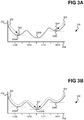
- FIG. 3A shows an example plot 300 of the negative integral ⁇ ⁇ dT dt dT along the y-axis 252 versus T in units K along the x-axis 204 that corresponds to two simulations of the state variable T in the absence of ambient thermal noise.
- FIG. 3B shows an example plot 350 of the negative integral ⁇ ⁇ dT dt dT along the y-axis 252 versus T in units K along the x-axis 204 that corresponds to two simulations of the state variable T in the presence of ambient thermal noise. That is, the plot 300 corresponds to simulation of the network 100 of FIG. 1 in an environment having ambient thermal noise, and the plot 350 corresponds to simulation of the network 100 in an environment lacking ambient thermal noise.
- the ambient thermal noise is represented by the ambient temperature T amb in equation (2).
- a first simulation has as its starting point an initial value of 300K for the state variable T
- a second simulation has as its starting point an initial value of 1,400 K for the state variable T.
- the applied constant bias constant i m may be one milliamp (mA).
- the temperature (i.e., the state variable) T in the first simulation ultimately decreases through an unstable point 302 until it reaches the local minimum 302' of the equilibrium 206A
- the temperature T in the second simulation ultimately decreases through an unstable point 304 until it reaches the local minimum 304' of the equilibrium 206C.
- the temperature T of the network 100 settles at one of the local minima in the absence of ambient thermal noise, corresponding to non-maximally optimal, local solutions to the global optimization problem to which the network 100 of FIG. 1 corresponds.
- the local minimum at which the temperature T settles in a simulation in the absence of ambient thermal noise depends on the initial value of this state variable when the simulation begins.
- the temperature T in the first simulation moves through the unstable point 302 and past the equilibrium 206A until it reaches the global minimum 352 of the equilibrium 206B.
- the temperature T in the second simulation moves through the unstable point 304 and past the equilibrium 206C until it reaches the global minimum 352. Therefore, the temperature of the network 100 settles at a global minimum in the presence of ambient thermal noise, corresponding to the maximally optimal global solution to the global optimization problem to which the network 100 of FIG. 1 .
- the temperature T settles at this global minimum in a simulation in the presence of ambient thermal noise regardless of the initial value of this state variable when the simulation begins.
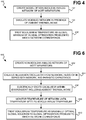
- FIG. 4 shows an example method 400 for solving a global optimization problem via simulation.
- the method 400 can be implemented as program code stored on a non-transitory computer-readable data storage medium and executed by a computing device having a processor and memory.
- the simulation can be achieved by using commercially available simulation software, or custom-developed simulation software.
- a model of a non-Boolean analog network 100 of Mott memristors 102 is created (402), in correspondence with the global optimization problem, as has been described in relation to FIG. 1 .
- each memristor 102 can be modeled as a quasi-static conduction equation (1), with temperature dynamics of each memristor 102 related to electrical power dissipation and thermal properties thereof using Newton's law of cooling, per equation (2).
- physical differences among the memristors 102 can be heuristically modeled using a temperature-coupled equation (3).
- the modeled network 100 is simulated in the presence of ambient thermal noise from a number of different starting temperatures, until the temperature of the network 100 settles at an equilibrium temperature during simulation (404).
- This equilibrium temperature of the network 100 is treated as the global minimum of the global optimization problem (406), and thus as the maximally optimal global solution to the problem.
- the global optimization problem can be solved via simulation of a non-Boolean analog network of Mott memristors in the presence of ambient thermal noise.
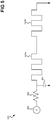
- FIG. 5 shows an example system 500 including the non-Boolean analog network 100 of the Mott memristors 102 of FIG. 1 .
- the network 100 can be created and subsequently simulated to solve a global optimization problem to which the network 100 corresponds, as has been described, the system 600 including the network 100 can be physically constructed in actuality and electrically excited to solve this problem. That is, upon construction and subsequent electrical excitation of the system 500 within an environment including ambient thermal noise, the temperature of the network 100 settles at an equilibrium temperature corresponding to a global minimum that is the maximally optimal global solution to the problem to which the network 100 corresponds.
- the system 500 in addition to the network 100 of the Mott memristors 102, includes a resistor 502 in series with the network 100, as well as an intrinsic parasitic capacitance 504.
- the resistor 502 is more generally a resistance
- the capacitance 504 is more generally is any type of capacitance coupled to the system 500.
- the inclusion of the resistor 502 and the consideration of the parasitic capacitance 504 render the system 500 operable as a relaxation oscillator.
- the relaxation oscillator is an experimental way by which the state variable (i.e., the temperature T) of equations (1), (2), and (3) can be varied over a wide range of values, corresponding to selecting a wide range of initial values for the state variable during simulation as in the method 400 of FIG. 4 .
- the system 500 is operable as a relaxation oscillator, oscillations are suppressed when an applied voltage 506 has a value to maintain the current of the system 500 between the negative resistance regions of the memristors 102.
- Such oscillation suppression corresponds to the effective trapping of the network 100 at the equilibrium 206B of FIGs. 2A, 2B , 3A, and 3B , which is the global minimum of the network 100.
- the resistor 502 may have a resistance of 2,000 ohms (two k ⁇ ), and a voltage 506 of about three volts (V) applied to realize a current of one mA.
- FIG. 6 shows an example method 600 for solving a global optimization problem via electrical excitation of the system 500 in an environment including ambient thermal noise. Electrical excitation in a different environment lacking ambient thermal noise does not result in a maximally optimal global solution to the problem to which the network 100 of the system 500 corresponds. This is because the absence of such ambient thermal noise results in the temperature of the network 100 settling at an equilibrium corresponding to a local minimum, as has been described, and not to the global minimum.
- a non-Boolean analog network 100 of Mott memristors 102 is created in correspondence with the global optimization problem (602).
- a relaxation oscillator is then created from this network 100, the resistor 502 in series with the network 100, and the parasitic capacitance 504 (604).
- the relaxation oscillator is electrically excited with the applied voltage 506 within an environment including ambient thermal noise (606), and the temperature of the network 100 monitored until it settles at an equilibrium temperature (608).
- This equilibrium temperature is treated as the maximally optimal global solution to the global optimization problem (610), and thus as the global minimum of the problem.
- the global optimization problem can be solved via actual physical construction and electrical excitation of a non-Boolean analog network of Mott memristors in an environment including ambient thermal noise.
- a network 100 including two Mott memristors 102 has been specifically described, but the network 100 can be extended to more than two memristors 102 to correspond to global optimization problems that have more than two local minima.
- the usage of such a network of Mott memristors along with ambient thermal noise to solve such a problem positively differs from other approaches, such as quantum computing, because the network can be operated at room temperature to solve the problem to which the network corresponds.
- quantum computing may require operation at temperatures that are near absolute zero, which results in significantly higher operational costs.
Landscapes
- Engineering & Computer Science (AREA)
- Physics & Mathematics (AREA)
- Theoretical Computer Science (AREA)
- Mathematical Physics (AREA)
- General Physics & Mathematics (AREA)
- Software Systems (AREA)
- Computer Hardware Design (AREA)
- Biophysics (AREA)
- Biomedical Technology (AREA)
- Health & Medical Sciences (AREA)
- Life Sciences & Earth Sciences (AREA)
- General Health & Medical Sciences (AREA)
- Molecular Biology (AREA)
- Computing Systems (AREA)
- General Engineering & Computer Science (AREA)
- Artificial Intelligence (AREA)
- Neurology (AREA)
- Computational Linguistics (AREA)
- Evolutionary Computation (AREA)
- Data Mining & Analysis (AREA)
- Semiconductor Integrated Circuits (AREA)
Abstract
Description
- Modern computing systems are typically digital computing systems. In a digital computing system, data is usually representable as one of two values, such as logic zero and logic one. Such digital computing systems can be referred to as Boolean computing systems.
-
-
FIG. 1 is a diagram of an example non-Boolean analog network that can be modeled in correspondence with a global optimization problem. -
FIG. 2A and 2B are diagrams of an example plot of the derivative of the temperature of the network ofFIG. 1 , and an example plot of the negative integral of this derivative, respectively. -
FIGs. 3A and 3B are diagrams of example plots of simulation of the network ofFIG. 1 in the absence and presence of ambient thermal noise, respectively. -
FIG. 4 is a flowchart of an example method for solving a global optimization problem via simulation of the network ofFIG. 1 in the presence of ambient thermal noise. -
FIG. 5 is a diagram of an example system including the network ofFIG. 1 . -
FIG. 6 is a flowchart of an example method for solving a global optimization problem via electrical excitation of the system ofFIG. 5 in an environment of ambient thermal noise. - As noted in the background section, computing systems are typically Boolean digital computing systems in which data is representable as one of two values. Processors of such computing systems have exponentially increased in computing power since their advent. Digital computing processors employ large numbers of transistors, and increases in raw computing power have resulted from ever-shrinking transistor size. It is widely postulated, however, that further increases in such computing power will slow or cease, because physical limits as to how small a transistor can be fabricated are being reached.
- As digital computing systems have increased in power, they have been used to solve computationally difficult problems. One set or class of problems, however, has proven to be difficult to solve via digital computing. This set of problems is known as the non-deterministic polynomial-time (NP)-hard or NP-complete set of problems. Mathematically, a problem H is in the NP set or class when every problem in L in NP can be reduced in polynomial time to H. It is suspected that there are no polynomial-time algorithms of the type by which a digital computing system can be programmed to yield complete solutions for NP problems.
- An example of an NP-hard problem is a global optimization problem. A global optimization problem has a global minimum that is the maximally optimal global solution to the problem, as well as one or more local minima that can appear to be solutions but in actuality are not maximally optimal. To attempt to solve a global optimization problem using a digital computing system, a large number of iterations of an approximating solving algorithm is run from different starting points, with the lowest determined solution presumed as the global minimum that is the actual maximally optimal solution to the problem.
- However, there is no guarantee that the lowest determined solution is indeed the global minimum and thus the actual solution to the global optimization problem, since the problem is NP hard. As such, digital computing systems are theoretically unable to provide a complete solution to a global optimization problem. Running a large number of iterations of the algorithm can yield a lowest determined solution that has a given likelihood to be the actual solution within a confidence level, with increasing (but never complete) confidence realized in correspondence with the number of iterations run. Since the raw computing power of digital computing systems is unlikely to improve greatly in the future, though, there is no guarantee that vastly higher confidence levels will be achieved for solutions to particularly difficult global optimization problems.
- Disclosed herein are techniques to solve a global optimization problem by determining a global minimum that is the maximally optimal global solution to the problem. The techniques leverage non-Boolean analog computing. A computing system is non-Boolean when data is representable as one of more than two values; a computing system is analog when data is representable as one of a potentially infinite number of values along a continuum.
- The techniques disclosed herein particularly leverage a non-Boolean analog Mott memristor network. A Mott insulator is a material that conducts electricity under conventional band theories, but are insulators when measured at low temperatures. A Mott memristor contains a Mott insulator and is also a memristor, which is a non-linear passive two-terminal electrical component that relates electrical charge with magnetic flux linkage. When a Mott memristor network corresponding to a global optimization problem is run or simulated in an environment including ambient thermal noise, the temperature of the network settles at an equilibrium corresponding to a global minimum that is the maximally optical global solution to the problem.
-
FIG. 1 shows an example non-Booleananalog network 100 that can be modeled in correspondence with a global optimization problem for subsequent simulation to provide a maximally optimal global solution to the problem. Thenetwork 100 includes two Mottmemristors - Each Mott memristor 102 can be a non-via niobium oxide (NbOX' where x is or approximates two) memristor. The memristors 102, however, differ from one another in that they have different values for at least one characteristic. The characteristic can be a physical characteristic, such as area or size, or an electrical characteristic, such as the resistance or current at which negative differential resistance occurs. The characteristic values for the memristors 102 are selected so that the
corresponding network 100 corresponds to a global optimization problem to be solved. For example, one way to program thenetwork 100 is by changing the ambient temperature of the different memristors 102 such that the energy profile of each undergoes a change depending on the applied temperature. - Each Mott memristor 102 can be modeled as a quasi-static conduction equation, in which temperature is a state variable of the equation. An example of such a quasi-state conduction equation is a modified three-dimensional Poole-Frenkel transport relation. Such a relation can be expressed mathematically as:

- In equation (1), im and vm are the current through the modeled memristor 102 and the voltage over this memristor 102, respectively. Furthermore, ω is a constant equal to 2.6 × 10⁻²⁴; A is the lateral device area of the modeled memristor 102; d is the thickness of the niobium oxide layer of the memristor 102; kB is the Boltzmann constant, which is 8.617 × 10⁻⁵ electron-volts (eV); and T is the temperature of the memristor 102 in kelvin (K).
- The temperature dynamics of each Mott memristor 102 can be modeled so that its temperature dynamics relate to electrical power dissipation and thermal properties thereof by Newton's law of cooling. Newton's law of cooling can be expressed mathematically as:

- In equation (2), Tamb is the ambient temperature of the environment in which the
network 100 is operating, such as 300 K; Cth is the thermal capacitance of the modeled memristor 102, such as 10-16 watt-seconds per K (Ws/K); and Rth is the temperature-dependent effective thermal resistance of the memristor 102. Furthermore, the approximation η(t) can be
- The physical differences between the Mott memristors 102 of the
network 100 can then be heuristically modeled using a temperature-coupled equation. An example of such an equation is:
- In equation (3), Rth (T) is the thermal resistance of the
network 100 as a whole at temperature T; Rth (T 0) is the thermal resistance of thenetwork 100 at an initial temperature T 0 ; and J 1 and J 2 are two jumps (J) in Rth at respective temperatures T C1 and T C1' where each jump represents a Mott transition of the memristors 102. Furthermore, erf(i) is an error function to smooth the jumps in Rth. An example error function is the Gauss error function, which is of sigmoid shape. In equations (1), (2), and (3), the temperature T can be considered a state variable. -
FIG. 2A shows anexample plot 200 of the derivative dT/dt in units of K/nanosecond (K/ns) along the y-axis 202 versus T in units K along thex-axis 204 that is obtained by solving equation (3) using equations (2) and (1).FIG. 2B shows anexample plot 250 of the negative integral
axis 252 in units of K 2 / picosecond (K 2 / ps), which is the differential equation in T. This negative integral is the quantity - a smooth non-convex function - that is minimized to obtain a most optimal (i.e., most stable) steady-state solution of equation (3). Therefore, it corresponds to a potential energy landscape of thenetwork 100 ofFIG. 1 , although it is not a measure of energy. - In
FIGs. 2A and 2B , there are threestable equilibria network 100 once any equilibrium 206 has been reached results in thenetwork 100 again settling at the equilibrium 206 in question. Theequilibria plot 250 ofFIG. 2B , whereas theequilibrium 206B is a global minimum of theplot 250. The local minimum of eachequilibria network 100 ofFIG. 1 corresponds. By comparison, the global minimum of theequilibrium 206B corresponds to a maximally optimal global solution to the global optimization problem. - Furthermore, in
FIGs. 2A and 2B , there are twounstable equilibria network 100 ofFIG. 1 once any equilibrium 208 has been reached does not in thenetwork 100 again settling at the equilibrium 208 in question. Rather, any slight perturbation of thenetwork 100 once any equilibrium 208 has been reached results in thenetwork 100 settling at one of the stable equilibria 206. -
FIG. 3A shows anexample plot 300 of the negative integral
axis 252 versus T in units K along thex-axis 204 that corresponds to two simulations of the state variable T in the absence of ambient thermal noise.FIG. 3B shows an example plot 350 of the negative integral
axis 252 versus T in units K along thex-axis 204 that corresponds to two simulations of the state variable T in the presence of ambient thermal noise. That is, theplot 300 corresponds to simulation of thenetwork 100 ofFIG. 1 in an environment having ambient thermal noise, and the plot 350 corresponds to simulation of thenetwork 100 in an environment lacking ambient thermal noise. The ambient thermal noise is represented by the ambient temperature Tamb in equation (2). - In
FIGs. 3A and 3B , a first simulation has as its starting point an initial value of 300K for the state variable T, whereas a second simulation has as its starting point an initial value of 1,400 K for the state variable T. In both simulations, the applied constant bias constant im may be one milliamp (mA). InFIG. 3A , the temperature (i.e., the state variable) T in the first simulation ultimately decreases through anunstable point 302 until it reaches the local minimum 302' of theequilibrium 206A, and the temperature T in the second simulation ultimately decreases through anunstable point 304 until it reaches the local minimum 304' of theequilibrium 206C. Therefore, the temperature T of thenetwork 100 settles at one of the local minima in the absence of ambient thermal noise, corresponding to non-maximally optimal, local solutions to the global optimization problem to which thenetwork 100 ofFIG. 1 corresponds. The local minimum at which the temperature T settles in a simulation in the absence of ambient thermal noise depends on the initial value of this state variable when the simulation begins. - By comparison, in
FIG. 3B , the temperature T in the first simulation moves through theunstable point 302 and past theequilibrium 206A until it reaches theglobal minimum 352 of theequilibrium 206B. Likewise, the temperature T in the second simulation moves through theunstable point 304 and past theequilibrium 206C until it reaches theglobal minimum 352. Therefore, the temperature of thenetwork 100 settles at a global minimum in the presence of ambient thermal noise, corresponding to the maximally optimal global solution to the global optimization problem to which thenetwork 100 ofFIG. 1 . The temperature T settles at this global minimum in a simulation in the presence of ambient thermal noise regardless of the initial value of this state variable when the simulation begins. -
FIG. 4 shows anexample method 400 for solving a global optimization problem via simulation. Themethod 400 can be implemented as program code stored on a non-transitory computer-readable data storage medium and executed by a computing device having a processor and memory. The simulation can be achieved by using commercially available simulation software, or custom-developed simulation software. - A model of a
non-Boolean analog network 100 of Mott memristors 102 is created (402), in correspondence with the global optimization problem, as has been described in relation toFIG. 1 . As such, each memristor 102 can be modeled as a quasi-static conduction equation (1), with temperature dynamics of each memristor 102 related to electrical power dissipation and thermal properties thereof using Newton's law of cooling, per equation (2). Similarly, physical differences among the memristors 102 can be heuristically modeled using a temperature-coupled equation (3). - The modeled
network 100 is simulated in the presence of ambient thermal noise from a number of different starting temperatures, until the temperature of thenetwork 100 settles at an equilibrium temperature during simulation (404). This equilibrium temperature of thenetwork 100 is treated as the global minimum of the global optimization problem (406), and thus as the maximally optimal global solution to the problem. In this way, the global optimization problem can be solved via simulation of a non-Boolean analog network of Mott memristors in the presence of ambient thermal noise. -
FIG. 5 shows anexample system 500 including thenon-Boolean analog network 100 of the Mott memristors 102 ofFIG. 1 . Whereas thenetwork 100 can be created and subsequently simulated to solve a global optimization problem to which thenetwork 100 corresponds, as has been described, thesystem 600 including thenetwork 100 can be physically constructed in actuality and electrically excited to solve this problem. That is, upon construction and subsequent electrical excitation of thesystem 500 within an environment including ambient thermal noise, the temperature of thenetwork 100 settles at an equilibrium temperature corresponding to a global minimum that is the maximally optimal global solution to the problem to which thenetwork 100 corresponds. - The
system 500, in addition to thenetwork 100 of the Mott memristors 102, includes aresistor 502 in series with thenetwork 100, as well as an intrinsicparasitic capacitance 504. Theresistor 502 is more generally a resistance, and thecapacitance 504 is more generally is any type of capacitance coupled to thesystem 500. The inclusion of theresistor 502 and the consideration of theparasitic capacitance 504 render thesystem 500 operable as a relaxation oscillator. The relaxation oscillator is an experimental way by which the state variable (i.e., the temperature T) of equations (1), (2), and (3) can be varied over a wide range of values, corresponding to selecting a wide range of initial values for the state variable during simulation as in themethod 400 ofFIG. 4 . - Although the
system 500 is operable as a relaxation oscillator, oscillations are suppressed when anapplied voltage 506 has a value to maintain the current of thesystem 500 between the negative resistance regions of the memristors 102. Such oscillation suppression corresponds to the effective trapping of thenetwork 100 at theequilibrium 206B ofFIGs. 2A, 2B ,3A, and 3B , which is the global minimum of thenetwork 100. As one example, theresistor 502 may have a resistance of 2,000 ohms (two kΩ), and avoltage 506 of about three volts (V) applied to realize a current of one mA. -
FIG. 6 shows anexample method 600 for solving a global optimization problem via electrical excitation of thesystem 500 in an environment including ambient thermal noise. Electrical excitation in a different environment lacking ambient thermal noise does not result in a maximally optimal global solution to the problem to which thenetwork 100 of thesystem 500 corresponds. This is because the absence of such ambient thermal noise results in the temperature of thenetwork 100 settling at an equilibrium corresponding to a local minimum, as has been described, and not to the global minimum. - A
non-Boolean analog network 100 of Mott memristors 102 is created in correspondence with the global optimization problem (602). A relaxation oscillator is then created from thisnetwork 100, theresistor 502 in series with thenetwork 100, and the parasitic capacitance 504 (604). The relaxation oscillator is electrically excited with the appliedvoltage 506 within an environment including ambient thermal noise (606), and the temperature of thenetwork 100 monitored until it settles at an equilibrium temperature (608). This equilibrium temperature is treated as the maximally optimal global solution to the global optimization problem (610), and thus as the global minimum of the problem. In this way, the global optimization problem can be solved via actual physical construction and electrical excitation of a non-Boolean analog network of Mott memristors in an environment including ambient thermal noise. - The techniques that have been described therefore leverage usage of a non-Boolean analog Mott memristor network to solve global optimization problems when ambient thermal noise is considered. A
network 100 including two Mott memristors 102 has been specifically described, but thenetwork 100 can be extended to more than two memristors 102 to correspond to global optimization problems that have more than two local minima. Furthermore, the usage of such a network of Mott memristors along with ambient thermal noise to solve such a problem positively differs from other approaches, such as quantum computing, because the network can be operated at room temperature to solve the problem to which the network corresponds. By comparison, quantum computing may require operation at temperatures that are near absolute zero, which results in significantly higher operational costs.
Claims (15)
- A non-Boolean analog system comprising:a first Mott memristor having a first value of a characteristic;a second Mott memristor having a second value of the characteristic different than the first value, in series with the first Mott memristor to form a network; anda resistance in series with the network and that, together with the network and a capacitance coupled to the system, renders the system operable as a relaxation oscillator,wherein responsive to electrical excitation of the system within an environment including ambient thermal noise, a temperature of the network settles at an equilibrium corresponding to a global minimum that is a maximally optimal global solution to a global optimization problem to which the network corresponds.
- The non-Boolean analog system of claim 1, wherein the global optimization problem has a plurality of local solutions that are not maximally optimal, and, optionally, wherein responsive to the electrical excitation of the system within a different environment lacking the ambient thermal noise, the temperature of the network settles at a different equilibrium corresponding to one of the local solutions that are not maximally optimal.
- The non-Boolean analog system of claim 1, wherein the characteristic comprises one or more of a physical characteristic and an electrical characteristic.
- The non-Boolean analog system of claim 3, wherein the physical characteristic comprises one or more of area and size and/or wherein the electrical characteristic comprises one or more of resistance and current at which negative differential resistance occurs.
- The non-Boolean analog system of claim 1, wherein to reach the maximally optimal global solution, each Mott memristor is modeled as a quasi-static conduction equation in which temperature is a state variable of the equation.
- The non-Boolean analog system of claim 5, wherein the quasi-static conduction equation comprises a modified three-dimensional Poole-Frenkel transport relation.
- The non-Boolean analog system of claim 5, wherein to reach the maximally optimal global solution, temperature dynamics of each Mott memristor is further related to electrical power dissipation and thermal properties thereof by Newton's law of cooling and, optionally, wherein each Mott memristor has a plurality of Mott transitions between conductivity and non-conductivity at different temperatures,
and wherein to reach the maximally optimal global solution, physical differences between the Mott memristors are heuristically modeled using a temperature-coupled equation. - A method comprising:creating in correspondence with a global optimization problem a non-Boolean analog network including a plurality of Mott memristors that have different values for a characteristic, and a capacitance, the network operable as a relaxation oscillator;creating a relaxation oscillator from the network, a resistance in series with the network, and the capacitance;electrically exciting the relaxation oscillator the network within an environment including ambient thermal noise;monitoring a temperature of the network until the temperature settles at an equilibrium temperature; andtreating the equilibrium temperature of the network as a maximally optimal global solution to the global optimization problem.
- The method of claim 8, wherein the global optimization problem has a plurality of local solutions that are not maximally optimal,
wherein electrically exciting the relaxation oscillator within a different environment lacking the ambient thermal noise causes the temperature of the network to settle at a different equilibrium temperature corresponding to a non-maximally optimal global solution to the global optimization problem. - The method of claim 8, wherein creating the non-Boolean analog network comprises specifying the characteristic of which each Mott memristor has a different value as one or more of: a physical size of the memristor, a physical area of the memristor, a resistance of the memristor, and a current at which negative differential resistance of the memristor occurs and/or wherein electrically exciting the relaxation oscillator comprises applying a voltage corresponding to a current among negative differential resistance regions of the Mott memristors at which oscillation of the network is suppressed.
- The method of claim 8, wherein the maximally optimal global solution is a global minimum of the global optimization problem.
- A non-transitory computer-readable data storage medium storing program code that a computing device executes to:create a model of a non-Boolean analog network of a plurality of Mott memristors that have different values for a characteristic, in correspondence with a global optimization problem;simulate the modeled network in presence of ambient thermal noise from a plurality of different starting temperatures, until a temperature of the network settles at an equilibrium temperature; andtreat the equilibrium temperature of the network as a global minimum of the global optimization problem.
- The non-transitory computer-readable data storage medium of claim 12, wherein the global optimization problem has a plurality of local solutions that are not maximally optimal,
wherein simulation of the modeled network within in absence of the thermal noise causes the temperature of the network to settle at a different equilibrium temperature corresponding to a local minimum of the global optimization problem. - The non-transitory computer-readable data storage medium of claim 12, the computing device executes the program code to the model of the network by:modeling each memristor as a quasi-static conduction equation in which temperature is a state variable of the equation, and as having a plurality of Mott transitions between conductivity and non-conductivity at different temperatures;relating temperature dynamics of each Mott memristor to electrical power dissipation and thermal properties thereof by Newton's law of cooling; andheuristically modeling physical differences among the Mott memristors using a temperature-coupled equation.
- The non-transitory computer-readable data storage medium of claim 12, wherein the global minimum is a maximally optimal global solution to the global optimization problem.
Applications Claiming Priority (1)
| Application Number | Priority Date | Filing Date | Title |
|---|---|---|---|
| US15/664,058 US10885430B2 (en) | 2017-07-31 | 2017-07-31 | Non-Boolean analog Mott memristor network |
Publications (2)
| Publication Number | Publication Date |
|---|---|
| EP3454388A1 true EP3454388A1 (en) | 2019-03-13 |
| EP3454388B1 EP3454388B1 (en) | 2020-05-13 |
Family
ID=63259377
Family Applications (1)
| Application Number | Title | Priority Date | Filing Date |
|---|---|---|---|
| EP18186634.4A Active EP3454388B1 (en) | 2017-07-31 | 2018-07-31 | Non-boolean analog mott memristor network |
Country Status (2)
| Country | Link |
|---|---|
| US (1) | US10885430B2 (en) |
| EP (1) | EP3454388B1 (en) |
Families Citing this family (2)
| Publication number | Priority date | Publication date | Assignee | Title |
|---|---|---|---|---|
| CN115130411B (en) * | 2022-07-14 | 2024-07-30 | 电子科技大学 | A real-time reconfigurable universal memristor simulation method based on FPGA and DAC |
| CN116013385A (en) * | 2023-02-11 | 2023-04-25 | 陕西格芯国微半导体科技有限公司 | A dual-mode common-electrode memristor and its application |
Citations (4)
| Publication number | Priority date | Publication date | Assignee | Title |
|---|---|---|---|---|
| US20060271342A1 (en) * | 2005-05-27 | 2006-11-30 | Trustees Of The University Of Pennsylvania | Cort_x: a dynamic brain model |
| US20140214738A1 (en) * | 2013-01-29 | 2014-07-31 | Hewlett-Packard Development Company, L.P. | Neuristor-based reservoir computing devices |
| WO2016072964A1 (en) * | 2014-11-03 | 2016-05-12 | Hewlett Packard Enterprise Development Lp | Device with multiple resistance switches with different switching characteristics |
| US20170098155A1 (en) * | 2015-10-06 | 2017-04-06 | Institut National De La Recherche Scientifique (Inrs) | Self-organized solid-state synthetic neuronal structure |
Family Cites Families (5)
| Publication number | Priority date | Publication date | Assignee | Title |
|---|---|---|---|---|
| EP2133829A1 (en) | 2008-06-10 | 2009-12-16 | Integrative Biocomputing S.a.r.l. | Simulation of complex systems |
| US8324976B2 (en) * | 2011-04-01 | 2012-12-04 | Hewlett-Packard Development Company, L.P. | Oscillator circuitry having negative differential resistance |
| US10153729B2 (en) * | 2016-04-28 | 2018-12-11 | Hewlett Packard Enterprise Development Lp | Nano-scale oscillator exhibiting chaotic oscillation |
| US10497872B2 (en) * | 2016-10-21 | 2019-12-03 | Hewlett Packard Enterprise Development Lp | Negative differential resistance devices |
| US10541274B2 (en) * | 2017-01-26 | 2020-01-21 | Hrl Laboratories, Llc | Scalable, stackable, and BEOL-process compatible integrated neuron circuit |
-
2017
- 2017-07-31 US US15/664,058 patent/US10885430B2/en active Active
-
2018
- 2018-07-31 EP EP18186634.4A patent/EP3454388B1/en active Active
Patent Citations (4)
| Publication number | Priority date | Publication date | Assignee | Title |
|---|---|---|---|---|
| US20060271342A1 (en) * | 2005-05-27 | 2006-11-30 | Trustees Of The University Of Pennsylvania | Cort_x: a dynamic brain model |
| US20140214738A1 (en) * | 2013-01-29 | 2014-07-31 | Hewlett-Packard Development Company, L.P. | Neuristor-based reservoir computing devices |
| WO2016072964A1 (en) * | 2014-11-03 | 2016-05-12 | Hewlett Packard Enterprise Development Lp | Device with multiple resistance switches with different switching characteristics |
| US20170098155A1 (en) * | 2015-10-06 | 2017-04-06 | Institut National De La Recherche Scientifique (Inrs) | Self-organized solid-state synthetic neuronal structure |
Non-Patent Citations (1)
| Title |
|---|
| MATTHEW D. PICKETT ET AL: "A scalable neuristor built with Mott memristors (w/ supplementary information)", NATURE MATERIALS, vol. 12, no. 2, 16 December 2012 (2012-12-16), pages 114 - 117, XP055110620, ISSN: 1476-1122, DOI: 10.1038/nmat3510 * |
Also Published As
| Publication number | Publication date |
|---|---|
| US10885430B2 (en) | 2021-01-05 |
| US20190034789A1 (en) | 2019-01-31 |
| EP3454388B1 (en) | 2020-05-13 |
Similar Documents
| Publication | Publication Date | Title |
|---|---|---|
| Amer et al. | A practical hafnium-oxide memristor model suitable for circuit design and simulation | |
| Zidan et al. | A family of memristor‐based reactance‐less oscillators | |
| Yang et al. | Online approximate optimal control for affine non‐linear systems with unknown internal dynamics using adaptive dynamic programming | |
| Christiano et al. | Electrical flows, laplacian systems, and faster approximation of maximum flow in undirected graphs | |
| Li et al. | Dissipativity analysis of memristive neural networks with time‐varying delays and randomly occurring uncertainties | |
| Li et al. | Almost sure stability of Markov jump systems with persistent dwell time switching | |
| EP3454388B1 (en) | Non-boolean analog mott memristor network | |
| Wan et al. | Dynamic Analysis and Circuit Realization of a Novel No‐Equilibrium 5D Memristive Hyperchaotic System with Hidden Extreme Multistability | |
| Messaris et al. | A simplified model for a NbO 2 Mott memristor physical realization | |
| Wang et al. | A New Memristor‐Based 5D Chaotic System and Circuit Implementation | |
| Li et al. | The generation, analysis, and circuit implementation of a new memristor based chaotic system | |
| US20170317646A1 (en) | Nano-scale oscillator exhibiting chaotic oscillation | |
| Amirsoleimani et al. | Accurate charge transport model for nanoionic memristive devices | |
| Zhu et al. | A versatile and accurate compact model of memristor with equivalent resistor topology | |
| Sarmiento-Reyes et al. | A fully symbolic homotopy-based memristor model for applications to circuit simulation | |
| Qiqiao et al. | An improved multi-innovation error compensation-long-short-term memory network modeling method for high-precision state of charge estimation of lithium-ion batteries | |
| Mokhtar et al. | Re-model fabricated memristor behavior in LT-SPICE and applied in logic circuit | |
| Gale | Non‐ideal memristors for a non‐ideal world | |
| US12288017B2 (en) | Simulation method for characteristics of transistor, simulation method for characteristics of electronic circuit including transistor, and nontransitory recording medium that stores simulation program for characteristics of transistor | |
| Reddy et al. | A SPICE compact model for forming-free, low-power graphene-insulator-graphene ReRAM technology | |
| Mu et al. | The extended linear-drift model of memristor and its piecewise linear approximation | |
| Shi et al. | Pinched Hysteresis Loop Characteristics of a Fractional-Order HP memristor | |
| Hernández-Mejía et al. | A novel modeling methodology for memristive systems using homotopy perturbation methods | |
| Vourkas et al. | Memristor modeling | |
| Garda et al. | Modelling the generic TiO 2 memristor with the parasitic components |
Legal Events
| Date | Code | Title | Description |
|---|---|---|---|
| PUAI | Public reference made under article 153(3) epc to a published international application that has entered the european phase |
Free format text: ORIGINAL CODE: 0009012 |
|
| STAA | Information on the status of an ep patent application or granted ep patent |
Free format text: STATUS: THE APPLICATION HAS BEEN PUBLISHED |
|
| AK | Designated contracting states |
Kind code of ref document: A1 Designated state(s): AL AT BE BG CH CY CZ DE DK EE ES FI FR GB GR HR HU IE IS IT LI LT LU LV MC MK MT NL NO PL PT RO RS SE SI SK SM TR |
|
| AX | Request for extension of the european patent |
Extension state: BA ME |
|
| STAA | Information on the status of an ep patent application or granted ep patent |
Free format text: STATUS: REQUEST FOR EXAMINATION WAS MADE |
|
| 17P | Request for examination filed |
Effective date: 20190716 |
|
| RBV | Designated contracting states (corrected) |
Designated state(s): AL AT BE BG CH CY CZ DE DK EE ES FI FR GB GR HR HU IE IS IT LI LT LU LV MC MK MT NL NO PL PT RO RS SE SI SK SM TR |
|
| RIC1 | Information provided on ipc code assigned before grant |
Ipc: H01L 45/00 20060101AFI20190924BHEP Ipc: G06G 7/122 20060101ALI20190924BHEP Ipc: H01L 49/00 20060101ALI20190924BHEP |
|
| GRAJ | Information related to disapproval of communication of intention to grant by the applicant or resumption of examination proceedings by the epo deleted |
Free format text: ORIGINAL CODE: EPIDOSDIGR1 |
|
| GRAP | Despatch of communication of intention to grant a patent |
Free format text: ORIGINAL CODE: EPIDOSNIGR1 |
|
| GRAP | Despatch of communication of intention to grant a patent |
Free format text: ORIGINAL CODE: EPIDOSNIGR1 |
|
| STAA | Information on the status of an ep patent application or granted ep patent |
Free format text: STATUS: GRANT OF PATENT IS INTENDED |
|
| INTG | Intention to grant announced |
Effective date: 20191204 |
|
| GRAS | Grant fee paid |
Free format text: ORIGINAL CODE: EPIDOSNIGR3 |
|
| GRAA | (expected) grant |
Free format text: ORIGINAL CODE: 0009210 |
|
| STAA | Information on the status of an ep patent application or granted ep patent |
Free format text: STATUS: THE PATENT HAS BEEN GRANTED |
|
| AK | Designated contracting states |
Kind code of ref document: B1 Designated state(s): AL AT BE BG CH CY CZ DE DK EE ES FI FR GB GR HR HU IE IS IT LI LT LU LV MC MK MT NL NO PL PT RO RS SE SI SK SM TR |
|
| REG | Reference to a national code |
Ref country code: GB Ref legal event code: FG4D |
|
| REG | Reference to a national code |
Ref country code: CH Ref legal event code: EP |
|
| REG | Reference to a national code |
Ref country code: DE Ref legal event code: R096 Ref document number: 602018004472 Country of ref document: DE |
|
| REG | Reference to a national code |
Ref country code: AT Ref legal event code: REF Ref document number: 1271387 Country of ref document: AT Kind code of ref document: T Effective date: 20200615 |
|
| REG | Reference to a national code |
Ref country code: LT Ref legal event code: MG4D |
|
| REG | Reference to a national code |
Ref country code: NL Ref legal event code: MP Effective date: 20200513 |
|
| PG25 | Lapsed in a contracting state [announced via postgrant information from national office to epo] |
Ref country code: PT Free format text: LAPSE BECAUSE OF FAILURE TO SUBMIT A TRANSLATION OF THE DESCRIPTION OR TO PAY THE FEE WITHIN THE PRESCRIBED TIME-LIMIT Effective date: 20200914 Ref country code: IS Free format text: LAPSE BECAUSE OF FAILURE TO SUBMIT A TRANSLATION OF THE DESCRIPTION OR TO PAY THE FEE WITHIN THE PRESCRIBED TIME-LIMIT Effective date: 20200913 Ref country code: NO Free format text: LAPSE BECAUSE OF FAILURE TO SUBMIT A TRANSLATION OF THE DESCRIPTION OR TO PAY THE FEE WITHIN THE PRESCRIBED TIME-LIMIT Effective date: 20200813 Ref country code: GR Free format text: LAPSE BECAUSE OF FAILURE TO SUBMIT A TRANSLATION OF THE DESCRIPTION OR TO PAY THE FEE WITHIN THE PRESCRIBED TIME-LIMIT Effective date: 20200814 Ref country code: FI Free format text: LAPSE BECAUSE OF FAILURE TO SUBMIT A TRANSLATION OF THE DESCRIPTION OR TO PAY THE FEE WITHIN THE PRESCRIBED TIME-LIMIT Effective date: 20200513 Ref country code: SE Free format text: LAPSE BECAUSE OF FAILURE TO SUBMIT A TRANSLATION OF THE DESCRIPTION OR TO PAY THE FEE WITHIN THE PRESCRIBED TIME-LIMIT Effective date: 20200513 Ref country code: LT Free format text: LAPSE BECAUSE OF FAILURE TO SUBMIT A TRANSLATION OF THE DESCRIPTION OR TO PAY THE FEE WITHIN THE PRESCRIBED TIME-LIMIT Effective date: 20200513 |
|
| PG25 | Lapsed in a contracting state [announced via postgrant information from national office to epo] |
Ref country code: BG Free format text: LAPSE BECAUSE OF FAILURE TO SUBMIT A TRANSLATION OF THE DESCRIPTION OR TO PAY THE FEE WITHIN THE PRESCRIBED TIME-LIMIT Effective date: 20200813 Ref country code: HR Free format text: LAPSE BECAUSE OF FAILURE TO SUBMIT A TRANSLATION OF THE DESCRIPTION OR TO PAY THE FEE WITHIN THE PRESCRIBED TIME-LIMIT Effective date: 20200513 Ref country code: RS Free format text: LAPSE BECAUSE OF FAILURE TO SUBMIT A TRANSLATION OF THE DESCRIPTION OR TO PAY THE FEE WITHIN THE PRESCRIBED TIME-LIMIT Effective date: 20200513 Ref country code: LV Free format text: LAPSE BECAUSE OF FAILURE TO SUBMIT A TRANSLATION OF THE DESCRIPTION OR TO PAY THE FEE WITHIN THE PRESCRIBED TIME-LIMIT Effective date: 20200513 |
|
| REG | Reference to a national code |
Ref country code: AT Ref legal event code: MK05 Ref document number: 1271387 Country of ref document: AT Kind code of ref document: T Effective date: 20200513 |
|
| PG25 | Lapsed in a contracting state [announced via postgrant information from national office to epo] |
Ref country code: AL Free format text: LAPSE BECAUSE OF FAILURE TO SUBMIT A TRANSLATION OF THE DESCRIPTION OR TO PAY THE FEE WITHIN THE PRESCRIBED TIME-LIMIT Effective date: 20200513 Ref country code: NL Free format text: LAPSE BECAUSE OF FAILURE TO SUBMIT A TRANSLATION OF THE DESCRIPTION OR TO PAY THE FEE WITHIN THE PRESCRIBED TIME-LIMIT Effective date: 20200513 |
|
| PG25 | Lapsed in a contracting state [announced via postgrant information from national office to epo] |
Ref country code: AT Free format text: LAPSE BECAUSE OF FAILURE TO SUBMIT A TRANSLATION OF THE DESCRIPTION OR TO PAY THE FEE WITHIN THE PRESCRIBED TIME-LIMIT Effective date: 20200513 Ref country code: EE Free format text: LAPSE BECAUSE OF FAILURE TO SUBMIT A TRANSLATION OF THE DESCRIPTION OR TO PAY THE FEE WITHIN THE PRESCRIBED TIME-LIMIT Effective date: 20200513 Ref country code: SM Free format text: LAPSE BECAUSE OF FAILURE TO SUBMIT A TRANSLATION OF THE DESCRIPTION OR TO PAY THE FEE WITHIN THE PRESCRIBED TIME-LIMIT Effective date: 20200513 Ref country code: DK Free format text: LAPSE BECAUSE OF FAILURE TO SUBMIT A TRANSLATION OF THE DESCRIPTION OR TO PAY THE FEE WITHIN THE PRESCRIBED TIME-LIMIT Effective date: 20200513 Ref country code: RO Free format text: LAPSE BECAUSE OF FAILURE TO SUBMIT A TRANSLATION OF THE DESCRIPTION OR TO PAY THE FEE WITHIN THE PRESCRIBED TIME-LIMIT Effective date: 20200513 Ref country code: IT Free format text: LAPSE BECAUSE OF FAILURE TO SUBMIT A TRANSLATION OF THE DESCRIPTION OR TO PAY THE FEE WITHIN THE PRESCRIBED TIME-LIMIT Effective date: 20200513 Ref country code: CZ Free format text: LAPSE BECAUSE OF FAILURE TO SUBMIT A TRANSLATION OF THE DESCRIPTION OR TO PAY THE FEE WITHIN THE PRESCRIBED TIME-LIMIT Effective date: 20200513 Ref country code: ES Free format text: LAPSE BECAUSE OF FAILURE TO SUBMIT A TRANSLATION OF THE DESCRIPTION OR TO PAY THE FEE WITHIN THE PRESCRIBED TIME-LIMIT Effective date: 20200513 |
|
| REG | Reference to a national code |
Ref country code: DE Ref legal event code: R097 Ref document number: 602018004472 Country of ref document: DE |
|
| PG25 | Lapsed in a contracting state [announced via postgrant information from national office to epo] |
Ref country code: MC Free format text: LAPSE BECAUSE OF FAILURE TO SUBMIT A TRANSLATION OF THE DESCRIPTION OR TO PAY THE FEE WITHIN THE PRESCRIBED TIME-LIMIT Effective date: 20200513 Ref country code: PL Free format text: LAPSE BECAUSE OF FAILURE TO SUBMIT A TRANSLATION OF THE DESCRIPTION OR TO PAY THE FEE WITHIN THE PRESCRIBED TIME-LIMIT Effective date: 20200513 Ref country code: SK Free format text: LAPSE BECAUSE OF FAILURE TO SUBMIT A TRANSLATION OF THE DESCRIPTION OR TO PAY THE FEE WITHIN THE PRESCRIBED TIME-LIMIT Effective date: 20200513 |
|
| PLBE | No opposition filed within time limit |
Free format text: ORIGINAL CODE: 0009261 |
|
| STAA | Information on the status of an ep patent application or granted ep patent |
Free format text: STATUS: NO OPPOSITION FILED WITHIN TIME LIMIT |
|
| 26N | No opposition filed |
Effective date: 20210216 |
|
| REG | Reference to a national code |
Ref country code: BE Ref legal event code: MM Effective date: 20200731 |
|
| PG25 | Lapsed in a contracting state [announced via postgrant information from national office to epo] |
Ref country code: LU Free format text: LAPSE BECAUSE OF NON-PAYMENT OF DUE FEES Effective date: 20200731 Ref country code: FR Free format text: LAPSE BECAUSE OF NON-PAYMENT OF DUE FEES Effective date: 20200731 |
|
| PG25 | Lapsed in a contracting state [announced via postgrant information from national office to epo] |
Ref country code: BE Free format text: LAPSE BECAUSE OF NON-PAYMENT OF DUE FEES Effective date: 20200731 Ref country code: SI Free format text: LAPSE BECAUSE OF FAILURE TO SUBMIT A TRANSLATION OF THE DESCRIPTION OR TO PAY THE FEE WITHIN THE PRESCRIBED TIME-LIMIT Effective date: 20200513 |
|
| PG25 | Lapsed in a contracting state [announced via postgrant information from national office to epo] |
Ref country code: IE Free format text: LAPSE BECAUSE OF NON-PAYMENT OF DUE FEES Effective date: 20200731 |
|
| REG | Reference to a national code |
Ref country code: CH Ref legal event code: PL |
|
| PG25 | Lapsed in a contracting state [announced via postgrant information from national office to epo] |
Ref country code: LI Free format text: LAPSE BECAUSE OF NON-PAYMENT OF DUE FEES Effective date: 20210731 Ref country code: CH Free format text: LAPSE BECAUSE OF NON-PAYMENT OF DUE FEES Effective date: 20210731 |
|
| PG25 | Lapsed in a contracting state [announced via postgrant information from national office to epo] |
Ref country code: TR Free format text: LAPSE BECAUSE OF FAILURE TO SUBMIT A TRANSLATION OF THE DESCRIPTION OR TO PAY THE FEE WITHIN THE PRESCRIBED TIME-LIMIT Effective date: 20200513 Ref country code: MT Free format text: LAPSE BECAUSE OF FAILURE TO SUBMIT A TRANSLATION OF THE DESCRIPTION OR TO PAY THE FEE WITHIN THE PRESCRIBED TIME-LIMIT Effective date: 20200513 Ref country code: CY Free format text: LAPSE BECAUSE OF FAILURE TO SUBMIT A TRANSLATION OF THE DESCRIPTION OR TO PAY THE FEE WITHIN THE PRESCRIBED TIME-LIMIT Effective date: 20200513 |
|
| PG25 | Lapsed in a contracting state [announced via postgrant information from national office to epo] |
Ref country code: MK Free format text: LAPSE BECAUSE OF FAILURE TO SUBMIT A TRANSLATION OF THE DESCRIPTION OR TO PAY THE FEE WITHIN THE PRESCRIBED TIME-LIMIT Effective date: 20200513 |
|
| REG | Reference to a national code |
Ref country code: DE Ref legal event code: R082 Ref document number: 602018004472 Country of ref document: DE Representative=s name: FLEUCHAUS & GALLO PARTNERSCHAFT MBB - PATENT- , DE Ref country code: DE Ref legal event code: R082 Ref document number: 602018004472 Country of ref document: DE Representative=s name: FLEUCHAUS & GALLO PARTNERSCHAFT MBB PATENTANWA, DE |
|
| REG | Reference to a national code |
Ref country code: DE Ref legal event code: R079 Ref document number: 602018004472 Country of ref document: DE Free format text: PREVIOUS MAIN CLASS: H01L0045000000 Ipc: H10N0070000000 |
|
| PGFP | Annual fee paid to national office [announced via postgrant information from national office to epo] |
Ref country code: DE Payment date: 20250728 Year of fee payment: 8 |
|
| PGFP | Annual fee paid to national office [announced via postgrant information from national office to epo] |
Ref country code: GB Payment date: 20250722 Year of fee payment: 8 |