EP3453411A1 - Endovascular device configured for controlled shape memory deployment in a body vessel - Google Patents
Endovascular device configured for controlled shape memory deployment in a body vessel Download PDFInfo
- Publication number
- EP3453411A1 EP3453411A1 EP18275128.9A EP18275128A EP3453411A1 EP 3453411 A1 EP3453411 A1 EP 3453411A1 EP 18275128 A EP18275128 A EP 18275128A EP 3453411 A1 EP3453411 A1 EP 3453411A1
- Authority
- EP
- European Patent Office
- Prior art keywords
- temperature
- structural element
- endovascular device
- heating
- nitinol structural
- Prior art date
- Legal status (The legal status is an assumption and is not a legal conclusion. Google has not performed a legal analysis and makes no representation as to the accuracy of the status listed.)
- Withdrawn
Links
- 229910001000 nickel titanium Inorganic materials 0.000 claims abstract description 91
- HLXZNVUGXRDIFK-UHFFFAOYSA-N nickel titanium Chemical compound [Ti].[Ti].[Ti].[Ti].[Ti].[Ti].[Ti].[Ti].[Ti].[Ti].[Ti].[Ni].[Ni].[Ni].[Ni].[Ni].[Ni].[Ni].[Ni].[Ni].[Ni].[Ni].[Ni].[Ni].[Ni] HLXZNVUGXRDIFK-UHFFFAOYSA-N 0.000 claims abstract description 76
- 229910001566 austenite Inorganic materials 0.000 claims abstract description 48
- 230000036760 body temperature Effects 0.000 claims abstract description 29
- 238000000034 method Methods 0.000 claims abstract description 23
- 230000007423 decrease Effects 0.000 claims abstract description 11
- 238000010438 heat treatment Methods 0.000 claims description 43
- PXHVJJICTQNCMI-UHFFFAOYSA-N Nickel Chemical compound [Ni] PXHVJJICTQNCMI-UHFFFAOYSA-N 0.000 claims description 16
- 238000009998 heat setting Methods 0.000 claims description 12
- 229910052759 nickel Inorganic materials 0.000 claims description 8
- 230000003247 decreasing effect Effects 0.000 claims description 5
- 238000001816 cooling Methods 0.000 claims description 4
- 238000009413 insulation Methods 0.000 claims description 4
- 239000012809 cooling fluid Substances 0.000 claims description 2
- 238000010791 quenching Methods 0.000 claims description 2
- 230000000171 quenching effect Effects 0.000 claims 1
- ORQBXQOJMQIAOY-UHFFFAOYSA-N nobelium Chemical compound [No] ORQBXQOJMQIAOY-UHFFFAOYSA-N 0.000 description 33
- 229910000734 martensite Inorganic materials 0.000 description 14
- 230000006870 function Effects 0.000 description 13
- 230000009466 transformation Effects 0.000 description 11
- 238000011084 recovery Methods 0.000 description 7
- 229910001285 shape-memory alloy Inorganic materials 0.000 description 6
- 229910045601 alloy Inorganic materials 0.000 description 5
- 239000000956 alloy Substances 0.000 description 5
- 230000006698 induction Effects 0.000 description 5
- HZEWFHLRYVTOIW-UHFFFAOYSA-N [Ti].[Ni] Chemical compound [Ti].[Ni] HZEWFHLRYVTOIW-UHFFFAOYSA-N 0.000 description 4
- 238000004873 anchoring Methods 0.000 description 4
- 230000000694 effects Effects 0.000 description 4
- RVTZCBVAJQQJTK-UHFFFAOYSA-N oxygen(2-);zirconium(4+) Chemical compound [O-2].[O-2].[Zr+4] RVTZCBVAJQQJTK-UHFFFAOYSA-N 0.000 description 4
- 239000011159 matrix material Substances 0.000 description 3
- 239000000203 mixture Substances 0.000 description 3
- 230000008569 process Effects 0.000 description 3
- 238000005275 alloying Methods 0.000 description 2
- 230000001419 dependent effect Effects 0.000 description 2
- 238000012986 modification Methods 0.000 description 2
- 230000004048 modification Effects 0.000 description 2
- 230000001960 triggered effect Effects 0.000 description 2
- 229910001122 Mischmetal Inorganic materials 0.000 description 1
- RTAQQCXQSZGOHL-UHFFFAOYSA-N Titanium Chemical compound [Ti] RTAQQCXQSZGOHL-UHFFFAOYSA-N 0.000 description 1
- 229910052782 aluminium Inorganic materials 0.000 description 1
- 238000000137 annealing Methods 0.000 description 1
- 229910052787 antimony Inorganic materials 0.000 description 1
- 230000006399 behavior Effects 0.000 description 1
- 230000009286 beneficial effect Effects 0.000 description 1
- 230000002902 bimodal effect Effects 0.000 description 1
- 210000004204 blood vessel Anatomy 0.000 description 1
- 229910052796 boron Inorganic materials 0.000 description 1
- 229910052793 cadmium Inorganic materials 0.000 description 1
- 230000008859 change Effects 0.000 description 1
- 229910052804 chromium Inorganic materials 0.000 description 1
- 238000010622 cold drawing Methods 0.000 description 1
- 229910052802 copper Inorganic materials 0.000 description 1
- 238000010586 diagram Methods 0.000 description 1
- 229910052733 gallium Inorganic materials 0.000 description 1
- 229910052732 germanium Inorganic materials 0.000 description 1
- 229910052737 gold Inorganic materials 0.000 description 1
- 229910052735 hafnium Inorganic materials 0.000 description 1
- 238000001192 hot extrusion Methods 0.000 description 1
- KHYBPSFKEHXSLX-UHFFFAOYSA-N iminotitanium Chemical compound [Ti]=N KHYBPSFKEHXSLX-UHFFFAOYSA-N 0.000 description 1
- 239000007943 implant Substances 0.000 description 1
- 239000012535 impurity Substances 0.000 description 1
- 238000011065 in-situ storage Methods 0.000 description 1
- 229910052738 indium Inorganic materials 0.000 description 1
- 229910052741 iridium Inorganic materials 0.000 description 1
- 229910052742 iron Inorganic materials 0.000 description 1
- 238000002955 isolation Methods 0.000 description 1
- 229910052745 lead Inorganic materials 0.000 description 1
- 229910052748 manganese Inorganic materials 0.000 description 1
- 230000003446 memory effect Effects 0.000 description 1
- 229910052753 mercury Inorganic materials 0.000 description 1
- 229910052750 molybdenum Inorganic materials 0.000 description 1
- 229910052758 niobium Inorganic materials 0.000 description 1
- 229910000749 nitanium Inorganic materials 0.000 description 1
- 229910052762 osmium Inorganic materials 0.000 description 1
- 229910052763 palladium Inorganic materials 0.000 description 1
- 229910052697 platinum Inorganic materials 0.000 description 1
- 238000001556 precipitation Methods 0.000 description 1
- 229910052702 rhenium Inorganic materials 0.000 description 1
- 229910052703 rhodium Inorganic materials 0.000 description 1
- 229910052707 ruthenium Inorganic materials 0.000 description 1
- 229910052709 silver Inorganic materials 0.000 description 1
- 238000004088 simulation Methods 0.000 description 1
- 239000006104 solid solution Substances 0.000 description 1
- 230000003068 static effect Effects 0.000 description 1
- 229910052715 tantalum Inorganic materials 0.000 description 1
- 229910052713 technetium Inorganic materials 0.000 description 1
- 229910052718 tin Inorganic materials 0.000 description 1
- 229910052719 titanium Inorganic materials 0.000 description 1
- 239000010936 titanium Substances 0.000 description 1
- 229910052721 tungsten Inorganic materials 0.000 description 1
- 229910052720 vanadium Inorganic materials 0.000 description 1
- 238000009834 vaporization Methods 0.000 description 1
- 230000008016 vaporization Effects 0.000 description 1
- XLYOFNOQVPJJNP-UHFFFAOYSA-N water Substances O XLYOFNOQVPJJNP-UHFFFAOYSA-N 0.000 description 1
- 229910052725 zinc Inorganic materials 0.000 description 1
- 229910052726 zirconium Inorganic materials 0.000 description 1
Images

Classifications
-
- A—HUMAN NECESSITIES
- A61—MEDICAL OR VETERINARY SCIENCE; HYGIENE
- A61F—FILTERS IMPLANTABLE INTO BLOOD VESSELS; PROSTHESES; DEVICES PROVIDING PATENCY TO, OR PREVENTING COLLAPSING OF, TUBULAR STRUCTURES OF THE BODY, e.g. STENTS; ORTHOPAEDIC, NURSING OR CONTRACEPTIVE DEVICES; FOMENTATION; TREATMENT OR PROTECTION OF EYES OR EARS; BANDAGES, DRESSINGS OR ABSORBENT PADS; FIRST-AID KITS
- A61F2/00—Filters implantable into blood vessels; Prostheses, i.e. artificial substitutes or replacements for parts of the body; Appliances for connecting them with the body; Devices providing patency to, or preventing collapsing of, tubular structures of the body, e.g. stents
- A61F2/82—Devices providing patency to, or preventing collapsing of, tubular structures of the body, e.g. stents
- A61F2/848—Devices providing patency to, or preventing collapsing of, tubular structures of the body, e.g. stents having means for fixation to the vessel wall, e.g. barbs
-
- A—HUMAN NECESSITIES
- A61—MEDICAL OR VETERINARY SCIENCE; HYGIENE
- A61F—FILTERS IMPLANTABLE INTO BLOOD VESSELS; PROSTHESES; DEVICES PROVIDING PATENCY TO, OR PREVENTING COLLAPSING OF, TUBULAR STRUCTURES OF THE BODY, e.g. STENTS; ORTHOPAEDIC, NURSING OR CONTRACEPTIVE DEVICES; FOMENTATION; TREATMENT OR PROTECTION OF EYES OR EARS; BANDAGES, DRESSINGS OR ABSORBENT PADS; FIRST-AID KITS
- A61F2/00—Filters implantable into blood vessels; Prostheses, i.e. artificial substitutes or replacements for parts of the body; Appliances for connecting them with the body; Devices providing patency to, or preventing collapsing of, tubular structures of the body, e.g. stents
- A61F2/01—Filters implantable into blood vessels
-
- A—HUMAN NECESSITIES
- A61—MEDICAL OR VETERINARY SCIENCE; HYGIENE
- A61L—METHODS OR APPARATUS FOR STERILISING MATERIALS OR OBJECTS IN GENERAL; DISINFECTION, STERILISATION OR DEODORISATION OF AIR; CHEMICAL ASPECTS OF BANDAGES, DRESSINGS, ABSORBENT PADS OR SURGICAL ARTICLES; MATERIALS FOR BANDAGES, DRESSINGS, ABSORBENT PADS OR SURGICAL ARTICLES
- A61L31/00—Materials for other surgical articles, e.g. stents, stent-grafts, shunts, surgical drapes, guide wires, materials for adhesion prevention, occluding devices, surgical gloves, tissue fixation devices
- A61L31/02—Inorganic materials
- A61L31/022—Metals or alloys
-
- A—HUMAN NECESSITIES
- A61—MEDICAL OR VETERINARY SCIENCE; HYGIENE
- A61L—METHODS OR APPARATUS FOR STERILISING MATERIALS OR OBJECTS IN GENERAL; DISINFECTION, STERILISATION OR DEODORISATION OF AIR; CHEMICAL ASPECTS OF BANDAGES, DRESSINGS, ABSORBENT PADS OR SURGICAL ARTICLES; MATERIALS FOR BANDAGES, DRESSINGS, ABSORBENT PADS OR SURGICAL ARTICLES
- A61L31/00—Materials for other surgical articles, e.g. stents, stent-grafts, shunts, surgical drapes, guide wires, materials for adhesion prevention, occluding devices, surgical gloves, tissue fixation devices
- A61L31/14—Materials characterised by their function or physical properties, e.g. injectable or lubricating compositions, shape-memory materials, surface modified materials
-
- A—HUMAN NECESSITIES
- A61—MEDICAL OR VETERINARY SCIENCE; HYGIENE
- A61F—FILTERS IMPLANTABLE INTO BLOOD VESSELS; PROSTHESES; DEVICES PROVIDING PATENCY TO, OR PREVENTING COLLAPSING OF, TUBULAR STRUCTURES OF THE BODY, e.g. STENTS; ORTHOPAEDIC, NURSING OR CONTRACEPTIVE DEVICES; FOMENTATION; TREATMENT OR PROTECTION OF EYES OR EARS; BANDAGES, DRESSINGS OR ABSORBENT PADS; FIRST-AID KITS
- A61F2/00—Filters implantable into blood vessels; Prostheses, i.e. artificial substitutes or replacements for parts of the body; Appliances for connecting them with the body; Devices providing patency to, or preventing collapsing of, tubular structures of the body, e.g. stents
- A61F2/0004—Closure means for urethra or rectum, i.e. anti-incontinence devices or support slings against pelvic prolapse
- A61F2/0031—Closure means for urethra or rectum, i.e. anti-incontinence devices or support slings against pelvic prolapse for constricting the lumen; Support slings for the urethra
-
- A—HUMAN NECESSITIES
- A61—MEDICAL OR VETERINARY SCIENCE; HYGIENE
- A61F—FILTERS IMPLANTABLE INTO BLOOD VESSELS; PROSTHESES; DEVICES PROVIDING PATENCY TO, OR PREVENTING COLLAPSING OF, TUBULAR STRUCTURES OF THE BODY, e.g. STENTS; ORTHOPAEDIC, NURSING OR CONTRACEPTIVE DEVICES; FOMENTATION; TREATMENT OR PROTECTION OF EYES OR EARS; BANDAGES, DRESSINGS OR ABSORBENT PADS; FIRST-AID KITS
- A61F2/00—Filters implantable into blood vessels; Prostheses, i.e. artificial substitutes or replacements for parts of the body; Appliances for connecting them with the body; Devices providing patency to, or preventing collapsing of, tubular structures of the body, e.g. stents
- A61F2/82—Devices providing patency to, or preventing collapsing of, tubular structures of the body, e.g. stents
- A61F2/86—Stents in a form characterised by the wire-like elements; Stents in the form characterised by a net-like or mesh-like structure
- A61F2/88—Stents in a form characterised by the wire-like elements; Stents in the form characterised by a net-like or mesh-like structure the wire-like elements formed as helical or spiral coils
-
- A—HUMAN NECESSITIES
- A61—MEDICAL OR VETERINARY SCIENCE; HYGIENE
- A61F—FILTERS IMPLANTABLE INTO BLOOD VESSELS; PROSTHESES; DEVICES PROVIDING PATENCY TO, OR PREVENTING COLLAPSING OF, TUBULAR STRUCTURES OF THE BODY, e.g. STENTS; ORTHOPAEDIC, NURSING OR CONTRACEPTIVE DEVICES; FOMENTATION; TREATMENT OR PROTECTION OF EYES OR EARS; BANDAGES, DRESSINGS OR ABSORBENT PADS; FIRST-AID KITS
- A61F2/00—Filters implantable into blood vessels; Prostheses, i.e. artificial substitutes or replacements for parts of the body; Appliances for connecting them with the body; Devices providing patency to, or preventing collapsing of, tubular structures of the body, e.g. stents
- A61F2/82—Devices providing patency to, or preventing collapsing of, tubular structures of the body, e.g. stents
- A61F2/86—Stents in a form characterised by the wire-like elements; Stents in the form characterised by a net-like or mesh-like structure
- A61F2/90—Stents in a form characterised by the wire-like elements; Stents in the form characterised by a net-like or mesh-like structure characterised by a net-like or mesh-like structure
- A61F2/91—Stents in a form characterised by the wire-like elements; Stents in the form characterised by a net-like or mesh-like structure characterised by a net-like or mesh-like structure made from perforated sheets or tubes, e.g. perforated by laser cuts or etched holes
-
- A—HUMAN NECESSITIES
- A61—MEDICAL OR VETERINARY SCIENCE; HYGIENE
- A61F—FILTERS IMPLANTABLE INTO BLOOD VESSELS; PROSTHESES; DEVICES PROVIDING PATENCY TO, OR PREVENTING COLLAPSING OF, TUBULAR STRUCTURES OF THE BODY, e.g. STENTS; ORTHOPAEDIC, NURSING OR CONTRACEPTIVE DEVICES; FOMENTATION; TREATMENT OR PROTECTION OF EYES OR EARS; BANDAGES, DRESSINGS OR ABSORBENT PADS; FIRST-AID KITS
- A61F2/00—Filters implantable into blood vessels; Prostheses, i.e. artificial substitutes or replacements for parts of the body; Appliances for connecting them with the body; Devices providing patency to, or preventing collapsing of, tubular structures of the body, e.g. stents
- A61F2/95—Instruments specially adapted for placement or removal of stents or stent-grafts
-
- A—HUMAN NECESSITIES
- A61—MEDICAL OR VETERINARY SCIENCE; HYGIENE
- A61F—FILTERS IMPLANTABLE INTO BLOOD VESSELS; PROSTHESES; DEVICES PROVIDING PATENCY TO, OR PREVENTING COLLAPSING OF, TUBULAR STRUCTURES OF THE BODY, e.g. STENTS; ORTHOPAEDIC, NURSING OR CONTRACEPTIVE DEVICES; FOMENTATION; TREATMENT OR PROTECTION OF EYES OR EARS; BANDAGES, DRESSINGS OR ABSORBENT PADS; FIRST-AID KITS
- A61F2/00—Filters implantable into blood vessels; Prostheses, i.e. artificial substitutes or replacements for parts of the body; Appliances for connecting them with the body; Devices providing patency to, or preventing collapsing of, tubular structures of the body, e.g. stents
- A61F2/01—Filters implantable into blood vessels
- A61F2002/016—Filters implantable into blood vessels made from wire-like elements
-
- A—HUMAN NECESSITIES
- A61—MEDICAL OR VETERINARY SCIENCE; HYGIENE
- A61F—FILTERS IMPLANTABLE INTO BLOOD VESSELS; PROSTHESES; DEVICES PROVIDING PATENCY TO, OR PREVENTING COLLAPSING OF, TUBULAR STRUCTURES OF THE BODY, e.g. STENTS; ORTHOPAEDIC, NURSING OR CONTRACEPTIVE DEVICES; FOMENTATION; TREATMENT OR PROTECTION OF EYES OR EARS; BANDAGES, DRESSINGS OR ABSORBENT PADS; FIRST-AID KITS
- A61F2/00—Filters implantable into blood vessels; Prostheses, i.e. artificial substitutes or replacements for parts of the body; Appliances for connecting them with the body; Devices providing patency to, or preventing collapsing of, tubular structures of the body, e.g. stents
- A61F2/01—Filters implantable into blood vessels
- A61F2002/018—Filters implantable into blood vessels made from tubes or sheets of material, e.g. by etching or laser-cutting
-
- A—HUMAN NECESSITIES
- A61—MEDICAL OR VETERINARY SCIENCE; HYGIENE
- A61F—FILTERS IMPLANTABLE INTO BLOOD VESSELS; PROSTHESES; DEVICES PROVIDING PATENCY TO, OR PREVENTING COLLAPSING OF, TUBULAR STRUCTURES OF THE BODY, e.g. STENTS; ORTHOPAEDIC, NURSING OR CONTRACEPTIVE DEVICES; FOMENTATION; TREATMENT OR PROTECTION OF EYES OR EARS; BANDAGES, DRESSINGS OR ABSORBENT PADS; FIRST-AID KITS
- A61F2/00—Filters implantable into blood vessels; Prostheses, i.e. artificial substitutes or replacements for parts of the body; Appliances for connecting them with the body; Devices providing patency to, or preventing collapsing of, tubular structures of the body, e.g. stents
- A61F2/82—Devices providing patency to, or preventing collapsing of, tubular structures of the body, e.g. stents
- A61F2/848—Devices providing patency to, or preventing collapsing of, tubular structures of the body, e.g. stents having means for fixation to the vessel wall, e.g. barbs
- A61F2002/8483—Barbs
-
- A—HUMAN NECESSITIES
- A61—MEDICAL OR VETERINARY SCIENCE; HYGIENE
- A61F—FILTERS IMPLANTABLE INTO BLOOD VESSELS; PROSTHESES; DEVICES PROVIDING PATENCY TO, OR PREVENTING COLLAPSING OF, TUBULAR STRUCTURES OF THE BODY, e.g. STENTS; ORTHOPAEDIC, NURSING OR CONTRACEPTIVE DEVICES; FOMENTATION; TREATMENT OR PROTECTION OF EYES OR EARS; BANDAGES, DRESSINGS OR ABSORBENT PADS; FIRST-AID KITS
- A61F2210/00—Particular material properties of prostheses classified in groups A61F2/00 - A61F2/26 or A61F2/82 or A61F9/00 or A61F11/00 or subgroups thereof
- A61F2210/0014—Particular material properties of prostheses classified in groups A61F2/00 - A61F2/26 or A61F2/82 or A61F9/00 or A61F11/00 or subgroups thereof using shape memory or superelastic materials, e.g. nitinol
-
- A—HUMAN NECESSITIES
- A61—MEDICAL OR VETERINARY SCIENCE; HYGIENE
- A61F—FILTERS IMPLANTABLE INTO BLOOD VESSELS; PROSTHESES; DEVICES PROVIDING PATENCY TO, OR PREVENTING COLLAPSING OF, TUBULAR STRUCTURES OF THE BODY, e.g. STENTS; ORTHOPAEDIC, NURSING OR CONTRACEPTIVE DEVICES; FOMENTATION; TREATMENT OR PROTECTION OF EYES OR EARS; BANDAGES, DRESSINGS OR ABSORBENT PADS; FIRST-AID KITS
- A61F2210/00—Particular material properties of prostheses classified in groups A61F2/00 - A61F2/26 or A61F2/82 or A61F9/00 or A61F11/00 or subgroups thereof
- A61F2210/0014—Particular material properties of prostheses classified in groups A61F2/00 - A61F2/26 or A61F2/82 or A61F9/00 or A61F11/00 or subgroups thereof using shape memory or superelastic materials, e.g. nitinol
- A61F2210/0023—Particular material properties of prostheses classified in groups A61F2/00 - A61F2/26 or A61F2/82 or A61F9/00 or A61F11/00 or subgroups thereof using shape memory or superelastic materials, e.g. nitinol operated at different temperatures whilst inside or touching the human body, heated or cooled by external energy source or cold supply
-
- A—HUMAN NECESSITIES
- A61—MEDICAL OR VETERINARY SCIENCE; HYGIENE
- A61F—FILTERS IMPLANTABLE INTO BLOOD VESSELS; PROSTHESES; DEVICES PROVIDING PATENCY TO, OR PREVENTING COLLAPSING OF, TUBULAR STRUCTURES OF THE BODY, e.g. STENTS; ORTHOPAEDIC, NURSING OR CONTRACEPTIVE DEVICES; FOMENTATION; TREATMENT OR PROTECTION OF EYES OR EARS; BANDAGES, DRESSINGS OR ABSORBENT PADS; FIRST-AID KITS
- A61F2210/00—Particular material properties of prostheses classified in groups A61F2/00 - A61F2/26 or A61F2/82 or A61F9/00 or A61F11/00 or subgroups thereof
- A61F2210/0014—Particular material properties of prostheses classified in groups A61F2/00 - A61F2/26 or A61F2/82 or A61F9/00 or A61F11/00 or subgroups thereof using shape memory or superelastic materials, e.g. nitinol
- A61F2210/0023—Particular material properties of prostheses classified in groups A61F2/00 - A61F2/26 or A61F2/82 or A61F9/00 or A61F11/00 or subgroups thereof using shape memory or superelastic materials, e.g. nitinol operated at different temperatures whilst inside or touching the human body, heated or cooled by external energy source or cold supply
- A61F2210/0033—Particular material properties of prostheses classified in groups A61F2/00 - A61F2/26 or A61F2/82 or A61F9/00 or A61F11/00 or subgroups thereof using shape memory or superelastic materials, e.g. nitinol operated at different temperatures whilst inside or touching the human body, heated or cooled by external energy source or cold supply electrically, e.g. heated by resistor
-
- A—HUMAN NECESSITIES
- A61—MEDICAL OR VETERINARY SCIENCE; HYGIENE
- A61F—FILTERS IMPLANTABLE INTO BLOOD VESSELS; PROSTHESES; DEVICES PROVIDING PATENCY TO, OR PREVENTING COLLAPSING OF, TUBULAR STRUCTURES OF THE BODY, e.g. STENTS; ORTHOPAEDIC, NURSING OR CONTRACEPTIVE DEVICES; FOMENTATION; TREATMENT OR PROTECTION OF EYES OR EARS; BANDAGES, DRESSINGS OR ABSORBENT PADS; FIRST-AID KITS
- A61F2210/00—Particular material properties of prostheses classified in groups A61F2/00 - A61F2/26 or A61F2/82 or A61F9/00 or A61F11/00 or subgroups thereof
- A61F2210/0014—Particular material properties of prostheses classified in groups A61F2/00 - A61F2/26 or A61F2/82 or A61F9/00 or A61F11/00 or subgroups thereof using shape memory or superelastic materials, e.g. nitinol
- A61F2210/0023—Particular material properties of prostheses classified in groups A61F2/00 - A61F2/26 or A61F2/82 or A61F9/00 or A61F11/00 or subgroups thereof using shape memory or superelastic materials, e.g. nitinol operated at different temperatures whilst inside or touching the human body, heated or cooled by external energy source or cold supply
- A61F2210/0033—Particular material properties of prostheses classified in groups A61F2/00 - A61F2/26 or A61F2/82 or A61F9/00 or A61F11/00 or subgroups thereof using shape memory or superelastic materials, e.g. nitinol operated at different temperatures whilst inside or touching the human body, heated or cooled by external energy source or cold supply electrically, e.g. heated by resistor
- A61F2210/0038—Particular material properties of prostheses classified in groups A61F2/00 - A61F2/26 or A61F2/82 or A61F9/00 or A61F11/00 or subgroups thereof using shape memory or superelastic materials, e.g. nitinol operated at different temperatures whilst inside or touching the human body, heated or cooled by external energy source or cold supply electrically, e.g. heated by resistor electromagnetically
-
- A—HUMAN NECESSITIES
- A61—MEDICAL OR VETERINARY SCIENCE; HYGIENE
- A61F—FILTERS IMPLANTABLE INTO BLOOD VESSELS; PROSTHESES; DEVICES PROVIDING PATENCY TO, OR PREVENTING COLLAPSING OF, TUBULAR STRUCTURES OF THE BODY, e.g. STENTS; ORTHOPAEDIC, NURSING OR CONTRACEPTIVE DEVICES; FOMENTATION; TREATMENT OR PROTECTION OF EYES OR EARS; BANDAGES, DRESSINGS OR ABSORBENT PADS; FIRST-AID KITS
- A61F2220/00—Fixations or connections for prostheses classified in groups A61F2/00 - A61F2/26 or A61F2/82 or A61F9/00 or A61F11/00 or subgroups thereof
- A61F2220/0008—Fixation appliances for connecting prostheses to the body
- A61F2220/0016—Fixation appliances for connecting prostheses to the body with sharp anchoring protrusions, e.g. barbs, pins, spikes
-
- A—HUMAN NECESSITIES
- A61—MEDICAL OR VETERINARY SCIENCE; HYGIENE
- A61F—FILTERS IMPLANTABLE INTO BLOOD VESSELS; PROSTHESES; DEVICES PROVIDING PATENCY TO, OR PREVENTING COLLAPSING OF, TUBULAR STRUCTURES OF THE BODY, e.g. STENTS; ORTHOPAEDIC, NURSING OR CONTRACEPTIVE DEVICES; FOMENTATION; TREATMENT OR PROTECTION OF EYES OR EARS; BANDAGES, DRESSINGS OR ABSORBENT PADS; FIRST-AID KITS
- A61F2250/00—Special features of prostheses classified in groups A61F2/00 - A61F2/26 or A61F2/82 or A61F9/00 or A61F11/00 or subgroups thereof
- A61F2250/0014—Special features of prostheses classified in groups A61F2/00 - A61F2/26 or A61F2/82 or A61F9/00 or A61F11/00 or subgroups thereof having different values of a given property or geometrical feature, e.g. mechanical property or material property, at different locations within the same prosthesis
- A61F2250/0018—Special features of prostheses classified in groups A61F2/00 - A61F2/26 or A61F2/82 or A61F9/00 or A61F11/00 or subgroups thereof having different values of a given property or geometrical feature, e.g. mechanical property or material property, at different locations within the same prosthesis differing in elasticity, stiffness or compressibility
-
- A—HUMAN NECESSITIES
- A61—MEDICAL OR VETERINARY SCIENCE; HYGIENE
- A61F—FILTERS IMPLANTABLE INTO BLOOD VESSELS; PROSTHESES; DEVICES PROVIDING PATENCY TO, OR PREVENTING COLLAPSING OF, TUBULAR STRUCTURES OF THE BODY, e.g. STENTS; ORTHOPAEDIC, NURSING OR CONTRACEPTIVE DEVICES; FOMENTATION; TREATMENT OR PROTECTION OF EYES OR EARS; BANDAGES, DRESSINGS OR ABSORBENT PADS; FIRST-AID KITS
- A61F2250/00—Special features of prostheses classified in groups A61F2/00 - A61F2/26 or A61F2/82 or A61F9/00 or A61F11/00 or subgroups thereof
- A61F2250/0014—Special features of prostheses classified in groups A61F2/00 - A61F2/26 or A61F2/82 or A61F9/00 or A61F11/00 or subgroups thereof having different values of a given property or geometrical feature, e.g. mechanical property or material property, at different locations within the same prosthesis
- A61F2250/0042—Special features of prostheses classified in groups A61F2/00 - A61F2/26 or A61F2/82 or A61F9/00 or A61F11/00 or subgroups thereof having different values of a given property or geometrical feature, e.g. mechanical property or material property, at different locations within the same prosthesis differing in shape-memory transition temperatures, e.g. in martensitic transition temperature, in austenitic transition temperature
-
- A—HUMAN NECESSITIES
- A61—MEDICAL OR VETERINARY SCIENCE; HYGIENE
- A61L—METHODS OR APPARATUS FOR STERILISING MATERIALS OR OBJECTS IN GENERAL; DISINFECTION, STERILISATION OR DEODORISATION OF AIR; CHEMICAL ASPECTS OF BANDAGES, DRESSINGS, ABSORBENT PADS OR SURGICAL ARTICLES; MATERIALS FOR BANDAGES, DRESSINGS, ABSORBENT PADS OR SURGICAL ARTICLES
- A61L2400/00—Materials characterised by their function or physical properties
- A61L2400/16—Materials with shape-memory or superelastic properties
Definitions
- the present disclosure is related generally to endovascular devices and more specifically to an endovascular device comprising a nickel-titanium shape memory alloy ("Nitinol").
- Nitinol nickel-titanium shape memory alloy
- Nitinol-based endovascular devices are widely used to implant stents, filters and other devices into blood vessels.
- Such devices are typically heat set to a single static shape (e.g., a radially-expanded shape in the case of a stent) that can be recovered spontaneously upon removal of a constraining force, such as an overlying tubular sheath, after delivery of the device into a target vessel.
- a constraining force such as an overlying tubular sheath
- Such nitinol-based devices may have austenite finish temperatures (A f ) below body temperature to ensure that removal of the constraining force, once the device is delivered into the vessel, is sufficient to induce the transformation from martensite to austenite that is needed for shape recovery.
- Nitinol-based endovascular devices Shape memory deployment of endovascular devices, where austenite finish temperatures may be at or above body temperature and heating is employed to induce shape recovery, is not widely used for Nitinol-based endovascular devices due to a number of practical challenges, such as the difficulty of controlling temperature in situ. Furthermore, current Nitinol-based endovascular devices utilize a bimodal approach of deformation and recovery to a preset shape defined by a single A f temperature.
- aspects of the present invention seek to provide an improved device and/or method.
- an endovascular device as in claim 1.
- the variable austenite finish temperature A f ( x ) monotonically increases or decreases as a function of x and lies above body temperature at any location along the predetermined length. Accordingly, the endovascular device is configured for controlled deployment within a body vessel.
- a method of controllably deploying an endovascular device comprises delivering, into a body vessel, a Nitinol structural element comprising a variable austenite finish temperature A f ( x ) along a predetermined length ( L ) thereof, where 0 ⁇ x ⁇ L.
- the variable austenite finish temperature A f ( x ) increases or decreases monotonically as a function of x and lies above body temperature at any location along the predetermined length.
- the Nitinol structural element recovers a pre-set shape at the respective location, and the endovascular device is controllably deployed.
- a method of heat setting an endovascular device for controlled deployment in a body vessel comprises securing a Nitinol structural element having a first end and a second end in a predetermined configuration and heating the first end of the Nitinol structural element.
- the second end of the Nitinol structural element does not undergo heating.
- the temperature of the Nitinol structural element is increased along a length thereof by thermal conduction, producing a temperature gradient between the first end and the second end.
- the Nitinol structural element comprises a variable austenite finish temperature A f ( x ) along the length (L) between the first end and the second end, where 0 ⁇ x ⁇ L.
- the variable austenite finish temperature A f ( x ) increases or decreases monotonically as a function of x and lies above body temperature at any location along the length.
- the endovascular device is configured for controlled deployment within a body vessel.
- a method of controllably deploying an endovascular device comprising:
- the Nitinol structural element further comprises a variable austenite start temperature A s ( x ) having a value above body temperature at any location along the predetermined length.
- variable austenite start temperature A s ( x ) monotonically increases or decreases as a function of x.
- the heating is carried out uniformly along the predetermined length, the temperature of the Nitinol structural element being uniform to within ⁇ 1°C.
- the heating is carried out by a heat source selected from the group consisting of: induction heater and resistive heater.
- a martensite start temperature of the Nitinol structural element is below body temperature, the deployed configuration remaining stable upon cooling after completion of the heating.
- the Nitinol structural element comprises a wire, rod, tube, or strip
- the endovascular device comprises a stent, filter, cage, fastener, ratchet, or anchor.
- the Nitinol structural element comprises from about 50 at.% to about 52 at.% nickel.
- the present disclosure describes an endovascular device that can be delivered into a body vessel and can spontaneously recover - at a controlled rate - a deployed configuration when heated, preferably by a remote heat source.
- the method is enabled by the use of a Nitinol structural element having an austenite finish temperature (A f ) above body temperature that varies monotonically along a length of the element.
- the Nitinol structural element may take the form of a wire or another shape, such as a rod, tube or strip, preferably having an elongated geometry.
- the Nitinol structural element comprises a nickel-titanium alloy that exhibits shape memory behavior.
- the nickel-titanium alloy can undergo a phase transformation that allows it to "remember” and return to a previous shape or configuration. More specifically, the nickel-titanium alloy can transform between a lower temperature phase (e.g., martensite) and a higher temperature phase (e.g., austenite) in order to effect shape or strain recovery.
- a lower temperature phase e.g., martensite
- austenite e.g., austenite
- austenite is characteristically the stronger phase, and martensite may be deformed up to a recoverable strain of about 8%.
- Strain introduced in the alloy in the martensitic phase may be substantially recovered upon completion of a reverse phase transformation to austenite, allowing the alloy to return to the previous shape.
- the temperature at which the strain recovery occurs may depend on the phase transformation temperatures of the nickel-titanium alloy, as discussed further below.
- the strain recovery can be driven by the application and removal of stress (superelastic effect) and/or by a change in temperature (shape memory effect), as in the present disclosure.
- Such alloys are commonly referred to as Nitinol or Nitinol alloys, and they are typically near-equiatomic in composition.
- the method may be understood in view of the schematics of FIG. 1 , which illustrate the controlled deployment of an exemplary endovascular device 100 comprising a Nitinol structural element (which is a Nitinol wire in this example) 102 during heating.
- the endovascular device 100 is shown at the top of FIG. 1 in a delivery configuration and in the bottom-most schematic in a fully deployed configuration after being heated to 60°C. In between, the endovascular device 100 is shown undergoing controlled deployment as the temperature of the Nitinol structural element 102 is increased above body temperature (37°C).
- the endovascular device 100 may comprise a stent, filter, cage, fastener, ratchet, anchor or another device.
- the method entails delivering the Nitinol structural element 102 to a predetermined location in a body vessel.
- the Nitinol structural element 102 is in an undeployed or delivery configuration which may be, for example, a substantially straight configuration that can be readily maneuvered through the vessel.
- the Nitinol structural element 102 has a variable austenite finish temperature A f ( x ) along a predetermined length (L) thereof, where 0 ⁇ x ⁇ L.
- the variable austenite finish temperature A f ( x ) is above body temperature (37°C) at any location along the predetermined length L and increases or decreases monotonically as a function of x.
- the endovascular device 100 is configured for gradual deployment after delivery and placement in the body vessel.
- variable austenite finish temperature may fall in a range from 37°C ⁇ A f ( x ) ⁇ T max , where T max is below a temperature that may be harmful to body tissue; for example, T max may be 60°C or lower.
- the exemplary endovascular device 100 of this example is an anchoring device (e.g., an induction triggered active anchoring system (ITAAS)) configured to pierce the vessel wall and then coil up to exert an anchoring force, as shown schematically in FIG.
- ITAAS induction triggered active anchoring system
- the Nitinol structural element 102 once placed in the body vessel, attains a temperature up to but not exceeding about 37°C, which is human body temperature.
- the Nitinol structural element 102 is heated, preferably in a controlled manner ( e.g., at a specified heating rate), above body temperature in order to effect deployment.
- the heating begins only after the structural element 102 has reached a predetermined site in the body vessel, but in some cases heating may begin prior to reaching the predetermined site, e.g., during delivery.
- the heating may be carried out uniformly along the predetermined length L of the Nitinol structural element 102, such that the temperature is uniform to within ⁇ 1°C.
- the region of the element 102 between the tip region and up to position x 1 recovers a pre-set shape.
- the region of the element 102 between position x 1 and up to position x 2 recovers a pre-set shape, and so on, as illustrated in FIG. 1 .
- the endovascular device 100 upon reaching a temperature at or above a highest value (60°C in this example) of the variable austenite finish temperature of the Nitinol structural element 102, the endovascular device 100 attains a fully deployed configuration.
- the heating of the Nitinol structural element 102 may be carried out by an external ( ex vivo ) or internal heat source, such as an induction heater or resistive heat source.
- the Nitinol structural element 102 may also have a variable austenite start temperature A s ( x ) along the predetermined length that increases or decreases monotonically as a function of x.
- austenite start temperature (A s ) refers to the temperature at which a phase transformation to austenite begins upon heating for a nickel-titanium shape memory alloy
- austenite finish temperature (A f ) refers to the temperature at which the phase transformation to austenite concludes.
- Martensite start temperature (M s ) refers to the temperature at which a phase transformation to martensite begins upon cooling for a nickel-titanium shape memory alloy
- martensite finish temperature (M f ) refers to the temperature at which the phase transformation to martensite concludes.
- variable appears in front of one of these terms, e.g., “variable austenite start [finish] temperature,” the term may be understood to refer to the temperature at which the phase transformation begins [concludes] for the nickel-titanium shape memory alloy as a function of x along the length of the element.
- the martensite start temperature of the Nitinol structural element 102 may be below body temperature.
- the shape memory alloy may remain austenitic (and thus in the deployed configuration) while deployed in the body, even after the heating is stopped.
- the martensite start temperature may also be selected to be below lower than body temperature, such as below room (ambient) temperature.
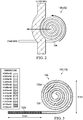
- FIG. 3 shows a Nitinol structural element 102 having the form of a Nitinol wire 104 after a simulated heat treatment.
- the Nitinol structural element 102 has a first end 102a and a second end 102b and is secured in a predetermined configuration 106, which in the example of FIG. 3 is a coiled shape.
- the first end 102a of the element 102 that ultimately forms the center of the coiled shape (or "coil”) may be fixed on a mandrel while ensuring that each loop of the coil is thermally isolated from adjacent loops. Thermal isolation may be achieved by incorporating an insulation layer and/or an air gap between the loops. In this example, the coil is surrounded by air at 22°C.
- the first end 102a of the Nitinol structural element 102 is then heated or "heat set", while the second end 102b of the element 102 is not heated.
- the first end 102a is heated to 500°C by a concentrated heat source.
- the temperature of the Nitinol structural element 102 is increased along a length ( L ) thereof by thermal conduction from the first end 102a, producing a (decreasing) temperature gradient between the first end 102a and the second end 102b, as illustrated in FIG. 3 .
- an insulation layer and/or air gap may partially or fully cover the Nitinol structural element 102 along the length between the first end 102a and the second end 102b during the heating to provide thermal insulation between adjacent loops of the coil.
- the second end 102b of the element 102 may be actively cooled, e.g., by convective cooling, in order to modulate the temperature gradient along the length of the element 102.
- the heating may occur at a temperature ("heat setting temperature”) and over a time duration sufficient to induce the Nitinol to adopt a "memory" of the predetermined configuration (coiled shape in this example) and a variable austenite finish temperature A f ( x ) above body temperature along the length ( L ) between the first and second ends 102a, 102b, where 0 ⁇ x ⁇ L.
- the variable austenite finish temperature A f ( x ) monotonically increases or decreases as a function of x and is above body temperature at any location along the length L; thus, the endovascular device 100 is configured for gradual deployment within a body vessel.
- phase transformation temperatures of a nickel-titanium alloy such as the austenite finish temperature
- the nickel content of the matrix may be controlled by either vaporization or traditional precipitation of nickel using a suitable heat treatment. Both the temperature and the duration of the heat treatment (e.g., heat setting), may influence the nickel content of the matrix.
- heat setting temperatures from about 350°C to about 550°C are employed for the heating.
- Higher (or lower) temperatures within this temperature range and/or longer (or shorter) heat setting time durations may be used to increase or decrease the phase transformation temperatures.
- Guidance may be provided by a time-temperature-transformation (TTT) diagram for Nitinol, such as that set forth in Drexel et al., "The Effects of Cold Work and Heat Treatment on the Properties of Nitinol Wire," ASME 2007, 2nd Frontiers in Biomedical Devices Conference .
- TTTT time-temperature-transformation
- the heating of the first end 102a of the element 102 may be carried out using a concentrated heat source, such as a laser, resistive heating element or induction heater. After the predetermined time duration, the heating may be ceased and the Nitinol structural element 102 may optionally be exposed to a cooling fluid (e.g., water) to rapidly quench the temperature.
- a cooling fluid e.g., water
- the Nitinol structural element 102 may have, in addition to a variable austenite finish temperature A f ( x ), a variable austenite start temperature A s ( x ), 0 ⁇ x ⁇ L, that is also above body temperature.
- the variable austenite start temperature A s ( x ) may increase or decrease monotonically as a function of x.
- the Nitinol structural element 102 may be deformed ( e.g., straightened) into a delivery configuration for introduction into a body vessel.
- the deformation into the delivery configuration may occur while the shape memory alloy is in the martensitic phase.
- the Nitinol structural element 102 may be cooled to a temperature at or below the martensite finish temperature, and the element 102 may be readily deformed to the desired delivery configuration.
- the Nitinol structural element 102 may remain in the delivery configuration until heated to a temperature at or above the lowest austenite start temperature ( e.g., A s ( x 0 )) of the element, at which point deployment of the endovascular device 100 may be initiated.
- the endoluminal medical device 100 deploys fully once heated at or above the highest austenite finish temperature ( e.g., A f ( L )), concluding the controlled deployment process.
- Nitinol structural elements (e.g., wire, rod, tubing, strip) 102 suitable for use in the present method may be obtained commercially from any of various vendors or fabricated from a nickel-titanium alloy ingot or billet of a suitable composition using mechanical working ( e.g., hot extrusion, cold drawing) and annealing methods known in the art.
- the nickel-titanium alloy is typically equiatomic or near-equiatomic in composition.
- the nickel-titanium alloy may comprise from about 50 at.% Ni to about 52 at.% Ni, and titanium and any incidental impurities may account for the balance of the alloy.
- the nickel-titanium alloy may also include a small amount of an additional alloying element (AAE) (e.g., from about 0.1 at.% AAE to about 10 at.% AAE) to enhance the superelastic or other properties of the nickel-titanium alloy.
- AAE additional alloying element
- the additional alloying element may be selected from among B, Al, Cr, Mn, Fe, Co, Cu, Zn, Ga, Ge, Zr, Nb, Mo, Tc, Ru, Rh, Pd, Ag, Cd, In, Sn, Sb, Hf, Ta, W, Re, Os, Ir, Pt, Au, Hg, TI, Pb, Bi, Po, V, and Mischmetal.
Landscapes
- Health & Medical Sciences (AREA)
- Veterinary Medicine (AREA)
- General Health & Medical Sciences (AREA)
- Animal Behavior & Ethology (AREA)
- Public Health (AREA)
- Life Sciences & Earth Sciences (AREA)
- Heart & Thoracic Surgery (AREA)
- Vascular Medicine (AREA)
- Surgery (AREA)
- Epidemiology (AREA)
- Biomedical Technology (AREA)
- Engineering & Computer Science (AREA)
- Chemical & Material Sciences (AREA)
- Inorganic Chemistry (AREA)
- Transplantation (AREA)
- Oral & Maxillofacial Surgery (AREA)
- Cardiology (AREA)
- Media Introduction/Drainage Providing Device (AREA)
Abstract
Description
- The present disclosure is related generally to endovascular devices and more specifically to an endovascular device comprising a nickel-titanium shape memory alloy ("Nitinol").
- Superelastic deployment of Nitinol-based endovascular devices is widely used to implant stents, filters and other devices into blood vessels. Such devices are typically heat set to a single static shape (e.g., a radially-expanded shape in the case of a stent) that can be recovered spontaneously upon removal of a constraining force, such as an overlying tubular sheath, after delivery of the device into a target vessel. Such nitinol-based devices may have austenite finish temperatures (Af) below body temperature to ensure that removal of the constraining force, once the device is delivered into the vessel, is sufficient to induce the transformation from martensite to austenite that is needed for shape recovery. Shape memory deployment of endovascular devices, where austenite finish temperatures may be at or above body temperature and heating is employed to induce shape recovery, is not widely used for Nitinol-based endovascular devices due to a number of practical challenges, such as the difficulty of controlling temperature in situ. Furthermore, current Nitinol-based endovascular devices utilize a bimodal approach of deformation and recovery to a preset shape defined by a single Af temperature.
- Aspects of the present invention seek to provide an improved device and/or method.
- According to an aspect of the invention, there is provided an endovascular device as in claim 1.
- According to an aspect of the invention, there is provided a method as in claim 7.
- In an embodiment, an endovascular device configured for controlled deployment in a body vessel comprises a Nitinol structural element having a variable austenite finish temperature Af(x) along a predetermined length (L) thereof, where 0 < x ≤ L. The variable austenite finish temperature Af(x) monotonically increases or decreases as a function of x and lies above body temperature at any location along the predetermined length. Accordingly, the endovascular device is configured for controlled deployment within a body vessel.
- In an embodiment, a method of controllably deploying an endovascular device comprises delivering, into a body vessel, a Nitinol structural element comprising a variable austenite finish temperature Af(x) along a predetermined length (L) thereof, where 0 < x ≤ L. The variable austenite finish temperature Af(x) increases or decreases monotonically as a function of x and lies above body temperature at any location along the predetermined length. After delivery into the body vessel, the Nitinol structural element is heated above body temperature. As the temperature of the Nitinol structural element reaches Af(x) at each location x along the predetermined length, the Nitinol structural element recovers a pre-set shape at the respective location, and the endovascular device is controllably deployed.
- In an embodiment, a method of heat setting an endovascular device for controlled deployment in a body vessel comprises securing a Nitinol structural element having a first end and a second end in a predetermined configuration and heating the first end of the Nitinol structural element. The second end of the Nitinol structural element does not undergo heating. During the heating of the first end, the temperature of the Nitinol structural element is increased along a length thereof by thermal conduction, producing a temperature gradient between the first end and the second end. After a predetermined time duration, the heating is halted, and the Nitinol structural element comprises a variable austenite finish temperature Af(x) along the length (L) between the first end and the second end, where 0 < x ≤ L. The variable austenite finish temperature Af(x) increases or decreases monotonically as a function of x and lies above body temperature at any location along the length. Thus, the endovascular device is configured for controlled deployment within a body vessel.
- According to an aspect of the invention, there is provided a method of controllably deploying an endovascular device, the method comprising:
- delivering a Nitinol structural element into a body vessel, the Nitinol structural element comprising a variable austenite finish temperature Af(x) along a predetermined length (L) thereof, where 0 < x ≤ L, the variable austenite finish temperature Af(x) increasing or decreasing monotonically as a function of x and being above body temperature at any location along the predetermined length; and
- heating the Nitinol structural element above body temperature,
- wherein, as a temperature of the Nitinol structural element reaches Af(x) at each location along the predetermined length during the heating, the Nitinol structural element recovers a pre-set shape at the respective location and the endovascular device is controllably deployed.
- In some embodiments, the Nitinol structural element further comprises a variable austenite start temperature As(x) having a value above body temperature at any location along the predetermined length.
- In some embodiments, the variable austenite start temperature As(x) monotonically increases or decreases as a function of x.
- In some embodiments, the heating is carried out uniformly along the predetermined length, the temperature of the Nitinol structural element being uniform to within ± 1°C.
- In some embodiments, the heating is carried out by a heat source selected from the group consisting of: induction heater and resistive heater.
- In some embodiments, a martensite start temperature of the Nitinol structural element is below body temperature, the deployed configuration remaining stable upon cooling after completion of the heating.
- In some embodiments, the Nitinol structural element comprises a wire, rod, tube, or strip, and
the endovascular device comprises a stent, filter, cage, fastener, ratchet, or anchor. - In some embodiments, the Nitinol structural element comprises from about 50 at.% to about 52 at.% nickel.
- Embodiments of the invention are described below, by way of example only, with reference to the accompanying drawings.
-
FIG. 1 illustrates controlled deployment of an exemplary endovascular device comprising a Nitinol structural element. The endovascular device is shown at the top ofFIG. 1 in a delivery configuration and in the bottom-most schematic in a fully deployed configuration after heating. In between, the endovascular device is shown undergoing controlled deployment as a function of temperature. -
FIG. 2 is a schematic of an induction triggered active anchoring system (ITAAS) configured to pierce a vessel wall and coil up, utilizing the controlled deployment process described herein. -
FIG. 3 shows a heat setting simulation of a Nitinol wire of 0.48 mm in diameter heated at the first end (center of coil) to 500°C using a concentrated heat source. The coil is surrounded by air at 22°C. - The present disclosure describes an endovascular device that can be delivered into a body vessel and can spontaneously recover - at a controlled rate - a deployed configuration when heated, preferably by a remote heat source. The method is enabled by the use of a Nitinol structural element having an austenite finish temperature (Af) above body temperature that varies monotonically along a length of the element. The Nitinol structural element may take the form of a wire or another shape, such as a rod, tube or strip, preferably having an elongated geometry.
- The Nitinol structural element comprises a nickel-titanium alloy that exhibits shape memory behavior. In other words, the nickel-titanium alloy can undergo a phase transformation that allows it to "remember" and return to a previous shape or configuration. More specifically, the nickel-titanium alloy can transform between a lower temperature phase (e.g., martensite) and a higher temperature phase (e.g., austenite) in order to effect shape or strain recovery. As would be known by the skilled artisan, austenite is characteristically the stronger phase, and martensite may be deformed up to a recoverable strain of about 8%. Strain introduced in the alloy in the martensitic phase may be substantially recovered upon completion of a reverse phase transformation to austenite, allowing the alloy to return to the previous shape. The temperature at which the strain recovery occurs may depend on the phase transformation temperatures of the nickel-titanium alloy, as discussed further below. The strain recovery can be driven by the application and removal of stress (superelastic effect) and/or by a change in temperature (shape memory effect), as in the present disclosure. Such alloys are commonly referred to as Nitinol or Nitinol alloys, and they are typically near-equiatomic in composition.
- The method may be understood in view of the schematics of
FIG. 1 , which illustrate the controlled deployment of an exemplary endovascular device 100 comprising a Nitinol structural element (which is a Nitinol wire in this example) 102 during heating. The endovascular device 100 is shown at the top ofFIG. 1 in a delivery configuration and in the bottom-most schematic in a fully deployed configuration after being heated to 60°C. In between, the endovascular device 100 is shown undergoing controlled deployment as the temperature of the Nitinol structural element 102 is increased above body temperature (37°C). The endovascular device 100 may comprise a stent, filter, cage, fastener, ratchet, anchor or another device. - The method entails delivering the Nitinol structural element 102 to a predetermined location in a body vessel. During delivery, the Nitinol structural element 102 is in an undeployed or delivery configuration which may be, for example, a substantially straight configuration that can be readily maneuvered through the vessel. As a consequence of the heat setting process described below, the Nitinol structural element 102 has a variable austenite finish temperature Af(x) along a predetermined length (L) thereof, where 0 < x ≤ L. The variable austenite finish temperature Af(x) is above body temperature (37°C) at any location along the predetermined length L and increases or decreases monotonically as a function of x. Thus, the endovascular device 100 is configured for gradual deployment after delivery and placement in the body vessel.
- Table 1 summarizes the values of Af(x) as a function of x for this example, where x has values x0, x1, x2, x3, x4 and L. Generally speaking, the variable austenite finish temperature may fall in a range from 37°C < Af(x) ≤ Tmax, where Tmax is below a temperature that may be harmful to body tissue; for example, Tmax may be 60°C or lower. The exemplary endovascular device 100 of this example is an anchoring device (e.g., an induction triggered active anchoring system (ITAAS)) configured to pierce the vessel wall and then coil up to exert an anchoring force, as shown schematically in
FIG. 2 and described inU.S. Patent Application Serial No. 15/581,980, filed on April 28, 2017 Table 1. Values of Af(x) for Exemplary Endovascular Device as a Function of x x Af(x) x 0 40°C x 1 42°C x 2 45°C x3 48°C x 4 50°C L 60°C - It is assumed that the Nitinol structural element 102, once placed in the body vessel, attains a temperature up to but not exceeding about 37°C, which is human body temperature. After placement in the vessel, the Nitinol structural element 102 is heated, preferably in a controlled manner (e.g., at a specified heating rate), above body temperature in order to effect deployment. Typically, the heating begins only after the structural element 102 has reached a predetermined site in the body vessel, but in some cases heating may begin prior to reaching the predetermined site, e.g., during delivery. The heating may be carried out uniformly along the predetermined length L of the Nitinol structural element 102, such that the temperature is uniform to within ± 1°C.
- As the temperature of the Nitinol structural element 102 is increased and reaches Af(x) at each location (e.g., x = x0, x1, x2, x3, x4, or L) along the predetermined length, the endovascular device 100 is gradually deployed. Gradual deployment occurs as the element 102 recovers a pre-set shape at each location during the heating. For example, once the temperature of the element rises from 37°C to 40°C, the tip region x0 of the Nitinol structural element 102 recovers a pre-set shape. As the heating continues and the temperature of the element reaches 42°C, the region of the element 102 between the tip region and up to position x1 recovers a pre-set shape. With further heating to a temperature of 45°C, the region of the element 102 between position x1 and up to position x 2 recovers a pre-set shape, and so on, as illustrated in
FIG. 1 . Ultimately, upon reaching a temperature at or above a highest value (60°C in this example) of the variable austenite finish temperature of the Nitinol structural element 102, the endovascular device 100 attains a fully deployed configuration. The heating of the Nitinol structural element 102 may be carried out by an external (ex vivo) or internal heat source, such as an induction heater or resistive heat source. - In addition to the variable austenite finish temperature Af(x), the Nitinol structural element 102 may also have a variable austenite start temperature As(x) along the predetermined length that increases or decreases monotonically as a function of x. The variable austenite start temperature As(x) is preferably above body temperature at any location along the predetermined length to prevent deployment of the device from being initiated prematurely. As the temperature of the element reaches As(x) at each location (e.g., x = x0, x1, x2, x3, x4, or L) along the predetermined length, shape recovery is initiated at that location.
- As generally understood by those skilled in the art, austenite start temperature (As) refers to the temperature at which a phase transformation to austenite begins upon heating for a nickel-titanium shape memory alloy, and austenite finish temperature (Af) refers to the temperature at which the phase transformation to austenite concludes. Martensite start temperature (Ms) refers to the temperature at which a phase transformation to martensite begins upon cooling for a nickel-titanium shape memory alloy, and martensite finish temperature (Mf) refers to the temperature at which the phase transformation to martensite concludes. Where the adjective "variable" appears in front of one of these terms, e.g., "variable austenite start [finish] temperature," the term may be understood to refer to the temperature at which the phase transformation begins [concludes] for the nickel-titanium shape memory alloy as a function of x along the length of the element.
- In order to maintain the deployed configuration of the endovascular device 100 after completion of the heating (e.g., when the device has cooled to body temperature), it may be beneficial to ensure that the martensite start temperature of the Nitinol structural element 102 is below body temperature. With a martensite start temperature below body temperature, the shape memory alloy may remain austenitic (and thus in the deployed configuration) while deployed in the body, even after the heating is stopped. The martensite start temperature may also be selected to be below lower than body temperature, such as below room (ambient) temperature.
- A method of heat setting a nitinol-based endovascular device for controlled deployment in a body vessel is set forth below in reference to
FIG. 3 , which shows a Nitinol structural element 102 having the form of aNitinol wire 104 after a simulated heat treatment. The Nitinol structural element 102 has afirst end 102a and asecond end 102b and is secured in apredetermined configuration 106, which in the example ofFIG. 3 is a coiled shape. Thefirst end 102a of the element 102 that ultimately forms the center of the coiled shape (or "coil") may be fixed on a mandrel while ensuring that each loop of the coil is thermally isolated from adjacent loops. Thermal isolation may be achieved by incorporating an insulation layer and/or an air gap between the loops. In this example, the coil is surrounded by air at 22°C. - The
first end 102a of the Nitinol structural element 102 is then heated or "heat set", while thesecond end 102b of the element 102 is not heated. In this example, thefirst end 102a is heated to 500°C by a concentrated heat source. During the heating, the temperature of the Nitinol structural element 102 is increased along a length (L) thereof by thermal conduction from thefirst end 102a, producing a (decreasing) temperature gradient between thefirst end 102a and thesecond end 102b, as illustrated inFIG. 3 . As indicated above, an insulation layer and/or air gap may partially or fully cover the Nitinol structural element 102 along the length between thefirst end 102a and thesecond end 102b during the heating to provide thermal insulation between adjacent loops of the coil. Thesecond end 102b of the element 102 may be actively cooled, e.g., by convective cooling, in order to modulate the temperature gradient along the length of the element 102. The heating may occur at a temperature ("heat setting temperature") and over a time duration sufficient to induce the Nitinol to adopt a "memory" of the predetermined configuration (coiled shape in this example) and a variable austenite finish temperature Af(x) above body temperature along the length (L) between the first andsecond ends - It is recognized that the phase transformation temperatures of a nickel-titanium alloy, such as the austenite finish temperature, may be manipulated by altering the level of disclocations and/or the nickel content in solid solution, that is, the amount of nickel present in the matrix of the nickel-titanium alloy. The nickel content of the matrix may be controlled by either vaporization or traditional precipitation of nickel using a suitable heat treatment. Both the temperature and the duration of the heat treatment (e.g., heat setting), may influence the nickel content of the matrix.
- Typically, heat setting temperatures from about 350°C to about 550°C are employed for the heating. Higher (or lower) temperatures within this temperature range and/or longer (or shorter) heat setting time durations may be used to increase or decrease the phase transformation temperatures. Guidance may be provided by a time-temperature-transformation (TTT) diagram for Nitinol, such as that set forth in Drexel et al., "The Effects of Cold Work and Heat Treatment on the Properties of Nitinol Wire," ASME 2007, 2nd Frontiers in Biomedical Devices Conference.
- The heating of the
first end 102a of the element 102 may be carried out using a concentrated heat source, such as a laser, resistive heating element or induction heater. After the predetermined time duration, the heating may be ceased and the Nitinol structural element 102 may optionally be exposed to a cooling fluid (e.g., water) to rapidly quench the temperature. As a consequence of the heat setting, the Nitinol structural element 102 may have, in addition to a variable austenite finish temperature Af(x), a variable austenite start temperature As(x), 0 < x ≤ L, that is also above body temperature. The variable austenite start temperature As(x) may increase or decrease monotonically as a function of x. - After heat setting, the Nitinol structural element 102 may be deformed (e.g., straightened) into a delivery configuration for introduction into a body vessel. The deformation into the delivery configuration may occur while the shape memory alloy is in the martensitic phase. For example, the Nitinol structural element 102 may be cooled to a temperature at or below the martensite finish temperature, and the element 102 may be readily deformed to the desired delivery configuration. The Nitinol structural element 102 may remain in the delivery configuration until heated to a temperature at or above the lowest austenite start temperature (e.g., As(x0 )) of the element, at which point deployment of the endovascular device 100 may be initiated. As explained above, the endoluminal medical device 100 deploys fully once heated at or above the highest austenite finish temperature (e.g., Af(L)), concluding the controlled deployment process.
- Nitinol structural elements (e.g., wire, rod, tubing, strip) 102 suitable for use in the present method may be obtained commercially from any of various vendors or fabricated from a nickel-titanium alloy ingot or billet of a suitable composition using mechanical working (e.g., hot extrusion, cold drawing) and annealing methods known in the art. The nickel-titanium alloy is typically equiatomic or near-equiatomic in composition. For example, the nickel-titanium alloy may comprise from about 50 at.% Ni to about 52 at.% Ni, and titanium and any incidental impurities may account for the balance of the alloy. In some cases, the nickel-titanium alloy may also include a small amount of an additional alloying element (AAE) (e.g., from about 0.1 at.% AAE to about 10 at.% AAE) to enhance the superelastic or other properties of the nickel-titanium alloy. The additional alloying element may be selected from among B, Al, Cr, Mn, Fe, Co, Cu, Zn, Ga, Ge, Zr, Nb, Mo, Tc, Ru, Rh, Pd, Ag, Cd, In, Sn, Sb, Hf, Ta, W, Re, Os, Ir, Pt, Au, Hg, TI, Pb, Bi, Po, V, and Mischmetal.
- Although embodiments of the present invention have been described in considerable detail, other embodiments are possible without departing from the present invention. The scope of the appended claims should not be limited, therefore, to the description of the preferred embodiments contained herein. All embodiments that come within the meaning of the claims, either literally or by equivalence, are intended to be embraced therein.
- Furthermore, the advantages described above are not necessarily the only advantages of embodiments of the invention, and it is not necessarily expected that all of the described advantages will be achieved with every embodiment of the invention.
- All optional and preferred features and modifications of the described embodiments and dependent claims are usable in all aspects of the invention taught herein. Furthermore, the individual features of the dependent claims, as well as all optional and preferred features and modifications of the described embodiments are combinable and interchangeable with one another.
- The disclosures in United States patent application number
15/699,389
Claims (12)
- An endovascular device configured for controlled deployment in a body vessel, the endovascular device comprising:a Nitinol structural element comprising a variable austenite finish temperature Af(x) along a predetermined length (L) thereof, where 0 < x ≤ L, the variable austenite finish temperature Af(x) monotonically increasing or decreasing as a function of x and being above body temperature at any location along the predetermined length, the endovascular device thereby being configured for controlled deployment within a body vessel.
- The endovascular device of claim 1, wherein the endovascular device comprises a fully deployed configuration after being heated to a temperature at or above a highest value of the variable austenite finish temperature Af(x).
- The endovascular device of any preceding claim, wherein the Nitinol structural element further comprises a variable austenite start temperature As(x) above body temperature at any location along the predetermined length.
- The endovascular device of claim 3, wherein the variable austenite start temperature As(x) monotonically increases or decreases as a function of x.
- The endovascular device of any preceding claim, wherein the Nitinol structural element comprises from about 50 at.% to about 52 at.% nickel.
- The endovascular device of any preceding claim, being a stent, filter, cage, fastener, ratchet or anchor.
- A method of heat setting an endovascular device for controlled deployment in a body vessel, the method comprising:securing a Nitinol structural element having a first end and a second end in a predetermined configuration;heating the first end of the Nitinol structural element, the second end of the Nitinol structural element not being heated; andafter a predetermined time duration, halting the heating, wherein, during the heating, a temperature of the Nitinol structural element is increased along a length thereof by thermal conduction from the first end, thereby producing a temperature gradient between the first end and the second end,wherein, after the heating, the Nitinol structural element comprises a variable austenite finish temperature Af(x) along the length (L) between the first end and the second end, where 0 < x ≤ L, the variable austenite finish temperature Af(x) increasing or decreasing monotonically as a function of x and being above body temperature at any location along the length, the endovascular device thereby being configured for controlled deployment within a body vessel.
- The method of claim 7, wherein the Nitinol structural element is at least partially covered by an insulation layer between the first end and the second end during the heating.
- The method of claim 7 or 8, wherein, after the heating, the Nitinol structural element comprises a variable austenite finish temperature As(x) along the length between the first end and the second end, where 0 < x ≤ L, the variable austenite start temperature As(x) increasing or decreasing monotonically as a function of x and being above body temperature at any location along the length.
- The method of any of claims 7 to 9, further comprising, during the heating, cooling the second end of the Nitinol structural element to modulate the temperature gradient.
- The method of any of claims 7 to 10, wherein the heating is carried out at a heat setting temperature from about 350°C to about 550°C using a concentrated heat source.
- The method of any of claims 7 to 11, wherein halting the heating comprises quenching, the Nitinol structural element being exposed to a cooling fluid.
Applications Claiming Priority (1)
| Application Number | Priority Date | Filing Date | Title |
|---|---|---|---|
| US15/699,389 US20190076583A1 (en) | 2017-09-08 | 2017-09-08 | Endovascular device configured for controlled shape memory deployment in a body vessel |
Publications (1)
| Publication Number | Publication Date |
|---|---|
| EP3453411A1 true EP3453411A1 (en) | 2019-03-13 |
Family
ID=63452584
Family Applications (1)
| Application Number | Title | Priority Date | Filing Date |
|---|---|---|---|
| EP18275128.9A Withdrawn EP3453411A1 (en) | 2017-09-08 | 2018-08-21 | Endovascular device configured for controlled shape memory deployment in a body vessel |
Country Status (2)
| Country | Link |
|---|---|
| US (1) | US20190076583A1 (en) |
| EP (1) | EP3453411A1 (en) |
Families Citing this family (6)
| Publication number | Priority date | Publication date | Assignee | Title |
|---|---|---|---|---|
| US9034034B2 (en) | 2010-12-22 | 2015-05-19 | V-Wave Ltd. | Devices for reducing left atrial pressure, and methods of making and using same |
| US12599430B2 (en) * | 2016-09-07 | 2026-04-14 | Deepqure Inc. | Systems and methods for perivascular nerve denervation |
| US20190133681A1 (en) * | 2016-09-07 | 2019-05-09 | Chang Wook Jeong | Systems and methods for perivascular nerve denervation |
| US12599425B2 (en) | 2016-09-07 | 2026-04-14 | Deepqure Inc. | Systems for perivascular nerve denervation |
| US12599756B2 (en) | 2020-05-04 | 2026-04-14 | V-Wave Ltd. | Devices with dimensions that can be reduced and increased In Vivo |
| US11813386B2 (en) | 2022-04-14 | 2023-11-14 | V-Wave Ltd. | Interatrial shunt with expanded neck region |
Citations (1)
| Publication number | Priority date | Publication date | Assignee | Title |
|---|---|---|---|---|
| WO2001093783A2 (en) * | 2000-06-07 | 2001-12-13 | Advanced Cardiovascular Systems, Inc. | Variable stiffness stent |
Family Cites Families (5)
| Publication number | Priority date | Publication date | Assignee | Title |
|---|---|---|---|---|
| US5882444A (en) * | 1995-05-02 | 1999-03-16 | Litana Ltd. | Manufacture of two-way shape memory devices |
| US20060064055A1 (en) * | 2004-05-24 | 2006-03-23 | John Pile-Spellman | Steerable devices |
| US20060206140A1 (en) * | 2005-02-24 | 2006-09-14 | Samuel Shaolian | Adjustable embolic aneurysm coil |
| US20090088838A1 (en) * | 2006-05-12 | 2009-04-02 | Shaolian Samuel M | Adjustable annuloplasty ring and activation system |
| WO2009021071A2 (en) * | 2007-08-06 | 2009-02-12 | Henson Michael R | Thrombectomy system and method |
-
2017
- 2017-09-08 US US15/699,389 patent/US20190076583A1/en not_active Abandoned
-
2018
- 2018-08-21 EP EP18275128.9A patent/EP3453411A1/en not_active Withdrawn
Patent Citations (1)
| Publication number | Priority date | Publication date | Assignee | Title |
|---|---|---|---|---|
| WO2001093783A2 (en) * | 2000-06-07 | 2001-12-13 | Advanced Cardiovascular Systems, Inc. | Variable stiffness stent |
Non-Patent Citations (2)
| Title |
|---|
| DREXEL ET AL.,: "The Effects of Cold Work and Heat Treatment on the Properties of Nitinol Wire", ASME 2007, 2ND FRONTIERS IN BIOMEDICAL DEVICES CONFERENCE., - 2007 |
| SOCRATES XENOS-DESPINA KARAMICHAILIDOU: "The Unique Properties,Manufacturing Processes and Applications of Near Equatomic Ni-Ti Alloys", 15 January 2016 (2016-01-15), pages 1 - 30, XP055545178, Retrieved from the Internet <URL:http://www.mie.uth.gr/ekp_yliko/TheUniqueProperties,ManufacturingProcessesandApplicationsofNearEquatomicNi-TiAlloys.pdf> [retrieved on 20190121] * |
Also Published As
| Publication number | Publication date |
|---|---|
| US20190076583A1 (en) | 2019-03-14 |
Similar Documents
| Publication | Publication Date | Title |
|---|---|---|
| US20190076583A1 (en) | Endovascular device configured for controlled shape memory deployment in a body vessel | |
| US7828916B2 (en) | Methods of crimping expandable medical devices | |
| EP1060280B1 (en) | Process for the improved ductility of nitinol | |
| US7955449B2 (en) | Process for inducing a two-way shape memory effect in a device formed of a shape memory alloy and a device made by the process | |
| EP0145166B1 (en) | Medical device comprising a shape memory alloy | |
| EP3453412A1 (en) | Endovascular device configured for sequenced shape memory deployment in a body vessel | |
| US5597378A (en) | Medical devices incorporating SIM alloy elements | |
| US7875070B2 (en) | Avoiding stress-induced martensitic transformation in nickel titanium alloys used in medical devices | |
| US5067957A (en) | Method of inserting medical devices incorporating SIM alloy elements | |
| EP0977902B1 (en) | Manufacture of two-way shape memory devices | |
| CN102560303A (en) | Shape setting a shape memory alloy dental arch | |
| US20180161121A1 (en) | Radiopaque composite wire for medical applications and method of making a radiopaque composite wire | |
| JP2005324053A (en) | Improved tissue support device | |
| US20110040371A1 (en) | Coiled assembly for supporting the wall of a lumen | |
| US10315012B2 (en) | Titanium-niobium-hafnium alloy shape memory wire | |
| US20050059994A1 (en) | Fatigue resistant medical devices | |
| US20040087997A1 (en) | Medical devices incorporating elastically deformable SIM elements | |
| JP2001510084A (en) | Implantable medical device made of shape memory alloy | |
| JP7815109B2 (en) | Superelastic nickel-titanium alloy wire and method of forming same | |
| EP2420213B1 (en) | Method of loading a medical device into a delivery system | |
| WO2022192382A2 (en) | Shape memory actuators for adjustable shunting systems, and associated systems and methods | |
| RU2201470C2 (en) | Method of production of double form memory alloy and method of making article from this alloy | |
| CA2286905C (en) | Manufacture of two-way shape memory devices | |
| EP3424609B1 (en) | Method of making a superelastic medical device with a radiopaque marker | |
| JP2006325613A (en) | Autonomous functional stent |
Legal Events
| Date | Code | Title | Description |
|---|---|---|---|
| PUAI | Public reference made under article 153(3) epc to a published international application that has entered the european phase |
Free format text: ORIGINAL CODE: 0009012 |
|
| STAA | Information on the status of an ep patent application or granted ep patent |
Free format text: STATUS: THE APPLICATION HAS BEEN PUBLISHED |
|
| AK | Designated contracting states |
Kind code of ref document: A1 Designated state(s): AL AT BE BG CH CY CZ DE DK EE ES FI FR GB GR HR HU IE IS IT LI LT LU LV MC MK MT NL NO PL PT RO RS SE SI SK SM TR |
|
| AX | Request for extension of the european patent |
Extension state: BA ME |
|
| STAA | Information on the status of an ep patent application or granted ep patent |
Free format text: STATUS: REQUEST FOR EXAMINATION WAS MADE |
|
| 17P | Request for examination filed |
Effective date: 20190604 |
|
| RBV | Designated contracting states (corrected) |
Designated state(s): AL AT BE BG CH CY CZ DE DK EE ES FI FR GB GR HR HU IE IS IT LI LT LU LV MC MK MT NL NO PL PT RO RS SE SI SK SM TR |
|
| STAA | Information on the status of an ep patent application or granted ep patent |
Free format text: STATUS: EXAMINATION IS IN PROGRESS |
|
| 17Q | First examination report despatched |
Effective date: 20200113 |
|
| STAA | Information on the status of an ep patent application or granted ep patent |
Free format text: STATUS: THE APPLICATION IS DEEMED TO BE WITHDRAWN |
|
| 18D | Application deemed to be withdrawn |
Effective date: 20200603 |