EP3453393B1 - Novel quinazolinone derivatives inhibiting pi3k and pharmaceutical composition containing same - Google Patents
Novel quinazolinone derivatives inhibiting pi3k and pharmaceutical composition containing same Download PDFInfo
- Publication number
- EP3453393B1 EP3453393B1 EP17827977.4A EP17827977A EP3453393B1 EP 3453393 B1 EP3453393 B1 EP 3453393B1 EP 17827977 A EP17827977 A EP 17827977A EP 3453393 B1 EP3453393 B1 EP 3453393B1
- Authority
- EP
- European Patent Office
- Prior art keywords
- formula
- compound
- amino
- methyl
- cyclopropyl
- Prior art date
- Legal status (The legal status is an assumption and is not a legal conclusion. Google has not performed a legal analysis and makes no representation as to the accuracy of the status listed.)
- Not-in-force
Links
- 0 C*(C(*(C(C(*(C1O)C2=CCCC=C2)=*c2c1c(*N=C)ccc2)=CC)=*)C1=C(C)*=C*1C)C=* Chemical compound C*(C(*(C(C(*(C1O)C2=CCCC=C2)=*c2c1c(*N=C)ccc2)=CC)=*)C1=C(C)*=C*1C)C=* 0.000 description 3
Images


Classifications
-
- A—HUMAN NECESSITIES
- A61—MEDICAL OR VETERINARY SCIENCE; HYGIENE
- A61K—PREPARATIONS FOR MEDICAL, DENTAL OR TOILETRY PURPOSES
- A61K31/00—Medicinal preparations containing organic active ingredients
- A61K31/33—Heterocyclic compounds
- A61K31/395—Heterocyclic compounds having nitrogen as a ring hetero atom, e.g. guanethidine or rifamycins
- A61K31/495—Heterocyclic compounds having nitrogen as a ring hetero atom, e.g. guanethidine or rifamycins having six-membered rings with two or more nitrogen atoms as the only ring heteroatoms, e.g. piperazine or tetrazines
- A61K31/505—Pyrimidines; Hydrogenated pyrimidines, e.g. trimethoprim
- A61K31/519—Pyrimidines; Hydrogenated pyrimidines, e.g. trimethoprim ortho- or peri-condensed with heterocyclic rings
- A61K31/52—Purines, e.g. adenine
-
- A—HUMAN NECESSITIES
- A61—MEDICAL OR VETERINARY SCIENCE; HYGIENE
- A61K—PREPARATIONS FOR MEDICAL, DENTAL OR TOILETRY PURPOSES
- A61K31/00—Medicinal preparations containing organic active ingredients
- A61K31/33—Heterocyclic compounds
- A61K31/395—Heterocyclic compounds having nitrogen as a ring hetero atom, e.g. guanethidine or rifamycins
- A61K31/495—Heterocyclic compounds having nitrogen as a ring hetero atom, e.g. guanethidine or rifamycins having six-membered rings with two or more nitrogen atoms as the only ring heteroatoms, e.g. piperazine or tetrazines
- A61K31/505—Pyrimidines; Hydrogenated pyrimidines, e.g. trimethoprim
- A61K31/517—Pyrimidines; Hydrogenated pyrimidines, e.g. trimethoprim ortho- or peri-condensed with carbocyclic ring systems, e.g. quinazoline, perimidine
-
- A—HUMAN NECESSITIES
- A61—MEDICAL OR VETERINARY SCIENCE; HYGIENE
- A61P—SPECIFIC THERAPEUTIC ACTIVITY OF CHEMICAL COMPOUNDS OR MEDICINAL PREPARATIONS
- A61P1/00—Drugs for disorders of the alimentary tract or the digestive system
- A61P1/16—Drugs for disorders of the alimentary tract or the digestive system for liver or gallbladder disorders, e.g. hepatoprotective agents, cholagogues, litholytics
-
- A—HUMAN NECESSITIES
- A61—MEDICAL OR VETERINARY SCIENCE; HYGIENE
- A61P—SPECIFIC THERAPEUTIC ACTIVITY OF CHEMICAL COMPOUNDS OR MEDICINAL PREPARATIONS
- A61P35/00—Antineoplastic agents
-
- A—HUMAN NECESSITIES
- A61—MEDICAL OR VETERINARY SCIENCE; HYGIENE
- A61P—SPECIFIC THERAPEUTIC ACTIVITY OF CHEMICAL COMPOUNDS OR MEDICINAL PREPARATIONS
- A61P35/00—Antineoplastic agents
- A61P35/02—Antineoplastic agents specific for leukemia
-
- A—HUMAN NECESSITIES
- A61—MEDICAL OR VETERINARY SCIENCE; HYGIENE
- A61P—SPECIFIC THERAPEUTIC ACTIVITY OF CHEMICAL COMPOUNDS OR MEDICINAL PREPARATIONS
- A61P37/00—Drugs for immunological or allergic disorders
-
- C—CHEMISTRY; METALLURGY
- C07—ORGANIC CHEMISTRY
- C07D—HETEROCYCLIC COMPOUNDS
- C07D239/00—Heterocyclic compounds containing 1,3-diazine or hydrogenated 1,3-diazine rings
- C07D239/70—Heterocyclic compounds containing 1,3-diazine or hydrogenated 1,3-diazine rings condensed with carbocyclic rings or ring systems
- C07D239/72—Quinazolines; Hydrogenated quinazolines
- C07D239/86—Quinazolines; Hydrogenated quinazolines with hetero atoms directly attached in position 4
- C07D239/88—Oxygen atoms
-
- C—CHEMISTRY; METALLURGY
- C07—ORGANIC CHEMISTRY
- C07D—HETEROCYCLIC COMPOUNDS
- C07D239/00—Heterocyclic compounds containing 1,3-diazine or hydrogenated 1,3-diazine rings
- C07D239/70—Heterocyclic compounds containing 1,3-diazine or hydrogenated 1,3-diazine rings condensed with carbocyclic rings or ring systems
- C07D239/72—Quinazolines; Hydrogenated quinazolines
- C07D239/86—Quinazolines; Hydrogenated quinazolines with hetero atoms directly attached in position 4
- C07D239/88—Oxygen atoms
- C07D239/91—Oxygen atoms with aryl or aralkyl radicals attached in position 2 or 3
-
- C—CHEMISTRY; METALLURGY
- C07—ORGANIC CHEMISTRY
- C07D—HETEROCYCLIC COMPOUNDS
- C07D473/00—Heterocyclic compounds containing purine ring systems
- C07D473/26—Heterocyclic compounds containing purine ring systems with an oxygen, sulphur, or nitrogen atom directly attached in position 2 or 6, but not in both
- C07D473/32—Nitrogen atom
- C07D473/34—Nitrogen atom attached in position 6, e.g. adenine
-
- Y—GENERAL TAGGING OF NEW TECHNOLOGICAL DEVELOPMENTS; GENERAL TAGGING OF CROSS-SECTIONAL TECHNOLOGIES SPANNING OVER SEVERAL SECTIONS OF THE IPC; TECHNICAL SUBJECTS COVERED BY FORMER USPC CROSS-REFERENCE ART COLLECTIONS [XRACs] AND DIGESTS
- Y02—TECHNOLOGIES OR APPLICATIONS FOR MITIGATION OR ADAPTATION AGAINST CLIMATE CHANGE
- Y02P—CLIMATE CHANGE MITIGATION TECHNOLOGIES IN THE PRODUCTION OR PROCESSING OF GOODS
- Y02P20/00—Technologies relating to chemical industry
- Y02P20/50—Improvements relating to the production of bulk chemicals
- Y02P20/55—Design of synthesis routes, e.g. reducing the use of auxiliary or protecting groups
Definitions
- the present invention relates to novel quinazolinone derivatives inhibiting PI3K and a method of preparing these derivatives.
- the present invention provides a pharmaceutical composition for treating a blood cancer, a liver disease, or an autoimmune disease, which includes the quinazolinone derivatives.
- Cancer is the second leading cause of death after heart disease in the United State (Cancer Facts and Figures 2005, American Cancer Society, Inc.).
- a method of removing tumors or killing cancer cells by chemotherapy, radiotherapy, and the like may be selected, but in the case of terminal cancer patients, side effects due to aggressive therapies are relatively large and the response rate after treatment is low, and thus therapies for reducing side effects by delaying cancer progression and improving the quality of life may be selected.
- anticancer drugs are intended to not only prevent cancer recurrence by destroying cancer cells, but also prolong the survival period by inhibiting the growth and proliferation of cancer cells, when it is difficult to expect a full recovery.
- Targeted therapies are advantageous in that they are tumor-specific, effective, and have far less effect on normal cells compared to existing systemic anticancer treatments.
- the dysregulation of protein kinases is commonly found in cancer cells, and thus is an attractive target for the development of anticancer drugs.
- PI3Ks phosphatidylinositol-3-kinase isomers
- PI3Ks phosphatidylinositol-3-kinase isomers
- PI3Ks are classified into Class I, Class II, and Class III. Class I is divided again into sub-classes: Class IA and Class IB. Class I PI3K is in the form of a dimer, and the dimer is divided into catalytic and regulatory subunits. Class 1A PI3K is a dimer consisting of a p110 catalytic subunit and a p85 regulatory subunit, and in this regard, the p110 catalytic subunit includes three isoforms, i.e., p110 ⁇ , p110 ⁇ , and p110 ⁇ . Thus, the isoforms of PI3Ks are referred to as PI3K ⁇ , PI3K ⁇ , and PI3K ⁇ .
- Class IB PI3K is a dimer consisting of a p110 ⁇ catalytic subunit and a p101 regulatory subunit, and the PI3K is generally referred to as PI3K ⁇ .
- PI3K ⁇ is mainly induced by receptor tyrosine kinases (RTKs) to phosphorylate PIP2 to PIP3, and PI3K ⁇ is mainly induced by G-protein coupled receptors (GPCRs) to phosphorylate PIP2 to PIP3.
- RTKs receptor tyrosine kinases
- GPCRs G-protein coupled receptors
- PIP3 activates protein kinase B (Akt/PKB) and continuously leads to downstream signaling, thereby being involved in major cell function regulation such as cell growth, proliferation, differentiation, motility, survival, and intracellular trafficking.
- idelalisib a substance that was developed by Gilead Calistoga and selectively inhibits PI3K ⁇ .
- This drug has excellent efficacy against various types of hematologic malignancies, and thus has drawn attention as a breakthrough drug that addresses problems (especially cytotoxicity against normal cells) of existing cytotoxic anticancer drugs and also compensates for problems of the efficacy of existing anticancer drugs ( Q. YANG et al., Clinical Cancer Research, 2015, 21(7), p.1537-1542 ).
- problems especially cytotoxicity against normal cells
- Q. YANG et al. Clinical Cancer Research, 2015, 21(7), p.1537-1542
- some cases of serious toxicity has occurred during clinical trials, in which patients died from pneumonia, and thus the development of this drug has now been suspended.
- the reason is that the inhibitory activity of this drug was sufficiently selective and potent for PI3K ⁇ rather than for PI3K ⁇ and PI3K ⁇ , but not sufficiently selective than for PI3K ⁇ .
- Duvelisib exhibited dual-inhibitory activity on PI3K ⁇ and PI3K ⁇ and thus had a possibility of being developed as a very promising drug for treating hematologic malignancy, inflammation, and autoimmune disease.
- the development of Duvelisib was terminated because of problems similar to those of idelalisib. It is known that the inhibitory efficacy of this substance is not sufficiently selective for PI3K ⁇ and PI3K ⁇ than for PI3K ⁇ . Therefore, there is a need to develop a drug capable of more selectively inhibiting PI3K ⁇ rather than at least idelalisib.
- quinazolinone derivatives are special structures present in many biologically active compounds such as methaqualone, which is a sedative-hypnotic drug, chloroqualone, which is an antitussive, and piriqualone, which is an anticonvulsant.
- Quinazolinone and derivatives thereof have a wide range of biological properties such as hypnosis, pain killing, inhibition of convulsions, inhibition of coughing, and antiinflammatory activity.
- quinazolinone derivatives are used in the treatment of cell proliferative diseases including cancer, and are one of the therapeutic agents which have been widely used recently.
- U.S. Patent Registration Nos. 5,747,498 and 5,773,476 disclose quinazolinone derivatives used for the treatment of cancer which is induced by overactivation or aberrant activation of receptor tyrosine kinases.
- WO 2014/023083 discloses quinazolinone derivatives as PI3K ⁇ inhibitors useful for the treatment of tumours. Therefore, quinazolinone derivatives are required to be studied and developed through various approaches for the treatment of cell proliferative diseases.
- An object of the present invention is to provide novel quinazolinone derivatives that inhibit PI3Ks and methods of preparing these derivatives.
- Another object of the present invention is to provide a pharmaceutical composition comprising the quinazolinone derivatives for preventing or treating a blood tumor, a liver disease, or an autoimmune disease.
- a pharmaceutical composition comprising a compound represented by Formula 1 below or a pharmaceutically acceptable salt thereof as an active ingredient for preventing or treating a blood cancer, a liver disease, or an autoimmune disease.
- the blood cancer may be leukemia or lymphoma.
- the liver disease may be selected from the group consisting of non-alcoholic fatty liver disease (NAFLD), non-alcoholic steatohepatitis (NASH), hepatic steatosis, hepatocirrhosis, hepatitis, hepatic adenoma, insulin hypersensitivity, and liver cancer.
- NAFLD non-alcoholic fatty liver disease
- NASH non-alcoholic steatohepatitis
- hepatic steatosis hepatocirrhosis
- hepatitis hepatic adenoma
- insulin hypersensitivity and liver cancer.
- the autoimmune disease may be selected from the group consisting of allergic rhinitis, asthma, chronic obstructive pulmonary disease (COPD), and rheumatoid arthritis.
- COPD chronic obstructive pulmonary disease
- Novel quinazolinone derivatives according to the present invention are efficacious in treating blood cancer or liver diseases.
- the quinazolinone derivatives of the present invention can inhibit PI3K ⁇ with high selectivity to reduce immunotoxicity significantly, or inhibit PI3K ⁇ and PI3K ⁇ simultaneously, thus enabling not only the anticancer treatment of hematologic malignancies and the like, but also the treatment of autoimmune diseases.
- These targeted therapeutic agents can address problems such as side effects of existing anticancer treatments with severe cytotoxicity.
- the present invention relates to novel compounds of quinazolinone derivatives as PI3K inhibitors.
- PI3K inhibitors block the PI3K-AKT signaling pathway by docking with an ATP-binding site of p110 ⁇ , and the activation of PI3K pathways is mediated by PI3K catalytic isotypes, i.e., p110 ⁇ , p110 ⁇ , p110 ⁇ , and p110 ⁇ .
- p110 ⁇ plays a vital role in blood cancer and B cell development and is predominantly expressed in hematopoietic stem cells, and is expressed in many cancers including leukemia, lymphoma, colorectal cancer, bladder cancer, malignant glioma, and the like. It regulates cell proliferation through stimulation of related cytokines and chemokines via the PI3K-AKT signaling pathway.
- novel quinazolinone derivatives according to the present invention overcome existing toxicity problems including hepatotoxicity. Since PI3K p110 ⁇ might be highly expressed even in advanced hepatocellular carcinoma, novel quinazolinone derivatives according to the present invention are also effective as a therapeutic agent for hepatocellular carcinoma, which is solid cancer.
- novel quinazolinone derivatives should sufficiently and selectively inhibit PI3K ⁇ .
- selectivity between PI3K isomers needs to satisfy the criteria that, using IC 50 values, each of ratios of PI3K ⁇ /PI3K ⁇ and PI3K ⁇ /PI3K ⁇ exceeds 150, and a ratio of PI3K ⁇ /PI3K ⁇ is greater than that of idelalisib at least.
- ratios of PI3K ⁇ /PI3K ⁇ and PI3K ⁇ /PI3K ⁇ are greater than those of duvelisib.
- the present invention provides a compound represented by Formula 1 or a pharmaceutically acceptable salt thereof. wherein,
- halogen refers to fluorine (F), bromine (Br), chlorine (Cl), or iodine (I).
- Y may be linked in the form of (S)-isomer or (R)-isomer, but preferably in the form of (S)-isomer.
- Specific examples of the compound of Formula 1 include compounds represented by the following Formulas 7 to 14, but the present invention is not limited thereto. Reference compounds 9 - 11 are also shown.
- the Compound of Formula 7 according to the present invention is the compound of Formula 1 wherein X is -F, and Y is cyclopropyl.
- the compound of Formula 8 according to the present invention is the compound of Formula 1 wherein X is methyl, and Y is cyclopropyl.
- the compound of Formula 9 is the compound of Formula 1 wherein X is -NH 2 , and Y is cyclopropyl.
- the compound of Formula 10 is the compound of Formula 1 wherein X is -NH 2 , and Y is methyl.
- the compound of Formula 11 is the compound of Formula 1 wherein X is -NH 2 , and Y is ethyl.
- the compound of Formula 12 according to the present invention is the compound of Formula 1 wherein X is -Cl, and Y is cyclopropyl.
- the compound of Formula 13 according to the present invention is the compound of Formula 1 wherein X is -F, and Y is cyclobutyl.
- the compound of Formula 14 according to the present invention is the compound of Formula 1 wherein X is -Cl, and Y is cyclobutyl.
- the compound represented by Formula 1 of the present invention may be used in the form of a pharmaceutically acceptable salt, and the salt may be an acid addition salt formed by a pharmaceutically acceptable free acid.
- the acid addition salt is obtained from: inorganic acids such as hydrochloric acid, nitric acid, phosphoric acid, sulfuric acid, hydrobromic acid, hydriodic acid, nitrous acid, phosphorous acid, and the like; nontoxic organic acids such as aliphatic mono- and dicarboxylates, phenyl-substituted alkanoates, hydroxy alkanoates and alkandioate, aromatic acids, aliphatic and aromatic sulfonic acids, and the like; or organic acids such as acetic acid, benzoic acid, citric acid, lactic acid, maleic acid, gluconic acid, methanesulfonic acid, 4-toluenesulfonic acid, tartaric acid, fumaric acid, and the like.
- Examples of these pharmaceutically nontoxic salts include sulfates, pyrosulfates, bisulfates, sulfites, bisulfites, nitrates, phosphates, monohydrogen phosphates, dihydrogen phosphates, metaphosphates, pyrophosphate chlorides, bromides, iodides, fluorides, acetates, propionates, decanoates, caprylates, acrylates, formates, isobutyrates, caprates, heptanoates, propiolates, oxalates, malonates, succinates, suberates, sebacates, fumarates, maleates, butyne-1,4-dioates, hexane-1,6-dioates, benzoates, chlorobenzoates, methylbenzoates, dinitro benzoates, hydroxybenzoates, methoxybenzoates, phthalates, terephthalates, benzenesulfonates,
- Acid addition salts according to the present invention may be prepared using a conventional method.
- these acid addition salts may be prepared by dissolving the derivative of Formula 1 in an organic solvent, such as methanol, ethanol, acetone, dichloromethane, acetonitrile, or the like, adding an organic acid or an inorganic acid thereto to produce a precipitate, and filtering and drying the precipitate, or may be prepared by distilling a solvent and an excess of an acid under reduced pressure and then drying the resulting solution, followed by crystallization in the presence of an organic solvent.
- an organic solvent such as methanol, ethanol, acetone, dichloromethane, acetonitrile, or the like
- adding an organic acid or an inorganic acid thereto to produce a precipitate
- filtering and drying the precipitate or may be prepared by distilling a solvent and an excess of an acid under reduced pressure and then drying the resulting solution, followed by crystallization in the presence of an organic solvent.
- pharmaceutically acceptable metallic salts may be prepared by using bases.
- Alkali metal or alkali earth metal salts are obtained by, for example, dissolving a compound in an excess of an alkali metal hydroxide or alkali earth metal hydroxide solution, filtering an insoluble compound salt, and evaporating and drying the filtrate.
- a sodium salt, a potassium salt, or a calcium salt is prepared as a metal salt.
- salts corresponding thereto are obtained by reacting an alkali metal or an alkali earth metal salt with a suitable silver salt (e.g., silver nitrate).
- the present invention includes not only the compound represented by Formula 1 and pharmaceutically acceptable salts thereof, but also solvates, stereoisomers, hydrates, and the like that may be prepared therefrom.
- the present invention also provides a pharmaceutical composition for preventing or treating a blood cancer, a liver disease, and an autoimmune disease, which includes a compound represented by Formula 1 below or a pharmaceutically acceptable salt thereof as an active ingredient.
- Y may be linked in the form of (S)-isomer or (R)-isomer, but it is preferable that Y is linked in the form of (S)-isomer.
- the compound represented by Formula 1 or a pharmaceutically acceptable salt thereof may be administered orally or parenterally in various dosage forms during clinical administration, and may be formulated using commonly used diluents or excipients such as fillers, extenders, binders, wetting agents, disintegrating agents, surfactants, and the like.
- Formulations for oral administration may include, for example, tablets, pills, hard/soft capsules, liquids, suspensions, emulsions, syrups, granules, elixirs, suspensions, troches, and the like. These formulations include, in addition to the active ingredient, a diluent (e.g., lactose, dextrose, sucrose, mannitol, sorbitol, cellulose, and/or glycine) or a lubricant (e.g., silica, talc, stearic acid and magnesium or calcium salts thereof, and/or polyethylene glycol).
- a diluent e.g., lactose, dextrose, sucrose, mannitol, sorbitol, cellulose, and/or glycine
- a lubricant e.g., silica, talc, stearic acid and magnesium or calcium salts thereof, and/or polyethylene glycol
- Tablets may include a binder such as magnesium aluminum silicate, starch paste, gelatin, methyl cellulose, sodium carboxymethylcellulose, and/or polyvinylpyrrolidone, and in some cases, may include a disintegrating agent such as starch, agar, alginic acid or sodium salts thereof, or a boiling mixture and/or an absorbent, a coloring agent, a flavoring agent, and a sweetening agent.
- a binder such as magnesium aluminum silicate, starch paste, gelatin, methyl cellulose, sodium carboxymethylcellulose, and/or polyvinylpyrrolidone
- a disintegrating agent such as starch, agar, alginic acid or sodium salts thereof, or a boiling mixture and/or an absorbent, a coloring agent, a flavoring agent, and a sweetening agent.
- the pharmaceutical composition including the compound represented by Formula 1 as an active ingredient may be administered parenterally, and the parenteral administration is performed via subcutaneous injection, intravenous injection, intramuscular injection, or intrathoracic injection.
- the compound represented by Formula 1 or a pharmaceutically acceptable salt thereof is mixed with a stabilizer or a buffer in water to prepare a solution or a suspension, followed by preparation into an ampoule or vial unit dosage form.
- the composition may be sterilized and/or may include an adjuvant such as a preservative, a stabilizer, wettable powder, a salt for osmoregulation, and/or a buffer, and other therapeutically effective materials, and may be formulated using a conventional method, such as mixing, granulation, or coating.
- composition of the present invention may further include, in addition to the quinazolinone compound, one or more effective ingredients exhibiting identical or similar functions.
- a suitable dose of the pharmaceutical composition of the present invention may be appropriately selected depending on the condition and body weight of patients, the severity of symptoms, the dosage form, the route of administration, and the period of administration.
- the effective ingredient(s) is(are) administered in an amount of 0.2 mg/kg to 200 mg/kg daily for optimum efficacy.
- the composition may be administered once a day or multiple doses a day, but the present invention is not limited thereto.
- the blood cancer may be leukemia or lymphoma.
- the leukemia may be selected from acute lymphocytic leukemia (ALL), acute myelogenous leukemia (AML), chronic lymphocytic leukemia (CLL), and small lymphocytic lymphoma (SLL), and acute lymphocytic leukemia is also known as acute lymphoblastic leukemia.
- ALL acute lymphocytic leukemia
- AML acute myelogenous leukemia
- CLL chronic lymphocytic leukemia
- SLL small lymphocytic lymphoma
- acute lymphocytic leukemia is also known as acute lymphoblastic leukemia.
- the lymphoma may be a mature (peripheral) B-cell neoplasm, and more particularly, may be selected from B-cell chronic lymphocytic leukemia/small lymphocytic lymphoma; B-cell prolymphocytic leukemia; lymphoplasmacytic lymphoma; marginal zone lymphoma, for example, splenic marginal zone B-cell lymphoma (+/- villous lymphocytes), nodal marginal zone lymphoma (+/- monocytoid B-cells), and mucosa-associated lymphoid tissue (MALT) type extranodal marginal zone B-cell lymphoma; hairy cell leukemia; plasma cell myeloma/plasmacytoma; follicular lymphoma; follicle center lymphoma; mantle cell lymphoma; diffuse large B-cell lymphoma (including mediastinal large B-cell lymphoma, intravascular large B-cell lymphoma, and primary eff
- the lymphoma may be selected from multiple myeloma (MM), non-Hodgkin' lymphoma (NHL), mantle cell lymphoma (MCL), follicular lymphoma, Waldenstrom macroglobulinemia (WM), B-cell lymphoma, and diffuse large B-cell lymphoma (DLBCL).
- MM myeloma
- NHL non-Hodgkin' lymphoma
- MCL mantle cell lymphoma
- follicular lymphoma Waldenstrom macroglobulinemia
- B-cell lymphoma B-cell lymphoma
- DLBCL diffuse large B-cell lymphoma
- the liver disease of the present invention may be selected from the group consisting of non-alcoholic fatty liver disease (NAFLD), non-alcoholic steatohepatitis (NASH), hepatic steatosis, hepatocirrhosis, hepatitis, hepatic adenoma, insulin hypersensitivity, and liver cancer.
- NAFLD non-alcoholic fatty liver disease
- NASH non-alcoholic steatohepatitis
- hepatic steatosis hepatocirrhosis
- hepatitis hepatic adenoma
- insulin hypersensitivity and liver cancer.
- the liver cancer may be, for example, a liver tumor, hepatocellular adenoma, or hepatocellular carcinoma.
- the autoimmune disease may be selected from the group consisting of allergic rhinitis, asthma, chronic obstructive pulmonary disease (COPD), and rheumatoid arthritis.
- COPD chronic obstructive pulmonary disease
- the present invention also provides a method of preparing a compound represented by Formula 1 below, wherein the method comprises:
- Step 1 is a process of preparing the compound represented by Formula 4 by reacting the compound represented by Formula 2 with the compound represented by Formula 3.
- triphenyl phosphite may be added to a solution in which the compound represented by Formula 2 and the compound represented by Formula 3 are mixed together in the presence of a pyridine solvent while being stirred at room temperature.
- the temperature is not particularly limited, but the mixture may be stirred at a temperature of 30 °C to 100 °C, preferably 45 °C to 80 °C, and more preferably 55 °C to 60 °C.
- the stirring time is not particularly limited, but the stirring process may be performed for 5 hours to 20 hours, preferably 8 hours to 16 hours, and more preferably 10 hours to 14 hours.
- aniline may be added to allow a reaction to occur.
- the temperature is not particularly limited, but the reaction may occur at a temperature of 50 °C to 200 °C, preferably 90 °C to 150 °C, and more preferably 100 °C to 120 °C.
- reaction time is not particularly limited, but the reaction may occur for 1 hour to 20 hours, preferably 3 hours to 15 hours, and more preferably 5 hours to 10 hours.
- Step 2 is a process of preparing the compound represented by Formula 5 by deprotecting the compound represented by Formula 4.
- the compound represented by Formula 5 may be prepared as follows: The compound represented by Formula 4 is added to a dichloromethane solution in which trifluoroacetic acid (CF 3 COOH) is dissolved, and then reacted at room temperature for 0.1 hour to 2 hours, preferably 0.2 hour to 1.5 hours, and more preferably 0.5 hour to 1 hour.
- CF 3 COOH trifluoroacetic acid
- Step 3 is a process of preparing the compound represented by Formula 1 by reacting the compound represented by Formula 5 with the compound represented by Formula 6.
- the compound represented by Formula 5 is added to tert-butanol, N,N-diisopropylethylamine is added thereto, and then the compound represented by Formula 6 is added to the resulting solution, and the reaction solution may be stirred while refluxing for 10 hours to 48 hours, preferably 15 hours to 30 hours, and more preferably 20 hours to 26 hours.
- the present invention provides a health functional food for preventing or alleviating a blood tumor or a liver disease, including a novel quinazolinone compound or a pharmaceutically acceptable salt thereof as an active ingredient.
- the health functional food may be prepared in the form of, but is not limited to, various types of beverages, gums, tea, confectioneries, vitamin complexes, and health supplements.
- Step 1 Preparation of (S)- tert -butyl cyclopropyl(5-fluoro-4-oxo-3-phenyl-3,4-dihydroquinazolin-2-yl)methylcarbamate
- Triphenyl phosphite (1.4 eq) was added to a solution, in which 2-amino-6-fluorobenzoic acid (1.0 eq) and (S)-2-( tert -butoxycarbonylamino)-2-cyclopropylacetic acid (1.0 eq) were mixed in a pyridine solvent, while the solution was stirred at room temperature. The resulting mixture was stirred at 55 °C to 60 °C for 12 hours. Aniline (1.4 eq) was added thereto and then reacted around 110 °C for 7 hours. Thereafter, the mixed reaction solution was cooled to room temperature and extracted with ethyl acetate and water.
- Trifluoroacetic acid (about 8 times the weight of (S)- tert -butyl cyclopropyl(5-fluoro-4-oxo-3-phenyl-3,4-dihydroquinazolin-2-yl)methylcarbamate) was added to a dichloromethane solution (about 15 times the weight of (S)- tert -butyl cyclopropyl(5-fluoro-4-oxo-3-phenyl-3,4-dihydroquinazolin-2-yl)methylcarbamate), in which (S)- tert -butyl cyclopropyl(5-fluoro-4-oxo-3-phenyl-3,4-dihydroquinazolin-2-yl)methylcarbamate was dissolved.
- the reaction solution was stirred at room temperature for about 0.5 hour to about 1 hour, and then pH of the reaction solution was adjusted to about 7 using an aqueous sodium carbonate solution.
- the dichloromethane solution was separated, dehydrated using magnesium sulfate (MgSO 4 ) and filtered, and magnesium sulfate (MgSO 4 ) was removed and then the filtrate was concentrated under reduced pressure to give (S)-2-(amino(cyclopropyl)methyl)-5-fluoro-3-phenylquinazolin-4(3H)-one with a yield of 80% to 95%.
- Step 3 Preparation of (S)-2-(((7H-purin-6-yl)amino)(cyclopropyl)methyl)-5-fluoro-3-phenylquinazolin-4(3H)-one
- step 2 The (S)-2-(amino(cyclopropyl)methyl)-5-fluoro-3-phenylquinazolin-4(3H)-one obtained in step 2 was added to tert-butanol (about 15 times the weight of (S)-2-(amino(cyclopropyl)methyl)-5-fluoro-3-phenylquinazolin-4(3H)-one), N,N-diisopropylamine (about 2 equivalents of (S)-2-(amino(cyclopropyl)methyl)-5-fluoro-3-phenylquinazolin-4(3H)-one) and 6-bromo-9H-purine were added thereto, and then the reaction solution was stirred while refluxing for 24 hours.
- Step 1 Preparation of (S)- tert -butyl cyclopropyl(5-methyl-4-oxo-3-phenyl-3,4-dihydroquinazolin-2-yl)methylcarbamate
- Step 3 Preparation of (S)-2-(((7H-purin-6-yl)amino)(cyclopropyl)methyl)-5-methyl-3-phenylquinazolin-4(3H)-one
- Step 1 Preparation of (S)-2-(((7H-purin-6-yl)amino)(cyclopropyl)methyl)-5-((4-methoxybenzyl)amino)-3-phenylquinazolin-4(3H)-one
- Step 2 Preparation of (S)-2-(((7H-purin-6-yl)amino)(cyclopropyl)methyl)-5-amino-3-phenylquinazolin-4(3H)-one
- Step 1 Preparation of (S)- tert -butyl (5-chloro-4-oxo-3-phenyl-3,4-dihydroquinazolin-2-yl)(cyclopropyl)methylcarbamate
- Step 3 Preparation of (S)-2-(((7H-purin-6-yl)amino)(cyclopropyl)methyl)-5-chloro-3-phenylquinazolin-4(3H)-one
- the compound of Formula 7 and the compound of Formula 8 exhibited higher activity than the control drug, idelalisib. In particular, they exhibited specific inhibitory activity on p110 ⁇ and also exhibited excellent activity with respect to p110 ⁇ .
- ratios of P13K ⁇ /PI3K ⁇ and PI3K ⁇ /PI3K ⁇ , as IC 50 values, were shown as 412 and 210 respectively in the case of the compound of Formula 7, and 1,488 and 1,800 respectively in the case of the compound of Formula 8.
- Cell lines (SUDHL 5, SUDHL 10, CCRF-SB, and MOLT4) were subjected to serum depletion for 2 hours, and then were treated with 1 ⁇ M of each of the compound of Formula 7, the compound of Formula 8, idelalisib (comparative drug 1), TGR1202 (comparative drug 2), and dimethylsulfoxide (DMSO) for 1 hour. Subsequently, cells were lysed and fractionated according to size, followed by immunoblotting with antibodies directed against Phospho-Akt (Ser473).
- PI3K p110 ⁇ is highly expressed in leukemia and lymphoma cell lines, and cell growth is inhibited by suppressing PI3K p110 ⁇ .
- Diffuse large B-cell lymphoma (DLBCL)-derived cells and acute lymphocytic leukemia (ALL)-derived cells were cultured with the compound of Formula 7, the compound of Formula 8, or idelalisib, along with a control medium for 48 hours.
- growth of the DLBCL-derived cells and the ALL-derived cell line was reduced at a concentration ranging from 0.625 ⁇ M to 20 ⁇ M.
- LC 50 lethal concentration 50
- Table 3 lethal concentration 50 (LC 50 ), which is the concentration of compounds being lethal to 50% of the cells , is shown in Table 3, and it was confirmed that the compound of Formula 7 and the compound of Formula 8 exhibited a lower LC 50 value than that of idelalisib.
- 2.6 x 10 6 cells were cultured with idelalisib (comparative drug), the compound of Formula 7, or the compound of Formula 8 at a concentration of 50 ⁇ M for 36 hours, and then protein analysis was performed by sodium dodecyl sulfate-polyacrylamide gel electrophoresis (SDS-PAGE).
- the caspase 3 and 9 PARP proteins which are proteins involved in apoptosis, normally exist as inactive precursors (FL), and they are activated by being cleaved (CL) when receiving an apoptosis-stimulating signal. Immunoblotting analysis was performed using antibodies of these, and glyceraldehyde-3-phosphate dehydrogenase (GAPDH) was used as a loading control.
- FL inactive precursors
- CL cleaved
- GPDH glyceraldehyde-3-phosphate dehydrogenase
- Results of the experiment are shown in FIG. 4 .
- the compound of Formula 7 and the compound of Formula 8 induced apoptosis in diffuse large B-cell lymphoma (DLBCL) and acute lymphocytic leukemia (CLL) cells.
- DLBCL diffuse large B-cell lymphoma
- CLL acute lymphocytic leukemia
- 1 x 10 6 diffuse large B-cell lymphoma (DLBCL) cells and 1 x 10 6 acute lymphocytic leukemia (ALL) cells were cultured and treated with each of the comparative drug (Idelalisib), the compound of Formula 7, and the compound of Formula 8 at a concentration of 50 ⁇ M for 24 hours.
- the cells were washed with PBS, and then suspended in a binding buffer.
- human umbilical vein endothelial cells which are vascular endothelial cells, and endothelial cell growth media were obtained from Life Technologies.
- the human umbilical vein endothelial cells were cultured along with the compound of Formula 7, the compound of Formula 8, or the comparative drug (Idelalisib) on basement membrane matrix at 37 °C. After 18 hours, tube formation was photographed using a CytationTM 5 fluorescence microscope (BioTek), and the number of areas formed by branch points was counted using software (see FIG. 6 ).
- the compound of Formula 7 and the compound of Formula 8 inhibited angiogenesis more than the comparative drug (Idelalisib) did.
- the compound of Formula 7 and the compound of Formula 8 did not significantly affect the cytotoxicity of the human umbilical vein endothelial cells (HUVECs).
- the compound of Formula 7 and the compound of Formula 8 were orally administered to eight six-week-old female rats, to observe the single dose oral toxicity thereof and to obtain an approximate lethal dose.
- the dosage was set at 10 mL/kg, and the dosage for each rat was calculated based on body weight.
- Each compound was administered at doses of 100 mg/kg, 300 mg/kg, 900 mg/kg, and 1,500 mg/kg, and general symptoms were observed once a day from day 1 to day 2 after administration.
- Lethal dose of compound of formula 7 is over than 1,500mg/kg and that of compound of formula 8 is 1,500mg/kg.
- the compound represented by Formula 1 according to the present invention may be formulated into various forms.
- Several formulation methods using the compound represented by Formula 1 according to the present invention as an active ingredient are provided below for illustrative purposes only, but are not intended to limit the present invention.
- Compound of Formula 1 500 mg Lactose 100 mg Talc 10 mg
- ampoules were prepared with the above ingredients included in a single ampoule (2 ml).
- Each ingredient was added to and dissolved in purified water according to a general method of preparing a liquid.
- a lemon flavor was added in an appropriate amount and the above ingredients were mixed.
- Purified water was added thereto such that a total amount of the resulting solution is adjusted to 100 ml.
- a brown bottle is filled therewith, and sterilized to prepare liquids.
Landscapes
- Health & Medical Sciences (AREA)
- Chemical & Material Sciences (AREA)
- Organic Chemistry (AREA)
- Medicinal Chemistry (AREA)
- Pharmacology & Pharmacy (AREA)
- Life Sciences & Earth Sciences (AREA)
- Animal Behavior & Ethology (AREA)
- General Health & Medical Sciences (AREA)
- Public Health (AREA)
- Veterinary Medicine (AREA)
- Nuclear Medicine, Radiotherapy & Molecular Imaging (AREA)
- Chemical Kinetics & Catalysis (AREA)
- General Chemical & Material Sciences (AREA)
- Engineering & Computer Science (AREA)
- Bioinformatics & Cheminformatics (AREA)
- Epidemiology (AREA)
- Gastroenterology & Hepatology (AREA)
- Hematology (AREA)
- Oncology (AREA)
- Immunology (AREA)
- Pharmaceuticals Containing Other Organic And Inorganic Compounds (AREA)
- Organic Low-Molecular-Weight Compounds And Preparation Thereof (AREA)
Description
- The present invention relates to novel quinazolinone derivatives inhibiting PI3K and a method of preparing these derivatives.
- In addition, the present invention provides a pharmaceutical composition for treating a blood cancer, a liver disease, or an autoimmune disease, which includes the quinazolinone derivatives.
- Cancer is the second leading cause of death after heart disease in the United State (Cancer Facts and Figures 2005, American Cancer Society, Inc.). In the early stage of cancer development, a method of removing tumors or killing cancer cells by chemotherapy, radiotherapy, and the like may be selected, but in the case of terminal cancer patients, side effects due to aggressive therapies are relatively large and the response rate after treatment is low, and thus therapies for reducing side effects by delaying cancer progression and improving the quality of life may be selected. In these aspects, anticancer drugs are intended to not only prevent cancer recurrence by destroying cancer cells, but also prolong the survival period by inhibiting the growth and proliferation of cancer cells, when it is difficult to expect a full recovery.
- Existing chemotherapy for metastatic cancers fail to provide long-term treatment due to their reduced efficacy. In addition, although new chemotherapies have been introduced in the medical field, there is still a need for novel effective medicines as primary, secondary and tertiary therapies in single treatment or co-treatment with existing agents, for the treatment of resistant tumors.
- In addition, even anticancer drugs with strong potency are not applicable to all cancers, and thus there is an urgent need to develop medicines to improve treatment efficiency.
- Targeted therapies are advantageous in that they are tumor-specific, effective, and have far less effect on normal cells compared to existing systemic anticancer treatments. The dysregulation of protein kinases is commonly found in cancer cells, and thus is an attractive target for the development of anticancer drugs.
- Among lipid kinases, the structure and function of PI3Ks (phosphatidylinositol-3-kinase isomers) have been gradually and clearly verified in recent years. PI3Ks are known to belong to a family of enzymes that play a vital role in intracellular signaling pathways and are involved in major cellular functions such as cell growth, proliferation, differentiation, motility, survival, and intracellular trafficking.
- Over the past 20 years, it has been steadily revealed that when PI3Ks lose their regulatory function, problems such as overactivation and the like occur in intracellular signaling pathways to induce many types of diseases.
- PI3Ks are classified into Class I, Class II, and Class III. Class I is divided again into sub-classes: Class IA and Class IB. Class I PI3K is in the form of a dimer, and the dimer is divided into catalytic and regulatory subunits. Class 1A PI3K is a dimer consisting of a p110 catalytic subunit and a p85 regulatory subunit, and in this regard, the p110 catalytic subunit includes three isoforms, i.e., p110α, p110β, and p110δ. Thus, the isoforms of PI3Ks are referred to as PI3Kα, PI3Kβ, and PI3Kδ.
- Meanwhile, Class IB PI3K is a dimer consisting of a p110γ catalytic subunit and a p101 regulatory subunit, and the PI3K is generally referred to as PI3Kγ.
- PI3Kδ is mainly induced by receptor tyrosine kinases (RTKs) to phosphorylate PIP2 to PIP3, and PI3Kγ is mainly induced by G-protein coupled receptors (GPCRs) to phosphorylate PIP2 to PIP3. PIP3 activates protein kinase B (Akt/PKB) and continuously leads to downstream signaling, thereby being involved in major cell function regulation such as cell growth, proliferation, differentiation, motility, survival, and intracellular trafficking. It has been one of the strongest concerns of recent years that various diseases ranging from inflammation and autoimmunity to hematologic malignancy and solid cancer occur when PI3Kδ and PI3Kγ have malfunction in the regulation of intracellular signal transduction, and accordingly, there have been intensive efforts to develop drugs for treating inflammation, autoimmunity, hematologic malignancy, and solid cancer by inhibiting PI3Kδ and PI3Kγ that lose their regulatory functions.
- An example of representative drugs being developed in this field is idelalisib, a substance that was developed by Gilead Calistoga and selectively inhibits PI3Kδ. This drug has excellent efficacy against various types of hematologic malignancies, and thus has drawn attention as a breakthrough drug that addresses problems (especially cytotoxicity against normal cells) of existing cytotoxic anticancer drugs and also compensates for problems of the efficacy of existing anticancer drugs (Q. YANG et al., Clinical Cancer Research, 2015, 21(7), p.1537-1542). However, in Europe, some cases of serious toxicity has occurred during clinical trials, in which patients died from pneumonia, and thus the development of this drug has now been suspended. According to a report, the reason is that the inhibitory activity of this drug was sufficiently selective and potent for PI3Kδ rather than for PI3Kα and PI3Kβ, but not sufficiently selective than for PI3Kγ. Duvelisib exhibited dual-inhibitory activity on PI3Kδ and PI3Kγ and thus had a possibility of being developed as a very promising drug for treating hematologic malignancy, inflammation, and autoimmune disease. However, during clinical trials, the development of Duvelisib was terminated because of problems similar to those of idelalisib. It is known that the inhibitory efficacy of this substance is not sufficiently selective for PI3Kδ and PI3Kγ than for PI3Kβ. Therefore, there is a need to develop a drug capable of more selectively inhibiting PI3Kδ rather than at least idelalisib.
- Meanwhile, quinazolinone derivatives are special structures present in many biologically active compounds such as methaqualone, which is a sedative-hypnotic drug, chloroqualone, which is an antitussive, and piriqualone, which is an anticonvulsant. Quinazolinone and derivatives thereof have a wide range of biological properties such as hypnosis, pain killing, inhibition of convulsions, inhibition of coughing, and antiinflammatory activity.
- In particular, quinazolinone derivatives are used in the treatment of cell proliferative diseases including cancer, and are one of the therapeutic agents which have been widely used recently. For example,
U.S. Patent Registration Nos. 5,747,498 and5,773,476 disclose quinazolinone derivatives used for the treatment of cancer which is induced by overactivation or aberrant activation of receptor tyrosine kinases. In addition,WO 2014/023083 discloses quinazolinone derivatives as PI3Kδ inhibitors useful for the treatment of tumours. Therefore, quinazolinone derivatives are required to be studied and developed through various approaches for the treatment of cell proliferative diseases. - An object of the present invention is to provide novel quinazolinone derivatives that inhibit PI3Ks and methods of preparing these derivatives.
- Another object of the present invention is to provide a pharmaceutical composition comprising the quinazolinone derivatives for preventing or treating a blood tumor, a liver disease, or an autoimmune disease.
- According to an aspect of the present application, there is provided a compound represented by Formula 1 below or a pharmaceutically acceptable salt thereof:

- X is -H, halogen, or -CH3; and
- Y is C3-4 cycloalkyl.
- According to another aspect of the present invention, there is provided a pharmaceutical composition comprising a compound represented by Formula 1 below or a pharmaceutically acceptable salt thereof as an active ingredient for preventing or treating a blood cancer, a liver disease, or an autoimmune disease.


- X is -H, halogen, or -CH3; and
- Y is C3-4 cycloalkyl.
- The blood cancer may be leukemia or lymphoma.
- The liver disease may be selected from the group consisting of non-alcoholic fatty liver disease (NAFLD), non-alcoholic steatohepatitis (NASH), hepatic steatosis, hepatocirrhosis, hepatitis, hepatic adenoma, insulin hypersensitivity, and liver cancer.
- The autoimmune disease may be selected from the group consisting of allergic rhinitis, asthma, chronic obstructive pulmonary disease (COPD), and rheumatoid arthritis.
- According to still another aspect of the present invention, there is provided a method of preparing a compound represented by Formula 1 below, the method including:
- reacting a compound represented by Formula 2 below with a compound represented by Formula 3 below to prepare a compound represented by Formula 4 below;
- deprotecting the compound represented by Formula 4 below to prepare a compound represented by Formula 5 below; and
- reacting a compound represented by Formula 5 below with a compound represented by Formula 6 to prepare the compound of Formula 1.

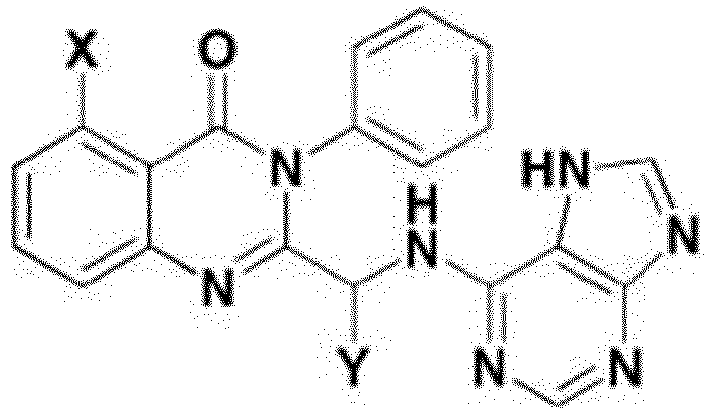
- X is -H, halogen, or -CH3; and
- Y is C3-4 cycloalkyl.

X is -H, halogen, or -CH3.
Y is C3-4 cycloalkyl.
- X is -H, halogen, or -CH3,; and
- Y is C3-4 cycloalkyl.

- X is -H, halogen, or -CH3; and
- Y is C3-4 cycloalkyl.

Z is halogen. - Novel quinazolinone derivatives according to the present invention are efficacious in treating blood cancer or liver diseases.
- In particular, as compared to existing PI3Kδ inhibitors, the quinazolinone derivatives of the present invention can inhibit PI3Kδ with high selectivity to reduce immunotoxicity significantly, or inhibit PI3Kδ and PI3Kγ simultaneously, thus enabling not only the anticancer treatment of hematologic malignancies and the like, but also the treatment of autoimmune diseases. These targeted therapeutic agents can address problems such as side effects of existing anticancer treatments with severe cytotoxicity.
-
-
FIG. 1 illustrates the principle of an Adapta kinase analysis experiment of Experimental Example 1. -
FIG. 2 illustrates results of Experimental Example 2 for confirming an effect on reducing AKT (Ser473) phosphorylation in leukemia and lymphoma cell lines. -
FIG. 3 illustrates results of Experimental Example 3 for confirming an inhibitory effect on the growth of leukemia and lymphoma cells. -
FIG. 4 illustrates SDS-PAGE analysis results of Experimental Example 4 for confirming an effect on the apoptosis of diffuse large B-cell lymphoma (DLBCL) cells and acute lymphoblastic leukemia (ALL) cells. -
FIG. 5 illustrates flow cytometry results of Experimental Example 5 for confirming an effect on the apoptosis of diffuse large B-cell lymphoma (DLBCL) cells and acute lymphoblastic leukemia (ALL) cells. -
FIG. 6 illustrates Cytation™ 5 fluorescence microscopic (BioTek) images showing tube formation results of Experimental Example 6 for confirming an inhibitory effect on angiogenesis. -
FIG. 7 is a graph showing an inhibitory effect on angiogenesis in Experimental Example 6 for confirming an inhibitory effect on angiogenesis. -
FIG. 8 is a graph showing the number of viable HUVECs treated with a compound in Experimental Example 6 for confirming an inhibitory effect on angiogenesis. -
FIG. 9 is a table for confirming toxicity according to the concentrations of a compound ofFormula 7 and a compound ofFormula 8 in Experimental Example 7, which is a single dose toxicity test in rats. - Hereinafter, the present invention will be described in detail. The terms or words used in the present specification and claims should not be construed as being limited to ordinary or dictionary meanings and should be construed as meanings and concepts consistent with the spirit of the present invention based on a principle that an inventor can appropriately define concepts of terms to explain the invention of the inventor in the best way. Thus, configurations described in embodiments set forth herein are merely exemplary embodiments of the present invention and do not represent all technical ideas of the present invention, and thus it should be understood that various equivalents and modifications that may replace these embodiments can be made at the filing time of the present application.
- The present invention relates to novel compounds of quinazolinone derivatives as PI3K inhibitors. PI3K inhibitors block the PI3K-AKT signaling pathway by docking with an ATP-binding site of p110δ, and the activation of PI3K pathways is mediated by PI3K catalytic isotypes, i.e., p110α, p110β, p110δ, and p110γ.
- p110δ plays a vital role in blood cancer and B cell development and is predominantly expressed in hematopoietic stem cells, and is expressed in many cancers including leukemia, lymphoma, colorectal cancer, bladder cancer, malignant glioma, and the like. It regulates cell proliferation through stimulation of related cytokines and chemokines via the PI3K-AKT signaling pathway.
- In addition, novel quinazolinone derivatives according to the present invention overcome existing toxicity problems including hepatotoxicity. Since PI3K p110δ might be highly expressed even in advanced hepatocellular carcinoma, novel quinazolinone derivatives according to the present invention are also effective as a therapeutic agent for hepatocellular carcinoma, which is solid cancer.
- In view of problems of existing quinazolinone-based anticancer drugs, novel quinazolinone derivatives should sufficiently and selectively inhibit PI3Kδ. Preferably, selectivity between PI3K isomers needs to satisfy the criteria that, using IC50 values, each of ratios of PI3Kα/PI3Kδ and PI3Kβ/PI3Kδ exceeds 150, and a ratio of PI3Kγ/PI3Kδ is greater than that of idelalisib at least.
- In addition, when PI3Kδ and PI3Kγ are simultaneously inhibited, it is preferable that ratios of PI3Kβ/PI3Kδ and PI3Kβ/PI3Kγ are greater than those of duvelisib.
- The present invention provides a compound represented by Formula 1 or a pharmaceutically acceptable salt thereof.

- X is -H, halogen, or -CH3; and
- Y is C3-4 cycloalkyl.
- The term "halogen" as used herein refers to fluorine (F), bromine (Br), chlorine (Cl), or iodine (I). In Formula 1, Y may be linked in the form of (S)-isomer or (R)-isomer, but preferably in the form of (S)-isomer.
- Specific examples of the compound of Formula 1 include compounds represented by the following
Formulas 7 to 14, but the present invention is not limited thereto.
Reference compounds 9 - 11 are also shown. - The Compound of
Formula 7 according to the present invention is the compound of Formula 1 wherein X is -F, and Y is cyclopropyl.
- In addition, the compound of
Formula 8 according to the present invention is the compound of Formula 1 wherein X is methyl, and Y is cyclopropyl.
- In addition, the compound of
Formula 9 is the compound of Formula 1 wherein X is -NH2, and Y is cyclopropyl.
- In addition, the compound of Formula 10 is the compound of Formula 1 wherein X is -NH2, and Y is methyl.


- In addition, the compound of Formula 11 is the compound of Formula 1 wherein X is -NH2, and Y is ethyl.

- In addition, the compound of Formula 12 according to the present invention is the compound of Formula 1 wherein X is -Cl, and Y is cyclopropyl.

- In addition, the compound of Formula 13 according to the present invention is the compound of Formula 1 wherein X is -F, and Y is cyclobutyl.

- In addition, the compound of Formula 14 according to the present invention is the compound of Formula 1 wherein X is -Cl, and Y is cyclobutyl.

- The compound represented by Formula 1 of the present invention may be used in the form of a pharmaceutically acceptable salt, and the salt may be an acid addition salt formed by a pharmaceutically acceptable free acid. The acid addition salt is obtained from: inorganic acids such as hydrochloric acid, nitric acid, phosphoric acid, sulfuric acid, hydrobromic acid, hydriodic acid, nitrous acid, phosphorous acid, and the like; nontoxic organic acids such as aliphatic mono- and dicarboxylates, phenyl-substituted alkanoates, hydroxy alkanoates and alkandioate, aromatic acids, aliphatic and aromatic sulfonic acids, and the like; or organic acids such as acetic acid, benzoic acid, citric acid, lactic acid, maleic acid, gluconic acid, methanesulfonic acid, 4-toluenesulfonic acid, tartaric acid, fumaric acid, and the like. Examples of these pharmaceutically nontoxic salts include sulfates, pyrosulfates, bisulfates, sulfites, bisulfites, nitrates, phosphates, monohydrogen phosphates, dihydrogen phosphates, metaphosphates, pyrophosphate chlorides, bromides, iodides, fluorides, acetates, propionates, decanoates, caprylates, acrylates, formates, isobutyrates, caprates, heptanoates, propiolates, oxalates, malonates, succinates, suberates, sebacates, fumarates, maleates, butyne-1,4-dioates, hexane-1,6-dioates, benzoates, chlorobenzoates, methylbenzoates, dinitro benzoates, hydroxybenzoates, methoxybenzoates, phthalates, terephthalates, benzenesulfonates, toluenesulfonates, chlorobenzenesulfonates, xylenesulfonates, phenyl acetates, phenylpropionates, phenylbutyrates, citrates, lactates, β-hydroxybutyrates, glycolates, malates, tartrates, methanesulfonates, propanesulfonates, naphthalene-1-sulfonates, naphthalene-2-sulfonates, mandelates, and the like.
- Acid addition salts according to the present invention may be prepared using a conventional method. For example, these acid addition salts may be prepared by dissolving the derivative of Formula 1 in an organic solvent, such as methanol, ethanol, acetone, dichloromethane, acetonitrile, or the like, adding an organic acid or an inorganic acid thereto to produce a precipitate, and filtering and drying the precipitate, or may be prepared by distilling a solvent and an excess of an acid under reduced pressure and then drying the resulting solution, followed by crystallization in the presence of an organic solvent.
- In addition, pharmaceutically acceptable metallic salts may be prepared by using bases. Alkali metal or alkali earth metal salts are obtained by, for example, dissolving a compound in an excess of an alkali metal hydroxide or alkali earth metal hydroxide solution, filtering an insoluble compound salt, and evaporating and drying the filtrate. At this time, it is pharmaceutically preferable that a sodium salt, a potassium salt, or a calcium salt is prepared as a metal salt. In addition, salts corresponding thereto are obtained by reacting an alkali metal or an alkali earth metal salt with a suitable silver salt (e.g., silver nitrate).
- Moreover, the present invention includes not only the compound represented by Formula 1 and pharmaceutically acceptable salts thereof, but also solvates, stereoisomers, hydrates, and the like that may be prepared therefrom.
- The present invention also provides a pharmaceutical composition for preventing or treating a blood cancer, a liver disease, and an autoimmune disease, which includes a compound represented by Formula 1 below or a pharmaceutically acceptable salt thereof as an active ingredient.


- X is -H, halogen, or -CH3; and
- Y is C3-4 cycloalkyl.
- In Formula 1, Y may be linked in the form of (S)-isomer or (R)-isomer, but it is preferable that Y is linked in the form of (S)-isomer. In the pharmaceutical composition according to the present invention, the compound represented by Formula 1 or a pharmaceutically acceptable salt thereof may be administered orally or parenterally in various dosage forms during clinical administration, and may be formulated using commonly used diluents or excipients such as fillers, extenders, binders, wetting agents, disintegrating agents, surfactants, and the like.
- Formulations for oral administration may include, for example, tablets, pills, hard/soft capsules, liquids, suspensions, emulsions, syrups, granules, elixirs, suspensions, troches, and the like. These formulations include, in addition to the active ingredient, a diluent (e.g., lactose, dextrose, sucrose, mannitol, sorbitol, cellulose, and/or glycine) or a lubricant (e.g., silica, talc, stearic acid and magnesium or calcium salts thereof, and/or polyethylene glycol). Tablets may include a binder such as magnesium aluminum silicate, starch paste, gelatin, methyl cellulose, sodium carboxymethylcellulose, and/or polyvinylpyrrolidone, and in some cases, may include a disintegrating agent such as starch, agar, alginic acid or sodium salts thereof, or a boiling mixture and/or an absorbent, a coloring agent, a flavoring agent, and a sweetening agent.
- The pharmaceutical composition including the compound represented by Formula 1 as an active ingredient may be administered parenterally, and the parenteral administration is performed via subcutaneous injection, intravenous injection, intramuscular injection, or intrathoracic injection.
- In this regard, to prepare formulations for parenteral administration, the compound represented by Formula 1 or a pharmaceutically acceptable salt thereof is mixed with a stabilizer or a buffer in water to prepare a solution or a suspension, followed by preparation into an ampoule or vial unit dosage form. The composition may be sterilized and/or may include an adjuvant such as a preservative, a stabilizer, wettable powder, a salt for osmoregulation, and/or a buffer, and other therapeutically effective materials, and may be formulated using a conventional method, such as mixing, granulation, or coating.
- The composition of the present invention may further include, in addition to the quinazolinone compound, one or more effective ingredients exhibiting identical or similar functions.
- A suitable dose of the pharmaceutical composition of the present invention may be appropriately selected depending on the condition and body weight of patients, the severity of symptoms, the dosage form, the route of administration, and the period of administration. In the composition of the present invention, it is preferable that the effective ingredient(s) is(are) administered in an amount of 0.2 mg/kg to 200 mg/kg daily for optimum efficacy. The composition may be administered once a day or multiple doses a day, but the present invention is not limited thereto.
- According to the present invention, the blood cancer may be leukemia or lymphoma.
- The leukemia may be selected from acute lymphocytic leukemia (ALL), acute myelogenous leukemia (AML), chronic lymphocytic leukemia (CLL), and small lymphocytic lymphoma (SLL), and acute lymphocytic leukemia is also known as acute lymphoblastic leukemia.
- The lymphoma may be a mature (peripheral) B-cell neoplasm, and more particularly, may be selected from B-cell chronic lymphocytic leukemia/small lymphocytic lymphoma; B-cell prolymphocytic leukemia; lymphoplasmacytic lymphoma; marginal zone lymphoma, for example, splenic marginal zone B-cell lymphoma (+/- villous lymphocytes), nodal marginal zone lymphoma (+/- monocytoid B-cells), and mucosa-associated lymphoid tissue (MALT) type extranodal marginal zone B-cell lymphoma; hairy cell leukemia; plasma cell myeloma/plasmacytoma; follicular lymphoma; follicle center lymphoma; mantle cell lymphoma; diffuse large B-cell lymphoma (including mediastinal large B-cell lymphoma, intravascular large B-cell lymphoma, and primary effusion lymphoma); and Burkitt lymphoma/Burkitt cell lymphoma.
- In addition, the lymphoma may be selected from multiple myeloma (MM), non-Hodgkin' lymphoma (NHL), mantle cell lymphoma (MCL), follicular lymphoma, Waldenstrom macroglobulinemia (WM), B-cell lymphoma, and diffuse large B-cell lymphoma (DLBCL).
- The liver disease of the present invention may be selected from the group consisting of non-alcoholic fatty liver disease (NAFLD), non-alcoholic steatohepatitis (NASH), hepatic steatosis, hepatocirrhosis, hepatitis, hepatic adenoma, insulin hypersensitivity, and liver cancer.
- The liver cancer may be, for example, a liver tumor, hepatocellular adenoma, or hepatocellular carcinoma.
- The autoimmune disease may be selected from the group consisting of allergic rhinitis, asthma, chronic obstructive pulmonary disease (COPD), and rheumatoid arthritis.
- The present invention also provides a method of preparing a compound represented by Formula 1 below, wherein the method comprises:
- reacting a compound represented by Formula 2 below with a compound represented by
Formula 3 below to prepare a compound represented by Formula 4 below; - deprotecting the compound of Formula 4 to prepare a compound represented by Formula 5 below; and
- reacting a compound represented by Formula 5 below with a compound represented by Formula 6 to prepare the compound represented by Formula 1.

- X is -H, halogen, or -CH3; and
- Y is C3-4 cycloalkyl.

X is -H, halogen, or -CH3.
Formula 3,
Y is C3-4 cycloalkyl.
- X is -H, halogen, or -CH3; and
- Y is C3-4 cycloalkyl.

- X is -H, halogen, or -CH3; and
- Y is C3-4 cycloalkyl.

Z is halogen. - Step 1 is a process of preparing the compound represented by Formula 4 by reacting the compound represented by Formula 2 with the compound represented by
Formula 3. - For example, triphenyl phosphite may be added to a solution in which the compound represented by Formula 2 and the compound represented by
Formula 3 are mixed together in the presence of a pyridine solvent while being stirred at room temperature. - At this time, the temperature is not particularly limited, but the mixture may be stirred at a temperature of 30 °C to 100 °C, preferably 45 °C to 80 °C, and more preferably 55 °C to 60 °C.
- The stirring time is not particularly limited, but the stirring process may be performed for 5 hours to 20 hours, preferably 8 hours to 16 hours, and more preferably 10 hours to 14 hours.
- Subsequently, aniline may be added to allow a reaction to occur. At this time, the temperature is not particularly limited, but the reaction may occur at a temperature of 50 °C to 200 °C, preferably 90 °C to 150 °C, and more preferably 100 °C to 120 °C.
- At this time, reaction time is not particularly limited, but the reaction may occur for 1 hour to 20 hours, preferably 3 hours to 15 hours, and more preferably 5 hours to 10 hours.
- Step 2 is a process of preparing the compound represented by Formula 5 by deprotecting the compound represented by Formula 4.
- For example, the compound represented by Formula 5 may be prepared as follows: The compound represented by Formula 4 is added to a dichloromethane solution in which trifluoroacetic acid (CF3COOH) is dissolved, and then reacted at room temperature for 0.1 hour to 2 hours, preferably 0.2 hour to 1.5 hours, and more preferably 0.5 hour to 1 hour.
-
Step 3 is a process of preparing the compound represented by Formula 1 by reacting the compound represented by Formula 5 with the compound represented by Formula 6. - For example, the compound represented by Formula 5 is added to tert-butanol, N,N-diisopropylethylamine is added thereto, and then the compound represented by Formula 6 is added to the resulting solution, and the reaction solution may be stirred while refluxing for 10 hours to 48 hours, preferably 15 hours to 30 hours, and more preferably 20 hours to 26 hours.
- The present invention provides a health functional food for preventing or alleviating a blood tumor or a liver disease, including a novel quinazolinone compound or a pharmaceutically acceptable salt thereof as an active ingredient.
- The health functional food may be prepared in the form of, but is not limited to, various types of beverages, gums, tea, confectioneries, vitamin complexes, and health supplements.
- Hereinafter, the present invention will be described in detail with reference to examples and experimental examples.
- However, these examples and experimental examples are provided for illustrative purposes only, and are not intended to limit the scope of the present invention.
-

- Triphenyl phosphite (1.4 eq) was added to a solution, in which 2-amino-6-fluorobenzoic acid (1.0 eq) and (S)-2-(tert-butoxycarbonylamino)-2-cyclopropylacetic acid (1.0 eq) were mixed in a pyridine solvent, while the solution was stirred at room temperature. The resulting mixture was stirred at 55 °C to 60 °C for 12 hours. Aniline (1.4 eq) was added thereto and then reacted around 110 °C for 7 hours. Thereafter, the mixed reaction solution was cooled to room temperature and extracted with ethyl acetate and water. The obtained organic layer was dehydrated with anhydrous magnesium sulfate (MgSO4) and concentrated under reduced pressure. n-Heptane was added to the residue, followed by stirring for 30 minutes to precipitate a solid, the solid was filtered and washed with n-heptane, and then the resulting solid was dried to give (S)-tert-butyl cyclopropyl(5-fluoro-4-oxo-3-phenyl-3,4-dihydroquinazolin-2-yl)methylcarbamate with a yield of 65% to 80%.
- 1H NMR (300 MHz, CDCl3): δ 7.66-7.73 (m, 1H), 7.50-7.61 (m, 4H), 7.32-7.40 (m, 2H), 7.09-7.15 (t, J=18 Hz, 1H), 5.53-5.56 (d, J=9 Hz, 1H), 4.18-4.23 (t, J=15 Hz, 1H), 1.42 (s, 9H), 1.08-1.16 (m, 1H), 0.38-0.42 (m, 2H), 0.24-0.30 (m, 1H), 0.01-0.11 (m, 1H).
- Trifluoroacetic acid (about 8 times the weight of (S)-tert-butyl cyclopropyl(5-fluoro-4-oxo-3-phenyl-3,4-dihydroquinazolin-2-yl)methylcarbamate) was added to a dichloromethane solution (about 15 times the weight of (S)-tert-butyl cyclopropyl(5-fluoro-4-oxo-3-phenyl-3,4-dihydroquinazolin-2-yl)methylcarbamate), in which (S)-tert-butyl cyclopropyl(5-fluoro-4-oxo-3-phenyl-3,4-dihydroquinazolin-2-yl)methylcarbamate was dissolved. The reaction solution was stirred at room temperature for about 0.5 hour to about 1 hour, and then pH of the reaction solution was adjusted to about 7 using an aqueous sodium carbonate solution. The dichloromethane solution was separated, dehydrated using magnesium sulfate (MgSO4) and filtered, and magnesium sulfate (MgSO4) was removed and then the filtrate was concentrated under reduced pressure to give (S)-2-(amino(cyclopropyl)methyl)-5-fluoro-3-phenylquinazolin-4(3H)-one with a yield of 80% to 95%.
- 1H NMR (400 MHz, CDCl3): δ 7.66-7.71 (m, 1H), 7.47-7.57 (m, 4H), 7.27-7.31 (m, 2H), 7.08-7.12 (t, J=16 Hz, 1H), 2.97-2.99 (d, J=8 Hz, 1H), 1.87 (s, 2H), 1.22-1.31 (m, 1H), 0.39-0.53 (m, 2H), 0.01-0.15 (m, 2H).
- The (S)-2-(amino(cyclopropyl)methyl)-5-fluoro-3-phenylquinazolin-4(3H)-one obtained in step 2 was added to tert-butanol (about 15 times the weight of (S)-2-(amino(cyclopropyl)methyl)-5-fluoro-3-phenylquinazolin-4(3H)-one), N,N-diisopropylamine (about 2 equivalents of (S)-2-(amino(cyclopropyl)methyl)-5-fluoro-3-phenylquinazolin-4(3H)-one) and 6-bromo-9H-purine were added thereto, and then the reaction solution was stirred while refluxing for 24 hours.
- The reaction mixture was cooled, and concentrated under reduced pressure to remove tert-butanol. Ethyl acetate was added to the concentrate and sequentially washed with a diluted hydrochloric acid solution and a diluted potassium carbonate solution. The ethyl acetate layer was dehydrated with anhydrous magnesium sulfate (MgSO4) and filtered, and the filtrate was concentrated under reduced pressure, to give (S)-2-(((7H-purine-6-yl)amino)(cyclopropyl)methyl)-5-fluoro-3-phenylquinazoline-4(3H)-one (Formula 7) in the form of solid with a yield of 60% to 80%.
- 1H NMR (300 MHz, CDCl3): δ 13.02 (s, 1H), 8.03 (s, 1H), 7.98 (s, 1H), 7.50-7.71 (m, 6H), 7.39-7.42 (dd, J=9 Hz, 1H), 7.08-7.14 (t, J=18 Hz, 1H), 6.76-6.79 (d, J=9 Hz, 1H), 4.93 (br s, 1H), 1.72 (br s, 1H), 1.33-1.44 (m, 1H), 0.49-0.53 (m, 2H), 0.37-0.46 (m, 1H), 0.21-0.27 (m, 1H).
- ESI-MS m/z 428.45 [M+H]+
-

- (S)-tert-butyl cyclopropyl(5-methyl-4-oxo-3-phenyl-3,4-dihydroquinazolin-2-yl)methylcarbamate was prepared in the same manner as in Example 1, except that 2-amino-6-methylbenzoic acid was used instead of 2-amino-6-fluorobenzoic acid.
- 1H NMR (400 MHz, CDCl3): δ 8.33 (br.s., 3H), 7.50 (d, 4H, J=7.9 Hz), 7.28 (t, 11H, J=7.7 Hz), 7.07 (t, 2H, J=7.3 Hz), 5.35 (br. s., 1H), 3.61 (br. s., 3H), 1.32-1.51 (m, 12H), 1.17-1.30 (m, 1H), 0.51-0.73 (m, 4H), 0.47 (td, 3H, J=4.7, 9.6 Hz).
- (S)-2-(amino(cyclopropyl)methyl)-5-methyl-3-phenylquinazolin-4(3H)-one was prepared in the same manner as in Example 1.
- 1H NMR (400 MHz, DMSO-d6): δ 8.41 (br.s., 2H), 7.79 (t, 1H, J=7.7 Hz), 7.54-7.73 (m, 2H), 7.31-7.46 (m, 1H), 2.74 (s, 3H), 1.23 (br.s., 1H), 1.18 (tt, 1H, J=4.4, 8.7 Hz), 0.51 (s, 1H), 0.32-0.41 (m, 1H, J=4.8, 10, 10 Hz).
- (S)-2-(((7H-purin-6-yl)amino)(cyclopropyl)methyl)-5-methyl-3-phenylquinazolin-4(3H)-one (Formula 8) was prepared in the same manner as in Example 1, except that (S)-2-(amino(cyclopropyl)methyl)-5-methyl-3-phenylquinazolin-4(3H)-one was used instead of (S)-2-(amino(cyclopropyl)methyl)-5-fluoro-3-phenylquinazolin-4(3H)one.
- 1H NMR (400 MHz, CDCl3): δ 8.29 (s, 1H), 7.96 (br.s., 1H), 7.36-7.71 (m, 7H), 7.19-7.25 (m, 1H), 6.83 (d, 1H, J=6.6 Hz), 4.96 (t, 1H, J=8.1 Hz), 2.82 (s, 3H), 1.24-1.43 (m, 2H), 0.29-0.67 (m, 3H), 0.24 (s, 1H), 0.07 (s, 1H).
- ESI-MS m/z 424.48 [M+H]+
-


- To a sealed tube in which a solution prepared by sequentially adding the (S)-2-(((7H-purin-6-yl)amino)(cyclopropyl)methyl)-5-fluoro-3-phenylquinazolin-4(3H)-one (1.0 eq.) prepared in Example 1 and triethylamine (5.0 eq.) to ethanol (15 times the volume of triethylamine) was accommodated, 4-methoxybenzylamine was further added.
- Subsequently, the tube was replaced with nitrogen and sealed, and then the reaction mixture was heated to 180°C and reacted for one day. After cooling to room temperature, the ethanol solvent was removed under reduced pressure. Thereafter, a crude mixture was subjected to silica gel column chromatography (dichloromethane/methanol 20:1) to give (S)-2-(((7H-purin-6-yl)amino)(cyclopropyl)methyl)-5-((4-methoxybenzyl)amino)-3-phenylquinazolin-4(3H)-one as yellow solid (yield: 38%).
- 1H NMR (300 MHz, CDCl3): δ 13.67 (s, 1H), 8.80-8.84 (t, J=12 Hz, 1H), 8.31 (s, 1H), 7.96 (s, 1H), 7.52-7.62 (m, 4H), 7.39-7.48 (m, 2H), 7.23-7.25 (d, J=6 Hz, 2H), 6.84-6.92 (t, J=24 Hz, 2H), 6.80-6.84 (d, J=12 Hz, 2H), 6.46-6.49 (d, J=9 Hz, 1H), 4.92 (s, 1H), 4.31-4.33 (d, J=6 Hz, 2H), 3.76 (s, 3H), 1.37-1.39 (m, 1H), 0.43-0.50 (m, 2H), 0.38-0.40 (m, 1H), 0.20-0.25 (m, 1H).
- To a solution in which (S)-2-(((7H-purin-6-yl)amino)(cyclopropyl)methyl)-5-(4-methoxybenzylamino)-3-phenylquinazolin-4(3H)-one (1.0 eq.) was dissolved in dichloromethane (6 times the volume of (S)-2-(((7H-purin-6-yl)amino)(cyclopropyl)methyl)-5-(4-methoxybenzylamino)-3-phenylquinazolin-4(3H)-one), trifluoroacetic acid (2 times the volume of dichloromethane) was added, and the resulting solution was stirred at room temperature for 0.5 hour to 2 hours. Thereafter, the pH of a crude mixture was adjusted to 7 with a 1M NaOH solution at 0 °C. The resulting solution was extracted three times with dichloromethane, and the combined organic phases were dehydrated with anhydrous magnesium sulfate (MgSO4) and concentrated under reduced pressure. The residue was purified by silica gel column chromatography to obtain (S)-2-(((7H-purin-6-yl)amino)(cyclopropyl)methyl)-5-amino-3-phenylquinazolin-4(3H)-one (Formula 9) as ivory solid (yield: 21%).
- 1H NMR (300 MHz, CDCl3): δ 13.16 (s, 1H), 8.30 (s, 1H), 7.97 (s, 1H), 7.53-7.64 (m, 4H), 7.40-7.45 (t, J=15 Hz, 2H), 6.92-6.95 (d, J=9 Hz, 1H), 6.84-6.86 (d, J=6 Hz, 1H), 6.54-6.56 (d, J=6 Hz, 1H), 6.15 (s, 2H), 4.93 (s, 1H), 1.32-1.41 (m, 1H), 0.47-0.48 (m, 2H), 0.38-0.43 (m, 1H), 0.22-0.25 (m, 1H).
-

- (S)-2-(1-((7H-purin-6-yl)amino)ethyl)-5-amino-3-phenylquinazolin-4(3H)-one (Formula 10) was prepared in the same manner as in Example 3, except that (S)-2-(1-((7H-purin-6-yl)amino)ethyl)-5-fluoro-3-phenylquinazolin-4(3H)-one was used instead of (S)-2-(((7H-purin-6-yl)amino)(cyclopropyl)methyl)-5-fluoro-3-phenylquinazolin-4(3H)-one.
- 1H NMR (500 MHz, DMSO-d6): δ 8.00-8.22 (m, 1H), 7.32-7.78 (m, 4H), 7.06 (br.s., 1H), 6.55-6.70 (m, 1H), 1.99 (s, 1H), 1.06-1.55 (m, 4H), 0.70-0.93 (m, 2H).
-


- (S)-2-(1-((7H-purin-6-yl)amino)propyl)-5-amino-3-phenylquinazolin-4(3H)-one (Formula 11) was prepared in the same manner as in Example 3, except that (S)-2-(1-((7H-purin-6-yl)amino)propyl)-5-fluoro-3-phenylquinazolin-4(3H)-one was used instead of (S)-2-(((7H-purin-6-yl)amino)(cyclopropyl)methyl)-5-fluoro-3-phenylquinazolin-4(3H)-one.
- 1H NMR (300 MHz, CDCl3): δ 8.31 (s, 1H), 7.97 (s, 1H), 7.35-7.68 (m, 6H), 6.91-6.94 (d, J=9 Hz, 1H), 6.82-6.84 (d, J=6 Hz, 1H), 6.53-6.56 (d, J=9 Hz, 1H), 6.15 (s, 2H), 5.16 (s, 1H), 1.91-2.05 (m, 1H), 1.74-1.84 (m, 1H), 0.84-0.89 (t, J=15 Hz, 3H).
-


- (S)-tert-butyl (5-chloro-4-oxo-3-phenyl-3,4-dihydroquinazolin-2-yl)(cyclopropyl)methylcarbamate was prepared in the same manner as in Example 1, except that 2-amino-6-chlorobenzoic acid was used instead of 2-amino-6-fluorobenzoic acid.
- (S)-2-(amino(cyclopropyl)methyl)-5-chloro-3-phenylquinazolin-4(3H)-one was prepared in the same manner as in Example 1.
- (S)-2-(((7H-purin-6-yl)amino)(cyclopropyl)methyl)-5-chloro-3-phenylquinazolin-4(3H)-one (Formula 12) was prepared in the same manner as in Example 1, except that (S)-2-(amino(cyclopropyl)methyl)-5-chloro-3-phenylquinazolin-4(3H)-one was used instead of (S)-2-(amino(cyclopropyl)methyl)-5-fluoro-3-phenylquinazolin-4(3H)-one.
- 1H NMR (300 MHz, CDCl3): δ 13.02 (s, 1H), 8.02 (s, 1H), 7.98 (s, 1H), 7.15-7.68 (m, 8H), 6.76-6.79 (d, J=9 Hz, 1H), 4.93 (br.s., 1H), 1.72 (br.s., 1H), 1.33-1.44 (m, 1H), 0.49-0.53 (m, 2H), 0.37-0.46 (m, 1H), 0.21-0.27 (m, 1H).
- ESI-MS m/z 444.40 [M+H]+
-

- (S)-2-(((7H-purin-6-yl)amino)(cyclobutyl)methyl)-5-flouro-3-phenylquinazolin-4(3H)-one (Formula 13) was prepared in the same manner as in Example 1, except that (S)-2-(tert-butoxycarbonylamino)-2-cyclobutylacetic acid was used instead of (S)-2-(tert-butoxycarbonylamino)-2-cyclopropylacetic acid.
- 1H NMR (300 MHz, DMSO-d6): δ 12.95 (s, 1H), 8.13 (br.s., 1H), 7.85 (br.s., 1H), 7.24-7.60 (m, 8H), 5.18 (br.s., 1H), 3.05 (br.s., 1H), 1.64-2.01 (m, 7H).
-

- (S)-2-(((7H-purin-6-yl)amino)(cyclobutyl)methyl)-5-chloro-3-phenylquinazolin-4(3H)-one (Formula 14) was prepared in the same manner as in Example 1, except that 2-amino-6-chlorobenzoic acid was used instead of 2-amino-6-fluorobenzoic acid, and (S)-2-(tert-butoxycarbonylamino)-2-cyclobutylacetic acid was used instead of (S)-2-(tert-butoxycarbonylamino)-2-cylcopropylacetic acid.
- 1H NMR (300 MHz, DMSO-d6): δ 12.88 (s, 1H), 8.17 (br.s., 1H), 8.00 (s, 1H), 7.12-7.87 (m, 8H), 5.18 (br.s., 1H), 3.06 (br.s., 1H), 1.62-1.99 (m, 7H)
- Structures of the compounds of
Formulas 7 to 14 are shown in Table 1 below. (N.b. Formulas 9 -11 in Table 1 are not part of the present invention)[Table 1] Formula Chemical Structure Formula Chemical Structure 7 
11 
8 
12 
9 
13 
10 
14 
- An experiment was conducted using a homogeneous, fluorescence-based immunoassay, which is Adapta kinase assay.
- SelectScreen™ Services available from Thermo Fisher Scientific Inc. was carried out. A principle of the experiment is shown in
FIG. 1 . - The results of the experiment are shown in Table 2 below.
- As shown in Table 2, the compound of
Formula 7 and the compound ofFormula 8 exhibited higher activity than the control drug, idelalisib. In particular, they exhibited specific inhibitory activity on p110δ and also exhibited excellent activity with respect to p110γ. - In particular, ratios of P13Kα/PI3Kδ and PI3Kβ/PI3Kδ, as IC50 values, were shown as 412 and 210 respectively in the case of the compound of
Formula 7, and 1,488 and 1,800 respectively in the case of the compound ofFormula 8. - In addition, it was confirmed that the compound of
Formula 7 and the compound ofFormula 8 have high delta (δ) selectivity. Each of them exhibited a ratio of PI3Kγ/PI3Kδ of 51 and 95 respectively, whereas idelalisib exhibited the ratio about 25. From these results, it was confirmed that the compounds ofFormulae [Table 2] IC50 (nM) IC50 (nM) IC50 (nM) IC50 (nM) PI3Ks p110α p110β p110γ p110δ Idelalisib 498 570 23 0.9 Formula 7206 105 25.7 0.5 Formula 8134 162 8.6 0.09 - Cell lines (SUDHL 5, SUDHL 10, CCRF-SB, and MOLT4) were subjected to serum depletion for 2 hours, and then were treated with 1 µM of each of the compound of
Formula 7, the compound ofFormula 8, idelalisib (comparative drug 1), TGR1202 (comparative drug 2), and dimethylsulfoxide (DMSO) for 1 hour. Subsequently, cells were lysed and fractionated according to size, followed by immunoblotting with antibodies directed against Phospho-Akt (Ser473). - The results of the experiment are shown in
FIG. 2 . - As illustrated in
FIG. 2 , it was confirmed that the compound ofFormula 7 and the compound ofFormula 8 induced the reduction of AKT phosphorylation in various diffuse large B-cell lymphoma (DLBCL) and acute lymphocytic leukemia (ALL) cells. - PI3K p110δ is highly expressed in leukemia and lymphoma cell lines, and cell growth is inhibited by suppressing PI3K p110δ.
- Thus, an experiment was carried out to confirm the effects of compounds on inhibiting cell growth.
- Diffuse large B-cell lymphoma (DLBCL)-derived cells and acute lymphocytic leukemia (ALL)-derived cells were cultured with the compound of
Formula 7, the compound ofFormula 8, or idelalisib, along with a control medium for 48 hours. - Cell growth-inhibiting effects on the DLBCL-derived cells and the ALL-derived cells were evaluated by measuring the absorbance of cell counting kit-8 (CCK-8) dye. During the last 3 hours of the 48 hours, 10 µM of a CCK-8 dye was added to each plate and then cultured.
- All data are expressed as the mean (± SD) of three independent experiments.
- The results of the experiment are shown in
FIG. 3 . - As illustrated in
FIG. 3 , growth of the DLBCL-derived cells and the ALL-derived cell line was reduced at a concentration ranging from 0.625 µM to 20 µM. - At this time, lethal concentration 50 (LC50), which is the concentration of compounds being lethal to 50% of the cells , is shown in Table 3, and it was confirmed that the compound of
Formula 7 and the compound ofFormula 8 exhibited a lower LC50 value than that of idelalisib.[Table 3] LC50 (µM) LC50 (µM) LC50 (µM) Cell line SUDHL5 (DLBCL) MOLT4 (ALL) SupB15 (ALL) Idelalisib 3.0 > 20 > 20 Formula 71.1 13.7 > 20 Formula 80.9 4.9 16.53 - 2.6 x 10⁶ cells were cultured with idelalisib (comparative drug), the compound of
Formula 7, or the compound ofFormula 8 at a concentration of 50 µM for 36 hours, and then protein analysis was performed by sodium dodecyl sulfate-polyacrylamide gel electrophoresis (SDS-PAGE). - The
caspase - Results of the experiment are shown in
FIG. 4 . - As illustrated in
FIG. 4 , the compound ofFormula 7 and the compound ofFormula 8 induced apoptosis in diffuse large B-cell lymphoma (DLBCL) and acute lymphocytic leukemia (CLL) cells. - In addition, apoptosis occurred more actively with the compound of
Formula 7 and the compound ofFormula 8 than with the comparative drug (idelalisib). - From these results, it was confirmed that the compound of
Formula 7 and the compound ofFormula 8 inhibited cell growth through apoptosis. - 1 x 10⁶ diffuse large B-cell lymphoma (DLBCL) cells and 1 x 10⁶ acute lymphocytic leukemia (ALL) cells were cultured and treated with each of the comparative drug (Idelalisib), the compound of
Formula 7, and the compound ofFormula 8 at a concentration of 50 µM for 24 hours. The cells were washed with PBS, and then suspended in a binding buffer. 5 µl of an Annexin V-FITC stock solution (Becton Dickinson Science, Inc) and 5 µl of PI (20 µg/ml) were added thereto, followed by incubation at room temperature for 15 minutes with light-shielding, and then the target material was quantified on FACScan TM (Becton Dickinson) by flow cytometry. - The results of the experiment are shown in
FIG. 5 . - As illustrated in
FIG. 5 , it was confirmed that the compound ofFormula 7 and the compound ofFormula 8 more effectively induced apoptosis than the comparative drug (Idelalisib). - To compare levels of angiogenesis inhibition by the compound of
Formula 7, the compound ofFormula 8, and a comparative drug (Idelalisib), human umbilical vein endothelial cells (HUVECs), which are vascular endothelial cells, and endothelial cell growth media were obtained from Life Technologies. - The human umbilical vein endothelial cells (HUVECs) were cultured along with the compound of
Formula 7, the compound ofFormula 8, or the comparative drug (Idelalisib) on basement membrane matrix at 37 °C. After 18 hours, tube formation was photographed using a Cytation™ 5 fluorescence microscope (BioTek), and the number of areas formed by branch points was counted using software (seeFIG. 6 ). - The results of the experiment are shown in
FIGS. 7 and8 . - As illustrated in
FIG. 7 , the compound ofFormula 7 and the compound ofFormula 8 inhibited angiogenesis more than the comparative drug (Idelalisib) did. - In addition, as illustrated in
FIG. 8 , the compound ofFormula 7 and the compound ofFormula 8 did not significantly affect the cytotoxicity of the human umbilical vein endothelial cells (HUVECs). - The compound of
Formula 7 and the compound ofFormula 8 were orally administered to eight six-week-old female rats, to observe the single dose oral toxicity thereof and to obtain an approximate lethal dose. The dosage was set at 10 mL/kg, and the dosage for each rat was calculated based on body weight. Each compound was administered at doses of 100 mg/kg, 300 mg/kg, 900 mg/kg, and 1,500 mg/kg, and general symptoms were observed once a day from day 1 to day 2 after administration. - The results of the experiment are shown in
FIG. 9 . - Lethal dose of compound of
formula 7 is over than 1,500mg/kg and that of compound offormula 8 is 1,500mg/kg. - Meanwhile, the compound represented by Formula 1 according to the present invention may be formulated into various forms. Several formulation methods using the compound represented by Formula 1 according to the present invention as an active ingredient are provided below for illustrative purposes only, but are not intended to limit the present invention.
-
Compound of Formula 1 500 mg Lactose 100 mg Talc 10 mg - The above ingredients were mixed and airtight packages were filled therewith to prepare powder.
-
Compound of Formula 1 500 mg Corn starch 100 mg Lactose 100 mg Magnesium stearate 2 mg - The above ingredients were mixed, and then tablets were prepared according to a general method of preparing tablets.
-
Compound of Formula 1 500 mg Corn starch 100 mg Lactose 100 mg Magnesium stearate 2 mg - The above ingredients were mixed, and then gelatin capsules were filled therewith according to a general method of preparing capsules to prepare capsules.
-
Compound of Formula 1 500 mg Sterile distilled water for injection appropriate amount pH adjuster appropriate amount - According to a general method of preparing an injection, ampoules were prepared with the above ingredients included in a single ampoule (2 ml).
-
Compound of Formula 1 100 mg Isomerized sugar 10 g Mannitol 5 g Purified water appropriate amount - Each ingredient was added to and dissolved in purified water according to a general method of preparing a liquid. A lemon flavor was added in an appropriate amount and the above ingredients were mixed. Purified water was added thereto such that a total amount of the resulting solution is adjusted to 100 ml. A brown bottle is filled therewith, and sterilized to prepare liquids.
Claims (8)
- A compound of Formula 1 or a pharmaceutically acceptable salt thereof:
 X is hydrogen, halogen, or methyl;and Y is C3-4 cycloalkyl.
 - The compound of claim 1,
wherein X is fluorine and Y is cyclopropyl. - The compound of claim 1,
wherein X is methyl and Y is cyclopropyl. - The compound of claim 1,
wherein X is fluorine and Y is cyclobutyl. - The compound of claim 1,
wherein X is chlorine and Y is cyclobutyl. - A compound of Formula 1 or a pharmaceutically acceptable salt thereof for use in preventing or treating a disease or condition,
 wherein X is hydrogen, halogen, or methyl,wherein Y is C3-4 cycloalkyl, andwherein the disease or condition is selected from the group consisting of hematologic malignancy, liver disease, and autoimmune disease.
 - The compound for use according to claim 6,
wherein the hematological malignancy is selected from leukemia or lymphoma. - The compound for use according to claim 6,
wherein the liver disease is selected from the group consisting of NAFDL, NASH, hepatic steatosis, hepatocirrhosis, hepatitis, hepatic adenoma, insulin hypersensitivity, and liver cancer.
Applications Claiming Priority (3)
| Application Number | Priority Date | Filing Date | Title |
|---|---|---|---|
| KR20160089417 | 2016-07-14 | ||
| KR1020170086691A KR101932146B1 (en) | 2016-07-14 | 2017-07-07 | Novel Quinazolinone derivatives as PI3K inhibitors, and pharmaceutical composition comprising the same |
| PCT/KR2017/007535 WO2018012907A1 (en) | 2016-07-14 | 2017-07-13 | Novel quinazolinone derivatives inhibiting pi3k and pharmaceutical composition containing same |
Publications (3)
| Publication Number | Publication Date |
|---|---|
| EP3453393A1 EP3453393A1 (en) | 2019-03-13 |
| EP3453393A4 EP3453393A4 (en) | 2019-06-26 |
| EP3453393B1 true EP3453393B1 (en) | 2020-09-09 |
Family
ID=60953246
Family Applications (1)
| Application Number | Title | Priority Date | Filing Date |
|---|---|---|---|
| EP17827977.4A Not-in-force EP3453393B1 (en) | 2016-07-14 | 2017-07-13 | Novel quinazolinone derivatives inhibiting pi3k and pharmaceutical composition containing same |
Country Status (13)
| Country | Link |
|---|---|
| US (2) | US10577369B2 (en) |
| EP (1) | EP3453393B1 (en) |
| JP (2) | JP6614741B2 (en) |
| KR (1) | KR101932146B1 (en) |
| CN (1) | CN109475559B (en) |
| AU (2) | AU2017297096B2 (en) |
| BR (1) | BR112019000614A2 (en) |
| CA (1) | CA3030692C (en) |
| ES (1) | ES2824774T3 (en) |
| GB (2) | GB2576120B (en) |
| RU (2) | RU2702904C1 (en) |
| WO (1) | WO2018012907A1 (en) |
| ZA (1) | ZA201900421B (en) |
Families Citing this family (6)
| Publication number | Priority date | Publication date | Assignee | Title |
|---|---|---|---|---|
| KR101932146B1 (en) * | 2016-07-14 | 2018-12-24 | 주식회사 바이오웨이 | Novel Quinazolinone derivatives as PI3K inhibitors, and pharmaceutical composition comprising the same |
| US10751339B2 (en) | 2018-01-20 | 2020-08-25 | Sunshine Lake Pharma Co., Ltd. | Substituted aminopyrimidine compounds and methods of use |
| KR20210095495A (en) | 2020-01-23 | 2021-08-02 | 주식회사 바이오웨이 | novel quinazolinone COMPOUNDs and pharmaceutical composition containing same |
| CN111440173B (en) * | 2020-03-27 | 2021-05-14 | 山东大学 | A kind of preparation method of PI3K inhibitor |
| IN202011027502A (en) | 2020-06-29 | 2021-12-31 | Council Scient Ind Res | |
| KR102733299B1 (en) * | 2021-11-05 | 2024-11-25 | 연세대학교 산학협력단 | A Composition for Preventing or Treating Atopic Dermatitis Comprising an Inhibitor of Skin-specific T cell as an Active Ingredient |
Family Cites Families (15)
| Publication number | Priority date | Publication date | Assignee | Title |
|---|---|---|---|---|
| US6667300B2 (en) | 2000-04-25 | 2003-12-23 | Icos Corporation | Inhibitors of human phosphatidylinositol 3-kinase delta |
| US20050043239A1 (en) * | 2003-08-14 | 2005-02-24 | Jason Douangpanya | Methods of inhibiting immune responses stimulated by an endogenous factor |
| US20050054614A1 (en) * | 2003-08-14 | 2005-03-10 | Diacovo Thomas G. | Methods of inhibiting leukocyte accumulation |
| EP1761540B1 (en) * | 2004-05-13 | 2016-09-28 | Icos Corporation | Quinazolinones as inhibitors of human phosphatidylinositol 3-kinase delta |
| WO2005120511A1 (en) | 2004-06-04 | 2005-12-22 | Icos Corporation | Methods for treating mast cell disorders |
| WO2006089106A2 (en) * | 2005-02-17 | 2006-08-24 | Icos Corporation | Phosphoinositide 3-kinase inhibitors for inhibiting leukocyte accumulation |
| CN101575333B (en) * | 2008-05-09 | 2011-06-22 | 和记黄埔医药(上海)有限公司 | A kind of quinazoline derivative and its medical use |
| KR20160091440A (en) * | 2008-11-13 | 2016-08-02 | 길리아드 칼리스토가 엘엘씨 | Therapies for hematologic malignancies |
| WO2013082540A1 (en) * | 2011-12-02 | 2013-06-06 | Gilead Calistoga Llc | Compositions and methods of treating a proliferative disease with a quinazolinone derivative |
| SG10202003090VA (en) * | 2012-08-08 | 2020-05-28 | Kbp Biosciences Co Ltd | PI3K δ INHIBITOR |
| EP3046921A4 (en) | 2013-09-22 | 2017-02-22 | Calitor Sciences, LLC | Substituted aminopyrimidine compounds and methods of use |
| WO2015061204A1 (en) * | 2013-10-21 | 2015-04-30 | Infinity Pharmaceuticals, Inc. | Heterocyclic compounds and uses thereof |
| NZ720867A (en) * | 2013-12-20 | 2018-01-26 | Gilead Calistoga Llc | Process methods for phosphatidylinositol 3-kinase inhibitors |
| US10308639B2 (en) | 2014-06-13 | 2019-06-04 | Gilead Sciences, Inc. | Phosphatidylinositol 3-kinase inhibitors |
| KR101932146B1 (en) * | 2016-07-14 | 2018-12-24 | 주식회사 바이오웨이 | Novel Quinazolinone derivatives as PI3K inhibitors, and pharmaceutical composition comprising the same |
-
2017
- 2017-07-07 KR KR1020170086691A patent/KR101932146B1/en not_active Expired - Fee Related
- 2017-07-13 BR BR112019000614-1A patent/BR112019000614A2/en not_active IP Right Cessation
- 2017-07-13 GB GB1915530.8A patent/GB2576120B/en not_active Expired - Fee Related
- 2017-07-13 CA CA3030692A patent/CA3030692C/en active Active
- 2017-07-13 ES ES17827977T patent/ES2824774T3/en active Active
- 2017-07-13 WO PCT/KR2017/007535 patent/WO2018012907A1/en not_active Ceased
- 2017-07-13 RU RU2019103684A patent/RU2702904C1/en active
- 2017-07-13 AU AU2017297096A patent/AU2017297096B2/en not_active Ceased
- 2017-07-13 JP JP2019513840A patent/JP6614741B2/en not_active Expired - Fee Related
- 2017-07-13 CN CN201780043603.1A patent/CN109475559B/en not_active Expired - Fee Related
- 2017-07-13 GB GB1819957.0A patent/GB2570397B/en not_active Expired - Fee Related
- 2017-07-13 EP EP17827977.4A patent/EP3453393B1/en not_active Not-in-force
- 2017-07-13 RU RU2019131147A patent/RU2019131147A/en unknown
-
2019
- 2019-01-10 US US16/244,368 patent/US10577369B2/en not_active Expired - Fee Related
- 2019-01-21 ZA ZA2019/00421A patent/ZA201900421B/en unknown
- 2019-06-14 AU AU2019204181A patent/AU2019204181B2/en not_active Ceased
- 2019-11-01 JP JP2019199810A patent/JP2020040957A/en active Pending
-
2020
- 2020-01-20 US US16/747,140 patent/US20200148684A1/en not_active Abandoned
Non-Patent Citations (1)
| Title |
|---|
| None * |
Also Published As
| Publication number | Publication date |
|---|---|
| US10577369B2 (en) | 2020-03-03 |
| JP2020040957A (en) | 2020-03-19 |
| BR112019000614A2 (en) | 2019-04-24 |
| US20200148684A1 (en) | 2020-05-14 |
| AU2017297096B2 (en) | 2019-03-14 |
| JP2019522678A (en) | 2019-08-15 |
| RU2019131147A (en) | 2020-02-19 |
| CA3030692C (en) | 2020-04-14 |
| ZA201900421B (en) | 2020-05-27 |
| GB2570397B (en) | 2019-12-11 |
| US20190144453A1 (en) | 2019-05-16 |
| ES2824774T3 (en) | 2021-05-13 |
| EP3453393A4 (en) | 2019-06-26 |
| EP3453393A1 (en) | 2019-03-13 |
| RU2702904C1 (en) | 2019-10-14 |
| GB201819957D0 (en) | 2019-01-23 |
| WO2018012907A1 (en) | 2018-01-18 |
| AU2019204181B2 (en) | 2020-07-16 |
| GB2576120A (en) | 2020-02-05 |
| CN109475559B (en) | 2020-06-23 |
| CN109475559A (en) | 2019-03-15 |
| GB2570397A (en) | 2019-07-24 |
| KR20180008299A (en) | 2018-01-24 |
| CA3030692A1 (en) | 2018-01-18 |
| GB2576120B (en) | 2020-07-29 |
| GB201915530D0 (en) | 2019-12-11 |
| JP6614741B2 (en) | 2019-12-04 |
| KR101932146B1 (en) | 2018-12-24 |
| AU2019204181A1 (en) | 2019-07-04 |
| AU2017297096A1 (en) | 2019-01-31 |
Similar Documents
| Publication | Publication Date | Title |
|---|---|---|
| AU2019204181B2 (en) | Novel quinazolinone derivatives inhibiting pi3k and pharmaceutical composition containing same | |
| CN116354960A (en) | SHP2 phosphatase inhibitors | |
| JP6674586B2 (en) | Substituted quinazoline compounds capable of crossing the blood-brain barrier | |
| CN112566666A (en) | Compounds targeting anti-cancer nuclear hormone receptors | |
| US20220119370A1 (en) | Brd4-jak2 inhibitors | |
| JP2022505439A (en) | Urea derivatives to treat and / or prevent cancer | |
| US10414767B2 (en) | Deuterated quinazolinone compound and pharmaceutical composition comprising same | |
| WO2022266418A1 (en) | Triazine inhibitors of cyclin-dependent kinases | |
| CN113214230A (en) | 2-substituted pyrazol amino-4-substituted amino-5-pyrimidine formamide compound, composition and application thereof | |
| US12187686B2 (en) | BRD4-JAK2 inhibitors | |
| CN107383019A (en) | Pyrazolo [4,3 h] quinazoline compounds and application thereof | |
| CN102746212B (en) | Beta-elemene indole derivative, preparation and application thereof | |
| HK40002346B (en) | Quinazolinone derivatives inhibiting pi3k and pharmaceutical composition containing same | |
| HK40002346A (en) | Quinazolinone derivatives inhibiting pi3k and pharmaceutical composition containing same | |
| EP1911451A1 (en) | Protein-kinase CK2 inhibitors and their therapeutic applications | |
| TWI920088B (en) | Sik-3 inhibitors and uses thereof | |
| US20260034115A1 (en) | Yap1 inhibitors | |
| KR20180136930A (en) | Novel Quinazolinone derivatives as PI3K inhibitors, and pharmaceutical composition comprising the same | |
| CN119320354B (en) | hnRNPA2B1 agonists and their combination with chemotherapy agents in tumor prevention and treatment | |
| WO2024030529A1 (en) | Prodrugs of myc inhibitors | |
| EP4504204A1 (en) | Tyrosine kinase inhibitors | |
| AU2022399786A1 (en) | Compounds | |
| KR20210155806A (en) | Polymorphism of PI3K inhibitor and method for preparing same | |
| WO2011009695A1 (en) | New anti-angiogenic compounds | |
| HK1156859A (en) | Substituted pyrimidone derivatives |
Legal Events
| Date | Code | Title | Description |
|---|---|---|---|
| STAA | Information on the status of an ep patent application or granted ep patent |
Free format text: STATUS: THE INTERNATIONAL PUBLICATION HAS BEEN MADE |
|
| PUAI | Public reference made under article 153(3) epc to a published international application that has entered the european phase |
Free format text: ORIGINAL CODE: 0009012 |
|
| STAA | Information on the status of an ep patent application or granted ep patent |
Free format text: STATUS: REQUEST FOR EXAMINATION WAS MADE |
|
| 17P | Request for examination filed |
Effective date: 20181207 |
|
| AK | Designated contracting states |
Kind code of ref document: A1 Designated state(s): AL AT BE BG CH CY CZ DE DK EE ES FI FR GB GR HR HU IE IS IT LI LT LU LV MC MK MT NL NO PL PT RO RS SE SI SK SM TR |
|
| AX | Request for extension of the european patent |
Extension state: BA ME |
|
| STAA | Information on the status of an ep patent application or granted ep patent |
Free format text: STATUS: EXAMINATION IS IN PROGRESS |
|
| A4 | Supplementary search report drawn up and despatched |
Effective date: 20190527 |
|
| RIC1 | Information provided on ipc code assigned before grant |
Ipc: A61P 35/02 20060101ALI20190521BHEP Ipc: C07D 473/34 20060101ALI20190521BHEP Ipc: A61P 1/16 20060101ALI20190521BHEP Ipc: A61K 31/517 20060101AFI20190521BHEP Ipc: A61P 37/00 20060101ALI20190521BHEP Ipc: C07D 239/91 20060101ALI20190521BHEP Ipc: A61P 35/00 20060101ALI20190521BHEP |
|
| 17Q | First examination report despatched |
Effective date: 20190613 |
|
| DAV | Request for validation of the european patent (deleted) | ||
| DAX | Request for extension of the european patent (deleted) | ||
| GRAP | Despatch of communication of intention to grant a patent |
Free format text: ORIGINAL CODE: EPIDOSNIGR1 |
|
| STAA | Information on the status of an ep patent application or granted ep patent |
Free format text: STATUS: GRANT OF PATENT IS INTENDED |
|
| RIC1 | Information provided on ipc code assigned before grant |
Ipc: A61P 35/00 20060101ALI20200310BHEP Ipc: A61K 31/52 20060101AFI20200310BHEP Ipc: C07D 239/91 20060101ALI20200310BHEP Ipc: A61P 1/16 20060101ALI20200310BHEP Ipc: C07D 473/34 20060101ALI20200310BHEP Ipc: A61P 35/02 20060101ALI20200310BHEP Ipc: A61P 37/00 20060101ALI20200310BHEP |
|
| INTG | Intention to grant announced |
Effective date: 20200406 |
|
| GRAS | Grant fee paid |
Free format text: ORIGINAL CODE: EPIDOSNIGR3 |
|
| GRAA | (expected) grant |
Free format text: ORIGINAL CODE: 0009210 |
|
| STAA | Information on the status of an ep patent application or granted ep patent |
Free format text: STATUS: THE PATENT HAS BEEN GRANTED |
|
| AK | Designated contracting states |
Kind code of ref document: B1 Designated state(s): AL AT BE BG CH CY CZ DE DK EE ES FI FR GR HR HU IE IS IT LI LT LU LV MC MK MT NL NO PL PT RO RS SE SI SK SM TR |
|
| RBV | Designated contracting states (corrected) |
Designated state(s): AL AT BE BG CH CY CZ DE DK EE ES FI FR GR HR HU IE IS IT LI LT LU LV MC MK MT NL NO PL PT RO RS SE SI SK SM TR |
|
| REG | Reference to a national code |
Ref country code: AT Ref legal event code: REF Ref document number: 1310702 Country of ref document: AT Kind code of ref document: T Effective date: 20200915 Ref country code: CH Ref legal event code: EP |
|
| REG | Reference to a national code |
Ref country code: IE Ref legal event code: FG4D |
|
| REG | Reference to a national code |
Ref country code: DE Ref legal event code: R096 Ref document number: 602017023512 Country of ref document: DE |
|
| REG | Reference to a national code |
Ref country code: NL Ref legal event code: FP |
|
| REG | Reference to a national code |
Ref country code: LT Ref legal event code: MG4D |
|
| PG25 | Lapsed in a contracting state [announced via postgrant information from national office to epo] |
Ref country code: SE Free format text: LAPSE BECAUSE OF FAILURE TO SUBMIT A TRANSLATION OF THE DESCRIPTION OR TO PAY THE FEE WITHIN THE PRESCRIBED TIME-LIMIT Effective date: 20200909 Ref country code: BG Free format text: LAPSE BECAUSE OF FAILURE TO SUBMIT A TRANSLATION OF THE DESCRIPTION OR TO PAY THE FEE WITHIN THE PRESCRIBED TIME-LIMIT Effective date: 20201209 Ref country code: HR Free format text: LAPSE BECAUSE OF FAILURE TO SUBMIT A TRANSLATION OF THE DESCRIPTION OR TO PAY THE FEE WITHIN THE PRESCRIBED TIME-LIMIT Effective date: 20200909 Ref country code: NO Free format text: LAPSE BECAUSE OF FAILURE TO SUBMIT A TRANSLATION OF THE DESCRIPTION OR TO PAY THE FEE WITHIN THE PRESCRIBED TIME-LIMIT Effective date: 20201209 Ref country code: FI Free format text: LAPSE BECAUSE OF FAILURE TO SUBMIT A TRANSLATION OF THE DESCRIPTION OR TO PAY THE FEE WITHIN THE PRESCRIBED TIME-LIMIT Effective date: 20200909 Ref country code: GR Free format text: LAPSE BECAUSE OF FAILURE TO SUBMIT A TRANSLATION OF THE DESCRIPTION OR TO PAY THE FEE WITHIN THE PRESCRIBED TIME-LIMIT Effective date: 20201210 Ref country code: LT Free format text: LAPSE BECAUSE OF FAILURE TO SUBMIT A TRANSLATION OF THE DESCRIPTION OR TO PAY THE FEE WITHIN THE PRESCRIBED TIME-LIMIT Effective date: 20200909 |
|
| REG | Reference to a national code |
Ref country code: AT Ref legal event code: MK05 Ref document number: 1310702 Country of ref document: AT Kind code of ref document: T Effective date: 20200909 |
|
| PG25 | Lapsed in a contracting state [announced via postgrant information from national office to epo] |
Ref country code: LV Free format text: LAPSE BECAUSE OF FAILURE TO SUBMIT A TRANSLATION OF THE DESCRIPTION OR TO PAY THE FEE WITHIN THE PRESCRIBED TIME-LIMIT Effective date: 20200909 Ref country code: PL Free format text: LAPSE BECAUSE OF FAILURE TO SUBMIT A TRANSLATION OF THE DESCRIPTION OR TO PAY THE FEE WITHIN THE PRESCRIBED TIME-LIMIT Effective date: 20200909 Ref country code: RS Free format text: LAPSE BECAUSE OF FAILURE TO SUBMIT A TRANSLATION OF THE DESCRIPTION OR TO PAY THE FEE WITHIN THE PRESCRIBED TIME-LIMIT Effective date: 20200909 |
|
| PG25 | Lapsed in a contracting state [announced via postgrant information from national office to epo] |
Ref country code: SM Free format text: LAPSE BECAUSE OF FAILURE TO SUBMIT A TRANSLATION OF THE DESCRIPTION OR TO PAY THE FEE WITHIN THE PRESCRIBED TIME-LIMIT Effective date: 20200909 Ref country code: EE Free format text: LAPSE BECAUSE OF FAILURE TO SUBMIT A TRANSLATION OF THE DESCRIPTION OR TO PAY THE FEE WITHIN THE PRESCRIBED TIME-LIMIT Effective date: 20200909 Ref country code: RO Free format text: LAPSE BECAUSE OF FAILURE TO SUBMIT A TRANSLATION OF THE DESCRIPTION OR TO PAY THE FEE WITHIN THE PRESCRIBED TIME-LIMIT Effective date: 20200909 Ref country code: PT Free format text: LAPSE BECAUSE OF FAILURE TO SUBMIT A TRANSLATION OF THE DESCRIPTION OR TO PAY THE FEE WITHIN THE PRESCRIBED TIME-LIMIT Effective date: 20210111 Ref country code: CZ Free format text: LAPSE BECAUSE OF FAILURE TO SUBMIT A TRANSLATION OF THE DESCRIPTION OR TO PAY THE FEE WITHIN THE PRESCRIBED TIME-LIMIT Effective date: 20200909 |
|
| REG | Reference to a national code |
Ref country code: ES Ref legal event code: FG2A Ref document number: 2824774 Country of ref document: ES Kind code of ref document: T3 Effective date: 20210513 |
|
| PG25 | Lapsed in a contracting state [announced via postgrant information from national office to epo] |
Ref country code: IS Free format text: LAPSE BECAUSE OF FAILURE TO SUBMIT A TRANSLATION OF THE DESCRIPTION OR TO PAY THE FEE WITHIN THE PRESCRIBED TIME-LIMIT Effective date: 20210109 Ref country code: AT Free format text: LAPSE BECAUSE OF FAILURE TO SUBMIT A TRANSLATION OF THE DESCRIPTION OR TO PAY THE FEE WITHIN THE PRESCRIBED TIME-LIMIT Effective date: 20200909 Ref country code: AL Free format text: LAPSE BECAUSE OF FAILURE TO SUBMIT A TRANSLATION OF THE DESCRIPTION OR TO PAY THE FEE WITHIN THE PRESCRIBED TIME-LIMIT Effective date: 20200909 |
|
| REG | Reference to a national code |
Ref country code: DE Ref legal event code: R097 Ref document number: 602017023512 Country of ref document: DE |
|
| PG25 | Lapsed in a contracting state [announced via postgrant information from national office to epo] |
Ref country code: SK Free format text: LAPSE BECAUSE OF FAILURE TO SUBMIT A TRANSLATION OF THE DESCRIPTION OR TO PAY THE FEE WITHIN THE PRESCRIBED TIME-LIMIT Effective date: 20200909 |
|
| PLBE | No opposition filed within time limit |
Free format text: ORIGINAL CODE: 0009261 |
|
| STAA | Information on the status of an ep patent application or granted ep patent |
Free format text: STATUS: NO OPPOSITION FILED WITHIN TIME LIMIT |
|
| 26N | No opposition filed |
Effective date: 20210610 |
|
| PG25 | Lapsed in a contracting state [announced via postgrant information from national office to epo] |
Ref country code: DK Free format text: LAPSE BECAUSE OF FAILURE TO SUBMIT A TRANSLATION OF THE DESCRIPTION OR TO PAY THE FEE WITHIN THE PRESCRIBED TIME-LIMIT Effective date: 20200909 Ref country code: SI Free format text: LAPSE BECAUSE OF FAILURE TO SUBMIT A TRANSLATION OF THE DESCRIPTION OR TO PAY THE FEE WITHIN THE PRESCRIBED TIME-LIMIT Effective date: 20200909 |
|
| REG | Reference to a national code |
Ref country code: DE Ref legal event code: R119 Ref document number: 602017023512 Country of ref document: DE |
|
| REG | Reference to a national code |
Ref country code: CH Ref legal event code: PL |
|
| REG | Reference to a national code |
Ref country code: NL Ref legal event code: MM Effective date: 20210801 |
|
| PG25 | Lapsed in a contracting state [announced via postgrant information from national office to epo] |
Ref country code: MC Free format text: LAPSE BECAUSE OF FAILURE TO SUBMIT A TRANSLATION OF THE DESCRIPTION OR TO PAY THE FEE WITHIN THE PRESCRIBED TIME-LIMIT Effective date: 20200909 |
|
| REG | Reference to a national code |
Ref country code: BE Ref legal event code: MM Effective date: 20210731 |
|
| PG25 | Lapsed in a contracting state [announced via postgrant information from national office to epo] |
Ref country code: LI Free format text: LAPSE BECAUSE OF NON-PAYMENT OF DUE FEES Effective date: 20210731 Ref country code: DE Free format text: LAPSE BECAUSE OF NON-PAYMENT OF DUE FEES Effective date: 20220201 Ref country code: CH Free format text: LAPSE BECAUSE OF NON-PAYMENT OF DUE FEES Effective date: 20210731 |
|
| PG25 | Lapsed in a contracting state [announced via postgrant information from national office to epo] |
Ref country code: NL Free format text: LAPSE BECAUSE OF NON-PAYMENT OF DUE FEES Effective date: 20210801 Ref country code: LU Free format text: LAPSE BECAUSE OF NON-PAYMENT OF DUE FEES Effective date: 20210713 Ref country code: FR Free format text: LAPSE BECAUSE OF NON-PAYMENT OF DUE FEES Effective date: 20210731 |
|
| PG25 | Lapsed in a contracting state [announced via postgrant information from national office to epo] |
Ref country code: IE Free format text: LAPSE BECAUSE OF NON-PAYMENT OF DUE FEES Effective date: 20210713 Ref country code: BE Free format text: LAPSE BECAUSE OF NON-PAYMENT OF DUE FEES Effective date: 20210731 |
|
| REG | Reference to a national code |
Ref country code: ES Ref legal event code: FD2A Effective date: 20220826 |
|
| PG25 | Lapsed in a contracting state [announced via postgrant information from national office to epo] |
Ref country code: ES Free format text: LAPSE BECAUSE OF NON-PAYMENT OF DUE FEES Effective date: 20210714 |
|
| PG25 | Lapsed in a contracting state [announced via postgrant information from national office to epo] |
Ref country code: IT Free format text: LAPSE BECAUSE OF NON-PAYMENT OF DUE FEES Effective date: 20210713 |
|
| PG25 | Lapsed in a contracting state [announced via postgrant information from national office to epo] |
Ref country code: CY Free format text: LAPSE BECAUSE OF FAILURE TO SUBMIT A TRANSLATION OF THE DESCRIPTION OR TO PAY THE FEE WITHIN THE PRESCRIBED TIME-LIMIT Effective date: 20200909 |
|
| PG25 | Lapsed in a contracting state [announced via postgrant information from national office to epo] |
Ref country code: HU Free format text: LAPSE BECAUSE OF FAILURE TO SUBMIT A TRANSLATION OF THE DESCRIPTION OR TO PAY THE FEE WITHIN THE PRESCRIBED TIME-LIMIT; INVALID AB INITIO Effective date: 20170713 |
|
| PG25 | Lapsed in a contracting state [announced via postgrant information from national office to epo] |
Ref country code: MK Free format text: LAPSE BECAUSE OF FAILURE TO SUBMIT A TRANSLATION OF THE DESCRIPTION OR TO PAY THE FEE WITHIN THE PRESCRIBED TIME-LIMIT Effective date: 20200909 |
|
| PG25 | Lapsed in a contracting state [announced via postgrant information from national office to epo] |
Ref country code: MT Free format text: LAPSE BECAUSE OF FAILURE TO SUBMIT A TRANSLATION OF THE DESCRIPTION OR TO PAY THE FEE WITHIN THE PRESCRIBED TIME-LIMIT Effective date: 20200909 |
|
| PG25 | Lapsed in a contracting state [announced via postgrant information from national office to epo] |
Ref country code: TR Free format text: LAPSE BECAUSE OF FAILURE TO SUBMIT A TRANSLATION OF THE DESCRIPTION OR TO PAY THE FEE WITHIN THE PRESCRIBED TIME-LIMIT Effective date: 20200909 |