EP3452427B1 - Selbstkühlende kompositmaterialien - Google Patents
Selbstkühlende kompositmaterialien Download PDFInfo
- Publication number
- EP3452427B1 EP3452427B1 EP17719578.1A EP17719578A EP3452427B1 EP 3452427 B1 EP3452427 B1 EP 3452427B1 EP 17719578 A EP17719578 A EP 17719578A EP 3452427 B1 EP3452427 B1 EP 3452427B1
- Authority
- EP
- European Patent Office
- Prior art keywords
- component
- composite material
- meth
- mixture
- poly
- Prior art date
- Legal status (The legal status is an assumption and is not a legal conclusion. Google has not performed a legal analysis and makes no representation as to the accuracy of the status listed.)
- Active
Links
Images


Classifications
-
- C—CHEMISTRY; METALLURGY
- C04—CEMENTS; CONCRETE; ARTIFICIAL STONE; CERAMICS; REFRACTORIES
- C04B—LIME, MAGNESIA; SLAG; CEMENTS; COMPOSITIONS THEREOF, e.g. MORTARS, CONCRETE OR LIKE BUILDING MATERIALS; ARTIFICIAL STONE; CERAMICS; REFRACTORIES; TREATMENT OF NATURAL STONE
- C04B28/00—Compositions of mortars, concrete or artificial stone, containing inorganic binders or the reaction product of an inorganic and an organic binder, e.g. polycarboxylate cements
- C04B28/02—Compositions of mortars, concrete or artificial stone, containing inorganic binders or the reaction product of an inorganic and an organic binder, e.g. polycarboxylate cements containing hydraulic cements other than calcium sulfates
-
- C—CHEMISTRY; METALLURGY
- C04—CEMENTS; CONCRETE; ARTIFICIAL STONE; CERAMICS; REFRACTORIES
- C04B—LIME, MAGNESIA; SLAG; CEMENTS; COMPOSITIONS THEREOF, e.g. MORTARS, CONCRETE OR LIKE BUILDING MATERIALS; ARTIFICIAL STONE; CERAMICS; REFRACTORIES; TREATMENT OF NATURAL STONE
- C04B24/00—Use of organic materials as active ingredients for mortars, concrete or artificial stone, e.g. plasticisers
- C04B24/24—Macromolecular compounds
- C04B24/26—Macromolecular compounds obtained by reactions only involving carbon-to-carbon unsaturated bonds
- C04B24/2688—Copolymers containing at least three different monomers
-
- C—CHEMISTRY; METALLURGY
- C04—CEMENTS; CONCRETE; ARTIFICIAL STONE; CERAMICS; REFRACTORIES
- C04B—LIME, MAGNESIA; SLAG; CEMENTS; COMPOSITIONS THEREOF, e.g. MORTARS, CONCRETE OR LIKE BUILDING MATERIALS; ARTIFICIAL STONE; CERAMICS; REFRACTORIES; TREATMENT OF NATURAL STONE
- C04B14/00—Use of inorganic materials as fillers, e.g. pigments, for mortars, concrete or artificial stone; Treatment of inorganic materials specially adapted to enhance their filling properties in mortars, concrete or artificial stone
- C04B14/02—Granular materials, e.g. microballoons
- C04B14/04—Silica-rich materials; Silicates
- C04B14/06—Quartz; Sand
-
- C—CHEMISTRY; METALLURGY
- C04—CEMENTS; CONCRETE; ARTIFICIAL STONE; CERAMICS; REFRACTORIES
- C04B—LIME, MAGNESIA; SLAG; CEMENTS; COMPOSITIONS THEREOF, e.g. MORTARS, CONCRETE OR LIKE BUILDING MATERIALS; ARTIFICIAL STONE; CERAMICS; REFRACTORIES; TREATMENT OF NATURAL STONE
- C04B14/00—Use of inorganic materials as fillers, e.g. pigments, for mortars, concrete or artificial stone; Treatment of inorganic materials specially adapted to enhance their filling properties in mortars, concrete or artificial stone
- C04B14/02—Granular materials, e.g. microballoons
- C04B14/04—Silica-rich materials; Silicates
- C04B14/10—Clay
- C04B14/104—Bentonite, e.g. montmorillonite
-
- C—CHEMISTRY; METALLURGY
- C04—CEMENTS; CONCRETE; ARTIFICIAL STONE; CERAMICS; REFRACTORIES
- C04B—LIME, MAGNESIA; SLAG; CEMENTS; COMPOSITIONS THEREOF, e.g. MORTARS, CONCRETE OR LIKE BUILDING MATERIALS; ARTIFICIAL STONE; CERAMICS; REFRACTORIES; TREATMENT OF NATURAL STONE
- C04B28/00—Compositions of mortars, concrete or artificial stone, containing inorganic binders or the reaction product of an inorganic and an organic binder, e.g. polycarboxylate cements
- C04B28/006—Compositions of mortars, concrete or artificial stone, containing inorganic binders or the reaction product of an inorganic and an organic binder, e.g. polycarboxylate cements containing mineral polymers, e.g. geopolymers of the Davidovits type
-
- C—CHEMISTRY; METALLURGY
- C04—CEMENTS; CONCRETE; ARTIFICIAL STONE; CERAMICS; REFRACTORIES
- C04B—LIME, MAGNESIA; SLAG; CEMENTS; COMPOSITIONS THEREOF, e.g. MORTARS, CONCRETE OR LIKE BUILDING MATERIALS; ARTIFICIAL STONE; CERAMICS; REFRACTORIES; TREATMENT OF NATURAL STONE
- C04B28/00—Compositions of mortars, concrete or artificial stone, containing inorganic binders or the reaction product of an inorganic and an organic binder, e.g. polycarboxylate cements
- C04B28/02—Compositions of mortars, concrete or artificial stone, containing inorganic binders or the reaction product of an inorganic and an organic binder, e.g. polycarboxylate cements containing hydraulic cements other than calcium sulfates
- C04B28/04—Portland cements
-
- C—CHEMISTRY; METALLURGY
- C04—CEMENTS; CONCRETE; ARTIFICIAL STONE; CERAMICS; REFRACTORIES
- C04B—LIME, MAGNESIA; SLAG; CEMENTS; COMPOSITIONS THEREOF, e.g. MORTARS, CONCRETE OR LIKE BUILDING MATERIALS; ARTIFICIAL STONE; CERAMICS; REFRACTORIES; TREATMENT OF NATURAL STONE
- C04B28/00—Compositions of mortars, concrete or artificial stone, containing inorganic binders or the reaction product of an inorganic and an organic binder, e.g. polycarboxylate cements
- C04B28/14—Compositions of mortars, concrete or artificial stone, containing inorganic binders or the reaction product of an inorganic and an organic binder, e.g. polycarboxylate cements containing calcium sulfate cements
-
- C—CHEMISTRY; METALLURGY
- C04—CEMENTS; CONCRETE; ARTIFICIAL STONE; CERAMICS; REFRACTORIES
- C04B—LIME, MAGNESIA; SLAG; CEMENTS; COMPOSITIONS THEREOF, e.g. MORTARS, CONCRETE OR LIKE BUILDING MATERIALS; ARTIFICIAL STONE; CERAMICS; REFRACTORIES; TREATMENT OF NATURAL STONE
- C04B40/00—Processes, in general, for influencing or modifying the properties of mortars, concrete or artificial stone compositions, e.g. their setting or hardening ability
- C04B40/0028—Aspects relating to the mixing step of the mortar preparation
- C04B40/0039—Premixtures of ingredients
- C04B40/0042—Powdery mixtures
-
- C—CHEMISTRY; METALLURGY
- C04—CEMENTS; CONCRETE; ARTIFICIAL STONE; CERAMICS; REFRACTORIES
- C04B—LIME, MAGNESIA; SLAG; CEMENTS; COMPOSITIONS THEREOF, e.g. MORTARS, CONCRETE OR LIKE BUILDING MATERIALS; ARTIFICIAL STONE; CERAMICS; REFRACTORIES; TREATMENT OF NATURAL STONE
- C04B2103/00—Function or property of ingredients for mortars, concrete or artificial stone
- C04B2103/0045—Polymers chosen for their physico-chemical characteristics
- C04B2103/0051—Water-absorbing polymers, hydrophilic polymers
Definitions
- the present invention relates to a composite material which contains at least one thermoresponsive polymer and at least one inorganic building material. Furthermore, the present invention relates to a method for producing the composite material and the use of the composite material for cooling and for regulating the air humidity.
- NM Nahar et al., Building and Environment 2003, 38, 109-116 and EH Amer, Energy 2006, 31, 1332-1344 describe various processes for cooling houses in regions with high solar radiation and thus also high temperatures.
- the roofs of the test houses are provided with reflective materials such as white cement or white tiles
- thermal insulation materials such as Vermiculit® are used on or under the roof.
- cooling takes place through the evaporation of water, for example from jute sacks that are placed over the roof or from water basins that are located on the roof. The most efficient way of cooling is by evaporating water.
- poly (N-isopropylacrylamide) hydrogels for the cooling of buildings.
- the poly (N-isopropylacrylamide) hydrogel is introduced as a film between a PVC film and a nanoporous polycarbonate membrane.
- the cooling effect of the poly (N-isopropylacrylamide) hydrogel is relatively good, but because of the use as a film, relatively large amounts of poly (N-isopropylacrylamide) are necessary. Furthermore, the film is mechanically very sensitive and cannot be used everywhere.
- Porous materials are used as roof material. These porous materials include pebble slate, quartz sand, volcanic ash, pebbles, mortar and concrete.
- the US 2015/0291868 describes composite materials that can undergo phase transitions. These composite materials are nanostructured and contain a thermoresponsive polymer as well as a nanocrystalline filler.
- the WO 2015/034475 describes a composite material containing a hydraulic cement, water and a thermoresponsive polymer.
- thermoresponsive structure to control a temperature build-up in solar panels.
- a thermoresponsive layer containing a thermoresponsive polymer and an inorganic filler is used.
- the CN103771791 discloses a composite material containing components (A) a polymer, (B) an inorganic building material and a clay mineral. A thermoresponsive polymer is not described.
- a disadvantage of the composite materials described in the prior art is that their cooling effect is sometimes unsatisfactory and, in addition, they are partially mechanically unstable and, in particular, cannot be used as molded articles.
- the composite material according to the invention can absorb more water and can release absorbed water better than materials as described in the prior art, for example as materials which only contain a thermoresponsive polymer or materials which only contain an inorganic building material .
- the composite materials according to the invention are therefore particularly well suited for cooling, for example of Buildings, of external systems, electrical systems, batteries or accumulators, by evaporation of water and for regulating the air humidity in the interior of buildings, but also of external systems, for example of squares, streets, courtyards or terraces.
- thermoresponsive polymer (component (A)) it is also advantageous that water, especially at temperatures above the lower critical solution temperature (LCST) of the at least one thermoresponsive polymer (component (A)) is released from the composite materials according to the invention. Below the lower critical solution temperature (LCST) of component (A), little or no water is released from the composite materials according to the invention, so that the cooling effect of the composite materials according to the invention only begins when higher temperatures are present, that is, when cooling actually occurs is desired. If component (A) has released its water above the LCST, it can absorb water again, for example from the ambient air, when the LCST is undershot and can then be used again for cooling.
- LCST lower critical solution temperature
- the water absorption and release of the composite materials according to the invention is reversible and can be controlled by the temperature. Due to the reversible water absorption and release of the composite material, its cooling effect can be retained even over long periods. The water absorption and release can be controlled by the natural heating and cooling phases of the surroundings of the composite material.
- the composite material contains components (A), at least one thermoresponsive polymer, and (B), at least one inorganic building material.
- component (A) and “at least one thermoresponsive polymer” are used synonymously in the context of the present invention and therefore have the same meaning.
- component (B) and “at least one inorganic building material”. These terms are also used synonymously in the context of the present invention and therefore have the same meaning.
- the composite material according to the invention contains, for example, in the range from 0.5 to 50% by weight of component (A) and in the range from 50 to 99.5% by weight of Component (B), in each case based on the sum of the% by weight of components (A) and (B), preferably based on the total weight of the composite material.
- the composite material preferably contains in the range from 5 to 45% by weight of component (A) and in the range from 55 to 95% by weight of component (B), based on the sum of the% by weight of components (A) and (B), preferably based on the total weight of the composite material.
- the composite material particularly preferably contains in the range from 20 to 40% by weight of component (A) and in the range from 60 to 80% by weight of component (B), in each case based on the sum of the% by weight of components ( A) and (B), preferably based on the total weight of the composite material.
- Component (A) of the composite material is usually distributed in component (B) of the composite material.
- Component (A) of the composite material may be present in component (B) of the composite material in an even (homogeneous) or unevenly distributed manner. Component (A) is preferably present in component (B) in uniform distribution. Component (A) is then dispersed in component (B).
- Component (A) is then the disperse phase, also called the inner phase
- component (B) is the dispersion medium, also called the continuous phase.
- the present invention therefore also relates to a composite material which contains component (A), preferably uniformly distributed, in component (B).
- the present invention also relates to a composite material which contains component (A) dispersed in component (B).
- the composite material according to the invention additionally contains a component (C), at least one clay mineral, component (C) being no binder.
- component (C) and “at least one clay mineral” are used synonymously in the context of the present invention and therefore have the same meaning.
- the composite material contains, for example, in the range from 0.5 to 50% by weight of component (A), in the range from 25 to 99.49% by weight of component (B) and in the range from 0.01 to 50% by weight of component (C), in each case based on the sum of the% by weight of components (A), (B) and (C), preferably based on the total weight of the composite material.
- the composite material then preferably contains in the range from 5 to 45% by weight of component (A), in the range from 10 to 94.9% by weight of component (B) and in the range from 0.1 to 45% by weight.
- % of component (C) in each case based on the sum of the% by weight of components (A), (B) and (C), preferably based on the total weight of the composite material.
- the composite material then particularly preferably contains in the range from 10 to 40% by weight of component (A), in the range from 20 to 89.5% by weight of component (B) and in the range from 0.5 to 20%. % of component (C), in each case based on the sum of the% by weight of components (A), (B) and (C), preferably based on the total weight of the composite material.
- the present invention therefore also relates to a composite material, the composite material being in the range from 0.5 to 50% by weight of component (A), in the range from 25 to 99.49% by weight of component (B) and in Contains from 0.01 to 50 wt .-% of component (C), each based on the sum of the percentages by weight of components (A), (B) and (C).
- Component (C), like component (A), can be distributed in component (B).
- Components (A) and (C) are preferably present in component (B) in uniform distribution.
- components (A) and (C) are uniformly distributed in component (B), components (A) and (C) are dispersed in component (B).
- components (A) and (C) it is possible for components (A) and (C) to form two separate disperse phases in the continuous phase of component (B).
- Components (A) and (C) preferably form in the continuous phase of Component (B) a common disperse phase.
- the disperse phase contains a mixture of components (A) and (C).
- component (C) is present in component (A) in an evenly distributed manner. It is also possible and preferred according to the invention that component (C) is arranged on the surface of component (A) and / or component (A) is arranged on the surface of component (C).
- the composite material additionally contains water.
- the present invention thus also relates to a composite material which additionally contains water.
- the weight ratio of water contained to the composite material is then in the range from 5 to 100 to 300 to 100, preferably in the range from 10 to 100 to 200 to 100 and particularly preferably in the range from 20 to 100 to 100 to 100.
- the water is distributed in component (A) at temperatures below the lower critical solution temperature (LCST) of component (A). At temperatures above the lower critical solution temperature (LCST) of component (A), the water is preferably present in component (B) and is evaporated from it and thereby released into the environment.
- LCST lower critical solution temperature
- the composite material may contain other components.
- Such further components are known per se to the person skilled in the art and are, for example, stabilizers, surface-active substances, flame retardants or dyes.
- the composite material may also contain further components which have been used to produce component (A), such as, for example, comonomers, crosslinking agents, stabilizers and initiators. Further components that have been used to produce component (A) are usually contained in component (A) in the composite material.
- the composite material contains in the range from 0 to 50% by weight of the further components, preferably in the range from 0.5 to 20% by weight and particularly preferably in the range from 1 to 10% by weight, in each case based on the total weight of the composite material.
- the composite material can also contain a component (D), at least one organic binder.
- the present invention therefore also relates to a composite material, the composite material containing at least one component (D) and at least one organic binder.
- the composite material contains in the range from 0.5 to 60% by weight, preferably in the range from 2 to 50% by weight and particularly preferably in the range from 5 to 40% by weight, of component (D), in each case based on the total weight of the composite material.
- component (A) and (B) contained in the composite material and, if appropriate, component (C), component (D) and further components usually add up to 100 percent by weight.
- component (A) is at least one thermoresponsive polymer.
- thermoresponsive polymer means both exactly one thermoresponsive polymer and also a mixture of two or more thermoresponsive polymers.
- thermoresponsive polymer is understood to mean a polymer which suddenly changes its water solubility at a lower critical solution temperature (LCST). At temperatures below the lower critical solution temperature (LCST), the polymer has good water solubility, preferably the thermoresponsive polymer is completely miscible with water, while at temperatures greater than or equal to the lower critical solution temperature (LCST) it has poor water solubility.
- LCST lower critical solution temperature
- thermoresponsive polymer also has an upper critical solution temperature (UCST). At temperatures above the upper critical solution temperature (UCST), the thermoresponsive polymer then has good water solubility; the thermoresponsive polymer is then preferably completely miscible with water. At temperatures below the upper critical solution temperature (UCST), the thermoresponsive polymer has poor water solubility, so there is a miscibility gap between the thermoresponsive polymer and water. For example, this is also in R. Liu, M. Fraylich and BR Saunders, Colloid. Poly. Sci. 2009, 287, 627-643 and V. Aseyev, H. Tenhu and FM Winnik, Adv. Polym. Sci. 2011, 242, 29-89 , described.
- UST upper critical solution temperature
- the lower critical solution temperature is understood to mean the temperature at and above which the thermoresponsive polymer and water form two phases, so that the thermoresponsive polymer and water have a miscibility gap.
- the present invention therefore also relates to a composite material in which component (A) has a lower critical solution temperature (LCST), the lower critical solution temperature (LCST) being the temperature at which component (A) and water form two phases .
- LCST lower critical solution temperature
- the present invention also relates to a composite material in which component (A) has a lower critical solution temperature (LCST), the lower critical solution temperature (LCST) being the temperature at which component (A) and water have a miscibility gap exhibit.
- LCST lower critical solution temperature
- thermoresponsive polymer is present as an open-chain coil. This allows water to penetrate the polymer chains and swell the polymer. At temperatures below the lower critical solution temperature (LCST), the interactions between the water and the polymer chains are more energetically advantageous than the interactions between the polymer chains within the ball. In contrast, the thermoresponsive polymer is at temperatures greater than or equal to the lower critical solution temperature (LCST) as a collapsed ball and the interactions between the polymer chains within the ball are more energetically advantageous than the interactions between the water and the polymer chains. The water is then forced out of the thermoresponsive polymer and the thermoresponsive polymer is present as a compact ball. In other words, the thermoresponsive polymer releases water at temperatures equal to or above the lower critical solution temperature (LCST).
- LCST lower critical solution temperature
- the lower critical solution temperature is determined by means of dynamic differential calorimetry (DDK; differential scanning calorimetry, DSC) or by means of turbidity measurement.
- DDK dynamic differential calorimetry
- DSC differential scanning calorimetry
- Component (A) usually has a lower critical solution temperature (LCST), the lower critical solution temperature (LCST) is preferably in the range from 5 to 70 ° C., particularly preferably in the range from 10 to 60 ° C. and particularly preferably in the range from 15 to 50 ° C., determined by means of dynamic differential calorimetry (DDK) or turbidity measurement.
- LCST lower critical solution temperature
- the present invention therefore also relates to a composite material in which component (A) has a lower critical solution temperature (LCST), the lower critical solution temperature (LCST) being in the range from 5 to 70 ° C.
- LCST lower critical solution temperature
- Component (A) usually has a glass transition temperature (T G (A) ).
- the glass transition temperature (T G (A) ) of component (A) is, for example, in the range from 15 to 150 ° C., preferably in the range from 20 to 100 ° C. and particularly preferably in the range from 30 to 100 ° C., determined by means of dynamic differential calorimetry (DDK; differential scanning calorimetry, DSC). See also DIN 53765 and DIN 51007.
- the glass transition temperature (T G (A) ) of component (A) relates to the anhydrous component (A).
- the glass transition temperature (T G (A) ) of component (A) thus relates to the glass transition temperature (T G (A) ) of the pure component (A).
- component (A) usually has a melting temperature (T M (A) ).
- the melting temperature (T M (A) ) of component (A) is usually in the range from 20 to 250 ° C., preferably in the range from 25 to 200 ° C. and particularly preferably in the range from 50 to 180 ° C., determined by means of dynamic differential calorimetry (DDK; differential scanning calorimetry, DSC). See also DIN 53765.
- Component (A) is preferably selected from the group consisting of poly (meth) acrylates, poly (meth) acrylamides, poly (meth) acryloylpyrrolidines, poly (meth) acryloylpiperidines, poly-N-vinylamides, polyoxazolines, polyvinyloxazolidones, polyvinylcaprolactones, polyvinylcaprolactams , Polyethers, hydroxypropyl celluloses, polyvinyl ethers and polyphosphoesters.
- Component (A) is preferably selected from the group consisting of poly (meth) acrylates, poly (meth) acrylamides, poly-N-vinylamides, polyoxazolines, polyvinyl caprolactams, polyethers, hydroxypropyl celluloses and polyvinyl ethers.
- component (A) is selected from the group consisting of poly (meth) acrylates, poly (meth) acrylamides, poly (meth) acryloylpyrrolidines, poly (meth) acryloylpiperidines, poly-N-vinylamides, polyoxazolines, polyvinyloxazolidones , Polyvinyl caprolactones, Polyvinyl caprolactams, polyethers, polyvinyl ethers and polyphosphoesters.
- Component (A) is preferably selected from the group consisting of poly (meth) acrylates, poly (meth) acrylamides, poly-N-vinylamides, polyoxazolines, polyvinyl caprolactams, polyethers and polyvinyl ethers.
- the present invention therefore also relates to a composite material in which component (A) is selected from the group consisting of poly (meth) acrylates, poly (meth) acrylamides, poly (meth) acryloylpyrrolidines, poly (meth) acryloylpiperidines, poly N-vinyl amides, polyoxazolines, polyvinyl oxazolidones, polyvinyl caprolactones, polyvinyl caprolactams, polyethers, hydroxypropyl celluloses, polyvinyl ethers and polyphosphoesters.
- component (A) is selected from the group consisting of poly (meth) acrylates, poly (meth) acrylamides, poly (meth) acryloylpyrrolidines, poly (meth) acryloylpiperidines, poly N-vinyl amides, polyoxazolines, polyvinyl oxazolidones, polyvinyl caprolactones, polyvinyl caprol
- poly (meth) acrylates are understood to mean both polyacrylates and polymethacrylates and also their copolymers with other monomers.
- Suitable poly (meth) acrylates are known per se to those skilled in the art.
- the poly (meth) acrylates are preferably selected from the group consisting of poly (methyl-2-isobutyracrylate), poly [2- (dimethylamino) ethyl methacrylate] (PDMAEMA), poly [2- (2-ethoxyethoxy) ethyl acrylate] (PEEO2A) , Poly [2- (2-methoxyethoxy) ethyl methacrylate] (PMEO2MA), poly (2-hydroxypropyl acrylate) (PHPA), polyhydroxyethyl methacrylate (PolyHEMA) and methoxy-terminated dendronized poly (meth) acrylates.
- PDMAEMA poly [2- (dimethylamino) ethyl methacrylate]
- PEEO2A poly [2- (2-ethoxyethoxy) ethyl acrylate]
- PMEO2MA Poly [2- (2-me
- Preferred poly (meth) acrylates are selected from the group consisting of poly (methyl-2-isobutyracrylate), poly [2- (dimethylamino) ethyl methacrylate] (PDMAEMA), poly [2- (2-ethoxyethoxy) ethyl acrylate] (PEEO2A), Poly [2- (2-methoxyethoxy) ethyl methacrylate] (PMEO2MA) and poly (2-hydroxypropyl acrylate) (PHPA).
- PDMAEMA poly [2- (dimethylamino) ethyl methacrylate]
- PEEO2A poly [2- (2-ethoxyethoxy) ethyl acrylate]
- PMEO2MA Poly [2- (2-methoxyethoxy) ethyl methacrylate]
- PHPA poly (2-hydroxypropyl acrylate
- Alkoxy-terminated hyperbranched poly (meth) acrylates can also be used.
- poly (meth) acrylamides are understood to mean polyacrylamides, polymethacrylamides and their copolymers with other monomers. These are known as such to the person skilled in the art.
- poly (meth) acrylamides are selected from the group consisting of poly (Nn-propylacrylamide) (PnPAAm), poly (N-isopropylacrylamide) (PNiPAAm), poly (Nn-propylmethacrylamide) (PnPMAAm), poly (N-isopropylmethacrylamide) ( PiPMAAm), poly (N- (L) - (1-hydroxymethyl) propyl methacrylamide) (P (L-HMPNAAm)), poly (N, N-diethylacrylamide) (PDEAAm), poly (N, N-ethyl methylacrylamide) (PNNEMAAm) , Poly (N-ethyl methacrylamide) (PNEMAAm), poly (N-ethyl acrylamide)
- Preferred poly (meth) acrylamides are selected from the group consisting of made of poly (Nn-propylacrylamide) (PnPAAm), poly (N-isopropylacrylamide) (PNiPAAm), poly (Nn-propyl methacrylamide) (PnPMAAm), poly (N- (L) - (1-hydroxymethyl) propyl methacrylamide) (P ( L-HMPNAAm)), poly (N, N-diethylacrylamide) (PDEAAm), poly (N-ethylmethacrylamide) (PEMAAm) and poly (N-cyclopropylacrylamide) (PcPAAm).
- PnPAAm poly (Nn-propylacrylamide)
- PNiPAAm poly (N-isopropylacrylamide)
- PnPMAAm poly (Nn-propyl methacrylamide)
- P (L-HMPNAAm) poly (N- (L) - (1-hydroxymethyl) propyl methacrylamide)
- poly (meth) acryloylpyrrolidine encompasses both polymethacryloylpyrrolidines and polyacryloylpyrrolidines and their copolymers with other monomers. These are known as such to the person skilled in the art.
- the preferred poly (meth) acryloylpyrrolidine is poly (N-acryloylpyrrolidine).
- poly (meth) acryloylpiperidines include both polyacryloylpiperidines and polymethacryloylpiperidines and their copolymers with other monomers.
- Preferred poly (meth) acryloylpiperidines are poly (N-acryloyl) piperidines (PAOPip).
- Poly-N-vinylamides are known to the person skilled in the art and are selected, for example, from the group consisting of poly (N-vinylpropylacetamide) and poly (N-vinylisobutyramide) (PViBAm).
- polyoxazolines known to the person skilled in the art can be used as polyoxazolines.
- the polyoxazolines are selected from the group consisting of poly (2-n-propyl-2-oxazoline) (PnPOz) and poly (2-isopropyl-2-oxazoline) (PiPOz).
- Polyvinyloxazolidones are known to the person skilled in the art.
- a suitable polyvinyl oxazolidone is, for example, poly (N-vinyl-5-methyl-2-oxazolidone).
- Suitable polyvinylcaprolactones are known to the person skilled in the art. Poly (N-vinyl) caprolactone and its copolymers are preferred.
- Suitable polyvinylcaprolactams are also known per se to those skilled in the art, for example poly (N-vinylcaprolactam) (PVCL).
- PVCL poly (N-vinylcaprolactam)
- Suitable polyethers are known to the person skilled in the art.
- the polyethers are selected from the group consisting of poly (ethylene glycol) (PEG), polyethylene glycol-polypropylene glycol copolyethers, hydrophobically end-capped poly (ethylene oxide-co-propylene oxide) and hyperbranched polyethers.
- the polyethers are preferably terminated with hydrophobic groups.
- Suitable hydroxypropyl celluloses are known to the person skilled in the art, for example hydroxypropyl cellulose (HPC) and hydroxypropyl methyl cellulose (HPMC).
- hydroxypropyl cellulose and hydroxypropyl methyl cellulose are generally known to the person skilled in the art, for example by reaction of cellulose or methyl cellulose with propylene oxide.
- Suitable polyvinyl ethers are known to those skilled in the art as such and are selected, for example, from the group consisting of poly (methyl vinyl ether) (PMVEth), poly (2-methoxyethyl vinyl ether) (PMOVEth), poly (2-ethoxyethyl vinyl ether) (PEOVEth), poly (2- ( 2-ethoxy) ethoxyethyl vinyl ether) and poly (4-hydroxybutyl vinyl ether).
- homopolymers and copolymers prepared from oligovinyl ethers such as ethylene oxide vinyl ether, propylene oxide vinyl ether or n-butylene oxide vinyl ether, are suitable.
- Suitable polyphosphoesters are also known to the person skilled in the art and are selected, for example, from the group consisting of poly (2-ethoxy-2-oxo-1,3,2-dioxaphospholane) and poly (2-isopropoxy-2-oxo-1,3,2- dioxaphospholane).
- Poly (2-ethoxy-2-oxo-1,3,2-dioxaphospholan) is also known under the name poly (ethyl ethylene phosphate).
- Poly (2-isopropoxy-2-oxo-1,3,2-dioxaphospholane) is also known under the name poly (isopropylethylene phosphate).
- Component (A) is therefore particularly preferably selected from the group consisting of poly (methyl-2-isobutyracrylate), poly [2- (dimethylamino) ethyl methacrylate] (PDMAEMA), poly [2- (2-ethoxyethoxy) ethyl acrylate] (PEEO2A ), Poly [2- (2-methoxyethoxy) ethyl methacrylate] (PMEO2MA), poly (2-hydroxypropyl acrylate) (PHPA), poly (Nn-propylacrylamide) (PnPAAm), poly (N-isopropylacrylamide) (PNiPAAm), poly (Nn -propyl methacrylamide) (PnPMAAm), poly (N- (L) - (1-hydroxymethyl) -propyl methacrylamide) (P (L-HMPNAAm)), poly (N, N-diethylacrylamide) (PDEAAm), poly (N-ethyl methacrylamide) (PEMAAm),
- component (B) is at least one inorganic building material.
- At least one inorganic building material means exactly one inorganic building material as well as a mixture of two or more inorganic building materials.
- Inorganic building materials are known to the person skilled in the art, for example ceramic building materials, glass building materials, natural building materials, slags, metallic building materials and binders.
- Component (B) is preferably selected from binders.
- Binders are known per se to those skilled in the art. A distinction is usually made between hydraulically setting binders and non-hydraulically setting binders.
- component (B) is selected from the group consisting of hydraulically setting binders and non-hydraulically setting binders.
- the present invention therefore also relates to a composite material in which component (B) is selected from the group consisting of hydraulically setting binders and non-hydraulically setting binders.
- Hydraulically setting binders are understood to mean binders which can harden both in air and under water.
- non-hydraulically setting binders are understood to be binders that can only harden in air, but not under water. Binders that do not set hydraulically are usually not water-resistant once they have hardened.
- setting is understood to mean the transition from the liquid to the solid state, the transition being attributable to chemical processes, that is to say the formation of chemical bonds.
- component (B) sets, it changes to the solid state. This is also known as curing.
- the hydraulically setting binders include, for example, cement and gypsum
- the non-hydraulically setting binders include, for example, aluminum silicates, air lime, water glasses and magnesia binders.
- Magnesia binders are also known as magnesite binders.
- component (B) is selected from the group consisting of cement, gypsum, aluminum silicates, air lime, water glasses and magnesia binder.
- the at least one inorganic building material, preferably the at least one binder, used as component (B) can be used in the composite material according to the invention in pure form or as part of a mixture, such as plaster, mortar or concrete.
- component (B) then contains, for example, further additives such as sands, rock flour, microsilica, fly ash, slag, glass, natural stone, ceramic and / or pozzolana, and optionally additives such as foaming agents, water reducing agents, defoamers, thickeners and / or Dispersant.
- additives and additives are known to the person skilled in the art.
- Plaster is generally based on cement or gypsum as component (B) and mainly has a decorative function when used as a building material.
- Mortars are generally based on cement as component (B) and contain sand and / or aggregates, each with a grain size of ⁇ 4 mm as aggregates.
- Concretes are generally based on cement as component (B) and contain aggregates with a grain size of> 4 mm as aggregates.
- component (B) is usually mixed with water.
- This water is also known as mixing water.
- This mixture is then poured, for example, into the form, applied as plaster to a wall or placed in the interstices of masonry, and then cured. This process is known to the person skilled in the art.
- the composite material additionally contains a component (C), at least one clay mineral.
- At least one clay mineral means exactly one clay mineral as well as a mixture of two or more clay minerals.
- clay minerals are understood to mean layered inorganic materials.
- Layered inorganic materials are known to those skilled in the art as such.
- Preferred layered inorganic materials are layered silicates.
- Component (C) is therefore preferably at least one layered inorganic material, particularly preferably at least one layered silicate.
- the present invention therefore also relates to a composite material in which component (C) is a layered inorganic material.
- layered silicates which are particularly preferred according to the invention are therefore known to those skilled in the art.
- Layered silicates usually contain silicon atoms which are tetrahedrally surrounded (coordinated) by oxygen atoms.
- layered silicates which additionally contain aluminum atoms which are octahedrally surrounded (coordinated) by oxygen atoms.
- layered silicates usually contain other elements, such as sodium, barium or calcium.
- the silicon atoms coordinated tetrahedrally by oxygen atoms are usually arranged in layers (tetrahedron layer).
- the aluminum atoms coordinated octahedrally by oxygen atoms are usually arranged in layers (octahedron layer).
- the octahedron layers can alternate with the tetrahedron layers. It is also possible, for example, that an octahedron layer follows two tetrahedron layers.
- the at least one clay mineral water can be stored between the layers. This causes the at least one clay mineral to swell.
- the incorporation of water into the layers of the at least one clay mineral is reversible, so the water between the layers can be removed again by drying.
- Component (C) is therefore preferably swellable.
- “swellable” is understood to mean that component (C) can store water between the layers and that this water can be removed from the space between the layers by drying.
- component (C) If water is embedded between the layers of component (C), then component (C) is swollen. If no water is stored between the layers of component (C), then component (C) is not swollen.
- component (C) is different from component (B).
- component (C) In contrast to component (B), component (C) has no setting properties. Component (C) is therefore not a binder.
- the present invention therefore relates to a composite material in which component (C) has no setting properties.
- setting is understood to mean the transition from the liquid to the solid state, as already described above, the transition being attributable to chemical processes, that is to say the formation of chemical bonds.
- component (C) sets, it changes to the solid state. This is also known as curing.
- Component (C) preferably does not set, so component (C) preferably does not harden.
- Component (C) is preferably selected from the group consisting of montmorillonites and kaolinites.
- the present invention therefore also relates to a composite material in which component (C) is selected from the group consisting of montmorillonites and kaolinites.
- Component (C) can be used as the pure at least one clay mineral.
- Component (C) is preferably used as a rock which contains the at least one clay mineral, optionally also as a mixture with other accompanying minerals, such as, for example, mica, quartz, feldspar, pyrite and / or calcite.
- Rocks which contain the at least one clay mineral are known to the person skilled in the art and are, for example, kaolin and bentonite.
- component (C) is therefore used as a rock
- component (C) is preferably selected from the group consisting of kaolin and bentonite.
- the present invention therefore also relates to a composite material in which component (C) is selected from the group consisting of kaolin and bentonite.
- Kaolin is known as such to the person skilled in the art.
- the main component of kaolin is the mineral kaolinite.
- Kaolin can also contain other minerals.
- the term “kaolin” also means the thermally activated variants of kaolin, such as, for example, metakaolin.
- Bentonite is also known to the person skilled in the art.
- the main ingredient of bentonite is montmorillonite.
- bentonite can additionally contain, for example, quartz, mica, feldspar, pyrite or calcite.
- component (D) is at least one organic binder.
- At least one organic binder means both exactly one organic binder and also a mixture of two or more organic binders.
- component (D) and “at least one organic binder” are used synonymously in the context of the present invention and therefore have the same meaning.
- organic binders component (D)
- component (D) a distinction is made between purely physically hardening organic binders and those which harden through chemical reaction.
- Purely physically curing organic binders are solutions of polymers in organic solvents and / or water. The curing then takes place by removing the water and / or the organic solvent, usually by evaporation.
- Organic binders curable by chemical reactions are monomeric, oligomeric or polymeric compounds with chemically reactive groups which are introduced into the composite material in pure form or as a solution in water or in a suitable solvent. The reactive groups then use a chemical reaction to ensure that the organic binder cures to polymer structures over a period of a few hours up to 30 days.
- the organic binder can be used as a one-component system or as a two- or multi-component system.
- the monomeric, oligomeric or polymeric compounds with chemically reactive groups are present next to one another in the system. Activation to react chemically reactive with each other Groups then take place via a switching or trigger mechanism, for example by changing the pH value, by irradiation with short-wave light, by applying heat or by oxidation with atmospheric oxygen.
- the monomeric, oligomeric or polymeric compounds with chemically reactive groups are initially present separately. Only when the components are mixed is the organic binder activated and the build-up of molecular weight can take place through chemical reactions. A combination of physical hardening and hardening by chemical reaction in the organic binder can of course also be used.
- Suitable organic binders are known to the person skilled in the art, for example polyurethanes, polyureas, polyacrylates, polystyrenes, polystyrene copolymers, polyvinyl acetates, polyethers, alkyd resins or epoxy resins can be used.
- the organic binders are different from the thermoresponsive polymer (A) and have no LCST.
- Aqueous dispersions for example acrylate dispersions, ethylene vinyl acetate dispersions, polyurethane dispersions or styrene-butadiene dispersions, are suitable as physically curing organic binders.
- polyurethanes or alkyd resins are suitable as chemically curing one-component systems.
- epoxy resins, polyurethanes, polyureas can be used as chemically curing two- or multi-component systems.
- Organic binders which can have a combination of physical hardening and hardening by chemical reaction are, for example, post-crosslinking acrylate dispersions or post-crosslinking alkyd resin dispersions.
- binders Physically hardening organic binders are usually film-forming, binders hardening by chemical reaction usually harden by crosslinking.
- the organic binders can be used in such a way that they cure during the production of the composite material, and it is likewise possible for component (D) to be used in cured form, for example as a compact material or in foamed form.
- the mixture (M) provided in step a) contains component (A).
- Mixture (M) may also contain other components.
- the mixture (M) additionally contains a component (C) at least one clay mineral.
- the present invention therefore also relates to a process in which the mixture (M) provided in step a) additionally contains at least one clay mineral (C).
- the mixture (M) provided additionally contains at least one clay mineral (C), for example the mixture (M) contains in the range from 10 to 99.5% by weight of component (A) and in the range from 0.5 to 90% by weight of component (C), in each case based on the sum of the percentages by weight of Components (A) and (C), preferably based on the total weight of the mixture (M).
- C clay mineral
- Mixture (M) then preferably contains in the range from 50 to 99% by weight of component (A) and in the range from 1 to 50% by weight of component (C), in each case based on the sum of the percentages by weight of components ( A) and (C), preferably based on the total weight of the mixture (M).
- the mixture (M) then particularly preferably contains in the range from 70 to 95% by weight of component (A) and in the range from 5 to 30% by weight of component (C), in each case based on the sum of the percentages by weight of the components (A) and (C), preferably based on the total weight of the mixture (M).
- Mixture (M) contains the at least one thermoresponsive polymer (A), preferably in the form of particles, and likewise contains the at least one clay mineral (C), preferably in the form of particles.
- the particles of the at least one thermoresponsive polymer (A) have, for example, a D50 value in the range from 200 nm to 5 mm, the particles of the at least one clay mineral (C) have, for example, a D50 value in the range from 50 nm to 3 mm , determined by means of light scattering and / or screening.
- the particles of the at least one thermoresponsive polymer (A) preferably have a D50 value in the range from 300 nm to 4 mm and the particles of the at least one clay mineral (C) have a D50 value in the range from 50 nm to 1 mm, determined by means of Light scattering and / or screening.
- the particles of the at least one thermoresponsive polymer (A) particularly preferably have a D50 value in the range from 500 nm to 3 mm and the particles of the at least one clay mineral (C) have a D50 value in the range from 100 nm to 0.5 mm , determined by means of light scattering and / or screening.
- the present invention therefore also relates to a process in which the mixture (M) provided in step a) contains the at least one thermoresponsive polymer (A) in the form of particles and the at least one clay mineral (C) in the form of particles, where the particles of the at least one thermoresponsive polymer (A) have a D50 value in the range from 200 nm to 5 mm and the particles of the at least one clay mineral (C) have a D50 value in the range from 50 nm to 3 mm, determined by means of light scattering and / or screening.
- the "D50 value” is understood to mean the particle size at which 50 vol.% Of the particles, based on the total volume of the particles, are less than or equal to the D50 value and 50 vol.% of the particles, based on the total volume of the particles, are greater than the D50 value.
- the mixture (M) can contain at least one dispersant. Water is preferred as the dispersant.
- Mixture (M) preferably contains no water, particularly preferably mixture (M) contains no dispersant.
- the mixture (M) provided in step a) is dry.
- dry means that the mixture (M) contains, particularly preferably, less than 10% by weight, preferably less than 5% by weight and particularly preferably less than 3% by weight of water the mixture (M) less than 10% by weight, preferably less than 5% by weight and particularly preferably less than 3% by weight of dispersant, in each case based on the total weight of the mixture (M).
- the mixture (M) can be provided in step a) by all methods known to the person skilled in the art.
- the mixture (M) in step a) is preferably provided by polymerizing at least one monomer selected from the group consisting of (meth) acrylates, (meth) acrylamides, (meth) acryloylpyrrolidines, (meth) acryloylpiperidines, N-vinylamides, oxazolines, Vinyl oxazolidones, vinyl caprolactones, vinyl caprolactams, alkylene oxides, vinyl ethers or phosphoesters.
- the at least one thermoresponsive polymer (A) is obtained in the polymerization of the at least one monomer.
- the mixture (M) in step a) is particularly preferably provided by polymerizing at least one monomer selected from the group consisting of (meth) acrylates, (meth) acrylamides, (meth) acryloylpyrrolidines, (meth) acryloylpiperidines, N-vinylamides, vinyloxazolidones , Vinyl caprolactones, vinyl caprolactams and vinyl ethers.
- polymerizations are known to the person skilled in the art and are, for example, radical polymerizations, polyadditions or polycondensation.
- the present invention therefore also relates to a process in which the preparation of the mixture (M) in step a) is a polymerization of at least one monomer selected from the group consisting of (meth) acrylates, (meth) acrylamides, (meth) acryloylpyrrolidines, (Meth) acryloylpiperidines, N-vinylamides, oxazolines, vinyloxazolidones, vinylcaprolactones, vinylcaprolactams, Alkylene oxides, vinyl ethers and phosphoesters, wherein the at least one thermoresponsive polymer (A) is obtained.
- the preparation of the mixture (M) in step a) is a polymerization of at least one monomer selected from the group consisting of (meth) acrylates, (meth) acrylamides, (meth) acryloylpyrrolidines, (Meth) acryloylpiperidines, N-vinylamides, oxazolines, vinyloxazolid
- (meth) acrylates are understood to mean both acrylates and methacrylates.
- Suitable (meth) acrylates are known per se to the person skilled in the art and are selected, for example, from the group consisting of methyl 2-isobutyracrylate, 2- (dimethylamino) ethyl methacrylate, 2- (2-ethoxyethoxy) ethyl acrylate, 2- (2-methoxyethoxy) ethyl methacrylate, 2-hydroxyethyl methacrylate and 2-hydroxypropyl acrylate.
- (meth) acrylamides encompasses both acrylamides and methacrylamides.
- Suitable (meth) acrylamides are selected, for example, from the group consisting of N- (n-propyl) acrylamide, N-isopropylacrylamide, N- (n-propyl) methacrylamide, N-isopropylmethacrylamide, N- (L) -1-hydroxymethylpropylmethacrylamide, NN -Diethyl acrylamide, N, N-ethyl methacrylamide and N-cyclopropylacrylamide.
- (meth) acryloylpyrrolidine encompasses both acryloylpyrrolidine and methacryloylpyrrolidine.
- Preferred (meth) acryloylpyrrolidines are N-acryloylpyrrolidines.
- (meth) acryloylpiperidines are understood to mean both acryloylpiperidines and methacryloylpiperidines.
- Preferred (meth) acryloylpiperidines are N-acryloylpiperidines.
- N-vinylamides are known per se to the person skilled in the art and for example N-vinylpropylacetamide or N-vinylisobutyramide.
- Suitable oxazolines are also known to the person skilled in the art and are selected, for example, from the group consisting of 2- (n-propyl) -2-oxazoline and 2-isopropyl-2-oxazoline.
- Suitable vinyloxazolidones are also known to the person skilled in the art.
- a preferred vinyl oxazolidone is N-vinyl-5-methyl-2-oxazolidone.
- Suitable vinyl caprolactones are known to the person skilled in the art, as are vinyl caprolactams.
- Suitable alkylene oxides are also known to the person skilled in the art and are selected, for example, from the group consisting of ethylene oxide and propylene oxide.
- Suitable vinyl ethers are also known to the person skilled in the art and are selected, for example, from the group consisting of methyl vinyl ether, 2-methoxyethyl vinyl ether, 2-ethoxyethyl vinyl ether, 2- (2-ethoxy) ethoxyethyl vinyl ether and 4-hydroxybutyl vinyl ether.
- Suitable phosphoesters are known to the person skilled in the art and are, for example, 2-ethoxy-2-oxo-1,3,2-dioxaphospholane and 2-isopropoxy-2-oxo-1,3,2-dioxaphospholane.
- thermoresponsive polymer (A) is a copolymer
- at least one comonomer is used in addition to the at least one monomer to provide the mixture (M) in step a).
- Comonomers of this type are known to the person skilled in the art and are, for example, styrene, methylstyrene, C 1 -C 6 -alkyl acrylates, divinylbenzene, diacrylates, preferably based on C 2 - to C 6 -diols, N, N-methylenebisacrylamide or [3- (methacryloylamino) propyl ] trimethylammonium chloride.
- the mixture (M) provided in step a) additionally contains a component (C), it is preferred that the polymerization of the at least one monomer takes place in the presence of the at least one clay mineral (C).
- the present invention therefore also relates to a process in which the preparation of the mixture (M) in step a) is a polymerization of at least one monomer selected from the group consisting of (meth) acrylates, (meth) acrylamides, (meth) acryloylpyrrolidines, (Meth) acryloylpiperidines, N-vinylamides, oxazolines, vinyloxazolidones, vinylcaprolactones, vinylcaprolactams, alkyleneoxides, vinylethers and phosphoesters, the at least one thermoresponsive polymer (A) being obtained in the presence of the at least one clay mineral (C).
- the at least one thermoresponsive polymer (A) being obtained in the presence of the at least one clay mineral (C).
- the at least one monomer can be polymerized by any of the methods known to those skilled in the art. Suitable methods for polymerizing the at least one monomer are, for example, radical polymerization, polyaddition or polycondensation.
- the polymerization is preferably carried out by means of radical polymerization in the presence of an initiator.
- one dispersant means exactly one dispersant as well as a mixture of two or more dispersants.
- the dispersant is selected from water and organic solvents; the dispersant is preferably water.
- organic solvents known to the person skilled in the art are suitable as organic solvents which can be used as dispersants.
- Low-boiling organic solvents are preferred, wherein “low-boiling organic solvents” are understood to mean organic solvents which have a boiling temperature of ⁇ 140 ° C.
- Such organic solvents are known to the person skilled in the art and are selected, for example, from the group consisting of methanol, ethanol, toluene, tetrahydrofuran, xylene, ethyl ester and butyl acetate.
- a first dispersion is preferably provided in step a1), which comprises the at least one clay mineral (C), the dispersant and at least one monomer selected from the group consisting of (meth) acrylates, (meth) acrylamides, (meth) acryloylpyrrolidines, (meth) contains acryloylpiperidines, N-vinylamides, vinyloxazolidones, vinylcaprolactones, vinylcaprolactams and vinylethers.
- the first dispersion provided in step a1) contains, for example, in the range from 0.5 to 30% by weight of the at least one clay mineral (C), in the range from 40 to 94.5% by weight of the dispersant and in the range from 5 to 59.5% by weight of the at least one monomer, based in each case on the sum of the percentages by weight of the at least one clay mineral (C), the dispersant and the at least one monomer, preferably based on the total weight of the first dispersion.
- the first dispersion preferably contains in the range from 0.5 to 20% by weight of the at least one clay mineral (C), in the range from 50 to 89.5% by weight of the dispersant and in the range from 10 to 49.5%. % of the at least one monomer, based in each case on the sum of the percentages by weight of the at least one clay mineral (C), the dispersant and the at least one monomer, preferably based on the total weight of the first dispersion.
- the first dispersion particularly preferably comprises in the range from 0.5 to 15% by weight of the at least one clay mineral (C) in the range from 60 to 84.5% by weight of the dispersant and in the range from 15 to 39.5%. % of the at least one monomer, based in each case on the sum of the percentages by weight of the at least one clay mineral (C), the dispersant and the at least one monomer, preferably based on the total weight of the first dispersion.
- the first dispersion can contain additional components.
- additional components are, for example, initiators or comonomers to the at least one monomer.
- Suitable initiators are known per se to the person skilled in the art and are selected to match the at least one monomer. Suitable initiators are, for example, ammonium peroxodisulfate (APS), potassium peroxodisulfate (KPS), aza-diisobutyronitrile (AIBN), dibenzoyl peroxide (DBPO) or N, N, N ', N'-tetramethylethylenediamine (TEMEDA).
- APS ammonium peroxodisulfate
- KPS potassium peroxodisulfate
- AIBN aza-diisobutyronitrile
- DBPO dibenzoyl peroxide
- TEMEDA N, N, N ', N'-tetramethylethylenediamine
- the first dispersion usually contains the at least one monomer dissolved in the dispersant. If additional components are contained in the dispersion, these are usually also dissolved in the dispersant.
- the at least one clay mineral (C) is usually suspended in the solution of the dispersant and the at least one monomer and optionally the additional components.
- the dispersant with the dissolved at least one monomer and optionally the additional components then forms the dispersion medium, also called the continuous phase, and the at least one clay mineral (C) forms the disperse phase, also called the inner phase.
- the at least one clay mineral (C) can be present in the first dispersion in step a1) in the swollen or unswollen state.
- the at least one clay mineral (C) is preferably present in the swollen state.
- the present invention therefore also relates to a process in which the at least one clay mineral (C) in the first dispersion in step a1) is present in the swollen state.
- the at least one clay mineral (C) is first swollen in water and then the at least one monomer and optionally the additional components for this dispersion, the water and the swollen at least one clay mineral (C) contains.
- the at least one clay mineral (C) is first swollen in water and then the swollen at least one clay mineral (C) to the dispersant, the at least one monomer and, if appropriate, the additional components , is given.
- step a2) the at least one monomer contained in the first dispersion provided in step a1) is polymerized in the first dispersion.
- the at least one thermoresponsive polymer (A) is obtained to give a second dispersion which contains the at least one clay mineral (C), the dispersant and the at least one thermoresponsive polymer (A).
- thermoresponsive polymer (A) The polymerization of the at least one monomer to obtain the at least one thermoresponsive polymer (A) is known per se to the person skilled in the art.
- the second dispersion obtained in step a2) contains the at least one clay mineral (C), the dispersant and the at least one thermoresponsive polymer (A).
- the second dispersion contains in the range from 0.5 to 30% by weight of the at least one clay mineral (C), in the range from 40 to 94.5% by weight of the dispersant and in the range from 5 to 59.5%.
- % of the at least one thermoresponsive polymer (A) in each case based on the sum of the percentages by weight of the at least one clay mineral (C), the dispersant and the at least one thermoresponsive polymer (A), preferably based on the total weight of the second dispersion.
- the second dispersion preferably contains in the range from 1 to 20% by weight of the at least one clay mineral (C), in the range from 49.5 to 94% by weight of the dispersant and in the range from 5 to 49.5% by weight. of the at least one thermoresponsive polymer (A), in each case based on the sum of the percentages by weight of the at least one clay mineral (C), of the dispersant and of the at least one thermoresponsive polymer (A), preferably based on the total weight of the second dispersion.
- the second dispersion particularly preferably contains in the range from 1 to 15% by weight of the at least one clay mineral (C), in the range from 59.5 to 94% by weight of the dispersant and in the range from 5 to 39.5% by weight. % of the at least one thermoresponsive polymer (A), in each case based on the sum of the percentages by weight of the at least one clay mineral (C), the dispersant and the at least one thermoresponsive polymer (A), preferably based on the total weight of the second dispersion.
- the second dispersion usually also contains the additional components that were contained in the first dispersion. It is also possible that the second dispersion still contains residues of the at least one monomer.
- the sum of the percentages by weight of the at least one clay mineral (C) contained in the second dispersion, the dispersant and the at least one thermoresponsive polymer (A), and, if appropriate, the additional components usually gives 100% by weight.
- the second dispersion contains additional components, these are usually present in solution in the dispersant.
- the at least one clay mineral (C) and the at least one thermoresponsive polymer (A) are usually suspended in the dispersant in the second dispersion.
- the dispersant then forms the dispersion medium, also called the continuous phase
- the at least one clay mineral (C) and the at least one thermoresponsive polymer (A) form the disperse phase, also called the inner phase.
- the at least one clay mineral (C) and the at least one thermoresponsive polymer (A) can be present separately from one another in the second dispersion. It is also possible and preferred according to the invention that the at least one clay mineral (C) and the at least one thermoresponsive polymer (A) are present as a mixture in the second dispersion.
- the at least one clay mineral (C) and the at least one thermoresponsive polymer (A) are present as a mixture, it is preferred that the at least one thermoresponsive polymer (A) is applied to the surface of the at least one clay mineral and / or that the at least one a clay mineral (C) is applied to the surface of the at least one thermoresponsive polymer (A).
- the at least one clay mineral (C) is in the swollen state during the polymerization in step a2).
- the present invention therefore also relates to a process in which the at least one clay mineral (C) is present in the swollen state during the polymerization in step a2).
- step a3) the second dispersion obtained in step a2) is dried to obtain the mixture (M).
- the second dispersion obtained in step a2) can be dried by all methods known to the person skilled in the art. For example by spray drying, centrifugation, drying at room temperature, in a vacuum or at elevated temperatures. Combinations are of course also possible.
- the dispersion obtained in step a2) is preferably dried by spray drying.
- the present invention therefore also relates to a process in which in step a3) the second dispersion is dried by spray drying to obtain the mixture (M).
- the preparation of the mixture (M) in step a) comprises spray drying the at least one thermoresponsive polymer (A) in the presence of the at least one clay mineral (C).
- the present invention therefore also relates to a process in which the preparation of the mixture (M) in step a) comprises spray drying the at least one thermoresponsive polymer (A) in the presence of the at least one clay mineral (C).
- Spray drying processes are known to those skilled in the art as such.
- step b) the mixture (M) is mixed with the component (B) to obtain the composite material.
- the mixture (M) can be mixed with the component (B) by all methods known to the person skilled in the art.
- the mixture (M) and the component (B) can be dry mixed with one another, it is also possible for the mixture (M) to be predispersed in water and / or for the component (B) to be mixed with water first and then mixed with one another become. This embodiment is preferred.
- component (B) is usually first mixed with water, then poured, for example, into mold, applied to a wall as plaster and / or placed in the interstices of masonry. Then component (B) is cured, setting and solidifying. It is therefore preferred according to the invention that in step b) the mixture (M) is mixed with the component (B) and water to obtain a mixture. This mixture is then cured to obtain the composite material.
- the composite material can therefore contain component (B) and optionally also components (A) and (C) in cured form and therefore in reacted form.
- the mixing of the mixture (M) with the component (B) and the water can be carried out by all methods known to the person skilled in the art.
- mixture (M) it is possible for the mixture (M) to be added dry into a mixture which already contains the component (B) and water.
- the mixture (M) is in the form of a dispersion in water and the component (B) is in the form of a mixture in water and these are then mixed.
- step a3) described above that is to say the drying of the second dispersion obtained in step a2) to obtain the mixture (M), is usually not carried out.
- the second dispersion is preferably mixed directly with component (B) as a mixture with water.
- the mixture (M) it is possible for the mixture (M) to be present as a dispersion in water and then to mix this dispersion with the component (B) which is dry to obtain the mixture. Further water can then optionally be added to this mixture.
- step a3) described above, that is to say the drying of the second dispersion obtained in step a2) to obtain the mixture (M) is usually not carried out. Instead, the second dispersion is preferably mixed directly with the dry component (B).
- the second dispersion is preferably used and, in a preferred embodiment, the mixture (M) contains the component (C), it is preferred that the component (C) in step b ) is in a swollen state.
- the present invention therefore also relates to a process in which the mixture (M) contains the component (C) and the component (C) present in the mixture (M) in step b) is in a swollen state.
- the mixture obtained can be cured to obtain the composite material.
- the composite material according to the invention can be used in particular in areas in which external or internal cooling is necessary and / or in which the air humidity is to be regulated.
- the composite material according to the invention is preferably used for cooling buildings or outdoor facilities.
- the composite material according to the invention can be applied to the outer walls or incorporated into facades in order to cool the outer walls of buildings. Another application is found inside buildings, where the composite material can be used for cooling and moisture management of interiors. Another possible application concerns Cooling of outdoor facilities.
- the composite material according to the invention can be incorporated in floor or street coverings, in roofs, in construction elements or in boundary walls.
- a further possible application relates to the cooling of electrical systems and units, of batteries or accumulators, of infrastructure stations and warehouses that are operated autonomously and / or for regulating the air humidity in the interior of buildings or of external systems.
- the composite material according to the invention is therefore preferably used for cooling buildings, interiors, electrical units, batteries or accumulators, outdoor systems, exterior facades and / or for regulating the air humidity in the interior of buildings.
- the present invention therefore also relates to the use of a composite material for cooling buildings, interiors, electrical units, batteries or accumulators, outdoor systems, exterior facades and / or for regulating the air humidity in the interior of buildings.
- the composite materials according to the invention absorb water below the lower critical solution temperature (LCST) of component (A).
- the composite materials according to the invention absorb so much water that the weight ratio of the water taken up to the composite material is in the range from 5 to 100 to 300 to 100, preferably in the range from 10 to 100 to 200 to 100 and particularly preferably in the range from 20 to 100 to 100 to 100.
- the water that is absorbed by the composite material can, for example, be absorbed from the environment, usually as precipitation or as air humidity. It is also possible to specifically moisten the composite material with water.
- the composite material preferably absorbs the water from the environment.
- the composite material releases the water, which is distributed evenly in the at least one inorganic building material of the composite material by capillary forces and optimal evaporation due to the increased surface area of the water.
- the heat of evaporation required for this is extracted from the environment, thus the composite material cools down and with it the surrounding environment.
- N-isopropylacrylamide (NiPAAm) from Wako Chemicals and from TCI Chemicals N, N'-methylenebisacrylamide (BIS) from AppliChem and Merck KGaA [3- (Methacryloylamino) propyl] trimethylammonium chloride solution (MAPTAC; 50% by weight in water) from ABCR GmbH
- TEMEDA N, N, N ', N'-tetramethylethylenediamine
- KPS Potassium peroxodisulfate
- APS Fluka Ammonium peroxodisulfate
- NiPAAM 1000 g, 8840 mmol
- BIS 50 g, 324 mmol, 5% by weight based on NiPAAM
- MAPTAC 50 g of a 50% by weight solution in water, 113 mmol, 5% by weight based NiPAAM
- KPS 20 g, 74 mmol, 2% by weight based on NiPAAM
- the polymerization was carried out at 80 ° C for 6 hours. After cooling, 5 liters of deionized water were added to reduce the viscosity of the second dispersion obtained.
- the particles of the mixture (M) contained in the second dispersion had a diameter in the range from 1 to 2 mm.
- the water content of the second dispersion was 90% by weight, based on the total weight of the second dispersion.
- the second dispersion was then dried by various methods.
- a Nubilosa® LTC-ME laboratory spray dryer was used for spray drying.
- the inlet temperature was set to 165 ° C, the outlet temperature was regulated to 85 to 90 ° C by the injected second dispersion.
- the second dispersion was atomized with compressed air (5 bar) through a two-component nozzle (diameter 2 mm).
- the residual moisture of the mixture (M) obtained was 3% by weight.
- the mixture (M) obtained by spray drying is referred to below as (M-S).
- the second dispersion obtained was centrifuged in a CEPA LS laboratory centrifuge with a polyamide filter bag at 4,200 rpm. The mixture obtained was then dried at room temperature for 5 days and finally ground. The residual moisture of the mixture (M) obtained was 6% by weight.
- the mixture (M) obtained by centrifugation and subsequent drying at room temperature is referred to below as (M-Z).
- the dry mixture (M) was mixed with the dry component Ba, then water was added, mixed again, the mixture was placed in a round wooden mold with a diameter of 4 cm and a height of 2 cm and the composite material cured for 24 hours at room temperature. The material was then removed from the mold and the disks were brought to a thickness of 1 cm by smoothing the surfaces on both sides. These round disks were used as test specimens in the measurements described below.
- test specimens produced as described above were first weighed, then placed in deionized water and removed and weighed after 2 hours and after 24 hours.
- the water absorption determined as the mean of four measurements, corresponded to the increase in weight after the test specimens had dripped, minus the original dry weight of the sample.
- the water content of the test specimens was then calculated based on the total weight of the sample in% by weight.
- Table 2 Water content after 2h [% by weight] Water content after 24h [% by weight] V1 22 33 V2 23 36 V3 28 45 B4 35 50 B5 51 75 B6 54 72 B7 52 70 B8 50 66
- Suitable materials for cooling have to absorb the largest possible amount of water in a short time in order to be used efficiently for cooling.
- the comparative materials in comparative examples V1 to V3 show a significantly lower water absorption than the composite materials according to the invention in examples B4 to B8. It can also be seen that the increase in the water content after two hours correlates with the proportion of the mixture (M) in the composite material and that a maximum absorption capacity is achieved in Examples B5 and B6.
- test specimens produced as described above were placed at an angle of 40 ° and at a distance of 35 cm from an infrared lamp (500 W halogen). A constant air flow at a flow rate of 0.1 m / s was passed over the specimen. An infrared camera was used to determine the temperature profile on the surface of the materials.
- test specimens were placed on a balance and the weight of the test specimens was determined as a function of time.
- test specimens were each placed on a cut plate of a rigid polyurethane foam (Kingspan TM Therma TF70 floor insulation board, dimensions 10 x 10 cm, thickness 3 cm) and a thermocouple was inserted between the rigid polyurethane foam plate and the test specimen which determines the temperature on the back of the specimen.
- a rigid polyurethane foam Kelspan TM Therma TF70 floor insulation board, dimensions 10 x 10 cm, thickness 3 cm
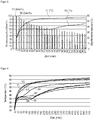
- the surface temperatures and the water content of the composite material according to Example B6 and of the comparative material according to Comparative Example V1 were determined over a period of 300 minutes.
- the initial water content of the samples (72% by weight for B6 and 33% by weight for V1, see Table 2) was set to 100% and the percentage weight loss of both samples was monitored over time.
- the evaporation rate of the water is identical in both examples B6 and V1. After about 30 minutes, however, more water is already evaporated from the composite material according to Example B6. Over the entire measuring time, more water evaporates from the composite material according to example B6 than from the comparison material according to comparative example V1, so that a lower percentage of water content remains in example B6.
- the composite material B6 according to the invention shows, owing to the higher evaporation rate, a lower surface temperature and thus a greater cooling effect.
- the higher cooling effect of the composite material according to the invention is based on the fact that it can absorb larger amounts of water, but then more readily releases this water again.
- the comparison material shows this effect much less pronounced, in addition, the water is less readily released to the environment.
- the surface temperature of the various composite materials was determined over a period of 530 minutes. Before the measurement, all samples were swollen in deionized water for 24 hours (see Table 2).
- the material according to comparative example V1 has a temperature of about 55 ° C. after 90 minutes, while the composite materials according to the invention only have a temperature of about 33 ° C. to a maximum of 38 ° C. This temperature is maintained for 60 to 170 minutes in the composite materials according to the invention.
- the cooling effect i.e. the duration of maintaining the temperature in the range from 33 to a maximum of 38 ° C, correlates directly with the proportion of mixtures (M) in the composite materials.
- the plateau at the lowest temperature is obtained for example B5.
- the two-layer measurements were carried out as described above.
- the Figure 5 shows the surface temperature (O) and the backside temperature (R) of the composite material B4 and the comparison material V1 over the measurement period of 960 min.
- both the surface temperature and the backside temperature of the composite material B4 according to the invention are significantly lower than the respective temperatures of the comparison material V1. A higher cooling effect is therefore achieved with the composite material according to the invention than with the comparison material.
- the dry mixture (M) was mixed with the dry components Bb, Bc or Bd. Sufficient mixture (M) was added in each case so that the composite material contained 10% by weight of the mixture (M) based on component B. Then water was added, mixed well, the mixture was placed in a wooden mold with a diameter of 4 cm and a height of 3 cm and that Composite material cured for 12 hours at room temperature and 65% humidity as well as for a further 12 hours at 50 ° C in a drying cabinet. The composite materials were then removed from the mold and the panes were brought to a thickness of 2 cm by smoothing the surfaces on both sides. These round disks were used as test specimens in the measurements described below.
- test specimens were first weighed, then placed in deionized water and removed after 24 hours and weighed again.
- the water absorption determined as the mean of four measurements, corresponded to the increase in weight after the test specimens had dripped, minus the original dry weight of the sample.
- the water content of the test specimens was then calculated based on the total weight of the specimen in% by weight.
- composition of the composite materials and water content after 24 h are given in Table 3 Table 3: example Component B MS [% by weight] Water content after 24h [% by weight] V9 Cement mortar (Bb) 0 7.5 B10 Cement mortar (Bb) 10 33.6 V11 Gypsum binder (Bc) 0 60.5 B12 Gypsum binder (Bc) 10 90.3 V13 Geopolymer mortar (Bd) 0 21.9 B14 Geopolymer mortar (Bd) 10 36.1
- comparison materials V9, V11 and V13 show a significantly lower water absorption than the composite materials according to the invention of examples B10, B12 and B14.
- the composite materials were also examined for their passive cooling behavior. For this purpose, 39 mm holes were punched out of an airgel plate of 40 x 40 x 2 cm with a low thermal conductivity (0.019 W / mK, Slentex Airgel, BASF Polyurethanes GmbH) and the test specimens of the composite materials B10, B12 and B14 as well as the comparative test specimens V9, V11 and V13 placed in the holes. The surface of the test arrangement was exposed with a 500 W halogen lamp and the underside was observed with an infrared camera in order to determine the rear side temperatures. Before being introduced into the airgel, the composite materials were completely soaked in water for 24 hours as described above.
Landscapes
- Chemical & Material Sciences (AREA)
- Engineering & Computer Science (AREA)
- Ceramic Engineering (AREA)
- Materials Engineering (AREA)
- Structural Engineering (AREA)
- Organic Chemistry (AREA)
- Chemical Kinetics & Catalysis (AREA)
- Inorganic Chemistry (AREA)
- Civil Engineering (AREA)
- Life Sciences & Earth Sciences (AREA)
- Environmental & Geological Engineering (AREA)
- General Life Sciences & Earth Sciences (AREA)
- Geochemistry & Mineralogy (AREA)
- Geology (AREA)
- Dispersion Chemistry (AREA)
- Compositions Of Macromolecular Compounds (AREA)
- Laminated Bodies (AREA)
- Building Environments (AREA)
Description
- Die vorliegende Erfindung betrifft ein Kompositmaterial, das mindestens ein thermoresponsives Polymer und mindestens einen anorganischen Baustoff enthält. Des Weiteren betrifft die vorliegende Erfindung ein Verfahren zur Herstellung des Kompositmaterials sowie die Verwendung des Kompositmaterials zur Kühlung und zur Regelung der Luftfeuchte.
- Insbesondere in Regionen mit hohen Tagestemperaturen und hoher Sonneneinstrahlung besteht Bedarf, Häuser zu kühlen, so dass für Menschen eine angenehme Umgebung geschaffen werden kann. Die konventionelle Kühlung mittels Klimaanlagen führt häufig zu hohem Energieverbrauch. Da insbesondere aufgrund der globalen Erwärmung das Einsparen von Energie ein wichtiges Ziel ist, besteht daher Bedarf an weniger energieverbrauchenden Kühlmethoden. Weiterhin hat ein Kühlsystem, das unabhängig von elektrischer Energie funktioniert, den Vorteil, dass es Betriebssicherheit gewährleistet. Anlagen, bei denen Betriebssicherheit wichtig ist, sind zum Beispiel Warenlager, Kühlcontainer, autarke Telekommunikationsstationen oder elektrische Anlagen.
- Zu alternativen Kühlmethoden sind im Stand der Technik verschiedene Verfahren beschrieben.
- N. M. Nahar et al., Building and Environment 2003, 38, 109-116 und E. H. Amer, Energy 2006, 31, 1332-1344, beschreiben verschiedene Verfahren, um Häuser in Regionen mit hoher Sonneneinstrahlung und damit auch hohen Temperaturen zu kühlen. Dabei werden einerseits die Dächer der Testhäuser mit reflektierenden Materialien wie weißem Zement oder weißen Fliesen versehen, andererseits werden thermische Isolationsmaterialien wie Vermiculit® auf oder unter dem Dach eingesetzt. Darüber hinaus erfolgt die Kühlung durch Verdampfung von Wasser, beispielsweise aus Jutesäcken, die über das Dach gelegt werden oder aus Wasserbassins, die sich auf dem Dach befinden. Am effizientesten erfolgt die Kühlung durch das Verdampfen von Wasser. Allerdings sind in den in N. M. Nahar et al., Building and Environment 2003, 38, 109-111 und E. H. Amer, Energy 2006, 31, 1332-1344 beschriebenen Verfahren zur Kühlung durch Verdampfung von Wasser relativ große Mengen an Wasser notwendig, die zudem ständig nachgeliefert werden müssen.
- D. Karamanis, ICONCE 2014, 33-37, beschreibt poröse Materialien, insbesondere Tonminerale, die in ihren Mikroporen Wasser speichern und Wasser aus diesen verdampfen können.
- A. C. C. Rotzetter et al., Advanced Materials 2012, 24, 5352-5356 , beschreibt den Einsatz von Poly(N-isopropylacrylamid)-Hydrogelen zur Kühlung von Gebäuden. Dabei wird das Poly(N-isopropylacrylamid)-Hydrogel als Folie zwischen eine PVC-Folie und eine nanoporöse Polycarbonatmembran eingebracht. Die Kühlwirkung des Poly(N-isopropylacrylamid)-Hydrogels ist relativ gut, allerdings sind durch die Verwendung als Folie relativ große Mengen an Poly(N-isopropylacrylamid) notwendig. Weiterhin ist die Folie mechanisch sehr empfindlich und nicht überall einsetzbar.
- H.-Y. Chang et al., Renewable and Sustainable Energy Reviews 2010, 14, 781-789, beschreiben verschiedene Verfahren, um Häuser passiv zu kühlen und zu heizen. Unter anderem wird die Kühlung durch Verdampfung von Wasser beschrieben. Dabei werden poröse Materialien als Dachmaterial eingesetzt. Zu diesen porösen Materialien zählen Kieselschiefer, Quarzsand, vulkanische Asche, Kiesel, Mörtel und Beton.
- Ebenso beschreiben S. van Veen und K. Magano, Building and Environment 2009, 44, 338-351 verschiedene Verfahren zur Kühlung von Häusern mit nicht-porösen und porösen Materialien. Auch bei den in S. van Veen und K. Magano, Building and Environment 2009, 44, 338-351 beschriebenen Verfahren werden als Materialien Kiesel, Quarzsand, vulkanische Asche und Kieselschiefer eingesetzt.
- Die in H.-Y. Chang et al., Renewable and Sustainable Energy Reviews 2010, 14, 781-789 und in S. van Veen und K. Magano, Building and Environment 2009, 44, 338-351 beschriebenen Verfahren zur passiven Kühlung von Häusern sind noch verbesserungsbedürftig.
- Die
US 2015/0291868 beschreibt Kompositmaterialien, die Phasenübergänge eingehen können. Diese Kompositmaterialien sind nanostrukturiert und enthalten ein thermoresponsives Polymer so wie einen nanokristallinen Füllstoff. - Die
WO 2015/034475 beschreibt ein Kompositmaterial, das einen hydraulischen Zement, Wasser und ein thermoresponsives Polymer enthält. - Die
US 2014/0272282 beschreibt einen thermoresponsiven Aufbau, um einen Temperaturstau in Solarpaneelen zu kontrollieren. Dabei wird eine thermoresponsive Schicht, die ein thermoresponsives Polymer sowie einen anorganischen Füllstoff enthält, eingesetzt. - Die
CN103771791 offenbart ein Kompositmaterial, das die Komponenten (A) ein Polymer, (B) einen anorganischen Baustoff und ein Tonmineral, enthält. Ein thermoresponsives Polymer ist nicht beschrieben. - Nachteilig bei den im Stand der Technik beschriebenen Kompositmaterialien ist, dass deren Kühlwirkung teilweise nicht zufriedenstellend ist und sie zudem teilweise mechanisch instabil sind und insbesondere nicht als Formkörper eingesetzt werden können.
- Es besteht daher Bedarf an Kompositmaterialien, die dazu geeignet sind, zur Kühlung eingesetzt zu werden. Die Materialien sollen die vorstehend beschriebenen Nachteile der Materialien aus dem Stand der Technik in verringertem Maße oder gar nicht aufweisen.
- Gelöst wird diese Aufgabe durch ein Kompositmaterial, das die Komponenten
- (A) mindestens ein thermoresponsives Polymer und
- (B) mindestens einen anorganischen Baustoff
enthält. - Gelöst wird diese Aufgabe weiterhin durch ein Kompositmaterial, das die Komponenten
- (A) mindestens ein thermoresponsives Polymer und
- (B) mindestens einen anorganischen Baustoff
- Es wurde überraschend gefunden, dass das erfindungsgemäße Kompositmaterial mehr Wasser aufnehmen kann und aufgenommenes Wasser besser freisetzen kann als Materialien, wie sie im Stand der Technik beschrieben sind, beispielsweise als Materialien, die nur ein thermoresponsives Polymer enthalten oder Materialien, die nur einen anorganischen Baustoff enthalten. Daher sind die erfindungsgemäßen Kompositmaterialien besonders gut geeignet für die Kühlung, beispielsweise von Gebäuden, von Außenanlagen, elektrischen Anlagen, Batterien oder Akkumulatoren, durch Verdampfung von Wasser sowie für die Regelung der Luftfeuchte in Innenräumen von Gebäuden, aber auch von Außenanlagen, zum Beispiel von Plätzen, Straßen, Innenhöfen oder Terrassen.
- Vorteilhaft ist zudem, dass Wasser, insbesondere bei Temperaturen oberhalb der unteren kritischen Lösungstemperatur (LCST) des mindestens einen thermoresponsiven Polymers (Komponente (A)) aus den erfindungsgemäßen Kompositmaterialien freigesetzt wird. Unterhalb der unteren kritischen Lösungstemperatur (LCST) der Komponente (A) wird nur wenig oder sogar gar kein Wasser aus den erfindungsgemäßen Kompositmaterialien freigesetzt, so dass die kühlende Wirkung der erfindungsgemäßen Kompositmaterialien insbesondere dann erst einsetzt, wenn höhere Temperaturen vorliegen, wenn also eine Kühlung tatsächlich erwünscht ist. Hat die Komponente (A) ihr Wasser oberhalb der LCST abgegeben, so kann sie bei Unterschreitung der LCST wieder Wasser aufnehmen, beispielsweise aus der Umgebungsluft, und kann dann wieder zur Kühlung eingesetzt werden.
- Vorteilhaft ist daher, dass die Wasseraufnahme und Abgabe der erfindungsgemäßen Kompositmaterialien reversibel und durch die Temperatur steuerbar ist. Durch die reversible Wasseraufnahme und Abgabe des Kompositmaterials kann seine kühlende Wirkung auch über lange Zeiträume erhalten bleiben. Die Wasseraufnahme und Abgabe kann durch die natürlichen Aufheiz- und Abkühlphasen der Umgebung des Kompositmaterials gesteuert werden.
- Nachfolgend wird die vorliegende Erfindung näher erläutert.
- Erfindungsgemäß enthält das Kompositmaterial die Komponenten (A), mindestens ein thermoresponsives Polymer, und (B), mindestens einen anorganischen Baustoff.
- Die Begriffe "Komponente (A)" und "mindestens ein thermoresponsives Polymer" werden im Rahmen der vorliegenden Erfindung synonym gebraucht und besitzen daher die gleiche Bedeutung.
- Gleiches gilt für "Komponente (B)" und "mindestens ein anorganischer Baustoff". Diese Begriffe werden im Rahmen der vorliegenden Erfindung ebenfalls synonym gebraucht und besitzen daher die gleiche Bedeutung.
- Das erfindungsgemäße Kompositmaterial enthält beispielsweise im Bereich von 0,5 bis 50 Gew.-% der Komponente (A) und im Bereich von 50 bis 99,5 Gew.-% der Komponente (B), jeweils bezogen auf die Summe der Gew.-% der Komponenten (A) und (B), bevorzugt bezogen auf das Gesamtgewicht des Kompositmaterials. Bevorzugt enthält das Kompositmaterial im Bereich von 5 bis 45 Gew.-% der Komponente (A) und im Bereich von 55 bis 95 Gew.-% der Komponente (B), bezogen auf die Summe der Gew.-% der Komponenten (A) und (B), bevorzugt bezogen auf das Gesamtgewicht des Kompositmaterials.
- Besonders bevorzugt enthält das Kompositmaterial im Bereich von 20 bis 40 Gew.-% der Komponente (A) und im Bereich von 60 bis 80 Gew.-% der Komponente (B), jeweils bezogen auf die Summe der Gew.-% der Komponenten (A) und (B), bevorzugt bezogen auf das Gesamtgewicht des Kompositmaterials.
- Die Komponente (A) des Kompositmaterials liegt üblicherweise verteilt in der Komponente (B) des Kompositmaterials vor.
- Die Komponente (A) des Kompositmaterials kann gleichmäßig (homogen) oder ungleichmäßig verteilt in der Komponente (B) des Kompositmaterials vorliegen. Bevorzugt liegt die Komponente (A) gleichmäßig verteilt in der Komponente (B) vor. Die Komponente (A) liegt dann dispergiert in der Komponente (B) vor.
- Die Komponente (A) ist dann die disperse Phase, auch innere Phase genannt, die Komponente (B) ist das Dispersionsmedium, auch kontinuierliche Phase genannt.
- Gegenstand der vorliegenden Erfindung ist daher auch ein Kompositmaterial, das die Komponente (A) verteilt, bevorzugt gleichmäßig verteilt, in der Komponente (B) enthält.
- Gegenstand der vorliegenden Erfindung ist weiterhin auch ein Kompositmaterial, das die Komponente (A) dispergiert in der Komponente (B) enthält.
- Das erfindungsgemäße Kompositmaterial enthält zusätzlich eine Komponente (C), mindestens ein Tonmineral, wobei die Komponente (C) kein Bindemittel ist.
- Die Begriffe "Komponente (C)" und "mindestens ein Tonmineral" werden im Rahmen der vorliegenden Erfindung synonym gebraucht und besitzen daher die gleiche Bedeutung.
- In dieser Ausführungsform enthält das Kompositmaterial beispielsweise im Bereich von 0,5 bis 50 Gew.-% der Komponente (A), im Bereich von 25 bis 99,49 Gew.-% der Komponente (B) und im Bereich von 0,01 bis 50 Gew.-% der Komponente (C), jeweils bezogen auf die Summe der Gew.-% der Komponenten (A), (B) und (C), bevorzugt bezogen auf das Gesamtgewicht des Kompositmaterials.
- Bevorzugt enthält das Kompositmaterial dann im Bereich von 5 bis 45 Gew.-% der Komponente (A), im Bereich von 10 bis 94,9 Gew.-% der Komponente (B) und im Bereich von 0,1 bis 45 Gew.-% der Komponente (C), jeweils bezogen auf die Summe der Gew.-% der Komponenten (A), (B) und (C), bevorzugt bezogen auf das Gesamtgewicht des Kompositmaterials.
- Besonders bevorzugt enthält das Kompositmaterial dann im Bereich von 10 bis 40 Gew.-% der Komponente (A), im Bereich von 20 bis 89,5 Gew.-% der Komponente (B) und im Bereich von 0,5 bis 20 Gew.-% der Komponente (C), jeweils bezogen auf die Summe der Gew.-% der Komponenten (A), (B) und (C), bevorzugt bezogen auf das Gesamtgewicht des Kompositmaterials.
- Gegenstand der vorliegenden Erfindung ist daher auch ein Kompositmaterial, wobei das Kompositmaterial im Bereich von 0,5 bis 50 Gew.-% der Komponente (A), im Bereich von 25 bis 99,49 Gew.-% der Komponente (B) und im Bereich von 0,01 bis 50 Gew.-% der Komponente (C) enthält, jeweils bezogen auf die Summe der Gewichtsprozente der Komponenten (A), (B) und (C).
- Die Komponente (C) kann, ebenso wie die Komponente (A), verteilt in der Komponente (B) vorliegen.
- Bevorzugt liegen die Komponenten (A) und (C) in der Komponente (B) gleichmäßig verteilt vor.
- Liegen die Komponenten (A) und (C) in der Komponente (B) gleichmäßig verteilt vor, so liegen die Komponenten (A) und (C) in der Komponente (B) dispergiert vor.
- In dieser Ausführungsform ist es möglich, dass die Komponenten (A) und (C) zwei separate disperse Phasen in der kontinuierlichen Phase der Komponente (B) bilden. Bevorzugt bilden die Komponenten (A) und (C) in der kontinuierlichen Phase der Komponente (B) eine gemeinsame disperse Phase. In dieser Ausführungsform enthält die disperse Phase ein Gemisch der Komponenten (A) und (C).
- Wenn die Komponenten (A) und (C) als Gemisch vorliegen, so ist es möglich, dass die Komponente (C) in der Komponente (A) gleichmäßig verteilt vorliegt. Ebenso ist es möglich und erfindungsgemäß bevorzugt, dass die Komponente (C) an der Oberfläche der Komponente (A) angeordnet ist und/oder die Komponente (A) an der Oberfläche der Komponente (C) angeordnet ist.
- Es ist darüber hinaus bevorzugt, dass das Kompositmaterial zusätzlich Wasser enthält.
- Gegenstand der vorliegenden Erfindung ist somit auch ein Kompositmaterial, das zusätzlich Wasser enthält.
- Beispielsweise liegt das Gewichtsverhältnis von enthaltenem Wasser zu dem Kompositmaterial dann im Bereich von 5 zu 100 bis 300 zu 100, bevorzugt im Bereich von 10 zu 100 bis 200 zu 100 und insbesondere bevorzugt im Bereich von 20 zu 100 bis 100 zu 100.
- Enthält das erfindungsgemäße Kompositmaterial Wasser, so ist es bevorzugt, dass das Wasser bei Temperaturen unterhalb der unteren kritischen Lösungstemperatur (LCST) der Komponente (A) in der Komponente (A) verteilt vorliegt. Bei Temperaturen oberhalb der unteren kritischen Lösungstemperatur (LCST) der Komponente (A) liegt das Wasser bevorzugt in der Komponente (B) verteilt vor und wird aus dieser verdampft und dabei an die Umgebung abgegeben.
- Darüber hinaus kann das Kompositmaterial noch weitere Komponenten enthalten. Derartige weitere Komponenten sind dem Fachmann als solche bekannt und beispielsweise Stabilisatoren, grenzflächenaktive Substanzen, Flammschutzmittel oder Farbstoffe.
- Ebenso kann das Kompositmaterial noch weitere Komponenten enthalten, die zur Herstellung der Komponente (A) eingesetzt worden sind, wie beispielsweise Comonomere, Vernetzer, Stabilisatoren und Initiatoren. Weitere Komponenten, die zur Herstellung der Komponente (A) eingesetzt worden sind, sind im Kompositmaterial üblicherweise in der Komponente (A) enthalten.
- Beispielsweise enthält das Kompositmaterial im Bereich von 0 bis 50 Gew.-% der weiteren Komponenten, bevorzugt im Bereich von 0,5 bis 20 Gew.-% und insbesondere bevorzugt im Bereich von 1 bis 10 Gew.-%, jeweils bezogen auf das Gesamtgewicht des Kompositmaterials.
- Das Kompositmaterial kann außerdem eine Komponente (D), mindestens ein organisches Bindemittel enthalten.
- Gegenstand der vorliegenden Erfindung ist daher auch ein Kompositmaterial, wobei dass das Kompositmaterial mindestens eine Komponente (D), mindestens ein organisches Bindemittel enthält.
- Beispielsweise enthält das Kompositmaterial im Bereich von 0,5 bis 60 Gew.-%, bevorzugt im Bereich von 2 bis 50 Gew.-% und insbesondere bevorzugt im Bereich von 5 bis 40 Gew.-% der Komponente (D), jeweils bezogen auf das Gesamtgewicht des Kompositmaterials.
- Die Gew.-%-Angaben der im Kompositmaterial enthaltenen Komponenten (A) und (B) sowie gegebenenfalls der Komponente (C), der Komponente (D) und der weiteren Komponenten addieren sich üblicherweise zu 100 Gew.-%.
- Erfindungsgemäß ist die Komponente (A) mindestens ein thermoresponsives Polymer.
- "mindestens ein thermoresponsives Polymer" bedeutet im Rahmen der vorliegenden Erfindung sowohl genau ein thermoresponsives Polymer, als auch eine Mischung aus zwei oder mehreren thermoresponsiven Polymeren.
- Unter einem thermoresponsiven Polymer wird im Rahmen der vorliegenden Erfindung ein Polymer verstanden, das bei einer unteren kritischen Lösungstemperatur (LCST) sprunghaft seine Wasserlöslichkeit ändert. Bei Temperaturen unterhalb der unteren kritischen Lösungstemperatur (LCST) weist das Polymer eine gute Wasserlöslichkeit auf, vorzugsweise ist das thermoresponsive Polymer vollständig mit Wasser mischbar, während es bei Temperaturen größer oder gleich der unteren kritischen Lösungstemperatur (LCST) eine schlechte Wasserlöslichkeit aufweist.
- Es ist möglich, dass das thermoresponsive Polymer außerdem eine obere kritische Lösungstemperatur (UCST) aufweist. Bei Temperaturen oberhalb der oberen kritischen Lösungstemperatur (UCST) weist das thermoresponsive Polymer dann eine gute Wasserlöslichkeit auf, vorzugsweise ist das thermoresponsive Polymer dann vollständig mit Wasser mischbar. Bei Temperaturen unterhalb der oberen kritischen Lösungstemperatur (UCST) weist das thermoresponsive Polymer eine schlechte Wasserlöslichkeit auf, es liegt also eine Mischungslücke zwischen dem thermoresponsiven Polymer und Wasser vor. Dies ist beispielsweise auch in R. Liu, M. Fraylich und B. R. Saunders, Colloid. Poly. Sci. 2009, 287, 627-643 und V. Aseyev, H. Tenhu und F. M. Winnik, Adv. Polym. Sci. 2011, 242, 29-89, beschrieben.
- Unter der unteren kritischen Lösungstemperatur (LCST; lower critical solution temperature) wird also die Temperatur verstanden, bei und oberhalb der das thermoresponsive Polymer und Wasser zwei Phasen bilden, das thermoresponsive Polymer und Wasser also eine Mischungslücke aufweisen.
- Gegenstand der vorliegenden Erfindung ist daher auch ein Kompositmaterial, bei dem die Komponente (A) eine untere kritische Lösungstemperatur (LCST) aufweist, wobei die untere kritische Lösungstemperatur (LCST) die Temperatur ist, bei der die Komponente (A) und Wasser zwei Phasen bilden.
- Anders ausgedrückt ist Gegenstand der vorliegenden Erfindung außerdem ein Kompositmaterial, bei dem die Komponente (A) eine untere kritische Lösungstemperatur (LCST) aufweist, wobei die untere kritische Lösungstemperatur (LCST) die Temperatur ist, bei der die Komponente (A) und Wasser eine Mischungslücke aufweisen.
- Ohne die Erfindung hierauf beschränken zu wollen, besteht die Vorstellung, dass bei Temperaturen unterhalb der unteren kritischen Lösungstemperatur (LCST) das thermoresponsive Polymer als offenkettiges Knäuel vorliegt. Dadurch kann Wasser gut in die Polymerketten eindringen und das Polymer quellen. Bei Temperaturen unterhalb der unteren kritischen Lösungstemperatur (LCST) sind die Wechselwirkungen zwischen dem Wasser und den Polymerketten energetisch vorteilhafter als die Wechselwirkungen der Polymerketten untereinander innerhalb des Knäuels. Im Gegensatz dazu, liegt das thermoresponsive Polymer bei Temperaturen größer oder gleich der unteren kritischen Lösungstemperatur (LCST) als kollabiertes Knäuel vor und die Wechselwirkungen der Polymerketten untereinander innerhalb des Knäuels sind energetisch vorteilhafter als die Wechselwirkungen zwischen dem Wasser und den Polymerketten. Das Wasser wird dann aus dem thermoresponsiven Polymer herausgedrängt und das thermoresponsive Polymer liegt als kompaktes Knäuel vor. Anders ausgedrückt bedeutet dies, dass das thermoresponsive Polymer bei Temperaturen gleich oder oberhalb der unteren kritischen Lösungstemperatur (LCST) Wasser abgibt.
- Erfindungsgemäß wird die untere kritische Lösungstemperatur (LCST) mittels dynamischer Differenzkalorimetrie (DDK; differential scanning calorimetry, DSC) oder mittels Trübungsmessung bestimmt. Siehe hierzu auch V. Aseyev, H. Tenhu und F. M. Winnik, Adv. Polym. Sci. 2011, 242, 42 und R. Liu, M. Fraylich und B. R. Saunders, Colloid. Polym. Sci. 2009, 287, 630 .
- Die Komponente (A) weist üblicherweise eine untere kritische Lösungstemperatur (LCST) auf, wobei die untere kritische Lösungstemperatur (LCST) vorzugsweise im Bereich von 5 bis 70 °C liegt, besonders bevorzugt im Bereich von 10 bis 60 °C und insbesondere bevorzugt im Bereich von 15 bis 50 °C, bestimmt mittels dynamischer Differenzkalorimetrie (DDK) oder Trübungsmessung.
- Gegenstand der vorliegenden Erfindung ist daher auch ein Kompositmaterial, bei dem die Komponente (A) eine untere kritische Lösungstemperatur (LCST) aufweist, wobei die untere kritische Lösungstemperatur (LCST) im Bereich von 5 bis 70 °C liegt.
- Die Komponente (A) weist üblicherweise eine Glasübergangstemperatur (TG(A)) auf. Die Glasübergangstemperatur (TG(A)) der Komponente (A) liegt beispielsweise im Bereich von 15 bis 150 °C, bevorzugt im Bereich von 20 bis 100 °C und insbesondere bevorzugt im Bereich von 30 bis 100 °C, bestimmt mittels dynamischer Differenzkalorimetrie (DDK; differential scanning calorimetry, DSC). Siehe hierzu auch DIN 53765 und DIN 51007.
- Es versteht sich von selbst, dass sich die Glasübergangstemperatur (TG(A)) der Komponente (A) auf die wasserfreie Komponente (A) bezieht. Die Glasübergangstemperatur (TG(A)) der Komponente (A) bezieht sich also auf die Glasübergangstemperatur (TG(A)) der reinen Komponente (A).
- Darüber hinaus weist die Komponente (A) üblicherweise eine Schmelztemperatur (TM(A)) auf. Die Schmelztemperatur (TM(A)) der Komponente (A) liegt üblicherweise im Bereich von 20 bis 250 °C, bevorzugt im Bereich von 25 bis 200 °C und insbesondere bevorzugt im Bereich von 50 bis 180 °C, bestimmt mittels dynamischer Differenzkalorimetrie (DDK; differential scanning calorimetry, DSC). Siehe hierzu auch DIN 53765.
- Als Komponente (A) eignen sich alle Polymere, die thermoresponsiv im Sinne der vorliegenden Erfindung sind. Vorzugsweise ist die Komponente (A) ausgewählt aus der Gruppe bestehend aus Poly(meth)acrylaten, Poly(meth)acrylamiden, Poly(meth)acryloylpyrrolidinen, Poly(meth)acryloylpiperidinen, Poly-N-vinylamiden, Polyoxazolinen, Polyvinyloxazolidonen, Polyvinylcaprolactonen, Polyvinylcaprolactamen, Polyethern, Hydroxypropylcellulosen, Polyvinylethern und Polyphosphoestern. Bevorzugt ist die Komponente (A) ausgewählt aus der Gruppe bestehend aus Poly(meth)acrylaten, Poly(meth)acrylamiden, Poly-N-vinylamiden, Polyoxazolinen, Polyvinylcaprolactamen, Polyethern, Hydroxypropylcellulosen und Polyvinylethern.
- In einer weiteren bevorzugten Ausführungsform ist die Komponente (A) ausgewählt aus der Gruppe bestehend aus Poly(meth)acrylaten, Poly(meth)acrylamiden, Poly(meth)acryloylpyrrolidinen, Poly(meth)acryloylpiperidinen, Poly-N-vinylamiden, Polyoxazolinen, Polyvinyloxazolidonen, Polyvinylcaprolactonen, Polyvinylcaprolactamen, Polyethern, Polyvinylethern und Polyphosphoestern. Bevorzugt ist die Komponente (A) ausgewählt aus der Gruppe bestehend aus Poly(meth)acrylaten, Poly(meth)acrylamiden, Poly-N-vinylamiden, Polyoxazolinen, Polyvinylcaprolactamen, Polyethern und Polyvinylethern.
- Gegenstand der vorliegenden Erfindung ist daher auch ein Kompositmaterial, bei dem die Komponente (A) ausgewählt ist aus der Gruppe bestehend aus Poly(meth)acrylaten, Poly(meth)acrylamiden, Poly(meth)acryloylpyrrolidinen, Poly(meth)acryloylpiperidinen, Poly-N-vinylamiden, Polyoxazolinen, Polyvinyloxazolidonen, Polyvinylcaprolactonen, Polyvinylcaprolactamen, Polyethern, Hydroxypropylcellulosen, Polyvinylethern und Polyphosphoestern.
- Unter Poly(meth)acrylaten werden im Rahmen der vorliegenden Erfindung sowohl Polyacrylate als auch Polymethacrylate sowie deren Copolymere mit anderen Monomeren verstanden.
- Geeignete Poly(meth)acrylate sind dem Fachmann als solche bekannt. Vorzugsweise sind die Poly(meth)acrylate ausgewählt aus der Gruppe bestehend aus Poly(methyl-2-isobutyracrylat), Poly[2-(dimethylamino)ethylmethacrylat] (PDMAEMA), Poly[2-(2-ethoxyethoxy)ethylacrylat] (PEEO2A), Poly[2-(2-methoxyethoxy)ethylmethacrylat] (PMEO2MA), Poly(2-hydroxypropylacrylat) (PHPA), Polyhydroxyethylmethacrylat (PolyHEMA) und methoxy-terminierten dendronisierten Poly(meth)acrylaten. Bevorzugte Poly(meth)acrylate sind ausgewählt aus der Gruppe bestehend aus Poly(methyl-2-isobutyracrylat), Poly[2-(dimethylamino)ethylmethacrylat] (PDMAEMA), Poly[2-(2-ethoxyethoxy)ethylacrylat] (PEEO2A), Poly[2-(2-methoxyethoxy)ethylmethacrylat] (PMEO2MA) und Poly(2-hydroxypropylacrylat) (PHPA).
- Auch Alkoxy-terminierte hyperverzweigte Poly(meth)acrylate können verwendet werden.
- Unter Poly(meth)acrylamiden werden im Rahmen der vorliegenden Erfindung Polyacrylamide, Polymethacrylamide sowie deren Copolymere mit anderen Monomeren verstanden. Diese sind dem Fachmann als solche bekannt. Beispielsweise sind Poly(meth)acrylamide ausgewählt aus der Gruppe bestehend aus Poly(N-n-propylacrylamid) (PnPAAm), Poly(N-isopropylacrylamid) (PNiPAAm), Poly(N-n-propylmethacrylamid) (PnPMAAm), Poly(N-isopropylmethacrylamid) (PiPMAAm), Poly(N-(L)-(1-hydroxymethyl)propylmethacrylamid) (P(L-HMPNAAm)), Poly(N,N-diethylacrylamid) (PDEAAm), Poly(N,N-ethylmethylacrylamid) (PNNEMAAm), Poly(N-ethylmethacrylamid) (PNEMAAm), Poly(N-ethylacrylamid) (PEAAm), Poly(N-ethylmethacrylamid) (PEMAAm) und Poly(N-cyclopropylacrylamid) (PcPAAm). Bevorzugte Poly(meth)acrylamide sind ausgewählt aus der Gruppe bestehend aus Poly(N-n-propylacrylamid) (PnPAAm), Poly(N-isopropylacrylamid) (PNiPAAm), Poly(N-n-propylmethacrylamid) (PnPMAAm), Poly(N-(L)-(1-hydroxymethyl)-propylmethacrylamid) (P(L-HMPNAAm)), Poly(N,N-diethylacrylamid) (PDEAAm), Poly(N-ethylmethacrylamid) (PEMAAm) und Poly(N-cyclopropylacrylamid) (PcPAAm).
- Die Bezeichnung Poly(meth)acryloylpyrrolidine umfasst im Rahmen der vorliegenden Erfindung sowohl Polymethacryloylpyrrolidine als auch Polyacryloylpyrrolidine sowie deren Copolymere mit anderen Monomeren. Diese sind dem Fachmann als solche bekannt. Erfindungsgemäß bevorzugt als Poly(meth)acryloylpyrrolidine ist Poly(N-acryloylpyrrolidin).
- Im Rahmen der vorliegenden Erfindung umfassen Poly(meth)acryloylpiperidine sowohl Polyacryloylpiperidine als auch Polymethacryloylpiperidine sowie deren Copolymere mit anderen Monomeren. Bevorzugt als Poly(meth)acryloylpiperidine ist Poly(N-acryloyl)piperidin (PAOPip).
- Poly-N-vinylamide sind dem Fachmann bekannt und beispielsweise ausgewählt aus der Gruppe, bestehend aus Poly(N-vinylpropylacetamid) und Poly(N-vinylisobutyramid) (PViBAm).
- Als Polyoxazoline können alle dem Fachmann bekannten Polyoxazoline eingesetzt werden. Beispielsweise sind die Polyoxazoline ausgewählt aus der Gruppe bestehend aus Poly(2-n-propyl-2-oxazolin) (PnPOz) und Poly(2-isopropyl-2-oxazolin) (PiPOz).
- Polyvinyloxazolidone sind dem Fachmann bekannt. Ein geeignetes Polyvinyloxazolidon ist beispielsweise Poly(N-vinyl-5-methyl-2-oxazolidon).
- Geeignete Polyvinylcaprolactone sind dem Fachmann bekannt. Bevorzugt sind Poly(N-vinyl)caprolacton und dessen Copolymere.
- Geeignete Polyvinylcaprolactame sind dem Fachmann als solche ebenfalls bekannt, beispielsweise Poly(N-vinylcaprolactam) (PVCL).
- Geeignete Polyether sind dem Fachmann bekannt. Beispielsweise sind die Polyether ausgewählt aus der Gruppe bestehend aus Poly(ethylenglycol) (PEG), Polyethylenglycol-polypropylenglycol-copolyethern, hydrophob endverkapptem Poly(ethylenoxid-co-propylenoxid) und hyperverzweigten Polyethern. Bevorzugt sind die Polyether mit hydrophoben Gruppen terminiert.
- Geeignete Hydroxypropylcellulosen sind dem Fachmann bekannt, beispielsweise Hydroxypropylcellulose (HPC) und Hydroxypropylmethylcellulose (HPMC).
- Die Herstellung von Hydroxypropylcellulose und Hydroxypropylmethylcellulose ist dem Fachmann allgemein bekannt, beispielweise durch Reaktion von Cellulose oder Methylcellulose mit Propylenoxid.
- Geeignete Polyvinylether sind dem Fachmann als solche bekannt und sind beispielsweise ausgewählt aus der Gruppe bestehend aus Poly(methylvinylether) (PMVEth), Poly(2-methoxyethylvinylether) (PMOVEth), Poly(2-ethoxyethylvinylether) (PEOVEth), Poly(2-(2-ethoxy)ethoxyethylvinylether) und Poly(4-hydroxybutylvinylether).
- Zudem sind aus Oligovinylethern, wie Ethylenoxid-vinylether, Propylenoxid-vinylether oder n-Butylenoxid-vinylether, hergestellte Homo- und Copolymere geeignet.
- Geeignete Polyphosphoester sind dem Fachmann ebenfalls bekannt und beispielsweise ausgewählt aus der Gruppe bestehend aus Poly(2-ethoxy-2-oxo-1,3,2-dioxaphospholan) und Poly(2-isopropoxy-2-oxo-1,3,2-dioxaphospholan). Poly(2-ethoxy-2-oxo-1,3,2-dioxaphospholan) ist auch bekannt unter dem Namen Poly(ethylethylenphosphat). Poly(2-isopropoxy-2-oxo-1,3,2-dioxaphospholan) ist auch bekannt unter dem Namen Poly(isopropylethylenphosphat).
- Besonders bevorzugt ist die Komponente (A) daher ausgewählt aus der Gruppe bestehend aus Poly(methyl-2-isobutyracrylat), Poly[2-(dimethylamino)ethylmethacrylat] (PDMAEMA), Poly[2-(2-ethoxyethoxy)ethylacrylat] (PEEO2A), Poly[2-(2-methoxyethoxy)ethylmethacrylat] (PMEO2MA), Poly(2-hydroxypropylacrylat) (PHPA), Poly(N-n-propylacrylamid) (PnPAAm), Poly(N-isopropylacrylamid) (PNiPAAm), Poly(N-n-propylmethacrylamid) (PnPMAAm), Poly(N-(L)-(1-hydroxymethyl)-propylmethacrylamid) (P(L-HMPNAAm)), Poly(N,N-diethylacrylamid) (PDEAAm), Poly(N-ethylmethacrylamid) (PEMAAm), Poly(N-cyclopropylacrylamid) (PcPAAm), Poly(N-vinylpropylacetamid), Poly(N-vinylisobutyramid) (PViBAm), Poly(2-n-propyl-2-oxazolin) (PnPOz), Poly(2-isopropyl-2-oxazolin) (PiPOz), Polyvinylcaprolactam (PVCL), Polyethylenglycolen (PEG), Polyethylenglycol-polypropylenglycol-copolyethern, hydrophob endverkappten Poly(ethylenoxid-co-propylenoxid)polyethern, hyperverzweigten Polyethern, Hydroxypropylcellulose (HPC), Poly(methylvinylether) (PMVEth), Poly(2-methoxyethylvinylether) (PMOVEth), Poly(2-ethoxyethylvinylether) (PEOVEth), Poly(2-(2-ethoxy)ethoxyethylvinylether) und Poly(4-hydroxybutylvinylether).
- Erfindungsgemäß ist die Komponente (B) mindestens ein anorganischer Baustoff.
- Im Rahmen der vorliegenden Erfindung bedeutet "mindestens ein anorganischer Baustoff" sowohl genau ein anorganischer Baustoff als auch eine Mischung aus zwei oder mehreren anorganischen Baustoffen.
- Anorganische Baustoffe sind dem Fachmann bekannt und beispielsweise keramische Baustoffe, Glasbaustoffe, Naturbaustoffe, Schlacken, metallische Baustoffe sowie Bindemittel. Bevorzugt ist die Komponente (B) ausgewählt aus Bindemitteln.
- Bindemittel sind dem Fachmann als solche bekannt. Üblicherweise wird zwischen hydraulisch abbindende Bindemitteln und nicht hydraulisch abbindenden Bindemitteln unterschieden.
- Es ist daher insbesondere bevorzugt, dass die Komponente (B) ausgewählt ist aus der Gruppe bestehend aus hydraulisch abbindenden Bindemitteln und nicht hydraulisch abbindenden Bindemitteln.
- Gegenstand der vorliegenden Erfindung ist daher auch ein Kompositmaterial, bei dem die Komponente (B) ausgewählt ist aus der Gruppe bestehend aus hydraulisch abbindenden Bindemitteln und nicht hydraulisch abbindenden Bindemitteln.
- Unter hydraulisch abbindenden Bindemitteln werden Bindemittel verstanden, die sowohl an Luft als auch unter Wasser aushärten können. Im Gegensatz dazu werden unter nicht hydraulisch abbindenden Bindemitteln Bindemittel verstanden, die nur an Luft aushärten können, nicht aber unter Wasser. Nicht hydraulisch abbindende Bindemittel sind üblicherweise nicht wasserbeständig, wenn sie ausgehärtet sind.
- Unter "Abbinden" wird im Rahmen der vorliegenden Erfindung der Übergang vom flüssigen in den festen Zustand verstanden, wobei der Übergang auf chemische Prozesse, also die Ausbildung von chemischen Bindungen, zurückzuführen ist. Wenn die Komponente (B) also abbindet, geht sie in den festen Zustand über. Dies wird auch als Aushärten bezeichnet.
- Zu den hydraulisch abbindenden Bindemitteln zählen beispielsweise Zement und Gips, zu den nicht hydraulisch abbindenden Bindemitteln zählen beispielsweise Alumosilikate, Luftkalk, Wassergläser sowie Magnesiabinder. Magnesiabinder sind auch bekannt unter dem Namen Magnesitbinder.
- Die vorstehend beschriebenen hydraulisch abbindenden Bindemittel und nicht hydraulisch abbindenden Bindemittel sind dem Fachmann als solche bekannt.
- Es ist erfindungsgemäß also besonders bevorzugt, dass die Komponente (B) ausgewählt ist aus der Gruppe bestehend aus Zement, Gips, Alumosilikaten, Luftkalk, Wassergläsern und Magnesiabinder.
- Der als Komponente (B) eingesetzte mindestens eine anorganische Baustoff, bevorzugt das mindestens eine Bindemittel, kann rein oder als Teil eines Gemisches, wie beispielsweise Putz, Mörtel oder Beton im erfindungsgemäßen Kompositmaterial eingesetzt werden. In diesem Fall enthält die Komponente (B) dann beispielsweise noch weitere Zuschlagsstoffe wie beispielsweise Sande, Gesteinsmehle, Mikrosilica, Flugaschen, Schlacken, Glas, Naturstein, Keramik und/oder Puzzolan, sowie gegebenenfalls Additive wie Schaumbildner, Wasserreduktionsmittel, Entschäumer, Verdicker und/oder Dispergiermittel. Diese Zuschlagstoffe und Additive sind dem Fachmann bekannt.
- Putze basieren im Allgemeinen auf Zement oder Gips als Komponente (B) und haben beim Einsatz als Baustoff überwiegend dekorative Funktion.
- Mörtel basieren im Allgemeinen auf Zement als Komponente (B) und enthalten Sand und/oder Aggregate, jeweils mit einer Korngröße von < 4 mm als Zuschlagsstoffe.
- Betone basieren im Allgemeinen auf Zement als Komponente (B) und enthalten Aggregate mit einer Korngröße von > 4 mm als Zuschlagsstoffe.
- Für den Einsatz als Baustoff, insbesondere als Bindemittel, wird die Komponente (B) üblicherweise mit Wasser vermischt. Dieses Wasser wird auch als Anmachwasser bezeichnet. Diese Mischung wird dann beispielsweise in Form gegossen, als Putz auf eine Wand aufgetragen oder in Zwischenräume von Mauerwerk eingebracht, und anschließend ausgehärtet. Dieses Verfahren ist dem Fachmann bekannt.
- Wie vorstehend beschrieben wird unter "Abbinden" und "Aushärten" der Übergang vom flüssigen in den festen Zustand verstanden, wobei der Übergang in den festen Zustand auf chemische Reaktionen zurückzuführen ist. Dem Fachmann ist klar, dass das Kompositmaterial daher die Komponente (B) in ausgehärteter Form und daher in reagierter Form enthalten kann.
- Das Kompositmaterial enthält zusätzlich eine Komponente (C), mindestens ein Tonmineral.
- "Mindestens ein Tonmineral" bedeutet im Rahmen der vorliegenden Erfindung sowohl genau ein Tonmineral als auch eine Mischung aus zwei oder mehreren Tonmineralen.
- Unter "Tonmineralen" werden im Rahmen der vorliegenden Erfindung schichtartig aufgebaute anorganische Materialien verstanden. Schichtartig aufgebaute anorganische Materialien sind dem Fachmann als solche bekannt. Bevorzugte schichtartig aufgebaute anorganische Materialien sind schichtartig aufgebaute Silikate.
- Die Komponente (C) ist daher bevorzugt mindestens ein schichtartig aufgebautes anorganisches Material, besonders bevorzugt mindestens ein schichtartig aufgebautes Silikat.
- Gegenstand der vorliegenden Erfindung ist daher auch ein Kompositmaterial, bei dem die Komponente (C) ein schichtartig aufgebautes anorganisches Material ist.
- Die erfindungsgemäß besonders bevorzugten schichtartig aufgebauten Silikate sind dem Fachmann also solche bekannt.
- Schichtartig aufgebaute Silikate enthalten üblicherweise Siliziumatome, die tetraedrisch von Sauerstoffatomen umgeben (koordiniert) sind. Erfindungsgemäß besonders bevorzugt sind schichtartig aufgebaute Silikate, die zusätzlich Aluminiumatome, die oktaedrisch von Sauerstoffatomen umgeben (koordiniert) sind, enthalten. Darüber hinaus enthalten schichtartig aufgebaute Silikate üblicherweise weitere Elemente, wie beispielsweise Natrium, Barium oder Calcium.
- In den schichtartig aufgebauten Silikaten sind die tetraedrisch von Sauerstoffatomen koordinierten Siliziumatome üblicherweise schichtförmig angeordnet (Tetraederschicht). Ebenso sind die oktaedrisch von Sauerstoffatomen koordinierten Aluminiumatome üblicherweise schichtförmig angeordnet (Oktaederschicht). In den schichtartig aufgebauten Silikaten können sich die Oktaederschichten mit den Tetraederschichten abwechseln, ebenso ist es beispielsweise möglich, dass eine Oktaederschicht auf zwei Tetraederschichten folgt.
- Zwischen den Schichten kann das mindestens eine Tonmineral Wasser einlagern. Dadurch quillt das mindestens eine Tonmineral. Die Einlagerung von Wasser in die Schichten des mindestens einen Tonminerals ist reversibel, das Wasser zwischen den Schichten kann also durch Trocknung wieder entfernt werden.
- Die Komponente (C) ist daher bevorzugt quellbar.
- Unter "quellbar" wird im Rahmen der vorliegenden Erfindung also verstanden, dass die Komponente (C) Wasser zwischen den Schichten einlagern kann und dass dieses Wasser durch Trocknung aus dem Raum zwischen den Schichten wieder entfernt werden kann.
- Wenn Wasser zwischen den Schichten der Komponente (C) eingelagert ist, dann ist die Komponente (C) gequollen. Ist kein Wasser zwischen den Schichten der Komponente (C) eingelagert, dann ist die Komponente (C) ungequollen.
- Es versteht sich von selbst, dass die Komponente (C) von der Komponente (B) verschieden ist.
- Die Komponente (C) weist im Gegensatz zur Komponente (B) keine abbindenden Eigenschaften auf. Die Komponente (C) ist daher kein Bindemittel.
- Gegenstand der vorliegenden Erfindung ist daher ein Kompositmaterial, bei dem die Komponente (C) keine abbindenden Eigenschaften aufweist.
- Unter "Abbinden" wird im Rahmen der vorliegenden Erfindung wie bereits vorstehend beschrieben der Übergang vom flüssigen in den festen Zustand verstanden, wobei der Übergang auf chemische Prozesse, also die Ausbildung von chemischen Bindungen, zurückzuführen ist. Wenn die Komponente (C) also abbindet, geht sie in den festen Zustand über. Dies wird auch als Aushärten bezeichnet. Bevorzugt bindet die Komponente (C) nicht ab, bevorzugt härtet die Komponente (C) also nicht aus.
- Die Komponente (C) ist bevorzugt ausgewählt aus der Gruppe bestehend aus Montmorilloniten und Kaoliniten.
- Gegenstand der vorliegenden Erfindung ist daher auch ein Kompositmaterial, bei dem die Komponente (C) ausgewählt ist aus der Gruppe bestehend aus Montmorilloniten und Kaoliniten.
- Die Komponente (C) kann als das reine mindestens eine Tonmineral eingesetzt werden. Bevorzugt wird die Komponente (C) als Gestein eingesetzt, das das mindestens eine Tonmineral enthält, gegebenenfalls auch als Mischung mit anderen Begleitmineralien, wie beispielsweise Glimmer, Quarz, Feldspat, Pyrit und/oder Calcit. Gesteine, die das mindestens eine Tonmineral enthalten, sind dem Fachmann bekannt und beispielsweise Kaolin und Bentonit.
- Wird die Komponente (C) daher als Gestein eingesetzt, so ist die Komponente (C) bevorzugt ausgewählt aus der Gruppe bestehend aus Kaolin und Bentonit. Gegenstand der vorliegenden Erfindung ist daher auch ein Kompositmaterial, bei dem die Komponente (C) ausgewählt ist aus der Gruppe bestehend aus Kaolin und Bentonit.
- Kaolin ist dem Fachmann als solches bekannt. Der Hauptbestandteil von Kaolin ist das Mineral Kaolinit. Darüber hinaus kann Kaolin noch weitere Minerale enthalten. Im Rahmen der vorliegenden Erfindung werden unter der Bezeichnung "Kaolin" außerdem auch die thermisch aktivierten Varianten von Kaolin verstanden, wie beispielsweise Metakaolin.
- Bentonit ist dem Fachmann ebenfalls bekannt. Der Hauptbestandteil von Bentonit ist Montmorillonit. Daneben kann Bentonit zusätzlich beispielsweise Quarz, Glimmer, Feldspat, Pyrit oder Calcit enthalten.
- Erfindungsgemäß ist die Komponente (D) mindestens ein organisches Bindemittel.
- "Mindestens ein organisches Bindemittel" bedeutet im Rahmen der vorliegenden Erfindung sowohl genau ein organisches Bindemittel, aus auch eine Mischung aus zwei oder mehreren organischen Bindemitteln.
- Die Begriffe "Komponente (D)" und "mindestens ein organisches Bindemittel" werden im Rahmen der vorliegenden Erfindung synonym gebraucht und besitzen daher die gleiche Bedeutung.
- Bei den organischen Bindemitteln (Komponente (D)) wird unterschieden zwischen rein physikalisch härtenden organischen Bindemitteln und solchen, die durch chemische Reaktion härten. Rein physikalisch härtende organische Bindemittel sind Lösungen von Polymeren in organischen Lösungsmitteln und/oder Wasser. Das Härten erfolgt dann, indem das Wasser und/oder das organische Lösungsmittel entfernt wird, üblicherweise durch verdampfen. Durch chemische Reaktionen härtbare organische Bindemittel sind monomere, oligomere oder polymere Verbindungen mit chemisch miteinander reaktiven Gruppen, die in reiner Form oder als Lösung in Wasser oder in einem geeigneten Lösungsmittel in das Kompositmaterial eingebracht werden. Die reaktiven Gruppen sorgen dann mittels einer chemischen Reaktion dafür, dass das organische Bindemittel über einen Zeitraum von wenigen Stunden bis hin zu 30 Tagen zu polymeren Strukturen aushärtet. Das organische Bindemittel kann dabei als Einkomponentensystem oder als Zwei- oder Mehrkomponentensystem eingesetzt werden. Bei Einkomponentensystemen liegen die monomeren, oligomeren oder polymeren Verbindungen mit chemisch miteinander reaktiven Gruppen nebeneinander im System vor. Die Aktivierung zur Reaktion der chemisch miteinander reaktiven Gruppen erfolgt dann über einen Schalt- oder Triggermechanismus, zum Beispiel durch Änderung des pH-Wertes, durch Bestrahlung mit kurzwelligem Licht, durch Wärmezufuhr oder durch Oxidation mit Luftsauerstoff. Bei Zwei- oder Mehrkomponentensystemen liegen die monomeren, oligomeren oder polymeren Verbindungen mit chemisch miteinander reaktiven Gruppen zunächst getrennt vor. Erst durch Mischung der Komponenten wird das organische Bindemittel aktiviert und der Aufbau von Molekulargewicht kann durch chemische Reaktionen stattfinden. Selbstverständlich können auch Kombination aus physikalischem Härten und Härten durch chemische Reaktion in dem organischen Bindemittel zum Tragen kommen.
- Geeignete organische Bindemittel sind dem Fachmann bekannt, beispielsweise können Polyurethane, Polyharnstoffe, Polyacrylate, Polystyrole, Polystyrolcopolymere, Polyvinylacetate, Polyether, Alkydharze oder Epoxidharze eingesetzt werden. Die organischen Bindemittel sind von den thermoresponsiven Polymer (A) verschieden und weisen keine LCST auf.
- Als physikalisch härtende organische Bindemittel sind wässrige Dispersionen, zum Beispiel Acrylatdispersionen, Ethylenvinylacetatdispersionen, Polyurethandispersionen oder Styrolbutadiendispersionen geeignet. Als chemisch härtende Einkomponentensysteme sind zum Beispiel Polyurethane oder Alkydharze geeignet. Als chemisch härtende Zwei- oder Mehrkomponentensysteme können beispielsweise Epoxidharze, Polyurethane, Polyharnstoffe eingesetzt werden. Organische Bindemittel, die eine Kombination aus physikalischem Härten und Härten durch chemische Reaktion aufweisen können, sind zum Beispiel nachvernetzende Acrylatdispersionen oder nachvernetzende Alkydharzdispersionen.
- Physikalisch härtende organische Bindemittel sind üblicherweise filmbildend, durch chemische Reaktion härtende Bindemittel härten üblicherweise durch Vernetzung.
- Die organischen Bindemittel können so eingesetzt werden, dass sie bei der Herstellung des Kompositmaterials aushärten, ebenso ist es möglich, dass die Komponente (D) in ausgehärteter Form, zum Beispiel als Kompaktmaterial oder in geschäumter Form eingesetzt wird.
- Das erfindungsgemäße Kompositmaterial kann nach allen dem Fachmann bekannten Verfahren hergestellt werden. Vorzugsweise wird das erfindungsgemäße Kompositmaterial hergestellt durch ein Verfahren, umfassend die Schritte:
- a) Bereitstellung einer Mischung (M), die das mindestens eine thermoresponsive Polymer (A) enthält,
- b) Mischen der Mischung (M) mit der Komponente (B) unter Erhalt des Kompositmaterials.
- Gegenstand der vorliegenden Erfindung ist daher auch ein Verfahren zur Herstellung eines erfindungsgemäßen Kompositmaterials, umfassend die Schritte
- a) Bereitstellung einer Mischung (M), die das mindestens eine thermoresponsive Polymer (A) enthält,
- b) Mischen der Mischung (M) mit der Komponente (B) unter Erhalt des Kompositmaterials.
- Die in Schritt a) bereitgestellte Mischung (M) enthält die Komponente (A). Darüber hinaus kann die Mischung (M) weitere Komponenten enthalten. Die Mischung (M) enthält zusätzlich eine Komponente (C) mindestens ein Tonmineral.
- Gegenstand der vorliegenden Erfindung ist daher auch ein Verfahren, bei dem die in Schritt a) bereitgestellte Mischung (M) zusätzlich mindestens ein Tonmineral (C) enthält.
- Gegenstand der vorliegenden Erfindung ist weiterhin ein Verfahren zur Herstellung eines erfindungsgemäßen Kompositmaterials umfassend die Schritte
- a) Bereitstellung einer Mischung (M), die das mindestens eine thermoresponsive Polymer (A) enthält,
- b) Mischen der Mischung (M) mit der Komponente (B) unter Erhalt des Kompositmaterials,
- Für die zusätzlich in der Mischung (M) enthaltene Komponente (C) gelten die zuvor beschriebenen Ausführungen und Bevorzugungen für die gegebenenfalls in dem Kompositmaterial enthaltene Komponente (C) entsprechend.
- Die a) bereitgestellte Mischung (M) enthält zusätzlich mindestens ein Tonmineral (C), so enthält die Mischung (M) beispielsweise im Bereich von 10 bis 99,5 Gew.-% der Komponente (A) und im Bereich von 0,5 bis 90 Gew.-% der Komponente (C), jeweils bezogen auf die Summe der Gewichtsprozente der Komponenten (A) und (C), bevorzugt bezogen auf das Gesamtgewicht der Mischung (M).
- Bevorzugt enthält die Mischung (M) dann im Bereich von 50 bis 99 Gew.-% der Komponente (A) und im Bereich von 1 bis 50 Gew.-% der Komponente (C), jeweils bezogen auf die Summe der Gewichtsprozente der Komponenten (A) und (C), bevorzugt bezogen auf das Gesamtgewicht der Mischung (M).
- Insbesondere bevorzugt enthält die Mischung (M) dann im Bereich von 70 bis 95 Gew.-% der Komponente (A) und im Bereich von 5 bis 30 Gew.-% der Komponente (C), jeweils bezogen auf die Summe der Gewichtsprozente der Komponenten (A) und (C), bevorzugt bezogen auf das Gesamtgewicht der Mischung (M).
- Die Mischung (M) enthält das mindestens eine thermoresponsive Polymer (A) bevorzugt in Form von Partikeln, ebenso enthält sie das mindestens eine Tonmineral (C) bevorzugt in Form von Partikeln. Die Partikel des mindestens einen thermoresponsiven Polymers (A) weisen beispielsweise einen D50-Wert im Bereich von 200 nm bis 5 mm auf, die Partikel des mindestens einen Tonminerals (C) weisen beispielsweise ein D50-Wert im Bereich von 50 nm bis 3 mm auf, bestimmt mittels Lichtstreuung und/oder Siebung.
- Bevorzugt weisen die Partikel des mindestens einen thermoresponsiven Polymers (A) einen D50-Wert im Bereich von 300 nm bis 4 mm und die Partikel des mindestens einen Tonminerals (C) einen D50-Wert im Bereich von 50 nm bis 1 mm auf, bestimmt mittels Lichtstreuung und/oder Siebung.
- Insbesondere bevorzugt weisen die Partikel des mindestens einen thermoresponsiven Polymers (A) einen D50-Wert im Bereich von 500 nm bis 3 mm und die Partikel des mindestens einen Tonminerals (C) einen D50-Wert im Bereich von 100 nm bis 0,5 mm auf, bestimmt mittels Lichtstreuung und/oder Siebung.
- Gegenstand der vorliegenden Erfindung ist daher auch ein Verfahren, bei dem die im Schritt a) bereitgestellte Mischung (M) das mindestens eine thermoresponsive Polymer (A) in Form von Partikeln enthält und das mindestens eine Tonmineral (C) in Form von Partikeln enthält, wobei die Partikel des mindestens einen thermoresponsiven Polymers (A) einen D50-Wert im Bereich von 200 nm bis 5 mm aufweisen und die Partikel des mindestens einen Tonminerals (C) einen D50-Wert im Bereich von 50 nm bis 3 mm aufweisen, bestimmt mittels Lichtstreuung und/oder Siebung.
- Unter dem "D50-Wert" wird die Partikelgröße verstanden, bei der 50 vol.% der Partikel, bezogen auf das Gesamtvolumen der Partikel, kleiner oder gleich dem D50-Wert sind und 50 vol.% der Partikel, bezogen auf das Gesamtvolumen der Partikel, größer als der D50-Wert sind.
- Darüber hinaus kann die Mischung (M) mindestens ein Dispersionsmittel enthalten. Als Dispersionsmittel bevorzugt ist Wasser.
- Bevorzugt enthält die Mischung (M) kein Wasser, insbesondere bevorzugt enthält die Mischung (M) kein Dispersionsmittel.
- Es ist daher bevorzugt, dass die in Schritt a) bereitgestellte Mischung (M) trocken ist.
- Unter "trocken" wird im Rahmen der vorliegenden Erfindung verstanden, dass die Mischung (M) weniger als 10 Gew.-%, bevorzugt weniger als 5 Gew.-% und besonders bevorzugt weniger als 3 Gew.-% Wasser enthält, insbesondere bevorzugt enthält die Mischung (M) weniger als 10 Gew.-%, bevorzugt weniger als 5 Gew.-% und insbesondere bevorzugt weniger als 3 Gew.-% Dispersionsmittel, jeweils bezogen auf das Gesamtgewicht der Mischung (M).
- Die Mischung (M) kann in Schritt a) nach allen dem Fachmann bekannten Methoden bereitgestellt werden. Bevorzugt wird die Mischung (M) in Schritt a) bereitgestellt durch Polymerisation mindestens eines Monomers, ausgewählt aus der Gruppe bestehend aus (Meth)acrylaten, (Meth)acrylamiden, (Meth)acryloylpyrrolidinen, (Meth)acryloylpiperidinen, N-Vinylamiden, Oxazolinen, Vinyloxazolidonen, Vinylcaprolactonen, Vinylcaprolactamen, Alkylenoxiden, Vinylethern oder Phosphoestern. Bei der Polymerisation des mindestens einen Monomers wird das mindestens eine thermoresponsive Polymer (A) erhalten.
- Besonders bevorzugt wird die Mischung (M) in Schritt a) bereitgestellt durch Polymerisation mindestens eines Monomers, ausgewählt aus der Gruppe bestehend aus (Meth)acrylaten, (Meth)acrylamiden, (Meth)acryloylpyrrolidinen, (Meth)acryloylpiperidinen, N-Vinylamiden, Vinyloxazolidonen, Vinylcaprolactonen, Vinylcaprolactamen und Vinylethern.
- Diese Polymerisationen sind dem Fachmann bekannt und beispielsweise radikalische Polymerisationen, Polyadditionen oder Polykondensationen.
- Gegenstand der vorliegenden Erfindung ist daher auch ein Verfahren, bei dem die Bereitstellung der Mischung (M) in Schritt a) eine Polymerisation mindestens eines Monomers, ausgewählt aus der Gruppe bestehend aus (Meth)acrylaten, (Meth)acrylamiden, (Meth)acryloylpyrrolidinen, (Meth)acryloylpiperidinen, N-Vinylamiden, Oxazolinen, Vinyloxazolidonen, Vinylcaprolactonen, Vinylcaprolactamen, Alkylenoxiden, Vinylethern und Phosphoestern, wobei das mindestens eine thermoresponsive Polymer (A) erhalten wird, umfasst.
- Unter (Meth)acrylaten werden im Rahmen der vorliegenden Erfindung sowohl Acrylate, als auch Methacrylate verstanden. Geeignete (Meth)acrylate sind dem Fachmann als solche bekannt und beispielsweise ausgewählt aus der Gruppe bestehend aus Methyl-2-isobutyracrylat, 2-(Dimethylamino)ethylmethacrylat, 2-(2-Ethoxyethoxy)ethylacrylat, 2-(2-Methoxyethoxy)ethylmethacrylat, 2-Hydroxyethylmethacrylat und 2-Hydroxypropylacrylat.
- Der Begriff (Meth)acrylamide umfasst im Rahmen der vorliegenden Erfindung sowohl Acrylamide als auch Methacrylamide. Geeignete (Meth)acrylamide sind beispielsweise ausgewählt aus der Gruppe bestehend aus N-(n-Propyl)acrylamid, N-Isopropylacrylamid, N-(n-Propyl)methacrylamid, N-Isopropylmethacrylamid, N-(L)-1-Hydroxymethylpropylmethacrylamid, N-N-Diethylacrylamid, N,N-Ethylmethacrylamid und N-Cyclopropylacrylamid.
- Der Begriff (Meth)acryloylpyrrolidine umfasst im Rahmen der vorliegenden Erfindung sowohl Acryloylpyrrolidine als auch Methacryloylpyrrolidine. Bevorzugte (Meth)acryloylpyrrolidine sind N-Acryloylpyrrolidine.
- Unter (Meth)acryloylpiperidinen werden im Rahmen der vorliegenden Erfindung sowohl Acryloylpiperidine als auch Methacryloylpiperidine verstanden. Bevorzugte (Meth)acryloylpiperidine sind N-Acryloylpiperidine.
- Geeignete N-Vinylamide sind dem Fachmann als solche bekannt und beispielsweise N-Vinylpropylacetamid oder N-Vinylisobutyramid.
- Geeignete Oxazoline sind dem Fachmann ebenfalls bekannt und beispielsweise ausgewählt aus der Gruppe bestehend aus 2-(n-Propyl)-2-oxazolin und 2-Isopropyl-2-oxazolin.
- Geeignete Vinyloxazolidone sind dem Fachmann ebenfalls bekannt. Ein bevorzugtes Vinyloxazolidon ist N-Vinyl-5-methyl-2-oxazolidon.
- Geeignete Vinylcaprolactone sind dem Fachmann ebenso bekannt wie Vinylcaprolactame.
- Geeignete Alkylenoxide sind dem Fachmann ebenfalls bekannt und beispielsweise ausgewählt aus der Gruppe bestehend aus Ethylenoxid und Propylenoxid.
- Geeignete Vinylether sind dem Fachmann ebenfalls bekannt und beispielsweise ausgewählt aus der Gruppe bestehend aus Methylvinylether, 2-Methoxyethylvinylether, 2-Ethoxyethylvinylether, 2-(2-Ethoxy)ethoxyethylvinylether und 4-Hydroxybutylvinylether.
- Geeignete Phosphoester sind dem Fachmann bekannt und beispielsweise 2-Ethoxy-2-oxo-1,3,2-dioxaphospholan und 2-Isopropoxy-2-oxo-1,3,2-dioxaphospholan.
- Ist das mindestens eine thermoresponsive Polymer (A) ein Copolymer, so versteht es sich von selbst, dass zur Bereitstellung der Mischung (M) in Schritt a) zusätzlich zu dem mindestens einen Monomer, mindestens ein Comonomer eingesetzt wird. Derartige Comonomere sind dem Fachmann bekannt und beispielsweise Styrol, Methylstyrol, C1-C6-Alkylacrylate, Divinylbenzol, Diacrylate, vorzugsweise auf Basis von C2- bis C6-Diolen, N,N-Methylenbisacrylamid oder [3-(Methacryloylamino)propyl]trimethylammoniumchlorid.
- Enthält die in Schritt a) bereitgestellte Mischung (M) zusätzlich eine Komponente (C), so ist es bevorzugt, dass die Polymerisation des mindestens einen Monomeren in Gegenwart des mindestens einen Tonminerals (C) erfolgt.
- Gegenstand der vorliegenden Erfindung ist daher auch ein Verfahren, bei dem die Bereitstellung der Mischung (M) in Schritt a) eine Polymerisation mindestens eines Monomers, ausgewählt aus der Gruppe bestehend aus (Meth)acrylaten, (Meth)acrylamiden, (Meth)acryloylpyrrolidinen, (Meth)acryloylpiperidinen, N-Vinylamiden, Oxazolinen, Vinyloxazolidonen, Vinylcaprolactonen, Vinylcaprolactamen, Alkylenoxiden, Vinylethern und Phosphoestern, wobei das mindestens eine thermoresponsive Polymer (A) erhalten wird in Gegenwart des mindestens einen Tonminerals (C), umfasst.
- Die Polymerisation des mindestens einen Monomers kann nach allen dem Fachmann bekannten Methoden erfolgen. Geeignete Methoden zur Polymerisation des mindestens einen Monomers sind beispielsweise eine radikalische Polymerisation, eine Polyaddition oder eine Polykondensation.
- Bevorzugt erfolgt die Polymerisation mittels radikalischer Polymerisation in Gegenwart eines Initiators.
- Bevorzugt umfasst die Bereitstellung der Mischung (M) in Schritt a) die folgenden Schritte
- a1) Bereitstellen einer ersten Dispersion, die das mindestens eine Tonmineral (C), ein Dispersionsmittel, ausgewählt aus der Gruppe bestehend aus Wasser und einem organischen Lösungsmittel und mindestens ein Monomer, ausgewählt aus der Gruppe bestehend aus (Meth)acrylaten, (Meth)acrylamiden, (Meth)acryloylpyrrolidinen, (Meth)acryloylpiperidinen, N-Vinylamiden, Oxazolinen, Vinyloxazolidonen, Vinylcaprolactonen, Vinylcaprolactamen, Alkylenoxiden, Vinylethern und Phosphoestern, enthält,
- a2) Polymerisation des in der in Schritt a1) in der ersten Dispersion bereitgestellten mindestens einen Monomers in der ersten Dispersion, wobei das mindestens eine thermoresponsive Polymer (A) erhalten wird, unter Erhalt einer zweiten Dispersion, die das mindestens eine Tonmineral (C), das Dispersionsmittel, ausgewählt aus der Gruppe bestehend aus Wasser und einem organischen Lösungsmittel und das mindestens eine thermoresponsive Polymer (A) enthält,
- a3) Trocknen der in Schritt a2) erhaltenen zweiten Dispersion unter Erhalt der Mischung (M).
- Gegenstand der vorliegenden Erfindung ist daher auch ein Verfahren, bei dem die Bereitstellung der Mischung (M) in Schritt a) die folgenden Schritte umfasst:
- a1) Bereitstellen einer ersten Dispersion, die das mindestens eine Tonmineral (C), ein Dispersionsmittel, ausgewählt aus der Gruppe bestehend aus Wasser und einem organischen Lösungsmittel und mindestens ein Monomer ausgewählt aus der Gruppe bestehend aus (Meth)acrylaten, (Meth)acrylamiden, (Meth)acryloylpyrrolidinen, (Meth)acryloylpiperidinen, N-Vinylamiden, Oxazolinen, Vinyloxazolidonen, Vinylcaprolactonen, Vinylcaprolactamen, Alkylenoxiden, Vinylethern und Phosphoestern, enthält,
- a2) Polymerisation des in der in Schritt a1) bereitgestellten ersten Dispersion enthaltenen mindestens einen Monomers in der ersten Dispersion, wobei das mindestens eine thermoresponsive Polymer (A) erhalten wird, unter Erhalt einer zweiten Dispersion, die das mindestens eine Tonmineral (C), das Dispersionsmittel und das mindestens eine thermoresponsive Polymer (A) enthält,
- a3) Trocknen der in Schritt a2) erhaltenen zweiten Dispersion unter Erhalt der Mischung (M).
- "Ein Dispersionsmittel" bedeutet im Rahmen der vorliegenden Erfindung sowohl genau ein Dispersionsmittel als auch eine Mischung aus zwei oder mehreren Dispersionsmitteln.
- Das Dispersionsmittel ist erfindungsgemäß ausgewählt aus Wasser und organischen Lösungsmittel, bevorzugt ist das Dispersionsmittel Wasser.
- Als organisches Lösungsmittel, das als Dispersionsmittel eingesetzt werden kann, eignen sich alle dem Fachmann bekannten organischen Lösungsmittel. Bevorzugt sind niedrigsiedende organische Lösungsmittel, wobei unter "niedrigsiedenden organischen Lösungsmitteln" organische Lösungsmittel verstanden werden, die eine Siedetemperatur von < 140 °C aufweisen. Derartige organische Lösungsmittel sind dem Fachmann bekannt und beispielsweise ausgewählt aus der Gruppe bestehend aus Methanol, Ethanol, Toluol, Tetrahydrofuran, Xylol, Ethylester und Butylacetat.
- Bevorzugt wird in Schritt a1) eine erste Dispersion bereitgestellt, die das mindestens eine Tonmineral (C), das Dispersionsmittel und mindestens ein Monomer ausgewählt aus der Gruppe bestehend aus (Meth)acrylaten, (Meth)acrylamiden, (Meth)acryloylpyrrolidinen, (Meth)acryloylpiperidinen, N-Vinylamiden, Vinyloxazolidonen, Vinylcaprolactonen, Vinylcaprolactamen und Vinylethern, enthält.
- Die in Schritt a1) bereitgestellte erste Dispersion enthält beispielsweise im Bereich von 0,5 bis 30 Gew.-% des mindestens einen Tonminerals (C), im Bereich von 40 bis 94,5 Gew.-% des Dispersionsmittels und im Bereich von 5 bis 59,5 Gew.-% des mindestens einen Monomers, jeweils bezogen auf die Summe der Gewichtsprozente des mindestens einen Tonminerals (C), des Dispersionsmittels und des mindestens einen Monomers, bevorzugt bezogen auf das Gesamtgewicht der ersten Dispersion.
- Bevorzugt enthält die erste Dispersion im Bereich von 0,5 bis 20 Gew.-% des mindestens einen Tonminerals (C), im Bereich von 50 bis 89,5 Gew.-% des Dispersionsmittels und im Bereich von 10 bis 49,5 Gew.-% des mindestens einen Monomers, jeweils bezogen auf die Summe der Gewichtsprozente des mindestens einen Tonminerals (C), des Dispersionsmittels und des mindestens einen Monomers, bevorzugt bezogen auf das Gesamtgewicht der ersten Dispersion.
- Besonders bevorzugt enthält die erste Dispersion im Bereich von 0,5 bis 15 Gew.-% des mindestens einen Tonminerals (C) im Bereich von 60 bis 84,5 Gew.-% des Dispersionsmittels und im Bereich von 15 bis 39,5 Gew.-% des mindestens einen Monomers, jeweils bezogen auf die Summe der Gewichtsprozente des mindestens einen Tonminerals (C), des Dispersionsmittels und des mindestens einen Monomers, bevorzugt bezogen auf das Gesamtgewicht der ersten Dispersion.
- Darüber hinaus kann die erste Dispersion zusätzliche Komponenten enthalten. Derartige zusätzliche Komponenten sind beispielsweise Initiatoren oder Comonomere zu dem mindestens einen Monomer.
- Geeignete Initiatoren sind dem Fachmann als solche bekannt und werden passend zu dem mindestens einen Monomer ausgewählt. Geeignete Initiatoren sind beispielsweise Ammoniumperoxodisulfat (APS), Kaliumperoxodisulfat (KPS), Aza-Diisobutyronitril (AIBN), Dibenzoylperoxid (DBPO) oder N,N,N',N'-Tetramethylethylendiamin (TEMEDA).
- Die erste Dispersion enthält das mindestens eine Monomer üblicherweise gelöst in dem Dispersionsmittel. Sind zusätzliche Komponenten in der Dispersion enthalten, so sind diese üblicherweise ebenfalls in dem Dispersionsmittel gelöst. Das mindestens eine Tonmineral (C) liegt üblicherweise suspendiert in der Lösung des Dispersionsmittels und dem mindestens einen Monomer sowie gegebenenfalls der zusätzlichen Komponenten vor. Das Dispersionsmittel mit dem gelösten mindestens einen Monomer und gegebenenfalls der zusätzlichen Komponenten bildet dann das Dispersionsmedium, auch kontinuierliche Phase genannt, das mindestens eine Tonmineral (C) bildet die disperse Phase, auch innere Phase genannt.
- Das mindestens eine Tonmineral (C) kann in der ersten Dispersion in Schritt a1) in gequollenem oder in ungequollenem Zustand vorliegen. Bevorzugt liegt das mindestens eine Tonmineral (C) in gequollenem Zustand vor.
- Gegenstand der vorliegenden Erfindung ist daher auch ein Verfahren, bei dem das mindestens eine Tonmineral (C) in der ersten Dispersion in Schritt a1) in gequollenem Zustand vorliegt.
- Es ist außerdem bevorzugt, dass zur Bereitstellung der ersten Dispersion in Schritt a1) zunächst das mindestens eine Tonmineral (C) in Wasser gequollen wird und anschließend das mindestens eine Monomer sowie gegebenenfalls die zusätzlichen Komponenten zu dieser Dispersion, die Wasser und das gequollene mindestens eine Tonmineral (C) enthält, gegeben werden.
- Es ist außerdem möglich, dass zur Bereitstellung der ersten Dispersion in Schritt a1) zunächst das mindestens eine Tonmineral (C) in Wasser gequollen wird und anschließend das gequollene mindestens eine Tonmineral (C) zu dem Dispersionsmittel, dem mindestens einen Monomer sowie gegebenenfalls den zusätzlichen Komponenten, gegeben wird.
- In Schritt a2) wird das in der in Schritt a1) bereitgestellten ersten Dispersion enthaltene mindestens eine Monomer in der ersten Dispersion polymerisiert. Dabei wird das mindestens eine thermoresponsive Polymer (A) erhalten unter Erhalt einer zweiten Dispersion, die das mindestens eine Tonmineral (C), das Dispersionsmittel und das mindestens eine thermoresponsive Polymer (A) enthält.
- Die Polymerisation des mindestens einen Monomers unter Erhalt des mindestens einen thermoresponsiven Polymers (A) ist dem Fachmann als solche bekannt.
- Die in Schritt a2) erhaltene zweite Dispersion enthält das mindestens eine Tonmineral (C), das Dispersionsmittel und das mindestens eine thermoresponsive Polymer (A).
- Beispielsweise enthält die zweite Dispersion im Bereich von 0,5 bis 30 Gew.-% des mindestens einen Tonminerals (C), im Bereich von 40 bis 94,5 Gew.-% des Dispersionsmittels und im Bereich von 5 bis 59,5 Gew.-% des mindestens einen thermoresponsiven Polymers (A), jeweils bezogen auf die Summe der Gewichtsprozente des mindestens einen Tonminerals (C), des Dispersionsmittels und des mindestens einen thermoresponsiven Polymers (A), bevorzugt bezogen auf das Gesamtgewicht der zweiten Dispersion.
- Bevorzugt enthält die zweite Dispersion im Bereich von 1 bis 20 Gew.-% des mindestens einen Tonminerals (C), im Bereich von 49,5 bis 94 Gew.-% des Dispersionsmittels und im Bereich von 5 bis 49,5 Gew.-% des mindestens einen thermoresponsiven Polymers (A), jeweils bezogen auf die Summe der Gewichtsprozente des mindestens einen Tonminerals (C), des Dispersionsmittels und des mindestens einen thermoresponsiven Polymers (A), bevorzugt bezogen auf das Gesamtgewicht der zweiten Dispersion.
- Besonders bevorzugt enthält die zweite Dispersion im Bereich von 1 bis 15 Gew.-% des mindestens einen Tonminerals (C), im Bereich von 59,5 bis 94 Gew.-% des Dispersionsmittels und im Bereich von 5 bis 39,5 Gew.-% des mindestens einen thermoresponsiven Polymers (A), jeweils bezogen auf die Summe der Gewichtsprozente des mindestens einen Tonminerals (C), des Dispersionsmittels und des mindestens einen thermoresponsiven Polymers (A), bevorzugt bezogen auf das Gesamtgewicht der zweiten Dispersion.
- Darüber hinaus enthält die zweite Dispersion üblicherweise noch die zusätzlichen Komponenten, die in der ersten Dispersion enthalten waren. Es ist außerdem möglich, dass die zweite Dispersion noch Reste des mindestens einen Monomers enthält.
- Die Summe der Gewichtsprozente des in der zweiten Dispersion enthaltenen mindestens einen Tonminerals (C), des Dispersionsmittels und des mindestens einen thermoresponsiven Polymers (A), sowie gegebenenfalls der zusätzlichen Komponenten ergibt üblicherweise 100 Gew.- %.
- Wenn die zweite Dispersion zusätzliche Komponenten enthält, liegen diese üblicherweise gelöst im Dispersionsmittel vor.
- Das mindestens eine Tonmineral (C) und das mindestens eine thermoresponsive Polymer (A) liegen in der zweiten Dispersion üblicherweise suspendiert im Dispersionsmittel vor. Das Dispersionsmittel bildet dann das Dispersionsmedium, auch kontinuierliche Phase genannt, das mindestens eine Tonmineral (C) und das mindestens eine thermoresponsive Polymer (A) bilden die disperse Phase, auch innere Phase genannt.
- Das mindestens eine Tonmineral (C) und das mindestens eine thermoresponsive Polymer (A) können voneinander separiert in der zweiten Dispersion vorliegen. Ebenso ist es möglich und erfindungsgemäß bevorzugt, dass das mindestens eine Tonmineral (C) und das mindestens eine thermoresponsive Polymer (A) als Gemisch in der zweiten Dispersion vorliegt.
- Liegt das mindestens eine Tonmineral (C) und das mindestens eine thermoresponsive Polymer (A) als Gemisch vor, so ist es bevorzugt, dass das mindestens eine thermoresponsive Polymer (A) an die Oberfläche des mindestens einen Tonminerals aufgebracht ist und/oder dass das mindestens eine Tonmineral (C) an die Oberfläche des mindestens einen thermoresponsiven Polymers (A) aufgebracht ist.
- Es ist erfindungsgemäß außerdem bevorzugt, dass das mindestens eine Tonmineral (C) während der Polymerisation in Schritt a2) in gequollenem Zustand vorliegt.
- Gegenstand der vorliegenden Erfindung ist daher auch ein Verfahren, bei dem das mindestens eine Tonmineral (C) während der Polymerisation in Schritt a2) im gequollenen Zustand vorliegt.
- In Schritt a3) wird die in Schritt a2) erhaltene zweite Dispersion unter Erhalt der Mischung (M) getrocknet.
- Die in Schritt a2) erhaltene zweite Dispersion kann nach allen dem Fachmann bekannten Methoden getrocknet werden. Beispielsweise mittels Sprühtrocknung, Zentrifugation, Trocknen bei Raumtemperatur, im Vakuum oder bei erhöhten Temperaturen. Selbstverständlich sind auch Kombinationen möglich. Bevorzugt wird die in Schritt a2) erhaltene Dispersion durch Sprühtrocknung getrocknet.
- Gegenstand der vorliegenden Erfindung ist daher auch ein Verfahren, bei dem in Schritt a3) die zweite Dispersion mittels Sprühtrocknung getrocknet wird unter Erhalt der Mischung (M).
- Es ist daher bevorzugt, dass die Bereitstellung der Mischung (M) in Schritt a) eine Sprühtrocknung des mindestens einen thermoresponsiven Polymers (A) in Gegenwart des mindestens einen Tonminerals (C) umfasst.
- Gegenstand der vorliegenden Erfindung ist daher auch ein Verfahren, bei dem die Bereitstellung der Mischung (M) in Schritt a) eine Sprühtrocknung des mindestens einen thermoresponsiven Polymers (A) in Gegenwart des mindestens einen Tonminerals (C) umfasst.
- Verfahren zur Sprühtrocknung sind dem Fachmann als solche bekannt.
- In Schritt b) wird die Mischung (M) mit der Komponente (B) gemischt unter Erhalt des Kompositmaterials. Die Mischung (M) kann mit der Komponente (B) nach allen dem Fachmann bekannten Methoden gemischt werden.
- Beispielsweise können die Mischung (M) und die Komponente (B) trocken miteinander gemischt werden, ebenso ist es möglich, dass die Mischung (M) in Wasser vordispergiert wird und/oder die Komponente (B) zunächst mit Wasser gemischt wird und dann miteinander gemischt werden. Diese Ausführungsform ist bevorzugt.
- Üblicherweise wird die Komponente (B) für den Einsatz als Baustoff, insbesondere als Bindemittel, zunächst mit Wasser vermischt, anschließend beispielsweise in Form gegossen, als Putz auf eine Wand aufgebracht und/oder in Zwischenräume von Mauerwerk eingebracht. Dann wird die Komponente (B) ausgehärtet, wobei sie abbindet und fest wird. Daher ist es erfindungsgemäß bevorzugt, dass in Schritt b) die Mischung (M) mit der Komponente (B) und Wasser gemischt wird unter Erhalt eines Gemischs. Dieses Gemisch wird dann ausgehärtet unter Erhalt des Kompositmaterials.
- Wie vorstehend beschrieben wird unter "Abbinden" und "Aushärten" der Übergang vom flüssigen in den festen Zustand verstanden, wobei der Übergang in den festen Zustand auf chemische Reaktionen zurückzuführen ist. Dem Fachmann ist klar, dass das Kompositmaterial daher die Komponente (B) und gegebenenfalls auch die Komponenten (A) und (C) in ausgehärteter Form und daher in reagierter Form enthalten kann.
- Das Mischen der Mischung (M) mit der Komponente (B) und dem Wasser kann nach allen dem Fachmann bekannten Methoden erfolgen.
- Beispielsweise ist es möglich, zunächst die Mischung (M) mit der Komponente (B) jeweils trocken vorzumischen und anschließend dieses Vorgemisch mit Wasser zu mischen unter Erhalt des Gemischs.
- Darüber hinaus ist es möglich, dass die Mischung (M) trocken in eine Mischung, die bereits die Komponente (B) und Wasser enthält, zugegeben wird.
- Ebenso ist es möglich, dass die Mischung (M) als Dispersion in Wasser vorliegt und die Komponente (B) als Mischung in Wasser vorliegt und diese dann gemischt werden. In dieser Ausführungsform wird der oben beschriebene Schritt a3), also das Trocknen der in Schritt a2) erhaltenen zweiten Dispersion unter Erhalt der Mischung (M), üblicherweise nicht durchgeführt. Stattdessen wird vorzugsweise direkt die zweite Dispersion mit der Komponente (B) als Mischung mit Wasser gemischt.
- Darüber hinaus ist es möglich, dass die Mischung (M) als Dispersion in Wasser vorliegt und diese Dispersion dann mit der Komponente (B), die trocken vorliegt, zu mischen unter Erhalt des Gemischs. Diesem Gemisch kann dann gegebenenfalls weiteres Wasser zugegeben werden. In dieser Ausführungsform wird der oben beschriebene Schritt a3), also das Trocknen der in Schritt a2) erhaltenen zweiten Dispersion unter Erhalt der Mischung (M), üblicherweise nicht durchgeführt. Stattdessen wird vorzugsweise direkt die zweite Dispersion mit der trockenen Komponente (B) gemischt.
- Wird die Mischung (M) als Dispersion in Wasser eingesetzt, wird also bevorzugt die zweite Dispersion eingesetzt und enthält in einer bevorzugten Ausführungsform die Mischung (M) die Komponente (C), so ist es bevorzugt, dass die Komponente (C) in Schritt b) in gequollenem Zustand vorliegt.
- Gegenstand der vorliegenden Erfindung ist daher auch ein Verfahren, bei dem die Mischung (M) die Komponente (C) enthält und die in der Mischung (M) enthaltene Komponente (C) in Schritt b) in gequollenem Zustand vorliegt.
- Nachdem die Mischung (M), die Komponente (B) und das Wasser gemischt worden sind, kann das erhaltene Gemisch ausgehärtet werden unter Erhalt des Kompositmaterials.
- Das erfindungsgemäße Kompositmaterial kann insbesondere in Bereichen verwendet werden, in denen eine externe oder interne Kühlung notwendig ist und/oder in denen die Luftfeuchte geregelt werden soll. Vorzugsweise wird das erfindungsgemäße Kompositmaterial für die Kühlung von Gebäuden oder von Außenanlagen eingesetzt. Hierbei kann das erfindungsgemäße Kompositmaterial auf die Außenwände aufgebracht oder in Fassaden eingearbeitet sein um die Außenwände von Gebäuden zu kühlen. Eine weitere Anwendungsmöglichkeit findet sich im Inneren von Gebäuden, hier kann das Kompositmaterial zur Kühlung und zum Feuchtemanagement von Innenräumen eingesetzt werden. Eine weitere Anwendungsmöglichkeit betrifft die Kühlung von Außenanlagen. Hierbei kann das erfindungsgemäße Kompositmaterial in Boden- oder Strassenbeläge, in Dächer, in Konstruktionselemente oder in Begrenzungswände eingearbeitet werden. Eine weitere Anwendungsmöglichkeit betrifft die Kühlung von elektrischen Anlagen und Aggregaten, von Batterien oder Akkumulatoren, von Infrastrukturstationen und Warenlagern, die autark betrieben werden und/oder zur Regelung der Luftfeuchte in Innenräumen von Gebäuden oder von Außenanlagen.
- Das erfindungsgemäße Kompositmaterial wird also bevorzugt zur Kühlung von Gebäuden, von Innenräumen, von elektrischen Aggregaten, von Batterien oder von Akkumulatoren, von Außenanlagen, von Außenfassaden und/oder zur Regelung der Luftfeuchte in Innenräumen von Gebäuden verwendet.
- Gegenstand der vorliegenden Erfindung ist daher auch die Verwendung eines Kompositmaterials zur Kühlung von Gebäuden, von Innenräumen, von elektrischen Aggregaten, von Batterien oder von Akkumulatoren, von Außenanlagen, von Außenfassaden und/oder zur Regelung der Luftfeuchte in Innenräumen von Gebäuden.
- Es besteht die Vorstellung, dass die erfindungsgemäßen Kompositmaterialien unterhalb der unteren kritischen Lösungstemperatur (LCST) der Komponente (A), Wasser aufnehmen. Beispielsweise nehmen die erfindungsgemäßen Kompositmaterialien so viel Wasser auf, dass das Gewichtsverhältnis des aufgenommenen Wassers zum Kompositmaterial im Bereich von 5 zu 100 bis 300 zu 100, bevorzugt im Bereich von 10 zu 100 bis 200 zu 100 und insbesondere bevorzugt im Bereich von 20 zu 100 bis 100 zu 100 liegt.
- Das Wasser, das von dem Kompositmaterial aufgenommen wird, kann beispielsweise aus der Umgebung aufgenommen werden, üblicherweise als Niederschlag oder als Luftfeuchtigkeit. Ebenso ist es möglich, das Kompositmaterial gezielt mit Wasser zu befeuchten. Bevorzugt nimmt das Kompositmaterial das Wasser aus der Umgebung auf.
- Wenn die Temperatur auf die untere kritische Lösungstemperatur (LCST) der Komponente (A) oder darüber steigt, so gibt das Kompositmaterial das Wasser ab, das sich durch Kapillarkräfte gleichmäßig in dem mindestens einen anorganischen Baustoff des Kompositmaterials verteilt und durch die erhöhte Oberfläche eine optimale Verdampfung des Wassers ermöglicht. Die dafür benötigte Verdampfungswärme wird der Umgebung entzogen, somit kühlt sich das Kompositmaterial ab und damit auch die angrenzende Umgebung.
- Nachfolgend wird die vorliegende Erfindung anhand von Beispielen näher erläutert.
- Es wurden die folgenden Komponenten eingesetzt:
- N-Isopropylacrylamid (NiPAAm) von Wako Chemicals und von TCI Chemicals
N,N'-Methylenbisacrylamid (BIS) von AppliChem und Merck KGaA
[3-(Methacryloylamino)propyl]trimethylammoniumchlorid-Lösung (MAPTAC; 50 Gew.-% in Wasser) von ABCR GmbH - Natriumbentonit: EXM757 von Süd-Chemie
- N,N,N',N'-Tetramethylethylendiamin (TEMEDA) von ABCR GmbH
Kaliumperoxodisulfat (KPS) von Fluka
Ammoniumperoxodisulfat (APS) von Grüssing GmbH Analytica - Natriumbentonit (162 g, 113 mmol Natrium) wurde in deionisiertem Wasser (2 l) gequollen. Anschließend wurde weiteres deionisiertes Wasser zugegeben, sodass die Dispersion insgesamt ein Volumen von 12 Litern hatte. NiPAAM (1000 g, 8840 mmol), BIS (50 g, 324 mmol, 5 Gew.-% bezogen auf NiPAAM) und MAPTAC (50 g einer 50 gew-%igen Lösung in Wasser, 113 mmol, 5 Gew.-% bezogen auf NiPAAM) wurden zu der Dispersion gegeben unter Erhalt der ersten Dispersion. Nach dem Entgasen mit Stickstoff wurde die erste Dispersion auf 80 °C erwärmt und KPS (20g, 74 mmol, 2 Gew.-% bezogen auf NiPAAM) zugegeben, um die Polymerisation der Monomere zu initiieren. Die Polymerisation wurde bei 80 °C für 6 Stunden durchgeführt. Nach dem Abkühlen wurden 5 Liter deionisiertes Wasser zugegeben, um die Viskosität der erhaltenen zweiten Dispersion zu reduzieren. Die in der zweiten Dispersion enthaltenen Partikel der Mischung (M) hatten einen Durchmesser im Bereich von 1 bis 2 mm. Der Wasseranteil der zweiten Dispersion lag bei 90 Gew.-%, bezogen auf das Gesamtgewicht der zweiten Dispersion.
- Anschließend wurde die zweite Dispersion nach verschiedenen Verfahren getrocknet.
- Zur Sprühtrocknung wurde ein Nubilosa® LTC-ME-Laborsprühtrockner verwendet. Die Eingangstemperatur wurde auf 165 °C gesetzt, die Ausgangstemperatur wurde durch die injizierte zweite Dispersion auf 85 bis 90 °C geregelt. Die zweite Dispersion wurde durch eine Zweikomponentendüse (Durchmesser 2 mm) mit Pressluft (5 bar) zerstäubt. Die Restfeuchte der erhaltenen Mischung (M) lag bei 3 Gew.-%. Die mittels Sprühtrocknung erhaltene Mischung (M) wird nachfolgend als (M-S) bezeichnet.
- Die erhaltene zweite Dispersion wurde in einer CEPA LS Laborzentrifuge mit einem Polyamid-Filterbeutel mit 4 200 rpm zentrifugiert. Anschließend wurde die erhaltene Mischung für 5 Tage bei Raumtemperatur getrocknet und schließlich gemahlen. Die Restfeuchte der erhaltenen Mischung (M) lag bei 6 Gew.-%. Die mittels Zentrifugation und anschließender Trocknung bei Raumtemperatur erhaltene Mischung (M) wird nachfolgend als (M-Z) bezeichnet.
- Zur Bestimmung der Morphologie der in M-S und M-Z enthaltenen Partikel wurden die Partikel mittels Environmental Scanning Electron Microscopy (ESEM 2020 der Firma ElectroScan), ausgestattet mit einem GSED-Detektor (gaseous secondary electron detector) analysiert. Die Ergebnisse sind in den
Figuren 1a und 1b für (M-S) und 2a und 2b für (M-Z) gezeigt. - Es ist zu erkennen, dass durch die Sprühtrocknung (
Figuren 1a und 1b ) deutlich kleinere Partikel mit einem Durchmesser von ca. 100 µm erhalten werden, im Vergleich zu zentrifugierten und anschließend getrockneten Partikeln, deren Durchmesser bei ca. 300 µm liegt (Figuren 2a und 2b ). Die Partikel des Tonminerals sind an der Oberfläche des thermoresponsiven Polymers angeordnet. - Zur Herstellung des Kompositmaterials und der Vergleichsmaterialien wurden die folgenden Komponenten eingesetzt.
-
- B-a: Portland Zement, CEM I 52,5, Firma Schwenk, Mergelstetten
- B-b: Zementmörtel: 11g Portland Zement, 32,9 g Zuschlagsand (Normsand EN 196-1) und 6,1 g Wasser
- B-c: Gipsbinder: 50 g α-Hemihydrat Gipsbinder (Knauf A4FF AHH), 45 g Wasser und 0,3 g Stabilisator/Verdicker Starvis® S 3911 F (BASF)
- B-d: Geopolymermörtel: 11,1 g Metakaolin (Metamax, BASF SE), 25 g Quarzsand BCS 319 (Strobel Quarzsand GmbH), 14 g Kaliumwasserglas K45 M (Firma Woellner, Ludwigshafen) und 6 g Wasser
- Zur Herstellung eines Kompositmaterials, das die Komponente B-a enthält, wurde die trockene Mischung (M) mit der trockenen Komponente B-a gemischt, anschließend Wasser zugegeben, nochmals durchgemischt, die Mischung in eine runde Holzform mit Durchmesser 4 cm und eine Höhe von 2 cm gegeben und das Kompositmaterial für 24 Stunden bei Raumtemperatur ausgehärtet. Anschließend wurden das Material der Form entnommen und die Scheiben durch beidseitiges Glattschleifen der Oberflächen auf eine Dicke von 1 cm gebracht. Diese runden Scheiben wurden in den nachfolgend beschriebenen Messungen als Probenkörper eingesetzt.
- Die verwendeten Mengen an Komponente B-a, Wasser und der Mischung (M) sind in Tabelle 1 angegeben.
Tabelle 1: Beispiel Zement (B-a) [g] Wasser [ml] M-S [g] M-S [Gew.-% bezogen auf Zement] Komponente (A) bezogen auf Kompositmateria (Gew.-%) V1 30 15 - - 0 V2 30 15 0,3 1 0,9 V3 30 20 1,5 5 4,2 B4 30 50 3,0 10 7,9 B5 24 55 7,9 30 21,6 B6 20 60 10 50 29,1 B7 15 60 9,0 60 32,7 B8 7,5 60 5,6 75 37,3 V18 7,5 60 8,5 113 46,3 V19 6 60 10 167 54,5 - Die wie vorstehend beschrieben hergestellten Probenkörper wurden zunächst gewogen, dann in deionisiertes Wasser gegeben und nach 2 Stunden sowie nach 24 Stunden herausgenommen und gewogen. Die Wasseraufnahme, bestimmt als Mittelwert aus vier Messungen, entsprach dabei der Gewichtszunahme nach Abtropfen der Probekörper abzüglich des ursprünglichen Trockengewichts der Probe. Der Wassergehalt der Probekörper wurde dann bezogen auf das Gesamtgewicht der Probe in Gew. % berechnet.
- Der Wassergehalt der verschiedenen Probenkörper ist in Tabelle 2 angegeben.
Tabelle 2 Wassergehalt nach 2h [Gew.-%] Wassergehalt nach 24h [Gew.-%] V1 22 33 V2 23 36 V3 28 45 B4 35 50 B5 51 75 B6 54 72 B7 52 70 B8 50 66 - Für die Beurteilung der Eignung der Kompositmaterialien zur Kühlung, insbesondere von Gebäuden, ist die Geschwindigkeit der Wasseraufnahme und somit der Wassergehalt nach 2 Stunden von großer Bedeutung. Geeignete Materialien zur Kühlung müssen in kurzer Zeit eine möglichst große Menge an Wasser aufnehmen, um effizient zur Kühlung eingesetzt werden zu können.
- Es ist zu erkennen, dass die Vergleichsmaterialien in Vergleichsbeispiel V1 bis V3 eine deutlich geringere Wasseraufnahme zeigt als die erfindungsgemäßen Kompositmaterialien der Beispiele B4 bis B8. Es ist außerdem zu erkennen, dass der Anstieg des Wassergehaltes nach zwei Stunden mit dem Anteil an der Mischung (M) in dem Kompositmaterial korreliert und dass bei den Beispielen B5 und B6 ein Maximum in der Aufnahmefähigkeit erreicht wird.
- Die Kompositmaterialien der Vergleichsbeispiele V18 und V19 waren nicht formstabil und desintegrierten bei Quellung in Wasser. Es wurden also keine verwertbaren Formkörper erhalten.
- Zur Bestimmung des passiven Kühlungsverhaltens wurden die, wie vorstehend beschrieben, hergestellten Probekörper in einem Winkel von 40° und mit einem Abstand von 35 cm zu einer Infrarotlampe (500 W Halogen) platziert. Über die Probenkörper wurde ein konstanter Luftstrom mit einer Strömungsgeschwindigkeit von 0,1 m/s geleitet. Zur Bestimmung des Temperaturprofils auf der Oberfläche der Materialien wurde eine Infrarotkamera eingesetzt.
- Um die Änderung des Wassergehaltes zu bestimmen, wurden die Probenkörper auf eine Waage gelegt und das Gewicht der Probenkörper in Abhängigkeit von der Zeit bestimmt.
- Um den Kühleffekt der Materialien zu bestimmen, wurden die Probenkörper jeweils auf eine zugeschnittene Platte eines Polyurethanhartschaumstoffs (Kingspan™ Therma TF70 Fußboden-Dämmplatte, Abmessung 10 x 10 cm, Dicke 3 cm) gelegt und zwischen die Platte des Polyurethanhartschaumstoffs und den Probenkörper ein Thermoelement eingeführt, das die Temperatur auf der Rückseite des Probenkörpers bestimmt.
- Die Oberflächentemperaturen sowie der Wassergehalt des Kompositmaterials gemäß Beispiel B6 und des Vergleichsmaterials gemäß Vergleichsbeispiel V1 wurden über einen Zeitraum von 300 Minuten bestimmt. Der initiale Wassergehalt der Proben (72 Gew-% für B6 bzw. 33 Gew.-% für V1, siehe Tabelle 2) wurde dabei jeweils auf 100% gesetzt und die prozentuale Gewichtsabnahme beider Proben über die Zeit verfolgt.
-
Figur 3 zeigt die Ergebnisse dieses Tests. - Es ist zu erkennen, dass zu Beginn der Messung die Verdampfungsrate des Wassers in beiden Beispielen B6 und V1 identisch ist. Nach etwa 30 Minuten wird aus dem Kompositmaterial gemäß Beispiel B6 jedoch bereits mehr Wasser verdampft. Über die gesamte Messzeit verdampft aus dem Kompositmaterial gemäß Beispiel B6 mehr Wasser als aus dem Vergleichsmaterial gemäß Vergleichsbeispiel V1, so dass bei Beispiel B6 ein geringerer prozentualer Wassergehalt übrig bleibt. Gleichzeitig zeigt das erfindungsgemäße Kompositmaterial B6, bedingt durch die höhere Abdampfrate, eine niedrigere Oberflächentemperatur und damit einen größeren kühlenden Effekt. Der höhere kühlende Effekt des erfindungsgemäßen Kompositmaterials beruht darauf, dass es höhere Wassermengen aufnehmen kann, dieses Wasser aber dann auch bereitwilliger wieder abgibt. Das Vergleichsmaterial zeigt diesen Effekt deutlich weniger ausgeprägt, darüber hinaus wird hier das Wasser weniger bereitwillig an die Umgebung abgegeben.
- Zur Bestimmung des passiven Kühlungsverhaltens wurde die Oberflächentemperatur der verschiedenen Kompositmaterialien über einen Zeitraum von 530 Minuten bestimmt. Vor der Messung wurden alle Proben für 24 Stunden in deionisiertem Wasser gequollen (siehe Tabelle 2).
- Zu Beginn der Messung erhöht sich die Oberflächentemperatur aller Materialien sehr stark. Das Material gemäß Vergleichsbeispiel V1 weist nach 90 Minuten eine Temperatur von etwa 55°C auf, während die erfindungsgemäßen Kompositmaterialien nur eine Temperatur von etwa 33°C bis maximal 38 °C aufweisen. Diese Temperatur wird bei den erfindungsgemäßen Kompositmaterialien für 60 bis 170 Minuten gehalten. Der kühlende Effekt, also die Dauer des Haltens der Temperatur im Bereich von 33 bis maximal 38 °C korreliert direkt mit dem Anteil an Mischungen (M) in den Kompositmaterialien. Das Plateau bei der niedrigsten Temperatur wird für Beispiel B5 erhalten.
- Die Zweischichtmessungen wurden, wie vorstehend beschrieben, durchgeführt. Die
Figur 5 zeigt die Oberflächentemperatur (O) sowie die Rückseitentemperatur (R) des Kompositmaterials B4 und des Vergleichsmaterials V1 über den Messzeitraum von 960 min. - Es ist zu erkennen, dass sowohl die Oberflächentemperatur als auch die Rückseitentemperatur des erfindungsgemäßen Kompositmaterials B4 deutlich niedriger ist als die jeweiligen Temperaturen des Vergleichsmaterials V1. Mit dem erfindungsgemäßen Kompositmaterial wird daher ein höherer Kühlungseffekt als mit dem Vergleichsmaterial erzielt.
- Zur Herstellung eines Kompositmaterials, das die Komponenten B-b bis B-d enthält, wurde die trockene Mischung (M) mit den trockenen Komponenten B-b, B-c oder B-d gemischt. Es wurden jeweils so viel Mischung (M) zugegeben, dass das Kompositmaterial 10 Gew.-% der Mischung (M) bezogen auf die Komponente B enthielt. Anschließend wurde Wasser zugegeben, gut gemischt, die Mischung in eine Holzform mit einem Durchmesser von 4 cm und einer Höhe von 3 cm gegeben und das Kompositmaterial für 12 Stunden bei Raumtemperatur und 65% Luftfeuchte sowie weitere 12 Stunden bei 50°C im Trockenschrank ausgehärtet. Anschließend wurden die Kompositmaterialien der Form entnommen und die Scheiben durch beidseitiges Glattschleifen der Oberflächen auf eine Dicke von 2 cm gebracht. Diese runden Scheiben wurden in den nachfolgend beschriebenen Messungen als Probenkörper eingesetzt.
- Die Probenkörper wurden zunächst gewogen, dann in deionisiertes Wasser gegeben und nach 24 Stunden herausgenommen und nochmals gewogen. Die Wasseraufnahme, bestimmt als Mittelwert aus vier Messungen, entsprach dabei der Gewichtszunahme nach Abtropfen der Probekörper abzüglich des ursprünglichen Trockengewichts der Probe. Der Wassergehalt der Probekörper wurde dann bezogen auf das Gesamtgewicht der Probe in Gew.-% berechnet.
- Die Zusammensetzung der Kompositmaterialien und Wassergehalt nach 24 h sind in Tabelle 3 angegeben
Tabelle 3: Beispiel Komponente B M-S [Gew.-%] Wassergehalt nach 24h [Gew.-%] V9 Zementmörtel (B-b) 0 7,5 B10 Zementmörtel (B-b) 10 33,6 V11 Gipsbinder (B-c) 0 60,5 B12 Gipsbinder (B-c) 10 90,3 V13 Geopolymermörtel (B-d) 0 21,9 B14 Geopolymermörtel (B-d) 10 36,1 - Auch hier ist zu erkennen, dass die Vergleichsmaterialien V9, V11 und V13 eine deutlich geringere Wasseraufnahme zeigen als die erfindungsgemäßen Kompositmaterialien der Beispiele B10, B12 und B14.
- Die Kompositmaterialien wurden außerdem auf ihr passives Kühlungsverhalten hin untersucht. Dazu wurden aus einer Aerogel-Platte von 40 x 40 x 2 cm mit einer niedrigen thermischen Leitfähigkeit (0,019 W/mK, Slentex Aerogel, BASF Polyurethanes GmbH) 39 mm durchmessende Löcher ausgestanzt und die Probekörper der Kompositmaterialien B10, B12 und B14 sowie die Vergleichsprobekörper V9, V11 und V13 in die Löcher eingebracht. Die Oberfläche der Versuchsanordnung wurde mit einer 500 W Halogenlampe belichtet und die Unterseite mit einer Infrarotkamera beobachtet, um die Rückseitentemperaturen zu bestimmen. Vor dem Einbringen in das Aerogel wurden die Kompositmaterialien wie oben beschrieben für 24 Stunden vollständig in Wasser gequollen. Die Belichtungsdauer betrug 300 min., die Temperaturen der Rückseiten der Muster V9 und B10, V11 und B12 und V13 und B14 wurden am Ende der Meßzeit bestimmt und die Temperaturdifferenz zwischen den Wertepaaren berechnet. Die erfindungsgemäßen Kompositmaterialien wiesen am Ende der Messungen jeweils die geringeren Rückseitentemperaturen auf. Die Ergebnisse sind in Tabelle 4 zu sehen.
Tabelle 4: Beispiel Probekörper im Vergleich Temperaturdifferenz (°C) B15 V9 - B10 6,4 B16 V11 - B12 5,6 B17 V13 - B14 2,1
wobei das Kompositmaterial zusätzlich eine Komponente (C), mindestens ein Tonmineral, enthält, und wobei die Komponente (C) kein Bindemittel ist, wobei die Komponente (A) eine untere kritische Lösungstemperatur (LCST) aufweist, wobei die untere kritische Lösungstemperatur (LCST) im Bereich von 5 bis 70 °C liegt und
wobei die Komponente (B) ausgewählt ist aus der Gruppe bestehend aus hydraulisch abbindenden Bindemitteln und nicht hydraulisch abbindenden Bindemitteln,
wobei das Kompositmaterial im Bereich von 5 bis 45 Gew.-% der Komponente (A), im Bereich von 10 bis 94,9 Gew.-% der Komponente (B) und im Bereich von 0,1 bis 45 Gew.-% der Komponente (C) enthält, jeweils bezogen auf die Summe der Gewichtsprozente der Komponenten (A), (B) und (C).
Claims (11)
- Kompositmaterial, das die Komponenten(A) mindestens ein thermoresponsives Polymer und(B) mindestens einen anorganischen Baustoffenthält,
wobei das Kompositmaterial zusätzlich eine Komponente (C), mindestens ein Tonmineral, enthält,
wobei die Komponente (A) eine untere kritische Lösungstemperatur (LCST) aufweist, wobei die untere kritische Lösungstemperatur (LCST) im Bereich von 5 bis 70 °C liegt und
wobei die Komponente (B) ausgewählt ist aus der Gruppe bestehend aus hydraulisch abbindenden Bindemitteln und nicht hydraulisch abbindenden Bindemitteln, und wobei die Komponente (C) kein Bindemittel ist,
dadurch gekennzeichnet, dass das Kompositmaterial im Bereich von 5 bis 45 Gew.-% der Komponente (A), im Bereich von 10 bis 94,9 Gew.-% der Komponente (B) und im Bereich von 0,1 bis 45 Gew.-% der Komponente (C) enthält, jeweils bezogen auf die Summe der Gewichtsprozente der Komponenten (A), (B) und (C). - Kompositmaterial gemäß Anspruch 1, dadurch gekennzeichnet, dass die Komponente (A) ausgewählt ist aus der Gruppe bestehend aus Poly(meth)acrylaten, Poly(meth)acrylamiden, Poly(meth)acryloylpyrrolidinen, Poly(meth)acryloylpiperidinen, Poly-N-Vinylamiden, Polyoxazolinen, Polyvinyloxazolidonen, Polyvinylcaprolactonen, Polyvinylcaprolactamen, Polyethern, Hydroxypropylcellulosen, Polyvinylethern und Polyphosphoestern.
- Kompositmaterial gemäß Anspruch 1 oder 2, dadurch gekennzeichnet, dass die Komponente (C) ausgewählt ist aus der Gruppe bestehend aus Montmorilloniten und Kaoliniten.
- Kompositmaterial gemäß einem der Ansprüche 1 bis 3, dadurch gekennzeichnet, dass das Kompositmaterial im Bereich von 10 bis 40 Gew.-% der Komponente (A), im Bereich von 20 bis 89,5 Gew.-% der Komponente (B) und im Bereich von 0,5 bis 20 Gew.-% der Komponente (C) enthält, jeweils bezogen auf die Summe der Gewichtsprozente der Komponenten (A), (B) und (C).
- Kompositmaterial gemäß einem der Ansprüche 1 bis 4, dadurch gekennzeichnet, dass das Kompositmaterial mindestens eine Komponente (D), mindestens ein organisches Bindemittel enthält.
- Verfahren zur Herstellung eines Kompositmaterials gemäß einem der Ansprüche 1 bis 5, umfassend die Schrittea) Bereitstellung einer Mischung (M), die das mindestens eine thermoresponsive Polymer (A) enthält,b) Mischen der Mischung (M) mit der Komponente (B) unter Erhalt des Kompositmaterials,dadurch gekennzeichnet, dass die in Schritt a) bereitgestellte Mischung (M) zusätzlich mindestens ein Tonmineral (C) enthält.
- Verfahren gemäß Anspruch 6, dadurch gekennzeichnet, dass die Bereitstellung der Mischung (M) in Schritt a) eine Polymerisation mindestens eines Monomers, ausgewählt aus der Gruppe bestehend aus (Meth)acrylaten, (Meth)acrylamiden, (Meth)acryloylpyrrolidinen, (Meth)acryloylpiperidinen, N-Vinylamiden, Oxazolinen, Vinyloxazolidonen, Vinylcaprolactonen, Vinylcaprolactamen, Alkylenoxiden, Vinylethern und Phosphoestern, wobei das mindestens eine thermoresponsive Polymer (A) erhalten wird, umfasst.
- Verfahren gemäß Anspruch 6 oder 7, dadurch gekennzeichnet, dass die Bereitstellung der Mischung (M) in Schritt a) die folgenden Schritte umfasst:a1) Bereitstellen einer ersten Dispersion, die das mindestens eine Tonmineral (C), ein Dispersionsmittel, ausgewählt aus der Gruppe bestehend aus Wasser und einem organischen Lösungsmittel und mindestens ein Monomer ausgewählt aus der Gruppe bestehend aus (Meth)acrylaten, (Meth)acrylamiden, (Meth)acryloylpyrrolidinen, (Meth)acryloylpiperidinen, N-Vinylamiden, Oxazolinen, Vinyloxazolidonen, Vinylcaprolactonen, Vinylcaprolactamen, Alkylenoxiden, Vinylethern und Phosphoestern, enthält,a2) Polymerisation des in der in Schritt a1) bereitgestellten ersten Dispersion enthaltenen mindestens einen Monomers in der ersten Dispersion, wobei das mindestens eine thermoresponsive Polymer (A) erhalten wird, unter Erhalt einer zweiten Dispersion, die das mindestens eine Tonmineral (C), das Dispersionsmittel und das mindestens eine thermoresponsive Polymer (A) enthält,a3) Trocknen der in Schritt a2) erhaltenen zweiten Dispersion unter Erhalt der Mischung (M).
- Verfahren gemäß einem der Ansprüche 6 bis 8, dadurch gekennzeichnet, dass die Bereitstellung der Mischung (M) in Schritt a) eine Sprühtrocknung des mindestens einen thermoresponsiven Polymers (A) in Gegenwart des mindestens einen Tonminerals (C) umfasst.
- Verfahren gemäß einem der Ansprüche 6 bis 9, dadurch gekennzeichnet, dass die im Schritt a) bereitgestellte Mischung (M) das mindestens eine thermoresponsive Polymer (A) in Form von Partikeln enthält und das mindestens eine Tonmineral (C) in Form von Partikeln enthält, wobei die Partikel des mindestens einen thermoresponsiven Polymers (A) einen D50-Wert im Bereich von 200 nm bis 5 mm aufweisen und die Partikel des mindestens einen Tonminerals (C) einen D50-Wert im Bereich von 50 nm bis 3 mm aufweisen, bestimmt mittels Lichtstreuung und/oder Siebung.
- Verwendung eines Kompositmaterials gemäß einem der Ansprüche 1 bis 5 zur Kühlung von Gebäuden, von Innenräumen, von elektrischen Aggregaten, von Batterien oder von Akkumulatoren, von Außenanlagen, von Außenfassaden und/oder zur Regelung der Luftfeuchte in Innenräumen von Gebäuden:
Applications Claiming Priority (2)
| Application Number | Priority Date | Filing Date | Title |
|---|---|---|---|
| EP16168438 | 2016-05-04 | ||
| PCT/EP2017/059808 WO2017190988A1 (de) | 2016-05-04 | 2017-04-25 | Selbstkühlende kompositmaterialien |
Publications (2)
| Publication Number | Publication Date |
|---|---|
| EP3452427A1 EP3452427A1 (de) | 2019-03-13 |
| EP3452427B1 true EP3452427B1 (de) | 2020-03-04 |
Family
ID=56087104
Family Applications (1)
| Application Number | Title | Priority Date | Filing Date |
|---|---|---|---|
| EP17719578.1A Active EP3452427B1 (de) | 2016-05-04 | 2017-04-25 | Selbstkühlende kompositmaterialien |
Country Status (10)
| Country | Link |
|---|---|
| US (1) | US20190144338A1 (de) |
| EP (1) | EP3452427B1 (de) |
| CN (1) | CN109415261A (de) |
| AR (1) | AR108367A1 (de) |
| AU (1) | AU2017259694A1 (de) |
| BR (1) | BR112018072503A2 (de) |
| ES (1) | ES2791318T3 (de) |
| MX (1) | MX2018013492A (de) |
| PT (1) | PT3452427T (de) |
| WO (1) | WO2017190988A1 (de) |
Families Citing this family (3)
| Publication number | Priority date | Publication date | Assignee | Title |
|---|---|---|---|---|
| CN109071858B (zh) | 2016-05-04 | 2022-03-04 | 巴斯夫欧洲公司 | 含自冷却泡沫的复合材料 |
| MX2020002866A (es) | 2017-09-13 | 2020-07-24 | Basf Se | Espumas de poliuretano y melamina auxeticas por compresion triaxial. |
| CN113701272B (zh) * | 2021-08-27 | 2022-06-17 | 济南大学 | 一种同时实现被动制冷和太阳能捕获利用的装置及其制备方法 |
Family Cites Families (7)
| Publication number | Priority date | Publication date | Assignee | Title |
|---|---|---|---|---|
| US6765049B2 (en) * | 2000-09-21 | 2004-07-20 | Rohm And Haas Company | High acid aqueous nanocomposite dispersions |
| CN102216235B (zh) * | 2008-10-15 | 2014-03-05 | 韩美E&C(株) | 改性硫粘合剂及其制备方法、含有该改性硫粘合剂的水硬性改性硫材料组合物及其制备方法或者可燃性改性硫材料组合物及其制备方法 |
| CN102515669B (zh) * | 2011-12-19 | 2013-03-20 | 重庆市智翔铺道技术工程有限公司 | 一种路用保水降温材料及其制备施工方法 |
| US9963627B2 (en) | 2012-11-09 | 2018-05-08 | Bioastra Technologies Inc. | Nanostructured phase change materials for solid state thermal management |
| WO2014159914A2 (en) | 2013-03-13 | 2014-10-02 | Sabic Innovative Plastics Ip B.V. | Thermo-responsive assembly and methods for making and using the same |
| CA2918017C (en) * | 2013-09-04 | 2018-01-02 | Halliburton Energy Services, Inc. | Liquid additive for cement resiliency |
| CN104151574B (zh) * | 2014-07-15 | 2016-09-28 | 天津大学 | 一种具有温敏增稠作用的水泥外加剂及其制备方法 |
-
2017
- 2017-04-25 US US16/097,491 patent/US20190144338A1/en not_active Abandoned
- 2017-04-25 BR BR112018072503-0A patent/BR112018072503A2/pt not_active Application Discontinuation
- 2017-04-25 ES ES17719578T patent/ES2791318T3/es active Active
- 2017-04-25 AU AU2017259694A patent/AU2017259694A1/en not_active Abandoned
- 2017-04-25 WO PCT/EP2017/059808 patent/WO2017190988A1/de not_active Ceased
- 2017-04-25 MX MX2018013492A patent/MX2018013492A/es unknown
- 2017-04-25 PT PT177195781T patent/PT3452427T/pt unknown
- 2017-04-25 CN CN201780039740.8A patent/CN109415261A/zh active Pending
- 2017-04-25 EP EP17719578.1A patent/EP3452427B1/de active Active
- 2017-05-03 AR ARP170101150A patent/AR108367A1/es unknown
Non-Patent Citations (1)
| Title |
|---|
| None * |
Also Published As
| Publication number | Publication date |
|---|---|
| AU2017259694A1 (en) | 2018-11-22 |
| MX2018013492A (es) | 2019-03-28 |
| US20190144338A1 (en) | 2019-05-16 |
| CN109415261A (zh) | 2019-03-01 |
| WO2017190988A1 (de) | 2017-11-09 |
| ES2791318T3 (es) | 2020-11-03 |
| EP3452427A1 (de) | 2019-03-13 |
| AR108367A1 (es) | 2018-08-15 |
| PT3452427T (pt) | 2020-05-19 |
| BR112018072503A2 (pt) | 2019-03-12 |
Similar Documents
| Publication | Publication Date | Title |
|---|---|---|
| EP2499104B1 (de) | Trockenmörtelmischung | |
| EP2045227B1 (de) | Anorganische Schäume auf Basis von Schnellzement als Brandschutzmasse zum Füllen von Hohlkörpern | |
| DE3751633T2 (de) | Verfahren zur Herstellung zementhaltiger Produkte | |
| EP2167443B1 (de) | Polymervergütete baustofftrockenmischungen | |
| EP2352707B1 (de) | Dränbeton-zusammentsetzung | |
| EP3083522B1 (de) | Baustofftrockenmischung und daraus erhältlicher wärmedämmputz | |
| DE102014101707A1 (de) | Wärmedämmplatte | |
| DE112012005789T5 (de) | Baustoff mit mikroverkapseltem Phasenwechselmaterial und Herstellungsverfahren dafür | |
| DE102010001617A1 (de) | Bitumenfreie Baustoffzusammensetzung | |
| WO2011086095A1 (de) | Beschichteter zuschlag zur betonherstellung | |
| KR102241908B1 (ko) | 시멘트 비중이 감소된 경량 콘크리트 벽돌 및 그 제조방법 | |
| WO2022247993A1 (de) | Verwendung eines flüssig aufzubringenden reaktivdachabdichtungsmittels zur herstellung einer dachabdichtung | |
| CN113105578A (zh) | 一种耐盐碱缓释吸水树脂及应用 | |
| WO2009004049A1 (de) | Wärme- und trittschalldämmstoff mit geringem gehalt an hydraulischen bindemittel und hohem anteil an geschäumten polystyrol | |
| WO2022248070A1 (de) | Flüssig aufzubringendes reaktivdachabdichtungsmittel | |
| WO2017190988A1 (de) | Selbstkühlende kompositmaterialien | |
| DE102022106887A1 (de) | Verwendung eines flüssig aufzubringenden reaktivdachabdichtungsmittels zur herstellung einer dachabdichtung | |
| EP3452536B1 (de) | Selbstkühlende schaumstoffhaltige kompositmaterialien | |
| WO2019038120A1 (de) | Holz-beton-verbunddecke | |
| EP2247671A1 (de) | Masse mit steuerbaren poren, enthaltend wasser und quellbare teilchen | |
| DE102018201089A1 (de) | Stoffmischung zur Herstellung eines Dämmstoffes, Dämmstoff, Bauelement und Dämmung | |
| DE102025105375B3 (de) | Verfahren zur Herstellung eines Baustoffs aus porösem Eruptivgestein und Verwendung des Baustoffs als Zuschlagstoff bei der Herstellung von Beton | |
| DE102018000406A1 (de) | Werkstoff mit freuchtigkeitsabhängiger elektrischer Leitfähigkeit und Feuchtigkeitssensor | |
| DE102024103106A1 (de) | Verfahren zur Herstellung einer Ausgleichsschicht mit Schallschutzeigenschaften im Holzbau | |
| JP7136616B2 (ja) | 吸水性樹脂の固定方法、保水性舗装の製造方法、および多孔質舗装体用保水性付与剤 |
Legal Events
| Date | Code | Title | Description |
|---|---|---|---|
| STAA | Information on the status of an ep patent application or granted ep patent |
Free format text: STATUS: UNKNOWN |
|
| STAA | Information on the status of an ep patent application or granted ep patent |
Free format text: STATUS: THE INTERNATIONAL PUBLICATION HAS BEEN MADE |
|
| PUAI | Public reference made under article 153(3) epc to a published international application that has entered the european phase |
Free format text: ORIGINAL CODE: 0009012 |
|
| STAA | Information on the status of an ep patent application or granted ep patent |
Free format text: STATUS: REQUEST FOR EXAMINATION WAS MADE |
|
| 17P | Request for examination filed |
Effective date: 20181204 |
|
| AK | Designated contracting states |
Kind code of ref document: A1 Designated state(s): AL AT BE BG CH CY CZ DE DK EE ES FI FR GB GR HR HU IE IS IT LI LT LU LV MC MK MT NL NO PL PT RO RS SE SI SK SM TR |
|
| AX | Request for extension of the european patent |
Extension state: BA ME |
|
| DAV | Request for validation of the european patent (deleted) | ||
| DAX | Request for extension of the european patent (deleted) | ||
| GRAP | Despatch of communication of intention to grant a patent |
Free format text: ORIGINAL CODE: EPIDOSNIGR1 |
|
| STAA | Information on the status of an ep patent application or granted ep patent |
Free format text: STATUS: GRANT OF PATENT IS INTENDED |
|
| INTG | Intention to grant announced |
Effective date: 20190924 |
|
| GRAS | Grant fee paid |
Free format text: ORIGINAL CODE: EPIDOSNIGR3 |
|
| GRAA | (expected) grant |
Free format text: ORIGINAL CODE: 0009210 |
|
| STAA | Information on the status of an ep patent application or granted ep patent |
Free format text: STATUS: THE PATENT HAS BEEN GRANTED |
|
| AK | Designated contracting states |
Kind code of ref document: B1 Designated state(s): AL AT BE BG CH CY CZ DE DK EE ES FI FR GB GR HR HU IE IS IT LI LT LU LV MC MK MT NL NO PL PT RO RS SE SI SK SM TR |
|
| REG | Reference to a national code |
Ref country code: GB Ref legal event code: FG4D Free format text: NOT ENGLISH |
|
| REG | Reference to a national code |
Ref country code: CH Ref legal event code: EP |
|
| REG | Reference to a national code |
Ref country code: AT Ref legal event code: REF Ref document number: 1240200 Country of ref document: AT Kind code of ref document: T Effective date: 20200315 |
|
| REG | Reference to a national code |
Ref country code: DE Ref legal event code: R096 Ref document number: 502017004095 Country of ref document: DE |
|
| REG | Reference to a national code |
Ref country code: IE Ref legal event code: FG4D Free format text: LANGUAGE OF EP DOCUMENT: GERMAN |
|
| REG | Reference to a national code |
Ref country code: PT Ref legal event code: SC4A Ref document number: 3452427 Country of ref document: PT Date of ref document: 20200519 Kind code of ref document: T Free format text: AVAILABILITY OF NATIONAL TRANSLATION Effective date: 20200512 |
|
| REG | Reference to a national code |
Ref country code: GR Ref legal event code: EP Ref document number: 20200401114 Country of ref document: GR Effective date: 20200615 |
|
| PG25 | Lapsed in a contracting state [announced via postgrant information from national office to epo] |
Ref country code: RS Free format text: LAPSE BECAUSE OF FAILURE TO SUBMIT A TRANSLATION OF THE DESCRIPTION OR TO PAY THE FEE WITHIN THE PRESCRIBED TIME-LIMIT Effective date: 20200304 Ref country code: FI Free format text: LAPSE BECAUSE OF FAILURE TO SUBMIT A TRANSLATION OF THE DESCRIPTION OR TO PAY THE FEE WITHIN THE PRESCRIBED TIME-LIMIT Effective date: 20200304 Ref country code: NO Free format text: LAPSE BECAUSE OF FAILURE TO SUBMIT A TRANSLATION OF THE DESCRIPTION OR TO PAY THE FEE WITHIN THE PRESCRIBED TIME-LIMIT Effective date: 20200604 |
|
| PGFP | Annual fee paid to national office [announced via postgrant information from national office to epo] |
Ref country code: GR Payment date: 20200424 Year of fee payment: 4 Ref country code: ES Payment date: 20200511 Year of fee payment: 4 Ref country code: PT Payment date: 20200519 Year of fee payment: 4 Ref country code: FR Payment date: 20200429 Year of fee payment: 4 |
|
| REG | Reference to a national code |
Ref country code: NL Ref legal event code: MP Effective date: 20200304 |
|
| PG25 | Lapsed in a contracting state [announced via postgrant information from national office to epo] |
Ref country code: HR Free format text: LAPSE BECAUSE OF FAILURE TO SUBMIT A TRANSLATION OF THE DESCRIPTION OR TO PAY THE FEE WITHIN THE PRESCRIBED TIME-LIMIT Effective date: 20200304 Ref country code: SE Free format text: LAPSE BECAUSE OF FAILURE TO SUBMIT A TRANSLATION OF THE DESCRIPTION OR TO PAY THE FEE WITHIN THE PRESCRIBED TIME-LIMIT Effective date: 20200304 Ref country code: LV Free format text: LAPSE BECAUSE OF FAILURE TO SUBMIT A TRANSLATION OF THE DESCRIPTION OR TO PAY THE FEE WITHIN THE PRESCRIBED TIME-LIMIT Effective date: 20200304 Ref country code: BG Free format text: LAPSE BECAUSE OF FAILURE TO SUBMIT A TRANSLATION OF THE DESCRIPTION OR TO PAY THE FEE WITHIN THE PRESCRIBED TIME-LIMIT Effective date: 20200604 |
|
| PGFP | Annual fee paid to national office [announced via postgrant information from national office to epo] |
Ref country code: IT Payment date: 20200430 Year of fee payment: 4 |
|
| REG | Reference to a national code |
Ref country code: LT Ref legal event code: MG4D |
|
| PG25 | Lapsed in a contracting state [announced via postgrant information from national office to epo] |
Ref country code: NL Free format text: LAPSE BECAUSE OF FAILURE TO SUBMIT A TRANSLATION OF THE DESCRIPTION OR TO PAY THE FEE WITHIN THE PRESCRIBED TIME-LIMIT Effective date: 20200304 |
|
| PG25 | Lapsed in a contracting state [announced via postgrant information from national office to epo] |
Ref country code: CZ Free format text: LAPSE BECAUSE OF FAILURE TO SUBMIT A TRANSLATION OF THE DESCRIPTION OR TO PAY THE FEE WITHIN THE PRESCRIBED TIME-LIMIT Effective date: 20200304 Ref country code: IS Free format text: LAPSE BECAUSE OF FAILURE TO SUBMIT A TRANSLATION OF THE DESCRIPTION OR TO PAY THE FEE WITHIN THE PRESCRIBED TIME-LIMIT Effective date: 20200704 Ref country code: SK Free format text: LAPSE BECAUSE OF FAILURE TO SUBMIT A TRANSLATION OF THE DESCRIPTION OR TO PAY THE FEE WITHIN THE PRESCRIBED TIME-LIMIT Effective date: 20200304 Ref country code: RO Free format text: LAPSE BECAUSE OF FAILURE TO SUBMIT A TRANSLATION OF THE DESCRIPTION OR TO PAY THE FEE WITHIN THE PRESCRIBED TIME-LIMIT Effective date: 20200304 Ref country code: LT Free format text: LAPSE BECAUSE OF FAILURE TO SUBMIT A TRANSLATION OF THE DESCRIPTION OR TO PAY THE FEE WITHIN THE PRESCRIBED TIME-LIMIT Effective date: 20200304 Ref country code: SM Free format text: LAPSE BECAUSE OF FAILURE TO SUBMIT A TRANSLATION OF THE DESCRIPTION OR TO PAY THE FEE WITHIN THE PRESCRIBED TIME-LIMIT Effective date: 20200304 Ref country code: EE Free format text: LAPSE BECAUSE OF FAILURE TO SUBMIT A TRANSLATION OF THE DESCRIPTION OR TO PAY THE FEE WITHIN THE PRESCRIBED TIME-LIMIT Effective date: 20200304 |
|
| PGFP | Annual fee paid to national office [announced via postgrant information from national office to epo] |
Ref country code: DE Payment date: 20200629 Year of fee payment: 4 |
|
| REG | Reference to a national code |
Ref country code: ES Ref legal event code: FG2A Ref document number: 2791318 Country of ref document: ES Kind code of ref document: T3 Effective date: 20201103 |
|
| REG | Reference to a national code |
Ref country code: CH Ref legal event code: PL |
|
| REG | Reference to a national code |
Ref country code: DE Ref legal event code: R097 Ref document number: 502017004095 Country of ref document: DE |
|
| PG25 | Lapsed in a contracting state [announced via postgrant information from national office to epo] |
Ref country code: MC Free format text: LAPSE BECAUSE OF FAILURE TO SUBMIT A TRANSLATION OF THE DESCRIPTION OR TO PAY THE FEE WITHIN THE PRESCRIBED TIME-LIMIT Effective date: 20200304 |
|
| PLBE | No opposition filed within time limit |
Free format text: ORIGINAL CODE: 0009261 |
|
| STAA | Information on the status of an ep patent application or granted ep patent |
Free format text: STATUS: NO OPPOSITION FILED WITHIN TIME LIMIT |
|
| PG25 | Lapsed in a contracting state [announced via postgrant information from national office to epo] |
Ref country code: DK Free format text: LAPSE BECAUSE OF FAILURE TO SUBMIT A TRANSLATION OF THE DESCRIPTION OR TO PAY THE FEE WITHIN THE PRESCRIBED TIME-LIMIT Effective date: 20200304 Ref country code: CH Free format text: LAPSE BECAUSE OF NON-PAYMENT OF DUE FEES Effective date: 20200430 Ref country code: LU Free format text: LAPSE BECAUSE OF NON-PAYMENT OF DUE FEES Effective date: 20200425 Ref country code: LI Free format text: LAPSE BECAUSE OF NON-PAYMENT OF DUE FEES Effective date: 20200430 |
|
| REG | Reference to a national code |
Ref country code: BE Ref legal event code: MM Effective date: 20200430 |
|
| 26N | No opposition filed |
Effective date: 20201207 |
|
| PG25 | Lapsed in a contracting state [announced via postgrant information from national office to epo] |
Ref country code: SI Free format text: LAPSE BECAUSE OF FAILURE TO SUBMIT A TRANSLATION OF THE DESCRIPTION OR TO PAY THE FEE WITHIN THE PRESCRIBED TIME-LIMIT Effective date: 20200304 Ref country code: BE Free format text: LAPSE BECAUSE OF NON-PAYMENT OF DUE FEES Effective date: 20200430 Ref country code: PL Free format text: LAPSE BECAUSE OF FAILURE TO SUBMIT A TRANSLATION OF THE DESCRIPTION OR TO PAY THE FEE WITHIN THE PRESCRIBED TIME-LIMIT Effective date: 20200304 |
|
| PG25 | Lapsed in a contracting state [announced via postgrant information from national office to epo] |
Ref country code: IE Free format text: LAPSE BECAUSE OF NON-PAYMENT OF DUE FEES Effective date: 20200425 |
|
| REG | Reference to a national code |
Ref country code: DE Ref legal event code: R119 Ref document number: 502017004095 Country of ref document: DE |
|
| GBPC | Gb: european patent ceased through non-payment of renewal fee |
Effective date: 20210425 |
|
| PG25 | Lapsed in a contracting state [announced via postgrant information from national office to epo] |
Ref country code: DE Free format text: LAPSE BECAUSE OF NON-PAYMENT OF DUE FEES Effective date: 20211103 Ref country code: FR Free format text: LAPSE BECAUSE OF NON-PAYMENT OF DUE FEES Effective date: 20210430 Ref country code: GB Free format text: LAPSE BECAUSE OF NON-PAYMENT OF DUE FEES Effective date: 20210425 |
|
| PG25 | Lapsed in a contracting state [announced via postgrant information from national office to epo] |
Ref country code: GR Free format text: LAPSE BECAUSE OF NON-PAYMENT OF DUE FEES Effective date: 20211108 |
|
| PG25 | Lapsed in a contracting state [announced via postgrant information from national office to epo] |
Ref country code: TR Free format text: LAPSE BECAUSE OF FAILURE TO SUBMIT A TRANSLATION OF THE DESCRIPTION OR TO PAY THE FEE WITHIN THE PRESCRIBED TIME-LIMIT Effective date: 20200304 Ref country code: PT Free format text: LAPSE BECAUSE OF NON-PAYMENT OF DUE FEES Effective date: 20220126 Ref country code: MT Free format text: LAPSE BECAUSE OF FAILURE TO SUBMIT A TRANSLATION OF THE DESCRIPTION OR TO PAY THE FEE WITHIN THE PRESCRIBED TIME-LIMIT Effective date: 20200304 Ref country code: CY Free format text: LAPSE BECAUSE OF FAILURE TO SUBMIT A TRANSLATION OF THE DESCRIPTION OR TO PAY THE FEE WITHIN THE PRESCRIBED TIME-LIMIT Effective date: 20200304 |
|
| PG25 | Lapsed in a contracting state [announced via postgrant information from national office to epo] |
Ref country code: MK Free format text: LAPSE BECAUSE OF FAILURE TO SUBMIT A TRANSLATION OF THE DESCRIPTION OR TO PAY THE FEE WITHIN THE PRESCRIBED TIME-LIMIT Effective date: 20200304 Ref country code: AL Free format text: LAPSE BECAUSE OF FAILURE TO SUBMIT A TRANSLATION OF THE DESCRIPTION OR TO PAY THE FEE WITHIN THE PRESCRIBED TIME-LIMIT Effective date: 20200304 |
|
| REG | Reference to a national code |
Ref country code: ES Ref legal event code: FD2A Effective date: 20220701 |
|
| PG25 | Lapsed in a contracting state [announced via postgrant information from national office to epo] |
Ref country code: ES Free format text: LAPSE BECAUSE OF NON-PAYMENT OF DUE FEES Effective date: 20210426 |
|
| PG25 | Lapsed in a contracting state [announced via postgrant information from national office to epo] |
Ref country code: IT Free format text: LAPSE BECAUSE OF NON-PAYMENT OF DUE FEES Effective date: 20200425 |
|
| REG | Reference to a national code |
Ref country code: AT Ref legal event code: MM01 Ref document number: 1240200 Country of ref document: AT Kind code of ref document: T Effective date: 20220425 |
|
| PG25 | Lapsed in a contracting state [announced via postgrant information from national office to epo] |
Ref country code: AT Free format text: LAPSE BECAUSE OF NON-PAYMENT OF DUE FEES Effective date: 20220425 |
|
| PG25 | Lapsed in a contracting state [announced via postgrant information from national office to epo] |
Ref country code: IT Free format text: LAPSE BECAUSE OF NON-PAYMENT OF DUE FEES Effective date: 20200425 |
|
| PGRI | Patent reinstated in contracting state [announced from national office to epo] |
Ref country code: IT Effective date: 20200430 |
|
| PG25 | Lapsed in a contracting state [announced via postgrant information from national office to epo] |
Ref country code: IT Free format text: LAPSE BECAUSE OF NON-PAYMENT OF DUE FEES Effective date: 20210425 |