EP3451615A1 - Cyber attack information processing apparatus and method - Google Patents
Cyber attack information processing apparatus and method Download PDFInfo
- Publication number
- EP3451615A1 EP3451615A1 EP18188882.7A EP18188882A EP3451615A1 EP 3451615 A1 EP3451615 A1 EP 3451615A1 EP 18188882 A EP18188882 A EP 18188882A EP 3451615 A1 EP3451615 A1 EP 3451615A1
- Authority
- EP
- European Patent Office
- Prior art keywords
- information
- threat intelligence
- cyber
- cyber attack
- cyber threat
- Prior art date
- Legal status (The legal status is an assumption and is not a legal conclusion. Google has not performed a legal analysis and makes no representation as to the accuracy of the status listed.)
- Granted
Links
Images




Classifications
-
- H—ELECTRICITY
- H04—ELECTRIC COMMUNICATION TECHNIQUE
- H04L—TRANSMISSION OF DIGITAL INFORMATION, e.g. TELEGRAPHIC COMMUNICATION
- H04L63/00—Network architectures or network communication protocols for network security
- H04L63/20—Network architectures or network communication protocols for network security for managing network security; network security policies in general
-
- G—PHYSICS
- G06—COMPUTING OR CALCULATING; COUNTING
- G06F—ELECTRIC DIGITAL DATA PROCESSING
- G06F16/00—Information retrieval; Database structures therefor; File system structures therefor
- G06F16/20—Information retrieval; Database structures therefor; File system structures therefor of structured data, e.g. relational data
- G06F16/25—Integrating or interfacing systems involving database management systems
- G06F16/258—Data format conversion from or to a database
-
- H—ELECTRICITY
- H04—ELECTRIC COMMUNICATION TECHNIQUE
- H04L—TRANSMISSION OF DIGITAL INFORMATION, e.g. TELEGRAPHIC COMMUNICATION
- H04L63/00—Network architectures or network communication protocols for network security
- H04L63/14—Network architectures or network communication protocols for network security for detecting or protecting against malicious traffic
- H04L63/1408—Network architectures or network communication protocols for network security for detecting or protecting against malicious traffic by monitoring network traffic
- H04L63/1416—Event detection, e.g. attack signature detection
Definitions
- the embodiments discussed herein are related to a cyber attack information processing technology.
- Cyber attacks including an unauthorized access via a network are serious concerns today. Cyber attacks are made in a variety of methods. To counter the cyber attacks, finding and referencing cyber threat intelligence (CTI) related to similar cyber attacks prove effective.
- CTI cyber threat intelligence
- the cyber threat intelligence is not only related to an alert automatically issued by a sensor related to a threat actor, a purpose of a cyber attack, and TTPs, but also information concerning the cyber attack organized in the form of analysis results and report by an analyst.
- the standardization of the cyber threat intelligence and the formation of the platform the cyber threat intelligence are currently in progress, and the infrastructure of using a large amount of cyber threat intelligence is being constructed. Also currently available is the cyber security system that generates a threat information message by processing events of data concerning network flow, packets, and users.
- the cyber threat intelligence is a standardized platform, which is applicable in a system-based system.
- the system-based system is not shared with human-based systems, such as social networking system (SNS). For this reason, users of human-based systems have a smaller opportunity of using the cyber threat intelligence, and have difficulty in countering cyber attacks. Posting related to the cyber attack in the human-based systems is shared among users of the human-based systems but is not shared among the system-based systems.
- SNS social networking system
- a cyber attack information processing apparatus includes a processor configured to, when a first system obtains first information regarding a cyber attack from a first terminal, store the first information in a state that the first information is accessible to a second terminal that is capable of accessing the first system, convert the first information having a first data structure into second information having a second data structure usable by a second system wherein the second information is to be provided for the second system, when the second system obtains third information regarding another cyber attack, convert the third information having the second data structure into fourth information having the first data structure, and provide the second terminal with the fourth information.
- the cyber threat intelligence may be shared among different systems in accordance with the disclosure.
- a cyber attack information processing program a cyber attack information processing method, and an information processing apparatus of an embodiment are described below.
- elements identical in functionality are designated with the same reference numerals and the discussion, once made, is not repeated.
- the cyber attack information processing program, the cyber attack information processing method, and the information processing apparatus of the embodiment are described for exemplary purposes only, and the disclosure is not limited to the embodiment.
- the embodiments described below may be combined in a consistent way.
- FIG. 1 illustrates a system configuration of an embodiment.
- the system of the embodiment includes an information posting system 1, a storage device 2 storing a cyber threat intelligence DB 21, and a cyber threat intelligence management system 3.
- the information posting system 1 may be an SNS, and is an example of a human-based system (first system) that delivers information posted by a user terminal 10A to another user terminal 10B.
- the user terminals 10A and 10B may be a personal computer (PC), a smart phone, or a tablet terminal.
- the information posting system 1 includes a post receiving unit 11 that receives information posted by the user terminal 10A, a registration unit 12 that registers the posted information on the cyber threat intelligence DB 21, and an output unit 14 that outputs the information registered on the cyber threat intelligence DB 21 to the user terminal 10B.
- the storage device 2 stores the cyber threat intelligence DB 21 and is connected to the information posting system 1 and the cyber threat intelligence management system 3 via a communication network (not illustrated), such as a local area network (LAN) and the Internet.
- a communication network not illustrated, such as a local area network (LAN) and the Internet.
- the storage device 2 is separate from the cyber threat intelligence management system 3.
- the storage device 2 may be built in the cyber threat intelligence management system 3.
- the cyber threat intelligence DB 21 may be mounted in the cyber threat intelligence management system 3.
- the cyber threat intelligence DB 21 stores the cyber threat intelligence (CTI) on each event of cyber attack.
- the cyber threat intelligence stored on the cyber threat intelligence DB 21 is described in a data structure, such as a structured threat information expression (STIX) language.
- STIX structured threat information expression
- the STIX language is technical specifications that describe an item related to a cyber attack campaign including an event characteristic of a cyber attack.
- the cyber threat intelligence has a data structure in the STIX format, but the data structure is not limited to the STIX format.
- the cyber threat intelligence includes cyber attack campaigns, and event contents of each of threat actors, and tactics, techniques, and procedures (TTPs), indicators, and observables, incidents, courses of action, and exploit targets.
- the event contents included together with the cyber attack campaigns may be information of some or all of the threat actors, the TTPs, the indicators, the observales, the incidents, the courses of action, and the exploit targets.
- the cyber threat intelligence includes information indicating an access range indicated by a traffic light protocol (TLP).
- TLP traffic light protocol
- the access range is indicated by RED for a receiver of the cyber threat intelligence and AMBER for a receiver and a particular person.
- the access range is also indicated by GREEN for within a specific community (group), and WHITE for the whole world (anybody). A person serving as an access target and a shared group are notified separately from TLP.
- the cyber threat intelligence management system 3 provides the cyber threat intelligence to a target indicated by the access range (such as a receiver or group).
- FIG. 2 illustrates an example of the cyber threat intelligence.
- tagged elements are layered (in a nested structure) using the extensible markup language (XML), and thus form the above-described information in a tree structure from a root element.
- the cyber threat intelligence 21A has elements (nodes) including the cyber attack campaigns, the threat actors, the TTPs, the indicators, the observables, the incidents, the courses of action, and the exploit targets as elements (nodes), and information in each element serves as child element (child node).
- the cyber threat intelligence management system 3 is an example of the system-based system (second system) that manages and uses the cyber threat intelligence 21A stored on the cyber threat intelligence DB 21 in the storage device 2.
- the cyber threat intelligence management system 3 is connected via the Internet or the like to an external site 4, such as of automated indicator sharing (AIS) that is a mechanism sharing the cyber threat intelligence 21A or iSIGHT partners and the like that provide a delivery service of the cyber threat intelligence 21A.
- AIS automated indicator sharing
- the cyber threat intelligence management system 3 registers on the cyber threat intelligence DB 21 the cyber threat intelligence 21A provided by the external site 4 using trusted automated exchange of indicator information (TAXII) or the like.
- TAXII trusted automated exchange of indicator information
- the cyber threat intelligence management system 3 registers on the cyber threat intelligence DB 21 the cyber threat intelligence 21A that an analyst analyzing a cyber attack has input using a user terminal 30.
- the cyber threat intelligence management system 3 also supplies to the external site 4 the cyber threat intelligence 21A using TAXII or the like. In the system-based system in this way, the cyber threat intelligence management system 3 and the external site 4 share the cyber threat intelligence 21A.
- the cyber threat intelligence management system 3 performs syntax analysis on the cyber threat intelligence 21A stored on the cyber threat intelligence DB 21, and acquires information concerning a type of each of the cyber attack campaign, the threat actor, the TTPs, the indicator, the observable, the incident, the courses of action, and the exploit target.
- the cyber threat intelligence management system 3 then performs analysis, such as collecting acquired information concerning the cyber attack, and generates a display screen 31 as analysis results and causes the user terminal 30 to display the display screen 31.
- An analyst using the user terminal 30 may verify the analysis results of the cyber threat intelligence 21A stored on the cyber threat intelligence DB 21.
- the cyber threat intelligence management system 3 sets the cyber attack campaign, the threat actor, the TTPs, the indicator, the observable, the incident, the course of action, and the exploit target in the cyber attack event to be representative nodes, and analyzes the tree structure having information in each node as child nodes. For example, the cyber threat intelligence management system 3 analyzes the tree structure by analyzing the nested structure of the tagged elements (nodes). Based on the analysis results of the tree structure, the cyber threat intelligence management system 3 then generates display information representing the display screen 31 in the form of a graph in which the nodes are linked in accordance with the tree structure. The cyber threat intelligence management system 3 then displays the display screen 31 on the user terminal 30.
- the post receiving unit 11, the registration unit 12, and the output unit 14 in the information posting system 1 are described in detail.
- the post receiving unit 11 receives posted information on SNS by displaying a post screen on the user terminal 10A via a communication network, such as the Internet.
- the post receiving unit 11 outputs the posted information received from the user terminal 10A to the registration unit 12.
- the registration unit 12 attaches identification information (ID) and time information indicative of time and date of the post to the posted information received by the post receiving unit 11, and registers the resulting information on the cyber threat intelligence DB 21.
- ID identification information
- time information indicative of time and date of the post
- the registration unit 12 analyzes a title, a body, and an attached file contained in the posted information, and determines whether the posted information contains information concerning a cyber attack, based on a determination as to whether a word or a phrase related to the cyber attack is contained in the title, the body, and the attached file.
- the registration unit 12 extracts the title of the posted information as an element of "STIX Header Title” in STIX.
- the registration unit 12 also extracts the body of the posted information as an element of "STIX Header Description” in STIX.
- the registration unit 12 Based on the extracted elements, the registration unit 12 generates the cyber threat intelligence 21A described in the specific data structure, such as STIX, and performs the registration operation to register the cyber threat intelligence 21A on the storage device 2.
- the registration unit 12 generates other cyber threat intelligence that is referenced using "Reference" from the original cyber threat intelligence 21A attached, and then registers the other cyber threat intelligence 21A on the storage device 2.
- the registration unit 12 extracts, from the posted information, elements in the cyber attack event, such as the cyber attack campaign, the threat actor, the TTPs, the indicator, the observable, the incident, the courses of action, and the exploit target. Based on the extracted elements, the registration unit 12 generates the cyber threat intelligence 21A described in the specific data structure, such as STIX, and performs the registration operation to register the cyber threat intelligence 21A on the storage device 2.
- elements in the cyber attack event such as the cyber attack campaign, the threat actor, the TTPs, the indicator, the observable, the incident, the courses of action, and the exploit target.
- the registration unit 12 Based on the extracted elements, the registration unit 12 generates the cyber threat intelligence 21A described in the specific data structure, such as STIX, and performs the registration operation to register the cyber threat intelligence 21A on the storage device 2.
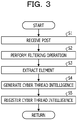
- FIG. 3 is a flowchart illustrating an example of the registration operation of the posted information.
- the post receiving unit 11 receives the posted information from the user terminal 10A (S1).
- FIG. 4 illustrates an example of a post screen. Referring to FIG. 4 , information is posted on a post screen 40 having input items 41 through 46, and a post button 47.
- the item 41 indicates a title of the posted information.
- the item 42 indicates a body of the posted information.
- the item 43 indicates an access range of the posted information. More specifically, the access ranges of TLP, such as RED, AMBER, GREEN, WHITE, and the like are indicated.
- the item 44 indicates a group or a person sharing the posted information in the access range indicated by TLP.
- the item 45 specifies a file that is to be attached to the posted information. In the displayed example, a single file is attached in the item 45. Multiple files may be specified in the item 45.
- the item 46 specifies whether the poster of the posted information is to be anonymous.
- the user of the user terminal 10A sets each of the items 41 through 46, operates the post button 47, and thus transmits the posted information having the contents set in the items 41 through 46 to the information posting system 1.
- the registration unit 12 attaches information, such as ID and posting time, and then registers the posted information having the contents set in the items 41 through 46 on the cyber threat intelligence DB 21.
- the registration unit 12 performs a filtering operation to acquire a word or a phrase related to a cyber attack in the title and the body contained the posted information (S2). Via the filtering operation, the registration unit 12 selects the posted information useful in the conversion into the cyber threat intelligence 21A.
- the registration unit 12 analyzes the filtered posted information, specifically, analyzes the posted information related to the cyber attack, and extracts a variety of elements and an access range related to the cyber attack event to be used to describe the cyber threat intelligence 21A (S3).
- the registration unit 12 extracts the title of the posted information as an element of "STIX Header Title” in STIX.
- the registration unit 12 also extracts the body of the posted information as an element of "STIX Header Description” in STIX.
- the registration unit 12 extracts, from the title and the body of the posted information, elements such as a threat actor, TTPs, and an indicator, using a regular expression or natural language processing of related art, and sets the elements in STIX.
- the registration unit 12 also extracts a value indicated via TLP, such as RED, AMBER, GREEN, WHITE, and the like from the items of the access range in the posted information.
- a simple markup indicating an STIX element is entered in the title or the body during posting, the markup may be extracted together with the STIX element. For example, if a sentence reading "Country X is mounting a cyber attack," is expressed as follows: “ ⁇ Threat_Actor: Country X> is mounting a cyber attack", “Country X” is a threat actor of STIX.
- the registration unit 12 extracts the STIX elements of the file attached to the posted information (a CSV file, a text file, and the like) via a regular expression or natural language processing of related art. For example, the registration unit 12 extracts an IP address, a domain name, a hash value, and the like in the indicator, based on an address list described in the CSV file. The registration unit 12 sets the extracted values as STIX indicators and STIX observables. Based on a document, such as a text file, the registration unit 12 extracts the elements, such as a threat actor, TTPs, and an indicator, and sets them to be the STIX elements. As for the attached file, the registration unit 12 may extract an STIX element, based on the markup.
- the registration unit 12 generates the cyber threat intelligence 21A by tagging the elements extracted in S3 in STIX (S4), and registers the cyber threat intelligence 21A on the cyber threat intelligence DB 21 (S5). In this way, the posted information (containing information concerning the cyber attack) received by the information posting system 1 from the user terminal 10A is shared as the cyber threat intelligence 21A on the cyber threat intelligence DB 21 with the cyber threat intelligence management system 3.
- FIG. 5 illustrates the conversion of the posted information into the cyber threat intelligence.
- the title and the body of posted information 50 are converted into cyber threat intelligence 51A by extracting a variety of elements related to the cyber attack.
- a file attached to the posted information 50 is converted into the cyber threat intelligence 51B and 51C.
- the attached file may be contained as an STIX element after being encoded in accordance with a specific coding method, such as Base64.
- a comment related to the posted information 50 is converted into cyber threat intelligence 51D and 51E.
- the conversion into the cyber threat intelligence 51A through 51E is performed with the access range specified by the posted information 50 maintained. For this reason, the access range specified by the posted information 50 remains still unchanged in the cyber threat intelligence 51A through 51E.
- Each piece of the cyber threat intelligence 51A through 51E converted from the posted information 50 is tagged with respective ID, and IDs of reference destinations to be mutually referenced are described in "Reference”. In this way, the reference relationship of the conversion into the cyber threat intelligence 51A through 51E is thus identified.
- the output unit 14 in response to an access from the user terminal 10B (such as a user ID identifying a user and a reference request of the posted information 50), the output unit 14 reads information registered on the cyber threat intelligence DB 21, and outputs the information to the user terminal 10B. More specifically, in response to the access from the user terminal 10B, the output unit 14 reads information falling within the access range of the posted information 50 from the cyber threat intelligence DB 21 in accordance with the user ID notified by the user terminal 10B. The output unit 14 further generates display data that indicates the posted information 50 read from the cyber threat intelligence DB 21, and outputs the display data to the user terminal 10B. In this way, the posted information 50 falling within the access range of the user of the user terminal 10B is thus displayed on the user terminal 10B.
- the output unit 14 references the cyber threat intelligence DB 21 to monitor whether the cyber threat intelligence management system 3 has added new cyber threat intelligence 21A. If the new cyber threat intelligence 21A has been added on the cyber threat intelligence DB 21, the output unit 14 reads the new cyber threat intelligence 21A that has been added, and converts the new cyber threat intelligence 21A into the posted information 50, and performs an output operation to output the posted information 50 to the user terminal 10B.
- FIG. 6 is a flowchart illustrating an example of an output operation of the cyber threat intelligence 21A.
- the output unit 14 references the cyber threat intelligence DB 21 and determines whether the cyber threat intelligence management system 3 has added the new cyber threat intelligence 21A onto the cyber threat intelligence DB 21. If the new cyber threat intelligence 21A has been added onto the cyber threat intelligence DB 21, the output unit 14 acquires the added cyber threat intelligence 21A from the cyber threat intelligence DB 21 (S10).
- the output unit 14 extracts each STIX element from the acquired cyber threat intelligence 21A, and coverts the cyber threat intelligence 21A into the posted information 50 in accordance with the extracted STIX element (S11).
- the output unit 14 converts each STIX element extracted from the cyber threat intelligence 21A into the posted information 50, based on an element easier to understand to humans. For example, "STIX Header Title" in the cyber threat intelligence 21A is converted into the title of the posted information 50. The output unit 14 also converts "STIX Header Description and/or Short Description” in the cyber threat intelligence 21A into the body of the posted information 50. The output unit 14 further converts a list of indicators and observables in the cyber threat intelligence 21A into CSV files, and allows the CSV files to be downloaded as the files to be attached to the posted information 50. The output unit 14 converts the cyber threat intelligence 21A with the access range thereof maintained into the posted information 50 as the item indicating the access range (item 43).
- the output unit 14 outputs the posted information 50 converted in S11 to the user terminal 10B (S12).
- the cyber threat intelligence 21A newly added onto the cyber threat intelligence 21A is converted into the posted information 50 in a form that allows the user terminal 10B to gain access thereto in a way similar to the post from the user terminal 10A, and the posted information 50 is then output.
- the cyber threat intelligence 21A newly added onto the cyber threat intelligence DB 21 is shared with the information posting system 1.
- the output unit 14 determines whether the posted information 50 has been accessed by the user terminal 10B (S13). If the posted information 50 has not been accessed by the user terminal 10B (no branch from S13), processing returns to S10.
- the output unit 14 reads the posted information 50 from the cyber threat intelligence DB 21 (S14). More specifically, the output unit 14 reads information within the access range of the posted information 50 from the cyber threat intelligence DB 21 in response to the user ID notified by the user terminal 10B.
- the output unit 14 performs a filtering operation that selects the read posted information 50 in accordance with a predetermined condition (S15).
- the read posted information 50 may contain, as information related to the cyber information, information useful to a user (human-based system) of the information posting system 1 and meaningless information as well.
- the posted information 50 having a title and an indicator with no other information may be meaningful in the system-based system but not very much meaningful in the human-based system.
- a field of the posted information 50 matching the condition of a specific white list may pass and a field of the posted information 50 not matching the condition of the specific white list may be blocked.
- IP Internet protocol
- the filtering operation if an Internet protocol (IP) address in a field of the posted information 50 falls within a specific range, the field may pass, and if the IP address falls outside the specific range, the field may be blocked.
- IP Internet protocol
- the filtering operation if any one of the IP addresses of individual CTI in a field falls within a specific range, that CTI may pass and if all the IP addresses of the individual CTI fall outside the range, that CIP may be blocked.
- the output unit 14 selects the posted information 50 that is meaningful to the human-based system. If the posted information 50 having the same content is posted in a larger amount per unit time, the posted information 50 may be compressed into a single piece of representing information.
- the output unit 14 sorts the filtered posted information 50 in accordance with a time sequence order indicated by posting time and date, for example, re-arranges the posted information 50 in the time sequence order of direction from latest time to past time (S16). The output unit 14 then generates display data that lists the sorted posted information 50, and outputs the display data to the user terminal 10B (S17). The user terminal 10B thus verifies the list of the posted information 50 that contains the information into which the cyber threat intelligence 21A is converted.
- FIG. 7 illustrates a display example on a user terminal 60.
- the user terminal 60 of FIG. 7 is an example of the user terminal 10B that is of a smart phone type.
- the user terminal 60 displays a list display screen 61 that is based on the display data output by the output unit 14 in S17.
- the user of the user terminal 60 may thus verify a list of the posted information 50 that contains the information, into which the cyber threat intelligence 21A has been converted, and has been sorted in accordance with the time sequence order.
- the user of the user terminal 60 may post new information by performing a button operation on the list display screen 61 to call a post screen 40.
- the user terminal 60 asks the output unit 14 in the information posting system 1 about the contents of the selected posted information 50. More specifically, the user terminal 60 notifies the output unit 14 in the information posting system 1 of the ID of the selected posted information 50.
- the output unit 14 Based on the ID notified by the user terminal 60, the output unit 14 references the cyber threat intelligence DB 21, and acquires information of each item in the selected posted information 50. The output unit 14 generates the display data indicating each item of the selected posted information 50, and outputs the display data to the user terminal 60. A post output screen 62 displaying each item of the selected posted information 50 is displayed on the user terminal 60.
- FIG. 8 illustrates an example of an output screen of the cyber threat intelligence.
- items 62A through 62E are displayed as the contents of the items of selected posted information 50 on a post output screen 62.
- the item 62A displays poster information of the posted information 50.
- the item 62B displays post contents of the posted information 50.
- the item 62C displays a file attached to the posted information 50.
- the item 62D displays a comment related to the posted information 50.
- the item 62E displays shared information indicating the access range of the posted information 50. Via the post output screen 62, the user may easily recognize the detail of the posted information 50 containing the information converted from the cyber threat intelligence 21A.
- FIG. 9 illustrates an example of a distributed system configuration.
- a security operation center includes the information posting system 1, the storage device 2, and the cyber threat intelligence management system 3.
- the SOC is geographically and politically distributed, or even if the SOC is deployed in the same department, the SOC may be distributed as appropriate in view of confidentiality.
- an SOC including an information posting system 1A, a storage device 2A, and a cyber threat intelligence management system 3B, and an SOC including the information posting system 1A, a storage device 2B, and the cyber threat intelligence management system 3B are distributed (separately deployed).
- information stored on the cyber threat intelligence DB 21 is transferred (shared) in accordance with a communication protocol to transfer information concerning a cyber attack, such as TAXII, between one of the storage device 2 and the cyber threat intelligence management system 3 in the central SOC and one of the storage device 2A and the cyber threat intelligence management system 3A in another SOC.
- a cyber attack such as TAXII
- the information posting system 1 of the human-based system of the SOC and the cyber threat intelligence management system 3 of the system-based system share the cyber threat intelligence 21A.
- Another SOC which is geographically or politically distributed, and separately deployed in view of confidentiality may share the cyber threat intelligence 21A.
- the registration unit 12 in the information posting system 1 receives information concerning a cyber attack from the user terminal 10A
- the registration unit 12 stores the received information on the cyber threat intelligence DB 21, and registers (stores) the received information in a state that allows the user terminal 10B to gain access the received information via the output unit 14.
- the registration unit 12 converts the data structure of the information concerning the cyber attack into the cyber threat intelligence 21A in a state usable in the cyber threat intelligence management system 3 (for example, in the STIX format), and then registers (stores) the cyber threat intelligence 21A on the storage device 2 or the cyber threat intelligence management system 3.
- the output unit 14 in the information posting system 1 converts the other piece of posted information added in a form that allows the user terminal 10B to gain access to the information, and then outputs the converted information to the user terminal 10B.
- the information concerning the cyber attack received by the information posting system 1 from the user terminal 10A is shared with the cyber threat intelligence management system 3 as the cyber threat intelligence 21A stored on the cyber threat intelligence DB 21.
- the cyber threat intelligence 21A that is newly added onto the cyber threat intelligence DB 21 via the cyber threat intelligence management system 3 or the external site 4 is output to the user terminal 10B in a way similar to the posting from the user terminal 10A, and is thus shared with the information posting system 1.
- the cyber threat intelligence 21A is shared by the information posting system 1 as the human-based system and the cyber threat intelligence management system 3 as the system-based system.
- Both the posted information 50 and the cyber threat intelligence 21A contain information defining the access range.
- the access range is maintained.
- the same access range is maintained.
- the information posting system 1 displays the posted information 50 in the time sequence order stored. In this way, the user of the user terminal 10B may more easily recognize the time sequence order of the posted information 50 containing the cyber threat intelligence 21A that has been changed.
- each of the apparatuses described above may not necessarily have to be physically constructed exactly as illustrated. Actual configurations of the distribution and integration of the apparatuses are not limited to the configuration illustrated, and some or all of the configurations may be distributed or integrated according to any functionality unit or any physical unit depending on a variety of workloads and usage status.
- Some or all of the processes and functionalities performed by the information posting system 1 and the cyber threat intelligence management system 3 may be performed on a CPU (or a microprocessor unit (MPU), or a micro controller unit (MCU)). Some or all of the processes and functionalities may be performed on a program that is executed for analysis by the CPU (or a microcomputer, such as MPU or MCU) or wired-logic hardware. The processes and functionalities may be performed by cloud computing in which multiple computers operate in concert with each other.
- a CPU or a microprocessor unit (MPU), or a micro controller unit (MCU)
- Some or all of the processes and functionalities may be performed on a program that is executed for analysis by the CPU (or a microcomputer, such as MPU or MCU) or wired-logic hardware.
- the processes and functionalities may be performed by cloud computing in which multiple computers operate in concert with each other.
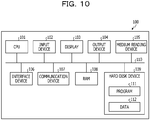
- FIG. 10 is a block diagram illustrating a hardware configuration of an information processing apparatus 100 of the embodiment.
- the information processing apparatus 100 includes a CPU 101 performing a variety of arithmetic operations, an input device 102 receiving input data, a display 103, and an output device 104 outputting a sound.
- the information processing apparatus 100 further includes a medium reading device 105 that reads a program and the like from a storage medium, an interface device 106 that connects to a variety of devices, and a communication device 107 that is wiredly or wirelessly connected to an external device for communication.
- the information processing apparatus 100 further includes a random-access memory (RAM) 108 that temporarily stores a variety of information, and a hard disk device 109.
- the elements (the CPU 101 through the hard disk device 109) in the information processing apparatus 100 are interconnected via a bus 110.
- the hard disk device 109 stores a program 111 that performs a variety of functionalities of the post receiving unit 11, the registration unit 12, the output unit 14, and the like.
- the hard disk device 109 stores a variety of data 112 (such as the cyber threat intelligence DB 21) to be referenced by the program 111.
- the input device 102 receives operation information from a user of the information processing apparatus 100.
- the display 103 displays a variety of screens to be operated by the user.
- the interface device 106 is connected to a printer or the like.
- the communication device 107 is connected a communication network, such as the Internet, and exchanges a variety of information with an external device via the communication network.
- the CPU 101 reads the program 111 from the hard disk device 109, and expands the program 111 onto the RAM 108, thereby performing a variety of operations related to the registration unit 12 and the output unit 14.
- the program 111 may not necessarily be stored on the hard disk device 109.
- the information posting system 1 may read the program 111 from a readable storage medium, and may execute the program 111.
- the storage media that are readable by the information processing apparatus 100 may include a portable recording medium, such as a compact disk read-only memory (CD-ROM), a digital versatile disk (DVD), or a universal serial bus (USB), a semiconductor memory, such as a flash memory, and a hard disk drive.
- the program 111 may be stored on a device connected to a public telephone network, the Internet, or a local-area network (LAN), and the information processing apparatus 100 may read the program 111 from the device and execute the program 111.
- LAN local-area network
Landscapes
- Engineering & Computer Science (AREA)
- Computer Security & Cryptography (AREA)
- General Engineering & Computer Science (AREA)
- Signal Processing (AREA)
- Computing Systems (AREA)
- Computer Networks & Wireless Communication (AREA)
- Computer Hardware Design (AREA)
- Databases & Information Systems (AREA)
- Theoretical Computer Science (AREA)
- Data Mining & Analysis (AREA)
- Physics & Mathematics (AREA)
- General Physics & Mathematics (AREA)
- Information Transfer Between Computers (AREA)
- Computer And Data Communications (AREA)
- Hardware Redundancy (AREA)
Abstract
Description
- The embodiments discussed herein are related to a cyber attack information processing technology.
- Cyber attacks including an unauthorized access via a network are serious concerns today. Cyber attacks are made in a variety of methods. To counter the cyber attacks, finding and referencing cyber threat intelligence (CTI) related to similar cyber attacks prove effective.
- The cyber threat intelligence is not only related to an alert automatically issued by a sensor related to a threat actor, a purpose of a cyber attack, and TTPs, but also information concerning the cyber attack organized in the form of analysis results and report by an analyst. The standardization of the cyber threat intelligence and the formation of the platform the cyber threat intelligence are currently in progress, and the infrastructure of using a large amount of cyber threat intelligence is being constructed. Also currently available is the cyber security system that generates a threat information message by processing events of data concerning network flow, packets, and users.
- Japanese National Publication of International Patent Application No.
2017-516411 2016-119061 - The cyber threat intelligence is a standardized platform, which is applicable in a system-based system. The system-based system is not shared with human-based systems, such as social networking system (SNS). For this reason, users of human-based systems have a smaller opportunity of using the cyber threat intelligence, and have difficulty in countering cyber attacks. Posting related to the cyber attack in the human-based systems is shared among users of the human-based systems but is not shared among the system-based systems.
- According to an aspect of the invention, a cyber attack information processing apparatus includes a processor configured to, when a first system obtains first information regarding a cyber attack from a first terminal, store the first information in a state that the first information is accessible to a second terminal that is capable of accessing the first system, convert the first information having a first data structure into second information having a second data structure usable by a second system wherein the second information is to be provided for the second system, when the second system obtains third information regarding another cyber attack, convert the third information having the second data structure into fourth information having the first data structure, and provide the second terminal with the fourth information.
- The cyber threat intelligence may be shared among different systems in accordance with the disclosure.
-
-
FIG. 1 illustrates a system configuration of an embodiment; -
FIG. 2 illustrates an example of cyber threat intelligence; -
FIG. 3 is a flowchart illustrating an example of a registration process of posted information; -
FIG. 4 illustrates an example of a post screen; -
FIG. 5 illustrates a conversion operation from posted information into cyber threat intelligence; -
FIG. 6 is a flowchart illustrating an example of an output operation of the cyber threat intelligence; -
FIG. 7 illustrates a display example on a user terminal; -
FIG. 8 illustrates an example of an output screen of the cyber threat intelligence; -
FIG. 9 illustrates an example of a distributed system configuration; and -
FIG. 10 is a block diagram illustrating a hardware configuration of an information processing apparatus of the embodiment. - Referring to the drawings, a cyber attack information processing program, a cyber attack information processing method, and an information processing apparatus of an embodiment are described below. In the discussion of the embodiment, elements identical in functionality are designated with the same reference numerals and the discussion, once made, is not repeated. The cyber attack information processing program, the cyber attack information processing method, and the information processing apparatus of the embodiment are described for exemplary purposes only, and the disclosure is not limited to the embodiment. The embodiments described below may be combined in a consistent way.
-
FIG. 1 illustrates a system configuration of an embodiment. Referring toFIG. 1 , the system of the embodiment includes aninformation posting system 1, astorage device 2 storing a cyberthreat intelligence DB 21, and a cyber threat intelligence management system 3. - The
information posting system 1 may be an SNS, and is an example of a human-based system (first system) that delivers information posted by auser terminal 10A to anotheruser terminal 10B. Theuser terminals - The
information posting system 1 includes a post receivingunit 11 that receives information posted by theuser terminal 10A, aregistration unit 12 that registers the posted information on the cyberthreat intelligence DB 21, and an output unit 14 that outputs the information registered on the cyberthreat intelligence DB 21 to theuser terminal 10B. - The
storage device 2 stores the cyber threat intelligence DB 21 and is connected to theinformation posting system 1 and the cyber threat intelligence management system 3 via a communication network (not illustrated), such as a local area network (LAN) and the Internet. - In accordance with the embodiment, the
storage device 2 is separate from the cyber threat intelligence management system 3. Alternatively, thestorage device 2 may be built in the cyber threat intelligence management system 3. More specifically, the cyber threat intelligence DB 21 may be mounted in the cyber threat intelligence management system 3. - The cyber threat intelligence DB 21 stores the cyber threat intelligence (CTI) on each event of cyber attack. The cyber threat intelligence stored on the cyber
threat intelligence DB 21 is described in a data structure, such as a structured threat information expression (STIX) language. The STIX language is technical specifications that describe an item related to a cyber attack campaign including an event characteristic of a cyber attack. In the discussion that follows, the cyber threat intelligence has a data structure in the STIX format, but the data structure is not limited to the STIX format. - More specifically, the cyber threat intelligence includes cyber attack campaigns, and event contents of each of threat actors, and tactics, techniques, and procedures (TTPs), indicators, and observables, incidents, courses of action, and exploit targets. The event contents included together with the cyber attack campaigns may be information of some or all of the threat actors, the TTPs, the indicators, the observales, the incidents, the courses of action, and the exploit targets.
- The cyber threat intelligence includes information indicating an access range indicated by a traffic light protocol (TLP). For example, the access range is indicated by RED for a receiver of the cyber threat intelligence and AMBER for a receiver and a particular person. The access range is also indicated by GREEN for within a specific community (group), and WHITE for the whole world (anybody). A person serving as an access target and a shared group are notified separately from TLP. In this way, the cyber threat intelligence management system 3 provides the cyber threat intelligence to a target indicated by the access range (such as a receiver or group).
-
FIG. 2 illustrates an example of the cyber threat intelligence. Referring toFIG. 2 , incyber threat intelligence 21A, tagged elements are layered (in a nested structure) using the extensible markup language (XML), and thus form the above-described information in a tree structure from a root element. More specifically, thecyber threat intelligence 21A has elements (nodes) including the cyber attack campaigns, the threat actors, the TTPs, the indicators, the observables, the incidents, the courses of action, and the exploit targets as elements (nodes), and information in each element serves as child element (child node). - The cyber threat intelligence management system 3 is an example of the system-based system (second system) that manages and uses the
cyber threat intelligence 21A stored on the cyberthreat intelligence DB 21 in thestorage device 2. - In the United States Department of Homeland Security (DHS), the cyber threat intelligence management system 3 is connected via the Internet or the like to an
external site 4, such as of automated indicator sharing (AIS) that is a mechanism sharing thecyber threat intelligence 21A or iSIGHT partners and the like that provide a delivery service of thecyber threat intelligence 21A. The cyber threat intelligence management system 3 registers on the cyberthreat intelligence DB 21 thecyber threat intelligence 21A provided by theexternal site 4 using trusted automated exchange of indicator information (TAXII) or the like. - The cyber threat intelligence management system 3 registers on the cyber
threat intelligence DB 21 thecyber threat intelligence 21A that an analyst analyzing a cyber attack has input using a user terminal 30. The cyber threat intelligence management system 3 also supplies to theexternal site 4 thecyber threat intelligence 21A using TAXII or the like. In the system-based system in this way, the cyber threat intelligence management system 3 and theexternal site 4 share thecyber threat intelligence 21A. - The cyber threat intelligence management system 3 performs syntax analysis on the
cyber threat intelligence 21A stored on the cyberthreat intelligence DB 21, and acquires information concerning a type of each of the cyber attack campaign, the threat actor, the TTPs, the indicator, the observable, the incident, the courses of action, and the exploit target. The cyber threat intelligence management system 3 then performs analysis, such as collecting acquired information concerning the cyber attack, and generates adisplay screen 31 as analysis results and causes the user terminal 30 to display thedisplay screen 31. An analyst using the user terminal 30 may verify the analysis results of thecyber threat intelligence 21A stored on the cyberthreat intelligence DB 21. - In accordance with the syntax analysis results of the
cyber threat intelligence 21A, the cyber threat intelligence management system 3 sets the cyber attack campaign, the threat actor, the TTPs, the indicator, the observable, the incident, the course of action, and the exploit target in the cyber attack event to be representative nodes, and analyzes the tree structure having information in each node as child nodes. For example, the cyber threat intelligence management system 3 analyzes the tree structure by analyzing the nested structure of the tagged elements (nodes). Based on the analysis results of the tree structure, the cyber threat intelligence management system 3 then generates display information representing thedisplay screen 31 in the form of a graph in which the nodes are linked in accordance with the tree structure. The cyber threat intelligence management system 3 then displays thedisplay screen 31 on the user terminal 30. - The
post receiving unit 11, theregistration unit 12, and the output unit 14 in theinformation posting system 1 are described in detail. - The
post receiving unit 11 receives posted information on SNS by displaying a post screen on theuser terminal 10A via a communication network, such as the Internet. Thepost receiving unit 11 outputs the posted information received from theuser terminal 10A to theregistration unit 12. - The
registration unit 12 attaches identification information (ID) and time information indicative of time and date of the post to the posted information received by thepost receiving unit 11, and registers the resulting information on the cyberthreat intelligence DB 21. - More specifically, the
registration unit 12 analyzes a title, a body, and an attached file contained in the posted information, and determines whether the posted information contains information concerning a cyber attack, based on a determination as to whether a word or a phrase related to the cyber attack is contained in the title, the body, and the attached file. - If the information concerning the cyber attack is not contained, the
registration unit 12 extracts the title of the posted information as an element of "STIX Header Title" in STIX. Theregistration unit 12 also extracts the body of the posted information as an element of "STIX Header Description" in STIX. Based on the extracted elements, theregistration unit 12 generates thecyber threat intelligence 21A described in the specific data structure, such as STIX, and performs the registration operation to register thecyber threat intelligence 21A on thestorage device 2. As for the attached file of the posted information, theregistration unit 12 generates other cyber threat intelligence that is referenced using "Reference" from the originalcyber threat intelligence 21A attached, and then registers the othercyber threat intelligence 21A on thestorage device 2. - If the information concerning the cyber attack is contained, the
registration unit 12 extracts, from the posted information, elements in the cyber attack event, such as the cyber attack campaign, the threat actor, the TTPs, the indicator, the observable, the incident, the courses of action, and the exploit target. Based on the extracted elements, theregistration unit 12 generates thecyber threat intelligence 21A described in the specific data structure, such as STIX, and performs the registration operation to register thecyber threat intelligence 21A on thestorage device 2. -
FIG. 3 is a flowchart illustrating an example of the registration operation of the posted information. Referring toFIG. 3 , when the registration operation starts, thepost receiving unit 11 receives the posted information from theuser terminal 10A (S1). -
FIG. 4 illustrates an example of a post screen. Referring toFIG. 4 , information is posted on apost screen 40 havinginput items 41 through 46, and apost button 47. - Specifically, the
item 41 indicates a title of the posted information. Theitem 42 indicates a body of the posted information. Theitem 43 indicates an access range of the posted information. More specifically, the access ranges of TLP, such as RED, AMBER, GREEN, WHITE, and the like are indicated. Theitem 44 indicates a group or a person sharing the posted information in the access range indicated by TLP. Theitem 45 specifies a file that is to be attached to the posted information. In the displayed example, a single file is attached in theitem 45. Multiple files may be specified in theitem 45. The item 46 specifies whether the poster of the posted information is to be anonymous. - The user of the
user terminal 10A sets each of theitems 41 through 46, operates thepost button 47, and thus transmits the posted information having the contents set in theitems 41 through 46 to theinformation posting system 1. Theregistration unit 12 attaches information, such as ID and posting time, and then registers the posted information having the contents set in theitems 41 through 46 on the cyberthreat intelligence DB 21. - Turning back to
FIG. 3 , theregistration unit 12 performs a filtering operation to acquire a word or a phrase related to a cyber attack in the title and the body contained the posted information (S2). Via the filtering operation, theregistration unit 12 selects the posted information useful in the conversion into thecyber threat intelligence 21A. - The
registration unit 12 analyzes the filtered posted information, specifically, analyzes the posted information related to the cyber attack, and extracts a variety of elements and an access range related to the cyber attack event to be used to describe thecyber threat intelligence 21A (S3). - The
registration unit 12 extracts the title of the posted information as an element of "STIX Header Title" in STIX. Theregistration unit 12 also extracts the body of the posted information as an element of "STIX Header Description" in STIX. - The
registration unit 12 extracts, from the title and the body of the posted information, elements such as a threat actor, TTPs, and an indicator, using a regular expression or natural language processing of related art, and sets the elements in STIX. Theregistration unit 12 also extracts a value indicated via TLP, such as RED, AMBER, GREEN, WHITE, and the like from the items of the access range in the posted information. - If a simple markup indicating an STIX element is entered in the title or the body during posting, the markup may be extracted together with the STIX element. For example, if a sentence reading "Country X is mounting a cyber attack..." is expressed as follows: "<Threat_Actor: Country X> is mounting a cyber attack", "Country X" is a threat actor of STIX.
- The
registration unit 12 extracts the STIX elements of the file attached to the posted information (a CSV file, a text file, and the like) via a regular expression or natural language processing of related art. For example, theregistration unit 12 extracts an IP address, a domain name, a hash value, and the like in the indicator, based on an address list described in the CSV file. Theregistration unit 12 sets the extracted values as STIX indicators and STIX observables. Based on a document, such as a text file, theregistration unit 12 extracts the elements, such as a threat actor, TTPs, and an indicator, and sets them to be the STIX elements. As for the attached file, theregistration unit 12 may extract an STIX element, based on the markup. - The
registration unit 12 generates thecyber threat intelligence 21A by tagging the elements extracted in S3 in STIX (S4), and registers thecyber threat intelligence 21A on the cyber threat intelligence DB 21 (S5). In this way, the posted information (containing information concerning the cyber attack) received by theinformation posting system 1 from theuser terminal 10A is shared as thecyber threat intelligence 21A on the cyberthreat intelligence DB 21 with the cyber threat intelligence management system 3. -
FIG. 5 illustrates the conversion of the posted information into the cyber threat intelligence. Referring toFIG. 5 , the title and the body of postedinformation 50 are converted intocyber threat intelligence 51A by extracting a variety of elements related to the cyber attack. Similarly, a file attached to the postedinformation 50 is converted into thecyber threat intelligence information 50 is converted intocyber threat intelligence - The conversion into the
cyber threat intelligence 51A through 51E is performed with the access range specified by the postedinformation 50 maintained. For this reason, the access range specified by the postedinformation 50 remains still unchanged in thecyber threat intelligence 51A through 51E. - Each piece of the
cyber threat intelligence 51A through 51E converted from the postedinformation 50 is tagged with respective ID, and IDs of reference destinations to be mutually referenced are described in "Reference". In this way, the reference relationship of the conversion into thecyber threat intelligence 51A through 51E is thus identified. - Turning back to
FIG. 1 , in response to an access from theuser terminal 10B (such as a user ID identifying a user and a reference request of the posted information 50), the output unit 14 reads information registered on the cyberthreat intelligence DB 21, and outputs the information to theuser terminal 10B. More specifically, in response to the access from theuser terminal 10B, the output unit 14 reads information falling within the access range of the postedinformation 50 from the cyberthreat intelligence DB 21 in accordance with the user ID notified by theuser terminal 10B. The output unit 14 further generates display data that indicates the postedinformation 50 read from the cyberthreat intelligence DB 21, and outputs the display data to theuser terminal 10B. In this way, the postedinformation 50 falling within the access range of the user of theuser terminal 10B is thus displayed on theuser terminal 10B. - The output unit 14 references the cyber
threat intelligence DB 21 to monitor whether the cyber threat intelligence management system 3 has added newcyber threat intelligence 21A. If the newcyber threat intelligence 21A has been added on the cyberthreat intelligence DB 21, the output unit 14 reads the newcyber threat intelligence 21A that has been added, and converts the newcyber threat intelligence 21A into the postedinformation 50, and performs an output operation to output the postedinformation 50 to theuser terminal 10B. -
FIG. 6 is a flowchart illustrating an example of an output operation of thecyber threat intelligence 21A. Referring toFIG. 6 , when the output operation starts, the output unit 14 references the cyberthreat intelligence DB 21 and determines whether the cyber threat intelligence management system 3 has added the newcyber threat intelligence 21A onto the cyberthreat intelligence DB 21. If the newcyber threat intelligence 21A has been added onto the cyberthreat intelligence DB 21, the output unit 14 acquires the addedcyber threat intelligence 21A from the cyber threat intelligence DB 21 (S10). - The output unit 14 extracts each STIX element from the acquired
cyber threat intelligence 21A, and coverts thecyber threat intelligence 21A into the postedinformation 50 in accordance with the extracted STIX element (S11). - More specifically, the output unit 14 converts each STIX element extracted from the
cyber threat intelligence 21A into the postedinformation 50, based on an element easier to understand to humans. For example, "STIX Header Title" in thecyber threat intelligence 21A is converted into the title of the postedinformation 50. The output unit 14 also converts "STIX Header Description and/or Short Description" in thecyber threat intelligence 21A into the body of the postedinformation 50. The output unit 14 further converts a list of indicators and observables in thecyber threat intelligence 21A into CSV files, and allows the CSV files to be downloaded as the files to be attached to the postedinformation 50. The output unit 14 converts thecyber threat intelligence 21A with the access range thereof maintained into the postedinformation 50 as the item indicating the access range (item 43). - The output unit 14 outputs the posted
information 50 converted in S11 to theuser terminal 10B (S12). Thecyber threat intelligence 21A newly added onto thecyber threat intelligence 21A is converted into the postedinformation 50 in a form that allows theuser terminal 10B to gain access thereto in a way similar to the post from theuser terminal 10A, and the postedinformation 50 is then output. Thecyber threat intelligence 21A newly added onto the cyberthreat intelligence DB 21 is shared with theinformation posting system 1. - The output unit 14 determines whether the posted
information 50 has been accessed by theuser terminal 10B (S13). If the postedinformation 50 has not been accessed by theuser terminal 10B (no branch from S13), processing returns to S10. - If the posted
information 50 has been accessed by theuser terminal 10B (yes branch from S13), the output unit 14 reads the postedinformation 50 from the cyber threat intelligence DB 21 (S14). More specifically, the output unit 14 reads information within the access range of the postedinformation 50 from the cyberthreat intelligence DB 21 in response to the user ID notified by theuser terminal 10B. - The output unit 14 performs a filtering operation that selects the read posted
information 50 in accordance with a predetermined condition (S15). For example, the read postedinformation 50 may contain, as information related to the cyber information, information useful to a user (human-based system) of theinformation posting system 1 and meaningless information as well. For example, the postedinformation 50 having a title and an indicator with no other information may be meaningful in the system-based system but not very much meaningful in the human-based system. - As an example of the filtering operation, a field of the posted
information 50 matching the condition of a specific white list may pass and a field of the postedinformation 50 not matching the condition of the specific white list may be blocked. As another example of the filtering operation, if an Internet protocol (IP) address in a field of the postedinformation 50 falls within a specific range, the field may pass, and if the IP address falls outside the specific range, the field may be blocked. As yet another example of the filtering operation, if any one of the IP addresses of individual CTI in a field falls within a specific range, that CTI may pass and if all the IP addresses of the individual CTI fall outside the range, that CIP may be blocked. - Based on the specific selection condition, the output unit 14 selects the posted
information 50 that is meaningful to the human-based system. If the postedinformation 50 having the same content is posted in a larger amount per unit time, the postedinformation 50 may be compressed into a single piece of representing information. - The output unit 14 sorts the filtered posted
information 50 in accordance with a time sequence order indicated by posting time and date, for example, re-arranges the postedinformation 50 in the time sequence order of direction from latest time to past time (S16). The output unit 14 then generates display data that lists the sorted postedinformation 50, and outputs the display data to theuser terminal 10B (S17). Theuser terminal 10B thus verifies the list of the postedinformation 50 that contains the information into which thecyber threat intelligence 21A is converted. -
FIG. 7 illustrates a display example on auser terminal 60. Theuser terminal 60 ofFIG. 7 is an example of theuser terminal 10B that is of a smart phone type. - Referring to
FIG. 7 , theuser terminal 60 displays alist display screen 61 that is based on the display data output by the output unit 14 in S17. The user of theuser terminal 60 may thus verify a list of the postedinformation 50 that contains the information, into which thecyber threat intelligence 21A has been converted, and has been sorted in accordance with the time sequence order. The user of theuser terminal 60 may post new information by performing a button operation on thelist display screen 61 to call apost screen 40. - If a specific piece of the posted
information 50 is selected from the list of the postedinformation 50 displayed on thelist display screen 61, theuser terminal 60 asks the output unit 14 in theinformation posting system 1 about the contents of the selected postedinformation 50. More specifically, theuser terminal 60 notifies the output unit 14 in theinformation posting system 1 of the ID of the selected postedinformation 50. - Based on the ID notified by the
user terminal 60, the output unit 14 references the cyberthreat intelligence DB 21, and acquires information of each item in the selected postedinformation 50. The output unit 14 generates the display data indicating each item of the selected postedinformation 50, and outputs the display data to theuser terminal 60. Apost output screen 62 displaying each item of the selected postedinformation 50 is displayed on theuser terminal 60. -
FIG. 8 illustrates an example of an output screen of the cyber threat intelligence. Referring toFIG. 8 ,items 62A through 62E are displayed as the contents of the items of selected postedinformation 50 on apost output screen 62. Theitem 62A displays poster information of the postedinformation 50. Theitem 62B displays post contents of the postedinformation 50. Theitem 62C displays a file attached to the postedinformation 50. Theitem 62D displays a comment related to the postedinformation 50. Theitem 62E displays shared information indicating the access range of the postedinformation 50. Via thepost output screen 62, the user may easily recognize the detail of the postedinformation 50 containing the information converted from thecyber threat intelligence 21A. -
FIG. 9 illustrates an example of a distributed system configuration. Referring toFIG. 9 , a security operation center (SOC) includes theinformation posting system 1, thestorage device 2, and the cyber threat intelligence management system 3. The SOC is geographically and politically distributed, or even if the SOC is deployed in the same department, the SOC may be distributed as appropriate in view of confidentiality. In addition to the SOC that includes theinformation posting system 1, thestorage device 2, and the cyber threat intelligence management system 3, an SOC including aninformation posting system 1A, a storage device 2A, and a cyber threat intelligence management system 3B, and an SOC including theinformation posting system 1A, astorage device 2B, and the cyber threat intelligence management system 3B are distributed (separately deployed). - From among the SOCs, information stored on the cyber
threat intelligence DB 21 is transferred (shared) in accordance with a communication protocol to transfer information concerning a cyber attack, such as TAXII, between one of thestorage device 2 and the cyber threat intelligence management system 3 in the central SOC and one of the storage device 2A and the cyber threat intelligence management system 3A in another SOC. In this way, theinformation posting system 1 of the human-based system of the SOC and the cyber threat intelligence management system 3 of the system-based system share thecyber threat intelligence 21A. Another SOC which is geographically or politically distributed, and separately deployed in view of confidentiality may share thecyber threat intelligence 21A. - When the
registration unit 12 in theinformation posting system 1 receives information concerning a cyber attack from theuser terminal 10A, theregistration unit 12 stores the received information on the cyberthreat intelligence DB 21, and registers (stores) the received information in a state that allows theuser terminal 10B to gain access the received information via the output unit 14. Theregistration unit 12 converts the data structure of the information concerning the cyber attack into thecyber threat intelligence 21A in a state usable in the cyber threat intelligence management system 3 (for example, in the STIX format), and then registers (stores) thecyber threat intelligence 21A on thestorage device 2 or the cyber threat intelligence management system 3. If another piece of posted information (such as newcyber threat intelligence 21A) related to the cyber attack is added onto the cyberthreat intelligence DB 21, the output unit 14 in theinformation posting system 1 converts the other piece of posted information added in a form that allows theuser terminal 10B to gain access to the information, and then outputs the converted information to theuser terminal 10B. - The information concerning the cyber attack received by the
information posting system 1 from theuser terminal 10A is shared with the cyber threat intelligence management system 3 as thecyber threat intelligence 21A stored on the cyberthreat intelligence DB 21. Thecyber threat intelligence 21A that is newly added onto the cyberthreat intelligence DB 21 via the cyber threat intelligence management system 3 or theexternal site 4 is output to theuser terminal 10B in a way similar to the posting from theuser terminal 10A, and is thus shared with theinformation posting system 1. In this way, thecyber threat intelligence 21A is shared by theinformation posting system 1 as the human-based system and the cyber threat intelligence management system 3 as the system-based system. - Both the posted
information 50 and thecyber threat intelligence 21A contain information defining the access range. In the conversion from the postedinformation 50 to thecyber threat intelligence 21A and in the conversion from thecyber threat intelligence 21A to the postedinformation 50, the access range is maintained. In each of theinformation posting system 1 and the cyber threat intelligence management system 3, the same access range is maintained. - When the posted
information 50 containing changedcyber threat intelligence 21A is transmitted to theuser terminal 10B, theinformation posting system 1 displays the postedinformation 50 in the time sequence order stored. In this way, the user of theuser terminal 10B may more easily recognize the time sequence order of the postedinformation 50 containing thecyber threat intelligence 21A that has been changed. - The elements of each of the apparatuses described above may not necessarily have to be physically constructed exactly as illustrated. Actual configurations of the distribution and integration of the apparatuses are not limited to the configuration illustrated, and some or all of the configurations may be distributed or integrated according to any functionality unit or any physical unit depending on a variety of workloads and usage status.
- Some or all of the processes and functionalities performed by the
information posting system 1 and the cyber threat intelligence management system 3 may be performed on a CPU (or a microprocessor unit (MPU), or a micro controller unit (MCU)). Some or all of the processes and functionalities may be performed on a program that is executed for analysis by the CPU (or a microcomputer, such as MPU or MCU) or wired-logic hardware. The processes and functionalities may be performed by cloud computing in which multiple computers operate in concert with each other. - The processes described with reference to the embodiment may be implemented by causing a computer to execute a program prepared in advance. An example of a computer (hardware) that executes the program having the same functionalities as those of the above-described embodiment is described below.
FIG. 10 is a block diagram illustrating a hardware configuration of aninformation processing apparatus 100 of the embodiment. - Referring to
FIG. 10 , theinformation processing apparatus 100 includes aCPU 101 performing a variety of arithmetic operations, aninput device 102 receiving input data, adisplay 103, and anoutput device 104 outputting a sound. Theinformation processing apparatus 100 further includes amedium reading device 105 that reads a program and the like from a storage medium, aninterface device 106 that connects to a variety of devices, and acommunication device 107 that is wiredly or wirelessly connected to an external device for communication. Theinformation processing apparatus 100 further includes a random-access memory (RAM) 108 that temporarily stores a variety of information, and ahard disk device 109. The elements (theCPU 101 through the hard disk device 109) in theinformation processing apparatus 100 are interconnected via abus 110. - The
hard disk device 109 stores a program 111 that performs a variety of functionalities of thepost receiving unit 11, theregistration unit 12, the output unit 14, and the like. Thehard disk device 109 stores a variety of data 112 (such as the cyber threat intelligence DB 21) to be referenced by the program 111. Theinput device 102 receives operation information from a user of theinformation processing apparatus 100. Thedisplay 103 displays a variety of screens to be operated by the user. Theinterface device 106 is connected to a printer or the like. Thecommunication device 107 is connected a communication network, such as the Internet, and exchanges a variety of information with an external device via the communication network. - The
CPU 101 reads the program 111 from thehard disk device 109, and expands the program 111 onto theRAM 108, thereby performing a variety of operations related to theregistration unit 12 and the output unit 14. The program 111 may not necessarily be stored on thehard disk device 109. For example, theinformation posting system 1 may read the program 111 from a readable storage medium, and may execute the program 111. The storage media that are readable by theinformation processing apparatus 100 may include a portable recording medium, such as a compact disk read-only memory (CD-ROM), a digital versatile disk (DVD), or a universal serial bus (USB), a semiconductor memory, such as a flash memory, and a hard disk drive. The program 111 may be stored on a device connected to a public telephone network, the Internet, or a local-area network (LAN), and theinformation processing apparatus 100 may read the program 111 from the device and execute the program 111. -
- 1, 1A, and 1B ... Information posting systems
- 2, 2A, and 2B ... Storage devices
- 3, 3A, and 3B ... Cyber threat intelligence management systems
- 4 ... External site
- 10A, 10B, and 30 ... User terminals
- 11 ...Post receiving unit
- 12 ... Registration unit
- 14 ... Output unit
- 21 ... Cyber threat intelligence DB
- 21A, and 51A through 51E ... Cyber threat intelligences
- 31 ... Display screen
- 40 ... Post screen
- 41 through 46, and 62A through 63E ... Items
- 47 ... Post button
- 50 ... Posted information
- 60 ... User terminal
- 61 ... List display screen
- 62 ... Post output screen
- 100 ...Information processing apparatus
- 101 ... CPU
- 102 ... Input device
- 103 ... Display
- 104 ... Output device
- 105 ... Medium reading device
- 106 ... Interface device
- 107 ... Communication device
- 108 ... RAM
- 109 ...Hard disk device
- 110 ... Bus
- 111 ... Program
- 112 ... Data
Claims (12)
- A cyber attack information processing apparatus comprising:a processor configured towhen a first system obtains first information regarding a cyber attack from a first terminal, store the first information in a state that the first information is accessible to a second terminal that is capable of accessing the first system,convert the first information having a first data structure into second information having a second data structure usable by a second system wherein the second information is to be provided for the second system,when the second system obtains third information regarding another cyber attack, convert the third information having the second data structure into fourth information having the first data structure, andprovide the second terminal with the fourth information.
- The cyber attack information processing apparatus according to claim 1, wherein the second data structure is in a structure threat information expression.
- The cyber attack information processing apparatus according to claim 1, wherein a range of the first information where access is permitted is equal to a range of the second information.
- The cyber attack information processing apparatus according to claim 1, wherein the fourth information is provided for the second terminal in accordance with a time order in which the third information is obtained by the second system.
- The cyber attack information processing apparatus according to claim 1,
wherein the second information and the fourth information are to be transmitted to a first storage available by a third system in accordance with a specific communication protocol that is used to transmit information regarding a cyber attack, and
wherein fifth information regarding a cyber attack stored in the first storage is to be transmitted to a second storage available by the first system in accordance with the specific communication protocol, the fifth information having the second data structure. - A computer-implemented cyber attack information processing method comprising:when a first system obtains first information regarding a cyber attack from a first terminal, storing the first information in a state that the first information is accessible to a second terminal that is capable of accessing the first system;converting the first information having a first data structure into second information having a second data structure usable by a second system wherein the second information is to be provided for the second system;when the second system obtains third information regarding another cyber attack, converting the third information having the second data structure into fourth information having the first data structure; andproviding the second terminal with the fourth information.
- The cyber attack information processing method according to claim 6, wherein the second data structure is in a structure threat information expression.
- The cyber attack information processing method according to claim 6, wherein a range of the first information where access is permitted is equal to a range of the second information.
- The cyber attack information processing method according to claim 6, wherein the fourth information is provided for the second terminal in accordance with a time order in which the third information is obtained by the second system.
- The cyber attack information processing method according to claim 9,
wherein the second information and the fourth information are to be transmitted to a first storage available by a third system in accordance with a specific communication protocol that is used to transmit information regarding a cyber attack, and
wherein fifth information regarding a cyber attack stored in the first storage is to be transmitted to a second storage available by the first system in accordance with the specific communication protocol, the fifth information having the second data structure. - A cyber attack information processing program that, when executed by a computer, causes the computer to execute the cyber attack information processing method according to any of claims 6 to 10.
- A computer-readable medium storing the cyber attack information processing program according to claim 11.
Applications Claiming Priority (1)
| Application Number | Priority Date | Filing Date | Title |
|---|---|---|---|
| JP2017163746A JP6915457B2 (en) | 2017-08-28 | 2017-08-28 | Cyber attack information processing program, cyber attack information processing method and information processing equipment |
Publications (2)
| Publication Number | Publication Date |
|---|---|
| EP3451615A1 true EP3451615A1 (en) | 2019-03-06 |
| EP3451615B1 EP3451615B1 (en) | 2020-11-11 |
Family
ID=63254578
Family Applications (1)
| Application Number | Title | Priority Date | Filing Date |
|---|---|---|---|
| EP18188882.7A Active EP3451615B1 (en) | 2017-08-28 | 2018-08-14 | Cyber attack information processing apparatus and method |
Country Status (4)
| Country | Link |
|---|---|
| US (1) | US11075953B2 (en) |
| EP (1) | EP3451615B1 (en) |
| JP (1) | JP6915457B2 (en) |
| SG (1) | SG10201806904QA (en) |
Families Citing this family (3)
| Publication number | Priority date | Publication date | Assignee | Title |
|---|---|---|---|---|
| US10902114B1 (en) * | 2015-09-09 | 2021-01-26 | ThreatQuotient, Inc. | Automated cybersecurity threat detection with aggregation and analysis |
| US11503047B2 (en) | 2020-03-13 | 2022-11-15 | International Business Machines Corporation | Relationship-based conversion of cyber threat data into a narrative-like format |
| US12086261B2 (en) * | 2020-03-13 | 2024-09-10 | International Business Machines Corporation | Displaying cyber threat data in a narrative-like format |
Citations (4)
| Publication number | Priority date | Publication date | Assignee | Title |
|---|---|---|---|---|
| JP2016119061A (en) | 2014-12-19 | 2016-06-30 | ザ・ボーイング・カンパニーThe Boeing Company | Policy-based network security |
| US20160308890A1 (en) * | 2015-04-20 | 2016-10-20 | Capital One Services, LLC. | Systems and methods for automated retrieval, processing, and distribution of cyber-threat information |
| US20160366174A1 (en) * | 2015-04-17 | 2016-12-15 | Soltra Solutions, Llc | Computerized system and method for securely distributing and exchanging cyber-threat information in a standardized format |
| JP2017516411A (en) | 2014-10-21 | 2017-06-15 | アイアンネット・サイバーセキュリティ・インコーポレイテッドIronNet Cybersecurity, Inc. | Cyber security system |
Family Cites Families (7)
| Publication number | Priority date | Publication date | Assignee | Title |
|---|---|---|---|---|
| JP4197311B2 (en) * | 2004-06-22 | 2008-12-17 | インターナショナル・ビジネス・マシーンズ・コーポレーション | Security policy generation method, security policy generation device, program, and recording medium |
| JP6081386B2 (en) * | 2014-01-30 | 2017-02-15 | 日本電信電話株式会社 | Information sharing apparatus, information sharing method, and information sharing program |
| JP6158750B2 (en) * | 2014-05-16 | 2017-07-05 | 日本電信電話株式会社 | Communications system |
| US20160119365A1 (en) * | 2014-10-28 | 2016-04-28 | Comsec Consulting Ltd. | System and method for a cyber intelligence hub |
| US9787719B2 (en) * | 2015-02-26 | 2017-10-10 | Symantec Corporation | Trusted third party broker for collection and private sharing of successful computer security practices |
| WO2017120175A1 (en) * | 2016-01-04 | 2017-07-13 | RiskIQ, Inc. | Techniques for infrastructure analysis of internet-based activity |
| US10798112B2 (en) * | 2017-03-30 | 2020-10-06 | Fireeye, Inc. | Attribute-controlled malware detection |
-
2017
- 2017-08-28 JP JP2017163746A patent/JP6915457B2/en active Active
-
2018
- 2018-08-14 EP EP18188882.7A patent/EP3451615B1/en active Active
- 2018-08-15 SG SG10201806904QA patent/SG10201806904QA/en unknown
- 2018-08-27 US US16/112,985 patent/US11075953B2/en active Active
Patent Citations (4)
| Publication number | Priority date | Publication date | Assignee | Title |
|---|---|---|---|---|
| JP2017516411A (en) | 2014-10-21 | 2017-06-15 | アイアンネット・サイバーセキュリティ・インコーポレイテッドIronNet Cybersecurity, Inc. | Cyber security system |
| JP2016119061A (en) | 2014-12-19 | 2016-06-30 | ザ・ボーイング・カンパニーThe Boeing Company | Policy-based network security |
| US20160366174A1 (en) * | 2015-04-17 | 2016-12-15 | Soltra Solutions, Llc | Computerized system and method for securely distributing and exchanging cyber-threat information in a standardized format |
| US20160308890A1 (en) * | 2015-04-20 | 2016-10-20 | Capital One Services, LLC. | Systems and methods for automated retrieval, processing, and distribution of cyber-threat information |
Non-Patent Citations (1)
| Title |
|---|
| MUTEMWA MUYOWA ET AL: "Developing a cyber threat intelligence sharing platform for South African organisations", 2017 CONFERENCE ON INFORMATION COMMUNICATION TECHNOLOGY AND SOCIETY (ICTAS), IEEE, 8 March 2017 (2017-03-08), pages 1 - 6, XP033093971, DOI: 10.1109/ICTAS.2017.7920657 * |
Also Published As
| Publication number | Publication date |
|---|---|
| JP2019040533A (en) | 2019-03-14 |
| EP3451615B1 (en) | 2020-11-11 |
| JP6915457B2 (en) | 2021-08-04 |
| SG10201806904QA (en) | 2019-03-28 |
| US20190068645A1 (en) | 2019-02-28 |
| US11075953B2 (en) | 2021-07-27 |
Similar Documents
| Publication | Publication Date | Title |
|---|---|---|
| US10880337B2 (en) | Social networking service analysis apparatus, social networking service analysis method, and computer-readable medium | |
| Lin et al. | Active disaster response system for a smart building | |
| US10713319B2 (en) | Systems and methods to determine trending topics for a user based on social graph data | |
| US9104917B2 (en) | Metering information collection | |
| US20180181832A1 (en) | Systems and methods for image description generation | |
| EP3451615B1 (en) | Cyber attack information processing apparatus and method | |
| US20170039211A1 (en) | Systems and methods for determining content similarity | |
| US10528591B2 (en) | Methods and systems for using hints in media content tagging | |
| US10762436B2 (en) | Systems and methods for recommending pages | |
| US20180129663A1 (en) | Systems and methods for efficient data sampling and analysis | |
| EP2897088A1 (en) | Method and apparatus for optimum spatial clustering | |
| Kodituwakku et al. | Insight2: A modular visual analysis platform for network situational awareness in large-scale networks | |
| CN111078737A (en) | Commonality analysis method and device, data processing equipment and readable storage medium | |
| CN115718775A (en) | Medical data processing method and medical information system | |
| Wang et al. | FlexMonitor: A flexible monitoring framework in SDN | |
| Samaras et al. | Requirements and architecture design principles for a smart city experiment with sensor and social networks integration | |
| US11347624B1 (en) | Systems and methods for application exception handling | |
| CN119292697A (en) | Data presentation method, device and storage medium | |
| CN107800999A (en) | A kind of method and system for mixing access video camera and video platform | |
| CN108133046B (en) | Data analysis method and device | |
| CN113676840B (en) | Data processing method, apparatus, electronic device, storage medium, and program product | |
| CN112084504B (en) | Virus file processing method, device, electronic device and readable storage medium | |
| JP5658184B2 (en) | Information sharing apparatus, browsing promotion method, and program | |
| US20160267164A1 (en) | Systems and methods for classifying computing devices based on device attributes | |
| López et al. | Data gathering in crisis management |
Legal Events
| Date | Code | Title | Description |
|---|---|---|---|
| PUAI | Public reference made under article 153(3) epc to a published international application that has entered the european phase |
Free format text: ORIGINAL CODE: 0009012 |
|
| STAA | Information on the status of an ep patent application or granted ep patent |
Free format text: STATUS: THE APPLICATION HAS BEEN PUBLISHED |
|
| AK | Designated contracting states |
Kind code of ref document: A1 Designated state(s): AL AT BE BG CH CY CZ DE DK EE ES FI FR GB GR HR HU IE IS IT LI LT LU LV MC MK MT NL NO PL PT RO RS SE SI SK SM TR |
|
| AX | Request for extension of the european patent |
Extension state: BA ME |
|
| STAA | Information on the status of an ep patent application or granted ep patent |
Free format text: STATUS: REQUEST FOR EXAMINATION WAS MADE |
|
| 17P | Request for examination filed |
Effective date: 20190626 |
|
| RBV | Designated contracting states (corrected) |
Designated state(s): AL AT BE BG CH CY CZ DE DK EE ES FI FR GB GR HR HU IE IS IT LI LT LU LV MC MK MT NL NO PL PT RO RS SE SI SK SM TR |
|
| STAA | Information on the status of an ep patent application or granted ep patent |
Free format text: STATUS: EXAMINATION IS IN PROGRESS |
|
| 17Q | First examination report despatched |
Effective date: 20190826 |
|
| GRAP | Despatch of communication of intention to grant a patent |
Free format text: ORIGINAL CODE: EPIDOSNIGR1 |
|
| STAA | Information on the status of an ep patent application or granted ep patent |
Free format text: STATUS: GRANT OF PATENT IS INTENDED |
|
| INTG | Intention to grant announced |
Effective date: 20200826 |
|
| GRAS | Grant fee paid |
Free format text: ORIGINAL CODE: EPIDOSNIGR3 |
|
| GRAA | (expected) grant |
Free format text: ORIGINAL CODE: 0009210 |
|
| STAA | Information on the status of an ep patent application or granted ep patent |
Free format text: STATUS: THE PATENT HAS BEEN GRANTED |
|
| AK | Designated contracting states |
Kind code of ref document: B1 Designated state(s): AL AT BE BG CH CY CZ DE DK EE ES FI FR GB GR HR HU IE IS IT LI LT LU LV MC MK MT NL NO PL PT RO RS SE SI SK SM TR |
|
| REG | Reference to a national code |
Ref country code: GB Ref legal event code: FG4D |
|
| REG | Reference to a national code |
Ref country code: CH Ref legal event code: EP |
|
| REG | Reference to a national code |
Ref country code: AT Ref legal event code: REF Ref document number: 1334527 Country of ref document: AT Kind code of ref document: T Effective date: 20201115 |
|
| REG | Reference to a national code |
Ref country code: DE Ref legal event code: R096 Ref document number: 602018009569 Country of ref document: DE |
|
| REG | Reference to a national code |
Ref country code: IE Ref legal event code: FG4D |
|
| REG | Reference to a national code |
Ref country code: NL Ref legal event code: MP Effective date: 20201111 |
|
| REG | Reference to a national code |
Ref country code: AT Ref legal event code: MK05 Ref document number: 1334527 Country of ref document: AT Kind code of ref document: T Effective date: 20201111 |
|
| PG25 | Lapsed in a contracting state [announced via postgrant information from national office to epo] |
Ref country code: PT Free format text: LAPSE BECAUSE OF FAILURE TO SUBMIT A TRANSLATION OF THE DESCRIPTION OR TO PAY THE FEE WITHIN THE PRESCRIBED TIME-LIMIT Effective date: 20210311 Ref country code: RS Free format text: LAPSE BECAUSE OF FAILURE TO SUBMIT A TRANSLATION OF THE DESCRIPTION OR TO PAY THE FEE WITHIN THE PRESCRIBED TIME-LIMIT Effective date: 20201111 Ref country code: FI Free format text: LAPSE BECAUSE OF FAILURE TO SUBMIT A TRANSLATION OF THE DESCRIPTION OR TO PAY THE FEE WITHIN THE PRESCRIBED TIME-LIMIT Effective date: 20201111 Ref country code: NO Free format text: LAPSE BECAUSE OF FAILURE TO SUBMIT A TRANSLATION OF THE DESCRIPTION OR TO PAY THE FEE WITHIN THE PRESCRIBED TIME-LIMIT Effective date: 20210211 Ref country code: GR Free format text: LAPSE BECAUSE OF FAILURE TO SUBMIT A TRANSLATION OF THE DESCRIPTION OR TO PAY THE FEE WITHIN THE PRESCRIBED TIME-LIMIT Effective date: 20210212 |
|
| PG25 | Lapsed in a contracting state [announced via postgrant information from national office to epo] |
Ref country code: SE Free format text: LAPSE BECAUSE OF FAILURE TO SUBMIT A TRANSLATION OF THE DESCRIPTION OR TO PAY THE FEE WITHIN THE PRESCRIBED TIME-LIMIT Effective date: 20201111 Ref country code: PL Free format text: LAPSE BECAUSE OF FAILURE TO SUBMIT A TRANSLATION OF THE DESCRIPTION OR TO PAY THE FEE WITHIN THE PRESCRIBED TIME-LIMIT Effective date: 20201111 Ref country code: LV Free format text: LAPSE BECAUSE OF FAILURE TO SUBMIT A TRANSLATION OF THE DESCRIPTION OR TO PAY THE FEE WITHIN THE PRESCRIBED TIME-LIMIT Effective date: 20201111 Ref country code: IS Free format text: LAPSE BECAUSE OF FAILURE TO SUBMIT A TRANSLATION OF THE DESCRIPTION OR TO PAY THE FEE WITHIN THE PRESCRIBED TIME-LIMIT Effective date: 20210311 Ref country code: BG Free format text: LAPSE BECAUSE OF FAILURE TO SUBMIT A TRANSLATION OF THE DESCRIPTION OR TO PAY THE FEE WITHIN THE PRESCRIBED TIME-LIMIT Effective date: 20210211 Ref country code: AT Free format text: LAPSE BECAUSE OF FAILURE TO SUBMIT A TRANSLATION OF THE DESCRIPTION OR TO PAY THE FEE WITHIN THE PRESCRIBED TIME-LIMIT Effective date: 20201111 |
|
| REG | Reference to a national code |
Ref country code: LT Ref legal event code: MG9D |
|
| PG25 | Lapsed in a contracting state [announced via postgrant information from national office to epo] |
Ref country code: HR Free format text: LAPSE BECAUSE OF FAILURE TO SUBMIT A TRANSLATION OF THE DESCRIPTION OR TO PAY THE FEE WITHIN THE PRESCRIBED TIME-LIMIT Effective date: 20201111 |
|
| PG25 | Lapsed in a contracting state [announced via postgrant information from national office to epo] |
Ref country code: EE Free format text: LAPSE BECAUSE OF FAILURE TO SUBMIT A TRANSLATION OF THE DESCRIPTION OR TO PAY THE FEE WITHIN THE PRESCRIBED TIME-LIMIT Effective date: 20201111 Ref country code: CZ Free format text: LAPSE BECAUSE OF FAILURE TO SUBMIT A TRANSLATION OF THE DESCRIPTION OR TO PAY THE FEE WITHIN THE PRESCRIBED TIME-LIMIT Effective date: 20201111 Ref country code: SM Free format text: LAPSE BECAUSE OF FAILURE TO SUBMIT A TRANSLATION OF THE DESCRIPTION OR TO PAY THE FEE WITHIN THE PRESCRIBED TIME-LIMIT Effective date: 20201111 Ref country code: SK Free format text: LAPSE BECAUSE OF FAILURE TO SUBMIT A TRANSLATION OF THE DESCRIPTION OR TO PAY THE FEE WITHIN THE PRESCRIBED TIME-LIMIT Effective date: 20201111 Ref country code: RO Free format text: LAPSE BECAUSE OF FAILURE TO SUBMIT A TRANSLATION OF THE DESCRIPTION OR TO PAY THE FEE WITHIN THE PRESCRIBED TIME-LIMIT Effective date: 20201111 Ref country code: LT Free format text: LAPSE BECAUSE OF FAILURE TO SUBMIT A TRANSLATION OF THE DESCRIPTION OR TO PAY THE FEE WITHIN THE PRESCRIBED TIME-LIMIT Effective date: 20201111 |
|
| REG | Reference to a national code |
Ref country code: DE Ref legal event code: R097 Ref document number: 602018009569 Country of ref document: DE |
|
| PG25 | Lapsed in a contracting state [announced via postgrant information from national office to epo] |
Ref country code: DK Free format text: LAPSE BECAUSE OF FAILURE TO SUBMIT A TRANSLATION OF THE DESCRIPTION OR TO PAY THE FEE WITHIN THE PRESCRIBED TIME-LIMIT Effective date: 20201111 |
|
| PLBE | No opposition filed within time limit |
Free format text: ORIGINAL CODE: 0009261 |
|
| STAA | Information on the status of an ep patent application or granted ep patent |
Free format text: STATUS: NO OPPOSITION FILED WITHIN TIME LIMIT |
|
| 26N | No opposition filed |
Effective date: 20210812 |
|
| PG25 | Lapsed in a contracting state [announced via postgrant information from national office to epo] |
Ref country code: NL Free format text: LAPSE BECAUSE OF FAILURE TO SUBMIT A TRANSLATION OF THE DESCRIPTION OR TO PAY THE FEE WITHIN THE PRESCRIBED TIME-LIMIT Effective date: 20201111 Ref country code: AL Free format text: LAPSE BECAUSE OF FAILURE TO SUBMIT A TRANSLATION OF THE DESCRIPTION OR TO PAY THE FEE WITHIN THE PRESCRIBED TIME-LIMIT Effective date: 20201111 Ref country code: IT Free format text: LAPSE BECAUSE OF FAILURE TO SUBMIT A TRANSLATION OF THE DESCRIPTION OR TO PAY THE FEE WITHIN THE PRESCRIBED TIME-LIMIT Effective date: 20201111 |
|
| REG | Reference to a national code |
Ref country code: DE Ref legal event code: R079 Ref document number: 602018009569 Country of ref document: DE Free format text: PREVIOUS MAIN CLASS: H04L0029060000 Ipc: H04L0065000000 |
|
| PG25 | Lapsed in a contracting state [announced via postgrant information from national office to epo] |
Ref country code: SI Free format text: LAPSE BECAUSE OF FAILURE TO SUBMIT A TRANSLATION OF THE DESCRIPTION OR TO PAY THE FEE WITHIN THE PRESCRIBED TIME-LIMIT Effective date: 20201111 |
|
| PG25 | Lapsed in a contracting state [announced via postgrant information from national office to epo] |
Ref country code: ES Free format text: LAPSE BECAUSE OF FAILURE TO SUBMIT A TRANSLATION OF THE DESCRIPTION OR TO PAY THE FEE WITHIN THE PRESCRIBED TIME-LIMIT Effective date: 20201111 |
|
| REG | Reference to a national code |
Ref country code: CH Ref legal event code: PL |
|
| PG25 | Lapsed in a contracting state [announced via postgrant information from national office to epo] |
Ref country code: MC Free format text: LAPSE BECAUSE OF FAILURE TO SUBMIT A TRANSLATION OF THE DESCRIPTION OR TO PAY THE FEE WITHIN THE PRESCRIBED TIME-LIMIT Effective date: 20201111 |
|
| REG | Reference to a national code |
Ref country code: BE Ref legal event code: MM Effective date: 20210831 |
|
| PG25 | Lapsed in a contracting state [announced via postgrant information from national office to epo] |
Ref country code: LI Free format text: LAPSE BECAUSE OF NON-PAYMENT OF DUE FEES Effective date: 20210831 Ref country code: CH Free format text: LAPSE BECAUSE OF NON-PAYMENT OF DUE FEES Effective date: 20210831 |
|
| PG25 | Lapsed in a contracting state [announced via postgrant information from national office to epo] |
Ref country code: IS Free format text: LAPSE BECAUSE OF FAILURE TO SUBMIT A TRANSLATION OF THE DESCRIPTION OR TO PAY THE FEE WITHIN THE PRESCRIBED TIME-LIMIT Effective date: 20210311 Ref country code: LU Free format text: LAPSE BECAUSE OF NON-PAYMENT OF DUE FEES Effective date: 20210814 |
|
| PG25 | Lapsed in a contracting state [announced via postgrant information from national office to epo] |
Ref country code: IE Free format text: LAPSE BECAUSE OF NON-PAYMENT OF DUE FEES Effective date: 20210814 Ref country code: BE Free format text: LAPSE BECAUSE OF NON-PAYMENT OF DUE FEES Effective date: 20210831 |
|
| PG25 | Lapsed in a contracting state [announced via postgrant information from national office to epo] |
Ref country code: CY Free format text: LAPSE BECAUSE OF FAILURE TO SUBMIT A TRANSLATION OF THE DESCRIPTION OR TO PAY THE FEE WITHIN THE PRESCRIBED TIME-LIMIT Effective date: 20201111 |
|
| PG25 | Lapsed in a contracting state [announced via postgrant information from national office to epo] |
Ref country code: HU Free format text: LAPSE BECAUSE OF FAILURE TO SUBMIT A TRANSLATION OF THE DESCRIPTION OR TO PAY THE FEE WITHIN THE PRESCRIBED TIME-LIMIT; INVALID AB INITIO Effective date: 20180814 |
|
| PG25 | Lapsed in a contracting state [announced via postgrant information from national office to epo] |
Ref country code: MK Free format text: LAPSE BECAUSE OF FAILURE TO SUBMIT A TRANSLATION OF THE DESCRIPTION OR TO PAY THE FEE WITHIN THE PRESCRIBED TIME-LIMIT Effective date: 20201111 |
|
| PG25 | Lapsed in a contracting state [announced via postgrant information from national office to epo] |
Ref country code: MT Free format text: LAPSE BECAUSE OF FAILURE TO SUBMIT A TRANSLATION OF THE DESCRIPTION OR TO PAY THE FEE WITHIN THE PRESCRIBED TIME-LIMIT Effective date: 20201111 |
|
| PGFP | Annual fee paid to national office [announced via postgrant information from national office to epo] |
Ref country code: DE Payment date: 20250724 Year of fee payment: 8 |
|
| PGFP | Annual fee paid to national office [announced via postgrant information from national office to epo] |
Ref country code: GB Payment date: 20250725 Year of fee payment: 8 |
|
| PGFP | Annual fee paid to national office [announced via postgrant information from national office to epo] |
Ref country code: FR Payment date: 20250725 Year of fee payment: 8 |
|
| PG25 | Lapsed in a contracting state [announced via postgrant information from national office to epo] |
Ref country code: TR Free format text: LAPSE BECAUSE OF FAILURE TO SUBMIT A TRANSLATION OF THE DESCRIPTION OR TO PAY THE FEE WITHIN THE PRESCRIBED TIME-LIMIT Effective date: 20201111 |