EP3450466A1 - Process for preparing an aqueous dispersion of polymeric microspheres - Google Patents
Process for preparing an aqueous dispersion of polymeric microspheres Download PDFInfo
- Publication number
- EP3450466A1 EP3450466A1 EP18192610.6A EP18192610A EP3450466A1 EP 3450466 A1 EP3450466 A1 EP 3450466A1 EP 18192610 A EP18192610 A EP 18192610A EP 3450466 A1 EP3450466 A1 EP 3450466A1
- Authority
- EP
- European Patent Office
- Prior art keywords
- microspheres
- range
- weight
- distyryl
- monomer
- Prior art date
- Legal status (The legal status is an assumption and is not a legal conclusion. Google has not performed a legal analysis and makes no representation as to the accuracy of the status listed.)
- Granted
Links
Classifications
-
- B—PERFORMING OPERATIONS; TRANSPORTING
- B01—PHYSICAL OR CHEMICAL PROCESSES OR APPARATUS IN GENERAL
- B01J—CHEMICAL OR PHYSICAL PROCESSES, e.g. CATALYSIS OR COLLOID CHEMISTRY; THEIR RELEVANT APPARATUS
- B01J13/00—Colloid chemistry, e.g. the production of colloidal materials or their solutions, not otherwise provided for; Making microcapsules or microballoons
- B01J13/02—Making microcapsules or microballoons
- B01J13/06—Making microcapsules or microballoons by phase separation
- B01J13/14—Polymerisation; cross-linking
-
- C—CHEMISTRY; METALLURGY
- C08—ORGANIC MACROMOLECULAR COMPOUNDS; THEIR PREPARATION OR CHEMICAL WORKING-UP; COMPOSITIONS BASED THEREON
- C08L—COMPOSITIONS OF MACROMOLECULAR COMPOUNDS
- C08L71/00—Compositions of polyethers obtained by reactions forming an ether link in the main chain; Compositions of derivatives of such polymers
- C08L71/02—Polyalkylene oxides
-
- C—CHEMISTRY; METALLURGY
- C08—ORGANIC MACROMOLECULAR COMPOUNDS; THEIR PREPARATION OR CHEMICAL WORKING-UP; COMPOSITIONS BASED THEREON
- C08F—MACROMOLECULAR COMPOUNDS OBTAINED BY REACTIONS ONLY INVOLVING CARBON-TO-CARBON UNSATURATED BONDS
- C08F12/00—Homopolymers and copolymers of compounds having one or more unsaturated aliphatic radicals, each having only one carbon-to-carbon double bond, and at least one being terminated by an aromatic carbocyclic ring
- C08F12/02—Monomers containing only one unsaturated aliphatic radical
- C08F12/04—Monomers containing only one unsaturated aliphatic radical containing one ring
- C08F12/14—Monomers containing only one unsaturated aliphatic radical containing one ring substituted by hetero atoms or groups containing heteroatoms
- C08F12/22—Oxygen
- C08F12/24—Phenols or alcohols
-
- C—CHEMISTRY; METALLURGY
- C08—ORGANIC MACROMOLECULAR COMPOUNDS; THEIR PREPARATION OR CHEMICAL WORKING-UP; COMPOSITIONS BASED THEREON
- C08F—MACROMOLECULAR COMPOUNDS OBTAINED BY REACTIONS ONLY INVOLVING CARBON-TO-CARBON UNSATURATED BONDS
- C08F2/00—Processes of polymerisation
- C08F2/12—Polymerisation in non-solvents
- C08F2/16—Aqueous medium
- C08F2/22—Emulsion polymerisation
- C08F2/24—Emulsion polymerisation with the aid of emulsifying agents
- C08F2/26—Emulsion polymerisation with the aid of emulsifying agents anionic
-
- C—CHEMISTRY; METALLURGY
- C08—ORGANIC MACROMOLECULAR COMPOUNDS; THEIR PREPARATION OR CHEMICAL WORKING-UP; COMPOSITIONS BASED THEREON
- C08F—MACROMOLECULAR COMPOUNDS OBTAINED BY REACTIONS ONLY INVOLVING CARBON-TO-CARBON UNSATURATED BONDS
- C08F212/00—Copolymers of compounds having one or more unsaturated aliphatic radicals, each having only one carbon-to-carbon double bond, and at least one being terminated by an aromatic carbocyclic ring
- C08F212/02—Monomers containing only one unsaturated aliphatic radical
- C08F212/04—Monomers containing only one unsaturated aliphatic radical containing one ring
- C08F212/06—Hydrocarbons
- C08F212/08—Styrene
-
- C—CHEMISTRY; METALLURGY
- C08—ORGANIC MACROMOLECULAR COMPOUNDS; THEIR PREPARATION OR CHEMICAL WORKING-UP; COMPOSITIONS BASED THEREON
- C08F—MACROMOLECULAR COMPOUNDS OBTAINED BY REACTIONS ONLY INVOLVING CARBON-TO-CARBON UNSATURATED BONDS
- C08F220/00—Copolymers of compounds having one or more unsaturated aliphatic radicals, each having only one carbon-to-carbon double bond, and only one being terminated by only one carboxyl radical or a salt, anhydride ester, amide, imide or nitrile thereof
- C08F220/02—Monocarboxylic acids having less than ten carbon atoms; Derivatives thereof
- C08F220/10—Esters
- C08F220/12—Esters of monohydric alcohols or phenols
- C08F220/16—Esters of monohydric alcohols or phenols of phenols or of alcohols containing two or more carbon atoms
- C08F220/18—Esters of monohydric alcohols or phenols of phenols or of alcohols containing two or more carbon atoms with acrylic or methacrylic acids
- C08F220/1804—C4-(meth)acrylate, e.g. butyl (meth)acrylate, isobutyl (meth)acrylate or tert-butyl (meth)acrylate
-
- C—CHEMISTRY; METALLURGY
- C08—ORGANIC MACROMOLECULAR COMPOUNDS; THEIR PREPARATION OR CHEMICAL WORKING-UP; COMPOSITIONS BASED THEREON
- C08F—MACROMOLECULAR COMPOUNDS OBTAINED BY REACTIONS ONLY INVOLVING CARBON-TO-CARBON UNSATURATED BONDS
- C08F265/00—Macromolecular compounds obtained by polymerising monomers on to polymers of unsaturated monocarboxylic acids or derivatives thereof as defined in group C08F20/00
- C08F265/04—Macromolecular compounds obtained by polymerising monomers on to polymers of unsaturated monocarboxylic acids or derivatives thereof as defined in group C08F20/00 on to polymers of esters
- C08F265/06—Polymerisation of acrylate or methacrylate esters on to polymers thereof
-
- C—CHEMISTRY; METALLURGY
- C08—ORGANIC MACROMOLECULAR COMPOUNDS; THEIR PREPARATION OR CHEMICAL WORKING-UP; COMPOSITIONS BASED THEREON
- C08F—MACROMOLECULAR COMPOUNDS OBTAINED BY REACTIONS ONLY INVOLVING CARBON-TO-CARBON UNSATURATED BONDS
- C08F285/00—Macromolecular compounds obtained by polymerising monomers on to preformed graft polymers
-
- C—CHEMISTRY; METALLURGY
- C08—ORGANIC MACROMOLECULAR COMPOUNDS; THEIR PREPARATION OR CHEMICAL WORKING-UP; COMPOSITIONS BASED THEREON
- C08F—MACROMOLECULAR COMPOUNDS OBTAINED BY REACTIONS ONLY INVOLVING CARBON-TO-CARBON UNSATURATED BONDS
- C08F4/00—Polymerisation catalysts
- C08F4/40—Redox systems
-
- C—CHEMISTRY; METALLURGY
- C08—ORGANIC MACROMOLECULAR COMPOUNDS; THEIR PREPARATION OR CHEMICAL WORKING-UP; COMPOSITIONS BASED THEREON
- C08F—MACROMOLECULAR COMPOUNDS OBTAINED BY REACTIONS ONLY INVOLVING CARBON-TO-CARBON UNSATURATED BONDS
- C08F6/00—Post-polymerisation treatments
- C08F6/14—Treatment of polymer emulsions
- C08F6/22—Coagulation
-
- C—CHEMISTRY; METALLURGY
- C08—ORGANIC MACROMOLECULAR COMPOUNDS; THEIR PREPARATION OR CHEMICAL WORKING-UP; COMPOSITIONS BASED THEREON
- C08G—MACROMOLECULAR COMPOUNDS OBTAINED OTHERWISE THAN BY REACTIONS ONLY INVOLVING UNSATURATED CARBON-TO-CARBON BONDS
- C08G65/00—Macromolecular compounds obtained by reactions forming an ether link in the main chain of the macromolecule
- C08G65/02—Macromolecular compounds obtained by reactions forming an ether link in the main chain of the macromolecule from cyclic ethers by opening of the heterocyclic ring
- C08G65/04—Macromolecular compounds obtained by reactions forming an ether link in the main chain of the macromolecule from cyclic ethers by opening of the heterocyclic ring from cyclic ethers only
- C08G65/22—Cyclic ethers having at least one atom other than carbon and hydrogen outside the ring
-
- C—CHEMISTRY; METALLURGY
- C08—ORGANIC MACROMOLECULAR COMPOUNDS; THEIR PREPARATION OR CHEMICAL WORKING-UP; COMPOSITIONS BASED THEREON
- C08J—WORKING-UP; GENERAL PROCESSES OF COMPOUNDING; AFTER-TREATMENT NOT COVERED BY SUBCLASSES C08B, C08C, C08F, C08G or C08H
- C08J3/00—Processes of treating or compounding macromolecular substances
- C08J3/12—Powdering or granulating
- C08J3/16—Powdering or granulating by coagulating dispersions
-
- C—CHEMISTRY; METALLURGY
- C09—DYES; PAINTS; POLISHES; NATURAL RESINS; ADHESIVES; COMPOSITIONS NOT OTHERWISE PROVIDED FOR; APPLICATIONS OF MATERIALS NOT OTHERWISE PROVIDED FOR
- C09D—COATING COMPOSITIONS, e.g. PAINTS, VARNISHES OR LACQUERS; FILLING PASTES; CHEMICAL PAINT OR INK REMOVERS; INKS; CORRECTING FLUIDS; WOODSTAINS; PASTES OR SOLIDS FOR COLOURING OR PRINTING; USE OF MATERIALS THEREFOR
- C09D4/00—Coating compositions, e.g. paints, varnishes or lacquers, based on organic non-macromolecular compounds having at least one polymerisable carbon-to-carbon unsaturated bond ; Coating compositions, based on monomers of macromolecular compounds of groups C09D183/00 - C09D183/16
-
- C—CHEMISTRY; METALLURGY
- C09—DYES; PAINTS; POLISHES; NATURAL RESINS; ADHESIVES; COMPOSITIONS NOT OTHERWISE PROVIDED FOR; APPLICATIONS OF MATERIALS NOT OTHERWISE PROVIDED FOR
- C09D—COATING COMPOSITIONS, e.g. PAINTS, VARNISHES OR LACQUERS; FILLING PASTES; CHEMICAL PAINT OR INK REMOVERS; INKS; CORRECTING FLUIDS; WOODSTAINS; PASTES OR SOLIDS FOR COLOURING OR PRINTING; USE OF MATERIALS THEREFOR
- C09D7/00—Features of coating compositions, not provided for in group C09D5/00; Processes for incorporating ingredients in coating compositions
- C09D7/40—Additives
- C09D7/42—Gloss-reducing agents
-
- C—CHEMISTRY; METALLURGY
- C09—DYES; PAINTS; POLISHES; NATURAL RESINS; ADHESIVES; COMPOSITIONS NOT OTHERWISE PROVIDED FOR; APPLICATIONS OF MATERIALS NOT OTHERWISE PROVIDED FOR
- C09D—COATING COMPOSITIONS, e.g. PAINTS, VARNISHES OR LACQUERS; FILLING PASTES; CHEMICAL PAINT OR INK REMOVERS; INKS; CORRECTING FLUIDS; WOODSTAINS; PASTES OR SOLIDS FOR COLOURING OR PRINTING; USE OF MATERIALS THEREFOR
- C09D7/00—Features of coating compositions, not provided for in group C09D5/00; Processes for incorporating ingredients in coating compositions
- C09D7/40—Additives
- C09D7/65—Additives macromolecular
-
- B—PERFORMING OPERATIONS; TRANSPORTING
- B01—PHYSICAL OR CHEMICAL PROCESSES OR APPARATUS IN GENERAL
- B01J—CHEMICAL OR PHYSICAL PROCESSES, e.g. CATALYSIS OR COLLOID CHEMISTRY; THEIR RELEVANT APPARATUS
- B01J13/00—Colloid chemistry, e.g. the production of colloidal materials or their solutions, not otherwise provided for; Making microcapsules or microballoons
- B01J13/0004—Preparation of sols
- B01J13/0026—Preparation of sols containing a liquid organic phase
- B01J13/003—Preparation from aqueous sols
-
- C—CHEMISTRY; METALLURGY
- C08—ORGANIC MACROMOLECULAR COMPOUNDS; THEIR PREPARATION OR CHEMICAL WORKING-UP; COMPOSITIONS BASED THEREON
- C08F—MACROMOLECULAR COMPOUNDS OBTAINED BY REACTIONS ONLY INVOLVING CARBON-TO-CARBON UNSATURATED BONDS
- C08F2/00—Processes of polymerisation
- C08F2/12—Polymerisation in non-solvents
- C08F2/16—Aqueous medium
- C08F2/22—Emulsion polymerisation
-
- C—CHEMISTRY; METALLURGY
- C08—ORGANIC MACROMOLECULAR COMPOUNDS; THEIR PREPARATION OR CHEMICAL WORKING-UP; COMPOSITIONS BASED THEREON
- C08F—MACROMOLECULAR COMPOUNDS OBTAINED BY REACTIONS ONLY INVOLVING CARBON-TO-CARBON UNSATURATED BONDS
- C08F2/00—Processes of polymerisation
- C08F2/12—Polymerisation in non-solvents
- C08F2/16—Aqueous medium
- C08F2/22—Emulsion polymerisation
- C08F2/24—Emulsion polymerisation with the aid of emulsifying agents
- C08F2/30—Emulsion polymerisation with the aid of emulsifying agents non-ionic
-
- C—CHEMISTRY; METALLURGY
- C08—ORGANIC MACROMOLECULAR COMPOUNDS; THEIR PREPARATION OR CHEMICAL WORKING-UP; COMPOSITIONS BASED THEREON
- C08F—MACROMOLECULAR COMPOUNDS OBTAINED BY REACTIONS ONLY INVOLVING CARBON-TO-CARBON UNSATURATED BONDS
- C08F2438/00—Living radical polymerisation
- C08F2438/02—Stable Free Radical Polymerisation [SFRP]; Nitroxide Mediated Polymerisation [NMP] for, e.g. using 2,2,6,6-tetramethylpiperidine-1-oxyl [TEMPO]
-
- C—CHEMISTRY; METALLURGY
- C08—ORGANIC MACROMOLECULAR COMPOUNDS; THEIR PREPARATION OR CHEMICAL WORKING-UP; COMPOSITIONS BASED THEREON
- C08F—MACROMOLECULAR COMPOUNDS OBTAINED BY REACTIONS ONLY INVOLVING CARBON-TO-CARBON UNSATURATED BONDS
- C08F4/00—Polymerisation catalysts
- C08F4/02—Carriers therefor
- C08F4/027—Polymers
-
- C—CHEMISTRY; METALLURGY
- C08—ORGANIC MACROMOLECULAR COMPOUNDS; THEIR PREPARATION OR CHEMICAL WORKING-UP; COMPOSITIONS BASED THEREON
- C08F—MACROMOLECULAR COMPOUNDS OBTAINED BY REACTIONS ONLY INVOLVING CARBON-TO-CARBON UNSATURATED BONDS
- C08F4/00—Polymerisation catalysts
- C08F4/06—Metallic compounds other than hydrides and other than metallo-organic compounds; Boron halide or aluminium halide complexes with organic compounds containing oxygen
- C08F4/08—Metallic compounds other than hydrides and other than metallo-organic compounds; Boron halide or aluminium halide complexes with organic compounds containing oxygen of alkali metals
-
- C—CHEMISTRY; METALLURGY
- C08—ORGANIC MACROMOLECULAR COMPOUNDS; THEIR PREPARATION OR CHEMICAL WORKING-UP; COMPOSITIONS BASED THEREON
- C08F—MACROMOLECULAR COMPOUNDS OBTAINED BY REACTIONS ONLY INVOLVING CARBON-TO-CARBON UNSATURATED BONDS
- C08F4/00—Polymerisation catalysts
- C08F4/42—Metals; Metal hydrides; Metallo-organic compounds; Use thereof as catalyst precursors
- C08F4/44—Metals; Metal hydrides; Metallo-organic compounds; Use thereof as catalyst precursors selected from light metals, zinc, cadmium, mercury, copper, silver, gold, boron, gallium, indium, thallium, rare earths or actinides
- C08F4/46—Metals; Metal hydrides; Metallo-organic compounds; Use thereof as catalyst precursors selected from light metals, zinc, cadmium, mercury, copper, silver, gold, boron, gallium, indium, thallium, rare earths or actinides selected from alkali metals
- C08F4/461—Catalysts containing at least two different components covered by the same or by different subgroups of group C08F4/46, e.g. butyllithium + propylrubidium
-
- C—CHEMISTRY; METALLURGY
- C08—ORGANIC MACROMOLECULAR COMPOUNDS; THEIR PREPARATION OR CHEMICAL WORKING-UP; COMPOSITIONS BASED THEREON
- C08F—MACROMOLECULAR COMPOUNDS OBTAINED BY REACTIONS ONLY INVOLVING CARBON-TO-CARBON UNSATURATED BONDS
- C08F4/00—Polymerisation catalysts
- C08F4/42—Metals; Metal hydrides; Metallo-organic compounds; Use thereof as catalyst precursors
- C08F4/44—Metals; Metal hydrides; Metallo-organic compounds; Use thereof as catalyst precursors selected from light metals, zinc, cadmium, mercury, copper, silver, gold, boron, gallium, indium, thallium, rare earths or actinides
- C08F4/60—Metals; Metal hydrides; Metallo-organic compounds; Use thereof as catalyst precursors selected from light metals, zinc, cadmium, mercury, copper, silver, gold, boron, gallium, indium, thallium, rare earths or actinides together with refractory metals, iron group metals, platinum group metals, manganese, rhenium technetium or compounds thereof
- C08F4/60003—Metals; Metal hydrides; Metallo-organic compounds; Use thereof as catalyst precursors selected from light metals, zinc, cadmium, mercury, copper, silver, gold, boron, gallium, indium, thallium, rare earths or actinides together with refractory metals, iron group metals, platinum group metals, manganese, rhenium technetium or compounds thereof the metallic compound containing a multidentate ligand, i.e. a ligand capable of donating two or more pairs of electrons to form a coordinate or ionic bond
- C08F4/60006—Bidentate ligand
- C08F4/60041—Monoanionic ligand
-
- C—CHEMISTRY; METALLURGY
- C08—ORGANIC MACROMOLECULAR COMPOUNDS; THEIR PREPARATION OR CHEMICAL WORKING-UP; COMPOSITIONS BASED THEREON
- C08K—Use of inorganic or non-macromolecular organic substances as compounding ingredients
- C08K2201/00—Specific properties of additives
- C08K2201/002—Physical properties
- C08K2201/003—Additives being defined by their diameter
-
- C—CHEMISTRY; METALLURGY
- C08—ORGANIC MACROMOLECULAR COMPOUNDS; THEIR PREPARATION OR CHEMICAL WORKING-UP; COMPOSITIONS BASED THEREON
- C08K—Use of inorganic or non-macromolecular organic substances as compounding ingredients
- C08K2201/00—Specific properties of additives
- C08K2201/002—Physical properties
- C08K2201/004—Additives being defined by their length
-
- C—CHEMISTRY; METALLURGY
- C08—ORGANIC MACROMOLECULAR COMPOUNDS; THEIR PREPARATION OR CHEMICAL WORKING-UP; COMPOSITIONS BASED THEREON
- C08K—Use of inorganic or non-macromolecular organic substances as compounding ingredients
- C08K2201/00—Specific properties of additives
- C08K2201/002—Physical properties
- C08K2201/005—Additives being defined by their particle size in general
-
- C—CHEMISTRY; METALLURGY
- C08—ORGANIC MACROMOLECULAR COMPOUNDS; THEIR PREPARATION OR CHEMICAL WORKING-UP; COMPOSITIONS BASED THEREON
- C08K—Use of inorganic or non-macromolecular organic substances as compounding ingredients
- C08K2201/00—Specific properties of additives
- C08K2201/002—Physical properties
- C08K2201/006—Additives being defined by their surface area
-
- C—CHEMISTRY; METALLURGY
- C08—ORGANIC MACROMOLECULAR COMPOUNDS; THEIR PREPARATION OR CHEMICAL WORKING-UP; COMPOSITIONS BASED THEREON
- C08K—Use of inorganic or non-macromolecular organic substances as compounding ingredients
- C08K2201/00—Specific properties of additives
- C08K2201/013—Additives applied to the surface of polymers or polymer particles
-
- C—CHEMISTRY; METALLURGY
- C08—ORGANIC MACROMOLECULAR COMPOUNDS; THEIR PREPARATION OR CHEMICAL WORKING-UP; COMPOSITIONS BASED THEREON
- C08K—Use of inorganic or non-macromolecular organic substances as compounding ingredients
- C08K5/00—Use of organic ingredients
- C08K5/0008—Organic ingredients according to more than one of the "one dot" groups of C08K5/01 - C08K5/59
- C08K5/0083—Nucleating agents promoting the crystallisation of the polymer matrix
-
- C—CHEMISTRY; METALLURGY
- C08—ORGANIC MACROMOLECULAR COMPOUNDS; THEIR PREPARATION OR CHEMICAL WORKING-UP; COMPOSITIONS BASED THEREON
- C08K—Use of inorganic or non-macromolecular organic substances as compounding ingredients
- C08K5/00—Use of organic ingredients
- C08K5/04—Oxygen-containing compounds
- C08K5/10—Esters; Ether-esters
- C08K5/101—Esters; Ether-esters of monocarboxylic acids
- C08K5/105—Esters; Ether-esters of monocarboxylic acids with phenols
-
- C—CHEMISTRY; METALLURGY
- C08—ORGANIC MACROMOLECULAR COMPOUNDS; THEIR PREPARATION OR CHEMICAL WORKING-UP; COMPOSITIONS BASED THEREON
- C08L—COMPOSITIONS OF MACROMOLECULAR COMPOUNDS
- C08L2201/00—Properties
- C08L2201/50—Aqueous dispersion, e.g. containing polymers with a glass transition temperature (Tg) above 20°C
-
- C—CHEMISTRY; METALLURGY
- C08—ORGANIC MACROMOLECULAR COMPOUNDS; THEIR PREPARATION OR CHEMICAL WORKING-UP; COMPOSITIONS BASED THEREON
- C08L—COMPOSITIONS OF MACROMOLECULAR COMPOUNDS
- C08L2201/00—Properties
- C08L2201/54—Aqueous solutions or dispersions
-
- C—CHEMISTRY; METALLURGY
- C08—ORGANIC MACROMOLECULAR COMPOUNDS; THEIR PREPARATION OR CHEMICAL WORKING-UP; COMPOSITIONS BASED THEREON
- C08L—COMPOSITIONS OF MACROMOLECULAR COMPOUNDS
- C08L2205/00—Polymer mixtures characterised by other features
-
- C—CHEMISTRY; METALLURGY
- C08—ORGANIC MACROMOLECULAR COMPOUNDS; THEIR PREPARATION OR CHEMICAL WORKING-UP; COMPOSITIONS BASED THEREON
- C08L—COMPOSITIONS OF MACROMOLECULAR COMPOUNDS
- C08L2205/00—Polymer mixtures characterised by other features
- C08L2205/14—Polymer mixtures characterised by other features containing polymeric additives characterised by shape
- C08L2205/18—Spheres
-
- C—CHEMISTRY; METALLURGY
- C08—ORGANIC MACROMOLECULAR COMPOUNDS; THEIR PREPARATION OR CHEMICAL WORKING-UP; COMPOSITIONS BASED THEREON
- C08L—COMPOSITIONS OF MACROMOLECULAR COMPOUNDS
- C08L2312/00—Crosslinking
-
- C—CHEMISTRY; METALLURGY
- C08—ORGANIC MACROMOLECULAR COMPOUNDS; THEIR PREPARATION OR CHEMICAL WORKING-UP; COMPOSITIONS BASED THEREON
- C08L—COMPOSITIONS OF MACROMOLECULAR COMPOUNDS
- C08L71/00—Compositions of polyethers obtained by reactions forming an ether link in the main chain; Compositions of derivatives of such polymers
- C08L71/08—Polyethers derived from hydroxy compounds or from their metallic derivatives
- C08L71/10—Polyethers derived from hydroxy compounds or from their metallic derivatives from phenols
-
- C—CHEMISTRY; METALLURGY
- C09—DYES; PAINTS; POLISHES; NATURAL RESINS; ADHESIVES; COMPOSITIONS NOT OTHERWISE PROVIDED FOR; APPLICATIONS OF MATERIALS NOT OTHERWISE PROVIDED FOR
- C09D—COATING COMPOSITIONS, e.g. PAINTS, VARNISHES OR LACQUERS; FILLING PASTES; CHEMICAL PAINT OR INK REMOVERS; INKS; CORRECTING FLUIDS; WOODSTAINS; PASTES OR SOLIDS FOR COLOURING OR PRINTING; USE OF MATERIALS THEREFOR
- C09D7/00—Features of coating compositions, not provided for in group C09D5/00; Processes for incorporating ingredients in coating compositions
- C09D7/40—Additives
- C09D7/70—Additives characterised by shape, e.g. fibres, flakes or microspheres
-
- C—CHEMISTRY; METALLURGY
- C09—DYES; PAINTS; POLISHES; NATURAL RESINS; ADHESIVES; COMPOSITIONS NOT OTHERWISE PROVIDED FOR; APPLICATIONS OF MATERIALS NOT OTHERWISE PROVIDED FOR
- C09D—COATING COMPOSITIONS, e.g. PAINTS, VARNISHES OR LACQUERS; FILLING PASTES; CHEMICAL PAINT OR INK REMOVERS; INKS; CORRECTING FLUIDS; WOODSTAINS; PASTES OR SOLIDS FOR COLOURING OR PRINTING; USE OF MATERIALS THEREFOR
- C09D7/00—Features of coating compositions, not provided for in group C09D5/00; Processes for incorporating ingredients in coating compositions
- C09D7/80—Processes for incorporating ingredients
Definitions
- the present invention relates to a process for preparing an aqueous dispersion of polymeric microspheres.
- Aqueous dispersions of polymeric microspheres having a particle size in the range of from 1.1 ⁇ m to 25 ⁇ m are useful in compositions that form coatings with a matte (low gloss) finish, for example, as a clear top coat for leather that is smooth to the touch.
- the preparation of such dispersions are described in US 7,829,626 .
- US 2017/0058116 discloses a method for producing microspheres by suspension polymerization with reported excellent dispersion stability, but requires an extra step of preparing cellulose functionalized small particles, which are adsorbed to the surface of the microspheres to provide such stability. Moreover, Ando's examples all report coefficients of variation in the range of 32% to 50%. It would therefore be advantageous to discover a method that produces monodisperse microspheres with acceptably low production of gel, and that does not require the presence of small particles adsorbed to the surface of the microspheres.
- the present invention addresses a need in the art by providing, in a first aspect, a process comprising the step of contacting, under polymerization conditions and in the presence of a nonionic polyalkylene oxide of a distyryl or tristyryl phenol or an anionic polyalkylene oxide salt of a distyryl or tristyryl phenol, an aqueous dispersion of first microspheres comprising structural units of a first monoethylenically unsaturated nonionic monomer with a first stage monomer comprising from 70 to 100 weight percent of a second monoethylenically unsaturated nonionic monomer, based on the weight of first stage monomer, to grow out the first microspheres to form an aqueous dispersion of second microspheres, wherein the first microspheres have a particle size in the range of from 1 ⁇ m to 15 ⁇ m and the second microspheres have a particle size in the range of from 1.1 ⁇ m and 25 ⁇ m.
- the present invention is a composition
- the process of the present invention provides a way to control microsphere size with a low coefficient of variation and low gel formation.
- the present invention is process comprising the step of contacting, under polymerization conditions and in the presence of a nonionic polyalkylene oxide of a distyryl or tristyryl phenol or an anionic polyalkylene oxide salt of a distyryl or tristyryl phenol, an aqueous dispersion of first microspheres comprising structural units of a first monoethylenically unsaturated nonionic monomer with a first stage monomer comprising from 70 to 100 weight percent of a second monoethylenically unsaturated nonionic monomer, based on the weight of first stage monomer, to grow out the first microspheres to form an aqueous dispersion of second microspheres, wherein the first microspheres have a particle size in the range of from 1 ⁇ m to 15 ⁇ m and the second microspheres have a particle size in the range of from 1.1 ⁇ m and 25 ⁇ m.
- structural unit of the named monomer, refers to the remnant of the monomer after polymerization.
- structural unit of methyl methacrylate is illustrated by the following structure:
- Particles size as referenced to microspheres refers to median weight average (D 50 ) particle size as measured by Disc Centrifuge Photosedimentometer, as described herein below.
- Particle size as referenced to latex particles refers the average particle size as measured by a Brookhaven BI 90 Plus Particle Analyzer.
- the first microspheres preferably comprise from 90 to 100 weight percent structural units of a first monoethylenically unsaturated nonionic monomer, examples of which include acrylates such as ethyl acrylate, butyl acrylate, and 2-ethylhexyl acrylate; methacrylates such as methyl methacrylate, n -butyl methacrylate, t -butyl methacrylate, hydroxyethyl methacrylate, hydroxypropyl methacrylate, acetoacetoxyethyl methacrylate, and ureido methacrylate; acrylonitrile; acrylamides such as acrylamide and diacetone acrylamide; styrene; and vinyl esters such as vinyl acetate.
- acrylates such as ethyl acrylate, butyl acrylate, and 2-ethylhexyl acrylate
- methacrylates such as methyl methacrylate, n
- the first microspheres may include structural units of a carboxylic acid monomer such as methacrylic acid or acrylic acid, it is preferred that the first microspheres comprise a substantial absence of structural units of a carboxylic acid monomer.
- a substantial absence of structural units of a carboxylic acid monomer means less than 5, preferably less than 3, more preferably less than 1, and most preferably less than 0.2 weight percent structural units of a carboxylic acid monomer, based on the weight of the microspheres.
- the first microspheres more preferably comprise structural units of acrylates or methacrylates or combinations of acrylates and methacrylates.
- R 1 is 1-phenethyl-(R) n ;
- R 2 is preferably H, CH 3 , or allyl;
- m is preferably 0, 1, or 2;
- n is from 10 to 20;
- p is 0; and
- O-X is a sulfate or a phosphate.
- a more preferred polyethylene oxide salt of tristyryl phenol is represented by the compound of Formula II: where X is -SO 3 H, -SO 3 Y, -H 2 PO 3 , -HPO 3 Y, or -PO 3 Y 2 , where Y is Li + , Na + , K + , or NH 4 + .
- An example of a commercially available compound of Formula II is Solvay Soprophor 4D/384 ammonium salt of polyarylphenyl ether sulphate.
- Another preferred ethylene oxide salt of distyryl phenol or tristyryl phenol, where m is non-zero, is represented by the compound of Formula III. where n is preferably 12 to 18.
- a commercial example of the compound of Formula III is E-Sperse RS-1684 reactive surfactant.
- polyethylene oxide salt of a distyryl phenol is represented by the compound of Formula IV:
- a commercial example of the compound of Formula IV is Hitenol AR-1025 reactive surfactant.
- an alkylene oxide ethylene oxide, 1,2-propylene oxide, or 1,2-butylene oxide
- a base such as an alkali metal or alkaline earth metal hydroxide, carbonate, or bicarbonate, or an alkali metal hydride
- a compound of Formula III can be prepared in the same manner except that the distyryl or tristyryl phenol is first reacted with an epihalohydrin such as epichlorohydrin in the presence of a base to form the corresponding monoglycidyl ether of the distyryl or tristyryl phenol prior to reaction with the alkylene oxide.
- an epihalohydrin such as epichlorohydrin
- the first microspheres are advantageously prepared from an aqueous dispersion of an oligomeric seed having a weight average molecular weight (M w ) in the range of from 800, preferably from 1000 g/mol to 20,000, preferably to 10,000 and most preferably to 5000 g/mol as determined by size exclusion chromatography using polystyrene standards as described herein.
- M w weight average molecular weight
- the oligomeric seed has an average diameter in the range of from 200 nm, more preferably from 400 nm, and most preferably from 600 nm, to 8000 nm, preferably to 5000 nm, more preferably to 1500 nm, and most preferably to 1000 nm, as determined by disc centrifuge photosedimentometry (DCP), as described herein.
- the oligomeric seed contains a structural unit of a chain transfer agent such as an alkyl mercaptan, examples of which include n -dodecyl mercaptan, 1-hexanethiol, 1-octane thiol, and 2-butyl mercaptan.
- oligomeric seed is advantageously contacted with a first monoethylenically unsaturated nonionic monomer in the presence of a hydrophobic initiator, in any order, to transport the initiator into the seed, or seed swollen with monomer.
- a hydrophobic initiator refers to an initiator having a water solubility in the range of from 5 ppm, preferably from 10 ppm, to 10,000, preferably to 1000, and more preferably to 100 ppm.
- the extent of swelling (seed growth) can be controlled by the ratio of the monomer to the seed.
- Forming microspheres from oligomeric seed provides an effective way of controlling the particle size distribution of the microspheres.
- the coefficient of variation of the first and the second microspheres, as determined by DCP is less than 25%, more preferably less than 20%, more preferably less than 15%, and most preferably less than 10%.
- the concentration of gel formed in the process of preparing the aqueous dispersion of second microspheres is preferably less than 0.5, more preferably less than 0.2, more preferably less than 0.1, and most preferably less 0.05 weight percent, based on the weight of the aqueous dispersion. Dispersions of microspheres with low coefficients of variation ultimately result in coatings with reliable and reproducible properties in end-use applications.
- microspheres with coefficients of variation greater than 30% give coatings with unreliable and unpredictable properties. From the standpoint of quality control, it is advantageous to have coefficients of variation less achieved by the dispersions of the present invention. It is also advantageous to prepare dispersions of microspheres with low gel formation to reduce time lost to filtration and wastage of product.
- the particle size of the first microspheres is in the range of from 2.5 ⁇ m, more preferably from 3.0 ⁇ m, preferably to 12 ⁇ m, more preferably to 10 ⁇ m.
- the aqueous dispersion of first microspheres is contacted under polymerization conditions and in the presence of 1) an emulsifying surfactant, such as a phosphate or an alkyl benzene sulfonate or sulfate; and 2) from 0.05, preferably from 0.1, and more preferably from 0.2 weight percent, to 5, preferably to 3, more preferably to 2, and most preferably to 1 weight percent of the nonionic polyalkylene oxide or anionic polyalkylene oxide salt of a distyryl or tristyryl phenol; and a first stage monomer comprising 3) from 80, preferably from 90 to 100, more preferably to 98 weight percent of a second monoethylenically unsaturated nonionic monomer based on the weight of the first stage monomer.
- an emulsifying surfactant such as a phosphate or an alkyl benzene sulfonate or sulfate
- from 0.05 preferably from 0.1, and more
- the first microspheres increase in volume (grow out) to form an aqueous dispersion of second microspheres having a particle size in the range of from 1.1 ⁇ m, and preferably from 2.5 ⁇ m, preferably from 3.5 ⁇ m, to 25 ⁇ m, more preferably to 20 ⁇ m, and most preferably to 15 ⁇ m.
- the first stage monomer preferably further comprises a multiethylenically unsaturated nonionic monomer, preferably at a concentration in the range of from 0.1, more preferably from 1, and most preferably from 2 weight percent, to 15, more preferably to 10, and most preferably to 8 weight percent, based the weight of first stage monomers.
- suitable multiethylenically unsaturated nonionic monomers include allyl methacrylate, allyl acrylate, divinyl benzene, trimethylolpropane trimethacrylate, trimethylolpropane triacrylate, butylene glycol (1,3) dimethacrylate, butylene glycol (1,3) diacrylate, ethylene glycol dimethacrylate, and ethylene glycol diacrylate.
- the inclusion of these multiethylenically unsaturated nonionic monomers is particularly preferred where further staging of the second microspheres is desired.
- the second microspheres preferably comprise a substantial absence of structural units of a carboxylic acid monomer.
- the second microspheres preferably comprise from 90 to 98 weight percent structural units of a second monoethylenically unsaturated nonionic monomer, which may be the same as or different from the first monoethylenically unsaturated nonionic monomer. It is understood that "monomer” refers to one or more monomers.
- the aqueous dispersion of first microspheres is contacted under polymerization conditions with the salt of the compound of Formula II or an excess of the salt of the compound of Formula III, so that the resultant dispersion of second microspheres preferably comprises the salt of the compound of Formula II or the salt of unreacted compound of Formula III.
- the presence of the salt of the compound of Formula II or III is especially advantageous if further staging of the second microspheres is desired.
- second stage monoethylenically unsaturated nonionic monomer which may be the same as of different from first stage monoethylenically unsaturated nonionic monomer, under polymerization conditions to yield a dispersion of third microspheres with a domain having a T g of less than 25 °C, and a domain with a T g of greater than 50 °C.
- the domains may form, for example, a core-shell morphology or a so-called "chocolate chip cookie” morphology.
- a water-soluble initiator/redox couple such as t -butyl hydroperoxide and isoascorbic acid ( t -BHP/IAA) is advantageously used to form a gradient core-shell morphology.
- the polymerization step to prepare the aqueous dispersion of third microspheres is carried out at a pH of from at least 3, more preferably from at least 4, more preferably from at least 5, and most preferably from at least 6, to preferably 12, more preferably to 10 and most preferably to 8.
- Additional compound of Formula I may be added in the further staging of the second microspheres, preferably in the desired pH range where initiator/coupler is used.
- the present invention is a composition comprising an aqueous dispersion of polymeric microspheres and from 0.01, preferably from 0.05, more preferably from 0.1, and most preferably from 0.2 weight percent, to 5, preferably to 3, more preferably to 2, and most preferably to 1 weight percent, based on the weight of the microspheres, of a nonionic polyalkylene oxide of a distyryl or tristyryl phenol or an anionic polyalkylene oxide salt of a distyryl or tristyryl phenol, preferably the compound of Formula I or a salt thereof; or a composition comprising an aqueous dispersion of polymeric microspheres functionalized with from 0.01, preferably from 0.05, more preferably from 0.1, and most preferably from 0.2 weight percent, to 5, preferably to 3, more preferably to 2, and most preferably to 1 weight percent, based on the weight of the microspheres, of a nonionic polyalkylene oxide of a distyryl or tris
- the aqueous dispersion of microspheres is useful in coatings applications, especially where a matte finish is desired. Examples of such applications include leather, plastic packaging, wood, architectural coatings, and industrial coatings.
- the aqueous dispersion of microspheres may optionally include one or more additional components such as binders, thickeners, pigments, biocides, solvents, dispersants, and extenders.
- an aqueous dispersion of microspheres can be prepared with a low coefficient of variation and with low gel formation. It has further been discovered that such microspheres advantageously comprise a substantial absence of adsorbing latex particles having a particle size in the range of from 20 nm to 500 nm, more particularly, a substantial absence of adsorbing latex particles functionalized with cellulose. As used herein, "substantial absence” refers to less than 0.3, preferably less than 0.1, more preferably less than 0.05, and most preferably 0 weight percent of the latex particles adsorbed to the microspheres, based on the weight of the microspheres.
- GPC separations were carried out using THF as an eluent at a flow rate of 1 mL/min using a GPC column set composed of two PLgel Mixed D columns (300 x 7.5 mm ID, 5 ⁇ m) and a guard column (50 x 7.5 mm ID, 5 ⁇ m).
- Ten polystyrene standards were fitted with a 1st order fit calibration curve.
- the weight average molecular weights (M w ) of the standards were as follows: 630; 1,370; 2,930; 4,900; 10,190; 22,210; 50,550; 111,400; 214,700; and 363,600. Data was collected using a refractive index (RI) detector.
- RI refractive index
- Disc Centrifuge Photosedimentometer (DCP, CPS Instruments, Inc., Prairieville, LA) that separates modes by centrifugation and sedimentation through a sucrose gradient.
- the samples were prepared by adding 1 to 2 drops of the oligomer seed dispersion into 10 mL of deionized (DI) water containing 0.1% sodium lauryl sulfate, followed by injection of 0.1 mL of the sample into a spinning disc filled with 15 g/mL of sucrose gradient.
- DI deionized
- sucrose gradient a 0-4% sucrose gradient disc spinning at 10,000 rpm was used, and a 596-nm polystyrene calibration standard was injected prior to injection of the sample.
- microspheres For the microspheres, a 2-8% sucrose gradient disc spinning at 3,000 rpm was used, and 9- ⁇ m polystyrene calibration standard was injected prior to injection of the sample. Median weight average (D 50 ) particle size and coefficient of variation (CV) were calculated using instrument's algorithm.
- Pre-weighted sample 200 to 4,000 g were poured through 20/100/325-mesh stacked screens (in decreasing pore size from top to bottom); each screen was washed with copious amounts of water and gel was collected separately and dried at 150 °C for 30 min.
- An aqueous dispersion of acrylic oligomer seed (33% solids, 67 butyl acrylate/18 n-dodecyl mercaptan/14.8 methyl methacrylate/ 0.2 methacrylic acid) with a weight average median particle size (D 50 ) of 885 nm and a coefficient of variation of 5%, as determined by DCP, and a weight average molecular weight of 2532 g/mole was prepared substantially as described in US 8,686,096 , Examples 1 and 5 (col. 19 and 20). This acrylic seed was used to prepare the microspheres of all the Examples and Comparative Examples described herein.
- Initiator emulsion was prepared by combining in a separate vial deionized water (4.9 g), Rhodacal DS-4 branched alkylbenzene sulfonate (DS-4, 0.21 g, 22.5% aq. solution), 4-hydroxy 2,2,6,6-tetramethylpiperidine (4-hydroxy TEMPO, 0.4 g), t -amyl peroxy-2-ethylhexanoate (TAPEH, 5.42 g, 98% active), then emulsified for 10 min with a homogenizer at 15,000 rpm.
- the initiator emulsion was then added to the dispersion of the acrylic seed (4.2 g, 32% solids) in a separate vial and mixed for 60 min.
- DS-4 (4.13 g, 22.5% solution)
- 4-hydroxy TEMPO 0.2 g
- n-butyl acrylate BA, 252.7 g
- allyl methacrylate AMA, 10.5 g
- a first monomer emulsion (ME1, prepared by combining deionized water (328.5 g), 4D/384 (15.75 g, 25% active), DS-4 (12.38 g, 22.5% solution), 4-hydroxy TEMPO (0.6 g of), BA (758.3 g), and ALMA (31.6 g) was then fed into the reactor over 55 min. After a 20-min hold, NH 4 OH (0.75g, 28% aq.) was fed into the reactor over 3 min. The particle size of the microspheres formed in this step as measured by DCP was 8.0 ⁇ m.
- the reactor temperature was cooled to and maintained at 75 °C, after which time FeSO 4 ⁇ 7H 2 O (11 g, 0.15% aq) and EDTA tetrasodium salt (2 g, 1% aqueous solution) were mixed and added to reactor.
- a second monomer emulsion (ME2) was prepared in a separate flask by combining deionized water (88 g), DS-4 (3.2 g, 22.5% solution), 4D/384 (5.25 g, 25% active), methyl methacrylate (MMA, 251 g), and ethyl acrylate (EA,10.5 g).
- t-butylhydroperoxide t -BHP, 1.44 g (70% aq.) in 100 g water
- isoascorbic acid IAA, 1.05 g in 100 g water
- the residual monomers were then chased by feeding t -BHP solution (2.54 g (70% aq.) in 40 g water) and IAA (1.28 g in 40 g water) into the reactor over 20 min.
- the consequent dispersion was filtered through a 45- ⁇ m screen; coagulum that remained on the screen was collected and dried (178 ppm).
- the filtrate was analyzed for percent solids (33.7%), coefficient of variation (8.4 %), and particle size (8.1 ⁇ m, as measured by DCP).
- Example 2 The process of was carried out essentially as described for Example 1 except that E-Sperse RS-1684 Reactive Surfactant (RS-1684) was used in place of 4D/384 in shot ME (RS-1684, 13.12 g, 30% active), ME1 (RS-1684, 4.38 g, 30% active) and ME2 (RS-1684, 4.4 g, 30% active).
- the particle size of the microspheres was 4.7 ⁇ m following the shot ME polymerization step, 7.9 ⁇ m following the ME1 polymerization step, and 8.2 ⁇ m following the ME2 polymerization step, as measured by DCP.
- the percent solids was 32.7%, the coefficient of variation of the microspheres formed at the end of ME2 was 8.8%, and gel formation was 50 ppm.
- the shot monomer emulsion was prepared in a separate flask by combining deionized water (109.5 g), DS-4 (4.13 g, 22.5% solution), BA (251.5 g), and ALMA (10.5 g).
- Deionized water (1575 g) was added to a 5-L round bottom flask (reactor) fitted with a stirrer, condenser, and a temperature probe. The reactor was heated to 70 °C, after which time the acrylic oligomer seed mixture was added to the reactor followed by addition of ME1 over 15 min. After a 30-min hold, initiator emulsion - prepared by combining in a separate vial deionized water (4.9 g), DS-4 (0.21 g, 22.5% aq.
- a first monomer emulsion (ME1, prepared by combining deionized water (328.5 g), DS-4 (12.38 g, 22.5% solution), BA (754.5 g), and ALMA (31.5 g) was then fed into the reactor over 55 min. Again, the presence of a large quantity of fines and gel resulted in unreliable determination of microsphere particle size.
- the reactor temperature was cooled to and maintained at 75 °C, after which time FeSO 4 ⁇ 7H 2 O (11 g, 0.15% aq) and ethylene diamine tetraacetic acid tetrasodium salt (EDTA tetrasodium salt, 2 g, 1% aqueous solution) were mixed and added to reactor.
- a second monomer emulsion (ME2) was prepared in a separate flask by combining deionized water (90 g), DS-4 (3.2 g, 22.5% solution), MMA (252 g), and EA (10.9 g).
- t-BHP (1.44 g (70% aq.) in 100 g water) and IAA (1.05 g in 100 water) were fed into the reactor over 45 min.
- the residual monomers were then chased by feeding t -BHP solution (2.54 g, (70% aq.) in 40 g water) and IAA (1.28 g in 40 g water) into the reactor over 20 min.
- the consequent dispersion was filtered through a 45- ⁇ m screen; coagulum that remained on the screen was collected and dried (2.0%).
- the filtrate was analyzed for percent solids (32.2%), coefficient of variation (7.9%), and particle size (5.3 ⁇ m), as measured by DCP.
Landscapes
- Chemical & Material Sciences (AREA)
- Organic Chemistry (AREA)
- Health & Medical Sciences (AREA)
- Chemical Kinetics & Catalysis (AREA)
- Medicinal Chemistry (AREA)
- Polymers & Plastics (AREA)
- Engineering & Computer Science (AREA)
- Materials Engineering (AREA)
- Wood Science & Technology (AREA)
- Life Sciences & Earth Sciences (AREA)
- Dispersion Chemistry (AREA)
- Emergency Medicine (AREA)
- Polymerisation Methods In General (AREA)
- Addition Polymer Or Copolymer, Post-Treatments, Or Chemical Modifications (AREA)
- Compositions Of Macromolecular Compounds (AREA)
Abstract
Description
- The present invention relates to a process for preparing an aqueous dispersion of polymeric microspheres.
- Aqueous dispersions of polymeric microspheres having a particle size in the range of from 1.1 µm to 25 µm are useful in compositions that form coatings with a matte (low gloss) finish, for example, as a clear top coat for leather that is smooth to the touch. The preparation of such dispersions are described in
US 7,829,626 . - Preparing these aqueous polymeric microspheres with excellent particle size uniformity and a minimum formation of particles in the range of from 20 nm to 500 nm (fines) remains a challenge. The presence of fines above threshold levels results in the formation of unacceptable levels of gel, which requires arduous removal, thereby increasing batch times; in many instances, batches have to be discarded entirely.
-
US 2017/0058116 (Ando ) discloses a method for producing microspheres by suspension polymerization with reported excellent dispersion stability, but requires an extra step of preparing cellulose functionalized small particles, which are adsorbed to the surface of the microspheres to provide such stability. Moreover, Ando's examples all report coefficients of variation in the range of 32% to 50%. It would therefore be advantageous to discover a method that produces monodisperse microspheres with acceptably low production of gel, and that does not require the presence of small particles adsorbed to the surface of the microspheres. - The present invention addresses a need in the art by providing, in a first aspect, a process comprising the step of contacting, under polymerization conditions and in the presence of a nonionic polyalkylene oxide of a distyryl or tristyryl phenol or an anionic polyalkylene oxide salt of a distyryl or tristyryl phenol, an aqueous dispersion of first microspheres comprising structural units of a first monoethylenically unsaturated nonionic monomer with a first stage monomer comprising from 70 to 100 weight percent of a second monoethylenically unsaturated nonionic monomer, based on the weight of first stage monomer, to grow out the first microspheres to form an aqueous dispersion of second microspheres, wherein the first microspheres have a particle size in the range of from 1 µm to 15 µm and the second microspheres have a particle size in the range of from 1.1 µm and 25 µm.
- In a second aspect, the present invention is a composition comprising a) an aqueous dispersion of polymeric microspheres and from 0.01 to 5 weight percent, based on the weight of the microspheres, of a nonionic polyalkylene oxide of a distyryl or tristyryl phenol or an anionic polyalkylene oxide salt of a distyryl or tristyryl phenol;
or b) an aqueous dispersion of polymeric microspheres functionalized with from 0.01 to 5 weight percent, based on the weight of the microspheres, of structural units of a nonionic polyalkylene oxide of a distyryl or tristyryl phenol or an anionic polyalkylene oxide salt of a distyryl or tristyryl phenol;
wherein the polymeric microspheres have a solids content in the range of from 10 to 60 weight percent, based on the weight of the microspheres and water; wherein the polymeric microspheres have a particle size in the range of from 1 µm to 25 µm and a coefficient of variation of less than 25%; and wherein the dispersion comprises less than 1 weight percent gel, based on the weight of the composition. - The process of the present invention provides a way to control microsphere size with a low coefficient of variation and low gel formation.
- In a first aspect, the present invention is process comprising the step of contacting, under polymerization conditions and in the presence of a nonionic polyalkylene oxide of a distyryl or tristyryl phenol or an anionic polyalkylene oxide salt of a distyryl or tristyryl phenol, an aqueous dispersion of first microspheres comprising structural units of a first monoethylenically unsaturated nonionic monomer with a first stage monomer comprising from 70 to 100 weight percent of a second monoethylenically unsaturated nonionic monomer, based on the weight of first stage monomer, to grow out the first microspheres to form an aqueous dispersion of second microspheres, wherein the first microspheres have a particle size in the range of from 1 µm to 15 µm and the second microspheres have a particle size in the range of from 1.1 µm and 25 µm.
- As used herein, the term "structural unit" of the named monomer, refers to the remnant of the monomer after polymerization. For example, a structural unit of methyl methacrylate is illustrated by the following structure:

- Wherein the dotted lines represent the points of attachment of the structural unit to the microsphere.
- Particles size as referenced to microspheres refers to median weight average (D50) particle size as measured by Disc Centrifuge Photosedimentometer, as described herein below. Particle size as referenced to latex particles refers the average particle size as measured by a Brookhaven BI 90 Plus Particle Analyzer.
- The first microspheres preferably comprise from 90 to 100 weight percent structural units of a first monoethylenically unsaturated nonionic monomer, examples of which include acrylates such as ethyl acrylate, butyl acrylate, and 2-ethylhexyl acrylate; methacrylates such as methyl methacrylate, n-butyl methacrylate, t-butyl methacrylate, hydroxyethyl methacrylate, hydroxypropyl methacrylate, acetoacetoxyethyl methacrylate, and ureido methacrylate; acrylonitrile; acrylamides such as acrylamide and diacetone acrylamide; styrene; and vinyl esters such as vinyl acetate. Although it is possible for the first microspheres to include structural units of a carboxylic acid monomer such as methacrylic acid or acrylic acid, it is preferred that the first microspheres comprise a substantial absence of structural units of a carboxylic acid monomer. As used herein, a substantial absence of structural units of a carboxylic acid monomer means less than 5, preferably less than 3, more preferably less than 1, and most preferably less than 0.2 weight percent structural units of a carboxylic acid monomer, based on the weight of the microspheres.
- The first microspheres more preferably comprise structural units of acrylates or methacrylates or combinations of acrylates and methacrylates.
- The nonionic polyalkylene oxide or anionic polyalkylene oxide salt of a distyryl or tristyryl phenol is represented by the compound of Formula I:
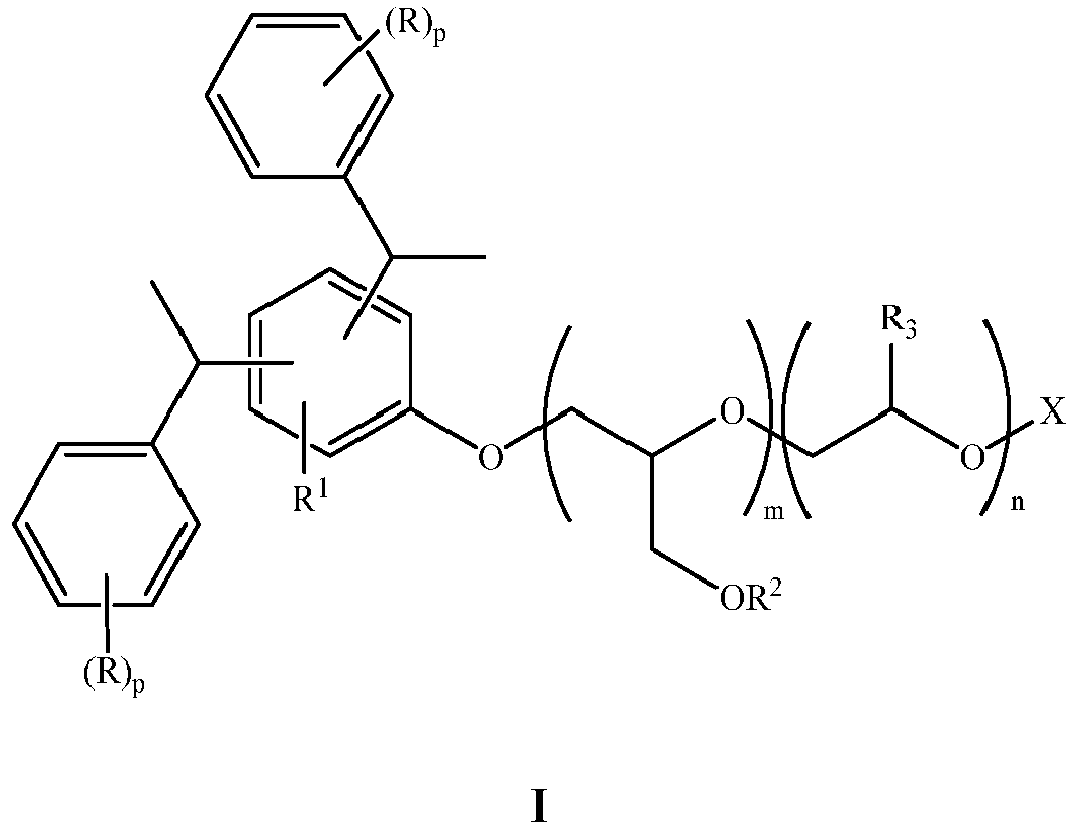
or -CH2CHR3OX; each R3 is independently H, methyl, or ethyl; m is 0 to 5; n is 6 to 40; p is 0, 1 or 2; and O-X is hydroxyl, methoxyl, a sulfate or a phosphate. Preferably, R1 is 1-phenethyl-(R)n; R2 is preferably H, CH3, or allyl; m is preferably 0, 1, or 2; n is from 10 to 20; p is 0; and O-X is a sulfate or a phosphate. A more preferred polyethylene oxide salt of tristyryl phenol is represented by the compound of Formula II:
- Another preferred ethylene oxide salt of distyryl phenol or tristyryl phenol, where m is non-zero, is represented by the compound of Formula III.

- Another example of a polyethylene oxide salt of a distyryl phenol is represented by the compound of Formula IV:

- A commercial example of the compound of Formula IV is Hitenol AR-1025 reactive surfactant.
- A subclass of compounds of structure I (m = 0) can be prepared by reacting distyryl or tristyryl phenol with an alkylene oxide (ethylene oxide, 1,2-propylene oxide, or 1,2-butylene oxide) in the presence of a base such as an alkali metal or alkaline earth metal hydroxide, carbonate, or bicarbonate, or an alkali metal hydride; this intermediate can then be neutralized to the corresponding glycol, methoxylated with a methyl halide, sulfonated with sulfonyl chloride, or phosphorylated with polyphosphoric acid. A compound of Formula III can be prepared in the same manner except that the distyryl or tristyryl phenol is first reacted with an epihalohydrin such as epichlorohydrin in the presence of a base to form the corresponding monoglycidyl ether of the distyryl or tristyryl phenol prior to reaction with the alkylene oxide.
- The first microspheres are advantageously prepared from an aqueous dispersion of an oligomeric seed having a weight average molecular weight (Mw) in the range of from 800, preferably from 1000 g/mol to 20,000, preferably to 10,000 and most preferably to 5000 g/mol as determined by size exclusion chromatography using polystyrene standards as described herein. The oligomeric seed has an average diameter in the range of from 200 nm, more preferably from 400 nm, and most preferably from 600 nm, to 8000 nm, preferably to 5000 nm, more preferably to 1500 nm, and most preferably to 1000 nm, as determined by disc centrifuge photosedimentometry (DCP), as described herein. The oligomeric seed contains a structural unit of a chain transfer agent such as an alkyl mercaptan, examples of which include n-dodecyl mercaptan, 1-hexanethiol, 1-octane thiol, and 2-butyl mercaptan.
- The oligomeric seed is advantageously contacted with a first monoethylenically unsaturated nonionic monomer in the presence of a hydrophobic initiator, in any order, to transport the initiator into the seed, or seed swollen with monomer. As used herein, a hydrophobic initiator refers to an initiator having a water solubility in the range of from 5 ppm, preferably from 10 ppm, to 10,000, preferably to 1000, and more preferably to 100 ppm. Examples of suitable hydrophobic initiators include such as t-amyl peroxy-2-ethylhexanoate (water solubility = 17.6 mg/L at 20 °C) or t-butyl peroxy-2-ethylhexanoate (water solubility = 46 mg/L at 20 °C). The extent of swelling (seed growth) can be controlled by the ratio of the monomer to the seed.
- Forming microspheres from oligomeric seed provides an effective way of controlling the particle size distribution of the microspheres. Preferably, the coefficient of variation of the first and the second microspheres, as determined by DCP, is less than 25%, more preferably less than 20%, more preferably less than 15%, and most preferably less than 10%. Preferably, the concentration of gel formed in the process of preparing the aqueous dispersion of second microspheres is preferably less than 0.5, more preferably less than 0.2, more preferably less than 0.1, and most preferably less 0.05 weight percent, based on the weight of the aqueous dispersion. Dispersions of microspheres with low coefficients of variation ultimately result in coatings with reliable and reproducible properties in end-use applications. In contrast, microspheres with coefficients of variation greater than 30% give coatings with unreliable and unpredictable properties. From the standpoint of quality control, it is advantageous to have coefficients of variation less achieved by the dispersions of the present invention. It is also advantageous to prepare dispersions of microspheres with low gel formation to reduce time lost to filtration and wastage of product.
- Preferably, the particle size of the first microspheres is in the range of from 2.5 µm, more preferably from 3.0 µm, preferably to 12 µm, more preferably to 10 µm.
- In a preferred process of the present invention, the aqueous dispersion of first microspheres is contacted under polymerization conditions and in the presence of 1) an emulsifying surfactant, such as a phosphate or an alkyl benzene sulfonate or sulfate; and 2) from 0.05, preferably from 0.1, and more preferably from 0.2 weight percent, to 5, preferably to 3, more preferably to 2, and most preferably to 1 weight percent of the nonionic polyalkylene oxide or anionic polyalkylene oxide salt of a distyryl or tristyryl phenol; and a first stage monomer comprising 3) from 80, preferably from 90 to 100, more preferably to 98 weight percent of a second monoethylenically unsaturated nonionic monomer based on the weight of the first stage monomer. The first microspheres increase in volume (grow out) to form an aqueous dispersion of second microspheres having a particle size in the range of from 1.1 µm, and preferably from 2.5 µm, preferably from 3.5 µm, to 25 µm, more preferably to 20 µm, and most preferably to 15 µm.
- The first stage monomer preferably further comprises a multiethylenically unsaturated nonionic monomer, preferably at a concentration in the range of from 0.1, more preferably from 1, and most preferably from 2 weight percent, to 15, more preferably to 10, and most preferably to 8 weight percent, based the weight of first stage monomers. Examples of suitable multiethylenically unsaturated nonionic monomers include allyl methacrylate, allyl acrylate, divinyl benzene, trimethylolpropane trimethacrylate, trimethylolpropane triacrylate, butylene glycol (1,3) dimethacrylate, butylene glycol (1,3) diacrylate, ethylene glycol dimethacrylate, and ethylene glycol diacrylate. The inclusion of these multiethylenically unsaturated nonionic monomers is particularly preferred where further staging of the second microspheres is desired.
- The second microspheres preferably comprise a substantial absence of structural units of a carboxylic acid monomer.
- The second microspheres preferably comprise from 90 to 98 weight percent structural units of a second monoethylenically unsaturated nonionic monomer, which may be the same as or different from the first monoethylenically unsaturated nonionic monomer. It is understood that "monomer" refers to one or more monomers.
- It is preferred that the aqueous dispersion of first microspheres is contacted under polymerization conditions with the salt of the compound of Formula II or an excess of the salt of the compound of Formula III, so that the resultant dispersion of second microspheres preferably comprises the salt of the compound of Formula II or the salt of unreacted compound of Formula III. The presence of the salt of the compound of Formula II or III is especially advantageous if further staging of the second microspheres is desired. For example, it may be desirable to prepare a dispersion of second microspheres with a Tg of less than 25 °C, as calculated by the Fox equation, then further stage the second microspheres with the salt of the compound of Formula II or III and additional monoethylenically unsaturated nonionic monomer (second stage monoethylenically unsaturated nonionic monomer), which may be the same as of different from first stage monoethylenically unsaturated nonionic monomer, under polymerization conditions to yield a dispersion of third microspheres with a domain having a Tg of less than 25 °C, and a domain with a Tg of greater than 50 °C. The domains may form, for example, a core-shell morphology or a so-called "chocolate chip cookie" morphology. A water-soluble initiator/redox couple such as t-butyl hydroperoxide and isoascorbic acid (t-BHP/IAA) is advantageously used to form a gradient core-shell morphology.
- Preferably, the polymerization step to prepare the aqueous dispersion of third microspheres is carried out at a pH of from at least 3, more preferably from at least 4, more preferably from at least 5, and most preferably from at least 6, to preferably 12, more preferably to 10 and most preferably to 8.
- Additional compound of Formula I, particularly the salt of the compound of Formula I, may be added in the further staging of the second microspheres, preferably in the desired pH range where initiator/coupler is used.
- In a second aspect, the present invention is a composition comprising an aqueous dispersion of polymeric microspheres and from 0.01, preferably from 0.05, more preferably from 0.1, and most preferably from 0.2 weight percent, to 5, preferably to 3, more preferably to 2, and most preferably to 1 weight percent, based on the weight of the microspheres, of a nonionic polyalkylene oxide of a distyryl or tristyryl phenol or an anionic polyalkylene oxide salt of a distyryl or tristyryl phenol, preferably the compound of Formula I or a salt thereof; or a composition comprising an aqueous dispersion of polymeric microspheres functionalized with from 0.01, preferably from 0.05, more preferably from 0.1, and most preferably from 0.2 weight percent, to 5, preferably to 3, more preferably to 2, and most preferably to 1 weight percent, based on the weight of the microspheres, of a nonionic polyalkylene oxide of a distyryl or tristyryl phenol or an anionic polyalkylene oxide salt of a distyryl or tristyryl phenol, preferably the compound of Formula I or a salt thereof;
wherein the polymeric microspheres have a solids content in the range of from 10, preferably from 20, more preferably from 25, and most preferably to 30 weight percent, to 60, more preferably to 50, and most preferably to 45 weight percent, based on the weight of the microspheres and water; wherein the polymeric microspheres have a particle size in the range of from 1 µm to 25 µm and a coefficient of variation of less than 25%, preferably less than 15%, and more preferably less than 10%; and wherein the dispersion comprises less than 1, preferably less than 0.5, more preferably less than 0.2, more preferably less than 0.1, and most preferably less than 0.05 weight percent gel, based on the weight of the composition, calculated as described in the Examples section. - The aqueous dispersion of microspheres is useful in coatings applications, especially where a matte finish is desired. Examples of such applications include leather, plastic packaging, wood, architectural coatings, and industrial coatings. The aqueous dispersion of microspheres may optionally include one or more additional components such as binders, thickeners, pigments, biocides, solvents, dispersants, and extenders.
- It has been discovered that an aqueous dispersion of microspheres can be prepared with a low coefficient of variation and with low gel formation. It has further been discovered that such microspheres advantageously comprise a substantial absence of adsorbing latex particles having a particle size in the range of from 20 nm to 500 nm, more particularly, a substantial absence of adsorbing latex particles functionalized with cellulose. As used herein, "substantial absence" refers to less than 0.3, preferably less than 0.1, more preferably less than 0.05, and most preferably 0 weight percent of the latex particles adsorbed to the microspheres, based on the weight of the microspheres.
- The dispersion of acrylic oligomer seed (0.1 g) were dissolved in tetrahydrofuran (THF, 8 g, HPLC grade) then filtered through 0.45 µm PTFE filters. Gel Permeation Chromatography (GPC) separations were carried out on a liquid chromatograph equipped with an Agilent 1100 Model isocratic pump, a vacuum degasser, a variable injection size autosampler, and an Agilent 1100 HPLC G1362A Refractive Index detector. The data was processed with Agilent ChemStation, version B.04.03 and Agilent GPC-Addon version B.01.01. GPC separations were carried out using THF as an eluent at a flow rate of 1 mL/min using a GPC column set composed of two PLgel Mixed D columns (300 x 7.5 mm ID, 5 µm) and a guard column (50 x 7.5 mm ID, 5 µm). Ten polystyrene standards were fitted with a 1st order fit calibration curve. The weight average molecular weights (Mw) of the standards were as follows: 630; 1,370; 2,930; 4,900; 10,190; 22,210; 50,550; 111,400; 214,700; and 363,600. Data was collected using a refractive index (RI) detector.
- Particle sizes and distribution were measured using Disc Centrifuge Photosedimentometer (DCP, CPS Instruments, Inc., Prairieville, LA) that separates modes by centrifugation and sedimentation through a sucrose gradient. The samples were prepared by adding 1 to 2 drops of the oligomer seed dispersion into 10 mL of deionized (DI) water containing 0.1% sodium lauryl sulfate, followed by injection of 0.1 mL of the sample into a spinning disc filled with 15 g/mL of sucrose gradient. For the oligomer seed, a 0-4% sucrose gradient disc spinning at 10,000 rpm was used, and a 596-nm polystyrene calibration standard was injected prior to injection of the sample. For the microspheres, a 2-8% sucrose gradient disc spinning at 3,000 rpm was used, and 9-µm polystyrene calibration standard was injected prior to injection of the sample. Median weight average (D50) particle size and coefficient of variation (CV) were calculated using instrument's algorithm.
- Pre-weighted sample (200 to 4,000 g) were poured through 20/100/325-mesh stacked screens (in decreasing pore size from top to bottom); each screen was washed with copious amounts of water and gel was collected separately and dried at 150 °C for 30 min. The gel data is calculated as the weight ratio of the collected total dry gel in each screen over the total sample size:
gel % = dry gel/total sample × 100; gel ppm = dry gel/total sample × 106. - An aqueous dispersion of acrylic oligomer seed (33% solids, 67 butyl acrylate/18 n-dodecyl mercaptan/14.8 methyl methacrylate/ 0.2 methacrylic acid) with a weight average median particle size (D50) of 885 nm and a coefficient of variation of 5%, as determined by DCP, and a weight average molecular weight of 2532 g/mole was prepared substantially as described in
US 8,686,096 , Examples 1 and 5 (col. 19 and 20). This acrylic seed was used to prepare the microspheres of all the Examples and Comparative Examples described herein. - Initiator emulsion was prepared by combining in a separate vial deionized water (4.9 g), Rhodacal DS-4 branched alkylbenzene sulfonate (DS-4, 0.21 g, 22.5% aq. solution), 4-hydroxy 2,2,6,6-tetramethylpiperidine (4-hydroxy TEMPO, 0.4 g), t-amyl peroxy-2-ethylhexanoate (TAPEH, 5.42 g, 98% active), then emulsified for 10 min with a homogenizer at 15,000 rpm. The initiator emulsion was then added to the dispersion of the acrylic seed (4.2 g, 32% solids) in a separate vial and mixed for 60 min. Deionized water (109.5 g), Solvay Soprophor 4D/384 ammonium salt of polyarylphenyl ether sulphate (4D/384, 5.25 g, 25% active), DS-4 (4.13 g, 22.5% solution), 4-hydroxy TEMPO (0.2 g), n-butyl acrylate (BA, 252.7 g), and allyl methacrylate (ALMA, 10.5 g) were combined in a first flask (shot ME). In a separate flask deionized water (1575 g) was added to a 5-L round bottom flask (reactor) fitted with a stirrer, condenser, and a temperature probe. The reactor was heated to 70 °C, after which time the initiator and oligomer seed mixture was added to the reactor, and shot ME was fed into the reactor over 15 min. After an induction period of 30 min, the resultant exotherm caused the reactor temperature to rise to 80 °C. The particle size of the microspheres formed in this step as measured by DCP was 4.8 µm.
- A first monomer emulsion (ME1, prepared by combining deionized water (328.5 g), 4D/384 (15.75 g, 25% active), DS-4 (12.38 g, 22.5% solution), 4-hydroxy TEMPO (0.6 g of), BA (758.3 g), and ALMA (31.6 g) was then fed into the reactor over 55 min. After a 20-min hold, NH4OH (0.75g, 28% aq.) was fed into the reactor over 3 min. The particle size of the microspheres formed in this step as measured by DCP was 8.0 µm.
- The reactor temperature was cooled to and maintained at 75 °C, after which time FeSO4·7H2O (11 g, 0.15% aq) and EDTA tetrasodium salt (2 g, 1% aqueous solution) were mixed and added to reactor. A second monomer emulsion (ME2) was prepared in a separate flask by combining deionized water (88 g), DS-4 (3.2 g, 22.5% solution), 4D/384 (5.25 g, 25% active), methyl methacrylate (MMA, 251 g), and ethyl acrylate (EA,10.5 g). ME2, t-butylhydroperoxide (t-BHP, 1.44 g (70% aq.) in 100 g water) and isoascorbic acid (IAA, 1.05 g in 100 g water) were fed into the reactor over 45 min. The residual monomers were then chased by feeding t-BHP solution (2.54 g (70% aq.) in 40 g water) and IAA (1.28 g in 40 g water) into the reactor over 20 min. The consequent dispersion was filtered through a 45-µm screen; coagulum that remained on the screen was collected and dried (178 ppm). The filtrate was analyzed for percent solids (33.7%), coefficient of variation (8.4 %), and particle size (8.1 µm, as measured by DCP).
- The process of was carried out essentially as described for Example 1 except that E-Sperse RS-1684 Reactive Surfactant (RS-1684) was used in place of 4D/384 in shot ME (RS-1684, 13.12 g, 30% active), ME1 (RS-1684, 4.38 g, 30% active) and ME2 (RS-1684, 4.4 g, 30% active). The particle size of the microspheres was 4.7 µm following the shot ME polymerization step, 7.9 µm following the ME1 polymerization step, and 8.2 µm following the ME2 polymerization step, as measured by DCP. The percent solids was 32.7%, the coefficient of variation of the microspheres formed at the end of ME2 was 8.8%, and gel formation was 50 ppm.
- The shot monomer emulsion was prepared in a separate flask by combining deionized water (109.5 g), DS-4 (4.13 g, 22.5% solution), BA (251.5 g), and ALMA (10.5 g). Deionized water (1575 g) was added to a 5-L round bottom flask (reactor) fitted with a stirrer, condenser, and a temperature probe. The reactor was heated to 70 °C, after which time the acrylic oligomer seed mixture was added to the reactor followed by addition of ME1 over 15 min. After a 30-min hold, initiator emulsion - prepared by combining in a separate vial deionized water (4.9 g), DS-4 (0.21 g, 22.5% aq. solution), 4-hydroxy TEMPO (0.4 g), TBPEH (5.54 g, 98% active), then emulsified for 10 min with a homogenizer at 15,000 rpm - was shot added. After an induction period of 30 min, the resultant exotherm caused the reactor temperature to rise to 80 °C. The presence of a large quantity of fines and gel (particles in the range of 50 nm to 500 nm) resulted in unreliable determination of microsphere particle size.
- A first monomer emulsion (ME1, prepared by combining deionized water (328.5 g), DS-4 (12.38 g, 22.5% solution), BA (754.5 g), and ALMA (31.5 g) was then fed into the reactor over 55 min. Again, the presence of a large quantity of fines and gel resulted in unreliable determination of microsphere particle size.
- The reactor temperature was cooled to and maintained at 75 °C, after which time FeSO4·7H2O (11 g, 0.15% aq) and ethylene diamine tetraacetic acid tetrasodium salt (EDTA tetrasodium salt, 2 g, 1% aqueous solution) were mixed and added to reactor. A second monomer emulsion (ME2) was prepared in a separate flask by combining deionized water (90 g), DS-4 (3.2 g, 22.5% solution), MMA (252 g), and EA (10.9 g). ME2, t-BHP (1.44 g (70% aq.) in 100 g water) and IAA (1.05 g in 100 water) were fed into the reactor over 45 min. The residual monomers were then chased by feeding t-BHP solution (2.54 g, (70% aq.) in 40 g water) and IAA (1.28 g in 40 g water) into the reactor over 20 min. The consequent dispersion was filtered through a 45-µm screen; coagulum that remained on the screen was collected and dried (2.0%). The filtrate was analyzed for percent solids (32.2%), coefficient of variation (7.9%), and particle size (5.3 µm), as measured by DCP.
- The presence of the 4D/384 or RS-1684 surfactant in the process for preparing microspheres resulted in the formation of 8-µm microspheres with a combination of both low gel formation and low coefficient of variation. In contrast, the process described comparative example, which contained no distyryl or tristyryl phenol, resulted in high gel formation.
Claims (9)
- A process comprising the step of contacting, under polymerization conditions and in the presence of a nonionic polyalkylene oxide of a distyryl or tristyryl phenol or an anionic polyalkylene oxide salt of a distyryl or tristyryl phenol, an aqueous dispersion of first microspheres comprising structural units of a first monoethylenically unsaturated nonionic monomer with a first stage monomer comprising from 70 to 100 weight percent of a second monoethylenically unsaturated nonionic monomer, based on the weight of first stage monomer, to grow out the first microspheres to form an aqueous dispersion of second microspheres, wherein the first microspheres have a particle size in the range of from 1 µm to 15 µm and the second microspheres have a particle size in the range of from 1.1 µm and 25 µm.
- The process of Claim 1 wherein the first microspheres have a particle size in the range of from 2.5 µm to 12 µm, and the second microspheres have a particle size in the range of from 4.5 µm to 20 µm; and wherein the nonionic polyalkylene oxide of a distyryl or tristyryl phenol or anionic polyalkylene oxide salt of a distyryl or tristyryl phenol is represented by the compound of Formula I:

or -CH2CHR3OX; each R3 is independently H, methyl, or ethyl; m is 0 to 5; n is 6 to 40; p is 0, 1 or 2; and O-X is hydroxyl, methoxyl, a sulfate or a phosphate. - The process of Claim 2 wherein the compound of Formula I is represented by the compound of Formula II, Formula III, or Formula IV:


- The process of Claim 3 wherein the first microspheres have a particle size in the range of from 2.5 µm to 12 µm, and the second microspheres have a particle size in the range of from 4.5 µm to 20 µm; wherein the concentration of the nonionic polyalkylene oxide of a distyryl or tristyryl phenol or anionic polyalkylene oxide salt of a distyryl or tristyryl phenol is in the range of from 0.2 to 1 weight percent, based the weight of first stage monomers.
- The process of Claim 4 wherein the aqueous dispersion of first microspheres is further contacted under polymerization with an additional first stage monomer which is a multiethylenically unsaturated nonionic monomer at a concentration in the range of from 0.1 to 15 weight percent, based on the weight of first stage monomers, wherein the second microspheres have a Tg of less than 25 °C.
- The process of Claim 5 wherein the second microspheres are further staged with a salt of the compound of Formula II or III and a second stage monoethylenically unsaturated nonionic monomer under polymerization conditions to form a dispersion of third microspheres with a domain having a Tg of less than 25 °C, and a domain with a Tg of greater than 50 °C.
- The process of any of Claims 1 to 6 wherein the first microspheres are prepared by a) contacting an aqueous dispersion of an oligomeric seed with a monomer in the presence of a hydrophobic initiator to transport the initiator into the seed, and b) polymerizing the monomer; wherein the oligomer seed has a weight average molecular weight in the range of from 800 to 20,000 g/mol and an average diameter in the range of from 200 nm to 8000 nm.
- A composition comprising a) an aqueous dispersion of polymeric microspheres and from 0.01 to 5 weight percent, based on the weight of the microspheres, of a nonionic polyalkylene oxide of a distyryl or tristyryl phenol or an anionic polyalkylene oxide salt of a distyryl or tristyryl phenol represented by the compound of Formula I:

where each R is independently C1-C4-alkyl; R1 is H, 1-phenethyl-(R)p, CH2-CR=CH2, or CH=CHCH3; each R2 is independently H, allyl, methyl, acrylate, methacrylate,
or -CH2CHR3OX; each R3 is independently H, methyl, or ethyl; m is 0 to 5; n is 6 to 40; p is 0, 1 or 2; and O-X is hydroxyl, methoxyl, a sulfate or a phosphate;
wherein the polymeric microspheres have a solids content in the range of from 10 to 60 weight percent, based on the weight of the microspheres and water; wherein the polymeric microspheres have a particle size in the range of from 1 µm to 25 µm and a coefficient of variation of less than 25%; and wherein the dispersion comprises less than 1 weight percent gel, based on the weight of the composition. - The composition of Claim 8 wherein the dispersion comprises less than 0.2 weight percent gel, based on the weight of the composition and the microspheres have a coefficient of variation of less than 15%.
Applications Claiming Priority (2)
| Application Number | Priority Date | Filing Date | Title |
|---|---|---|---|
| US201762554086P | 2017-09-05 | 2017-09-05 | |
| US201862638993P | 2018-03-06 | 2018-03-06 |
Publications (2)
| Publication Number | Publication Date |
|---|---|
| EP3450466A1 true EP3450466A1 (en) | 2019-03-06 |
| EP3450466B1 EP3450466B1 (en) | 2021-03-31 |
Family
ID=63678384
Family Applications (1)
| Application Number | Title | Priority Date | Filing Date |
|---|---|---|---|
| EP18192610.6A Active EP3450466B1 (en) | 2017-09-05 | 2018-09-04 | Process for preparing an aqueous dispersion of polymeric microspheres |
Country Status (6)
| Country | Link |
|---|---|
| US (2) | US10723838B2 (en) |
| EP (1) | EP3450466B1 (en) |
| KR (1) | KR102564183B1 (en) |
| CN (1) | CN109420471B (en) |
| AU (1) | AU2018217319B2 (en) |
| CA (1) | CA3016403A1 (en) |
Cited By (5)
| Publication number | Priority date | Publication date | Assignee | Title |
|---|---|---|---|---|
| EP3699213A1 (en) * | 2019-02-25 | 2020-08-26 | Dow Silicones Corporation | Aqueous dispersion of polymeric composite microspheres |
| WO2021040975A1 (en) * | 2019-08-30 | 2021-03-04 | Rohm And Haas Company | Aqueous dispersion of acrylate-siloxane copolymer particles |
| WO2021041011A1 (en) * | 2019-08-30 | 2021-03-04 | Rohm And Haas Company | Preparation of an aqueous dispersion of acrylate-siloxane copolymer particles |
| WO2021163085A1 (en) * | 2020-02-14 | 2021-08-19 | Dow Global Technologies Llc | Aqueous dispersion of acrylate-siloxane copolymer particles |
| WO2021163086A1 (en) * | 2020-02-14 | 2021-08-19 | Dow Global Technologies Llc | Preparation of aqueous dispersion of acrylate-siloxane copolymer particles |
Families Citing this family (6)
| Publication number | Priority date | Publication date | Assignee | Title |
|---|---|---|---|---|
| CN116710525A (en) * | 2020-07-31 | 2023-09-05 | 陶氏环球技术有限责任公司 | Aqueous dispersions of polymer particles, microspheres and colloidal silica particles |
| US11912901B1 (en) | 2021-01-05 | 2024-02-27 | Swimc Llc | Polymer latex for matte films |
| CN112898717B (en) * | 2021-02-02 | 2023-05-30 | 湖北工业大学 | A preparation method of a high-conductivity conductive composite material dispersant and a high-conductivity conductive composite material dispersant |
| CN116964159A (en) | 2021-03-22 | 2023-10-27 | 陶氏环球技术有限责任公司 | Coating composition |
| US12338367B2 (en) | 2023-06-02 | 2025-06-24 | Swimc Llc | Water-based coating compositions for scuff and scratch resistance |
| EP4720198A2 (en) | 2023-06-02 | 2026-04-08 | Swimc LLC | Scuff and mar resistant coating compositions |
Citations (9)
| Publication number | Priority date | Publication date | Assignee | Title |
|---|---|---|---|---|
| WO2003014168A1 (en) * | 2001-08-08 | 2003-02-20 | Isp Investments Inc. | Aqueous dispersions of low-molecular weight, low-melting and water insoluble polymers |
| WO2008083991A1 (en) * | 2007-01-12 | 2008-07-17 | Cytec Surface Specialties, S.A. | Polymer composition and process |
| US7829626B2 (en) | 2006-03-15 | 2010-11-09 | Rohm And Haas Company | Aqueous compositions comprising polymeric duller particle |
| EP2348080A1 (en) * | 2010-01-25 | 2011-07-27 | Fujimi Incorporated | Polishing composition and polishing method using the same |
| US8686096B2 (en) | 2005-09-16 | 2014-04-01 | Rohm And Haas Company | Swellable particles |
| WO2016109176A1 (en) * | 2014-12-30 | 2016-07-07 | 3M Innovative Properties Company | Water-based pressure-sensitive adhesive compositions |
| WO2017023406A1 (en) * | 2015-07-31 | 2017-02-09 | Rohm And Haas Company | Oligomer seed for synthesis of unimodal acrylic bead particles |
| EP3135701A1 (en) * | 2015-08-31 | 2017-03-01 | Rohm And Haas Company | Aqueous multi-stage copolymer compositions for use in leather topcoats |
| US20170058116A1 (en) | 2014-04-25 | 2017-03-02 | Sekisui Plastics Co., Ltd. | Composite particles, method for producing composite particles, and use thereof |
Family Cites Families (4)
| Publication number | Priority date | Publication date | Assignee | Title |
|---|---|---|---|---|
| US20030181557A1 (en) * | 2002-03-01 | 2003-09-25 | Jsr Corporation | Aqueous emulsion dispersion of thermoplastic elastomer and process for preparing the same |
| EP2703434B1 (en) * | 2008-01-18 | 2015-09-16 | Rhodia Operations | Latex binders, aqueous coatings and paints having freeze-thaw stability and methods for using same |
| US9388323B2 (en) * | 2008-01-18 | 2016-07-12 | Rhodia Operations | Latex binders, aqueous coatings and paints having freeze-thaw ability and methods for using same |
| JP5763874B2 (en) * | 2008-02-28 | 2015-08-12 | 株式会社日本触媒 | Coating composition and optical film using the same |
-
2018
- 2018-08-17 AU AU2018217319A patent/AU2018217319B2/en active Active
- 2018-08-29 US US16/115,738 patent/US10723838B2/en active Active
- 2018-09-03 KR KR1020180104441A patent/KR102564183B1/en active Active
- 2018-09-03 CN CN201811022016.7A patent/CN109420471B/en active Active
- 2018-09-04 EP EP18192610.6A patent/EP3450466B1/en active Active
- 2018-09-04 CA CA3016403A patent/CA3016403A1/en active Pending
-
2020
- 2020-05-13 US US15/930,514 patent/US10865276B2/en active Active
Patent Citations (9)
| Publication number | Priority date | Publication date | Assignee | Title |
|---|---|---|---|---|
| WO2003014168A1 (en) * | 2001-08-08 | 2003-02-20 | Isp Investments Inc. | Aqueous dispersions of low-molecular weight, low-melting and water insoluble polymers |
| US8686096B2 (en) | 2005-09-16 | 2014-04-01 | Rohm And Haas Company | Swellable particles |
| US7829626B2 (en) | 2006-03-15 | 2010-11-09 | Rohm And Haas Company | Aqueous compositions comprising polymeric duller particle |
| WO2008083991A1 (en) * | 2007-01-12 | 2008-07-17 | Cytec Surface Specialties, S.A. | Polymer composition and process |
| EP2348080A1 (en) * | 2010-01-25 | 2011-07-27 | Fujimi Incorporated | Polishing composition and polishing method using the same |
| US20170058116A1 (en) | 2014-04-25 | 2017-03-02 | Sekisui Plastics Co., Ltd. | Composite particles, method for producing composite particles, and use thereof |
| WO2016109176A1 (en) * | 2014-12-30 | 2016-07-07 | 3M Innovative Properties Company | Water-based pressure-sensitive adhesive compositions |
| WO2017023406A1 (en) * | 2015-07-31 | 2017-02-09 | Rohm And Haas Company | Oligomer seed for synthesis of unimodal acrylic bead particles |
| EP3135701A1 (en) * | 2015-08-31 | 2017-03-01 | Rohm And Haas Company | Aqueous multi-stage copolymer compositions for use in leather topcoats |
Cited By (12)
| Publication number | Priority date | Publication date | Assignee | Title |
|---|---|---|---|---|
| EP3699213A1 (en) * | 2019-02-25 | 2020-08-26 | Dow Silicones Corporation | Aqueous dispersion of polymeric composite microspheres |
| WO2021040975A1 (en) * | 2019-08-30 | 2021-03-04 | Rohm And Haas Company | Aqueous dispersion of acrylate-siloxane copolymer particles |
| WO2021041011A1 (en) * | 2019-08-30 | 2021-03-04 | Rohm And Haas Company | Preparation of an aqueous dispersion of acrylate-siloxane copolymer particles |
| CN114258408A (en) * | 2019-08-30 | 2022-03-29 | 罗门哈斯公司 | Aqueous dispersions of acrylate-siloxane copolymer particles |
| CN114269800A (en) * | 2019-08-30 | 2022-04-01 | 罗门哈斯公司 | Preparation of an aqueous Dispersion of acrylate-siloxane copolymer particles |
| CN114258408B (en) * | 2019-08-30 | 2024-05-10 | 罗门哈斯公司 | Aqueous dispersion of acrylate-siloxane copolymer particles |
| AU2020337238B2 (en) * | 2019-08-30 | 2025-11-20 | Dow Global Technologies Llc | Preparation of an aqueous dispersion of acrylate-siloxane copolymer particles |
| WO2021163085A1 (en) * | 2020-02-14 | 2021-08-19 | Dow Global Technologies Llc | Aqueous dispersion of acrylate-siloxane copolymer particles |
| WO2021163086A1 (en) * | 2020-02-14 | 2021-08-19 | Dow Global Technologies Llc | Preparation of aqueous dispersion of acrylate-siloxane copolymer particles |
| CN115103861A (en) * | 2020-02-14 | 2022-09-23 | 陶氏环球技术有限责任公司 | Aqueous dispersions of acrylate-siloxane copolymer particles |
| CN115103847A (en) * | 2020-02-14 | 2022-09-23 | 陶氏环球技术有限责任公司 | Preparation of an aqueous Dispersion of acrylate-siloxane copolymer particles |
| CN115103861B (en) * | 2020-02-14 | 2023-10-03 | 陶氏环球技术有限责任公司 | Aqueous dispersions of acrylate-siloxane copolymer particles |
Also Published As
| Publication number | Publication date |
|---|---|
| BR102018067464A2 (en) | 2019-03-26 |
| KR20190026608A (en) | 2019-03-13 |
| CN109420471B (en) | 2022-08-23 |
| US20190071540A1 (en) | 2019-03-07 |
| CN109420471A (en) | 2019-03-05 |
| AU2018217319B2 (en) | 2023-04-06 |
| KR102564183B1 (en) | 2023-08-04 |
| US10865276B2 (en) | 2020-12-15 |
| EP3450466B1 (en) | 2021-03-31 |
| AU2018217319A1 (en) | 2019-03-21 |
| US10723838B2 (en) | 2020-07-28 |
| CA3016403A1 (en) | 2019-03-05 |
| US20200283572A1 (en) | 2020-09-10 |
Similar Documents
| Publication | Publication Date | Title |
|---|---|---|
| EP3450466B1 (en) | Process for preparing an aqueous dispersion of polymeric microspheres | |
| EP3401341B1 (en) | Process for preparing an aqueous dispersion of polymeric microspheres | |
| US10913867B2 (en) | Aqueous dispersion of polymer particles, microspheres, and polyethylene wax | |
| KR102014744B1 (en) | Dispersion of adsorbing emulsion polymer particles | |
| EP3870617B1 (en) | Aqueous dispersion of polymer particles, microspheres, and polysiloxane particles | |
| US10040932B2 (en) | Bimorphological latex | |
| US10308730B2 (en) | Preparation of a redox initiated bimorphological latex | |
| US12030972B2 (en) | Aqueous dispersion of polymeric composite microspheres | |
| BR102018067464B1 (en) | PROCESS AND COMPOSITION | |
| JP2019536840A (en) | Latex paint containing titanium dioxide pigment | |
| JP2551311B2 (en) | Method for producing graft copolymer by suspension polymerization method | |
| BR102018009305B1 (en) | PROCESS, AND, COMPOSITION |
Legal Events
| Date | Code | Title | Description |
|---|---|---|---|
| PUAI | Public reference made under article 153(3) epc to a published international application that has entered the european phase |
Free format text: ORIGINAL CODE: 0009012 |
|
| STAA | Information on the status of an ep patent application or granted ep patent |
Free format text: STATUS: THE APPLICATION HAS BEEN PUBLISHED |
|
| AK | Designated contracting states |
Kind code of ref document: A1 Designated state(s): AL AT BE BG CH CY CZ DE DK EE ES FI FR GB GR HR HU IE IS IT LI LT LU LV MC MK MT NL NO PL PT RO RS SE SI SK SM TR |
|
| AX | Request for extension of the european patent |
Extension state: BA ME |
|
| STAA | Information on the status of an ep patent application or granted ep patent |
Free format text: STATUS: REQUEST FOR EXAMINATION WAS MADE |
|
| 17P | Request for examination filed |
Effective date: 20190904 |
|
| RBV | Designated contracting states (corrected) |
Designated state(s): AL AT BE BG CH CY CZ DE DK EE ES FI FR GB GR HR HU IE IS IT LI LT LU LV MC MK MT NL NO PL PT RO RS SE SI SK SM TR |
|
| GRAP | Despatch of communication of intention to grant a patent |
Free format text: ORIGINAL CODE: EPIDOSNIGR1 |
|
| STAA | Information on the status of an ep patent application or granted ep patent |
Free format text: STATUS: GRANT OF PATENT IS INTENDED |
|
| RIC1 | Information provided on ipc code assigned before grant |
Ipc: C08F 2/26 20060101AFI20200115BHEP Ipc: C08F 220/18 20060101ALI20200115BHEP Ipc: C08F 265/06 20060101ALI20200115BHEP Ipc: C09D 4/00 20060101ALI20200115BHEP Ipc: C08F 285/00 20060101ALI20200115BHEP Ipc: C08F 4/40 20060101ALI20200115BHEP |
|
| INTG | Intention to grant announced |
Effective date: 20200213 |
|
| GRAJ | Information related to disapproval of communication of intention to grant by the applicant or resumption of examination proceedings by the epo deleted |
Free format text: ORIGINAL CODE: EPIDOSDIGR1 |
|
| STAA | Information on the status of an ep patent application or granted ep patent |
Free format text: STATUS: REQUEST FOR EXAMINATION WAS MADE |
|
| INTC | Intention to grant announced (deleted) | ||
| GRAP | Despatch of communication of intention to grant a patent |
Free format text: ORIGINAL CODE: EPIDOSNIGR1 |
|
| STAA | Information on the status of an ep patent application or granted ep patent |
Free format text: STATUS: GRANT OF PATENT IS INTENDED |
|
| INTG | Intention to grant announced |
Effective date: 20200720 |
|
| GRAJ | Information related to disapproval of communication of intention to grant by the applicant or resumption of examination proceedings by the epo deleted |
Free format text: ORIGINAL CODE: EPIDOSDIGR1 |
|
| STAA | Information on the status of an ep patent application or granted ep patent |
Free format text: STATUS: REQUEST FOR EXAMINATION WAS MADE |
|
| INTC | Intention to grant announced (deleted) | ||
| GRAP | Despatch of communication of intention to grant a patent |
Free format text: ORIGINAL CODE: EPIDOSNIGR1 |
|
| STAA | Information on the status of an ep patent application or granted ep patent |
Free format text: STATUS: GRANT OF PATENT IS INTENDED |
|
| INTG | Intention to grant announced |
Effective date: 20210104 |
|
| INTG | Intention to grant announced |
Effective date: 20210113 |
|
| GRAS | Grant fee paid |
Free format text: ORIGINAL CODE: EPIDOSNIGR3 |
|
| GRAA | (expected) grant |
Free format text: ORIGINAL CODE: 0009210 |
|
| STAA | Information on the status of an ep patent application or granted ep patent |
Free format text: STATUS: THE PATENT HAS BEEN GRANTED |
|
| AK | Designated contracting states |
Kind code of ref document: B1 Designated state(s): AL AT BE BG CH CY CZ DE DK EE ES FI FR GB GR HR HU IE IS IT LI LT LU LV MC MK MT NL NO PL PT RO RS SE SI SK SM TR |
|
| REG | Reference to a national code |
Ref country code: GB Ref legal event code: FG4D Ref country code: CH Ref legal event code: EP |
|
| REG | Reference to a national code |
Ref country code: AT Ref legal event code: REF Ref document number: 1376858 Country of ref document: AT Kind code of ref document: T Effective date: 20210415 |
|
| REG | Reference to a national code |
Ref country code: DE Ref legal event code: R096 Ref document number: 602018014641 Country of ref document: DE |
|
| REG | Reference to a national code |
Ref country code: IE Ref legal event code: FG4D |
|
| REG | Reference to a national code |
Ref country code: LT Ref legal event code: MG9D |
|
| PG25 | Lapsed in a contracting state [announced via postgrant information from national office to epo] |
Ref country code: FI Free format text: LAPSE BECAUSE OF FAILURE TO SUBMIT A TRANSLATION OF THE DESCRIPTION OR TO PAY THE FEE WITHIN THE PRESCRIBED TIME-LIMIT Effective date: 20210331 Ref country code: HR Free format text: LAPSE BECAUSE OF FAILURE TO SUBMIT A TRANSLATION OF THE DESCRIPTION OR TO PAY THE FEE WITHIN THE PRESCRIBED TIME-LIMIT Effective date: 20210331 Ref country code: BG Free format text: LAPSE BECAUSE OF FAILURE TO SUBMIT A TRANSLATION OF THE DESCRIPTION OR TO PAY THE FEE WITHIN THE PRESCRIBED TIME-LIMIT Effective date: 20210630 Ref country code: NO Free format text: LAPSE BECAUSE OF FAILURE TO SUBMIT A TRANSLATION OF THE DESCRIPTION OR TO PAY THE FEE WITHIN THE PRESCRIBED TIME-LIMIT Effective date: 20210630 |
|
| PG25 | Lapsed in a contracting state [announced via postgrant information from national office to epo] |
Ref country code: LV Free format text: LAPSE BECAUSE OF FAILURE TO SUBMIT A TRANSLATION OF THE DESCRIPTION OR TO PAY THE FEE WITHIN THE PRESCRIBED TIME-LIMIT Effective date: 20210331 Ref country code: RS Free format text: LAPSE BECAUSE OF FAILURE TO SUBMIT A TRANSLATION OF THE DESCRIPTION OR TO PAY THE FEE WITHIN THE PRESCRIBED TIME-LIMIT Effective date: 20210331 Ref country code: SE Free format text: LAPSE BECAUSE OF FAILURE TO SUBMIT A TRANSLATION OF THE DESCRIPTION OR TO PAY THE FEE WITHIN THE PRESCRIBED TIME-LIMIT Effective date: 20210331 |
|
| REG | Reference to a national code |
Ref country code: NL Ref legal event code: MP Effective date: 20210331 |
|
| REG | Reference to a national code |
Ref country code: AT Ref legal event code: MK05 Ref document number: 1376858 Country of ref document: AT Kind code of ref document: T Effective date: 20210331 |
|
| PG25 | Lapsed in a contracting state [announced via postgrant information from national office to epo] |
Ref country code: CZ Free format text: LAPSE BECAUSE OF FAILURE TO SUBMIT A TRANSLATION OF THE DESCRIPTION OR TO PAY THE FEE WITHIN THE PRESCRIBED TIME-LIMIT Effective date: 20210331 Ref country code: EE Free format text: LAPSE BECAUSE OF FAILURE TO SUBMIT A TRANSLATION OF THE DESCRIPTION OR TO PAY THE FEE WITHIN THE PRESCRIBED TIME-LIMIT Effective date: 20210331 Ref country code: LT Free format text: LAPSE BECAUSE OF FAILURE TO SUBMIT A TRANSLATION OF THE DESCRIPTION OR TO PAY THE FEE WITHIN THE PRESCRIBED TIME-LIMIT Effective date: 20210331 Ref country code: AT Free format text: LAPSE BECAUSE OF FAILURE TO SUBMIT A TRANSLATION OF THE DESCRIPTION OR TO PAY THE FEE WITHIN THE PRESCRIBED TIME-LIMIT Effective date: 20210331 Ref country code: SM Free format text: LAPSE BECAUSE OF FAILURE TO SUBMIT A TRANSLATION OF THE DESCRIPTION OR TO PAY THE FEE WITHIN THE PRESCRIBED TIME-LIMIT Effective date: 20210331 Ref country code: NL Free format text: LAPSE BECAUSE OF FAILURE TO SUBMIT A TRANSLATION OF THE DESCRIPTION OR TO PAY THE FEE WITHIN THE PRESCRIBED TIME-LIMIT Effective date: 20210331 |
|
| PG25 | Lapsed in a contracting state [announced via postgrant information from national office to epo] |
Ref country code: PT Free format text: LAPSE BECAUSE OF FAILURE TO SUBMIT A TRANSLATION OF THE DESCRIPTION OR TO PAY THE FEE WITHIN THE PRESCRIBED TIME-LIMIT Effective date: 20210802 Ref country code: PL Free format text: LAPSE BECAUSE OF FAILURE TO SUBMIT A TRANSLATION OF THE DESCRIPTION OR TO PAY THE FEE WITHIN THE PRESCRIBED TIME-LIMIT Effective date: 20210331 Ref country code: SK Free format text: LAPSE BECAUSE OF FAILURE TO SUBMIT A TRANSLATION OF THE DESCRIPTION OR TO PAY THE FEE WITHIN THE PRESCRIBED TIME-LIMIT Effective date: 20210331 Ref country code: RO Free format text: LAPSE BECAUSE OF FAILURE TO SUBMIT A TRANSLATION OF THE DESCRIPTION OR TO PAY THE FEE WITHIN THE PRESCRIBED TIME-LIMIT Effective date: 20210331 Ref country code: IS Free format text: LAPSE BECAUSE OF FAILURE TO SUBMIT A TRANSLATION OF THE DESCRIPTION OR TO PAY THE FEE WITHIN THE PRESCRIBED TIME-LIMIT Effective date: 20210731 |
|
| REG | Reference to a national code |
Ref country code: DE Ref legal event code: R097 Ref document number: 602018014641 Country of ref document: DE |
|
| PG25 | Lapsed in a contracting state [announced via postgrant information from national office to epo] |
Ref country code: ES Free format text: LAPSE BECAUSE OF FAILURE TO SUBMIT A TRANSLATION OF THE DESCRIPTION OR TO PAY THE FEE WITHIN THE PRESCRIBED TIME-LIMIT Effective date: 20210331 Ref country code: AL Free format text: LAPSE BECAUSE OF FAILURE TO SUBMIT A TRANSLATION OF THE DESCRIPTION OR TO PAY THE FEE WITHIN THE PRESCRIBED TIME-LIMIT Effective date: 20210331 Ref country code: DK Free format text: LAPSE BECAUSE OF FAILURE TO SUBMIT A TRANSLATION OF THE DESCRIPTION OR TO PAY THE FEE WITHIN THE PRESCRIBED TIME-LIMIT Effective date: 20210331 |
|
| PLBE | No opposition filed within time limit |
Free format text: ORIGINAL CODE: 0009261 |
|
| STAA | Information on the status of an ep patent application or granted ep patent |
Free format text: STATUS: NO OPPOSITION FILED WITHIN TIME LIMIT |
|
| 26N | No opposition filed |
Effective date: 20220104 |
|
| REG | Reference to a national code |
Ref country code: CH Ref legal event code: PL |
|
| REG | Reference to a national code |
Ref country code: BE Ref legal event code: MM Effective date: 20210930 |
|
| PG25 | Lapsed in a contracting state [announced via postgrant information from national office to epo] |
Ref country code: IS Free format text: LAPSE BECAUSE OF FAILURE TO SUBMIT A TRANSLATION OF THE DESCRIPTION OR TO PAY THE FEE WITHIN THE PRESCRIBED TIME-LIMIT Effective date: 20210731 Ref country code: MC Free format text: LAPSE BECAUSE OF FAILURE TO SUBMIT A TRANSLATION OF THE DESCRIPTION OR TO PAY THE FEE WITHIN THE PRESCRIBED TIME-LIMIT Effective date: 20210331 |
|
| PG25 | Lapsed in a contracting state [announced via postgrant information from national office to epo] |
Ref country code: LU Free format text: LAPSE BECAUSE OF NON-PAYMENT OF DUE FEES Effective date: 20210904 Ref country code: IE Free format text: LAPSE BECAUSE OF NON-PAYMENT OF DUE FEES Effective date: 20210904 Ref country code: BE Free format text: LAPSE BECAUSE OF NON-PAYMENT OF DUE FEES Effective date: 20210930 |
|
| PG25 | Lapsed in a contracting state [announced via postgrant information from national office to epo] |
Ref country code: LI Free format text: LAPSE BECAUSE OF NON-PAYMENT OF DUE FEES Effective date: 20210930 Ref country code: CH Free format text: LAPSE BECAUSE OF NON-PAYMENT OF DUE FEES Effective date: 20210930 |
|
| PG25 | Lapsed in a contracting state [announced via postgrant information from national office to epo] |
Ref country code: CY Free format text: LAPSE BECAUSE OF FAILURE TO SUBMIT A TRANSLATION OF THE DESCRIPTION OR TO PAY THE FEE WITHIN THE PRESCRIBED TIME-LIMIT Effective date: 20210331 |
|
| P01 | Opt-out of the competence of the unified patent court (upc) registered |
Effective date: 20230526 |
|
| PG25 | Lapsed in a contracting state [announced via postgrant information from national office to epo] |
Ref country code: HU Free format text: LAPSE BECAUSE OF FAILURE TO SUBMIT A TRANSLATION OF THE DESCRIPTION OR TO PAY THE FEE WITHIN THE PRESCRIBED TIME-LIMIT; INVALID AB INITIO Effective date: 20180904 Ref country code: GR Free format text: LAPSE BECAUSE OF FAILURE TO SUBMIT A TRANSLATION OF THE DESCRIPTION OR TO PAY THE FEE WITHIN THE PRESCRIBED TIME-LIMIT Effective date: 20210331 |
|
| PG25 | Lapsed in a contracting state [announced via postgrant information from national office to epo] |
Ref country code: MK Free format text: LAPSE BECAUSE OF FAILURE TO SUBMIT A TRANSLATION OF THE DESCRIPTION OR TO PAY THE FEE WITHIN THE PRESCRIBED TIME-LIMIT Effective date: 20210331 |
|
| PG25 | Lapsed in a contracting state [announced via postgrant information from national office to epo] |
Ref country code: MT Free format text: LAPSE BECAUSE OF FAILURE TO SUBMIT A TRANSLATION OF THE DESCRIPTION OR TO PAY THE FEE WITHIN THE PRESCRIBED TIME-LIMIT Effective date: 20210331 |
|
| PGFP | Annual fee paid to national office [announced via postgrant information from national office to epo] |
Ref country code: DE Payment date: 20250702 Year of fee payment: 8 |
|
| PGFP | Annual fee paid to national office [announced via postgrant information from national office to epo] |
Ref country code: IT Payment date: 20250825 Year of fee payment: 8 |
|
| PGFP | Annual fee paid to national office [announced via postgrant information from national office to epo] |
Ref country code: GB Payment date: 20250703 Year of fee payment: 8 |
|
| PGFP | Annual fee paid to national office [announced via postgrant information from national office to epo] |
Ref country code: FR Payment date: 20250703 Year of fee payment: 8 |
|
| PG25 | Lapsed in a contracting state [announced via postgrant information from national office to epo] |
Ref country code: TR Free format text: LAPSE BECAUSE OF FAILURE TO SUBMIT A TRANSLATION OF THE DESCRIPTION OR TO PAY THE FEE WITHIN THE PRESCRIBED TIME-LIMIT Effective date: 20210331 |