EP3450421B1 - Method for preparing treprostinil and intermediate therefor - Google Patents
Method for preparing treprostinil and intermediate therefor Download PDFInfo
- Publication number
- EP3450421B1 EP3450421B1 EP17789829.3A EP17789829A EP3450421B1 EP 3450421 B1 EP3450421 B1 EP 3450421B1 EP 17789829 A EP17789829 A EP 17789829A EP 3450421 B1 EP3450421 B1 EP 3450421B1
- Authority
- EP
- European Patent Office
- Prior art keywords
- compound
- following formula
- protecting group
- formula
- represents hydrogen
- Prior art date
- Legal status (The legal status is an assumption and is not a legal conclusion. Google has not performed a legal analysis and makes no representation as to the accuracy of the status listed.)
- Active
Links
- 0 *CC(*)CC[C@](CC(C1)=C)[C@@]1OC(*)=O Chemical compound *CC(*)CC[C@](CC(C1)=C)[C@@]1OC(*)=O 0.000 description 8
- WPNDLNBDAVEIPX-UHFFFAOYSA-N CC(CC(C1)O)C(C2)C1C2N Chemical compound CC(CC(C1)O)C(C2)C1C2N WPNDLNBDAVEIPX-UHFFFAOYSA-N 0.000 description 1
Classifications
-
- C—CHEMISTRY; METALLURGY
- C07—ORGANIC CHEMISTRY
- C07C—ACYCLIC OR CARBOCYCLIC COMPOUNDS
- C07C59/00—Compounds having carboxyl groups bound to acyclic carbon atoms and containing any of the groups OH, O—metal, —CHO, keto, ether, groups, groups, or groups
- C07C59/40—Unsaturated compounds
- C07C59/58—Unsaturated compounds containing ether groups, groups, groups, or groups
- C07C59/72—Unsaturated compounds containing ether groups, groups, groups, or groups containing six-membered aromatic rings and other rings
-
- C—CHEMISTRY; METALLURGY
- C07—ORGANIC CHEMISTRY
- C07C—ACYCLIC OR CARBOCYCLIC COMPOUNDS
- C07C29/00—Preparation of compounds having hydroxy or O-metal groups bound to a carbon atom not belonging to a six-membered aromatic ring
- C07C29/56—Preparation of compounds having hydroxy or O-metal groups bound to a carbon atom not belonging to a six-membered aromatic ring by isomerisation
-
- C—CHEMISTRY; METALLURGY
- C07—ORGANIC CHEMISTRY
- C07C—ACYCLIC OR CARBOCYCLIC COMPOUNDS
- C07C405/00—Compounds containing a five-membered ring having two side-chains in ortho position to each other, and having oxygen atoms directly attached to the ring in ortho position to one of the side-chains, one side-chain containing, not directly attached to the ring, a carbon atom having three bonds to hetero atoms with at the most one bond to halogen, and the other side-chain having oxygen atoms attached in gamma-position to the ring, e.g. prostaglandins ; Analogues or derivatives thereof
- C07C405/005—Analogues or derivatives having the five membered ring replaced by other rings
- C07C405/0075—Analogues or derivatives having the five membered ring replaced by other rings having the side-chains or their analogues or derivatives attached to a condensed ring system
- C07C405/0083—Analogues or derivatives having the five membered ring replaced by other rings having the side-chains or their analogues or derivatives attached to a condensed ring system which is only ortho or peri condensed, e.g. carbacyclins
-
- B—PERFORMING OPERATIONS; TRANSPORTING
- B01—PHYSICAL OR CHEMICAL PROCESSES OR APPARATUS IN GENERAL
- B01J—CHEMICAL OR PHYSICAL PROCESSES, e.g. CATALYSIS OR COLLOID CHEMISTRY; THEIR RELEVANT APPARATUS
- B01J31/00—Catalysts comprising hydrides, coordination complexes or organic compounds
- B01J31/02—Catalysts comprising hydrides, coordination complexes or organic compounds containing organic compounds or metal hydrides
- B01J31/12—Catalysts comprising hydrides, coordination complexes or organic compounds containing organic compounds or metal hydrides containing organo-metallic compounds or metal hydrides
- B01J31/122—Metal aryl or alkyl compounds
-
- C—CHEMISTRY; METALLURGY
- C07—ORGANIC CHEMISTRY
- C07C—ACYCLIC OR CARBOCYCLIC COMPOUNDS
- C07C29/00—Preparation of compounds having hydroxy or O-metal groups bound to a carbon atom not belonging to a six-membered aromatic ring
- C07C29/62—Preparation of compounds having hydroxy or O-metal groups bound to a carbon atom not belonging to a six-membered aromatic ring by introduction of halogen; by substitution of halogen atoms by other halogen atoms
-
- C—CHEMISTRY; METALLURGY
- C07—ORGANIC CHEMISTRY
- C07C—ACYCLIC OR CARBOCYCLIC COMPOUNDS
- C07C35/00—Compounds having at least one hydroxy or O-metal group bound to a carbon atom of a ring other than a six-membered aromatic ring
- C07C35/22—Compounds having at least one hydroxy or O-metal group bound to a carbon atom of a ring other than a six-membered aromatic ring polycyclic, at least one hydroxy group bound to a condensed ring system
- C07C35/37—Compounds having at least one hydroxy or O-metal group bound to a carbon atom of a ring other than a six-membered aromatic ring polycyclic, at least one hydroxy group bound to a condensed ring system with a hydroxy group on a condensed system having three rings
-
- C—CHEMISTRY; METALLURGY
- C07—ORGANIC CHEMISTRY
- C07C—ACYCLIC OR CARBOCYCLIC COMPOUNDS
- C07C51/00—Preparation of carboxylic acids or their salts, halides or anhydrides
- C07C51/09—Preparation of carboxylic acids or their salts, halides or anhydrides from carboxylic acid esters or lactones
-
- C—CHEMISTRY; METALLURGY
- C07—ORGANIC CHEMISTRY
- C07C—ACYCLIC OR CARBOCYCLIC COMPOUNDS
- C07C67/00—Preparation of carboxylic acid esters
- C07C67/30—Preparation of carboxylic acid esters by modifying the acid moiety of the ester, such modification not being an introduction of an ester group
- C07C67/333—Preparation of carboxylic acid esters by modifying the acid moiety of the ester, such modification not being an introduction of an ester group by isomerisation; by change of size of the carbon skeleton
- C07C67/343—Preparation of carboxylic acid esters by modifying the acid moiety of the ester, such modification not being an introduction of an ester group by isomerisation; by change of size of the carbon skeleton by increase in the number of carbon atoms
-
- C—CHEMISTRY; METALLURGY
- C07—ORGANIC CHEMISTRY
- C07D—HETEROCYCLIC COMPOUNDS
- C07D317/00—Heterocyclic compounds containing five-membered rings having two oxygen atoms as the only ring hetero atoms
- C07D317/08—Heterocyclic compounds containing five-membered rings having two oxygen atoms as the only ring hetero atoms having the hetero atoms in positions 1 and 3
- C07D317/44—Heterocyclic compounds containing five-membered rings having two oxygen atoms as the only ring hetero atoms having the hetero atoms in positions 1 and 3 ortho- or peri-condensed with carbocyclic rings or ring systems
-
- C—CHEMISTRY; METALLURGY
- C07—ORGANIC CHEMISTRY
- C07B—GENERAL METHODS OF ORGANIC CHEMISTRY; APPARATUS THEREFOR
- C07B51/00—Introduction of protecting groups or activating groups, not provided for in the preceding groups
-
- C—CHEMISTRY; METALLURGY
- C07—ORGANIC CHEMISTRY
- C07C—ACYCLIC OR CARBOCYCLIC COMPOUNDS
- C07C2603/00—Systems containing at least three condensed rings
- C07C2603/02—Ortho- or ortho- and peri-condensed systems
- C07C2603/04—Ortho- or ortho- and peri-condensed systems containing three rings
- C07C2603/06—Ortho- or ortho- and peri-condensed systems containing three rings containing at least one ring with less than six ring members
- C07C2603/10—Ortho- or ortho- and peri-condensed systems containing three rings containing at least one ring with less than six ring members containing five-membered rings
- C07C2603/12—Ortho- or ortho- and peri-condensed systems containing three rings containing at least one ring with less than six ring members containing five-membered rings only one five-membered ring
- C07C2603/14—Benz[f]indenes; Hydrogenated benz[f]indenes
-
- Y—GENERAL TAGGING OF NEW TECHNOLOGICAL DEVELOPMENTS; GENERAL TAGGING OF CROSS-SECTIONAL TECHNOLOGIES SPANNING OVER SEVERAL SECTIONS OF THE IPC; TECHNICAL SUBJECTS COVERED BY FORMER USPC CROSS-REFERENCE ART COLLECTIONS [XRACs] AND DIGESTS
- Y02—TECHNOLOGIES OR APPLICATIONS FOR MITIGATION OR ADAPTATION AGAINST CLIMATE CHANGE
- Y02P—CLIMATE CHANGE MITIGATION TECHNOLOGIES IN THE PRODUCTION OR PROCESSING OF GOODS
- Y02P20/00—Technologies relating to chemical industry
- Y02P20/50—Improvements relating to the production of bulk chemicals
- Y02P20/55—Design of synthesis routes, e.g. reducing the use of auxiliary or protecting groups
Definitions
- the present invention relates to a method for preparing treprostinil and an intermediate therefor. More particularly, the present invention relates to a cost-effective and efficient method for preparing treprostinil with high purity, and an intermediate therefor.
- Treprostinil represented by the following formula I, 2-((1R,2R,3aS,9aS)-2-hydroxy-1-((S)-3-hydroxyoctyl)-2,3,3a,4,9,9a-hexahydro-1H-cyclopenta[b]naphthalen-5-yloxy)acetic acid, is an active ingredient of RemodulinTM, TyvasoTM, and OrenitramTM.
- U.S. Patent No. 4,306,075 discloses a method for preparing treprostinil using an intramolecular alkylation as shown in the following Reaction Scheme 1.
- Moriarty, et al., J. Org. Chem. 2004, 69, 1890-1902 describes a method for preparing treprostinil using an Pauson-Khand cyclization as a key reaction, as shown in the following Reaction Scheme 2.
- An object of the present invention is to provide a cost-effective and efficient method for preparing treprostinil with high purity.
- Another object of the present invention is to provide an intermediate used in the above preparation method.
- One embodiment of the present invention relates to a method for preparing a compound of the following formula (1), which comprises the steps of:
- C 1 -C 6 alkyl group as used herein means a linear or branched hydrocarbon having 1 to 6 carbon atoms, which includes methyl, ethyl, n-propyl, i-propyl, n-butyl, i-butyl, t-butyl, n-pentyl, n-hexyl and the like, but is not limited thereto.
- the hydroxyl protecting group may include tetrahydropyranyl, benzyl, trimethylsilyl, triethylsilyl, t-butyldimethylsilyl (TBS), and t-butyldiphcnylsilyl (TBDPS) and the like, but is not limited thereto.
- the hydroxyl protecting group formed from a combination of PG 1 and PG 2 may be an diol protecting group selected from a group consisting of cyclic acetal, di-t-butylsilylene, 1,1,3,3-tetraisopropyldisiloxanylidene, cyclic carbonate, cyclic sulfonate, and cyclic boronate.
- Reaction Scheme 3 The preparation method of the present invention is, hereinafter, described in more detail referring to the following Reaction Scheme 3.
- the method depicted in the following Reaction Scheme 3 represents merely a typical example, and various changes may be made to reagents and reaction conditions without limitation.
- Step 1 Synthesis of Compound of Formula (4)
- the compound of formula (4) can be obtained by converting the alkyl halide or alkenyl tin of formula (3) to its cuprate, and subjecting the cuprate to stereoselective 1,4-addition to the ⁇ , ⁇ -unsaturated ketone of formula (2).
- the conversion of the alkyl halide or alkenyl tin of formula (3) to its cuprate may be carried out by adding methyl lithium (MeLi) or t-butyl lithium, and copper cyanide (CuCN).
- the 1,4-addition is preferably performed at the low temperature of -60°C or lower.
- Step 2 Synthesis of Compound of Formula (5)
- the compound of formula (5) can be obtained by subjecting the ketone group of the compound of formula (4) to methenylation.
- the methenylation may be carried out, without limitation, by a method known in the art such as Wittig, Tebbe, and Nysted reactions.
- a Nysted reagent is preferred.
- the compound of formula (6) can be obtained by deprotecting the diol protecting group of the compound of formula (5).
- the deprotection may be carried out under an acidic condition.
- an acidic condition Particularly, pyridinium p-toluenesulfonate, hydrochloric acid, sulfuric acid, phosphoric acid, acetic acid, or trifluoroacetic acid may be used without limitation, and trifluoroacetic acid is preferred.
- the hydroxyl protecting group of Y may be deprotected as well, if it is a tetrahydropyranyl or silyl group.
- Step 4 Synthesis of Compound of Formula (7)
- the compound of formula (7) can be obtained by converting the diol of the compound of formula (6) to a cyclic carbonate.
- the conversion may be carried out, without limitation, using urea, 1,1-carbonyldiimidazole (CDI), phosgene, diphosgene, triphosgene and the like.
- CDI 1,1-carbonyldiimidazole
- phosgene diphosgene
- triphosgene triphosgene
- 1,1-carbonyldiimidazole is preferred.
- the conversion may be carried out in the presence or absence of a base.
- the base may be 4-dimethylaminopyridine (DMAP), triethylamine (TEA), diisopropylethylamine (DIPEA) and the like, but is not limited thereto.
- DMAP 4-dimethylaminopyridine
- TAA triethylamine
- DIPEA diisopropylethylamine
- 4-dimethylaminopyridine may be used.
- Step 5 Synthesis of Compound of Formula (8)
- the compound of formula (8) can be obtained by deprotecting the phenol protecting group of the compound of formula (7).
- the deprotection may be carried out using various fluoride (F - ) compounds, particularly tetra-n-butylammonium fluoride (TBAF).
- F - fluoride
- TBAF tetra-n-butylammonium fluoride
- the compound of formula (9) can be obtained by subjecting the compound of formula (8) to intramolecular Friedel-Crafts allylic alkylation.
- the intramolecular Friedel-Crafts allylic alkylation may be carried out using a palladium catalyst and a ligand.
- the palladium catalyst may include tetrakis(triphenylphosphine)palladium(0) (Pd(PPh 3 ) 4 ), allylpalladium(II) chloride dimer ([Pd(C 3 H 5 )Cl] 2 ), bis(dibenzylideneacetone)palladium(0) (Pd(dba) 2 ), and tris(dibenzylideneacetone)dipalladium(0) (Pd 2 (dba) 3 ), but are not limited thereto. Particularly, bis(dibenzylideneacetone)palladium(0) or tris(dibenzylideneacetone)dipalladium(0) is preferred.
- Examples of the ligand may include triphenylphosphine (PPh 3 ), DACH-phenyl trost ligand, 2,2-bis(diphenylphosphino)-1,1-binaphthalene (BINAP), bis[(2-diphenylphosphino)phenyl] ether (DPEPhos), 4,5-bis(diphenylphosphino)-9,9-dimethylxanthene (Xantphos), tri(o-tolyl)phosphine (P( o -tolyl) 3 ), 1,4-bis(diphenylphosphino)butane (dppb), ethylenebis(diphenylphosphine) (dppe), 1,1'-ferrocenediyl-bis(diphenylphosphine) (dppf), and 1,3-bis(diphenylphosphino)propane (dppp), but are not limited thereto. Particularly, triphenylphosphine is preferred.
- reaction solvent As a reaction solvent, toluene, tetrahydrofuran, methanol, diethyl ether, 1,4-dioxane, acetonitrile, methylenechloride, etc. may be used. Particularly, toluene is preferred.
- the reaction is preferably performed at room temperature.
- the compound of formula (10) can be obtained by subjecting the compound of formula (9) to hydrogenation.
- the hydrogenation may be carried out using Pd/C under a basic condition.
- sodium hydroxide, potassium hydroxide, potassium carbonate, triethylamine, etc. may be used as the basic condition. Particularly, triethylamine is preferred.
- reaction solvent methylenechloride, ethylacetate, methanol, ethanol, etc. may be used. Particularly, methanol is preferred.
- the hydroxyl protecting group of Y may be simultaneously deprotected, if it is a benzyl group.
- the compound of formula (12) can be obtained by subjecting the compound of formula (10) to alkylation with the compound of formula (11).
- the alkylation may be carried out in the presence of a base.
- a base may include sodium hydride, cesium carbonate, and potassium carbonate. Particularly, potassium carbonate is preferred.
- reaction solvent dimethylformamide, acetonitrile, tetrahydrofuran, acetone, etc. may be used. Particularly, acetone is preferred.
- the alkylation is preferably performed at the temperature of 50-60 °C.
- the compound of formula (1) can be obtained by hydrolyzing the ester group of the compound of formula (12).
- the hydrolysis may be carried out in the presence of a base.
- the base may include lithium hydroxide, sodium hydroxide, and potassium hydroxide. Particularly, sodium hydroxide is preferred.
- reaction solvent methanol, ethanol or propanol, and water may be used. Particularly, ethanol and water are preferred.
- One embodiment of the present invention relates to a compound of the following formula (8) which is an intermediate for the preparation of treprostinil: wherein,
- One embodiment of the present invention relates to a method for preparing a compound of the following formula (8), which comprises the steps of:
- the method for preparing the compound of formula (8) includes the same steps (i) to (v) as in the above method for preparing trcprostinil, and thus a detailed description thereof will be omitted.
- One embodiment of the present invention relates to a compound of the following formula (9) which is an intermediate for the preparation of treprostinil: wherein,
- One embodiment of the present invention relates to a method for preparing the compound of formula (9), which comprises a step of subjecting the compound of formula (8) to intramolecular Friedel-Crafts allylic alkylation.
- the method for preparing the compound of formula (9) includes the same step (vi) as in the above method for preparing treprostinil, and thus a detailed description thereof will be omitted.
- One embodiment of the present invention relates to a method for preparing the compound of formula (10), which comprises a step of subjecting the compound of formula (9) to hydrogenation.
- the method for preparing the compound of formula (10) includes the same step (vii) as in the above method for preparing treprostinil, and thus a detailed description thereof will be omitted.
- treprostinil with high purity can be cost-effectively and efficiently prepared by using intramolecular Friedel-Crafts allylic alkylation. Therefore, the method of the present invention can be effectively used for commercial mass production of treprostinil.
- the compound of formula (3a) (15.29 g) was dissolved in diethylether (230 mL), cooled to -68°C, and then stirred for 30 minutes.
- t-Butyl lithium 45.65 mL was slowly added dropwise for 20 minutes with maintaining the internal temperature of -60°C, and the resulting solution was stirred for 30 minutes with maintaining the temperature below -65°C.
- Copper cyanide (1.66 g) was added at the temperature of -60°C or lower and the resulting solution was warmed to -15°C to observe complete dissolution, followed by cooling below -65°C.
Landscapes
- Chemical & Material Sciences (AREA)
- Organic Chemistry (AREA)
- Engineering & Computer Science (AREA)
- Materials Engineering (AREA)
- Chemical Kinetics & Catalysis (AREA)
- Oil, Petroleum & Natural Gas (AREA)
- Organic Low-Molecular-Weight Compounds And Preparation Thereof (AREA)
- Low-Molecular Organic Synthesis Reactions Using Catalysts (AREA)
- Acyclic And Carbocyclic Compounds In Medicinal Compositions (AREA)
- Heterocyclic Carbon Compounds Containing A Hetero Ring Having Oxygen Or Sulfur (AREA)
Description
- The present invention relates to a method for preparing treprostinil and an intermediate therefor. More particularly, the present invention relates to a cost-effective and efficient method for preparing treprostinil with high purity, and an intermediate therefor.
- Treprostinil represented by the following formula I, 2-((1R,2R,3aS,9aS)-2-hydroxy-1-((S)-3-hydroxyoctyl)-2,3,3a,4,9,9a-hexahydro-1H-cyclopenta[b]naphthalen-5-yloxy)acetic acid, is an active ingredient of Remodulin™, Tyvaso™, and Orenitram™.

-
U.S. Patent No. 4,306,075 discloses a method for preparing treprostinil using an intramolecular alkylation as shown in the following Reaction Scheme 1.

- Also, Moriarty, et al., J. Org. Chem. 2004, 69, 1890-1902 describes a method for preparing treprostinil using an Pauson-Khand cyclization as a key reaction, as shown in the following Reaction Scheme 2.

- However, the prior preparation methods comprise a large number of steps and column purifications, and thus they have low yields and are unsuitable for mass production (see for instance
WO 2015 073 314 ). - An object of the present invention is to provide a cost-effective and efficient method for preparing treprostinil with high purity.
- Another object of the present invention is to provide an intermediate used in the above preparation method.
- One embodiment of the present invention relates to a method for preparing a compound of the following formula (1), which comprises the steps of:
- (i) converting an alkyl halide or alkenyl tin of the following formula (3) to its cuprate, and subjecting the cuprate to stereoselective 1,4-addition to an α, β-unsaturated ketone of the following formula (2) to obtain a compound of the following formula (4);
- (ii) subjecting a ketone group of the compound of the following formula (4) to methenylation to obtain a compound of the following formula (5);
- (iii) deprotecting a diol protecting group of the compound of the following formula (5) to obtain a compound of the following formula (6);
- (iv) converting a diol of the compound of the following formula (6) to a cyclic carbonate to obtain a compound of the following formula (7);
- (v) deprotecting a phenol protecting group of the compound of the following formula (7) to obtain a compound of the following formula (8);
- (vi) subjecting the compound of the following formula (8) to intramolecular Friedel-Crafts allylic alkylation to obtain a compound of the following formula (9);
- (vii) subjecting the compound of the following formula (9) to hydrogenation to obtain a compound of the following formula (10);
- (viii) subjecting the compound of the following formula (10) to alkylation with a compound of the following formula (11) to obtain a compound of the following formula (12); and
- (ix) hydrolyzing an ester group of the compound of the following formula (12):


-
--- represents a single or double bond between carbon atoms, - R1 represents hydrogen or halogen,
- R2 represents hydrogen or a hydroxyl protecting group,
- R3 represents a C1-C6 alkyl group,
- PG1 and PG2 represent a hydroxyl protecting group each independently or in combination,
- X represents halogen or Sn(R4)3,
- R4 represents a C1-C6 alkyl group,
- Y represents α-OR5:β-H or α-H:β-OR5,
- R5 represents hydrogen or a hydroxyl protecting group,
- Z represents a C1-C6 alkyl group, and
- X' represents halogen.
-
- The term "C1-C6 alkyl group" as used herein means a linear or branched hydrocarbon having 1 to 6 carbon atoms, which includes methyl, ethyl, n-propyl, i-propyl, n-butyl, i-butyl, t-butyl, n-pentyl, n-hexyl and the like, but is not limited thereto.
- In one embodiment of the present invention, the hydroxyl protecting group may include tetrahydropyranyl, benzyl, trimethylsilyl, triethylsilyl, t-butyldimethylsilyl (TBS), and t-butyldiphcnylsilyl (TBDPS) and the like, but is not limited thereto.
- Particularly, the hydroxyl protecting group formed from a combination of PG1 and PG2 may be an diol protecting group selected from a group consisting of cyclic acetal, di-t-butylsilylene, 1,1,3,3-tetraisopropyldisiloxanylidene, cyclic carbonate, cyclic sulfonate, and cyclic boronate.
- The preparation method of the present invention is, hereinafter, described in more detail referring to the following Reaction Scheme 3. The method depicted in the following Reaction Scheme 3 represents merely a typical example, and various changes may be made to reagents and reaction conditions without limitation.
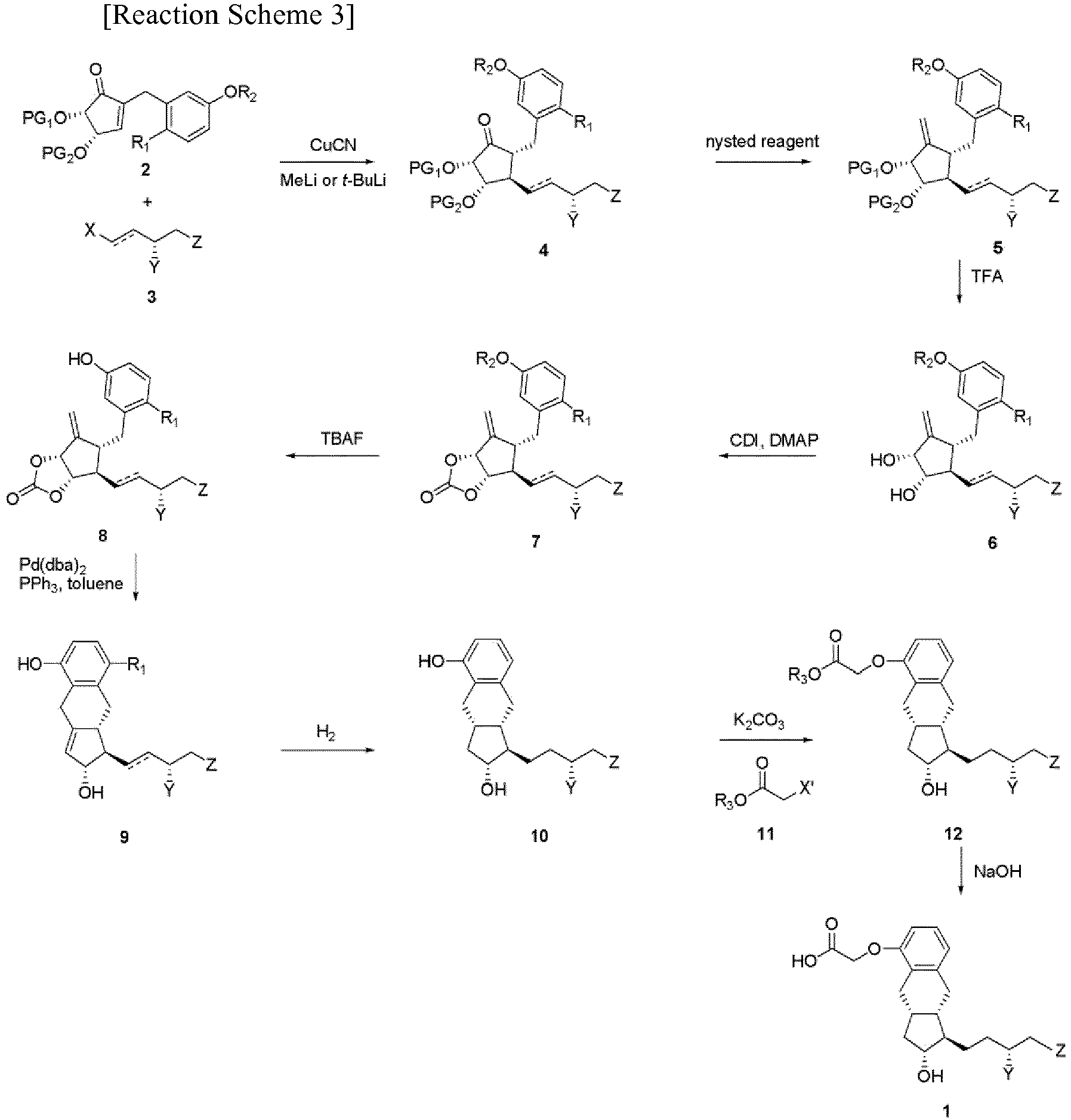
- The compound of formula (4) can be obtained by converting the alkyl halide or alkenyl tin of formula (3) to its cuprate, and subjecting the cuprate to stereoselective 1,4-addition to the α,β-unsaturated ketone of formula (2).
- The conversion of the alkyl halide or alkenyl tin of formula (3) to its cuprate may be carried out by adding methyl lithium (MeLi) or t-butyl lithium, and copper cyanide (CuCN).
- Then, the 1,4-addition is carried out by adding the α,β-unsaturated ketone of formula (2).
- The 1,4-addition is preferably performed at the low temperature of -60°C or lower.
- The compound of formula (5) can be obtained by subjecting the ketone group of the compound of formula (4) to methenylation.
- The methenylation may be carried out, without limitation, by a method known in the art such as Wittig, Tebbe, and Nysted reactions. In particular, a Nysted reagent is preferred.
- The compound of formula (6) can be obtained by deprotecting the diol protecting group of the compound of formula (5).
- The deprotection may be carried out under an acidic condition. Particularly, pyridinium p-toluenesulfonate, hydrochloric acid, sulfuric acid, phosphoric acid, acetic acid, or trifluoroacetic acid may be used without limitation, and trifluoroacetic acid is preferred.
- In the deprotection, the hydroxyl protecting group of Y may be deprotected as well, if it is a tetrahydropyranyl or silyl group.
- The compound of formula (7) can be obtained by converting the diol of the compound of formula (6) to a cyclic carbonate.
- The conversion may be carried out, without limitation, using urea, 1,1-carbonyldiimidazole (CDI), phosgene, diphosgene, triphosgene and the like. In particular, 1,1-carbonyldiimidazole is preferred.
- The conversion may be carried out in the presence or absence of a base. The base may be 4-dimethylaminopyridine (DMAP), triethylamine (TEA), diisopropylethylamine (DIPEA) and the like, but is not limited thereto. Preferably, 4-dimethylaminopyridine may be used.
- The compound of formula (8) can be obtained by deprotecting the phenol protecting group of the compound of formula (7).
- The deprotection may be carried out using various fluoride (F-) compounds, particularly tetra-n-butylammonium fluoride (TBAF).
- The compound of formula (9) can be obtained by subjecting the compound of formula (8) to intramolecular Friedel-Crafts allylic alkylation.
- The intramolecular Friedel-Crafts allylic alkylation may be carried out using a palladium catalyst and a ligand.
- Examples of the palladium catalyst may include tetrakis(triphenylphosphine)palladium(0) (Pd(PPh3)4), allylpalladium(II) chloride dimer ([Pd(C3H5)Cl]2), bis(dibenzylideneacetone)palladium(0) (Pd(dba)2), and tris(dibenzylideneacetone)dipalladium(0) (Pd2(dba)3), but are not limited thereto. Particularly, bis(dibenzylideneacetone)palladium(0) or tris(dibenzylideneacetone)dipalladium(0) is preferred.
- Examples of the ligand may include triphenylphosphine (PPh3), DACH-phenyl trost ligand, 2,2-bis(diphenylphosphino)-1,1-binaphthalene (BINAP), bis[(2-diphenylphosphino)phenyl] ether (DPEPhos), 4,5-bis(diphenylphosphino)-9,9-dimethylxanthene (Xantphos), tri(o-tolyl)phosphine (P(o-tolyl)3), 1,4-bis(diphenylphosphino)butane (dppb), ethylenebis(diphenylphosphine) (dppe), 1,1'-ferrocenediyl-bis(diphenylphosphine) (dppf), and 1,3-bis(diphenylphosphino)propane (dppp), but are not limited thereto. Particularly, triphenylphosphine is preferred.
- As a reaction solvent, toluene, tetrahydrofuran, methanol, diethyl ether, 1,4-dioxane, acetonitrile, methylenechloride, etc. may be used. Particularly, toluene is preferred.
- The reaction is preferably performed at room temperature.
- The compound of formula (10) can be obtained by subjecting the compound of formula (9) to hydrogenation.
- The hydrogenation may be carried out using Pd/C under a basic condition.
- As the basic condition, sodium hydroxide, potassium hydroxide, potassium carbonate, triethylamine, etc. may be used. Particularly, triethylamine is preferred.
- As a reaction solvent, methylenechloride, ethylacetate, methanol, ethanol, etc. may be used. Particularly, methanol is preferred.
- In this step, the hydroxyl protecting group of Y may be simultaneously deprotected, if it is a benzyl group.
- The compound of formula (12) can be obtained by subjecting the compound of formula (10) to alkylation with the compound of formula (11).
- The alkylation may be carried out in the presence of a base. Examples of the base may include sodium hydride, cesium carbonate, and potassium carbonate. Particularly, potassium carbonate is preferred.
- As a reaction solvent, dimethylformamide, acetonitrile, tetrahydrofuran, acetone, etc. may be used. Particularly, acetone is preferred.
- Further, the alkylation is preferably performed at the temperature of 50-60 °C.
- The compound of formula (1) can be obtained by hydrolyzing the ester group of the compound of formula (12).
- The hydrolysis may be carried out in the presence of a base. Examples of the base may include lithium hydroxide, sodium hydroxide, and potassium hydroxide. Particularly, sodium hydroxide is preferred.
- As a reaction solvent, methanol, ethanol or propanol, and water may be used. Particularly, ethanol and water are preferred.
- One embodiment of the present invention relates to a compound of the following formula (8) which is an intermediate for the preparation of treprostinil:

-
--- represents a single or double bond between carbon atoms, particularly a single bond, - R1 represents hydrogen or halogen, particularly chlorine,
- Y represents α-OR5:β-H or α-H:β-OR5, particularly α-OR5:β-H,
- R5 represents hydrogen or a hydroxyl protecting group, and
- Z represents a C1-C6 alkyl group, particularly n-butyl.
- One embodiment of the present invention relates to a method for preparing a compound of the following formula (8), which comprises the steps of:
- (i) converting an alkyl halide or alkenyl tin of the following formula (3) to its cuprate, and subjecting the cuprate to stereoselective 1,4-addition to an α, β-unsaturated ketone of the following formula (2) to obtain a compound of the following formula (4);
- (ii) subjecting a ketone group of the compound of the following formula (4) to methenylation to obtain a compound of the following formula (5);
- (iii) deprotecting a diol protecting group of the compound of the following formula (5) to obtain a compound of the following formula (6);
- (iv) converting a diol of the compound of the following formula (6) to a cyclic carbonate to obtain a compound of the following formula (7); and
- (v) deprotecting a phenol protecting group of the compound of the following formula (7):


-
--- represents a single or double bond between carbon atoms, - R1 represents hydrogen or halogen,
- R2 represents hydrogen or a hydroxyl protecting group,
- PG1 and PG2 represent a hydroxyl protecting group each independently or in combination,
- X represents halogen or Sn(R4)3,
- R4 represents a C1-C6 alkyl group,
- Y represents α-OR5:β-H or α-H:β-OR5,
- R5 represents hydrogen or a hydroxyl protecting group, and
- Z represents a C1-C6 alkyl group.
-
- The method for preparing the compound of formula (8) includes the same steps (i) to (v) as in the above method for preparing trcprostinil, and thus a detailed description thereof will be omitted.
- One embodiment of the present invention relates to a compound of the following formula (9) which is an intermediate for the preparation of treprostinil:

-
--- represents a single or double bond between carbon atoms, particularly a single bond, - R1 represents hydrogen or halogen, particularly chlorine,
- Y represents α-OR5:β-H or α-H:β-OR5, particularly α-OR5:β-H,
- R5 represents hydrogen or a hydroxyl protecting group, and
- Z represents a C1-C6 alkyl group, particularly n-butyl.
- One embodiment of the present invention relates to a method for preparing the compound of formula (9), which comprises a step of subjecting the compound of formula (8) to intramolecular Friedel-Crafts allylic alkylation.
- The method for preparing the compound of formula (9) includes the same step (vi) as in the above method for preparing treprostinil, and thus a detailed description thereof will be omitted.
- One embodiment of the present invention relates to a method for preparing the compound of formula (10), which comprises a step of subjecting the compound of formula (9) to hydrogenation.
- The method for preparing the compound of formula (10) includes the same step (vii) as in the above method for preparing treprostinil, and thus a detailed description thereof will be omitted.
- In accordance with the method of the present invention, treprostinil with high purity can be cost-effectively and efficiently prepared by using intramolecular Friedel-Crafts allylic alkylation. Therefore, the method of the present invention can be effectively used for commercial mass production of treprostinil.
- The present invention will be described in more detail by following examples. It will be obvious to those skilled in the art that these examples are merely described for illustration of the present invention and the scope of the present invention is not limited thereto.
-

- The compound of formula (3a) (15.29 g) was dissolved in diethylether (230 mL), cooled to -68°C, and then stirred for 30 minutes. t-Butyl lithium (45.65 mL) was slowly added dropwise for 20 minutes with maintaining the internal temperature of -60°C, and the resulting solution was stirred for 30 minutes with maintaining the temperature below -65°C. Copper cyanide (1.66 g) was added at the temperature of -60°C or lower and the resulting solution was warmed to -15°C to observe complete dissolution, followed by cooling below -65°C. To the resulting solution was slowly added dropwise the compound of formula (2a) (8.21 g) dissolved in diethylether (120 mL) with maintaining the temperature of -60°C or lower. The resulting solution was stirred for 10 minutes and then warmed to -10°C. A solution (400 mL) mixing saturated ammonium chloride aqueous solution with ammonia water at a ratio of 6:1 was added dropwise thereto, followed by storing for 30 minutes. When the color of the aqueous layer turned into dark blue, the organic layer was separated, and dried over sodium sulfate, followed by filtration, and concentration of the filtrate under reduced pressure. The resulting residue was subjected to chromatography (ethyl acetate:n-hexane=1:10) to give the compound of formula (4a) (9.52 g, 70.4%).
- 1H NMR (300 MHz, CDCl3, δ ppm): 7.65-7.69 (m, 4 H), 7.34-7.44 (m, 6 H), 7.06 (dd, J = 6.9 Hz, 1 H), 6.65-6.66 (m, 1 H), 6.59-6.62 (m, 2 H), 5.02-5.05 (m, 1 H), 4.43 (d, J= 5.4 Hz, 1 H), 3.39 (bs, 2 H), 1.39 (s, 3H), 1.33 (s, 3H), 1.09 (s, 9H).
-

- 20% Nysted reagent (26.36 mL) was added to THF (120 mL) at room temperature, followed by cooling to -20°C. To the resulting mixture was slowly added dropwise the compound of formula (4a) (8.53 g) dissolved in methylene chloride (60 mL). The resulting solution was cooled to -60°C or lower, and 1.0M titanium tetrachloride (12 mL) was slowly added dropwise thereto with maintaining the temperature below -60°C. The resulting solution was warmed to room temperature and stirred for 2 hours. Saturated sodium hydrogen carbonate aqueous solution (400 mL) was added thereto. After the resulting solution turned from black into white, the organic layer was separated, and the aqueous layer was extracted with methylene chloride (100 mL). The combined organic layer was dried over sodium sulfate, followed by filtration, and concentration under reduced pressure. The resulting residue was subjected to chromatography (ethyl acetate:n-hexane=1:10) to give the compound of formula (5a) (7.94 g, 93.3%).
- 1H NMR (300 MHz, CDCl3, δ ppm): 7.67-7.69 (m, 4 H), 7.32-7.45 (m, 6 H), 7.01 (d, J = 8.7 Hz, 1 H), 6.70 (d, J = 30 Hz, 1 H), 6.52 (dd, J = 8.7 Hz, 1 H), 5.14 (s, 1 H), 4.82 (s, 1 H), 4.72 (d, J = 6.0 Hz, 1 H), 4.26 (d, J = 6.0 Hz, 1 H), 3.51 (q, J = 4.5 Hz, 1 H), 2.79-2.92 (m, 2 H), 2.46 (t, J = 7.8 Hz, 1 H), 1.73 (t, J = 7.2 Hz, 1 H), 1.55 (s, 3 H), 1.20-1.30 (m, 15 H), 1.10 (s, 9 H), 0.86 (m, 12 H)
-

- The compound of formula (5a) (7.9 g) was dissolved in THF (24 mL) and then cooled to 0 °C. 90% trifluoroacetic acid (63.52 mL) was slowly added dropwise thereto. After warming the resulting solution to room temperature, 6N sodium hydroxide aqueous solution was added to adjust pH to 8-9. Ethyl acetate (200 mL) and water (100 mL) were added thereto, followed by stirring. Then, the organic layer was separated and dried over sodium sulfate, followed by filtration and concentration under reduced pressure. The resulting residue was subjected to chromatography (ethyl acetate:n-hexane=2:1) to give the compound of formula (6a) (5.52 g, 86.7%).
- 1H NMR (300 MHz, CDCl3, δ ppm): 7.68-7.71 (m, 4 H), 7.35-7.46 (m, 6 H), 7.05 (d, J = 8.7 Hz, 1 H), 6.58-6.61 (m, 2 H), 5.12 (s, 1 H), 4.74 (s, 1 H), 4.21 (t, J = 4.8 Hz, 1 H), 3.64 (bs, 1 H), 3.41 (bs, 1 H), 2.84-2.91 (m, 1 H), 2.55-2.62 (m, 1H), 2.46 (bs, 1 H),2.27-2.36 (m, 2 H), 1.53-1.59 (m, 1 H), 1.47 (bs, 1 H), 1.23-1.32 (m, 9 H), 1.09 (s, 9 H), 0.88 (t, J = 6.3 Hz, 3 H).
-

- The compound of formula (6a) (242 mg) was dissolved in THF (3 mL), and CDI (127 mg) and DMAP (95 mg) were added thereto, followed by stirring at room temperature for an hour and 30 minutes. After the completion of the reaction was confirmed, saturated ammonium chloride aqueous solution (10 mL) and ethyl acetate (30 mL) were added and stirred. The organic layer was separated and dried over sodium sulfate, followed by filtration and concentration under reduced pressure. The resulting residue was subjected to chromatography (ethyl acetate:n-hexane=1:2.5) to give the compound of formula (7a) (162 mg, 64.3 %).
- 1H NMR (300 MHz, CDCl3, δ ppm): 7.67-7.71 (m, 4 H), 7.34-7.45 (m, 6 H), 7.04 (d, J= 8.4 Hz, 1 H), 6.55-6.61 (m, 2 H), 5.32 (s, 1 H), 5.14 (d, J= 5.1 Hz, 1 H) 4.98 (s, 1 H), 4.66 (dd, J= 7.2 Hz, 1 H), 3.42 (bs, 1 H), 2.63-2.80 (m, 2 H), 2.43-2.49 (m, 1 H), 2.03 (s, 1 H), 1.94-1.96 (m, 1 H), 1.54 (s, 1 H), 1.22-1.35 (m, 10 H), 1.10 (s, 9 H), 0.88 (t, J= 6.6 Hz, 3 H).
-

- The compound of formula (7a) (95 mg) was dissolved in THF (3 mL), and cooled to 0 °C. TBAF (47 mL) was added thereto, followed by additional stirring for 30 minutes. After the completion of the reaction was confirmed, saturated ammonium chloride aqueous solution (20 mL) and ethyl acetate (40 mL) were added, followed by additional stirring for 30 minutes. The organic layer was separated and dried over sodium sulfate, followed by filtration and concentration under reduced pressure. The resulting residue was subjected to chromatography (ethyl acetate:n-hexane=1:1) to give the compound of formula (8a) (60 mg, 97.9 %).
- 1H NMR (300 MHz, CDCl3, δ ppm ): 7.85 (s, 1 H), 7.15 (d, J = 8.4 Hz, 1 H) 6.61-6.68 (m, 2 H), 5.41 (s, 1 H), 5.23 (d, J = 7.2 Hz, 1 H), 5.10 (s, 1 H), 4.79 (d, J = 6.9 Hz, 1 H), 3.51 (bs, 1 H), 2.79 (bs, 4 H), 2.13 (bs, 1 H), 2.05 (s, 1 H), 1.23-1.37 (m, 10 H), 0.87 (t, J = 6.3 Hz, 3 H).
-

- The compound of formula (8a) (60 mg) was dissolved in toluene (3.5 mL), and Pd(dba)2 (4.48 mg) and PPh3 (4.59 mg) were added thereto, followed by stirring at room temperature for an hour. After the completion of the reaction was confirmed, saturated ammonium chloride aqueous solution (10 mL) and ethyl acetate (30 mL) were added, followed by additional stirring. The organic layer was separated and dried over sodium sulfate, followed by filtration and concentration under reduced pressure. The resulting residue was subjected to chromatography (ethyl acetate:n-hexane=1:1) to give the compound of formula (9a) (34.7 mg, 64.7 %).
- 1H NMR (300 MHz, CDCl3, δ ppm): 6.93 (d, J= 8.7 Hz, 1 H), 6.52 (d, J= 8.7 Hz, 1 H), 5.45 (s, 1 H), 4.40 (s, 1 H), 3.51 (m, 1 H), 3.49 (s, 1 H), 3.33-3.42 (m, 2 H), 3.23-3.28 (m, 1 H), 2.19-2.24 (m, 2 H), 1.64-1.74 (m, 2 H), 1.49-1.61 (m, 3 H), 1.20-1.40 (m, 8 H), 0.84 (t, J = 6.6 Hz, 3 H).
-
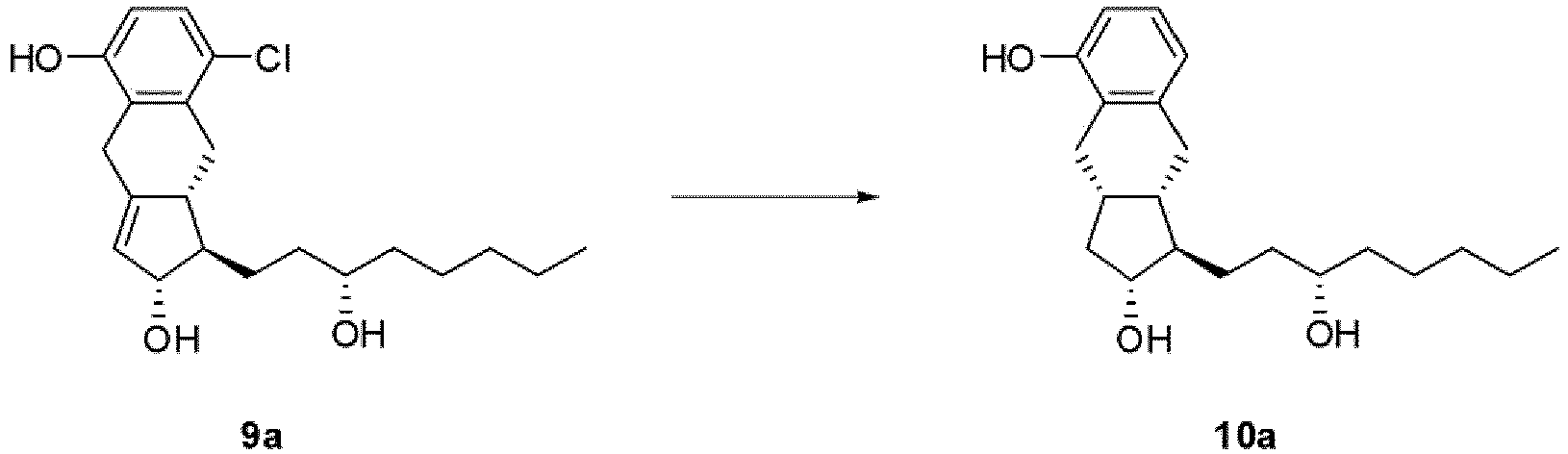
- The compound of formula (9a) (34.7 mg) was dissolved in methanol (3 mL), and 10% Pd/C (9 mg) and triethylamine (10.7 mg) were added thereto, followed by stirring under hydrogen condition for 15 hours. After the completion of the reaction was confirmed, the resulting solution was filtered through a celite pad, and the filtrate was concentrated under reduced pressure. The resulting residue was subjected to chromatography (ethyl acetate:n-hexane=1:1) to give the compound of formula (10a) (20.5 mg, 65%).
- 1H NMR (300 MHz, CDCl3, δ ppm): 6.92 (t, J = 7.5 Hz, 1 H), 6.64 (d, J = 7.8 Hz, 2 H), 3.53-3.68 (m, 2 H), 2.45-2.74 (m, 4 H), 2.27-2.34 (m, 1 H), 2.06-2.12 (m, 1 H), 1.88-1.98 (m, 1 H), 1.05-1.24 (m, 14 H), 0.94 (t, J = 6.6 Hz, 3 H).
-

- To the compound of formula (10a) (440 mg) dissolved in acetone (4.0 mL) were added potassium carbonate (549 mg) and the compound of formula (11a) (405 mg). The resulting solution was stirred at 50-60 °C for 10-16 hours, and the completion of the reaction was confirmed by HPLC. The resulting solution was cooled to 15-25 °C, filtered, and concentrated. Ethyl acetate (4.5 mL) and water (5.0 mL) were added and stirred. The organic layer was separated and dried over sodium sulfate (1.0 g), followed by filtration and concentration. The resulting residue was subjected to chromatography (ethyl acetate:n-hexane=1:1) to give the compound of formula (12a) (400 mg, 74.8%).
- 1H NMR (300 MHz, CDCl3, δ ppm): 7.07 (t, J = 7.8, 1H), 6.81 (d, J = 7.5 Hz, 1H), 6.63 (d, J = 7.8 Hz, 1H), 4.63 (s, 2H), 3.79 (s, 3H), 3.54-3.76 (m, 2H), 2.88 (dd, J = 14.7, 5.7 Hz, 1H), 2.76 (dd, J = 14.1, 6.0 Hz, 1H), 2.42-2.59 (m, 2H), 2.14-2.30 (m, 2H), 1.85-1.94 (m, 1H), 1.12-1.75 (m, 14H), 0.90 (t, J = 7.0 Hz, 3H).
- 13C NMR (75 MHz, CDCl3, δ ppm): 169.72, 154.89, 141.06, 127.81, 126.14, 121.63, 109.69, 76.60, 72.58, 66.00, 52.31, 52.16, 41.44, 41.28, 37.45, 35.00, 33.74, 32.79, 31.91, 28.66, 25.98, 25.38, 22.65, 14.06.
-
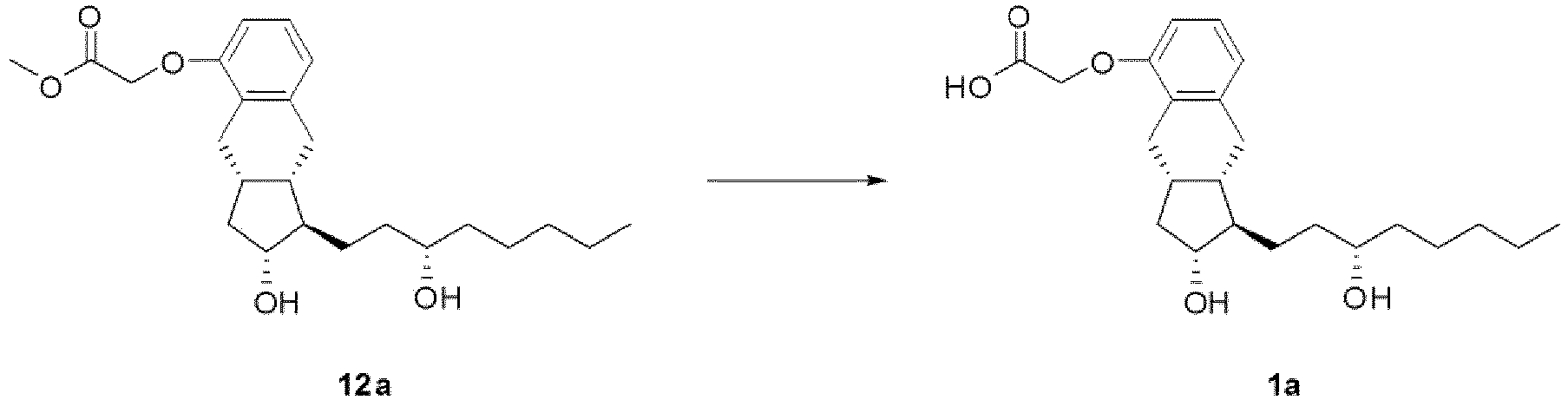
- To the compound of formula (12a) (0.38 g) dissolved in ethanol (2.0 mL) was added sodium hydroxide (75 mg) dissolved in water (2.0 mL), followed by stirring for 3-5 hours. The completion of the reaction was confirmed by HPLC. After the reaction solvent was evaporated, water (2.0 mL) was added, followed by stirring. Hydrochloric acid (0.21 g) dissolved in water (1.82 mL) was added for acidification to pH 3-4. Ethyl acetate (4.5 mL) was added and stirred for 20-30 minutes, and the organic layer was separated. Water (5.0 mL) was added to the separated organic layer and stirred for 20-30 minutes, and then the organic layer was separated. Saline water (5.0 mL) was added to the separated organic layer, followed by stirring for 20-30 minutes. The organic layer was separated, and dried over sodium sulfate, followed by filtration and concentration to give the compound of formula (1a) (367 mg, 100%).
- 1H NMR (300 MHz, MeOD, δ ppm): 7.05 (t, J = 8.0 Hz, 1H), 6.79 (d, J = 7.2 Hz, 1H), 6.70 (d, J = 8.4 Hz, 1H), 4.62 (s, 2H), 3.52-3.67 (m, 2H), 2.61-2.80 (m, 3H), 2.50 (dd, J = 14.4, 6.0 Hz, 1H), 2.21-2.34 (m, 1H), 1.86-2.12 (m, 2H), 1.05-1.76 (m, 14H), 0.92 (t, J = 7.0 Hz, 3H).
- 13C NMR (75 MHz, MeOD, δ ppm): 172.93, 156.52, 142.16, 128.69, 127.15, 122.42, 110.79, 77.61, 72.89, 66.56, 52.71, 498.83, 49.55, 49.26, 42.30, 42.01, 38.28, 36.04, 34.56, 34.06, 33.14, 29.60, 26.61, 26.48, 23.73, 14.41.
Claims (18)
- A method for preparing a compound of the following formula (1), which comprises the steps of:(i) converting an alkyl halide or alkenyl tin of the following formula (3) to its cuprate, and subjecting the cuprate to stereoselective 1,4-addition to an α, β-unsaturated ketone of the following formula (2) to obtain a compound of the following formula (4);(ii) subjecting a ketone group of the compound of the following formula (4) to methenylation to obtain a compound of the following formula (5);(iii) deprotecting a diol protecting group of the compound of the following formula (5) to obtain a compound of the following formula (6);(iv) converting a diol of the compound of the following formula (6) to a cyclic carbonate to obtain a compound of the following formula (7);(v) deprotecting a phenol protecting group of the compound of the following formula (7) to obtain a compound of the following formula (8);(vi) subjecting the compound of the following formula (8) to intramolecular Friedel-Crafts allylic alkylation to obtain a compound of the following formula (9);(vii) subjecting the compound of the following formula (9) to hydrogenation to obtain a compound of the following formula (10);(viii) subjecting the compound of the following formula (10) to alkylation with a compound of the following formula (11) to obtain a compound of the following formula (12); and(ix) hydrolyzing an ester group of the compound of the following formula (12):
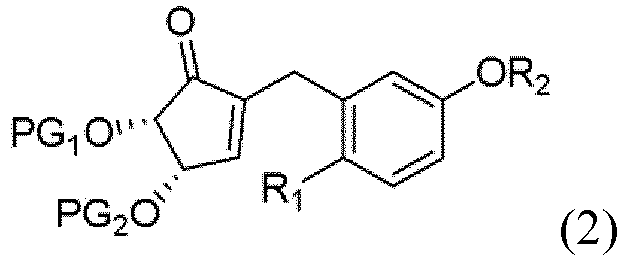


--- represents a single or double bond between carbon atoms,R1 represents hydrogen or halogen,R2 represents hydrogen or a hydroxyl protecting group,R3 represents a C1-C6 alkyl group,PG1 and PG2 represent a hydroxyl protecting group each independently or in combination,X represents halogen or Sn(R4)3,R4 represents a C1-C6 alkyl group,Y represents α-OR5:β-H or α-H:β-OR5,R5 represents hydrogen or a hydroxyl protecting group,Z represents a C1-C6 alkyl group, andX' represents halogen. - The method according to claim 1, wherein the conversion of an alkyl halide or alkenyl tin of formula (3) to its cuprate in step (i) is carried out by adding methyl lithium (MeLi) or t-butyl lithium, and copper cyanide (CuCN).
- The method according to claim 1, wherein the methenylation in step (ii) is carried out using a Nysted reagent.
- The method according to claim 1, wherein the deprotection in step (iii) is carried out under an acidic condition.
- The method according to claim 1, wherein the conversion in step (iv) is carried out using 1,1-carbonyldiimidazole.
- The method according to claim 1, wherein the deprotection in step (v) is carried out using a fluoride (F-) compound.
- The method according to claim 1, wherein the intramolecular Friedel-Crafts allylic alkylation in step (vi) is carried out using a palladium catalyst and a ligand.
- The method according to claim 7, wherein the palladium catalyst is bis(dibenzylideneacetone)palladium(0), and the ligand is triphenylphosphine.
- The method according to claim 1, wherein the hydrogenation in step (vii) is carried out using Pd/C under a basic condition.
- The method according to claim 1, wherein the alkylation in step (viii) is carried out in the presence of a base.
- The method according to claim 1, wherein the hydrolysis in step (ix) is carried out in the presence of a base.
- A compound of the following formula (8):

--- represents a single or double bond between carbon atoms,R1 represents hydrogen or halogen,Y represents α-OR5:β-H or α-H:β-OR5,R5 represents hydrogen or a hydroxyl protecting group, andZ represents a C1-C6 alkyl group. - The compound of formula (8) according to claim 12, wherein
--- represents a single bond between carbon atoms,R1 represents chlorine,Y represents α-OR5:β-H,R5 represents hydrogen or a hydroxyl protecting group, andZ represents n-butyl. - A method for preparing a compound of the following formula (8), which comprises the steps of:(i) converting an alkyl halide or alkenyl tin of the following formula (3) to its cuprate, and subjecting the cuprate to stereoselective 1,4-addition to an α, β-unsaturated ketone of the following formula (2) to obtain a compound of the following formula (4);(ii) subjecting a ketone group of the compound of the following formula (4) to methenylation to obtain a compound of the following formula (5);(iii) deprotecting a diol protecting group of the compound of the following formula (5) to obtain a compound of the following formula (6);(iv) converting a diol of the compound of the following formula (6) to a cyclic carbonate to obtain a compound of the following formula (7); and(v) deprotecting a phenol protecting group of the compound of the following formula (7):


--- represents a single or double bond between carbon atoms,R1 represents hydrogen or halogen,R2 represents hydrogen or a hydroxyl protecting group,PG1 and PG2 represent a hydroxyl protecting group each independently or in combination,X represents halogen or Sn(R4)3,R4 represents a C1-C6 alkyl group,Y represents α-OR5:β-H or α-H:β-OR5,R5 represents hydrogen or a hydroxyl protecting group, andZ represents a C1-C6 alkyl group. - A compound of the following formula (9):

--- represents a single or double bond between carbon atoms,R1 represents hydrogen or halogen,Y represents α-OR5:β-H or α-H:β-OR5,R5 represents hydrogen or a hydroxyl protecting group, andZ represents a C1-C6 alkyl group. - The compound of formula (9) according to claim 15, wherein
--- represents a single bond between carbon atoms,R1 represents chlorine,Y represents α-OR5:β-H,R5 represents hydrogen or a hydroxyl protecting group, andZ represents n-butyl. - A method for preparing a compound of the following formula (9), which comprises a step of subjecting a compound of the following formula (8) to intramolecular Friedel-Crafts allylic alkylation:


--- represents a single or double bond between carbon atoms,R1 represents hydrogen or halogen,Y represents α-OR5:β-H or α-H:β-OR5,R5 represents hydrogen or a hydroxyl protecting group, andZ represents a C1-C6 alkyl group. - A method for preparing a compound of the following formula (10), which comprises a step of subjecting a compound of the following formula (9) to hydrogenation:


--- represents a single or double bond between carbon atoms,R1 represents hydrogen or halogen,Y represents α-OR5:β-H or α-H:β-OR5,R5 represents hydrogen or a hydroxyl protecting group, andZ represents a C1-C6 alkyl group.
Applications Claiming Priority (2)
| Application Number | Priority Date | Filing Date | Title |
|---|---|---|---|
| KR1020160052378A KR101830693B1 (en) | 2016-04-28 | 2016-04-28 | Process for Preparing Treprostinil and Intermediate Therefor |
| PCT/KR2017/004131 WO2017188644A2 (en) | 2016-04-28 | 2017-04-18 | Method for preparing treprostinil and intermediate therefor |
Publications (3)
| Publication Number | Publication Date |
|---|---|
| EP3450421A2 EP3450421A2 (en) | 2019-03-06 |
| EP3450421A4 EP3450421A4 (en) | 2019-12-04 |
| EP3450421B1 true EP3450421B1 (en) | 2020-11-18 |
Family
ID=60159843
Family Applications (1)
| Application Number | Title | Priority Date | Filing Date |
|---|---|---|---|
| EP17789829.3A Active EP3450421B1 (en) | 2016-04-28 | 2017-04-18 | Method for preparing treprostinil and intermediate therefor |
Country Status (6)
| Country | Link |
|---|---|
| US (1) | US10800737B2 (en) |
| EP (1) | EP3450421B1 (en) |
| JP (1) | JP6837494B2 (en) |
| KR (1) | KR101830693B1 (en) |
| CN (1) | CN109071406B (en) |
| WO (1) | WO2017188644A2 (en) |
Family Cites Families (12)
| Publication number | Priority date | Publication date | Assignee | Title |
|---|---|---|---|---|
| CA1201712A (en) | 1980-02-28 | 1986-03-11 | Paul A. Aristoff | Carbacyclin analogs |
| US4306075A (en) | 1980-03-28 | 1981-12-15 | The Upjohn Company | Composition and process |
| US4306076A (en) * | 1980-04-23 | 1981-12-15 | The Upjohn Company | Inter-phenylene CBA compounds |
| KR100437873B1 (en) | 2001-05-08 | 2004-06-26 | 연성정밀화학(주) | Process for preparing prostaglandin derivatives and stereospecific starting material thereof |
| KR100903311B1 (en) * | 2002-09-18 | 2009-06-17 | 연성정밀화학(주) | Method for preparing prostaglandin derivatives and starting materials therefor |
| CN101891596B (en) | 2009-05-22 | 2013-12-11 | 上海天伟生物制药有限公司 | New compound and preparation method and application thereof |
| US8481782B2 (en) * | 2010-06-03 | 2013-07-09 | United Therapeutics Corporation | Treprostinil production |
| US8524939B2 (en) | 2011-08-24 | 2013-09-03 | Chirogate International Inc. | Intermediates for the synthesis of benzindene prostaglandins and preparations thereof |
| LT2674413T (en) * | 2012-06-15 | 2017-09-25 | Scipharm Sąrl | Process for the preparation of treprostinil and derivatives thereof |
| WO2014203278A2 (en) * | 2013-06-19 | 2014-12-24 | Msn Laboratories Private Limited | NOVEL PROCESS FOR THE PREPARATION OF (1R,2R,3aS,9aS)-[[2,3,3a,4,9,9a-HEXAHYDRO-2-HYDROXY-1-[(3S)-3-HYDROXYOCTYL]-1H-BENZ[f]INDEN-5-YL]OXY]ACETIC ACID |
| US9890104B2 (en) * | 2013-11-13 | 2018-02-13 | Cayman Chemical Company Incorporated | Amine salts of a prostacyclin analog |
| HU231184B1 (en) | 2014-10-08 | 2021-07-28 | CHINOIN Gyógyszer és Vegyészeti Termékek Gyára Zrt. | Treprostinyl-sodium-monohydrate and process for its preparation |
-
2016
- 2016-04-28 KR KR1020160052378A patent/KR101830693B1/en active Active
-
2017
- 2017-04-18 US US16/096,766 patent/US10800737B2/en active Active
- 2017-04-18 CN CN201780026219.0A patent/CN109071406B/en active Active
- 2017-04-18 EP EP17789829.3A patent/EP3450421B1/en active Active
- 2017-04-18 JP JP2018556315A patent/JP6837494B2/en active Active
- 2017-04-18 WO PCT/KR2017/004131 patent/WO2017188644A2/en not_active Ceased
Non-Patent Citations (1)
| Title |
|---|
| None * |
Also Published As
| Publication number | Publication date |
|---|---|
| EP3450421A2 (en) | 2019-03-06 |
| US20190119205A1 (en) | 2019-04-25 |
| WO2017188644A2 (en) | 2017-11-02 |
| JP2019514911A (en) | 2019-06-06 |
| EP3450421A4 (en) | 2019-12-04 |
| US10800737B2 (en) | 2020-10-13 |
| KR101830693B1 (en) | 2018-02-21 |
| JP6837494B2 (en) | 2021-03-03 |
| CN109071406A (en) | 2018-12-21 |
| CN109071406B (en) | 2021-05-04 |
| WO2017188644A3 (en) | 2018-01-18 |
| KR20170123126A (en) | 2017-11-07 |
Similar Documents
| Publication | Publication Date | Title |
|---|---|---|
| AU2019420442B2 (en) | L-glufosinate intermediate and L-glufosinate preparation method | |
| CN105777544B (en) | A kind of preparation method of S- (+)-flurbiprofen axetil | |
| JP7229434B1 (en) | Method for producing hydroxy thienoimidazole derivative, vinyl sulfide derivative, n-butylidene sulfide derivative, and saturated linear hydrocarbon-substituted thienoimidazole derivative | |
| CN107963996A (en) | Method for preparing 3-trifluoromethyl isoxazole compound by one-pot method | |
| KR101018983B1 (en) | A method for preparing combretastatins and an intermediate | |
| EP1346977A1 (en) | Method for producing aryl-aminopropanols | |
| CA2889650A1 (en) | Process and intermediates for preparing lacosamide | |
| CN102531983B (en) | Chemical synthesis method of S-phenyl-4-tosylate | |
| US10800737B2 (en) | Method for preparing treprostinil and intermediate therefor | |
| CN111909057B (en) | Preparation method of cyclopentenyl aryl ketoxime compound | |
| JP5448572B2 (en) | Acetyl compound, method for producing the acetyl compound, and method for producing a naphthol compound using the acetyl compound | |
| CN113651715B (en) | Method for synthesizing coumaroyl dopamine by one-pot method | |
| EP2647621A1 (en) | Method for producing sanshool | |
| CN117088830B (en) | Synthesis method of 2-amino-2- (furan-3-yl) acetic acid compound | |
| CN110668976A (en) | Rivastigmine optical isomeric intermediate and synthetic method of (R) -rivastigmine | |
| CN111349012B (en) | Preparation method of halogenated aromatic compound and intermediate thereof | |
| CN108456172B (en) | Chiral N-heterocyclic carbene precursor compound with benzimidazole skeleton and preparation method and application thereof | |
| CN120097869A (en) | A preparation method of N-alpha-tert-butyloxycarbonyl-L-lysine | |
| CN106905205A (en) | An a kind of step constructs C O and C Bifunctionalized products of S keys and preparation method thereof | |
| CN101525281B (en) | Synthetic method of natural products of AB5046A and AB5046B with herbicidal activity | |
| JP5854213B2 (en) | Method for producing optically active amine compound | |
| EP2876108A1 (en) | Compounds of chiral aromatic spiroketal diphosphine ligands, preparation methods and uses thereof | |
| DE10248480A1 (en) | Preparation of 3-thienyl-3-hydroxy-1-aminopropane derivatives, useful as intermediates for duloxetin an inhibitor of neurotransmitter uptake, by reacting 1-halo compound with amine in closed system | |
| KR20110019145A (en) | (S) -Rivastigmine Production Method | |
| KR20100009664A (en) | Improved synthesis of piceatannol via (e)-selective wittig-horner reaction |
Legal Events
| Date | Code | Title | Description |
|---|---|---|---|
| STAA | Information on the status of an ep patent application or granted ep patent |
Free format text: STATUS: THE INTERNATIONAL PUBLICATION HAS BEEN MADE |
|
| PUAI | Public reference made under article 153(3) epc to a published international application that has entered the european phase |
Free format text: ORIGINAL CODE: 0009012 |
|
| STAA | Information on the status of an ep patent application or granted ep patent |
Free format text: STATUS: REQUEST FOR EXAMINATION WAS MADE |
|
| 17P | Request for examination filed |
Effective date: 20181031 |
|
| AK | Designated contracting states |
Kind code of ref document: A2 Designated state(s): AL AT BE BG CH CY CZ DE DK EE ES FI FR GB GR HR HU IE IS IT LI LT LU LV MC MK MT NL NO PL PT RO RS SE SI SK SM TR |
|
| AX | Request for extension of the european patent |
Extension state: BA ME |
|
| DAV | Request for validation of the european patent (deleted) | ||
| DAX | Request for extension of the european patent (deleted) | ||
| RIC1 | Information provided on ipc code assigned before grant |
Ipc: C07D 317/44 20060101ALI20191023BHEP Ipc: C07C 35/37 20060101ALI20191023BHEP Ipc: C07C 59/72 20060101AFI20191023BHEP |
|
| A4 | Supplementary search report drawn up and despatched |
Effective date: 20191104 |
|
| REG | Reference to a national code |
Ref country code: DE Ref legal event code: R079 Ref document number: 602017027913 Country of ref document: DE Free format text: PREVIOUS MAIN CLASS: C07C0059720000 Ipc: C07C0029560000 |
|
| GRAP | Despatch of communication of intention to grant a patent |
Free format text: ORIGINAL CODE: EPIDOSNIGR1 |
|
| STAA | Information on the status of an ep patent application or granted ep patent |
Free format text: STATUS: GRANT OF PATENT IS INTENDED |
|
| RIC1 | Information provided on ipc code assigned before grant |
Ipc: C07C 51/09 20060101ALI20200610BHEP Ipc: C07C 29/56 20060101AFI20200610BHEP Ipc: C07C 29/62 20060101ALI20200610BHEP Ipc: C07C 35/48 20060101ALI20200610BHEP Ipc: C07C 69/712 20060101ALI20200610BHEP Ipc: C07C 59/62 20060101ALI20200610BHEP Ipc: C07D 317/44 20060101ALI20200610BHEP Ipc: C07C 67/343 20060101ALI20200610BHEP Ipc: C07C 35/37 20060101ALI20200610BHEP |
|
| INTG | Intention to grant announced |
Effective date: 20200630 |
|
| GRAS | Grant fee paid |
Free format text: ORIGINAL CODE: EPIDOSNIGR3 |
|
| GRAA | (expected) grant |
Free format text: ORIGINAL CODE: 0009210 |
|
| STAA | Information on the status of an ep patent application or granted ep patent |
Free format text: STATUS: THE PATENT HAS BEEN GRANTED |
|
| AK | Designated contracting states |
Kind code of ref document: B1 Designated state(s): AL AT BE BG CH CY CZ DE DK EE ES FI FR GB GR HR HU IE IS IT LI LT LU LV MC MK MT NL NO PL PT RO RS SE SI SK SM TR |
|
| REG | Reference to a national code |
Ref country code: GB Ref legal event code: FG4D |
|
| REG | Reference to a national code |
Ref country code: CH Ref legal event code: EP |
|
| REG | Reference to a national code |
Ref country code: IE Ref legal event code: FG4D |
|
| REG | Reference to a national code |
Ref country code: DE Ref legal event code: R096 Ref document number: 602017027913 Country of ref document: DE |
|
| REG | Reference to a national code |
Ref country code: AT Ref legal event code: REF Ref document number: 1335591 Country of ref document: AT Kind code of ref document: T Effective date: 20201215 |
|
| REG | Reference to a national code |
Ref country code: AT Ref legal event code: MK05 Ref document number: 1335591 Country of ref document: AT Kind code of ref document: T Effective date: 20201118 |
|
| REG | Reference to a national code |
Ref country code: NL Ref legal event code: MP Effective date: 20201118 |
|
| PG25 | Lapsed in a contracting state [announced via postgrant information from national office to epo] |
Ref country code: PT Free format text: LAPSE BECAUSE OF FAILURE TO SUBMIT A TRANSLATION OF THE DESCRIPTION OR TO PAY THE FEE WITHIN THE PRESCRIBED TIME-LIMIT Effective date: 20210318 Ref country code: RS Free format text: LAPSE BECAUSE OF FAILURE TO SUBMIT A TRANSLATION OF THE DESCRIPTION OR TO PAY THE FEE WITHIN THE PRESCRIBED TIME-LIMIT Effective date: 20201118 Ref country code: FI Free format text: LAPSE BECAUSE OF FAILURE TO SUBMIT A TRANSLATION OF THE DESCRIPTION OR TO PAY THE FEE WITHIN THE PRESCRIBED TIME-LIMIT Effective date: 20201118 Ref country code: NO Free format text: LAPSE BECAUSE OF FAILURE TO SUBMIT A TRANSLATION OF THE DESCRIPTION OR TO PAY THE FEE WITHIN THE PRESCRIBED TIME-LIMIT Effective date: 20210218 Ref country code: GR Free format text: LAPSE BECAUSE OF FAILURE TO SUBMIT A TRANSLATION OF THE DESCRIPTION OR TO PAY THE FEE WITHIN THE PRESCRIBED TIME-LIMIT Effective date: 20210219 |
|
| PG25 | Lapsed in a contracting state [announced via postgrant information from national office to epo] |
Ref country code: SE Free format text: LAPSE BECAUSE OF FAILURE TO SUBMIT A TRANSLATION OF THE DESCRIPTION OR TO PAY THE FEE WITHIN THE PRESCRIBED TIME-LIMIT Effective date: 20201118 Ref country code: LV Free format text: LAPSE BECAUSE OF FAILURE TO SUBMIT A TRANSLATION OF THE DESCRIPTION OR TO PAY THE FEE WITHIN THE PRESCRIBED TIME-LIMIT Effective date: 20201118 Ref country code: IS Free format text: LAPSE BECAUSE OF FAILURE TO SUBMIT A TRANSLATION OF THE DESCRIPTION OR TO PAY THE FEE WITHIN THE PRESCRIBED TIME-LIMIT Effective date: 20210318 Ref country code: PL Free format text: LAPSE BECAUSE OF FAILURE TO SUBMIT A TRANSLATION OF THE DESCRIPTION OR TO PAY THE FEE WITHIN THE PRESCRIBED TIME-LIMIT Effective date: 20201118 Ref country code: BG Free format text: LAPSE BECAUSE OF FAILURE TO SUBMIT A TRANSLATION OF THE DESCRIPTION OR TO PAY THE FEE WITHIN THE PRESCRIBED TIME-LIMIT Effective date: 20210218 Ref country code: AT Free format text: LAPSE BECAUSE OF FAILURE TO SUBMIT A TRANSLATION OF THE DESCRIPTION OR TO PAY THE FEE WITHIN THE PRESCRIBED TIME-LIMIT Effective date: 20201118 |
|
| REG | Reference to a national code |
Ref country code: LT Ref legal event code: MG9D |
|
| PG25 | Lapsed in a contracting state [announced via postgrant information from national office to epo] |
Ref country code: HR Free format text: LAPSE BECAUSE OF FAILURE TO SUBMIT A TRANSLATION OF THE DESCRIPTION OR TO PAY THE FEE WITHIN THE PRESCRIBED TIME-LIMIT Effective date: 20201118 |
|
| PG25 | Lapsed in a contracting state [announced via postgrant information from national office to epo] |
Ref country code: RO Free format text: LAPSE BECAUSE OF FAILURE TO SUBMIT A TRANSLATION OF THE DESCRIPTION OR TO PAY THE FEE WITHIN THE PRESCRIBED TIME-LIMIT Effective date: 20201118 Ref country code: SK Free format text: LAPSE BECAUSE OF FAILURE TO SUBMIT A TRANSLATION OF THE DESCRIPTION OR TO PAY THE FEE WITHIN THE PRESCRIBED TIME-LIMIT Effective date: 20201118 Ref country code: SM Free format text: LAPSE BECAUSE OF FAILURE TO SUBMIT A TRANSLATION OF THE DESCRIPTION OR TO PAY THE FEE WITHIN THE PRESCRIBED TIME-LIMIT Effective date: 20201118 Ref country code: EE Free format text: LAPSE BECAUSE OF FAILURE TO SUBMIT A TRANSLATION OF THE DESCRIPTION OR TO PAY THE FEE WITHIN THE PRESCRIBED TIME-LIMIT Effective date: 20201118 Ref country code: CZ Free format text: LAPSE BECAUSE OF FAILURE TO SUBMIT A TRANSLATION OF THE DESCRIPTION OR TO PAY THE FEE WITHIN THE PRESCRIBED TIME-LIMIT Effective date: 20201118 Ref country code: LT Free format text: LAPSE BECAUSE OF FAILURE TO SUBMIT A TRANSLATION OF THE DESCRIPTION OR TO PAY THE FEE WITHIN THE PRESCRIBED TIME-LIMIT Effective date: 20201118 |
|
| REG | Reference to a national code |
Ref country code: DE Ref legal event code: R097 Ref document number: 602017027913 Country of ref document: DE |
|
| PG25 | Lapsed in a contracting state [announced via postgrant information from national office to epo] |
Ref country code: DK Free format text: LAPSE BECAUSE OF FAILURE TO SUBMIT A TRANSLATION OF THE DESCRIPTION OR TO PAY THE FEE WITHIN THE PRESCRIBED TIME-LIMIT Effective date: 20201118 |
|
| PLBE | No opposition filed within time limit |
Free format text: ORIGINAL CODE: 0009261 |
|
| STAA | Information on the status of an ep patent application or granted ep patent |
Free format text: STATUS: NO OPPOSITION FILED WITHIN TIME LIMIT |
|
| 26N | No opposition filed |
Effective date: 20210819 |
|
| PG25 | Lapsed in a contracting state [announced via postgrant information from national office to epo] |
Ref country code: IT Free format text: LAPSE BECAUSE OF FAILURE TO SUBMIT A TRANSLATION OF THE DESCRIPTION OR TO PAY THE FEE WITHIN THE PRESCRIBED TIME-LIMIT Effective date: 20201118 Ref country code: AL Free format text: LAPSE BECAUSE OF FAILURE TO SUBMIT A TRANSLATION OF THE DESCRIPTION OR TO PAY THE FEE WITHIN THE PRESCRIBED TIME-LIMIT Effective date: 20201118 Ref country code: NL Free format text: LAPSE BECAUSE OF FAILURE TO SUBMIT A TRANSLATION OF THE DESCRIPTION OR TO PAY THE FEE WITHIN THE PRESCRIBED TIME-LIMIT Effective date: 20201118 |
|
| PG25 | Lapsed in a contracting state [announced via postgrant information from national office to epo] |
Ref country code: SI Free format text: LAPSE BECAUSE OF FAILURE TO SUBMIT A TRANSLATION OF THE DESCRIPTION OR TO PAY THE FEE WITHIN THE PRESCRIBED TIME-LIMIT Effective date: 20201118 Ref country code: MC Free format text: LAPSE BECAUSE OF FAILURE TO SUBMIT A TRANSLATION OF THE DESCRIPTION OR TO PAY THE FEE WITHIN THE PRESCRIBED TIME-LIMIT Effective date: 20201118 |
|
| PG25 | Lapsed in a contracting state [announced via postgrant information from national office to epo] |
Ref country code: LU Free format text: LAPSE BECAUSE OF NON-PAYMENT OF DUE FEES Effective date: 20210418 |
|
| REG | Reference to a national code |
Ref country code: BE Ref legal event code: MM Effective date: 20210430 |
|
| PG25 | Lapsed in a contracting state [announced via postgrant information from national office to epo] |
Ref country code: ES Free format text: LAPSE BECAUSE OF FAILURE TO SUBMIT A TRANSLATION OF THE DESCRIPTION OR TO PAY THE FEE WITHIN THE PRESCRIBED TIME-LIMIT Effective date: 20201118 |
|
| PG25 | Lapsed in a contracting state [announced via postgrant information from national office to epo] |
Ref country code: IS Free format text: LAPSE BECAUSE OF FAILURE TO SUBMIT A TRANSLATION OF THE DESCRIPTION OR TO PAY THE FEE WITHIN THE PRESCRIBED TIME-LIMIT Effective date: 20210318 |
|
| PG25 | Lapsed in a contracting state [announced via postgrant information from national office to epo] |
Ref country code: BE Free format text: LAPSE BECAUSE OF NON-PAYMENT OF DUE FEES Effective date: 20210430 |
|
| P01 | Opt-out of the competence of the unified patent court (upc) registered |
Effective date: 20230508 |
|
| PG25 | Lapsed in a contracting state [announced via postgrant information from national office to epo] |
Ref country code: CY Free format text: LAPSE BECAUSE OF FAILURE TO SUBMIT A TRANSLATION OF THE DESCRIPTION OR TO PAY THE FEE WITHIN THE PRESCRIBED TIME-LIMIT Effective date: 20201118 |
|
| PG25 | Lapsed in a contracting state [announced via postgrant information from national office to epo] |
Ref country code: HU Free format text: LAPSE BECAUSE OF FAILURE TO SUBMIT A TRANSLATION OF THE DESCRIPTION OR TO PAY THE FEE WITHIN THE PRESCRIBED TIME-LIMIT; INVALID AB INITIO Effective date: 20170418 |
|
| PG25 | Lapsed in a contracting state [announced via postgrant information from national office to epo] |
Ref country code: MK Free format text: LAPSE BECAUSE OF FAILURE TO SUBMIT A TRANSLATION OF THE DESCRIPTION OR TO PAY THE FEE WITHIN THE PRESCRIBED TIME-LIMIT Effective date: 20201118 |
|
| PG25 | Lapsed in a contracting state [announced via postgrant information from national office to epo] |
Ref country code: TR Free format text: LAPSE BECAUSE OF FAILURE TO SUBMIT A TRANSLATION OF THE DESCRIPTION OR TO PAY THE FEE WITHIN THE PRESCRIBED TIME-LIMIT Effective date: 20201118 |
|
| PG25 | Lapsed in a contracting state [announced via postgrant information from national office to epo] |
Ref country code: MT Free format text: LAPSE BECAUSE OF FAILURE TO SUBMIT A TRANSLATION OF THE DESCRIPTION OR TO PAY THE FEE WITHIN THE PRESCRIBED TIME-LIMIT Effective date: 20201118 |
|
| PGFP | Annual fee paid to national office [announced via postgrant information from national office to epo] |
Ref country code: DE Payment date: 20250311 Year of fee payment: 9 |
|
| PGFP | Annual fee paid to national office [announced via postgrant information from national office to epo] |
Ref country code: CH Payment date: 20250501 Year of fee payment: 9 |
|
| PGFP | Annual fee paid to national office [announced via postgrant information from national office to epo] |
Ref country code: GB Payment date: 20260324 Year of fee payment: 10 |
|
| PGFP | Annual fee paid to national office [announced via postgrant information from national office to epo] |
Ref country code: IE Payment date: 20260324 Year of fee payment: 10 |
|
| PGFP | Annual fee paid to national office [announced via postgrant information from national office to epo] |
Ref country code: FR Payment date: 20260323 Year of fee payment: 10 |
|
| REG | Reference to a national code |
Ref country code: CH Ref legal event code: U11 Free format text: ST27 STATUS EVENT CODE: U-0-0-U10-U11 (AS PROVIDED BY THE NATIONAL OFFICE) Effective date: 20260501 |