EP3449823A1 - Walk vibration analyzing system, vibration analyzing device, walk vibration analyzing method, and computer-readable recording medium - Google Patents
Walk vibration analyzing system, vibration analyzing device, walk vibration analyzing method, and computer-readable recording medium Download PDFInfo
- Publication number
- EP3449823A1 EP3449823A1 EP17789699.0A EP17789699A EP3449823A1 EP 3449823 A1 EP3449823 A1 EP 3449823A1 EP 17789699 A EP17789699 A EP 17789699A EP 3449823 A1 EP3449823 A1 EP 3449823A1
- Authority
- EP
- European Patent Office
- Prior art keywords
- vibration
- walker
- characteristic amount
- walking
- floor
- Prior art date
- Legal status (The legal status is an assumption and is not a legal conclusion. Google has not performed a legal analysis and makes no representation as to the accuracy of the status listed.)
- Withdrawn
Links
Images








Classifications
-
- A—HUMAN NECESSITIES
- A61—MEDICAL OR VETERINARY SCIENCE; HYGIENE
- A61B—DIAGNOSIS; SURGERY; IDENTIFICATION
- A61B5/00—Measuring for diagnostic purposes; Identification of persons
- A61B5/103—Measuring devices for testing the shape, pattern, colour, size or movement of the body or parts thereof, for diagnostic purposes
- A61B5/11—Measuring movement of the entire body or parts thereof, e.g. head or hand tremor or mobility of a limb
-
- A—HUMAN NECESSITIES
- A61—MEDICAL OR VETERINARY SCIENCE; HYGIENE
- A61B—DIAGNOSIS; SURGERY; IDENTIFICATION
- A61B5/00—Measuring for diagnostic purposes; Identification of persons
- A61B5/117—Identification of persons
-
- G—PHYSICS
- G08—SIGNALLING
- G08B—SIGNALLING SYSTEMS, e.g. PERSONAL CALLING SYSTEMS; ORDER TELEGRAPHS; ALARM SYSTEMS
- G08B13/00—Burglar, theft or intruder alarms
- G08B13/02—Mechanical actuation
-
- G—PHYSICS
- G08—SIGNALLING
- G08B—SIGNALLING SYSTEMS, e.g. PERSONAL CALLING SYSTEMS; ORDER TELEGRAPHS; ALARM SYSTEMS
- G08B25/00—Alarm systems in which the location of the alarm condition is signalled to a central station, e.g. fire or police telegraphic systems
- G08B25/01—Alarm systems in which the location of the alarm condition is signalled to a central station, e.g. fire or police telegraphic systems characterised by the transmission medium
- G08B25/04—Alarm systems in which the location of the alarm condition is signalled to a central station, e.g. fire or police telegraphic systems characterised by the transmission medium using a single signalling line, e.g. in a closed loop
Definitions
- the present invention relates to a walking vibration analysis system, a vibration analysis apparatus, and a walking vibration analysis method for analyzing vibration that occurs due to walking, and furthermore relates to a computer-readable storage medium storing a program for realizing these.
- Patent Document 1 discloses a system for specifying an individual.
- the system disclosed in Patent Document 1 extracts a frequency of vibration that occurs due to an action performed by a person in a space, or a period of multiple steps as a characteristic amount of an individual from the measured walking vibration, compares it with frequencies or periods of individuals collected in advance, and specifies the individual.
- Patent Document 2 also discloses a system for specifying an individual.
- the system disclosed in Patent Document 2 obtains the walking speed and the amplitude peak strength from the measured walking vibration and uses the obtained walking speed and vibration peak strength as the individual information.
- there is a linear relationship in which if the walking speed increases, the amplitude peak also increases, but the linearity thereof is different depending on the person.
- the individual specification system disclosed in Patent Document 2 identifies an individual using the fact that the linearity is different depending on the person.
- Non-Patent Document 1 reports a vibration response property of a floor during walking.
- Non-Patent Document 2 discloses a study about a walking pattern of a healthy person.
- Non-Patent Document 1 reports that vibration obtained by simulating walking is applied to multiple floor materials (single flooring, dry double floor, flooring, and the like) and the displacement and frequency responses to the impact force are different depending on the floor material.
- data for comparison needs to be collected for each floor material and structure of the building in order to perform reliable individual identification corresponding to changes in the installation location of the apparatus that measures the walking vibration in the method for analyzing the walking vibration. Accordingly, the solution to the problem is not practical due to the fact that a large amount of data is required in order to solve the problems in Patent Document 1 and Patent Document 2 above.
- An object of the present invention is to solve the above-described problems and to provide a walking vibration analysis system, a vibration analysis apparatus, a walking vibration analysis method, and a program, according to which it is possible to extract a characteristic amount that is needed to identify an individual from walking vibration without being influenced by a building, such as a floor material and structure of a building.
- a walking vibration analysis system includes:
- a walking vibration analysis apparatus extracts vibration caused by contact between a heel of a walker and a floor and vibration caused by contact between a toe of the walker and the floor based on vibration that occurs accompanying walking of the walker, and calculates a characteristic amount unique to the walker based on a result of comparing the extracted former vibration and latter vibration.
- a walking vibration analysis method includes:
- a computer-readable storage medium stores a program including commands for causing a computer to execute:
- a characteristic amount that is needed for identification of an individual can be extracted from a walking vibration without being influenced by a building, such as a floor material and structure of a building.
- FIGS. 1 to 14 a walking vibration analysis system, a vibration analysis apparatus, a walking vibration analysis method, and a program according to an embodiment of the present invention will be described with reference to FIGS. 1 to 14 .
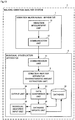
- FIG. 1 is a block diagram showing a schematic configuration of a walking vibration analysis system according to an embodiment of the present invention.
- a walking vibration analysis system 4 which is shown in FIG. 1 , is a system for specifying a walker from vibration generated accompanying walking of a walker.
- the walking vibration analysis system 4 includes a vibration measurement apparatus 1, a vibration analysis apparatus 3, and an individual specification apparatus 2.
- the vibration measurement apparatus 1 measures vibration that is generated accompanying walking of a walker.
- the vibration analysis apparatus 3 extracts vibration caused by contact between the heel of the walker and the floor, and vibration caused by contact between the toe of the walker and the floor, based on the measured vibration. Also, the vibration analysis apparatus 3 calculates a characteristic amount unique to the walker based on a result of comparing the extracted former vibration and latter vibration. Also, the individual specification apparatus 2 specifies the walker using the calculated characteristic amount and characteristic amounts registered for each individual in advance.
- the characteristic amount is obtained from a result of comparing the vibration caused by contact between the heel of the walker and the floor and the vibration caused by the toe of the walker and the floor, and therefore the influence of the response characteristic is eliminated from the characteristic amount. For this reason, according to the present embodiment, a characteristic amount that is needed for identifying an individual from the walking vibration can be extracted without being influenced by a building, such as a floor material and a structure of the building.
- FIG. 2 is a block diagram more specifically showing a configuration of a walking vibration analysis system according to an embodiment of the present invention.
- the vibration analysis apparatus 3 is incorporated inside of the vibration measurement apparatus 1 and functions as a characteristic amount extraction unit. Accordingly, in the following description, the vibration analysis apparatus 3 is described as a characteristic amount extraction unit 3 in some cases.
- the vibration measurement apparatus 1 is installed on a floor surface and is connected by wire or wirelessly to the individual specification apparatus 2.
- the walking vibration analysis system 4 specifies a person who has walked in the periphery of the vibration measurement apparatus 1.
- the vibration measurement apparatus 1 includes a vibration measurement unit 11, the above-described characteristic amount extraction unit 3, and a communication unit 12.
- the vibration measurement unit 11 measures at least one of displacement and acceleration that occur accompanying walking on the floor surface on which the vibration measurement apparatus 1 is installed, as the walking vibration, and performs notification of the walking vibration information for specifying the measured walking vibration to the characteristic amount extraction unit 3.
- the vibration measurement unit 11 includes a sensor for detecting vibration.
- the type of the sensor is not particularly limited, and examples of the sensor include acceleration sensors and displacement sensors, which are commonly in circulation.
- the walking vibration information is determined according to the type of the sensor included in the vibration measurement unit 11. For example, if the sensor is an acceleration sensor, the acceleration applied to the floor surface is used as the walking vibration information. Also, if the sensor is a displacement sensor, the displacement of the floor surface is used as the walking vibration information. Also, the walking vibration information may be output as a digital signal and may be output as an analog signal.
- the vibration measurement unit 11 includes an acceleration sensor that is commonly in circulation.
- the walking vibration information is output as a digital signal for specifying the acceleration generated in the floor surface accompanying walking.
- acceleration sensors include a MEMS acceleration sensor manufactured by Analog Devices Corporation.
- the characteristic amount extraction unit (vibration analysis apparatus) 3 extracts the vibration caused by contact between the heel of the walker and the floor and the vibration caused by contact between the toe of the walker and the floor from the walking vibration information from the vibration measurement unit 11. Also, by comparing the two, the characteristic amount extraction unit 3 calculates a relative value, such as the difference between the two or the ratio of the two, such that the influence of the response characteristic of the floor material and structure of the building is eliminated, and the result of this calculation is used as the characteristic amount. Also, the characteristic amount extraction unit 3 performs notification of the calculated characteristic amount (hereinafter written as "walking vibration characteristic amount") to the communication unit 12.
- walking vibration characteristic amount the calculated characteristic amount
- examples of the difference between the two include a time difference between the time of starting vibration caused by contact between the heel of the walker and the floor and the time of starting vibration caused by contact between the toe of the walker and the floor.
- examples of a ratio of the two include an intensity ratio between the amplitude peak of vibration caused by the contact between the heel of the walker and the floor and the amplitude peak of vibration caused by the contact between the toe of the walker and the floor. Note that in the following description, the time difference between the time of starting vibration caused by the contact between the heel and the floor and the time of starting vibration caused by the contact between the toe and the floor is used as the walking vibration characteristic amount.
- the above-described Non-Patent Document 2 reports that the distance between the heel and the toe does not change radically, and furthermore, that even when the walking speed changes, the walking speed is adjusted by a factor other than the distance between the heel and toe (step width and pace). Accordingly, it can be expected that the walking vibration characteristic amount used in the present embodiment is a characteristic amount that changes little. Also, in the present embodiment, measurement error and chronological change are reflected in the system with comparison processing performed by a later-described data comparison unit 23 of the individual specification apparatus 2 using the error information and update processing of data in the data update unit 25.
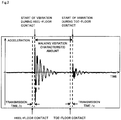
- FIG. 3 is a diagram showing an example of acceleration measured in the present embodiment.
- FIG. 3 shows a typical example of acceleration in the walking vibration measured by the vibration measurement unit 11.
- FIG. 3 shows two prominent vibrations, namely vibration caused by contact between the heel and the floor (hereinafter also written as “heel-floor contact”) and vibration caused by contact between the toe and the floor (hereinafter also written as "toe-floor contact”).
- the prominent vibration on the left side of the drawing is vibration at the time of heel-floor contact
- the prominent vibration on the right side of the drawing is vibration at the time of toe-floor contact.
- the walking vibration characteristic amount when the walking vibration characteristic amount is set as the time difference between the starts of vibration of the heel-floor contact and the toe-floor contact, the walking vibration characteristic amount can be calculated using the following Equation 3.
- the walking vibration characteristic amount is a relative value obtained by eliminating ⁇ t, which is influenced by the floor material, and is a characteristic value that depends only on the walking characteristic of the individual.
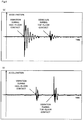
- FIG. 4 is a diagram showing accelerations for each individual measured in the present embodiment
- FIGS. 4(a) and 4(b) showing accelerations measured from different walkers.
- FIGS. 4(a) and 4(b) even if the individuals are different, the waveforms of the accelerations are similar, and two prominent vibrations can be seen in each waveform.
- the characteristic amount extraction unit 3 extracts the vibration start point of the heel-floor contact and the vibration start point of the toe-floor contact from the acceleration shown in FIGS. 3 , 4(a), 4(b) , and the like.
- the extraction of the vibration start points can be performed by determining whether the floor state is vibrating or still, using the variance value of the acceleration values.
- the acceleration sensor has an output error that conforms to a normal distribution with a deviation A.
- the upper limit value in the still state is defined as a still-time threshold. Accordingly, each time the acceleration is newly transferred from the vibration measurement unit 11, the characteristic amount extraction unit 3 calculates a variance value according to the value of the transferred acceleration and multiple prior values of acceleration.
- the characteristic amount extraction unit 3 determines that the floor surface is vibrating, and furthermore, if the variance value is less than the still-time threshold value after determining that the floor surface is vibrating, the characteristic amount extraction unit 3 determines that the floor surface is still. Through this kind of processing, the vibration start point of heel-floor contact and the vibration start point of toe-floor contact are extracted.
- the communication unit 12 transmits the walking vibration characteristic amount calculated by the characteristic amount extraction unit 3 to the individual specification apparatus 2. Also, in the present embodiment, the method of communication performed by the communication unit 12 may be by wire or wireless. Furthermore, the communication protocol that is used may be an existing communication protocol or a unique communication protocol.
- the individual specification apparatus 2 includes a communication unit 21, a database 22, a data comparison unit 23, an output unit 24, a database update unit 25, and an individual identifier input unit 26.
- the communication unit 21 receives the walking vibration characteristic amount from the vibration measurement apparatus 1 and sends the received walking vibration characteristic amount to the data comparison unit 23.
- the database 22 registers information that is necessary for specifying an individual from the walking vibration characteristic amount, that is, the walking vibration characteristic amount unique to the individual and the allowable range of error.
- the database 22 is configured using the following schema, which is shown in FIG. 5.
- FIG. 5 is a diagram showing an example of a schema configuring a database in an embodiment of the present invention.
- the database 22 includes individual identifier T221, individual walking vibration characteristic amount T222, error information T223, and statistical information T224 as fields, and stores information of an individual in each field.
- individual identifier T221 stores information uniquely specifying an individual, such as an ID or user name.
- Individual walking vibration characteristic amount T222 stores walking vibration characteristic amounts measured for each individual.
- Error information T223 stores the error in the individual walking vibration characteristic amount, such as a variance value obtained when the individual walking vibration characteristic amount is derived from multiple samples.
- Statistical information T224 stores statistical information that is needed for updating the walking vibration characteristic amount and the error information, such as a sample count for when the individual walking vibration characteristic amount is derived from multiple samples.
- the format of the database 22 is not particularly limited, and any format, such as a hierarchical format, a network format, or a relational format, may be used there as.
- each field may include multiple elements.
- error values that differ according to the range of values of the walking vibration characteristic amount may be stored in the error information.
- the sample counts, as well as sum totals or squared sum totals, or the like, may be stored in the statistical information.
- the user name is used as the individual identifier.
- the average value of multiple samples for the time difference between the start time of vibration caused by heel-floor contact and the start time of vibration caused by toe-floor contact is used as the individual walking vibration characteristic amount.
- the variance value of the individual walking vibration characteristic amount is used as the error information and the sample count and squared sum total of the individual walking vibration characteristic amounts are used as the statistical information.
- the data comparison unit 23 compares the walking vibration characteristic amount sent from the communication unit 21 with the individual walking vibration characteristic amount and the error information stored in the database 22. Also, if there is a match as a result of the comparison, the database comparison unit 23 specifies the walker using the individual identifier that corresponds to the matched walking vibration characteristic amount. On the other hand, if there is no match, the data comparison unit 23 determines that the comparison result is not applicable.
- the data comparison unit 23 obtains a difference between the walking vibration characteristic amount sent from the communication unit 21 and the individual walking vibration characteristic amount stored in the database 22, and determines whether or not the obtained difference falls within the range of the variance value (error).
- the data comparison unit 23 uses the corresponding user ID as the comparison result. In this case, the data comparison unit 23 sends the comparison result to the output unit 24. Also, the data comparison unit 23 sends the comparison result and the walking vibration characteristic amount to the database update unit 25.
- the data comparison unit 23 determines that the comparison result is not applicable. In this case as well, the data comparison unit 23 sends the comparison result and the walking vibration characteristic amount to the database update unit 25.
- the output unit 24 outputs the comparison result from the data comparison unit 23.
- the output destination of output performed by the output unit 24 is not particularly limited, and may be a display apparatus such as a liquid crystal display, or an external terminal apparatus connected by a network or the like. Also, in the latter case, the connection with the terminal apparatus may be wired or wireless, and the communication protocol used for the communication of the terminal apparatus may be an existing communication protocol or a unique communication protocol.
- the database update unit 25 When the database update unit 25 receives the comparison result and the walking vibration characteristic amount sent from the data comparison unit 23, the database update unit 25 updates the database 22 using the comparison result and the walking vibration characteristic amount. Specifically, if the walker has been specified by the data comparison unit 23, the database 22 is updated through statistical processing using the measured walking vibration characteristic amount.
- the updating in this case means updating the values for the individual walking vibration characteristic amount, the error information, and the statistical information, which are registered in the database 22 for the walker who was specified this time, through re-calculation with the measured walking vibration characteristic amounts added.
- the walking vibration characteristic amounts of N instances prior to the present instance of specification were obtained for the walker who was specified in the present instance.
- the individual walking vibration characteristic amount, the error information, and the statistical information of the person registered in the database 22 are indicated as f(N) using a common sample count N.
- the sample count is increased to N+1.
- the walking vibration characteristic amount, the error information, and the statistical information are set to f(N+1) and registered in the database 22 using a similar function.
- the error information and the statistical information are similarly indicated by equations in which the sample count N is used.
- the database update unit 25 requests output of an individual identifier to the individual identifier input unit 26 in order to newly register the individual walking vibration characteristic amount.
- the data comparison unit 25 receives the individual identifier and registers the received individual identifier and the new walking vibration characteristic amount in the database 22.
- the individual identifier input unit 26 prompts input of the individual identifier to an external manager or the like. Then, when the individual identifier is input, the individual identifier input unit 26 transfers the input individual identifier to the database update unit 25.
- the means for prompting input of the individual identifier to the outside and the means for causing input of the individual identifier is not particularly limited. Examples of these means include an apparatus such as an interactive personal computer, and an external terminal apparatus that holds individual identifiers.
- the walking vibration analysis method is implemented by causing the walking vibration analysis system 4 to operate. Accordingly, the description of the walking vibration analysis method of the present embodiment is substituted with the following description of the operation of the walking vibration analysis system 4. Also, in the following description, FIGS. 1 to 4 are referenced as appropriate.
- FIG. 6 is a flow chart showing operations of the vibration measurement apparatus and the vibration analysis apparatus according to the embodiment of the present invention.
- the vibration measurement unit 11 outputs the measurement values (walking vibration information) of the acceleration sensor in a setting interval. In this state, the processing shown in FIG. 6 is performed.
- the characteristic amount extraction unit 3 executes initialization processing (step S1). Specifically, the characteristic amount extraction unit 3 uses n times A 2 as the operation threshold, and N as the measurement point count to be used in the calculation of the variance value, and in the initial state, the floor surface is still, with no walking vibration being applied. Note that n is a real number larger than 0 that is obtained in advance, and N is a positive number that is determined in advance.
- the characteristic amount extraction unit 3 sets the value of a variable j to 0 (step S2). Then, each time the vibration measurement unit 11 newly measures acceleration and outputs a measurement value, the characteristic amount extraction unit 3 stores the j-th measurement value a j (step S3), increases the value of variable j by 1 (step S4), and determines whether or not the value of variable j is greater than or equal to N (step S5).
- step S5 If it is determined in step S5 that the value of the variable j is greater than or equal to N, the characteristic amount extraction unit 3 once again executes step S3 at a timing at which the measurement value is output. On the other hand, if it is determined in step S5 that the value of the variable j is greater than or equal to N, N or more measurement points used in the calculation of the variance value are accumulated, and the calculation of the variance value becomes possible, and therefore the characteristic amount extraction unit 3 calculates an average value m and a variance value V of acceleration (measurement value) using the following Equations 4 and 5 (step S6).
- the characteristic amount extraction unit 3 determines whether or not the variance value V is greater than or equal to the still-time threshold nA 2 (step S7). If it is determined in step S7 that the variance value V is greater than or equal to the still-time threshold value nA 2 , the characteristic amount extraction unit 3 further determines whether or not the immediately-previous floor state is still (step S8).
- step S8 If it is determined in step S8 that the immediately-previous floor state is not still, no change in the floor state has occurred, and therefore the characteristic amount extraction unit 3 once again executes step S3. On the other hand, if it is determined in step S8 that the immediately-previous floor state is still, the characteristic amount extraction unit 3 determines whether or not the time of the vibration start point of the heel-floor contact has not been measured (step S9).
- step S9 If it is determined in step S9 that the time of starting vibration in the heel-floor contact has not been measured, it thought that the vibration that has newly occurred is due to heel-floor contact, and the characteristic amount extraction unit 3 stores the current time as the time of starting vibration of the heel-floor contact (step S10). Next, in this case, it is considered that vibration has newly occurred due to heel-floor contact, and the characteristic amount extraction unit 3 determines that the floor state is vibrating (step S11).
- step S9 if it is determined in step S9 that the time of the vibration start point of heel-floor contact is not unmeasured (if the time of starting vibration of heel-floor contact has been measured), it is thought that the newly-occurring vibration is caused by toe-floor contact, and the characteristic amount extraction unit 3 stores the current time as a time of starting vibration of toe-floor contact (step S12).
- step S12 After executing step S12, the times of starting vibration for heel-floor contact and toe-floor contact have been acquired, and therefore the characteristic amount extraction unit 3 calculates the difference between the two and stores the result as the walking vibration characteristic amount (step S13).
- the characteristic amount extraction unit 3 once again stores the time of starting vibration of heel-floor contact, and therefore sets the vibration start time to unmeasured (step S14). Thereafter, in this case, the vibration is considered to have newly occurred due to toe-floor contact, and the characteristic amount extraction unit 3 determines that the floor state is vibrating (step S11).
- the characteristic amount extraction unit 3 further determines whether or not the immediately-previous floor state is vibrating (step S 15).
- step S15 If it is determined in step S15 that the immediately-previous floor state is not vibrating, no change in the floor state has occurred, and therefore the characteristic amount extraction unit 3 once again executes step S3. On the other hand, if it is determined in step S15 that the immediately-previous floor state is vibrating, the vibration caused by one of heel-floor contact or toe-floor contact is considered to have ended, and thus the characteristic amount extraction unit 3 sets the floor state to still (step S16).
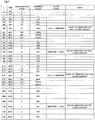
- FIG. 7 is a diagram showing a specific example of vibration start times for heel-floor contact and toe-floor contact extracted from the acceleration shown in FIG. 5(a) .
- FIG. 8 is a diagram showing a specific example of vibration start times for heel-floor contact and toe-floor contact extracted from the acceleration shown in FIG. 5(b) .
- j indicates the order in which the acceleration values (measurement values) were measured.
- the variance column is constituted by variance values of 20 measurement points' worth of acceleration, which include the 19 immediately-previous measurement points.
- the vibration start time for heel-floor contact is 129.4 milliseconds and the vibration start time for toe-floor contact is 199.8 milliseconds. Accordingly, the time difference between the start of vibration for heel-floor contact and for toe-floor contact, which is the walking vibration characteristic amount, is 70.4 milliseconds.
- FIG. 9 is a diagram showing the results of determining the vibration start times in the acceleration waveforms shown in FIGS. 5(a) and 5(b) , FIG. 9(a) corresponding to FIG. 5(a) , and FIG. 9(b) corresponding to FIG. 5(b) .
- FIGS. 9(a) and 9(b) indicate the locations of the starts and ends of vibration for heel-floor contact and toe-floor contact, which were specified through applying the flow shown in FIG. 6 .
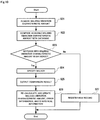
- FIG. 10 is a flowchart showing operations of an individual specification apparatus according to an embodiment of the present invention.
- the operation of the individual specification apparatus 2 shown in FIG. 10 is started when the walking vibration characteristic amount is sent from the vibration measurement apparatus 1 to the individual specification apparatus 2.
- the communication unit 21 acquires the walking vibration characteristic amount from the vibration measurement apparatus 1 and sends the acquired walking vibration characteristic amount to the data comparison unit 23 (step S21).
- the data comparison unit 23 compares the walking vibration characteristic amount acquired in step S21 with the individual walking vibration characteristic amounts and error information stored in the database 22 (step S22).
- the data comparison unit 23 determines whether or not the walking vibration characteristic amount acquired in step S21 matches any of the individual walking vibration characteristic amounts stored in the database 22 (step S23).
- step S23 If it is determined in step S23 that the walking vibration characteristic amount acquired in step S21 matches the walking vibration characteristic amount of an individual stored in the database 22, the data comparison unit 23 specifies the walker using the individual information corresponding to the matching walking vibration characteristic amount (step S24).
- step S24 the data comparison unit 23 sends the corresponding user ID as the comparison result to the output unit 24. Accordingly, the output unit 24 outputs the comparison result from the data comparison unit 23 (step S25). Also, the data comparison unit 23 sends the comparison result and the walking vibration characteristic amount to the database update unit 25.
- step S25 the database update unit 25 receives the comparison result and the walking vibration characteristic amount sent from the database comparison unit 23 and updates the database 22 using the comparison result and the walking vibration characteristic amount (step S26). Specifically, through statistical processing using the measured walking vibration characteristic amount, the database update unit 25 re-calculates the individual walking vibration characteristic amount, the error information, and the statistical information registered in the database 22 in advance. Then, the database update unit 25 updates the database 22 with the obtained values.
- step S23 determines that the walking vibration characteristic amount acquired in step S21 does not match the individual walking vibration characteristic amount stored in the database 22.
- the data comparison unit 23 determines that the comparison result is not applicable. In this case as well, the data comparison unit 23 sends the comparison result and the walking vibration characteristic amount to the database update unit 25.
- step S27 the database update unit 25 receives the comparison result and the walking vibration characteristic amount sent from the database comparison unit 23 and updates the database 22 using the comparison result and the walking vibration characteristic amount. Specifically, the database update unit 25 requests output of the individual identifier to the individual identifier input unit 26 and registers the output individual identifier and the new walking vibration characteristic amount obtained in step S21 in association with each other in the database 22.
- FIG. 11 is a diagram showing an example of information stored in a database according to the present embodiment.
- FIG. 12 shows a state after updating the data shown in FIG. 11 .
- the database 22 stores user IDs as individual identifiers, and stores the average values of multiple samples of time differences between the start of vibration for heel-floor contact and the start of vibration for toe-floor contact as the individual walking vibration characteristic amounts. Also, the database 22 stores the variance values of the individual walking vibration characteristic amounts as the error information and stores the sample counts and squared sum totals of the individual walking vibration characteristic amounts as the statistical information.
- the data comparison unit 23 determines whether or not the walking vibration characteristic amounts received from the vibration measurement apparatus 1 and the individual walking vibration characteristic amounts stored in the database 22 match within the range of the error.
- the walking vibration characteristic amount is determined as matching the walking vibration characteristic amount 105 milliseconds of user C in FIG. 11 within the range of the error 6.6 milliseconds. Also, if it is assumed that the acceleration shown in the example of FIG. 4(b) above is measured and the walking vibration characteristic amount is 70.4 milliseconds, the walking vibration characteristic amount is determined as matching the walking vibration characteristic amount 65 of user A within the range of the error 7.8 milliseconds. Accordingly, the user C and the user A are the respective comparison results for the walking vibrations shown in FIGS. 4(a) and 4(b) . Thereafter, the output unit 24 outputs the comparison result output by the data comparison unit 23.
- the database update unit 25 updates the database 22 using the walking vibration characteristic amount.
- the information accumulated in the database 22 is the sample count N, the individual walking vibration characteristic amount T N , a variance value V N of the individual walking vibration characteristic amount, and a squared sum total S N .
- the data comparison unit 23 updates these pieces of information using the information of the individual specified by the above-described processing.
- the walking vibration characteristic amount from the vibration measurement apparatus 1 used for comparison is set as T.
- the database update unit 25 requests a newly-associated user ID to the individual identifier input unit 26.
- the individual identifier input unit 26 prompts external input of a user ID, and upon obtaining a user ID, the individual identifier input unit 26 transfers the user ID to the database update unit 25.
- the database update unit 25 registers the user ID of the individual identifier input unit 26 and the walking vibration characteristic amount of the vibration measurement apparatus 1 in the database 22. Note that in this registration, the sample count is 1, and therefore the initial value for the variance value is a fixed value or a value that is set with reference to the variance value of another user.
- a characteristic amount that is needed for identification of an individual can be extracted from a walking vibration without being influenced by a building, such as a floor material and structure of a building. Also, a newly-calculated characteristic amount is added, and the registered characteristic amount of an individual is re-calculated, and therefore it is possible to track changes in an individual, such as aging and health. Furthermore, in order to prevent being influenced by a building, such as the floor material and structure of a building, it is not necessary to increase the number of sensors, and therefore an increase in cost caused by an increase in the number of sensors is also suppressed.
- FIG. 13 is a block diagram showing a configuration of the modified example of the walking vibration analysis system according to the embodiment of the present invention.
- the vibration analysis apparatus 3 is incorporated in the vibration measurement apparatus 1 and functions as the characteristic amount extraction unit 3 in the vibration measurement apparatus 1.
- the vibration analysis apparatus 3 does not necessarily need to be incorporated in the vibration measurement apparatus 1 and may be incorporated in the individual specification apparatus 2 as long as the walking vibration information can be obtained as an input.
- FIG. 13 shows an example in which the vibration measurement apparatus (characteristic amount extraction unit) 3 is incorporated in the individual specification apparatus 2.
- the vibration measurement apparatus 1 includes only the vibration measurement unit 11 and the communication unit 12.
- the communication unit 12 transmits the walking vibration information measured by the vibration measurement unit 11 to the individual specification apparatus 2.
- the individual specification apparatus 2 newly includes the characteristic amount extraction unit 3. For this reason, upon receiving the walking vibration information, the communication unit 21 transfers the received walking vibration information to the characteristic amount extraction unit 3. Similarly to the example of FIG. 2 , the characteristic amount extraction unit 3 calculates the walking vibration characteristic amount in accordance with the flow shown in FIG. 6 . Thereafter, the characteristic amount extraction unit 3 transfers the calculated walking vibration characteristic amount to the data comparison unit 23. Upon receiving the walking vibration characteristic amount, steps S21 to S26 shown in FIG. 10 are executed by the data comparison unit 23, the data update unit 25, and the individual identification input unit 26.
- the vibration measurement unit 11 and the communication unit 12 need be mounted in the vibration measurement apparatus 1, and therefore general-purpose sensors that can measure vibration (an acceleration sensor, a displacement sensor, etc.) can be used as the vibration measurement apparatus 1 without adding a special installation. That is, according to the present modified example, the cost relating to the structure of the vibration measurement apparatus can be reduced. Also, since the flow for extracting the walking vibration characteristic amount shown in FIG. 6 is concentrated in the individual specification apparatus 2, maintainability increases, and the cost related to maintenance can also be reduced.
- a first program according to the present embodiment need only be a program that causes a computer to execute steps S1 to S16 shown in FIG. 6 .
- the vibration analysis apparatus 3 according to the present embodiment can be realized by installing this program in a computer and executing it.
- the CPU (Central Processing Unit) of the computer functions as the vibration analysis apparatus 3 and performs processing.
- a second program according to the present embodiment need only be a program that causes a computer to execute steps S21 to S27 shown in FIG. 10 .
- the individual specification apparatus 2 according to the present embodiment can be realized by installing this program in a computer and executing it.
- the CPU Central Processing Unit
- the CPU functions as the communication unit 21, the data comparison unit 23, the database update unit 25, and the individual identifier input unit 26, and performs processing.
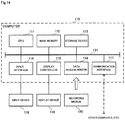
- FIG. 14 is a block diagram showing an example of a computer that realizes a vibration measurement apparatus and an individual specification apparatus according to an embodiment of the present invention.
- the computer 110 includes a CPU 111, a main memory 112, a storage apparatus 113, an input interface 114, a display controller 115, a data reader/writer 116, and a communication interface 117. These units are connected via a bus 121 so as to be able to perform data communication with each other.
- the CPU 111 loads the programs (codes) according to the present embodiment, which is stored in a storage apparatus 113, to the main memory 112, and implements various types of calculations by executing the programs in a predetermined sequence.
- the main memory 112 is typically a volatile storage apparatus, such as a DRAM (Dynamic Random Access Memory).
- the program according to the present embodiment is provided in a state of being stored in a computer-readable storage medium 120. Note that the programs according to the present embodiment may be distributed over the Internet, which is connected to via the communication interface 117.
- the storage apparatus 113 includes a hard disk drive, as well as a semiconductor storage apparatus such as a flash memory.
- the input interface 114 mediates data transfer between the CPU 111 and an input device 118 such as a keyboard and mouse.
- the display controller 115 is connected to the display apparatus 119 and controls display on the display apparatus 119.
- the data reader/writer 116 mediates data transfer between the CPU 111 and the storage medium 120, and executes reading out of programs from the storage medium 120 and writing of the processing result of the computer 110 in the storage medium 120.
- the communication interface 117 mediates data transfer between the CPU 111 and another computer.
- the storage medium 120 include a general-purpose semiconductor storage device such as a CF (Compact Flash (registered trademark)) and SD (Secure Digital), a magnetic storage medium such as a flexible disk, or an optical storage medium such as a CD-ROM (Compact Disk Read Only Memory).
- CF Compact Flash
- SD Secure Digital
- CD-ROM Compact Disk Read Only Memory
- a walking vibration analysis system comprising:
- the vibration analysis apparatus calculates a difference between the former vibration and the latter vibration or a ratio between the former vibration and the latter vibration, as the characteristic amount.
- the walking vibration analysis system according to Supplementary Note 2, wherein the vibration analysis apparatus calculates a time difference between a start time of the vibration caused by the contact between the heel of the walker and the floor and a start time of the vibration caused by the contact between the toe of the walker and the floor, as the difference.
- the walking vibration analysis system according to any one of Supplementary Notes 1 to 3, wherein the vibration measurement apparatus calculates at least one of displacement and acceleration of a floor surface that occurs accompanying the walking as the vibration.
- the walking vibration analysis system according to any one of Supplementary Notes 1 to 4, wherein the individual specification apparatus includes:
- the walking vibration analysis system further comprising a data update unit configured to update the unique characteristic amount and the range of error, which are registered in the database, using the result of the comparison performed by the data comparison unit and the calculated characteristic amount, wherein if the walker cannot be specified by the data comparison unit, the data update unit registers the reference value and the range of error of a new individual in the database using the calculated characteristic amount.
- a vibration analysis apparatus wherein vibration caused by contact between a heel of a walker and a floor and vibration caused by contact between a toe of the walker and the floor are extracted based on vibration that occurs accompanying walking of the walker, and a characteristic amount unique to the walker is calculated based on a result of comparing the extracted former vibration and latter vibration.
- a walking vibration analysis method comprising
- a walking vibration analysis method wherein in the step (b), the difference between the former vibration and the latter vibration or the ratio between the former vibration and the latter vibration is calculated as the characteristic amount based on the result of the comparison.
- a walking vibration analysis method wherein in the step (b), the time difference between the start time of vibration caused by contact between the heel of the walker and the floor and the start time of vibration caused by contact between the toe of the walker and the floor is calculated as the difference.
- the walker is specified by comparing the characteristic amount calculated in the step (b) with a characteristic amount unique to an individual and an allowed range of error, which are registered in advance for each individual.
- the walking vibration analysis method further including:
- a computer-readable storage medium storing a program including commands for causing a computer to execute:
- Examples of using the present invention include an application of watching over the lifestyle of an elderly person or a child in a home and a security application for detecting home intrusion. Also, the present invention can be used also in an individual verification method used instead of a password, biological verification, and the like.
Landscapes
- Health & Medical Sciences (AREA)
- Life Sciences & Earth Sciences (AREA)
- Physics & Mathematics (AREA)
- Animal Behavior & Ethology (AREA)
- Public Health (AREA)
- Pathology (AREA)
- Engineering & Computer Science (AREA)
- Biomedical Technology (AREA)
- Heart & Thoracic Surgery (AREA)
- Medical Informatics (AREA)
- Molecular Biology (AREA)
- Surgery (AREA)
- General Physics & Mathematics (AREA)
- General Health & Medical Sciences (AREA)
- Biophysics (AREA)
- Veterinary Medicine (AREA)
- Physiology (AREA)
- Dentistry (AREA)
- Oral & Maxillofacial Surgery (AREA)
- Business, Economics & Management (AREA)
- Emergency Management (AREA)
- Measurement Of The Respiration, Hearing Ability, Form, And Blood Characteristics Of Living Organisms (AREA)
- Alarm Systems (AREA)
- Medical Treatment And Welfare Office Work (AREA)
Abstract
Description
- The present invention relates to a walking vibration analysis system, a vibration analysis apparatus, and a walking vibration analysis method for analyzing vibration that occurs due to walking, and furthermore relates to a computer-readable storage medium storing a program for realizing these.
- In recent years, a system in which a sensor is installed in a residence in order to watch over an elderly person when at home, for example, has been proposed. With this kind of system, it is necessary to achieve both the protection of privacy of the resident and identification of the resident. For this reason, in view of the protection of privacy, a method in which the resident is identified using a vibration sensor instead of a camera sensor has been proposed. That is, this is a method of performing identification by extracting a characteristic of an individual from vibration that accompanies walking (hereinafter written as "walking vibration"), which is measured with a vibration sensor installed in a residence.
- Specifically,
Patent Document 1 discloses a system for specifying an individual. The system disclosed inPatent Document 1 extracts a frequency of vibration that occurs due to an action performed by a person in a space, or a period of multiple steps as a characteristic amount of an individual from the measured walking vibration, compares it with frequencies or periods of individuals collected in advance, and specifies the individual. -
Patent Document 2 also discloses a system for specifying an individual. The system disclosed inPatent Document 2 obtains the walking speed and the amplitude peak strength from the measured walking vibration and uses the obtained walking speed and vibration peak strength as the individual information. In general, there is a linear relationship in which if the walking speed increases, the amplitude peak also increases, but the linearity thereof is different depending on the person. The individual specification system disclosed inPatent Document 2 identifies an individual using the fact that the linearity is different depending on the person. - Also, various studies relating to walking have advanced, and for example, Non-Patent
Document 1 reports a vibration response property of a floor during walking. Also, Non-PatentDocument 2 discloses a study about a walking pattern of a healthy person. -
- Patent Document 1:
JP 2004-227053A - Patent Document 2:
JP 2007-304955A -
- Non-Patent Document 1: Hideo WATANABE, Akihiko MATSUOKA, Sho KIMURA, Katsuo INOUE, "Vibration Response Characteristics in Residential Floor Finish Structure by Walking - Study of the residential floor vibration characteristics and floor impact sound insulation performance taking footstep sensation into consideration,
- Non-Patent Document 2: Tetsuo AKIYAMA, Ryo MURATA, Keita MIZUNO, Noboru SEKIYA, "Relationship Between Step Interval, Walking Pattern, and Energy Consumption Amount in a Healthy Person", 2009, Congress of the Japanese Physical Therapy Association
- However, in the system disclosed in
Patent Document 1 orPatent Document 2 above, it is necessary to analyze the walking vibration, and therefore there is a problem in that it is not possible to adapt to changes in the installation location of the apparatus that measures the walking vibration, and identification of a certain individual cannot be realized when the installation location of the apparatus is changed. This is because the frequency characteristic of the walking vibration used inPatent Document 1 and the walking speed and linearity of the amplitude peak using inPatent Document 2 change due to the floor material and structure of the building. - Also, Non-Patent
Document 1 reports that vibration obtained by simulating walking is applied to multiple floor materials (single flooring, dry double floor, flooring, and the like) and the displacement and frequency responses to the impact force are different depending on the floor material. In other words, due to this, it is understood that data for comparison needs to be collected for each floor material and structure of the building in order to perform reliable individual identification corresponding to changes in the installation location of the apparatus that measures the walking vibration in the method for analyzing the walking vibration. Accordingly, the solution to the problem is not practical due to the fact that a large amount of data is required in order to solve the problems inPatent Document 1 andPatent Document 2 above. - An object of the present invention is to solve the above-described problems and to provide a walking vibration analysis system, a vibration analysis apparatus, a walking vibration analysis method, and a program, according to which it is possible to extract a characteristic amount that is needed to identify an individual from walking vibration without being influenced by a building, such as a floor material and structure of a building.
- In order to achieve the above-described object, a walking vibration analysis system according to an aspect of the present invention includes:
- a vibration measurement apparatus configured to measure vibration that occurs accompanying walking of a walker;
- a vibration analysis apparatus configured to extract vibration caused by contact between a heel of the walker and a floor and vibration caused by contact between a toe of the walker and the floor based on the measured vibration, and calculate a characteristic amount unique to the walker based on a result of comparing the extracted former vibration and latter vibration;
- an individual specification apparatus configured to specify the walker using the calculated characteristic amount and a characteristic amount registered in advance for each individual.
- In order to achieve the above-described object, a walking vibration analysis apparatus according to an aspect of the present invention extracts vibration caused by contact between a heel of a walker and a floor and vibration caused by contact between a toe of the walker and the floor based on vibration that occurs accompanying walking of the walker, and calculates a characteristic amount unique to the walker based on a result of comparing the extracted former vibration and latter vibration.
- Also, in order to achieve the above-described object, a walking vibration analysis method according to an aspect of the present invention includes:
- (a) a step of measuring vibration that occurs accompanying walking of a walker;
- (b) a step of extracting vibration caused by contact between a heel of the walker and a floor and vibration caused by contact between a toe of the walker and the floor based on the measured vibration, and calculating a characteristic amount unique to the walker based on a result of comparing the extracted former vibration and latter vibration; and
- (c) a step of specifying the walker using the calculated characteristic amount and a characteristic amount registered in advance for each individual.
- Furthermore, in order to achieve the above-described object, a computer-readable storage medium according to an aspect of the present invention stores a program including commands for causing a computer to execute:
- (a) a step of extracting vibration caused by contact between a heel of a walker and a floor and vibration caused by contact between a toe of the walker and the floor based on vibration that occurs accompanying walking of the walker; and
- (b) a step of calculating a characteristic amount unique to the walker based on a result of comparing the extracted former vibration and latter vibration.
- As described above, according to the present invention, a characteristic amount that is needed for identification of an individual can be extracted from a walking vibration without being influenced by a building, such as a floor material and structure of a building.
-
-
FIG. 1 is a block diagram showing a schematic configuration of a walking vibration analysis system according to an embodiment of the present invention. -
FIG. 2 is a block diagram more specifically showing a walking vibration analysis system and a vibration analysis apparatus according to an embodiment of the present invention. -
FIG. 3 is a diagram showing an example of acceleration measured in the present embodiment. -
FIG. 4 is a diagram showing accelerations for each individual measured in the present embodiment, andFIGS. 4(a) and 4(b) show accelerations measured based on different walkers. -
FIG. 5 is a diagram showing an example of a schema for configuring a database in an embodiment of the present invention. -
FIG. 6 is a flowchart showing operations of a vibration measurement apparatus and a vibration analysis apparatus according to an embodiment of the present invention. -
FIG. 7 is a diagram showing a specific example of vibration start times for heel-floor contact and toe-floor contact, extracted from the acceleration shown inFIG. 5(a) . -
FIG. 8 is a diagram showing a specific example of vibration start times for heel-floor contact and toe-floor contact, extracted from the acceleration shown inFIG. 5(b) . -
FIG. 9 is a diagram showing results of determining the start of vibration in the acceleration waveforms shown inFIGS. 5(a) and 5(b) ,FIG. 9(a) corresponding toFIG. 5(a) , andFIG. 9(b) corresponding toFIG. 5(b) . -
FIG. 10 is a flowchart showing operations of an individual specification apparatus according to an embodiment of the present invention. -
FIG. 11 is a diagram showing an example of information stored in a database according to the present embodiment. -
FIG. 12 shows a state after updating the information shown inFIG. 11 . -
FIG. 13 is a block diagram showing a configuration of a modified example of a walking vibration analysis system according to an embodiment of the present invention. -
FIG. 14 is a block diagram showing an example of a computer that realizes a vibration measurement apparatus and an individual specification apparatus according to an embodiment of the present invention. - Hereinafter, a walking vibration analysis system, a vibration analysis apparatus, a walking vibration analysis method, and a program according to an embodiment of the present invention will be described with reference to
FIGS. 1 to 14 . - First, a schematic configuration of a walking vibration analysis system will be described with reference to
FIG. 1. FIG. 1 is a block diagram showing a schematic configuration of a walking vibration analysis system according to an embodiment of the present invention. - A walking
vibration analysis system 4 according to the present embodiment, which is shown inFIG. 1 , is a system for specifying a walker from vibration generated accompanying walking of a walker. As shown inFIG. 1 , the walkingvibration analysis system 4 includes avibration measurement apparatus 1, avibration analysis apparatus 3, and anindividual specification apparatus 2. - Among these, the
vibration measurement apparatus 1 measures vibration that is generated accompanying walking of a walker. Thevibration analysis apparatus 3 extracts vibration caused by contact between the heel of the walker and the floor, and vibration caused by contact between the toe of the walker and the floor, based on the measured vibration. Also, thevibration analysis apparatus 3 calculates a characteristic amount unique to the walker based on a result of comparing the extracted former vibration and latter vibration. Also, theindividual specification apparatus 2 specifies the walker using the calculated characteristic amount and characteristic amounts registered for each individual in advance. - Usually, when a walker walks on a floor, identical response characteristics caused by the floor material and structure of a building appear in the vibration caused by contact between the heel and the floor and the vibration caused by contact between the toe of the walker and the floor. In contrast to this, in the present embodiment, the characteristic amount is obtained from a result of comparing the vibration caused by contact between the heel of the walker and the floor and the vibration caused by the toe of the walker and the floor, and therefore the influence of the response characteristic is eliminated from the characteristic amount. For this reason, according to the present embodiment, a characteristic amount that is needed for identifying an individual from the walking vibration can be extracted without being influenced by a building, such as a floor material and a structure of the building.
- Next, configurations of the walking
vibration analysis system 4 and thevibration analysis apparatus 3 according to the present embodiment will be described more specifically with reference toFIG. 2. FIG. 2 is a block diagram more specifically showing a configuration of a walking vibration analysis system according to an embodiment of the present invention. - As shown in
FIG. 2 , in the present embodiment, thevibration analysis apparatus 3 is incorporated inside of thevibration measurement apparatus 1 and functions as a characteristic amount extraction unit. Accordingly, in the following description, thevibration analysis apparatus 3 is described as a characteristicamount extraction unit 3 in some cases. - Also, in the present embodiment, the
vibration measurement apparatus 1 is installed on a floor surface and is connected by wire or wirelessly to theindividual specification apparatus 2. The walkingvibration analysis system 4 specifies a person who has walked in the periphery of thevibration measurement apparatus 1. - Also, as shown in
FIG. 2 , thevibration measurement apparatus 1 includes avibration measurement unit 11, the above-described characteristicamount extraction unit 3, and acommunication unit 12. - The
vibration measurement unit 11 measures at least one of displacement and acceleration that occur accompanying walking on the floor surface on which thevibration measurement apparatus 1 is installed, as the walking vibration, and performs notification of the walking vibration information for specifying the measured walking vibration to the characteristicamount extraction unit 3. - The
vibration measurement unit 11 includes a sensor for detecting vibration. Note that the type of the sensor is not particularly limited, and examples of the sensor include acceleration sensors and displacement sensors, which are commonly in circulation. Also, the walking vibration information is determined according to the type of the sensor included in thevibration measurement unit 11. For example, if the sensor is an acceleration sensor, the acceleration applied to the floor surface is used as the walking vibration information. Also, if the sensor is a displacement sensor, the displacement of the floor surface is used as the walking vibration information. Also, the walking vibration information may be output as a digital signal and may be output as an analog signal. - Here, in the following description, an example will be described in which the
vibration measurement unit 11 includes an acceleration sensor that is commonly in circulation. Also, in this example, the walking vibration information is output as a digital signal for specifying the acceleration generated in the floor surface accompanying walking. Specific examples of acceleration sensors include a MEMS acceleration sensor manufactured by Analog Devices Corporation. - In the present embodiment, the characteristic amount extraction unit (vibration analysis apparatus) 3 extracts the vibration caused by contact between the heel of the walker and the floor and the vibration caused by contact between the toe of the walker and the floor from the walking vibration information from the
vibration measurement unit 11. Also, by comparing the two, the characteristicamount extraction unit 3 calculates a relative value, such as the difference between the two or the ratio of the two, such that the influence of the response characteristic of the floor material and structure of the building is eliminated, and the result of this calculation is used as the characteristic amount. Also, the characteristicamount extraction unit 3 performs notification of the calculated characteristic amount (hereinafter written as "walking vibration characteristic amount") to thecommunication unit 12. - Here, examples of the difference between the two include a time difference between the time of starting vibration caused by contact between the heel of the walker and the floor and the time of starting vibration caused by contact between the toe of the walker and the floor. Also, examples of a ratio of the two include an intensity ratio between the amplitude peak of vibration caused by the contact between the heel of the walker and the floor and the amplitude peak of vibration caused by the contact between the toe of the walker and the floor. Note that in the following description, the time difference between the time of starting vibration caused by the contact between the heel and the floor and the time of starting vibration caused by the contact between the toe and the floor is used as the walking vibration characteristic amount.
- Also, the above-described
Non-Patent Document 2 reports that the distance between the heel and the toe does not change radically, and furthermore, that even when the walking speed changes, the walking speed is adjusted by a factor other than the distance between the heel and toe (step width and pace). Accordingly, it can be expected that the walking vibration characteristic amount used in the present embodiment is a characteristic amount that changes little. Also, in the present embodiment, measurement error and chronological change are reflected in the system with comparison processing performed by a later-describeddata comparison unit 23 of theindividual specification apparatus 2 using the error information and update processing of data in thedata update unit 25. -
FIG. 3 is a diagram showing an example of acceleration measured in the present embodiment.FIG. 3 shows a typical example of acceleration in the walking vibration measured by thevibration measurement unit 11. Also,FIG. 3 shows two prominent vibrations, namely vibration caused by contact between the heel and the floor (hereinafter also written as "heel-floor contact") and vibration caused by contact between the toe and the floor (hereinafter also written as "toe-floor contact"). The prominent vibration on the left side of the drawing is vibration at the time of heel-floor contact, and the prominent vibration on the right side of the drawing is vibration at the time of toe-floor contact. - Furthermore, in
FIG. 3 , the timings of heel-floor contact, the start of vibration at the time of heel-floor contact, toe-floor contact, and the start of vibration at the time of toe-floor contact are displayed schematically. Also, as shown inFIG. 3 , the transmission time from when the force is applied to the floor material to when the vibration is transmitted to the acceleration sensor depends on the floor material, and when the transmission time is set as Δt, the followingEquations 

- As in the present embodiment, when the walking vibration characteristic amount is set as the time difference between the starts of vibration of the heel-floor contact and the toe-floor contact, the walking vibration characteristic amount can be calculated using the following
Equation 3.
- Accordingly, the walking vibration characteristic amount is a relative value obtained by eliminating Δt, which is influenced by the floor material, and is a characteristic value that depends only on the walking characteristic of the individual.
- Also,
FIG. 4 is a diagram showing accelerations for each individual measured in the present embodiment,FIGS. 4(a) and 4(b) showing accelerations measured from different walkers. As shown inFIGS. 4(a) and 4(b) , even if the individuals are different, the waveforms of the accelerations are similar, and two prominent vibrations can be seen in each waveform. - As described above, the characteristic
amount extraction unit 3 extracts the vibration start point of the heel-floor contact and the vibration start point of the toe-floor contact from the acceleration shown inFIGS. 3 ,4(a), 4(b) , and the like. The extraction of the vibration start points can be performed by determining whether the floor state is vibrating or still, using the variance value of the acceleration values. - Specifically, for example, the acceleration sensor has an output error that conforms to a normal distribution with a deviation A. In this case, it can be expected that the variance value of the acceleration values measured when the floor is still falls within a multiple of A2 at most. The upper limit value in the still state is defined as a still-time threshold. Accordingly, each time the acceleration is newly transferred from the
vibration measurement unit 11, the characteristicamount extraction unit 3 calculates a variance value according to the value of the transferred acceleration and multiple prior values of acceleration. Also, if the variance value is not less than the still-time threshold, the characteristicamount extraction unit 3 determines that the floor surface is vibrating, and furthermore, if the variance value is less than the still-time threshold value after determining that the floor surface is vibrating, the characteristicamount extraction unit 3 determines that the floor surface is still. Through this kind of processing, the vibration start point of heel-floor contact and the vibration start point of toe-floor contact are extracted. - The
communication unit 12 transmits the walking vibration characteristic amount calculated by the characteristicamount extraction unit 3 to theindividual specification apparatus 2. Also, in the present embodiment, the method of communication performed by thecommunication unit 12 may be by wire or wireless. Furthermore, the communication protocol that is used may be an existing communication protocol or a unique communication protocol. - Also, as shown in
FIG. 2 , in the present embodiment, theindividual specification apparatus 2 includes acommunication unit 21, adatabase 22, adata comparison unit 23, anoutput unit 24, adatabase update unit 25, and an individualidentifier input unit 26. - The
communication unit 21 receives the walking vibration characteristic amount from thevibration measurement apparatus 1 and sends the received walking vibration characteristic amount to thedata comparison unit 23. - For each user, in advance, the
database 22 registers information that is necessary for specifying an individual from the walking vibration characteristic amount, that is, the walking vibration characteristic amount unique to the individual and the allowable range of error. Specifically, thedatabase 22 is configured using the following schema, which is shown inFIG. 5. FIG. 5 is a diagram showing an example of a schema configuring a database in an embodiment of the present invention. - As shown in
FIG. 5 , thedatabase 22 includes individual identifier T221, individual walking vibration characteristic amount T222, error information T223, and statistical information T224 as fields, and stores information of an individual in each field. - Among these, individual identifier T221 stores information uniquely specifying an individual, such as an ID or user name. Individual walking vibration characteristic amount T222 stores walking vibration characteristic amounts measured for each individual. Error information T223 stores the error in the individual walking vibration characteristic amount, such as a variance value obtained when the individual walking vibration characteristic amount is derived from multiple samples. Statistical information T224 stores statistical information that is needed for updating the walking vibration characteristic amount and the error information, such as a sample count for when the individual walking vibration characteristic amount is derived from multiple samples.
- Also, the format of the
database 22 is not particularly limited, and any format, such as a hierarchical format, a network format, or a relational format, may be used there as. Furthermore, each field may include multiple elements. For example, error values that differ according to the range of values of the walking vibration characteristic amount may be stored in the error information. The sample counts, as well as sum totals or squared sum totals, or the like, may be stored in the statistical information. - Note that in the following description, it is assumed that the user name is used as the individual identifier. Also, it is assumed that the average value of multiple samples for the time difference between the start time of vibration caused by heel-floor contact and the start time of vibration caused by toe-floor contact as the individual walking vibration characteristic amount. Furthermore, it is assumed that the variance value of the individual walking vibration characteristic amount is used as the error information and the sample count and squared sum total of the individual walking vibration characteristic amounts are used as the statistical information.
- The
data comparison unit 23 compares the walking vibration characteristic amount sent from thecommunication unit 21 with the individual walking vibration characteristic amount and the error information stored in thedatabase 22. Also, if there is a match as a result of the comparison, thedatabase comparison unit 23 specifies the walker using the individual identifier that corresponds to the matched walking vibration characteristic amount. On the other hand, if there is no match, thedata comparison unit 23 determines that the comparison result is not applicable. - Specifically, the
data comparison unit 23 obtains a difference between the walking vibration characteristic amount sent from thecommunication unit 21 and the individual walking vibration characteristic amount stored in thedatabase 22, and determines whether or not the obtained difference falls within the range of the variance value (error). - If it is determined that the difference falls within the range of the variance value, the
data comparison unit 23 uses the corresponding user ID as the comparison result. In this case, thedata comparison unit 23 sends the comparison result to theoutput unit 24. Also, thedata comparison unit 23 sends the comparison result and the walking vibration characteristic amount to thedatabase update unit 25. - On the other hand, if it is determined that the difference does not fall within the range of the variance value, the
data comparison unit 23 determines that the comparison result is not applicable. In this case as well, thedata comparison unit 23 sends the comparison result and the walking vibration characteristic amount to thedatabase update unit 25. - The
output unit 24 outputs the comparison result from thedata comparison unit 23. The output destination of output performed by theoutput unit 24 is not particularly limited, and may be a display apparatus such as a liquid crystal display, or an external terminal apparatus connected by a network or the like. Also, in the latter case, the connection with the terminal apparatus may be wired or wireless, and the communication protocol used for the communication of the terminal apparatus may be an existing communication protocol or a unique communication protocol. - When the
database update unit 25 receives the comparison result and the walking vibration characteristic amount sent from thedata comparison unit 23, thedatabase update unit 25 updates thedatabase 22 using the comparison result and the walking vibration characteristic amount. Specifically, if the walker has been specified by thedata comparison unit 23, thedatabase 22 is updated through statistical processing using the measured walking vibration characteristic amount. - Also, the updating in this case means updating the values for the individual walking vibration characteristic amount, the error information, and the statistical information, which are registered in the
database 22 for the walker who was specified this time, through re-calculation with the measured walking vibration characteristic amounts added. - Specifically, it is assumed that the walking vibration characteristic amounts of N instances prior to the present instance of specification were obtained for the walker who was specified in the present instance. In this case, the individual walking vibration characteristic amount, the error information, and the statistical information of the person registered in the
database 22 are indicated as f(N) using a common sample count N. Also, since the walking vibration characteristic amount of the N+1-th instance is measured in the current instance, the sample count is increased to N+1. The walking vibration characteristic amount, the error information, and the statistical information are set to f(N+1) and registered in thedatabase 22 using a similar function. - Also, in the present embodiment, for example, the average value of the multiple samples is used as the individual walking vibration characteristic amount, and therefore the walking vibration characteristic amount is indicated as f(N)=(sum total of N samples)/N. The error information and the statistical information are similarly indicated by equations in which the sample count N is used.
- On the other hand, if no walker was specified by the
data comparison unit 23, thedatabase update unit 25 requests output of an individual identifier to the individualidentifier input unit 26 in order to newly register the individual walking vibration characteristic amount. When the individualidentifier input unit 26 outputs the individual identifier in response to the request, thedata comparison unit 25 receives the individual identifier and registers the received individual identifier and the new walking vibration characteristic amount in thedatabase 22. - When the output of the individual identifier is requested by the
database update unit 25 as described above, the individualidentifier input unit 26 prompts input of the individual identifier to an external manager or the like. Then, when the individual identifier is input, the individualidentifier input unit 26 transfers the input individual identifier to thedatabase update unit 25. The means for prompting input of the individual identifier to the outside and the means for causing input of the individual identifier is not particularly limited. Examples of these means include an apparatus such as an interactive personal computer, and an external terminal apparatus that holds individual identifiers. - Next, operations of the walking
vibration analysis system 4 according to an embodiment of the present embodiment will be described with reference toFIGS. 6 to 12 . Also, in the present embodiment, the walking vibration analysis method is implemented by causing the walkingvibration analysis system 4 to operate. Accordingly, the description of the walking vibration analysis method of the present embodiment is substituted with the following description of the operation of the walkingvibration analysis system 4. Also, in the following description,FIGS. 1 to 4 are referenced as appropriate. - First, the operations of the
vibration measurement apparatus 1 and thevibration analysis apparatus 3 will be described with reference toFIG. 6. FIG. 6 is a flow chart showing operations of the vibration measurement apparatus and the vibration analysis apparatus according to the embodiment of the present invention. First, it is presupposed that in thevibration measurement apparatus 1, thevibration measurement unit 11 outputs the measurement values (walking vibration information) of the acceleration sensor in a setting interval. In this state, the processing shown inFIG. 6 is performed. - As shown in
FIG. 6 , first, the characteristicamount extraction unit 3 executes initialization processing (step S1). Specifically, the characteristicamount extraction unit 3 uses n times A2 as the operation threshold, and N as the measurement point count to be used in the calculation of the variance value, and in the initial state, the floor surface is still, with no walking vibration being applied. Note that n is a real number larger than 0 that is obtained in advance, and N is a positive number that is determined in advance. - Next, the characteristic
amount extraction unit 3 sets the value of a variable j to 0 (step S2). Then, each time thevibration measurement unit 11 newly measures acceleration and outputs a measurement value, the characteristicamount extraction unit 3 stores the j-th measurement value aj (step S3), increases the value of variable j by 1 (step S4), and determines whether or not the value of variable j is greater than or equal to N (step S5). - If it is determined in step S5 that the value of the variable j is greater than or equal to N, the characteristic
amount extraction unit 3 once again executes step S3 at a timing at which the measurement value is output. On the other hand, if it is determined in step S5 that the value of the variable j is greater than or equal to N, N or more measurement points used in the calculation of the variance value are accumulated, and the calculation of the variance value becomes possible, and therefore the characteristicamount extraction unit 3 calculates an average value m and a variance value V of acceleration (measurement value) using the followingEquations 4 and 5 (step S6).

- Next, the characteristic
amount extraction unit 3 determines whether or not the variance value V is greater than or equal to the still-time threshold nA2 (step S7). If it is determined in step S7 that the variance value V is greater than or equal to the still-time threshold value nA2, the characteristicamount extraction unit 3 further determines whether or not the immediately-previous floor state is still (step S8). - If it is determined in step S8 that the immediately-previous floor state is not still, no change in the floor state has occurred, and therefore the characteristic
amount extraction unit 3 once again executes step S3. On the other hand, if it is determined in step S8 that the immediately-previous floor state is still, the characteristicamount extraction unit 3 determines whether or not the time of the vibration start point of the heel-floor contact has not been measured (step S9). - If it is determined in step S9 that the time of starting vibration in the heel-floor contact has not been measured, it thought that the vibration that has newly occurred is due to heel-floor contact, and the characteristic
amount extraction unit 3 stores the current time as the time of starting vibration of the heel-floor contact (step S10). Next, in this case, it is considered that vibration has newly occurred due to heel-floor contact, and the characteristicamount extraction unit 3 determines that the floor state is vibrating (step S11). - On the other hand, if it is determined in step S9 that the time of the vibration start point of heel-floor contact is not unmeasured (if the time of starting vibration of heel-floor contact has been measured), it is thought that the newly-occurring vibration is caused by toe-floor contact, and the characteristic
amount extraction unit 3 stores the current time as a time of starting vibration of toe-floor contact (step S12). - Next, after executing step S12, the times of starting vibration for heel-floor contact and toe-floor contact have been acquired, and therefore the characteristic
amount extraction unit 3 calculates the difference between the two and stores the result as the walking vibration characteristic amount (step S13). - Next, after extracting the walking vibration characteristic amount in step S13, the characteristic
amount extraction unit 3 once again stores the time of starting vibration of heel-floor contact, and therefore sets the vibration start time to unmeasured (step S14). Thereafter, in this case, the vibration is considered to have newly occurred due to toe-floor contact, and the characteristicamount extraction unit 3 determines that the floor state is vibrating (step S11). - Also, if it is determined in step S7 above that the variance value V is less than the still threshold nA2, the characteristic
amount extraction unit 3 further determines whether or not the immediately-previous floor state is vibrating (step S 15). - If it is determined in step S15 that the immediately-previous floor state is not vibrating, no change in the floor state has occurred, and therefore the characteristic
amount extraction unit 3 once again executes step S3. On the other hand, if it is determined in step S15 that the immediately-previous floor state is vibrating, the vibration caused by one of heel-floor contact or toe-floor contact is considered to have ended, and thus the characteristicamount extraction unit 3 sets the floor state to still (step S16). - Next, a specific example of the extracted times of starting vibration will be described with reference to
FIGS. 7 and8 .FIG. 7 is a diagram showing a specific example of vibration start times for heel-floor contact and toe-floor contact extracted from the acceleration shown inFIG. 5(a) .FIG. 8 is a diagram showing a specific example of vibration start times for heel-floor contact and toe-floor contact extracted from the acceleration shown inFIG. 5(b) . - Also, in
FIGS. 7 and8 , j indicates the order in which the acceleration values (measurement values) were measured. "Time" indicates the amount of time that has elapsed in units of milliseconds, with the time of measuring the acceleration value in which j=0 set to zero. - In the example of
FIG. 7 , the deviation A of the acceleration sensor is set to A=3, the still-time threshold is set to be 6 (n=6) times A2, which is 54, and the measurement point count N used to calculate the variance value is set to 20. The variance column is constituted by variance values of 20 measurement points' worth of acceleration, which include the 19 immediately-previous measurement points. - In this case, following the flow shown in
FIG. 6 , the floor state transitions from still to vibrating at j=400, from vibrating to still at j=726, from still to vibrating at j=918, and from vibrating to still at j=1100. - Among these, j=400 is determined as the start of vibration for heel-floor contact, and the vibration start time for heel-floor contact is 79.8 milliseconds. j=918 is determined as the start of vibration for toe-floor contact, and the vibration start time for toe-floor contact is 183.4 milliseconds. Accordingly, the time difference between the start of vibration for heel-floor contact and for toe-floor contact, which is the walking vibration characteristic amount, is 103.6 milliseconds.
- Also, in the example of
FIG. 8 , similarly to the example ofFIG. 7 , following the flow shown inFIG. 6 , the vibration start time for heel-floor contact is 129.4 milliseconds and the vibration start time for toe-floor contact is 199.8 milliseconds. Accordingly, the time difference between the start of vibration for heel-floor contact and for toe-floor contact, which is the walking vibration characteristic amount, is 70.4 milliseconds. -
FIG. 9 is a diagram showing the results of determining the vibration start times in the acceleration waveforms shown inFIGS. 5(a) and 5(b) ,FIG. 9(a) corresponding toFIG. 5(a) , andFIG. 9(b) corresponding toFIG. 5(b) . Specifically,FIGS. 9(a) and 9(b) indicate the locations of the starts and ends of vibration for heel-floor contact and toe-floor contact, which were specified through applying the flow shown inFIG. 6 . - Next, the operation of the
individual specification apparatus 2 will be described with reference toFIG. 10. FIG. 10 is a flowchart showing operations of an individual specification apparatus according to an embodiment of the present invention. The operation of theindividual specification apparatus 2 shown inFIG. 10 is started when the walking vibration characteristic amount is sent from thevibration measurement apparatus 1 to theindividual specification apparatus 2. - As shown in
FIG. 10 , thecommunication unit 21 acquires the walking vibration characteristic amount from thevibration measurement apparatus 1 and sends the acquired walking vibration characteristic amount to the data comparison unit 23 (step S21). - Next, the
data comparison unit 23 compares the walking vibration characteristic amount acquired in step S21 with the individual walking vibration characteristic amounts and error information stored in the database 22 (step S22). - Next, based on the result of the comparison, the
data comparison unit 23 determines whether or not the walking vibration characteristic amount acquired in step S21 matches any of the individual walking vibration characteristic amounts stored in the database 22 (step S23). - If it is determined in step S23 that the walking vibration characteristic amount acquired in step S21 matches the walking vibration characteristic amount of an individual stored in the
database 22, thedata comparison unit 23 specifies the walker using the individual information corresponding to the matching walking vibration characteristic amount (step S24). - Also, in step S24, the
data comparison unit 23 sends the corresponding user ID as the comparison result to theoutput unit 24. Accordingly, theoutput unit 24 outputs the comparison result from the data comparison unit 23 (step S25). Also, thedata comparison unit 23 sends the comparison result and the walking vibration characteristic amount to thedatabase update unit 25. - Next, when step S25 is executed, the
database update unit 25 receives the comparison result and the walking vibration characteristic amount sent from thedatabase comparison unit 23 and updates thedatabase 22 using the comparison result and the walking vibration characteristic amount (step S26). Specifically, through statistical processing using the measured walking vibration characteristic amount, thedatabase update unit 25 re-calculates the individual walking vibration characteristic amount, the error information, and the statistical information registered in thedatabase 22 in advance. Then, thedatabase update unit 25 updates thedatabase 22 with the obtained values. - On the other hand, if it is determined in step S23 that the walking vibration characteristic amount acquired in step S21 does not match the individual walking vibration characteristic amount stored in the
database 22, thedata comparison unit 23 determines that the comparison result is not applicable. In this case as well, thedata comparison unit 23 sends the comparison result and the walking vibration characteristic amount to thedatabase update unit 25. - Thereafter, step S27 is executed. In step S27, the
database update unit 25 receives the comparison result and the walking vibration characteristic amount sent from thedatabase comparison unit 23 and updates thedatabase 22 using the comparison result and the walking vibration characteristic amount. Specifically, thedatabase update unit 25 requests output of the individual identifier to the individualidentifier input unit 26 and registers the output individual identifier and the new walking vibration characteristic amount obtained in step S21 in association with each other in thedatabase 22. - Here, steps S21 to S26 above will be described with reference to
FIGS. 11 and12 .FIG. 11 is a diagram showing an example of information stored in a database according to the present embodiment.FIG. 12 shows a state after updating the data shown inFIG. 11 . - As shown in
FIG. 11 , thedatabase 22 stores user IDs as individual identifiers, and stores the average values of multiple samples of time differences between the start of vibration for heel-floor contact and the start of vibration for toe-floor contact as the individual walking vibration characteristic amounts. Also, thedatabase 22 stores the variance values of the individual walking vibration characteristic amounts as the error information and stores the sample counts and squared sum totals of the individual walking vibration characteristic amounts as the statistical information. - The
data comparison unit 23 determines whether or not the walking vibration characteristic amounts received from thevibration measurement apparatus 1 and the individual walking vibration characteristic amounts stored in thedatabase 22 match within the range of the error. - Also, if it is assumed that the acceleration shown in
FIG. 4(a) above is measured and the walking vibration characteristic amount is 103.6 milliseconds, the walking vibration characteristic amount is determined as matching the walking vibration characteristic amount 105 milliseconds of user C inFIG. 11 within the range of the error 6.6 milliseconds. Also, if it is assumed that the acceleration shown in the example ofFIG. 4(b) above is measured and the walking vibration characteristic amount is 70.4 milliseconds, the walking vibration characteristic amount is determined as matching the walking vibration characteristic amount 65 of user A within the range of the error 7.8 milliseconds. Accordingly, the user C and the user A are the respective comparison results for the walking vibrations shown inFIGS. 4(a) and 4(b) . Thereafter, theoutput unit 24 outputs the comparison result output by thedata comparison unit 23. - Also, if an individual was specified as a result of the comparison performed by the
data comparison unit 23, thedatabase update unit 25 updates thedatabase 22 using the walking vibration characteristic amount. Here, the information accumulated in thedatabase 22 is the sample count N, the individual walking vibration characteristic amount TN, a variance value VN of the individual walking vibration characteristic amount, and a squared sum total SN. Thedata comparison unit 23 updates these pieces of information using the information of the individual specified by the above-described processing. - Also, the walking vibration characteristic amount from the
vibration measurement apparatus 1 used for comparison is set as T. When thedatabase 22 is updated, thedatabase update unit 25 uses a commonly-known method for sequentially calculating average values and variance values. First, thedatabase update unit 25 updates the sample count to N+1 and the squared sum total to SN+1=SN+T2. Next, thedatabase update unit 25 updates the individual walking vibration characteristic amount to TN+1=(N×TN+T)/(N+1). - Finally, the
database update unit 25 updates the variance value using VN+1=(SN+1-(N+1)×TN+1 2)/(N+1). In this manner, the most recent walking vibration characteristic amount is reflected in thedatabase 22. - With the example of
FIG. 4(a) above, the comparison result is the user C, and therefore inFIG. 11 , the sample count N = 10, the walking vibration characteristic amount TN = 105.0 milliseconds, the variance value VN of the individual walking vibration characteristic amount = 6.6, and the squared sum total SN = 110316.0. Also, the walking vibration characteristic amount from thevibration measurement apparatus 1 satisfies T = 103.6 milliseconds. - When these values are used, as shown in
FIG. 11 , the updated values are calculated such that the sample count N+1 = 11, the walking vibration characteristic amount TN+1 = 104.9 milliseconds, the variance value VN+1 of the individual walking vibration characteristic amount = 6.2, and the squared sum total SN+1 = 121049.0. - If the result of the comparison performed by the
data comparison unit 23 is not applicable, thedatabase update unit 25 requests a newly-associated user ID to the individualidentifier input unit 26. In this case, the individualidentifier input unit 26 prompts external input of a user ID, and upon obtaining a user ID, the individualidentifier input unit 26 transfers the user ID to thedatabase update unit 25. - If an individual was not specified as a result of the comparison performed by the
data comparison unit 23, thedatabase update unit 25 registers the user ID of the individualidentifier input unit 26 and the walking vibration characteristic amount of thevibration measurement apparatus 1 in thedatabase 22. Note that in this registration, the sample count is 1, and therefore the initial value for the variance value is a fixed value or a value that is set with reference to the variance value of another user. - As described above, according to the present embodiment, a characteristic amount that is needed for identification of an individual can be extracted from a walking vibration without being influenced by a building, such as a floor material and structure of a building. Also, a newly-calculated characteristic amount is added, and the registered characteristic amount of an individual is re-calculated, and therefore it is possible to track changes in an individual, such as aging and health. Furthermore, in order to prevent being influenced by a building, such as the floor material and structure of a building, it is not necessary to increase the number of sensors, and therefore an increase in cost caused by an increase in the number of sensors is also suppressed.
- Next, a modified example of the walking vibration analysis system according to the embodiment of the present invention will be described with reference to
FIG. 13. FIG. 13 is a block diagram showing a configuration of the modified example of the walking vibration analysis system according to the embodiment of the present invention. - In the example shown in
FIG. 2 , thevibration analysis apparatus 3 is incorporated in thevibration measurement apparatus 1 and functions as the characteristicamount extraction unit 3 in thevibration measurement apparatus 1. However, thevibration analysis apparatus 3 does not necessarily need to be incorporated in thevibration measurement apparatus 1 and may be incorporated in theindividual specification apparatus 2 as long as the walking vibration information can be obtained as an input. -
FIG. 13 shows an example in which the vibration measurement apparatus (characteristic amount extraction unit) 3 is incorporated in theindividual specification apparatus 2. In the case of using the configuration shown inFIG. 13 , thevibration measurement apparatus 1 includes only thevibration measurement unit 11 and thecommunication unit 12. Thecommunication unit 12 transmits the walking vibration information measured by thevibration measurement unit 11 to theindividual specification apparatus 2. - Also, as shown in
FIG. 13 , unlike the example shown inFIG. 2 , theindividual specification apparatus 2 newly includes the characteristicamount extraction unit 3. For this reason, upon receiving the walking vibration information, thecommunication unit 21 transfers the received walking vibration information to the characteristicamount extraction unit 3. Similarly to the example ofFIG. 2 , the characteristicamount extraction unit 3 calculates the walking vibration characteristic amount in accordance with the flow shown inFIG. 6 . Thereafter, the characteristicamount extraction unit 3 transfers the calculated walking vibration characteristic amount to thedata comparison unit 23. Upon receiving the walking vibration characteristic amount, steps S21 to S26 shown inFIG. 10 are executed by thedata comparison unit 23, thedata update unit 25, and the individualidentification input unit 26. - According to the present modified example, only the
vibration measurement unit 11 and thecommunication unit 12 need be mounted in thevibration measurement apparatus 1, and therefore general-purpose sensors that can measure vibration (an acceleration sensor, a displacement sensor, etc.) can be used as thevibration measurement apparatus 1 without adding a special installation. That is, according to the present modified example, the cost relating to the structure of the vibration measurement apparatus can be reduced. Also, since the flow for extracting the walking vibration characteristic amount shown inFIG. 6 is concentrated in theindividual specification apparatus 2, maintainability increases, and the cost related to maintenance can also be reduced. - A first program according to the present embodiment need only be a program that causes a computer to execute steps S1 to S16 shown in
FIG. 6 . Thevibration analysis apparatus 3 according to the present embodiment can be realized by installing this program in a computer and executing it. In this case, the CPU (Central Processing Unit) of the computer functions as thevibration analysis apparatus 3 and performs processing. - Also, a second program according to the present embodiment need only be a program that causes a computer to execute steps S21 to S27 shown in
FIG. 10 . Theindividual specification apparatus 2 according to the present embodiment can be realized by installing this program in a computer and executing it. In this case, the CPU (Central Processing Unit) of the computer functions as thecommunication unit 21, thedata comparison unit 23, thedatabase update unit 25, and the individualidentifier input unit 26, and performs processing. - Here, an example of a computer that can execute the first and second programs according to the present embodiment will be described with reference to
FIG. 14. FIG. 14 is a block diagram showing an example of a computer that realizes a vibration measurement apparatus and an individual specification apparatus according to an embodiment of the present invention. - As shown in
FIG. 14 , thecomputer 110 includes aCPU 111, amain memory 112, astorage apparatus 113, aninput interface 114, adisplay controller 115, a data reader/writer 116, and acommunication interface 117. These units are connected via abus 121 so as to be able to perform data communication with each other. - The
CPU 111 loads the programs (codes) according to the present embodiment, which is stored in astorage apparatus 113, to themain memory 112, and implements various types of calculations by executing the programs in a predetermined sequence. Themain memory 112 is typically a volatile storage apparatus, such as a DRAM (Dynamic Random Access Memory). Also, the program according to the present embodiment is provided in a state of being stored in a computer-readable storage medium 120. Note that the programs according to the present embodiment may be distributed over the Internet, which is connected to via thecommunication interface 117. - Also, specific examples of the
storage apparatus 113 include a hard disk drive, as well as a semiconductor storage apparatus such as a flash memory. Theinput interface 114 mediates data transfer between theCPU 111 and aninput device 118 such as a keyboard and mouse. Thedisplay controller 115 is connected to thedisplay apparatus 119 and controls display on thedisplay apparatus 119. - The data reader/
writer 116 mediates data transfer between theCPU 111 and thestorage medium 120, and executes reading out of programs from thestorage medium 120 and writing of the processing result of thecomputer 110 in thestorage medium 120. Thecommunication interface 117 mediates data transfer between theCPU 111 and another computer. - Also, specific examples of the
storage medium 120 include a general-purpose semiconductor storage device such as a CF (Compact Flash (registered trademark)) and SD (Secure Digital), a magnetic storage medium such as a flexible disk, or an optical storage medium such as a CD-ROM (Compact Disk Read Only Memory). - A portion or all of the above-described embodiment can be expressed using
Supplementary Notes 1 to 16, which will be described below, but there is no limitation to the following description. - A walking vibration analysis system comprising:
- a vibration measurement apparatus configured to measure vibration that occurs accompanying walking of a walker;
- a vibration analysis apparatus configured to extract vibration caused by contact between a heel of the walker and a floor and vibration caused by contact between a toe of the walker and the floor based on the measured vibration, and calculate a characteristic amount unique to the walker based on a result of comparing the extracted former vibration and latter vibration;
- an individual specification apparatus configured to specify the walker using the calculated characteristic amount and a characteristic amount registered in advance for each individual.
- The walking vibration analysis system according to
Supplementary Note 1, wherein based on the result of the comparison, the vibration analysis apparatus calculates a difference between the former vibration and the latter vibration or a ratio between the former vibration and the latter vibration, as the characteristic amount. - The walking vibration analysis system according to
Supplementary Note 2, wherein
the vibration analysis apparatus calculates a time difference between a start time of the vibration caused by the contact between the heel of the walker and the floor and a start time of the vibration caused by the contact between the toe of the walker and the floor, as the difference. - The walking vibration analysis system according to any one of
Supplementary Notes 1 to 3, wherein
the vibration measurement apparatus calculates at least one of displacement and acceleration of a floor surface that occurs accompanying the walking as the vibration. - The walking vibration analysis system according to any one of
Supplementary Notes 1 to 4, wherein
the individual specification apparatus includes: - a database in which, for each individual, a characteristic amount unique to the individual and an allowed range of error are registered in advance; and
- a data comparison unit configured to specify the walker by comparing the calculated characteristic amount with the unique characteristic amount and the range of error, which were registered in advance.
- The walking vibration analysis system according to
Supplementary Note 5, further comprising
a data update unit configured to update the unique characteristic amount and the range of error, which are registered in the database, using the result of the comparison performed by the data comparison unit and the calculated characteristic amount,
wherein if the walker cannot be specified by the data comparison unit, the data update unit registers the reference value and the range of error of a new individual in the database using the calculated characteristic amount. - A vibration analysis apparatus, wherein
vibration caused by contact between a heel of a walker and a floor and vibration caused by contact between a toe of the walker and the floor are extracted based on vibration that occurs accompanying walking of the walker, and a characteristic amount unique to the walker is calculated based on a result of comparing the extracted former vibration and latter vibration. - A walking vibration analysis method, comprising
- (a) a step of measuring vibration that occurs accompanying walking of a walker;
- (b) a step of extracting vibration caused by contact between a heel of the walker and a floor and vibration caused by contact between a toe of the walker and the floor based on the measured vibration, and calculating a characteristic amount unique to the walker based on a result of comparing the extracted former vibration and latter vibration; and
- (c) a step of specifying the walker using the calculated characteristic amount and a characteristic amount registered in advance for each individual.
- A walking vibration analysis method according to
Supplementary Note 8, wherein
in the step (b), the difference between the former vibration and the latter vibration or the ratio between the former vibration and the latter vibration is calculated as the characteristic amount based on the result of the comparison. - A walking vibration analysis method according to
Supplementary Note 9, wherein
in the step (b), the time difference between the start time of vibration caused by contact between the heel of the walker and the floor and the start time of vibration caused by contact between the toe of the walker and the floor is calculated as the difference. - The walking vibration analysis method according to any one of
Supplementary Notes 8 to 10, wherein
in the step (a), at least one of displacement and acceleration of a floor surface that occurs due to the walking is measured as the vibration. - The walking vibration analysis method according to any one of
Supplementary Notes 8 to 11, wherein
in the step (c), the walker is specified by comparing the characteristic amount calculated in the step (b) with a characteristic amount unique to an individual and an allowed range of error, which are registered in advance for each individual. - The walking vibration analysis method according to
Supplementary Note 12, further including: - (d) a step of updating the pre-registered unique characteristic amount and range of error using the result of the comparison performed in the step (c) and the calculated characteristic amount; and
- (e) a step of, if the walker cannot be specified in the step (c), registering the reference value and the range of error of a new individual using the characteristic amount calculated in the step (b).
- A computer-readable storage medium storing a program including commands for causing a computer to execute:
- (a) a step of extracting vibration caused by contact between a heel of a walker and a floor and vibration caused by contact between a toe of the walker and the floor based on vibration that occurs accompanying walking of the walker; and
- (b) a step of calculating a characteristic amount unique to the walker based on a result of comparing the extracted former vibration and latter vibration.
- The computer-readable storage medium according to
Supplementary Note 14, wherein
in the step (b), the difference between the former vibration and the latter vibration or the ratio between the former vibration and the latter vibration is calculated as the characteristic amount based on the result of the comparison. - The computer-readable storage medium according to
Supplementary Note 15, wherein
in the step (b), the time difference between the start time of vibration caused by contact between the heel of the walker and the floor and the start time of vibration caused by contact between the toe of the walker and the floor is calculated as the difference. - Note that unless otherwise specified, the scope of the invention is not limited to only the constituent elements, types, combinations, shapes, their relative arrangements, and the like described in this embodiment, and these are merely illustrative examples.
- Although the invention of the present application has been described with reference to an embodiment above, the invention of the present application is not limited to the above-described embodiment. The configurations and details of the invention of the present application can be subjected to various modifications that can be understood by a person skilled in the art within the scope of the invention of the present application.
- This application claims priority based on Japanese Application No.
2016-090726 filed on April 28, 2016 - Examples of using the present invention include an application of watching over the lifestyle of an elderly person or a child in a home and a security application for detecting home intrusion. Also, the present invention can be used also in an individual verification method used instead of a password, biological verification, and the like.
-
- 1
- Vibration measurement apparatus
- 2
- Individual specification apparatus
- 3
- Vibration analysis apparatus (characteristic amount extraction unit)
- 4
- Walking vibration analysis system
- 11
- Vibration measurement unit
- 12
- Communication unit
- 21
- Communication unit
- 22
- Database
- 23
- Data comparison unit
- 24
- Output unit
- 25
- Database update unit
- 26
- Individual identifier input unit
- 110
- Computer
- 111
- CPU
- 112
- Main memory
- 113
- Storage apparatus
- 114
- Input interface
- 115
- Display controller
- 116
- Data recorder/writer
- 117
- Communication interface
- 118
- Input device
- 119
- Display apparatus
- 120
- Storage medium
- 121
- Bus
Claims (9)
- A walking vibration analysis system comprising:a vibration measurement apparatus configured to measure vibration that occurs accompanying walking of a walker;a vibration analysis apparatus configured to extract vibration caused by contact between a heel of the walker and a floor and vibration caused by contact between a toe of the walker and the floor based on the measured vibration, and calculate a characteristic amount unique to the walker based on a result of comparing the extracted former vibration and latter vibration;an individual specification apparatus configured to specify the walker using the calculated characteristic amount and a characteristic amount registered in advance for each individual.
- The walking vibration analysis system according to claim 1, wherein
based on the result of the comparison, the vibration analysis apparatus calculates a difference between the former vibration and the latter vibration or a ratio between the former vibration and the latter vibration, as the characteristic amount. - The walking vibration analysis system according to claim 2, wherein
the vibration analysis apparatus calculates a time difference between a start time of the vibration caused by the contact between the heel of the walker and the floor and a start time of the vibration caused by the contact between the toe of the walker and the floor, as the difference. - The walking vibration analysis system according to any one of claims 1 to 3, wherein
the vibration measurement apparatus calculates at least one of displacement and acceleration of a floor surface that occurs accompanying the walking as the vibration. - The walking vibration analysis system according to any one of claims 1 to 4, wherein
the individual specification apparatus includes:a database in which, for each individual, a characteristic amount unique to the individual and an allowed range of error are registered in advance; anda data comparison unit configured to specify the walker by comparing the calculated characteristic amount with the unique characteristic amount and the range of error, which were registered in advance. - The walking vibration analysis system according to claim 5, further comprising
a data update unit configured to update the unique characteristic amount and the range of error, which are registered in the database, using the result of the comparison performed by the data comparison unit and the calculated characteristic amount,
wherein if the walker cannot be specified by the data comparison unit, the data update unit registers the reference value and the range of error of a new individual in the database using the calculated characteristic amount. - A vibration analysis apparatus, wherein
vibration caused by contact between a heel of a walker and a floor and vibration caused by contact between a toe of the walker and the floor are extracted based on vibration that occurs accompanying walking of the walker, and a characteristic amount unique to the walker is calculated based on a result of comparing the extracted former vibration and latter vibration. - A walking vibration analysis method, comprising(a) a step of measuring vibration that occurs accompanying walking of a walker;(b) a step of extracting vibration caused by contact between a heel of the walker and a floor and vibration caused by contact between a toe of the walker and the floor based on the measured vibration, and calculating a characteristic amount unique to the walker based on a result of comparing the extracted former vibration and latter vibration; and(c) a step of specifying the walker using the calculated characteristic amount and a characteristic amount registered in advance for each individual.
- A computer-readable storage medium storing a program including commands for causing a computer to execute:(a) a step of extracting vibration caused by contact between a heel of a walker and a floor and vibration caused by contact between a toe of the walker and the floor based on vibration that occurs accompanying walking of the walker; and(b) a step of calculating a characteristic amount unique to the walker based on a result of comparing the extracted former vibration and latter vibration.
Applications Claiming Priority (2)
| Application Number | Priority Date | Filing Date | Title |
|---|---|---|---|
| JP2016090726 | 2016-04-28 | ||
| PCT/JP2017/016867 WO2017188418A1 (en) | 2016-04-28 | 2017-04-27 | Walk vibration analyzing system, vibration analyzing device, walk vibration analyzing method, and computer-readable recording medium |
Publications (2)
| Publication Number | Publication Date |
|---|---|
| EP3449823A1 true EP3449823A1 (en) | 2019-03-06 |
| EP3449823A4 EP3449823A4 (en) | 2019-12-11 |
Family
ID=60159845
Family Applications (1)
| Application Number | Title | Priority Date | Filing Date |
|---|---|---|---|
| EP17789699.0A Withdrawn EP3449823A4 (en) | 2016-04-28 | 2017-04-27 | Walk vibration analyzing system, vibration analyzing device, walk vibration analyzing method, and computer-readable recording medium |
Country Status (3)
| Country | Link |
|---|---|
| EP (1) | EP3449823A4 (en) |
| JP (1) | JP6780868B2 (en) |
| WO (1) | WO2017188418A1 (en) |
Cited By (1)
| Publication number | Priority date | Publication date | Assignee | Title |
|---|---|---|---|---|
| CN113784661A (en) * | 2019-05-07 | 2021-12-10 | 罗姆股份有限公司 | biometric authentication device |
Families Citing this family (3)
| Publication number | Priority date | Publication date | Assignee | Title |
|---|---|---|---|---|
| EP3705040A4 (en) * | 2017-11-02 | 2021-08-18 | NEC Solution Innovators, Ltd. | DEVICE FOR ANALYSIS OF RUNNING VIBRATIONS, METHOD FOR RUNNING VIBRATION ANALYSIS AND COMPUTER-READABLE RECORDING MEDIUM |
| WO2019244647A1 (en) * | 2018-06-20 | 2019-12-26 | コニカミノルタ株式会社 | Computer-executable program, information processing device, and computer-executable method |
| WO2024157625A1 (en) * | 2023-01-27 | 2024-08-02 | 日本電気株式会社 | Monitoring device, monitoring method, and program |
Family Cites Families (4)
| Publication number | Priority date | Publication date | Assignee | Title |
|---|---|---|---|---|
| JP2002197437A (en) * | 2000-12-27 | 2002-07-12 | Sony Corp | Walk detection system, walk detection device, device, walk detection method |
| JP2004227053A (en) * | 2003-01-20 | 2004-08-12 | Yamatake Corp | Life monitoring device |
| CA2520067C (en) * | 2003-04-03 | 2012-07-24 | University Of Virginia Patent Foundation | Method and system for the derivation of human gait characteristics and detecting falls passively from floor vibrations |
| JP4863365B2 (en) * | 2006-05-31 | 2012-01-25 | アニマ株式会社 | Motion analysis system, motion analysis device, and program |
-
2017
- 2017-04-27 WO PCT/JP2017/016867 patent/WO2017188418A1/en not_active Ceased
- 2017-04-27 JP JP2018514726A patent/JP6780868B2/en active Active
- 2017-04-27 EP EP17789699.0A patent/EP3449823A4/en not_active Withdrawn
Cited By (1)
| Publication number | Priority date | Publication date | Assignee | Title |
|---|---|---|---|---|
| CN113784661A (en) * | 2019-05-07 | 2021-12-10 | 罗姆股份有限公司 | biometric authentication device |
Also Published As
| Publication number | Publication date |
|---|---|
| WO2017188418A1 (en) | 2017-11-02 |
| JP6780868B2 (en) | 2020-11-04 |
| JPWO2017188418A1 (en) | 2019-04-04 |
| EP3449823A4 (en) | 2019-12-11 |
Similar Documents
| Publication | Publication Date | Title |
|---|---|---|
| Chen et al. | Analyzing and modeling inter-sensor relationships for strain monitoring data and missing data imputation: a copula and functional data-analytic approach | |
| Jongs et al. | A framework for assessing neuropsychiatric phenotypes by using smartphone-based location data | |
| Thorpe et al. | Development of a sensor-based behavioral monitoring solution to support dementia care | |
| JP6780868B2 (en) | Walking vibration analysis system, vibration analysis device, walking vibration analysis method, and program | |
| Xiao et al. | Indoor tracking using undirected graphical models | |
| Santos et al. | Automatic operational modal analysis of complex civil infrastructures | |
| KR101747848B1 (en) | Server and method for predicting traffic conditions | |
| CN113679380B (en) | Gait monitoring method, device, equipment and storage medium | |
| Mei et al. | Investigation with Bluetooth sensors of bicycle travel time estimation on a short corridor | |
| ATE388435T1 (en) | METHOD AND DEVICES FOR SCALABLE SECURE REMOTE DESKTOP ACCESS | |
| Ozer et al. | Biomechanically influenced mobile and participatory pedestrian data for bridge monitoring | |
| Su et al. | Automatic operational modal analysis of structures based on image recognition of stabilization diagrams with uncertainty quantification | |
| US20170272915A1 (en) | System and method for processing personal identification information based on position information | |
| Fagert et al. | Structural property guided gait parameter estimation using footstep-induced floor vibrations | |
| Nguyen et al. | Long-term vibration monitoring of cable-stayed bridge using wireless sensor network | |
| Nilsson et al. | Performance characterisation of foot-mounted ZUPT-aided INSs and other related systems | |
| Ho et al. | Multiscale acceleration-dynamic strain-impedance sensor system for structural health monitoring | |
| Zhou et al. | Modal parameters identification of bridge by improved stochastic subspace identification method with Grubbs criterion | |
| Li et al. | Fusion of structural damage identification results from different test scenarios and evaluation indices in structural health monitoring | |
| Feng et al. | Bayesian spectral decomposition for efficient modal identification using ambient vibration | |
| TWI861951B (en) | System, non-transitory computer readable medium and method for predicting individual performance in a sporting activity | |
| Mu et al. | Relevance feature selection of modal frequency-ambient condition pattern recognition in structural health assessment for reinforced concrete buildings | |
| JP2014049100A (en) | Learning device, determination device, behavior state determination system, and determination method | |
| JP2012003322A (en) | Group behavior estimation method and program thereof | |
| Sanchez-Lopez et al. | Effect of phase in fast frequency measurements for sensors embedded in robotic systems |
Legal Events
| Date | Code | Title | Description |
|---|---|---|---|
| STAA | Information on the status of an ep patent application or granted ep patent |
Free format text: STATUS: THE INTERNATIONAL PUBLICATION HAS BEEN MADE |
|
| PUAI | Public reference made under article 153(3) epc to a published international application that has entered the european phase |
Free format text: ORIGINAL CODE: 0009012 |
|
| STAA | Information on the status of an ep patent application or granted ep patent |
Free format text: STATUS: REQUEST FOR EXAMINATION WAS MADE |
|
| 17P | Request for examination filed |
Effective date: 20181123 |
|
| AK | Designated contracting states |
Kind code of ref document: A1 Designated state(s): AL AT BE BG CH CY CZ DE DK EE ES FI FR GB GR HR HU IE IS IT LI LT LU LV MC MK MT NL NO PL PT RO RS SE SI SK SM TR |
|
| AX | Request for extension of the european patent |
Extension state: BA ME |
|
| DAV | Request for validation of the european patent (deleted) | ||
| DAX | Request for extension of the european patent (deleted) | ||
| A4 | Supplementary search report drawn up and despatched |
Effective date: 20191107 |
|
| RIC1 | Information provided on ipc code assigned before grant |
Ipc: A61B 5/11 20060101ALI20191101BHEP Ipc: G08B 25/04 20060101ALI20191101BHEP Ipc: G08B 13/02 20060101ALI20191101BHEP Ipc: A61B 5/117 20160101AFI20191101BHEP |
|
| STAA | Information on the status of an ep patent application or granted ep patent |
Free format text: STATUS: THE APPLICATION IS DEEMED TO BE WITHDRAWN |
|
| 18D | Application deemed to be withdrawn |
Effective date: 20200609 |