EP3448839B1 - Quinazoline derivative or its salt and pharmaceutical composition comprising the same - Google Patents
Quinazoline derivative or its salt and pharmaceutical composition comprising the same Download PDFInfo
- Publication number
- EP3448839B1 EP3448839B1 EP17789904.4A EP17789904A EP3448839B1 EP 3448839 B1 EP3448839 B1 EP 3448839B1 EP 17789904 A EP17789904 A EP 17789904A EP 3448839 B1 EP3448839 B1 EP 3448839B1
- Authority
- EP
- European Patent Office
- Prior art keywords
- amino
- phenyl
- quinazoline
- carbonitrile
- oxo
- Prior art date
- Legal status (The legal status is an assumption and is not a legal conclusion. Google has not performed a legal analysis and makes no representation as to the accuracy of the status listed.)
- Active
Links
- YAOLFTBWLVFBGU-UHFFFAOYSA-N FC1=CC=CC2NC=NC(I)=C12 Chemical compound FC1=CC=CC2NC=NC(I)=C12 YAOLFTBWLVFBGU-UHFFFAOYSA-N 0.000 description 1
Images

Classifications
-
- C—CHEMISTRY; METALLURGY
- C07—ORGANIC CHEMISTRY
- C07D—HETEROCYCLIC COMPOUNDS
- C07D239/00—Heterocyclic compounds containing 1,3-diazine or hydrogenated 1,3-diazine rings
- C07D239/70—Heterocyclic compounds containing 1,3-diazine or hydrogenated 1,3-diazine rings condensed with carbocyclic rings or ring systems
- C07D239/72—Quinazolines; Hydrogenated quinazolines
-
- C—CHEMISTRY; METALLURGY
- C07—ORGANIC CHEMISTRY
- C07D—HETEROCYCLIC COMPOUNDS
- C07D403/00—Heterocyclic compounds containing two or more hetero rings, having nitrogen atoms as the only ring hetero atoms, not provided for by group C07D401/00
- C07D403/14—Heterocyclic compounds containing two or more hetero rings, having nitrogen atoms as the only ring hetero atoms, not provided for by group C07D401/00 containing three or more hetero rings
-
- A—HUMAN NECESSITIES
- A61—MEDICAL OR VETERINARY SCIENCE; HYGIENE
- A61K—PREPARATIONS FOR MEDICAL, DENTAL OR TOILETRY PURPOSES
- A61K31/00—Medicinal preparations containing organic active ingredients
- A61K31/33—Heterocyclic compounds
- A61K31/395—Heterocyclic compounds having nitrogen as a ring hetero atom, e.g. guanethidine or rifamycins
- A61K31/495—Heterocyclic compounds having nitrogen as a ring hetero atom, e.g. guanethidine or rifamycins having six-membered rings with two or more nitrogen atoms as the only ring heteroatoms, e.g. piperazine or tetrazines
- A61K31/505—Pyrimidines; Hydrogenated pyrimidines, e.g. trimethoprim
- A61K31/506—Pyrimidines; Hydrogenated pyrimidines, e.g. trimethoprim not condensed and containing further heterocyclic rings
-
- A—HUMAN NECESSITIES
- A61—MEDICAL OR VETERINARY SCIENCE; HYGIENE
- A61K—PREPARATIONS FOR MEDICAL, DENTAL OR TOILETRY PURPOSES
- A61K31/00—Medicinal preparations containing organic active ingredients
- A61K31/33—Heterocyclic compounds
- A61K31/395—Heterocyclic compounds having nitrogen as a ring hetero atom, e.g. guanethidine or rifamycins
- A61K31/495—Heterocyclic compounds having nitrogen as a ring hetero atom, e.g. guanethidine or rifamycins having six-membered rings with two or more nitrogen atoms as the only ring heteroatoms, e.g. piperazine or tetrazines
- A61K31/505—Pyrimidines; Hydrogenated pyrimidines, e.g. trimethoprim
- A61K31/506—Pyrimidines; Hydrogenated pyrimidines, e.g. trimethoprim not condensed and containing further heterocyclic rings
- A61K31/51—Thiamines, e.g. vitamin B1
-
- A—HUMAN NECESSITIES
- A61—MEDICAL OR VETERINARY SCIENCE; HYGIENE
- A61K—PREPARATIONS FOR MEDICAL, DENTAL OR TOILETRY PURPOSES
- A61K31/00—Medicinal preparations containing organic active ingredients
- A61K31/33—Heterocyclic compounds
- A61K31/395—Heterocyclic compounds having nitrogen as a ring hetero atom, e.g. guanethidine or rifamycins
- A61K31/495—Heterocyclic compounds having nitrogen as a ring hetero atom, e.g. guanethidine or rifamycins having six-membered rings with two or more nitrogen atoms as the only ring heteroatoms, e.g. piperazine or tetrazines
- A61K31/505—Pyrimidines; Hydrogenated pyrimidines, e.g. trimethoprim
- A61K31/517—Pyrimidines; Hydrogenated pyrimidines, e.g. trimethoprim ortho- or peri-condensed with carbocyclic ring systems, e.g. quinazoline, perimidine
-
- A—HUMAN NECESSITIES
- A61—MEDICAL OR VETERINARY SCIENCE; HYGIENE
- A61P—SPECIFIC THERAPEUTIC ACTIVITY OF CHEMICAL COMPOUNDS OR MEDICINAL PREPARATIONS
- A61P35/00—Antineoplastic agents
-
- C—CHEMISTRY; METALLURGY
- C07—ORGANIC CHEMISTRY
- C07D—HETEROCYCLIC COMPOUNDS
- C07D217/00—Heterocyclic compounds containing isoquinoline or hydrogenated isoquinoline ring systems
- C07D217/22—Heterocyclic compounds containing isoquinoline or hydrogenated isoquinoline ring systems with hetero atoms or with carbon atoms having three bonds to hetero atoms with at the most one bond to halogen, e.g. ester or nitrile radicals, directly attached to carbon atoms of the nitrogen-containing ring
- C07D217/24—Oxygen atoms
-
- C—CHEMISTRY; METALLURGY
- C07—ORGANIC CHEMISTRY
- C07D—HETEROCYCLIC COMPOUNDS
- C07D239/00—Heterocyclic compounds containing 1,3-diazine or hydrogenated 1,3-diazine rings
- C07D239/70—Heterocyclic compounds containing 1,3-diazine or hydrogenated 1,3-diazine rings condensed with carbocyclic rings or ring systems
- C07D239/72—Quinazolines; Hydrogenated quinazolines
- C07D239/86—Quinazolines; Hydrogenated quinazolines with hetero atoms directly attached in position 4
- C07D239/88—Oxygen atoms
- C07D239/91—Oxygen atoms with aryl or aralkyl radicals attached in position 2 or 3
-
- C—CHEMISTRY; METALLURGY
- C07—ORGANIC CHEMISTRY
- C07D—HETEROCYCLIC COMPOUNDS
- C07D403/00—Heterocyclic compounds containing two or more hetero rings, having nitrogen atoms as the only ring hetero atoms, not provided for by group C07D401/00
- C07D403/02—Heterocyclic compounds containing two or more hetero rings, having nitrogen atoms as the only ring hetero atoms, not provided for by group C07D401/00 containing two hetero rings
- C07D403/04—Heterocyclic compounds containing two or more hetero rings, having nitrogen atoms as the only ring hetero atoms, not provided for by group C07D401/00 containing two hetero rings directly linked by a ring-member-to-ring-member bond
-
- C—CHEMISTRY; METALLURGY
- C07—ORGANIC CHEMISTRY
- C07D—HETEROCYCLIC COMPOUNDS
- C07D403/00—Heterocyclic compounds containing two or more hetero rings, having nitrogen atoms as the only ring hetero atoms, not provided for by group C07D401/00
- C07D403/02—Heterocyclic compounds containing two or more hetero rings, having nitrogen atoms as the only ring hetero atoms, not provided for by group C07D401/00 containing two hetero rings
- C07D403/12—Heterocyclic compounds containing two or more hetero rings, having nitrogen atoms as the only ring hetero atoms, not provided for by group C07D401/00 containing two hetero rings linked by a chain containing hetero atoms as chain links
Definitions
- the present invention relates to a quinazoline derivative or its pharmaceutically acceptable salt having a selective inhibitory activity against the phosphatidylinositol 3-kinase delta subunit, and a pharmaceutical composition comprising the same.
- Phosphatidylinositol 3-kinase a lipid kinase which phosphorylates the lipid at the 3-hydroxy residue of the inositol ring, is known to play a critical role in proliferation, survival, motility and so on of cells.
- Class I PI3Ks PI3K ⁇ , PI3K ⁇ , PI3K ⁇ , and PI3K ⁇ are activated by receptor tyrosine kinases or GPCR (G-protein coupled receptor) to produce PIP3 (phosphatidylinositol 3,4,5-triphosphate), thereby activating the Akt.
- Class I PI3Ks are a heterodimer consisting of a p110 catalytic subunit and a regulatory subunit, and the family is further divided into Class IA and Class IB enzymes on the basis of the regulatory partners and the regulatory mechanisms.
- Class IA enzymes consist of three catalytic subunits (p110 ⁇ , p110 ⁇ and p110 ⁇ ), which dimerize with five regulatory subunits (p85 ⁇ , p55 ⁇ , p50 ⁇ , p85 ⁇ and p55 ⁇ ), where all catalytic subunits are able to interact with all regulatory subunits to form various heterodimers.
- Class IA PI3Ks are generally activated in response to growth factor stimulation of receptor tyrosine kinases via interaction of the regulatory subunit SH2 domain with specific phospho-tyrosine residues of the activated receptor or adapter proteins, such as IRS-1. Both p110 ⁇ and p110 ⁇ are expressed in all cell types, whereas p110 ⁇ expression is more restricted to inflammatory cells including leukocytes and some epithelial cells.
- the only class IB enzyme consists of a p120y catalytic subunit (also commonly referred to as 'p110 ⁇ '), which interacts with a p101 regulatory subunit ( Cell, Vol. 89, 105-114 (1997 )).
- GPCRs G-protein-coupled receptor systems
- PI3K/AKT/mTOR pathway is important for the formation and development of cancer, and mutations in the PIK3CA gene expressing p110 ⁇ , along with PTEN, are frequently observed in cancer. Accordingly, PI3K ⁇ and PI3K ⁇ inhibitors or non-specific class I inhibitors have been developed as a therapeutic agent for carcinomas overexpressing a specific subunit of PI3Ks. Although said inhibitors initially appeared to show some efficacy, it has been revealed to have limited therapeutic effects due to dose-related side effects and resistant mechanisms that activate alternative signals.
- PI3K inhibitors can attack cancer as an anticancer agent, through activating the anti-tumor immune responses. This has been suggested by studies in which the function of the PI3K ⁇ subunit was genetically inhibited through transgenic mice or in which a PI3K ⁇ subunit-specific inhibitor was administered to mice ( Nature 2014, 510: 407-411 ). Suppression of the PI3K ⁇ subunit function in the mouse models of lung cancer, breast cancer and pancreatic cancer inhibited the function of regulatory T cells (Tregs) as well as the migration of Tregs to tumors. It has been demonstrated that suppression of the PI3K ⁇ subunit in animal models inhibits the regulatory T cells, thereby resulting in an anti-tumor immune environment that can inhibit cancer proliferation by host immunity. Therefore, it has been established that the method for specifically inhibiting the PI3K ⁇ subunit can be a mechanism of an immunological anticancer agent which induces immunity against cancer.
- mice In order to identify the role of PI3K ⁇ and PI3K ⁇ , which are important subunits in the function of immune cells, studies have been conducted on mouse models lacking both genes ( Blood, 2007, 110:2940-2947 ). According to the study, knock-out mice lacking both subunits display severe impairment of thymocyte development in the thymus, which leads to lymphopenia-associated inflammatory responses. And also, the other study has also reported that mice deficient in both PI3K ⁇ and PI3K ⁇ subunits have a profound block in T cell development ( J. immunol., 2005, 175:2783-2787 ).
- US 2013/029982 relates to compounds and pharmaceutical compositions that modulate kinase activity, including PI3 kinase activity, and methods of treatment of diseases and conditions associated with kinase activity, including PI3 kinase activity.
- This document appears to relate to the compounds having a substituted quinazoline group as Wd.
- the generic definition of Wd does not include a substituted quinazoline group.
- a certain quinazoline derivative or its pharmaceutically acceptable salt has a selective inhibitory activity against the PI3K ⁇ subunit, and therefore can be usefully applied for preventing or treating cancer, along with avoiding side effects such as lymphopenia-associated inflammatory responses.
- the present invention provides the above quinazoline derivative or its pharmaceutically acceptable salt, a process for the preparation thereof, a pharmaceutical composition comprising the same, and a use thereof.
- a pharmaceutical composition comprising said quinazoline-containing fused ring compound or its pharmaceutically acceptable salt as an active ingredient as set out in claim 6.
- Disclosed herein is a use of said quinazoline-containing fused ring compound or its pharmaceutically acceptable salt for the manufacture of a medicament for preventing or treating cancer.
- the compound of the present invention i.e., the quinazoline-containing fused ring compound or its pharmaceutically acceptable salt has a selective inhibitory activity against the PI3K ⁇ subunit, and therefore can be usefully applied for preventing or treating cancer, along with avoiding side effects such as lymphopenia-associated inflammatory responses.
- co-administration of the compound or its pharmaceutically acceptable salt of the present invention with an immune-checkpoint inhibitor e.g., a negative regulating antibody of T-lymphocyte activation (for example, anti-PDL1 antibodies) can exhibit synergistic anticancer activity.
- FIG. 1 shows the results obtained by evaluating the anti-tumor efficacies of the compound according to the present invention and/or the immune-checkpoint inhibitor in murine syngeneic tumor model.
- alkyl refers to a straight or branched aliphatic hydrocarbon radical.
- the C 1-6 alkyl means a straight or branched aliphatic hydrocarbon having 1 to 6 carbon atoms, such as methyl, ethyl, propyl, n-butyl, n-pentyl, n-hexyl, isopropyl, isobutyl, sec-butyl, tert -butyl, neopentyl, and isopentyl.
- hydroxy refers to the '-OH' group.
- alkoxy refers to a radical formed by substituting the hydrogen atom in the hydroxyl group with an alkyl.
- the C 1 -C 6 alkoxy group includes methoxy, ethoxy, propoxy, n-butoxy, n -pentyloxy, isopropoxy, sec -butoxy, tert -butoxy, neopentyloxy, and isopentyloxy.
- halogen refers to the fluoro, bromo, chloro, or iodo group.
- amino refers to the '-NH 2 ' group.
- alkylamino refers to an amino group substituted with mono- or di-alkyl.
- the C 1-6 alkylamino group includes an amino group substituted with mono- or di-C 1-6 alkyl group.
- alkylthio refers to the '-SR' group, in which R is an alkyl.
- cyano refers to the '-CN'.
- the present invention provides a compound or its pharmaceutically acceptable salt having a selective inhibitory activity against the PI3K ⁇ subunit, i.e., a compound of Formula 1 or its pharmaceutically acceptable salt: wherein,
- the expression "having a selective inhibitory activity against the PI3K ⁇ subunit” refers to 'having significantly higher inhibitory activity against the PI3K ⁇ subunit, among the PI3K ⁇ , PI3K ⁇ , PI3K ⁇ , and PI3K ⁇ subunits'.
- the expression "significantly higher inhibitory activity against the PI3K ⁇ subunit” means that the IC 50 against the PI3K ⁇ subunit obtained from an in vitro enzyme assay is at least 3 times lower than the IC 50 against the PI3K ⁇ subunit obtained therefrom.
- the expression "significantly higher inhibitory activity against the PI3K ⁇ subunit” means that the IC 50 against the PI3K ⁇ subunit obtained from an in vitro enzyme assay is at least 25 times lower than the IC 50 against the PI3K ⁇ subunit obtained therefrom, at least 200 times lower than the IC 50 against the PI3K ⁇ subunit obtained therefrom, and at least 3 times lower than the IC 50 against the PI3K ⁇ subunit obtained therefrom.
- R 2 may be a C 3-8 cycloalkyl group or a phenyl group optionally substituted with halogen.
- R 3 may be a C 1-6 alkyl group or a C 3-8 cycloalkyl group.
- R 1 may be hydrogen; a C 1-6 alkyl group; a C 1-6 alkoxy group; an amino group; a C 1-6 alkylamino group; a C 1-6 alkylthio group; or a halogen group.
- R 1 may be hydrogen; a C 1-6 alkyl group; a C 1-6 alkoxy group; an amino group; a C 1-6 alkylthio group; or a halogen group. More preferably, R 1 may be hydrogen; a C 1-6 alkyl group; a C 1-6 alkoxy group; or an amino group. Particularly preferably, R 1 may be C 1-6 alkoxy group or an amino group.
- R 2 may be a C 3-8 cycloalkyl group or a phenyl group.
- R 2 may be a phenyl group.
- R 3 may be a C 1-6 alkyl group or a C 3-8 cycloalkyl group.
- R 1 is hydrogen; a C 1-6 alkyl group; a C 1-6 alkoxy group; an amino group; a C 1-6 alkylamino group; a C 1-6 alkylthio group; or a halogen group
- R 2 is a C 3-8 cycloalkyl group or a phenyl group
- R 3 is a C 1-6 alkyl group or a C 3-8 cycloalkyl group.
- R 1 is hydrogen; a C 1-6 alkyl group; a C 1-6 alkoxy group; an amino group; a C 1-6 alkylthio group; or a halogen group
- R 2 is a C 3-8 cycloalkyl group or a phenyl group
- R 3 is a C 1-6 alkyl group or a C 3-8 cycloalkyl group.
- R 1 is hydrogen; a C 1-6 alkyl group; a C 1-6 alkoxy group; or an amino group
- R 2 is a C 3-8 cycloalkyl group or a phenyl group
- R 3 is a C 1-6 alkyl group or a C 3-8 cycloalkyl group.
- R 1 is a C 1-6 alkoxy group or an amino group
- R 2 is a phenyl group
- R 3 is a C 1-6 alkyl group or a C 3-8 cycloalkyl group.
- preferable compounds include a compound or its pharmaceutically acceptable salt selected from the group consisting of:
- more preferable compounds include a compound or its pharmaceutically acceptable salt selected from the group consisting of:
- particularly preferable compounds include a compound or its pharmaceutically acceptable salt selected from the group consisting of:
- the compound of Formula 1a may be (S)-4-((1-(5-(2-ethoxypyrimidin-5-yl)-4-oxo-3-phenyl-3,4-dihydroquinazolin-2-yl)propyl)a mino)quinazoline-6-carbonitrile or its pharmaceutically acceptable salt.
- the compound of Formula 1a may be (S)-4-((cyclopropyl(5-(2-ethoxypyrimidin-5-yl)-4-oxo-3-phenyl-3,4-dihydroquinazolin-2-yl )methyl)amino)quinazoline-6-carbonitrile or its pharmaceutically acceptable salt.
- the compound of Formula 1a may be (S)-5-(2-aminopyrimidin-5-yl)-2-(1-((5-fluoroquinazolin-4-yl)amino)ethyl)-3-phenylquinaz olin-4(3 H )-one or its pharmaceutically acceptable salt.
- the compound of Formula 1a may be (S)-5-(2-aminopyrimidin-5-yl)-2-(1-((5-fluoroquinazolin-4-yl)amino)propyl)-3-phenylquina zolin-4(3 H )-one or its pharmaceutically acceptable salt.
- the compound of Formula 1 or its pharmaceutically acceptable salt may have substituents containing asymmetric carbon (for example, the substituent R 3 ) and therefore be in the form of racemic mixture (RS) or in forms of optical isomers, such as (R) or (S) isomer.
- the compound of Formula 1 or its pharmaceutically acceptable salt comprises both racemic mixture (RS) and optical isomers such as (R) or (S) isomer.
- the compound of Formula 1 of the present invention may be in a pharmaceutically acceptable salt form.
- the salt may be a conventional acid addition salt form, which includes, but not limited thereto, e.g., salts derived from an inorganic acid such as hydrochloric acid, hydrobromic acid, sulfuric acid, phosphoric acid, nitric acid or carbonic acid; and salts derived from an organic acid such as citric acid, acetic acid, lactic acid, tartaric acid, maleic acid, fumaric acid, lactobionic acid, salicylic acid, malonic acid, formic acid, propionic acid, oxalic acid, trifluoroacetic acid, benzoic acid, gluconic acid, methanesulfonic acid, glycolic acid, succinic acid, 4-toluenesulfonic acid, glutamic acid, or aspartic acid.
- an inorganic acid such as hydrochloric acid, hydrobromic acid, sulfuric acid, phosphoric acid, nitric acid
- the salt includes a conventional metal salt form, e.g., salts derived from an alkali metal such as lithium, sodium, or potassium; salts derived from an alkaline earth metal such as calcium or magnesium; or a chromium salt.
- a conventional metal salt form e.g., salts derived from an alkali metal such as lithium, sodium, or potassium; salts derived from an alkaline earth metal such as calcium or magnesium; or a chromium salt.
- the compound of Formula 1 or its pharmaceutically acceptable salt of the present invention may be prepared according to various methods.
- the compound of Formula 1 or its pharmaceutically acceptable salt of the present invention may be prepared according to the following exemplary reaction schemes 1 to 3, but not limited thereto.
- X is halogen
- Boc is an amino-protecting group (for example, tert-butoxycarbonyl)
- R 2 and R 3 are the same as defined in the above.
- the compound of Formula 3 may be prepared by coupling the compound of Formula 2 with an amino acid (e.g., N -( tert -butoxycarbonyl)-L-alanine, etc.) in the presence of triphenyl phosphite and pyridine at about 70°C and then dehydrogenating with an appropriate aniline derivative.
- the protecting group in the compound of Formula 3 may be removed through the reaction with an acid, such as hydrochloric acid or trifluoroacetic acid, to obtain the compound of Formula 4 in the form of an acid addition salt.
- the reactions of the Reaction Scheme 1 may be performed by reference to the methods disclosed in e.g., Bioorganic & medicinal Chemistry, Vol 16, Issue 5, 2008, 2570-2578 .
- X is halogen
- Boc is an amino-protecting group (for example, tert-butoxycarbonyl)
- R 2 and R 3 are the same as defined in the above.
- the compound of Formula 6 may be prepared by coupling the compound of Formula 5 (e.g., an S-isomer) with N,O-dimethylhydroxylamine in the presence of triethylamine, along with the use of hydroxybenzotriazole (HOBt) and 1-ethyl-3-(3'-dimethylaminopropyl)carbodiimide (EDC).
- the compound of Formula 8 may be prepared by reacting the compound of Formula 7 with a chlorinating agent in the presence of a base (e.g., triethylamine), followed by reacting with R 2 -NH 2 .
- the compound of Formula 8 may be dehydrogenated by using n -butyllithium dissolved in hexanes at -78°C under argon atmosphere. After adding the compound of Formula 6 thereto, the temperature of the reaction mixture is controlled to -50°C. The reaction mixture is quenched with water to isolate the compound of Formula 9.
- the magnesium anion of the compound of Formula 6 may be produced by using weakly nucleophilic organomagnesium species such as isopropylmagnesium chloride before the addition to the divalent anion.
- the compound of Formula 10 may be prepared by reacting the compound of Formula 9 with an acid (e.g., hydrochloric acid) in a solvent (e.g., methanol) and then basifying with a sodium carbonate or ammonium hydroxide solution.
- an acid e.g., hydrochloric acid
- a solvent e.g., methanol
- the compound of Formula 1 may be prepared by coupling the compound of Formula 4 or 10 with 4-chloroquinazoline-6-carbonitrile or 4-chloro-5-fluoroquinazoline in the presence of a base such as triethylamine, N , N -diisopropylethylamine, or ammonia to produce the compound of Formula 12 and then performing the Suzuki reaction with the use of R 1 -pyrimidine-5-boronic acid.
- a base such as triethylamine, N , N -diisopropylethylamine, or ammonia
- the compound of Formula 3 i.e., the compound having an amino-protecting group
- the compound obtained by introducing an amino-protecting group to the compound of Formula 10 is subject to the Suzuki reaction, followed by removing the amino-protecting group to prepare the compound of Formula 11.
- the compound of Formula 1 may be prepared by coupling the compound of Formula 11 with 4-chloroquinazoline-6-carbonitrile or 4-chloro-5-fluoroquinazoline in the presence of a base, according to the same methods as in the above.
- the introduction of an amino-protecting group to the compound of Formula 10 may be performed by using an amino-protecting group, such as di-tert-butyl dicarbonate, in the presence of a base such as triethylamine.
- the Suzuki reaction may be carried out typically by using a palladium catalyst.
- the palladium catalyst includes tetrakis(triphenylphosphine)palladium(0), palladium(II) acetate, dichloro ⁇ 1,1'-bis(diphenylphosphino)ferrocene ⁇ palladium(II), etc.
- the base includes an inorganic base such as cesium carbonate (Cs 2 CO 3 ), sodium carbonate (Na 2 CO 3 ), potassium carbonate (K 2 CO 3 ), tripotassium phosphate (K 3 PO 4 ).
- the reaction may be performed in a non-polar organic solvent such as toluene or in a polar organic solvent such as 1,4-dioxane, tetrahydrofuran, acetonitrile, 1,2-dimethoxyehane, or N , N -dimethylformamide, at 50°C to 150°C, preferably at 80°C to 110°C.
- a non-polar organic solvent such as toluene or in a polar organic solvent such as 1,4-dioxane, tetrahydrofuran, acetonitrile, 1,2-dimethoxyehane, or N , N -dimethylformamide
- the quinazoline derivative according to the present invention i.e., the compound of Formula 1 or its pharmaceutically acceptable salt has a selective inhibitory activity against the PI3K ⁇ subunit, and therefore can be usefully applied for preventing or treating PI3K ⁇ subunit-mediated diseases, e.g., a respiratory disease, an inflammatory disease, or a proliferative disease, along with avoiding side effects such as lymphopenia-associated inflammatory responses.
- PI3K ⁇ subunit-mediated diseases e.g., a respiratory disease, an inflammatory disease, or a proliferative disease
- a pharmaceutical composition active in selectively inhibiting phosphatidylinositol 3-kinase delta subunit comprising a therapeutically effective amount of the compound of Formula 1 or its pharmaceutically acceptable salt as an active ingredient.
- the proliferative disease include cancer such as breast cancer, bladder cancer, colorectal cancer, glioma, glioblastoma, lung cancer, hepatocellular carcinoma, stomach cancer, melanoma, thyroid cancer, endometrial cancer, kidney cancer, cervical cancer, pancreatic cancer, esophageal cancer, prostate cancer, brain cancer, cholangiocarcinoma, ovarian cancer, tuberous sclerosis, alveolar rhabdomyosarcoma, leukemia, and lymphoma.
- cancer such as breast cancer, bladder cancer, colorectal cancer, glioma, glioblastoma, lung cancer, hepatocellular carcinoma, stomach cancer, melanoma, thyroid cancer, endometrial cancer, kidney cancer, cervical cancer, pancreatic cancer, esophageal cancer, prostate cancer, brain cancer, cholangiocarcinoma, ovarian cancer, tuberous sclerosis, alveolar rhabdomyosarcoma, leukemia
- the present invention provides a pharmaceutical composition for use in preventing or treating a proliferative disease.
- the present invention provides a pharmaceutical composition for use in preventing or treating cancer comprising a therapeutically effective amount of the compound of Formula 1 or its pharmaceutically acceptable salt as an active ingredient.
- the cancer includes breast cancer, bladder cancer, colorectal cancer, glioma, glioblastoma, lung cancer, hepatocellular carcinoma, stomach cancer, melanoma, thyroid cancer, endometrial cancer, kidney cancer, cervical cancer, pancreatic cancer, esophageal cancer, prostate cancer, brain cancer, cholangiocarcinoma, ovarian cancer, tuberous sclerosis, alveolar rhabdomyosarcoma, leukemia, lymphoma, and so on.
- the immune-checkpoint inhibitor includes an anti-PDL1 antibody, an anti-PD1 antibody, an anti-CTLA4 antibody, and so on.
- the present invention provides a pharmaceutical composition for use in for preventing or treating cancer, comprising a therapeutically effective amount of the compound of Formula 1 or its pharmaceutically acceptable salt in combination with a therapeutically effective amount of an immune-checkpoint inhibitor, wherein the combination exhibits synergistic anticancer activity.
- the cancer includes breast cancer, bladder cancer, colorectal cancer, glioma, glioblastoma, lung cancer, hepatocellular carcinoma, stomach cancer, melanoma, thyroid cancer, endometrial cancer, kidney cancer, cervical cancer, pancreatic cancer, esophageal cancer, prostate cancer, brain cancer, cholangiocarcinoma, ovarian cancer, tuberous sclerosis, alveolar rhabdomyosarcoma, leukemia, lymphoma, and so on.
- the compound of Formula 1 or its pharmaceutically acceptable salt and the immune-checkpoint inhibitor may be formulated into a dosage form having a single compartment (i.e., into a same dosage form) or into a dosage form having two or more compartments (i.e., into same dosage forms or into different dosage forms).
- the two or more compartments may be the dosage forms administered through the same administration route or through the different administration route.
- two or more compartments may be the dosage forms administered orally or parenterally, respectively.
- the pharmaceutical composition of the present invention may comprise a pharmaceutically acceptable carrier, such as diluents, disintegrants, sweeteners, lubricants, or flavoring agents.
- a pharmaceutically acceptable carrier such as diluents, disintegrants, sweeteners, lubricants, or flavoring agents.
- the pharmaceutical composition may be formulated to an oral dosage form such as tablets, capsules, powders, granules, suspensions, emulsions, or syrups; or a parenteral dosage form such as solutions for external use, suspensions for external use, emulsions for external use, gels (e.g., ointment), inhalations, nebulizations, injections.
- the dosage form may be various forms, e.g., dosage forms for single administration or for multiple administrations.
- the pharmaceutical composition of the present invention may comprise, for example, a diluent (e.g., lactose, corn starch, etc); a lubricant (e.g., magnesium stearate); an emulsifying agent; a suspending agent; a stabilizer; and/or an isotonic agent. If necessary, the composition further comprises sweeteners and/or flavoring agents.
- composition of the present invention may be administered orally or parenterally, including inhalant, intravenous, intraperitoneal, subcutaneous, rectal and topical routes of administration. Therefore, the composition of the present invention may be formulated into various forms such as tablets, capsules, aqueous solutions or suspensions.
- carriers such as lactose, corn starch, and lubricating agents, e.g. magnesium stearate, are conventionally used.
- lactose and/or dried corn starch can be used as a diluent.
- the active ingredient may be combined with emulsifying and/or suspending agents.
- composition of the present invention may be in the form of an aqueous solution containing pharmaceutically acceptable carriers, e.g., saline having a pH level of 7.4.
- pharmaceutically acceptable carriers e.g., saline having a pH level of 7.4.
- the solutions may be introduced into a patient's intramuscular blood-stream by local bolus injection.
- the present invention also provides a use of the compound of Formula 1 or its pharmaceutically acceptable salt for the manufacture of a medicament for selectively inhibiting phosphatidylinositol 3-kinase delta subunit in a mammal.
- the present invention includes, within its scope, a use of the compound of Formula 1 or its pharmaceutically acceptable salt for the manufacture of a medicament for preventing or treating a respiratory disease, an inflammatory disease, or a proliferative disease.
- the respiratory disease and the inflammatory disease include e.g., asthma, chronic obstructive pulmonary disease (COPD), idiopathic pulmonary fibrosis, allergy (or anaphylaxis), psoriasis, rheumatoid arthritis, and autoimmune diseases.
- the proliferative disease include cancer such as breast cancer, bladder cancer, colorectal cancer, glioma, glioblastoma, lung cancer, hepatocellular carcinoma, stomach cancer, melanoma, thyroid cancer, endometrial cancer, kidney cancer, cervical cancer, pancreatic cancer, esophageal cancer, prostate cancer, brain cancer, cholangiocarcinoma, ovarian cancer, tuberous sclerosis, alveolar rhabdomyosarcoma, leukemia, and lymphoma.
- cancer such as breast cancer, bladder cancer, colorectal cancer, glioma, glioblastoma, lung cancer, hepatocellular carcinoma, stomach cancer, melanoma, thyroid cancer, endometrial cancer, kidney cancer, cervical cancer, pancreatic cancer, esophageal cancer, prostate cancer, brain cancer, cholangiocarcinoma, ovarian cancer, tuberous sclerosis, alveolar rhabdomyosarcoma, leukemia
- the present compounds can be useful for preventing or treating a proliferative disease, preferably cancer.
- the cancer includes breast cancer, bladder cancer, colorectal cancer, glioma, glioblastoma, lung cancer, hepatocellular carcinoma, stomach cancer, melanoma, thyroid cancer, endometrial cancer, kidney cancer, cervical cancer, pancreatic cancer, esophageal cancer, prostate cancer, brain cancer, cholangiocarcinoma, ovarian cancer, tuberous sclerosis, alveolar rhabdomyosarcoma, leukemia, lymphoma, and so on.
- the present compounds can be useful in combination with an immune-checkpoint inhibitor for the manufacture of a medicament for preventing or treating cancer.
- the respective active ingredients may be administered at the same time or separately; and through the same administration route or through the different administration routes.
- the cancer includes breast cancer, bladder cancer, colorectal cancer, glioma, glioblastoma, lung cancer, hepatocellular carcinoma, stomach cancer, melanoma, thyroid cancer, endometrial cancer, kidney cancer, cervical cancer, pancreatic cancer, esophageal cancer, prostate cancer, brain cancer, cholangiocarcinoma, ovarian cancer, tuberous sclerosis, alveolar rhabdomyosarcoma, leukemia, lymphoma, and so on.
- the resulting residue was diluted with ethyl acetate, washed with a saturated sodium bicarbonate solution two times, dried over anhydrous magnesium sulfate, and then concentrated under reduced pressure.
- the titled compound was prepared in accordance with the same procedures as in Preparation 1, using 2-amino-6-bromobenzoic acid and N -( tert -butoxycarbonyl)-L-valine, instead of 2-amino-6-chlorobenzoic acid and N -( tert -butoxycarbonyl)-L-alanine.
- the titled compound was prepared in accordance with the same procedures as in Preparation 1, using cyclopropylamine instead of aniline.
- the titled compound was prepared in accordance with the same procedures as in Preparation 2, using cyclopropylamine instead of aniline.
- the titled compound was prepared in accordance with the same procedures as in Preparation 8, using 4-fluoroaniline instead of aniline.
- Example 2 The titled compounds of Examples 2 to 31 were prepared in accordance with the same procedures as in Example 1, using the compounds prepared in Preparation 12 to 27; and the corresponding substituted or unsubstituted pyrimidine-5-boronic acid.
- the compounds of the present invention were tested for the activity of phosphatidylinositol 3-kinase delta (PI3K ⁇ ) by using a PI3K enzyme-homogeneous time resolved fluorescence (PI3K-HTRF) kit, which is available under Upstate TM kit (Millipore Co, Billerica, MA, USA).
- PI3K-HTRF time resolved fluorescence
- This kit system measures indirectly the amount of PIP3 produced via PI3K by detecting competitive inhibition of fluorescence complex formation.
- reaction buffer was prepared by diluting Reaction Buffer (provided in Update TM kit) with distilled water 4 times and adding DTT to a concentration of 5 mM.
- the stop solution was prepared by combining STOP A and B Solutions (provided in Update TM kit) in a ratio of 3:1.
- the detection solution was prepared by combining Detection Solution A, B and C (provided in Update TM kit) in a ratio of 1:1:18.
- a substrate solution and an ATP solution were prepared by diluting the 1mM PIP2 (phosphatidyl inositol 4,5 bi-phosphate) stock solution (provided in Update TM kit) and 10 mM ATP (Sigma-aldrich Co., St. Louis, MO, USA) stock solution with the reaction buffer to concentrations of 20 ⁇ M and 40 ⁇ M, respectively.
- An enzyme solution was prepared by diluting PI3K ⁇ (#14-604; Upstate TM kit) with the substrate solution to the concentration of 0.2 ⁇ g/ml (final reaction concentration: 0.1 ⁇ g/ml).
- test groups were prepared by dissolving each compound in 100% DMSO at 40x the final concentration and then diluting 10-fold with the reaction buffer. 5 ⁇ l of each diluted test group solution was transferred to a 384 well low flange white flat bottom microplate (#3572, Corning Life Sciences, Lowell, MA, USA). We performed centrifuge (1 minute, 1000 rpm) and shaking for 2 minutes after every solution-adding step in this experiment. Next, 10 ⁇ l of the enzyme solution was added to each well. A mixed solution of the substrate solution (10 ⁇ l) plus 5 ⁇ l of the 100% DMSO diluted solution without test compound (i.e., 10% DMSO solution) was used as a negative control. And also, a mixed solution of enzyme solution (10 ⁇ l) plus 5 ⁇ l of the 100% DMSO diluted solution without test compound (i.e., 10% DMSO solution) was used as a positive control.
- This plate was pre-incubated for 10 minutes in a 25°C incubator. After the pre-incubation, the phosphorylation reaction was induced by adding 5 ⁇ l of the ATP solution and the plate was incubated for 30 minutes in a 25°C incubator. This enzyme reaction was stopped by 5 ⁇ l of the stop solution and then 5 ⁇ l of the detection solution was added thereto. To obtain enough fluorescence responses, the plate was incubated for 2 hours in a 25°C incubator protected from light.
- TR-FRET time-resolved fluorescence resonance energy transfer
- the compounds of the present invention were assayed for the activities of PI3K subtypes, i.e., PI3K ⁇ , PI3K ⁇ and PI3K ⁇ , using the same procedures as in Experimental Example 1.
- PI3K ⁇ phosphatidylinositol 3-kinase alpha, #14-602; Upstate TM kit
- PI3K ⁇ phosphatidylinositol 3-kinase beta, #14-603; Upstate TM kit
- PI3K ⁇ phosphatidylinositol 3-kinase gamma, #14-558; Upstate TM kit
- EC 65 values final reaction concentrations
- EC 65 values are 0.1 ⁇ g/ml for PI3K ⁇ , 0.4 ⁇ g/ml for PI3K ⁇ , and 0.4 ⁇ g/ml for PI3K ⁇ , respectively.
- Enzyme solution was prepared to a 2-fold the final concentration.
- the IC 50 values were calculated by the same manners as in Experimental Example 1. The results are shown in Table 1 below.
- the anti-tumor efficacy of the compound according to the present invention was evaluated in murine syngeneic tumor model.
- the evaluation method includes subcutaneously implanting CT26 cells, a murine colon carcinoma cell known to have high immunogenicity, into the right flank in mouse to induce tumor growth and an immune response thereto; and confirming an anti-tumor efficacy of the compound through the tumor growth inhibition.
- CT26 murine syngeneic colon tumor model 6-weeks-old BALB/c female mice (purchased from Hanlim Experimental Animal Laboratory) were prepared and acclimated for 1 week in an animal breeding facility.
- CT26 tumor cells No. 80009 were obtained from Korea Cell Line Bank (KCLB, Korea) and cultured according to standard mammalian cell culture protocol. The tumor cells were diluted with a phosphate buffered saline to a concentration of 1 ⁇ 10 7 cells/ml. The tumor cell suspension (100 ⁇ l/mouse) was subcutaneously implanted into the right flank in mice.
- CT26 tumor bearing mice were randomized to several test groups based on their tumor volume and body weight. The drug was treated when the average tumor volume in the test groups was about 100 mm 3 .
- isotype Rat IgG was used.
- anti-PD-L1 antibody BioXcell
- the control antibodies were diluted in phosphate buffered saline.
- the compound of the present invention (Compound A, i.e., the compound of Example 25) was suspended in a solution containing 0.5% methyl cellulose and 0.2% Tween 80 and then administered.
- the control antibody was intraperitoneally administered at a dose of 5 ml/kg, three times in total (i.e., at days 0, 4, and 7 from the day of initiation of administration).
- the compound of Example 25 (Compound A) was orally administered at a dose of 10 ml/kg twice a day (i.e., the BID administration at a.m./p.m.), every day.
- FIG. 1 The anti-tumor efficacies according to the administration of the compound alone and the combination of the compound and the anti-PD-L1 antibody are shown in FIG. 1 . From the results of FIG. 1 , it can be seen that the compound of the present invention not only exhibits excellent anti-tumor efficacy, but also exhibits synergistic anti-tumor efficacy when combined with an immune-checkpoint inhibitor.
Landscapes
- Chemical & Material Sciences (AREA)
- Organic Chemistry (AREA)
- Health & Medical Sciences (AREA)
- General Health & Medical Sciences (AREA)
- Pharmacology & Pharmacy (AREA)
- Life Sciences & Earth Sciences (AREA)
- Animal Behavior & Ethology (AREA)
- Medicinal Chemistry (AREA)
- Public Health (AREA)
- Veterinary Medicine (AREA)
- Epidemiology (AREA)
- Chemical Kinetics & Catalysis (AREA)
- General Chemical & Material Sciences (AREA)
- Nuclear Medicine, Radiotherapy & Molecular Imaging (AREA)
- Pharmaceuticals Containing Other Organic And Inorganic Compounds (AREA)
- Plural Heterocyclic Compounds (AREA)
Description
- The present invention relates to a quinazoline derivative or its pharmaceutically acceptable salt having a selective inhibitory activity against the phosphatidylinositol 3-kinase delta subunit, and a pharmaceutical composition comprising the same.
- Phosphatidylinositol 3-kinase (PI3K), a lipid kinase which phosphorylates the lipid at the 3-hydroxy residue of the inositol ring, is known to play a critical role in proliferation, survival, motility and so on of cells. Class I PI3Ks (PI3Kα, PI3Kβ, PI3Kδ, and PI3Kγ) are activated by receptor tyrosine kinases or GPCR (G-protein coupled receptor) to produce PIP3 (phosphatidylinositol 3,4,5-triphosphate), thereby activating the Akt. It has been known that the activated Akt phosphorylates TSC2, GSK3β, MDM2, FOXO, BAD and so on, thereby controlling cellular proliferation or survival, angiogenesis, etc. (Nature Rev. Cancer, 5, 921-929 (2005)).
- Class I PI3Ks are a heterodimer consisting of a p110 catalytic subunit and a regulatory subunit, and the family is further divided into Class IA and Class IB enzymes on the basis of the regulatory partners and the regulatory mechanisms. Class IA enzymes consist of three catalytic subunits (p110α, p110β and p110δ), which dimerize with five regulatory subunits (p85α, p55α, p50α, p85β and p55γ), where all catalytic subunits are able to interact with all regulatory subunits to form various heterodimers. Class IA PI3Ks are generally activated in response to growth factor stimulation of receptor tyrosine kinases via interaction of the regulatory subunit SH2 domain with specific phospho-tyrosine residues of the activated receptor or adapter proteins, such as IRS-1. Both p110α and p110β are expressed in all cell types, whereas p110δ expression is more restricted to inflammatory cells including leukocytes and some epithelial cells. The only class IB enzyme consists of a p120y catalytic subunit (also commonly referred to as 'p110γ'), which interacts with a p101 regulatory subunit (Cell, Vol. 89, 105-114 (1997)). In addition, it has been reported that the Class IB enzyme is activated by G-protein-coupled receptor systems (GPCRs) and expressed mainly in inflammatory cells, including leukocytes and macrophages, and cardiomyocytes (Curr. Opin. Pharmacol. 3(4), 426-434 (2003); Thromb Haemost 99: 279-285 (2008)).
- The PI3K/AKT/mTOR pathway is important for the formation and development of cancer, and mutations in the PIK3CA gene expressing p110α, along with PTEN, are frequently observed in cancer. Accordingly, PI3Kα and PI3Kβ inhibitors or non-specific class I inhibitors have been developed as a therapeutic agent for carcinomas overexpressing a specific subunit of PI3Ks. Although said inhibitors initially appeared to show some efficacy, it has been revealed to have limited therapeutic effects due to dose-related side effects and resistant mechanisms that activate alternative signals.
- PI3K inhibitors can attack cancer as an anticancer agent, through activating the anti-tumor immune responses. This has been suggested by studies in which the function of the PI3Kδ subunit was genetically inhibited through transgenic mice or in which a PI3Kδ subunit-specific inhibitor was administered to mice (Nature 2014, 510: 407-411). Suppression of the PI3Kδ subunit function in the mouse models of lung cancer, breast cancer and pancreatic cancer inhibited the function of regulatory T cells (Tregs) as well as the migration of Tregs to tumors. It has been demonstrated that suppression of the PI3Kδ subunit in animal models inhibits the regulatory T cells, thereby resulting in an anti-tumor immune environment that can inhibit cancer proliferation by host immunity. Therefore, it has been established that the method for specifically inhibiting the PI3Kδ subunit can be a mechanism of an immunological anticancer agent which induces immunity against cancer.
- In order to identify the role of PI3Kδ and PI3Kγ, which are important subunits in the function of immune cells, studies have been conducted on mouse models lacking both genes (Blood, 2007, 110:2940-2947). According to the study, knock-out mice lacking both subunits display severe impairment of thymocyte development in the thymus, which leads to lymphopenia-associated inflammatory responses. And also, the other study has also reported that mice deficient in both PI3Kδ and PI3Kγ subunits have a profound block in T cell development (J. immunol., 2005, 175:2783-2787). Therefore, considering that normal T cell differentiation is important for inflammatory response as well as for anti-cancer immunity, it is expected that selective inhibition against only the PI3Kδ subunit (i.e., not inhibition against both PI3Kδ and PI3Kγ subunits) is a safer approach in terms of immune side effects.
-
US 2013/029982 relates to compounds and pharmaceutical compositions that modulate kinase activity, including PI3 kinase activity, and methods of treatment of diseases and conditions associated with kinase activity, including PI3 kinase activity. This document appears to relate to the compounds having a substituted quinazoline group as Wd. The generic definition of Wd does not include a substituted quinazoline group. - The present inventors has found that a certain quinazoline derivative or its pharmaceutically acceptable salt has a selective inhibitory activity against the PI3Kδ subunit, and therefore can be usefully applied for preventing or treating cancer, along with avoiding side effects such as lymphopenia-associated inflammatory responses.
- Therefore, the present invention provides the above quinazoline derivative or its pharmaceutically acceptable salt, a process for the preparation thereof, a pharmaceutical composition comprising the same, and a use thereof.
- According to an aspect of the present invention, there is provided a quinazoline-containing fused ring compound and its pharmaceutically acceptable salt as set out in claim 1. The preferred features have been defined in claims 2 to 5.
- According to another aspect of the present invention, there is provided a process for preparing said quinazoline-containing fused ring compound and its pharmaceutically acceptable salt.
- According to still another aspect of the present invention, there is provided a pharmaceutical composition comprising said quinazoline-containing fused ring compound or its pharmaceutically acceptable salt as an active ingredient as set out in claim 6.
- Disclosed herein is a use of said quinazoline-containing fused ring compound or its pharmaceutically acceptable salt for the manufacture of a medicament for preventing or treating cancer.
- The compound of the present invention, i.e., the quinazoline-containing fused ring compound or its pharmaceutically acceptable salt has a selective inhibitory activity against the PI3Kδ subunit, and therefore can be usefully applied for preventing or treating cancer, along with avoiding side effects such as lymphopenia-associated inflammatory responses. And also, co-administration of the compound or its pharmaceutically acceptable salt of the present invention with an immune-checkpoint inhibitor, e.g., a negative regulating antibody of T-lymphocyte activation (for example, anti-PDL1 antibodies) can exhibit synergistic anticancer activity.
-
FIG. 1 shows the results obtained by evaluating the anti-tumor efficacies of the compound according to the present invention and/or the immune-checkpoint inhibitor in murine syngeneic tumor model. - As used herein, the term "alkyl" refers to a straight or branched aliphatic hydrocarbon radical. For example, the C1-6 alkyl means a straight or branched aliphatic hydrocarbon having 1 to 6 carbon atoms, such as methyl, ethyl, propyl, n-butyl, n-pentyl, n-hexyl, isopropyl, isobutyl, sec-butyl, tert-butyl, neopentyl, and isopentyl.
- The term "hydroxy" refers to the '-OH' group. The term "alkoxy" refers to a radical formed by substituting the hydrogen atom in the hydroxyl group with an alkyl. For example, the C1-C6 alkoxy group includes methoxy, ethoxy, propoxy, n-butoxy, n-pentyloxy, isopropoxy, sec-butoxy, tert-butoxy, neopentyloxy, and isopentyloxy.
- The term "halogen" refers to the fluoro, bromo, chloro, or iodo group.
- The term "amino" refers to the '-NH2' group. The term "alkylamino" refers to an amino group substituted with mono- or di-alkyl. For example, the C1-6 alkylamino group includes an amino group substituted with mono- or di-C1-6 alkyl group.
- The term "alkylthio" refers to the '-SR' group, in which R is an alkyl. The term "cyano" refers to the '-CN'.
- The present invention provides a compound or its pharmaceutically acceptable salt having a selective inhibitory activity against the PI3Kδ subunit, i.e., a compound of Formula 1 or its pharmaceutically acceptable salt:

- W is N,
- R1 is hydrogen; a C1-6 alkyl group; a C1-6 alkoxy group; an amino group; a C1-6 alkylamino group; a C1-6 alkylthio group; or a halogen group,
- R2 is a C3-8 cycloalkyl group or a phenyl group,
- R3 is a C1-6 alkyl group or a C3-8 cycloalkyl group, and
- Cy is a group of the following Formula A or B, where * in Formulas A and B represents the position attached to the compound of Formula 1

- As used herein, the expression "having a selective inhibitory activity against the PI3Kδ subunit" refers to 'having significantly higher inhibitory activity against the PI3Kδ subunit, among the PI3Kα, PI3Kβ, PI3Kδ, and PI3Kγ subunits'. In an embodiment, the expression "significantly higher inhibitory activity against the PI3Kδ subunit" means that the IC50 against the PI3Kδ subunit obtained from an in vitro enzyme assay is at least 3 times lower than the IC50 against the PI3Kγ subunit obtained therefrom. In another embodiment, the expression "significantly higher inhibitory activity against the PI3Kδ subunit" means that the IC50 against the PI3Kδ subunit obtained from an in vitro enzyme assay is at least 25 times lower than the IC50 against the PI3Kα subunit obtained therefrom, at least 200 times lower than the IC50 against the PI3Kβ subunit obtained therefrom, and at least 3 times lower than the IC50 against the PI3Kγ subunit obtained therefrom.
- In the compound of Formula 1 or its pharmaceutically acceptable salt, R2 may be a C3-8 cycloalkyl group or a phenyl group optionally substituted with halogen.
- And also, in the compound of Formula 1 or its pharmaceutically acceptable salt, R3 may be a C1-6 alkyl group or a C3-8 cycloalkyl group.
- In an embodiment of the present invention, there is provided a compound of Formula 1a or its pharmaceutically acceptable salt wherein W is N:


- In the compound of Formula 1a or its pharmaceutically acceptable salt, R1 may be hydrogen; a C1-6 alkyl group; a C1-6 alkoxy group; an amino group; a C1-6 alkylamino group; a C1-6 alkylthio group; or a halogen group. Preferably, R1 may be hydrogen; a C1-6 alkyl group; a C1-6 alkoxy group; an amino group; a C1-6 alkylthio group; or a halogen group. More preferably, R1 may be hydrogen; a C1-6 alkyl group; a C1-6 alkoxy group; or an amino group. Particularly preferably, R1 may be C1-6 alkoxy group or an amino group. In the compound of Formula 1a or its pharmaceutically acceptable salt, R2 may be a C3-8 cycloalkyl group or a phenyl group. Preferably, R2 may be a phenyl group. In the compound of Formula 1a or its pharmaceutically acceptable salt, R3 may be a C1-6 alkyl group or a C3-8 cycloalkyl group.
- In an embodiment of the compound of Formula 1a or its pharmaceutically acceptable salt, R1 is hydrogen; a C1-6 alkyl group; a C1-6 alkoxy group; an amino group; a C1-6 alkylamino group; a C1-6 alkylthio group; or a halogen group, R2 is a C3-8 cycloalkyl group or a phenyl group, and R3 is a C1-6 alkyl group or a C3-8 cycloalkyl group. In another embodiment of the compound of Formula 1a or its pharmaceutically acceptable salt, R1 is hydrogen; a C1-6 alkyl group; a C1-6 alkoxy group; an amino group; a C1-6 alkylthio group; or a halogen group, R2 is a C3-8 cycloalkyl group or a phenyl group, and R3 is a C1-6 alkyl group or a C3-8 cycloalkyl group. In still another embodiment of the compound of Formula 1a or its pharmaceutically acceptable salt, R1 is hydrogen; a C1-6 alkyl group; a C1-6 alkoxy group; or an amino group, R2 is a C3-8 cycloalkyl group or a phenyl group, and R3 is a C1-6 alkyl group or a C3-8 cycloalkyl group. In a preferable embodiment of the compound of Formula 1a or its pharmaceutically acceptable salt, R1 is a C1-6 alkoxy group or an amino group, R2 is a phenyl group, and R3 is a C1-6 alkyl group or a C3-8 cycloalkyl group.
- In the compound of Formula 1a or its pharmaceutically acceptable salt, preferable compounds include a compound or its pharmaceutically acceptable salt selected from the group consisting of:
- (S)-4-((1-(4-oxo-3-phenyl-5-(pyrimidin-5-yl)-3,4-dihydroquinazolin-2-yl)ethyl)ami no)quinazoline-6-carbonitrile;
- (S)-4-((1-(5-(2-aminopyrimidin-5-yl)-4-oxo-3-phenyl-3,4-dihydroquinazolin-2-yl)et hyl)amino)quinazoline-6-carbonitrile;
- (S)-4-((1-(5-(2-methylpyrimidin-5-yl)-4-oxo-3-phenyl-3,4-dihydroquinazolin-2-yl)e thyl)amino)quinazoline-6-carbonitrile;
- (S)-4-((1-(4-oxo-3-phenyl-5-(pyrimidin-5-yl)-3,4-dihydroquinazolin-2-yl)propyl)am ino)quinazoline-6-carbonitrile;
- (S)-4-((1-(5-(2-methoxypyrimidin-5-yl)-4-oxo-3-phenyl-3,4-dihydroquinazolin-2-yl )propyl)amino)quinazoline-6-carbonitrile;
- (S)-4-((1-(5-(2-ethoxypyrimidin-5-yl)-4-oxo-3-phenyl-3,4-dihydroquinazolin-2-yl)p ropyl)amino)quinazoline-6-carbonitrile;
- (S)-4-((1-(5-(2-(dimethylamino)pyrimidin-5-yl)-4-oxo-3-phenyl-3,4-dihydroquinaz olin-2-yl)propyl)amino)quinazoline-6-carbonitrile;
- (S)-4-((1-(5-(2-(methylsulfanyl)pyrimidin-5-yl)-4-oxo-3-phenyl-3,4-dihydroquinaz olin-2-yl)propyl)amino)quinazoline-6-carbonitrile;
- (S)-4-((1-(5-(2-methylpyrimidin-5-yl)-4-oxo-3-phenyl-3,4-dihydroquinazolin-2-yl)b utyl)amino)quinazoline-6-carbonitrile;
- (S)-4-((1-(5-(2-methoxypyrimidin-5-yl)-4-oxo-3-phenyl-3,4-dihydroquinazolin-2-yl )butyl)amino)quinazoline-6-carbonitrile;
- (S)-4-((1-(5-(2-ethoxypyrimidin-5-yl)-4-oxo-3-phenyl-3,4-dihydroquinazolin-2-yl)b utyl)amino)quinazoline-6-carbonitrile;
- (S)-4-((1-(5-(2-aminopyrimidin-5-yl)-4-oxo-3-phenyl-3,4-dihydroquinazolin-2-yl)b utyl)amino)quinazoline-6-carbonitrile;
- (S)-4-((1-(5-(2-aminopyrimidin-5-yl)-4-oxo-3-phenyl-3,4-dihydroquinazolin-2-yl)-2 -methylpropyl)amino)quinazoline-6-carbonitrile;
- (S)-4-((cyclopropyl(4-oxo-3-phenyl-5-(pyrimidin-5-yl)-3,4-dihydroquinazolin-2-yl) methyl)amino)quinazoline-6-carbonitrile;
- (S)-4-((cyclopropyl(5-(2-methoxypyrimidin-5-yl)-4-oxo-3-phenyl-3,4-dihydroquina zolin-2-yl)methyl)amino)quinazoline-6-carbonitrile;
- (S)-4-((cyclopropyl(5-(2-ethoxypyrimidin-5-yl)-4-oxo-3-phenyl-3,4-dihydroquinaz olin-2-yl)methyl)amino)quinazoline-6-carbonitrile;
- (S)-4-((1-(3-cyclopropyl-4-oxo-5-(pyrimidin-5-yl)-3,4-dihydroquinazolin-2-yl)ethyl) amino)quinazoline-6-carbonitrile;
- (S)-4-((1-(3-cyclopropyl-5-(2-methoxypyrimidin-5-yl)-4-oxo-3,4-dihydroquinazolin -2-yl)ethyl)amino)quinazoline-6-carbonitrile;
- (S)-4-((1-(3-cyclopropyl-5-(2-ethoxypyrimidin-5-yl)-4-oxo-3,4-dihydroquinazolin-2 -yl)ethyl)amino)quinazoline-6-carbonitrile;
- (S)-4-((1-(3-cyclopropyl-4-oxo-5-(pyrimidin-5-yl)-3,4-dihydroquinazolin-2-yl)propy l)amino)quinazoline-6-carbonitrile;
- (S)-4-((1-(5-(2-aminopyrim idin-5-yl)-3-cyclopropyl-4-oxo-3,4-dihydroquinazolin-2 -yl)propyl)amino)quinazoline-6-carbonitrile;
- (S)-2-(1-((5-fluoroquinazolin-4-yl)amino)ethyl)-3-phenyl-5-(pyrimidin-5-yl)quinazo lin-4(3H)-one;
- (S)-5-(2-aminopyrimidin-5-yl)-2-(1-((5-fluoroquinazolin-4-yl)amino)ethyl)-3-pheny lquinazolin-4(3H)-one;
- (S)-2-(1-((5-fluoroquinazolin-4-yl)amino)propyl)-3-phenyl-5-(pyrimidin-5-yl)quina zolin-4(3H)-one;
- (S)-5-(2-aminopyrimidin-5-yl)-2-(1-((5-fluoroquinazolin-4-yl)amino)propyl)-3-phen ylquinazolin-4(3H)-one;
- (S)-5-(2-fluoropyrimidin-5-yl)-2-(1-((5-fluoroquinazolin-4-yl)amino)propyl)-3-phen ylquinazolin-4(3H)-one;
- (S)-2-(1-((5-fluoroquinazolin-4-yl)amino)propyl)-5-(2-methylpyrimidin-5-yl)-3-phe nylquinazolin-4(3H)-one;
- (S)-2-(1-((5-fluoroquinazolin-4-yl)amino)-2-methylpropyl)-3-phenyl-5-(pyrimidin-5 -yl)quinazolin-4(3H)-one;
- (S)-5-(2-aminopyrimidin-5-yl)-2-(1-((5-fluoroquinazolin-4-yl)amino)-2-methylprop yl)-3-phenylquinazolin-4(3H)-one;
- (S)-2-(cyclopropyl((5-fluoroquinazolin-4-yl)amino)methyl)-3-phenyl-5-(pyrimidin-5-yl)quinazolin-4(3H)-one; and
- (S)-5-(2-aminopyrimidin-5-yl)-2-(cyclopropyl((5-fluoroquinazolin-4-yl)amino)meth yl)-3-phenylquinazolin-4(3H)-one.
- In the compound of Formula 1a or its pharmaceutically acceptable salt, more preferable compounds include a compound or its pharmaceutically acceptable salt selected from the group consisting of:
- (S)-4-((1-(4-oxo-3-phenyl-5-(pyrimidin-5-yl)-3,4-dihydroquinazolin-2-yl)ethyl)ami no)quinazoline-6-carbonitrile;
- (S)-4-((1-(5-(2-methylpyrimidin-5-yl)-4-oxo-3-phenyl-3,4-dihydroquinazolin-2-yl)e thyl)amino)quinazoline-6-carbonitrile;
- (S)-4-((1-(4-oxo-3-phenyl-5-(pyrimidin-5-yl)-3,4-dihydroquinazolin-2-yl)propyl)am ino)quinazoline-6-carbonitrile;
- (S)-4-((1-(5-(2-methoxypyrimidin-5-yl)-4-oxo-3-phenyl-3,4-dihydroquinazolin-2-yl )propyl)amino)quinazoline-6-carbonitrile;
- (S)-4-((1-(5-(2-ethoxypyrimidin-5-yl)-4-oxo-3-phenyl-3,4-dihydroquinazolin-2-yl)p ropyl)amino)quinazoline-6-carbonitrile;
- (S)-4-((1-(5-(2-(methylsulfanyl)pyrimidin-5-yl)-4-oxo-3-phenyl-3,4-dihydroquinaz olin-2-yl)propyl)amino)quinazoline-6-carbonitrile;
- (S)-4-((1-(5-(2-methylpyrimidin-5-yl)-4-oxo-3-phenyl-3,4-dihydroquinazolin-2-yl)b utyl)amino)quinazoline-6-carbonitrile;
- (S)-4-((1-(5-(2-aminopyrimidin-5-yl)-4-oxo-3-phenyl-3,4-dihydroquinazolin-2-yl)-2 -methylpropyl)amino)quinazoline-6-carbonitrile;
- (S)-4-((cyclopropyl(4-oxo-3-phenyl-5-(pyrimidin-5-yl)-3,4-dihydroquinazolin-2-yl) methyl)amino)quinazoline-6-carbonitrile;
- (S)-4-((cyclopropyl(5-(2-ethoxypyrimidin-5-yl)-4-oxo-3-phenyl-3,4-dihydroquinaz olin-2-yl)methyl)amino)quinazoline-6-carbonitrile;
- (S)-4-((1-(3-cyclopropyl-4-oxo-5-(pyrimidin-5-yl)-3,4-dihydroquinazolin-2-yl)ethyl) amino)quinazoline-6-carbonitrile;
- (S)-4-((1-(3-cyclopropyl-5-(2-methoxypyrimidin-5-yl)-4-oxo-3,4-dihydroquinazolin -2-yl)ethyl)amino)quinazoline-6-carbonitrile;
- (S)-4-((1-(3-cyclopropyl-5-(2-ethoxypyrimidin-5-yl)-4-oxo-3,4-dihydroquinazolin-2 -yl)ethyl)amino)quinazoline-6-carbonitrile;
- (S)-4-((1-(3-cyclopropyl-4-oxo-5-(pyrimidin-5-yl)-3,4-dihydroquinazolin-2-yl)propy l)amino)quinazoline-6-carbonitrile;
- (S)-2-(1-((5-fluoroquinazolin-4-yl)amino)ethyl)-3-phenyl-5-(pyrimidin-5-yl)quinazo lin-4(3H)-one;
- (S)-5-(2-aminopyrimidin-5-yl)-2-(1-((5-fluoroquinazolin-4-yl)amino)ethyl)-3-pheny lquinazolin-4(3H)-one;
- (S)-2-(1-((5-fluoroquinazolin-4-yl)amino)propyl)-3-phenyl-5-(pyrimidin-5-yl)quina zolin-4(3H)-one;
- (S)-5-(2-aminopyrimidin-5-yl)-2-(1-((5-fluoroquinazolin-4-yl)amino)propyl)-3-phen ylquinazolin-4(3H)-one;
- (S)-5-(2-fluoropyrimidin-5-yl)-2-(1-((5-fluoroquinazolin-4-yl)amino)propyl)-3-phen ylquinazolin-4(3H)-one;
- (S)-2-(1-((5-fluoroquinazolin-4-yl)amino)propyl)-5-(2-methylpyrimidin-5-yl)-3-phe nylquinazolin-4(3H)-one;
- (S)-2-(1-((5-fluoroquinazolin-4-yl)amino)-2-methylpropyl)-3-phenyl-5-(pyrimidin-5 -yl)quinazolin-4(3H)-one;
- (S)-5-(2-aminopyrimidin-5-yl)-2-(1-((5-fluoroquinazolin-4-yl)amino)-2-methylprop yl)-3-phenylquinazolin-4(3H)-one; and
- (S)-2-(cyclopropyl((5-fluoroquinazolin-4-yl)amino)methyl)-3-phenyl-5-(pyrimidin-5-yl)quinazolin-4(3H)-one.
- In the compound of Formula 1a or its pharmaceutically acceptable salt, still more preferable compounds include a compound or its pharmaceutically acceptable salt selected from the group consisting of:
- (S)-4-((1-(5-(2-methylpyrimidin-5-yl)-4-oxo-3-phenyl-3,4-dihydroquinazolin-2-yl)e thyl)amino)quinazoline-6-carbonitrile;
- (S)-4-((1-(5-(2-ethoxypyrimidin-5-yl)-4-oxo-3-phenyl-3,4-dihydroquinazolin-2-yl)p ropyl)amino)quinazoline-6-carbonitrile;
- (S)-4-((cyclopropyl(5-(2-ethoxypyrimidin-5-yl)-4-oxo-3-phenyl-3,4-dihydroquinaz olin-2-yl)methyl)amino)quinazoline-6-carbonitrile;
- (S)-4-((1-(3-cyclopropyl-4-oxo-5-(pyrimidin-5-yl)-3,4-dihydroquinazolin-2-yl)ethyl) amino)quinazoline-6-carbonitrile;
- (S)-4-((1-(3-cyclopropyl-5-(2-methoxypyrimidin-5-yl)-4-oxo-3,4-dihydroquinazolin -2-yl)ethyl)amino)quinazoline-6-carbonitrile;
- (S)-4-((1-(3-cyclopropyl-5-(2-ethoxypyrimidin-5-yl)-4-oxo-3,4-dihydroquinazolin-2 -yl)ethyl)amino)quinazoline-6-carbonitrile;
- (S)-2-(1-((5-fluoroquinazolin-4-yl)amino)ethyl)-3-phenyl-5-(pyrimidin-5-yl)quinazo lin-4(3H)-one;
- (S)-5-(2-aminopyrimidin-5-yl)-2-(1-((5-fluoroquinazolin-4-yl)amino)ethyl)-3-pheny lquinazolin-4(3H)-one;
- (S)-5-(2-aminopyrimidin-5-yl)-2-(1-((5-fluoroquinazolin-4-yl)amino)propyl)-3-phen ylquinazolin-4(3H)-one;
- (S)-2-(1-((5-fluoroquinazolin-4-yl)amino)propyl)-5-(2-methylpyrimidin-5-yl)-3-phe nylquinazolin-4(3H)-one; and
- (S)-2-(1-((5-fluoroquinazolin-4-yl)amino)-2-methylpropyl)-3-phenyl-5-(pyrimidin-5 -yl)quinazolin-4(3H)-one.
- In the compound of Formula 1a or its pharmaceutically acceptable salt, particularly preferable compounds include a compound or its pharmaceutically acceptable salt selected from the group consisting of:
- (S)-4-((1-(5-(2-ethoxypyrimidin-5-yl)-4-oxo-3-phenyl-3,4-dihydroquinazolin-2-yl)p ropyl)amino)quinazoline-6-carbonitrile;
- (S)-4-((cyclopropyl(5-(2-ethoxypyrimidin-5-yl)-4-oxo-3-phenyl-3,4-dihydroquinaz olin-2-yl)methyl)amino)quinazoline-6-carbonitrile;
- (S)-5-(2-aminopyrimidin-5-yl)-2-(1-((5-fluoroquinazolin-4-yl)amino)ethyl)-3-pheny lquinazolin-4(3H)-one; and
- (S)-5-(2-aminopyrimidin-5-yl)-2-(1-((5-fluoroquinazolin-4-yl)amino)propyl)-3-phen ylquinazolin-4(3H)-one.
- The compound of Formula 1a may be (S)-4-((1-(5-(2-ethoxypyrimidin-5-yl)-4-oxo-3-phenyl-3,4-dihydroquinazolin-2-yl)propyl)a mino)quinazoline-6-carbonitrile or its pharmaceutically acceptable salt.
- The compound of Formula 1a may be (S)-4-((cyclopropyl(5-(2-ethoxypyrimidin-5-yl)-4-oxo-3-phenyl-3,4-dihydroquinazolin-2-yl )methyl)amino)quinazoline-6-carbonitrile or its pharmaceutically acceptable salt.
- The compound of Formula 1a may be (S)-5-(2-aminopyrimidin-5-yl)-2-(1-((5-fluoroquinazolin-4-yl)amino)ethyl)-3-phenylquinaz olin-4(3H)-one or its pharmaceutically acceptable salt.
- The compound of Formula 1a may be (S)-5-(2-aminopyrimidin-5-yl)-2-(1-((5-fluoroquinazolin-4-yl)amino)propyl)-3-phenylquina zolin-4(3H)-one or its pharmaceutically acceptable salt.
- The compound of Formula 1 or its pharmaceutically acceptable salt may have substituents containing asymmetric carbon (for example, the substituent R3) and therefore be in the form of racemic mixture (RS) or in forms of optical isomers, such as (R) or (S) isomer. The compound of Formula 1 or its pharmaceutically acceptable salt comprises both racemic mixture (RS) and optical isomers such as (R) or (S) isomer.
- The compound of Formula 1 of the present invention may be in a pharmaceutically acceptable salt form. The salt may be a conventional acid addition salt form, which includes, but not limited thereto, e.g., salts derived from an inorganic acid such as hydrochloric acid, hydrobromic acid, sulfuric acid, phosphoric acid, nitric acid or carbonic acid; and salts derived from an organic acid such as citric acid, acetic acid, lactic acid, tartaric acid, maleic acid, fumaric acid, lactobionic acid, salicylic acid, malonic acid, formic acid, propionic acid, oxalic acid, trifluoroacetic acid, benzoic acid, gluconic acid, methanesulfonic acid, glycolic acid, succinic acid, 4-toluenesulfonic acid, glutamic acid, or aspartic acid. And also, the salt includes a conventional metal salt form, e.g., salts derived from an alkali metal such as lithium, sodium, or potassium; salts derived from an alkaline earth metal such as calcium or magnesium; or a chromium salt.
- The compound of Formula 1 or its pharmaceutically acceptable salt of the present invention may be prepared according to various methods. For example, the compound of Formula 1 or its pharmaceutically acceptable salt of the present invention may be prepared according to the following exemplary reaction schemes 1 to 3, but not limited thereto.

- In the above Reaction Scheme 1, X is halogen, Boc is an amino-protecting group (for example, tert-butoxycarbonyl), and R2 and R3 are the same as defined in the above.
- The compound of Formula 3 may be prepared by coupling the compound of Formula 2 with an amino acid (e.g., N-(tert-butoxycarbonyl)-L-alanine, etc.) in the presence of triphenyl phosphite and pyridine at about 70°C and then dehydrogenating with an appropriate aniline derivative. The protecting group in the compound of Formula 3 may be removed through the reaction with an acid, such as hydrochloric acid or trifluoroacetic acid, to obtain the compound of Formula 4 in the form of an acid addition salt. The reactions of the Reaction Scheme 1 may be performed by reference to the methods disclosed in e.g., Bioorganic & medicinal Chemistry, Vol 16, Issue 5, 2008, 2570-2578.

- In the above Reaction Scheme 2, X is halogen, Boc is an amino-protecting group (for example, tert-butoxycarbonyl), and R2 and R3 are the same as defined in the above.
- The compound of Formula 6 may be prepared by coupling the compound of Formula 5 (e.g., an S-isomer) with N,O-dimethylhydroxylamine in the presence of triethylamine, along with the use of hydroxybenzotriazole (HOBt) and 1-ethyl-3-(3'-dimethylaminopropyl)carbodiimide (EDC). The compound of Formula 8 may be prepared by reacting the compound of Formula 7 with a chlorinating agent in the presence of a base (e.g., triethylamine), followed by reacting with R2-NH2. The compound of Formula 8 may be dehydrogenated by using n-butyllithium dissolved in hexanes at -78°C under argon atmosphere. After adding the compound of Formula 6 thereto, the temperature of the reaction mixture is controlled to -50°C. The reaction mixture is quenched with water to isolate the compound of Formula 9. In an embodiment, the magnesium anion of the compound of Formula 6 may be produced by using weakly nucleophilic organomagnesium species such as isopropylmagnesium chloride before the addition to the divalent anion. The compound of
Formula 10 may be prepared by reacting the compound of Formula 9 with an acid (e.g., hydrochloric acid) in a solvent (e.g., methanol) and then basifying with a sodium carbonate or ammonium hydroxide solution.
- In the above Reaction Scheme 3, X is halogen, and R1, R2, R3 and Cy are the same as defined in the above.
- The compound of Formula 1 may be prepared by coupling the compound of
Formula 4 or 10 with 4-chloroquinazoline-6-carbonitrile or 4-chloro-5-fluoroquinazoline in the presence of a base such as triethylamine, N,N-diisopropylethylamine, or ammonia to produce the compound of Formula 12 and then performing the Suzuki reaction with the use of R1-pyrimidine-5-boronic acid. - And also, the compound of Formula 3 (i.e., the compound having an amino-protecting group) or the compound obtained by introducing an amino-protecting group to the compound of
Formula 10 is subject to the Suzuki reaction, followed by removing the amino-protecting group to prepare the compound of Formula 11. And also, the compound of Formula 1 may be prepared by coupling the compound of Formula 11 with 4-chloroquinazoline-6-carbonitrile or 4-chloro-5-fluoroquinazoline in the presence of a base, according to the same methods as in the above. The introduction of an amino-protecting group to the compound ofFormula 10 may be performed by using an amino-protecting group, such as di-tert-butyl dicarbonate, in the presence of a base such as triethylamine. - The Suzuki reaction may be carried out typically by using a palladium catalyst. The palladium catalyst includes tetrakis(triphenylphosphine)palladium(0), palladium(II) acetate, dichloro{1,1'-bis(diphenylphosphino)ferrocene}palladium(II), etc. The base includes an inorganic base such as cesium carbonate (Cs2CO3), sodium carbonate (Na2CO3), potassium carbonate (K2CO3), tripotassium phosphate (K3PO4). The reaction may be performed in a non-polar organic solvent such as toluene or in a polar organic solvent such as 1,4-dioxane, tetrahydrofuran, acetonitrile, 1,2-dimethoxyehane, or N,N-dimethylformamide, at 50°C to 150°C, preferably at 80°C to 110°C. Other reaction conditions, including the reaction time, may be in accordance with known methods regarding the Suzuki reaction.
- The quinazoline derivative according to the present invention, i.e., the compound of Formula 1 or its pharmaceutically acceptable salt has a selective inhibitory activity against the PI3Kδ subunit, and therefore can be usefully applied for preventing or treating PI3Kδ subunit-mediated diseases, e.g., a respiratory disease, an inflammatory disease, or a proliferative disease, along with avoiding side effects such as lymphopenia-associated inflammatory responses.
- Therefore, herein is disclosed a pharmaceutical composition active in selectively inhibiting phosphatidylinositol 3-kinase delta subunit, comprising a therapeutically effective amount of the compound of Formula 1 or its pharmaceutically acceptable salt as an active ingredient.
- For example, the present invention includes, within its scope, a pharmaceutical composition for use in preventing or treating a respiratory disease, an inflammatory disease, or a proliferative disease. The respiratory disease and the inflammatory disease include e.g., asthma, chronic obstructive pulmonary disease (COPD), idiopathic pulmonary fibrosis, allergy (or anaphylaxis), psoriasis, rheumatoid arthritis, and autoimmune diseases. The proliferative disease include cancer such as breast cancer, bladder cancer, colorectal cancer, glioma, glioblastoma, lung cancer, hepatocellular carcinoma, stomach cancer, melanoma, thyroid cancer, endometrial cancer, kidney cancer, cervical cancer, pancreatic cancer, esophageal cancer, prostate cancer, brain cancer, cholangiocarcinoma, ovarian cancer, tuberous sclerosis, alveolar rhabdomyosarcoma, leukemia, and lymphoma.
- In an embodiment, the present invention provides a pharmaceutical composition for use in preventing or treating a proliferative disease. In another embodiment, the present invention provides a pharmaceutical composition for use in preventing or treating cancer comprising a therapeutically effective amount of the compound of Formula 1 or its pharmaceutically acceptable salt as an active ingredient. The cancer includes breast cancer, bladder cancer, colorectal cancer, glioma, glioblastoma, lung cancer, hepatocellular carcinoma, stomach cancer, melanoma, thyroid cancer, endometrial cancer, kidney cancer, cervical cancer, pancreatic cancer, esophageal cancer, prostate cancer, brain cancer, cholangiocarcinoma, ovarian cancer, tuberous sclerosis, alveolar rhabdomyosarcoma, leukemia, lymphoma, and so on.
- And also, it has been found by the present invention that co-administration of the compound of Formula 1 or its pharmaceutically acceptable salt with an immune-checkpoint inhibitor, e.g., a negative regulating antibody of T-lymphocyte activation, exhibits synergistic anticancer activity. The immune-checkpoint inhibitor includes an anti-PDL1 antibody, an anti-PD1 antibody, an anti-CTLA4 antibody, and so on.
- Therefore, in still another embodiment, the present invention provides a pharmaceutical composition for use in for preventing or treating cancer, comprising a therapeutically effective amount of the compound of Formula 1 or its pharmaceutically acceptable salt in combination with a therapeutically effective amount of an immune-checkpoint inhibitor, wherein the combination exhibits synergistic anticancer activity. The cancer includes breast cancer, bladder cancer, colorectal cancer, glioma, glioblastoma, lung cancer, hepatocellular carcinoma, stomach cancer, melanoma, thyroid cancer, endometrial cancer, kidney cancer, cervical cancer, pancreatic cancer, esophageal cancer, prostate cancer, brain cancer, cholangiocarcinoma, ovarian cancer, tuberous sclerosis, alveolar rhabdomyosarcoma, leukemia, lymphoma, and so on. In the pharmaceutical composition, the compound of Formula 1 or its pharmaceutically acceptable salt and the immune-checkpoint inhibitor may be formulated into a dosage form having a single compartment (i.e., into a same dosage form) or into a dosage form having two or more compartments (i.e., into same dosage forms or into different dosage forms). The two or more compartments may be the dosage forms administered through the same administration route or through the different administration route. For example, two or more compartments may be the dosage forms administered orally or parenterally, respectively.
- The pharmaceutical composition of the present invention may comprise a pharmaceutically acceptable carrier, such as diluents, disintegrants, sweeteners, lubricants, or flavoring agents. The pharmaceutical composition may be formulated to an oral dosage form such as tablets, capsules, powders, granules, suspensions, emulsions, or syrups; or a parenteral dosage form such as solutions for external use, suspensions for external use, emulsions for external use, gels (e.g., ointment), inhalations, nebulizations, injections. The dosage form may be various forms, e.g., dosage forms for single administration or for multiple administrations.
- The pharmaceutical composition of the present invention may comprise, for example, a diluent (e.g., lactose, corn starch, etc); a lubricant (e.g., magnesium stearate); an emulsifying agent; a suspending agent; a stabilizer; and/or an isotonic agent. If necessary, the composition further comprises sweeteners and/or flavoring agents.
- The composition of the present invention may be administered orally or parenterally, including inhalant, intravenous, intraperitoneal, subcutaneous, rectal and topical routes of administration. Therefore, the composition of the present invention may be formulated into various forms such as tablets, capsules, aqueous solutions or suspensions. In the case of tablets for oral administration, carriers such as lactose, corn starch, and lubricating agents, e.g. magnesium stearate, are conventionally used. In the case of capsules for oral administration, lactose and/or dried corn starch can be used as a diluent. When an aqueous suspension is required for oral administration, the active ingredient may be combined with emulsifying and/or suspending agents. If desired, certain sweetening and/or flavoring agents may be used. For intramuscular, intraperitoneal, subcutaneous and intravenous administration, sterile solutions of the active ingredient are usually prepared, and the pH of the solutions should be suitably adjusted and buffered. For intravenous administration, the total concentration of solutes should be controlled in order to render the preparation isotonic. The composition of the present invention may be in the form of an aqueous solution containing pharmaceutically acceptable carriers, e.g., saline having a pH level of 7.4. The solutions may be introduced into a patient's intramuscular blood-stream by local bolus injection.
- The quinazoline derivative, i.e., the compound of Formula 1 or its pharmaceutically acceptable salt may be administered in a therapeutically effective amount ranging from about 0.0001 mg/kg to about 100 mg/kg per day to a subject patient. Of course, the dosage may be changed according to the patient's age, weight, susceptibility, symptom, or activity of the compound. And also, the immune-checkpoint inhibitor may be administered in a known therapeutically effective amount of the respective antibody, which may be appropriately controlled by a person skilled in the art.
- The present invention also provides a use of the compound of Formula 1 or its pharmaceutically acceptable salt for the manufacture of a medicament for selectively inhibiting phosphatidylinositol 3-kinase delta subunit in a mammal.
- For example, the present invention includes, within its scope, a use of the compound of Formula 1 or its pharmaceutically acceptable salt for the manufacture of a medicament for preventing or treating a respiratory disease, an inflammatory disease, or a proliferative disease. The respiratory disease and the inflammatory disease include e.g., asthma, chronic obstructive pulmonary disease (COPD), idiopathic pulmonary fibrosis, allergy (or anaphylaxis), psoriasis, rheumatoid arthritis, and autoimmune diseases. The proliferative disease include cancer such as breast cancer, bladder cancer, colorectal cancer, glioma, glioblastoma, lung cancer, hepatocellular carcinoma, stomach cancer, melanoma, thyroid cancer, endometrial cancer, kidney cancer, cervical cancer, pancreatic cancer, esophageal cancer, prostate cancer, brain cancer, cholangiocarcinoma, ovarian cancer, tuberous sclerosis, alveolar rhabdomyosarcoma, leukemia, and lymphoma.
- The present compounds can be useful for preventing or treating a proliferative disease, preferably cancer. The cancer includes breast cancer, bladder cancer, colorectal cancer, glioma, glioblastoma, lung cancer, hepatocellular carcinoma, stomach cancer, melanoma, thyroid cancer, endometrial cancer, kidney cancer, cervical cancer, pancreatic cancer, esophageal cancer, prostate cancer, brain cancer, cholangiocarcinoma, ovarian cancer, tuberous sclerosis, alveolar rhabdomyosarcoma, leukemia, lymphoma, and so on.
- And also, the present compounds can be useful in combination with an immune-checkpoint inhibitor for the manufacture of a medicament for preventing or treating cancer. In the combination, the respective active ingredients may be administered at the same time or separately; and through the same administration route or through the different administration routes. The cancer includes breast cancer, bladder cancer, colorectal cancer, glioma, glioblastoma, lung cancer, hepatocellular carcinoma, stomach cancer, melanoma, thyroid cancer, endometrial cancer, kidney cancer, cervical cancer, pancreatic cancer, esophageal cancer, prostate cancer, brain cancer, cholangiocarcinoma, ovarian cancer, tuberous sclerosis, alveolar rhabdomyosarcoma, leukemia, lymphoma, and so on.
- The following examples and experimental examples are provided for illustration purposes only, and are not intended to limit the scope of the invention.
- The analyses of the compounds prepared in the following Preparations and Examples were carried out as follows: Nuclear magnetic resonance (NMR) spectrum analysis was carried out using Bruker 400 MHz spectrometer and chemical shifts thereof were analyzed in ppm. Column chromatography was carried out on silica gel (Merck, 70-230 mesh). Unless otherwise described, all starting materials were purchased commercially and used without further purification. All reactions and chromatographic fractions were analyzed by thin layer chromatography (TLC) on a 250 nm silica gel plate and visualized with ultraviolet or iodine (I2) staining. The product and intermediates were purified by flash chromatography or reverse phase HPLC.
- To a solution of 2-amino-6-chlorobenzoic acid (1.00 g, 7.29 mmol), N-(tert-butoxycarbonyl)-L-alanine (1.28 g, 7.29 mmol) in anhydrous pyridine (4 ml), was slowly added triphenyl phosphite (4.8 mL, 18.2 mmol). The reaction mixture was stirred at 70 °C for 2 hours and aniline (798 mL, 8.95 mmol) was added thereto. The reaction mixture was stirred at the same temperature for 4 hours and then concentrated under reduced pressure. The resulting residue was diluted with ethyl acetate, washed with a saturated sodium bicarbonate solution two times, dried over anhydrous magnesium sulfate, and then concentrated under reduced pressure. The resulting residue was purified by silica gel column chromatography (n-hexane/ethyl acetate = 10/1, v/v) to give 450 mg of the titled compound as a white solid.
- To a solution of tert-butyl (1-(5-chloro-4-oxo-3-phenyl-3,4-dihydroquinazolin-2-yl)ethyl)carbamate (450 mg, 1.07 mmol) prepared in Step 1 in dichloromethane (5 ml), was slowly added a solution of hydrochloric acid in 1,4-dioxane (4 M, 2 ml). The reaction mixture was stirred at room temperature for 1 hour and then concentrated under reduced pressure. To the resulting residue, was added ethyl acetate. The mixture was stirred at room temperature for 1 hour and then filtered under reduced pressure. The resulting solid was dried to give 490 mg of the titled compound as a white solid. The product was used in the subsequent reaction without further purification.
- (S)-2-(1-aminopropyl)-5-chloro-3-phenylquinazolin-4(3H)-one hydrochloride (Preparation 2), (S)-2-(1-aminobutyl)-5-chloro-3-phenylquinazolin-4(3H)-one hydrochloride (Preparation 3), and (S)-2-(amino(cyclopropyl)methyl)-5-chloro-3-phenylquinazolin-4(3H)-one hydrochloride (Preparation 4) were prepared in accordance with the same procedures as in Preparation 1, using (S)-2-(N-(tert-butoxycarbonyl)-amino)butyric acid, N-(tert-butoxycarbonyl)-L-norvaline, and (S)-N-Boc-cyclopropylglycine, instead of N-(tert-butoxycarbonyl)-L-alanine, respectively.
- The titled compound was prepared in accordance with the same procedures as in Preparation 1, using 2-amino-6-bromobenzoic acid and N-(tert-butoxycarbonyl)-L-valine, instead of 2-amino-6-chlorobenzoic acid and N-(tert-butoxycarbonyl)-L-alanine.
- The titled compound was prepared in accordance with the same procedures as in Preparation 1, using cyclopropylamine instead of aniline.
- The titled compound was prepared in accordance with the same procedures as in Preparation 2, using cyclopropylamine instead of aniline.
- A solution of 2-chloro-6-methylbenzoic acid (171 mg, 1 mmol), oxalyl chloride (254 mg, 2 mmol), and N,N-dimethylformamide (5 uL) in dichloromethane (3 mL) was stirred at room temperature for 2 hours. The reaction mixture was concentrated under reduced pressure to give a residue as a yellow liquid. The residue was used in the subsequent reaction without further purification.
- A solution of aniline (93 mg, 1.1 mmol), triethylamine (202 mg, 2 mmol) in dichloromethane (3 mL) was strirred at room temperature for 10 minutes. 2-Chloro-6-methylbenzoyl chloride (202 mg, 2 mmol) prepared in Step 1 was slowly added to the solution, which was then stirred at room temperature for 1 hour. Water (3mL) was added to the reaction mixture, which was then extracted with dichloromethane. The resulting extract was dried over anhydrous magnesium sulfate and then concentrated under reduced pressure. To the resulting residue, was added n-heptane. The mixture was stirred at room temperature for 30 minutes and then filtered under reduced pressure. The resulting solid was dried to give 214 mg of the titled compound as a white solid. (Yield: 87%)
- While a mixture of N-(tert-butoxycarbonyl)-L-alanine (1 g, 5.3 mmol), triethylamine (2.9 mL, 21.1 mmol) and hydroxybenzotriazole (135 mg, 5.3 mmol) in anhydrous dichloromethane (20 mL) was stirred at 0°C, 1-ethyl-3-(3'-dimethylaminopropyl)carbodiimide (384.3 mg, 10.9 mmol) was slowly added thereto over 30 minutes. The reaction mixture was stirred at room temperature for 30 minutes and then N,O-dimethylhydroxylamine hydrochloride (568.7 mg, 5.8 mmol) was added thereto. The reaction mixture was stirred at room temperature for 20 hours and then quenched by water (100 mL). The organic layer was washed with water (2 x 1L) and brine (500 mL), dried over anhydrous magnesium sulfate, filtered, and then concentrated under reduced pressure. The resulting residue was slurried in petroleum ether (200 mL), stirred at room temperature for 10 minutes, and then filtered. The resulting solid was dried in vacuo to give 1.1 g of the titled compound as a white solid.
- A solution of 2-chloro-6-methyl-N-phenylbenzamide (246 mg, 1 mmol) prepared in Step 2 in anhydrous tetrahydrofuran (3 mL) was cooled to -78°C and then a solution of n-butyllithium in hexane (2.5 M, 1 mL) was slowly added thereto over 20 minutes. The reaction mixture was stirred at the same temperature for 2 hours. A solution of tert-butyl (S)-(1-(methoxy(methyl)amino)-1-oxopropan-2-yl)carbamate (370 mg, 1.5 mmol) prepared in Step 3 in anhydrous tetrahydrofuran (5 mL) was added at -78°C to the reaction mixture. Then, a solution of isopropylmagnesium chloride in tetrahydrofuran (0.9 mL) was slowly added to the reaction mixture for 20 minutes. The reaction mixture was stirred at the same temperature for 2 hours and then the reaction temperature thereof was increased to -50°C. The reaction mixture was quenched by water (3 mL) and then extracted with ethyl acetate. The extract was dried over anhydrous magnesium sulfate and then concentrated under reduced pressure. The resulting residue was purified by silica gel column chromatography (n-hexane/ethyl acetate = 2/1, v/v) to give 185 mg of the titled compound as a colorless liquid. The product was used in the subsequent reaction without further purification.
- To a solution of tert-butyl (S)-(4-(3-chloro-2-(phenylcarbamoyl)phenyl)-3-oxobutan-2-yl)carbamate (390 mg, 0.9 mmol) prepared in Step 4 in methanol (3 mL), was slowly added hydrochloric acid (1 mL) at room temperature. The reaction mixture was stirred at 60°C for 3 hours, controlled to pH 9-10 with a saturated ammonium hydroxide solution, and then extracted with dichloromethane. The extract was dried over anhydrous magnesium sulfate and then concentrated under reduced pressure. The resulting residue was purified by silica gel column chromatography (dichloromethane/methanol = 20/1, v/v) to give 189 mg of the titled compound as a white solid. (Yield: 67%)
- The titled compound was prepared in accordance with the same procedures as in Preparation 8, using 4-fluoroaniline instead of aniline.
- (S)-3-(1-aminopropyl)-8-chloro-2-phenylisoquinolin-1(2H)-one (Preparation 10) and (S)-3-(1-amino-2-methylpropyl)-8-chloro-2-phenylisoquinolin-1(2H)-one (Preparation 11) were prepared in accordance with the same procedures as in Preparation 8, using (S)-2-(N-(tert-butoxycarbonyl)-amino)butyric acid and N-(tert-butoxycarbonyl)-L-valine, instead of N-(tert-butoxycarbonyl)-L-alanine, respectively.
- To a solution of (S)-2-(1-aminoethyl)-5-chloro-3-phenylquinazolin-4(3H)-one hydrochloride (16.9 mg, 0.052 mmol) prepared in Preparation 1 and 4-chloroquinazoline-6-carbonitrile (10 mg, 0.052 mmol) in isopropyl alcohol (1 mL), was slowly added N,N-diisopropylethylamine (28 uL, 0.16 mmol). The reaction mixture was stirred at 80°C for 2 hours, cooled to room temperature, and then concentrated under reduced pressure. The residue in a yellow liquid was purified by silica gel column chromatography (n-hexane/ethyl acetate = 1/1, v/v) to give 14 mg of the titled compound as a white solid.
- 1H-NMR (400MHz, CDCl3) δ 8.63(s, 1H), 8.27(s, 1H), 7.88(s, 2H), 7.64~7.57(m, 5H), 7.50(m, 2H), 7.40(m, 1H), 7.29(m, 1H), 5.24(m, 1H), 1.52(d, 3H)
- The titled compounds of Preparations 13 to 18 were prepared in accordance with the same procedures as in Preparation 12, using the compounds prepared in Preparations 2 to 7, instead of (S)-2-(1-aminoethyl)-5-chloro-3-phenylquinazolin-4(3H)-one hydrochloride, respectively.
- 1H-NMR (400MHz, CDCl3) δ 8.61(s, 1H), 8.30(s, 1H), 7.90(s, 2H), 7.63(m, 5H), 7.55(m, 1H), 7.48(m, 2H), 7.04(d, 1H), 5.27(m, 1H), 2.03(m, 1H), 1.85(m, 1H), 0.86(t, 3H)
- 1H-NMR (400MHz, CDCl3) δ 8.63(s, 1H), 8.32(s, 1H), 7.90(s, 2H), 7.64~7.57(m, 5H), 7.50(m, 2H), 7.39(d, 1H), 6.97(d, 1H), 5.35(m, 1H), 1.86(m, 2H), 1.36(m, 1H), 1.24(m, 1H), 0.68(t, 3H)
- 1H-NMR (400MHz, CDCl3) δ 8.60(s, 1H), 8.27(s, 1H), 7.90(s, 2H), 7.63(d, 2H), 7.58(m, 3H), 7.50(m, 2H), 7.46(m, 1H), 6.97(d, 1H), 4.98(m, 1H), 1.36(m, 1H), 0.58(m, 2H), 0.35(m, 1H), 0.12(m, 1H)
- 1H-NMR (400MHz, CDCl3) δ 8.59(s, 1H), 8.26(s, 1H), 7.91 (s, 2H), 7.74(m, 2H), 7.61(m, 4H), 7.39(m, 1H), 7.30(m, 1H), 6.77(d, 1H), 5.44(m, 1H), 2.26(m, 1H), 0.99(d, 3H), 0.83(d, 3H)
- 1H-NMR (400MHz, CDCl3) δ 8.74(s, 1H), 8.28(s, 1H), 7.93(s, 2H), 7.62(d, 2H), 7.47(m, 1H), 7.42(m, 1H), 6.33(m, 1H), 3.09(m, 1H), 1.71(d, 3H), 1.48(m, 2H), 1.12(m, 1H), 1.01(m, 1H)
- 1H-NMR (400MHz, CDCl3) δ 8.73(s, 1H), 8.36(s, 1H), 7.92(s, 2H), 7.57(m, 2H), 7.46(m, 1H), 7.26(m, 1H), 6.39(m, 1H), 3.10(m, 1H), 2.19(m, 1H), 2.00(m, 1H), 1.49(m, 2H), 1.06(t, 3H), 0.88(m, 2H)
- The titled compounds of Preparations 19 to 22 were prepared in accordance with the same procedures as in Preparation 12, using 4-chloro-5-fluoroquinazoline instead of 4-chloroquinazoline-6-carbonitrile; and the compounds prepared in Preparations 1, 2, 4, and 5, instead of (S)-2-(1-aminoethyl)-5-chloro-3-phenylquinazolin-4(3H)-one hydrochloride, respectively.
- 1H-NMR (400MHz, CDCl3) δ 8.49(s, 1H), 7.83(m, 1H), 7.61(m, 7H), 7.49(m, 2H), 7.38(m, 1H), 7.13(m, 1H), 5.21(m, 1H), 1.48(d, 3H)
- 1H-NMR (400MHz, CDCl3) δ 8.47(s, 1H), 7.66~7.57(m, 7H), 7.48(m, 2H), 7.37(m, 1H), 7.14(m, 1H), 5.22(m, 1H), 1.97(m, 1H), 1.77(m, 1H), 0.87(t, 3H)
- 1H-NMR (400MHz, CDCl3) δ 8.46(s, 1H), 7.68~7.51(m, 9H), 7.48(m, 1H), 7.43(m, 1H), 7.20(m, 1H), 4.97(m, 1H), 1.32(m, 1H), 0.53(m, 2H), 0.37(m, 1H), 0.21(m, 1H)
- 1H-NMR (400MHz, CDCl3) δ 8.58(s, 1H), 7.72(m, 1H), 7.71~7.45(m, 6H), 7.36(m, 2H), 7.15(m, 2H), 7.14(m, 1H), 5.39(m, 1H), 2.21(m, 1H), 0.99(d, 3H), 0.82(d, 3H)
- The titled compounds of Preparations 23 to 25 were prepared in accordance with the same procedures as in Preparation 12, using the compounds prepared in Preparations 8 to 10, instead of (S)-2-(1-aminoethyl)-5-chloro-3-phenylquinazolin-4(3H)-one hydrochloride, respectively.
- 1H-NMR (400MHz, CDCl3) δ 8.55(s, 1H), 8.35(s, 1H), 7.85(m, 2H), 7.31(m, 3H), 7.10(m, 1H), 7.05(m, 4H), 6.78(br, 1H), 6.62(s, 1H), 5.06(m, 1H), 1.50(d, 3H)
- 1H-NMR (400MHz, CDCl3) δ 8.57(s, 1H), 8.44(s, 1H), 7.95~7.80(m, 2H), 7.48~7.39(m, 3H), 7.33~7.29(m, 2H), 7.20(m, 1H), 6.91(m, 1H), 6.73(d, 1H), 6.62(s, 1H), 5.06~5.01(m, 1H), 1.52(d, 3H)
- 1H-NMR (400MHz, MeOD) δ 8.85(s, 1H), 8.47(s, 1H), 8.02(d, 1H), 7.81(d, 1H), 7.62~7.43(m, 9H), 6.83(s, 1H), 4.94(m, 1H), 2.18(m, 1H), 1.94(m, 1H), 0.90(t, 3H)
- The titled compounds of Preparations 26 and 27 were prepared in accordance with the same procedures as in Preparation 12, using 4-chloro-5-fluoroquinazoline instead of 4-chloroquinazoline-6-carbonitrile; and the compounds prepared in Preparations 8 and 11, instead of (S)-2-(1-aminoethyl)-5-chloro-3-phenylquinazolin-4(3H)-one hydrochloride, respectively.
- 1H-NMR (400MHz, CDCl3) δ 8.50(s, 1H), 7.64(m, 2H), 7.50(m, 2H), 7.44(m, 2H), 7.37~7.30(m, 4H), 7.17~7.12(m, 1H), 6.67(m, 1H), 6.60(s, 1H), 5.06(m, 1H), 1.50(d, 3H) (S)-8-chloro-3-(1-((5-fluoroquinazolin-4-yl)amino)-2-methylpropyl)-2-phenylisoquin olin-1(2H)-one
- 1H-NMR (400MHz, CDCl3) δ 8.55(s, 1H), 7.66(m, 3H), 7.57(m, 2H), 7.48(m, 1H), 7.35(m, 2H), 7.20(m, 2H), 7.15(m, 1H), 6.88(m, 1H), 6.45(s, 1H), 4.97(m, 1H), 1.00(d, 3H), 0.88(d, 3H)
- To a mixture of (S)-4-((1-(5-chloro-4-oxo-3-phenyl-3,4-dihydroquinazolin-2-yl)ethyl)amino)quinazoline-6-carbonitrile (15 mg, 0.03 mmol) prepared in Preparation 12, pyrimidine-5-boronic acid (5.6 mg, 0.045 mmol), a 2N sodium carbonate solution (400 uL), and tetrakis(triphenylphosphine)palladium(0) (1.9 mg, 5 mol%), was slowly added 1,4-dioxane (1 mL). The reaction mixture was refluxed under stirring at 96°C overnight and then cooled to room temperature. Distilled water was added to the reaction mixture, which was then extracted with dichloromethane. The extract was dried over anhydrous magnesium sulfate and then concentrated under reduced pressure to give a residue as a yellow liquid. The residue was purified by silica gel column chromatography (dichloromethane/methanol = 9/1, v/v) to give 8.9 mg of the titled compound as a pale yellow solid.
- 1H-NMR (400MHz, CDCl3) δ 9.14(s, 1H), 8.71(s, 2H), 8.64(s, 1H), 8.29(s, 1H), 7.88(m, 3H), 7.85(s, 1H), 7.57(m, 2H), 7.50(m, 2H), 7.33(m, 3H), 5.26(m, 1H), 1.58(d, 3H)
- The titled compounds of Examples 2 to 31 were prepared in accordance with the same procedures as in Example 1, using the compounds prepared in Preparation 12 to 27; and the corresponding substituted or unsubstituted pyrimidine-5-boronic acid.
- 1H-NMR (400MHz, CDCl3) δ 8.64(s, 1H), 8.29(s, 3H), 7.86(s, 2H), 7.80(m, 2H), 7.60~7.52(m, 4H), 7.47(m, 2H), 7.29(m, 1H), 5.24(m, 1H), 5.07(s, 2H), 1.55(d, 3H); (Yield: 54%)
- 1H-NMR (400MHz, CDCl3) δ 8.64(s, 1H), 8.60(s, 2H), 8.29(s, 1H), 7.87(m, 4H), 7.59(m, 3H), 7.45(m, 1H), 7.30(m, 3H), 5.26(m, 1H), 2.73(s, 3H), 1.53(d, 3H); (Yield: 52%)
- 1H-NMR (400MHz, CDCl3) δ 9.13(s, 1H), 8.69(s, 2H), 8.63(s, 1H), 8.30(s, 1H), 7.92(s, 2H), 7.90~7.82(m, 2H), 7.62~7.53(m, 3H), 7.43~7.35(m, 1H), 7.34~7.28(m, 2H), 6.99(d, 1H), 5.32~5.24(m, 1H), 2.04~1.98(m, 1H), 1.89~1.75(m, 1H), 0.88(t, 3H); (Yield: 65%)
- 1H-NMR (400MHz, CDCl3) δ 8.62(s, 1H), 8.46(s, 2H), 8.34(s, 1H), 7.91(s, 2H), 7.84~7.81 (m, 2H), 7.62~7.53(m, 3H), 7.43~7.37(m, 1H), 7.32~7.27(m, 2H), 7.12(d, 1H), 5.29~5.24(m, 1H), 4.00(s, 3H), 2.05~1.96(m, 1H), 1.89~1.76(m, 1H), 0.88(t, 3H); (Yield: 51%)
- 1H-NMR (400MHz, CDCl3) δ 8.62(s, 1H), 8.45(s, 2H), 8.32(s, 1H), 7.91(s, 2H), 7.85~7.80(m, 2H), 7.61~7.52(m, 3H), 7.40(d, 1H), 7.34~7.27(m, 2H), 7.06(d, 1H), 5.31~5.25(m, 1H), 4.41(q, 2H), 2.05~1.98(m, 1H), 1.85~1.78(m, 1H), 1.42(t, 3H), 0.88(t, 3H); (Yield: 67%)
- 1H-NMR (400MHz, CDCl3) δ 8.61(s, 1H), 8.31(s, 1H), 8.29(s, 2H), 7.91(s, 2H), 7.83~7.74(m, 2H), 7.60~7.51(m, 3H), 7.38~7.34(m, 1H), 733~7.27(m, 2H), 7.13(d, 1H), 5.30~5.26(m, 1H), 3.17(s, 6H), 2.05~1.96(m, 1H), 1.83~1.76(m, 1H), 0.88(t, 3H); (Yield: 60%)
- 1H-NMR (400MHz, CDCl3) δ 8.62(s, 1H), 8.48(s, 2H), 8.35(s, 1H), 7.91(s, 2H), 7.83(d, 2H), 7.60~7.52(m, 3H), 7.43~7.39(m, 1H), 7.31~7.26(m, 2H), 7.14(d, 1H), 5.28~5.24(m, 1H), 2.55(s, 3H), 2.04~1.95(m, 1H), 1.88~1.77(m, 1H), 0.88(t, 3H); (Yield: 44%)
- 1H-NMR (400MHz, CDCl3) δ 8.64(s, 1H), 8.59(s, 2H), 8.33(s, 1H), 7.91(s, 2H), 7.82(m, 2H), 7.61(m, 3H), 7.56(m, 1H), 7.30(m, 2H), 6.98(d, 1H), 5.38(m, 1H), 2.73(s, 3H), 1.84(m, 2H), 1.34(m, 1H), 1.13(m, 1H), 0.69(t, 3H); (Yield: 51%)
- 1H-NMR (400MHz, CDCl3) δ 8.64(s, 1H), 8.46(s, 2H), 8.30(s, 1H), 7.91(s, 2H), 7.80(m, 2H), 7.59(m, 3H), 7.46(m, 1H), 7.30(m, 2H), 6.94(d, 1H), 5.37(m, 1H), 4.00(s, 3H), 1.84(m, 2H), 1.36(m, 1H), 1.24(m, 1H), 0.69(t, 3H); (Yield: 74%)
- 1H-NMR (400MHz, CDCl3) δ 8.64(s, 1H), 8.44(s, 2H), 8.31(s, 1H), 7.91(s, 2H), 7.80(m, 2H), 7.62~7.55(m, 3H), 7.45(d, 1H), 7.30(m, 2H), 6.93(d, 1H), 5.38(m, 1H), 4.42(q, 2H), 1.84(m, 2H), 1.42(t, 3H), 1.36(m, 1H), 1.26(m, 1H), 0.69(t, 3H); (Yield: 51%)
- 1H-NMR (400MHz, CDCl3) δ 8.65(s, 1H), 8.35(s, 1H), 8.28(s, 2H), 7.91(s, 2H), 7.78(m, 2H), 7.63~7.55(m, 3H), 7.45(d, 1H), 7.33(m, 2H), 7.00(d, 1H), 5.38(m, 1H), 5.04(s, 2H), 1.85(m, 2H), 1.36(m, 1H), 1.24(m, 1H), 0.68(t, 3H); (Yield: 54%)
- 1H-NMR (400MHz, CDCl3) δ 8.59 (s, 1H), 8.29 (s, 1H), 8.26 (s, 2H), 7.91 (s, 2H), 7.83~7.80 (m, 2H), 7.59~7.51 (m, 3H), 7.35~7.26 (m, 3H), 6.88 (d, 1H), 5.47~5.43 (m, 1H), 5.14 (brs, 2H), 2.34~2.23 (m, 1H), 1.01 (d, 3H), 0.84 (d, 3H); (Yield: 53%)
- 1H-NMR (400MHz, CDCl3) δ 9.13(s, 1H), 8.70(s, 2H), 8.60(s, 1H), 8.32(s, 1H), 7.89(s, 2H), 7.86(m, 2H), 7.57(m, 2H), 7.49(m, 2H), 7.30(m, 1H), 7.13(d, 1H), 4.95(m, 1H), 1.39(m, 1H), 0.60(m, 2H), 0.40(m, 1H), 0.18(m, 1H); (Yield: 51%)
- 1H-NMR (400MHz, CDCl3) δ 8.59(s, 1H), 8.47(s, 2H), 8.39(s, 1H), 7.86(m, 2H), 7.80(m, 2H), 7.67(m, 3H), 7.53(m, 1H), 7.48(m, 1H), 7.36(m, 1H), 7.27(m, 1H), 4.91(m, 1H), 3.99(s, 3H), 1.42(m, 1H), 0.58(m, 2H), 0.39(m, 1H), 0.19(m, 1H); (Yield: 65%)
- 1H-NMR (400MHz, CDCl3) δ 8.45(s, 1H), 8.31(s, 2H), 7.90(s, 1H), 7.81(m, 2H), 7.80(m, 2H), 7.56(m, 3H), 7.47(m, 1H), 7.35(m, 1H), 7.27(m, 1H), 7.13(d, 1H), 4.97(m, 1H), 4.42(q, 2H), 1.40(t, 3+1H), 0.58(m, 2H), 0.40(m, 1H), 0.19(m, 1H); (Yield: 51%)
- 1H-NMR (400MHz, CDCl3) δ 9.23(s, 1H), 8.74(s, 1H), 8.71(s, 2H), 8.33(s, 1H), 7.92(s, 2H), 7.82(m, 2H), 7.53(m, 1H), 7.28(m, 1H), 6.37(m, 1H), 3.04(m, 1H), 1.74(d, 3H), 1.44(m, 2H), 1.13(m, 1H), 0.89(m, 1H); (Yield: 61%)
- 1H-NMR (400MHz, CDCl3) δ 8.74(s, 1H), 8.49(s, 2H), 8.34(s, 1H), 7.91(s, 2H), 7.78(d, 2H), 7.61 (d, 1H), 7.27(m, 1H), 6.36(m, 1H), 4.08(s, 3H), 3.04(m, 1H), 1.74(d, 3H), 1.42(m, 2H), 1.14(m, 1H), 0.90(m, 1H); (Yield: 34%)
- 1H-NMR (400MHz, CDCl3) δ 8.74(s, 1H), 8.47(s, 2H), 8.34(s, 1H), 7.91(s, 2H), 7.77(s, 2H), 7.62(d, 1H), 7.27(m, 1H), 6.36(m, 1H), 4.50(q, 2H), 3.04(m, 1H), 1.74(d, 3H), 1.47(t, 3H), 1.41(m, 2H), 1.14(m, 1H), 0.90(m, 1H); (Yield: 56%)
- 1H-NMR (400MHz, CDCl3) δ 9.23(s, 1H), 8.73(s, 1H), 8.70(s, 2H), 8.38(s, 1H), 7.93(s, 2H), 7.79(s, 2H), 7,27(m, 1H), 6.23(m, 1H), 3.05(m, 1H), 2.21 (m, 1H), 2.07(m, 1H), 1.45(m, 2H), 1.18(m, 1H), 1.09(t, 3H), 0,85(m, 1H); (Yield: 51%)
- 1H-NMR (400MHz, CDCl3) δ 8.73(s, 1H), 8.37(s, 1H), 8.29(s, 2H), 7.93(d, 2H), 7.71(m, 2H), 7.41(m, 1H), 7.26(m, 1H), 6.41(m, 1H), 5.22(s, 2H), 3.05(m, 1H), 2.22(m, 1H), 2.04(m, 1H), 1.44(m, 2H), 1.16(m, 1H), 1.08(t, 3H), 0.86(m, 1H); (Yield: 50%)
- 1H-NMR (400MHz, CDCl3) δ 9.15(s, 1H), 8.65(s, 2H), 8.46(s, 1H), 7.83(m, 3H), 7.63(m, 2H), 7.55(m, 3H), 7.45(m, 1H), 7.31(m, 1H), 7.18(m, 1H), 5.23(m, 1H), 1.52(d, 3H); (Yield: 61%)
- 1H-NMR (400MHz, CDCl3) δ 8.48(s, 1H), 8.28(s, 2H), 7.95(m, 1H), 7.79(m, 2H), 7.64(m, 2H), 7.55(m, 3H), 7.43(m, 1H), 7.31(d, 1H), 7.26(m, 1H), 7.17(m, 1H), 5.24(m, 1H), 5.07(s, 2H), 1.50(d, 3H); (Yield: 69%)
- 1H-NMR (400MHz, CDCl3) δ 9.12(s, 1H), 8.69(s, 2H), 8.48(m, 1H), 7.86(m, 2H), 7.64(m, 3H), 7.55(m, 3H), 7.44(m, 1H), 7.28(m, 2H), 7.17(m, 1H), 5.22(m, 1H), 2.04(m, 1H), 1.82(m, 1H), 0.90(t, 3H); (Yield: 64%)
- 1H-NMR (400MHz, CDCl3) δ 8.47(s, 1H), 8.28(s, 3H), 7.77(m, 1H), 7.64(m, 3H), 7.56(m, 3H), 7.45(m, 1H), 7.32(m, 1H), 7.27(m, 1H), 7.18(m, 1H), 5.23(m, 1H), 5.19(s, 2H), 2.00(m, 1H), 1.81(m, 1H), 0.88(t, 3H); (Yield: 70%)
- 1H-NMR (400MHz, CDCl3) δ 8.47(s, 1H), 8.20(br, 1H), 7.79(m, 2H), 7.65~7.55(m, 6H), 7.45(m, 1H), 7.30(m, 1H), 7.24(m, 2H), 7.15(m, 1H), 5.23(m, 1H), 1,99(m, 1H), 1.79(m, 1H), 0.88(t, 3H); (Yield: 64%)
- 1H-NMR (400MHz, CDCl3) δ 8.59(s, 2H), 8.48(s, 1H), 7.82(m, 2H), 7.65(m, 2H), 7.54(m, 4H), 7.44(m, 1H), 7.27(m, 2H), 7.15(m, 1H), 5.23(m, 1H), 2.72(s, 3H), 2.04(m, 1H), 1.79(m, 1H), 0.89(t, 3H); (Yield: 51%)
- 1H-NMR (400MHz, CDCl3) δ 9.12(s, 1H), 8.69(s, 2H), 8.46(s, 1H), 7.88~7.78(m, 2H), 7.70~7.60(m, 2H), 7.60~7.47(m, 4H), 7.39(d, 1H), 7.31~7.24(m, 2H), 7.20~7.14(m, 1H), 5.41~5.37(m, 1H), 2.28~2.19(m, 1H), 1.03(d, 3H), 0.84(d, 3H); (Yield: 65%)
- 1H-NMR (400MHz, CDCl3) δ 8.45(s, 1H), 8.26(s, 2H), 7.80~7.73(m, 2H), 7.67~7.60(m, 2H), 7.59~7.51(m, 4H), 7.38~7.34(m, 1H), 7.32~7.28(m, 1H), 7.25~7.23(m, 1H), 7.19~7.13(m, 1H), 5.41~5.37(m, 1H), 5.26(brs, 2H), 2.27~2.18(m, 1H), 1.02(d, 3H), 0.83(d, 3H); (Yield: 50%)
- 1H-NMR (400MHz, CDCl3) δ 9.12(s, 1H), 8.70(s, 2H), 8.50(s, 1H), 7.82(m, 2H), 7.65(m, 3H), 7.53(m, 4H), 7.34(m, 1H), 7.26(m, 1H), 7.18(m, 1H), 4.97(m, 1H), 1.37(m, 1H), 0.55(m, 2H), 0.42(m, 1H), 0.22(m, 1H); (Yield: 64%)
- 1H-NMR (400MHz, CDCl3) δ 8.45(s, 1H), 8.28(s, 2H), 7.75(m, 2H), 7.62(m, 2H), 7.53(m, 3H), 7.47(m, 1H), 7.35(m, 1H), 7.24(m, 2H), 7.16(m, 1H), 5.07(s, 2H), 4.99(m, 1H), 1.36(m, 1H), 0.54(m, 2H), 0.42(m, 1H), 0.22(m 1H); (Yield: 54%)
- 1H-NMR (400MHz, CDCl3) δ 9.35(s, 1H), 9.06(s, 1H), 9.00(s, 2H), 8.67(s, 1H), 8.56(s, 1H), 8.28(m, 1H), 7.89(m, 1H), 7.68~7.62(m, 2H), 7.34(m, 1H), 7.24(m, 4H), 6.74(s, 1H), 6.30(d, 1H), 5.09(m, 1H), 1.55(d, 3H); (Yield: 58%)
- 1H-NMR (400MHz, CDCl3) δ 8.52(s, 1H), 8.41(s, 2H), 8.27(s, 1H), 7.88(d, 2H), 7.66(m, 1H), 7.55(m, 1H), 7.46(m, 1H), 7.30(m, 3H), 7.20(m, 1H), 7.10(m, 1H), 6.71(s, 1H), 6,37(d, 1H), 5.15(m, 1H), 3.96(s, 3H), 1.54(d, 3H); (Yield: 55%)
- 1H-NMR (400MHz, CDCl3) δ 8.51(s, 1H), 8.43(s, 1H), 8.40(s, 2H), 7.86(m, 2H), 7.66(m, 2H), 7.55(m, 1H), 7.33(m, 1H), 7.23(m, 1H), 7.17(m, 2H), 6.94(d, 1H), 6.70(s, 1H), 5.10(m, 1H), 4.34(m, 2H), 1.50(d, 3H), 1.25(t, 3H); (Yield: 71%)
- 1H-NMR (400MHz, CDCl3) δ 8.51(s, 1H), 8.24(d, 3H), 7.85(m, 2H), 7.61(m, 1H), 7.45(m, 2H), 7.32(m, 3H), 7.21(m, 1H), 7.14(m, 1H), 6.63(s, 1H), 6.40(m, 1H), 5.04(m, 1H), 3.03(s, 6H), 1.49(d, 3H); (Yield: 54%)
- 1H-NMR (400MHz, CDCl3) δ 8.55(s, 3H), 8.34(s, 1H), 7.88(m, 2H), 7.69(m, 1H), 7.60(m, 1H), 7.57(m, 1H), 7.47(m, 2H), 7.31(m, 2H), 6.69(s, 1H), 6.56(d, 1H), 5.03(m, 1H), 2.61(s, 3H), 1.50(d, 3H); (Yield: 63%)
- 1H-NMR (400MHz, CDCl3) δ 8.53(s, 1H), 8.46(s, 2H), 8.32(s, 1H), 7.85(m, 2H), 7.66(m, 1H), 7.58(m, 1H), 7.47(m, 1H), 7.31(m, 3H), 7.21(m, 2H), 6.68(s, 1H), 6.57(d, 1H), 5.02(m, 1H), 2.08(m, 1H), 1.49(d, 3H), 1.00(m, 2H), 0.95(m, 2H); (Yield: 51%)
- 1H-NMR (400MHz, CDCl3) δ 8.61(s, 1H), 8.56(s, 2H), 8.43(s, 1H), 7.91(q, 2H), 7.68(t, 1H), 7.58(d, 1H), 7.47~7.43(m, 1H), 7.30~7.16(m, 3H), 6.99(t, 1H), 6.70(s, 1H), 6.62(d, 1H), 5.01(m, 1H), 2.65(s, 3H), 1.52(d, 3H); (Yield: 54%)
- 1H-NMR (400MHz, CDCl3) δ 9.07(s. 1H), 8.67(s, 2H), 8.59(s, 1H), 8.35(s, 1H), 7.91(m, 1H), 7.69(m, 1H), 7.61(m, 1H), 7.51(m, 1H), 7.39(m, 1H), 7.31~7.21(m, 4H), 6.69(s, 1H), 6.26(m, 1H), 4.94(br, 1H), 2.05~1.95(m, 1H), 1.88~1.84(m, 1H), 0.91(t, 3H); (Yield: 59%)
- 1H-NMR (400MHz, CDCl3) δ 8.56(s, 1H), 8.43(s, 2H), 8.29(s, 1H), 7.91(m, 2H), 7.65(m, 1H), 7.55~7.49(m, 2H), 7.37(m, 2H), 7.26~7.22(m, 2H), 7.20(d, 1H), 6.67(s, 1H), 6.10(m, 1H), 4.98(m, 1H), 3.97(s, 3H), 1.98(m, 1H), 1.86(m, 1H), 0.92(t, 3H); (Yield: 65%)
- 1H-NMR (400MHz, CDCl3) δ 8.57(s, 1H), 8.42(s, 2H), 8.31(s, 1H), 7.90(m, 2H), 7.65(m, 1H), 7.55(m, 2H), 7.37(m, 2H), 7.24~7.21(m, 2H), 7.20(d, 1H), 6.67(s, 1H), 6.24(d, 1H), 4.96(m, 1H), 4.13(q, 2H), 1.97(m, 1H), 1.85(m, 1H), 1.39(t, 3H), 0.92(t, 3H); (Yield: 51%)
- 1H-NMR (400MHz, CDCl3) δ 8.85(s, 1H), 8.58(d, 3H), 8.28(s, 1H), 7.92(m, 2H), 7.67(m, 1H), 7.58(m, 1H), 7.52(m, 1H), 7.40(m, 2H), 7.32(m, 1H), 7.23(m, 1H), 6.68(s, 1H), 6.11(m, 1H), 4.96(m, 1H), 2.69(s, 3H), 1.99(m, 1H), 1.84(m, 1H), 0.92(t, 3H); (Yield: 53%)
- 1H-NMR (400MHz, CDCl3) δ 8.46(s, 1H), 8.25(s, 2H), 7.65(m, 3H), 7.52(m, 1H), 7.45(m, 2H), 7.28~7.12(m, 5H), 6.70(s, 1H), 6.60(m, 1H), 5.08(m, 3H), 1.52(t, 3H); (Yield: 58%)
- 1H-NMR (400MHz, CDCl3) δ 8.55(s, 1H), 8.17(br, 1H), 7.65(m, 3H), 7.55(m, 1H), 7.46(m, 2H), 7.34(m, 1H), 7.28(m, 3H), 7.24(m, 1H), 7.21(m, 1H), 6.69(s, 1H), 6.66(m, 1H), 5.09(m, 1H), 1.53(d, 3H); (Yield: 50%)
- 1H-NMR (400MHz, CDCl3) δ 9.09(s, 1H), 8.68(s, 2H), 8.55(s, 1H), 7.66(m, 4H), 7.61(m, 1H), 7.58(m, 2H), 7.46(m, 1H), 7.27(m, 2H), 7.21(m, 1H), 6.92(m, 1H), 6.58(s, 1H), 4.98(m, 1H), 2.06(m, 1H), 1.05(d, 3H), 0.80(d, 3H); (Yield: 61%)
- 1H-NMR (400MHz, CDCl3) δ 8.55(s, 1H), 8.25(s, 2H), 7.67~7.59(m, 4H), 7.52(m, 4H), 7.49(m, 1H), 7.20(m, 2H), 6.92(m, 1H), 6.54(s, 1H), 4.98(m, 1H), 4.96(s, 2H), 2.06(m, 1H), 1.04(d, 3H), 0,80(d, 3H); (Yield: 63%)
- 1H-NMR (400MHz, CDCl3) δ 8.59(s, 2H), 8.54(s, 1H), 7.70~7.60(m, 4H), 7.56~7.42(m, 4H), 7.28(m, 1H), 7.20(m, 2H), 6.93(m, 1H), 6.57(s, 1H), 4.98(m, 1H), 2.71(s, 3H), 2.06(m, 1H), 1.03(d, 3H), 0.79(d, 3H); (Yield: 53%)
- The compounds of the present invention were tested for the activity of phosphatidylinositol 3-kinase delta (PI3Kδ) by using a PI3K enzyme-homogeneous time resolved fluorescence (PI3K-HTRF) kit, which is available under Upstate™ kit (Millipore Co, Billerica, MA, USA). This kit system measures indirectly the amount of PIP3 produced via PI3K by detecting competitive inhibition of fluorescence complex formation.
- There were used three kinds of buffer solutions, i.e., reaction buffer, stop solution, and detection solution. The reaction buffer was prepared by diluting Reaction Buffer (provided in Update™ kit) with distilled water 4 times and adding DTT to a concentration of 5 mM. The stop solution was prepared by combining STOP A and B Solutions (provided in Update™ kit) in a ratio of 3:1. The detection solution was prepared by combining Detection Solution A, B and C (provided in Update™ kit) in a ratio of 1:1:18. A substrate solution and an ATP solution were prepared by diluting the 1mM PIP2 (phosphatidyl inositol 4,5 bi-phosphate) stock solution (provided in Update™ kit) and 10 mM ATP (Sigma-aldrich Co., St. Louis, MO, USA) stock solution with the reaction buffer to concentrations of 20 µM and 40 µM, respectively. An enzyme solution was prepared by diluting PI3Kδ (#14-604; Upstate™ kit) with the substrate solution to the concentration of 0.2 µg/ml (final reaction concentration: 0.1 µg/ml).
- The test groups were prepared by dissolving each compound in 100% DMSO at 40x the final concentration and then diluting 10-fold with the reaction buffer. 5 µl of each diluted test group solution was transferred to a 384 well low flange white flat bottom microplate (#3572, Corning Life Sciences, Lowell, MA, USA). We performed centrifuge (1 minute, 1000 rpm) and shaking for 2 minutes after every solution-adding step in this experiment. Next, 10 µl of the enzyme solution was added to each well. A mixed solution of the substrate solution (10 µl) plus 5 µl of the 100% DMSO diluted solution without test compound (i.e., 10% DMSO solution) was used as a negative control. And also, a mixed solution of enzyme solution (10 µl) plus 5 µl of the 100% DMSO diluted solution without test compound (i.e., 10% DMSO solution) was used as a positive control.
- This plate was pre-incubated for 10 minutes in a 25°C incubator. After the pre-incubation, the phosphorylation reaction was induced by adding 5 µl of the ATP solution and the plate was incubated for 30 minutes in a 25°C incubator. This enzyme reaction was stopped by 5 µl of the stop solution and then 5 µl of the detection solution was added thereto. To obtain enough fluorescence responses, the plate was incubated for 2 hours in a 25°C incubator protected from light.
- The time-resolved fluorescence resonance energy transfer (TR-FRET) rate was measured (emission wavelength: 665 nm, 620 nm, excitation wavelength: 313 nm) by using a Flexstation3 Micro plate reader (Molecular Devices, USA). TR-FRET Rate was calculated based on the Equation 1 and using these TR-FRET Rates, % inhibition rate of each compound was calculated based on the Equation 2. The IC50 values, i.e., the concentration of a test compound that inhibits 50% of PI3Kδ activity in vitro, are generated by Softmax program (Molecular Devices, USA). The results are shown in Table 1 below.


- The compounds of the present invention were assayed for the activities of PI3K subtypes, i.e., PI3Kα, PI3Kβ and PI3Kγ, using the same procedures as in Experimental Example 1. PI3Kα (phosphatidylinositol 3-kinase alpha, #14-602; Upstate™ kit), PI3Kβ (phosphatidylinositol 3-kinase beta, #14-603; Upstate™ kit) and PI3Kγ (phosphatidylinositol 3-kinase gamma, #14-558; Upstate™ kit) were used for the test instead of PI3Kδ. In order to test the sensitivities of compounds to each enzyme in the same condition, the EC65 values (final reaction concentrations) for each enzyme were measured. Determined EC65 values are 0.1 µg/ml for PI3Kα, 0.4 µg/ml for PI3Kβ, and 0.4 µg/ml for PI3Kγ, respectively. Enzyme solution was prepared to a 2-fold the final concentration. The IC50 values were calculated by the same manners as in Experimental Example 1. The results are shown in Table 1 below.
<Table 1 > Example In vitro enzyme assay (IC50, nM) PI3Kα (p110α/p85α)(h) PI3Kβ (p110β/p85α)(h) PI3Kδ (p110δ/p85α)(h) PI3Kγ (p120γ)(h) 1 3549 10000 20 922 2 598 6713 4 117 3 1769 10000 22 262 4 2207 10000 14 3629 5 1007 10000 14 2149 6 1510 10000 15 1965 7 638 10000 20 747 8 787 10000 18 1718 9 2850 10000 18 1148 10 3416 7501 17 465 11 4744 8948 16 432 12 621 3059 6 108 13 1481 10000 24 2889 14 841 10000 3 537 15 751 10000 17 364 16 1290 10000 4 434 17 2640 3820 10 947 18 2705 5790 19 771 19 2020 6730 21 593 20 2438 8950 15 819 21 650 3730 13 371 22 10000 10000 30 5942 23 2732 10000 19 1393 24 8120 10000 17 4280 25 1459 9588 10 1230 26 4471 10000 17 3423 27 7255 10000 27 4984 28 10000 10000 19 10000 29 2009 10000 13 7609 30 5303 10000 19 2642 31 652 9307 3 442 32 1730 4800 2 416 33 1240 6690 10 155 34 1350 7390 17 324 35 673 5310 25 93 36 730 10000 5 86 37 418 8760 10 67 38 635 9820 26 67 39 712 10000 1 195 40 908 10000 2 237 41 909 9376 2 489 42 1632 10000 1 654 43 2666 8864 13 283 44 5630 10000 18 2014 45 10000 10000 17 >1000 46 2950 7950 12 1579 47 10000 10000 23 >1000 - The anti-tumor efficacy of the compound according to the present invention was evaluated in murine syngeneic tumor model. The evaluation method includes subcutaneously implanting CT26 cells, a murine colon carcinoma cell known to have high immunogenicity, into the right flank in mouse to induce tumor growth and an immune response thereto; and confirming an anti-tumor efficacy of the compound through the tumor growth inhibition.
- To establish CT26 murine syngeneic colon tumor model, 6-weeks-old BALB/c female mice (purchased from Hanlim Experimental Animal Laboratory) were prepared and acclimated for 1 week in an animal breeding facility. CT26 tumor cells (No. 80009) were obtained from Korea Cell Line Bank (KCLB, Korea) and cultured according to standard mammalian cell culture protocol. The tumor cells were diluted with a phosphate buffered saline to a concentration of 1 × 10⁷ cells/ml. The tumor cell suspension (100 µℓ/mouse) was subcutaneously implanted into the right flank in mice.
- To monitor tumor growth, tumor volumes were measured twice weekly in two dimensions using a digital caliper. The tumor volume was calculated using the calculation "tumor volume = 1/2 × long axis × short axis2". CT26 tumor bearing mice were randomized to several test groups based on their tumor volume and body weight. The drug was treated when the average tumor volume in the test groups was about 100 mm3. As a negative control, isotype Rat IgG was used. As a positive control, anti-PD-L1 antibody (BioXcell) was used. The control antibodies were diluted in phosphate buffered saline. The compound of the present invention (Compound A, i.e., the compound of Example 25) was suspended in a solution containing 0.5% methyl cellulose and 0.2% Tween 80 and then administered. The control antibody was intraperitoneally administered at a dose of 5 ml/kg, three times in total (i.e., at days 0, 4, and 7 from the day of initiation of administration). The compound of Example 25 (Compound A) was orally administered at a dose of 10 ml/kg twice a day (i.e., the BID administration at a.m./p.m.), every day.
- Tumor volume and body weight were measured twice weekly along with the progress of the administration, and the tumor volumes were measured by the method described above. The anti-tumor efficacies according to the administration of the compound alone and the combination of the compound and the anti-PD-L1 antibody are shown in
FIG. 1 . From the results ofFIG. 1 , it can be seen that the compound of the present invention not only exhibits excellent anti-tumor efficacy, but also exhibits synergistic anti-tumor efficacy when combined with an immune-checkpoint inhibitor.
Claims (6)
- A compound of Formula 1 or its pharmaceutically acceptable salt:
 W is N,R1 is hydrogen; a C1-6 alkyl group; a C1-6 alkoxy group; an amino group; a C1-6 alkylamino group; a C1-6 alkylthio group; or a halogen group,R2 is a C3-8 cycloalkyl group or a phenyl group,R3 is a C1-6 alkyl group or a C3-8 cycloalkyl group, andCy is a group of the following Formula A or B, where * in Formulas A and B represents the position attached to the compound of Formula 1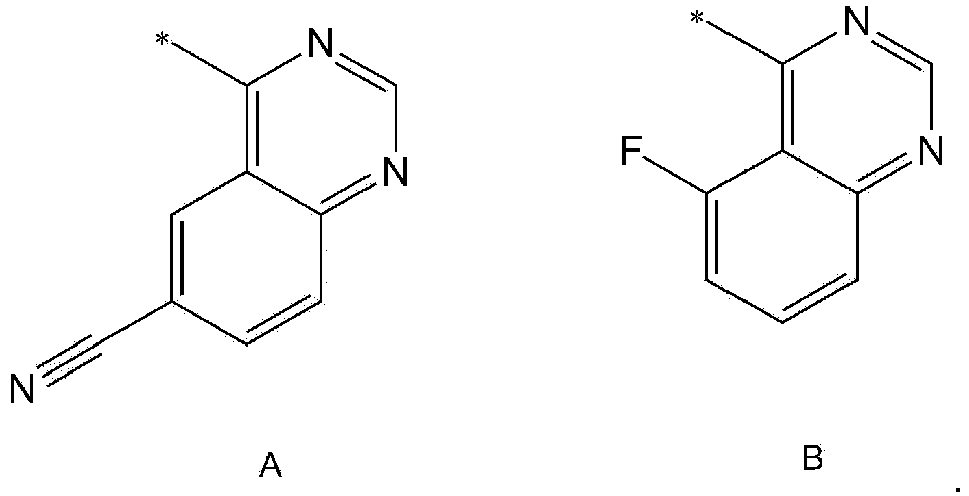
- The compound or its pharmaceutically acceptable salt of claim 1, wherein R1 is hydrogen; a C1-6 alkyl group; a C1-6 alkoxy group; an amino group; a C1-6 alkylthio group; or a halogen group.
- The compound or its pharmaceutically acceptable salt of claim 2, wherein R1 is hydrogen; a C1-6 alkyl group; a C1-6 alkoxy group; or an amino group.
- The compound or its pharmaceutically acceptable salt of claim 3, wherein R1 is a C1-6 alkoxy group or an amino group and R2 is a phenyl group.
- The compound or its pharmaceutically acceptable salt of claim 1, which is selected from the group consisting of:(S)-4-((1-(4-oxo-3-phenyl-5-(pyrimidin-5-yl)-3,4-dihydroquinazolin-2-yl)ethyl)ami no)quinazoline-6-carbonitrile;(S)-4-((1-(5-(2-aminopyrimidin-5-yl)-4-oxo-3-phenyl-3,4-dihydroquinazolin-2-yl)et hyl)amino)quinazoline-6-carbonitrile;(S)-4-((1-(5-(2-methylpyrimidin-5-yl)-4-oxo-3-phenyl-3,4-dihydroquinazolin-2-yl)e thyl)amino)quinazoline-6-carbonitrile;(S)-4-((1-(4-oxo-3-phenyl-5-(pyrimidin-5-yl)-3,4-dihydroquinazolin-2-yl)propyl)am ino)quinazoline-6-carbonitrile;(S)-4-((1-(5-(2-methoxypyrimidin-5-yl)-4-oxo-3-phenyl-3,4-dihydroquinazolin-2-yl )propyl)amino)quinazoline-6-carbonitrile;(S)-4-((1-(5-(2-ethoxypyrimidin-5-yl)-4-oxo-3-phenyl-3,4-dihydroquinazolin-2-yl)p ropyl)amino)quinazoline-6-carbonitrile;(S)-4-((1-(5-(2-(dimethylamino)pyrimidin-5-yl)-4-oxo-3-phenyl-3,4-dihydroquinaz olin-2-yl)propyl)amino)quinazoline-6-carbonitrile;(S)-4-((1-(5-(2-(methylsulfanyl)pyrimidin-5-yl)-4-oxo-3-phenyl-3,4-dihydroquinaz olin-2-yl)propyl)amino)quinazoline-6-carbonitrile;(S)-4-((1-(5-(2-methylpyrimidin-5-yl)-4-oxo-3-phenyl-3,4-dihydroquinazolin-2-yl)b utyl)amino)quinazoline-6-carbonitrile;(S)-4-((1-(5-(2-methoxypyrimidin-5-yl)-4-oxo-3-phenyl-3,4-dihydroquinazolin-2-yl )butyl)amino)quinazoline-6-carbonitrile;(S)-4-((1-(5-(2-ethoxypyrimidin-5-yl)-4-oxo-3-phenyl-3,4-dihydroquinazolin-2-yl)b utyl)amino)quinazoline-6-carbonitrile;(S)-4-((1-(5-(2-aminopyrimidin-5-yl)-4-oxo-3-phenyl-3,4-dihydroquinazolin-2-yl)b utyl)amino)quinazoline-6-carbonitrile;(S)-4-((1-(5-(2-aminopyrimidin-5-yl)-4-oxo-3-phenyl-3,4-dihydroquinazolin-2-yl)-2 -methylpropyl)amino)quinazoline-6-carbonitrile;(S)-4-((cyclopropyl(4-oxo-3-phenyl-5-(pyrimidin-5-yl)-3,4-dihydroquinazolin-2-yl) methyl)amino)quinazoline-6-carbonitrile;(S)-4-((cyclopropyl(5-(2-methoxypyrimidin-5-yl)-4-oxo-3-phenyl-3,4-dihydroquina zolin-2-yl)methyl)amino)quinazoline-6-carbonitrile;(S)-4-((cyclopropyl(5-(2-ethoxypyrimidin-5-yl)-4-oxo-3-phenyl-3,4-dihydroquinaz olin-2-yl)methyl)amino)quinazoline-6-carbonitrile;(S)-4-((1-(3-cyclopropyl-4-oxo-5-(pyrimidin-5-yl)-3,4-dihydroquinazolin-2-yl)ethyl) amino)quinazoline-6-carbonitrile;(S)-4-((1-(3-cyclopropyl-5-(2-methoxypyrimidin-5-yl)-4-oxo-3,4-dihydroquinazolin -2-yl)ethyl)amino)quinazoline-6-carbonitrile;(S)-4-((1-(3-cyclopropyl-5-(2-ethoxypyrimidin-5-yl)-4-oxo-3,4-dihydroquinazolin-2 -yl)ethyl)amino)quinazoline-6-carbonitrile;(S)-4-((1-(3-cyclopropyl-4-oxo-5-(pyrimidin-5-yl)-3,4-dihydroquinazolin-2-yl)propy l)amino)quinazoline-6-carbonitrile;(S)-4-((1-(5-(2-aminopyrim idin-5-yl)-3-cyclopropyl-4-oxo-3,4-dihydroquinazolin-2 -yl)propyl)amino)quinazoline-6-carbonitrile;(S)-2-(1-((5-fluoroquinazolin-4-yl)amino)ethyl)-3-phenyl-5-(pyrimidin-5-yl)quinazo lin-4(3H)-one;(S)-5-(2-aminopyrimidin-5-yl)-2-(1-((5-fluoroquinazolin-4-yl)amino)ethyl)-3-pheny lquinazolin-4(3H)-one;(S)-2-(1-((5-fluoroquinazolin-4-yl)amino)propyl)-3-phenyl-5-(pyrimidin-5-yl)quina zolin-4(3H)-one;(S)-5-(2-aminopyrimidin-5-yl)-2-(1-((5-fluoroquinazolin-4-yl)amino)propyl)-3-phen ylquinazolin-4(3H)-one;(S)-5-(2-fluoropyrimidin-5-yl)-2-(1-((5-fluoroquinazolin-4-yl)amino)propyl)-3-phen ylquinazolin-4(3H)-one;(S)-2-(1-((5-fluoroquinazolin-4-yl)amino)propyl)-5-(2-methylpyrimidin-5-yl)-3-phe nylquinazolin-4(3H)-one;(S)-2-(1-((5-fluoroquinazolin-4-yl)amino)-2-methylpropyl)-3-phenyl-5-(pyrimidin-5 -yl)quinazolin-4(3H)-one;(S)-5-(2-aminopyrimidin-5-yl)-2-(1-((5-fluoroquinazolin-4-yl)amino)-2-methylprop yl)-3-phenylquinazolin-4(3H)-one;(S)-2-(cyclopropyl((5-fluoroquinazolin-4-yl)amino)methyl)-3-phenyl-5-(pyrimidin-5-yl)quinazolin-4(3H)-one; and(S)-5-(2-aminopyrimidin-5-yl)-2-(cyclopropyl((5-fluoroquinazolin-4-yl)amino)meth yl)-3-phenylquinazolin-4(3H)-one.
- A pharmaceutical composition comprising a therapeutically effective amount of the compound or its pharmaceutically acceptable salt according to any one of claims 1 to 5.
Applications Claiming Priority (2)
| Application Number | Priority Date | Filing Date | Title |
|---|---|---|---|
| KR20160053033 | 2016-04-29 | ||
| PCT/KR2017/004424 WO2017188720A2 (en) | 2016-04-29 | 2017-04-26 | Quinazoline derivative or its salt and pharmaceutical composition comprising the same |
Publications (3)
| Publication Number | Publication Date |
|---|---|
| EP3448839A2 EP3448839A2 (en) | 2019-03-06 |
| EP3448839A4 EP3448839A4 (en) | 2019-09-11 |
| EP3448839B1 true EP3448839B1 (en) | 2022-02-09 |
Family
ID=60159881
Family Applications (1)
| Application Number | Title | Priority Date | Filing Date |
|---|---|---|---|
| EP17789904.4A Active EP3448839B1 (en) | 2016-04-29 | 2017-04-26 | Quinazoline derivative or its salt and pharmaceutical composition comprising the same |
Country Status (9)
| Country | Link |
|---|---|
| US (1) | US10941136B2 (en) |
| EP (1) | EP3448839B1 (en) |
| JP (1) | JP6909236B2 (en) |
| KR (1) | KR102325899B1 (en) |
| CN (1) | CN109071462B (en) |
| AU (1) | AU2017256488B2 (en) |
| CA (1) | CA3019333C (en) |
| ES (1) | ES2908001T3 (en) |
| WO (1) | WO2017188720A2 (en) |
Families Citing this family (4)
| Publication number | Priority date | Publication date | Assignee | Title |
|---|---|---|---|---|
| US10941136B2 (en) * | 2016-04-29 | 2021-03-09 | Yuhan Corporation | Quinazoline derivative or its salt and pharmaceutical composition comprising the same |
| US20200165257A1 (en) * | 2017-06-22 | 2020-05-28 | The United States Of America, As Represented By The Secretary, Department Of Health And Human Servic | Inhibitors of phosphoinositide 3-kinase and histone deacetylase for treatment of cancer |
| US10751339B2 (en) | 2018-01-20 | 2020-08-25 | Sunshine Lake Pharma Co., Ltd. | Substituted aminopyrimidine compounds and methods of use |
| CN113929674B (en) * | 2021-11-22 | 2023-09-22 | 中国药科大学 | Compounds containing 1,4-dihydroquinazoline structure and preparation methods and applications thereof |
Family Cites Families (6)
| Publication number | Priority date | Publication date | Assignee | Title |
|---|---|---|---|---|
| CN102741253A (en) | 2009-09-29 | 2012-10-17 | 艾科睿控股公司 | Pi3k (delta) selective inhibitors |
| CN102762565A (en) * | 2010-02-22 | 2012-10-31 | 弗·哈夫曼-拉罗切有限公司 | Pyrido[3,2-d]pyrimidine PI3δ inhibitor compounds and methods of use |
| JP6027610B2 (en) | 2011-07-19 | 2016-11-16 | インフィニティー ファーマシューティカルズ, インコーポレイテッド | Heterocyclic compounds and uses thereof |
| CN109970742A (en) | 2012-07-04 | 2019-07-05 | 理森制药股份公司 | Selective PI3Kδ inhibitor |
| WO2015168079A1 (en) * | 2014-04-29 | 2015-11-05 | Infinity Pharmaceuticals, Inc. | Pyrimidine or pyridine derivatives useful as pi3k inhibitors |
| US10941136B2 (en) * | 2016-04-29 | 2021-03-09 | Yuhan Corporation | Quinazoline derivative or its salt and pharmaceutical composition comprising the same |
-
2017
- 2017-04-26 US US16/096,712 patent/US10941136B2/en active Active
- 2017-04-26 EP EP17789904.4A patent/EP3448839B1/en active Active
- 2017-04-26 JP JP2018556304A patent/JP6909236B2/en active Active
- 2017-04-26 CA CA3019333A patent/CA3019333C/en active Active
- 2017-04-26 AU AU2017256488A patent/AU2017256488B2/en active Active
- 2017-04-26 WO PCT/KR2017/004424 patent/WO2017188720A2/en not_active Ceased
- 2017-04-26 KR KR1020170053608A patent/KR102325899B1/en active Active
- 2017-04-26 ES ES17789904T patent/ES2908001T3/en active Active
- 2017-04-26 CN CN201780025602.4A patent/CN109071462B/en active Active
Also Published As
| Publication number | Publication date |
|---|---|
| EP3448839A4 (en) | 2019-09-11 |
| ES2908001T3 (en) | 2022-04-27 |
| US20200325120A1 (en) | 2020-10-15 |
| JP2019514910A (en) | 2019-06-06 |
| CA3019333A1 (en) | 2017-11-02 |
| WO2017188720A2 (en) | 2017-11-02 |
| AU2017256488B2 (en) | 2020-12-17 |
| AU2017256488A1 (en) | 2018-09-20 |
| KR20170124089A (en) | 2017-11-09 |
| KR102325899B1 (en) | 2021-11-12 |
| CA3019333C (en) | 2024-01-02 |
| WO2017188720A3 (en) | 2018-07-26 |
| EP3448839A2 (en) | 2019-03-06 |
| CN109071462B (en) | 2022-02-08 |
| US10941136B2 (en) | 2021-03-09 |
| JP6909236B2 (en) | 2021-07-28 |
| CN109071462A (en) | 2018-12-21 |
Similar Documents
| Publication | Publication Date | Title |
|---|---|---|
| JP6159029B2 (en) | Aurora A kinase inhibitor | |
| US9550738B2 (en) | Bicyclic compounds as kinases inhibitors | |
| UA128369C2 (en) | Rip1 inhibitory compounds and methods for making and using the same | |
| JP7398135B2 (en) | Ubiquitin-specific protease inhibitor and its production method and application | |
| CN112689634B (en) | SMAD3 inhibitors | |
| US10941136B2 (en) | Quinazoline derivative or its salt and pharmaceutical composition comprising the same | |
| EP3998270A1 (en) | Alkyne derivative, preparation method for same, and uses thereof | |
| TWI667236B (en) | Aminothiazole compounds as protein kinase inhibitors | |
| US12338251B2 (en) | Substituted macrocycles useful as kinase inhibitors | |
| EP2685980B1 (en) | Methods and use of bifunctional enzyme-building clamp-shaped molecules | |
| CN111763215A (en) | A kind of compound with nitrogen-containing heterocyclic structure and preparation method and use thereof | |
| JP2022502438A (en) | FGFR4 inhibitor and its use | |
| WO2023030335A1 (en) | Compound as tyk2/jak1 pseudokinase domain inhibitor, and synthesis and use methods | |
| EP4269415A1 (en) | Tetrahydro thienopyridine sulfonamide compound | |
| EP4520757A1 (en) | Compound including 2,4-diaminopyridine, preparation method therefor, and pharmaceutical composition containing same as active ingredient for prevention or treatment of cancer | |
| JP2026510535A (en) | Novel inhibitors of phosphatidylinositol 3-kinase | |
| US20250059139A1 (en) | Compounds for treatment of cancer | |
| US20240400521A1 (en) | Quinazoline compound, composition, and application thereof | |
| KR20240156074A (en) | HPK1 and MLK3 inhibitor and anticancer compositions containing the same | |
| HK40065112A (en) | Alkyne derivative, preparation method for same, and uses thereof | |
| UA76103C2 (en) | Inhibitors of phosphatidyl-inositol- 3-kinase delta of human |
Legal Events
| Date | Code | Title | Description |
|---|---|---|---|
| STAA | Information on the status of an ep patent application or granted ep patent |
Free format text: STATUS: THE INTERNATIONAL PUBLICATION HAS BEEN MADE |
|
| PUAI | Public reference made under article 153(3) epc to a published international application that has entered the european phase |
Free format text: ORIGINAL CODE: 0009012 |
|
| STAA | Information on the status of an ep patent application or granted ep patent |
Free format text: STATUS: REQUEST FOR EXAMINATION WAS MADE |
|
| 17P | Request for examination filed |
Effective date: 20181001 |
|
| AK | Designated contracting states |
Kind code of ref document: A2 Designated state(s): AL AT BE BG CH CY CZ DE DK EE ES FI FR GB GR HR HU IE IS IT LI LT LU LV MC MK MT NL NO PL PT RO RS SE SI SK SM TR |
|
| AX | Request for extension of the european patent |
Extension state: BA ME |
|
| RIN1 | Information on inventor provided before grant (corrected) |
Inventor name: JUNG, EUN-HYE Inventor name: PARK, CHAN-SUN Inventor name: KANG, HO-WOONG Inventor name: GAL, JI-YEONG Inventor name: CHONG, WON-EE Inventor name: KIM, DONG-HOON Inventor name: HAN, TAE-DONG Inventor name: KIM, YOUNG-HWAN Inventor name: LEE, EUI-CHUL Inventor name: NAM, SU-YOUN Inventor name: KIM, JONG-GYUN Inventor name: CHOI, SU-BIN Inventor name: PARK, JIN-HWI Inventor name: PARK, JUN-CHUL |
|
| DAV | Request for validation of the european patent (deleted) | ||
| DAX | Request for extension of the european patent (deleted) | ||
| A4 | Supplementary search report drawn up and despatched |
Effective date: 20190814 |
|
| RIC1 | Information provided on ipc code assigned before grant |
Ipc: A61K 31/517 20060101ALI20190808BHEP Ipc: A61K 31/506 20060101ALI20190808BHEP Ipc: C07D 403/04 20060101ALI20190808BHEP Ipc: C07D 239/72 20060101AFI20190808BHEP |
|
| STAA | Information on the status of an ep patent application or granted ep patent |
Free format text: STATUS: EXAMINATION IS IN PROGRESS |
|
| 17Q | First examination report despatched |
Effective date: 20210323 |
|
| GRAP | Despatch of communication of intention to grant a patent |
Free format text: ORIGINAL CODE: EPIDOSNIGR1 |
|
| STAA | Information on the status of an ep patent application or granted ep patent |
Free format text: STATUS: GRANT OF PATENT IS INTENDED |
|
| INTG | Intention to grant announced |
Effective date: 20211021 |
|
| GRAS | Grant fee paid |
Free format text: ORIGINAL CODE: EPIDOSNIGR3 |
|
| GRAA | (expected) grant |
Free format text: ORIGINAL CODE: 0009210 |
|
| STAA | Information on the status of an ep patent application or granted ep patent |
Free format text: STATUS: THE PATENT HAS BEEN GRANTED |
|
| AK | Designated contracting states |
Kind code of ref document: B1 Designated state(s): AL AT BE BG CH CY CZ DE DK EE ES FI FR GB GR HR HU IE IS IT LI LT LU LV MC MK MT NL NO PL PT RO RS SE SI SK SM TR |
|
| REG | Reference to a national code |
Ref country code: GB Ref legal event code: FG4D |
|
| REG | Reference to a national code |
Ref country code: CH Ref legal event code: EP Ref country code: AT Ref legal event code: REF Ref document number: 1467443 Country of ref document: AT Kind code of ref document: T Effective date: 20220215 |
|
| REG | Reference to a national code |
Ref country code: DE Ref legal event code: R096 Ref document number: 602017053198 Country of ref document: DE |
|
| REG | Reference to a national code |
Ref country code: IE Ref legal event code: FG4D |
|
| REG | Reference to a national code |
Ref country code: ES Ref legal event code: FG2A Ref document number: 2908001 Country of ref document: ES Kind code of ref document: T3 Effective date: 20220427 |
|
| REG | Reference to a national code |
Ref country code: LT Ref legal event code: MG9D |
|
| REG | Reference to a national code |
Ref country code: NL Ref legal event code: MP Effective date: 20220209 |
|
| REG | Reference to a national code |
Ref country code: AT Ref legal event code: MK05 Ref document number: 1467443 Country of ref document: AT Kind code of ref document: T Effective date: 20220209 |
|
| PG25 | Lapsed in a contracting state [announced via postgrant information from national office to epo] |
Ref country code: SE Free format text: LAPSE BECAUSE OF FAILURE TO SUBMIT A TRANSLATION OF THE DESCRIPTION OR TO PAY THE FEE WITHIN THE PRESCRIBED TIME-LIMIT Effective date: 20220209 Ref country code: RS Free format text: LAPSE BECAUSE OF FAILURE TO SUBMIT A TRANSLATION OF THE DESCRIPTION OR TO PAY THE FEE WITHIN THE PRESCRIBED TIME-LIMIT Effective date: 20220209 Ref country code: PT Free format text: LAPSE BECAUSE OF FAILURE TO SUBMIT A TRANSLATION OF THE DESCRIPTION OR TO PAY THE FEE WITHIN THE PRESCRIBED TIME-LIMIT Effective date: 20220609 Ref country code: NO Free format text: LAPSE BECAUSE OF FAILURE TO SUBMIT A TRANSLATION OF THE DESCRIPTION OR TO PAY THE FEE WITHIN THE PRESCRIBED TIME-LIMIT Effective date: 20220509 Ref country code: NL Free format text: LAPSE BECAUSE OF FAILURE TO SUBMIT A TRANSLATION OF THE DESCRIPTION OR TO PAY THE FEE WITHIN THE PRESCRIBED TIME-LIMIT Effective date: 20220209 Ref country code: LT Free format text: LAPSE BECAUSE OF FAILURE TO SUBMIT A TRANSLATION OF THE DESCRIPTION OR TO PAY THE FEE WITHIN THE PRESCRIBED TIME-LIMIT Effective date: 20220209 Ref country code: HR Free format text: LAPSE BECAUSE OF FAILURE TO SUBMIT A TRANSLATION OF THE DESCRIPTION OR TO PAY THE FEE WITHIN THE PRESCRIBED TIME-LIMIT Effective date: 20220209 Ref country code: BG Free format text: LAPSE BECAUSE OF FAILURE TO SUBMIT A TRANSLATION OF THE DESCRIPTION OR TO PAY THE FEE WITHIN THE PRESCRIBED TIME-LIMIT Effective date: 20220509 |
|
| PG25 | Lapsed in a contracting state [announced via postgrant information from national office to epo] |
Ref country code: PL Free format text: LAPSE BECAUSE OF FAILURE TO SUBMIT A TRANSLATION OF THE DESCRIPTION OR TO PAY THE FEE WITHIN THE PRESCRIBED TIME-LIMIT Effective date: 20220209 Ref country code: LV Free format text: LAPSE BECAUSE OF FAILURE TO SUBMIT A TRANSLATION OF THE DESCRIPTION OR TO PAY THE FEE WITHIN THE PRESCRIBED TIME-LIMIT Effective date: 20220209 Ref country code: GR Free format text: LAPSE BECAUSE OF FAILURE TO SUBMIT A TRANSLATION OF THE DESCRIPTION OR TO PAY THE FEE WITHIN THE PRESCRIBED TIME-LIMIT Effective date: 20220510 Ref country code: FI Free format text: LAPSE BECAUSE OF FAILURE TO SUBMIT A TRANSLATION OF THE DESCRIPTION OR TO PAY THE FEE WITHIN THE PRESCRIBED TIME-LIMIT Effective date: 20220209 Ref country code: AT Free format text: LAPSE BECAUSE OF FAILURE TO SUBMIT A TRANSLATION OF THE DESCRIPTION OR TO PAY THE FEE WITHIN THE PRESCRIBED TIME-LIMIT Effective date: 20220209 |
|
| PG25 | Lapsed in a contracting state [announced via postgrant information from national office to epo] |
Ref country code: IS Free format text: LAPSE BECAUSE OF FAILURE TO SUBMIT A TRANSLATION OF THE DESCRIPTION OR TO PAY THE FEE WITHIN THE PRESCRIBED TIME-LIMIT Effective date: 20220609 |
|
| PG25 | Lapsed in a contracting state [announced via postgrant information from national office to epo] |
Ref country code: SM Free format text: LAPSE BECAUSE OF FAILURE TO SUBMIT A TRANSLATION OF THE DESCRIPTION OR TO PAY THE FEE WITHIN THE PRESCRIBED TIME-LIMIT Effective date: 20220209 Ref country code: SK Free format text: LAPSE BECAUSE OF FAILURE TO SUBMIT A TRANSLATION OF THE DESCRIPTION OR TO PAY THE FEE WITHIN THE PRESCRIBED TIME-LIMIT Effective date: 20220209 Ref country code: RO Free format text: LAPSE BECAUSE OF FAILURE TO SUBMIT A TRANSLATION OF THE DESCRIPTION OR TO PAY THE FEE WITHIN THE PRESCRIBED TIME-LIMIT Effective date: 20220209 Ref country code: EE Free format text: LAPSE BECAUSE OF FAILURE TO SUBMIT A TRANSLATION OF THE DESCRIPTION OR TO PAY THE FEE WITHIN THE PRESCRIBED TIME-LIMIT Effective date: 20220209 Ref country code: DK Free format text: LAPSE BECAUSE OF FAILURE TO SUBMIT A TRANSLATION OF THE DESCRIPTION OR TO PAY THE FEE WITHIN THE PRESCRIBED TIME-LIMIT Effective date: 20220209 Ref country code: CZ Free format text: LAPSE BECAUSE OF FAILURE TO SUBMIT A TRANSLATION OF THE DESCRIPTION OR TO PAY THE FEE WITHIN THE PRESCRIBED TIME-LIMIT Effective date: 20220209 |
|
| REG | Reference to a national code |
Ref country code: DE Ref legal event code: R097 Ref document number: 602017053198 Country of ref document: DE |
|
| PG25 | Lapsed in a contracting state [announced via postgrant information from national office to epo] |
Ref country code: AL Free format text: LAPSE BECAUSE OF FAILURE TO SUBMIT A TRANSLATION OF THE DESCRIPTION OR TO PAY THE FEE WITHIN THE PRESCRIBED TIME-LIMIT Effective date: 20220209 |
|
| REG | Reference to a national code |
Ref country code: CH Ref legal event code: PL |
|
| PLBE | No opposition filed within time limit |
Free format text: ORIGINAL CODE: 0009261 |
|
| STAA | Information on the status of an ep patent application or granted ep patent |
Free format text: STATUS: NO OPPOSITION FILED WITHIN TIME LIMIT |
|
| REG | Reference to a national code |
Ref country code: BE Ref legal event code: MM Effective date: 20220430 |
|
| 26N | No opposition filed |
Effective date: 20221110 |
|
| PG25 | Lapsed in a contracting state [announced via postgrant information from national office to epo] |
Ref country code: MC Free format text: LAPSE BECAUSE OF FAILURE TO SUBMIT A TRANSLATION OF THE DESCRIPTION OR TO PAY THE FEE WITHIN THE PRESCRIBED TIME-LIMIT Effective date: 20220209 Ref country code: LU Free format text: LAPSE BECAUSE OF NON-PAYMENT OF DUE FEES Effective date: 20220426 Ref country code: LI Free format text: LAPSE BECAUSE OF NON-PAYMENT OF DUE FEES Effective date: 20220430 Ref country code: CH Free format text: LAPSE BECAUSE OF NON-PAYMENT OF DUE FEES Effective date: 20220430 |
|
| PG25 | Lapsed in a contracting state [announced via postgrant information from national office to epo] |
Ref country code: SI Free format text: LAPSE BECAUSE OF FAILURE TO SUBMIT A TRANSLATION OF THE DESCRIPTION OR TO PAY THE FEE WITHIN THE PRESCRIBED TIME-LIMIT Effective date: 20220209 Ref country code: BE Free format text: LAPSE BECAUSE OF NON-PAYMENT OF DUE FEES Effective date: 20220430 |
|
| PG25 | Lapsed in a contracting state [announced via postgrant information from national office to epo] |
Ref country code: IE Free format text: LAPSE BECAUSE OF NON-PAYMENT OF DUE FEES Effective date: 20220426 |
|
| P01 | Opt-out of the competence of the unified patent court (upc) registered |
Effective date: 20230524 |
|
| PG25 | Lapsed in a contracting state [announced via postgrant information from national office to epo] |
Ref country code: HU Free format text: LAPSE BECAUSE OF FAILURE TO SUBMIT A TRANSLATION OF THE DESCRIPTION OR TO PAY THE FEE WITHIN THE PRESCRIBED TIME-LIMIT; INVALID AB INITIO Effective date: 20170426 |
|
| PG25 | Lapsed in a contracting state [announced via postgrant information from national office to epo] |
Ref country code: MK Free format text: LAPSE BECAUSE OF FAILURE TO SUBMIT A TRANSLATION OF THE DESCRIPTION OR TO PAY THE FEE WITHIN THE PRESCRIBED TIME-LIMIT Effective date: 20220209 Ref country code: CY Free format text: LAPSE BECAUSE OF FAILURE TO SUBMIT A TRANSLATION OF THE DESCRIPTION OR TO PAY THE FEE WITHIN THE PRESCRIBED TIME-LIMIT Effective date: 20220209 |
|
| PG25 | Lapsed in a contracting state [announced via postgrant information from national office to epo] |
Ref country code: TR Free format text: LAPSE BECAUSE OF FAILURE TO SUBMIT A TRANSLATION OF THE DESCRIPTION OR TO PAY THE FEE WITHIN THE PRESCRIBED TIME-LIMIT Effective date: 20220209 |
|
| PG25 | Lapsed in a contracting state [announced via postgrant information from national office to epo] |
Ref country code: MT Free format text: LAPSE BECAUSE OF FAILURE TO SUBMIT A TRANSLATION OF THE DESCRIPTION OR TO PAY THE FEE WITHIN THE PRESCRIBED TIME-LIMIT Effective date: 20220209 |
|
| PGFP | Annual fee paid to national office [announced via postgrant information from national office to epo] |
Ref country code: DE Payment date: 20250305 Year of fee payment: 9 |
|
| PGFP | Annual fee paid to national office [announced via postgrant information from national office to epo] |
Ref country code: ES Payment date: 20250509 Year of fee payment: 9 |
|
| PGFP | Annual fee paid to national office [announced via postgrant information from national office to epo] |
Ref country code: GB Payment date: 20260313 Year of fee payment: 10 |
|
| PGFP | Annual fee paid to national office [announced via postgrant information from national office to epo] |
Ref country code: IT Payment date: 20260320 Year of fee payment: 10 |
|
| PGFP | Annual fee paid to national office [announced via postgrant information from national office to epo] |
Ref country code: FR Payment date: 20260309 Year of fee payment: 10 |