EP3448009B1 - Method and apparatus for taking images during a video call on a mobile communication terminal - Google Patents
Method and apparatus for taking images during a video call on a mobile communication terminal Download PDFInfo
- Publication number
- EP3448009B1 EP3448009B1 EP18200536.3A EP18200536A EP3448009B1 EP 3448009 B1 EP3448009 B1 EP 3448009B1 EP 18200536 A EP18200536 A EP 18200536A EP 3448009 B1 EP3448009 B1 EP 3448009B1
- Authority
- EP
- European Patent Office
- Prior art keywords
- digital image
- video call
- image
- request
- digital
- Prior art date
- Legal status (The legal status is an assumption and is not a legal conclusion. Google has not performed a legal analysis and makes no representation as to the accuracy of the status listed.)
- Not-in-force
Links
Images



Classifications
-
- H—ELECTRICITY
- H04—ELECTRIC COMMUNICATION TECHNIQUE
- H04B—TRANSMISSION
- H04B1/00—Details of transmission systems, not covered by a single one of groups H04B3/00 - H04B13/00; Details of transmission systems not characterised by the medium used for transmission
- H04B1/38—Transceivers, i.e. devices in which transmitter and receiver form a structural unit and in which at least one part is used for functions of transmitting and receiving
- H04B1/40—Circuits
-
- H—ELECTRICITY
- H04—ELECTRIC COMMUNICATION TECHNIQUE
- H04N—PICTORIAL COMMUNICATION, e.g. TELEVISION
- H04N7/00—Television systems
- H04N7/14—Systems for two-way working
-
- H—ELECTRICITY
- H04—ELECTRIC COMMUNICATION TECHNIQUE
- H04N—PICTORIAL COMMUNICATION, e.g. TELEVISION
- H04N1/00—Scanning, transmission or reproduction of documents or the like, e.g. facsimile transmission; Details thereof
- H04N1/00127—Connection or combination of a still picture apparatus with another apparatus, e.g. for storage, processing or transmission of still picture signals or of information associated with a still picture
- H04N1/00281—Connection or combination of a still picture apparatus with another apparatus, e.g. for storage, processing or transmission of still picture signals or of information associated with a still picture with a telecommunication apparatus, e.g. a switched network of teleprinters for the distribution of text-based information, a selective call terminal
- H04N1/00307—Connection or combination of a still picture apparatus with another apparatus, e.g. for storage, processing or transmission of still picture signals or of information associated with a still picture with a telecommunication apparatus, e.g. a switched network of teleprinters for the distribution of text-based information, a selective call terminal with a mobile telephone apparatus
-
- H—ELECTRICITY
- H04—ELECTRIC COMMUNICATION TECHNIQUE
- H04N—PICTORIAL COMMUNICATION, e.g. TELEVISION
- H04N1/00—Scanning, transmission or reproduction of documents or the like, e.g. facsimile transmission; Details thereof
- H04N1/21—Intermediate information storage
- H04N1/2104—Intermediate information storage for one or a few pictures
- H04N1/2112—Intermediate information storage for one or a few pictures using still video cameras
- H04N1/212—Motion video recording combined with still video recording
-
- H—ELECTRICITY
- H04—ELECTRIC COMMUNICATION TECHNIQUE
- H04N—PICTORIAL COMMUNICATION, e.g. TELEVISION
- H04N7/00—Television systems
- H04N7/14—Systems for two-way working
- H04N7/141—Systems for two-way working between two video terminals, e.g. videophone
-
- H—ELECTRICITY
- H04—ELECTRIC COMMUNICATION TECHNIQUE
- H04N—PICTORIAL COMMUNICATION, e.g. TELEVISION
- H04N2201/00—Indexing scheme relating to scanning, transmission or reproduction of documents or the like, and to details thereof
- H04N2201/0077—Types of the still picture apparatus
- H04N2201/0084—Digital still camera
-
- H—ELECTRICITY
- H04—ELECTRIC COMMUNICATION TECHNIQUE
- H04N—PICTORIAL COMMUNICATION, e.g. TELEVISION
- H04N2201/00—Indexing scheme relating to scanning, transmission or reproduction of documents or the like, and to details thereof
- H04N2201/0098—User intervention not otherwise provided for, e.g. placing documents, responding to an alarm
Definitions
- the present invention relates to a mobile communication terminal having a video communication function. More particularly, the present invention relates to a method for taking images while making a video call on a mobile communication terminal.
- a mobile terminal refers to a terminal that is carried by an individual user and supports various functions using application programs including wireless communication services.
- Examples of a mobile terminal may include a personal mobile communication services terminal, a personal digital assistant (PDA), a smart phone, an international mobile telecommunication 2000 (IMT-2000) terminal, and a wireless local area network (LAN) terminal.
- PDA personal digital assistant
- IMT-2000 international mobile telecommunication 2000
- LAN wireless local area network
- a mobile terminal has voice calling and short message service (SMS) functions.
- SMS short message service
- recent, rapid development of mobile communication technology has allowed a mobile terminal to support diverse and sophisticated functions including video calls, an electronic-note function, audio/image storage, Internet access, and entertainment features.
- users can easily take motion video images and still images (collectively referred to as "images"), can store the images, use the images as wallpaper, or transmit the images via e-mail or by another messaging function to another mobile communication terminal.
- the use of the digital camera function also has contributed to the recent development and commercialization of a video calling system.
- the video calling system enables callers to see images of each other during voice conversations by transmitting the images input to a digital camera to the other party's mobile communication terminal.
- video calling features allow a user to send their current images and voice information to another party's mobile communication terminal through their own terminal and receive the other party's images and voice information from the other party's terminal. Thus, the user can see images of the other party on their terminal during phone conversations.
- a conventional mobile communication terminal has a problem in that still images cannot be taken during a video call.
- a video calling program is loaded into a signal processor.
- the signal processor then converts an image signal, input through a camera sensor, into low resolution digital data for transmission over a wireless link.
- the signal processor cannot perform the task in response to such a request.
- the conventional mobile communication terminal in order to take high quality images during a video call, the conventional mobile communication terminal must first terminate the video call and then convert a video call mode into a still image mode or motion video mode, thus causing user's inconvenience. That is, the conventional mobile communication terminal cannot separately take and store high quality still images or motion video images while making a video call.
- US 2003/222974 A1 discusses a picture transmission system which can acquire a highquality still picture on a receiver side.
- US 2006/050154 A1 discusses an imaging device with an imaging element which is driven in a thinning read-out mode for reading out signal charges from a subset of pixels, or in an all-pixels read-out mode for reading out signal charges from all pixels.
- EP 1492315 A discusses .
- an aspect of the present invention is to provide a method and apparatus for taking images on a mobile communication terminal that can store an image signal input through a digital camera as high quality image data while making a video call.
- FIG. 1 is a schematic block diagram illustrating the configuration of a mobile communication terminal 100 according to an exemplary embodiment of the present invention.
- the mobile communication terminal 100 includes a controller 90, a wireless communication unit 20, an audio processor 30, a key input unit 40, a camera module 50, an image processor 60, a display unit 70, and a storage unit 80.
- the camera module 50 includes a camera sensor 52 and a signal processor 54.
- the wireless communication unit 20 transmits and receives data for wireless communication.
- the wireless communication unit 20 includes an RF transmitter that up-converts and amplifies the frequency of a signal being transmitted and an RF receiver that low-noise amplifies a signal being received and down-converts its frequency.
- the wireless communication unit 20 receives data via a wireless channel to output the data to the controller 90 and receives data from the controller 90 to transmit the data through the wireless channel.
- the audio processor 30 includes a coder/decoder (CODEC).
- CODEC consists of a data codec for processing data such as packet data and an audio codec for processing audio signals such as voice.
- the audio processor 30 converts a digital audio signal fed into the controller 90 to an analog signal during a voice call on the mobile terminal 100 through the audio codec and plays the analog signal through a speaker.
- the audio processor 30 also converts an analog audio signal received through a microphone to a digital audio signal through the audio codec and transmits the digital audio signal to the controller 90.
- the key input unit 40 receives a user's manipulation signal for controlling the mobile communication terminal 100 to transmit the signal to the controller 90.
- the key input unit 40 includes multiple character keys (not shown) for inputting numeric and character information and control keys (not shown) for controlling the operation of the mobile communication terminal 100.
- An exemplary key input unit 40 of the present invention further includes an image-taking key 42 for storing images (still or motion video images).
- the image-taking key 42 may be realized in hardware together with the character keys and control keys.
- the image-taking key 42 may also however, be realized in software.
- the camera sensor 52 of the camera module 50 takes an image formed by a lens and converts the resulting optical signal to an electrical signal.
- the camera sensor 52 may be a charge coupled device (CCD) or complementary metal oxide semiconductor (CMOS) sensor.
- the signal processor 54 of the camera module 50 converts an analog image signal output from the camera sensor 52 to digital data.
- the signal processor 54 may be a digital signal processor or other signal processor.
- the image processor 60 outputs image data obtained by dividing an image signal received from the camera module 50 into frames to match the display characteristics and size of the display unit 70.
- the image processor 60 also compresses the image data to transmit the compressed data to the controller 90.
- the image processor 60 includes an image codec for compressing the image data to be displayed on the display unit 70 using a compression technique.
- the image codec may also be used for decompressing the compressed image data into original image data.
- the image codec may be a Joint Pictures Experts Group (JPEG) codec, Moving Pictures Experts Group (MPEG) codec, or Wavelet codec.
- the display unit 70 displays image data output from the image processor 60 on a screen.
- the display unit 70 may be a liquid crystal display (LCD).
- the display unit 70 may include an LCD controller, a memory for storing image data, an LCD display element and the like.
- the screen of the display unit 70 may function as an input portion.
- the storage unit 80 may include a program memory for storing programs for controlling the operation of the mobile communication terminal 100.
- the storage unit 80 may further comprise a data memory for storing data generated while executing the programs and still or motion video images input through the camera sensor 52.
- the data memory may also store various programs loaded into the signal processor 54, such as a video calling program, a still image program, and a motion video program.
- the controller 90 performs the overall control operation of the mobile communication terminal 100. Upon receiving the user's request to take an image during a video call, the controller 90 converts an image signal output from the camera sensor 52 to image data for storage and controls the storage unit 80 to store the image data.
- a method and apparatus for photographing an image on a mobile communication terminal will now be described in detail with reference to FIGS. 1-3B .
- the above described configuration of the mobile communication terminal 100 will also become more apparent from the following description of the exemplary method for photographing images.
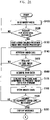
- FIGS. 2A and 2B are a flowchart illustrating a method for taking images on a mobile communication terminal according to an exemplary embodiment of the present invention.
- the controller 90 determines whether the key input represents a request for a video call (S120). If the key input represents a request for a video call, the controller 90 loads a video calling program into the signal processor 54 of the camera module 50 (S130).
- a program corresponding to a mode of the mobile communication terminal 100 is loaded into the signal processor 54.
- a camera program may be loaded into the signal processor 54.
- a camcorder program may be loaded into the signal processor 54.
- a video calling program is loaded therein.
- Programs are intended for generating optimized still images, motion video, and video calling motion video.
- the programs are loaded into the signal processor 54 by the controller 90 when necessary to drive the signal processor 54.
- the programs are stored in the storage unit 80.
- the controller 90 fetches a program corresponding to the mode and loads it into the signal processor 54.
- the controller 90 loads a video calling program stored in the storage unit 80 into the signal processor 54
- the signal processor 54 converts an image input through the camera module 50 to image data for transmission.
- the controller 90 sends the image data for transmission to another party's mobile communication terminal to perform a video call (S140). That is, the video calling program loaded into the signal processor 54 drives the signal processor 54 to convert the image input through the camera sensor 52 to digital data optimized with respect to the image data for transmission.
- the signal processor 54 then transmits the digital data to the image processor 60.
- the image processor 60 transmits the received digital data to the display unit 70 while compressing the digital data into image data before transmitting the resulting image data to the controller 90.
- the controller 90 receives the image data from the image processor 60 to transmit it to the other party's mobile communication terminal through the wireless communication unit 20. This allows the user of the mobile communication terminal 100 to make a face-to-face video call with the other party while seeing a motion video being transmitted by the other party.
- the mobile communication terminal 100 determines whether a request to take an image is received (S150).
- the user manipulates the image-taking key 42 to store an image being currently input through the camera module 50 as separate image data ("image data for storage").
- the controller 90 having received the request to take an image, receives an image signal, in other words, raw data, directly from the camera sensor 52 (S160).
- the image data for storage may be extracted from the digital data output through the signal processor 54 or from image data output through the image processor 60 for storage. However, in both of these cases, the extracted image data has a low resolution because it is optimized with respect to a motion video image for transmission.
- the image data for storage is produced using an image signal output from the camera sensor 52 before being optimized for conversion.
- the image signal output from the camera sensor 52 may be a YUV, RGB or similar signal.
- the controller 90 converts the image signal, which is input as analog data, into digital data and compresses the digital data to produce image data for storage (S170).
- the controller 90 generates image data for storage having a visual quality corresponding to a resolution that may be preset by the user. That is, the controller 90 produces a high quality image having the same resolution as image data being stored in a still image taking mode.
- the controller 90 controls the storage unit 80 to store the image data for storage (S180). The controller 90 then determines whether there is a request to terminate the video call (S190). If a request to terminate the video call is not received, the controller 90 repeats the steps S140 through S180. Thus, as the number of repetitions of the steps S140 through S180 increases, the amount of image data being stored in the storage unit 80 increases.
- the controller 90 controls the display unit 70 to display a message requesting whether to display the image data being stored in the storage unit 80 (S200). If the user requests display of the stored image data in step S210, the controller 90 controls the display unit 70 to display the stored image data (S220).
- the controller 90 deletes the stored image data displayed on the display unit 70 from the storage unit 80 (S240).
- the controller 90 checks whether another stored image data exists (S250). If another stored image data exists, the controller 90 controls the display unit 70 to display the stored image data for storage (S220). If another stored image data does not exist, the controller 90 determines that there is no more image data to be displayed on the display unit 70 and converts the mode of the mobile communication terminal 100 to a standby mode.
- the controller 90 controls the display unit 70 to sequentially display the stored image data. That is, the steps S220 through S250 are repeated for each stored image data. If a specific key (not shown), such as a directional arrow or volume control key, is input by the user while one storage image data is displayed (S232), the controller 90 controls the display unit 70 to display another stored image data. Thus, the user can see all the image data stored during a video call.
- a specific key such as a directional arrow or volume control key
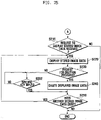
- FIGS. 3A and 3B are a flowchart illustrating a method for taking images on a mobile communication terminal according to another exemplary embodiment of the present invention.
- steps S310 through S370 in FIG. 3A are substantially the same as their counterparts (steps S110 through S170) in FIG. 2A , and thus a detailed explanation thereof is not given here.
- the controller 90 controls the storage unit 80 to temporarily store the image data (S380).
- the image data may be stored in a buffer memory (not shown) within the controller 90 or other memory locations.
- the controller 90 determines whether there is a request to terminate the video call (S390). If a request to terminate the video call is not received and the image-taking key 42 is input again, the controller 90 repeats the steps S340 through S380. As the number of repetitions of the steps S340 through S380 increases, the amount of image data being temporarily stored in the storage unit 80 increases.
- the controller 90 controls the display unit 70 to display a message requesting whether to display the temporarily stored image data (S400).
- the message contains buttons representing 'display image data' and 'automatically save image data.' By inputting one of the buttons, the user can select whether to display image data temporarily stored during the video call on the display or whether to automatically save all of the temporarily stored image data without checking them.
- the controller 90 controls the display unit 70 to display the temporarily stored image data (S420) simultaneously with a message requesting whether to save or delete the image data displayed on the display unit 70.
- the controller 90 After watching the displayed image data, if the user requests that it be saved (S430), the controller 90, having received the user's request, controls the display unit 70 to display a window for inputting a file name for the displayed image data.
- the controller 90 controls the storage unit 80 to store the displayed image data as the file name (S450). Otherwise, if the step S440 is omitted, the controller 90 may randomly assign a file name to the displayed image data for storage.
- the controller 90 deletes the displayed image data (S434).
- the controller 90 then checks whether another temporarily stored image data exists (S460). If another temporarily stored image data exists, the controller 90 controls the display unit 70 to display the temporarily stored image data for storage (S420). That is, the controller 90 repeats the steps S420 through S450. If another temporarily stored image data does not exist, the controller 90 determines that there is no more image data to be stored and converts the mode of the mobile communication terminal 100 to a standby mode.
- the controller 90 If the user requests the displayed image data to be automatically saved (S412), the controller 90, having received the user's request, randomly assigns a file name to the temporarily stored image data (S414) and controls the storage unit 80 to store the image data (S416). In this case, when a plurality of image data have been temporarily stored, the controller 90 assigns a file name to each image data and controls the storage unit 80 to store the image data. This process is repeatedly performed until all of the image data are automatically saved.
- a method for taking images on the mobile communication terminal 100 enables production of image data for storage using the controller 90 instead of the signal processor 54, thus providing high quality image data for storage to a user without having to terminate a video call.
- a method for taking images on a mobile communication terminal enables production and storage of image data using a controller instead of a signal processor functioning for performing a video call, thus allowing high quality still or motion video image data to be taken and stored while making a video call.
Landscapes
- Engineering & Computer Science (AREA)
- Signal Processing (AREA)
- Multimedia (AREA)
- Human Computer Interaction (AREA)
- Computer Networks & Wireless Communication (AREA)
- Telephone Function (AREA)
- Studio Devices (AREA)
- Two-Way Televisions, Distribution Of Moving Picture Or The Like (AREA)
Description
- The present invention relates to a mobile communication terminal having a video communication function. More particularly, the present invention relates to a method for taking images while making a video call on a mobile communication terminal.
- In general, a mobile terminal refers to a terminal that is carried by an individual user and supports various functions using application programs including wireless communication services. Examples of a mobile terminal may include a personal mobile communication services terminal, a personal digital assistant (PDA), a smart phone, an international mobile telecommunication 2000 (IMT-2000) terminal, and a wireless local area network (LAN) terminal.
- Generally, a mobile terminal has voice calling and short message service (SMS) functions. However, recent, rapid development of mobile communication technology has allowed a mobile terminal to support diverse and sophisticated functions including video calls, an electronic-note function, audio/image storage, Internet access, and entertainment features. Furthermore, with the advent of a mobile terminal having a digital camera function in addition to the above features, users can easily take motion video images and still images (collectively referred to as "images"), can store the images, use the images as wallpaper, or transmit the images via e-mail or by another messaging function to another mobile communication terminal.
- The use of the digital camera function also has contributed to the recent development and commercialization of a video calling system. The video calling system enables callers to see images of each other during voice conversations by transmitting the images input to a digital camera to the other party's mobile communication terminal.
- That is, video calling features allow a user to send their current images and voice information to another party's mobile communication terminal through their own terminal and receive the other party's images and voice information from the other party's terminal. Thus, the user can see images of the other party on their terminal during phone conversations.
- However, a conventional mobile communication terminal has a problem in that still images cannot be taken during a video call. When the conventional mobile communication terminal is connected to another party's terminal for making a video call, a video calling program is loaded into a signal processor. The signal processor then converts an image signal, input through a camera sensor, into low resolution digital data for transmission over a wireless link. Thus, even if a user's request to take a still image is received during a video call, the signal processor cannot perform the task in response to such a request.
- Thus, in order to take high quality images during a video call, the conventional mobile communication terminal must first terminate the video call and then convert a video call mode into a still image mode or motion video mode, thus causing user's inconvenience. That is, the conventional mobile communication terminal cannot separately take and store high quality still images or motion video images while making a video call.
- Accordingly, there is a need for an improved method and apparatus for taking images during a video call on a mobile communication terminal.
-
US 2003/222974 A1 discusses a picture transmission system which can acquire a highquality still picture on a receiver side.US 2006/050154 A1 discusses an imaging device with an imaging element which is driven in a thinning read-out mode for reading out signal charges from a subset of pixels, or in an all-pixels read-out mode for reading out signal charges from all pixels.EP 1492315 A discusses . - Exemplary embodiments of the present invention address at least the above problems and/or disadvantages and provide at least the advantages described below. Accordingly, an aspect of the present invention is to provide a method and apparatus for taking images on a mobile communication terminal that can store an image signal input through a digital camera as high quality image data while making a video call.
- The Invention is set out in the appended set of claims.
- The above and other objects, features and advantages of the present invention will be more apparent from the following detailed description in conjunction with the accompanying drawings, in which:
-
FIG. 1 is a schematic block diagram illustrating a configuration of a mobile communication terminal according to an exemplary embodiment of the present invention; -
FIGS. 2A and2B are a flowchart illustrating a method for taking images on a mobile communication terminal according to an exemplary embodiment of the present invention; and -
FIGS. 3A and3B are a flowchart illustrating a method for taking images on a mobile communication terminal according to another exemplary embodiment of the present invention. - Throughout the drawings, the same drawing reference numerals will be understood to refer to the same elements, features, and structures.
- The matters defined in the description such as a detailed construction and elements are provided to assist in a comprehensive understanding of the embodiments of the invention and are merely exemplary. Accordingly, those of ordinary skill in the art will recognize that various changes and modifications of the embodiments described herein can be made without departing from the scope and spirit of the invention. Also, descriptions of well-known functions and constructions are omitted for clarity and conciseness. Hereinafter, exemplary embodiments of the present invention are described in detail with reference to the accompanying drawings. Dimensions of the elements or spacing between elements are not to scale.
-
FIG. 1 is a schematic block diagram illustrating the configuration of amobile communication terminal 100 according to an exemplary embodiment of the present invention. - Referring to
FIG. 1 , themobile communication terminal 100 includes acontroller 90, awireless communication unit 20, anaudio processor 30, akey input unit 40, acamera module 50, animage processor 60, adisplay unit 70, and astorage unit 80. Thecamera module 50 includes acamera sensor 52 and asignal processor 54. - The
wireless communication unit 20 transmits and receives data for wireless communication. To achieve this function, thewireless communication unit 20 includes an RF transmitter that up-converts and amplifies the frequency of a signal being transmitted and an RF receiver that low-noise amplifies a signal being received and down-converts its frequency. Thewireless communication unit 20 receives data via a wireless channel to output the data to thecontroller 90 and receives data from thecontroller 90 to transmit the data through the wireless channel. - The
audio processor 30 includes a coder/decoder (CODEC). The CODEC consists of a data codec for processing data such as packet data and an audio codec for processing audio signals such as voice. Theaudio processor 30 converts a digital audio signal fed into thecontroller 90 to an analog signal during a voice call on themobile terminal 100 through the audio codec and plays the analog signal through a speaker. Theaudio processor 30 also converts an analog audio signal received through a microphone to a digital audio signal through the audio codec and transmits the digital audio signal to thecontroller 90. - The
key input unit 40 receives a user's manipulation signal for controlling themobile communication terminal 100 to transmit the signal to thecontroller 90. To achieve this function, thekey input unit 40 includes multiple character keys (not shown) for inputting numeric and character information and control keys (not shown) for controlling the operation of themobile communication terminal 100. An exemplarykey input unit 40 of the present invention further includes an image-taking key 42 for storing images (still or motion video images). In an exemplary embodiment, the image-taking key 42 may be realized in hardware together with the character keys and control keys. The image-taking key 42 may also however, be realized in software. - The
camera sensor 52 of thecamera module 50 takes an image formed by a lens and converts the resulting optical signal to an electrical signal. Thecamera sensor 52 may be a charge coupled device (CCD) or complementary metal oxide semiconductor (CMOS) sensor. - The
signal processor 54 of thecamera module 50 converts an analog image signal output from thecamera sensor 52 to digital data. Thesignal processor 54 may be a digital signal processor or other signal processor. - The
image processor 60 outputs image data obtained by dividing an image signal received from thecamera module 50 into frames to match the display characteristics and size of thedisplay unit 70. Theimage processor 60 also compresses the image data to transmit the compressed data to thecontroller 90. To achieve this function, theimage processor 60 includes an image codec for compressing the image data to be displayed on thedisplay unit 70 using a compression technique. The image codec may also be used for decompressing the compressed image data into original image data. The image codec may be a Joint Pictures Experts Group (JPEG) codec, Moving Pictures Experts Group (MPEG) codec, or Wavelet codec. - The
display unit 70 displays image data output from theimage processor 60 on a screen. Thedisplay unit 70 may be a liquid crystal display (LCD). In this case, thedisplay unit 70 may include an LCD controller, a memory for storing image data, an LCD display element and the like. When the LCD is implemented using a touch screen technology, the screen of thedisplay unit 70 may function as an input portion. - The
storage unit 80 may include a program memory for storing programs for controlling the operation of themobile communication terminal 100. Thestorage unit 80 may further comprise a data memory for storing data generated while executing the programs and still or motion video images input through thecamera sensor 52. The data memory may also store various programs loaded into thesignal processor 54, such as a video calling program, a still image program, and a motion video program. - The
controller 90 performs the overall control operation of themobile communication terminal 100. Upon receiving the user's request to take an image during a video call, thecontroller 90 converts an image signal output from thecamera sensor 52 to image data for storage and controls thestorage unit 80 to store the image data. - A method and apparatus for photographing an image on a mobile communication terminal according to exemplary embodiments of the present invention will now be described in detail with reference to
FIGS. 1-3B . The above described configuration of themobile communication terminal 100 will also become more apparent from the following description of the exemplary method for photographing images. -
FIGS. 2A and2B are a flowchart illustrating a method for taking images on a mobile communication terminal according to an exemplary embodiment of the present invention. - Referring to
FIGS. 1-2B , in a state in which themobile communication terminal 100 is in a standby mode (S110), if a key input occurs, thecontroller 90 determines whether the key input represents a request for a video call (S120). If the key input represents a request for a video call, thecontroller 90 loads a video calling program into thesignal processor 54 of the camera module 50 (S130). - More specifically, a program corresponding to a mode of the
mobile communication terminal 100 is loaded into thesignal processor 54. For example, if themobile communication terminal 100 is in a still image-taking mode, a camera program may be loaded into thesignal processor 54. If themobile communication terminal 100 is a in a motion video-taking mode, a camcorder program may be loaded into thesignal processor 54. Similarly, as described above, when themobile communication terminal 100 is in a video call mode, a video calling program is loaded therein. - Programs are intended for generating optimized still images, motion video, and video calling motion video. The programs are loaded into the
signal processor 54 by thecontroller 90 when necessary to drive thesignal processor 54. The programs are stored in thestorage unit 80. When the mode of a built-in camera of themobile communication terminal 100 is converted to a specific mode, thecontroller 90 fetches a program corresponding to the mode and loads it into thesignal processor 54. - When the
controller 90 loads a video calling program stored in thestorage unit 80 into thesignal processor 54, thesignal processor 54 converts an image input through thecamera module 50 to image data for transmission. Thereafter, thecontroller 90 sends the image data for transmission to another party's mobile communication terminal to perform a video call (S140). That is, the video calling program loaded into thesignal processor 54 drives thesignal processor 54 to convert the image input through thecamera sensor 52 to digital data optimized with respect to the image data for transmission. Thesignal processor 54 then transmits the digital data to theimage processor 60. Theimage processor 60 transmits the received digital data to thedisplay unit 70 while compressing the digital data into image data before transmitting the resulting image data to thecontroller 90. - The
controller 90 receives the image data from theimage processor 60 to transmit it to the other party's mobile communication terminal through thewireless communication unit 20. This allows the user of themobile communication terminal 100 to make a face-to-face video call with the other party while seeing a motion video being transmitted by the other party. - Next, the
mobile communication terminal 100 determines whether a request to take an image is received (S150). The user manipulates the image-takingkey 42 to store an image being currently input through thecamera module 50 as separate image data ("image data for storage"). Thecontroller 90, having received the request to take an image, receives an image signal, in other words, raw data, directly from the camera sensor 52 (S160). - The image data for storage may be extracted from the digital data output through the
signal processor 54 or from image data output through theimage processor 60 for storage. However, in both of these cases, the extracted image data has a low resolution because it is optimized with respect to a motion video image for transmission. Thus, in an exemplary embodiment of the present invention, the image data for storage is produced using an image signal output from thecamera sensor 52 before being optimized for conversion. The image signal output from thecamera sensor 52 may be a YUV, RGB or similar signal. - When an image signal is input from the
camera sensor 52 to thecontroller 90, thecontroller 90 converts the image signal, which is input as analog data, into digital data and compresses the digital data to produce image data for storage (S170). In this case, thecontroller 90 generates image data for storage having a visual quality corresponding to a resolution that may be preset by the user. That is, thecontroller 90 produces a high quality image having the same resolution as image data being stored in a still image taking mode. - After the image data for storage has been produced, the
controller 90 controls thestorage unit 80 to store the image data for storage (S180). Thecontroller 90 then determines whether there is a request to terminate the video call (S190). If a request to terminate the video call is not received, thecontroller 90 repeats the steps S140 through S180. Thus, as the number of repetitions of the steps S140 through S180 increases, the amount of image data being stored in thestorage unit 80 increases. - If a request to terminate the video call is received (S190), the
controller 90 controls thedisplay unit 70 to display a message requesting whether to display the image data being stored in the storage unit 80 (S200). If the user requests display of the stored image data in step S210, thecontroller 90 controls thedisplay unit 70 to display the stored image data (S220). - If the user requests deletion of the stored image data being displayed on the display unit 70 (S230), the
controller 90 deletes the stored image data displayed on thedisplay unit 70 from the storage unit 80 (S240). Next, thecontroller 90 checks whether another stored image data exists (S250). If another stored image data exists, thecontroller 90 controls thedisplay unit 70 to display the stored image data for storage (S220). If another stored image data does not exist, thecontroller 90 determines that there is no more image data to be displayed on thedisplay unit 70 and converts the mode of themobile communication terminal 100 to a standby mode. - If at least one additional image data is stored in the
storage unit 80, thecontroller 90 controls thedisplay unit 70 to sequentially display the stored image data. That is, the steps S220 through S250 are repeated for each stored image data. If a specific key (not shown), such as a directional arrow or volume control key, is input by the user while one storage image data is displayed (S232), thecontroller 90 controls thedisplay unit 70 to display another stored image data. Thus, the user can see all the image data stored during a video call. -
FIGS. 3A and3B are a flowchart illustrating a method for taking images on a mobile communication terminal according to another exemplary embodiment of the present invention. - Referring to
FIGS. 1 ,3A , and3B , steps S310 through S370 inFIG. 3A are substantially the same as their counterparts (steps S110 through S170) inFIG. 2A , and thus a detailed explanation thereof is not given here. After image data for storage has been produced in step S370, thecontroller 90 controls thestorage unit 80 to temporarily store the image data (S380). Alternatively, the image data may be stored in a buffer memory (not shown) within thecontroller 90 or other memory locations. - After the image data has been temporarily stored during the video call, the
controller 90 determines whether there is a request to terminate the video call (S390). If a request to terminate the video call is not received and the image-takingkey 42 is input again, thecontroller 90 repeats the steps S340 through S380. As the number of repetitions of the steps S340 through S380 increases, the amount of image data being temporarily stored in thestorage unit 80 increases. - If a request to terminate the video call is received in the step S390, the
controller 90 controls thedisplay unit 70 to display a message requesting whether to display the temporarily stored image data (S400). The message contains buttons representing 'display image data' and 'automatically save image data.' By inputting one of the buttons, the user can select whether to display image data temporarily stored during the video call on the display or whether to automatically save all of the temporarily stored image data without checking them. - If the user requests display of the image data (S410), the
controller 90 controls thedisplay unit 70 to display the temporarily stored image data (S420) simultaneously with a message requesting whether to save or delete the image data displayed on thedisplay unit 70. - After watching the displayed image data, if the user requests that it be saved (S430), the
controller 90, having received the user's request, controls thedisplay unit 70 to display a window for inputting a file name for the displayed image data. When the user inputs the file name (S440), thecontroller 90 controls thestorage unit 80 to store the displayed image data as the file name (S450). Otherwise, if the step S440 is omitted, thecontroller 90 may randomly assign a file name to the displayed image data for storage. - If the user requests deletion of the temporarily stored image data (S432), the
controller 90 deletes the displayed image data (S434). - The
controller 90 then checks whether another temporarily stored image data exists (S460). If another temporarily stored image data exists, thecontroller 90 controls thedisplay unit 70 to display the temporarily stored image data for storage (S420). That is, thecontroller 90 repeats the steps S420 through S450. If another temporarily stored image data does not exist, thecontroller 90 determines that there is no more image data to be stored and converts the mode of themobile communication terminal 100 to a standby mode. - If the user requests the displayed image data to be automatically saved (S412), the
controller 90, having received the user's request, randomly assigns a file name to the temporarily stored image data (S414) and controls thestorage unit 80 to store the image data (S416). In this case, when a plurality of image data have been temporarily stored, thecontroller 90 assigns a file name to each image data and controls thestorage unit 80 to store the image data. This process is repeatedly performed until all of the image data are automatically saved. - As described above, a method for taking images on the
mobile communication terminal 100 enables production of image data for storage using thecontroller 90 instead of thesignal processor 54, thus providing high quality image data for storage to a user without having to terminate a video call. - While the present invention has been particularly shown and described with reference to exemplary embodiments thereof, it will be understood by those of ordinary skill in the art that various changes in form and details may be made therein without departing from the spirit and scope of the present invention as defined by the following claims and the full scope of equivalents thereof. For example, while in the above description, a high quality still image is stored in the
storage unit 80 during a video call, a motion video image can be stored therein. Further, the present invention can be applied to a mobile communication terminal having a camera function and any other type of electronic device supporting video calls. - As described in the foregoing, a method for taking images on a mobile communication terminal enables production and storage of image data using a controller instead of a signal processor functioning for performing a video call, thus allowing high quality still or motion video image data to be taken and stored while making a video call.
Claims (15)
- A method for taking images on a mobile communication terminal (100) having a video call function, the mobile communication terminal comprising a controller (90) and a camera module (50) comprising a camera sensor (52) and a signal processor (54), which signal processor is arranged to convert an analogue image signal output from the camera sensor (52) to first digital images, the method comprising:performing a video call between the mobile communication terminal and an external electronic device via the camera module (50) and a wireless communication unit (20) by transmitting a plurality of first digital images of the video call having a first resolution output from the camera module (50);while performing the video call, receiving a request signal to take a second digital image, other than the plurality of first digital images, via the camera module (50), the second digital image having a second resolution being higher than the first resolution output from the camera sensor (52); andin response to the request, inputting the analog image signal from the camera sensor to the controller, converting the analog signal into digital data by the controller, compressing said digital data to obtain the second digital image by the controller and storing the second digital image in a memory (80) while performing the video call.
- The method of claim 1, further comprising:determining whether there is a request to terminate the video call; andterminating the video call if there is a request to terminate the video call.
- The method of claim 2, further comprising displaying the stored second digital image.
- The method of claim 3, wherein the displaying of the stored second digital image data comprises:displaying a message requesting whether to display the stored second digital image; anddisplaying, if a request is received to display the image data, the stored second digital image.
- The method of claim 4, further comprising deleting the displayed second digital image if there is a request for deletion.
- The method of claim 1, wherein storing the second digital image in a memory comprises:temporarily storing the second digital image, while performing the video call;terminating the video call; andstoring the temporarily stored second digital image.
- The method of claim 6, wherein the converting of the analog signal comprises converting the analog signal into at least one of still image data or motion video data.
- The method of claim 6, wherein the terminating of the video call comprises:determining whether there is a request to terminate the video call; andterminating the video call if there is a request to terminate the video call.
- The method of claim 6, wherein the storing of the temporarily stored second digital image data comprises:inputting a file name for the second digital image; andstoring the second digital image as the input file name.
- The method of claim 6, further comprising:displaying a message requesting whether to display or automatically save the temporarily stored second digital image; anddisplaying, if a request is received to display the temporarily stored second digital image, the temporarily stored second digital image.
- The method of claim 10, wherein the storing of the temporarily stored second digital image further comprises automatically saving the temporarily stored second digital image for storage, if a request is received to automatically save the temporarily stored second digital image.
- The method of claim 11, wherein the automatically saving of the temporarily stored second digital image for storage comprises:inputting a file name for the second digital image; andstoring the second digital image as the input file name.
- The method of claim 10, wherein the temporarily stored second digital image displayed in the displaying of the temporarily stored second digital image step is deleted upon request for deletion.
- A mobile communication terminal (100) having a video call function, comprising:a controller (90);a wireless communication unit (20); anda camera module (50) comprising a camera sensor (52) and a signal processor (54), which signal processor is arranged to convert an analogue image signal output from the camera sensor (52) to first digital images,wherein the controller (90) is configured to:perform a video call between the mobile communication terminal and an external electronic device via the camera module (50) and the wireless communication unit (20) by transmitting a plurality of first digital images of the video call having a first resolution output from the camera module (50);while performing the video call, receive a request signal to take a second digital image, other than the plurality of first digital images, via the camera module (50), the second digital image having a second resolution being higher than the first resolution output from the camera sensor (52); andin response to the request, the controller is further configured to input the analog image signal from the camera sensor to itself, convert the analog signal into digital data, compress said digital data to obtain the second digital image and store the second digital image in a memory (80) while performing the video call.
- The terminal of claim 14, further comprising an image processor (90) for displaying the second digital image stored in the image storage unit (80) on a screen (70) and deleting, upon request for deletion, the displayed second digital image.
Applications Claiming Priority (2)
| Application Number | Priority Date | Filing Date | Title |
|---|---|---|---|
| KR1020060070922A KR100725186B1 (en) | 2006-07-27 | 2006-07-27 | Image capturing method of mobile communication terminal and device thereof |
| EP07013074A EP1883219A3 (en) | 2006-07-27 | 2007-07-04 | Method and apparatus for taking images during a video call on a mobile communication terminal |
Related Parent Applications (1)
| Application Number | Title | Priority Date | Filing Date |
|---|---|---|---|
| EP07013074A Division EP1883219A3 (en) | 2006-07-27 | 2007-07-04 | Method and apparatus for taking images during a video call on a mobile communication terminal |
Publications (2)
| Publication Number | Publication Date |
|---|---|
| EP3448009A1 EP3448009A1 (en) | 2019-02-27 |
| EP3448009B1 true EP3448009B1 (en) | 2022-06-29 |
Family
ID=38358397
Family Applications (2)
| Application Number | Title | Priority Date | Filing Date |
|---|---|---|---|
| EP07013074A Ceased EP1883219A3 (en) | 2006-07-27 | 2007-07-04 | Method and apparatus for taking images during a video call on a mobile communication terminal |
| EP18200536.3A Not-in-force EP3448009B1 (en) | 2006-07-27 | 2007-07-04 | Method and apparatus for taking images during a video call on a mobile communication terminal |
Family Applications Before (1)
| Application Number | Title | Priority Date | Filing Date |
|---|---|---|---|
| EP07013074A Ceased EP1883219A3 (en) | 2006-07-27 | 2007-07-04 | Method and apparatus for taking images during a video call on a mobile communication terminal |
Country Status (3)
| Country | Link |
|---|---|
| US (2) | US8189028B2 (en) |
| EP (2) | EP1883219A3 (en) |
| KR (1) | KR100725186B1 (en) |
Families Citing this family (12)
| Publication number | Priority date | Publication date | Assignee | Title |
|---|---|---|---|---|
| KR101136130B1 (en) * | 2008-10-14 | 2012-04-17 | 한국전자통신연구원 | Apparatus for home radio station and control method thereof |
| JP5347590B2 (en) * | 2009-03-10 | 2013-11-20 | 株式会社リコー | Image forming apparatus, data management method, and program |
| US8515398B2 (en) * | 2009-08-25 | 2013-08-20 | Lg Electronics Inc. | Mobile terminal and method for managing phone book data thereof |
| JP5407725B2 (en) * | 2009-10-09 | 2014-02-05 | 船井電機株式会社 | Video phone system |
| KR20120078838A (en) * | 2011-01-03 | 2012-07-11 | 삼성전자주식회사 | Method and apparatus for providing video telephony of a mobile terminal |
| US9445109B2 (en) | 2012-10-16 | 2016-09-13 | Microsoft Technology Licensing, Llc | Color adaptation in video coding |
| JP6243129B2 (en) * | 2013-03-19 | 2017-12-06 | クラリオン株式会社 | Camera image display system |
| US9799049B2 (en) * | 2014-12-15 | 2017-10-24 | Nuance Communications, Inc. | Enhancing a message by providing supplemental content in the message |
| US11250217B1 (en) | 2015-07-14 | 2022-02-15 | Soundhound, Inc. | Conditional responses to application commands in a client-server system |
| CN105468237A (en) * | 2015-11-25 | 2016-04-06 | 掌赢信息科技(上海)有限公司 | Screen-shot method in video call and electronic equipment |
| US9532004B1 (en) | 2016-05-12 | 2016-12-27 | Google Inc. | Animated user identifiers |
| CN112367562B (en) * | 2020-10-30 | 2023-04-14 | 维沃移动通信有限公司 | Image processing method, device and electronic equipment |
Family Cites Families (11)
| Publication number | Priority date | Publication date | Assignee | Title |
|---|---|---|---|---|
| KR100308311B1 (en) * | 1998-11-25 | 2001-11-05 | 구자홍 | Method Of Image Recording Of Picturephone |
| JP2001186487A (en) | 1999-12-24 | 2001-07-06 | Sanyo Electric Co Ltd | Portable video telephone set |
| KR20020008858A (en) * | 2000-07-20 | 2002-02-01 | 윤종용 | Video phone and Method for operating the same |
| JP5110749B2 (en) | 2001-07-13 | 2012-12-26 | 富士通モバイルコミュニケーションズ株式会社 | Wireless communication terminal |
| JP2004007066A (en) * | 2002-05-30 | 2004-01-08 | Kddi Corp | Image transmission device |
| KR100556861B1 (en) | 2003-06-24 | 2006-03-10 | 엘지전자 주식회사 | Selective video transmission method during mobile phone video call |
| JP3992659B2 (en) * | 2003-08-08 | 2007-10-17 | 三洋電機株式会社 | Imaging device |
| JP4161208B2 (en) | 2003-10-30 | 2008-10-08 | 日本電気株式会社 | Mobile information device, mobile phone device, and display control method |
| KR100595619B1 (en) | 2003-12-05 | 2006-06-30 | 엘지전자 주식회사 | Video call method of mobile communication terminal |
| KR100647006B1 (en) | 2004-05-06 | 2006-11-23 | 주식회사 팬택앤큐리텔 | Method and device for background wallpaper transmission in mobile communication terminal capable of video call |
| KR100669622B1 (en) * | 2004-12-31 | 2007-01-15 | 엘지전자 주식회사 | How to Synchronize Audio and Video on a Portable Video Terminal |
-
2006
- 2006-07-27 KR KR1020060070922A patent/KR100725186B1/en not_active Expired - Fee Related
-
2007
- 2007-06-28 US US11/819,605 patent/US8189028B2/en not_active Expired - Fee Related
- 2007-07-04 EP EP07013074A patent/EP1883219A3/en not_active Ceased
- 2007-07-04 EP EP18200536.3A patent/EP3448009B1/en not_active Not-in-force
-
2012
- 2012-04-30 US US13/460,554 patent/US8619114B2/en not_active Expired - Fee Related
Also Published As
| Publication number | Publication date |
|---|---|
| US8619114B2 (en) | 2013-12-31 |
| EP1883219A3 (en) | 2010-04-28 |
| US8189028B2 (en) | 2012-05-29 |
| EP1883219A2 (en) | 2008-01-30 |
| US20080024592A1 (en) | 2008-01-31 |
| EP3448009A1 (en) | 2019-02-27 |
| KR100725186B1 (en) | 2007-06-04 |
| US20120212568A1 (en) | 2012-08-23 |
Similar Documents
| Publication | Publication Date | Title |
|---|---|---|
| US8619114B2 (en) | Method and apparatus for taking images during a video call on a mobile communication terminal | |
| US6538686B2 (en) | Method for transmitting image data and communication terminal | |
| KR100656589B1 (en) | A portable terminal capable of displaying and editing divided shot images and a method thereof | |
| KR20090042499A (en) | Mobile terminal and its image transmission method | |
| KR100678206B1 (en) | Emotion display method in video call mode of mobile device | |
| KR20050054684A (en) | Video telephone method for mobile communication device | |
| CN1148056C (en) | Image communication device and method for communication terminal | |
| US20050264650A1 (en) | Apparatus and method for synthesizing captured images in a mobile terminal with a camera | |
| KR100819243B1 (en) | How to record and save images on the camera phone | |
| US7711255B2 (en) | Camera-equipped portable terminal and photograph transmission method using the same | |
| US7606432B2 (en) | Apparatus and method for providing thumbnail image data on a mobile terminal | |
| KR100796340B1 (en) | Portable terminal with dual camera and shooting method using same | |
| JP2005168012A (en) | Video phone compatible type internet phone | |
| US9477688B2 (en) | Method for searching for a phone number in a wireless terminal | |
| JP4440079B2 (en) | Communication terminal | |
| JP2001197460A (en) | Image data relaying method and communication management center | |
| JP2001197298A (en) | Image data transmission method and communication terminal device | |
| US20070044021A1 (en) | Method for performing presentation in video telephone mode and wireless terminal implementing the same | |
| KR101151607B1 (en) | Method and Mobile Communication Terminal for Making Image Call List by Using Captured Image | |
| KR100769672B1 (en) | Mobile communication terminal capable of video communication | |
| KR100594034B1 (en) | How to send message from mobile terminal | |
| US20050280731A1 (en) | Apparatus and method for displaying images in a portable terminal comprising a camera and two display units | |
| KR100678059B1 (en) | Portable hybrid communication terminal with mirror function and its implementation method | |
| KR100562143B1 (en) | Wireless communication terminal having high capacity image data processing function and method thereof | |
| KR20050105542A (en) | A mobile communication terminal having a function of dividing the display screen |
Legal Events
| Date | Code | Title | Description |
|---|---|---|---|
| PUAI | Public reference made under article 153(3) epc to a published international application that has entered the european phase |
Free format text: ORIGINAL CODE: 0009012 |
|
| STAA | Information on the status of an ep patent application or granted ep patent |
Free format text: STATUS: THE APPLICATION HAS BEEN PUBLISHED |
|
| AC | Divisional application: reference to earlier application |
Ref document number: 1883219 Country of ref document: EP Kind code of ref document: P |
|
| AK | Designated contracting states |
Kind code of ref document: A1 Designated state(s): AT BE BG CH CY CZ DE DK EE ES FI FR GB GR HU IE IS IT LI LT LU LV MC MT NL PL PT RO SE SI SK TR |
|
| AX | Request for extension of the european patent |
Extension state: AL BA HR MK RS |
|
| STAA | Information on the status of an ep patent application or granted ep patent |
Free format text: STATUS: REQUEST FOR EXAMINATION WAS MADE |
|
| 17P | Request for examination filed |
Effective date: 20190827 |
|
| RBV | Designated contracting states (corrected) |
Designated state(s): AT BE BG CH CY CZ DE DK EE ES FI FR GB GR HU IE IS IT LI LT LU LV MC MT NL PL PT RO SE SI SK TR |
|
| STAA | Information on the status of an ep patent application or granted ep patent |
Free format text: STATUS: EXAMINATION IS IN PROGRESS |
|
| 17Q | First examination report despatched |
Effective date: 20200424 |
|
| GRAP | Despatch of communication of intention to grant a patent |
Free format text: ORIGINAL CODE: EPIDOSNIGR1 |
|
| STAA | Information on the status of an ep patent application or granted ep patent |
Free format text: STATUS: GRANT OF PATENT IS INTENDED |
|
| INTG | Intention to grant announced |
Effective date: 20211220 |
|
| GRAJ | Information related to disapproval of communication of intention to grant by the applicant or resumption of examination proceedings by the epo deleted |
Free format text: ORIGINAL CODE: EPIDOSDIGR1 |
|
| STAA | Information on the status of an ep patent application or granted ep patent |
Free format text: STATUS: EXAMINATION IS IN PROGRESS |
|
| GRAP | Despatch of communication of intention to grant a patent |
Free format text: ORIGINAL CODE: EPIDOSNIGR1 |
|
| STAA | Information on the status of an ep patent application or granted ep patent |
Free format text: STATUS: GRANT OF PATENT IS INTENDED |
|
| INTC | Intention to grant announced (deleted) | ||
| INTG | Intention to grant announced |
Effective date: 20220324 |
|
| RIN1 | Information on inventor provided before grant (corrected) |
Inventor name: KIM, JEONG HOON Inventor name: BANG, JI YOUNG |
|
| GRAS | Grant fee paid |
Free format text: ORIGINAL CODE: EPIDOSNIGR3 |
|
| GRAA | (expected) grant |
Free format text: ORIGINAL CODE: 0009210 |
|
| STAA | Information on the status of an ep patent application or granted ep patent |
Free format text: STATUS: THE PATENT HAS BEEN GRANTED |
|
| AC | Divisional application: reference to earlier application |
Ref document number: 1883219 Country of ref document: EP Kind code of ref document: P |
|
| AK | Designated contracting states |
Kind code of ref document: B1 Designated state(s): AT BE BG CH CY CZ DE DK EE ES FI FR GB GR HU IE IS IT LI LT LU LV MC MT NL PL PT RO SE SI SK TR |
|
| REG | Reference to a national code |
Ref country code: CH Ref legal event code: EP |
|
| REG | Reference to a national code |
Ref country code: DE Ref legal event code: R096 Ref document number: 602007061535 Country of ref document: DE |
|
| REG | Reference to a national code |
Ref country code: AT Ref legal event code: REF Ref document number: 1502067 Country of ref document: AT Kind code of ref document: T Effective date: 20220715 |
|
| REG | Reference to a national code |
Ref country code: IE Ref legal event code: FG4D |
|
| REG | Reference to a national code |
Ref country code: LT Ref legal event code: MG9D |
|
| PG25 | Lapsed in a contracting state [announced via postgrant information from national office to epo] |
Ref country code: SE Free format text: LAPSE BECAUSE OF FAILURE TO SUBMIT A TRANSLATION OF THE DESCRIPTION OR TO PAY THE FEE WITHIN THE PRESCRIBED TIME-LIMIT Effective date: 20220629 Ref country code: LT Free format text: LAPSE BECAUSE OF FAILURE TO SUBMIT A TRANSLATION OF THE DESCRIPTION OR TO PAY THE FEE WITHIN THE PRESCRIBED TIME-LIMIT Effective date: 20220629 Ref country code: GR Free format text: LAPSE BECAUSE OF FAILURE TO SUBMIT A TRANSLATION OF THE DESCRIPTION OR TO PAY THE FEE WITHIN THE PRESCRIBED TIME-LIMIT Effective date: 20220930 Ref country code: FI Free format text: LAPSE BECAUSE OF FAILURE TO SUBMIT A TRANSLATION OF THE DESCRIPTION OR TO PAY THE FEE WITHIN THE PRESCRIBED TIME-LIMIT Effective date: 20220629 Ref country code: BG Free format text: LAPSE BECAUSE OF FAILURE TO SUBMIT A TRANSLATION OF THE DESCRIPTION OR TO PAY THE FEE WITHIN THE PRESCRIBED TIME-LIMIT Effective date: 20220929 |
|
| PGFP | Annual fee paid to national office [announced via postgrant information from national office to epo] |
Ref country code: GB Payment date: 20220720 Year of fee payment: 16 Ref country code: DE Payment date: 20220720 Year of fee payment: 16 |
|
| REG | Reference to a national code |
Ref country code: NL Ref legal event code: MP Effective date: 20220629 |
|
| REG | Reference to a national code |
Ref country code: AT Ref legal event code: MK05 Ref document number: 1502067 Country of ref document: AT Kind code of ref document: T Effective date: 20220629 |
|
| PG25 | Lapsed in a contracting state [announced via postgrant information from national office to epo] |
Ref country code: LV Free format text: LAPSE BECAUSE OF FAILURE TO SUBMIT A TRANSLATION OF THE DESCRIPTION OR TO PAY THE FEE WITHIN THE PRESCRIBED TIME-LIMIT Effective date: 20220629 |
|
| PG25 | Lapsed in a contracting state [announced via postgrant information from national office to epo] |
Ref country code: NL Free format text: LAPSE BECAUSE OF FAILURE TO SUBMIT A TRANSLATION OF THE DESCRIPTION OR TO PAY THE FEE WITHIN THE PRESCRIBED TIME-LIMIT Effective date: 20220629 |
|
| PG25 | Lapsed in a contracting state [announced via postgrant information from national office to epo] |
Ref country code: SK Free format text: LAPSE BECAUSE OF FAILURE TO SUBMIT A TRANSLATION OF THE DESCRIPTION OR TO PAY THE FEE WITHIN THE PRESCRIBED TIME-LIMIT Effective date: 20220629 Ref country code: RO Free format text: LAPSE BECAUSE OF FAILURE TO SUBMIT A TRANSLATION OF THE DESCRIPTION OR TO PAY THE FEE WITHIN THE PRESCRIBED TIME-LIMIT Effective date: 20220629 Ref country code: PT Free format text: LAPSE BECAUSE OF FAILURE TO SUBMIT A TRANSLATION OF THE DESCRIPTION OR TO PAY THE FEE WITHIN THE PRESCRIBED TIME-LIMIT Effective date: 20221031 Ref country code: ES Free format text: LAPSE BECAUSE OF FAILURE TO SUBMIT A TRANSLATION OF THE DESCRIPTION OR TO PAY THE FEE WITHIN THE PRESCRIBED TIME-LIMIT Effective date: 20220629 Ref country code: EE Free format text: LAPSE BECAUSE OF FAILURE TO SUBMIT A TRANSLATION OF THE DESCRIPTION OR TO PAY THE FEE WITHIN THE PRESCRIBED TIME-LIMIT Effective date: 20220629 Ref country code: AT Free format text: LAPSE BECAUSE OF FAILURE TO SUBMIT A TRANSLATION OF THE DESCRIPTION OR TO PAY THE FEE WITHIN THE PRESCRIBED TIME-LIMIT Effective date: 20220629 |
|
| PG25 | Lapsed in a contracting state [announced via postgrant information from national office to epo] |
Ref country code: PL Free format text: LAPSE BECAUSE OF FAILURE TO SUBMIT A TRANSLATION OF THE DESCRIPTION OR TO PAY THE FEE WITHIN THE PRESCRIBED TIME-LIMIT Effective date: 20220629 Ref country code: IS Free format text: LAPSE BECAUSE OF FAILURE TO SUBMIT A TRANSLATION OF THE DESCRIPTION OR TO PAY THE FEE WITHIN THE PRESCRIBED TIME-LIMIT Effective date: 20221029 |
|
| REG | Reference to a national code |
Ref country code: CH Ref legal event code: PL |
|
| REG | Reference to a national code |
Ref country code: BE Ref legal event code: MM Effective date: 20220731 |
|
| REG | Reference to a national code |
Ref country code: DE Ref legal event code: R097 Ref document number: 602007061535 Country of ref document: DE |
|
| PG25 | Lapsed in a contracting state [announced via postgrant information from national office to epo] |
Ref country code: MC Free format text: LAPSE BECAUSE OF FAILURE TO SUBMIT A TRANSLATION OF THE DESCRIPTION OR TO PAY THE FEE WITHIN THE PRESCRIBED TIME-LIMIT Effective date: 20220629 |
|
| PG25 | Lapsed in a contracting state [announced via postgrant information from national office to epo] |
Ref country code: LU Free format text: LAPSE BECAUSE OF NON-PAYMENT OF DUE FEES Effective date: 20220704 Ref country code: LI Free format text: LAPSE BECAUSE OF NON-PAYMENT OF DUE FEES Effective date: 20220731 Ref country code: DK Free format text: LAPSE BECAUSE OF FAILURE TO SUBMIT A TRANSLATION OF THE DESCRIPTION OR TO PAY THE FEE WITHIN THE PRESCRIBED TIME-LIMIT Effective date: 20220629 Ref country code: CZ Free format text: LAPSE BECAUSE OF FAILURE TO SUBMIT A TRANSLATION OF THE DESCRIPTION OR TO PAY THE FEE WITHIN THE PRESCRIBED TIME-LIMIT Effective date: 20220629 Ref country code: CH Free format text: LAPSE BECAUSE OF NON-PAYMENT OF DUE FEES Effective date: 20220731 |
|
| PLBE | No opposition filed within time limit |
Free format text: ORIGINAL CODE: 0009261 |
|
| STAA | Information on the status of an ep patent application or granted ep patent |
Free format text: STATUS: NO OPPOSITION FILED WITHIN TIME LIMIT |
|
| PG25 | Lapsed in a contracting state [announced via postgrant information from national office to epo] |
Ref country code: BE Free format text: LAPSE BECAUSE OF NON-PAYMENT OF DUE FEES Effective date: 20220731 |
|
| 26N | No opposition filed |
Effective date: 20230330 |
|
| PG25 | Lapsed in a contracting state [announced via postgrant information from national office to epo] |
Ref country code: IE Free format text: LAPSE BECAUSE OF NON-PAYMENT OF DUE FEES Effective date: 20220704 Ref country code: FR Free format text: LAPSE BECAUSE OF NON-PAYMENT OF DUE FEES Effective date: 20220829 |
|
| PG25 | Lapsed in a contracting state [announced via postgrant information from national office to epo] |
Ref country code: SI Free format text: LAPSE BECAUSE OF FAILURE TO SUBMIT A TRANSLATION OF THE DESCRIPTION OR TO PAY THE FEE WITHIN THE PRESCRIBED TIME-LIMIT Effective date: 20220629 |
|
| PG25 | Lapsed in a contracting state [announced via postgrant information from national office to epo] |
Ref country code: IT Free format text: LAPSE BECAUSE OF FAILURE TO SUBMIT A TRANSLATION OF THE DESCRIPTION OR TO PAY THE FEE WITHIN THE PRESCRIBED TIME-LIMIT Effective date: 20220629 |
|
| REG | Reference to a national code |
Ref country code: DE Ref legal event code: R119 Ref document number: 602007061535 Country of ref document: DE |
|
| GBPC | Gb: european patent ceased through non-payment of renewal fee |
Effective date: 20230704 |
|
| PG25 | Lapsed in a contracting state [announced via postgrant information from national office to epo] |
Ref country code: HU Free format text: LAPSE BECAUSE OF FAILURE TO SUBMIT A TRANSLATION OF THE DESCRIPTION OR TO PAY THE FEE WITHIN THE PRESCRIBED TIME-LIMIT; INVALID AB INITIO Effective date: 20070704 |
|
| PG25 | Lapsed in a contracting state [announced via postgrant information from national office to epo] |
Ref country code: DE Free format text: LAPSE BECAUSE OF NON-PAYMENT OF DUE FEES Effective date: 20240201 Ref country code: CY Free format text: LAPSE BECAUSE OF FAILURE TO SUBMIT A TRANSLATION OF THE DESCRIPTION OR TO PAY THE FEE WITHIN THE PRESCRIBED TIME-LIMIT Effective date: 20220629 Ref country code: GB Free format text: LAPSE BECAUSE OF NON-PAYMENT OF DUE FEES Effective date: 20230704 |
|
| PG25 | Lapsed in a contracting state [announced via postgrant information from national office to epo] |
Ref country code: MT Free format text: LAPSE BECAUSE OF FAILURE TO SUBMIT A TRANSLATION OF THE DESCRIPTION OR TO PAY THE FEE WITHIN THE PRESCRIBED TIME-LIMIT Effective date: 20220629 |
|
| PG25 | Lapsed in a contracting state [announced via postgrant information from national office to epo] |
Ref country code: BG Free format text: LAPSE BECAUSE OF FAILURE TO SUBMIT A TRANSLATION OF THE DESCRIPTION OR TO PAY THE FEE WITHIN THE PRESCRIBED TIME-LIMIT Effective date: 20220629 |
|
| PG25 | Lapsed in a contracting state [announced via postgrant information from national office to epo] |
Ref country code: BG Free format text: LAPSE BECAUSE OF FAILURE TO SUBMIT A TRANSLATION OF THE DESCRIPTION OR TO PAY THE FEE WITHIN THE PRESCRIBED TIME-LIMIT Effective date: 20220629 |
|
| PG25 | Lapsed in a contracting state [announced via postgrant information from national office to epo] |
Ref country code: TR Free format text: LAPSE BECAUSE OF FAILURE TO SUBMIT A TRANSLATION OF THE DESCRIPTION OR TO PAY THE FEE WITHIN THE PRESCRIBED TIME-LIMIT Effective date: 20220629 |