EP3447103B1 - Friction material - Google Patents
Friction material Download PDFInfo
- Publication number
- EP3447103B1 EP3447103B1 EP17785781.0A EP17785781A EP3447103B1 EP 3447103 B1 EP3447103 B1 EP 3447103B1 EP 17785781 A EP17785781 A EP 17785781A EP 3447103 B1 EP3447103 B1 EP 3447103B1
- Authority
- EP
- European Patent Office
- Prior art keywords
- friction material
- mass
- titanate
- material composition
- friction
- Prior art date
- Legal status (The legal status is an assumption and is not a legal conclusion. Google has not performed a legal analysis and makes no representation as to the accuracy of the status listed.)
- Active
Links
Classifications
-
- F—MECHANICAL ENGINEERING; LIGHTING; HEATING; WEAPONS; BLASTING
- F16—ENGINEERING ELEMENTS AND UNITS; GENERAL MEASURES FOR PRODUCING AND MAINTAINING EFFECTIVE FUNCTIONING OF MACHINES OR INSTALLATIONS; THERMAL INSULATION IN GENERAL
- F16D—COUPLINGS FOR TRANSMITTING ROTATION; CLUTCHES; BRAKES
- F16D69/00—Friction linings; Attachment thereof; Selection of coacting friction substances or surfaces
- F16D69/02—Composition of linings ; Methods of manufacturing
- F16D69/027—Compositions based on metals or inorganic oxides
- F16D69/028—Compositions based on metals or inorganic oxides containing fibres
-
- F—MECHANICAL ENGINEERING; LIGHTING; HEATING; WEAPONS; BLASTING
- F16—ENGINEERING ELEMENTS AND UNITS; GENERAL MEASURES FOR PRODUCING AND MAINTAINING EFFECTIVE FUNCTIONING OF MACHINES OR INSTALLATIONS; THERMAL INSULATION IN GENERAL
- F16D—COUPLINGS FOR TRANSMITTING ROTATION; CLUTCHES; BRAKES
- F16D69/00—Friction linings; Attachment thereof; Selection of coacting friction substances or surfaces
- F16D69/02—Composition of linings ; Methods of manufacturing
- F16D69/025—Compositions based on an organic binder
- F16D69/026—Compositions based on an organic binder containing fibres
-
- F—MECHANICAL ENGINEERING; LIGHTING; HEATING; WEAPONS; BLASTING
- F16—ENGINEERING ELEMENTS AND UNITS; GENERAL MEASURES FOR PRODUCING AND MAINTAINING EFFECTIVE FUNCTIONING OF MACHINES OR INSTALLATIONS; THERMAL INSULATION IN GENERAL
- F16D—COUPLINGS FOR TRANSMITTING ROTATION; CLUTCHES; BRAKES
- F16D69/00—Friction linings; Attachment thereof; Selection of coacting friction substances or surfaces
- F16D69/02—Composition of linings ; Methods of manufacturing
-
- C—CHEMISTRY; METALLURGY
- C09—DYES; PAINTS; POLISHES; NATURAL RESINS; ADHESIVES; COMPOSITIONS NOT OTHERWISE PROVIDED FOR; APPLICATIONS OF MATERIALS NOT OTHERWISE PROVIDED FOR
- C09K—MATERIALS FOR MISCELLANEOUS APPLICATIONS, NOT PROVIDED FOR ELSEWHERE
- C09K3/00—Materials not provided for elsewhere
- C09K3/14—Anti-slip materials; Abrasives
- C09K3/149—Antislip compositions
-
- F—MECHANICAL ENGINEERING; LIGHTING; HEATING; WEAPONS; BLASTING
- F16—ENGINEERING ELEMENTS AND UNITS; GENERAL MEASURES FOR PRODUCING AND MAINTAINING EFFECTIVE FUNCTIONING OF MACHINES OR INSTALLATIONS; THERMAL INSULATION IN GENERAL
- F16D—COUPLINGS FOR TRANSMITTING ROTATION; CLUTCHES; BRAKES
- F16D2200/00—Materials; Production methods therefor
- F16D2200/0034—Materials; Production methods therefor non-metallic
- F16D2200/0039—Ceramics
-
- F—MECHANICAL ENGINEERING; LIGHTING; HEATING; WEAPONS; BLASTING
- F16—ENGINEERING ELEMENTS AND UNITS; GENERAL MEASURES FOR PRODUCING AND MAINTAINING EFFECTIVE FUNCTIONING OF MACHINES OR INSTALLATIONS; THERMAL INSULATION IN GENERAL
- F16D—COUPLINGS FOR TRANSMITTING ROTATION; CLUTCHES; BRAKES
- F16D2200/00—Materials; Production methods therefor
- F16D2200/006—Materials; Production methods therefor containing fibres or particles
-
- F—MECHANICAL ENGINEERING; LIGHTING; HEATING; WEAPONS; BLASTING
- F16—ENGINEERING ELEMENTS AND UNITS; GENERAL MEASURES FOR PRODUCING AND MAINTAINING EFFECTIVE FUNCTIONING OF MACHINES OR INSTALLATIONS; THERMAL INSULATION IN GENERAL
- F16D—COUPLINGS FOR TRANSMITTING ROTATION; CLUTCHES; BRAKES
- F16D2200/00—Materials; Production methods therefor
- F16D2200/006—Materials; Production methods therefor containing fibres or particles
- F16D2200/0073—Materials; Production methods therefor containing fibres or particles having lubricating properties
Definitions
- This invention relates to a friction material used for a disc brake pad such as for an automobile, which is made from a friction material composition made of NAO (Non-Asbestos-Organic) material.
- NAO Non-Asbestos-Organic
- a disc brake is utilized as a brake device of a passenger car, and a disc brake pad made by fixing the friction material on a metal base member, is utilized as a friction member of the disc brake.
- the NAO friction material composition includes a binder, a fiber base material other than steel base fibers such as a steel fiber and a stainless steel fiber, a friction modifier, a lubricant, a pH adjuster, and a filler.
- a titanate such as a potassium titanate, a lithium potassium titanate, and a magnesium potassium titanate has widely been used as the friction modifier.
- the Patent Document 1 discloses the friction material that does not contain the metal fiber and the copper constituent but contains 10 - 35 volume % of the potassium titanate having a plurality of protrudent shapes, 3 - 10 volume % of the abrasive which has Moh's hardness of 7 or more , and 10 - 30 volume % of an elastomer modified phenolic resin.
- the Patent Document 2 discloses the friction material manufactured by forming the non-asbestos friction material composition that contains the binder, the organic filler, the inorganic filler, and the fiber base material, where the copper content in the friction material composition includes the copper element of 0.5 mass % or less relative to the total amount of the friction material composition and the metal fibers other than copper and copper alloy of 0.5 mass % or less relative to the total amount of the friction material composition; the friction material composition includes the titanate and the antimony trisulfide; the titanate is either the lithium potassium titanate or the magnesium potassium titanate; and the content of the titanate is 14 - 20 mass % relative to the total amount of the friction material composition, and the content of the antimony trisulfide is 2 - 6 mass % relative to the total amount of the friction material composition.
- the friction materials in the Patent Document 1 and the Patent Document 2 have problems of insufficiency in satisfying the requirements of such as the braking effectiveness, crack resistance and fade resistance.
- the titanate used in the friction material may be the tunnel crystal structure titanate and the layer crystal structure titanate, where the tunnel crystal structure titanate may be such as the potassium hexatitanate, the potassium octatitanate, and the sodium hexatitanate while the layer crystal structure titanate may be such as the lithium potassium titanate and the magnesium potassium titanate.
- the titanate is known to have a characteristic of causing the elution of alkali.
- Patent Document 3 discloses the elution of alkali with respect to the titanate as follows.
- the alkali elution rate with respect to the titanate compound may be 15 mass % or less, preferably 0.1 - 15 mass %, more preferably 0.1 - 10 mass % and further more preferably 0. 1 - 6 mass %. Utilizing the titanate compound inhibits the fading phenomenon and improves the wear resistance. Alkali component generated as the result of wear and tear destruction of the titanate compound seems to have an influence on the generation of the decomposed gas of the organic constituent and the transfer film. Also, the alkali elution rate means the mass rate of the alkali metal and the alkali-earth metal eluted from the titanate compound in the water at 80 centigrade.
- the numeric value of the alkali elution rate of the titanate although the layer crystal structure titanate and the tunnel crystal structure titanate are not distinguished, the numeric value of the alkali elution rate is known to be different between the tunnel crystal structure titanate that does not tend to elute alkali and the layer crystal structure titanate that tends to elute alkali.
- the alkali elution rate of the titanate used in the friction material is such that the tunnel crystal structure titanate is less than 2.0 mass % and the layer crystal structure titanate is 2.6 mass % or more.
- Patent Document Name of Titanate Crystal Structure Alkali Elution Rate Patent Document 3 potassium octatitanate tunnel crystal structure 0.2 mass % magnesium potassium titanate layer crystal structure 5.3 mass % potassium hexatitanate tunnel crystal structure 0.1 mass % Patent Document 4 potassium hexatitanate tunnel crystal structure 0.1 mass % potassium octatitanate tunnel crystal structure 0.2 mass % potassium hexatitanate tunnel crystal structure 0.2 mass % magnesium potassium titanate layer crystal structure 2.7 mass % lithium potassium titanate layer crystal structure 2.6 mass %
- the layer crystal structure titanate with reduced alkali elution rate has not been an option for this purpose.
- Patent Document 5 discloses a friction material composition, a friction material and a friction member having excellent abrasion resistance and stability of a friction coefficient in braking under high temperature and high loads without using copper having a high environmental load.
- the friction material composition comprises a binder, an organic filler, an inorganic filler and a fiber substrate, wherein the content of copper in the friction material composition is 0.5 mass% or less as a copper element and the friction material composition contains a titanate having a tunnel-like crystal structure and a titanate having a laminar crystal structure as a titanate.
- Patent Document 6 describes a resin composition that can be given excellent formability and wear resistance when used as a friction material or the like; and a method for producing the resin compound.
- a titanate compound which is a salt of at least one element selected from the group consisting of alkali metals and alkaline earth metals, is dispersively contained in a thermosetting resin prior to curing.
- This invention relates to a friction material for a disc brake pad as defined in present claim 1, where the resulted friction material can provide excellent braking effectiveness, crack resistance and fade resistance.
- the friction material as defined in present claim 1 can sufficiently satisfy the required performance with respect to the excellent braking effectiveness, the crack resistance, and the fade resistance, and by including the predetermined amount of the monoclinic crystal zirconium oxide as the friction modifier and the fibrillated organic fiber as the fiber base material to the friction material composition, the resulted friction material can improve the braking effectiveness, the crack resistance, and the fade resistance.
- the friction material as defined in present claim 1 satisfies requirements of the excellent braking effectiveness, crack resistance, and fade resistance.
- the layer crystal structure titanate tends to form a stable film on a sliding surface of the mating member comparing with the tunnel crystal structure titanate.
- the braking effectiveness can be improved to satisfy the required performance.
- the layer crystal structure titanate with the alkali elution rate of 0.1 mass % or more but 2.5 mass % or less helps not to hinder an curing reaction of a thermosetting resin as the binder during the heat press forming, and as a result, the mechanical strength of the friction material increases and the crack resistance during the high temperature and high load braking can be improved. More preferably the layer crystal structure titanate with the alkali elution rate of 0.5 mass % or more but 1.5 mass % or less.
- the layer crystal structure titanate one type or a combination of two types selected from the magnesium potassium titanate and lithium potassium titanate may be used. In order to improve the fade resistance, the use of magnesium potassium titanate with high heat-resisting property alone is preferred.
- the fade resistance can be improved.
- the monoclinic crystal zirconium oxide is characterized to cause volumetric shrinkage at high temperature and to make tetragonal phase transition. Therefore, during the high temperature and high load braking, the zirconium oxide makes phase transition to shrink the volume, thereby tending to displace the same from the matrix.
- the displaced zirconium oxide is supplied onto the friction surface, and by the grinding effect of the zirconium oxide, the frictional destruction of the layer crystal structure titanate progresses and the alkali component is released from the titanate.
- the friction material obtains appropriate water absorbency, and atmospheric moisture tends to be absorbed inside the friction material.
- the atmospheric moisture absorbed inside the friction material tends to release the alkali component of the layer crystal structure titanate.
- the average particle diameter measured by the laser diffraction size analyzing method, is 50% particle diameter.
- the fibrillated organic fiber one type or any combination of two or more types of fibers selected from the aramid fiber, the cellulose fiber, and the polyacrylonitrile fiber can be used. In order to improve the crack resistance, it is preferable to use the aramid fiber alone which has a higher reinforcing effect.
- the binder may be binders that are generally used for the friction material such as a straight phenolic resin, the resin as a result of modifying the phenolic resin by a cashew oil, various elastomers such as an acryl rubber and a silicone rubber, an aralkyl modified phenolic resin obtained by reacting the phenol compound, aralkyl ethyl compound and an aldehyde compound, and a thermosetting resin obtained by dispersing such as various elastomers or fluoropolymer in the phenolic resin, one type or any combination of two or more types may be used.
- various elastomers such as an acryl rubber and a silicone rubber
- an aralkyl modified phenolic resin obtained by reacting the phenol compound, aralkyl ethyl compound and an aldehyde compound
- a thermosetting resin obtained by dispersing such as various elastomers or fluoropolymer in the phenolic resin, one type or any combination of two
- the amount of the binder for the purpose of securing the mechanical strength and wear resistance, is preferably 7 - 15 mass % relative to the total amount of the friction material composition but more preferably 8 - 12 mass % relative to the total amount of the friction material composition.
- the fiber base material in addition to the above-described fibrillated organic fiber, may be metal fibers such as a copper fiber, a bronze fiber, a brass fiber, an aluminum fiber and an aluminum alloy fiber, and one type or any combination of two or more types may be used.
- the content of the fiber base material together with the above-described fibrillated organic fiber is 2 - 20 mass % relative to the total amount of the friction material composition but more preferably 3 - 15 mass % relative to the total amount of the friction material composition.
- the inorganic friction modifier in addition to the above-described layer crystal structure titanate and the monoclinic crystal zirconium oxide, may be a particle inorganic modifier such as the stabilized zirconium oxide, a zirconium silicate, a magnesium oxide, an ⁇ -alumina, a ⁇ -alumina, a talc, a mica, a vermiculite, a zinc particle, a copper particle, a brass particle, an aluminum particle, an aluminum alloy particle, and a tunnel crystal structure titanate and a fiber inorganic friction modifier such as a wollastonite, a sepiolite, a basalt fiber, a grass fiber, a biosoluble ceramic fiber, and a rock wool.
- one type or any combination of two or more types of the above-inorganic friction modifier may be used.
- the amount of the inorganic friction modifier together with the above-described layer crystal structure titanate and the monoclinic crystal zirconium oxide is preferably 30 - 70 mass % relative to the total amount of the friction material composition but more preferably 40 - 60 mass % relative to the total amount of the friction material composition.
- the organic friction modifier may be a cashew dust, a pulverized powder of a tire tread rubber, or a vulcanized rubber powder or an unvulcanized rubber powder of a nitrile rubber, an acrylic rubber, a butyl rubber, a silicone rubber and so on.
- a cashew dust a pulverized powder of a tire tread rubber
- one type or any combination of two or more types of the above-organic friction modifier may be used.
- the amount of the organic friction modifier contained in the friction material composition is preferably 3 - 8 mass % relative to the total amount of the friction material composition but more preferably 4 - 7 mass % relative to the total amount of the friction material composition.
- the lubricant may be such as metal sulfide type lubricants such as a zinc sulfide, a molybdenum disulfide, a tin sulfide, an iron sulfide, and a composite metal sulfide and carbon type lubricants such as a synthetic graphite, a natural graphite, an exfoliated graphite, a petroleum coke, a resilient graphitic carbon, and a polyacrylonitrile oxidized fiber pulverized powder, which are normally used in the friction material.
- metal sulfide type lubricants such as a zinc sulfide, a molybdenum disulfide, a tin sulfide, an iron sulfide, and a composite metal sulfide and carbon type lubricants such as a synthetic graphite, a natural graphite, an exfoliated graphite, a petroleum coke, a resilient graphitic carbon,
- the amount of lubricant is preferably 3 - 8 mass % relative to the total amount of the friction material composition but more preferably 4 - 6 mass % relative to the total amount of the friction material composition.
- the pH adjuster such as a calcium hydroxide, which normally used for the friction material may be used.
- the amount of pH adjuster is preferably 2 - 6 mass % relative to the total amount of the friction material composition but more preferably 2 - 3 mass % relative to the total amount of the friction material composition.
- the filler may be such as a barium sulfate and a calcium carbonate.
- CA California State
- WA Washington State
- the copper component such as the fiber and particles containing copper is added to the friction material composition so as to conform to the regulations but more preferably the copper component is not added to the friction material composition.
- the friction material of this invention is manufactured through a mixing step for mixing the predetermined amount of the friction material composition uniformly using a mixer so as to obtain a raw friction material mixture, a heat press forming step for heat press forming the raw friction material mixture superposed on a back plate which is pre-washed, surface-treated, and adhesive coated to obtain a molded article, a heat treatment step for completing the curing effect of the binder by heating the molded article to obtain heated article, a coating step for coating the heated article with such as splay coating and electrostatic powder coating to obtain coated article, a coating baking step for baking the coating on the coated article to obtain a backed article, and grinding step for grinding the backed article by the rotating grinding stone.
- the coating step after the heat press forming step, the coating step, the heat treatment step doubling the coating baking step and the grinding step may be allowed.
- a granulating step for granulating the raw friction material mixture prior to the heat press forming step, a granulating step for granulating the raw friction material mixture, a kneading step for kneading the raw friction material mixture, and a preforming step for forming an intermediate preformed product by molding the raw friction material mixture, the granulated friction material composition obtained through the granulating step or the kneaded friction material composition obtained through the kneading step in the preforming die, may be performed, and a scorch step may be performed after the heat press forming step.
- the friction material composition shown in TABLE 2, TABLE 3, and TABLE 4 is mixed for 5 minutes with the Loedige mixer and is pressed in the forming die for 10 seconds under 30MPa for form the intermediate preformed product.
- This intermediate preformed product is superposed on the steel back plate that is pre-washed, pre-surface treated, and pre-adhesive coated, formed in the heat forming die at 150 degrees centigrade of the forming temperature under 40MPa of the forming pressure for 10 minutes. After that, heat-treated (cured) at 200 degrees centigrade for 5 hours, and grinded to form the friction surface in order to manufacture the disc brake pad for a passenger car. (See Embodiments 1 - 19 and Comparative Examples 1 - 4)
- the braking effectiveness, the crack resistance, and the fade resistance of these disc brake pads are evaluation based on the conditions shown in TABLE 5.
- the evaluation standard is shown in TABLE 5, and the evaluation results are shown in TABLE 6, TABLE 7, and TABLE 8.
- the friction materials satisfying the conditions described in this invention show excellent braking effectiveness, crack resistance, and fade resistance.
- the friction material for the disc brake pad which is manufactured by forming NAO friction material composition, can satisfy the legal requirement with respect to the minimum amount of the copper component and can satisfy the required performance with respect to the braking effectiveness, the crack resistance, and the fade resistance, thereby offering highly practical and valuable product.
Landscapes
- Engineering & Computer Science (AREA)
- General Engineering & Computer Science (AREA)
- Mechanical Engineering (AREA)
- Chemical & Material Sciences (AREA)
- Inorganic Chemistry (AREA)
- Materials Engineering (AREA)
- Organic Chemistry (AREA)
- Braking Arrangements (AREA)
Description
- This invention relates to a friction material used for a disc brake pad such as for an automobile, which is made from a friction material composition made of NAO (Non-Asbestos-Organic) material.
- Conventionally, a disc brake is utilized as a brake device of a passenger car, and a disc brake pad made by fixing the friction material on a metal base member, is utilized as a friction member of the disc brake.
- Recently, quietness or stillness in a braking operation is in demand, and a friction material using NAO friction material composition which generates less braking noise has been widely used.
- The NAO friction material composition includes a binder, a fiber base material other than steel base fibers such as a steel fiber and a stainless steel fiber, a friction modifier, a lubricant, a pH adjuster, and a filler. Recently, a titanate such as a potassium titanate, a lithium potassium titanate, and a magnesium potassium titanate has widely been used as the friction modifier.
- The Patent Document 1 discloses the friction material that does not contain the metal fiber and the copper constituent but contains 10 - 35 volume % of the potassium titanate having a plurality of protrudent shapes, 3 - 10 volume % of the abrasive which has Moh's hardness of 7 or more , and 10 - 30 volume % of an elastomer modified phenolic resin.
- The Patent Document 2 discloses the friction material manufactured by forming the non-asbestos friction material composition that contains the binder, the organic filler, the inorganic filler, and the fiber base material, where the copper content in the friction material composition includes the copper element of 0.5 mass % or less relative to the total amount of the friction material composition and the metal fibers other than copper and copper alloy of 0.5 mass % or less relative to the total amount of the friction material composition; the friction material composition includes the titanate and the antimony trisulfide; the titanate is either the lithium potassium titanate or the magnesium potassium titanate; and the content of the titanate is 14 - 20 mass % relative to the total amount of the friction material composition, and the content of the antimony trisulfide is 2 - 6 mass % relative to the total amount of the friction material composition.
- However, the friction materials in the Patent Document 1 and the Patent Document 2 have problems of insufficiency in satisfying the requirements of such as the braking effectiveness, crack resistance and fade resistance.
- The titanate used in the friction material may be the tunnel crystal structure titanate and the layer crystal structure titanate, where the tunnel crystal structure titanate may be such as the potassium hexatitanate, the potassium octatitanate, and the sodium hexatitanate while the layer crystal structure titanate may be such as the lithium potassium titanate and the magnesium potassium titanate.
- Then, the titanate is known to have a characteristic of causing the elution of alkali.
- The Patent Document 3 discloses the elution of alkali with respect to the titanate as follows.
- The alkali elution rate with respect to the titanate compound may be 15 mass % or less, preferably 0.1 - 15 mass %, more preferably 0.1 - 10 mass % and further more preferably 0. 1 - 6 mass %. Utilizing the titanate compound inhibits the fading phenomenon and improves the wear resistance. Alkali component generated as the result of wear and tear destruction of the titanate compound seems to have an influence on the generation of the decomposed gas of the organic constituent and the transfer film. Also, the alkali elution rate means the mass rate of the alkali metal and the alkali-earth metal eluted from the titanate compound in the water at 80 centigrade.
- In the Patent Document 3, with respect to the numeric value of the alkali elution rate of the titanate, although the layer crystal structure titanate and the tunnel crystal structure titanate are not distinguished, the numeric value of the alkali elution rate is known to be different between the tunnel crystal structure titanate that does not tend to elute alkali and the layer crystal structure titanate that tends to elute alkali.
- At present, generally the alkali elution rate of the titanate used in the friction material is such that the tunnel crystal structure titanate is less than 2.0 mass % and the layer crystal structure titanate is 2.6 mass % or more.
- The crystal structures and the numeric values of the alkali elution rate of the titanates described in the Patent Document 3 and the Patent Document 4 are shown in a TABLE 1.
[TABLE 1] Patent Document Name of Titanate Crystal Structure Alkali Elution Rate Patent Document 3 potassium octatitanate tunnel crystal structure 0.2 mass % magnesium potassium titanate layer crystal structure 5.3 mass % potassium hexatitanate tunnel crystal structure 0.1 mass % Patent Document 4 potassium hexatitanate tunnel crystal structure 0.1 mass % potassium octatitanate tunnel crystal structure 0.2 mass % potassium hexatitanate tunnel crystal structure 0.2 mass % magnesium potassium titanate layer crystal structure 2.7 mass % lithium potassium titanate layer crystal structure 2.6 mass % - From the TABLE 1, conventionally, it is understood that the layer crystal structure titanate showing less than 2.6 mass % of the alkali elution rate is not used.
- Also, it is known that reducing the alkali elution rate of the titanate reduces the acceleration degradation effect on the organic substance due to the alkaline component when the high temperature and high load braking, thereby reducing the fade resistance. Accordingly, the layer crystal structure titanate with reduced alkali elution rate has not been an option for this purpose.
- Patent Document 5 discloses a friction material composition, a friction material and a friction member having excellent abrasion resistance and stability of a friction coefficient in braking under high temperature and high loads without using copper having a high environmental load. The friction material composition comprises a binder, an organic filler, an inorganic filler and a fiber substrate, wherein the content of copper in the friction material composition is 0.5 mass% or less as a copper element and the friction material composition contains a titanate having a tunnel-like crystal structure and a titanate having a laminar crystal structure as a titanate.
- Patent Document 6 describes a resin composition that can be given excellent formability and wear resistance when used as a friction material or the like; and a method for producing the resin compound. A titanate compound, which is a salt of at least one element selected from the group consisting of alkali metals and alkaline earth metals, is dispersively contained in a thermosetting resin prior to curing.
-
- Patent Document 1:
Japanese Provisional Patent Publication No. 2014-122314 - Patent Document 2:
Japanese Provisional Patent Publication No. 2016-824 - Patent Document 3:
Japanese Provisional Patent Publication No. 2014-224175 - Patent Document 4:
Japanese Provisional Patent Publication No. 2014-189612 - Patent Document 5:
JP 2015 147913 A - Patent Document 6:
US 2016/046772 A1 - This invention relates to a friction material for a disc brake pad as defined in present claim 1, where the resulted friction material can provide excellent braking effectiveness, crack resistance and fade resistance.
- Inventors of this invention, after serious investigation, found that the friction material as defined in present claim 1 can sufficiently satisfy the required performance with respect to the excellent braking effectiveness, the crack resistance, and the fade resistance, and by including the predetermined amount of the monoclinic crystal zirconium oxide as the friction modifier and the fibrillated organic fiber as the fiber base material to the friction material composition, the resulted friction material can improve the braking effectiveness, the crack resistance, and the fade resistance.
- According to this invention, the friction material as defined in present claim 1 satisfies requirements of the excellent braking effectiveness, crack resistance, and fade resistance.
- The layer crystal structure titanate tends to form a stable film on a sliding surface of the mating member comparing with the tunnel crystal structure titanate. By adding 5 - 30 mass % of such layer crystal structure titanate, relative to the total amount of the friction material composition, the braking effectiveness can be improved to satisfy the required performance.
- Also, using the layer crystal structure titanate with the alkali elution rate of 0.1 mass % or more but 2.5 mass % or less helps not to hinder an curing reaction of a thermosetting resin as the binder during the heat press forming, and as a result, the mechanical strength of the friction material increases and the crack resistance during the high temperature and high load braking can be improved.
More preferably the layer crystal structure titanate with the alkali elution rate of 0.5 mass % or more but 1.5 mass % or less. - As the layer crystal structure titanate, one type or a combination of two types selected from the magnesium potassium titanate and lithium potassium titanate may be used. In order to improve the fade resistance, the use of magnesium potassium titanate with high heat-resisting property alone is preferred.
- Furthermore, by adding 5 - 25 mass % of the monoclinic crystal zirconium oxide, relative to the total amount of the friction material composition, as the friction modifier, and 1 - 5 mass % of the fibrillated organic fiber, relative to the total amount of the friction material composition, as the fiber base material, the fade resistance can be improved.
- The monoclinic crystal zirconium oxide is characterized to cause volumetric shrinkage at high temperature and to make tetragonal phase transition.
Therefore, during the high temperature and high load braking, the zirconium oxide makes phase transition to shrink the volume, thereby tending to displace the same from the matrix.
The displaced zirconium oxide is supplied onto the friction surface, and by the grinding effect of the zirconium oxide, the frictional destruction of the layer crystal structure titanate progresses and the alkali component is released from the titanate. - Also, by adding the fibrillated organic fiber, the friction material obtains appropriate water absorbency, and atmospheric moisture tends to be absorbed inside the friction material.
The atmospheric moisture absorbed inside the friction material tends to release the alkali component of the layer crystal structure titanate. - When the layer crystal structure titanate with relatively lower alkali elution rate is used, a multiplier effect of the above-described effect, during the high temperature and high load braking, allows to supply sufficient alkali component onto the friction surface, thereby promoting the decomposition of the organic substance. As a result, the fade resistance is improved.
- Using the monoclinic crystal zirconium oxide with the average particle diameter of 1.0 - 3.0µm improves the frictional resistance and reduces the aggressiveness against the mating surface.
Also, the average particle diameter, measured by the laser diffraction size analyzing method, is 50% particle diameter. - As the fibrillated organic fiber, one type or any combination of two or more types of fibers selected from the aramid fiber, the cellulose fiber, and the polyacrylonitrile fiber can be used. In order to improve the crack resistance, it is preferable to use the aramid fiber alone which has a higher reinforcing effect.
- The binder may be binders that are generally used for the friction material such as a straight phenolic resin, the resin as a result of modifying the phenolic resin by a cashew oil, various elastomers such as an acryl rubber and a silicone rubber, an aralkyl modified phenolic resin obtained by reacting the phenol compound, aralkyl ethyl compound and an aldehyde compound, and a thermosetting resin obtained by dispersing such as various elastomers or fluoropolymer in the phenolic resin, one type or any combination of two or more types may be used.
- The amount of the binder, for the purpose of securing the mechanical strength and wear resistance, is preferably 7 - 15 mass % relative to the total amount of the friction material composition but more preferably 8 - 12 mass % relative to the total amount of the friction material composition.
- The fiber base material, in addition to the above-described fibrillated organic fiber, may be metal fibers such as a copper fiber, a bronze fiber, a brass fiber, an aluminum fiber and an aluminum alloy fiber, and one type or any combination of two or more types may be used.
- When the metal fiber is used, the content of the fiber base material together with the above-described fibrillated organic fiber is 2 - 20 mass % relative to the total amount of the friction material composition but more preferably 3 - 15 mass % relative to the total amount of the friction material composition.
- The inorganic friction modifier, in addition to the above-described layer crystal structure titanate and the monoclinic crystal zirconium oxide, may be a particle inorganic modifier such as the stabilized zirconium oxide, a zirconium silicate, a magnesium oxide, an α-alumina, a γ-alumina, a talc, a mica, a vermiculite, a zinc particle, a copper particle, a brass particle, an aluminum particle, an aluminum alloy particle, and a tunnel crystal structure titanate and a fiber inorganic friction modifier such as a wollastonite, a sepiolite, a basalt fiber, a grass fiber, a biosoluble ceramic fiber, and a rock wool. In this invention, one type or any combination of two or more types of the above-inorganic friction modifier may be used.
- The amount of the inorganic friction modifier together with the above-described layer crystal structure titanate and the monoclinic crystal zirconium oxide is preferably 30 - 70 mass % relative to the total amount of the friction material composition but more preferably 40 - 60 mass % relative to the total amount of the friction material composition.
- The organic friction modifier may be a cashew dust, a pulverized powder of a tire tread rubber, or a vulcanized rubber powder or an unvulcanized rubber powder of a nitrile rubber, an acrylic rubber, a butyl rubber, a silicone rubber and so on. In this invention, one type or any combination of two or more types of the above-organic friction modifier may be used.
- The amount of the organic friction modifier contained in the friction material composition is preferably 3 - 8 mass % relative to the total amount of the friction material composition but more preferably 4 - 7 mass % relative to the total amount of the friction material composition.
- The lubricant may be such as metal sulfide type lubricants such as a zinc sulfide, a molybdenum disulfide, a tin sulfide, an iron sulfide, and a composite metal sulfide and carbon type lubricants such as a synthetic graphite, a natural graphite, an exfoliated graphite, a petroleum coke, a resilient graphitic carbon, and a polyacrylonitrile oxidized fiber pulverized powder, which are normally used in the friction material. In this invention, one type or any combination of two or more types of the above-lubricants may be used.
- The amount of lubricant is preferably 3 - 8 mass % relative to the total amount of the friction material composition but more preferably 4 - 6 mass % relative to the total amount of the friction material composition.
- The pH adjuster, such as a calcium hydroxide, which normally used for the friction material may be used.
The amount of pH adjuster is preferably 2 - 6 mass % relative to the total amount of the friction material composition but more preferably 2 - 3 mass % relative to the total amount of the friction material composition. - The filler may be such as a barium sulfate and a calcium carbonate.
- Also, with respect to the copper component contained in the friction material, California State (CA) and Washington State (WA) of the United States of America passed a bill to prohibit the sales of the friction member using the friction material containing 5.0 mass % or more of the copper component relative to the total amount of the friction material composition and an act of assembling the subject friction member in a new car from the year of 2021, and to prohibit the sales of the friction member using the friction material containing 0.5 mass % or more of the copper component relative to the total amount of the friction material composition and an act of assembling the subject friction member in a new car from the year of 2025. Accordingly, preferably, the copper component such as the fiber and particles containing copper is added to the friction material composition so as to conform to the regulations but more preferably the copper component is not added to the friction material composition.
- The friction material of this invention is manufactured through a mixing step for mixing the predetermined amount of the friction material composition uniformly using a mixer so as to obtain a raw friction material mixture, a heat press forming step for heat press forming the raw friction material mixture superposed on a back plate which is pre-washed, surface-treated, and adhesive coated to obtain a molded article, a heat treatment step for completing the curing effect of the binder by heating the molded article to obtain heated article, a coating step for coating the heated article with such as splay coating and electrostatic powder coating to obtain coated article, a coating baking step for baking the coating on the coated article to obtain a backed article, and grinding step for grinding the backed article by the rotating grinding stone.
- Yet, after the heat press forming step, the coating step, the heat treatment step doubling the coating baking step and the grinding step may be allowed.
As necessary, prior to the heat press forming step, a granulating step for granulating the raw friction material mixture, a kneading step for kneading the raw friction material mixture, and a preforming step for forming an intermediate preformed product by molding the raw friction material mixture, the granulated friction material composition obtained through the granulating step or the kneaded friction material composition obtained through the kneading step in the preforming die, may be performed, and a scorch step may be performed after the heat press forming step. - In the following sections, the embodiments and the comparative examples are shown to give more specific explanations of this invention; however, this invention is not limited to what is described in the following embodiments and comparative examples.
- The friction material composition shown in TABLE 2, TABLE 3, and TABLE 4 is mixed for 5 minutes with the Loedige mixer and is pressed in the forming die for 10 seconds under 30MPa for form the intermediate preformed product. This intermediate preformed product is superposed on the steel back plate that is pre-washed, pre-surface treated, and pre-adhesive coated, formed in the heat forming die at 150 degrees centigrade of the forming temperature under 40MPa of the forming pressure for 10 minutes. After that, heat-treated (cured) at 200 degrees centigrade for 5 hours, and grinded to form the friction surface in order to manufacture the disc brake pad for a passenger car. (See Embodiments 1 - 19 and Comparative Examples 1 - 4)


- The braking effectiveness, the crack resistance, and the fade resistance of these disc brake pads are evaluation based on the conditions shown in TABLE 5. The evaluation standard is shown in TABLE 5, and the evaluation results are shown in TABLE 6, TABLE 7, and TABLE 8.


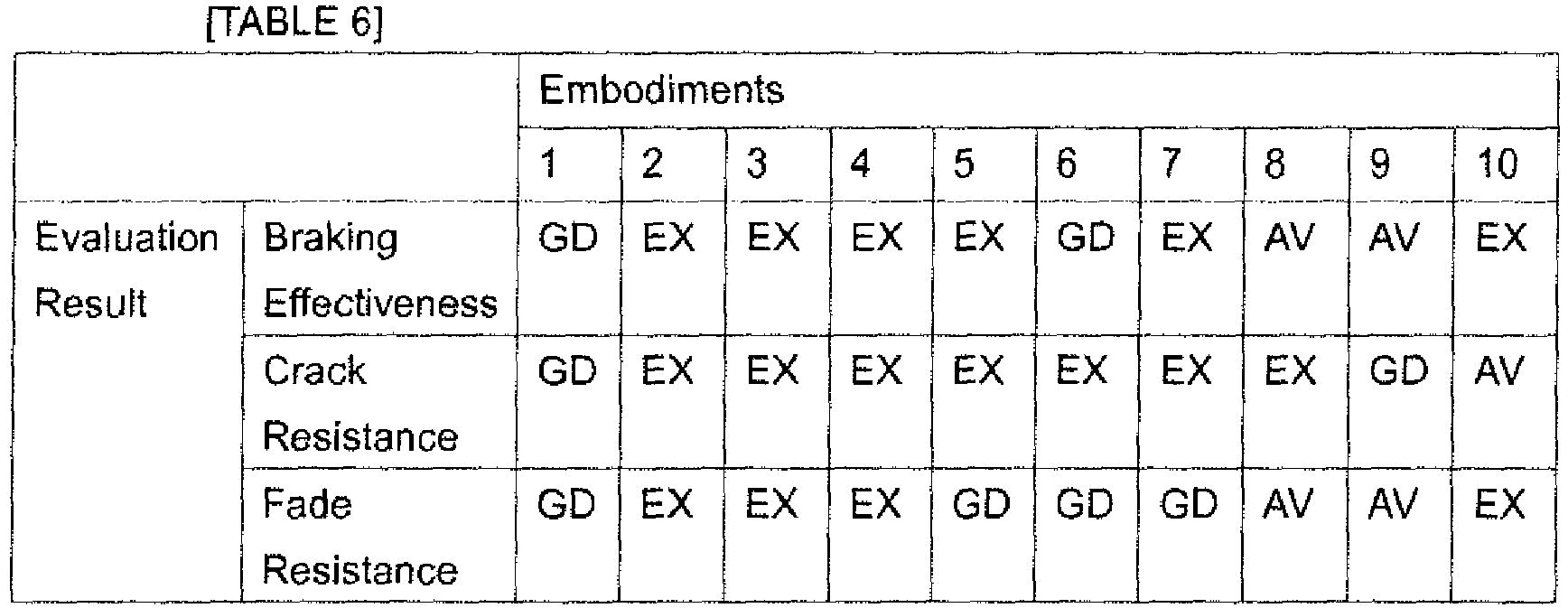

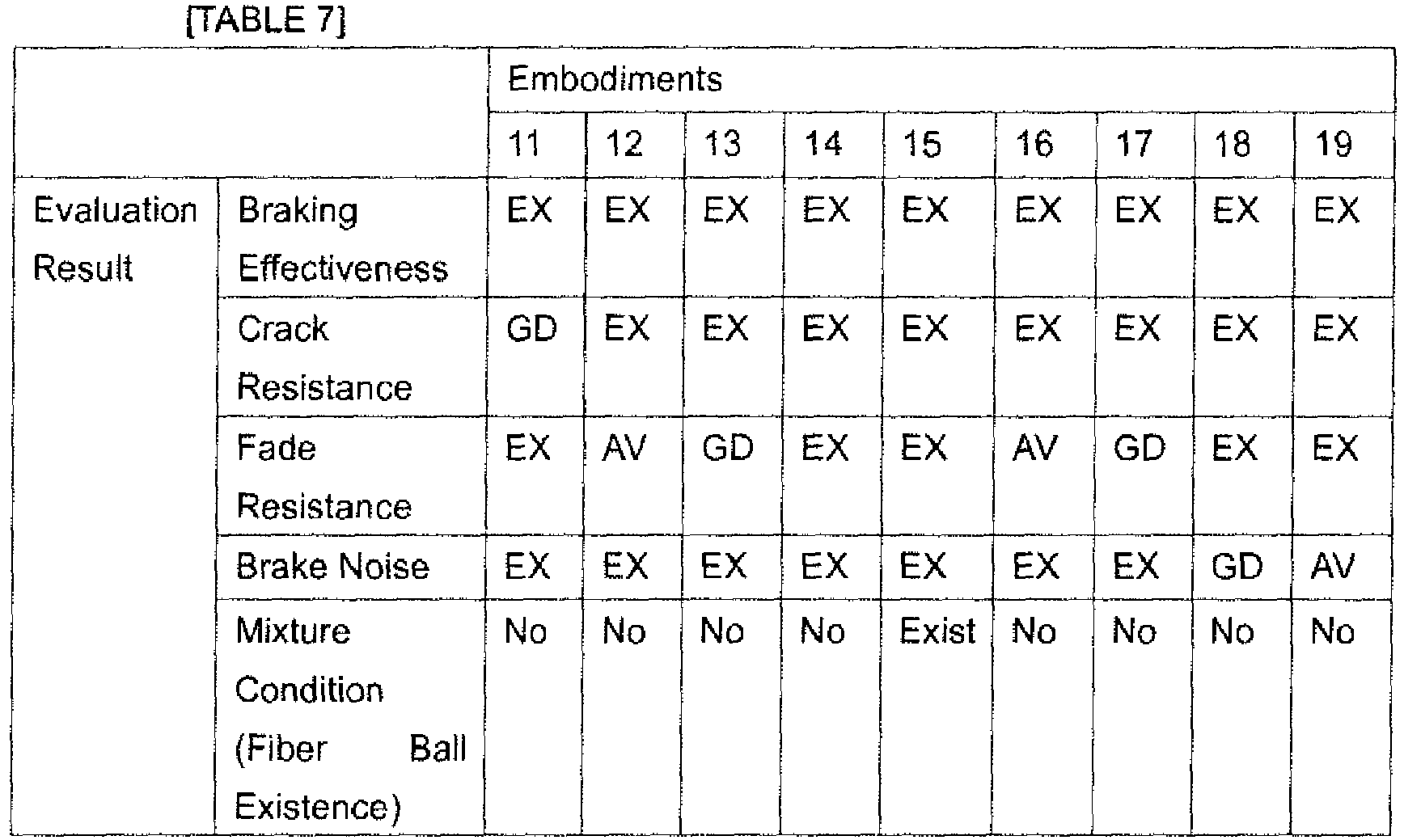

- From the respective TABLES, the friction materials satisfying the conditions described in this invention show excellent braking effectiveness, crack resistance, and fade resistance.
- According to this invention, the friction material for the disc brake pad, which is manufactured by forming NAO friction material composition, can satisfy the legal requirement with respect to the minimum amount of the copper component and can satisfy the required performance with respect to the braking effectiveness, the crack resistance, and the fade resistance, thereby offering highly practical and valuable product.
Claims (4)
- A friction material for a disc brake pad, which is manufactured by forming a nonasbestosorganic (NAO) friction material composition that contains a binder, a fiber base material, a friction modifier, a lubricant, a pH adjuster, and a filler, wherein
said friction material composition contains, as the friction modifier, 5 - 30 mass % of a layer crystal structure titanate, which has 0.1 or more mass % but 2.5 or less mass % of alkali elution rate which means the mass rate of the alkali metal and the alkali-earth metal eluted from the titanate compound in the water at 80 centigrade, relative to the total amount of the friction material composition. - The friction material according to Claim 1, wherein
alkali elution rate of said layer crystal structure titanate is 0.5 mass % or more but 1.5 mass % or less. - The friction material according to either Claim 1 or Claim 2, wherein said layer crystal structure titanate is a magnesium potassium titanate.
- The friction material according to either one of Claim 1, Claim 2, or Claim 3, wherein
said friction material composition contains 5 - 25 mass % of a monoclinic crystal zirconium oxide relative to the total amount of the friction material composition, as the friction modifier and 1 - 5 mass % of a fibrillated organic fiber relative to the total amount of the friction material composition, as the fiber base material.
Applications Claiming Priority (2)
| Application Number | Priority Date | Filing Date | Title |
|---|---|---|---|
| JP2016083851A JP6301997B2 (en) | 2016-04-19 | 2016-04-19 | Friction material |
| PCT/JP2017/014028 WO2017183439A1 (en) | 2016-04-19 | 2017-04-04 | Friction material |
Publications (3)
| Publication Number | Publication Date |
|---|---|
| EP3447103A1 EP3447103A1 (en) | 2019-02-27 |
| EP3447103A4 EP3447103A4 (en) | 2019-05-01 |
| EP3447103B1 true EP3447103B1 (en) | 2021-08-11 |
Family
ID=60115809
Family Applications (1)
| Application Number | Title | Priority Date | Filing Date |
|---|---|---|---|
| EP17785781.0A Active EP3447103B1 (en) | 2016-04-19 | 2017-04-04 | Friction material |
Country Status (6)
| Country | Link |
|---|---|
| US (1) | US20190154094A1 (en) |
| EP (1) | EP3447103B1 (en) |
| JP (1) | JP6301997B2 (en) |
| KR (1) | KR102347391B1 (en) |
| CN (2) | CN117869500A (en) |
| WO (1) | WO2017183439A1 (en) |
Families Citing this family (8)
| Publication number | Priority date | Publication date | Assignee | Title |
|---|---|---|---|---|
| JP7323309B2 (en) * | 2019-03-20 | 2023-08-08 | 曙ブレーキ工業株式会社 | Friction material for disc brakes |
| WO2021010003A1 (en) * | 2019-07-18 | 2021-01-21 | 日清紡ブレーキ株式会社 | Friction material composition, friction material, and disk brake pad |
| JP7361520B2 (en) | 2019-07-23 | 2023-10-16 | 日清紡ブレーキ株式会社 | Friction material |
| JP7344694B2 (en) | 2019-07-23 | 2023-09-14 | 日清紡ブレーキ株式会社 | Friction material |
| WO2021256336A1 (en) * | 2020-06-16 | 2021-12-23 | 日清紡ブレーキ株式会社 | Friction pair |
| JP7569859B2 (en) * | 2020-06-16 | 2024-10-18 | 日清紡ブレーキ株式会社 | Friction vs. |
| JP7016997B1 (en) * | 2020-08-04 | 2022-02-07 | 大塚化学株式会社 | Friction modifiers, friction material compositions, friction materials, and friction members |
| CN121219239A (en) * | 2023-05-26 | 2025-12-26 | 大塚化学株式会社 | Potassium magnesium titanate, friction modifiers, friction material compositions, friction materials and friction components |
Citations (3)
| Publication number | Priority date | Publication date | Assignee | Title |
|---|---|---|---|---|
| EP2757137A1 (en) | 2011-09-14 | 2014-07-23 | Akebono Brake Industry Co., Ltd. | Friction material |
| EP2937397A1 (en) | 2012-12-21 | 2015-10-28 | Akebono Brake Industry Co., Ltd. | Friction material |
| EP2980155A1 (en) | 2013-03-27 | 2016-02-03 | Otsuka Chemical Company, Ltd. | Resin composition, friction material, and method for producing same |
Family Cites Families (12)
| Publication number | Priority date | Publication date | Assignee | Title |
|---|---|---|---|---|
| JPH10287424A (en) * | 1997-04-09 | 1998-10-27 | Kubota Corp | Method for producing composite titanium compound |
| JP2000160135A (en) * | 1998-11-25 | 2000-06-13 | Hitachi Chem Co Ltd | Friction material composition and friction material using the composition |
| CN1300000C (en) * | 2000-07-31 | 2007-02-14 | 大塚化学株式会社 | Lepidocrosite type potassium magnesium titanate and method for production thereof, and friction material |
| JP2002371266A (en) * | 2001-06-14 | 2002-12-26 | Aisin Seiki Co Ltd | Friction material |
| CN102449098B (en) * | 2009-06-01 | 2015-07-15 | 日立化成株式会社 | Friction material composition, friction material obtained from same, and friction member |
| JP5263454B2 (en) * | 2010-11-19 | 2013-08-14 | 日立化成株式会社 | Non-asbestos friction material composition, friction material and friction member using the same |
| JP5981839B2 (en) | 2012-12-21 | 2016-08-31 | 曙ブレーキ工業株式会社 | Friction material |
| JP2014148666A (en) * | 2013-01-11 | 2014-08-21 | Nisshinbo Brake Inc | Friction material |
| JP2014156589A (en) * | 2013-01-15 | 2014-08-28 | Nisshinbo Brake Inc | Friction material |
| JP2014224175A (en) | 2013-05-15 | 2014-12-04 | 大塚化学株式会社 | Friction material and friction material for use in drum brake |
| JP6425894B2 (en) * | 2014-02-10 | 2018-11-21 | 日本ブレーキ工業株式会社 | Friction material composition, friction material using friction material composition and friction member |
| JP5958623B2 (en) | 2015-08-13 | 2016-08-02 | 日立化成株式会社 | Non-asbestos friction material composition |
-
2016
- 2016-04-19 JP JP2016083851A patent/JP6301997B2/en active Active
-
2017
- 2017-04-04 KR KR1020187031729A patent/KR102347391B1/en active Active
- 2017-04-04 EP EP17785781.0A patent/EP3447103B1/en active Active
- 2017-04-04 CN CN202311828792.7A patent/CN117869500A/en active Pending
- 2017-04-04 US US16/164,743 patent/US20190154094A1/en not_active Abandoned
- 2017-04-04 WO PCT/JP2017/014028 patent/WO2017183439A1/en not_active Ceased
- 2017-04-04 CN CN201780024347.1A patent/CN109072047A/en active Pending
Patent Citations (3)
| Publication number | Priority date | Publication date | Assignee | Title |
|---|---|---|---|---|
| EP2757137A1 (en) | 2011-09-14 | 2014-07-23 | Akebono Brake Industry Co., Ltd. | Friction material |
| EP2937397A1 (en) | 2012-12-21 | 2015-10-28 | Akebono Brake Industry Co., Ltd. | Friction material |
| EP2980155A1 (en) | 2013-03-27 | 2016-02-03 | Otsuka Chemical Company, Ltd. | Resin composition, friction material, and method for producing same |
Also Published As
| Publication number | Publication date |
|---|---|
| EP3447103A4 (en) | 2019-05-01 |
| KR102347391B1 (en) | 2022-01-06 |
| WO2017183439A1 (en) | 2017-10-26 |
| US20190154094A1 (en) | 2019-05-23 |
| JP6301997B2 (en) | 2018-03-28 |
| EP3447103A1 (en) | 2019-02-27 |
| JP2017193612A (en) | 2017-10-26 |
| CN117869500A (en) | 2024-04-12 |
| KR20180134936A (en) | 2018-12-19 |
| CN109072047A (en) | 2018-12-21 |
Similar Documents
| Publication | Publication Date | Title |
|---|---|---|
| EP3133134B1 (en) | Friction material | |
| EP2977637B1 (en) | Friction material | |
| EP3048325B1 (en) | Friction material and friction pair | |
| US10670099B2 (en) | Friction material | |
| EP3447103A1 (en) | Friction material | |
| EP3173653B1 (en) | Friction material | |
| CN105849433B (en) | Friction material | |
| CN107849431A (en) | Friction material | |
| JP7467465B2 (en) | Friction material composition, friction material and disc brake pad | |
| US20200032869A1 (en) | Friction Material | |
| WO2021015003A1 (en) | Friction material | |
| JP4412475B2 (en) | Friction material | |
| JP6254424B2 (en) | Friction material | |
| US20210222748A1 (en) | Friction material | |
| US20250043842A1 (en) | Friction material | |
| WO2021015002A1 (en) | Friction material | |
| EP4122993B1 (en) | Friction material |
Legal Events
| Date | Code | Title | Description |
|---|---|---|---|
| STAA | Information on the status of an ep patent application or granted ep patent |
Free format text: STATUS: THE INTERNATIONAL PUBLICATION HAS BEEN MADE |
|
| PUAI | Public reference made under article 153(3) epc to a published international application that has entered the european phase |
Free format text: ORIGINAL CODE: 0009012 |
|
| STAA | Information on the status of an ep patent application or granted ep patent |
Free format text: STATUS: REQUEST FOR EXAMINATION WAS MADE |
|
| 17P | Request for examination filed |
Effective date: 20181115 |
|
| AK | Designated contracting states |
Kind code of ref document: A1 Designated state(s): AL AT BE BG CH CY CZ DE DK EE ES FI FR GB GR HR HU IE IS IT LI LT LU LV MC MK MT NL NO PL PT RO RS SE SI SK SM TR |
|
| AX | Request for extension of the european patent |
Extension state: BA ME |
|
| REG | Reference to a national code |
Ref country code: DE Ref legal event code: R079 Ref document number: 602017043913 Country of ref document: DE Free format text: PREVIOUS MAIN CLASS: C09K0003140000 Ipc: F16D0069020000 |
|
| A4 | Supplementary search report drawn up and despatched |
Effective date: 20190329 |
|
| RIC1 | Information provided on ipc code assigned before grant |
Ipc: F16D 69/02 20060101AFI20190325BHEP Ipc: C01G 23/00 20060101ALI20190325BHEP |
|
| DAV | Request for validation of the european patent (deleted) | ||
| DAX | Request for extension of the european patent (deleted) | ||
| STAA | Information on the status of an ep patent application or granted ep patent |
Free format text: STATUS: EXAMINATION IS IN PROGRESS |
|
| 17Q | First examination report despatched |
Effective date: 20200316 |
|
| GRAP | Despatch of communication of intention to grant a patent |
Free format text: ORIGINAL CODE: EPIDOSNIGR1 |
|
| STAA | Information on the status of an ep patent application or granted ep patent |
Free format text: STATUS: GRANT OF PATENT IS INTENDED |
|
| INTG | Intention to grant announced |
Effective date: 20210413 |
|
| RIN1 | Information on inventor provided before grant (corrected) |
Inventor name: YAGUCHI MITSUAKI Inventor name: IWAI, TOMOMI Inventor name: TANAKA, TAKAO |
|
| GRAS | Grant fee paid |
Free format text: ORIGINAL CODE: EPIDOSNIGR3 |
|
| GRAA | (expected) grant |
Free format text: ORIGINAL CODE: 0009210 |
|
| STAA | Information on the status of an ep patent application or granted ep patent |
Free format text: STATUS: THE PATENT HAS BEEN GRANTED |
|
| AK | Designated contracting states |
Kind code of ref document: B1 Designated state(s): AL AT BE BG CH CY CZ DE DK EE ES FI FR GB GR HR HU IE IS IT LI LT LU LV MC MK MT NL NO PL PT RO RS SE SI SK SM TR |
|
| REG | Reference to a national code |
Ref country code: CH Ref legal event code: EP |
|
| REG | Reference to a national code |
Ref country code: DE Ref legal event code: R096 Ref document number: 602017043913 Country of ref document: DE |
|
| REG | Reference to a national code |
Ref country code: IE Ref legal event code: FG4D Ref country code: AT Ref legal event code: REF Ref document number: 1419681 Country of ref document: AT Kind code of ref document: T Effective date: 20210915 |
|
| REG | Reference to a national code |
Ref country code: LT Ref legal event code: MG9D |
|
| REG | Reference to a national code |
Ref country code: NL Ref legal event code: MP Effective date: 20210811 |
|
| REG | Reference to a national code |
Ref country code: AT Ref legal event code: MK05 Ref document number: 1419681 Country of ref document: AT Kind code of ref document: T Effective date: 20210811 |
|
| PG25 | Lapsed in a contracting state [announced via postgrant information from national office to epo] |
Ref country code: ES Free format text: LAPSE BECAUSE OF FAILURE TO SUBMIT A TRANSLATION OF THE DESCRIPTION OR TO PAY THE FEE WITHIN THE PRESCRIBED TIME-LIMIT Effective date: 20210811 Ref country code: FI Free format text: LAPSE BECAUSE OF FAILURE TO SUBMIT A TRANSLATION OF THE DESCRIPTION OR TO PAY THE FEE WITHIN THE PRESCRIBED TIME-LIMIT Effective date: 20210811 Ref country code: PT Free format text: LAPSE BECAUSE OF FAILURE TO SUBMIT A TRANSLATION OF THE DESCRIPTION OR TO PAY THE FEE WITHIN THE PRESCRIBED TIME-LIMIT Effective date: 20211213 Ref country code: NO Free format text: LAPSE BECAUSE OF FAILURE TO SUBMIT A TRANSLATION OF THE DESCRIPTION OR TO PAY THE FEE WITHIN THE PRESCRIBED TIME-LIMIT Effective date: 20211111 Ref country code: LT Free format text: LAPSE BECAUSE OF FAILURE TO SUBMIT A TRANSLATION OF THE DESCRIPTION OR TO PAY THE FEE WITHIN THE PRESCRIBED TIME-LIMIT Effective date: 20210811 Ref country code: AT Free format text: LAPSE BECAUSE OF FAILURE TO SUBMIT A TRANSLATION OF THE DESCRIPTION OR TO PAY THE FEE WITHIN THE PRESCRIBED TIME-LIMIT Effective date: 20210811 Ref country code: BG Free format text: LAPSE BECAUSE OF FAILURE TO SUBMIT A TRANSLATION OF THE DESCRIPTION OR TO PAY THE FEE WITHIN THE PRESCRIBED TIME-LIMIT Effective date: 20211111 Ref country code: HR Free format text: LAPSE BECAUSE OF FAILURE TO SUBMIT A TRANSLATION OF THE DESCRIPTION OR TO PAY THE FEE WITHIN THE PRESCRIBED TIME-LIMIT Effective date: 20210811 Ref country code: SE Free format text: LAPSE BECAUSE OF FAILURE TO SUBMIT A TRANSLATION OF THE DESCRIPTION OR TO PAY THE FEE WITHIN THE PRESCRIBED TIME-LIMIT Effective date: 20210811 Ref country code: RS Free format text: LAPSE BECAUSE OF FAILURE TO SUBMIT A TRANSLATION OF THE DESCRIPTION OR TO PAY THE FEE WITHIN THE PRESCRIBED TIME-LIMIT Effective date: 20210811 |
|
| PG25 | Lapsed in a contracting state [announced via postgrant information from national office to epo] |
Ref country code: PL Free format text: LAPSE BECAUSE OF FAILURE TO SUBMIT A TRANSLATION OF THE DESCRIPTION OR TO PAY THE FEE WITHIN THE PRESCRIBED TIME-LIMIT Effective date: 20210811 Ref country code: LV Free format text: LAPSE BECAUSE OF FAILURE TO SUBMIT A TRANSLATION OF THE DESCRIPTION OR TO PAY THE FEE WITHIN THE PRESCRIBED TIME-LIMIT Effective date: 20210811 Ref country code: GR Free format text: LAPSE BECAUSE OF FAILURE TO SUBMIT A TRANSLATION OF THE DESCRIPTION OR TO PAY THE FEE WITHIN THE PRESCRIBED TIME-LIMIT Effective date: 20211112 |
|
| PG25 | Lapsed in a contracting state [announced via postgrant information from national office to epo] |
Ref country code: NL Free format text: LAPSE BECAUSE OF FAILURE TO SUBMIT A TRANSLATION OF THE DESCRIPTION OR TO PAY THE FEE WITHIN THE PRESCRIBED TIME-LIMIT Effective date: 20210811 |
|
| PG25 | Lapsed in a contracting state [announced via postgrant information from national office to epo] |
Ref country code: DK Free format text: LAPSE BECAUSE OF FAILURE TO SUBMIT A TRANSLATION OF THE DESCRIPTION OR TO PAY THE FEE WITHIN THE PRESCRIBED TIME-LIMIT Effective date: 20210811 |
|
| REG | Reference to a national code |
Ref country code: DE Ref legal event code: R026 Ref document number: 602017043913 Country of ref document: DE |
|
| PLBI | Opposition filed |
Free format text: ORIGINAL CODE: 0009260 |
|
| PLAX | Notice of opposition and request to file observation + time limit sent |
Free format text: ORIGINAL CODE: EPIDOSNOBS2 |
|
| PG25 | Lapsed in a contracting state [announced via postgrant information from national office to epo] |
Ref country code: SM Free format text: LAPSE BECAUSE OF FAILURE TO SUBMIT A TRANSLATION OF THE DESCRIPTION OR TO PAY THE FEE WITHIN THE PRESCRIBED TIME-LIMIT Effective date: 20210811 Ref country code: SK Free format text: LAPSE BECAUSE OF FAILURE TO SUBMIT A TRANSLATION OF THE DESCRIPTION OR TO PAY THE FEE WITHIN THE PRESCRIBED TIME-LIMIT Effective date: 20210811 Ref country code: RO Free format text: LAPSE BECAUSE OF FAILURE TO SUBMIT A TRANSLATION OF THE DESCRIPTION OR TO PAY THE FEE WITHIN THE PRESCRIBED TIME-LIMIT Effective date: 20210811 Ref country code: EE Free format text: LAPSE BECAUSE OF FAILURE TO SUBMIT A TRANSLATION OF THE DESCRIPTION OR TO PAY THE FEE WITHIN THE PRESCRIBED TIME-LIMIT Effective date: 20210811 Ref country code: CZ Free format text: LAPSE BECAUSE OF FAILURE TO SUBMIT A TRANSLATION OF THE DESCRIPTION OR TO PAY THE FEE WITHIN THE PRESCRIBED TIME-LIMIT Effective date: 20210811 Ref country code: AL Free format text: LAPSE BECAUSE OF FAILURE TO SUBMIT A TRANSLATION OF THE DESCRIPTION OR TO PAY THE FEE WITHIN THE PRESCRIBED TIME-LIMIT Effective date: 20210811 |
|
| 26 | Opposition filed |
Opponent name: VRI-VERBAND DER REIBBELAGINDUSTRIE E.V. Effective date: 20220510 |
|
| PG25 | Lapsed in a contracting state [announced via postgrant information from national office to epo] |
Ref country code: IT Free format text: LAPSE BECAUSE OF FAILURE TO SUBMIT A TRANSLATION OF THE DESCRIPTION OR TO PAY THE FEE WITHIN THE PRESCRIBED TIME-LIMIT Effective date: 20210811 |
|
| PG25 | Lapsed in a contracting state [announced via postgrant information from national office to epo] |
Ref country code: SI Free format text: LAPSE BECAUSE OF FAILURE TO SUBMIT A TRANSLATION OF THE DESCRIPTION OR TO PAY THE FEE WITHIN THE PRESCRIBED TIME-LIMIT Effective date: 20210811 |
|
| REG | Reference to a national code |
Ref country code: DE Ref legal event code: R082 Ref document number: 602017043913 Country of ref document: DE Representative=s name: STOLMAR & PARTNER PATENTANWAELTE PARTG MBB, DE |
|
| PLBB | Reply of patent proprietor to notice(s) of opposition received |
Free format text: ORIGINAL CODE: EPIDOSNOBS3 |
|
| REG | Reference to a national code |
Ref country code: CH Ref legal event code: PL |
|
| GBPC | Gb: european patent ceased through non-payment of renewal fee |
Effective date: 20220404 |
|
| REG | Reference to a national code |
Ref country code: BE Ref legal event code: MM Effective date: 20220430 |
|
| PG25 | Lapsed in a contracting state [announced via postgrant information from national office to epo] |
Ref country code: MC Free format text: LAPSE BECAUSE OF FAILURE TO SUBMIT A TRANSLATION OF THE DESCRIPTION OR TO PAY THE FEE WITHIN THE PRESCRIBED TIME-LIMIT Effective date: 20210811 Ref country code: LU Free format text: LAPSE BECAUSE OF NON-PAYMENT OF DUE FEES Effective date: 20220404 Ref country code: LI Free format text: LAPSE BECAUSE OF NON-PAYMENT OF DUE FEES Effective date: 20220430 Ref country code: GB Free format text: LAPSE BECAUSE OF NON-PAYMENT OF DUE FEES Effective date: 20220404 Ref country code: FR Free format text: LAPSE BECAUSE OF NON-PAYMENT OF DUE FEES Effective date: 20220430 Ref country code: CH Free format text: LAPSE BECAUSE OF NON-PAYMENT OF DUE FEES Effective date: 20220430 |
|
| PG25 | Lapsed in a contracting state [announced via postgrant information from national office to epo] |
Ref country code: BE Free format text: LAPSE BECAUSE OF NON-PAYMENT OF DUE FEES Effective date: 20220430 |
|
| PG25 | Lapsed in a contracting state [announced via postgrant information from national office to epo] |
Ref country code: IE Free format text: LAPSE BECAUSE OF NON-PAYMENT OF DUE FEES Effective date: 20220404 |
|
| P01 | Opt-out of the competence of the unified patent court (upc) registered |
Effective date: 20230530 |
|
| PG25 | Lapsed in a contracting state [announced via postgrant information from national office to epo] |
Ref country code: HU Free format text: LAPSE BECAUSE OF FAILURE TO SUBMIT A TRANSLATION OF THE DESCRIPTION OR TO PAY THE FEE WITHIN THE PRESCRIBED TIME-LIMIT; INVALID AB INITIO Effective date: 20170404 |
|
| PLCK | Communication despatched that opposition was rejected |
Free format text: ORIGINAL CODE: EPIDOSNREJ1 |
|
| PG25 | Lapsed in a contracting state [announced via postgrant information from national office to epo] |
Ref country code: MK Free format text: LAPSE BECAUSE OF FAILURE TO SUBMIT A TRANSLATION OF THE DESCRIPTION OR TO PAY THE FEE WITHIN THE PRESCRIBED TIME-LIMIT Effective date: 20210811 Ref country code: CY Free format text: LAPSE BECAUSE OF FAILURE TO SUBMIT A TRANSLATION OF THE DESCRIPTION OR TO PAY THE FEE WITHIN THE PRESCRIBED TIME-LIMIT Effective date: 20210811 |
|
| APBP | Date of receipt of notice of appeal recorded |
Free format text: ORIGINAL CODE: EPIDOSNNOA2O |
|
| APAH | Appeal reference modified |
Free format text: ORIGINAL CODE: EPIDOSCREFNO |
|
| APAW | Appeal reference deleted |
Free format text: ORIGINAL CODE: EPIDOSDREFNO |
|
| APBQ | Date of receipt of statement of grounds of appeal recorded |
Free format text: ORIGINAL CODE: EPIDOSNNOA3O |
|
| PG25 | Lapsed in a contracting state [announced via postgrant information from national office to epo] |
Ref country code: MT Free format text: LAPSE BECAUSE OF FAILURE TO SUBMIT A TRANSLATION OF THE DESCRIPTION OR TO PAY THE FEE WITHIN THE PRESCRIBED TIME-LIMIT Effective date: 20210811 |
|
| PGFP | Annual fee paid to national office [announced via postgrant information from national office to epo] |
Ref country code: DE Payment date: 20250430 Year of fee payment: 9 |
|
| REG | Reference to a national code |
Ref country code: DE Ref legal event code: R100 Ref document number: 602017043913 Country of ref document: DE |
|
| APBU | Appeal procedure closed |
Free format text: ORIGINAL CODE: EPIDOSNNOA9O |
|
| PLBN | Opposition rejected |
Free format text: ORIGINAL CODE: 0009273 |
|
| STAA | Information on the status of an ep patent application or granted ep patent |
Free format text: STATUS: OPPOSITION REJECTED |
|
| 27O | Opposition rejected |
Effective date: 20250729 |
|
| PG25 | Lapsed in a contracting state [announced via postgrant information from national office to epo] |
Ref country code: TR Free format text: LAPSE BECAUSE OF FAILURE TO SUBMIT A TRANSLATION OF THE DESCRIPTION OR TO PAY THE FEE WITHIN THE PRESCRIBED TIME-LIMIT Effective date: 20210811 |