EP3447043A1 - Method of recovering organic acids from aqueous solutions - Google Patents
Method of recovering organic acids from aqueous solutions Download PDFInfo
- Publication number
- EP3447043A1 EP3447043A1 EP17187734.3A EP17187734A EP3447043A1 EP 3447043 A1 EP3447043 A1 EP 3447043A1 EP 17187734 A EP17187734 A EP 17187734A EP 3447043 A1 EP3447043 A1 EP 3447043A1
- Authority
- EP
- European Patent Office
- Prior art keywords
- acid
- aqueous solution
- extraction phase
- alcohol
- advantageously
- Prior art date
- Legal status (The legal status is an assumption and is not a legal conclusion. Google has not performed a legal analysis and makes no representation as to the accuracy of the status listed.)
- Withdrawn
Links
- 150000007524 organic acids Chemical class 0.000 title claims abstract description 43
- 238000000034 method Methods 0.000 title claims abstract description 40
- 239000007864 aqueous solution Substances 0.000 title claims abstract description 30
- 235000005985 organic acids Nutrition 0.000 title description 10
- 238000000605 extraction Methods 0.000 claims abstract description 61
- 150000002148 esters Chemical class 0.000 claims abstract description 30
- LFQSCWFLJHTTHZ-UHFFFAOYSA-N Ethanol Chemical compound CCO LFQSCWFLJHTTHZ-UHFFFAOYSA-N 0.000 claims abstract description 22
- XLYOFNOQVPJJNP-UHFFFAOYSA-N water Substances O XLYOFNOQVPJJNP-UHFFFAOYSA-N 0.000 claims abstract description 22
- 238000000855 fermentation Methods 0.000 claims description 34
- 230000004151 fermentation Effects 0.000 claims description 34
- 239000003085 diluting agent Substances 0.000 claims description 24
- 150000001412 amines Chemical class 0.000 claims description 23
- 238000006243 chemical reaction Methods 0.000 claims description 22
- 125000004432 carbon atom Chemical group C* 0.000 claims description 16
- 239000000203 mixture Substances 0.000 claims description 8
- 125000005233 alkylalcohol group Chemical group 0.000 claims description 5
- 238000004064 recycling Methods 0.000 claims description 5
- 150000003512 tertiary amines Chemical class 0.000 claims description 5
- OFOBLEOULBTSOW-UHFFFAOYSA-N Malonic acid Chemical compound OC(=O)CC(O)=O OFOBLEOULBTSOW-UHFFFAOYSA-N 0.000 claims description 2
- 238000010438 heat treatment Methods 0.000 claims 1
- 239000012071 phase Substances 0.000 description 28
- 239000002253 acid Substances 0.000 description 22
- 235000010633 broth Nutrition 0.000 description 18
- 238000005886 esterification reaction Methods 0.000 description 16
- OKKJLVBELUTLKV-UHFFFAOYSA-N Methanol Chemical compound OC OKKJLVBELUTLKV-UHFFFAOYSA-N 0.000 description 15
- JAHNSTQSQJOJLO-UHFFFAOYSA-N 2-(3-fluorophenyl)-1h-imidazole Chemical compound FC1=CC=CC(C=2NC=CN=2)=C1 JAHNSTQSQJOJLO-UHFFFAOYSA-N 0.000 description 14
- LVHBHZANLOWSRM-UHFFFAOYSA-N methylenebutanedioic acid Natural products OC(=O)CC(=C)C(O)=O LVHBHZANLOWSRM-UHFFFAOYSA-N 0.000 description 14
- -1 carboxylic acids Chemical class 0.000 description 11
- 239000003054 catalyst Substances 0.000 description 11
- 230000032050 esterification Effects 0.000 description 8
- JGHZJRVDZXSNKQ-UHFFFAOYSA-N methyl octanoate Chemical compound CCCCCCCC(=O)OC JGHZJRVDZXSNKQ-UHFFFAOYSA-N 0.000 description 8
- 150000001298 alcohols Chemical class 0.000 description 7
- KRKNYBCHXYNGOX-UHFFFAOYSA-N citric acid Substances OC(=O)CC(O)(C(O)=O)CC(O)=O KRKNYBCHXYNGOX-UHFFFAOYSA-N 0.000 description 7
- 239000012527 feed solution Substances 0.000 description 7
- JVTAAEKCZFNVCJ-UHFFFAOYSA-N lactic acid Chemical compound CC(O)C(O)=O JVTAAEKCZFNVCJ-UHFFFAOYSA-N 0.000 description 7
- XTAZYLNFDRKIHJ-UHFFFAOYSA-N n,n-dioctyloctan-1-amine Chemical compound CCCCCCCCN(CCCCCCCC)CCCCCCCC XTAZYLNFDRKIHJ-UHFFFAOYSA-N 0.000 description 7
- 150000007513 acids Chemical class 0.000 description 6
- 125000000217 alkyl group Chemical group 0.000 description 6
- 239000008346 aqueous phase Substances 0.000 description 6
- 238000002474 experimental method Methods 0.000 description 6
- 239000000047 product Substances 0.000 description 6
- 150000001735 carboxylic acids Chemical class 0.000 description 5
- 239000003795 chemical substances by application Substances 0.000 description 5
- 244000005700 microbiome Species 0.000 description 5
- 150000003839 salts Chemical class 0.000 description 5
- 238000000926 separation method Methods 0.000 description 5
- KBPLFHHGFOOTCA-UHFFFAOYSA-N 1-Octanol Chemical compound CCCCCCCCO KBPLFHHGFOOTCA-UHFFFAOYSA-N 0.000 description 4
- 239000005641 Methyl octanoate Substances 0.000 description 4
- 150000001335 aliphatic alkanes Chemical class 0.000 description 4
- CHTHALBTIRVDBM-UHFFFAOYSA-N furan-2,5-dicarboxylic acid Chemical compound OC(=O)C1=CC=C(C(O)=O)O1 CHTHALBTIRVDBM-UHFFFAOYSA-N 0.000 description 4
- PGMYKACGEOXYJE-UHFFFAOYSA-N pentyl acetate Chemical compound CCCCCOC(C)=O PGMYKACGEOXYJE-UHFFFAOYSA-N 0.000 description 4
- 238000011084 recovery Methods 0.000 description 4
- OIYTYGOUZOARSH-UHFFFAOYSA-N 4-methoxy-2-methylidene-4-oxobutanoic acid Chemical compound COC(=O)CC(=C)C(O)=O OIYTYGOUZOARSH-UHFFFAOYSA-N 0.000 description 3
- QTBSBXVTEAMEQO-UHFFFAOYSA-N Acetic acid Chemical compound CC(O)=O QTBSBXVTEAMEQO-UHFFFAOYSA-N 0.000 description 3
- YXFVVABEGXRONW-UHFFFAOYSA-N Toluene Chemical compound CC1=CC=CC=C1 YXFVVABEGXRONW-UHFFFAOYSA-N 0.000 description 3
- 150000001732 carboxylic acid derivatives Chemical class 0.000 description 3
- 150000001875 compounds Chemical class 0.000 description 3
- ZWWQRMFIZFPUAA-UHFFFAOYSA-N dimethyl 2-methylidenebutanedioate Chemical compound COC(=O)CC(=C)C(=O)OC ZWWQRMFIZFPUAA-UHFFFAOYSA-N 0.000 description 3
- LAWOZCWGWDVVSG-UHFFFAOYSA-N dioctylamine Chemical compound CCCCCCCCNCCCCCCCC LAWOZCWGWDVVSG-UHFFFAOYSA-N 0.000 description 3
- 229930195733 hydrocarbon Natural products 0.000 description 3
- 150000002430 hydrocarbons Chemical class 0.000 description 3
- 238000011065 in-situ storage Methods 0.000 description 3
- 239000004310 lactic acid Substances 0.000 description 3
- 235000014655 lactic acid Nutrition 0.000 description 3
- 230000014759 maintenance of location Effects 0.000 description 3
- 239000012528 membrane Substances 0.000 description 3
- VLKZOEOYAKHREP-UHFFFAOYSA-N n-Hexane Chemical compound CCCCCC VLKZOEOYAKHREP-UHFFFAOYSA-N 0.000 description 3
- 239000002904 solvent Substances 0.000 description 3
- 235000000346 sugar Nutrition 0.000 description 3
- 238000010977 unit operation Methods 0.000 description 3
- JOOXCMJARBKPKM-UHFFFAOYSA-N 4-oxopentanoic acid Chemical compound CC(=O)CCC(O)=O JOOXCMJARBKPKM-UHFFFAOYSA-N 0.000 description 2
- PXRKCOCTEMYUEG-UHFFFAOYSA-N 5-aminoisoindole-1,3-dione Chemical compound NC1=CC=C2C(=O)NC(=O)C2=C1 PXRKCOCTEMYUEG-UHFFFAOYSA-N 0.000 description 2
- QGZKDVFQNNGYKY-UHFFFAOYSA-N Ammonia Chemical compound N QGZKDVFQNNGYKY-UHFFFAOYSA-N 0.000 description 2
- QGZKDVFQNNGYKY-UHFFFAOYSA-O Ammonium Chemical compound [NH4+] QGZKDVFQNNGYKY-UHFFFAOYSA-O 0.000 description 2
- FERIUCNNQQJTOY-UHFFFAOYSA-N Butyric acid Chemical compound CCCC(O)=O FERIUCNNQQJTOY-UHFFFAOYSA-N 0.000 description 2
- 239000004215 Carbon black (E152) Substances 0.000 description 2
- 108090000790 Enzymes Proteins 0.000 description 2
- 102000004190 Enzymes Human genes 0.000 description 2
- VZCYOOQTPOCHFL-OWOJBTEDSA-N Fumaric acid Chemical compound OC(=O)\C=C\C(O)=O VZCYOOQTPOCHFL-OWOJBTEDSA-N 0.000 description 2
- IMNFDUFMRHMDMM-UHFFFAOYSA-N N-Heptane Chemical compound CCCCCCC IMNFDUFMRHMDMM-UHFFFAOYSA-N 0.000 description 2
- KDYFGRWQOYBRFD-UHFFFAOYSA-N Succinic acid Natural products OC(=O)CCC(O)=O KDYFGRWQOYBRFD-UHFFFAOYSA-N 0.000 description 2
- 150000001408 amides Chemical class 0.000 description 2
- 150000003863 ammonium salts Chemical class 0.000 description 2
- 238000013459 approach Methods 0.000 description 2
- 125000003118 aryl group Chemical group 0.000 description 2
- QVGXLLKOCUKJST-UHFFFAOYSA-N atomic oxygen Chemical group [O] QVGXLLKOCUKJST-UHFFFAOYSA-N 0.000 description 2
- 238000009835 boiling Methods 0.000 description 2
- 150000005323 carbonate salts Chemical class 0.000 description 2
- MWKFXSUHUHTGQN-UHFFFAOYSA-N decan-1-ol Chemical compound CCCCCCCCCCO MWKFXSUHUHTGQN-UHFFFAOYSA-N 0.000 description 2
- 238000010586 diagram Methods 0.000 description 2
- 150000001991 dicarboxylic acids Chemical class 0.000 description 2
- XBDQKXXYIPTUBI-UHFFFAOYSA-N dimethylselenoniopropionate Natural products CCC(O)=O XBDQKXXYIPTUBI-UHFFFAOYSA-N 0.000 description 2
- 238000004821 distillation Methods 0.000 description 2
- LQZZUXJYWNFBMV-UHFFFAOYSA-N dodecan-1-ol Chemical compound CCCCCCCCCCCCO LQZZUXJYWNFBMV-UHFFFAOYSA-N 0.000 description 2
- 238000011143 downstream manufacturing Methods 0.000 description 2
- 238000000909 electrodialysis Methods 0.000 description 2
- 238000001914 filtration Methods 0.000 description 2
- 239000002638 heterogeneous catalyst Substances 0.000 description 2
- FUZZWVXGSFPDMH-UHFFFAOYSA-N hexanoic acid Chemical compound CCCCCC(O)=O FUZZWVXGSFPDMH-UHFFFAOYSA-N 0.000 description 2
- KQNPFQTWMSNSAP-UHFFFAOYSA-N isobutyric acid Chemical compound CC(C)C(O)=O KQNPFQTWMSNSAP-UHFFFAOYSA-N 0.000 description 2
- FGKJLKRYENPLQH-UHFFFAOYSA-N isocaproic acid Chemical compound CC(C)CCC(O)=O FGKJLKRYENPLQH-UHFFFAOYSA-N 0.000 description 2
- BDAGIHXWWSANSR-UHFFFAOYSA-N methanoic acid Natural products OC=O BDAGIHXWWSANSR-UHFFFAOYSA-N 0.000 description 2
- WWZKQHOCKIZLMA-UHFFFAOYSA-N octanoic acid Chemical compound CCCCCCCC(O)=O WWZKQHOCKIZLMA-UHFFFAOYSA-N 0.000 description 2
- 229910052760 oxygen Inorganic materials 0.000 description 2
- 239000001301 oxygen Substances 0.000 description 2
- 238000001556 precipitation Methods 0.000 description 2
- 238000011027 product recovery Methods 0.000 description 2
- 238000005086 pumping Methods 0.000 description 2
- 239000012266 salt solution Substances 0.000 description 2
- 229920006395 saturated elastomer Polymers 0.000 description 2
- 150000008163 sugars Chemical class 0.000 description 2
- VZCYOOQTPOCHFL-UHFFFAOYSA-N trans-butenedioic acid Natural products OC(=O)C=CC(O)=O VZCYOOQTPOCHFL-UHFFFAOYSA-N 0.000 description 2
- NQPDZGIKBAWPEJ-UHFFFAOYSA-N valeric acid Chemical compound CCCCC(O)=O NQPDZGIKBAWPEJ-UHFFFAOYSA-N 0.000 description 2
- HFVMEOPYDLEHBR-UHFFFAOYSA-N (2-fluorophenyl)-phenylmethanol Chemical compound C=1C=CC=C(F)C=1C(O)C1=CC=CC=C1 HFVMEOPYDLEHBR-UHFFFAOYSA-N 0.000 description 1
- XVOUMQNXTGKGMA-OWOJBTEDSA-N (E)-glutaconic acid Chemical compound OC(=O)C\C=C\C(O)=O XVOUMQNXTGKGMA-OWOJBTEDSA-N 0.000 description 1
- BJEPYKJPYRNKOW-REOHCLBHSA-N (S)-malic acid Chemical compound OC(=O)[C@@H](O)CC(O)=O BJEPYKJPYRNKOW-REOHCLBHSA-N 0.000 description 1
- KZVBBTZJMSWGTK-UHFFFAOYSA-N 1-[2-(2-butoxyethoxy)ethoxy]butane Chemical compound CCCCOCCOCCOCCCC KZVBBTZJMSWGTK-UHFFFAOYSA-N 0.000 description 1
- JPGXOMADPRULAC-UHFFFAOYSA-N 1-[butoxy(butyl)phosphoryl]oxybutane Chemical compound CCCCOP(=O)(CCCC)OCCCC JPGXOMADPRULAC-UHFFFAOYSA-N 0.000 description 1
- LEMIDOZYVQXGLI-UHFFFAOYSA-N 1-heptylsulfanylheptane Chemical compound CCCCCCCSCCCCCCC LEMIDOZYVQXGLI-UHFFFAOYSA-N 0.000 description 1
- LHNRHYOMDUJLLM-UHFFFAOYSA-N 1-hexylsulfanylhexane Chemical compound CCCCCCSCCCCCC LHNRHYOMDUJLLM-UHFFFAOYSA-N 0.000 description 1
- XYHKNCXZYYTLRG-UHFFFAOYSA-N 1h-imidazole-2-carbaldehyde Chemical compound O=CC1=NC=CN1 XYHKNCXZYYTLRG-UHFFFAOYSA-N 0.000 description 1
- GWYFCOCPABKNJV-UHFFFAOYSA-M 3-Methylbutanoic acid Natural products CC(C)CC([O-])=O GWYFCOCPABKNJV-UHFFFAOYSA-M 0.000 description 1
- OSWFIVFLDKOXQC-UHFFFAOYSA-N 4-(3-methoxyphenyl)aniline Chemical compound COC1=CC=CC(C=2C=CC(N)=CC=2)=C1 OSWFIVFLDKOXQC-UHFFFAOYSA-N 0.000 description 1
- GAWIXWVDTYZWAW-UHFFFAOYSA-N C[CH]O Chemical group C[CH]O GAWIXWVDTYZWAW-UHFFFAOYSA-N 0.000 description 1
- 239000005635 Caprylic acid (CAS 124-07-2) Substances 0.000 description 1
- OKTJSMMVPCPJKN-UHFFFAOYSA-N Carbon Chemical group [C] OKTJSMMVPCPJKN-UHFFFAOYSA-N 0.000 description 1
- DSLZVSRJTYRBFB-LLEIAEIESA-N D-glucaric acid Chemical compound OC(=O)[C@@H](O)[C@@H](O)[C@H](O)[C@@H](O)C(O)=O DSLZVSRJTYRBFB-LLEIAEIESA-N 0.000 description 1
- 108090000371 Esterases Proteins 0.000 description 1
- WHUUTDBJXJRKMK-UHFFFAOYSA-N Glutamic acid Natural products OC(=O)C(N)CCC(O)=O WHUUTDBJXJRKMK-UHFFFAOYSA-N 0.000 description 1
- CKLJMWTZIZZHCS-REOHCLBHSA-N L-aspartic acid Chemical compound OC(=O)[C@@H](N)CC(O)=O CKLJMWTZIZZHCS-REOHCLBHSA-N 0.000 description 1
- WHUUTDBJXJRKMK-VKHMYHEASA-N L-glutamic acid Chemical compound OC(=O)[C@@H](N)CCC(O)=O WHUUTDBJXJRKMK-VKHMYHEASA-N 0.000 description 1
- 108090001060 Lipase Proteins 0.000 description 1
- 239000004367 Lipase Substances 0.000 description 1
- 102000004882 Lipase Human genes 0.000 description 1
- YJLYANLCNIKXMG-UHFFFAOYSA-N N-Methyldioctylamine Chemical compound CCCCCCCCN(C)CCCCCCCC YJLYANLCNIKXMG-UHFFFAOYSA-N 0.000 description 1
- 229910019142 PO4 Inorganic materials 0.000 description 1
- OAICVXFJPJFONN-UHFFFAOYSA-N Phosphorus Chemical group [P] OAICVXFJPJFONN-UHFFFAOYSA-N 0.000 description 1
- AFCIMSXHQSIHQW-UHFFFAOYSA-N [O].[P] Chemical compound [O].[P] AFCIMSXHQSIHQW-UHFFFAOYSA-N 0.000 description 1
- 230000002378 acidificating effect Effects 0.000 description 1
- 229910052784 alkaline earth metal Inorganic materials 0.000 description 1
- 150000003973 alkyl amines Chemical class 0.000 description 1
- 150000005215 alkyl ethers Chemical class 0.000 description 1
- BJEPYKJPYRNKOW-UHFFFAOYSA-N alpha-hydroxysuccinic acid Natural products OC(=O)C(O)CC(O)=O BJEPYKJPYRNKOW-UHFFFAOYSA-N 0.000 description 1
- 229910021529 ammonia Inorganic materials 0.000 description 1
- 239000012736 aqueous medium Substances 0.000 description 1
- 125000003710 aryl alkyl group Chemical group 0.000 description 1
- 235000003704 aspartic acid Nutrition 0.000 description 1
- 229910052788 barium Inorganic materials 0.000 description 1
- 125000001797 benzyl group Chemical group [H]C1=C([H])C([H])=C(C([H])=C1[H])C([H])([H])* 0.000 description 1
- OQFSQFPPLPISGP-UHFFFAOYSA-N beta-carboxyaspartic acid Natural products OC(=O)C(N)C(C(O)=O)C(O)=O OQFSQFPPLPISGP-UHFFFAOYSA-N 0.000 description 1
- GWYFCOCPABKNJV-UHFFFAOYSA-N beta-methyl-butyric acid Natural products CC(C)CC(O)=O GWYFCOCPABKNJV-UHFFFAOYSA-N 0.000 description 1
- 229920000704 biodegradable plastic Polymers 0.000 description 1
- 230000005587 bubbling Effects 0.000 description 1
- KDYFGRWQOYBRFD-NUQCWPJISA-N butanedioic acid Chemical compound O[14C](=O)CC[14C](O)=O KDYFGRWQOYBRFD-NUQCWPJISA-N 0.000 description 1
- 229910052791 calcium Inorganic materials 0.000 description 1
- 229910052799 carbon Inorganic materials 0.000 description 1
- 150000001734 carboxylic acid salts Chemical class 0.000 description 1
- 150000001768 cations Chemical class 0.000 description 1
- 238000005119 centrifugation Methods 0.000 description 1
- 239000007795 chemical reaction product Substances 0.000 description 1
- 238000010924 continuous production Methods 0.000 description 1
- 238000002425 crystallisation Methods 0.000 description 1
- JDPQWHLMBJZURR-UHFFFAOYSA-N decan-5-one Chemical compound CCCCCC(=O)CCCC JDPQWHLMBJZURR-UHFFFAOYSA-N 0.000 description 1
- 238000010908 decantation Methods 0.000 description 1
- 238000011161 development Methods 0.000 description 1
- 125000005265 dialkylamine group Chemical group 0.000 description 1
- VONWDASPFIQPDY-UHFFFAOYSA-N dimethyl methylphosphonate Chemical compound COP(C)(=O)OC VONWDASPFIQPDY-UHFFFAOYSA-N 0.000 description 1
- 238000005265 energy consumption Methods 0.000 description 1
- 150000002170 ethers Chemical class 0.000 description 1
- 235000019253 formic acid Nutrition 0.000 description 1
- 239000001530 fumaric acid Substances 0.000 description 1
- 235000013922 glutamic acid Nutrition 0.000 description 1
- 239000004220 glutamic acid Substances 0.000 description 1
- 229910052602 gypsum Inorganic materials 0.000 description 1
- 239000010440 gypsum Substances 0.000 description 1
- 125000002887 hydroxy group Chemical group [H]O* 0.000 description 1
- 125000002768 hydroxyalkyl group Chemical group 0.000 description 1
- 150000002576 ketones Chemical class 0.000 description 1
- 229940040102 levulinic acid Drugs 0.000 description 1
- 235000019421 lipase Nutrition 0.000 description 1
- 238000000622 liquid--liquid extraction Methods 0.000 description 1
- 229910052749 magnesium Inorganic materials 0.000 description 1
- VZCYOOQTPOCHFL-UPHRSURJSA-N maleic acid Chemical compound OC(=O)\C=C/C(O)=O VZCYOOQTPOCHFL-UPHRSURJSA-N 0.000 description 1
- 239000011976 maleic acid Substances 0.000 description 1
- 239000001630 malic acid Substances 0.000 description 1
- 235000011090 malic acid Nutrition 0.000 description 1
- 238000004519 manufacturing process Methods 0.000 description 1
- 239000002609 medium Substances 0.000 description 1
- CSJDCSCTVDEHRN-UHFFFAOYSA-N methane;molecular oxygen Chemical compound C.O=O CSJDCSCTVDEHRN-UHFFFAOYSA-N 0.000 description 1
- ZAJNGDIORYACQU-UHFFFAOYSA-N methyl n-octyl ketone Natural products CCCCCCCCC(C)=O ZAJNGDIORYACQU-UHFFFAOYSA-N 0.000 description 1
- 238000001471 micro-filtration Methods 0.000 description 1
- 150000002762 monocarboxylic acid derivatives Chemical class 0.000 description 1
- 150000002763 monocarboxylic acids Chemical class 0.000 description 1
- ZXORIQDKFRZFHV-UHFFFAOYSA-N n,n-dibutyl-2-hydroxypropanamide Chemical compound CCCCN(C(=O)C(C)O)CCCC ZXORIQDKFRZFHV-UHFFFAOYSA-N 0.000 description 1
- MEXKFCWMWJZDMF-UHFFFAOYSA-N n,n-dibutylacetamide Chemical compound CCCCN(C(C)=O)CCCC MEXKFCWMWJZDMF-UHFFFAOYSA-N 0.000 description 1
- NZMAJUHVSZBJHL-UHFFFAOYSA-N n,n-dibutylformamide Chemical compound CCCCN(C=O)CCCC NZMAJUHVSZBJHL-UHFFFAOYSA-N 0.000 description 1
- XAROAZKXMDRYAF-UHFFFAOYSA-N n,n-dibutylpropanamide Chemical compound CCCCN(C(=O)CC)CCCC XAROAZKXMDRYAF-UHFFFAOYSA-N 0.000 description 1
- ARCMPHHHUFVAOI-UHFFFAOYSA-N n,n-dipropylpropanamide Chemical compound CCCN(CCC)C(=O)CC ARCMPHHHUFVAOI-UHFFFAOYSA-N 0.000 description 1
- 230000007935 neutral effect Effects 0.000 description 1
- 230000003472 neutralizing effect Effects 0.000 description 1
- 229910052757 nitrogen Inorganic materials 0.000 description 1
- 125000004433 nitrogen atom Chemical group N* 0.000 description 1
- 239000012454 non-polar solvent Substances 0.000 description 1
- TVMXDCGIABBOFY-UHFFFAOYSA-N octane Chemical compound CCCCCCCC TVMXDCGIABBOFY-UHFFFAOYSA-N 0.000 description 1
- 229960002446 octanoic acid Drugs 0.000 description 1
- 229920000620 organic polymer Polymers 0.000 description 1
- MPQXHAGKBWFSNV-UHFFFAOYSA-N oxidophosphanium Chemical class [PH3]=O MPQXHAGKBWFSNV-UHFFFAOYSA-N 0.000 description 1
- 238000005373 pervaporation Methods 0.000 description 1
- 125000001997 phenyl group Chemical group [H]C1=C([H])C([H])=C(*)C([H])=C1[H] 0.000 description 1
- 235000021317 phosphate Nutrition 0.000 description 1
- PTMHPRAIXMAOOB-UHFFFAOYSA-N phosphoramidic acid Chemical compound NP(O)(O)=O PTMHPRAIXMAOOB-UHFFFAOYSA-N 0.000 description 1
- 150000003017 phosphorus Chemical class 0.000 description 1
- 229910052698 phosphorus Inorganic materials 0.000 description 1
- 239000011574 phosphorus Substances 0.000 description 1
- 229920003023 plastic Polymers 0.000 description 1
- 239000004033 plastic Substances 0.000 description 1
- 150000003141 primary amines Chemical class 0.000 description 1
- 238000012545 processing Methods 0.000 description 1
- 235000019260 propionic acid Nutrition 0.000 description 1
- IUVKMZGDUIUOCP-BTNSXGMBSA-N quinbolone Chemical compound O([C@H]1CC[C@H]2[C@H]3[C@@H]([C@]4(C=CC(=O)C=C4CC3)C)CC[C@@]21C)C1=CCCC1 IUVKMZGDUIUOCP-BTNSXGMBSA-N 0.000 description 1
- 239000002994 raw material Substances 0.000 description 1
- 238000011160 research Methods 0.000 description 1
- 229920005989 resin Polymers 0.000 description 1
- 239000011347 resin Substances 0.000 description 1
- 230000000717 retained effect Effects 0.000 description 1
- 150000003335 secondary amines Chemical class 0.000 description 1
- 239000000243 solution Substances 0.000 description 1
- 238000000638 solvent extraction Methods 0.000 description 1
- OKQKDCXVLPGWPO-UHFFFAOYSA-N sulfanylidenephosphane Chemical compound S=P OKQKDCXVLPGWPO-UHFFFAOYSA-N 0.000 description 1
- WSANLGASBHUYGD-UHFFFAOYSA-N sulfidophosphanium Chemical class S=[PH3] WSANLGASBHUYGD-UHFFFAOYSA-N 0.000 description 1
- 150000003460 sulfonic acids Chemical class 0.000 description 1
- 230000007704 transition Effects 0.000 description 1
- 150000003626 triacylglycerols Chemical class 0.000 description 1
- 125000005270 trialkylamine group Chemical group 0.000 description 1
- STCOOQWBFONSKY-UHFFFAOYSA-N tributyl phosphate Chemical compound CCCCOP(=O)(OCCCC)OCCCC STCOOQWBFONSKY-UHFFFAOYSA-N 0.000 description 1
- 150000003628 tricarboxylic acids Chemical class 0.000 description 1
- ABVVEAHYODGCLZ-UHFFFAOYSA-N tridecan-1-amine Chemical compound CCCCCCCCCCCCCN ABVVEAHYODGCLZ-UHFFFAOYSA-N 0.000 description 1
- SWZDQOUHBYYPJD-UHFFFAOYSA-N tridodecylamine Chemical compound CCCCCCCCCCCCN(CCCCCCCCCCCC)CCCCCCCCCCCC SWZDQOUHBYYPJD-UHFFFAOYSA-N 0.000 description 1
- ZMBHCYHQLYEYDV-UHFFFAOYSA-N trioctylphosphine oxide Chemical compound CCCCCCCCP(=O)(CCCCCCCC)CCCCCCCC ZMBHCYHQLYEYDV-UHFFFAOYSA-N 0.000 description 1
- MXRLZCWBOJMFJG-UHFFFAOYSA-N tris(2-methylpropyl)-sulfanylidene-$l^{5}-phosphane Chemical compound CC(C)CP(=S)(CC(C)C)CC(C)C MXRLZCWBOJMFJG-UHFFFAOYSA-N 0.000 description 1
- 238000000108 ultra-filtration Methods 0.000 description 1
- 229940005605 valeric acid Drugs 0.000 description 1
- 229910052725 zinc Inorganic materials 0.000 description 1
Images



Classifications
-
- C—CHEMISTRY; METALLURGY
- C07—ORGANIC CHEMISTRY
- C07C—ACYCLIC OR CARBOCYCLIC COMPOUNDS
- C07C51/00—Preparation of carboxylic acids or their salts, halides or anhydrides
- C07C51/42—Separation; Purification; Stabilisation; Use of additives
- C07C51/50—Use of additives, e.g. for stabilisation
-
- C—CHEMISTRY; METALLURGY
- C07—ORGANIC CHEMISTRY
- C07C—ACYCLIC OR CARBOCYCLIC COMPOUNDS
- C07C51/00—Preparation of carboxylic acids or their salts, halides or anhydrides
- C07C51/42—Separation; Purification; Stabilisation; Use of additives
- C07C51/487—Separation; Purification; Stabilisation; Use of additives by treatment giving rise to chemical modification
-
- C—CHEMISTRY; METALLURGY
- C07—ORGANIC CHEMISTRY
- C07C—ACYCLIC OR CARBOCYCLIC COMPOUNDS
- C07C67/00—Preparation of carboxylic acid esters
- C07C67/08—Preparation of carboxylic acid esters by reacting carboxylic acids or symmetrical anhydrides with the hydroxy or O-metal group of organic compounds
Definitions
- the present invention is related to methods of efficiently recovering organic acids, such as carboxylic acids, from aqueous solutions, in particular from fermentation broths.
- the carboxylic acid salt comprises a cation that forms an insoluble carbonate salt, such as Ca, Zn, Ba and Mg.
- a tertiary amine and CO 2 are added to the aqueous salt solution to form an acid-amine complex and the insoluble carbonate salt.
- the acid-amine complex is recovered from the aqueous salt solution by adding a water immiscible solvent, in particular an alcohol, to form a reaction phase that includes the acid-amine complex and the water immiscible solvent.
- the reaction phase forms a separate phase from the aqueous solution and is separated.
- An ester is then formed from the acid and the alcohol solvent.
- a method of recovering an organic acid from an aqueous solution as set out in the appended claims.
- the method comprises a first step of extracting the organic acid, which is dissolved in the aqueous solution, into a water immiscible extraction phase.
- the extraction phase comprises an extractant for the organic acid.
- the extractant is advantageously an organic extractant, and advantageously is or comprises an organic amine able to complex with the organic acid, in particular a tertiary organic amine.
- the extractant is advantageously a reactive extractant.
- the extraction phase is separated from the aqueous solution.
- the extracting step can be performed in an extraction tank, and the extraction phase can be drawn from the extraction tank.
- the aqueous solution which may be at least partially depleted from the organic acid, is recycled.
- the aqueous solution can be drawn from a fermentation broth, and the depleted aqueous solution can be recycled to the fermentation broth.
- the organic acid present in the extraction phase is then reacted with an alcohol to form a corresponding ester.
- the alcohol is added to the extraction phase following separation of the extraction phase from the aqueous solution.
- the extraction phase and the alcohol can be mixed and fed to an esterifying reactor.
- the organic acids as referred to in the present description advantageously refer to (water-soluble, or at least water-miscible) carboxylic acids that are formed in aqueous media, such as, though not limited to, fermentation broths.
- aqueous media such as, though not limited to, fermentation broths.
- Present methods are advantageously applicable to recovery of dicarboxylic acids. These may be linear, branched-chained, saturated, unsaturated, or substituted. Present methods may as well be applicable to other types of carboxylic acids, such as mono-carboxylic acid or poly-carboxylic acids, in particular tri-carboxylic acids (e.g., citric acid).
- useful dicarboxylic acids are: succinic acid, fumaric acid, malic acid, maleic acid, glutaconic acid, 2,5-furan dicarboxylic acid, aspartic acid, glucaric acid, glutamic acid, levulinic acid and itaconic acid.
- useful mono-carboxylic acids are: propionic acid (specifically derivative hydroxypropanoic acid), acetic acid, formic acid, butyric acid (and isobutyric acid), valeric acid (and isovaleric acid), caproic acid (and isocaproic acid), caprylic acid, lactic acid. Methods as described herein may be applicable to derivatives of the above acids.
- the organic acid is advantageously one which is produced through fermentation, in particular fermentation of a sugar in the presence of a microorganism.
- An enzyme may be used instead of a microorganism.
- the fermentation reaction 21 takes place in a fermentation reactor 10 to produce a fermentation broth 101 which contains the organic acid. Suitable microorganisms and sugars for such fermentation reactions are well known to the skilled artisan.
- the fermentation reaction 21 typically proceeds at slightly elevated temperatures, such as between 20°C and 65°C. This is also the temperature at which the fermentation broth 101 is present in reactor 10.
- the pH of the fermentation broth is preferably acidic, and advantageously between pH 2 and pH 6.5, advantageously between pH 2 and pH 5.5. Nevertheless, also fermentations taking place at neutral pH up to 7.5, e.g. between pH 6.5 and pH 7, or between pH 6.5 and pH 7.5, can be used, provided that the fermentation broth 101 is acidified to acid pH (e.g., pH 6.5 or less) before performing the reactive extraction step.
- the organic acid is recovered from the fermentation broth 101 in an extraction tank 12 in which the extraction step 22 takes place.
- the fermentation broth is drawn from reactor 10 and supplied to the extraction tank 12.
- a cell retention unit 11 may be arranged between the reactor 10 and the extraction tank 12, which retains microorganisms useful for the fermentation reactions and provides an organic acid feed 102 which is substantially cell-free.
- Cell retention unit 11 may retain microorganisms by filtration, and therefore comprise or be formed of a filtration unit, such as a microfiltration or ultrafiltration unit.
- a membrane contactor device as cell retention unit 11.
- the membrane contactor device may be integrated into extraction tank 12 to fulfil the role of cell separator and extraction at the same time.
- Feed 102 is supplied to extraction tank 12 and forms an aqueous phase 122 in tank 12.
- An advantageously organic extractant 121 is added to tank 12.
- the extraction in tank 12 is advantageously carried out at ambient temperature, or temperatures between 20°C and 50°C. It may be carried out at substantially a same temperature as the temperature of the fermentation in reactor 10.
- the extractant is capable of extracting the organic acid from the aqueous phase 122 into an extraction phase 123 which is immiscible with water, and hence is immiscible with phase 122.
- the aqueous phase, at least partially depleted from the organic acid can be recycled to the fermentation reactor 10.
- the process can be applied in batch or continuously.
- immiscible refers to two compounds or streams forming a two-phase mixture.
- compounds which would form a salt with the organic acid are not added to feed 102, or reactor 10, nor to extraction tank 12.
- no ammonia or water miscible amine is added to feed 102.
- the organic acid is advantageously present in feed 102 in its free form and e.g. not as a salt. It was observed by the inventors that the presence of salts in feed 102 dramatically reduces the extraction yield by amine extractants (trioctyl amine, dioctyl amine) by 10%-20% and more.
- One class of useful extractants are reactive extractants which include organic amines, in particular aliphatic amines.
- the organic amines are advantageously immiscible in water. These are advantageously amines having at least one alkylgroup, wherein each of the at least one alkylgroup comprises at least 6 carbon atoms.
- the amines also advantageously have boiling points greater than 100°C (measured at atmospheric pressure) and advantageously at least 175°C (measured at atmospheric pressure).
- Primary, secondary, and tertiary amines, as well as quaternary amine salts can be used.
- the amines are advantageously tertiary amines, which advantageously have at least six carbon atoms per chain. Among such amines, aliphatic tertiary amines have been found to be most effective.
- the nitrogen atom of the amine may be substituted with groups including alkyl, aryl (e.g., phenyl), and aralkyl (e.g., benzyl) groups. These groups, in turn, may be straight chain or branched, and may be substituted or unsubstituted. Examples of substituted groups include halogenated groups (e.g., halogenated alkyl groups) and hydroxyl-containing groups (e.g., hydroxyalkyl groups such as hydroxyethyl and hydroxypropyl). The groups may be the same as, or different from, each other.
- groups including alkyl, aryl (e.g., phenyl), and aralkyl (e.g., benzyl) groups. These groups, in turn, may be straight chain or branched, and may be substituted or unsubstituted. Examples of substituted groups include halogenated groups (e.g., halogenated alkyl groups) and hydroxyl
- Alkyl groups are preferred, particularly higher alkyl groups (e.g., having at least 6 carbon atoms, and preferably between 8 and 14 carbon atoms).
- Examples of useful alkyl amines include trialkyl amines such as trioctyl amine, tridecyl amine, tridodecyl amine, and combinations thereof.
- Dialkyl amines such as dioctyl amine may be suitable as well.
- a second class of useful extractants includes solvating extractants such as carbon bonded oxygen bearing extractants, phosphorus bonded oxygen bearing extractants, phosphine sulfide extractants, and alkyl sulfide extractants. These solvating extractants advantageously have boiling points of at least 175°C (measured at atmospheric pressure).
- useful carbon-oxygen extractants include alcohols (e.g., alkyl alcohols having between 8 and 14 carbon atoms, such as octanol, decanol, and dodecanol), ethers (e.g., alkyl ethers such as dibutylcarbitol), ketones (e.g., decanone), and amides (e.g., N,N-dialkyl amides such as N,N-dibutyl formamide, N,N-dibutyl acetamide, N,N-dibutyl propionamide, N,N-dipropyl propionamide, and N,N-di-n-butyl lactamide).
- alcohols e.g., alkyl alcohols having between 8 and 14 carbon atoms, such as octanol, decanol, and dodecanol
- ethers e.g., alkyl ethers such as dibutylcarbito
- useful phosphorus-oxygen extractants include phosphorus esters (e.g., alkyl phosphates such as tri-n-butylphosphate, dibutylbutylphosphonate, and dimethylmethylphosphonate), and phosphine oxides (e.g., tri-n-octylphosphine oxide).
- phosphorus esters e.g., alkyl phosphates such as tri-n-butylphosphate, dibutylbutylphosphonate, and dimethylmethylphosphonate
- phosphine oxides e.g., tri-n-octylphosphine oxide
- useful phosphine sulfides include triisobutylphosphine sulfide.
- useful alkyl sulfides include dihexyl sulfide and diheptyl sulfide.
- any of the above-described extractants may be used alone or in combination with other extractants, or other compounds.
- it may be useful to combine an organic amine extractant with one of the solvating extractants.
- a water insoluble, or water immiscible diluent may be added to the tank 12, either together with the extractant 121, or separately.
- the diluent is miscible with the extractant and advantageously reduces the viscosity of the extraction phase 123 in order to facilitate the extraction of the organic acid from the aqueous phase 122.
- an alkyl alcohol having at least 6 carbon atoms, and advantageously a total of between 8 and 16 carbon atoms may be combined with the organic amine.
- the alcohol may facilitate separation of the acid from the fermentation broth. It will however be advantageous to use an ester, an alkane or combinations thereof as diluent instead of an alcohol.
- alcohols may participate in downstream esterification reactions to yield a blend of different types of esters, or nonvolatile esters which will be more difficult to separate. Therefore, the diluent - and hence the extraction phase 123 - advantageously does not comprise substantial amounts of an alcohol.
- esters used as diluent For example, an ester having at least 5 carbon atoms, and advantageously a total of between 7 and 16 carbon atoms may be used as diluent and combined with the organic amine.
- the ester may be linear, or branched-chain, saturated, or substituted.
- Specific examples of suitable esters are pentyl acetate,methyl octanoate and triglycerides.
- a hydrocarbon may be used as diluent and combined with the organic amine.
- the hydrocarbon may be linear or aromatic, branched or unbranched.
- suitable hydrocarbons are alkanes.
- an alkane having at least 5 carbon atoms, and advantageously a total of between 7 and 16 carbon atoms may be used as diluent and combined with the organic amine.
- Examples of useful alkanes are hexane, heptane and octane.
- Toluene can be used as diluent as well.
- the weight ratio of diluent to extractant in the extraction phase is advantageously less than or equal to 5, advantageously less than or equal to 4, advantageously less than or equal to 2.5 ,
- the diluent advantageously forms the largest part of the extraction phase, i.e., weight ratio of at least 1.
- the extraction tank 12 therefore advantageously comprises a feed inlet for the aqueous solution 102, an inlet for the extractant/diluent 121 and an outlet for the extraction phase 123.
- the extraction tank may further comprise an outlet for recycling the depleted aqueous phase 122, and which may be fluidly connected to the reactor 10.
- the organic acid in the extraction phase 123 is now back extracted to separate the extractant (and possibly the diluent) from the acid in step 24.
- the organic acid is back extracted as an ester.
- the extraction phase 123 is fed to an esterification reactor 13.
- An esterifying agent 131 is added to reactor 13. The esterifying agent reacts with the organic acid to form the corresponding ester.
- Suitable esterifying agents include alcohols, in particular alkyl alcohols. Alcohols having a total of between 1 and 5 carbon atoms are preferred. Specific examples of useful alcohols are methanol and ethanol. These alcohols advantageously provide a fast and efficient reaction, at relatively short residence times.
- the residence time of the mixture of extraction phase and esterifying agent in reactor 13 is advantageously between 1 min and 240 min, advantageously 120 min or less, advantageously 60 min or less, advantageously 40 min or less.
- the residence time refers to the average time in which a stream stays inside the reactor. For continuous processes, residence time may be calculated as the volume of reactor divided by the sum of the (volumetric) flow rates of all in-going streams.
- the acid is de-complexed.
- the extractant and/or the diluent does not react during the esterification reaction, and is retained substantially unmodified in the product stream 132 supplied from reactor 13.
- the product stream 132 comprises the ester of the organic acid, and advantageously the extractant and possibly the diluent.
- alcohols are advantageously not used as diluent.
- the esterification reaction is advantageously catalyst-free, i.e. no catalyst is used, which leaves no catalyst residues in the product, and avoids any undesired reaction of the extractant and/or diluent with the catalyst.
- a catalyst-free esterification reaction is advantageously less affected by the presence of water that can be formed during esterification.
- the extraction phase 123 may comprise small amounts of water, e.g. 5% or less by weight, typically between 0.1% and 3% by weight.
- the esterifying reactions may produce additional amounts of water.
- the esterification reaction may be catalyzed by a suitable catalyst.
- the catalyst is advantageously immobilized in the reactor 13.
- One class of useful catalyst includes heterogeneous catalyst.
- the catalyst is advantageously an acid functionalised catalyst.
- Specific examples of useful heterogeneous catalysts are acid grafted mesoporous silicas (such as with sulfonic acids), heteropolyacids, sulfonated mesoporous organic polymers, and aminophosphonic acid resins.
- Another class of useful catalysts includes enzymes, such as esterase or lipase.
- the esterification reaction is advantageously carried out at elevated temperature, such as between 100°C and 350°C, advantageously between 120°C and 320°C, advantageously between 150°C and 300°C. It may be useful to carry out the esterification reaction at elevated pressure, such as pressures of at least 5 bar, advantageously at least 10 bar, advantageously between 20 bar and 250 bar.
- Product stream 132 may be fed to a separator 14 to separate the ester 141 from a stream 142 which may include water, the extractant and/or the diluent.
- Stream 142 may be recycled to the extraction tank 12.
- Separator 14 may further be configured to separate the ester 141 from any excess alcohol, which may form a second stream 143 and may be recycled to reactor 13.
- One suitable class of separation processes 25 to recover the ester is distillation, such as though not limited to membrane distillation. Another suitable class of separation processes is pervaporation.
- the ester is a useful starting product that can be used for further processing, such as polymerisation.
- the back extraction of the organic acid as an ester allows for greatly simplifying the downstream processing and recovering the acid through its corresponding ester in a highly efficient way.
- a feed solution was prepared to simulate an extraction phase for itaconic acid, as would result from reactive extraction based on trioctylamine and with methyl octanoate as diluent in order to show the feasibility of the esterification reactions.
- the relative amounts of itaconic acid and trioctylamine in the feed solution were 1 mole itaconic acid to 2 moles trioctylamine.
- the ratio of trioctylamine to the diluent methyl octanoate in the feed solution was 0.4 g/g.
- the water content of the feed solution was measured and resulted about 1% by weight.
- the feed solution so obtained was mixed with methanol in a 1 g/g ratio (methanol/feed).
- This mixture was pumped into a continuous reactor held at a specified temperature. Reaction temperatures between 150°C and 250°C were tested. The pumping rate was adjusted to achieve a specified residence time. Residence times between 3 min and 35 min were tested. The reaction pressure was held at 150 bar. Under these conditions an esterification of the complexed mixture was observed as indicated in Figs. 3 and 4 . No catalyst was used. At a temperature between 200°C and 250°C up to 70% conversion of itaconic acid into dimethyl itaconate and 30% monomethylitaconate was observed (conversion rates based on the molar ratio of the ester product against the dosed itaconic acid).
- a feed solution was prepared following the procedure in experiment 1.
- the feed solution was mixed with methanol in a 0.5 g/g ratio (methanol/feed).
- This mixture was pumped into a continuous reactor at 200°C and the pumping rate was adjusted to obtain a residence time of 17 min.
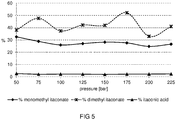
- Reaction pressures between 50 bar and 225 bar were tested, as shown in Fig. 5 . From Fig. 5 it can be seen that useful conversion rates of the acid into the corresponding ester were obtained for a wide range of reaction pressure, without presence of catalysts. As can also be seen in Fig. 5 , the itaconic acid reacted almost completely.
Landscapes
- Chemical & Material Sciences (AREA)
- Organic Chemistry (AREA)
- Engineering & Computer Science (AREA)
- Oil, Petroleum & Natural Gas (AREA)
- Chemical Kinetics & Catalysis (AREA)
- General Chemical & Material Sciences (AREA)
- Organic Low-Molecular-Weight Compounds And Preparation Thereof (AREA)
Abstract
Method of recovering an organic acid from an aqueous solution (102), comprising extracting the organic acid dissolved in the aqueous solution into a water immiscible extraction phase (123) comprising an extractant for the organic acid, separating the extraction phase (123) from the aqueous solution (122), adding an alcohol (131) to the extraction phase separated from the aqueous solution, and forming an ester (141) from the organic acid and the alcohol.
Description
- The present invention is related to methods of efficiently recovering organic acids, such as carboxylic acids, from aqueous solutions, in particular from fermentation broths.
- To facilitate the transition towards a biobased economy, research is performed to produce building blocks for bio-plastics from renewables. These are often di-acids, such as succinic, itaconic, and 2,5-furan-dicarboxylic acid that are produced by fermentation with first and second generation sugars. In addition, also other acids like citric and lactic acid are currently already produced by fermentative means.
- In order to be able to use the acids for instance as a raw material for biobased plastics, these acids have to be recovered and purified. The full process train necessary to achieve the required purity, i.e., the downstream processing, is considered to be the dominant cost and estimated to be around 60% of the production cost. Therefore, continued efforts are made to achieve more efficient processes.
- In order to recover these acids from the fermentation broth, several techniques can be applied. Examples are crystallisation/salt-precipitation, electrodialysis and extraction. Salt-precipitation is often applied for the recovery of organic acids (also on an industrial scale for citric and lactic acid), is relatively simple, but requires neutralizing the fermentation broth and is incompatible with an approach to increase the fermentation performance. It also results in a gypsum side stream. Electrodialysis has limitations with regard to the salt composition of the medium, and is generally speaking quite expensive. The limited solubility of the organic acids in non-polar solvents also limits the options of liquid-liquid extraction.
- It is known from
US 2004/0210087 21 October 2004 (US'087) andUS 2005/0256337 17 November 2005 (US'337) to recover carboxylic acids from a solution comprising a salt of the carboxylic acid. In US'087 ammonium or an (water soluble) amine is added to a fermentation broth to form an ammonium salt of the carboxylic acid. The fermentation broth is then heated to split the ammonium salt and produce the acid in the presence of an organic extractant which is immiscible in water, e.g. a tertiary amine. The carboxylic acid is then reacted with an esterifying agent, such as an alcohol. In US'337 the carboxylic acid salt comprises a cation that forms an insoluble carbonate salt, such as Ca, Zn, Ba and Mg. A tertiary amine and CO2 are added to the aqueous salt solution to form an acid-amine complex and the insoluble carbonate salt. The acid-amine complex is recovered from the aqueous salt solution by adding a water immiscible solvent, in particular an alcohol, to form a reaction phase that includes the acid-amine complex and the water immiscible solvent. The reaction phase forms a separate phase from the aqueous solution and is separated. An ester is then formed from the acid and the alcohol solvent. - One disadvantage of both processes is that the fermentation broth is neutralized (by adding ammonium as in US'087 or alkaline earth metal cation as in US'337) which generates a useless end stream following recovery of the acid and also presents an extra unit operation not compatible with an in-situ product recovery approach. Additionally, a salt-splitting reaction is required in both processes, which requires either addition of heat (US'087) or bubbling of CO2 through the fermentation broth which requires extra energy consumption for the reactive extraction step.
- From the article Development of reactive extraction systems for itaconic acid: a step towards in situ product recovery for itaconic acid fermentation, K. Elst and G. Kaur, RSC Adv., 2014, 4, 45029-45039, it is known to recover itaconic acid through reactive extraction systems based on amine-diluent combinations. High extraction yields were found for extraction systems including trioctylamine, dioctylamine and N-methyldioctylamine as amine extractants solved in 1-octanol, pentylacetate and methyloctanoate. These systems are able to extract the acid from aqueous solutions into a separate phase, in which the acid is complexed with the amine. The article is however silent as to how the acid can be back extracted from the acid-amine complex.
- It is desirable to provide methods of recovering organic acids from aqueous solutions which have an improved overall efficiency and reduced cost. In particular, it is desirable to provide such methods which include a smaller number of unit operations along the process chain in order to arrive at the desired end product and desired purity level.
- It is furthermore desirable to provide methods of recovering organic acids from aqueous solutions which are more energy efficient.
- According to a first aspect of the invention, there is therefore provided a method of recovering an organic acid from an aqueous solution as set out in the appended claims. The method comprises a first step of extracting the organic acid, which is dissolved in the aqueous solution, into a water immiscible extraction phase. The extraction phase comprises an extractant for the organic acid. The extractant is advantageously an organic extractant, and advantageously is or comprises an organic amine able to complex with the organic acid, in particular a tertiary organic amine. The extractant is advantageously a reactive extractant.
- In a second step, the extraction phase is separated from the aqueous solution. The extracting step can be performed in an extraction tank, and the extraction phase can be drawn from the extraction tank. Advantageously, the aqueous solution, which may be at least partially depleted from the organic acid, is recycled. For example, the aqueous solution can be drawn from a fermentation broth, and the depleted aqueous solution can be recycled to the fermentation broth.
- The organic acid present in the extraction phase is then reacted with an alcohol to form a corresponding ester. The alcohol is added to the extraction phase following separation of the extraction phase from the aqueous solution. The extraction phase and the alcohol can be mixed and fed to an esterifying reactor.
- By combining an acid extraction into a water immiscible phase with esterification, a highly efficient method for recovering the organic acid is obtained. These methods can advantageously be run continuously. Methods as described herein further advantageously allow for recycling obtained side streams, such as recycling the depleted aqueous solution to the fermentation broth, and the side stream obtained from esterification to the extraction phase. Methods as described herein therefore allow for truly in situ recovery of the organic acid with very few unit operations.
- Devices for recovering organic acids, in particular acids obtained via fermentation, are described herein as well.
- Aspects of the invention will now be described in more detail with reference to the appended drawings, wherein same reference numerals illustrate same features and wherein:
-
Figure 1 represents a plant diagram for recovering organic acids from an aqueous solution according to aspects described herein; -
Figure 2 represents a process flow diagram of methods of recovering organic acids according to aspects as described herein. -
Figure 3 represents a graph of dimethyl itaconate yield from esterification of itaconic acid according to experiment 1, for different values of residence time in the reactor and for different reaction temperatures at a pressure of 150 bar. -
Figure 4 represents a graph of monomethyl itaconate yield from esterification of itaconic acid according to experiment 1, for different values of residence time in the reactor and for different reaction temperatures at a pressure of 150 bar. -
Figure 5 represents a graph of dimethyl itaconate and monomethyl itaconate yield from esterification of itaconic acid according toexperiment 2, for different values of reaction pressure. - The organic acids as referred to in the present description advantageously refer to (water-soluble, or at least water-miscible) carboxylic acids that are formed in aqueous media, such as, though not limited to, fermentation broths. Present methods are advantageously applicable to recovery of dicarboxylic acids. These may be linear, branched-chained, saturated, unsaturated, or substituted. Present methods may as well be applicable to other types of carboxylic acids, such as mono-carboxylic acid or poly-carboxylic acids, in particular tri-carboxylic acids (e.g., citric acid). Representative examples of useful dicarboxylic acids are: succinic acid, fumaric acid, malic acid, maleic acid, glutaconic acid, 2,5-furan dicarboxylic acid, aspartic acid, glucaric acid, glutamic acid, levulinic acid and itaconic acid. Representative examples of useful mono-carboxylic acids are: propionic acid (specifically derivative hydroxypropanoic acid), acetic acid, formic acid, butyric acid (and isobutyric acid), valeric acid (and isovaleric acid), caproic acid (and isocaproic acid), caprylic acid, lactic acid. Methods as described herein may be applicable to derivatives of the above acids.
- The organic acid is advantageously one which is produced through fermentation, in particular fermentation of a sugar in the presence of a microorganism. An enzyme may be used instead of a microorganism. Referring to
Figs. 1 and2 , thefermentation reaction 21 takes place in afermentation reactor 10 to produce afermentation broth 101 which contains the organic acid. Suitable microorganisms and sugars for such fermentation reactions are well known to the skilled artisan. - The
fermentation reaction 21 typically proceeds at slightly elevated temperatures, such as between 20°C and 65°C. This is also the temperature at which thefermentation broth 101 is present inreactor 10. The pH of the fermentation broth is preferably acidic, and advantageously betweenpH 2 and pH 6.5, advantageously betweenpH 2 and pH 5.5. Nevertheless, also fermentations taking place at neutral pH up to 7.5, e.g. between pH 6.5 and pH 7, or between pH 6.5 and pH 7.5, can be used, provided that thefermentation broth 101 is acidified to acid pH (e.g., pH 6.5 or less) before performing the reactive extraction step. - According to one aspect, the organic acid is recovered from the
fermentation broth 101 in anextraction tank 12 in which theextraction step 22 takes place. The fermentation broth is drawn fromreactor 10 and supplied to theextraction tank 12. Possibly, acell retention unit 11 may be arranged between thereactor 10 and theextraction tank 12, which retains microorganisms useful for the fermentation reactions and provides an organic acid feed 102 which is substantially cell-free.Cell retention unit 11 may retain microorganisms by filtration, and therefore comprise or be formed of a filtration unit, such as a microfiltration or ultrafiltration unit. Alternatively, it is possible to use a membrane contactor device ascell retention unit 11. The membrane contactor device may be integrated intoextraction tank 12 to fulfil the role of cell separator and extraction at the same time.Feed 102 is supplied toextraction tank 12 and forms anaqueous phase 122 intank 12. An advantageouslyorganic extractant 121 is added totank 12. The extraction intank 12 is advantageously carried out at ambient temperature, or temperatures between 20°C and 50°C. It may be carried out at substantially a same temperature as the temperature of the fermentation inreactor 10. The extractant is capable of extracting the organic acid from theaqueous phase 122 into anextraction phase 123 which is immiscible with water, and hence is immiscible withphase 122. If desired, the aqueous phase, at least partially depleted from the organic acid, can be recycled to thefermentation reactor 10. The process can be applied in batch or continuously. - As used herein, the term immiscible refers to two compounds or streams forming a two-phase mixture.
- Advantageously, unlike the prior art, compounds which would form a salt with the organic acid are not added to feed 102, or
reactor 10, nor toextraction tank 12. For example, no ammonia or water miscible amine is added to feed 102. The organic acid is advantageously present infeed 102 in its free form and e.g. not as a salt. It was observed by the inventors that the presence of salts infeed 102 dramatically reduces the extraction yield by amine extractants (trioctyl amine, dioctyl amine) by 10%-20% and more. - One class of useful extractants are reactive extractants which include organic amines, in particular aliphatic amines. The organic amines are advantageously immiscible in water. These are advantageously amines having at least one alkylgroup, wherein each of the at least one alkylgroup comprises at least 6 carbon atoms. The amines also advantageously have boiling points greater than 100°C (measured at atmospheric pressure) and advantageously at least 175°C (measured at atmospheric pressure). Primary, secondary, and tertiary amines, as well as quaternary amine salts, can be used. The amines are advantageously tertiary amines, which advantageously have at least six carbon atoms per chain. Among such amines, aliphatic tertiary amines have been found to be most effective.
- The nitrogen atom of the amine may be substituted with groups including alkyl, aryl (e.g., phenyl), and aralkyl (e.g., benzyl) groups. These groups, in turn, may be straight chain or branched, and may be substituted or unsubstituted. Examples of substituted groups include halogenated groups (e.g., halogenated alkyl groups) and hydroxyl-containing groups (e.g., hydroxyalkyl groups such as hydroxyethyl and hydroxypropyl). The groups may be the same as, or different from, each other. Alkyl groups are preferred, particularly higher alkyl groups (e.g., having at least 6 carbon atoms, and preferably between 8 and 14 carbon atoms). Examples of useful alkyl amines include trialkyl amines such as trioctyl amine, tridecyl amine, tridodecyl amine, and combinations thereof. Dialkyl amines such as dioctyl amine may be suitable as well.
- A second class of useful extractants includes solvating extractants such as carbon bonded oxygen bearing extractants, phosphorus bonded oxygen bearing extractants, phosphine sulfide extractants, and alkyl sulfide extractants. These solvating extractants advantageously have boiling points of at least 175°C (measured at atmospheric pressure). Specific examples of useful carbon-oxygen extractants include alcohols (e.g., alkyl alcohols having between 8 and 14 carbon atoms, such as octanol, decanol, and dodecanol), ethers (e.g., alkyl ethers such as dibutylcarbitol), ketones (e.g., decanone), and amides (e.g., N,N-dialkyl amides such as N,N-dibutyl formamide, N,N-dibutyl acetamide, N,N-dibutyl propionamide, N,N-dipropyl propionamide, and N,N-di-n-butyl lactamide). Specific examples of useful phosphorus-oxygen extractants include phosphorus esters (e.g., alkyl phosphates such as tri-n-butylphosphate, dibutylbutylphosphonate, and dimethylmethylphosphonate), and phosphine oxides (e.g., tri-n-octylphosphine oxide). Specific examples of useful phosphine sulfides include triisobutylphosphine sulfide. Specific examples of useful alkyl sulfides include dihexyl sulfide and diheptyl sulfide.
- Any of the above-described extractants may be used alone or in combination with other extractants, or other compounds. In particular, it may be useful to combine an organic amine extractant with one of the solvating extractants.
- A water insoluble, or water immiscible diluent may be added to the
tank 12, either together with theextractant 121, or separately. The diluent is miscible with the extractant and advantageously reduces the viscosity of theextraction phase 123 in order to facilitate the extraction of the organic acid from theaqueous phase 122. For example, an alkyl alcohol having at least 6 carbon atoms, and advantageously a total of between 8 and 16 carbon atoms may be combined with the organic amine. The alcohol may facilitate separation of the acid from the fermentation broth. It will however be advantageous to use an ester, an alkane or combinations thereof as diluent instead of an alcohol. As will be described, alcohols may participate in downstream esterification reactions to yield a blend of different types of esters, or nonvolatile esters which will be more difficult to separate. Therefore, the diluent - and hence the extraction phase 123 - advantageously does not comprise substantial amounts of an alcohol. - Most advantageous are esters used as diluent. For example, an ester having at least 5 carbon atoms, and advantageously a total of between 7 and 16 carbon atoms may be used as diluent and combined with the organic amine. The ester may be linear, or branched-chain, saturated, or substituted. Specific examples of suitable esters are pentyl acetate,methyl octanoate and triglycerides. Alternatively, or in addition, a hydrocarbon may be used as diluent and combined with the organic amine. The hydrocarbon may be linear or aromatic, branched or unbranched. One class of suitable hydrocarbons are alkanes. For example, an alkane having at least 5 carbon atoms, and advantageously a total of between 7 and 16 carbon atoms may be used as diluent and combined with the organic amine. Examples of useful alkanes are hexane, heptane and octane. Toluene can be used as diluent as well. The weight ratio of diluent to extractant in the extraction phase is advantageously less than or equal to 5, advantageously less than or equal to 4, advantageously less than or equal to 2.5 , The diluent advantageously forms the largest part of the extraction phase, i.e., weight ratio of at least 1.
- As the
extraction phase 123 is enriched with the organic acid, e.g. either in dissolved or complexed form, it is separated from theaqueous phase 122 and removed from thetank 12, e.g. by decantation or centrifugation. In the flow chart ofFig. 2 , this separation step is indicated byblock 23. Theextraction tank 12 therefore advantageously comprises a feed inlet for theaqueous solution 102, an inlet for the extractant/diluent 121 and an outlet for theextraction phase 123. The extraction tank may further comprise an outlet for recycling the depletedaqueous phase 122, and which may be fluidly connected to thereactor 10. - The organic acid in the
extraction phase 123 is now back extracted to separate the extractant (and possibly the diluent) from the acid instep 24. According to one aspect, the organic acid is back extracted as an ester. Theextraction phase 123 is fed to anesterification reactor 13. Anesterifying agent 131 is added toreactor 13. The esterifying agent reacts with the organic acid to form the corresponding ester. - Suitable esterifying agents include alcohols, in particular alkyl alcohols. Alcohols having a total of between 1 and 5 carbon atoms are preferred. Specific examples of useful alcohols are methanol and ethanol. These alcohols advantageously provide a fast and efficient reaction, at relatively short residence times. The residence time of the mixture of extraction phase and esterifying agent in
reactor 13 is advantageously between 1 min and 240 min, advantageously 120 min or less, advantageously 60 min or less, advantageously 40 min or less. The residence time refers to the average time in which a stream stays inside the reactor. For continuous processes, residence time may be calculated as the volume of reactor divided by the sum of the (volumetric) flow rates of all in-going streams. - During the esterifying reaction, the acid is de-complexed. Advantageously, the extractant and/or the diluent does not react during the esterification reaction, and is retained substantially unmodified in the
product stream 132 supplied fromreactor 13. Theproduct stream 132 comprises the ester of the organic acid, and advantageously the extractant and possibly the diluent. In order to obtain a single type ester stream, alcohols are advantageously not used as diluent. - The esterification reaction is advantageously catalyst-free, i.e. no catalyst is used, which leaves no catalyst residues in the product, and avoids any undesired reaction of the extractant and/or diluent with the catalyst. A catalyst-free esterification reaction is advantageously less affected by the presence of water that can be formed during esterification.
- The
extraction phase 123 may comprise small amounts of water, e.g. 5% or less by weight, typically between 0.1% and 3% by weight. In addition, the esterifying reactions may produce additional amounts of water. - Alternatively, the esterification reaction may be catalyzed by a suitable catalyst. The catalyst is advantageously immobilized in the
reactor 13. One class of useful catalyst includes heterogeneous catalyst. The catalyst is advantageously an acid functionalised catalyst. Specific examples of useful heterogeneous catalysts are acid grafted mesoporous silicas (such as with sulfonic acids), heteropolyacids, sulfonated mesoporous organic polymers, and aminophosphonic acid resins. Another class of useful catalysts includes enzymes, such as esterase or lipase. - The esterification reaction is advantageously carried out at elevated temperature, such as between 100°C and 350°C, advantageously between 120°C and 320°C, advantageously between 150°C and 300°C. It may be useful to carry out the esterification reaction at elevated pressure, such as pressures of at least 5 bar, advantageously at least 10 bar, advantageously between 20 bar and 250 bar.
-
Product stream 132 may be fed to aseparator 14 to separate theester 141 from astream 142 which may include water, the extractant and/or the diluent.Stream 142 may be recycled to theextraction tank 12.Separator 14 may further be configured to separate theester 141 from any excess alcohol, which may form asecond stream 143 and may be recycled toreactor 13. One suitable class of separation processes 25 to recover the ester is distillation, such as though not limited to membrane distillation. Another suitable class of separation processes is pervaporation. - The ester is a useful starting product that can be used for further processing, such as polymerisation. The back extraction of the organic acid as an ester allows for greatly simplifying the downstream processing and recovering the acid through its corresponding ester in a highly efficient way.
- A feed solution was prepared to simulate an extraction phase for itaconic acid, as would result from reactive extraction based on trioctylamine and with methyl octanoate as diluent in order to show the feasibility of the esterification reactions. The relative amounts of itaconic acid and trioctylamine in the feed solution were 1 mole itaconic acid to 2 moles trioctylamine. The ratio of trioctylamine to the diluent methyl octanoate in the feed solution was 0.4 g/g. The water content of the feed solution was measured and resulted about 1% by weight. The feed solution so obtained was mixed with methanol in a 1 g/g ratio (methanol/feed). This mixture was pumped into a continuous reactor held at a specified temperature. Reaction temperatures between 150°C and 250°C were tested. The pumping rate was adjusted to achieve a specified residence time. Residence times between 3 min and 35 min were tested. The reaction pressure was held at 150 bar. Under these conditions an esterification of the complexed mixture was observed as indicated in
Figs. 3 and 4 . No catalyst was used. At a temperature between 200°C and 250°C up to 70% conversion of itaconic acid into dimethyl itaconate and 30% monomethylitaconate was observed (conversion rates based on the molar ratio of the ester product against the dosed itaconic acid). - A feed solution was prepared following the procedure in experiment 1. The feed solution was mixed with methanol in a 0.5 g/g ratio (methanol/feed). This mixture was pumped into a continuous reactor at 200°C and the pumping rate was adjusted to obtain a residence time of 17 min. Reaction pressures between 50 bar and 225 bar were tested, as shown in
Fig. 5 . FromFig. 5 it can be seen that useful conversion rates of the acid into the corresponding ester were obtained for a wide range of reaction pressure, without presence of catalysts. As can also be seen inFig. 5 , the itaconic acid reacted almost completely.
Claims (15)
- Method of recovering an organic acid from an aqueous solution (102), comprising:extracting (22) the organic acid dissolved in the aqueous solution into a water immiscible extraction phase (123) comprising an extractant (121) for the organic acid,separating (23) the extraction phase from the aqueous solution,reacting (24) the extraction phase separated from the aqueous solution with an alcohol (131) to form an ester (141) from the organic acid and the alcohol.
- Method of claim 1, wherein during the extracting step, the aqueous solution has a pH between 2 and 5.5.
- Method of claim 1 or 2, wherein the extracting step comprises adding a water immiscible organic amine, the organic amine and the organic acid forming an acid-amine complex that is dissolved in the extraction phase (123).
- Method of claim 3, wherein the organic amine comprises at least 6 carbon atoms.
- Method of claim 3 or 4, wherein the organic amine is a tertiary amine comprising at least six carbon atoms per chain.
- Method of any one of the preceding claims, comprising adding a water immiscible diluent to the extraction phase during the extracting step.
- Method of claim 6, wherein the diluent is an ester.
- Method of any one of the preceding claims, wherein the aqueous solution is drawn from a fermentation broth (101), and comprising recycling the aqueous solution (122) to the fermentation broth following the extracting step.
- Method of any one of the preceding claims, wherein the alcohol is an alkyl alcohol having a total of between 1 and 5 carbon atoms.
- Method of any one of the preceding claims, wherein the reacting step comprises heating the extraction phase separated from the aqueous solution and the alcohol to a temperature between 100°C and 350°C.
- Method of any one of the preceding claims, wherein the reacting step comprises bringing the extraction phase (123) separated from the aqueous solution and the alcohol to a pressure of at least 5 bar.
- Method of any one of the preceding claims, wherein the reacting step comprises a catalyst-free reaction of the extraction phase separated from the aqueous solution and the alcohol.
- Method of claim 12, comprising adding an ester to the extraction phase during the extracting step, the ester forming a water immiscible diluent to the extraction phase, and wherein the alcohol is an alkyl alcohol having a total of between 1 and 5 carbon atoms.
- Method of any one of the preceding claims, wherein the organic acid is a water soluble dicarboxylic acid.
- Method of any one of the preceding claims, further comprising separating (25) the ester (141) from a mixture comprising the extractant, and recycling the extractant to the extraction phase.
Priority Applications (5)
| Application Number | Priority Date | Filing Date | Title |
|---|---|---|---|
| EP17187734.3A EP3447043A1 (en) | 2017-08-24 | 2017-08-24 | Method of recovering organic acids from aqueous solutions |
| EP18759091.4A EP3672933B1 (en) | 2017-08-24 | 2018-08-21 | Method of recovering organic acids from aqueous solutions |
| CN201880053684.8A CN111094226B (en) | 2017-08-24 | 2018-08-21 | Method for recovering organic acid from aqueous solution |
| PCT/EP2018/072588 WO2019038303A1 (en) | 2017-08-24 | 2018-08-21 | Method of recovering organic acids from aqueous solutions |
| US16/640,687 US11401230B2 (en) | 2017-08-24 | 2018-08-21 | Method of recovering organic acids from aqueous solutions |
Applications Claiming Priority (1)
| Application Number | Priority Date | Filing Date | Title |
|---|---|---|---|
| EP17187734.3A EP3447043A1 (en) | 2017-08-24 | 2017-08-24 | Method of recovering organic acids from aqueous solutions |
Publications (1)
| Publication Number | Publication Date |
|---|---|
| EP3447043A1 true EP3447043A1 (en) | 2019-02-27 |
Family
ID=59699596
Family Applications (2)
| Application Number | Title | Priority Date | Filing Date |
|---|---|---|---|
| EP17187734.3A Withdrawn EP3447043A1 (en) | 2017-08-24 | 2017-08-24 | Method of recovering organic acids from aqueous solutions |
| EP18759091.4A Active EP3672933B1 (en) | 2017-08-24 | 2018-08-21 | Method of recovering organic acids from aqueous solutions |
Family Applications After (1)
| Application Number | Title | Priority Date | Filing Date |
|---|---|---|---|
| EP18759091.4A Active EP3672933B1 (en) | 2017-08-24 | 2018-08-21 | Method of recovering organic acids from aqueous solutions |
Country Status (4)
| Country | Link |
|---|---|
| US (1) | US11401230B2 (en) |
| EP (2) | EP3447043A1 (en) |
| CN (1) | CN111094226B (en) |
| WO (1) | WO2019038303A1 (en) |
Families Citing this family (1)
| Publication number | Priority date | Publication date | Assignee | Title |
|---|---|---|---|---|
| CN113461154B (en) * | 2021-08-03 | 2024-12-13 | 同济大学 | A device for selectively separating organic acids from anaerobic digestion liquid on-line |
Citations (3)
| Publication number | Priority date | Publication date | Assignee | Title |
|---|---|---|---|---|
| FR1250722A (en) * | 1959-12-22 | 1961-01-13 | L I R C Lab Italiani Di Ricerc | Process for the purification of crude itaconic acid |
| US20040210087A1 (en) | 2001-05-07 | 2004-10-21 | Xiangsheng Meng | Process for preparing carboxylic acids and derivatives thereof |
| US20050256337A1 (en) | 2004-01-29 | 2005-11-17 | Zeachem Inc. | Recovery of organic acids |
Family Cites Families (6)
| Publication number | Priority date | Publication date | Assignee | Title |
|---|---|---|---|---|
| BR8404579A (en) * | 1983-09-14 | 1985-08-06 | Halcon Sd Group Inc | PROCESS FOR TREATING DILUTED Aqueous ACETIC ACID |
| CA2722735A1 (en) * | 2008-05-07 | 2009-11-12 | Zeachem, Inc. | Recovery of organic acids |
| US8357519B2 (en) * | 2008-11-19 | 2013-01-22 | The Ohio State University | Methods and processes for producing esters |
| FI20106311A7 (en) * | 2010-12-10 | 2012-06-11 | Taminco Finland Oy | A method for recovery of organic acid from dilute aqueous solution |
| WO2016131818A1 (en) * | 2015-02-16 | 2016-08-25 | Dsm Ip Assets B.V. | Process for producing itaconic acid under anaerobic conditions |
| EP3645498B1 (en) * | 2017-06-29 | 2021-08-04 | Nouryon Chemicals International B.V. | Process for recovering acetic acid from an aqueous stream comprising the same |
-
2017
- 2017-08-24 EP EP17187734.3A patent/EP3447043A1/en not_active Withdrawn
-
2018
- 2018-08-21 EP EP18759091.4A patent/EP3672933B1/en active Active
- 2018-08-21 WO PCT/EP2018/072588 patent/WO2019038303A1/en not_active Ceased
- 2018-08-21 US US16/640,687 patent/US11401230B2/en active Active
- 2018-08-21 CN CN201880053684.8A patent/CN111094226B/en active Active
Patent Citations (3)
| Publication number | Priority date | Publication date | Assignee | Title |
|---|---|---|---|---|
| FR1250722A (en) * | 1959-12-22 | 1961-01-13 | L I R C Lab Italiani Di Ricerc | Process for the purification of crude itaconic acid |
| US20040210087A1 (en) | 2001-05-07 | 2004-10-21 | Xiangsheng Meng | Process for preparing carboxylic acids and derivatives thereof |
| US20050256337A1 (en) | 2004-01-29 | 2005-11-17 | Zeachem Inc. | Recovery of organic acids |
Non-Patent Citations (2)
| Title |
|---|
| JANNICK GORDEN ET AL: "Integrated process development of a reactive extraction concept for itaconic acid and application to a real fermentation broth", ENGINEERING IN LIFE SCIENCES, vol. 17, no. 7, 27 March 2017 (2017-03-27), DE, pages 809 - 816, XP055426283, ISSN: 1618-0240, DOI: 10.1002/elsc.201600253 * |
| K. ELST; G. KAUR, RSC ADV., vol. 4, 2014, pages 45029 - 45039 |
Also Published As
| Publication number | Publication date |
|---|---|
| WO2019038303A1 (en) | 2019-02-28 |
| CN111094226B (en) | 2023-05-05 |
| EP3672933A1 (en) | 2020-07-01 |
| EP3672933B1 (en) | 2023-06-07 |
| CN111094226A (en) | 2020-05-01 |
| EP3672933C0 (en) | 2023-06-07 |
| US11401230B2 (en) | 2022-08-02 |
| US20200354302A1 (en) | 2020-11-12 |
Similar Documents
| Publication | Publication Date | Title |
|---|---|---|
| EP0804607B1 (en) | Lactic acid production, separation and/or recovery process | |
| US8048655B2 (en) | Recovery of organic acids | |
| US8143444B2 (en) | Recovery of organic acids | |
| US6472559B2 (en) | Lactic acid production, separation and/or recovery process | |
| JP2001519178A (en) | Lactic acid treatment, methods, sequences and products | |
| KR101515981B1 (en) | Recovery method of highly pure organic acid and organic acid alkyl ester from organic acid fermentation solution | |
| IL119387A (en) | Process for the recovery of lactic acid by liquid-liquid extraction with a basic extractant | |
| KR101810384B1 (en) | Method for preparing methyl lactate | |
| US11401230B2 (en) | Method of recovering organic acids from aqueous solutions | |
| KR102422368B1 (en) | An Esterification Method of Metal Organic Acid Salt and Carbon dioxide Conversion System Using the Same | |
| CN114409541A (en) | System for preparing propionate through ethylene carbonylation | |
| US6627768B1 (en) | Process for recovery of acid | |
| CA2184928C (en) | Lactic acid production, separation and/or recovery process | |
| CN107915620A (en) | The method of extract and separate levulic acid |
Legal Events
| Date | Code | Title | Description |
|---|---|---|---|
| PUAI | Public reference made under article 153(3) epc to a published international application that has entered the european phase |
Free format text: ORIGINAL CODE: 0009012 |
|
| AK | Designated contracting states |
Kind code of ref document: A1 Designated state(s): AL AT BE BG CH CY CZ DE DK EE ES FI FR GB GR HR HU IE IS IT LI LT LU LV MC MK MT NL NO PL PT RO RS SE SI SK SM TR |
|
| AX | Request for extension of the european patent |
Extension state: BA ME |
|
| STAA | Information on the status of an ep patent application or granted ep patent |
Free format text: STATUS: THE APPLICATION IS DEEMED TO BE WITHDRAWN |
|
| 18D | Application deemed to be withdrawn |
Effective date: 20190828 |