EP3445744B1 - Novel inhibitors of meprin alpha and beta - Google Patents
Novel inhibitors of meprin alpha and beta Download PDFInfo
- Publication number
- EP3445744B1 EP3445744B1 EP17719214.3A EP17719214A EP3445744B1 EP 3445744 B1 EP3445744 B1 EP 3445744B1 EP 17719214 A EP17719214 A EP 17719214A EP 3445744 B1 EP3445744 B1 EP 3445744B1
- Authority
- EP
- European Patent Office
- Prior art keywords
- methyl
- group
- compound
- compound according
- gradient
- Prior art date
- Legal status (The legal status is an assumption and is not a legal conclusion. Google has not performed a legal analysis and makes no representation as to the accuracy of the status listed.)
- Active
Links
- 0 CC(C)(C(*)(*)C(C)(C)N(*)**)C(NO)=O Chemical compound CC(C)(C(*)(*)C(C)(C)N(*)**)C(NO)=O 0.000 description 13
- GYBANWHRYCVWSE-UHFFFAOYSA-N COc1ccc(CN(CC(NO)=O)Cc(ccc(F)c2O)c2F)cc1 Chemical compound COc1ccc(CN(CC(NO)=O)Cc(ccc(F)c2O)c2F)cc1 GYBANWHRYCVWSE-UHFFFAOYSA-N 0.000 description 1
- VMVMCQQSNHJENM-UHFFFAOYSA-N COc1ccc(CN(CC(NO)=O)Cc(cccc2)c2C(O)=O)cc1 Chemical compound COc1ccc(CN(CC(NO)=O)Cc(cccc2)c2C(O)=O)cc1 VMVMCQQSNHJENM-UHFFFAOYSA-N 0.000 description 1
- VILVVLWPHRVWPK-UHFFFAOYSA-N COc1ccc(CN(CC(NO)=O)Cc2cc(C(O)=O)ccc2)cc1F Chemical compound COc1ccc(CN(CC(NO)=O)Cc2cc(C(O)=O)ccc2)cc1F VILVVLWPHRVWPK-UHFFFAOYSA-N 0.000 description 1
- RFYVNFBJQLLGRF-UHFFFAOYSA-N COc1ccc(CN(CCCC(NO)=O)Cc2cc(C(O)=O)ccc2)cc1 Chemical compound COc1ccc(CN(CCCC(NO)=O)Cc2cc(C(O)=O)ccc2)cc1 RFYVNFBJQLLGRF-UHFFFAOYSA-N 0.000 description 1
- SUYKKJDKIQRBPA-ZCFIWIBFSA-N C[C@H](C=C1)C(C)=C1C(O)=C Chemical compound C[C@H](C=C1)C(C)=C1C(O)=C SUYKKJDKIQRBPA-ZCFIWIBFSA-N 0.000 description 1
- LVCCUVJKDGJKGB-UHFFFAOYSA-N N#Cc1cc(CN(CCC(NO)=O)Cc2cccc(C#N)c2)ccc1 Chemical compound N#Cc1cc(CN(CCC(NO)=O)Cc2cccc(C#N)c2)ccc1 LVCCUVJKDGJKGB-UHFFFAOYSA-N 0.000 description 1
- JNQIAZIHAYTONP-SECBINFHSA-N OC(C[C@H](C(NO)=O)NCc1cccc(C(O)=O)c1)=O Chemical compound OC(C[C@H](C(NO)=O)NCc1cccc(C(O)=O)c1)=O JNQIAZIHAYTONP-SECBINFHSA-N 0.000 description 1
- BNXNGMHNCWMXCN-UHFFFAOYSA-N OC(c1ccc(CN(CC(NO)=O)Cc(cc2)ccc2C(O)=O)cc1)=O Chemical compound OC(c1ccc(CN(CC(NO)=O)Cc(cc2)ccc2C(O)=O)cc1)=O BNXNGMHNCWMXCN-UHFFFAOYSA-N 0.000 description 1
- UJJWXOORPFWWOY-OAHLLOKOSA-N OC(c1cccc(CN[C@H](Cc2ccccc2)C(NO)=O)c1)=O Chemical compound OC(c1cccc(CN[C@H](Cc2ccccc2)C(NO)=O)c1)=O UJJWXOORPFWWOY-OAHLLOKOSA-N 0.000 description 1
- TUMJRJDCIACZCV-UHFFFAOYSA-N ONC(CN(Cc(c(F)c1)ccc1Cl)Cc(ccc(Cl)c1)c1F)=O Chemical compound ONC(CN(Cc(c(F)c1)ccc1Cl)Cc(ccc(Cl)c1)c1F)=O TUMJRJDCIACZCV-UHFFFAOYSA-N 0.000 description 1
- QXUDREYOXKXYRI-UHFFFAOYSA-N Oc(c(F)ccc1CN(CC(NO)=O)Cc(c(F)c2O)ccc2F)c1F Chemical compound Oc(c(F)ccc1CN(CC(NO)=O)Cc(c(F)c2O)ccc2F)c1F QXUDREYOXKXYRI-UHFFFAOYSA-N 0.000 description 1
Classifications
-
- A—HUMAN NECESSITIES
- A61—MEDICAL OR VETERINARY SCIENCE; HYGIENE
- A61K—PREPARATIONS FOR MEDICAL, DENTAL OR TOILETRY PURPOSES
- A61K31/00—Medicinal preparations containing organic active ingredients
- A61K31/16—Amides, e.g. hydroxamic acids
-
- C—CHEMISTRY; METALLURGY
- C07—ORGANIC CHEMISTRY
- C07C—ACYCLIC OR CARBOCYCLIC COMPOUNDS
- C07C239/00—Compounds containing nitrogen-to-halogen bonds; Hydroxylamino compounds or ethers or esters thereof
- C07C239/08—Hydroxylamino compounds or their ethers or esters
- C07C239/18—Hydroxylamino compounds or their ethers or esters having nitrogen atoms of hydroxylamino groups further bound to carbon atoms of hydrocarbon radicals substituted by carboxyl groups
-
- C—CHEMISTRY; METALLURGY
- C07—ORGANIC CHEMISTRY
- C07D—HETEROCYCLIC COMPOUNDS
- C07D207/00—Heterocyclic compounds containing five-membered rings not condensed with other rings, with one nitrogen atom as the only ring hetero atom
- C07D207/02—Heterocyclic compounds containing five-membered rings not condensed with other rings, with one nitrogen atom as the only ring hetero atom with only hydrogen or carbon atoms directly attached to the ring nitrogen atom
- C07D207/04—Heterocyclic compounds containing five-membered rings not condensed with other rings, with one nitrogen atom as the only ring hetero atom with only hydrogen or carbon atoms directly attached to the ring nitrogen atom having no double bonds between ring members or between ring members and non-ring members
- C07D207/10—Heterocyclic compounds containing five-membered rings not condensed with other rings, with one nitrogen atom as the only ring hetero atom with only hydrogen or carbon atoms directly attached to the ring nitrogen atom having no double bonds between ring members or between ring members and non-ring members with hetero atoms or with carbon atoms having three bonds to hetero atoms with at the most one bond to halogen, e.g. ester or nitrile radicals, directly attached to ring carbon atoms
- C07D207/16—Carbon atoms having three bonds to hetero atoms with at the most one bond to halogen, e.g. ester or nitrile radicals
-
- A—HUMAN NECESSITIES
- A61—MEDICAL OR VETERINARY SCIENCE; HYGIENE
- A61K—PREPARATIONS FOR MEDICAL, DENTAL OR TOILETRY PURPOSES
- A61K31/00—Medicinal preparations containing organic active ingredients
- A61K31/185—Acids; Anhydrides, halides or salts thereof, e.g. sulfur acids, imidic, hydrazonic or hydroximic acids
- A61K31/19—Carboxylic acids, e.g. valproic acid
- A61K31/195—Carboxylic acids, e.g. valproic acid having an amino group
-
- A—HUMAN NECESSITIES
- A61—MEDICAL OR VETERINARY SCIENCE; HYGIENE
- A61K—PREPARATIONS FOR MEDICAL, DENTAL OR TOILETRY PURPOSES
- A61K31/00—Medicinal preparations containing organic active ingredients
- A61K31/33—Heterocyclic compounds
- A61K31/335—Heterocyclic compounds having oxygen as the only ring hetero atom, e.g. fungichromin
- A61K31/357—Heterocyclic compounds having oxygen as the only ring hetero atom, e.g. fungichromin having two or more oxygen atoms in the same ring, e.g. crown ethers, guanadrel
- A61K31/36—Compounds containing methylenedioxyphenyl groups, e.g. sesamin
-
- A—HUMAN NECESSITIES
- A61—MEDICAL OR VETERINARY SCIENCE; HYGIENE
- A61P—SPECIFIC THERAPEUTIC ACTIVITY OF CHEMICAL COMPOUNDS OR MEDICINAL PREPARATIONS
- A61P1/00—Drugs for disorders of the alimentary tract or the digestive system
-
- A—HUMAN NECESSITIES
- A61—MEDICAL OR VETERINARY SCIENCE; HYGIENE
- A61P—SPECIFIC THERAPEUTIC ACTIVITY OF CHEMICAL COMPOUNDS OR MEDICINAL PREPARATIONS
- A61P1/00—Drugs for disorders of the alimentary tract or the digestive system
- A61P1/04—Drugs for disorders of the alimentary tract or the digestive system for ulcers, gastritis or reflux esophagitis, e.g. antacids, inhibitors of acid secretion, mucosal protectants
-
- A—HUMAN NECESSITIES
- A61—MEDICAL OR VETERINARY SCIENCE; HYGIENE
- A61P—SPECIFIC THERAPEUTIC ACTIVITY OF CHEMICAL COMPOUNDS OR MEDICINAL PREPARATIONS
- A61P11/00—Drugs for disorders of the respiratory system
-
- A—HUMAN NECESSITIES
- A61—MEDICAL OR VETERINARY SCIENCE; HYGIENE
- A61P—SPECIFIC THERAPEUTIC ACTIVITY OF CHEMICAL COMPOUNDS OR MEDICINAL PREPARATIONS
- A61P13/00—Drugs for disorders of the urinary system
-
- A—HUMAN NECESSITIES
- A61—MEDICAL OR VETERINARY SCIENCE; HYGIENE
- A61P—SPECIFIC THERAPEUTIC ACTIVITY OF CHEMICAL COMPOUNDS OR MEDICINAL PREPARATIONS
- A61P13/00—Drugs for disorders of the urinary system
- A61P13/02—Drugs for disorders of the urinary system of urine or of the urinary tract, e.g. urine acidifiers
-
- A—HUMAN NECESSITIES
- A61—MEDICAL OR VETERINARY SCIENCE; HYGIENE
- A61P—SPECIFIC THERAPEUTIC ACTIVITY OF CHEMICAL COMPOUNDS OR MEDICINAL PREPARATIONS
- A61P13/00—Drugs for disorders of the urinary system
- A61P13/10—Drugs for disorders of the urinary system of the bladder
-
- A—HUMAN NECESSITIES
- A61—MEDICAL OR VETERINARY SCIENCE; HYGIENE
- A61P—SPECIFIC THERAPEUTIC ACTIVITY OF CHEMICAL COMPOUNDS OR MEDICINAL PREPARATIONS
- A61P13/00—Drugs for disorders of the urinary system
- A61P13/12—Drugs for disorders of the urinary system of the kidneys
-
- A—HUMAN NECESSITIES
- A61—MEDICAL OR VETERINARY SCIENCE; HYGIENE
- A61P—SPECIFIC THERAPEUTIC ACTIVITY OF CHEMICAL COMPOUNDS OR MEDICINAL PREPARATIONS
- A61P17/00—Drugs for dermatological disorders
- A61P17/02—Drugs for dermatological disorders for treating wounds, ulcers, burns, scars, keloids, or the like
-
- A—HUMAN NECESSITIES
- A61—MEDICAL OR VETERINARY SCIENCE; HYGIENE
- A61P—SPECIFIC THERAPEUTIC ACTIVITY OF CHEMICAL COMPOUNDS OR MEDICINAL PREPARATIONS
- A61P25/00—Drugs for disorders of the nervous system
- A61P25/28—Drugs for disorders of the nervous system for treating neurodegenerative disorders of the central nervous system, e.g. nootropic agents, cognition enhancers, drugs for treating Alzheimer's disease or other forms of dementia
-
- A—HUMAN NECESSITIES
- A61—MEDICAL OR VETERINARY SCIENCE; HYGIENE
- A61P—SPECIFIC THERAPEUTIC ACTIVITY OF CHEMICAL COMPOUNDS OR MEDICINAL PREPARATIONS
- A61P29/00—Non-central analgesic, antipyretic or antiinflammatory agents, e.g. antirheumatic agents; Non-steroidal antiinflammatory drugs [NSAID]
-
- A—HUMAN NECESSITIES
- A61—MEDICAL OR VETERINARY SCIENCE; HYGIENE
- A61P—SPECIFIC THERAPEUTIC ACTIVITY OF CHEMICAL COMPOUNDS OR MEDICINAL PREPARATIONS
- A61P35/00—Antineoplastic agents
-
- A—HUMAN NECESSITIES
- A61—MEDICAL OR VETERINARY SCIENCE; HYGIENE
- A61P—SPECIFIC THERAPEUTIC ACTIVITY OF CHEMICAL COMPOUNDS OR MEDICINAL PREPARATIONS
- A61P9/00—Drugs for disorders of the cardiovascular system
- A61P9/10—Drugs for disorders of the cardiovascular system for treating ischaemic or atherosclerotic diseases, e.g. antianginal drugs, coronary vasodilators, drugs for myocardial infarction, retinopathy, cerebrovascula insufficiency, renal arteriosclerosis
-
- A—HUMAN NECESSITIES
- A61—MEDICAL OR VETERINARY SCIENCE; HYGIENE
- A61P—SPECIFIC THERAPEUTIC ACTIVITY OF CHEMICAL COMPOUNDS OR MEDICINAL PREPARATIONS
- A61P9/00—Drugs for disorders of the cardiovascular system
- A61P9/12—Antihypertensives
-
- C—CHEMISTRY; METALLURGY
- C07—ORGANIC CHEMISTRY
- C07C—ACYCLIC OR CARBOCYCLIC COMPOUNDS
- C07C255/00—Carboxylic acid nitriles
- C07C255/49—Carboxylic acid nitriles having cyano groups bound to carbon atoms of six-membered aromatic rings of a carbon skeleton
- C07C255/58—Carboxylic acid nitriles having cyano groups bound to carbon atoms of six-membered aromatic rings of a carbon skeleton containing cyano groups and singly-bound nitrogen atoms, not being further bound to other hetero atoms, bound to the carbon skeleton
-
- C—CHEMISTRY; METALLURGY
- C07—ORGANIC CHEMISTRY
- C07C—ACYCLIC OR CARBOCYCLIC COMPOUNDS
- C07C259/00—Compounds containing carboxyl groups, an oxygen atom of a carboxyl group being replaced by a nitrogen atom, this nitrogen atom being further bound to an oxygen atom and not being part of nitro or nitroso groups
- C07C259/04—Compounds containing carboxyl groups, an oxygen atom of a carboxyl group being replaced by a nitrogen atom, this nitrogen atom being further bound to an oxygen atom and not being part of nitro or nitroso groups without replacement of the other oxygen atom of the carboxyl group, e.g. hydroxamic acids
- C07C259/06—Compounds containing carboxyl groups, an oxygen atom of a carboxyl group being replaced by a nitrogen atom, this nitrogen atom being further bound to an oxygen atom and not being part of nitro or nitroso groups without replacement of the other oxygen atom of the carboxyl group, e.g. hydroxamic acids having carbon atoms of hydroxamic groups bound to hydrogen atoms or to acyclic carbon atoms
-
- C—CHEMISTRY; METALLURGY
- C07—ORGANIC CHEMISTRY
- C07D—HETEROCYCLIC COMPOUNDS
- C07D213/00—Heterocyclic compounds containing six-membered rings, not condensed with other rings, with one nitrogen atom as the only ring hetero atom and three or more double bonds between ring members or between ring members and non-ring members
- C07D213/02—Heterocyclic compounds containing six-membered rings, not condensed with other rings, with one nitrogen atom as the only ring hetero atom and three or more double bonds between ring members or between ring members and non-ring members having three double bonds between ring members or between ring members and non-ring members
- C07D213/04—Heterocyclic compounds containing six-membered rings, not condensed with other rings, with one nitrogen atom as the only ring hetero atom and three or more double bonds between ring members or between ring members and non-ring members having three double bonds between ring members or between ring members and non-ring members having no bond between the ring nitrogen atom and a non-ring member or having only hydrogen or carbon atoms directly attached to the ring nitrogen atom
- C07D213/24—Heterocyclic compounds containing six-membered rings, not condensed with other rings, with one nitrogen atom as the only ring hetero atom and three or more double bonds between ring members or between ring members and non-ring members having three double bonds between ring members or between ring members and non-ring members having no bond between the ring nitrogen atom and a non-ring member or having only hydrogen or carbon atoms directly attached to the ring nitrogen atom with substituted hydrocarbon radicals attached to ring carbon atoms
- C07D213/36—Radicals substituted by singly-bound nitrogen atoms
-
- C—CHEMISTRY; METALLURGY
- C07—ORGANIC CHEMISTRY
- C07D—HETEROCYCLIC COMPOUNDS
- C07D317/00—Heterocyclic compounds containing five-membered rings having two oxygen atoms as the only ring hetero atoms
- C07D317/08—Heterocyclic compounds containing five-membered rings having two oxygen atoms as the only ring hetero atoms having the hetero atoms in positions 1 and 3
- C07D317/44—Heterocyclic compounds containing five-membered rings having two oxygen atoms as the only ring hetero atoms having the hetero atoms in positions 1 and 3 ortho- or peri-condensed with carbocyclic rings or ring systems
- C07D317/46—Heterocyclic compounds containing five-membered rings having two oxygen atoms as the only ring hetero atoms having the hetero atoms in positions 1 and 3 ortho- or peri-condensed with carbocyclic rings or ring systems condensed with one six-membered ring
-
- C—CHEMISTRY; METALLURGY
- C07—ORGANIC CHEMISTRY
- C07D—HETEROCYCLIC COMPOUNDS
- C07D317/00—Heterocyclic compounds containing five-membered rings having two oxygen atoms as the only ring hetero atoms
- C07D317/08—Heterocyclic compounds containing five-membered rings having two oxygen atoms as the only ring hetero atoms having the hetero atoms in positions 1 and 3
- C07D317/44—Heterocyclic compounds containing five-membered rings having two oxygen atoms as the only ring hetero atoms having the hetero atoms in positions 1 and 3 ortho- or peri-condensed with carbocyclic rings or ring systems
- C07D317/46—Heterocyclic compounds containing five-membered rings having two oxygen atoms as the only ring hetero atoms having the hetero atoms in positions 1 and 3 ortho- or peri-condensed with carbocyclic rings or ring systems condensed with one six-membered ring
- C07D317/48—Methylenedioxybenzenes or hydrogenated methylenedioxybenzenes, unsubstituted on the hetero ring
- C07D317/50—Methylenedioxybenzenes or hydrogenated methylenedioxybenzenes, unsubstituted on the hetero ring with only hydrogen atoms, hydrocarbon or substituted hydrocarbon radicals, directly attached to atoms of the carbocyclic ring
- C07D317/58—Radicals substituted by nitrogen atoms
-
- C—CHEMISTRY; METALLURGY
- C07—ORGANIC CHEMISTRY
- C07D—HETEROCYCLIC COMPOUNDS
- C07D317/00—Heterocyclic compounds containing five-membered rings having two oxygen atoms as the only ring hetero atoms
- C07D317/08—Heterocyclic compounds containing five-membered rings having two oxygen atoms as the only ring hetero atoms having the hetero atoms in positions 1 and 3
- C07D317/44—Heterocyclic compounds containing five-membered rings having two oxygen atoms as the only ring hetero atoms having the hetero atoms in positions 1 and 3 ortho- or peri-condensed with carbocyclic rings or ring systems
- C07D317/46—Heterocyclic compounds containing five-membered rings having two oxygen atoms as the only ring hetero atoms having the hetero atoms in positions 1 and 3 ortho- or peri-condensed with carbocyclic rings or ring systems condensed with one six-membered ring
- C07D317/48—Methylenedioxybenzenes or hydrogenated methylenedioxybenzenes, unsubstituted on the hetero ring
- C07D317/62—Methylenedioxybenzenes or hydrogenated methylenedioxybenzenes, unsubstituted on the hetero ring with hetero atoms or with carbon atoms having three bonds to hetero atoms with at the most one bond to halogen, e.g. ester or nitrile radicals, directly attached to atoms of the carbocyclic ring
- C07D317/64—Oxygen atoms
-
- C—CHEMISTRY; METALLURGY
- C07—ORGANIC CHEMISTRY
- C07D—HETEROCYCLIC COMPOUNDS
- C07D319/00—Heterocyclic compounds containing six-membered rings having two oxygen atoms as the only ring hetero atoms
- C07D319/10—1,4-Dioxanes; Hydrogenated 1,4-dioxanes
- C07D319/14—1,4-Dioxanes; Hydrogenated 1,4-dioxanes condensed with carbocyclic rings or ring systems
- C07D319/16—1,4-Dioxanes; Hydrogenated 1,4-dioxanes condensed with carbocyclic rings or ring systems condensed with one six-membered ring
-
- C—CHEMISTRY; METALLURGY
- C07—ORGANIC CHEMISTRY
- C07D—HETEROCYCLIC COMPOUNDS
- C07D319/00—Heterocyclic compounds containing six-membered rings having two oxygen atoms as the only ring hetero atoms
- C07D319/10—1,4-Dioxanes; Hydrogenated 1,4-dioxanes
- C07D319/14—1,4-Dioxanes; Hydrogenated 1,4-dioxanes condensed with carbocyclic rings or ring systems
- C07D319/16—1,4-Dioxanes; Hydrogenated 1,4-dioxanes condensed with carbocyclic rings or ring systems condensed with one six-membered ring
- C07D319/18—Ethylenedioxybenzenes, not substituted on the hetero ring
Definitions
- the present invention relates to novel hydroxamic acid derivatives as inhibitors of meprin ⁇ and/or ⁇ , pharmaceutical compositions comprising such compounds, and compounds and pharmaceutical compositions for use in methods for treatment or prophylaxis of diseases or conditions, especially such that are related to meprin ⁇ and/or ⁇ .
- Meprin ⁇ and ⁇ both represent zinc-dependent metalloproteases of the astacin family and the metzincin superfamily. They show a similar domain structure and the human enzymes are of 45% sequence homology to each other. Meprin ⁇ is a type 1 transmembrane protein with extracellular protease activity whereas meprin ⁇ is shed during the secretory pathway and secreted into extracellular space. Both enzymes are expressed as zymogens with high expression rates in epithelial cells of the kidney and intestine, and they have been demonstrated in intestinal leukocytes, skin and certain cancer cells.
- the meprins show distinct substrate specificity with a preference of acidic amino acids in the P1'-position ( Becker-Pauly, C.; Barre, O.; Schilling, O.; auf dem Keller, U.; Ohler, A.; Broder, C. et al. (2011), Mol.Cell Proteomics, doi: 10.1074/mcp.M111.009233 ).
- a number of in vitro substrates have been identified including extracellular matrix proteins, peptide hormones and cytokines.
- meprin ⁇ Known in vitro substrates of meprin ⁇ comprise orcokinin, gastrin 17, Peptide YY, kinetensin, osteopontin, interleukin 1 ⁇ , APP, MUC 2 mucin, and cystic fibrosis transmembrane conductance regulator E-cadherin
- known in vitro substrates of meprin ⁇ comprise bombesin, neurotensin, Substance P, angiotensin I, luteinizing hormone releasing hormone, valosin, vasoactive intestinal peptide, bradykinin, ⁇ -melanocyte stimulating hormone, MCP-1, and occludin.
- Known in vitro substrates of both meprin ⁇ and ⁇ are, e.g., the Gastrin-releasing peptide, and Cholecystokinin.
- Meprin ⁇ has been shown to act as ⁇ -secretase of amyloid precursor protein to form amyloid ⁇ (A ⁇ ) peptides in vitro ( Bien, Jessica; Jefferson, Tamara; Causevi ⁇ , Mirsada; Jumpertz, Thorsten; Munter, Lisa; Multhaup, Gerd et al. (2012), The Journal of biological chemistry 287 (40), pp. 33304-33313 ).
- a ⁇ peptide which is abundantly found in the brains of patients suffering from Alzheimer's disease, is central in the pathogenesis of this disease.
- meprin ⁇ is capable of formation of N- terminally truncated A ⁇ and therefore might be involved in the generation of potentially more toxic species of A ⁇ . Accordingly, meprin ⁇ appears to be involved in the pathogenesis and/or disease progression of, e.g., Alzheimer's disease.
- meprin ⁇ and ⁇ appear to be involved in the pathogenesis and/or disease progression of, e.g., nephritis, renal injury, renal ischemic injury, ischemic acute tubular necrosis, acute renal failure, and bladder inflammation.
- Meprin ⁇ has been shown to be a susceptibility gene for IBD (Crohn's disease, ulcerative colitis) and that its absence increases chronic inflammation, while meprin ⁇ has pro-inflammatory activity and its lack results in some protection from injury ( Banerjee, Sanjita; Jin, Ge; Bradley, S. Gaylen; Matters, Gail L.; Gailey, Ryan D.; Crisman, Jacqueline M.; Bond, Judith S. (2011), Am. J. Physiol. Gastrointest. Liver Physiol. 300 (2), pp. G273-82 ). Accordingly, meprin ⁇ and ⁇ appear to be involved in the pathogenesis and/or disease progression of, e.g., chronic inflammation, Crohn's disease, ulcerative colitis, and inflammatory bowel disease (IBD).
- IBD inflammatory bowel disease
- US 2007/066646 A1 is directed to inhibitors of copper-containing amine oxidases (E.C. 1.4.3.6) including semicarbazide-sensitive amine oxidase (SSAO; also known as vascular adhesion protein-1, VAP-1), and their therapeutic use in inflammatory diseases, diabetes and its associated complications, atherosclerosis, neurodegenerative diseases, obesity, hypertension and cancer.
- SSAO semicarbazide-sensitive amine oxidase
- VAP-1 vascular adhesion protein-1
- AMELIA SANTOS M et al., BIOORGANIC & MEDICINAL CHEMISTRY, PERGAMON (2006), vol. 14, no. 22, pages 7539-7550 relates to a design, synthesis and molecular modeling study of iminodiacetyl monohydroxamic acid derivatives as MMP inhibitors.
- the present invention aims, as a main object, to provide potent inhibitors of meprin ⁇ and/or ⁇ .
- a first object of the present invention is to provide selective inhibitors of meprin ⁇ .
- a second object of the present invention is to provide selective inhibitors of meprin ⁇ .
- a third object of the present invention is to provide dual inhibitors of meprin ⁇ and ⁇ .
- a fourth object of the present invention is to provide meprin inhibitors according to any of the aforementioned objects, wherein the inhibitors have acceptable drug-like properties.
- a fifth object of the present invention is to provide a pharmaceutical composition comprising a meprin inhibitor according to any of the aforementioned objects that is suitable for administration to a subject in need thereof.
- a sixth object of the present is to provide a method for producing the meprin inhibitors according to any of the aforementioned objects.
- a seventh object of the present is to provide a compound or a pharmaceutical composition for use in a method for treatment or prophylaxis of the human or animal body.
- An eight object of the present is to provide a compound or a pharmaceutical composition for use in a method for treatment or prophylaxis of a subject suffering from or having risk of developing a disease or condition related to meprin ⁇ and/or ⁇ .
- a ninth object of the present is to provide a a compound or a pharmaceutical composition for use in method for treatment or prophylaxis of a subject suffering from or having risk of developing a disease or condition such as Alzheimer's disease, nephritis, renal injury, renal ischemic injury, ischemic acute tubular necrosis, acute renal failure, bladder inflammation, inflammatory bowel disease (IBD), Crohn's disease, ulcerative colitis, chronic inflammation, colitis, fibrosis, fibrotic conditions, keloids, pulmonary hypertension, or interstitial lung disease (ILD), or cancer, especially colorectal cancer.
- a disease or condition such as Alzheimer's disease, nephritis, renal injury, renal ischemic injury, ischemic acute tubular necrosis, acute renal failure, bladder inflammation, inflammatory bowel disease (IBD), Crohn's disease, ulcerative colitis, chronic inflammation, colitis, fibrosis, fibrotic conditions, keloids, pulmonary hypertension, or interstitial lung disease (IL
- the present invention provides a compound represented by the following Formula I, its individual enantiomers, its individual diastereoisomers, its hydrates, its solvates, its crystal forms, its individual tautomers or a pharmaceutically acceptable salt thereof, wherein:
- the present invention also provides a pharmaceutical composition
- a pharmaceutical composition comprising a compound according to above Formula I, its individual enantiomers, its individual diastereoisomers, its hydrates, its solvates, its crystal forms, its individual tautomers or a pharmaceutically acceptable salt thereof; and a pharmaceutically acceptable excipient.
- the present invention also provides a method for producing the above compounds.
- the present invention also provides a compound or a pharmaceutical composition for use in a method for treatment or prophylaxis of the human or animal body by surgery or therapy comprising administering a therapeutically effective amount of the above compound or pharmaceutical composition to a subject in need thereof.
- the present invention also provides a compound or a pharmaceutical composition for use in a method for treatment or prophylaxis of Alzheimer's disease, nephritis, renal injury, renal ischemic injury, ischemic acute tubular necrosis, acute renal failure, bladder inflammation, inflammatory bowel disease (IBD), Crohn's disease, ulcerative colitis, chronic inflammation, colitis, fibrosis, fibrotic conditions, keloids, pulmonary hypertension, interstitial lung disease (ILD), or cancer, especially colorectal cancer, comprising administering a therapeutically effective amount of the above compound or pharmaceutical composition to a subject in need thereof.
- IBD inflammatory bowel disease
- Crohn's disease Crohn's disease
- ulcerative colitis chronic inflammation
- colitis colitis
- fibrosis fibrotic conditions
- keloids pulmonary hypertension
- ILD interstitial lung disease
- cancer especially colorectal cancer, comprising administering a therapeutically effective amount of the above compound or pharmaceutical composition to a subject in need thereof.
- subject refers to an animal, preferably a mammal, most preferably a human, who is or has been the object of treatment, prophylaxis, observation or experiment.
- terapéuticaally effective amount means that amount of active compound or pharmaceutical agent that elicits the biological or medicinal response in a tissue system, animal or human being sought by a researcher, veterinarian, medical doctor or other clinician, which includes alleviation of the symptoms of the disease or disorder being treated.
- alkyl denotes a C 1-12 alkyl group, suitably a C 1-8 alkyl group, e.g. C 1-6 alkyl group, e.g. C 1-4 alkyl group.
- Alkyl groups may be straight chain or branched. Suitable alkyl groups include, for example, methyl, ethyl, propyl (e.g. n-propyl and isopropyl), butyl (e.g. n-butyl, iso-butyl, sec-butyl and tert-butyl), pentyl (e.g. n-pentyl), hexyl (e.g. n-hexyl), heptyl (e.g. n-heptyl) and octyl (e.g. n-octyl).
- cycloalkyl denotes a C 3-10 cycloalkyl group (i.e. 3 to 10 ring carbon atoms), more suitably a C 3- 8 cycloalkyl group, e.g. a C 3-6 cycloalkyl group.
- exemplary cycloalkyl groups include cyclopropyl, cyclobutyl, cyclopentyl, cyclohexyl, cycloheptyl and cyclooctyl.
- a most suitable number of ring carbon atoms is three to six.
- alk for example in the expressions “alkoxy”, “haloalkyl” and “thioalkyl” should be interpreted in accordance with the definition of "alkyl".
- alkoxy groups include methoxy, ethoxy, propoxy (e.g. n-propoxy), butoxy (e.g. n-butoxy), pentoxy (e.g. n-pentoxy), hexoxy (e.g. n-hexoxy), heptoxy (e.g. n-heptoxy) and octoxy (e.g. n-octoxy).
- exemplary thioalkyl groups include methylthio.
- haloalkyl groups include fluoroalkyl e.g.
- exemplary haloalkoxy groups include fluoroalkyl e.g. OCF 3 .
- fluoro(C 1-6 alkyl) and fluoro(C 1-6 alkoxy) denote a C 1-6 alkyl and C 1-6 alkoxy group, respectively, each of which is substituted by one or more fluoro atoms.
- alkenyl denotes a C 2-12 alkenyl group, suitably a C 2-6 alkenyl group, e.g. a C 2-4 alkenyl group, which contains at least one double bond at any desired location and which does not contain any triple bonds.
- Alkenyl groups may be straight chain or branched.
- Exemplary alkenyl groups including one double bond include propenyl and butenyl.
- Exemplary alkenyl groups including two double bonds include pentadienyl, e.g. (1 E, 3E)-pentadienyl.
- cycloalkenyl denotes a C 5- io cycloalkenyl group (i.e. 5 to 10 ring carbon atoms), more suitably a C 3-6 cycloalkenyl group e.g. a C 5-6 cycloalkenyl group.
- exemplary cycloalkenyl groups include cyclopropenyl, cyclohexenyl, cycloheptenyl and cyclooctenyl.
- a most suitable number of ring carbon atoms is five to six.
- alkynyl denotes a C 2-12 alkynyl group, suitably a C 2-6 alkynyl group, e.g. a C 2-4 alkynyl group, which contains at least one triple bond at any desired location and may or may not also contain one or more double bonds.
- Alkynyl groups may be straight chain or branched.
- Exemplary alkynyl groups include propynyl and butynyl.
- alkylene denotes a chain of formula -(CH 2 ) n -wherein n is an integer e.g. 2-5, unless specifically limited.
- Carbocyclyl denotes any ring system in which all the ring atoms are carbon and which contains between three and twelve ring carbon atoms, suitably between three and ten carbon atoms and more suitably between three and eight carbon atoms.
- Carbocyclyl groups may be saturated or partially unsaturated, but do not include aromatic rings. Examples of carbocyclyl groups include monocyclic, bicyclic, and tricyclic ring systems, in particular monocyclic and bicyclic ring systems. Other carbocylcyl groups include bridged ring systems (e.g. bicyclo[2.2.1 ]heptenyl).
- a specific example of a carbocyclyl group is a cycloalkyl group. A further example of a carbocyclyl group is a cycloalkenyl group.
- aryl denotes a C 6-12 aryl group, suitably a C 6-10 aryl group, more suitably a C 6-8 aryl group.
- Aryl groups will contain at least one aromatic ring (e.g. one, two or three rings).
- An example of a typical aryl group with one aromatic ring is phenyl.
- An example of a typical aryl group with two aromatic rings is naphthyl.
- arylalkyl unless specifically limited, denotes an aryl residue which is connected via an alkylene moiety, e.g., a C 1-4 alkylene moiety.
- heterocyclyl refers to a carbocyclyl group wherein one or more (e.g. 1, 2 or 3) ring atoms are replaced by heteroatoms selected from N, S and O.
- a specific example of a heterocyclyl group is a cycloalkyl group (e.g. cyclopentyl or more particularly cyclohexyl) wherein one or more (e.g. 1, 2 or 3, particularly 1 or 2, especially 1) ring atoms are replaced by heteroatoms selected from N, S or O.
- heterocyclyl groups containing one hetero atom include pyrrolidine, tetrahydrofuran and piperidine, and exemplary heterocyclyl groups containing two hetero atoms include morpholine and piperazine.
- a further specific example of a heterocyclyl group is a cycloalkenyl group (e.g. a cyclohexenyl group) wherein one or more (e.g. 1, 2 or 3, particularly 1 or 2, especially 1) ring atoms are replaced by heteroatoms selected from N, S and O.
- An example of such a group is dihydropyranyl (e.g. 3,4-dihydro-2H-pyran-2-yl-).
- heteroaryl denotes an aryl residue, wherein one or more (e.g. 1 , 2, 3, or 4, suitably 1 , 2 or 3) ring atoms are replaced by heteroatoms selected from N, S and O, or else a 5-membered aromatic ring containing one or more (e.g. 1 , 2, 3, or 4, suitably 1 , 2 or 3) ring atoms selected from N, S and O.
- exemplary monocyclic heteroaryl groups having one heteroatom include: five membered rings (e.g. pyrrole, furan, thiophene); and six membered rings (e.g.
- pyridine such as pyridin-2-yl, pyridin-3-yl and pyridin-4-yl
- exemplary monocyclic heteroaryl groups having two heteroatoms include: five membered rings (e.g. pyrazole, oxazole, isoxazole, thiazole, isothiazole, imidazole, such as imidazol-1-yl, imidazol-2-yl imidazol-4-yl); six membered rings (e.g. pyridazine, pyrimidine, pyrazine).
- Exemplary monocyclic heteroaryl groups having three heteroatoms include: 1 ,2,3-triazole and 1 ,2,4-triazole.
- Exemplary monocyclic heteroaryl groups having four heteroatoms include tetrazole.
- Exemplary bicyclic heteroaryl groups include: indole (e.g. indol-6-yl), benzofuran, benzthiophene, quinoline, isoquinoline, indazole, benzimidazole, benzthiazole, quinazoline and purine.
- heteroarylalkyl denotes a heteroaryl residue which is connected via an alkylene moiety e.g. a C 1-4 alkylene moiety.
- halogen or halo
- fluorine F
- chlorine CI
- bromine Br
- amino refers to the group -NH 2 .
- substitutions refer to (optional) substitution by one or several groups independently selected from a halogen atom, a cyano group, a hydroxyl group and a carboxyl group. These terms also refer to (optional) substitution by one or several groups independently selected from -C(O)-O-(C 1-6 alkyl) group, a -C(O)-NH 2 group, a C 1-6 alkylsulfono group, C 1-6 alkoxy and a C 1-6 aliphatic, aromatic or heterocyclic group, each of which may be further substituted by one or several halogen atoms, carboxyl, cyano, and/or hydroxyl groups.
- an alkyl group which is substituted does not have a keto group on the C atom that is directly bound to the N atom in Formula I.
- alkoxyaryl denotes an aryl residue which is substituted by at least one alkoxy, carboxy, cyano, halo, hydroxy and heteroaryl group, respectively.
- alkoxyheteroaryl denotes a heteroaryl residue which is substituted by at least one alkoxy, carboxy, cyano, halo, and hydroxy group, respectively.
- arylmethyl unless specifically limited, denotes an aryl residue which is connected via a methylene moiety.
- the compounds according to this invention may accordingly exist as enantiomers. Where the compounds possess two or more chiral centers, they may additionally exist as diastereomers. It is to be understood that all such isomers and mixtures thereof are encompassed within the scope of the present invention.
- the compounds may, for example, be resolved into their components enantiomers by standard techniques, such as the formation of diastereomeric pairs by salt formation with an optically active acid, such as (-)-di-p-toluoyl-d-tartaric acid and/or (+)-di-p-toluoyl-1-tartaric acid followed by fractional crystallization and regeneration of the free base, or by salt formation with an optically active base, such as quinine, quinidine, quinotoxine, cinkotoxine, ( S )-phenylethylamine, (1 R ,2 S )-ephedrine, (R)-phenylglycinol, (S)-2-aminobutanol, followed by fractional crystallization and regeneration of the free acid.
- the compounds may also be resolved by formation of diastereomeric esters or amides, followed by chromatographic separation and removal of the chiral auxiliary. Alternatively, the compounds may be resolved using
- some of the crystalline forms of the compounds may exist as polymorphs and as such are intended to be included in the present invention.
- some of the compounds may form solvates with water (i.e. hydrates) or common organic solvents, and such solvates are also intended to be encompassed within the scope of this invention.
- the compounds, including their salts, can also be obtained in the form of their hydrates, or include other solvents used for their crystallization.
- tautomer refers to the migration of protons between adjacent single and double bonds. The tautomerization process is reversible. Compounds described herein can undergo any possible tautomerization that is within the physical characteristics of the compound.
- the term “pharmaceutically acceptable” embraces both human and veterinary use.
- pharmaceutically acceptable embraces a veterinarily acceptable compound or a compound acceptable in human medicine and health care.
- Salts, hydrates and solvates of the compounds of Formula I and physiologically functional derivatives thereof which are suitable for use in medicine are those wherein the counter-ion or associated solvent is pharmaceutically acceptable.
- salts, hydrates and solvates having non-pharmaceutically acceptable counter-ions or associated solvents are within the scope of the present invention, for example, for use as intermediates in the preparation of other compounds and their pharmaceutically acceptable salts, hydrates and solvates.
- Suitable salts according to the invention include those formed with both organic and inorganic acids or bases.
- Pharmaceutically acceptable acid addition salts include those formed from hydrochloric, hydrobromic, sulfuric, nitric, citric, tartaric, phosphoric, lactic, pyruvic, acetic, trifluoroacetic, triphenylacetic, sulfamic, sulfanilic, succinic, oxalic, fumaric, maleic, malic, mandelic, glutamic, aspartic, oxaloacetic, methanesulfonic, ethanesulfonic, arylsulfonic (for example p-toluenesulfonic, benzenesulfonic, naphthalenesulfonic or naphthalenedisulfonic), salicylic, glutaric, gluconic, tricarballylic, cinnamic, substituted cinnamic (for example, phenyl
- Pharmaceutically acceptable base salts include ammonium salts, alkali metal salts such as those of sodium and potassium, alkaline earth metal salts such as those of calcium and magnesium and salts with organic bases such as dicyclohexylamine and N-methyl-D-glucamine.
- composition is intended to encompass a product comprising the claimed compounds in the therapeutically effective amounts, as well as any product which results, directly or indirectly, from combinations of the claimed compounds.
- suitable carriers and additives may advantageously include water, glycols, oils, alcohols, flavoring agents, preservatives, coloring agents and the like;
- suitable carriers and additives include starches, sugars, diluents, granulating agents, lubricants, binders, disintegrating agents and the like.
- Carriers which can be added to the mixture, include necessary and inert pharmaceutical excipients, including, but not limited to, suitable binders, suspending agents, lubricants, flavorants, sweeteners, preservatives, coatings, disintegrating agents, dyes and coloring agents.
- Soluble polymers as targetable drug carriers can include polyvinylpyrrolidone, pyran copolymer, polyhydroxypropylmethacrylamidephenol, polyhydroxyethylaspartamide-phenol, or polyethyleneoxidepolylysine substituted with palmitoyl residue.
- the compounds of the present invention may be coupled to a class of biodegradable polymers useful in achieving controlled release of a drug, for example, polyactic acid, polyepsilon caprolactone, polyhydroxy butyeric acid, polyorthoesters, polyacetals, polydihydropyrans, polycyanoacrylates and cross-linked or amphipathic block copolymers of hydrogels.
- Suitable binders include, without limitation, starch, gelatin, natural sugars such as glucose or betalactose, corn sweeteners, natural and synthetic gums such as acacia, tragacanth or sodium oleate, sodium stearate, magnesium stearate, sodium benzoate, sodium acetate, sodium chloride and the like.
- Disintegrators include, without limitation, starch, methyl cellulose, agar, bentonite, xanthan gum and the like.
- any of the processes for preparation of the compounds of the present invention it may be necessary and/or desirable to protect sensitive or reactive groups on any of the molecules concerned. This may be achieved by means of conventional protecting groups, such as those described in Protective Groups in Organic Chemistry, ed. J.F.W. McOmie, Plenum Press, 1973 ; and T.W. Greene & P.G.M. Wuts, Protective Groups in Organic Synthesis, John Wiley & Sons, 1991 , fully incorporated herein by reference.
- the protecting groups may be removed at a convenient subsequent stage using methods known from the art.
- a protecting group or protective group is introduced into a molecule by chemical modification of a functional group in order to obtain chemoselectivity in a subsequent chemical reaction.
- Protecting groups are e.g. alcohol protecting groups, amine protecting groups, carbonyl protecting groups, carboxylic acid protecting groups and phosphate protecting groups.
- alcohol protecting groups are acetyl (Ac), benzoyl (Bz), benzyl (Bn, Bnl) ⁇ -methoxyethoxymethyl ether (MEM), mimethoxytrityl [bis-(4-methoxyphenyl)phenylmethyl, DMT], methoxymethyl ether (MOM), methoxytrityl [(4-methoxyphenyl)diphenylmethyl, MMT), p-methoxybenzyl ether (PMB), methylthiomethyl ether, pivaloyl (Piv), tetrahydropyranyl (THP), trityl (triphenylmethyl , Tr), silyl ethers (such as trimethylsilyl ether (TMS), tert-butyldimethylsilyl ether (TBDMS), tert-butyldimethylsilyloxymethyl ether (TOM), and triisopropylsilyl ether (TIPS)
- Suitable amine protecting groups are selected from carbobenzyloxy (Cbz), p-methoxybenzyl carbonyl (Moz or MeOZ), ie f-butyloxycarbonyl (BOC), 9-fluorenylmethyloxycarbonyl (FMOC), acetyl (Ac), benzoyl (Bz), benzyl (Bn), p-methoxybenzyl (PMB), 3,4-dimethoxybenzyl (DMPM), p-methoxyphenyl (PMP), tosyl (Ts), and other sulfonamides (Nosyl & Nps).
- Suitable carbonyl protecting groups are selected from acetals and ketals, acylals and dithianes.
- Suitable carboxylic acid protecting groups are selected from methyl esters, benzyl esters, tert-butyl esters, silyl esters, orthoesters, and oxazoline.
- phosphate protecting groups are 2-cyanoethyl and methyl (Me)
- the present invention provides a compound represented by the following Formula I, its individual enantiomers, its individual diastereoisomers, its hydrates, its solvates, its crystal forms, its individual tautomers or a pharmaceutically acceptable salt thereof, wherein:
- R 3 and R 4 are preferably the same, and are more preferably joined together to form a carbocyclic or heterocyclic ring.
- R 3 is preferably H or is preferably selected from the group consisting of C 1-6 alkyl, aryl, arylalkyl, heteroaryl and heteroarylalkyl, each of which can be optionally substituted; and more preferably selected from the group consisting of methyl, ethyl, 1-propyl, 2-propyl, benzyl, phenyl carboxymethyl and 2-carboxyethyl.
- n 2.
- n 3.
- n 1.
- the present invention provides the compound according to aspect 1, wherein R 3 is H.
- the present invention provides the compound according to any of aspects 1-2, wherein R 1 is selected from the group consisting of arylmethyl, (alkoxyaryl)methyl, (hydroxyaryl)methyl, (carboxyaryl)methyl, (alkoxyheteroaryl)methyl, (heteroarylaryl)methyl, (hydroxyheteroaryl)methyl and (carboxyheteroaryl)methyl, each of which can be optionally substituted.
- the present invention provides the compound according to any of aspects 1-3, wherein R 1 is represented by the following formula, wherein:
- the present invention provides the compound according to any of aspects 1-4, wherein
- R 1 is selected from the group consisting of (1,3-benzodioxol-5-yl)methyl, (3-carboxyphenyl)methyl, (4-carboxyphenyl)methyl,(2,4-difluoro-3-hydroxy-phenyl)-methyl, (3,5-difluoro-4-hydroxyphenyl)methyl, (2,6-difluoro-3-hydroxy-phenyl)methyl, (4-fluoro-3-hydroxy-phenyl)methyl, (2-fluoro-3-hydroxy-phenyl)methyl, (4-chloro-2-fluoro-3-hydroxy-phenyl)-methyl, (4-chloro-2-fluoro-3-methoxy-phenyl)-methyl, (2,4-difluoro-3-methoxy-phenyl)methyl, (3-ethoxycarbonylphenyl)methyl, (4-chloro-2-fluoro-phenyl)methyl, (3,4,5-trimethoxyphenyl)methyl, 2,3-dihydr
- the present invention provides the compound according to any of aspects 1-5, wherein R 2 is selected from the group consisting of aryl, alkoxyaryl, carboxyaryl, cyanoaryl, haloaryl, hydroxyaryl, alkoxyheteroaryl, cyanoheteroaryl, haloheteroaryl, heteroarylaryl, hydroxyheteroaryl and carboxyheteroaryl, each of which can be optionally substituted.
- the present invention provides the compound according to any of aspects 1-7, wherein R 2 is represented by the following formula, wherein:
- the present invention provides the compound according to any of aspects 1-7, wherein R 2 is selected from the group consisting of 1,3-benzodioxol-5-yl, 3-carboxyphenyl, 1,3-benzodioxol-5-yl, 3-carboxyphenyl, 4-carboxyphenyl, 3-carboxy-4-methoxyphenyl, 3,5-dichloro-4-hydroxyphenyl, 4-chlorophenyl, 4-cyanophenyl, 4-fluorophenyl, 2,6-difluoro-4-methoxyphenyl, 3-fluoro-4-methoxyphenyl, 3-methoxyphenyl, 4-methoxyphenyl, 4-chlorophenyl, 4-methylphenyl, 2,4-difluoro-3-hydroxy-phenyl, 3,5-difluoro-4-hydroxy-phenyl, 2,6-difluoro-3-hydroxy-phenyl, 4-fluoro-3-hydroxy-phenyl, 2-
- the present invention provides the compound according to any of aspects 1-9, wherein:
- the present invention provides a compound of Formula V: wherein R 1 , R 2 , R 3 and R 4 are defined as with respect to the above Formula I, with the proviso that R 1 is not H.
- the present invention provides the compound according to aspect 10, wherein R 3 is H.
- the present invention provides the compound according to aspects 10-11, wherein R 3 and R 4 are H.
- the present invention provides the compound according to any of aspects 10-12, wherein R 1 is selected from the group consisting of arylmethyl, (alkoxyaryl)methyl, (hydroxyaryl)methyl, (carboxyaryl)methyl, (alkoxyheteroaryl)methyl, (heteroarylaryl)methyl, (hydroxyheteroaryl)methyl and (carboxyheteroaryl)methyl, each of which can be optionally substituted.
- the present invention provides the compound according to any of aspects 10-13, wherein R 1 is represented by the following formula, wherein:
- the present invention provides the compound according to any of aspects 10-14, wherein R 1 is selected from the group consisting of (1,3-benzodioxol-5-yl)methyl, (3-carboxyphenyl)methyl, and (4-carboxyphenyl)methyl; preferably (3-carboxyphenyl)methyl.
- the present invention provides the compound according to any of aspects 10-15, wherein R 2 is selected from the group consisting of aryl, alkoxyaryl, carboxyaryl, cyanoaryl, haloaryl, hydroxyaryl, alkoxyheteroaryl, cyanoheteroaryl, haloheteroaryl, heteroarylaryl, hydroxyheteroaryl and carboxyheteroaryl, each of which can be optionally substituted.
- the present invention provides the compound according to any of aspects 10-16, wherein R 2 is represented by the following formula, wherein:
- the present invention provides the compound according to any of aspects 10-17, wherein R 2 is selected from the group consisting of 1,3-benzodioxol-5-yl, 3-carboxyphenyl, 1,3-benzodioxol-5-yl, 3-carboxyphenyl, 4-carboxyphenyl, 3-carboxy-4-methoxyphenyl, 3,5-dichloro-4-hydroxyphenyl, 4-chlorophenyl, 4-cyanophenyl, 4-fluorophenyl, 2,6-difluoro-4-methoxyphenyl, 3-fluoro-4-methoxyphenyl, 3-methoxyphenyl, 4-methoxyphenyl, 4-chlorophenyl, and 4-methylphenyl.
- R 2 is selected from the group consisting of 1,3-benzodioxol-5-yl, 3-carboxyphenyl, 1,3-benzodioxol-5-yl, 3-carboxyphenyl, 4-car
- the present invention provides the compound according to any of aspects 10-18, wherein:
- the compound according to the present invention is most preferably selected from the group consisting of: or (ii) selected from the group consisting of:
- Aspect 21 of the present invention provides a pharmaceutical composition
- a pharmaceutical composition comprising the compound according to any of the preceding aspects, its individual enantiomers, its individual diastereoisomers, its hydrates, its solvates, its crystal forms, its individual tautomers or a pharmaceutically acceptable salt thereof; and a pharmaceutically acceptable excipient as defined above.
- the present invention provides a compound or a pharmaceutical composition according to any of the above aspects for use in a method for treatment or prophylaxis of the human or animal body by surgery or therapy.
- the present invention also provides compound or a pharmaceutical composition according to any of the above aspects for use in a method for treatment or prophylaxis of Alzheimer's disease, nephritis, renal injury, renal ischemic injury, ischemic acute tubular necrosis, acute renal failure, bladder inflammation, inflammatory bowel disease (IBD), Crohn's disease, ulcerative colitis, chronic inflammation, colitis, fibrosis, fibrotic conditions, keloids, pulmonary hypertension, interstitial lung disease (ILD), or cancer, especially colorectal cancer.
- IBD inflammatory bowel disease
- Crohn's disease Crohn's disease
- ulcerative colitis chronic inflammation
- colitis colitis
- fibrosis fibrotic conditions
- keloids pulmonary hypertension
- ILD interstitial lung disease
- the present invention also provides the following methods for producing the compounds according to Formulae I-V.
- Compounds of Formula I or V can be obtained by reacting he respective Fmoc-amino acid with tritylhydroxylamine in a suitable solvent, such as DMF, followed by addition of an activating agent, such as TBTU, and a base, such as DIPEA, followed by addition of water, collecting the resulting precipitate by filtration, optionally washing the precipitate with an organic solvent, such as an ether, and optionally with an aqueous base solution. The residue is then redissolved in a suitable organic solvent, such as THF, (and treated with a base, such as DBU, followed by optionally removing the solvent, and optionally purifying the residue.
- a suitable organic solvent such as THF
- a base such as DBU
- Compounds of Formula I or V can be obtained by reacting at room temperature (Method B) or at elevated temperature (Method C), optionally under microwave irradiation at 140°C, the respective trityl protected hydroxamic acid with a base and the respective halide, preferably an optionally substituted benzyl halide, and optionally: extracting with an organic solvent, drying the combined organic phases removing the solvent, and purifying the residue; followed by treating the residue with triisopropylsilane and TFA; and optionally: extracting with an organic solvent, drying the combined organic phases, removing the solvent, and purifying the residue.
- Compounds of Formula I or V can be obtained by reacting a suitable aldehyde (depending on R 1 ) with the trityl protected hydroxamic acid; then adding sodium borohydride; and optionally: extracting with an organic solvent, drying the combined organic phases removing the solvent, and purifying the residue, to obtain a trityl protected hydroxamic acid derivative (Method D); then reacting the trityl protected hydroxamic acid derivative with a base and the respective halide, preferably an optionally substituted benzyl halide, at room temperature (Method E) or at elevated temperature, optionally under microwave irradiation at 140°C (Method F); and optionally: extracting with an organic solvent, drying the combined organic phases, removing the solvent, and purifying the residue; followed by treating the residue with triisopropylsilane and TFA; and optionally: extracting with an organic solvent, drying the combined organic phases, removing the solvent, and purifying the residue.
- Compounds of Formula I or V can be obtained by reacting an amino acid ester and a respective aldehyde in a suitable solvent, treating with a reducing agent, such as sodium triacetoxy borohydride, and optionally a catalytic amount of acetic acid, followed by addition of water, extracting with an organic solvent, drying the combined organic phases removing the solvent, and purifying the residue (Method G).
- a reducing agent such as sodium triacetoxy borohydride
- acetic acid optionally a catalytic amount of acetic acid
- the respective amino acid ester derivative obtained by method G is dissolved a suitable solvent followed by addition of hydroxylamine hydrochloride and a base, such as sodium methanoxide, and preferably heating the mixture until completion, optionally under microwave irradiation at 80°C, followed by addition of water, extracting with an organic solvent, drying the combined organic phases removing the solvent, and purifying the residue.
- a suitable solvent such as sodium methanoxide
- the compound was synthesized starting from Fmoc-Gly-OH (2.97 g, 10 mmol, 1 eq), Tritylhydroxylamine (2.8 g, 10 mmol, 1 eq), TBTU (3.21 g, 10 mmol, 1 eq), DIPEA (3.5 ml, 20 mmol, 2 eq) and DBU (2.2 ml, 15 mmol, 1.5 eq) according to method A. Yield: 1.4 g (42.1%), ESI-MS: m/z 243.2 [Trityl] + , 333.3 [M+H] + ; HPLC (gradient 2): rt 12.24 min (100%).
- Step 2 3-[[(3-Carboxyphenyl)methyl-[2-(hydroxyamino)-2-oxoethyl]amino]methyl]benzoic acid
- the compound was synthesized starting from 2-Amino-N-trityloxy-acetamide (332 mg, 1 mmol, 1eq), tert-butyl 3-(chloromethyl)benzoate (499 mg, 2.2 mmol, 2.2 eq) and TEA (305 ⁇ l, 2.2 mmol, 2.2 eq) followed by acidic deprotection and purification by semi-preparative HPLC as described in method B.
- the trityl protected hydroxamic acid derivative (1 eq) obtained by method D was dissolved in DMF (5 ml/ mmol). Triethylamine (1.1 eq) and the respective benzyl halide (1.1 eq) were added and the mixture was stirred at room temperature overnight. The reaction was diluted with water and extracted with EtOAc (3x25 ml). The combined organic layers were dried over Na 2 SO 4 and evaporated. The residue was treated with CH 2 Cl 2 /TFA (1:1 v/v, 5 ml) and triisopropysilane (1.5 eq). After stirring at room temperature for 2 hours, the volatiles were evaporated.
- the residue was purified by semi-preparative HPLC (Varian Prostar, Phenomenex Luna C 18 (2) column, H 2 O/MeCN gradient containing 0.04% TFA) or by flash chromatography (silica, CHCl 3 /MeOH gradient).
- the trityl protected hydroxamic acid derivative (1 eq) obtained by method D was dissolved in DMF (5 ml/ mmol). Triethylamine (1.1 eq) and the respective benzyl halide (1.1 eq) were added and the mixture was heated to 120°C under microwave irradiation for 15 min. After cooling to room temperature, the reaction was diluted with water and extracted with EtOAc (3x25 ml). The combined organic layers were dried over Na 2 SO 4 and evaporated. The residue was treated with CH 2 Cl 2 /TFA (1:1 v/v, 5 ml) and triisopropysilane (1.5 eq). After stirring at room temperature for 2 hours, the volatiles were evaporated.
- the residue was purified by semi-preparative HPLC (Varian Prostar, Phenomenex Luna C 18 (2) column, H 2 O/MeCN gradient containing 0.04% TFA) or by flash chromatography (silica, CHCl 3 /MeOH gradient).
- the compound was synthesized starting from tert-Butyl 3-[[[2-oxo-2-(trityloxyamino)ethyl]amino]-methyl]benzoate (method D - see above, 410 mg, 0.78 mmol, 1 eq), 4-Bromomethylbenzoic acid tert butyl ester (234 mg, 0.86 mmol, 1.1 eq) and TEA (120 ⁇ l, 0.86 mmol, 1.1 eq) and purified by semi-preparative HPLC according to method E.
- the amino acid ester (1 eq) and the respective aldehyde (3 eq) were suspended in dichloromethane (20 ml/mmol) and treated with sodium triacetoxy borohydride (4 eq) and a catalytic amount of acetic acid. The mixture was stirred at room temperature overnight. The reaction was quenched by addition of water and extracted with EtOAc (3x25 ml). The combined organic layers were dried over Na 2 SO 4 and evaporated. The residue was purified by flash chromatography (silica, heptane/diethyl ether gradient).
- the respective amino acid ester derivative (1 eq) obtained by method G was dissolved in MeOH (6-10 ml). Hydroxylamine hydrochloride (3 eq) and sodium methanoxide (6 eq) were added and the mixture was heated in a microwave (Biotage® initiator+) at 80°C upon completion (usually 6-10 min). After cooling to room temperature the mixture was diluted with water. The pH was adjusted to ⁇ 8 by means of diluted aqueous HCl and the mixture was extracted with EtOAc (3x25 ml). The combined organic layers were dried over Na 2 SO 4 and evaporated. The residue was purified by semi-preparative HPLC (Varian Prostar, Phenomenex Luna C 18 (2) column, H 2 O/MeCN gradient containing 0.04% TFA) .
- the compound was synthesized starting from glycine methylester hydrochloride (126 mg, 1 mmol, 1 eq), 1,4-Benzodioxane-6-carbaldehyde (492 mg, 3 mmol, 3 eq) and sodium triacetoxy borohydride (848 mg, 4 mmol 4 eq) according to method G. Yield: 322 mg (83,5 %), ESI-MS: m/z 386.9 [M+H] + ; HPLC (gradient 2): rt 11.09 min (97.2%)
- Step 2 2-[bis(2,3-Dihydro-1,4-benzodioxin-6-ylmethyl)amino]ethanehydroxamic acid
- the compound was synthesized starting from Methyl 2-[bis(2,3-dihydro-1,4-benzodioxin-6-ylmethyl)amino]acetate (322 mg, 0.84 mmol, 1 eq), NH2OH*HCl (175 mg, 2.5 mmol, 3 eq) and sodium methoxide (0.9 ml 30% in MeOH, 5 mmol, 6 eq) according to method H.
- the compounds were analyzed using a gradient at a flow rate of 1 mL/min; whereby eluent (A) was acetonitrile, eluent (B) was water, both containing 0.04 % (v/v) trifluoroacetic acid applying one of the following gradients:
- enzymatic activity was based on the cleavage of internally quenched peptide substrates.
- a typical assay of 250 ⁇ l total volume measured in black 96 well plates consisted of 100 ⁇ l buffer, 50 ⁇ l enzyme at a final concentration of 5e-8 M to 5e-9 M, 50 ⁇ l substrate (0.15 to 80 ⁇ M, in buffer, 0.5% DMSO) and 50 ⁇ l inhibitor solution (in buffer, 1% DMSO). In case of 125 ⁇ l assay volume (black 96 half area well plates) all volumes were cut in half.
- Enzymatic activity of ADAMs was measured in 384 well plates with 60 ⁇ l total assay volume consisting of 20 ⁇ l inhibitor, 20 ⁇ l buffer, 10 ⁇ l enzyme and 10 ⁇ l substrate.
- Ki values were assessed combining 4 substrate concentrations (5-40 ⁇ M) with at least 5 inhibitor concentrations.
- IC50 values the influence of 12 inhibitor concentrations ranging from 0 to 5e-5 M on the enzymatic activity was investigated in the presence of one standard substrate concentration (10 ⁇ M).
- Initial velocities were determined and converted into concentration units applying a standard curve obtained after complete conversion of different substrate concentrations under assay conditions. All measurements were performed using a fluorescence plate reader (FLUOstar OPTIMA, BMG Labtech) at 30°C.
- the kinetic parameters were determined at least in duplicates on separate days.
- the excitation/emission wavelength was 340/420 nm.
- the kinetic data was evaluated using GraFit software (version 7.0.3, Erithacus Software).
- MMPs were activated prior to measurement by APMA (p-aminophenylmercuric acetate) treatment according to manufacturer's instructions (R&D systems).
- Table 1 Peptide substrates and assay conditions used for determination of enzymatic activity
- Enzyme Substrate Buffer Assay volume hMeprin ⁇ Abz-YVAEAPK(Dnp)G-OH 40 mM Tris pH 8.0 250 ⁇ l hMeprin ⁇ Abz-YVADAPK(Dnp)G-OH 40 mM HEPES pH 7.4 250 ⁇ l hMMPs 2, 9 and 13 (R&D systems) Mca-PLGL-(DapDnp) -AR-NH 2 50 mM Tris, 2 ⁇ M ZnCl 2 , 150 mM NaCl, pH 7.5 125 ⁇ l hADAMs 10 and 17 (R&D systems) Abz-LANAVRSSSR-(DapDnp) -NH 2
- IC 50 and K i values for the inhibition of Meprin ⁇ and ⁇ measured using the above enzyme assays are shown in the following Tables.
- IC 50 refers to the average IC 50 values measured as described above
- SD (IC50) refers to the standard deviation of the average IC 50 values
- Ki refers to the average K i values measured as described above
- SD(Ki) to the standard deviation of the average K i values. Table 2.
- Example 6 76 17 39 0.2 3435 134 1210 14
- Example 7 206 32 101 7 44400 4526 n.d. n.d.
- Example 8 1445 630 1034 292 n.d. n.d. n.d. n.d.
- Example 9 2250 982 874 156 n.d. n.d. n.d. n.d.
- Example 10 352 40 157 15 3735 714 1091 227
- Example 11 355 46 154 2 2120 283 1255 346
- Example 12 31350 636 n.d. n.d. n.d. n.d. n.d. n.d. n.d.
- Example 13 41100 4000 n.d. n.d. n.d.
- Example 14 559 32 288 27 n.d. n.d. n.d. n.d. n.d.
- Example 15 31800 1600 n.d. n.d. n.d. n.d. n.d. n.d. n.d.
- Example 16 22800 4384 n.d. n.d. n.d. n.d. n.d. n.d. n.d.
- Example 17 1285 15 797 185 n.d. n.d. n.d. n.d. n.d.
- Example 18 361 35 170 11 4670 1 1990 481
- Example 19 320 7 125 16 4875 615 1950
- Example 20 76 4 33 5 1795 205 796 55
- Example 21 177 8 1680 99 4215 460 1680 99
- Example 22 285 94 105 4 1430 255 606 45
- Example 23 20000 0 n.d. n.d. 1685 36 n.d. n.d.
- Example 24 60933 2065 n.d. n.d. 2330 283 n.d. n.d.
- Example 25 80400 707 n.d. n.d. 4135 347 n.d. n.d.
- Example 26 53400 3536 n.d. n.d. 1985 148 n.d. n.d.
- Example 27 34450 2899 n.d. n.d. 3195 2474 n.d. n.d.
- Example 28 4200 495 3103 422 16700 265 n.d. n.d.
- Example 29 15800 2687 n.d. n.d. 44367 5424 n.d. n.d.
- Example 30 15500 990 n.d. n.d. 10245 361 n.d. n.d.
- Example 31 643 30 165 11 233 36 87 2
- Example 32 39300 1556 n.d. n.d. 265500 4950 n.d. n.d.
- Example 33 4255 163 2575 21 45150 1344 n.d. n.d.
- Example 34 11850 212 n.d. n.d. 29950 778 n.d. n.d.
- Example 35 2910 141 1355 64 2655 247 n.d. n.d.
- Example 36 11650 354 n.d. n.d. 21700 1414 n.d. n.d.
- Example 37 12150 71 n.d. n.d. 26250 354 n.d. n.d.
- Example 38 742 42 225 27 2610 283 948 22
- Example 39 654 11 325 10 8660 552 2530 311
- Example 40 12000 566 n.d. n.d. 1465 120 521 8
- Example 41 13100 849 n.d. n.d.
- Example 47 23 1 12 2 626 1 189 15 Example 48 272 20 118 7 1305 120 263 6 Example 49 5515 78 1965 64 5600 156 998 1 Example 50 1060 57 352 8 986 21 306 14 Example 51 2905 7 1170 226 1210 14 335 3 Example 52 24 1 8 0.6 368 8 104 12 Example 53 331 4 158 3 995 21 328 28 Example 54 94850 10112 1755 148 7270 240 n.d. n.d. Example 55 n.d. n.d. n.d. 5660 381 1597 323 Example 56 12800 700 n.d. n.d. 4975 35 1006 91 Example 57 68250 1061 n.d.
- Example 59 839 30 271 28 4130 1598 1465 148
- Example 61 20150 354 n.d. n.d. 5320 354 1180 85
Landscapes
- Health & Medical Sciences (AREA)
- Chemical & Material Sciences (AREA)
- Organic Chemistry (AREA)
- General Health & Medical Sciences (AREA)
- Veterinary Medicine (AREA)
- Medicinal Chemistry (AREA)
- Public Health (AREA)
- Pharmacology & Pharmacy (AREA)
- Life Sciences & Earth Sciences (AREA)
- Animal Behavior & Ethology (AREA)
- Nuclear Medicine, Radiotherapy & Molecular Imaging (AREA)
- General Chemical & Material Sciences (AREA)
- Chemical Kinetics & Catalysis (AREA)
- Engineering & Computer Science (AREA)
- Bioinformatics & Cheminformatics (AREA)
- Urology & Nephrology (AREA)
- Neurosurgery (AREA)
- Biomedical Technology (AREA)
- Neurology (AREA)
- Epidemiology (AREA)
- Hospice & Palliative Care (AREA)
- Heart & Thoracic Surgery (AREA)
- Dermatology (AREA)
- Rheumatology (AREA)
- Pulmonology (AREA)
- Pain & Pain Management (AREA)
- Cardiology (AREA)
- Psychiatry (AREA)
- Vascular Medicine (AREA)
- Pharmaceuticals Containing Other Organic And Inorganic Compounds (AREA)
- Acyclic And Carbocyclic Compounds In Medicinal Compositions (AREA)
- Organic Low-Molecular-Weight Compounds And Preparation Thereof (AREA)
- Pyridine Compounds (AREA)
- Pyrrole Compounds (AREA)
- Peptides Or Proteins (AREA)
- Heterocyclic Compounds That Contain Two Or More Ring Oxygen Atoms (AREA)
Description
- The present invention relates to novel hydroxamic acid derivatives as inhibitors of meprin β and/or α, pharmaceutical compositions comprising such compounds, and compounds and pharmaceutical compositions for use in methods for treatment or prophylaxis of diseases or conditions, especially such that are related to meprin β and/or α.
- Meprin α and β both represent zinc-dependent metalloproteases of the astacin family and the metzincin superfamily. They show a similar domain structure and the human enzymes are of 45% sequence homology to each other. Meprin β is a type 1 transmembrane protein with extracellular protease activity whereas meprin α is shed during the secretory pathway and secreted into extracellular space. Both enzymes are expressed as zymogens with high expression rates in epithelial cells of the kidney and intestine, and they have been demonstrated in intestinal leukocytes, skin and certain cancer cells.
- The meprins show distinct substrate specificity with a preference of acidic amino acids in the P1'-position (Becker-Pauly, C.; Barre, O.; Schilling, O.; auf dem Keller, U.; Ohler, A.; Broder, C. et al. (2011), Mol.Cell Proteomics, doi: 10.1074/mcp.M111.009233). A number of in vitro substrates have been identified including extracellular matrix proteins, peptide hormones and cytokines. Known in vitro substrates of meprin β comprise orcokinin, gastrin 17, Peptide YY, kinetensin, osteopontin, interleukin 1β, APP, MUC 2 mucin, and cystic fibrosis transmembrane conductance regulator E-cadherin, whereas known in vitro substrates of meprin α comprise bombesin, neurotensin, Substance P, angiotensin I, luteinizing hormone releasing hormone, valosin, vasoactive intestinal peptide, bradykinin, α-melanocyte stimulating hormone, MCP-1, and occludin. Known in vitro substrates of both meprin β and α are, e.g., the Gastrin-releasing peptide, and Cholecystokinin.
- Although the function of meprins in vivo still remains to be elucidated, there is increasing evidence for their role in collagen assembly, inflammation, intestinal immune response and neurodegeneration.
- Meprin β has been shown to act as β-secretase of amyloid precursor protein to form amyloid β (Aβ) peptides in vitro (Bien, Jessica; Jefferson, Tamara; Causević, Mirsada; Jumpertz, Thorsten; Munter, Lisa; Multhaup, Gerd et al. (2012), The Journal of biological chemistry 287 (40), pp. 33304-33313). The Aβ peptide, which is abundantly found in the brains of patients suffering from Alzheimer's disease, is central in the pathogenesis of this disease. Said study showed that, in contrast to BACE I, meprin β is capable of formation of N- terminally truncated Aβ and therefore might be involved in the generation of potentially more toxic species of Aβ. Accordingly, meprin β appears to be involved in the pathogenesis and/or disease progression of, e.g., Alzheimer's disease.
- The lack of meprin β and α in mouse or the use of Actinonin (a meprin inhibitor) have been shown to protect against renal injury and bladder inflammation (Bylander, John; Li, Qing; Ramesh, Ganesan; Zhang, Binzhi; Reeves, W. Brian; Bond, Judith S. (2008), American journal of physiology. Renal physiology 294 (3), pp. F480-90; Yura, Renee E.; Bradley, S. Gaylen; Ramesh, Ganesan; Reeves, W. Brian; Bond, Judith S. (2009), American journal of physiology. Renal physiology 296 (1), pp. F135-44). Accordingly, meprin β and α appear to be involved in the pathogenesis and/or disease progression of, e.g., nephritis, renal injury, renal ischemic injury, ischemic acute tubular necrosis, acute renal failure, and bladder inflammation.
- Both enzymes have been demonstrated to be C- and N-procollagen proteinases and to induce collagen maturation and assembly (Biasin, Valentina; Marsh, Leigh M.; Egemnazarov, Bakytbek; Wilhelm, Jochen; Ghanim, Bahil; Klepetko, Walter et al. (2014), The Journal of pathology 233 (1), pp. 7-17; Prox, Johannes; Arnold, Philipp; Becker-Pauly, Christoph (2015), Matrix biology 44-46, pp. 7-13). Under fibrotic conditions (keloids, pulmonary hypertension), overexpression of the enzymes has been found in these studies. Accordingly, meprin β and α appear be involved in the pathogenesis and/or disease progression of, e.g., fibrosis and fibrotic conditions (keloids, pulmonary hypertension) and interstitial lung disease (ILD).
- Meprin α has been shown to be a susceptibility gene for IBD (Crohn's disease, ulcerative colitis) and that its absence increases chronic inflammation, while meprin β has pro-inflammatory activity and its lack results in some protection from injury (Banerjee, Sanjita; Jin, Ge; Bradley, S. Gaylen; Matters, Gail L.; Gailey, Ryan D.; Crisman, Jacqueline M.; Bond, Judith S. (2011), Am. J. Physiol. Gastrointest. Liver Physiol. 300 (2), pp. G273-82). Accordingly, meprin β and α appear to be involved in the pathogenesis and/or disease progression of, e.g., chronic inflammation, Crohn's disease, ulcerative colitis, and inflammatory bowel disease (IBD).
- Pro-angiogenetic activity and non-polarized secretion have been described for meprin α, thereby increasing invasiveness of colorectal cancer (Lottaz, Daniel; Maurer, Christoph A.; Noël, Agnès; Blacher, Silvia; Huguenin, Maya; Nievergelt, Alexandra et al. (2011), PloS one 6 (11), p. e26450). Accordingly, meprin α pathogenesis and/or disease progression of cancer, especially colorectal cancer.
- Several broad-spectrum metalloprotease and MMP inhibitors have been elucidated concerning their inhibitory activity towards meprin α and β (Broder, Claudia; Becker-Pauly, Christoph (2013), The Biochemical Journal 450, 253-264). Although some compounds showed inhibition of meprin α, for all the compounds, the inhibition of Meprin β was much lower, (exhibiting inhibition constants in the micromolar range) or were lacking acceptable drug-like properties (Madoux F, Tredup C, Spicer TP, Scampavia L, Chase PS, Hodder PS, Fields GB, Becker-Pauly C, Minond D (2014), Biopolymers 102 (5), pp. 396-406). Broder C., Characterization of the metalloproteases meprin α and meprin β within the protease web (August 2013; Doctoral dissertation; Universitätsbibliothek Kiel; Accession No. urn:nbn:de:gbv:8-diss-146034; pp. 29, 53) discloses a phosphinic meprin β inhibitor (PMI).
-
US 2007/066646 A1 is directed to inhibitors of copper-containing amine oxidases (E.C. 1.4.3.6) including semicarbazide-sensitive amine oxidase (SSAO; also known as vascular adhesion protein-1, VAP-1), and their therapeutic use in inflammatory diseases, diabetes and its associated complications, atherosclerosis, neurodegenerative diseases, obesity, hypertension and cancer. - AMELIA SANTOS M et al., BIOORGANIC & MEDICINAL CHEMISTRY, PERGAMON (2006), vol. 14, no. 22, pages 7539-7550 relates to a design, synthesis and molecular modeling study of iminodiacetyl monohydroxamic acid derivatives as MMP inhibitors.
- In view of the above prior art, the present invention aims, as a main object, to provide potent inhibitors of meprin β and/or α. A first object of the present invention is to provide selective inhibitors of meprin β. A second object of the present invention is to provide selective inhibitors of meprin α. A third object of the present invention is to provide dual inhibitors of meprin β and α. A fourth object of the present invention is to provide meprin inhibitors according to any of the aforementioned objects, wherein the inhibitors have acceptable drug-like properties.
- A fifth object of the present invention is to provide a pharmaceutical composition comprising a meprin inhibitor according to any of the aforementioned objects that is suitable for administration to a subject in need thereof.
- A sixth object of the present is to provide a method for producing the meprin inhibitors according to any of the aforementioned objects.
- A seventh object of the present is to provide a compound or a pharmaceutical composition for use in a method for treatment or prophylaxis of the human or animal body.
- An eight object of the present is to provide a compound or a pharmaceutical composition for use in a method for treatment or prophylaxis of a subject suffering from or having risk of developing a disease or condition related to meprin β and/or α.
- A ninth object of the present is to provide a a compound or a pharmaceutical composition for use in method for treatment or prophylaxis of a subject suffering from or having risk of developing a disease or condition such as Alzheimer's disease, nephritis, renal injury, renal ischemic injury, ischemic acute tubular necrosis, acute renal failure, bladder inflammation, inflammatory bowel disease (IBD), Crohn's disease, ulcerative colitis, chronic inflammation, colitis, fibrosis, fibrotic conditions, keloids, pulmonary hypertension, or interstitial lung disease (ILD), or cancer, especially colorectal cancer.
- As a solution to the above-formulated problems, the present invention provides a compound represented by the following Formula I, its individual enantiomers, its individual diastereoisomers, its hydrates, its solvates, its crystal forms, its individual tautomers or a pharmaceutically acceptable salt thereof,
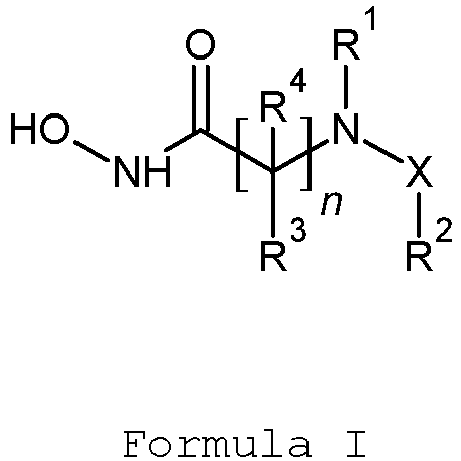
- n = 1-3, preferably 1 or 2;
- R1 is selected from the group consisting of aryl, arylalkyl, heteroaryl and heteroarylalkyl, each of which can be optionally substituted;
- R3 and R4 are independently selected from H and the group consisting of alkyl, aryl, arylalkyl, heteroaryl and heteroarylalkyl, each of which can be optionally substituted;
- R2 is selected the group consisting of aryl, arylalkyl, heteroaryl and heteroarylalkyl, each of which is substituted;
- wherein any two of R1, R2, R3 and R4 may be joined together to form a ring;
- R4 is preferably H;
- X is -CH2-.
- The present invention also provides a pharmaceutical composition comprising a compound according to above Formula I, its individual enantiomers, its individual diastereoisomers, its hydrates, its solvates, its crystal forms, its individual tautomers or a pharmaceutically acceptable salt thereof; and a pharmaceutically acceptable excipient.
- The present invention also provides a method for producing the above compounds.
- The present invention also provides a compound or a pharmaceutical composition for use in a method for treatment or prophylaxis of the human or animal body by surgery or therapy comprising administering a therapeutically effective amount of the above compound or pharmaceutical composition to a subject in need thereof.
- The present invention also provides a compound or a pharmaceutical composition for use in a method for treatment or prophylaxis of Alzheimer's disease, nephritis, renal injury, renal ischemic injury, ischemic acute tubular necrosis, acute renal failure, bladder inflammation, inflammatory bowel disease (IBD), Crohn's disease, ulcerative colitis, chronic inflammation, colitis, fibrosis, fibrotic conditions, keloids, pulmonary hypertension, interstitial lung disease (ILD), or cancer, especially colorectal cancer, comprising administering a therapeutically effective amount of the above compound or pharmaceutical composition to a subject in need thereof.
- The term "subject" as used herein, refers to an animal, preferably a mammal, most preferably a human, who is or has been the object of treatment, prophylaxis, observation or experiment.
- The term "therapeutically effective amount" as used herein, means that amount of active compound or pharmaceutical agent that elicits the biological or medicinal response in a tissue system, animal or human being sought by a researcher, veterinarian, medical doctor or other clinician, which includes alleviation of the symptoms of the disease or disorder being treated.
- The term "alkyl" as used herein, unless specifically limited, denotes a C1-12 alkyl group, suitably a C1-8 alkyl group, e.g. C1-6 alkyl group, e.g. C1-4 alkyl group. Alkyl groups may be straight chain or branched. Suitable alkyl groups include, for example, methyl, ethyl, propyl (e.g. n-propyl and isopropyl), butyl (e.g. n-butyl, iso-butyl, sec-butyl and tert-butyl), pentyl (e.g. n-pentyl), hexyl (e.g. n-hexyl), heptyl (e.g. n-heptyl) and octyl (e.g. n-octyl).
- The expression "cycloalkyl", unless specifically limited, denotes a C3-10 cycloalkyl group (i.e. 3 to 10 ring carbon atoms), more suitably a C3-8 cycloalkyl group, e.g. a C3-6 cycloalkyl group. Exemplary cycloalkyl groups include cyclopropyl, cyclobutyl, cyclopentyl, cyclohexyl, cycloheptyl and cyclooctyl. A most suitable number of ring carbon atoms is three to six.
- The expression "alk", for example in the expressions "alkoxy", "haloalkyl" and "thioalkyl" should be interpreted in accordance with the definition of "alkyl". Exemplary alkoxy groups include methoxy, ethoxy, propoxy (e.g. n-propoxy), butoxy (e.g. n-butoxy), pentoxy (e.g. n-pentoxy), hexoxy (e.g. n-hexoxy), heptoxy (e.g. n-heptoxy) and octoxy (e.g. n-octoxy). Exemplary thioalkyl groups include methylthio. Exemplary haloalkyl groups include fluoroalkyl e.g. CF3; exemplary haloalkoxy groups include fluoroalkyl e.g. OCF3. The expressions "fluoro(C1-6 alkyl)" and "fluoro(C1-6 alkoxy)" denote a C1-6 alkyl and C1-6 alkoxy group, respectively, each of which is substituted by one or more fluoro atoms.
- The expression "alkenyl", unless specifically limited, denotes a C2-12 alkenyl group, suitably a C2-6 alkenyl group, e.g. a C2-4 alkenyl group, which contains at least one double bond at any desired location and which does not contain any triple bonds. Alkenyl groups may be straight chain or branched. Exemplary alkenyl groups including one double bond include propenyl and butenyl. Exemplary alkenyl groups including two double bonds include pentadienyl, e.g. (1 E, 3E)-pentadienyl.
- The expression "cycloalkenyl", unless specifically limited, denotes a C5-io cycloalkenyl group (i.e. 5 to 10 ring carbon atoms), more suitably a C3-6 cycloalkenyl group e.g. a C5-6 cycloalkenyl group. Exemplary cycloalkenyl groups include cyclopropenyl, cyclohexenyl, cycloheptenyl and cyclooctenyl. A most suitable number of ring carbon atoms is five to six.
- The expression "alkynyl", unless specifically limited, denotes a C2-12 alkynyl group, suitably a C2-6 alkynyl group, e.g. a C2-4 alkynyl group, which contains at least one triple bond at any desired location and may or may not also contain one or more double bonds. Alkynyl groups may be straight chain or branched. Exemplary alkynyl groups include propynyl and butynyl.
- The expression "alkylene" denotes a chain of formula -(CH2)n-wherein n is an integer e.g. 2-5, unless specifically limited.
- The expression "carbocyclyl", unless specifically limited, denotes any ring system in which all the ring atoms are carbon and which contains between three and twelve ring carbon atoms, suitably between three and ten carbon atoms and more suitably between three and eight carbon atoms. Carbocyclyl groups may be saturated or partially unsaturated, but do not include aromatic rings. Examples of carbocyclyl groups include monocyclic, bicyclic, and tricyclic ring systems, in particular monocyclic and bicyclic ring systems. Other carbocylcyl groups include bridged ring systems (e.g. bicyclo[2.2.1 ]heptenyl). A specific example of a carbocyclyl group is a cycloalkyl group. A further example of a carbocyclyl group is a cycloalkenyl group.
- The expression "aryl", unless specifically limited, denotes a C6-12 aryl group, suitably a C6-10 aryl group, more suitably a C6-8 aryl group. Aryl groups will contain at least one aromatic ring (e.g. one, two or three rings). An example of a typical aryl group with one aromatic ring is phenyl. An example of a typical aryl group with two aromatic rings is naphthyl.
- The expression "arylalkyl", unless specifically limited, denotes an aryl residue which is connected via an alkylene moiety, e.g., a C1-4 alkylene moiety.
- The expression "heterocyclyl", unless specifically limited, refers to a carbocyclyl group wherein one or more (e.g. 1, 2 or 3) ring atoms are replaced by heteroatoms selected from N, S and O. A specific example of a heterocyclyl group is a cycloalkyl group (e.g. cyclopentyl or more particularly cyclohexyl) wherein one or more (e.g. 1, 2 or 3, particularly 1 or 2, especially 1) ring atoms are replaced by heteroatoms selected from N, S or O. Exemplary heterocyclyl groups containing one hetero atom include pyrrolidine, tetrahydrofuran and piperidine, and exemplary heterocyclyl groups containing two hetero atoms include morpholine and piperazine. A further specific example of a heterocyclyl group is a cycloalkenyl group (e.g. a cyclohexenyl group) wherein one or more (e.g. 1, 2 or 3, particularly 1 or 2, especially 1) ring atoms are replaced by heteroatoms selected from N, S and O. An example of such a group is dihydropyranyl (e.g. 3,4-dihydro-2H-pyran-2-yl-).
- The expression "heteroaryl", unless specifically limited, denotes an aryl residue, wherein one or more (e.g. 1 , 2, 3, or 4, suitably 1 , 2 or 3) ring atoms are replaced by heteroatoms selected from N, S and O, or else a 5-membered aromatic ring containing one or more (e.g. 1 , 2, 3, or 4, suitably 1 , 2 or 3) ring atoms selected from N, S and O. Exemplary monocyclic heteroaryl groups having one heteroatom include: five membered rings (e.g. pyrrole, furan, thiophene); and six membered rings (e.g. pyridine, such as pyridin-2-yl, pyridin-3-yl and pyridin-4-yl). Exemplary monocyclic heteroaryl groups having two heteroatoms include: five membered rings (e.g. pyrazole, oxazole, isoxazole, thiazole, isothiazole, imidazole, such as imidazol-1-yl, imidazol-2-yl imidazol-4-yl); six membered rings (e.g. pyridazine, pyrimidine, pyrazine). Exemplary monocyclic heteroaryl groups having three heteroatoms include: 1 ,2,3-triazole and 1 ,2,4-triazole. Exemplary monocyclic heteroaryl groups having four heteroatoms include tetrazole. Exemplary bicyclic heteroaryl groups include: indole (e.g. indol-6-yl), benzofuran, benzthiophene, quinoline, isoquinoline, indazole, benzimidazole, benzthiazole, quinazoline and purine.
- The expression "heteroarylalkyl", unless specifically limited, denotes a heteroaryl residue which is connected via an alkylene moiety e.g. a C1-4alkylene moiety.
- The term "halogen" or "halo" comprises fluorine (F), chlorine (CI) and bromine (Br).
- The term "amino" refers to the group -NH2.
- The terms "optionally substituted" and "substituted" refer to (optional) substitution by one or several groups independently selected from a halogen atom, a cyano group, a hydroxyl group and a carboxyl group. These terms also refer to (optional) substitution by one or several groups independently selected from -C(O)-O-(C1-6 alkyl) group, a -C(O)-NH2 group, a C1-6 alkylsulfono group, C1-6 alkoxy and a C1-6 aliphatic, aromatic or heterocyclic group, each of which may be further substituted by one or several halogen atoms, carboxyl, cyano, and/or hydroxyl groups. Preferably, an alkyl group which is substituted does not have a keto group on the C atom that is directly bound to the N atom in Formula I.
- The expressions "alkoxyaryl", "carboxyaryl", "cyanoaryl", "haloaryl", "hydroxyaryl" and "heteroarylaryl", unless specifically limited, denote an aryl residue which is substituted by at least one alkoxy, carboxy, cyano, halo, hydroxy and heteroaryl group, respectively.
- The expressions "alkoxyheteroaryl", "carboxyheteroaryl", "cyanoheteroaryl", "haloheteroaryl" and "hydroxyheteroaryl", unless specifically limited, denote a heteroaryl residue which is substituted by at least one alkoxy, carboxy, cyano, halo, and hydroxy group, respectively.
- The expression "arylmethyl", unless specifically limited, denotes an aryl residue which is connected via a methylene moiety.
- The expressions "(alkoxyaryl)methyl", "(hydroxyaryl)methyl", "(carboxyaryl)methyl", "(heteroarylaryl)methyl" "(alkoxyheteroaryl)methyl", "(hydroxyheteroaryl)methyl" and "(carboxyheteroaryl)methyl", unless specifically limited, denote an alkoxyaryl, hydroxyaryl, carboxyaryl, heteroarylaryl, alkoxyheteroaryl, hydroxyheteroaryl and carboxyheteroaryl residue, respectively, which is connected via a methylene moiety.
- All possible stereoisomers of the claimed compounds are included in the present invention.
- Where the compounds according to this invention have at least one chiral center, they may accordingly exist as enantiomers. Where the compounds possess two or more chiral centers, they may additionally exist as diastereomers. It is to be understood that all such isomers and mixtures thereof are encompassed within the scope of the present invention.
- Where the processes for the preparation of the compounds according to the invention give rise to a mixture of stereoisomers, these isomers may be separated by conventional techniques such as preparative chromatography. The compounds may be prepared in racemic form, or individual enantiomers may be prepared either by enantiospecific synthesis or by resolution. The compounds may, for example, be resolved into their components enantiomers by standard techniques, such as the formation of diastereomeric pairs by salt formation with an optically active acid, such as (-)-di-p-toluoyl-d-tartaric acid and/or (+)-di-p-toluoyl-1-tartaric acid followed by fractional crystallization and regeneration of the free base, or by salt formation with an optically active base, such as quinine, quinidine, quinotoxine, cinkotoxine, (S)-phenylethylamine, (1R,2S)-ephedrine, (R)-phenylglycinol, (S)-2-aminobutanol, followed by fractional crystallization and regeneration of the free acid. The compounds may also be resolved by formation of diastereomeric esters or amides, followed by chromatographic separation and removal of the chiral auxiliary. Alternatively, the compounds may be resolved using a chiral HPLC column.
- Furthermore, some of the crystalline forms of the compounds may exist as polymorphs and as such are intended to be included in the present invention. In addition, some of the compounds may form solvates with water (i.e. hydrates) or common organic solvents, and such solvates are also intended to be encompassed within the scope of this invention. The compounds, including their salts, can also be obtained in the form of their hydrates, or include other solvents used for their crystallization.
- As used herein, the term "tautomer" refers to the migration of protons between adjacent single and double bonds. The tautomerization process is reversible. Compounds described herein can undergo any possible tautomerization that is within the physical characteristics of the compound.
- As used herein, the term "pharmaceutically acceptable" embraces both human and veterinary use. For example, the term "pharmaceutically acceptable" embraces a veterinarily acceptable compound or a compound acceptable in human medicine and health care.
- In view of the close relationship between the free compounds and the compounds in the form of their salts, hydrates or solvates, whenever a compound is referred to in this context, a corresponding salt, solvate or polymorph is also intended, provided such is possible or appropriate under the circumstances.
- Salts, hydrates and solvates of the compounds of Formula I and physiologically functional derivatives thereof which are suitable for use in medicine are those wherein the counter-ion or associated solvent is pharmaceutically acceptable. However, salts, hydrates and solvates having non-pharmaceutically acceptable counter-ions or associated solvents are within the scope of the present invention, for example, for use as intermediates in the preparation of other compounds and their pharmaceutically acceptable salts, hydrates and solvates.
- Suitable salts according to the invention include those formed with both organic and inorganic acids or bases. Pharmaceutically acceptable acid addition salts include those formed from hydrochloric, hydrobromic, sulfuric, nitric, citric, tartaric, phosphoric, lactic, pyruvic, acetic, trifluoroacetic, triphenylacetic, sulfamic, sulfanilic, succinic, oxalic, fumaric, maleic, malic, mandelic, glutamic, aspartic, oxaloacetic, methanesulfonic, ethanesulfonic, arylsulfonic (for example p-toluenesulfonic, benzenesulfonic, naphthalenesulfonic or naphthalenedisulfonic), salicylic, glutaric, gluconic, tricarballylic, cinnamic, substituted cinnamic (for example, phenyl, methyl, methoxy or halo substituted cinnamic, including 4-methyl and 4-methoxycinnamic acid), ascorbic, oleic, naphthoic, hydroxynaphthoic (for example 1- or 3-hydroxy-2-naphthoic), naphthaleneacrylic (for example naphthalenes-acrylic), benzoic, 4-methoxybenzoic, 2- or 4-hydroxybenzoic, 4-chlorobenzoic, 4-phenylbenzoic, benzeneacrylic (for example 1 ,4-benzenediacrylic), isethionic acids, perchloric, propionic, glycolic, hydroxyethanesulfonic, pamoic, cyclohexanesulfamic, salicylic, saccharinic and trifluoroacetic acid. Pharmaceutically acceptable base salts include ammonium salts, alkali metal salts such as those of sodium and potassium, alkaline earth metal salts such as those of calcium and magnesium and salts with organic bases such as dicyclohexylamine and N-methyl-D-glucamine.
- All pharmaceutically acceptable acid addition salt forms of the compounds of the present invention are intended to be embraced by the scope of this invention.
- Conventional procedures for the selection and preparation of suitable prodrug derivatives are described, for example, in "Design of Prodrugs", ed. H. Bundgaard, Elsevier, 1985.
- As used herein, the term "composition" is intended to encompass a product comprising the claimed compounds in the therapeutically effective amounts, as well as any product which results, directly or indirectly, from combinations of the claimed compounds.
- Excipients (Carriers and additives for galenic formulations):
Thus, for liquid oral preparations, such as for example, suspensions, elixirs and solutions, suitable carriers and additives may advantageously include water, glycols, oils, alcohols, flavoring agents, preservatives, coloring agents and the like; for solid oral preparations such as, for example, powders, capsules, gelcaps and tablets, suitable carriers and additives include starches, sugars, diluents, granulating agents, lubricants, binders, disintegrating agents and the like. - Carriers, which can be added to the mixture, include necessary and inert pharmaceutical excipients, including, but not limited to, suitable binders, suspending agents, lubricants, flavorants, sweeteners, preservatives, coatings, disintegrating agents, dyes and coloring agents.
- Soluble polymers as targetable drug carriers can include polyvinylpyrrolidone, pyran copolymer, polyhydroxypropylmethacrylamidephenol, polyhydroxyethylaspartamide-phenol, or polyethyleneoxidepolylysine substituted with palmitoyl residue. Furthermore, the compounds of the present invention may be coupled to a class of biodegradable polymers useful in achieving controlled release of a drug, for example, polyactic acid, polyepsilon caprolactone, polyhydroxy butyeric acid, polyorthoesters, polyacetals, polydihydropyrans, polycyanoacrylates and cross-linked or amphipathic block copolymers of hydrogels.
- Suitable binders include, without limitation, starch, gelatin, natural sugars such as glucose or betalactose, corn sweeteners, natural and synthetic gums such as acacia, tragacanth or sodium oleate, sodium stearate, magnesium stearate, sodium benzoate, sodium acetate, sodium chloride and the like.
- Disintegrators include, without limitation, starch, methyl cellulose, agar, bentonite, xanthan gum and the like.
- During any of the processes for preparation of the compounds of the present invention, it may be necessary and/or desirable to protect sensitive or reactive groups on any of the molecules concerned. This may be achieved by means of conventional protecting groups, such as those described in Protective Groups in Organic Chemistry, ed. J.F.W. McOmie, Plenum Press, 1973; and T.W. Greene & P.G.M. Wuts, Protective Groups in Organic Synthesis, John Wiley & Sons, 1991 , fully incorporated herein by reference. The protecting groups may be removed at a convenient subsequent stage using methods known from the art.
- A protecting group or protective group is introduced into a molecule by chemical modification of a functional group in order to obtain chemoselectivity in a subsequent chemical reaction. Protecting groups are e.g. alcohol protecting groups, amine protecting groups, carbonyl protecting groups, carboxylic acid protecting groups and phosphate protecting groups.
- Examples for alcohol protecting groups are acetyl (Ac), benzoyl (Bz), benzyl (Bn, Bnl) β-methoxyethoxymethyl ether (MEM), mimethoxytrityl [bis-(4-methoxyphenyl)phenylmethyl, DMT], methoxymethyl ether (MOM), methoxytrityl [(4-methoxyphenyl)diphenylmethyl, MMT), p-methoxybenzyl ether (PMB), methylthiomethyl ether, pivaloyl (Piv), tetrahydropyranyl (THP), trityl (triphenylmethyl , Tr), silyl ethers (such as trimethylsilyl ether (TMS), tert-butyldimethylsilyl ether (TBDMS), tert-butyldimethylsilyloxymethyl ether (TOM), and triisopropylsilyl ether (TIPS)); methyl ethers and ethoxyethyl ethers (EE).
- Suitable amine protecting groups are selected from carbobenzyloxy (Cbz), p-methoxybenzyl carbonyl (Moz or MeOZ), ie f-butyloxycarbonyl (BOC), 9-fluorenylmethyloxycarbonyl (FMOC), acetyl (Ac), benzoyl (Bz), benzyl (Bn), p-methoxybenzyl (PMB), 3,4-dimethoxybenzyl (DMPM), p-methoxyphenyl (PMP), tosyl (Ts), and other sulfonamides (Nosyl & Nps).
- Suitable carbonyl protecting groups are selected from acetals and ketals, acylals and dithianes.
- Suitable carboxylic acid protecting groups are selected from methyl esters, benzyl esters, tert-butyl esters, silyl esters, orthoesters, and oxazoline.
- Examples for phosphate protecting groups are 2-cyanoethyl and methyl (Me)
- According to aspect 1, the present invention provides a compound represented by the following Formula I, its individual enantiomers, its individual diastereoisomers, its hydrates, its solvates, its crystal forms, its individual tautomers or a pharmaceutically acceptable salt thereof,

- n = 1-3, preferably 1 or 2;
- R1 is selected from the group consisting of aryl, arylalkyl, heteroaryl and heteroarylalkyl, each of which can be optionally substituted
- R3 and R4 are independently selected from H and the group consisting of alkyl, aryl, arylalkyl, heteroaryl and heteroarylalkyl, each of which can be optionally substituted;
- R2 is selected the group consisting of aryl, arylalkyl, heteroaryl and heteroarylalkyl, each of which can be optionally, and preferably is substituted;
- wherein any two of R1, R2, R3 and R4 may be joined together to form a ring;
- R4 is preferably H;
- X is -CH2-.
- According to an alternative embodiment of this aspect, R3 and R4 are preferably the same, and are more preferably joined together to form a carbocyclic or heterocyclic ring. R3 is preferably H or is preferably selected from the group consisting of C1-6 alkyl, aryl, arylalkyl, heteroaryl and heteroarylalkyl, each of which can be optionally substituted; and more preferably selected from the group consisting of methyl, ethyl, 1-propyl, 2-propyl, benzyl, phenyl carboxymethyl and 2-carboxyethyl. In one preferred embodiment of this aspect, n = 2. In another preferred embodiment of this aspect, n = 3. Most preferably, n = 1.
- According to aspect 2, the present invention provides the compound according to aspect 1, wherein R3 is H.
- According to aspect 3, the present invention provides the compound according to any of aspects 1-2, wherein R1 is selected from the group consisting of arylmethyl, (alkoxyaryl)methyl, (hydroxyaryl)methyl, (carboxyaryl)methyl, (alkoxyheteroaryl)methyl, (heteroarylaryl)methyl, (hydroxyheteroaryl)methyl and (carboxyheteroaryl)methyl, each of which can be optionally substituted.
- According to aspect 4, the present invention provides the compound according to any of aspects 1-3, wherein R1 is represented by the following formula,

- (i) at least one of RP and Rm, preferably Rm, is a functional group having an acidic hydrogen and is optionally selected
from -COOH, -SO3H, -P(O)(OH)2, -C(O)-NH-OH, -OH and tetrazol-5-yl; or - (ii) Rp and Rm are alkoxy groups that are joined together as a part of a 5- to 8-membered heterocycle; or
- (iii) at least one of RP and Rm is selected from the group consisting of C1-6 alkyl, C1-6 alkoxy, fluoro(C1-6 alkyl), fluoro(C1-6 alkoxy),
-C(O)-NH2, -C(O)-OCH3, -C(O)-OCH2CH3, fluoro, chloro, bromo, iodo and cyano; - According to aspect 5, the present invention provides the compound according to any of aspects 1-4, wherein
- R1 is selected from the group consisting of (1,3-benzodioxol-5-yl)methyl, (3-carboxyphenyl)methyl, (4-carboxyphenyl)methyl,(2,4-difluoro-3-hydroxy-phenyl)-methyl, (3,5-difluoro-4-hydroxyphenyl)methyl, (2,6-difluoro-3-hydroxy-phenyl)methyl, (4-fluoro-3-hydroxy-phenyl)methyl, (2-fluoro-3-hydroxy-phenyl)methyl, (4-chloro-2-fluoro-3-hydroxy-phenyl)-methyl, (4-chloro-2-fluoro-3-methoxy-phenyl)-methyl, (2,4-difluoro-3-methoxy-phenyl)methyl, (3-ethoxycarbonylphenyl)methyl, (4-chloro-2-fluoro-phenyl)methyl, (3,4,5-trimethoxyphenyl)methyl, 2,3-dihydro-1,4-benzodioxin-6-yl-methyl, (7-methoxy-1,3-benzodioxol-5-yl)methyl and [3-(difluoromethoxy)phenyl]methyl;; preferably selected from (3-carboxyphenyl)methyl, 2,4-difluoro-3-hydroxy-phenyl)-methyl, (4-chloro-2-fluoro-3-hydroxy-phenyl)-methyl and 1,3-benzodioxol-5-ylmethyl.
- According to aspect 6, the present invention provides the compound according to any of aspects 1-5, wherein R2 is selected from the group consisting of aryl, alkoxyaryl, carboxyaryl, cyanoaryl, haloaryl, hydroxyaryl, alkoxyheteroaryl, cyanoheteroaryl, haloheteroaryl, heteroarylaryl, hydroxyheteroaryl and carboxyheteroaryl, each of which can be optionally substituted.
- According to aspect 8, the present invention provides the compound according to any of aspects 1-7, wherein R2 is represented by the following formula,

- (i) at least one of RP and Rm, preferably Rm, is a functional group having an acidic hydrogen and is optionally selected
from -COOH, -SO3H, -P(O)(OH)2, -C(O)-NH-OH, -OH and tetrazol-5-yl; or - (ii) RP and Rm are alkoxy groups that are joined together as a part of a 5- to 8-membered heterocycle; or
- (iii) at least one of RP and Rm is selected from the group consisting of C1-6 alkyl, C1-6 alkoxy, -C(O)-NH2, -C(O)-OCH3, -C(O)-OCH2CH3, fluoro(C1-6 alkyl), fluoro(C1-6 alkoxy), fluoro, chloro, bromo, iodo and cyano;
- According to aspect 8, the present invention provides the compound according to any of aspects 1-7, wherein R2 is selected from the group consisting of 1,3-benzodioxol-5-yl, 3-carboxyphenyl, 1,3-benzodioxol-5-yl, 3-carboxyphenyl, 4-carboxyphenyl, 3-carboxy-4-methoxyphenyl, 3,5-dichloro-4-hydroxyphenyl, 4-chlorophenyl, 4-cyanophenyl, 4-fluorophenyl, 2,6-difluoro-4-methoxyphenyl, 3-fluoro-4-methoxyphenyl, 3-methoxyphenyl, 4-methoxyphenyl, 4-chlorophenyl, 4-methylphenyl, 2,4-difluoro-3-hydroxy-phenyl, 3,5-difluoro-4-hydroxy-phenyl, 2,6-difluoro-3-hydroxy-phenyl, 4-fluoro-3-hydroxy-phenyl, 2-fluoro-3-hydroxy-phenyl, 4-chloro-2-fluoro-3-hydroxy-phenyl, 4-chloro-2-fluoro-3-methoxy-phenyl, 2,4-difluoro-3-methoxy-phenyl, 3-ethoxycarbonylphenyl, 4-chloro-2-fluoro-phenyl, 3,4,5-trimethoxyphenyl 2,3-dihydro-1,4-benzodioxin-6-yl, 7-methoxy-1,3-benzodioxol-5-yl, 2,4-difluoro-3-hydroxyphenyl and 1,3-benzodioxol-5-yl; preferably preferably selected from 3-carboxyphenyl, 2,4-difluoro-3-hydroxy-phenyl, 4-chloro-2-fluoro-3-hydroxy-phenyl and 1,3-benzodioxol-5-yl.
- According to aspect 9, the present invention provides the compound according to any of aspects 1-9, wherein:
- (i) R1 is (3-carboxyphenyl)methyl and R3 is H;
- (ii) R2 is 3-carboxyphenyl and R3 is H;
- (iii) R1 is (3-carboxyphenyl)methyl and R3 and R4 are H; or
- (iv) R2 is 3-carboxyphenyl and R3 and R4 are H; or
- (v) R1 is (2,4-difluoro-3-hydroxy-phenyl)methyl and R2 2,4-difluoro-3-hydroxy-phenyl.
- According to aspect 10, the present invention provides a compound of Formula V:

- According to aspect 11, the present invention provides the compound according to aspect 10, wherein R3 is H.
- According to aspect 12, the present invention provides the compound according to aspects 10-11, wherein R3 and R4 are H.
- According to aspect 13, the present invention provides the compound according to any of aspects 10-12, wherein R1 is selected from the group consisting of arylmethyl, (alkoxyaryl)methyl, (hydroxyaryl)methyl, (carboxyaryl)methyl, (alkoxyheteroaryl)methyl, (heteroarylaryl)methyl, (hydroxyheteroaryl)methyl and (carboxyheteroaryl)methyl, each of which can be optionally substituted.
- According to aspect 14, the present invention provides the compound according to any of aspects 10-13, wherein R1 is represented by the following formula,

- (i) at least one of RP and Rm, preferably Rm, is a functional group having an acidic hydrogen and is optionally selected
from -COOH, -SO3H, -P(O)(OH)2, -C(O)-NH-OH, -OH and tetrazol-5-yl; or - (ii) RP and Rm are alkoxy groups that are joined together as a part of a 5- to 8-membered heterocycle,
- According to aspect 15, the present invention provides the compound according to any of aspects 10-14, wherein R1 is selected from the group consisting of (1,3-benzodioxol-5-yl)methyl, (3-carboxyphenyl)methyl, and (4-carboxyphenyl)methyl; preferably (3-carboxyphenyl)methyl.
- According to aspect 16, the present invention provides the compound according to any of aspects 10-15, wherein R2 is selected from the group consisting of aryl, alkoxyaryl, carboxyaryl, cyanoaryl, haloaryl, hydroxyaryl, alkoxyheteroaryl, cyanoheteroaryl, haloheteroaryl, heteroarylaryl, hydroxyheteroaryl and carboxyheteroaryl, each of which can be optionally substituted.
- According to aspect 17, the present invention provides the compound according to any of aspects 10-16, wherein R2 is represented by the following formula,

- (i) at least one of RP and Rm, preferably Rm, is a functional group having an acidic hydrogen and is optionally selected
from -COOH, -SO3H, -P(O)(OH)2, -C(O)-NH-OH, -OH and tetrazol-5-yl; or - (ii) RP and Rm are alkoxy groups that are joined together as a part of a 5- to 8-membered heterocycle; or
- (iii) at least one of RP and Rm is selected from the group consisting of C1-6 alkyl, C1-6 alkoxy, fluoro(C1-6 alkyl), fluoro(C1-6 alkoxy), fluoro, chloro, bromo, iodo and cyano;
- According to aspect 18, the present invention provides the compound according to any of aspects 10-17, wherein R2 is selected from the group consisting of 1,3-benzodioxol-5-yl, 3-carboxyphenyl, 1,3-benzodioxol-5-yl, 3-carboxyphenyl, 4-carboxyphenyl, 3-carboxy-4-methoxyphenyl, 3,5-dichloro-4-hydroxyphenyl, 4-chlorophenyl, 4-cyanophenyl, 4-fluorophenyl, 2,6-difluoro-4-methoxyphenyl, 3-fluoro-4-methoxyphenyl, 3-methoxyphenyl, 4-methoxyphenyl, 4-chlorophenyl, and 4-methylphenyl.
- According to aspect 19, the present invention provides the compound according to any of aspects 10-18, wherein:
- (i) R1 is (3-carboxyphenyl)methyl and R3 is H;
- (ii) R2 is 3-carboxyphenyl and R3 is H
- (iii) R1 is (3-carboxyphenyl)methyl, and R3 and R4 are H; or
- (iv) R2 is 3-carboxyphenyl, and R3 and R4 are H.
- According to aspect 20, the compound according to the present invention is most preferably selected from the group consisting of:

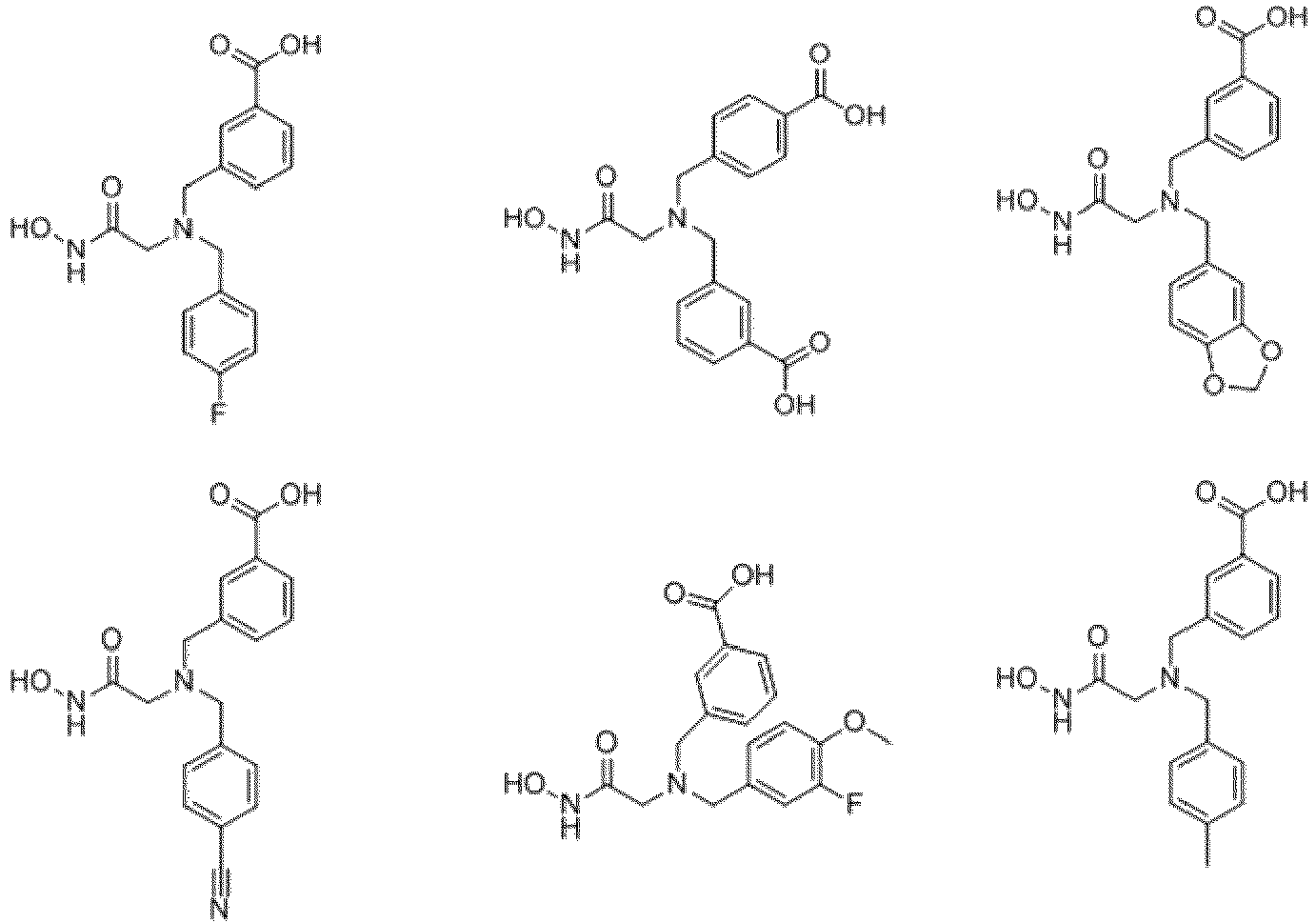
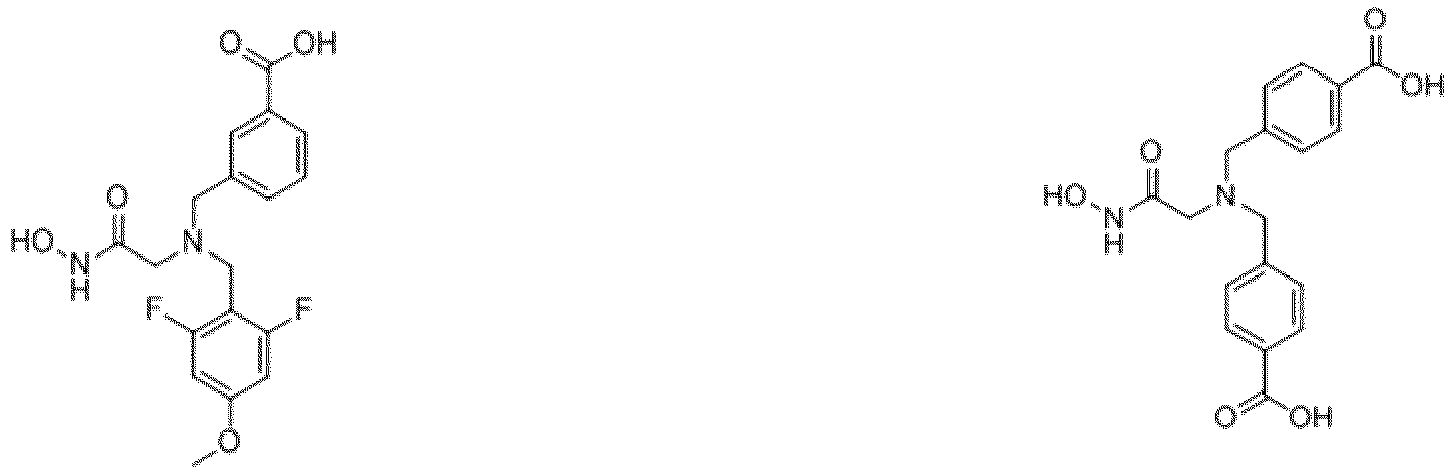
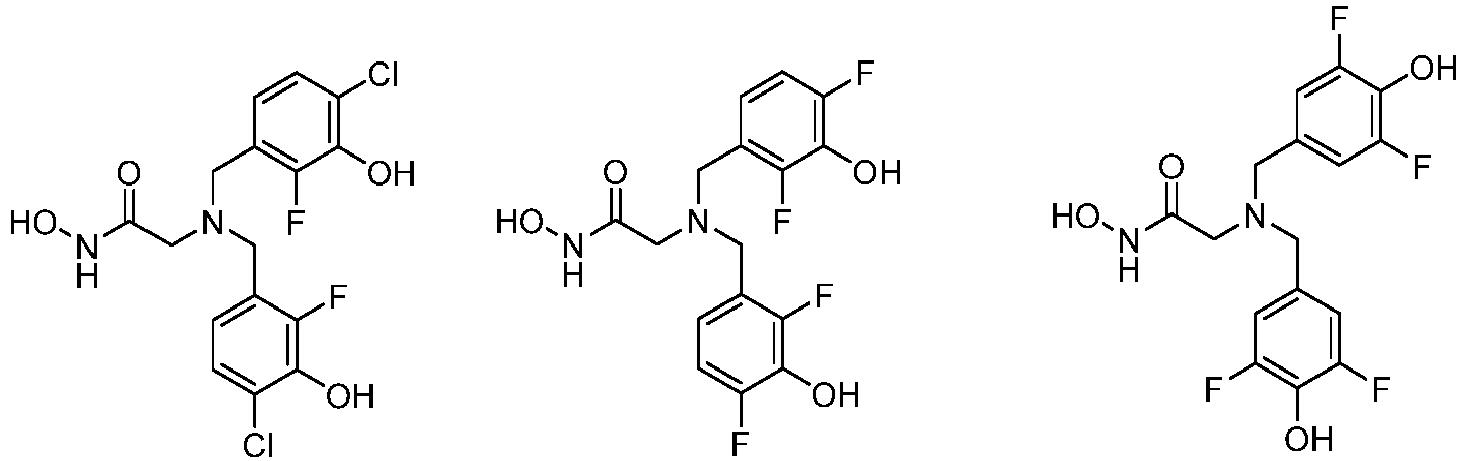


(ii) selected from the group consisting of:


- Aspect 21 of the present invention provides a pharmaceutical composition comprising the compound according to any of the preceding aspects, its individual enantiomers, its individual diastereoisomers, its hydrates, its solvates, its crystal forms, its individual tautomers or a pharmaceutically acceptable salt thereof; and a pharmaceutically acceptable excipient as defined above.
- The present invention provides a compound or a pharmaceutical composition according to any of the above aspects for use in a method for treatment or prophylaxis of the human or animal body by surgery or therapy.
- The present invention also provides compound or a pharmaceutical composition according to any of the above aspects for use in a method for treatment or prophylaxis of Alzheimer's disease, nephritis, renal injury, renal ischemic injury, ischemic acute tubular necrosis, acute renal failure, bladder inflammation, inflammatory bowel disease (IBD), Crohn's disease, ulcerative colitis, chronic inflammation, colitis, fibrosis, fibrotic conditions, keloids, pulmonary hypertension, interstitial lung disease (ILD), or cancer, especially colorectal cancer.
- The present invention also provides the following methods for producing the compounds according to Formulae I-V.

- Compounds of Formula I or V can be obtained by reacting he respective Fmoc-amino acid with tritylhydroxylamine in a suitable solvent, such as DMF, followed by addition of an activating agent, such as TBTU, and a base, such as DIPEA, followed by addition of water, collecting the resulting precipitate by filtration, optionally washing the precipitate with an organic solvent, such as an ether, and optionally with an aqueous base solution. The residue is then redissolved in a suitable organic solvent, such as THF, (and treated with a base, such as DBU, followed by optionally removing the solvent, and optionally purifying the residue.

- Compounds of Formula I or V can be obtained by reacting at room temperature (Method B) or at elevated temperature (Method C), optionally under microwave irradiation at 140°C, the respective trityl protected hydroxamic acid with a base and the respective halide, preferably an optionally substituted benzyl halide, and optionally: extracting with an organic solvent, drying the combined organic phases removing the solvent, and purifying the residue; followed by treating the residue with triisopropylsilane and TFA; and optionally: extracting with an organic solvent, drying the combined organic phases, removing the solvent, and purifying the residue.

- Compounds of Formula I or V can be obtained by reacting a suitable aldehyde (depending on R1) with the trityl protected hydroxamic acid; then adding sodium borohydride; and optionally: extracting with an organic solvent, drying the combined organic phases removing the solvent, and purifying the residue, to obtain a trityl protected hydroxamic acid derivative (Method D); then reacting the trityl protected hydroxamic acid derivative with a base and the respective halide, preferably an optionally substituted benzyl halide, at room temperature (Method E) or at elevated temperature, optionally under microwave irradiation at 140°C (Method F); and optionally: extracting with an organic solvent, drying the combined organic phases, removing the solvent, and purifying the residue; followed by treating the residue with triisopropylsilane and TFA; and optionally: extracting with an organic solvent, drying the combined organic phases, removing the solvent, and purifying the residue.

- Compounds of Formula I or V can be obtained by reacting an amino acid ester and a respective aldehyde in a suitable solvent, treating with a reducing agent, such as sodium triacetoxy borohydride, and optionally a catalytic amount of acetic acid, followed by addition of water, extracting with an organic solvent, drying the combined organic phases removing the solvent, and purifying the residue (Method G). The respective amino acid ester derivative obtained by method G is dissolved a suitable solvent followed by addition of hydroxylamine hydrochloride and a base, such as sodium methanoxide, and preferably heating the mixture until completion, optionally under microwave irradiation at 80°C, followed by addition of water, extracting with an organic solvent, drying the combined organic phases removing the solvent, and purifying the residue.
-

- The respective Fmoc-amino acid (1 eq) was dissolved in DMF (1 ml/mmol). Tritylhydroxylamine (1 eq), TBTU (1 eq) and DIPEA (2 eq) were added and the mixture was stirred at room temperature for 1.5 h. The reaction was quenched with water. The resulting precipitate was collected by filtration and washed with diethyl ether and a small amount of saturated aqueous NaHCO3. The residue was redissolved in THF (2 ml/mmol) and treated with DBU (1.5 eq) . The mixture was stirred at room temperature until completion (TLC monitoring, usually about 30 min). The solvent was evaporated and the residue was purified by flash chromatography (silica, CHCl3/MeOH gradient).
- The respective trityl protected hydroxamic acid (1 eq) obtained by method A was dissolved in DMF (5 ml/mmol) . Triethylamine (2.2 eq) and the respective benzyl halide (2.2 eq) were added and the mixture was stirred at room temperature overnight. The reaction was quenched with water and extracted with EtOAc (3x25 ml). The combined organic layers were dried over Na2SO4 and evaporated. The residue was treated with CH2Cl2/TFA (1:1 v/v, 5 ml) and triisopropylsilane (1.5 eq) and stirred at room temperature for 2 hours. The volatiles were evaporated and the residue was purified by semi-preparative HPLC (Varian Prostar, Phenomenex Luna C18(2) column, H2O/MeCN gradient containing 0.04% TFA).
- The respective trityl protected hydroxamic acid (1 eq) obtained by method A was dissolved in DMF (3-5 ml/mmol). Triethylamine (4 eq) and the respective benzyl halide (2.2 eq) were added and the mixture was heated in a microwave to 140°C for 20 min. The reaction was quenched with water and extracted with EtOAc (3x25 ml). The combined organic layers were dried over Na2SO4 and evaporated. The residue was treated with CH2Cl2/TFA (1:1 v/v, 5 ml) and triisopropylsilane (1.5 eq) and stirred at room temperature for 2 hours. The volatiles were evaporated and the residue was purified by semi-preparative HPLC (Varian Prostar, Phenomenex Luna C18(2) column, H2O/MeCN gradient containing 0.04% TFA).
- The compound was synthesized starting from Fmoc-Gly-OH (2.97 g, 10 mmol, 1 eq), Tritylhydroxylamine (2.8 g, 10 mmol, 1 eq), TBTU (3.21 g, 10 mmol, 1 eq), DIPEA (3.5 ml, 20 mmol, 2 eq) and DBU (2.2 ml, 15 mmol, 1.5 eq) according to method A. Yield: 1.4 g (42.1%), ESI-MS: m/z 243.2 [Trityl]+, 333.3 [M+H]+; HPLC (gradient 2): rt 12.24 min (100%).
- The compound was synthesized starting from 2-Amino-N-trityloxy-acetamide (332 mg, 1 mmol, 1eq), tert-butyl 3-(chloromethyl)benzoate (499 mg, 2.2 mmol, 2.2 eq) and TEA (305 µl, 2.2 mmol, 2.2 eq) followed by acidic deprotection and purification by semi-preparative HPLC as described in method B. Yield: 43 mg (12%, TFA salt); ESI-MS: m/z 359.1 [M+H]+; HPLC (gradient 2): rt 7.73 min (97.4%); 1H-NMR, 400 MHz, DMSO d6: δ 3.59 (s, 1.5H), 3.91 (s, 0.5H), 4.24-4.28 (m, 2H), 7.55-7.59 (m, 1H), 7.70-7.74 (m, 1H), 7.95-7.99 (m, 1H), 8.13-8.15 (m, 1H), 9.21-9.58 (m, 3H), 10.69 (s, 0.2H), 10.94 (s, 0.8H), 13.19 (br s, 1H).

- The respective trityl protected hydroxamic acid (1 eq) obtained by method A was dissolved in MeOH (10 ml/mmol). Tert-butyl 3-formylbenzoate (1.1 eq), or another suitable aldehyde, was added and the mixture was stirred at room temperature. After 3 h sodium borohydride (1.2 eq) was added carefully in small portions. The reaction was stirred at the same temperature for further 30 min. The mixture was quenched with water and extracted with EtOAc (3x25 ml). The solvent was evaporated and the residue was purified by flash chromatography (silica, CHCl3/MeOH gradient).
- The trityl protected hydroxamic acid derivative (1 eq) obtained by method D was dissolved in DMF (5 ml/ mmol). Triethylamine (1.1 eq) and the respective benzyl halide (1.1 eq) were added and the mixture was stirred at room temperature overnight. The reaction was diluted with water and extracted with EtOAc (3x25 ml). The combined organic layers were dried over Na2SO4 and evaporated. The residue was treated with CH2Cl2/TFA (1:1 v/v, 5 ml) and triisopropysilane (1.5 eq). After stirring at room temperature for 2 hours, the volatiles were evaporated. The residue was purified by semi-preparative HPLC (Varian Prostar, Phenomenex Luna C18(2) column, H2O/MeCN gradient containing 0.04% TFA) or by flash chromatography (silica, CHCl3/MeOH gradient).
- The trityl protected hydroxamic acid derivative (1 eq) obtained by method D was dissolved in DMF (5 ml/ mmol). Triethylamine (1.1 eq) and the respective benzyl halide (1.1 eq) were added and the mixture was heated to 120°C under microwave irradiation for 15 min. After cooling to room temperature, the reaction was diluted with water and extracted with EtOAc (3x25 ml). The combined organic layers were dried over Na2SO4 and evaporated. The residue was treated with CH2Cl2/TFA (1:1 v/v, 5 ml) and triisopropysilane (1.5 eq). After stirring at room temperature for 2 hours, the volatiles were evaporated. The residue was purified by semi-preparative HPLC (Varian Prostar, Phenomenex Luna C18(2) column, H2O/MeCN gradient containing 0.04% TFA) or by flash chromatography (silica, CHCl3/MeOH gradient).
- The compound was synthesized starting from tert-Butyl 3-[[[2-oxo-2-(trityloxyamino)ethyl]amino]-methyl]benzoate (method D - see above, 410 mg, 0.78 mmol, 1 eq), 4-Bromomethylbenzoic acid tert butyl ester (234 mg, 0.86 mmol, 1.1 eq) and TEA (120 µl, 0.86 mmol, 1.1 eq) and purified by semi-preparative HPLC according to method E. Yield: 35 mg (12.5%, TFA-salt); ESI-MS: m/z 359.1 [M+H]+; HPLC (gradient 1): rt 7.01 min (100%); 1H-NMR, 400 MHz, DMSO d6: δ 3.18 (m, 2H), 4.00 (m, 4H), 7.49-7.63 (m, 3H), 7.69-7.75 (m, 1H), 7.89-7.99 (m, 3H), 8.02-8.14 (m, 1H), 9.35-9.37 (m, 1H), 10.60 (br s, 1H), 13.04 (br s, 2H).

- The amino acid ester (1 eq) and the respective aldehyde (3 eq) were suspended in dichloromethane (20 ml/mmol) and treated with sodium triacetoxy borohydride (4 eq) and a catalytic amount of acetic acid. The mixture was stirred at room temperature overnight. The reaction was quenched by addition of water and extracted with EtOAc (3x25 ml). The combined organic layers were dried over Na2SO4 and evaporated. The residue was purified by flash chromatography (silica, heptane/diethyl ether gradient).
- The respective amino acid ester derivative (1 eq) obtained by method G was dissolved in MeOH (6-10 ml). Hydroxylamine hydrochloride (3 eq) and sodium methanoxide (6 eq) were added and the mixture was heated in a microwave (Biotage® initiator+) at 80°C upon completion (usually 6-10 min). After cooling to room temperature the mixture was diluted with water. The pH was adjusted to ≈8 by means of diluted aqueous HCl and the mixture was extracted with EtOAc (3x25 ml). The combined organic layers were dried over Na2SO4 and evaporated. The residue was purified by semi-preparative HPLC (Varian Prostar, Phenomenex Luna C18(2) column, H2O/MeCN gradient containing 0.04% TFA) .
- The compound was synthesized starting from glycine methylester hydrochloride (126 mg, 1 mmol, 1 eq), 1,4-Benzodioxane-6-carbaldehyde (492 mg, 3 mmol, 3 eq) and sodium triacetoxy borohydride (848 mg, 4 mmol 4 eq) according to method G. Yield: 322 mg (83,5 %), ESI-MS: m/z 386.9 [M+H]+; HPLC (gradient 2): rt 11.09 min (97.2%)
- The compound was synthesized starting from Methyl 2-[bis(2,3-dihydro-1,4-benzodioxin-6-ylmethyl)amino]acetate (322 mg, 0.84 mmol, 1 eq), NH2OH*HCl (175 mg, 2.5 mmol, 3 eq) and sodium methoxide (0.9 ml 30% in MeOH, 5 mmol, 6 eq) according to method H. Yield: 35 mg (10.9%, TFA-salt); ESI-MS: m/z 387.1 [M+H]+; HPLC (gradient 2): rt 9.75 min (97.7%); 1H-NMR, 400 MHz, DMSO d6: δ 3.41 (br s, 2H), 4.12 (br s, 4H), 4.26 (s, 8H), 6.89-6.99 (m, 4H), 7.04-7.09 (m, 2H), 10.88 (br s, 1H).
- The compound was synthesized using method B as described above. Yield: 12 mg (3.3%,); ESI-MS: m/z 359.3 [M+H]+; HPLC (gradient 2): rt 7.39 min (100%); 1H-NMR, 400 MHz, DMSO d6: δ 3.10 (s, 2H), 3.90 (s, 4H), 7.54-7.56 (m, 4H), 7.91-7.93 (m, 4H), 10.52 (br s, 1H), 12.94 (br s, 2H).
- The compound was synthesized using method A & B as described above. Yield: 43 mg (12.0%,); ESI-MS: m/z 359.1 [M+H]+; HPLC (gradient 2): rt 7.73 min (97.4%); 1H-NMR, 400 MHz, DMSO d6: δ 3.24 (br s, 1H), 4.07 (br s, 3.1 H), 4.43 (br s, 0.9 H), 7.49-7.58 (m, 2H), 7.68-7.74 (m, 2H), 7.89-7.97 (m, 2H), 8.03 (br s, 1.6H), 8.14 (br s, 0.4H), 10.64 (s, 1H), 13.06 (br s, 2H).
- Side product of Example 2. Yield: 24 mg (10.7%); ESI-MS: m/z 224.9 [M+H]+; HPLC (gradient 2): rt 3.84 min (99.1%); 1H-NMR, 400 MHz, DMSO d6: δ 3.59 (s, 1.5H), 3.91 (s, 0.5H), 4.24-4.28 (m, 2H), 7.55-7.59 (m, 1H), 7.70-7.74 (m, 1H), 7.95-7.99 (m, 1H), 8.13-8.15 (m, 1H), 9.21-9.58 (m, 3H), 10.69 (s, 0.2H), 10.94 (s, 0.8H), 13.19 (br s, 1H).
- The compound was synthesized using method B as described above. Yield: 56 mg (11.9%,); ESI-MS: m/z 359.1 [M+H]+; HPLC (gradient 2): rt 10.03 min (100%); 1H-NMR, 400 MHz, DMSO d6: δ 3.40 (s, 2H), 4.12 (br s, 3H), 4.33 (br s, 1H), 6.06-6.07 (m, 4H), 6.96-7.03 (m, 4H), 7.09-7.13 (m, 2H), 9.51 (br s, 1H), 10.67-10.85 (m, 1H).
- The compound was synthesized using method B as described above. Yield: 102 mg (23.0%,); ESI-MS: m/z 331.1 [M+H]+; HPLC (gradient 2): rt 10.85 min (100%); 1H-NMR, 400 MHz, DMSO d6: δ 3.35 (br s, 2H), 3.77 (s, 6H), 4.10 (br s, 3H), 4.38 (br s, 1H), 6.94-7.13 (m, 6H), 7.31-7.38 (m, 2H), 10.78 (br s, 1H).
- The compound was synthesized using methods D & E as described above. Yield: 84 mg (36.7%,); ESI-MS: m/z 345.5 [M+H]+; HPLC (gradient 2): rt 8.72 min (98.2%); 1H-NMR, 400 MHz, DMSO d6: δ 3.30-3.43 (m, 2H), 3.78 (s, 3H), 4.07-4.49 (m, 4H), 6.96-7.01 (m, 2H), 7.39-7.47 (m, 1H), 7.52-7.59 (m, 2H), 7.71-7.78 (m, 1H), 7.94-8.00 (m, 1H), 8.09-8.19 (m, 1H), 9.02-9.43 (m, 1H), 10.62-10.75 (m, 1H), 13.12 (br s, 1H).
- The compound was synthesized using methods D & E as described above. Yield: 35 mg (12.5%,); ESI-MS: m/z 359.1 [M+H]+; HPLC (gradient 1): rt 7.01 min (100%); 1H-NMR, 400 MHz, DMSO d6: δ 3.18 (m, 2H), 4.00 (m, 4H), 7.49-7.63 (m, 3H), 7.69-7.75 (m, 1H), 7.89-7.99 (m, 3H), 8.02-8.14 (m, 1H), 9.35-9.37 (m, 1H), 10.60 (br s, 1H), 13.04 (br s, 2H).
- The compound was synthesized using methods D & E as described above. Yield: 60 mg (40.3%,); ESI-MS: m/z 391.9 [M+H]+; HPLC (gradient 1): rt 11.57 min (100%); 1H-NMR, 400 MHz, DMSO d6: δ 3.89-4.50 (m, 6H), 7.39-7.42 (m, 1H), 7.46-7.63 (m, 5H),7.68-7.79 (m, 5H), 7.92-7.99 (m, 1H), 8.09-8.20 (m, 1H), 9.33 (br s, 1H), 10.71 (s, 1H), 13.05 (br s, 1H).
- The compound was synthesized using methods D & F as described above. Yield: 110 mg (55.3%,); ESI-MS: m/z 373.4 [M+H]+; HPLC (gradient 1): rt 10.29 min (97.34%); 1H-NMR, 400 MHz, DMSO d6: δ 0.98 (t, 3H, 3J=7.5 Hz), 1.73 (q, 2H, 3J=7.5 Hz), 3.84-4.45 (m, 8H), 6.94-6.99 (m, 2H), 7.36-7.45 (m, 2H), 7.52-7.59 (m, 1H), 7.71-7.76 (m, 1H), 7.93-8.00 (m, 1H), 8.08-8.19 (m, 1H), 9.08 (br s, 1H), 10.74 (s, 1H), 13.10 (br s, 1H).
- The compound was synthesized using methods D & F as described above. Yield: 95 mg (34.3%,); ESI-MS: m/z 363.1 [M+H]+; HPLC (gradient 1): rt 8.40 min (97.78%); 1H-NMR, 400 MHz, DMSO d6: δ 3.84-4.06 (m, 9H), 7.14-7.40 (m, 3H), 7.50-7.58 (m, 1H), 7.69-7.75 (m, 1H), 7.90-8.14 (m, 2H), 10.68 (s, 1H), 13.06 (br s, 1H).
- The compound was synthesized using methods D & F as described above. Yield: 40 mg (17.0%,); ESI-MS: m/z 380.9 [M+H]+; HPLC (gradient 1): rt 9.36 min (97.7%); 1H-NMR, 400 MHz, DMSO d6: δ 3.77-3.83 (m, 5H), 3.92-3.93 (m, 4H), 6.72-6.84 (m, 2H), 7.44-7.48 (m, 1H), 7.62-7.64 (m, 1H), 7.84-7.87 (m, 1H), 7.95-7.97 (m, 1H), 10,47 (s, 1H), 13,00 (br s, 1H).
- The compound was synthesized using method A & F as described above. Yield: 31 mg (25.0%,); ESI-MS: m/z 265.3 [M+H]+; HPLC (gradient 2): rt 3.76 min (99.9%); 1H-NMR, 400 MHz, DMSO d6: δ 1.82-1.90 (m, 2H), 2.02-2.14 (m, 1H), 2.33-2.43 (m, 1H), 3.48-3.54 (m, 2H), 3.93-4.02 (m, 1H), 4.36-4.60 (m, 2H), 7.57 (t, 1H, 3J=7.5 Hz), 7.71-7.75 (m, 1H), 8.00 (d, 1H, 3J=7.9 Hz), 8.12-8.15 (m, 1H), 9.29 (br s, 1H), 11.08 (br s, 1H), 13.19 (br s, 1H).
- The compound was synthesized using methods A & F as described above. Yield: 67 mg (42.2%,); ESI-MS: m/z 265.2 [M+H]+; HPLC (gradient 2): rt 3.71 min (100%); 1H-NMR, 400 MHz, DMSO d6: δ 1.84-1.91 (m, 2H), 2.05-2.12 (m, 1H), 2.34-2.41 (m, 1H), 3.25-3.34 (m, 2H), 3.97-4.02 (m, 1H), 4.35-4.60 (m, 2H), 7.57 (t, 1H, 3J=7.5 Hz), 7.71-7.75 (m, 1H), 8.00 (d, 1H, 3J=7.5 Hz), 8.12-8.15 (m, 1H), 9.30 (br s, 1H), 11.09 (s, 1H), 13.18 (br s, 1H).
- The compound was synthesized using methods D & F as described above. Yield: 150 mg (36.7%,); ESI-MS: m/z 345.1 [M+H]+; HPLC (gradient 1): rt 8.21 min (98.6%); 1H-NMR, 400 MHz, DMSO d6: δ 3.27 (s, 2H), 3.76-4.47 (m, 7H), 6,90-6.93 (m, 1H), 7.00-7.11 (m, 2H), 7.28-7.37 (m, 1H), 7.50-7.58 (m, 1H), 7.69-7.76 (m, 1H), 7.91-7.98 (m, 1H), 8.07-8.17 (m, 1H), 10,68 (s, 1H), 13.07 (br s, 1H).
- The compound was synthesized using methods B as described above. Yield: 40 mg (7.7%,); ESI-MS: m/z 331.4 [M+H]+; HPLC (gradient 1): rt 9.63 min (89.7%); 1H-NMR, 400 MHz, DMSO d6: δ 3.75-3.80 (m, 6H), 3.98-4.45 (m, 6H), 6.93-7.16 (m, 6H), 7.30-7.40 (m, 2H), 10.75 (br s, 1H).
- The compound was synthesized using methods D & F as described above. Yield: 23 mg (6.7%,); ESI-MS: m/z 345.3 [M+H]+; HPLC (gradient 2): rt 9.31 min (100%); 1H-NMR, 400 MHz, DMSO d6: δ 3.46-3.52 (m, 2H), 3.78-3.79 (m, 3H), 4.22-4.35 (m, 2H), 4.54-4.70 (m, 2H), 6.97-7.03 (m, 2H), 7.39-7.49 (m, 2H), 7.53-7.70 (m, 3H), 7.95-8.02 (m, 1H), 9.20-9.51 (m, 1H), 10.58-10.78 (m, 1H).
- The compound was synthesized using methods D & F as described above. Yield: 160 mg (76.4%,); ESI-MS: m/z 315.0 [M+H]+; HPLC (gradient 1): rt 7.63 min (100%); 1H-NMR, 400 MHz, DMSO d6: δ 4.01-4.39 (m, 6H), 7.34-7.76 (m, 7H), 7.91-8.18 (m, 2H), 8.98 (br s, 1H), 10.65 (s, 1H), 13.08 (br s, 1H).
- The compound was synthesized using methods D & F as described above. Yield: 150 mg (68.6%,); ESI-MS: m/z 329.1 [M+H]+; HPLC (gradient 1): rt 8.72 min (100%); 1H-NMR, 400 MHz, DMSO d6: δ 2.31 (s, 3H), 3.70-4.44 (m, 6H), 7.18-7.40 (m, 4H), 7.49-7.57 (m, 1H), 7.69-7.76 (m, 1H), 7.89-8.15 (m, 2H), 8.98 (br s, 1H), 10,61 (s, 1H), 13.05 (br s, 1H).
- The compound was synthesized using methods D & F as described above. Yield: 200 mg (88.5%,); ESI-MS: m/z 340.1 [M+H]+; HPLC (gradient 1): rt 8.88 min (100%); 1H-NMR, 400 MHz, DMSO d6: δ 3.10 (s, 2H), 3.88-3.92 (m, 4H), 7.44-7.53 (m, 1H), 7.61-7.71 (m, 3H), 7.81-8.06 (m, 4H), 10.54 (s, 1H), 12.98 (br s, 1H).
- The compound was synthesized using methods D & F as described above. Yield: 170 mg (71.0%,); ESI-MS: m/z 349.2 [M+H]+; HPLC (gradient 1): rt 9.55 min (97.0%); 1H-NMR, 400 MHz, DMSO d6: δ 3.18 (s, 2H), 3.93-3.99 (m, 4H), 7.35-7.60 (m, 5H), 7.64-7.74 (m, 1H), 7.87-8.14 (m, 2H), 10.61 (s, 1H), 13.03 (br s, 1H).
- The compound was synthesized using methods D & F as described above. Yield: 150 mg (59.0%,); ESI-MS: m/z 333.2 [M+H]+; HPLC (gradient 1): rt 8.21 min (100%); 1H-NMR, 400 MHz, DMSO d6: δ 3.98-4.04 (m, 4H), 4.34-4.40 (m, 2H), 7.19-7.28 (m, 2H), 7.47-7.57 (m, 3H), 7.69-7.75 (m, 1H), 7.90-8.15 (m, 2H), 8.99 (br s, 1H), 10.65 (s, 1H), 13.05 (br s, 1H).
- The compound was synthesized using methods D & F as described above. Yield: 210 mg (76.6%,); ESI-MS: m/z 359.2 [M+H]+; HPLC (gradient 1): rt 7.95 min (100%); 1H-NMR, 400 MHz, DMSO d6: δ 3.85-4.43 (m, 6H), 6.02-6.06 (m, 2H), 6.89-7.00 (m, 2H), 7.06-7.10 (m, 1H), 7.51-7.58 (m, 1H), 7.70-7.76 (m, 1H), 7.91-7.99 (m, 1H), 8.05-8.16 (m, 1H), 9.07 (br s, 1H), 10.70 (s, 1H), 13.07 (m, 1H).
- The compound was synthesized using methods D & F as described above. Yield: 195 mg (58.9%,); ESI-MS: m/z 121.1 [M-C10H11N2O4]+; 345.3 [M+H]+; HPLC (gradient 1): rt 9.07 min (100%); 1H-NMR, 400 MHz, DMSO d6: δ 3.35-3.45 (m, 2H), 3.74-3.80 (m, 3H), 4.06-4.40 (m, 4H), 6.06-6.08 (m, 2H), 6.96-7.04 (m, 4H), 7.10-7.14 (m, 1H), 7.42-7.49 (m, 2H), 9.12 (br s, 1H), 10.84 (br s, 1H).
- The compound was synthesized using methods D & F as described above. Yield: 170 mg (56.3%,); ESI-MS: m/z 121.1 [M-C10H13N2O2]+; 315.3 [M+H]+; HPLC (gradient 1): rt 9.92 min (100%); 1H-NMR, 400 MHz, DMSO d6: δ 2.33 (s, 3H), 3.33-3.40 (m, 2H), 3.71-3.83 (m, 3H), 4.05-4.45 (m, 4H), 6.98-7.02 (m, 2H), 7.24-7.28 (m, 2H), 7.38-7.49 (m, 4H), 9,16 (br s, 1H), 10.82 (br s, 1H).
- The compound was synthesized using methods D & F as described above. Yield: 210 mg (68.6%,); ESI-MS: m/z 121.1 [M-C9H10FN2O2]+; 341.3 [M+Na]+; HPLC (gradient 1): rt 9.15 min (100%); 1H-NMR, 400 MHz, DMSO d6: δ 3.26-3.47 (m, 2H), 3.73-3.79 (m, 3H), 4.01-4.38 (m, 4H), 6.97-7.02 (m, 2H), 7.23-7.31 (m, 2H), 7.40-7.62 (m, 4H), 9.05 (br s, 1H), 10.77 (br s, 1H).
- The compound was synthesized using methods D & F as described above. Yield: 153 mg (47.5%,); ESI-MS: m/z 121.1 [M-C9H10ClN2O2]+; 357.3 [M+Na]+; HPLC (gradient 1): rt 10.29 min (100%); 1H-NMR, 400 MHz, DMSO d6: δ 3.24-3.40 (m, 2H), 3.75-3.81 (m, 3H), 3.98-4.43 (m, 4H), 6.96-7.01 (m, 2H), 7.39-7.62 (m, 6H), 9.10 (br s, 1H), 10.74 (br s, 1H) .
- The compound was synthesized using methods D & F as described above. Yield: 165 mg (52.0%,); ESI-MS: m/z 121.1 [M-C10H13N2O3]+; 353.3 [M+Na]+; HPLC (gradient 1): rt 14.59 min (100%); 1H-NMR, 400 MHz, DMSO d6: δ 3.32-3.46 (m, 2H), 3.75-3.81 (m, 6H), 4.05-4.44 (m, 4H), 6.98-7.15 (m, 5H), 7.33-7.49 (m, 3H), 9.15 (br s, 1H), 10.82 (br s, 1H) .
- The compound was synthesized using methods A & D as described above followed by deprotection with TFA/DCM (1:1 v/v). Yield: 52 mg (20.9%,); ESI-MS: m/z 239.0 [M+H]+; HPLC (gradient 1): rt 3.52 min (100%); 1H-NMR, 400 MHz, DMSO d6: δ 1.36-1.51 (m, 3H), 3.67-3.78 (m, 1H), 4.06-4.26 (m, 2H), 7.54-7.62 (m, 1H), 7.67-7.75 (m, 1H), 7.96-8.03 (m, 1H), 8.11-8.18 (m, 1H), 9.14-9.59 (m, 3H), 11.14 (s, 1H), 13.21 (br s, 1H).
- The compound was synthesized using methods A & D as described above followed by deprotection with TFA/DCM (1:1 v/v). Yield: 25 mg (7.9%,); ESI-MS: m/z 267.1 [M+H]+; HPLC (gradient 1): rt 4.19 min (100%); 1H-NMR, 400 MHz, DMSO d6: δ 0.91-1.01 (m, 6H), 2.09-2.2 (m, 1H), 4.03-4.20 (m, 2H), 7.53-7.60 (m, 1H), 7.2 (d, 1H, 3J=7.69 Hz), 7.99 (d, 1H, 3J=7.77 Hz), 8.09-8.16 (m, 1H), 8.83-9.57 (br s, 3H), 11.11 (s, 1H), 13.08 (br s, 1H).
- The compound was synthesized using methods A & D as described above followed by deprotection with TFA/DCM (1:1 v/v). Yield: 75 mg (27.4%,); ESI-MS: m/z 315.2 [M+H]+; HPLC (gradient 1): rt 6.77 min (100%); 1H-NMR, 400 MHz, DMSO d6: δ 3.00-3.09(m, 1H), 3.15-3.23(m, 1H), 3.72-3.82(m, 1H), 4.10-4.23(m, 2H), 7.16-7.22(m, 2H), 7.24-7.34(m, 3H), 7.53-7.64(m, 1H), 7.66-7.73(m, 1H), 7.95-8.03(m, 1H) 8.1-8.16(m, 1H), 9.26-9.78(m, 3H), 10,99(s, 1H), 13.11(br s, 1H).
- The compound was synthesized using methods A, & D as described above followed by deprotection with TFA/DCM (1:1 v/v). Yield: 28 mg (19.5%,); ESI-MS: m/z 359.4 [M+H]+; HPLC (gradient 1): rt 8.21 min (95.4%); 1H-NMR, 400 MHz, DMSO d6: δ 3.00-3.31 (m, 3H), 3.74-3.87 (m, 4H), 4.08-4.57 (m, 4H), 6.93-7.09 (m, 2H), 7.3-7.5 (m, 2H), 7.5-7.67 (m, 1H), 7.67-7.84 (m, 1H), 7.87-8.22 (m, 1H), 8,56-9.4 (m, 1H), 9.67-10.02 (m, 1H), 10.58-10.81 (m, 1H), 13.18 (br s, 1H).
- The compound was synthesized using methods A & D as described above followed by deprotection with TFA/DCM (1:1 v/v). Yield: 21 mg (5.5%,); ESI-MS: m/z 253.2 [M+H]+; HPLC (gradient 1): rt 4.19 min (100%); 1H-NMR, 400 MHz, DMSO d6: δ 1.57 (s, 6H), 4.12 (s, 2H), 7.56-7.64 (m, 1H), 7.73 (d, 1H, 3J=7.7 Hz), 8.00 (d, 1H, 3J=7.8 Hz), 8.12-8.21 (m, 1H), 9.11-9.14 (m, 2H), 11.17 (s, 1H), 13.21 (br s, 1H).
- The compound was synthesized using methods A & D as described above followed by deprotection with TFA/DCM (1:1 v/v). Yield: 53 mg (24.0%,); ESI-MS: m/z 239.2 [M+H]+; HPLC (gradient 1): rt 3.47 min (100%); 1H-NMR, 400 MHz, DMSO d6: δ 1.38-1.52 (m, 3H), 3.65-3.74 (m, 1H), 4.05-4.31 (m, 2H), 7.55-7.62 (m, 1H), 7.67-7.75 (m, 1H), 7,99 (d, 1H, 3J=7.77 Hz), 8.1-8.17 (m, 1H), 9.05-9.57 (m, 2H), 11.10 (s, 1H), 13.13 (br s, 1H).
- The compound was synthesized using methods A & D as described above followed by deprotection with TFA/DCM (1:1 v/v). Yield: 10 mg (2.6%,); ESI-MS: m/z 267.2 [M+H]+; HPLC (gradient 1): rt 4.29 min (100%); 1H-NMR, 400 MHz, DMSO d6: δ 0.83-1.05 (m, 6H), 2.09-2.22 (m,1H), 4.00-4.21 (m, 2H), 7.53-7.61 (m, 1H), 7.7 (d 1H, 3J=7.57), 7.99 (d, 1H, 3J=7.69), 8.09-8.17 (m, 1H), 8.96-9.55 (m, 2H), 11.11 (s, 1H), 13.09 (br s, 1H).
- The compound was synthesized using methods A & D as described above followed by deprotection with TFA/DCM (1:1 v/v). Yield: 70 mg (21.3%,); ESI-MS: m/z 315.2 [M+H]+; HPLC (gradient 1): rt 6.75 min (100%); 1H-NMR, 400 MHz, DMSO d6: δ 2.97-3.27 (m, 2H), 3.71-3.81 (m, 1H), 4.04-4.24 (m, 2H), 7.15-7.22 (m, 2H), 7.24-7.38 (m, 3H), 7.53-7.62 (m, 1H), 7.65-7.74 (m, 1H), 7.96-8.02 (m, 1H), 8.11-8.16 (m, 1H), 9.16-9.98 (m, 3H), 10.99 (s, 1H), 13.11 (br s, 1H).
- The compound was synthesized using methods A & D as described above followed by deprotection with TFA/DCM (1:1 v/v). Yield: 4 mg (1.3%,); ESI-MS: m/z 301.1 [M+H]+; HPLC (gradient 1): rt 6.88 min (100%); 1H-NMR, 400 MHz, DMSO d6: δ 4.00-4-20 (m, 2H), 4.73 (s, 1H), 7.44-7.59 (m, 6H), 7.61-7.68 (m, 1H), 7.96-8.01 (m, 1H), 8.08-8.13 (m, 1H), 9.28-9.41 (m, 1H), 9.81-10.12 (m, 2H), 11.26 (s, 1H), 13.16 (br s, 1H).
- The compound was synthesized using methods G & D as described above followed by deprotection with TFA/DCM (1:1 v/v). Yield: 26 mg (6.5%,); ESI-MS: m/z 301.2 [M+H]+; HPLC (gradient 1): rt 6.80 min (100%); 1H-NMR, 400 MHz, DMSO d6: δ 4.00-4-20 (m, 2H), 4.74 (s, 1H), 7.45-7.59 (m, 6H), 7.62-7.68 (m, 1H), 7.96-8.01 (m, 1H), 8.08-8.15 (m, 1H), 9.20-9.50 (m, 1H), 9.70-10.20 (m, 2H), 11.28 (s, 1H), 13.16 (br s, 1H).
- The compound was synthesized using methods A & D as described above followed by deprotection with TFA/DCM (1:1 v/v). Yield: 37.4 mg (6.8%,); ESI-MS: m/z 373.4 [M+H]+; HPLC (gradient 1): rt 8.40 min (97.85%); 1H-NMR, 400 MHz, DMSO d6: δ 1.80-2.05 (m,4H), 2.90-3.05 (m, 2H), 3.75-3.85 (m, 3H), 4.20-4.6 (m, 4H), 6.90-7.10 (m, 2H), 7.35-7.50 (m, 2H), 7.55-7.65 (m, 1H), 7.70-7.80 (m, 1H), 9.95-8.20 (m, 2H), 8,70-9.00 (m, 1H), 9.95-10.10 (m, 1H), 10,52 (s, 1H), 13.20 (br s, 1H).
- The compound was synthesized using methods A & D as described above followed by deprotection with TFA/DCM (1:1 v/v). Yield: 11 mg (3.1%,); ESI-MS: m/z 297.2 [M+H]+; HPLC (gradient 1): rt 3.63 min (96.5%); 1H-NMR, 400 MHz, DMSO d6: δ 1.88-2.16 (m, 2H), 2.17-2.4 (m, 2H), 3.54-3.68 (m, 1H), 4.01-4.26 (m, 2H), 7.54-7.62 (m, 1H), 7.66-7.75 (m, 1H), 7.94-8.04 (m, 1H), 8.09-8.18 (m, 1H), 9.14-9.67 (m, 2H), 11.09-11.36 (m, 1H), 12.05-12.74 (br s, 1H), 12.76-13.53 (br s, 1H)
- The compound was synthesized using methods A & C as described above. Yield: 52 mg (56.5%); ESI-MS: m/z 321.2 [M+H]+; HPLC (gradient 1): rt 11.63 min (98.2%); 1H-NMR, 400 MHz, DMSO d6: δ 3.09 (s, 3H), 3.72-3.89 (m, 4H), 7.53-7.62 (m, 2H), 7.68-7.83 (m, 4H), 7.90-7.98 (m, 2H), 10.62 (br s, 1H)
- The compound was synthesized using methods A & C as described above, starting from 3-(Bromomethyl)benzoic acid methyl ester. Aminolysis of the methyl ester by means of NH3/MeOH was performed prior to final deprotection. Yield: 44 mg (8.2%); ESI-MS: m/z 357.2 [M+H]+; HPLC (gradient 1): rt 4.93 min (98.7%); 1H-NMR, 400 MHz, DMSO d6: δ 3.95-4.12 (m, 4H), 4.24-4.47 (m, 2H), 7.42-7.68 (m, 6H), 7.78-8.18 (m, 6H), 9.24-9.42 (m, 1H), 10.56-10.71 (m, 1H)
- Side product of example 41. Yield: 16 mg (2.9%); ESI-MS: m/z 372.3 [M+H]+; HPLC (gradient 1): rt 7.52 min (96.8%); 1H-NMR, 400 MHz, DMSO d6: δ 3.88-3.89 (m, 3H), 3.98-4.15 (m, 4H), 4.26-4.36 (m, 2H), 7.42-7.70 (m, 4H), 7.72-8.17 (m, 6H), 9.32 (br s, 1H), 10.66 (br s, 1H)
- Side product of example 41. Yield: 10 mg (1.8%); ESI-MS: m/z 373.3 [M+H]+; HPLC (gradient 1): rt 8.69 min (100%); 1H-NMR, 400 MHz, DMSO d6: δ 3.87 (s, 3H), 4.06-4.19 (m, 4H), 4.39-4.53 (m, 2H), 7.49-7.59 (m, 2H), 7.67-7.78 (m, 2H), 7.90-8.16 (m, 4H), 10.68 (s, 1H), 13.05 (br s, 1H)
- The compound was synthesized using methods A & C as described above followed by deprotection with TFA/DCM (1:1 v/v). Yield: 22 mg (8.7%,); ESI-MS: m/z 297.2 [M+H]+; HPLC (gradient 1): rt 3.63 min (95.4%); 1H-NMR, 400 MHz, DMSO d6: δ 1.89-2.17 (m, 2H), 2.19-2.41(m, 2H), 3.59-3.68 (m, 1H), 3.98-4.29 (m, 2H), 7.54-7.62 (m, 1H), 7.67-7.74 (m, 1H), 7.97-8.02 (m, 1H), 8.10-8.16 (m, 1H), 9.03-9.86 (m, 3H), 11.25 (s, 1H), 11.89-13-56 (m, 2H)
- The compound was synthesized using methods A & C as described above followed by deprotection with TFA/DCM (1:1 v/v). Yield: 15 mg (3.1%,); ESI-MS: m/z 283.1 [M+H]+; HPLC (gradient 1): rt 3.36 min (95.1%); 1H-NMR, 400 MHz, DMSO d6: δ 2.69-2.92 (m, 2H), 3.72-3.91 (m, 1H), 3.97-4.31 (m, 2H), 7.52-7.61 (m, 1H), 7.63-7.75 (m, 1H), 7.91-8.02 (m, 1H), 8.03-8.15 (m, 1H), 8.58-9.90 (m, 2H), 11.01-11.29 (m, 1H), 11.34-14.42 (m, 2H)
- The compound was synthesized using methods A & C as described above followed by deprotection with TFA/DCM (1:1 v/v). Yield: 3 mg (0.7%,); ESI-MS: m/z 283.1 [M+H]+; HPLC (gradient 1): rt 3.44 min (93.8%); 1H-NMR, 400 MHz, DMSO d6: δ 2.73-2.90 (m, 2H), 3.78-3.88 (m, 1H), 4.01-4.20 (m, 2H), 7.53-7.61 (m, 1H), 7.64-7.73 (m, 1H), 7.93-8.01 (m, 1H), 8.06-8.14 (m, 1H), 9.05-9.88 (m, 2H), 11.15 (s, 1H), 11.61-14.38 (m, 2H)
- The compound was synthesized using methods A & C as described above. Final deprotection was accomplished using boron tribromide (6eq) in dichloromethane (10 ml). Yield: 102 mg (58.6%); ESI-MS: m/z 375.5 [M+H]+; HPLC (gradient 1): rt 7.89 min (100%); 1H-NMR, 400 MHz, DMSO d6: δ 3.13 (s, 2H), 4.12-4.28 (m, 4H), 6.87-7.12 (m, 4H), 9.25 (br s, 1H), 10.14 (br s, 2H), 10.45 (br s, 1H)
- The compound was synthesized using methods A & C as described above. Final deprotection was accomplished using boron tribromide (6eq) in dichloromethane (10 ml). Yield: 105 mg (54%); ESI-MS: m/z 374.9 [M+H]+; HPLC (gradient 1): rt 7.47 min (98.6%); 1H-NMR, 400 MHz, DMSO d6: δ 3.15-3.23 (m, 2H), 3.78-3.99 (m, 4H), 7.12-7.23 (m, 4H), 10.30 (br s, 2H), 10.68 (br s,1H)
- The compound was synthesized using methods A & C as described above. Final deprotection was accomplished using boron tribromide (6eq) in dichloromethane (10 ml). Yield: 73 mg (40.8%); ESI-MS: m/z 375.4 [M+H]+; HPLC (gradient 1): rt 9.52 min (100%); 1H-NMR, 400 MHz, DMSO d6: δ 3.08 (s, 2H), 3.85-3.92 (m, 4H), 6.83-6.93 (m, 4H), 9.88 (br s, 2H), 10.05 (br s, 1H)
- The compound was synthesized using methods A & C as described above. Final deprotection was accomplished using boron tribromide (6eq) in dichloromethane (10 ml). Yield: 59 mg (39.6%); ESI-MS: m/z 339.1 [M+H]+; HPLC (gradient 1): rt 7.36 min (100%); 1H-NMR, 400 MHz, DMSO d6: δ 3.28 (s, 2H), 3.72-4.11 (m, 4H), 6.87-6.98 (m, 2H), 7.04-7.24 (m, 4H), 8.70-9.58 (m, 1H), 9.80-10.27 (m, 2H), 10.53-10.84 (m, 1H)
- The compound was synthesized using methods A & C as described above. Final deprotection was accomplished using boron tribromide (6eq) in dichloromethane (10 ml). Yield: 63 mg (75.7%); ESI-MS: m/z 339.1 [M+H]+; HPLC (gradient 1): rt 6.83 min (100%); 1H-NMR, 400 MHz, DMSO d6: δ 3.20 (s, 2H), 3.97 (s, 4H), 6.86-7.08 (m, 6H), 9.20-9.42 (m, 1H), 9.71-10.14 (m, 2H), 10.51 (br s, 1H)
- The compound was synthesized using methods A & C as described above. Final deprotection was accomplished using boron tribromide (6eq) in dichloromethane (10 ml). Yield: 62 mg (56.4%); ESI-MS: m/z 406.9 [M+H]+; HPLC (gradient 1): rt 10.48 min (100%); 1H-NMR, 400 MHz, DMSO d6: δ 3.10 (s, 2H), 3.85 (s, 4H), 6.95-6.98 (m, 2H), 7.16-7.24 (m, 2H), 10.10-10.60 (m, 3H)
- The compound was synthesized using methods A, D & F as described above. Final deprotection was accomplished using boron tribromide (6eq) in dichloromethane (10 ml). Yield: 66 mg (35.7%); ESI-MS: m/z 353.1 [M+H]+; HPLC (gradient 1): rt 8.37 min (100%); 1H-NMR, 400 MHz, DMSO d6: δ 3.32 (s, 2H), 3.77 (s, 3H), 4.07-4.10 (m, 3H), 4.35-4.41 (m, 1H), 6.96-7.14 (m, 4H), 7.39-7.49 (m, 2H), 9.05-9.60 (m, 1H), 10.26-10.41 (m, 1H), 10.62-10.76 (m, 1H)
- The compound was synthesized using methods A & C as described above. Yield: 50 mg (8%); ESI-MS: m/z 415.0 [M+H]+; HPLC (gradient 1): rt 12.93 min (100%); 1H-NMR, 400 MHz, DMSO d6: δ 1.32-1.35 (m, 6H), 3.18-3.40 (m, 2H), 3.90-4.08 (m, 4H), 4.30-4.36 (m, 4H), 7.48-7.56 (m, 2H), 7.64-7.75 (m, 2H), 7.86-8.10 (m, 4H), 10.59 (br s, 1H)
- The compound was synthesized using methods A & C as described above. Yield: 30 mg (9.3%); ESI-MS: m/z 321.0 [M+H]+; HPLC (gradient 1): rt 12.83 min (100%); 1H-NMR, 400 MHz, DMSO d6: δ 3.05 (s, 2H), 3.84 (s, 4H), 7.61-7.63 (m, 4H), 7.80-7.83 (m, 4H), 10.51 (br s, 1H)
- The compound was synthesized using methods A & C as described above. Yield: 33 mg (8.5%); ESI-MS: m/z 435.9 [M+H]+; HPLC (gradient 1): rt 17.12 min (99.3%); 1H-NMR, 400 MHz, DMSO d6: δ 3.11 (s, 2H), 3.83 (s, 4H), 3.85 (s, 6H), 7.24-7.30 (m, 4H), 10.43 (br s, 1H)
- The compound was synthesized using methods A & C as described above. Yield: 65 mg (19.6%); ESI-MS: m/z 335.0 [M+H]+; HPLC (gradient 1): rt 9.01 min (100%); 1H-NMR, 400 MHz, DMSO d6: δ 2,30-2,34 (m, 2H), 2.80 (br s, 2H), 3.85 (br s, 4H), 7.59-7.61 (m, 4H), 7.83-7.85 (m, 4H), 10.49 (br s, 1H)
- The compound was synthesized using methods A & C as described above. Yield: 26 mg (6.4%); ESI-MS: m/z 403.0 [M+H]+; HPLC (gradient 1): rt 14.45 min (100%); 1H-NMR, 400 MHz, DMSO d6: δ 3.18 (s, 2H), 3.82 (s, 4H), 3.89 (s, 6H), 7.08-7.13 (m, 2H), 7.20-7.25 (m, 2H), 10.43 (br s, 1H)
- The compound was synthesized using methods A, D & F as described above. Yield: 77 mg (16.3%); ESI-MS: m/z 387.0 [M+H]+; HPLC (gradient 1): rt 9.84 min (98.2%); 1H-NMR, 400 MHz, DMSO d6: δ 1.34 (t, 3H, 3J=7.1 Hz), 3.26 (s, 2H), 3.84-4.24 (m, 4H), 4.33 (q, 2H, 3J=7.1 Hz), 7.49-7.63 (m, 2H), 7.67-7.83 (m, 2H), 7.90-8.15 (m, 4H), 9.28-9.55 (m, 1H), 10.52-10.66 (m, 1H), 13.04 (br s, 1H)
- The compound was synthesized using methods A & C as described above. Yield: 22 mg (5.8%); ESI-MS: m/z 375.9 [M+H]+; HPLC (gradient 1): rt 17.44 min (100%); 1H-NMR, 400 MHz, DMSO d6: δ 3.08 (s, 2H), 3.82 (s, 4H), 7.28 (dd, 2H, 4J=1.7 Hz, 3J=8.3 Hz), 7.38 (dd, 2H, 4J=1.7 Hz, 3J=10.0 Hz), 7.53-7.57 (m, 2H), 10.44 (br s 1H)
- The compound was synthesized using methods A & C as described above. Yield: 29 mg (6.4%); ESI-MS: m/z 450.9 [M+H]+; HPLC (gradient 1): rt 10.17 min (100%); 1H-NMR, 400 MHz, DMSO d6: δ 3.45 (br s, 2H), 3.67 (s, 6H), 3.79 (s, 12H), 4.13-4.36 (m, 4H), 6.79-6.84 (m, 4H), 10.90 (br s, 1H)
- The compound was synthesized using methods A & C as described above. Yield: 97 mg (24.9%); ESI-MS: m/z 389.0 [M+H]+; HPLC (gradient 1): rt 11.59 min (99.5%); 1H-NMR, 400 MHz, DMSO d6: δ 2.34 (s, 2H), 2.87 (br s, 2H), 3.86-4.41 (m, 4H), 7.31-7.55 (m, 6H), 10.51 (br s, 1H)
- The compound was synthesized using methods G & H as described above. Yield: 35 mg (10.9%); ESI-MS: m/z 387.1 [M+H]+; HPLC (gradient 1): rt 9.75 min (97.7%); 1H-NMR, 400 MHz, DMSO d6: δ 3.41 (br s, 2H), 4.12 (br s, 4H), 4.26 (s, 8H), 6.89-6.99 (m, 4H), 7.04-7.09 (m, 2H), 10.88 (br s, 1H)
- The compound was synthesized using methods A & C as described above. Yield: 43 mg (10.2%); ESI-MS: m/z 416.9 [M+H]+; HPLC (gradient 1): rt 10.85 min (100%); 1H-NMR, 400 MHz, DMSO d6: δ 2.38 (br s, 2H), 2.96 (br s, 2H), 3.91-4.09 (m, 12H), 7.17-7.23 (m, 4H), 10.57 (br s, 1H)
- The compound was synthesized using methods A & C as described above. Yield: 57 mg (12.8%); ESI-MS: m/z 449.0 [M+H]+; HPLC (gradient 1): rt 12.52 min (100%); 1H-NMR, 400 MHz, DMSO d6: δ 2.35 (br s, 2H), 2.93 (br s, 2H), 3.87-3.92 (m, 10H), 7.23-7.33 (m, 4H), 10.53 (br s, 1H)
- The compound was synthesized using methods A & C as described above. Yield: 67 mg (14.4%); ESI-MS: m/z 465.2 [M+H]+; HPLC (gradient 1): rt 9.57 min (100%); 1H-NMR, 400 MHz, DMSO d6: δ 2.58 (br s, 2H), 3.28 (br s, 2H), 3.68 (s, 6H), 3.79 (s, 12H), 4.28-4.35 (m, 4H), 6.82 (s, 4H), 10.72 (br s, 1H)
- The compound was synthesized using methods G & H as described above. Yield: 15 mg (26%); ESI-MS: m/z 271.1 [M+H]+; HPLC (gradient 1): rt 8.64 min (100%); 1H-NMR, 400 MHz, DMSO d6: δ 3.32 (br s, 2H), 4.10-4.40 (m, 4H), 7.37-7.56 (m, 10H), 10.74 (br s, 1H)
- The compound was synthesized using methods G & H as described above. Yield: 59 mg (36.5%); ESI-MS: m/z 419.1 [M+H]+; HPLC (gradient 1): rt 10.29 min (100%); 1H-NMR, 400 MHz, DMSO d6: δ 3.39 (br s, 2H), 3.84 (s, 6H), 4.08 (br s, 4H), 6.03-6.05 (m, 4H), 6.78-6.85 (m, 4H), 10.87 (br s, 1H)
- The compound was synthesized using methods G & H as described above. Yield: 43 mg (43.7%); ESI-MS: m/z 401.2 [M+H]+; HPLC (gradient 1): rt 9.92 min (100%); 1H-NMR, 400 MHz, DMSO d6: δ 3.15 (br s, 2H), 3.85 (br s, 4H), 4.19-4.27 (m, 8H), 6.94-7.03 (m, 6H), 9.63 (br s, 1H), 10.71 (br s, 1H)
- The compound was synthesized using methods A & C as described above. Yield: 44 mg (13.2%); ESI-MS: m/z 335.2 [M+H]+; HPLC (gradient 1): rt 9.92 min (100%); 1H-NMR, 400 MHz, DMSO d6: δ 2.37 (br s, 2H), 2.89 (br s, 2H), 3.99-4.53 (m, 8H), 7.58-7.98 (m, 8H), 10.55 (br s, 1H)
- The compound was synthesized using methods G & H as described above. Yield: 22 mg (31.2%); ESI-MS: m/z 285.1 [M+H]+; HPLC (gradient 1): rt 8.77 min (100%); 1H-NMR, 400 MHz, DMSO d6: δ 2.54-2.57 (t, 2H, 3J=6.8 Hz), 3.27-3.35 (m, 2H), 4.21-4.30 (m, 4H), 7.45-7.48 (m, 10H), 9.97 (br s, 1H)
- The compound was synthesized using methods A & C as described above. Yield: 58 mg (10%); ESI-MS: m/z 403.1 [M+H]+; HPLC (gradient 1): rt 13.68 min (100%); 1H-NMR, 400 MHz, DMSO d6: δ 3.16 (s, 2H), 3.78-3.95 (m, 4H), 7.04-7.47 (m, 9H), 10.61 (br s, 1H)
- The compound was synthesized using methods G & H as described above. Yield: 30 mg (28.8%); ESI-MS: m/z 273.1 [M+H]+; HPLC (gradient 3): rt 2.35 min (100%); 1H-NMR, 400 MHz, DMSO d6: δ 3.16 (s, 2H), 3.97 (s, 4H), 7.82-7.85 (dd, 2H, 4J=2.0 Hz, 3J=5.9 Hz), 8.38-8.40 (m, 2H), 8.66-8.67 (m, 2H), 8.87 (s, 2H)
- The compound was synthesized using methods A & C as described above. Yield: 83 mg (22.3%); ESI-MS: m/z 373.2 [M+H]+; HPLC (gradient 1): rt 9.49 min (100%); 1H-NMR, 400 MHz, DMSO d6: δ 2.51-2.55 (t, 2H, 3J=6.8 Hz), 3.26-3.39 (m, 2H), 4.16-4.19 (m, 4H), 6.01 (s, 4H), 6.88-6.96 (m, 6H), 9.90 (br s, 1H)
- HPLC: The analytical HPLC-system consisted of a Merck-Hitachi device (model LaChrom) utilizing a LUNA RP 18 (5 µm), analytical column (length: 125 mm, diameter: 4 mm), and a diode array detector (DAD) with λ = 214 nm as the reporting wavelength. The compounds were analyzed using a gradient at a flow rate of 1 mL/min; whereby eluent (A) was acetonitrile, eluent (B) was water, both containing 0.04 % (v/v) trifluoroacetic acid applying one of the following gradients:
- Gradient 1: 0 min - 5 min -> 5% (A), 5 min - 15 min -> 5 - 60% (A), 15 min - 20 min 60 - 95% (A) 20 min - 30 min 95% (A)
- Gradient 2: 0 min - 15 min 5 - 50 % (A), 15 min - 20 min -> 50 - 95 % (A), 20 min - 23 min 95 % (A)
- Gradient 3: 0 min - 5 min 1 % (A), 5 min - 20 min -> 1 - 20 % (A), 20 min - 30 min 20 - 95 % (A), 30 min - 34 min 95% (A)
- The purities of all reported compounds were determined by the percentage of the peak area at 214 nm.
- Mass-spectrometry, NMR-spectroscopy: ESI-Mass spectra were obtained with a SCIEX API 1200 spectrometer (Perkin Elmer) or an expressionCMS (Advion). The 1H NMR-Spectra were recorded at an Agilent DD2 400-MHz spectrometer. Chemical shifts (δ) are expressed as parts per million (ppm) downfield from tetramethylsilane. Splitting patterns have been designated as follows: s (singlet), d (doublet), dd (doublet of doublet), t (triplet), m (multiplet) and br (broad signal).
- The determination of enzymatic activity was based on the cleavage of internally quenched peptide substrates. A typical assay of 250 µl total volume measured in black 96 well plates consisted of 100 µl buffer, 50 µl enzyme at a final concentration of 5e-8 M to 5e-9 M, 50 µl substrate (0.15 to 80 µM, in buffer, 0.5% DMSO) and 50 µl inhibitor solution (in buffer, 1% DMSO). In case of 125 µl assay volume (black 96 half area well plates) all volumes were cut in half. Enzymatic activity of ADAMs was measured in 384 well plates with 60 µl total assay volume consisting of 20 µl inhibitor, 20 µl buffer, 10 µl enzyme and 10 µl substrate.
- Ki values were assessed combining 4 substrate concentrations (5-40 µM) with at least 5 inhibitor concentrations. For IC50 values the influence of 12 inhibitor concentrations ranging from 0 to 5e-5 M on the enzymatic activity was investigated in the presence of one standard substrate concentration (10 µM). Initial velocities were determined and converted into concentration units applying a standard curve obtained after complete conversion of different substrate concentrations under assay conditions. All measurements were performed using a fluorescence plate reader (FLUOstar OPTIMA, BMG Labtech) at 30°C. The kinetic parameters were determined at least in duplicates on separate days. The excitation/emission wavelength was 340/420 nm. The kinetic data was evaluated using GraFit software (version 7.0.3, Erithacus Software).
- MMPs were activated prior to measurement by APMA (p-aminophenylmercuric acetate) treatment according to manufacturer's instructions (R&D systems).
Table 1. Peptide substrates and assay conditions used for determination of enzymatic activity Enzyme Substrate Buffer Assay volume hMeprin β Abz-YVAEAPK(Dnp)G-OH 40 mM Tris pH 8.0 250 µl hMeprin α Abz-YVADAPK(Dnp)G-OH 40 mM HEPES pH 7.4 250 µl hMMPs 2, 9 and 13 (R&D systems) Mca-PLGL-(DapDnp) -AR-NH2 50 mM Tris, 2 µM ZnCl2, 150 mM NaCl, pH 7.5 125 µl hADAMs 10 and 17 (R&D systems) Abz-LANAVRSSSR-(DapDnp) -NH2 25 mM Tris, 2 µM ZnCl2, 150 mM NaCl, pH 9.0 60 µl (Abz = 2-aminobenzoyl; Dnp = 2,4-dinitrophenyl; Mca = 7-methoxy coumarin; Dap = 2,3-diaminopropionic acid; hMeprin = human meprin; hMMPs = human Matrix Metalloproteases, hADAMs = human A Desintegrin and Metalloproteases) - The following compounds according to the present invention were synthesized using the above general procedures. IC50 and Ki values for the inhibition of Meprin β and α measured using the above enzyme assays are shown in the following Tables. IC50 refers to the average IC50 values measured as described above, SD (IC50) refers to the standard deviation of the average IC50 values, Ki refers to the average Ki values measured as described above, and SD(Ki) to the standard deviation of the average Ki values.
Table 2. Compounds of Formula V (Series 4) Structure Cpd ID Meprin Beta Meprin Alpha IC50 [nM] SD (IC50) [nM] Ki [nM] SD (Ki) [nM] IC50 [nM] SD (IC50) [nM] Ki [nM] SD (Ki) [nM] 
Example 1 468 49 223 15 85700 400 n.d. n.d. 
Example 2 50 17 18 3 30950 4313 10410 999 
Example 3 377 14 183 18 n.d. n.d. n.d. n.d. 
Example 4 5363 2312 6555 509 830 47 274 63 
Example 5 25600 6023 15664 1119 n.d. n.d. n.d. n.d. 
Example 6 76 17 39 0.2 3435 134 1210 14 
Example 7 206 32 101 7 44400 4526 n.d. n.d. 
Example 8 1445 630 1034 292 n.d. n.d. n.d. n.d. 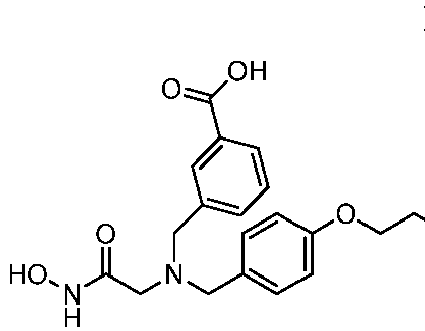
Example 9 2250 982 874 156 n.d. n.d. n.d. n.d. 
Example 10 352 40 157 15 3735 714 1091 227 
Example 11 355 46 154 2 2120 283 1255 346 
Example 12 31350 636 n.d. n.d. n.d. n.d. n.d. n.d. 
Example 13 41100 4000 n.d. n.d. n.d. n.d. n.d. n.d. 
Example 14 559 32 288 27 n.d. n.d. n.d. n.d. 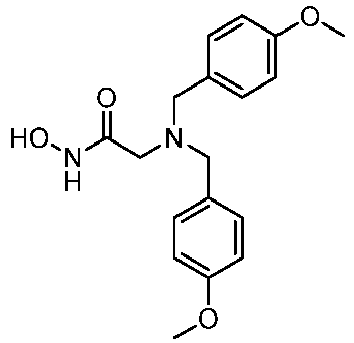
Example 15 31800 1600 n.d. n.d. n.d. n.d. n.d. n.d. 
Example 16 22800 4384 n.d. n.d. n.d. n.d. n.d. n.d. 
Example 17 1285 15 797 185 n.d. n.d. n.d. n.d. 
Example 18 361 35 170 11 4670 1 1990 481 
Example 19 320 7 125 16 4875 615 1950 28 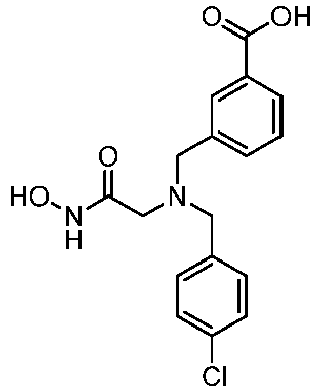
Example 20 76 4 33 5 1795 205 796 55 
Example 21 177 8 1680 99 4215 460 1680 99 
Example 22 285 94 105 4 1430 255 606 45 
Example 23 20000 0 n.d. n.d. 1685 36 n.d. n.d. 
Example 24 60933 2065 n.d. n.d. 2330 283 n.d. n.d. 
Example 25 80400 707 n.d. n.d. 4135 347 n.d. n.d. 
Example 26 53400 3536 n.d. n.d. 1985 148 n.d. n.d. 
Example 27 34450 2899 n.d. n.d. 3195 2474 n.d. n.d. 
Example 28 4200 495 3103 422 16700 265 n.d. n.d. 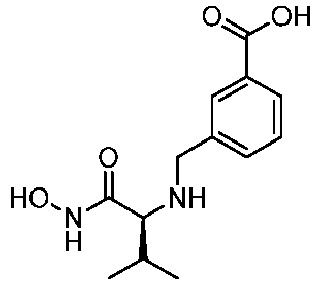
Example 29 15800 2687 n.d. n.d. 44367 5424 n.d. n.d. 
Example 30 15500 990 n.d. n.d. 10245 361 n.d. n.d. 
Example 31 643 30 165 11 233 36 87 2 
Example 32 39300 1556 n.d. n.d. 265500 4950 n.d. n.d. 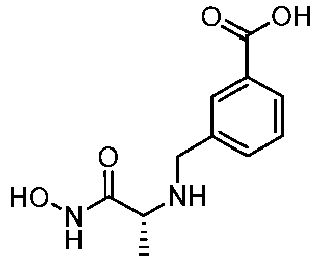
Example 33 4255 163 2575 21 45150 1344 n.d. n.d. 
Example 34 11850 212 n.d. n.d. 29950 778 n.d. n.d. 
Example 35 2910 141 1355 64 2655 247 n.d. n.d. 
Example 36 11650 354 n.d. n.d. 21700 1414 n.d. n.d. 
Example 37 12150 71 n.d. n.d. 26250 354 n.d. n.d. 
Example 38 742 42 225 27 2610 283 948 22 
Example 39 654 11 325 10 8660 552 2530 311 
Example 40 12000 566 n.d. n.d. 1465 120 521 8 
Example 41 13100 849 n.d. n.d. 2900 156 852 66 
Example 42 25000 1100 n.d. n.d. 3545 177 1190 28 
Example 43 516 8 152 1 6275 148 1735 78 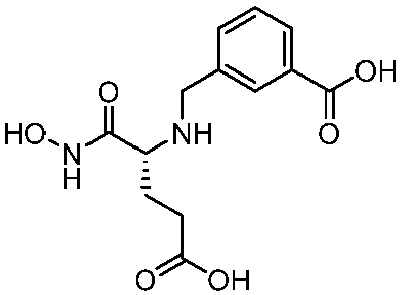
Example 44 768 40 277 23 32100 1697 n.d. n.d. 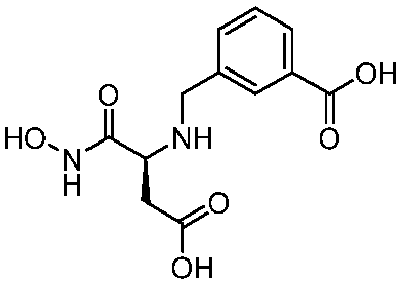
Example 45 1325 92 644 12 60400 2546 n.d. n.d. 
Example 46 548 25 254 18 15100 1838 n.d. n.d. 
Example 47 23 1 12 2 626 1 189 15 
Example 48 272 20 118 7 1305 120 263 6 
Example 49 5515 78 1965 64 5600 156 998 1 
Example 50 1060 57 352 8 986 21 306 14 
Example 51 2905 7 1170 226 1210 14 335 3 
Example 52 24 1 8 0.6 368 8 104 12 
Example 53 331 4 158 3 995 21 328 28 
Example 54 94850 10112 1755 148 7270 240 n.d. n.d. 
Example 55 n.d. n.d. n.d. n.d. 5660 381 1597 323 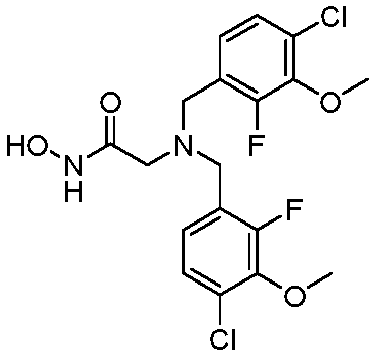
Example 56 12800 700 n.d. n.d. 4975 35 1006 91 
Example 57 68250 1061 n.d. n.d. 3415 50 1200 113 
Example 58 18200 849 n.d. n.d. 2830 57 726 0.7 
Example 59 839 30 271 28 4130 1598 1465 148 
Example 60 138000 5657 n.d. n.d. 3060 198 838 33 
Example 61 20150 354 n.d. n.d. 5320 354 1180 85 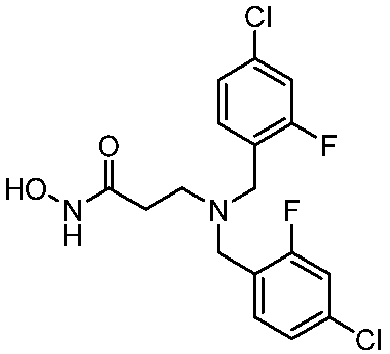
Example 62 19200 990 n.d. n.d. 1001 41 169 1 
Example 63 30600 990 n.d. n.d. 1515 35 297 29 
Example 64 18700 141 n.d. n.d. 881 45 332 13 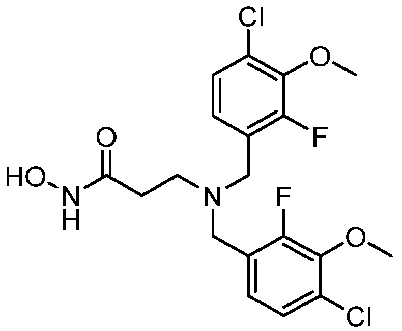
Example 65 19600 919 n.d. n.d. 495 33 157 30 
Example 66 90000 4880 n.d. n.d. 19800 424 n.d. n.d. 
Example 67 n.d. n.d. n.d. n.d. 7880 290 3090 52 
Example 68 4570 14 1820 244 554 25 164 2 
Example 69 7590 14 3740 42 400 27 117 8 
Example 70 33100 2050 n.d. n.d. 2340 35 696 7 
Example 71 75500 3680 n.d. n.d. 1680 28 612 12 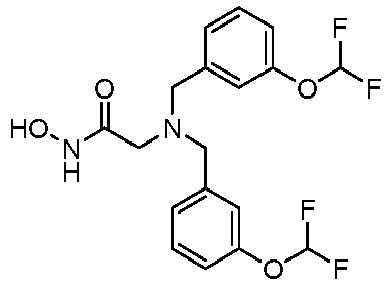
Example 72 57000 2900 n.d. n.d. 5680 325 2150 107 
Example 73 21700 849 n.d. n.d. 1960 71 637 6 
Example 74 2950 346 1150 36 150 12 52 1 -
Residual enzyme activity @ 200 µM inhibitor Compound ID MMP2 MMP9 MMP13 ADAM10 ADAM17 Example 2 64 74 78 93 76 Example 6 68 85 94 87 60 Example 7 98 92 79 90 71 Example 10 74 84 64 94 64 Example 11 10 24 7 84 52 Example 18 93 85 59 82 60 Example 19 50 85 70 98 59 Example 20 69 88 78 95 57 Example 21 110 96 91 91 64 Example 22 62 85 60 91 59 Example 31 82 79 50 96 71 Example 47 67 94 102 99 82 Example 48 87 87 99 92 76 Example 52 41 81 93 97 82 Example 53 75 73 63 91 59 -
- <110> Fraunhofer-Gesellschaft zur Förderung der angewandten Forschung e.V.
- <120> Novel inhibitors of meprin alpha and beta
- <130> 196236
- <150>
EP16165804.2
<151> 2016-04-18 - <160> 4
- <170> PatentIn version 3.5
- <210> 1
<211> 8
<212> PRT
<213> Artificial Sequence - <220>
<223> Substrate - <220>
<221> Site
<222> (7)..(7)
<223> Xaa corresponds to Lys modified with Dnp (2,4-dinitrophenyl) - <400> 1

- <210> 2
<211> 8
<212> PRT
<213> Artificial Sequence - <220>
<223> Substrate - <220>
<221> Site
<222> (7)..(7)
<223> Xaa corresponds to Lys modified with Dnp (2,4-dinitrophenyl) - <400> 2

- <210> 3
<211> 7
<212> PRT
<213> Artificial Sequence - <220>
<223> Substrate - <220>
<221> Site
<222> (5)..(5)
<223> Xaa corresponds to DprDnp, i.e. Dpr (2,3-diaminopropionic acid)
modified with Dnp (2,4-dinitrophenyl) - <400> 3

- <210> 4
<211> 11
<212> PRT
<213> Artificial Sequence - <220>
<223> Substrate - <220>
<221> Site
<222> (11)..(11)
<223> Xaa corresponds to DprDnp, i.e. Dpr (2,3-diaminopropionic acid)
modified with Dnp (2,4-dinitrophenyl) - <400> 4

Claims (14)
- A compound represented by the following Formula I, its individual enantiomers, its individual diastereoisomers, its hydrates, its solvates, its crystal forms, its individual tautomers or a pharmaceutically acceptable salt thereof,
 n = 1-3, preferably 1 or 2;R1 is selected from the group consisting of aryl, arylalkyl, heteroaryl and heteroarylalkyl, each of which can be optionally substituted;R3 and R4 are independently selected from H and the group consisting of alkyl, aryl, arylalkyl, heteroaryl and heteroarylalkyl, each of which can be optionally substituted;R2 is selected the group consisting of aryl, arylalkyl, heteroaryl and heteroarylalkyl, each of which is substituted;wherein any two of R1, R2, R3 and R4 may be joined together to form a ring;R4 is preferably H; andX is -CH2-.
 - The compound according to claim 1 which is represented by the following Formula V:

R1, R2, R3 and R4 are defined as in claim 1, with the proviso that R1 is not H. - The compound according to any of claims 1-2, wherein R3 is H.
- The compound according to any of claims 1-3, wherein R1 is selected from the group consisting of arylmethyl, (alkoxyaryl)methyl, (hydroxyaryl)methyl, (carboxyaryl)methyl, (alkoxyheteroaryl)methyl, (heteroarylaryl)methyl, (hydroxyheteroaryl)methyl and (carboxyheteroaryl)methyl, each of which can be optionally substituted.
- The compound according to any of claims 1-4, wherein R1 is represented by the following formula,
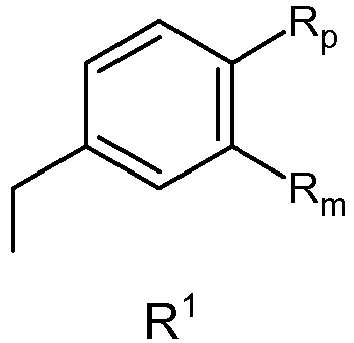 (i) at least one of RP and Rm, preferably Rm, is a functional group having an acidic hydrogen and is optionally selected
from -COOH, -SO3H, -P(O)(OH)2, -C(O)-NH-OH, -OH and tetrazol-5-yl; or(ii) RP and Rm are alkoxy groups that are joined together as a part of a 5- to 8-membered heterocycle,whereby R1 can be optionally further substituted. - The compound according to any of claims 1-5, wherein R1 is selected from the group consisting of (1,3-benzodioxol-5-yl)methyl, (3-carboxyphenyl)methyl, and (4-carboxyphenyl)methyl; preferably (3-carboxyphenyl)methyl.
- The compound according to any of claims 1-6, wherein R2 is selected from the group consisting of aryl, alkoxyaryl, carboxyaryl, cyanoaryl, haloaryl, hydroxyaryl, alkoxyheteroaryl, cyanoheteroaryl, haloheteroaryl, heteroarylaryl, hydroxyheteroaryl and carboxyheteroaryl, each of which can be optionally substituted.
- The compound according to any of claims 1-7, wherein R2 is represented by the following formula,
 (i) at least one of RP and Rm, preferably Rm, is a functional group having an acidic hydrogen and is optionally selected
from -COOH, -SO3H, -P(O)(OH)2, -C(O)-NH-OH, -OH and tetrazol-5-yl; or(ii) RP and Rm are alkoxy groups that are joined together as a part of a 5- to 8-membered heterocycle; or(iii) at least one of RP and Rm is selected from the group consisting of C1-6 alkyl, C1-6 alkoxy, fluoro(C1-6 alkyl), fluoro(C1-6 alkoxy),whereby R2 can be optionally further substituted.
fluoro, chloro, bromo, iodo and cyano; - The compound according to any of claims 1-8, wherein R2 is selected from the group consisting of 1,3-benzodioxol-5-yl, 3-carboxyphenyl, 1,3-benzodioxol-5-yl, 3-carboxyphenyl, 4-carboxyphenyl, 3-carboxy-4-methoxyphenyl, 3,5-dichloro-4-hydroxyphenyl, 4-chlorophenyl, 4-cyanophenyl, 4-fluorophenyl, 2,6-difluoro-4-methoxyphenyl, 3-fluoro-4-methoxyphenyl, 3-methoxyphenyl, 4-methoxyphenyl, 4-chlorophenyl, and 4-methylphenyl.
- The compound according to any of claims 1-9, wherein:(i) R1 is (3-carboxyphenyl)methyl and R3 is H; or(ii) R2 is 3-carboxyphenyl and R3 is H.
- The compound according to claim 1 which is:(i) selected from the group consisting of:


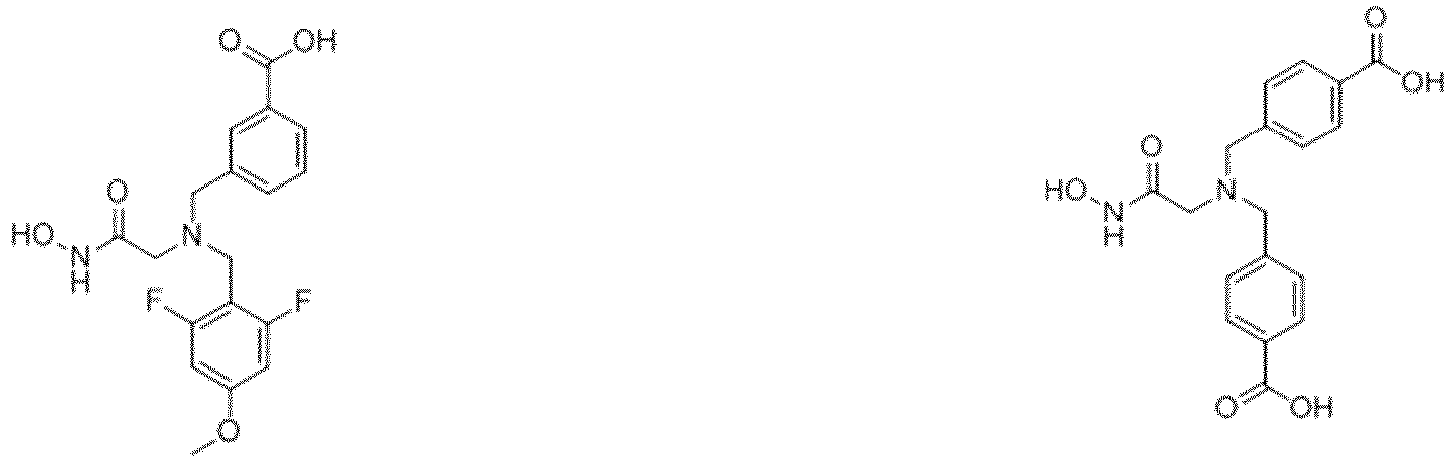


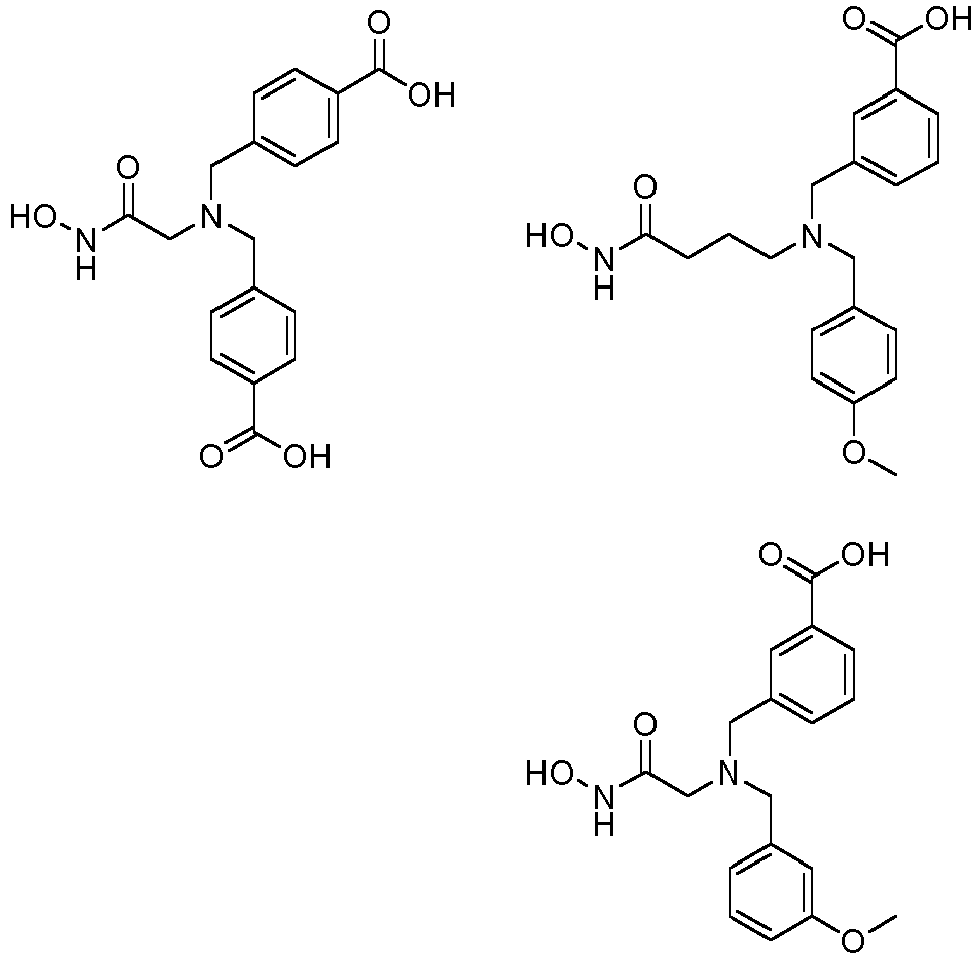
 (ii) selected from the group consisting of:


- A pharmaceutical composition comprising:the compound according to any of claims 1-11, its individual enantiomers, its individual diastereoisomers, its hydrates,its solvates, its crystal forms, its individual tautomers or a pharmaceutically acceptable salt thereof; and a
pharmaceutically acceptable excipient. - A compound according to any of claims 1-11 or a
pharmaceutical composition according to claim 12 for use in a method for treatment or prophylaxis of the human or animal body by surgery or therapy. - A compound according to any of claims 1-11 or a
pharmaceutical composition according to claim 13 for use in a method for treatment or prophylaxis of Alzheimer's disease, nephritis, renal injury, renal ischemic injury, ischemic acute tubular necrosis, acute renal failure, bladder inflammation, inflammatory bowel disease (IBD), Crohn's disease, ulcerative colitis, chronic inflammation, colitis, fibrosis, fibrotic conditions, keloids, pulmonary hypertension, interstitial lung disease (ILD), or cancer, especially colorectal cancer.
Priority Applications (2)
| Application Number | Priority Date | Filing Date | Title |
|---|---|---|---|
| EP21195295.7A EP3967679B1 (en) | 2016-04-18 | 2017-04-18 | Novel inhibitors of meprin alpha and beta |
| PL17719214T PL3445744T3 (en) | 2016-04-18 | 2017-04-18 | New meprin alpha and beta inhibitors |
Applications Claiming Priority (2)
| Application Number | Priority Date | Filing Date | Title |
|---|---|---|---|
| EP16165804 | 2016-04-18 | ||
| PCT/EP2017/059116 WO2017182433A1 (en) | 2016-04-18 | 2017-04-18 | Novel inhibitors of meprin alpha and beta |
Related Child Applications (1)
| Application Number | Title | Priority Date | Filing Date |
|---|---|---|---|
| EP21195295.7A Division EP3967679B1 (en) | 2016-04-18 | 2017-04-18 | Novel inhibitors of meprin alpha and beta |
Publications (2)
| Publication Number | Publication Date |
|---|---|
| EP3445744A1 EP3445744A1 (en) | 2019-02-27 |
| EP3445744B1 true EP3445744B1 (en) | 2021-10-06 |
Family
ID=55808391
Family Applications (2)
| Application Number | Title | Priority Date | Filing Date |
|---|---|---|---|
| EP17719214.3A Active EP3445744B1 (en) | 2016-04-18 | 2017-04-18 | Novel inhibitors of meprin alpha and beta |
| EP21195295.7A Active EP3967679B1 (en) | 2016-04-18 | 2017-04-18 | Novel inhibitors of meprin alpha and beta |
Family Applications After (1)
| Application Number | Title | Priority Date | Filing Date |
|---|---|---|---|
| EP21195295.7A Active EP3967679B1 (en) | 2016-04-18 | 2017-04-18 | Novel inhibitors of meprin alpha and beta |
Country Status (12)
| Country | Link |
|---|---|
| US (2) | US10975019B2 (en) |
| EP (2) | EP3445744B1 (en) |
| JP (3) | JP2019519477A (en) |
| KR (2) | KR102410199B1 (en) |
| CN (2) | CN114507175B (en) |
| AU (2) | AU2017253625B2 (en) |
| CA (1) | CA3021152A1 (en) |
| DK (1) | DK3445744T3 (en) |
| ES (1) | ES2903079T3 (en) |
| PL (1) | PL3445744T3 (en) |
| RU (1) | RU2746850C2 (en) |
| WO (1) | WO2017182433A1 (en) |
Families Citing this family (4)
| Publication number | Priority date | Publication date | Assignee | Title |
|---|---|---|---|---|
| CA3021152A1 (en) * | 2016-04-18 | 2017-10-26 | Fraunhofer-Gesellschaft Zur Foerderung Der Angewandten Forschung E.V. | Inhibitors of meprin alpha and beta |
| EP3750878B1 (en) | 2019-06-14 | 2025-05-14 | Vivoryon Therapeutics N.V. | Heteroaromatic inhibitors of astacin proteinases |
| WO2020260526A1 (en) * | 2019-06-26 | 2020-12-30 | Enyo Pharma | Tertiary amine derivatives and their uses for treating a viral infection |
| SE547538C2 (en) | 2024-05-10 | 2025-10-14 | Peanta Invent Ab | Light head for use in relining pipes |
Family Cites Families (23)
| Publication number | Priority date | Publication date | Assignee | Title |
|---|---|---|---|---|
| US5639746A (en) * | 1994-12-29 | 1997-06-17 | The Procter & Gamble Company | Hydroxamic acid-containing inhibitors of matrix metalloproteases |
| NZ334908A (en) * | 1996-10-02 | 2000-10-27 | Novartis Ag | 3-imino-4-oxo-1,7-dioic acid (7-N-hydroxy) diamide derivatives characterised by the presence of an oxymethyl group on the 6-position for supression of TNF and treatment of inflammation |
| CA2304473A1 (en) * | 1997-09-29 | 1999-04-22 | Rajeev S. Bhide | Inhibitors of farnesyl protein transferase |
| US6583299B1 (en) * | 1999-05-20 | 2003-06-24 | G.D. Searle & Co. | α-amino-β-sulfonyl hydroxamic acid compounds |
| US20010049449A1 (en) * | 1999-12-23 | 2001-12-06 | Becker Daniel P. | Aromatic sulfonyl alpha-cycloamino hydroxamates and their use as MMP inhibitors |
| DE10127922A1 (en) | 2000-06-08 | 2001-12-13 | Jomaa Pharmaka Gmbh | New organophosphorous-substituted hydroxamic acid compounds, useful as pre- or post-emergence selective herbicides in crops such as rice |
| WO2001094358A1 (en) | 2000-06-08 | 2001-12-13 | Jomaa Pharmaka Gmbh | Organophosphorous hydroxamic acid derivatives used as herbicides |
| AU2003267991B2 (en) * | 2002-07-11 | 2009-10-08 | Vicuron Pharmaceuticals, Inc. | N-hydroxyamide derivatives possessing antibacterial activity |
| SG159388A1 (en) * | 2003-01-08 | 2010-03-30 | Chiron Corp | Antibacterial agents |
| WO2005020973A2 (en) * | 2003-08-29 | 2005-03-10 | The University Of Houston System | Compositions having antimycrobial activity including a hydroxamate or a hydroxamate and a hydroxylamine |
| WO2005073180A1 (en) * | 2003-12-25 | 2005-08-11 | Kureha Corporation | Hydroxamic acid derivative and age generation inhibitor containing the derivative |
| MX2007001337A (en) * | 2004-08-02 | 2008-03-13 | Genmedica Therapeutics Sl | Compounds for inhibiting copper-containing amine oxidases and uses thereof. |
| WO2007003594A1 (en) * | 2005-07-01 | 2007-01-11 | Solvay Pharmaceuticals Gmbh | Screening methods for inhibitors of the metalloprotease meprin |
| US20070066646A1 (en) * | 2005-08-02 | 2007-03-22 | Genmedica Therapeutics Sl | Compounds for Inhibiting Copper-Containing Amine Oxidases and Uses Thereof |
| WO2008033745A2 (en) * | 2006-09-11 | 2008-03-20 | Curis, Inc. | Fused bicyclic pyrimidines as ptk inhibitors containing a zinc binding moiety |
| US8119692B2 (en) * | 2007-04-02 | 2012-02-21 | Panthera Biopharma Llc | Hydroxamic acid derivatives of 4-phenyl 4-hydroxy, 4-phenyl 4-alkoxy and 4-phenyl 4-arylalkoxy butyric acid useful as therapeutic agents for treating anthrax poisoning |
| CA2934114A1 (en) * | 2007-06-12 | 2008-12-18 | Achaogen, Inc. | Antibacterial agents |
| TW200920357A (en) * | 2007-09-10 | 2009-05-16 | Curis Inc | HSP90 inhibitors containing a zinc binding moiety |
| WO2009036057A1 (en) * | 2007-09-10 | 2009-03-19 | Curis, Inc. | Antiproliferative agents containing a zinc binding moiety |
| US10189786B2 (en) * | 2013-08-16 | 2019-01-29 | Duke University | Antibacterial compounds |
| US9708336B2 (en) * | 2014-01-22 | 2017-07-18 | Merck Sharp & Dohme Corp. | Metallo-beta-lactamase inhibitors |
| CN105237478A (en) * | 2015-11-06 | 2016-01-13 | 吉首大学 | Metronidazole-amide derivative urease inhibitor and synthesis and application thereof |
| CA3021152A1 (en) | 2016-04-18 | 2017-10-26 | Fraunhofer-Gesellschaft Zur Foerderung Der Angewandten Forschung E.V. | Inhibitors of meprin alpha and beta |
-
2017
- 2017-04-18 CA CA3021152A patent/CA3021152A1/en active Pending
- 2017-04-18 CN CN202210133711.0A patent/CN114507175B/en active Active
- 2017-04-18 EP EP17719214.3A patent/EP3445744B1/en active Active
- 2017-04-18 DK DK17719214.3T patent/DK3445744T3/en active
- 2017-04-18 RU RU2018140207A patent/RU2746850C2/en active
- 2017-04-18 KR KR1020187033139A patent/KR102410199B1/en active Active
- 2017-04-18 PL PL17719214T patent/PL3445744T3/en unknown
- 2017-04-18 WO PCT/EP2017/059116 patent/WO2017182433A1/en not_active Ceased
- 2017-04-18 EP EP21195295.7A patent/EP3967679B1/en active Active
- 2017-04-18 JP JP2018554779A patent/JP2019519477A/en active Pending
- 2017-04-18 KR KR1020217042925A patent/KR102511732B1/en active Active
- 2017-04-18 AU AU2017253625A patent/AU2017253625B2/en active Active
- 2017-04-18 ES ES17719214T patent/ES2903079T3/en active Active
- 2017-04-18 CN CN201780032968.4A patent/CN109195947B/en active Active
- 2017-04-18 US US16/094,460 patent/US10975019B2/en active Active
-
2021
- 2021-03-08 US US17/195,391 patent/US12378186B2/en active Active
- 2021-03-29 JP JP2021055206A patent/JP7179114B2/en active Active
- 2021-10-25 AU AU2021257905A patent/AU2021257905B2/en active Active
-
2023
- 2023-07-19 JP JP2023117716A patent/JP7739365B2/en active Active
Non-Patent Citations (1)
| Title |
|---|
| None * |
Also Published As
Similar Documents
| Publication | Publication Date | Title |
|---|---|---|
| US12378186B2 (en) | Inhibitors of meprin α and β | |
| KR102930913B1 (en) | Heteroaromatic inhibitor of astacin proteinase | |
| JP2003505367A (en) | 3-arylsulfonyl-2- (substituted methyl) propanoic acid derivatives as matrix metalloproteinase inhibitors | |
| RU2847041C2 (en) | Novel inhibitors of meprin alpha and beta | |
| HK40072612A (en) | Novel inhibitors of meprin alpha and beta | |
| HK40072612B (en) | Novel inhibitors of meprin alpha and beta | |
| EP4058437B1 (en) | Matrix metalloproteinase (mmp) inhibitors and methods of use thereof | |
| CN111757883B (en) | Novel inhibitors of bacterial glutamyl cyclase for the treatment of periodontal disease and related diseases |
Legal Events
| Date | Code | Title | Description |
|---|---|---|---|
| STAA | Information on the status of an ep patent application or granted ep patent |
Free format text: STATUS: UNKNOWN |
|
| STAA | Information on the status of an ep patent application or granted ep patent |
Free format text: STATUS: THE INTERNATIONAL PUBLICATION HAS BEEN MADE |
|
| PUAI | Public reference made under article 153(3) epc to a published international application that has entered the european phase |
Free format text: ORIGINAL CODE: 0009012 |
|
| STAA | Information on the status of an ep patent application or granted ep patent |
Free format text: STATUS: REQUEST FOR EXAMINATION WAS MADE |
|
| 17P | Request for examination filed |
Effective date: 20181113 |
|
| AK | Designated contracting states |
Kind code of ref document: A1 Designated state(s): AL AT BE BG CH CY CZ DE DK EE ES FI FR GB GR HR HU IE IS IT LI LT LU LV MC MK MT NL NO PL PT RO RS SE SI SK SM TR |
|
| AX | Request for extension of the european patent |
Extension state: BA ME |
|
| DAV | Request for validation of the european patent (deleted) | ||
| DAX | Request for extension of the european patent (deleted) | ||
| STAA | Information on the status of an ep patent application or granted ep patent |
Free format text: STATUS: EXAMINATION IS IN PROGRESS |
|
| 17Q | First examination report despatched |
Effective date: 20200904 |
|
| RAP1 | Party data changed (applicant data changed or rights of an application transferred) |
Owner name: VIVORYON THERAPEUTICS AG |
|
| GRAP | Despatch of communication of intention to grant a patent |
Free format text: ORIGINAL CODE: EPIDOSNIGR1 |
|
| STAA | Information on the status of an ep patent application or granted ep patent |
Free format text: STATUS: GRANT OF PATENT IS INTENDED |
|
| RIC1 | Information provided on ipc code assigned before grant |
Ipc: C07C 259/06 20060101AFI20210407BHEP Ipc: C07D 317/58 20060101ALI20210407BHEP Ipc: C07D 319/18 20060101ALI20210407BHEP Ipc: C07C 255/58 20060101ALI20210407BHEP Ipc: A61K 31/16 20060101ALI20210407BHEP Ipc: A61K 31/36 20060101ALI20210407BHEP Ipc: A61P 35/00 20060101ALI20210407BHEP Ipc: A61P 1/04 20060101ALI20210407BHEP Ipc: A61P 9/12 20060101ALI20210407BHEP Ipc: A61P 11/00 20060101ALI20210407BHEP Ipc: A61P 13/00 20060101ALI20210407BHEP Ipc: A61P 17/02 20060101ALI20210407BHEP Ipc: A61P 25/28 20060101ALI20210407BHEP Ipc: A61P 29/00 20060101ALI20210407BHEP |
|
| INTG | Intention to grant announced |
Effective date: 20210430 |
|
| GRAS | Grant fee paid |
Free format text: ORIGINAL CODE: EPIDOSNIGR3 |
|
| GRAA | (expected) grant |
Free format text: ORIGINAL CODE: 0009210 |
|
| STAA | Information on the status of an ep patent application or granted ep patent |
Free format text: STATUS: THE PATENT HAS BEEN GRANTED |
|
| AK | Designated contracting states |
Kind code of ref document: B1 Designated state(s): AL AT BE BG CH CY CZ DE DK EE ES FI FR GB GR HR HU IE IS IT LI LT LU LV MC MK MT NL NO PL PT RO RS SE SI SK SM TR |
|
| REG | Reference to a national code |
Ref country code: GB Ref legal event code: FG4D |
|
| REG | Reference to a national code |
Ref country code: CH Ref legal event code: EP Ref country code: AT Ref legal event code: REF Ref document number: 1436116 Country of ref document: AT Kind code of ref document: T Effective date: 20211015 |
|
| REG | Reference to a national code |
Ref country code: IE Ref legal event code: FG4D |
|
| REG | Reference to a national code |
Ref country code: DE Ref legal event code: R096 Ref document number: 602017047113 Country of ref document: DE |
|
| REG | Reference to a national code |
Ref country code: DK Ref legal event code: T3 Effective date: 20211210 |
|
| REG | Reference to a national code |
Ref country code: FI Ref legal event code: FGE |
|
| REG | Reference to a national code |
Ref country code: SE Ref legal event code: TRGR |
|
| REG | Reference to a national code |
Ref country code: NL Ref legal event code: FP |
|
| REG | Reference to a national code |
Ref country code: LT Ref legal event code: MG9D |
|
| REG | Reference to a national code |
Ref country code: FI Ref legal event code: PCE Owner name: VIVORYON THERAPEUTICS N.V. |
|
| REG | Reference to a national code |
Ref country code: DE Ref legal event code: R081 Ref document number: 602017047113 Country of ref document: DE Owner name: VIVORYON THERAPEUTICS N.V., DE Free format text: FORMER OWNER: VIVORYON THERAPEUTICS AG, 06120 HALLE, DE |
|
| REG | Reference to a national code |
Ref country code: BE Ref legal event code: HC Owner name: VIVORYON THERAPEUTICS N.V.; DE Free format text: DETAILS ASSIGNMENT: CHANGE OF OWNER(S), CHANGE OF OWNER(S) NAME; FORMER OWNER NAME: VIVORYON THERAPEUTICS AG Effective date: 20220106 |
|
| RAP4 | Party data changed (patent owner data changed or rights of a patent transferred) |
Owner name: VIVORYON THERAPEUTICS N.V. |
|
| REG | Reference to a national code |
Ref country code: NL Ref legal event code: PD Owner name: VIVORYON THERAPEUTICS N.V.; DE Free format text: DETAILS ASSIGNMENT: CHANGE OF OWNER(S), CHANGE OF LEGAL ENTITY; FORMER OWNER NAME: VIVORYON THERAPEUTICS AG Effective date: 20220207 |
|
| REG | Reference to a national code |
Ref country code: ES Ref legal event code: FG2A Ref document number: 2903079 Country of ref document: ES Kind code of ref document: T3 Effective date: 20220331 |
|
| PG25 | Lapsed in a contracting state [announced via postgrant information from national office to epo] |
Ref country code: RS Free format text: LAPSE BECAUSE OF FAILURE TO SUBMIT A TRANSLATION OF THE DESCRIPTION OR TO PAY THE FEE WITHIN THE PRESCRIBED TIME-LIMIT Effective date: 20211006 Ref country code: LT Free format text: LAPSE BECAUSE OF FAILURE TO SUBMIT A TRANSLATION OF THE DESCRIPTION OR TO PAY THE FEE WITHIN THE PRESCRIBED TIME-LIMIT Effective date: 20211006 Ref country code: BG Free format text: LAPSE BECAUSE OF FAILURE TO SUBMIT A TRANSLATION OF THE DESCRIPTION OR TO PAY THE FEE WITHIN THE PRESCRIBED TIME-LIMIT Effective date: 20220106 |
|
| PG25 | Lapsed in a contracting state [announced via postgrant information from national office to epo] |
Ref country code: IS Free format text: LAPSE BECAUSE OF FAILURE TO SUBMIT A TRANSLATION OF THE DESCRIPTION OR TO PAY THE FEE WITHIN THE PRESCRIBED TIME-LIMIT Effective date: 20220206 Ref country code: PT Free format text: LAPSE BECAUSE OF FAILURE TO SUBMIT A TRANSLATION OF THE DESCRIPTION OR TO PAY THE FEE WITHIN THE PRESCRIBED TIME-LIMIT Effective date: 20220207 Ref country code: NO Free format text: LAPSE BECAUSE OF FAILURE TO SUBMIT A TRANSLATION OF THE DESCRIPTION OR TO PAY THE FEE WITHIN THE PRESCRIBED TIME-LIMIT Effective date: 20220106 Ref country code: LV Free format text: LAPSE BECAUSE OF FAILURE TO SUBMIT A TRANSLATION OF THE DESCRIPTION OR TO PAY THE FEE WITHIN THE PRESCRIBED TIME-LIMIT Effective date: 20211006 Ref country code: HR Free format text: LAPSE BECAUSE OF FAILURE TO SUBMIT A TRANSLATION OF THE DESCRIPTION OR TO PAY THE FEE WITHIN THE PRESCRIBED TIME-LIMIT Effective date: 20211006 Ref country code: GR Free format text: LAPSE BECAUSE OF FAILURE TO SUBMIT A TRANSLATION OF THE DESCRIPTION OR TO PAY THE FEE WITHIN THE PRESCRIBED TIME-LIMIT Effective date: 20220107 |
|
| REG | Reference to a national code |
Ref country code: DE Ref legal event code: R097 Ref document number: 602017047113 Country of ref document: DE |
|
| PG25 | Lapsed in a contracting state [announced via postgrant information from national office to epo] |
Ref country code: SM Free format text: LAPSE BECAUSE OF FAILURE TO SUBMIT A TRANSLATION OF THE DESCRIPTION OR TO PAY THE FEE WITHIN THE PRESCRIBED TIME-LIMIT Effective date: 20211006 Ref country code: SK Free format text: LAPSE BECAUSE OF FAILURE TO SUBMIT A TRANSLATION OF THE DESCRIPTION OR TO PAY THE FEE WITHIN THE PRESCRIBED TIME-LIMIT Effective date: 20211006 Ref country code: RO Free format text: LAPSE BECAUSE OF FAILURE TO SUBMIT A TRANSLATION OF THE DESCRIPTION OR TO PAY THE FEE WITHIN THE PRESCRIBED TIME-LIMIT Effective date: 20211006 Ref country code: EE Free format text: LAPSE BECAUSE OF FAILURE TO SUBMIT A TRANSLATION OF THE DESCRIPTION OR TO PAY THE FEE WITHIN THE PRESCRIBED TIME-LIMIT Effective date: 20211006 |
|
| PLBE | No opposition filed within time limit |
Free format text: ORIGINAL CODE: 0009261 |
|
| STAA | Information on the status of an ep patent application or granted ep patent |
Free format text: STATUS: NO OPPOSITION FILED WITHIN TIME LIMIT |
|
| REG | Reference to a national code |
Ref country code: AT Ref legal event code: HC Ref document number: 1436116 Country of ref document: AT Kind code of ref document: T Owner name: VIVORYON THERAPEUTICS N.V., DE Effective date: 20220621 |
|
| 26N | No opposition filed |
Effective date: 20220707 |
|
| PG25 | Lapsed in a contracting state [announced via postgrant information from national office to epo] |
Ref country code: AL Free format text: LAPSE BECAUSE OF FAILURE TO SUBMIT A TRANSLATION OF THE DESCRIPTION OR TO PAY THE FEE WITHIN THE PRESCRIBED TIME-LIMIT Effective date: 20211006 |
|
| PG25 | Lapsed in a contracting state [announced via postgrant information from national office to epo] |
Ref country code: SI Free format text: LAPSE BECAUSE OF FAILURE TO SUBMIT A TRANSLATION OF THE DESCRIPTION OR TO PAY THE FEE WITHIN THE PRESCRIBED TIME-LIMIT Effective date: 20211006 |
|
| P01 | Opt-out of the competence of the unified patent court (upc) registered |
Effective date: 20230517 |
|
| REG | Reference to a national code |
Ref country code: AT Ref legal event code: UEP Ref document number: 1436116 Country of ref document: AT Kind code of ref document: T Effective date: 20211006 |
|
| PG25 | Lapsed in a contracting state [announced via postgrant information from national office to epo] |
Ref country code: HU Free format text: LAPSE BECAUSE OF FAILURE TO SUBMIT A TRANSLATION OF THE DESCRIPTION OR TO PAY THE FEE WITHIN THE PRESCRIBED TIME-LIMIT; INVALID AB INITIO Effective date: 20170418 |
|
| PG25 | Lapsed in a contracting state [announced via postgrant information from national office to epo] |
Ref country code: MK Free format text: LAPSE BECAUSE OF FAILURE TO SUBMIT A TRANSLATION OF THE DESCRIPTION OR TO PAY THE FEE WITHIN THE PRESCRIBED TIME-LIMIT Effective date: 20211006 Ref country code: CY Free format text: LAPSE BECAUSE OF FAILURE TO SUBMIT A TRANSLATION OF THE DESCRIPTION OR TO PAY THE FEE WITHIN THE PRESCRIBED TIME-LIMIT Effective date: 20211006 |
|
| PG25 | Lapsed in a contracting state [announced via postgrant information from national office to epo] |
Ref country code: MT Free format text: LAPSE BECAUSE OF FAILURE TO SUBMIT A TRANSLATION OF THE DESCRIPTION OR TO PAY THE FEE WITHIN THE PRESCRIBED TIME-LIMIT Effective date: 20211006 |
|
| PGFP | Annual fee paid to national office [announced via postgrant information from national office to epo] |
Ref country code: MC Payment date: 20250327 Year of fee payment: 9 |
|
| PGFP | Annual fee paid to national office [announced via postgrant information from national office to epo] |
Ref country code: NL Payment date: 20250422 Year of fee payment: 9 |
|
| PGFP | Annual fee paid to national office [announced via postgrant information from national office to epo] |
Ref country code: LU Payment date: 20250417 Year of fee payment: 9 |
|
| PGFP | Annual fee paid to national office [announced via postgrant information from national office to epo] |
Ref country code: FI Payment date: 20250417 Year of fee payment: 9 |
|
| PGFP | Annual fee paid to national office [announced via postgrant information from national office to epo] |
Ref country code: PL Payment date: 20250403 Year of fee payment: 9 Ref country code: DE Payment date: 20250417 Year of fee payment: 9 |
|
| PGFP | Annual fee paid to national office [announced via postgrant information from national office to epo] |
Ref country code: GB Payment date: 20250423 Year of fee payment: 9 Ref country code: ES Payment date: 20250519 Year of fee payment: 9 Ref country code: DK Payment date: 20250423 Year of fee payment: 9 |
|
| PGFP | Annual fee paid to national office [announced via postgrant information from national office to epo] |
Ref country code: BE Payment date: 20250422 Year of fee payment: 9 Ref country code: IT Payment date: 20250430 Year of fee payment: 9 |
|
| PGFP | Annual fee paid to national office [announced via postgrant information from national office to epo] |
Ref country code: FR Payment date: 20250422 Year of fee payment: 9 |
|
| PGFP | Annual fee paid to national office [announced via postgrant information from national office to epo] |
Ref country code: CH Payment date: 20250501 Year of fee payment: 9 |
|
| PGFP | Annual fee paid to national office [announced via postgrant information from national office to epo] |
Ref country code: AT Payment date: 20250416 Year of fee payment: 9 |
|
| PGFP | Annual fee paid to national office [announced via postgrant information from national office to epo] |
Ref country code: TR Payment date: 20250410 Year of fee payment: 9 |
|
| PGFP | Annual fee paid to national office [announced via postgrant information from national office to epo] |
Ref country code: CZ Payment date: 20250404 Year of fee payment: 9 |
|
| PGFP | Annual fee paid to national office [announced via postgrant information from national office to epo] |
Ref country code: IE Payment date: 20250428 Year of fee payment: 9 |
|
| PGFP | Annual fee paid to national office [announced via postgrant information from national office to epo] |
Ref country code: SE Payment date: 20250423 Year of fee payment: 9 |
|
| REG | Reference to a national code |
Ref country code: CH Ref legal event code: U11 Free format text: ST27 STATUS EVENT CODE: U-0-0-U10-U11 (AS PROVIDED BY THE NATIONAL OFFICE) Effective date: 20260501 |