EP3445733B1 - Witness layers for glass articles - Google Patents
Witness layers for glass articles Download PDFInfo
- Publication number
- EP3445733B1 EP3445733B1 EP17722217.1A EP17722217A EP3445733B1 EP 3445733 B1 EP3445733 B1 EP 3445733B1 EP 17722217 A EP17722217 A EP 17722217A EP 3445733 B1 EP3445733 B1 EP 3445733B1
- Authority
- EP
- European Patent Office
- Prior art keywords
- layer
- glass
- witness
- lithium
- compression
- Prior art date
- Legal status (The legal status is an assumption and is not a legal conclusion. Google has not performed a legal analysis and makes no representation as to the accuracy of the status listed.)
- Active
Links
Images




Classifications
-
- C—CHEMISTRY; METALLURGY
- C03—GLASS; MINERAL OR SLAG WOOL
- C03C—CHEMICAL COMPOSITION OF GLASSES, GLAZES OR VITREOUS ENAMELS; SURFACE TREATMENT OF GLASS; SURFACE TREATMENT OF FIBRES OR FILAMENTS MADE FROM GLASS, MINERALS OR SLAGS; JOINING GLASS TO GLASS OR OTHER MATERIALS
- C03C21/00—Treatment of glass, not in the form of fibres or filaments, by diffusing ions or metals in the surface
- C03C21/001—Treatment of glass, not in the form of fibres or filaments, by diffusing ions or metals in the surface in liquid phase, e.g. molten salts, solutions
- C03C21/002—Treatment of glass, not in the form of fibres or filaments, by diffusing ions or metals in the surface in liquid phase, e.g. molten salts, solutions to perform ion-exchange between alkali ions
-
- C—CHEMISTRY; METALLURGY
- C03—GLASS; MINERAL OR SLAG WOOL
- C03C—CHEMICAL COMPOSITION OF GLASSES, GLAZES OR VITREOUS ENAMELS; SURFACE TREATMENT OF GLASS; SURFACE TREATMENT OF FIBRES OR FILAMENTS MADE FROM GLASS, MINERALS OR SLAGS; JOINING GLASS TO GLASS OR OTHER MATERIALS
- C03C21/00—Treatment of glass, not in the form of fibres or filaments, by diffusing ions or metals in the surface
- C03C21/001—Treatment of glass, not in the form of fibres or filaments, by diffusing ions or metals in the surface in liquid phase, e.g. molten salts, solutions
- C03C21/002—Treatment of glass, not in the form of fibres or filaments, by diffusing ions or metals in the surface in liquid phase, e.g. molten salts, solutions to perform ion-exchange between alkali ions
- C03C21/003—Treatment of glass, not in the form of fibres or filaments, by diffusing ions or metals in the surface in liquid phase, e.g. molten salts, solutions to perform ion-exchange between alkali ions under application of an electrical potential difference
-
- C—CHEMISTRY; METALLURGY
- C03—GLASS; MINERAL OR SLAG WOOL
- C03C—CHEMICAL COMPOSITION OF GLASSES, GLAZES OR VITREOUS ENAMELS; SURFACE TREATMENT OF GLASS; SURFACE TREATMENT OF FIBRES OR FILAMENTS MADE FROM GLASS, MINERALS OR SLAGS; JOINING GLASS TO GLASS OR OTHER MATERIALS
- C03C3/00—Glass compositions
-
- C—CHEMISTRY; METALLURGY
- C03—GLASS; MINERAL OR SLAG WOOL
- C03C—CHEMICAL COMPOSITION OF GLASSES, GLAZES OR VITREOUS ENAMELS; SURFACE TREATMENT OF GLASS; SURFACE TREATMENT OF FIBRES OR FILAMENTS MADE FROM GLASS, MINERALS OR SLAGS; JOINING GLASS TO GLASS OR OTHER MATERIALS
- C03C4/00—Compositions for glass with special properties
- C03C4/18—Compositions for glass with special properties for ion-sensitive glass
-
- H—ELECTRICITY
- H05—ELECTRIC TECHNIQUES NOT OTHERWISE PROVIDED FOR
- H05K—PRINTED CIRCUITS; CASINGS OR CONSTRUCTIONAL DETAILS OF ELECTRIC APPARATUS; MANUFACTURE OF ASSEMBLAGES OF ELECTRICAL COMPONENTS
- H05K5/00—Casings, cabinets or drawers for electric apparatus
- H05K5/0086—Casings, cabinets or drawers for electric apparatus portable, e.g. battery operated apparatus
-
- H—ELECTRICITY
- H05—ELECTRIC TECHNIQUES NOT OTHERWISE PROVIDED FOR
- H05K—PRINTED CIRCUITS; CASINGS OR CONSTRUCTIONAL DETAILS OF ELECTRIC APPARATUS; MANUFACTURE OF ASSEMBLAGES OF ELECTRICAL COMPONENTS
- H05K5/00—Casings, cabinets or drawers for electric apparatus
- H05K5/02—Details
- H05K5/03—Covers
-
- C—CHEMISTRY; METALLURGY
- C03—GLASS; MINERAL OR SLAG WOOL
- C03C—CHEMICAL COMPOSITION OF GLASSES, GLAZES OR VITREOUS ENAMELS; SURFACE TREATMENT OF GLASS; SURFACE TREATMENT OF FIBRES OR FILAMENTS MADE FROM GLASS, MINERALS OR SLAGS; JOINING GLASS TO GLASS OR OTHER MATERIALS
- C03C2204/00—Glasses, glazes or enamels with special properties
Definitions
- the present disclosure relates generally to witness layers for use on glass and, more particularly, witness layers for use on sodium strengthened lithium glass.
- This Patent Cooperation Treaty patent application claims priority to U.S. non-provisional application No. 15/134,973, filed April 21 2016 , and titled "Witness Layers for Glass Articles”.
- the present disclosure relates generally to witness layers for use on glass and, more particularly, witness layers for use on sodium strengthened lithium glass.
- Lithium ion containing glass is becoming more desirable for use in portable electronic devices. As the use of lithium glass increases in these smaller and higher tolerance electronic devices, fabrication of thinner and stronger lithium glass is required.
- One such lithium glass is sodium strengthened lithium glass, a lithium glass that includes a surface strengthened with sodium ions.
- Thin layers of sodium strengthened lithium glass can be formed by diffusing sodium ions into the surface of the lithium glass, where the smaller lithium ions are exchanged for much larger sodium ions. Exchange of smaller for larger radius ions results in the formation of a diffusion layer or compression layer, often 50 to 300 ⁇ m in thickness.
- sodium strengthened lithium glass typically includes an internal portion and a coated compression layer.
- Defects in the compression layer can have a significant impact on the utility of the lithium glass, as well as on the utility of the devices that incorporate the glass. Defects can either be inherent to a particular piece of glass or be introduced to the compression layer during post-processing events, like touch polishing. Removal or sacrifice of material from the surface of the glass can result in inconsistent and weakened compression layers.
- Identifying defects in sodium strengthened lithium glass represents a significant concern in the art, as there are no practical non-destructive methods for identifying defects in a compression layer. As such, there are no non-destructive methods for identifying defective sodium strengthened lithium glass.
- WO 2012/027660 A1 discloses a method of strengthening an alkali aluminoborosilicate glass.
- a compressive layer extending from a surface of the glass to a depth of layer is formed by exchanging larger metal cations for smaller metal cations present in the glass.
- metal cations in the glass are exchanged for larger metal cations to a second depth in the glass that is less than the depth of layer and increase the compressive stress of the compressive layer.
- Formation of the compressive layer and replacement of cations with larger cations can be achieved by a two-step ion exchange process.
- An alkali aluminoborosilicate glass having a compressive layer and a crack indentation threshold of at least 3000 gf is also provided.
- US 3,410,673 relates to the strengthening of glass articles through the development of a surface compression layer thereon by means of ion exchange. More particularly, US 3,410,673 is concerned with producing lithium silicate glasses, containing substantial amounts of Al 2 O 3 and/or Zr02, exhibiting very high flexural and impact strengths by first exchanging lithium ions in the glass surface with sodium ions and thereafter exchanging lithium and/or sodium ions from the exchanged surface layer with potassium ions.
- Various embodiments described herein encompass a glass article having a base layer, a compression layer and a witness layer.
- the base layer is formed in a glass and has a first compressive stress.
- the compression layer is adjacent the base layer and is formed in the glass, having a second compressive stress.
- the witness layer is adjacent the compression layer and is formed in the glass, having a third compressive stress.
- the first, second and third compressive stresses all differing from one another.
- the third compressive stress exceeds the second compressive stress
- the second compressive stress exceeds the first compressive stress.
- the base layer is formed of a lithium-diffused glass (lithium glass herein)
- the compression layer is formed of a sodium-diffused glass
- the witness layer is formed of a potassium-diffused glass.
- the compression layer is typically sandwiched between the base layer and the witness layer, with the witness layer covering some or all of the compression layer.
- the base layer is enclosed on all sides by the compression layer, thereby forming an internal or interior base glass.
- the witness layer has a higher index of refraction than either the base layer or the compression layer.
- the witness layer is typically characterized by an index of refraction that allows for optical detection through fringe stress measurement, for example.
- Embodiments also include portable electronic devices that include glass articles in accordance with the disclosure as well as to the methods of manufacturing the same portable electronic devices.
- the portable electronic devices undergo polishing or other post-processing events.
- a base glass is contacted with sodium ions such that a compression layer is formed at the surface of the base glass, having a compressive strength that exceeds the base glass.
- a witness layer is formed on some or all of the compression layer by contacting the sodium-diffused compression layer with potassium ions.
- the witness layer has a compressive stress that exceeds the compressive stress of the compression layer and has an index of refraction that exceeds the index of refraction for either the compression layer or base layer.
- the base glass is a lithium-diffused glass.
- Embodiments of the disclosure relate to witness layers for use on glass articles, for example cover glass, and to the methods of preparing the same.
- Embodiments of the disclosure also relate to methods of manufacturing witness layer containing glass articles, and to using the witness layers on the glass articles to non-destructively identify compromised glass articles.
- the glass and glass articles and methods disclosed herein can be implemented in numerous ways, including as glass pieces such as cover glass or displays for various electronic devices including portable electronic devices.
- the methods disclosed herein can be implemented to non-destructively identify acceptable glass for use as glass pieces in various electronic devices, including implemented to non-destructively identify acceptable glass in an automated manufacturing process.
- Glass articles in accordance with embodiments herein have a base layer formed in a glass, the base glass having a first compressive stress.
- the base layer is typically any useful type of glass (silicate, soda, and the like) and can include quantities of SiO 2 , Na 2 O, Al 2 O 3 , Br 2 O 3 , CaO, ZrO 2 , MgO and the like.
- the base glass is infused with lithium ions, which can represent from 0.1 to 10% by weight of the base glass, although other lithium weight percent's are contemplated.
- the inclusion of lithium in the base glass puts the glass in a first compressive stress, as compared to the same base glass without lithium ions.
- Base layers can be of any thickness, but are typically from 0.5 to 4 mm thick, and more typically 0.5 to 3 mm thick.
- Lithium glass is typically tougher than non-lithium infused glass.
- Glass articles in accordance with embodiments herein typically have a compression layer formed in the base glass, the compression layer having a second compressive stress.
- the compression layer differs from the base glass in that it typically has a compressive stress that exceeds the compressive stress of the base glass.
- the compressive layer is infused with sodium ions.
- the compression layer differs from the base glass in that it has a lower content of lithium ions and a greater content of sodium ions.
- compression layers are formed by the exchange of lithium ions for sodium ions, as sodium ions have a larger ionic radius than lithium ions and thereby increase the compressive stress within the layer. The increase in sodium results in an increase in the strength of the lithium glass surface. Compression layer depth and ion concentration are based on a thermally activated interdiffusion process, as that compression layer attributes can be predetermined.
- the sodium depth is 40-300 ⁇ m into the surface of the lithium glass, but typically does not extend beyond 10% of the total thickness of the base layer.
- a base layer having 1 mm thickness would typically be covered by a 1 - 100 ⁇ m, and more typically 10- 100 ⁇ m, thick compression layer.
- the sodium strengthened compression layer is difficult or impossible to detect within optical measuring systems due to its very low index of refraction. For example, use of fringe stress measurement, a surface stress measurement, provides no readout when used on a sodium-diffused compression layer.
- Glass articles in accordance with embodiments herein typically have a witness layer formed in the surface of the compression layer glass.
- the witness layer has a third compressive stress.
- the witness layer forms in some, or all, of the compression layer.
- the witness layer is potassium rich, having a lower content of sodium ions but a greater content of potassium ions than the compression layer.
- Witness layer depth and potassium ion concentration are based on a thermally activated interdiffusion process, where sodium and lithium ions are exchanged for potassium ions. It is typical for the witness layer to replace up to 75%, but more typically 50%, and most typically 1-20% of the compression layer (by depth).
- the witness layer is formed by a spike of potassium, enough of a layer to allow for optical monitoring, but not so thick or concentrate as to significantly increase the central tension within the compression layer.
- the witness layer can be as shallow as 5 - 10 ⁇ m.
- the witness layer allows detection by optical measurement, including fringe stress measurement. Typical witness layers for use herein have an optically detectable high index of refraction, which provides a non-destructive measurement for surface stress.
- embodiments of the disclosure have a base layer with a first compressive stress, a compression layer with a second compressive stress, and a witness layer with a third compressive stress.
- the witness layer's third compressive stress exceeds the compression layer's second compressive stress
- the compression layer's second compressive stress exceeds the base layer's first compressive stress.
- the witness layer's index of refraction is optically detectable, and exceeds the index of refraction for the compression layer and/or base layer.
- the compression layer is not optically detectable.
- witness layers in accordance to embodiments herein, exhibit detectably high refractive indices, which allows non-destructive use of light to detect the witness layer and, thus, the glass article's surface stress and quality.
- the compression layer on the other hand, is characterized as having an index of refraction so low that optical detection methods are ineffective.
- inclusion of the witness layer on or in the compression layer allows for non-destructive optical detection. This detection methodology allows for an objective determination of a glass article's quality without necessitating destructive batch sampling.
- the witness layer's relatively high compression and strength combined with its beneficial optical properties, allows it to act as both a high strength surface for the sodium strengthened lithium glass, as well as a means for detecting both consistency of, and defects in, the compression layer.
- the witness layer can be used during glass part preparation to identify inferior quality glass articles, including glass articles that have been damaged during post processing modification(s).
- Embodiments also include methods of fabricating a base glass having a compression layer and a witness layer.
- a sodium strengthened lithium glass having all, or a portion of all, its surface covered by a witness layer is fabricated.
- a lithium glass of appropriate thickness and strength is exposed to a sodium ion bath at a temperature below the lithium glasses transition temperature. (The term "bath,” as used herein, also encompasses, sprays, drips, depositions, and the like.)
- the lithium glass remains exposed until a sufficient concentration of sodium ions have diffused to an appropriate depth of the lithium glass to form a compression layer.
- the compression layer is held to a depth of 10% or less of the entire thickness of the sodium strengthened lithium glass.
- the sodium strengthened lithium glass is then exposed to a potassium bath at a temperature below the sodium strengthened lithium glass transition temperature, for a period of time until a sufficient concentration of potassium ions has diffused to an appropriate depth of the compression layer to form a witness layer.
- the witness layer is meant to be a spike that exchanges out sodium for potassium, and allows for the improved optical characteristics of potassium (index of refraction), but not to an extent that the potassium causes dramatic or significant increases in the central tension of the compression layer.
- the sodium strengthened lithium glass is only partially exposed or contacted in the potassium bath (or other form of exposure) in order to leave some areas of the compression layer in the absence of a witness layer. This may occur, for example, if a portion of sodium strengthened lithium glass will not be the target of optical monitoring or any post processing procedures, and therefore has a much lower likelihood of a defect being introduced into the compression layer. For example, portions of the sodium strengthened lithium glass that are on interior surfaces and cannot be accessed by fringe stress measurement (FSM), for example.
- FSM fringe stress measurement
- the glass articles in accordance with embodiments herein undergo post-processing, for example, touch polishing, to allow for more precise fitting of the glass in an electronic device or the like.
- post-processing for example, touch polishing
- a non-destructive optical reading is taken in the area of the article that was post-processed. Where some, but not all, of the witness layer was removed, the witness layer is optically detectable, and the glass considered acceptable (the compression layer would also by default be present under the remaining witness layer).
- a second round, and so forth, of touch polishing and witness layer identification/detection may be completed.
- the non-destructive optical reading is performed by fringe stress measurement (FSM).
- FSM fringe stress measurement
- Embodiments described herein also include methods for fabricating a sodium strengthened lithium glass having some, or all, of its surface covered by a predetermined thickness of potassium rich witness layer.
- the predetermined thickness generally ensures that the witness layer can withstand post-processing. This may facilitate and/or simplify large-scale manufacturing.
- some amount of the witness layer may be removed from the glass articles during post-processing procedures, yielding a witness layer that may exhibit various thickness on the compression layer, for example., one area of witness layer may be 10 ⁇ m thick, and a second area of the witness layer may be 20 ⁇ m thick.
- the underlying compression layer typically has a consistent thickness and, therefore, strength. As such, any optical detection of a witness layer in a post-processed area is a strong indication that the glass article is not compromised.
- Embodiments also include quality control methods for confirming the utility of witness layer containing glass articles. For example, the quality control of sodium strengthened lithium glass having undergone one or more post-processing steps. Glass articles confirmed to have a witness layer, in accordance with embodiments herein, are confirmed for use in portable electronic devices, and show significant improvement over other glass not having a witness layer. Quality control by FSM, or other like optical detection method, may be performed on some or all glass prior to being incorporated into target portable electronic devices.
- Embodiments herein are described in greater detail with reference to FIGS 1-6 .
- a portable electronic device 100 may include a frame 102 that surrounds a cover glass 104.
- the frame has a side 106, top 108 and bottom 110 as shown (back cover not shown).
- the frame 102 may be made of sapphire or other extremely hard material.
- the cover glass 104 can be a glass article in accordance with embodiments described herein.
- the portable electronic device 100 is stronger and more impact resistant than other devices as it includes both the sapphire frame and a cover glass article with compression and layer.
- the portable electronic device in Fig. 1 is a sodium strengthened lithium glass having a protective potassium rich witness layer.
- FIG. 2A shows an illustrative cross sectional schematic along line 2-2 of FIG. 1 .
- a sapphire frame 200 is joined to a cover glass 202 having a base layer 204 and a compression layer 206.
- FIG. 2A shows that the sapphire frame 200 sits above the cover glass 202, thereby potentially requiring a post-processing event to flatten the sapphire to match the height of the cover glass. Post-processing the sapphire down to the cover glass may result in the loss of cover glass so as to ensure that the two surfaces match and are flat.
- FIG. 2B shows another illustrative cross-sectional schematic along line 2-2 of Fig. 1 after the sapphire frame and cover glass of Fig. 2A have been processed.
- the compression layer 206 and sapphire frame 200 are polished down to form a flat joining surface 210.
- removal of some sapphire frame (dotted line 212) and some or all of compression layer (see dotted line 214) on the base glass 204 can be expected (loss of compression layer would correspond to where the cover glass was processed).
- the base glass 204 now has an area that does not include a compression layer 214. Removal of the compression layer 204 from the base glass may form an undetectable defect in the cover glass. Monitoring of the surface stress in the defective cover glass is not possible because the refractive index of the compression layer is not detectable (discussed in greater detail in FIG. 3 ).
- FIGS 2C and 2D show the same cross sectional schematic along line 2-2 of FIG. 1 as was shown in FIGS 2A and 2B .
- the base glass includes a witness layer.
- the schematic represents a before (2C) and after post-processing event (2D).
- FIG. 2C shows that, prior to any post processing, the cover glass has an internal portion 204, a compression layer 206 and a witness layer 216.
- the sapphire frame 200 sits on the cover glass as in Fig. 2A , and extends above the cover glass surface 217.
- the witness layer 216 in FIG. 2C is optically detectable by FSM or other like optical method and provides an indication of the witness layer's surface stress.
- the witness layer 216 covers the entire compression layer in this FIG.
- FIG. 2D illustrates the same cross sectional view as shown in FIG. 2C , except that the sapphire frame 200 is processed down to match the surface of the witness containing cover glass 218.
- FIG. 2D a high tolerance joining is required such that the cover glass 218 and sapphire frame 200 are flat to each other.
- removal of material to create the flat surface results in removal of the witness layer 216 and not the compression layer 206 (see dotted line 220.
- Optical monitoring of the witness layer 216 is an objective indicator as to the presence of both the remaining witness layer 216 and compression layer 206 of the cover glass 218.
- the cover glass 218 no longer has a detectable index of refraction, and would therefore be unacceptable, as the intactness of the compression layer would be suspect.
- FSM FSM
- FIG. 3A illustrates the optical properties of a glass article in accordance with embodiments herein.
- the Y-axis of the graph is the index of refraction
- the X-axis corresponds to the glass's depth.
- Index of refraction measurements were made at increasing depths on a sodium strengthened lithium glass, and on a potassium strengthened sodium glass. The index of refraction was also measured at increasing depths on a lithium-diffused glass article having a sodium compression layer and potassium rich witness layer (glass articles in accordance with embodiments herein).
- the potassium strengthened sodium glass shows a very high index of refraction at shallow depths as indicated by curve 300.
- the sodium strengthened lithium glass shows very low index of refraction over the same depths, as indicated by curve 302.
- the index of refraction for the glass article having both the sodium compression and witness layers shows a significant increase in index of refraction at shallow depths, that allows for FSM monitoring (as compared to the sodium strengthened lithium glass 302), as is indicated by curve 304.
- This FIG. shows the utility of using potassium ions to increase the index of refraction in a target piece of glass.
- FIG. 3B shows a corresponding FSM pattern having an optical readout for each curve 300, 302, and 304 at the indicated depth.
- the sodium strengthened lithium glass 302 had no detectable pattern by FSM, whereas the potassium containing glass (witness layers) provided an optical and readable compression layer. This shows the significant utility of using a witness layer to allow for FSM detection on these compression layer containing glass articles.
- FIGS. 4-6 will be described in relation to a base layer of lithium glass, a compression layer of sodium-infused glass, and a witness layer of potassium-infused glass.
- Other combinations are within the scope of the disclosure as long as the witness layer has a compressive stress in excess of the compression layer's compressive stress, and the compression layer's compressive stress is in excess to the base layer's compressive stress.
- the witness layer it is advantageous for the witness layer to have an index of refraction that allows for optical detection, particularly by FSM.
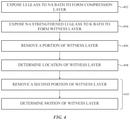
- FIG. 4 is a flow diagram of one embodiment for manufacturing base glass to include both a compression layer and witness layer.
- the base glass is lithium glass.
- Lithium glass typically includes both a base glass and a certain weight percent of lithium ions. In some aspects the lithium ions represent up to 10%, or more, of the total weight of the base glass.
- a piece of lithium glass having a target utility (area, thickness and percent lithium ion) is obtained and exposed to a molten sodium bath 402.
- the sodium ions are provided by sodium nitrate. The temperature of the sodium bath is typically below the lithium glass's transition temperature.
- the glass is cooled and then exposed in a molten potassium bath to form the witness layer 404.
- Both the compression and witness layers are immersed at an ion concentration, temperature, and pressure to form their appropriate layer depth. Due to diffusion and internal stress parameters, the compression layer should be about 10% or less of the total thickness of the finished glass article.
- the compression layer provides an increase in strength due to the crowding out of the lithium ions by the larger atomic radius of the sodium atoms.
- the witness layer need only be deep enough to provide a monitoring layer as shown in FIG. 3 . However, where sacrifice of material due to post processing is contemplated, the witness layer should be deep enough to be sacrificed, but still allow for FSM monitoring, i.e.
- a witness layer in a sodium strengthened lithium glass may be polished to remove surface defects 406 and monitored using FSM to ensure that the polished glass is still acceptable for its intended use 408.
- the process of post processing a witness layer may be performed as many times as necessary to remove the surface defect and still be monitored through the presence of the witness layer 410.
- FIG. 5 is a flow diagram of another embodiment for identifying and utilizing a witness layer for high throughput manufacturing of witness layer containing sodium strengthened lithium glass.
- a lithium glass for use in an automated or high throughput manufacturing process is identified and an appropriate compression and witness layer fabricated using diffusion layers 502, 504, 506.
- a standard post processing procedure is known, as is the amount of witness layer required to be sacrificed (for example by forming a flat surface joint).
- the witness layer parameters are made consistent as are the, for example, touch processing parameters. During manufacture of numerous witness layer covered articles, the same parameters are used to prepare the same layer on each glass item with the same amount of potassium ion and to the same depth.
- Predetermined or random FSM checks are made on the manufactured items to ensure that each has the same amount of witness layer left after post processing.
- the presence of the witness layer allows for a simple monitoring solution for automated or high throughput manufacturing of parts, where an indicator that the witness layer is not of an expected FSM image results in the manufacturing process being halted and reconfigured.
- FIG. 6 is a flow diagram that illustrates that the inclusion of a witness layer on sodium strengthened lithium glass allows for quality control monitoring of this glass using non-destructive optical devices 600.
- Non-destructive monitoring is typically accomplished by FSM imaging 602.
- Quality control monitoring allows for the detection of unacceptable sodium strengthened lithium glass prior to use in a portable electronic device, for example.
- quality control monitoring can be performed on a 100% of the fabricated sodium strengthened lithium glass before or after inclusion in a portable electronic device 604.
- witness layer inclusion on a sodium strengthened lithium ion glass article allows for significant post processing without loss of glass strength.
- a potassium rich witness layer for quality control of sodium strengthened lithium glass allows for between 30 and 120 seconds of touch polishing without any corresponding loss of strength.
- some touch polishing is helpful in actually increasing the strength of the potassium rich witness layer containing sodium strengthened lithium glass as is shown between the No Re-polish reading (1528.9) and the 30 to 120 seconds of touch polishing readings (2123.0 to 2199.4).
- the data indicates that the potassium rich witness layer allows for continued article strength even after significant touch polishing.
- This example illustrates the non-destructive FSM images of a sodium strengthened lithium ion glass and the same glass including a potassium rich witness layer are significantly different.
- the FSM image is black and provides no information.
- the thin potassium rich witness layer allows for a FSM image providing data on both the surface concentration of the potassium (spacing of lines) and the depth to which the layer extends (total distance between lines). This shows the utility of including a witness layer on a glass article as compared to having no witness layer, and therefore no data.
Landscapes
- Chemical & Material Sciences (AREA)
- Engineering & Computer Science (AREA)
- Life Sciences & Earth Sciences (AREA)
- Chemical Kinetics & Catalysis (AREA)
- General Chemical & Material Sciences (AREA)
- Geochemistry & Mineralogy (AREA)
- Materials Engineering (AREA)
- Organic Chemistry (AREA)
- Microelectronics & Electronic Packaging (AREA)
- Surface Treatment Of Glass (AREA)
Description
- The present disclosure relates generally to witness layers for use on glass and, more particularly, witness layers for use on sodium strengthened lithium glass. This Patent Cooperation Treaty patent application claims priority to
U.S. non-provisional application No. 15/134,973, filed April 21 2016 - The present disclosure relates generally to witness layers for use on glass and, more particularly, witness layers for use on sodium strengthened lithium glass.
- Lithium ion containing glass (lithium glass) is becoming more desirable for use in portable electronic devices. As the use of lithium glass increases in these smaller and higher tolerance electronic devices, fabrication of thinner and stronger lithium glass is required. One such lithium glass is sodium strengthened lithium glass, a lithium glass that includes a surface strengthened with sodium ions.
- Thin layers of sodium strengthened lithium glass can be formed by diffusing sodium ions into the surface of the lithium glass, where the smaller lithium ions are exchanged for much larger sodium ions. Exchange of smaller for larger radius ions results in the formation of a diffusion layer or compression layer, often 50 to 300 µm in thickness. As such, sodium strengthened lithium glass typically includes an internal portion and a coated compression layer.
- Defects in the compression layer can have a significant impact on the utility of the lithium glass, as well as on the utility of the devices that incorporate the glass. Defects can either be inherent to a particular piece of glass or be introduced to the compression layer during post-processing events, like touch polishing. Removal or sacrifice of material from the surface of the glass can result in inconsistent and weakened compression layers.
- Once a portable electronic device has been manufactured, a defective glass article can result in the loss of the entire product. Identifying defects in sodium strengthened lithium glass represents a significant concern in the art, as there are no practical non-destructive methods for identifying defects in a compression layer. As such, there are no non-destructive methods for identifying defective sodium strengthened lithium glass.
-
WO 2012/027660 A1 discloses a method of strengthening an alkali aluminoborosilicate glass. A compressive layer extending from a surface of the glass to a depth of layer is formed by exchanging larger metal cations for smaller metal cations present in the glass. In a second step, metal cations in the glass are exchanged for larger metal cations to a second depth in the glass that is less than the depth of layer and increase the compressive stress of the compressive layer. Formation of the compressive layer and replacement of cations with larger cations can be achieved by a two-step ion exchange process. An alkali aluminoborosilicate glass having a compressive layer and a crack indentation threshold of at least 3000 gf is also provided. -
US 3,410,673 relates to the strengthening of glass articles through the development of a surface compression layer thereon by means of ion exchange. More particularly,US 3,410,673 is concerned with producing lithium silicate glasses, containing substantial amounts of Al2O3 and/or Zr02, exhibiting very high flexural and impact strengths by first exchanging lithium ions in the glass surface with sodium ions and thereafter exchanging lithium and/or sodium ions from the exchanged surface layer with potassium ions. - SUMMARY The underlying problem of the present invention is solved by the independent claims.
- Various embodiments described herein encompass a glass article having a base layer, a compression layer and a witness layer. The base layer is formed in a glass and has a first compressive stress. The compression layer is adjacent the base layer and is formed in the glass, having a second compressive stress. The witness layer is adjacent the compression layer and is formed in the glass, having a third compressive stress. The first, second and third compressive stresses all differing from one another. In some aspects, the third compressive stress exceeds the second compressive stress, and the second compressive stress exceeds the first compressive stress.
- In additional embodiments, the base layer is formed of a lithium-diffused glass (lithium glass herein), the compression layer is formed of a sodium-diffused glass, and the witness layer is formed of a potassium-diffused glass. The compression layer is typically sandwiched between the base layer and the witness layer, with the witness layer covering some or all of the compression layer. In some aspects, the base layer is enclosed on all sides by the compression layer, thereby forming an internal or interior base glass.
- In some aspects, the witness layer has a higher index of refraction than either the base layer or the compression layer. The witness layer is typically characterized by an index of refraction that allows for optical detection through fringe stress measurement, for example.
- Embodiments also include portable electronic devices that include glass articles in accordance with the disclosure as well as to the methods of manufacturing the same portable electronic devices. In some aspects, the portable electronic devices undergo polishing or other post-processing events.
- In method embodiments, a base glass is contacted with sodium ions such that a compression layer is formed at the surface of the base glass, having a compressive strength that exceeds the base glass. A witness layer is formed on some or all of the compression layer by contacting the sodium-diffused compression layer with potassium ions. The witness layer has a compressive stress that exceeds the compressive stress of the compression layer and has an index of refraction that exceeds the index of refraction for either the compression layer or base layer. In some embodiments, the base glass is a lithium-diffused glass.
- Other features and advantages of the present disclosure will be apparent from the accompanying drawings and from the detailed description that follows below.
- The disclosure will be readily understood by the following detailed description in conjunction with the accompanying drawings, wherein like reference numerals designate like structural elements, and in which:
-
FIG. 1 is a diagrammatic representation of a handheld electronic device showing a sapphire frame capturing a cover glass. -
FIG. 2A is a cross-sectional schematic representation along line 2-2 ofFIG. 1 showing a cover glass article having a base glass and surface compression layer. -
FIG. 2B is a cross-sectional schematic representation along line 2-2 ofFIG. 1 showing sacrifice of the compression layer from the base glass when the sapphire frame is made flat with the cover glass article ofFIG. 2A . -
FIG. 2C is a cross-sectional schematic representation along line 2-2 ofFIG. 1 showing a cover glass article having a surface compression layer sandwiched between a base glass and a witness layer. -
FIG. 2D is a cross-sectional schematic representation along line 2-2 ofFIG. 1 showing sacrifice of a portion of the witness layer from the compression layer when the sapphire frame is made flat with the cover glass article ofFIG. 2C . -
FIG. 3A is a graphical representation showing the index of refraction of a sodium for lithium exchange, a potassium for sodium exchange, and the resultant index of refraction when the potassium exchange is performed on a sodium strengthened lithium ion glass article. -
FIG. 3B shows a Fringe Stress Measurement (FSM) pattern corresponding to the graph inFIG. 3A . -
FIG 4 is a flow diagram which illustrates one method of processing a lithium ion glass to include both a compression and witness layer. -
FIG. 5 is a flow diagram which illustrates one method of confirming that a post processed sodium strengthened lithium ion glass has not been compromised. -
FIG. 6 is a flow diagram which illustrates one quality control method for accepting or rejecting a post processed sodium strengthened lithium ion glass. - Embodiments of the disclosure relate to witness layers for use on glass articles, for example cover glass, and to the methods of preparing the same.
- Embodiments of the disclosure also relate to methods of manufacturing witness layer containing glass articles, and to using the witness layers on the glass articles to non-destructively identify compromised glass articles.
- The glass and glass articles and methods disclosed herein can be implemented in numerous ways, including as glass pieces such as cover glass or displays for various electronic devices including portable electronic devices. The methods disclosed herein can be implemented to non-destructively identify acceptable glass for use as glass pieces in various electronic devices, including implemented to non-destructively identify acceptable glass in an automated manufacturing process.
- Glass articles in accordance with embodiments herein have a base layer formed in a glass, the base glass having a first compressive stress. The base layer is typically any useful type of glass (silicate, soda, and the like) and can include quantities of SiO2, Na2O, Al2O3, Br2O3, CaO, ZrO2, MgO and the like.
- In some embodiments, the base glass is infused with lithium ions, which can represent from 0.1 to 10% by weight of the base glass, although other lithium weight percent's are contemplated. The inclusion of lithium in the base glass puts the glass in a first compressive stress, as compared to the same base glass without lithium ions. Base layers can be of any thickness, but are typically from 0.5 to 4 mm thick, and more typically 0.5 to 3 mm thick. Lithium glass is typically tougher than non-lithium infused glass.
- Glass articles in accordance with embodiments herein typically have a compression layer formed in the base glass, the compression layer having a second compressive stress. The compression layer differs from the base glass in that it typically has a compressive stress that exceeds the compressive stress of the base glass.
- In one embodiment, the compressive layer is infused with sodium ions. In this embodiment, where the base glass is infused with lithium ions, the compression layer differs from the base glass in that it has a lower content of lithium ions and a greater content of sodium ions. Also in this embodiment, compression layers are formed by the exchange of lithium ions for sodium ions, as sodium ions have a larger ionic radius than lithium ions and thereby increase the compressive stress within the layer. The increase in sodium results in an increase in the strength of the lithium glass surface. Compression layer depth and ion concentration are based on a thermally activated interdiffusion process, as that compression layer attributes can be predetermined. In typical compression layers, the sodium depth is 40-300 µm into the surface of the lithium glass, but typically does not extend beyond 10% of the total thickness of the base layer. For example, a base layer having 1 mm thickness would typically be covered by a 1 - 100 µm, and more typically 10- 100 µm, thick compression layer. Generally, the sodium strengthened compression layer is difficult or impossible to detect within optical measuring systems due to its very low index of refraction. For example, use of fringe stress measurement, a surface stress measurement, provides no readout when used on a sodium-diffused compression layer.
- Glass articles in accordance with embodiments herein typically have a witness layer formed in the surface of the compression layer glass. The witness layer has a third compressive stress. In some aspects, the witness layer forms in some, or all, of the compression layer.
- In some embodiments, where the base glass is diffused with lithium ions and the compression layer is diffused with sodium ions, the witness layer is potassium rich, having a lower content of sodium ions but a greater content of potassium ions than the compression layer. Witness layer depth and potassium ion concentration are based on a thermally activated interdiffusion process, where sodium and lithium ions are exchanged for potassium ions. It is typical for the witness layer to replace up to 75%, but more typically 50%, and most typically 1-20% of the compression layer (by depth). In some aspects, the witness layer is formed by a spike of potassium, enough of a layer to allow for optical monitoring, but not so thick or concentrate as to significantly increase the central tension within the compression layer. The witness layer can be as shallow as 5 - 10 µm. The witness layer allows detection by optical measurement, including fringe stress measurement. Typical witness layers for use herein have an optically detectable high index of refraction, which provides a non-destructive measurement for surface stress.
- As such, embodiments of the disclosure have a base layer with a first compressive stress, a compression layer with a second compressive stress, and a witness layer with a third compressive stress. In some aspects, the witness layer's third compressive stress exceeds the compression layer's second compressive stress, and the compression layer's second compressive stress exceeds the base layer's first compressive stress. In other aspects, the witness layer's index of refraction is optically detectable, and exceeds the index of refraction for the compression layer and/or base layer. In other aspects, the compression layer is not optically detectable.
- Unexpectedly, witness layers, in accordance to embodiments herein, exhibit detectably high refractive indices, which allows non-destructive use of light to detect the witness layer and, thus, the glass article's surface stress and quality. The compression layer, on the other hand, is characterized as having an index of refraction so low that optical detection methods are ineffective. As such, inclusion of the witness layer on or in the compression layer allows for non-destructive optical detection. This detection methodology allows for an objective determination of a glass article's quality without necessitating destructive batch sampling.
- The witness layer's relatively high compression and strength, combined with its beneficial optical properties, allows it to act as both a high strength surface for the sodium strengthened lithium glass, as well as a means for detecting both consistency of, and defects in, the compression layer. The witness layer can be used during glass part preparation to identify inferior quality glass articles, including glass articles that have been damaged during post processing modification(s).
- Embodiments also include methods of fabricating a base glass having a compression layer and a witness layer. In one embodiment, for example, a sodium strengthened lithium glass having all, or a portion of all, its surface covered by a witness layer is fabricated. A lithium glass of appropriate thickness and strength is exposed to a sodium ion bath at a temperature below the lithium glasses transition temperature. (The term "bath," as used herein, also encompasses, sprays, drips, depositions, and the like.) The lithium glass remains exposed until a sufficient concentration of sodium ions have diffused to an appropriate depth of the lithium glass to form a compression layer. In typical embodiments, the compression layer is held to a depth of 10% or less of the entire thickness of the sodium strengthened lithium glass. The sodium strengthened lithium glass is then exposed to a potassium bath at a temperature below the sodium strengthened lithium glass transition temperature, for a period of time until a sufficient concentration of potassium ions has diffused to an appropriate depth of the compression layer to form a witness layer. In typical embodiments the witness layer is meant to be a spike that exchanges out sodium for potassium, and allows for the improved optical characteristics of potassium (index of refraction), but not to an extent that the potassium causes dramatic or significant increases in the central tension of the compression layer.
- In some aspects, the sodium strengthened lithium glass is only partially exposed or contacted in the potassium bath (or other form of exposure) in order to leave some areas of the compression layer in the absence of a witness layer. This may occur, for example, if a portion of sodium strengthened lithium glass will not be the target of optical monitoring or any post processing procedures, and therefore has a much lower likelihood of a defect being introduced into the compression layer. For example, portions of the sodium strengthened lithium glass that are on interior surfaces and cannot be accessed by fringe stress measurement (FSM), for example.
- In some embodiments, the glass articles in accordance with embodiments herein, undergo post-processing, for example, touch polishing, to allow for more precise fitting of the glass in an electronic device or the like. Upon completion of the post-processing, a non-destructive optical reading is taken in the area of the article that was post-processed. Where some, but not all, of the witness layer was removed, the witness layer is optically detectable, and the glass considered acceptable (the compression layer would also by default be present under the remaining witness layer). A second round, and so forth, of touch polishing and witness layer identification/detection may be completed. In some aspects the non-destructive optical reading is performed by fringe stress measurement (FSM). When the witness layer is no longer optically detectable, the glass article may have had some amount of compression layer removed, introducing a possible defect.
- Embodiments described herein also include methods for fabricating a sodium strengthened lithium glass having some, or all, of its surface covered by a predetermined thickness of potassium rich witness layer. The predetermined thickness generally ensures that the witness layer can withstand post-processing. This may facilitate and/or simplify large-scale manufacturing.
- As will be described in greater detail below, some amount of the witness layer may be removed from the glass articles during post-processing procedures, yielding a witness layer that may exhibit various thickness on the compression layer, for example., one area of witness layer may be 10 µm thick, and a second area of the witness layer may be 20 µm thick. However, even where the witness layer on a glass article has a disproportionate thickness, the underlying compression layer typically has a consistent thickness and, therefore, strength. As such, any optical detection of a witness layer in a post-processed area is a strong indication that the glass article is not compromised.
- Embodiments also include quality control methods for confirming the utility of witness layer containing glass articles. For example, the quality control of sodium strengthened lithium glass having undergone one or more post-processing steps. Glass articles confirmed to have a witness layer, in accordance with embodiments herein, are confirmed for use in portable electronic devices, and show significant improvement over other glass not having a witness layer. Quality control by FSM, or other like optical detection method, may be performed on some or all glass prior to being incorporated into target portable electronic devices.
- Embodiments herein are described in greater detail with reference to
FIGS 1-6 . - With reference to
FIG. 1 , a portableelectronic device 100 is described in accordance with an embodiment disclosed herein. A portable electronic device may include aframe 102 that surrounds acover glass 104. The frame has aside 106, top 108 and bottom 110 as shown (back cover not shown). Theframe 102 may be made of sapphire or other extremely hard material. Thecover glass 104 can be a glass article in accordance with embodiments described herein. The portableelectronic device 100 is stronger and more impact resistant than other devices as it includes both the sapphire frame and a cover glass article with compression and layer. In one embodiment, the portable electronic device inFig. 1 is a sodium strengthened lithium glass having a protective potassium rich witness layer. -
FIG. 2A shows an illustrative cross sectional schematic along line 2-2 ofFIG. 1 . InFIG. 2A , asapphire frame 200 is joined to acover glass 202 having abase layer 204 and acompression layer 206.FIG. 2A shows that thesapphire frame 200 sits above thecover glass 202, thereby potentially requiring a post-processing event to flatten the sapphire to match the height of the cover glass. Post-processing the sapphire down to the cover glass may result in the loss of cover glass so as to ensure that the two surfaces match and are flat. -
FIG. 2B shows another illustrative cross-sectional schematic along line 2-2 ofFig. 1 after the sapphire frame and cover glass ofFig. 2A have been processed. InFig. 2B , thecompression layer 206 andsapphire frame 200 are polished down to form a flat joiningsurface 210. In preparing the flat surface between the sapphire and cover glass, removal of some sapphire frame (dotted line 212) and some or all of compression layer (see dotted line 214) on thebase glass 204 can be expected (loss of compression layer would correspond to where the cover glass was processed). As shown inFIG. 2B , thebase glass 204 now has an area that does not include a compression layer 214. Removal of thecompression layer 204 from the base glass may form an undetectable defect in the cover glass. Monitoring of the surface stress in the defective cover glass is not possible because the refractive index of the compression layer is not detectable (discussed in greater detail inFIG. 3 ). -
FIGS 2C and 2D show the same cross sectional schematic along line 2-2 ofFIG. 1 as was shown inFIGS 2A and 2B . However, inFIGS. 2C and 2D , the base glass includes a witness layer. As inFIGS 2A and 2B , the schematic represents a before (2C) and after post-processing event (2D). -
FIG. 2C shows that, prior to any post processing, the cover glass has aninternal portion 204, acompression layer 206 and awitness layer 216. Thesapphire frame 200 sits on the cover glass as inFig. 2A , and extends above thecover glass surface 217. Thewitness layer 216 inFIG. 2C is optically detectable by FSM or other like optical method and provides an indication of the witness layer's surface stress. Thewitness layer 216 covers the entire compression layer in this FIG. -
FIG. 2D illustrates the same cross sectional view as shown inFIG. 2C , except that thesapphire frame 200 is processed down to match the surface of the witness containing cover glass 218. - In
FIG. 2D , a high tolerance joining is required such that the cover glass 218 andsapphire frame 200 are flat to each other. Unlike inFIG 2B , removal of material to create the flat surface results in removal of thewitness layer 216 and not the compression layer 206 (seedotted line 220. Optical monitoring of thewitness layer 216 is an objective indicator as to the presence of both the remainingwitness layer 216 andcompression layer 206 of the cover glass 218. - If the post processing procedure removes the
witness layer 216, the cover glass 218 no longer has a detectable index of refraction, and would therefore be unacceptable, as the intactness of the compression layer would be suspect. InFIG. 2D , enough witness layer remains for optical detection using FSM (or other like method), thereby confirming the presence of the underlying compression layer (see arrow 222). -
FIG. 3A illustrates the optical properties of a glass article in accordance with embodiments herein. In this embodiment, the Y-axis of the graph is the index of refraction, and the X-axis corresponds to the glass's depth. Index of refraction measurements were made at increasing depths on a sodium strengthened lithium glass, and on a potassium strengthened sodium glass. The index of refraction was also measured at increasing depths on a lithium-diffused glass article having a sodium compression layer and potassium rich witness layer (glass articles in accordance with embodiments herein). - The potassium strengthened sodium glass shows a very high index of refraction at shallow depths as indicated by
curve 300. The sodium strengthened lithium glass shows very low index of refraction over the same depths, as indicated bycurve 302. The index of refraction for the glass article having both the sodium compression and witness layers, shows a significant increase in index of refraction at shallow depths, that allows for FSM monitoring (as compared to the sodium strengthened lithium glass 302), as is indicated bycurve 304. Note that inclusion of potassium corresponds, with the increase in the glass article's index ofrefraction 304, can be seen when comparingcurves -
FIG. 3B shows a corresponding FSM pattern having an optical readout for eachcurve lithium glass 302 had no detectable pattern by FSM, whereas the potassium containing glass (witness layers) provided an optical and readable compression layer. This shows the significant utility of using a witness layer to allow for FSM detection on these compression layer containing glass articles. - The following flow diagrams,
FIGS. 4-6 , will be described in relation to a base layer of lithium glass, a compression layer of sodium-infused glass, and a witness layer of potassium-infused glass. Other combinations are within the scope of the disclosure as long as the witness layer has a compressive stress in excess of the compression layer's compressive stress, and the compression layer's compressive stress is in excess to the base layer's compressive stress. Further, it is advantageous for the witness layer to have an index of refraction that allows for optical detection, particularly by FSM. -
FIG. 4 is a flow diagram of one embodiment for manufacturing base glass to include both a compression layer and witness layer. In one embodiment, the base glass is lithium glass. Lithium glass typically includes both a base glass and a certain weight percent of lithium ions. In some aspects the lithium ions represent up to 10%, or more, of the total weight of the base glass. A piece of lithium glass having a target utility (area, thickness and percent lithium ion) is obtained and exposed to amolten sodium bath 402. In one aspect the sodium ions are provided by sodium nitrate. The temperature of the sodium bath is typically below the lithium glass's transition temperature. - Once an acceptable sodium compression layer has been formed through thermal diffusion, the glass is cooled and then exposed in a molten potassium bath to form the
witness layer 404. Both the compression and witness layers are immersed at an ion concentration, temperature, and pressure to form their appropriate layer depth. Due to diffusion and internal stress parameters, the compression layer should be about 10% or less of the total thickness of the finished glass article. The compression layer provides an increase in strength due to the crowding out of the lithium ions by the larger atomic radius of the sodium atoms. The witness layer need only be deep enough to provide a monitoring layer as shown inFIG. 3 . However, where sacrifice of material due to post processing is contemplated, the witness layer should be deep enough to be sacrificed, but still allow for FSM monitoring, i.e., after sacrifice by post processing enough witness layer remains for FSM monitoring. However, this depth is limited by not wanting to increase the central stress in the compression layer and thereby introducing potential defects into the glass. A witness layer in a sodium strengthened lithium glass may be polished to removesurface defects 406 and monitored using FSM to ensure that the polished glass is still acceptable for its intendeduse 408. The process of post processing a witness layer may be performed as many times as necessary to remove the surface defect and still be monitored through the presence of thewitness layer 410. When a post processing procedure has removed the entire witness layer there is no longer an objective detection method to confirm the existence of the intact underlying compression layer. Where the entire witness layer has been removed by post processing procedures, the glass may be deemed unacceptable. -
FIG. 5 is a flow diagram of another embodiment for identifying and utilizing a witness layer for high throughput manufacturing of witness layer containing sodium strengthened lithium glass. As described above, a lithium glass for use in an automated or high throughput manufacturing process is identified and an appropriate compression and witness layer fabricated usingdiffusion layers -
FIG. 6 is a flow diagram that illustrates that the inclusion of a witness layer on sodium strengthened lithium glass allows for quality control monitoring of this glass using non-destructiveoptical devices 600. Non-destructive monitoring is typically accomplished byFSM imaging 602. Quality control monitoring allows for the detection of unacceptable sodium strengthened lithium glass prior to use in a portable electronic device, for example. In addition, quality control monitoring can be performed on a 100% of the fabricated sodium strengthened lithium glass before or after inclusion in a portableelectronic device 604. - While the invention has been particularly shown and described with reference to a number of embodiments, it would be understood by those skilled in the art that changes in the form and details may be made to the various embodiments disclosed herein without departing from the spirit and scope of the invention and that the various embodiments disclosed herein are not intended to act as limitations on the scope of the claims.
- The following examples are provided for illustrative purposes only and are not intended to limit the scope of the invention.
- Witness layer inclusion on a sodium strengthened lithium ion glass article allows for significant post processing without loss of glass strength. A potassium rich witness layer for quality control of sodium strengthened lithium glass allows for between 30 and 120 seconds of touch polishing without any corresponding loss of strength.
- In this example, some touch polishing is helpful in actually increasing the strength of the potassium rich witness layer containing sodium strengthened lithium glass as is shown between the No Re-polish reading (1528.9) and the 30 to 120 seconds of touch polishing readings (2123.0 to 2199.4). The data indicates that the potassium rich witness layer allows for continued article strength even after significant touch polishing.
- This example illustrates the non-destructive FSM images of a sodium strengthened lithium ion glass and the same glass including a potassium rich witness layer are significantly different.
- In this example, it is apparent that in the absence of a witness layer the FSM image is black and provides no information. However, the thin potassium rich witness layer allows for a FSM image providing data on both the surface concentration of the potassium (spacing of lines) and the depth to which the layer extends (total distance between lines). This shows the utility of including a witness layer on a glass article as compared to having no witness layer, and therefore no data.
Claims (15)
- A lithium ion strengthened glass article comprising:an interior portion comprising a base glass and lithium ions;a witness layer having different thicknesses at different locations of the lithium ion strengthened glass article; anda compression layer between the interior portion and the witness layer;wherein:the compression layer is under compression;the compression layer has a lower content of lithium ions and a greater content of sodium ions than the interior portion;the witness layer is under compression; andthe witness layer has a lower content of sodium ions and a greater content of potassium ions than the compression layer.
- The lithium ion strengthened glass article of claim 1, wherein the compression layer has a thickness of about 1 to about 10% of a thickness of the interior portion.
- The lithium ion strengthened glass article of claim 2, wherein the witness layer has a thickness of about 1 to about 25 µm.
- The lithium ion strengthened glass article of claim 3, wherein:the compression layer has a first index of refraction;the witness layer has a second index of refraction; andthe second index of refraction exceeds the first index of refraction.
- The lithium ion strengthened glass article of claim 1, wherein the lithium ion strengthened glass article is a cover glass for a portable electronic device.
- A portable electronic device, comprising:a housing; anda cover glass affixed to the housing and comprising:an interior portion comprising lithium ions;a witness layer extending along at least a portion of the cover glass, having different thicknesses at different locations of the cover glass, and comprising potassium ions; anda compression layer between the interior portion and the witness layer and comprising sodium ions, wherein:the witness layer has a lower content of sodium ions and a greater content of potassium ions than the compression layer;the compression layer has a lower content of lithium ions and a greater content of sodium ions than the interior portion; andthe witness layer has a compressive stress differing from the compression layer.
- The portable electronic device of claim 6, wherein:the compression layer comprises a layer of sodium-diffused glass; andthe witness layer comprises a layer of potassium-diffused glass.
- The portable electronic device of claim 6, wherein:the cover glass defines:a central region; anda peripheral region adjacent the housing and surrounding the central region;the witness layer has a greater thickness at a first location within the central region than at a second location within the peripheral region; andthe housing is at least partially composed of sapphire.
- A method, comprising:immersing a lithium-diffused glass in a sodium salt bath at a temperature below a lithium-diffused glass transition temperature to form a compression layer extending into the lithium-diffused glass from a surface of the lithium-diffused glass and having an exchanged amount of sodium ions for lithium ions ; andimmersing the lithium-diffused glass, with the compression layer, in a potassium salt bath at a temperature below the lithium-diffused glass transition temperature to form a witness layer extending into the lithium-diffused glass from the surface of the lithium-diffused glass and having an exchanged amount of potassium ions for sodium ions; andremoving a portion of the witness layer to produce a modified witness layer having different thicknesses at the different locations.
- The method of claim 9, wherein the compression layer is characterized by having a depth of the sodium ions at least 150 µm below the surface of the lithium-diffused glass.
- The method of claim 9, wherein the witness layer is characterized by having a depth of the potassium ions at least 25 µm below the surface of the lithium-diffused glass.
- The method of claim 11, wherein the removing the portion of the witness layer comprises touch polishing a surface of the witness layer to form a touch polished surface.
- The method of claim 12 further comprising:
non-destructively determining the exchanged amount of the potassium ions at the touch polished surface. - The method of claim 12 further comprising:
non-destructively determining a depth of the potassium ions below the touch polished surface. - The method of claim 14 wherein the non-destructive determination is performed by fringe stress measurement.
Applications Claiming Priority (2)
| Application Number | Priority Date | Filing Date | Title |
|---|---|---|---|
| US15/134,973 US10206298B2 (en) | 2016-04-21 | 2016-04-21 | Witness layers for glass articles |
| PCT/US2017/028193 WO2017184643A1 (en) | 2016-04-21 | 2017-04-18 | Witness layers for glass articles |
Publications (2)
| Publication Number | Publication Date |
|---|---|
| EP3445733A1 EP3445733A1 (en) | 2019-02-27 |
| EP3445733B1 true EP3445733B1 (en) | 2022-01-26 |
Family
ID=58672688
Family Applications (1)
| Application Number | Title | Priority Date | Filing Date |
|---|---|---|---|
| EP17722217.1A Active EP3445733B1 (en) | 2016-04-21 | 2017-04-18 | Witness layers for glass articles |
Country Status (4)
| Country | Link |
|---|---|
| US (1) | US10206298B2 (en) |
| EP (1) | EP3445733B1 (en) |
| CN (1) | CN109071331B (en) |
| WO (1) | WO2017184643A1 (en) |
Families Citing this family (26)
| Publication number | Priority date | Publication date | Assignee | Title |
|---|---|---|---|---|
| TWI655160B (en) | 2016-05-19 | 2019-04-01 | 美商蘋果公司 | Asymmetric chemical strengthening |
| US10899660B2 (en) | 2016-05-19 | 2021-01-26 | Apple Inc. | Asymmetric chemical strengthening |
| US11419231B1 (en) | 2016-09-22 | 2022-08-16 | Apple Inc. | Forming glass covers for electronic devices |
| US10800141B2 (en) | 2016-09-23 | 2020-10-13 | Apple Inc. | Electronic device having a glass component with crack hindering internal stress regions |
| US11535551B2 (en) | 2016-09-23 | 2022-12-27 | Apple Inc. | Thermoformed cover glass for an electronic device |
| US11565506B2 (en) | 2016-09-23 | 2023-01-31 | Apple Inc. | Thermoformed cover glass for an electronic device |
| US11066322B2 (en) | 2017-12-01 | 2021-07-20 | Apple Inc. | Selectively heat-treated glass-ceramic for an electronic device |
| US10611666B2 (en) | 2017-12-01 | 2020-04-07 | Apple Inc. | Controlled crystallization of glass ceramics for electronic devices |
| US11639307B2 (en) | 2018-07-13 | 2023-05-02 | Apple Inc. | Patterned asymmetric chemical strengthening |
| US11420900B2 (en) | 2018-09-26 | 2022-08-23 | Apple Inc. | Localized control of bulk material properties |
| US11447416B2 (en) | 2018-12-20 | 2022-09-20 | Apple Inc. | Strengthened covers for electronic devices |
| US11680010B2 (en) | 2019-07-09 | 2023-06-20 | Apple Inc. | Evaluation of transparent components for electronic devices |
| WO2021041882A1 (en) | 2019-08-29 | 2021-03-04 | Corning Incorporated | Foldable apparatus, foldable substrate, and methods of making |
| EP4021863A1 (en) | 2019-08-29 | 2022-07-06 | Corning Incorporated | Foldable apparatus, ribbons, and methods of making |
| TW202130596A (en) | 2019-10-14 | 2021-08-16 | 美商康寧公司 | Foldable apparatus and methods of making |
| CN115955798A (en) | 2020-03-28 | 2023-04-11 | 苹果公司 | Glass cover member for housing of electronic equipment |
| US11460892B2 (en) | 2020-03-28 | 2022-10-04 | Apple Inc. | Glass cover member for an electronic device enclosure |
| US11666273B2 (en) | 2020-05-20 | 2023-06-06 | Apple Inc. | Electronic device enclosure including a glass ceramic region |
| US11797052B2 (en) * | 2020-07-24 | 2023-10-24 | Dell Products L.P. | Information handling system zero bezel display |
| CN114230195A (en) * | 2020-09-09 | 2022-03-25 | Agc株式会社 | Chemically strengthened glass with film and method for measuring surface stress of chemically strengthened glass |
| US12195379B2 (en) | 2020-12-17 | 2025-01-14 | Apple Inc. | Forming and bonding of glass components for portable electronic devices |
| WO2022133136A1 (en) | 2020-12-17 | 2022-06-23 | Apple Inc. | Fluid forming a glass component for a portable electronic device |
| US11945048B2 (en) | 2020-12-23 | 2024-04-02 | Apple Inc. | Laser-based cutting of transparent components for an electronic device |
| KR20230082413A (en) * | 2021-12-01 | 2023-06-08 | 삼성전자주식회사 | Glass substrate for flexible display and display device comprising thereof |
| US12408282B2 (en) | 2022-01-19 | 2025-09-02 | Apple Inc. | Electronic devices having differentially strengthened cover members |
| US11962079B1 (en) * | 2022-01-25 | 2024-04-16 | The United States Of America, As Represented By The Secretary Of The Navy | Radio frequency signals detection systems |
Family Cites Families (21)
| Publication number | Priority date | Publication date | Assignee | Title |
|---|---|---|---|---|
| NL135450C (en) | 1964-01-31 | 1900-01-01 | ||
| US3433611A (en) * | 1965-09-09 | 1969-03-18 | Ppg Industries Inc | Strengthening glass by multiple alkali ion exchange |
| DE60223550T2 (en) | 2001-08-02 | 2008-10-23 | 3M Innovative Properties Co., St. Paul | METHOD FOR PRODUCING OBJECTS FROM GLASS AND GLASS CERAMIC ARTICLES PRODUCED THEREOF |
| US7497093B2 (en) | 2004-07-29 | 2009-03-03 | 3M Innovative Properties Company | Method of making ceramic articles |
| DE102010027461B4 (en) | 2010-07-17 | 2019-08-22 | Schott Ag | Lithium-containing, transparent glass ceramic with low thermal expansion, a largely amorphous, lithium-depleted, predominantly glassy surface zone and high transmission, their preparation and use |
| US10189743B2 (en) * | 2010-08-18 | 2019-01-29 | Apple Inc. | Enhanced strengthening of glass |
| US20120052271A1 (en) | 2010-08-26 | 2012-03-01 | Sinue Gomez | Two-step method for strengthening glass |
| US9193625B2 (en) | 2010-11-30 | 2015-11-24 | Corning Incorporated | Glass with surface and central regions under compression |
| JP2012214356A (en) | 2010-12-29 | 2012-11-08 | Avanstrate Inc | Cover glass and method for producing the same |
| US10781135B2 (en) | 2011-03-16 | 2020-09-22 | Apple Inc. | Strengthening variable thickness glass |
| US20130133366A1 (en) * | 2011-11-28 | 2013-05-30 | Gregory Scott Glaesemann | Methods of Improving Strength of Glass Articles |
| WO2013088856A1 (en) * | 2011-12-16 | 2013-06-20 | 旭硝子株式会社 | Display cover glass and display cover glass fabrication method |
| US9359251B2 (en) * | 2012-02-29 | 2016-06-07 | Corning Incorporated | Ion exchanged glasses via non-error function compressive stress profiles |
| US9946302B2 (en) * | 2012-09-19 | 2018-04-17 | Apple Inc. | Exposed glass article with inner recessed area for portable electronic device housing |
| US11079309B2 (en) * | 2013-07-26 | 2021-08-03 | Corning Incorporated | Strengthened glass articles having improved survivability |
| US9815733B2 (en) | 2013-08-29 | 2017-11-14 | Corning Incorporated | Ion exchangeable glass containing boron and phosphorous |
| JP5833706B2 (en) * | 2014-05-28 | 2015-12-16 | 京セラ株式会社 | Electronics |
| CN107108305B (en) | 2014-10-22 | 2021-02-26 | 康宁股份有限公司 | Glass strengthening using ion exchange and lamination |
| TWI716450B (en) | 2015-09-17 | 2021-01-21 | 美商康寧公司 | Methods of characterizing ion-exchanged chemically strengthened glasses containing lithium |
| DE102016107630B4 (en) | 2016-04-25 | 2024-08-01 | Schott Ag | Process for producing a shaped body made of glass ceramic with complex geometry and shaped bodies produced in this way |
| US11535551B2 (en) | 2016-09-23 | 2022-12-27 | Apple Inc. | Thermoformed cover glass for an electronic device |
-
2016
- 2016-04-21 US US15/134,973 patent/US10206298B2/en active Active
-
2017
- 2017-04-18 EP EP17722217.1A patent/EP3445733B1/en active Active
- 2017-04-18 CN CN201780024539.2A patent/CN109071331B/en active Active
- 2017-04-18 WO PCT/US2017/028193 patent/WO2017184643A1/en not_active Ceased
Also Published As
| Publication number | Publication date |
|---|---|
| CN109071331A (en) | 2018-12-21 |
| WO2017184643A1 (en) | 2017-10-26 |
| EP3445733A1 (en) | 2019-02-27 |
| CN109071331B (en) | 2021-10-15 |
| US10206298B2 (en) | 2019-02-12 |
| US20170311466A1 (en) | 2017-10-26 |
Similar Documents
| Publication | Publication Date | Title |
|---|---|---|
| US10206298B2 (en) | Witness layers for glass articles | |
| US12077470B2 (en) | Glass-based articles with improved fracture resistance | |
| KR102417153B1 (en) | Glass with improved drop performance | |
| CN211770946U (en) | Glass-based articles with stress distribution for high energy storage and devices including the same | |
| JP2020152637A (en) | Tempered method of alkaline aluminosilicate glass and the same glass article | |
| TWI828959B (en) | Glasses and glass ceramics including a metal oxide concentration gradient | |
| JP5898203B2 (en) | Glass plate | |
| US11028014B2 (en) | Coated glass-based articles with engineered stress profiles | |
| CN104918898B (en) | Chemically strengthened glass and manufacturing method thereof | |
| US20150368153A1 (en) | Strengthened glass with deep depth of compression | |
| JP7056652B2 (en) | Chemically tempered glass | |
| TWI806928B (en) | Hydrogen-containing glass-based articles with high indentation cracking threshold | |
| TWI867577B (en) | Hydrogen-containing glass-based articles with high indentation cracking threshold | |
| TWI525056B (en) | Chemically strengthened glass plate | |
| TW201623177A (en) | Tempered glass with ultra-deep compression depth | |
| TW201833054A (en) | Glass base member with designed stress profile and method of manufacture | |
| KR20210136053A (en) | Glass carrier for fan-out packaging having target coefficient of thermal expansion and manufacturing method thereof | |
| KR20220063191A (en) | Fracture-Resistant Glass-Based Articles | |
| EP3605071B1 (en) | Method for analyzing a gemstone | |
| TWI806975B (en) | Prism coupling methods of characterizing stress in glass-based ion-exchanged articles having problematic refractive index profiles | |
| KR20260025820A (en) | Chemically strengthened glass-based products |
Legal Events
| Date | Code | Title | Description |
|---|---|---|---|
| STAA | Information on the status of an ep patent application or granted ep patent |
Free format text: STATUS: UNKNOWN |
|
| STAA | Information on the status of an ep patent application or granted ep patent |
Free format text: STATUS: THE INTERNATIONAL PUBLICATION HAS BEEN MADE |
|
| PUAI | Public reference made under article 153(3) epc to a published international application that has entered the european phase |
Free format text: ORIGINAL CODE: 0009012 |
|
| STAA | Information on the status of an ep patent application or granted ep patent |
Free format text: STATUS: REQUEST FOR EXAMINATION WAS MADE |
|
| 17P | Request for examination filed |
Effective date: 20181120 |
|
| AK | Designated contracting states |
Kind code of ref document: A1 Designated state(s): AL AT BE BG CH CY CZ DE DK EE ES FI FR GB GR HR HU IE IS IT LI LT LU LV MC MK MT NL NO PL PT RO RS SE SI SK SM TR |
|
| AX | Request for extension of the european patent |
Extension state: BA ME |
|
| DAV | Request for validation of the european patent (deleted) | ||
| DAX | Request for extension of the european patent (deleted) | ||
| STAA | Information on the status of an ep patent application or granted ep patent |
Free format text: STATUS: EXAMINATION IS IN PROGRESS |
|
| 17Q | First examination report despatched |
Effective date: 20210202 |
|
| GRAP | Despatch of communication of intention to grant a patent |
Free format text: ORIGINAL CODE: EPIDOSNIGR1 |
|
| STAA | Information on the status of an ep patent application or granted ep patent |
Free format text: STATUS: GRANT OF PATENT IS INTENDED |
|
| INTG | Intention to grant announced |
Effective date: 20210825 |
|
| GRAS | Grant fee paid |
Free format text: ORIGINAL CODE: EPIDOSNIGR3 |
|
| GRAA | (expected) grant |
Free format text: ORIGINAL CODE: 0009210 |
|
| STAA | Information on the status of an ep patent application or granted ep patent |
Free format text: STATUS: THE PATENT HAS BEEN GRANTED |
|
| AK | Designated contracting states |
Kind code of ref document: B1 Designated state(s): AL AT BE BG CH CY CZ DE DK EE ES FI FR GB GR HR HU IE IS IT LI LT LU LV MC MK MT NL NO PL PT RO RS SE SI SK SM TR |
|
| REG | Reference to a national code |
Ref country code: GB Ref legal event code: FG4D |
|
| REG | Reference to a national code |
Ref country code: CH Ref legal event code: EP |
|
| REG | Reference to a national code |
Ref country code: AT Ref legal event code: REF Ref document number: 1465179 Country of ref document: AT Kind code of ref document: T Effective date: 20220215 |
|
| REG | Reference to a national code |
Ref country code: IE Ref legal event code: FG4D |
|
| REG | Reference to a national code |
Ref country code: DE Ref legal event code: R096 Ref document number: 602017052751 Country of ref document: DE |
|
| REG | Reference to a national code |
Ref country code: LT Ref legal event code: MG9D |
|
| REG | Reference to a national code |
Ref country code: NL Ref legal event code: MP Effective date: 20220126 |
|
| REG | Reference to a national code |
Ref country code: AT Ref legal event code: MK05 Ref document number: 1465179 Country of ref document: AT Kind code of ref document: T Effective date: 20220126 |
|
| PG25 | Lapsed in a contracting state [announced via postgrant information from national office to epo] |
Ref country code: NL Free format text: LAPSE BECAUSE OF FAILURE TO SUBMIT A TRANSLATION OF THE DESCRIPTION OR TO PAY THE FEE WITHIN THE PRESCRIBED TIME-LIMIT Effective date: 20220126 |
|
| PG25 | Lapsed in a contracting state [announced via postgrant information from national office to epo] |
Ref country code: SE Free format text: LAPSE BECAUSE OF FAILURE TO SUBMIT A TRANSLATION OF THE DESCRIPTION OR TO PAY THE FEE WITHIN THE PRESCRIBED TIME-LIMIT Effective date: 20220126 Ref country code: RS Free format text: LAPSE BECAUSE OF FAILURE TO SUBMIT A TRANSLATION OF THE DESCRIPTION OR TO PAY THE FEE WITHIN THE PRESCRIBED TIME-LIMIT Effective date: 20220126 Ref country code: PT Free format text: LAPSE BECAUSE OF FAILURE TO SUBMIT A TRANSLATION OF THE DESCRIPTION OR TO PAY THE FEE WITHIN THE PRESCRIBED TIME-LIMIT Effective date: 20220526 Ref country code: NO Free format text: LAPSE BECAUSE OF FAILURE TO SUBMIT A TRANSLATION OF THE DESCRIPTION OR TO PAY THE FEE WITHIN THE PRESCRIBED TIME-LIMIT Effective date: 20220426 Ref country code: LT Free format text: LAPSE BECAUSE OF FAILURE TO SUBMIT A TRANSLATION OF THE DESCRIPTION OR TO PAY THE FEE WITHIN THE PRESCRIBED TIME-LIMIT Effective date: 20220126 Ref country code: HR Free format text: LAPSE BECAUSE OF FAILURE TO SUBMIT A TRANSLATION OF THE DESCRIPTION OR TO PAY THE FEE WITHIN THE PRESCRIBED TIME-LIMIT Effective date: 20220126 Ref country code: ES Free format text: LAPSE BECAUSE OF FAILURE TO SUBMIT A TRANSLATION OF THE DESCRIPTION OR TO PAY THE FEE WITHIN THE PRESCRIBED TIME-LIMIT Effective date: 20220126 Ref country code: BG Free format text: LAPSE BECAUSE OF FAILURE TO SUBMIT A TRANSLATION OF THE DESCRIPTION OR TO PAY THE FEE WITHIN THE PRESCRIBED TIME-LIMIT Effective date: 20220426 |
|
| PG25 | Lapsed in a contracting state [announced via postgrant information from national office to epo] |
Ref country code: PL Free format text: LAPSE BECAUSE OF FAILURE TO SUBMIT A TRANSLATION OF THE DESCRIPTION OR TO PAY THE FEE WITHIN THE PRESCRIBED TIME-LIMIT Effective date: 20220126 Ref country code: LV Free format text: LAPSE BECAUSE OF FAILURE TO SUBMIT A TRANSLATION OF THE DESCRIPTION OR TO PAY THE FEE WITHIN THE PRESCRIBED TIME-LIMIT Effective date: 20220126 Ref country code: GR Free format text: LAPSE BECAUSE OF FAILURE TO SUBMIT A TRANSLATION OF THE DESCRIPTION OR TO PAY THE FEE WITHIN THE PRESCRIBED TIME-LIMIT Effective date: 20220427 Ref country code: FI Free format text: LAPSE BECAUSE OF FAILURE TO SUBMIT A TRANSLATION OF THE DESCRIPTION OR TO PAY THE FEE WITHIN THE PRESCRIBED TIME-LIMIT Effective date: 20220126 Ref country code: AT Free format text: LAPSE BECAUSE OF FAILURE TO SUBMIT A TRANSLATION OF THE DESCRIPTION OR TO PAY THE FEE WITHIN THE PRESCRIBED TIME-LIMIT Effective date: 20220126 |
|
| PG25 | Lapsed in a contracting state [announced via postgrant information from national office to epo] |
Ref country code: IS Free format text: LAPSE BECAUSE OF FAILURE TO SUBMIT A TRANSLATION OF THE DESCRIPTION OR TO PAY THE FEE WITHIN THE PRESCRIBED TIME-LIMIT Effective date: 20220526 |
|
| REG | Reference to a national code |
Ref country code: DE Ref legal event code: R097 Ref document number: 602017052751 Country of ref document: DE |
|
| PG25 | Lapsed in a contracting state [announced via postgrant information from national office to epo] |
Ref country code: SM Free format text: LAPSE BECAUSE OF FAILURE TO SUBMIT A TRANSLATION OF THE DESCRIPTION OR TO PAY THE FEE WITHIN THE PRESCRIBED TIME-LIMIT Effective date: 20220126 Ref country code: SK Free format text: LAPSE BECAUSE OF FAILURE TO SUBMIT A TRANSLATION OF THE DESCRIPTION OR TO PAY THE FEE WITHIN THE PRESCRIBED TIME-LIMIT Effective date: 20220126 Ref country code: RO Free format text: LAPSE BECAUSE OF FAILURE TO SUBMIT A TRANSLATION OF THE DESCRIPTION OR TO PAY THE FEE WITHIN THE PRESCRIBED TIME-LIMIT Effective date: 20220126 Ref country code: EE Free format text: LAPSE BECAUSE OF FAILURE TO SUBMIT A TRANSLATION OF THE DESCRIPTION OR TO PAY THE FEE WITHIN THE PRESCRIBED TIME-LIMIT Effective date: 20220126 Ref country code: DK Free format text: LAPSE BECAUSE OF FAILURE TO SUBMIT A TRANSLATION OF THE DESCRIPTION OR TO PAY THE FEE WITHIN THE PRESCRIBED TIME-LIMIT Effective date: 20220126 Ref country code: CZ Free format text: LAPSE BECAUSE OF FAILURE TO SUBMIT A TRANSLATION OF THE DESCRIPTION OR TO PAY THE FEE WITHIN THE PRESCRIBED TIME-LIMIT Effective date: 20220126 |
|
| PG25 | Lapsed in a contracting state [announced via postgrant information from national office to epo] |
Ref country code: AL Free format text: LAPSE BECAUSE OF FAILURE TO SUBMIT A TRANSLATION OF THE DESCRIPTION OR TO PAY THE FEE WITHIN THE PRESCRIBED TIME-LIMIT Effective date: 20220126 |
|
| REG | Reference to a national code |
Ref country code: CH Ref legal event code: PL |
|
| PLBE | No opposition filed within time limit |
Free format text: ORIGINAL CODE: 0009261 |
|
| STAA | Information on the status of an ep patent application or granted ep patent |
Free format text: STATUS: NO OPPOSITION FILED WITHIN TIME LIMIT |
|
| GBPC | Gb: european patent ceased through non-payment of renewal fee |
Effective date: 20220426 |
|
| 26N | No opposition filed |
Effective date: 20221027 |
|
| REG | Reference to a national code |
Ref country code: BE Ref legal event code: MM Effective date: 20220430 |
|
| PG25 | Lapsed in a contracting state [announced via postgrant information from national office to epo] |
Ref country code: MC Free format text: LAPSE BECAUSE OF FAILURE TO SUBMIT A TRANSLATION OF THE DESCRIPTION OR TO PAY THE FEE WITHIN THE PRESCRIBED TIME-LIMIT Effective date: 20220126 Ref country code: LU Free format text: LAPSE BECAUSE OF NON-PAYMENT OF DUE FEES Effective date: 20220418 Ref country code: LI Free format text: LAPSE BECAUSE OF NON-PAYMENT OF DUE FEES Effective date: 20220430 Ref country code: GB Free format text: LAPSE BECAUSE OF NON-PAYMENT OF DUE FEES Effective date: 20220426 Ref country code: FR Free format text: LAPSE BECAUSE OF NON-PAYMENT OF DUE FEES Effective date: 20220430 Ref country code: CH Free format text: LAPSE BECAUSE OF NON-PAYMENT OF DUE FEES Effective date: 20220430 |
|
| PG25 | Lapsed in a contracting state [announced via postgrant information from national office to epo] |
Ref country code: SI Free format text: LAPSE BECAUSE OF FAILURE TO SUBMIT A TRANSLATION OF THE DESCRIPTION OR TO PAY THE FEE WITHIN THE PRESCRIBED TIME-LIMIT Effective date: 20220126 Ref country code: BE Free format text: LAPSE BECAUSE OF NON-PAYMENT OF DUE FEES Effective date: 20220430 |
|
| PG25 | Lapsed in a contracting state [announced via postgrant information from national office to epo] |
Ref country code: IE Free format text: LAPSE BECAUSE OF NON-PAYMENT OF DUE FEES Effective date: 20220418 |
|
| PG25 | Lapsed in a contracting state [announced via postgrant information from national office to epo] |
Ref country code: IT Free format text: LAPSE BECAUSE OF FAILURE TO SUBMIT A TRANSLATION OF THE DESCRIPTION OR TO PAY THE FEE WITHIN THE PRESCRIBED TIME-LIMIT Effective date: 20220126 |
|
| PG25 | Lapsed in a contracting state [announced via postgrant information from national office to epo] |
Ref country code: HU Free format text: LAPSE BECAUSE OF FAILURE TO SUBMIT A TRANSLATION OF THE DESCRIPTION OR TO PAY THE FEE WITHIN THE PRESCRIBED TIME-LIMIT; INVALID AB INITIO Effective date: 20170418 |
|
| PG25 | Lapsed in a contracting state [announced via postgrant information from national office to epo] |
Ref country code: MK Free format text: LAPSE BECAUSE OF FAILURE TO SUBMIT A TRANSLATION OF THE DESCRIPTION OR TO PAY THE FEE WITHIN THE PRESCRIBED TIME-LIMIT Effective date: 20220126 Ref country code: CY Free format text: LAPSE BECAUSE OF FAILURE TO SUBMIT A TRANSLATION OF THE DESCRIPTION OR TO PAY THE FEE WITHIN THE PRESCRIBED TIME-LIMIT Effective date: 20220126 |
|
| PG25 | Lapsed in a contracting state [announced via postgrant information from national office to epo] |
Ref country code: TR Free format text: LAPSE BECAUSE OF FAILURE TO SUBMIT A TRANSLATION OF THE DESCRIPTION OR TO PAY THE FEE WITHIN THE PRESCRIBED TIME-LIMIT Effective date: 20220126 |
|
| PG25 | Lapsed in a contracting state [announced via postgrant information from national office to epo] |
Ref country code: MT Free format text: LAPSE BECAUSE OF FAILURE TO SUBMIT A TRANSLATION OF THE DESCRIPTION OR TO PAY THE FEE WITHIN THE PRESCRIBED TIME-LIMIT Effective date: 20220126 |
|
| PGFP | Annual fee paid to national office [announced via postgrant information from national office to epo] |
Ref country code: DE Payment date: 20250305 Year of fee payment: 9 |