EP3444254B1 - Heterocyclic-substituted pyridinopyrimidinone derivative as cdk inhibitor and use thereof - Google Patents
Heterocyclic-substituted pyridinopyrimidinone derivative as cdk inhibitor and use thereof Download PDFInfo
- Publication number
- EP3444254B1 EP3444254B1 EP17781813.5A EP17781813A EP3444254B1 EP 3444254 B1 EP3444254 B1 EP 3444254B1 EP 17781813 A EP17781813 A EP 17781813A EP 3444254 B1 EP3444254 B1 EP 3444254B1
- Authority
- EP
- European Patent Office
- Prior art keywords
- oxazin
- compound
- pyrimido
- methyl
- pyridin
- Prior art date
- Legal status (The legal status is an assumption and is not a legal conclusion. Google has not performed a legal analysis and makes no representation as to the accuracy of the status listed.)
- Active
Links
- 0 C*(*(C)N1CCN(*)CC1)c1ccc(Nc2nc(N(*)C(C(*)(*)*3)=O)c3cn2)nc1 Chemical compound C*(*(C)N1CCN(*)CC1)c1ccc(Nc2nc(N(*)C(C(*)(*)*3)=O)c3cn2)nc1 0.000 description 6
- QRCMUCGZJRRKEO-UHFFFAOYSA-N CCC(CC)N1c(nc(Nc(cc2)ncc2N2CCNCC2)nc2)c2OC(C)(C)C1=O Chemical compound CCC(CC)N1c(nc(Nc(cc2)ncc2N2CCNCC2)nc2)c2OC(C)(C)C1=O QRCMUCGZJRRKEO-UHFFFAOYSA-N 0.000 description 1
- LDABPCXIOZXURW-UHFFFAOYSA-N CCN1CCN(Cc2ccc(Nc(nc3)nc(N4C)c3OC(C(C)C)C4=O)nc2)CC1 Chemical compound CCN1CCN(Cc2ccc(Nc(nc3)nc(N4C)c3OC(C(C)C)C4=O)nc2)CC1 LDABPCXIOZXURW-UHFFFAOYSA-N 0.000 description 1
- KPUUFOCZLMTYLV-VLHZHMCNSA-N N/C=C(\C(N(C1CCCC1)C1=O)=N)/OC1(F)F Chemical compound N/C=C(\C(N(C1CCCC1)C1=O)=N)/OC1(F)F KPUUFOCZLMTYLV-VLHZHMCNSA-N 0.000 description 1
- VBBGHNGROGZGHG-UHFFFAOYSA-N Nc(cc1)ncc1N1CCNCC1 Chemical compound Nc(cc1)ncc1N1CCNCC1 VBBGHNGROGZGHG-UHFFFAOYSA-N 0.000 description 1
- GWZHNZMKHJARHP-UHFFFAOYSA-N O=C1N(C2CCCC2)c(nc(Nc(cc2)ncc2N2CCNCC2)nc2)c2OC11CCC1 Chemical compound O=C1N(C2CCCC2)c(nc(Nc(cc2)ncc2N2CCNCC2)nc2)c2OC11CCC1 GWZHNZMKHJARHP-UHFFFAOYSA-N 0.000 description 1
- ZYJHCFGWGMSHDU-UHFFFAOYSA-N O=C1N(C2CCCC2)c2nc(Nc(cc3)ncc3N3CCNCC3)ncc2OC11CCCCCC1 Chemical compound O=C1N(C2CCCC2)c2nc(Nc(cc3)ncc3N3CCNCC3)ncc2OC11CCCCCC1 ZYJHCFGWGMSHDU-UHFFFAOYSA-N 0.000 description 1
Classifications
-
- C—CHEMISTRY; METALLURGY
- C07—ORGANIC CHEMISTRY
- C07D—HETEROCYCLIC COMPOUNDS
- C07D498/00—Heterocyclic compounds containing in the condensed system at least one hetero ring having nitrogen and oxygen atoms as the only ring hetero atoms
- C07D498/02—Heterocyclic compounds containing in the condensed system at least one hetero ring having nitrogen and oxygen atoms as the only ring hetero atoms in which the condensed system contains two hetero rings
- C07D498/04—Ortho-condensed systems
-
- A—HUMAN NECESSITIES
- A61—MEDICAL OR VETERINARY SCIENCE; HYGIENE
- A61P—SPECIFIC THERAPEUTIC ACTIVITY OF CHEMICAL COMPOUNDS OR MEDICINAL PREPARATIONS
- A61P35/00—Antineoplastic agents
-
- C—CHEMISTRY; METALLURGY
- C07—ORGANIC CHEMISTRY
- C07D—HETEROCYCLIC COMPOUNDS
- C07D498/00—Heterocyclic compounds containing in the condensed system at least one hetero ring having nitrogen and oxygen atoms as the only ring hetero atoms
- C07D498/02—Heterocyclic compounds containing in the condensed system at least one hetero ring having nitrogen and oxygen atoms as the only ring hetero atoms in which the condensed system contains two hetero rings
- C07D498/10—Spiro-condensed systems
-
- C—CHEMISTRY; METALLURGY
- C07—ORGANIC CHEMISTRY
- C07D—HETEROCYCLIC COMPOUNDS
- C07D513/00—Heterocyclic compounds containing in the condensed system at least one hetero ring having nitrogen and sulfur atoms as the only ring hetero atoms, not provided for in groups C07D463/00, C07D477/00 or C07D499/00 - C07D507/00
- C07D513/02—Heterocyclic compounds containing in the condensed system at least one hetero ring having nitrogen and sulfur atoms as the only ring hetero atoms, not provided for in groups C07D463/00, C07D477/00 or C07D499/00 - C07D507/00 in which the condensed system contains two hetero rings
- C07D513/04—Ortho-condensed systems
Definitions
- the invention relates to the technical field of pharmaceutical preparation, in particular to a heterocyclic-substituted pyridinopyrimidinone as CDK inhibitor and use thereof.
- CDK Cyclin-dependent kinase
- cyclin is important factors in the regulation of cell cycle.
- CDK can form a heterodimer with cyclin, wherein CDK is a catalytic subunit, cyclin is a regulatory subunit, and various cyclin-CDK complexes are formed, which phosphorylate different substrates, thereby promoting and transforming the different phases of a cell cycle.
- CDK kinases that bind to G1 cyclins mainly comprise CDK2, CDK4, and CKD6.
- Cyclin D mainly binds to CDK4 and CKD6 and regulates the activity of the latter; cyclin E binds to CDK2 at G1/S phase, exhibiting CDK2 kinase activity and promoting cell's entry into S phase.
- G2/M phase is mainly regulated by CDK1 kinase, Cyclin A andCyclinB binds to CDK1, and CDK1 phosphorylates the substrate protein, such as histone H1 for chromosome condensation, or laminin for disintegration of nuclear membrane.
- APC an anaphase-promoting complex that is activated by M-promoting factor (MPF)
- M-promoting factor M-promoting factor
- CDK inhibitors have been regarded as a hot spot for developing new anti-tumor drug in the global pharmaceutical industry, and more than 20 CDK inhibitors have entered clinical development.
- CDK inhibitors had significant preclinical anti-tumor pharmacodynamics, the results of most previous clinical trials were unsatisfactory.
- the main problems include lack of efficacy and toxicity in solid tumors ( Guha M. Nat Rev Drug Dis 11:892, 2012 ).
- CDK4 and CDK6 are two closely related kinases that bind to Cyclin D during the tumor cell cycle and cause transition of G1 phase to S phase, which is essential for the cell cycle progression of DNA replication for cell division. Changes in the G1-S phase transition control mechanism through various genetic and biochemical adaptations have been found in more than 90% of human tumors.
- P16 and human retinoblastoma (Rb) are important tumorsuppressor proteins that regulate cell cycle. P16 gene protein inhibits the feedback loop of CDK4, Cyclin D1 and Rb, and prevents the cell from hyperproliferation by regulating the protein activity of Rb for tumor suppression.
- CDK4 and CDK6 cause changes in cell cycle in human tumors (such as breast tumor and myeloma). Inhibition of CDK4 and CDK6 can prevent inactivation of tumor suppressor protein Rb and interfere with tumor cell cycle progression ( Choi YJ and Anders L, Oncogene 33:1890-903, 2014 ).
- CDK4/6 plays a key role in the dysregulation of cell cycle control in various solid tumors and hematological tumors.
- CDK4/6 inhibitors include metastatic breast cancer, ovarian cancer, liposarcoma, non-small cell lung cancer, liver cancer, glioblastoma, melanoma, multiple myeloma and lymphoma.
- CDK inhibitor compounds Although many CDK inhibitor compounds have been disclosed, a variety of drugs, particularly CDK4/6 inhibitors for treating CDK-related disorders are still needed due to CDK-mediated pathology.
- One of the objects of the present invention is to provide a novel heterocyclic-substituted pyridinopyrimidinone or a pharmaceutically acceptable salt thereof.
- the second object of the present invention is to provide use of the compound as a novel CDK4/6 inhibitor in the preparation of a medicament for the prevention or treatment of CDK4/6-related diseases.
- the CDK4/6-related diseases caused by the imbalance of the cycle control involved with CDK4/6, especially malignant tumors to be treated include but not limited to breast cancer, ovarian cancer, prostate cancer, colorectal cancer, pancreatic cancer, liver cancer, melanoma, gastric cancer, and solid tumors.
- the present invention provides a heterocyclic-substituted pyridinopyrimidinone represented by the following Formula I or a pharmaceutically acceptable salt thereof:
- R 1 represents hydrogen, C 1 -C 3 alkyl, or C 3 -C 7 cycloalkyl
- R 2 represents C 1 -C 5 alkyl, C 3 -C 7 cycloalkyl, 5-6 membered heteroaryl, phenyl, or substituted phenyl
- R 3 and R 4 independently represents hydrogen, C 1 -C 3 alkyl, C 3 -C 7 cycloalkyl, acetyl, halogen, trifluoromethyl, cyano or CONR 5 R 6 ; or R 3 , R 4 together with the carbon atom to which they are attached form a C3-C7 aliphatic ring
- R 5 and R 6 independently represents hydrogen or methyl
- X represents O, or S
- n is 0 or 1.
- the present invention also provides a pharmaceutical composition
- a pharmaceutical composition comprising at least one pharmaceutically acceptable carrier, and at least one compound of Formula (I) described herein and a pharmaceutically acceptable salt thereof as a CDK4/6 inhibitor.
- C 1 -C 3 alkyl refers to methyl, ethyl, n-propyl, or iso-propyl
- C 1 -C 5 alkyl refers to methyl, ethyl, n-propyl, iso-propyl, n-butyl, iso-butyl, sec-butyl, tert-butyl, 1-pentyl, 2-pentyl, 3-pentyl, 2-methyl-3-butyl, 1,1-dimethyl-1-propyl, 2,2-dimethyl-1-propyl
- C 1 -C 3 alkoxy refers to methoxy, ethoxy, n-propoxy, isopropoxy
- halogen refers to F, Cl, Br, I
- C 3 -C 7 cycloalkyl refers to cyclopropyl, cyclobutyl, cyclopentyl, cyclohexyl, cyclo
- Typical compounds of the present invention include but not limited to those in following Table 1: Compound Structure Compound Structure I-1 I-2 I-3 I-4 I-5 I-6 I-7 I-8 I-9 I-10 I-11 I-12 I-13 I-14 I-15 I-16 I-17 I-18 I-19 I-20 I-21 I-22 I-23 I-24 I-25 I-26 I-27 I-28 I-29 I-30 I-31 I-32 I-33 I-34 I-35 I-36 I-37 I-38 or a pharmaceutically acceptable salt thereof.
- Examples of a pharmaceutically acceptable salt include inorganic and organic salts such as hydrochloride, hydrobromide, sulfate, phosphate, citrate, tartrate, succinate, maleate, fumarate, mandelate and oxalate.
- a part of the compounds of the present invention can be prepared by the following synthetic scheme:
- I 6 is prepared according to the procedure reported in the literature ( ISOO ITO, NORIICHI ODA, et al. Chem. Pharm. Bull., 1976, pp1189 ; BURNETT DUANE A et al. WO2015066697 A1 ), i.e., substituted 2,4-dichloropyrimidine ( I 1 ) is reacting with amine ( I 2 ) under basic condition to obtain intermediate I 3 , which is demethylated to obtain I 4 , and I 4 and I 5 are substituted and cyclized to obtain ester intermediate I 6 .
- the present invention relates to said heterocyclic-substituted pyridinopyrimidinone derivatives as CDK4/6 inhibitors that can be used for various clinical diseases caused by dysregulation of the cell cycle wherein CDK4/6 involves, such as cancer.
- diseases include but not limited to breast cancer, ovarian cancer, prostate cancer, colorectal cancer, liver cancer, melanoma, acute lymphocytic leukemia, chronic lymphocytic leukemia, multiple myeloma, lung cancer, gastric cancer, pancreatic cancer.
- the derivative of the present invention can be used in composition to treat related cancers and other diseases by oral, injection or the like.
- composition comprises a therapeutically effective amount of a compound as described above or a pharmaceutically acceptable salt thereof and a pharmaceutically acceptable carrier.
- the carrier refers to a conventional carrier in the pharmaceutical field, such as a diluent, an excipient such as water, a binder such as a cellulose derivative, gelatin, polyvinylpyrrolidone, etc.; a filler such as starch, etc.; a disintegrant such as calciumcarbonate, sodium bicarbonate. Additionally, other adjuvants such as flavoring agents and sweeteners may also be added to the composition.
- a diluent an excipient such as water, a binder such as a cellulose derivative, gelatin, polyvinylpyrrolidone, etc.
- a filler such as starch, etc.
- a disintegrant such as calciumcarbonate, sodium bicarbonate.
- other adjuvants such as flavoring agents and sweeteners may also be added to the composition.
- composition of the present invention can be prepared with a conventional method in the medical field, wherein the content of the active ingredient is from 0.1 % to 99.5% by weight.
- the administration amount of the present invention can be varied according to the route of administration, the age, body weight of the patient, and the type and severity of the disease to be treated, and the daily dose thereof is 0.005-30 mg/kg body weight (for oral) or 0.005-30 mg/kg body weight (for injection).
- the present invention provides a new heterocyclic-substituted pyridinopyrimidinone derivative or a pharmaceutically acceptable salt, which is as a CDK4/6 inhibitor in the preparation of a medicament for preventing or treating CDK4/6 related diseases, especially for the treatment of a malignant tumor, including but not limited to breast cancer, ovarian cancer, prostate cancer, colorectal cancer, liver cancer, melanoma, gastric cancer and solid tumor, and the like.
- Compound I-2 was synthesized according to the method in Example 1, and the starting materials were 2-chloro-6,6-dimethyl-8-cyclopentyl-6H-pyrimido[5,4-b][1,4]oxazin-7(8H)-one (its synthesis was similar to that in Example 1, the starting materials were 2,4-dichloro-5-methoxypyrimidine and cyclopentylamine) and tert-butyl 4-(6-aminopyridin-3-yl)piperazine-1-carboxylate.
- Compound I-4 was synthesized according to the method in Example 1, and the starting materials were 2'-chloro-8'-cyclopentyl-spiro[cycloprop-1,6'-pyrimido[5,4-b][1,4]oxazin]-7'(8'H) -one (its synthesis was similar to that in Example 1, the starting materials were 2,4-dichloro-5-methoxypyrimidine and methyl 1-bromocyclopropanecarboxylate)and tert-butyl 1-(2-pyridyl) 4-(6-aminopyridin-3-yl)piperazine-1-carboxylate.
- Compound I-5 was synthesized according to the method in Example 1, and the starting materials were 2'-chloro-8'-cyclopentyl-spiro[cyclobut-1,6'-pyrimido[5,4-b][1,4]oxazin]-7'(8'H)-one (its synthesis was similar to that in Example 1, the starting materials were 2,4-dichloro-5-methoxypyrimidine and methyl 1-bromocyclobutanecarboxylate) and tert-butyl 1-(2-pyridyl) 4-(6-aminopyridin-3-yl)piperazine-1-carboxylate.
- Compound I-6 was synthesized according to the method in Example 1, and the starting material was 2'-chloro-8'-cyclopentyl-spiro[cyclopenta-1,6'-pyrimido[5,4-b][1,4]oxazin-7'(8'H )-one (its synthesis was similar to that in Example 1, starting materials were 2,4-dichloro-5-methoxypyrimidine and methyl 1-bromocyclopentanecarboxylate) and tert-butyl 1-(2-pyridyl) 4-(6-aminopyridin-3-yl)piperazine-1-carboxylate.
- Compound I-7 was synthesized according to the method in Example 1, and the starting material was 2'-chloro-8'-cyclopentyl-spiro[cyclohex-1,6'-pyrimido[5,4-b][1,4]oxazin-7'(8'H)-one (its synthesis was similar to that in Example 1, and starting materials were 2,4-dichloro-5-methoxypyrimidine and methyl 1-bromocyclohexanecarboxylate) and tert-butyl 1-(2-pyridyl) 4-(6-aminopyridin-3-yl)piperazine-1-carboxylate.
- Compound I-8 was synthesized according to the method in Example 1, and the starting material was 2'-chloro-8'-cyclopentyl-spiro[cyclohept-1,6'-pyrimido[5,4-b][1,4]oxazin-7'(8'H)-one (its synthesis was similar to that in Example 1, and the starting materials were 2,4-dichloro-5-methoxypyrimidine and methyl 1-bromocycloheptanecarboxylate) and tert-butyl 1-(2-pyridyl) 4-(6-aminopyridin-3-yl)piperazine-1-carboxylate.
- Compound I-9 was synthesized according to the method in Example 1, and the starting material was 2-chloro-6-acetyl-8-cyclopentyl-6H-pyrimido[5,4-b][1,4]oxazin-7(8H)-one (its synthesis was similar to that in Example 1, and the starting materials were 2,4-dichloro-5-methoxypyrimidine and methyl 2-bromo-2-carbonylacetate) and tert-butyl 1-(2-pyridyl) 4-(6-aminopyridin-3-yl)piperazine-1-carboxylate.
- Compound I-10 was synthesized according to the method in Example 1, and the starting material was 2-chloro-6-cyano-8-cyclopentyl-6H-pyrimido[5,4-b][1,4]oxazin-7(8H)-one (its synthesis was similar to that in Example 1, and the starting materials were 2,4-dichloro-5-methoxypyrimidine and methyl 2-bromo-2-cyanoacetate) and tert-butyl 1-(2-pyridyl) 4-(6-aminopyridin-3-yl)piperazine-1-carboxylate.
- Compound I-11 was synthesized according to the method in Example 1, and the starting material was 2-chloro-6-trifluoromethyl-8-cyclopentyl-6H-pyrimido[5,4-b][1,4]oxazin-7(8H)-o ne (its synthesis was similar to that in Example 1, and the starting materials were 2,4-dichloro-5-methoxypyrimidine and methyl 2-bromo-2-trifluoromethylacetate) and tert-butyl 1-(2-pyridyl) 4-(6-aminopyridin-3-yl)piperazine-1-carboxylate.
- Compound I-12 was synthesized according to the method in Example 1, and the starting material was 2-chloro-6,6-difluoro-8-cyclopentyl-6H-pyrimido[5,4-b][1,4]oxazin-7(8H)-one (its synthesis was similar to that in Example 1, and the starting materials were 2,4-dichloro-5-methoxypyrimidine and methyl 2-bromo-2,2-difluoroacetate) and tert-butyl 1-(2-pyridyl) 4-(6-aminopyridin-3-yl)piperazine-1-carboxylate.
- Compound I-13 was synthesized according to the method in Example 1, and the starting materials were 2-chloro-6-cyclopropyl-8-cyclopentyl-6H-pyrimido[5,4-b][1,4]oxazin-7(8H)-one (its synthesis was similar to that in Example 1, and the starting materials were 2,4-dichloro-5-methoxypyrimidine and methyl 2-bromo-2-cyclopropylacetate) and 1-(2-pyridyl) and tert-butyl 4-(6-aminopyridin-3-yl)piperazine-1-carboxylate.
- Compound I-14 was synthesized according to the method in Example 1, and the starting material was 2-chloro-6-cyclobutyl-8-cyclopentyl-6H-pyrimido[5,4-b] [1,4]oxazin-7(8H)-one (its synthesis was similar to that in Example 1, and the starting materials were 2,4-dichloro-5-methoxypyrimidine and methyl 2-bromo-2-butylpropyl acetate) and 5-[(4-ethylpiperazin-1-yl)methyl]pyridin-2-amine.
- Compound I-15 was synthesized according to the method in Example 1, and the starting material was 2-chloro-6-isopropyl-8-methyl-6H-pyrimido[5,4-b][1,4]oxazin-7(8H)-one (its synthesis was similar to that in Example 1, and the starting materials were 2,4-dichloro-5-methoxypyrimidine, methylamine and methyl 2-bromoisovalerate) and 5-[(4-ethylpiperazin-1-yl)methyl]pyridin-2-amine.
- Compound I-16 was synthesized according to the method in Example 1, and the starting material was 2-chloro-6-methyl-6,8-diethyl-6H-pyrimido[5,4-b][1,4]oxazin-7(8H)-one (its synthesis was similar to that in Example 1, and the starting materials were 2,4-dichloro-5-methoxypyrimidine, ethylamine and methyl 2-bromo-2-methylbutylate) and 5-[(4-methylpiperazin-1-yl)methyl]pyridin-2-amine.
- Compound I-17 was synthesized according to the method in Example 1, and the starting material was 2-chloro-6-cyclopentyl-8-sec-butyl-6H-pyrimidine[5,4-b][1,4]thiazin-7(8H)-one (its synthesis was similar to that in Example 1, and the starting materials were 2,4-dichloro-5-methylthiopyrimidine, sec-butylamine and methyl 2-bromo-2-cyclopentyl acetate) and 5-[(piperazin-1-yl)methyl]pyridin-2-amine.
- Compound I-18 was synthesized according to the method in Example 1, and the starting material was 2-chloro-6-cyclohexyl-8-tert-amyl-6H-pyrimido[5,4-b][1,4]oxazin-7(8H)-one (its synthesis was similar to that in Example 1, and the starting materials were2,4-dichloro-5-methoxypyrimidine, tert-amylamine and methyl 2-bromo-2-cyclohexylacetate) and 5-[(4-cyclopropylpiperazin-1-yl)methyl]pyridin-2-amine.
- Compound I-19 was synthesized according to the method in Example 1, and the starting material was 2-chloro-6-cycloheptyl-8-(3-methyl-2-butyl)-6H-pyrimido[5,4-b][1,4]thiazin-7(8 H)-one (its synthesis was similar to that in Example 1, and the starting materials were 2,4-dichloro-5-methylthiopyrimidine, 3-methyl-2-butylamine and methyl 2-bromo-2-cycloheptylacetate) and 5-[(4-propylpiperazin-1-yl)methyl]pyridin-2-amine.
- Compound I-20 was synthesized according to the method in Example 1, and the starting materials were 2-chloro-6,6-dimethyl-8-cyclopentyl-6H-pyrimido[5,4-b][1,4]oxazin-7(8H)-one and 1-cyclobutyl-4-(6-aminopyridin-3-yl)piperazine.
- the title product of 6,6-dimethyl-8-cyclopentyl-2-(5-(4-cyclobutyl-1-piperazinyl)-pyridin-2-amino)-6 H-pyrimido[5,4-b][1,4]oxazin-7(8H)-one ( I-20 ) was obtained as a pale yellow solid.
- Compound I-21 was synthesized according to the method in Example 1, and the starting materials were 2-chloro-6,6-dimethyl-8-cyclopentyl-6H-pyrimido[5,4-b][1,4]oxazin-7(8H)-one and 1-cyclopentyl-4-(6-aminopyridin-3-yl)piperazine.
- the title product of 6,6-dimethyl-8-cyclopentyl-2-(5-(4-cyclopentyl-1-piperazinyl)-pyridin-2-amino)-6H-pyrimido[5,4-b][1,4]oxazin-7(8H)-one ( I-21 ) was obtained as a pale yellow solid.
- Compound I-22 was synthesized according to the method in Example 1, and the starting materials were 2-chloro-6,6-dimethyl-8-cyclopentyl-6H-pyrimido[5,4-b][1,4]oxazin-7(8H)-one and 1-cyclohexyl-4-(6-aminopyridin-3-yl)piperazine.
- the title product of 6,6-dimethyl-8-cyclopentyl-2-(5-(4-cyclohexyl-1-piperazinyl)-pyridin-2-amino)-6H-pyrimido[5,4-b][1,4]oxazin-7(8H)-one ( I-22 ) was obtained as a pale yellow solid.
- Compound I-23 was synthesized according to the method in Example 1, and the starting materials were 2-chloro-6,6-dimethyl-8-cyclopentyl-6H-pyrimido[5,4-b][1,4]thiazin-7(8H)-one and 1-cycloheptyl-4-(6-aminopyridin-3-yl)piperazine.
- the title product of 6,6-dimethyl-8-cyclopentyl-2-(5-(4-cycloheptyl-1-piperazinyl)-pyridin-2-amino)-6H-pyrimido[5,4-b][1,4]thiazin-7(8H)-one ( I-23 ) was obtained as a pale yellow solid.
- Compound I-24 was synthesized according to the method in Example 1, and the starting materials were 2-chloro-6,6-dimethyl-8-cyclopentyl-6H-pyrimido[5,4-b][1,4]thiazin-7(8H)-one and 1-isopropyl-4-(6-aminopyridin-3-yl)piperazine.
- the title product of 6,6-dimethyl-8-cyclopentyl-2-(5-(4-isopropyl-1-piperazinyl)-pyridin-2-amino)-6 H-pyrimido[5,4-b][1,4]thiazin-7(8H)-one ( I-24 ) was obtained as a pale yellow solid.
- Compound I-25 was synthesized according to the method in Example 1, and the starting materials were 2'-chloro-8'-cyclopentyl-spiro[cycloprop-1,6'-pyrimido[5,4-b][1,4]oxazin]-7'(8'H) -one and 1-(2-pyridyl) and 5-[(4-ethylpiperazin-1-yl)methyl]pyridin-2-amine.
- Compound I-26 was synthesized according to the method in Example 1, and the starting materials were 2-chloro-6-acetyl-8-cyclopentyl-6H-pyrimido[5,4-b][1,4]oxazin-7(8H)-one and 1-(2-pyridyl) and 5-[(4-ethylpiperazin-1-yl)methyl]pyridin-2-amine.
- Compound I-27 was synthesized according to the method in Example 1, and the starting materials were 2-chloro-6-cyano-8-cyclopentyl-6H-pyrimido[5,4-b][1,4]oxazin-7(8H)-one and 1-(2-pyridyl) and 5-[(4-ethylpiperazin-1-yl)methyl]pyridin-2-amine.
- the title product of 6-cyano-8-cyclopentyl-2-(5-(4-ethyl-1-piperazinyl)methyl-pyridin-2-amino)-6H-pyrimido[5,4-b][1,4]oxazin-7(8H)-one ( I-27 ) was obtained as a pale yellow solid.
- Compound I-28 was synthesized according to the method in Example 1, and the starting materials were 2'-chloro-8'-cyclopentyl-spiro[cyclobut-1,6'-pyrimido[5,4-b][1,4]oxazin]-7'(8'H)-one and 1-(2-pyridyl) and 5-[(4-ethylpiperazin-1-yl)methyl]pyridin-2-amine.
- Compound I-29 was synthesized according to the method in Example 1, and the starting material was 2-chloro-6,6-dimethyl-8-(2-thienyl)-6H-pyrimido[5,4-b][1,4]oxazin-7(8H)-one (its synthesis was similar to that in Example 1, and the starting materials were 2,4-dichloro-5-methoxypyrimidine and 2-aminothiophene) and tert-butyl 4-(6-aminopyridin-3-yl)piperazine-1-carboxylate.
- Compound I-30 was synthesized according to the method in Example 1, and the starting materials were 2-chloro-6,6-dimethyl-8-(2-pyridyl)-6H-pyrimidio[5,4-b][1,4]oxazin-7(8H)-one and 5-[(4-ethylpiperazin-1-yl)methyl]pyridin-2-amine.
- the title product of 6,6-dimethyl-8-(2-pyridyl)-2-(5-(4-ethyl-1-piperazinyl)methyl-pyridin-2-amino)-6 H-pyrimido[5,4-b][1,4]oxazin-7(8H)-one ( I-30 ) was obtained as a white solid.
- Compound I-31 was synthesized according to the method in Example 1, and the starting materials were 2-chloro-6,6-dimethyl-8-(2-pyrimidinyl)-6H-pyrimido[5,4-b][1,4]oxazin-7(8H)-on e and 5-[(4-ethylpiperazin-1-yl)methyl]pyridin-2-amine.
- the title product of 6,6-dimethyl-8-(2-pyrimidinyl)-2-(5-(4-ethyl-1-piperazinyl)methyl-pyridin-2-ami no)-6H-pyrimido[5,4-b][1,4]oxazin-7(8H)-one ( I-31 ) was obtained as a white solid.
- Compound I-32 was synthesized according to the method in Example 1, and the starting materials were 2-chloro-6,6-dimethyl-8-(2-furyl)-6H-pyrimido[5,4-b][1,4]oxazin-7(8H)-one and tert-butyl 4-(6-aminopyridin-3-yl)piperazine-1-carboxylate.
- the title product of 6,6-dimethyl-8-(2-furyl)-2-(5-(1-piperazinyl)-pyridin-2-amino)-6H-pyrimido[5,4-b][1,4]oxazin-7(8H)-one hydrochloride ( I-32 ) was obtained as a pale yellow solid.
- Compound I-33 was synthesized according to the method in Example 1, and the starting materials were 2-chloro-N,N-dimethyl-6-carboxamide-8-cyclopentyl-6H-pyrimido[5,4-b][1,4]ox azin-7(8H)-one and 1-(2-pyridyl) and tert-butyl 4-(6-aminopyridin-3-yl)piperazine-1-carboxylate.
- Compound I-34 was synthesized according to the method in Example 1, and the starting materials were 2-chloro-6-carboxamide-8-cyclopentyl-6H-pyrimido[5,4-b][1,4]oxazin-7(8H)-on e and 1-(2-pyridyl) and tert-butyl 4-(6-aminopyridin-3-yl)piperazine-1-carboxylate.
- Compound I-35 was synthesized according to the method in Example 1, and the starting material was 2-chloro-6,6-dimethyl-8-phenyl-6H-pyrimido[5,4-b][1,4]oxazin-7(8H)-one (its synthesis was similar to that in Example 1, and the starting materials were 2,4-dichloro-5-methoxypyrimidine and aniline) and tert-butyl 4-(6-aminopyridin-3-yl)piperazine-1-carboxylate.
- Compound I-36 was synthesized according to the method in Example 1, and the starting material was 2-chloro-6,6-dimethyl-8-(4-chlorophenyl)-6H-pyrimido[5,4-b][1,4]oxazin-7(8H)-one (its synthesis was similar to that in Example 1, and the starting materials were 2,4-dichloro-5-methoxypyrimidine and 4-chlorophenylamine) and tert-butyl 4-(6-aminopyridin-3-yl)piperazine-1-carboxylate.
- Compound I-37 was synthesized according to the method in Example 1, and the starting materials were 2-chloro-6,6-dimethyl-8-(3-pentyl)-6H-pyrimido[5,4-b][1,4]oxazin-7(8H)-one and tert-butyl 4-(6-aminopyridin-3-yl)piperazine-1-carboxylate.
- Compound I-37 was synthesized according to the method in Example 1, and the starting materials were 2-chloro-6,6-dimethyl-8-(3-pentyl)-6H-pyrimido[5,4-b][1,4]oxazin-7(8H)-one and tert-butyl 4-(6-aminopyridin-3-yl)piperazine-1-carboxylate 5-[(4-ethylpiperazin-1-yl)methyl]pyridyl-2-amine.
- the CDK4 protein kinase activity was measured using the Caliper mobility shift assay (see J. Biomol. Screen, 2009, PP31 ).
- the test compound was dissolved in DMSO and diluted with a kinase buffer solution (20 mM HEPES-pH 7.5, 0.01% Triton X-100, 10 mM MgCl 2 , 2 mM DTT) and 5 ⁇ L of the compound at 5-fold final concentration of reaction dissolved in 10% DMSO was added in a 384-well plate.
- the CDK6 protein kinase activity was measured using the Caliper mobility shift assay (see J. Biomol. Screen, 2009, PP31 ).
- the test compound was dissolved in DMSO and diluted with a kinase buffer solution (20 mM HEPES-pH 7.5, 0.01% Triton X-100, 10 mM MgCl 2 , 2 mM DTT) and 5 ⁇ L of the compound at 5-fold final concentration of reaction dissolved in 10% DMSO was added in a 384-well plate.
Landscapes
- Chemical & Material Sciences (AREA)
- Organic Chemistry (AREA)
- Health & Medical Sciences (AREA)
- Nuclear Medicine, Radiotherapy & Molecular Imaging (AREA)
- General Chemical & Material Sciences (AREA)
- Medicinal Chemistry (AREA)
- Chemical Kinetics & Catalysis (AREA)
- Pharmacology & Pharmacy (AREA)
- Life Sciences & Earth Sciences (AREA)
- Animal Behavior & Ethology (AREA)
- General Health & Medical Sciences (AREA)
- Public Health (AREA)
- Veterinary Medicine (AREA)
- Pharmaceuticals Containing Other Organic And Inorganic Compounds (AREA)
- Nitrogen And Oxygen Or Sulfur-Condensed Heterocyclic Ring Systems (AREA)
Description
- The invention relates to the technical field of pharmaceutical preparation, in particular to a heterocyclic-substituted pyridinopyrimidinone as CDK inhibitor and use thereof.
- Cyclin-dependent kinase (CDK) and cyclin are important factors in the regulation of cell cycle. CDK can form a heterodimer with cyclin, wherein CDK is a catalytic subunit, cyclin is a regulatory subunit, and various cyclin-CDK complexes are formed, which phosphorylate different substrates, thereby promoting and transforming the different phases of a cell cycle.
- There are at least 9 CDKs in mammals.The transition from G1 phase to S phase in cells is mainly controlled by G1 phase CDK kinase. CDK kinases that bind to G1 cyclins mainly comprise CDK2, CDK4, and CKD6. Cyclin D mainly binds to CDK4 and CKD6 and regulates the activity of the latter; cyclin E binds to CDK2 at G1/S phase, exhibiting CDK2 kinase activity and promoting cell's entry into S phase. G2/M phase is mainly regulated by CDK1 kinase, Cyclin A andCyclinB binds to CDK1, and CDK1 phosphorylates the substrate protein, such as histone H1 for chromosome condensation, or laminin for disintegration of nuclear membrane. During M phase, APC, an anaphase-promoting complex that is activated by M-promoting factor (MPF), is ubiquitously linked to Cyclin A and Cyclin B. Through polyubiquitylation, they are degraded by a proteasome, which completes a cell cycle (Malumbres M. et al. Nat Cell Biol 11:1275, 2009; Malumbres M. et al. Nat Rev Cancer 9:153, 2009).
- In the past decade, CDK inhibitors have been regarded as a hot spot for developing new anti-tumor drug in the global pharmaceutical industry, and more than 20 CDK inhibitors have entered clinical development. Although CDK inhibitors had significant preclinical anti-tumor pharmacodynamics, the results of most previous clinical trials were unsatisfactory.The main problems include lack of efficacy and toxicity in solid tumors (Guha M. Nat Rev Drug Dis 11:892, 2012). During the analysis of serious toxic side effects, it was found that some CDK inhibitor drugs lack selectivity for CDK subtypes, resulting in greater side effects.
- CDK4 and CDK6 are two closely related kinases that bind to Cyclin D during the tumor cell cycle and cause transition of G1 phase to S phase, which is essential for the cell cycle progression of DNA replication for cell division. Changes in the G1-S phase transition control mechanism through various genetic and biochemical adaptations have been found in more than 90% of human tumors. P16 and human retinoblastoma (Rb) are important tumorsuppressor proteins that regulate cell cycle. P16 gene protein inhibits the feedback loop of CDK4, Cyclin D1 and Rb, and prevents the cell from hyperproliferation by regulating the protein activity of Rb for tumor suppression. It has been shown that activation of CDK4 and CDK6 causes changes in cell cycle in human tumors (such as breast tumor and myeloma). Inhibition of CDK4 and CDK6 can prevent inactivation of tumor suppressor protein Rb and interfere with tumor cell cycle progression (Choi YJ and Anders L, Oncogene 33:1890-903, 2014).
- CDK4/6 plays a key role in the dysregulation of cell cycle control in various solid tumors and hematological tumors. There are several selective CDK4/6 inhibitors in clinical stages at present (e.g., Palbociclib, LY2835219, and LEE011). The clinical evaluation of these drugs also includes metastatic breast cancer, ovarian cancer, liposarcoma, non-small cell lung cancer, liver cancer, glioblastoma, melanoma, multiple myeloma and lymphoma.
- Although many CDK inhibitor compounds have been disclosed, a variety of drugs, particularly CDK4/6 inhibitors for treating CDK-related disorders are still needed due to CDK-mediated pathology.
- One of the objects of the present invention is to provide a novel heterocyclic-substituted pyridinopyrimidinone or a pharmaceutically acceptable salt thereof.
- The second object of the present invention is to provide use of the compound as a novel CDK4/6 inhibitor in the preparation of a medicament for the prevention or treatment of CDK4/6-related diseases. The CDK4/6-related diseases caused by the imbalance of the cycle control involved with CDK4/6, especially malignant tumors to be treated include but not limited to breast cancer, ovarian cancer, prostate cancer, colorectal cancer, pancreatic cancer, liver cancer, melanoma, gastric cancer, and solid tumors.
- For above object, the present invention provides a heterocyclic-substituted pyridinopyrimidinone represented by the following Formula I or a pharmaceutically acceptable salt thereof:

- Wherein,
R1 represents hydrogen, C1-C3 alkyl, or C3-C7 cycloalkyl;
R2 represents C1-C5 alkyl, C3-C7 cycloalkyl, 5-6 membered heteroaryl, phenyl, or substituted phenyl;
R3 and R4 independently represents hydrogen, C1-C3 alkyl, C3-C7 cycloalkyl, acetyl, halogen, trifluoromethyl, cyano or CONR5R6;
or R3, R4 together with the carbon atom to which they are attached form a C3-C7 aliphatic ring;
R5 and R6 independently represents hydrogen or methyl;
X represents O, or S;
n is 0 or 1. - The present invention also provides a pharmaceutical composition comprising at least one pharmaceutically acceptable carrier, and at least one compound of Formula (I) described herein and a pharmaceutically acceptable salt thereof as a CDK4/6 inhibitor.
- As used herein, "C1-C3 alkyl" refers to methyl, ethyl, n-propyl, or iso-propyl; "C1-C5 alkyl" refers to methyl, ethyl, n-propyl, iso-propyl, n-butyl, iso-butyl, sec-butyl, tert-butyl, 1-pentyl, 2-pentyl, 3-pentyl, 2-methyl-3-butyl, 1,1-dimethyl-1-propyl, 2,2-dimethyl-1-propyl; "C1-C3alkoxy" refers to methoxy, ethoxy, n-propoxy, isopropoxy; "halogen" refers to F, Cl, Br, I; "C3-C7 cycloalkyl" refers to cyclopropyl, cyclobutyl, cyclopentyl, cyclohexyl, cycloheptyl; and "5-6 membered heteroaryl" refers to a 5-6 membered aromatic monocyclic ring containing 1-3 heteroatoms selected from N, O, S, and the remaining ring atoms are carbon.
- Typical compounds of the present invention include but not limited to those in following Table 1:
Compound Structure Compound Structure I-1 
I-2 
I-3 
I-4 
I-5 
I-6 
I-7 
I-8 
I-9 
I-10 
I-11 
I-12 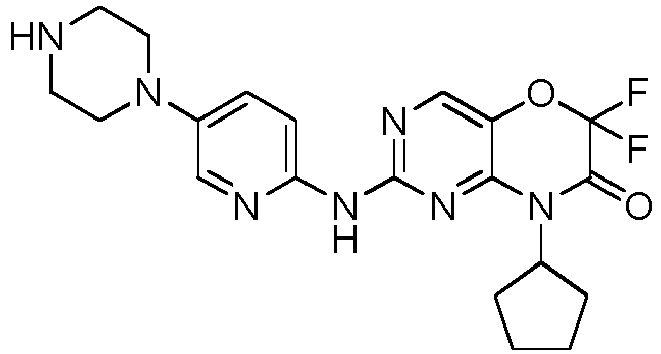
I-13 
I-14 
I-15 
I-16 
I-17 
I-18 
I-19 
I-20 
I-21 
I-22 
I-23 
I-24 
I-25 
I-26 
I-27 
I-28 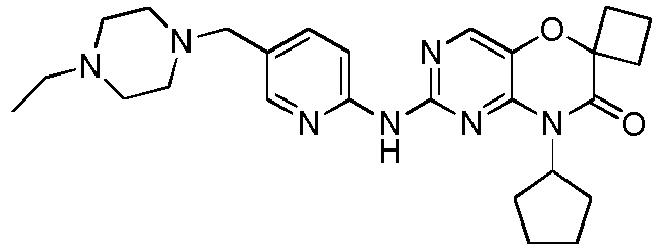
I-29 
I-30 
I-31 
I-32 
I-33 
I-34 
I-35 
I-36 
I-37 
I-38 
- Examples of a pharmaceutically acceptable salt include inorganic and organic salts such as hydrochloride, hydrobromide, sulfate, phosphate, citrate, tartrate, succinate, maleate, fumarate, mandelate and oxalate.
- A part of the compounds of the present invention can be prepared by the following synthetic scheme:

- I6 is prepared according to the procedure reported in the literature (ISOO ITO, NORIICHI ODA, et al. Chem. Pharm. Bull., 1976, pp1189;
BURNETT DUANE A et al. WO2015066697 A1 ), i.e., substituted 2,4-dichloropyrimidine (I1 ) is reacting with amine (I2 ) under basic condition to obtain intermediate I3 , which is demethylated to obtain I4 , and I4 and I5 are substituted and cyclized to obtain ester intermediate I6 . - I6 is catalytically reacted with an amine (I7 ) to obtain the target product I.
- The present invention relates to said heterocyclic-substituted pyridinopyrimidinone derivatives as CDK4/6 inhibitors that can be used for various clinical diseases caused by dysregulation of the cell cycle wherein CDK4/6 involves, such as cancer. Such diseases include but not limited to breast cancer, ovarian cancer, prostate cancer, colorectal cancer, liver cancer, melanoma, acute lymphocytic leukemia, chronic lymphocytic leukemia, multiple myeloma, lung cancer, gastric cancer, pancreatic cancer.
- During the treatment of the disease, the derivative of the present invention can be used in composition to treat related cancers and other diseases by oral, injection or the like.
- The composition comprises a therapeutically effective amount of a compound as described above or a pharmaceutically acceptable salt thereof and a pharmaceutically acceptable carrier.
- The carrier refers to a conventional carrier in the pharmaceutical field, such as a diluent, an excipient such as water, a binder such as a cellulose derivative, gelatin, polyvinylpyrrolidone, etc.; a filler such as starch, etc.; a disintegrant such as calciumcarbonate, sodium bicarbonate. Additionally, other adjuvants such as flavoring agents and sweeteners may also be added to the composition.
- When used orally, they can be prepared into conventional solid preparations such as tablets, powders or capsules, etc.; when used for injection, they can be prepared as injections.
- Various dosage forms of the composition of the present invention can be prepared with a conventional method in the medical field, wherein the content of the active ingredient is from 0.1 % to 99.5% by weight.
- The administration amount of the present invention can be varied according to the route of administration, the age, body weight of the patient, and the type and severity of the disease to be treated, and the daily dose thereof is 0.005-30 mg/kg body weight (for oral) or 0.005-30 mg/kg body weight (for injection).
- The present invention provides a new heterocyclic-substituted pyridinopyrimidinone derivative or a pharmaceutically acceptable salt, which is as a CDK4/6 inhibitor in the preparation of a medicament for preventing or treating CDK4/6 related diseases, especially for the treatment of a malignant tumor, including but not limited to breast cancer, ovarian cancer, prostate cancer, colorectal cancer, liver cancer, melanoma, gastric cancer and solid tumor, and the like.
-
- Step 1: 2,4-Dichloro-5-methoxypyrimidine (1.0 g, 5.59 mmol), isopropylamine (0.33 g, 5.59 mmol), N,N-diisopropylethylamine (7.2 g, 55.9 mmol) were added to isopropanol (IPA, 10 mL) and reacted under N2 protection at 100°C for 6 h. The solvent was concentrated to dry and H2O (50mL)/dichloromethane (DCM, 50mL) was added into the residue and stirred for extraction. The organic layer was dried, filtered and concentrated to give 2-chloro-N-isopropyl-5-methoxypyrimidine-4-amine as a pale yellow solid (0.78 g, crude yield 69.3%).
- Step 2: 2-Chloro-N-isopropyl-5-methoxypyrimidine-4-amine (0.78 g, 3.88 mmol) was added to DCM (15 mL) and BBr3 (14.5 g, 58.2mmol) in DCM (15 mL) was added dropwise under an ice bath, and after the completion, the mixture was warmed to room temperature and stirred for 10 h. Methanol (10 mL) was added dropwise to quench the reaction. DCM (20 mL) was added to the reaction liquid, and the pH was adjusted to about 8 with a saturated NaHCO3 solution. After liquid separation, the organic layer was dried, filtered and concentrated to give 2-chloro-N-isopropyl-5-hydroxypyrimidine-4-amine as a white solid (0.54 g, crude yield 74.5%).
- Step 3: 2-Chloro-N-isopropyl-5-hydroxypyrimidine-4-amine (0.54 g, 2.89 mmol), methyl 2-bromoisobutyrate (0.63 g, 3.46 mmol), K2CO3 (1.2 g , 8.66 mmol) was added to acetonitrile (20 mL) and allowed to react under N2 protection at 80°C for 8 h. The solvent was concentrated to dry and H2O (50mL)/dichloromethane (DCM, 50mL) was added into the residue and stirred for extraction. The organic layer was dried, filtered and concentrated to give a pale yellow solid, followed by the recrystallization with ethyl acetate to give 2-chloro-6,6-dimethyl-8-isopropyl-6H-pyrimido[5,4-b][1,4]oxazin-7(8H)-one (0.73 g, yield 99.0%), MS(m/z): 257 [M+H]+.
- Step 4: 2-Chloro-6,6-dimethyl-8-isopropyl-6H-pyrimido[5,4-b][1,4]oxazin-7(8H)-one (0.73 g, 2.85mmol), tert-butyl 4-(6-aminopyridin-3-yl)piperazine-1-carboxylate (0.79 g, 2.85 mmol), Pd2(dba)3 (0.26 g, 0.28 mmol), Xantphos (0.25 g, 0.43 mmol) and cesium carbonate (1.39 g, 4.28 mmol) were added to 1,4-dioxane (15 mL), and reacted under N2 protection at 100°C for 8 h. The solvent was concentrated to dry and H2O (50mL)/dichloromethane (DCM, 50mL) was added into the residue and stirred for extraction. The organic layer was dried, filtered and concentrated to give a pale yellow solid, followed by the anhydrous ethanol (10mL) beating to give a pale yellow solid of 6-dimethyl-8-isopropyl-2-(5-(4-tert-butyl carboxylate-1-piperazinyl)-pyridin-2-amino)-6H-pyrimido[5,4-b][1,4]oxazin-7(8 H)-one (0.50 g, yield 35.2%), MS(m/z): 498 [M+H]+.
- Step 5: 6,6-Dimethyl-8-isopropyl-2-(5-(4-tert-butyl carboxylate-1-piperazinyl)-pyridin-2-amino)-6H-pyrimido[5,4-b][1,4]oxazin-7(8 H)-one (0.50 g, 2.0 mmol) was added to ethyl acetate (5 mL). 3N HCl-ethyl acetate solution was added under stirring and allowed to react for 2h. The solid was precipitated, filtered, and the crude product was beated with anhydrous ethyl acetate (5mL) to give a pale yellow solid, which was dried in vacuo to give the title product of 6,6-dimethyl-8-isopropyl-2-(5-(1-piperazinyl)-pyridin-2-amino)-6H-pyrimido[5,4 -b][1,4]oxazin-7(8H)-one hydrochloride (I-1, 0.2 g, yield 46.0%),MS(m/z): 398 [M+H]+. 1H NMR (DMSO-d6): δ: 11.83 (br, 1H), 9.74 (br, 2H), 8.33 (s, 1H), 8.25-8.23 (d, J = 8.0Hz, 1H), 8.01 (s, 1H), 7.77-7.75 (d, J = 8.0Hz, 1H), 5.32-5.25 (m, 1H), 3.71-3.52 (m, 8H), 1.59 (s, 12H).
- Compound I-2 was synthesized according to the method in Example 1, and the starting materials were 2-chloro-6,6-dimethyl-8-cyclopentyl-6H-pyrimido[5,4-b][1,4]oxazin-7(8H)-one (its synthesis was similar to that in Example 1, the starting materials were 2,4-dichloro-5-methoxypyrimidine and cyclopentylamine) and tert-butyl 4-(6-aminopyridin-3-yl)piperazine-1-carboxylate. The title product of 6,6-dimethyl-8-cyclopentyl-2-(5-(1-piperazinyl)-pyridin-2-amino)-6H-pyrimido[5 ,4-b][1,4]oxazin-7(8H)-one hydrochloride (I-2) was obtained as a pale yellow solid. MS(m/z): 424 [M+H]+. 1H NMR (DMSO-d6): δ: 11.88 (br, 1H), 9.77 (br, 2H), 8.26(s, 1H), 8.24-8.22 (d, J = 8.0Hz, 1H), 7.93(s, 1H), 7.70-7.68 (d, J = 8.0Hz, 1H), 5.37-5.23 (m, 1H), 4.61 (m, 4H), 3.45 (m, 4H), 2.05-1.55 (m, 8H),1.48 (s, 6H).
- The synthesis of Compound I-3 was synthesized according to the method in Example 1, and the starting materials were 2-chloro-6,6-dimethyl-8-cyclopentyl-6H- pyrimidine [5,4-b][1,4]oxazin-7(8H)-one and 5-[(4-ethylpiperazin-1-yl)methyl]pyridin-2-amine. The title product of 6,6-dimethyl-8-cyclopentyl-2-(5-(4-ethyl-1-piperazinyl)methyl-pyridin-2-amino)-6H-pyrimido[5,4-b][1,4]oxazin-7(8H)-one hydrochloride (I-3) was obtained as a white solid. MS(m/z): 466 [M+H]+. 1H NMR (DMSO-d6): δ: 12.04(br, 1H), 11.83(br, 1H), 8.53(s, 1H), 8.36-8.34 (d, J = 8.0Hz, 1H), 8.19(s, 1H), 7.72-7.70 (d, J = 8.0Hz, 1H), 5.29-5.21 (m, 1H), 4.41 (m, 4H), 3.59-3.51 (m, 6H), 3.08 (m, 2H), 1.99-1.47 (m, 8H),1.39 (s, 6H), 1.19-1.15 (t, J = 8.0Hz, 3H).
- Compound I-4 was synthesized according to the method in Example 1, and the starting materials were 2'-chloro-8'-cyclopentyl-spiro[cycloprop-1,6'-pyrimido[5,4-b][1,4]oxazin]-7'(8'H) -one (its synthesis was similar to that in Example 1, the starting materials were 2,4-dichloro-5-methoxypyrimidine and methyl 1-bromocyclopropanecarboxylate)and tert-butyl 1-(2-pyridyl) 4-(6-aminopyridin-3-yl)piperazine-1-carboxylate. The title product of 8'-cyclopentyl-2'-(5-(1-piperazinyl)-pyridin-2-amino)spiro[cycloprop-1,6'-pyrimi do[5,4-b][1,4]oxazin]-7'(8'H)-one hydrochloride (I-4) was obtained as a pale yellow solid. MS(m/z): 422 [M+H]+.1H NMR (DMSO-d6): δ: 11.89(br, 1H), 9.80(br, 2H), 8.25(s, 1H),8.23-8.21 (d, J = 8.0Hz, 1H), 7.92(s, 1H), 7.70-7.68 (d, J = 8.0Hz, 1H), 5.36-5.23 (m, 1H), 4.60 (m, 4H), 3.47 (m, 4H), 2.03-1.55 (m, 8H),1.01-0.57 (m, 4H).
- Compound I-5 was synthesized according to the method in Example 1, and the starting materials were 2'-chloro-8'-cyclopentyl-spiro[cyclobut-1,6'-pyrimido[5,4-b][1,4]oxazin]-7'(8'H)-one (its synthesis was similar to that in Example 1, the starting materials were 2,4-dichloro-5-methoxypyrimidine and methyl 1-bromocyclobutanecarboxylate) and tert-butyl 1-(2-pyridyl) 4-(6-aminopyridin-3-yl)piperazine-1-carboxylate. The title product of 8'-cyclopentyl-2'-(5-(1-piperazinyl)-pyridin-2-amino)spiro[cyclobut-1,6'-pyrimid o[5,4-b][1,4]oxazin]-7'(8'H)-one hydrochloride (I-5) was obtained as a pale yellow solid. MS(m/z): 436 [M+H]+.1H NMR (DMSO-d6): δ: 11.87(br, 1H), 9.79(br, 2H), 8.26(s, 1H), 8.24-8.22 (d, J = 8.0Hz, 1H), 7.91 (s, 1H), 7.70-7.68 (d, J = 8.0Hz, 1H), 5.35-5.23 (m, 1H), 4.55 (m, 4H), 3.45 (m, 4H), 2.71-2.59 (m, 4H), 2.03-1.98 (m, 2H), 1.75-1.57 (m, 8H).
- Compound I-6 was synthesized according to the method in Example 1, and the starting material was 2'-chloro-8'-cyclopentyl-spiro[cyclopenta-1,6'-pyrimido[5,4-b][1,4]oxazin-7'(8'H )-one (its synthesis was similar to that in Example 1, starting materials were 2,4-dichloro-5-methoxypyrimidine and methyl 1-bromocyclopentanecarboxylate) and tert-butyl 1-(2-pyridyl) 4-(6-aminopyridin-3-yl)piperazine-1-carboxylate. The title product of 8'-cyclopentyl-2'-(5-(1-piperazinyl)-pyridin-2-amino)spiro[cyclopenta-1,6'-pyrim ido[5,4-b][1,4]oxazin]-7'(8'H)-one hydrochloride (I-6) was obtained as a pale yellow solid. MS(m/z): 450 [M+H]+.1H NMR (DMSO-d6): δ: 11.88 (br, 1H), 9.81 (br, 2H), 8.27 (s, 1H), 8.24-8.22 (d, J = 8.0Hz, 1H), 7.90 (s, 1H), 7.70-7.68 (d, J = 8.0Hz, 1H), 5.34-5.23 (m, 1H), 4.59 (m, 4H), 3.47 (m, 4H), 2.25-2.10 (m, 4H), 2.03-1.58 (m, 12H).
- Compound I-7 was synthesized according to the method in Example 1, and the starting material was 2'-chloro-8'-cyclopentyl-spiro[cyclohex-1,6'-pyrimido[5,4-b][1,4]oxazin-7'(8'H)-one (its synthesis was similar to that in Example 1, and starting materials were 2,4-dichloro-5-methoxypyrimidine and methyl 1-bromocyclohexanecarboxylate) and tert-butyl 1-(2-pyridyl) 4-(6-aminopyridin-3-yl)piperazine-1-carboxylate. The title product of 8'-cyclopentyl-2'-(5-(1-piperazinyl)-pyridin-2-amino)spiro[cyclohex-1,6'-pyrimid o[5,4-b][1,4]oxazin]-7'(8'H)-one hydrochloride (I-7) was obtained as a pale yellow solid. MS(m/z): 464 [M+H]+.1H NMR (DMSO-d6): δ: 11.87(br, 1H), 9.79(br, 2H), 8.27(s, 1H), 8.25-8.23 (d, J = 8.0Hz, 1H), 7.89(s, 1H), 7.70-7.68 (d, J = 8.0Hz, 1H), 5.35-5.23 (m, 1H), 4.65 (m, 4H), 3.57 (m, 4H), 2.23-1.95 (m, 4H), 1.93-1.54 (m, 14H).
- Compound I-8 was synthesized according to the method in Example 1, and the starting material was 2'-chloro-8'-cyclopentyl-spiro[cyclohept-1,6'-pyrimido[5,4-b][1,4]oxazin-7'(8'H)-one (its synthesis was similar to that in Example 1, and the starting materials were 2,4-dichloro-5-methoxypyrimidine and methyl 1-bromocycloheptanecarboxylate) and tert-butyl 1-(2-pyridyl) 4-(6-aminopyridin-3-yl)piperazine-1-carboxylate. The title product of 8'-cyclopentyl-2'-(5-(1-piperazinyl)-pyridin-2-amino)spiro[cyclohept-1,6'-pyrimi do[5,4-b][1,4]oxazin]-7'(8'H)-one hydrochloride (I-8) was obtained as a pale yellow solid. MS(m/z): 478 [M+H]+.1H NMR (DMSO-d6): δ: 11.88 (br, 1H), 9.78 (br, 2H), 8.28 (s, 1H), 8.25-8.23 (d, J = 8.0Hz, 1H), 7.91 (s, 1H), 7.71-7.69 (d, J = 8.0Hz, 1H), 5.37-5.23 (m, 1H), 4.63 (m, 4H), 3.58 (m, 4H), 2.21-1.95 (m, 4H), 1.91-1.46 (m, 16H).
- Compound I-9 was synthesized according to the method in Example 1, and the starting material was 2-chloro-6-acetyl-8-cyclopentyl-6H-pyrimido[5,4-b][1,4]oxazin-7(8H)-one (its synthesis was similar to that in Example 1, and the starting materials were 2,4-dichloro-5-methoxypyrimidine and methyl 2-bromo-2-carbonylacetate) and tert-butyl 1-(2-pyridyl) 4-(6-aminopyridin-3-yl)piperazine-1-carboxylate. The title product of 6-acetyl-8-cyclopentyl-2-(5-(1-piperazinyl)-pyridin-2-amino)-6H-pyrimido[5,4-b] [1,4]oxazin-7(8H)-one hydrochloride (I-9) was obtained as a pale yellow solid. MS(m/z): 438 [M+H]+.1H NMR (DMSO-d6): δ: 11.87(br, 1H), 9.81 (br, 2H), 8.27(s, 1H), 8.25-8.23 (d, J = 8.0Hz, 1H), 7.90(s, 1H), 7.71-7.69 (d, J = 8.0Hz, 1H), 5.57 (s, 1H), 5.35-5.26 (m, 1H), 4.61 (m, 4H), 3.59 (m, 4H), 3.37 (s, 3H), 2.09-1.57 (m, 8H).
- Compound I-10 was synthesized according to the method in Example 1, and the starting material was 2-chloro-6-cyano-8-cyclopentyl-6H-pyrimido[5,4-b][1,4]oxazin-7(8H)-one (its synthesis was similar to that in Example 1, and the starting materials were 2,4-dichloro-5-methoxypyrimidine and methyl 2-bromo-2-cyanoacetate) and tert-butyl 1-(2-pyridyl) 4-(6-aminopyridin-3-yl)piperazine-1-carboxylate. The title product of 6-cyano-8-cyclopentyl-2-(5-(1-piperazinyl)-pyridin-2-amino)-6H-pyrimido[5,4-b] [1,4]oxazin-7(8H)-one hydrochloride (I-10) was obtained as a pale yellow solid. MS(m/z): 421 [M+H]+.1H NMR (DMSO-d6): δ: 11.89(br, 1H), 9.80(br, 2H), 8.28(s, 1H), 8.26-8.24 (d, J = 8.0Hz, 1H), 7.91 (s, 1H), 7.71-7.69 (d, J = 8.0Hz, 1H), 5.58(s, 1H), 5.36-5.26 (m, 1H), 4.62 (m, 4H), 3.59 (m, 4H), 2.03-1.57 (m, 8H).
- Compound I-11 was synthesized according to the method in Example 1, and the starting material was 2-chloro-6-trifluoromethyl-8-cyclopentyl-6H-pyrimido[5,4-b][1,4]oxazin-7(8H)-o ne (its synthesis was similar to that in Example 1, and the starting materials were 2,4-dichloro-5-methoxypyrimidine and methyl 2-bromo-2-trifluoromethylacetate) and tert-butyl 1-(2-pyridyl) 4-(6-aminopyridin-3-yl)piperazine-1-carboxylate. The title product of 6-trifluoromethyl-8-cyclopentyl-2-(5-(1-piperazinyl)-pyridin-2-amino)-6H-pyrimi do[5,4-b][1,4]oxazin-7(8H)-one hydrochloride (I-11) was obtained as a pale yellow solid. MS(m/z): 464 [M+H]+.1H NMR (DMSO-d6): δ: 11.87(br, 1H), 9.81 (br, 2H), 8.27(s, 1H), 8.26-8.24 (d, J = 8.0Hz, 1H), 7.90(s, 1H), 7.70-7.68 (d, J = 8.0Hz, 1H), 5.57-5.54(m, 1H), 5.35-5.26 (m, 1H), 4.61 (m, 4H), 3.64 (m, 4H), 2.01-1.54 (m, 8H).
- Compound I-12 was synthesized according to the method in Example 1, and the starting material was 2-chloro-6,6-difluoro-8-cyclopentyl-6H-pyrimido[5,4-b][1,4]oxazin-7(8H)-one (its synthesis was similar to that in Example 1, and the starting materials were 2,4-dichloro-5-methoxypyrimidine and methyl 2-bromo-2,2-difluoroacetate) and tert-butyl 1-(2-pyridyl) 4-(6-aminopyridin-3-yl)piperazine-1-carboxylate. The title product of 6,6-difluoro-8-cyclopentyl-2-(5-(1-piperazinyl)-pyridin-2-amino)-6H-pyrimido[5, 4-b][1,4]oxazin-7(8H)-one hydrochloride (I-12) was obtained as a pale yellow solid. MS(m/z): 432 [M+H]+.1H NMR (DMSO-d6): δ: 11.88 (br, 1H), 9.79 (br, 2H), 8.26 (s, 1H), 8.23-8.21 (d, J = 8.0Hz, 1H), 7.90 (s, 1H), 7.70-7.67 (d, J = 8.0Hz, 1H), 5.37-5.26 (m, 1H), 4.62 (m, 4H), 3.63 (m, 4H), 2.03-1.57 (m, 8H).
- Compound I-13 was synthesized according to the method in Example 1, and the starting materials were 2-chloro-6-cyclopropyl-8-cyclopentyl-6H-pyrimido[5,4-b][1,4]oxazin-7(8H)-one (its synthesis was similar to that in Example 1, and the starting materials were 2,4-dichloro-5-methoxypyrimidine and methyl 2-bromo-2-cyclopropylacetate) and 1-(2-pyridyl) and tert-butyl 4-(6-aminopyridin-3-yl)piperazine-1-carboxylate. The title product of 6-cyclopropyl-8-cyclopentyl-2-(5-(1-piperazinyl)-pyridin-2-amino)-6H-pyrimido[ 5,4-b][1,4]oxazin-7(8H)-one hydrochloride (I-13) was obtained as a pale yellow solid. MS(m/z): 436 [M+H]+.1H NMR (DMSO-d6): δ: 11.89(br, 1H), 9.81 (br, 2H), 8.27(s, 1H), 8.24-8.22 (d, J = 8.0Hz, 1H), 7.89(s, 1H), 7.70-7.68 (d, J = 8.0Hz, 1H), 5.58-5.57 (d, J = 4.0Hz, 1H), 5.38-5.26 (m, 1H), 4.67 (m, 4H), 3.69 (m, 4H), 2.03-1.58 (m, 8H), 1.05-1.01 (m, 1H), 0.87-0.69 (m, 4H).
- Compound I-14 was synthesized according to the method in Example 1, and the starting material was 2-chloro-6-cyclobutyl-8-cyclopentyl-6H-pyrimido[5,4-b] [1,4]oxazin-7(8H)-one (its synthesis was similar to that in Example 1, and the starting materials were 2,4-dichloro-5-methoxypyrimidine and methyl 2-bromo-2-butylpropyl acetate) and 5-[(4-ethylpiperazin-1-yl)methyl]pyridin-2-amine. The title product of 6-cyclobutyl-8-cyclopentyl-2-(5-(4-ethyl-1-piperazinyl)methyl-pyridin-2-amino)-6H-pyrimido[5,4-b][1,4]oxazin-7(8H)-one (I-14) was obtained as a white solid. MS(m/z): 492 [M+H]+. 1H NMR (DMSO-d6): δ: 11.81 (br, 1H), 8.53 (s, 1H), 8.35-8.33 (d, J = 8.0Hz, 1H), 8.20(s, 1H), 7.71-7.69 (d, J = 8.0Hz, 1H), 5.58-5.57 (d, J = 4.0Hz, 1H), 5.27-5.21 (m, 1H), 4.87 (s, 2H), 4.45-4.23 (m, 11H), 2.47-2.21 (m, 14H), 1.19-1.15 (t, J = 8.0Hz, 3H).
- Compound I-15 was synthesized according to the method in Example 1, and the starting material was 2-chloro-6-isopropyl-8-methyl-6H-pyrimido[5,4-b][1,4]oxazin-7(8H)-one (its synthesis was similar to that in Example 1, and the starting materials were 2,4-dichloro-5-methoxypyrimidine, methylamine and methyl 2-bromoisovalerate) and 5-[(4-ethylpiperazin-1-yl)methyl]pyridin-2-amine. The title product of 6-isopropyl-8-methyl-2-(5-(4-ethyl-1-piperazinyl)methyl-pyridin-2-amino)-6H-p yrimido[5,4-b][1,4]oxazin-7(8H)-one (I-15) was obtained as a white solid. MS(m/z): 426 [M+H]+. 1H NMR (DMSO-d6): δ: 11.81 (br, 1H), 8.55(s, 1H), 8.35-8.33 (d, J = 8.0Hz, 1H), 8.18(s, 1H), 7.70-7.68 (d, J = 8.0Hz, 1H), 5.58-5.57 (d, J = 4.0Hz, 1H), 4.89(s, 2H), 4.59 (s, 3H), 4.41-4.23 (m, 11H), 1.19-1.15 (t, J = 8.0Hz, 3H), 1.05-1.04 (d, J = 4.0Hz, 6H).
- Compound I-16 was synthesized according to the method in Example 1, and the starting material was 2-chloro-6-methyl-6,8-diethyl-6H-pyrimido[5,4-b][1,4]oxazin-7(8H)-one (its synthesis was similar to that in Example 1, and the starting materials were 2,4-dichloro-5-methoxypyrimidine, ethylamine and methyl 2-bromo-2-methylbutylate) and 5-[(4-methylpiperazin-1-yl)methyl]pyridin-2-amine. The title product of 6-methyl-6,8-diethyl-2-(5-(4-methyl-1-piperazinyl)methyl-pyridin-2-amino)-6H-pyrimido[5,4-b][1,4]oxazin-7(8H)-one (I-16) was obtained as a white solid. MS(m/z): 426 [M+H]+. 1H NMR (DMSO-d6): δ: 11.82(br, 1H), 8.56(s, 1H), 8.35-8.33 (d, J = 8.0Hz, 1H), 8.19(s, 1H), 7.70-7.68 (d, J = 8.0Hz, 1H), 4.89 (s, 2H), 4.67-4.63 (q, J =4.0Hz, 2H), 4.59 (s, 3H), 4.40-4.22 (m, 8H), 3.25-3.21 (q, J =4.0Hz, 2H), 2.35 (s, 3H), 2.01-1.99 (t, J = 4.0Hz, 3H), 1.58-1.56 (t, J = 4.0Hz, 3H).
- Compound I-17 was synthesized according to the method in Example 1, and the starting material was 2-chloro-6-cyclopentyl-8-sec-butyl-6H-pyrimidine[5,4-b][1,4]thiazin-7(8H)-one (its synthesis was similar to that in Example 1, and the starting materials were 2,4-dichloro-5-methylthiopyrimidine, sec-butylamine and methyl 2-bromo-2-cyclopentyl acetate) and 5-[(piperazin-1-yl)methyl]pyridin-2-amine. The title product of 6-cyclopentyl-8-sec-butyl-2-(5-(1-piperazinyl)methyl-pyridin-2-amino)-6H-pyri mido[5,4-b][1,4]thiazin-7(8H)-one hydrochloride (I-17) was obtained as a white solid. MS(m/z): 482 [M+H]+. 1H NMR (DMSO-d6): δ: 11.89 (br, 1H), 9.81 (br, 2H), 8.55(s, 1H), 8.35-8.33 (d, J = 8.0Hz, 1H), 8.21 (s, 1H), 7.70-7.68 (d, J = 8.0Hz, 1H), 4.88-4.65(m, 4H), 4.42-4.25 (m, 8H), 2.21-1.95(m,14H), 0.98-0.96 (t, J = 4.0Hz, 3H).
- Compound I-18 was synthesized according to the method in Example 1, and the starting material was 2-chloro-6-cyclohexyl-8-tert-amyl-6H-pyrimido[5,4-b][1,4]oxazin-7(8H)-one (its synthesis was similar to that in Example 1, and the starting materials were2,4-dichloro-5-methoxypyrimidine, tert-amylamine and methyl 2-bromo-2-cyclohexylacetate) and 5-[(4-cyclopropylpiperazin-1-yl)methyl]pyridin-2-amine. The title product of 6-cyclohexyl-8-tert-amyl-2-(5-(4-cyclopropyl-1-piperazinyl)methyl-pyridin-2-am ino)-6H-pyrimido[5,4-b][1,4]oxazin-7(8H)-one (I-18) was obtained as a white solid. MS(m/z): 534 [M+H]+. 1H NMR (DMSO-d6): δ: 11.81 (br, 1H), 8.57(s, 1H), 8.34-8.32 (d, J = 8.0Hz, 1H), 8.19(s, 1H), 7.70-7.68 (d, J = 8.0Hz, 1H), 5.58-5.57 (d, J = 4.0Hz, 1H), 4.88(s, 2H), 4.42-4.21 (m, 9H), 2.21-2.01 (m, 19H), 1.19-1.15 (t, J = 8.0Hz, 1H), 0.75-0.69 (m, 4H).
- Compound I-19 was synthesized according to the method in Example 1, and the starting material was 2-chloro-6-cycloheptyl-8-(3-methyl-2-butyl)-6H-pyrimido[5,4-b][1,4]thiazin-7(8 H)-one (its synthesis was similar to that in Example 1, and the starting materials were 2,4-dichloro-5-methylthiopyrimidine, 3-methyl-2-butylamine and methyl 2-bromo-2-cycloheptylacetate) and 5-[(4-propylpiperazin-1-yl)methyl]pyridin-2-amine. The title product of 6-cycloheptyl-8-(3-methyl-2-butyl)-2-(5-(4-n-propyl-1-piperazinyl)methyl-pyridi n-2-amino)-6H-pyrimido[5,4-b][1,4]thiazin-7(8H)-one (I-19) was obtained as a white solid. MS(m/z): 567 [M+H]+. 1H NMR (DMSO-d6): δ: 11.82 (br, 1H), 8.55 (s, 1H), 8.34-8.32 (d, J = 8.0Hz, 1H), 8.21 (s, 1H), 7.70-7.68 (d, J = 8.0Hz, 1H), 5.58-5.57 (d, J = 4.0Hz, 1H), 4.87-4.65 (m, 4H), 4.43-4.21 (m, 11H), 2.19-2.01 (m, 17H), 1.21-1.18 (m, 9H).
- Compound I-20 was synthesized according to the method in Example 1, and the starting materials were 2-chloro-6,6-dimethyl-8-cyclopentyl-6H-pyrimido[5,4-b][1,4]oxazin-7(8H)-one and 1-cyclobutyl-4-(6-aminopyridin-3-yl)piperazine. The title product of 6,6-dimethyl-8-cyclopentyl-2-(5-(4-cyclobutyl-1-piperazinyl)-pyridin-2-amino)-6 H-pyrimido[5,4-b][1,4]oxazin-7(8H)-one (I-20) was obtained as a pale yellow solid. MS(m/z): 478 [M+H]+. 1H NMR (DMSO-d6): δ: 11.83(br, 1H), 8.26 (s, 1H), 8.22-8.20 (d, J = 8.0Hz, 1H), 7.91 (s, 1H), 7.70-7.68 (d, J = 8.0Hz, 1H), 5.37-5.23 (m, 1H), 4.61-4.56 (m, 5H), 3.45-3.40 (m, 4H), 2.05-1.47 (m, 20H).
- Compound I-21 was synthesized according to the method in Example 1, and the starting materials were 2-chloro-6,6-dimethyl-8-cyclopentyl-6H-pyrimido[5,4-b][1,4]oxazin-7(8H)-one and 1-cyclopentyl-4-(6-aminopyridin-3-yl)piperazine. The title product of 6,6-dimethyl-8-cyclopentyl-2-(5-(4-cyclopentyl-1-piperazinyl)-pyridin-2-amino)-6H-pyrimido[5,4-b][1,4]oxazin-7(8H)-one (I-21) was obtained as a pale yellow solid. MS(m/z): 492 [M+H]+. 1H NMR (DMSO-d6): δ: 11.81 (br, 1H), 8.25 (s, 1H), 8.23-8.21 (d, J = 8.0Hz, 1H), 7.92 (s, 1H), 7.70-7.68 (d, J = 8.0Hz, 1H), 5.36-5.23 (m, 1H), 4.60 (m, 4H), 3.45-3.39 (m, 5H), 2.03-1.43 (m, 22H).
- Compound I-22 was synthesized according to the method in Example 1, and the starting materials were 2-chloro-6,6-dimethyl-8-cyclopentyl-6H-pyrimido[5,4-b][1,4]oxazin-7(8H)-one and 1-cyclohexyl-4-(6-aminopyridin-3-yl)piperazine. The title product of 6,6-dimethyl-8-cyclopentyl-2-(5-(4-cyclohexyl-1-piperazinyl)-pyridin-2-amino)-6H-pyrimido[5,4-b][1,4]oxazin-7(8H)-one (I-22) was obtained as a pale yellow solid. MS(m/z): 506 [M+H]+. 1H NMR (DMSO-d6): δ: 11.83(br, 1H), 8.26(s, 1H), 8.23-8.21 (d, J = 8.0Hz, 1H), 7.93(s, 1H), 7.70-7.68 (d, J = 8.0Hz, 1H), 5.35-5.25 (m, 1H), 4.61 (m, 4H), 3.47-3.39 (m, 5H), 2.05-1.43 (m, 24H).
- Compound I-23 was synthesized according to the method in Example 1, and the starting materials were 2-chloro-6,6-dimethyl-8-cyclopentyl-6H-pyrimido[5,4-b][1,4]thiazin-7(8H)-one and 1-cycloheptyl-4-(6-aminopyridin-3-yl)piperazine. The title product of 6,6-dimethyl-8-cyclopentyl-2-(5-(4-cycloheptyl-1-piperazinyl)-pyridin-2-amino)-6H-pyrimido[5,4-b][1,4]thiazin-7(8H)-one (I-23) was obtained as a pale yellow solid. MS(m/z): 536 [M+H]+. 1H NMR (DMSO-d6): δ: 11.81 (br, 1H), 8.27 (s, 1H), 8.22-8.20 (d, J = 8.0Hz, 1H), 7.91 (s, 1H), 7.71-7.69 (d, J = 8.0Hz, 1H), 5.35-5.25 (m, 1H), 4.61 (m, 4H), 3.46-3.37 (m, 5H), 2.07-1.42 (m, 26H).
- Compound I-24 was synthesized according to the method in Example 1, and the starting materials were 2-chloro-6,6-dimethyl-8-cyclopentyl-6H-pyrimido[5,4-b][1,4]thiazin-7(8H)-one and 1-isopropyl-4-(6-aminopyridin-3-yl)piperazine. The title product of 6,6-dimethyl-8-cyclopentyl-2-(5-(4-isopropyl-1-piperazinyl)-pyridin-2-amino)-6 H-pyrimido[5,4-b][1,4]thiazin-7(8H)-one (I-24) was obtained as a pale yellow solid. MS(m/z): 482 [M+H]+. 1H NMR (DMSO-d6): δ: 11.82 (br, 1H), 8.26 (s, 1H), 8.23-8.21 (d, J = 8.0Hz, 1H), 7.91 (s, 1H), 7.71-7.69 (d, J = 8.0Hz, 1H), 5.38-5.27 (m, 1H), 4.63 (m, 4H), 3.47-3.37 (m, 5H), 2.01-1.45 (m, 14H), 1.58-1.57 (d, J = 4.0Hz, 6H).
- Compound I-25 was synthesized according to the method in Example 1, and the starting materials were 2'-chloro-8'-cyclopentyl-spiro[cycloprop-1,6'-pyrimido[5,4-b][1,4]oxazin]-7'(8'H) -one and 1-(2-pyridyl) and 5-[(4-ethylpiperazin-1-yl)methyl]pyridin-2-amine. The title product of 8'-cyclopentyl-2'-(5-(4-ethyl-1-piperazinyl)-pyridin-2-amino)spiro[cycloprop-1,6' -pyrimido[5,4-b][1,4]oxazin]-7'(8'H)-one (I-25) was obtained as a pale yellow solid. MS(m/z): 464 [M+H]+.1H NMR (DMSO-d6): δ: 11.83 (br, 1H), 8.53 (s, 1H), 8.36-8.34 (d, J = 8.0Hz, 1H), 8.21 (s, 1H), 7.71-7.69 (d, J = 8.0Hz, 1H), 5.01-4.95 (m, 3H), 4.25-3.56 (m, 10H), 2.05-1.57 (m, 8H), 1.21-0.97 (m, 7H).
- Compound I-26 was synthesized according to the method in Example 1, and the starting materials were 2-chloro-6-acetyl-8-cyclopentyl-6H-pyrimido[5,4-b][1,4]oxazin-7(8H)-one and 1-(2-pyridyl) and 5-[(4-ethylpiperazin-1-yl)methyl]pyridin-2-amine. The title product of 6-acetyl-8-cyclopentyl-2-(5-(4-ethyl-1-piperazinyl)methyl-pyridin-2-amino)-6H-pyrimido[5,4-b][1,4]oxazin-7(8H)-one (I-26) was obtained as a pale yellow solid. MS(m/z): 480 [M+H]+.1H NMR (DMSO-d6): δ: 11.81 (br, 1H), 8.52 (s, 1H), 8.36-8.34 (d, J = 8.0Hz, 1H), 8.20 (s, 1H), 7.71-7.69 (d, J = 8.0Hz, 1H), 6.15 (s, 1H), 5.01-4.85 (m, 3H), 4.23-3.58 (m, 10H), 3.39 (s, 3H), 2.01-1.57 (m, 8H), 1.23-1.21 (t, J = 4.0Hz, 3H).
- Compound I-27 was synthesized according to the method in Example 1, and the starting materials were 2-chloro-6-cyano-8-cyclopentyl-6H-pyrimido[5,4-b][1,4]oxazin-7(8H)-one and 1-(2-pyridyl) and 5-[(4-ethylpiperazin-1-yl)methyl]pyridin-2-amine. The title product of 6-cyano-8-cyclopentyl-2-(5-(4-ethyl-1-piperazinyl)methyl-pyridin-2-amino)-6H-pyrimido[5,4-b][1,4]oxazin-7(8H)-one (I-27) was obtained as a pale yellow solid. MS(m/z): 463 [M+H]+.1H NMR (DMSO-d6): δ: 11.80 (br, 1H), 8.51 (s, 1H), 8.37-8.35 (d, J = 8.0Hz, 1H), 8.21 (s, 1H), 7.71-7.69 (d, J = 8.0Hz, 1H), 6.17 (s, 1H), 5.00-4.87 (m, 3H), 4.21-3.58 (m, 10H), 2.01-1.58 (m, 8H), 1.24-1.22 (t, J= 4.0Hz, 3H).
- Compound I-28 was synthesized according to the method in Example 1, and the starting materials were 2'-chloro-8'-cyclopentyl-spiro[cyclobut-1,6'-pyrimido[5,4-b][1,4]oxazin]-7'(8'H)-one and 1-(2-pyridyl) and 5-[(4-ethylpiperazin-1-yl)methyl]pyridin-2-amine. The title product of 8'-cyclopentyl-2'-(5-(4-ethyl-1-piperazinyl)-pyridin-2-amino)spiro[cyclobut-1,6'-pyrimido[5,4-b][1,4]oxazin]-7'(8'H)-one (I-28) was obtained as a pale yellow solid. MS(m/z): 478 [M+H]+.1H NMR (DMSO-d6): δ: 11.82 (br, 1H), 8.52 (s, 1H), 8.37-8.35 (d, J = 8.0Hz, 1H), 8.23 (s, 1H), 7.71-7.69 (d, J = 8.0Hz, 1H), 4.98-4.94 (m, 3H), 4.23-3.56 (m, 14H), 2.03-1.55 (m, 10H), 1.23-1.21 (t, J = 4.0Hz, 3H).
- Compound I-29 was synthesized according to the method in Example 1, and the starting material was 2-chloro-6,6-dimethyl-8-(2-thienyl)-6H-pyrimido[5,4-b][1,4]oxazin-7(8H)-one (its synthesis was similar to that in Example 1, and the starting materials were 2,4-dichloro-5-methoxypyrimidine and 2-aminothiophene) and tert-butyl 4-(6-aminopyridin-3-yl)piperazine-1-carboxylate. The title product of 6,6-dimethyl-8-(2-thienyl)-2-(5-(1-piperazinyl)-pyridin-2-yl)-6H-pyrimido[5,4-b][ 1,4]oxazin-7(8H)-one hydrochloride (I-29) was obtained as a pale yellow solid. MS(m/z): 438 [M+H]+. 1H NMR (DMSO-d6): δ: 11.89 (br, 1H), 9.78 (br, 2H), 8.26 (s, 1H), 8.24-8.22 (d, J = 8.0Hz, 1H), 7.91-7.78 (m, 4H), 6.58-6.52 (m, 1H), 4.61 (m, 4H), 3.47 (m, 4H), 1.48 (s, 6H).
- Compound I-30 was synthesized according to the method in Example 1, and the starting materials were 2-chloro-6,6-dimethyl-8-(2-pyridyl)-6H-pyrimidio[5,4-b][1,4]oxazin-7(8H)-one and 5-[(4-ethylpiperazin-1-yl)methyl]pyridin-2-amine. The title product of 6,6-dimethyl-8-(2-pyridyl)-2-(5-(4-ethyl-1-piperazinyl)methyl-pyridin-2-amino)-6 H-pyrimido[5,4-b][1,4]oxazin-7(8H)-one (I-30) was obtained as a white solid. MS(m/z): 475 [M+H]+. 1H NMR (DMSO-d6): δ: 11.83 (br, 1H), 8.67-8.64 (m, 1H), 8.61-8.58 (m, 1H), 8.51-8.47 (m, 2H), 8.36-8.34 (d, J = 8.0Hz, 1H), 8.21 (s, 1H), 8.05-8.01 (m, 1H), 7.72-7.70 (d, J = 8.0Hz, 1H), 4.87 (s, 2H), 4.23-3.56 (m, 10H), 1.58 (s, 6H), 1.19-1.17 (t, J = 4.0Hz, 3H).
- Compound I-31 was synthesized according to the method in Example 1, and the starting materials were 2-chloro-6,6-dimethyl-8-(2-pyrimidinyl)-6H-pyrimido[5,4-b][1,4]oxazin-7(8H)-on e and 5-[(4-ethylpiperazin-1-yl)methyl]pyridin-2-amine. The title product of 6,6-dimethyl-8-(2-pyrimidinyl)-2-(5-(4-ethyl-1-piperazinyl)methyl-pyridin-2-ami no)-6H-pyrimido[5,4-b][1,4]oxazin-7(8H)-one (I-31) was obtained as a white solid. MS(m/z): 476 [M+H]+. 1H NMR (DMSO-d6): δ: 11.81 (br, 1H), 8.92-8.89 (m, 2H), 8.53 (s, 1H), 8.37-8.34 (m, 2H), 8.20 (s, 1H), 7.72-7.70 (d, J = 8.0Hz, 1H), 4.87 (s, 2H), 4.21-3.64 (m, 10H), 1.57 (s, 6H), 1.19-1.17 (t, J = 4.0Hz, 3H).
- Compound I-32 was synthesized according to the method in Example 1, and the starting materials were 2-chloro-6,6-dimethyl-8-(2-furyl)-6H-pyrimido[5,4-b][1,4]oxazin-7(8H)-one and tert-butyl 4-(6-aminopyridin-3-yl)piperazine-1-carboxylate. The title product of 6,6-dimethyl-8-(2-furyl)-2-(5-(1-piperazinyl)-pyridin-2-amino)-6H-pyrimido[5,4-b][1,4]oxazin-7(8H)-one hydrochloride (I-32) was obtained as a pale yellow solid. MS(m/z): 422 [M+H]+. 1H NMR (DMSO-d6): δ: 11.87 (br, 1H), 9.81 (br, 2H), 8.25 (s, 1H), 8.24-8.22 (d, J = 8.0Hz, 1H), 7.98-7.82 (m, 3H), 6.57-6.52 (m, 2H), 4.62 (m, 4H), 3.48 (m, 4H), 1.51 (s, 6H).
- Compound I-33 was synthesized according to the method in Example 1, and the starting materials were 2-chloro-N,N-dimethyl-6-carboxamide-8-cyclopentyl-6H-pyrimido[5,4-b][1,4]ox azin-7(8H)-one and 1-(2-pyridyl) and tert-butyl 4-(6-aminopyridin-3-yl)piperazine-1-carboxylate. The title product of N,N-dimethyl-6-carboxamide-8-cyclopentyl-2-(5-(1-piperazinyl)-pyridin-2-amin o)-6H-pyrimido[5,4-b][1,4]oxazin-7(8H)-one hydrochloride (I-33) was obtained as a pale yellow solid. MS(m/z): 467 [M+H]+.1H NMR (DMSO-d6): δ: 11.88(br, 1H), 9.80(br, 2H), 8.27 (s, 1H), 8.23-8.21 (d, J = 8.0Hz, 1H), 7.91 (s, 1H), 7.71-7.69 (d, J = 8.0Hz, 1H), 5.58(s, 1H), 5.33-5.26 (m, 1H), 5.01 (s, 6H), 4.62 (m, 4H), 3.61 (m, 4H), 2.05-1.57 (m, 8H).
- Compound I-34 was synthesized according to the method in Example 1, and the starting materials were 2-chloro-6-carboxamide-8-cyclopentyl-6H-pyrimido[5,4-b][1,4]oxazin-7(8H)-on e and 1-(2-pyridyl) and tert-butyl 4-(6-aminopyridin-3-yl)piperazine-1-carboxylate. The title product of 6-carboxamide-8-cyclopentyl-2-(5-(1-piperazinyl)-pyridin-2-amino)-6H-pyrimid o[5,4-b][1,4]oxazin-7(8H)-one hydrochloride (I-34) was obtained as a pale yellow solid. MS(m/z): 439 [M+H]+.1H NMR (DMSO-d6): δ: 11.86 (br, 1H), 9.83 (br, 2H), 9.57 (br, 2H), 8.26 (s, 1H), 8.22-8.20 (d, J = 8.0Hz, 1H), 7.91 (s, 1H), 7.71-7.69 (d, J = 8.0Hz, 1H), 5.59 (s, 1H), 5.34-5.26 (m, 1H), 4.63 (m, 4H), 3.63 (m, 4H), 2.01-1.62 (m, 8H).
- Compound I-35 was synthesized according to the method in Example 1, and the starting material was 2-chloro-6,6-dimethyl-8-phenyl-6H-pyrimido[5,4-b][1,4]oxazin-7(8H)-one (its synthesis was similar to that in Example 1, and the starting materials were 2,4-dichloro-5-methoxypyrimidine and aniline) and tert-butyl 4-(6-aminopyridin-3-yl)piperazine-1-carboxylate. The title product of 6,6-dimethyl-8-phenyl-2-(5-(1-piperazinyl)-pyridin-2-amino)-6H-pyrimido[5,4-b] [1,4]oxazin-7(8H)-one (I-35) was obtained as a pale yellow solid. MS(m/z): 432 [M+H]+. 1H NMR (DMSO-d6): δ: 11.86 (br, 1H), 9.82 (br, 2H), 8.56-8.52 (m, 4H), 8.26 (s, 1H), 8.24-8.22 (d, J = 8.0Hz, 1H), 7.99-7.92 (m, 3H), 4.61 (m, 4H), 3.49 (m, 4H), 1.52 (s, 6H).
- Compound I-36 was synthesized according to the method in Example 1, and the starting material was 2-chloro-6,6-dimethyl-8-(4-chlorophenyl)-6H-pyrimido[5,4-b][1,4]oxazin-7(8H)-one (its synthesis was similar to that in Example 1, and the starting materials were 2,4-dichloro-5-methoxypyrimidine and 4-chlorophenylamine) and tert-butyl 4-(6-aminopyridin-3-yl)piperazine-1-carboxylate. The title product of 6,6-dimethyl-8-(4-chlorophenyl)-2-(5-(1-piperazinyl)-pyridin-2-amino)-6H-pyrim ido[5,4-b][1,4]oxazin-7(8H)-one (I-36) was obtained as a pale yellow solid. MS(m/z): 466 [M+H]+. 1H NMR (DMSO-d6): δ: 11.87 (br, 1H), 9.85 (br, 2H), 8.56-8.54 (d, J = 8.0Hz, 2H), 8.45-8.43 (d, J = 8.0Hz, 2H), 8.26 (s, 1H), 8.23-8.21 (d, J = 8.0Hz, 1H), 7.90 (s, 1H), 7.71-7.69 (d, J = 8.0Hz, 1H), 4.63 (m, 4H), 3.51 (m, 4H), 1.54 (s, 6H).
- Compound I-37 was synthesized according to the method in Example 1, and the starting materials were 2-chloro-6,6-dimethyl-8-(3-pentyl)-6H-pyrimido[5,4-b][1,4]oxazin-7(8H)-one and tert-butyl 4-(6-aminopyridin-3-yl)piperazine-1-carboxylate. The title product of 6,6-dimethyl-8-(3-pentyl)-2-(5-(1-piperazinyl)-pyriin-2-amino)-6H-pyrimido[5,4 -b][1,4]oxazin-7(8H)-one hydrochloride (I-37) was obtained as a pale yellow solid. MS(m/z): 426 [M+H]+. 1H NMR (DMSO-d6): δ: 11.87 (br, 1H), 9.78 (br, 2H), 8.27 (s, 1H), 8.24-8.22 (d, J = 8.0Hz, 1H), 7.91 (s, 1H), 7.70-7.68 (d, J = 8.0Hz, 1H), 5.35-5.22 (m, 1H), 4.61 (m, 4H), 3.48 (m, 4H), 1.58 (s, 6H), 1.45-1.42 (m, 4H), 0.92-0.88 (m, 6H).
- Compound I-37 was synthesized according to the method in Example 1, and the starting materials were 2-chloro-6,6-dimethyl-8-(3-pentyl)-6H-pyrimido[5,4-b][1,4]oxazin-7(8H)-one and tert-butyl 4-(6-aminopyridin-3-yl)piperazine-1-carboxylate 5-[(4-ethylpiperazin-1-yl)methyl]pyridyl-2-amine. The title product of 6,6-dimethyl-8-(3-pentyl)-2-(5-(4-ethyl-1-piperazinyl)methyl-pyridin-2-amino)-6 H-pyrimido[5,4-b][1,4]oxazin-7(8H)-one (I-38) was obtained as a pale yellow solid. MS(m/z): 468 [M+H]+. 1H NMR (DMSO-d6): δ: 11.82(br, 1H), 8.51 (s, 1H), 8.36-8.34 (d, J = 8.0Hz, 1H), 8.18 (s, 1H), 7.72-7.70 (d, J = 8.0Hz, 1H), 5.21-5.08 (m, 3H), 4.61-4.02 (m, 10H), 1.59 (s, 6H), 1.46-1.42 (m, 4H), 0.93-0.88 (m, 9H).
- Activity assay: The CDK4 protein kinase activity was measured using the Caliper mobility shift assay (see J. Biomol. Screen, 2009, PP31).The test compound was dissolved in DMSO and diluted with a kinase buffer solution (20 mM HEPES-pH 7.5, 0.01% Triton X-100, 10 mM MgCl2, 2 mM DTT) and 5 µL of the compound at 5-fold final concentration of reaction dissolved in 10% DMSO was added in a 384-well plate. The compound-free control well was 5 µL of 10% DMSO, and the no-activity control well was 5 µL of kinase buffer.10 µL of a 2.5-fold diluted CDK4 enzyme solution (GST-CDK4(1-303 end)) was added and incubated at room temperature for 10 min, and then 10 µL of the 2.5-fold diluted substrate solution Peptide FAM-P8 was added.The reaction was stopped by adding 25 µL of stop solution after incubation at 28°C for 3 h, and the conversion rate data was read on a Caliper EZ Reader II (Caliper Life Sciences) and the conversion rate was converted to inhibition rate data according to above method. Among them, the inhibition rate % = (max - conversion)/(max - min) x 100%.
- Activity Assay: The CDK6 protein kinase activity was measured using the Caliper mobility shift assay (see J. Biomol. Screen, 2009, PP31). The test compound was dissolved in DMSO and diluted with a kinase buffer solution (20 mM HEPES-pH 7.5, 0.01% Triton X-100, 10 mM MgCl2, 2 mM DTT) and 5 µL of the compound at 5-fold final concentration of reaction dissolved in 10% DMSO was added in a 384-well plate. The compound-free control well was 5 µL of 10% DMSO, and the no-activity control well was 5 µL of kinase buffer.10 µL of a 2.5-fold diluted CDK6 enzyme solution (GST-CDK6(1-326 end)) was added and incubated at room temperature for 10 min, and then 10 µL of the 2.5-fold diluted substrate solution Peptide FAM-P8 was added.The reaction was stopped by adding 25 µL of stop solution after incubation at 28°C for 3 h, and the conversion rate data was read on a Caliper EZ Reader II (Caliper Life Sciences) and the conversion rate was converted to inhibition rate data according to above method. Among them, the inhibition rate % = (max - conversion)/(max - min) x 100%.
- Results of above experiments are summaried in Table 2.
Table 2. Results of the assay Compound CDK4 CDK6 Compound CDK4 CDK6 Palbociclib D D I-1 D D I-2 D D I-3 D D I-4 D C I-5 D C I-6 D C I-7 D D I-8 D C I-9 D C I-10 D B I-11 D C I-12 D C I-13 D D I-14 D D I-15 D C I-16 D D I-17 D A I-18 D D I-19 D C I-20 D D I-21 D C I-22 D D I-23 D D I-24 D D I-25 D D I-26 D B I-27 D D I-28 D C I-29 D D I-30 D C I-31 D D I-32 D A I-33 D D I-34 D D I-35 C C I-36 D D I-37 D C I-38 D C Note: A represents IC50> 500nM, B represents 500nM ≥ IC50> 100nM, C represents 100nM ≥ IC50> 20nM, D represents IC50≤ 20nM.
Claims (7)
- A heterocyclic-substituted pyridinopyrimidinone derivative, that has the following Formula I or a pharmaceutically acceptable salt thereof:
 R1 represents hydrogen, C1-C3 alkyl, or C3-C7 cycloalkyl;R2 represents C1-C5 alkyl,or C3-C7 cycloalkyl;R3 and R4 independently represent- hydrogen, C1-C3 alkyl, C3-C7 cycloalkyl, acetyl, halogen, trifluoromethyl, cyano or CONR5R6;or R3, R4 together with the carbon atom to which they are attached form a C3-C7 aliphatic ring;R5 and R6 independently represents hydrogen or methyl;X represents O, or S;n is 0 or 1.
 - The heterocyclic-substituted pyridinopyrimidinone derivative according to claim 1, wherein the C1-C3 alkyl is methyl, ethyl, n-propyl, or iso-propyl, the C1-C5 alkyl is methyl, ethyl, n-propyl, iso-propyl, n-butyl, iso-butyl, sec-butyl, tert-butyl, 1-pentyl, 2-pentyl, 3-pentyl, 2-methyl-3-butyl, 1,1 -dimethyl-1 -propyl, or 2,2-dimethyl-1-propyl
- The heterocyclic-substituted pyridinopyrimidinone derivative according to claim 1, wherein the C3-C7 cycloalkyl is cyclopropyl, cyclobutyl, cyclopentyl, cyclohexyl, or cycloheptyl, and the halogen is F, Cl, Br, or I.
- The heterocyclic-substituted pyridinopyrimidinone derivative according to claim 1, wherein the derivative is a compound selected from the group consisting of:
Compound Structure Compound Structure I-1 
I-2 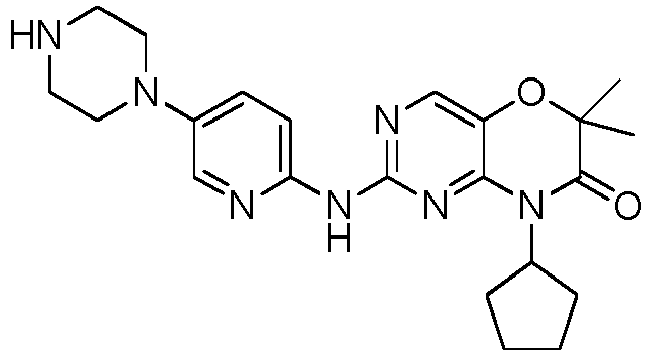
I-3 
I-4 
I-5 
I-6 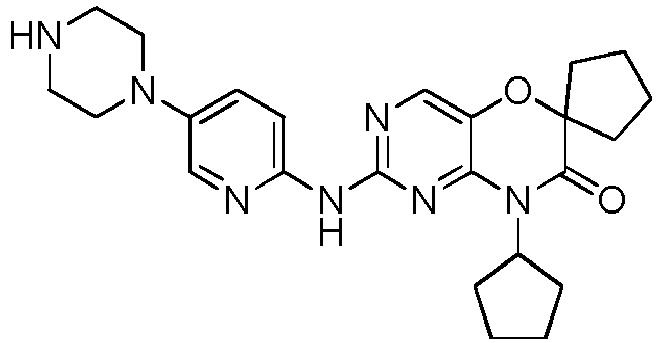
I-7 
I-8 
I-9 
I-10 
I-11 
I-12 
I-13 
I-14 
I-15 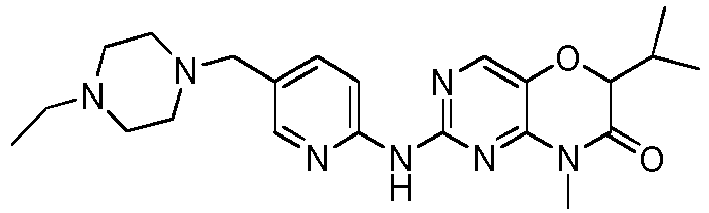
I-16 
I-17 
I-18 
I-19 
I-20 
I-21 
I-22 
I-23 
I-24 
I-25 
I-26 
I-27 
I-28 
I-33 
I-34 
I-37 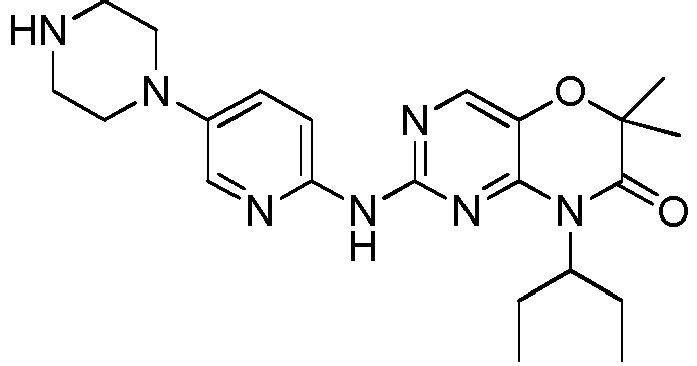
I-38 
- The heterocyclic-substituted pyridinopyrimidinone derivative and a pharmaceutically acceptable salt thereof according to any of claims 1-4 for use as a CDK4/6 inhibitor in preventing or treating diseases related to CDK4/6.
- The compound for use in treating diseases according to claim 5, wherein the diseases are cancers related to CDK4/6.
- A pharmaceutical composition comprising a therapeutically effective amount of the heterocyclic-substituted pyridinopyrimidinone derivative according to any of claims 1-4 and a pharmaceutically acceptable carrier or excipient.
Applications Claiming Priority (2)
| Application Number | Priority Date | Filing Date | Title |
|---|---|---|---|
| CN201610220275.5A CN107286180B (en) | 2016-04-11 | 2016-04-11 | Heteropyridopyrimidinone derivatives as CDK inhibitors and their applications |
| PCT/CN2017/078935 WO2017177837A1 (en) | 2016-04-11 | 2017-03-31 | Heterocyclic-substituted pyridinopyrimidinone derivative as cdk inhibitor and use thereof |
Publications (3)
| Publication Number | Publication Date |
|---|---|
| EP3444254A1 EP3444254A1 (en) | 2019-02-20 |
| EP3444254A4 EP3444254A4 (en) | 2019-04-24 |
| EP3444254B1 true EP3444254B1 (en) | 2020-05-13 |
Family
ID=60042197
Family Applications (1)
| Application Number | Title | Priority Date | Filing Date |
|---|---|---|---|
| EP17781813.5A Active EP3444254B1 (en) | 2016-04-11 | 2017-03-31 | Heterocyclic-substituted pyridinopyrimidinone derivative as cdk inhibitor and use thereof |
Country Status (5)
| Country | Link |
|---|---|
| US (1) | US10351578B2 (en) |
| EP (1) | EP3444254B1 (en) |
| JP (1) | JP6661049B2 (en) |
| CN (1) | CN107286180B (en) |
| WO (1) | WO2017177837A1 (en) |
Families Citing this family (24)
| Publication number | Priority date | Publication date | Assignee | Title |
|---|---|---|---|---|
| ES2944306T3 (en) * | 2017-12-21 | 2023-06-20 | Boehringer Ingelheim Int | Benzylamino-substituted pyridopyrimidinones and derivatives as SOS1 inhibitors |
| KR20200131246A (en) | 2018-02-15 | 2020-11-23 | 누베이션 바이오 인크. | Heterocyclic compounds as kinase inhibitors |
| WO2022113003A1 (en) | 2020-11-27 | 2022-06-02 | Rhizen Pharmaceuticals Ag | Cdk inhibitors |
| WO2022149057A1 (en) | 2021-01-05 | 2022-07-14 | Rhizen Pharmaceuticals Ag | Cdk inhibitors |
| CN116284044A (en) * | 2023-03-17 | 2023-06-23 | 上海勋和医药科技有限公司 | Crystal form and preparation method of a heteropyridopyrimidinone derivative |
| CN121712509A (en) | 2023-05-04 | 2026-03-20 | 锐新医药公司 | Combination therapy for RAS related diseases or conditions |
| US20250049810A1 (en) | 2023-08-07 | 2025-02-13 | Revolution Medicines, Inc. | Methods of treating a ras protein-related disease or disorder |
| IL327306A (en) | 2023-10-12 | 2026-05-01 | Revolution Medicines Inc | Macrocyclic ras inhibitors |
| WO2025171296A1 (en) | 2024-02-09 | 2025-08-14 | Revolution Medicines, Inc. | Ras inhibitors |
| WO2025217307A1 (en) | 2024-04-09 | 2025-10-16 | Revolution Medicines, Inc. | Methods for predicting response to a ras(on) inhibitor and combination therapies |
| WO2025240847A1 (en) | 2024-05-17 | 2025-11-20 | Revolution Medicines, Inc. | Ras inhibitors |
| WO2025255438A1 (en) | 2024-06-07 | 2025-12-11 | Revolution Medicines, Inc. | Methods of treating a ras protein-related disease or disorder |
| WO2025265060A1 (en) | 2024-06-21 | 2025-12-26 | Revolution Medicines, Inc. | Therapeutic compositions and methods for managing treatment-related effects |
| WO2026006747A1 (en) | 2024-06-28 | 2026-01-02 | Revolution Medicines, Inc. | Ras inhibitors |
| WO2026015790A1 (en) | 2024-07-12 | 2026-01-15 | Revolution Medicines, Inc. | Methods of treating a ras related disease or disorder |
| WO2026015825A1 (en) | 2024-07-12 | 2026-01-15 | Revolution Medicines, Inc. | Use of ras inhibitor for treating pancreatic cancer |
| WO2026015796A1 (en) | 2024-07-12 | 2026-01-15 | Revolution Medicines, Inc. | Methods of treating a ras related disease or disorder |
| WO2026015801A1 (en) | 2024-07-12 | 2026-01-15 | Revolution Medicines, Inc. | Methods of treating a ras related disease or disorder |
| CN118994194A (en) * | 2024-08-07 | 2024-11-22 | 新疆医科大学第一附属医院 | Small molecular compound with IDO1 inhibitory activity and preparation method and application thereof |
| WO2026050446A1 (en) | 2024-08-29 | 2026-03-05 | Revolution Medicines, Inc. | Ras inhibitors |
| WO2026072904A2 (en) | 2024-09-26 | 2026-04-02 | Revolution Medicines, Inc. | Compositions and methods for treating lung cancer |
| WO2026090116A2 (en) | 2024-10-21 | 2026-04-30 | Revolution Medicines, Inc. | Ras inhibitors |
| WO2026090245A1 (en) | 2024-10-22 | 2026-04-30 | Revolution Medicines, Inc. | Use of ras inhibitors for treating cancer |
| US20260108528A1 (en) | 2024-10-22 | 2026-04-23 | Revolution Medicines, Inc. | Methods of treating a ras protein-related disease or disorder |
Family Cites Families (6)
| Publication number | Priority date | Publication date | Assignee | Title |
|---|---|---|---|---|
| WO2001055147A1 (en) * | 2000-01-25 | 2001-08-02 | Warner-Lambert Company | PYRIDO[2,3-d]PYRIMIDINE-2,7-DIAMINE KINASE INHIBITORS |
| ATE314370T1 (en) * | 2002-01-22 | 2006-01-15 | Warner Lambert Co | 2-(PYRIDINE-2-YLAMINO)-PYRIDO(2,3-D)PYRIMIDINE-7-ONE |
| CN102231984A (en) * | 2008-10-01 | 2011-11-02 | 北卡罗来纳大学查珀尔希尔分校 | Hematopoietic protection against chemotherapeutic compounds using selective cyclin-dependent kinase 4/6 inhibitors |
| WO2015066696A1 (en) * | 2013-11-04 | 2015-05-07 | Forum Pharmaceuticals Inc. | Fused morphlinopyrimidines and methods of use thereof |
| US20150297608A1 (en) * | 2014-04-17 | 2015-10-22 | G1 Therapeutics, Inc. | Tricyclic Lactams for Use as Anti-Neoplastic and Anti-Proliferative Agents |
| CN105218561B (en) * | 2014-06-25 | 2018-10-30 | 上海艾力斯医药科技有限公司 | Annelated pyrimidines ring derivatives, preparation method and application |
-
2016
- 2016-04-11 CN CN201610220275.5A patent/CN107286180B/en active Active
-
2017
- 2017-03-31 JP JP2019502134A patent/JP6661049B2/en active Active
- 2017-03-31 EP EP17781813.5A patent/EP3444254B1/en active Active
- 2017-03-31 WO PCT/CN2017/078935 patent/WO2017177837A1/en not_active Ceased
-
2018
- 2018-10-09 US US16/155,867 patent/US10351578B2/en active Active
Non-Patent Citations (1)
| Title |
|---|
| None * |
Also Published As
| Publication number | Publication date |
|---|---|
| WO2017177837A1 (en) | 2017-10-19 |
| US20190071453A1 (en) | 2019-03-07 |
| CN107286180B (en) | 2019-07-02 |
| CN107286180A (en) | 2017-10-24 |
| JP6661049B2 (en) | 2020-03-11 |
| US10351578B2 (en) | 2019-07-16 |
| JP2019510822A (en) | 2019-04-18 |
| EP3444254A1 (en) | 2019-02-20 |
| EP3444254A4 (en) | 2019-04-24 |
Similar Documents
| Publication | Publication Date | Title |
|---|---|---|
| US10351578B2 (en) | Heterocyclic-substituted pyridinopyrimidinone derivative as CDK inhibitor and use thereof | |
| EP3444246B1 (en) | 2,4-disubstituted pyrimidine derivative as cdk inhibitor and use thereof | |
| AU2013366513B2 (en) | Novel benzimidazole derivatives as kinase inhibitors | |
| AU2016245864B2 (en) | Substituted quinazoline compounds and methods of use thereof | |
| EP2668190B1 (en) | Tricyclic pyrrolo derivatives, process for their preparation and their use as kinase inhibitors | |
| EP2598508B1 (en) | Isoxazolo-quinazolines as modulators of protein kinase activity | |
| US20090318446A1 (en) | 4-(1H-Indol-3-yl)-Pyrimidin-2-Ylamine Derivatives and Their Use in Therapy | |
| EP3294742B1 (en) | New (5,8-dimethyl-9-phenyl-5,8-dihydro-6h-pyrazolo[3,4-h)quinazolin-2-yl)-(1h-pyrazol-5-yl)-amines and theri derivatives as igf-1r/1r inhibitors. | |
| TW200829583A (en) | Anilinopiperazine derivatives and methods of use thereof | |
| EP3148994B1 (en) | 1, 3, 4-thiadiazole compounds and their use in treating cancer | |
| EP2802586B1 (en) | Substituted imidazopyrazines as akt kinase inhibitors | |
| CA2533870A1 (en) | Pyridinylamino-pyrimidine derivatives as protein kinase inhibitors | |
| TR201901886T4 (en) | DNA-PK inhibitors. | |
| WO2008112695A2 (en) | Pyrazolo [3,4-d] pyrimidines and 1, 2, 5, 6-tetraaza- as- indacenes as protein kinase inhibitors for cancer treatment | |
| WO2007042786A2 (en) | 4 -heteroaryl pyrimidine derivatives and use thereof as protein kinase inhibitors | |
| KR102866403B1 (en) | Casein kinase 1ε inhibitor and pharmaceutical composition and application thereof | |
| CN108290899A (en) | A kind of substituted pyrrolopyrimidine compound and its application | |
| EP4074697B1 (en) | Novel adamantane derivatives as inhibitors of focal adhesion kinase | |
| CN115448874B (en) | Cyclin-dependent kinase 9 inhibitors in solid form and uses thereof | |
| CN113874362A (en) | Crystal form of quinazolinone compound and preparation method thereof | |
| WO2014170421A1 (en) | Serine/threonine kinase inhibitors | |
| HK1232529B (en) | 1, 3, 4-thiadiazole compounds and their use in treating cancer | |
| HK1232529A1 (en) | 1, 3, 4-thiadiazole compounds and their use in treating cancer |
Legal Events
| Date | Code | Title | Description |
|---|---|---|---|
| STAA | Information on the status of an ep patent application or granted ep patent |
Free format text: STATUS: THE INTERNATIONAL PUBLICATION HAS BEEN MADE |
|
| PUAI | Public reference made under article 153(3) epc to a published international application that has entered the european phase |
Free format text: ORIGINAL CODE: 0009012 |
|
| STAA | Information on the status of an ep patent application or granted ep patent |
Free format text: STATUS: REQUEST FOR EXAMINATION WAS MADE |
|
| 17P | Request for examination filed |
Effective date: 20181026 |
|
| AK | Designated contracting states |
Kind code of ref document: A1 Designated state(s): AL AT BE BG CH CY CZ DE DK EE ES FI FR GB GR HR HU IE IS IT LI LT LU LV MC MK MT NL NO PL PT RO RS SE SI SK SM TR |
|
| AX | Request for extension of the european patent |
Extension state: BA ME |
|
| RIN1 | Information on inventor provided before grant (corrected) |
Inventor name: ZHENG, YONGYONG Inventor name: JIN, HUA Inventor name: MENG, XIN Inventor name: HUANG, MEIHUA Inventor name: ZHOU, FENG |
|
| A4 | Supplementary search report drawn up and despatched |
Effective date: 20190322 |
|
| RIC1 | Information provided on ipc code assigned before grant |
Ipc: C07D 498/10 20060101ALI20190318BHEP Ipc: C07D 513/04 20060101ALI20190318BHEP Ipc: A61P 35/02 20060101ALI20190318BHEP Ipc: C07D 498/04 20060101AFI20190318BHEP Ipc: A61P 35/00 20060101ALI20190318BHEP |
|
| DAV | Request for validation of the european patent (deleted) | ||
| DAX | Request for extension of the european patent (deleted) | ||
| GRAP | Despatch of communication of intention to grant a patent |
Free format text: ORIGINAL CODE: EPIDOSNIGR1 |
|
| STAA | Information on the status of an ep patent application or granted ep patent |
Free format text: STATUS: GRANT OF PATENT IS INTENDED |
|
| INTG | Intention to grant announced |
Effective date: 20191115 |
|
| GRAS | Grant fee paid |
Free format text: ORIGINAL CODE: EPIDOSNIGR3 |
|
| GRAJ | Information related to disapproval of communication of intention to grant by the applicant or resumption of examination proceedings by the epo deleted |
Free format text: ORIGINAL CODE: EPIDOSDIGR1 |
|
| GRAL | Information related to payment of fee for publishing/printing deleted |
Free format text: ORIGINAL CODE: EPIDOSDIGR3 |
|
| STAA | Information on the status of an ep patent application or granted ep patent |
Free format text: STATUS: REQUEST FOR EXAMINATION WAS MADE |
|
| GRAP | Despatch of communication of intention to grant a patent |
Free format text: ORIGINAL CODE: EPIDOSNIGR1 |
|
| STAA | Information on the status of an ep patent application or granted ep patent |
Free format text: STATUS: GRANT OF PATENT IS INTENDED |
|
| INTC | Intention to grant announced (deleted) | ||
| INTG | Intention to grant announced |
Effective date: 20200303 |
|
| GRAA | (expected) grant |
Free format text: ORIGINAL CODE: 0009210 |
|
| STAA | Information on the status of an ep patent application or granted ep patent |
Free format text: STATUS: THE PATENT HAS BEEN GRANTED |
|
| AK | Designated contracting states |
Kind code of ref document: B1 Designated state(s): AL AT BE BG CH CY CZ DE DK EE ES FI FR GB GR HR HU IE IS IT LI LT LU LV MC MK MT NL NO PL PT RO RS SE SI SK SM TR |
|
| REG | Reference to a national code |
Ref country code: GB Ref legal event code: FG4D |
|
| REG | Reference to a national code |
Ref country code: CH Ref legal event code: EP |
|
| REG | Reference to a national code |
Ref country code: DE Ref legal event code: R096 Ref document number: 602017016785 Country of ref document: DE |
|
| REG | Reference to a national code |
Ref country code: AT Ref legal event code: REF Ref document number: 1270132 Country of ref document: AT Kind code of ref document: T Effective date: 20200615 |
|
| REG | Reference to a national code |
Ref country code: CH Ref legal event code: NV Representative=s name: VALIPAT S.A. C/O BOVARD SA NEUCHATEL, CH |
|
| REG | Reference to a national code |
Ref country code: LT Ref legal event code: MG4D |
|
| REG | Reference to a national code |
Ref country code: NL Ref legal event code: MP Effective date: 20200513 |
|
| PG25 | Lapsed in a contracting state [announced via postgrant information from national office to epo] |
Ref country code: PT Free format text: LAPSE BECAUSE OF FAILURE TO SUBMIT A TRANSLATION OF THE DESCRIPTION OR TO PAY THE FEE WITHIN THE PRESCRIBED TIME-LIMIT Effective date: 20200914 Ref country code: GR Free format text: LAPSE BECAUSE OF FAILURE TO SUBMIT A TRANSLATION OF THE DESCRIPTION OR TO PAY THE FEE WITHIN THE PRESCRIBED TIME-LIMIT Effective date: 20200814 Ref country code: FI Free format text: LAPSE BECAUSE OF FAILURE TO SUBMIT A TRANSLATION OF THE DESCRIPTION OR TO PAY THE FEE WITHIN THE PRESCRIBED TIME-LIMIT Effective date: 20200513 Ref country code: LT Free format text: LAPSE BECAUSE OF FAILURE TO SUBMIT A TRANSLATION OF THE DESCRIPTION OR TO PAY THE FEE WITHIN THE PRESCRIBED TIME-LIMIT Effective date: 20200513 Ref country code: IS Free format text: LAPSE BECAUSE OF FAILURE TO SUBMIT A TRANSLATION OF THE DESCRIPTION OR TO PAY THE FEE WITHIN THE PRESCRIBED TIME-LIMIT Effective date: 20200913 Ref country code: SE Free format text: LAPSE BECAUSE OF FAILURE TO SUBMIT A TRANSLATION OF THE DESCRIPTION OR TO PAY THE FEE WITHIN THE PRESCRIBED TIME-LIMIT Effective date: 20200513 Ref country code: NO Free format text: LAPSE BECAUSE OF FAILURE TO SUBMIT A TRANSLATION OF THE DESCRIPTION OR TO PAY THE FEE WITHIN THE PRESCRIBED TIME-LIMIT Effective date: 20200813 |
|
| PG25 | Lapsed in a contracting state [announced via postgrant information from national office to epo] |
Ref country code: HR Free format text: LAPSE BECAUSE OF FAILURE TO SUBMIT A TRANSLATION OF THE DESCRIPTION OR TO PAY THE FEE WITHIN THE PRESCRIBED TIME-LIMIT Effective date: 20200513 Ref country code: RS Free format text: LAPSE BECAUSE OF FAILURE TO SUBMIT A TRANSLATION OF THE DESCRIPTION OR TO PAY THE FEE WITHIN THE PRESCRIBED TIME-LIMIT Effective date: 20200513 Ref country code: BG Free format text: LAPSE BECAUSE OF FAILURE TO SUBMIT A TRANSLATION OF THE DESCRIPTION OR TO PAY THE FEE WITHIN THE PRESCRIBED TIME-LIMIT Effective date: 20200813 Ref country code: LV Free format text: LAPSE BECAUSE OF FAILURE TO SUBMIT A TRANSLATION OF THE DESCRIPTION OR TO PAY THE FEE WITHIN THE PRESCRIBED TIME-LIMIT Effective date: 20200513 |
|
| REG | Reference to a national code |
Ref country code: AT Ref legal event code: MK05 Ref document number: 1270132 Country of ref document: AT Kind code of ref document: T Effective date: 20200513 |
|
| PG25 | Lapsed in a contracting state [announced via postgrant information from national office to epo] |
Ref country code: AL Free format text: LAPSE BECAUSE OF FAILURE TO SUBMIT A TRANSLATION OF THE DESCRIPTION OR TO PAY THE FEE WITHIN THE PRESCRIBED TIME-LIMIT Effective date: 20200513 Ref country code: NL Free format text: LAPSE BECAUSE OF FAILURE TO SUBMIT A TRANSLATION OF THE DESCRIPTION OR TO PAY THE FEE WITHIN THE PRESCRIBED TIME-LIMIT Effective date: 20200513 |
|
| PG25 | Lapsed in a contracting state [announced via postgrant information from national office to epo] |
Ref country code: EE Free format text: LAPSE BECAUSE OF FAILURE TO SUBMIT A TRANSLATION OF THE DESCRIPTION OR TO PAY THE FEE WITHIN THE PRESCRIBED TIME-LIMIT Effective date: 20200513 Ref country code: SM Free format text: LAPSE BECAUSE OF FAILURE TO SUBMIT A TRANSLATION OF THE DESCRIPTION OR TO PAY THE FEE WITHIN THE PRESCRIBED TIME-LIMIT Effective date: 20200513 Ref country code: IT Free format text: LAPSE BECAUSE OF FAILURE TO SUBMIT A TRANSLATION OF THE DESCRIPTION OR TO PAY THE FEE WITHIN THE PRESCRIBED TIME-LIMIT Effective date: 20200513 Ref country code: AT Free format text: LAPSE BECAUSE OF FAILURE TO SUBMIT A TRANSLATION OF THE DESCRIPTION OR TO PAY THE FEE WITHIN THE PRESCRIBED TIME-LIMIT Effective date: 20200513 Ref country code: CZ Free format text: LAPSE BECAUSE OF FAILURE TO SUBMIT A TRANSLATION OF THE DESCRIPTION OR TO PAY THE FEE WITHIN THE PRESCRIBED TIME-LIMIT Effective date: 20200513 Ref country code: RO Free format text: LAPSE BECAUSE OF FAILURE TO SUBMIT A TRANSLATION OF THE DESCRIPTION OR TO PAY THE FEE WITHIN THE PRESCRIBED TIME-LIMIT Effective date: 20200513 Ref country code: ES Free format text: LAPSE BECAUSE OF FAILURE TO SUBMIT A TRANSLATION OF THE DESCRIPTION OR TO PAY THE FEE WITHIN THE PRESCRIBED TIME-LIMIT Effective date: 20200513 Ref country code: DK Free format text: LAPSE BECAUSE OF FAILURE TO SUBMIT A TRANSLATION OF THE DESCRIPTION OR TO PAY THE FEE WITHIN THE PRESCRIBED TIME-LIMIT Effective date: 20200513 |
|
| REG | Reference to a national code |
Ref country code: DE Ref legal event code: R097 Ref document number: 602017016785 Country of ref document: DE |
|
| PG25 | Lapsed in a contracting state [announced via postgrant information from national office to epo] |
Ref country code: PL Free format text: LAPSE BECAUSE OF FAILURE TO SUBMIT A TRANSLATION OF THE DESCRIPTION OR TO PAY THE FEE WITHIN THE PRESCRIBED TIME-LIMIT Effective date: 20200513 Ref country code: SK Free format text: LAPSE BECAUSE OF FAILURE TO SUBMIT A TRANSLATION OF THE DESCRIPTION OR TO PAY THE FEE WITHIN THE PRESCRIBED TIME-LIMIT Effective date: 20200513 |
|
| PLBE | No opposition filed within time limit |
Free format text: ORIGINAL CODE: 0009261 |
|
| STAA | Information on the status of an ep patent application or granted ep patent |
Free format text: STATUS: NO OPPOSITION FILED WITHIN TIME LIMIT |
|
| 26N | No opposition filed |
Effective date: 20210216 |
|
| PG25 | Lapsed in a contracting state [announced via postgrant information from national office to epo] |
Ref country code: SI Free format text: LAPSE BECAUSE OF FAILURE TO SUBMIT A TRANSLATION OF THE DESCRIPTION OR TO PAY THE FEE WITHIN THE PRESCRIBED TIME-LIMIT Effective date: 20200513 |
|
| PG25 | Lapsed in a contracting state [announced via postgrant information from national office to epo] |
Ref country code: MC Free format text: LAPSE BECAUSE OF FAILURE TO SUBMIT A TRANSLATION OF THE DESCRIPTION OR TO PAY THE FEE WITHIN THE PRESCRIBED TIME-LIMIT Effective date: 20200513 |
|
| REG | Reference to a national code |
Ref country code: BE Ref legal event code: MM Effective date: 20210331 |
|
| PG25 | Lapsed in a contracting state [announced via postgrant information from national office to epo] |
Ref country code: LU Free format text: LAPSE BECAUSE OF NON-PAYMENT OF DUE FEES Effective date: 20210331 Ref country code: IE Free format text: LAPSE BECAUSE OF NON-PAYMENT OF DUE FEES Effective date: 20210331 |
|
| PG25 | Lapsed in a contracting state [announced via postgrant information from national office to epo] |
Ref country code: BE Free format text: LAPSE BECAUSE OF NON-PAYMENT OF DUE FEES Effective date: 20210331 |
|
| PG25 | Lapsed in a contracting state [announced via postgrant information from national office to epo] |
Ref country code: CY Free format text: LAPSE BECAUSE OF FAILURE TO SUBMIT A TRANSLATION OF THE DESCRIPTION OR TO PAY THE FEE WITHIN THE PRESCRIBED TIME-LIMIT Effective date: 20200513 |
|
| PG25 | Lapsed in a contracting state [announced via postgrant information from national office to epo] |
Ref country code: HU Free format text: LAPSE BECAUSE OF FAILURE TO SUBMIT A TRANSLATION OF THE DESCRIPTION OR TO PAY THE FEE WITHIN THE PRESCRIBED TIME-LIMIT; INVALID AB INITIO Effective date: 20170331 |
|
| PG25 | Lapsed in a contracting state [announced via postgrant information from national office to epo] |
Ref country code: MK Free format text: LAPSE BECAUSE OF FAILURE TO SUBMIT A TRANSLATION OF THE DESCRIPTION OR TO PAY THE FEE WITHIN THE PRESCRIBED TIME-LIMIT Effective date: 20200513 |
|
| REG | Reference to a national code |
Ref country code: DE Ref legal event code: R082 Ref document number: 602017016785 Country of ref document: DE Ref country code: DE Ref legal event code: R081 Ref document number: 602017016785 Country of ref document: DE Owner name: CHENGDU JINRUI FOUNDATION BIOTECH CO., LTD., C, CN Free format text: FORMER OWNER: SHANGHAI XUNHE PHARMACEUTICAL TECHNOLOGY CO., LTD., SHANGHAI, CN |
|
| PG25 | Lapsed in a contracting state [announced via postgrant information from national office to epo] |
Ref country code: TR Free format text: LAPSE BECAUSE OF FAILURE TO SUBMIT A TRANSLATION OF THE DESCRIPTION OR TO PAY THE FEE WITHIN THE PRESCRIBED TIME-LIMIT Effective date: 20200513 |
|
| REG | Reference to a national code |
Ref country code: GB Ref legal event code: 732E Free format text: REGISTERED BETWEEN 20240829 AND 20240904 |
|
| PG25 | Lapsed in a contracting state [announced via postgrant information from national office to epo] |
Ref country code: MT Free format text: LAPSE BECAUSE OF FAILURE TO SUBMIT A TRANSLATION OF THE DESCRIPTION OR TO PAY THE FEE WITHIN THE PRESCRIBED TIME-LIMIT Effective date: 20200513 |
|
| PGFP | Annual fee paid to national office [announced via postgrant information from national office to epo] |
Ref country code: CH Payment date: 20250401 Year of fee payment: 9 |
|
| REG | Reference to a national code |
Ref country code: CH Ref legal event code: U11 Free format text: ST27 STATUS EVENT CODE: U-0-0-U10-U11 (AS PROVIDED BY THE NATIONAL OFFICE) Effective date: 20260401 |
|
| PGFP | Annual fee paid to national office [announced via postgrant information from national office to epo] |
Ref country code: GB Payment date: 20260323 Year of fee payment: 10 |
|
| PGFP | Annual fee paid to national office [announced via postgrant information from national office to epo] |
Ref country code: DE Payment date: 20260313 Year of fee payment: 10 |
|
| PGFP | Annual fee paid to national office [announced via postgrant information from national office to epo] |
Ref country code: FR Payment date: 20260330 Year of fee payment: 10 |