EP3444246B1 - 2,4-disubstituted pyrimidine derivative as cdk inhibitor and use thereof - Google Patents
2,4-disubstituted pyrimidine derivative as cdk inhibitor and use thereof Download PDFInfo
- Publication number
- EP3444246B1 EP3444246B1 EP17781812.7A EP17781812A EP3444246B1 EP 3444246 B1 EP3444246 B1 EP 3444246B1 EP 17781812 A EP17781812 A EP 17781812A EP 3444246 B1 EP3444246 B1 EP 3444246B1
- Authority
- EP
- European Patent Office
- Prior art keywords
- methyl
- pyridin
- fluoro
- pyrimidin
- amine
- Prior art date
- Legal status (The legal status is an assumption and is not a legal conclusion. Google has not performed a legal analysis and makes no representation as to the accuracy of the status listed.)
- Active
Links
- -1 2,4-disubstituted pyrimidine Chemical class 0.000 title claims description 28
- 229940043378 cyclin-dependent kinase inhibitor Drugs 0.000 title description 8
- 239000002875 cyclin dependent kinase inhibitor Substances 0.000 title description 4
- 150000001875 compounds Chemical class 0.000 claims description 108
- 238000000034 method Methods 0.000 claims description 53
- 150000003839 salts Chemical class 0.000 claims description 16
- 125000000999 tert-butyl group Chemical group [H]C([H])([H])C(*)(C([H])([H])[H])C([H])([H])[H] 0.000 claims description 14
- 208000037265 diseases, disorders, signs and symptoms Diseases 0.000 claims description 13
- 201000010099 disease Diseases 0.000 claims description 12
- 206010028980 Neoplasm Diseases 0.000 claims description 10
- 229910052739 hydrogen Inorganic materials 0.000 claims description 10
- 239000001257 hydrogen Substances 0.000 claims description 10
- 125000000753 cycloalkyl group Chemical group 0.000 claims description 9
- 101000715943 Caenorhabditis elegans Cyclin-dependent kinase 4 homolog Proteins 0.000 claims description 8
- 229910052736 halogen Inorganic materials 0.000 claims description 8
- 150000002367 halogens Chemical group 0.000 claims description 8
- 150000002431 hydrogen Chemical group 0.000 claims description 8
- 125000002496 methyl group Chemical group [H]C([H])([H])* 0.000 claims description 8
- 229940124297 CDK 4/6 inhibitor Drugs 0.000 claims description 7
- 125000006273 (C1-C3) alkyl group Chemical group 0.000 claims description 6
- 125000006527 (C1-C5) alkyl group Chemical group 0.000 claims description 4
- 125000001995 cyclobutyl group Chemical group [H]C1([H])C([H])([H])C([H])(*)C1([H])[H] 0.000 claims description 4
- 125000001511 cyclopentyl group Chemical group [H]C1([H])C([H])([H])C([H])([H])C([H])(*)C1([H])[H] 0.000 claims description 4
- 125000001559 cyclopropyl group Chemical group [H]C1([H])C([H])([H])C1([H])* 0.000 claims description 4
- 125000001495 ethyl group Chemical group [H]C([H])([H])C([H])([H])* 0.000 claims description 4
- 125000001449 isopropyl group Chemical group [H]C([H])([H])C([H])(*)C([H])([H])[H] 0.000 claims description 4
- 125000004123 n-propyl group Chemical group [H]C([H])([H])C([H])([H])C([H])([H])* 0.000 claims description 4
- 125000002023 trifluoromethyl group Chemical group FC(F)(F)* 0.000 claims description 4
- 239000003937 drug carrier Substances 0.000 claims description 3
- 239000008194 pharmaceutical composition Substances 0.000 claims description 3
- UFHFLCQGNIYNRP-UHFFFAOYSA-N Hydrogen Chemical compound [H][H] UFHFLCQGNIYNRP-UHFFFAOYSA-N 0.000 claims description 2
- 125000000218 acetic acid group Chemical group C(C)(=O)* 0.000 claims description 2
- 229910052794 bromium Inorganic materials 0.000 claims description 2
- 229910052801 chlorine Inorganic materials 0.000 claims description 2
- 125000004093 cyano group Chemical group *C#N 0.000 claims description 2
- 125000000582 cycloheptyl group Chemical group [H]C1([H])C([H])([H])C([H])([H])C([H])([H])C([H])(*)C([H])([H])C1([H])[H] 0.000 claims description 2
- 125000000113 cyclohexyl group Chemical group [H]C1([H])C([H])([H])C([H])([H])C([H])(*)C([H])([H])C1([H])[H] 0.000 claims description 2
- 229910052731 fluorine Inorganic materials 0.000 claims description 2
- 125000000959 isobutyl group Chemical group [H]C([H])([H])C([H])(C([H])([H])[H])C([H])([H])* 0.000 claims description 2
- 125000000956 methoxy group Chemical group [H]C([H])([H])O* 0.000 claims description 2
- 125000004108 n-butyl group Chemical group [H]C([H])([H])C([H])([H])C([H])([H])C([H])([H])* 0.000 claims description 2
- 125000000740 n-pentyl group Chemical group [H]C([H])([H])C([H])([H])C([H])([H])C([H])([H])C([H])([H])* 0.000 claims description 2
- 125000003538 pentan-3-yl group Chemical group [H]C([H])([H])C([H])([H])C([H])(*)C([H])([H])C([H])([H])[H] 0.000 claims description 2
- 239000000546 pharmaceutical excipient Substances 0.000 claims description 2
- 125000002914 sec-butyl group Chemical group [H]C([H])([H])C([H])([H])C([H])(*)C([H])([H])[H] 0.000 claims description 2
- IAZDPXIOMUYVGZ-WFGJKAKNSA-N Dimethyl sulfoxide Chemical compound [2H]C([2H])([2H])S(=O)C([2H])([2H])[2H] IAZDPXIOMUYVGZ-WFGJKAKNSA-N 0.000 description 96
- 239000007858 starting material Substances 0.000 description 96
- LJXQPZWIHJMPQQ-UHFFFAOYSA-N pyrimidin-2-amine Chemical compound NC1=NC=CC=N1 LJXQPZWIHJMPQQ-UHFFFAOYSA-N 0.000 description 72
- 239000007787 solid Substances 0.000 description 53
- 238000005160 1H NMR spectroscopy Methods 0.000 description 48
- 239000000047 product Substances 0.000 description 48
- BDAGIHXWWSANSR-UHFFFAOYSA-N formic acid Substances OC=O BDAGIHXWWSANSR-UHFFFAOYSA-N 0.000 description 42
- WHPFEQUEHBULBW-UHFFFAOYSA-N 2,4-dichloro-5-fluoropyrimidine Chemical compound FC1=CN=C(Cl)N=C1Cl WHPFEQUEHBULBW-UHFFFAOYSA-N 0.000 description 31
- XEKOWRVHYACXOJ-UHFFFAOYSA-N Ethyl acetate Chemical compound CCOC(C)=O XEKOWRVHYACXOJ-UHFFFAOYSA-N 0.000 description 24
- 230000015572 biosynthetic process Effects 0.000 description 24
- IVDFJHOHABJVEH-UHFFFAOYSA-N pinacol Chemical compound CC(C)(O)C(C)(C)O IVDFJHOHABJVEH-UHFFFAOYSA-N 0.000 description 24
- 238000003786 synthesis reaction Methods 0.000 description 24
- MNJBMPQTXVZMFZ-UHFFFAOYSA-N 5-[(4-ethylpiperazin-1-yl)methyl]pyridin-2-amine Chemical compound C1CN(CC)CCN1CC1=CC=C(N)N=C1 MNJBMPQTXVZMFZ-UHFFFAOYSA-N 0.000 description 18
- IAZDPXIOMUYVGZ-UHFFFAOYSA-N Dimethylsulphoxide Chemical compound CS(C)=O IAZDPXIOMUYVGZ-UHFFFAOYSA-N 0.000 description 18
- 238000006243 chemical reaction Methods 0.000 description 15
- VEXZGXHMUGYJMC-UHFFFAOYSA-N Hydrochloric acid Chemical compound Cl VEXZGXHMUGYJMC-UHFFFAOYSA-N 0.000 description 13
- 230000000694 effects Effects 0.000 description 12
- 102000013701 Cyclin-Dependent Kinase 4 Human genes 0.000 description 10
- 108010025464 Cyclin-Dependent Kinase 4 Proteins 0.000 description 10
- 102000003903 Cyclin-dependent kinases Human genes 0.000 description 9
- 108090000266 Cyclin-dependent kinases Proteins 0.000 description 9
- YMWUJEATGCHHMB-UHFFFAOYSA-N Dichloromethane Chemical compound ClCCl YMWUJEATGCHHMB-UHFFFAOYSA-N 0.000 description 8
- RTZKZFJDLAIYFH-UHFFFAOYSA-N Diethyl ether Chemical compound CCOCC RTZKZFJDLAIYFH-UHFFFAOYSA-N 0.000 description 8
- 102000013698 Cyclin-Dependent Kinase 6 Human genes 0.000 description 7
- 108010025468 Cyclin-Dependent Kinase 6 Proteins 0.000 description 7
- XNQZQWUEDLIWFN-UHFFFAOYSA-N C(C)N1CCN(CC1)C=1C=CC(=NC=1)NC1=NC=C(C(=N1)C1=NC=C2N=C(N(C2=N1)C(C)C)C)F Chemical compound C(C)N1CCN(CC1)C=1C=CC(=NC=1)NC1=NC=C(C(=N1)C1=NC=C2N=C(N(C2=N1)C(C)C)C)F XNQZQWUEDLIWFN-UHFFFAOYSA-N 0.000 description 6
- 0 C*N1CCN(*)CC1 Chemical compound C*N1CCN(*)CC1 0.000 description 6
- RQUNQBYFMRWEJY-UHFFFAOYSA-N C1(CCC1)N1CCN(CC1)C=1C=CC(=NC=1)NC1=NC=C(C(=N1)C=1C=C2C=C(N(C2=CC=1)C(C)C)C1CCCC1)F Chemical compound C1(CCC1)N1CCN(CC1)C=1C=CC(=NC=1)NC1=NC=C(C(=N1)C=1C=C2C=C(N(C2=CC=1)C(C)C)C1CCCC1)F RQUNQBYFMRWEJY-UHFFFAOYSA-N 0.000 description 6
- LOOPLEAINRGVLG-UHFFFAOYSA-N CN1CCN(CC1)C=1C=CC(=NC=1)NC1=NC=C(C(=N1)C1=NC=C2N=C(N(C2=N1)C(C)C)C)F Chemical compound CN1CCN(CC1)C=1C=CC(=NC=1)NC1=NC=C(C(=N1)C1=NC=C2N=C(N(C2=N1)C(C)C)C)F LOOPLEAINRGVLG-UHFFFAOYSA-N 0.000 description 6
- 230000022131 cell cycle Effects 0.000 description 6
- RMULRXHUNOVPEI-UHFFFAOYSA-N tert-butyl 4-(6-aminopyridin-3-yl)piperazine-1-carboxylate Chemical compound C1CN(C(=O)OC(C)(C)C)CCN1C1=CC=C(N)N=C1 RMULRXHUNOVPEI-UHFFFAOYSA-N 0.000 description 6
- RIOQSEWOXXDEQQ-UHFFFAOYSA-N triphenylphosphine Chemical compound C1=CC=CC=C1P(C=1C=CC=CC=1)C1=CC=CC=C1 RIOQSEWOXXDEQQ-UHFFFAOYSA-N 0.000 description 6
- OLNUZLVOCZMCQX-UHFFFAOYSA-N C(C)(C)N1C2=NC(=NC=C2N=C1C)C1=NC(=NC=C1F)Cl Chemical compound C(C)(C)N1C2=NC(=NC=C2N=C1C)C1=NC(=NC=C1F)Cl OLNUZLVOCZMCQX-UHFFFAOYSA-N 0.000 description 5
- XCWNJEVYVLDULW-UHFFFAOYSA-N Cl.CC(=O)c1n(nc2nc(ccc12)-c1nc(Nc2ccc(cn2)N2CCNCC2)ncc1F)C1CC1 Chemical compound Cl.CC(=O)c1n(nc2nc(ccc12)-c1nc(Nc2ccc(cn2)N2CCNCC2)ncc1F)C1CC1 XCWNJEVYVLDULW-UHFFFAOYSA-N 0.000 description 5
- DOMWDIGGNSLAEE-UHFFFAOYSA-N Cl.CC(=O)c1nc(C2CC2)n2cc(cc(F)c12)-c1nc(Nc2ccc(cn2)N2CCNCC2)ncc1F Chemical compound Cl.CC(=O)c1nc(C2CC2)n2cc(cc(F)c12)-c1nc(Nc2ccc(cn2)N2CCNCC2)ncc1F DOMWDIGGNSLAEE-UHFFFAOYSA-N 0.000 description 5
- YRJJHACTQKINRZ-UHFFFAOYSA-N Cl.CC(C)c1nnc2ccc(cn12)-c1nc(Nc2ccc(cn2)N2CCNCC2)ncc1F Chemical compound Cl.CC(C)c1nnc2ccc(cn12)-c1nc(Nc2ccc(cn2)N2CCNCC2)ncc1F YRJJHACTQKINRZ-UHFFFAOYSA-N 0.000 description 5
- LTQWZLMLUOBHNP-UHFFFAOYSA-N Cl.CC(C)n1c(cc2cc(ccc12)-c1nc(Nc2ccc(cn2)N2CCNCC2)ncc1F)C(C)=O Chemical compound Cl.CC(C)n1c(cc2cc(ccc12)-c1nc(Nc2ccc(cn2)N2CCNCC2)ncc1F)C(C)=O LTQWZLMLUOBHNP-UHFFFAOYSA-N 0.000 description 5
- YANCQHXSBCOVQI-UHFFFAOYSA-N Cl.Cc1n(C)nc2cc(ccc12)-c1nc(Nc2ccc(cn2)N2CCNCC2)ncc1F Chemical compound Cl.Cc1n(C)nc2cc(ccc12)-c1nc(Nc2ccc(cn2)N2CCNCC2)ncc1F YANCQHXSBCOVQI-UHFFFAOYSA-N 0.000 description 5
- ZMXDDKWLCZADIW-UHFFFAOYSA-N N,N-Dimethylformamide Chemical compound CN(C)C=O ZMXDDKWLCZADIW-UHFFFAOYSA-N 0.000 description 5
- RUROCLWRYKYOCP-UHFFFAOYSA-N N-[4-fluoro-5-[5-fluoro-2-[(5-piperazin-1-ylpyridin-2-yl)amino]pyrimidin-4-yl]-1-propan-2-ylindazol-3-yl]formamide hydrochloride Chemical compound Cl.CC(C)n1nc(NC=O)c2c(F)c(ccc12)-c1nc(Nc2ccc(cn2)N2CCNCC2)ncc1F RUROCLWRYKYOCP-UHFFFAOYSA-N 0.000 description 5
- 108091000080 Phosphotransferase Proteins 0.000 description 5
- VYPSYNLAJGMNEJ-UHFFFAOYSA-N Silicium dioxide Chemical compound O=[Si]=O VYPSYNLAJGMNEJ-UHFFFAOYSA-N 0.000 description 5
- 238000003556 assay Methods 0.000 description 5
- BRTFVKHPEHKBQF-UHFFFAOYSA-N bromocyclopentane Chemical compound BrC1CCCC1 BRTFVKHPEHKBQF-UHFFFAOYSA-N 0.000 description 5
- 239000003480 eluent Substances 0.000 description 5
- 230000005764 inhibitory process Effects 0.000 description 5
- 239000012044 organic layer Substances 0.000 description 5
- 102000020233 phosphotransferase Human genes 0.000 description 5
- 239000000741 silica gel Substances 0.000 description 5
- 229910002027 silica gel Inorganic materials 0.000 description 5
- RYHBNJHYFVUHQT-UHFFFAOYSA-N 1,4-Dioxane Chemical compound C1COCCO1 RYHBNJHYFVUHQT-UHFFFAOYSA-N 0.000 description 4
- 206010006187 Breast cancer Diseases 0.000 description 4
- 208000026310 Breast neoplasm Diseases 0.000 description 4
- 102000016736 Cyclin Human genes 0.000 description 4
- 108050006400 Cyclin Proteins 0.000 description 4
- 230000010190 G1 phase Effects 0.000 description 4
- TWRXJAOTZQYOKJ-UHFFFAOYSA-L Magnesium chloride Chemical compound [Mg+2].[Cl-].[Cl-] TWRXJAOTZQYOKJ-UHFFFAOYSA-L 0.000 description 4
- 206010033128 Ovarian cancer Diseases 0.000 description 4
- 206010061535 Ovarian neoplasm Diseases 0.000 description 4
- 230000018199 S phase Effects 0.000 description 4
- 201000011510 cancer Diseases 0.000 description 4
- 210000004027 cell Anatomy 0.000 description 4
- 229940079593 drug Drugs 0.000 description 4
- 239000003814 drug Substances 0.000 description 4
- 238000002347 injection Methods 0.000 description 4
- 239000007924 injection Substances 0.000 description 4
- 201000007270 liver cancer Diseases 0.000 description 4
- 208000014018 liver neoplasm Diseases 0.000 description 4
- 201000001441 melanoma Diseases 0.000 description 4
- 239000000203 mixture Substances 0.000 description 4
- 239000003208 petroleum Substances 0.000 description 4
- BWHMMNNQKKPAPP-UHFFFAOYSA-L potassium carbonate Chemical compound [K+].[K+].[O-]C([O-])=O BWHMMNNQKKPAPP-UHFFFAOYSA-L 0.000 description 4
- 239000000243 solution Substances 0.000 description 4
- 239000000758 substrate Substances 0.000 description 4
- BTTNYQZNBZNDOR-UHFFFAOYSA-N 2,4-dichloropyrimidine Chemical compound ClC1=CC=NC(Cl)=N1 BTTNYQZNBZNDOR-UHFFFAOYSA-N 0.000 description 3
- MMQCTXWUZNJUTF-UHFFFAOYSA-N 5-[(4-methylpiperazin-1-yl)methyl]pyridin-2-amine Chemical compound C1CN(C)CCN1CC1=CC=C(N)N=C1 MMQCTXWUZNJUTF-UHFFFAOYSA-N 0.000 description 3
- OLHDOHWILXYZKI-UHFFFAOYSA-N C(C)(C)N1C=CC2=CC(=CC=C12)C1=NC(=NC=C1F)Cl Chemical compound C(C)(C)N1C=CC2=CC(=CC=C12)C1=NC(=NC=C1F)Cl OLHDOHWILXYZKI-UHFFFAOYSA-N 0.000 description 3
- 206010009944 Colon cancer Diseases 0.000 description 3
- 208000001333 Colorectal Neoplasms Diseases 0.000 description 3
- 108010024986 Cyclin-Dependent Kinase 2 Proteins 0.000 description 3
- 102100032857 Cyclin-dependent kinase 1 Human genes 0.000 description 3
- 101710106279 Cyclin-dependent kinase 1 Proteins 0.000 description 3
- 102100036239 Cyclin-dependent kinase 2 Human genes 0.000 description 3
- OKKJLVBELUTLKV-UHFFFAOYSA-N Methanol Chemical compound OC OKKJLVBELUTLKV-UHFFFAOYSA-N 0.000 description 3
- 206010061902 Pancreatic neoplasm Diseases 0.000 description 3
- 206010035226 Plasma cell myeloma Diseases 0.000 description 3
- KWYUFKZDYYNOTN-UHFFFAOYSA-M Potassium hydroxide Chemical compound [OH-].[K+] KWYUFKZDYYNOTN-UHFFFAOYSA-M 0.000 description 3
- 206010060862 Prostate cancer Diseases 0.000 description 3
- 208000000236 Prostatic Neoplasms Diseases 0.000 description 3
- 208000005718 Stomach Neoplasms Diseases 0.000 description 3
- 230000037396 body weight Effects 0.000 description 3
- 206010017758 gastric cancer Diseases 0.000 description 3
- 208000015486 malignant pancreatic neoplasm Diseases 0.000 description 3
- 201000002528 pancreatic cancer Diseases 0.000 description 3
- 208000008443 pancreatic carcinoma Diseases 0.000 description 3
- 239000011541 reaction mixture Substances 0.000 description 3
- 230000001105 regulatory effect Effects 0.000 description 3
- 239000002904 solvent Substances 0.000 description 3
- 201000011549 stomach cancer Diseases 0.000 description 3
- 238000001308 synthesis method Methods 0.000 description 3
- 230000007704 transition Effects 0.000 description 3
- RZZULRVYGFAQGS-UHFFFAOYSA-N 1-(5-bromo-1h-indol-2-yl)ethanone Chemical compound BrC1=CC=C2NC(C(=O)C)=CC2=C1 RZZULRVYGFAQGS-UHFFFAOYSA-N 0.000 description 2
- RMCQCVYGHWTDSP-UHFFFAOYSA-N 1-(5-bromo-1h-indol-3-yl)ethanone Chemical compound C1=C(Br)C=C2C(C(=O)C)=CNC2=C1 RMCQCVYGHWTDSP-UHFFFAOYSA-N 0.000 description 2
- UNCQVRBWJWWJBF-UHFFFAOYSA-N 2-chloropyrimidine Chemical class ClC1=NC=CC=N1 UNCQVRBWJWWJBF-UHFFFAOYSA-N 0.000 description 2
- NCPAGYRFULVTEU-UHFFFAOYSA-N 5-bromo-1-propan-2-ylindole Chemical compound BrC1=CC=C2N(C(C)C)C=CC2=C1 NCPAGYRFULVTEU-UHFFFAOYSA-N 0.000 description 2
- 125000004939 6-pyridyl group Chemical group N1=CC=CC=C1* 0.000 description 2
- GYZOIIIWBFUCDF-UHFFFAOYSA-N B(O)O.OC(C)(C)C(C)(C)O.B(O)O Chemical compound B(O)O.OC(C)(C)C(C)(C)O.B(O)O GYZOIIIWBFUCDF-UHFFFAOYSA-N 0.000 description 2
- OMPJBNCRMGITSC-UHFFFAOYSA-N Benzoylperoxide Chemical compound C=1C=CC=CC=1C(=O)OOC(=O)C1=CC=CC=C1 OMPJBNCRMGITSC-UHFFFAOYSA-N 0.000 description 2
- CPELXLSAUQHCOX-UHFFFAOYSA-M Bromide Chemical compound [Br-] CPELXLSAUQHCOX-UHFFFAOYSA-M 0.000 description 2
- FDINYQVJCXLUOR-UHFFFAOYSA-N C(C)(C)C1=NN=C2N1C=C(C=C2)C1=NC(=NC=C1F)Cl Chemical compound C(C)(C)C1=NN=C2N1C=C(C=C2)C1=NC(=NC=C1F)Cl FDINYQVJCXLUOR-UHFFFAOYSA-N 0.000 description 2
- MBGAUWYOERBRMW-UHFFFAOYSA-N C(C)(C)N1C(=CC2=CC(=CC=C12)C1=NC(=NC=C1F)Cl)C(C)=O Chemical compound C(C)(C)N1C(=CC2=CC(=CC=C12)C1=NC(=NC=C1F)Cl)C(C)=O MBGAUWYOERBRMW-UHFFFAOYSA-N 0.000 description 2
- UDWFIXLBYMOQEZ-UHFFFAOYSA-N C1(CCCC1)N1C=C(C2=CC(=CC=C12)C1=NC(=NC=C1F)Cl)C(C)=O Chemical compound C1(CCCC1)N1C=C(C2=CC(=CC=C12)C1=NC(=NC=C1F)Cl)C(C)=O UDWFIXLBYMOQEZ-UHFFFAOYSA-N 0.000 description 2
- VTYYLEPIZMXCLO-UHFFFAOYSA-L Calcium carbonate Chemical compound [Ca+2].[O-]C([O-])=O VTYYLEPIZMXCLO-UHFFFAOYSA-L 0.000 description 2
- 102000002554 Cyclin A Human genes 0.000 description 2
- 108010068192 Cyclin A Proteins 0.000 description 2
- 102000002427 Cyclin B Human genes 0.000 description 2
- 108010068150 Cyclin B Proteins 0.000 description 2
- 102000003910 Cyclin D Human genes 0.000 description 2
- 108090000259 Cyclin D Proteins 0.000 description 2
- 208000034578 Multiple myelomas Diseases 0.000 description 2
- MBBGAIICEADLOY-UHFFFAOYSA-N N-(2-bromo-8-formamido-7H-purin-6-yl)formamide Chemical compound C(=O)NC1=C2N=C(NC2=NC(=N1)Br)NC=O MBBGAIICEADLOY-UHFFFAOYSA-N 0.000 description 2
- SWTMBWKXVRZTRJ-UHFFFAOYSA-N N-(5-bromo-1-formamidoindazol-3-yl)formamide Chemical compound C(=O)NC1=NN(C2=CC=C(C=C12)Br)NC=O SWTMBWKXVRZTRJ-UHFFFAOYSA-N 0.000 description 2
- OZAZVDSGXHTIQT-UHFFFAOYSA-N N-[2-(2-chloro-5-fluoropyrimidin-4-yl)-8-formamido-7H-purin-6-yl]formamide Chemical compound C(=O)NC1=C2N=C(NC2=NC(=N1)C1=NC(=NC=C1F)Cl)NC=O OZAZVDSGXHTIQT-UHFFFAOYSA-N 0.000 description 2
- HXOLZYFTPQFYSF-UHFFFAOYSA-N N-[5-(2-chloro-5-fluoropyrimidin-4-yl)-1-formamidoindol-2-yl]formamide Chemical compound C(=O)NC=1N(C2=CC=C(C=C2C=1)C1=NC(=NC=C1F)Cl)NC=O HXOLZYFTPQFYSF-UHFFFAOYSA-N 0.000 description 2
- AOXIRZBMYVLYIG-UHFFFAOYSA-N N-[5-(2-chloro-5-fluoropyrimidin-4-yl)-1-formamidopyrrolo[3,2-b]pyridin-2-yl]formamide Chemical compound C(=O)NC=1N(C2=CC=C(N=C2C=1)C1=NC(=NC=C1F)Cl)NC=O AOXIRZBMYVLYIG-UHFFFAOYSA-N 0.000 description 2
- UIIMBOGNXHQVGW-UHFFFAOYSA-M Sodium bicarbonate Chemical compound [Na+].OC([O-])=O UIIMBOGNXHQVGW-UHFFFAOYSA-M 0.000 description 2
- WYURNTSHIVDZCO-UHFFFAOYSA-N Tetrahydrofuran Chemical compound C1CCOC1 WYURNTSHIVDZCO-UHFFFAOYSA-N 0.000 description 2
- 229920004890 Triton X-100 Polymers 0.000 description 2
- 239000013504 Triton X-100 Substances 0.000 description 2
- 108010040002 Tumor Suppressor Proteins Proteins 0.000 description 2
- 102000001742 Tumor Suppressor Proteins Human genes 0.000 description 2
- 239000000872 buffer Substances 0.000 description 2
- 239000007853 buffer solution Substances 0.000 description 2
- 230000006369 cell cycle progression Effects 0.000 description 2
- 230000008482 dysregulation Effects 0.000 description 2
- 238000011534 incubation Methods 0.000 description 2
- 229910001629 magnesium chloride Inorganic materials 0.000 description 2
- AHJRHEGDXFFMBM-UHFFFAOYSA-N palbociclib Chemical compound N1=C2N(C3CCCC3)C(=O)C(C(=O)C)=C(C)C2=CN=C1NC(N=C1)=CC=C1N1CCNCC1 AHJRHEGDXFFMBM-UHFFFAOYSA-N 0.000 description 2
- 229960004390 palbociclib Drugs 0.000 description 2
- 230000026731 phosphorylation Effects 0.000 description 2
- 238000006366 phosphorylation reaction Methods 0.000 description 2
- SCVFZCLFOSHCOH-UHFFFAOYSA-M potassium acetate Chemical compound [K+].CC([O-])=O SCVFZCLFOSHCOH-UHFFFAOYSA-M 0.000 description 2
- 229910000027 potassium carbonate Inorganic materials 0.000 description 2
- 238000002360 preparation method Methods 0.000 description 2
- 230000002265 prevention Effects 0.000 description 2
- 108090000765 processed proteins & peptides Proteins 0.000 description 2
- 230000001737 promoting effect Effects 0.000 description 2
- 108090000623 proteins and genes Proteins 0.000 description 2
- 102000004169 proteins and genes Human genes 0.000 description 2
- 125000004527 pyrimidin-4-yl group Chemical group N1=CN=C(C=C1)* 0.000 description 2
- 230000022983 regulation of cell cycle Effects 0.000 description 2
- 239000012089 stop solution Substances 0.000 description 2
- 238000012360 testing method Methods 0.000 description 2
- VZCYOOQTPOCHFL-UHFFFAOYSA-N trans-butenedioic acid Natural products OC(=O)C=CC(O)=O VZCYOOQTPOCHFL-UHFFFAOYSA-N 0.000 description 2
- 229940055764 triaz Drugs 0.000 description 2
- REDSKZBUUUQMSK-UHFFFAOYSA-N tributyltin Chemical compound CCCC[Sn](CCCC)CCCC.CCCC[Sn](CCCC)CCCC REDSKZBUUUQMSK-UHFFFAOYSA-N 0.000 description 2
- 210000004881 tumor cell Anatomy 0.000 description 2
- 239000000225 tumor suppressor protein Substances 0.000 description 2
- CXNIUSPIQKWYAI-UHFFFAOYSA-N xantphos Chemical compound C=12OC3=C(P(C=4C=CC=CC=4)C=4C=CC=CC=4)C=CC=C3C(C)(C)C2=CC=CC=1P(C=1C=CC=CC=1)C1=CC=CC=C1 CXNIUSPIQKWYAI-UHFFFAOYSA-N 0.000 description 2
- ASGMFNBUXDJWJJ-JLCFBVMHSA-N (1R,3R)-3-[[3-bromo-1-[4-(5-methyl-1,3,4-thiadiazol-2-yl)phenyl]pyrazolo[3,4-d]pyrimidin-6-yl]amino]-N,1-dimethylcyclopentane-1-carboxamide Chemical compound BrC1=NN(C2=NC(=NC=C21)N[C@H]1C[C@@](CC1)(C(=O)NC)C)C1=CC=C(C=C1)C=1SC(=NN=1)C ASGMFNBUXDJWJJ-JLCFBVMHSA-N 0.000 description 1
- DQXKOHDUMJLXKH-PHEQNACWSA-N (e)-n-[2-[2-[[(e)-oct-2-enoyl]amino]ethyldisulfanyl]ethyl]oct-2-enamide Chemical compound CCCCC\C=C\C(=O)NCCSSCCNC(=O)\C=C\CCCCC DQXKOHDUMJLXKH-PHEQNACWSA-N 0.000 description 1
- KZPYGQFFRCFCPP-UHFFFAOYSA-N 1,1'-bis(diphenylphosphino)ferrocene Chemical compound [Fe+2].C1=CC=C[C-]1P(C=1C=CC=CC=1)C1=CC=CC=C1.C1=CC=C[C-]1P(C=1C=CC=CC=1)C1=CC=CC=C1 KZPYGQFFRCFCPP-UHFFFAOYSA-N 0.000 description 1
- HOPFEUJFXKXWNN-UHFFFAOYSA-N 1-(5-bromo-1h-indazol-3-yl)ethanone Chemical compound C1=C(Br)C=C2C(C(=O)C)=NNC2=C1 HOPFEUJFXKXWNN-UHFFFAOYSA-N 0.000 description 1
- UHPPHTQZYRJLBF-UHFFFAOYSA-N 1-(6-bromo-[1,2,4]triazolo[4,3-a]pyridin-3-yl)ethanone Chemical compound C1=CC(Br)=CN2C(C(=O)C)=NN=C21 UHPPHTQZYRJLBF-UHFFFAOYSA-N 0.000 description 1
- BAXOFTOLAUCFNW-UHFFFAOYSA-N 1H-indazole Chemical class C1=CC=C2C=NNC2=C1 BAXOFTOLAUCFNW-UHFFFAOYSA-N 0.000 description 1
- ICSNLGPSRYBMBD-UHFFFAOYSA-N 2-aminopyridine Chemical compound NC1=CC=CC=N1 ICSNLGPSRYBMBD-UHFFFAOYSA-N 0.000 description 1
- 150000003930 2-aminopyridines Chemical class 0.000 description 1
- NAMYKGVDVNBCFQ-UHFFFAOYSA-N 2-bromopropane Chemical compound CC(C)Br NAMYKGVDVNBCFQ-UHFFFAOYSA-N 0.000 description 1
- IXLPNJSVQKKBKZ-UHFFFAOYSA-N 2-chloro-8-methyl-9-propan-2-ylpurine Chemical compound N1=C(Cl)N=C2N(C(C)C)C(C)=NC2=C1 IXLPNJSVQKKBKZ-UHFFFAOYSA-N 0.000 description 1
- WSNKEJIFARPOSQ-UHFFFAOYSA-N 3-[4-(aminomethyl)-6-(trifluoromethyl)pyridin-2-yl]oxy-N-(1-benzothiophen-2-ylmethyl)benzamide Chemical compound NCC1=CC(=NC(=C1)C(F)(F)F)OC=1C=C(C(=O)NCC2=CC3=C(S2)C=CC=C3)C=CC=1 WSNKEJIFARPOSQ-UHFFFAOYSA-N 0.000 description 1
- MROVZCRMXJZHCN-UHFFFAOYSA-N 3-[4-(aminomethyl)-6-(trifluoromethyl)pyridin-2-yl]oxy-N-(2-hydroxyethyl)benzamide Chemical compound NCC1=CC(=NC(=C1)C(F)(F)F)OC=1C=C(C(=O)NCCO)C=CC=1 MROVZCRMXJZHCN-UHFFFAOYSA-N 0.000 description 1
- VTOQFOCYBTVOJZ-UHFFFAOYSA-N 3-bromopentane Chemical compound CCC(Br)CC VTOQFOCYBTVOJZ-UHFFFAOYSA-N 0.000 description 1
- QEIVWSRXBYOTAZ-UHFFFAOYSA-N 4-[4-(aminomethyl)-6-(trifluoromethyl)pyridin-2-yl]oxy-N-phenylpiperidine-1-carboxamide Chemical compound NCC1=CC(=NC(=C1)C(F)(F)F)OC1CCN(CC1)C(=O)NC1=CC=CC=C1 QEIVWSRXBYOTAZ-UHFFFAOYSA-N 0.000 description 1
- QKUYGFBCRZYCEB-UHFFFAOYSA-N 5-(4-ethylpiperazin-1-yl)pyridin-2-amine Chemical compound C1CN(CC)CCN1C1=CC=C(N)N=C1 QKUYGFBCRZYCEB-UHFFFAOYSA-N 0.000 description 1
- QDMPMBFLXOWHRY-UHFFFAOYSA-N 5-(4-methylpiperazin-1-yl)pyridin-2-amine Chemical compound C1CN(C)CCN1C1=CC=C(N)N=C1 QDMPMBFLXOWHRY-UHFFFAOYSA-N 0.000 description 1
- ULNPMHZVVRWMGE-UHFFFAOYSA-N 5-[(4-cyclopentylpiperazin-1-yl)methyl]pyridin-2-amine Chemical compound C1=NC(N)=CC=C1CN1CCN(C2CCCC2)CC1 ULNPMHZVVRWMGE-UHFFFAOYSA-N 0.000 description 1
- SASUDXLROUWZCC-UHFFFAOYSA-N 5-[(4-cyclopropylpiperazin-1-yl)methyl]pyridin-2-amine Chemical compound C1=NC(N)=CC=C1CN1CCN(C2CC2)CC1 SASUDXLROUWZCC-UHFFFAOYSA-N 0.000 description 1
- XHUWWAFIKNAQIZ-UHFFFAOYSA-N 5-[(4-propan-2-ylpiperazin-1-yl)methyl]pyridin-2-amine Chemical compound C1CN(C(C)C)CCN1CC1=CC=C(N)N=C1 XHUWWAFIKNAQIZ-UHFFFAOYSA-N 0.000 description 1
- VXWVFZFZYXOBTA-UHFFFAOYSA-N 5-bromo-1h-indole Chemical compound BrC1=CC=C2NC=CC2=C1 VXWVFZFZYXOBTA-UHFFFAOYSA-N 0.000 description 1
- ATHSKQTWYLDENQ-UHFFFAOYSA-N 5-bromo-2-cyclopentyl-1h-indole Chemical compound C=1C2=CC(Br)=CC=C2NC=1C1CCCC1 ATHSKQTWYLDENQ-UHFFFAOYSA-N 0.000 description 1
- KKUHHQJWBKGTLD-UHFFFAOYSA-N 5-bromo-3-(trifluoromethyl)-2h-pyrazolo[4,3-b]pyridine Chemical compound C1=CC(Br)=NC2=C(C(F)(F)F)NN=C21 KKUHHQJWBKGTLD-UHFFFAOYSA-N 0.000 description 1
- FSZZVWYSSMBFOF-UHFFFAOYSA-N 5-bromo-3-cyclobutyl-1H-indole Chemical compound BrC=1C=C2C(=CNC2=CC=1)C1CCC1 FSZZVWYSSMBFOF-UHFFFAOYSA-N 0.000 description 1
- WTGHVCBUFAOGSP-UHFFFAOYSA-N 5-bromo-3-cyclopropyl-1H-indole Chemical compound C1(CC1)C1=CNC2=CC=C(C=C12)Br WTGHVCBUFAOGSP-UHFFFAOYSA-N 0.000 description 1
- DESNPJVSMWSJOX-UHFFFAOYSA-N 5-bromo-4-fluoro-3-methyl-2h-indazole Chemical compound C1=CC(Br)=C(F)C2=C(C)NN=C21 DESNPJVSMWSJOX-UHFFFAOYSA-N 0.000 description 1
- OAYUNSJKNKZYHT-UHFFFAOYSA-N 6-bromo-2,3-dimethylindazole Chemical compound C1=C(Br)C=CC2=C(C)N(C)N=C21 OAYUNSJKNKZYHT-UHFFFAOYSA-N 0.000 description 1
- SYYNJBWDDYHXEY-UHFFFAOYSA-N 6-bromo-3-(trifluoromethyl)-[1,2,4]triazolo[4,3-a]pyridine Chemical compound C1=CC(Br)=CN2C(C(F)(F)F)=NN=C21 SYYNJBWDDYHXEY-UHFFFAOYSA-N 0.000 description 1
- MDOCIXVLZVFFER-UHFFFAOYSA-N 6-bromo-3-cyclopentyl-2-methylindazole Chemical compound CN1N=C2C=C(C=CC2=C1C1CCCC1)Br MDOCIXVLZVFFER-UHFFFAOYSA-N 0.000 description 1
- ZWOJTEGIQBVJBI-UHFFFAOYSA-N 6-bromo-3-cyclopropyl-[1,2,4]triazolo[4,3-a]pyridine Chemical compound N12C=C(Br)C=CC2=NN=C1C1CC1 ZWOJTEGIQBVJBI-UHFFFAOYSA-N 0.000 description 1
- CMRPBXDXBYWNPU-UHFFFAOYSA-N 6-bromo-3-propan-2-yl-[1,2,4]triazolo[4,3-a]pyridine Chemical compound C1=CC(Br)=CN2C(C(C)C)=NN=C21 CMRPBXDXBYWNPU-UHFFFAOYSA-N 0.000 description 1
- PJSBOEVNEUCHIG-UHFFFAOYSA-N 6-bromoimidazo[1,2-a]pyridine-3-carbonitrile Chemical compound C1=C(Br)C=CC2=NC=C(C#N)N21 PJSBOEVNEUCHIG-UHFFFAOYSA-N 0.000 description 1
- RHXHGRAEPCAFML-UHFFFAOYSA-N 7-cyclopentyl-n,n-dimethyl-2-[(5-piperazin-1-ylpyridin-2-yl)amino]pyrrolo[2,3-d]pyrimidine-6-carboxamide Chemical compound N1=C2N(C3CCCC3)C(C(=O)N(C)C)=CC2=CN=C1NC(N=C1)=CC=C1N1CCNCC1 RHXHGRAEPCAFML-UHFFFAOYSA-N 0.000 description 1
- 208000024893 Acute lymphoblastic leukemia Diseases 0.000 description 1
- 208000014697 Acute lymphocytic leukaemia Diseases 0.000 description 1
- 102000005446 Anaphase-Promoting Complex-Cyclosome Human genes 0.000 description 1
- 108010031677 Anaphase-Promoting Complex-Cyclosome Proteins 0.000 description 1
- 208000010839 B-cell chronic lymphocytic leukemia Diseases 0.000 description 1
- 206010055113 Breast cancer metastatic Diseases 0.000 description 1
- SOWXIKPBJWPAON-UHFFFAOYSA-N C(#N)C1=CN(C=2N=CN=C(C=21)Br)C Chemical compound C(#N)C1=CN(C=2N=CN=C(C=21)Br)C SOWXIKPBJWPAON-UHFFFAOYSA-N 0.000 description 1
- CDVYLVLCQUEJPK-UHFFFAOYSA-N C(#N)C1=CN(C=2N=CN=C(C=21)C1=NC(=NC=C1F)Cl)C Chemical compound C(#N)C1=CN(C=2N=CN=C(C=21)C1=NC(=NC=C1F)Cl)C CDVYLVLCQUEJPK-UHFFFAOYSA-N 0.000 description 1
- JUSVKZUBYRQMAW-UHFFFAOYSA-N C(#N)C1=CN=C2N1C=C(C=C2)C1=NC(=NC=C1F)Cl Chemical compound C(#N)C1=CN=C2N1C=C(C=C2)C1=NC(=NC=C1F)Cl JUSVKZUBYRQMAW-UHFFFAOYSA-N 0.000 description 1
- MWHANGRINLDJSP-UHFFFAOYSA-N C(=O)NC1=NNC2=CC=C(C(=C12)F)Br Chemical compound C(=O)NC1=NNC2=CC=C(C(=C12)F)Br MWHANGRINLDJSP-UHFFFAOYSA-N 0.000 description 1
- LLDDMGXFGTXXHO-UHFFFAOYSA-N C(C)(=O)C1=CC2=C(N=CN=C2Br)N1C1CC1 Chemical compound C(C)(=O)C1=CC2=C(N=CN=C2Br)N1C1CC1 LLDDMGXFGTXXHO-UHFFFAOYSA-N 0.000 description 1
- KYBTZNRWIBUMBW-UHFFFAOYSA-N C(C)(=O)C1=CC2=C(N=CN=C2C2=NC(=NC=C2F)Cl)N1C1CC1 Chemical compound C(C)(=O)C1=CC2=C(N=CN=C2C2=NC(=NC=C2F)Cl)N1C1CC1 KYBTZNRWIBUMBW-UHFFFAOYSA-N 0.000 description 1
- BWTBDMNUYAEWJN-UHFFFAOYSA-N C(C)(=O)C1=NN=C2N1C=C(C=C2)C1=NC(=NC=C1F)Cl Chemical compound C(C)(=O)C1=NN=C2N1C=C(C=C2)C1=NC(=NC=C1F)Cl BWTBDMNUYAEWJN-UHFFFAOYSA-N 0.000 description 1
- YYCRCVYCTAREQM-UHFFFAOYSA-N C(C)(C)N1C(=CC2=CC(=CC=C12)C1=NC(=NC=C1)Cl)C1CCCC1 Chemical compound C(C)(C)N1C(=CC2=CC(=CC=C12)C1=NC(=NC=C1)Cl)C1CCCC1 YYCRCVYCTAREQM-UHFFFAOYSA-N 0.000 description 1
- JMJQMFRKNPOLQO-UHFFFAOYSA-N C(C)(C)N1C2=NC(=NC=C2N=C1C(C)=O)Br Chemical compound C(C)(C)N1C2=NC(=NC=C2N=C1C(C)=O)Br JMJQMFRKNPOLQO-UHFFFAOYSA-N 0.000 description 1
- PKXOGCZZHITQKP-UHFFFAOYSA-N C(C)(C)N1C2=NC(=NC=C2N=C1C(C)=O)C1=NC(=NC=C1F)Cl Chemical compound C(C)(C)N1C2=NC(=NC=C2N=C1C(C)=O)C1=NC(=NC=C1F)Cl PKXOGCZZHITQKP-UHFFFAOYSA-N 0.000 description 1
- GGJQADSRHQBCRM-UHFFFAOYSA-N C(C)(C)N1N=C(C2=C(C(=CC=C12)Br)F)NC=O Chemical compound C(C)(C)N1N=C(C2=C(C(=CC=C12)Br)F)NC=O GGJQADSRHQBCRM-UHFFFAOYSA-N 0.000 description 1
- QOMLLUKXBLQUAV-UHFFFAOYSA-N C(C)(C)N1N=C(C2=C(C(=CC=C12)C1=NC(=NC=C1F)Cl)F)NC=O Chemical compound C(C)(C)N1N=C(C2=C(C(=CC=C12)C1=NC(=NC=C1F)Cl)F)NC=O QOMLLUKXBLQUAV-UHFFFAOYSA-N 0.000 description 1
- HWGAVGVOPZAGOV-UHFFFAOYSA-N C(C)(C)N1N=C(C2=CC(=CC=C12)Br)C(C)=O Chemical compound C(C)(C)N1N=C(C2=CC(=CC=C12)Br)C(C)=O HWGAVGVOPZAGOV-UHFFFAOYSA-N 0.000 description 1
- OFRCOYPDGWIZRH-UHFFFAOYSA-N C(C)(C)N1N=C(C2=CC(=CC=C12)C1=NC(=NC=C1F)Cl)C(C)=O Chemical compound C(C)(C)N1N=C(C2=CC(=CC=C12)C1=NC(=NC=C1F)Cl)C(C)=O OFRCOYPDGWIZRH-UHFFFAOYSA-N 0.000 description 1
- BZYWMVBHWSMHDF-UHFFFAOYSA-N C1(CC1)C1=NN=C2N1C=C(C=C2)C1=NC(=NC=C1F)Cl Chemical compound C1(CC1)C1=NN=C2N1C=C(C=C2)C1=NC(=NC=C1F)Cl BZYWMVBHWSMHDF-UHFFFAOYSA-N 0.000 description 1
- BURYYVCREXGJFO-UHFFFAOYSA-N C1(CC1)N1C(=C(C2=CC(=CC=C12)C1=NC(=NC=C1)Cl)C(C)C)C#N Chemical compound C1(CC1)N1C(=C(C2=CC(=CC=C12)C1=NC(=NC=C1)Cl)C(C)C)C#N BURYYVCREXGJFO-UHFFFAOYSA-N 0.000 description 1
- HXGSHHNWHSORKV-UHFFFAOYSA-N C1(CC1)N1C(=CC2=CC(=CC=C12)Br)C#N Chemical compound C1(CC1)N1C(=CC2=CC(=CC=C12)Br)C#N HXGSHHNWHSORKV-UHFFFAOYSA-N 0.000 description 1
- SRSMDFFPGMVIPI-UHFFFAOYSA-N C1(CC1)N1N=C2N=C(C=CC2=C1C(C)=O)Br Chemical compound C1(CC1)N1N=C2N=C(C=CC2=C1C(C)=O)Br SRSMDFFPGMVIPI-UHFFFAOYSA-N 0.000 description 1
- RFUYXWYGYHVRBX-UHFFFAOYSA-N C1(CC1)N1N=C2N=C(C=CC2=C1C(C)=O)C1=NC(=NC=C1F)Cl Chemical compound C1(CC1)N1N=C2N=C(C=CC2=C1C(C)=O)C1=NC(=NC=C1F)Cl RFUYXWYGYHVRBX-UHFFFAOYSA-N 0.000 description 1
- VDHSBOCGMGBURL-UHFFFAOYSA-N C1(CCC1)N1C=C(C2=CC(=CC=C12)C1=NC(=NC=C1)Cl)C1CC1 Chemical compound C1(CCC1)N1C=C(C2=CC(=CC=C12)C1=NC(=NC=C1)Cl)C1CC1 VDHSBOCGMGBURL-UHFFFAOYSA-N 0.000 description 1
- BZCIKLDDTGVRFS-UHFFFAOYSA-N C1(CCCC1)N1N=C(C2=C(C(=CC=C12)Br)F)C Chemical compound C1(CCCC1)N1N=C(C2=C(C(=CC=C12)Br)F)C BZCIKLDDTGVRFS-UHFFFAOYSA-N 0.000 description 1
- BPCHLPQDXLJXFQ-UHFFFAOYSA-N C1(CCCC1)N1N=C(C2=C(C(=CC=C12)C1=NC(=NC=C1F)Cl)F)C Chemical compound C1(CCCC1)N1N=C(C2=C(C(=CC=C12)C1=NC(=NC=C1F)Cl)F)C BPCHLPQDXLJXFQ-UHFFFAOYSA-N 0.000 description 1
- PYKAYFCAGABINA-UHFFFAOYSA-N C1(CCCCC1)N1C=C(C2=CC(=CC=C12)C1=NC(=NC=C1)Cl)C1CCC1 Chemical compound C1(CCCCC1)N1C=C(C2=CC(=CC=C12)C1=NC(=NC=C1)Cl)C1CCC1 PYKAYFCAGABINA-UHFFFAOYSA-N 0.000 description 1
- WDYRXGFVBHLYLY-UHFFFAOYSA-N C1(CCCCC1)N1CCN(CC1)CC=1C=CC(=NC=1)N Chemical compound C1(CCCCC1)N1CCN(CC1)CC=1C=CC(=NC=1)N WDYRXGFVBHLYLY-UHFFFAOYSA-N 0.000 description 1
- VKCNMFZBXYJVKL-UHFFFAOYSA-N C1(CCCCCC1)N1C=C(C2=CC(=CC=C12)C1=NC(=NC=C1)Cl)C(C)=O Chemical compound C1(CCCCCC1)N1C=C(C2=CC(=CC=C12)C1=NC(=NC=C1)Cl)C(C)=O VKCNMFZBXYJVKL-UHFFFAOYSA-N 0.000 description 1
- OPNCTKPCBZBQJY-UHFFFAOYSA-N C1(CCCCCC1)N1CCN(CC1)CC=1C=CC(=NC=1)N Chemical compound C1(CCCCCC1)N1CCN(CC1)CC=1C=CC(=NC=1)N OPNCTKPCBZBQJY-UHFFFAOYSA-N 0.000 description 1
- LZAGPMBIAQLBAR-UHFFFAOYSA-N CC1=CC2=C(N=CN=C2Br)N1C1CCCC1 Chemical compound CC1=CC2=C(N=CN=C2Br)N1C1CCCC1 LZAGPMBIAQLBAR-UHFFFAOYSA-N 0.000 description 1
- OQYHBDSJPBLVND-UHFFFAOYSA-N CC1=CC2=C(N=CN=C2C2=NC(=NC=C2F)Cl)N1C1CCCC1 Chemical compound CC1=CC2=C(N=CN=C2C2=NC(=NC=C2F)Cl)N1C1CCCC1 OQYHBDSJPBLVND-UHFFFAOYSA-N 0.000 description 1
- GBDTXPQVBOCOHP-UHFFFAOYSA-N CC=1NC2=CC=C(C=C2C=1C(F)(F)F)Br Chemical compound CC=1NC2=CC=C(C=C2C=1C(F)(F)F)Br GBDTXPQVBOCOHP-UHFFFAOYSA-N 0.000 description 1
- PVQDVLMGXLWKCK-UHFFFAOYSA-N CCC(CC)N1C(=CC2=CC(=CC=C12)C1=NC(=NC=C1F)Cl)C(C)=O Chemical compound CCC(CC)N1C(=CC2=CC(=CC=C12)C1=NC(=NC=C1F)Cl)C(C)=O PVQDVLMGXLWKCK-UHFFFAOYSA-N 0.000 description 1
- WDBCCWQFZXRQMD-UHFFFAOYSA-N CCC(CC)N1C2=NC(=NC=C2N=C1C(C)C)Br Chemical compound CCC(CC)N1C2=NC(=NC=C2N=C1C(C)C)Br WDBCCWQFZXRQMD-UHFFFAOYSA-N 0.000 description 1
- PBRAGKRATLEHAX-UHFFFAOYSA-N CCC(CC)N1C2=NC(=NC=C2N=C1C(C)C)C1=NC(=NC=C1F)Cl Chemical compound CCC(CC)N1C2=NC(=NC=C2N=C1C(C)C)C1=NC(=NC=C1F)Cl PBRAGKRATLEHAX-UHFFFAOYSA-N 0.000 description 1
- FDOSHYORLAUOGZ-UHFFFAOYSA-N CCC(CC)[n](c(C(C)=O)cc1c2)c1ccc2-c1nc(Nc2ccc(CN3CCN(C)CC3)cn2)ncc1Cl Chemical compound CCC(CC)[n](c(C(C)=O)cc1c2)c1ccc2-c1nc(Nc2ccc(CN3CCN(C)CC3)cn2)ncc1Cl FDOSHYORLAUOGZ-UHFFFAOYSA-N 0.000 description 1
- WCYXZWGSJXHMPW-UHFFFAOYSA-N CCN1CCN(Cc(cc2)cnc2Nc(nc2-c3ccc4[n](C5CCCC5)nc(C)c4c3F)ncc2F)CC1 Chemical compound CCN1CCN(Cc(cc2)cnc2Nc(nc2-c3ccc4[n](C5CCCC5)nc(C)c4c3F)ncc2F)CC1 WCYXZWGSJXHMPW-UHFFFAOYSA-N 0.000 description 1
- JEKCNQGMTAKGNP-UHFFFAOYSA-N CCN1CCN(Cc2ccc(Nc(nc3-c4ncc5nc(C(N(C)C)=O)[n](C)c5n4)ncc3F)nc2)CC1 Chemical compound CCN1CCN(Cc2ccc(Nc(nc3-c4ncc5nc(C(N(C)C)=O)[n](C)c5n4)ncc3F)nc2)CC1 JEKCNQGMTAKGNP-UHFFFAOYSA-N 0.000 description 1
- 108091007914 CDKs Proteins 0.000 description 1
- MCQGDUWJYCMYTM-UHFFFAOYSA-N CN1C(=C(C2=CC(=CC=C12)C1=NC(=NC=C1)Cl)C(F)(F)F)C Chemical compound CN1C(=C(C2=CC(=CC=C12)C1=NC(=NC=C1)Cl)C(F)(F)F)C MCQGDUWJYCMYTM-UHFFFAOYSA-N 0.000 description 1
- MQYMKMAMTOUBNO-UHFFFAOYSA-N CN1N=C2C(=C(C=CC2=C1C(C)C)C1=NC(=NC=C1F)Cl)Cl Chemical compound CN1N=C2C(=C(C=CC2=C1C(C)C)C1=NC(=NC=C1F)Cl)Cl MQYMKMAMTOUBNO-UHFFFAOYSA-N 0.000 description 1
- VBLXIQLQYATYPE-UHFFFAOYSA-N CN1N=C2C=C(C=CC2=C1C)C1=NC(=NC=C1F)Cl Chemical compound CN1N=C2C=C(C=CC2=C1C)C1=NC(=NC=C1F)Cl VBLXIQLQYATYPE-UHFFFAOYSA-N 0.000 description 1
- QPOBFXXCXBDCSE-UHFFFAOYSA-N CN1N=C2N=C(C=CC2=C1C1CCCC1)C1=NC(=NC=C1F)Cl Chemical compound CN1N=C2N=C(C=CC2=C1C1CCCC1)C1=NC(=NC=C1F)Cl QPOBFXXCXBDCSE-UHFFFAOYSA-N 0.000 description 1
- KRKNYBCHXYNGOX-UHFFFAOYSA-K Citrate Chemical compound [O-]C(=O)CC(O)(CC([O-])=O)C([O-])=O KRKNYBCHXYNGOX-UHFFFAOYSA-K 0.000 description 1
- 229940127007 Compound 39 Drugs 0.000 description 1
- 108010058546 Cyclin D1 Proteins 0.000 description 1
- 102000003909 Cyclin E Human genes 0.000 description 1
- 108090000257 Cyclin E Proteins 0.000 description 1
- 230000004543 DNA replication Effects 0.000 description 1
- FEWJPZIEWOKRBE-JCYAYHJZSA-N Dextrotartaric acid Chemical compound OC(=O)[C@H](O)[C@@H](O)C(O)=O FEWJPZIEWOKRBE-JCYAYHJZSA-N 0.000 description 1
- GQACQHGCXCORES-UHFFFAOYSA-N FC(C1=NN=C2N1C=C(C=C2)C1=NC(=NC=C1F)Cl)(F)F Chemical compound FC(C1=NN=C2N1C=C(C=C2)C1=NC(=NC=C1F)Cl)(F)F GQACQHGCXCORES-UHFFFAOYSA-N 0.000 description 1
- SZJHGWUGTJULMW-UHFFFAOYSA-N FC(F)(F)C1=NN(C2CCCC2)C2=C1N=C(Br)C=C2 Chemical compound FC(F)(F)C1=NN(C2CCCC2)C2=C1N=C(Br)C=C2 SZJHGWUGTJULMW-UHFFFAOYSA-N 0.000 description 1
- WCVJZYRZEJXUED-UHFFFAOYSA-N FC1=C(N=C(Cl)N=C1)C1=NC2=C(C=C1)N(N=C2C(F)(F)F)C1CCCC1 Chemical compound FC1=C(N=C(Cl)N=C1)C1=NC2=C(C=C1)N(N=C2C(F)(F)F)C1CCCC1 WCVJZYRZEJXUED-UHFFFAOYSA-N 0.000 description 1
- VZCYOOQTPOCHFL-OWOJBTEDSA-N Fumaric acid Chemical compound OC(=O)\C=C\C(O)=O VZCYOOQTPOCHFL-OWOJBTEDSA-N 0.000 description 1
- 102100024165 G1/S-specific cyclin-D1 Human genes 0.000 description 1
- 230000004668 G2/M phase Effects 0.000 description 1
- 108010010803 Gelatin Proteins 0.000 description 1
- 108010033040 Histones Proteins 0.000 description 1
- 102000006947 Histones Human genes 0.000 description 1
- CPELXLSAUQHCOX-UHFFFAOYSA-N Hydrogen bromide Chemical compound Br CPELXLSAUQHCOX-UHFFFAOYSA-N 0.000 description 1
- 206010061218 Inflammation Diseases 0.000 description 1
- 102000006835 Lamins Human genes 0.000 description 1
- 108010047294 Lamins Proteins 0.000 description 1
- 206010058467 Lung neoplasm malignant Diseases 0.000 description 1
- 208000031422 Lymphocytic Chronic B-Cell Leukemia Diseases 0.000 description 1
- 206010025323 Lymphomas Diseases 0.000 description 1
- 241000124008 Mammalia Species 0.000 description 1
- MAEQNDRZHOBHKJ-UHFFFAOYSA-N N-(2-formamido-7-propan-2-ylpyrrolo[2,3-d]pyrimidin-4-yl)formamide Chemical compound C(=O)NC=1C2=C(N=C(N=1)NC=O)N(C=C2)C(C)C MAEQNDRZHOBHKJ-UHFFFAOYSA-N 0.000 description 1
- IYRRNGYFSBUGMJ-UHFFFAOYSA-N N-(5-bromo-1-formamidoindol-2-yl)formamide Chemical compound C(=O)NC=1N(C2=CC=C(C=C2C=1)Br)NC=O IYRRNGYFSBUGMJ-UHFFFAOYSA-N 0.000 description 1
- ZLHMNXPZTJJDPJ-UHFFFAOYSA-N N-(5-bromo-1-formamidopyrrolo[3,2-b]pyridin-2-yl)formamide Chemical compound C(=O)NC=1N(C2=CC=C(N=C2C=1)Br)NC=O ZLHMNXPZTJJDPJ-UHFFFAOYSA-N 0.000 description 1
- JYDFPXFAAIVYOS-UHFFFAOYSA-N N-[4-(2-chloro-5-fluoropyrimidin-4-yl)-2-formamido-7-propan-2-ylpyrrolo[2,3-d]pyrimidin-5-yl]formamide Chemical compound C(=O)NC1=CN(C=2N=C(N=C(C=21)C1=NC(=NC=C1F)Cl)NC=O)C(C)C JYDFPXFAAIVYOS-UHFFFAOYSA-N 0.000 description 1
- PFICOTPFPSGIBT-UHFFFAOYSA-N N-[5-(2-chloro-5-fluoropyrimidin-4-yl)-1-formamidoindazol-3-yl]formamide Chemical compound C(=O)NC1=NN(C2=CC=C(C=C12)C1=NC(=NC=C1F)Cl)NC=O PFICOTPFPSGIBT-UHFFFAOYSA-N 0.000 description 1
- SXYFHJZVNUBSEU-UHFFFAOYSA-N N-[6-(2-chloro-5-fluoropyrimidin-4-yl)-7-fluoro-2-formamidoindazol-3-yl]formamide Chemical compound C(=O)NC=1N(N=C2C(=C(C=CC=12)C1=NC(=NC=C1F)Cl)F)NC=O SXYFHJZVNUBSEU-UHFFFAOYSA-N 0.000 description 1
- SQCVJELDGUNRDB-UHFFFAOYSA-N N1(CCNCC1)C=1C=CC(=NC=1)NC1=NC=C(C(=N1)C=1C(=C2C(=NN(C2=CC=1)C(C)C)NC=O)F)F Chemical compound N1(CCNCC1)C=1C=CC(=NC=1)NC1=NC=C(C(=N1)C=1C(=C2C(=NN(C2=CC=1)C(C)C)NC=O)F)F SQCVJELDGUNRDB-UHFFFAOYSA-N 0.000 description 1
- HCAPBCXBINJAJC-UHFFFAOYSA-N N1(CCNCC1)C=1C=CC(=NC=1)NC1=NC=C(C(=N1)C=1C=C(C=2N(C=1)C(=NC=2C(C)=O)C1CC1)F)F Chemical compound N1(CCNCC1)C=1C=CC(=NC=1)NC1=NC=C(C(=N1)C=1C=C(C=2N(C=1)C(=NC=2C(C)=O)C1CC1)F)F HCAPBCXBINJAJC-UHFFFAOYSA-N 0.000 description 1
- OYFGJGNVUYJKNV-UHFFFAOYSA-N N1(CCNCC1)C=1C=CC(=NC=1)NC1=NC=C(C(=N1)C=1C=C2C(=CN(C2=CC=1)C1CCCC1)C(C)=O)F Chemical compound N1(CCNCC1)C=1C=CC(=NC=1)NC1=NC=C(C(=N1)C=1C=C2C(=CN(C2=CC=1)C1CCCC1)C(C)=O)F OYFGJGNVUYJKNV-UHFFFAOYSA-N 0.000 description 1
- VFYOURKNCAQEBG-UHFFFAOYSA-N N1(CCNCC1)C=1C=CC(=NC=1)NC1=NC=C(C(=N1)C=1C=C2C=C(N(C2=CC=1)C(C)C)C(C)=O)F Chemical compound N1(CCNCC1)C=1C=CC(=NC=1)NC1=NC=C(C(=N1)C=1C=C2C=C(N(C2=CC=1)C(C)C)C(C)=O)F VFYOURKNCAQEBG-UHFFFAOYSA-N 0.000 description 1
- OYMLXYCGAZKDHW-UHFFFAOYSA-N N1(CCNCC1)C=1C=CC(=NC=1)NC1=NC=C(C(=N1)C=1C=C2C=CN(C2=CC=1)C(C)C)F Chemical compound N1(CCNCC1)C=1C=CC(=NC=1)NC1=NC=C(C(=N1)C=1C=C2C=CN(C2=CC=1)C(C)C)F OYMLXYCGAZKDHW-UHFFFAOYSA-N 0.000 description 1
- KCJJPLDURBNUMT-UHFFFAOYSA-N N1(CCNCC1)C=1C=CC(=NC=1)NC1=NC=C(C(=N1)C=1C=CC2=C(N(N=C2C=1)C)C)F Chemical compound N1(CCNCC1)C=1C=CC(=NC=1)NC1=NC=C(C(=N1)C=1C=CC2=C(N(N=C2C=1)C)C)F KCJJPLDURBNUMT-UHFFFAOYSA-N 0.000 description 1
- VLHPLYNDSYUAKR-UHFFFAOYSA-N N1(CCNCC1)C=1C=CC(=NC=1)NC1=NC=C(C(=N1)C=1C=CC2=C(N(N=C2N=1)C)C1CCCC1)F Chemical compound N1(CCNCC1)C=1C=CC(=NC=1)NC1=NC=C(C(=N1)C=1C=CC2=C(N(N=C2N=1)C)C1CCCC1)F VLHPLYNDSYUAKR-UHFFFAOYSA-N 0.000 description 1
- ZIHBSOKSKHYONQ-UHFFFAOYSA-N N1(CCNCC1)C=1C=CC(=NC=1)NC1=NC=C(C(=N1)C=1C=CC2=C(N(N=C2N=1)C1CC1)C(C)=O)F Chemical compound N1(CCNCC1)C=1C=CC(=NC=1)NC1=NC=C(C(=N1)C=1C=CC2=C(N(N=C2N=1)C1CC1)C(C)=O)F ZIHBSOKSKHYONQ-UHFFFAOYSA-N 0.000 description 1
- ZAHCXBQMKVCWDI-UHFFFAOYSA-N N1(CCNCC1)C=1C=CC(=NC=1)NC1=NC=C(C(=N1)C=1C=CC=2N(C=1)C(=NN=2)C(C)C)F Chemical compound N1(CCNCC1)C=1C=CC(=NC=1)NC1=NC=C(C(=N1)C=1C=CC=2N(C=1)C(=NN=2)C(C)C)F ZAHCXBQMKVCWDI-UHFFFAOYSA-N 0.000 description 1
- 108700020796 Oncogene Proteins 0.000 description 1
- MUBZPKHOEPUJKR-UHFFFAOYSA-N Oxalic acid Chemical compound OC(=O)C(O)=O MUBZPKHOEPUJKR-UHFFFAOYSA-N 0.000 description 1
- 229910019142 PO4 Inorganic materials 0.000 description 1
- 208000006664 Precursor Cell Lymphoblastic Leukemia-Lymphoma Diseases 0.000 description 1
- 102000004245 Proteasome Endopeptidase Complex Human genes 0.000 description 1
- 108090000708 Proteasome Endopeptidase Complex Proteins 0.000 description 1
- CZPWVGJYEJSRLH-UHFFFAOYSA-N Pyrimidine Chemical compound C1=CN=CN=C1 CZPWVGJYEJSRLH-UHFFFAOYSA-N 0.000 description 1
- 201000000582 Retinoblastoma Diseases 0.000 description 1
- 229920002472 Starch Polymers 0.000 description 1
- QAOWNCQODCNURD-UHFFFAOYSA-L Sulfate Chemical compound [O-]S([O-])(=O)=O QAOWNCQODCNURD-UHFFFAOYSA-L 0.000 description 1
- 238000006069 Suzuki reaction reaction Methods 0.000 description 1
- SAHIZENKTPRYSN-UHFFFAOYSA-N [2-[3-(phenoxymethyl)phenoxy]-6-(trifluoromethyl)pyridin-4-yl]methanamine Chemical compound O(C1=CC=CC=C1)CC=1C=C(OC2=NC(=CC(=C2)CN)C(F)(F)F)C=CC=1 SAHIZENKTPRYSN-UHFFFAOYSA-N 0.000 description 1
- YKKPYMXANSSQCA-UHFFFAOYSA-N [3-[4-(aminomethyl)-6-(trifluoromethyl)pyridin-2-yl]oxyphenyl]-(3-pyrazol-1-ylazetidin-1-yl)methanone Chemical compound N1(N=CC=C1)C1CN(C1)C(=O)C1=CC(=CC=C1)OC1=NC(=CC(=C1)CN)C(F)(F)F YKKPYMXANSSQCA-UHFFFAOYSA-N 0.000 description 1
- 230000004913 activation Effects 0.000 description 1
- 239000004480 active ingredient Substances 0.000 description 1
- 230000006978 adaptation Effects 0.000 description 1
- 239000002671 adjuvant Substances 0.000 description 1
- 150000001412 amines Chemical class 0.000 description 1
- 238000004458 analytical method Methods 0.000 description 1
- 230000000259 anti-tumor effect Effects 0.000 description 1
- 239000002246 antineoplastic agent Substances 0.000 description 1
- 229940041181 antineoplastic drug Drugs 0.000 description 1
- 239000011230 binding agent Substances 0.000 description 1
- 238000004166 bioassay Methods 0.000 description 1
- LOXORFRCPXUORP-UHFFFAOYSA-N bromo-Cycloheptane Chemical compound BrC1CCCCCC1 LOXORFRCPXUORP-UHFFFAOYSA-N 0.000 description 1
- KXVUSQIDCZRUKF-UHFFFAOYSA-N bromocyclobutane Chemical compound BrC1CCC1 KXVUSQIDCZRUKF-UHFFFAOYSA-N 0.000 description 1
- AQNQQHJNRPDOQV-UHFFFAOYSA-N bromocyclohexane Chemical compound BrC1CCCCC1 AQNQQHJNRPDOQV-UHFFFAOYSA-N 0.000 description 1
- LKXYJYDRLBPHRS-UHFFFAOYSA-N bromocyclopropane Chemical compound BrC1CC1 LKXYJYDRLBPHRS-UHFFFAOYSA-N 0.000 description 1
- FJDQFPXHSGXQBY-UHFFFAOYSA-L caesium carbonate Chemical compound [Cs+].[Cs+].[O-]C([O-])=O FJDQFPXHSGXQBY-UHFFFAOYSA-L 0.000 description 1
- 229910000024 caesium carbonate Inorganic materials 0.000 description 1
- 229910000019 calcium carbonate Inorganic materials 0.000 description 1
- 239000002775 capsule Substances 0.000 description 1
- 230000003197 catalytic effect Effects 0.000 description 1
- 238000006555 catalytic reaction Methods 0.000 description 1
- 230000032823 cell division Effects 0.000 description 1
- 230000004663 cell proliferation Effects 0.000 description 1
- 239000001913 cellulose Substances 0.000 description 1
- 229920002678 cellulose Polymers 0.000 description 1
- 239000003795 chemical substances by application Substances 0.000 description 1
- 210000000349 chromosome Anatomy 0.000 description 1
- 208000032852 chronic lymphocytic leukemia Diseases 0.000 description 1
- 238000009833 condensation Methods 0.000 description 1
- 230000005494 condensation Effects 0.000 description 1
- 239000012050 conventional carrier Substances 0.000 description 1
- 238000007796 conventional method Methods 0.000 description 1
- 238000005336 cracking Methods 0.000 description 1
- 238000010511 deprotection reaction Methods 0.000 description 1
- 238000011161 development Methods 0.000 description 1
- 239000003085 diluting agent Substances 0.000 description 1
- 208000035475 disorder Diseases 0.000 description 1
- 239000002552 dosage form Substances 0.000 description 1
- 238000005516 engineering process Methods 0.000 description 1
- MVEAAGBEUOMFRX-UHFFFAOYSA-N ethyl acetate;hydrochloride Chemical compound Cl.CCOC(C)=O MVEAAGBEUOMFRX-UHFFFAOYSA-N 0.000 description 1
- 238000011156 evaluation Methods 0.000 description 1
- 230000001747 exhibiting effect Effects 0.000 description 1
- 238000002474 experimental method Methods 0.000 description 1
- 239000000945 filler Substances 0.000 description 1
- 239000012467 final product Substances 0.000 description 1
- 239000000796 flavoring agent Substances 0.000 description 1
- 235000013355 food flavoring agent Nutrition 0.000 description 1
- 235000003599 food sweetener Nutrition 0.000 description 1
- 239000008273 gelatin Substances 0.000 description 1
- 229920000159 gelatin Polymers 0.000 description 1
- 235000019322 gelatine Nutrition 0.000 description 1
- 235000011852 gelatine desserts Nutrition 0.000 description 1
- 230000002068 genetic effect Effects 0.000 description 1
- 208000005017 glioblastoma Diseases 0.000 description 1
- 201000005787 hematologic cancer Diseases 0.000 description 1
- 208000024200 hematopoietic and lymphoid system neoplasm Diseases 0.000 description 1
- 239000000833 heterodimer Substances 0.000 description 1
- 230000002779 inactivation Effects 0.000 description 1
- 230000004054 inflammatory process Effects 0.000 description 1
- 229910052740 iodine Inorganic materials 0.000 description 1
- INQOMBQAUSQDDS-UHFFFAOYSA-N iodomethane Chemical compound IC INQOMBQAUSQDDS-UHFFFAOYSA-N 0.000 description 1
- 210000005053 lamin Anatomy 0.000 description 1
- 206010024627 liposarcoma Diseases 0.000 description 1
- 201000005202 lung cancer Diseases 0.000 description 1
- 208000020816 lung neoplasm Diseases 0.000 description 1
- VZCYOOQTPOCHFL-UPHRSURJSA-N maleic acid Chemical compound OC(=O)\C=C/C(O)=O VZCYOOQTPOCHFL-UPHRSURJSA-N 0.000 description 1
- IWYDHOAUDWTVEP-UHFFFAOYSA-M mandelate Chemical compound [O-]C(=O)C(O)C1=CC=CC=C1 IWYDHOAUDWTVEP-UHFFFAOYSA-M 0.000 description 1
- 230000007246 mechanism Effects 0.000 description 1
- 230000001404 mediated effect Effects 0.000 description 1
- 201000000050 myeloid neoplasm Diseases 0.000 description 1
- UZWDCWONPYILKI-UHFFFAOYSA-N n-[5-[(4-ethylpiperazin-1-yl)methyl]pyridin-2-yl]-5-fluoro-4-(7-fluoro-2-methyl-3-propan-2-ylbenzimidazol-5-yl)pyrimidin-2-amine Chemical compound C1CN(CC)CCN1CC(C=N1)=CC=C1NC1=NC=C(F)C(C=2C=C3N(C(C)C)C(C)=NC3=C(F)C=2)=N1 UZWDCWONPYILKI-UHFFFAOYSA-N 0.000 description 1
- 208000002154 non-small cell lung carcinoma Diseases 0.000 description 1
- 210000000633 nuclear envelope Anatomy 0.000 description 1
- 230000007170 pathology Effects 0.000 description 1
- 239000000825 pharmaceutical preparation Substances 0.000 description 1
- 230000003285 pharmacodynamic effect Effects 0.000 description 1
- NBIIXXVUZAFLBC-UHFFFAOYSA-K phosphate Chemical compound [O-]P([O-])([O-])=O NBIIXXVUZAFLBC-UHFFFAOYSA-K 0.000 description 1
- 239000010452 phosphate Substances 0.000 description 1
- 230000000865 phosphorylative effect Effects 0.000 description 1
- 239000001267 polyvinylpyrrolidone Substances 0.000 description 1
- 229920000036 polyvinylpyrrolidone Polymers 0.000 description 1
- 235000013855 polyvinylpyrrolidone Nutrition 0.000 description 1
- 235000011056 potassium acetate Nutrition 0.000 description 1
- 239000000843 powder Substances 0.000 description 1
- 230000004952 protein activity Effects 0.000 description 1
- 229940083082 pyrimidine derivative acting on arteriolar smooth muscle Drugs 0.000 description 1
- 229950003687 ribociclib Drugs 0.000 description 1
- 229910000030 sodium bicarbonate Inorganic materials 0.000 description 1
- 235000017557 sodium bicarbonate Nutrition 0.000 description 1
- 239000008107 starch Substances 0.000 description 1
- 235000019698 starch Nutrition 0.000 description 1
- KDYFGRWQOYBRFD-UHFFFAOYSA-L succinate(2-) Chemical compound [O-]C(=O)CCC([O-])=O KDYFGRWQOYBRFD-UHFFFAOYSA-L 0.000 description 1
- 239000003765 sweetening agent Substances 0.000 description 1
- 239000003826 tablet Substances 0.000 description 1
- 229940095064 tartrate Drugs 0.000 description 1
- YLQBMQCUIZJEEH-UHFFFAOYSA-N tetrahydrofuran Natural products C=1C=COC=1 YLQBMQCUIZJEEH-UHFFFAOYSA-N 0.000 description 1
- 231100000331 toxic Toxicity 0.000 description 1
- 230000002588 toxic effect Effects 0.000 description 1
- 230000001988 toxicity Effects 0.000 description 1
- 231100000419 toxicity Toxicity 0.000 description 1
- 230000001131 transforming effect Effects 0.000 description 1
- 208000029729 tumor suppressor gene on chromosome 11 Diseases 0.000 description 1
- 230000005760 tumorsuppression Effects 0.000 description 1
- XLYOFNOQVPJJNP-UHFFFAOYSA-N water Substances O XLYOFNOQVPJJNP-UHFFFAOYSA-N 0.000 description 1
Classifications
-
- C—CHEMISTRY; METALLURGY
- C07—ORGANIC CHEMISTRY
- C07D—HETEROCYCLIC COMPOUNDS
- C07D401/00—Heterocyclic compounds containing two or more hetero rings, having nitrogen atoms as the only ring hetero atoms, at least one ring being a six-membered ring with only one nitrogen atom
- C07D401/14—Heterocyclic compounds containing two or more hetero rings, having nitrogen atoms as the only ring hetero atoms, at least one ring being a six-membered ring with only one nitrogen atom containing three or more hetero rings
-
- A—HUMAN NECESSITIES
- A61—MEDICAL OR VETERINARY SCIENCE; HYGIENE
- A61K—PREPARATIONS FOR MEDICAL, DENTAL OR TOILETRY PURPOSES
- A61K31/00—Medicinal preparations containing organic active ingredients
- A61K31/33—Heterocyclic compounds
- A61K31/395—Heterocyclic compounds having nitrogen as a ring hetero atom, e.g. guanethidine or rifamycins
- A61K31/495—Heterocyclic compounds having nitrogen as a ring hetero atom, e.g. guanethidine or rifamycins having six-membered rings with two or more nitrogen atoms as the only ring heteroatoms, e.g. piperazine or tetrazines
- A61K31/505—Pyrimidines; Hydrogenated pyrimidines, e.g. trimethoprim
- A61K31/506—Pyrimidines; Hydrogenated pyrimidines, e.g. trimethoprim not condensed and containing further heterocyclic rings
-
- A—HUMAN NECESSITIES
- A61—MEDICAL OR VETERINARY SCIENCE; HYGIENE
- A61K—PREPARATIONS FOR MEDICAL, DENTAL OR TOILETRY PURPOSES
- A61K31/00—Medicinal preparations containing organic active ingredients
- A61K31/33—Heterocyclic compounds
- A61K31/395—Heterocyclic compounds having nitrogen as a ring hetero atom, e.g. guanethidine or rifamycins
- A61K31/495—Heterocyclic compounds having nitrogen as a ring hetero atom, e.g. guanethidine or rifamycins having six-membered rings with two or more nitrogen atoms as the only ring heteroatoms, e.g. piperazine or tetrazines
- A61K31/505—Pyrimidines; Hydrogenated pyrimidines, e.g. trimethoprim
- A61K31/519—Pyrimidines; Hydrogenated pyrimidines, e.g. trimethoprim ortho- or peri-condensed with heterocyclic rings
- A61K31/52—Purines, e.g. adenine
-
- A—HUMAN NECESSITIES
- A61—MEDICAL OR VETERINARY SCIENCE; HYGIENE
- A61P—SPECIFIC THERAPEUTIC ACTIVITY OF CHEMICAL COMPOUNDS OR MEDICINAL PREPARATIONS
- A61P35/00—Antineoplastic agents
-
- C—CHEMISTRY; METALLURGY
- C07—ORGANIC CHEMISTRY
- C07D—HETEROCYCLIC COMPOUNDS
- C07D471/00—Heterocyclic compounds containing nitrogen atoms as the only ring hetero atoms in the condensed system, at least one ring being a six-membered ring with one nitrogen atom, not provided for by groups C07D451/00 - C07D463/00
- C07D471/02—Heterocyclic compounds containing nitrogen atoms as the only ring hetero atoms in the condensed system, at least one ring being a six-membered ring with one nitrogen atom, not provided for by groups C07D451/00 - C07D463/00 in which the condensed system contains two hetero rings
- C07D471/04—Ortho-condensed systems
-
- C—CHEMISTRY; METALLURGY
- C07—ORGANIC CHEMISTRY
- C07D—HETEROCYCLIC COMPOUNDS
- C07D471/00—Heterocyclic compounds containing nitrogen atoms as the only ring hetero atoms in the condensed system, at least one ring being a six-membered ring with one nitrogen atom, not provided for by groups C07D451/00 - C07D463/00
- C07D471/12—Heterocyclic compounds containing nitrogen atoms as the only ring hetero atoms in the condensed system, at least one ring being a six-membered ring with one nitrogen atom, not provided for by groups C07D451/00 - C07D463/00 in which the condensed system contains three hetero rings
- C07D471/14—Ortho-condensed systems
-
- C—CHEMISTRY; METALLURGY
- C07—ORGANIC CHEMISTRY
- C07D—HETEROCYCLIC COMPOUNDS
- C07D473/00—Heterocyclic compounds containing purine ring systems
-
- C—CHEMISTRY; METALLURGY
- C07—ORGANIC CHEMISTRY
- C07D—HETEROCYCLIC COMPOUNDS
- C07D487/00—Heterocyclic compounds containing nitrogen atoms as the only ring hetero atoms in the condensed system, not provided for by groups C07D451/00 - C07D477/00
- C07D487/02—Heterocyclic compounds containing nitrogen atoms as the only ring hetero atoms in the condensed system, not provided for by groups C07D451/00 - C07D477/00 in which the condensed system contains two hetero rings
- C07D487/04—Ortho-condensed systems
Definitions
- the invention relates to the technical field of pharmaceutical preparation, in particular to a 2,4-disubstituted pyrimidine derivative as a CDK inhibitor and a use thereof.
- CDK Cyclin-dependent kinase
- cyclin is important factors in the regulation of cell cycle.
- CDK can form a heterodimer with cyclin, wherein CDK is a catalytic subunit, cyclin is a regulatory subunit, and various cyclin-CDK complexes are formed, phosphorylating different substrates, thereby promoting and transforming the different phases of a cell cycle.
- CDKs there are at least 9 CDKs in mammals.
- the transition from G1 phase to S phase in cells is mainly controlled by G1 phase CDK kinase.
- CDK kinases that bind to G1 cyclins mainly comprise CDK2, CDK4, and CKD6.
- Cyclin D mainly binds to CDK4 and CKD6 and regulates the activity of the latter;
- cyclin E binds to CDK2 at G1/S phase, exhibiting CDK2 kinase activity and promoting cell's entry into S phase.
- G2/M phase is mainly regulated by CDK1 kinase, Cyclin A and Cyclin B bind to CDK1, and CDK1 phosphorylates the substrate protein, such as histone H1 phosphorylation can cause chromosome condensation, or lamin phosphorylation can cause disintegration of nuclear membrane.
- M phase M-promoting factor (MPF) activates an anaphase-promoting complex APC, which is ubiquitously linked to Cyclin A and Cyclin B. With polyubiquitylation, they are degraded by a proteasome, which completes a cell cycle ( Malumbres M. et al. Nat Cell Biol 11:1275, 2009 ; Malumbres M. et al. Nat Rev Cancer 9:153, 2009 ).
- CDK inhibitors have been regarded as a hot spot for developing new anti-tumor drug in the global pharmaceutical industry, and more than 20 CDK inhibitors have entered clinical development.
- CDK inhibitors have significant preclinical anti-tumor pharmacodynamics, the results of most previous clinical trials were unsatisfactory.
- the main problems include lack of efficacy on solid tumors and the toxicity ( Guha M. Nat Rev Drug Dis 11:892, 2012 ).
- CDK4 and CDK6 are two closely related kinases that bind to Cyclin D during the tumor cell cycle and cause transition of G1 phase to S phase, which is essential for the cell cycle progression of DNA replication for cell division. Changes in the G1-S phase transition control mechanism through various genetic and biochemical adaptations have been found in more than 90% of human tumors.
- P16 and human retinoblastoma (Rb) are important tumor suppressor proteins that regulate cell cycle. P16 gene protein inhibits the feedback loop of CDK4, Cyclin D1 and Rb, and prevents the cell from hyperproliferation by regulating the protein activity of Rb for tumor suppression.
- CDK4 and CDK6 causes changes in cell cycle in human tumors (such as breast tumor and myeloma). Inhibition of CDK4 and CDK6 can prevent inactivation of tumor suppressor protein Rb and interfere with tumor cell cycle progression ( Choi YJ and Anders L, Oncogene 33:1890-903, 2014 ).
- CDK4/6 plays a key role in the dysregulation of cell cycle control in various solid tumors and hematological tumors. There are several selective CDK4/6 inhibitors in clinical stages at present (e.g., Palbociclib, LY2835219, and LEE011).
- the clinical evaluation of these drugs also includes metastatic breast cancer, ovarian cancer, liposarcoma, non-small cell lung cancer, liver cancer, glioblastoma, melanoma, multiple myeloma and lymphoma and the like.
- WO 2016/015605A1 discloses substituted 2-aminopyridine compounds, which can be used for treating inflammation and cell proliferation diseases.
- WO2016/014904A1 discloses a series of 2-aminopyrimidine-substituted 2H-indazole compounds that can act as CDK inhibitors and pharmaceutical compositions containing same.
- CDK inhibitor compounds Although many CDK inhibitor compounds have been disclosed, a variety of drugs, particularly CDK4/6 inhibitors for treating CDK-related disorders are still needed due to CDK-mediated pathology.
- One of the objects of the present invention is to provide a novel 2,4-disubstituted pyrimidine derivative or a pharmaceutically acceptable salt thereof.
- the second object of the present invention is the 2,4-disubstituted pyrimidine derivative or a pharmaceutically acceptable salt thereof for use as a novel CDK4/6 inhibitor.
- the third aspect of the present invention is 2,4-disubstituted pyrimidine derivative or a pharmaceutically acceptable salt thereof for use in a method for the prevention or treatment of CDK4/6-related diseases.
- the various diseases caused by the imbalance of the cycle control involved with CDK4/6, especially malignant tumors to be treated include to breast cancer, ovarian cancer, prostate cancer, colorectal cancer, pancreatic cancer, liver cancer, melanoma, gastric cancer, and solid tumors and the like.
- the present invention provides a 2,4-disubstituted pyrimidine derivative represented by the following Formula I or a pharmaceutically acceptable salt thereof: wherein,
- the present invention also provides a pharmaceutical composition
- a pharmaceutical composition comprising at least one pharmaceutically acceptable carrier, and at least one compound of Formula (I) as described herein and a pharmaceutically acceptable salt thereof as a CDK4/6 inhibitor.
- C 1 -C 3 alkyl refers to methyl, ethyl, n-propyl, or iso-propyl
- C 1 -C 5 alkyl refers to methyl, ethyl, n-propyl, iso-propyl, n-butyl, iso-butyl, sec-butyl, tert-butyl, 1-pentyl, 2-pentyl, 3-pentyl, 2-methyl-3-butyl, 1,1-dimethyl-1-propyl, 2,2-dimethyl-1-propyl
- halogen refers to F, Cl, Br, I
- C 3 -C 7 cycloalkyl refers to cyclopropyl, cyclobutyl, cyclopentyl, cyclohexyl, cycloheptyl
- C 3 -C 5 cycloalkyl refers to cyclopropyl, cyclobut
- Typical compounds of the present invention include those in following Table 1: Compound Structure Compound Structure I-1 I-2 I-3 I-4 I-5 (reference) I-6 I-7 I-8 I-9 I-10 I-11 I-12 (reference) I-13 (reference) I-14 I-15 I-16 I-17 I-18 I-19 I-20 I-21 I-22 I-23 I-24 I-25 I-26 I-27 I-28 I-29 (reference) I-30 (reference) I-31 (reference) I-32 I-33 I-34 I-35 I-36 I-37 I-38 I-39 I-40 I-41 I-42 I-43 (reference) I-44 (reference) I-45 (reference) I-46 (reference) I-47 I-48 or a pharmaceutically acceptable salt thereof.
- Examples of a pharmaceutically acceptable salt include inorganic and organic salts such as hydrochloride, hydrobromide, sulfate, phosphate, citrate, tartrate, succinate, maleate, fumarate, mandelate and oxalate.
- the compound of the present invention can be prepared by the following synthetic scheme 1:
- the final product I is prepared according to the procedure reported in the literature ( COATES DAVID ANDREW et al. WO2010075074A1 ), i.e., the substituted 2-chloropyrimidine (I 1 ) and the amine (I 2 ) are subjected to a catalytic reaction to give the target product I.
- a starting material I 8 is reacted with bromide (I 4 ) under alkaline conditions to obtain I 9 which is coupled with hexabutyldistannane and 2,4-dichloropyrimidine (I 7 ), respectively to obtain I 1 .
- the present invention relates to said 2,4-disubstituted pyrimidine derivatives as CDK4/6 inhibitors that can be used for various clinical diseases caused by dysregulation of the cell cycle wherein CDK4/6 involves, such as cancer.
- diseases include breast cancer, ovarian cancer, prostate cancer, colorectal cancer, liver cancer, melanoma, acute lymphocytic leukemia, chronic lymphocytic leukemia, multiple myeloma, lung cancer, gastric cancer, pancreatic cancer.
- the derivative of the present invention can be used in composition to treat related cancers and other diseases by oral, injection or the like.
- composition comprises a therapeutically effective amount of a compound as described above or a pharmaceutically acceptable salt thereof and a pharmaceutically acceptable carrier.
- the carrier refers to a conventional carrier in the pharmaceutical field, such as a diluent, an excipient such as water, a binder such as a cellulose derivative, gelatin, polyvinylpyrrolidone, etc.; a filler such as starch, etc.; a cracking agent such as calcium carbonate, sodium bicarbonate. Additionally, other adjuvants such as flavoring agents and sweeteners may also be added to the composition.
- a diluent such as water, a binder such as a cellulose derivative, gelatin, polyvinylpyrrolidone, etc.
- a filler such as starch, etc.
- a cracking agent such as calcium carbonate, sodium bicarbonate.
- other adjuvants such as flavoring agents and sweeteners may also be added to the composition.
- composition of the present invention can be prepared with a conventional method in the medical field, wherein the content of the active ingredient is from 0.1% to 99.5% by weight.
- the administration amount of the present invention can be varied according to the route of administration, the age, body weight of the patient, and the type and severity of the disease to be treated, and the daily dose thereof is 0.005-30 mg/kg body weight (for oral) or 0.005-30 mg/kg body weight (for injection).
- the present invention provides a novel 2,4-disubstituted pyrimidine derivative or a pharmaceutically acceptable salt thereof and a use of the compound as a novel CDK4/6 inhibitor.
- the 2,4-disubstituted pyrimidine derivative or a pharmaceutically acceptable salt thereof is used for the prevention or treatment of CDK4/6-related diseases.
- the various diseases caused by the imbalance of the cycle control involved with CDK4/6, especially malignant tumors to be treated include breast cancer, ovarian cancer, prostate cancer, colorectal cancer, pancreatic cancer, liver cancer, melanoma, gastric cancer, and solid tumors and the like.
- Step 1 5-bromoindole (1.0 g, 5.1 mmol), 2-bromopropane (0.94 g, 7.65 mmol), and potassium hydroxide (0.43 g, 7.65 mmol) were added to N,N-dimethylformamide (DMF) (10 mL), and the reaction was carried out at 70 °C under N 2 protection for 10 h. The reaction mixture was stirred and extracted with H 2 O (50 mL)/ethyl acetate (50 mL).
- DMF N,N-dimethylformamide
- Step 2 1-isopropyl-5-bromo-1H-indole (0.8 g, 3.36 mmol), bis-boronic acid pinacol ester (1.02 g, 4.0 mmol), Pd(dppf)Cl 2 (0.25 g, 0.34mmol), potassium acetate (0.66 g, 6.72 mmol) was added to 1,4-dioxane (15 mL), and the reaction was carried out at 80°C under N 2 protection for 5 h.
- Step 3 1-isopropyl-5-boronic acid pinacol ester-1H-indole (0.96 g, 3.36 mmol), 2,4-dichloro-5-fluoropyrimidine (0.62 g, 3.7 mmol), Pd(PPh 3 ) 2 Cl 2 (0.23 g, 0.34 mmol) and K 2 CO 3 (0.93 g, 8.66 mmol) were added into tetrahydrofuran (15 mL)/H 2 O (3 mL) and the reaction was carried out at 80°C under N 2 protection for 6 h. The reaction mixture was stirred and extracted with H 2 O (50 mL)/ethyl acetate (50 mL).
- Step 4 1-isopropyl-5-(2-chloro-5-fluoropyrimidin-4-yl)-1H-indole (150 mg, 0.52 mmol), 5-[(4-ethylpiperazine-1-yl)-methyl)-pyridin-2-amine (114 mg, 0.52 mmol), Pd 2 (dba) 3 (50 mg, 0.052 mmol), Xantphos (45 mg, 0.05278 mmol) and cesium carbonate (254 mg, 0.78 mmol) were added into 1,4-dioxane (815 mL) and the reaction was carried out at 100°C under N 2 protection for 8 h.
- Compound I-2 was synthesized according to the method in Example 1.
- the starting materials were 1-isopropyl-5-(2-chloro-5-fluoropyrimidin-4-yl)-1H-indole and 4-(6-aminopyridin-3-yl)piperazine-1- tert-butyl carboxylate.
- N-(5-(4-tert-butyl carboxylate-1-piperazinyl)-pyridine-2-yl)-5-fluoro-4-(1-isopropyl-1H-indol-5-yl)pyrimidi n-2-amine was obtained by Step 4 in Example 1, and such intermediate was subjected to deprotection of BOC with 3N ethyl acetate hydrochloride to give a pale yellow solid title product of N-(5-(piperazin-1-yl)-pyridin-2-yl)-5-fluoro-4-(1-isopropyl-1H-indol-5-yl)pyrimidin-2-am ine hydrochloride ( I-2 ).
- Compound I-3 was synthesized according to the method in Example 1.
- the starting materials were 1-cyclopentyl-3-acetyl-5-(2-chloro-5-fluoropyrimidin-4-yl)-1H-indole (the synthesis method was similar to that in Example 1, and the starting materialswere 2,4-dichloro-5-fluoropyrimidine and 1-cyclopentyl-3-acetyl-5-boronic acid pinacol ester-1H-indole (starting materials were bromocyclopentane and 3-acetyl-5-bromo-1H-indole)) and 4-(6-aminopyridin-3-yl)piperazine-I-tert-butyl carboxylate.
- Compound I-5 was synthesized according to the method in Example 1, and the starting materials were 2,3-dimethyl-6-(2-chloro-5-fluoropyrimidin-4-yl)-2H-indazole (its synthesis method was similar to that in Example 1, and the starting materials were 2,4-dichloro-5-fluoropyrimidine and 2,3-dimethyl-6-bromo-2H-indazole) and 4-(6-aminopyridin-3-yl)piperazine-1- tert-butyl carboxylate.
- Compound I-6 was synthesized according to the method in Example 1, and the starting materials were 3-isopropyl-6-(2-chloro-5-fluoropyrimidin-4-yl)-[1,2,4]triazolo[4,3-a]pyridine (its synthesis method was similar to that in Example 1, and the starting materials were 2,4-dichloro-5-fluoropyrimidine and 3-isopropyl-6-bromo-[1,2,4]triazolo[4,3-a]pyridine) and 5-[(4-ethylpiperazin-1-yl)methyl]pyridin-2-amine.
- Compound I-7 was synthesized according to the method in Example 1, and the starting materials were 3-isopropyl-6-(2-chloro-5-fluoropyrimidin-4-yl)-[1,2,4]triazolo[4,3-a]pyridine and 4-(6-aminopyridin-3-yl)piperazine-1- tert-butyl carboxylate.
- the title product of N-(5-(piperazin-1-yl)-pyridin-2-yl)-5-fluoro-4-(3-isopropyl-[1,2,4]triazolo[4,3-a]pyridine-6-yl)pyrimidin-2-amine hydrochloride ( I-7 ) was obtained as a pale yellow solid.
- Compound I-8 was prepared according to the methods in Examples 1 and 2, 9-isopropyl-8-methyl-2-(2-chloro-5-fluoropyrimidin-4-yl)-9H-purine and 4-(6-aminopyridin-3-yl)piperazine-1- tert-butyl carboxylate were used as starting materials to give a pale yellow solid title product of N-(5-(piperazin-1-yl)-pyridin-2-yl)-5-fluoro-4-(9-isopropyl-8-methyl-9H-purin-2-yl)pyrim idin-2-amine hydrochloride ( I-8 ).MS( m / z ): 449[M+H] + .
- Compound I-9 was synthesized according to the method in Example 1, and the starting materials were 9-isopropyl-8-methyl-2-(2-chloro-5-fluoropyrimidin-4-yl)-9H-purine and 5-[(4-ethylpiperazin-1-yl)methyl]pyridin-2-amine.
- the title product of N-(5-(4-ethylpiperazin-1-methyl)-pyridin-2-yl)-5-fluoro-4-(9-isopropyl-8-methyl-9H-puri n-2-yl)pyrimidin-2-amine ( I-9 ) was obtained as a pale yellow solid.MS(m/z): 491 [M+H]+.
- Compound 1-10 was synthesized according to the methodin Example 1, and the starting materials were 5-fluoro-6-formic acid diformamido-7-isopropyl-4-(2-chloro-5-fluoropyrimidin-4-yl)-7H-pyrrolo[2,3-d]pyrimidin e (its synthesiswas similar to that in Example 8, the starting materials were2,4-dichloro-5-fluoropyrimidine and 2-chloro-5-fluoro-6-formic acid diformamido-7-isopropyl-7H-pyrrolo[2,3-d]pyrimidine) and 4-(6-aminopyridin-3-yl)piperazine-1- tert-butyl carboxylate.
- Compound I-11 was synthesized according to the method in Example 1, and the starting materials were 6-methyl-7-cyclopentyl-4-(2-chloro-5-fluoropyrimidin-4-yl)-7H-pyrrolo[2,3-d]pyrimidine (its synthesis was similar to that in Example 10, the starting materials were 2,4-dichloro-5-fluoropyrimidine and 6-methyl-7-cyclopentyl-4-bromo-7H-pyrrolo[2,3-d]pyrimidine) and 5-[(4-ethylpiperazin-1-yl)methyl]pyridin-2-amine.
- Compound 1-12 was synthesized according to the method in Example 1, and the starting materials were 2-methyl-3-cyclopentyl-6-(2-chloro-5-fluoropyrimidin-4-yl)-2H-7-azaindazole (its synthesis was similar to that in Example 1, and the starting materials were 2,4-dichloro-5-fluoropyrimidine and 2-methyl-3-cyclopentyl-6-bromo-2H-indazole) and 4-(6-aminopyridin-3-yl)piperazine-1- tert-butyl carboxylate.
- Compound I - 13 was synthesized according to the method in Example 1, and the starting materials were 1-isopropyl-3-formamido-4-fluoro-5-(2-chloro-5-fluoropyrimidin-4-yl)-1H-indazole (its synthesis was similar to that in Example 1, and the starting materials were 2,4-dichloro-5-fluoropyrimidine and 1-isopropyl-3-formamido-4-fluoro-5-bromo-1H-indazole (the starting materials are bromoisopropane and 3-formamido-4-fluoro-5-bromo-1H-indazole)) and 4-(6-aminopyridin-3-yl)piperazine-1- tert-butyl carboxylate.
- Compound I-14 was synthesized according to the method in Example 1, and the starting materials were 1-cyclopentyl-2-formic acid diformamido-5-(2-chloro-5-fluoropyrimidin-4-yl)-1H-indole (its synthesis was similar to that in Example 1, and the starting materials were 2,4-dichloro-5-fluoropyrimidine and 1-cyclopentyl-2-formic acid diformamido-5-boronic acid pinacol ester-1H-indole (the starting materials were bromocyclopentane and 2-formic acid diformamido-5-bromo-1H-indole)) and 4-(6-aminopyridin-3-yl)piperazine-1-c tert-butyl arboxylate.
- Compound I-15 was synthesized according to the method in Example 1, and the starting materials were 1-(3-pentyl)-2-acetyl-5-(2-chloro-5-fluoropyrimidin-4-yl)-1H-indole (its synthesis was similar to that in Example 1, and the starting materials were 2,4-dichloro-5-fluoropyrimidine and 1-(3-pentyl)-2-acetyl-5-boronic acid pinacolester-1H-indole (the starting materials were 3-bromopentane and 2-acetyl-5-bromo-1H-indole)) and 5-[(4-methylpiperazin-1-yl)methyl]pyridine-2-amine.
- Compound 1-16 was synthesized according to the method in Example 1, and the starting material were 1,2-dimethyl-3-trifluoromethyl-5-(2-chloro-pyrimidin-4-yl)-1H-indole (its synthesis was similar to that in Example 1, and the starting materials were 2,4-dichloro-pyrimidine and 1,2-dimethyl-3-trifluoromethyl-5-boronic acid pinacol ester-1H-indole (the starting materials were methyl iodide and 2-methyl-3-trifluoromethyl-5-bromo-1H-indole)) and 5-[(4-isopropylpiperazin-1-yl)methyl]pyridine 2-amine.
- Compound I-17 was synthesized according to the method in Example 1, and the starting materials were 1-cyclopropyl-2-cyano-3-isopropyl-5-(2-chloro-pyrimidin-4-yl)-1H-indole (its synthesis was similar to that in Example 1, and the starting materials were 2,4-dichloro-5-fluoro-pyrimidine and 1-cyclopropyl-2-cyano-3-isopropyl-5-boronic acid pinacol ester-1H-indole (the starting materials were bromocyclopropane and 1-cyclopropyl-2-cyano-5-bromo-1H-indole)) and 5-[(4-cyclopropylpiperazin-1-yl)methyl]pyridin-2-amine.
- Compound I-18 was synthesized according to the method in Example 1, and the starting materials were 1-cyclobutyl-3-cyclopropyl-5-(2-chloro-pyrimidin-4-yl)-1H-indole (its synthesis was similar to that in Example 1, the starting materials were 2,4-dichloro-5-fluoro-pyrimidine and 1-cyclobutyl-3-cyclopropyl-5-boronic acid pinacol ester-1H-indole (the starting materials were bromocyclobutane and 3-cyclopropyl-5-bromo-1H-indole)) and 5-[(4-cycloheptylpiperazin-l-yl)methyl]pyridin-2-amine.
- Compound I - 19 was synthesized according to the method in Example 1, and the starting materials were 1-cyclohexyl-3-cyclobutyl-5-(2-chloro-pyrimidin-4-yl)-1H-indole (its synthesis was similar to that in Example 1, and the starting materials were 2,4-dichloro-5-fluoro-pyrimidine and 1-cyclohexyl-3-cyclobutyl-5-boronic acid pinacol ester-1H-indole (the starting materials were bromocyclohexane and 3-cyclobutyl-5-bromo-1H-indole)) and 5-[(4-cyclohexylpiperazin-1-yl)methyl]pyridin-2-amine.
- Compound I-20 was synthesized according to the method in Example 1, and the starting materials were 1-cycloheptyl-3-acetyl-5-(2-chloro-pyrimidin-4-yl)-1H-indole (its synthesis was similar to thatin Example 1, and the starting materials were 2,4-dichloro-5-fluoro-pyrimidine and 1-cycloheptyl-3-acetyl-5-boronic acid pinacol ester-1H-indole (the starting materials were bromocycloheptane and 3-acetyl-5-bromo-1H-indole)) and 5-[(4-cyclopentylpiperazin-1-yl)methyl]pyridin-2-amine.
- Compound I-21 was synthesized according to the method in Example 1, and the starting materials were 1-isopropyl-2-cyclopentyl-5-(2-chloro-pyrimidin-4-yl)-1H-indole (its synthesis was similar to that in Example 1, and the starting materials were 2,4-dichloro-5-fluoro-pyrimidine and 1-isopropyl-2-cyclopentyl-5-boronic acid pinacol ester-1H-indole (the starting materials were bromoisopropane and 2-cyclopentyl-5-bromo-1H-indole)) and 5-(4-cyclobutyrazin-1-yl)pyridin-2-amine.
- Compound I-22 was synthesized according to the method in Example 1, and the starting materials were 1-cyclopentyl-2-formic acid diformamido-5-(2-chloro-5-fluoropyrimidin-4-yl)-1H-indole and 5-[(4-ethylpiperazin-1-yl)methyl]pyridin-2-amine.
- Compound I-23 was synthesized according to the method in Example 1, and the starting materials were 1-isopropyl-2-acetyl-5-(2-chloro-5-fluoropyrimidin-4-yl)-1H-indole (its synthesis was similar to that in Example 1, and the starting materials were 2,4-dichloro-5-fluoropyrimidine and 1-isopropyl-2-acetyl-5-boronic acid pinacol ester-1H-indole (the starting materials were bromoisopropane and 2-acetyl-5-bromo-1H-indole)) and 4-(6-aminopyridin-3-yl)piperazine-1- tert-butyl carboxylate.
- Compound I-24 was synthesized according to the method in Example 1, and the starting materials were 1-isopropyl-2-acetyl-5-(2-chloro-5-fluoropyrimidin-4-yl)-1H-indole and 5-[(4-ethylpiperazin-1-yl)methyl]pyridin-2-amine.
- the title product of N-(5-(4-ethylpiperazine-1-methyl)-pyridin-2-yl)-5-fluoro-4-(1-isopropyl-2-acetyl-1H-ind ol-5-yl)pyrimidin-2-amine ( I-24 ) was obtained as a pale yellow solid.MS(m/z): 516[M+H] + .
- Compound I-25 was synthesized according to the method in Example 1, and the starting materials were 1-isopropyl-2-formic acid diformamido-5-(2-chloro-5-fluoropyrimidin-4-yl)-1H-4-azaindole (its synthesis was similar to that in Example 1, and the starting materials were 2,4-dichloro-5-fluoropyrimidine and 1-isopropyl-2-formic acid diformamido-5-boronic acid pinacol ester-1H-4-azepine (the starting material werebromoisopropane and 2-formic acid diformamido-5-bromo-1H-4-azaindole)) and tert-butyl 4-(6-aminopyridin-3-yl)piperazine-1-carboxylate.
- Compound I-26 was synthesized according to the method in Example 1, and the starting materials were 1-isopropyl-2-formic acid diformamido-5-(2-chloro-5-fluoropyrimidin-4-yl)-1H-4-azaindole and 5-[(4-ethylpiperazin-1-yl)methyl]pyridin-2-amine.
- Compound I-27 was synthesized according to the method in Example 1, and the starting materials were 1-isopropyl-2-formic acid diformamido-5-(2-chloro-5-fluoropyrimidin-4-yl)-1H-4-fluoroindole and 5-[(4-ethylpiperazin-1-yl)methyl]pyridin-2-amine.
- Compound I-28 was synthesized according to the method in Example 1, and the starting materials were 1-isopropyl-2-formic acid diformamido-5-(2-chloro-5-fluoropyrimidin-4-yl)-1H-4-fluoroindole and tert-butyl 4-(6-aminopyridin-3-yl)piperazine-1-carboxylate.
- Compound I-29 was synthesized according to the method in Example 1, and the starting materials were 2-cyclopropyl-3-acetyl-6-(2-chloro-5-fluoropyrimidin-4-yl)-2H-7-azaindazole (its synthesiswas similar to that in Example 1, and the starting materials were 2,4-dichloro-5-fluoropyrimidine and 2-cyclopropyl-3-acetyl-6-bromo-2H-7-azaindazole) and tert-butyl 4-(6-aminopyridin-3-yl)piperazine-1-carboxylate.
- Compound I-30 was synthesized according to the method in Example 1, and the starting materials were 2-methyl-3-isopropyl-7-chloro-6-(2-chloro-5-fluoropyrimidin-4-yl)-2H-indazole and tert-butyl 4-(6-aminopyridin-3-yl)piperazine-1-carboxylate.
- Compound I-31 was synthesized according to the method in Example 1, and the starting materials were 2-methyl-3-formic acid diformamido-7-fluoro-6-(2-chloro-5-fluoropyrimidin-4-yl)-2H-indazole and tert-butyl 4-(6-aminopyridin-3-yl)piperazine-1-carboxylate.
- Compound I-32 was synthesized according to the method in Example 1, and the starting materials were 1-acetyl-3-cyclopropyl-8-fluoro-6-(2-chloro-5-fluoropyrimidin-4-yl)-imidazolo[1,5-a]pyri din-6-yl)pyrimidine and 4-(6-aminopyridin-3-yl)piperazine-1- tert-butyl carboxylate.
- Compound I-33 was synthesized according to the method in Example 1, and the starting materials were 3-trifluoromethyl-6-(2-chloro-5-fluoropyrimidin-4-yl)-[1,2,4]triazolo[4,3-a]pyridine (its synthesis was similar to that in Example 1, and the starting materials were2,4-dichloro-5-fluoropyrimidine and 3-trifluoromethyl-6-bromo-[1,2,4]triazolo[4,3-a]pyridine) and 5-[(4-ethylpiperazin-1-yl)methyl]pyridin-2-amine.
- Compound I-34 was synthesized according to the method in Example 1, and the starting materials were 3-cyano-6-(2-chloro-5-fluoropyrimidin-4-yl)-imidazo[1,2-a]pyridine (its synthesiswas similar to that in Example 1, and the starting materials were 2,4-dichloro-5-fluoropyrimidine and 3-cyano-6-bromo-imidazo[1,2-a]pyridine) and 5-[(4-ethylpiperazin-1-yl)methyl]pyridin-2-amine.
- Compound I-35 was synthesized according to the method in Example 1, and the starting materials were 3-acetyl-6-(2-chloro-5-fluoropyrimidin-4-yl)-[1,2,4]triazolo[4,3-a]pyridine (its synthesiswas similar to that in Example 1, and the starting materials were 2,4-dichloro-5-fluoropyrimidine and 3-acetyl-6-bromo-[1,2,4]triazolo[4,3-a]pyridine) and 5-[(4-ethylpiperazin-1-yl)methyl]pyridin-2-amine.
- Compound I-36 was synthesized according to the method in Example 1, and the starting materials were 3-cyclopropyl-6-(2-chloro-5-fluoropyrimidin-4-yl)-[1,2,4]triazolo[4,3-a]pyridine (its synthesis was similar to that in Example 1, and the starting materials were 2,4-dichloro-5-fluoropyrimidine and 3-cyclopropyl-6-bromo-[1,2,4]triazolo[4,3-a]pyridine) and 5-[(4-ethylpiperazin-1-yl)methyl]pyridin-2-amine.
- Compound I-37 was synthesized according to the method in Example 1, and the starting materials were 9-cyclopentyl-8-formic acid diformamido-2-(2-chloro-5-fluoropyrimidin-4-yl)-9H-purine (its synthesiswas similar to that in Example 8, and the starting materials were 2,4-dichloro-5-fluoropyrimidine and 9-cyclopentyl-8-formic acid diformamido-2-bromo-9H-purine) and 4-(6-aminopyridin-3-yl)piperazine-1- tert-butyl carboxylate.
- Compound I-38 was synthesized according to the method in Example 1, and the starting materials were 9-isopropyl-8-acetyl-2-(2-chloro-5-fluoropyrimidin-4-yl)-9H-purine (its synthesis was similar to that in Example 8, and the starting materials were 2,4-dichloro-5-fluoropyrimidine and 9-isopropyl-8-acetyl-2-bromo-9H-purine) and 5-[(4-methylpiperazin-1-yl)methyl]pyridin-2-amine.
- Compound I-39 was synthesized according to the method in Example 1, and the starting materials were 9-(3-pentyl)-8-isopropyl-2-(2-chloro-5-fluoropyrimidin-4-yl)-9H-purine (its synthesis wassimilar to that in Example 8, and the starting materials were 2,4-dichloro-5-fluoropyrimidine and 9-(3-pentyl)-8-isopropyl-2-bromo-9H-purine) and 5-[(4-methylpiperazin-1-yl)methyl]pyridin-2-amine.
- Compound I-40 was synthesized according to the method in Example 1, and the starting materials were 9-methyl-8-formic acid diformamido-2-(2-chloro-5-fluoropyrimidin-4-yl)-9H-purine (its synthesis was similar to that in Example 8, and the starting materials are 2,4-dichloro-5-fluoropyrimidine and 9-methyl-8-formic acid diformamido-2-bromo-9H-purine) and 5-[(4-ethylpiperazin-1-yl)methyl]pyridin-2-amine.
- Compound 1-41 was synthesized according to the method in Example 1, and the starting materials were 6-acetyl-7-cyclopropyl-4-(2-chloro-5-fluoropyrimidin-4-yl)-7H-pyrrolo[2,3-d]pyrimidine (its synthesis was similar to that in Example 10, and the starting materials were 2,4-dichloro-5-fluoropyrimidine and 6-acetyl-7-cyclopropyl-4-bromo-7H-pyrrolo[2,3-d]pyrimidine) and 5-[(4-ethylpiperazin-1-yl)methyl]pyridin-2-amine.
- Compound I-42 was synthesized according to the method in Example 1, and the starting materials were 5-cyano-7-methyl-4-(2-chloro-5-fluoropyrimidin-4-yl)-7H-pyrrolo[2,3-d]pyrimidine (its synthesiswas similar to that in Example 10, and the starting materials were 2,4-dichloro-5-fluoropyrimidine and 5-cyano-7-methyl-4-bromo-7H-pyrrolo[2,3-d]pyrimidine) and 5-[(4-ethylpiperazin-1-yl)methyl]pyridin-2-amine.
- Compound I-43 was synthesized according to the method in Example 1, and the starting materials were 1-cyclopentyl-3-formic acid diformamido-5-(2-chloro-5-fluoropyrimidin-4-yl)-1H-indazole (its synthesis was similar to that in Example 1, and the starting materials were 2,4-dichloro-5-fluoropyrimidine and 1-cyclopentyl-3-formic acid diformamido-5-bromo-1H-indazole (the starting materials were bromocyclopentane and 3-formic acid diformamido-5-bromo-1H-indazole)) and tert-butyl 4-(6-aminopyridin-3-yl)piperazine-1-carboxylate.
- Compound I-44 was synthesized according to the method in Example 1, and the starting materials were 1-isopropyl-3-acetyl-5-(2-chloro-5-fluoropyrimidin-4-yl)-1H-indazole (its synthesis was similar to that in Example 1, and the starting materials were 2,4-dichloro-5-fluoropyrimidine and 1-isopropyl-3-acetyl-5-bromo-1H-indazole (the starting materials were bromoisopropane and 3-acetyl-5-bromo-1H-indazole)) and 5-[(4-ethylpiperazin-1-yl)methyl]pyridin-2-amine.
- Compound I-45 was synthesized according to the method in Example 1, and the starting materials were 1-cyclopentyl-3-methyl-4-fluoro-5-(2-chloro-5-fluoropyrimidin-4-yl)-1H-indazole (its synthesis was similar to that in Example 1, the starting materials were 2,4-dichloro-5-fluoropyrimidine and 1-cyclopentyl-3-methyl-4-fluoro-5-bromo-1H-indazole (the starting materials were bromocyclopentane and 3-methyl-4-fluoro-5-bromo-1H-indazole)) and 5-[(4-ethylpiperazin-1-yl)methyl]pyridin-2-amine.
- Compound I-46 was synthesized according to the method in Example 1, and the starting materials were 1-cyclopentyl-3-trifluoromethyl-4-aza-5-(2-chloro-5-fluoropyrimidin-4-yl)-1H-indazole (its synthesis was similar to that in Example 1, and the starting materials were 2,4-dichloro-5-fluoropyrimidine and 1-cyclopentyl-3-trifluoromethyl-4-aza-5-bromo-1H-indazole (the starting materials were bromocyclopentane and 3-trifluoromethyl-4-aza-5-bromo-1H-indazole)) and 5-[(4-ethylpiperazin-1-yl)methyl]pyridin-2-amine.
- Compound I-47 was prepared according to the methods in Examples 1 and 2, and 9-isopropyl-8-methyl-2-(2-chloro-5-fluoropyrimidin-4-yl)-9H-purine and 5-(4-methylpiperazin-1-yl)pyridin-2-amine were used as starting materials to give the title product of N-(5-(4-methylpiperazin-1-yl)-pyridin-2-yl)-5-fluoro-4-(9-isopropyl-8-methyl-9H-purin-2 -yl)pyrimidin-2-amine ( I-47 ) as a pale yellow solid.MS(m/z): 463[M+H] + .
- Compound I-48 was prepared according to the methods in Examples 1 and 2, and 9-isopropyl-8-methyl-2-(2-chloro-5-fluoropyrimidin-4-yl)-9H-purine and 5-(4-ethylpiperazin-1-yl)pyridin-2-amine were used as starting materials to give the title product of N-(5-(4-ethylpiperazin-1-yl)-pyridin-2-yl)-5-fluoro-4-(9-isopropyl-8-methyl-9H-purin-2-y l)pyrimidin-2-amine ( I-48 ) as a pale yellow solid.MS(m/z): 477[M+H] + .
- the CDK4 protein kinase activity was measured using the Caliper mobility shift assay (see J. Biomol. Screen, 2009, PP31 ).
- the test compound was dissolved in DMSO and diluted with a kinase buffer solution (20 mM HEPES-pH 7.5, 0.01% Triton X-100, 10 mM MgCl 2 , 2 mM DTT) and 5 ⁇ L of compound at 5-fold final concentration of reaction dissolved in 10% DMSO was added in a 384-well plate.
- the CDK6 protein kinase activity was measured using the Caliper mobility shift assay (see J. Biomol. Screen, 2009, PP31 ).
- the test compound was dissolved in DMSO and diluted with a kinase buffer solution (20 mM HEPES-pH 7.5, 0.01% Triton X-100, 10 mM MgCl 2 , 2 mM DTT) and 5 ⁇ L of compound at 5-fold final concentration of reaction dissolved in 10% DMSO was added in a 384-well plate.
Landscapes
- Chemical & Material Sciences (AREA)
- Organic Chemistry (AREA)
- Health & Medical Sciences (AREA)
- General Health & Medical Sciences (AREA)
- Veterinary Medicine (AREA)
- Pharmacology & Pharmacy (AREA)
- Life Sciences & Earth Sciences (AREA)
- Animal Behavior & Ethology (AREA)
- Medicinal Chemistry (AREA)
- Public Health (AREA)
- Epidemiology (AREA)
- Chemical Kinetics & Catalysis (AREA)
- General Chemical & Material Sciences (AREA)
- Nuclear Medicine, Radiotherapy & Molecular Imaging (AREA)
- Pharmaceuticals Containing Other Organic And Inorganic Compounds (AREA)
- Nitrogen Condensed Heterocyclic Rings (AREA)
- Plural Heterocyclic Compounds (AREA)
Description
- The invention relates to the technical field of pharmaceutical preparation, in particular to a 2,4-disubstituted pyrimidine derivative as a CDK inhibitor and a use thereof.
- Cyclin-dependent kinase (CDK) and cyclin are important factors in the regulation of cell cycle. CDK can form a heterodimer with cyclin, wherein CDK is a catalytic subunit, cyclin is a regulatory subunit, and various cyclin-CDK complexes are formed, phosphorylating different substrates, thereby promoting and transforming the different phases of a cell cycle.
- There are at least 9 CDKs in mammals.The transition from G1 phase to S phase in cells is mainly controlled by G1 phase CDK kinase.CDK kinases that bind to G1 cyclins mainly comprise CDK2, CDK4, and CKD6.Cyclin D mainly binds to CDK4 and CKD6 and regulates the activity of the latter; cyclin E binds to CDK2 at G1/S phase, exhibiting CDK2 kinase activity and promoting cell's entry into S phase. G2/M phase is mainly regulated by CDK1 kinase, Cyclin A and Cyclin B bind to CDK1, and CDK1 phosphorylates the substrate protein, such as histone H1 phosphorylation can cause chromosome condensation, or lamin phosphorylation can cause disintegration of nuclear membrane. During M phase, M-promoting factor (MPF) activates an anaphase-promoting complex APC, which is ubiquitously linked to Cyclin A and Cyclin B. With polyubiquitylation, they are degraded by a proteasome, which completes a cell cycle (Malumbres M. et al. Nat Cell Biol 11:1275, 2009; Malumbres M. et al. Nat Rev Cancer 9:153, 2009).
- In the past decade, CDK inhibitors have been regarded as a hot spot for developing new anti-tumor drug in the global pharmaceutical industry, and more than 20 CDK inhibitors have entered clinical development. Although CDK inhibitors have significant preclinical anti-tumor pharmacodynamics, the results of most previous clinical trials were unsatisfactory. The main problems include lack of efficacy on solid tumors and the toxicity (Guha M. Nat Rev Drug Dis 11:892, 2012). During the analysis of serious toxic side effects, it was found that some CDK inhibitor drugs lack selectivity for CDK subtypes, resulting in greater side effects.
- CDK4 and CDK6 are two closely related kinases that bind to Cyclin D during the tumor cell cycle and cause transition of G1 phase to S phase, which is essential for the cell cycle progression of DNA replication for cell division. Changes in the G1-S phase transition control mechanism through various genetic and biochemical adaptations have been found in more than 90% of human tumors. P16 and human retinoblastoma (Rb) are important tumor suppressor proteins that regulate cell cycle. P16 gene protein inhibits the feedback loop of CDK4, Cyclin D1 and Rb, and prevents the cell from hyperproliferation by regulating the protein activity of Rb for tumor suppression. It has been shown that activation of CDK4 and CDK6 causes changes in cell cycle in human tumors (such as breast tumor and myeloma). Inhibition of CDK4 and CDK6 can prevent inactivation of tumor suppressor protein Rb and interfere with tumor cell cycle progression (Choi YJ and Anders L, Oncogene 33:1890-903, 2014). CDK4/6 plays a key role in the dysregulation of cell cycle control in various solid tumors and hematological tumors. There are several selective CDK4/6 inhibitors in clinical stages at present (e.g., Palbociclib, LY2835219, and LEE011). The clinical evaluation of these drugs also includes metastatic breast cancer, ovarian cancer, liposarcoma, non-small cell lung cancer, liver cancer, glioblastoma, melanoma, multiple myeloma and lymphoma and the like.
-
WO 2016/015605A1 discloses substituted 2-aminopyridine compounds, which can be used for treating inflammation and cell proliferation diseases. -
WO2016/014904A1 discloses a series of 2-aminopyrimidine-substituted 2H-indazole compounds that can act as CDK inhibitors and pharmaceutical compositions containing same. - Although many CDK inhibitor compounds have been disclosed, a variety of drugs, particularly CDK4/6 inhibitors for treating CDK-related disorders are still needed due to CDK-mediated pathology.
- One of the objects of the present invention is to provide a novel 2,4-disubstituted pyrimidine derivative or a pharmaceutically acceptable salt thereof.
- The second object of the present invention is the 2,4-disubstituted pyrimidine derivative or a pharmaceutically acceptable salt thereof for use as a novel CDK4/6 inhibitor.
- The third aspect of the present invention is 2,4-disubstituted pyrimidine derivative or a pharmaceutically acceptable salt thereof for use in a method for the prevention or treatment of CDK4/6-related diseases. The various diseases caused by the imbalance of the cycle control involved with CDK4/6, especially malignant tumors to be treated include to breast cancer, ovarian cancer, prostate cancer, colorectal cancer, pancreatic cancer, liver cancer, melanoma, gastric cancer, and solid tumors and the like.
- For above object, the present invention provides a 2,4-disubstituted pyrimidine derivative represented by the following Formula I or a pharmaceutically acceptable salt thereof:
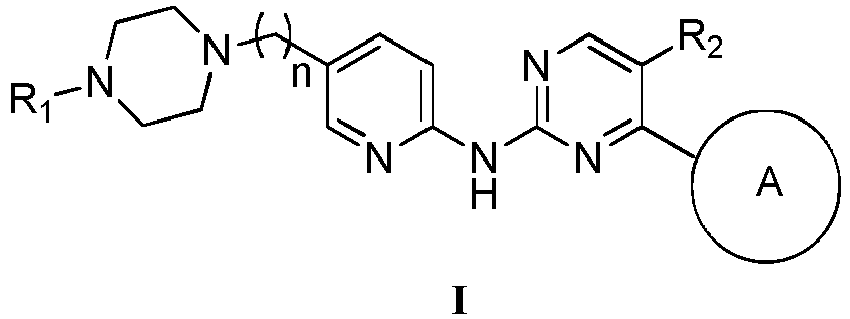
- R1 represents hydrogen, C1-C3 alkyl, or C3-C7cycloalkyl;
- R2 represents hydrogen, halogen, methyl, methoxy, or trifluoromethyl;
- n is 0 or 1;
- Ring A is

- R3 represents C1-C5 alkyl, or C3-C7 cycloalkyl;
- R4 and R5 independently represents hydrogen, C1-C3 alkyl, C3-C5 cycloalkyl, acetyl, halogen, trifluoromethyl, cyano or CONR7R8;
- R6 represents hydrogen, or halogen;
- R7 and R8 independently represents hydrogen or methyl;
- X is CR6 or N;
- Y and Z are independently C or N.
- The present invention also provides a pharmaceutical composition comprising at least one pharmaceutically acceptable carrier, and at least one compound of Formula (I) as described herein and a pharmaceutically acceptable salt thereof as a CDK4/6 inhibitor.
- As used herein, "C1-C3 alkyl" refers to methyl, ethyl, n-propyl, or iso-propyl; "C1-C5 alkyl" refers to methyl, ethyl, n-propyl, iso-propyl, n-butyl, iso-butyl, sec-butyl, tert-butyl, 1-pentyl, 2-pentyl, 3-pentyl, 2-methyl-3-butyl, 1,1-dimethyl-1-propyl, 2,2-dimethyl-1-propyl; "halogen" refers to F, Cl, Br, I; "C3-C7 cycloalkyl" refers to cyclopropyl, cyclobutyl, cyclopentyl, cyclohexyl, cycloheptyl; and "C3-C5 cycloalkyl" refers to cyclopropyl, cyclobutyl, cyclopentyl.
- Typical compounds of the present invention include those in following Table 1:
Compound Structure Compound Structure I-1 
I-2 
I-3 
I-4 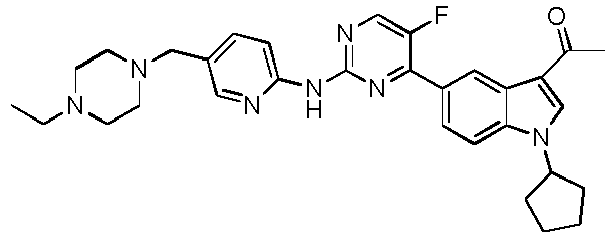
I-5 (reference) 
I-6 
I-7 
I-8 
I-9 
I-10 
I-11 
I-12 (reference) 
I-13 (reference) 
I-14 
I-15 
I-16 
I-17 
I-18 
I-19 
I-20 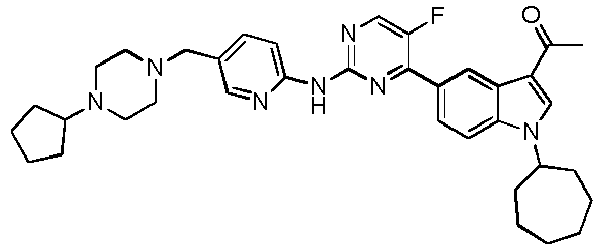
I-21 
I-22 
I-23 
I-24 
I-25 
I-26 
I-27 
I-28 
I-29 (reference) 
I-30 (reference) 
I-31 (reference) 
I-32 
I-33 
I-34 
I-35 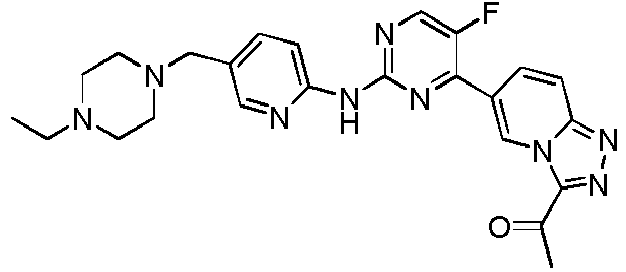
I-36 
I-37 
I-38 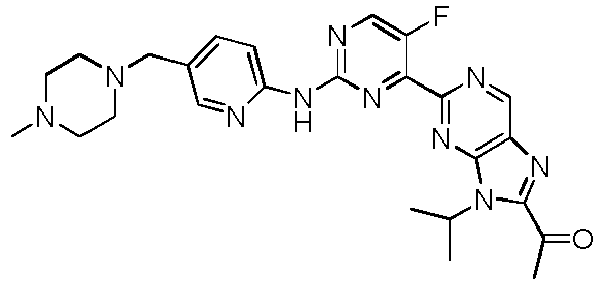
I-39 
I-40 
I-41 
I-42 
I-43 (reference) 
I-44 (reference) 
I-45 (reference) 
I-46 (reference) 
I-47 
I-48 
- Examples of a pharmaceutically acceptable salt include inorganic and organic salts such as hydrochloride, hydrobromide, sulfate, phosphate, citrate, tartrate, succinate, maleate, fumarate, mandelate and oxalate.
- The compound of the present invention can be prepared by the following synthetic scheme 1:

- The final product I is prepared according to the procedure reported in the literature (
COATES DAVID ANDREW et al. WO2010075074A1 ), i.e., the substituted 2-chloropyrimidine (I1) and the amine (I2) are subjected to a catalytic reaction to give the target product I. - The preparation of 2-chloropyrimidine (I1) can be prepared according to the following scheme 2 and 3.

- According to the method in references (B Corbel, FO Michaud et al. J. Heter.Chem. 2007, pp 793 and MO Frederick, DP Kjell, Tetra.Lett. 2015, pp 949), a starting material I3 is reacted with bromide (I4) under alkaline conditions to obtain I5 which is subjected to Suzuki coupling reaction with bis-boronic acid pinacol ester and 2,4-dichloropyrimidine (I7), respectively to obtain I1.
- The following I1 compounds can also be prepared according to scheme 2:


- According to the method in references (AJ Majeed, Ø Antonsen, et al. Tetra. 1989, pp 993;
GattiMcarthur, Silvia, Goetschi, Erwin et al. WO2007110337A1 andChen, Yuzhong; Sharpe, et al. WO2009061761A2 ), a starting material I8 is reacted with bromide (I4) under alkaline conditions to obtain I9 which is coupled with hexabutyldistannane and 2,4-dichloropyrimidine (I7), respectively to obtain I1. - The following I1 compounds can also be prepared according to scheme 3:

- The present invention relates to said 2,4-disubstituted pyrimidine derivatives as CDK4/6 inhibitors that can be used for various clinical diseases caused by dysregulation of the cell cycle wherein CDK4/6 involves, such as cancer. Such diseases include breast cancer, ovarian cancer, prostate cancer, colorectal cancer, liver cancer, melanoma, acute lymphocytic leukemia, chronic lymphocytic leukemia, multiple myeloma, lung cancer, gastric cancer, pancreatic cancer.
- In the treatment of the disease, the derivative of the present invention can be used in composition to treat related cancers and other diseases by oral, injection or the like.
- The composition comprises a therapeutically effective amount of a compound as described above or a pharmaceutically acceptable salt thereof and a pharmaceutically acceptable carrier.
- The carrier refers to a conventional carrier in the pharmaceutical field, such as a diluent, an excipient such as water, a binder such as a cellulose derivative, gelatin, polyvinylpyrrolidone, etc.; a filler such as starch, etc.; a cracking agent such as calcium carbonate, sodium bicarbonate. Additionally, other adjuvants such as flavoring agents and sweeteners may also be added to the composition.
- When used orally, they can be prepared into conventional solid preparations such as tablets, powders or capsules, etc.; when used for injection, they can be prepared as injections.
- Various dosage forms of the composition of the present invention can be prepared with a conventional method in the medical field, wherein the content of the active ingredient is from 0.1% to 99.5% by weight.
- The administration amount of the present invention can be varied according to the route of administration, the age, body weight of the patient, and the type and severity of the disease to be treated, and the daily dose thereof is 0.005-30 mg/kg body weight (for oral) or 0.005-30 mg/kg body weight (for injection).
- The present invention provides a novel 2,4-disubstituted pyrimidine derivative or a pharmaceutically acceptable salt thereof and a use of the compound as a novel CDK4/6 inhibitor. The 2,4-disubstituted pyrimidine derivative or a pharmaceutically acceptable salt thereof is used for the prevention or treatment of CDK4/6-related diseases. The various diseases caused by the imbalance of the cycle control involved with CDK4/6, especially malignant tumors to be treated include breast cancer, ovarian cancer, prostate cancer, colorectal cancer, pancreatic cancer, liver cancer, melanoma, gastric cancer, and solid tumors and the like.
- Step 1: 5-bromoindole (1.0 g, 5.1 mmol), 2-bromopropane (0.94 g, 7.65 mmol), and potassium hydroxide (0.43 g, 7.65 mmol) were added to N,N-dimethylformamide (DMF) (10 mL), and the reaction was carried out at 70 °C under N2 protection for 10 h. The reaction mixture was stirred and extracted with H2O (50 mL)/ethyl acetate (50 mL). The organic layer was dried, filtered, concentrated and subjected to a silica gel column (eluent: ethyl acetate/petroleum ether: 1/30-1/10) to give 1-isopropyl-5-bromo-1H-indole (0.8 g, yield 66%) as a white solid.
- Step 2: 1-isopropyl-5-bromo-1H-indole (0.8 g, 3.36 mmol), bis-boronic acid pinacol ester (1.02 g, 4.0 mmol), Pd(dppf)Cl2 (0.25 g, 0.34mmol), potassium acetate (0.66 g, 6.72 mmol) was added to 1,4-dioxane (15 mL), and the reaction was carried out at 80°C under N2 protection for 5 h. The solvent was concentrated to dry, the residue was stirred and extracted with H2O (50 mL)/ethyl acetate (50 mL), and the organic layer was dried, filtered and concentrated to give crude 1-isopropyl-5-boronic acid pinacol ester-1H-indole (0.96 g, calculated as 100% yield).
- Step 3: 1-isopropyl-5-boronic acid pinacol ester-1H-indole (0.96 g, 3.36 mmol), 2,4-dichloro-5-fluoropyrimidine (0.62 g, 3.7 mmol), Pd(PPh3)2Cl2 (0.23 g, 0.34 mmol) and K2CO3 (0.93 g, 8.66 mmol) were added into tetrahydrofuran (15 mL)/H2O (3 mL) and the reaction was carried out at 80°C under N2 protection for 6 h. The reaction mixture was stirred and extracted with H2O (50 mL)/ethyl acetate (50 mL). The organic layer was dried, filtered, concentrated and subjected to a silica gel column (eluent: ethyl acetate/petroleum ether: 1/30-1/20) to give 1-isopropyl-5-(2-chloro-5-fluoropyrimidin-4-yl)-1H-indole (0.5 g, yield of 51.5% over two steps) as a white solid, MS(m/z): 291 [M+H]+.
- Step 4: 1-isopropyl-5-(2-chloro-5-fluoropyrimidin-4-yl)-1H-indole (150 mg, 0.52 mmol), 5-[(4-ethylpiperazine-1-yl)-methyl)-pyridin-2-amine (114 mg, 0.52 mmol), Pd2(dba)3 (50 mg, 0.052 mmol), Xantphos (45 mg, 0.05278 mmol) and cesium carbonate (254 mg, 0.78 mmol) were added into 1,4-dioxane (815 mL) and the reaction was carried out at 100°C under N2 protection for 8 h. The solvent was concentrated to dry and the residue was sitirred and extracted with H2O (30 mL)/dichloromethane (DCM, 50 mL). The organic layer was dried, filtered, and concentrated to give a pale yellow solid. The residue was purified on a silica gel column (eluent: dichloromethane/methanol: 1/30-1/20) to give N-(5-(4-ethylpiperazine-1-methyl)-pyridin-2-yl)-5-fluoro-4-(1-isopropyl-1H-indol-5-yl)p yrimidin-2-amine (I-1, 125 mg, yield 50.9%) as a pale yellow solid, MS(m/z): 474 [M+H]+.1H NMR (DMSO-d6): δ: 11.91 (br, 1H), 11.62 (br, 1H), 8.78-8.77 (d, J = 4.0Hz, 1H), 8.60 (s, 1H), 8.41 (s, 1H), 8.38-8.36 (d, J = 8.0Hz, 1H), 8.03-8.01 (d, J = 8.0Hz, 1H), 7.97-7.95 (d, J = 8.0Hz, 1H), 7.76-7.74 (d, J = 8.0Hz, 1H), 7.67-7.66 (d, J = 4.0Hz, 1H), 6.69-6.68 (d, J = 4.0Hz, 1H), 4.89-4.82 (m, 1H), 4.42(m, 6H), 3.17(m, 4H), 1.50-1.49 (d, J = 4.0Hz, 6H), 1.28-1.24 (t, J = 8.0Hz, 3H).
- Compound I-2 was synthesized according to the method in Example 1. The starting materials were 1-isopropyl-5-(2-chloro-5-fluoropyrimidin-4-yl)-1H-indole and 4-(6-aminopyridin-3-yl)piperazine-1- tert-butyl carboxylate. N-(5-(4-tert-butyl carboxylate-1-piperazinyl)-pyridine-2-yl)-5-fluoro-4-(1-isopropyl-1H-indol-5-yl)pyrimidi n-2-amine was obtained by Step 4 in Example 1, and such intermediate was subjected to deprotection of BOC with 3N ethyl acetate hydrochloride to give a pale yellow solid title product of N-(5-(piperazin-1-yl)-pyridin-2-yl)-5-fluoro-4-(1-isopropyl-1H-indol-5-yl)pyrimidin-2-am ine hydrochloride (I-2). MS(m/z): 432 [M+H]+. 1H NMR (DMSO-d6): δ: 11.65(br, 1H), 9.70(br, 2H), 8.77-8.76 (d, J = 4.0Hz, 1H), 8.39 (s, 1H), 8.01-8.00 (d, J = 4.0Hz, 1H), 7.96 (s, 1H), 7.93(s, 1H), 7.85-7.83 (d, J = 8.0Hz, 1H), 7.76-7.74 (d, J = 8.0Hz, 1H), 7.68-7.67 (d, J = 4.0Hz, 1H), 6.69-6.68 (d, J = 4.0Hz, 1H), 4.89-4.82 (m, 1H), 3.69-3.46 (m, 8H), 1.51-1.49 (d, J = 8.0Hz, 6H).
- Compound I-3 was synthesized according to the method in Example 1. The starting materials were 1-cyclopentyl-3-acetyl-5-(2-chloro-5-fluoropyrimidin-4-yl)-1H-indole (the synthesis method was similar to that in Example 1, and the starting materialswere 2,4-dichloro-5-fluoropyrimidine and 1-cyclopentyl-3-acetyl-5-boronic acid pinacol ester-1H-indole (starting materials were bromocyclopentane and 3-acetyl-5-bromo-1H-indole)) and 4-(6-aminopyridin-3-yl)piperazine-I-tert-butyl carboxylate. The title product of N-(5-(piperazin-1-yl)-pyridin-2-yl)-5-fluoro-4-(1-cyclopentyl-3-acetyl-1H-indol-5-yl)pyri midin-2-amine hydrochloride (I-3) was obtained as a pale yellow solid. MS(m/z): 500 [M+H]+. 1H NMR (DMSO-d6): δ: 11.67 (br, 1H), 9.73 (br, 2H), 9.39 (s, 1H), 8.78 (s, 1H), 8.69-8.67 (d, J = 8.0Hz, 1H), 8.00-7.97 (m, 2H), 7.93 (s, 1H), 7.72-7.69 (m, 2H), 4.89-4.83 (m, 1H), 3.69-3.46 (m, 8H), 2.73 (s, 3H), 2.02-1.67 (m, 8H).
- Compound 1-4 was synthesized according to the method in Example 1. The starting materials were 1-cyclopentyl-3-acetyl-5-(2-chloro-5-fluoropyrimidin-4-yl)-1H-indole and 5-[(4-ethylpiperazin-1-yl)methyl]pyridin-2-amine. The title product of N-(5-(4-ethylpiperazin-1-methyl)-pyridin-2-yl)-5-fluoro-4-(1-cyclopentyl-3-acetyl-1H-in dol-5-yl)pyrimidin-2-amine (I-4)was obtained as a pale yellow solid. MS(m/z): 542[M+H]+. 1H NMR (DMSO-d6): δ: 11.93(br, 1H), 11.63(br, 1H), 9.39 (s, 1H), 8.78-8.77 (d, J = 4.0Hz, 1H), 8.61(s, 1H), 8.41 (s, 1H), 8.39-8.36 (m, 2H), 7.97-7.95 (d, J = 8.0Hz, 1H), 7.67-7.65 (d, J = 8.0Hz, 1H), 4.89-4.82 (m, 1H), 4.57 (s, 2H), 4.41-4.21(m, 13H), 2.01-1.69 (m, 8H), 1.28-1.24 (t, J = 8.0Hz, 3H).
- Compound I-5 was synthesized according to the method in Example 1, and the starting materials were 2,3-dimethyl-6-(2-chloro-5-fluoropyrimidin-4-yl)-2H-indazole (its synthesis method was similar to that in Example 1, and the starting materials were 2,4-dichloro-5-fluoropyrimidine and 2,3-dimethyl-6-bromo-2H-indazole) and 4-(6-aminopyridin-3-yl)piperazine-1- tert-butyl carboxylate. The title product of N-(5-(piperazin-1-yl)-pyridin-2-yl)-5-fluoro-4-(2,3-dimethyl-2H-indazol-6-yl)pyrimidin-2 -amine hydrochloride (I-5) was obtained as a pale yellow solid. MS(m/z): 419 [M+H]+. 1H NMR (DMSO-d6): δ: 11.68 (br, 1H), 9.75 (br, 2H), 9.37 (s, 1H), 8.80-8.78 (d, J = 8.0Hz, 1H), 8.75 (s, 1H), 8.00-7.97 (m, 2H), 7.72-7.69 (m, 2H), 4.53 (s, 3H), 4.35-4.21 (m, 11H).
- Compound I-6 was synthesized according to the method in Example 1, and the starting materials were 3-isopropyl-6-(2-chloro-5-fluoropyrimidin-4-yl)-[1,2,4]triazolo[4,3-a]pyridine (its synthesis method was similar to that in Example 1, and the starting materials were 2,4-dichloro-5-fluoropyrimidine and 3-isopropyl-6-bromo-[1,2,4]triazolo[4,3-a]pyridine) and 5-[(4-ethylpiperazin-1-yl)methyl]pyridin-2-amine. The title product of N-(5-(4-ethylpiperazine-1-methyl)-pyridin-2-yl)-5-fluoro-4-(3-isopropyl-[1,2,4]triazolo[4 ,3-a]pyridin-6-yl)pyrimidin-2-amine (I-6) was obtained as a pale yellow solid. MS(m/z): 476[M+H]+. 1H NMR (DMSO-d6): δ: 11.93 (br, 1H), 11.61 (br, 1H), 9.67 (s, 1H), 9.37(s, 1H), 8.83-8.79 (m, 2H), 8.51 (s, 1H), 7.79-7.77 (d, J = 8.0Hz, 1H), 7.03-7.01 (d, J = 8.0Hz, 1H), 4.88-4.83 (m, 1H), 4.57 (s, 2H), 4.21-4.02 (m, 9H), 1.53-1.51 (d, J = 8.0Hz, 6H), 1.28-1.24 (t, J = 8.0Hz, 3H).
- Compound I-7 was synthesized according to the method in Example 1, and the starting materials were 3-isopropyl-6-(2-chloro-5-fluoropyrimidin-4-yl)-[1,2,4]triazolo[4,3-a]pyridine and 4-(6-aminopyridin-3-yl)piperazine-1- tert-butyl carboxylate. The title product of N-(5-(piperazin-1-yl)-pyridin-2-yl)-5-fluoro-4-(3-isopropyl-[1,2,4]triazolo[4,3-a]pyridine-6-yl)pyrimidin-2-amine hydrochloride (I-7) was obtained as a pale yellow solid. MS(m/z): 434[M+H]+. 1H NMR (DMSO-d6): δ: 11.69 (br, 1H), 9.81 (br, 2H), 9.67 (s, 1H), 9.38 (s, 1H), 8.82-8.78 (m, 2H), 8.48 (s, 1H), 7.79-7.75 (m, 2H), 4.33-4.20 (m, 9H), 1.51-1.49 (d, J= 8.0Hz, 6H).
- 2-chloro-9-isopropyl-8-methyl-9H-purine (synthesis was performed according to Step 1 in Example 1, 500 mg, 2.38 mmol), Pd(PPh3)2Cl2 (167 mg, 0.24 mmol), hexabutyldistannane (1.45 g, 2.50 mmol) were added into 1,4-dioxane (10 mL) and reacted at 80° C under N2 protection for 5 h. The solvent was concentrated to dry and the residue was purified on a silica gel column (eluent: ethyl acetate/petroleum ether: 1/30-1/20) to give 2-tri-n-butyltin-9-isopropyl-8-methyl-9H-purine (700 mg, yield 63.2%).
- 2-tri-n-butyltin-9-isopropyl-8-methyl-9H-purine (700 mg, 1.51 mmol), 2,4-dichloro-5-fluoropyrimidine (276 mg, 1.65 mmol), Pd(PPh3)2Cl2 (110 mg, 0.15 mmol), K2CO3 (415 mg, 3.01 mmol) were added into 1,4-dioxane (10 mL) and the reaction was carried out at 80°C under N2 protection for 6 h. The reaction mixture was stirred and extracted with H2O (50 mL)/ethyl acetate (50 mL). The organic layer was dried, filtered, concentrated and purified ona silica gel column (eluent: ethyl acetate/petroleum ether: 1/30-1/20) to give a white solid 9-isopropyl-8-methyl-2-(2-chloro-5-fluoropyrimidin-4-yl)-9H-purine (350 mg, yield 76.1%), MS(m/z): 308 [M+H]+.
- Compound I-8 was prepared according to the methods in Examples 1 and 2, 9-isopropyl-8-methyl-2-(2-chloro-5-fluoropyrimidin-4-yl)-9H-purine and 4-(6-aminopyridin-3-yl)piperazine-1- tert-butyl carboxylate were used as starting materials to give a pale yellow solid title product of N-(5-(piperazin-1-yl)-pyridin-2-yl)-5-fluoro-4-(9-isopropyl-8-methyl-9H-purin-2-yl)pyrim idin-2-amine hydrochloride (I-8).MS(m/z): 449[M+H]+. 1H NMR (DMSO-d6): δ: 11.68 (br, 1H), 9.83 (br, 2H), 9.81 (s, 1H), 9.39 (s, 1H), 8.85 (s, 1H), 8.02-8.00 (d, J = 8.0Hz, 1H), 7.93-7.91 (d, J = 8.0Hz, 1H), 5.86-5.81 (m, 1H), 4.32-4.20 (m, 8H), 2.85 (s, 3H), 1.55-1.54 (d, J = 4.0Hz, 6H).
- Compound I-9 was synthesized according to the method in Example 1, and the starting materials were 9-isopropyl-8-methyl-2-(2-chloro-5-fluoropyrimidin-4-yl)-9H-purine and 5-[(4-ethylpiperazin-1-yl)methyl]pyridin-2-amine. The title product of N-(5-(4-ethylpiperazin-1-methyl)-pyridin-2-yl)-5-fluoro-4-(9-isopropyl-8-methyl-9H-puri n-2-yl)pyrimidin-2-amine (I-9) was obtained as a pale yellow solid.MS(m/z): 491 [M+H]+. 1H NMR (DMSO-d6): δ: 11.95(br, 1H), 11.64(br, 1H), 9.82(s, 1H), 9.38(s, 1H), 8.84 (s, 1H), 8.05-8.03 (d, J = 8.0Hz, 1H), 7.03-7.01 (d, J = 8.0Hz, 1H), 5.88-5.83 (m, 1H), 4.58(s, 2H), 4.21-4.02 (m, 13H), 1.54-1.53 (d, J = 4.0Hz, 6H), 1.28-1.24 (t, J = 8.0Hz, 3H).
- Compound 1-10 was synthesized according to the methodin Example 1, and the starting materials were 5-fluoro-6-formic acid diformamido-7-isopropyl-4-(2-chloro-5-fluoropyrimidin-4-yl)-7H-pyrrolo[2,3-d]pyrimidin e (its synthesiswas similar to that in Example 8, the starting materials were2,4-dichloro-5-fluoropyrimidine and 2-chloro-5-fluoro-6-formic acid diformamido-7-isopropyl-7H-pyrrolo[2,3-d]pyrimidine) and 4-(6-aminopyridin-3-yl)piperazine-1- tert-butyl carboxylate. The title product ofN-(5-(piperazin-1-yl)-pyridin-2-yl)-5-fluoro-4-(5-fluoro-6-formic acid diformamido-7-isopropyl-7H-pyrrolo[2,3-d]pyrimidin-4-yl)pyrimidin-2-amine hydrochloride (I-10) was obtained as a pale yellow solid.MS(m/z): 523[M+H]+. 1H NMR (DMSO-d6): δ: 11.67(br, 1H), 9.82(br, 2H), 9.83(s, 1H), 9.37(s, 1H), 8.83 (s, 1H), 8.02-8.00 (d, J = 8.0Hz, 1H), 7.94-7.92 (d, J = 8.0Hz, 1H), 5.85-5.82 (m, 1H), 4.32-4.20 (m, 14H), 1.56-1.55 (d, J = 4.0Hz, 6H).
- Compound I-11 was synthesized according to the method in Example 1, and the starting materials were 6-methyl-7-cyclopentyl-4-(2-chloro-5-fluoropyrimidin-4-yl)-7H-pyrrolo[2,3-d]pyrimidine (its synthesis was similar to that in Example 10, the starting materials were 2,4-dichloro-5-fluoropyrimidine and 6-methyl-7-cyclopentyl-4-bromo-7H-pyrrolo[2,3-d]pyrimidine) and 5-[(4-ethylpiperazin-1-yl)methyl]pyridin-2-amine. The title product of N-(5-(4-ethylpiperazine-1-methyl)-pyridin-2-yl)-5-fluoro-4-(6-methyl-7-cyclopentyl-7H-pyrrolo[2,3-d]pyrimidin-4-yl)pyrimidin-2-amine (I-11) was obtained as apale yellow solid.MS(m/z): 516 [M+H]+. 1H NMR (DMSO-d6): δ: 11.93 (br, 1H), 11.62 (br, 1H), 9.84 (s, 1H), 9.38 (s, 1H), 8.83 (s, 1H), 8.04-8.02 (d, J = 8.0Hz, 1H), 7.00-6.98 (d, J = 8.0Hz, 1H), 6.63 (s, 1H), 4.89-4.83 (m, 1H), 4.59 (s, 2H), 4.21-4.03 (m, 10H), 2.10-1.68 (m, 11H), 1.26-1.22 (t, J = 8.0Hz, 3H).
- Compound 1-12 was synthesized according to the method in Example 1, and the starting materials were 2-methyl-3-cyclopentyl-6-(2-chloro-5-fluoropyrimidin-4-yl)-2H-7-azaindazole (its synthesis was similar to that in Example 1, and the starting materials were 2,4-dichloro-5-fluoropyrimidine and 2-methyl-3-cyclopentyl-6-bromo-2H-indazole) and 4-(6-aminopyridin-3-yl)piperazine-1- tert-butyl carboxylate. The title product ofN-(5-(piperazin-1-yl)-pyridin-2-yl)-5-fluoro-4-(2-methyl-3-cyclopentyl-2H-7-azaindaz ol-6-yl)pyrimidin-2-amine hydrochloride (I-12) was obtained as a paleyellow solid.MS(m/z): 474[M+H]+. 1H NMR (DMSO-d6): δ: 11.71(br, 1H), 9.79(br, 2H), 9.38(s, 1H), 8.80-8.78 (d, J = 8.0Hz, 1H), 8.73(s, 1H), 7.58 (s, 1H), 7.23-7.19 (m, 2H), 4.47(s, 3H), 4.36-4.21 (m, 8H), 1.57-1.29 (m, 8H).
- Compound I-13 was synthesized according to the method in Example 1, and the starting materials were 1-isopropyl-3-formamido-4-fluoro-5-(2-chloro-5-fluoropyrimidin-4-yl)-1H-indazole (its synthesis was similar to that in Example 1, and the starting materials were 2,4-dichloro-5-fluoropyrimidine and 1-isopropyl-3-formamido-4-fluoro-5-bromo-1H-indazole (the starting materials are bromoisopropane and 3-formamido-4-fluoro-5-bromo-1H-indazole)) and 4-(6-aminopyridin-3-yl)piperazine-1- tert-butyl carboxylate. The title product of N-(5-(piperazin-1-yl)-pyridin-2-yl)-5-fluoro-4-(1-isopropyl-3-formamido-4-fluoro-1H-ind azol-5-yl)pyrimidin-2-amine hydrochloride (I-13) was obtainedas a pale white solid.MS(m/z): 494[M+H]+. 1H NMR (DMSO-d6): δ: 12.11 (br, 2H), 11.68(br, 1H), 9.71 (br, 2H), 9.39(s, 1H), 8.68-8.66 (d, J = 8.0Hz, 1H), 8.02-8.00 (d, J = 8.0Hz, 1H), 7.95(s, 1H), 7.73-7.69 (m, 2H), 4.87-4.82 (m, 1H), 3.67-3.46 (m, 8H), 1.24-1.20 (d, J = 8.0Hz, 6H).
- Compound I-14 was synthesized according to the method in Example 1, and the starting materials were 1-cyclopentyl-2-formic acid diformamido-5-(2-chloro-5-fluoropyrimidin-4-yl)-1H-indole (its synthesis was similar to that in Example 1, and the starting materials were 2,4-dichloro-5-fluoropyrimidine and 1-cyclopentyl-2-formic acid diformamido-5-boronic acid pinacol ester-1H-indole (the starting materials were bromocyclopentane and 2-formic acid diformamido-5-bromo-1H-indole)) and 4-(6-aminopyridin-3-yl)piperazine-1-c tert-butyl arboxylate. The title product of N-(5-(piperazin-1-yl)-pyridin-2-yl)-5-fluoro-4-(1-cyclopentyl-2-formic acid diformamido-1H-indol-5-yl)pyrimidin-2-amine hydrochloride (I-14) was obtained as a pale white solid.MS(m/z): 529 [M+H]+. 1H NMR (DMSO-d6): δ: 11.66(br, 1H), 9.71(br, 2H), 9.38(s, 1H), 8.78 (s, 1H), 8.67-8.65 (d, J = 8.0Hz, 1H), 8.01-7.97 (m, 2H), 7.93 (s, 1H), 7.71-7.69 (m, 2H), 4.88-4.82 (m, 1H), 3.68-3.46 (m, 14H), 2.01-1.68 (m, 8H).
- Compound I-15 was synthesized according to the method in Example 1, and the starting materials were 1-(3-pentyl)-2-acetyl-5-(2-chloro-5-fluoropyrimidin-4-yl)-1H-indole (its synthesis was similar to that in Example 1, and the starting materials were 2,4-dichloro-5-fluoropyrimidine and 1-(3-pentyl)-2-acetyl-5-boronic acid pinacolester-1H-indole (the starting materials were 3-bromopentane and 2-acetyl-5-bromo-1H-indole)) and 5-[(4-methylpiperazin-1-yl)methyl]pyridine-2-amine. The title product of N-(5-(4-methylpiperazin-1-methyl)-pyridin-2-yl)-5-chloro-4-(1-(3-pentyl)-2-acetyl-1H-in dol-5-yl)pyrimidin-2-amine (I-15) was obtained as a white solid.MS(m/z): 547 [M+H]+. 1H NMR (DMSO-d6): δ: 11.91 (br, 1H), 11.62 (br, 1H), 9.38 (s, 1H), 8.76-8.75 (d, J = 4.0Hz, 1H), 8.60 (s, 1H), 8.40 (s, 1H), 8.37-8.34 (m, 2H), 7.97-7.95 (d, J = 8.0Hz, 1H), 7.66-7.64 (d, J = 8.0Hz, 1H), 4.87-4.82 (m, 1H), 4.56 (s, 2H), 4.40-4.21(m, 8H), 2.42 (s, 3H), 2.37 (s, 3H), 2.03-1.98 (m, 4H), 1.02-0.98 (m, 6H).
- Compound 1-16 was synthesized according to the method in Example 1, and the starting material were 1,2-dimethyl-3-trifluoromethyl-5-(2-chloro-pyrimidin-4-yl)-1H-indole (its synthesis was similar to that in Example 1, and the starting materials were 2,4-dichloro-pyrimidine and 1,2-dimethyl-3-trifluoromethyl-5-boronic acid pinacol ester-1H-indole (the starting materials were methyl iodide and 2-methyl-3-trifluoromethyl-5-bromo-1H-indole)) and 5-[(4-isopropylpiperazin-1-yl)methyl]pyridine 2-amine. The title product of N-(5-(4-isopropylpiperazin-1-methyl)-pyridin-2-yl)-4-(1,2-dimethyl-3-trifluoromethyl-1H -indol-5-yl)pyrimidin-2-amine (I-16) was obtained as a white solid.MS(m/z): 524[M+H]+. 1H NMR (DMSO-d6): δ: 11.90(br, 1H), 11.63(br, 1H), 9.35(s, 1H), 8.78-8.77 (d, J = 4.0Hz, 1H),8.58(s, 1H), 8.38-8.35 (m, 2H), 7.93-7.88 (m, 2H), 7.35 (s, 1H), 4.57 (s, 2H), 4.52 (s, 3H), 4.42-4.19 (m, 12H), 1.25-1.21 (d, J = 8.0Hz, 6H).
- Compound I-17 was synthesized according to the method in Example 1, and the starting materials were 1-cyclopropyl-2-cyano-3-isopropyl-5-(2-chloro-pyrimidin-4-yl)-1H-indole (its synthesis was similar to that in Example 1, and the starting materials were 2,4-dichloro-5-fluoro-pyrimidine and 1-cyclopropyl-2-cyano-3-isopropyl-5-boronic acid pinacol ester-1H-indole (the starting materials were bromocyclopropane and 1-cyclopropyl-2-cyano-5-bromo-1H-indole)) and 5-[(4-cyclopropylpiperazin-1-yl)methyl]pyridin-2-amine. The title product of N-(5-(4-cyclopropylpiperazine-1-methyl)-pyridin-2-yl)-5-fluoro-4-(1-cyclopropyl-2-cyan o-3-isopropyl-1H-indol-5-yl)pyrimidin-2-amine (I-17) was obtained as a pale yellow solid.MS(m/z): 552[M+H]+. 1H NMR (DMSO-d6): δ: 11.91(br, 1H), 11.62(br, 1H), 9.33(s, 1H), 8.78-8.75 (m, 2H), 8.39-8.36 (m, 2H), 7.91-7.88 (m, 1H), 7.37(s, 1H), 4.56 (s, 2H), 4.43-4.19 (m, 10H), 1.25-1.20 (m, 7H), 0.95-0.82 (m, 8H).
- Compound I-18 was synthesized according to the method in Example 1, and the starting materials were 1-cyclobutyl-3-cyclopropyl-5-(2-chloro-pyrimidin-4-yl)-1H-indole (its synthesis was similar to that in Example 1, the starting materials were 2,4-dichloro-5-fluoro-pyrimidine and 1-cyclobutyl-3-cyclopropyl-5-boronic acid pinacol ester-1H-indole (the starting materials were bromocyclobutane and 3-cyclopropyl-5-bromo-1H-indole)) and 5-[(4-cycloheptylpiperazin-l-yl)methyl]pyridin-2-amine. Thetitle product of N-(5-(4-cycloheptylpiperazine-1-methyl)-pyridin-2-yl)-5-fluoro-4-(1-cyclobutyl-3-cyclop ropyl-1H-indol-5-yl)pyrimidin-2-amine (I-18) was obtained as a pale yellow solid.MS(m/z): 594 [M+H]+. 1H NMR (DMSO-d6): δ: 11.91 (br, 1H), 11.62 (br, 1H), 9.35 (s, 1H), 8.79-8.76 (m, 2H), 8.57 (s, 1H), 8.39-8.36 (m, 2H), 7.90-7.88 (d, J = 8.0Hz, 1H), 7.35 (s, 1H), 4.88-4.82 (m, 1H), 4.57 (s, 2H), 4.43-4.13 (m, 15H), 1.25-1.01 (m, 17H).
- Compound I-19 was synthesized according to the method in Example 1, and the starting materials were 1-cyclohexyl-3-cyclobutyl-5-(2-chloro-pyrimidin-4-yl)-1H-indole (its synthesis was similar to that in Example 1, and the starting materials were 2,4-dichloro-5-fluoro-pyrimidine and 1-cyclohexyl-3-cyclobutyl-5-boronic acid pinacol ester-1H-indole (the starting materials were bromocyclohexane and 3-cyclobutyl-5-bromo-1H-indole)) and 5-[(4-cyclohexylpiperazin-1-yl)methyl]pyridin-2-amine. The title product of N-(5-(4-cyclohexylpiperazine-1-methyl)-pyridin-2-yl)-5-fluoro-4-(1-cyclohexyl-3-cyclob utyl-1H-lndol-5-yl)pyrimidin-2-amine (I-19) was obtained as a pale yellow solid.MS(m/z): 622 [M+H]+. 1H NMR (DMSO-d6): δ: 11.92 (br, 1H), 11.63 (br, 1H), 9.37 (s, 1H), 8.80-8.78 (d, J = 8.0Hz, 1H), 8.57 (s, 1H), 8.39-8.36 (m, 2H), 7.90-7.88 (d, J = 8.0Hz, 1H), 7.67-7.65 (d, J = 8.0Hz, 1H), 7.37 (s, 1H), 4.83-4.68 (m, 3H), 4.60-4.56 (m, 1H), 4.45-4.11 (m, 15H), 1.27-1.01 (m, 20H).
- Compound I-20 was synthesized according to the method in Example 1, and the starting materials were 1-cycloheptyl-3-acetyl-5-(2-chloro-pyrimidin-4-yl)-1H-indole (its synthesis was similar to thatin Example 1, and the starting materials were 2,4-dichloro-5-fluoro-pyrimidine and 1-cycloheptyl-3-acetyl-5-boronic acid pinacol ester-1H-indole (the starting materials were bromocycloheptane and 3-acetyl-5-bromo-1H-indole)) and 5-[(4-cyclopentylpiperazin-1-yl)methyl]pyridin-2-amine. The title product of N-(5-(4-cyclopentylpiperazin-1-methyl)-pyridin-2-yl)-5-fluoro-4-(1-cycloheptyl-3-acetyl -1H-indol-5-yl)pyrimidin-2-amine (I-20) was obtained as a white solid.MS(m/z): 610 [M+H]+. 1H NMR (DMSO-d6): δ: 11.91(br, 1H), 11.63 (br, 1H), 9.57 (s, 1H), 9.35(s, 1H), 8.81-8.79 (d, J = 8.0Hz, 1H), 8.57 (s, 1H), 8.41-8.37 (m, 2H), 7.90-7.88 (d, J = 8.0Hz, 1H), 7.66-7.65 (d, J = 4.0Hz, 1H), 4.81-4.69 (m, 3H), 4.43-4.21 (m, 12H), 1.29-1.03 (m, 20H).
- Compound I-21 was synthesized according to the method in Example 1, and the starting materials were 1-isopropyl-2-cyclopentyl-5-(2-chloro-pyrimidin-4-yl)-1H-indole (its synthesis was similar to that in Example 1, and the starting materials were 2,4-dichloro-5-fluoro-pyrimidine and 1-isopropyl-2-cyclopentyl-5-boronic acid pinacol ester-1H-indole (the starting materials were bromoisopropane and 2-cyclopentyl-5-bromo-1H-indole)) and 5-(4-cyclobutyrazin-1-yl)pyridin-2-amine. The title product of N-(5-(4-cyclobutylpiperazin-1-yl)-pyridin-2-yl)-5-fluoro-4-(1-isopropyl-2-cyclopentyl-1H -indol-5-yl)pyrimidin-2-amine (I-21) was obtained as a white solid.MS(m/z): 554 [M+H]+. 1H NMR (DMSO-d6): δ: 11.92 (br, 1H), 11.65 (br, 1H), 9.38 (s, 1H), 8.80-8.78 (d, J = 8.0Hz, 1H), 8.56 (s, 1H), 8.40-8.37 (m, 2H), 7.90-7.88 (d, J = 8.0Hz, 1H), 7.67-7.65 (d, J = 8.0Hz, 1H), 7.37 (s, 1H), 5.81-5.70 (m, 1H), 4.41-4.21 (m, 10H), 1.57-1.02 (m, 20H).
- Compound I-22 was synthesized according to the method in Example 1, and the starting materials were 1-cyclopentyl-2-formic acid diformamido-5-(2-chloro-5-fluoropyrimidin-4-yl)-1H-indole and 5-[(4-ethylpiperazin-1-yl)methyl]pyridin-2-amine. The title product of N-(5-(4-ethylpiperazine-1-methyl)-pyridin-2-yl)-5-fluoro-4-(1-cyclopentyl-2-formic acid diformamido-1H-indol-5-yl)pyrimidin-2-amine (I-22) was obtained as a pale yellow solid.MS(m/z): 572 [M+H]+. 1H NMR (DMSO-d6): δ: 11.92 (br, 1H), 11.65 (br, 1H), 9.37 (s, 1H), 8.78-8.76 (d, J = 8.0Hz, 1H), 8.59 (s, 1H), 8.39-8.36 (m, 2H), 7.98-7.96 (m, 2H), 7.67-7.65 (d, J = 8.0Hz, 1H), 4.89-4.83 (m, 1H), 4.57 (s, 2H), 4.21 (s, 6H), 3.68-3.48 (m, 10H), 2.02-1.69 (m, 8H), 1.26-1.22 (t, J = 8.0Hz, 3H).
- Compound I-23 was synthesized according to the method in Example 1, and the starting materials were 1-isopropyl-2-acetyl-5-(2-chloro-5-fluoropyrimidin-4-yl)-1H-indole (its synthesis was similar to that in Example 1, and the starting materials were 2,4-dichloro-5-fluoropyrimidine and 1-isopropyl-2-acetyl-5-boronic acid pinacol ester-1H-indole (the starting materials were bromoisopropane and 2-acetyl-5-bromo-1H-indole)) and 4-(6-aminopyridin-3-yl)piperazine-1- tert-butyl carboxylate. The title product of N-(5-(piperazin-1-yl)-pyridin-2-yl)-5-fluoro-4-(1-isopropyl-2-acetyl-1H-indol-5-yl)pyrimi din-2-amine hydrochloride (I-23) was obtained as a pale yellow solid.MS(m/z): 474[M+H]+. 1H NMR (DMSO-d6): δ: 11.69(br, 1H), 9.75(br, 2H), 9.38(s, 1H), 8.82(s, 1H), 8.69-8.67 (d, J = 8.0Hz, 1H), 8.01-7.97 (m, 2H), 7.92(s, 1H), 7.73-7.69 (m, 2H), 4.89-4.83 (m, 1H), 3.69-3.48 (m, 8H), 2.75(s, 3H), 1.67-1.65 (d, J = 8.0Hz, 6H).
- Compound I-24 was synthesized according to the method in Example 1, and the starting materials were 1-isopropyl-2-acetyl-5-(2-chloro-5-fluoropyrimidin-4-yl)-1H-indole and 5-[(4-ethylpiperazin-1-yl)methyl]pyridin-2-amine. The title product of N-(5-(4-ethylpiperazine-1-methyl)-pyridin-2-yl)-5-fluoro-4-(1-isopropyl-2-acetyl-1H-ind ol-5-yl)pyrimidin-2-amine (I-24)was obtained as a pale yellow solid.MS(m/z): 516[M+H]+. 1H NMR (DMSO-d6): δ: 11.93(br, 1H), 11.67(br, 1H), 9.36(s, 1H), 8.78-8.76 (d, J = 8.0Hz, 1H), 8.58(s, 1H), 8.39-8.36 (m, 2H), 7.98-7.95 (m, 2H), 7.67-7.65 (d, J = 8.0Hz, 1H), 4.89-4.82 (m, 1H), 4.58 (s, 2H), 3.68-3.51 (m, 10H), 2.67 (s, 3H), 1.67-1.65 (d, J = 8.0Hz, 6H), 1.27-1.23 (t, J = 8.0Hz, 3H).
- Compound I-25 was synthesized according to the method in Example 1, and the starting materials were 1-isopropyl-2-formic acid diformamido-5-(2-chloro-5-fluoropyrimidin-4-yl)-1H-4-azaindole (its synthesis was similar to that in Example 1, and the starting materials were 2,4-dichloro-5-fluoropyrimidine and 1-isopropyl-2-formic acid diformamido-5-boronic acid pinacol ester-1H-4-azepine (the starting material werebromoisopropane and 2-formic acid diformamido-5-bromo-1H-4-azaindole)) and tert-butyl 4-(6-aminopyridin-3-yl)piperazine-1-carboxylate. The title product of N-(5-(piperazin-1-yl)-pyridin-2-yl)-5-fluoro-4-(1-isopropyl-2-formic acid diformamido-1H-4-azaindol-5-yl)pyrimidin-2-amine hydrochloride (I-25) was obtained as a pale yellow solid.MS(m/z): 504 [M+H]+. 1H NMR (DMSO-d6): δ: 11.69 (br, 1H), 9.77 (br, 2H), 9.39 (s, 1H), 8.82 (s, 1H), 8.69-8.67 (d, J = 8.0Hz, 1H), 8.01-7.98 (m, 1H), 7.92 (s, 1H), 7.73-7.69 (m, 1H), 6.87 (s, 1H), 4.82-4.51 (m, 15H), 1.67-1.65 (d, J = 8.0Hz, 6H).
- Compound I-26 was synthesized according to the method in Example 1, and the starting materials were 1-isopropyl-2-formic acid diformamido-5-(2-chloro-5-fluoropyrimidin-4-yl)-1H-4-azaindole and 5-[(4-ethylpiperazin-1-yl)methyl]pyridin-2-amine. The title product of N-(5-(4-ethylpiperazine-1-methyl)-pyridin-2-yl)-5-fluoro-4-(1-isopropyl-2-formic acid diformamido-1H-4-azaindol-5-yl)pyrimidin-2-amine (I-26) was obtained as a pale yellow solid.MS(m/z): 546[M+H]+. 1H NMR (DMSO-d6): δ: 11.92 (br, 1H), 11.68 (br, 1H), 9.38 (s, 1H), 8.78-8.76 (d, J = 8.0Hz, 1H), 8.57 (s, 1H), 8.39-8.36 (m, 2H), 7.98-7.97 (m, 1H), 7.67-7.65 (d, J = 8.0Hz, 1H), 4.89-4.83 (m, 1H), 4.59 (s, 2H), 4.21 (s, 6H), 3.68-3.53 (m, 10H), 2.67 (s, 3H), 1.67-1.66 (d, J = 4.0Hz, 6H), 1.29-1.25 (t, J= 8.0Hz, 3H).
- Compound I-27 was synthesized according to the method in Example 1, and the starting materials were 1-isopropyl-2-formic acid diformamido-5-(2-chloro-5-fluoropyrimidin-4-yl)-1H-4-fluoroindole and 5-[(4-ethylpiperazin-1-yl)methyl]pyridin-2-amine. The title product of N-(5-(4-ethylpiperazin-1-methyl)-pyridin-2-yl)-5-fluoro-4-(1-isopropyl-2-formic acid diformamido-1H-4-fluoroindol-5-yl)pyrimidin-2-amine (I-27) was obtained as a pale yellow solid.MS(m/z): 563 [M+H]+. 1H NMR (DMSO-d6): δ: 11.91 (br, 1H), 11.69 (br, 1H), 9.37 (s, 1H), 8.78-8.76 (d, J = 8.0Hz, 1H), 8.58 (s, 1H), 8.39-8.36 (m, 2H), 7.99-7.97 (d, J = 8.0Hz, 1H), 7.67-7.65 (d, J = 8.0Hz, 1H), 4.89-4.83 (m, 1H), 4.57 (s, 2H), 4.23 (s, 6H), 3.68-3.52 (m, 10H), 2.67 (s, 3H), 1.69-1.67 (d, J = 4.0Hz, 6H), 1.29-1.25 (t, J= 8.0Hz, 3H).
- Compound I-28 was synthesized according to the method in Example 1, and the starting materials were 1-isopropyl-2-formic acid diformamido-5-(2-chloro-5-fluoropyrimidin-4-yl)-1H-4-fluoroindole and tert-butyl 4-(6-aminopyridin-3-yl)piperazine-1-carboxylate. The title product of N-(5-(piperazin-1-yl)-pyridin-2-yl)-5-fluoro-4-(1-isopropyl-2-formic acid diformamido-1H-4-fluoroindol-5-yl)pyrimidin-2-amine hydrochloride (I-28) was obtained as a pale yellow solid.MS(m/z): 521[M+H]+. 1H NMR (DMSO-d6): δ: 11.67(br, 1H), 9.76(br, 2H), 9.41(s, 1H), 8.85(s, 1H), 8.69-8.67 (d, J = 8.0Hz, 1H), 8.00-7.98 (d, J = 8.0Hz, 1H), 7.92 (s, 1H), 7.73-7.69 (m, 2H), 4.89-4.82 (m, 1H), 4.77-4.62 (m, 14H), 1.68-1.66 (d, J= 8.0Hz, 6H).
- Compound I-29 was synthesized according to the method in Example 1, and the starting materials were 2-cyclopropyl-3-acetyl-6-(2-chloro-5-fluoropyrimidin-4-yl)-2H-7-azaindazole (its synthesiswas similar to that in Example 1, and the starting materials were 2,4-dichloro-5-fluoropyrimidine and 2-cyclopropyl-3-acetyl-6-bromo-2H-7-azaindazole) and tert-butyl 4-(6-aminopyridin-3-yl)piperazine-1-carboxylate. The title product of N-(5-(piperazin-1-yl)-pyridin-2-yl)-5-fluoro-4-(2-cyclopropyl-3-acetyl-2H-7-azaindazol-6-yl)pyrimidin-2-amine hydrochloride (I-29) was obtained as a pale yellow solid.MS(m/z): 474 [M+H]+. 1H NMR (DMSO-d6): δ: 11.69(br, 1H), 9.78(br, 2H), 9.35(s, 1H), 8.80-8.78 (d, J = 8.0Hz, 1H), 8.76(s, 1H), 8.00-7.98 (d, J = 8.0Hz, 1H), 7.71-7.68 (m, 2H), 4.41-4.21 (m, 8H), 3.58-3.52 (m, 1H), 2.87(s, 3H), 1.02-0.88 (m, 4H).
- Compound I-30 was synthesized according to the method in Example 1, and the starting materials were 2-methyl-3-isopropyl-7-chloro-6-(2-chloro-5-fluoropyrimidin-4-yl)-2H-indazole and tert-butyl 4-(6-aminopyridin-3-yl)piperazine-1-carboxylate. The title product of N-(5-(piperazin-1-yl)-pyridin-2-yl)-5-fluoro-4-(2-methyl-3-isopropyl-2H-7-chloro-indazo 1-6-yl)pyrimidin-2-amine hydrochloride (I-30) was obtained as a pale yellow solid.MS(m/z): 482 [M+H]+. 1H NMR (DMSO-d6): δ: 11.71 (br, 1H), 9.80 (br, 2H), 9.37 (s, 1H), 8.80-8.78 (d, J = 8.0Hz, 1H), 8.77 (s, 1H), 8.00-7.98 (d, J = 8.0Hz, 1H), 7.71-7.67 (m, 2H), 4.79(s, 3H), 4.41-4.20 (m, 9H), 1.68-1.66 (d, J = 8.0Hz, 6H).
- Compound I-31 was synthesized according to the method in Example 1, and the starting materials were 2-methyl-3-formic acid diformamido-7-fluoro-6-(2-chloro-5-fluoropyrimidin-4-yl)-2H-indazole and tert-butyl 4-(6-aminopyridin-3-yl)piperazine-1-carboxylate. The title product of N-(5-(piperazin-1-yl)-pyridin-2-yl)-5-fluoro-4-(2-methyl-3-formic acid diformamido-2H-7-fluoro-indazol-6-yl)pyrimidin-2-amine hydrochloride (I-31 )was obtained as a pale yellow solid.MS(m/z): 494 [M+H]+. 1H NMR (DMSO-d6): δ: 11.70 (br, 1H), 9.81 (br, 2H), 9.37 (s, 1H), 8.80-8.78 (d, J = 8.0Hz, 1H), 8.79 (s, 1H), 8.00-7.98 (d, J = 8.0Hz, 1H), 7.72-7.69 (m, 2H), 4.78 (s, 3H), 4.41-4.18 (m, 14H).
- Compound I-32 was synthesized according to the method in Example 1, and the starting materials were 1-acetyl-3-cyclopropyl-8-fluoro-6-(2-chloro-5-fluoropyrimidin-4-yl)-imidazolo[1,5-a]pyri din-6-yl)pyrimidine and 4-(6-aminopyridin-3-yl)piperazine-1- tert-butyl carboxylate. The title product of N-(5-(piperazin-1-yl)-pyridin-2-yl)-5-fluoro-4-(1-acetyl-3-cyclopropyl-8-fluoro-imidazolo [1,5-a]pyridin-6-yl)pyrimidin-2-amine hydrochloride (I-32) was obtained as a pale yellow solid.MS(m/z): 491[M+H]+. 1H NMR (DMSO-d6): δ: 11.71 (br, 1H), 9.79 (br, 2H), 9.71 (s, 1H), 9.38(s, 1H), 8.21(s, 1H), 7.79-7.75 (m, 2H), 7.21 (s, 1H), 4.32-4.20 (m, 8H), 2.79 (s, 3H), 2.01-1.51 (m, 5H).
- Compound I-33 was synthesized according to the method in Example 1, and the starting materials were 3-trifluoromethyl-6-(2-chloro-5-fluoropyrimidin-4-yl)-[1,2,4]triazolo[4,3-a]pyridine (its synthesis was similar to that in Example 1, and the starting materials were2,4-dichloro-5-fluoropyrimidine and 3-trifluoromethyl-6-bromo-[1,2,4]triazolo[4,3-a]pyridine) and 5-[(4-ethylpiperazin-1-yl)methyl]pyridin-2-amine. The title product of N-(5-(4-ethylpiperazine-1-methyl)-pyridin-2-yl)-5-fluoro-4-(3-trifluoromethyl-[1,2,4]triaz olo[4,3-a]pyridin-6-yl)pyrimidin-2-amine (I-33) was obtained as a pale yellow solid.MS(m/z): 502[M+H]+. 1H NMR (DMSO-d6): δ: 11.91 (br, 1H), 11.63(br, 1H), 9.68(s, 1H), 9.38(s, 1H), 8.83-8.79 (m, 2H), 8.45(s, 1H), 7.80-7.78 (d, J = 8.0Hz, 1H), 7.02-7.00 (d, J = 8.0Hz, 1H), 4.55(s, 2H), 3.58-3.42 (m, 10H), 1.28-1.24 (t, J = 8.0Hz, 3H).
- Compound I-34 was synthesized according to the method in Example 1, and the starting materials were 3-cyano-6-(2-chloro-5-fluoropyrimidin-4-yl)-imidazo[1,2-a]pyridine (its synthesiswas similar to that in Example 1, and the starting materials were 2,4-dichloro-5-fluoropyrimidine and 3-cyano-6-bromo-imidazo[1,2-a]pyridine) and 5-[(4-ethylpiperazin-1-yl)methyl]pyridin-2-amine. The title product of N-(5-(4-ethylpiperazine-1-methyl)-pyridin-2-yl)-5-fluoro-4-(3-cyano-imidazo[1,2-a]pyri din-6-yl)pyrimidin-2-amine (I-34) was obtained as a pale yellow solid.MS(m/z): 458[M+H]+. 1H NMR (DMSO-d6): δ: 11.93 (br, 1H), 11.67 (br, 1H), 9.71 (s, 1H), 9.58 (s, 1H), 9.37 (s, 1H), 8.82-8.78 (m, 3H), 7.80-7.78 (d, J = 8.0Hz, 1H), 7.04-7.02 (d, J = 8.0Hz, 1H), 4.57(s, 2H), 3.59-3.42 (m, 10H), 1.26-1.22 (t, J = 8.0Hz, 3H).
- Compound I-35 was synthesized according to the method in Example 1, and the starting materials were 3-acetyl-6-(2-chloro-5-fluoropyrimidin-4-yl)-[1,2,4]triazolo[4,3-a]pyridine (its synthesiswas similar to that in Example 1, and the starting materials were 2,4-dichloro-5-fluoropyrimidine and 3-acetyl-6-bromo-[1,2,4]triazolo[4,3-a]pyridine) and 5-[(4-ethylpiperazin-1-yl)methyl]pyridin-2-amine. The title product of N-(5-(4-ethylpiperazine-1-methyl)-pyridin-2-yl)-5-fluoro-4-(3-acetyl-[1,2,4]triazolo[4,3-a]pyridin-6-yl)pyrimidin-2-amine (I-35) was obtained as a pale yellow solid.MS(m/z): 476 [M+H]+. 1H NMR (DMSO-d6): δ: 11.93 (br, 1H), 11.68 (br, 1H), 9.71 (s, 1H), 9.43 (s, 1H), 8.81-8.77 (m, 2H), 8.47 (s, 1H), 7.79-7.77 (d, J = 8.0Hz, 1H), 6.89-6.87 (d, J = 8.0Hz, 1H), 4.57 (s, 2H), 4.01 (s, 3H), 3.55-3.42 (m, 10H), 1.29-1.25 (t, J = 8.0Hz, 3H).
- Compound I-36 was synthesized according to the method in Example 1, and the starting materials were 3-cyclopropyl-6-(2-chloro-5-fluoropyrimidin-4-yl)-[1,2,4]triazolo[4,3-a]pyridine (its synthesis was similar to that in Example 1, and the starting materials were 2,4-dichloro-5-fluoropyrimidine and 3-cyclopropyl-6-bromo-[1,2,4]triazolo[4,3-a]pyridine) and 5-[(4-ethylpiperazin-1-yl)methyl]pyridin-2-amine. The title product of N-(5-(4-ethylpiperazine-1-methyl)-pyridin-2-yl)-5-fluoro-4-(3-cyclopropyl-[1,2,4]triazolo [4,3-a]pyridin-6-yl)pyrimidin-2-amine (I-36) was obtained as a pale yellow solid.MS(m/z): 474 [M+H]+. 1H NMR (DMSO-d6): δ: 11.91 (br, 1H), 11.69 (br, 1H), 9.69 (s, 1H), 9.39 (s, 1H), 8.80-8.76 (m, 2H), 8.45 (s, 1H), 7.78-7.76 (d, J = 8.0Hz, 1H), 6.89-6.87 (d, J = 8.0Hz, 1H), 4.56 (s, 2H), 3.58-3.47 (m, 10H), 2.02-1.57 (m, 8H).
- Compound I-37 was synthesized according to the method in Example 1, and the starting materials were 9-cyclopentyl-8-formic acid diformamido-2-(2-chloro-5-fluoropyrimidin-4-yl)-9H-purine (its synthesiswas similar to that in Example 8, and the starting materials were 2,4-dichloro-5-fluoropyrimidine and 9-cyclopentyl-8-formic acid diformamido-2-bromo-9H-purine) and 4-(6-aminopyridin-3-yl)piperazine-1- tert-butyl carboxylate. The title product of N-(5-(piperazin-1-yl)-pyridin-2-yl)-5-fluoro-4-(9-cyclopentyl-8-formic acid diformamido-9H-purin-2-yl)pyrimidin-2-amine hydrochloride (I-37) was obtained as a pale yellow solid.MS(m/z): 546[M+H]+. 1H NMR (DMSO-d6): δ: 11.75 (br, 1H), 11.60(br, 1H), 9.83(s, 1H), 9.36(s, 1H), 8.82 (s, 1H), 8.00-7.96 (m, 2H), 4.89-4.83 (m, 1H), 4.33-4.28 (m, 4H), 3.61 (s, 6H), 3.15-3.06 (m, 4H), 2.77 (s, 3H), 2.30-2.18 (m, 8H).
- Compound I-38 was synthesized according to the method in Example 1, and the starting materials were 9-isopropyl-8-acetyl-2-(2-chloro-5-fluoropyrimidin-4-yl)-9H-purine (its synthesis was similar to that in Example 8, and the starting materials were 2,4-dichloro-5-fluoropyrimidine and 9-isopropyl-8-acetyl-2-bromo-9H-purine) and 5-[(4-methylpiperazin-1-yl)methyl]pyridin-2-amine. The title product of N-(5-(4-methylpiperazin-1-methyl)-pyridin-2-yl)-5-fluoro-4-(9-isopropyl-8-acetyl-9H-pu rin-2-yl)pyrimidin-2-amine (I-38) was obtained as a pale yellow solid.MS(m/z): 505[M+H]+. 1H NMR (DMSO-d6): δ: 11.92(br, 1H), 11.62(br, 1H), 9.83(s, 1H), 9.37(s, 1H), 8.85 (s, 1H), 8.04-8.02 (d, J = 8.0Hz, 1H), 7.03-7.01 (d, J = 8.0Hz, 1H), 5.88-5.83 (m, 1H), 4.59(s, 2H), 4.51 (s, 3H), 4.23-4.04 (m, 11H), 2.24-2.23 (d, J = 4.0Hz, 6H).
- Compound I-39 was synthesized according to the method in Example 1, and the starting materials were 9-(3-pentyl)-8-isopropyl-2-(2-chloro-5-fluoropyrimidin-4-yl)-9H-purine (its synthesis wassimilar to that in Example 8, and the starting materials were 2,4-dichloro-5-fluoropyrimidine and 9-(3-pentyl)-8-isopropyl-2-bromo-9H-purine) and 5-[(4-methylpiperazin-1-yl)methyl]pyridin-2-amine. The title product of N-(5-(4-methylpiperazine-1-methyl)-pyridin-2-yl)-5-fluoro-4-(9-(3-pentyl)-8-isopropyl-9 H-purin-2-yl)pyrimidin-2-amine (I-39) was obtained as a pale yellow solid.MS(m/z): 533[M+H]+. 1H NMR (DMSO-d6): δ: 11.91(br, 1H), 11.62(br, 1H), 9.81 (s, 1H), 9.37(s, 1H), 8.82 (s, 1H), 8.06-8.04 (d, J = 8.0Hz, 1H), 7.01-6.99 (d, J = 8.0Hz, 1H), 4.89-4.83 (m, 1H), 4.58-4.55(m, 3H), 4.20-4.03 (m, 11H), 2.15-2.10 (m, 4H), 1.55-1.54 (d, J = 4.0Hz, 6H), 1.26-1.24 (d, J = 8.0Hz, 6H).
- Compound I-40 was synthesized according to the method in Example 1, and the starting materials were 9-methyl-8-formic acid diformamido-2-(2-chloro-5-fluoropyrimidin-4-yl)-9H-purine (its synthesis was similar to that in Example 8, and the starting materials are 2,4-dichloro-5-fluoropyrimidine and 9-methyl-8-formic acid diformamido-2-bromo-9H-purine) and 5-[(4-ethylpiperazin-1-yl)methyl]pyridin-2-amine. The title product of N-(5-(4-ethylpiperazine-1-methyl)-pyridin-2-yl)-5-fluoro-4-(9-methyl-8-formic acid diformamido-9H-purin-2-yl)pyrimidin-2-amine (I-40)was obtained as a pale yellow solid.MS(m/z): 520[M+H]+. 1H NMR (DMSO-d6): δ: 11.91(br, 1H), 11.62(br, 1H), 9.83(s, 1H), 9.39(s, 1H), 8.84 (s, 1H), 8.02-8.00 (d, J = 8.0Hz, 1H), 7.00-6.98 (d, J = 8.0Hz, 1H), 4.89 (s, 3H), 4.58 (s, 2H), 4.22-4.02 (m, 16H), 1.28-1.24 (t, J = 8.0Hz, 3H).
- Compound 1-41 was synthesized according to the method in Example 1, and the starting materials were 6-acetyl-7-cyclopropyl-4-(2-chloro-5-fluoropyrimidin-4-yl)-7H-pyrrolo[2,3-d]pyrimidine (its synthesis was similar to that in Example 10, and the starting materials were 2,4-dichloro-5-fluoropyrimidine and 6-acetyl-7-cyclopropyl-4-bromo-7H-pyrrolo[2,3-d]pyrimidine) and 5-[(4-ethylpiperazin-1-yl)methyl]pyridin-2-amine. The title product of N-(5-(4-ethylpiperazine-1-methyl)-pyridin-2-yl)-5-fluoro-4-(6-acetyl-7-cyclopropyl-7H-p yrrolo[2,3-d]pyrimidin-4-yl)pyrimidin-2-amine (I-41) was obtained as a pale yellow solid.MS(m/z): 516 [M+H]+. 1H NMR (DMSO-d6): δ: 11.91 (br, 1H), 11.62 (br, 1H), 9.83 (s, 1H), 9.39 (s, 1H), 8.83 (s, 1H), 8.04-8.02 (d, J = 8.0Hz, 1H), 7.01-6.99 (d, J = 8.0Hz, 1H), 6.68 (s, 1H), 4.59 (s, 2H), 4.23-4.04 (m, 11H), 3.57 (s, 3H), 1.28-1.24 (t, J = 8.0Hz, 3H), 2.08-1.68 (m, 4H).
- Compound I-42 was synthesized according to the method in Example 1, and the starting materials were 5-cyano-7-methyl-4-(2-chloro-5-fluoropyrimidin-4-yl)-7H-pyrrolo[2,3-d]pyrimidine (its synthesiswas similar to that in Example 10, and the starting materials were 2,4-dichloro-5-fluoropyrimidine and 5-cyano-7-methyl-4-bromo-7H-pyrrolo[2,3-d]pyrimidine) and 5-[(4-ethylpiperazin-1-yl)methyl]pyridin-2-amine. The title product of N-(5-(4-ethylpiperazin-1-methyl)-pyridin-2-yl)-5-fluoro-4-(5-cyano-7-methyl-7H-pyrrolo [2,3-d]pyrimidin-4-yl)pyrimidin-2-amine (I-42) was obtained as a pale yellow solid.MS(m/z): 473[M+H]+. 1H NMR (DMSO-d6): δ: 11.91(br, 1H), 11.63(br, 1H), 9.85(s, 1H), 9.39(s, 1H), 8.84 (s, 1H), 8.03-8.01 (d, J = 8.0Hz, 1H), 7.05 (s, 1H), 6.636.61 (d, J = 8.0Hz, 1H), 4.59 (s, 2H), 4.52 (s, 3H), 4.21-4.03 (m, 10H), 1.25-1.21 (t, J = 8.0Hz, 3H).
- Compound I-43 was synthesized according to the method in Example 1, and the starting materials were 1-cyclopentyl-3-formic acid diformamido-5-(2-chloro-5-fluoropyrimidin-4-yl)-1H-indazole (its synthesis was similar to that in Example 1, and the starting materials were 2,4-dichloro-5-fluoropyrimidine and 1-cyclopentyl-3-formic acid diformamido-5-bromo-1H-indazole (the starting materials were bromocyclopentane and 3-formic acid diformamido-5-bromo-1H-indazole)) and tert-butyl 4-(6-aminopyridin-3-yl)piperazine-1-carboxylate. The title product of N-(5-(piperazin-1-yl)-pyridin-2-yl)-5-fluoro-4-(1-cyclopentyl-3-formic acid diformamido-1H-indazol-5-yl)pyrimidin-2-amine hydrochloride (I-43)was obtained as a pale white solid.MS(m/z): 530 [M+H]+. 1H NMR (DMSO-d6): δ: 11.67 (br, 1H), 9.70 (br, 2H), 9.38 (s, 1H), 8.69-8.65 (m, 2H), 8.02-8.00 (d, J = 8.0Hz, 1H), 7.97 (s, 1H), 7.72-7.69 (m, 2H), 4.88-4.82 (m, 1H), 3.69-3.47 (m, 14H), 2.10-1.57 (m, 8H).
- Compound I-44 was synthesized according to the method in Example 1, and the starting materials were 1-isopropyl-3-acetyl-5-(2-chloro-5-fluoropyrimidin-4-yl)-1H-indazole (its synthesis was similar to that in Example 1, and the starting materials were 2,4-dichloro-5-fluoropyrimidine and 1-isopropyl-3-acetyl-5-bromo-1H-indazole (the starting materials were bromoisopropane and 3-acetyl-5-bromo-1H-indazole)) and 5-[(4-ethylpiperazin-1-yl)methyl]pyridin-2-amine. The title product of N-(5-(4-ethylpiperazine-1-methyl)-pyridin-2-yl)-5-fluoro-4-(1-isopropyl-3-acetyl-1H-ind azol-5-yl)pyrimidin-2-amine (I-44)was obtained as an off-white solid.MS(m/z): 517 [M+H]+. 1H NMR (DMSO-d6): δ: 11.90(br, 1H), 11.69 (br, 1H), 9.38(s, 1H), 8.80-8.77 (m, 2H), 8.50(s, 1H), 8.04-8.02 (d, J = 8.0Hz, 1H), 7.79-7.77 (d, J = 8.0Hz, 1H), 6.88-6.86 (d, J = 8.0Hz, 1H), 4.65-4.60 (m, 1H), 4.56 (s, 2H), 3.59-3.47 (m, 10H), 2.79 (s, 3H), 1.69-1.67 (d, J = 4.0Hz, 6H), 1.29-1.25 (t, J = 8.0Hz, 3H).
- Compound I-45 was synthesized according to the method in Example 1, and the starting materials were 1-cyclopentyl-3-methyl-4-fluoro-5-(2-chloro-5-fluoropyrimidin-4-yl)-1H-indazole (its synthesis was similar to that in Example 1, the starting materials were 2,4-dichloro-5-fluoropyrimidine and 1-cyclopentyl-3-methyl-4-fluoro-5-bromo-1H-indazole (the starting materials were bromocyclopentane and 3-methyl-4-fluoro-5-bromo-1H-indazole)) and 5-[(4-ethylpiperazin-1-yl)methyl]pyridin-2-amine. The title product of N-(5-(4-ethylpiperazine-1-methyl)-pyridin-2-yl)-5-fluoro-4-(1-cyclopentyl-3-methyl-4-fl uoro-1H-indazol-5-yl)pyrimidin-2-amine (I-45) was obtained as a white solid.MS(m/z): 533 [M+H]+. 1H NMR (DMSO-d6): δ: 11.89 (br, 1H), 11.71 (br, 1H), 9.39 (s, 1H), 8.81-8.79 (d, J = 8.0Hz, 1H), 8.50 (s, 1H), 8.03-8.01 (d, J = 8.0Hz, 1H), 7.78-7.76 (d, J = 8.0Hz, 1H), 6.91-6.89 (d, J = 8.0Hz, 1H), 4.66-4.60 (m, 1H), 4.57(s, 2H), 3.61-3.49 (m, 10H), 2.15-1.67 (m, 11H), 1.28-1.24 (t, J = 8.0Hz, 3H).
- Compound I-46 was synthesized according to the method in Example 1, and the starting materials were 1-cyclopentyl-3-trifluoromethyl-4-aza-5-(2-chloro-5-fluoropyrimidin-4-yl)-1H-indazole (its synthesis was similar to that in Example 1, and the starting materials were 2,4-dichloro-5-fluoropyrimidine and 1-cyclopentyl-3-trifluoromethyl-4-aza-5-bromo-1H-indazole (the starting materials were bromocyclopentane and 3-trifluoromethyl-4-aza-5-bromo-1H-indazole)) and 5-[(4-ethylpiperazin-1-yl)methyl]pyridin-2-amine. The title product of N-(5-(4-ethylpiperazine-1-methyl)-pyridin-2-yl)-5-fluoro-4-(1-cyclopentyl-3-trifluoromet hyl-4-aza-1H-indazol-5-yl)pyrimidin-2-amine (I-46) was obtained as a white solid.MS(m/z): 570 [M+H]+. 1H NMR (DMSO-d6): δ: 11.88 (br, 1H), 11.68 (br, 1H), 9.38 (s, 1H), 8.80-8.78 (d, J = 8.0Hz, 1H), 8.51-8.47 (m, 2H), 8.03-8.01 (d, J = 8.0Hz, 1H), 6.90-6.88 (d, J = 8.0Hz, 1H), 4.67-4.60 (m, 1H), 4.58 (s, 2H), 3.62-3.53 (m, 10H), 2.10-1.67 (m, 8H), 1.26-1.22 (t, J = 8.0Hz, 3H).
- Compound I-47 was prepared according to the methods in Examples 1 and 2, and 9-isopropyl-8-methyl-2-(2-chloro-5-fluoropyrimidin-4-yl)-9H-purine and 5-(4-methylpiperazin-1-yl)pyridin-2-amine were used as starting materials to give the title product of N-(5-(4-methylpiperazin-1-yl)-pyridin-2-yl)-5-fluoro-4-(9-isopropyl-8-methyl-9H-purin-2 -yl)pyrimidin-2-amine (I-47) as a pale yellow solid.MS(m/z): 463[M+H]+. 1H NMR (DMSO-d6): δ: 11.89(br, 1H), 11.65(br, 1H), 9.83(s, 1H), 9.38(s, 1H), 8.86 (s, 1H), 8.02-8.00 (d, J = 8.0Hz, 1H), 7.95-7.93 (d, J = 8.0Hz, 1H), 5.87-5.83 (m, 1H), 4.33-4.30 (m, 4H), 3.15 (s, 3H), 3.05-3.02 (m, 4H), 2.85 (s, 3H), 1.57-1.56 (d, J = 4.0Hz, 6H).
- Compound I-48 was prepared according to the methods in Examples 1 and 2, and 9-isopropyl-8-methyl-2-(2-chloro-5-fluoropyrimidin-4-yl)-9H-purine and 5-(4-ethylpiperazin-1-yl)pyridin-2-amine were used as starting materials to give the title product of N-(5-(4-ethylpiperazin-1-yl)-pyridin-2-yl)-5-fluoro-4-(9-isopropyl-8-methyl-9H-purin-2-y l)pyrimidin-2-amine (I-48) as a pale yellow solid.MS(m/z): 477[M+H]+. 1H NMR (DMSO-d6): δ: 11.88 (br, 1H), 11.64 (br, 1H), 9.82 (s, 1H), 9.38 (s, 1H), 8.84 (s, 1H), 8.01-7.99 (d, J = 8.0Hz, 1H), 7.93-7.91 (d, J = 8.0Hz, 1H), 5.88-5.83 (m, 1H), 4.33-4.25 (m, 8H), 3.17 (s, 3H), 2.67-2.61 (q, J = 8.0Hz, 2H), 2.01-2.00 (d, J = 4.0Hz, 6H), 1.67-1.63 (t, J = 8.0Hz, 3H).
- activity assay: The CDK4 protein kinase activity was measured using the Caliper mobility shift assay (see J. Biomol. Screen, 2009, PP31).The test compound was dissolved in DMSO and diluted with a kinase buffer solution (20 mM HEPES-pH 7.5, 0.01% Triton X-100, 10 mM MgCl2, 2 mM DTT) and 5 µL of compound at 5-fold final concentration of reaction dissolved in 10% DMSO was added in a 384-well plate. The compound-free control well was 5 µL of 10% DMSO, and the no-activity control well was 5 µL of kinase buffer.10 µL of a 2.5-fold diluted CDK4 enzyme solution (GST-CDK4(1-303 end)) was added and incubated at room temperature for 10 min, and then 10 µL of the 2.5-fold diluted substrate solution Peptide FAM-P8 was added.The reaction was stopped by adding 25 µL of stop solution after incubation at 28°C for 3 h, and the conversion rate data was read on a Caliper EZ Reader II (Caliper Life Sciences) and the conversion rate was converted to inhibition rate data according to above method. Among them, the inhibition rate % = (max - conversion)/(max - min) x 100%.
- Activity Assay: The CDK6 protein kinase activity was measured using the Caliper mobility shift assay (see J. Biomol. Screen, 2009, PP31). The test compound was dissolved in DMSO and diluted with a kinase buffer solution (20 mM HEPES-pH 7.5, 0.01% Triton X-100, 10 mM MgCl2, 2 mM DTT) and 5 µL of compound at 5-fold final concentration of reaction dissolved in 10% DMSO was added in a 384-well plate. The compound-free control well was 5 µL of 10% DMSO, and the no-activity control well was 5 µL of kinase buffer.10 µL of a 2.5-fold diluted CDK6 enzyme solution (GST-CDK6(1-326 end)) was added and incubated at room temperature for 10 min, and then 10 µL of the 2.5-fold diluted substrate solution Peptide FAM-P8 was added.The reaction was stopped by adding 25 µL of stop solution after incubation at 28°C for 3 h, and the conversion rate data was read on a Caliper EZ Reader II (Caliper Life Sciences) and the conversion rate was converted to inhibition rate data according to above method. Among them, the inhibition rate % = (max - conversion)/(max - min) x 100%.
- Results of above experiments are summaried in Table 2.
Table 2. Results of the assay Compound CDK4 CDK6 Compound CDK4 CDK6 Palbociclib D D I-1 D D I-2 D D I-3 D D I-4 D C I-5 D D I-6 D C I-7 D D I-8 D C I-9 C C I-10 D C I-11 D B I-12 D D I-13 C D I-14 D D I-15 B C I-16 D D I-17 D C I-18 D D I-19 D A I-20 D D I-21 D C I-22 D D I-23 D D I-24 D D I-25 D D I-26 D C I-27 D D I-28 D C I-29 D D I-30 D C I-31 D D I-32 D C I-33 D D I-34 D D I-35 C C I-36 D D I-37 D C I-38 D D I-39 D D I-40 D D 1-41 D D I-42 D C I-43 D D I-44 D A I-45 C C I-46 C C I-47 D C I-48 D B Note: A represents IC50> 500nM, B represents 500nM ≥ IC50> 100nM, C represents 100nM ≥ IC50> 20nM, D represents IC50≤ 20nM.
Claims (8)
- A 2,4-disubstituted pyrimidine derivative, which has the following Formula I or a pharmaceutically acceptable salt thereof:
 R1 represents hydrogen, C1-C3 alkyl, or C3-C7 cycloalkyl;R2 represents hydrogen, halogen, methyl, methoxy, or trifluoromethyl;n is 0 or 1;Ring A is
 R3 represents C1-C5 alkyl, or C3-C7 cycloalkyl;R4 and R5 independently represents hydrogen, C1-C3 alkyl, C3-C5 cycloalkyl, acetyl, halogen, trifluoromethyl, cyano or CONR7R8;R6 represents hydrogen, or halogen;R7 and R8 independently represents hydrogen or methyl;X is CR6 or N;Y and Z are independently C or N.
 - The 2,4-disubstituted pyrimidine derivative according to claim 1, wherein the C1-C3 alkyl is methyl, ethyl, n-propyl, or iso-propyl, and the C1-C5 alkyl is methyl, ethyl, n-propyl, iso-propyl, n-butyl, iso-butyl, sec-butyl, tert-butyl, 1-pentyl, 2-pentyl, 3-pentyl, 2-methyl-3-butyl, 1,1-dimethyl-1-propyl, or 2,2-dimethyl-1-propyl.
- The 2,4-disubstituted pyrimidine derivative according to claim 1, wherein the C3-C7 cycloalkyl is cyclopropyl, cyclobutyl, cyclopentyl, cyclohexyl, or cycloheptyl, the C3-C5 cycloalkyl is cyclopropyl, cyclobutyl, or cyclopentyl, and the halogen is F, Cl, Br, or I.
- The 2,4-disubstituted pyrimidine derivative according to claim 1, wherein the derivative is a compound selected from the group consisting of:
Compound Structure Compound Structure I-1 
I-2 
I-3 
I-4 
I-6 
I-7 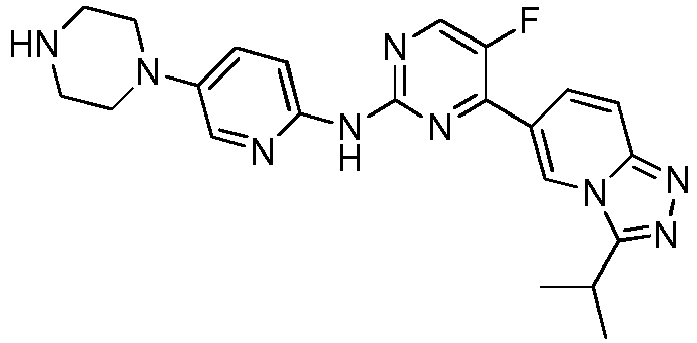
I-8 
I-9 
I-10 
I-11 
I-14 
I-15 
I-16 
I-17 
I-18 
I-19 
I-20 
I-21 
I-22 
I-23 
I-24 
I-25 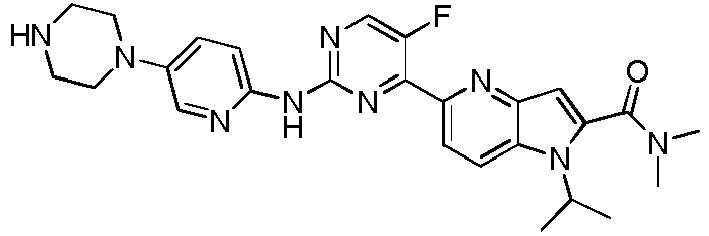
I-26 
I-27 
I-28 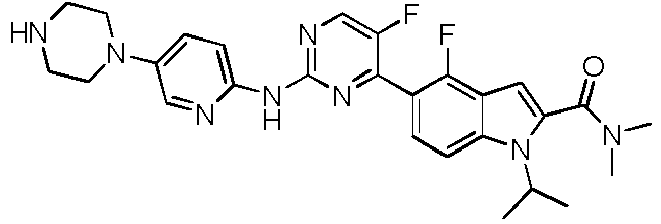
I-32 
I-33 
I-34 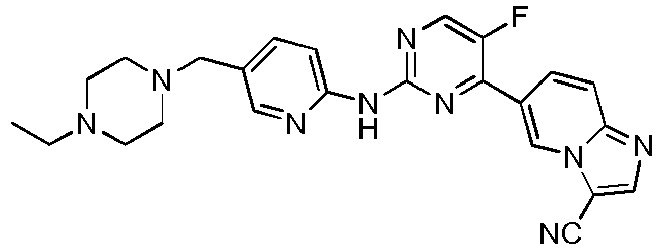
I-35 
I-36 
I-37 
I-38 
I-39 
I-40 
I-41 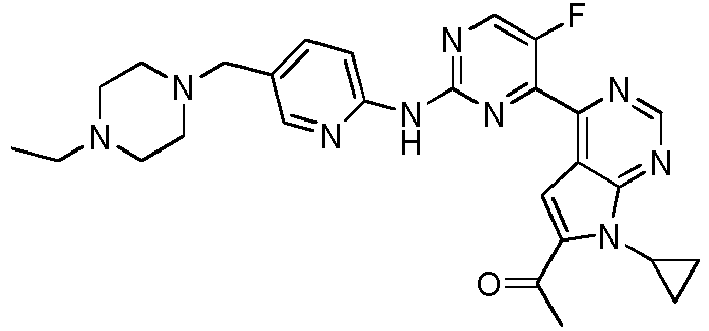
I-42 
I-47 
I-48 
- The 2,4-disubstituted pyrimidine derivative and a pharmaceutically acceptable salt thereof according to any of claims 1-4 for use as a CDK4/6 inhibitor.
- The 2,4-disubstituted pyrimidine derivative and a pharmaceutically acceptable salt thereof according to any of claims 1-4 for use in a method of preventing and treating diseases related to CDK4/6.
- The 2,4-disubstituted pyrimidine derivative and a pharmaceutically acceptable salt thereof for use according to claim 6, wherein the diseases are cancers related to CDK4/6.
- A pharmaceutical composition comprising a therapeutically effective amount of the 2,4-disubstituted pyrimidine derivative according to any of claims 1-4 and a pharmaceutically acceptable carrier or excipient.
Applications Claiming Priority (2)
| Application Number | Priority Date | Filing Date | Title |
|---|---|---|---|
| CN201610220246.9A CN107286134B (en) | 2016-04-11 | 2016-04-11 | 2,4- disubstituted pyrimidines derivatives are as CDK inhibitor and its application |
| PCT/CN2017/078933 WO2017177836A1 (en) | 2016-04-11 | 2017-03-31 | 2,4-disubstituted pyrimidine derivative as cdk inhibitor and use thereof |
Publications (3)
| Publication Number | Publication Date |
|---|---|
| EP3444246A1 EP3444246A1 (en) | 2019-02-20 |
| EP3444246A4 EP3444246A4 (en) | 2019-04-03 |
| EP3444246B1 true EP3444246B1 (en) | 2019-11-06 |
Family
ID=60041396
Family Applications (1)
| Application Number | Title | Priority Date | Filing Date |
|---|---|---|---|
| EP17781812.7A Active EP3444246B1 (en) | 2016-04-11 | 2017-03-31 | 2,4-disubstituted pyrimidine derivative as cdk inhibitor and use thereof |
Country Status (5)
| Country | Link |
|---|---|
| US (1) | US10464927B2 (en) |
| EP (1) | EP3444246B1 (en) |
| JP (1) | JP6661048B2 (en) |
| CN (1) | CN107286134B (en) |
| WO (1) | WO2017177836A1 (en) |
Families Citing this family (36)
| Publication number | Priority date | Publication date | Assignee | Title |
|---|---|---|---|---|
| CN108794452B (en) | 2017-05-05 | 2021-05-28 | 上海时莱生物技术有限公司 | Compound with kinase inhibition activity, preparation method and application thereof |
| CA3088381A1 (en) * | 2018-01-29 | 2019-08-01 | Beta Pharma, Inc. | 2h-indazole derivatives as cdk4 and cdk6 inhibitors and therapeutic uses thereof |
| CN110156754B (en) * | 2018-02-10 | 2023-10-03 | 杭州百诚医药科技股份有限公司 | Inhibition of protein kinase by trisubstituted pyrimidine derivative |
| KR20200131246A (en) | 2018-02-15 | 2020-11-23 | 누베이션 바이오 인크. | Heterocyclic compounds as kinase inhibitors |
| SG11202108004VA (en) * | 2019-01-29 | 2021-08-30 | Beta Pharma Inc | 2h-indazole derivatives as therapeutic agents for brain cancers and brain metastases |
| BR112021022105A2 (en) * | 2019-05-05 | 2021-12-28 | Qilu Regor Therapeutics Inc | cdk inhibitors |
| CA3146375A1 (en) * | 2019-07-10 | 2021-01-14 | Aucentra Therapeutics Pty Ltd | Derivatives of 4-(imidazo[l,2-a]pyridin-3-yl)-n-(pyridinyl)pyrimidin-2-amine as therapeutic agents |
| CA3187566A1 (en) | 2020-06-22 | 2021-12-30 | Corcept Therapeutics Incorporated | Quaternary indazole glucocorticoid receptor antagonists |
| WO2022113003A1 (en) | 2020-11-27 | 2022-06-02 | Rhizen Pharmaceuticals Ag | Cdk inhibitors |
| WO2022149057A1 (en) | 2021-01-05 | 2022-07-14 | Rhizen Pharmaceuticals Ag | Cdk inhibitors |
| CN115246822B (en) * | 2021-04-27 | 2024-10-29 | 中国科学院上海药物研究所 | Pyrimidine compounds and preparation methods and uses thereof |
| US20240239768A1 (en) * | 2021-04-27 | 2024-07-18 | Lg Chem, Ltd. | Method for preparing xanthine oxidase inhibitor |
| CN113248500B (en) * | 2021-06-10 | 2021-10-19 | 中国药科大学 | Azaindolepyrimidine amine heterocyclic compound and preparation method and application thereof |
| AR126353A1 (en) * | 2021-07-02 | 2023-10-11 | Lg Chemical Ltd | METHOD FOR PREPARING INTERMEDIATE PRODUCTS TO SYNTHESIZE A XANTHINE OXIDASE INHIBITOR |
| CN115703760B (en) * | 2021-08-11 | 2024-05-31 | 山东大学 | 2,4-disubstituted pyrimidine cyclin-dependent kinase inhibitors and preparation method and application thereof |
| US12098144B2 (en) | 2021-12-21 | 2024-09-24 | Corcept Therapeutics Incorporated | Piperazine indazole glucocorticoid receptor antagonists |
| CA3243547A1 (en) | 2021-12-21 | 2023-06-29 | Corcept Therapeutics Incorporated | Bicyclic indazole glucocorticoid receptor antagonists |
| KR20250054814A (en) * | 2022-09-05 | 2025-04-23 | 티와이케이 메디슨즈, 인코포레이티드 | Compounds used as CDK4 kinase inhibitors and uses thereof |
| CN121712509A (en) | 2023-05-04 | 2026-03-20 | 锐新医药公司 | Combination therapy for RAS related diseases or conditions |
| US20250049810A1 (en) | 2023-08-07 | 2025-02-13 | Revolution Medicines, Inc. | Methods of treating a ras protein-related disease or disorder |
| IL327306A (en) | 2023-10-12 | 2026-05-01 | Revolution Medicines Inc | Macrocyclic ras inhibitors |
| WO2025171296A1 (en) | 2024-02-09 | 2025-08-14 | Revolution Medicines, Inc. | Ras inhibitors |
| WO2025217307A1 (en) | 2024-04-09 | 2025-10-16 | Revolution Medicines, Inc. | Methods for predicting response to a ras(on) inhibitor and combination therapies |
| WO2025240847A1 (en) | 2024-05-17 | 2025-11-20 | Revolution Medicines, Inc. | Ras inhibitors |
| WO2025255438A1 (en) | 2024-06-07 | 2025-12-11 | Revolution Medicines, Inc. | Methods of treating a ras protein-related disease or disorder |
| WO2025265060A1 (en) | 2024-06-21 | 2025-12-26 | Revolution Medicines, Inc. | Therapeutic compositions and methods for managing treatment-related effects |
| WO2026006747A1 (en) | 2024-06-28 | 2026-01-02 | Revolution Medicines, Inc. | Ras inhibitors |
| WO2026015790A1 (en) | 2024-07-12 | 2026-01-15 | Revolution Medicines, Inc. | Methods of treating a ras related disease or disorder |
| WO2026015825A1 (en) | 2024-07-12 | 2026-01-15 | Revolution Medicines, Inc. | Use of ras inhibitor for treating pancreatic cancer |
| WO2026015796A1 (en) | 2024-07-12 | 2026-01-15 | Revolution Medicines, Inc. | Methods of treating a ras related disease or disorder |
| WO2026015801A1 (en) | 2024-07-12 | 2026-01-15 | Revolution Medicines, Inc. | Methods of treating a ras related disease or disorder |
| WO2026050446A1 (en) | 2024-08-29 | 2026-03-05 | Revolution Medicines, Inc. | Ras inhibitors |
| WO2026072904A2 (en) | 2024-09-26 | 2026-04-02 | Revolution Medicines, Inc. | Compositions and methods for treating lung cancer |
| WO2026090116A2 (en) | 2024-10-21 | 2026-04-30 | Revolution Medicines, Inc. | Ras inhibitors |
| WO2026090245A1 (en) | 2024-10-22 | 2026-04-30 | Revolution Medicines, Inc. | Use of ras inhibitors for treating cancer |
| US20260108528A1 (en) | 2024-10-22 | 2026-04-23 | Revolution Medicines, Inc. | Methods of treating a ras protein-related disease or disorder |
Family Cites Families (4)
| Publication number | Priority date | Publication date | Assignee | Title |
|---|---|---|---|---|
| WO2009014637A2 (en) * | 2007-07-19 | 2009-01-29 | Schering Corporation | Heterocyclic amide compounds as protein kinase inhibitors |
| PA8852901A1 (en) * | 2008-12-22 | 2010-07-27 | Lilly Co Eli | PROTEIN CINASE INHIBITORS |
| WO2016014904A1 (en) * | 2014-07-24 | 2016-01-28 | Beta Pharma, Inc. | 2-h-indazole derivatives as cyclin-dependent kinase (cdk) inhibitors and therapeutic uses thereof |
| WO2016015604A1 (en) * | 2014-07-26 | 2016-02-04 | Sunshine Lake Pharma Co., Ltd. | Compounds as cdk small-molecule inhibitors and uses thereof |
-
2016
- 2016-04-11 CN CN201610220246.9A patent/CN107286134B/en active Active
-
2017
- 2017-03-31 EP EP17781812.7A patent/EP3444246B1/en active Active
- 2017-03-31 JP JP2019502133A patent/JP6661048B2/en active Active
- 2017-03-31 WO PCT/CN2017/078933 patent/WO2017177836A1/en not_active Ceased
-
2018
- 2018-10-09 US US16/155,861 patent/US10464927B2/en active Active
Non-Patent Citations (1)
| Title |
|---|
| None * |
Also Published As
| Publication number | Publication date |
|---|---|
| US10464927B2 (en) | 2019-11-05 |
| JP6661048B2 (en) | 2020-03-11 |
| JP2019510821A (en) | 2019-04-18 |
| US20190071427A1 (en) | 2019-03-07 |
| CN107286134A (en) | 2017-10-24 |
| WO2017177836A1 (en) | 2017-10-19 |
| CN107286134B (en) | 2019-04-12 |
| EP3444246A4 (en) | 2019-04-03 |
| EP3444246A1 (en) | 2019-02-20 |
Similar Documents
| Publication | Publication Date | Title |
|---|---|---|
| US10464927B2 (en) | 2,4-disubstituted pyrimidines as CDK inhibitors | |
| EP3444254B1 (en) | Heterocyclic-substituted pyridinopyrimidinone derivative as cdk inhibitor and use thereof | |
| EP1556384B1 (en) | Pyrimido compounds having antiproliferative activity | |
| EP2668190B1 (en) | Tricyclic pyrrolo derivatives, process for their preparation and their use as kinase inhibitors | |
| CN100537571C (en) | Imidazo[1,2-a]pyrazin-8-ylamines, method of making and method of use thereof | |
| EP2044051B1 (en) | Pyridine and pyrazine derivatives as mnk kinase inhibitors | |
| CN103974948B (en) | Substituted benzyl indazoles useful as BUB1 kinase inhibitors in the treatment of hyperproliferative diseases | |
| JP5213229B2 (en) | Kinase modulators and methods of use | |
| US11491158B2 (en) | N-(substituted-phenyl)-sulfonamide derivatives as kinase inhibitors | |
| EP3294742B1 (en) | New (5,8-dimethyl-9-phenyl-5,8-dihydro-6h-pyrazolo[3,4-h)quinazolin-2-yl)-(1h-pyrazol-5-yl)-amines and theri derivatives as igf-1r/1r inhibitors. | |
| CN104066735B (en) | Substituted imidazopyrazines as AKT kinase inhibitors | |
| TW201632530A (en) | ERK inhibitors | |
| JP2012504157A (en) | Heterocyclic JAK kinase inhibitors | |
| HK1223350A1 (en) | Heteroaryl substituted indazoles | |
| EP2838901B1 (en) | 6-(4-(1-amino-3-hydroxycyclobutyl)phenyl)-5-phenyl(furo, thieno or pyrrolo)[2,3-d]pyrimidin-4-one derivatives for the treatment of cancer | |
| CN105051030A (en) | Diaminoheteroaryl substituted indazoles | |
| BR112020023068A2 (en) | triazolopyrimidine compounds and their use in cancer treatment | |
| EP3964512A1 (en) | CASEIN KINASE 1epsilon INHIBITOR, PHARMACEUTICAL COMPOSITION AND APPLICATION THEREOF | |
| CN108290899A (en) | A kind of substituted pyrrolopyrimidine compound and its application | |
| HK40120533A (en) | Btk inhibitors | |
| HK40072496B (en) | Btk inhibitors | |
| HK40015251B (en) | Novel oxoisoquinoline derivative | |
| HK1129223B (en) | Chemical compounds | |
| HK1129223A1 (en) | Chemical compounds |
Legal Events
| Date | Code | Title | Description |
|---|---|---|---|
| STAA | Information on the status of an ep patent application or granted ep patent |
Free format text: STATUS: THE INTERNATIONAL PUBLICATION HAS BEEN MADE |
|
| PUAI | Public reference made under article 153(3) epc to a published international application that has entered the european phase |
Free format text: ORIGINAL CODE: 0009012 |
|
| STAA | Information on the status of an ep patent application or granted ep patent |
Free format text: STATUS: REQUEST FOR EXAMINATION WAS MADE |
|
| 17P | Request for examination filed |
Effective date: 20181024 |
|
| AK | Designated contracting states |
Kind code of ref document: A1 Designated state(s): AL AT BE BG CH CY CZ DE DK EE ES FI FR GB GR HR HU IE IS IT LI LT LU LV MC MK MT NL NO PL PT RO RS SE SI SK SM TR |
|
| AX | Request for extension of the european patent |
Extension state: BA ME |
|
| A4 | Supplementary search report drawn up and despatched |
Effective date: 20190305 |
|
| RIC1 | Information provided on ipc code assigned before grant |
Ipc: C07D 471/14 20060101ALI20190227BHEP Ipc: C07D 487/04 20060101ALI20190227BHEP Ipc: A61K 31/52 20060101ALI20190227BHEP Ipc: C07D 473/00 20060101ALI20190227BHEP Ipc: A61P 35/02 20060101ALI20190227BHEP Ipc: A61P 35/00 20060101ALI20190227BHEP Ipc: A61K 31/506 20060101ALI20190227BHEP Ipc: C07D 401/14 20060101AFI20190227BHEP |
|
| RIN1 | Information on inventor provided before grant (corrected) |
Inventor name: HUANG, MEIHUA Inventor name: MENG, XIN Inventor name: ZHENG, YONGYONG Inventor name: JIN, HUA Inventor name: ZHOU, FENG |
|
| DAV | Request for validation of the european patent (deleted) | ||
| DAX | Request for extension of the european patent (deleted) | ||
| GRAP | Despatch of communication of intention to grant a patent |
Free format text: ORIGINAL CODE: EPIDOSNIGR1 |
|
| STAA | Information on the status of an ep patent application or granted ep patent |
Free format text: STATUS: GRANT OF PATENT IS INTENDED |
|
| INTG | Intention to grant announced |
Effective date: 20190819 |
|
| GRAS | Grant fee paid |
Free format text: ORIGINAL CODE: EPIDOSNIGR3 |
|
| GRAA | (expected) grant |
Free format text: ORIGINAL CODE: 0009210 |
|
| STAA | Information on the status of an ep patent application or granted ep patent |
Free format text: STATUS: THE PATENT HAS BEEN GRANTED |
|
| AK | Designated contracting states |
Kind code of ref document: B1 Designated state(s): AL AT BE BG CH CY CZ DE DK EE ES FI FR GB GR HR HU IE IS IT LI LT LU LV MC MK MT NL NO PL PT RO RS SE SI SK SM TR |
|
| REG | Reference to a national code |
Ref country code: GB Ref legal event code: FG4D |
|
| REG | Reference to a national code |
Ref country code: CH Ref legal event code: EP Ref country code: AT Ref legal event code: REF Ref document number: 1198578 Country of ref document: AT Kind code of ref document: T Effective date: 20191115 |
|
| REG | Reference to a national code |
Ref country code: IE Ref legal event code: FG4D |
|
| REG | Reference to a national code |
Ref country code: DE Ref legal event code: R096 Ref document number: 602017008522 Country of ref document: DE |
|
| REG | Reference to a national code |
Ref country code: NL Ref legal event code: MP Effective date: 20191106 |
|
| REG | Reference to a national code |
Ref country code: LT Ref legal event code: MG4D |
|
| PG25 | Lapsed in a contracting state [announced via postgrant information from national office to epo] |
Ref country code: BG Free format text: LAPSE BECAUSE OF FAILURE TO SUBMIT A TRANSLATION OF THE DESCRIPTION OR TO PAY THE FEE WITHIN THE PRESCRIBED TIME-LIMIT Effective date: 20200206 Ref country code: FI Free format text: LAPSE BECAUSE OF FAILURE TO SUBMIT A TRANSLATION OF THE DESCRIPTION OR TO PAY THE FEE WITHIN THE PRESCRIBED TIME-LIMIT Effective date: 20191106 Ref country code: NO Free format text: LAPSE BECAUSE OF FAILURE TO SUBMIT A TRANSLATION OF THE DESCRIPTION OR TO PAY THE FEE WITHIN THE PRESCRIBED TIME-LIMIT Effective date: 20200206 Ref country code: GR Free format text: LAPSE BECAUSE OF FAILURE TO SUBMIT A TRANSLATION OF THE DESCRIPTION OR TO PAY THE FEE WITHIN THE PRESCRIBED TIME-LIMIT Effective date: 20200207 Ref country code: PT Free format text: LAPSE BECAUSE OF FAILURE TO SUBMIT A TRANSLATION OF THE DESCRIPTION OR TO PAY THE FEE WITHIN THE PRESCRIBED TIME-LIMIT Effective date: 20200306 Ref country code: SE Free format text: LAPSE BECAUSE OF FAILURE TO SUBMIT A TRANSLATION OF THE DESCRIPTION OR TO PAY THE FEE WITHIN THE PRESCRIBED TIME-LIMIT Effective date: 20191106 Ref country code: LV Free format text: LAPSE BECAUSE OF FAILURE TO SUBMIT A TRANSLATION OF THE DESCRIPTION OR TO PAY THE FEE WITHIN THE PRESCRIBED TIME-LIMIT Effective date: 20191106 Ref country code: NL Free format text: LAPSE BECAUSE OF FAILURE TO SUBMIT A TRANSLATION OF THE DESCRIPTION OR TO PAY THE FEE WITHIN THE PRESCRIBED TIME-LIMIT Effective date: 20191106 Ref country code: PL Free format text: LAPSE BECAUSE OF FAILURE TO SUBMIT A TRANSLATION OF THE DESCRIPTION OR TO PAY THE FEE WITHIN THE PRESCRIBED TIME-LIMIT Effective date: 20191106 Ref country code: LT Free format text: LAPSE BECAUSE OF FAILURE TO SUBMIT A TRANSLATION OF THE DESCRIPTION OR TO PAY THE FEE WITHIN THE PRESCRIBED TIME-LIMIT Effective date: 20191106 |
|
| PG25 | Lapsed in a contracting state [announced via postgrant information from national office to epo] |
Ref country code: HR Free format text: LAPSE BECAUSE OF FAILURE TO SUBMIT A TRANSLATION OF THE DESCRIPTION OR TO PAY THE FEE WITHIN THE PRESCRIBED TIME-LIMIT Effective date: 20191106 Ref country code: IS Free format text: LAPSE BECAUSE OF FAILURE TO SUBMIT A TRANSLATION OF THE DESCRIPTION OR TO PAY THE FEE WITHIN THE PRESCRIBED TIME-LIMIT Effective date: 20200306 Ref country code: RS Free format text: LAPSE BECAUSE OF FAILURE TO SUBMIT A TRANSLATION OF THE DESCRIPTION OR TO PAY THE FEE WITHIN THE PRESCRIBED TIME-LIMIT Effective date: 20191106 |
|
| PG25 | Lapsed in a contracting state [announced via postgrant information from national office to epo] |
Ref country code: AL Free format text: LAPSE BECAUSE OF FAILURE TO SUBMIT A TRANSLATION OF THE DESCRIPTION OR TO PAY THE FEE WITHIN THE PRESCRIBED TIME-LIMIT Effective date: 20191106 |
|
| PG25 | Lapsed in a contracting state [announced via postgrant information from national office to epo] |
Ref country code: DK Free format text: LAPSE BECAUSE OF FAILURE TO SUBMIT A TRANSLATION OF THE DESCRIPTION OR TO PAY THE FEE WITHIN THE PRESCRIBED TIME-LIMIT Effective date: 20191106 Ref country code: EE Free format text: LAPSE BECAUSE OF FAILURE TO SUBMIT A TRANSLATION OF THE DESCRIPTION OR TO PAY THE FEE WITHIN THE PRESCRIBED TIME-LIMIT Effective date: 20191106 Ref country code: RO Free format text: LAPSE BECAUSE OF FAILURE TO SUBMIT A TRANSLATION OF THE DESCRIPTION OR TO PAY THE FEE WITHIN THE PRESCRIBED TIME-LIMIT Effective date: 20191106 Ref country code: CZ Free format text: LAPSE BECAUSE OF FAILURE TO SUBMIT A TRANSLATION OF THE DESCRIPTION OR TO PAY THE FEE WITHIN THE PRESCRIBED TIME-LIMIT Effective date: 20191106 Ref country code: ES Free format text: LAPSE BECAUSE OF FAILURE TO SUBMIT A TRANSLATION OF THE DESCRIPTION OR TO PAY THE FEE WITHIN THE PRESCRIBED TIME-LIMIT Effective date: 20191106 |
|
| REG | Reference to a national code |
Ref country code: DE Ref legal event code: R097 Ref document number: 602017008522 Country of ref document: DE |
|
| REG | Reference to a national code |
Ref country code: AT Ref legal event code: MK05 Ref document number: 1198578 Country of ref document: AT Kind code of ref document: T Effective date: 20191106 |
|
| PG25 | Lapsed in a contracting state [announced via postgrant information from national office to epo] |
Ref country code: SM Free format text: LAPSE BECAUSE OF FAILURE TO SUBMIT A TRANSLATION OF THE DESCRIPTION OR TO PAY THE FEE WITHIN THE PRESCRIBED TIME-LIMIT Effective date: 20191106 Ref country code: SK Free format text: LAPSE BECAUSE OF FAILURE TO SUBMIT A TRANSLATION OF THE DESCRIPTION OR TO PAY THE FEE WITHIN THE PRESCRIBED TIME-LIMIT Effective date: 20191106 |
|
| PLBE | No opposition filed within time limit |
Free format text: ORIGINAL CODE: 0009261 |
|
| STAA | Information on the status of an ep patent application or granted ep patent |
Free format text: STATUS: NO OPPOSITION FILED WITHIN TIME LIMIT |
|
| REG | Reference to a national code |
Ref country code: DE Ref legal event code: R119 Ref document number: 602017008522 Country of ref document: DE |
|
| 26N | No opposition filed |
Effective date: 20200807 |
|
| PG25 | Lapsed in a contracting state [announced via postgrant information from national office to epo] |
Ref country code: MC Free format text: LAPSE BECAUSE OF FAILURE TO SUBMIT A TRANSLATION OF THE DESCRIPTION OR TO PAY THE FEE WITHIN THE PRESCRIBED TIME-LIMIT Effective date: 20191106 |
|
| REG | Reference to a national code |
Ref country code: CH Ref legal event code: PL |
|
| PG25 | Lapsed in a contracting state [announced via postgrant information from national office to epo] |
Ref country code: AT Free format text: LAPSE BECAUSE OF FAILURE TO SUBMIT A TRANSLATION OF THE DESCRIPTION OR TO PAY THE FEE WITHIN THE PRESCRIBED TIME-LIMIT Effective date: 20191106 Ref country code: SI Free format text: LAPSE BECAUSE OF FAILURE TO SUBMIT A TRANSLATION OF THE DESCRIPTION OR TO PAY THE FEE WITHIN THE PRESCRIBED TIME-LIMIT Effective date: 20191106 |
|
| REG | Reference to a national code |
Ref country code: BE Ref legal event code: MM Effective date: 20200331 |
|
| PG25 | Lapsed in a contracting state [announced via postgrant information from national office to epo] |
Ref country code: LU Free format text: LAPSE BECAUSE OF NON-PAYMENT OF DUE FEES Effective date: 20200331 |
|
| PG25 | Lapsed in a contracting state [announced via postgrant information from national office to epo] |
Ref country code: FR Free format text: LAPSE BECAUSE OF NON-PAYMENT OF DUE FEES Effective date: 20200331 Ref country code: CH Free format text: LAPSE BECAUSE OF NON-PAYMENT OF DUE FEES Effective date: 20200331 Ref country code: IE Free format text: LAPSE BECAUSE OF NON-PAYMENT OF DUE FEES Effective date: 20200331 Ref country code: IT Free format text: LAPSE BECAUSE OF FAILURE TO SUBMIT A TRANSLATION OF THE DESCRIPTION OR TO PAY THE FEE WITHIN THE PRESCRIBED TIME-LIMIT Effective date: 20191106 Ref country code: LI Free format text: LAPSE BECAUSE OF NON-PAYMENT OF DUE FEES Effective date: 20200331 Ref country code: DE Free format text: LAPSE BECAUSE OF NON-PAYMENT OF DUE FEES Effective date: 20201001 |
|
| PG25 | Lapsed in a contracting state [announced via postgrant information from national office to epo] |
Ref country code: BE Free format text: LAPSE BECAUSE OF NON-PAYMENT OF DUE FEES Effective date: 20200331 |
|
| GBPC | Gb: european patent ceased through non-payment of renewal fee |
Effective date: 20210331 |
|
| PG25 | Lapsed in a contracting state [announced via postgrant information from national office to epo] |
Ref country code: GB Free format text: LAPSE BECAUSE OF NON-PAYMENT OF DUE FEES Effective date: 20210331 |
|
| PG25 | Lapsed in a contracting state [announced via postgrant information from national office to epo] |
Ref country code: TR Free format text: LAPSE BECAUSE OF FAILURE TO SUBMIT A TRANSLATION OF THE DESCRIPTION OR TO PAY THE FEE WITHIN THE PRESCRIBED TIME-LIMIT Effective date: 20191106 Ref country code: MT Free format text: LAPSE BECAUSE OF FAILURE TO SUBMIT A TRANSLATION OF THE DESCRIPTION OR TO PAY THE FEE WITHIN THE PRESCRIBED TIME-LIMIT Effective date: 20191106 Ref country code: CY Free format text: LAPSE BECAUSE OF FAILURE TO SUBMIT A TRANSLATION OF THE DESCRIPTION OR TO PAY THE FEE WITHIN THE PRESCRIBED TIME-LIMIT Effective date: 20191106 |
|
| PG25 | Lapsed in a contracting state [announced via postgrant information from national office to epo] |
Ref country code: MK Free format text: LAPSE BECAUSE OF FAILURE TO SUBMIT A TRANSLATION OF THE DESCRIPTION OR TO PAY THE FEE WITHIN THE PRESCRIBED TIME-LIMIT Effective date: 20191106 |