EP3441877A2 - Systems and methods for using egl with an opengl api and a vulkan graphics driver - Google Patents
Systems and methods for using egl with an opengl api and a vulkan graphics driver Download PDFInfo
- Publication number
- EP3441877A2 EP3441877A2 EP18188061.8A EP18188061A EP3441877A2 EP 3441877 A2 EP3441877 A2 EP 3441877A2 EP 18188061 A EP18188061 A EP 18188061A EP 3441877 A2 EP3441877 A2 EP 3441877A2
- Authority
- EP
- European Patent Office
- Prior art keywords
- egl
- driver
- vulkan
- opengl
- computer
- Prior art date
- Legal status (The legal status is an assumption and is not a legal conclusion. Google has not performed a legal analysis and makes no representation as to the accuracy of the status listed.)
- Granted
Links
Images



Classifications
-
- G—PHYSICS
- G06—COMPUTING OR CALCULATING; COUNTING
- G06F—ELECTRIC DIGITAL DATA PROCESSING
- G06F9/00—Arrangements for program control, e.g. control units
- G06F9/06—Arrangements for program control, e.g. control units using stored programs, i.e. using an internal store of processing equipment to receive or retain programs
- G06F9/44—Arrangements for executing specific programs
- G06F9/451—Execution arrangements for user interfaces
-
- G—PHYSICS
- G06—COMPUTING OR CALCULATING; COUNTING
- G06T—IMAGE DATA PROCESSING OR GENERATION, IN GENERAL
- G06T1/00—General purpose image data processing
- G06T1/20—Processor architectures; Processor configuration, e.g. pipelining
-
- G—PHYSICS
- G06—COMPUTING OR CALCULATING; COUNTING
- G06T—IMAGE DATA PROCESSING OR GENERATION, IN GENERAL
- G06T15/00—Three-dimensional [3D] image rendering
- G06T15/005—General purpose rendering architectures
-
- G—PHYSICS
- G06—COMPUTING OR CALCULATING; COUNTING
- G06T—IMAGE DATA PROCESSING OR GENERATION, IN GENERAL
- G06T2210/00—Indexing scheme for image generation or computer graphics
- G06T2210/32—Image data format
Definitions
- the embodiments disclosed herein relate to generating computer graphics, and more specifically, to systems and methods for using EGL with an OpenGL API and a Vulkan graphics driver.
- OpenGL is the dominant application programming interface (hereinafter, "API") and has lead the industry in a variety of use cases. These use cases range from managing the graphics in avionics display systems to dashboard gauge clusters in automotive display systems, and 3D image processing in the medical field.
- API application programming interface
- the OpenGL API allows an application to specify a set of states to configure a graphics pipeline, culminating in a series of pixel data to be generated or "drawn" onto a surface buffer during a render operation.
- OpenGL API allows an application to render color data to a render buffer in video memory. OpenGL has does not have the ability to create and/or allocate either on screen or off screen buffers. Accordingly, another API is needed regardless of the on/off screen locations.
- GL graphics library
- APIs that allow an application to associate a native display to a render context and render surface. These APIs tend to be platform specific with Windows® providing WGL, Linux's X Windows systems providing GLX, and the embedded platforms generally using EGL.
- APIs vary syntactically and some are better suited for certain use cases than the others, but in essence they all accomplish the same thing: the ability to create a graphics context and a rendering surface and associate that graphics context with the rendering surface and with a native display and windowing system, where the native display is a handle to the display driver's display connection.
- Vulkan has been introduced by the Khronos Consortium as a new modular API that is intended to take advantage of current GPUs. With the advent of Vulkan, a new windowing API has emerged to bridge the gap between render surfaces and the native display: Window System Integration ("WSI").
- WSI Window System Integration
- a method for using an EGL driver to create a renderable surface for an OpenGL API is provided.
- the EGL driver and the OpenGL API are for use with a Vulkan graphics driver, a memory, at least one processor, and a module stored in the memory including computer instruction code.
- the computer instruction code is executable by the at least one processor.
- the method includes creating an EGL display structure; initializing the EGL display structure by querying the Vulkan driver for attributes of a physical display; choosing an EGL configuring matching the provided attributes; and creating the EGL surface.
- the method further includes associating the EGL surface with the EGL display and a native windowing system.
- the method further includes creating a graphics context; associating the graphics context with the EGL display; and associating the graphics context with the EGL surface to make the EGL surface a render target.
- the step of creating the EGL display structure is by making an eglGetDisplay function call which uses the Vulkan graphics driver.
- the step of initializing the EGL display structure is by making an egllnitialize function call which uses the Vulkan graphics driver.
- the step of choosing the EGL configuring matching the provided attributes is by making an eglChooseConfig function call which uses the Vulkan graphics driver.
- the step of creating the EGL surface is by making an eglCreateWindowSurface function call which uses the Vulkan graphics driver.
- the provided attributes include color buffer size, depth buffer size, etc.
- a non-transitory, computer-readable medium including an EGL driver having computer instruction code that is executable by at least one processor and structured to cause the at least one processor to be configured to: create an EGL display structure; initialize the EGL display structure by querying the Vulkan driver for attributes of a physical display; choose an EGL configuring matching the provided attributes; and create the EGL surface.
- the processor is further configured to associate the EGL surface with the EGL display and a native windowing system.
- the processor is further configured to create a graphics context; associate the graphics context with the EGL display; and associate the graphics context with the EGL surface to make the EGL surface a render target.
- the step of creating the EGL display structure is by making an eglGetDisplay function call which uses the Vulkan graphics driver.
- the step of initializing the EGL display structure is by making an eglInitialize function call which uses the Vulkan graphics driver.
- the step of choosing the EGL configuring matching the provided attributes is by making an eglChooseConfig function call which uses the Vulkan graphics driver.
- the step of creating the EGL surface is by making an eglCreateWindowSurface function call which uses the Vulkan graphics driver.
- the provided attributes include color buffer size, depth buffer size, etc.
- the systems and methods described herein may be implemented in hardware or software, or a combination of both.
- the systems and methods are implemented in computer programs executing on programmable computers each comprising at least one processor, a data storage system (including volatile and non-volatile memory and/or other storage elements), at least one input device, and at least one output device.
- the systems and methods are implemented in computer programs executing on programmable computers that have limited or no input devices as commonly understood in the computer industry (e.g. no keyboard, no mouse, no scanner, no text telephone (“TTY”) device).
- the computer systems may automatically start programs without user intervention and start processing data which is received from a network interface.
- the programmable computers may be a programmable electronic controller, mainframe computer, server, personal computer, laptop, personal data assistant, a cellular telephone or an embedded computer system such as an avionics system.
- Program code is applied to input data to perform the functions described herein and generate output information.
- the output information is applied to one or more output devices, in known fashion.
- Each program may be implemented in a high level procedural or object oriented programming and/or scripting language to communicate with a computer system.
- the programs can be implemented in assembly or machine language, if desired. In any case, the language may be a compiled or interpreted language.
- Each such computer program is preferably stored on a storage media or a device (e.g. read only memory (ROM) or magnetic diskette) readable by a general or special purpose programmable computer, for configuring and operating the computer when the storage media or device is read by the computer to perform the procedures described herein.
- the inventive system may also be considered to be implemented as a computer-readable storage medium, configured with a computer program, where the storage medium so configured causes a computer to operate in a specific and predefined manner to perform the functions described herein.
- OpenGL can be viewed as a state machine. Thus, at any particular time, an OpenGL instance can be defined by its particular state.
- OpenGL functions can be grouped into three broad categories of functions. First are those functions that set state into an OpenGL context. Second are those functions that can query state. Third are those functions that preform rendering operations based on state.
- An OpenGL context can be thought of as representing an object that stores the state associated with a particular instance of OpenGL.
- An OpenGL context can represent a default framebuffer that render commands draw to rather than a framebuffer object.
- An OpenGL object is a construct that contains a state.
- An OpenGL object can be bound to a particular context, in which case, the object state is mapped to the state of the context. Thus, changes in the state of the context will also be applied to the object, and functions that act on the context state will also use the object's state.
- Objects can be classified as regular or container objects (or non-standard objects). Examples of regular objects are buffer objects, query objects, renderbuffer objects, sampler objects, and texture objects. Examples of container objects are framebuffer objects, program pipeline objects, transform feedback objects, and vertex array objects. Examples of non-standard objects are sync objects and shader or program objects.
- a texture object can contain one or more images, where all of the images have the same image format.
- the image format describes the way that data is stored in order to represent the images in texture objects and renderbuffer objects. In other words, the image format defines the meaning of the data associated with the image.
- EGL is the preferred solution over XGL or WGL as it is an open standard and a required standard of other open systems standards such as the Future Avionics Capability Environment (FACE®) technical standard.
- FACE® Future Avionics Capability Environment
- EGL and OpenGL are required by this and other system standards and, because Vulkan is a better API to support GPUs, the creation of a portable EGL library which utilizes Vulkan to be used with an OpenGL on Vulkan library provides a benefit to the avionics and safety critical application space.
- Vulkan By implementing EGL and OpenGL on top of Vulkan it provides not only the now required OpenGL and EGL libraries but also provides the Vulkan API on the platform for when the system standards are updated to reflect changes in graphics technology, such that existing software and hardware can support newer programs for longer periods without needing to be upgraded simply to expose the Vulkan API.
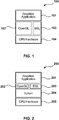
- FIG. 1 there is a block diagram of an existing design of a graphical application stack 100.
- the stack 100 is responsible for accessing GPU resources.
- Graphics application 101 overlays OpenGL 102 and EGL 103 which interface directly with Graphics Processing Unit (GPU) 104.
- the OpenGL 102 and EGL 103 libraries are also hardware drivers making their content highly dependent on the hardware interface to the GPU 104.
- the OpenGL driver 102 is responsible for taking OpenGL API calls from graphics application 101 and providing associated hardware-specific instructions to GPU 104.
- the OpenGL 102 is designed to operate with a first GPU 104.
- the GPU 104 may be optimized for OpenGL.
- the OpenGL driver 102 provides the GPU 104 with instructions based on an application making OpenGL API calls.
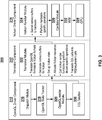
- FIG. 2 is a block diagram of a stack 200 having OpenGL 202 and EGL 203 using a Vulkan driver 204.
- Stack 200 also shows relative sizes of the OpenGL 202, EGL 203 and Vulkan driver 204 with respect to OpenGL 102 and EGL 103 of FIG. 1 .
- the application 201 when an application 201 initiates an OpenGL API call, the application 201 is unaware that, at some point, a Vulkan driver 204 will be involved in executing the operation. In this way, the API call travels through the OpenGL driver 202, and is transformed to a Vulkan operation. As the operation enters the Vulkan driver 204, the Vulkan driver 204 is unaware that the operation originated in an OpenGL application (e.g. application 201).
- an OpenGL application e.g. application 201).
- the OpenGL 202 and EGL 203 do not communicate directly with GPU 205 and therefore are not platform specific. Rather, OpenGL 202 and EGL 203 are separated from GPU 205 by Vulkan driver 204.
- Vulkan driver 204 By removing direct communication between GPU 205 and the OpenGL 202 and EGL 203, a higher level of reuse can be provided of the OpenGL and EGL drivers. This may be important in safety certifiable software (e.g. software for the aviation industry) as OpenGL 202 and EGL 203 can be reused without changing between platforms. Further, a higher level of reuse can also provide for the OpenGL 202 and EGL 203 to grow their feature sets with a single amount of work regardless of the underlying GPU interface.
- the ability to add new features in a platform agnostic way can reduce development and deployment times for graphical drivers, such that standards like OpenGL SC can grow to be feature complete with OpenGL over shorter time periods when compared to if the same features had to be implemented in every GPU dependent OpenGL 102 driver.
- the application development can also be reduced (as described below, where use of the Vulkan API at an application programming level requires that the programmer do significantly more work and understand much more complex processes than when using the OpenGL/EGL APIs).
- an OpenGL-on-Vulkan driver architecture 300 that includes a translator to Window System Integration (WSI).
- WSI Window System Integration
- the OpenGL API allows an application to render color data to a render buffer in video memory but cannot create the render surface.
- a second API is needed to create the render surface (e.g. EGL).
- APIs that allow an application to associate a native display to a render context and render surface. These APIs tend to be platform specific, with windows providing WGL, X Windows systems providing GLX, and embedded platforms generally using EGL.
- Vulkan includes Window System Integration (WSI).
- WSI aims to be a complete set of platform specific implementations defined as part of the Vulkan standard.
- the OpenGL-on-Vulkan driver architecture 300 may ensure that an OpenGL application need not be aware that it is running on top of a Vulkan driver. Thus, it follows that an application that uses EGL need not be aware that it is running on top of WSI.
- an OpenGL-on-Vulkan driver architecture 300 uses EGL on WSI.
- the EGL API provides a list of functions that an application can use to create a graphics context, a render surface, a display, and associate the three as the current render targets.
- An example of an EGL application making API calls is shown in FIG. 5 (below).
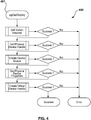
- EGL possesses a simple single call GPU selection function designed to get handles to the GPU for the EGL driver.
- This call is eglGetDisplay 401.
- an application writing to the Vulkan API must make the following calls at least once; vkCreateInstance(), vkEnumeratePhysicalDevices(), vkGetPhysicalDeviceQueueFamilyProperties(), vkGetPhysicalDeviceProperties(), vkGetPhysicalDeviceFeatures(), vkCreateDevice(), vkGetPhysical DeviceMemoryProperties().
- EGL provides a much simpler API to the programmer than Vulkan does.
- the EGL on Vulkan library (as shown in FIG. 2 ) can therefore provide the EGL API to the programmer while using the Vulkan interface to talk to the GPU hardware.
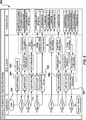
- FIG. 5 there is shown an example 500 of creating a surface for OpenGL rendering.
- FIG. 4 shows example 400 of how eglOpenDisplay must call a number of functions to make the one call work
- example 500 provides an example EGL start up process and how EGL calls are mapped to Vulkan calls to provide the OpenGL API a valid context and surface to draw on.
- Example 500 shows some of the high level Vulkan functions which are called from the associated EGL entry points in the EGL Library. It should be noted that, for simplicity, example 500 does not show all the functions used.
- the EGL application 501 may make API calls in the following order.
- the EGL display structure can be initialized using egllnitialize 503.
- An EGL configuration matching the provided attributes can be chosen using eglChooseConfig 504.
- An EGL surface can be created and associated with the EGL display and native windowing system using eglCreateWindowSurface 505.
- a graphics context can be created and associated with the EGL display using eglCreateContext 506.
- a context can be associated with an EGL display and an EGL surface, and these can be made the current render target using eglMakeCurrent 507.
- the translator module 322 of FIG. 3 can translate the EGL into an equivalent WSI call.
- the translator module 322 receives the EGL function 330, translates it to the equivalent WSI call 332, which is then sent to the GPU 328.
- the example 500 provides an embodiment of a unique out of order concept of first creating a Vulkan surface before knowing anything about the surface properties which the application is looking for or if it is even trying to render to a screen. After creating the Vulkan surface, the application queries for the supported properties of the surface and then creates the sized swapchain and its associated images after the application chooses a proper EGL configuration.
- EGL objects could be associated with certain Vulkan objects; such as an EGL Contex could be mapped to an OpenGL Context + Render Pass.
- a EGL Window Surface is a swapchain and depth or stencil buffer.
- the idea of a true object mapping between the two APIs has been a common pitfall. The case is that to map EGL objects to Vulkan objects must be done in complete sums, where the EGL objects may not be complete until after a following call is made. Because of this non-completeness, the EGL API must check for completeness before accessing certain objects; such as the EGL Surface, or EGL Context object.
- the function eglChooseConfig 504 is used by the application developer to tell the rendering context to have the certain properties such as the number of bits for the red component of the Surfaces to be created. Vulkan likewise has the ability to specify how many bits of red to have in an Image provided it does this by setting the image format and querying if support for that format is available.
- Vulkan this sort of configuration requires both a swap chain for rendering the color buffers into an image and requires either one or two other images for use for the depth and stencil buffers.
- VK_FORMAT_R8B8G8A8_UNFORM could be used since it has 8 bits for each component but at the same time another valid format is VK_FORMAT_B8G8R8A8_USCALED where the color bits are not in the same order.
- VK_FORMAT_A2R10G10B10 could be used which says provide 10 bits for the RGB values and 2 bits for the Alpha value.
- the depth and stencil buffers also need to have a compatible format found.
- One option is to create a combined Depth/Stencil Image using a format like VK_FORMAT_D16_UNORM_S8_UNORM.
- a second option is to use two images with the depth image having a format of VK_FORMAT_D32_SFLOAT or VK_FORMAT_D32_UNORM, while a separate stencil image may use the format VK_FORMAT_S8_UINT or even VK_FORMAT_D16_UNORM_S8_UNORM where this image is not attached to the Depth attachment point of the rendering pipeline.
- FIG. 6 shows a method 600 to create and simplify this list such that the combinations do not overwhelm the application programmer or the time constraints of the driver initialization.
- Method 600 is needed because a true EGL implementation on top of Vulkan requires that the possible combinations be enumerated and provided to the application programmer based on the parameters of the Vulkan implementation.
- Method 600 starts in egllnitialize (e.g. egllnitialize 503) by querying supported configurations 601 (e.g. asking Vulkan for all the supported formats supported by the implementation).
- supported configurations 601 e.g. asking Vulkan for all the supported formats supported by the implementation.
- the physical device surface properties are requested.
- the physical device format properties for each on-screen format and off-screen format are requested, respectively.
- the format properties are then used to determine if the format can be used to render to, or if it can be used as a depth or stencil format.
- the size and type of each component is extracted (e.g. at format properties 605 and 606) and bit masking is used to create simple sortable hashes and reduce the format table (i.e. if the table has VK_FORMAT_R8_U NORM, VK_FORMAT_R8G8_UNORM, VK_FORMAT_R8G8B8_UNORM, and VK_FORMAT_R8G8B8A8_UNORM, then create a single configuration using VK_FORMAT_R8G8B8A8_UNORM since it encompasses the others using a simple bitmask).
- the method 600 shown in FIG. 6 is designed to give the maximum available property options to the user of this the library. Further, method 600 is platform independent as all the information the process uses is queried from the platform's Vulkan driver.
- VK_FORMAT_R8G8B8_UNORM When combining the color format VK_FORMAT_R8G8B8_UNORM and VK_FORMAT_D32_UNORM, the formats are first converted in to arrays of 16 bit integers which have indexed space for all the EGL parameters so VK_FORMAT_R8G8B8_UNORM gets changed to ⁇ 24, 0, 8, 8, 8, 0, 0, ... 0 ⁇ and VK_FORMAT_D32_UNORM gets changed to ⁇ 0, 0, 0, 0, 0, 32, 0 ... 0 ⁇ .
- a unique part of this approach is that using Vulkan the library is able to load up the limits and properties as shader program push constants, and the formats as data to be passed to a compute shader running on the GPU to do the task of combining the format arrays, and setting the limit data.
- the EGL attribute identifiers are also added to the output array such that the final output from running the compute shader pipeline is a complete set of EGL attribute configuration arrays, as required to be returned from eglGetConfigs.
- the EGL library may provide compatibility to existing software while allowing GPU hardware to change without the need to recreate the EGL library. It also allows the EGL library to off load some of the internal library processing from the CPU to the GPU reducing the overall total startup time, and ensuring proper functioning of the GPU during the normal startup routines of EGL.
- this library is simply an application of the fundamental theorem of software engineering as applied to graphics and the introduction of the Vulkan API in to the existing ecosystem of OpenGL and EGL programs, the use of this library can provide for the removal of levels of indirection from software. Without this library, any graphical frameworks used in the market where both EGL and Vulkan exist require that the frameworks create an indirection layer within themselves to target different driver APIs. This library can provide any framework to create either an EGL application or a Vulkan application and see that both will run on the same compute platform without layers of indirection in the frameworks.
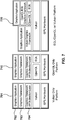
- a graphics application stack 701 is shown.
- Stack 701 is similar to stack 100 of FIG. 1 , however application 101 of FIG. 1 is broken down in to its constituent parts in FIG. 7 .
- graphics framework 703 which partially contains a graphics driver API indirection layer 704.
- Stack 710 of FIG. 7 shows an example of an OpenGL only stack utilizing an EGL library.
- Stack 720 of FIG. 7 shows an example of an EGL/OpenGL on Vulkan platform utilizing an EGL library.
- the performance analysis data 800 are based on a benchmark test using an AMDTM OpenGL ES 2 driver.
- the performance analysis data 850 are based on a benchmark test using the Vulkan SC 2 layer (e.g., as described herein).
- the graphs 810 and 860 show CPU utilization (% weight using resource time), and the graphs 812 and 862 show GPU utilization (utilization as resource time).
- the graph 910 shows CPU utilization
- the graph 960 shows GPU utilization.
- the curves 912 and 962 represent a rendering test using Vulkan
- the curves 914 and 964 represent a rendering test using OpenGL ES 2.0.
- the Vulkan test was concluded in a total time of 51.6 seconds
- the GL ES 2.0 test was concluded in a total time of 55.6 seconds.
- the overlay comparisons shown in the graphs 910 and 960 show less CPU usage to achieve full GPU loading, as shown in the middle section of the curves 914.
- benchmark testing verifies that, at the time of glDrawArray or glDrawRangeElement, vertex and index data are copied to Circularly accessed VBO and IBOs. Uniform data are updated in Descriptor Set. Binding of VBO and IBOs is queued before a draw command with binding point starting at the start of data write, and the draw command is queued.
- the queue is sent to the GPU. In some cases, for example, this may be set to occur with 1,000 draw commands, or when 500 Bytes of vertex data are achieved.
- Vulkan uses Pipelines that are combinations of the vertex and fragment shader code, fetch shader definition, and render state setup (primitive type, clipping, viewport, depth bounds, etc.).
- a composite object that holds the shader code and definition of the VS attributes and uniforms, and a list of pipelines that can represent the program.
- Each pipeline can maintain a set of data of the properties that make that pipeline unique.
Landscapes
- Engineering & Computer Science (AREA)
- Theoretical Computer Science (AREA)
- Software Systems (AREA)
- Physics & Mathematics (AREA)
- General Physics & Mathematics (AREA)
- Human Computer Interaction (AREA)
- General Engineering & Computer Science (AREA)
- Computer Graphics (AREA)
- Image Generation (AREA)
- Processing Or Creating Images (AREA)
- Pharmaceuticals Containing Other Organic And Inorganic Compounds (AREA)
Abstract
Description
- The embodiments disclosed herein relate to generating computer graphics, and more specifically, to systems and methods for using EGL with an OpenGL API and a Vulkan graphics driver.
- The following paragraphs are not an admission that anything discussed in them is prior art or part of the knowledge of persons skilled in the art.
- In the embedded graphics industry, OpenGL is the dominant application programming interface (hereinafter, "API") and has lead the industry in a variety of use cases. These use cases range from managing the graphics in avionics display systems to dashboard gauge clusters in automotive display systems, and 3D image processing in the medical field.
- The OpenGL API allows an application to specify a set of states to configure a graphics pipeline, culminating in a series of pixel data to be generated or "drawn" onto a surface buffer during a render operation.
- At its most basic, the OpenGL API allows an application to render color data to a render buffer in video memory. OpenGL has does not have the ability to create and/or allocate either on screen or off screen buffers. Accordingly, another API is needed regardless of the on/off screen locations.
- In the graphics library ("GL") world, there are a number of APIs that allow an application to associate a native display to a render context and render surface. These APIs tend to be platform specific with Windows® providing WGL, Linux's X Windows systems providing GLX, and the embedded platforms generally using EGL.
- These APIs vary syntactically and some are better suited for certain use cases than the others, but in essence they all accomplish the same thing: the ability to create a graphics context and a rendering surface and associate that graphics context with the rendering surface and with a native display and windowing system, where the native display is a handle to the display driver's display connection.
- Vulkan has been introduced by the Khronos Consortium as a new modular API that is intended to take advantage of current GPUs. With the advent of Vulkan, a new windowing API has emerged to bridge the gap between render surfaces and the native display: Window System Integration ("WSI").
- With this in mind, there is a need to provide an EGL solution that sets up the rendering context for Open GL using a Vulcan driver with WSI.
- According to some embodiments, a method for using an EGL driver to create a renderable surface for an OpenGL API is provided. The EGL driver and the OpenGL API are for use with a Vulkan graphics driver, a memory, at least one processor, and a module stored in the memory including computer instruction code. The computer instruction code is executable by the at least one processor. The method includes creating an EGL display structure; initializing the EGL display structure by querying the Vulkan driver for attributes of a physical display; choosing an EGL configuring matching the provided attributes; and creating the EGL surface.
- In another embodiment of the method, the method further includes associating the EGL surface with the EGL display and a native windowing system.
- In another embodiment of the method, the method further includes creating a graphics context; associating the graphics context with the EGL display; and associating the graphics context with the EGL surface to make the EGL surface a render target.
- In another embodiment of the method, the step of creating the EGL display structure is by making an eglGetDisplay function call which uses the Vulkan graphics driver.
- In another embodiment of the method, the step of initializing the EGL display structure is by making an egllnitialize function call which uses the Vulkan graphics driver.
- In another embodiment of the method, the step of choosing the EGL configuring matching the provided attributes is by making an eglChooseConfig function call which uses the Vulkan graphics driver.
- In another embodiment of the method, the step of creating the EGL surface is by making an eglCreateWindowSurface function call which uses the Vulkan graphics driver.
- In another embodiment of the method, the provided attributes include color buffer size, depth buffer size, etc.
- According to some embodiments, a non-transitory, computer-readable medium is provided, the medium including an EGL driver having computer instruction code that is executable by at least one processor and structured to cause the at least one processor to be configured to: create an EGL display structure; initialize the EGL display structure by querying the Vulkan driver for attributes of a physical display; choose an EGL configuring matching the provided attributes; and create the EGL surface.
- In another embodiment of the non-transitory, computer-readable medium, the processor is further configured to associate the EGL surface with the EGL display and a native windowing system.
- In another embodiment of the non-transitory, computer-readable medium, the processor is further configured to create a graphics context; associate the graphics context with the EGL display; and associate the graphics context with the EGL surface to make the EGL surface a render target.
- In another embodiment of the non-transitory, computer-readable medium, the step of creating the EGL display structure is by making an eglGetDisplay function call which uses the Vulkan graphics driver.
- In another embodiment of the non-transitory, computer-readable medium, the step of initializing the EGL display structure is by making an eglInitialize function call which uses the Vulkan graphics driver.
- In another embodiment of the non-transitory, computer-readable medium, the step of choosing the EGL configuring matching the provided attributes is by making an eglChooseConfig function call which uses the Vulkan graphics driver.
- In another embodiment of the non-transitory, computer-readable medium, the step of creating the EGL surface is by making an eglCreateWindowSurface function call which uses the Vulkan graphics driver.
- In another embodiment of the non-transitory, computer-readable medium, the provided attributes include color buffer size, depth buffer size, etc.
- Other aspects and features will become apparent, to those ordinarily skilled in the art, upon review of the following description of some exemplary embodiments.
- The drawings included herewith are for illustrating various examples of articles, methods, and apparatuses of the present specification. In the drawings:
-
FIG. 1 is a block diagram of an OpenGL stack; -
FIG. 2 is a block diagram of a high level architecture of OpenGL and EGL on a Vulcan driver; -
FIG. 3 is a block diagram of an OpenGL-on-Vulkan driver architecture that includes a translator to Window System Integration (WSI) according to one embodiment; -
FIG. 4 is a flow diagram depicting a method to get handles to the GPU for the EGL driver according to one embodiment; -
FIG. 5 is a flow diagram depicting a method to create a surface for OpenGL rendering according to one embodiment; -
FIG. 6 is a flow diagram depicting a method to create an EGL configuration list according to one embodiment; -
FIG. 7 is a block diagram of graphics framework layers in a Vulkan only platform, an OpenGL only platform and an EGL/OpenGL on Vulkan platform according to one embodiment; -
FIG. 8 is a diagram of exemplary performance analysis data according to one embodiment; and -
FIG. 9 is another diagram of exemplary performance analysis data according to one embodiment. - Various apparatus or processes will be described below to provide an example of one or more embodiments. No embodiment described below limits any claimed embodiment and any claimed embodiment may cover processes or apparatus that differ from those described below. The claimed embodiments are not limited to apparatus or processes having all of the features of any one apparatus or process described below or to features common to multiple or all of the apparatus described below. It is possible that an apparatus or process described below is not an embodiment of any claimed embodiment. Any embodiment disclosed below that is not claimed in this document may be the subject matter of another protective instrument, for example, a continuing patent application, and the applicants, inventors or owners do not intend to abandon, disclaim or dedicate to the public any such embodiment by its disclosure in this document.
- The embodiments of the systems and methods described herein may be implemented in hardware or software, or a combination of both. In some embodiments, the systems and methods are implemented in computer programs executing on programmable computers each comprising at least one processor, a data storage system (including volatile and non-volatile memory and/or other storage elements), at least one input device, and at least one output device. In other embodiments, the systems and methods are implemented in computer programs executing on programmable computers that have limited or no input devices as commonly understood in the computer industry (e.g. no keyboard, no mouse, no scanner, no text telephone ("TTY") device). In these embodiments, the computer systems may automatically start programs without user intervention and start processing data which is received from a network interface. For example and without limitation, the programmable computers may be a programmable electronic controller, mainframe computer, server, personal computer, laptop, personal data assistant, a cellular telephone or an embedded computer system such as an avionics system. Program code is applied to input data to perform the functions described herein and generate output information. The output information is applied to one or more output devices, in known fashion.
- Each program may be implemented in a high level procedural or object oriented programming and/or scripting language to communicate with a computer system. However, the programs can be implemented in assembly or machine language, if desired. In any case, the language may be a compiled or interpreted language. Each such computer program is preferably stored on a storage media or a device (e.g. read only memory (ROM) or magnetic diskette) readable by a general or special purpose programmable computer, for configuring and operating the computer when the storage media or device is read by the computer to perform the procedures described herein. The inventive system may also be considered to be implemented as a computer-readable storage medium, configured with a computer program, where the storage medium so configured causes a computer to operate in a specific and predefined manner to perform the functions described herein.
- In the field of computer graphics, a person skilled in the art will understand that particular terms have specific meanings and definitions provided by the OpenGL® standard. Generally speaking, the meanings and definitions of specific terms related to the OpenGL standard can be determined by referring to the standards and documentation published by the Khronos Consortium, such as at the website www.khronos.org. For example, the terms "context", "object", and "state" have specific meanings.
- OpenGL can be viewed as a state machine. Thus, at any particular time, an OpenGL instance can be defined by its particular state. In this view, OpenGL functions can be grouped into three broad categories of functions. First are those functions that set state into an OpenGL context. Second are those functions that can query state. Third are those functions that preform rendering operations based on state.
- An OpenGL context can be thought of as representing an object that stores the state associated with a particular instance of OpenGL. An OpenGL context can represent a default framebuffer that render commands draw to rather than a framebuffer object.
- An OpenGL object is a construct that contains a state. An OpenGL object can be bound to a particular context, in which case, the object state is mapped to the state of the context. Thus, changes in the state of the context will also be applied to the object, and functions that act on the context state will also use the object's state. Objects can be classified as regular or container objects (or non-standard objects). Examples of regular objects are buffer objects, query objects, renderbuffer objects, sampler objects, and texture objects. Examples of container objects are framebuffer objects, program pipeline objects, transform feedback objects, and vertex array objects. Examples of non-standard objects are sync objects and shader or program objects.
- A texture object can contain one or more images, where all of the images have the same image format. The image format describes the way that data is stored in order to represent the images in texture objects and renderbuffer objects. In other words, the image format defines the meaning of the data associated with the image.
- With the introduction of GL on Vulkan, the present application proposes a solution where a GL application does not need to be aware that it is running on top of a Vulkan driver. However, since the GL application would use EGL, it follows that there must be an implementation of EGL which sets up the rendering context for OpenGL using a Vulkan driver with WSI. Without a corresponding EGL\WGL\XGL driver on Vulkan, an OpenGL driver on Vulkan is not useable as the EGL driver is responsible for creating the Surfaces which the OpenGL driver renders to.
- EGL is the preferred solution over XGL or WGL as it is an open standard and a required standard of other open systems standards such as the Future Avionics Capability Environment (FACE®) technical standard. EGL and OpenGL are required by this and other system standards and, because Vulkan is a better API to support GPUs, the creation of a portable EGL library which utilizes Vulkan to be used with an OpenGL on Vulkan library provides a benefit to the avionics and safety critical application space.
- By implementing EGL and OpenGL on top of Vulkan it provides not only the now required OpenGL and EGL libraries but also provides the Vulkan API on the platform for when the system standards are updated to reflect changes in graphics technology, such that existing software and hardware can support newer programs for longer periods without needing to be upgraded simply to expose the Vulkan API.
- Referring to
FIG. 1 , there is a block diagram of an existing design of agraphical application stack 100. Thestack 100 is responsible for accessing GPU resources.Graphics application 101 overlaysOpenGL 102 andEGL 103 which interface directly with Graphics Processing Unit (GPU) 104. Instack 100 ofFIG. 1 , theOpenGL 102 andEGL 103 libraries are also hardware drivers making their content highly dependent on the hardware interface to theGPU 104. TheOpenGL driver 102 is responsible for taking OpenGL API calls fromgraphics application 101 and providing associated hardware-specific instructions toGPU 104. TheOpenGL 102 is designed to operate with afirst GPU 104. According to some embodiments, theGPU 104 may be optimized for OpenGL. Thus, theOpenGL driver 102 provides theGPU 104 with instructions based on an application making OpenGL API calls. -
FIG. 2 is a block diagram of astack 200 havingOpenGL 202 andEGL 203 using aVulkan driver 204.Stack 200 also shows relative sizes of theOpenGL 202,EGL 203 andVulkan driver 204 with respect toOpenGL 102 andEGL 103 ofFIG. 1 . According to some embodiments, when anapplication 201 initiates an OpenGL API call, theapplication 201 is unaware that, at some point, aVulkan driver 204 will be involved in executing the operation. In this way, the API call travels through theOpenGL driver 202, and is transformed to a Vulkan operation. As the operation enters theVulkan driver 204, theVulkan driver 204 is unaware that the operation originated in an OpenGL application (e.g. application 201). - In
FIG. 2 , theOpenGL 202 andEGL 203 do not communicate directly withGPU 205 and therefore are not platform specific. Rather,OpenGL 202 andEGL 203 are separated fromGPU 205 byVulkan driver 204. By removing direct communication betweenGPU 205 and theOpenGL 202 andEGL 203, a higher level of reuse can be provided of the OpenGL and EGL drivers. This may be important in safety certifiable software (e.g. software for the aviation industry) asOpenGL 202 andEGL 203 can be reused without changing between platforms. Further, a higher level of reuse can also provide for theOpenGL 202 andEGL 203 to grow their feature sets with a single amount of work regardless of the underlying GPU interface. The ability to add new features in a platform agnostic way can reduce development and deployment times for graphical drivers, such that standards like OpenGL SC can grow to be feature complete with OpenGL over shorter time periods when compared to if the same features had to be implemented in every GPUdependent OpenGL 102 driver. - As driver development is reduced by this implementation, the application development can also be reduced (as described below, where use of the Vulkan API at an application programming level requires that the programmer do significantly more work and understand much more complex processes than when using the OpenGL/EGL APIs).
- Referring to
FIG. 3 , there is shown an OpenGL-on-Vulkan driver architecture 300 that includes a translator to Window System Integration (WSI). - Generally speaking, the OpenGL API allows an application to render color data to a render buffer in video memory but cannot create the render surface. A second API is needed to create the render surface (e.g. EGL).
- There are a number of APIs that allow an application to associate a native display to a render context and render surface. These APIs tend to be platform specific, with windows providing WGL, X Windows systems providing GLX, and embedded platforms generally using EGL.
- With the introduction of Vulkan, a new windowing API has emerged to bridge the gap between render surfaces and the native display. Specifically, Vulkan includes Window System Integration (WSI). WSI aims to be a complete set of platform specific implementations defined as part of the Vulkan standard.
- According to some embodiments, the OpenGL-on-
Vulkan driver architecture 300 may ensure that an OpenGL application need not be aware that it is running on top of a Vulkan driver. Thus, it follows that an application that uses EGL need not be aware that it is running on top of WSI. - In the example shown in
FIG. 3 , an OpenGL-on-Vulkan driver architecture 300 uses EGL on WSI. The EGL API provides a list of functions that an application can use to create a graphics context, a render surface, a display, and associate the three as the current render targets. An example of an EGL application making API calls is shown inFIG. 5 (below). - Referring to
FIG. 4 , there is shown an example 400 of a call from an application to an EGL driver. As shown inFIG. 4 , EGL possesses a simple single call GPU selection function designed to get handles to the GPU for the EGL driver. This call iseglGetDisplay 401. - To do the same work as eglGetDisplay an application writing to the Vulkan API must make the following calls at least once;
vkCreateInstance(), vkEnumeratePhysicalDevices(), vkGetPhysicalDeviceQueueFamilyProperties(), vkGetPhysicalDeviceProperties(), vkGetPhysicalDeviceFeatures(), vkCreateDevice(), vkGetPhysical DeviceMemoryProperties(). - As can be seen by this basic example 400, EGL provides a much simpler API to the programmer than Vulkan does. The EGL on Vulkan library (as shown in
FIG. 2 ) can therefore provide the EGL API to the programmer while using the Vulkan interface to talk to the GPU hardware. - Referring to
FIG. 5 , there is shown an example 500 of creating a surface for OpenGL rendering. WhereasFIG. 4 shows example 400 of how eglOpenDisplay must call a number of functions to make the one call work, example 500 provides an example EGL start up process and how EGL calls are mapped to Vulkan calls to provide the OpenGL API a valid context and surface to draw on. Example 500 shows some of the high level Vulkan functions which are called from the associated EGL entry points in the EGL Library. It should be noted that, for simplicity, example 500 does not show all the functions used. - As an example, the
EGL application 501 may make API calls in the following order. Acall eglDisplay 502 can be made to create an EGL display and associate that display with a native display connection using "eglDisplay = eglGetDisplay(handleToNativeDisplay)". On windows, this may be a handle to the device context or hDC. Then, the EGL display structure can be initialized usingegllnitialize 503. - An EGL configuration matching the provided attributes (color buffer size, depth buffer size, etc.) can be chosen using eglChooseConfig 504. An EGL surface can be created and associated with the EGL display and native windowing
system using eglCreateWindowSurface 505. Then, a graphics context can be created and associated with the EGLdisplay using eglCreateContext 506. Finally, a context can be associated with an EGL display and an EGL surface, and these can be made the current rendertarget using eglMakeCurrent 507. - In order to accomplish the above, and utilize WSI in Vulkan, the
translator module 322 ofFIG. 3 can translate the EGL into an equivalent WSI call. Thetranslator module 322 receives theEGL function 330, translates it to theequivalent WSI call 332, which is then sent to theGPU 328. - The example 500 provides an embodiment of a unique out of order concept of first creating a Vulkan surface before knowing anything about the surface properties which the application is looking for or if it is even trying to render to a screen. After creating the Vulkan surface, the application queries for the supported properties of the surface and then creates the sized swapchain and its associated images after the application chooses a proper EGL configuration.
- Based on example 500, it might be assumed that certain EGL objects could be associated with certain Vulkan objects; such as an EGL Contex could be mapped to an OpenGL Context + Render Pass. Or a EGL Window Surface is a swapchain and depth or stencil buffer. The idea of a true object mapping between the two APIs has been a common pitfall. The case is that to map EGL objects to Vulkan objects must be done in complete sums, where the EGL objects may not be complete until after a following call is made. Because of this non-completeness, the EGL API must check for completeness before accessing certain objects; such as the EGL Surface, or EGL Context object.
- Following mapping of high level objects (such as described above), finer details about the system should be mapped. Vulkan does not understand what an EGL Configuration is but, like an EGL Configuration, only permits certain parameter combinations to be valid based on hardware or software features enabled or disabled.
- The function eglChooseConfig 504 is used by the application developer to tell the rendering context to have the certain properties such as the number of bits for the red component of the Surfaces to be created. Vulkan likewise has the ability to specify how many bits of red to have in an Image provided it does this by setting the image format and querying if support for that format is available.
- For example, if one assumes that an application programmer requests a windowed
Surface using eglCreateWindowSurface 505 with 8 bits for the red component, 8 for the green component, 8 for the blue component, 2 for the transparency component, a stencil buffer with 2 bits, a depth buffer with 16 bits, and multi-sample anti-aliasing using 4 samples per pixel. Using EGL, this would use the following symbol array:
 {
 EGL_RED_SlZE, 8,
 EGL_GREEN_SIZE, 8,
 EGL_BLUE_SIZE, 8,
 EGL_ALPHA_SIZE, 2,
 EGL_STENCIL_SIZE, 2,
 EGL_DEPTH_SIZE, 16,
 EGL_SAMPLES, 4
 EGL_NONE
 }
VK_FORMAT_R8_U NORM,
VK_FORMAT_R8G8_UNORM,
VK_FORMAT_R8G8B8_UNORM, and
VK_FORMAT_R8G8B8A8_UNORM, then create a single configuration using
VK_FORMAT_R8G8B8A8_UNORM since it encompasses the others using a simple bitmask).
Claims (15)
- A method for using an EGL driver to create a renderable surface for an OpenGL API, the EGL driver and the OpenGL API for use with a Vulkan graphics driver, a memory, at least one processor, and a module stored in the memory including computer instruction code that is executable by the at least one processor, the method comprising:creating an EGL display structure;initializing the EGL display structure by querying the Vulkan driver for attributes of a physical display;choosing an EGL configuring matching the provided attributes; andcreating the EGL surface.
- The method of claim 1, further comprising:associating the EGL surface with the EGL display and a native windowing system.
- The method of claim 1, further comprising:creating a graphics context;associating the graphics context with the EGL display; andassociating the graphics context with the EGL surface to make the EGL surface a render target.
- The method of claim 1, wherein the step of creating the EGL display structure is by making an eglGetDisplay function call which uses the Vulkan graphics driver.
- The method of claim 1, wherein the step of initializing the EGL display structure is by making an egllnitialize function call which uses the Vulkan graphics driver.
- The method of claim 1, wherein the step of choosing the EGL configuring matching the provided attributes is by making an eglChooseConfig function call which uses the Vulkan graphics driver.
- The method of claim 1, wherein the step of creating the EGL surface is by making an eglCreateWindowSurface function call which uses the Vulkan graphics driver.
- The method of claim 1, wherein the provided attributes include color buffer size and/or depth buffer size.
- A non-transitory, computer-readable medium, comprising: an EGL driver having computer instruction code that is executable by at least one processor and structured to cause the at least one processor to be configured to:create an EGL display structure;initialize the EGL display structure by querying the Vulkan driver for attributes of a physical display;choose an EGL configuring matching the provided attributes; andcreate the EGL surface.
- The non-transitory, computer-readable medium of claim 9, wherein the EGL driver has computer instruction code that is executable by at least one processor and structured to cause the at least one processor to be configured to also:associate the EGL surface with the EGL display and a native windowing system.
- The non-transitory, computer-readable medium of claim 9, wherein the EGL driver has computer instruction code that is executable by at least one processor and structured to cause the at least one processor to be configured to also:create a graphics context;associate the graphics context with the EGL display; andassociate the graphics context with the EGL surface to make the EGL surface a render target.
- The non-transitory, computer-readable medium of claim 9, wherein the step of create the EGL display structure is by making an eglGetDisplay function call which uses the Vulkan graphics driver.
- The non-transitory, computer-readable medium of claim 9, wherein the step of initialize the EGL display structure is by making an egllnitialize function call which uses the Vulkan graphics driver.
- The non-transitory, computer-readable medium of claim 9, wherein the step of choose the EGL configuring matching the provided attributes is by making an eglChooseConfig function call which uses the Vulkan graphics driver.
- The non-transitory, computer-readable medium of claim 9, wherein the step of create the EGL surface is by making an eglCreateWindowSurface function call which uses the Vulkan graphics driver.
Applications Claiming Priority (1)
| Application Number | Priority Date | Filing Date | Title |
|---|---|---|---|
| US201762543046P | 2017-08-09 | 2017-08-09 |
Publications (3)
| Publication Number | Publication Date |
|---|---|
| EP3441877A2 true EP3441877A2 (en) | 2019-02-13 |
| EP3441877A3 EP3441877A3 (en) | 2019-03-20 |
| EP3441877B1 EP3441877B1 (en) | 2025-07-16 |
Family
ID=63449173
Family Applications (1)
| Application Number | Title | Priority Date | Filing Date |
|---|---|---|---|
| EP18188061.8A Active EP3441877B1 (en) | 2017-08-09 | 2018-08-08 | Systems and methods for using egl with an opengl api and a vulkan graphics driver |
Country Status (4)
| Country | Link |
|---|---|
| US (2) | US10789669B2 (en) |
| EP (1) | EP3441877B1 (en) |
| CA (1) | CA3013624C (en) |
| ES (1) | ES3039121T3 (en) |
Families Citing this family (12)
| Publication number | Priority date | Publication date | Assignee | Title |
|---|---|---|---|---|
| CA2946074C (en) | 2015-10-21 | 2024-02-13 | Stephen Viggers | Systems and methods for using an opengl api with a vulkan graphics driver |
| CN110647325A (en) * | 2019-08-21 | 2020-01-03 | 北京达佳互联信息技术有限公司 | Graphic resource conversion method, apparatus, electronic device and storage medium |
| CN114494547B (en) * | 2020-11-13 | 2025-09-19 | 华为技术有限公司 | Drawing command processing method and related equipment thereof |
| CN112652025B (en) * | 2020-12-18 | 2022-03-22 | 完美世界(北京)软件科技发展有限公司 | Image rendering method and device, computer equipment and readable storage medium |
| CN113822962B (en) * | 2021-11-19 | 2022-03-18 | 北京鲸鲮信息系统技术有限公司 | Window information processing method, device, electronic device and storage medium |
| US12307548B2 (en) * | 2021-11-29 | 2025-05-20 | Samsung Electronics Co., Ltd. | Image processing |
| GB2613194B (en) * | 2021-11-29 | 2024-11-13 | Samsung Electronics Co Ltd | Image Processing |
| CN115409687B (en) * | 2022-10-31 | 2023-01-13 | 北京麟卓信息科技有限公司 | Rendering difference detection method based on display buffer synthesis |
| CN116339667B (en) * | 2023-03-28 | 2026-05-12 | 统信软件技术有限公司 | Display server protocol switching method and device and computing equipment |
| CN117724987B (en) * | 2024-02-18 | 2024-05-17 | 北京麟卓信息科技有限公司 | OpenGL hierarchical realization verification method based on texture conversion tracking |
| CN117830457B (en) * | 2024-03-05 | 2024-04-26 | 北京麟卓信息科技有限公司 | Rendering synchronization optimization method based on intra-frame semaphore |
| CN120182458B (en) * | 2025-05-20 | 2025-08-26 | 武汉凌久微电子有限公司 | OpenGL dotted line function implementation method and system based on shader |
Family Cites Families (9)
| Publication number | Priority date | Publication date | Assignee | Title |
|---|---|---|---|---|
| US20060028479A1 (en) | 2004-07-08 | 2006-02-09 | Won-Suk Chun | Architecture for rendering graphics on output devices over diverse connections |
| CN101059760B (en) | 2006-04-20 | 2014-05-07 | 意法半导体研发(上海)有限公司 | OPENGL to OPENGLIES translator and OPENGLIES emulator |
| CN103336816B (en) * | 2013-06-28 | 2017-02-08 | 广州市动景计算机科技有限公司 | Canvas element rendering method and device based on GPU on Android system |
| US9727339B2 (en) | 2013-07-18 | 2017-08-08 | Nvidia Corporation | Method and system for distributed shader optimization |
| US9886934B2 (en) | 2014-12-24 | 2018-02-06 | Intel Corporation | Ordering mechanism for offload graphics scheduling |
| CA2946074C (en) * | 2015-10-21 | 2024-02-13 | Stephen Viggers | Systems and methods for using an opengl api with a vulkan graphics driver |
| US10102605B1 (en) | 2016-08-26 | 2018-10-16 | Amazon Technologies, Inc. | Graphics library virtualization for virtualized graphics processing |
| US10074206B1 (en) | 2017-05-23 | 2018-09-11 | Amazon Technologies, Inc. | Network-optimized graphics library for virtualized graphics processing |
| US10636112B2 (en) | 2018-03-28 | 2020-04-28 | Intel Corporation | Graphics processor register data re-use mechanism |
-
2018
- 2018-08-08 US US16/057,968 patent/US10789669B2/en active Active
- 2018-08-08 CA CA3013624A patent/CA3013624C/en active Active
- 2018-08-08 ES ES18188061T patent/ES3039121T3/en active Active
- 2018-08-08 EP EP18188061.8A patent/EP3441877B1/en active Active
-
2020
- 2020-08-27 US US17/004,770 patent/US11232535B2/en active Active
Non-Patent Citations (1)
| Title |
|---|
| None |
Also Published As
| Publication number | Publication date |
|---|---|
| US20210049730A1 (en) | 2021-02-18 |
| CA3013624A1 (en) | 2019-02-09 |
| US11232535B2 (en) | 2022-01-25 |
| US10789669B2 (en) | 2020-09-29 |
| ES3039121T3 (en) | 2025-10-17 |
| EP3441877A3 (en) | 2019-03-20 |
| US20190073741A1 (en) | 2019-03-07 |
| EP3441877B1 (en) | 2025-07-16 |
| CA3013624C (en) | 2024-06-18 |
Similar Documents
| Publication | Publication Date | Title |
|---|---|---|
| US11232535B2 (en) | Systems and methods for using EGL with an OpenGL API and a Vulkan graphics driver | |
| US10755376B2 (en) | Systems and methods for using an openGL API with a Vulkan graphics driver | |
| US7650603B2 (en) | Resource management for virtualization of graphics adapters | |
| EP2756481B1 (en) | System and method for layering using tile-based renderers | |
| US20110067038A1 (en) | Co-processing techniques on heterogeneous gpus having different device driver interfaces | |
| US10002403B2 (en) | Command remoting | |
| KR20180055446A (en) | Tile-based rendering method and apparatus | |
| CN105427236A (en) | Method and device for image rendering | |
| WO2010117893A1 (en) | Methods and systems for prioritizing dirty regions within an image | |
| US20130335440A1 (en) | Defining a midlet region space | |
| EP3438936B1 (en) | Method and apparatus for managing graphics layers within a data processing system | |
| US8907979B2 (en) | Fast rendering of knockout groups using a depth buffer of a graphics processing unit | |
| US20100085367A1 (en) | Graphics processing method and apparatus implementing window system | |
| US7567253B2 (en) | Mirror driver notification of device independent bitmap drawing calls | |
| TWI556167B (en) | System and method for multiple native software applications user interface composition | |
| CN116339993B (en) | A method, apparatus and computing device for accelerating window rendering |
Legal Events
| Date | Code | Title | Description |
|---|---|---|---|
| PUAI | Public reference made under article 153(3) epc to a published international application that has entered the european phase |
Free format text: ORIGINAL CODE: 0009012 |
|
| STAA | Information on the status of an ep patent application or granted ep patent |
Free format text: STATUS: THE APPLICATION HAS BEEN PUBLISHED |
|
| AK | Designated contracting states |
Kind code of ref document: A2 Designated state(s): AL AT BE BG CH CY CZ DE DK EE ES FI FR GB GR HR HU IE IS IT LI LT LU LV MC MK MT NL NO PL PT RO RS SE SI SK SM TR |
|
| AX | Request for extension of the european patent |
Extension state: BA ME |
|
| PUAL | Search report despatched |
Free format text: ORIGINAL CODE: 0009013 |
|
| AK | Designated contracting states |
Kind code of ref document: A3 Designated state(s): AL AT BE BG CH CY CZ DE DK EE ES FI FR GB GR HR HU IE IS IT LI LT LU LV MC MK MT NL NO PL PT RO RS SE SI SK SM TR |
|
| AX | Request for extension of the european patent |
Extension state: BA ME |
|
| RIC1 | Information provided on ipc code assigned before grant |
Ipc: G06F 9/451 20180101AFI20190211BHEP Ipc: G06T 1/20 20060101ALI20190211BHEP |
|
| STAA | Information on the status of an ep patent application or granted ep patent |
Free format text: STATUS: REQUEST FOR EXAMINATION WAS MADE |
|
| 17P | Request for examination filed |
Effective date: 20190919 |
|
| RBV | Designated contracting states (corrected) |
Designated state(s): AL AT BE BG CH CY CZ DE DK EE ES FI FR GB GR HR HU IE IS IT LI LT LU LV MC MK MT NL NO PL PT RO RS SE SI SK SM TR |
|
| RAP1 | Party data changed (applicant data changed or rights of an application transferred) |
Owner name: CHANNEL ONE HOLDINGS INC. |
|
| RIN1 | Information on inventor provided before grant (corrected) |
Inventor name: HERRING, DANIEL Inventor name: WENGER, KEN |
|
| STAA | Information on the status of an ep patent application or granted ep patent |
Free format text: STATUS: EXAMINATION IS IN PROGRESS |
|
| 17Q | First examination report despatched |
Effective date: 20200629 |
|
| RIN1 | Information on inventor provided before grant (corrected) |
Inventor name: WENGER, KENNETH Inventor name: HERRING, DANIEL |
|
| GRAP | Despatch of communication of intention to grant a patent |
Free format text: ORIGINAL CODE: EPIDOSNIGR1 |
|
| STAA | Information on the status of an ep patent application or granted ep patent |
Free format text: STATUS: GRANT OF PATENT IS INTENDED |
|
| INTG | Intention to grant announced |
Effective date: 20250211 |
|
| GRAS | Grant fee paid |
Free format text: ORIGINAL CODE: EPIDOSNIGR3 |
|
| GRAA | (expected) grant |
Free format text: ORIGINAL CODE: 0009210 |
|
| STAA | Information on the status of an ep patent application or granted ep patent |
Free format text: STATUS: THE PATENT HAS BEEN GRANTED |
|
| AK | Designated contracting states |
Kind code of ref document: B1 Designated state(s): AL AT BE BG CH CY CZ DE DK EE ES FI FR GB GR HR HU IE IS IT LI LT LU LV MC MK MT NL NO PL PT RO RS SE SI SK SM TR |
|
| REG | Reference to a national code |
Ref country code: GB Ref legal event code: FG4D |
|
| REG | Reference to a national code |
Ref country code: CH Ref legal event code: EP Ref country code: DE Ref legal event code: R096 Ref document number: 602018083574 Country of ref document: DE |
|
| REG | Reference to a national code |
Ref country code: IE Ref legal event code: FG4D |
|
| PGFP | Annual fee paid to national office [announced via postgrant information from national office to epo] |
Ref country code: ES Payment date: 20250903 Year of fee payment: 8 |
|
| PGFP | Annual fee paid to national office [announced via postgrant information from national office to epo] |
Ref country code: DE Payment date: 20250926 Year of fee payment: 8 |
|
| PGFP | Annual fee paid to national office [announced via postgrant information from national office to epo] |
Ref country code: IT Payment date: 20250915 Year of fee payment: 8 |
|
| PGFP | Annual fee paid to national office [announced via postgrant information from national office to epo] |
Ref country code: GB Payment date: 20250828 Year of fee payment: 8 |
|
| REG | Reference to a national code |
Ref country code: ES Ref legal event code: FG2A Ref document number: 3039121 Country of ref document: ES Kind code of ref document: T3 Effective date: 20251017 |
|
| PGFP | Annual fee paid to national office [announced via postgrant information from national office to epo] |
Ref country code: FR Payment date: 20250901 Year of fee payment: 8 |
|
| REG | Reference to a national code |
Ref country code: NL Ref legal event code: MP Effective date: 20250716 |
|
| PG25 | Lapsed in a contracting state [announced via postgrant information from national office to epo] |
Ref country code: PT Free format text: LAPSE BECAUSE OF FAILURE TO SUBMIT A TRANSLATION OF THE DESCRIPTION OR TO PAY THE FEE WITHIN THE PRESCRIBED TIME-LIMIT Effective date: 20251117 |
|
| PG25 | Lapsed in a contracting state [announced via postgrant information from national office to epo] |
Ref country code: NL Free format text: LAPSE BECAUSE OF FAILURE TO SUBMIT A TRANSLATION OF THE DESCRIPTION OR TO PAY THE FEE WITHIN THE PRESCRIBED TIME-LIMIT Effective date: 20250716 |
|
| REG | Reference to a national code |
Ref country code: AT Ref legal event code: MK05 Ref document number: 1814659 Country of ref document: AT Kind code of ref document: T Effective date: 20250716 |
|
| PG25 | Lapsed in a contracting state [announced via postgrant information from national office to epo] |
Ref country code: IS Free format text: LAPSE BECAUSE OF FAILURE TO SUBMIT A TRANSLATION OF THE DESCRIPTION OR TO PAY THE FEE WITHIN THE PRESCRIBED TIME-LIMIT Effective date: 20251116 |
|
| PG25 | Lapsed in a contracting state [announced via postgrant information from national office to epo] |
Ref country code: NO Free format text: LAPSE BECAUSE OF FAILURE TO SUBMIT A TRANSLATION OF THE DESCRIPTION OR TO PAY THE FEE WITHIN THE PRESCRIBED TIME-LIMIT Effective date: 20251016 |
|
| REG | Reference to a national code |
Ref country code: LT Ref legal event code: MG9D |
|
| PG25 | Lapsed in a contracting state [announced via postgrant information from national office to epo] |
Ref country code: AT Free format text: LAPSE BECAUSE OF FAILURE TO SUBMIT A TRANSLATION OF THE DESCRIPTION OR TO PAY THE FEE WITHIN THE PRESCRIBED TIME-LIMIT Effective date: 20250716 |
|
| PG25 | Lapsed in a contracting state [announced via postgrant information from national office to epo] |
Ref country code: FI Free format text: LAPSE BECAUSE OF FAILURE TO SUBMIT A TRANSLATION OF THE DESCRIPTION OR TO PAY THE FEE WITHIN THE PRESCRIBED TIME-LIMIT Effective date: 20250716 |
|
| PG25 | Lapsed in a contracting state [announced via postgrant information from national office to epo] |
Ref country code: HR Free format text: LAPSE BECAUSE OF FAILURE TO SUBMIT A TRANSLATION OF THE DESCRIPTION OR TO PAY THE FEE WITHIN THE PRESCRIBED TIME-LIMIT Effective date: 20250716 |
|
| PG25 | Lapsed in a contracting state [announced via postgrant information from national office to epo] |
Ref country code: GR Free format text: LAPSE BECAUSE OF FAILURE TO SUBMIT A TRANSLATION OF THE DESCRIPTION OR TO PAY THE FEE WITHIN THE PRESCRIBED TIME-LIMIT Effective date: 20251017 |
|
| PG25 | Lapsed in a contracting state [announced via postgrant information from national office to epo] |
Ref country code: SE Free format text: LAPSE BECAUSE OF FAILURE TO SUBMIT A TRANSLATION OF THE DESCRIPTION OR TO PAY THE FEE WITHIN THE PRESCRIBED TIME-LIMIT Effective date: 20250716 |
|
| PG25 | Lapsed in a contracting state [announced via postgrant information from national office to epo] |
Ref country code: LV Free format text: LAPSE BECAUSE OF FAILURE TO SUBMIT A TRANSLATION OF THE DESCRIPTION OR TO PAY THE FEE WITHIN THE PRESCRIBED TIME-LIMIT Effective date: 20250716 |
|
| PG25 | Lapsed in a contracting state [announced via postgrant information from national office to epo] |
Ref country code: BG Free format text: LAPSE BECAUSE OF FAILURE TO SUBMIT A TRANSLATION OF THE DESCRIPTION OR TO PAY THE FEE WITHIN THE PRESCRIBED TIME-LIMIT Effective date: 20250716 Ref country code: PL Free format text: LAPSE BECAUSE OF FAILURE TO SUBMIT A TRANSLATION OF THE DESCRIPTION OR TO PAY THE FEE WITHIN THE PRESCRIBED TIME-LIMIT Effective date: 20250716 |
|
| PG25 | Lapsed in a contracting state [announced via postgrant information from national office to epo] |
Ref country code: RS Free format text: LAPSE BECAUSE OF FAILURE TO SUBMIT A TRANSLATION OF THE DESCRIPTION OR TO PAY THE FEE WITHIN THE PRESCRIBED TIME-LIMIT Effective date: 20251016 |
|
| PG25 | Lapsed in a contracting state [announced via postgrant information from national office to epo] |
Ref country code: RO Free format text: LAPSE BECAUSE OF FAILURE TO SUBMIT A TRANSLATION OF THE DESCRIPTION OR TO PAY THE FEE WITHIN THE PRESCRIBED TIME-LIMIT Effective date: 20250716 |
|
| REG | Reference to a national code |
Ref country code: CH Ref legal event code: H13 Free format text: ST27 STATUS EVENT CODE: U-0-0-H10-H13 (AS PROVIDED BY THE NATIONAL OFFICE) Effective date: 20260324 |
|
| PG25 | Lapsed in a contracting state [announced via postgrant information from national office to epo] |
Ref country code: SM Free format text: LAPSE BECAUSE OF FAILURE TO SUBMIT A TRANSLATION OF THE DESCRIPTION OR TO PAY THE FEE WITHIN THE PRESCRIBED TIME-LIMIT Effective date: 20250716 |
|
| PG25 | Lapsed in a contracting state [announced via postgrant information from national office to epo] |
Ref country code: DK Free format text: LAPSE BECAUSE OF FAILURE TO SUBMIT A TRANSLATION OF THE DESCRIPTION OR TO PAY THE FEE WITHIN THE PRESCRIBED TIME-LIMIT Effective date: 20250716 |
|
| PG25 | Lapsed in a contracting state [announced via postgrant information from national office to epo] |
Ref country code: LU Free format text: LAPSE BECAUSE OF NON-PAYMENT OF DUE FEES Effective date: 20250808 |
|
| PG25 | Lapsed in a contracting state [announced via postgrant information from national office to epo] |
Ref country code: CZ Free format text: LAPSE BECAUSE OF FAILURE TO SUBMIT A TRANSLATION OF THE DESCRIPTION OR TO PAY THE FEE WITHIN THE PRESCRIBED TIME-LIMIT Effective date: 20250716 Ref country code: CH Free format text: LAPSE BECAUSE OF NON-PAYMENT OF DUE FEES Effective date: 20250831 |
|
| PG25 | Lapsed in a contracting state [announced via postgrant information from national office to epo] |
Ref country code: SK Free format text: LAPSE BECAUSE OF FAILURE TO SUBMIT A TRANSLATION OF THE DESCRIPTION OR TO PAY THE FEE WITHIN THE PRESCRIBED TIME-LIMIT Effective date: 20250716 Ref country code: EE Free format text: LAPSE BECAUSE OF FAILURE TO SUBMIT A TRANSLATION OF THE DESCRIPTION OR TO PAY THE FEE WITHIN THE PRESCRIBED TIME-LIMIT Effective date: 20250716 |