EP3441490A1 - Aluminum alloy conductor wire, electric wire using same and wiring harness - Google Patents
Aluminum alloy conductor wire, electric wire using same and wiring harness Download PDFInfo
- Publication number
- EP3441490A1 EP3441490A1 EP17815287.2A EP17815287A EP3441490A1 EP 3441490 A1 EP3441490 A1 EP 3441490A1 EP 17815287 A EP17815287 A EP 17815287A EP 3441490 A1 EP3441490 A1 EP 3441490A1
- Authority
- EP
- European Patent Office
- Prior art keywords
- mass
- aluminum alloy
- wire
- alloy conductive
- less
- Prior art date
- Legal status (The legal status is an assumption and is not a legal conclusion. Google has not performed a legal analysis and makes no representation as to the accuracy of the status listed.)
- Pending
Links
Images


Classifications
-
- C—CHEMISTRY; METALLURGY
- C22—METALLURGY; FERROUS OR NON-FERROUS ALLOYS; TREATMENT OF ALLOYS OR NON-FERROUS METALS
- C22C—ALLOYS
- C22C21/00—Alloys based on aluminium
- C22C21/02—Alloys based on aluminium with silicon as the next major constituent
-
- C—CHEMISTRY; METALLURGY
- C22—METALLURGY; FERROUS OR NON-FERROUS ALLOYS; TREATMENT OF ALLOYS OR NON-FERROUS METALS
- C22C—ALLOYS
- C22C21/00—Alloys based on aluminium
-
- C—CHEMISTRY; METALLURGY
- C22—METALLURGY; FERROUS OR NON-FERROUS ALLOYS; TREATMENT OF ALLOYS OR NON-FERROUS METALS
- C22C—ALLOYS
- C22C21/00—Alloys based on aluminium
- C22C21/06—Alloys based on aluminium with magnesium as the next major constituent
-
- C—CHEMISTRY; METALLURGY
- C22—METALLURGY; FERROUS OR NON-FERROUS ALLOYS; TREATMENT OF ALLOYS OR NON-FERROUS METALS
- C22C—ALLOYS
- C22C21/00—Alloys based on aluminium
- C22C21/06—Alloys based on aluminium with magnesium as the next major constituent
- C22C21/08—Alloys based on aluminium with magnesium as the next major constituent with silicon
-
- C—CHEMISTRY; METALLURGY
- C22—METALLURGY; FERROUS OR NON-FERROUS ALLOYS; TREATMENT OF ALLOYS OR NON-FERROUS METALS
- C22F—CHANGING THE PHYSICAL STRUCTURE OF NON-FERROUS METALS AND NON-FERROUS ALLOYS
- C22F1/00—Changing the physical structure of non-ferrous metals or alloys by heat treatment or by hot or cold working
- C22F1/04—Changing the physical structure of non-ferrous metals or alloys by heat treatment or by hot or cold working of aluminium or alloys based thereon
-
- C—CHEMISTRY; METALLURGY
- C22—METALLURGY; FERROUS OR NON-FERROUS ALLOYS; TREATMENT OF ALLOYS OR NON-FERROUS METALS
- C22F—CHANGING THE PHYSICAL STRUCTURE OF NON-FERROUS METALS AND NON-FERROUS ALLOYS
- C22F1/00—Changing the physical structure of non-ferrous metals or alloys by heat treatment or by hot or cold working
- C22F1/04—Changing the physical structure of non-ferrous metals or alloys by heat treatment or by hot or cold working of aluminium or alloys based thereon
- C22F1/047—Changing the physical structure of non-ferrous metals or alloys by heat treatment or by hot or cold working of aluminium or alloys based thereon of alloys with magnesium as the next major constituent
-
- H—ELECTRICITY
- H01—ELECTRIC ELEMENTS
- H01B—CABLES; CONDUCTORS; INSULATORS; SELECTION OF MATERIALS FOR THEIR CONDUCTIVE, INSULATING OR DIELECTRIC PROPERTIES
- H01B1/00—Conductors or conductive bodies characterised by the conductive materials; Selection of materials as conductors
- H01B1/02—Conductors or conductive bodies characterised by the conductive materials; Selection of materials as conductors mainly consisting of metals or alloys
- H01B1/023—Alloys based on aluminium
-
- H—ELECTRICITY
- H01—ELECTRIC ELEMENTS
- H01B—CABLES; CONDUCTORS; INSULATORS; SELECTION OF MATERIALS FOR THEIR CONDUCTIVE, INSULATING OR DIELECTRIC PROPERTIES
- H01B7/00—Insulated conductors or cables characterised by their form
- H01B7/0045—Cable-harnesses
-
- C—CHEMISTRY; METALLURGY
- C22—METALLURGY; FERROUS OR NON-FERROUS ALLOYS; TREATMENT OF ALLOYS OR NON-FERROUS METALS
- C22F—CHANGING THE PHYSICAL STRUCTURE OF NON-FERROUS METALS AND NON-FERROUS ALLOYS
- C22F1/00—Changing the physical structure of non-ferrous metals or alloys by heat treatment or by hot or cold working
-
- H—ELECTRICITY
- H01—ELECTRIC ELEMENTS
- H01B—CABLES; CONDUCTORS; INSULATORS; SELECTION OF MATERIALS FOR THEIR CONDUCTIVE, INSULATING OR DIELECTRIC PROPERTIES
- H01B5/00—Non-insulated conductors or conductive bodies characterised by their form
- H01B5/02—Single bars, rods, wires, or strips
Definitions
- the present invention relates to an aluminum alloy conductive wire, an electrical wire and a wire harness using the same.
- an electrical wire constituting a wire harness or the like used for an opening-closing portion such as a vehicle door, or a portion around a vehicle engine has been required to be lightweight and hence it has been studied to use an aluminum alloy conductive wire instead of a copper wire as the electrical wire.
- an aluminum alloy conductive wire disclosed in Patent Document 1 below is known.
- an aluminum alloy conductive wire which contains 0.03 to 1.5 mass% of Mg, 0.02 to 2.0 mass% of Si, 0.1 to 1.0 mass% of at least one element selected from Cu, Fe, Cr, Mn and Zr in total, and which has conductivity of 40% IACS or more, tensile strength of 150 MPa or more, elongation of 5% or more, wire diameter of 0.5 mm or less and a maximum crystal grain size of 50 ⁇ m or less.
- Patent Document 1 JP 2012-229485 A
- the aluminum alloy conductive wire described in the above-mentioned Patent Document 1 shows decrease in strength after a heat-resistance test, and has room for improvement in terms of heat resistance.
- the present invention has been made in view of the above-mentioned circumstance, and an object of the present invention is to provide an aluminum alloy conductive wire having excellent heat resistance, an electrical wire and a wire harness using the same.
- the present inventors conducted intensive studies particularly focusing on the content rate of Mg in the aluminum alloy conductive wire. As a result, the present inventors found that the above-mentioned problems can be solved in a case where content rates of Si, Fe, Cu, and Mg are set to specific ranges in an aluminum alloy conductive wire, a total content rate of Ti, V, and B is set to be less than or equal to a specific value, and tensile strength is set to have a specific relation to a formula using a content rate of Mg and conductivity is set to have a specific relation to a formula using a content rate of Mg.
- the present invention is an aluminum alloy conductive wire which contains 0.15 mass% or more and 0.25 mass% or less of Si, 0.6 mass% or more and 0.9 mass% or less of Fe, 0.05 mass% or more and 0.15 mass% or less of Cu, 0.2 mass% or more and 2.7 mass% or less of Mg, and 0.03 mass% or less in total of Ti, V, and B, which has tensile strength of equal to or less than T 1 MPa represented by the following formula (1) and has conductivity of equal to or more than C %IACS represented by the following formula (2), in a case where a content rate of Mg in the aluminum alloy conductive wire is x mass%.
- T 1 59.5 ⁇ ln x + 231
- C 1.26 x 2 ⁇ 11.6 ⁇ x + 63.4
- the aluminum alloy conductive wire of the present invention decrease in strength is sufficiently suppressed even after a heat-resistance test and hence it is possible to have excellent heat resistance.
- the tensile strength be equal to or more than T 2 MPa represented by the following formula (3) in a case where the content rate of Mg in the aluminum alloy conductive wire is x mass%.
- T 2 60.5 ⁇ ln x + 176
- the content rate of Mg in the aluminum alloy conductive wire be 1.45 mass% or less
- the content rate of Si in the aluminum alloy conductive wire be 0.17 mass% or more and 0.25 mass% or less
- only Ti among Ti, V and B be contained in the aluminum alloy conductive wire.
- the aluminum alloy conductive wire has the same composition, it is possible to further improve heat resistance of the aluminum alloy conductive wire.
- the present invention is an electrical wire including the above-mentioned aluminum alloy conductive wire.
- the electrical wire since the aluminum alloy conductive wire can have excellent heat resistance, the electrical wire can have excellent heat resistance.
- the present invention is a wire harness including a plurality of electrical wires described above.
- the wire harness since the electrical wire can have excellent heat resistance, the wire harness can have excellent heat resistance.
- the "tensile strength” refers to tensile strength measured by a tensile test carried out in accordance with JIS C3002.
- the "conductivity” refers to conductivity determined from electrical resistance and mass measured in accordance with JIS C3002.
- an aluminum alloy conductive wire having excellent heat resistance, an electrical wire and a wire harness using the same are provided.
- Fig. 1 is a cross-sectional view illustrating an embodiment of the aluminum alloy conductive wire of the present invention.
- An aluminum alloy conductive wire 10 illustrated in Fig. 1 contains 0.15 mass% or more and 0.25 mass% or less of Si (silicon), 0.6 mass% or more and 0.9 mass% or less of Fe (iron), 0.05 mass% or more and 0.15 mass% or less of Cu (copper), 0.2 mass% or more and 2.7 mass% or less of Mg (magnesium), and 0.03 mass% or less in total of Ti (titanium), V (vanadium), and B (boron) and has tensile strength of equal to or less than T 1 MPa represented by the following formula (1) and has conductivity of equal to or more than C %IACS represented by the following formula (2), in a case where a content rate of Mg in the aluminum alloy conductive wire 10 is x mass%.
- the aluminum alloy conductive wire 10 contains 0.15 mass% or more and 0.25 mass% or less of Si.
- the content rate of Si is set to 0.15 mass% or more and 0.25 mass% or less since the aluminum alloy conductive wire 10 can balance tensile strength and elongation when compared to a case in which the content rate of Si is less than 0.15 mass%, and the aluminum alloy conductive wire 10 is excellent in conductivity when compared to a case in which the content rate of Si is more than 0.25 mass%.
- the content rate of Si is preferably 0.16 mass% or more and 0.22 mass% or less.
- the aluminum alloy conductive wire 10 contains 0.6 mass% or more and 0.9 mass% or less of Fe.
- the content rate of Fe is set to 0.6 mass% or more and 0.9 mass% or less since the aluminum alloy conductive wire 10 can balance tensile strength and elongation when compared to a case in which the content rate of Fe is less than 0.6 mass%, and the aluminum alloy conductive wire 10 is excellent in conductivity when compared to a case in which the content rate of Fe is more than 0.9 mass%.
- the content rate of Fe is preferably 0.68 mass% or more and 0.82 mass% or less.
- the aluminum alloy conductive wire 10 contains 0.05 mass% or more and 0.15 mass% or less of Cu.
- the content rate of Cu is set to 0.05 mass% or more and 0.15 mass% or less since the aluminum alloy conductive wire 10 can balance tensile strength and elongation when compared to a case in which the content rate of Cu is less than 0.05 mass%, and the aluminum alloy conductive wire 10 is excellent in conductivity when compared to a case in which the content rate of Cu is more than 0.15 mass%.
- the content rate of Cu is preferably 0.06 mass% or more and 0.12 mass% or less.
- the aluminum alloy conductive wire 10 contains 0.2 mass% or more and 2.7 mass% or less of Mg.
- the content rate of Mg is set to 0.2 mass% or more and 2.7 mass% or less since the aluminum alloy conductive wire 10 can balance tensile strength and elongation when compared to a case in which the content rate of Mg is less than 0.2 mass%, and the aluminum alloy conductive wire 10 is more excellent in conductivity when compared to a case in which the content rate of Mg is more than 2.7 mass%.
- the content rate of Mg is preferably 0.2 mass% or more and 2.0 mass% or less.
- the total content rate of Ti, V, and B is 0.03 mass% or less.
- the total content rate of Ti, V, and B is set to 0.03 mass% or less since the aluminum alloy conductive wire 10 is more excellent in conductivity when compared to a case in which the total content rate of Ti, V, and B is set to be larger than 0.03 mass%.
- the total content rate of Ti, V, and B is preferably 0.01 mass% or less.
- the total content rate of Ti, V, and B may be 0.03 mass% or less and hence may be 0 mass%. Namely, all of Ti, V and B may be 0 mass%. Further, only Ti, only V or only B among Ti, V and B may be 0 mass%, respectively.
- the content rate of Mg in the aluminum alloy conductive wire 10 be 1.45 mass% or less, the content rate of Si in the aluminum alloy conductive wire 10 be 0.17 mass% or more and 0.25 mass% or less, and only Ti among Ti, V and B be contained in the aluminum alloy conductive wire 10.
- the aluminum alloy conductive wire 10 has the same composition, namely, when the content rates of Si, Fe, Cu, Mg and Ti in the aluminum alloy conductive wire 10 are identical to each other, it is possible to further improve heat resistance of the aluminum alloy conductive wire 10.
- the content rate of Mg in the aluminum alloy conductive wire 10 be 0.3 mass% or more. In this case, it is possible to further improve heat resistance compared to a case where the content rate of Mg in the aluminum alloy conductive wire 10 is less than 0.3 mass%.
- the content rate of Si in the aluminum alloy conductive wire 10 be 0.23 mass% or less. In this case, it is possible to further improve heat resistance compared to a case where the content rate of Si in the aluminum alloy conductive wire 10 exceeds 0.23 mass%.
- tensile strength is equal to or less than T 1 MPa represented by the following formula (1) in a case where a content rate of Mg in the aluminum alloy conductive wire 10 is x mass%. In this case, more excellent heat resistance is obtained compared to a case tensile strength of the aluminum alloy conductive wire 10 exceeds T 1 MPa represented by the above formula (1).
- tensile strength is equal to or more than T 2 MPa represented by the following formula (3) in a case where a content rate of Mg in the aluminum alloy conductive wire 10 is x mass%.
- T 2 60.5 ⁇ ln x + 176
- conductivity is equal to or more than C %IACS represented by the above formula (2).
- conductivity of the aluminum alloy conductive wire 10 is preferably 65 %IACS or less.
- the aluminum alloy conductive wire 10 can be obtained by a manufacturing method including a rough drawing wire formation step of forming a rough drawing wire made of an aluminum alloy containing 0.15 mass% or more and 0.25 mass% or less of Si, 0.6 mass% or more and 0.9 mass% or less of Fe, 0.05 mass% or more and 0.15 mass% or less of Cu, 0.2 mass% or more and 2.7 mass% or less of Mg, and 0.03 mass% or less in total of Ti, V, and B, and a processing step of obtaining the aluminum alloy conductive wire 10 by performing a processing process including a heat treatment process and a wire drawing process on the rough drawing wire.
- the rough drawing wire formation step is a process of forming the rough drawing wire made of the above-mentioned aluminum alloy.
- the rough drawing wire mentioned above can be obtained by performing continuous casting and rolling, hot extrusion after billet casting or the like on molten metal made of the above-mentioned aluminum alloy.
- the processing step is a step of obtaining the aluminum alloy conductive wire 10 by performing the above-mentioned processing process on the rough drawing wire.
- the processing process is a process including the wire drawing process and the heat treatment process.
- the processing process may include the wire drawing process and the heat treatment process. Examples of a specific aspect of a procedure of the processing process include aspects below.
- the procedure of the processing process is not limited to the above aspects.
- the wire drawing process may be further performed in each of the above specific aspects.
- the heat treatment process needs to be performed after the wire drawing process.
- the wire drawing process is a process of reducing a diameter of the rough drawing wire, a drawn wire material obtained by drawing the rough drawing wire, a drawn wire material obtained by further drawing the drawn wire material (hereinafter the "rough drawing wire”, the “drawn wire material obtained by drawing the rough drawing wire”, and the “drawn wire material obtained by further drawing the drawn wire material” will be referred to as “wire materials”) or the like.
- the wire drawing process may be a hot wire drawing or cold wire drawing, and normally be cold wire drawing.
- a diameter of the wire material subjected to the wire drawing process is large (for example, 3 mm or more), it is preferable to perform heat treatment from the middle to remove distortion generated by wire drawing in the wire drawing process.
- the heat treatment process is a process of performing heat treatment on the wire material.
- the heat treatment process performed after the wire drawing process is performed to remove distortion generated in the wire material in the wire drawing process.
- a heat treatment temperature in the heat treatment process may normally be set to 200°C or more and 400°C or less, and a heat treatment time in the heat treatment process may normally be set to 1 minute to 24 hours.
- a heat treatment process finally performed in the heat treatment process (hereinafter referred to as a "final heat treatment process"), it is preferable to perform heat treatment on the wire material at 350°C or less.
- the aluminum alloy conductive wire 10 can have high conductivity.
- a heat treatment temperature of the wire material in the final heat treatment process is preferably 200°C or more since strength is more sufficiently lowered.
- a heat treatment time in the final heat treatment process is preferably 1 hour or more. In this case, a more uniform wire material is obtained over the entire length when compared to a case in which the heat treatment of the drawn wire material is performed for less than 1 hour. However, the heat treatment time is preferably 12 hours or less.
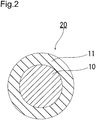
- Fig. 2 is a cross-sectional view illustrating an embodiment of the electrical wire of the present invention.
- the electrical wire 20 includes the above-described aluminum alloy conductive wire 10.
- the electrical wire 20 since the aluminum alloy conductive wire 10 can have excellent heat resistance, the electrical wire can have excellent heat resistance.
- the electrical wire 20 further includes a covering layer 11 that covers the above-mentioned aluminum alloy conductive wire 10.
- the covering layer 11 is made of a polyvinyl chloride resin or a flame retardant resin composition obtained by adding a flame retardant or the like to a polyolefin resin.
- Fig. 3 is a cross-sectional view illustrating an embodiment of the wire harness of the present invention.
- a wire harness 30 includes a plurality of electrical wires 20.
- the wire harness 30 can have excellent heat resistance.
- An aluminum alloy having a wire diameter of 25 mm was cast by dissolving Si, Fe, Cu, Mg, Ti, V and B together with aluminum such that content rates shown in Table 1 and 2 are obtained, and then pouring into a mold having a diameter of 25 mm. Then, a rough drawing wire having a wire diameter of 9.5 mm was obtained by performing a swaging processing on thus obtained aluminum alloy with a swaging machine (manufactured by Yoshida Kinen Co., Ltd.) such that a diameter of 9.5 mm was obtained and then performing a heat treatment at 270°C for 8 hours. An aluminum alloy conductive wire was obtained by processing thus obtained rough drawing wire using the following processing method.
- a heat-resistance test was carried out on the aluminum alloy conductive wires of Examples 1 to 20 and Comparative Examples 1 to 20 obtained as described above.
- the heat-resistance test was carried out by holding the aluminum alloy conductive wires at 150°C for 1,000 hours.
- the tensile test in accordance with JIS C3002 was carried out on the aluminum alloy conductive wires after the heat-resistance test to measure tensile strengths.
- the aluminum alloy conductive wire of the present invention has excellent heat resistance.
Landscapes
- Chemical & Material Sciences (AREA)
- Engineering & Computer Science (AREA)
- Materials Engineering (AREA)
- Mechanical Engineering (AREA)
- Metallurgy (AREA)
- Organic Chemistry (AREA)
- Physics & Mathematics (AREA)
- Thermal Sciences (AREA)
- Crystallography & Structural Chemistry (AREA)
- Conductive Materials (AREA)
- Non-Insulated Conductors (AREA)
- Insulated Conductors (AREA)
Abstract

Description
- The present invention relates to an aluminum alloy conductive wire, an electrical wire and a wire harness using the same.
- In recent years, an electrical wire constituting a wire harness or the like used for an opening-closing portion such as a vehicle door, or a portion around a vehicle engine has been required to be lightweight and hence it has been studied to use an aluminum alloy conductive wire instead of a copper wire as the electrical wire.
- For example, as such an aluminum alloy conductive wire, an aluminum alloy conductive wire disclosed in Patent Document 1 below is known. In Patent Document 1 below, disclosed is an aluminum alloy conductive wire which contains 0.03 to 1.5 mass% of Mg, 0.02 to 2.0 mass% of Si, 0.1 to 1.0 mass% of at least one element selected from Cu, Fe, Cr, Mn and Zr in total, and which has conductivity of 40% IACS or more, tensile strength of 150 MPa or more, elongation of 5% or more, wire diameter of 0.5 mm or less and a maximum crystal grain size of 50 µm or less.
- Patent Document 1:
JP 2012-229485 A - However, the aluminum alloy conductive wire described in the above-mentioned Patent Document 1 shows decrease in strength after a heat-resistance test, and has room for improvement in terms of heat resistance.
- The present invention has been made in view of the above-mentioned circumstance, and an object of the present invention is to provide an aluminum alloy conductive wire having excellent heat resistance, an electrical wire and a wire harness using the same.
- The present inventors conducted intensive studies particularly focusing on the content rate of Mg in the aluminum alloy conductive wire. As a result, the present inventors found that the above-mentioned problems can be solved in a case where content rates of Si, Fe, Cu, and Mg are set to specific ranges in an aluminum alloy conductive wire, a total content rate of Ti, V, and B is set to be less than or equal to a specific value, and tensile strength is set to have a specific relation to a formula using a content rate of Mg and conductivity is set to have a specific relation to a formula using a content rate of Mg.
- That is, the present invention is an aluminum alloy conductive wire which contains 0.15 mass% or more and 0.25 mass% or less of Si, 0.6 mass% or more and 0.9 mass% or less of Fe, 0.05 mass% or more and 0.15 mass% or less of Cu, 0.2 mass% or more and 2.7 mass% or less of Mg, and 0.03 mass% or less in total of Ti, V, and B, which has tensile strength of equal to or less than T1 MPa represented by the following formula (1) and has conductivity of equal to or more than C %IACS represented by the following formula (2), in a case where a content rate of Mg in the aluminum alloy conductive wire is x mass%.


- According to the aluminum alloy conductive wire of the present invention, decrease in strength is sufficiently suppressed even after a heat-resistance test and hence it is possible to have excellent heat resistance.
- In the above-mentioned aluminum alloy conductive wire, it is preferable that the tensile strength be equal to or more than T2 MPa represented by the following formula (3) in a case where the content rate of Mg in the aluminum alloy conductive wire is x mass%.

- In this case, when the aluminum alloy conductive wire is used in a portion which is subject to vibration, drawn or stored in a bent state, disconnection of the aluminum alloy conductive wire is sufficiently prevented.
- In the above-mentioned aluminum alloy conductive wire, it is preferable that the content rate of Mg in the aluminum alloy conductive wire be 1.45 mass% or less, the content rate of Si in the aluminum alloy conductive wire be 0.17 mass% or more and 0.25 mass% or less, and only Ti among Ti, V and B be contained in the aluminum alloy conductive wire.
- In this case, when the aluminum alloy conductive wire has the same composition, it is possible to further improve heat resistance of the aluminum alloy conductive wire.
- In addition, the present invention is an electrical wire including the above-mentioned aluminum alloy conductive wire.
- According to the electrical wire, since the aluminum alloy conductive wire can have excellent heat resistance, the electrical wire can have excellent heat resistance.
- Further, the present invention is a wire harness including a plurality of electrical wires described above.
- According to the wire harness, since the electrical wire can have excellent heat resistance, the wire harness can have excellent heat resistance.
- In addition, in the present invention, the "tensile strength" refers to tensile strength measured by a tensile test carried out in accordance with JIS C3002.
- Further, in the present invention, the "conductivity" refers to conductivity determined from electrical resistance and mass measured in accordance with JIS C3002.
- According to the present invention, an aluminum alloy conductive wire having excellent heat resistance, an electrical wire and a wire harness using the same are provided.
-
-
Fig. 1 is a cross-sectional view illustrating an embodiment of an aluminum alloy conductive wire of the present invention; -
Fig. 2 is a cross-sectional view illustrating an embodiment of an electrical wire of the present invention; and -
Fig. 3 is a cross-sectional view illustrating an embodiment of a wire harness of the present invention. - Hereinafter, an embodiment of the present invention will be described with reference to
Fig. 1. Fig. 1 is a cross-sectional view illustrating an embodiment of the aluminum alloy conductive wire of the present invention. - An aluminum alloy
conductive wire 10 illustrated inFig. 1 contains 0.15 mass% or more and 0.25 mass% or less of Si (silicon), 0.6 mass% or more and 0.9 mass% or less of Fe (iron), 0.05 mass% or more and 0.15 mass% or less of Cu (copper), 0.2 mass% or more and 2.7 mass% or less of Mg (magnesium), and 0.03 mass% or less in total of Ti (titanium), V (vanadium), and B (boron) and has tensile strength of equal to or less than T1 MPa represented by the following formula (1) and has conductivity of equal to or more than C %IACS represented by the following formula (2), in a case where a content rate of Mg in the aluminum alloyconductive wire 10 is x mass%. Here, content rates of Si, Fe, Cu, and Mg and a total content rate of Ti, V, and B are based on the mass of the aluminum alloy conductive wire 10 (100 mass%).

- The aluminum alloy
conductive wire 10 contains 0.15 mass% or more and 0.25 mass% or less of Si. The content rate of Si is set to 0.15 mass% or more and 0.25 mass% or less since the aluminum alloyconductive wire 10 can balance tensile strength and elongation when compared to a case in which the content rate of Si is less than 0.15 mass%, and the aluminum alloyconductive wire 10 is excellent in conductivity when compared to a case in which the content rate of Si is more than 0.25 mass%. The content rate of Si is preferably 0.16 mass% or more and 0.22 mass% or less. - The aluminum alloy
conductive wire 10 contains 0.6 mass% or more and 0.9 mass% or less of Fe. The content rate of Fe is set to 0.6 mass% or more and 0.9 mass% or less since the aluminum alloyconductive wire 10 can balance tensile strength and elongation when compared to a case in which the content rate of Fe is less than 0.6 mass%, and the aluminum alloyconductive wire 10 is excellent in conductivity when compared to a case in which the content rate of Fe is more than 0.9 mass%. The content rate of Fe is preferably 0.68 mass% or more and 0.82 mass% or less. - The aluminum alloy
conductive wire 10 contains 0.05 mass% or more and 0.15 mass% or less of Cu. The content rate of Cu is set to 0.05 mass% or more and 0.15 mass% or less since the aluminum alloyconductive wire 10 can balance tensile strength and elongation when compared to a case in which the content rate of Cu is less than 0.05 mass%, and the aluminum alloyconductive wire 10 is excellent in conductivity when compared to a case in which the content rate of Cu is more than 0.15 mass%. The content rate of Cu is preferably 0.06 mass% or more and 0.12 mass% or less. - The aluminum alloy
conductive wire 10 contains 0.2 mass% or more and 2.7 mass% or less of Mg. The content rate of Mg is set to 0.2 mass% or more and 2.7 mass% or less since the aluminum alloyconductive wire 10 can balance tensile strength and elongation when compared to a case in which the content rate of Mg is less than 0.2 mass%, and the aluminum alloyconductive wire 10 is more excellent in conductivity when compared to a case in which the content rate of Mg is more than 2.7 mass%. The content rate of Mg is preferably 0.2 mass% or more and 2.0 mass% or less. - In addition, in the aluminum alloy
conductive wire 10, the total content rate of Ti, V, and B is 0.03 mass% or less. The total content rate of Ti, V, and B is set to 0.03 mass% or less since the aluminum alloyconductive wire 10 is more excellent in conductivity when compared to a case in which the total content rate of Ti, V, and B is set to be larger than 0.03 mass%. The total content rate of Ti, V, and B is preferably 0.01 mass% or less. In addition, the total content rate of Ti, V, and B may be 0.03 mass% or less and hence may be 0 mass%. Namely, all of Ti, V and B may be 0 mass%. Further, only Ti, only V or only B among Ti, V and B may be 0 mass%, respectively. - In the aluminum alloy
conductive wire 10, it is preferable that the content rate of Mg in the aluminum alloyconductive wire 10 be 1.45 mass% or less, the content rate of Si in the aluminum alloyconductive wire 10 be 0.17 mass% or more and 0.25 mass% or less, and only Ti among Ti, V and B be contained in the aluminum alloyconductive wire 10. - In this case, when the aluminum alloy
conductive wire 10 has the same composition, namely, when the content rates of Si, Fe, Cu, Mg and Ti in the aluminum alloyconductive wire 10 are identical to each other, it is possible to further improve heat resistance of the aluminum alloyconductive wire 10. - Here, it is preferable that the content rate of Mg in the aluminum alloy
conductive wire 10 be 0.3 mass% or more. In this case, it is possible to further improve heat resistance compared to a case where the content rate of Mg in the aluminum alloyconductive wire 10 is less than 0.3 mass%. - Further, it is preferable that the content rate of Si in the aluminum alloy
conductive wire 10 be 0.23 mass% or less. In this case, it is possible to further improve heat resistance compared to a case where the content rate of Si in the aluminum alloyconductive wire 10 exceeds 0.23 mass%. - In addition, in the aluminum alloy
conductive wire 10, tensile strength is equal to or less than T1 MPa represented by the following formula (1) in a case where a content rate of Mg in the aluminum alloyconductive wire 10 is x mass%. In this case, more excellent heat resistance is obtained compared to a case tensile strength of the aluminum alloyconductive wire 10 exceeds T1 MPa represented by the above formula (1). - In the aluminum alloy
conductive wire 10, tensile strength is equal to or more than T2 MPa represented by the following formula (3) in a case where a content rate of Mg in the aluminum alloyconductive wire 10 is x mass%. In this case, disconnection of the aluminum alloyconductive wire 10 is sufficiently prevented when the aluminum alloyconductive wire 10 is used in a portion which is subject to vibration, drawn or stored in a bent state, compared to a case in which tensile strength is less than T2 MPa represented by the following formula (3) in the aluminum alloyconductive wire 10.
- Furthermore, in the aluminum alloy
conductive wire 10, conductivity is equal to or more than C %IACS represented by the above formula (2). In this case, in the aluminum alloyconductive wire 10, more excellent heat resistance is obtained compared to a case where conductivity is less than C %IACS represented by the above formula (2). However, conductivity of the aluminum alloyconductive wire 10 is preferably 65 %IACS or less. - Next, a method of manufacturing the aluminum alloy
conductive wire 10 will be described. - The aluminum alloy
conductive wire 10 can be obtained by a manufacturing method including a rough drawing wire formation step of forming a rough drawing wire made of an aluminum alloy containing 0.15 mass% or more and 0.25 mass% or less of Si, 0.6 mass% or more and 0.9 mass% or less of Fe, 0.05 mass% or more and 0.15 mass% or less of Cu, 0.2 mass% or more and 2.7 mass% or less of Mg, and 0.03 mass% or less in total of Ti, V, and B, and a processing step of obtaining the aluminum alloyconductive wire 10 by performing a processing process including a heat treatment process and a wire drawing process on the rough drawing wire. - Next, the rough drawing wire formation step and the processing step mentioned above will be described in detail.
- The rough drawing wire formation step is a process of forming the rough drawing wire made of the above-mentioned aluminum alloy.
- For example, the rough drawing wire mentioned above can be obtained by performing continuous casting and rolling, hot extrusion after billet casting or the like on molten metal made of the above-mentioned aluminum alloy.
- The processing step is a step of obtaining the aluminum alloy
conductive wire 10 by performing the above-mentioned processing process on the rough drawing wire. - The processing process is a process including the wire drawing process and the heat treatment process.
- The processing process may include the wire drawing process and the heat treatment process. Examples of a specific aspect of a procedure of the processing process include aspects below.
- heat treatment process → wire drawing process → heat treatment process
- heat treatment process → wire drawing process → heat treatment process → wire drawing process → heat treatment process
- heat treatment process → wire drawing process → heat treatment process → wire drawing process → heat treatment process → wire drawing process → heat treatment process wire drawing process → heat treatment process
- wire drawing process → heat treatment process → wire drawing process → heat treatment process
- wire drawing process → heat treatment process → wire drawing process → heat treatment process → wire drawing process → heat treatment process
- However, the procedure of the processing process is not limited to the above aspects. For example, the wire drawing process may be further performed in each of the above specific aspects. In this case, the heat treatment process needs to be performed after the wire drawing process.
- The wire drawing process is a process of reducing a diameter of the rough drawing wire, a drawn wire material obtained by drawing the rough drawing wire, a drawn wire material obtained by further drawing the drawn wire material (hereinafter the "rough drawing wire", the "drawn wire material obtained by drawing the rough drawing wire", and the "drawn wire material obtained by further drawing the drawn wire material" will be referred to as "wire materials") or the like. The wire drawing process may be a hot wire drawing or cold wire drawing, and normally be cold wire drawing.
- In addition, when a diameter of the wire material subjected to the wire drawing process is large (for example, 3 mm or more), it is preferable to perform heat treatment from the middle to remove distortion generated by wire drawing in the wire drawing process.
- The heat treatment process is a process of performing heat treatment on the wire material. In particular, the heat treatment process performed after the wire drawing process is performed to remove distortion generated in the wire material in the wire drawing process.
- To set the tensile strength to equal to or less than T1 MPa represented by the above-mentioned formula (1), and set the conductivity to equal to or more than C %IACS represented by the above-mentioned formula (2), a heat treatment temperature in the heat treatment process may normally be set to 200°C or more and 400°C or less, and a heat treatment time in the heat treatment process may normally be set to 1 minute to 24 hours.
- In particular, in a heat treatment process finally performed in the heat treatment process (hereinafter referred to as a "final heat treatment process"), it is preferable to perform heat treatment on the wire material at 350°C or less. In this case, the aluminum alloy
conductive wire 10 can have high conductivity. However, a heat treatment temperature of the wire material in the final heat treatment process is preferably 200°C or more since strength is more sufficiently lowered. - A heat treatment time in the final heat treatment process is preferably 1 hour or more. In this case, a more uniform wire material is obtained over the entire length when compared to a case in which the heat treatment of the drawn wire material is performed for less than 1 hour. However, the heat treatment time is preferably 12 hours or less.
- Next, the electrical wire of the present invention will be described with reference to
Fig. 2. Fig. 2 is a cross-sectional view illustrating an embodiment of the electrical wire of the present invention. - As illustrated in
Fig. 2 , theelectrical wire 20 includes the above-described aluminum alloyconductive wire 10. - According to the
electrical wire 20, since the aluminum alloyconductive wire 10 can have excellent heat resistance, the electrical wire can have excellent heat resistance. - Typically, the
electrical wire 20 further includes acovering layer 11 that covers the above-mentioned aluminum alloyconductive wire 10. For example, the coveringlayer 11 is made of a polyvinyl chloride resin or a flame retardant resin composition obtained by adding a flame retardant or the like to a polyolefin resin. - Next, the wire harness of the present invention will be described with reference to
Fig. 3. Fig. 3 is a cross-sectional view illustrating an embodiment of the wire harness of the present invention. - A
wire harness 30 includes a plurality ofelectrical wires 20. - Since the
electrical wire 20 can have excellent heat resistance, thewire harness 30 can have excellent heat resistance. - Hereinafter, the content of the present invention will be described more specifically using examples and comparative examples. However, the present invention is not limited to the following examples.
- An aluminum alloy having a wire diameter of 25 mm was cast by dissolving Si, Fe, Cu, Mg, Ti, V and B together with aluminum such that content rates shown in Table 1 and 2 are obtained, and then pouring into a mold having a diameter of 25 mm. Then, a rough drawing wire having a wire diameter of 9.5 mm was obtained by performing a swaging processing on thus obtained aluminum alloy with a swaging machine (manufactured by Yoshida Kinen Co., Ltd.) such that a diameter of 9.5 mm was obtained and then performing a heat treatment at 270°C for 8 hours. An aluminum alloy conductive wire was obtained by processing thus obtained rough drawing wire using the following processing method.
- wire drawing up to wire diameter of 3.1 mm → heat treatment at 270°C for 8 hours → wire drawing up to wire diameter of 1.25 mm → heat treatment at 270°C for 8 hours → wire drawing up to wire diameter of 0.33 mm → heat treatment at temperature and for time of final heat treatment shown in Tables 1 and 2
- In addition, a tensile test in accordance with JIS C3002 was carried out on the aluminum alloy conductive wires obtained as described above to measure tensile strengths. Results are shown in Tables 1 and 2. In addition, T1 represented by the following formula (1) and T2 represented by the following formula (3) were also shown together with tensile strengths in Tables 1 and 2. Further, in Tables 1 and 2, unit of tensile strength is MPa.


- In addition, mass and electrical resistance were measured in accordance with JIS C3002 on the aluminum alloy conductive wires obtained as described above and then conductivities were determined based on the measured mass and electrical resistance. Results are shown in Tables 1 and 2. In addition, C represented by the following formula (2) was also shown together with conductivities in Tables 1 and 2. Further, in Tables 1 and 2, unit of conductivity is %IACS.

- A heat-resistance test was carried out on the aluminum alloy conductive wires of Examples 1 to 20 and Comparative Examples 1 to 20 obtained as described above. The heat-resistance test was carried out by holding the aluminum alloy conductive wires at 150°C for 1,000 hours. Then, the tensile test in accordance with JIS C3002 was carried out on the aluminum alloy conductive wires after the heat-resistance test to measure tensile strengths. Then, a residual rate of tensile strength after the heat-resistance test to tensile strength before the heat-resistance test was calculated based on the tensile strengths before and after the heat-resistance test and an equation below. Results are shown in Tables 1 and 2.

- In addition, in Tables 1 and 2, an aluminum alloy conductive wire in which the residual rate is 95% or more was regarded as having excellent heat resistance, passed, and marked with "○". In addition, an aluminum alloy conductive wire in which the residual rate is less than 95% was regarded as being inferior in heat resistance, rejected, and marked with "X" in Tables 1 and 2.
[Table 1] Content rate (mass%) of added element Final heat treatment After final heat treatment After heat-resistance test Determi -nation Si Fe Cu Mg Ti V B Ti+V+B Temperature (°C) Time (h) T1 T2 Tensile strength (MPa) C Conductivity (%IACS) Tensile strength (MPa) Residual rate (% ) Example 1 0.21 0.68 0.07 0.30 0.006 0 0 0.006 220 8 159.4 103.2 124.8 60.03 61.0 124.1 99.4 ○ Example 2 0.21 0.68 0.07 0.30 0.006 0 0 0.006 270 8 159.4 103.2 116.1 60.03 60.5 113.2 97.5 ○ Example 3 0.17 0.77 0.11 0.46 0.01 0 0 0.01 220 8 184.8 129.0 149.4 58.33 59.2 150.4 100.7 ○ Example 4 0.17 0.77 0.11 0.46 0.01 0 0 0.01 270 8 184.8 129.0 134.4 58.33 59.3 135.7 101.0 ○ Example 5 0.16 0.73 0.10 0.52 0.016 0 0 0.016 220 8 192.1 136.4 162.2 57.71 58.1 159.6 98.4 ○ Example 6 0.16 0.73 0.10 0.52 0.016 0 0 0.016 270 8 192.1 136.4 144.8 57.71 58.5 142.8 98.6 ○ Example 7 0.23 0.83 0.14 0.96 0.003 0 0 0.003 220 8 228.6 173.5 204.7 53.43 53.6 203.2 99.3 ○ Example 8 0.23 0.83 0.14 0.96 0.003 0 0 0.003 270 8 228.6 173.5 182.8 53.43 53.8 182.0 99.6 ○ Example 9 0.20 0.66 0.08 1.43 0.02 0 0 0.02 220 8 252.3 197.6 223.9 49.39 50.1 224.7 100.4 ○ Example 10 0.20 0.66 0.08 1.43 0.02 0 0 0.02 270 8 252.3 197.6 203.5 49.39 50.3 205.5 101.0 ○ Example 11 0.24 0.84 0.05 1.88 0.011 0 0 0.011 220 8 268.6 214.2 240.8 46.05 46.6 238.5 99.0 ○ Example 12 0.24 0.84 0.05 1.88 0.011 0 0 0.011 270 8 268.6 214.2 223.1 46.05 46.7 221.5 99.3 ○ Example 13 0.17 0.79 0.11 2.56 0.009 0 0 0.009 220 8 286.9 232.9 260.9 41.96 42.4 257.5 98.7 ○ Example 14 0.17 0.79 0.11 2.56 0.009 0 0 0.009 270 8 286.9 232.9 243.3 41.96 42.5 243.5 100.1 ○ Example 15 0.20 0.75 0.09 0.54 0.008 0.005 0 0.013 220 8 194.3 138.7 165.1 57.50 57.9 162.2 98.2 ○ Example 16 0.20 0.75 0.09 0.54 0.008 0.005 0 0.013 270 8 194.3 138.7 146.9 57.50 58.3 145.1 98.8 ○ Example 17 0.22 0.69 0.06 0.58 0.006 0 0.002 0.008 220 8 198.6 143.0 170.2 57.10 57.5 167.3 98.3 ○ Example 18 0.22 0.69 0.06 0.58 0.006 0 0.002 0.008 270 8 198.6 143.0 151.0 57.10 57.8 148.0 98.0 ○ Example 19 0.17 0.81 0.09 0.53 0 0 0 0 220 8 193.2 137.6 162.4 57.61 58.2 157.9 97.2 ○ Example 20 0.17 0.81 0.09 0.53 0 0 0 0 270 8 193.2 137.6 145.0 57.61 58.5 141.5 97.6 ○ [Table 2] Content rate (mass%) of added element Final heat treatment After final heat treatment After heat-resistance test Determi -nation Si Fe Cu Mg Ti V B Ti+V+B Temperature (°C) Time (h) T1 T2 Tensile strength (MPa) C Conductivity (%IACS) Tensile strength (MPa) Residual rate (%) Comprative Example 1 0.21 0.68 0.07 0.30 0.006 0 0 0.006 180 8 159.4 103.2 164.6 60.03 60.7 143.3 87.1 × Comprative Example 2 0.21 0.68 0.07 0.30 0.006 0 0 0.006 450 3 159.4 103.2 123.8 60.03 58.6 117.0 94.5 × Comprative Example 3 0.17 0.77 0.11 0.46 0.01 0 0 0.01 180 8 184.8 129.0 191.4 58.33 58.9 173.5 90.6 × Comprative Example 4 0.17 0.77 0.11 0.46 0.01 0 0 0.01 450 0.17 184.8 129.0 153.6 58.33 54.8 143.3 93.3 × Comprative Example 5 0.16 0.73 0.10 0.52 0.016 0 0 0.016 180 8 192.1 136.4 203.4 57.71 57.9 184.1 90.5 × Comprative Example 6 0.16 0.73 0.10 0.52 0.016 0 0 0.016 450 3 192.1 136.4 156.2 57.71 54.5 147.4 94.4 × Comprative Example 7 0.23 0.83 0.14 0.96 0.003 0 0 0.003 180 8 228.6 173.5 252.4 53.43 53.5 224.7 89.0 × Comprative Example 8 0.23 0.83 0.14 0.96 0.003 0 0 0.003 450 0.17 228.6 173.5 174.0 53.43 52.6 165.1 94.9 × Comprative Example 9 0.20 0.66 0.08 1.43 0.02 0 0 0.02 180 8 252.3 197.6 272.3 49.39 49.7 244.6 89.8 × Comprative Example 10 0.20 0.66 0.08 1.43 0.02 0 0 0.02 550 0.17 252.3 197.6 202.0 49.39 45.4 190.6 94.4 × Comprative Example 11 0.24 0.84 0.05 1.88 0.011 0 0 0.011 180 8 268.6 214.2 278.6 46.05 46.3 259.8 93.3 × Comprative Example 12 0.24 0.84 0.05 1.88 0.011 0 0 0.011 550 0.17 268.6 214.2 218.0 46.05 43.4 205.1 94.1 × Comprative Example 13 0.17 0.79 0.11 2.56 0.009 0 0 0.009 180 8 286.9 232.9 293.1 41.96 42.1 273.5 93.3 × Comprative Example 14 0.17 0.79 0.11 2.56 0.009 0 0 0.009 550 0.17 286.9 232.9 237.0 41.96 40.9 222.2 93.8 × Comprative Example 15 0.20 0.75 0.09 0.54 0.008 0.005 0 0.013 180 8 194.3 138.7 205.0 57.50 57.8 183.8 89.7 × Comprative Example 16 0.20 0.75 0.09 0.54 0.008 0.005 0 0.013 450 3 194.3 138.7 158.9 57.50 54.2 150.2 94.5 × Comprative Example 17 0.22 0.69 0.06 0.58 0.006 0 0.002 0.008 180 8 198.6 143.0 209.9 57.10 57.3 192.6 91.8 × Comprative Example 18 0.22 0.69 0.06 0.58 0.006 0 0.002 0.008 450 3 198.6 143.0 163.3 57.10 54.0 154.2 94.4 × Comprative Example 19 0.17 0.81 0.09 0.53 0 0 0 0 180 8 193.2 137.6 203.3 57.61 57.9 181.9 89.5 × Comprative Example 20 0.17 0.81 0.09 0.53 0 0 0 0 450 3 193.2 137.6 157.6 57.61 54.5 147.9 93.8 × - From the results shown in Table 1, it was found that all of the aluminum alloy conductive wires of Examples 1 to 20 have the residual rate of 95% or more and satisfy a pass criterion in terms of heat resistance. On the other hand, from the results shown in Table 2, it was found that all of the aluminum alloy conductive wires of Comparative Examples 1 to 20 have the residual rate of less than 95% and do not satisfy the pass criterion in terms of heat resistance.
- From the above description, it was confirmed that the aluminum alloy conductive wire of the present invention has excellent heat resistance.
-
- 10
- aluminum alloy conductive wire
- 20
- electrical wire
- 30
- wire harness
Claims (5)
- An aluminum alloy conductive wire, comprising:0.15 mass% or more and 0.25 mass% or less of Si,0.6 mass% or more and 0.9 mass% or less of Fe,0.05 mass% or more and 0.15 mass% or less of Cu,0.2 mass% or more and 2.7 mass% or less of Mg, and0.03 mass% or less in total of Ti, V, and B,wherein the aluminum alloy conductive wire has tensile strength of equal to or less than T1 MPa represented by the following formula (1) and conductivity of equal to or more than C %IACS represented by the following formula (2) in a case where a content rate of Mg in the aluminum alloy conductive wire is x mass%,


- The aluminum alloy conductive wire according to claim 1, wherein the tensile strength is equal to or more than T2 MPa represented by the following formula (3) in a case where the content rate of Mg in the aluminum alloy conductive wire is x mass%.

- The aluminum alloy conductive wire according to claim 1 or claim 2, wherein the content rate of Mg in the aluminum alloy conductive wire is 1.45 mass% or less,
the content rate of Si in the aluminum alloy conductive wire is 0.17 mass% or more and 0.25 mass% or less, and
only Ti among Ti, V and B is contained in the aluminum alloy conductive wire. - An electrical wire, comprising the aluminum alloy conductive wire according to any one of claims 1 to 3.
- A wire harness, comprising a plurality of electrical wires according to claim 4.
Applications Claiming Priority (2)
| Application Number | Priority Date | Filing Date | Title |
|---|---|---|---|
| JP2016121916A JP6214727B1 (en) | 2016-06-20 | 2016-06-20 | Aluminum alloy conductive wire, electric wire and wire harness using the same |
| PCT/JP2017/022259 WO2017221819A1 (en) | 2016-06-20 | 2017-06-16 | Aluminum alloy conductor wire, electric wire using same and wiring harness |
Publications (2)
| Publication Number | Publication Date |
|---|---|
| EP3441490A1 true EP3441490A1 (en) | 2019-02-13 |
| EP3441490A4 EP3441490A4 (en) | 2020-02-12 |
Family
ID=60107395
Family Applications (1)
| Application Number | Title | Priority Date | Filing Date |
|---|---|---|---|
| EP17815287.2A Pending EP3441490A4 (en) | 2016-06-20 | 2017-06-16 | ALUMINUM ALLOYED LEAD, ELECTRIC WIRE THEREOF AND WIRING HARNESS |
Country Status (6)
| Country | Link |
|---|---|
| US (1) | US11814706B2 (en) |
| EP (1) | EP3441490A4 (en) |
| JP (1) | JP6214727B1 (en) |
| KR (1) | KR102088587B1 (en) |
| CN (1) | CN108884519A (en) |
| WO (1) | WO2017221819A1 (en) |
Family Cites Families (8)
| Publication number | Priority date | Publication date | Assignee | Title |
|---|---|---|---|---|
| JP5247584B2 (en) * | 2009-05-14 | 2013-07-24 | 株式会社フジクラ | Al alloy and Al alloy conductive wire |
| JP5354815B2 (en) * | 2009-07-06 | 2013-11-27 | 矢崎総業株式会社 | Wire or cable |
| CN102695813B (en) * | 2009-10-30 | 2016-06-01 | 住友电气工业株式会社 | Aluminum alloy wire |
| WO2012011447A1 (en) | 2010-07-20 | 2012-01-26 | 古河電気工業株式会社 | Aluminium alloy conductor and manufacturing method for same |
| JP5155464B2 (en) | 2011-04-11 | 2013-03-06 | 住友電気工業株式会社 | Aluminum alloy wire, aluminum alloy stranded wire, covered electric wire, and wire harness |
| WO2013147270A1 (en) * | 2012-03-29 | 2013-10-03 | 古河電気工業株式会社 | Aluminum alloy wire and process for producing same |
| JP6240424B2 (en) * | 2013-07-18 | 2017-11-29 | 株式会社フジクラ | Method for producing Al alloy conductive wire |
| CN106460104B (en) * | 2014-03-06 | 2019-04-23 | 古河电气工业株式会社 | Aluminum alloy wire, aluminum alloy stranded wire, coated wire, wire harness, and manufacturing method of aluminum alloy wire, and measurement method of aluminum alloy wire |
-
2016
- 2016-06-20 JP JP2016121916A patent/JP6214727B1/en active Active
-
2017
- 2017-06-16 CN CN201780019334.5A patent/CN108884519A/en active Pending
- 2017-06-16 KR KR1020187025614A patent/KR102088587B1/en active Active
- 2017-06-16 EP EP17815287.2A patent/EP3441490A4/en active Pending
- 2017-06-16 WO PCT/JP2017/022259 patent/WO2017221819A1/en not_active Ceased
- 2017-06-16 US US16/093,455 patent/US11814706B2/en active Active
Also Published As
| Publication number | Publication date |
|---|---|
| JP2017226861A (en) | 2017-12-28 |
| KR20180110048A (en) | 2018-10-08 |
| WO2017221819A1 (en) | 2017-12-28 |
| JP6214727B1 (en) | 2017-10-18 |
| US20210079500A1 (en) | 2021-03-18 |
| US11814706B2 (en) | 2023-11-14 |
| KR102088587B1 (en) | 2020-03-12 |
| CN108884519A (en) | 2018-11-23 |
| EP3441490A4 (en) | 2020-02-12 |
Similar Documents
| Publication | Publication Date | Title |
|---|---|---|
| EP3115473B1 (en) | Aluminum alloy wire, aluminum alloy strand wire, coated electric wire, wire harness, process for producing aluminum alloy wire, and method for examining aluminum alloy wire | |
| EP3199654B1 (en) | Aluminum alloy conductor wire, aluminum alloy twisted wire, sheathed electrical cable, wire harness, and method for manufacturing aluminum alloy conductor wire | |
| EP2902517B1 (en) | Aluminum alloy wire rod, aluminum alloy stranded wire, sheathed wire, wire harness, and method for manufacturing aluminum alloy wire rod | |
| EP2896707B1 (en) | Aluminum alloy conductor, aluminum alloy twisted wire, coated electric wire, wire harness, and production method for aluminum alloy conductor | |
| EP3266891B1 (en) | Aluminum alloy conductor, aluminum alloy stranded wire, coated wire, wire harness and manufacturing method of aluminum alloy conductor | |
| US8850863B2 (en) | Electric wire or cable | |
| EP3228718B1 (en) | Aluminum alloy wire , aluminum alloy stranded wire, covered electrical wire, wire harness, and method of manufacturing aluminum alloy wire | |
| EP3438299B1 (en) | Copper alloy plate strip for electronic and electrical equipment, component, terminal, busbar and movable piece for relays | |
| EP3150732B1 (en) | Aluminum alloy conductor wire, aluminum alloy twisted wire, sheathed electrical cable, wire harness, and method for manufacturing aluminum alloy conductor wire | |
| EP3438298A1 (en) | Copper alloy for electronic and electrical equipment, copper alloy plate strip for electronic and electrical equipment, component for electronic and electrical equipment, terminal, busbar, and movable piece for relays | |
| EP3348659B1 (en) | Copper alloy for electronic/electrical device, copper alloy plastically-worked material for electronic/electrical device, component for electronic/electrical device, terminal, and busbar | |
| US10370743B2 (en) | Aluminum alloy wire, aluminum alloy twisted wire, covered wire, and wiring harness | |
| JP6680042B2 (en) | Copper alloys for electronic / electrical devices, plastic alloys for electronic / electrical devices, parts for electronic / electrical devices, terminals, and bus bars | |
| EP3243918A1 (en) | Copper alloy for electronic/electrical device, copper alloy plastically worked material for electronic/electrical device, component for electronic/electrical device, terminal, and busbar | |
| EP3708693B1 (en) | Method for manufacturing aluminum alloy wire, method for manufacturing electrical wire using same, and method for manufacturing wire harness | |
| EP3330391A1 (en) | Aluminum alloy conductive wire, electric wire using same, and wire harness | |
| JP6635732B2 (en) | Method for manufacturing aluminum alloy conductive wire, aluminum alloy conductive wire, electric wire and wire harness using the same | |
| JP6853872B2 (en) | Manufacturing method of aluminum alloy conductive wire, aluminum alloy conductive wire, electric wire and wire harness using this | |
| JP7039272B2 (en) | Manufacturing method of aluminum alloy wire, manufacturing method of electric wire using this, manufacturing method of wire harness | |
| US11814706B2 (en) | Aluminum alloy conductive wire, electrical wire and wire harness using the same | |
| JP2001181811A (en) | Method for producing chromium-zirconium-based copper alloy wire | |
| JP6629016B2 (en) | Aluminum alloy conductive wire, electric wire, wire harness using the same, and method of manufacturing aluminum alloy conductive wire | |
| WO2017018439A1 (en) | Aluminum alloy conductive wire, electric wire using same, and wire harness |
Legal Events
| Date | Code | Title | Description |
|---|---|---|---|
| STAA | Information on the status of an ep patent application or granted ep patent |
Free format text: STATUS: THE INTERNATIONAL PUBLICATION HAS BEEN MADE |
|
| PUAI | Public reference made under article 153(3) epc to a published international application that has entered the european phase |
Free format text: ORIGINAL CODE: 0009012 |
|
| STAA | Information on the status of an ep patent application or granted ep patent |
Free format text: STATUS: REQUEST FOR EXAMINATION WAS MADE |
|
| 17P | Request for examination filed |
Effective date: 20181107 |
|
| AK | Designated contracting states |
Kind code of ref document: A1 Designated state(s): AL AT BE BG CH CY CZ DE DK EE ES FI FR GB GR HR HU IE IS IT LI LT LU LV MC MK MT NL NO PL PT RO RS SE SI SK SM TR |
|
| AX | Request for extension of the european patent |
Extension state: BA ME |
|
| DAV | Request for validation of the european patent (deleted) | ||
| DAX | Request for extension of the european patent (deleted) | ||
| A4 | Supplementary search report drawn up and despatched |
Effective date: 20200110 |
|
| RIC1 | Information provided on ipc code assigned before grant |
Ipc: C22C 21/00 20060101AFI20200103BHEP Ipc: C22F 1/047 20060101ALI20200103BHEP Ipc: H01B 5/02 20060101ALI20200103BHEP Ipc: C22C 21/06 20060101ALI20200103BHEP Ipc: H01B 7/00 20060101ALI20200103BHEP Ipc: C22F 1/00 20060101ALI20200103BHEP Ipc: H01B 5/04 20060101ALI20200103BHEP Ipc: H01B 1/02 20060101ALI20200103BHEP Ipc: C22F 1/04 20060101ALI20200103BHEP |