EP3441407A1 - Propylene-diene copolymer resin having excellent melt tension - Google Patents
Propylene-diene copolymer resin having excellent melt tension Download PDFInfo
- Publication number
- EP3441407A1 EP3441407A1 EP17779374.2A EP17779374A EP3441407A1 EP 3441407 A1 EP3441407 A1 EP 3441407A1 EP 17779374 A EP17779374 A EP 17779374A EP 3441407 A1 EP3441407 A1 EP 3441407A1
- Authority
- EP
- European Patent Office
- Prior art keywords
- alkyl
- propylene
- aryl
- copolymer resin
- chemical formula
- Prior art date
- Legal status (The legal status is an assumption and is not a legal conclusion. Google has not performed a legal analysis and makes no representation as to the accuracy of the status listed.)
- Granted
Links
Classifications
-
- C—CHEMISTRY; METALLURGY
- C08—ORGANIC MACROMOLECULAR COMPOUNDS; THEIR PREPARATION OR CHEMICAL WORKING-UP; COMPOSITIONS BASED THEREON
- C08F—MACROMOLECULAR COMPOUNDS OBTAINED BY REACTIONS ONLY INVOLVING CARBON-TO-CARBON UNSATURATED BONDS
- C08F10/00—Homopolymers and copolymers of unsaturated aliphatic hydrocarbons having only one carbon-to-carbon double bond
- C08F10/04—Monomers containing three or four carbon atoms
- C08F10/06—Propene
-
- C—CHEMISTRY; METALLURGY
- C08—ORGANIC MACROMOLECULAR COMPOUNDS; THEIR PREPARATION OR CHEMICAL WORKING-UP; COMPOSITIONS BASED THEREON
- C08F—MACROMOLECULAR COMPOUNDS OBTAINED BY REACTIONS ONLY INVOLVING CARBON-TO-CARBON UNSATURATED BONDS
- C08F236/00—Copolymers of compounds having one or more unsaturated aliphatic radicals, at least one having two or more carbon-to-carbon double bonds
- C08F236/02—Copolymers of compounds having one or more unsaturated aliphatic radicals, at least one having two or more carbon-to-carbon double bonds the radical having only two carbon-to-carbon double bonds
- C08F236/04—Copolymers of compounds having one or more unsaturated aliphatic radicals, at least one having two or more carbon-to-carbon double bonds the radical having only two carbon-to-carbon double bonds conjugated
- C08F236/06—Butadiene
-
- C—CHEMISTRY; METALLURGY
- C08—ORGANIC MACROMOLECULAR COMPOUNDS; THEIR PREPARATION OR CHEMICAL WORKING-UP; COMPOSITIONS BASED THEREON
- C08F—MACROMOLECULAR COMPOUNDS OBTAINED BY REACTIONS ONLY INVOLVING CARBON-TO-CARBON UNSATURATED BONDS
- C08F2/00—Processes of polymerisation
- C08F2/44—Polymerisation in the presence of compounding ingredients, e.g. plasticisers, dyestuffs, fillers
-
- C—CHEMISTRY; METALLURGY
- C08—ORGANIC MACROMOLECULAR COMPOUNDS; THEIR PREPARATION OR CHEMICAL WORKING-UP; COMPOSITIONS BASED THEREON
- C08F—MACROMOLECULAR COMPOUNDS OBTAINED BY REACTIONS ONLY INVOLVING CARBON-TO-CARBON UNSATURATED BONDS
- C08F2/00—Processes of polymerisation
- C08F2/60—Polymerisation by the diene synthesis
-
- C—CHEMISTRY; METALLURGY
- C08—ORGANIC MACROMOLECULAR COMPOUNDS; THEIR PREPARATION OR CHEMICAL WORKING-UP; COMPOSITIONS BASED THEREON
- C08F—MACROMOLECULAR COMPOUNDS OBTAINED BY REACTIONS ONLY INVOLVING CARBON-TO-CARBON UNSATURATED BONDS
- C08F210/00—Copolymers of unsaturated aliphatic hydrocarbons having only one carbon-to-carbon double bond
- C08F210/04—Monomers containing three or four carbon atoms
- C08F210/06—Propene
-
- C—CHEMISTRY; METALLURGY
- C08—ORGANIC MACROMOLECULAR COMPOUNDS; THEIR PREPARATION OR CHEMICAL WORKING-UP; COMPOSITIONS BASED THEREON
- C08F—MACROMOLECULAR COMPOUNDS OBTAINED BY REACTIONS ONLY INVOLVING CARBON-TO-CARBON UNSATURATED BONDS
- C08F232/00—Copolymers of cyclic compounds containing no unsaturated aliphatic radicals in a side chain, and having one or more carbon-to-carbon double bonds in a carbocyclic ring system
- C08F232/02—Copolymers of cyclic compounds containing no unsaturated aliphatic radicals in a side chain, and having one or more carbon-to-carbon double bonds in a carbocyclic ring system having no condensed rings
- C08F232/06—Copolymers of cyclic compounds containing no unsaturated aliphatic radicals in a side chain, and having one or more carbon-to-carbon double bonds in a carbocyclic ring system having no condensed rings having two or more carbon-to-carbon double bonds
-
- C—CHEMISTRY; METALLURGY
- C08—ORGANIC MACROMOLECULAR COMPOUNDS; THEIR PREPARATION OR CHEMICAL WORKING-UP; COMPOSITIONS BASED THEREON
- C08F—MACROMOLECULAR COMPOUNDS OBTAINED BY REACTIONS ONLY INVOLVING CARBON-TO-CARBON UNSATURATED BONDS
- C08F236/00—Copolymers of compounds having one or more unsaturated aliphatic radicals, at least one having two or more carbon-to-carbon double bonds
- C08F236/22—Copolymers of compounds having one or more unsaturated aliphatic radicals, at least one having two or more carbon-to-carbon double bonds the radical having three or more carbon-to-carbon double bonds
-
- C—CHEMISTRY; METALLURGY
- C08—ORGANIC MACROMOLECULAR COMPOUNDS; THEIR PREPARATION OR CHEMICAL WORKING-UP; COMPOSITIONS BASED THEREON
- C08F—MACROMOLECULAR COMPOUNDS OBTAINED BY REACTIONS ONLY INVOLVING CARBON-TO-CARBON UNSATURATED BONDS
- C08F4/00—Polymerisation catalysts
- C08F4/42—Metals; Metal hydrides; Metallo-organic compounds; Use thereof as catalyst precursors
- C08F4/44—Metals; Metal hydrides; Metallo-organic compounds; Use thereof as catalyst precursors selected from light metals, zinc, cadmium, mercury, copper, silver, gold, boron, gallium, indium, thallium, rare earths or actinides
- C08F4/54—Metals; Metal hydrides; Metallo-organic compounds; Use thereof as catalyst precursors selected from light metals, zinc, cadmium, mercury, copper, silver, gold, boron, gallium, indium, thallium, rare earths or actinides together with other compounds thereof
-
- C—CHEMISTRY; METALLURGY
- C08—ORGANIC MACROMOLECULAR COMPOUNDS; THEIR PREPARATION OR CHEMICAL WORKING-UP; COMPOSITIONS BASED THEREON
- C08F—MACROMOLECULAR COMPOUNDS OBTAINED BY REACTIONS ONLY INVOLVING CARBON-TO-CARBON UNSATURATED BONDS
- C08F4/00—Polymerisation catalysts
- C08F4/42—Metals; Metal hydrides; Metallo-organic compounds; Use thereof as catalyst precursors
- C08F4/44—Metals; Metal hydrides; Metallo-organic compounds; Use thereof as catalyst precursors selected from light metals, zinc, cadmium, mercury, copper, silver, gold, boron, gallium, indium, thallium, rare earths or actinides
- C08F4/60—Metals; Metal hydrides; Metallo-organic compounds; Use thereof as catalyst precursors selected from light metals, zinc, cadmium, mercury, copper, silver, gold, boron, gallium, indium, thallium, rare earths or actinides together with refractory metals, iron group metals, platinum group metals, manganese, rhenium technetium or compounds thereof
-
- C—CHEMISTRY; METALLURGY
- C08—ORGANIC MACROMOLECULAR COMPOUNDS; THEIR PREPARATION OR CHEMICAL WORKING-UP; COMPOSITIONS BASED THEREON
- C08F—MACROMOLECULAR COMPOUNDS OBTAINED BY REACTIONS ONLY INVOLVING CARBON-TO-CARBON UNSATURATED BONDS
- C08F2420/00—Metallocene catalysts
- C08F2420/01—Cp or analog bridged to a non-Cp X neutral donor
-
- C—CHEMISTRY; METALLURGY
- C08—ORGANIC MACROMOLECULAR COMPOUNDS; THEIR PREPARATION OR CHEMICAL WORKING-UP; COMPOSITIONS BASED THEREON
- C08F—MACROMOLECULAR COMPOUNDS OBTAINED BY REACTIONS ONLY INVOLVING CARBON-TO-CARBON UNSATURATED BONDS
- C08F2500/00—Characteristics or properties of obtained polyolefins; Use thereof
- C08F2500/11—Melt tension or melt strength
-
- C—CHEMISTRY; METALLURGY
- C08—ORGANIC MACROMOLECULAR COMPOUNDS; THEIR PREPARATION OR CHEMICAL WORKING-UP; COMPOSITIONS BASED THEREON
- C08F—MACROMOLECULAR COMPOUNDS OBTAINED BY REACTIONS ONLY INVOLVING CARBON-TO-CARBON UNSATURATED BONDS
- C08F2500/00—Characteristics or properties of obtained polyolefins; Use thereof
- C08F2500/12—Melt flow index or melt flow ratio
-
- C—CHEMISTRY; METALLURGY
- C08—ORGANIC MACROMOLECULAR COMPOUNDS; THEIR PREPARATION OR CHEMICAL WORKING-UP; COMPOSITIONS BASED THEREON
- C08F—MACROMOLECULAR COMPOUNDS OBTAINED BY REACTIONS ONLY INVOLVING CARBON-TO-CARBON UNSATURATED BONDS
- C08F2800/00—Copolymer characterised by the proportions of the comonomers expressed
- C08F2800/10—Copolymer characterised by the proportions of the comonomers expressed as molar percentages
-
- C—CHEMISTRY; METALLURGY
- C08—ORGANIC MACROMOLECULAR COMPOUNDS; THEIR PREPARATION OR CHEMICAL WORKING-UP; COMPOSITIONS BASED THEREON
- C08F—MACROMOLECULAR COMPOUNDS OBTAINED BY REACTIONS ONLY INVOLVING CARBON-TO-CARBON UNSATURATED BONDS
- C08F4/00—Polymerisation catalysts
- C08F4/42—Metals; Metal hydrides; Metallo-organic compounds; Use thereof as catalyst precursors
- C08F4/44—Metals; Metal hydrides; Metallo-organic compounds; Use thereof as catalyst precursors selected from light metals, zinc, cadmium, mercury, copper, silver, gold, boron, gallium, indium, thallium, rare earths or actinides
- C08F4/60—Metals; Metal hydrides; Metallo-organic compounds; Use thereof as catalyst precursors selected from light metals, zinc, cadmium, mercury, copper, silver, gold, boron, gallium, indium, thallium, rare earths or actinides together with refractory metals, iron group metals, platinum group metals, manganese, rhenium technetium or compounds thereof
- C08F4/62—Refractory metals or compounds thereof
- C08F4/64—Titanium, zirconium, hafnium or compounds thereof
- C08F4/659—Component covered by group C08F4/64 containing a transition metal-carbon bond
- C08F4/65912—Component covered by group C08F4/64 containing a transition metal-carbon bond in combination with an organoaluminium compound
Definitions
- the present invention relates to a propylene-diene copolymer resin, and more particularly, to a propylene-diene copolymer resin having excellent melt tension produced by using a metallocene catalyst system.
- Polypropylene and related polymeric resins are known to have low melt strength. However, these properties are pointed out as weak points in the fields of main applications such as thermoforming and blow molding.
- the limitation of the melt strength of polypropylene is appeared as excessive settling in sheet extrusion, high-speed thinning of the part walls thermoformed in the melt phase, low draw-down ratio in extruded covering, poor bubble formation in extruded foam materials, and the relative vulnerability in blow molding of large parts.
- polypropylene and related polymer resins having commercially valuable processability as well as improved melt strength are constantly demanded commercially.
- An olefin polymerization catalyst system can be classified into Ziegler-Natta and metallocene catalyst systems, and these two high-activity catalyst systems have been developed for each characteristics.
- Ziegler Natta catalyst has been widely applied to commercial processes since its invention in the 1950s, it is characterized by wide molecular weight distribution of the polymer resin because it is a multi-site catalyst in which a plurality of active species are mixed, and there is a problem in that the desired properties cannot be obtained due to non-homogeneous compositional distribution of co-monomers.
- the metallocene catalyst system consists of a combination of a main catalyst, of which the main component is a metallocene compound, and a cocatalyst, which is an organometallic compound mainly composed of aluminum.
- the catalyst system is a homogeneous system complex catalyst and a single site catalyst and thus, it has characteristics that a polymer having narrow molecular weight distribution and a homogeneous compositional distribution of co-monomers can be obtained according to the single active site characteristic and the stereoregularity, copolymer characteristics, molecular weight, degree of crystallinity and the like of the polymer may be changed depending on the modification of ligand structure of the catalyst and changes in polymerization conditions.
- the present invention has been made to solve the above-mentioned problems, and it is an object of the present invention to provide a propylene-diene copolymer resin having excellent melt tension with improved melt strength, high molecular weight and broad molecular weight distribution, produced by using a specific metallocene catalyst system.
- the present invention provides a propylene-diene copolymer resin produced by a method comprising the step of polymerizing propylene and a diene compound of C4-C20 by using a catalyst system, wherein the catalyst system comprises: a metallocene compound represented by the following Chemical Formula 1; and at least one cocatalyst compound selected from the group consisting of a boron compound represented by the following Chemical Formulae 2 to 4 and an aluminum compound represented by the following Chemical Formulae 5 to 9, and the propylene-diene copolymer resin has the melt index (2.16 kg load at 230 °C) of 0.1-100 g/10 min and the melt tension (advanced rheometric expansion system (ARES)) of 5-100 g: [Chemical Formula 2] B(R 11 ) 3 [Chemical Formula 3] [R 12 ] + [B(R 11 ) 4 ] - [Chemical Formula 4] [(R 13 )
- the catalyst system comprises: a metallocene
- the present invention provides the propylene-diene copolymer resin, wherein in the step of polymerizing, the content of the diene compound is prepared in 0.001 to 3 mol% based on the propylene.
- the present invention provides the propylene-diene copolymer resin, wherein the diene compound is at least one selected from the group consisting of linear or branched C4-C20 diene or C5-C20 cyclodiene.
- the present invention also provides the propylene-diene copolymer resin, wherein the diene compound is at least one selected from the group consisting of 1,3-butadiene, 1,4-pentadiene, 2-methyl-1,3-butadiene, 1,4-hexadiene, 1,5-hexadiene, 1,5-heptadiene, 1,6-heptadiene, 1,6-octadiene, 1,7-octadiene, 1,7-nonadiene, 1,8-nonadiene, 1,8-decadiene, 1,9-decadiene, 1,12-tetradecadiene, 1,13-tetradecadiene, 3-methyl-1,4-hexadiene, 3-methyl-1,5-hexadiene, 3-ethyl-1,4-hexadiene, 3-ethyl-1,5-hexadiene, 3,3-dimethyl-1,4-hexadiene, 3,3-dimentyl-1,5-
- the present invention provides the propylene-diene copolymer resin, wherein the propylene-diene copolymer resin has the gel content of 10% by weight or less.
- the present invention provides a diene-modified propylene-diene copolymer resin in a polymerization process by using a specific metallocene catalyst system and thus the present invention can provide a propylene-diene copolymer resin having improved melt strength, high molecular weight and broad molecular weight distribution compared to conventional homopolymer resins.
- the present invention can provide a propylene-diene copolymer resin having excellent properties with low process cost compared to long-chain branched resins produced by conventional post-processes.
- Polypropylene resins are widely used in various resin products because of their high softening temperature, tensile strength, flexural rigidity, stiffness, and the like, and high transparency and surface gloss of shaped articles.
- tensile strength tensile strength
- flexural rigidity flexural rigidity
- stiffness tensile strength
- stiffness flexural rigidity
- stiffness tensile strength
- stiffness flexural rigidity
- the like high transparency and surface gloss of shaped articles.
- due to the rapid melting phenomenon at the softening temperature it has been difficult to carry out foaming, thermoforming, extrusion, coating, blow forming, and the like.
- the present inventors have repeated studies to overcome the difficulties and as a result, we provided a diene-modified propylene-diene copolymer resin in a polymerization process by using a specific metallocene catalyst system and thus found that it is possible to provide a propylene-diene copolymer resin having improved melt strength, high molecular weight and broad molecular weight distribution compared to conventional homopolymer resins, thereby leading to the present invention.
- the present invention provides a propylene-diene copolymer resin produced by polymerizing propylene and a diene compound of C4-C20 by using the following metallocene catalyst system, wherein the propylene-diene copolymer resin has the melt index (2.16 kg load at 230 °C) of 0.1-100 g/10 min and the melt tension (advanced rheometric expansion system (ARES)) of 5-100 g.
- the melt index (2.16 kg load at 230 °C) of 0.1-100 g/10 min
- the melt tension advanced rheometric expansion system (ARES)
- the propylene-diene copolymer resin according to the present invention is produced by a method comprising the step of polymerizing propylene and a diene compound of C4-C20 in the presence of a catalyst system comprising: a metallocene compound represented by the following Chemical Formula 1; and at least one cocatalyst compound selected from the group consisting of a boron compound represented by the following Chemical Formulae 2 to 4 and an aluminum compound represented by the following Chemical Formulae 5 to 9.
- M is a transition metal
- m is 2 and n is 0 when M is a tetravalent transition metal of group 4 of the periodic table, and m is 0 and n is 1 when M is a divalent transition metal of group 4 of the periodic table
- Cp is a cyclopentadienyl ring which may be ⁇ 5 -bonded to M and the cyclopentadienyl ring may be further substituted by at least one selected from the group consisting of (C1-C20) alkyl, (C3-C20) cycloalkyl, (C6-C20) aryl, tri (C1-C20) alkylsilyl, tri (C6-C20) arylsilyl, (C1-C20) alkyldi (C6-C20) arylsilyl, (C6-C20) aryldi (C1-C20) alkylsilyl and (C2-C20) alkenyl;
- B is a boron atom
- R 11 is phenyl, and the phenyl may be further substituted by three to five substituents selected from a fluorine atom, (C1-C20) alkyl, (C1-C20) alkyl substituted by a fluorine atom, (C1-C20) alkoxy, and (C1-C20) alkoxy substituted by a fluorine atom
- R 12 is a (C5-C7) aromatic radical or a (C1-C20) alkyl (C6-C20) aryl radical or a (C6-C20) aryl (C1-C20) alkyl radical
- Z is a nitrogen or phosphorus atom
- R 13 is a (C1-C20) alkyl radical or an anilinium radical substituted by two (C1-C10) alkyls together with a nitrogen atom
- r is an integer of 2 or 3.
- R 14 is (C1-C20) alkyl; s and t are each independently an integer of 5 to 20; R 15 and R 16 are each independently (C1-C20) alkyl; E is a hydrogen atom, a halogen atom or (C1-C20) alkyl; u is an integer of 1 to 3; R 17 is (C1-C20) alkyl or (C6-C20) aryl.
- alkyl means a monovalent straight or branched saturated hydrocarbon radical, consisting solely of carbon and hydrogen atoms.
- alkyl radicals include, but are not limited to, methyl, ethyl, propyl, isopropyl, butyl, isobutyl, t-butyl, pentyl, hexyl, octyl, dodecyl, and the like.
- cycloalkyl means a monovalent alicyclic alkyl radical, consisting of one ring.
- examples of cycloalkyl include, but are not limited to, cyclopropyl, cyclobutyl, cyclopentyl, cyclohexyl, cycloheptyl, cyclooctyl, cyclononyl, cyclodecyl, and the like.
- alkenyl means a straight or branched hydrocarbon radical containing at least one carbon-carbon double bond, and includes, but is not limited to, ethenyl, propenyl, butenyl, pentenyl and the like.
- aryl means an organic radical derived from an aromatic hydrocarbon by removal of one hydrogen and includes a single or fused ring system. Specific examples include, but are not limited to, phenyl, naphthyl, biphenyl, anthryl, fluorenyl, phenanthryl, triphenylenyl, pyrenyl, perylenyl, chrysenyl, naphthacenyl, fluoranthenyl and the like.
- alkoxy means an -O-alkyl radical, where 'alkyl' is as defined above.
- alkoxy radicals include, but are not limited to, methoxy, ethoxy, isopropoxy, butoxy, isobutoxy, t-butoxy, and the like.
- aryloxy means an -O-aryl radical, where 'aryl' is as defined above.
- aryloxy radicals include, but are not limited to, phenoxy, biphenoxy, naphthoxy, and the like.
- halogen means a fluorine, chlorine, bromine or iodine atom.
- the metallocene compound as represented by Chemical Formula 1, has an ansa-metallocene structure comprising a cyclopentadiene derivative ligand and an indenyl derivative ligand, in which aryl is necessarily substituted at the 4-position, which are connected to each other by a bridge group of silicon or alkenylene.
- the metallocene compound has the indene derivative ligand substituted with aryl at the 4-position, thereby having excellent catalytic activity and copolymeric property compared to a metallocene compound having a ligand unsubstituted with aryl at the 4-position of the indene, and thus allows the production of the propylene-diene copolymer resin having high melt strength, high molecular weight, and uniform compositional distribution.
- the metallocene compound of Chemical Formula 1 may be preferably represented by the following Chemical Formulae 10 or 11.
- M 1 is a tetravalent transition metal of group 4
- M 2 is a divalent transition metal of group 4
- Cp, Ar, R 1 to R 4 , X 1 and X 2 are as defined in Chemical Formula 1.
- Cp is a cyclopentadienyl ring in which (C1-C20) alkyl is substituted or unsubstituted;
- R 1 is (C1-C20) alkyl, (C6-C20) aryl (C1-C20) alkyl, or halo (C1-C20) alkyl;
- Ar is (C6-C20) aryl;
- R 2 is hydrogen or (C6-C20) aryl;
- Ar and R 2 may be linked by (C1-C7) alkylene, (C2-C7) alkenylene, or (C4-C7) alkane dienylene to form a fused ring, the aryl in Ar and R 2 may be further substituted with at least one substituent
- M 1 is tetravalent titanium, zirconium or hafnium
- M 2 is divalent titanium, zirconium or hafnium
- Cp is a cyclopentadienyl ring in which (C1-C20) alkyl is substituted or unsubstituted
- R 1 is (C1-C20) alkyl, (C6-C20) aryl (C1-C20) alkyl, or halo (C1-C20) alkyl
- Ar is (C6-C20) aryl
- R 2 is hydrogen or (C6-C20) aryl
- Ar and R 2 may be linked by (C1-C7) alkylene, (C2-C7) alkenylene, or (C4-C7) alkane dienylene to form a fused ring, the aryl in Ar and R 2 may be further substituted with at least one substituent selected from the group consisting of halogen, (C1
- the Cp is cyclopentadienyl, methylcyclopentadienyl, dimethylcyclopentadienyl, trimethylcyclopentadienyl, tetramethylcyclopentadienyl, or butylcyclopentadienyl;
- R 1 is methyl, ethyl, propyl, butyl, pentyl, hexyl, benzyl, or trifluoromethyl;
- Ar is phenyl, naphthyl, biphenyl, or anthryl;
- R 2 is hydrogen, phenyl, naphthyl, biphenyl, or anthryl; the phenyl, naphthyl, biphenyl, or anthryl, in Ar and R 2 , may be further substituted with at least one substituent selected from the group consisting of fluoro, chloro, iodo, bromo, methyl, ethyl, propyl, butyl,
- the metallocene compound may be selected from compounds having the following structures, but is not limited thereto:
- Cp is cyclopentadienyl, methylcyclopentadienyl, dimethylcyclopentadienyl, diisopropylcyclopentadienyl, trimethylcyclopentadienyl, or tetramethylcyclopentadienyl;
- M 1 is tetravalent titanium, zirconium or hafnium;
- X 1 is chloro, fluoro, bromo, methyl, ethyl, propyl, butyl, pentyl, methoxy, ethoxy, propoxy, butoxy, or dimethylamino.
- the metallocene compound in Chemical Formula 1 is extracted to cationize the central metal and the metallocene compound acts together with the cocatalyst compound which are an aluminum compound or a boron compound or a mixture thereof which can be act as a counter ion, i.e., anion with weak binding force.
- the boron compound used as the cocatalyst compound in the present invention may be boron compounds disclosed in the US Patent No. 5,198,401 , and specifically is selected from the compounds represented by the following Chemical formulae 2 to 4.
- B is a boron atom
- R 11 is phenyl, and the phenyl may be further substituted by three to five substituents selected from a fluorine atom, (C1-C20) alkyl, (C1-C20) alkyl substituted by a fluorine atom, (C1-C20) alkoxy, and (C1-C20) alkoxy substituted by a fluorine atom
- R 12 is a (C5-C7) aromatic radical or a (C1-C20) alkyl (C6-C20) aryl radical or a (C6-C20) aryl (C1-C20) alkyl radical
- Z is a nitrogen or phosphorus atom
- R 13 is a (C1-C20) alkyl radical or an anilinium radical substituted by two (C1-C10) alkyls together with a nitrogen atom
- r is an integer of 2 or 3.
- boron-based cocatalyst compound examples include tris (pentafluorophenyl) borane, tris (2,3,5,6-tetrafluorophenyl) borane, tris (2,3,4,5-tetrafluorophenyl) borane, tris (3,4,5-trifluorophenyl) borane, tris (2,3,4-trifluorophenyl) borane, phenyl bis (pentafluorophenyl) borane, triphenyl methylium tetrakis (pentafluorophenyl) borate, triphenyl methylium tetrakis (2,3,5,6-tetrafluorophenyl) borate, triphenyl methylium tetrakis (2,3,4,5-tetrafluorophenyl) borate, triphenyl methylium tetrakis (3,4,5-trifluorophenyl) borate, triphenyl
- ferrocenium tetrakis (pentafluorophenyl) borate 1,1'-dimethylferrocenium tetrakis (pentafluorophenyl) borate, tetrakis (pentafluorophenyl) borate, triphenyl methylium tetrakis (pentafluorophenyl) borate, triphenyl methylium tetrakis (3,5-bistrifluoromethylphenyl) borate, triethylammonium tetrakis (pentafluorophenyl) borate, tripropylammonium tetrakis (pentafluorophenyl) borate, tri(n-butyl)ammonium tetrakis (pentafluorophenyl) borate, tri(n-butyl)ammonium tetrakis (3,5-bistrifluorophenyl)
- N,N-dimethylanilinium tetrakis penentafluorophenyl borate
- triphenyl methylnium tetrakis penentafluorophenyl borate
- tris penentafluoro borane
- the aluminum compound used as the cocatalyst compound is the aluminoxane compound of Chemical Formulas 5 or 6, the organoaluminum compound of Chemical Formula 7, or the organoaluminum alkyloxide or organoaluminum aryloxide compound of Chemical Formulas 8 or 9.
- R 14 is (C1-C20) alkyl; s and t are each independently an integer of 5 to 20; R 15 and R 16 are each independently (C1-C20) alkyl; E is a hydrogen atom, a halogen atom or (C1-C20) alkyl; u is an integer of 1 to 3; R 17 is (C1-C20) alkyl or (C6-C20) aryl.
- the aluminum compound that can be used include aluminoxane compounds, such as methylaluminoxane, modified methylaluminoxane, and tetraisobutylaluminoxane, and organoaluminum compounds, such as trialkylaluminum, including trimethylaluminum, triethylaluminum, tripropylaluminum, triisobutylaluminum, trihexylaluminum and trioctylaluminum; dialkyl aluminum chlorides, including dimethyl aluminum chloride, diethyl aluminum chloride, dipropyl aluminum chloride, diisobutyl aluminum chloride, and dihexyl aluminum chloride; alkylaluminum dichlorides, including methylaluminum dichloride, ethylaluminum dichloride, propylaluminum dichloride, isobutylaluminum dichloride, and hexylaluminum dichloride; and dialkylaluminum hydr
- the aluminum compound that can be used are aluminoxane compounds, trialkylaluminum or mixtures thereof and more preferably, they are methyl aluminoxane, modified methyl aluminoxane, triethylaluminum, triisobutyl aluminum or mixtures thereof.
- the ratio of the transition metal (M) in Chemical Formula 1 to the aluminum atom (Al) is based on the molar ratio of 1:10 to 1:5,000, more preferably 1:100 to 1:2,000.
- the ratio of the central metal (M): the boron atom (B): and the aluminum atom (Al) is based on the molar ratio of 1:0.1 to 200:10 to 1,000, more preferably 1:1 to 20:10 to 500.
- the propylene-diene copolymer resin can be produced with the above-mentioned ratio and the range of the ratio varies depending on the purity of the reaction.
- the catalyst system presented in the present invention is preferably applied to a solution polymerization process carried out at a temperature above the melting point of the polymer resin.
- the catalyst system may be used for a slurry polymerization or gas phase polymerization process in the form of a non-homogeneous catalyst composition obtained by supporting the metallocene compound and the cocatalyst compounds on a porous metal oxide support. Therefore, when used together with an inorganic carrier or an organic polymer carrier, the catalyst system of the present invention can be applied also to a slurry or gas phase process. That is, the metallocene compound and the cocatalyst compounds may also be used in the form supported on the inorganic carrier or the organic polymer carrier.
- the propylene-diene copolymer resin according to the present invention is prepared by polymerizing propylene and a C4-C20 diene compound in the presence of the catalyst system.
- the metallocene compound and the cocatalyst compounds may be separately introduced into the reactor, or the respective components may be premixed and introduced into the reactor. There is no particular limitation on the mixing conditions such as the order of introduction, temperature or concentration.
- the diene compound may be selected from linear or branched C4-C20 diene or C5-C20 cyclodiene, and for example, it may be 1,3-butadiene, 1,4-pentadiene, 2-methyl-1,3-butadiene, 1,4-hexadiene, 1,5-hexadiene, 1,5-heptadiene, 1,6-heptadiene, 1,6-octadiene, 1,7-octadiene, 1,7-nonadiene, 1,8-nonadiene, 1,8-decadiene, 1,9-decadiene, 1,12-tetradecadiene, 1,13-tetradecadiene, 3-methyl-1,4-hexadiene, 3-methyl-1,5-hexadiene, 3-ethyl-1,4-hexadiene, 3-ethyl-1,5-hexadiene, 3,3-dimethyl-1,4-hexadiene, 3,3-dimeht
- the content of the diene compound to be polymerized in the production of the propylene-diene copolymer resin may be 0.001 to 3 mol%, preferably 0.01 to 1 mol%. If the content is out of the above range, the catalytic activity may be deteriorated or the thermal characteristics may be undesirable in terms of the melt strength.
- the polymerization may be carried out in a slurry, liquid or gas phase, and when the polymerization is carried out in a liquid or slurry phase, a solvent or a monomer itself may be used as a medium.
- Preferred organic solvents that may be used in the polymerization are C3-C20 hydrocarbons. Specific examples thereof include butane, isobutane, pentane, hexane, heptane, octane, isooctane, nonane, decane, dodecane, cyclohexane, methylcyclohexane, benzene, toluene, xylene, and the like.
- the polymerization may be carried out in a batch, semi-continuous or continuous reaction, and may be carried out at the temperature of from 25 to 300 °C, preferably from 50 to 250 °C, and the pressure of from 1 to 100 bars, preferably from 5 to 50 bars.
- the temperature and pressure conditions of the polymerization step may be determined in consideration of the efficiency of the polymerization reaction depending on the kind of the reaction to be applied and the kind of a reactor.
- the propylene-diene copolymer resin according to the present invention has the melt index (230 °C, 2.16 kg load) of 0.1 to 100 g/10 min and the melt tension (advanced rheometric expansion system (ARES)) as measured by the following method of 5 to 100 g, and preferably, it may have the melt index of 0.5 to 30 g/10 min and the melt tension of 10 to 50 g, more preferably the melt index of 0.5 to 10 g/10 min and the melt tension of 10 to 45 g, and even more preferably the melt index of 1 to 5 g/10 min and the melt tension of 20 to 40 g.
- the melt index 230 °C, 2.16 kg load
- the melt tension as measured by the following method of 5 to 100 g
- it may have the melt index of 0.5 to 30 g/10 min and the melt tension of 10 to 50 g, more preferably the melt index of 0.5 to 10 g/10 min and the melt tension of 10 to 45 g, and even more preferably the melt index of
- the propylene-diene copolymer resin according to the present invention can realize an improved melt strength by the use of the catalyst system, and can reduce the gel content compared to homopolymer resins prepared by using the conventional Ziegler-Natta catalyst system.
- the gel content may be 10 wt% or less, preferably 8 wt% or less, more preferably 7 wt% or less, and even more preferably 5 wt% or less.
- the propylene-diene copolymer resin according to the present invention has two melting peaks in the range from 140°C to 135°C, and has the weight average molecular weight of 100,000 to 500,000 and the molecular weight distribution (Mw/Mn) of 4 to 20, and preferably, it may have two melting peaks in the range of 140 to 154 °C and the range of 129 to 135 °C, the weight average molecular weight of 300,000 to 500,000 and the molecular weight distribution (Mw/Mn) of 5 to 10, more preferably two melting peaks in the range of 140 to 151 °C and in the range of 132 to 135 °C and the weight average molecular weight of 350,000 to 450,000 and the molecular weight distribution (Mw/Mn) of 6 to 10.
- the products such as plastic shaped articles, in which the propylene-diene copolymer resin according to the present invention is used, are employed.
- the products may be used mainly for automobile interior and exterior materials, and specifically for automobile interior foam film/sheet, shock-absorbing materials, thermoforming products, trays, sound insulating materials, insulation materials, large hollows, and automobile parts.
- MAO methylaluminoxane
- MI Melt flow index
- a specimen, with the width of 20 mm, the length of 10 mm and the thickness of 7 mm, prepared through hot press melting or injection was fixed to a sample holder using a rheometric measurement instrument (2KFRTN, TA Instrument), and then, the melt tension was measured as the resistance value of the specimen when the sample holder was rotated about an axis.
- a rheometric measurement instrument (2KFRTN, TA Instrument)
- the gel content of the polymer resin was measured in the following order.
- Tetramethylcyclopentadienyldimethylsilyl 2-methyl-4-(4-t-butylphenyl) indenyl dilithium salt 40 g
- toluene 40 mL
- ether 10 mL
- Flask #2 the mixture of toluene (30 mL) and ZrCl4 (20 g) was prepared.
- the mixture in flask #2 was slowly added dropwise into flask #1 with a cannula, and the mixture was stirred at room temperature for 24 hours. After stirring, the mixture was vacuum dried, extracted with methylene chloride (500 mL), filtered through a Celite filter, and then the filtrate was vacuum dried.
- the mixture was kept at room temperature, and then excess propylene was removed through a discharge line to obtain a polymer.
- the obtained polymer was dried for 4 hours or more while heating at 80 °C using a vacuum oven to prepare a propylene-diene copolymer resin.
- a propylene-diene copolymer resin was prepared in the same manner as in Example 1, except that 5 mL of 1,5-hexadiene was used in Example 1.
- a propylene-diene copolymer resin was prepared in the same manner as in Example 1, except that 1,7-octadiene was used instead of 1,5-hexadiene in Example 1.
- a propylene-diene copolymer resin was prepared in the same manner as in Example 2, except that 1,7-octadiene was used instead of 1,5-hexadiene in Example 2.
- a propylene polymer resin was prepared in the same manner as in Example 1, except that 1,5-hexadiene was not used in Example 1.
- a propylene-diene copolymer resin was prepared in the same manner as in Example 1, except that 0.5 mL of 1,5-hexadiene was used in Example 1.
- a propylene-diene copolymer resin was prepared in the same manner as in Example 1, except that 10 mL of 1,5-hexadiene was used in Example 1.
- a propylene-diene copolymer resin was prepared in the same manner as in Example 3, except that 0.5 mL of 1,7-hexadiene was used in Example 3.
- a propylene-diene copolymer resin was prepared in the same manner as in Example 3, except that 10 mL of 1,7-hexadiene was used in Example 3.
- a propylene-diene copolymer resin was prepared in the same manner as in Example 2, except that commercial Ziegler-Natta catalyst system (LC200, Lotte Chemical Corporation) was used as the catalyst system in Example 2.
- LC200 Ziegler-Natta catalyst system
- a propylene-diene copolymer resin was prepared in the same manner as in Example 4, except that commercial Ziegler-Natta catalyst system was used as the catalyst system in Example 4.
- High-melt-tension polypropylene resin (HMSPP, SMS-514F, Lotte Chemical Corporation), which was produced by peroxide decomposition using a post-process according to the conventional method, was prepared.
- Table 1 the results of measuring the catalytic activity, melting point (Tm), weight average molecular weight and molecular weight distribution of the polymer resins prepared according to Examples 1 to 4 and Comparative Examples 1, 2, 4, 6 and 7 are shown in Table 1 below.
- Table 1 category Propylene (g) Hexadiene (ml) Octadiene (ml) Activity (kg/g-cat) Tm (°C) Mw MWD
- Example 1 500 1 - 622 149/135 120,540 4.03
- Example 2 500 5 - 580 145/134 380,380 6.03
- Example 3 500 - 1 630 149/135 190,540 4,82
- Example 4 500 - 5 552 142/134 423,112 6,03 comp.ex.
- the diene-modified propylene-diene copolymer resin is prepared in the polymerization process by using the specific metallocene catalyst system and the specific content of the diene compound is used, so that the propylene-diene copolymer resin has the excellent catalytic activity during the polymerization, has two melting peaks in the ranges of specific peak temperatures, has the required weight average molecular weight and molecular weight distribution, and thus, it exhibits different properties from copolymer resins produced by conventional methods so as to have improved processability and has properties suitable for improvement of melt strength.
- the modified propylene-diene copolymer resin prepared by using the specific metallocene catalyst system and the specific content of the diene compound has the melt index at the level of 0.5 to 2.5 g/10 min and increases the melt tension to the level of 22 to 38 g, while maintaining the gel content at 5% or less, and has excellent properties with low process cost to long chain branched resins produced by conventional post-processes.
Landscapes
- Chemical & Material Sciences (AREA)
- Health & Medical Sciences (AREA)
- Chemical Kinetics & Catalysis (AREA)
- Medicinal Chemistry (AREA)
- Polymers & Plastics (AREA)
- Organic Chemistry (AREA)
- Engineering & Computer Science (AREA)
- Materials Engineering (AREA)
- Transition And Organic Metals Composition Catalysts For Addition Polymerization (AREA)
- Addition Polymer Or Copolymer, Post-Treatments, Or Chemical Modifications (AREA)
- Crystallography & Structural Chemistry (AREA)
Abstract
Description
- The present invention relates to a propylene-diene copolymer resin, and more particularly, to a propylene-diene copolymer resin having excellent melt tension produced by using a metallocene catalyst system.
- Polypropylene and related polymeric resins are known to have low melt strength. However, these properties are pointed out as weak points in the fields of main applications such as thermoforming and blow molding. The limitation of the melt strength of polypropylene is appeared as excessive settling in sheet extrusion, high-speed thinning of the part walls thermoformed in the melt phase, low draw-down ratio in extruded covering, poor bubble formation in extruded foam materials, and the relative vulnerability in blow molding of large parts. Thus, polypropylene and related polymer resins having commercially valuable processability as well as improved melt strength are constantly demanded commercially.
- Studies to increase the melt strength of polymeric resins such as polypropylene have been conducted over the last few decades, but their success has been limited. Representative methods include a method of copolymerizing propylene with an α-ω-diene in order to introduce unsaturated groups into the polymer using conventional Ziegler-Natta type catalysts. However, the processing method generally uses a post-process of polymerized polypropylene to obtain similar products through peroxide decomposition, and thus, the manufacturing cost through the post-process is expensive and the peroxide decomposition process may be harmful to workers and problems such as changes in properties of the resins due to the residual amount of unreacted monomers may be caused. In addition, there was a problem that gelling of the resin itself occurs due to excessively injected diene. Therefore, there is a continuing need for research into propylene polymer resins having improved melt strength and good processability.
- An olefin polymerization catalyst system can be classified into Ziegler-Natta and metallocene catalyst systems, and these two high-activity catalyst systems have been developed for each characteristics. Although Ziegler Natta catalyst has been widely applied to commercial processes since its invention in the 1950s, it is characterized by wide molecular weight distribution of the polymer resin because it is a multi-site catalyst in which a plurality of active species are mixed, and there is a problem in that the desired properties cannot be obtained due to non-homogeneous compositional distribution of co-monomers. However, the metallocene catalyst system consists of a combination of a main catalyst, of which the main component is a metallocene compound, and a cocatalyst, which is an organometallic compound mainly composed of aluminum. The catalyst system is a homogeneous system complex catalyst and a single site catalyst and thus, it has characteristics that a polymer having narrow molecular weight distribution and a homogeneous compositional distribution of co-monomers can be obtained according to the single active site characteristic and the stereoregularity, copolymer characteristics, molecular weight, degree of crystallinity and the like of the polymer may be changed depending on the modification of ligand structure of the catalyst and changes in polymerization conditions.
-
- Korean Laid-Open Patent Publication No.
2015-0029368 (March 18, 2015 - Korean Laid-Open Patent Publication No.
2014-0133343 (Nov. 19, 2014 -
U.S. Patent No. 7226886 (Jun 5, 2007 ) - European Patent No.
0416815 (Mar. 13, 1991 ) - European Patent No.
0420436 (Apr. 3, 1991 ) - European Patent No.
0842939 (May 20, 1998 ) - The present invention has been made to solve the above-mentioned problems, and it is an object of the present invention to provide a propylene-diene copolymer resin having excellent melt tension with improved melt strength, high molecular weight and broad molecular weight distribution, produced by using a specific metallocene catalyst system.
- In order to solve the above-mentioned problems, the present invention provides a propylene-diene copolymer resin produced by a method comprising the step of polymerizing propylene and a diene compound of C4-C20 by using a catalyst system,
wherein the catalyst system comprises: a metallocene compound represented by the following Chemical Formula 1; and at least one cocatalyst compound selected from the group consisting of a boron compound represented by the following Chemical Formulae 2 to 4 and an aluminum compound represented by the following Chemical Formulae 5 to 9, and
the propylene-diene copolymer resin has the melt index (2.16 kg load at 230 °C) of 0.1-100 g/10 min and the melt tension (advanced rheometric expansion system (ARES)) of 5-100 g:
[Chemical Formula 2] B(R11)3
[Chemical Formula 3] [R12]+[B(R11)4]-
[Chemical Formula 4] [(R13)rZH]+[B(R11)4]-
[Chemical Formula 5] - [Al(R14)-O]s-
[Chemical Formula 6] (R14)2Al-[O(R14)]t-(R14)2
[Chemical Formula 7] (R15)uAl(E)3-u
[Chemical Formula 8] (R16)2AlOR17
[Chemical Formula 9] R16Al(OR17)2
in Chemical Formula 1, M is a transition metal, and m is 2 and n is 0 when M is a tetravalent transition metal of group 4 of the periodic table, and m is 0 and n is 1 when M is a divalent transition metal of group 4 of the periodic table; Cp is a cyclopentadienyl ring which may be η5-bonded to M and the cyclopentadienyl ring may be further substituted by at least one selected from the group consisting of (C1-C20) alkyl, (C3-C20) cycloalkyl, (C6-C20) aryl, tri (C1-C20) alkylsilyl, tri (C6-C20) arylsilyl, (C1-C20) alkyldi (C6-C20) arylsilyl, (C6-C20) aryldi (C1-C20) alkylsilyl and (C2-C20) alkenyl; D is SiR3R4 or (C2-C20) alkenylene; R3 and R4 are each independently hydrogen, (C1-C20) alkyl, (C3-C20) cycloalkyl or (C6-C20) aryl, or R3 and R4 may be linked by (C4-C7) alkylene to form a ring; R1 is (C1-C20) alkyl; Ar is (C6-C20) aryl; R2 is hydrogen, (C1-C20) alkyl, (C3-C20) cycloalkyl or (C6-C20) aryl; the Ar and R2 may be linked by (C1-C7) alkylene, (C2-C7) alkenylene or (C4-C7) alkane dienylene to form a fused ring; X1 is halogen, (C1-C20) alkyl, (C1-C20) alkoxy, (C3-C20) cycloalkyl, (C6-C20) aryl, (C6-C20) aryloxy, -OSiRaRbRc, -SRd, -NReRf, or -PRgRh; Ra to Rh are each independently (C1-C20) alkyl, (C6-C20) aryl or (C3-C20) cycloalkyl; X2 is a neutral, conjugated or nonconjugated (C4-C20) diene; the alkyl in R1, the aryl in Ar, the alkyl, cycloalkyl, and aryl in R2, R3, and R4 may be each independently further substituted by at least one substituent selected from the group consisting of halogen, (C1-C20) alkyl, halo (C1-C20) alkyl, (C3-C20) cycloalkyl, (C6-C20) aryl, (C1-C20) alkoxy and (C6-C20) aryloxy;
in Chemical Formulae 2 to 4, B is a boron atom; R11 is phenyl, and the phenyl may be further substituted by three to five substituents selected from a fluorine atom, (C1-C20) alkyl, (C1-C20) alkyl substituted by a fluorine atom, (C1-C20) alkoxy, and (C1-C20) alkoxy substituted by a fluorine atom; R12 is a (C5-C7) aromatic radical or a (C1-C20) alkyl (C6-C20) aryl radical or a (C6-C20) aryl (C1-C20) alkyl radical; Z is a nitrogen or phosphorus atom; R13 is a (C1-C20) alkyl radical or an anilinium radical substituted by two (C1-C10) alkyls together with a nitrogen atom; r is an integer of 2 or 3;
in Chemical Formulae 5 to 9, R14 is (C1-C20) alkyl; s and t are each independently an integer of 5 to 20; R15 and R16 are each independently (C1-C20) alkyl; E is a hydrogen atom, a halogen atom or (C1-C20) alkyl; u is an integer of 1 to 3; R17 is (C1-C20) alkyl or (C6-C20) aryl. - In addition, the present invention provides the propylene-diene copolymer resin, wherein in the step of polymerizing, the content of the diene compound is prepared in 0.001 to 3 mol% based on the propylene.
- In addition, the present invention provides the propylene-diene copolymer resin, wherein the diene compound is at least one selected from the group consisting of linear or branched C4-C20 diene or C5-C20 cyclodiene.
- The present invention also provides the propylene-diene copolymer resin, wherein the diene compound is at least one selected from the group consisting of 1,3-butadiene, 1,4-pentadiene, 2-methyl-1,3-butadiene, 1,4-hexadiene, 1,5-hexadiene, 1,5-heptadiene, 1,6-heptadiene, 1,6-octadiene, 1,7-octadiene, 1,7-nonadiene, 1,8-nonadiene, 1,8-decadiene, 1,9-decadiene, 1,12-tetradecadiene, 1,13-tetradecadiene, 3-methyl-1,4-hexadiene, 3-methyl-1,5-hexadiene, 3-ethyl-1,4-hexadiene, 3-ethyl-1,5-hexadiene, 3,3-dimethyl-1,4-hexadiene, 3,3-dimentyl-1,5-hexadiene, cyclopentadiene, cyclohexadiene, cycloheptadiene, and cyclooctadiene.
- Furthermore, the present invention provides the propylene-diene copolymer resin, wherein the propylene-diene copolymer resin has the gel content of 10% by weight or less.
- The present invention provides a diene-modified propylene-diene copolymer resin in a polymerization process by using a specific metallocene catalyst system and thus the present invention can provide a propylene-diene copolymer resin having improved melt strength, high molecular weight and broad molecular weight distribution compared to conventional homopolymer resins.
- In addition, the present invention can provide a propylene-diene copolymer resin having excellent properties with low process cost compared to long-chain branched resins produced by conventional post-processes.
- Hereinafter, preferred embodiments of the present invention will be described in detail. In describing the present invention, when it is considered that specific explanation about the related known techniques may make the main points of the present invention unclear, the detailed description thereof is omitted. Throughout the specification, when the phrase '"comprising" an element' is used, it means that unless specifically stated otherwise, it does not exclude other elements, rather it can further include other elements.
- Polypropylene resins are widely used in various resin products because of their high softening temperature, tensile strength, flexural rigidity, stiffness, and the like, and high transparency and surface gloss of shaped articles. However, due to the rapid melting phenomenon at the softening temperature, it has been difficult to carry out foaming, thermoforming, extrusion, coating, blow forming, and the like. Therefore, the present inventors have repeated studies to overcome the difficulties and as a result, we provided a diene-modified propylene-diene copolymer resin in a polymerization process by using a specific metallocene catalyst system and thus found that it is possible to provide a propylene-diene copolymer resin having improved melt strength, high molecular weight and broad molecular weight distribution compared to conventional homopolymer resins, thereby leading to the present invention.
- Accordingly, the present invention provides a propylene-diene copolymer resin produced by polymerizing propylene and a diene compound of C4-C20 by using the following metallocene catalyst system, wherein the propylene-diene copolymer resin has the melt index (2.16 kg load at 230 °C) of 0.1-100 g/10 min and the melt tension (advanced rheometric expansion system (ARES)) of 5-100 g.
- The propylene-diene copolymer resin according to the present invention is produced by a method comprising the step of polymerizing propylene and a diene compound of C4-C20 in the presence of a catalyst system comprising: a metallocene compound represented by the following Chemical Formula 1; and at least one cocatalyst compound selected from the group consisting of a boron compound represented by the following Chemical Formulae 2 to 4 and an aluminum compound represented by the following Chemical Formulae 5 to 9.
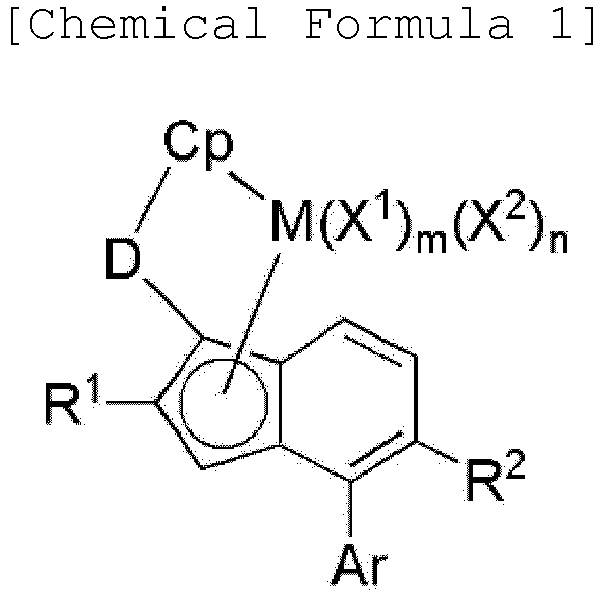
- In Chemical Formula 1, M is a transition metal, and m is 2 and n is 0 when M is a tetravalent transition metal of group 4 of the periodic table, and m is 0 and n is 1 when M is a divalent transition metal of group 4 of the periodic table; Cp is a cyclopentadienyl ring which may be η5-bonded to M and the cyclopentadienyl ring may be further substituted by at least one selected from the group consisting of (C1-C20) alkyl, (C3-C20) cycloalkyl, (C6-C20) aryl, tri (C1-C20) alkylsilyl, tri (C6-C20) arylsilyl, (C1-C20) alkyldi (C6-C20) arylsilyl, (C6-C20) aryldi (C1-C20) alkylsilyl and (C2-C20) alkenyl; D is SiR3R4 or (C2-C20) alkenylene; R3 and R4 are each independently hydrogen, (C1-C20) alkyl, (C3-C20) cycloalkyl or (C6-C20) aryl, or R3 and R4 may be linked by (C4-C7) alkylene to form a ring; R1 is (C1-C20) alkyl; Ar is (C6-C20) aryl; R2 is hydrogen, (C1-C20) alkyl, (C3-C20) cycloalkyl or (C6-C20) aryl; the Ar and R2 may be linked by (C1-C7) alkylene, (C2-C7) alkenylene or (C4-C7) alkane dienylene to form a fused ring; X1 is halogen, (C1-C20) alkyl, (C1-C20) alkoxy, (C3-C20) cycloalkyl, (C6-C20) aryl, (C6-C20) aryloxy, -OSiRaRbRc, -SRd, -NReRf, or -PRgRh; Ra to Rh are each independently (C1-C20) alkyl, (C6-C20) aryl or (C3-C20) cycloalkyl; X2 is a neutral, conjugated or nonconjugated (C4-C20) diene; the alkyl in R1, the aryl in Ar, the alkyl, cycloalkyl, and aryl in R2, R3, and R4 may be each independently further substituted by at least one substituent selected from the group consisting of halogen, (C1-C20) alkyl, halo (C1-C20) alkyl, (C3-C20) cycloalkyl, (C6-C20) aryl, (C1-C20) alkoxy and (C6-C20) aryloxy.
[Chemical Formula 2] B(R11)3
[Chemical Formula 3] [R12]+[B(R11)4]-
[Chemical Formula 4] [(R13)rZH]+[B(R11)4]-
- In Chemical Formulae 2 to 4, B is a boron atom; R11 is phenyl, and the phenyl may be further substituted by three to five substituents selected from a fluorine atom, (C1-C20) alkyl, (C1-C20) alkyl substituted by a fluorine atom, (C1-C20) alkoxy, and (C1-C20) alkoxy substituted by a fluorine atom; R12 is a (C5-C7) aromatic radical or a (C1-C20) alkyl (C6-C20) aryl radical or a (C6-C20) aryl (C1-C20) alkyl radical; Z is a nitrogen or phosphorus atom; R13 is a (C1-C20) alkyl radical or an anilinium radical substituted by two (C1-C10) alkyls together with a nitrogen atom; r is an integer of 2 or 3.
[Chemical Formula 5] - [Al(R14)-O]s-
[Chemical Formula 6] (R14)2Al-[O(R14)]t-(R14)2
[Chemical Formula 7] (R15)uAl(E)3-u
[Chemical Formula 8] (R16)2AlOR17
[Chemical Formula 9] R16Al(OR17)2
- In Chemical Formulae 5 to 9, R14 is (C1-C20) alkyl; s and t are each independently an integer of 5 to 20; R15 and R16 are each independently (C1-C20) alkyl; E is a hydrogen atom, a halogen atom or (C1-C20) alkyl; u is an integer of 1 to 3; R17 is (C1-C20) alkyl or (C6-C20) aryl.
- As set forth in the present invention, the term "alkyl" means a monovalent straight or branched saturated hydrocarbon radical, consisting solely of carbon and hydrogen atoms. Examples of such alkyl radicals include, but are not limited to, methyl, ethyl, propyl, isopropyl, butyl, isobutyl, t-butyl, pentyl, hexyl, octyl, dodecyl, and the like.
- In addition, as set forth in the present invention, the term "cycloalkyl" means a monovalent alicyclic alkyl radical, consisting of one ring. Examples of cycloalkyl include, but are not limited to, cyclopropyl, cyclobutyl, cyclopentyl, cyclohexyl, cycloheptyl, cyclooctyl, cyclononyl, cyclodecyl, and the like.
- In addition, as set forth in the present invention, the term "alkenyl" means a straight or branched hydrocarbon radical containing at least one carbon-carbon double bond, and includes, but is not limited to, ethenyl, propenyl, butenyl, pentenyl and the like.
- In addition, as set forth in the present invention, the term "aryl" means an organic radical derived from an aromatic hydrocarbon by removal of one hydrogen and includes a single or fused ring system. Specific examples include, but are not limited to, phenyl, naphthyl, biphenyl, anthryl, fluorenyl, phenanthryl, triphenylenyl, pyrenyl, perylenyl, chrysenyl, naphthacenyl, fluoranthenyl and the like.
- In addition, as set forth in the present invention, the term "alkoxy" means an -O-alkyl radical, where 'alkyl' is as defined above. Examples of such alkoxy radicals include, but are not limited to, methoxy, ethoxy, isopropoxy, butoxy, isobutoxy, t-butoxy, and the like.
- In addition, as set forth in the present invention, the term "aryloxy" means an -O-aryl radical, where 'aryl' is as defined above. Examples of such aryloxy radicals include, but are not limited to, phenoxy, biphenoxy, naphthoxy, and the like.
- In addition, as set forth in the present invention, the term "halogen" means a fluorine, chlorine, bromine or iodine atom.
- In the present invention, the metallocene compound, as represented by Chemical Formula 1, has an ansa-metallocene structure comprising a cyclopentadiene derivative ligand and an indenyl derivative ligand, in which aryl is necessarily substituted at the 4-position, which are connected to each other by a bridge group of silicon or alkenylene.
- As such, the metallocene compound has the indene derivative ligand substituted with aryl at the 4-position, thereby having excellent catalytic activity and copolymeric property compared to a metallocene compound having a ligand unsubstituted with aryl at the 4-position of the indene, and thus allows the production of the propylene-diene copolymer resin having high melt strength, high molecular weight, and uniform compositional distribution.
- In one embodiment of the present invention, the metallocene compound of Chemical Formula 1 may be preferably represented by the following Chemical Formulae 10 or 11.


- In the Chemical Formulae 10 and 11, M1 is a tetravalent transition metal of group 4, M2 is a divalent transition metal of group 4, and Cp, Ar, R1 to R4, X1 and X2 are as defined in Chemical Formula 1.
- In one embodiment of the present invention, when M is tetravalent titanium, zirconium or hafnium, m is 2 and n is 0, and when M is divalent titanium, zirconium or hafnium, m is 0 and n is 1; Cp is a cyclopentadienyl ring in which (C1-C20) alkyl is substituted or unsubstituted; R1 is (C1-C20) alkyl, (C6-C20) aryl (C1-C20) alkyl, or halo (C1-C20) alkyl; Ar is (C6-C20) aryl; R2 is hydrogen or (C6-C20) aryl; Ar and R2 may be linked by (C1-C7) alkylene, (C2-C7) alkenylene, or (C4-C7) alkane dienylene to form a fused ring, the aryl in Ar and R2 may be further substituted with at least one substituent selected from the group consisting of halogen, (C1-C20) alkyl, halo (C1-C20) alkyl, (C3-C20) cycloalkyl, (C6-C20) aryl, (C1-C20) alkoxy, and (C6-C20) aryloxy; R3 and R4 are (C1-C20) alkyl, (C6-C20) aryl (C1-C20) alkyl, halo (C1-C20) alkyl, (C6-C20) aryl, or (C1-C20) alkyl (C6-C20) aryl, and R3 and R4 may be linked by (C4-C7) alkylene to form a ring; X1 is halogen, (C1-C20) alkyl, (C1-C20) alkoxy, or di(C1-C20) alkylamino; and X2 may be a neutral conjugated 1,3-(C4-C20) diene.
- In one embodiment of the present invention, in Chemical Formulae 10 and 11, M1 is tetravalent titanium, zirconium or hafnium; M2 is divalent titanium, zirconium or hafnium; Cp is a cyclopentadienyl ring in which (C1-C20) alkyl is substituted or unsubstituted; R1 is (C1-C20) alkyl, (C6-C20) aryl (C1-C20) alkyl, or halo (C1-C20) alkyl; Ar is (C6-C20) aryl; R2 is hydrogen or (C6-C20) aryl; Ar and R2 may be linked by (C1-C7) alkylene, (C2-C7) alkenylene, or (C4-C7) alkane dienylene to form a fused ring, the aryl in Ar and R2 may be further substituted with at least one substituent selected from the group consisting of halogen, (C1-C20) alkyl, halo (C1-C20) alkyl, (C3-C20) cycloalkyl, (C6-C20) aryl, (C1-C20) alkoxy, and (C6-C20) aryloxy; R3 and R4 are (C1-C20) alkyl, (C6-C20) aryl (C1-C20) alkyl, halo (C1-C20) alkyl, (C6-C20) aryl, or (C1-C20) alkyl (C6-C20) aryl, and R3 and R4 may be linked by (C4-C7) alkylene to form a ring; X1 is halogen, (C1-C20) alkyl, (C1-C20) alkoxy, or di(C1-C20) alkylamino; and X2 may be a neutral conjugated 1,3-(C4-C20) diene.
- In one embodiment of the present invention, the Cp is cyclopentadienyl, methylcyclopentadienyl, dimethylcyclopentadienyl, trimethylcyclopentadienyl, tetramethylcyclopentadienyl, or butylcyclopentadienyl; R1 is methyl, ethyl, propyl, butyl, pentyl, hexyl, benzyl, or trifluoromethyl; Ar is phenyl, naphthyl, biphenyl, or anthryl; R2 is hydrogen, phenyl, naphthyl, biphenyl, or anthryl; the phenyl, naphthyl, biphenyl, or anthryl, in Ar and R2, may be further substituted with at least one substituent selected from the group consisting of fluoro, chloro, iodo, bromo, methyl, ethyl, propyl, butyl, pentyl, hexyl, trifluoromethyl, cyclopropyl, cyclopentyl, cyclohexyl, phenyl, naphthyl, methoxy, ethoxy, propoxy, butoxy, pentyloxy, hexyloxy, and phenoxy; Ar and R2 may be linked by methylene, ethenylene, or 1,3-butane dienylene to form a fused ring; R3 and R4 are methyl, ethyl, propyl, butyl, pentyl, hexyl, benzyl, trifluoromethyl , phenyl, naphthyl, biphenyl, anthryl, or tolyl, and R3 and R4 may be linked by a butylene or pentylene to form a ring; X1 is fluoro, chloro, iodo, bromo, methyl, ethyl, propyl, butyl, pentyl, hexyl, methoxy, ethoxy, propoxy, butoxy, pentyloxy, hexyloxy, dimethylamino, diethylamino, dipropylamino, dibutylamino, butylpropylamino, dihexylamino, dioctylamino, or methylethylamino; X2 may be 1,3-butadiene, 1,3-pentadiene, 1,3-hexadiene, 1,3-heptadiene or 1,3-octadiene.
- In one embodiment of the present invention, the metallocene compound may be selected from compounds having the following structures, but is not limited thereto:


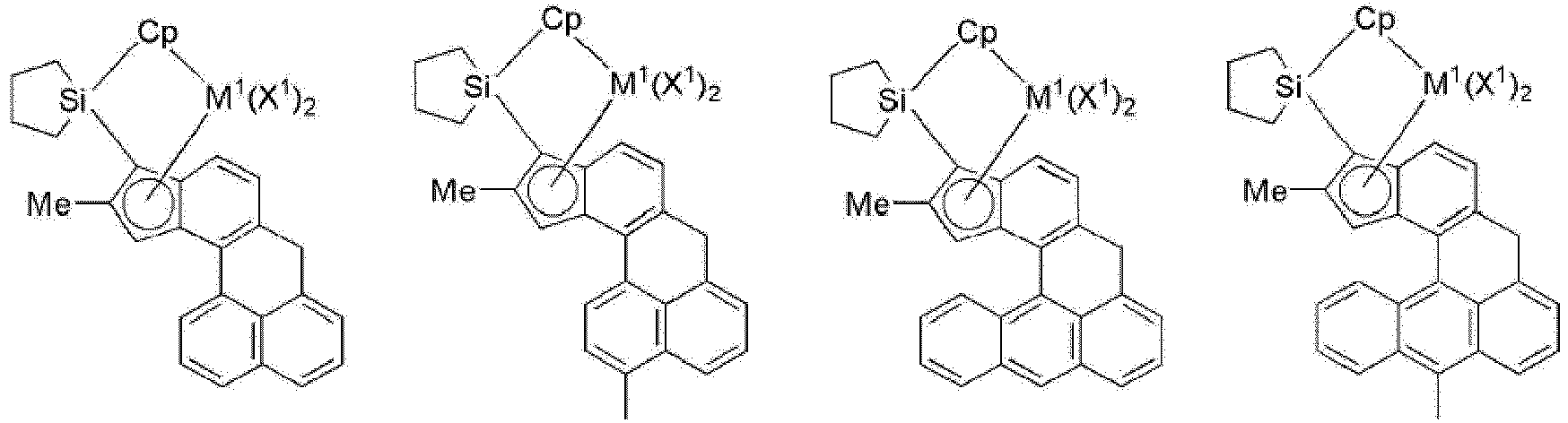
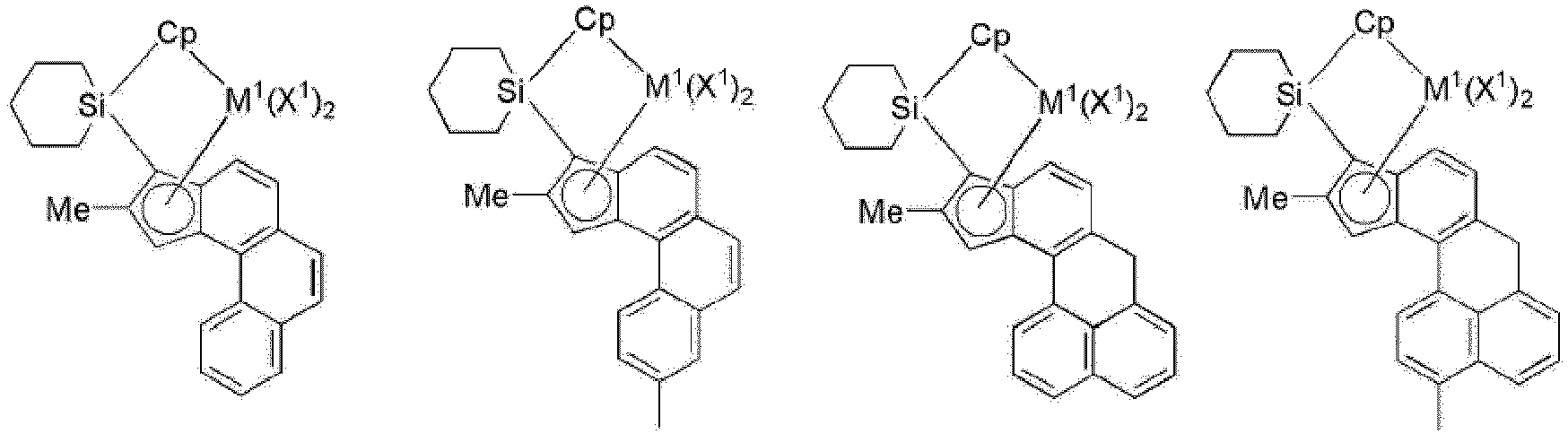


- In the above structure, Cp is cyclopentadienyl, methylcyclopentadienyl, dimethylcyclopentadienyl, diisopropylcyclopentadienyl, trimethylcyclopentadienyl, or tetramethylcyclopentadienyl; M1 is tetravalent titanium, zirconium or hafnium; and X1 is chloro, fluoro, bromo, methyl, ethyl, propyl, butyl, pentyl, methoxy, ethoxy, propoxy, butoxy, or dimethylamino.
- Meanwhile, in order for the metallocene compound in Chemical Formula 1 to be an active catalyst component for use in the polypropylene polymerization, the ligand in the metallocene compound is extracted to cationize the central metal and the metallocene compound acts together with the cocatalyst compound which are an aluminum compound or a boron compound or a mixture thereof which can be act as a counter ion, i.e., anion with weak binding force.
- The boron compound used as the cocatalyst compound in the present invention may be boron compounds disclosed in the
US Patent No. 5,198,401 , and specifically is selected from the compounds represented by the following Chemical formulae 2 to 4.
[Chemical Formula 2] B(R11)3
[Chemical Formula 3] [R12]+[B(R11)4]-
[Chemical Formula 4] [(R13)rZH]+[B(R11)4]-
- In Chemical Formulae 2 to 4, B is a boron atom; R11 is phenyl, and the phenyl may be further substituted by three to five substituents selected from a fluorine atom, (C1-C20) alkyl, (C1-C20) alkyl substituted by a fluorine atom, (C1-C20) alkoxy, and (C1-C20) alkoxy substituted by a fluorine atom; R12 is a (C5-C7) aromatic radical or a (C1-C20) alkyl (C6-C20) aryl radical or a (C6-C20) aryl (C1-C20) alkyl radical; Z is a nitrogen or phosphorus atom; R13 is a (C1-C20) alkyl radical or an anilinium radical substituted by two (C1-C10) alkyls together with a nitrogen atom; r is an integer of 2 or 3.
- Preferable examples of the boron-based cocatalyst compound include tris (pentafluorophenyl) borane, tris (2,3,5,6-tetrafluorophenyl) borane, tris (2,3,4,5-tetrafluorophenyl) borane, tris (3,4,5-trifluorophenyl) borane, tris (2,3,4-trifluorophenyl) borane, phenyl bis (pentafluorophenyl) borane, triphenyl methylium tetrakis (pentafluorophenyl) borate, triphenyl methylium tetrakis (2,3,5,6-tetrafluorophenyl) borate, triphenyl methylium tetrakis (2,3,4,5-tetrafluorophenyl) borate, triphenyl methylium tetrakis (3,4,5-trifluorophenyl) borate, triphenyl methylium tetrakis (2,2,4-trifluorophenyl) borate, triphenyl methylium phenyl bis (pentafluorophenyl) borate, or triphenyl methylium tetrakis (3,5-bistrifluoromethylphenyl) borate. Specific combination examples of these compounds include ferrocenium tetrakis (pentafluorophenyl) borate, 1,1'-dimethylferrocenium tetrakis (pentafluorophenyl) borate, tetrakis (pentafluorophenyl) borate, triphenyl methylium tetrakis (pentafluorophenyl) borate, triphenyl methylium tetrakis (3,5-bistrifluoromethylphenyl) borate, triethylammonium tetrakis (pentafluorophenyl) borate, tripropylammonium tetrakis (pentafluorophenyl) borate, tri(n-butyl)ammonium tetrakis (pentafluorophenyl) borate, tri(n-butyl)ammonium tetrakis (3,5-bistrifluorophenyl) borate, N,N-dimethylanilinium tetrakis (pentafluorophenyl) borate, N,N-diethylanilinium tetrakis (pentafluorophenyl) borate, N,N-2,4,6-pentamethylanilinium tetrakis (pentafluorophenyl) borate, N,N-dimethylanilinium tetrakis (3,5-bistrifluoromethylphenyl) borate, diisopropylammonium tetrakis (pentafluorophenyl) borate, dicyclohexylammonium tetrakis (pentafluorophenyl) borate, triphenylphosphonium tetrakis (pentafluorophenyl) borate, tri(methylphenyl)phosphonium tetrakis (pentafluorophenyl) borate, or tri(dimethylphenyl)phosphonium tetrakis (pentafluorophenyl) borate. The most preferred among them are N,N-dimethylanilinium tetrakis (pentafluorophenyl) borate, triphenyl methylnium tetrakis (pentafluorophenyl) borate, or tris (pentafluoro) borane.
- In addition, the aluminum compound used as the cocatalyst compound is the aluminoxane compound of Chemical Formulas 5 or 6, the organoaluminum compound of Chemical Formula 7, or the organoaluminum alkyloxide or organoaluminum aryloxide compound of Chemical Formulas 8 or 9.
[Chemical Formula 5] - [Al(R14)-O]s-
[Chemical Formula 6] (R14)2Al-[O(R14)]t-(R14)2
[Chemical Formula 7] (R15)uAl(E)3-u
[Chemical Formula 8] (R16)2AlOR17
[Chemical Formula 9] R16Al(OR17)2
- In Chemical Formulae 5 to 9, R14 is (C1-C20) alkyl; s and t are each independently an integer of 5 to 20; R15 and R16 are each independently (C1-C20) alkyl; E is a hydrogen atom, a halogen atom or (C1-C20) alkyl; u is an integer of 1 to 3; R17 is (C1-C20) alkyl or (C6-C20) aryl.
- Specific examples of the aluminum compound that can be used include aluminoxane compounds, such as methylaluminoxane, modified methylaluminoxane, and tetraisobutylaluminoxane, and organoaluminum compounds, such as trialkylaluminum, including trimethylaluminum, triethylaluminum, tripropylaluminum, triisobutylaluminum, trihexylaluminum and trioctylaluminum; dialkyl aluminum chlorides, including dimethyl aluminum chloride, diethyl aluminum chloride, dipropyl aluminum chloride, diisobutyl aluminum chloride, and dihexyl aluminum chloride; alkylaluminum dichlorides, including methylaluminum dichloride, ethylaluminum dichloride, propylaluminum dichloride, isobutylaluminum dichloride, and hexylaluminum dichloride; and dialkylaluminum hydrides, including dimethyl aluminum hydride, diethyl aluminum hydride, dipropyl aluminum hydride, diisobutyl aluminum hydride and dihexyl aluminum hydride. Preferably, the aluminum compound that can be used are aluminoxane compounds, trialkylaluminum or mixtures thereof and more preferably, they are methyl aluminoxane, modified methyl aluminoxane, triethylaluminum, triisobutyl aluminum or mixtures thereof.
- In the catalyst system according to the present invention, when the aluminum compound, particularly the aluminoxane compound, is used as the cocatalyst compound, the ratio of the transition metal (M) in Chemical Formula 1 to the aluminum atom (Al) is based on the molar ratio of 1:10 to 1:5,000, more preferably 1:100 to 1:2,000. In addition, in the catalyst system according to the present invention, as for the preferable range of the ratio between the metallocene compound of Chemical Formula 1 and the cocatalyst compounds, the ratio of the central metal (M): the boron atom (B): and the aluminum atom (Al) is based on the molar ratio of 1:0.1 to 200:10 to 1,000, more preferably 1:1 to 20:10 to 500. The propylene-diene copolymer resin can be produced with the above-mentioned ratio and the range of the ratio varies depending on the purity of the reaction.
- Since the metallocene compound and the cocatalyst compounds are present in a homogeneous form in the polymerization reactor, the catalyst system presented in the present invention is preferably applied to a solution polymerization process carried out at a temperature above the melting point of the polymer resin. However, as disclosed in
U.S. Patent No. 4,752,597 , the catalyst system may be used for a slurry polymerization or gas phase polymerization process in the form of a non-homogeneous catalyst composition obtained by supporting the metallocene compound and the cocatalyst compounds on a porous metal oxide support. Therefore, when used together with an inorganic carrier or an organic polymer carrier, the catalyst system of the present invention can be applied also to a slurry or gas phase process. That is, the metallocene compound and the cocatalyst compounds may also be used in the form supported on the inorganic carrier or the organic polymer carrier. - The propylene-diene copolymer resin according to the present invention is prepared by polymerizing propylene and a C4-C20 diene compound in the presence of the catalyst system. Herein, the metallocene compound and the cocatalyst compounds may be separately introduced into the reactor, or the respective components may be premixed and introduced into the reactor. There is no particular limitation on the mixing conditions such as the order of introduction, temperature or concentration.
- The diene compound may be selected from linear or branched C4-C20 diene or C5-C20 cyclodiene, and for example, it may be 1,3-butadiene, 1,4-pentadiene, 2-methyl-1,3-butadiene, 1,4-hexadiene, 1,5-hexadiene, 1,5-heptadiene, 1,6-heptadiene, 1,6-octadiene, 1,7-octadiene, 1,7-nonadiene, 1,8-nonadiene, 1,8-decadiene, 1,9-decadiene, 1,12-tetradecadiene, 1,13-tetradecadiene, 3-methyl-1,4-hexadiene, 3-methyl-1,5-hexadiene, 3-ethyl-1,4-hexadiene, 3-ethyl-1,5-hexadiene, 3,3-dimethyl-1,4-hexadiene, 3,3-dimehtyl-1,5-hexadiene, cyclopentadiene, cyclohexadiene, cycloheptadiene and cyclooctadiene, alone, or a mixture of two or more thereof.
- At this time, the content of the diene compound to be polymerized in the production of the propylene-diene copolymer resin may be 0.001 to 3 mol%, preferably 0.01 to 1 mol%. If the content is out of the above range, the catalytic activity may be deteriorated or the thermal characteristics may be undesirable in terms of the melt strength.
- The polymerization may be carried out in a slurry, liquid or gas phase, and when the polymerization is carried out in a liquid or slurry phase, a solvent or a monomer itself may be used as a medium.
- Preferred organic solvents that may be used in the polymerization are C3-C20 hydrocarbons. Specific examples thereof include butane, isobutane, pentane, hexane, heptane, octane, isooctane, nonane, decane, dodecane, cyclohexane, methylcyclohexane, benzene, toluene, xylene, and the like.
- The polymerization may be carried out in a batch, semi-continuous or continuous reaction, and may be carried out at the temperature of from 25 to 300 °C, preferably from 50 to 250 °C, and the pressure of from 1 to 100 bars, preferably from 5 to 50 bars. The temperature and pressure conditions of the polymerization step may be determined in consideration of the efficiency of the polymerization reaction depending on the kind of the reaction to be applied and the kind of a reactor.
- The propylene-diene copolymer resin according to the present invention has the melt index (230 °C, 2.16 kg load) of 0.1 to 100 g/10 min and the melt tension (advanced rheometric expansion system (ARES)) as measured by the following method of 5 to 100 g, and preferably, it may have the melt index of 0.5 to 30 g/10 min and the melt tension of 10 to 50 g, more preferably the melt index of 0.5 to 10 g/10 min and the melt tension of 10 to 45 g, and even more preferably the melt index of 1 to 5 g/10 min and the melt tension of 20 to 40 g. Here, the propylene-diene copolymer resin according to the present invention can realize an improved melt strength by the use of the catalyst system, and can reduce the gel content compared to homopolymer resins prepared by using the conventional Ziegler-Natta catalyst system. The gel content may be 10 wt% or less, preferably 8 wt% or less, more preferably 7 wt% or less, and even more preferably 5 wt% or less.
- In addition, the propylene-diene copolymer resin according to the present invention has two melting peaks in the range from 140°C to 135°C, and has the weight average molecular weight of 100,000 to 500,000 and the molecular weight distribution (Mw/Mn) of 4 to 20, and preferably, it may have two melting peaks in the range of 140 to 154 °C and the range of 129 to 135 °C, the weight average molecular weight of 300,000 to 500,000 and the molecular weight distribution (Mw/Mn) of 5 to 10, more preferably two melting peaks in the range of 140 to 151 °C and in the range of 132 to 135 °C and the weight average molecular weight of 350,000 to 450,000 and the molecular weight distribution (Mw/Mn) of 6 to 10.
- There is no limitation in the field in which products, such as plastic shaped articles, in which the propylene-diene copolymer resin according to the present invention is used, are employed. However, preferably the products may be used mainly for automobile interior and exterior materials, and specifically for automobile interior foam film/sheet, shock-absorbing materials, thermoforming products, trays, sound insulating materials, insulation materials, large hollows, and automobile parts.
- Hereinafter, the present invention will be described by specific examples.
- Except where otherwise noted, all ligand and catalyst synthesis experiments were performed using standard Schlenk or glovebox techniques under nitrogen atmosphere, and organic solvents used in all reactions were refluxed under sodium metal and benzophenone to remove moisture and then, were distilled immediately before use. 1H-NMR analyses of synthesized ligands and catalysts were performed using Bruker 300 MHz at room temperature.
- The polymerization solvent, n-hexane, was passed through a tube filled with 5A molecular sieve and activated alumina and bubbled with high purity nitrogen to remove sufficiently moisture, oxygen and other catalytic poison substances and then used. All the polymerization was carried out by injecting required amounts of solvents, cocatalyst compounds, monomers to be polymerized, etc. in a high-pressure reactor (autoclave) completely blocked from the outside air, and then introducing the metallocene compound. 10 wt% methylaluminoxane (MAO) solution in toluene (Albemarle) was purchased to use as MAO. The polymerized polymer resin was analyzed according to the following method.
- Measurement was performed according to ASTM D 2839 at a load of 2.16 kg at 230 °C.
- Measurement was performed under the 2nd heating condition at the rate of 10 °C/min under nitrogen atmosphere using Dupont DSC2910.
- Measurement was performed in the presence of 1,2,3-trichlorobenzene solvent at the rate of 1.0 mL/min at 135 °C using PL210 GPC equipped with PL Mixed-BX2+preCol, and the molecular weight was corrected using a PL polystyrene standard material.
- A specimen, with the width of 20 mm, the length of 10 mm and the thickness of 7 mm, prepared through hot press melting or injection was fixed to a sample holder using a rheometric measurement instrument (2KFRTN, TA Instrument), and then, the melt tension was measured as the resistance value of the specimen when the sample holder was rotated about an axis.
- The gel content of the polymer resin was measured in the following order.
- 1) Prepare a sample into a 20 µm film, cut it into 2 cm x 2 cm in size, and weigh it.
- 2) Add 500 mL of xylene into a 1 L container (rbf Reflux).
- 3) Prepare a stainless steel mesh of 200 mesh into 3 cm x 3 cm in size and weigh it.
- 4) Put the sample prepared in 1) into the prepared mesh and seal it.
- 5) Add the sample prepared in 4) to the container prepared in 2) and perform xylene refluxing for 12 hours.
- 6) After removal of the reflux device, take out the sample and remove the xylene soluble part attached to the surface of the mesh using a tube with nitrogen.
- 7) Place the mesh into a vacuum oven at 140 °C and dry it for 8 hours.
- 8) Weigh the dried mesh.
- 9) Measure the xylene insoluble material by comparing the sum of the mesh weight in 3) plus the sample weight in 1) with the weight in 8).
- To a 2 L flask, tetrahydrofuran (600 mL) and tetramethylcyclopentadiene (50 g) were added and n-BuLi (2.5 M in hexane solution) (170 mL) was slowly added dropwise thereto at -10 °C under nitrogen atmosphere, and the reaction was carried out by stirring at room temperature for 12 hours. The temperature of the reaction solution was lowered to -10 ° C again, and dimethyldichlorosilane (170 g) was added, and the reaction was carried out by stirring at room temperature for 12 hours, and then, the reaction product was vacuum dried. To the reaction product, n-hexane (500 mL) was added to dissolve the reaction product. The reaction mixture was filtered through a Celite filter, and the filtrate was vacuum dried to obtain 70 g of dimethyl tetramethylcyclopentadienyl chlorosilane in the form of yellow oil (yield: 80%).
1H-NMR(300 MHz, CDCl3) δ 0.235(s, 6H), 1.81 (s, 6H), 1.97 (s, 6H), 3.07 (s, 1H) - A flask charged with toluene (200 mL), tetrahydrofuran (40 mL) and 2-methyl-4- (4-t-butylphenyl) indene (50 g) was cooled to -10 °C and n-BuLi (2.5 M in hexane solution) (76 mL) was slowly added dropwise thereto, followed by stirring at room temperature for 12 hours. The temperature of the reaction mixture was lowered to -10 °C again, and then dimethyl tetramethylcyclopentadienyl chlorosilane (38 g) was added thereto, and the reaction was carried out by stirring at room temperature for 12 hours. After completion of the reaction, water (400 mL) was added thereto, and the mixture was stirred at room temperature for 1.5 hours. Then, the mixture was extracted with toluene and vacuum dried to obtain 80 g of dimethyl tetramethylcyclopentadienyl 2-methyl-4-(4-t-butylphenyl) indenyl silane (yield: 95%).
1H-NMR (300 MHz, CDCl3) δ 0.2-0.23(d, 6H), 1.44(s, 9H), 1.91(s, 6H), 2.05-2.08(d, 6H), 2.29(s, 3H), 2.41(s, 1H), 3.76(s, 1H), 6.87(s, 1H) - Dimethyl tetramethylcyclopentadienyl 2-methyl-4-(4-t-butylphenyl) indenyl silane (50 g), toluene (300 mL) and diethyl ether (100 mL) were added to a flask, and the mixture was cooled to -10 °C, and then n-BuLi (2.5 M in hexane solution) (90 mL) was slowly added dropwise thereto. After the end of dropwise addition, the reaction temperature was raised to room temperature, and the mixture was stirred for 48 hours, and then filtered. The obtained filtrate was vacuum dried to obtain 40 g (yield 80%) of tetramethylcyclopentadienyl dimethylsilyl 2-methyl-4-(4-t-butylphenyl) indenyl dilithium salt in the form of a solid, which was used directly in the next reaction without purification.
- Tetramethylcyclopentadienyldimethylsilyl 2-methyl-4-(4-t-butylphenyl) indenyl dilithium salt (40 g), toluene (40 mL) and ether (10 mL) were placed into flask #1 and the mixture was stirred. In Flask #2, the mixture of toluene (30 mL) and ZrCl4 (20 g) was prepared. The mixture in flask #2 was slowly added dropwise into flask #1 with a cannula, and the mixture was stirred at room temperature for 24 hours. After stirring, the mixture was vacuum dried, extracted with methylene chloride (500 mL), filtered through a Celite filter, and then the filtrate was vacuum dried. The resulting solid was washed with the 1:3 mixture (50 mL) of methylene chloride and n-hexane and then vacuum dried to obtain 32 g of tetramethylcyclopentadienyl dimethylsilyl 2-methyl-4-(4-t-butylphenyl) indenyl zirconium dichloride in the form of yellow solid (yield: 60%).
1H-NMR (300 MHz, CDCl3) δ 1.09(s, 3H), 1.202(s, 3H), 1.346(s, 9H), 1.887-1.911(d, 6H), 1.989(s, 3H), 2.075(s, 3H), 2.278(s, 3H), 7.0-7.628(m, 8H) - The inside of a stainless steel autoclave having an inner volume of 3 liter at room temperature was completely replaced with nitrogen. 600 mL of n-hexane and 4.0 mL of methylaluminoxane toluene solution (6 mmol on the basis of Al) were added at room temperature while nitrogen purging was maintained. Then, 500 g of propylene was added and the temperature was raised to 70 °C. Then, the metallocene compound and 1 mL of 1,5-hexadiene, as the diene compound, were added using a catalytic tank. Thereafter, polymerization was carried out for 30 minutes. After completion of polymerization, the mixture was kept at room temperature, and then excess propylene was removed through a discharge line to obtain a polymer. The obtained polymer was dried for 4 hours or more while heating at 80 °C using a vacuum oven to prepare a propylene-diene copolymer resin.
- A propylene-diene copolymer resin was prepared in the same manner as in Example 1, except that 5 mL of 1,5-hexadiene was used in Example 1.
- A propylene-diene copolymer resin was prepared in the same manner as in Example 1, except that 1,7-octadiene was used instead of 1,5-hexadiene in Example 1.
- A propylene-diene copolymer resin was prepared in the same manner as in Example 2, except that 1,7-octadiene was used instead of 1,5-hexadiene in Example 2.
- A propylene polymer resin was prepared in the same manner as in Example 1, except that 1,5-hexadiene was not used in Example 1.
- A propylene-diene copolymer resin was prepared in the same manner as in Example 1, except that 0.5 mL of 1,5-hexadiene was used in Example 1.
- A propylene-diene copolymer resin was prepared in the same manner as in Example 1, except that 10 mL of 1,5-hexadiene was used in Example 1.
- A propylene-diene copolymer resin was prepared in the same manner as in Example 3, except that 0.5 mL of 1,7-hexadiene was used in Example 3.
- A propylene-diene copolymer resin was prepared in the same manner as in Example 3, except that 10 mL of 1,7-hexadiene was used in Example 3.
- A propylene-diene copolymer resin was prepared in the same manner as in Example 2, except that commercial Ziegler-Natta catalyst system (LC200, Lotte Chemical Corporation) was used as the catalyst system in Example 2.
- A propylene-diene copolymer resin was prepared in the same manner as in Example 4, except that commercial Ziegler-Natta catalyst system was used as the catalyst system in Example 4.
- High-melt-tension polypropylene resin (HMSPP, SMS-514F, Lotte Chemical Corporation), which was produced by peroxide decomposition using a post-process according to the conventional method, was prepared.
- First, the results of measuring the catalytic activity, melting point (Tm), weight average molecular weight and molecular weight distribution of the polymer resins prepared according to Examples 1 to 4 and Comparative Examples 1, 2, 4, 6 and 7 are shown in Table 1 below.
Table 1. category Propylene (g) Hexadiene (mℓ) Octadiene (mℓ) Activity (kg/g-cat) Tm (°C) Mw MWD Example 1 500 1 - 622 149/135 120,540 4.03 Example 2 500 5 - 580 145/134 380,380 6.03 Example 3 500 - 1 630 149/135 190,540 4,82 Example 4 500 - 5 552 142/134 423,112 6,03 comp.ex. 1 500 - - 690 153 86,591 3.06 comp.ex. 2 500 0.5 - 650 152 86,380 3.03 comp.ex. 4 500 - 0.5 685 153 82,591 3.06 comp.ex. 6 500 5 - 26 161 320,102 4.8 comp.ex. 7 500 - 5 24 161 310,102 4.5 - Referring to Table 1, it can be confirmed that according to the present invention, the diene-modified propylene-diene copolymer resin is prepared in the polymerization process by using the specific metallocene catalyst system and the specific content of the diene compound is used, so that the propylene-diene copolymer resin has the excellent catalytic activity during the polymerization, has two melting peaks in the ranges of specific peak temperatures, has the required weight average molecular weight and molecular weight distribution, and thus, it exhibits different properties from copolymer resins produced by conventional methods so as to have improved processability and has properties suitable for improvement of melt strength.
- Next, the polymer resins prepared according to Examples 1 to 4 and Comparative Examples 1, 3, and 5 to 8 were extruded by a twin extruder at the temperature range of 190 to 250 °C, followed by cooling and solidifying to obtain pellets. Pellets were used as a specimen to measure the melt index, melt tension (ARES) and gel content. The results thereof are shown in Table 2 below.
Table 2. Category Ml (g/10min) ARES (g) Gel content (wt%) Example 1 2.5 22 2.3 Example 2 2.0 30 3.5 Example 3 0.7 35 4.1 Example 4 0.5 38 4.6 Comp. ex. 1 56 3 0 Comp. ex. 3 0.1 37 10.2 Comp. ex. 5 0.1 62 13.3 Comp. ex. 6 1.5 3 0.2 Comp. ex. 7 1.5 3 0.2 Comp ex. 8 1.9 8 2.4 - Referring to Table 2, it can be confirmed that according to the present invention, the modified propylene-diene copolymer resin prepared by using the specific metallocene catalyst system and the specific content of the diene compound has the melt index at the level of 0.5 to 2.5 g/10 min and increases the melt tension to the level of 22 to 38 g, while maintaining the gel content at 5% or less, and has excellent properties with low process cost to long chain branched resins produced by conventional post-processes.
- The preferred embodiments of the present invention have been described in detail above. The description of the present invention is for illustration. It will be understood by those skilled in the art that modification of other detailed forms may be easily made without altering the technical ideas or essential features of the present invention.
- Accordingly, the scope of the present invention is expressed by the claims described hereafter rather than by the above-mentioned detailed description and all the altered or modified forms deduced from the meanings, ranges of the claims, and the equivalent concepts thereof should be construed as falling within the scope of the present invention.
Claims (5)
- A propylene-diene copolymer resin produced by a method comprising the step of polymerizing propylene and a diene compound of C4-C20 by using a catalyst system,
wherein the catalyst system comprises: a metallocene compound represented by the following Chemical Formula 1; and at least one cocatalyst compound selected from the group consisting of a boron compound represented by the following Chemical Formulae 2 to 4 and an aluminum compound represented by the following Chemical Formulae 5 to 9, and
the propylene-diene copolymer resin has the melt index (2.16 kg load at 230 °C) of 0.1-100 g/10 min and the melt tension (advanced rheometric expansion system (ARES)) of 5-100 g: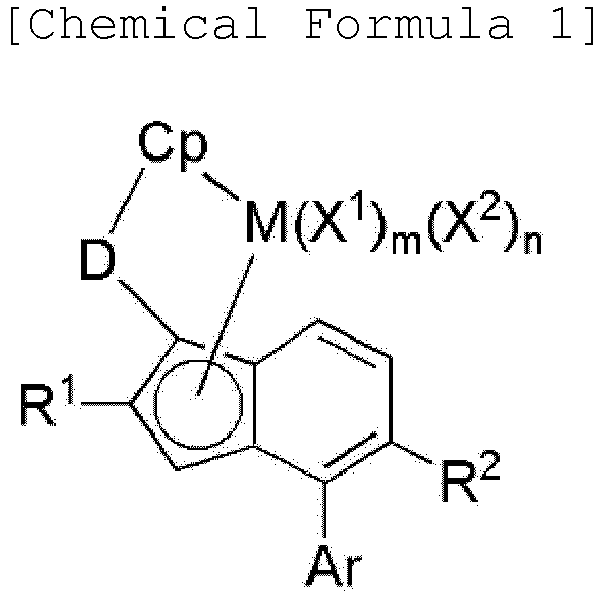
[Chemical Formula 2] B(R11)3
[Chemical Formula 3] [R12]+[B(R11)4]-
[Chemical Formula 4] [(R13)rZH]+[B(R11)4]-
[Chemical Formula 5] - [Al(R14)-O]s-
[Chemical Formula 6] (R14)2Al-[O(R14)]t-(R14)2
[Chemical Formula 7] (R15)uAl(E)3-u
[Chemical Formula 8] (R16)2AlOR17
[Chemical Formula 9] R16Al(OR17)2
in Chemical Formula 1, M is a transition metal, and m is 2 and n is 0 when M is a tetravalent transition metal of group 4 of the periodic table, and m is 0 and n is 1 when M is a divalent transition metal of group 4 of the periodic table; Cp is a cyclopentadienyl ring which may be η5-bonded to M and the cyclopentadienyl ring may be further substituted by at least one selected from the group consisting of (C1-C20) alkyl, (C3-C20) cycloalkyl, (C6-C20) aryl, tri (C1-C20) alkylsilyl, tri (C6-C20) arylsilyl, (C1-C20) alkyldi (C6-C20) arylsilyl, (C6-C20) aryldi (C1-C20) alkylsilyl and (C2-C20) alkenyl; D is SiR3R4 or (C2-C20) alkenylene; R3 and R4 are each independently hydrogen, (C1-C20) alkyl, (C3-C20) cycloalkyl or (C6-C20) aryl, or R3 and R4 may be linked by (C4-C7) alkylene to form a ring; R1 is (C1-C20) alkyl; Ar is (C6-C20) aryl; R2 is hydrogen, (C1-C20) alkyl, (C3-C20) cycloalkyl or (C6-C20) aryl; the Ar and R2 may be linked by (C1-C7) alkylene, (C2-C7) alkenylene or (C4-C7) alkane dienylene to form a fused ring; X1 is halogen, (C1-C20) alkyl, (C1-C20) alkoxy, (C3-C20) cycloalkyl, (C6-C20) aryl, (C6-C20) aryloxy, -OSiRaRbRc, -SRd, -NReRf, or -PRgRh; Ra to Rh are each independently (C1-C20) alkyl, (C6-C20) aryl or (C3-C20) cycloalkyl; X2 is a neutral, conjugated or nonconjugated (C4-C20) diene; the alkyl in R1, the aryl in Ar, the alkyl, cycloalkyl, and aryl in R2, R3, and R4 may be each independently further substituted by at least one substituent selected from the group consisting of halogen, (C1-C20) alkyl, halo (C1-C20) alkyl, (C3-C20) cycloalkyl, (C6-C20) aryl, (C1-C20) alkoxy and (C6-C20) aryloxy;
in Chemical Formulae 2 to 4, B is a boron atom; R11 is phenyl, and the phenyl may be further substituted by three to five substituents selected from a fluorine atom, (C1-C20) alkyl, (C1-C20) alkyl substituted by a fluorine atom, (C1-C20) alkoxy, and (C1-C20) alkoxy substituted by a fluorine atom; R12 is a (C5-C7) aromatic radical or a (C1-C20) alkyl (C6-C20) aryl radical or a (C6-C20) aryl (C1-C20) alkyl radical; Z is a nitrogen or phosphorus atom; R13 is a (C1-C20) alkyl radical or an anilinium radical substituted by two (C1-C10) alkyls together with a nitrogen atom; r is an integer of 2 or 3;
in Chemical Formulae 5 to 9, R14 is (C1-C20) alkyl; s and t are each independently an integer of 5 to 20; R15 and R16 are each independently (C1-C20) alkyl; E is a hydrogen atom, a halogen atom or (C1-C20) alkyl; u is an integer of 1 to 3; R17 is (C1-C20) alkyl or (C6-C20) aryl. - The propylene-diene copolymer resin of claim 1,
wherein in the step of polymerizing, the content of the diene compound is prepared in 0.001 to 3 mol% based on the propylene. - The propylene-diene copolymer resin of claim 1,
wherein the diene compound is at least one selected from the group consisting of linear or branched C4-C20 diene or C5-C20 cyclodiene. - The propylene-diene copolymer resin of claim 3,
wherein the diene compound is at least one selected from the group consisting of 1,3-butadiene, 1,4-pentadiene, 2-methyl-1,3-butadiene, 1,4-hexadiene, 1,5-hexadiene, 1,5-heptadiene, 1,6-heptadiene, 1,6-octadiene, 1,7-octadiene, 1,7-nonadiene, 1,8-nonadiene, 1,8-decadiene, 1,9-decadiene, 1,12-tetradecadiene, 1,13-tetradecadiene, 3-methyl-1,4-hexadiene, 3-methyl-1,5-hexadiene, 3-ethyl-1,4-hexadiene, 3-ethyl-1,5-hexadiene, 3,3-dimethyl-1,4-hexadiene, 3,3-dimentyl-1,5-hexadiene, cyclopentadiene, cyclohexadiene, cycloheptadiene, and cyclooctadiene. - The propylene-diene copolymer resin of claim 1,
wherein the propylene-diene copolymer resin has the gel content of 10% by weight or less.
Applications Claiming Priority (2)
| Application Number | Priority Date | Filing Date | Title |
|---|---|---|---|
| KR1020160042125A KR101810317B1 (en) | 2016-04-06 | 2016-04-06 | High melt strength polypropylene resin composition |
| PCT/KR2017/003788 WO2017176074A1 (en) | 2016-04-06 | 2017-04-06 | Propylene-diene copolymer resin having excellent melt tension |
Publications (3)
| Publication Number | Publication Date |
|---|---|
| EP3441407A1 true EP3441407A1 (en) | 2019-02-13 |
| EP3441407A4 EP3441407A4 (en) | 2019-12-25 |
| EP3441407B1 EP3441407B1 (en) | 2024-04-03 |
Family
ID=60000558
Family Applications (1)
| Application Number | Title | Priority Date | Filing Date |
|---|---|---|---|
| EP17779374.2A Active EP3441407B1 (en) | 2016-04-06 | 2017-04-06 | Propylene-diene copolymer resin having excellent melt tension |
Country Status (6)
| Country | Link |
|---|---|
| US (1) | US10875951B2 (en) |
| EP (1) | EP3441407B1 (en) |
| JP (1) | JP7008032B2 (en) |
| KR (1) | KR101810317B1 (en) |
| CN (1) | CN109071713B (en) |
| WO (1) | WO2017176074A1 (en) |
Cited By (6)
| Publication number | Priority date | Publication date | Assignee | Title |
|---|---|---|---|---|
| CN109983040A (en) * | 2016-11-23 | 2019-07-05 | 乐天化学株式会社 | Polyolefin catalyst and the method for preparing polyolefin using it |
| WO2021034459A1 (en) | 2019-08-22 | 2021-02-25 | Exxonmobil Chemical Patents Inc. | Isotactic propylene homopolymers and copolymers produced with c1 symmetric metallocene catalysts |
| EP3708594A4 (en) * | 2017-11-09 | 2021-10-13 | Lotte Chemical Corporation | PROCESS FOR PREPARING A HIGH MELT RESISTANCE POLYPROPYLENE RESIN |
| WO2022108973A1 (en) | 2020-11-23 | 2022-05-27 | Exxonmobil Chemical Patents Inc. | Metallocene polypropylene prepared using aromatic solvent-free supports |
| WO2023034889A1 (en) | 2021-09-02 | 2023-03-09 | Exxonmobil Chemical Patents Inc. | C1 symmetric metallocene catalysts tailored for production of vinyl-terminated polypropylene oligomers and macromonomers |
| US11802170B2 (en) | 2021-04-29 | 2023-10-31 | Exxonmobil Chemical Patents Inc. | Polyolefins prepared with binuclear metallocene catalysts |
Families Citing this family (3)
| Publication number | Priority date | Publication date | Assignee | Title |
|---|---|---|---|---|
| KR102671695B1 (en) | 2018-11-29 | 2024-06-05 | 롯데케미칼 주식회사 | Polypropylene resin with improved melt properties and method for preparing the same |
| US20230212330A1 (en) | 2020-06-16 | 2023-07-06 | Exxonmobil Chemical Patents Inc. | Metallocene Catalysts for Producing Vinyl-Terminated Polyalphaolefins and Methods Associated Therewith |
| CN112794964B (en) * | 2021-01-19 | 2021-07-30 | 天津大学 | A kind of propylene-conjugated diene copolymer and preparation method thereof |
Family Cites Families (22)
| Publication number | Priority date | Publication date | Assignee | Title |
|---|---|---|---|---|
| US4752597A (en) | 1985-12-12 | 1988-06-21 | Exxon Chemical Patents Inc. | New polymerization catalyst |
| US5198401A (en) | 1987-01-30 | 1993-03-30 | Exxon Chemical Patents Inc. | Ionic metallocene catalyst compositions |
| US5055438A (en) | 1989-09-13 | 1991-10-08 | Exxon Chemical Patents, Inc. | Olefin polymerization catalysts |
| NZ235032A (en) | 1989-08-31 | 1993-04-28 | Dow Chemical Co | Constrained geometry complexes of titanium, zirconium or hafnium comprising a substituted cyclopentadiene ligand; use as olefin polymerisation catalyst component |
| JPH07165814A (en) | 1993-12-14 | 1995-06-27 | Mitsui Toatsu Chem Inc | Propylene copolymer and method for producing the same |
| DE4344688A1 (en) * | 1993-12-27 | 1995-06-29 | Hoechst Ag | Metallocene compound |
| JP3344841B2 (en) | 1994-09-22 | 2002-11-18 | 昭和電工株式会社 | Propylene polymer and method for producing the same |
| EP1498178B1 (en) | 1995-07-14 | 2008-06-11 | Sumitomo Chemical Company, Limited | Transition metal complex and process for producing the same |
| US5670595A (en) * | 1995-08-28 | 1997-09-23 | Exxon Chemical Patents Inc. | Diene modified polymers |
| AU8997098A (en) | 1997-09-04 | 1999-03-22 | Chisso Corporation | Propylene copolymer and process for the production thereof |
| JP2002226520A (en) | 2001-02-05 | 2002-08-14 | Grand Polymer Co Ltd | Propylene / α, ω-diene random copolymer and method for producing the same |
| JP2003286321A (en) | 2002-03-29 | 2003-10-10 | Sumitomo Chem Co Ltd | Propylene polymer and method for producing the same |
| WO2004026923A2 (en) * | 2002-09-20 | 2004-04-01 | Exxonmobil Chemical Patents Inc. | Supercritical polymerization process and polymers produced therefrom |
| US7226886B2 (en) | 2005-09-15 | 2007-06-05 | Chevron Phillips Chemical Company, L.P. | Polymerization catalysts and process for producing bimodal polymers in a single reactor |
| JP5487089B2 (en) * | 2009-12-02 | 2014-05-07 | 日本ポリエチレン株式会社 | Process for producing ethylene polymer |
| JP5793820B2 (en) * | 2011-03-25 | 2015-10-14 | エクソンモービル ケミカル パテンツ インコーポレイテッド | Branched vinyl-terminated polymer and process for producing the same |
| WO2012133717A1 (en) | 2011-03-30 | 2012-10-04 | 日本ポリエチレン株式会社 | Ethylene-based polymer, polyethylene resin composition and use thereof, catalyst ingredient for olefin polymerization, catalyst for olefin polymerization containing said ingredient, and process for producing ethylene-based polymer using said catalyst |
| EP2733173A1 (en) * | 2012-11-20 | 2014-05-21 | Total Research & Technology Feluy | Polypropylene polymer presenting improved strain hardening behaviour |
| KR101631702B1 (en) | 2013-05-10 | 2016-06-17 | 주식회사 엘지화학 | Catalyst for olefin polymerization and preparation method of polyolefin by using the same |
| KR101648553B1 (en) * | 2013-09-10 | 2016-08-16 | 주식회사 엘지화학 | Catalyst composition and method for preparing olefin-based polymer thereby |
| US9266910B2 (en) | 2013-10-29 | 2016-02-23 | Exxonmobil Chemical Patents Inc. | Asymmetric polypropylene catalysts |
| CN103980402B (en) * | 2014-04-30 | 2015-12-09 | 中国科学院化学研究所 | A kind of cross-linked polypropylene resin and its preparation method and application that can be used for 3D and print |
-
2016
- 2016-04-06 KR KR1020160042125A patent/KR101810317B1/en active Active
-
2017
- 2017-04-06 CN CN201780027463.9A patent/CN109071713B/en active Active
- 2017-04-06 WO PCT/KR2017/003788 patent/WO2017176074A1/en not_active Ceased
- 2017-04-06 EP EP17779374.2A patent/EP3441407B1/en active Active
- 2017-04-06 US US16/091,658 patent/US10875951B2/en active Active
- 2017-04-06 JP JP2018552047A patent/JP7008032B2/en active Active
Cited By (9)
| Publication number | Priority date | Publication date | Assignee | Title |
|---|---|---|---|---|
| CN109983040A (en) * | 2016-11-23 | 2019-07-05 | 乐天化学株式会社 | Polyolefin catalyst and the method for preparing polyolefin using it |
| EP3546490A4 (en) * | 2016-11-23 | 2020-06-24 | Lotte Chemical Corporation | POLYOLEFIN CATALYST AND PROCESS FOR PREPARING POLYOLEFIN USING THE SAME |
| US11359040B2 (en) | 2016-11-23 | 2022-06-14 | Lotte Chemical Corporation | Polyolefin catalyst and method for preparing polyolefin by using same |
| EP3708594A4 (en) * | 2017-11-09 | 2021-10-13 | Lotte Chemical Corporation | PROCESS FOR PREPARING A HIGH MELT RESISTANCE POLYPROPYLENE RESIN |
| WO2021034459A1 (en) | 2019-08-22 | 2021-02-25 | Exxonmobil Chemical Patents Inc. | Isotactic propylene homopolymers and copolymers produced with c1 symmetric metallocene catalysts |
| US12606657B2 (en) | 2019-08-22 | 2026-04-21 | Exxonmobil Chemical Patents Inc. | Isotactic propylene homopolymers and copolymers produced with C1 symmetric metallocene catalysts |
| WO2022108973A1 (en) | 2020-11-23 | 2022-05-27 | Exxonmobil Chemical Patents Inc. | Metallocene polypropylene prepared using aromatic solvent-free supports |
| US11802170B2 (en) | 2021-04-29 | 2023-10-31 | Exxonmobil Chemical Patents Inc. | Polyolefins prepared with binuclear metallocene catalysts |
| WO2023034889A1 (en) | 2021-09-02 | 2023-03-09 | Exxonmobil Chemical Patents Inc. | C1 symmetric metallocene catalysts tailored for production of vinyl-terminated polypropylene oligomers and macromonomers |
Also Published As
| Publication number | Publication date |
|---|---|
| EP3441407A4 (en) | 2019-12-25 |
| EP3441407B1 (en) | 2024-04-03 |
| WO2017176074A1 (en) | 2017-10-12 |
| US20190119427A1 (en) | 2019-04-25 |
| KR101810317B1 (en) | 2017-12-19 |
| CN109071713B (en) | 2022-05-27 |
| KR20170115199A (en) | 2017-10-17 |
| CN109071713A (en) | 2018-12-21 |
| US10875951B2 (en) | 2020-12-29 |
| JP2019510863A (en) | 2019-04-18 |
| JP7008032B2 (en) | 2022-01-25 |
Similar Documents
| Publication | Publication Date | Title |
|---|---|---|
| EP3441407B1 (en) | Propylene-diene copolymer resin having excellent melt tension | |
| EP2220128B1 (en) | Process for preparation of polyolefins via living coordinative chain transfer polymerization | |
| EP3031832B1 (en) | Method for preparing polyolefin | |
| KR101709688B1 (en) | Method for preparing polyolfin and polyolefin prepared therefrom | |
| KR20160043516A (en) | Ethylene/1-hexene or ethylene/1-butene copolymer having excellent processibility and environmental stress crack resistance | |
| JPH11501339A (en) | Borabenzene olefin polymerization catalyst | |
| KR101850985B1 (en) | Method for preparing supported metallocene catalyst | |
| KR101670468B1 (en) | Method for preparing polyolfin and polyolefin prepared therefrom | |
| KR101412846B1 (en) | Method For Preparing Polyolefin And Polyolefin Therefrom | |
| EP3708594A1 (en) | Method for preparing high-melt-strength polypropylene resin | |
| JP2021524877A (en) | Ethylene polymer mixture, its production method, and molded products using this | |
| KR102643986B1 (en) | A novel indene-based transition metal complexes, catalysts composition containing the same, and methods for preparing ethylene homopolymers or copolymers of ethylene and α-olefins using the same | |
| KR101918484B1 (en) | Catalyst compositions for preparing elastomeric copolymers and preparation method for elastomeric copolymers containing ethylene and α-olefin, or ethylene, α-olefin and non-conjugated diene using the same | |
| KR101811141B1 (en) | Method of Manufacturing Polypropylene Random Copolymer Using Metallocene Catalyst | |
| EP3560965A1 (en) | Olefin polymer, preparation method therefor and film using same | |
| KR101859286B1 (en) | Preparing method for high melt strength polypropylene resin composition | |
| KR101810316B1 (en) | A supported catalyst for propylene polymerization | |
| EP3670544B1 (en) | Catalyst composition and method for preparing olefin polymer by using same | |
| KR101793823B1 (en) | Preparing method for high melt strength polypropylene resin composition | |
| JP5850510B2 (en) | Ethylene copolymer excellent in hygiene and method for producing the same | |
| KR101889980B1 (en) | New Transition metal complex having Quinolin-1(2H)-yl group and catalyst composition containing the same for olefin polymerization, and methods for preparing ethylene homopolymers or copolymers of ethylene and α-olefins using the same | |
| EP3889191A1 (en) | Polypropylene resin having excellent melt characteristics, and preparation method therefor | |
| KR101849475B1 (en) | Ethylene-Olefin Copolymer | |
| KR102092271B1 (en) | Transition metal compound and catalytic composition comprising thereof | |
| KR20220062210A (en) | Hybride supported metallocene catalyst and process for preparing polyethylene copolymer using the same |
Legal Events
| Date | Code | Title | Description |
|---|---|---|---|
| STAA | Information on the status of an ep patent application or granted ep patent |
Free format text: STATUS: THE INTERNATIONAL PUBLICATION HAS BEEN MADE |
|
| PUAI | Public reference made under article 153(3) epc to a published international application that has entered the european phase |
Free format text: ORIGINAL CODE: 0009012 |
|
| STAA | Information on the status of an ep patent application or granted ep patent |
Free format text: STATUS: REQUEST FOR EXAMINATION WAS MADE |
|
| 17P | Request for examination filed |
Effective date: 20181018 |
|
| AK | Designated contracting states |
Kind code of ref document: A1 Designated state(s): AL AT BE BG CH CY CZ DE DK EE ES FI FR GB GR HR HU IE IS IT LI LT LU LV MC MK MT NL NO PL PT RO RS SE SI SK SM TR |
|
| AX | Request for extension of the european patent |
Extension state: BA ME |
|
| DAV | Request for validation of the european patent (deleted) | ||
| DAX | Request for extension of the european patent (deleted) | ||
| REG | Reference to a national code |
Ref country code: DE Ref legal event code: R079 Free format text: PREVIOUS MAIN CLASS: C08F0010060000 Ipc: C08F0210060000 |
|
| A4 | Supplementary search report drawn up and despatched |
Effective date: 20191122 |
|
| RIC1 | Information provided on ipc code assigned before grant |
Ipc: C08F 4/6592 20060101ALI20191118BHEP Ipc: C08F 236/20 20060101ALI20191118BHEP Ipc: C08F 210/06 20060101AFI20191118BHEP |
|
| STAA | Information on the status of an ep patent application or granted ep patent |
Free format text: STATUS: EXAMINATION IS IN PROGRESS |
|
| 17Q | First examination report despatched |
Effective date: 20210210 |
|
| GRAP | Despatch of communication of intention to grant a patent |
Free format text: ORIGINAL CODE: EPIDOSNIGR1 |
|
| STAA | Information on the status of an ep patent application or granted ep patent |
Free format text: STATUS: GRANT OF PATENT IS INTENDED |
|
| INTG | Intention to grant announced |
Effective date: 20231219 |
|
| GRAS | Grant fee paid |
Free format text: ORIGINAL CODE: EPIDOSNIGR3 |
|
| GRAA | (expected) grant |
Free format text: ORIGINAL CODE: 0009210 |
|
| STAA | Information on the status of an ep patent application or granted ep patent |
Free format text: STATUS: THE PATENT HAS BEEN GRANTED |
|
| AK | Designated contracting states |
Kind code of ref document: B1 Designated state(s): AL AT BE BG CH CY CZ DE DK EE ES FI FR GB GR HR HU IE IS IT LI LT LU LV MC MK MT NL NO PL PT RO RS SE SI SK SM TR |
|
| REG | Reference to a national code |
Ref country code: GB Ref legal event code: FG4D |
|
| REG | Reference to a national code |
Ref country code: CH Ref legal event code: EP |
|
| REG | Reference to a national code |
Ref country code: DE Ref legal event code: R096 Ref document number: 602017080631 Country of ref document: DE |
|
| REG | Reference to a national code |
Ref country code: IE Ref legal event code: FG4D |
|
| REG | Reference to a national code |
Ref country code: LT Ref legal event code: MG9D |
|
| REG | Reference to a national code |
Ref country code: NL Ref legal event code: MP Effective date: 20240403 |
|
| PG25 | Lapsed in a contracting state [announced via postgrant information from national office to epo] |
Ref country code: NL Free format text: LAPSE BECAUSE OF FAILURE TO SUBMIT A TRANSLATION OF THE DESCRIPTION OR TO PAY THE FEE WITHIN THE PRESCRIBED TIME-LIMIT Effective date: 20240403 |
|
| PG25 | Lapsed in a contracting state [announced via postgrant information from national office to epo] |
Ref country code: NL Free format text: LAPSE BECAUSE OF FAILURE TO SUBMIT A TRANSLATION OF THE DESCRIPTION OR TO PAY THE FEE WITHIN THE PRESCRIBED TIME-LIMIT Effective date: 20240403 |
|
| PG25 | Lapsed in a contracting state [announced via postgrant information from national office to epo] |
Ref country code: IS Free format text: LAPSE BECAUSE OF FAILURE TO SUBMIT A TRANSLATION OF THE DESCRIPTION OR TO PAY THE FEE WITHIN THE PRESCRIBED TIME-LIMIT Effective date: 20240803 |
|
| PG25 | Lapsed in a contracting state [announced via postgrant information from national office to epo] |
Ref country code: BG Free format text: LAPSE BECAUSE OF FAILURE TO SUBMIT A TRANSLATION OF THE DESCRIPTION OR TO PAY THE FEE WITHIN THE PRESCRIBED TIME-LIMIT Effective date: 20240403 |
|
| PG25 | Lapsed in a contracting state [announced via postgrant information from national office to epo] |
Ref country code: HR Free format text: LAPSE BECAUSE OF FAILURE TO SUBMIT A TRANSLATION OF THE DESCRIPTION OR TO PAY THE FEE WITHIN THE PRESCRIBED TIME-LIMIT Effective date: 20240403 Ref country code: FI Free format text: LAPSE BECAUSE OF FAILURE TO SUBMIT A TRANSLATION OF THE DESCRIPTION OR TO PAY THE FEE WITHIN THE PRESCRIBED TIME-LIMIT Effective date: 20240403 |
|
| PG25 | Lapsed in a contracting state [announced via postgrant information from national office to epo] |
Ref country code: GR Free format text: LAPSE BECAUSE OF FAILURE TO SUBMIT A TRANSLATION OF THE DESCRIPTION OR TO PAY THE FEE WITHIN THE PRESCRIBED TIME-LIMIT Effective date: 20240704 |
|
| PG25 | Lapsed in a contracting state [announced via postgrant information from national office to epo] |
Ref country code: PT Free format text: LAPSE BECAUSE OF FAILURE TO SUBMIT A TRANSLATION OF THE DESCRIPTION OR TO PAY THE FEE WITHIN THE PRESCRIBED TIME-LIMIT Effective date: 20240805 |
|
| PG25 | Lapsed in a contracting state [announced via postgrant information from national office to epo] |
Ref country code: ES Free format text: LAPSE BECAUSE OF FAILURE TO SUBMIT A TRANSLATION OF THE DESCRIPTION OR TO PAY THE FEE WITHIN THE PRESCRIBED TIME-LIMIT Effective date: 20240403 |
|
| PG25 | Lapsed in a contracting state [announced via postgrant information from national office to epo] |
Ref country code: CZ Free format text: LAPSE BECAUSE OF FAILURE TO SUBMIT A TRANSLATION OF THE DESCRIPTION OR TO PAY THE FEE WITHIN THE PRESCRIBED TIME-LIMIT Effective date: 20240403 |
|
| PG25 | Lapsed in a contracting state [announced via postgrant information from national office to epo] |
Ref country code: PL Free format text: LAPSE BECAUSE OF FAILURE TO SUBMIT A TRANSLATION OF THE DESCRIPTION OR TO PAY THE FEE WITHIN THE PRESCRIBED TIME-LIMIT Effective date: 20240403 |
|
| PG25 | Lapsed in a contracting state [announced via postgrant information from national office to epo] |
Ref country code: LV Free format text: LAPSE BECAUSE OF FAILURE TO SUBMIT A TRANSLATION OF THE DESCRIPTION OR TO PAY THE FEE WITHIN THE PRESCRIBED TIME-LIMIT Effective date: 20240403 |
|
| PG25 | Lapsed in a contracting state [announced via postgrant information from national office to epo] |
Ref country code: PT Free format text: LAPSE BECAUSE OF FAILURE TO SUBMIT A TRANSLATION OF THE DESCRIPTION OR TO PAY THE FEE WITHIN THE PRESCRIBED TIME-LIMIT Effective date: 20240805 Ref country code: PL Free format text: LAPSE BECAUSE OF FAILURE TO SUBMIT A TRANSLATION OF THE DESCRIPTION OR TO PAY THE FEE WITHIN THE PRESCRIBED TIME-LIMIT Effective date: 20240403 Ref country code: NO Free format text: LAPSE BECAUSE OF FAILURE TO SUBMIT A TRANSLATION OF THE DESCRIPTION OR TO PAY THE FEE WITHIN THE PRESCRIBED TIME-LIMIT Effective date: 20240703 Ref country code: LV Free format text: LAPSE BECAUSE OF FAILURE TO SUBMIT A TRANSLATION OF THE DESCRIPTION OR TO PAY THE FEE WITHIN THE PRESCRIBED TIME-LIMIT Effective date: 20240403 Ref country code: IS Free format text: LAPSE BECAUSE OF FAILURE TO SUBMIT A TRANSLATION OF THE DESCRIPTION OR TO PAY THE FEE WITHIN THE PRESCRIBED TIME-LIMIT Effective date: 20240803 Ref country code: HR Free format text: LAPSE BECAUSE OF FAILURE TO SUBMIT A TRANSLATION OF THE DESCRIPTION OR TO PAY THE FEE WITHIN THE PRESCRIBED TIME-LIMIT Effective date: 20240403 Ref country code: GR Free format text: LAPSE BECAUSE OF FAILURE TO SUBMIT A TRANSLATION OF THE DESCRIPTION OR TO PAY THE FEE WITHIN THE PRESCRIBED TIME-LIMIT Effective date: 20240704 Ref country code: FI Free format text: LAPSE BECAUSE OF FAILURE TO SUBMIT A TRANSLATION OF THE DESCRIPTION OR TO PAY THE FEE WITHIN THE PRESCRIBED TIME-LIMIT Effective date: 20240403 Ref country code: ES Free format text: LAPSE BECAUSE OF FAILURE TO SUBMIT A TRANSLATION OF THE DESCRIPTION OR TO PAY THE FEE WITHIN THE PRESCRIBED TIME-LIMIT Effective date: 20240403 Ref country code: CZ Free format text: LAPSE BECAUSE OF FAILURE TO SUBMIT A TRANSLATION OF THE DESCRIPTION OR TO PAY THE FEE WITHIN THE PRESCRIBED TIME-LIMIT Effective date: 20240403 Ref country code: BG Free format text: LAPSE BECAUSE OF FAILURE TO SUBMIT A TRANSLATION OF THE DESCRIPTION OR TO PAY THE FEE WITHIN THE PRESCRIBED TIME-LIMIT Effective date: 20240403 Ref country code: RS Free format text: LAPSE BECAUSE OF FAILURE TO SUBMIT A TRANSLATION OF THE DESCRIPTION OR TO PAY THE FEE WITHIN THE PRESCRIBED TIME-LIMIT Effective date: 20240703 |
|
| REG | Reference to a national code |
Ref country code: DE Ref legal event code: R119 Ref document number: 602017080631 Country of ref document: DE |
|
| REG | Reference to a national code |
Ref country code: CH Ref legal event code: PL |
|
| PG25 | Lapsed in a contracting state [announced via postgrant information from national office to epo] |
Ref country code: LU Free format text: LAPSE BECAUSE OF NON-PAYMENT OF DUE FEES Effective date: 20240406 |
|
| REG | Reference to a national code |
Ref country code: BE Ref legal event code: MM Effective date: 20240430 |
|
| PG25 | Lapsed in a contracting state [announced via postgrant information from national office to epo] |
Ref country code: LU Free format text: LAPSE BECAUSE OF NON-PAYMENT OF DUE FEES Effective date: 20240406 |
|
| PG25 | Lapsed in a contracting state [announced via postgrant information from national office to epo] |
Ref country code: DE Free format text: LAPSE BECAUSE OF NON-PAYMENT OF DUE FEES Effective date: 20241105 |
|
| PG25 | Lapsed in a contracting state [announced via postgrant information from national office to epo] |
Ref country code: DK Free format text: LAPSE BECAUSE OF FAILURE TO SUBMIT A TRANSLATION OF THE DESCRIPTION OR TO PAY THE FEE WITHIN THE PRESCRIBED TIME-LIMIT Effective date: 20240403 |
|
| PG25 | Lapsed in a contracting state [announced via postgrant information from national office to epo] |
Ref country code: BE Free format text: LAPSE BECAUSE OF NON-PAYMENT OF DUE FEES Effective date: 20240430 |
|
| PG25 | Lapsed in a contracting state [announced via postgrant information from national office to epo] |
Ref country code: EE Free format text: LAPSE BECAUSE OF FAILURE TO SUBMIT A TRANSLATION OF THE DESCRIPTION OR TO PAY THE FEE WITHIN THE PRESCRIBED TIME-LIMIT Effective date: 20240403 |
|
| PG25 | Lapsed in a contracting state [announced via postgrant information from national office to epo] |
Ref country code: SK Free format text: LAPSE BECAUSE OF FAILURE TO SUBMIT A TRANSLATION OF THE DESCRIPTION OR TO PAY THE FEE WITHIN THE PRESCRIBED TIME-LIMIT Effective date: 20240403 Ref country code: RO Free format text: LAPSE BECAUSE OF FAILURE TO SUBMIT A TRANSLATION OF THE DESCRIPTION OR TO PAY THE FEE WITHIN THE PRESCRIBED TIME-LIMIT Effective date: 20240403 |
|
| PG25 | Lapsed in a contracting state [announced via postgrant information from national office to epo] |
Ref country code: SM Free format text: LAPSE BECAUSE OF FAILURE TO SUBMIT A TRANSLATION OF THE DESCRIPTION OR TO PAY THE FEE WITHIN THE PRESCRIBED TIME-LIMIT Effective date: 20240403 |
|
| PG25 | Lapsed in a contracting state [announced via postgrant information from national office to epo] |
Ref country code: SM Free format text: LAPSE BECAUSE OF FAILURE TO SUBMIT A TRANSLATION OF THE DESCRIPTION OR TO PAY THE FEE WITHIN THE PRESCRIBED TIME-LIMIT Effective date: 20240403 Ref country code: SK Free format text: LAPSE BECAUSE OF FAILURE TO SUBMIT A TRANSLATION OF THE DESCRIPTION OR TO PAY THE FEE WITHIN THE PRESCRIBED TIME-LIMIT Effective date: 20240403 Ref country code: RO Free format text: LAPSE BECAUSE OF FAILURE TO SUBMIT A TRANSLATION OF THE DESCRIPTION OR TO PAY THE FEE WITHIN THE PRESCRIBED TIME-LIMIT Effective date: 20240403 Ref country code: EE Free format text: LAPSE BECAUSE OF FAILURE TO SUBMIT A TRANSLATION OF THE DESCRIPTION OR TO PAY THE FEE WITHIN THE PRESCRIBED TIME-LIMIT Effective date: 20240403 Ref country code: DK Free format text: LAPSE BECAUSE OF FAILURE TO SUBMIT A TRANSLATION OF THE DESCRIPTION OR TO PAY THE FEE WITHIN THE PRESCRIBED TIME-LIMIT Effective date: 20240403 Ref country code: DE Free format text: LAPSE BECAUSE OF NON-PAYMENT OF DUE FEES Effective date: 20241105 Ref country code: BE Free format text: LAPSE BECAUSE OF NON-PAYMENT OF DUE FEES Effective date: 20240430 Ref country code: CH Free format text: LAPSE BECAUSE OF NON-PAYMENT OF DUE FEES Effective date: 20240430 Ref country code: MC Free format text: LAPSE BECAUSE OF FAILURE TO SUBMIT A TRANSLATION OF THE DESCRIPTION OR TO PAY THE FEE WITHIN THE PRESCRIBED TIME-LIMIT Effective date: 20240403 |
|
| PLBE | No opposition filed within time limit |
Free format text: ORIGINAL CODE: 0009261 |
|
| STAA | Information on the status of an ep patent application or granted ep patent |
Free format text: STATUS: NO OPPOSITION FILED WITHIN TIME LIMIT |
|
| 26N | No opposition filed |
Effective date: 20250106 |
|
| GBPC | Gb: european patent ceased through non-payment of renewal fee |
Effective date: 20240703 |
|
| PG25 | Lapsed in a contracting state [announced via postgrant information from national office to epo] |
Ref country code: IE Free format text: LAPSE BECAUSE OF NON-PAYMENT OF DUE FEES Effective date: 20240406 |
|
| PG25 | Lapsed in a contracting state [announced via postgrant information from national office to epo] |
Ref country code: SI Free format text: LAPSE BECAUSE OF FAILURE TO SUBMIT A TRANSLATION OF THE DESCRIPTION OR TO PAY THE FEE WITHIN THE PRESCRIBED TIME-LIMIT Effective date: 20240403 |
|
| PG25 | Lapsed in a contracting state [announced via postgrant information from national office to epo] |
Ref country code: GB Free format text: LAPSE BECAUSE OF NON-PAYMENT OF DUE FEES Effective date: 20240703 |
|
| PGFP | Annual fee paid to national office [announced via postgrant information from national office to epo] |
Ref country code: AT Payment date: 20250325 Year of fee payment: 9 |
|
| PG25 | Lapsed in a contracting state [announced via postgrant information from national office to epo] |
Ref country code: CY Free format text: LAPSE BECAUSE OF FAILURE TO SUBMIT A TRANSLATION OF THE DESCRIPTION OR TO PAY THE FEE WITHIN THE PRESCRIBED TIME-LIMIT; INVALID AB INITIO Effective date: 20170406 |
|
| PG25 | Lapsed in a contracting state [announced via postgrant information from national office to epo] |
Ref country code: HU Free format text: LAPSE BECAUSE OF FAILURE TO SUBMIT A TRANSLATION OF THE DESCRIPTION OR TO PAY THE FEE WITHIN THE PRESCRIBED TIME-LIMIT; INVALID AB INITIO Effective date: 20170406 |
|
| PG25 | Lapsed in a contracting state [announced via postgrant information from national office to epo] |
Ref country code: SE Free format text: LAPSE BECAUSE OF FAILURE TO SUBMIT A TRANSLATION OF THE DESCRIPTION OR TO PAY THE FEE WITHIN THE PRESCRIBED TIME-LIMIT Effective date: 20240403 |
|
| REG | Reference to a national code |
Ref country code: AT Ref legal event code: UEP Ref document number: 1672251 Country of ref document: AT Kind code of ref document: T Effective date: 20240403 |
|
| PG25 | Lapsed in a contracting state [announced via postgrant information from national office to epo] |
Ref country code: TR Free format text: LAPSE BECAUSE OF FAILURE TO SUBMIT A TRANSLATION OF THE DESCRIPTION OR TO PAY THE FEE WITHIN THE PRESCRIBED TIME-LIMIT Effective date: 20240403 |
|
| PG25 | Lapsed in a contracting state [announced via postgrant information from national office to epo] |
Ref country code: IT Free format text: LAPSE BECAUSE OF FAILURE TO SUBMIT A TRANSLATION OF THE DESCRIPTION OR TO PAY THE FEE WITHIN THE PRESCRIBED TIME-LIMIT Effective date: 20240403 |
|
| PGFP | Annual fee paid to national office [announced via postgrant information from national office to epo] |
Ref country code: FR Payment date: 20260309 Year of fee payment: 10 |