EP3440066B1 - Mdm2 protein degraders - Google Patents
Mdm2 protein degraders Download PDFInfo
- Publication number
- EP3440066B1 EP3440066B1 EP17718290.4A EP17718290A EP3440066B1 EP 3440066 B1 EP3440066 B1 EP 3440066B1 EP 17718290 A EP17718290 A EP 17718290A EP 3440066 B1 EP3440066 B1 EP 3440066B1
- Authority
- EP
- European Patent Office
- Prior art keywords
- group
- chloro
- another embodiment
- optionally substituted
- pharmaceutically acceptable
- Prior art date
- Legal status (The legal status is an assumption and is not a legal conclusion. Google has not performed a legal analysis and makes no representation as to the accuracy of the status listed.)
- Active
Links
Images


Classifications
-
- C—CHEMISTRY; METALLURGY
- C07—ORGANIC CHEMISTRY
- C07D—HETEROCYCLIC COMPOUNDS
- C07D487/00—Heterocyclic compounds containing nitrogen atoms as the only ring hetero atoms in the condensed system, not provided for by groups C07D451/00 - C07D477/00
- C07D487/02—Heterocyclic compounds containing nitrogen atoms as the only ring hetero atoms in the condensed system, not provided for by groups C07D451/00 - C07D477/00 in which the condensed system contains two hetero rings
- C07D487/10—Spiro-condensed systems
-
- A—HUMAN NECESSITIES
- A61—MEDICAL OR VETERINARY SCIENCE; HYGIENE
- A61K—PREPARATIONS FOR MEDICAL, DENTAL OR TOILETRY PURPOSES
- A61K31/00—Medicinal preparations containing organic active ingredients
- A61K31/33—Heterocyclic compounds
- A61K31/395—Heterocyclic compounds having nitrogen as a ring hetero atom, e.g. guanethidine or rifamycins
- A61K31/40—Heterocyclic compounds having nitrogen as a ring hetero atom, e.g. guanethidine or rifamycins having five-membered rings with one nitrogen as the only ring hetero atom, e.g. sulpiride, succinimide, tolmetin, buflomedil
- A61K31/407—Heterocyclic compounds having nitrogen as a ring hetero atom, e.g. guanethidine or rifamycins having five-membered rings with one nitrogen as the only ring hetero atom, e.g. sulpiride, succinimide, tolmetin, buflomedil condensed with other heterocyclic ring systems, e.g. ketorolac, physostigmine
-
- A—HUMAN NECESSITIES
- A61—MEDICAL OR VETERINARY SCIENCE; HYGIENE
- A61K—PREPARATIONS FOR MEDICAL, DENTAL OR TOILETRY PURPOSES
- A61K31/00—Medicinal preparations containing organic active ingredients
- A61K31/33—Heterocyclic compounds
- A61K31/395—Heterocyclic compounds having nitrogen as a ring hetero atom, e.g. guanethidine or rifamycins
- A61K31/435—Heterocyclic compounds having nitrogen as a ring hetero atom, e.g. guanethidine or rifamycins having six-membered rings with one nitrogen as the only ring hetero atom
- A61K31/47—Quinolines; Isoquinolines
- A61K31/4738—Quinolines; Isoquinolines ortho- or peri-condensed with heterocyclic ring systems
- A61K31/4745—Quinolines; Isoquinolines ortho- or peri-condensed with heterocyclic ring systems condensed with ring systems having nitrogen as a ring hetero atom, e.g. phenantrolines
-
- A—HUMAN NECESSITIES
- A61—MEDICAL OR VETERINARY SCIENCE; HYGIENE
- A61P—SPECIFIC THERAPEUTIC ACTIVITY OF CHEMICAL COMPOUNDS OR MEDICINAL PREPARATIONS
- A61P29/00—Non-central analgesic, antipyretic or antiinflammatory agents, e.g. antirheumatic agents; Non-steroidal antiinflammatory drugs [NSAID]
-
- A—HUMAN NECESSITIES
- A61—MEDICAL OR VETERINARY SCIENCE; HYGIENE
- A61P—SPECIFIC THERAPEUTIC ACTIVITY OF CHEMICAL COMPOUNDS OR MEDICINAL PREPARATIONS
- A61P31/00—Antiinfectives, i.e. antibiotics, antiseptics, chemotherapeutics
-
- A—HUMAN NECESSITIES
- A61—MEDICAL OR VETERINARY SCIENCE; HYGIENE
- A61P—SPECIFIC THERAPEUTIC ACTIVITY OF CHEMICAL COMPOUNDS OR MEDICINAL PREPARATIONS
- A61P31/00—Antiinfectives, i.e. antibiotics, antiseptics, chemotherapeutics
- A61P31/12—Antivirals
-
- A—HUMAN NECESSITIES
- A61—MEDICAL OR VETERINARY SCIENCE; HYGIENE
- A61P—SPECIFIC THERAPEUTIC ACTIVITY OF CHEMICAL COMPOUNDS OR MEDICINAL PREPARATIONS
- A61P35/00—Antineoplastic agents
-
- A—HUMAN NECESSITIES
- A61—MEDICAL OR VETERINARY SCIENCE; HYGIENE
- A61P—SPECIFIC THERAPEUTIC ACTIVITY OF CHEMICAL COMPOUNDS OR MEDICINAL PREPARATIONS
- A61P37/00—Drugs for immunological or allergic disorders
- A61P37/02—Immunomodulators
-
- C—CHEMISTRY; METALLURGY
- C07—ORGANIC CHEMISTRY
- C07D—HETEROCYCLIC COMPOUNDS
- C07D401/00—Heterocyclic compounds containing two or more hetero rings, having nitrogen atoms as the only ring hetero atoms, at least one ring being a six-membered ring with only one nitrogen atom
- C07D401/02—Heterocyclic compounds containing two or more hetero rings, having nitrogen atoms as the only ring hetero atoms, at least one ring being a six-membered ring with only one nitrogen atom containing two hetero rings
- C07D401/04—Heterocyclic compounds containing two or more hetero rings, having nitrogen atoms as the only ring hetero atoms, at least one ring being a six-membered ring with only one nitrogen atom containing two hetero rings directly linked by a ring-member-to-ring-member bond
-
- C—CHEMISTRY; METALLURGY
- C07—ORGANIC CHEMISTRY
- C07D—HETEROCYCLIC COMPOUNDS
- C07D401/00—Heterocyclic compounds containing two or more hetero rings, having nitrogen atoms as the only ring hetero atoms, at least one ring being a six-membered ring with only one nitrogen atom
- C07D401/14—Heterocyclic compounds containing two or more hetero rings, having nitrogen atoms as the only ring hetero atoms, at least one ring being a six-membered ring with only one nitrogen atom containing three or more hetero rings
-
- C—CHEMISTRY; METALLURGY
- C07—ORGANIC CHEMISTRY
- C07D—HETEROCYCLIC COMPOUNDS
- C07D417/00—Heterocyclic compounds containing two or more hetero rings, at least one ring having nitrogen and sulfur atoms as the only ring hetero atoms, not provided for by group C07D415/00
- C07D417/14—Heterocyclic compounds containing two or more hetero rings, at least one ring having nitrogen and sulfur atoms as the only ring hetero atoms, not provided for by group C07D415/00 containing three or more hetero rings
Definitions
- the present disclosure provides MDM2 protein degraders and therapeutic methods of treating conditions and diseases wherein degradation of MDM2 provides a benefit
- the p53 tumor suppressor is a principal mediator of growth arrest, senescence, and apoptosis in response to a broad array of cellular damage. Rapid induction of high p53 protein levels by various stress types prevents inappropriate propagation of cells carrying potentially mutagenic, damaged DNA. p53 can kill cells via a dual transcription-dependent and -independent function in the nucleus and at the mitochondria. It has been demonstrated that cellular p53 protein levels are the single most important determinant of its function. In normal unstressed cells, p53 is a very unstable protein with a half-life ranging from 5 to 30 min, which is present at very low cellular levels owing to continuous degradation largely mediated by MDM2.
- MDM2 has emerged as the principal cellular antagonist of p53 by limiting the p53 tumor suppressor function. Moll and Petrenko, Molecular Cancer Research 1:1001-1008 (2003 ).
- MDM2 is transcriptionally activated by p53 and MDM2, in turn, inhibits p53 activity by at least three mechanisms. Wu et al., Genes Dev. 7:1126 (1993 ). First, MDM2 protein directly binds to the p53 transactivation domain and thereby inhibits p53-mediated transactivation. Second, MDM2 protein contains a nuclear export signal sequence, and upon binding to p53, induces the nuclear export of p53, preventing p53 from binding to the targeted DNAs. Third, MDM2 protein is an E3 ubiquitin ligase and upon binding to p53 is able to promote p53 degradation.
- Phthalimide-based drugs e.g., thalidomide or lenalidomide
- protein-degradation machinery e.g., cereblon (CRBN; part of an ubiquitin E3 ligase complex). This may promote the recruitment of two transcription factors (IKZF1 and IKZF3) that are essential to disease progression, resulting in drug-induced ubiquitylation and degradation by the proteasome.
- IKZF1 and IKZF3 two transcription factors that are essential to disease progression, resulting in drug-induced ubiquitylation and degradation by the proteasome. See, e.g., Ito et al., Science 327:1345-1350 (2010 ) and Winter et al., Science 348:1376-1381 (2015 ).
- a high-affinity VHL ligand may recruit a target protein to an E3 ubiquitin ligase, resulting in drug induced ubiquitination and degradation.
- VHL ligand may recruit a target protein to an E3 ubiquitin ligase, resulting in drug induced ubiquitination and degradation.
- van Hagen et al. Nucleic Acids Research 38: 1922-1931 (2010 ); Buckley et al., J. Am. Chem. Soc. 134:4465-4468 (2012 ); Buckley et al., Angew, Chem. Int. Ed. Engl. 51:11463-11467 (2012 ); Lipkowitz and Weissman, Nat Rev Cancer 11:629-643 (2011 ); and Zengerle et al., ACS Chem. Biol. 10:1770-1777 (2015 ).
- US 2015/291562 discloses imide based compounds for use as modulators of targeted ubiquitination. Compounds of the present application are distinguished from those in US 2015/29562 in the A 1 moieties.
- the present disclosure provides heterobifunctional compounds represented by any one of Formulae I-A, I-II, or VII-IX, below, and the pharmaceutically acceptable salts and solvates thereof, collectively referred to as "Compounds of the Disclosure.”
- Compounds of the Disclosure are MDM2 protein degraders and thus are useful in treating diseases or conditions wherein inhibition and/or degradation of MDM2 provides a benefit.
- the present disclosure provides a pharmaceutical composition
- a pharmaceutical composition comprising a Compound of the Disclosure and an excipient and/or pharmaceutically acceptable carrier.
- the present disclosure provides a Compound of the Disclosure for use in treatment of a disease or condition selected from cancer, a chronic autoimmune disorder, an inflammatory condition, a proliferative disorder, sepsis, or a viral infection
- Compounds of the Disclosure are heterobifunctional compounds that promote MDM2 degradation.
- Compounds of the Disclosure are compounds represented by Formula I-A: A 1 -L 1 -B 1 I-A and the pharmaceutically acceptable salts or solvates thereof, wherein:
- Compounds of the Disclosure are compounds represented by Formula I-A, and the pharmaceutically acceptable salts or solvates thereof, wherein:
- Compounds of the Disclosure are compounds represented by Formula I-A, and the pharmaceutically acceptable salts or solvates thereof, wherein:
- Compounds of the Disclosure are compounds represented by Formula I-A, and the pharmaceutically acceptable salts or solvates thereof, wherein:
- Compounds of the Disclosure are compounds represented by Formula I-A, and the pharmaceutically acceptable salts or solvates thereof, wherein:
- Compounds of the Disclosure are compounds represented by Formula I-A, and the pharmaceutically acceptable salts or solvates thereof, wherein:
- Compounds of the Disclosure are compounds represented by Formula I-A, and the pharmaceutically acceptable salts or solvates thereof, wherein:
- Compounds of the Disclosure are compounds represented by Formula I-A, and the pharmaceutically acceptable salts or solvates thereof, wherein:
- Compounds of the Disclosure are compounds represented by Formula I-A, and the pharmaceutically acceptable salts or solvates thereof, wherein:
- Compounds of the Disclosure are compounds represented by Formula I-A, and the pharmaceutically acceptable salts or solvates thereof, wherein:
- Compounds of the Disclosure are compounds represented by Formula I-A, and the pharmaceutically acceptable salts or solvates thereof, wherein:
- Compounds of the Disclosure are compounds represented by Formula I-A, and the pharmaceutically acceptable salts or solvates thereof, wherein: A 1 is: and R 12c , R 12d , R 13 , R 17 , and are as defined above.
- Compounds of the Disclosure are compounds represented by Formula I-A, and the pharmaceutically acceptable salts or solvates thereof, wherein A 1 is any one or more of A-28, A-34, A-35, A-48, A-54, A-55, A-56, A-57, A-69, A-86, or A-93.
- Compounds of the Disclosure are compounds represented by Formula I-A, and the pharmaceutically acceptable salts or solvates thereof, wherein A 1 is selected from the group consisting of A-28, A-48, A-69, A-86, and A-93.
- Compounds of the Disclosure are compounds represented by Formula I-A, and the pharmaceutically acceptable salts or solvates thereof, wherein A 1 is selected from the group consisting of A-28, A-48, A-69, and A-86.
- Compounds of the Disclosure are compounds represented by Formula I-A, and the pharmaceutically acceptable salts or solvates thereof, wherein A 1 is selected from the group consisting of A-28 and A-48.
- Compounds of the Disclosure are compounds represented by Formula I-A, and the pharmaceutically acceptable salts or solvates thereof, wherein A 1 is selected from the group consisting of A-69 and A-86.
- Compounds of the Disclosure are compounds represented by Formula I-A, and the pharmaceutically acceptable salts or solvates thereof, wherein A 1 is selected from the group consisting of A-1 to A-9 (below).
- Compounds of the Disclosure are compounds represented by Formula I-A, and the pharmaceutically acceptable salts or solvates thereof, wherein A 1 is selected from the group consisting of A-1 to A-9, A-16, A-28, A-34 to A-36, A-48, A-54 to A-57, A-69, A-86, A-93.
- Compounds of the Disclosure are compounds represented by Formula I-A, and the pharmaceutically acceptable salts or solvates thereof, wherein A 1 is selected from the group consisting of A-1 to to A-9, A-16, A-28, A-34 to A-36, A-48, A-54 to A-57, A-69, A-86.
- Compounds of the Disclosure are compounds represented by Formula I-A, and the pharmaceutically acceptable salts or solvates thereof, wherein A 1 is selected from the group consisting of A-28, A-34 to A-36, A-48, A-54 to A-57, A-69, A-86, A-93.
- Compounds of the Disclosure are compounds represented by Formula I-A, and the pharmaceutically acceptable salts or solvates thereof, wherein A 1 is selected from the group consisting of A-28, A-34 to A-36, A-48, A-54 to A-57, A-69, A-86.
- Compounds of the Disclosure are compounds represented by Formula I-A, and the pharmaceutically acceptable salts or solvates thereof, wherein A 1 is selected from the group consisting of A-28, A-34 to A-36.
- Compounds of the Disclosure are compounds represented by Formula I-A, and the pharmaceutically acceptable salts or solvates thereof, wherein A 1 is selected from the group consisting of A-48, A-54 to A-57.
- Compounds of the Disclosure are compounds represented by Formula I-A, and the pharmaceutically acceptable salts or solvates thereof, wherein A 1 is selected from the group consisting of A-69, A-86-.
- Compounds of the Disclosure are compounds represented by Formula I-A, and the pharmaceutically acceptable salts or solvates thereof, wherein A 1 is selected from the group consisting of A-28, A-48, A-69, A-86, A-93, A-98, A-99, and A-101.
- Compounds of the Disclosure are compounds represented by Formula I-A, and the pharmaceutically acceptable salts or solvates thereof, wherein A 1 is selected from the group consisting of A-35, A-56, A-100.
- Compounds of the Disclosure are compounds represented by Formula I-A, and the pharmaceutically acceptable salts or solvates thereof, wherein:
- Compounds of the Disclosure are compounds represented by Formula I-A, and the pharmaceutically acceptable salts or solvates thereof, wherein:
- Compounds of the Disclosure are compounds represented by Formula I-A, and the pharmaceutically acceptable salts or solvates thereof, wherein: A 1 is: wherein Q 1 is selected from the group consisting of alkylenyl, phenylenyl, heteroarylenyl, cycloalkylenyl, and heterocyclenyl.
- Compounds of the Disclosure are compounds represented by Formula I-A, and the pharmaceutically acceptable salts or solvates thereof, wherein:
- Compounds of the Disclosure are compounds represented by Formula I-A, and the pharmaceutically acceptable salts or solvates thereof, wherein:
- Compounds of the Disclosure are compounds represented by Formula I-A, and the pharmaceutically acceptable salts or solvates thereof, wherein:
- Compounds of the Disclosure are compounds represented by Formula I-A, and the pharmaceutically acceptable salts or solvates thereof, wherein:
- Compounds of the Disclosure are compounds represented by Formula I-A, and the pharmaceutically acceptable salts or solvates thereof, wherein:
- Compounds of the Disclosure are compounds represented by Formula I-A, and the pharmaceutically acceptable salts or solvates thereof, wherein:
- Compounds of the Disclosure are compounds represented by Formula I-A, and the pharmaceutically acceptable salts or solvates thereof, wherein:
- Compounds of the Disclosure are compounds represented by Formula I-A, and the pharmaceutically acceptable salts or solvates thereof, wherein:
- Compounds of the Disclosure are compounds represented by Formula I-A, and the pharmaceutically acceptable salts or solvates thereof, wherein:
- Compounds of the Disclosure are compounds represented by Formula I-A, and the pharmaceutically acceptable salts or solvates thereof, wherein:
- Compounds of the Disclosure are compounds represented by Formula I-A, and the pharmaceutically acceptable salts or solvates thereof, wherein:
- Compounds of the Disclosure are compounds represented by Formula I-A, and the pharmaceutically acceptable salts or solvates thereof, wherein:
- Compounds of the Disclosure are compounds represented by Formula I-A, and the pharmaceutically acceptable salts or solvates thereof, wherein:
- Compounds of the Disclosure are compounds represented by Formula I-A, and the pharmaceutically acceptable salts or solvates thereof, wherein:
- Compounds of the Disclosure are compounds represented by Formula I-A, and the pharmaceutically acceptable salts or solvates thereof, wherein:
- Compounds of the Disclosure are compounds represented by Formula I-A, and the pharmaceutically acceptable salts or solvates thereof, wherein:
- Compounds of the Disclosure are compounds represented by Formula I-A, and the pharmaceutically acceptable salts or solvates thereof, wherein:
- Compounds of the Disclosure are compounds represented by Formula I-A, and the pharmaceutically acceptable salts or solvates thereof, wherein:
- Compounds of the Disclosure are compounds represented by Formula I-A, and the pharmaceutically acceptable salts or solvates thereof, wherein:
- Compounds of the Disclosure are compounds represented by Formula I-A, and the pharmaceutically acceptable salts or solvates thereof, wherein:
- Compounds of the Disclosure are compounds represented by Formula I-A, and the pharmaceutically acceptable salts or solvates thereof, wherein:
- Compounds of the Disclosure are compounds represented by Formula I-A, and the pharmaceutically acceptable salts or solvates thereof, wherein:
- Compounds of the Disclosure are compounds represented by Formula I-A, and the pharmaceutically acceptable salts or solvates thereof, wherein:
- Compounds of the Disclosure are compounds represented by Formula I-A, and the pharmaceutically acceptable salts or solvates thereof, wherein:
- Compounds of the Disclosure are compounds represented by Formula VII: and the pharmaceutically acceptable salts or solvates thereof, wherein:
- Compounds of the Disclosure are compounds represented by Formula VIII: and the pharmaceutically acceptable salts or solvates thereof, wherein:
- Compounds of the Disclosure are compounds represented by Formula IX: and the pharmaceutically acceptable salts or solvates thereof, wherein:
- Compounds of the Disclosure are compounds represented by any one of Formula I-A or VII-IX and the pharmaceutically acceptable salts or solvates thereof, wherein:
- Compounds of the Disclosure are compounds represented by Formula I-A, and the pharmaceutically acceptable salts or solvates thereof, wherein:
- Compounds of the Disclosure are compounds represented by Formula I-A, and the pharmaceutically acceptable salts or solvates thereof, wherein:
- Compounds of the Disclosure are compounds represented by any one of Formula I-A or VII-IX, and the pharmaceutically acceptable salts or solvates thereof, wherein:
- Compounds of the Disclosure are compounds represented by any one of Formula I-A or VII-IX, and the pharmaceutically acceptable salts or solvates thereof, wherein B 1 is B-1a, and R 5 is partially or entirely enriched with an isotope of hydrogen, e.g., R 5 is about 1%, about 5%, about 10%, about 15%, about 20%, about 25%, about 30%, about 35%, about 40%, about 45%, about 50%, about 55%, about 60%, about 65%, about 70%, about 75%, about 80%, about 85%, about 90%, about 95%, or about 100% deuterium.
- Compounds of the Disclosure are compounds represented by any one of Formula I-A or VII-IX, and the pharmaceutically acceptable salts or solvates thereof, wherein B 1 is B-1a In another embodiment, B 1 is:
- B 1 is:
- B 1 is:
- Compounds of the Disclosure are compounds represented by Formulae I-A, and the pharmaceutically acceptable salts or solvates thereof, wherein A 1 is one or more of A-17 to A-93 and B 1 is B-1a, B-2, or B-3.
- Compounds of the Disclosure are compounds represented by Formula I-A, and the pharmaceutically acceptable salts or solvates thereof, wherein A 1 is any one or more of A-17 to A-98, and B 1 is B-1a. In another embodiment, B 1 is B-2. In another embodiment, B 1 is B-3. In another embodiment, B 1 is:
- B 1 is:
- B 1 is:
- Compounds of the Disclosure are compounds represented by any one of Formula I-A or VII-XI , and the pharmaceutically acceptable salts or solvates thereof, wherein: B 1 is
- Compounds of the Disclosure are compounds represented by any one of Formulae I-A or VII-IX, and the pharmaceutically acceptable salts or solvates thereof, wherein L 2 is -(CH 2 ) m -W-(CH 2 ) n -.
- W is phenylenyl.
- W is 5-membered heteroarylenyl.
- W is 6-membered heteroarylenyl.
- W is heterocyclenyl.
- W is cycloalkylenyl.
- Compounds of the Disclosure are compounds represented by any one of Formulae I-A or VII-IX, and the pharmaceutically acceptable salts or solvates thereof, wherein L 2 is C 1-12 alkylenyl.
- L 2 is selected from the group consisting of -CH 2 -, -CH 2 CH 2 -, -CH 2 CH 2 CH 2 -, -CH 2 (CH 2 ) 2 CH 2 -, -CH 2 (CH 2 ) 3 CH 2 -, -CH 2 (CH 2 ) 4 CH 2 -, -CH 2 (CH 2 ) 5 CH 2 -, and -CH 2 (CH 2 ) 6 CH 2 -.
- L 2 is selected from the group consisting of -CH 2 -, -CH 2 CH 2 -, -CH 2 CH 2 CH 2 -, and -CH 2 (CH 2 ) 2 CH 2 -.
- a 1 is any one or more of A-28, A-34 to A-36, A-48, A-54 to A-57, A-69, A-86. In another embodiment, A 1 is any one or more of A-69 or A-86.
- Compounds of the Disclosure are compounds represented by any one of Formulae I-A or VII-IX, and the pharmaceutically acceptable salts or solvates thereof, wherein L 2 is 3- to 20-membered heteroalkylenyl.
- L 2 is selected from the group consisting of -(CH 2 ) o O-(CH 2 CH 2 O) p -(CH 2 ) q - and -(CH 2 ) r O-(CH 2 ) s -O(CH 2 ) t -; wherein: o is 2 or 3; p is 0, 1, 2, 3, 4, 5, 6, or 7; q is 2 or 3; r is 2, 3, or 4; s is 3, 4, or 5; and t is 2 or 3.
- L 2 is selected from the group consisting of -CH 2 CH 2 OCH 2 CH 2 -, -CH 2 CH 2 O(CH 2 CH 2 O) 2 CH 2 CH 2 -, -CH 2 CH 2 O(CH 2 CH 2 O) 3 CH 2 CH 2 -, -CH 2 CH 2 O(CH 2 CH 2 O) 4 CH 2 CH 2 -, -CH 2 CH 2 O(CH 2 CH 2 O) 6 CH 2 CH 2 -, -CH 2 CH 2 O(CH 2 CH 2 O) 6 CH 2 CH 2 -, -CH 2 CH 2 OCH 2 CH 2 OCH 2 CH 2 CH 2 -, -CH 2 CH 2 CH 2 OCH 2 CH 2 OCH 2 CH 2 CH 2 -, -CH 2 CH 2 CH 2 O(CH 2 CH 2 O) 2 CH 2 CH 2 CH 2 -, and -CH 2 CH 2 CH 2 O(CH 2 ) 4 OCH 2 CH 2 CH 2 -.
- a 1 is any one or more of A-28, A-34 to A-36, A-48, A-54 to A-57, A-69, A-86. In another embodiment, A 1 is any one or more of A-69 or A-86.
- Compounds of the Disclosure are compounds represented by Formula I-A, and the pharmaceutically acceptable salts or solvates thereof, wherein:
- Compounds of the Disclosure are compounds represented by Formula I-A, and the pharmaceutically acceptable salts or solvates thereof, wherein:
- Compounds of the Disclosure are compounds represented by any one of Formula I-A or VII-IX, and the pharmaceutically acceptable salts or solvates thereof, wherein L 2 is selected from the group consisting of:
- a 1 is any one or more of A-28, A-34 to A-36, A-48, A-54 to A-57, A-69, A-86.
- m is 0.
- n is 1, 2, 3, 4, or 5.
- L 2 is L 2 -1.
- L 2 is L 2 -2.
- Compounds of the Disclosure are compounds represented by any one of Formula I-A or VII-IX, and the pharmaceutically acceptable salts or solvates thereof, wherein L 2 is selected from the group consisting of: and
- Q 3 is selected from the group consisting of -O-, -S-, and -N(R 6 )-; and R 6 is selected from the group consisting of hydrogen and C 1-4 alkyl.
- a 1 is any one or more of A-28, A-34 to A-36, A-48, A-54 to A-57, A-69, A-86.
- m is 0.
- n is 1, 2, 3, 4, or 5.
- n is 2, 3, or 4.
- L 2 is L 2 -3.
- L 2 is L 2 -4.
- L 2 is L 2 -5.
- L 2 is L 2 -6.
- L 2 is L 2 -7.
- L 2 is L 2 -8. In another embodiment, L 2 is L 2 -9. In another embodiment, the (CH 2 ) n group is attached to Y 1 . In another embodiment, the (CH 2 ) m group is attached to Y 1 .
- Compounds of the Disclosure are compounds represented by any one of Formula I-A or VII-IX, and the pharmaceutically acceptable salts or solvates thereof, wherein L 2 is selected from the group consisting of:
- a 1 is any one or more of A-28, A-34 to A-36, A-48, A-54 to A-57, A-69, A-86.
- m is 0.
- n is 1, 2, 3, 4, or 5.
- n is 2, 3, or 4.
- L 2 is L 2 -10.
- L 2 is L 2 -11.
- L 2 is L 2 -12.
- L 2 is L 2 -13.
- Compounds of the Disclosure are compounds represented by any one of Formula I-A or VII-IX, and the pharmaceutically acceptable salts or solvates thereof, wherein L 2 is selected from the group consisting of:
- a 1 is any one or more of A-28, A-34 to A-36, A-48, A-54 to A-57, A-69, A-86.
- m is 1, 2, or 3.
- n is 0, 1, 2, 3, or 4.
- n is 0, 1, or 2.
- L 2 is L 2 -14.
- L 2 is L 2 -15.
- L 2 is L 2 -16.
- L 2 is L 2 -17.
- L 2 is L 2 -18.
- Compounds of the Disclosure are compounds represented by any one of Formula I-A or VII-IX, and the pharmaceutically acceptable salts or solvates thereof, wherein L 2 is selected from the group consisting of L 2 -16 and L 2 -17.
- L 2 is selected from the group consisting of L 2 -16 and L 2 -17.
- m is 0, and n is 0 or 1.
- m is 1, 2, or 3, and n is 0 or 1.
- Compounds of the Disclosure are compounds represented by any one of Formula I-A or VII-IX, and the pharmaceutically acceptable salts or solvates thereof, wherein L 2 is selected from the group consisting of:
- a 1 is any one or more of A-28, A-34 to A-36, A-48, A-54 to A-57, A-69, A-86.
- m is 1, 2, or 3.
- n is 0, 1, 2, 3, or 4.
- n is 1 or 2.
- L 2 is L 2 -19. In another embodiment, L 2 is L 2 -20.
- Compounds of the Disclosure are compounds represented by any one of Formula I-A or VII-IX, and the pharmaceutically acceptable salts or solvates thereof, wherein L 2 is selected from the group consisting of:
- a 1 is any one or more of A-28, A-34 to A-36, A-48, A-54 to A-57, A-69, A-86.
- m is 1, 2, or 3.
- n is 1, 2, 3, 4, or 5.
- L 2 is L 2 -21.
- L 2 is L 2 -22.
- a 4 is 5-membered heteroarylenyl.
- a 4 is 6-membered heteroarylenyl.
- Compounds of the Disclosure are compounds represented by any one of Formula I-A or VII-IX, and the pharmaceutically acceptable salts or solvates thereof, wherein L 2 is selected from the group consisting of: and
- Q 3 is selected from the group consisting of -O-, -S-, and -N(R 6 )-; and R 6 is selected from the group consisting of hydrogen and C 1-4 alkyl.
- m is 1, 2, or 3.
- a 1 is any one or more of A-28, A-34 to A-36, A-48, A-54 to A-57, A-69, A-86.
- n is 1, 2, 3, or 4.
- n is 2, 3, or 4.
- L 2 is L 2 -23.
- L 2 is L 2 -24.
- L 2 is L 2 -25.
- L 2 is L 2 -26.
- L 2 is L 2 -27.
- L 2 is L 2 -28. In another embodiment, L 2 is L 2 -29. In another embodiment, A 4 is 5-membered heteroarylenyl. In another embodiment, A 4 is 6-membered heteroarylenyl. In another embodiment, the (CH 2 ) n group is attached to Y 1 . In another embodiment, the (CH 2 ) m group is attached to Y 1 .
- Compounds of the Disclosure are compounds represented by any one of Formula I-A or VII-IX, and the pharmaceutically acceptable salts or solvates thereof, wherein L 2 is selected from the group consisting of:
- a 1 is any one or more of A-28, A-34 to A-36, A-48, A-54 to A-57, A-69, A-86.
- m is 1, 2, or 3.
- n is 1, 2, 3, or 4.
- n is 2, 3, or 4.
- L 2 is L 2 -30.
- L 2 is L 2 -31.
- L 2 is L 2 -32.
- L 2 is L 2 -33.
- a 4 is 5-membered heteroarylenyl.
- a 4 is 6-membered heteroarylenyl.
- Compounds of the Disclosure are compounds represented by any one of Formula I-A or VII-IX, and the pharmaceutically acceptable salts or solvates thereof, wherein L 2 is selected from the group consisting of:
- a 1 is any one or more of A-28, A-34 to A-36, A-48, A-54 to A-57, A-69, A-86.
- m is 1, 2, or 3.
- n is 0, 1, 2, 3, or 4.
- n is 0, 1, or 2.
- L 2 is L 2 -34.
- L 2 is L 2 -35.
- L 2 is L 2 -36.
- L 2 is L 2 -37.
- L 2 is L 2 -38.
- a 4 is 5-membered heteroarylenyl.
- a 4 is 6-membered heteroarylenyl.
- Compounds of the Disclosure are compounds represented by any one of Formula I-A or VII-IX, and the pharmaceutically acceptable salts or solvates thereof, wherein L 2 is selected from the group consisting of:
- a 1 is any one or more of A-28, A-34 to A-36, A-48, A-54 to A-57, A-69, A-86.
- m is 1, 2, or 3.
- n is 0, 1, 2, 3, or 4.
- n is 1 or 2.
- L 2 is L 2 -39.
- L 2 is L 2 -40.
- a 4 is 5-membered heteroarylenyl.
- a 4 is 6-membered heteroarylenyl.
- Compounds of the Disclosure are compounds represented by any one of Formula I-A or VII-IX, and the pharmaceutically acceptable salts or solvates thereof, wherein L 1 is -X 1 -L 2 -Y 1 -; X 1 is X; L 2 is L; and Y 1 is Y, and X, L, and Y are as defined in connection with Formula I, below.
- a 1 is any one or more of A-28, A-34 to A-36, A-48, A-54 to A-57, A-69, A-86.
- Compounds of the Disclosure are compounds represented by Formula I-A, and the pharmaceutically acceptable salts or solvates thereof, wherein A 1 is A, and A is as defined in connection with Formula I, below.
- Compounds of the Disclosure are compounds represented by any one of Formula I-A or VII-XI , and the pharmaceutically acceptable salts or solvates thereof, wherein B 1 is B-1a.
- B 1 is:
- Compounds of the Disclosure are compounds represented by Formula I-A, and the pharmaceutically acceptable salts or solvates thereof, wherein A 1 is any one or more of A-28, A-34 to A-36, A-48, A-54 to A-57, A-69, A-86, and B 1 is B-1a.
- B 1 is:
- Compounds of the Disclosure are compounds represented by Formula I: and the pharmaceutically acceptable salts or solvates thereof, wherein:
- Compounds of the Disclosure are compounds represented by Formula II: and the pharmaceutically acceptable salts or solvates thereof, wherein A, X, L, Y, Z and R 5 are as defined in connection with Formula I .
- R 5 is hydrogen.
- Z is -CH 2 -.
- Compounds of the Disclosure are compounds represented by Formula II, and the pharmaceutically acceptable salts or solvates thereof, wherein Y is absent.
- Compounds of the Disclosure are compounds represented by any one of Formulae I-A or I-II, and the pharmaceutically acceptable salts or solvates thereof, wherein X is selected from the group consisting of -N(H)-.
- Compounds of the Disclosure are compounds represented by any one of Formulae I-A or I-II, and the pharmaceutically acceptable salts or solvates thereof, wherein L is C 1-12 alkylenyl.
- L is selected from the group consisting of -CH 2 -, -CH 2 CH 2 -, -CH 2 CH 2 CH 2 -, -CH 2 (CH 2 ) 2 CH 2 -, -CH 2 (CH 2 ) 3 CH 2 -, -CH 2 (CH 2 ) 4 CH 2 -, -CH 2 (CH 2 ) 5 CH 2 -, and -CH 2 (CH 2 ) 6 CH 2 -.
- Compounds of the Disclosure are compounds represented by any one of Formulae I-A or I-II, and the pharmaceutically acceptable salts or solvates thereof, wherein L is 3- to 20-membered heteroalkylenyl.
- L is selected from the group consisting of -(CH 2 ) o O-(CH 2 CH 2 O) p -(CH 2 ) q - and -(CH 2 ) r O-(CH 2 ) s -O(CH 2 ) t -; wherein: o is 2 or 3; p is 0, 1, 2, 3, 4, 5, 6, or 7; q is 2 or 3; r is 2, 3, or 4; s is 3, 4, or 5; and t is 2 or 3.
- L is selected from the group consisting of -CH 2 CH 2 OCH 2 CH 2 -, -CH 2 CH 2 O(CH 2 CH 2 O) 2 CH 2 CH 2 -, -CH 2 CH 2 O(CH 2 CH 2 O) 3 CH 2 CH 2 -, -CH 2 CH 2 O(CH 2 CH 2 O) 4 CH 2 CH 2 -, -CH 2 CH 2 O(CH 2 CH 2 O) 6 CH 2 CH 2 -, -CH 2 CH 2 O(CH 2 CH 2 O) 6 CH 2 CH 2 -, -CH 2 CH 2 OCH 2 CH 2 OCH 2 CH 2 CH 2 -, -CH 2 CH 2 CH 2 OCH 2 CH 2 OCH 2 CH 2 CH 2 -, -CH 2 CH 2 CH 2 O(CH 2 CH 2 O) 2 CH 2 CH 2 CH 2 -, and -CH 2 CH 2 CH 2 O(CH 2 ) 4 OCH 2 CH 2 CH 2 -.
- Compounds of the Disclosure are compounds represented by any one of Formulae I-A or I-II, and the pharmaceutically acceptable salts or solvates thereof, wherein L is -(CH 2 ) m -W-(CH 2 ) n -.
- W is phenylenyl.
- W is 5-membered heteroarylenyl.
- W is 6-membered heteroarylenyl.
- Compounds of the Disclosure are compounds represented by any one of Formulae I-A or I-II, and the pharmaceutically acceptable salts or solvates thereof, wherein L is selected from the group consisting of:
- Compounds of the Disclosure are compounds represented by any one of Formulae I-A or I-II, and the pharmaceutically acceptable salts or solvates thereof, wherein L is selected from the group consisting of: and and Q 3 is selected from the group consisting of -O-, and -S-.
- Compounds of the Disclosure are compounds represented by any one of Formulae I-A or I-II, and the pharmaceutically acceptable salts or solvates thereof, wherein L is selected from the group consisting of:
- Compounds of the Disclosure are compounds represented by any one of Formulae I-A or I-II, and the pharmaceutically acceptable salts or solvates thereof, wherein A is selected from the group consisting of A-1, A-2, A-3, A-4, A-5, A-6, A-7, A-8, and A-9.
- A is A-1.
- A is A-2.
- A is A-3.
- A is A-4.
- A is A-5.
- A is A-6.
- A is A-7.
- A is A-8.
- A is A-9.
- Compounds of the Disclosure are any one or more of the compounds of Table 1, and the pharmaceutically acceptable salts and solvates thereof.
- Compounds of the Disclosure are any one or more of the compounds of Table 1A, and the pharmaceutically acceptable salts and solvates thereof.
- Table 1A Cpd. No. Structure 146 147 148 149 150 151 152 157 158 159 160 161 162 163 164 165 166 167 168 169 170 171 172 173 174 177 178 179
- Compounds of the Disclosure are any one or more of the compounds of Table 1B, and the pharmaceutically acceptable salts and solvates thereof.
- Table 1B Cpd. No. Structure 180 181 182 183 184 185 186 187
- Compounds of the Disclosure are any one or more of the compounds of Table 1C, and the pharmaceutically acceptable salts and solvates thereof.
- Table 1C Cpd. No. Structure 188 189 198 199 200 201 202 205 206 207 208 209 210 211 212 213 214 215 216 217 218 220 221 222 223 224 225 226 227 228 229 230 231 232 233 234 235 236 237 238 239 240 241 242 243 244
- Compounds of the Disclosure degrade MDM2 proteins and are useful in the treatment of a variety of diseases and conditions.
- Compounds of the Disclosure are useful in methods of treating a disease or condition wherein degradation MDM2 proteins provides a benefit, for example, cancers and proliferative diseases.
- the therapeutic methods of the disclosure comprise administering a therapeutically effective amount of a Compound of the Disclosure to an individual in need thereof.
- the present methods also encompass administering a second therapeutic agent to the individual in addition to the Compound of the Disclosure.
- the second therapeutic agent is selected from drugs known as useful in treating the disease or condition afflicting the individual in need thereof, e.g., a chemotherapeutic agent and/or radiation known as useful in treating a particular cancer.
- Salts, hydrates, and solvates of the Compounds of the Disclosure can also be used in the methods disclosed herein.
- the present disclosure further includes all possible stereoisomers and geometric isomers of Compounds of the Disclosure to include both racemic compounds and optically active isomers.
- a Compound of the Disclosure When a Compound of the Disclosure is desired as a single enantiomer, it can be obtained either by resolution of the final product or by stereospecific synthesis from either isomerically pure starting material or use of a chiral auxiliary reagent, for example, see Z. Ma et al., Tetrahedron: Asymmetry, 8(6), pages 883-888 (1997 ). Resolution of the final product, an intermediate, or a starting material can be achieved by any suitable method known in the art. Additionally, in situations where tautomers of the Compounds of the Disclosure are possible, the present disclosure is intended to include all tautomeric forms of the compounds.
- the present disclosure encompasses the preparation and use of salts of Compounds of the Disclosure.
- the pharmaceutical "pharmaceutically acceptable salt” refers to salts or zwitterionic forms of Compounds of the Disclosure. Salts of Compounds of the Disclosure can be prepared during the final isolation and purification of the compounds or separately by reacting the compound with a suitable acid.
- the pharmaceutically acceptable salts of Compounds of the Disclosure can be acid addition salts formed with pharmaceutically acceptable acids. Examples of acids which can be employed to form pharmaceutically acceptable salts include inorganic acids such as nitric, boric, hydrochloric, hydrobromic, sulfuric, and phosphoric, and organic acids such as oxalic, maleic, succinic, and citric.
- Non-limiting examples of salts of compounds of the disclosure include, but are not limited to, the hydrochloride, hydrobromide, hydroiodide, sulfate, bisulfate, 2-hydroxyethansulfonate, phosphate, hydrogen phosphate, acetate, adipate, alginate, aspartate, benzoate, bisulfate, butyrate, camphorate, camphorsulfonate, digluconate, glycerolphsphate, hemisulfate, heptanoate, hexanoate, formate, succinate, fumarate, maleate, ascorbate, isethionate, salicylate, methanesulfonate, mesitylenesulfonate, naphthylenesulfonate, nicotinate, 2-naphthalenesulfonate, oxalate, pamoate, pectinate, persulfate, 3-phenylproprionate, picrate,
- available amino groups present in the compounds of the disclosure can be quaternized with methyl, ethyl, propyl, and butyl chlorides, bromides, and iodides; dimethyl, diethyl, dibutyl, and diamyl sulfates; decyl, lauryl, myristyl, and steryl chlorides, bromides, and iodides; and benzyl and phenethyl bromides.
- any reference Compounds of the Disclosure appearing herein is intended to include compounds of Compounds of the Disclosure as well as pharmaceutically acceptable salts, hydrates, or solvates thereof.
- solvates typically do not significantly alter the physiological activity or toxicity of the compounds, and as such may function as pharmacological equivalents.
- solvate as used herein is a combination, physical association and/or solvation of a compound of the present disclosure with a solvent molecule such as, e.g. a disolvate, monosolvate or hemisolvate, where the ratio of solvent molecule to compound of the present disclosure is about 2:1, about 1:1 or about 1:2, respectively.
- This physical association involves varying degrees of ionic and covalent bonding, including hydrogen bonding.
- solvate can be isolated, such as when one or more solvent molecules are incorporated into the crystal lattice of a crystalline solid.
- solvate encompasses both solution-phase and isolatable solvates.
- Compounds of the Disclosure can be present as solvated forms with a pharmaceutically acceptable solvent, such as water, methanol, and ethanol, and it is intended that the disclosure includes both solvated and unsolvated forms of Compounds of the Disclosure.
- a pharmaceutically acceptable solvent such as water, methanol, and ethanol
- solvate is a hydrate.
- a "hydrate” relates to a particular subgroup of solvates where the solvent molecule is water.
- Solvates typically can function as pharmacological equivalents. Preparation of solvates is known in the art. See, for example, M.
- a typical, non-limiting, process of preparing a solvate would involve dissolving a Compound of the Disclosure in a desired solvent (organic, water, or a mixture thereof) at temperatures above 20°C to about 25°C, then cooling the solution at a rate sufficient to form crystals, and isolating the crystals by known methods, e.g., filtration.
- Analytical techniques such as infrared spectroscopy can be used to confirm the presence of the solvent in a crystal of the solvate.
- the present disclosure provides Compounds of the Disclosure as MDM2 protein degraders for the treatment of a variety of diseases and conditions wherein degradation of MDM2 proteins has a beneficial effect.
- Compounds of the Disclosure typically have a binding affinity (IC 50 ) to MDM2 of less than 100 ⁇ M, e.g., less than 50 ⁇ M, less than 25 ⁇ M, and less than 5 ⁇ M, less than about 1 ⁇ M, less than about 0.5 ⁇ M, or less than about 0.1 ⁇ M.
- the present disclosure relates to a method of treating an individual suffering from a disease or condition wherein degradation of MDM2 proteins provides a benefit comprising administering a therapeutically effective amount of a Compound of the Disclosure to an individual in need thereof.
- Compounds of the Disclosure are degraders of MDM2 protein, a number of diseases and conditions mediated by MDM2 can be treated by employing these compounds.
- the present disclosure is thus directed generally to a method for treating a condition or disorder responsive to degradation of MDM2, in an animal, e.g., a human, suffering from, or at risk of suffering from, the condition or disorder, the method comprising administering to the animal an effective amount of one or more Compounds of the Disclosure.
- the present disclosure is further directed to the Compounds of the Disclosure or a pharmaceutically acceptable salt or solvate thereof, for use in a method of treating cancer, a chronic autoimmune disorder, an inflammatory condition, a proliferative disorder, sepsis, or a viral infection.
- the methods can be accomplished by administering a Compound of the Disclosure as the neat compound or as a pharmaceutical composition.
- Administration of a pharmaceutical composition, or neat compound of a Compound of the Disclosure can be performed during or after the onset of the disease or condition of interest.
- the pharmaceutical compositions are sterile, and contain no toxic, carcinogenic, or mutagenic compounds that would cause an adverse reaction when administered.
- kits comprising a Compound of the Disclosure and, optionally, a second therapeutic agent useful in the treatment of diseases and conditions wherein degradation of MDM2 protein provides a benefit, packaged separately or together, and an insert having instructions for using these active agents.
- a Compound of the Disclosure may be administered in conjunction with a second therapeutic agent useful in the treatment of a disease or condition wherein degradation of MDM2 protein provides a benefit.
- the second therapeutic agent is different from the Compound of the Disclosure.
- a Compound of the Disclosure and the second therapeutic agent can be administered simultaneously or sequentially to achieve the desired effect.
- the Compound of the Disclosure and second therapeutic agent can be administered from a single composition or two separate compositions.
- the second therapeutic agent is administered in an amount to provide its desired therapeutic effect.
- the effective dosage range for each second therapeutic agent is known in the art, and the second therapeutic agent is administered to an individual in need thereof within such established ranges.
- a Compound of the Disclosure and the second therapeutic agent can be administered together as a single-unit dose or separately as multi-unit doses, wherein the Compound of the Disclosure is administered before the second therapeutic agent or vice versa.
- One or more doses of the Compound of the Disclosure and/or one or more dose of the second therapeutic agent can be administered.
- the Compound of the Disclosure therefore can be used in conjunction with one or more second therapeutic agents, for example, but not limited to, anticancer agents.
- a Compound of the Disclosure or a pharmaceutical composition comprising a Compound of the Disclosure is for use in a method, wherein the compound is administered in an amount sufficient to degrade MDM2 protein in the patient.
- the disease to be treated by the Compound of the Disclosure is cancer.
- treatable cancers include, but are not limited to, any one or more of the cancers of Table 9.
- Table 9 adrenal cancer acinic cell carcinoma acoustic neuroma acral lentigious melanoma acrospiroma acute eosinophilic leukemia acute erythroid leukemia acute lymphoblastic leukemia acute megakaryoblastic leukemia acute monocytic leukemia acute promyelocytic leukemia adenocarcinoma adenoid cystic carcinoma adenoma adenomatoid odontogenic tumor adenosquamous carcinoma adipose tissue neoplasm adrenocortical carcinoma adult T-cell leukemia/lymphoma aggressive NK-cell leukemia AIDS-related lymphoma alveolar rhabdomyosarcoma alveolar soft part sarcoma ameloblastic
- the cancer is a leukaemia, for example a leukaemia selected from acute monocytic leukemia, acute myelogenous leukemia, chronic myelogenous leukemia, chronic lymphocytic leukemia and mixed lineage leukaemia (MLL).
- the cancer is NUT-midline carcinoma.
- the cancer is multiple myeloma.
- the cancer is a lung cancer such as small cell lung cancer (SCLC).
- SCLC small cell lung cancer
- the cancer is a neuroblastoma.
- the cancer is Burkitt's lymphoma.
- the cancer is cervical cancer.
- the cancer is esophageal cancer.
- the cancer is ovarian cancer.
- the cancer is colorectal cancer.
- the cancer is prostate cancer.
- the cancer is breast cancer.
- the present disclosure provides a Compound of the Disclosure for use in treating a benign proliferative disorder, such as, but are not limited to, benign soft tissue tumors, bone tumors, brain and spinal tumors, eyelid and orbital tumors, granuloma, lipoma, meningioma, multiple endocrine neoplasia, nasal polyps, pituitary tumors, prolactinoma, pseudotumor cerebri, seborrheic keratoses, stomach polyps, thyroid nodules, cystic neoplasms of the pancreas, hemangiomas, vocal cord nodules, polyps, and cysts, Castleman disease, chronic pilonidal disease, dermatofibroma, pilar cyst, pyogenic granuloma, and juvenile polyposis syndrome.
- a benign proliferative disorder such as, but are not limited to, benign soft tissue tumors, bone tumors, brain and spinal tumors, eyelid and orbital
- Compounds of the Disclosure can also treat infectious and noninfectious inflammatory events and autoimmune and other inflammatory diseases by administration of an effective amount of a present compound to a mammal, in particular a human in need of such treatment.
- autoimmune and inflammatory diseases, disorders, and syndromes treated using the compounds and methods described herein include inflammatory pelvic disease, urethritis, skin sunburn, sinusitis, pneumonitis, encephalitis, meningitis, myocarditis, nephritis, osteomyelitis, myositis, hepatitis, gastritis, enteritis, dermatitis, gingivitis, appendictitis, pancreatitis, cholocystitus, agammaglobulinemia, psoriasis, allergy, Crohn's disease, irritable bowel syndrome, ulcerative colitis, Sjogren's disease, tissue graft rejection, hyperacute rejection of transplanted organs, asthma, allergic rhinitis,
- the present disclosure provides a Compound of the Disclosure for use in a method of treating systemic inflammatory response syndromes, such as LPS-induced endotoxic shock and/or bacteria-induced sepsis by administration of an effective amount of a Compound of the Disclosure to a mammal, in particular a human in need of such treatment.
- systemic inflammatory response syndromes such as LPS-induced endotoxic shock and/or bacteria-induced sepsis
- the present disclosure provides a a Compound of the Disclosure for use in a method for treating viral infections and diseases.
- viral infections and diseases treated using the compounds and methods described herein include episome-based DNA viruses including, but not limited to, human papillomavirus, Herpesvirus, Epstein-Barr virus, human immunodeficiency virus, hepatis B virus, and hepatitis C virus.
- a therapeutically effective amount of a Compound of the Disclosure is typically formulated in accordance with pharmaceutical practice. Whether such a treatment is indicated depends on the individual case and is subject to medical assessment (diagnosis) that takes into consideration signs, symptoms, and/or malfunctions that are present, the risks of developing particular signs, symptoms and/or malfunctions, and other factors.
- a Compound of the Disclosure can be administered by any suitable route, for example by oral, buccal, inhalation, sublingual, rectal, vaginal, intracisternal or intrathecal through lumbar puncture, transurethral, nasal, percutaneous, i.e., transdermal, or parenteral (including intravenous, intramuscular, subcutaneous, intracoronary, intradermal, intramammary, intraperitoneal, intraarticular, intrathecal, retrobulbar, intrapulmonary injection and/or surgical implantation at a particular site) administration.
- Parenteral administration can be accomplished using a needle and syringe or using a high pressure technique.
- compositions include those wherein a Compound of the Disclosure is administered in an effective amount to achieve its intended purpose.
- the exact formulation, route of administration, and dosage is determined by an individual physician in view of the diagnosed condition or disease. Dosage amount and interval can be adjusted individually to provide levels of a Compound of the Disclosure that is sufficient to maintain therapeutic effects.
- Toxicity and therapeutic efficacy of the Compounds of the Disclosure can be determined by standard pharmaceutical procedures in cell cultures or experimental animals, e.g., for determining the maximum tolerated dose (MTD) of a compound, which defines as the highest dose that causes no toxicity in animals.
- MTD maximum tolerated dose
- the dose ratio between the maximum tolerated dose and therapeutic effects (e.g. inhibiting of tumor growth) is the therapeutic index.
- the dosage can vary within this range depending upon the dosage form employed, and the route of administration utilized. Determination of a therapeutically effective amount is well within the capability of those skilled in the art, especially in light of the detailed disclosure provided herein.
- a therapeutically effective amount of a Compound of the Disclosure required for use in therapy varies with the nature of the condition being treated, the length of time that activity is desired, and the age and the condition of the patient, and ultimately is determined by the attendant physician. Dosage amounts and intervals can be adjusted individually to provide plasma levels of the MDM2 protein degrader that are sufficient to maintain the desired therapeutic effects.
- the desired dose conveniently can be administered in a single dose, or as multiple doses administered at appropriate intervals, for example as one, two, three, four or more subdoses per day. Multiple doses often are desired, or required.
- a Compound of the Disclosure can be administered at a frequency of: four doses delivered as one dose per day at four-day intervals (q4d x 4); four doses delivered as one dose per day at three-day intervals (q3d x 4); one dose delivered per day at five-day intervals (qd x 5); one dose per week for three weeks (qwk3); five daily doses, with two days rest, and another five daily doses (5/2/5); or, any dose regimen determined to be appropriate for the circumstance.
- a Compound of the Disclosure used in a method of the present disclosure can be administered in an amount of about 0.005 to about 500 milligrams per dose, about 0.05 to about 250 milligrams per dose, or about 0.5 to about 100 milligrams per dose.
- a Compound of the Disclosure can be administered, per dose, in an amount of about 0.005, 0.05, 0.5, 5, 10, 20, 30, 40, 50, 100, 150, 200, 250, 300, 350, 400, 450, or 500 milligrams, including all doses between 0.005 and 500 milligrams.
- the dosage of a composition containing a Compound of the Disclosure, or a composition containing the same can be from about 1 ng/kg to about 200 mg/kg, about 1 ⁇ g/kg to about 100 mg/kg, or about 1 mg/kg to about 50 mg/kg.
- the dosage of a composition can be at any dosage including, but not limited to, about 1 ⁇ g/kg.
- the dosage of a composition may be at any dosage including, but not limited to, about 1 ⁇ g/kg, about 10 ⁇ g/kg, about 25 ⁇ g/kg, about 50 ⁇ g/kg, about 75 ⁇ g/kg, about 100 ⁇ g/kg, about 125 ⁇ g/kg, about 150 ⁇ g/kg, about 175 ⁇ g/kg, about 200 ⁇ g/kg, about 225 ⁇ g/kg, about 250 ⁇ g/kg, about 275 ⁇ g/kg, about 300 ⁇ g/kg, about 325 ⁇ g/kg, about 350 ⁇ g/kg, about 375 ⁇ g/kg, about 400 ⁇ g/kg, about 425 ⁇ g/kg, about 450 ⁇ g/kg, about 475 ⁇ g/kg, about 500 ⁇ g/kg, about 525 ⁇ g/kg, about 550 ⁇ g/kg, about 575 ⁇ g/kg, about 600 ⁇ g/kg, about 625 ⁇ g/kg, about 650 ⁇ g/
- the above dosages are exemplary of the average case, but there can be individual instances in which higher or lower dosages are merited, and such are within the scope of this disclosure.
- the physician determines the actual dosing regimen that is most suitable for an individual patient, which can vary with the age, weight, and response of the particular patient.
- a Compound of the Disclosure can be administered in combination with a second therapeutically active agent.
- the second therapeutic agent is an epigenetic drug.
- epigenetic drug refers to a therapeutic agent that targets an epigenetic regulator.
- epigenetic regulators include the histone lysine methyltransferases, histone arginine methyl transferases, histone demethylases, histone deacetylases, histone acetylases, and DNA methyltransferases.
- Histone deacetylase inhibitors include, but are not limited to, vorinostat.
- chemotherapeutic agents or other anti-proliferative agents can be combined with Compound of the Disclosure to treat proliferative diseases and cancer.
- therapies and anticancer agents that can be used in combination with Compounds of the Disclosure include surgery, radiotherapy (e.g., gamma-radiation, neutron beam radiotherapy, electron beam radiotherapy, proton therapy, brachytherapy, and systemic radioactive isotopes), endocrine therapy, a biologic response modifier (e.g., an interferon, an interleukin, tumor necrosis factor (TNF), hyperthermia and cryotherapy, an agent to attenuate any adverse effect (e.g., an antiemetic), and any other approved chemotherapeutic drug.
- radiotherapy e.g., gamma-radiation, neutron beam radiotherapy, electron beam radiotherapy, proton therapy, brachytherapy, and systemic radioactive isotopes
- endocrine therapy e.g., a biologic response modifier (e.g
- antiproliferative compounds include, but are not limited to, an aromatase inhibitor; an anti-estrogen; an anti-androgen; a gonadorelin agonist; a topoisomerase I inhibitor; a topoisomerase II inhibitor; a microtubule active agent; an alkylating agent; a retinoid, a carontenoid, or a tocopherol; a cyclooxygenase inhibitor; an MMP inhibitor; an mTOR inhibitor; an antimetabolite; a platin compound; a methionine aminopeptidase inhibitor; a bisphosphonate; an antiproliferative antibody; a heparanase inhibitor; an inhibitor of Ras oncogenic isoforms; a telomerase inhibitor; a proteasome inhibitor; a compound used in the treatment of hematologic malignancies; a Flt-3 inhibitor; an Hsp90 inhibitor; a kinesin spindle protein inhibitor; a MEK inhibitor
- Non-limiting exemplary aromatase inhibitors include, but are not limited to, steroids, such as atamestane, exemestane, and formestane, and non-steroids, such as aminoglutethimide, roglethimide, pyridoglutethimide, trilostane, testolactone, ketokonazole, vorozole, fadrozole, anastrozole, and letrozole.
- steroids such as atamestane, exemestane, and formestane
- non-steroids such as aminoglutethimide, roglethimide, pyridoglutethimide, trilostane, testolactone, ketokonazole, vorozole, fadrozole, anastrozole, and letrozole.
- Non-limiting anti-estrogens include, but are not limited to, tamoxifen, fulvestrant, raloxifene, and raloxifene hydrochloride.
- Anti-androgens include, but are not limited to, bicalutamide.
- Gonadorelin agonists include, but are not limited to, abarelix, goserelin, and goserelin acetate.
- topoisomerase I inhibitors include, but are not limited to, topotecan, gimatecan, irinotecan, camptothecin and its analogues, 9-nitrocamptothecin, and the macromolecular camptothecin conjugate PNU-166148.
- Topoisomerase II inhibitors include, but are not limited to, anthracyclines, such as doxorubicin, daunorubicin, epirubicin, idarubicin, and nemorubicin; anthraquinones, such as mitoxantrone and losoxantrone; and podophillotoxines, such as etoposide and teniposide.
- Microtubule active agents include microtubule stabilizing, microtubule destabilizing compounds, and microtubulin polymerization inhibitors including, but not limited to, taxanes, such as paclitaxel and docetaxel; vinca alkaloids, such as vinblastine, vinblastine sulfate, vincristine, and vincristine sulfate, and vinorelbine; discodermolides; cochicine and epothilones and derivatives thereof.
- taxanes such as paclitaxel and docetaxel
- vinca alkaloids such as vinblastine, vinblastine sulfate, vincristine, and vincristine sulfate, and vinorelbine
- discodermolides such as cochicine and epothilones and derivatives thereof.
- Exemplary non-limiting alkylating agents include cyclophosphamide, ifosfamide, melphalan, and nitrosoureas, such as carmustine and lomustine.
- Exemplary non-limiting cyclooxygenase inhibitors include Cox-2 inhibitors, 5-alkyl substituted 2-arylaminophenylacetic acid and derivatives, such as celecoxib, rofecoxib, etoricoxib, valdecoxib, or a 5-alkyl-2-arylaminophenylacetic acid, such as lumiracoxib.
- MMP inhibitors include collagen peptidomimetic and nonpeptidomimetic inhibitors, tetracycline derivatives, batimastat, marimastat, prinomastat, metastat, BMS-279251, BAY 12-9566, TAA211, MMI270B, and AAJ996.
- Exemplary non-limiting mTOR inhibitors include compounds that inhibit the mammalian target of rapamycin (mTOR) and possess antiproliferative activity such as sirolimus, everolimus, CCI-779, and ABT578.
- mTOR mammalian target of rapamycin
- Exemplary non-limiting antimetabolites include 5-fluorouracil (5-FU), capecitabine, gemcitabine, DNA demethylating compounds, such as 5-azacytidine and decitabine, methotrexate and edatrexate, and folic acid antagonists, such as pemetrexed.
- 5-fluorouracil 5-FU
- capecitabine gemcitabine
- DNA demethylating compounds such as 5-azacytidine and decitabine
- methotrexate and edatrexate methotrexate and edatrexate
- folic acid antagonists such as pemetrexed.
- Exemplary non-limiting platin compounds include carboplatin, cis-platin, cisplatinum, and oxaliplatin.
- Exemplary non-limiting methionine aminopeptidase inhibitors include bengamide or a derivative thereof and PPI-2458.
- Exemplary non-limiting bisphosphonates include etridonic acid, clodronic acid, tiludronic acid, pamidronic acid, alendronic acid, ibandronic acid, risedronic acid, and zoledronic acid.
- antiproliferative antibodies include trastuzumab, trastuzumab-DMl, cetuximab, bevacizumab, rituximab, PR064553, and 2C4.
- antibody includes intact monoclonal antibodies, polyclonal antibodies, multispecific antibodies formed from at least two intact antibodies, and antibody fragments, so long as they exhibit the desired biological activity.
- Exemplary non-limiting heparanase inhibitors include compounds that target, decrease, or inhibit heparin sulfate degradation, such as PI-88 and OGT2115.
- an inhibitor of Ras oncogenic isoforms such as H-Ras, K-Ras, or N-Ras, as used herein refers to a compound which targets, decreases, or inhibits the oncogenic activity of Ras, for example, a farnesyl transferase inhibitor, such as L-744832, DK8G557, tipifarnib, and lonafarnib.
- telomerase inhibitors include compounds that target, decrease, or inhibit the activity of telomerase, such as compounds that inhibit the telomerase receptor, such as telomestatin.
- Exemplary non-limiting proteasome inhibitors include compounds that target, decrease, or inhibit the activity of the proteasome including, but not limited to, bortezomid.
- FMS-like tyrosine kinase inhibitors which are compounds targeting, decreasing or inhibiting the activity of FMS-like tyrosine kinase receptors (Flt-3R); interferon, I- ⁇ -D-arabinofuransylcytosine (ara-c), and bisulfan; and ALK inhibitors, which are compounds which target, decrease, or inhibit anaplastic lymphoma kinase.
- Exemplary non-limiting Flt-3 inhibitors include PKC412, midostaurin, a staurosporine derivative, SU11248, and MLN518.
- Exemplary non-limiting HSP90 inhibitors include compounds targeting, decreasing, or inhibiting the intrinsic ATPase activity of HSP90; or degrading, targeting, decreasing or inhibiting the HSP90 client proteins via the ubiquitin proteosome pathway.
- Compounds targeting, decreasing or inhibiting the intrinsic ATPase activity of HSP90 are especially compounds, proteins, or antibodies that inhibit the ATPase activity of HSP90, such as 17-allylamino,17-demethoxygeldanamycin (17AAG), a geldanamycin derivative; other geldanamycin related compounds; radicicol and HDAC inhibitors.
- a compound targeting/decreasing a protein or lipid kinase activity; or a protein or lipid phosphatase activity; or any further anti-angiogenic compound includes a protein tyrosine kinase and/or serine and/or threonine kinase inhibitor or lipid kinase inhibitor, such as a) a compound targeting, decreasing, or inhibiting the activity of the platelet- derived growth factor-receptors (PDGFR), such as a compound that targets, decreases, or inhibits the activity of PDGFR, such as an N-phenyl-2-pyrimidine-amine derivatives, such as imatinib, SUlOl, SU6668, and GFB-111; b) a compound targeting, decreasing, or inhibiting the activity of the fibroblast growth factor-receptors (FGFR); c) a compound targeting, decreasing, or inhibiting the activity of the insulin-like growth factor receptor I (IGF-
- Bcr-Abl kinase and mutants, such as an N-phenyl-2-pyrimidine-amine derivative, such as imatinib or nilotinib; PD180970; AG957; NSC 680410; PD173955; or dasatinib; j) a compound targeting, decreasing, or inhibiting the activity of members of the protein kinase C (PKC) and Raf family of serine/threonine kinases, members of the MEK, SRC, JAK, FAK, PDK1, PKB/Akt, and Ras/MAPK family members, and/or members of the cyclin-dependent kinase family (CDK), such as a staurosporine derivative disclosed in U.S.
- PKC protein kinase C
- Raf family of serine/threonine kinases members of the MEK, SRC, JAK, FAK, PDK1, PKB/Akt, and Ras/MAPK family members,
- Patent No. 5,093,330 such as midostaurin
- examples of further compounds include UCN-01, safingol, BAY 43-9006, bryostatin 1, perifosine; ilmofosine; RO 318220 and RO 320432; GO 6976; Isis 3521 ; LY333531/LY379196; a isochinoline compound; a farnesyl transferase inhibitor; PD184352 or QAN697, or AT7519; k) a compound targeting, decreasing or inhibiting the activity of a protein-tyrosine kinase, such as imatinib mesylate or a tyrphostin, such as Tyrphostin A23/RG-50810; AG 99; Tyrphostin AG 213; Tyrphostin AG 1748; Tyrphostin AG 490; Tyrphostin B44; Tyrphostin B44 (+) enantiomer; Tyrphostin AG 555; AG 494; Tyr
- Exemplary compounds that target, decrease, or inhibit the activity of a protein or lipid phosphatase include inhibitors of phosphatase 1, phosphatase 2A, or CDC25, such as okadaic acid or a derivative thereof.
- anti-angiogenic compounds include compounds having another mechanism for their activity unrelated to protein or lipid kinase inhibition, e.g., thalidomide and TNP-470.
- chemotherapeutic compounds include: daunorubicin, adriamycin, Ara-C, VP-16, teniposide, mitoxantrone, idarubicin, carboplatinum, PKC412, 6-mercaptopurine (6-MP), fludarabine phosphate, octreotide, SOM230, FTY720, 6-thioguanine, cladribine, 6-mercaptopurine, pentostatin, hydroxyurea, 2-hydroxy-1H-isoindole-1,3-dione derivatives, 1-(4-chloroanilino)-4-(4-pyridylmethyl)phthalazine or a pharmaceutically acceptable salt thereof, 1-(4-chloroanilino)-4-(4-pyridylmethyl)phthalazine succinate, angiostatin, endostatin, angiostatin, endostatin, angiostatin, endostatin, angiostatin, endostatin
- second therapeutic agents include, but are not limited to: a treatment for Alzheimer's Disease, such as donepezil and rivastigmine; a treatment for Parkinson's Disease, such as L-DOPA/carbidopa, entacapone, ropinrole, pramipexole, bromocriptine, pergolide, trihexephendyl, and amantadine; an agent for treating multiple sclerosis (MS) such as beta interferon (e.g., AVONEX ® and REBIF ® ), glatiramer acetate, and mitoxantrone; a treatment for asthma, such as albuterol and montelukast; an agent for treating schizophrenia, such as zyprexa, risperdal, seroquel, and haloperidol; an antiinflammatory agent, such as a corticosteroid, a TNF blocker, IL-1 RA
- compositions for use in accordance with the present disclosure are formulated in a conventional manner using one or more physiologically acceptable carriers comprising excipients and/or auxiliaries that facilitate processing of Compound of the Disclosure.
- compositions can be manufactured, for example, by conventional mixing, dissolving, granulating, dragee-making, emulsifying, encapsulating, entrapping, or lyophilizing processes. Proper formulation is dependent upon the route of administration chosen.
- a therapeutically effective amount of the Compound of the Disclosure is administered orally, the composition typically is in the form of a tablet, capsule, powder, solution, or elixir.
- the composition additionally can contain a solid carrier, such as a gelatin or an adjuvant.
- the tablet, capsule, and powder contain about 0.01% to about 95%, and preferably from about 1% to about 50%, of a Compound of the Disclosure.
- a liquid carrier such as water, petroleum, or oils of animal or plant origin
- the liquid form of the composition can further contain physiological saline solution, dextrose or other saccharide solutions, or glycols.
- the composition When administered in liquid form, the composition contains about 0.1% to about 90%, and preferably about 1% to about 50%, by weight, of a Compound of the Disclosure.
- composition When a therapeutically effective amount of a Compound of the Disclosure is administered by intravenous, cutaneous, or subcutaneous injection, the composition is in the form of a pyrogen-free, parenterally acceptable aqueous solution.
- parenterally acceptable aqueous solution having due regard to pH, isotonicity, stability, and the like, is within the skill in the art.
- a preferred composition for intravenous, cutaneous, or subcutaneous injection typically contains, an isotonic vehicle.
- Compounds of the Disclosure can be readily combined with pharmaceutically acceptable carriers well-known in the art. Standard pharmaceutical carriers are described in Remington's Pharmaceutical Sciences, Mack Publishing Co., Easton, PA, 19th ed. 1995 . Such carriers enable the active agents to be formulated as tablets, pills, dragees, capsules, liquids, gels, syrups, slurries, suspensions and the like, for oral ingestion by a patient to be treated.
- Pharmaceutical preparations for oral use can be obtained by adding the Compound of the Disclosure to a solid excipient, optionally grinding the resulting mixture, and processing the mixture of granules, after adding suitable auxiliaries, if desired, to obtain tablets or dragee cores. Suitable excipients include, for example, fillers and cellulose preparations. If desired, disintegrating agents can be added.
- Compound of the Disclosure can be formulated for parenteral administration by injection, e.g., by bolus injection or continuous infusion.
- Formulations for injection can be presented in unit dosage form, e.g., in ampules or in multidose containers, with an added preservative.
- the compositions can take such forms as suspensions, solutions, or emulsions in oily or aqueous vehicles, and can contain formulatory agents such as suspending, stabilizing, and/or dispersing agents.
- compositions for parenteral administration include aqueous solutions of the active agent in water-soluble form.
- suspensions of a Compound of the Disclosure can be prepared as appropriate oily injection suspensions.
- Suitable lipophilic solvents or vehicles include fatty oils or synthetic fatty acid esters.
- Aqueous injection suspensions can contain substances which increase the viscosity of the suspension.
- the suspension also can contain suitable stabilizers or agents that increase the solubility of the compounds and allow for the preparation of highly concentrated solutions.
- a present composition can be in powder form for constitution with a suitable vehicle, e.g., sterile pyrogen-free water, before use.
- Compounds of the Disclosure also can be formulated in rectal compositions, such as suppositories or retention enemas, e.g., containing conventional suppository bases.
- the Compound of the Disclosure also can be formulated as a depot preparation.
- Such long-acting formulations can be administered by implantation (for example, subcutaneously or intramuscularly) or by intramuscular injection.
- the Compound of the Disclosure can be formulated with suitable polymeric or hydrophobic materials (for example, as an emulsion in an acceptable oil) or ion exchange resins.
- the Compounds of the Disclosure can be administered orally, buccally, or sublingually in the form of tablets containing excipients, such as starch or lactose, or in capsules or ovules, either alone or in admixture with excipients, or in the form of elixirs or suspensions containing flavoring or coloring agents.
- excipients such as starch or lactose
- capsules or ovules either alone or in admixture with excipients, or in the form of elixirs or suspensions containing flavoring or coloring agents.
- Such liquid preparations can be prepared with pharmaceutically acceptable additives, such as suspending agents.
- Compound of the Disclosure also can be injected parenterally, for example, intravenously, intramuscularly, subcutaneously, or intracoronarily.
- the Compound of the Disclosure are typically used in the form of a sterile aqueous solution which can contain other substances, for example, salts or monosaccharides, such as mannitol or glucose, to make the solution isotonic with blood.
- a sterile aqueous solution which can contain other substances, for example, salts or monosaccharides, such as mannitol or glucose, to make the solution isotonic with blood.
- a disease or condition wherein degradation of MDM2 protein provides a benefit pertains to a disease or condition in which MDM2 and/or an action of MDM2 is important or necessary, e.g., for the onset, progress, expression of that disease or condition, or a disease or a condition which is known to be treated by a MDM2 inhibitor or degrader.
- MDM2 inhibitor or degrader examples include, but are not limited to, a cancer, a chronic autoimmune disease, an inflammatory disease, a proliferative disease, sepsis, and a viral infection.
- One of ordinary skill in the art is readily able to determine whether a compound treats a disease or condition mediated by MDM2 for any particular cell type, for example, by assays which conveniently can be used to assess the activity of particular compounds.
- second therapeutic agent refers to a therapeutic agent different from a Compound of the Disclosure and that is known to treat the disease or condition of interest.
- the second therapeutic agent can be a known chemotherapeutic drug, like taxol, or radiation, for example.
- disease or “condition” denotes disturbances and/or anomalies that as a rule are regarded as being pathological conditions or functions, and that can manifest themselves in the form of particular signs, symptoms, and/or malfunctions.
- a Compound of the Disclosure is a degrader of MDM2 protein and can be used in treating diseases and conditions wherein degradation of MDM2 provides a benefit.
- the terms “treat,” “treating,” “treatment,” refer to eliminating, reducing, or ameliorating a disease or condition, and/or symptoms associated therewith. Although not precluded, treating a disease or condition does not require that the disease, condition, or symptoms associated therewith be completely eliminated.
- the terms “treat,” “treating,” “treatment,” may include “prophylactic treatment,” which refers to reducing the probability of redeveloping a disease or condition, or of a recurrence of a previously-controlled disease or condition, in a subject who does not have, but is at risk of or is susceptible to, redeveloping a disease or condition or a recurrence of the disease or condition.
- the term “treat” and synonyms contemplate administering a therapeutically effective amount of a Compound of the Disclosure to an individual in need of such treatment.
- treatment also includes relapse prophylaxis or phase prophylaxis, as well as the treatment of acute or chronic signs, symptoms and/or malfunctions.
- the treatment can be orientated symptomatically, for example, to suppress symptoms. It can be effected over a short period, be oriented over a medium term, or can be a long-term treatment, for example within the context of a maintenance therapy.
- terapéuticaally effective amount refers to an amount of the active ingredient(s) that is(are) sufficient, when administered by a method of the disclosure, to efficaciously deliver the active ingredient(s) for the treatment of condition or disease of interest to an individual in need thereof.
- the therapeutically effective amount of the agent may reduce (i.e., retard to some extent and preferably stop) unwanted cellular proliferation; reduce the number of cancer cells; reduce the tumor size; inhibit (i.e., retard to some extent and preferably stop) cancer cell infiltration into peripheral organs; inhibit (i.e., retard to some extent and preferably stop) tumor metastasis; inhibit, to some extent, tumor growth; reduce MDM2 signaling in the target cells; and/or relieve, to some extent, one or more of the symptoms associated with the cancer.
- the administered compound or composition prevents growth and/or kills existing cancer cells, it may be cytostatic and/or cytotoxic.
- Constant administration means that two or more agents are administered concurrently to the subject being treated.
- concurrently it is meant that each agent is administered either simultaneously or sequentially in any order at different points in time. However, if not administered simultaneously, it is meant that they are administered to an individual in a sequence and sufficiently close in time so as to provide the desired therapeutic effect and can act in concert.
- a Compound of the Disclosure can be administered at the same time or sequentially in any order at different points in time as a second therapeutic agent.
- a Compound of the Disclosure and the second therapeutic agent can be administered separately, in any appropriate form and by any suitable route.
- a Compound of the Disclosure and the second therapeutic agent are not administered concurrently, it is understood that they can be administered in any order to a subject in need thereof.
- a Compound of the Disclosure can be administered prior to (e.g., 5 minutes, 15 minutes, 30 minutes, 45 minutes, 1 hour, 2 hours, 4 hours, 6 hours, 12 hours, 24 hours, 48 hours, 72 hours, 96 hours, 1 week, 2 weeks, 3 weeks, 4 weeks, 5 weeks, 6 weeks, 8 weeks, or 12 weeks before), concomitantly with, or subsequent to (e.g., 5 minutes, 15 minutes, 30 minutes, 45 minutes, 1 hour, 2 hours, 4 hours, 6 hours, 12 hours, 24 hours, 48 hours, 72 hours, 96 hours, 1 week, 2 weeks, 3 weeks, 4 weeks, 5 weeks, 6 weeks, 8 weeks, or 12 weeks after) the administration of a second therapeutic agent treatment modality (e.g., radiotherapy), to an individual in need thereof.
- a second therapeutic agent treatment modality e.g., radiotherapy
- a Compound of the Disclosure and the second therapeutic agent are administered 1 minute apart, 10 minutes apart, 30 minutes apart, less than 1 hour apart, 1 hour apart, 1 hour to 2 hours apart, 2 hours to 3 hours apart, 3 hours to 4 hours apart, 4 hours to 5 hours apart, 5 hours to 6 hours apart, 6 hours to 7 hours apart, 7 hours to 8 hours apart, 8 hours to 9 hours apart, 9 hours to 10 hours apart, 10 hours to 11 hours apart, 11 hours to 12 hours apart, no more than 24 hours apart or no more than 48 hours apart.
- the components of the combination therapies are administered at about 1 minute to about 24 hours apart.
- halo as used by itself or as part of another group refers to -Cl, -F, -Br, or -I.
- nitro as used by itself or as part of another group refers to -NO 2 .
- cyano as used by itself or as part of another group refers to -CN.
- hydroxy as used by itself or as part of another group refers to -OH.
- alkyl refers to unsubstituted straight- or branched-chain aliphatic hydrocarbons containing from one to twelve carbon atoms, i.e., C 1-12 alkyl, or the number of carbon atoms designated, e.g., a C 1 alkyl such as methyl, a C 2 alkyl such as ethyl, a C 3 alkyl such as propyl or isopropyl, a C 1-3 alkyl such as methyl, ethyl, propyl, or isopropyl, and so on.
- the alkyl is a C 1-10 alkyl.
- the alkyl is a C 1-6 alkyl. In another embodiment, the alkyl is a C 1-4 alkyl. In another embodiment, the alkyl is a straight chain C 1-10 alkyl. In another embodiment, the alkyl is a branched chain C 3-10 alkyl. In another embodiment, the alkyl is a straight chain C 1-6 alkyl. In another embodiment, the alkyl is a branched chain C 3-6 alkyl. In another embodiment, the alkyl is a straight chain C 1-4 alkyl. In another embodiment, the alkyl is a branched chain C 3-4 alkyl. In another embodiment, the alkyl is a straight or branched chain C 3-4 alkyl.
- Non-limiting exemplary C 1-10 alkyl groups include methyl, ethyl, propyl, isopropyl, butyl, sec -butyl, tert -butyl, iso -butyl, 3-pentyl, hexyl, heptyl, octyl, nonyl, and decyl.
- Non-limiting exemplary C 1-4 alkyl groups include methyl, ethyl, propyl, isopropyl, butyl, sec -butyl, tert -butyl, and iso -butyl.
- heteroalkyl refers to unsubstituted straight- or branched-chain aliphatic hydrocarbons containing from three to thirty chain atoms, i.e., 3- to 30-membered heteroalkyl, or the number of chain atoms designated, wherein at least one -CH 2 - is replaced with at least one -O-, -N(H)-, or -S-.
- the -O-, -N(H)-, or -S- can independently be placed at any interior position of the aliphatic hydrocarbon chain so long as each -O-, N(H)-, or -S-group is separated by at least two -CH 2 - groups.
- one -CH 2 - group is replaced with one -O- group.
- two -CH 2 - groups are replaced with two -O- groups.
- three -CH 2 - groups are replaced with three -O- groups.
- four -CH 2 - groups are replaced with four -O-groups.
- Non-limiting exemplary heteroalkyl groups include: -CH 2 OCH 3 ; -CH 2 OCH 2 CH 2 CH 3 ; -CH 2 CH 2 CH 2 OCH 3 ; -CH 2 OCH 2 CH 2 OCH 3 ; and -CH 2 OCH 2 CH 2 OCH 2 CH 2 OCH 3 .
- alkylenyl refers to a divalent form of an alkyl group.
- the alkylenyl is a divalent form of a C 1-12 alkyl.
- the alkylenyl is a divalent form of a C 1-10 alkyl.
- the alkylenyl is a divalent form of a C 1-8 alkyl.
- the alkylenyl is a divalent form of a C 1-6 alkyl.
- the alkylenyl is a divalent form of a C 1-4 alkyl.
- Non-limiting exemplary alkylenyl groups include: -CH 2 -, -CH 2 CH 2 -, -CH 2 CH 2 CH 2 -, -CH 2 (CH 2 ) 2 CH 2 -, -CH(CH 2 ) 3 CH 2 -, -CH 2 (CH 2 ) 4 CH 2 -, -CH 2 (CH 2 ) 5 CH 2 -, -CH 2 CH(CH 3 )CH 2 -, and -CH 2 C(CH 3 ) 2 CH 2 -.
- heteroalkylenyl refers to a divalent form of a heteroalkyl group.
- the heteroalkylenyl is a divalent form of a 3- to 12-membered heteroalkyl.
- the heteroalkylenyl is a divalent form of a 3- to 10-membered heteroalkyl.
- the heteroalkylenyl is a divalent form of a 3- to 8-membered heteroalkyl.
- the heteroalkylenyl is a divalent form of a 3- to 6-membered heteroalkyl.
- the heteroalkylenyl is a divalent form of a 3- to 4-membered heteroalkyl.
- the heteroalkylenyl is a radical of the formula: -(CH 2 ) o O-(CH 2 CH 2 O) p -(CH 2 ) q -, wherein o is 2 or 3; p is 0, 1, 2, 3, 4, 5, 6, or 7; and q is 2 or 3.
- the heteroalkylenyl is a radical of the formula: -(CH 2 ) r O-(CH 2 ) s -O(CH 2 ) t -, wherein r is 2, 3, or 4; s is 3, 4, or 5; and t is 2 or 3.
- Non-limiting exemplary heteroalkylenyl groups include: -CH 2 OCH 2 -; -CH 2 CH 2 OCH 2 CH 2 -; -CH 2 OCH 2 CH 2 CH 2 -; -CH 2 CH 2 OH 2 CH 2 CH 2 - ; -CH 2 CH 2 OH 2 CH 2 OH 2 CH 2 -; and -CH 2 CH 2 OH 2 CH 2 OH 2 CH 2 O-.
- the term "optionally substituted alkyl" as used by itself or as part of another group means that the alkyl as defined above is either unsubstituted or substituted with one, two, or three substituents independently chosen from nitro, haloalkoxy, aryloxy, aralkyloxy, alkylthio, sulfonamido, alkylcarbonyl, arylcarbonyl, alkylsulfonyl, arylsulfonyl, carboxy, carboxyalkyl, cycloalkyl, and the like.
- the optionally substituted alkyl is substituted with two substituents.
- the optionally substituted alkyl is substituted with one substituent.
- Non-limiting exemplary optionally substituted alkyl groups include -CH 2 CH 2 NO 2 , -CH 2 SO 2 CH 3 CH 2 CH 2 CO 2 H, -CH 2 CH 2 SO 2 CH 3 , -CH 2 CH 2 COPh, and -CH 2 C 6 H 11 .
- cycloalkyl refers to saturated and partially unsaturated (containing one or two double bonds) cyclic aliphatic hydrocarbons containing one to three rings having from three to twelve carbon atoms (i.e., C 3-12 cycloalkyl) or the number of carbons designated.
- the cycloalkyl group has two rings.
- the cycloalkyl group has one ring.
- the cycloalkyl group is chosen from a C 3-8 cycloalkyl group.
- the cycloalkyl group is chosen from a C 3 - 6 cycloalkyl group.
- Non-limiting exemplary cycloalkyl groups include cyclopropyl, cyclobutyl, cyclopentyl, cyclohexyl, cycloheptyl, cyclooctyl, norbornyl, decalin, adamantyl, cyclohexenyl, cyclopentenyl, and cyclohexenyl.
- the term "optionally substituted cycloalkyl" as used by itself or as part of another group means that the cycloalkyl as defined above is either unsubstituted or substituted with one, two, or three substituents independently chosen from halo, nitro, cyano, hydroxy, amino, haloalkyl, hydroxyalkyl, alkoxy, haloalkoxy, aryloxy, aralkyloxy, alkylthio, carboxamido, sulfonamido, alkylcarbonyl, arylcarbonyl, alkylsulfonyl, arylsulfonyl, carboxy, carboxyalkyl, alkyl, optionally substituted cycloalkyl, alkenyl, alkynyl, optionally substituted aryl, optionally substituted heteroaryl, optionally substituted heterocyclo, alkoxyalkyl, (amino)alkyl, (carboxamido)al
- cycloalkylenyl as used herein by itself or part of another group refers to a divalent form of an optionally substituted cycloalkyl group.
- Non-limiting examples of a cycloalkylenyl include:
- Non-limiting examples of a cycloalkylenyl also include:
- alkenyl refers to an alkyl group as defined above containing one, two or three carbon-to-carbon double bonds.
- the alkenyl group is chosen from a C 2-6 alkenyl group.
- the alkenyl group is chosen from a C 2-4 alkenyl group.
- Non-limiting exemplary alkenyl groups include ethenyl, propenyl, isopropenyl, butenyl, sec -butenyl, pentenyl, and hexenyl.
- alkenyl as used herein by itself or as part of another group means the alkenyl as defined above is either unsubstituted or substituted with one, two or three substituents independently chosen from halo, nitro, cyano, hydroxy, amino, alkylamino, dialkylamino, haloalkyl, hydroxyalkyl, alkoxy, haloalkoxy, aryloxy, aralkyloxy, alkylthio, carboxamido, sulfonamido, alkylcarbonyl, arylcarbonyl, alkylsulfonyl, arylsulfonyl, carboxy, carboxyalkyl, alkyl, cycloalkyl, alkenyl, alkynyl, aryl, heteroaryl, or heterocyclo.
- alkynyl refers to an alkyl group as defined above containing one to three carbon-to-carbon triple bonds. In one embodiment, the alkynyl has one carbon-to-carbon triple bond. In one embodiment, the alkynyl group is chosen from a C 2-6 alkynyl group. In another embodiment, the alkynyl group is chosen from a C 2-4 alkynyl group.
- Non-limiting exemplary alkynyl groups include ethynyl, propynyl, butynyl, 2-butynyl, pentynyl, and hexynyl groups.
- alkynyl as used herein by itself or as part of another group means the alkynyl as defined above is either unsubstituted or substituted with one, two or three substituents independently chosen from halo, nitro, cyano, hydroxy, amino, alkylamino, dialkylamino, haloalkyl, hydroxyalkyl, alkoxy, haloalkoxy, aryloxy, aralkyloxy, alkylthio, carboxamido, sulfonamido, alkylcarbonyl, arylcarbonyl, alkylsulfonyl, arylsulfonyl, carboxy, carboxyalkyl, alkyl, cycloalkyl, alkenyl, alkynyl, aryl, heteroaryl, or heterocyclo.
- haloalkyl as used by itself or as part of another group refers to an alkyl group substituted by one or more fluorine, chlorine, bromine and/or iodine atoms.
- the alkyl group is substituted by one, two, or three fluorine and/or chlorine atoms.
- the haloalkyl group is chosen from a C 1-4 haloalkyl group.
- Non-limiting exemplary haloalkyl groups include fluoromethyl, 2-fluoroethyl, difluoromethyl, trifluoromethyl, pentafluoroethyl, 1,1-difluoroethyl, 2,2-difluoroethyl, 2,2,2-trifluoroethyl, 3,3,3-trifluoropropyl, 4,4,4-trifluorobutyl, and trichloromethyl groups.
- hydroxyalkyl refers to an alkyl group substituted with one or more, e.g., one, two, or three, hydroxy groups.
- the hydroxyalkyl group is a monohydroxyalkyl group, i.e., substituted with one hydroxy group.
- the hydroxyalkyl group is a dihydroxyalkyl group, i.e., substituted with two hydroxy groups, e.g.,
- the hydroxyalkyl group is chosen from a C 1-4 hydroxyalkyl group.
- Non-limiting exemplary hydroxyalkyl groups include hydroxymethyl, hydroxyethyl, hydroxypropyl and hydroxybutyl groups, such as 1-hydroxyethyl, 2-hydroxyethyl, 1,2-dihydroxyethyl, 2-hydroxypropyl, 3-hydroxypropyl, 3-hydroxybutyl, 4-hydroxybutyl, 2-hydroxy-1-methylpropyl, and 1,3-dihydroxyprop-2-yl.
- alkoxy refers to an optionally substituted alkyl, optionally substituted cycloalkyl, optionally substituted alkenyl or optionally substituted alkynyl attached to a terminal oxygen atom.
- the alkoxy group is chosen from a C 1-4 alkoxy group.
- the alkoxy group is chosen from a C 1-4 alkyl attached to a terminal oxygen atom, e.g., methoxy, ethoxy, and tert -butoxy.
- alkylthio refers to a sulfur atom substituted by an optionally substituted alkyl group.
- the alkylthio group is chosen from a C 1-4 alkylthio group.
- Non-limiting exemplary alkylthio groups include -SCH 3 , and -SCH 2 CH 3 .
- alkoxyalkyl refers to an alkyl group substituted with an alkoxy group.
- Non-limiting exemplary alkoxyalkyl groups include methoxymethyl, methoxyethyl, methoxypropyl, methoxybutyl, ethoxymethyl, ethoxyethyl, ethoxypropyl, ethoxybutyl, propoxymethyl, iso-propoxymethyl, propoxyethyl, propoxypropyl, butoxymethyl, tert-butoxymethyl, isobutoxymethyl, sec-butoxymethyl, and pentyloxymethyl.
- haloalkoxy as used by itself or as part of another group refers to a haloalkyl attached to a terminal oxygen atom.
- Non-limiting exemplary haloalkoxy groups include fluoromethoxy, difluoromethoxy, trifluoromethoxy, and 2,2,2-trifluoroethoxy.
- aryl refers to a monocyclic or bicyclic aromatic ring system having from six to fourteen carbon atoms (i.e., C 6 -C 14 aryl).
- Non-limiting exemplary aryl groups include phenyl (abbreviated as "Ph"), naphthyl, phenanthryl, anthracyl, indenyl, azulenyl, biphenyl, biphenylenyl, and fluorenyl groups.
- the aryl group is chosen from phenyl or naphthyl.
- the term "optionally substituted aryl" as used herein by itself or as part of another group means that the aryl as defined above is either unsubstituted or substituted with one to five substituents independently chosen from halo, nitro, cyano, hydroxy, amino, alkylamino, dialkylamino, haloalkyl, hydroxyalkyl, alkoxy, haloalkoxy, aryloxy, aralkyloxy, alkylthio, carboxamido, sulfonamido, alkylcarbonyl, arylcarbonyl, alkylsulfonyl, arylsulfonyl, carboxy, carboxyalkyl, alkyl, optionally substituted cycloalkyl, alkenyl, alkynyl, optionally substituted aryl, optionally substituted heteroaryl, optionally substituted heterocyclo, alkoxyalkyl, (amino)alkyl, (carbox
- the optionally substituted aryl is an optionally substituted phenyl. In one embodiment, the optionally substituted phenyl has four substituents. In another embodiment, the optionally substituted phenyl has three substituents. In another embodiment, the optionally substituted phenyl has two substituents. In another embodiment, the optionally substituted phenyl has one substituent.
- Non-limiting exemplary substituted aryl groups include 2-methylphenyl, 2-methoxyphenyl, 2-fluorophenyl, 2-chlorophenyl, 2-bromophenyl, 3-methylphenyl, 3-methoxyphenyl, 3-fluorophenyl, 3-chlorophenyl, 4-methylphenyl, 4-ethylphenyl, 4-methoxyphenyl, 4-fluorophenyl, 4-chlorophenyl, 2,6-di-fluorophenyl, 2,6-di-chlorophenyl, 2-methyl, 3-methoxyphenyl, 2-ethyl, 3-methoxyphenyl, 3,4-di-methoxyphenyl, 3,5-di-fluorophenyl 3,5-di-methylphenyl, 3,5-dimethoxy, 4-methylphenyl, 2-fluoro-3-chlorophenyl, and 3-chloro-4-fluorophenyl.
- arylenyl as used herein by itself or part of another group refers to a divalent form of an optionally substituted aryl group.
- phenylenyl as used herein by itself or part of another group refers to a divalent form of an optionally substituted phenyl group.
- Non-limiting examples include:
- aryloxy as used by itself or as part of another group refers to an optionally substituted aryl attached to a terminal oxygen atom.
- a non-limiting exemplary aryloxy group is PhO-.
- aralkyloxy as used by itself or as part of another group refers to an aralkyl group attached to a terminal oxygen atom.
- a non-limiting exemplary aralkyloxy group is PhCH 2 O-.
- heteroaryl refers to monocyclic and bicyclic aromatic ring systems having 5 to 14 ring atoms (i.e., C 5 -C 14 heteroaryl), wherein at least one carbon atom of one of the rings is replaced with a heteroatom independently selected from the group consisting of oxygen, nitrogen and sulfur.
- the heteroaryl contains 1, 2, 3, or 4 heteroatoms independently selected from the group consisting of oxygen, nitrogen and sulfur.
- the heteroaryl has three heteroatoms.
- the heteroaryl has two heteroatoms.
- the heteroaryl has one heteroatom.
- Non-limiting exemplary heteroaryl groups include thienyl, benzo[b]thienyl, naphtho[2,3-b]thienyl, thianthrenyl, furyl, benzofuryl, pyranyl, isobenzofuranyl, benzooxazonyl, chromenyl, xanthenyl, 2 H -pyrrolyl, pyrrolyl, imidazolyl, pyrazolyl, pyridyl, pyrazinyl, pyrimidinyl, pyridazinyl, isoindolyl, 3 H -indolyl, indolyl, indazolyl, purinyl, isoquinolyl, quinolyl, phthalazinyl, naphthyridinyl, cinnolinyl, quinazolinyl, pteridinyl, 4a H -carbazolyl, carbazolyl, ⁇ -car
- the heteroaryl is chosen from thienyl (e.g., thien-2-yl and thien-3-yl), furyl (e.g., 2-furyl and 3-furyl), pyrrolyl (e.g., 1 H -pyrrol-2-yl and 1 H -pyrrol-3-yl), imidazolyl (e.g., 2H-imidazol-2-yl and 2H-imidazol-4-yl), pyrazolyl (e.g., 1 H -pyrazol-3-yl, 1 H -pyrazol-4-yl, and 1 H -pyrazol-5-yl), pyridyl (e.g., pyridin-2-yl, pyridin-3-yl, and pyridin-4-yl), pyrimidinyl (e.g., pyrimidin-2-yl, pyrimidin-4-yl, and pyrimidin-5-yl), thiazo
- the heteroaryl is a 5- or 6-membered heteroaryl.
- the heteroaryl is a 5-membered heteroaryl, i.e., the heteroaryl is a monocyclic aromatic ring system having 5 ring atoms wherein at least one carbon atom of the ring is replaced with a heteroatom independently selected from nitrogen, oxygen, and sulfur.
- Non-limiting exemplary 5-membered heteroaryl groups include thienyl, furyl, pyrrolyl, oxazolyl, pyrazolyl, imidazolyl, thiazolyl, isothiazolyl, and isoxazolyl.
- the heteroaryl is a 6-membered heteroaryl, e.g., the heteroaryl is a monocyclic aromatic ring system having 6 ring atoms wherein at least one carbon atom of the ring is replaced with a nitrogen atom.
- Non-limiting exemplary 6-membered heteroaryl groups include pyridyl, pyrazinyl, pyrimidinyl, and pyridazinyl.
- the term "optionally substituted heteroaryl" as used by itself or as part of another group means that the heteroaryl as defined above is either unsubstituted or substituted with one to four substituents, e.g., one or two substituents, independently chosen from halo, nitro, cyano, hydroxy, amino, alkylamino, dialkylamino, haloalkyl, hydroxyalkyl, alkoxy, haloalkoxy, aryloxy, aralkyloxy, alkylthio, carboxamido, sulfonamido, alkylcarbonyl, arylcarbonyl, alkylsulfonyl, arylsulfonyl, carboxy, carboxyalkyl, alkyl, optionally substituted cycloalkyl, alkenyl, alkynyl, optionally substituted aryl, optionally substituted heteroaryl, optionally substituted heterocyclo, alkoxyalkyl,
- optionally substituted heteroaryl is also meant to include groups having fused optionally substituted cycloalkyl and fused optionally substituted heterocyclo rings.
- Non-limiting examples include:
- heteroarylenyl refers to a divalent form of an optionally substituted heteroaryl group.
- the heteroarylenyl is a 5-membered heteroarylenyl.
- Non-limiting examples of a 5-membered heteroarylenyl include:
- the heteroarylenyl is a 6-membered heteroarylenyl.
- Non-limiting examples of a 6-membered heteroarylenyl include:
- heterocycle or “heterocyclo” as used by itself or as part of another group refers to saturated and partially unsaturated (e.g., containing one or two double bonds) cyclic groups containing one, two, or three rings having from three to fourteen ring members (i.e., a 3- to 14-membered heterocyclo) wherein at least one carbon atom of one of the rings is replaced with a heteroatom.
- Each heteroatom is independently selected from the group consisting of oxygen, sulfur, including sulfoxide and sulfone, and/or nitrogen atoms, which can be oxidized or quaternized.
- cyclic ureido groups such as 2-imidazolidinone
- cyclic amide groups such as ⁇ -lactam, ⁇ -lactam, ⁇ -lactam, ⁇ -lactam, and piperazin-2-one.
- heterocyclo is also meant to include groups having fused optionally substituted aryl groups, e.g., indolinyl, chroman-4-yl.
- the heterocyclo group is chosen from a 5- or 6-membered cyclic group containing one ring and one or two oxygen and/or nitrogen atoms.
- the heterocyclo can be optionally linked to the rest of the molecule through any available carbon or nitrogen atom.
- Non-limiting exemplary heterocyclo groups include dioxanyl, tetrahydropyranyl, 2-oxopyrrolidin-3-yl, piperazin-2-one, piperazine-2,6-dione, 2-imidazolidinone, piperidinyl, morpholinyl, piperazinyl, pyrrolidinyl, and indolinyl.
- heterocyclenyl refers to a divalent form of an optionally substituted heterocyclo group. Substitution may occur at any available carbon atom or nitrogen atom.
- the heterocyclenyl is a 4-membered heterocyclenyl.
- the heterocyclenyl is a 5-membered heterocyclenyl.
- the heterocyclenyl is a 6-membered heterocyclenyl.
- Non-limiting exemplary heterocyclenyl groups include:
- amino as used by itself or as part of another group refers to -NR 10a R 10b , wherein R 10a and R 10b are each independently hydrogen, alkyl, hydroxyalkyl, optionally substituted cycloalkyl, optionally substituted aryl, optionally substituted heterocyclo, or optionally substituted heteroaryl, or R 10a and R 10b are taken together to form a 3- to 8-membered optionally substituted heterocyclo.
- Non-limiting exemplary amino groups include -NH 2 and -N(H)(CH 3 ).
- (amino)alkyl refers to an alkyl group substituted with an amino group.
- Non-limiting exemplary amino alkyl groups include -CH 2 CH 2 NH 2 , and -CH 2 CH 2 N(H)CH 3 , -CH 2 CH 2 N(CH 3 ) 2 , and -CH 2 N(H)cyclopropyl.
- R 9a and R 9b are taken together to taken together with the nitrogen to which they are attached form a 3- to 8-membered optionally substituted heterocyclo group.
- Non-limiting exemplary carboxamido groups include, but are not limited to, -CONH 2 , -CON(H)CH 3 , -CON(CH 3 ) 2 , -CON(H)Ph,
- sulfonamido refers to a radical of the formula -SO 2 NR 8a R 8b , wherein R 8a and R 8b are each independently hydrogen, optionally substituted alkyl, or optionally substituted aryl, or R 8a and R 8b taken together with the nitrogen to which they are attached from a 3- to 8-membered heterocyclo group.
- Non-limiting exemplary sulfonamido groups include -SO 2 NH 2 , -SO 2 N(H)CH 3 , and -SO 2 N(H)Ph.
- a non-limiting exemplary alkylcarbonyl group is -COCH 3 .
- a non-limiting exemplary arylcarbonyl group is -COPh.
- alkylsulfonyl as used by itself or as part of another group refers to a sulfonyl group, i.e., -SO 2 -, substituted by any of the above-mentioned optionally substituted alkyl groups.
- a non-limiting exemplary alkylsulfonyl group is -SO 2 CH 3 .
- arylsulfonyl as used by itself or as part of another group refers to a sulfonyl group, i.e., -SO 2 -, substituted by any of the above-mentioned optionally substituted aryl groups.
- a non-limiting exemplary arylsulfonyl group is -SO 2 Ph.
- mercaptoalkyl as used by itself or as part of another group refers to any of the above-mentioned alkyl groups substituted by a -SH group.
- carboxy as used by itself or as part of another group refers to a radical of the formula -COOH.
- carboxyalkyl as used by itself or as part of another group refers to any of the above-mentioned alkyl groups substituted with a -COOH.
- a non-limiting exemplary carboxyalkyl group is -CH 2 CO 2 H.
- aralkyl or “arylalkyl” as used by themselves or as part of another group refers to an alkyl group substituted with one, two, or three optionally substituted aryl groups.
- the optionally substituted aralkyl group is a C 1-4 alkyl substituted with one optionally substituted aryl group.
- the optionally substituted aralkyl group is a C 1 or C 2 alkyl substituted with one optionally substituted aryl group.
- the optionally substituted aralkyl group is a C 1 or C 2 alkyl substituted with one optionally substituted phenyl group.
- Non-limiting exemplary optionally substituted aralkyl groups include benzyl, phenethyl, -CHPh 2 , -CH 2 (4-F-Ph), -CH 2 (4-Me-Ph), -CH 2 (4-CF 3 -Ph), and -CH(4-F-Ph) 2 .
- the terms "(heterocyclo)alkyl” as used by itself or part of another group refers to an alkyl group substituted with an optionally substituted heterocyclo group.
- the (heterocyclo)alkyl is a C 1-4 alkyl substituted with one optionally substituted heterocyclo group.
- Non-limiting exemplary (heterocyclo)alkyl groups include:
- the present disclosure encompasses any of the Compounds of the Disclosure being isotopically-labeled, i.e., radiolabeled, by having one or more atoms replaced by an atom having a different atomic mass or mass number.
- isotopes that can be incorporated into Compounds of the Disclosure include isotopes of hydrogen, carbon, nitrogen, sulfur, oxygen, fluorine, and chlorine, such as 2 H (or deuterium (D)), 3 H, 11 C, 13 C, 14 C, 15 N, 18 O, 17 O, 35 S, 18 F, and 36 Cl, e.g., 2 H, 3 H, and 13 C.
- a portion of the atoms at a position within a Compound of the Disclosure are replaced, i.e., the Compound of the Disclosure is enriched at a position with an atom having a different atomic mass or mass number. In one embodiment, at least about 1% of the atoms are replaced with atoms having a different atomic mass or mass number.
- the hydrogen at R 5 may be replaced entirely or partially with deuterium, e.g., at least about 1%, at least about 5%, at least about 10%, at least about 15%, at least about 20%, at least about 25%, at least about 30%, at least about 35%, at least about 40%, at least about 45%, at least about 50%, at least about 55%, at least about 60%, at least about 65%, at least about 70%, at least about 75%, at least about 80%, at least about 85%, at least about 90%, or at least about 95% of the hydrogen atoms at R 5 are deuterium atoms.
- Isotopically-labeled Compounds of the Disclosure can be prepared by methods known in the art.
- Cpd. A is reacted with a compound having Formula V in an organic solvent to give a compound having Formula II , wherein A is A-1.
- Cpd. A is a MDM2 inhibitor.
- Compounds having Formula V may be prepared using methods known in the art and/or as illustrated in the Examples below. Suitable amine-to-amide coupling reagents and conditions, e.g., HATU/base, HBTU/base, or EDCI/HOBt/base, are well known in the art. See Montalbetti and Falque, Tetrahedron 61:10827-10852 (2005 ).
- HATU (13.3 mg, 0.035 mmol) and N,N-diisopropylethylamine (0.026 mL, 0.15 mmol) were added to a solution of Cpd.
- A (20 mg, 0.029 mmol) in 0.5 mL DMF and stirred. After 10 minutes, S5 (0.35 mL, 0.1 M in DMSO) was added to the reaction. After 30 minutes, the solvent was removed and the crude was dissolved in 3:1 methanol/water, acidified with trifluoroacetic acid and purified by reverse-phase preparative HPLC. The purified fractions were combined, concentrated in vacuo, re-dissolved in H 2 O, frozen and lyophilized to give Cpd. No. 1 (TFA salt) as a white powder.
- Step 2 Synthesis of Cpd. No. 74
- Step 3 Synthesis of Cpd. No. 76
- Step 4 Synthesis of Cpd. No. 77
- Step 3 Synthesis of Cpd. No. 78
- Step 3 Synthesis of Cpd. No. 125
- Step 2 Synthesis of Cpd. No. 126
- Step 2 Synthesis of Cpd. No. 127
- N,N-diisopropylethylamine 50 mg was added to a solution of 3-(4-amino-1-oxoisoindolin-2-yl)piperidine-2,6-dione (20 mg), HATU (30 mg), and 2,2-dimethyl-4-oxo-3,8,11-trioxa-5-azatetradecan-14-oic acid (50 mg) in DMF (1 mL) at room temperature. The mixture was stirred for 30 min and the solvent was evaporated as much as possible and the residue was poured into water. After extraction with ethyl acetate for three times, the combined organic layer was washed with brine and dried over anhydrous Na 2 SO 4 .
- N,N-diisopropylethylamine 50 mg was added to a solution of 3-(4-amino-1-oxoisoindolin-2-yl)piperidine-2,6-dione (20 mg), HATU (30 mg), and 2,2-dimethyl-4-oxo-3,8,11,14-tetraoxa-5-azaheptadecan-17-oic acid (50 mg) in DMF (1 mL) at room temperature. The mixture was stirred for 30 min and the solvent was evaporated as much as possible and the residue was poured into water.
- Step 1 Synthesis of tert-butyl (4-oxobutyl)carbamate
- Step 2 Synthesis of 3-(4-((4-aminobutyl)amino)-1-oxoisoindolin-2-yl)piperidine-2,6-dione (Cpd. No. 131)
- HATU (13.3 mg, 1.2 eq.) and N,N-Diisopropylethylamine (0.026 mL, 0.15 mmol) were added to a solution of Cpd. A (20 mg, 0.029 mmol) in 0.5 mL DMF and stirred. After 10 minutes, Cpd. No. 131 (0.35 mL, 0.1 M in DMSO) was added to the reaction. After 30 minutes, the solvent was removed and the crude was dissolved in 3:1 methanol/water, acidified with trifluoroacetic acid and purified by reverse-phase preparative HPLC. The purified fractions were combined, concentrated in vacuo, re-dissolved in H 2 O, frozen and lyophilized to give Cpd. No. 19 (TFA salt) as a white powder.
- Step 1 Synthesis of 5-amino-N-(2-(2,6-dioxopiperidin-3-yl)-1-oxoisoindolin-4-yl)pentanamide (Cpd. No. 73)
- HATU (380 mg, 1 mmol) and N,N-diisopropylethylamine (0.44 mL, 2.5 mmol) were added to a solution of Boc-5-aminopentanoic acid (110 mg, 0.5 mmol) in 3 mL DMF and stirred. After 10 minutes, Lenalidomide (200 mg, 0.75 mmol) was added to the reaction. After 30 minutes, the solvent was removed and the crude was dissolved in 10 mL DCM and 2 mL trifluoroacetic acid. The reaction was stirred for 30min and then the solvent was removed by vacuo.
- HATU (13.3 mg, 1.2 eq.) and N,N-diisopropylethylamine (0.026 mL, 0.15 mmol) were added to a solution of Cpd.
- A (20 mg, 0.029 mmol) in 0.5 mL DMF and stirred. After 10 minutes, 5-amino-N-(2-(2,6-dioxopiperidin-3-yl)-1-oxoisoindolin-4-yl)pentanamide (0.35 mL, 0.1 M in DMSO) was added to the reaction. After 30 minutes, the solvent was removed and the crude was dissolved in 3:1 methanol/water, acidified with trifluoroacetic acid and purified by reverse-phase preparative HPLC. The purified fractions were combined, concentrated in vacuo, re-dissolved in H 2 O, frozen and lyophilized to give Cpd. No. 28 (TFA salt) as a white powder.
- Step 1 Synthesis of tert-butyl (5-(2-(2,6-dioxopiperidin-3-yl)-1-oxoisoindolin-4-yl)pent-4-yn-1-yl)carbamate
- the reaction mixture was poured into a saturated aqueous solution of NH4Cl and after separation of the organic layer the aqueous layer was extracted with Ethyl Acetate. The combined organic layers were washed with brine, dried over Na 2 SO 4 and concentrated in vacuo.
- the crude product was purified by flash chromatography to afford tert-butyl (5-(2-(2,6-dioxopiperidin-3-yl)-1-oxoisoindolin-4-yl)pent-4-yn-1-yl)carbamate as white solid.
- Step 2 Synthesis of 3-(4-(5-aminopentyl)-1-oxoisoindolin-2-yl)piperidine-2,6-dione (Cpd. No. 78)
- HATU (13.3 mg, 1.2 eq.) and N,N-diisopropylethylamine (0.026 mL, 0.15 mmol) were added to a solution of Cpd.
- A (20 mg, 0.029 mmol) in 0.5 mL DMF and stirred. After 10 minutes, 3-(4-(5-aminopentyl)-1-oxoisoindolin-2-yl)piperidine-2,6-dione (0.35 mL, 0.1 M in DMSO) was added to the reaction. After 30 minutes, the solvent was removed and the crude was dissolved in 3:1 methanol/water, acidified with trifluoroacetic acid and purified by reverse-phase preparative HPLC. The purified fractions were combined, concentrated in vacuo, re-dissolved in H 2 O, frozen and lyophilized to give Cpd. No. 31 (TFA salt) as a white powder.
- Cell growth inhibitory activity of representative MDM2 protein degraders was determined using CellTiter-Glo ® Luminescent Cell Viability Assay.
- Cells were seeded in 384-well white opaque cell culture plates at a density of 2,000 cells/well with serially diluted compounds and incubated at 37°C in an atmosphere of 95% air and 5% CO 2 for 4 days.
- Cell viability was determined using the CellTiter-Glo ® Luminescent Cell Viability Assay Kit (Promega, Madison, WI) according to the manufacture's instruction. Briefly, a volume of CellTiter-Glo ® Reagent equal to the volume of cell culture medium was added to each well, and then the plates were incubated at room temperature for 10-20 minutes.
- Cpd. A (a MDM2 inhibitor; see Compound Example No. 22 of US 8,629,141 ) has an IC 50 of 0.086 ⁇ M in the RS4;11 cell line and an IC 50 of 0.100 ⁇ M in the MV4-11 cell line.
- the structure of Cpd. A is: Table 3 Cpd. No.
- RS4;11 cells were treated with Cpd. A, Cpd. B, Cpd. No. 15, and Cpd. No. 22 for 2 hours, then harvested and lysed. The cell lysates were subjected to western blotting analysis. See Fig. 1 .
- the protein level of MDM2 was significantly decreased after treatment with Cpd. No. 15 and Cpd. No. 22 as compared to Cpd. A, indicating MDM2 degradation.
- the structure of Cpd. B is:
- MV-4-11 cells were treated with Cpd. A, Cpd. B, Cpd. No. 15, and Cpd. No. 22 for 2 hours, then harvested and lysed. The cell lysates were subjected to western blotting analysis. See Fig. 2 . The protein level of MDM2 was significantly decreased after treatment with Cpd. No. 15 and Cpd. No. 22 as compared to Cpd. A, indicating MDM2 degradation.
- RS4;11 cells were treated with Cpd. A (0.3 ⁇ M), Cpd. No. 15 (10 nM), and Cpd. No. 22 (10 nM) for 3, 6, or 12 hours, and then harvested and washed.
- Cellular mRNA samples were extracted from the cells and then subjected to Reverse Transcription and quantitative real-time PCR for the analysis of the mRNA levels of three representative p53 target genes: p21, that induces cell cycle arrest, and PUMA and BAX that leads to apoptosis. Significant activation of these p53 downstream target genes was detected with Cpd. A, Cpd. No. 15, and Cpd. No. 22. See Fig. 3 , Fig. 4 , and Fig. 5 .
- RS4;11 cells were pre-incubated with the proteasome inhibitor MG-132 (20 ⁇ M) or without any pre-incubation for 2 hours.
- the cells were treated with Cpd. A (0.3 ⁇ M), Cpd. No. 14 (0.03 ⁇ M), Cpd. No. 15 (0.01 ⁇ M), and Cpd. No. 22 (0.01 ⁇ M) for 2 hours, then harvested and lysed.
- the cell lysates were subject to western blotting analysis. See Fig. 6 .
- the protein level of MDM2 was significantly decreased after treatment with the Compounds of the Disclosure as compared to Cpd. A.
- no significant MDM2 degradation was detected with the Compounds of the Disclosure, indicating that the degradation of MDM2 by the Compounds of the Disclosure is proteasome dependent.
- MDM2 degradation by Compounds of the Disclosure is cereblon (CRBN)-dependent
- RS4;11 cells were pre-incubated with different concentrations of Cpd. C to compete for the binding of phthalimide to CRBN, or DMSO, for 2 hours before adding Cpd. A, Cpd. No. 14, Cpd. No. 15, and Cpd. No. 22.
- the cells were then co-treated with 10, 20, or 30 ⁇ M Cpd. C and increasing concentrations of Cpd. A, Cpd. No. 14, Cpd. No. 15, and Cpd. No. 22 for 4 days, with a starting cell concentration of ⁇ 15,000/well. Cell growth inhibition was determined by the WST assay. See Tables 4, 5, and 6. Significant rightward shifts of the dose response curves were observed with Cpd. No. 14, Cpd.
- Cpd. C No. 15, and Cpd. No. 22 with co-treatment of Cpd. C.
- the structure of Cpd. C is: Table 4 LogIC50 HillSlope IC50 Cpd. A -1.030 -1.496 0.09329 Cpd. A + 10 uM Cpd. C -1.317 -1.569 0.04814 Cpd. A + 20 uM Cpd. C -1.409 -1.406 0.03898 Cpd. A + 30 uM Cpd. C -1.438 -1.411 0.03650 Cpd. No. 14 -2.147 -1.996 0.007133 Cpd. 14 + 10 uM Cpd. C -1.244 -1.705 0.05697 Cpd.
- MDM2 degradation by Compounds of the Disclosure is cereblon (CRBN)-dependent
- RS4;11 cells were pre-incubated with 30 ⁇ M Cpd. C to compete for the binding of phthalimide to CRBN, or DMSO, for 2 hours before adding Cpd. A, Cpd. No. 14, Cpd. No. 15, and Cpd. No. 22.
- Cpd. No. 14, Cpd. No. 15, and Cpd. No. 22 were then co-treated with the indicated compounds at the indicated concentrations after pre-incubation. See Fig. 7 .
- Cell growth inhibitory activity of Compounds of the Disclosure is p53-dependent.
- RS4;11 cells with stable shRNA knockdown of p53 or those transfected shRNA control vector were treated with Cpd. A, Cpd. B, Cpd. No. 14, Cpd. No. 21, Cpd. No. 15, and Cpd. No. 22 for 4 days, with a cell concentration of ⁇ 15,000/well. Cell growth inhibition was determined by WST assay. See Table 7 (p53) and Table 8 (control). Significant increases in IC 50 of the Compounds of the Disclosure in the p53 knockdown RS4;11 cells were observed compared with that in the sh control cells. These result show that activities of the Compounds of the Disclosure are largely p53-dependent.
- the p53 knockdown efficiency was determined by western blot for p53 protein levels with or without treatment of Cpd. A (1 ⁇ M) for 2 hours. See Fig. 8 . Table 7 - RS4;11 sh p53 Cpd. A Cpd. B Cpd. 14 Cpd. 21 Cpd. 15 Cpd. 22 LogIC50 0.9926 0.7537 -0.3000 0.6196 -0.9565 -0.8628 HillSlope -0.4240 -0.7973 -0.4731 -0.4410 -0.8905 -0.8833 IC50 9.832 5.671 0.5012 4.165 0.1105 0.1371 Table 8 - RS4;11 sh Control Cpd. A Cpd. B Cpd.
Landscapes
- Chemical & Material Sciences (AREA)
- Organic Chemistry (AREA)
- Health & Medical Sciences (AREA)
- Life Sciences & Earth Sciences (AREA)
- General Health & Medical Sciences (AREA)
- Veterinary Medicine (AREA)
- Public Health (AREA)
- Medicinal Chemistry (AREA)
- Pharmacology & Pharmacy (AREA)
- Animal Behavior & Ethology (AREA)
- Nuclear Medicine, Radiotherapy & Molecular Imaging (AREA)
- General Chemical & Material Sciences (AREA)
- Chemical Kinetics & Catalysis (AREA)
- Epidemiology (AREA)
- Communicable Diseases (AREA)
- Immunology (AREA)
- Oncology (AREA)
- Engineering & Computer Science (AREA)
- Bioinformatics & Cheminformatics (AREA)
- Virology (AREA)
- Rheumatology (AREA)
- Pain & Pain Management (AREA)
- Pharmaceuticals Containing Other Organic And Inorganic Compounds (AREA)
- Medicines That Contain Protein Lipid Enzymes And Other Medicines (AREA)
- Peptides Or Proteins (AREA)
- Nitrogen Condensed Heterocyclic Rings (AREA)
- Plural Heterocyclic Compounds (AREA)
Description
- The present disclosure provides MDM2 protein degraders and therapeutic methods of treating conditions and diseases wherein degradation of MDM2 provides a benefit
- The p53 tumor suppressor is a principal mediator of growth arrest, senescence, and apoptosis in response to a broad array of cellular damage. Rapid induction of high p53 protein levels by various stress types prevents inappropriate propagation of cells carrying potentially mutagenic, damaged DNA. p53 can kill cells via a dual transcription-dependent and -independent function in the nucleus and at the mitochondria. It has been demonstrated that cellular p53 protein levels are the single most important determinant of its function. In normal unstressed cells, p53 is a very unstable protein with a half-life ranging from 5 to 30 min, which is present at very low cellular levels owing to continuous degradation largely mediated by MDM2. Conversely, a hallmark of many cellular stress pathways such as DNA damage, hypoxia, telomere shortening, and oncogene activation is the rapid stabilization of p53 via a block of its degradation. MDM2 has emerged as the principal cellular antagonist of p53 by limiting the p53 tumor suppressor function. Moll and Petrenko, Molecular Cancer Research 1:1001-1008 (2003).
- MDM2 is transcriptionally activated by p53 and MDM2, in turn, inhibits p53 activity by at least three mechanisms. Wu et al., Genes Dev. 7:1126 (1993). First, MDM2 protein directly binds to the p53 transactivation domain and thereby inhibits p53-mediated transactivation. Second, MDM2 protein contains a nuclear export signal sequence, and upon binding to p53, induces the nuclear export of p53, preventing p53 from binding to the targeted DNAs. Third, MDM2 protein is an E3 ubiquitin ligase and upon binding to p53 is able to promote p53 degradation.
- Small-molecule inhibitors that target the p53-MDM2 interaction have therapeutic potential for treating cancer and other diseases. Chene, Nat. Rev. Cancer 3:102 (2003) and Vassilev et al., Science 303:844 (2004). Antagonists of the p53-MDM2 interaction are described in
U.S. Patent Nos. 7,759,383 ;7,737,174 ;8,518,984 ;8,680,132 ;8,629,141 ;6,617,346 ;6,734,302 ;7,132,421 ;7,425,638 ;7,579,368 ;7,060,713 ;7,553,833 ;6,916,833 ;7,495,007 ;7,638,548 ;7,576,082 ;7,625,895 ; and7,083,983 ; andU.S. Patent Application Publication Nos. 2005/0288287 ;2009/0143364 ;2009/0312310 ;2006/0211718 ;2010/0048593 ;2005/0227932 ;2008/0261917 ;2009/0227542 ;2008/0171723 ;2006/0211757 ;2005/0137137 ;2002/0132977 ; and2009/0030181 . - Phthalimide-based drugs, e.g., thalidomide or lenalidomide, bind to protein-degradation machinery, e.g., cereblon (CRBN; part of an ubiquitin E3 ligase complex). This may promote the recruitment of two transcription factors (IKZF1 and IKZF3) that are essential to disease progression, resulting in drug-induced ubiquitylation and degradation by the proteasome. See, e.g., Ito et al., Science 327:1345-1350 (2010) and Winter et al., Science 348:1376-1381 (2015).
- A high-affinity VHL ligand, see Bondeson et al., Nat. Chem. Biol. 11:611-617 (2015), may recruit a target protein to an E3 ubiquitin ligase, resulting in drug induced ubiquitination and degradation. See, e.g., van Hagen et al., Nucleic Acids Research 38: 1922-1931 (2010); Buckley et al., J. Am. Chem. Soc. 134:4465-4468 (2012); Buckley et al., Angew, Chem. Int. Ed. Engl. 51:11463-11467 (2012); Lipkowitz and Weissman, Nat Rev Cancer 11:629-643 (2011); and Zengerle et al., ACS Chem. Biol. 10:1770-1777 (2015).
- There is an ongoing need for new agents, e.g., small molecules, for treating cancer and other diseases responsive to the disruption or prevention of the MDM2-p53 interaction.
-
US 2015/291562 discloses imide based compounds for use as modulators of targeted ubiquitination. Compounds of the present application are distinguished from those inUS 2015/29562 in the A1 moieties. - In one aspect, the present disclosure provides heterobifunctional compounds represented by any one of Formulae I-A, I-II, or VII-IX, below, and the pharmaceutically acceptable salts and solvates thereof, collectively referred to as "Compounds of the Disclosure." Compounds of the Disclosure are MDM2 protein degraders and thus are useful in treating diseases or conditions wherein inhibition and/or degradation of MDM2 provides a benefit.
- In another aspect, the present disclosure provides a pharmaceutical composition comprising a Compound of the Disclosure and an excipient and/or pharmaceutically acceptable carrier.
- In another aspect, the present disclosure provides a Compound of the Disclosure for use in treatment of a disease or condition selected from cancer, a chronic autoimmune disorder, an inflammatory condition, a proliferative disorder, sepsis, or a viral infection
- Additional embodiments and advantages of the disclosure will be set forth, in part, in the description that follows, and will flow from the description, or can be learned by practice of the disclosure. The embodiments and advantages of the disclosure will be realized and attained by means of the elements and combinations particularly pointed out in the appended claims.
-
-
Fig. 1 is an illustration showing that Cpd. No. 15 and Cpd. No. 22 induce MDM2 degradation and p53 activation of in the RS4;11 cell line. -
Fig. 2 is an illustration showing that Cpd. No. 15 and Cpd. No. 22 induce MDM2 degradation and p53 activation in the MV-4-11 cell line. -
Fig 3 . is a bar chart showing that Cpd. No. 15 and Cpd. No. 22 activate mRNA levels of p21, a representative p53 target gene. -
Fig 4 . is a bar chart showing that Cpd. No. 15 and Cpd. No. 22 activate mRNA levels of PUMA, a representative p53 target gene. -
Fig 5 . is a bar chart showing that Cpd. No. 15 and Cpd. No. 22 activate mRNA levels of BAX, a representative p53 target gene. -
Fig. 6 is an illustration showing that MDM2 degradation by Cpd. No. 14, Cpd. No. 15, and Cpd. No. 22 is proteasome-dependent. -
Fig. 7 is an illustration showing that MDM2 degradation by Cpd. No. 14, Cpd. No. 15, and Cpd. No. 22 is cereblon (CRBN)-dependent. -
Fig. 8 is an illustration showing that cell growth inhibitory activity is p53-dependent. - Compounds of the Disclosure are heterobifunctional compounds that promote MDM2 degradation.
- In one embodiment, Compounds of the Disclosure are compounds represented by Formula I-A:
A1-L1-B1 I-A
and the pharmaceutically acceptable salts or solvates thereof, wherein: - A1 is selected from the group consisting of:


- R12c and R12d are independently selected from the group consisting of hydrogen and optionally substituted C1-8 alkyl; or
- R12c and R12d taken together with the carbon atom to which they are attached form a 4- to 8-membered optionally substituted cycloalkyl or a 4- to 8-membered optionally substituted heterocyclo;
- R13 is selected from the group consisting of hydrogen, optionally substituted C1-6 alkyl, and heteroalkyl;
- R17 is selected from the group consisting of optionally substituted aryl and optionally substituted heteroaryl;
- R19 is selected from the group consisting optionally substituted aryl and optionally substituted heteroaryl;
- R22a is selected from the group consisting of optionally substituted cycloalkyl, optionally substituted heterocyclo, optionally substituted aryl, and optionally substituted heteroaryl;
- R22b is selected from the group consisting of optionally substituted cycloalkyl, optionally substituted heterocyclo, optionally substituted aryl, and optionally substituted heteroaryl;
- Q1 is selected from the group consisting of alkylenyl, phenylenyl, heteroarylenyl, cycloalkylenyl, and heterocyclenyl;

- Ra5, Ra6, Ra11, and Ra12 are each independently selected from the group consisting of hydrogen and halo;
- Ra9 and Ra10 are independently selected from the group consisting of hydrogen, halo, C1-4 alkyl, haloalkyl, alkoxy, and haloalkoxy;
- Ra13 is selected from the group consisting of hydrogen, C1-4 alkyl, and C3-8 cycloalkyl;
- L1 is -X1-L2-Y1-;
- X1 is X2; or
- X1 is absent;
- X2 is selected from the group consisting of -N(H)C(=O)-, -C(=O)N(H)-, -C(=O)N(H)S(O)2-, -N(H)C(=O)N(H)-, -N(H)C(=O)O-, -OC(=O)N(H)-, -SO2-, -O-, -N(H)-, -SO2N(H)-, -N(H)SO2-, -CH2-, -CH=CH-, and -C=C-;
- L2 is selected from the group consisting of alkylenyl, heteroalkylenyl, -A4-(CH2)m-W-(CH2)n- and -(CH2)m-W-(CH2)u-O-(CH2)v-; or
- L2 is absent;
- A4 is selected from the group consisting of 5-membered heteroarylenyl and 6-membered heteroarylenyl; or
- A4 is absent;
- W is selected from the group consisting of phenylenyl, 5-membered heteroarylenyl, 6-membered heteroarylenyl, heterocyclenyl, and cycloalkylenyl;
- m is 0, 1, 2, 3, 4, 5, 6, or 7;
- n is 0, 1, 2, 3, 4, 5, 6, 7, or 8;
- u is 0, 1, 2, or 3;
- v is 1, 2, 3, or 4;
- Y1 is selected from the group consisting of -C=C-, -CH=CH-, -CH2-, -O-, -N(R2b)-, -C(=O)N(R2c)-, -N(R2d)C(=O)CH2O-, and -N(R2e)C(=O)CH2N(R2f)-; or
- Y1 is absent;
- wherein the carboxamide nitrogen atom of -N(R2d)C(=O)CH2O- and -N(R2e)C(=O)CH2N(R2f)-, and the carbon atom of -C(=O)N(R2c)- is attached to L2;
- R2a, R2b, R2c, R2d, R2e, and R2f are each independently selected from the group consisting of hydrogen and C1-4 alkyl;
- B1 is selected from the group consisting of:

- A1a is selected from the group consisting of -C(R16a)= and -N=;
- A2 is selected from the group consisting of -C(R16b)= and -N=;
- A3 is selected from the group consisting of -C(R16e)= and -N=;
- G is selected from the group consisting of -C(R16d)= and -N=;
- Z is selected from the group consisting of -CH2 and -C(=O)-;
- R5 is selected from the group consisting of hydrogen, methyl, and fluoro;
- R16a is selected from the group consisting of hydrogen, halo, and C1-4 alkyl;
- R16b is selected from the group consisting of hydrogen, halo, and C1-4 alkyl;
- R16c is selected from the group consisting of hydrogen, halo, and C1-4 alkyl; and
- R16d is selected from the group consisting of hydrogen, halo, and C1-4 alkyl.
- In another embodiment, Compounds of the Disclosure are compounds represented by Formula I-A, and the pharmaceutically acceptable salts or solvates thereof, wherein:
- A1 is:

- A5 is selected from the group consisting of -C(R18a)= and -N=;
- A6 is selected from the group consisting of -C(R18b)= and -N=;
- A7 is selected from the group consisting of -C(R18d)= and -N=;
- R18a, R18b, R18c, and R18d are each independently selected from the group consisting of hydrogen, halo, C1-4 alkyl, haloalkyl, alkoxy, and haloalkoxy; and
- R12c, R12d, R13, R17, and Q1 are as defined above.
- In another embodiment, Compounds of the Disclosure are compounds represented by Formula I-A, and the pharmaceutically acceptable salts or solvates thereof, wherein A1 is A-34, A5 is -N=, A6 is -C(R18b)=, and A7 is -C(R18d)=.
- In another embodiment, Compounds of the Disclosure are compounds represented by Formula I-A, and the pharmaceutically acceptable salts or solvates thereof, wherein A1 is A-34, A5 is C(R18a)=, A6 is -N=, and A7 is -C(R18d)=.
- In another embodiment, Compounds of the Disclosure are compounds represented by Formula I-A, and the pharmaceutically acceptable salts or solvates thereof, wherein A1 is A-34, A5 is -C(R18a)=, A6 is -C(R18b)=, and A7 is -N=.
- In another embodiment, Compounds of the Disclosure are compounds represented by Formula I-A, and the pharmaceutically acceptable salts or solvates thereof, wherein A1 is A-34, A5 is -C(R18a)=, A6 is -N=, and A7 is -N=.
- In another embodiment, Compounds of the Disclosure are compounds represented by Formula I-A, and the pharmaceutically acceptable salts or solvates thereof, wherein:
- A1 is:
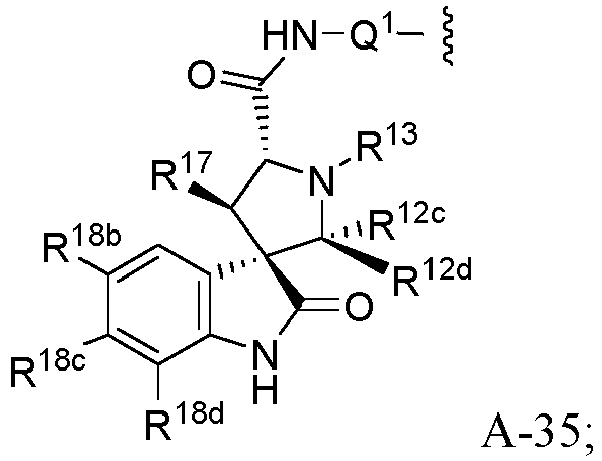
- R18b, R18c, and R18d are as defined in connection with A-34; and
- R12c, R12d, R13, R17, and Q1 are as defined above.
- In another embodiment, Compounds of the Disclosure are compounds represented by Formula I-A, and the pharmaceutically acceptable salts or solvates thereof, wherein:
- A1 is:

- R18e and R18d are independently selected from the group consisting of hydrogen, halo, C1-4 alkyl, haloalkyl, alkoxy, and haloalkoxy; and
- R12c, R12d, R13, R17, and Q1 are as defined above.
- In another embodiment, Compounds of the Disclosure are compounds represented by Formula I-A, and the pharmaceutically acceptable salts or solvates thereof, wherein:
- A1 is:

- wherein R12c, R12d, R13, R17, R19, and Q1 are as defined above .
- In another embodiment, Compounds of the Disclosure are compounds represented by Formula I-A, and the pharmaceutically acceptable salts or solvates thereof, wherein:
- A1 is:

- R12d, R17, R19, and Q1 are as defined above.
- In another embodiment, Compounds of the Disclosure are compounds represented by Formula I-A, and the pharmaceutically acceptable salts or solvates thereof, wherein:
- A1 is:

- A8 is selected from the group consisting of -C(R18g)= and -N=;
- A9 is selected from the group consisting of -C(R18h)= and -N=;
- A10 is selected from the group consisting of -C(R18j)= and -N=;
- R18g, R18h, R18i, R18j, and R18k are each independently selected from the group consisting of hydrogen, halo, C1-4 alkyl, haloalkyl, alkoxy, and haloalkoxy; and
- R12c, R12d, R13, R17, and Q1 are as defined above.
- In another embodiment, Compounds of the Disclosure are compounds represented by Formula I-A, and the pharmaceutically acceptable salts or solvates thereof, wherein A1 is A-55, A8 is -N=, A9 is -C(R18h)= and A10 is -C(R18j)=.
- In another embodiment, Compounds of the Disclosure are compounds represented by Formula I-A, and the pharmaceutically acceptable salts or solvates thereof, wherein A1 is A-55, A8 is C(R18g)=, A9 is -N=, and A10 is -C(R18j)=.
- In another embodiment, Compounds of the Disclosure are compounds represented by Formula I-A, and the pharmaceutically acceptable salts or solvates thereof, wherein A1 is A-55, A8 is -C(R18g)=, A9 is -C(R18h)=, and A10 is -N=.
- In another embodiment, Compounds of the Disclosure are compounds represented by Formula I-A, and the pharmaceutically acceptable salts or solvates thereof, wherein A1 is A-55, A8 is -C(R18g)=, A9 is -N=, and A10 is -N=.
- In another embodiment, Compounds of the Disclosure are compounds represented by Formula I-A, and the pharmaceutically acceptable salts or solvates thereof, wherein:
- A1 is:

- R12c, R12d, R13, R17, R18h, R18i, R18j, R18k, and Q1 are as defined in connection with A-55.
- In another embodiment, Compounds of the Disclosure are compounds represented by Formula I-A, and the pharmaceutically acceptable salts or solvates thereof, wherein:
- A1 is:

- R18l, R18m, and R18n are each independently selected from the group consisting of hydrogen, halo, C1-4 alkyl, haloalkyl, alkoxy, and haloalkoxy; and
- R12c, R12d, R13, R17, and Q1 are as defined above.
- In another embodiment, Compounds of the Disclosure are compounds represented by Formula I-A, and the pharmaceutically acceptable salts or solvates thereof, wherein:
- A1 is:

- wherein R12c, R12d, R17, R22a, and

- In another embodiment, Compounds of the Disclosure are compounds represented by Formula I-A, and the pharmaceutically acceptable salts or solvates thereof, wherein:
- A1 is:

- R12c, R12d, R17, R19, and R22b are as defined in connection above .
- In another embodiment, Compounds of the Disclosure are compounds represented by Formula I-A, and the pharmaceutically acceptable salts or solvates thereof, wherein:
A1 is:

- In another embodiment, Compounds of the Disclosure are compounds represented by Formula I-A, and the pharmaceutically acceptable salts or solvates thereof, wherein A1 is any one or more of A-28, A-34, A-35, A-48, A-54, A-55, A-56, A-57, A-69, A-86, or A-93.
- In another embodiment, Compounds of the Disclosure are compounds represented by Formula I-A, and the pharmaceutically acceptable salts or solvates thereof, wherein A1 is selected from the group consisting of A-28, A-48, A-69, A-86, and A-93.
- In another embodiment, Compounds of the Disclosure are compounds represented by Formula I-A, and the pharmaceutically acceptable salts or solvates thereof, wherein A1 is selected from the group consisting of A-28, A-48, A-69, and A-86.
- In another embodiment, Compounds of the Disclosure are compounds represented by Formula I-A, and the pharmaceutically acceptable salts or solvates thereof, wherein A1 is selected from the group consisting of A-28 and A-48.
- In another embodiment, Compounds of the Disclosure are compounds represented by Formula I-A, and the pharmaceutically acceptable salts or solvates thereof, wherein A1 is selected from the group consisting of A-69 and A-86.
- In another embodiment, Compounds of the Disclosure are compounds represented by Formula I-A, and the pharmaceutically acceptable salts or solvates thereof, wherein A1 is selected from the group consisting of A-1 to A-9 (below).
- In another embodiment, Compounds of the Disclosure are compounds represented by Formula I-A, and the pharmaceutically acceptable salts or solvates thereof, wherein A1 is selected from the group consisting of A-1 to A-9, A-16, A-28, A-34 to A-36, A-48, A-54 to A-57, A-69, A-86, A-93.
- In another embodiment, Compounds of the Disclosure are compounds represented by Formula I-A, and the pharmaceutically acceptable salts or solvates thereof, wherein A1 is selected from the group consisting of A-1 to to A-9, A-16, A-28, A-34 to A-36, A-48, A-54 to A-57, A-69, A-86.
- In another embodiment, Compounds of the Disclosure are compounds represented by Formula I-A, and the pharmaceutically acceptable salts or solvates thereof, wherein A1 is selected from the group consisting of A-28, A-34 to A-36, A-48, A-54 to A-57, A-69, A-86, A-93.
- In another embodiment, Compounds of the Disclosure are compounds represented by Formula I-A, and the pharmaceutically acceptable salts or solvates thereof, wherein A1 is selected from the group consisting of A-28, A-34 to A-36, A-48, A-54 to A-57, A-69, A-86.
- In another embodiment, Compounds of the Disclosure are compounds represented by Formula I-A, and the pharmaceutically acceptable salts or solvates thereof, wherein A1 is selected from the group consisting of A-28, A-34 to A-36.
- In another embodiment, Compounds of the Disclosure are compounds represented by Formula I-A, and the pharmaceutically acceptable salts or solvates thereof, wherein A1 is selected from the group consisting of A-48, A-54 to A-57.
- In another embodiment, Compounds of the Disclosure are compounds represented by Formula I-A, and the pharmaceutically acceptable salts or solvates thereof, wherein A1 is selected from the group consisting of A-69, A-86-.
- In another embodiment, Compounds of the Disclosure are compounds represented by Formula I-A, and the pharmaceutically acceptable salts or solvates thereof, wherein A1 is selected from the group consisting of A-28, A-48, A-69, A-86, A-93, A-98, A-99, and A-101.
- In another embodiment, Compounds of the Disclosure are compounds represented by Formula I-A, and the pharmaceutically acceptable salts or solvates thereof, wherein A1 is selected from the group consisting of A-35, A-56, A-100.
- In another embodiment, Compounds of the Disclosure are compounds represented by Formula I-A, and the pharmaceutically acceptable salts or solvates thereof, wherein:
- A1 is any one or more of A-28, A-34 to A-36, A-48, A-54 to A-57, A-69, A-86, A-93; and
- R17 is optionally substituted aryl. In another embodiment, the optional substituents are fluoro or chloro.
- In another embodiment, Compounds of the Disclosure are compounds represented by Formula I-A, and the pharmaceutically acceptable salts or solvates thereof, wherein:
- A1 is:

- Ra5, Ra6, Ra11, and Ra12 are each independently selected from the group consisting of hydrogen and halo;
- Ra9 and Ra10 are independently selected from the group consisting of hydrogen, halo, C1-4 alkyl, haloalkyl, alkoxy, and haloalkoxy; and
- Ra13 is selected from the group consisting of hydrogen, C1-4 alkyl, and C3-8 cycloalkyl.
- In another embodiment, Compounds of the Disclosure are compounds represented by Formula I-A, and the pharmaceutically acceptable salts or solvates thereof, wherein:
A1 is: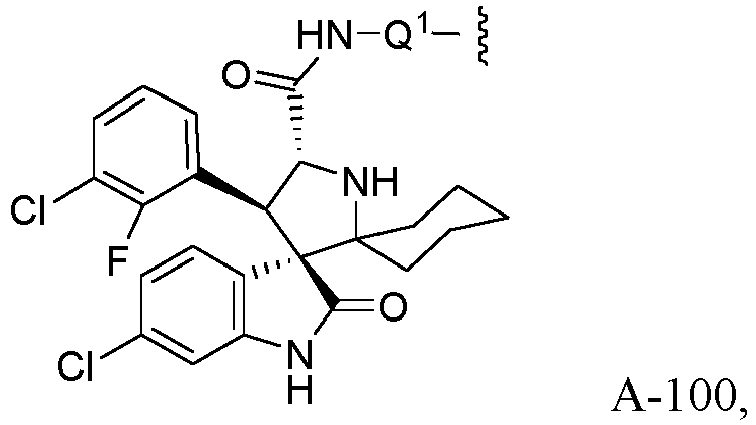
- In another embodiment, Compounds of the Disclosure are compounds represented by Formula I-A, and the pharmaceutically acceptable salts or solvates thereof, wherein:
- A1 is any one or more of A-28, A-34 to A-36, A-48, A-54 to A-57, A-69, A-86, A-93; and
- R17 is optionally substituted heteroaryl. In another embodiment, the optional substituents are fluoro or chloro.
- In another embodiment, Compounds of the Disclosure are compounds represented by Formula I-A, and the pharmaceutically acceptable salts or solvates thereof, wherein:
- A1 is any one or more of A-28, A-34 to A-36, A-48, A-54 to A-57, A-69, A-86, A-93;
- R17 is:

- A11 is selected from the group consisting of -C(R20c)= and -N=; and
- R20a, R20b, R20c, R20d, and R20e are each independently selected from the group consisting of hydrogen, halo, C1-4 alkyl, haloalkyl, alkoxy, and haloalkoxy. In another embodiment, A11 is -C(R20c)=. In another embodiment, A11 is -N=.
- In another embodiment, Compounds of the Disclosure are compounds represented by Formula I-A, and the pharmaceutically acceptable salts or solvates thereof, wherein:
- A1 is any one or more of A-28, A-34 to A-36, A-48, A-54 to A-57, A-69, A-86, A-93;
- R12c is hydrogen; and
- R12d is C1-8 alkyl.
- In another embodiment, Compounds of the Disclosure are compounds represented by Formula I-A, and the pharmaceutically acceptable salts or solvates thereof, wherein:
- A1 is any one or more of A-28, A-34 to A-36, A-48, A-54 to A-57, A-69, A-86, A-93; and
- R12c and R12a are independently selected from C1-8 alkyl, e.g., R12c is methyl and R12d is ethyl, R12c is methyl and R12d is methyl, R12c is ethyl and R12d is ethyl, R12c is propyl and R12d is propyl.
- In another embodiment, Compounds of the Disclosure are compounds represented by Formula I-A, and the pharmaceutically acceptable salts or solvates thereof, wherein:
- A1 is any one or more of A-28, A-34 to A-36, A-48, A-54 to A-57, A-69, A-86, A-93; and
- R12c and R12d taken together with the carbon atom to which they are attached form a 4- to 8-membered optionally substituted cycloalkyl, e.g., R12c and R12d taken together represent
-


- In another embodiment, Compounds of the Disclosure are compounds represented by Formula I-A, and the pharmaceutically acceptable salts or solvates thereof, wherein:
- A1 is any one or more of A-28, A-34 to A-36, A-48, A-54 to A-57, A-69, A-86, A-93; and
- R12c and R12d taken together with the carbon atom to which they are attached form a 4- to 8-membered optionally substituted heterocyclo, e.g., R12c and R12d taken together represent
-

- In another embodiment, Compounds of the Disclosure are compounds represented by Formula I-A, and the pharmaceutically acceptable salts or solvates thereof, wherein:
- A1 is any one or more of A-28, A-34 to A-36, A-48, A-54to A-57, or A-93; and
- R13 is hydrogen.
- In another embodiment, Compounds of the Disclosure are compounds represented by Formula I-A, and the pharmaceutically acceptable salts or solvates thereof, wherein:
- A1 is any one or more of A-28, A-34 to A-36, A-48, A-54to A-57 or A-100; and
- Q1 is alkylenyl.
- In another embodiment, Compounds of the Disclosure are compounds represented by Formula I-A, and the pharmaceutically acceptable salts or solvates thereof, wherein:
- A1 is any one or more of A-28, A-34 to A-36, A-48, A-54to A-57 or A-100; and
- Q1 is phenylenyl, e.g., Q1 is

- In another embodiment, Compounds of the Disclosure are compounds represented by Formula I-A, and the pharmaceutically acceptable salts or solvates thereof, wherein:
- A1 is any one or more of A-28, A-34 to A-36, A-48, A-54 to A-57 or A-100; and
- Q1 is heteroarylenyl, e.g., Q1 is


- In another embodiment, Compounds of the Disclosure are compounds represented by Formula I-A, and the pharmaceutically acceptable salts or solvates thereof, wherein:
- A1 is any one or more of A-28, A-34 to A-36, A-48, A-54to A-57 or A-100; and
- Q1 is cycloalkylenyl, e.g., Q1 is

- In another embodiment, Compounds of the Disclosure are compounds represented by Formula I-A, and the pharmaceutically acceptable salts or solvates thereof, wherein:
- A1 is any one or more of A-28, A-34 to A-36, A-48, A-54 to A-57 or A-100; and
- Q1 is heterocyclenyl, e.g., Q1 is

- In another embodiment, Compounds of the Disclosure are compounds represented by Formula I-A, and the pharmaceutically acceptable salts or solvates thereof, wherein:
- A1 is any one or more of A-69; and
- R22a is optionally substituted cycloalkyl, e.g., R22a is

- In another embodiment, Compounds of the Disclosure are compounds represented by Formula I-A, and the pharmaceutically acceptable salts or solvates thereof, wherein:
- A1 is any one or more of A-69; and
- R22a is optionally substituted heterocyclo.
- In another embodiment, Compounds of the Disclosure are compounds represented by Formula I-A, and the pharmaceutically acceptable salts or solvates thereof, wherein:
- A1 is any one or more of A-69; and
- R22a is optionally substituted aryl, e.g., R22a is


- In another embodiment, Compounds of the Disclosure are compounds represented by Formula I-A, and the pharmaceutically acceptable salts or solvates thereof, wherein:
- A1 is any one or more of A-69; and
- R22a is optionally substituted heteroaryl, e.g., R22a is


- In another embodiment, Compounds of the Disclosure are compounds represented by Formula I-A, and the pharmaceutically acceptable salts or solvates thereof, wherein:
- A1 is any one or more of A-86; and
- R22b is optionally substituted cycloalkyl, e.g., R22b is

- In another embodiment, Compounds of the Disclosure are compounds represented by Formula I-A, and the pharmaceutically acceptable salts or solvates thereof, wherein:
- A1 is any one or more of A-86; and
- R22b is optionally substituted heterocyclo.
- In another embodiment, Compounds of the Disclosure are compounds represented by Formula I-A, and the pharmaceutically acceptable salts or solvates thereof, wherein:
- A1 is any one or more of A-86; and
- R22b is optionally substituted aryl, e.g., R22b is


- In another embodiment, Compounds of the Disclosure are compounds represented by Formula I-A, and the pharmaceutically acceptable salts or solvates thereof, wherein:
- A1 is any one or more of A-86; and
- R22b is optionally substituted heteroaryl, e.g., R22b is
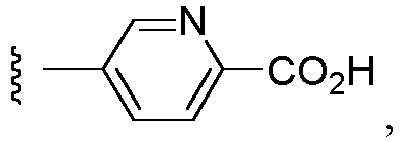

- In another embodiment, Compounds of the Disclosure are compounds represented by Formula I-A, and the pharmaceutically acceptable salts or solvates thereof, wherein:
- A1 is any one or more of A-28, A-34 to A-36, A-48, A-54to A-57 or A-100;
- L1 is -X1-L2-Y1-;
- X1 is X2; and
- X2 is selected from the group consisting of -N(H)C(=O)-, -C(=O)N(H)-, -C(=O)N(H)S(O)2-, -N(H)C(=O)N(H)-, -N(H)C(=O)O-, -OC(=O)N(H)-, -SO2-, -O-, - N(H)-, -SO2N(H)-, -N(H)SO2-, -CH2-, -CH=CH-, and -C=C-. In another embodiment, X2 is N(H)C(=O)-, or -C(=O)N(H)-. In another embodiment, X2 is -N(H)C(=O)-. In another embodiment, X2 is -C(=O)N(H)-. In another embodiment, X2 is -N(H)C(=O)N(H)-. In another embodiment, X2 is -N(H)C(=O)O-. In another embodiment, X2 is -OC(=O)N(H)-. In another embodiment, X2 is -SO2-. In another embodiment, X2 is -O-. In another embodiment, X2 is -N(H)-. In another embodiment, X2 is -SO2N(H)-. In another embodiment, X2 is -N(H)SO2-. In another embodiment, X2 is -CH2-. In another embodiment, X2 is -CH=CH-. In another embodiment, X2 is -C=C-.
- In another embodiment, Compounds of the Disclosure are compounds represented by Formula I-A, and the pharmaceutically acceptable salts or solvates thereof, wherein:
- A1 is any one or more of A-69, A-86;
- L1 is -X1-L2-Y1-;
- X1 is absent.
- In another embodiment, Compounds of the Disclosure are compounds represented by Formula I-A, and the pharmaceutically acceptable salts or solvates thereof, wherein:
- A1 is A-93;
- L1 is -X1-L2-Y1-;
- X1 is X2; and
- X2 is selected from the group consisting of -N(H)C(=O)-, -C(=O)N(H)-, -C(=O)N(H)S(O)2-, -N(H)C(=O)N(H)-, -N(H)C(=O)O-, -OC(=O)N(H)-, -SO2-, -O-, - N(H)-, -SO2N(H)-, -N(H)SO2-, -CH2-, -CH=CH-, and -C=C-. In another embodiment, X2 is N(H)C(=O)-, or -C(=O)N(H)-. In another embodiment, X2 is -N(H)C(=O)-. In another embodiment, X2 is -C(=O)N(H)-. In another embodiment, X2 is -N(H)C(=O)N(H)-. In another embodiment, X2 is -N(H)C(=O)O-. In another embodiment, X2 is -OC(=O)N(H)-. In another embodiment, X2 is -SO2-. In another embodiment, X2 is -O-. In another embodiment, X2 is -N(H)-. In another embodiment, X2 is -SO2N(H)-. In another embodiment, X2 is -N(H)SO2-. In another embodiment, X2 is -CH2-. In another embodiment, X2 is -CH=CH-. In another embodiment, X2 is -C=C-.
- In another embodiment, Compounds of the Disclosure are compounds represented by Formula I-A, and the pharmaceutically acceptable salts or solvates thereof, wherein:
- A1 is A-98;
- L1 is -X1-L2-Y1-;
- X1 is X2; and
- X2 is selected from the group consisting of -N(H)C(=O)-, -C(=O)N(H)-, -C(=O)N(H)S(O)2-, -N(H)C(=O)N(H)-, -N(H)C(=O)O-, -OC(=O)N(H)-, -SO2-, -O-, - N(H)-, -SO2N(H)-, -N(H)SO2-, -CH2-, -CH=CH-, and -C=C-. In another embodiment, X2 is N(H)C(=O)-, or -C(=O)N(H)-. In another embodiment, X2 is -N(H)C(=O)-. In another embodiment, X2 is -C(=O)N(H)-. In another embodiment, X2 is -N(H)C(=O)N(H)-. In another embodiment, X2 is -N(H)C(=O)O-. In another embodiment, X2 is -OC(=O)N(H)-. In another embodiment, X2 is -SO2-. In another embodiment, X2 is -O-. In another embodiment, X2 is -N(H)-. In another embodiment, X2 is -SO2N(H)-. In another embodiment, X2 is -N(H)SO2-. In another embodiment, X2 is -CH2-. In another embodiment, X2 is -CH=CH-. In another embodiment, X2 is -C=C-.
- In another embodiment, Compounds of the Disclosure are compounds represented by Formula VII:

- R12c and R12d taken together with the carbon atom to which they are attached form a 4- to 6-membered optionally substituted cycloalkyl;
- R17 is:

- A11 is -C(R20c)=;
- R20a, R20b, and R20c are each hydrogen;
- R20d and R20e are independently selected from the group consisting of hydrogen and halo, e.g., fluoro or chloro;
- R18b, R18c, and R18d are each independently selected from the group consisting of hydrogen and halo, e.g., fluoro or chloro;
- R21a and R21b are each independently selected from the group consisting of hydrogen, halo, C1-4 alkyl, haloalkyl, alkoxy, and haloalkoxy;
- L2 is selected from the group consisting of alkylenyl, heteroalkylenyl, -A4-(CH2)m-W-(CH2)n- and -(CH2)m-W-(CH2)u-O-(CH2)v-; or
- L2 is absent;
- A4 is selected from the group consisting of 5-membered heteroarylenyl and 6-membered heteroarylenyl; or
- A4 is absent;
- W is selected from the group consisting of phenylenyl, 5-membered heteroarylenyl, 6-membered heteroarylenyl, heterocyclenyl, and cycloalkylenyl;
- m is 0, 1, 2, 3, 4, 5, 6, or 7;
- n is 0, 1, 2, 3, 4, 5, 6, 7, or 8;
- u is 0, 1, 2, or 3;
- v is 1, 2, 3, or 4;
- Y1 is selected from the group consisting of -C=C-, -CH=CH-, -CH2-, -O-, -N(R2b)-, -C(=O)N(R2c)-, -N(R2d)C(=O)CH2O-, and -N(R2e)C(=O)CH2N(R2f)-; or
- Y1 is absent;
- wherein the carboxamide nitrogen atom of -N(R2d)C(=O)CH2O- and
- -N(R2e)C(=O)CH2N(R2f)-, and the carbon atom of -C(=O)N(R2c)- is attached to L2;
- R2b, R2c, R2d, R2e, and R2f are each independently selected from the group consisting of hydrogen and C1-4 alkyl; and
- B1 is:

- A1a is selected from the group consisting of -C(R16a)= and -N=;
- A2 is selected from the group consisting of -C(R16b)= and -N=;
- A3 is selected from the group consisting of -C(R16c)= and -N=;
- G is selected from the group consisting of -C(R16d)= and -N=;
- Z is selected from the group consisting of -CH2 and -C(=O)-;
- R5 is selected from the group consisting of hydrogen, methyl, and fluoro;
- R16a is selected from the group consisting of hydrogen, halo, and C1-4 alkyl;
- R16b is selected from the group consisting of hydrogen, halo, and C1-4 alkyl;
- R16c is selected from the group consisting of hydrogen, halo, and C1-4 alkyl; and
- R16d is selected from the group consisting of hydrogen, halo, and C1-4 alkyl.
- In another embodiment, Compounds of the Disclosure are compounds represented by Formula VIII:

- R12c and R12d are independently selected from the group consisting of hydrogen and optionally substituted C1-8 alkyl; or
- R12c and R12d taken together with the carbon atom to which they are attached form a 4- to 6-membered optionally substituted cycloalkyl;
- R17 is:
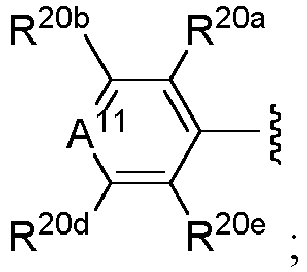
- A11 is -C(R20c)=;
- R20a, R20b, and R20c are each hydrogen;
- R20d and R20e are independently selected from the group consisting of hydrogen and halo, e.g., fluoro or chloro;
- R18h, R18i, R18j, and R18k are each independently selected from the group consisting of hydrogen and halo, e.g., fluoro or chloro;
- R21c and R21d are each independently selected from the group consisting of hydrogen, halo, C1-4 alkyl, haloalkyl, alkoxy, and haloalkoxy;
- L2 is selected from the group consisting of alkylenyl, heteroalkylenyl, -A4-(CH2)m-W-(CH2)n- and -(CH2)m-W-(CH2)u-O-(CH2)v-; or
- L2 is absent;
- A4 is selected from the group consisting of 5-membered heteroarylenyl and 6-membered heteroarylenyl; or
- A4 is absent;
- W is selected from the group consisting of phenylenyl, 5-membered heteroarylenyl, 6-membered heteroarylenyl, heterocyclenyl, and cycloalkylenyl;
- m is 0, 1, 2, 3, 4, 5, 6, or 7;
- n is 0, 1, 2, 3, 4, 5, 6, 7, or 8;
- u is 0, 1, 2, or 3;
- v is 1, 2, 3, or 4;
- Y1 is selected from the group consisting of -C≡C-, -CH=CH-, -CH2-, -O-, -N(R2b)-, -C(=O)N(R2c)-, -N(R2d)C(=O)CH2O-, and -N(R2e)C(=O)CH2N(R2f)-; or
- Y1 is absent;
- wherein the carboxamide nitrogen atom of -N(R2d)C(=O)CH2O- and -N(R2e)C(=O)CH2N(R2f)-, and the carbon atom of -C(=O)N(R2c)- is attached to L2; and R2b, R2c, R2d, R2e, and R2f are each independently selected from the group consisting of hydrogen and C1-4 alkyl; and
- B1 is:

- A1a is selected from the group consisting of -C(R16a)= and -N=;
- A2 is selected from the group consisting of -C(R16b)= and -N=;
- A3 is selected from the group consisting of -C(R16c)= and -N=;
- G is selected from the group consisting of -C(R16d)= and -N=;
- Z is selected from the group consisting of -CH2 and -C(=O)-;
- R5 is selected from the group consisting of hydrogen, methyl, and fluoro;
- R16a is selected from the group consisting of hydrogen, halo, and C1-4 alkyl;
- R16b is selected from the group consisting of hydrogen, halo, and C1-4 alkyl;
- R16c is selected from the group consisting of hydrogen, halo, and C1-4 alkyl; and
- R16d is selected from the group consisting of hydrogen, halo, and C1-4 alkyl.
- In another embodiment, Compounds of the Disclosure are compounds represented by Formula IX:
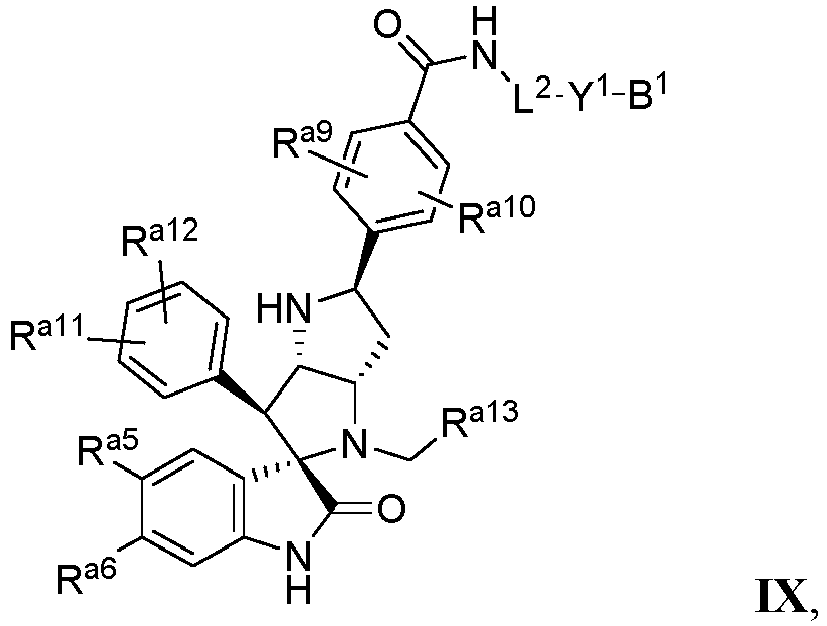
- Ra5, Ra6, Ra11 and Ra12 are each independently selected from the group consisting of hydrogen and halo;
- Ra9 and Ra10 are independently selected from the group consisting of hydrogen, halo, C1-4 alkyl, haloalkyl, alkoxy, and haloalkoxy;
- Ra13 is selected from the group consisting of hydrogen, C1-4 alkyl, and C3-8 cycloalkyl;
- L2 is selected from the group consisting of alkylenyl, heteroalkylenyl, -A4-(CH2)m-W-(CH2)n- and -(CH2)m-W-(CH2)u-O-(CH2)v-; or
- L2 is absent;
- A4 is selected from the group consisting of 5-membered heteroarylenyl and 6-membered heteroarylenyl; or
- A4 is absent;
- W is selected from the group consisting of phenylenyl, 5-membered heteroarylenyl, 6-membered heteroarylenyl, heterocyclenyl, and cycloalkylenyl;
- m is 0, 1, 2, 3, 4, 5, 6, or 7;
- n is 0, 1, 2, 3, 4, 5, 6, 7, or 8;
- u is 0, 1, 2, or 3;
- v is 1, 2, 3, or 4;
- Y1 is selected from the group consisting of -C≡C-, -CH=CH-, -CH2-, -O-, -N(R2b)-, -C(=O)N(R2c)-, -N(R2d)C(=O)CH2O-, and -N(R2e)C(=O)CH2N(R2f)-; or
- Y1 is absent;
- wherein the carboxamide nitrogen atom of -N(R2d)C(=O)CH2O- and
- -N(R2e)C(=O)CH2N(R2f)-, and the carbon atom of -C(=O)N(R2c)- is attached to L2;
- R2b, R2c, R2d, R2e, and R2f are each independently selected from the group consisting of hydrogen and C1-4 alkyl; and
- B1 is:

- A1a is selected from the group consisting of -C(R16a)= and -N=;
- A2 is selected from the group consisting of -C(R16b)= and -N=;
- A3 is selected from the group consisting of -C(R16c)= and -N=;
- G is selected from the group consisting of -C(R16d)= and -N=;
- Z is selected from the group consisting of -CH2 and -C(=O)-;
- R5 is selected from the group consisting of hydrogen, methyl, and fluoro;
- R16a is selected from the group consisting of hydrogen, halo, and C1-4 alkyl;
- R16b is selected from the group consisting of hydrogen, halo, and C1-4 alkyl;
- R16c is selected from the group consisting of hydrogen, halo, and C1-4 alkyl; and
- R16d is selected from the group consisting of hydrogen, halo, and C1-4 alkyl.
- In another embodiment, Compounds of the Disclosure are compounds represented by any one of Formula I-A or VII-IX and the pharmaceutically acceptable salts or solvates thereof, wherein:
- Y1 is selected from the group consisting of -C=C-, -CH=CH-, -CH2-, -O-, and -N(R2b)-; or
- Y1 is absent.
- In another embodiment, Compounds of the Disclosure are compounds represented by any one of Formula I-A or VII-IX and the pharmaceutically acceptable salts or solvates thereof, wherein Y1 is -C=C-. In another embodiment, Y1 is -CH2-. In another embodiment, Y1 is -O-. In another embodiment, Y1 is -N(H)-. In another embodiment, Y1 is absent. In another embodiment, Y1 is -CH=CH-.
- In another embodiment, Compounds of the Disclosure are compounds represented by Formula I-A, and the pharmaceutically acceptable salts or solvates thereof, wherein:
- A1 is one or more of A-28, A-34 to A-36, A-48, A-54to A-98;
- Y1 is selected from the group consisting of -C=C-, -CH=CH-, -CH2-, -O-, and -N(R2b)-; or
- Y1 is absent.
- In another embodiment, Y1 is C=C-. In another embodiment, Y1 is -CH2-. In another embodiment, Y1 is -O-. In another embodiment, Y1 is -N(H)-. In another embodiment, Y1 is absent. In another embodiment, Y1 is -CH=CH-.
- In another embodiment, Y1 is -C≡C-. In another embodiment, Y1 is -CH2-. In another embodiment, Y1 is -O-. In another embodiment, Y1 is -N(H)-. In another embodiment, Y1 is absent. In another embodiment, Y1 is -CH=CH-.
- In another embodiment, Compounds of the Disclosure are compounds represented by Formula I-A, and the pharmaceutically acceptable salts or solvates thereof, wherein:
- A1 is A-100;
- Y1 is selected from the group consisting of -C≡C-, -CH=CH-, -CH2-, -O-, and -N(R2b)-; or
- Y1 is absent. In another embodiment, Y1 is -C=C-. In another embodiment, Y1 is -CH2-. In another embodiment, Y1 is -O-. In another embodiment, Y1 is -N(H)-. In another embodiment, Y1 is absent. In another embodiment, Y1 is -CH=CH-.
- In another embodiment, Compounds of the Disclosure are compounds represented by any one of Formula I-A or VII-IX, and the pharmaceutically acceptable salts or solvates thereof, wherein:
- B1 is:

- A2 is selected from the group consisting of -C(R16b)= and -N=;
- A3 is selected from the group consisting of -C(R16c)= and -N=;
- G is selected from the group consisting of -C(R16d)= and -N=;
- Z is selected from the group consisting of -CH2 and -C(=O)-;
- R5 is selected from the group consisting of hydrogen, methyl, and fluoro;
- R16a is selected from the group consisting of hydrogen, halo, and C1-4 alkyl;
- R16b is selected from the group consisting of hydrogen, halo, and C1-4 alkyl; and
- R16c is selected from the group consisting of hydrogen, halo, and C1-4 alkyl; and
- R16d is selected from the group consisting of hydrogen, halo, and C1-4 alkyl.
- In another embodiment, Compounds of the Disclosure are compounds represented by any one of Formula I-A or VII-IX, and the pharmaceutically acceptable salts or solvates thereof, wherein B1 is B-1a, and R5 is partially or entirely enriched with an isotope of hydrogen, e.g., R5 is about 1%, about 5%, about 10%, about 15%, about 20%, about 25%, about 30%, about 35%, about 40%, about 45%, about 50%, about 55%, about 60%, about 65%, about 70%, about 75%, about 80%, about 85%, about 90%, about 95%, or about 100% deuterium.
- In another embodiment, Compounds of the Disclosure are compounds represented by any one of Formula I-A or VII-IX, and the pharmaceutically acceptable salts or solvates thereof, wherein B1 is B-1a In another embodiment, B1 is:

- In another embodiment, B1 is:

- In another embodiment, B1 is:

- In another embodiment, Compounds of the Disclosure are compounds represented by Formulae I-A, and the pharmaceutically acceptable salts or solvates thereof, wherein A1 is one or more of A-17 to A-93 and B1 is B-1a, B-2, or B-3.
- In another embodiment, Compounds of the Disclosure are compounds represented by Formula I-A, and the pharmaceutically acceptable salts or solvates thereof, wherein A1 is any one or more of A-17 to A-98, and B1 is B-1a. In another embodiment, B1 is B-2. In another embodiment, B1 is B-3. In another embodiment, B1 is:

- In another embodiment, B1 is:

- In another embodiment, B1 is:

- In another embodiment, Compounds of the Disclosure are compounds represented by any one of Formula I-A or VII-XI, and the pharmaceutically acceptable salts or solvates thereof, wherein: B1 is

- In another embodiment, Compounds of the Disclosure are compounds represented by any one of Formulae I-A or VII-IX, and the pharmaceutically acceptable salts or solvates thereof, wherein L2 is -(CH2)m-W-(CH2)n-. In another embodiment, W is phenylenyl. In another embodiment, W is 5-membered heteroarylenyl. In another embodiment. W is 6-membered heteroarylenyl. In another embodiment, W is heterocyclenyl. In another embodiment, W is cycloalkylenyl.
- In another embodiment, Compounds of the Disclosure are compounds represented by any one of Formulae I-A or VII-IX, and the pharmaceutically acceptable salts or solvates thereof, wherein L2 is C1-12 alkylenyl. In another embodiment, L2 is selected from the group consisting of -CH2-, -CH2CH2-, -CH2CH2CH2-, -CH2(CH2)2CH2-, -CH2(CH2)3CH2-, -CH2(CH2)4CH2-, -CH2(CH2)5CH2-, and -CH2(CH2)6CH2-. In another embodiment, L2 is selected from the group consisting of -CH2-, -CH2CH2-, -CH2CH2CH2-, and -CH2(CH2)2CH2-. In another embodiment, A1 is any one or more of A-28, A-34 to A-36, A-48, A-54 to A-57, A-69, A-86. In another embodiment, A1 is any one or more of A-69 or A-86.
- In another embodiment, Compounds of the Disclosure are compounds represented by any one of Formulae I-A or VII-IX, and the pharmaceutically acceptable salts or solvates thereof, wherein L2 is 3- to 20-membered heteroalkylenyl. In another embodiment, L2 is selected from the group consisting of -(CH2)oO-(CH2CH2O)p-(CH2)q- and -(CH2)rO-(CH2)s-O(CH2)t-; wherein: o is 2 or 3; p is 0, 1, 2, 3, 4, 5, 6, or 7; q is 2 or 3; r is 2, 3, or 4; s is 3, 4, or 5; and t is 2 or 3. In another embodiment, L2 is selected from the group consisting of
-CH2CH2OCH2CH2-,
-CH2CH2O(CH2CH2O)2CH2CH2-,
-CH2CH2O(CH2CH2O)3CH2CH2-,
-CH2CH2O(CH2CH2O)4CH2CH2-,
-CH2CH2O(CH2CH2O)6CH2CH2-,
-CH2CH2O(CH2CH2O)6CH2CH2-,
-CH2CH2CH2OCH2CH2OCH2CH2CH2-,
-CH2CH2CH2O(CH2CH2O)2CH2CH2CH2-,
and -CH2CH2CH2O(CH2)4OCH2CH2CH2-. In another embodiment, A1 is any one or more of A-28, A-34 to A-36, A-48, A-54 to A-57, A-69, A-86. In another embodiment, A1 is any one or more of A-69 or A-86. - In another embodiment, Compounds of the Disclosure are compounds represented by Formula I-A, and the pharmaceutically acceptable salts or solvates thereof, wherein:
- A1 is any one or more A-69 or A-86;
- L1 is -X1-L2-Y1-;
- X1 is absent;
- L2 is selected from the group consisting of alkylenyl, heteroalkylenyl, and -A4-(CH2)m-W-(CH2)n-; and
- A4 is absent.
- In another embodiment, Compounds of the Disclosure are compounds represented by Formula I-A, and the pharmaceutically acceptable salts or solvates thereof, wherein:
- A1 is any one or more A-69 or A-86;
- L1 is -X1-L2-Y1-;
- X1 is absent;
- L2 is selected from the group consisting of alkylenyl and heteroalkylenyl.
- In another embodiment, Compounds of the Disclosure are compounds represented by any one of Formula I-A or VII-IX, and the pharmaceutically acceptable salts or solvates thereof, wherein L2 is selected from the group consisting of:

- In another embodiment, A1 is any one or more of A-28, A-34 to A-36, A-48, A-54 to A-57, A-69, A-86. In another embodiment, m is 0. In another embodiment, n is 1, 2, 3, 4, or 5. In another embodiment, L2 is L2-1. In another embodiment, L2 is L2-2.
- In another embodiment, Compounds of the Disclosure are compounds represented by any one of Formula I-A or VII-IX, and the pharmaceutically acceptable salts or solvates thereof, wherein L2 is selected from the group consisting of:


- Q3 is selected from the group consisting of -O-, -S-, and -N(R6)-; and R6 is selected from the group consisting of hydrogen and C1-4 alkyl. In another embodiment, A1 is any one or more of A-28, A-34 to A-36, A-48, A-54 to A-57, A-69, A-86. In another embodiment, m is 0. In another embodiment, n is 1, 2, 3, 4, or 5. In another embodiment, n is 2, 3, or 4. In another embodiment, L2 is L2-3. In another embodiment, L2 is L2-4. In another embodiment, L2 is L2-5. In another embodiment, L2 is L2-6. In another embodiment, L2 is L2-7. In another embodiment, L2 is L2-8. In another embodiment, L2 is L2-9. In another embodiment, the (CH2)n group is attached to Y1. In another embodiment, the (CH2)m group is attached to Y1.
- In another embodiment, Compounds of the Disclosure are compounds represented by any one of Formula I-A or VII-IX, and the pharmaceutically acceptable salts or solvates thereof, wherein L2 is selected from the group consisting of:


- In another embodiment, A1 is any one or more of A-28, A-34 to A-36, A-48, A-54 to A-57, A-69, A-86. In another embodiment, m is 0. In another embodiment, n is 1, 2, 3, 4, or 5. In another embodiment, n is 2, 3, or 4. In another embodiment, L2 is L2-10. In another embodiment, L2 is L2-11. In another embodiment, L2 is L2-12. In another embodiment, L2 is L2-13.
- In another embodiment, Compounds of the Disclosure are compounds represented by any one of Formula I-A or VII-IX, and the pharmaceutically acceptable salts or solvates thereof, wherein L2 is selected from the group consisting of:


- In another embodiment, A1 is any one or more of A-28, A-34 to A-36, A-48, A-54 to A-57, A-69, A-86. In another embodiment, m is 1, 2, or 3. In another embodiment, n is 0, 1, 2, 3, or 4. In another embodiment, n is 0, 1, or 2. In another embodiment, L2 is L2-14. In another embodiment, L2 is L2-15. In another embodiment, L2 is L2-16. In another embodiment, L2 is L2-17. In another embodiment, L2 is L2-18.
- In another embodiment, Compounds of the Disclosure are compounds represented by any one of Formula I-A or VII-IX, and the pharmaceutically acceptable salts or solvates thereof, wherein L2 is selected from the group consisting of L2-16 and L2-17. In another embodiment, m is 0, and n is 0 or 1. In another embodiment, m is 1, 2, or 3, and n is 0 or 1.
- In another embodiment, Compounds of the Disclosure are compounds represented by any one of Formula I-A or VII-IX, and the pharmaceutically acceptable salts or solvates thereof, wherein L2 is selected from the group consisting of:

- In another embodiment, A1 is any one or more of A-28, A-34 to A-36, A-48, A-54 to A-57, A-69, A-86. In another embodiment, m is 1, 2, or 3. In another embodiment, n is 0, 1, 2, 3, or 4. In another embodiment, n is 1 or 2. In another embodiment, L2 is L2-19. In another embodiment, L2 is L2-20.
- In another embodiment, Compounds of the Disclosure are compounds represented by any one of Formula I-A or VII-IX, and the pharmaceutically acceptable salts or solvates thereof, wherein L2 is selected from the group consisting of:

- In another embodiment, A1 is any one or more of A-28, A-34 to A-36, A-48, A-54 to A-57, A-69, A-86. In another embodiment, m is 1, 2, or 3. In another embodiment, n is 1, 2, 3, 4, or 5. In another embodiment, L2 is L2-21. In another embodiment, L2 is L2-22. In another embodiment, A4 is 5-membered heteroarylenyl. In another embodiment, A4 is 6-membered heteroarylenyl.
- In another embodiment, Compounds of the Disclosure are compounds represented by any one of Formula I-A or VII-IX, and the pharmaceutically acceptable salts or solvates thereof, wherein L2 is selected from the group consisting of:



- Q3 is selected from the group consisting of -O-, -S-, and -N(R6)-; and R6 is selected from the group consisting of hydrogen and C1-4 alkyl. In another embodiment, m is 1, 2, or 3. In another embodiment, A1 is any one or more of A-28, A-34 to A-36, A-48, A-54 to A-57, A-69, A-86. In another embodiment, n is 1, 2, 3, or 4. In another embodiment, n is 2, 3, or 4. In another embodiment, L2 is L2-23. In another embodiment, L2 is L2-24. In another embodiment, L2 is L2-25. In another embodiment, L2 is L2-26. In another embodiment, L2 is L2-27. In another embodiment, L2 is L2-28. In another embodiment, L2 is L2-29. In another embodiment, A4 is 5-membered heteroarylenyl. In another embodiment, A4 is 6-membered heteroarylenyl. In another embodiment, the (CH2)n group is attached to Y1. In another embodiment, the (CH2)m group is attached to Y1.
- In another embodiment, Compounds of the Disclosure are compounds represented by any one of Formula I-A or VII-IX, and the pharmaceutically acceptable salts or solvates thereof, wherein L2 is selected from the group consisting of:


- In another embodiment, A1 is any one or more of A-28, A-34 to A-36, A-48, A-54 to A-57, A-69, A-86. In another embodiment, m is 1, 2, or 3. In another embodiment, n is 1, 2, 3, or 4. In another embodiment, n is 2, 3, or 4. In another embodiment, L2 is L2-30. In another embodiment, L2 is L2-31. In another embodiment, L2 is L2-32. In another embodiment, L2 is L2-33. In another embodiment, A4 is 5-membered heteroarylenyl. In another embodiment, A4 is 6-membered heteroarylenyl.
- In another embodiment, Compounds of the Disclosure are compounds represented by any one of Formula I-A or VII-IX, and the pharmaceutically acceptable salts or solvates thereof, wherein L2 is selected from the group consisting of:


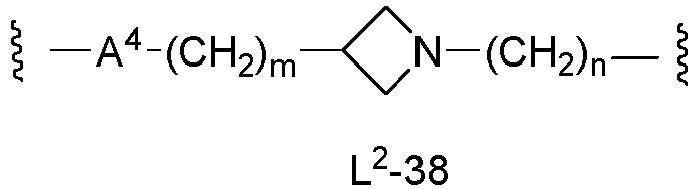
- In another embodiment, A1 is any one or more of A-28, A-34 to A-36, A-48, A-54 to A-57, A-69, A-86. In another embodiment, m is 1, 2, or 3. In another embodiment, n is 0, 1, 2, 3, or 4. In another embodiment, n is 0, 1, or 2. In another embodiment, L2 is L2-34. In another embodiment, L2 is L2-35. In another embodiment, L2 is L2-36. In another embodiment, L2 is L2-37. In another embodiment, L2 is L2-38. In another embodiment, A4 is 5-membered heteroarylenyl. In another embodiment, A4 is 6-membered heteroarylenyl.
- In another embodiment, Compounds of the Disclosure are compounds represented by any one of Formula I-A or VII-IX, and the pharmaceutically acceptable salts or solvates thereof, wherein L2 is selected from the group consisting of:

- In another embodiment, A1 is any one or more of A-28, A-34 to A-36, A-48, A-54 to A-57, A-69, A-86. In another embodiment, m is 1, 2, or 3. In another embodiment, n is 0, 1, 2, 3, or 4. In another embodiment, n is 1 or 2. In another embodiment, L2 is L2-39. In another embodiment, L2 is L2-40. In another embodiment, A4 is 5-membered heteroarylenyl. In another embodiment, A4 is 6-membered heteroarylenyl.
- In another embodiment, Compounds of the Disclosure are compounds represented by any one of Formula I-A or VII-IX, and the pharmaceutically acceptable salts or solvates thereof, wherein L1 is -X1-L2-Y1-; X1 is X; L2 is L; and Y1 is Y, and X, L, and Y are as defined in connection with Formula I, below. In another embodiment, A1 is any one or more of A-28, A-34 to A-36, A-48, A-54 to A-57, A-69, A-86.
- In another embodiment, Compounds of the Disclosure are compounds represented by Formula I-A, and the pharmaceutically acceptable salts or solvates thereof, wherein A1 is A, and A is as defined in connection with Formula I, below.
- In another embodiment, Compounds of the Disclosure are compounds represented by any one of Formula I-A or VII-XI, and the pharmaceutically acceptable salts or solvates thereof, wherein B1 is B-1a. In another embodiment, B1 is:

- In another embodiment, Compounds of the Disclosure are compounds represented by Formula I-A, and the pharmaceutically acceptable salts or solvates thereof, wherein A1 is any one or more of A-28, A-34 to A-36, A-48, A-54 to A-57, A-69, A-86, and B1 is B-1a. In another embodiment, B1 is:

- In another embodiment, Compounds of the Disclosure are compounds represented by Formula I:

- A is selected from the group consisting of:
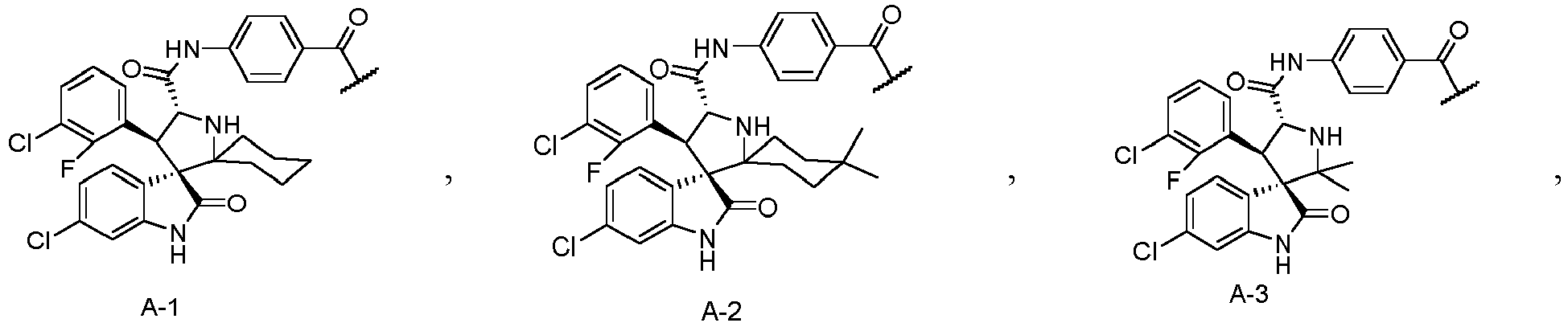


- B is selected from the group consisting of:

- X is selected from the group consisting of -N(H)-, ; or
- L is selected from the group consisting of alkylenyl, heteroalkylenyl, and -(CH2)m-W-(CH2)n-;
- W is selected from the group consisting of phenylenyl, 5-membered heteroarylenyl, and 6-membered heteroarylenyl;
- m is 0, 1, 2, 3, 4, 5, 6, or 7;
- n is 0, 1, 2, 3, 4, 5, 6, 7, or 8;
- Y is selected from the group consisting of -C=C-, -O-, -N(R2b)-, -C(=O)N(R2c)-, - N(R2d)C(=O)CH2O-, and -N(R2e)C(=O)CH2N(R2f)-; or
- Y is absent;
- wherein the carboxamide nitrogen atom of -N(R2d)C(=O)CH2O-and -N(R2e)C(=O)CH2N(R2f)-, and the carbon atom of -C(=O)N(R2c)- is attached to L;
- R2a, R2b, R2c, R2d, R2e, and R2f are each independently selected from the group consisting of hydrogen and C1-4 alkyl;
- Z is selected from the group consisting of -CH2 and -C(=O)-; and
- R5 is selected from the group consisting of hydrogen, methyl, and fluoro.
- In another embodiment, Compounds of the Disclosure are compounds represented by Formula II:

- In another embodiment, Compounds of the Disclosure are compounds represented by Formula II, and the pharmaceutically acceptable salts or solvates thereof, wherein Y is selected from the group consisting of -C=C-, -O-, -N(H)-, -C(=O)N(H)-, -N(H)C(=O)CH2O-, and -N(H)C(=O)CH2N(H)-. In another embodiment, Y is selected from the group consisting of -C=C-, -O-, and -N(H)-. In another embodiment, Y is selected from the group consisting of -C=C- and -N(H)-.
- In another embodiment, Compounds of the Disclosure are compounds represented by Formula II, and the pharmaceutically acceptable salts or solvates thereof, wherein Y is absent.
- In another embodiment, Compounds of the Disclosure are compounds represented by any one of Formulae I-A or I-II, and the pharmaceutically acceptable salts or solvates thereof, wherein X is selected from the group consisting of -N(H)-.
- In another embodiment, Compounds of the Disclosure are compounds represented by any one of Formulae I-A or I-II, and the pharmaceutically acceptable salts or solvates thereof, wherein L is C1-12 alkylenyl. In another embodiment, L is selected from the group consisting of -CH2-, -CH2CH2-, -CH2CH2CH2-, -CH2(CH2)2CH2-, -CH2(CH2)3CH2-, -CH2(CH2)4CH2-, -CH2(CH2)5CH2-, and -CH2(CH2)6CH2-.
- In another embodiment, Compounds of the Disclosure are compounds represented by any one of Formulae I-A or I-II, and the pharmaceutically acceptable salts or solvates thereof, wherein L is 3- to 20-membered heteroalkylenyl. In another embodiment, L is selected from the group consisting of -(CH2)oO-(CH2CH2O)p-(CH2)q- and -(CH2)rO-(CH2)s-O(CH2)t-; wherein: o is 2 or 3; p is 0, 1, 2, 3, 4, 5, 6, or 7; q is 2 or 3; r is 2, 3, or 4; s is 3, 4, or 5; and t is 2 or 3. In another embodiment, L is selected from the group consisting of
-CH2CH2OCH2CH2-,
-CH2CH2O(CH2CH2O)2CH2CH2-,
-CH2CH2O(CH2CH2O)3CH2CH2-,
-CH2CH2O(CH2CH2O)4CH2CH2-,
-CH2CH2O(CH2CH2O)6CH2CH2-,
-CH2CH2O(CH2CH2O)6CH2CH2-,
-CH2CH2CH2OCH2CH2OCH2CH2CH2-,
-CH2CH2CH2O(CH2CH2O)2CH2CH2CH2-,
and
-CH2CH2CH2O(CH2)4OCH2CH2CH2-.
- In another embodiment, Compounds of the Disclosure are compounds represented by any one of Formulae I-A or I-II, and the pharmaceutically acceptable salts or solvates thereof, wherein L is -(CH2)m-W-(CH2)n-. In another embodiment, W is phenylenyl. In another embodiment, W is 5-membered heteroarylenyl. In another embodiment, W is 6-membered heteroarylenyl.
- In another embodiment, Compounds of the Disclosure are compounds represented by any one of Formulae I-A or I-II, and the pharmaceutically acceptable salts or solvates thereof, wherein L is selected from the group consisting of:

- In another embodiment, Compounds of the Disclosure are compounds represented by any one of Formulae I-A or I-II, and the pharmaceutically acceptable salts or solvates thereof, wherein L is selected from the group consisting of:


- In another embodiment, Compounds of the Disclosure are compounds represented by any one of Formulae I-A or I-II, and the pharmaceutically acceptable salts or solvates thereof, wherein L is selected from the group consisting of:

- In another embodiment, Compounds of the Disclosure are compounds represented by any one of Formulae I-A or I-II, and the pharmaceutically acceptable salts or solvates thereof, wherein A is selected from the group consisting of A-1, A-2, A-3, A-4, A-5, A-6, A-7, A-8, and A-9. In another embodiment, A is A-1. In another embodiment, A is A-2. In another embodiment, A is A-3. In another embodiment, A is A-4. In another embodiment, A is A-5. In another embodiment, A is A-6. In another embodiment, A is A-7. In another embodiment, A is A-8. In another embodiment, A is A-9.
- In another embodiment, Compounds of the Disclosure are any one or more of the compounds of Table 1, and the pharmaceutically acceptable salts and solvates thereof.
Table 1 Cpd. No. Structure 1 
2 
3 
4 
7 
8 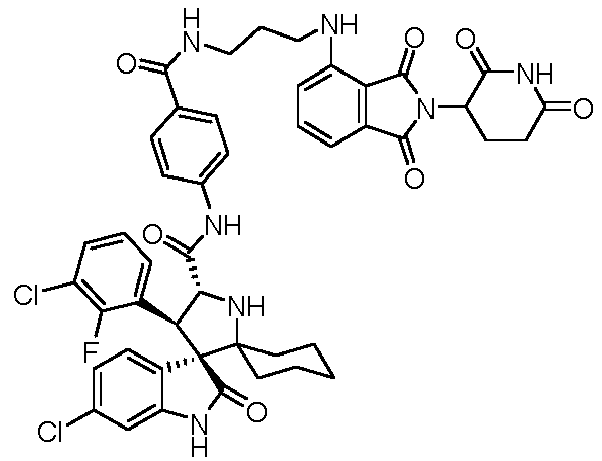
9 
10 
11 
12 
13 
14 
15 
16 
17 
18 
19 
20 
21 
22 
23 
24 
25 
26 
27 
28 
29 
30 
31 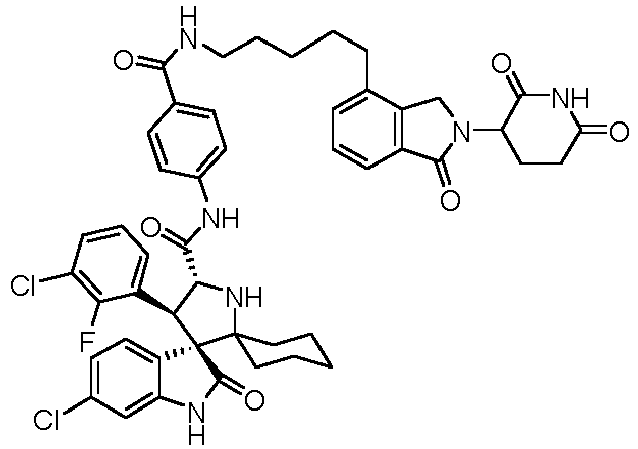
32 
33 
34 
35 
36 
37 
38 
39 
40 
44 
45 
46 
49 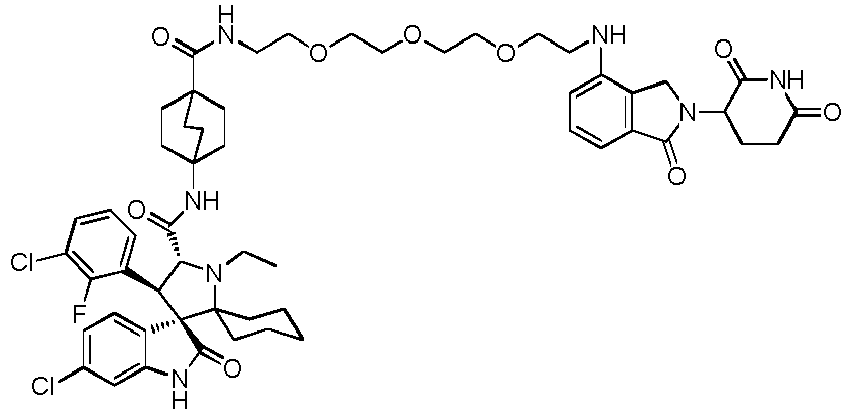
50 
51 
52 
53 
54 
55 
56 
- In another embodiment, Compounds of the Disclosure are any one or more of the compounds of Table 1A, and the pharmaceutically acceptable salts and solvates thereof.
Table 1A Cpd. No. Structure 146 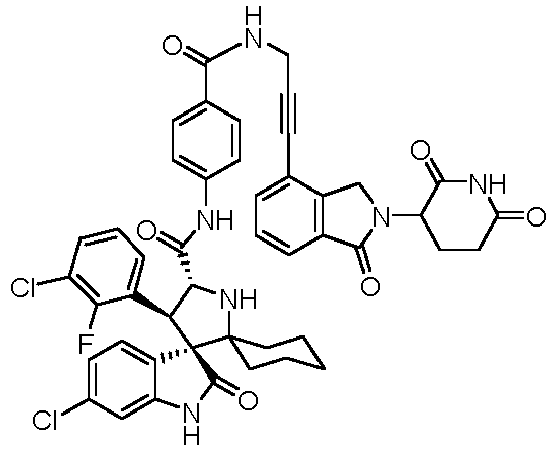
147 
148 
149 
150 
151 
152 
157 
158 
159 
160 
161 
162 
163 
164 
165 
166 
167 
168 
169 
170 
171 
172 
173 
174 
177 
178 
179 
- In another embodiment, Compounds of the Disclosure are any one or more of the compounds of Table 1B, and the pharmaceutically acceptable salts and solvates thereof.
Table 1B Cpd. No. Structure 180 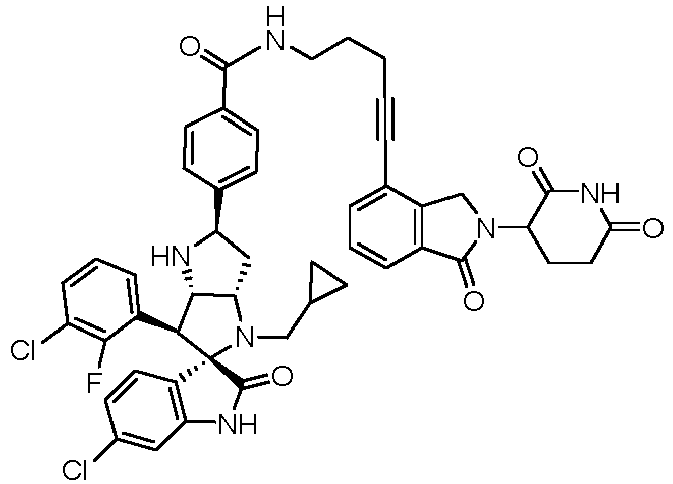
181 
182 
183 
184 
185 
186 
187 
- In another embodiment, Compounds of the Disclosure are any one or more of the compounds of Table 1C, and the pharmaceutically acceptable salts and solvates thereof.
Table 1C Cpd. No. Structure 188 
189 
198 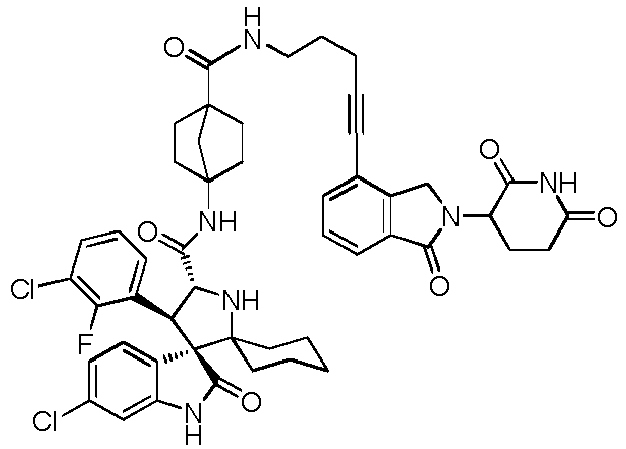
199 
200 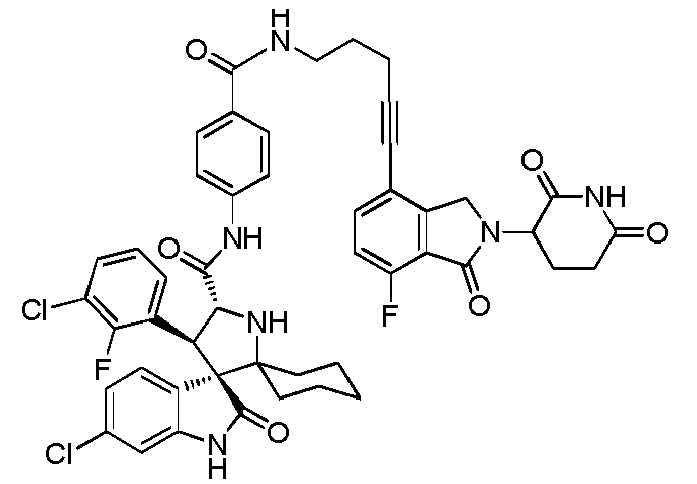
201 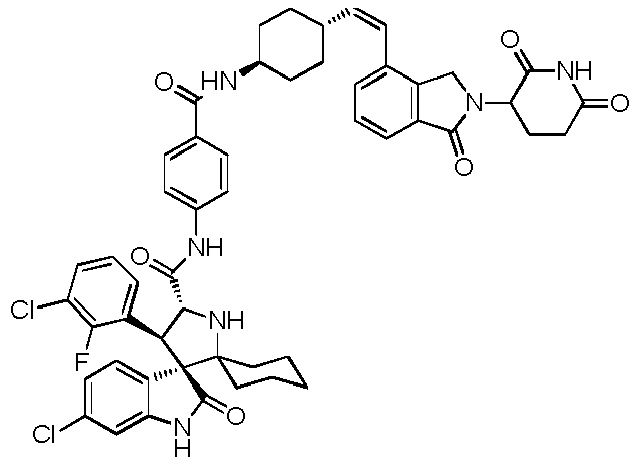
202 
205 
206 
207 
208 
209 
210 
211 
212 
213 
214 
215 
216 
217 
218 
220 
221 
222 
223 
224 
225 
226 
227 
228 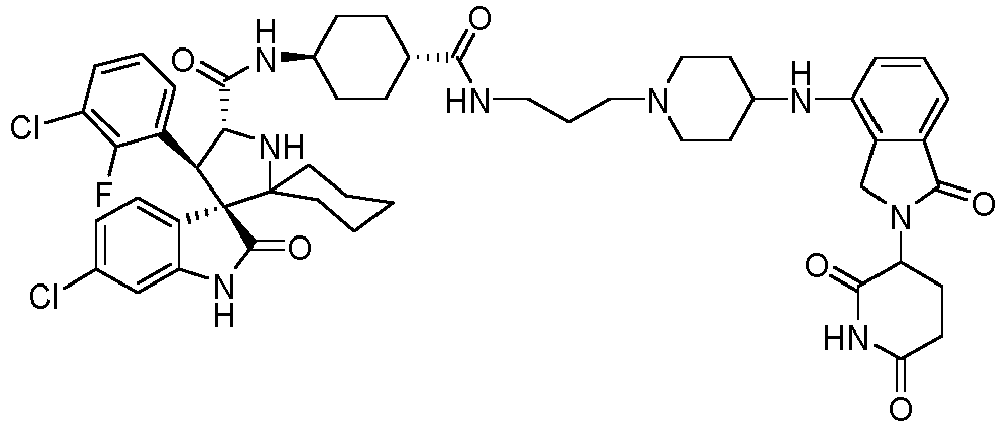
229 
230 
231 
232 
233 
234 
235 
236 
237 
238 
239 
240 
241 
242 
243 
244 
- Compounds of the Disclosure degrade MDM2 proteins and are useful in the treatment of a variety of diseases and conditions. In particular, Compounds of the Disclosure are useful in methods of treating a disease or condition wherein degradation MDM2 proteins provides a benefit, for example, cancers and proliferative diseases. The therapeutic methods of the disclosure comprise administering a therapeutically effective amount of a Compound of the Disclosure to an individual in need thereof. The present methods also encompass administering a second therapeutic agent to the individual in addition to the Compound of the Disclosure. The second therapeutic agent is selected from drugs known as useful in treating the disease or condition afflicting the individual in need thereof, e.g., a chemotherapeutic agent and/or radiation known as useful in treating a particular cancer.
- Salts, hydrates, and solvates of the Compounds of the Disclosure can also be used in the methods disclosed herein. The present disclosure further includes all possible stereoisomers and geometric isomers of Compounds of the Disclosure to include both racemic compounds and optically active isomers. When a Compound of the Disclosure is desired as a single enantiomer, it can be obtained either by resolution of the final product or by stereospecific synthesis from either isomerically pure starting material or use of a chiral auxiliary reagent, for example, see Z. Ma et al., Tetrahedron: Asymmetry, 8(6), pages 883-888 (1997). Resolution of the final product, an intermediate, or a starting material can be achieved by any suitable method known in the art. Additionally, in situations where tautomers of the Compounds of the Disclosure are possible, the present disclosure is intended to include all tautomeric forms of the compounds.
- The present disclosure encompasses the preparation and use of salts of Compounds of the Disclosure. As used herein, the pharmaceutical "pharmaceutically acceptable salt" refers to salts or zwitterionic forms of Compounds of the Disclosure. Salts of Compounds of the Disclosure can be prepared during the final isolation and purification of the compounds or separately by reacting the compound with a suitable acid. The pharmaceutically acceptable salts of Compounds of the Disclosure can be acid addition salts formed with pharmaceutically acceptable acids. Examples of acids which can be employed to form pharmaceutically acceptable salts include inorganic acids such as nitric, boric, hydrochloric, hydrobromic, sulfuric, and phosphoric, and organic acids such as oxalic, maleic, succinic, and citric. Non-limiting examples of salts of compounds of the disclosure include, but are not limited to, the hydrochloride, hydrobromide, hydroiodide, sulfate, bisulfate, 2-hydroxyethansulfonate, phosphate, hydrogen phosphate, acetate, adipate, alginate, aspartate, benzoate, bisulfate, butyrate, camphorate, camphorsulfonate, digluconate, glycerolphsphate, hemisulfate, heptanoate, hexanoate, formate, succinate, fumarate, maleate, ascorbate, isethionate, salicylate, methanesulfonate, mesitylenesulfonate, naphthylenesulfonate, nicotinate, 2-naphthalenesulfonate, oxalate, pamoate, pectinate, persulfate, 3-phenylproprionate, picrate, pivalate, propionate, trichloroacetate, trifluoroacetate, phosphate, glutamate, bicarbonate, paratoluenesulfonate, undecanoate, lactate, citrate, tartrate, gluconate, methanesulfonate, ethanedisulfonate, benzene sulfonate, and p-toluenesulfonate salts. In addition, available amino groups present in the compounds of the disclosure can be quaternized with methyl, ethyl, propyl, and butyl chlorides, bromides, and iodides; dimethyl, diethyl, dibutyl, and diamyl sulfates; decyl, lauryl, myristyl, and steryl chlorides, bromides, and iodides; and benzyl and phenethyl bromides. In light of the foregoing, any reference Compounds of the Disclosure appearing herein is intended to include compounds of Compounds of the Disclosure as well as pharmaceutically acceptable salts, hydrates, or solvates thereof.
- The present disclosure encompasses the preparation and use of solvates of Compounds of the Disclosure. Solvates typically do not significantly alter the physiological activity or toxicity of the compounds, and as such may function as pharmacological equivalents. The term "solvate" as used herein is a combination, physical association and/or solvation of a compound of the present disclosure with a solvent molecule such as, e.g. a disolvate, monosolvate or hemisolvate, where the ratio of solvent molecule to compound of the present disclosure is about 2:1, about 1:1 or about 1:2, respectively. This physical association involves varying degrees of ionic and covalent bonding, including hydrogen bonding. In certain instances, the solvate can be isolated, such as when one or more solvent molecules are incorporated into the crystal lattice of a crystalline solid. Thus, "solvate" encompasses both solution-phase and isolatable solvates. Compounds of the Disclosure can be present as solvated forms with a pharmaceutically acceptable solvent, such as water, methanol, and ethanol, and it is intended that the disclosure includes both solvated and unsolvated forms of Compounds of the Disclosure. One type of solvate is a hydrate. A "hydrate" relates to a particular subgroup of solvates where the solvent molecule is water. Solvates typically can function as pharmacological equivalents. Preparation of solvates is known in the art. See, for example, M. Caira et al, J. Pharmaceut. Sci., 93(3):601-611 (2004), which describes the preparation of solvates of fluconazole with ethyl acetate and with water. Similar preparation of solvates, hemisolvates, hydrates, and the like are described by E.C. van Tonder et al., AAPSPharm. Sci. Tech., 5(1):Article 12 (2004), and A.L. Bingham et al., Chem. Commun. 603-604 (2001). A typical, non-limiting, process of preparing a solvate would involve dissolving a Compound of the Disclosure in a desired solvent (organic, water, or a mixture thereof) at temperatures above 20°C to about 25°C, then cooling the solution at a rate sufficient to form crystals, and isolating the crystals by known methods, e.g., filtration. Analytical techniques such as infrared spectroscopy can be used to confirm the presence of the solvent in a crystal of the solvate.
- The present disclosure provides Compounds of the Disclosure as MDM2 protein degraders for the treatment of a variety of diseases and conditions wherein degradation of MDM2 proteins has a beneficial effect. Compounds of the Disclosure typically have a binding affinity (IC50) to MDM2 of less than 100 µM, e.g., less than 50 µM, less than 25 µM, and less than 5 µM, less than about 1 µM, less than about 0.5 µM, or less than about 0.1 µM. In one embodiment, the present disclosure relates to a method of treating an individual suffering from a disease or condition wherein degradation of MDM2 proteins provides a benefit comprising administering a therapeutically effective amount of a Compound of the Disclosure to an individual in need thereof.
- Since Compounds of the Disclosure are degraders of MDM2 protein, a number of diseases and conditions mediated by MDM2 can be treated by employing these compounds. The present disclosure is thus directed generally to a method for treating a condition or disorder responsive to degradation of MDM2, in an animal, e.g., a human, suffering from, or at risk of suffering from, the condition or disorder, the method comprising administering to the animal an effective amount of one or more Compounds of the Disclosure.
- The present disclosure is further directed to the Compounds of the Disclosure or a pharmaceutically acceptable salt or solvate thereof, for use in a method of treating cancer, a chronic autoimmune disorder, an inflammatory condition, a proliferative disorder, sepsis, or a viral infection.
- The methods can be accomplished by administering a Compound of the Disclosure as the neat compound or as a pharmaceutical composition. Administration of a pharmaceutical composition, or neat compound of a Compound of the Disclosure, can be performed during or after the onset of the disease or condition of interest. Typically, the pharmaceutical compositions are sterile, and contain no toxic, carcinogenic, or mutagenic compounds that would cause an adverse reaction when administered. Further provided are kits comprising a Compound of the Disclosure and, optionally, a second therapeutic agent useful in the treatment of diseases and conditions wherein degradation of MDM2 protein provides a benefit, packaged separately or together, and an insert having instructions for using these active agents.
- A Compound of the Disclosure may be administered in conjunction with a second therapeutic agent useful in the treatment of a disease or condition wherein degradation of MDM2 protein provides a benefit. The second therapeutic agent is different from the Compound of the Disclosure. A Compound of the Disclosure and the second therapeutic agent can be administered simultaneously or sequentially to achieve the desired effect. In addition, the Compound of the Disclosure and second therapeutic agent can be administered from a single composition or two separate compositions.
- The second therapeutic agent is administered in an amount to provide its desired therapeutic effect. The effective dosage range for each second therapeutic agent is known in the art, and the second therapeutic agent is administered to an individual in need thereof within such established ranges.
- A Compound of the Disclosure and the second therapeutic agent can be administered together as a single-unit dose or separately as multi-unit doses, wherein the Compound of the Disclosure is administered before the second therapeutic agent or vice versa. One or more doses of the Compound of the Disclosure and/or one or more dose of the second therapeutic agent can be administered. The Compound of the Disclosure therefore can be used in conjunction with one or more second therapeutic agents, for example, but not limited to, anticancer agents.
- Diseases and conditions treatable using the Compounds of the Disclosure include, but are not limited to, cancer and other proliferative disorders, inflammatory diseases, sepsis, autoimmune disease, and viral infection. In one embodiment, a Compound of the Disclosure, or a pharmaceutical composition comprising a Compound of the Disclosure is for use in a method, wherein the compound is administered in an amount sufficient to degrade MDM2 protein in the patient.
- In one embodiment, the disease to be treated by the Compound of the Disclosure is cancer. Examples of treatable cancers include, but are not limited to, any one or more of the cancers of Table 9.
Table 9 adrenal cancer acinic cell carcinoma acoustic neuroma acral lentigious melanoma acrospiroma acute eosinophilic leukemia acute erythroid leukemia acute lymphoblastic leukemia acute megakaryoblastic leukemia acute monocytic leukemia acute promyelocytic leukemia adenocarcinoma adenoid cystic carcinoma adenoma adenomatoid odontogenic tumor adenosquamous carcinoma adipose tissue neoplasm adrenocortical carcinoma adult T-cell leukemia/lymphoma aggressive NK-cell leukemia AIDS-related lymphoma alveolar rhabdomyosarcoma alveolar soft part sarcoma ameloblastic fibroma anaplastic large cell lymphoma anaplastic thyroid cancer angioimmunoblastic T-cell lymphoma angiomyolipoma angiosarcoma astrocytoma atypical teratoid rhabdoid tumor B-cell chronic lymphocytic leukemia B-cell prolymphocytic leukemia B-cell lymphoma basal cell carcinoma biliary tract cancer bladder cancer blastoma bone cancer Brenner tumor Brown tumor Burkitt's lymphoma breast cancer brain cancer carcinoma carcinoma in situ carcinosarcoma cartilage tumor cementoma myeloid sarcoma chondroma chordoma choriocarcinoma choroid plexus papilloma clear-cell sarcoma of the kidney craniopharyngioma cutaneous T-cell lymphoma cervical cancer colorectal cancer Degos disease desmoplastic small round cell tumor diffuse large B-cell lymphoma dysembryoplastic neuroepithelial tumor dysgerminoma embryonal carcinoma endocrine gland neoplasm endodermal sinus tumor enteropathy - associated T-cell lymphoma esophageal cancer fetus in fetu fibroma fibrosarcoma follicular lymphoma follicular thyroid cancer ganglioneuroma gastrointestinal cancer germ cell tumor gestational choriocarcinoma giant cell fibroblastoma giant cell tumor of the bone glial tumor glioblastoma multi form e glioma gliomatosis cerebri glucagonoma gonadoblastoma granulosa cell tumor gynandroblastoma gallbladder cancer gastric cancer hairy cell leukemia hemangioblastoma head and neck cancer hemangiopericytoma hematological malignancy hepatoblastoma hepatosplenic T-cell lymphoma Hodgkin's lymphoma non-Hodgkin's lymphoma invasive lobular carcinoma intestinal cancer kidney cancer laryngeal cancer lentigo maligna lethal midline carcinoma leukemia leydig cell tumor liposarcoma lung cancer lymphangioma lymphangiosarcoma lymphoepithelioma lymphoma acute lymphocytic leukemia acute myelogeous leukemia chronic lymphocytic leukemia liver cancer small cell lung cancer non-small cell lung cancer MALT lymphoma malignant fibrous histiocytoma malignant peripheral nerve sheath tumor malignant triton tumor mantle cell lymphoma marginal zone B-cell lymphoma mast cell leukemia mediastinal germ cell tumor medullary carcinoma of the breast medullary thyroid cancer medulloblastoma melanoma meningioma merkel cell cancer mesothelioma metastatic urothelial carcinoma mixed Mullerian tumor mucinous tumor multiple myeloma muscle tissue neoplasm mycosis fungoides myxoid liposarcoma myxoma myxosarcoma nasopharyngeal carcinoma neurinoma neuroblastoma neurofibroma neuroma nodular melanoma ocular cancer oligoastrocytoma oligodendroglioma oncocytoma optic nerve sheath meningioma optic nerve tumor oral cancer osteosarcoma ovarian cancer Pancoast tumor papillary thyroid cancer paraganglioma pinealoblastoma pineocytoma pituicytoma pituitary adenoma pituitary tumor plasmacytoma polyembryoma precursor T-lymphoblastic lymphoma primary central nervous system lymphoma primary effusion lymphoma preimary peritoneal cancer prostate cancer pancreatic cancer pharyngeal cancer pseudomyxoma periotonei renal cell carcinoma renal medullary carcinoma retinoblastoma rhabdomyoma rhabdomyosarcoma Richter's transformation rectal cancer sarcoma Schwannomatosis seminoma Sertoli cell tumor sex cord-gonadal stromal tumor signet ring cell carcinoma skin cancer small blue round cell tumors small cell carcinoma soft tissue sarcoma somatostatinoma soot wart spinal tumor splenic marginal zone lymphoma squamous cell carcinoma synovial sarcoma Sezary's disease small intestine cancer squamous carcinoma stomach cancer T-cell lymphoma testicular cancer thecoma thyroid cancer transitional cell carcinoma throat cancer urachal cancer urogenital cancer urothelial carcinoma uveal melanoma uterine cancer verrucous carcinoma visual pathway glioma vulvar cancer vaginal cancer Waldenstrom's macroglobulinemia Warthin's tumor Wilms' tumor - In another embodiment, the cancer is a leukaemia, for example a leukaemia selected from acute monocytic leukemia, acute myelogenous leukemia, chronic myelogenous leukemia, chronic lymphocytic leukemia and mixed lineage leukaemia (MLL). In another embodiment the cancer is NUT-midline carcinoma. In another embodiment the cancer is multiple myeloma. In another embodiment the cancer is a lung cancer such as small cell lung cancer (SCLC). In another embodiment the cancer is a neuroblastoma. In another embodiment the cancer is Burkitt's lymphoma. In another embodiment the cancer is cervical cancer. In another embodiment the cancer is esophageal cancer. In another embodiment the cancer is ovarian cancer. In another embodiment the cancer is colorectal cancer. In another embodiment, the cancer is prostate cancer. In another embodiment, the cancer is breast cancer.
- In another embodiment, the present disclosure provides a Compound of the Disclosure for use in treating a benign proliferative disorder, such as, but are not limited to, benign soft tissue tumors, bone tumors, brain and spinal tumors, eyelid and orbital tumors, granuloma, lipoma, meningioma, multiple endocrine neoplasia, nasal polyps, pituitary tumors, prolactinoma, pseudotumor cerebri, seborrheic keratoses, stomach polyps, thyroid nodules, cystic neoplasms of the pancreas, hemangiomas, vocal cord nodules, polyps, and cysts, Castleman disease, chronic pilonidal disease, dermatofibroma, pilar cyst, pyogenic granuloma, and juvenile polyposis syndrome.
- Compounds of the Disclosure can also treat infectious and noninfectious inflammatory events and autoimmune and other inflammatory diseases by administration of an effective amount of a present compound to a mammal, in particular a human in need of such treatment. Examples of autoimmune and inflammatory diseases, disorders, and syndromes treated using the compounds and methods described herein include inflammatory pelvic disease, urethritis, skin sunburn, sinusitis, pneumonitis, encephalitis, meningitis, myocarditis, nephritis, osteomyelitis, myositis, hepatitis, gastritis, enteritis, dermatitis, gingivitis, appendictitis, pancreatitis, cholocystitus, agammaglobulinemia, psoriasis, allergy, Crohn's disease, irritable bowel syndrome, ulcerative colitis, Sjogren's disease, tissue graft rejection, hyperacute rejection of transplanted organs, asthma, allergic rhinitis, chronic obstructive pulmonary disease (COPD), autoimmune polyglandular disease (also known as autoimmune polyglandular syndrome), autoimmune alopecia, pernicious anemia, glomerulonephritis, dermatomyositis, multiple sclerosis, scleroderma, vasculitis, autoimmune hemolytic and thrombocytopenic states, Goodpasture's syndrome, atherosclerosis, Addison's disease, Parkinson's disease, Alzheimer's disease, Type I diabetes, septic shock, systemic lupus erythematosus (SLE), rheumatoid arthritis, psoriatic arthritis, juvenile arthritis, osteoarthritis, chronic idiopathic thrombocytopenic purpura, Waldenstrom macroglobulinemia, myasthenia gravis, Hashimoto's thyroiditis, atopic dermatitis, degenerative joint disease, vitiligo, autoimmune hypopituatarism, Guillain-Barre syndrome, Behcet's disease, scleracierma, mycosis fungoides, acute inflammatory responses (such as acute respiratory distress syndrome and ischemia/reperfusion injury), and Graves' disease.
- In another embodiment, the present disclosure provides a Compound of the Disclosure for use in a method of treating systemic inflammatory response syndromes, such as LPS-induced endotoxic shock and/or bacteria-induced sepsis by administration of an effective amount of a Compound of the Disclosure to a mammal, in particular a human in need of such treatment.
- In another embodiment, the present disclosure provides a a Compound of the Disclosure for use in a method for treating viral infections and diseases. Examples of viral infections and diseases treated using the compounds and methods described herein include episome-based DNA viruses including, but not limited to, human papillomavirus, Herpesvirus, Epstein-Barr virus, human immunodeficiency virus, hepatis B virus, and hepatitis C virus.
- For the uses described herein , a therapeutically effective amount of a Compound of the Disclosure is typically formulated in accordance with pharmaceutical practice. Whether such a treatment is indicated depends on the individual case and is subject to medical assessment (diagnosis) that takes into consideration signs, symptoms, and/or malfunctions that are present, the risks of developing particular signs, symptoms and/or malfunctions, and other factors.
- A Compound of the Disclosure can be administered by any suitable route, for example by oral, buccal, inhalation, sublingual, rectal, vaginal, intracisternal or intrathecal through lumbar puncture, transurethral, nasal, percutaneous, i.e., transdermal, or parenteral (including intravenous, intramuscular, subcutaneous, intracoronary, intradermal, intramammary, intraperitoneal, intraarticular, intrathecal, retrobulbar, intrapulmonary injection and/or surgical implantation at a particular site) administration. Parenteral administration can be accomplished using a needle and syringe or using a high pressure technique.
- Pharmaceutical compositions include those wherein a Compound of the Disclosure is administered in an effective amount to achieve its intended purpose. The exact formulation, route of administration, and dosage is determined by an individual physician in view of the diagnosed condition or disease. Dosage amount and interval can be adjusted individually to provide levels of a Compound of the Disclosure that is sufficient to maintain therapeutic effects.
- Toxicity and therapeutic efficacy of the Compounds of the Disclosure can be determined by standard pharmaceutical procedures in cell cultures or experimental animals, e.g., for determining the maximum tolerated dose (MTD) of a compound, which defines as the highest dose that causes no toxicity in animals. The dose ratio between the maximum tolerated dose and therapeutic effects (e.g. inhibiting of tumor growth) is the therapeutic index. The dosage can vary within this range depending upon the dosage form employed, and the route of administration utilized. Determination of a therapeutically effective amount is well within the capability of those skilled in the art, especially in light of the detailed disclosure provided herein.
- A therapeutically effective amount of a Compound of the Disclosure required for use in therapy varies with the nature of the condition being treated, the length of time that activity is desired, and the age and the condition of the patient, and ultimately is determined by the attendant physician. Dosage amounts and intervals can be adjusted individually to provide plasma levels of the MDM2 protein degrader that are sufficient to maintain the desired therapeutic effects. The desired dose conveniently can be administered in a single dose, or as multiple doses administered at appropriate intervals, for example as one, two, three, four or more subdoses per day. Multiple doses often are desired, or required. For example, a Compound of the Disclosure can be administered at a frequency of: four doses delivered as one dose per day at four-day intervals (q4d x 4); four doses delivered as one dose per day at three-day intervals (q3d x 4); one dose delivered per day at five-day intervals (qd x 5); one dose per week for three weeks (qwk3); five daily doses, with two days rest, and another five daily doses (5/2/5); or, any dose regimen determined to be appropriate for the circumstance.
- A Compound of the Disclosure used in a method of the present disclosure can be administered in an amount of about 0.005 to about 500 milligrams per dose, about 0.05 to about 250 milligrams per dose, or about 0.5 to about 100 milligrams per dose. For example, a Compound of the Disclosure can be administered, per dose, in an amount of about 0.005, 0.05, 0.5, 5, 10, 20, 30, 40, 50, 100, 150, 200, 250, 300, 350, 400, 450, or 500 milligrams, including all doses between 0.005 and 500 milligrams.
- The dosage of a composition containing a Compound of the Disclosure, or a composition containing the same, can be from about 1 ng/kg to about 200 mg/kg, about 1 µg/kg to about 100 mg/kg, or about 1 mg/kg to about 50 mg/kg. The dosage of a composition can be at any dosage including, but not limited to, about 1 µg/kg. The dosage of a composition may be at any dosage including, but not limited to, about 1 µg/kg, about 10 µg/kg, about 25 µg/kg, about 50 µg/kg, about 75 µg/kg, about 100 µg/kg, about 125 µg/kg, about 150 µg/kg, about 175 µg/kg, about 200 µg/kg, about 225 µg/kg, about 250 µg/kg, about 275 µg/kg, about 300 µg/kg, about 325 µg/kg, about 350 µg/kg, about 375 µg/kg, about 400 µg/kg, about 425 µg/kg, about 450 µg/kg, about 475 µg/kg, about 500 µg/kg, about 525 µg/kg, about 550 µg/kg, about 575 µg/kg, about 600 µg/kg, about 625 µg/kg, about 650 µg/kg, about 675 µg/kg, about 700 µg/kg, about 725 µg/kg, about 750 µg/kg, about 775 µg/kg, about 800 µg/kg, about 825 µg/kg, about 850 µg/kg, about 875 µg/kg, about 900 µg/kg, about 925 µg/kg, about 950 µg/kg, about 975 µg/kg, about 1 mg/kg, about 5 mg/kg, about 10 mg/kg, about 15 mg/kg, about 20 mg/kg, about 25 mg/kg, about 30 mg/kg, about 35 mg/kg, about 40 mg/kg, about 45 mg/kg, about 50 mg/kg, about 60 mg/kg, about 70 mg/kg, about 80 mg/kg, about 90 mg/kg, about 100 mg/kg, about 125 mg/kg, about 150 mg/kg, about 175 mg/kg, about 200 mg/kg, or more. The above dosages are exemplary of the average case, but there can be individual instances in which higher or lower dosages are merited, and such are within the scope of this disclosure. In practice, the physician determines the actual dosing regimen that is most suitable for an individual patient, which can vary with the age, weight, and response of the particular patient.
- As stated above, a Compound of the Disclosure can be administered in combination with a second therapeutically active agent. In some embodiments, the second therapeutic agent is an epigenetic drug. As used herein, the term "epigenetic drug" refers to a therapeutic agent that targets an epigenetic regulator. Examples of epigenetic regulators include the histone lysine methyltransferases, histone arginine methyl transferases, histone demethylases, histone deacetylases, histone acetylases, and DNA methyltransferases. Histone deacetylase inhibitors include, but are not limited to, vorinostat.
- In another embodiment, chemotherapeutic agents or other anti-proliferative agents can be combined with Compound of the Disclosure to treat proliferative diseases and cancer. Examples of therapies and anticancer agents that can be used in combination with Compounds of the Disclosure include surgery, radiotherapy (e.g., gamma-radiation, neutron beam radiotherapy, electron beam radiotherapy, proton therapy, brachytherapy, and systemic radioactive isotopes), endocrine therapy, a biologic response modifier (e.g., an interferon, an interleukin, tumor necrosis factor (TNF), hyperthermia and cryotherapy, an agent to attenuate any adverse effect (e.g., an antiemetic), and any other approved chemotherapeutic drug.
- Examples of antiproliferative compounds include, but are not limited to, an aromatase inhibitor; an anti-estrogen; an anti-androgen; a gonadorelin agonist; a topoisomerase I inhibitor; a topoisomerase II inhibitor; a microtubule active agent; an alkylating agent; a retinoid, a carontenoid, or a tocopherol; a cyclooxygenase inhibitor; an MMP inhibitor; an mTOR inhibitor; an antimetabolite; a platin compound; a methionine aminopeptidase inhibitor; a bisphosphonate; an antiproliferative antibody; a heparanase inhibitor; an inhibitor of Ras oncogenic isoforms; a telomerase inhibitor; a proteasome inhibitor; a compound used in the treatment of hematologic malignancies; a Flt-3 inhibitor; an Hsp90 inhibitor; a kinesin spindle protein inhibitor; a MEK inhibitor; an antitumor antibiotic; a nitrosourea; a compound targeting/decreasing protein or lipid kinase activity, a compound targeting/decreasing protein or lipid phosphatase activity, or any further anti-angiogenic compound.
- Non-limiting exemplary aromatase inhibitors include, but are not limited to, steroids, such as atamestane, exemestane, and formestane, and non-steroids, such as aminoglutethimide, roglethimide, pyridoglutethimide, trilostane, testolactone, ketokonazole, vorozole, fadrozole, anastrozole, and letrozole.
- Non-limiting anti-estrogens include, but are not limited to, tamoxifen, fulvestrant, raloxifene, and raloxifene hydrochloride. Anti-androgens include, but are not limited to, bicalutamide. Gonadorelin agonists include, but are not limited to, abarelix, goserelin, and goserelin acetate.
- Exemplary topoisomerase I inhibitors include, but are not limited to, topotecan, gimatecan, irinotecan, camptothecin and its analogues, 9-nitrocamptothecin, and the macromolecular camptothecin conjugate PNU-166148. Topoisomerase II inhibitors include, but are not limited to, anthracyclines, such as doxorubicin, daunorubicin, epirubicin, idarubicin, and nemorubicin; anthraquinones, such as mitoxantrone and losoxantrone; and podophillotoxines, such as etoposide and teniposide.
- Microtubule active agents include microtubule stabilizing, microtubule destabilizing compounds, and microtubulin polymerization inhibitors including, but not limited to, taxanes, such as paclitaxel and docetaxel; vinca alkaloids, such as vinblastine, vinblastine sulfate, vincristine, and vincristine sulfate, and vinorelbine; discodermolides; cochicine and epothilones and derivatives thereof.
- Exemplary non-limiting alkylating agents include cyclophosphamide, ifosfamide, melphalan, and nitrosoureas, such as carmustine and lomustine.
- Exemplary non-limiting cyclooxygenase inhibitors include Cox-2 inhibitors, 5-alkyl substituted 2-arylaminophenylacetic acid and derivatives, such as celecoxib, rofecoxib, etoricoxib, valdecoxib, or a 5-alkyl-2-arylaminophenylacetic acid, such as lumiracoxib.
- Exemplary non-limiting matrix metalloproteinase inhibitors ("MMP inhibitors") include collagen peptidomimetic and nonpeptidomimetic inhibitors, tetracycline derivatives, batimastat, marimastat, prinomastat, metastat, BMS-279251, BAY 12-9566, TAA211, MMI270B, and AAJ996.
- Exemplary non-limiting mTOR inhibitors include compounds that inhibit the mammalian target of rapamycin (mTOR) and possess antiproliferative activity such as sirolimus, everolimus, CCI-779, and ABT578.
- Exemplary non-limiting antimetabolites include 5-fluorouracil (5-FU), capecitabine, gemcitabine, DNA demethylating compounds, such as 5-azacytidine and decitabine, methotrexate and edatrexate, and folic acid antagonists, such as pemetrexed.
- Exemplary non-limiting platin compounds include carboplatin, cis-platin, cisplatinum, and oxaliplatin.
- Exemplary non-limiting methionine aminopeptidase inhibitors include bengamide or a derivative thereof and PPI-2458.
- Exemplary non-limiting bisphosphonates include etridonic acid, clodronic acid, tiludronic acid, pamidronic acid, alendronic acid, ibandronic acid, risedronic acid, and zoledronic acid.
- Exemplary non-limiting antiproliferative antibodies include trastuzumab, trastuzumab-DMl, cetuximab, bevacizumab, rituximab, PR064553, and 2C4. The term "antibody" includes intact monoclonal antibodies, polyclonal antibodies, multispecific antibodies formed from at least two intact antibodies, and antibody fragments, so long as they exhibit the desired biological activity.
- Exemplary non-limiting heparanase inhibitors include compounds that target, decrease, or inhibit heparin sulfate degradation, such as PI-88 and OGT2115.
- The term "an inhibitor of Ras oncogenic isoforms," such as H-Ras, K-Ras, or N-Ras, as used herein refers to a compound which targets, decreases, or inhibits the oncogenic activity of Ras, for example, a farnesyl transferase inhibitor, such as L-744832, DK8G557, tipifarnib, and lonafarnib.
- Exemplary non-limiting telomerase inhibitors include compounds that target, decrease, or inhibit the activity of telomerase, such as compounds that inhibit the telomerase receptor, such as telomestatin.
- Exemplary non-limiting proteasome inhibitors include compounds that target, decrease, or inhibit the activity of the proteasome including, but not limited to, bortezomid.
- The phrase "compounds used in the treatment of hematologic malignancies" as used herein includes FMS-like tyrosine kinase inhibitors, which are compounds targeting, decreasing or inhibiting the activity of FMS-like tyrosine kinase receptors (Flt-3R); interferon, I-β-D-arabinofuransylcytosine (ara-c), and bisulfan; and ALK inhibitors, which are compounds which target, decrease, or inhibit anaplastic lymphoma kinase.
- Exemplary non-limiting Flt-3 inhibitors include PKC412, midostaurin, a staurosporine derivative, SU11248, and MLN518.
- Exemplary non-limiting HSP90 inhibitors include compounds targeting, decreasing, or inhibiting the intrinsic ATPase activity of HSP90; or degrading, targeting, decreasing or inhibiting the HSP90 client proteins via the ubiquitin proteosome pathway. Compounds targeting, decreasing or inhibiting the intrinsic ATPase activity of HSP90 are especially compounds, proteins, or antibodies that inhibit the ATPase activity of HSP90, such as 17-allylamino,17-demethoxygeldanamycin (17AAG), a geldanamycin derivative; other geldanamycin related compounds; radicicol and HDAC inhibitors.
- The phrase "a compound targeting/decreasing a protein or lipid kinase activity; or a protein or lipid phosphatase activity; or any further anti-angiogenic compound" as used herein includes a protein tyrosine kinase and/or serine and/or threonine kinase inhibitor or lipid kinase inhibitor, such as a) a compound targeting, decreasing, or inhibiting the activity of the platelet- derived growth factor-receptors (PDGFR), such as a compound that targets, decreases, or inhibits the activity of PDGFR, such as an N-phenyl-2-pyrimidine-amine derivatives, such as imatinib, SUlOl, SU6668, and GFB-111; b) a compound targeting, decreasing, or inhibiting the activity of the fibroblast growth factor-receptors (FGFR); c) a compound targeting, decreasing, or inhibiting the activity of the insulin-like growth factor receptor I (IGF-IR), such as a compound that targets, decreases, or inhibits the activity of IGF-IR; d) a compound targeting, decreasing, or inhibiting the activity of the Trk receptor tyrosine kinase family, or ephrin B4 inhibitors; e) a compound targeting, decreasing, or inhibiting the activity of the Axl receptor tyrosine kinase family; f) a compound targeting, decreasing, or inhibiting the activity of the Ret receptor tyrosine kinase; g) a compound targeting, decreasing, or inhibiting the activity of the Kit/SCFR receptor tyrosine kinase, such as imatinib; h) a compound targeting, decreasing, or inhibiting the activity of the c-Kit receptor tyrosine kinases, such as imatinib; i) a compound targeting, decreasing, or inhibiting the activity of members of the c-Abl family, their gene-fusion products (e.g. Bcr-Abl kinase) and mutants, such as an N-phenyl-2-pyrimidine-amine derivative, such as imatinib or nilotinib; PD180970; AG957; NSC 680410; PD173955; or dasatinib; j) a compound targeting, decreasing, or inhibiting the activity of members of the protein kinase C (PKC) and Raf family of serine/threonine kinases, members of the MEK, SRC, JAK, FAK, PDK1, PKB/Akt, and Ras/MAPK family members, and/or members of the cyclin-dependent kinase family (CDK), such as a staurosporine derivative disclosed in
U.S. Patent No. 5,093,330 , such as midostaurin; examples of further compounds include UCN-01, safingol, BAY 43-9006, bryostatin 1, perifosine; ilmofosine; RO 318220 and RO 320432; GO 6976; Isis 3521 ; LY333531/LY379196; a isochinoline compound; a farnesyl transferase inhibitor; PD184352 or QAN697, or AT7519; k) a compound targeting, decreasing or inhibiting the activity of a protein-tyrosine kinase, such as imatinib mesylate or a tyrphostin, such as Tyrphostin A23/RG-50810; AG 99; Tyrphostin AG 213; Tyrphostin AG 1748; Tyrphostin AG 490; Tyrphostin B44; Tyrphostin B44 (+) enantiomer; Tyrphostin AG 555; AG 494; Tyrphostin AG 556, AG957 and adaphostin (4-{[(2,5-dihydroxyphenyl)methyl]amino}-benzoic acid adamantyl ester; NSC 680410, adaphostin); 1) a compound targeting, decreasing, or inhibiting the activity of the epidermal growth factor family of receptor tyrosine kinases (EGFR, ErbB2, ErbB3, ErbB4 as homo- or heterodimers) and their mutants, such as CP 358774, ZD 1839, ZM 105180; trastuzumab, cetuximab, gefitinib, erlotinib, OSI-774, Cl-1033, EKB-569, GW-2016, antibodies El.l, E2.4, E2.5, E6.2, E6.4, E2.11, E6.3 and E7.6.3, and 7H-pyrrolo-[2,3-d]pyrimidine derivatives; and m) a compound targeting, decreasing, or inhibiting the activity of the c-Met receptor. - Exemplary compounds that target, decrease, or inhibit the activity of a protein or lipid phosphatase include inhibitors of
phosphatase 1, phosphatase 2A, or CDC25, such as okadaic acid or a derivative thereof. - Further anti-angiogenic compounds include compounds having another mechanism for their activity unrelated to protein or lipid kinase inhibition, e.g., thalidomide and TNP-470.
- Additional, nonlimiting, exemplary chemotherapeutic compounds, one or more of which may be used in combination with a present MDM2 degrader, include: daunorubicin, adriamycin, Ara-C, VP-16, teniposide, mitoxantrone, idarubicin, carboplatinum, PKC412, 6-mercaptopurine (6-MP), fludarabine phosphate, octreotide, SOM230, FTY720, 6-thioguanine, cladribine, 6-mercaptopurine, pentostatin, hydroxyurea, 2-hydroxy-1H-isoindole-1,3-dione derivatives, 1-(4-chloroanilino)-4-(4-pyridylmethyl)phthalazine or a pharmaceutically acceptable salt thereof, 1-(4-chloroanilino)-4-(4-pyridylmethyl)phthalazine succinate, angiostatin, endostatin, anthranilic acid amides, ZD4190, ZD6474, SU5416, SU6668, bevacizumab, rhuMAb, rhuFab, macugon; FLT-4 inhibitors, FLT-3 inhibitors, VEGFR-2 IgGI antibody, RPI 4610, bevacizumab, porfimer sodium, anecortave, triamcinolone, hydrocortisone, 11 -a-epihydrocotisol, cortex olone, 17a-hydroxyprogesterone, corticosterone, desoxycorticosterone, testosterone, estrone, dexamethasone, fluocinolone, a plant alkaloid, a hormonal compound and/or antagonist, a biological response modifier, such as a lymphokine or interferon, an antisense oligonucleotide or oligonucleotide derivative, shRNA, and siRNA.
- Other examples of second therapeutic agents, one or more of which a present MDM2 degrader also can be combined, include, but are not limited to: a treatment for Alzheimer's Disease, such as donepezil and rivastigmine; a treatment for Parkinson's Disease, such as L-DOPA/carbidopa, entacapone, ropinrole, pramipexole, bromocriptine, pergolide, trihexephendyl, and amantadine; an agent for treating multiple sclerosis (MS) such as beta interferon (e.g., AVONEX® and REBIF®), glatiramer acetate, and mitoxantrone; a treatment for asthma, such as albuterol and montelukast; an agent for treating schizophrenia, such as zyprexa, risperdal, seroquel, and haloperidol; an antiinflammatory agent, such as a corticosteroid, a TNF blocker, IL-1 RA, azathioprine, cyclophosphamide, and sulfasalazine; an immunomodulatory agent, including immunosuppressive agents, such as cyclosporin, tacrolimus, rapamycin, mycophenolate mofetil, an interferon, a corticosteroid, cyclophosphamide, azathioprine, and sulfasalazine; a neurotrophic factor, such as an acetylcholinesterase inhibitor, an MAO inhibitor, an interferon, an anti-convulsant, an ion channel blocker, riluzole, or an anti-Parkinson's agent; an agent for treating cardiovascular disease, such as a beta-blocker, an ACE inhibitor, a diuretic, a nitrate, a calcium channel blocker, or a statin; an agent for treating liver disease, such as a corticosteroid, cholestyramine, an interferon, and an antiviral agent; an agent for treating blood disorders, such as a corticosteroid, an anti-leukemic agent, or a growth factor; or an agent for treating immunodeficiency disorders, such as gamma globulin.
- The above-mentioned second therapeutically active agents, one or more of which can be used in combination with a Compound of the Disclosure, are prepared and administered as described in the art.
- Compounds of the Disclosure typically are administered in admixture with a pharmaceutical carrier selected with regard to the intended route of administration and standard pharmaceutical practice. Pharmaceutical compositions for use in accordance with the present disclosure are formulated in a conventional manner using one or more physiologically acceptable carriers comprising excipients and/or auxiliaries that facilitate processing of Compound of the Disclosure.
- These pharmaceutical compositions can be manufactured, for example, by conventional mixing, dissolving, granulating, dragee-making, emulsifying, encapsulating, entrapping, or lyophilizing processes. Proper formulation is dependent upon the route of administration chosen. When a therapeutically effective amount of the Compound of the Disclosure is administered orally, the composition typically is in the form of a tablet, capsule, powder, solution, or elixir. When administered in tablet form, the composition additionally can contain a solid carrier, such as a gelatin or an adjuvant. The tablet, capsule, and powder contain about 0.01% to about 95%, and preferably from about 1% to about 50%, of a Compound of the Disclosure. When administered in liquid form, a liquid carrier, such as water, petroleum, or oils of animal or plant origin, can be added. The liquid form of the composition can further contain physiological saline solution, dextrose or other saccharide solutions, or glycols. When administered in liquid form, the composition contains about 0.1% to about 90%, and preferably about 1% to about 50%, by weight, of a Compound of the Disclosure.
- When a therapeutically effective amount of a Compound of the Disclosure is administered by intravenous, cutaneous, or subcutaneous injection, the composition is in the form of a pyrogen-free, parenterally acceptable aqueous solution. The preparation of such parenterally acceptable solutions, having due regard to pH, isotonicity, stability, and the like, is within the skill in the art. A preferred composition for intravenous, cutaneous, or subcutaneous injection typically contains, an isotonic vehicle.
- Compounds of the Disclosure can be readily combined with pharmaceutically acceptable carriers well-known in the art. Standard pharmaceutical carriers are described in Remington's Pharmaceutical Sciences, Mack Publishing Co., Easton, PA, 19th ed. 1995. Such carriers enable the active agents to be formulated as tablets, pills, dragees, capsules, liquids, gels, syrups, slurries, suspensions and the like, for oral ingestion by a patient to be treated. Pharmaceutical preparations for oral use can be obtained by adding the Compound of the Disclosure to a solid excipient, optionally grinding the resulting mixture, and processing the mixture of granules, after adding suitable auxiliaries, if desired, to obtain tablets or dragee cores. Suitable excipients include, for example, fillers and cellulose preparations. If desired, disintegrating agents can be added.
- Compound of the Disclosure can be formulated for parenteral administration by injection, e.g., by bolus injection or continuous infusion. Formulations for injection can be presented in unit dosage form, e.g., in ampules or in multidose containers, with an added preservative. The compositions can take such forms as suspensions, solutions, or emulsions in oily or aqueous vehicles, and can contain formulatory agents such as suspending, stabilizing, and/or dispersing agents.
- Pharmaceutical compositions for parenteral administration include aqueous solutions of the active agent in water-soluble form. Additionally, suspensions of a Compound of the Disclosure can be prepared as appropriate oily injection suspensions. Suitable lipophilic solvents or vehicles include fatty oils or synthetic fatty acid esters. Aqueous injection suspensions can contain substances which increase the viscosity of the suspension. Optionally, the suspension also can contain suitable stabilizers or agents that increase the solubility of the compounds and allow for the preparation of highly concentrated solutions. Alternatively, a present composition can be in powder form for constitution with a suitable vehicle, e.g., sterile pyrogen-free water, before use.
- Compounds of the Disclosure also can be formulated in rectal compositions, such as suppositories or retention enemas, e.g., containing conventional suppository bases. In addition to the formulations described previously, the Compound of the Disclosure also can be formulated as a depot preparation. Such long-acting formulations can be administered by implantation (for example, subcutaneously or intramuscularly) or by intramuscular injection. Thus, for example, the Compound of the Disclosure can be formulated with suitable polymeric or hydrophobic materials (for example, as an emulsion in an acceptable oil) or ion exchange resins.
- In particular, the Compounds of the Disclosure can be administered orally, buccally, or sublingually in the form of tablets containing excipients, such as starch or lactose, or in capsules or ovules, either alone or in admixture with excipients, or in the form of elixirs or suspensions containing flavoring or coloring agents. Such liquid preparations can be prepared with pharmaceutically acceptable additives, such as suspending agents. Compound of the Disclosure also can be injected parenterally, for example, intravenously, intramuscularly, subcutaneously, or intracoronarily. For parenteral administration, the Compound of the Disclosure are typically used in the form of a sterile aqueous solution which can contain other substances, for example, salts or monosaccharides, such as mannitol or glucose, to make the solution isotonic with blood.
- The term "a disease or condition wherein degradation of MDM2 protein provides a benefit" pertains to a disease or condition in which MDM2 and/or an action of MDM2 is important or necessary, e.g., for the onset, progress, expression of that disease or condition, or a disease or a condition which is known to be treated by a MDM2 inhibitor or degrader. Examples of such conditions include, but are not limited to, a cancer, a chronic autoimmune disease, an inflammatory disease, a proliferative disease, sepsis, and a viral infection. One of ordinary skill in the art is readily able to determine whether a compound treats a disease or condition mediated by MDM2 for any particular cell type, for example, by assays which conveniently can be used to assess the activity of particular compounds.
- The term "second therapeutic agent" refers to a therapeutic agent different from a Compound of the Disclosure and that is known to treat the disease or condition of interest. For example when a cancer is the disease or condition of interest, the second therapeutic agent can be a known chemotherapeutic drug, like taxol, or radiation, for example.
- The term "disease" or "condition" denotes disturbances and/or anomalies that as a rule are regarded as being pathological conditions or functions, and that can manifest themselves in the form of particular signs, symptoms, and/or malfunctions. As demonstrated in the examples below, a Compound of the Disclosure is a degrader of MDM2 protein and can be used in treating diseases and conditions wherein degradation of MDM2 provides a benefit.
- As used herein, the terms "treat," "treating," "treatment," refer to eliminating, reducing, or ameliorating a disease or condition, and/or symptoms associated therewith. Although not precluded, treating a disease or condition does not require that the disease, condition, or symptoms associated therewith be completely eliminated. As used herein, the terms "treat," "treating," "treatment," may include "prophylactic treatment," which refers to reducing the probability of redeveloping a disease or condition, or of a recurrence of a previously-controlled disease or condition, in a subject who does not have, but is at risk of or is susceptible to, redeveloping a disease or condition or a recurrence of the disease or condition. The term "treat" and synonyms contemplate administering a therapeutically effective amount of a Compound of the Disclosure to an individual in need of such treatment.
- Within the meaning of the disclosure, "treatment" also includes relapse prophylaxis or phase prophylaxis, as well as the treatment of acute or chronic signs, symptoms and/or malfunctions. The treatment can be orientated symptomatically, for example, to suppress symptoms. It can be effected over a short period, be oriented over a medium term, or can be a long-term treatment, for example within the context of a maintenance therapy.
- The term "therapeutically effective amount" or "effective dose" as used herein refers to an amount of the active ingredient(s) that is(are) sufficient, when administered by a method of the disclosure, to efficaciously deliver the active ingredient(s) for the treatment of condition or disease of interest to an individual in need thereof. In the case of a cancer or other proliferation disorder, the therapeutically effective amount of the agent may reduce (i.e., retard to some extent and preferably stop) unwanted cellular proliferation; reduce the number of cancer cells; reduce the tumor size; inhibit (i.e., retard to some extent and preferably stop) cancer cell infiltration into peripheral organs; inhibit (i.e., retard to some extent and preferably stop) tumor metastasis; inhibit, to some extent, tumor growth; reduce MDM2 signaling in the target cells; and/or relieve, to some extent, one or more of the symptoms associated with the cancer. To the extent the administered compound or composition prevents growth and/or kills existing cancer cells, it may be cytostatic and/or cytotoxic.
- "Concurrent administration," "administered in combination," "simultaneous administration," and similar phrases mean that two or more agents are administered concurrently to the subject being treated. By "concurrently," it is meant that each agent is administered either simultaneously or sequentially in any order at different points in time. However, if not administered simultaneously, it is meant that they are administered to an individual in a sequence and sufficiently close in time so as to provide the desired therapeutic effect and can act in concert. For example, a Compound of the Disclosure can be administered at the same time or sequentially in any order at different points in time as a second therapeutic agent. A Compound of the Disclosure and the second therapeutic agent can be administered separately, in any appropriate form and by any suitable route. When a Compound of the Disclosure and the second therapeutic agent are not administered concurrently, it is understood that they can be administered in any order to a subject in need thereof. For example, a Compound of the Disclosure can be administered prior to (e.g., 5 minutes, 15 minutes, 30 minutes, 45 minutes, 1 hour, 2 hours, 4 hours, 6 hours, 12 hours, 24 hours, 48 hours, 72 hours, 96 hours, 1 week, 2 weeks, 3 weeks, 4 weeks, 5 weeks, 6 weeks, 8 weeks, or 12 weeks before), concomitantly with, or subsequent to (e.g., 5 minutes, 15 minutes, 30 minutes, 45 minutes, 1 hour, 2 hours, 4 hours, 6 hours, 12 hours, 24 hours, 48 hours, 72 hours, 96 hours, 1 week, 2 weeks, 3 weeks, 4 weeks, 5 weeks, 6 weeks, 8 weeks, or 12 weeks after) the administration of a second therapeutic agent treatment modality (e.g., radiotherapy), to an individual in need thereof. In various embodiments, a Compound of the Disclosure and the second therapeutic agent are administered 1 minute apart, 10 minutes apart, 30 minutes apart, less than 1 hour apart, 1 hour apart, 1 hour to 2 hours apart, 2 hours to 3 hours apart, 3 hours to 4 hours apart, 4 hours to 5 hours apart, 5 hours to 6 hours apart, 6 hours to 7 hours apart, 7 hours to 8 hours apart, 8 hours to 9 hours apart, 9 hours to 10 hours apart, 10 hours to 11 hours apart, 11 hours to 12 hours apart, no more than 24 hours apart or no more than 48 hours apart. In one embodiment, the components of the combination therapies are administered at about 1 minute to about 24 hours apart.
- The use of the terms "a", "an", "the", and similar referents in the context of describing the disclosure (especially in the context of the claims) are to be construed to cover both the singular and the plural, unless otherwise indicated. Recitation of ranges of values herein merely are intended to serve as a shorthand method of referring individually to each separate value falling within the range, unless otherwise indicated herein, and each separate value is incorporated into the specification as if it were individually recited herein. The use of any and all examples, or exemplary language (e.g., "such as") provided herein, is intended to better illustrate the disclosure and is not a limitation on the scope of the disclosure unless otherwise claimed. No language in the specification should be construed as indicating any non-claimed element as essential to the practice of the disclosure.
- The term "about," as used herein, includes the recited number ± 10%. Thus, "about 10" means 9 to 11.
- In the present disclosure, the term "halo" as used by itself or as part of another group refers to -Cl, -F, -Br, or -I.
- In the present disclosure, the term "nitro" as used by itself or as part of another group refers to -NO2.
- In the present disclosure, the term "cyano" as used by itself or as part of another group refers to -CN.
- In the present disclosure, the term "hydroxy" as used by itself or as part of another group refers to -OH.
- In the present disclosure, the term "alkyl" as used by itself or as part of another group refers to unsubstituted straight- or branched-chain aliphatic hydrocarbons containing from one to twelve carbon atoms, i.e., C1-12 alkyl, or the number of carbon atoms designated, e.g., a C1 alkyl such as methyl, a C2 alkyl such as ethyl, a C3 alkyl such as propyl or isopropyl, a C1-3 alkyl such as methyl, ethyl, propyl, or isopropyl, and so on. In one embodiment, the alkyl is a C1-10 alkyl. In another embodiment, the alkyl is a C1-6 alkyl. In another embodiment, the alkyl is a C1-4 alkyl. In another embodiment, the alkyl is a straight chain C1-10 alkyl. In another embodiment, the alkyl is a branched chain C3-10 alkyl. In another embodiment, the alkyl is a straight chain C1-6 alkyl. In another embodiment, the alkyl is a branched chain C3-6 alkyl. In another embodiment, the alkyl is a straight chain C1-4 alkyl. In another embodiment, the alkyl is a branched chain C3-4 alkyl. In another embodiment, the alkyl is a straight or branched chain C3-4 alkyl. Non-limiting exemplary C1-10 alkyl groups include methyl, ethyl, propyl, isopropyl, butyl, sec-butyl, tert-butyl, iso-butyl, 3-pentyl, hexyl, heptyl, octyl, nonyl, and decyl. Non-limiting exemplary C1-4 alkyl groups include methyl, ethyl, propyl, isopropyl, butyl, sec-butyl, tert-butyl, and iso-butyl.
- In the present disclosure, the term "heteroalkyl" as used by itself or part of another group refers to unsubstituted straight- or branched-chain aliphatic hydrocarbons containing from three to thirty chain atoms, i.e., 3- to 30-membered heteroalkyl, or the number of chain atoms designated, wherein at least one -CH2- is replaced with at least one -O-, -N(H)-, or -S-. The -O-, -N(H)-, or -S- can independently be placed at any interior position of the aliphatic hydrocarbon chain so long as each -O-, N(H)-, or -S-group is separated by at least two -CH2- groups. In one embodiment, one -CH2- group is replaced with one -O- group. In another embodiment, two -CH2- groups are replaced with two -O- groups. In another embodiment, three -CH2- groups are replaced with three -O- groups. In another embodiment, four -CH2- groups are replaced with four -O-groups. Non-limiting exemplary heteroalkyl groups include:
-CH2OCH3;
-CH2OCH2CH2CH3;
-CH2CH2CH2OCH3;
-CH2OCH2CH2OCH3;
and
-CH2OCH2CH2OCH2CH2OCH3.
- In the present disclosure, the term "alkylenyl" as used herein by itself or part of another group refers to a divalent form of an alkyl group. In one embodiment, the alkylenyl is a divalent form of a C1-12 alkyl. In one embodiment, the alkylenyl is a divalent form of a C1-10 alkyl. In one embodiment, the alkylenyl is a divalent form of a C1-8 alkyl. In one embodiment, the alkylenyl is a divalent form of a C1-6 alkyl. In another embodiment, the alkylenyl is a divalent form of a C1-4 alkyl. Non-limiting exemplary alkylenyl groups include:
-CH2-,
-CH2CH2-,
-CH2CH2CH2-,
-CH2(CH2)2CH2-,
-CH(CH2)3CH2-,
-CH2(CH2)4CH2-,
-CH2(CH2)5CH2-,
-CH2CH(CH3)CH2-,
and
-CH2C(CH3)2CH2-.
- In the present disclosure, the term "heteroalkylenyl" as used herein by itself or part of another group refers to a divalent form of a heteroalkyl group. In one embodiment, the heteroalkylenyl is a divalent form of a 3- to 12-membered heteroalkyl. In another embodiment, the heteroalkylenyl is a divalent form of a 3- to 10-membered heteroalkyl. In another embodiment, the heteroalkylenyl is a divalent form of a 3- to 8-membered heteroalkyl. In another embodiment, the heteroalkylenyl is a divalent form of a 3- to 6-membered heteroalkyl. In another embodiment, the heteroalkylenyl is a divalent form of a 3- to 4-membered heteroalkyl. In another embodiment, the heteroalkylenyl is a radical of the formula: -(CH2)oO-(CH2CH2O)p-(CH2)q-, wherein o is 2 or 3; p is 0, 1, 2, 3, 4, 5, 6, or 7; and q is 2 or 3. In another embodiment, the heteroalkylenyl is a radical of the formula: -(CH2)rO-(CH2)s-O(CH2)t-, wherein r is 2, 3, or 4; s is 3, 4, or 5; and t is 2 or 3. Non-limiting exemplary heteroalkylenyl groups include:
-CH2OCH2-;
-CH2CH2OCH2CH2-;
-CH2OCH2CH2CH2-;
-CH2CH2OH2CH2CH2- ;
-CH2CH2OH2CH2OH2CH2-;
and
-CH2CH2OH2CH2OH2CH2O-.
- In the present disclosure, the term "optionally substituted alkyl" as used by itself or as part of another group means that the alkyl as defined above is either unsubstituted or substituted with one, two, or three substituents independently chosen from nitro, haloalkoxy, aryloxy, aralkyloxy, alkylthio, sulfonamido, alkylcarbonyl, arylcarbonyl, alkylsulfonyl, arylsulfonyl, carboxy, carboxyalkyl, cycloalkyl, and the like. In one embodiment, the optionally substituted alkyl is substituted with two substituents. In another embodiment, the optionally substituted alkyl is substituted with one substituent. Non-limiting exemplary optionally substituted alkyl groups include -CH2CH2NO2, -CH2SO2CH3 CH2CH2CO2H, -CH2CH2SO2CH3, -CH2CH2COPh, and -CH2C6H11.
- In the present disclosure, the term "cycloalkyl" as used by itself or as part of another group refers to saturated and partially unsaturated (containing one or two double bonds) cyclic aliphatic hydrocarbons containing one to three rings having from three to twelve carbon atoms (i.e., C3-12 cycloalkyl) or the number of carbons designated. In one embodiment, the cycloalkyl group has two rings. In one embodiment, the cycloalkyl group has one ring. In another embodiment, the cycloalkyl group is chosen from a C3-8 cycloalkyl group. In another embodiment, the cycloalkyl group is chosen from a C3-6 cycloalkyl group. Non-limiting exemplary cycloalkyl groups include cyclopropyl, cyclobutyl, cyclopentyl, cyclohexyl, cycloheptyl, cyclooctyl, norbornyl, decalin, adamantyl, cyclohexenyl, cyclopentenyl, and cyclohexenyl.
- In the present disclosure, the term "optionally substituted cycloalkyl" as used by itself or as part of another group means that the cycloalkyl as defined above is either unsubstituted or substituted with one, two, or three substituents independently chosen from halo, nitro, cyano, hydroxy, amino, haloalkyl, hydroxyalkyl, alkoxy, haloalkoxy, aryloxy, aralkyloxy, alkylthio, carboxamido, sulfonamido, alkylcarbonyl, arylcarbonyl, alkylsulfonyl, arylsulfonyl, carboxy, carboxyalkyl, alkyl, optionally substituted cycloalkyl, alkenyl, alkynyl, optionally substituted aryl, optionally substituted heteroaryl, optionally substituted heterocyclo, alkoxyalkyl, (amino)alkyl, (carboxamido)alkyl, mercaptoalkyl, and (heterocyclo)alkyl. In one embodiment, the optionally substituted cycloalkyl is substituted with two substituents. In another embodiment, the optionally substituted cycloalkyl is substituted with one substituent.
- In the present disclosure, the term "cycloalkylenyl" as used herein by itself or part of another group refers to a divalent form of an optionally substituted cycloalkyl group. Non-limiting examples of a cycloalkylenyl include:
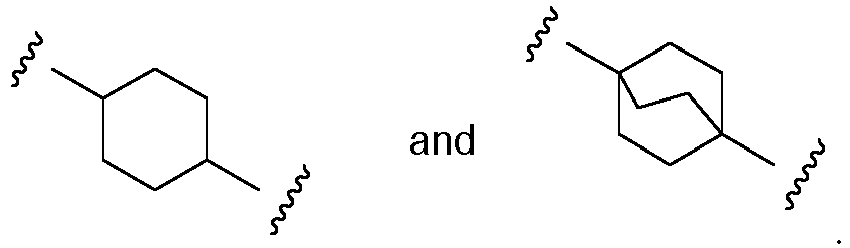
- Non-limiting examples of a cycloalkylenyl also include:

- In the present disclosure, the term "alkenyl" as used by itself or as part of another group refers to an alkyl group as defined above containing one, two or three carbon-to-carbon double bonds. In one embodiment, the alkenyl group is chosen from a C2-6 alkenyl group. In another embodiment, the alkenyl group is chosen from a C2-4 alkenyl group. Non-limiting exemplary alkenyl groups include ethenyl, propenyl, isopropenyl, butenyl, sec-butenyl, pentenyl, and hexenyl.
- In the present disclosure, the term "optionally substituted alkenyl" as used herein by itself or as part of another group means the alkenyl as defined above is either unsubstituted or substituted with one, two or three substituents independently chosen from halo, nitro, cyano, hydroxy, amino, alkylamino, dialkylamino, haloalkyl, hydroxyalkyl, alkoxy, haloalkoxy, aryloxy, aralkyloxy, alkylthio, carboxamido, sulfonamido, alkylcarbonyl, arylcarbonyl, alkylsulfonyl, arylsulfonyl, carboxy, carboxyalkyl, alkyl, cycloalkyl, alkenyl, alkynyl, aryl, heteroaryl, or heterocyclo.
- In the present disclosure, the term "alkynyl" as used by itself or as part of another group refers to an alkyl group as defined above containing one to three carbon-to-carbon triple bonds. In one embodiment, the alkynyl has one carbon-to-carbon triple bond. In one embodiment, the alkynyl group is chosen from a C2-6 alkynyl group. In another embodiment, the alkynyl group is chosen from a C2-4 alkynyl group. Non-limiting exemplary alkynyl groups include ethynyl, propynyl, butynyl, 2-butynyl, pentynyl, and hexynyl groups.
- In the present disclosure, the term "optionally substituted alkynyl" as used herein by itself or as part of another group means the alkynyl as defined above is either unsubstituted or substituted with one, two or three substituents independently chosen from halo, nitro, cyano, hydroxy, amino, alkylamino, dialkylamino, haloalkyl, hydroxyalkyl, alkoxy, haloalkoxy, aryloxy, aralkyloxy, alkylthio, carboxamido, sulfonamido, alkylcarbonyl, arylcarbonyl, alkylsulfonyl, arylsulfonyl, carboxy, carboxyalkyl, alkyl, cycloalkyl, alkenyl, alkynyl, aryl, heteroaryl, or heterocyclo.
- In the present disclosure, the term "haloalkyl" as used by itself or as part of another group refers to an alkyl group substituted by one or more fluorine, chlorine, bromine and/or iodine atoms. In one embodiment, the alkyl group is substituted by one, two, or three fluorine and/or chlorine atoms. In another embodiment, the haloalkyl group is chosen from a C1-4 haloalkyl group. Non-limiting exemplary haloalkyl groups include fluoromethyl, 2-fluoroethyl, difluoromethyl, trifluoromethyl, pentafluoroethyl, 1,1-difluoroethyl, 2,2-difluoroethyl, 2,2,2-trifluoroethyl, 3,3,3-trifluoropropyl, 4,4,4-trifluorobutyl, and trichloromethyl groups.
- In the present disclosure, the term "hydroxyalkyl" as used by itself or as part of another group refers to an alkyl group substituted with one or more, e.g., one, two, or three, hydroxy groups. In one embodiment, the hydroxyalkyl group is a monohydroxyalkyl group, i.e., substituted with one hydroxy group. In another embodiment, the hydroxyalkyl group is a dihydroxyalkyl group, i.e., substituted with two hydroxy groups, e.g.,

- In another embodiment, the hydroxyalkyl group is chosen from a C1-4 hydroxyalkyl group. Non-limiting exemplary hydroxyalkyl groups include hydroxymethyl, hydroxyethyl, hydroxypropyl and hydroxybutyl groups, such as 1-hydroxyethyl, 2-hydroxyethyl, 1,2-dihydroxyethyl, 2-hydroxypropyl, 3-hydroxypropyl, 3-hydroxybutyl, 4-hydroxybutyl, 2-hydroxy-1-methylpropyl, and 1,3-dihydroxyprop-2-yl.
- In the present disclosure, the term "alkoxy" as used by itself or as part of another group refers to an optionally substituted alkyl, optionally substituted cycloalkyl, optionally substituted alkenyl or optionally substituted alkynyl attached to a terminal oxygen atom. In one embodiment, the alkoxy group is chosen from a C1-4 alkoxy group. In another embodiment, the alkoxy group is chosen from a C1-4 alkyl attached to a terminal oxygen atom, e.g., methoxy, ethoxy, and tert-butoxy.
- In the present disclosure, the term "alkylthio" as used by itself or as part of another group refers to a sulfur atom substituted by an optionally substituted alkyl group. In one embodiment, the alkylthio group is chosen from a C1-4 alkylthio group. Non-limiting exemplary alkylthio groups include -SCH3, and -SCH2CH3.
- In the present disclosure, the term "alkoxyalkyl" as used by itself or as part of another group refers to an alkyl group substituted with an alkoxy group. Non-limiting exemplary alkoxyalkyl groups include methoxymethyl, methoxyethyl, methoxypropyl, methoxybutyl, ethoxymethyl, ethoxyethyl, ethoxypropyl, ethoxybutyl, propoxymethyl, iso-propoxymethyl, propoxyethyl, propoxypropyl, butoxymethyl, tert-butoxymethyl, isobutoxymethyl, sec-butoxymethyl, and pentyloxymethyl.
- In the present disclosure, the term "haloalkoxy" as used by itself or as part of another group refers to a haloalkyl attached to a terminal oxygen atom. Non-limiting exemplary haloalkoxy groups include fluoromethoxy, difluoromethoxy, trifluoromethoxy, and 2,2,2-trifluoroethoxy.
- In the present disclosure, the term "aryl" as used by itself or as part of another group refers to a monocyclic or bicyclic aromatic ring system having from six to fourteen carbon atoms (i.e., C6-C14 aryl). Non-limiting exemplary aryl groups include phenyl (abbreviated as "Ph"), naphthyl, phenanthryl, anthracyl, indenyl, azulenyl, biphenyl, biphenylenyl, and fluorenyl groups. In one embodiment, the aryl group is chosen from phenyl or naphthyl.
- In the present disclosure, the term "optionally substituted aryl" as used herein by itself or as part of another group means that the aryl as defined above is either unsubstituted or substituted with one to five substituents independently chosen from halo, nitro, cyano, hydroxy, amino, alkylamino, dialkylamino, haloalkyl, hydroxyalkyl, alkoxy, haloalkoxy, aryloxy, aralkyloxy, alkylthio, carboxamido, sulfonamido, alkylcarbonyl, arylcarbonyl, alkylsulfonyl, arylsulfonyl, carboxy, carboxyalkyl, alkyl, optionally substituted cycloalkyl, alkenyl, alkynyl, optionally substituted aryl, optionally substituted heteroaryl, optionally substituted heterocyclo, alkoxyalkyl, (amino)alkyl, (carboxamido)alkyl, mercaptoalkyl, or (heterocyclo)alkyl.
- In one embodiment, the optionally substituted aryl is an optionally substituted phenyl. In one embodiment, the optionally substituted phenyl has four substituents. In another embodiment, the optionally substituted phenyl has three substituents. In another embodiment, the optionally substituted phenyl has two substituents. In another embodiment, the optionally substituted phenyl has one substituent. Non-limiting exemplary substituted aryl groups include 2-methylphenyl, 2-methoxyphenyl, 2-fluorophenyl, 2-chlorophenyl, 2-bromophenyl, 3-methylphenyl, 3-methoxyphenyl, 3-fluorophenyl, 3-chlorophenyl, 4-methylphenyl, 4-ethylphenyl, 4-methoxyphenyl, 4-fluorophenyl, 4-chlorophenyl, 2,6-di-fluorophenyl, 2,6-di-chlorophenyl, 2-methyl, 3-methoxyphenyl, 2-ethyl, 3-methoxyphenyl, 3,4-di-methoxyphenyl, 3,5-di-
fluorophenyl 3,5-di-methylphenyl, 3,5-dimethoxy, 4-methylphenyl, 2-fluoro-3-chlorophenyl, and 3-chloro-4-fluorophenyl. The term optionally substituted aryl is meant to include groups having fused optionally substituted cycloalkyl and fused optionally substituted heterocyclo rings. Non-limiting examples include:
- In the present disclosure, the term "arylenyl" as used herein by itself or part of another group refers to a divalent form of an optionally substituted aryl group.
- In the present disclosure, the term "phenylenyl" as used herein by itself or part of another group refers to a divalent form of an optionally substituted phenyl group. Non-limiting examples include:

- In the present disclosure, the term "aryloxy" as used by itself or as part of another group refers to an optionally substituted aryl attached to a terminal oxygen atom. A non-limiting exemplary aryloxy group is PhO-.
- In the present disclosure, the term "aralkyloxy" as used by itself or as part of another group refers to an aralkyl group attached to a terminal oxygen atom. A non-limiting exemplary aralkyloxy group is PhCH2O-.
- In the present disclosure, the term "heteroaryl" or "heteroaromatic" refers to monocyclic and bicyclic aromatic ring systems having 5 to 14 ring atoms (i.e., C5-C14 heteroaryl), wherein at least one carbon atom of one of the rings is replaced with a heteroatom independently selected from the group consisting of oxygen, nitrogen and sulfur. In one embodiment, the heteroaryl contains 1, 2, 3, or 4 heteroatoms independently selected from the group consisting of oxygen, nitrogen and sulfur. In one embodiment, the heteroaryl has three heteroatoms. In another embodiment, the heteroaryl has two heteroatoms. In another embodiment, the heteroaryl has one heteroatom. Non-limiting exemplary heteroaryl groups include thienyl, benzo[b]thienyl, naphtho[2,3-b]thienyl, thianthrenyl, furyl, benzofuryl, pyranyl, isobenzofuranyl, benzooxazonyl, chromenyl, xanthenyl, 2H-pyrrolyl, pyrrolyl, imidazolyl, pyrazolyl, pyridyl, pyrazinyl, pyrimidinyl, pyridazinyl, isoindolyl, 3H-indolyl, indolyl, indazolyl, purinyl, isoquinolyl, quinolyl, phthalazinyl, naphthyridinyl, cinnolinyl, quinazolinyl, pteridinyl, 4aH-carbazolyl, carbazolyl, β-carbolinyl, phenanthridinyl, acridinyl, pyrimidinyl, phenanthrolinyl, phenazinyl, thiazolyl, isothiazolyl, phenothiazolyl, isoxazolyl, furazanyl, and phenoxazinyl. In one embodiment, the heteroaryl is chosen from thienyl (e.g., thien-2-yl and thien-3-yl), furyl (e.g., 2-furyl and 3-furyl), pyrrolyl (e.g., 1H-pyrrol-2-yl and 1H-pyrrol-3-yl), imidazolyl (e.g., 2H-imidazol-2-yl and 2H-imidazol-4-yl), pyrazolyl (e.g., 1H-pyrazol-3-yl, 1H-pyrazol-4-yl, and 1H-pyrazol-5-yl), pyridyl (e.g., pyridin-2-yl, pyridin-3-yl, and pyridin-4-yl), pyrimidinyl (e.g., pyrimidin-2-yl, pyrimidin-4-yl, and pyrimidin-5-yl), thiazolyl (e.g., thiazol-2-yl, thiazol-4-yl, and thiazol-5-yl), isothiazolyl (e.g., isothiazol-3-yl, isothiazol-4-yl, and isothiazol-5-yl), oxazolyl (e.g., oxazol-2-yl, oxazol-4-yl, and oxazol-5-yl), isoxazolyl (e.g., isoxazol-3-yl, isoxazol-4-yl, and isoxazol-5-yl), and indazolyl (e.g., 1H-indazol-3-yl). The term "heteroaryl" is also meant to include possible N-oxides. A non-limiting exemplary N-oxide is pyridyl N-oxide.
- In one embodiment, the heteroaryl is a 5- or 6-membered heteroaryl. In one embodiment, the heteroaryl is a 5-membered heteroaryl, i.e., the heteroaryl is a monocyclic aromatic ring system having 5 ring atoms wherein at least one carbon atom of the ring is replaced with a heteroatom independently selected from nitrogen, oxygen, and sulfur. Non-limiting exemplary 5-membered heteroaryl groups include thienyl, furyl, pyrrolyl, oxazolyl, pyrazolyl, imidazolyl, thiazolyl, isothiazolyl, and isoxazolyl.
- In another embodiment, the heteroaryl is a 6-membered heteroaryl, e.g., the heteroaryl is a monocyclic aromatic ring system having 6 ring atoms wherein at least one carbon atom of the ring is replaced with a nitrogen atom. Non-limiting exemplary 6-membered heteroaryl groups include pyridyl, pyrazinyl, pyrimidinyl, and pyridazinyl.
- In the present disclosure, the term "optionally substituted heteroaryl" as used by itself or as part of another group means that the heteroaryl as defined above is either unsubstituted or substituted with one to four substituents, e.g., one or two substituents, independently chosen from halo, nitro, cyano, hydroxy, amino, alkylamino, dialkylamino, haloalkyl, hydroxyalkyl, alkoxy, haloalkoxy, aryloxy, aralkyloxy, alkylthio, carboxamido, sulfonamido, alkylcarbonyl, arylcarbonyl, alkylsulfonyl, arylsulfonyl, carboxy, carboxyalkyl, alkyl, optionally substituted cycloalkyl, alkenyl, alkynyl, optionally substituted aryl, optionally substituted heteroaryl, optionally substituted heterocyclo, alkoxyalkyl, (amino)alkyl, (carboxamido)alkyl, mercaptoalkyl, or (heterocyclo)alkyl. In one embodiment, the optionally substituted heteroaryl has one substituent. Any available carbon or nitrogen atom can be substituted. Non-limiting exemplary optionally substituted 5-membered heteroaryl groups include, but are not limited to:





- The term optionally substituted heteroaryl is also meant to include groups having fused optionally substituted cycloalkyl and fused optionally substituted heterocyclo rings. Non-limiting examples include:

- In the present disclosure, the term "heteroarylenyl" as used herein by itself or part of another group refers to a divalent form of an optionally substituted heteroaryl group. In one embodiment, the heteroarylenyl is a 5-membered heteroarylenyl. Non-limiting examples of a 5-membered heteroarylenyl include:

- In one embodiment, the heteroarylenyl is a 6-membered heteroarylenyl. Non-limiting examples of a 6-membered heteroarylenyl include:

- In the present disclosure, the term "heterocycle" or "heterocyclo" as used by itself or as part of another group refers to saturated and partially unsaturated (e.g., containing one or two double bonds) cyclic groups containing one, two, or three rings having from three to fourteen ring members (i.e., a 3- to 14-membered heterocyclo) wherein at least one carbon atom of one of the rings is replaced with a heteroatom. Each heteroatom is independently selected from the group consisting of oxygen, sulfur, including sulfoxide and sulfone, and/or nitrogen atoms, which can be oxidized or quaternized. The term "heterocyclo" is meant to include groups wherein a ring -CH2- is replaced with a -C(=O)-, for example, cyclic ureido groups such as 2-imidazolidinone and cyclic amide groups such as β-lactam, γ-lactam, δ-lactam, ε-lactam, and piperazin-2-one. The term "heterocyclo" is also meant to include groups having fused optionally substituted aryl groups, e.g., indolinyl, chroman-4-yl. In one embodiment, the heterocyclo group is chosen from a 5- or 6-membered cyclic group containing one ring and one or two oxygen and/or nitrogen atoms. The heterocyclo can be optionally linked to the rest of the molecule through any available carbon or nitrogen atom. Non-limiting exemplary heterocyclo groups include dioxanyl, tetrahydropyranyl, 2-oxopyrrolidin-3-yl, piperazin-2-one, piperazine-2,6-dione, 2-imidazolidinone, piperidinyl, morpholinyl, piperazinyl, pyrrolidinyl, and indolinyl.
- In the present disclosure, the term "optionally substituted heterocyclo" as used herein by itself or part of another group means the heterocyclo as defined above is either unsubstituted or substituted with one to four substituents independently selected from halo, nitro, cyano, hydroxy, amino, alkylamino, dialkylamino, haloalkyl, hydroxyalkyl, alkoxy, haloalkoxy, aryloxy, aralkyloxy, alkylthio, carboxamido, sulfonamido, alkylcarbonyl, alkoxycarbonyl, CF3C(=O)-, arylcarbonyl, alkylsulfonyl, arylsulfonyl, carboxy, carboxyalkyl, alkyl, optionally substituted cycloalkyl, alkenyl, alkynyl, optionally substituted aryl, optionally substituted heteroaryl, optionally substituted heterocyclo, alkoxyalkyl, (amino)alkyl, (carboxamido)alkyl, mercaptoalkyl, or (heterocyclo)alkyl. Substitution may occur on any available carbon or nitrogen atom, or both. Non-limiting exemplary optionally substituted heterocyclo groups include:

- In the present disclosure, the term "heterocyclenyl" as used herein by itself or part of another group refers to a divalent form of an optionally substituted heterocyclo group. Substitution may occur at any available carbon atom or nitrogen atom. In one embodiment, the heterocyclenyl is a 4-membered heterocyclenyl. In another embodiment, the heterocyclenyl is a 5-membered heterocyclenyl. In another embodiment, the heterocyclenyl is a 6-membered heterocyclenyl. Non-limiting exemplary heterocyclenyl groups include:

- In the present disclosure, the term "amino" as used by itself or as part of another group refers to -NR10aR10b, wherein R10a and R10b are each independently hydrogen, alkyl, hydroxyalkyl, optionally substituted cycloalkyl, optionally substituted aryl, optionally substituted heterocyclo, or optionally substituted heteroaryl, or R10a and R10b are taken together to form a 3- to 8-membered optionally substituted heterocyclo. Non-limiting exemplary amino groups include -NH2 and -N(H)(CH3).
- In the present disclosure, the term "(amino)alkyl" as used by itself or as part of another group refers to an alkyl group substituted with an amino group. Non-limiting exemplary amino alkyl groups include -CH2CH2NH2, and -CH2CH2N(H)CH3, -CH2CH2N(CH3)2, and -CH2N(H)cyclopropyl.
- In the present disclosure, the term "carboxamido" as used by itself or as part of another group refers to a radical of formula -C(=O)NR9aR9b, wherein R9a and R9b are each independently hydrogen, optionally substituted alkyl, hydroxyalkyl, optionally substituted cycloalkyl, optionally substituted aryl, optionally substituted heterocyclo, or optionally substituted heteroaryl, or R9a and R9b taken together with the nitrogen to which they are attached form a 3- to 8-membered optionally substituted heterocyclo group. In one embodiment, R9a and R9b are each independently hydrogen or optionally substituted alkyl. In one embodiment, R9a and R9b are taken together to taken together with the nitrogen to which they are attached form a 3- to 8-membered optionally substituted heterocyclo group. Non-limiting exemplary carboxamido groups include, but are not limited to, -CONH2, -CON(H)CH3, -CON(CH3)2, -CON(H)Ph,

- In the present disclosure, the term "sulfonamido" as used by itself or as part of another group refers to a radical of the formula -SO2NR8aR8b, wherein R8a and R8b are each independently hydrogen, optionally substituted alkyl, or optionally substituted aryl, or R8a and R8b taken together with the nitrogen to which they are attached from a 3- to 8-membered heterocyclo group. Non-limiting exemplary sulfonamido groups include -SO2NH2, -SO2N(H)CH3, and -SO2N(H)Ph.
- In the present disclosure, the term "alkylcarbonyl" as used by itself or as part of another group refers to a carbonyl group, i.e., -C(=O)-, substituted by an alkyl group. A non-limiting exemplary alkylcarbonyl group is -COCH3.
- In the present disclosure, the term "arylcarbonyl" as used by itself or as part of another group refers to a carbonyl group, i.e., -C(=O)-, substituted by an optionally substituted aryl group. A non-limiting exemplary arylcarbonyl group is -COPh.
- In the present disclosure, the term "alkoxycarbonyl" as used by itself or as part of another group refers to a carbonyl group, i.e., -C(=O)-, substituted by an alkoxy group. Non-limiting exemplary alkoxycarbonyl groups include -C(=O)OMe, -C(=O)OEt, and -C(=O)OtBu.
- In the present disclosure, the term "alkylsulfonyl" as used by itself or as part of another group refers to a sulfonyl group, i.e., -SO2-, substituted by any of the above-mentioned optionally substituted alkyl groups. A non-limiting exemplary alkylsulfonyl group is -SO2CH3.
- In the present disclosure, the term "arylsulfonyl" as used by itself or as part of another group refers to a sulfonyl group, i.e., -SO2-, substituted by any of the above-mentioned optionally substituted aryl groups. A non-limiting exemplary arylsulfonyl group is -SO2Ph.
- In the present disclosure, the term "mercaptoalkyl" as used by itself or as part of another group refers to any of the above-mentioned alkyl groups substituted by a -SH group.
- In the present disclosure, the term "carboxy" as used by itself or as part of another group refers to a radical of the formula -COOH.
- In the present disclosure, the term "carboxyalkyl" as used by itself or as part of another group refers to any of the above-mentioned alkyl groups substituted with a -COOH. A non-limiting exemplary carboxyalkyl group is -CH2CO2H.
- In the present disclosure, the terms "aralkyl" or "arylalkyl" as used by themselves or as part of another group refers to an alkyl group substituted with one, two, or three optionally substituted aryl groups. In one embodiment, the optionally substituted aralkyl group is a C1-4 alkyl substituted with one optionally substituted aryl group. In one embodiment, the optionally substituted aralkyl group is a C1 or C2 alkyl substituted with one optionally substituted aryl group. In one embodiment, the optionally substituted aralkyl group is a C1 or C2 alkyl substituted with one optionally substituted phenyl group. Non-limiting exemplary optionally substituted aralkyl groups include benzyl, phenethyl, -CHPh2, -CH2(4-F-Ph), -CH2(4-Me-Ph), -CH2(4-CF3-Ph), and -CH(4-F-Ph)2.
- In the present disclosure, the terms "(heterocyclo)alkyl" as used by itself or part of another group refers to an alkyl group substituted with an optionally substituted heterocyclo group. In one embodiment, the (heterocyclo)alkyl is a C1-4 alkyl substituted with one optionally substituted heterocyclo group. Non-limiting exemplary (heterocyclo)alkyl groups include:

- The present disclosure encompasses any of the Compounds of the Disclosure being isotopically-labeled, i.e., radiolabeled, by having one or more atoms replaced by an atom having a different atomic mass or mass number. Examples of isotopes that can be incorporated into Compounds of the Disclosure include isotopes of hydrogen, carbon, nitrogen, sulfur, oxygen, fluorine, and chlorine, such as 2H (or deuterium (D)), 3H, 11C, 13C, 14C, 15N, 18O, 17O, 35S, 18F, and 36Cl, e.g., 2H, 3H, and 13C. In one embodiment, a portion of the atoms at a position within a Compound of the Disclosure are replaced, i.e., the Compound of the Disclosure is enriched at a position with an atom having a different atomic mass or mass number. In one embodiment, at least about 1% of the atoms are replaced with atoms having a different atomic mass or mass number. In another embodiment, at least about 5%, at least about 10%, at least about 15%, at least about 20%, at least about 25%, at least about 30%, at least about 35%, at least about 40%, at least about 45%, at least about 50%, at least about 55%, at least about 60%, at least about 65%, at least about 70%, at least about 75%, at least about 80%, at least about 85%, at least about 90%, at least about 95%, or at least about 100% of the atoms are replaced with atoms having a different atomic mass or mass number. For example, when B1 of Formula I-A, VII, or VIII, is B-1a, B-1b, B-1c, or B-1d, and R5 is hydrogen, the hydrogen at R5 may be replaced entirely or partially with deuterium, e.g., at least about 1%, at least about 5%, at least about 10%, at least about 15%, at least about 20%, at least about 25%, at least about 30%, at least about 35%, at least about 40%, at least about 45%, at least about 50%, at least about 55%, at least about 60%, at least about 65%, at least about 70%, at least about 75%, at least about 80%, at least about 85%, at least about 90%, or at least about 95% of the hydrogen atoms at R5 are deuterium atoms. Isotopically-labeled Compounds of the Disclosure can be prepared by methods known in the art.
- Compounds of the Disclosure are prepared using methods known to those skilled in the art in view of this disclosure, or by the illustrative methods shown in the General Schemes below. Compounds described below, but not claimed, are provided for illustrative purposes to provide information on how Compounds of the Disclosure can be prepared . Suitable protecting can be employed in the synthesis, if needed. See Wuts, P. G. M.; Greene, T. W., "Greene's Protective Groups in Organic Synthesis", 4th Ed., J. Wiley & Sons, NY, 2007.


- In
General Scheme 1, Cpd. A is reacted with a compound having Formula V in an organic solvent to give a compound having Formula II, wherein A is A-1. Cpd. A is a MDM2 inhibitor. See Compound Example No. 22 ofUS 8,629,141 . Compounds having Formula V may be prepared using methods known in the art and/or as illustrated in the Examples below. Suitable amine-to-amide coupling reagents and conditions, e.g., HATU/base, HBTU/base, or EDCI/HOBt/base, are well known in the art. See Montalbetti and Falque, Tetrahedron 61:10827-10852 (2005). - In the alternative, the carboxylic acid of Cpd. A can be converted to the acid chloride, and reacted with a compound having Formula V to give a compound having Formula II, wherein A is A-1 according to
General Scheme 2.

- In
General Scheme 3, Cpd. A is reacted with a compound having Formula VI in an organic solvent to give a compound having Formula III, wherein A is A-1. Compounds having Formula V may be prepared using methods known in the art and/or as illustrated in the Examples below. Suitable amine-to-amide coupling reagents and conditions e.g., HATU/base, HBTU/base, or EDCI/HOBt/base, are well known in the art. See Montalbetti and Falque, Tetrahedron 61:10827-10852 (2005).
- Synthesis of (3'R,4'S,5'R)-6"-chloro-4'-(3-chloro-2-fluorophenyl)-N-(4-((4-(2-((2-(2,6-dioxopiperidin-3-yl)-1,3-dioxoisoindolin-4-yl)oxy)acetamido)butyl)carbamoyl)phenyl)-2"-oxodispiro[cyclohexane-1,2'-pyrrolidine-3',3"-indoline]-5'-carboxamide (Cpd. No. 1)
-

- To a round-bottom flask, 3-hydroxyphthalic anhydride (1 g, 6.09 mmol) and 3-aminoperidine-2,6-dione hydrochloride (1.0 g, 6.09 mmol) were mixed in 50 mL of toluene. Triethyl amine (0.93 mL, 6.7 mmol) was added. The resulting reaction mixture was heated to reflux for 12 h with Dean-Stark Trap equipment. After cooling to ambient temperature, evaporation of most of the solvent to give a crude product, which was purified by flash column chromatography with DCM:EA to get the desired product as a slightly yellow solid S1 (1.5g, 90% yield). 1H NMR (400 MHz, DMSO-d 6) δ (ppm) 11.16 (s, 1H), 11.08 (s, 1H), 7.65 (t, J= 7.6 Hz, 1H), 7.32 (d, J= 7.2 Hz, 1H), 7.25 (d, J = 8.4 Hz, 1H), 5.07 (dd, J = 12.8 Hz, J = 5.2 Hz, 1H), 2.93-2.84 (m, 1H), 2.61-2.46 (m, 1H), 2.05-2.01 (m, 1H).
-

- To a round-bottom flask, S1 (1.5 g, 5.5 mmol) was dissolved in 10 mL of DMF. To the stirred solution, KI (91 mg, 0.55 mmol) and KHCO3 (826 mg, 8.25 mmol) were added. Then tert-butyl bromoacetate (0.98 mL, 6.6 mmol) was added dropwise. The resulting mixture was stirred at room temperature for 12 h. After normal workup with EtOAc and saturated brine, the combined organic layer was dried over Na2SO4. After filtration and evaporation, the residue was purified by flash column chromatography with DCM:EA to get the desired product S2 as a white solid (1.7 g, 80 % yield). 1H NMR (400 MHz, DMSO-d 6) δ (ppm) 11.13 (s, 1H), 7.80 (t, J = 8.0 Hz, 1H), 7.48 (d, J = 7.2 Hz, 1H), 7.38 (d, J = 8.4 Hz, 1H), 5.13 (dd, J = 12.8 Hz, J = 5.2 Hz, 1H), 4.97 (s, 2H), 2.97-2.85 (m, 1H), 2.65-2.52 (m, 2H), 2.14-2.03 (m, 1H), 1.43 (s, 9H); 13C NMR (100 MHz, DMSO-d 6) δ (ppm) 173.2, 170.3, 167.5, 167.2, 165.6, 155.5, 137.2, 133.7, 120.4, 116.9, 116.3, 66.0, 60.2, 49.3, 31.4, 28.1, 22.5.
-

- To a round-bottom flask, S2 (1.7 g, 4.4 mmol) was dissolved in 8.0 mL of TFA. The reaction mixture was stirred at room temperature for 2 h. After evaporation of the solvent, the residue was used in the following steps without further purification. ESI-MS calculated for C15H13N2O7 [M+H]+ = 333.07, obtained: 333.17. 1H NMR (400 MHz, DMSO-d 6) δ (ppm) 13.16 (s, 1H), 11.11 (s, 1H), 7.80 (t, J= 8.0 Hz, 1H), 7.48 (d, J = 7.2 Hz, 1H), 7.40 (d, J = 8.8 Hz, 1H), 5.11 (dd, J = 12.8 Hz, J = 5.2 Hz, 1H), 4.99 (s, 2H), 2.95-2.86 (m, 1H), 2.63-2.48 (m, 2H), 2.08-2.03 (m, 1H).
-

- To a round-bottom flask, S3 (99.7 mg, 0.3 mmol) was dissolved in 2 mL of anhydrous DMF. N-Boc-1,4-butanediamine (68 mg, 0.36 mmol), HATU (137 mg, 0.36 mmol) and DIPEA (157 µ L, 0.9 mmol) were added sequentially. The reaction mixture was stirred at room temperature for 2 h, and then purified by HPLC to get the desired compound S4 as a slightly yellow solid (128 mg, 85% yield).
-

- To a round-bottom flask, S4 (15.1 mg, 0.03 mmol) was dissolved in 3 mL of DCM and TFA (2:1). After stirring for 1 h, the solvent was evaporated to give the crude product S5, which was used in the next step without further purification. ESI-MS calculated for C19H23N4O6 [M+H]+ = 403.16, obtained: 403.17.
-

- HATU (13.3 mg, 0.035 mmol) and N,N-diisopropylethylamine (0.026 mL, 0.15 mmol) were added to a solution of Cpd. A (20 mg, 0.029 mmol) in 0.5 mL DMF and stirred. After 10 minutes, S5 (0.35 mL, 0.1 M in DMSO) was added to the reaction. After 30 minutes, the solvent was removed and the crude was dissolved in 3:1 methanol/water, acidified with trifluoroacetic acid and purified by reverse-phase preparative HPLC. The purified fractions were combined, concentrated in vacuo, re-dissolved in H2O, frozen and lyophilized to give Cpd. No. 1 (TFA salt) as a white powder.
- LC-MS(ESI) m/z (M+H)+: 966.28 , 5.13 min; calcd: 966.28; >98% purity. 1H NMR (400 MHz, MeOD) δ 7.80 - 7.68 (m, 4H), 7.62 - 7.56 (m, 2H), 7.54 (dd, J = 8.3, 2.5 Hz, 1H), 7.48 (dd, J = 7.2, 1.4 Hz, 1H), 7.43 - 7.32 (m, 2H), 7.18 (t, J = 8.1 Hz, 1H), 7.11 (dd, J = 8.2, 1.9 Hz, 1H), 6.79 (d, J= 1.9 Hz, 1H), 5.31 (d, J = 10.8 Hz, 1H), 5.08 (dd, J = 12.6, 5.2 Hz, 1H), 4.97 (d, J = 10.8 Hz, 1H), 4.75 (s, 2H), 3.36 (dd, J = 4.6, 3.0 Hz, 4H), 2.92 - 2.64 (m, 4H), 2.25 - 2.13 (m, 1H), 2.13 - 2.04 (m, 1H), 2.04 - 1.84 (m, 3H), 1.78 (d, J = 11.5 Hz, 2H), 1.72 - 1.48 (m, 5H), 1.31 - 1.16 (m, 2H).
-

- To a round-bottom flask, S3 (99.7 mg, 0.3 mmol) was dissolved in 2 mL of anhydrous DMF. tert-butyl (3-(2-(2-(3-aminopropoxy)ethoxy)ethoxy)propyl)carbamate (68 mg, 0.36 mmol), HATU (137 mg, 0.36 mmol) and DIPEA (157 µ L, 0.9 mmol) were added sequentially. The reaction mixture was stirred at room temperature for 2 h, and then purified by HPLC to get the desired compound S7 as a slightly yellow solid (128 mg, 85% yield).
-

- To a round-bottom flask, S7 (15 mg) was dissolved in 3 mL of DCM and TFA (2:1). After stirring for 1 h, the solvent was evaporated to give the crude product Cpd. No. 74, which was used in the next step without further purification. ESI-MS calculated for C25H35N4O9 [M+H]+ = 535.24, obtained: 535.14.
-

- To a round-bottom flask, 3-nitrophthalic anhydride (5.79 g, 30 mmol) and p-toluenesulfonic acid monohydrate (571 mg, 3 mmol) were mixed in 20 mL of benzyl alcohol. The mixture was heat to100 °C to stir overnight. After cooling to room temperature, benzyl bromide (7.1 mL, 45 mmol), KI (498 mg, 3 mmol), KHCO3 (9.0 g, 90 mmol) and DMF (25 mL) were added. The mixture was heated to 100 °C for 6 h. After the reaction was cooled to room temperature, the solvent was evaporated as much as possible and was poured into larger amount of water. The solution was extracted with ethyl acetate. The combined organic layer was washed with brine and dried over anhydrous Na2SO4. After filtration and evaporation, the crude residue was purified by flash column chromatography with hexane/ ethyl acetate to give S16 as a slightly yellow solid (9.4 g, 80% yield).
-

- To a round-bottom flask, compound S16 (9.4 g, 24 mmol) was dissolved in 100 mL of ethyl acetate. Then Tin (II) chloride dehydrate (11.3 g, 50 mmol) was added portion wisely to the reaction mixture. The resulting reaction mixture was heated to 50 °C to stir overnight. Aqueous NaOH and NaHCO3 solution were added to the reaction mixture to quench the reaction. The reaction mixture was filtered through celite and washed with ethyl acetate. The filtrate was extracted with ethyl acetate and brine. The combined organic layer was dried over anhydrous Na2SO4. After filtration and evaporation, the crude residue was purified by flash column chromatography with hexane/ ethyl acetate to give compound S17 as a slightly yellow solid (7.8 g, 90% yield).
-

- To a round-bottom flask, compound S17 (2.0 g, 5.54 mmol) and KI (100 mg, 0.56 mmol) were added to 10 mL of anhydrous DMF. Tert-butyl bromoacetate (2.4 mL, 16.6 mmol) and DIPEA (4.8 mL, 27.7 mmol) were added to the reaction mixture. The reaction mixture was heated to 90 °C to stir overnight. After cooling to room temperature, most of the solvent was evaporated and the residue was purified by column chromatography with hexane/ ethyl acetate to give compound S18 as a slightly yellow solid (1.05 g, 40% yield).
-

- To a round-bottom flask, compound S18 (1.0 g, 2.1 mmol) was dissolved in 20 mL of methanol. 100 mg of Pd/C (10 wt%) was added. The reaction mixture was stirred at room temperature under 1 atm H2 atmosphere. Once the starting material disappeared by TLC, the mixture was filtrated through celite and washed with methanol. After evaporation of the solvent, 3-aminopiperidine-2,6-dione hydrochloride (380 mg, 2.31 mmol) and 20 mL of pyridine were added. The reaction mixture was heated to 110 °C to stir overnight. After cooling to room temperature, the solvent was evaporated as much as possible and the residue was poured into water. After extraction with ethyl acetate for three times, the combined organic layer was washed with brine and dried over anhydrous Na2SO4. After filtration and evaporation, the crude residue was purified by flash column chromatography with DCM/ ethyl acetate to give compound S19 as a yellow solid (325 mg, 40% yield).
-

- To a round-bottom flask, S19 (1.7 g) was dissolved in 8.0 mL of TFA. The reaction mixture was stirred at room temperature for 2 h. After evaporation of the solvent, the residue was used in the following steps without further purification. 1H NMR (400 MHz, DMSO-d 6) δ (ppm) 12.91 (s, 1H), 11.10 (s, 1H), 7.59 (t, J = 8.0 Hz, 1H), 7.08 (d, J = 6.80 Hz, 1H), 6.99 (d, J = 8.4 Hz, 1H), 6.86 (t, J = 5.6 Hz, 1H), 5.08 (dd, J = 13.2 Hz, J = 5.6 Hz, 1H), 4.12 (d, J = 5.2 Hz, 2H), 2.94-2.85 (m, 1H), 2.63-2.49 (m, 2H), 2.09-2.07 (m, 1H); 13C NMR (100 MHz, DMSO-d 6) δ (ppm) 173.3, 171.9, 170.5, 169.3, 167.8, 146.3, 136.6, 132.5, 118.2, 111.5, 110.1, 60.2, 49.1, 31.5, 22.6.
-

- Following the procedure for S4 synthesis, compound S21 was synthesized with S20 (99.7 mg, 0.3 mmol), amine (115 mg, 0.36 mmol), HATU (137 mg, 0.36 mmol) and DIPEA (157 µ L, 0.9 mmol). ESI-MS calculated for C30H43N5NaO10 [M+Na]+ = 656.29, obtained: 656.26.
-

- To a round-bottom flask, S21 (15.1 mg) was dissolved in 3 mL of DCM and TFA (2:1). After stirring for 1 h, the solvent was evaporated to give crude product Cpd. No. 75, which was used in the next step without further purification.
-
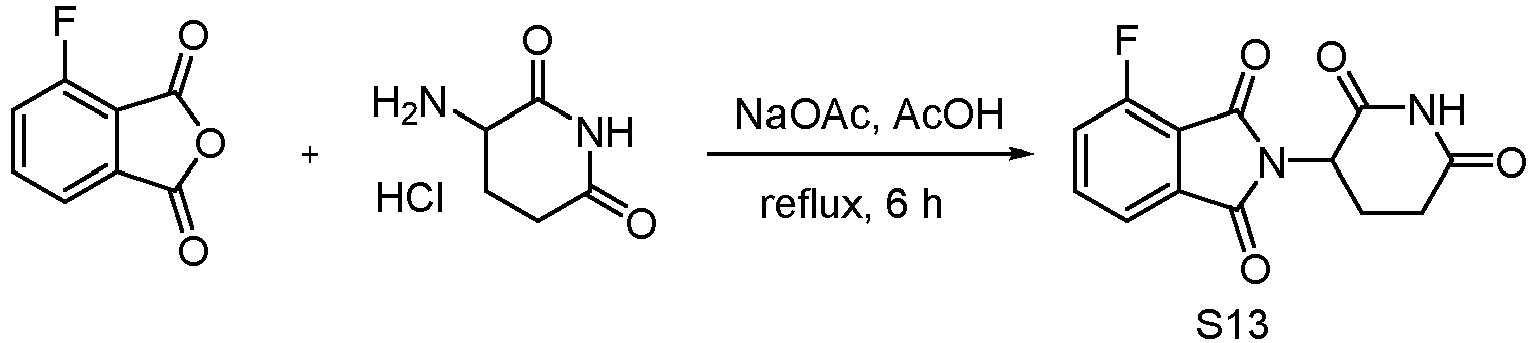
- To a round-bottom flask, 3-fluorophthalic anhydride (6.64 g, 40 mmol), 3-aminopiperidine-2,6-dione hydrochloride (6.58 g, 40 mmol) and sodium acetate (3.94 g, 48 mmol) were mixed in 120 mL of acetic acid. The resulting reaction mixture was heated to reflux at 140 °C for 12 h. After cooling to room temperature, most of acetic acid was evaporated and the residue was purified by flash column chromatography with DCM/MeOH to get S13 as a slightly yellow solid (9.7 g, 88% yield). ESI-MS calculated for C13H10FN2O4 [M+H]+ = 277.06, obtained: 277.02. 1H NMR (400 MHz, DMSO-d 6) δ (ppm) 11.15 (s, 1H), 7.98-7.93 (m, 1H), 7.80-7.72 (m, 2H), 5.17 (dd, J = 13.2 Hz, J = 5.2 Hz, 1H), 2.95-2.86 (m, 1H), 2.64-2.47 (m, 2H), 2.10-2.06 (m, 1H);
-

- To a round-bottom flask, S13 (276 mg, 1.0 mmol) was dissolved in 3.0 mL of anhydrous DMF. Amine (320 mg, 1.0 mmol) and DIPEA (259 mg, 2.0 mmol) were added. The reaction mixture was stirred at 90 °C for 12 h. The mixture was cooled to room temperature, poured into water and extracted with ethyl acetate for two times. The combined organic layer was washed with brine, dried over anhydrous Na2SO4. After filtration and evaporation, the crude residue was purified by HPLC with H2O/ MeCN to give compound S14 as colorless oil (172 mg, 30% yield). ESI-MS calculated for C28H41N4O9 [M+H]+ = 577.2; Observed: 577.3.
-

- To a round-bottom flask, S14 (15 mg) was dissolved in 3 mL of DCM and TFA (2:1). After stirring for 1 h, the solvent was evaporated to give crude product Cpd. No. 76, which was used in the next step without further purification.
-

- To a round-bottom flask, 2-(2-(2-(2-aminoethoxy)ethoxy)ethoxy)ethanol (2.9 g, 15 mmol) was diluted in 10 mL of ethanol. Di-tert-butyl dicarbonate (3.6 g, 16.5 mmol) was dissolved in 10 mL of ethanol and the solution was added dropwise within a period of 10 min. The resulting reaction mixture was stirred at room temperature for 2 h. After evaporation of the solvent, the residue was purified by column chromatography with DCM/ MeOH to obtain S9 as colorless oil (3.69 g, 80% yield). 1H NMR (400 MHz, CDCl3) δ (ppm) 5.49 (s, 1H), 3.46-3.25 (m, 14H), 3.02 (s, 2H), 1.18 (s, 9H); ESI-MS calculated for C13H27NNaO6 [M+Na]+ = 316.17, obtained: 316.18.
-

- To a round-bottom flask, S9 (3.69 g, 12 mmol) was diluted in 100 mL of DCM. After cooling to 0 °C, 4-toluenesulfonyl chloride (2.75 g, 14.4 mmol) and triethyl amine (2.51 mL, 18 mmol) were added sequentially. The resulting reaction mixture was stirred at 0 °C for 30 min and then room temperature for 2 h. After workup with DCM and saturated NaHCO3 solution, the combined organic layer was dried over anhydrous Na2SO4. After filtration and evaporation, the residue was purified by column chromatography with hexane: ethyl acetate to give S10 as colorless oil (4.98 g, 90 % yield). 1H NMR (400 MHz, CDCl3) δ (ppm) 7.76 (d, J = 8.4 Hz, 2H), 7.31 (d, J = 8.4 Hz, 2H), 4.12 (m, 2H), 3.67-3.47 (m, 12H), 3.25-3.23 (m, 2H), 2.40 (s, 3H), 1.39 (s, 9H); ESI-MS calculated for C20H33NNaO8S [M+Na]+ = 470.18, obtained: 470.20.
-

- To a round-bottom flask, S1 (274 mg, 1.0 mmol) and S10 (492 mg, 1.1 mmol) were mixed in 5.0 mL of anhydrous DMF. KI (17 mg, 0.1 mmol) and KHCO3 (150 mg, 1.5 mmol) were added sequentially. The reaction mixture was stirred at room temperature for 12 h. After evaporation of most of the solvent, the residue was purified by column chromatography with DCM/MeOH to get S11 as colorless oil (453 mg, 82% yield). ESI-MS calculated for C25H36N3O10Na [M+Na]+ = 572.22, obtained: 572.13.
-

- To a round-bottom flask, S11 (15 mg) was dissolved in 3 mL of DCM and TFA (2:1). After stirring for 1 h, the solvent was evaporated to give crude product Cpd. No. 77, which was used in the next step without further purification. ESI-MS calculated for C21H28N3O8 [M+Na]+ = 450.19, obtained: 450.20.
-

- To a round-bottom flask, methyl 3-bromo-2-(bromomethyl)benzoate (50 mg) and Et3N (60 mg) were added to a solution of 3-aminopiperidine-2,6-dione (30 mg) in CH3CN (5 mL). The mixture was stirred for 10 hours at 60 °C and purified by flash column chromatography to yield S23 in 30 mg. ESI-MS calculated for C13H12BrN2O3 [M+H]+ = 323.0; Observed: 323.2.
-

- To a round-bottom flask, S23 (50 mg) and tert-butyl pent-4-yn-1-ylcarbamate (50 mg) were added to a solution of CuI (6.3 mg) and Pd(PPh3)2Cl2 (11 mg) in THF (5 mL) and Et3N (2 mL). The mixture was stirred for 10 hours at 70 °C under Ar and purified directly by flash column chromatography to yield S24 in 20 mg. ESI-MS calculated for C23H28N3O5 [M+H]+ = 426.2; Observed: 426.4.
-

- S24 (30 mg) was dissolved in MeOH (10 mL). 5
mg 10% Pd/C was added. the reaction mixture was degassed 2 times, each time replacing the vacuum with hydrogen, then stirred at room temperature under H2 overnight. The mixture was filtered and concentrated on a rotary evaporator to give the crude which was dissolved in 3 mL of DCM and TFA (2:1). After stirring for 1 h, the solvent was evaporated to give crude product Cpd. No. 78, which was used in the next step without further purification. ESI-MS calculated for C18H24N3O3 [M+H]+ = 330.1; Observed: 330.4. -

- To a round-bottom flask, S13 (276 mg, 1.0 mmol) was dissolved in 3.0 mL of anhydrous DMF. tert-butyl (4-aminobutyl)carbamate (320 mg) and DIPEA (259 mg, 2.0 mmol) were added. The reaction mixture was stirred at 90 °C for 12 h. The mixture was cooled to room temperature, poured into water and extracted with ethyl acetate for two times. The combined organic layer was washed with brine, dried over anhydrous Na2SO4. After filtration and evaporation, the crude residue was dissolved in 3 mL of DCM and TFA (2:1). After stirring for 1 h, the solvent was evaporated to give the crude which was purified by HPLC with H2O/ MeCN to give compound Cpd. No. 81 as colorless oil (100 mg). ESI-MS calculated for C17H21N4O4 [M+H]+ = 345.1; Observed: 345.4.
-

- To a round-bottom flask, S13 (276 mg, 1.0 mmol) was dissolved in 3.0 mL of anhydrous DMF. tert-butyl (2-(2-(2-aminoethoxy)ethoxy)ethyl)carbamate (320 mg) and DIPEA (259 mg, 2.0 mmol) were added. The reaction mixture was stirred at 90 °C for 12 h. The mixture was cooled to room temperature, poured into water and extracted with ethyl acetate for two times. The combined organic layer was washed with brine, dried over anhydrous Na2SO4. After filtration and evaporation, the crude residue was dissolved in 3 mL of DCM and TFA (2:1). After stirring for 1 h, the solvent was evaporated to give the crude which was purified by HPLC with H2O/ MeCN to give Cpd. No. 85 as colorless oil (130 mg). ESI-MS calculated for C19H25N4O6 [M+H]+ = 405.1; Observed: 405.4.
-

- To a round-bottom flask, S23 (50 mg) and tert-butyl (2-(prop-2-yn-1-yloxy)ethyl)carbamate (60 mg) were added to a solution of CuI (6.3 mg) and Pd(PPh3)2Cl2 (11 mg) in THF (5 mL) and Et3N (2 mL). The mixture was stirred for 10 hours at 70 °C under Ar and purified directly by flash column chromatography to yield 22 mg of S28. ESI-MS calculated for C23H28N3O6 [M+H]+ = 442.1; Observed: 442.3.
-

- S28 (30 mg) was dissolved in MeOH (10 mL). 5
mg 10% Pd/C was added. the reaction mixture was degassed 2 times, each time replacing the vacuum with hydrogen, then stirred at room temperature under H2 overnight. The mixture was filtered and concentrated on a rotary evaporator to give the crude which was dissolved in 3 mL of DCM and TFA (2:1). After stirring for 1 h, the solvent was evaporated to give crude product Cpd. No. 95, which was used in the next step without further purification. ESI-MS calculated for C18H24N3O4 [M+H]+ = 346.1; Observed: 346.3. -

- To a round-bottom flask, 3-bromophthalic anhydride (6.64 g), 3-aminopiperidine-2,6-dione hydrochloride (6.58 g, 40 mmol) and sodium acetate (3.94 g, 48 mmol) were mixed in 120 mL of acetic acid. The resulting reaction mixture was heated to reflux at 140 °C for 12 h. After cooling to room temperature, most of acetic acid was evaporated and the residue was purified by flash column chromatography with DCM/MeOH to get S130 as a solid (7 g). ESI-MS calculated for C13H10BrN2O4 [M+H]+ = 336.9, obtained: 336.9.
-

- To a round-bottom flask, S30 (50 mg) and tert-butyl pent-4-yn-1-ylcarbamate (50 mg) were added to a solution of CuI (6.3 mg) and Pd(PPh3)2Cl2 (11 mg) in THF (5 mL) and Et3N (2 mL). The mixture was stirred for 10 hours at 70 °C under Ar and purified directly by flash column chromatography to yield 14 mg of S31. ESI-MS calculated for C23H26N3O6 [M+H]+ = 440.1; Observed: 440.3.
-

- S31 (30 mg) was dissolved in MeOH (10 mL). 5
mg 10% Pd/C was added. the reaction mixture was degassed 2 times, each time replacing the vacuum with hydrogen, then stirred at room temperature under H2 overnight. The mixture was filtered and concentrated on a rotary evaporator to give the crude which was dissolved in 3 mL of DCM and TFA (2:1). After stirring for 1 h, the solvent was evaporated to give crude product Cpd. No. 125, which was used in the next step without further purification. ESI-MS calculated for C18H22N3O4 [M+H]+ = 344.1; Observed: 344.4. -
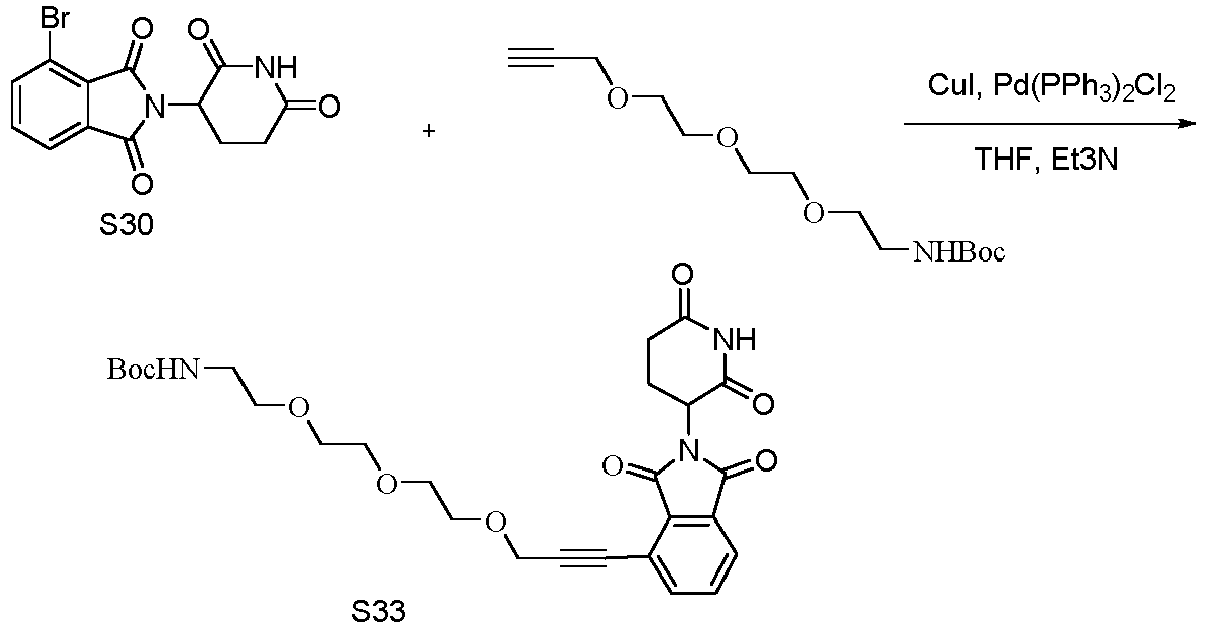
- To a round-bottom flask, S30 (50 mg) and tert-butyl (2-(2-(2-(prop-2-yn-1-yloxy)ethoxy)ethoxy)ethyl)carbamate (60 mg) were added to a solution of CuI (6.3 mg) and Pd(PPh3)2Cl2 (11 mg) in THF (5 mL) and Et3N (2 mL). The mixture was stirred for 10 hours at 70 °C under Ar and purified directly by flash column chromatography to yield S33 in 18 mg. ESI-MS calculated for C27H34N3O9 [M+H]+ = 544.2; Observed: 544.4.
-

- S33 (30 mg) was dissolved in MeOH (10 mL) and 5
mg 10% Pd/C was added. The reaction mixture was degassed 2 times, each time replacing the vacuum with hydrogen, then stirred at room temperature under H2 overnight. The mixture was filtered and concentrated on a rotary evaporator to give the crude which was dissolved in 3 mL of DCM and TFA (2:1). After stirring for 1 h, the solvent was evaporated to give crude product Cpd. No. 126, which was used in the next step without further purification. ESI-MS calculated for C22H30N3O7 [M+H]+ = 448.2; Observed: 448.3. -

- To a round-bottom flask, S30 (50 mg) and tert-butyl (2-(prop-2-yn-1-yloxy)ethyl)carbamate (60 mg) were added to a solution of CuI (6.3 mg) and Pd(PPh3)2Cl2 (11 mg) in THF (5 mL) and Et3N (2 mL). The mixture was stirred for 10 hours at 70 °C under Ar and purified directly by flash column chromatography to yield 19 mg of S35. ESI-MS calculated for C23H26N3O7 [M+H]+ = 456.1; Observed: 456.3.
-

- S35 (30 mg) was dissolved in MeOH (10 mL). 5
mg 10% Pd/C was added. the reaction mixture was degassed 2 times, each time replacing the vacuum with hydrogen, then stirred at room temperature under H2 overnight. The mixture was filtered and concentrated on a rotary evaporator to give the crude which was dissolved in 3 mL of DCM and TFA (2:1). After stirring for 1 h, the solvent was evaporated to give crude product Cpd. No. 127, which was used in the next step without further purification. ESI-MS calculated for C18H22N3O5 [M+H]+ = 360.1; Observed: 360.2. -

- To a round-bottom flask, N,N-diisopropylethylamine (50 mg) was added to a solution of 3-(4-amino-1-oxoisoindolin-2-yl)piperidine-2,6-dione (20 mg), HATU (30 mg), and 2,2-dimethyl-4-oxo-3,8,11-trioxa-5-azatetradecan-14-oic acid (50 mg) in DMF (1 mL) at room temperature. The mixture was stirred for 30 min and the solvent was evaporated as much as possible and the residue was poured into water. After extraction with ethyl acetate for three times, the combined organic layer was washed with brine and dried over anhydrous Na2SO4. After filtration and evaporation, the crude residue was dissolved in 3 mL of DCM and TFA (2:1). After stirring for 1 h, the solvent was evaporated to give the crude product which was purified by flash column chromatography to yield Cpd. No. 128. ESI-MS calculated for C20H27N4O6[M+H]+ = 419.1; Observed: 419.2.
-

- To a round-bottom flask, N,N-diisopropylethylamine (50 mg) was added to a solution of 3-(4-amino-1-oxoisoindolin-2-yl)piperidine-2,6-dione (20 mg), HATU (30 mg), and 2,2-dimethyl-4-oxo-3,8,11,14-tetraoxa-5-azaheptadecan-17-oic acid (50 mg) in DMF (1 mL) at room temperature. The mixture was stirred for 30 min and the solvent was evaporated as much as possible and the residue was poured into water. After extraction with ethyl acetate for three times, the combined organic layer was washed with brine and dried over anhydrous Na2SO4. After filtration and evaporation, the crude residue was dissolved in 3 mL of DCM and TFA (2:1). After stirring for 1 h, the solvent was evaporated to give the crude product which was purified by flash column chromatography to yield Cpd. No. 129. ESI-MS calculated for C22H31N4O7[M+H]+ = 463.2; Observed: 463.4.
-

- To solution of tert-butyl 4-hydroxybutyl)carbamate (380 mg, 2 mmol) in 15 ml of DCM was added Dess-Martin periodinane reagent (1.7 g, 4 mmol). After stirring at room temperature for 1 h the reaction mixture was filtered by celite. The filtrate was then washed with brine, dried over Na2SO4, filtered, and the solvent evaporated in vacuo. The residue was purified by chromatography over silica gel, to yield tert-butyl (4-oxobutyl)carbamate as colorless oil.
- To tert-butyl (4-oxobutyl)carbamate (190 mg, 1 mmol) in 1,2-dichloroethane (15 mL) was added Lenalidomide (285 mg, 1.1 mmol), and the resulting solution was stirred at room temperature for 30 min. The solution was treated with Na(OAc)3BH (0.42 g, 2 mmol), and the resulting suspension was stirred overnight. The solvent was diluted with DCM and washed with sat. NaHCO3, brine, dried (Na2SO4), filtered, and concentrated. Then residue was diluted in 10 mL DCM then 2 mL trifluoroacetic acid was added to the reaction and stirred for 30 min. The solvent was removed by vacuo and the residue was purified by reverse phase chromatography over C18 column to yield Cpd. No. 131 as colorless oil.
- HATU (13.3 mg, 1.2 eq.) and N,N-Diisopropylethylamine (0.026 mL, 0.15 mmol) were added to a solution of Cpd. A (20 mg, 0.029 mmol) in 0.5 mL DMF and stirred. After 10 minutes, Cpd. No. 131 (0.35 mL, 0.1 M in DMSO) was added to the reaction. After 30 minutes, the solvent was removed and the crude was dissolved in 3:1 methanol/water, acidified with trifluoroacetic acid and purified by reverse-phase preparative HPLC. The purified fractions were combined, concentrated in vacuo, re-dissolved in H2O, frozen and lyophilized to give Cpd. No. 19 (TFA salt) as a white powder.
- LC-MS(ESI) m/z (M +H)+: 894.25, 4.96 min; calcd: 894.29; >98% purity.
-

- HATU (380 mg, 1 mmol) and N,N-diisopropylethylamine (0.44 mL, 2.5 mmol) were added to a solution of Boc-5-aminopentanoic acid (110 mg, 0.5 mmol) in 3 mL DMF and stirred. After 10 minutes, Lenalidomide (200 mg, 0.75 mmol) was added to the reaction. After 30 minutes, the solvent was removed and the crude was dissolved in 10 mL DCM and 2 mL trifluoroacetic acid. The reaction was stirred for 30min and then the solvent was removed by vacuo. The residue was purified by reverse phase chromatography over C18 column to yield 5-amino-N-(2-(2,6-dioxopiperidin-3-yl)-1-oxoisoindolin-4-yl)pentanamide as colorless oil.
- HATU (13.3 mg, 1.2 eq.) and N,N-diisopropylethylamine (0.026 mL, 0.15 mmol) were added to a solution of Cpd. A (20 mg, 0.029 mmol) in 0.5 mL DMF and stirred. After 10 minutes, 5-amino-N-(2-(2,6-dioxopiperidin-3-yl)-1-oxoisoindolin-4-yl)pentanamide (0.35 mL, 0.1 M in DMSO) was added to the reaction. After 30 minutes, the solvent was removed and the crude was dissolved in 3:1 methanol/water, acidified with trifluoroacetic acid and purified by reverse-phase preparative HPLC. The purified fractions were combined, concentrated in vacuo, re-dissolved in H2O, frozen and lyophilized to give Cpd. No. 28 (TFA salt) as a white powder.
- LC-MS(ESI) m/z (M+H)+:922.26, 5.39 min; calcd: 922.29; >98% purity. 1H NMR (400 MHz, MeOD) δ 7.77 (d, J = 8.2 Hz, 2H), 7.74 - 7.67 (m, 2H), 7.63 - 7.57 (m, 3H), 7.54 (dd, J = 8.2, 2.4 Hz, 1H), 7.47 (t, J = 7.7 Hz, 1H), 7.39 - 7.31 (m, 1H), 7.17 (t, J= 8.1 Hz, 1H), 7.11 (dd, J = 8.2, 1.9 Hz, 1H), 6.79 (d, J = 1.9 Hz, 1H), 5.38 (d, J = 10.9 Hz, 1H), 5.12 (dd, J = 13.3, 5.1 Hz, 1H), 4.98 (d, J = 10.9 Hz, 1H), 4.45 (d, J = 2.1 Hz, 2H), 3.40 (t, J = 6.7 Hz, 2H), 3.02 - 2.79 (m, 2H), 2.78 - 2.66 (m, 1H), 2.57 - 2.30 (m, 3H), 2.21 (d, J = 14.0 Hz, 1H), 2.17 - 2.07 (m, 1H), 2.06 - 1.88 (m, 3H), 1.81 - 1.63 (m, 6H), 1.60 - 1.46 (m, 1H), 1.24 (td, J= 13.8, 3.9 Hz, 2H).
-

- To a solution of tert-butyl pent-4-yn-1-ylcarbamate (236 mg, 1.29 mmol) and 3-(4-bromo-1-oxoisoindolin-2-yl)piperidine-2,6-dione (400mg, 1.29 mmol) in triethylamine (3 mL) and DMF (3 mL), CuI (50 mg, 0.25 mmol) and the Pd(Ph3P)2Cl2 (90 mg, 0.13 mmol) were added. The mixture was stirred at 80°C under N2-atmosphere overnight. The reaction mixture was poured into a saturated aqueous solution of NH4Cl and after separation of the organic layer the aqueous layer was extracted with Ethyl Acetate. The combined organic layers were washed with brine, dried over Na2SO4 and concentrated in vacuo. The crude product was purified by flash chromatography to afford tert-butyl (5-(2-(2,6-dioxopiperidin-3-yl)-1-oxoisoindolin-4-yl)pent-4-yn-1-yl)carbamate as white solid.
- To a solution of tert-butyl (5-(2-(2,6-dioxopiperidin-3-yl)-1-oxoisoindolin-4-yl)pent-4-yn-1-yl)carbamate (210 mg, 0.5 mmol) in EtOH (5 mL) was added Pd/C (20 mg). The reaction was stirred under H2-atmosphere for 2 hr. Then the mixture was filtered by celite and the solvent was removed by vacuo. The residue was dissolved in 10 mL DCM and 2 mL trifluoroacetic acid. The reaction was stirred for 30min and then the solvent was removed by vacuo. The residue was purified by reverse phase chromatography over C18 column to 3-(4-(5-aminopentyl)-1-oxoisoindolin-2-yl)piperidine-2,6-dione as colorless oil.
- HATU (13.3 mg, 1.2 eq.) and N,N-diisopropylethylamine (0.026 mL, 0.15 mmol) were added to a solution of Cpd. A (20 mg, 0.029 mmol) in 0.5 mL DMF and stirred. After 10 minutes, 3-(4-(5-aminopentyl)-1-oxoisoindolin-2-yl)piperidine-2,6-dione (0.35 mL, 0.1 M in DMSO) was added to the reaction. After 30 minutes, the solvent was removed and the crude was dissolved in 3:1 methanol/water, acidified with trifluoroacetic acid and purified by reverse-phase preparative HPLC. The purified fractions were combined, concentrated in vacuo, re-dissolved in H2O, frozen and lyophilized to give Cpd. No. 31 (TFA salt) as a white powder.
- LC-MS(ESI) m/z (M+H)+: 893.19, 6.12 min; calcd (M+H)+ : 893.30; >98% purity. 1H NMR (400 MHz, MeOD) δ 7.78 - 7.66 (m, 3H), 7.66 - 7.56 (m, 3H), 7.53 (dd, J = 8.2, 2.5 Hz, 1H), 7.47 - 7.38 (m, 2H), 7.38 - 7.32 (m, 1H), 7.17 (t, J = 8.1 Hz, 1H), 7.11 (dd, J = 8.2, 2.0 Hz, 1H), 6.79 (d, J= 1.9 Hz, 1H), 5.29 (d, J = 10.7 Hz, 1H), 5.14 (dd, J= 13.3, 5.2 Hz, 1H), 4.97 (d, J= 10.8 Hz, 1H), 4.46 (dd, J= 5.7, 2.5 Hz, 2H), 3.41 - 3.33 (m, 2H), 2.96 - 2.64 (m, 5H), 2.50 (qdd, J = 13.3, 4.6, 2.5 Hz, 1H), 2.22 - 2.09 (m, 2H), 2.02 - 1.84 (m, 3H), 1.79 - 1.48 (m, 7H), 1.48 - 1.35 (m, 2H), 1.22 (td, J= 13.7, 4.0 Hz, 2H).
- The following Compounds of the Disclosure were prepared using the illustrative methods described in the General Schemes, Examples 1-17, and/or methods known to those skilled in the art in view of this disclosure.
- Cpd. No. 2: (3'R,4'S,5'R)-6"-chloro-4'-(3-chloro-2-fluorophenyl)-N-(4-((1-((2-(2,6-dioxopiperidin-3-yl)-1,3-dioxoisoindolin-4-yl)oxy)-2-oxo-7,10,13-trioxa-3-azahexadecan-16-yl)carbamoyl)phenyl)-2"-oxodispiro[cyclohexane-1,2'-pyrrolidine-3',3"-indoline]-5'-carboxamide; LC-MS(ESI) m/z (M+H)+: 1098.32, 5.27 min; calcd: 1098.36; >98% purity.
- Cpd. No. 3: (3'R,4'S,5'R)-6"-chloro-4'-(3-chloro-2-fluorophenyl)-N-(4-((1-((2-(2,6-dioxopiperidin-3-yl)-1,3-dioxoisoindolin-4-yl)amino)-2-oxo-7,10,13-trioxa-3-azahexadecan-16-yl)carbamoyl)phenyl)-2"-oxodispiro[cyclohexane-1,2'-pyrrolidine-3',3"-indoline]-5'-carboxamide; LC-MS(ESI) m/z (M +H)+: 1097.34, 5.48 min; calcd: 1097.37; >98% purity. 1H NMR (400 MHz, MeOD) δ 7.78 - 7.74 (m, 2H), 7.71 (t, J = 6.6 Hz, 1H), 7.60 (d, J = 8.7 Hz, 2H), 7.52 (dd, J = 8.3, 7.4 Hz, 2H), 7.35 (t, J = 7.0 Hz, 1H), 7.17 (t, J = 8.0 Hz, 1H), 7.10 (dd, J = 8.2, 1.8 Hz, 1H), 7.07 (d, J = 7.1 Hz, 1H), 6.84 (d, J = 8.4 Hz, 1H), 6.79 (d, J = 1.9 Hz, 1H), 5.31 (d, J = 10.8 Hz, 1H), 5.06 (dd, J = 12.5, 5.4 Hz, 1H), 4.96 (d, J = 10.8 Hz, 1H), 3.97 (s, 2H), 3.61 - 3.52 (m, 8H), 3.48 - 3.40 (m, 6H), 3.30 - 3.25 (m, 2H), 2.85 (ddd, J = 17.7, 14.2, 5.1 Hz, 2H), 2.79 - 2.67 (m, 2H), 2.17 (d, J = 13.5 Hz, 1H), 2.13 - 2.05 (m, 1H), 1.96 - 1.68 (m, 9H), 1.55 (dd, J = 27.1, 13.6 Hz, 1H), 1.22 (td, J = 13.6, 3.7 Hz, 3H).
- Cpd. No. 4: (3'R,4'S,5'R)-6"-chloro-4'-(3-chloro-2-fluorophenyl)-N-(4-((2-(2-(2-(2-((2-(2,6-dioxopiperidin-3-yl)-1,3-dioxoisoindolin-4-yl)oxy)ethoxy)ethoxy)ethoxy)ethyl)carbamoyl)phenyl)-2"-oxodispiro[cyclohexane-1,2'-pyrrolidine-3',3"-indoline]-5'-carboxamide; LC-MS(ESI) m/z (M +H)+: 1013.33, 5.37 min; calcd: 1013.31; >98% purity. 1H NMR (400 MHz, MeOD) δ 7.77 (d, J = 8.8 Hz, 2H), 7.74 - 7.65 (m, 2H), 7.60 (d, J = 8.7 Hz, 2H), 7.52 (dd, J = 8.2, 2.4 Hz, 1H), 7.42 - 7.30 (m, 3H), 7.17 (t, J = 8.0 Hz, 1H), 7.10 (dd, J = 8.2, 1.5 Hz, 1H), 6.79 (d, J = 1.8 Hz, 1H), 5.29 (d, J = 10.7 Hz, 1H), 5.08 (dd, J = 12.4, 5.5 Hz, 1H), 4.95 (d, J = 10.8 Hz, 1H), 4.33 - 4.25 (m, 2H), 3.90 - 3.82 (m, 2H), 3.75 - 3.69 (m, 2H), 3.65 - 3.58 (m, 8H), 3.52 (t, J = 5.3 Hz, 2H), 2.89 - 2.66 (m, 4H), 2.19 - 2.05 (m, 2H), 1.98 - 1.84 (m, 3H), 1.77 (d, J = 10.9 Hz, 2H), 1.55 (dd, J = 27.2, 13.7 Hz, 1H), 1.26 - 1.14 (m, 2H).
- Cpd. No. 5: (3'R,4'S,5'R)-6"-chloro-4'-(3-chloro-2-fluorophenyl)-N-(4-(4-((3-(2-(2-(3-((2-(2,6-dioxopiperidin-3-yl)-1,3-dioxoisoindolin-4-yl)amino)propoxy)ethoxy)ethoxy)propyl)amino)piperidine-1-carbonyl)phenyl)-2"-oxodispiro[cyclohexane-1,2'-pyrrolidine-3',3"-indoline]-5'-carboxamide; LC-MS(ESI) m/z (M +H)+: 1123.37, 4.83 min; calcd: 1123.43; >98% purity. 1H NMR (400 MHz, Methanol-d 4) δ 7.71 (t, J = 7.2 Hz, 1H), 7.68 - 7.60 (m, 2H), 7.54 - 7.45 (m, 2H), 7.42 - 7.35 (m, 2H), 7.35 - 7.30 (m, 1H), 7.19 - 7.12 (m, 1H), 7.09 (ddd, J = 8.3, 2.0, 0.8 Hz, 1H), 7.06 - 6.95 (m, 2H), 6.78 (d, J = 1.9 Hz, 1H), 5.17 (d, J = 7.4 Hz, 1H), 5.04 (dd, J = 12.4, 5.5 Hz, 1H), 4.92 (d, J = 10.0 Hz, 1H), 3.80 - 3.45 (m, 13H), 3.38 (t, J = 5.9 Hz, 3H), 3.18 (t, J = 6.7 Hz, 2H), 2.97 - 2.79 (m, 2H), 2.79 - 2.60 (m, 3H), 2.23 - 2.02 (m, 4H), 2.02 - 1.62 (m, 10H), 1.63 - 1.44 (m, 3H), 1.34 - 1.04 (m, 3H).
- Cpd. No. 6: (3'R,4'S,5'R)-6"-chloro-4'-(3-chloro-2-fluorophenyl)-N-(4-((4-(2-(2-(2-(2-((2-(2,6-dioxopiperidin-3-yl)-1,3-dioxoisoindolin-4-yl)amino)ethoxy)ethoxy) ethoxy)ethoxy)phenyl)carbamoyl)phenyl)-2"-oxodispiro[cyclohexane-1,2'-pyrrolidine-3',3"-indoline]-5'-carboxamide; LC-MS(ESI) m/z (M +H)+: 1104.29, 6.47 min; calcd: 1104.35; >98% purity.
- Cpd. No. 7: (3'R,4'S,5'R)-6"-chloro-4'-(3-chloro-2-fluorophenyl)-N-(4-((2-((2-(2,6-dioxopiperidin-3-yl)-1,3-dioxoisoindolin-4-yl)amino)ethyl)carbamoyl)phenyl)-2"-oxodispiro[cyclohexane-1,2'-pyrrolidine-3',3"-indoline]-5'-carboxamide; LC-MS(ESI) m/z (M +H)+: 880.21, 5.66 min; calcd: 880.24; >98% purity.
- Cpd. No. 8: (3'R,4'S,5'R)-6"-chloro-4'-(3-chloro-2-fluorophenyl)-N-(4-((3-((2-(2,6-dioxopiperidin-3-yl)-1,3-dioxoisoindolin-4-yl)amino)propyl)carbamoyl)phenyl)-2"-oxodispiro[cyclohexane-1,2'-pyrrolidine-3',3"-indoline]-5'-carboxamide; LC-MS(ESI) m/z (M +H)+: 894.24, 5.31 min; calcd: 894.26; >98% purity.
- Cpd. No. 9: (3'R,4'S,5'R)-6"-chloro-4'-(3-chloro-2-fluorophenyl)-N-(4-((4-((2-(2,6-dioxopiperidin-3-yl)-1,3-dioxoisoindolin-4-yl)amino)butyl)carbamoyl)phenyl)-2"-oxodispiro[cyclohexane-1,2'-pyrrolidine-3',3"-indoline]-5'-carboxamide; LC-MS(ESI) m/z (M +H)+: 908.32, 5.86 min; calcd: 908.27; >98% purity. 1H NMR (400 MHz, MeOD) δ 7.79 - 7.68 (m, 3H), 7.63 - 7.58 (m, 2H), 7.53 (dd, J = 8.3, 2.4 Hz, 1H), 7.49 (ddd, J= 8.5, 7.1, 1.4 Hz, 1H), 7.39 - 7.32 (m, 1H), 7.17 (t, J = 8.1 Hz, 1H), 7.11 (dd, J = 8.2, 2.0 Hz, 1H), 7.02 (d, J = 8.6 Hz, 1H), 6.98 (dd, J = 6.8, 2.8 Hz, 1H), 6.79 (d, J = 1.9 Hz, 1H), 5.30 (d, J= 10.7 Hz, 1H), 5.03 (dd, J= 12.6, 5.5 Hz, 1H), 4.96 (d, J= 10.8 Hz, 1H), 3.44 - 3.34 (m, 4H), 2.92 - 2.79 (m, 2H), 2.78 - 2.65 (m, 2H), 2.17 (d, J= 14.1 Hz, 1H), 2.13 - 2.05 (m, 1H), 2.02 - 1.87 (m, 3H), 1.81 - 1.69 (m, 6H), 1.62 - 1.48 (m, 1H), 1.27 - 1.16 (m, 2H).
- Cpd. No. 10: (3'R,4'S,5'R)-6"-chloro-4'-(3-chloro-2-fluorophenyl)-N-(4-((5-((2-(2,6-dioxopiperidin-3-yl)-1,3-dioxoisoindolin-4-yl)amino)pentyl)carbamoyl)phenyl)-2"-oxodispiro[cyclohexane-1,2'-pyrrolidine-3',3"-indoline]-5'-carboxamide; LC-MS(ESI) m/z (M +H)+: 922.30, 6.54 min; calcd: 922.29; >98% purity. 1H NMR (400 MHz, MeOD) δ 7.79 - 7.67 (m, 3H), 7.63 - 7.57 (m, 2H), 7.57 - 7.46 (m, 2H), 7.37 - 7.30 (m, 1H), 7.16 (t, J = 7.9 Hz, 1H), 7.10 (dd, J = 8.2, 1.9 Hz, 1H), 7.02 (d, J = 8.6 Hz, 1H), 6.98 (dd, J = 6.7, 4.1 Hz, 1H), 6.78 (d, J = 1.9 Hz, 1H), 5.22 (d, J = 9.8 Hz, 1H), 5.04 - 4.98 (m, 1H), 4.95 (dd, J = 10.6, 2.9 Hz, 1H), 3.41 - 3.33 (m, 4H), 2.90 - 2.61 (m, 4H), 2.17 - 2.04 (m, 2H), 1.97 - 1.82 (m, 3H), 1.78 - 1.49 (m, 9H), 1.24 - 1.13 (m, 2H).
- Cpd. No. 11: (3'R,4'S,5'R)-6"-chloro-4'-(3-chloro-2-fluorophenyl)-N-(4-((6-((2-(2,6-dioxopiperidin-3-yl)-1,3-dioxoisoindolin-4-yl)amino)hexyl)carbamoyl)phenyl)-2"-oxodispiro[cyclohexane-1,2'-pyrrolidine-3',3"-indoline]-5'-carboxamide; LC-MS(ESI) m/z (M +H)+: 936.27, 6.76 min; calcd: 936.31; >98% purity. 1H NMR (400 MHz, MeOD) δ 7.76 (d, J= 8.7 Hz, 2H), 7.71 (t, J= 6.7 Hz, 1H), 7.60 (d, J= 8.7 Hz, 2H), 7.56 - 7.47 (m, 2H), 7.36 (t, J = 7.0 Hz, 1H), 7.18 (t, J = 8.0 Hz, 1H), 7.11 (dd, J = 8.2, 1.9 Hz, 1H), 7.02 - 6.97 (m, 2H), 6.79 (d, J = 1.9 Hz, 1H), 5.33 (d, J = 10.9 Hz, 1H), 5.03 (dd, J = 12.4, 5.3 Hz, 1H), 4.97 (d, J = 10.9 Hz, 1H), 3.40 - 3.27 (m, 4H), 2.93 - 2.65 (m, 4H), 2.19 (d, J = 11.6 Hz, 1H), 2.15 - 2.06 (m, 1H), 2.04 - 1.89 (m, 3H), 1.78 (d, J = 11.8 Hz, 2H), 1.71 - 1.59 (m, 4H), 1.55 - 1.38 (m, 5H), 1.27 - 1.18 (m, 2H).
- Cpd. No.12: (3'R,4'S,5'R)-6"-chloro-4'-(3-chloro-2-fluorophenyl)-N-(4-((7-((2-(2,6-dioxopiperidin-3-yl)-1,3-dioxoisoindolin-4-yl)amino)heptyl)carbamoyl)phenyl)-2"-oxodispiro[cyclohexane-1,2'-pyrrolidine-3',3"-indoline]-5'-carboxamide; LC-MS(ESI) m/z (M +H)+: 950.29, 7.10min; calcd: 950.32; >98% purity. 1H NMR (400 MHz, MeOD) δ 7.80 - 7.74 (m, 2H), 7.74 - 7.68 (m, 1H), 7.64 - 7.59 (m, 2H), 7.55 - 7.47 (m, 2H), 7.37 - 7.30 (m, 1H), 7.16 (t, J = 8.1 Hz, 1H), 7.10 (dd, J = 8.2, 1.9 Hz, 1H), 7.01 (s, 1H), 6.99 (d, J = 2.2 Hz, 1H), 6.79 (d, J = 1.9 Hz, 1H), 5.27 (d, J = 10.6 Hz, 1H), 5.03 (dd, J= 12.6, 5.4 Hz, 1H), 4.95 (d, J= 10.7 Hz, 1H), 3.38 - 3.27 (m, 4H), 2.90 - 2.64 (m, 4H), 2.20 - 2.05 (m, 2H), 2.00 - 1.84 (m, 3H), 1.83 - 1.71 (m, 2H), 1.67 - 1.53 (m, 5H), 1.46 - 1.35 (m, 6H), 1.25 - 1.13 (m, 2H).
- Cpd. No. 13: (3'R,4'S,5'R)-6"-chloro-4'-(3-chloro-2-fluorophenyl)-N-(4-((2-(2-((2-(2,6-dioxopiperidin-3-yl)-1,3-dioxoisoindolin-4-yl)amino)ethoxy)ethyl)carbamoyl)phenyl)-2"-oxodispiro[cyclohexane-1,2'-pyrrolidine-3',3"-indoline]-5'-carboxamide; LC-MS(ESI) m/z (M +H)+: 924.20, 5.28 min; calcd: 924.27; >98% purity. 1H NMR (400 MHz, MeOD) δ 7.76 - 7.68 (m, 3H), 7.61 - 7.51 (m, 3H), 7.47 - 7.39 (m, 1H), 7.35 (t, J = 7.6 Hz, 1H), 7.19 (t, J = 8.1 Hz, 1H), 7.11 (dd, J = 8.2, 0.9 Hz, 1H), 7.01 (d, J = 8.6 Hz, 1H), 6.91 (t, J = 7.2 Hz, 1H), 6.79 (d, J = 1.9 Hz, 1H), 5.39 (d, J = 10.9 Hz, 1H), 5.03 - 4.92 (m, 3H), 3.69 (dt, J = 10.5, 5.0 Hz, 4H), 3.58 - 3.50 (m, 2H), 3.45 (t, J = 4.9 Hz, 2H), 3.03 - 2.53 (m, 4H), 2.22 (d, J = 13.4 Hz, 1H), 2.09 - 1.86 (m, 4H), 1.78 (d, J = 12.1 Hz, 2H), 1.54 (dd, J = 27.2, 13.5 Hz, 1H), 1.29 - 1.12 (m, 2H).
- Cpd. No. 14: (3'R,4'S,5'R)-6"-chloro-4'-(3-chloro-2-fluorophenyl)-N-(4-((2-(2-(2-((2-(2,6-dioxopiperidin-3-yl)-1,3-dioxoisoindolin-4-yl)amino)ethoxy)ethoxy)ethyl)carbamoyl)phenyl)-2"-oxodispiro[cyclohexane-1,2'-pyrrolidine-3',3"-indoline]-5'-carboxamide; LC-MS(ESI) m/z (M +H)+: 968.35, 5.58 min; calcd: 968.30; >98% purity. 1H NMR (400 MHz, MeOD) δ 7.79 - 7.66 (m, 3H), 7.59 - 7.47 (m, 3H), 7.40 - 7.27 (m, 2H), 7.19 (t, J = 8.1 Hz, 1H), 7.10 (dd, J = 8.2, 1.8 Hz, 1H), 6.95 - 6.83 (m, 2H), 6.79 (d, J = 1.9 Hz, 1H), 5.40 (d, J = 10.9 Hz, 1H), 5.03 - 4.96 (m, 3H), 3.73 - 3.62 (m, 8H), 3.57 - 3.50 (m, 2H), 3.42 - 3.35 (m, 2H), 2.94 (d, J = 8.0 Hz, 1H), 2.85 - 2.57 (m, 3H), 2.21 (d, J = 13.6 Hz, 1H), 2.07 - 1.87 (m, 4H), 1.76 (d, J = 11.6 Hz, 2H), 1.53 (dd, J = 26.9, 13.3 Hz, 1H), 1.31 - 1.10 (m, 2H).
- Cpd. No. 15: (3'R,4'S,5'R)-6"-chloro-4'-(3-chloro-2-fluorophenyl)-N-(4-((2-(2-(2-(2-((2-(2,6-dioxopiperidin-3-yl)-1,3-dioxoisoindolin-4-yl)amino) ethoxy)ethoxy)ethoxy)ethyl)carbamoyl)phenyl)-2"-oxodispiro[cyclohexane-1,2'-pyrrolidine-3',3"-indoline]-5'-carboxamide; LC-MS(ESI) m/z (M +H)+: 1012.30, 5.68 min; calcd: 1012.32; >98% purity. 1H NMR (400 MHz, MeOD) δ 7.76 (d, J = 8.7 Hz, 2H), 7.72 (t, J = 6.6 Hz, 1H), 7.58 (d, J = 8.7 Hz, 2H), 7.53 (dd, J = 8.2, 2.3 Hz, 1H), 7.49 - 7.43 (m, 1H), 7.36 (t, J = 7.0 Hz, 1H), 7.19 (t, J = 8.1 Hz, 1H), 7.11 (dd, J = 8.2, 1.8 Hz, 1H), 6.99 (d, J = 8.0 Hz, 2H), 6.79 (d, J = 1.9 Hz, 1H), 5.37 (d, J = 10.9 Hz, 1H), 5.02 (ddd, J = 12.3, 5.4, 1.3 Hz, 1H), 4.97 (d, J = 11.0 Hz, 1H), 3.68 - 3.60 (m, 12H), 3.52 (t, J = 5.3 Hz, 2H), 3.42 (t, J = 5.2 Hz, 2H), 2.95 - 2.87 (m, 1H), 2.86 - 2.79 (m, 1H), 2.76 - 2.61 (m, 2H), 2.21 (d, J = 13.4 Hz, 1H), 2.13 - 2.05 (m, 1H), 2.00 - 1.88 (m, 3H), 1.77 (d, J = 11.7 Hz, 2H), 1.53 (dd, J = 27.1, 13.2 Hz, 1H), 1.29 - 1.19 (m, 2H).
- Cpd. No. 16: (3'R,4'S,5'R)-6"-chloro-4'-(3-chloro-2-fluorophenyl)-N-(4-((23-((2-(2,6-dioxopiperidin-3-yl)-1,3-dioxoisoindolin-4-yl)amino)-3,6,9,12,15,18,21-heptaoxatricosyl)carbamoyl) phenyl)-2"-oxodispiro[cyclohexane-1,2'-pyrrolidine-3',3"-indoline]-5'-carboxamide; LC-MS(ESI) m/z (M +H)+: 1188.42, 5.69 min; calcd: 1188.43; >98% purity. 1H NMR (400 MHz, MeOD) δ 7.84 - 7.77 (m, 2H), 7.70 (t, J = 6.5 Hz, 1H), 7.66 - 7.59 (m, 2H), 7.55 - 7.48 (m, 2H), 7.39 - 7.31 (m, 1H), 7.16 (t, J = 8.0 Hz, 1H), 7.09 (dd, J = 8.2, 1.5 Hz, 1H), 7.06 (d, J = 8.5 Hz, 1H), 7.03 (d, J = 7.1 Hz, 1H), 6.78 (d, J = 1.9 Hz, 1H), 5.23 (d, J = 10.3 Hz, 1H), 5.04 (dd, J = 12.5, 5.5 Hz, 1H), 4.94 (d, J = 10.7 Hz, 1H), 3.70 (t, J = 5.3 Hz, 2H), 3.64 - 3.54 (m, 28H), 3.47 (t, J = 5.3 Hz, 2H), 2.88 - 2.65 (m, 4H), 2.18 - 2.05 (m, 2H), 2.00 - 1.81 (m, 3H), 1.75 (t, J = 11.9 Hz, 2H), 1.56 (dd, J = 27.2, 13.5 Hz, 1H), 1.27 -1.12 (m, 2H).
- Cpd. No. 17: (3'R,4'S,5'R)-6"-chloro-4'-(3-chloro-2-fluorophenyl)-N-(4-((3-(4-(3-((2-(2,6-dioxopiperidin-3-yl)-1,3-dioxoisoindolin-4-yl)amino)propoxy)butoxy)propyl) carbamoyl)phenyl)-2"-oxodispiro[cyclohexane-1,2'-pyrrolidine-3',3"-indoline]-5'-carboxamide; LC-MS(ESI) m/z (M +H)+: 1024.35, 6.54 min; calcd: 1024.36; >98% purity. 1H NMR (400 MHz, MeOD) δ 7.76 (d, J= 8.7 Hz, 2H), 7.71 (t, J= 6.6 Hz, 1H), 7.61 (d, J = 8.7 Hz, 2H), 7.54 - 7.45 (m, 2H), 7.39 - 7.30 (m, 1H), 7.17 (t, J = 8.0 Hz, 1H), 7.10 (dd, J = 8.2, 1.8 Hz, 1H), 7.00 (d, J = 8.1 Hz, 2H), 6.79 (d, J = 1.9 Hz, 1H), 5.29 (d, J = 10.7 Hz, 1H), 5.03 (dd, J = 12.5, 5.4 Hz, 1H), 4.95 (d, J = 10.8 Hz, 1H), 3.52 (dd, J = 10.4, 5.8 Hz, 4H), 3.47 - 3.40 (m, 6H), 3.38 (t, J = 6.6 Hz, 2H), 2.92 - 2.62 (m, 4H), 2.16 (d, J = 13.3 Hz, 1H), 2.13 - 2.04 (m, 1H), 1.99 - 1.82 (m, 7H), 1.76 (d, J = 12.1 Hz, 2H), 1.64 (t, J= 2.9 Hz, 4H), 1.54 (dd, J= 25.8, 12.1 Hz, 1H), 1.27 - 1.15 (m, 2H).
- Cpd. No. 18: (3'R,4'S,5'R)-6"-chloro-4'-(3-chloro-2-fluorophenyl)-N-(4-((3-(2-(2-(3-((2-(2,6-dioxopiperidin-3-yl)-1,3-dioxoisoindolin-4-yl)amino)propoxy) ethoxy)ethoxy)propyl)carbamoyl)phenyl)-2"-oxodispiro[cyclohexane-1,2'-pyrrolidine-3',3"-indoline]-5'-carboxamide; LC-MS(ESI) m/z (M +H)+: 1040.40, 5.93 min; calcd: 1040.35; >98% purity. 1H NMR (400 MHz, MeOD) δ 7.80 - 7.74 (m, 2H), 7.70 (t, J = 7.1 Hz, 1H), 7.61 (d, J= 8.6 Hz, 2H), 7.55 - 7.46 (m, 2H), 7.39 - 7.31 (m, 1H), 7.17 (t, J = 8.1 Hz, 1H), 7.10 (dd, J = 8.2, 1.6 Hz, 1H), 7.04 - 6.96 (m, 2H), 6.79 (d, J = 1.9 Hz, 1H), 5.26 (d, J = 10.4 Hz, 1H), 5.03 (dd, J = 12.4, 5.5 Hz, 1H), 4.94 (d, J = 10.7 Hz, 1H), 3.68 - 3.62 (m, 4H), 3.62 - 3.54 (m, 8H), 3.45 (t, J = 6.6 Hz, 2H), 3.38 (t, J = 6.5 Hz, 2H), 2.90 - 2.67 (m, 4H), 2.20 - 2.05 (m, 2H), 1.96 - 1.73 (m, 9H), 1.55 (dd, J = 27.1, 13.6 Hz, 1H), 1.27 - 1.13 (m, 2H).
- Cpd. No. 20: (3'R,4'S,5'R)-6"-chloro-4'-(3-chloro-2-fluorophenyl)-N-(4-((2-(2-((2-(2,6-dioxopiperidin-3-yl)-1-oxoisoindolin-4-yl)amino)ethoxy)ethyl)carbamoyl)phenyl)-2"-oxodispiro[cyclohexane-1,2'-pyrrolidine-3',3"-indoline]-5'-carboxamide; LC-MS(ESI) m/z (M +H)+: 910.19, 5.15 min; calcd: 910.29; >98% purity. 1H NMR (400 MHz, MeOD) δ 7.71 (t, J = 6.8 Hz, 1H), 7.65 - 7.55 (m, 3H), 7.50 (d, J = 8.7 Hz, 1H), 7.44 (d, J = 8.7 Hz, 1H), 7.36 (t, J = 7.6 Hz, 1H), 7.26 (td, J = 7.8, 2.3 Hz, 1H), 7.18 (t, J = 8.0 Hz, 1H), 7.12 (dd, J = 8.2, 1.8 Hz, 1H), 7.03 (dd, J = 7.3, 3.4 Hz, 1H), 6.83 (dd, J = 8.1, 4.5 Hz, 1H), 6.80 (d, J = 1.8 Hz, 1H), 5.32 (d, J = 10.4 Hz, 1H), 5.12 - 5.04 (m, 1H), 5.01 (d, J = 10.9 Hz, 1H), 4.26 - 4.05 (m, 2H), 3.73 (t, J = 4.8 Hz, 2H), 3.67 (t, J = 50 Hz, 2H), 3.59 - 3.51 (m, 2H), 3.41 - 3.35 (m, 2H), 3.01 - 2.76 (m, 3H), 2.42 - 2.29 (m, 1H), 2.24 - 2.09 (m, 2H), 2.05 - 1.91 (m, 3H), 1.79 (d, J = 12.1 Hz, 2H), 1.57 (dd, J = 24.5, 11.9 Hz, 1H), 1.24 (t, J = 11.8 Hz, 2H).
- Cpd. No. 21: (3'R,4'S,5'R)-6"-chloro-4'-(3-chloro-2-fluorophenyl)-N-(4-((2-(2-(2-((2-(2,6-dioxopiperidin-3-yl)-1-oxoisoindolin-4-yl)amino)ethoxy)ethoxy) ethyl)carbamoyl)phenyl)-2"-oxodispiro[cyclohexane-1,2'-pyrrolidine-3',3"-indoline]-5'-carboxamide; LC-MS(ESI) m/z (M +H)+: 954.24, 4.88 min; calcd: 954.32; >98% purity. 1H NMR (400 MHz, MeOD) δ 7.77 - 7.68 (m, 3H), 7.57 - 7.49 (m, 2H), 7.45 (d, J = 8.8 Hz, 1H), 7.36 (t, J = 7.5 Hz, 1H), 7.25 (td, J = 7.8, 2.8 Hz, 1H), 7.18 (t, J = 8.2 Hz, 1H), 7.12 (ddd, J = 8.3, 1.9, 0.9 Hz, 1H), 7.06 (dd, J = 7.0, 5.2 Hz, 1H), 6.84 - 6.74 (m, 2H), 5.28 (d, J = 10.6 Hz, 1H), 5.11 (td, J = 13.5, 5.2 Hz, 1H), 4.96 (d, J = 10.9 Hz, 1H), 4.26 - 4.10 (m, 2H), 3.77 - 3.60 (m, 8H), 3.55 (t, J = 4.4 Hz, 2H), 3.39 - 3.35 (m, 2H), 2.93 - 2.70 (m, 3H), 2.48 - 2.31 (m, 1H), 2.24 - 2.05 (m, 2H), 2.04 - 1.88 (m, 3H), 1.78 (d, J = 10.9 Hz, 2H), 1.62 - 1.52 (m, 1H), 1.28 - 1.15 (m, 2H).
- Cpd. No. 22: (3'R,4'S,5'R)-6"-chloro-4'-(3-chloro-2-fluorophenyl)-N-(4-((2-(2-(2-(2-((2-(2,6-dioxopiperidin-3-yl)-1-oxoisoindolin-4-yl)amino)ethoxy)ethoxy)ethoxy) ethyl)carbamoyl)phenyl)-2"-oxodispiro[cyclohexane-1,2'-pyrrolidine-3',3"-indoline]-5'-carboxamide; LC-MS(ESI) m/z (M +H)+: 998.29, 5.21 min; calcd: 998.34; >98% purity. 1H NMR (400 MHz, MeOD) δ 7.76 (dd, J = 8.8, 2.8 Hz, 2H), 7.71 (t, J = 7.0 Hz, 1H), 7.57 (t, J = 8.3 Hz, 2H), 7.51 (dt, J = 8.2, 2.7 Hz, 1H), 7.36 (t, J = 7.6 Hz, 1H), 7.30 - 7.23 (m, 1H), 7.18 (t, J = 8.1 Hz, 1H), 7.11 (d, J = 8.2 Hz, 1H), 7.07 (dd, J = 7.3, 2.2 Hz, 1H), 6.84 - 6.77 (m, 2H), 5.32 (d, J = 10.9 Hz, 1H), 5.16 - 5.10 (m, 1H), 4.95 (dd, J = 10.8, 2.7 Hz, 1H), 4.32 - 4.19 (m, 2H), 3.68 - 3.60 (m, 12H), 3.52 (t, J = 5.3 Hz, 2H), 3.36 (t, J = 4.6 Hz, 2H), 2.97 - 2.86 (m, 2H), 2.80 - 2.71 (m, 1H), 2.50 - 2.37 (m, 1H), 2.22 - 2.12 (m, 2H), 1.94 (dd, J = 19.7, 10.4 Hz, 3H), 1.78 (d, J = 12.3 Hz, 2H), 1.54 (dd, J = 25.6, 13.6 Hz, 1H), 1.28 - 1.17 (m, 2H).
- Cpd. No. 23: (3'R,4'S,5'R)-6"-chloro-4'-(3-chloro-2-fluorophenyl)-N-(4-((14-((2-(2,6-dioxopiperidin-3-yl)-1-oxoisoindolin-4-yl)amino)-3,6,9,12-tetraoxatetradecyl)carbamoyl)phenyl)-2"-oxodispiro[cyclohexane-1,2'-pyrrolidine-3',3"-indoline]-5'-carboxamide; LC-MS(ESI) m/z (M +H)+: 1042.31, 5.22 min; calcd: 1042.37; >98% purity. 1H NMR (400 MHz, MeOD) δ 7.79 (dd, J = 8.8, 1.9 Hz, 2H), 7.70 (t, J = 6.6 Hz, 1H), 7.65 - 7.58 (m, 2H), 7.50 (dt, J = 8.1, 2.2 Hz, 1H), 7.37 - 7.27 (m, 2H), 7.16 (t, J = 7.8 Hz, 1H), 7.12 - 7.06 (m, 2H), 6.84 (dd, J = 8.1, 1.7 Hz, 1H), 6.78 (d, J = 1.9 Hz, 1H), 5.23 (d, J = 9.0 Hz, 1H), 5.14 (dt, J = 13.3, 4.9 Hz, 1H), 4.93 (d, J = 10.7 Hz, 1H), 4.28 (d, J = 4.4 Hz, 2H), 3.67 - 3.50 (m, 18H), 3.38 (t, J = 4.9 Hz, 2H), 2.93 - 2.83 (m, 1H), 2.77 (ddd, J = 17.6, 4.5, 2.3 Hz, 2H), 2.52 - 2.37 (m, 1H), 2.20 - 2.08 (m, 2H), 1.99 - 1.85 (m, 3H), 1.80 - 1.72 (m, 2H), 1.56 (dd, J = 27.5, 14.1 Hz, 1H), 1.20 (t, J = 13.2 Hz, 2H).
- Cpd. No. 24: (3'R,4'S,5'R)-6"-chloro-4'-(3-chloro-2-fluorophenyl)-N-(5-((2-(2-(2-((2-(2,6-dioxopiperidin-3-yl)-1,3-dioxoisoindolin-4-yl)amino)ethoxy)ethoxy)ethyl) carbamoyl)pyridin-2-yl)-2"-oxodispiro[cyclohexane-1,2'-pyrrolidine-3',3"-indoline]-5'-carboxamide; LC-MS(ESI) m/z (M +H)+: 969.35, 6.18 min; calcd: 969.29; >98% purity.
- Cpd. No. 25: (3'R,4'S,5'R)-6"-chloro-4'-(3-chloro-2-fluorophenyl)-N-(5-((3-(2-(2-(3-((2-(2,6-dioxopiperidin-3-yl)-1,3-dioxoisoindolin-4-yl)amino)propoxy)ethoxy)ethoxy) propyl)carbamoyl)pyridin-2-yl)-2"-oxodispiro[cyclohexane-1,2'-pyrrolidine-3',3"-indoline]-5'-carboxamide; LC-MS(ESI) m/z (M +H)+: 1041.31, 6.52 min; calcd: 1041.35; >98% purity.
- Cpd. No. 26: (3'R,4'S,5'R)-6"-chloro-4'-(3-chloro-2-fluorophenyl)-N-(6-((2-(2-(2-((2-(2,6-dioxopiperidin-3-yl)-1,3-dioxoisoindolin-4-yl)amino)ethoxy)ethoxy)ethyl) carbamoyl)pyridin-3-yl)-2"-oxodispiro[cyclohexane-1,2'-pyrrolidine-3',3"-indoline]-5'-carboxamide; LC-MS(ESI) m/z (M +H)+:969.24, 6.20 min; calcd: 969.29; >98% purity.
- Cpd. No. 27: (3'R,4'S,5'R)-6"-chloro-4'-(3-chloro-2-fluorophenyl)-N-(6-((3-(2-(2-(3-((2-(2,6-dioxopiperidin-3-yl)-1,3-dioxoisoindolin-4-yl)amino)propoxy)ethoxy)ethoxy) propyl)carbamoyl)pyridin-3-yl)-2"-oxodispiro[cyclohexane-1,2'-pyrrolidine-3',3"-indoline]-5'-carboxamide; LC-MS(ESI) m/z (M +H)+:1041.32, 6.51 min; calcd: 1041.35; >98% purity. 1H NMR (400 MHz, MeOD) δ 8.79 (d, J = 2.2 Hz, 1H), 8.11 (dt, J = 8.6, 2.2 Hz, 1H), 8.00 (d, J = 8.5 Hz, 1H), 7.69 (t, J = 7.0 Hz, 1H), 7.54 - 7.45 (m, 2H), 7.34 (t, J = 7.3 Hz, 1H), 7.16 (t, J = 8.1 Hz, 1H), 7.10 (dd, J = 8.2, 1.8 Hz, 1H), 6.99 (dd, J = 16.6, 7.9 Hz, 2H), 6.78 (d, J = 1.9 Hz, 1H), 5.18 (d, J = 9.9 Hz, 1H), 5.03 (ddd, J = 12.3, 5.4, 1.5 Hz, 1H), 4.95 (dd, J = 10.4, 2.8 Hz, 1H), 3.73 - 3.65 (m, 4H), 3.64 - 3.52 (m, 8H), 3.49 (t, J = 6.5 Hz, 2H), 3.39 (t, J = 6.6 Hz, 2H), 2.83 (ddd, J = 14.4, 5.4, 2.7 Hz, 1H), 2.78 - 2.62 (m, 3H), 2.16 - 2.04 (m, 2H), 2.00 - 1.79 (m, 7H), 1.75 (t, J = 13.5 Hz, 2H), 1.58 (dd, J = 26.7, 13.2 Hz, 1H), 1.23 - 1.09 (m, 2H).
- Cpd. No. 29: (3'R,4'S,5'R)-6"-chloro-4'-(3-chloro-2-fluorophenyl)-N-(4-((2-(2-(3-((2-(2,6-dioxopiperidin-3-yl)-1-oxoisoindolin-4-yl)amino)-3-oxopropoxy)ethoxy)ethyl) carbamoyl)phenyl)-2"-oxodispiro[cyclohexane-1,2'-pyrrolidine-3',3"-indoline]-5'-carboxamide; LC-MS(ESI) m/z (M +H)+:982.27, 4.57 min; calcd: 982.31; >98% purity. 1H NMR (400 MHz, MeOD) δ 7.76 - 7.63 (m, 4H), 7.60 - 7.47 (m, 4H), 7.43 - 7.29 (m, 2H), 7.18 (t, J = 8.1 Hz, 1H), 7.11 (dd, J = 8.2, 2.0 Hz, 1H), 6.80 (d, J = 1.9 Hz, 1H), 5.38 (dd, J = 10.9, 1.6 Hz, 1H), 5.14 (td, J = 13.1, 5.2 Hz, 1H), 4.98 (dd, J = 11.0, 2.2 Hz, 1H), 4.44 (d, J = 4.2 Hz, 2H), 3.83 (t, J = 5.9 Hz, 2H), 3.73 - 3.57 (m, 6H), 3.54 - 3.42 (m, 2H), 2.98 - 2.91 (m, 1H), 2.91 - 2.82 (m, 1H), 2.82 - 2.70 (m, 1H), 2.66 (dd, J = 6.9, 4.8 Hz, 2H), 2.51 - 2.36 (m, 1H), 2.28 - 2.09 (m, 2H), 2.04 - 1.86 (m, 3H), 1.77 (d, J = 11.9 Hz, 2H), 1.64 - 1.44 (m, 1H), 1.24 (td, J = 13.8, 3.6 Hz, 2H).
- Cpd. No. 30: (3'R,4'S,5'R)-6"-chloro-4'-(3-chloro-2-fluorophenyl)-N-(4-((2-(2-(2-(3-((2-(2,6-dioxopiperidin-3-yl)-1-oxoisoindolin-4-yl)amino)-3-oxopropoxy)ethoxy) ethoxy)ethyl)carbamoyl)phenyl)-2"-oxodispiro[cyclohexane-1,2'-pyrrolidine-3',3"-indoline]-5'-carboxamide; LC-MS(ESI) m/z (M +H)+:1026.30, 4.54 min; calcd: 1026.34; >98% purity. 1H NMR (400 MHz, MeOD) δ 7.80 - 7.74 (m, 2H), 7.74 - 7.68 (m, 2H), 7.63 - 7.56 (m, 3H), 7.53 (dd, J = 8.2, 2.5 Hz, 1H), 7.46 (t, J = 7.8 Hz, 1H), 7.39 - 7.31 (m, 1H), 7.17 (t, J = 8.1 Hz, 1H), 7.13 - 7.03 (m, 1H), 6.79 (d, J = 1.9 Hz, 1H), 5.35 (d, J = 10.9 Hz, 1H), 5.15 (dt, J = 13.3, 5.4 Hz, 1H), 4.97 (d, J = 10.9 Hz, 1H), 4.45 (t, J = 2.6 Hz, 2H), 3.79 (t, J = 5.9 Hz, 2H), 3.64 - 3.51 (m, 10H), 3.48 (t, J = 5.2 Hz, 2H), 2.99 - 2.82 (m, 2H), 2.76 (ddd, J = 17.6, 4.5, 2.3 Hz, 1H), 2.65 (dd, J = 7.2, 4.7 Hz, 2H), 2.43 (qdd, J = 13.2, 4.6, 2.3 Hz, 1H), 2.25 - 2.10 (m, 2H), 2.04 - 1.85 (m, 3H), 1.76 (d, J = 11.7 Hz, 2H), 1.60 - 1.44 (m, 1H), 1.23 (td, J = 13.7, 3.8 Hz, 2H).
- Cpd. No. 32: (3'R,4'S,5'R)-6"-chloro-4'-(3-chloro-2-fluorophenyl)-N-(4-((5-(2-(2,6-dioxopiperidin-3-yl)-1,3-dioxoisoindolin-4-yl)pentyl)carbamoyl)phenyl)-2"-oxodispiro[cyclohexane-1,2'-pyrrolidine-3',3"-indoline]-5'-carboxamide; LC-MS(ESI) m/z (M +H)+: 907.27, 6.37 min; calcd: 907.28; >98% purity. 1H NMR (400 MHz, MeOD) δ 7.75 - 7.68 (m, 3H), 7.66 - 7.63 (m, 2H), 7.63 - 7.57 (m, 3H), 7.54 (dd, J = 8.2, 2.2 Hz, 1H), 7.37 (t, J = 7.4 Hz, 1H), 7.19 (t, J = 8.0 Hz, 1H), 7.11 (dd, J = 8.2, 1.4 Hz, 1H), 6.80 (d, J = 1.5 Hz, 1H), 5.38 (d, J = 10.9 Hz, 1H), 5.09 (dd, J = 12.6, 5.4 Hz, 1H), 4.99 (d, J = 11.0 Hz, 1H), 3.34 (t, J = 7.0 Hz, 2H), 3.11 (dd, J = 17.7, 10.1 Hz, 2H), 2.98 - 2.79 (m, 2H), 2.79 - 2.62 (m, 2H), 2.22 (d, J = 13.9 Hz, 1H), 2.10 (dd, J = 8.6, 3.5 Hz, 1H), 2.04 - 1.91 (m, 3H), 1.80 - 1.51 (m, 7H), 1.44 (dd, J = 15.0, 8.0 Hz, 2H), 1.31 - 1.19 (m, 2H).
- Cpd. No. 33: (3'R,4'S,5'R)-6"-chloro-4'-(3-chloro-2-fluorophenyl)-N-(4-((2-(3-(2-(2,6-dioxopiperidin-3-yl)-1-oxoisoindolin-4-yl)propoxy)ethyl)carbamoyl)phenyl)-2"-oxodispiro[cyclohexane-1,2'-pyrrolidine-3',3"-indoline]-5'-carboxamide; LC-MS(ESI) m/z (M +H)+: 909.27, 5.64 min; calcd: 909.29; >98% purity. 1H NMR (400 MHz, MeOD) δ 7.80 - 7.74 (m, 2H), 7.71 (t, J = 6.6 Hz, 1H), 7.63 - 7.51 (m, 4H), 7.45 - 7.34 (m, 3H), 7.19 (t, J = 8.0 Hz, 1H), 7.12 (dd, J = 8.2, 1.9 Hz, 1H), 6.80 (d, J = 1.9 Hz, 1H), 5.36 (d, J = 11.0 Hz, 1H), 5.12 (dd, J = 13.3, 5.1 Hz, 1H), 4.99 (d, J = 11.0 Hz, 1H), 4.48 - 4.33 (m, 2H), 3.61 - 3.57 (m, 2H), 3.57 - 3.52 (m, 2H), 3.49 (t, J = 5.9 Hz, 2H), 2.99 - 2.92 (m, 1H), 2.92 - 2.83 (m, 1H), 2.83 - 2.72 (m, 3H), 2.46 (ddd, J = 26.5, 13.3, 4.8 Hz, 1H), 2.22 (d, J = 14.1 Hz, 1H), 2.18 - 2.10 (m, 1H), 2.03 - 1.88 (m, 5H), 1.79 (d, J = 12.1 Hz, 2H), 1.54 (dd, J = 24.9, 13.3 Hz, 1H), 1.30 - 1.20 (m, 2H).
- Cpd. No. 34: (3'R,4'S,5'R)-6"-chloro-4'-(3-chloro-2-fluorophenyl)-N-(4-((2-(3-(2-(2,6-dioxopiperidin-3-yl)-1,3-dioxoisoindolin-4-yl)propoxy)ethyl)carbamoyl)phenyl)-2"-oxodispiro[cyclohexane-1,2'-pyrrolidine-3',3"-indoline]-5'-carboxamide; LC-MS(ESI) m/z (M +H)+: 923.24, 6.03 min; calcd: 923.27; >98% purity. 1H NMR (400 MHz, MeOD) δ 7.83 - 7.75 (m, 2H), 7.75 - 7.69 (m, 1H), 7.69 - 7.49 (m, 6H), 7.36 (t, J = 7.5 Hz, 1H), 7.18 (t, J = 80 Hz, 1H), 7.11 (dd, J = 8.2, 1.9 Hz, 1H), 6.79 (d, J = 1.9 Hz, 1H), 5.37 (d, J = 10.9 Hz, 1H), 5.07 (ddd, J = 12.8, 5.5, 1.4 Hz, 1H), 4.98 (d, J = 11.0 Hz, 1H), 3.64 - 3.52 (m, 4H), 3.50 (t, J = 6.1 Hz, 2H), 3.23 - 3.09 (m, 2H), 2.94 (d, J = 8.6 Hz, 1H), 2.83 (ddd, J = 17.5, 14.0, 5.2 Hz, 1H), 2.77 - 2.57 (m, 2H), 2.21 (d, J = 13.4 Hz, 1H), 2.11 - 1.90 (m, 6H), 1.78 (d, J = 11.9 Hz, 2H), 1.60 - 1.46 (m, 1H), 1.30 - 1.17 (m, 2H).
- Cpd. No. 35: (3'R,4'S,5'R)-6"-chloro-4'-(3-chloro-2-fluorophenyl)-N-(4-((2-(2-(3-(2-(2,6-dioxopiperidin-3-yl)-1-oxoisoindolin-4-yl)propoxy)ethoxy)ethyl)carbamoyl)phenyl)-2"-oxodispiro[cyclohexane-1,2'-pyrrolidine-3',3"-indoline]-5'-carboxamide; LC-MS(ESI) m/z (M +H)+: 953.29, 5.01 min; calcd: 953.32; >98% purity. 1H NMR (400 MHz, MeOD) δ 7.78 - 7.66 (m, 3H), 7.64 - 7.56 (m, 1H), 7.56 - 7.50 (m, 2H), 7.50 - 7.44 (m, 1H), 7.42 - 7.30 (m, 3H), 7.17 (t, J = 8.1 Hz, 1H), 7.11 (ddd, J = 8.2, 1.9, 0.8 Hz, 1H), 6.79 (d, J = 1.5 Hz, 1H), 5.29 (d, J = 10.8 Hz, 1H), 5.15 (ddd, J = 15.7, 13.3, 5.2 Hz, 1H), 4.95 (dd, J = 10.8, 1.3 Hz, 1H), 4.49 - 4.27 (m, 2H), 3.72 - 3.61 (m, 4H), 3.61 - 3.51 (m, 4H), 3.50 - 3.41 (m, 2H), 2.96 - 2.73 (m, 3H), 2.67 (dt, J = 10.1, 7.9 Hz, 2H), 2.48 (ttd, J = 13.4, 8.7, 4.5 Hz, 1H), 2.25 - 2.10 (m, 2H), 2.07 - 1.69 (m, 7H), 1.56 (dt, J = 23.0, 11.5 Hz, 1H), 1.31 - 1.14 (m, 2H).
- Cpd. No. 36: (3'R,4'S,5'R)-6"-chloro-4'-(3-chloro-2-fluorophenyl)-N-(4-((2-(2-(3-(2-(2,6-dioxopiperidin-3-yl)-1,3-dioxoisoindolin-4-yl)propoxy)ethoxy)ethyl)carbamoyl)phenyl)-2"-oxodispiro[cyclohexane-1,2'-pyrrolidine-3',3"-indoline]-5'-carboxamide; LC-MS(ESI) m/z (M +H)+: 967.24, 6.00 min; calcd: 967.30; >98% purity. 1H NMR (400 MHz, MeOD) δ 7.81 - 7.74 (m, 2H), 7.74 - 7.68 (m, 1H), 7.68 - 7.58 (m, 2H), 7.58 - 7.47 (m, 4H), 7.39 - 7.31 (m, 1H), 7.18 (t, J = 8.1 Hz, 1H), 7.11 (ddd, J = 8.2, 1.9, 0.6 Hz, 1H), 6.79 (d, J = 1.9 Hz, 1H), 5.28 (d, J = 10.7 Hz, 1H), 5.10 (dd, J = 12.4, 5.5 Hz, 1H), 4.94 (dd, J = 10.8, 2.6 Hz, 1H), 3.69 - 3.61 (m, 4H), 3.61 - 3.53 (m, 4H), 3.50 (t, J = 6.2 Hz, 2H), 3.15 - 3.03 (m, 2H), 2.92 - 2.62 (m, 4H), 2.23 - 2.05 (m, 2H), 2.01 - 1.82 (m, 5H), 1.77 (d, J = 10.8 Hz, 2H), 1.55 (dd, J = 27.1, 13.4 Hz, 1H), 1.22 (td, J = 13.7, 3.8 Hz, 2H).
- Cpd. No. 37: (3'R,4'S,5'R)-6"-chloro-4'-(3-chloro-2-fluorophenyl)-N-(4-((2-(2-(2-(3-(2-(2,6-dioxopiperidin-3-yl)-1-oxoisoindolin-4-yl)propoxy)ethoxy)ethoxy)ethyl) carbamoyl)phenyl)-2"-oxodispiro[cyclohexane-1,2'-pyrrolidine-3',3"-indoline]-5'-carboxamide; LC-MS(ESI) m/z (M +H)+:997.32, 5.02 min; calcd: 997.35; >98% purity. 1H NMR (400 MHz, MeOD) δ 7.80 - 7.74 (m, 2H), 7.71 (t, J = 7.2 Hz, 1H), 7.63 - 7.54 (m, 3H), 7.54 - 7.48 (m, 1H), 7.47 - 7.29 (m, 3H), 7.18 (t, J = 8.1 Hz, 1H), 7.11 (ddd, J = 8.3, 1.9, 0.7 Hz, 1H), 6.79 (d, J = 1.9 Hz, 1H), 5.34 (d, J = 10.9 Hz, 1H), 5.16 (ddd, J = 13.4, 9.3, 5.2 Hz, 1H), 4.96 (dd, J = 10.9, 3.8 Hz, 1H), 4.43 (t, J = 4.9 Hz, 2H), 3.67 - 3.58 (m, 8H), 3.58 - 3.47 (m, 4H), 3.47 - 3.37 (m, 2H), 2.98 - 2.82 (m, 2H), 2.82 - 2.63 (m, 3H), 2.50 (qdd, J = 13.4, 8.8, 4.7 Hz, 1H), 2.27 - 2.10 (m, 2H), 2.03 - 1.81 (m, 5H), 1.77 (d, J = 11.9 Hz, 2H), 1.54 (dd, J = 26.4, 13.3 Hz, 1H), 1.34 - 1.12 (m, 2H).
- Cpd. No. 38: (3'R,4'S,5'R)-6"-chloro-4'-(3-chloro-2-fluorophenyl)-N-(4-((2-(2-(2-(3-(2-(2,6-dioxopiperidin-3-yl)-1,3-dioxoisoindolin-4-yl)propoxy)ethoxy) ethoxy)ethyl) carbamoyl)phenyl)-2"-oxodispiro[cyclohexane-1,2'-pyrrolidine-3',3"-indoline]-5'-carboxamide; LC-MS(ESI) m/z (M +H)+: 1011.31, 5.98 min; calcd: 1011.33; >98% purity. 1H NMR (400 MHz, MeOD) δ 7.77 (d, J = 8.1 Hz, 2H), 7.74 - 7.64 (m, 3H), 7.64 - 7.56 (m, 3H), 7.53 (dd, J = 8.2, 2.4 Hz, 1H), 7.36 (t, J = 7.2 Hz, 1H), 7.19 (t, J = 8.1 Hz, 1H), 7.14 - 7.10 (m, 1H), 6.80 (d, J = 1.8 Hz, 1H), 5.37 (dd, J = 11.0, 1.6 Hz, 1H), 5.11 (dd, J = 12.9, 5.0 Hz, 1H), 4.97 (d, J = 10.9 Hz, 1H), 3.68 - 3.57 (m, 8H), 3.57 - 3.49 (m, 4H), 3.44 (t, J = 6.3 Hz, 2H), 3.17 - 3.06 (m, 2H), 2.98 - 2.91 (m, 1H), 2.89 - 2.79 (m, 1H), 2.79 - 2.65 (m, 2H), 2.22 (d, J = 15.2 Hz, 1H), 2.17 - 2.09 (m, 1H), 2.02 - 1.84 (m, 5H), 1.84 - 1.74 (m, 2H), 1.52 (dd, J = 27.2, 13.3 Hz, 1H), 1.30 - 1.19 (m, 2H).
- Cpd. No. 39: (3'R,4'S,5'R)-6"-chloro-4'-(3-chloro-2-fluorophenyl)-N-(4-((3-(4-(((2-(2,6-dioxopiperidin-3-yl)-1-oxoisoindolin-4-yl)amino)methyl)-1H-imidazol-1-yl)propyl)carbamoyl)phenyl)-2"-oxodispiro[cyclohexane-1,2'-pyrrolidine-3',3"-indoline]-5'-carboxamide
- LC-MS(ESI) m/z (M +H)+:960.28, 4.43 min; calcd: 960.32; >98% purity. 1H NMR (400 MHz, MeOD) δ 8.90 (s, 1H), 7.86 - 7.75 (m, 2H), 7.72 (t, J = 7.2 Hz, 1H), 7.67 - 7.56 (m, 3H), 7.52 (dd, J = 8.2, 2.4 Hz, 1H), 7.39 - 7.32 (m, 1H), 7.29 (t, J = 7.8 Hz, 1H), 7.21 - 7.12 (m, 2H), 7.11 (dd, J = 8.2, 1.9 Hz, 1H), 6.89 - 6.72 (m, 2H), 5.35 (d, J = 10.8 Hz, 1H), 5.15 (dt, J = 9.2, 4.9 Hz, 1H), 4.96 (dd, J = 10.9, 1.7 Hz, 1H), 4.53 (s, 2H), 4.41 - 4.29 (m, 2H), 4.25 (t, J = 6.7 Hz, 2H), 3.39 (t, J = 6.1 Hz, 2H), 2.97 - 2.71 (m, 3H), 2.46 (qd, J = 13.2, 4.7 Hz, 1H), 2.25 - 2.09 (m, 4H), 2.03 - 1.86 (m, 3H), 1.77 (d, J = 11.7 Hz, 2H), 1.66 - 1.47 (m, 1H), 1.27 - 1.12 (m, 2H).
- Cpd. No. 44: (3'R,4'S,5'R)-6"-chloro-4'-(3-chloro-2-fluorophenyl)-N-(4-((4-(2-((2-(2,6-dioxopiperidin-3-yl)-1,3-dioxoisoindolin-4-yl)oxy)acetamido)butyl)carbamoyl)bicyclo[2.2.2]octan-1-yl)-1'-ethyl-2"-oxodispiro[cyclohexane-1,2'-pyrrolidine-3',3"-indoline]-5'-carboxamide; LC-MS(ESI) m/z (M +H)+: 1026.36, 5.02 min; calcd: 1026.37; >98% purity.
- Cpd. No. 45: (3'R,4'S,5'R)-6"-chloro-4'-(3-chloro-2-fluorophenyl)-N-(4-((2-(2-(2-(2-((2-(2,6-dioxopiperidin-3-yl)-1,3-dioxoisoindolin-4-yl)oxy)acetamido)ethoxy) ethoxy)ethyl)carbamoyl)bicyclo[2.2.2]octan-1-yl)-1'-ethyl-2"-oxodispiro[cyclohexane-1,2'-pyrrolidine-3',3"-indoline]-5'-carboxamide; LC-MS(ESI) m/z (M +H)+: 1086.30, 4.93 min; calcd: 1086.39; >98% purity.
- Cpd. No. 46: (3'R,4'S,5'R)-6"-chloro-4'-(3-chloro-2-fluorophenyl)-N-(4-((1-((2-(2,6-dioxopiperidin-3-yl)-1,3-dioxoisoindolin-4-yl)oxy)-2-oxo-7,10,13-trioxa-3-azahexadecan-16-yl)carbamoyl)bicyclo[2.2.2]octan-1-yl)-1'-ethyl-2"-oxodispiro[cyclohexane-1,2'-pyrrolidine-3',3"-indoline]-5'-carboxamide; LC-MS(ESI) m/z (M +H)+: 1158.43, 5.16 min; calcd: 1158.45; >98% purity.
- Cpd. No. 47: (3'R,4'S,5'R)-6"-chloro-4'-(3-chloro-2-fluorophenyl)-1'-ethyl-N-(4-(((S)-13-((2S,4R)-4-hydroxy-2-((4-(4-methylthiazol-5-yl)benzyl)carbamoyl)pyrrolidine-1-carbonyl)-14,14-dimethyl-11-oxo-3,6,9-trioxa-12-azapentadecyl)carbamoyl)bicyclo[2.2.2]octan-1-yl)-2"-oxodispiro[cyclohexane-1,2'-pyrrolidine-3',3"-indoline]-5'-carboxamide; LC-MS(ESI) m/z (M +2H)2+: 623.13, 5.51 min; calcd: 622.27; >98% purity.
- Cpd. No. 48: (3'R,4'S,5'R)-6"-chloro-4'-(3-chloro-2-fluorophenyl)-1'-ethyl-N-(4-(((S)-16-((2S,4R)-4-hydroxy-2-((4-(4-methylthiazol-5-yl)benzyl)carbamoyl)pyrrolidine-1-carbonyl)-17,17-dimethyl-14-oxo-3,6,9,12-tetraoxa-15-azaoctadecyl)carbamoyl)bicyclo[2.2.2]octan-1-yl)-2"-oxodispiro[cyclohexane-1,2'-pyrrolidine-3',3"-indoline]-5'-carboxamide; LC-MS(ESI) m/z (M +2H)2+: 644.72, 5.49 min; calcd: 644.28; >98% purity.
- Cpd. No. 49: (3'R,4'S,5'R)-6"-chloro-4'-(3-chloro-2-fluorophenyl)-N-(4-((2-(2-(2-(2-((2-(2,6-dioxopiperidin-3-yl)-1-oxoisoindolin-4-yl)amino)ethoxy)ethoxy) ethoxy)ethyl)carbamoyl)bicyclo[2.2.2]octan-1-yl)-1'-ethyl-2"-oxodispiro[cyclohexane-1,2'-pyrrolidine-3',3"-indoline]-5'-carboxamide; LC-MS(ESI) m/z (M +H)+: 1058.40, 4.71 min; calcd: 1058.44; >98% purity.
- Cpd. No. 50: (3'R,4'S,5'R)-6"-chloro-4'-(3-chloro-2-fluorophenyl)-N-(4-((5-(2-(2,6-dioxopiperidin-3-yl)-1-oxoisoindolin-4-yl)pentyl)carbamoyl)bicyclo[2.2.2]octan-1-yl)-1'-ethyl-2"-oxodispiro[cyclohexane-1,2'-pyrrolidine-3',3"-indoline]-5'-carboxamide. LC-MS(ESI) m/z (M +H)+: 953.35, 5.23 min; calcd: 953.39; >98% purity.
- Cpd. No. 51: (3'R,4'S,5'R)-6"-chloro-4'-(3-chloro-2-fluorophenyl)-N-(4-((3-(4-(((2-(2,6-dioxopiperidin-3-yl)-1-oxoisoindolin-4-yl)amino)methyl)-1H-imidazol-1-yl)propyl)carbamoyl)bicyclo[2.2.2]octan-1-yl)-1'-ethyl-2"-oxodispiro[cyclohexane-1,2'-pyrrolidine-3',3"-indoline]-5'-carboxamide; LC-MS(ESI) m/z (M +H)+: 1020.41, 3.65 min; calcd: 1020.41; >98% purity.
- Cpd. No. 52: (3'R,4'S,5'R)-6"-chloro-4'-(3-chloro-2-fluorophenyl)-N-(4-((2-(2-(2-((2-(2,6-dioxopiperidin-3-yl)-1,3-dioxoisoindolin-4-yl)amino)ethoxy)ethoxy) ethyl)carbamoyl)phenyl)-4,4-dimethyl-2"-oxodispiro[cyclohexane-1,2'-pyrrolidine-3',3"-indoline]-5'-carboxamide; ESI-MS m/z 997.42 (M+H)+.
- Cpd. No. 53: (3'R,4'S,5'R)-6"-chloro-4'-(3-chloro-2-fluorophenyl)-N-(4-((3-(2-(2-(3-((2-(2,6-dioxopiperidin-3-yl)-1,3-dioxoisoindolin-4-yl)amino)propoxy)ethoxy)ethoxy) propyl)carbamoyl)phenyl)-4,4-dimethyl-2"-oxodispiro[cyclohexane-1,2'-pyrrolidine-3',3"-indoline]-5'-carboxamide; ESI-MS m/z 1070.00 (M+H)+.
- Cpd. No. 56: (2'S,3R,4'S,5'R)-6-chloro-4'-(3-chloro-2-fluorophenyl)-N-((1R,4R)-4-((5-(2-(2,6-dioxopiperidin-3-yl)-1-oxoisoindolin-4-yl)pentyl)carbamoyl)cyclohexyl)-2'-neopentyl-2-oxospiro[indoline-3,3'-pyrrolidine]-5'-carboxamide; ESI-MS m/z 902.17 (M+H)+.
- Cpd. No. 57: (2R,3S,4R,5,S)-3-(3-chloro-2-fluorophenyl)-4-(4-chloro-2-fluorophenyl)-4-cyano-N-(4-((2-(2-(2-((2-(2,6-dioxopiperidin-3-yl)-1,3-dioxoisoindolin-4-yl)amino)ethoxy) ethoxy)ethyl)carbamoyl)-2-methoxyphenyl)-5-neopentylpyrrolidine-2-carboxamide; ESI-MS m/z 1002.75 (M+H)+ and 1024.75 (M+Na)+.
- Cpd. No. 58: (2R,3S,4R,5,S)-3-(3-chloro-2-fluorophenyl)-4-(4-chloro-2-fluorophenyl)-4-cyano-N-(4-((3-(2-(2-(3-((2-(2,6-dioxopiperidin-3-yl)-1,3-dioxoisoindolin-4-yl)amino)propoxy) ethoxy)ethoxy)propyl)carbamoyl)-2-methoxyphenyl)-5-neopentylpyrrolidine-2-carboxamide; ESI-MS m/z 1075.42 (M+H)+ and 1097.42 (M+Na)+.
- Cpd. No. 59: (2R,3S,4R,5S)-3-(3-chloro-2-fluorophenyl)-4-(4-chloro-2-fluorophenyl)-4-cyano-N-(4-((5-(2-(2,6-dioxopiperidin-3-yl)-1-oxoisoindolin-4-yl)pentyl)carbamoyl)-2-methoxyphenyl)-5-neopentylpyrrolidine-2-carboxamide; ESI-MS m/z 928.83 (M+H)+ and 950.17 (M+Na)+.
- Cpd. No. 60: 2-((3R,5R,6S)-5-(3-chlorophenyl)-6-(4-chlorophenyl)-1-((S)-1-(isopropylsulfonyl)-3-methylbutan-2-yl)-3-methyl-2-oxopiperidin-3-yl)-N-(2-(2-(2-((2-(2,6-dioxopiperidin-3-yl)-1,3-dioxoisoindolin-4-yl)amino)ethoxy)ethoxy)ethyl)acetamide; ESI-MS m/z 956.42 (M+H)+ and 978.17 (M+Na)+.
- Cpd. No. 61: 2-((3R,5R,6S)-5-(3-chlorophenyl)-6-(4-chlorophenyl)-1-((S)-1-(isopropylsulfonyl)-3-methylbutan-2-yl)-3-methyl-2-oxopiperidin-3-yl)-N-(3-(2-(2-(3-((2-(2,6-dioxopiperidin-3-yl)-1,3-dioxoisoindolin-4-yl)amino)propoxy)ethoxy)ethoxy)propyl)acetamide; ESI-MS m/z 1028.67 (M+H)+ and 1049.75 (M+Na)+.
- Cpd. No. 62: 2-((3R,5R,6S)-5-(3-chlorophenyl)-6-(4-chlorophenyl)-1-((S)-1-(isopropylsulfonyl)-3-methylbutan-2-yl)-3-methyl-2-oxopiperidin-3-yl)-N-(2-(2-(2-(2-((2-(2,6-dioxopiperidin-3-yl)-1-oxoisoindolin-4-yl)amino)ethoxy)ethoxy)ethoxy)ethyl)acetamide; LC-MS(ESI) m/z (M +H)+: 984.34, 5.49 min; calcd: 984.38; >98% purity.
- Cpd. No. 63: 2-((3R,5R,6S)-5-(3-chlorophenyl)-6-(4-chlorophenyl)-1-((S)-1-(isopropylsulfonyl)-3-methylbutan-2-yl)-3-methyl-2-oxopiperidin-3-yl)-N-(5-(2-(2,6-dioxopiperidin-3-yl)-1-oxoisoindolin-4-yl)pentyl)acetamide; LC-MS(ESI) m/z (M +H)+: 879.21, 5.96 min; calcd: 879.33; >98% purity.
- Cpd. No. 64: 2-((3R,5R,6S)-5-(3-chlorophenyl)-6-(4-chlorophenyl)-1-((S)-1-(isopropylsulfonyl)-3-methylbutan-2-yl)-3-methyl-2-oxopiperidin-3-yl)-N-(3-(4-(((2-(2,6-dioxopiperidin-3-yl)-1-oxoisoindolin-4-yl)amino)methyl)-1H-imidazol-1-yl)propyl)acetamide; LC-MS(ESI) m/z (M +H)+: 946.31, 3.44 min; calcd: 946.35; >98% purity.
- Cpd. No. 65: 4-(2-((3R,5R,6S)-5-(3-chlorophenyl)-6-(4-chlorophenyl)-1-((S)-1-(isopropylsulfonyl)-3-methylbutan-2-yl)-3-methyl-2-oxopiperidin-3-yl)acetamido)-N-(2-(2-(2-(2-((2-(2,6-dioxopiperidin-3-yl)-1-oxoisoindolin-4-yl)amino)ethoxy)ethoxy)ethoxy)ethyl)benzamide; LC-MS(ESI) m/z (M +H)+: 1103.31, 5.09 min; calcd: 1103.41; >98% purity.
- Cpd. No. 66: 4-(2-((3R,5R,6S)-5-(3-chlorophenyl)-6-(4-chlorophenyl)-1-((S)-1-(isopropylsulfonyl)-3-methylbutan-2-yl)-3-methyl-2-oxopiperidin-3-yl)acetamido)-N-(5-(2-(2,6-dioxopiperidin-3-yl)-1-oxoisoindolin-4-yl)pentyl)benzamide; LC-MS(ESI) m/z (M +H)+: 998.23, 5.54 min; calcd: 998.37; >98% purity.
- Cpd. No. 67: 4-(2-((3R,5R,6S)-5-(3-chlorophenyl)-6-(4-chlorophenyl)-1-((S)-1-(isopropylsulfonyl)-3-methylbutan-2-yl)-3-methyl-2-oxopiperidin-3-yl)acetamido)-N-(3-(4-(((2-(2,6-dioxopiperidin-3-yl)-1-oxoisoindolin-4-yl)amino)methyl)-1H-imidazol-1-yl)propyl)benzamide; LC-MS(ESI) m/z (M +H)+: 1065.32, 3.83 min; calcd: 1065.39; >98% purity.
- Cpd. No. 146: (3'R,4'S,5'R)-6"-chloro-4'-(3-chloro-2-fluorophenyl)-N-(4-((3-(2-(2,6-dioxopiperidin-3-yl)-1-oxoisoindolin-4-yl)prop-2-yn-1-yl)carbamoyl)phenyl)-2"-oxodispiro[cyclohexane-1,2'-pyrrolidine-3',3"-indoline]-5'-carboxamide; LC-MS(ESI) m/z (M +H)+: 861.23, 5.78 min; calcd: 861.24; >98% purity.
- Cpd. No. 147: (3'R,4'S,5'R)-6"-chloro-4'-(3-chloro-2-fluorophenyl)-N-(4-((5-(2-(2,6-dioxopiperidin-3-yl)-1-oxoisoindolin-4-yl)pent-4-yn-1-yl)carbamoyl)phenyl)-2"-oxodispiro[cyclohexane-1,2'-pyrrolidine-3',3"-indoline]-5'-carboxamide; LC-MS(ESI) m/z (M +2H)2+: 445.28, 5.92 min; calcd: 445.14; >98% purity.
- Cpd. No. 148: (3'R,4'S,5'R)-6"-chloro-4'-(3-chloro-2-fluorophenyl)-N-(4-((2-(2,6-dioxopiperidin-3-yl)-1-oxoisoindolin-4-yl)carbamoyl)phenyl)-2"-oxodispiro[cyclohexane-1,2'-pyrrolidine-3',3"-indoline]-5'-carboxamide; LC-MS(ESI) m/z (M +H)+: 823.09, 5.50 min; calcd: 823.22; >98% purity.
- Cpd. No. 149: (3'R,4'S,5'R)-6"-chloro-4'-(3-chloro-2-fluorophenyl)-N-(4-((3-(2-(2,6-dioxopiperidin-3-yl)-1-oxoisoindolin-4-yl)propyl)carbamoyl)phenyl)-2"-oxodispiro[cyclohexane-1,2'-pyrrolidine-3',3"-indoline]-5'-carboxamide; LC-MS(ESI) m/z (M +H)+: 865.27, 5.19 min; calcd: 865.30; >98% purity.
- Cpd. No. 150: (3'R,4'S,5'R)-6"-chloro-4'-(3-chloro-2-fluorophenyl)-N-(4-((4-(2-(2,6-dioxopiperidin-3-yl)-1-oxoisoindolin-4-yl)but-3-yn-1-yl)carbamoyl)phenyl)-2"-oxodispiro[cyclohexane-1,2'-pyrrolidine-3',3"-indoline]-5'-carboxamide; LC-MS(ESI) m/z (M +H)+: 875.25, 5.38 min; calcd: 875.29; >98% purity.
- Cpd. No. 151: (3'R,4'S,5'R)-6"-chloro-4'-(3-chloro-2-fluorophenyl)-N-(4-((4-(2-(2,6-dioxopiperidin-3-yl)-1-oxoisoindolin-4-yl)butyl)carbamoyl)phenyl)-2"-oxodispiro[cyclohexane-1,2'-pyrrolidine-3',3"-indoline]-5'-carboxamide; LC-MS(ESI) m/z (M +H)+: 879.28, 5.42 min; calcd: 879.36; >98% purity.
- Cpd. No. 152: (3'R,4'S,5'R)-6"-chloro-4'-(3-chloro-2-fluorophenyl)-N-(4-((4-((2-(2,6-dioxopiperidin-3-yl)-1-oxoisoindolin-4-yl)amino)butyl)carbamoyl)phenyl)-2"-oxodispiro[cyclohexane-1,2'-pyrrolidine-3',3"-indoline]-5'-carboxamide LC-MS(ESI) m/z (M +2H)2+: 894.29, 5.43 min; calcd: 894.30; >98% purity.
- Cpd. No. 153: (3'R,4'S,5'R)-6"-chloro-4'-(3-chloro-2-fluorophenyl)-N-(4-(4-((2-(2,6-dioxopiperidin-3-yl)-1-oxoisoindolin-4-yl)amino)piperidine-1-carbonyl)phenyl)-2"-oxodispiro[cyclohexane-1,2'-pyrrolidine-3',3"-indoline]-5'-carboxamide; LC-MS(ESI) m/z (M +H)+: 906.43, 5.26 min; calcd: 906.29; >98% purity.
- Cpd. No. 154: (3'R,4'S,5'R)-6"-chloro-4'-(3-chloro-2-fluorophenyl)-N-(4-(3-((2-(2,6-dioxopiperidin-3-yl)-1-oxoisoindolin-4-yl)amino)azetidine-1-carbonyl)phenyl)-2"-oxodispiro[cyclohexane-1,2'-pyrrolidine-3',3"-indoline]-5'-carboxamide; LC-MS(ESI) m/z (M +H)+: 878.38, 5.08 min; calcd: 878.26; >98% purity.
- Cpd. No. 155: (3'R,4'S,5'R)-6"-chloro-4'-(3-chloro-2-fluorophenyl)-N-(4-(4-(((2-(2,6-dioxopiperidin-3-yl)-1-oxoisoindolin-4-yl)amino)methyl)piperidine-1-carbonyl)phenyl)-2"-oxodispiro[cyclohexane-1,2'-pyrrolidine-3',3"-indoline]-5'-carboxamide; LC-MS(ESI) m/z (M +H)+: 920.44, 5.41 min; calcd 920.31; >98% purity.
- Cpd. No. 156: (3'R,4'S,5'R)-6"-chloro-4'-(3-chloro-2-fluorophenyl)-N-(4-(3-(((2-(2,6-dioxopiperidin-3-yl)-1-oxoisoindolin-4-yl)amino)methyl)azetidine-1-carbonyl)phenyl)-2"-oxodispiro[cyclohexane-1,2'-pyrrolidine-3',3"-indoline]-5'-carboxamide; LC-MS(ESI) m/z (M +H)+: 892.40, 5.127 min; calcd: 892.28; >98% purity.
- Cpd. No. 157: (3'R,4'S,5'R)-6"-chloro-4'-(3-chloro-2-fluorophenyl)-N-(4-((2-(4-((2-(2,6-dioxopiperidin-3-yl)-1-oxoisoindolin-4-yl)amino)piperidin-1-yl)ethyl)carbamoyl)phenyl)-2"-oxodispiro[cyclohexane-1,2'-pyrrolidine-3',3"-indoline]-5'-carboxamide; LC-MS(ESI) m/z (M +2H)2+: 475.46, 4.29 min; calcd: 475.17; >98% purity.
- Cpd. No. 158: (3'R,4'S,5'R)-6"-chloro-4'-(3-chloro-2-fluorophenyl)-N-(4-((2-(3-((2-(2,6-dioxopiperidin-3-yl)-1-oxoisoindolin-4-yl)amino)azetidin-1-yl)ethyl)carbamoyl)phenyl)-2"-oxodispiro[cyclohexane-1,2'-pyrrolidine-3',3"-indoline]-5'-carboxamide; LC-MS(ESI) m/z (M +H)+: 921.41, 4.30 min; calcd: 921.31; >98% purity.
- Cpd. No. 159: (3'R,4'S,5'R)-6"-chloro-4'-(3-chloro-2-fluorophenyl)-N-(4-((2-(4-(((2-(2,6-dioxopiperidin-3-yl)-1-oxoisoindolin-4-yl)amino)methyl)piperidin-1-yl)ethyl)carbamoyl)phenyl)-2"-oxodispiro[cyclohexane-1,2'-pyrrolidine-3',3"-indoline]-5'-carboxamide; LC-MS(ESI) m/z (M +2H)2+: 482.47, 4.44 min; calcd: 482.18; >98% purity.
- Cpd. No. 160: (3'R,4'S,5'R)-6"-chloro-4'-(3-chloro-2-fluorophenyl)-N-(4-((2-(3-(((2-(2,6-dioxopiperidin-3-yl)-1-oxoisoindolin-4-yl)amino)methyl)azetidin-1-yl)ethyl)carbamoyl)phenyl)-2"-oxodispiro[cyclohexane-1,2'-pyrrolidine-3',3"-indoline]-5'-carboxamide; LC-MS(ESI) m/z (M +2H)2+: 468.38, 4.28 min; calcd: 468.17; >98% purity.
- Cpd. No. 161: (2R,3S,4R)-3-(3-chloro-2-fluorophenyl)-4-(4-chloro-2-fluorophenyl)-4-cyano-N-(4-((5-(2-(2,6-dioxopiperidin-3-yl)-1-oxoisoindolin-4-yl)pentyl)carbamoyl)-2-methoxyphenyl)-8,8-dimethyl-1-azaspiro[4.5]decane-2-carboxamide; ESI-MS m/z 953.50 (M+H)+.
- Cpd. No. 162: (3'R,4'S,5'R)-6"-chloro-4'-(3-chloro-2-fluorophenyl)-N-(4-((5-(2-(2,6-dioxopiperidin-3-yl)-1-oxoisoindolin-4-yl)pentyl)carbamoyl)phenyl)-4,4-dimethyl-2"-oxodispiro[cyclohexane-1,2'-pyrrolidine-3',3"-indoline]-5'-carboxamide; ESI-MS m/z 921.42 (M+H)+.
- Cpd. No. 163: (3'R,4'R,5'R)-6"-chloro-N-(4-((5-(2-(2,6-dioxopiperidin-3-yl)-1-oxoisoindolin-4-yl)pentyl)carbamoyl)phenyl)-2"-oxo-4'-phenyldispiro[cyclohexane-1,2'-pyrrolidine-3',3"-indoline]-5'-carboxamide; ESI-MS m/z 841.33 (M+H)+.
- Cpd. No. 164: (3'R,4'R,5'R)-N-(4-((5-(2-(2,6-dioxopiperidin-3-yl)-1-oxoisoindolin-4-yl)pentyl)carbamoyl)phenyl)-2"-oxo-4'-phenyldispiro[cyclohexane-1,2'-pyrrolidine-3',3"-indoline]-5'-carboxamide; ESI-MS m/z 808.00 (M+H)+.
- Cpd. No. 165: (3'R,4'R,5'R)-6"-chloro-N-(4-((5-(2-(2,6-dioxopiperidin-3-yl)-1-oxoisoindolin-4-yl)pentyl)carbamoyl)phenyl)-2"-oxo-4'-phenyldispiro[cyclobutane-1,2'-pyrrolidine-3',3"-indoline]-5'-carboxamide; ESI-MS m/z 813.20 (M+H)+.
- Cpd. No. 166: (3'R,4'R,5'R)-N-(4-((5-(2-(2,6-dioxopiperidin-3-yl)-1-oxoisoindolin-4-yl)pentyl)carbamoyl)phenyl)-2"-oxo-4'-phenyldispiro[cyclobutane-1,2'-pyrrolidine-3',3"-indoline]-5'-carboxamide; ESI-MS m/z 779.58 (M+H)+.
- Cpd. No. 171: (2R,3S,4R,5S)-3-(3-chloro-2-fluorophenyl)-4-(4-chloro-2-fluorophenyl)-4-cyano-N-(4-((5-(2-(2,6-dioxopiperidin-3-yl)-1-oxoisoindolin-4-yl)pent-4-yn-1-yl)carbamoyl)-2-methoxyphenyl)-5-neopentylpyrrolidine-2-carboxamide; ESI-MS m/z 923.36 (M+H)+.
- Cpd. No. 173: (3'R,4'S,5'R)-6"-chloro-4'-(3-chloro-2-fluorophenyl)-N-((1R,4R)-4-((5-(2-(2,6-dioxopiperidin-3-yl)-1-oxoisoindolin-4-yl)pent-4-yn-1-yl)carbamoyl)cyclohexyl)-2"-oxodispiro[cyclohexane-1,2'-pyrrolidine-3',3"-indoline]-5'-carboxamide; ESI-MS m/z 895.40 (M+H)+.
- Cpd. No. 168: (3'R,4'S,5'R)-6"-chloro-4'-(3-chloro-2-fluorophenyl)-N-(6-((5-(2-(2,6-dioxopiperidin-3-yl)-1-oxoisoindolin-4-yl)pent-4-yn-1-yl)carbamoyl)pyridin-3-yl)-2"-oxodispiro[cyclohexane-1,2'-pyrrolidine-3',3"-indoline]-5'-carboxamide; ESI-MS m/z 890.45 (M+H)+.
- Cpd. No. 172: (3'R,4'S,5'R)-6"-chloro-4'-(3-chloro-2-fluorophenyl)-N-(3-((5-(2-(2,6-dioxopiperidin-3-yl)-1-oxoisoindolin-4-yl)pent-4-yn-1-yl)carbamoyl)phenyl)-2"-oxodispiro[cyclohexane-1,2'-pyrrolidine-3',3"-indoline]-5'-carboxamide; ESI-MS m/z 889.36 (M+H)+.
- Cpd. No. 170: (3'R,4'S,5'R)-6"-chloro-4'-(3-chloro-2-fluorophenyl)-N-(4-((5-(2-(2,6-dioxopiperidin-3-yl)-1-oxoisoindolin-4-yl)pent-4-yn-1-yl)carbamoyl)phenyl)-4,4-dimethyl-2"-oxodispiro[cyclohexane-1,2'-pyrrolidine-3',3"-indoline]-5'-carboxamide; ESI-MS m/z 917.28 (M+H)+.
- Cpd. No. 174: (3'R,4'S,5'R)-6"-chloro-4'-(3-chloro-2-fluorophenyl)-N-(4-((4-(2-(2-(2,6-dioxopiperidin-3-yl)-1-oxoisoindolin-4-yl)ethyl)cyclohexyl)carbamoyl)phenyl)-2"-oxodispiro[cyclohexane-1,2'-pyrrolidine-3',3"-indoline]-5'-carboxamide; LC-MS(ESI) m/z (M +H)+: 933.41, 6.22 min; calcd: 933.33; >98% purity.
- Cpd. No. 175: (3'R,4'S,5'R)-6"-chloro-4'-(3-chloro-2-fluorophenyl)-N-(4-(4-((2-(2,6-dioxopiperidin-3-yl)-1-oxoisoindolin-4-yl)ethynyl)piperidine-1-carbonyl)phenyl)-2"-oxodispiro[cyclohexane-1,2'-pyrrolidine-3',3"-indoline]-5'-carboxamide; LC-MS(ESI) m/z (M +H)+: 915.43, 5.82 min; calcd: 915.28; >98% purity.
- Cpd. No. 176: (3'R,4'S,5'R)-6"-chloro-4'-(3-chloro-2-fluorophenyl)-N-(4-(4-(2-(2-(2,6-dioxopiperidin-3-yl)-1-oxoisoindolin-4-yl)ethyl)piperidine-1-carbonyl)phenyl)-2"-oxodispiro[cyclohexane-1,2'-pyrrolidine-3',3"-indoline]-5'-carboxamide; LC-MS(ESI) m/z (M +H)+: 919.48, 5.77 min; calcd: 919.32; >98% purity.
- Cpd. No. 177: 1-((3-R,4'S,5'R)-6"-chloro-4'-(3-chloro-2-fluorophenyl)-2"-oxodispiro[cyclohexane-1,2'-pyrrolidine-3',3"-indoline]-5'-carbonyl)-N-(5-(2-(2,6-dioxopiperidin-3-yl)-1-oxoisoindolin-4-yl)pent-4-yn-1-yl)piperidine-4-carboxamide; LC-MS(ESI) m/z (M +H)+: 881.50, 4.38 min; calcd: 881.30; >98% purity.
- Cpd. No. 178: (3'R,4'S,5'R)-6"-chloro-4'-(3-chloro-2-fluorophenyl)-N-(4-((2-(4-(2-(2,6-dioxopiperidin-3-yl)-1,3-dioxoisoindolin-4-yl)piperazin-1-yl)ethyl)carbamoyl)phenyl)-2"-oxodispiro[cyclohexane-1,2'-pyrrolidine-3',3"-indoline]-5'-carboxamide; LC-MS(ESI) m/z (M +H)+: 949.40, 4.95 min; calcd: 949.30; >98% purity.
- Cpd. No. 179: (3'R,4'S,5'R)-6"-chloro-4'-(3-chloro-2-fluorophenyl)-N-(5-((5-(2-(2,6-dioxopiperidin-3-yl)-1-oxoisoindolin-4-yl)pent-4-yn-1-yl)carbamoyl)pyridin-2-yl)-2"-oxodispiro[cyclohexane-1,2'-pyrrolidine-3',3"-indoline]-5'-carboxamide; LC-MS(ESI) m/z (M +H)+: 890.39, 5.78 min; calcd: 890.26; >98% purity.
- Cpd. No. 188: (3'R,4'S,5'R)-6"-chloro-4'-(3-chloro-2-fluorophenyl)-N-(5-((5-(2-(2,6-dioxopiperidin-3-yl)-1-oxoisoindolin-4-yl)pent-4-yn-1-yl)carbamoyl)thiophen-2-yl)-2"-oxodispiro[cyclohexane-1,2'-pyrrolidine-3',3"-indoline]-5'-carboxamide; LC-MS(ESI) m/z (M +H)+:895.37, 4.812 min; calcd: 895.23; >95% purity.
- Cpd. No. 189: 2-((3'R,4'S,5'R)-6"-chloro-4'-(3-chloro-2-fluorophenyl)-2"-oxodispiro[cyclohexane-1,2'-pyrrolidine-3',3"-indoline]-5'-carboxamido)-N-(5-(2-(2,6-dioxopiperidin-3-yl)-1-oxoisoindolin-4-yl)pent-4-yn-1-yl)thiazole-5-carboxamide; LC-MS(ESI) m/z (M +H)+:896.26, 4.639 min; calcd: 896.22; >95% purity.
- Cpd. No. 190: (3'R,4'S,5'R)-6"-chloro-4'-(3-chloro-2-fluorophenyl)-N-(4-((5-(2-(2,6-dioxopiperidin-3-yl)-1-oxoisoindolin-4-yl)pent-4-yn-1-yl)carbamoyl)-3-methoxyphenyl)-2"-oxodispiro[cyclohexane-1,2'-pyrrolidine-3',3"-indoline]-5'-carboxamide; LC-MS(ESI) m/z (M +H)+:919.24, 5.193 min; calcd: 919.28; >95% purity.
- Cpd. No. 191: (3'R,4'S,5'R)-6"-chloro-4'-(3-chloro-2-fluorophenyl)-N-(4-((5-(((S)-1-((2S,4R)-4-hydroxy-2-(((S)-1-(4-(4-methylthiazol-5-yl)phenyl)ethyl)carbamoyl)pyrrolidin-1-yl)-3,3-dimethyl-1-oxobutan-2-yl)amino)-5-oxopentyl)carbamoyl)phenyl)-2"-oxodispiro[cyclohexane-1,2'-pyrrolidine-3',3"-indoline]-5'-carboxamide; LC-MS(ESI) m/z (M +2H)2+:553.30, 5.765 min; calcd: 553.20; >95% purity.
- Cpd. No. 192: (3'R,4'S,5'R)-6"-chloro-4'-(3-chloro-2-fluorophenyl)-N-(4-((2-(2-(3-(((S)-1-((2S,4R)-4-hydroxy-2-(((S)-1-(4-(4-methylthiazol-5-yl)phenyl)ethyl)carbamoyl)pyrrolidin-1-yl)-3,3-dimethyl-1-oxobutan-2-yl)amino)-3-oxopropoxy)ethoxy)ethyl)carbamoyl)phenyl)-2"-oxodispiro[cyclohexane-1,2'-pyrrolidine-3',3"-indoline]-5'-carboxamide; LC-MS(ESI) m/z (M +H)+: 1167.64, 5.656 min; calcd: 1167.44; >95% purity.
- Cpd. No. 193: (3'R,4'S,5'R)-6"-chloro-4'-(3-chloro-2-fluorophenyl)-N-(4-(((S)-14-((2S,4R)-4-hydroxy-2-(((S)-1-(4-(4-methylthiazol-5-yl)phenyl)ethyl)carbamoyl)pyrrolidine-1-carbonyl)-15,15-dimethyl-12-oxo-3,6,9-trioxa-13-azahexadecyl)carbamoyl)phenyl)-2"-oxodispiro[cyclohexane-1,2'-pyrrolidine-3',3"-indoline]-5'-carboxamide; LC-MS(ESI) m/z (M +2H)2+:605.31,; calcd: 605.22; >95% purity.
- Cpd. No. 194: (3'R,4'S,5'R)-6"-chloro-4'-(3-chloro-2-fluorophenyl)-N-(4-((5-(2-(2,6-dioxopiperidin-3-yl)-1-oxoisoindolin-5-yl)pent-4-yn-1-yl)carbamoyl)phenyl)-2"-oxodispiro[cyclohexane-1,2'-pyrrolidine-3',3"-indoline]-5'-carboxamide; LC-MS(ESI) m/z (M +H)+:889.38, 5.552 min; calcd: 889.27; >95% purity.
- Cpd. No. 195: (3'R,4'S,5'R)-6"-chloro-4'-(3-chloro-2-fluorophenyl)-N-(4-((5-(2-(2,6-dioxopiperidin-3-yl)-3-oxoisoindolin-5-yl)pent-4-yn-1-yl)carbamoyl)phenyl)-2"-oxodispiro[cyclohexane-1,2'-pyrrolidine-3',3"-indoline]-5'-carboxamide; LC-MS(ESI) m/z (M +H)+:889.32, 5.587 min; calcd: 889.27; >95% purity.
- Cpd. No. 196: (3'R,4'S,5'R)-6"-chloro-4'-(3-chloro-2-fluorophenyl)-N-(4-((5-(2-(2,6-dioxopiperidin-3-yl)-1-oxoisoindolin-5-yl)pentyl)carbamoyl)phenyl)-2"-oxodispiro[cyclohexane-1,2'-pyrrolidine-3',3"-indoline]-5'-carboxamide; LC-MS(ESI) m/z (M +H)+:893.28, 5.693 min; calcd: 893.30; >95% purity.
- Cpd. No. 197: (3'R,4'S,5'R)-6"-chloro-4'-(3-chloro-2-fluorophenyl)-N-(4-((5-(2-(2,6-dioxopiperidin-3-yl)-3-oxoisoindolin-5-yl)pentyl)carbamoyl)phenyl)-2"-oxodispiro[cyclohexane-1,2'-pyrrolidine-3',3"-indoline]-5'-carboxamide; LC-MS(ESI) m/z (M +H)+:893.27, 5.740 min; calcd: 893.30; >95% purity.
- Cpd. No. 198: (3'R,4'S,5'R)-6"-chloro-4'-(3-chloro-2-fluorophenyl)-N-(4-((5-(2-(2,6-dioxopiperidin-3-yl)-1-oxoisoindolin-4-yl)pent-4-yn-1-yl)carbamoyl)bicyclo[2.2.1]heptan-1-yl)-2"-oxodispiro[cyclohexane-1,2'-pyrrolidine-3',3"-indoline]-5'-carboxamide; LC-MS(ESI) m/z (M +H)+:907.34, 4.768 min; calcd: 907.32; >95% purity.
- Cpd. No. 199: (3'R,4'S,5'R)-6"-chloro-4'-(3-chloro-2-fluorophenyl)-N-(4-(((1R,4R)-4-((2-(2,6-dioxopiperidin-3-yl)-1-oxoisoindolin-4-yl)ethynyl)cyclohexyl)carbamoyl)phenyl)-2"-oxodispiro[cyclohexane-1,2'-pyrrolidine-3',3"-indoline]-5'-carboxamide; LC-MS(ESI) m/z (M +H)+:929.43, 5.944 min; calcd: 929.30; >95% purity.
- Cpd. No. 200: (3'R,4'S,5'R)-6"-chloro-4'-(3-chloro-2-fluorophenyl)-N-(4-((5-(2-(2,6-dioxopiperidin-3-yl)-7-fluoro-1-oxoisoindolin-4-yl)pent-4-yn-1-yl)carbamoyl)phenyl)-2"-oxodispiro[cyclohexane-1,2'-pyrrolidine-3',3"-indoline]-5'-carboxamide; LC-MS(ESI) m/z (M +H)+:907.44, 5.379 min; calcd: 907.26; >95% purity.
- Cpd. No. 201: (3'R,4'S,5'R)-6"-chloro-4'-(3-chloro-2-fluorophenyl)-N-(4-(((1R,4R)-4-((Z)-2-(2-(2,6-dioxopiperidin-3-yl)-1-oxoisoindolin-4-yl)vinyl)cyclohexyl)carbamoyl)phenyl)-2"-oxodispiro[cyclohexane-1,2'-pyrrolidine-3',3"-indoline]-5'-carboxamide; LC-MS(ESI) m/z (M +H)+:931.49, 5.786 min; calcd: 931.32; >95% purity.
- Cpd. No. 202: (3'R,4'S,5'R)-6"-chloro-4'-(3-chloro-2-fluorophenyl)-N-(4-(((1s,4R)-4-(2-(2-(2,6-dioxopiperidin-3-yl)-1-oxoisoindolin-4-yl)ethyl)cyclohexyl)carbamoyl)phenyl)-2"-oxodispiro[cyclohexane-1,2'-pyrrolidine-3',3"-indoline]-5'-carboxamide; LC-MS(ESI) m/z (M +H)+:933.36, 5.967 min; calcd: 933.33; >95% purity.
- Cpd. No. 203: (3'R,4'S,5'R)-6"-chloro-4'-(3-chloro-2-fluorophenyl)-N-(1-(6-(2-(2,6-dioxopiperidin-3-yl)-1-oxoisoindolin-4-yl)hex-5-ynoyl)piperidin-4-yl)-2"-oxodispiro[cyclohexane-1,2'-pyrrolidine-3',3"-indoline]-5'-carboxamide; LC-MS(ESI) m/z (M +H)+:881.33, 4.509 min; calcd: 881.30; >95% purity.
- Cpd. No. 204: (3'R,4'S,5'R)-6"-chloro-4'-(3-chloro-2-fluorophenyl)-N-(1-(5-(2-(2,6-dioxopiperidin-3-yl)-1-oxoisoindolin-4-yl)pent-4-ynoyl)piperidin-4-yl)-2"-oxodispiro[cyclohexane-1,2'-pyrrolidine-3',3"-indoline]-5'-carboxamide; LC-MS(ESI) m/z (M +H)+:867.30, 4.413 min; calcd: 867.29; >95% purity.
- Cpd. No. 205: (3'R,4'S,5'R)-6"-chloro-4'-(3-chloro-2-fluorophenyl)-N-((1R,4R)-4-(6-(2-(2,6-dioxopiperidin-3-yl)-1-oxoisoindolin-4-yl)hex-5-ynamido)cyclohexyl)-2"-oxodispiro[cyclohexane-1,2'-pyrrolidine-3',3"-indoline]-5'-carboxamide; LC-MS(ESI) m/z (M +H)+:895.52, 4.545 min; calcd: 895.32; >95% purity.
- Cpd. No. 206: (3'R,4'S,5'R)-6"-chloro-4'-(3-chloro-2-fluorophenyl)-N-((1R,4R)-4-(5-(2-(2,6-dioxopiperidin-3-yl)-1-oxoisoindolin-4-yl)pent-4-ynamido)cyclohexyl)-2"-oxodispiro[cyclohexane-1,2'-pyrrolidine-3',3"-indoline]-5'-carboxamide; LC-MS(ESI) m/z (M +H)+:881.35, 4.351 min; calcd: 881.30; >95% purity.
- Cpd. No. 207: (3'R,4'R,5'R)-6"-chloro-4'-(3-chlorophenyl)-N-((1R,4R)-4-((2-(2-(2-(2-((2-(2,6-dioxopiperidin-3-yl)-1-oxoisoindolin-4-yl)amino)ethoxy)ethoxy)ethoxy)ethyl)carbamoyl)cyclohexyl)-2"-oxodispiro[cyclohexane-1,2'-pyrrolidine-3',3"-indoline]-5'-carboxamide; LC-MS(ESI) m/z (M +H)+:986.59, 3.954 min; calcd: 986.40; >95% purity.
- Cpd. No. 208: (3'R,4'R,5'R)-N-((1R,4R)-4-((2-(2-(2-(2-((2-(2,6-dioxopiperidin-3-yl)-1-oxoisoindolin-4-yl)amino)ethoxy)ethoxy)ethoxy)ethyl)carbamoyl)cyclohexyl)-2"-oxo-4'-phenyldispiro[cyclohexane-1,2'-pyrrolidine-3',3"-indoline]-5'-carboxamide LC-MS(ESI) m/z (M +H)+:918.53, 3.177 min; calcd: 918.48; >95% purity.
- Cpd. No. 209: (3'R,4'R,5'R)-6"-chloro-4'-(3-chlorophenyl)-N-((1R,4R)-4-((2-(2-(2-(2-((2-(2,6-dioxopiperidin-3-yl)-1-oxoisoindolin-4-yl)amino)ethoxy)ethoxy)ethoxy)ethyl)carbamoyl)cyclohexyl)-2"-oxodispiro[cyclohexane-1,2'-pyrrolidine-3',3"-indoline]-5'-carboxamide; LC-MS(ESI) m/z (M +H)+:952.58, 3.640 min; calcd: 952.44; >95% purity.
- Cpd. No. 210: (3'R,4'S,5'R)-6"-chloro-4'-(3-chloro-2-fluorophenyl)-N-(4-((2-(2-((3-(2-(2,6-dioxopiperidin-3-yl)-1-oxoisoindolin-4-yl)prop-2-yn-1-yl)oxy)ethoxy)ethyl)carbamoyl)phenyl)-2"-oxodispiro[cyclohexane-1,2'-pyrrolidine-3',3"-indoline]-5'-carboxamide; LC-MS(ESI) m/z (M +H)+:949.53, 5.201 min; calcd: 949.29; >95% purity.
- Cpd. No. 211: (3'R,4'S,5'R)-6"-chloro-4'-(3-chloro-2-fluorophenyl)-N-(4-((2-(2-(2-((3-(2-(2,6-dioxopiperidin-3-yl)-1-oxoisoindolin-4-yl)prop-2-yn-1-yl)oxy)ethoxy)ethoxy)ethyl)carbamoyl)phenyl)-2"-oxodispiro[cyclohexane-1,2'-pyrrolidine-3',3"-indoline]-5'-carboxamide; LC-MS(ESI) m/z (M +2H)2+:496.68, 5.209 min; calcd: 496.15; >95% purity.
- Cpd. No. 212: (3'R,4'S,5'R)-6"-chloro-4'-(3-chloro-2-fluorophenyl)-N-(4-((4-((2-(2,6-dioxopiperidin-3-yl)-1-oxoisoindolin-4-yl)oxy)butyl)carbamoyl)phenyl)-2"-oxodispiro[cyclohexane-1,2'-pyrrolidine-3',3"-indoline]-5'-carboxamide; LC-MS(ESI) m/z (M +H)+:895.26, 5.266 min; calcd: 895.28; >95% purity.
- Cpd. No. 213: (3'R,4'S,5'R)-6"-chloro-4'-(3-chloro-2-fluorophenyl)-N-(4-((3-(4-((2-(2,6-dioxopiperidin-3-yl)-1-oxoisoindolin-4-yl)ethynyl)-1H-pyrazol-1-yl)propyl)carbamoyl)phenyl)-2"-oxodispiro[cyclohexane-1,2'-pyrrolidine-3',3"-indoline]-5'-carboxamide; LC-MS(ESI) m/z (M +H)+:955.52, 5.437 min; calcd: 955.29; >95% purity.
- Cpd. No. 214: (3'R,4'S,5'R)-6"-chloro-4'-(3-chloro-2-fluorophenyl)-N-(4-((3-(4-(2-(2-(2,6-dioxopiperidin-3-yl)-1-oxoisoindolin-4-yl)ethyl)-1H-pyrazol-1-yl)propyl)carbamoyl)phenyl)-2"-oxodispiro[cyclohexane-1,2'-pyrrolidine-3',3"-indoline]-5'-carboxamide LC-MS(ESI) m/z (M +H)+:479.55, 5.231 min; calcd: 479.16; >95% purity.
- Cpd. No. 215: (3'R,4'S,5'R)-6"-chloro-4'-(3-chloro-2-fluorophenyl)-N-(4-((3-(5-((2-(2,6-dioxopiperidin-3-yl)-1-oxoisoindolin-4-yl)ethynyl)-1H-imidazol-1-yl)propyl)carbamoyl)phenyl)-2"-oxodispiro[cyclohexane-1,2'-pyrrolidine-3',3"-indoline]-5'-carboxamide; LC-MS(ESI) m/z (M +H)+:955.62, 4.163 min; calcd: 955.29; >95% purity.
- Cpd. No. 216: (3'R,4'S,5'R)-6"-chloro-4'-(3-chloro-2-fluorophenyl)-N-(4-((3-(5-(2-(2-(2,6-dioxopiperidin-3-yl)-1-oxoisoindolin-4-yl)ethyl)-1H-imidazol-1-yl)propyl)carbamoyl)phenyl)-2"-oxodispiro[cyclohexane-1,2'-pyrrolidine-3',3"-indoline]-5'-carboxamide; LC-MS(ESI) m/z (M +H)+:959.42, 4.344 min; calcd: 959.32; >95% purity.
- Cpd. No. 217: (3'R,4'S,5'R)-6"-chloro-4'-(3-chloro-2-fluorophenyl)-N-(4-((3-(4-((2-(2,6-dioxopiperidin-3-yl)-1-oxoisoindolin-4-yl)amino)piperidin-1-yl)propyl)carbamoyl)phenyl)-2"-oxodispiro[cyclohexane-1,2'-pyrrolidine-3',3"-indoline]-5'-carboxamide; LC-MS(ESI) m/z (M +H)+:963.62, 3.957 min; calcd: 963.35; >95% purity.
- Cpd. No. 218: (2R,3S,4R,5S)-3-(3-chloro-2-fluorophenyl)-4-(4-chloro-2-fluorophenyl)-4-cyano-N-(4-((5-(2-(2,6-dioxopiperidin-3-yl)-1-oxoisoindolin-4-yl)pent-4-yn-1-yl)carbamoyl)phenyl)-5-neopentylpyrrolidine-2-carboxamide; ESI-MS m/z 893.30 (M+H)+.
- Cpd. No. 219: (3'R,4'S,5'R)-6"-chloro-4'-(3-chloro-2-fluorophenyl)-N-(1-(2-((5-(2-(2,6-dioxopiperidin-3-yl)-1-oxoisoindolin-4-yl)pent-4-yn-1-yl)amino)-2-oxoethyl)piperidin-4-yl)-2"-oxodispiro[cyclohexane-1,2'-pyrrolidine-3',3"-indoline]-5'-carboxamide; ESI-MS m/z 910.35 (M+H)+.
- Cpd. No. 220: (3'R,4'S,5'R)-6"-chloro-4'-(3-chloro-2-fluorophenyl)-N-(3-((5-(2-(2,6-dioxopiperidin-3-yl)-1-oxoisoindolin-4-yl)pent-4-yn-1-yl)carbamoyl)bicyclo[1.1.1]pentan-1-yl)-2"-oxodispiro[cyclohexane-1,2'-pyrrolidine-3',3"-indoline]-5'-carboxamide; ESI-MS m/z 879.43 (M+H)+.
- Cpd. No. 221: (3'R,4'S,5'R)-6"-chloro-4'-(3-chloro-2-fluorophenyl)-N-(4-((5-(2-(2,6-dioxopiperidin-3-yl)-1-oxoisoindolin-4-yl)pent-4-yn-1-yl)amino)-4-oxobutyl)-2"-oxodispiro[cyclohexane-1,2'-pyrrolidine-3',3"-indoline]-5'-carboxamide; ESI-MS m/z 855.34 (M+H)+.
- Cpd. No. 222: (3'R,4'S,5'R)-6"-chloro-4'-(2-chloro-3-fluoropyridin-4-yl)-N-(4-((5-(2-(2,6-dioxopiperidin-3-yl)-1-oxoisoindolin-4-yl)pent-4-yn-1-yl)carbamoyl)phenyl)-4,4-dimethyl-2"-oxodispiro[cyclohexane-1,2'-pyrrolidine-3',3"-indoline]-5'-carboxamide; ESI-MS m/z 918.39 (M+H)+.
- Cpd. No. 223: (3'R,4'S,5'R)-6"-chloro-4'-(3-chloro-2-fluorophenyl)-N-(1-(7-(2-(2,6-dioxopiperidin-3-yl)-1-oxoisoindolin-4-yl)hept-6-yn-1-yl)piperidin-4-yl)-2"-oxodispiro[cyclohexane-1,2'-pyrrolidine-3',3"-indoline]-5'-carboxamide; ESI-MS m/z 881.43 (M+H)+.
- Cpd. No. 224: (3'R,4'S,5'R)-6"-chloro-4'-(3-chloro-2-fluorophenyl)-N-((1R,4R)-4-((2-(2-(2-(2-((2-(2,6-dioxopiperidin-3-yl)-1-oxoisoindolin-4-yl)amino)ethoxy)ethoxy)ethoxy)ethyl)carbamoyl)cyclohexyl)-2"-oxodispiro[cyclohexane-1,2'-pyrrolidine-3',3"-indoline]-5'-carboxamide; ESI-MS m/z 1004.44 (M+H)+.
- Cpd. No. 225: (3'R,4'S,5'R)-6"-chloro-4'-(3-chloro-2-fluorophenyl)-N-((1r,4R)-4-((2-(4-((2-(2,6-dioxopiperidin-3-yl)-1-oxoisoindolin-4-yl)amino)piperidin-1-yl)ethyl)carbamoyl)cyclohexyl)-2"-oxodispiro[cyclohexane-1,2'-pyrrolidine-3',3"-indoline]-5'-carboxamide; ESI-MS m/z 955.61 (M+H)+.
- Cpd. No. 226: (3'R,4'S,5'R)-6"-chloro-4'-(3-chloro-2-fluorophenyl)-N-((1R,4R)-4-((2-(4-((2-(2,6-dioxopiperidin-3-yl)-1-oxoisoindolin-4-yl)amino)piperidin-1-yl)ethyl)carbamoyl)cyclohexyl)-4,4-dimethyl-2"-oxodispiro[cyclohexane-1,2'-pyrrolidine-3',3"-indoline]-5'-carboxamide; ESI-MS m/z 983.66 (M+H)+.
- Cpd. No. 227: (3'R,4'S,5'R)-6"-chloro-4'-(3-chloro-2-fluorophenyl)-N-((1R,4R)-4-(((4-(2-(2,6-dioxopiperidin-3-yl)-1-oxoisoindolin-4-yl)but-3-yn-1-yl)sulfonyl)carbamoyl)cyclohexyl)-2"-oxodispiro[cyclohexane-1,2'-pyrrolidine-3',3"-indoline]-5'-carboxamide; ESI-MS m/z 945.47 (M+H)+.
- Cpd. No. 228: (3'R,4'S,5'R)-6"-chloro-4'-(3-chloro-2-fluorophenyl)-N-((1R,4R)-4-((3-(4-((2-(2,6-dioxopiperidin-3-yl)-1-oxoisoindolin-4-yl)amino)piperidin-1-yl)propyl)carbamoyl)cyclohexyl)-2"-oxodispiro[cyclohexane-1,2'-pyrrolidine-3',3"-indoline]-5'-carboxamide; ESI-MS m/z 969.57 (M+H)+.
- Cpd. No. 238: 4-((15-(4-((4S,5R)-2-(4-(tert-butyl)-2-ethoxyphenyl)-4,5-bis(4-chlorophenyl)-4,5-dimethyl-4,5-dihydro-1H-imidazole-1-carbonyl)piperazin-1-yl)-15-oxo-3,6,9,12-tetraoxapentadecyl)amino)-2-(2,6-dioxopiperidin-3-yl)isoindoline-1,3-dione; ESI-MS m/z 1112.83 (M+H)+.
- Cpd. No. 239: 3-(4-((2-(2-(2-(3-(4-((4S,5R)-2-(4-(tert-butyl)-2-ethoxyphenyl)-4,5-bis(4-chlorophenyl)-4,5-dimethyl-4,5-dihydro-1H-imidazole-1-carbonyl)piperazin-1-yl)-3-oxopropoxy)ethoxy)ethoxy)ethyl)amino)-1-oxoisoindolin-2-yl)piperidine-2,6-dione; ESI-MS m/z 1053.92 (M+H)+.
- Cpd. No. 240: (3R,4'R,5'R)-6-chloro-N-(4-((2-(2-(2-(2-((2-(2,6-dioxopiperidin-3-yl)-1-oxoisoindolin-4-yl)amino)ethoxy)ethoxy)ethoxy)ethyl)carbamoyl)phenyl)-2',2'-dimethyl-2-oxo-4'-phenylspiro[indoline-3,3'-pyrrolidine]-5'-carboxamide; ESI-MS m/z 906.31 (M+H)+.
- Cpd. No. 241: (3R,4'R,5'R)-N-(4-((2-(2-(2-(2-((2-(2,6-dioxopiperidin-3-yl)-1-oxoisoindolin-4-yl)amino)ethoxy)ethoxy)ethoxy)ethyl)carbamoyl)phenyl)-2',2'-dimethyl-2-oxo-4'-phenylspiro[indoline-3,3'-pyrrolidine]-5'-carboxamide; ESI-MS m/z 872.36 (M+H)+.
- Cpd. No. 242: (3'R,4'R,5'R)-6"-chloro-N-((1R,4R)-4-((2-(2-(2-(2-((2-(2,6-dioxopiperidin-3-yl)-1-oxoisoindolin-4-yl)amino)ethoxy)ethoxy)ethoxy)ethyl)carbamoyl)cyclohexyl)-4'-(3-fluorophenyl)-2"-oxodispiro[cyclohexane-1,2'-pyrrolidine-3',3"-indoline]-5'-carboxamide; ESI-MS m/z 970.45 (M+H)+.
- Cpd. No. 243: (3R,4'R,5'R)-6-chloro-N-((1R,4R)-4-((2-(2-(2-(2-((2-(2,6-dioxopiperidin-3-yl)-1-oxoisoindolin-4-yl)amino)ethoxy)ethoxy)ethoxy)ethyl)carbamoyl)cyclohexyl)-2',2'-dimethyl-2-oxo-4'-phenylspiro[indoline-3,3'-pyrrolidine]-5'-carboxamide; ESI-MS m/z 912.35 (M+H)+.
- Cpd. No. 244: (3R,4'R,5'R)-N-((1R,4R)-4-((2-(2-(2-(2-((2-(2,6-dioxopiperidin-3-yl)-1-oxoisoindolin-4-yl)amino)ethoxy)ethoxy)ethoxy)ethyl)carbamoyl)cyclohexyl)-2',2'-dimethyl-2-oxo-4'-phenylspiro[indoline-3,3'-pyrrolidine]-5'-carboxamide; ESI-MS m/z 878.42 (M+H)+.
-


- Reagents and conditions of Schemes 1-3: (a) 2-iodopropane, K2CO3, DMF, 60 °C, 12 h, 95%; (b) MeOCHCl2, SnCl4, DCM, 0 °C, 2 h, 84%; (c) (S)-(-)-2-methyl-2-propanesulfinamide, Ti(OEt)4, DCM, reflux, 5 h, 89%; (d) [Rh(cod)(MeCN)2]BF4, THF, 60 °C, 6 h, 35%; (e) HCl, MeOH, RT, 1 h then Et3N, RT, 6 h, 90%; (f) AcOH, NaBH(OAc)3, DCM, RT, 1 h, 79%; (g) AcOH, aq HCHO, NaBH(OAc)3, DCM, RT, 2 h, 76%; (h) TFA, DCM, RT, 30 min, 97%; (i) N,N-bis(2-chloroethyl)-4-methylbenzenesulfonamide, DIPEA, 120 °C, 24 h, 50%, (j) K3PO4, CuI, (±)-trans-1,2-diaminocyclohexane, dioxane, 95 °C, 22.5 h, 24%, (k) Mg, MeOH, sonication, Overnight, 40%.
- (S)-1-(4-chlorophenyl)-7-isopropoxy-6-methoxy-2-(4-(methyl(((1R,4S)-4-(4-tosylpiperazin-1-yl)cyclohexyl)methyl)amino)phenyl)-1,2-dihydroisoquinolin-3(4H)-one (RRM-01-145): 1H NMR (400 MHz, DMSO-d 6) δ 7.72-7.65 (m, 2H), 7.55-7.48 (m, 2H), 7.36 (s, 4H), 7.04 (s, 1H), 6.90 (d, J = 8.8 Hz, 2H), 6.84 (s, 1H), 6.63-6.53 (m, 2H), 5.94 (s, 1H), 4.45 (p, J = 6.0 Hz, 1H), 3.90 (d, J = 19.8 Hz, 1H), 3.78-3.75 (m, 1H), 3.74 (s, 3H), 3.58-3.55 (m, 1H), 3.49-3.46 (m, 2H), 3.18-3.15 (m, 2H), 3.15 (s, 3H), 3.13-3.10 (m, 2H), 2.88 (s, 3H), 2.43 (s, 3H), 1.97 (d, J = 11.4 Hz, 2H), 1.77 (d, J = 12.9 Hz, 2H), 1.60-1.55 (m, 2H),1.34-1.30 (m, 2H), 1.24 (d, J = 6.0 Hz, 3H), 1.19 (d, J = 6.0 Hz, 3H), 1.01 (q, J = 12.3 Hz, 2H).
- (S)-1-(4-chlorophenyl)-7-isopropoxy-6-methoxy-2-(4-(methyl(((1R,4S)-4-(piperazin-1-yl)cyclohexyl)methyl)amino)phenyl)-1,2-dihydroisoquinolin-3(4H)-one (RRM-01-146): 1H NMR (400 MHz, DMSO-d 6) δ 9.24 (s, 1H), 7.36 (s, 4H), 7.04 (s, 1H), 6.91 (d, J = 9.0 Hz, 2H), 6.84 (s, 1H), 6.61 (s, 2H), 5.95 (s, 1H), 4.46 (p, J = 6.1 Hz, 1H), 3.91 (d, J = 19.9 Hz, 1H), 3.74 (s, 3H), 3.58 (d, J = 19.9 Hz, 2H), 3.55-3.48 (m, 6H), 3.15 (d, J = 7.0 Hz, 2H), 2.90 (s, 3H), 2.02 (d, J = 11.3 Hz, 2H), 1.82 (d, J = 13.0 Hz, 2H), 1.65 (m, 2H), 1.43 (q, J = 11.9 Hz, 3H), 1.24 (d, J = 6.0 Hz, 3H), 1.19 (d, J = 6.0 Hz, 3H), 1.07-1.05 (m, 2H).
- 3-(4-((17-(4-((1S,4r)-4-(((4-((S)-1-(4-chlorophenyl)-7-isopropoxy-6-methoxy-3-oxo-3,4-dihydroisoquinolin-2(1H)-yl)phenyl)(methyl)amino)methyl)cyclohexyl) piperazin-1-yl)-3,6,9,12,15-pentaoxaheptadecyl)amino)-1-oxoisoindolin-2-yl)piperidine-2,6-dione (Cpd. No. 229): 1H NMR (400 MHz, DMSO-d 6) δ 11.01 (s, 1H), 9.07 (brs, 1H), 7.36 (d, J = 1.2 Hz, 3H), 7.30 (dd, J = 9.0, 6.4 Hz, 1H), 7.04 (s, 1H), 6.96 (d, J = 7.4 Hz, 1H), 6.91 (d, J = 8.7 Hz, 2H), 6.86-6.78 (m, 2H), 6.67-6.46 (m, 2H), 5.94 (s, 1H), 5.12 (dd, J = 13.2, 5.1 Hz, 1H), 4.45 (p, J = 5.9 Hz, 2H), 4.24 (d, J = 17.1 Hz, 2H), 4.13 (d, J = 17.1 Hz, 2H), 3.91 (d, J = 19.9 Hz, 2H), 3.74 (s, 3H), 3.58-3.44 (m, 15H), 3.38-3.24 (m, 7H), 3.19-3.02 (m, 9H), 2.89 (d, J = 2.5 Hz, 4H), 2.62 (d, J = 17.1 Hz, 2H), 2.37-2.24 (m, 2H), 2.03 (d, J = 17.8 Hz, 3H), 1.79 (d, J = 11.7 Hz, 2H), 1.24 (d, J = 6.0 Hz, 3H), 1.24 (d, J= 6.0 Hz, 3H), 1.19 (d, J= 6.0 Hz, 3H), 1.05 (q, J= 12.3 Hz, 2H).
-

- To a solution of RRM-01-146 (30 mg, 0.047 mmol) and DIPEA (0.12 ml, 0.70 mmol) in DMF (1 ml) was added tert-butyl 5-bromopentanoate (23 mg, 0.95 mmol) and the resulting solution stirred for overnight at 80 °C. The solvent was evaporated and purified by by silica gel DCM/MeOH (95:5) to give 27 mg (75%) of the desired product.
- A solution of tert-butyl 5-(4-((1S,4r)-4-(((4-((S)-1-(4-chlorophenyl)-7-isopropoxy-6-methoxy-3-oxo-3,4-dihydroisoquinolin-2(1H)-yl)phenyl)(methyl)amino) methyl)cyclohexyl)piperazin-1-yl)pentanoate (27 mg) in DCM:TFA (2:1, 3 mL) was stirred at room temperature for 2 h. The solvent was evaporated to give the desired product which was carried to the next step without further purification.
- 5-(4-((1S,4r)-4-(((4-((S)-1-(4-chlorophenyl)-7-isopropoxy-6-methoxy-3-oxo-3,4-dihydroisoquinolin-2(1H)-yl)phenyl)(methyl)amino)methyl)cyclohexyl)piperazin-1-yl)pentanoic acid was coupled with (2S,4R)-1-((S)-2-amino-3,3-dimethylbutanoyl)-4-hydroxy-N-((S)-1-(4-(4-methylthiazol-5-yl)phenyl)ethyl)pyrrolidine-2-carboxamide to give Cpd. No. 233. 1H NMR (400 MHz, DMSO-d6) δ 9.00 (s, 1H), 8.35 (d, J = 7.8 Hz, 1H), 7.96 (s, 1H), 7.87 (d, J = 9.2 Hz, 1H), 7.45 (d, J = 8.2 Hz, 2H), 7.38 (d, J = 16.1 Hz, 6H), 7.03 (s, 1H), 6.91 (d, J = 8.6 Hz, 2H), 6.85 (s, 1H), 6.59 (d, J = 9.0 Hz, 2H), 5.94 (s, 1H), 5.10-5.10 (m, 1H), 4.59-4.56 (m, 1H), 4.38-4.35 (m, 2H), 3.91 (m, 1H), 3.74 (s, 3H), 3.69 -3.52 (m, 6H), 3.11-2.96 (m, 6H), 2.95-2.90 (m, 4H), 2.77 (m, 2H), 2.74 (d, J = 0.6 Hz, 3H), 2.46 (s, 3H), 2.26-2.14 (m, 2H), 2.01 (d, J = 9.9 Hz, 3H), 2.10-1.90 (m, 6H), 1.81 (d, J = 12.5 Hz, 2H), 1.65-1.61 (m, 1H), 1.39 (d, J = 7.0 Hz, 3H), 1.24 (d, J = 6.0 Hz, 3H), 1.19 (d, J = 6.0 Hz, 3H), 1.05 (q, J = 12.3 Hz, 2H), 1.03 (s, 9H).
- The following compounds were prepared using the methods described in Examples 19 and 20:
- Cpd. No. 230: 4-((27-(4-((1S,4R)-4-(((4-((S)-1-(4-chlorophenyl)-7-isopropoxy-6-methoxy-3-oxo-3,4-dihydroisoquinolin-2(1H)-yl)phenyl)(methyl)amino)methyl)cyclohexyl)piperazin-1-yl)-27-oxo-3,6,9,12,15,18,21,24-octaoxaheptacosyl)amino)-2-(2,6-dioxopiperidin-3-yl)isoindoline-1,3-dione; 1H NMR (400 MHz, DMSO-d 6) δ 11.09 (s, 1H), 9.69 (s, 1H), 7.59 (dd, J = 8.6, 7.1 Hz, 1H), 7.36 (s, 4H), 7.15 (d, J = 8.6 Hz, 2H), 7.09-7.01 (m, 2H), 6.91 (d, J = 9.0 Hz, 2H), 6.84 (s, 1H), 6.59 (d, J = 9.1 Hz, 3H), 5.95 (s, 1H), 5.06 (dd, J = 12.9, 5.4 Hz, 1H), 4.46 (dq, J = 12.1, 6.2 Hz, 2H), 4.11 (d, J = 14.2 Hz, 1H), 3.98-3.85 (m, 1H), 3.74 (s, 3H), 3.65-3.60 (m, 5H), 3.60-3.40 (m, 34H), 3.14 (d, J = 6.9 Hz, 4H), 2.89 (s, 3H), 2.71-2.54 (m, 4H), 2.13-1.95 (m, 3H), 1.83-1.79 (m, 2H), 1.64-1.62 (m, 1H), 1.49-1.29 (m, 2H), 1.24 (d, J = 6.0 Hz, 3H), 1.19 (d, J = 6.0 Hz, 3H), 1.05 (q, J = 12.3 Hz, 2H).
- Cpd. No. 231: 3-(4-((14-(4-((1S,4r)-4-(((4-((S)-1-(4-chlorophenyl)-7-isopropoxy-6-methoxy-3-oxo-3,4-dihydroisoquinolin-2(1H)-yl)phenyl)(methyl)amino)methyl)cyclohexyl)piperazin-1-yl)-14-oxo-3,6,9,12-tetraoxatetradecyl)amino)-1-oxoisoindolin-2-yl)piperidine-2,6-dione; 1H NMR (400 MHz, DMSO-d 6) δ 11.01 (s, 1H), 9.76 (s, 1H), 7.36 (s, 4H), 7.29-7.27 (m, 2H), 7.04 (s, 1H), 6.94-6.92 (m, 4H), 6.87-6.78 (m, 3H), 6.66-6.56 (m, 2H), 5.95 (s, 1H), 5.12 (dd, J = 13.2, 5.1 Hz, 1H), 4.48-4.44 (m, 2H), 4.29-4.18 (m, 2H), 4.18-4.09 (m, 2H), 3.91 (d, J = 19.8 Hz, 1H), 3.74 (s, 3H), 3.65-3.47 (m, 16H), 3.33 (m, 3H), 3.21-3.02 (m, 4H), 2.89-2.83 (m, 6H), 2.67-2.57 (m, 1H), 2.40-2.21 (m, 2H), 2.10-1.95 (m, 3H), 1.81 (d, J = 12.5 Hz, 2H), 1.65-1.61 (m, 1H), 1.24 (d, J = 6.0 Hz, 3H), 1.19 (d, J = 6.0 Hz, 3H), 1.05 (q, J = 12.3 Hz, 2H).
- Cpd. No. 232: 2-(2-(2-(2-(4-((1S,4R)-4-(((4-((S)-1-(4-chlorophenyl)-7-isopropoxy-6-methoxy-3-oxo-3,4-dihydroisoquinolin-2(1H)-yl)phenyl)(methyl)amino)methyl)cyclohexyl)piperazin-1-yl)ethoxy)ethoxy)ethoxy)-N-(2-(2,6-dioxopiperidin-3-yl)-1-oxoisoindolin-4-yl)acetamide; 1H NMR (400 MHz, DMSO-d 6) δ 11.02 (s, 1H), 9.78 (brs, 1H), 7.76 (d, J = 8.0 Hz, 1H), 7.56-7.36 (m, 2H), 7.36 (s, 4H), 7.04 (s, 1H), 6.95-6.86 (m, 3H), 6.84 (s, 2H), 6.65-6.48 (m, 3H), 5.95 (s, 1H), 5.12 (dd, J = 13.2, 5.1 Hz, 1H), 4.51-4.27 (m, 2H), 4.17 (s, 1H), 3.97-3.90 (m, 1H), 3.74 (s, 3H), 3.70-3.50 (m, 16H), 3.30-3.20 (m, 3H), 3.15 (m, 7H), 2.89 (d, J = 6.5 Hz, 4H), 2.56 (t, J = 5.5 Hz, 1H), 2.10-1.95 (m, 3H), 1.81 (d, J = 12.5 Hz, 2H), 1.65-1.61 (m, 1H), 1.24 (d, J = 6.0 Hz, 3H), 1.19 (d, J = 6.0 Hz, 3H), 1.05 (q, J = 12.3 Hz, 2H).
- Cpd. No. 234: 4-((15-(4-((1S,4R)-4-(((4-((S)-1-(4-chlorophenyl)-7-isopropoxy-6-methoxy-3-oxo-3,4-dihydroisoquinolin-2(1H)-yl)phenyl)(methyl)amino)methyl)cyclohexyl)piperazin-1-yl)-15-oxo-3,6,9,12-tetraoxapentadecyl)amino)-2-(2,6-dioxopiperidin-3-yl)isoindoline-1,3-dione; 1H NMR (400 MHz, DMSO-d 6) δ 11.09 (s, 1H), 9.55 (s, 1H), 7.59 (dd, J = 8.6, 7.1 Hz, 1H), 7.36 (s, 4H), 7.15 (d, J = 8.6 Hz, 1H), 7.09 - 6.98 (m, 2H), 6.91 (d, J = 8.9 Hz, 2H), 6.84 (s, 1H), 6.68 - 6.51 (m, 3H), 5.94 (s, 1H), 5.06 (dd, J = 12.9, 5.4 Hz, 1H), 4.46 (dq, J = 12.2, 5.8 Hz, 2H), 4.10 (d, J = 14.1 Hz, 2H), 3.91 (d, J = 19.8 Hz, 2H), 3.62 (td, J = 6.0, 3.8 Hz, 4H), 3.59 - 3.52 (m, 4H), 3.59- 3.40 (m, 15H), 3.13 (d, J = 6.8 Hz, 2H), 3.05-3.00 (m, 2H), 2.97 (s, 3H), 3.95- 2.82 (m, 2H), 2.55-2.50 (m, 3H), 2.10-1.90 (m, 3H), 1.80 (d, J = 12.5 Hz, 2H), 1.64-1.60 (m, 2H), 1.43-1.36 (m, 2H), 1.24 (d, J = 6.0 Hz, 3H), 1.19 (d, J = 6.0 Hz, 3H), 1.04 (q, J = 12.2 Hz, 2H).
- Cpd. No. 235: 4-((2-(2-(2-(3-(4-((1S,4R)-4-(((4-((S)-1-(4-chlorophenyl)-7-isopropoxy-6-methoxy-3-oxo-3,4-dihydroisoquinolin-2(1H)-yl)phenyl)(methyl)amino)methyl)cyclohexyl)piperazin-1-yl)-3-oxopropoxy)ethoxy)ethoxy)ethyl)amino)-2-(2,6-dioxopiperidin-3-yl)isoindoline-1,3-dione; 1H NMR (400 MHz, DMSO-d 6) δ 11.09 (s, 1H), 9.57 (s, 1H), 7.59 (dd, J = 8.6, 7.1 Hz, 1H), 7.36 (s, 4H), 7.15 (d, J = 8.6 Hz, 1H), 7.09-6.98 (m, 2H), 6.95-6.88 (m, 2H), 6.84 (s, 1H), 6.59 (m, 3H), 5.94 (s, 1H), 5.06 (dd, J = 12.9, 5.4 Hz, 1H), 4.45 (p, J = 6.1 Hz, 2H), 4.16-4.03 (m, 1H), 3.91-3.85 (m, 1H), 3.74 (s, 3H), 3.65-3.60 (m, 4H), 3.59-3.25 (m, 14H), 3.13 (d, J = 6.8 Hz, 2H), 3.05-3.00 (m, 2H), 2.97 (s, 3H), 3.95-2.82 (m, 2H), 2.55-2.50 (m, 3H), 2.10-1.90 (m, 3H), 1.80 (d, J= 12.5 Hz, 2H), 1.64-1.60 (m, 2H), 1.43-1.36 (m, 2H), 1.24 (d, J = 6.0 Hz, 3H), 1.19 (d, J = 6.0 Hz, 3H), 1.04 (q, J = 12.2 Hz, 2H).
- Cpd. No. 236: (2S,4R)-1-((S)-17-(tert-butyl)-1-(4-((1S,4R)-4-(((4-((S)-1-(4-chlorophenyl)-7-isopropoxy-6-methoxy-3-oxo-3,4-dihydroisoquinolin-2(1H)-yl)phenyl)(methyl)amino)methyl)cyclohexyl)piperazin-1-yl)-15-oxo-3,6,9,12-tetraoxa-16-azaoctadecan-18-oyl)-4-hydroxy-N-((S)-1-(4-(4-methylthiazol-2-yl)phenyl)ethyl)pyrrolidine-2-carboxamide; 1H NMR (400 MHz, DMSO-d 6) δ 9.00 (s, 1H), 8.37 (d, J = 7.7 Hz, 1H), 7.87 (d, J = 9.3 Hz, 1H), 7.51-7.42 (m, 2H), 7.42-7.36 (m, 2H), 7.36 (s, 4H), 7.03 (s, 1H), 6.98-6.88 (m, 2H), 6.84 (s, 1H), 6.59 (d, J = 8.9 Hz, 2H), 5.94 (s, 1H), 4.92 (t, J = 7.2 Hz, 1H), 4.54 (d, J = 9.4 Hz, 1H), 4.50-4.38 (m, 2H), 4.29 (brs, 1H), 3.91 (d, J = 19.8 Hz, 1H), 3.74 (s, 3H), 3.69-3.54 (m, 15H), 3.53-3.44 (m, 11H), 3.30-3.22 (m, 3H), 3.18 (s, 3H), 3.15 (d, J = 6.9 Hz, 2H), 2.90 (s, 3H), 2.46 (s, 3H), 2.39-2.31 (m, 2H), 2.10-2.00 (m, 3H), 1.87-1.74 (m, 3H), 1.65-1.61 (m, 2H), 1.38 (d, J= 6.9 Hz, 3H), 1.24 (d, J = 6.0 Hz, 3H), 1.19 (d, J = 6.0 Hz, 3H), 1.07 (q, J = 12.3 Hz, 2H), 0.94 (s, 9H).
- Cpd. No. 237: 1-(4-((1S,4R)-4-(((4-((S)-1-(4-chlorophenyl)-7-isopropoxy-6-methoxy-3-oxo-3,4-dihydroisoquinolin-2(1H)-yl)phenyl)(methyl)amino)methyl)cyclohexyl)piperazin-1-yl)-N-(2-(2,6-dioxopiperidin-3-yl)-1-oxoisoindolin-4-yl)-3,6,9,12-tetraoxapentadecan-15-amide; 1H NMR (400 MHz, DMSO-d 6) δ 11.03 (s, 1H), 9.86 (s, 1H), 7.83 (dd, J = 7.4, 1.6 Hz, 1H), 7.59-7.46 (m, 2H), 7.36 (s, 4H), 7.03 (s, 1H), 6.91 (d, J= 8.9 Hz, 2H), 6.84 (s, 1H), 6.71-6.50 (m, 2H), 5.94 (s, 2H), 5.16 (dd, J = 13.2, 5.1 Hz, 1H), 4.45 (dt, J = 12.3, 6.2 Hz, 1H), 4.36 (d, J = 10.0 Hz, 1H), 3.91 (d, J = 19.8 Hz, 2H), 3.74 (s, 5H), 3.64-3.43 (m, 17H), 3.20-3.10 (m, 9H), 2.90 (d, J = 2.2 Hz, 3H), 2.65-2.60 (m, 2H), 2.48-2.42 (m, 2H), 2.39-2.24 (m, 1H), 2.00-1.90 (m, 3H), 1.86-1.76 (m, 2H), 1.65-1.60 (m, 2H), 1.47-1.33 (m, 2H), 1.24 (d, J = 6.0 Hz, 3H), 1.19 (d, J = 6.0 Hz, 3H), 1.12-0.97 (m, 2H).
- Cell growth inhibitory activity of representative MDM2 protein degraders was determined using CellTiter-Glo® Luminescent Cell Viability Assay. Cells were seeded in 384-well white opaque cell culture plates at a density of 2,000 cells/well with serially diluted compounds and incubated at 37°C in an atmosphere of 95% air and 5% CO2 for 4 days. Cell viability was determined using the CellTiter-Glo® Luminescent Cell Viability Assay Kit (Promega, Madison, WI) according to the manufacture's instruction. Briefly, a volume of CellTiter-Glo® Reagent equal to the volume of cell culture medium was added to each well, and then the plates were incubated at room temperature for 10-20 minutes. The luminescent signal was measured using a Tecan Infinite M1000 multimode microplate reader (Tecan, Morrisville, NC). The half maximal inhibitory concentration (IC50) was calculated using the
GraphPad Prism 5 software (GraphPad Software, La Jolla, CA). Cpd. A (a MDM2 inhibitor; see Compound Example No. 22 ofUS 8,629,141 ) has an IC50 of 0.086 µM in the RS4;11 cell line and an IC50 of 0.100 µM in the MV4-11 cell line. The structure of Cpd. A is:
Table 3 Cpd. No. Cell Growth Inhibition IC50 (µM) RS4;11 MV4-11 1 0.233 0.416 2 0.085 0.157 3 0.022 0.0056 4 0.014 0.006 5 0.0022 0.015 6 0.038 0.037 7 0.015 0.020 9 0.010 0.163 10 0.012 11 0.030 0.042 12 0.10 13 0.0074 0.0052 14 0.0085 0.0076 15 0.0044 0.002 16 0.0047 0.0027 17 0.019 0.021 18 0.0074 0.0052 20 0.0085 0.0076 21 0.0044 0.002 22 0.0047 0.0027 23 0.019 0.021 24 0.007 0.005 25 0.0074 26 0.008 27 0.0046 28 0.007 29 0.015 30 0.013 31 0.0018 32 0.023 33 0.0029 34 0.0178 35 0.0057 36 0.0374 37 0.0038 38 0.046 39 0.0015 41 0.991 42 0.677 43 0.445 45 0.035 46 0.02 0.02 47 0.26 0.16 48 0.19 0.13 52 0.0015 53 0.0052 57 0.013 58 0.014 60 0.404 61 0.098 - RS4;11 cells were treated with Cpd. A, Cpd. B, Cpd. No. 15, and Cpd. No. 22 for 2 hours, then harvested and lysed. The cell lysates were subjected to western blotting analysis. See
Fig. 1 . The protein level of MDM2 was significantly decreased after treatment with Cpd. No. 15 and Cpd. No. 22 as compared to Cpd. A, indicating MDM2 degradation. The structure of Cpd. B is:
- MV-4-11 cells were treated with Cpd. A, Cpd. B, Cpd. No. 15, and Cpd. No. 22 for 2 hours, then harvested and lysed. The cell lysates were subjected to western blotting analysis. See
Fig. 2 . The protein level of MDM2 was significantly decreased after treatment with Cpd. No. 15 and Cpd. No. 22 as compared to Cpd. A, indicating MDM2 degradation. - RS4;11 cells were treated with Cpd. A (0.3 µM), Cpd. No. 15 (10 nM), and Cpd. No. 22 (10 nM) for 3, 6, or 12 hours, and then harvested and washed. Cellular mRNA samples were extracted from the cells and then subjected to Reverse Transcription and quantitative real-time PCR for the analysis of the mRNA levels of three representative p53 target genes: p21, that induces cell cycle arrest, and PUMA and BAX that leads to apoptosis. Significant activation of these p53 downstream target genes was detected with Cpd. A, Cpd. No. 15, and Cpd. No. 22. See
Fig. 3 ,Fig. 4 , andFig. 5 . - RS4;11 cells were pre-incubated with the proteasome inhibitor MG-132 (20 µM) or without any pre-incubation for 2 hours. Next, the cells were treated with Cpd. A (0.3 µM), Cpd. No. 14 (0.03 µM), Cpd. No. 15 (0.01 µM), and Cpd. No. 22 (0.01 µM) for 2 hours, then harvested and lysed. The cell lysates were subject to western blotting analysis. See
Fig. 6 . In the absence of pre-incubation with MG-132, the protein level of MDM2 was significantly decreased after treatment with the Compounds of the Disclosure as compared to Cpd. A. However, in the presence of MG-132, no significant MDM2 degradation was detected with the Compounds of the Disclosure, indicating that the degradation of MDM2 by the Compounds of the Disclosure is proteasome dependent. - RS4;11 cells were pre-incubated with different concentrations of Cpd. C to compete for the binding of phthalimide to CRBN, or DMSO, for 2 hours before adding Cpd. A, Cpd. No. 14, Cpd. No. 15, and Cpd. No. 22. The cells were then co-treated with 10, 20, or 30 µM Cpd. C and increasing concentrations of Cpd. A, Cpd. No. 14, Cpd. No. 15, and Cpd. No. 22 for 4 days, with a starting cell concentration of ~15,000/well. Cell growth inhibition was determined by the WST assay. See Tables 4, 5, and 6. Significant rightward shifts of the dose response curves were observed with Cpd. No. 14, Cpd. No. 15, and Cpd. No. 22 with co-treatment of Cpd. C. The structure of Cpd. C is:

Table 4 LogIC50 HillSlope IC50 Cpd. A -1.030 -1.496 0.09329 Cpd. A + 10 uM Cpd. C -1.317 -1.569 0.04814 Cpd. A + 20 uM Cpd. C -1.409 -1.406 0.03898 Cpd. A + 30 uM Cpd. C -1.438 -1.411 0.03650 Cpd. No. 14 -2.147 -1.996 0.007133 Cpd. 14 + 10 uM Cpd. C -1.244 -1.705 0.05697 Cpd. 14 + 20 uM Cpd. C -1.091 -1.667 0.08110 Cpd. 14 + 30 uM Cpd. C -1.111 -1.600 0.07738 Table 5 LogIC50 HillSlope IC50 Cpd. A -1.030 -1.496 0.09329 Cpd. A + 10 uM Cpd. C -1.317 -1.569 0.04814 Cpd. A + 20 uM Cpd. C -1.409 -1.406 0.03898 Cpd. A + 30 uM Cpd. C -1.438 -1.411 0.03650 Cpd. No. 15 -2.312 -1.839 0.004871 Cpd. 15 + 10 uM Cpd. C -1.356 -1.654 0.04401 Cpd. 15 + 20 uM Cpd. C -1.167 -1.540 0.06815 Cpd. 15 + 30 uM Cpd. C -1.205 -1.416 0.06236 Table 6 LogIC50 HillSlope IC50 Cpd. A -1.030 -1.496 0.09329 Cpd. A + 10 uM Cpd. C -1.317 -1.569 0.04814 Cpd. A + 20 uM Cpd. C -1.409 -1.406 0.03898 Cpd. A + 30 uM Cpd. C -1.438 -1.411 0.03650 Cpd. No. 22 -2.242 -1.803 0.005727 Cpd. 22 + 10uM Cpd. C -1.209 -1.701 0.06174 Cpd. 22 + 20 uM Cpd. C -1.048 -1.530 0.08960 Cpd. 22 + 30 uM Cpd. C -1.080 -1.341 0.08324 - RS4;11 cells were pre-incubated with 30 µM Cpd. C to compete for the binding of phthalimide to CRBN, or DMSO, for 2 hours before adding Cpd. A, Cpd. No. 14, Cpd. No. 15, and Cpd. No. 22. In the Western blot RS4;11 cells were then co-treated with the indicated compounds at the indicated concentrations after pre-incubation. See
Fig. 7 . These data suggest that both MDM2 degradation and p53 activation by Cpd. No. 14, Cpd. No. 15, and Cpd. No. 22 were significantly competed by Cpd. C, indicating that they are CRBN binding-dependent. - Cell growth inhibitory activity of Compounds of the Disclosure is p53-dependent.
- RS4;11 cells with stable shRNA knockdown of p53 or those transfected shRNA control vector were treated with Cpd. A, Cpd. B, Cpd. No. 14, Cpd. No. 21, Cpd. No. 15, and Cpd. No. 22 for 4 days, with a cell concentration of ~15,000/well. Cell growth inhibition was determined by WST assay. See Table 7 (p53) and Table 8 (control). Significant increases in IC50 of the Compounds of the Disclosure in the p53 knockdown RS4;11 cells were observed compared with that in the sh control cells. These result show that activities of the Compounds of the Disclosure are largely p53-dependent. The p53 knockdown efficiency was determined by western blot for p53 protein levels with or without treatment of Cpd. A (1 µM) for 2 hours. See
Fig. 8 .Table 7 - RS4;11 sh p53 Cpd. A Cpd. B Cpd. 14 Cpd. 21 Cpd. 15 Cpd. 22 LogIC50 0.9926 0.7537 -0.3000 0.6196 -0.9565 -0.8628 HillSlope -0.4240 -0.7973 -0.4731 -0.4410 -0.8905 -0.8833 IC50 9.832 5.671 0.5012 4.165 0.1105 0.1371 Table 8 - RS4;11 sh Control Cpd. A Cpd. B Cpd. 14 Cpd. 21 Cpd. 15 Cpd. 22 LogIC50 -1.011 -1.069 -2.014 -1.882 -2.127 -2.025 HillSlope -1.155 -0.9620 -1.475 -1.448 -1.626 -1.567 IC50 0.09748 0.08528 0.009674 0.01311 0.007469 0.009445
Claims (18)
- A compound having Formula I-A:
A1-L1-B1 I-A
or a pharmaceutically acceptable salt or solvate thereof, wherein:A1 is selected from the group consisting of: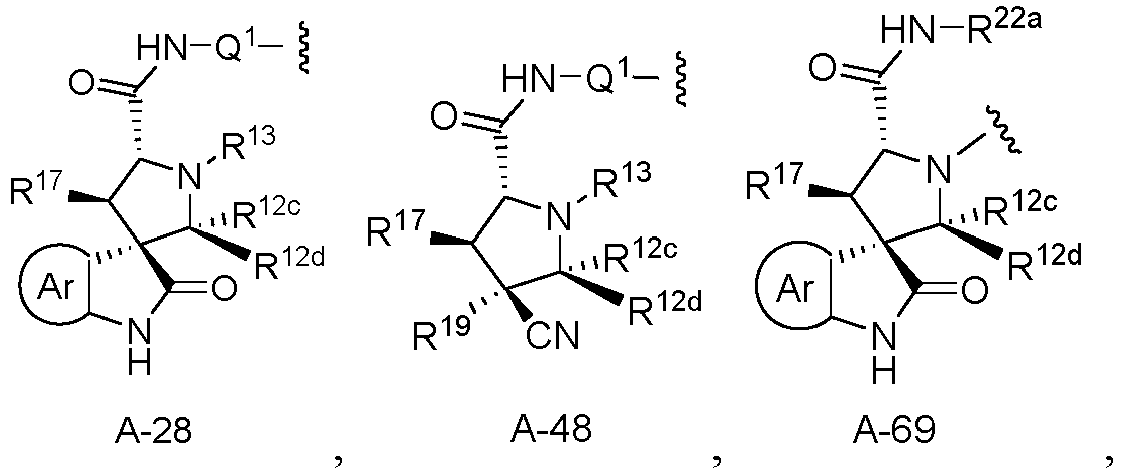
 R12c and R12d are independently selected from the group consisting of hydrogen and optionally substituted C1-8 alkyl; orR12c and R12d taken together with the carbon atom to which they are attached form a 4- to 8-membered optionally substituted cycloalkyl or a 4- to 8-membered optionally substituted heterocyclo;R13 is selected from the group consisting of hydrogen, optionally substituted C1-6 alkyl, and heteroalkyl;R17 is selected from the group consisting of optionally substituted aryl and optionally substituted heteroaryl;R19 is selected from the group consisting optionally substituted aryl and optionally substituted heteroaryl;R22a is selected from the group consisting of optionally substituted cycloalkyl, optionally substituted heterocyclo, optionally substituted aryl, and optionally substituted heteroaryl;R22b is selected from the group consisting of optionally substituted cycloalkyl, optionally substituted heterocyclo, optionally substituted aryl, and optionally substituted heteroaryl;Q1 is selected from the group consisting of alkylenyl, phenylenyl, heteroarylenyl, cycloalkylenyl, and heterocyclenyl;
 Ra5, Ra6, Ra11, and Ra12 are each independently selected from the group consisting of hydrogen and halo;Ra9 and Ra10 are independently selected from the group consisting of hydrogen, halo, C1-4 alkyl, haloalkyl, alkoxy, and haloalkoxy;Ra13 is selected from the group consisting of hydrogen, C1-4 alkyl, and C3-8 cycloalkyl;L1 is -X1-L2-Y1-;X1 is X2; orX1 is absent;X2 is selected from the group consisting of -N(H)C(=O)-, -C(=O)N(H)-, -C(=O)N(H)S(O)2-, -N(H)C(=O)N(H)-, -N(H)C(=O)O-, -OC(=O)N(H)-, -SO2-, -O-, -N(H)-, - SO2N(H)-, -N(H)SO2-, -CH2-, -CH=CH-, and -C≡C-;L2 is selected from the group consisting of alkylenyl, heteroalkylenyl, -A4-(CH2)m-W-(CH2)n- and -(CH2)m-W-(CH2)u-O-(CH2)v-; orL2 is absent;A4 is selected from the group consisting of 5-membered heteroarylenyl and 6-membered heteroarylenyl; orA4 is absent;W is selected from the group consisting of phenylenyl, 5-membered heteroarylenyl, 6-membered heteroarylenyl, heterocyclenyl, and cycloalkylenyl;m is 0, 1, 2, 3, 4, 5, 6, or 7;n is 0, 1, 2, 3, 4, 5, 6, 7, or 8;u is 0, 1, 2, or 3;v is 1, 2, 3, or 4;Y1 is selected from the group consisting of -C≡C-, -CH=CH-, -CH2-, -O-, -N(R2b)-, -C(=O)N(R2c)-, -N(R2d)C(=O)CH2O-, and -N(R2e)C(=O)CH2N(R2f)-; orY1 is absent;wherein the carboxamide nitrogen atom of -N(R2d)C(=O)CH2O- and -N(R2e)C(=O)CH2N(R2f)-, and the carbon atom of -C(=O)N(R2c)- is attached to L2;R2a, R2b, R2c, R2d, R2e, and R2f are each independently selected from the group consisting of hydrogen and C1-4 alkyl;B1 is :
 A1a is selected from the group consisting of -C(R16a)= and -N=;A2 is selected from the group consisting of -C(R16b)= and -N=;A3 is selected from the group consisting of -C(R16c)= and -N=;G is selected from the group consisting of -C(R16d)= and -N=;Z is selected from the group consisting of -CH2 and -C(=O)-;R5 is selected from the group consisting of hydrogen, methyl, and fluoro;R16a is selected from the group consisting of hydrogen, halo, and C1-4 alkyl;R16b is selected from the group consisting of hydrogen, halo, and C1-4 alkyl;R16c is selected from the group consisting of hydrogen, halo, and C1-4 alkyl; andR16d is selected from the group consisting of hydrogen, halo, and C1-4 alkyl.
 - The compound of claim 1, or a pharmaceutically acceptable salt or solvate thereof, wherein A1 is:

- The compound of claim 2, or a pharmaceutically acceptable salt or solvate thereof, wherein:A1 is:

- The compound of claim 3, or a pharmaceutically acceptable salt or solvate thereof, wherein Q1 is cycloalkylenyl selected from the group consisting of:

- The compound of claim 2, or a pharmaceutically acceptable salt or solvate thereof, having Formula VII:
 R12c and R12d taken together with the carbon atom to which they are attached form a 4-membered cycloalkyl or 6-membered optionally substituted cycloalkyl;R17 is:
 A11 is -C(R20c)=;R20a, R20b, and R20c are each hydrogen;R20d and R20e are independently selected from the group consisting of hydrogen and halo;R18b, R18c, and R18d are each independently selected from the group consisting of hydrogen and halo; andR21a and R21b are each independently selected from the group consisting of hydrogen, halo, C1-4 alkyl, haloalkyl, alkoxy, and haloalkoxy.
 - The compound of claim 2, or a pharmaceutically acceptable salt or solvate thereof, wherein L2 is C1-12 alkylenyl.
- The compound of claim 2, or a pharmaceutically acceptable salt or solvate thereof, wherein L2 is 3- to 12-membered heteroalkylenyl.
- The compound of claim 2, or a pharmaceutically acceptable salt or solvate thereof, wherein:
L2 is -A4-(CH2)m-W-(CH2)n-;
and
A4 is absent. - The compound of claim 8, or a pharmaceutically acceptable salt or solvate thereof, wherein W is heterocyclenyl.
- The compound of claim 9, or a pharmaceutically acceptable salt or solvate thereof, wherein L2 is selected from the group consisting of:


- The compound of claim 10, or a pharmaceutically acceptable salt or solvate thereof, wherein m is 0, and n is 0 or 1.
- The compound of claim 11, or a pharmaceutically acceptable salt or solvate thereof, wherein Y1 is -C≡C-.
- The compound of claim 2, or a pharmaceutically acceptable salt or solvate thereof, wherein B1 is selected from the group consisting of:

- The compound of claim 1, or a pharmaceutically acceptable salt or solvate thereof, selected from the group consisting of:


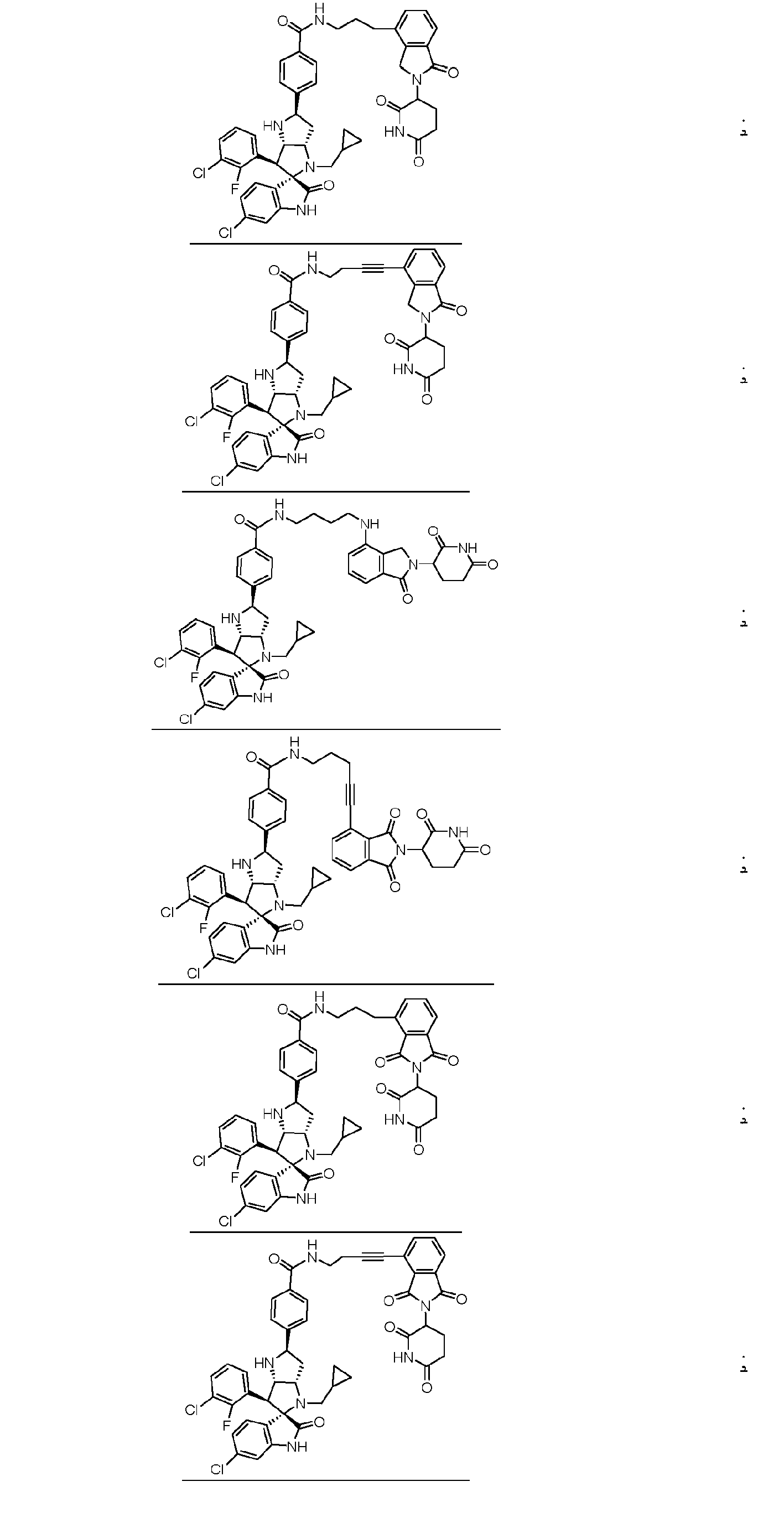


- The compound of claim 1, or a pharmaceutically acceptable salt or solvate thereof, selected from the group consisting of compounds: 19, 31, 32, 50, 56, 147, 173, 175, 194, 195, 220 and 222, namely:


 (3'R,4'S,5'R)-6"-chloro-4'-(3-chloro-2-fluorophenyl)-N-(4-((5-(2-(2,6-dioxopiperidin-3-yl)-1-oxoisoindolin-4-yl)pent-4-yn-1-yl)carbamoyl)phenyl)-2"-oxodispiro[cyclohexane-1,2'-pyrrolidine-3',3"-indoline]-5'-carboxamide,(3'R,4'S,5'R)-6"-chloro-4'-(3-chloro-2-fluorophenyl)-N-((1R,4R)-4-((5-(2-(2,6-dioxopiperidin-3-yl)-1-oxoisoindolin-4-yl)pent-4-yn-1-yl)carbamoyl)cyclohexyl)-2"-oxodispiro[cyclohexane-1,2'-pyrrolidine-3',3"-indoline]-5'-carboxamide,(3'R,4'S,5'R)-6"-chloro-4'-(3-chloro-2-fluorophenyl)-N-(4-(4-((2-(2,6-dioxopiperidin-3-yl)-1-oxoisoindolin-4-yl)ethynyl)piperidine-1-carbonyl)phenyl)-2"-oxodispiro[cyclohexane-1,2'-pyrrolidine-3',3"-indoline]-5'-carboxamide,(3'R,4'S,5'R)-6"-chloro-4'-(3-chloro-2-fluorophenyl)-N-(4-((5-(2-(2,6-dioxopiperidin-3-yl)-1-oxoisoindolin-5-yl)pent-4-yn-1-yl)carbamoyl) phenyl)-2"-oxodispiro[cyclohexane-1,2'-pyrrolidine-3',3"-indoline]-5'-carboxamide,(3'R,4'S,5'R)-6"-chloro-4'-(3-chloro-2-fluorophenyl)-N-(4-((5-(2-(2,6-dioxopiperidin-3-yl)-3-oxoisoindolin-5-yl)pent-4-yn-1-yl)carbamoyl)phenyl)-2"-oxodispiro[cyclohexane-1,2'-pyrrolidine-3',3"-indoline]-5'-carboxamide,(3'R,4'S,5'R)-6"-chloro-4'-(3-chloro-2-fluorophenyl)-N-(3-((5-(2-(2,6-dioxopiperidin-3-yl)-1-oxoisoindolin-4-yl)pent-4-yn-1-yl)carbamoyl)bicyclo[1.1.1]pentan-1-yl)-2"-oxodispiro[cyclohexane-1,2'-pyrrolidine-3',3"-indoline]-5'-carboxamide, and(3'R,4'S,5'R)-6"-chloro-4'-(2-chloro-3-fluoropyridin-4-yl)-N-(4-((5-(2-(2,6-dioxopiperidin-3-yl)-1-oxoisoindolin-4-yl)pent-4-yn-1-yl)carbamoyl)phenyl)-4,4-dimethyl-2"-oxodispiro[cyclohexane-1,2'-pyrrolidine-3',3"-indoline]-5'-carboxamide.
 - A pharmaceutical composition comprising the compound of any previous claim, or a pharmaceutically acceptable salt or solvate thereof, and a pharmaceutically acceptable carrier.
- The compound of any of claims 1 to 15, or a pharmaceutically acceptable salt or solvate thereof, for use in treating cancer, a chronic autoimmune disorder, an inflammatory condition, a proliferative disorder, sepsis, or a viral infection.
- The compound or a pharmaceutically acceptable salt or solvate thereof for use according to claim 17 in treating cancer.
Applications Claiming Priority (4)
| Application Number | Priority Date | Filing Date | Title |
|---|---|---|---|
| US201662318974P | 2016-04-06 | 2016-04-06 | |
| US201662393874P | 2016-09-13 | 2016-09-13 | |
| US201662409571P | 2016-10-18 | 2016-10-18 | |
| PCT/US2017/026274 WO2017176957A1 (en) | 2016-04-06 | 2017-04-06 | Mdm2 protein degraders |
Publications (2)
| Publication Number | Publication Date |
|---|---|
| EP3440066A1 EP3440066A1 (en) | 2019-02-13 |
| EP3440066B1 true EP3440066B1 (en) | 2022-11-30 |
Family
ID=58549316
Family Applications (1)
| Application Number | Title | Priority Date | Filing Date |
|---|---|---|---|
| EP17718290.4A Active EP3440066B1 (en) | 2016-04-06 | 2017-04-06 | Mdm2 protein degraders |
Country Status (13)
| Country | Link |
|---|---|
| US (2) | US11192898B2 (en) |
| EP (1) | EP3440066B1 (en) |
| JP (2) | JP7037500B2 (en) |
| KR (1) | KR102387316B1 (en) |
| CN (2) | CN113788818A (en) |
| AU (1) | AU2017246452C1 (en) |
| IL (1) | IL262103B (en) |
| MX (1) | MX2018012174A (en) |
| RU (2) | RU2021102253A (en) |
| SG (1) | SG11201808728QA (en) |
| UA (1) | UA123786C2 (en) |
| WO (1) | WO2017176957A1 (en) |
| ZA (1) | ZA201806968B (en) |
Families Citing this family (117)
| Publication number | Priority date | Publication date | Assignee | Title |
|---|---|---|---|---|
| CN108137507A (en) | 2015-07-10 | 2018-06-08 | 阿尔维纳斯股份有限公司 | Proteolysis conditioning agent and relevant application method based on MDM2 |
| JP7037500B2 (en) * | 2016-04-06 | 2022-03-16 | ザ リージェンツ オブ ザ ユニヴァシティ オブ ミシガン | MDM2 proteolytic agent |
| EP3892272B1 (en) | 2016-04-22 | 2024-07-24 | Dana-Farber Cancer Institute, Inc. | Bifunctional molecules for degradation of egfr and methods of use |
| EP4483875A3 (en) | 2016-05-10 | 2025-04-02 | C4 Therapeutics, Inc. | Spirocyclic degronimers for target protein degradation |
| CN109641874A (en) | 2016-05-10 | 2019-04-16 | C4医药公司 | C for target protein degradation3The glutarimide degron body of carbon connection |
| CN109562107A (en) | 2016-05-10 | 2019-04-02 | C4医药公司 | Heterocycle degron body for target protein degradation |
| EP3455219A4 (en) | 2016-05-10 | 2019-12-18 | C4 Therapeutics, Inc. | AMINE-LINKED C3-GLUTARIMIDE DEGRONIMERS FOR THE DEGRADATION OF TARGET PROTEINS |
| WO2018102725A1 (en) * | 2016-12-01 | 2018-06-07 | Arvinas, Inc. | Tetrahydronaphthalene and tetrahydroisoquinoline derivatives as estrogen receptor degraders |
| US11173211B2 (en) | 2016-12-23 | 2021-11-16 | Arvinas Operations, Inc. | Compounds and methods for the targeted degradation of rapidly accelerated Fibrosarcoma polypeptides |
| EP3577109A4 (en) | 2017-01-31 | 2020-11-18 | Arvinas Operations, Inc. | CEREBLON LIGANDS AND BIFUNCTIONAL CONNECTIONS THEREOF |
| EP3641762B1 (en) | 2017-06-20 | 2026-02-18 | C4 Therapeutics, Inc. | N/o-linked degrons and degronimers for protein degradation |
| JP7258009B2 (en) | 2017-07-10 | 2023-04-14 | セルジーン コーポレイション | Antiproliferative compounds and methods of use thereof |
| CN111315735B (en) | 2017-09-04 | 2024-03-08 | C4医药公司 | Dihydrobenzimidazolones |
| EP3679026A1 (en) | 2017-09-04 | 2020-07-15 | C4 Therapeutics, Inc. | Glutarimide |
| EP3679028A1 (en) | 2017-09-04 | 2020-07-15 | C4 Therapeutics, Inc. | Dihydroquinolinones |
| JP7366031B2 (en) | 2017-09-22 | 2023-10-20 | カイメラ セラピューティクス, インコーポレイテッド | Proteolytic agents and their use |
| WO2019060693A1 (en) | 2017-09-22 | 2019-03-28 | Kymera Therapeutics, Inc. | Crbn ligands and uses thereof |
| CN111372585A (en) | 2017-11-16 | 2020-07-03 | C4医药公司 | Degradants and degrons for target protein degradation |
| IL315310A (en) | 2017-12-26 | 2024-10-01 | Kymera Therapeutics Inc | IRAK joints and used in them |
| EP3737666A4 (en) | 2018-01-12 | 2022-01-05 | Kymera Therapeutics, Inc. | Protein degraders and uses thereof |
| US11512080B2 (en) | 2018-01-12 | 2022-11-29 | Kymera Therapeutics, Inc. | CRBN ligands and uses thereof |
| KR20210018199A (en) | 2018-03-26 | 2021-02-17 | 씨4 테라퓨틱스, 인코포레이티드 | Cerevlon binder for decomposition of Ikaros |
| US12539292B2 (en) | 2018-04-01 | 2026-02-03 | Arvinas Operations, Inc. | BRM targeting compounds and associated methods of use |
| US12226424B2 (en) | 2018-04-09 | 2025-02-18 | Shanghaitech University | Target protein degradation compounds, their anti-tumor use, their intermediates and use of intermediates |
| WO2019204354A1 (en) | 2018-04-16 | 2019-10-24 | C4 Therapeutics, Inc. | Spirocyclic compounds |
| FI3784663T3 (en) | 2018-04-23 | 2023-10-06 | Celgene Corp | Substituted 4-aminoisoindoline-1,3-dione compounds and their use for treating lymphoma |
| EP3787747A4 (en) * | 2018-04-30 | 2022-01-12 | Dana-Farber Cancer Institute, Inc. | POLYBROMO-1 (PBRM1) SMALL MOLECULES DEGRADING AGENTS |
| EP3578561A1 (en) | 2018-06-04 | 2019-12-11 | F. Hoffmann-La Roche AG | Spiro compounds |
| WO2020010177A1 (en) | 2018-07-06 | 2020-01-09 | Kymera Therapeutics, Inc. | Tricyclic crbn ligands and uses thereof |
| EP3817822A4 (en) | 2018-07-06 | 2022-07-27 | Kymera Therapeutics, Inc. | PROTEIN DEGRADING AGENTS AND THEIR USES |
| CN108864113B (en) * | 2018-08-03 | 2021-08-13 | 南方科技大学 | A kind of MDM2-HDAC dual target inhibitor, pharmaceutical composition and preparation and use thereof |
| WO2020030016A1 (en) * | 2018-08-08 | 2020-02-13 | Ascentage Pharma (Suzhou) Co., Ltd. | Combination of immunotherapies with mdm2 inhibitors |
| US11707452B2 (en) | 2018-08-20 | 2023-07-25 | Arvinas Operations, Inc. | Modulators of alpha-synuclein proteolysis and associated methods of use |
| AU2019323446B2 (en) | 2018-08-22 | 2025-01-30 | Cullgen (Shanghai), Inc. | Tropomyosin receptor kinase (TRK) degradation compounds and methods of use |
| US11969472B2 (en) | 2018-08-22 | 2024-04-30 | Cullgen (Shanghai), Inc. | Tropomyosin receptor kinase (TRK) degradation compounds and methods of use |
| EP3846800A4 (en) | 2018-09-04 | 2022-08-24 | C4 Therapeutics, Inc. | LINKS TO BREAK DOWN BRD9 OR MTH1 |
| CN110963958B (en) * | 2018-09-30 | 2025-10-10 | 上海长森药业有限公司 | An MDM2 inhibitor, and its preparation method, pharmaceutical composition and application |
| MX2021003999A (en) * | 2018-10-08 | 2021-06-23 | Univ Michigan Regents | Small molecule mdm2 protein degraders. |
| CN111018857B (en) * | 2018-10-09 | 2023-06-02 | 嘉兴优博生物技术有限公司 | Targeted Protease Degradation Platform (TED) |
| CN113423701A (en) | 2018-11-13 | 2021-09-21 | 拜欧斯瑞克斯公司 | Substituted isoindolinones |
| EP3697411A4 (en) * | 2018-11-23 | 2021-08-18 | Ascentage Pharma Group Corp Limited | Novel pharmaceutical composition and use thereof |
| EP3886854A4 (en) | 2018-11-30 | 2022-07-06 | Nuvation Bio Inc. | PYRROLE AND PYRAZOLE COMPOUNDS AND METHODS OF USE THEREOF |
| JP7623943B2 (en) | 2018-11-30 | 2025-01-29 | カイメラ セラピューティクス, インコーポレイテッド | IRAK degraders and their uses |
| AU2019399772B2 (en) * | 2018-12-14 | 2021-11-04 | Ascentage Pharma (Suzhou) Co., Ltd. | A compound for treating osteoarthritis |
| CN120698983A (en) | 2018-12-20 | 2025-09-26 | C4医药公司 | Targeted protein degradation |
| US11547759B2 (en) | 2019-01-30 | 2023-01-10 | Montelino Therapeutics, Inc. | Bi-functional compounds and methods for targeted ubiquitination of androgen receptor |
| WO2020160295A1 (en) | 2019-01-30 | 2020-08-06 | Montelino Therapeutics, Llc | Bi-functional compounds and methods for targeted ubiquitination of androgen receptor |
| US12582641B2 (en) | 2019-02-25 | 2026-03-24 | Shanghaitech University | Sulfur-containing compound based on glutarimide skeleton and application thereof |
| ES2995214T3 (en) | 2019-03-06 | 2025-02-07 | C4 Therapeutics Inc | Heterocyclic compounds for medical treatment |
| US11485750B1 (en) | 2019-04-05 | 2022-11-01 | Kymera Therapeutics, Inc. | STAT degraders and uses thereof |
| US20220251071A1 (en) * | 2019-05-14 | 2022-08-11 | Wisconsin Alumni Research Foundation | Method to make small-molecule murine double minute 2 protein (mdm2)-degrading compounds, compounds formed thereby, and pharmaceutical compositions containing them |
| WO2020251971A1 (en) | 2019-06-10 | 2020-12-17 | Kymera Therapeutics, Inc. | Smarca degraders and uses thereof |
| WO2020251972A1 (en) | 2019-06-10 | 2020-12-17 | Kymera Therapeutics, Inc. | Smarca degraders and uses thereof |
| BR112021026517A2 (en) | 2019-06-28 | 2022-05-10 | Kymera Therapeutics Inc | Irak degraders and uses thereof |
| EP3814358B1 (en) * | 2019-07-11 | 2025-09-03 | Ascentage Pharma (Suzhou) Co., Ltd. | Method for preparing 2-indolinospirone compounds and intermediates thereof |
| WO2021011868A1 (en) | 2019-07-17 | 2021-01-21 | Kymera Therapeutics, Inc. | Irak degraders and uses thereof |
| WO2021011913A1 (en) | 2019-07-17 | 2021-01-21 | Arvinas Operations, Inc. | Tau-protein targeting compounds and associated methods of use |
| CN112321566B (en) | 2019-08-05 | 2022-06-10 | 上海科技大学 | EGFR protein degradation agent and anti-tumor application thereof |
| ES3061133T3 (en) | 2019-08-26 | 2026-03-31 | Arvinas Operations Inc | Methods of treating breast cancer with tetrahydronaphthalene derivatives as estrogen receptor degraders |
| US12310975B2 (en) | 2019-10-17 | 2025-05-27 | Arvinas Operations, Inc. | Modulators of BCL6 proteolysis and associated methods of use |
| CN112745298B (en) * | 2019-10-30 | 2024-04-09 | 中国科学院上海药物研究所 | Polysubstituted isoindoline compounds, preparation methods, pharmaceutical compositions and uses thereof |
| KR20220103753A (en) | 2019-11-19 | 2022-07-22 | 브리스톨-마이어스 스큅 컴퍼니 | Compounds useful as inhibitors of helios proteins |
| EP4072591A4 (en) | 2019-12-10 | 2024-06-05 | Kymera Therapeutics, Inc. | IRAQ DEGRADATION AGENTS AND THEIR USES |
| JP2023509366A (en) | 2019-12-17 | 2023-03-08 | カイメラ セラピューティクス, インコーポレイテッド | IRAK dissolving agents and their uses |
| WO2021127283A2 (en) | 2019-12-17 | 2021-06-24 | Kymera Therapeutics, Inc. | Irak degraders and uses thereof |
| US11850239B2 (en) | 2019-12-19 | 2023-12-26 | Ascentage Pharma (Suzhou) Co., Ltd. | MDM2 inhibitor and a platinum compound for cancer treatment |
| EP4077309A1 (en) | 2019-12-19 | 2022-10-26 | Arvinas Operations, Inc. | Compounds and methods for the targeted degradation of androgen receptor |
| CN115297931A (en) | 2019-12-23 | 2022-11-04 | 凯麦拉医疗公司 | SMARCA degrading agents and uses thereof |
| GB201919219D0 (en) | 2019-12-23 | 2020-02-05 | Otsuka Pharma Co Ltd | Cancer biomarkers |
| CN118812542A (en) * | 2020-01-23 | 2024-10-22 | 苏州亚盛药业有限公司 | Amorphous or crystalline form of 2-indolinolspirone compound or its salt or solvate |
| JP7692924B2 (en) | 2020-02-26 | 2025-06-16 | クルゲン(シャンハイ),インク. | Tropomyosin receptor kinase (TRK) degrading compounds and methods of use thereof |
| IL295709A (en) | 2020-03-05 | 2022-10-01 | C4 Therapeutics Inc | Compounds for targeted knockdown of brd9 |
| WO2021185291A1 (en) * | 2020-03-17 | 2021-09-23 | 南京明德新药研发有限公司 | Proteolysis regulator and method for using same |
| IL296451B2 (en) | 2020-03-19 | 2026-05-01 | Kymera Therapeutics Inc | Mdm2 degraders and uses thereof |
| TW202140441A (en) | 2020-03-23 | 2021-11-01 | 美商必治妥美雅史谷比公司 | Substituted oxoisoindoline compounds |
| CN113509557A (en) * | 2020-04-09 | 2021-10-19 | 嘉兴优博生物技术有限公司 | Targeted protease degradation platform (TED) |
| TW202210483A (en) | 2020-06-03 | 2022-03-16 | 美商凱麥拉醫療公司 | Crystalline forms of irak degraders |
| KR20230042057A (en) * | 2020-07-20 | 2023-03-27 | 지앙수 헨그루이 파마슈티컬스 컴퍼니 리미티드 | Sulfur-Containing Isoindoline Derivatives and Methods for Their Preparation and Medical Uses Thereof |
| EP4192458A4 (en) | 2020-08-05 | 2024-09-04 | C4 Therapeutics, Inc. | COMPOUNDS FOR TARGETED RET DEGRADATION |
| KR20230058124A (en) | 2020-08-27 | 2023-05-02 | 오츠카 세이야쿠 가부시키가이샤 | Biomarkers for cancer treatment using MDM2 antagonists |
| EP4204418A1 (en) | 2020-08-28 | 2023-07-05 | Arvinas Operations, Inc. | Rapidly accelerating fibrosarcoma protein degrading compounds and associated methods of use |
| CN113633780B (en) * | 2020-09-11 | 2023-08-29 | 上海邈基生物科技有限公司 | A kind of small molecule conjugate and its use |
| WO2022120355A1 (en) | 2020-12-02 | 2022-06-09 | Ikena Oncology, Inc. | Tead degraders and uses thereof |
| EP4259144A4 (en) | 2020-12-09 | 2025-08-20 | Kymera Therapeutics Inc | SMARCA DECORATORS AND USES THEREOF |
| WO2022147465A1 (en) | 2020-12-30 | 2022-07-07 | Kymera Therapeutics, Inc. | Irak degraders and uses thereof |
| US12569564B2 (en) | 2021-01-23 | 2026-03-10 | Newave Pharmaceutical Inc. | Spirocyclic MDM2 modulator and uses thereof |
| CN114853731B (en) * | 2021-02-04 | 2026-02-06 | 上海长森药业有限公司 | Dual-function MDM2 protein degradation agent, and preparation method, pharmaceutical composition and application thereof |
| TW202245788A (en) | 2021-02-15 | 2022-12-01 | 美商凱麥拉醫療公司 | Irak4 degraders and uses thereof |
| GB202103080D0 (en) | 2021-03-04 | 2021-04-21 | Otsuka Pharma Co Ltd | Cancer biomarkers |
| PT4320112T (en) | 2021-04-06 | 2025-07-07 | Bristol Myers Squibb Co | Pyridinyl substituted oxoisoindoline compounds |
| CA3214806A1 (en) | 2021-04-16 | 2022-10-20 | Arvinas Operations, Inc. | Modulators of bcl6 proteolysis and associated methods of use |
| BR112023023065A2 (en) | 2021-05-05 | 2024-01-30 | Biogen Ma Inc | COMPOUNDS TO TARGETING THE DEGRADATION OF BRUTON'S TYROSINE KINASE |
| AU2022271290A1 (en) | 2021-05-07 | 2023-11-23 | Kymera Therapeutics, Inc. | Cdk2 degraders and uses thereof |
| JP2024525580A (en) | 2021-07-07 | 2024-07-12 | バイオジェン・エムエイ・インコーポレイテッド | Compounds for targeting the degradation of IRAK4 protein |
| KR20240035526A (en) | 2021-07-07 | 2024-03-15 | 바이오젠 엠에이 인코포레이티드 | Compounds that target degradation of the IRAK4 protein |
| MX2024000313A (en) | 2021-07-09 | 2024-03-06 | Plexium Inc | Aryl compounds and pharmaceutical compositions that modulate ikzf2. |
| JP7406674B2 (en) | 2021-09-13 | 2023-12-27 | アストラゼネカ アクチボラグ | Spirocyclic compounds |
| US11981672B2 (en) | 2021-09-13 | 2024-05-14 | Montelino Therapeutics Inc. | Bi-functional compounds and methods for targeted ubiquitination of androgen receptor |
| WO2023049790A2 (en) * | 2021-09-22 | 2023-03-30 | Kymera Therapeutics, Inc. | Mdm2 degraders and uses thereof |
| EP4423086A1 (en) | 2021-10-25 | 2024-09-04 | Kymera Therapeutics, Inc. | Tyk2 degraders and uses thereof |
| EP4422635A4 (en) | 2021-10-29 | 2025-11-26 | Kymera Therapeutics Inc | IRAQ-4 DEGRADER AND SYNTHESIS OF IT |
| AU2022416554A1 (en) * | 2021-12-15 | 2024-06-20 | Kymera Therapeutics, Inc. | Methods of treating cancer |
| CN113979999B (en) * | 2021-12-23 | 2022-05-20 | 北京鑫开元医药科技有限公司 | Compound for targeted ubiquitination degradation of BCR-ABL kinase and preparation method, composition and application thereof |
| IL314437A (en) | 2022-01-31 | 2024-09-01 | Kymera Therapeutics Inc | Irak degraders and uses thereof |
| WO2023230059A1 (en) * | 2022-05-24 | 2023-11-30 | Newave Pharmaceutical Inc. | Mdm2 degrader |
| WO2024006776A1 (en) | 2022-06-27 | 2024-01-04 | Relay Therapeutics, Inc. | Estrogen receptor alpha degraders and medical use thereof |
| AU2023298115A1 (en) | 2022-06-27 | 2025-01-16 | Relay Therapeutics, Inc. | Estrogen receptor alpha degraders and use thereof |
| WO2024050016A1 (en) | 2022-08-31 | 2024-03-07 | Oerth Bio Llc | Compositions and methods for targeted inhibition and degradation of proteins in an insect cell |
| EP4584258A1 (en) | 2022-09-07 | 2025-07-16 | Arvinas Operations, Inc. | Rapidly accelerated fibrosarcoma (raf) degrading compounds and associated methods of use |
| WO2024064358A1 (en) | 2022-09-23 | 2024-03-28 | Ifm Due, Inc. | Compounds and compositions for treating conditions associated with sting activity |
| WO2024078370A1 (en) * | 2022-10-13 | 2024-04-18 | 中国科学院上海药物研究所 | Small molecular compound having substituted phenylspiro[indoline-3,3'-pyrrolidine] structure |
| WO2024097948A1 (en) | 2022-11-04 | 2024-05-10 | Roivant Discovery, Inc. | Degraders of mdm2 and uses thereof |
| US20260053931A1 (en) * | 2023-01-05 | 2026-02-26 | The Wistar Institute Of Anatomy And Biology | Mdm2 targeting protacs |
| WO2024187066A1 (en) * | 2023-03-08 | 2024-09-12 | Regents Of The University Of Michigan | Compounds and compositions as cbp/p300 degraders and uses thereof |
| WO2024197219A1 (en) * | 2023-03-22 | 2024-09-26 | Kymera Therapeutics, Inc. | Mdm2 degraders and uses thereof |
| EP4714949A1 (en) * | 2023-05-18 | 2026-03-25 | Ajou University Industry-Academic Cooperation Foundation | Novel compounds capable of inducing osteogenic differentiation |
| WO2025049555A1 (en) | 2023-08-31 | 2025-03-06 | Oerth Bio Llc | Compositions and methods for targeted inhibition and degradation of proteins in an insect cell |
Citations (5)
| Publication number | Priority date | Publication date | Assignee | Title |
|---|---|---|---|---|
| WO2011153509A1 (en) * | 2010-06-04 | 2011-12-08 | Amgen Inc. | Piperidinone derivatives as mdm2 inhibitors for the treatment of cancer |
| WO2013158644A2 (en) * | 2012-04-16 | 2013-10-24 | Synta Pharmaceuticals Corp. | Targeted therapeutics |
| WO2014134201A1 (en) * | 2013-02-28 | 2014-09-04 | Amgen Inc. | A benzoic acid derivative mdm2 inhibitor for the treatment of cancer |
| US20150291562A1 (en) * | 2014-04-14 | 2015-10-15 | Arvinas, Inc. | Imide-based modulators of proteolysis and associated methods of use |
| US20160058872A1 (en) * | 2014-04-14 | 2016-03-03 | Arvinas, Inc. | Imide-based modulators of proteolysis and associated methods of use |
Family Cites Families (87)
| Publication number | Priority date | Publication date | Assignee | Title |
|---|---|---|---|---|
| US5093330A (en) | 1987-06-15 | 1992-03-03 | Ciba-Geigy Corporation | Staurosporine derivatives substituted at methylamino nitrogen |
| US7083983B2 (en) | 1996-07-05 | 2006-08-01 | Cancer Research Campaign Technology Limited | Inhibitors of the interaction between P53 and MDM2 |
| DE69717160T2 (en) | 1996-09-13 | 2003-05-08 | Mitsubishi Pharma Corp., Osaka | THIENOTRIAZOLODIAZEPINE COMPOUNDS AND THEIR MEDICAL APPLICATIONS |
| US6831155B2 (en) | 1999-12-08 | 2004-12-14 | President And Fellows Of Harvard College | Inhibition of p53 degradation |
| US20030045552A1 (en) * | 2000-12-27 | 2003-03-06 | Robarge Michael J. | Isoindole-imide compounds, compositions, and uses thereof |
| US7091353B2 (en) * | 2000-12-27 | 2006-08-15 | Celgene Corporation | Isoindole-imide compounds, compositions, and uses thereof |
| CN100486969C (en) | 2001-12-18 | 2009-05-13 | 霍夫曼-拉罗奇有限公司 | Cis-2, 4, 5-triphenyl-imidazoline and application thereof in tumor treatment |
| PL370909A1 (en) | 2001-12-18 | 2005-05-30 | F.Hoffmann-La Roche Ag | Cis-imidazolines as mdm2 inhibitors |
| US8146941B2 (en) * | 2002-05-17 | 2012-04-03 | Steins Karl M | Collapsible trailer |
| US7514579B2 (en) | 2002-06-13 | 2009-04-07 | Johns Hopkins University | Boronic chalcone derivatives and uses thereof |
| US20040171035A1 (en) | 2002-11-08 | 2004-09-02 | Irm Llc | Methods and compositions for modulating P53 transcription factor |
| US20050227932A1 (en) | 2002-11-13 | 2005-10-13 | Tianbao Lu | Combinational therapy involving a small molecule inhibitor of the MDM2: p53 interaction |
| EP1633749A4 (en) | 2003-02-13 | 2011-03-02 | Us Gov Health & Human Serv | DEAZAFLAVIN COMPOUNDS AND METHODS OF USE |
| US6916833B2 (en) | 2003-03-13 | 2005-07-12 | Hoffmann-La Roche Inc. | Substituted piperidines |
| US7132421B2 (en) | 2003-06-17 | 2006-11-07 | Hoffmann-La Roche Inc. | CIS-imidazoles |
| US7425638B2 (en) | 2003-06-17 | 2008-09-16 | Hoffmann-La Roche Inc. | Cis-imidazolines |
| WO2005063774A1 (en) | 2003-12-22 | 2005-07-14 | Johns Hopkins University | Boronic acid aryl analogs |
| US8598127B2 (en) | 2004-04-06 | 2013-12-03 | Korea Research Institute Of Bioscience & Biotechnology | Peptides for inhibiting MDM2 function |
| EP1753727B1 (en) | 2004-05-18 | 2008-11-19 | F.Hoffmann-La Roche Ag | Novel cis-imidazolines |
| GB0419481D0 (en) | 2004-09-02 | 2004-10-06 | Cancer Rec Tech Ltd | Isoindolin-1-one derivatives |
| SI1809622T1 (en) | 2004-09-22 | 2010-11-30 | Janssen Pharmaceutica Nv | Inhibitors of the interaction between mdm2 and p53 |
| NZ561215A (en) | 2005-02-22 | 2010-12-24 | Univ Michigan | Small molecule inhibitors of MDM2 and uses thereof |
| AU2006216780B8 (en) | 2005-02-22 | 2010-04-22 | The Regents Of The University Of Michigan | Small molecule inhibitors of MDM2 and uses thereof |
| JP4955646B2 (en) | 2005-03-16 | 2012-06-20 | エフ.ホフマン−ラ ロシュ アーゲー | Cis-2,4,5-triaryl-imidazolines and their use as anticancer agents |
| WO2006129623A1 (en) | 2005-05-30 | 2006-12-07 | Mitsubishi Tanabe Pharma Corporation | Thienotriazolodiazepine compound and a medicinal use thereof |
| US7576082B2 (en) | 2005-06-24 | 2009-08-18 | Hoffman-La Roche Inc. | Oxindole derivatives |
| US7495007B2 (en) | 2006-03-13 | 2009-02-24 | Hoffmann-La Roche Inc. | Spiroindolinone derivatives |
| US8232298B2 (en) | 2006-03-22 | 2012-07-31 | Janssen Pharmaceutica N.V. | Inhibitors of the interaction between MDM2 and P53 |
| SG174107A1 (en) * | 2006-08-30 | 2011-09-29 | Univ Michigan | New small molecule inhibitors of mdm2 and the uses thereof |
| US7737174B2 (en) | 2006-08-30 | 2010-06-15 | The Regents Of The University Of Michigan | Indole inhibitors of MDM2 and the uses thereof |
| US7638548B2 (en) | 2006-11-09 | 2009-12-29 | Hoffmann-La Roche Inc. | Spiroindolinone derivatives |
| EP2103619A4 (en) | 2006-12-14 | 2011-11-23 | Daiichi Sankyo Co Ltd | IMIDAZOTHIAZOLE DERIVATIVES |
| DK2118074T3 (en) | 2007-02-01 | 2014-03-10 | Resverlogix Corp | Compounds for the prevention and treatment of cardiovascular diseases |
| WO2008106507A2 (en) | 2007-02-27 | 2008-09-04 | University Of South Florida | Mdm2/mdmx inhibitor peptide |
| PE20081897A1 (en) | 2007-03-29 | 2009-02-09 | Novartis Ag | 3-IMIDAZOLIL-INDOLES FOR THE TREATMENT OF PROLIFERATIVE DISEASES |
| US7625895B2 (en) | 2007-04-12 | 2009-12-01 | Hoffmann-Le Roche Inc. | Diphenyl-dihydro-imidazopyridinones |
| WO2008130614A2 (en) | 2007-04-20 | 2008-10-30 | University Of Pittsburg-Of The Commonwealth System Of Higher Education | Selective and dual-action p53/mdm2/mdm4 antagonists |
| US7553833B2 (en) | 2007-05-17 | 2009-06-30 | Hoffmann-La Roche Inc. | 3,3-spiroindolinone derivatives |
| CA2924418A1 (en) * | 2007-07-30 | 2009-02-05 | Jean-Michel Vernier | Derivatives of n-(arylamino) sulfonamides including polymorphs as inhibitors of mek as well as compositions, methods of use and methods for preparing the same |
| ATE547415T1 (en) | 2007-09-21 | 2012-03-15 | Janssen Pharmaceutica Nv | INHIBITORS OF THE INTERACTION BETWEEN MDM2 AND P53 |
| US8476260B2 (en) | 2007-12-28 | 2013-07-02 | Mitsubishi Tanabe Pharma Corporation | Antitumor agent |
| WO2009151069A1 (en) | 2008-06-12 | 2009-12-17 | 第一三共株式会社 | Imidazothiazole derivative having 4,7-diazaspiro[2.5]octane ring structure |
| GB0811643D0 (en) | 2008-06-25 | 2008-07-30 | Cancer Rec Tech Ltd | New therapeutic agents |
| KR101629356B1 (en) | 2008-06-26 | 2016-06-13 | 리스버로직스 코퍼레이션 | Methods of preparing quinazolinone derivatives |
| US9757368B2 (en) | 2009-04-22 | 2017-09-12 | Resverlogix Corp. | Anti-inflammatory agents |
| DE102009051823A1 (en) | 2009-11-04 | 2011-05-05 | Fraunhofer-Gesellschaft zur Förderung der angewandten Forschung e.V. | Single-crystal welding of directionally solidified materials |
| GB0919434D0 (en) | 2009-11-05 | 2009-12-23 | Glaxosmithkline Llc | Novel compounds |
| GB0919423D0 (en) | 2009-11-05 | 2009-12-23 | Glaxosmithkline Llc | Novel compounds |
| GB0919426D0 (en) | 2009-11-05 | 2009-12-23 | Glaxosmithkline Llc | Novel compounds |
| GB0919432D0 (en) | 2009-11-05 | 2009-12-23 | Glaxosmithkline Llc | Use |
| SI2496582T1 (en) | 2009-11-05 | 2016-04-29 | Glaxosmithkline Llc Corporation Service Company | Benzodiazepine bromodomain inhibitor |
| JP2013510860A (en) | 2009-11-12 | 2013-03-28 | ザ、リージェンツ、オブ、ザ、ユニバーシティ、オブ、ミシガン | Spiro-oxindole MDM2 antagonist |
| US20110118283A1 (en) | 2009-11-17 | 2011-05-19 | Qingjie Ding | Substituted Pyrrolidine-2-Carboxamides |
| US8088815B2 (en) * | 2009-12-02 | 2012-01-03 | Hoffman-La Roche Inc. | Spiroindolinone pyrrolidines |
| MX384074B (en) | 2010-05-14 | 2025-03-12 | Dana Farber Cancer Inst Inc | COMPOSITIONS AND METHODS FOR TREATING NEOPLASMS, INFLAMMATORY DISEASES AND OTHER DISORDERS. |
| JP5913292B2 (en) | 2010-05-14 | 2016-04-27 | ダナ−ファーバー キャンサー インスティテュート, インコーポレイテッド | Compositions and methods for modulating metabolism |
| MX373121B (en) | 2010-05-14 | 2020-04-30 | Dana Farber Cancer Inst Inc | COMPOSITIONS AND METHODS FOR THE TREATMENT OF LEUKEMIA. |
| ES2526671T3 (en) | 2010-06-22 | 2015-01-14 | Glaxosmithkline Llc | Compounds of benzotriazoldiazepine bromodomain inhibitors |
| CA2817585A1 (en) | 2010-11-12 | 2012-05-18 | The Regents Of The University Of Michigan | Spiro-oxindole mdm2 antagonists |
| AR084070A1 (en) | 2010-12-02 | 2013-04-17 | Constellation Pharmaceuticals Inc | BROMODOMINIUM INHIBITORS AND USES OF THE SAME |
| US9249161B2 (en) | 2010-12-02 | 2016-02-02 | Constellation Pharmaceuticals, Inc. | Bromodomain inhibitors and uses thereof |
| CA2828212A1 (en) | 2011-02-23 | 2012-08-30 | Shiraz Mujtaba | Inhibitors of bromodomains as modulators of gene expression |
| DK2684880T3 (en) | 2011-03-10 | 2018-05-22 | Daiichi Sankyo Co Ltd | DISPIROPYRROLIDINE DERIVATIVES |
| EP2705039B1 (en) | 2011-05-04 | 2017-07-26 | Constellation Pharmaceuticals, Inc. | Bromodomain inhibitors and uses thereof |
| ES2624808T3 (en) | 2011-05-11 | 2017-07-17 | The Regents Of The University Of Michigan | MDM2 spirooxindol antagonists |
| US9328117B2 (en) | 2011-06-17 | 2016-05-03 | Constellation Pharmaceuticals, Inc. | Bromodomain inhibitors and uses thereof |
| GB201114103D0 (en) | 2011-08-17 | 2011-09-28 | Glaxosmithkline Llc | Novel compounds |
| WO2013027168A1 (en) | 2011-08-22 | 2013-02-28 | Pfizer Inc. | Novel heterocyclic compounds as bromodomain inhibitors |
| WO2013033270A2 (en) | 2011-08-29 | 2013-03-07 | Coferon, Inc. | Bromodomain ligands capable of dimerizing in an aqueous solution, and methods of using same |
| DE102011082013A1 (en) | 2011-09-01 | 2013-03-07 | Bayer Pharma AG | 6H-thieno [3,2-f] [1,2,4] triazolo [4,3-a] [1,4] diazepines |
| WO2013097052A1 (en) | 2011-12-30 | 2013-07-04 | Abbott Laboratories | Bromodomain inhibitors |
| US20130245089A1 (en) | 2012-03-19 | 2013-09-19 | Hoffmann-La Roche Inc. | Method for administration |
| US20130281399A1 (en) | 2012-04-19 | 2013-10-24 | Rvx Therapeutics Inc. | Treatment of diseases by epigenetic regulation |
| EP2838881B1 (en) | 2012-04-20 | 2018-08-08 | AbbVie Inc. | Isoindolone derivatives |
| WO2013185284A1 (en) | 2012-06-12 | 2013-12-19 | Abbott Laboratories | Pyridinone and pyridazinone derivatives |
| JP6401773B2 (en) * | 2013-03-11 | 2018-10-10 | ザ リージェンツ オブ ザ ユニヴァシティ オブ ミシガン | BET bromodomain inhibitor and therapeutic method using the same |
| JP2017511801A (en) * | 2014-02-28 | 2017-04-27 | ザ リージェンツ オブ ザ ユニヴァシティ オブ ミシガン | 9H-pyrimido [4,5-b] indoles and related analogs as BET bromodomain inhibitors |
| US10138251B2 (en) | 2014-04-11 | 2018-11-27 | Boehringer Ingelheim International Gmbh | Spiro[3H-indole-3,2′-pyrrolidin]-2(1H)-one compounds and derivatives as MDM2-P53 inhibitors |
| EP3131544B1 (en) | 2014-04-17 | 2018-12-12 | The Regents of the University of Michigan | Mdm2 inhibitors and therapeutic methods using the same |
| JP6503386B2 (en) | 2014-07-03 | 2019-04-17 | ベーリンガー インゲルハイム インターナショナル ゲゼルシャフト ミット ベシュレンクテル ハフツング | Novel spiro [3H-indol-3,2'-pyrrolidine] -2 (1H) -one compounds and derivatives as MDM2-p53 inhibitors |
| ES2959097T3 (en) | 2014-08-18 | 2024-02-20 | Hudson Biopharma Inc | Spiropyrrolidines as MDM2 inhibitors |
| ES2739697T3 (en) | 2014-08-21 | 2020-02-03 | Boehringer Ingelheim Int | New compounds and derivatives of spiro [3H-indole-3,2-pyrrolidin] -2 (1H) -one as MDM2-p53 inhibitors |
| US10307407B2 (en) * | 2015-02-27 | 2019-06-04 | The Regents Of The University Of Michigan | 9H-pyrimido [4,5-B] indoles as BET bromodomain inhibitors |
| EP3337476A4 (en) * | 2015-08-19 | 2019-09-04 | Arvinas, Inc. | COMPOUNDS AND METHODS FOR THE TARGETED REMOVAL OF BROMO-DOMAIN-CONTAINING PROTEINS |
| AU2017246453A1 (en) * | 2016-04-06 | 2018-11-08 | The Regents Of The University Of Michigan | Monofunctional intermediates for ligand-dependent target protein degradation |
| JP7037500B2 (en) * | 2016-04-06 | 2022-03-16 | ザ リージェンツ オブ ザ ユニヴァシティ オブ ミシガン | MDM2 proteolytic agent |
| MX2021003999A (en) * | 2018-10-08 | 2021-06-23 | Univ Michigan Regents | Small molecule mdm2 protein degraders. |
-
2017
- 2017-04-06 JP JP2018552846A patent/JP7037500B2/en active Active
- 2017-04-06 AU AU2017246452A patent/AU2017246452C1/en active Active
- 2017-04-06 RU RU2021102253A patent/RU2021102253A/en unknown
- 2017-04-06 RU RU2018138735A patent/RU2743432C2/en active
- 2017-04-06 UA UAA201810884A patent/UA123786C2/en unknown
- 2017-04-06 US US16/091,541 patent/US11192898B2/en active Active
- 2017-04-06 CN CN202111145294.3A patent/CN113788818A/en active Pending
- 2017-04-06 EP EP17718290.4A patent/EP3440066B1/en active Active
- 2017-04-06 KR KR1020187032122A patent/KR102387316B1/en active Active
- 2017-04-06 CN CN201780034689.1A patent/CN109415336B/en active Active
- 2017-04-06 MX MX2018012174A patent/MX2018012174A/en unknown
- 2017-04-06 WO PCT/US2017/026274 patent/WO2017176957A1/en not_active Ceased
- 2017-04-06 SG SG11201808728QA patent/SG11201808728QA/en unknown
-
2018
- 2018-10-03 IL IL262103A patent/IL262103B/en active IP Right Grant
- 2018-10-18 ZA ZA2018/06968A patent/ZA201806968B/en unknown
-
2021
- 2021-08-31 US US17/462,355 patent/US20220411432A1/en active Pending
-
2022
- 2022-03-04 JP JP2022033173A patent/JP2022078201A/en active Pending
Patent Citations (5)
| Publication number | Priority date | Publication date | Assignee | Title |
|---|---|---|---|---|
| WO2011153509A1 (en) * | 2010-06-04 | 2011-12-08 | Amgen Inc. | Piperidinone derivatives as mdm2 inhibitors for the treatment of cancer |
| WO2013158644A2 (en) * | 2012-04-16 | 2013-10-24 | Synta Pharmaceuticals Corp. | Targeted therapeutics |
| WO2014134201A1 (en) * | 2013-02-28 | 2014-09-04 | Amgen Inc. | A benzoic acid derivative mdm2 inhibitor for the treatment of cancer |
| US20150291562A1 (en) * | 2014-04-14 | 2015-10-15 | Arvinas, Inc. | Imide-based modulators of proteolysis and associated methods of use |
| US20160058872A1 (en) * | 2014-04-14 | 2016-03-03 | Arvinas, Inc. | Imide-based modulators of proteolysis and associated methods of use |
Non-Patent Citations (1)
| Title |
|---|
| ASHTON C. LAI ET AL: "Modular PROTAC Design for the Degradation of Oncogenic BCR-ABL", ANGEWANDTE CHEMIE INTERNATIONAL EDITION, vol. 55, no. 2, 11 January 2016 (2016-01-11), pages 807 - 810, XP055388339, ISSN: 1433-7851, DOI: 10.1002/anie.201507634 * |
Also Published As
| Publication number | Publication date |
|---|---|
| RU2018138735A (en) | 2020-05-12 |
| KR20180132125A (en) | 2018-12-11 |
| CN109415336A (en) | 2019-03-01 |
| AU2017246452C1 (en) | 2021-06-03 |
| IL262103B (en) | 2021-05-31 |
| UA123786C2 (en) | 2021-06-02 |
| JP7037500B2 (en) | 2022-03-16 |
| US20190127387A1 (en) | 2019-05-02 |
| ZA201806968B (en) | 2020-02-26 |
| AU2017246452A1 (en) | 2018-11-08 |
| WO2017176957A1 (en) | 2017-10-12 |
| CA3020275A1 (en) | 2017-10-12 |
| RU2018138735A3 (en) | 2020-05-12 |
| BR112018070549A2 (en) | 2019-02-12 |
| JP2019510798A (en) | 2019-04-18 |
| US20220411432A1 (en) | 2022-12-29 |
| NZ747251A (en) | 2024-05-31 |
| MX2018012174A (en) | 2019-07-08 |
| CN113788818A (en) | 2021-12-14 |
| IL262103A (en) | 2018-11-29 |
| EP3440066A1 (en) | 2019-02-13 |
| SG11201808728QA (en) | 2018-11-29 |
| CN109415336B (en) | 2023-08-29 |
| RU2021102253A (en) | 2021-03-03 |
| JP2022078201A (en) | 2022-05-24 |
| WO2017176957A8 (en) | 2018-11-08 |
| RU2743432C2 (en) | 2021-02-18 |
| KR102387316B1 (en) | 2022-04-15 |
| AU2017246452B2 (en) | 2021-02-25 |
| US11192898B2 (en) | 2021-12-07 |
Similar Documents
| Publication | Publication Date | Title |
|---|---|---|
| US20220411432A1 (en) | Mdm2 protein degraders | |
| US20210198237A1 (en) | Piperidines as menin inhibitors | |
| EP3628044B1 (en) | Pyrrolo[2,3-c]pyridines and related analogs as lsd-1 inhibitors | |
| EP3442976B1 (en) | Bet protein degraders | |
| US11045448B2 (en) | Piperidines as covalent menin inhibitors | |
| EP3858837A1 (en) | Fused 1,4-diazepines as bet protein degraders | |
| US20210115018A1 (en) | Piperidine compounds as covalent menin inhibitors | |
| WO2020072391A1 (en) | Small molecule menin inhibitors | |
| WO2018144789A1 (en) | Fused 1,4-diazepines as bet bromodomain inhibitors | |
| CA3020275C (en) | Mdm2 protein degraders | |
| HK40026020A (en) | Pyrrolo[2,3-c]pyridines and related analogs as lsd-1 inhibitors | |
| HK40026020B (en) | Pyrrolo[2,3-c]pyridines and related analogs as lsd-1 inhibitors | |
| BR112018070549B1 (en) | MDM2 PROTEIN DEGRADANTS, PHARMACEUTICAL COMPOSITION AND ITS USES | |
| HK40006016A (en) | Piperidines as menin inhibitors | |
| HK40006016B (en) | Piperidines as menin inhibitors |
Legal Events
| Date | Code | Title | Description |
|---|---|---|---|
| STAA | Information on the status of an ep patent application or granted ep patent |
Free format text: STATUS: UNKNOWN |
|
| STAA | Information on the status of an ep patent application or granted ep patent |
Free format text: STATUS: THE INTERNATIONAL PUBLICATION HAS BEEN MADE |
|
| PUAI | Public reference made under article 153(3) epc to a published international application that has entered the european phase |
Free format text: ORIGINAL CODE: 0009012 |
|
| STAA | Information on the status of an ep patent application or granted ep patent |
Free format text: STATUS: REQUEST FOR EXAMINATION WAS MADE |
|
| 17P | Request for examination filed |
Effective date: 20181017 |
|
| AK | Designated contracting states |
Kind code of ref document: A1 Designated state(s): AL AT BE BG CH CY CZ DE DK EE ES FI FR GB GR HR HU IE IS IT LI LT LU LV MC MK MT NL NO PL PT RO RS SE SI SK SM TR |
|
| AX | Request for extension of the european patent |
Extension state: BA ME |
|
| RIN1 | Information on inventor provided before grant (corrected) |
Inventor name: AGUILAR, ANGELO Inventor name: REJ, ROHAN Inventor name: HAN, XIN Inventor name: XU, FUMING Inventor name: YANG, JIULING Inventor name: LI, YANGBING Inventor name: ZHOU, BING Inventor name: HU, JIANTAO Inventor name: WANG, SHAOMENG |
|
| DAV | Request for validation of the european patent (deleted) | ||
| DAX | Request for extension of the european patent (deleted) | ||
| PUAG | Search results despatched under rule 164(2) epc together with communication from examining division |
Free format text: ORIGINAL CODE: 0009017 |
|
| STAA | Information on the status of an ep patent application or granted ep patent |
Free format text: STATUS: EXAMINATION IS IN PROGRESS |
|
| 17Q | First examination report despatched |
Effective date: 20210203 |
|
| B565 | Issuance of search results under rule 164(2) epc |
Effective date: 20210203 |
|
| RIC1 | Information provided on ipc code assigned before grant |
Ipc: A61K 31/4745 20060101ALI20210129BHEP Ipc: C07D 487/10 20060101ALI20210129BHEP Ipc: C07D 401/04 20060101AFI20210129BHEP Ipc: A61P 35/00 20060101ALI20210129BHEP |
|
| GRAP | Despatch of communication of intention to grant a patent |
Free format text: ORIGINAL CODE: EPIDOSNIGR1 |
|
| STAA | Information on the status of an ep patent application or granted ep patent |
Free format text: STATUS: GRANT OF PATENT IS INTENDED |
|
| INTG | Intention to grant announced |
Effective date: 20220909 |
|
| GRAS | Grant fee paid |
Free format text: ORIGINAL CODE: EPIDOSNIGR3 |
|
| GRAA | (expected) grant |
Free format text: ORIGINAL CODE: 0009210 |
|
| STAA | Information on the status of an ep patent application or granted ep patent |
Free format text: STATUS: THE PATENT HAS BEEN GRANTED |
|
| AK | Designated contracting states |
Kind code of ref document: B1 Designated state(s): AL AT BE BG CH CY CZ DE DK EE ES FI FR GB GR HR HU IE IS IT LI LT LU LV MC MK MT NL NO PL PT RO RS SE SI SK SM TR |
|
| REG | Reference to a national code |
Ref country code: CH Ref legal event code: EP Ref country code: GB Ref legal event code: FG4D |
|
| REG | Reference to a national code |
Ref country code: AT Ref legal event code: REF Ref document number: 1534615 Country of ref document: AT Kind code of ref document: T Effective date: 20221215 |
|
| REG | Reference to a national code |
Ref country code: IE Ref legal event code: FG4D |
|
| REG | Reference to a national code |
Ref country code: DE Ref legal event code: R096 Ref document number: 602017064098 Country of ref document: DE |
|
| REG | Reference to a national code |
Ref country code: LT Ref legal event code: MG9D |
|
| REG | Reference to a national code |
Ref country code: NL Ref legal event code: MP Effective date: 20221130 |
|
| PG25 | Lapsed in a contracting state [announced via postgrant information from national office to epo] |
Ref country code: SE Free format text: LAPSE BECAUSE OF FAILURE TO SUBMIT A TRANSLATION OF THE DESCRIPTION OR TO PAY THE FEE WITHIN THE PRESCRIBED TIME-LIMIT Effective date: 20221130 Ref country code: PT Free format text: LAPSE BECAUSE OF FAILURE TO SUBMIT A TRANSLATION OF THE DESCRIPTION OR TO PAY THE FEE WITHIN THE PRESCRIBED TIME-LIMIT Effective date: 20230331 Ref country code: NO Free format text: LAPSE BECAUSE OF FAILURE TO SUBMIT A TRANSLATION OF THE DESCRIPTION OR TO PAY THE FEE WITHIN THE PRESCRIBED TIME-LIMIT Effective date: 20230228 Ref country code: LT Free format text: LAPSE BECAUSE OF FAILURE TO SUBMIT A TRANSLATION OF THE DESCRIPTION OR TO PAY THE FEE WITHIN THE PRESCRIBED TIME-LIMIT Effective date: 20221130 Ref country code: FI Free format text: LAPSE BECAUSE OF FAILURE TO SUBMIT A TRANSLATION OF THE DESCRIPTION OR TO PAY THE FEE WITHIN THE PRESCRIBED TIME-LIMIT Effective date: 20221130 Ref country code: ES Free format text: LAPSE BECAUSE OF FAILURE TO SUBMIT A TRANSLATION OF THE DESCRIPTION OR TO PAY THE FEE WITHIN THE PRESCRIBED TIME-LIMIT Effective date: 20221130 |
|
| REG | Reference to a national code |
Ref country code: AT Ref legal event code: MK05 Ref document number: 1534615 Country of ref document: AT Kind code of ref document: T Effective date: 20221130 |
|
| PG25 | Lapsed in a contracting state [announced via postgrant information from national office to epo] |
Ref country code: RS Free format text: LAPSE BECAUSE OF FAILURE TO SUBMIT A TRANSLATION OF THE DESCRIPTION OR TO PAY THE FEE WITHIN THE PRESCRIBED TIME-LIMIT Effective date: 20221130 Ref country code: PL Free format text: LAPSE BECAUSE OF FAILURE TO SUBMIT A TRANSLATION OF THE DESCRIPTION OR TO PAY THE FEE WITHIN THE PRESCRIBED TIME-LIMIT Effective date: 20221130 Ref country code: LV Free format text: LAPSE BECAUSE OF FAILURE TO SUBMIT A TRANSLATION OF THE DESCRIPTION OR TO PAY THE FEE WITHIN THE PRESCRIBED TIME-LIMIT Effective date: 20221130 Ref country code: IS Free format text: LAPSE BECAUSE OF FAILURE TO SUBMIT A TRANSLATION OF THE DESCRIPTION OR TO PAY THE FEE WITHIN THE PRESCRIBED TIME-LIMIT Effective date: 20230330 Ref country code: HR Free format text: LAPSE BECAUSE OF FAILURE TO SUBMIT A TRANSLATION OF THE DESCRIPTION OR TO PAY THE FEE WITHIN THE PRESCRIBED TIME-LIMIT Effective date: 20221130 Ref country code: GR Free format text: LAPSE BECAUSE OF FAILURE TO SUBMIT A TRANSLATION OF THE DESCRIPTION OR TO PAY THE FEE WITHIN THE PRESCRIBED TIME-LIMIT Effective date: 20230301 |
|
| P01 | Opt-out of the competence of the unified patent court (upc) registered |
Effective date: 20230509 |
|
| PG25 | Lapsed in a contracting state [announced via postgrant information from national office to epo] |
Ref country code: NL Free format text: LAPSE BECAUSE OF FAILURE TO SUBMIT A TRANSLATION OF THE DESCRIPTION OR TO PAY THE FEE WITHIN THE PRESCRIBED TIME-LIMIT Effective date: 20221130 |
|
| PG25 | Lapsed in a contracting state [announced via postgrant information from national office to epo] |
Ref country code: SM Free format text: LAPSE BECAUSE OF FAILURE TO SUBMIT A TRANSLATION OF THE DESCRIPTION OR TO PAY THE FEE WITHIN THE PRESCRIBED TIME-LIMIT Effective date: 20221130 Ref country code: RO Free format text: LAPSE BECAUSE OF FAILURE TO SUBMIT A TRANSLATION OF THE DESCRIPTION OR TO PAY THE FEE WITHIN THE PRESCRIBED TIME-LIMIT Effective date: 20221130 Ref country code: EE Free format text: LAPSE BECAUSE OF FAILURE TO SUBMIT A TRANSLATION OF THE DESCRIPTION OR TO PAY THE FEE WITHIN THE PRESCRIBED TIME-LIMIT Effective date: 20221130 Ref country code: DK Free format text: LAPSE BECAUSE OF FAILURE TO SUBMIT A TRANSLATION OF THE DESCRIPTION OR TO PAY THE FEE WITHIN THE PRESCRIBED TIME-LIMIT Effective date: 20221130 Ref country code: CZ Free format text: LAPSE BECAUSE OF FAILURE TO SUBMIT A TRANSLATION OF THE DESCRIPTION OR TO PAY THE FEE WITHIN THE PRESCRIBED TIME-LIMIT Effective date: 20221130 Ref country code: AT Free format text: LAPSE BECAUSE OF FAILURE TO SUBMIT A TRANSLATION OF THE DESCRIPTION OR TO PAY THE FEE WITHIN THE PRESCRIBED TIME-LIMIT Effective date: 20221130 |
|
| PG25 | Lapsed in a contracting state [announced via postgrant information from national office to epo] |
Ref country code: SK Free format text: LAPSE BECAUSE OF FAILURE TO SUBMIT A TRANSLATION OF THE DESCRIPTION OR TO PAY THE FEE WITHIN THE PRESCRIBED TIME-LIMIT Effective date: 20221130 Ref country code: AL Free format text: LAPSE BECAUSE OF FAILURE TO SUBMIT A TRANSLATION OF THE DESCRIPTION OR TO PAY THE FEE WITHIN THE PRESCRIBED TIME-LIMIT Effective date: 20221130 |
|
| REG | Reference to a national code |
Ref country code: DE Ref legal event code: R097 Ref document number: 602017064098 Country of ref document: DE |
|
| PLBE | No opposition filed within time limit |
Free format text: ORIGINAL CODE: 0009261 |
|
| STAA | Information on the status of an ep patent application or granted ep patent |
Free format text: STATUS: NO OPPOSITION FILED WITHIN TIME LIMIT |
|
| 26N | No opposition filed |
Effective date: 20230831 |
|
| PG25 | Lapsed in a contracting state [announced via postgrant information from national office to epo] |
Ref country code: SI Free format text: LAPSE BECAUSE OF FAILURE TO SUBMIT A TRANSLATION OF THE DESCRIPTION OR TO PAY THE FEE WITHIN THE PRESCRIBED TIME-LIMIT Effective date: 20221130 |
|
| REG | Reference to a national code |
Ref country code: CH Ref legal event code: PL |
|
| PG25 | Lapsed in a contracting state [announced via postgrant information from national office to epo] |
Ref country code: LU Free format text: LAPSE BECAUSE OF NON-PAYMENT OF DUE FEES Effective date: 20230406 |
|
| REG | Reference to a national code |
Ref country code: BE Ref legal event code: MM Effective date: 20230430 |
|
| PG25 | Lapsed in a contracting state [announced via postgrant information from national office to epo] |
Ref country code: MC Free format text: LAPSE BECAUSE OF FAILURE TO SUBMIT A TRANSLATION OF THE DESCRIPTION OR TO PAY THE FEE WITHIN THE PRESCRIBED TIME-LIMIT Effective date: 20221130 |
|
| PG25 | Lapsed in a contracting state [announced via postgrant information from national office to epo] |
Ref country code: MC Free format text: LAPSE BECAUSE OF FAILURE TO SUBMIT A TRANSLATION OF THE DESCRIPTION OR TO PAY THE FEE WITHIN THE PRESCRIBED TIME-LIMIT Effective date: 20221130 Ref country code: LI Free format text: LAPSE BECAUSE OF NON-PAYMENT OF DUE FEES Effective date: 20230430 Ref country code: CH Free format text: LAPSE BECAUSE OF NON-PAYMENT OF DUE FEES Effective date: 20230430 |
|
| REG | Reference to a national code |
Ref country code: IE Ref legal event code: MM4A |
|
| PG25 | Lapsed in a contracting state [announced via postgrant information from national office to epo] |
Ref country code: BE Free format text: LAPSE BECAUSE OF NON-PAYMENT OF DUE FEES Effective date: 20230430 |
|
| PG25 | Lapsed in a contracting state [announced via postgrant information from national office to epo] |
Ref country code: IE Free format text: LAPSE BECAUSE OF NON-PAYMENT OF DUE FEES Effective date: 20230406 |
|
| PG25 | Lapsed in a contracting state [announced via postgrant information from national office to epo] |
Ref country code: IE Free format text: LAPSE BECAUSE OF NON-PAYMENT OF DUE FEES Effective date: 20230406 |
|
| PG25 | Lapsed in a contracting state [announced via postgrant information from national office to epo] |
Ref country code: IT Free format text: LAPSE BECAUSE OF FAILURE TO SUBMIT A TRANSLATION OF THE DESCRIPTION OR TO PAY THE FEE WITHIN THE PRESCRIBED TIME-LIMIT Effective date: 20221130 |
|
| PG25 | Lapsed in a contracting state [announced via postgrant information from national office to epo] |
Ref country code: BG Free format text: LAPSE BECAUSE OF FAILURE TO SUBMIT A TRANSLATION OF THE DESCRIPTION OR TO PAY THE FEE WITHIN THE PRESCRIBED TIME-LIMIT Effective date: 20221130 |
|
| PG25 | Lapsed in a contracting state [announced via postgrant information from national office to epo] |
Ref country code: BG Free format text: LAPSE BECAUSE OF FAILURE TO SUBMIT A TRANSLATION OF THE DESCRIPTION OR TO PAY THE FEE WITHIN THE PRESCRIBED TIME-LIMIT Effective date: 20221130 |
|
| PGFP | Annual fee paid to national office [announced via postgrant information from national office to epo] |
Ref country code: DE Payment date: 20250417 Year of fee payment: 9 |
|
| PGFP | Annual fee paid to national office [announced via postgrant information from national office to epo] |
Ref country code: FR Payment date: 20250422 Year of fee payment: 9 |
|
| PG25 | Lapsed in a contracting state [announced via postgrant information from national office to epo] |
Ref country code: CY Free format text: LAPSE BECAUSE OF FAILURE TO SUBMIT A TRANSLATION OF THE DESCRIPTION OR TO PAY THE FEE WITHIN THE PRESCRIBED TIME-LIMIT; INVALID AB INITIO Effective date: 20170406 |
|
| PG25 | Lapsed in a contracting state [announced via postgrant information from national office to epo] |
Ref country code: HU Free format text: LAPSE BECAUSE OF FAILURE TO SUBMIT A TRANSLATION OF THE DESCRIPTION OR TO PAY THE FEE WITHIN THE PRESCRIBED TIME-LIMIT; INVALID AB INITIO Effective date: 20170406 |
|
| PG25 | Lapsed in a contracting state [announced via postgrant information from national office to epo] |
Ref country code: TR Free format text: LAPSE BECAUSE OF FAILURE TO SUBMIT A TRANSLATION OF THE DESCRIPTION OR TO PAY THE FEE WITHIN THE PRESCRIBED TIME-LIMIT Effective date: 20221130 |
|
| PGFP | Annual fee paid to national office [announced via postgrant information from national office to epo] |
Ref country code: GB Payment date: 20260326 Year of fee payment: 10 |