EP3438093A1 - Catechol-derivative compounds and there use - Google Patents
Catechol-derivative compounds and there use Download PDFInfo
- Publication number
- EP3438093A1 EP3438093A1 EP17382539.9A EP17382539A EP3438093A1 EP 3438093 A1 EP3438093 A1 EP 3438093A1 EP 17382539 A EP17382539 A EP 17382539A EP 3438093 A1 EP3438093 A1 EP 3438093A1
- Authority
- EP
- European Patent Office
- Prior art keywords
- moiety
- group
- formula
- compound
- hydrogen atom
- Prior art date
- Legal status (The legal status is an assumption and is not a legal conclusion. Google has not performed a legal analysis and makes no representation as to the accuracy of the status listed.)
- Granted
Links
- 150000001875 compounds Chemical class 0.000 title claims abstract description 233
- 238000000576 coating method Methods 0.000 claims abstract description 51
- 238000009833 condensation Methods 0.000 claims abstract description 16
- 230000005494 condensation Effects 0.000 claims abstract description 12
- 230000001070 adhesive effect Effects 0.000 claims abstract description 11
- 239000000853 adhesive Substances 0.000 claims abstract description 8
- 239000000126 substance Substances 0.000 claims abstract description 6
- 125000004435 hydrogen atom Chemical group [H]* 0.000 claims description 98
- 125000001424 substituent group Chemical group 0.000 claims description 54
- 239000000178 monomer Substances 0.000 claims description 46
- 125000000217 alkyl group Chemical group 0.000 claims description 36
- 125000002496 methyl group Chemical group [H]C([H])([H])* 0.000 claims description 34
- 229910052739 hydrogen Inorganic materials 0.000 claims description 27
- 239000001257 hydrogen Substances 0.000 claims description 27
- 229910052717 sulfur Inorganic materials 0.000 claims description 24
- 239000011248 coating agent Substances 0.000 claims description 19
- 125000004434 sulfur atom Chemical group 0.000 claims description 19
- 125000000304 alkynyl group Chemical group 0.000 claims description 16
- 125000003342 alkenyl group Chemical group 0.000 claims description 15
- 125000001495 ethyl group Chemical group [H]C([H])([H])C([H])([H])* 0.000 claims description 14
- RWSXRVCMGQZWBV-WDSKDSINSA-N glutathione Chemical compound OC(=O)[C@@H](N)CCC(=O)N[C@@H](CS)C(=O)NCC(O)=O RWSXRVCMGQZWBV-WDSKDSINSA-N 0.000 claims description 12
- 108010038807 Oligopeptides Proteins 0.000 claims description 11
- 102000015636 Oligopeptides Human genes 0.000 claims description 11
- UFHFLCQGNIYNRP-UHFFFAOYSA-N Hydrogen Chemical compound [H][H] UFHFLCQGNIYNRP-UHFFFAOYSA-N 0.000 claims description 9
- 238000006116 polymerization reaction Methods 0.000 claims description 8
- 239000004475 Arginine Substances 0.000 claims description 6
- 108010024636 Glutathione Proteins 0.000 claims description 6
- 150000001413 amino acids Chemical class 0.000 claims description 6
- ODKSFYDXXFIFQN-UHFFFAOYSA-N arginine Natural products OC(=O)C(N)CCCNC(N)=N ODKSFYDXXFIFQN-UHFFFAOYSA-N 0.000 claims description 6
- 125000003178 carboxy group Chemical group [H]OC(*)=O 0.000 claims description 6
- 229960003180 glutathione Drugs 0.000 claims description 6
- 125000005010 perfluoroalkyl group Chemical group 0.000 claims description 3
- 125000000008 (C1-C10) alkyl group Chemical group 0.000 claims description 2
- WSFSSNUMVMOOMR-UHFFFAOYSA-N Formaldehyde Chemical compound O=C WSFSSNUMVMOOMR-UHFFFAOYSA-N 0.000 claims description 2
- 125000000218 acetic acid group Chemical group C(C)(=O)* 0.000 claims 1
- 229920000642 polymer Polymers 0.000 abstract description 52
- YCIMNLLNPGFGHC-UHFFFAOYSA-N o-dihydroxy-benzene Natural products OC1=CC=CC=C1O YCIMNLLNPGFGHC-UHFFFAOYSA-N 0.000 description 153
- YMWUJEATGCHHMB-UHFFFAOYSA-N Dichloromethane Chemical compound ClCCl YMWUJEATGCHHMB-UHFFFAOYSA-N 0.000 description 151
- 239000000243 solution Substances 0.000 description 96
- 238000006243 chemical reaction Methods 0.000 description 67
- HEDRZPFGACZZDS-MICDWDOJSA-N Trichloro(2H)methane Chemical compound [2H]C(Cl)(Cl)Cl HEDRZPFGACZZDS-MICDWDOJSA-N 0.000 description 62
- 150000005206 1,2-dihydroxybenzenes Chemical class 0.000 description 61
- LFQSCWFLJHTTHZ-UHFFFAOYSA-N Ethanol Chemical compound CCO LFQSCWFLJHTTHZ-UHFFFAOYSA-N 0.000 description 61
- 239000012634 fragment Substances 0.000 description 57
- VLKZOEOYAKHREP-UHFFFAOYSA-N n-Hexane Chemical compound CCCCCC VLKZOEOYAKHREP-UHFFFAOYSA-N 0.000 description 49
- 230000015572 biosynthetic process Effects 0.000 description 48
- 239000000203 mixture Substances 0.000 description 47
- 125000003396 thiol group Chemical group [H]S* 0.000 description 45
- DTQVDTLACAAQTR-UHFFFAOYSA-N Trifluoroacetic acid Chemical compound OC(=O)C(F)(F)F DTQVDTLACAAQTR-UHFFFAOYSA-N 0.000 description 44
- 238000003786 synthesis reaction Methods 0.000 description 43
- 238000002360 preparation method Methods 0.000 description 38
- XLYOFNOQVPJJNP-UHFFFAOYSA-N water Substances O XLYOFNOQVPJJNP-UHFFFAOYSA-N 0.000 description 36
- RTZKZFJDLAIYFH-UHFFFAOYSA-N Diethyl ether Chemical compound CCOCC RTZKZFJDLAIYFH-UHFFFAOYSA-N 0.000 description 34
- 239000000047 product Substances 0.000 description 33
- AZQWKYJCGOJGHM-UHFFFAOYSA-N 1,4-benzoquinone Chemical compound O=C1C=CC(=O)C=C1 AZQWKYJCGOJGHM-UHFFFAOYSA-N 0.000 description 32
- XEKOWRVHYACXOJ-UHFFFAOYSA-N Ethyl acetate Chemical compound CCOC(C)=O XEKOWRVHYACXOJ-UHFFFAOYSA-N 0.000 description 30
- -1 polyhexamethylene dithiocarbonate Polymers 0.000 description 29
- 150000003573 thiols Chemical class 0.000 description 28
- 239000012298 atmosphere Substances 0.000 description 26
- 238000010348 incorporation Methods 0.000 description 26
- 239000002904 solvent Substances 0.000 description 26
- WOAHJDHKFWSLKE-UHFFFAOYSA-N 1,2-benzoquinone Chemical compound O=C1C=CC=CC1=O WOAHJDHKFWSLKE-UHFFFAOYSA-N 0.000 description 25
- OKKJLVBELUTLKV-UHFFFAOYSA-N Methanol Chemical compound OC OKKJLVBELUTLKV-UHFFFAOYSA-N 0.000 description 24
- PNDPGZBMCMUPRI-UHFFFAOYSA-N iodine Chemical compound II PNDPGZBMCMUPRI-UHFFFAOYSA-N 0.000 description 24
- 238000000034 method Methods 0.000 description 24
- CSCPPACGZOOCGX-UHFFFAOYSA-N Acetone Chemical compound CC(C)=O CSCPPACGZOOCGX-UHFFFAOYSA-N 0.000 description 21
- 125000003118 aryl group Chemical group 0.000 description 20
- 238000003760 magnetic stirring Methods 0.000 description 20
- 230000008569 process Effects 0.000 description 19
- 238000012512 characterization method Methods 0.000 description 18
- 239000002105 nanoparticle Substances 0.000 description 18
- 238000007254 oxidation reaction Methods 0.000 description 18
- 238000005160 1H NMR spectroscopy Methods 0.000 description 17
- 230000003647 oxidation Effects 0.000 description 17
- 238000001644 13C nuclear magnetic resonance spectroscopy Methods 0.000 description 16
- 125000002887 hydroxy group Chemical group [H]O* 0.000 description 16
- 125000001570 methylene group Chemical group [H]C([H])([*:1])[*:2] 0.000 description 16
- 239000002244 precipitate Substances 0.000 description 15
- 239000000758 substrate Substances 0.000 description 15
- QGZKDVFQNNGYKY-UHFFFAOYSA-N Ammonia Chemical compound N QGZKDVFQNNGYKY-UHFFFAOYSA-N 0.000 description 14
- 239000004744 fabric Substances 0.000 description 14
- 125000000524 functional group Chemical group 0.000 description 14
- 238000003756 stirring Methods 0.000 description 14
- 238000004587 chromatography analysis Methods 0.000 description 13
- 150000002431 hydrogen Chemical class 0.000 description 13
- 229920000742 Cotton Polymers 0.000 description 12
- 230000000903 blocking effect Effects 0.000 description 12
- 238000000605 extraction Methods 0.000 description 12
- 229910052757 nitrogen Inorganic materials 0.000 description 12
- 238000005935 nucleophilic addition reaction Methods 0.000 description 12
- PMZURENOXWZQFD-UHFFFAOYSA-L Sodium Sulfate Chemical compound [Na+].[Na+].[O-]S([O-])(=O)=O PMZURENOXWZQFD-UHFFFAOYSA-L 0.000 description 11
- 229920001519 homopolymer Chemical class 0.000 description 11
- JQWHASGSAFIOCM-UHFFFAOYSA-M sodium periodate Chemical compound [Na+].[O-]I(=O)(=O)=O JQWHASGSAFIOCM-UHFFFAOYSA-M 0.000 description 11
- WYURNTSHIVDZCO-UHFFFAOYSA-N Tetrahydrofuran Chemical compound C1CCOC1 WYURNTSHIVDZCO-UHFFFAOYSA-N 0.000 description 10
- 230000008901 benefit Effects 0.000 description 10
- 150000004662 dithiols Chemical class 0.000 description 10
- 238000011066 ex-situ storage Methods 0.000 description 10
- 229910052760 oxygen Inorganic materials 0.000 description 10
- 239000002253 acid Substances 0.000 description 9
- 125000002723 alicyclic group Chemical group 0.000 description 9
- 230000003373 anti-fouling effect Effects 0.000 description 9
- 125000005842 heteroatom Chemical group 0.000 description 9
- 238000005259 measurement Methods 0.000 description 9
- 229920001515 polyalkylene glycol Polymers 0.000 description 9
- 239000003599 detergent Substances 0.000 description 8
- 125000003827 glycol group Chemical group 0.000 description 8
- 229920000140 heteropolymer Polymers 0.000 description 8
- 239000002243 precursor Substances 0.000 description 8
- 239000006228 supernatant Substances 0.000 description 8
- OXBLVCZKDOZZOJ-UHFFFAOYSA-N 2,3-Dihydrothiophene Chemical compound C1CC=CS1 OXBLVCZKDOZZOJ-UHFFFAOYSA-N 0.000 description 7
- 238000006957 Michael reaction Methods 0.000 description 7
- GWEVSGVZZGPLCZ-UHFFFAOYSA-N Titan oxide Chemical compound O=[Ti]=O GWEVSGVZZGPLCZ-UHFFFAOYSA-N 0.000 description 7
- 125000002877 alkyl aryl group Chemical group 0.000 description 7
- 125000003710 aryl alkyl group Chemical group 0.000 description 7
- 239000006227 byproduct Substances 0.000 description 7
- 239000003480 eluent Substances 0.000 description 7
- 238000010534 nucleophilic substitution reaction Methods 0.000 description 7
- 125000006702 (C1-C18) alkyl group Chemical group 0.000 description 6
- KQZLRWGGWXJPOS-NLFPWZOASA-N 1-[(1R)-1-(2,4-dichlorophenyl)ethyl]-6-[(4S,5R)-4-[(2S)-2-(hydroxymethyl)pyrrolidin-1-yl]-5-methylcyclohexen-1-yl]pyrazolo[3,4-b]pyrazine-3-carbonitrile Chemical compound ClC1=C(C=CC(=C1)Cl)[C@@H](C)N1N=C(C=2C1=NC(=CN=2)C1=CC[C@@H]([C@@H](C1)C)N1[C@@H](CCC1)CO)C#N KQZLRWGGWXJPOS-NLFPWZOASA-N 0.000 description 6
- NPRYCHLHHVWLQZ-TURQNECASA-N 2-amino-9-[(2R,3S,4S,5R)-4-fluoro-3-hydroxy-5-(hydroxymethyl)oxolan-2-yl]-7-prop-2-ynylpurin-8-one Chemical compound NC1=NC=C2N(C(N(C2=N1)[C@@H]1O[C@@H]([C@H]([C@H]1O)F)CO)=O)CC#C NPRYCHLHHVWLQZ-TURQNECASA-N 0.000 description 6
- WEVYAHXRMPXWCK-UHFFFAOYSA-N Acetonitrile Chemical compound CC#N WEVYAHXRMPXWCK-UHFFFAOYSA-N 0.000 description 6
- KFZMGEQAYNKOFK-UHFFFAOYSA-N Isopropanol Chemical compound CC(C)O KFZMGEQAYNKOFK-UHFFFAOYSA-N 0.000 description 6
- JUJWROOIHBZHMG-UHFFFAOYSA-N Pyridine Chemical compound C1=CC=NC=C1 JUJWROOIHBZHMG-UHFFFAOYSA-N 0.000 description 6
- VYPSYNLAJGMNEJ-UHFFFAOYSA-N Silicium dioxide Chemical compound O=[Si]=O VYPSYNLAJGMNEJ-UHFFFAOYSA-N 0.000 description 6
- YXFVVABEGXRONW-UHFFFAOYSA-N Toluene Chemical compound CC1=CC=CC=C1 YXFVVABEGXRONW-UHFFFAOYSA-N 0.000 description 6
- 150000003973 alkyl amines Chemical group 0.000 description 6
- 125000005210 alkyl ammonium group Chemical group 0.000 description 6
- 229910021486 amorphous silicon dioxide Inorganic materials 0.000 description 6
- 239000012736 aqueous medium Substances 0.000 description 6
- 229940125877 compound 31 Drugs 0.000 description 6
- 150000002148 esters Chemical class 0.000 description 6
- 230000002209 hydrophobic effect Effects 0.000 description 6
- 238000004519 manufacturing process Methods 0.000 description 6
- 239000000463 material Substances 0.000 description 6
- 239000003960 organic solvent Substances 0.000 description 6
- 230000001590 oxidative effect Effects 0.000 description 6
- 239000007787 solid Substances 0.000 description 6
- 125000004079 stearyl group Chemical group [H]C([*])([H])C([H])([H])C([H])([H])C([H])([H])C([H])([H])C([H])([H])C([H])([H])C([H])([H])C([H])([H])C([H])([H])C([H])([H])C([H])([H])C([H])([H])C([H])([H])C([H])([H])C([H])([H])C([H])([H])C([H])([H])[H] 0.000 description 6
- 239000000725 suspension Substances 0.000 description 6
- 125000000999 tert-butyl group Chemical group [H]C([H])([H])C(*)(C([H])([H])[H])C([H])([H])[H] 0.000 description 6
- 125000000923 (C1-C30) alkyl group Chemical group 0.000 description 5
- HCZMHWVFVZAHCR-UHFFFAOYSA-N 2-[2-(2-sulfanylethoxy)ethoxy]ethanethiol Chemical compound SCCOCCOCCS HCZMHWVFVZAHCR-UHFFFAOYSA-N 0.000 description 5
- CXMBJBCPGQIVET-UHFFFAOYSA-N 3-sulfanylbenzene-1,2-diol Chemical compound OC1=CC=CC(S)=C1O CXMBJBCPGQIVET-UHFFFAOYSA-N 0.000 description 5
- SNRUBQQJIBEYMU-UHFFFAOYSA-N Dodecane Natural products CCCCCCCCCCCC SNRUBQQJIBEYMU-UHFFFAOYSA-N 0.000 description 5
- ODKSFYDXXFIFQN-BYPYZUCNSA-P L-argininium(2+) Chemical compound NC(=[NH2+])NCCC[C@H]([NH3+])C(O)=O ODKSFYDXXFIFQN-BYPYZUCNSA-P 0.000 description 5
- 229910006069 SO3H Inorganic materials 0.000 description 5
- 235000001014 amino acid Nutrition 0.000 description 5
- 229940024606 amino acid Drugs 0.000 description 5
- 229910021529 ammonia Inorganic materials 0.000 description 5
- 230000000844 anti-bacterial effect Effects 0.000 description 5
- 235000009697 arginine Nutrition 0.000 description 5
- 125000004432 carbon atom Chemical group C* 0.000 description 5
- 239000000470 constituent Substances 0.000 description 5
- 238000010511 deprotection reaction Methods 0.000 description 5
- 125000003438 dodecyl group Chemical group [H]C([H])([H])C([H])([H])C([H])([H])C([H])([H])C([H])([H])C([H])([H])C([H])([H])C([H])([H])C([H])([H])C([H])([H])C([H])([H])C([H])([H])* 0.000 description 5
- 239000007850 fluorescent dye Substances 0.000 description 5
- 150000004676 glycans Chemical class 0.000 description 5
- 125000004051 hexyl group Chemical group [H]C([H])([H])C([H])([H])C([H])([H])C([H])([H])C([H])([H])C([H])([H])* 0.000 description 5
- 239000007788 liquid Substances 0.000 description 5
- 239000002609 medium Substances 0.000 description 5
- 150000002772 monosaccharides Chemical class 0.000 description 5
- 150000002482 oligosaccharides Polymers 0.000 description 5
- 238000005691 oxidative coupling reaction Methods 0.000 description 5
- 229920001282 polysaccharide Polymers 0.000 description 5
- 239000005017 polysaccharide Substances 0.000 description 5
- 238000000746 purification Methods 0.000 description 5
- 239000004094 surface-active agent Substances 0.000 description 5
- QZQIWEZRSIPYCU-UHFFFAOYSA-N trithiole Chemical compound S1SC=CS1 QZQIWEZRSIPYCU-UHFFFAOYSA-N 0.000 description 5
- WRIDQFICGBMAFQ-UHFFFAOYSA-N (E)-8-Octadecenoic acid Natural products CCCCCCCCCC=CCCCCCCC(O)=O WRIDQFICGBMAFQ-UHFFFAOYSA-N 0.000 description 4
- LQJBNNIYVWPHFW-UHFFFAOYSA-N 20:1omega9c fatty acid Natural products CCCCCCCCCCC=CCCCCCCCC(O)=O LQJBNNIYVWPHFW-UHFFFAOYSA-N 0.000 description 4
- QSBYPNXLFMSGKH-UHFFFAOYSA-N 9-Heptadecensaeure Natural products CCCCCCCC=CCCCCCCCC(O)=O QSBYPNXLFMSGKH-UHFFFAOYSA-N 0.000 description 4
- HEDRZPFGACZZDS-UHFFFAOYSA-N Chloroform Chemical compound ClC(Cl)Cl HEDRZPFGACZZDS-UHFFFAOYSA-N 0.000 description 4
- 239000005642 Oleic acid Substances 0.000 description 4
- ZQPPMHVWECSIRJ-UHFFFAOYSA-N Oleic acid Natural products CCCCCCCCC=CCCCCCCCC(O)=O ZQPPMHVWECSIRJ-UHFFFAOYSA-N 0.000 description 4
- NINIDFKCEFEMDL-UHFFFAOYSA-N Sulfur Chemical compound [S] NINIDFKCEFEMDL-UHFFFAOYSA-N 0.000 description 4
- CSCPPACGZOOCGX-WFGJKAKNSA-N acetone d6 Chemical compound [2H]C([2H])([2H])C(=O)C([2H])([2H])[2H] CSCPPACGZOOCGX-WFGJKAKNSA-N 0.000 description 4
- 125000002777 acetyl group Chemical group [H]C([H])([H])C(*)=O 0.000 description 4
- 125000000732 arylene group Chemical group 0.000 description 4
- 230000003385 bacteriostatic effect Effects 0.000 description 4
- 150000001732 carboxylic acid derivatives Chemical class 0.000 description 4
- 230000005859 cell recognition Effects 0.000 description 4
- 230000000295 complement effect Effects 0.000 description 4
- 238000004132 cross linking Methods 0.000 description 4
- 229910052731 fluorine Inorganic materials 0.000 description 4
- 125000001153 fluoro group Chemical group F* 0.000 description 4
- 238000007306 functionalization reaction Methods 0.000 description 4
- 239000011521 glass Substances 0.000 description 4
- QXJSBBXBKPUZAA-UHFFFAOYSA-N isooleic acid Natural products CCCCCCCC=CCCCCCCCCC(O)=O QXJSBBXBKPUZAA-UHFFFAOYSA-N 0.000 description 4
- 239000002069 magnetite nanoparticle Substances 0.000 description 4
- ZQPPMHVWECSIRJ-KTKRTIGZSA-N oleic acid Chemical compound CCCCCCCC\C=C/CCCCCCCC(O)=O ZQPPMHVWECSIRJ-KTKRTIGZSA-N 0.000 description 4
- 125000001997 phenyl group Chemical group [H]C1=C([H])C([H])=C(*)C([H])=C1[H] 0.000 description 4
- 238000007342 radical addition reaction Methods 0.000 description 4
- 230000009257 reactivity Effects 0.000 description 4
- 239000007858 starting material Substances 0.000 description 4
- 238000012360 testing method Methods 0.000 description 4
- BGHCVCJVXZWKCC-UHFFFAOYSA-N tetradecane Chemical compound CCCCCCCCCCCCCC BGHCVCJVXZWKCC-UHFFFAOYSA-N 0.000 description 4
- 238000005303 weighing Methods 0.000 description 4
- SLLFVLKNXABYGI-UHFFFAOYSA-N 1,2,3-benzoxadiazole Chemical class C1=CC=C2ON=NC2=C1 SLLFVLKNXABYGI-UHFFFAOYSA-N 0.000 description 3
- ONBQEOIKXPHGMB-VBSBHUPXSA-N 1-[2-[(2s,3r,4s,5r)-3,4-dihydroxy-5-(hydroxymethyl)oxolan-2-yl]oxy-4,6-dihydroxyphenyl]-3-(4-hydroxyphenyl)propan-1-one Chemical compound O[C@@H]1[C@H](O)[C@@H](CO)O[C@H]1OC1=CC(O)=CC(O)=C1C(=O)CCC1=CC=C(O)C=C1 ONBQEOIKXPHGMB-VBSBHUPXSA-N 0.000 description 3
- YSUIQYOGTINQIN-UZFYAQMZSA-N 2-amino-9-[(1S,6R,8R,9S,10R,15R,17R,18R)-8-(6-aminopurin-9-yl)-9,18-difluoro-3,12-dihydroxy-3,12-bis(sulfanylidene)-2,4,7,11,13,16-hexaoxa-3lambda5,12lambda5-diphosphatricyclo[13.2.1.06,10]octadecan-17-yl]-1H-purin-6-one Chemical compound NC1=NC2=C(N=CN2[C@@H]2O[C@@H]3COP(S)(=O)O[C@@H]4[C@@H](COP(S)(=O)O[C@@H]2[C@@H]3F)O[C@H]([C@H]4F)N2C=NC3=C2N=CN=C3N)C(=O)N1 YSUIQYOGTINQIN-UZFYAQMZSA-N 0.000 description 3
- 125000000094 2-phenylethyl group Chemical group [H]C1=C([H])C([H])=C(C([H])=C1[H])C([H])([H])C([H])([H])* 0.000 description 3
- WFDIJRYMOXRFFG-UHFFFAOYSA-N Acetic anhydride Chemical compound CC(=O)OC(C)=O WFDIJRYMOXRFFG-UHFFFAOYSA-N 0.000 description 3
- 238000006845 Michael addition reaction Methods 0.000 description 3
- JOBBTVPTPXRUBP-UHFFFAOYSA-N [3-(3-sulfanylpropanoyloxy)-2,2-bis(3-sulfanylpropanoyloxymethyl)propyl] 3-sulfanylpropanoate Chemical compound SCCC(=O)OCC(COC(=O)CCS)(COC(=O)CCS)COC(=O)CCS JOBBTVPTPXRUBP-UHFFFAOYSA-N 0.000 description 3
- NUZWLKWWNNJHPT-UHFFFAOYSA-N anthralin Chemical compound C1C2=CC=CC(O)=C2C(=O)C2=C1C=CC=C2O NUZWLKWWNNJHPT-UHFFFAOYSA-N 0.000 description 3
- 125000004429 atom Chemical group 0.000 description 3
- 125000001797 benzyl group Chemical group [H]C1=C([H])C([H])=C(C([H])=C1[H])C([H])([H])* 0.000 description 3
- HVYWMOMLDIMFJA-DPAQBDIFSA-N cholesterol group Chemical group [C@@H]1(CC[C@H]2[C@@H]3CC=C4C[C@@H](O)CC[C@]4(C)[C@H]3CC[C@]12C)[C@H](C)CCCC(C)C HVYWMOMLDIMFJA-DPAQBDIFSA-N 0.000 description 3
- 125000000113 cyclohexyl group Chemical group [H]C1([H])C([H])([H])C([H])([H])C([H])(*)C([H])([H])C1([H])[H] 0.000 description 3
- 125000001511 cyclopentyl group Chemical group [H]C1([H])C([H])([H])C([H])([H])C([H])(*)C1([H])[H] 0.000 description 3
- 125000001559 cyclopropyl group Chemical group [H]C1([H])C([H])([H])C1([H])* 0.000 description 3
- 238000001212 derivatisation Methods 0.000 description 3
- 229960002311 dithranol Drugs 0.000 description 3
- 125000004185 ester group Chemical group 0.000 description 3
- 230000002349 favourable effect Effects 0.000 description 3
- 125000002485 formyl group Chemical class [H]C(*)=O 0.000 description 3
- 238000010438 heat treatment Methods 0.000 description 3
- 230000007062 hydrolysis Effects 0.000 description 3
- 238000006460 hydrolysis reaction Methods 0.000 description 3
- RAXXELZNTBOGNW-UHFFFAOYSA-N imidazole Natural products C1=CNC=N1 RAXXELZNTBOGNW-UHFFFAOYSA-N 0.000 description 3
- 125000001449 isopropyl group Chemical group [H]C([H])([H])C([H])(*)C([H])([H])[H] 0.000 description 3
- 239000011159 matrix material Substances 0.000 description 3
- 238000001906 matrix-assisted laser desorption--ionisation mass spectrometry Methods 0.000 description 3
- 125000004170 methylsulfonyl group Chemical group [H]C([H])([H])S(*)(=O)=O 0.000 description 3
- 229910000069 nitrogen hydride Inorganic materials 0.000 description 3
- 125000001400 nonyl group Chemical group [H]C([*])([H])C([H])([H])C([H])([H])C([H])([H])C([H])([H])C([H])([H])C([H])([H])C([H])([H])C([H])([H])[H] 0.000 description 3
- 125000005936 piperidyl group Chemical group 0.000 description 3
- UMJSCPRVCHMLSP-UHFFFAOYSA-N pyridine Natural products COC1=CC=CN=C1 UMJSCPRVCHMLSP-UHFFFAOYSA-N 0.000 description 3
- 238000010992 reflux Methods 0.000 description 3
- 238000000926 separation method Methods 0.000 description 3
- 239000000377 silicon dioxide Substances 0.000 description 3
- 238000006467 substitution reaction Methods 0.000 description 3
- NZARHKBYDXFVPP-UHFFFAOYSA-N tetrathiolane Chemical compound C1SSSS1 NZARHKBYDXFVPP-UHFFFAOYSA-N 0.000 description 3
- 125000003944 tolyl group Chemical group 0.000 description 3
- 125000002088 tosyl group Chemical group [H]C1=C([H])C(=C([H])C([H])=C1C([H])([H])[H])S(*)(=O)=O 0.000 description 3
- 150000004055 1,2-benzoquinones Chemical class 0.000 description 2
- FQSYHBGUTMPDPX-UHFFFAOYSA-N 1,3-dithiole-4,5-diol Chemical compound OC1=C(O)SCS1 FQSYHBGUTMPDPX-UHFFFAOYSA-N 0.000 description 2
- IMQFZQVZKBIPCQ-UHFFFAOYSA-N 2,2-bis(3-sulfanylpropanoyloxymethyl)butyl 3-sulfanylpropanoate Chemical compound SCCC(=O)OCC(CC)(COC(=O)CCS)COC(=O)CCS IMQFZQVZKBIPCQ-UHFFFAOYSA-N 0.000 description 2
- OZAIFHULBGXAKX-UHFFFAOYSA-N 2-(2-cyanopropan-2-yldiazenyl)-2-methylpropanenitrile Chemical compound N#CC(C)(C)N=NC(C)(C)C#N OZAIFHULBGXAKX-UHFFFAOYSA-N 0.000 description 2
- JJSYPAGPNHFLML-UHFFFAOYSA-N 2-ethyl-2-(hydroxymethyl)propane-1,3-diol;3-sulfanylpropanoic acid Chemical compound OC(=O)CCS.OC(=O)CCS.OC(=O)CCS.CCC(CO)(CO)CO JJSYPAGPNHFLML-UHFFFAOYSA-N 0.000 description 2
- OZAIFHULBGXAKX-VAWYXSNFSA-N AIBN Substances N#CC(C)(C)\N=N\C(C)(C)C#N OZAIFHULBGXAKX-VAWYXSNFSA-N 0.000 description 2
- IJGRMHOSHXDMSA-UHFFFAOYSA-N Atomic nitrogen Chemical compound N#N IJGRMHOSHXDMSA-UHFFFAOYSA-N 0.000 description 2
- JGLMVXWAHNTPRF-CMDGGOBGSA-N CCN1N=C(C)C=C1C(=O)NC1=NC2=CC(=CC(OC)=C2N1C\C=C\CN1C(NC(=O)C2=CC(C)=NN2CC)=NC2=CC(=CC(OCCCN3CCOCC3)=C12)C(N)=O)C(N)=O Chemical compound CCN1N=C(C)C=C1C(=O)NC1=NC2=CC(=CC(OC)=C2N1C\C=C\CN1C(NC(=O)C2=CC(C)=NN2CC)=NC2=CC(=CC(OCCCN3CCOCC3)=C12)C(N)=O)C(N)=O JGLMVXWAHNTPRF-CMDGGOBGSA-N 0.000 description 2
- 239000004215 Carbon black (E152) Substances 0.000 description 2
- BWGNESOTFCXPMA-UHFFFAOYSA-N Dihydrogen disulfide Chemical compound SS BWGNESOTFCXPMA-UHFFFAOYSA-N 0.000 description 2
- 239000004606 Fillers/Extenders Substances 0.000 description 2
- WTDRDQBEARUVNC-UHFFFAOYSA-N L-Dopa Natural products OC(=O)C(N)CC1=CC=C(O)C(O)=C1 WTDRDQBEARUVNC-UHFFFAOYSA-N 0.000 description 2
- NQTADLQHYWFPDB-UHFFFAOYSA-N N-Hydroxysuccinimide Chemical class ON1C(=O)CCC1=O NQTADLQHYWFPDB-UHFFFAOYSA-N 0.000 description 2
- 238000005481 NMR spectroscopy Methods 0.000 description 2
- XYFCBTPGUUZFHI-UHFFFAOYSA-N Phosphine Chemical compound P XYFCBTPGUUZFHI-UHFFFAOYSA-N 0.000 description 2
- XSQUKJJJFZCRTK-UHFFFAOYSA-N Urea Chemical compound NC(N)=O XSQUKJJJFZCRTK-UHFFFAOYSA-N 0.000 description 2
- 238000010521 absorption reaction Methods 0.000 description 2
- 150000001298 alcohols Chemical class 0.000 description 2
- 229920005603 alternating copolymer Polymers 0.000 description 2
- 150000001408 amides Chemical class 0.000 description 2
- 125000003277 amino group Chemical group 0.000 description 2
- 125000005428 anthryl group Chemical group [H]C1=C([H])C([H])=C2C([H])=C3C(*)=C([H])C([H])=C([H])C3=C([H])C2=C1[H] 0.000 description 2
- 150000001540 azides Chemical class 0.000 description 2
- 230000001413 cellular effect Effects 0.000 description 2
- 229940126142 compound 16 Drugs 0.000 description 2
- 238000006482 condensation reaction Methods 0.000 description 2
- 229920001577 copolymer Chemical class 0.000 description 2
- 230000008878 coupling Effects 0.000 description 2
- 238000010168 coupling process Methods 0.000 description 2
- 238000005859 coupling reaction Methods 0.000 description 2
- 125000001995 cyclobutyl group Chemical group [H]C1([H])C([H])([H])C([H])(*)C1([H])[H] 0.000 description 2
- 238000013461 design Methods 0.000 description 2
- 238000011161 development Methods 0.000 description 2
- 230000008034 disappearance Effects 0.000 description 2
- VYFYYTLLBUKUHU-UHFFFAOYSA-N dopamine Chemical compound NCCC1=CC=C(O)C(O)=C1 VYFYYTLLBUKUHU-UHFFFAOYSA-N 0.000 description 2
- 230000005670 electromagnetic radiation Effects 0.000 description 2
- 238000005886 esterification reaction Methods 0.000 description 2
- 238000001215 fluorescent labelling Methods 0.000 description 2
- 125000002541 furyl group Chemical group 0.000 description 2
- 150000004820 halides Chemical class 0.000 description 2
- 238000000731 high angular annular dark-field scanning transmission electron microscopy Methods 0.000 description 2
- 229930195733 hydrocarbon Natural products 0.000 description 2
- 150000002430 hydrocarbons Chemical class 0.000 description 2
- SZVJSHCCFOBDDC-UHFFFAOYSA-N iron(II,III) oxide Inorganic materials O=[Fe]O[Fe]O[Fe]=O SZVJSHCCFOBDDC-UHFFFAOYSA-N 0.000 description 2
- 238000005304 joining Methods 0.000 description 2
- 238000002372 labelling Methods 0.000 description 2
- 238000004949 mass spectrometry Methods 0.000 description 2
- 238000000816 matrix-assisted laser desorption--ionisation Methods 0.000 description 2
- 125000001624 naphthyl group Chemical group 0.000 description 2
- 239000002736 nonionic surfactant Substances 0.000 description 2
- 230000000269 nucleophilic effect Effects 0.000 description 2
- QJAOYSPHSNGHNC-UHFFFAOYSA-N octadecane-1-thiol Chemical compound CCCCCCCCCCCCCCCCCCS QJAOYSPHSNGHNC-UHFFFAOYSA-N 0.000 description 2
- 238000000399 optical microscopy Methods 0.000 description 2
- 239000007800 oxidant agent Substances 0.000 description 2
- 125000000913 palmityl group Chemical group [H]C([*])([H])C([H])([H])C([H])([H])C([H])([H])C([H])([H])C([H])([H])C([H])([H])C([H])([H])C([H])([H])C([H])([H])C([H])([H])C([H])([H])C([H])([H])C([H])([H])C([H])([H])C([H])([H])[H] 0.000 description 2
- 125000005561 phenanthryl group Chemical group 0.000 description 2
- 229920001223 polyethylene glycol Polymers 0.000 description 2
- 229920006295 polythiol Polymers 0.000 description 2
- 125000001436 propyl group Chemical group [H]C([*])([H])C([H])([H])C([H])([H])[H] 0.000 description 2
- 125000001725 pyrenyl group Chemical group 0.000 description 2
- 125000004076 pyridyl group Chemical group 0.000 description 2
- 239000011541 reaction mixture Substances 0.000 description 2
- PYWVYCXTNDRMGF-UHFFFAOYSA-N rhodamine B Chemical compound [Cl-].C=12C=CC(=[N+](CC)CC)C=C2OC2=CC(N(CC)CC)=CC=C2C=1C1=CC=CC=C1C(O)=O PYWVYCXTNDRMGF-UHFFFAOYSA-N 0.000 description 2
- 238000003419 tautomerization reaction Methods 0.000 description 2
- 125000001712 tetrahydronaphthyl group Chemical group C1(CCCC2=CC=CC=C12)* 0.000 description 2
- 125000001544 thienyl group Chemical group 0.000 description 2
- 238000005406 washing Methods 0.000 description 2
- 125000005023 xylyl group Chemical group 0.000 description 2
- SFLSHLFXELFNJZ-QMMMGPOBSA-N (-)-norepinephrine Chemical compound NC[C@H](O)C1=CC=C(O)C(O)=C1 SFLSHLFXELFNJZ-QMMMGPOBSA-N 0.000 description 1
- AOSZTAHDEDLTLQ-AZKQZHLXSA-N (1S,2S,4R,8S,9S,11S,12R,13S,19S)-6-[(3-chlorophenyl)methyl]-12,19-difluoro-11-hydroxy-8-(2-hydroxyacetyl)-9,13-dimethyl-6-azapentacyclo[10.8.0.02,9.04,8.013,18]icosa-14,17-dien-16-one Chemical compound C([C@@H]1C[C@H]2[C@H]3[C@]([C@]4(C=CC(=O)C=C4[C@@H](F)C3)C)(F)[C@@H](O)C[C@@]2([C@@]1(C1)C(=O)CO)C)N1CC1=CC=CC(Cl)=C1 AOSZTAHDEDLTLQ-AZKQZHLXSA-N 0.000 description 1
- GLGNXYJARSMNGJ-VKTIVEEGSA-N (1s,2s,3r,4r)-3-[[5-chloro-2-[(1-ethyl-6-methoxy-2-oxo-4,5-dihydro-3h-1-benzazepin-7-yl)amino]pyrimidin-4-yl]amino]bicyclo[2.2.1]hept-5-ene-2-carboxamide Chemical compound CCN1C(=O)CCCC2=C(OC)C(NC=3N=C(C(=CN=3)Cl)N[C@H]3[C@H]([C@@]4([H])C[C@@]3(C=C4)[H])C(N)=O)=CC=C21 GLGNXYJARSMNGJ-VKTIVEEGSA-N 0.000 description 1
- SZUVGFMDDVSKSI-WIFOCOSTSA-N (1s,2s,3s,5r)-1-(carboxymethyl)-3,5-bis[(4-phenoxyphenyl)methyl-propylcarbamoyl]cyclopentane-1,2-dicarboxylic acid Chemical compound O=C([C@@H]1[C@@H]([C@](CC(O)=O)([C@H](C(=O)N(CCC)CC=2C=CC(OC=3C=CC=CC=3)=CC=2)C1)C(O)=O)C(O)=O)N(CCC)CC(C=C1)=CC=C1OC1=CC=CC=C1 SZUVGFMDDVSKSI-WIFOCOSTSA-N 0.000 description 1
- WWTBZEKOSBFBEM-SPWPXUSOSA-N (2s)-2-[[2-benzyl-3-[hydroxy-[(1r)-2-phenyl-1-(phenylmethoxycarbonylamino)ethyl]phosphoryl]propanoyl]amino]-3-(1h-indol-3-yl)propanoic acid Chemical compound N([C@@H](CC=1C2=CC=CC=C2NC=1)C(=O)O)C(=O)C(CP(O)(=O)[C@H](CC=1C=CC=CC=1)NC(=O)OCC=1C=CC=CC=1)CC1=CC=CC=C1 WWTBZEKOSBFBEM-SPWPXUSOSA-N 0.000 description 1
- QFLWZFQWSBQYPS-AWRAUJHKSA-N (3S)-3-[[(2S)-2-[[(2S)-2-[5-[(3aS,6aR)-2-oxo-1,3,3a,4,6,6a-hexahydrothieno[3,4-d]imidazol-4-yl]pentanoylamino]-3-methylbutanoyl]amino]-3-(4-hydroxyphenyl)propanoyl]amino]-4-[1-bis(4-chlorophenoxy)phosphorylbutylamino]-4-oxobutanoic acid Chemical compound CCCC(NC(=O)[C@H](CC(O)=O)NC(=O)[C@H](Cc1ccc(O)cc1)NC(=O)[C@@H](NC(=O)CCCCC1SC[C@@H]2NC(=O)N[C@H]12)C(C)C)P(=O)(Oc1ccc(Cl)cc1)Oc1ccc(Cl)cc1 QFLWZFQWSBQYPS-AWRAUJHKSA-N 0.000 description 1
- IWZSHWBGHQBIML-ZGGLMWTQSA-N (3S,8S,10R,13S,14S,17S)-17-isoquinolin-7-yl-N,N,10,13-tetramethyl-2,3,4,7,8,9,11,12,14,15,16,17-dodecahydro-1H-cyclopenta[a]phenanthren-3-amine Chemical compound CN(C)[C@H]1CC[C@]2(C)C3CC[C@@]4(C)[C@@H](CC[C@@H]4c4ccc5ccncc5c4)[C@@H]3CC=C2C1 IWZSHWBGHQBIML-ZGGLMWTQSA-N 0.000 description 1
- YPGMOWHXEQDBBV-QWWZWVQMSA-N (4S,5S)-1,2-dithiane-4,5-diol Chemical compound O[C@@H]1CSSC[C@H]1O YPGMOWHXEQDBBV-QWWZWVQMSA-N 0.000 description 1
- 125000004169 (C1-C6) alkyl group Chemical group 0.000 description 1
- UCTWMZQNUQWSLP-VIFPVBQESA-N (R)-adrenaline Chemical compound CNC[C@H](O)C1=CC=C(O)C(O)=C1 UCTWMZQNUQWSLP-VIFPVBQESA-N 0.000 description 1
- 229930182837 (R)-adrenaline Natural products 0.000 description 1
- 0 *c(c(*)c1O)c(*)c(S*)c1O Chemical compound *c(c(*)c1O)c(*)c(S*)c1O 0.000 description 1
- SRZXCOWFGPICGA-UHFFFAOYSA-N 1,6-Hexanedithiol Chemical compound SCCCCCCS SRZXCOWFGPICGA-UHFFFAOYSA-N 0.000 description 1
- VGIRNWJSIRVFRT-UHFFFAOYSA-N 2',7'-difluorofluorescein Chemical compound OC(=O)C1=CC=CC=C1C1=C2C=C(F)C(=O)C=C2OC2=CC(O)=C(F)C=C21 VGIRNWJSIRVFRT-UHFFFAOYSA-N 0.000 description 1
- HGOUNPXIJSDIKV-UHFFFAOYSA-N 2,2-bis(hydroxymethyl)butyl 2-methylprop-2-enoate Chemical compound CCC(CO)(CO)COC(=O)C(C)=C HGOUNPXIJSDIKV-UHFFFAOYSA-N 0.000 description 1
- CFKONAWMNQERAG-UHFFFAOYSA-N 2-[2,4,6-trioxo-3,5-bis[2-(3-sulfanylpropanoyloxy)ethyl]-1,3,5-triazinan-1-yl]ethyl 3-sulfanylpropanoate Chemical compound SCCC(=O)OCCN1C(=O)N(CCOC(=O)CCS)C(=O)N(CCOC(=O)CCS)C1=O CFKONAWMNQERAG-UHFFFAOYSA-N 0.000 description 1
- VGLCUHJZKWYDPC-UHFFFAOYSA-N 2-aminobutane-1,4-dithiol Chemical compound SCC(N)CCS VGLCUHJZKWYDPC-UHFFFAOYSA-N 0.000 description 1
- 125000002941 2-furyl group Chemical group O1C([*])=C([H])C([H])=C1[H] 0.000 description 1
- 125000004105 2-pyridyl group Chemical group N1=C([*])C([H])=C([H])C([H])=C1[H] 0.000 description 1
- 125000000175 2-thienyl group Chemical group S1C([*])=C([H])C([H])=C1[H] 0.000 description 1
- QBWKPGNFQQJGFY-QLFBSQMISA-N 3-[(1r)-1-[(2r,6s)-2,6-dimethylmorpholin-4-yl]ethyl]-n-[6-methyl-3-(1h-pyrazol-4-yl)imidazo[1,2-a]pyrazin-8-yl]-1,2-thiazol-5-amine Chemical compound N1([C@H](C)C2=NSC(NC=3C4=NC=C(N4C=C(C)N=3)C3=CNN=C3)=C2)C[C@H](C)O[C@H](C)C1 QBWKPGNFQQJGFY-QLFBSQMISA-N 0.000 description 1
- BYDNGJQDDNBAHI-UHFFFAOYSA-N 4-methyl-7-sulfanylchromen-2-one Chemical compound C1=C(S)C=CC2=C1OC(=O)C=C2C BYDNGJQDDNBAHI-UHFFFAOYSA-N 0.000 description 1
- UWAUSMGZOHPBJJ-UHFFFAOYSA-N 4-nitro-1,2,3-benzoxadiazole Chemical class [O-][N+](=O)C1=CC=CC2=C1N=NO2 UWAUSMGZOHPBJJ-UHFFFAOYSA-N 0.000 description 1
- ZCYVEMRRCGMTRW-UHFFFAOYSA-N 7553-56-2 Chemical compound [I] ZCYVEMRRCGMTRW-UHFFFAOYSA-N 0.000 description 1
- GNURAXCIBMZJOG-UHFFFAOYSA-N 9h-fluorene-9-thiol Chemical compound C1=CC=C2C(S)C3=CC=CC=C3C2=C1 GNURAXCIBMZJOG-UHFFFAOYSA-N 0.000 description 1
- 238000006596 Alder-ene reaction Methods 0.000 description 1
- 229940126639 Compound 33 Drugs 0.000 description 1
- RYGMFSIKBFXOCR-UHFFFAOYSA-N Copper Chemical compound [Cu] RYGMFSIKBFXOCR-UHFFFAOYSA-N 0.000 description 1
- 241000195493 Cryptophyta Species 0.000 description 1
- XFXPMWWXUTWYJX-UHFFFAOYSA-N Cyanide Chemical compound N#[C-] XFXPMWWXUTWYJX-UHFFFAOYSA-N 0.000 description 1
- VGGSQFUCUMXWEO-UHFFFAOYSA-N Ethene Chemical compound C=C VGGSQFUCUMXWEO-UHFFFAOYSA-N 0.000 description 1
- 239000005977 Ethylene Substances 0.000 description 1
- 238000005033 Fourier transform infrared spectroscopy Methods 0.000 description 1
- WHUUTDBJXJRKMK-UHFFFAOYSA-N Glutamic acid Natural products OC(=O)C(N)CCC(O)=O WHUUTDBJXJRKMK-UHFFFAOYSA-N 0.000 description 1
- 101001126084 Homo sapiens Piwi-like protein 2 Proteins 0.000 description 1
- WTDRDQBEARUVNC-LURJTMIESA-N L-DOPA Chemical compound OC(=O)[C@@H](N)CC1=CC=C(O)C(O)=C1 WTDRDQBEARUVNC-LURJTMIESA-N 0.000 description 1
- CKLJMWTZIZZHCS-REOHCLBHSA-N L-aspartic acid Chemical compound OC(=O)[C@@H](N)CC(O)=O CKLJMWTZIZZHCS-REOHCLBHSA-N 0.000 description 1
- WHUUTDBJXJRKMK-VKHMYHEASA-N L-glutamic acid Chemical compound OC(=O)[C@@H](N)CCC(O)=O WHUUTDBJXJRKMK-VKHMYHEASA-N 0.000 description 1
- HNDVDQJCIGZPNO-YFKPBYRVSA-N L-histidine Chemical compound OC(=O)[C@@H](N)CC1=CN=CN1 HNDVDQJCIGZPNO-YFKPBYRVSA-N 0.000 description 1
- KDXKERNSBIXSRK-YFKPBYRVSA-N L-lysine Chemical compound NCCCC[C@H](N)C(O)=O KDXKERNSBIXSRK-YFKPBYRVSA-N 0.000 description 1
- KDXKERNSBIXSRK-UHFFFAOYSA-N Lysine Natural products NCCCCC(N)C(O)=O KDXKERNSBIXSRK-UHFFFAOYSA-N 0.000 description 1
- 239000004472 Lysine Substances 0.000 description 1
- AFVFQIVMOAPDHO-UHFFFAOYSA-N Methanesulfonic acid Chemical compound CS(O)(=O)=O AFVFQIVMOAPDHO-UHFFFAOYSA-N 0.000 description 1
- OPFJDXRVMFKJJO-ZHHKINOHSA-N N-{[3-(2-benzamido-4-methyl-1,3-thiazol-5-yl)-pyrazol-5-yl]carbonyl}-G-dR-G-dD-dD-dD-NH2 Chemical compound S1C(C=2NN=C(C=2)C(=O)NCC(=O)N[C@H](CCCN=C(N)N)C(=O)NCC(=O)N[C@H](CC(O)=O)C(=O)N[C@H](CC(O)=O)C(=O)N[C@H](CC(O)=O)C(N)=O)=C(C)N=C1NC(=O)C1=CC=CC=C1 OPFJDXRVMFKJJO-ZHHKINOHSA-N 0.000 description 1
- JCXJVPUVTGWSNB-UHFFFAOYSA-N Nitrogen dioxide Chemical compound O=[N]=O JCXJVPUVTGWSNB-UHFFFAOYSA-N 0.000 description 1
- IRUVWCMYRCKBRA-UHFFFAOYSA-N Oc(cccc1SCCCCCCS)c1O Chemical compound Oc(cccc1SCCCCCCS)c1O IRUVWCMYRCKBRA-UHFFFAOYSA-N 0.000 description 1
- XKYJROTWNWFGBT-UHFFFAOYSA-N Oc(cccc1SCCOCCOCCS)c1O Chemical compound Oc(cccc1SCCOCCOCCS)c1O XKYJROTWNWFGBT-UHFFFAOYSA-N 0.000 description 1
- 102100029365 Piwi-like protein 2 Human genes 0.000 description 1
- 239000002202 Polyethylene glycol Substances 0.000 description 1
- PNUZDKCDAWUEGK-CYZMBNFOSA-N Sitafloxacin Chemical compound C([C@H]1N)N(C=2C(=C3C(C(C(C(O)=O)=CN3[C@H]3[C@H](C3)F)=O)=CC=2F)Cl)CC11CC1 PNUZDKCDAWUEGK-CYZMBNFOSA-N 0.000 description 1
- RAHZWNYVWXNFOC-UHFFFAOYSA-N Sulphur dioxide Chemical class O=S=O RAHZWNYVWXNFOC-UHFFFAOYSA-N 0.000 description 1
- 229910010413 TiO 2 Inorganic materials 0.000 description 1
- 238000007239 Wittig reaction Methods 0.000 description 1
- LNUFLCYMSVYYNW-ZPJMAFJPSA-N [(2r,3r,4s,5r,6r)-2-[(2r,3r,4s,5r,6r)-6-[(2r,3r,4s,5r,6r)-6-[(2r,3r,4s,5r,6r)-6-[[(3s,5s,8r,9s,10s,13r,14s,17r)-10,13-dimethyl-17-[(2r)-6-methylheptan-2-yl]-2,3,4,5,6,7,8,9,11,12,14,15,16,17-tetradecahydro-1h-cyclopenta[a]phenanthren-3-yl]oxy]-4,5-disulfo Chemical compound O([C@@H]1[C@@H](COS(O)(=O)=O)O[C@@H]([C@@H]([C@H]1OS(O)(=O)=O)OS(O)(=O)=O)O[C@@H]1[C@@H](COS(O)(=O)=O)O[C@@H]([C@@H]([C@H]1OS(O)(=O)=O)OS(O)(=O)=O)O[C@@H]1[C@@H](COS(O)(=O)=O)O[C@H]([C@@H]([C@H]1OS(O)(=O)=O)OS(O)(=O)=O)O[C@@H]1C[C@@H]2CC[C@H]3[C@@H]4CC[C@@H]([C@]4(CC[C@@H]3[C@@]2(C)CC1)C)[C@H](C)CCCC(C)C)[C@H]1O[C@H](COS(O)(=O)=O)[C@@H](OS(O)(=O)=O)[C@H](OS(O)(=O)=O)[C@H]1OS(O)(=O)=O LNUFLCYMSVYYNW-ZPJMAFJPSA-N 0.000 description 1
- GYMWQLRSSDFGEQ-ADRAWKNSSA-N [(3e,8r,9s,10r,13s,14s,17r)-13-ethyl-17-ethynyl-3-hydroxyimino-1,2,6,7,8,9,10,11,12,14,15,16-dodecahydrocyclopenta[a]phenanthren-17-yl] acetate;(8r,9s,13s,14s,17r)-17-ethynyl-13-methyl-7,8,9,11,12,14,15,16-octahydro-6h-cyclopenta[a]phenanthrene-3,17-diol Chemical compound OC1=CC=C2[C@H]3CC[C@](C)([C@](CC4)(O)C#C)[C@@H]4[C@@H]3CCC2=C1.O/N=C/1CC[C@@H]2[C@H]3CC[C@](CC)([C@](CC4)(OC(C)=O)C#C)[C@@H]4[C@@H]3CCC2=C\1 GYMWQLRSSDFGEQ-ADRAWKNSSA-N 0.000 description 1
- 238000009825 accumulation Methods 0.000 description 1
- 238000007171 acid catalysis Methods 0.000 description 1
- 150000007513 acids Chemical class 0.000 description 1
- 150000001252 acrylic acid derivatives Chemical class 0.000 description 1
- 125000002252 acyl group Chemical group 0.000 description 1
- 125000005354 acylalkyl group Chemical group 0.000 description 1
- 238000007259 addition reaction Methods 0.000 description 1
- 125000003158 alcohol group Chemical group 0.000 description 1
- 150000001345 alkine derivatives Chemical class 0.000 description 1
- 125000002947 alkylene group Chemical group 0.000 description 1
- 150000001412 amines Chemical class 0.000 description 1
- 238000013459 approach Methods 0.000 description 1
- 235000003704 aspartic acid Nutrition 0.000 description 1
- XRWSZZJLZRKHHD-WVWIJVSJSA-N asunaprevir Chemical compound O=C([C@@H]1C[C@H](CN1C(=O)[C@@H](NC(=O)OC(C)(C)C)C(C)(C)C)OC1=NC=C(C2=CC=C(Cl)C=C21)OC)N[C@]1(C(=O)NS(=O)(=O)C2CC2)C[C@H]1C=C XRWSZZJLZRKHHD-WVWIJVSJSA-N 0.000 description 1
- OQFSQFPPLPISGP-UHFFFAOYSA-N beta-carboxyaspartic acid Natural products OC(=O)C(N)C(C(O)=O)C(O)=O OQFSQFPPLPISGP-UHFFFAOYSA-N 0.000 description 1
- 125000000484 butyl group Chemical group [H]C([*])([H])C([H])([H])C([H])([H])C([H])([H])[H] 0.000 description 1
- 239000004202 carbamide Substances 0.000 description 1
- 235000013877 carbamide Nutrition 0.000 description 1
- 239000011203 carbon fibre reinforced carbon Substances 0.000 description 1
- 125000002915 carbonyl group Chemical group [*:2]C([*:1])=O 0.000 description 1
- 150000001733 carboxylic acid esters Chemical class 0.000 description 1
- VYXSBFYARXAAKO-WTKGSRSZSA-N chembl402140 Chemical compound Cl.C1=2C=C(C)C(NCC)=CC=2OC2=C\C(=N/CC)C(C)=CC2=C1C1=CC=CC=C1C(=O)OCC VYXSBFYARXAAKO-WTKGSRSZSA-N 0.000 description 1
- 239000007795 chemical reaction product Substances 0.000 description 1
- 239000003638 chemical reducing agent Substances 0.000 description 1
- 239000003795 chemical substances by application Substances 0.000 description 1
- 238000004440 column chromatography Methods 0.000 description 1
- 229940125904 compound 1 Drugs 0.000 description 1
- 229940125773 compound 10 Drugs 0.000 description 1
- 229940126543 compound 14 Drugs 0.000 description 1
- 229940125810 compound 20 Drugs 0.000 description 1
- 229940126086 compound 21 Drugs 0.000 description 1
- 229940126208 compound 22 Drugs 0.000 description 1
- 229940125961 compound 24 Drugs 0.000 description 1
- 229940125846 compound 25 Drugs 0.000 description 1
- 230000021615 conjugation Effects 0.000 description 1
- 229910052802 copper Inorganic materials 0.000 description 1
- 239000010949 copper Substances 0.000 description 1
- 239000003431 cross linking reagent Substances 0.000 description 1
- 125000004093 cyano group Chemical group *C#N 0.000 description 1
- 125000004122 cyclic group Chemical group 0.000 description 1
- 230000003247 decreasing effect Effects 0.000 description 1
- 239000000539 dimer Substances 0.000 description 1
- MHUWZNTUIIFHAS-CLFAGFIQSA-N dioleoyl phosphatidic acid Chemical compound CCCCCCCC\C=C/CCCCCCCC(=O)OCC(COP(O)(O)=O)OC(=O)CCCCCCC\C=C/CCCCCCCC MHUWZNTUIIFHAS-CLFAGFIQSA-N 0.000 description 1
- 125000005982 diphenylmethyl group Chemical group [H]C1=C([H])C([H])=C(C([H])=C1[H])C([H])(*)C1=C([H])C([H])=C([H])C([H])=C1[H] 0.000 description 1
- 229960003638 dopamine Drugs 0.000 description 1
- 239000003814 drug Substances 0.000 description 1
- 238000001035 drying Methods 0.000 description 1
- 230000009977 dual effect Effects 0.000 description 1
- 235000013399 edible fruits Nutrition 0.000 description 1
- 230000000694 effects Effects 0.000 description 1
- 239000012039 electrophile Substances 0.000 description 1
- 238000010828 elution Methods 0.000 description 1
- 230000002708 enhancing effect Effects 0.000 description 1
- 230000007613 environmental effect Effects 0.000 description 1
- 230000002255 enzymatic effect Effects 0.000 description 1
- YQGOJNYOYNNSMM-UHFFFAOYSA-N eosin Chemical compound [Na+].OC(=O)C1=CC=CC=C1C1=C2C=C(Br)C(=O)C(Br)=C2OC2=C(Br)C(O)=C(Br)C=C21 YQGOJNYOYNNSMM-UHFFFAOYSA-N 0.000 description 1
- 229960005139 epinephrine Drugs 0.000 description 1
- 239000003822 epoxy resin Substances 0.000 description 1
- 230000032050 esterification Effects 0.000 description 1
- 125000001033 ether group Chemical group 0.000 description 1
- 238000001914 filtration Methods 0.000 description 1
- 239000012467 final product Substances 0.000 description 1
- GNBHRKFJIUUOQI-UHFFFAOYSA-N fluorescein Chemical compound O1C(=O)C2=CC=CC=C2C21C1=CC=C(O)C=C1OC1=CC(O)=CC=C21 GNBHRKFJIUUOQI-UHFFFAOYSA-N 0.000 description 1
- MHMNJMPURVTYEJ-UHFFFAOYSA-N fluorescein-5-isothiocyanate Chemical compound O1C(=O)C2=CC(N=C=S)=CC=C2C21C1=CC=C(O)C=C1OC1=CC(O)=CC=C21 MHMNJMPURVTYEJ-UHFFFAOYSA-N 0.000 description 1
- 125000003709 fluoroalkyl group Chemical group 0.000 description 1
- 150000008377 fluorones Chemical class 0.000 description 1
- 229920001002 functional polymer Polymers 0.000 description 1
- 235000013922 glutamic acid Nutrition 0.000 description 1
- 239000004220 glutamic acid Substances 0.000 description 1
- JAXFJECJQZDFJS-XHEPKHHKSA-N gtpl8555 Chemical compound OC(=O)C[C@H](N)C(=O)N[C@@H](CCC(O)=O)C(=O)N[C@@H](C(C)C)C(=O)N[C@@H](C(C)C)C(=O)N1CCC[C@@H]1C(=O)N[C@H](B1O[C@@]2(C)[C@H]3C[C@H](C3(C)C)C[C@H]2O1)CCC1=CC=C(F)C=C1 JAXFJECJQZDFJS-XHEPKHHKSA-N 0.000 description 1
- 229910052736 halogen Inorganic materials 0.000 description 1
- 150000002367 halogens Chemical class 0.000 description 1
- LNEPOXFFQSENCJ-UHFFFAOYSA-N haloperidol Chemical compound C1CC(O)(C=2C=CC(Cl)=CC=2)CCN1CCCC(=O)C1=CC=C(F)C=C1 LNEPOXFFQSENCJ-UHFFFAOYSA-N 0.000 description 1
- 125000003187 heptyl group Chemical group [H]C([*])([H])C([H])([H])C([H])([H])C([H])([H])C([H])([H])C([H])([H])C([H])([H])[H] 0.000 description 1
- 125000004836 hexamethylene group Chemical group [H]C([H])([*:2])C([H])([H])C([H])([H])C([H])([H])C([H])([H])C([H])([H])[*:1] 0.000 description 1
- 238000004128 high performance liquid chromatography Methods 0.000 description 1
- 235000014304 histidine Nutrition 0.000 description 1
- HNDVDQJCIGZPNO-UHFFFAOYSA-N histidine Natural products OC(=O)C(N)CC1=CN=CN1 HNDVDQJCIGZPNO-UHFFFAOYSA-N 0.000 description 1
- 239000012535 impurity Substances 0.000 description 1
- 238000011065 in-situ storage Methods 0.000 description 1
- 229910052740 iodine Inorganic materials 0.000 description 1
- 239000011630 iodine Substances 0.000 description 1
- JDNTWHVOXJZDSN-UHFFFAOYSA-N iodoacetic acid Chemical class OC(=O)CI JDNTWHVOXJZDSN-UHFFFAOYSA-N 0.000 description 1
- 125000000959 isobutyl group Chemical group [H]C([H])([H])C([H])(C([H])([H])[H])C([H])([H])* 0.000 description 1
- IQPQWNKOIGAROB-UHFFFAOYSA-N isocyanate group Chemical group [N-]=C=O IQPQWNKOIGAROB-UHFFFAOYSA-N 0.000 description 1
- 150000002540 isothiocyanates Chemical class 0.000 description 1
- ZLVXBBHTMQJRSX-VMGNSXQWSA-N jdtic Chemical compound C1([C@]2(C)CCN(C[C@@H]2C)C[C@H](C(C)C)NC(=O)[C@@H]2NCC3=CC(O)=CC=C3C2)=CC=CC(O)=C1 ZLVXBBHTMQJRSX-VMGNSXQWSA-N 0.000 description 1
- 229960004502 levodopa Drugs 0.000 description 1
- DLBFLQKQABVKGT-UHFFFAOYSA-L lucifer yellow dye Chemical class [Li+].[Li+].[O-]S(=O)(=O)C1=CC(C(N(C(=O)NN)C2=O)=O)=C3C2=CC(S([O-])(=O)=O)=CC3=C1N DLBFLQKQABVKGT-UHFFFAOYSA-L 0.000 description 1
- 235000018977 lysine Nutrition 0.000 description 1
- 229920001427 mPEG Polymers 0.000 description 1
- 230000007246 mechanism Effects 0.000 description 1
- XBBDACCLCFWBSI-ZETCQYMHSA-N melevodopa Chemical compound COC(=O)[C@@H](N)CC1=CC=C(O)C(O)=C1 XBBDACCLCFWBSI-ZETCQYMHSA-N 0.000 description 1
- 229910052751 metal Inorganic materials 0.000 description 1
- 239000002184 metal Substances 0.000 description 1
- 244000005700 microbiome Species 0.000 description 1
- 230000004048 modification Effects 0.000 description 1
- 238000012986 modification Methods 0.000 description 1
- 230000003232 mucoadhesive effect Effects 0.000 description 1
- GVOISEJVFFIGQE-YCZSINBZSA-N n-[(1r,2s,5r)-5-[methyl(propan-2-yl)amino]-2-[(3s)-2-oxo-3-[[6-(trifluoromethyl)quinazolin-4-yl]amino]pyrrolidin-1-yl]cyclohexyl]acetamide Chemical compound CC(=O)N[C@@H]1C[C@H](N(C)C(C)C)CC[C@@H]1N1C(=O)[C@@H](NC=2C3=CC(=CC=C3N=CN=2)C(F)(F)F)CC1 GVOISEJVFFIGQE-YCZSINBZSA-N 0.000 description 1
- 150000002825 nitriles Chemical class 0.000 description 1
- 125000000449 nitro group Chemical group [O-][N+](*)=O 0.000 description 1
- 125000004433 nitrogen atom Chemical group N* 0.000 description 1
- SFLSHLFXELFNJZ-UHFFFAOYSA-N norepinephrine Natural products NCC(O)C1=CC=C(O)C(O)=C1 SFLSHLFXELFNJZ-UHFFFAOYSA-N 0.000 description 1
- 229960002748 norepinephrine Drugs 0.000 description 1
- 125000002347 octyl group Chemical group [H]C([*])([H])C([H])([H])C([H])([H])C([H])([H])C([H])([H])C([H])([H])C([H])([H])C([H])([H])[H] 0.000 description 1
- 238000010525 oxidative degradation reaction Methods 0.000 description 1
- 125000004430 oxygen atom Chemical group O* 0.000 description 1
- 125000001147 pentyl group Chemical group C(CCCC)* 0.000 description 1
- 229910052698 phosphorus Inorganic materials 0.000 description 1
- 229910000073 phosphorus hydride Inorganic materials 0.000 description 1
- 229920001281 polyalkylene Polymers 0.000 description 1
- 229920000647 polyepoxide Polymers 0.000 description 1
- 229920005862 polyol Polymers 0.000 description 1
- 150000003077 polyols Chemical class 0.000 description 1
- 150000003141 primary amines Chemical class 0.000 description 1
- 125000002924 primary amino group Chemical group [H]N([H])* 0.000 description 1
- 125000006239 protecting group Chemical group 0.000 description 1
- 235000018102 proteins Nutrition 0.000 description 1
- 102000004169 proteins and genes Human genes 0.000 description 1
- 108090000623 proteins and genes Proteins 0.000 description 1
- 238000010526 radical polymerization reaction Methods 0.000 description 1
- 238000007348 radical reaction Methods 0.000 description 1
- 150000003254 radicals Chemical class 0.000 description 1
- 239000000376 reactant Substances 0.000 description 1
- 238000011084 recovery Methods 0.000 description 1
- MYFATKRONKHHQL-UHFFFAOYSA-N rhodamine 123 Chemical compound [Cl-].COC(=O)C1=CC=CC=C1C1=C2C=CC(=[NH2+])C=C2OC2=CC(N)=CC=C21 MYFATKRONKHHQL-UHFFFAOYSA-N 0.000 description 1
- 229940043267 rhodamine b Drugs 0.000 description 1
- 150000003335 secondary amines Chemical class 0.000 description 1
- 239000011734 sodium Substances 0.000 description 1
- 230000002269 spontaneous effect Effects 0.000 description 1
- 238000003860 storage Methods 0.000 description 1
- BDHFUVZGWQCTTF-UHFFFAOYSA-N sulfonic acid Chemical compound OS(=O)=O BDHFUVZGWQCTTF-UHFFFAOYSA-N 0.000 description 1
- YLQBMQCUIZJEEH-UHFFFAOYSA-N tetrahydrofuran Natural products C=1C=COC=1 YLQBMQCUIZJEEH-UHFFFAOYSA-N 0.000 description 1
- MPLHNVLQVRSVEE-UHFFFAOYSA-N texas red Chemical compound [O-]S(=O)(=O)C1=CC(S(Cl)(=O)=O)=CC=C1C(C1=CC=2CCCN3CCCC(C=23)=C1O1)=C2C1=C(CCC1)C3=[N+]1CCCC3=C2 MPLHNVLQVRSVEE-UHFFFAOYSA-N 0.000 description 1
- 150000007970 thio esters Chemical class 0.000 description 1
- DUYAAUVXQSMXQP-UHFFFAOYSA-M thioacetate Chemical compound CC([S-])=O DUYAAUVXQSMXQP-UHFFFAOYSA-M 0.000 description 1
- 150000003567 thiocyanates Chemical class 0.000 description 1
- 150000003568 thioethers Chemical group 0.000 description 1
- OGIDPMRJRNCKJF-UHFFFAOYSA-N titanium oxide Inorganic materials [Ti]=O OGIDPMRJRNCKJF-UHFFFAOYSA-N 0.000 description 1
- JOXIMZWYDAKGHI-UHFFFAOYSA-N toluene-4-sulfonic acid Chemical compound CC1=CC=C(S(O)(=O)=O)C=C1 JOXIMZWYDAKGHI-UHFFFAOYSA-N 0.000 description 1
- ITMCEJHCFYSIIV-UHFFFAOYSA-N triflic acid Chemical compound OS(=O)(=O)C(F)(F)F ITMCEJHCFYSIIV-UHFFFAOYSA-N 0.000 description 1
- 125000002221 trityl group Chemical group [H]C1=C([H])C([H])=C([H])C([H])=C1C([*])(C1=C(C(=C(C(=C1[H])[H])[H])[H])[H])C1=C([H])C([H])=C([H])C([H])=C1[H] 0.000 description 1
Images


Classifications
-
- C—CHEMISTRY; METALLURGY
- C07—ORGANIC CHEMISTRY
- C07C—ACYCLIC OR CARBOCYCLIC COMPOUNDS
- C07C323/00—Thiols, sulfides, hydropolysulfides or polysulfides substituted by halogen, oxygen or nitrogen atoms, or by sulfur atoms not being part of thio groups
- C07C323/50—Thiols, sulfides, hydropolysulfides or polysulfides substituted by halogen, oxygen or nitrogen atoms, or by sulfur atoms not being part of thio groups containing thio groups and carboxyl groups bound to the same carbon skeleton
- C07C323/62—Thiols, sulfides, hydropolysulfides or polysulfides substituted by halogen, oxygen or nitrogen atoms, or by sulfur atoms not being part of thio groups containing thio groups and carboxyl groups bound to the same carbon skeleton having the sulfur atom of at least one of the thio groups bound to a carbon atom of a six-membered aromatic ring of the carbon skeleton
-
- C—CHEMISTRY; METALLURGY
- C07—ORGANIC CHEMISTRY
- C07C—ACYCLIC OR CARBOCYCLIC COMPOUNDS
- C07C323/00—Thiols, sulfides, hydropolysulfides or polysulfides substituted by halogen, oxygen or nitrogen atoms, or by sulfur atoms not being part of thio groups
- C07C323/10—Thiols, sulfides, hydropolysulfides or polysulfides substituted by halogen, oxygen or nitrogen atoms, or by sulfur atoms not being part of thio groups containing thio groups and singly-bound oxygen atoms bound to the same carbon skeleton
- C07C323/18—Thiols, sulfides, hydropolysulfides or polysulfides substituted by halogen, oxygen or nitrogen atoms, or by sulfur atoms not being part of thio groups containing thio groups and singly-bound oxygen atoms bound to the same carbon skeleton having the sulfur atom of at least one of the thio groups bound to a carbon atom of a six-membered aromatic ring of the carbon skeleton
- C07C323/20—Thiols, sulfides, hydropolysulfides or polysulfides substituted by halogen, oxygen or nitrogen atoms, or by sulfur atoms not being part of thio groups containing thio groups and singly-bound oxygen atoms bound to the same carbon skeleton having the sulfur atom of at least one of the thio groups bound to a carbon atom of a six-membered aromatic ring of the carbon skeleton with singly-bound oxygen atoms bound to carbon atoms of the same non-condensed six-membered aromatic ring
-
- C—CHEMISTRY; METALLURGY
- C07—ORGANIC CHEMISTRY
- C07C—ACYCLIC OR CARBOCYCLIC COMPOUNDS
- C07C323/00—Thiols, sulfides, hydropolysulfides or polysulfides substituted by halogen, oxygen or nitrogen atoms, or by sulfur atoms not being part of thio groups
- C07C323/22—Thiols, sulfides, hydropolysulfides or polysulfides substituted by halogen, oxygen or nitrogen atoms, or by sulfur atoms not being part of thio groups containing thio groups and doubly-bound oxygen atoms bound to the same carbon skeleton
-
- C—CHEMISTRY; METALLURGY
- C07—ORGANIC CHEMISTRY
- C07C—ACYCLIC OR CARBOCYCLIC COMPOUNDS
- C07C323/00—Thiols, sulfides, hydropolysulfides or polysulfides substituted by halogen, oxygen or nitrogen atoms, or by sulfur atoms not being part of thio groups
- C07C323/64—Thiols, sulfides, hydropolysulfides or polysulfides substituted by halogen, oxygen or nitrogen atoms, or by sulfur atoms not being part of thio groups containing thio groups and sulfur atoms, not being part of thio groups, bound to the same carbon skeleton
- C07C323/66—Thiols, sulfides, hydropolysulfides or polysulfides substituted by halogen, oxygen or nitrogen atoms, or by sulfur atoms not being part of thio groups containing thio groups and sulfur atoms, not being part of thio groups, bound to the same carbon skeleton containing sulfur atoms of sulfo, esterified sulfo or halosulfonyl groups, bound to the carbon skeleton
-
- C—CHEMISTRY; METALLURGY
- C07—ORGANIC CHEMISTRY
- C07D—HETEROCYCLIC COMPOUNDS
- C07D493/00—Heterocyclic compounds containing oxygen atoms as the only ring hetero atoms in the condensed system
- C07D493/02—Heterocyclic compounds containing oxygen atoms as the only ring hetero atoms in the condensed system in which the condensed system contains two hetero rings
- C07D493/10—Spiro-condensed systems
-
- C—CHEMISTRY; METALLURGY
- C08—ORGANIC MACROMOLECULAR COMPOUNDS; THEIR PREPARATION OR CHEMICAL WORKING-UP; COMPOSITIONS BASED THEREON
- C08G—MACROMOLECULAR COMPOUNDS OBTAINED OTHERWISE THAN BY REACTIONS ONLY INVOLVING UNSATURATED CARBON-TO-CARBON BONDS
- C08G75/00—Macromolecular compounds obtained by reactions forming a linkage containing sulfur with or without nitrogen, oxygen, or carbon in the main chain of the macromolecule
-
- C—CHEMISTRY; METALLURGY
- C08—ORGANIC MACROMOLECULAR COMPOUNDS; THEIR PREPARATION OR CHEMICAL WORKING-UP; COMPOSITIONS BASED THEREON
- C08G—MACROMOLECULAR COMPOUNDS OBTAINED OTHERWISE THAN BY REACTIONS ONLY INVOLVING UNSATURATED CARBON-TO-CARBON BONDS
- C08G75/00—Macromolecular compounds obtained by reactions forming a linkage containing sulfur with or without nitrogen, oxygen, or carbon in the main chain of the macromolecule
- C08G75/14—Polysulfides
-
- C—CHEMISTRY; METALLURGY
- C09—DYES; PAINTS; POLISHES; NATURAL RESINS; ADHESIVES; COMPOSITIONS NOT OTHERWISE PROVIDED FOR; APPLICATIONS OF MATERIALS NOT OTHERWISE PROVIDED FOR
- C09B—ORGANIC DYES OR CLOSELY-RELATED COMPOUNDS FOR PRODUCING DYES, e.g. PIGMENTS; MORDANTS; LAKES
- C09B57/00—Other synthetic dyes of known constitution
-
- C—CHEMISTRY; METALLURGY
- C09—DYES; PAINTS; POLISHES; NATURAL RESINS; ADHESIVES; COMPOSITIONS NOT OTHERWISE PROVIDED FOR; APPLICATIONS OF MATERIALS NOT OTHERWISE PROVIDED FOR
- C09B—ORGANIC DYES OR CLOSELY-RELATED COMPOUNDS FOR PRODUCING DYES, e.g. PIGMENTS; MORDANTS; LAKES
- C09B69/00—Dyes not provided for by a single group of this subclass
- C09B69/10—Polymeric dyes; Reaction products of dyes with monomers or with macromolecular compounds
-
- C—CHEMISTRY; METALLURGY
- C09—DYES; PAINTS; POLISHES; NATURAL RESINS; ADHESIVES; COMPOSITIONS NOT OTHERWISE PROVIDED FOR; APPLICATIONS OF MATERIALS NOT OTHERWISE PROVIDED FOR
- C09J—ADHESIVES; NON-MECHANICAL ASPECTS OF ADHESIVE PROCESSES IN GENERAL; ADHESIVE PROCESSES NOT PROVIDED FOR ELSEWHERE; USE OF MATERIALS AS ADHESIVES
- C09J181/00—Adhesives based on macromolecular compounds obtained by reactions forming in the main chain of the macromolecule a linkage containing sulfur, with or without nitrogen, oxygen, or carbon only; Adhesives based on polysulfones; Adhesives based on derivatives of such polymers
- C09J181/04—Polysulfides
-
- C—CHEMISTRY; METALLURGY
- C09—DYES; PAINTS; POLISHES; NATURAL RESINS; ADHESIVES; COMPOSITIONS NOT OTHERWISE PROVIDED FOR; APPLICATIONS OF MATERIALS NOT OTHERWISE PROVIDED FOR
- C09J—ADHESIVES; NON-MECHANICAL ASPECTS OF ADHESIVE PROCESSES IN GENERAL; ADHESIVE PROCESSES NOT PROVIDED FOR ELSEWHERE; USE OF MATERIALS AS ADHESIVES
- C09J4/00—Adhesives based on organic non-macromolecular compounds having at least one polymerisable carbon-to-carbon unsaturated bond ; adhesives, based on monomers of macromolecular compounds of groups C09J183/00 - C09J183/16
Definitions
- the present invention falls within the technical field of organic chemistry. More specifically, the present invention relates to the development of compounds which can be used to modify surfaces or to manufacture multifunctional coatings.
- catechol derivatives are known in the art.
- European patent application EP2589578 relates to alkyl (or fluoroalkyl) derivatives of catechol, wherein the alkyl chains are in 3 and 5 positions of the aromatic ring bound thereto by carbon atoms.
- These catechol derivatives allow the modification of the properties of a substrate by providing hydrophobic and also oleophobic properties.
- each of R 1 , R 2 , R 3 , R 4 and R 5 is independently selected from the group consisting of a thiol, a primary amine, a secondary amine, a nitrile, an aldehyde, an imidazole, an azide, a halide, a polyhexamethylene dithiocarbonate, a hydrogen, a hydroxyl, a carboxylic acid, an aldehyde, a carboxylic acid ester, a carbamide, providing that at least one from R 1 , R 2 , R 3 , R 4 and R 5 is different from hydrogen, wherein x ranges between 0 and 10, wherein y ranges between 0 and 10, providing that x or y is at least 1.
- catechol derivative disclosed in WO2008/049108A1 can be 3,4-dihydroxy-L-phenylalanine (DOPA), 3,4-dihydroxyphenylalanine methyl ester, dopamine, norepinephrine and epinephrine.
- DOPA 3,4-dihydroxy-L-phenylalanine
- WO2008/049108 A1 discloses various uses of the catechol derivatives of the general formula as described. These uses include: the use of catechol derivatives as constituent subunits, or their use to obtain a substrate with a modified surface resistant to biofouling.
- each catechol ring can act as an "adhesive" fragment, capable of being adsorbed, or covalently attached or by a coordination bond, to a surface, while substituents R 1 and, in the case of the di-substituted derivatives, R 2 , can act as functional fragments.
- the incorporation of said functional fragments into the structure of the disclosed compounds can be carried out by a sequence of reactions comprising the oxidation of a catecholic ring, followed by the reaction of the resulting o-quinone with a molecule incorporating a functional fragment substantially inert to the reaction conditions, and a thiol group responsible for the nucleophilic addition of said fragment to the o-quinone ring (thia-Michael reaction).
- the sulfur atom acts as a covalent bond bridge between the functional fragment and the catechol ring, generating a structure of aryl ether-type in the final compound.
- the final structure of the disclosed compounds presents important advantages over those disclosed in the state of the art.
- the bonds through sulfur atoms provide a robust covalent bond between the functional fragment and the catecholic ring, in particular resistant to hydrolysis and enzymatic attack.
- the synthetic strategy disclosed in the present invention allows the incorporation of the functional fragment in a single reaction step in contrast to more complex multi-step synthetic routes disclosed in the state of the art, and therefore much more costly from an economic point of view. Redundant in this cost efficiency, the nucleophilic addition reaction exhibits optimum atomic efficiency, since the molecular structures of the reactants are integrally incorporated into the final structure of the derivative. In particular, this is an advantage over a previous development ( EP2589578A1 ), in which the incorporation of the functional fragment required a four-step process with its respective purification processes, among which a Wittig reaction was performed, whose atomic efficiency is very low.
- the structure of the compounds of the present invention allows the incorporation of a large variety of functional fragments with technological relevance, particularly in the fields of hydrophobicity, oleophobicity, solubility in aqueous media, compatibility in physiological media, solubility in organic solvents of medium or low polarity, bacteriostatic properties, bactericidal properties, antifouling properties, detergent capacity, surfactant capacity, fluorescence, enhancement of cellular recognition and internalization and mucoadhesivity.
- the process for obtaining catechol derivatives disclosed herein may be sequentially applied in order to incorporate two functional fragments at symmetric ring positions with respect to and adjacent to the hydroxyl groups of the aromatic ring.
- the incorporation of functional fragments in said positions allows to obtain a great variety of compounds, suitable for the preparation of a wide range of functional coatings based on the adhesive properties of the catecholic fragments.
- these derivatives contain two or more functional fragments of the same nature, the properties provided by this type of functional fragment to the molecule can be enhanced.
- the incorporation of moieties with different functionalities complementary to each other allows to obtain a great variety of bi- or multifunctional compounds.
- the incorporation of an alkyl moiety and a PEG moiety would make it possible to obtain compounds of formula (I) with non-ionic surfactant properties.
- the compounds disclosed herein have functional fragments at the 3-position, and optionally at the 6-position. Surprisingly, it has been found that the location of the functional fragment at the 3-position of the catecholic ring, i.e., adjacent to the hydroxyl groups, does not result in a higher steric hindrance capable of compromising the adhesive properties of the catecholic fragment.
- the synthetic strategy disclosed herein allows the preparation of a wide range of structures, among which are monopodal or multipodal compounds, as well as homo-or copolymeric compounds, which allow to improve the robustness of the coatings, and hence the attachment between the compounds and the substrate, by incorporating multiple binding sites (catechol rings) in the same molecule.
- the presence of the sulfur atom which provides the covalent bond between the catechol ring and the functional fragment does not impair the stability of the catecholic ring, as compared to analogous molecules where the same chain is attached by a carbon-carbon bond.
- the presence of a sulfur atom directly attached to the ring does not make it significantly more prone to oxidation compared to the original catechol ring.
- the present invention relates to catechol-derivative compounds of formula (I).
- the present invention disclose new linear monopodal derivatives of catechol of formula (I) substituted at the 3-position of aryl (monosubstituted derivatives) with a moiety attached to said ring through a sulfur atom (-SR 1 ).
- the present invention is also related to catechol derivatives of formula (I) substituted at the 3- and 6-position of aryl (disubstituted derivatives) with moieties attached to said ring through a sulfur atom (-SR 1 and -SR 2 ).
- the present invention is also related to linear bipodal, mono- and multipodal in star, and polymeric compounds.
- the present invention relates to polymeric compounds obtained by the condensation of the compounds according to the first aspect of the invention.
- the present invention relates to the use of the compounds according to the second aspect of the invention for preparing functional coatings and as adhesive compounds.
- such compounds can be used as precursors, as well as main constituents of functional coatings, with strong adhesion to substrates of different nature, presenting significant advantages over the compounds known in the state of the art.
- the present invention relates to catechol-derivative compounds of formula (I): wherein,
- X 1 is a hydrogen atom
- Z is a hydrogen atom or an acetyl moiety (-COCH 3 ).
- X 1 is a hydrogen atom; and R 1 is a moiety -R 3 -S-Z, wherein Z is a moiety -CH 2 -CH 2 -Y-FUNC, wherein Y is selected from the group consisting of -O-, -COO-, -(CH 2 ) r O-, being r a value comprised between 1 and 10 and FUNC is as previously defined.
- X 1 is a hydrogen atom; and R 1 is a moiety -R 3 -S-Z, wherein Z is a moiety of structure ( J* ) wherein X 1 , is a hydrogen atom.
- X 1 is a hydrogen atom; and R 1 is a moiety of the type (BRANCH*), as previously defined, wherein,
- X 1 is a hydrogen atom; and R 1 is a moiety of the type (BRANCH*), as previously defined, wherein,
- the present invention relates to a catechol derivative of formula (I), wherein,
- blocking group is to be understood as any substituent inert to the sequence of reactions formed by the oxidation of a catechol and a thia-Michael reaction, i.e., a substituent which blocks the position of the ring supporting thereof during the aforementioned sequence of reactions.
- 3-position of the ring is used to refer to any of the two positions of the catechol ring immediately adjacent to the hydroxyl groups.
- 6-position of the ring is used to denote the other position adjacent to the hydroxyl groups, once the 3-position is already occupied by a substituent of the type SR 1 .
- the term " monosubstituted derivative" is used to refer to a molecule of formula (I) where a -SR 1 substituent has been incorporated at the 3-position of the ring.
- the term “ disubstituted derivative” is used to refer to a molecule of formula (I) where two distinct substituents (-SR 1 and -SR 2 , wherein R 1 and R 2 are different) or the same substituent (-SR 1 and -SR 2 , where R 1 and R 2 are the same) have been incorporated at the 3- and 6-position of the ring.
- the starting molecules may have substituents at the other ring positions (4, 5 and optionally, 6) prior to the sequence of reactions of the described process.
- substituents at the 4- or 5-position those which are attached to the catechol ring through a sulfur atom are excluded.
- the term " monopodal derivative" is used to describe a molecule having a single catechol ring.
- the terms “ bipodal derivative " , “tripodal derivative”, and “ tetrapodal derivative” will be used to describe molecules having, respectively, two, three or four rings of catechol, preferably incorporated into the structure by the mentioned sequence of reactions.
- N 1 and N 2 is used to describe a range comprising all possible values between N 1 and N 2 , including N 1 and N 2 , being the synonymous expression " higher than or equal to N 1 and less or equal to N 2 " .
- fluorescent tag , " fluorescent label " or " fluorescent moiety” synonymously describe any substituent or molecular fragment whose fluorescent label properties are known and commonly used by the person skilled in the art for the purpose of labelling another molecule in an analytical context, e.g., but not exclusively, in the fields of biology, biochemistry and medicine. Fluorescence is understood as the ability of a molecule to absorb energy in the form of electromagnetic radiation and to emit subsequently part of that energy in the form of electromagnetic radiation at a different wavelength. Examples of fluorescent moieties which the person skilled in the art will recognize as useful for the specific labeling of molecules are e.g.
- fluorescent compounds with thiol groups such as 9-mercaptofluorene or 7-mercapto-4-methylcoumarin, as well as fluorone/xanthene derivatives, such as fluorescein, eosin, rhodamines such as Rhodamine B, Rhodamine 6G, Rhodamine123, Rhodamine Red, tetramethylrodamine, Texas Red and Oregon Green; boron-dipyrromethene (BODIPY) fluorescent derivatives; fluorescent derivatives of azo structure (diazoarenes), fluorescent derivatives of pyridine-methoxyphenyleneoxazoles (PyMPO), fluorescent derivatives of Lucifer Yellow, fluorescent derivatives of benzoxadiazol (BD), including benzoxadiazoles (ABD) and nitrobenzoxadiazoles (NBD), Fluorescent Red, Fluorescent Orange, and other fluorescent labels available under registered trademarks, such as Atto and Alexa, etc., all of which can be conjugated through ad
- activated ester is meant herein any ester commonly used by the person skilled in the art for the conversion of an alcohol into a leaving group in a nucleophilic substitution reaction.
- Representative activated esters are, for example, the reaction products from the esterification of alcohols with sulphonic acids such as, for example, methanesulphonic, paratoluenesulphonic or perfluoromethanesulphonic acid.
- thiol precursor group is meant herein a functional group directly convertible into a thiol group by processs known to the person skilled in the art.
- thiol precursor groups are disulphides and thioesters, preferably thioacetyl.
- Functional chain or " functional fragment” means herein any moiety attached to a catechol ring capable of providing the coatings derived from the compound in question with one or more of the following functional properties of technological interest, for example hidrophobicity, oleohidrophobicity, solubility in aqueous media, solubility in organic solvents of medium or low polarity, bacteriostatic properties, bactericidal properties, antifouling properties, detergent capacity, surfactant capacity, fluorescence, improved recognition and cellular internalization and mucoadhesivity.
- functional group which, in the sense usually given by the person skilled in the art, is to be understood as a specific grouping of atoms and bonds responsible for characteristic chemical reactions in the compound.
- antifouling or resistant to “ biofouling” is the property of a coating or surface under which it is able to prevent the accumulation on itself of proteins or living organisms, such as microorganisms and algae, especially in aqueous media, such as aquatic and physiological media.
- the compounds of formula (I) which are described in the present invention comprise, at least one substituent of the type SR 1 (monosubstituted derivatives).
- compounds of formula (I) may incorporate a substituent SR 2 at position X 1 (disubstituted derivatives).
- the blocking group which may be present in one or more of the X 1 , X 2 or X 3 positions of the compound of formula (I) may be independently selected from the group consisting of:
- X 2 and X 3 may form part of the same blocking group, so that the 4 and 5-positions of the catechol ring are joined forming a cycle.
- any two adjacent positions of the catechol ring may be covalently connected by chains of two or three atoms, forming 6-membered or 7-membered rings orthofused to the catechol ring.
- X 2 and X 3 are hydrogen atoms, in which case the starting molecule in the preparation process disclosed herein may be pyrocatechol, having a simple structure, wide availability and economic price.
- the thia -Michael reaction runs regioselectively towards one of the positions adjacent to the hydroxyl groups of the aromatic ring.
- substituents X 2 and X 3 different from hydrogen it is preferred that these are functional fragments capable of enhancing or complementing the properties of the functional fragments R 1 and/or R 2 .
- X 1 is a blocking group
- the compounds of formula (I) may comprise a linear or branched alkyl moiety of formula - C n H 2n+1 in one or more of the substituents R 1 , R 2 , R 4 , R 5 , R 6 , R 7 , R 8 , R 9 , R 10 , R 11 , X 1 , X 2 or X 3 . In the case of comprising more than one alkyl moiety, these may be the same or different from each other.
- alkyl moieties in these catechol derivatives allows to obtain suitable compounds for use in obtaining coatings with hydrophobic properties.
- various alkyl moieties preferably using sequentially the synthetic strategy disclosed in the present invention when these residues are located at the 3,6-positions of the ring, derivatives with a reinforced hydrophobic character can be obtained.
- the compounds of formula (I) may comprise a linear or branched alkenyl moiety of formula - C n H 2n-1 , or a linear or branched alkynyl moiety of formula -C n H 2n-3 at one or more of the substituents R 1 , R 2 , R 4 , R 5 , R 6 , R 7 , R 8 , R 9 , R 10 , R 11 , X 1 , X 2 or X 3 . In the case of comprising more than one alkenyl or alkynyl moiety, these may be the same or different from one another.
- the alkyl moieties which may be comprised in one or more of the substituents R 1 , R 2 , R 4 , R 5 , R 6 , R 7 , R 8 , R 9 , R 10 , R 11 , X 1 , X 2 or X 3 , are independently selected from linear or branched alkyl moieties of formula -C n H 2n+1 , wherein n is a value comprised between 6 and 30, being still more preferably n having a value between 10 and 22 and, specially preferably, between 12 and 18.
- the alkenyl or alkynyl moieties which may be comprised in one or more of the substituents R 1 , R 2 , R 4 , R 5 , R 6 , R 7 , R 8 , R 9 , R 10 , R 11 , X 1 , X 2 or X 3 , are independently selected, and respectively, from alkenyl or alkynyl moieties of formula -C n H 2n-1 or -C n H 2n-3 , wherein n is a value comprised between 2 and 10, being still more preferably n having a value between 2 and 8 and, specially preferably, between 2 and 6, since said chain length provides a suitable balance between chain flexibility and reactivity of the unsaturated moiety.
- the compounds of formula (I) which are disclosed in the present invention may comprise aromatic-, alicyclic-, arylalkyl- or alkylaryl-type moieties in one or more of the substituents R 1 , R 2 , R 4 , R 5 , R 6 , R 7 , R 8 , R 9 , R 10 , R 11 , X 1 , X 2 or X 3 .
- substituents R 1 , R 2 , R 4 , R 5 , R 6 , R 7 , R 8 , R 9 , R 10 , R 11 , X 1 , X 2 or X 3 When comprising more than one of the aforementioned moieties, these may be the same or different from each other.
- aromatic, alicyclic, arylalkyl or alkylaryl moieties into these catechol derivatives, in particular in R1 and optionally in one or more of R 2 , R 4 , R 5 , R 6 , R 7 , R 8 , R 9 , R 10 , R 11 , X 1 , X 2 or X 3 , allows to obtain suitable compounds for use in obtaining coatings with an improved solubility in organic solvents of medium or low polarity, which favors their application in the form of coatings.
- various aromatic moieties preferably using sequentially the synthetic strategy described in the present invention when these moieties are at the 3,6-positions of the ring, derivatives with higher compatibility to solvents of medium or low polarity can be obtained.
- the aromatic-type moieties may be hydrocarbon-based aryls containing 5 to 20 carbon atoms, preferably 6 to 16 carbon atoms, for example phenyl, benzyl, tolyl, xylyl, naphthyl, anthryl, phenanthryl and pyrenyl. Additionally, these moieties may also be aromatic heterocycles incorporating O, N and S atoms in their structure, such as thiophen-2-yl, pyrro-2-yl, furan-2-yl, 2-pyridyl, benzopyrrolyl, etc.
- the alicyclic moieties may comprise from 3 to 40 carbon atoms in their structure, such as, for example, cyclopropyl, cyclobutyl, cyclopentyl, cyclohexyl, piperidyl, tetrahydronaphthyl or cholesteryl, as well as alicyclic heterocyclic moieties, such as 2-piperidyl, 2-pyryl and 2-thiopyryl.
- the residues of the arylalkyl and alkylaryl type may be, for example, phenethyl, phenylhexyl, ethylphenyl, hexylphenyl, diphenylmethyl, triphenylmethyl, among others.
- the compounds of formula (I) which are disclosed in the present invention may comprise one or more polyfluoroalkyl moieties of formula -(CH 2 ) p1 C n F 2n+1 in one or more of the substituents R 1 , R 2 , R 4 , R 5 , R 6 , R 7 , R 8 , X 1 , X 2 or X 3 . When comprising more than one of these moieties, these may be the same or different from each other.
- the polyfluoroalkyl moieties in the compound of formula (I) have the formula - (CH 2 ) p1 C n F 2n+1 , wherein p 1 is comprised between 0 and 3, and n is comprised between 5 and 8.
- These functional chain structures allow to obtain coatings with optimum oleohydrophobic and antifouling properties, especially when p is equal to 0 and n is equal to 8.
- the catechol derivatives of formula (I) may exhibit sufficient oleohyphobicity, and in turn may have higher biological and environmental compatibility, by decreasing the biopersistence of the fluorinated fragment.
- the compounds of formula (I) which are disclosed in the present invention may comprise an alkylsulphonic acid moiety of formula -C n H 2n SO 3 H in one or more of the substituents R 1 , R 2 , R 4 , R 5 , R 6 , R 7 , R 8 , X 1 , X 2 or X 3 , being these alkylsulphonic acid moieties the same or different from each other.
- alkylsulphonic acid moieties in these catechol derivatives, in particular in R 1 and, optionally in one or more of R 2 , R 4 , R 5 , R 6 , R 7 , R 8 , X 1 , X 2 or X 3 , compounds with detergent and surfactant properties can be obtained, as well as high solubility in aqueous media can be imparted thereto.
- compounds with detergent and surfactant properties can be obtained, as well as high solubility in aqueous media can be imparted thereto.
- various alkylsulphonic acid moieties preferably using sequentially the synthetic strategy described in the present invention when the moieties are at the 3,6-positions of the ring, catechol derivatives of formula (I) can be obtained with reinforced detergent and aqueous solubility properties.
- the alkyl chain present on the alkylsulphonic acid moieties is linear and n is a value comprised between 1 and 30, and still more preferably n is a value between 2 and 12. Especially preferably n is 12, to provide the compound of formula (I) with satisfactory detergent properties. Alternatively, it is also especially preferred that n is comprised between 2 and 3, since a compound of formula (I) with improved water solubility can thus be obtained.
- the compounds of formula (I) of the present invention may comprise alkylamine moieties of formula -C n H 2n NR 9 R 10 or alkylammonium salt of formula -C n H 2n N + R 9 R 10 R 11 in one or more of the substituents R 1 , R 2 , R 4 , R 5 , R 6 , R 7 and R 8 , X 1 , X 2 or X 3 .
- alkylamine moiety or alkylammonium salt these may be the same or different from each other.
- catechol derivatives of formula (I) with reinforced bactericidal and detergent characteristics can be obtained.
- the chain -C n H 2n - is lineal and n is comprised between 6 and 30, still more preferably n may be comprised between 10 and 22, and still more preferably between 12 and 18.
- the substituents R 9 , R 10 and R 11 may be defined as set forth herein, both in their more general scope and in the particular embodiments defined hereinbefore.
- R 9 , R 10 and R 11 are independently selected from hydrogen, C 1 -C 6 alkyl and C 6 -C 16 aryl.
- R 9 , R 10 and R 11 may be independently selected from methyl, ethyl and benzyl moieties.
- the compounds of formula (I) which are disclosed in the present invention may comprise, in one or more of the substituents R 1 , R 2 , R 4 , R 5 , R 6 , R 7 , R 8 , X 1 , X 2 and X 3 , polyalkylene glycol moieties of formula -(CHRCH 2 O) q R', wherein R is independently selected from hydrogen atoms and C 1 -C 18 alkyl moieties which may be linear or branched, and R' is independently selected from the group consisting of a hydrogen atom, an C 1 -C 18 alkyl moiety, terminal C 1 -C 18 alkenyl, terminal C 1 -C 18 alkynyl, -COOH, -NH 2 , -N 3 or N -maleimido.
- the catechol derivative comprises more than one polyalkylene glycol moiety
- these may be the same or different from each other.
- the incorporation of these moieties in these catechol derivatives, in particular in R 1 and, optionally in one or more of R 2 , R 4 , R 5 , R 6 , R 7 , R 8 , X 1 , X 2 or X 3 allows to obtain compounds suitable for use in obtaining coatings with antifouling properties and capable of biocompatibilizing substrates to which they are adhered in physiological media, optionally with reactive points suitable for click chemistry reactions.
- R' is selected from the group consisting of a C1-C18 alkyl moiety, linear or branched, preferably with n comprised between 1 and 10.
- said moiety confers, in combination with the polyalkylene glycol chain to which is linked, chemical inertia and amphiphilic properties to the molecule, i.e. surfactant character.
- R' is independently selected from the group consisting of a hydrogen atom, and especially preferably, a terminal C 1 -C 18 alkenyl moiety, a terminal C 1 -C 18 alkynyl moiety, - COOH, -NH 2 , -N 3 or N-maleimido.
- said moiety confers to the polyalkylene glycol chain a reactive point, and with the exception of the hydrogen atom, said point is especially suitable for the conjugation of additional moieties by click chemistry reactions, known in the state of the art.
- the average chain length (q) may be comprised between 2 and 1000. However, it is preferred that q has a value between 2 and 500, and still more preferably between 5 and 300.
- the compounds of formula (I) of the present invention may comprise moieties incorporating a fragment capable of conferring fluorescent properties to the molecule, in one or more of the substituents R 1 , R 2 , R 4 , R 5 , R 6 , R 7 or R 8 .
- the incorporation of these moieties in these catechol derivatives, in particular in R 1 and, optionally in one or more of R 2 , R 4 , R 5 , R 6 , R 7 or R 8 allows to obtain compounds suitable for use in obtaining coatings bearing fluorescent tags or labels.
- the compounds of formula (I) which are disclosed in the present invention may comprise moieties derived from mono, oligo- or polysaccharide, in one or more of the substituents R 1 , R 2 , R 4 , R 5 , R 6 , R 7 or R 8 .
- said moieties may be the same or different from each other.
- the compounds of formula (I) which are disclosed in the present invention may comprise, independently, glutathione or oligopeptides, in one or more of the substituents R 1 , R 2 , R 4 , R 5 , R 6 , R 7 or R 8 .
- said moieties may be the same or different from each other.
- the incorporation of these moieties in these catechol derivatives, in particular in R 1 and, optionally in one or more of R 2 , R 4 , R 5 , R 6 , R 7 or R 8 allows to obtain suitable compounds for use in obtaining coatings that specifically confer a favorable susceptibility to cell recognition and internalization.
- moieties are glutathione, or oligopeptides consisting of a number of amino acids comprised between 5 and 25, being at least 20% of them arginine and up to a maximum of 100% of this amino acid.
- the present invention relates to a compound of formula (I), wherein R 1 and R 2 are independently selected from the group consisting of the following subgroups:
- the present invention relates to compounds of formula (I) wherein R 1 and R 2 are two fragments, chemically the same or different from each other, independently selected from the same subgroup as described above (and hence from same functional nature), in such a way that the functional properties that incorporate said fragments are reinforced in the same compound.
- R 1 and R 2 are identical.
- the compounds of formula (I) have in R 1 and R 2 two fragments of different functional nature to be each selected from subgroups other than those described above (and therefore of different functional nature). Unlike the previous case, the simultaneous presence of these different functionalities in the same compound gives rise to a new functional property, fruit of the synergy of the two incorporated functionalities.
- the compound of formula (I) is characterized in that a substituent selected from R 1 and R 2 is a polyalkylene glycol moiety of formula -(CHRCH 2 O) q R' and the other is an alkyl moiety of formula -C n H 2n+1 , as previously described.
- the incorporation of said residues in the same compound allows the preparation of compounds with properties of nonionic surfactants.
- the compounds of formula (I) comprise in R 1 , and optionally in R 2 , a R 3 -S-Z moiety, wherein the R 3 and Z moieties are bonded by a sulfur atom.
- said compounds may be used as functional catecholic compounds, or as monomers or precursors in the preparation of bipodal or generally multipodal derivatives, as well as dimers, oligomers or polymers, which are also an object of the present invention.
- Z may be a hydrogen atom, an acetyl moiety (-COCH 3 ), or a -CH 2 -CH 2 -Y-FUNC group, wherein FUNC is selected from the group consisting of any of the moieties defined above for R 1 and R 2 , and Y is selected from the group consisting of -O-, - COO-, -CONH-, -(CH 2 ) r O-, being r a value comprised between 1 and 10.
- Z is a hydrogen atom or an acetyl moiety (-COCH 3 ).
- Z is a hydrogen atom
- the resulting molecule has a terminal thiol group, which is likely to participate in nucleophilic addition, nucleophilic substitution or radical addition reactions, e.g. a reaction of the thiol-ene or thiol-ine type.
- Said reactions are of particular utility for the functionalization of catechol-derived structures with free thiol groups, since they allow the production of functional coatings in different applications, depending on the nature of said functional fragment.
- the FUNC functional fragment may be selected from the group consisting of the subgroups (a), (b), (c), (d), (e), (f), (g), (h), (i), (j), (k), (l), (m), (n) previously defined for R 1 and R 2 .
- Z is an acetyl moiety
- the resulting moiety is a thioacetyl functional group, which is especially useful as a protecting group and precursor of the thiol function.
- the R 3 moiety is selected in such a way that it can act as a link between two or more catechol units in multipodal derivatives and, optionally, as a single or additional carrier of functional chains or fragments.
- the compound of formula (I) of the present invention may comprise a R 3 Z moiety, wherein R 3 is a linear or branched alkandiyl moiety of formula -C n' H 2n' , where n' is equal to or higher than 1.
- R 3 is a linear or branched alkandiyl moiety of formula -C n' H 2n' , where n' is equal to or higher than 1.
- n' is equal to or higher than 2
- the alkandiyl moiety is linear and is n' is comprised between 2 and 18.
- the compound of formula (I) may comprise a R 3 Z moiety, wherein R 3 is an arendiyl (-Ar-) moiety, wherein the arylene group may be any aromatic biradical, optionally with the presence of heteroatoms such as O, N, S in its structure and/or one or more substituents other than hydrogen.
- the arendiyl moiety may be 1,3-phenylene, 1,4-phenylene, 2,3,5,6-tetrachloro-1,4-phenylene, 3,4-thiophenylene, and the like.
- this moiety is 1,1'-bisphenylene-4,4'-thia (-C 6 H 4 -S-C 6 H 4 -).
- the compound of formula (I) may also comprise a R 3 Z moiety, wherein R 3 is a polyfluoroalkandiyl moiety of formula -(CH 2 ) p3 (CF 2 ) p4 (CH 2 ) p5 -, wherein p 3 and p 5 are independently selected from values higher than or equal to zero, and p 5 is higher than or equal to 1.
- p 4 is equal to or higher than 3, and still more preferably, p 4 is comprised between 3 and 10.
- the compound of formula (I) may comprise a R 3 Z moiety, wherein R 3 is a (polyalkylenoxy)alkyl moiety -(CHRCH 2 O) q1 (CHRCH 2 )-, wherein preferably q 1 is a value comprised between 2 and 1000, and R is selected from the group consisting of a hydrogen atom and a linear or branched alkyl chain of formula -C n H 2n+1 , wherein n is a value comprised between 1 and 6.
- q 1 is comprised between 2 and 500 and R is selected from the group consisting of hydrogen, methyl and ethyl.
- q 1 is comprised between 2 and 300 and R is a hydrogen atom or a methyl group.
- the compound of formula (I) may comprise a R 3 Z moiety, wherein R 3 is a diarylene ether moiety of formula -Ar-O-Ar- or diarylenethioether of formula -Ar-S-Ar-, wherein the arylene (-Ar-) group may be any aromatic biradical, optionally with the presence of heteroatoms such as O, N, and/or S in its structure, and/or one or more substituents other than hydrogen.
- this moiety is 1,1'-bisphenylene-4,4'-thia (-C 6 H 4 -S-C 6 H 4 -).
- the compound of formula (I) may comprise a R 3 Z moiety, wherein R 3 is a moiety of formula -(CH 2 ) r1 (CHOR 4 )(CH 2 ) r2 (CHOR 5 (CH 2 ) r3 - wherein r1 and r3 are independently selected from values higher than or equal to 1, r2 is higher than or equal to 0. Preferably, r1 and r3 are equal to 1 and r2 is equal to 0.
- the substituents R 4 and R 5 may be defined as set forth in the present invention, both in its broader scope and in the particular embodiments defined herein.
- R 4 and R 5 may be an acyl residue obtained by the esterification reaction of the ⁇ -carboxylic acid group of an amino acid, preferably lysine, histidine, arginine, aspartic acid or glutamic acid.
- the incorporation of these moieties at the R 4 and/or R 5 positions of these catechol derivatives allows to obtain compounds suitable for use in obtaining coatings which confer on the substrate compatibility in physiological media and susceptibility favorable to cell recognition and internalization.
- any of R 4 and R 5 may be a moiety which forms an activated ester group, preferably a sulphonyl derivative such as, for example, a mesyl, perfluoromesyl or tosyl group.
- a sulphonyl derivative such as, for example, a mesyl, perfluoromesyl or tosyl group.
- the compound of formula (I) may comprise a moiety R 3 Z, wherein R 3 is a moiety of formula -(CH 2 ) s1 (CHN + R 6 R 7 R 8 )(CH 2 ) s2 - or -(CH 2 ) s1 (CHNR 6 R 7 )(CH 2 ) s2 , wherein s1 and s2 are independently selected from values equal to or higher than 1.
- s1 is equal to 1 and s2 is equal to 2.
- the substituents R 6 , R 7 and R 8 can be defined as set forth in the present invention, both in its broader scope and in the particular embodiments defined herein.
- the compound of formula (I) may comprise a R 3 -T moiety, wherein T is an alcohol group, or a derivative thereof in the form of an activated ester as a leaving group, such as for example a mesylate or a tosylate.
- a leaving group such as for example a mesylate or a tosylate.
- said leaving group is particularly suitable for the subsequent derivatization of the compound, for example for the inclusion of functional chains as mentioned above, by nucleophilic substitution reactions.
- the monopodal compounds of formula (I) are selected from the group consisting of the compound 1a, 1 b, 2a, 2b, 3, 4, 5, 6, 7, 8, 9, 10, 11, 12, 13 and 22.
- the linear monopodal compounds can be prepared following a general processology based on a sequence of reactions consisting firstly of the oxidation to the corresponding o-benzoquinone of a starting compound containing a catechol ring, followed by a reaction of thia- Michael type, whereby a molecule with a thiol functional group is nucleophilically, and regioselectively, added to one of the positions immediately adjacent to the carbonyl groups of o-quinone.
- the reaction of the thiolated derivative with the o-quinone does not require prior purification of the latter, and the addition can be made immediately after the oxidation of the catechol.
- the catechol subunit of a monopodal compound may act as a fragment with surface-adhesive properties, as well known in the art.
- a judicious choice of the functional chain R 1 allows to design the monopodal compound in such a way that it is capable of conferring the desired functional properties to the coatings prepared from said compound.
- the desired functional fragment is selectively incorporated into the monopodal compound by a terminal thiol group bearing molecule, which is reactive to the oxidized form of the catechol ring (o-benzoquinone), and in turn capable of providing a robust direct and efficient covalent bond, from a point of view of the atomic efficiency.
- Another important advantage of this synthetic strategy is that the catechol ring is spontaneously recovered by tautomerism once the functional chain is added. For this reason, if desired, it is possible to use the monosubstituted compound as the starting material for the addition of a second functional fragment, in order to enhance the functional character of the first fragment (in the case of using fragments of similar functional nature), or to complement it (in the case of using fragments of different functional nature).
- the monopodal compounds obtained by the process disclosed herein can be purified by chromatographic techniques for the purpose of identification, the reaction crudes, once treated simply by aqueous washing, drying and filtration, can be directly used for the preparation of effective functional coatings, which is an important advantage of this process.
- the process of present invention allows to obtain directly and easily a wide variety of monopodal compounds, suitable for the preparation of coatings with a wide range of functionalities, and if desired, from a single simple, inexpensive and commercially available compound.
- reaction of an ⁇ -thiol compound of formula HS-R 1 with one equivalent of the o-quinone of the catechol derivative used as the starting product directly generates a compound of formula (Ia), wherein a ring of catechol has a substituent bearing a functional fragment (-R 1 ) attached by a sulfur atom.
- a catechol of structure (Ia) compound is subjected to a second oxidation and nucleophilic addition process resulting in a catechol compound of structure (Ib) with two substituents bearing the functional fragments (-R 1 and -R 2 ) attached to the catechol ring by sulfur atoms.
- reaction of a compound of the ⁇ , ⁇ -bisthiol (HS-R 3 -SH) type in a 1:1 molar ratio allows to obtain a catecholic derivative of formula (Ic) wherein R 1 is -R 3 Z and Z is a free thiol terminal group (-SH).
- Such a catecholic compound of structure (Ic) is capable of being used in a subsequent reaction in which the free thiol group selectively reacts with another reactive molecule, which may for example be activated electrophilically, i.e. with a good leaving group for the substitution or nucleophilic addition of the thiol group.
- said reactive molecule may have functional groups capable of selectively reacting with the thiol group by radical mechanism.
- the thiol group may be added in a reaction of thiol-ene or thiol-ine type to an unsaturation present in the reactive molecule.
- the person skilled in the art will recognize that these and other reactions are feasible for the derivatization of the monopodal compounds with all kinds of functional fragments, and in particular those described herein.
- the thiol-ene reaction is particularly useful, since it can be carried out selectively and in good yield without disruption of the catechol ring.
- the resulting compound will have a structure in which a catechol ring and a second molecular fragment are attached by a (-S-R 3 -S-) fragment.
- Compound (Ic) may also be used in the preparation of self-condensation compounds: by virtue of the potentially complementary nature of the catechol ring and the thiol group present simultaneously in (Ic), said molecule can be used as a monomeric precursor for the preparation of catecholic homopolymers of structure (VI) by oxidation of the catechol ring and in situ deprotection of the thiol group. Such an operation may lead to the self-condensation of the oxidized monomer, which would lead to the formation of a polymer formed by subunits bearing a biradical of catechol and a biradical R 3 of functional nature, covalently bonded by two sulfur atoms.
- the compound of formula (Id) may be used in a subsequent reaction with a third molecule, carrying a nucleophilic group capable of displacing the thioacetyl group.
- the resulting compound will have a structure formed by a catechol ring and a second molecular fragment, attached by a (-S-R 3 -) fragment.
- both strategies are suitable for the optional incorporation of functional fragments into the catechol ring using a third molecule as carrier of said functional fragment and an intermediate or extensor fragment of the type (-S-R 3 -S-) or (-S-R 3 -), as a covalent bonding bridge between them.
- the structure of the starting catechol compound has a blocking group, preferably a fluorine atom, in one of two positions immediately adjacent to the hydroxyl groups:
- the presence of the fluorine atom in said position, along with the aforementioned regioselectivity observed for the nucleophilic addition reaction, may allow the selective production of compounds of structure (Ie), ensuring that said addition occurs exclusively in the other immediately adjacent position to the hydroxyl groups and therefore, no double addition by-products are generated in the reaction, even if the X 2 and X 3 substituents are hydrogen atoms.
- the fluorine atom directly attached to the ring increases the oxidation potential of said ring, thus being desirable when it is desired to prioritize the resistance of the compound of formula (I) to oxidative degradation.
- catechol derivatives of formula (I) can also be used for the preparation of polymers by other known techniques, for example, by the ammonia polymerization process disclosed in the patent application EP2589578 . Although the structure of these polymers will be expected to be different from that obtained by the oxidation + thia -Michael sequence disclosed herein, they may also be used for the preparation of functional coatings.
- the present invention also relates to a group of catechol derivatives of formula (I), wherein, X 1 , X 2 and X 3 are selected, respectively, from the group of moieties as previously defined, and generally, for each of these substituents; R 1 is a -R 3 -S-Z moiety; R 3 is selected from the group of moieties as previously defined, and generally, for this substituent; and, Z is selected as a moiety of structure (J*): wherein,
- This set of derivatives of type (I) has in its structure two catechol rings, attached by two sulfur atoms to the ends of an extender chain R 3 . To emphasize their linear bipodal structure, they will be represented hereinafter, and in particular, as structures of type (II):
- the present invention relates to compounds of type (II), wherein X 1 , X 1 ' , X 2 , X 3 , X 2' and X 3' are hydrogen atoms; and R 3 has the same meaning as in the general compound of formula (I), both in its broader definition and in the particular or preferred embodiments disclosed in the present invention.
- the bipodal compounds of formula (II) are selected from the group consisting of compound 14, 15, 16, 17, 18 and 19.
- linear bipodal compounds can be prepared following methodologies analogous to those described for monopodal compounds, that is to say, by a process comprising oxidation of starting catechol derivatives and their subsequent thia -Michael reaction with molecules with one or more thiol groups in their structure, without the need to isolate the o-benzoquinone intermediate obtained after the oxidation.
- the reaction with a 1:2 molar ratio between a compound having the structure of the ⁇ , ⁇ -bisthiol type (HS-R 3 -SH) and an o-quinone, previously obtained by oxidation of a catechol derivative with positions adjacent to free hydroxyl groups can directly generate a compound of formula (IIa).
- the thiol functional groups are added nucleophilically to the corresponding o-quinone molecules.
- the reaction in a 1:1 molar ratio between a compound having the structure of the ⁇ , ⁇ -bisthiol type (HS-R 3 -SH) and an o-quinone previously obtained by oxidation of a catechol derivative with the corresponding positions adjacent to the free hydroxyl groups allows to prepare structures of the type (Ic).
- said compound (Ic) may react with 1 molar equivalent of the same o-quinone, or an o-quinone of different structure, to respectively generate a compound of formula (II) with two identical or different catecholic moieties.
- the preparation of the linear bipodal compound (IIb) is carried out in two steps.
- a first step by reaction in a 1:1 molar ratio between ⁇ , ⁇ -bisthiol (HS-R 3 -SH) and an o-quinone previously obtained by oxidation of the catechol derivative (Ia), a derivative catecholic of formula (If) wherein R 1 is R 3 -Z and Z is a free thiol terminal group can be obtained.
- a second step the reaction of this derivative with an equivalent thereof, or another o-quinone, would lead to the preparation of the corresponding linear bipodal compound of general formula (II).
- one of the two thiol groups may be pre-protected in the starting bis-thiol, for example in the form of thioacetyl (HS-R 3 -SAc), to thereby disadvantage the formation of symmetrical linear bipodal byproducts during the first synthesis stage.
- the resulting catechol derivative (Ig) should then be deprotected prior to carrying out the second synthesis step, which would lead to the above-mentioned catechol derivative (If).
- such molecules can be used as co-monomers of a catecholic polymer of structure (VIIa) with an alternating co-polymer structure obtained by condensation of a second ⁇ , ⁇ -bisthiol (HS-R 3' -SH) with bis-o-quinone prepared by oxidation of the corresponding bis-catechol of formula (IIa).
- This second ⁇ , ⁇ -bisthiol can be selected so that its structure is equal to or different from that of ⁇ , ⁇ -bisthiol used to construct the bis-catechol of formula (IIa), as required in order to adjust the physical-chemical and functional properties of the resulting polymer.
- Another preferred synthesis strategy relates in particular to the use of ⁇ , ⁇ -bisthiols, preferably those which are commercially available, carrying reactive functional groups, such as 2,3-dihydroxy-1,4-dithiol (C) and 2-aminobutan-1,4-dithiol (D):
- This strategy could comprise a first step, in which the protection or derivatization, at the convenience of the technologist, of the hydroxyl or amine groups would be carried out, thus obtaining the corresponding O- and N-substituted derivatives, (E) and (F), respectively.
- a convenient way of selectively functionalizing the hydroxyl and amino functional groups in the bis-thiols may comprise bringing the protected thiol groups as disulfide during said functionalization.
- the oxidized and cyclic form of 2,3-dihydroxy-1,4-dithiol, or 4,5-dihydroxy-1,2-dithiane (G) is commercially available and may be used directly in the pre-functionalization step.
- a suitable reductant such as a phosphine
- these bis-thiols are suitable for incorporation into linear bipodal derivatives by any of the above-described strategies, to obtain compounds of formula (II) such as those listed below.
- R 4 , R 5 , R 9 , R 10 and R 11 moieties may be selected such that they not only selectively protect the hydroxyl and amino groups under the reaction conditions of preparation of the linear bipodal compound, but also for the purpose of providing additional functionality thereto.
- the present invention also relates to a group of catechol derivatives of formula (I), wherein, X 1 , X 2 and X 3 are selected, respectively, from the group of moieties as previously defined, and generally, for each of these substituents; and, R 1 is a moiety of the type BRANCH*; wherein,
- This set of derivatives of type (I) has in its structure one, two or three rings of catechol, attached to a central structure in the form of a star of three branches. To emphasize the particular shape of said structure, they will hereinafter be represented, in particular, as structures of the type (III):
- the present invention relates to compounds of structure (III), wherein:
- the resulting star compounds of formula (III) may be mono- (Z 1 and Z 2 other than J* ), bi- (Z 1 or Z 2 of the type J* ) or tripodal (Z 1 and Z 2 of the type J* ).
- the compounds of formula (III) are the compounds 20 and 21:
- the present invention also relates to a group of catechol derivatives of formula (I), wherein, X 1 , X 2 and X 3 are selected, respectively, from the group of moieties as previously defined, and generally, for each of these substituents; and R 1 is a moiety of the type BRANCH* ; wherein,
- This set of derivatives of the type (I) has in its structure one, two, three or four rings of catechol, attached to a central structure in the form of a star with four branches. To emphasize the particular shape of said structure, they will hereinafter be represented, and in particular, as structures of type (IV):
- the present invention relates to compounds of structure (IV), wherein:
- the resulting star compounds of formula (IV) may be mono- (Z 1 , Z 2 and Z 3 other than J* ), bi- (Z 1 , Z 2 and Z 3 of the type J* ), tripodal (any two of the three moieties Z 1 , Z 2 and Z 3 of the type J* ), or tetrapodal (the three moieties Z 1 , Z 2 and Z 3 of the type J* ).
- the compounds of formula (IV) are the compounds 24 and 25:
- the incorporation of the catechol rings into the structure of the branched compounds of the mono- or multipodal type of formula (III) and (IV) can be carried out by reaction of one or more compounds of the o-benzoquinone type, in this case with a branched molecule in star shape with three or four thiol functional groups at the ends (L and M, respectively).
- the o-benzoquinones can be obtained by oxidation of the corresponding catechol derivatives.
- any branched molecule having a terminal thiol group in three or more of its branches is suitable for the preparation of compounds of the type (III) and (IV) in particular and, in general, of compounds with simultaneous presence of reactive thiol groups and one or more catechol rings attached to the branched structure by an arylether bridge at the 3-position of the aromatic ring, as well as derivatives in which all terminal thiol groups have been replaced with the corresponding catecholic moieties.
- the compounds of formula N or P can be obtained firstly by means of a direct reaction in the desired stoichiometry between a compound of formula L or M and a reactive molecule which allows the coupling of a FUNC functional moiety due to the presence of an electrophile group, a leaving group or thiol-reactive group.
- one or more catecholic rings would be incorporated into the structure by the addition reaction to o-benzoquinones as described above, being the final product a catecholic compound of type (III) or (IV), with one or more FUNC functional chains supported on any of the branches which previously had free thiol groups.
- the compounds of formula (IVb) are the compound 31 ( k ⁇ 40 - 50) and the compound 32:
- a further aspect of the present invention relates to a polymeric catecholic compound obtained by the condensation of at least one compound of the type (III) or of the type (IV), preferably a compound of the type (III) or a compound of the type (IV)
- polymeric catecholic compound When reference is made to said "polymeric catecholic compound” according to the present invention it is understood that it is formed from a monomer of formula (III), a monomer of formula (IV) or a combination thereof, provided that each of these monomers has at least two thiol groups.
- compounds of formula (III) or (IV) are monomers or precursors, but exactly as such they are not in the polymer.
- the precursor of the polymers described herein will be at least one compound of the type (III) or (IV) having at least two thiol groups, whereas the corresponding constituent unit in the polymer would instead have the corresponding functional groups due to the oxidative coupling of a thiol group of the monomer (III) or (IV) with a thiol group of another monomer or a co-monomer (disulfide bridge), or due to the nucleophilic substitution or addition to an electrophilic co-monomer reactive to thiol (thioether bridge) or due to a radical addition to co-monomer with double or triple bonds (thioether bridge) depending on the chemical nature of the remaining reactive monomers.
- a further aspect of the present invention is the use of catecholic compounds of general structure (I), as well as of a polymeric catecholic compound as previously defined, for the preparation of a functional coating.
- a further aspect of the present invention is the use of a previously defined catecholic polymeric compound for the preparation of an adhesive substance.
- catecholic polymers by condensation reactions using at least one compound of the type (III) or (IV)
- the presence of at least two thiol groups in its structure is required.
- homopolymers obtained by self-condensation of the corresponding monomer of the type (III) or (IV) the skilled person will recognize that it is also possible to obtain heteropolymers by cross-condensation of a compound of the type (III) or (IV) containing two free thiol groups, with one or more additional co-monomers, provided that each of these has at least in its structure either two terminal thiol groups or two thiol-reactive groups.
- one or more of these co-monomers may have one or more catechol rings.
- any of the constituent monomers of the final polymer structure may have functional chains in their structure, if desired.
- the incorporation of co-monomers allows, in the case of the polymers object of this invention, the regulation of the degree of crosslinking of the polymer, the ratio of catechol rings and/or, optionally, of the functional chains, as well as the separation of moieties with adhesive properties (catechol rings) and functional chains in different co-monomers.
- condensation by oxidative polymerization of a catechol compound of the type (III) or (IV) with two or more free thiol groups with itself, or with one or more additional co-monomers with two or more free thiol groups makes it possible, respectively, to obtain condensation homopolymers and heteropolymers.
- the thiol groups are oxidatively coupled in pairs forming bridges of the disulfide type.
- An particularly suitable oxidizing agent for the preparation of such catecholic polymers is molecular iodine, which has the important advantage of being a thiol group selective oxidant in the presence of catechol groups, said oxidative coupling being carried out in a clean and efficient manner. This selectivity is particularly relevant because it makes the steps of protection and subsequent deprotection of the catechol ring unnecessary.
- non-catecholic polythiolated compounds of the structure of type (L) or (N) can be used, as well as non-catecholic polyols previously functionalized, such as those of the type (N) or (P), in case it is desirable to incorporate functional chains into the final polymer.
- non-catecholic polythiolated compounds of the structure of type (L) or (N) can be used, as well as non-catecholic polyols previously functionalized, such as those of the type (N) or (P), in case it is desirable to incorporate functional chains into the final polymer.
- the use of a compound of the type (IV) with three free thiols as the additional co-monomer allows to provide some degree of cross-linking to the final polymer structure.
- the functional content of the final polymer may be adjusted by combining functionalized and non-functionalized monomers in suitable stoichiometry.
- ⁇ , ⁇ -bis thiols with extender chains (HS-R 3 -SH) as co-monomers, in order to adjust the mechanical and/or functional properties of the polymer.
- alternating polymers by condensation between monomers of the structure of type (III) or (IV) with two or more free thiol groups, and co-monomers having two or more thiol-reactive functional groups, such as, for example, isocyanate groups, N-substituted maleimides, leaving groups such as mesyl or tosyl, and terminal double or triple bonds, generally susceptible to nucleophilic addition, nucleophilic substitution or radical addition (thiol-ene, thiol-ine) by reaction with the thiol group.
- thiol-reactive functional groups such as, for example, isocyanate groups, N-substituted maleimides, leaving groups such as mesyl or tosyl, and terminal double or triple bonds
- both the catecholic monomers of the type (III) and (IV) and the thiol-reactive co-monomers may optionally incorporate functional chains, and in turn generate structures with a varying degree of cross-linking and flexibility, this synthesis strategy allows a versatility similar to the condensation by disulfide bridges, with the relevant difference that the resulting final products are necessarily alternating co-polymers.
- catechol rings in the polymers object of the present invention allows to obtain materials with adhesive properties for joining substrates.
- the catechol derivative 9 was obtained in a manner analogous to that described above, but using 1,6-hexanedithiol instead of 2,2'-(ethylenedioxy)diethanethiol. After removal of the pyridine, a reaction crude was obtained with a mixture of the desired monoacetylated product, the diacetylated and the starting dithiol in a ratio of 65%, 29% and 5% respectively.
- the products 10 and 12 can be synthesized by two procedures (A and B), as detailed below.
- the product mixture was purified using a chromatography column with a 7/3 hexane/ethyl acetate elution mixture with a total yield of 51% (37.3% of the bipodal derivative 16 and 20.7% of the monopodal product 12).
- examples of polymers were synthesized by coupling thiols to form polydisulfides. They are two classes (homo- and heteropolymers):
- This second solution which contained molecular iodine (bright orange) was added dropwise under magnetic stirring over the first solution containing the corresponding catechol-thiol (colorless solution) until it had persistently the typical orange color of the molecular iodine. At this point it was estimated that all thiol groups had reacted and there was excess molecular iodine. The appearance of a precipitate of different texture was observed according to the starting catechol. The supernatant liquid was removed, and the precipitate was washed repeatedly with ethanol.
- This second solution which contained molecular iodine (bright orange color) was added dropwise under vigorous magnetic stirring over the first solution containing the product mixture (colorless solution) until it had persistently the typical orange molecular of the molecular iodine. At this point it was estimated that all thiol groups had reacted and there was excess molecular iodine. The appearance of a precipitate of different texture was observed according to the starting mixture. The liquid supernatant was removed and the precipitate was washed repeatedly with ethanol, leaving a precipitate identified with the corresponding heteropolymer.
- This second solution which contained molecular iodine (bright orange color) was added dropwise under magnetic stirring over the first solution containing the mixture of catechol 20 with 2,2'-(ethylenedioxy) diethanethiol (colorless solution) until it had persistently the typical orange color of the molecular iodine. At this point it was estimated that all thiol groups had reacted and there was excess molecular iodine. The appearance of a viscous precipitate was observed. The liquid supernatant was removed and the precipitate was washed repeatedly with ethanol, and suspended in chlorinated solvents such as dichloromethane or chloroform, identified with polymer 27.
- chlorinated solvents such as dichloromethane or chloroform
- Example 14 Coating of a TiO 2 surface with catechols 1, 2, 4 and 5:
- a rectangular surface of approx. 4 cm 2 coated with TiO 2 was immersed for 3 hours in a 10mM solution of a mono- or bi-substituted catechol in an appropriate solvent (1b or 2b in dichloromethane, 4 or 5 in THF), obtained by the general procedure described in section A. After this time, the substrate was washed thoroughly with MeOH and dried by N 2 flow. To verify the hydrophobicity provided by the catecholic coating to the substrate, contact angle measurements were performed (see Fig. 1 ).
- Example 15 Coating of magnetite nanoparticles with catechol 6:
- FIG. 4 two vials are shown with the magnetite nanoparticles stabilized with oleic acid and the nanoparticles after the coating stabilized by the catechol 6.
- Figure 4a shows a vial with water (bottom) and a stable suspension of magnetite stabilized with oleic acid in hexane (top).
- Figure 4b shows a vial with hexane (top) and a stable suspension of magnetite stabilized with catechol 6 in hexane (bottom).
- Example 17 Preparation of the compound p4.
- Macroscopic objects in particular cotton fabric, glass, or titanium oxide, of about 4 cm 2 were immersed for times ranging from 2 min to 3 hours in a solution with an appropriate solvent at a concentration of 10 mM of the corresponding catechol derivative, or 1-5% by mass of the polymer formed by reaction with ammonia, as indicated above. After this time, each material was washed thoroughly with MeOH and dried by N 2 flow.
- Example 18 Ex situ coating of a cotton fabric with compound p2
- a piece of cotton cloth of about 4 cm 2 was immersed for 2 min in a 1 % by mass solution of p2 in hexane. After this time, it was washed thoroughly with MeOH and dried by N 2 flow.
- contact angle measurements were made. For this purpose, a drop of water was added to the cotton fabric with and without coating and the contact angle was measured. In uncoated cotton the drop was absorbed instantly, however in the coated fabric the contact angle was 149.8° for p2 ( Fig. 2 ). The material was observed for more than one hour without appreciable absorption by the fabric.
- Example 19 Ex situ coating of a cotton fabric with compound p4
- a piece of cotton cloth of about 4 cm 2 was immersed for 2 min in a 1 % by mass solution of p4 in THF. After this time, it was washed thoroughly with MeOH and dried by N 2 flow.
- contact angle measurements were performed. For this purpose, a drop of water was first added to the cotton fabric with and without coating and the contact angle was measured ( Fig. 3a ). In the uncoated cotton the drop was absorbed instantly, however in the coated fabric the contact angle was 135°. The material was observed for more than one hour, without appreciable absorption by the fabric. Secondly, in order to check the oleophobicity of the coated tissue, a drop of tetradecane was added, in this case a contact angle of 130° was observed ( Fig. 3.b ).
- Example 20 Ex situ coating of amorphous SiO 2 nanoparticles with PEGylated compound 31
- a solution of 40 mg of the PEGylated catechol compound 31 in 1 mL of anhydrous dichloromethane was added and allowed to stir at 300 rpm overnight at room temperature. After this time, the supernatant was discarded and the nanoparticles were washed three times with dichloromethane.
- the treated nanoparticles were air-dried, re-suspended in ethanol and observed at STEM, and an ultrafine coating of a few nanometers could be observed by contrast on the surface ( Fig. 7 ).
- Example 21 Ex situ coating of amorphous SiO 2 nanoparticles with fluorescent compound 32
- a solution of 10 mg of the fluorescent catecholic compound 32 in 0.5 mL of acetone was added and left under magnetic stirring at 250 rpm for 16 h at room temperature. After this time, the supernatant was discarded and the nanoparticles were washed three times with HPLC grade acetone.
- the treated nanoparticles were air-dried, re-suspended in ethanol and observed at STEM, and an ultrafine coating of a few nanometers could be observed by contrast on the surface ( Fig. 9 ).
- Example 22 Ex situ coating of amorphous SiO 2 nanoparticles with PEGylated polymers 33
- a solution of 40 mg of the PEGylated catecholic polymer 33 in 1 mL of anhydrous dichloromethane was added and left under magnetic stirring at 250 rpm for 16 h at room temperature. After this time, the supernatant was discarded and the nanoparticles were washed three times with dichloromethane.
- the treated nanoparticles were air-dried, re-suspended in ethanol and observed at STEM, and an ultrafine coating of a few nanometers could be observed by contrast on the surface ( Fig. 8 ).
Landscapes
- Chemical & Material Sciences (AREA)
- Organic Chemistry (AREA)
- Chemical Kinetics & Catalysis (AREA)
- Health & Medical Sciences (AREA)
- Medicinal Chemistry (AREA)
- Polymers & Plastics (AREA)
- Organic Low-Molecular-Weight Compounds And Preparation Thereof (AREA)
- Heterocyclic Carbon Compounds Containing A Hetero Ring Having Oxygen Or Sulfur (AREA)
- Polymers With Sulfur, Phosphorus Or Metals In The Main Chain (AREA)
- Paints Or Removers (AREA)
- Adhesives Or Adhesive Processes (AREA)
Abstract
Description
- The present invention falls within the technical field of organic chemistry. More specifically, the present invention relates to the development of compounds which can be used to modify surfaces or to manufacture multifunctional coatings.
- Various catechol derivatives are known in the art. In particular, European patent application
EP2589578 relates to alkyl (or fluoroalkyl) derivatives of catechol, wherein the alkyl chains are in 3 and 5 positions of the aromatic ring bound thereto by carbon atoms. These catechol derivatives allow the modification of the properties of a substrate by providing hydrophobic and also oleophobic properties. - On the other hand, the patent application
WO2008/049108 A1 describes catechol derivatives of general formula:
WO2008/049108A1 can be 3,4-dihydroxy-L-phenylalanine (DOPA), 3,4-dihydroxyphenylalanine methyl ester, dopamine, norepinephrine and epinephrine. - Additionally,
WO2008/049108 A1 discloses various uses of the catechol derivatives of the general formula as described. These uses include: the use of catechol derivatives as constituent subunits, or their use to obtain a substrate with a modified surface resistant to biofouling. - However, in none of these documents a catechol derivative comprising functional chains bonded to the aromatic ring by a sulfur atom, wherein said chains are located at positions 3 and 6 of the aryl is disclosed. Also, with the information available in the state of the art, it is not possible to predict a priori, with a reasonable probability of success, the properties that would have a catechol derivative with these characteristics, since it would be expected that the properties of these compounds, and of the polymers obtained therefrom may be modified depending on whether the side chains are o-, m- or p- with respect to hydroxyl groups and depending on the atom bonded to the aromatic ring.
- In the catechol derivatives disclosed in the present invention, each catechol ring can act as an "adhesive" fragment, capable of being adsorbed, or covalently attached or by a coordination bond, to a surface, while substituents R1 and, in the case of the di-substituted derivatives, R2, can act as functional fragments. The incorporation of said functional fragments into the structure of the disclosed compounds can be carried out by a sequence of reactions comprising the oxidation of a catecholic ring, followed by the reaction of the resulting o-quinone with a molecule incorporating a functional fragment substantially inert to the reaction conditions, and a thiol group responsible for the nucleophilic addition of said fragment to the o-quinone ring (thia-Michael reaction). In these fragments, the sulfur atom acts as a covalent bond bridge between the functional fragment and the catechol ring, generating a structure of aryl ether-type in the final compound. The final structure of the disclosed compounds presents important advantages over those disclosed in the state of the art.
- In particular, the bonds through sulfur atoms provide a robust covalent bond between the functional fragment and the catecholic ring, in particular resistant to hydrolysis and enzymatic attack. This is a significant advantage over other already known catechol derivatives (
WO2008/049108A1 ), wherein the bond between the functional chain and the catechol ring-containing fragment, i.e. the adhesive subunit formed by the catechol ring and the group - CH2CH2-, was carried out by an easily hydrolysable amide linkage type. Therefore, these types of compounds had a weak point in the structure, since by hydrolysis of the amide linkage the total or partial loss of the desired functionality could be produced by separation between the functional chain and the adhesive catecholic fragment. - On the other hand, the synthetic strategy disclosed in the present invention allows the incorporation of the functional fragment in a single reaction step in contrast to more complex multi-step synthetic routes disclosed in the state of the art, and therefore much more costly from an economic point of view. Redundant in this cost efficiency, the nucleophilic addition reaction exhibits optimum atomic efficiency, since the molecular structures of the reactants are integrally incorporated into the final structure of the derivative. In particular, this is an advantage over a previous development (
EP2589578A1 ), in which the incorporation of the functional fragment required a four-step process with its respective purification processes, among which a Wittig reaction was performed, whose atomic efficiency is very low. - Additionally the structure of the compounds of the present invention allows the incorporation of a large variety of functional fragments with technological relevance, particularly in the fields of hydrophobicity, oleophobicity, solubility in aqueous media, compatibility in physiological media, solubility in organic solvents of medium or low polarity, bacteriostatic properties, bactericidal properties, antifouling properties, detergent capacity, surfactant capacity, fluorescence, enhancement of cellular recognition and internalization and mucoadhesivity.
- The process for obtaining catechol derivatives disclosed herein may be sequentially applied in order to incorporate two functional fragments at symmetric ring positions with respect to and adjacent to the hydroxyl groups of the aromatic ring. The incorporation of functional fragments in said positions allows to obtain a great variety of compounds, suitable for the preparation of a wide range of functional coatings based on the adhesive properties of the catecholic fragments. When these derivatives contain two or more functional fragments of the same nature, the properties provided by this type of functional fragment to the molecule can be enhanced. Alternatively, the incorporation of moieties with different functionalities complementary to each other allows to obtain a great variety of bi- or multifunctional compounds. Additionally, in certain cases it is possible to create new functionalities by combining functional fragments with different properties. In particular, the incorporation of an alkyl moiety and a PEG moiety would make it possible to obtain compounds of formula (I) with non-ionic surfactant properties.
- In contrast to compounds disclosed in the state of the art, wherein the functional fragments are attached to the catechol ring at the 4-position, the compounds disclosed herein have functional fragments at the 3-position, and optionally at the 6-position. Surprisingly, it has been found that the location of the functional fragment at the 3-position of the catecholic ring, i.e., adjacent to the hydroxyl groups, does not result in a higher steric hindrance capable of compromising the adhesive properties of the catecholic fragment.
- As mentioned above, the synthetic strategy disclosed herein allows the preparation of a wide range of structures, among which are monopodal or multipodal compounds, as well as homo-or copolymeric compounds, which allow to improve the robustness of the coatings, and hence the attachment between the compounds and the substrate, by incorporating multiple binding sites (catechol rings) in the same molecule.
- Finally, the presence of the sulfur atom which provides the covalent bond between the catechol ring and the functional fragment does not impair the stability of the catecholic ring, as compared to analogous molecules where the same chain is attached by a carbon-carbon bond. In particular, the presence of a sulfur atom directly attached to the ring does not make it significantly more prone to oxidation compared to the original catechol ring.
-
-
Figure 1 : Measurement of the contact angle measurement with a drop of water on a TiO2 surface (Fig. 1.a ); measurement of the contact angle with a drop of water on a surface of TiO2 coated with compounds 1b (Fig. 1.b ), 2b (Fig. 1.c ), 4 (Fig. 1.d ) and 5 (Fig. 1.e ). -
Figure 2 : Measurement of the contact angle with a drop of water on a surface of cotton fabric coated with the polymer p2. -
Figure 3 : Measurement of the contact angle with a drop of water on a surface of cotton fabric coated with the polymer p4 (Fig. 3.a ), and measurement of the contact angle with a drop of tetradecane in a cotton fabric coated with the polymer p4 (Fig. 3.b ). -
Figure 4 : Two vials with the magnetite nanoparticles stabilized with oleic acid (Fig. 4.a ) and the nanoparticles after coating, stabilized by the compound 6 (Fig. 4.b ). -
Figure 5 : MALDI Mass spectrometry for the homopolymer 26. -
Figure 6 : MALDI Mass spectrometry for the co-polymer 27. -
Figure 7 : Images of HAADF STEM (20 kV) of amorphous SiO2 nanoparticles coated with the compound 31. -
Figure 8 : Images of (a) brightfield and (b) HAADF STEM (20 kV) of amorphous SiO2 nanoparticles coated with the compound 32. -
Figure 9 : Images of optical microscopy in fluorescence mode (Xe lamp, λex = 450 - 490 nm) of amorphous SiO2 nanoparticles coated with the compound 32. - In a first aspect, the present invention relates to catechol-derivative compounds of formula (I). In particular, the present invention disclose new linear monopodal derivatives of catechol of formula (I) substituted at the 3-position of aryl (monosubstituted derivatives) with a moiety attached to said ring through a sulfur atom (-SR1). Additionally, the present invention is also related to catechol derivatives of formula (I) substituted at the 3- and 6-position of aryl (disubstituted derivatives) with moieties attached to said ring through a sulfur atom (-SR1 and -SR2). The present invention is also related to linear bipodal, mono- and multipodal in star, and polymeric compounds.
- In a second aspect, the present invention relates to polymeric compounds obtained by the condensation of the compounds according to the first aspect of the invention.
- In a third aspect, the present invention relates to the use of the compounds according to the second aspect of the invention for preparing functional coatings and as adhesive compounds. Thus, such compounds can be used as precursors, as well as main constituents of functional coatings, with strong adhesion to substrates of different nature, presenting significant advantages over the compounds known in the state of the art.
- In a first aspect, the present invention relates to catechol-derivative compounds of formula (I):

- X1 is selected from the group consisting of hydrogen and a substituent -SR2 ,
- X2 and X3 are hydrogen atoms,
- R1 and R2 are independently selected from the group consisting of:
- a moiety FUNC, which is selected from the group consisting of:
- ∘ an alkyl moiety of formula -CnH2n+1, wherein n ranges between 12 and 18;
- ∘ an alkenyl moiety of formula -CnH2n-1, wherein n ranges between 2 and 6;
- ∘ an alkynyl moiety of formula -CnH2n-3, wherein n ranges between 2 and 6;
- ∘ a polyfluoroalkyl moiety of formula -(CH2)p1-CnF2n+1, wherein p1 is comprised between 0 and 3, and n is comprised between 5 and 8;
- ∘ a moiety of formula -(CHRCH2O)qR', wherein R is a hydrogen atom or a methyl group, and R' is selected from a hydrogen atom, a C1-C10 alkyl group, terminal C1-C18alkenyl, terminal C1-C18 alkynyl, -COOH, -NH2, - N3 or N-maleimido, and q is a value comprised between 5 and 300;
- ∘ a fluorescent tag;
- ∘ an oligopeptide selected from glutathione and an oligopeptide comprised of 5-25 amino acids, from which from 20% to 100% are arginine; and
- a moiety -R3-S-Z, wherein,
- ∘ S is a sulfur atom,
- ∘ R3 is selected from the group consisting of:
- ▪ an alkandiyl moiety of formula -(Cn'H2n')-, wherein n' is comprised between 2 and 18;
- ▪ a (polyalkylenoxy)alkyl moiety of formula - (CHR"CH2O)q1(CHR"CH2)-, wherein R" is selected from the group consisting of a hydrogen atom and a methyl moiety, and q1 is comprised between 2 and 300;
- o Z is selected from the group consisting of:
- ▪ a hydrogen atom;
- ▪ a -COCH3 moiety;
- ▪ a -CH2-CH2-Y-FUNC moiety, wherein Y is selected from the group consisting of -O-, -COO-, -CONH-, -(CH2)rO-, being r a value comprised between 1 and 10; and FUNC is the moiety as previously defined;
- ▪ a moiety of structure (J*):

- a moiety of the type (BRANCH*):

- ∘ R12 is a moiety of formula -(CH2-O-Q-CH2-W)-, wherein Q is selected from the group consisting of -CO-, and -(CkH2kO)q1-, wherein k is a value comprised between 2 and 4, and q1 is a value comprised between 2 and 300; and wherein W is selected from the group consisting of - CHR"'-, and -CH(OH)CH2-, wherein R"' is a hydrogen atom or a methyl group.
- ∘ R13 is a moiety of formula -(W-CH2-Q-O-CH2)-, wherein Q and W are defined in the same way as for R12;
- ∘ Z1 and Z2 are independently selected from the group consisting of:
- ▪ a hydrogen atom;
- ▪ a -COCH3 group;
- ▪ a moiety of structure (J*)
- ▪ a -CH2-CH2-Y-FUNC moiety, wherein Y is selected from the group consisting of -O-, -COO-, -CONH-, -(CH2)rO-, being r a value comprised between 1 and 10; and FUNC is the moiety as previously defined
- ▪ a moiety of structure FUNC, as previously defined.
- ∘ R14 is selected from the group consisting of a hydrogen atom, a methyl moiety, an ethyl moiety and a moiety -R12 -S-Z3 , wherein Z3 is independently selected from the same group as Z1 and Z2.
- a moiety FUNC, which is selected from the group consisting of:
- In a preferred embodiment for the compound of formula (I), X1 is a hydrogen atom, and Z is a hydrogen atom or an acetyl moiety (-COCH3).
- In another preferred embodiment of the compound of formula (I), X1 is a hydrogen atom; and R1 is a moiety -R3-S-Z, wherein Z is a moiety -CH2-CH2-Y-FUNC, wherein Y is selected from the group consisting of -O-, -COO-, -(CH2)rO-, being r a value comprised between 1 and 10 and FUNC is as previously defined.
- In another preferred embodiment of the compound of formula (I), X1 is a hydrogen atom; and R1 is a moiety -R3-S-Z, wherein Z is a moiety of structure (J*) wherein X 1, is a hydrogen atom.
- In another preferred embodiment of the compound of formula (I), X1 is a hydrogen atom; and R1 is a moiety of the type (BRANCH*), as previously defined, wherein,
- Z1 and Z2 are independently selected from the group consisting of:
- ∘ a hydrogen atom;
- ∘ a -COCH3 group;
- ∘ a moiety of structure (J*), wherein X1, , X2, and X3, are hydrogen atoms;
- ∘ a moiety of structure FUNC, as previously defined;
- R14 is an ethyl moiety;
optionally, Z1 and Z2 are independently selected from the group consisting of - a hydrogen atom;
- a moiety of structure (J*), wherein X1, , X2, and X3, are hydrogen atoms; or optionally, Z1 is a moiety of formula -(CH2CH2O)qR', wherein R' is a hydrogen atom or a methyl group and q is a value comprised between 5 and 300; or optionally, Z1 is a fluorescent tag.
- In another preferred embodiment of the compound of formula (I), X1 is a hydrogen atom; and R1 is a moiety of the type (BRANCH*), as previously defined, wherein,
- • Z1 and Z2 are independently selected from the group consisting of:
- ∘ a hydrogen atom;
- ∘ a -COCH3 group;
- ∘ a moiety of structure (J*), wherein X1, , X2, and X3, are hydrogen atoms.
- ∘ a moiety of structure FUNC, as previously defined.
- • R14 is a moiety -R12 -S-Z3 , wherein Z3 is independently selected from the same group as Z1 and Z2;
- a hydrogen atom;
- a moiety of structure (J*), wherein X1, , X2, and X3, are hydrogen atoms; or optionally Z1 and Z2 are hydrogen atoms, and Z3 is a moiety of formula -(CH2CH2O)qR', wherein R' is a hydrogen atom or a methyl group and q is a value comprised between 5 and 300; or
- The different compounds obtainable under general formula (I) will be further described below.
- Firstly, the present invention relates to a catechol derivative of formula (I),

- X2 and X3 are independently selected from the group consisting of hydrogen and a blocking group of said positions;
- X1 is selected from the group consisting of hydrogen, a blocking group of said position, and a substituent -SR2 , wherein
- R1 y R2 are independently selected from the group consisting of:
- a moiety FUNC, which is selected from the group consisting of:
- a linear or branched alkyl moiety of formula -CnH2n+1, wherein n ranges between 1 and 30;
- a linear or branched alkenyl moiety of formula -CnH2n-1, wherein n ranges between 1 and 30;
- a linear or branched alkynyl moiety of formula -CnH2n-3, wherein n ranges between 1 and 30;
- a polyfluoroalkyl moiety of formula -(CH2)p1-CnF2n+1, wherein p1 is equal to or higher than 0, and n ranges between 1 and 30;
- an alkyl sulphonic acid moiety of formula -CnH2nSO3H, wherein the alkandiyl moiety -CnH2n is linear or branched, and n ranges between 1 and 30;
- an alkylamine moiety of formula -CnH2nNR9R10 or alkylammonium salt of formula -CnH2nN+R9R10R11, wherein the alkandiyl moiety -CnH2n is linear or branched, n ranges between 1 and 30, and R9, R10 and R11 are independently selected from the group consisting of hydrogen, a C1-C30 alkyl moiety, a C5-C20 aryl moiety, a C3-C40 alicyclic moiety, a C3-C40 aralkyl moiety and a C3-C40 alkylaryl moiety;
- a moiety of formula -(CHRCH2O)qR', wherein R is a hydrogen or C1-C18 alkyl substituent, and R' is selected from a C1-C18 alkyl group, terminal C1-C18 alkenyl, terminal C1-C18 alkynyl, -COOH, -NH2, -N3 or N-maleimido, and q is a value comprised between 2 and 1000;
- a C5-C20 aromatic moiety comprising none, one or more heteroatoms selected from the group consisting of O, N, S and a combination thereof;
- an alicyclic C3-C40 moiety comprising none, one or more heteroatoms selected from the group consisting of O, N, S and a combination thereof;
- a moiety with fluorescent tag properties;
- an oligopeptide selected from glutathione and an oligopeptide comprised of 5-25 aa and rich in arginine;
- a moiety derived from a mono-, oligo- or polysaccharide; and
- a moiety R3-S-Z, wherein,
- ∘ S is a sulfur atom,
- ∘ R3 is selected from the group consisting of:
- a linear or branched alkandiyl moiety of formula -(Cn'H2n')-, wherein n' is equal to or higher than 1;
- a linear or branched alkendiyl moiety of formula -(Cn'H2n'-2)-, wherein n' is equal to or higher than 1;
- a linear or branched alkyndiyl moiety of formula -(Cn'H2n'-4)-, wherein n' is equal to or higher than 1;
- an arenediyl moiety which may comprise none, one or more heteroatoms capable of imparting aromaticity to the substructure selected from the group consisting of O, N, S and a combination thereof, and/or may comprise none, one or more substituents different from hydrogen;
- a polyfluoroalkandiyl moiety of formula -(CH2)p3(CF2)p4(CH2)p5-, wherein p3 and p5 are independently selected from values equal to or higher than 0, and p4 is equal to or higher than 1;
- a (polyalkylenoxy)alkyl moiety of formula -(CHRCH2O)q1(CHRCH2)-, wherein R is selected from the group consisting of hydrogen and a C1-C30 alkyl moiety, and q1 is a value equal to or higher than 1;
- a diarylene ether or diarylene thioether moiety, wherein each arylene moiety may comprise none, one or more heteroatoms selected from the group consisting of O, N, S and a combination thereof, and/or may comprise none, one or more substituents different from hydrogen; and
- a moiety of formula -[(CH2)r1(CHOR4)(CH2)r2(CHOR5)(CH2)r3]-, wherein r1 and r3 are independently selected from values equal to or higher than 1, r2 is equal to or higher than 0, and R4 and R5 are independently selected from the group consisting of:
- ▪ a hydrogen atom;
- ▪ an activated ester group;
- ▪ any of the moieties previously defined for FUNC;
- a moiety of formula -(CH2)s1(CNR6R7)(CH2)s2- or - (CH2)s1(CN+R6R7R8)(CH2)s2-, wherein s1 and s2 are independently selected from values equal to or higher than 1, and R6 , R7 and R8 are independently selected from the group consisting of:
- ▪ a hydrogen atom;
- ▪ an activated ester group;
- ▪ any of the moieties previously defined for FUNC;
- ▪ a moiety comprising a combination of any of the moieties mentioned above;
- ∘ Z is selected from the group consisting of a hydrogen atom, a -COCH3 group; and a -CH2-CH2-Y-R" group, wherein Y is selected from the group consisting of -O-, -COO-, -CONH-, -(CH2)rO-, being r a value comprised between 1 and 10, and R" is any of the moieties previously defined for R1 and R2.
- a moiety R3-T wherein R3 is defined as previosuly and T is a moiety -OH or an an activated ester.
- a moiety FUNC, which is selected from the group consisting of:
- Herein, the term "blocking group" is to be understood as any substituent inert to the sequence of reactions formed by the oxidation of a catechol and a thia-Michael reaction, i.e., a substituent which blocks the position of the ring supporting thereof during the aforementioned sequence of reactions.
- Also, the term "3-position of the ring" is used to refer to any of the two positions of the catechol ring immediately adjacent to the hydroxyl groups. Similarly, the term "6-position of the ring" is used to denote the other position adjacent to the hydroxyl groups, once the 3-position is already occupied by a substituent of the type SR1.
- Herein, the term "monosubstituted derivative" is used to refer to a molecule of formula (I) where a -SR1 substituent has been incorporated at the 3-position of the ring. Similarly, the term "disubstituted derivative" is used to refer to a molecule of formula (I) where two distinct substituents (-SR1 and -SR2 , wherein R1 and R2 are different) or the same substituent (-SR1 and -SR2 , where R1 and R2 are the same) have been incorporated at the 3- and 6-position of the ring. In both cases, and optionally, the starting molecules may have substituents at the other ring positions (4, 5 and optionally, 6) prior to the sequence of reactions of the described process. In the case of the substituents at the 4- or 5-position, those which are attached to the catechol ring through a sulfur atom are excluded.
- Herein, the term "monopodal derivative" is used to describe a molecule having a single catechol ring. By analogy, the terms "bipodal derivative", "tripodal derivative", and "tetrapodal derivative" will be used to describe molecules having, respectively, two, three or four rings of catechol, preferably incorporated into the structure by the mentioned sequence of reactions.
- Herein, the term "comprised between N1 and N2 " is used to describe a range comprising all possible values between N1 and N2, including N1 and N2, being the synonymous expression "higher than or equal to N1 and less or equal to N2 ".
- Herein, the terms "fluorescent tag", "fluorescent label" or "fluorescent moiety" synonymously describe any substituent or molecular fragment whose fluorescent label properties are known and commonly used by the person skilled in the art for the purpose of labelling another molecule in an analytical context, e.g., but not exclusively, in the fields of biology, biochemistry and medicine. Fluorescence is understood as the ability of a molecule to absorb energy in the form of electromagnetic radiation and to emit subsequently part of that energy in the form of electromagnetic radiation at a different wavelength. Examples of fluorescent moieties which the person skilled in the art will recognize as useful for the specific labeling of molecules are e.g. fluorescent compounds with thiol groups, such as 9-mercaptofluorene or 7-mercapto-4-methylcoumarin, as well as fluorone/xanthene derivatives, such as fluorescein, eosin, rhodamines such as Rhodamine B, Rhodamine 6G, Rhodamine123, Rhodamine Red, tetramethylrodamine, Texas Red and Oregon Green; boron-dipyrromethene (BODIPY) fluorescent derivatives; fluorescent derivatives of azo structure (diazoarenes), fluorescent derivatives of pyridine-methoxyphenyleneoxazoles (PyMPO), fluorescent derivatives of Lucifer Yellow, fluorescent derivatives of benzoxadiazol (BD), including benzoxadiazoles (ABD) and nitrobenzoxadiazoles (NBD), Fluorescent Red, Fluorescent Orange, and other fluorescent labels available under registered trademarks, such as Atto and Alexa, etc., all of which can be conjugated through ad hoc reactive groups, such as, for example, acrylates, iodoacetates, N-substituted maleimides, azides, alkynes, N-hydroxysuccinimide esters (NHS) and thiocyanates, among others.
- By "activated ester" is meant herein any ester commonly used by the person skilled in the art for the conversion of an alcohol into a leaving group in a nucleophilic substitution reaction. Representative activated esters are, for example, the reaction products from the esterification of alcohols with sulphonic acids such as, for example, methanesulphonic, paratoluenesulphonic or perfluoromethanesulphonic acid.
- By "thiol precursor group" is meant herein a functional group directly convertible into a thiol group by processs known to the person skilled in the art. Examples of thiol precursor groups are disulphides and thioesters, preferably thioacetyl.
- "Functional chain" or "functional fragment" means herein any moiety attached to a catechol ring capable of providing the coatings derived from the compound in question with one or more of the following functional properties of technological interest, for example hidrophobicity, oleohidrophobicity, solubility in aqueous media, solubility in organic solvents of medium or low polarity, bacteriostatic properties, bactericidal properties, antifouling properties, detergent capacity, surfactant capacity, fluorescence, improved recognition and cellular internalization and mucoadhesivity. These terms need to be differentiated from the term "functional group" which, in the sense usually given by the person skilled in the art, is to be understood as a specific grouping of atoms and bonds responsible for characteristic chemical reactions in the compound.
- Herein, "antifouling" or resistant to "biofouling" is the property of a coating or surface under which it is able to prevent the accumulation on itself of proteins or living organisms, such as microorganisms and algae, especially in aqueous media, such as aquatic and physiological media.
- Thus, the compounds of formula (I) which are described in the present invention comprise, at least one substituent of the type SR1 (monosubstituted derivatives). Optionally, compounds of formula (I) may incorporate a substituent SR2 at position X1 (disubstituted derivatives).
- The blocking group which may be present in one or more of the X1, X2 or X3 positions of the compound of formula (I) may be independently selected from the group consisting of:
- an halide, such as -F, -Cl, -Br or -I, preferably F;
- a linear or branched alkyl moiety of formula -CnH2n+1, wherein n ranges between 1 and 30, more preferably n ranges between 1 and 18, being the moiety preferably methyl, ethyl, propyl, butyl, isobutyl, tert-butyl, pentyl, hexyl, heptyl, octyl, nonyl, dodecyl, hexadecyl, octadecyl, and even more preferably methyl or tert-butyl;
- an oxialkyl moiety of formula -OCnH2n+1, wherein the alkyl moiety may be linear or branched, and n can range between 1 and 30, more preferably n ranges between 1 and 18, being the alkyl moiety preferably methyl, ethyl, propyl, tert-butyl, hexyl, nonyl, dodecyl, hexadecyl, octadecyl; and still more preferably methyl, ethyl, nonyl or octadecyl;
- an oxyalkylenaryl moiety of formula -OCnH2nAr, wherein the alkylene moiety may be linear or branched; n can range between 1 and 30, preferably n ranges between 1 and 18, and even more preferably n is equal to 1 (methylene), 2 (ethylene), 6 (hexamethylene), 11 (undecamethylene), 12 (dodecamethylene), 17 (heptadecamethylene) and 18 (octadecamethylene); and Ar may be an aryl moiety, preferably phenyl;
- a linear or branched acylalkyl moiety of formula -COCnH2n+1, wherein n can range between 1 and 30, more preferably n ranges between 1 and 18, being the alkyl moiety preferably methyl, ethyl, isopropyl, tert-butyl, hexyl, dodecyl or octadecyl;
- a polyfluoroalkyl moiety of formula -(CH2)p1(CF2)p2F, wherein p1 is equal to or higher than 0 and p2 is equal to or higher than 1, being preferably p1 equal to 2 and p2 higher than 5;
- an alkandiyl moiety substituted with a terminal functional group, for example an alkylsulphonic acid of formula -CnH2nSO3H, alkylamine of formula -CnH2nNR9R10, alkylammonium salt of formula -CnH2nN+R9R10R11 or alkylacarboxylic acid of formula -CnH2nCOOH, wherein the moiety -CnH2n- may be linear or branched, n can range between 1 and 30, more preferably n ranges between 1 and 18, and still more preferably n is selected from 1, 2, 6, 11, 12, 17 and 18; and wherein R9, R10 and R11 can be independently selected from hydrogen, a linear or branched C1-C30 alkyl moiety, a C5-C20aryl moiety, a C3-C40alicyclic moiety, a C3-C40 aralkyl moiety and a C3-C40 alkylaryl moiety; being these preferably methyl, ethyl, isopropyl, tert-butyl, hexyl, dodecyl, octadecyl, phenyl, benzyl, tolyl, furyl, pyrryl, thiophenyl, pyridyl, cyclopropyl, cyclopentyl, cyclohexyl, piperidyl, cholesteryl, phenethyl or ethylphenyl;
- a C5-C20 aryl moiety which can comprise none, one or more heteroatoms selected from the group consisting of O, N, S and a combination thereof, and/or can comprise none, one or more substituents different from hydrogen, being the aryl moiety preferably phenyl, tolyl, xylyl, naphthyl, anthryl, phenanthryl, pyryl, thiophenyl, pyrryl, furyl or pyridyl;
- a moiety with C3-C40 alicyclic structure, preferably cyclopropyl, cyclobutyl, cyclopentyl, cyclohexyl, piperidyl, tetrahydronaphthyl or cholesteryl;
- a polyalkylene glycol chain of formula -(CHRCH2O)qR', wherein R and R' are independently selected from hydrogen and C1-C18 alkyl, and q is a value comprised between 2 and 1000; preferably R is hydrogen or methyl, R' is preferably selected from methyl, ethyl, isopropyl, tert-butyl, hexyl, dodecyl and octadecyl, and q is a value comprised between 6 and 300;
- a functional group directly attached to the catechol ring, selected from the group consisting of nitro (-NO2), cyano (-CN), carboxylic acid (-COOH), sulphonic acid (-SO3H) and ester of carboxylic acid of formula -COOR, wherein R is a linear or branched C1-C30 alkyl moiety, a C5-C20 aryl moiety, a C3-C40 alicyclic moiety, a C3-C40 aralkyl moiety and a C3-C40 alkylaryl moiety; and
- a blocking group formed by a combination of those mentioned above, such as, for example, aralkyl or alkylaryl moieties, preferably phenethyl, phenylhexyl, ethylphenyl and propylphenyl.
- Alternatively, X2 and X3 may form part of the same blocking group, so that the 4 and 5-positions of the catechol ring are joined forming a cycle.
- Additionally, in the compound of formula (I) disclosed in the present invention, any two adjacent positions of the catechol ring may be covalently connected by chains of two or three atoms, forming 6-membered or 7-membered rings orthofused to the catechol ring.
- In the catechol derivative of formula (I) disclosed in the present invention it is preferred that X2 and X3 are hydrogen atoms, in which case the starting molecule in the preparation process disclosed herein may be pyrocatechol, having a simple structure, wide availability and economic price. As it is known in the art for numerous o-quinones obtained by oxidation of their respective catechol derivatives, including the pyrocatechol itself, the thia-Michael reaction runs regioselectively towards one of the positions adjacent to the hydroxyl groups of the aromatic ring. In addition, and unexpectedly, in obtaining the compounds of formula (I) by the synthesis process disclosed herein, it has been found that once the 3-position of the pyrocatechol molecule is substituted, when the 6-position is free, i.e. the other position adjacent to the hydroxyl groups, the second substitution takes place regioselectively at said position, leaving intact the 4 and 5-positions of the ring, i.e., those bearing the substituents X2 and X3. Therefore, when pyrocatechol is used as the starting catecholic molecule, such ring positions, occupied by different hydrogen atoms, may be considered as non-reactive under the reaction conditions described herein, and therefore their blocking or protection is unnecessary.
- Optionally, in those cases where the starting molecule incorporates substituents X2 and X3 different from hydrogen, it is preferred that these are functional fragments capable of enhancing or complementing the properties of the functional fragments R1 and/or R2.
- On the other hand, when X1 is a blocking group, it is preferred that it is a fluorine atom because, in addition to its blocking capacity of this aromatic position, which is reactive in the synthetic process disclosed herein, can provide the catechol derivative with additional storage stability against oxidizing means, such as air.
- The compounds of formula (I) may comprise a linear or branched alkyl moiety of formula - CnH2n+1 in one or more of the substituents R1, R2, R4, R5, R6, R7, R8, R9, R10, R11, X1, X2 or X3. In the case of comprising more than one alkyl moiety, these may be the same or different from each other. The incorporation of alkyl moieties in these catechol derivatives, in particular in R1 and optionally in one or more of R2, R4, R5, R6, R7, R8, R9, R10, R11, X1, X2 or X3, allows to obtain suitable compounds for use in obtaining coatings with hydrophobic properties. In particular, by incorporating various alkyl moieties, preferably using sequentially the synthetic strategy disclosed in the present invention when these residues are located at the 3,6-positions of the ring, derivatives with a reinforced hydrophobic character can be obtained.
- The compounds of formula (I) may comprise a linear or branched alkenyl moiety of formula - CnH2n-1, or a linear or branched alkynyl moiety of formula -CnH2n-3 at one or more of the substituents R1, R2, R4, R5, R6, R7, R8, R9, R10, R11, X1, X2 or X3. In the case of comprising more than one alkenyl or alkynyl moiety, these may be the same or different from one another. The incorporation of both alkenyl and alkynyl moieties in these catechol derivatives, in particular in R1 and optionally in one or more of R2, R4, R5, R6, R7, R8, R9, R10, R11, X1, X2 or X3, allows to obtain suitable compounds for use in obtaining coatings with hydrophobic properties, as well as proportional to the molecule of reactive points for radical polymerization reactions, as well as radical addition, e.g., but not exclusively, by means of reactions of the thiol-ene or thiol-yne type. In particular, by incorporating various alkyl residues, preferably using sequentially the synthetic strategy disclosed in the present invention when these residues are located at the 3,6-positions of the ring, derivatives with a reinforced hydrophobic character can be obtained, as well as a higher reactivity, which confers the molecule higher possibilities to incorporate substituents or a higher cross-linking in the case of polymerization reactions through the unsaturations provided by the alkenyl and/or alkynyl moieties.
- Preferably, the alkyl moieties which may be comprised in one or more of the substituents R1, R2, R4, R5, R6, R7, R8, R9, R10, R11, X1, X2 or X3, are independently selected from linear or branched alkyl moieties of formula -CnH2n+1, wherein n is a value comprised between 6 and 30, being still more preferably n having a value between 10 and 22 and, specially preferably, between 12 and 18. The compounds of formula (I) wherein one or more of the substituents R1, R2, R4, R5, R6, R7, R8, R9, R10, R11, X1, X2 or X3 is a linear alkyl of formula CnH2n+1, wherein n is equal to 18 are specially preferred, since said chain length provides optimum values in the hydrophobic properties of the coatings derived from said compounds.
- Preferably, the alkenyl or alkynyl moieties which may be comprised in one or more of the substituents R1, R2, R4, R5, R6, R7, R8, R9, R10, R11, X1, X2 or X3, are independently selected, and respectively, from alkenyl or alkynyl moieties of formula -CnH2n-1 or -CnH2n-3, wherein n is a value comprised between 2 and 10, being still more preferably n having a value between 2 and 8 and, specially preferably, between 2 and 6, since said chain length provides a suitable balance between chain flexibility and reactivity of the unsaturated moiety.
- Additionally, the compounds of formula (I) which are disclosed in the present invention may comprise aromatic-, alicyclic-, arylalkyl- or alkylaryl-type moieties in one or more of the substituents R1, R2, R4, R5, R6, R7, R8, R9, R10, R11, X1, X2 or X3. When comprising more than one of the aforementioned moieties, these may be the same or different from each other. The incorporation of aromatic, alicyclic, arylalkyl or alkylaryl moieties into these catechol derivatives, in particular in R1 and optionally in one or more of R2, R4, R5, R6, R7, R8, R9, R10, R11, X1, X2 or X3, allows to obtain suitable compounds for use in obtaining coatings with an improved solubility in organic solvents of medium or low polarity, which favors their application in the form of coatings. Thus, by incorporating various aromatic moieties, preferably using sequentially the synthetic strategy described in the present invention when these moieties are at the 3,6-positions of the ring, derivatives with higher compatibility to solvents of medium or low polarity can be obtained.
- The aromatic-type moieties may be hydrocarbon-based aryls containing 5 to 20 carbon atoms, preferably 6 to 16 carbon atoms, for example phenyl, benzyl, tolyl, xylyl, naphthyl, anthryl, phenanthryl and pyrenyl. Additionally, these moieties may also be aromatic heterocycles incorporating O, N and S atoms in their structure, such as thiophen-2-yl, pyrro-2-yl, furan-2-yl, 2-pyridyl, benzopyrrolyl, etc. On the other hand, the alicyclic moieties may comprise from 3 to 40 carbon atoms in their structure, such as, for example, cyclopropyl, cyclobutyl, cyclopentyl, cyclohexyl, piperidyl, tetrahydronaphthyl or cholesteryl, as well as alicyclic heterocyclic moieties, such as 2-piperidyl, 2-pyryl and 2-thiopyryl. The residues of the arylalkyl and alkylaryl type may be, for example, phenethyl, phenylhexyl, ethylphenyl, hexylphenyl, diphenylmethyl, triphenylmethyl, among others.
- Additionally, the compounds of formula (I) which are disclosed in the present invention may comprise one or more polyfluoroalkyl moieties of formula -(CH2)p1CnF2n+1 in one or more of the substituents R1, R2, R4, R5, R6, R7, R8, X1, X2 or X3. When comprising more than one of these moieties, these may be the same or different from each other. The incorporation of polyfluoroalkyl moieties in these catechol derivatives, in particular in R1 and, optionally in one or more of R2, R4, R5, R6, R7, R8, X1, X2 or X3, allows to obtain compounds with oleohydrophobic and antifouling properties. Thus, by incorporating various polyfluoroalkyl moieties, preferably using sequentially the synthetic strategy described in the present invention when these moieties are at the 3,6-positions of the ring, derivatives with reinforced oleohydrophobic and antifouling characteristics can be obtained.
- Preferably, the polyfluoroalkyl moieties in the compound of formula (I) have the formula - (CH2)p1CnF2n+1, wherein p1 is comprised between 0 and 3, and n is comprised between 5 and 8. These functional chain structures allow to obtain coatings with optimum oleohydrophobic and antifouling properties, especially when p is equal to 0 and n is equal to 8. Alternatively, when p1 equal to 2 and n is equal to 6, that is, when a hydrocarbon telomer is incorporated and limits the length of the perfluorinated fragment to 6 carbon atoms, the catechol derivatives of formula (I) may exhibit sufficient oleohyphobicity, and in turn may have higher biological and environmental compatibility, by decreasing the biopersistence of the fluorinated fragment.
- The compounds of formula (I) which are disclosed in the present invention may comprise an alkylsulphonic acid moiety of formula -CnH2nSO3H in one or more of the substituents R1, R2, R4, R5, R6, R7, R8, X1, X2 or X3, being these alkylsulphonic acid moieties the same or different from each other. By incorporating alkylsulphonic acid moieties in these catechol derivatives, in particular in R1 and, optionally in one or more of R2, R4, R5, R6, R7, R8, X1, X2 or X3, compounds with detergent and surfactant properties can be obtained, as well as high solubility in aqueous media can be imparted thereto. Additionally, incorporating various alkylsulphonic acid moieties, preferably using sequentially the synthetic strategy described in the present invention when the moieties are at the 3,6-positions of the ring, catechol derivatives of formula (I) can be obtained with reinforced detergent and aqueous solubility properties.
- Preferably the alkyl chain present on the alkylsulphonic acid moieties is linear and n is a value comprised between 1 and 30, and still more preferably n is a value between 2 and 12. Especially preferably n is 12, to provide the compound of formula (I) with satisfactory detergent properties. Alternatively, it is also especially preferred that n is comprised between 2 and 3, since a compound of formula (I) with improved water solubility can thus be obtained.
- Additionally, the compounds of formula (I) of the present invention may comprise alkylamine moieties of formula -CnH2nNR9R10 or alkylammonium salt of formula -CnH2nN+R9R10R11 in one or more of the substituents R1, R2, R4, R5, R6, R7 and R8, X1, X2 or X3. When comprising more than one alkylamine moiety or alkylammonium salt, these may be the same or different from each other. The incorporation of these moieties in these catechol derivatives disclosed in the present invention, in particular in R1 and, optionally in one or more of R2, R4, R5, R6, R7, R8, X1, X2 or X3, allows to obtain compounds suitable for use in the preparation of coatings having bactericidal, bacteriostatic and/or detergent properties, as well as increasing their solubility in aqueous media. In particular, by incorporating various alkylamine moieties or alkylammonium salts, preferably using sequentially the synthetic strategy described in the present invention when the residues are at the 3,6-positions of the catechol ring, catechol derivatives of formula (I) with reinforced bactericidal and detergent characteristics can be obtained.
- Preferably, the chain -CnH2n- is lineal and n is comprised between 6 and 30, still more preferably n may be comprised between 10 and 22, and still more preferably between 12 and 18. In these particular embodiments of the compound of formula (I), the substituents R9, R10 and R11 may be defined as set forth herein, both in their more general scope and in the particular embodiments defined hereinbefore. Particularly preferably, R9, R10 and R11 are independently selected from hydrogen, C1-C6 alkyl and C6-C16 aryl. In particular, R9, R10 and R11 may be independently selected from methyl, ethyl and benzyl moieties.
- The compounds of formula (I) which are disclosed in the present invention may comprise, in one or more of the substituents R1, R2, R4, R5, R6, R7, R8, X1, X2 and X3, polyalkylene glycol moieties of formula -(CHRCH2O)qR', wherein R is independently selected from hydrogen atoms and C1-C18 alkyl moieties which may be linear or branched, and R' is independently selected from the group consisting of a hydrogen atom, an C1-C18alkyl moiety, terminal C1-C18 alkenyl, terminal C1-C18 alkynyl, -COOH, -NH2, -N3 or N-maleimido. When the catechol derivative comprises more than one polyalkylene glycol moiety, these may be the same or different from each other. The incorporation of these moieties in these catechol derivatives, in particular in R1 and, optionally in one or more of R2, R4, R5, R6, R7 , R8, X1, X2 or X3, allows to obtain compounds suitable for use in obtaining coatings with antifouling properties and capable of biocompatibilizing substrates to which they are adhered in physiological media, optionally with reactive points suitable for click chemistry reactions. On the other hand, and particularly, by incorporating various moieties of the polyalkylene glycol type, preferably using sequentially the synthetic strategy described in the present invention when the moieties are at the 3,6-positions of the catechol ring, derivatives with reinforced antifouling and biocompatibility character, and optionally reactivity, can be obtained.
- Preferably, R can be selected from the group consisting of an hydrogen atom and a linear alkyl chain -CnH2n+1, wherein n is a value comprised between 1 and 6. Still more preferably, R is a hydrogen atom or a methyl group (i.e. n = 1), and especially preferably R is a hydrogen atom, so that the resulting chain is that of polyethylene glycol.
- In a preferred embodiment, R' is selected from the group consisting of a C1-C18 alkyl moiety, linear or branched, preferably with n comprised between 1 and 10. In this case, said moiety confers, in combination with the polyalkylene glycol chain to which is linked, chemical inertia and amphiphilic properties to the molecule, i.e. surfactant character. In another preferred embodiment, R' is independently selected from the group consisting of a hydrogen atom, and especially preferably, a terminal C1-C18 alkenyl moiety, a terminal C1-C18 alkynyl moiety, - COOH, -NH2, -N3 or N-maleimido. In any of such cases, said moiety confers to the polyalkylene glycol chain a reactive point, and with the exception of the hydrogen atom, said point is especially suitable for the conjugation of additional moieties by click chemistry reactions, known in the state of the art.
- In the above-mentioned preferred embodiments referred to polyalkylene glycol-type moieties, the average chain length (q) may be comprised between 2 and 1000. However, it is preferred that q has a value between 2 and 500, and still more preferably between 5 and 300.
- The compounds of formula (I) of the present invention may comprise moieties incorporating a fragment capable of conferring fluorescent properties to the molecule, in one or more of the substituents R1, R2, R4, R5, R6, R7 or R8. The incorporation of these moieties in these catechol derivatives, in particular in R1 and, optionally in one or more of R2, R4, R5, R6, R7 or R8, allows to obtain compounds suitable for use in obtaining coatings bearing fluorescent tags or labels. In particular, by incorporating various fluorescent moieties, preferably using sequentially the synthetic strategy described in the present invention when these moieties are at the 3,6-positions of the catechol ring, derivatives with reinforced fluorescent labeling (when the fluorescent moiety is the same) or allowing dual fluorescent labeling (when generally two fluorescent moieties are of different nature) can be obtained.
- The compounds of formula (I) which are disclosed in the present invention may comprise moieties derived from mono, oligo- or polysaccharide, in one or more of the substituents R1, R2, R4, R5, R6, R7 or R8. When comprising more than one moiety derived from mono-, oligo- or polysaccharide, said moieties may be the same or different from each other. The incorporation of these moieties in these catechol derivatives, in particular in R1 and, optionally in one or more of R2, R4, R5, R6, R7 or R8, allows to obtain suitable compounds for use in obtaining coatings with mucoadhesive properties, which confer on the substrate compatibility in physiological media and favorable susceptibility to cell recognition and internalization. In particular, by incorporating various moieties derived from a mono-, oligo- or polysaccharide, preferably using sequentially the synthetic strategy disclosed herein when the moieties are at the 3,6-positions of the ring, derivatives with reinforced properties can be obtained. Preferably, this moiety is 1-β-D-glucosyl.
- The compounds of formula (I) which are disclosed in the present invention may comprise, independently, glutathione or oligopeptides, in one or more of the substituents R1, R2, R4, R5, R6, R7 or R8. When comprising more than one moiety, said moieties may be the same or different from each other. The incorporation of these moieties in these catechol derivatives, in particular in R1 and, optionally in one or more of R2, R4, R5, R6, R7 or R8, allows to obtain suitable compounds for use in obtaining coatings that specifically confer a favorable susceptibility to cell recognition and internalization. In particular, by incorporating various oligopeptide moieties, preferably using sequentially the synthetic strategy disclosed herein when the moieties are at the 3,6-positions of the ring, derivatives with reinforced properties can be obtained. Preferably, said moieties are glutathione, or oligopeptides consisting of a number of amino acids comprised between 5 and 25, being at least 20% of them arginine and up to a maximum of 100% of this amino acid.
- In several preferred embodiments, the present invention relates to a compound of formula (I), wherein R1 and R2 are independently selected from the group consisting of the following subgroups:
- (a) a linear or branched alkyl moiety of formula -CnH2n+1, wherein n ranges between 1 and 30;
- (b) a linear or branched alkenyl moiety of formula -CnH2n-1, wherein n ranges between 1 and 30;
- (c) a linear or branched alkynyl moiety of formula -CnH2n-3, wherein n ranges between 1 and 30;
- (d) a polyfluoroalkyl moiety of formula -(CH2)p1CnF2n+1, wherein p1 is equal to or higher than 0, and n ranges between 1 and 30;
- (e) a alkylsulphonic acid moiety of formula -CnH2nSO3H, wherein the alkandiyl moiety is linear or branched, and n ranges between 1 and 30;
- (f) an alkylamine moiety of formula -CnH2nNR9R10 or alkylammonium salt of formula - CnH2nN+R9R10R11, wherein the alkandiyl moiety is linear or branched, n ranges between 1 and 30, and R9, R10 and R11 are independently selected from the group consisting of hydrogen, C1-C30 alkyl, C5-C20 aryl, a C3-C40 alicyclic moiety, a C3-C40 aralkyl moiety and a C3-C40 alkylaryl moiety;
- (g) a polyalkylene glycol chain of formula -(CHRCH2O)qR', wherein R is a substituent which is hydrogen or C1-C18 alkyl, and R' is selected from a C1-C18 alkyl, terminal C1-C18 alkenyl, terminal C1-C18 alkynyl, -COOH, -NH2, -N3 or N-maleimido, and q is a value comprised between 2 and 1000;
- (h) a C5-C20 aromatic moiety which can comprise none, one or more heteroatoms selected from the group consisting of O, N, S and a combination thereof;
- (i) a C3-C40 alicyclic moiety which can comprise none, one or more heteroatoms selected from the group consisting of O, N, S and a combination thereof;
- (j) a moiety incorporating a fragment capable of conferring fluorescent properties to the molecule;
- (k) an oligopeptide selected from glutathione and an oligopeptide consisting of 5-25 amino acids and rich in arginine;
- (I) a moiety derived from a mono-, oligo- or polysaccharide;
- (m) a R3-S-Z moiety as defined in the present invention; and
- (n) a R3-T moiety as defined in the present invention.
- In certain preferred embodiments, the present invention relates to compounds of formula (I) wherein R1 and R2 are two fragments, chemically the same or different from each other, independently selected from the same subgroup as described above (and hence from same functional nature), in such a way that the functional properties that incorporate said fragments are reinforced in the same compound. Preferably R1 and R2 are identical.
- In other preferred embodiments, the compounds of formula (I) have in R1 and R2 two fragments to be each selected from subgroups other than those described above (and therefore of different functional nature), such that the functional properties incorporated by said fragments are independent and complementary to each other. Preferably, the compound of formula (I) is characterized in that a substituent selected from R1 and R2 is a polyalkylene glycol moiety of formula -(CHRCH2O)qR' and the other is a fluorescent moiety, as described above. In this particular case, the incorporation of said moieties into the same compound allows the preparation of compounds suitable for the preparation of coatings compatible with physiological media and in turn for support for fluorescent labels.
- In other preferred embodiments, the compounds of formula (I) have in R1 and R2 two fragments of different functional nature to be each selected from subgroups other than those described above (and therefore of different functional nature). Unlike the previous case, the simultaneous presence of these different functionalities in the same compound gives rise to a new functional property, fruit of the synergy of the two incorporated functionalities. Preferably, the compound of formula (I) is characterized in that a substituent selected from R1 and R2 is a polyalkylene glycol moiety of formula -(CHRCH2O)qR' and the other is an alkyl moiety of formula -CnH2n+1, as previously described. In this particular case, the incorporation of said residues in the same compound allows the preparation of compounds with properties of nonionic surfactants.
- In other preferred embodiments of the present invention, the compounds of formula (I) comprise in R1, and optionally in R2, a R3-S-Z moiety, wherein the R3 and Z moieties are bonded by a sulfur atom. Depending on the nature of R3 and Z groups, said compounds may be used as functional catecholic compounds, or as monomers or precursors in the preparation of bipodal or generally multipodal derivatives, as well as dimers, oligomers or polymers, which are also an object of the present invention.
- In certain preferred embodiments, Z may be a hydrogen atom, an acetyl moiety (-COCH3), or a -CH2-CH2-Y-FUNC group, wherein FUNC is selected from the group consisting of any of the moieties defined above for R1 and R2, and Y is selected from the group consisting of -O-, - COO-, -CONH-, -(CH2)rO-, being r a value comprised between 1 and 10.
- In a particularly preferred embodiment, Z is a hydrogen atom or an acetyl moiety (-COCH3). The person skilled in the art will recognize that when Z is a hydrogen atom, the resulting molecule has a terminal thiol group, which is likely to participate in nucleophilic addition, nucleophilic substitution or radical addition reactions, e.g. a reaction of the thiol-ene or thiol-ine type. Said reactions are of particular utility for the functionalization of catechol-derived structures with free thiol groups, since they allow the production of functional coatings in different applications, depending on the nature of said functional fragment. In another group of preferred embodiments, the FUNC functional fragment may be selected from the group consisting of the subgroups (a), (b), (c), (d), (e), (f), (g), (h), (i), (j), (k), (l), (m), (n) previously defined for R1 and R2. Also, when Z is an acetyl moiety, the resulting moiety is a thioacetyl functional group, which is especially useful as a protecting group and precursor of the thiol function.
- The R3 moiety is selected in such a way that it can act as a link between two or more catechol units in multipodal derivatives and, optionally, as a single or additional carrier of functional chains or fragments.
- The compound of formula (I) of the present invention may comprise a R3Z moiety, wherein R3 is a linear or branched alkandiyl moiety of formula -Cn'H2n', where n' is equal to or higher than 1. Preferably, n' is equal to or higher than 2, and even more preferably the alkandiyl moiety is linear and is n' is comprised between 2 and 18.
- Additionally, the compound of formula (I) may comprise a R3Z moiety, wherein R3 is an arendiyl (-Ar-) moiety, wherein the arylene group may be any aromatic biradical, optionally with the presence of heteroatoms such as O, N, S in its structure and/or one or more substituents other than hydrogen. For example, the arendiyl moiety may be 1,3-phenylene, 1,4-phenylene, 2,3,5,6-tetrachloro-1,4-phenylene, 3,4-thiophenylene, and the like. Preferably, this moiety is 1,1'-bisphenylene-4,4'-thia (-C6H4-S-C6H4-).
- The compound of formula (I) may also comprise a R3Z moiety, wherein R3 is a polyfluoroalkandiyl moiety of formula -(CH2)p3(CF2)p4(CH2)p5-, wherein p3 and p5 are independently selected from values higher than or equal to zero, and p5 is higher than or equal to 1. Preferably, p4 is equal to or higher than 3, and still more preferably, p4 is comprised between 3 and 10.
- The compound of formula (I) may comprise a R3Z moiety, wherein R3 is a (polyalkylenoxy)alkyl moiety -(CHRCH2O)q1(CHRCH2)-, wherein preferably q1 is a value comprised between 2 and 1000, and R is selected from the group consisting of a hydrogen atom and a linear or branched alkyl chain of formula -CnH2n+1, wherein n is a value comprised between 1 and 6. Preferably, q1 is comprised between 2 and 500 and R is selected from the group consisting of hydrogen, methyl and ethyl. Still more preferably, q1 is comprised between 2 and 300 and R is a hydrogen atom or a methyl group.
- The compound of formula (I) may comprise a R3Z moiety, wherein R3 is a diarylene ether moiety of formula -Ar-O-Ar- or diarylenethioether of formula -Ar-S-Ar-, wherein the arylene (-Ar-) group may be any aromatic biradical, optionally with the presence of heteroatoms such as O, N, and/or S in its structure, and/or one or more substituents other than hydrogen. For example, 1,3-phenylene, 1,4-phenylene, 2,3,5,6-tetrachloro-1,4-phenylene, 3,4-thiophenylene, and the like. Preferably, this moiety is 1,1'-bisphenylene-4,4'-thia (-C6H4-S-C6H4-).
- Additionally, the compound of formula (I) may comprise a R3Z moiety, wherein R3 is a moiety of formula -(CH2)r1(CHOR4)(CH2)r2(CHOR5(CH2)r3- wherein r1 and r3 are independently selected from values higher than or equal to 1, r2 is higher than or equal to 0. Preferably, r1 and r3 are equal to 1 and r2 is equal to 0. In these particular embodiments of the compound of formula (I), the substituents R4 and R5 may be defined as set forth in the present invention, both in its broader scope and in the particular embodiments defined herein.
- Any of R4 and R5 may be an acyl residue obtained by the esterification reaction of the α-carboxylic acid group of an amino acid, preferably lysine, histidine, arginine, aspartic acid or glutamic acid. The incorporation of these moieties at the R4 and/or R5 positions of these catechol derivatives allows to obtain compounds suitable for use in obtaining coatings which confer on the substrate compatibility in physiological media and susceptibility favorable to cell recognition and internalization.
- On the other hand, any of R4 and R5 may be a moiety which forms an activated ester group, preferably a sulphonyl derivative such as, for example, a mesyl, perfluoromesyl or tosyl group. The presence of these moieties at the R4 and/or R5 positions of the catechol derivative allows the subsequent incorporation of other functional moieties with nucleophilic reactive groups by nucleophilic substitution reactions.
- Also the compound of formula (I) may comprise a moiety R3Z, wherein R3 is a moiety of formula -(CH2)s1(CHN+R6R7R8)(CH2)s2- or -(CH2)s1(CHNR6R7)(CH2)s2, wherein s1 and s2 are independently selected from values equal to or higher than 1. Preferably, s1 is equal to 1 and s2 is equal to 2. In particular embodiments of the compound of formula (I), the substituents R6, R7 and R8 can be defined as set forth in the present invention, both in its broader scope and in the particular embodiments defined herein.
- Generally, the compound of formula (I) may comprise a R3-T moiety, wherein T is an alcohol group, or a derivative thereof in the form of an activated ester as a leaving group, such as for example a mesylate or a tosylate. The person skilled in the art will recognize that said leaving group is particularly suitable for the subsequent derivatization of the compound, for example for the inclusion of functional chains as mentioned above, by nucleophilic substitution reactions.
- In particularly preferred embodiments, the monopodal compounds of formula (I) are selected from the group consisting of the
compound 


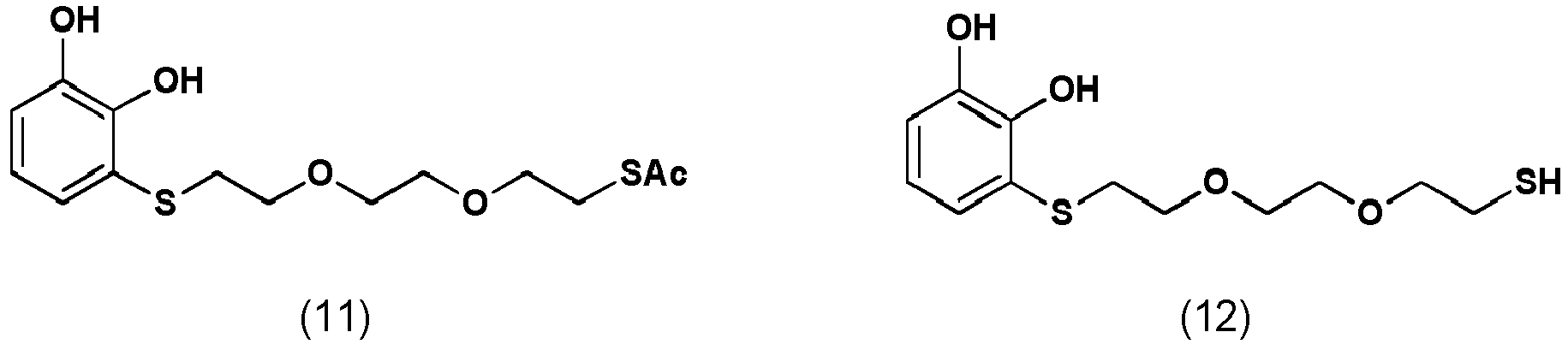

- The linear monopodal compounds can be prepared following a general processology based on a sequence of reactions consisting firstly of the oxidation to the corresponding o-benzoquinone of a starting compound containing a catechol ring, followed by a reaction of thia-Michael type, whereby a molecule with a thiol functional group is nucleophilically, and regioselectively, added to one of the positions immediately adjacent to the carbonyl groups of o-quinone. The reaction of the thiolated derivative with the o-quinone does not require prior purification of the latter, and the addition can be made immediately after the oxidation of the catechol. Furthermore, once the covalent bond is formed, the catechol functional group, and therefore the aromaticity of the ring, is spontaneously restored by a tautomerism of the keto-enol type. Altogether, this processology allows the access to new catechol derivatives in a fast and direct way.

- A technologically relevant aspect of the present invention is that the catechol subunit of a monopodal compound may act as a fragment with surface-adhesive properties, as well known in the art. On the other hand, a judicious choice of the functional chain R1 allows to design the monopodal compound in such a way that it is capable of conferring the desired functional properties to the coatings prepared from said compound. In the present document the desired functional fragment is selectively incorporated into the monopodal compound by a terminal thiol group bearing molecule, which is reactive to the oxidized form of the catechol ring (o-benzoquinone), and in turn capable of providing a robust direct and efficient covalent bond, from a point of view of the atomic efficiency.
- Another important advantage of this synthetic strategy is that the catechol ring is spontaneously recovered by tautomerism once the functional chain is added. For this reason, if desired, it is possible to use the monosubstituted compound as the starting material for the addition of a second functional fragment, in order to enhance the functional character of the first fragment (in the case of using fragments of similar functional nature), or to complement it (in the case of using fragments of different functional nature).
- In principle, it would be expected that the application two or more times of this general processology consecutively would allow all positions of the catechol ring with an available valence to be functionalized, since all the unsubstituted positions of the ring are theoretically reactive against the thia-Michael addition. However, and surprisingly, the inventors have found that only positions 3 and 6 (the latter being homologous to the above with reference to the plane of symmetry perpendicular to the catecholic ring) are significantly reactive under the employed conditions. This degree of regioselectivity is high enough so that no 4- (or 5-)-substituted addition products are detected in the reaction crude as well as after the purification thereof. Therefore, the process of the present invention allows to obtain a large variety of catechol derivatives substituted at the 3-, and optionally, 6-position of the ring, in a very affordable and regioselective manner.
- No other simple synthetic strategy as that disclosed herein is known for the general preparation of catechol derivatives with two functional substituents, being the same or different from each other. The processes known in the state of the art are much more complex, generally requiring various stages of protection and deprotection, as well as multistage routes to achieve double substitution. In many instances the first functional chain may be incorporated using the advantage provided by a reactive functional group, generally an aldehyde, carboxylic acid or amine, already present in the starting catechol derivative, but generally no further reactive groups are available for the incorporation of the second functional chain. In contrast to these processs, in the process disclosed herein the incorporation of the functional chains takes place taking advantage of only the reactivity of the catechol ring itself, as well as the spontaneous recovery of the catechol fragment following the thia-Michael reaction. Therefore, it is not necessary for the original starting catecholic compound to comprise additional functional groups, and pyrocatechol (A) may be selected for this purpose. The possibility of directly using pyrocatechol as the starting compound in the process of the present invention represents another important additional advantage, since this compound is the simplest possible catecholic molecule, is very economical and is widely available, being for this reason a particularly preferred starting catechol.

- Although the monopodal compounds obtained by the process disclosed herein can be purified by chromatographic techniques for the purpose of identification, the reaction crudes, once treated simply by aqueous washing, drying and filtration, can be directly used for the preparation of effective functional coatings, which is an important advantage of this process.
- In summary, the process of present invention allows to obtain directly and easily a wide variety of monopodal compounds, suitable for the preparation of coatings with a wide range of functionalities, and if desired, from a single simple, inexpensive and commercially available compound.
- In a preferred synthesis strategy, the reaction of an α-thiol compound of formula HS-R1 with one equivalent of the o-quinone of the catechol derivative used as the starting product directly generates a compound of formula (Ia), wherein a ring of catechol has a substituent bearing a functional fragment (-R1) attached by a sulfur atom.

- In another preferred synthesis strategy, a catechol of structure (Ia) compound is subjected to a second oxidation and nucleophilic addition process resulting in a catechol compound of structure (Ib) with two substituents bearing the functional fragments (-R1 and -R2) attached to the catechol ring by sulfur atoms.

- In another preferred synthesis strategy, the reaction of a compound of the α, ω-bisthiol (HS-R3-SH) type in a 1:1 molar ratio allows to obtain a catecholic derivative of formula (Ic) wherein R1 is -R3Z and Z is a free thiol terminal group (-SH).

- Such a catecholic compound of structure (Ic) is capable of being used in a subsequent reaction in which the free thiol group selectively reacts with another reactive molecule, which may for example be activated electrophilically, i.e. with a good leaving group for the substitution or nucleophilic addition of the thiol group. Also, said reactive molecule may have functional groups capable of selectively reacting with the thiol group by radical mechanism. In this case, the thiol group may be added in a reaction of thiol-ene or thiol-ine type to an unsaturation present in the reactive molecule. The person skilled in the art will recognize that these and other reactions are feasible for the derivatization of the monopodal compounds with all kinds of functional fragments, and in particular those described herein. In addition, the thiol-ene reaction is particularly useful, since it can be carried out selectively and in good yield without disruption of the catechol ring. Thus, the resulting compound will have a structure in which a catechol ring and a second molecular fragment are attached by a (-S-R3-S-) fragment.
- In the reaction between the bis-thiol and the o-quinone as previously mentioned, it may be preferable that one of the two thiol functional groups is protected, for example, with a thioacetyl group (HS-R3-SAc). In particular, said reaction would lead to the selective formation of a catecholic compound (Id).

- Subsequently, the hydrolysis of the compound (Id), for example under acid catalysis conditions, would lead to the deprotection of the terminal thiol group, with the consequent formation of the above-mentioned compound (Ic). The person skilled in the art will recognize that such a strategy would aim to avoid that in the course of the nucleophilic addition of the bis-thiol to the o-quinone both thiol groups react and thus to disadvantage the formation of byproducts with two catechol rings identical in structure.
- Compound (Ic) may also be used in the preparation of self-condensation compounds: by virtue of the potentially complementary nature of the catechol ring and the thiol group present simultaneously in (Ic), said molecule can be used as a monomeric precursor for the preparation of catecholic homopolymers of structure (VI) by oxidation of the catechol ring and in situ deprotection of the thiol group. Such an operation may lead to the self-condensation of the oxidized monomer, which would lead to the formation of a polymer formed by subunits bearing a biradical of catechol and a biradical R3 of functional nature, covalently bonded by two sulfur atoms.

- Also, the compound of formula (Id) may be used in a subsequent reaction with a third molecule, carrying a nucleophilic group capable of displacing the thioacetyl group. In this manner, the resulting compound will have a structure formed by a catechol ring and a second molecular fragment, attached by a (-S-R3-) fragment. The skilled person will recognize that both strategies are suitable for the optional incorporation of functional fragments into the catechol ring using a third molecule as carrier of said functional fragment and an intermediate or extensor fragment of the type (-S-R3-S-) or (-S-R3-), as a covalent bonding bridge between them.
- In another synthetic strategy, the structure of the starting catechol compound has a blocking group, preferably a fluorine atom, in one of two positions immediately adjacent to the hydroxyl groups:

- The presence of the fluorine atom in said position, along with the aforementioned regioselectivity observed for the nucleophilic addition reaction, may allow the selective production of compounds of structure (Ie), ensuring that said addition occurs exclusively in the other immediately adjacent position to the hydroxyl groups and therefore, no double addition by-products are generated in the reaction, even if the X 2 and X 3 substituents are hydrogen atoms. Moreover, by virtue of its high electronegativity, the fluorine atom directly attached to the ring increases the oxidation potential of said ring, thus being desirable when it is desired to prioritize the resistance of the compound of formula (I) to oxidative degradation.

- By extension, the person skilled in the art will recognize that the aforementioned synthetic strategies can be applied generally to blocked compounds of the type (B), allowing to obtain "blocked" analogs to the monomeric compounds of the type (Ib) and (Ic).
- As a further example of their versatility in obtaining functional coatings, catechol derivatives of formula (I) can also be used for the preparation of polymers by other known techniques, for example, by the ammonia polymerization process disclosed in the patent application
EP2589578 . Although the structure of these polymers will be expected to be different from that obtained by the oxidation + thia-Michael sequence disclosed herein, they may also be used for the preparation of functional coatings. - The present invention also relates to a group of catechol derivatives of formula (I), wherein, X1 , X2 and X3 are selected, respectively, from the group of moieties as previously defined, and generally, for each of these substituents;
R1 is a -R3-S-Z moiety;
R3 is selected from the group of moieties as previously defined, and generally, for this substituent; and,
Z is selected as a moiety of structure (J*):
- X1' is independently selected from the group consisting of hydrogen, a blocking group and a - SR2 substituent, wherein R2 has the same meaning as in the compound of formula (I), both in the broader definition and in particular or preferred embodiments disclosed herein; and,
- X2' and X3' are independently selected from the group consisting of hydrogen and a blocking group, as previously defined and generally for compounds of the type (I).
- This set of derivatives of type (I) has in its structure two catechol rings, attached by two sulfur atoms to the ends of an extender chain R3. To emphasize their linear bipodal structure, they will be represented hereinafter, and in particular, as structures of type (II):

- In preferred embodiments, the present invention relates to compounds of type (II), wherein X1 , X 1', X2 , X3 , X2' and X3' are hydrogen atoms; and
R3 has the same meaning as in the general compound of formula (I), both in its broader definition and in the particular or preferred embodiments disclosed in the present invention. - In particularly preferred embodiments, the bipodal compounds of formula (II) are selected from the group consisting of compound 14, 15, 16, 17, 18 and 19.


- The linear bipodal compounds can be prepared following methodologies analogous to those described for monopodal compounds, that is to say, by a process comprising oxidation of starting catechol derivatives and their subsequent thia-Michael reaction with molecules with one or more thiol groups in their structure, without the need to isolate the o-benzoquinone intermediate obtained after the oxidation.
- In a preferred synthesis strategy, the reaction with a 1:2 molar ratio between a compound having the structure of the α, ω-bisthiol type (HS-R3-SH) and an o-quinone, previously obtained by oxidation of a catechol derivative with positions adjacent to free hydroxyl groups, can directly generate a compound of formula (IIa). In this reaction, the thiol functional groups are added nucleophilically to the corresponding o-quinone molecules. This strategy is particularly useful for the preparation of linear bipodal compounds with two identical catechol fragments and R3 moieties inert to the reaction conditions.

- As mentioned above, the reaction in a 1:1 molar ratio between a compound having the structure of the α,ω-bisthiol type (HS-R3-SH) and an o-quinone previously obtained by oxidation of a catechol derivative with the corresponding positions adjacent to the free hydroxyl groups, allows to prepare structures of the type (Ic). The person skilled in the art will recognize that in a subsequent reaction, said compound (Ic) may react with 1 molar equivalent of the same o-quinone, or an o-quinone of different structure, to respectively generate a compound of formula (II) with two identical or different catecholic moieties.
- When one of the two positions adjacent to hydroxyl are occupied by a -SR1 moiety, as in the compounds of the type (Ia), such a reaction may allow the production of derivatives of the type (IIb). The person skilled in the art will recognize that, alternatively, the SR1 moieties may also be incorporated at the end of the synthetic route, i.e. to the structure (IIa), once obtained by the above-mentioned process.

- In another preferred synthetic strategy, the preparation of the linear bipodal compound (IIb) is carried out in two steps. In a first step, by reaction in a 1:1 molar ratio between α, ω-bisthiol (HS-R3-SH) and an o-quinone previously obtained by oxidation of the catechol derivative (Ia), a derivative catecholic of formula (If) wherein R1 is R3-Z and Z is a free thiol terminal group can be obtained. In a second step, the reaction of this derivative with an equivalent thereof, or another o-quinone, would lead to the preparation of the corresponding linear bipodal compound of general formula (II). Although this two-stage strategy is of general applicability, it may be particularly useful for the preparation of linear bipodal derivatives with R3 groups inert to the reaction conditions, in which the functional chains (R1 and R1') of the two catechols are required specifically to be different.

- Optionally, one of the two thiol groups may be pre-protected in the starting bis-thiol, for example in the form of thioacetyl (HS-R3-SAc), to thereby disadvantage the formation of symmetrical linear bipodal byproducts during the first synthesis stage. The resulting catechol derivative (Ig) should then be deprotected prior to carrying out the second synthesis step, which would lead to the above-mentioned catechol derivative (If).

- By virtue of the bis-catecholic structure of the compounds of type (IIa), such molecules can be used as co-monomers of a catecholic polymer of structure (VIIa) with an alternating co-polymer structure obtained by condensation of a second α, ω-bisthiol (HS-R3'-SH) with bis-o-quinone prepared by oxidation of the corresponding bis-catechol of formula (IIa). This second α, ω-bisthiol can be selected so that its structure is equal to or different from that of α, ω-bisthiol used to construct the bis-catechol of formula (IIa), as required in order to adjust the physical-chemical and functional properties of the resulting polymer. The use of a second α, ω-bisthiol identical to the first one (i.e. R3' = R3) would allow the production of a catecholic polymer of structure (VIIa).
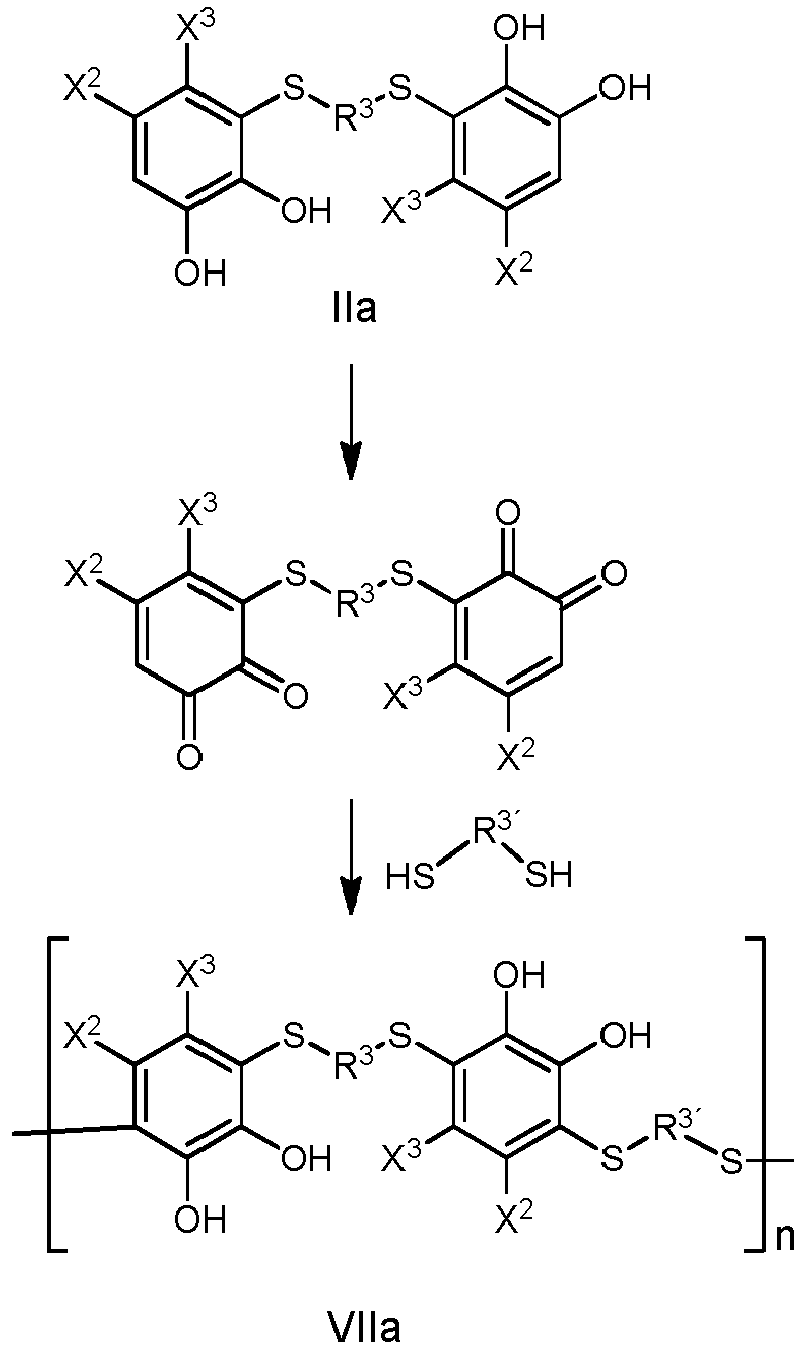
- Another preferred synthesis strategy relates in particular to the use of α, ω-bisthiols, preferably those which are commercially available, carrying reactive functional groups, such as 2,3-dihydroxy-1,4-dithiol (C) and 2-aminobutan-1,4-dithiol (D):

- This strategy could comprise a first step, in which the protection or derivatization, at the convenience of the technologist, of the hydroxyl or amine groups would be carried out, thus obtaining the corresponding O- and N-substituted derivatives, (E) and (F), respectively.

- A convenient way of selectively functionalizing the hydroxyl and amino functional groups in the bis-thiols may comprise bringing the protected thiol groups as disulfide during said functionalization. In particular, the oxidized and cyclic form of 2,3-dihydroxy-1,4-dithiol, or 4,5-dihydroxy-1,2-dithiane (G), is commercially available and may be used directly in the pre-functionalization step. Subsequently, by reducing the disulfide bridge with a suitable reductant, such as a phosphine, the desired starting bis-thiol can be generated:

- Once suitably protected or derivatized, these bis-thiols are suitable for incorporation into linear bipodal derivatives by any of the above-described strategies, to obtain compounds of formula (II) such as those listed below.


- Optionally, R4, R5, R9, R10 and R11 moieties may be selected such that they not only selectively protect the hydroxyl and amino groups under the reaction conditions of preparation of the linear bipodal compound, but also for the purpose of providing additional functionality thereto.
- In the synthesis of compounds of formula (II) in which the positions X1 and X1' are free, the functionalization of said positions, if necessary or desirable to adjust the functional properties of the final compound, can be carried out at the end of the preparation of the linear bipodal skeleton, or preferably at the beginning, in order to block from the beginning said reactive positions.
- The present invention also relates to a group of catechol derivatives of formula (I), wherein, X1 , X2 and X3 are selected, respectively, from the group of moieties as previously defined, and generally, for each of these substituents; and,
R1 is a moiety of the type BRANCH*;
- R12 is selected from the group consisting of:
- a linear or branched alkandiyl moiety of formula -Cn'H2n', wherein n' is equal to or higher than 1; preferably n' is equal to or higher than 2, and still more preferably the alkandiyl moiety is linear and n' is comprised between 2 and 18;
- a polyfluoroalkandiyl moiety of formula -(CH2)p3(CF2)p4(CH2)p5-, wherein p3 and p5 are independently selected from values equal to or higher than a 0, and p4 is equal to or higher than 1; preferably p4 is equal to or higher than 3, and still more preferably, p4 is comprised between 3 and 10;
- a moiety of formula -(CH2-O-Q-CH2-W)-, wherein Q is selected from the group consisting of-CO-, and -(CkH2kO)q1-, wherein k is a value comprised between 2 and 4, and q1 is a value comprised between 2 and 300; and wherein W is selected from the group consisting of -CHR"'-, and -CH(OH)CH2-, wherein R"' is a hydrogen atom or a methyl group.
- R13 is selected from the group consisting of:
- a linear or branched alkandiyl moiety of formula -Cn'H2n', wherein n' is equal to or higher than 1; preferably n' is equal to or higher than 2, and still more preferably the alkandiyl moiety is linear and n' is comprised between 2 and 18;
- a polyfluoroalkandiyl moiety of formula -(CH2)p5(CF2)p4(CH2)p3-, wherein p3 and p5 are independently selected from values equal to or higher than a 0, and p4 is equal to or higher than 1; preferably p4 is equal to or higher than 3, and still more preferably, p4 is comprised between 3 and 10;
- a moiety of formula -(W-CH2-Q-O-CH2)-, wherein Q is selected from the group consisting of-CO-, and -(OCkH2k)q1-, wherein k is a value comprised between 2 and 4, and q1 is a value comprised between 2 and 300; and wherein W is selected from the group consisting of -CHR"'-, and -CH2CH(OH)-, wherein R"' is a hydrogen atom or a methyl group.
- R14 is a hydrogen atom or a linear or branched alkyl moiety of formula -CnH2n+1, wherein n is a value between 1 and 30; preferably n ranges between 1 and 6, and still more preferably R13 is hydrogen, methyl or ethyl; and
- Z1 and Z2 are independently selected from the group consisting of:
- a hydrogen atom;
- a -COCH3 group;
- a moiety of structure (J*), as previously defined for structures of type (II);
- a moiety -CH2-CH2-Y-FUNC, wherein Y is selected from the group consisting of - O-, -COO-, -CONH-, -(CH2)rO-, being r a value comprised between 1 and 10; and FUNC is a moiety, as previously defined in the general case;
- a moiety of structure FUNC, as previously defined.
- This set of derivatives of type (I) has in its structure one, two or three rings of catechol, attached to a central structure in the form of a star of three branches. To emphasize the particular shape of said structure, they will hereinafter be represented, in particular, as structures of the type (III):

- In preferred embodiments, the present invention relates to compounds of structure (III), wherein:
- X1 , X2 and X3 are hydrogen atoms;
- R12 is a moiety of formula -(CH2-O-Q-CH2-W)-, wherein Q is selected from the group consisting of -CO-, and -(CkH2kO)q1-, wherein k is a value comprised between 2 and 4, and q1 is a value comprised between 2 and 300; and wherein W is selected from the group consisting of-CHR"'-, and -CH(OH)CH2-, wherein R'" is a hydrogen atom or a methyl group; R13 is a moiety of formula -(W-CH2-Q-O-CH2)-, wherein Q is selected from the group consisting of -CO-, and -(OCkH2k)q1-, wherein k is a value comprised between 2 and 4, and q1 is a value comprised between 2 and 300; and wherein W is selected from the group consisting of-CHR"'-, and -CH2CH(OH)-, wherein R'" is a hydrogen atom or a methyl group; R14 is a hydrogen atom, a methyl moiety or an ethyl moiety; and
- Z1 and Z2 are independently selected from the group consisting of:
- a hydrogen atom;
- a -COCH3 group;
- a moiety of structure (J*), as previously defined for structures of type (II);
- a moiety -CH2-CH2-Y-FUNC, wherein Y is selected from the group consisting of - O-, -COO-, -CONH-, -(CH2)rO-, being r a value comprised between 1 and 10; and FUNC is a moiety, as previously defined in the general case;
- a moiety of structure FUNC, as previously defined.
- Depending on the nature of the substituents Z1 and Z2, the resulting star compounds of formula (III) may be mono- (Z1 and Z2 other than J*), bi- (Z1 or Z2 of the type J*) or tripodal (Z1 and Z2 of the type J*).
- In particularly preferred embodiments, the compounds of formula (III) are the
compounds 20 and 21:
- The present invention also relates to a group of catechol derivatives of formula (I), wherein, X1 , X2 and X3 are selected, respectively, from the group of moieties as previously defined, and generally, for each of these substituents; and
R 1 is a moiety of the type BRANCH*;
- R12 is selected from the group consisting of:
- a linear or branched alkandiyl moiety of formula -Cn'H2n', wherein n' is equal to or higher than 1; preferably n' is equal to or higher than 2, and still more preferably the alkandiyl moiety is linear and n' is comprised between 2 and 18;
- a polyfluoroalkandiyl moiety of formula -(CH2)p3(CF2)p4(CH2)p5-, wherein p3 and p5 are independently selected from values equal to or higher than 0, and p4 is equal to or higher than 1; preferably p4 is equal to or higher than 3, and still more preferably, p4 is comprised between 3 and 10;
- a moiety of formula -(CH2-O-Q-CH2-W)-, wherein Q is selected from the group consisting of-CO-, and -(CkH2kO)q1-, wherein k is a value comprised between 2 and 4, and q1 is a value comprised between 2 and 300; and wherein W is selected from the group consisting of -CHR"'-, and -CH(OH)CH2-, wherein R'" is a hydrogen atom or a methyl group.
- R13 is selected from the group consisting of:
- a linear or branched alkandiyl moiety of formula -Cn'H2n', wherein n' is equal to or higher than 1; preferably n' is equal to or higher than 2, and still more preferably the alkandiyl moiety is linear and n' is comprised between 2 and 18;
- a polyfluoroalkandiyl moiety of formula -(CH2)p5(CF2)p4(CH2)p3-, wherein p3 and p5 are independently selected from values equal to or higher than 0, and p4 is equal to or higher than 1; preferably p4 is equal to or higher than 3, and still more preferably, p4 is comprised between 3 and 10;
- a moiety of formula -(W-CH2-Q-O-CH2)-, wherein Q is selected from the group consisting of-CO-, and -(OCkH2k)q1-, wherein k is a value comprised between 2 and 4, and q1 is a value comprised between 2 and 300; and wherein W is selected from the group consisting of-CHR"'-, and -CH2CH(OH)-, wherein R'" is a hydrogen atom or a methyl group.
- R14 is a -R12 -S-Z3 moiety, wherein Z3 is independently selected from the same group as Z1 and Z2; and
- Z1 and Z2 are independently selected from the group consisting of:
- a hydrogen atom;
- a -COCH3 group;
- a moiety of structure (J*), as previously defined for structures of type (II);
- a moiety -CH2-CH2-Y-FUNC, wherein Y is selected from the group consisting of - O-, -COO-, -CONH-, -(CH2)rO-, being r a value comprised between 1 and 10; and FUNC is a moiety, as previously defined in the general case;
- a moiety of structure FUNC, as previously defined.
- This set of derivatives of the type (I) has in its structure one, two, three or four rings of catechol, attached to a central structure in the form of a star with four branches. To emphasize the particular shape of said structure, they will hereinafter be represented, and in particular, as structures of type (IV):

- In preferred embodiments, the present invention relates to compounds of structure (IV), wherein:
- X1 , X2 and X3 are hydrogen atoms;
- R12 is a moiety of formula -(CH2-O-Q-CH2-W)-, wherein Q is selected from the group consisting of -CO-, and -(CkH2kO)q1-, wherein k is a value comprised between 2 and 4, and q1 is a value comprised between 2 and 300; and wherein W is selected from the group consisting of-CHR"'-, and -CH(OH)CH2-, wherein R'" is a hydrogen atom or a methyl group; R13 is a moiety of formula -(W-CH2-Q-O-CH2)-, wherein Q is selected from the group consisting of -CO-, and -(OCkH2k)q1-, wherein k is a value comprised between 2 and 4, and q1 is a value comprised between 2 and 300; and wherein W is selected from the group consisting of-CHR"'-, and -CH2CH(OH)-, wherein R'" is a hydrogen atom or a methyl group;
- R14 is a -R12 -S-Z3 moiety, wherein Z 3 is independently selected from the same group as Z1 and Z2; and
- Z1 and Z2 are independently selected from the group consisting of:
- a hydrogen atom;
- a -COCH3 group;
- a moiety of structure (J*), as previously defined for structures of the type (II);
- a moiety -CH2-CH2-Y-FUNC, wherein Y is selected from the group consisting of - O-, -COO-, -CONH-, -(CH2)rO-, being r a value comprised between 1 and 10; and FUNC is a moiety, as previously defined in the general case;
- a moiety of structure FUNC, as previously defined.
- Depending on the nature of the substituents Z1, Z2 and Z3, the resulting star compounds of formula (IV) may be mono- (Z1, Z2 and Z3 other than J*), bi- (Z1, Z2 and Z3 of the type J*), tripodal (any two of the three moieties Z1, Z2 and Z3 of the type J*), or tetrapodal (the three moieties Z1, Z2 and Z3 of the type J*).
- In particularly preferred embodiments, the compounds of formula (IV) are the compounds 24 and 25:

- As with the rest of the general compounds of formula (I), the incorporation of the catechol rings into the structure of the branched compounds of the mono- or multipodal type of formula (III) and (IV) can be carried out by reaction of one or more compounds of the o-benzoquinone type, in this case with a branched molecule in star shape with three or four thiol functional groups at the ends (L and M, respectively). As described above, the o-benzoquinones can be obtained by oxidation of the corresponding catechol derivatives.

- There exist on the market different branched molecules in star shape with terminal thiol groups which are particularly useful for the preparation of compounds of the type (III) and (IV), among which pentaerythritol tetrakis-(3-mercaptopropionate) (CAS No 7575-23-7), trimethylolpropane tris-(3-mercaptopropionate) (CAS No. 33007-83-9), and polythiols such as Capcure® 3-800 and Karenz® MT-PE1. All these compounds are commonly used as curatives agents for epoxy resins. The person skilled in the art will recognize that, in general, any branched molecule having a terminal thiol group in three or more of its branches is suitable for the preparation of compounds of the type (III) and (IV) in particular and, in general, of compounds with simultaneous presence of reactive thiol groups and one or more catechol rings attached to the branched structure by an arylether bridge at the 3-position of the aromatic ring, as well as derivatives in which all terminal thiol groups have been replaced with the corresponding catecholic moieties. In all of them, the choice of stoichiometry of the reaction between o-benzoquinone and tris- or tetrakis-thiol enables the number of catechol units successively incorporated into the branched structure to be controlled up to a maximum of three or four, respectively.


- Alternatively, the compounds of formula N or P, respectively, can be obtained firstly by means of a direct reaction in the desired stoichiometry between a compound of formula L or M and a reactive molecule which allows the coupling of a FUNC functional moiety due to the presence of an electrophile group, a leaving group or thiol-reactive group.


- Following this synthetic route, in a second reaction step one or more catecholic rings would be incorporated into the structure by the addition reaction to o-benzoquinones as described above, being the final product a catecholic compound of type (III) or (IV), with one or more FUNC functional chains supported on any of the branches which previously had free thiol groups.
- By way of example, and given its particular relevance in the preparation of functional polymers derived from compounds of the type (III) and (IV) which are disclosed below herein, the production of catecholic compounds of the type (IVb), substituted with a FUNC functional chain, can be carried out, generally, via the two alternative routes described above:
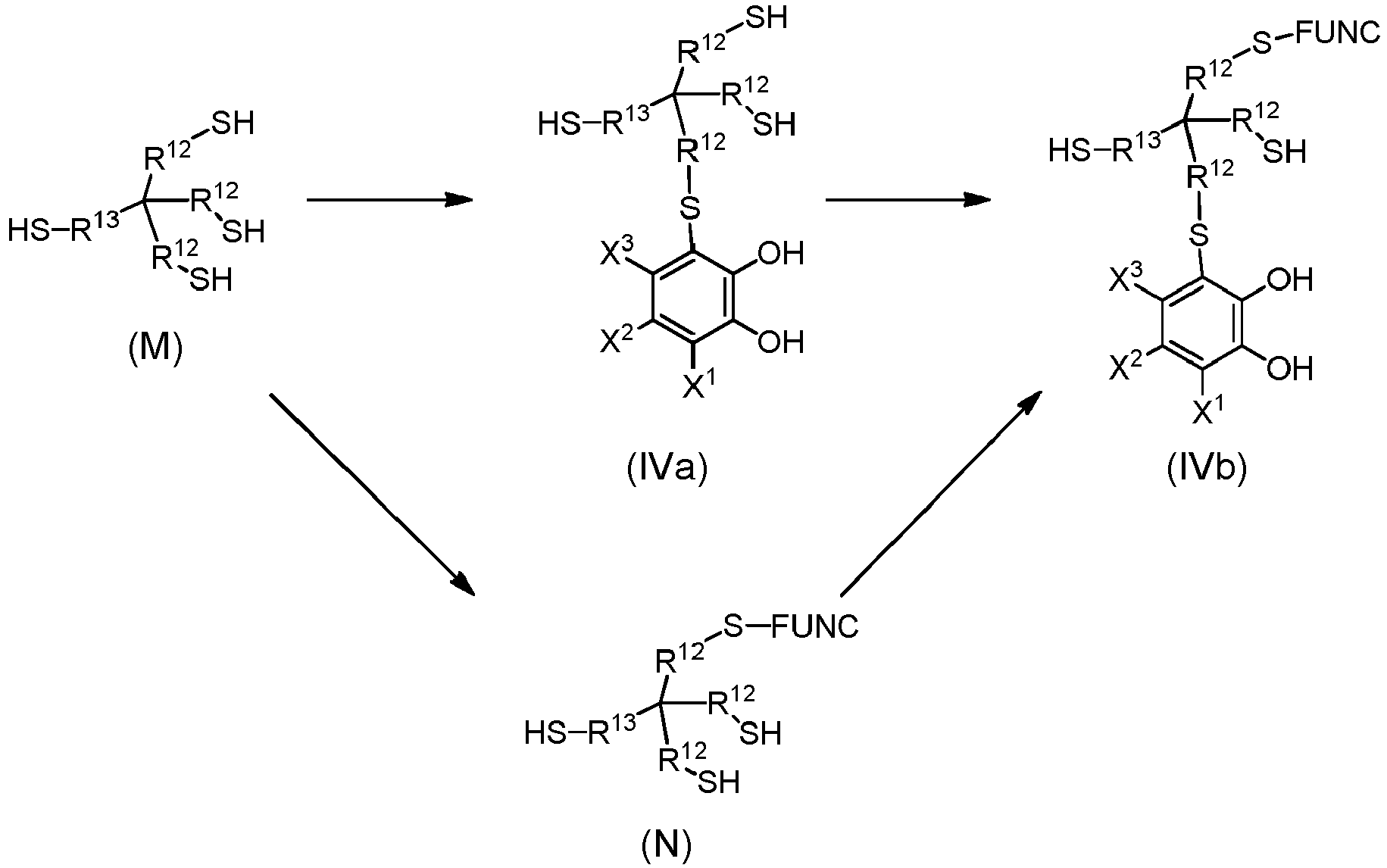
- In particularly preferred embodiments, the compounds of formula (IVb) are the compound 31 (k∼ 40 - 50) and the compound 32:


- A further aspect of the present invention relates to a polymeric catecholic compound obtained by the condensation of at least one compound of the type (III) or of the type (IV), preferably a compound of the type (III) or a compound of the type (IV)


- wherein Z1 and Z2 are hydrogen atoms;
- X1, X2, X3, R12, R13, R14 and Z3 are as defined previously according to the first aspect of the invention;
- the degree of polymerization is comprised between 2 and 10,000; and the molar fraction of said catecholic compound of the type (III) or of the type (IV) is between 0.01 and 1.
- When reference is made to said "polymeric catecholic compound" according to the present invention it is understood that it is formed from a monomer of formula (III), a monomer of formula (IV) or a combination thereof, provided that each of these monomers has at least two thiol groups.
- In this way, it would be possible to obtain the following polymer structures.
- Homopolymers based on monomers of the type (III);
- Homopolymers based on monomers of the type (IV);
- Heteropolymers of two or more different monomers of the type (III);
- Heteropolymers of two or more different monomers of the type (IV);
- Combinations of one or more monomers of the type (III) with one of the monomers of the type (IV)
- Combinations of one or more monomers of the type (III) and/or (IV) with other co-monomers (including non-catecholic) with which they can be condensed through the thiol function. Possible non-catecholic co-monomers can condense through thiols or through any other thiol-reactive functional group.
- As it will be recognized by one skilled in the art, compounds of formula (III) or (IV) are monomers or precursors, but exactly as such they are not in the polymer. The precursor of the polymers described herein will be at least one compound of the type (III) or (IV) having at least two thiol groups, whereas the corresponding constituent unit in the polymer would instead have the corresponding functional groups due to the oxidative coupling of a thiol group of the monomer (III) or (IV) with a thiol group of another monomer or a co-monomer (disulfide bridge), or due to the nucleophilic substitution or addition to an electrophilic co-monomer reactive to thiol (thioether bridge) or due to a radical addition to co-monomer with double or triple bonds (thioether bridge) depending on the chemical nature of the remaining reactive monomers.
- A further aspect of the present invention is the use of catecholic compounds of general structure (I), as well as of a polymeric catecholic compound as previously defined, for the preparation of a functional coating.
- A further aspect of the present invention is the use of a previously defined catecholic polymeric compound for the preparation of an adhesive substance.
- In order to obtain catecholic polymers by condensation reactions using at least one compound of the type (III) or (IV), the presence of at least two thiol groups in its structure is required. Aside from homopolymers obtained by self-condensation of the corresponding monomer of the type (III) or (IV), the skilled person will recognize that it is also possible to obtain heteropolymers by cross-condensation of a compound of the type (III) or (IV) containing two free thiol groups, with one or more additional co-monomers, provided that each of these has at least in its structure either two terminal thiol groups or two thiol-reactive groups. Optionally, one or more of these co-monomers may have one or more catechol rings. Optionally, any of the constituent monomers of the final polymer structure may have functional chains in their structure, if desired. Together, the incorporation of co-monomers allows, in the case of the polymers object of this invention, the regulation of the degree of crosslinking of the polymer, the ratio of catechol rings and/or, optionally, of the functional chains, as well as the separation of moieties with adhesive properties (catechol rings) and functional chains in different co-monomers.
- In a preferred synthesis strategy, condensation by oxidative polymerization of a catechol compound of the type (III) or (IV) with two or more free thiol groups with itself, or with one or more additional co-monomers with two or more free thiol groups makes it possible, respectively, to obtain condensation homopolymers and heteropolymers. By virtue of this oxidation reaction, the thiol groups are oxidatively coupled in pairs forming bridges of the disulfide type. An particularly suitable oxidizing agent for the preparation of such catecholic polymers is molecular iodine, which has the important advantage of being a thiol group selective oxidant in the presence of catechol groups, said oxidative coupling being carried out in a clean and efficient manner. This selectivity is particularly relevant because it makes the steps of protection and subsequent deprotection of the catechol ring unnecessary.
- In order to emphasize the versatility of the design of catecholic polymers based on disulfide bridges, and without being in any way limiting examples, those skilled in the art will recognize that as additional co-monomers non-catecholic polythiolated compounds of the structure of type (L) or (N) can be used, as well as non-catecholic polyols previously functionalized, such as those of the type (N) or (P), in case it is desirable to incorporate functional chains into the final polymer. On the other hand, the use of a compound of the type (IV) with three free thiols as the additional co-monomer allows to provide some degree of cross-linking to the final polymer structure. When it is desirable to confer multifunctional character on the polymer, it suffices to effect the condensation of two or more monomers with different functional chains. Also, the functional content of the final polymer may be adjusted by combining functionalized and non-functionalized monomers in suitable stoichiometry. Finally, it is possible to use α,ω-bis thiols with extender chains (HS-R3-SH) as co-monomers, in order to adjust the mechanical and/or functional properties of the polymer. The person skilled in the art will recognize that it is possible to use these and other combinations of co-monomers for the preparation of catecholic polymers by direct condensation of free thiol groups, without departing from the scope of the present invention, provided that at least one of the monomers is a compound of the type (III) or of the type (IV), which has at least two free thiol groups in its structure.
- In another preferred synthetic strategy, it is possible to obtain alternating polymers by condensation between monomers of the structure of type (III) or (IV) with two or more free thiol groups, and co-monomers having two or more thiol-reactive functional groups, such as, for example, isocyanate groups, N-substituted maleimides, leaving groups such as mesyl or tosyl, and terminal double or triple bonds, generally susceptible to nucleophilic addition, nucleophilic substitution or radical addition (thiol-ene, thiol-ine) by reaction with the thiol group. By way of example, the person skilled in the art will recognize the use of compounds having three terminal thiol-reactive functional groups, such as tris[2-(3-mercaptopropionyloxy)ethyl] isocyanurate, 1,3,5-triallyl-1,3,5-triazin-2,4,6(1H,3H,5H)-trione or trimethylolpropane methacrylate as polythiols crosslinking agents in condensation reactions of thiol-ene type.
- To the extent that both the catecholic monomers of the type (III) and (IV) and the thiol-reactive co-monomers may optionally incorporate functional chains, and in turn generate structures with a varying degree of cross-linking and flexibility, this synthesis strategy allows a versatility similar to the condensation by disulfide bridges, with the relevant difference that the resulting final products are necessarily alternating co-polymers. The person skilled in the art will recognize that it is possible to use these and other combinations of co-monomers for the preparation of catecholic polymers by condensation of thiol groups with thiol-reactive groups without departing from the scope of the present invention, provided that at least one of the monomers is a compound of the type (III) or of the type (IV), which has at least two free thiol groups in its structure.
- The optional presence of functional chains in the compounds of general structure (I), as well as in the polymers containing them, makes it possible to use such materials for the preparation of functional coatings of substrates. Depending on the functional chain(s) selected for the constituent monomer(s) of the catecholic polymer, it is possible to obtain a coating with one or more functionalities selected from the group consisting of hydrophobicity, oleohydrophobicity, solubility in aqueous media, compatibility in physiological media, solubility in organic solvents of medium or low polarity, bacteriostatic properties, bactericidal properties, antifouling properties, detergent capacity, surfactant capacity, fluorescence, improved cell recognition and nternalization and mucoadhesivity.
- The presence of catechol rings in the polymers object of the present invention allows to obtain materials with adhesive properties for joining substrates.
- Hereinafter, a number of examples are provided which are intended only to illustrate the invention without the invention being limited thereto.
- In a 250 mL volume bottom flask, a solution of 234 mg of NaIO4 (1 mmol) in 38 mL of H2O was prepared and cooled in an ice bath. The corresponding catechol (1 mmol) dissolved in 1 mL of Et2O was then added and left stirring vigorously for 15 min. After this time, extraction of the corresponding formed quinone by the addition of dichloromethane (DCM, 4x8 mL) was carried out. Thereafter, it was dried over anhydrous sodium sulfate and filtered. On the other hand, a solution of the corresponding thiol (1 mmol) in 2 mL of dichloromethane was prepared in an inert atmosphere in a Schlenk flask. To this solution 229.5 µl of trifluoroacetic acid (TFA, 3 mmol) was further added. Finally, the solution of the corresponding quinone in DCM was added to the solution containing the thiol, further protecting the mixture from light and leaving it under magnetic stirring under an inert atmosphere for six hours. After this time, both the solvent and the TFA were removed in vacuo to give the reaction crude which was purified using a chromatography column in order to separate mainly the mono- and di-substituted compounds from the remainder of impurities.
-

- In a 250 mL volume bottom flask, a solution of 234 mg of NaIO4 (1 mmol) in 38 mL of H2O was prepared and cooled in an ice bath. 110 mg of pyrocatechol (1 mmol) dissolved in 1 mL of Et2O was then added and left stirring vigorously for 15 min. After this time, extraction of the corresponding formed quinone by the addition of dichloromethane (DCM, 4x8 mL) was carried out. Thereafter, it was dried over anhydrous sodium sulfate and filtered. On the other hand, a solution of 268 mg of 1-octadecanethiol (1 mmol) in 2 mL of dichloromethane was prepared in an inert atmosphere in a Schlenk flask. To this solution 229.5 µl of trifluoroacetic acid (TFA, 3 mmol) was further added. Finally, the solution of the o-quinone in DCM was added to the solution containing the thiol, further protecting the mixture from light and leaving it under magnetic stirring under an inert atmosphere for six hours. After this time, both the solvent and the TFA were removed under vacuum to obtain a reaction crude with a mixture 5:1 of the mono-substituted (1 b) and di-substituted (2b) products, respectively. The product mixture was purified using a chromatography column with a 9/1 hexane/ethyl acetate eluent mixture in a total yield of 77% (64.2% of 1b and 12.8% of product 2b). Characterization of 1b: 1H-NMR (360 MHz, CDCl3) δ 7.00 (dd, J 1 = 1.60 Hz, J 2 = 7.89, 1H), 6.91 (dd, J 1 = 1.60 Hz, J 2 = 7.79, 1H), 6.78 (t, J = 7.89 Hz, 1H), 2.70 (t, J = 7.57, 2H), 1.55 (q, J = 7.28 Hz, 2H), 1.49-1.22 (m, 30H), 0.88 (t, J = 6.38 Hz, 3H); 13C-NMR (360 MHz, CDCl3) δ 144.15, 143.77, 126.62, 120.72, 119.26, 116.21, 36.82, 31.96, 29.72, 29.68, 29.64, 29.57, 29.49, 29.38, 29.12, 28.60, 22.71, 14.13; MS/ESI- [M-H]- 393.284 Da. Characterization of 2b: 1H-NMR(250 MHz, CDCl3)δ 6.92 (s, 2H), 2.76 (t, J = 7.52, 4H), 1.58 (q, J = 7.37 Hz,4H), 1.45-1.13 (m,60H), 0.88 (t, J = 6.84 Hz, 6H); 13C-NMR(250 MHz, CDCl3)δ 143.37, 124.69, 120.60, 35.43, 31.58, 29.69, 29.68, 29.64, 29.58, 29.55, 29.50, 29.37, 29.14, 28.67, 22.69, 14.08; MS/ESI- [M-H]- 677.536 Da.
-

- In a 50 mL volume bottom flask, a solution of 117 mg of NaIO4 (0.5 mmol) in 20 mL of H2O was prepared and cooled in an ice bath. 55 mg of pyrocatechol (0.5 mmol) dissolved in 0.5 mL of Et2O was then added and left under vigorous stirring for 15 min. After this time, extraction of the corresponding formed quinone by the addition of dichloromethane (DCM, 4 x 8 mL) was carried out. Thereafter, it was dried over anhydrous sodium sulfate and filtered. On the other hand, a solution of 400 mg of poly(ethylene glycol)methyl ether thiol (0.5 mmol) in 1 mL of dichloromethane was prepared in an inert atmosphere in a Schlenk flask. To this solution 115 µL of trifluoroacetic acid (TFA, 1.5 mmol) was further added. Finally, the solution of the o-quinone in DCM was added to the solution containing the thiol, further protecting the mixture from light and leaving it under magnetic stirring under an inert atmosphere for six hours. After this time, both the solvent and the TFA were removed in vacuo to obtain the reaction crude. The product mixture was purified using a chromatography column with a 8/2 ethyl acetate/methanol eluent mixture in a total yield of 40%. Characterization of 6:1H-NMR (360 MHz, CDCl3) δ 6.90 (dd, J1 = 1.4 Hz, J2 = 7.8 Hz, 1H), 6.85 (dd, J1 = 1.5 Hz, J2 = 7.9 Hz, 1H), 6.66 (t, J= 7.9 Hz, 1H), ∼4.70 (broad), 3.60 (s, >70H), 3.50 (t, J = 5.7 Hz, 2H), 2.90 (t, J = 5.9 Hz, 2H); 13C-NMR (400MHz, CDCl3) δ 145.77, 145.18, 126.49, 120.53, 119.12, 116.72, 70.54, 69.04, 59.19, 35.98; MS/ESI+ [M+NH4] + 1054.581 Da; [M+Na] + 1059.539 Da, corresponding to n = 20, together with several satellite peaks corresponding to n around 20.
-


- Synthesis of the monoacetylated dithiol was firstly carried out. To this end, 3 mmol of the corresponding dithiol (547 mg of 2,2'-(ethylenedioxy)diethanethiol for the synthesis of molecule 11) was dissolved in 17 mL of DCM in a round bottom flask. Thereafter, 17 mL of pyridine and 282 µl of acetic anhydride (1.5 mmol) were added stirring at room temperature for at least 15 hours. After this time, the solvent was removed in vacuo and extraction was effected with several washes adding water in order to remove the pyridine. There was thus obtained a product mixture comprising 71% the desired monoacetylated product, 27% the diacetylated product (without free thiol), and in ≤2% the dithiol of the starting material. This mixture was used without further purification to carry out the Michael reaction, considering the percentage of purity of the monoacetylated product, and taking into account that of the formed by-products, the diacetylated compound is inert to the nucleophilic addition, and the dithiolated compound is found in residual proportion.
- For Michael addition, in a 250 mL volume bottom flask, a solution of 234 mg of NaIO4 (1 mmol) in 38 mL of H2O was prepared and cooled in an ice bath. 110 mg of pyrocatechol (1 mmol) dissolved in 1 mL of Et2O was then added and left stirring vigorously for 15 min. After this time, extraction of the formed o-quinone with the addition of dichloromethane (DCM, 4x8mL) was carried out. Thereafter, it was dried over anhydrous sodium sulfate and filtered. On the other hand, a solution of 315 mg of monoacetylated dithiol previously prepared (approx. 1 mmol, considering a purity of ≈71%) in 2 mL of dichloromethane was prepared in an inert atmosphere in a Schlenk flask. To this solution 229.5 µl of trifluoroacetic acid (TFA, 3 mmol) was further added. Finally, the solution of the o-quinone in DCM was added to the solution containing the thiol, further protecting the mixture from light and leaving it under magnetic stirring under an inert atmosphere for six hours. After this time, both the solvent and the TFA were removed under vacuum to obtain the reaction crude. The product mixture was purified using a chromatography column with a 7/3 hexane/ethyl acetate eluent mixture in a yield of 38% of product 11. Characterization of 11:1H-NMR (360 MHz, CDCl3) δ 7.60 (broad, 1H), 6.99 (dd, J1 = 1.5 Hz, J2 = 7.8 Hz, 1H), 6.91 (dd, J 1 = 1.5 Hz, J2 = 8.2 Hz, 1H), 6.73 (t, J= 7.9 Hz, 1H), 5.89 (broad, 1H), 3.65 (broad, 4H), 3.61 (t, J = 6.6 Hz, 2H), 3.55 (t, J = 5.7 Hz, 2H), 3.11 (t, J = 6.7 Hz, 2H), 2.91 (t, J = 5.7 Hz, 2H), 2.33 (s, 3H); 13C-NMR (360 MHz, CDCl3) δ 196.14, 145.79, 144.90, 127.57, 120.75, 118.77, 116.75, 70.36, 70.24, 70.06, 68.99, 36.88, 30.86, 28.99; MS/ESI- [M-H]- 332.075 Da.
- The catechol derivative 9 was obtained in a manner analogous to that described above, but using 1,6-hexanedithiol instead of 2,2'-(ethylenedioxy)diethanethiol. After removal of the pyridine, a reaction crude was obtained with a mixture of the desired monoacetylated product, the diacetylated and the starting dithiol in a ratio of 65%, 29% and 5% respectively. This mixture was used without further purifications to carry out the Michael reaction, considering the percentage of purity of the monoacetylated product, and taking into account that of the formed by-products, the diacetylated compound is inert to the nucleophilic addition, and the dithiolated compound is found in a residual proportion as was elaborated in the previous example. After Michael addition, carried out in a manner analogous to that described for the previous example, the product 9 was obtained in a yield of 46% with respect to the addition itself, corresponding to 30% when taking the starting crude mixture. Characterization of 9: 1H-NMR (360 MHz, CDCl3) δ 6.98 (dd, J1 = 1.3 Hz, J2 = 7.8 Hz, 1H), 6.90 (dd, J1 = 1.3 Hz, J2 = 8.2 Hz, 1H), 6.77 (t, J= 7.9 Hz, 1H), 2.84 (t, J= 7.3 Hz, 2H), 2.70 (t, J=7.4 Hz, 2H), 2.32 (s, 3H), 1.50 (m, 4H), 1.30 (m, 4H); 13C-NMR (360 MHz, CDCl3) δ 196.50, 144.48, 144.11, 126.76, 121.01, 119.49, 116.53, 39.17, 36.73, 35.55, 30.94, 29.74, 29.23, 28.45; MS/ESI- [M-H]-299.078 Da.
-

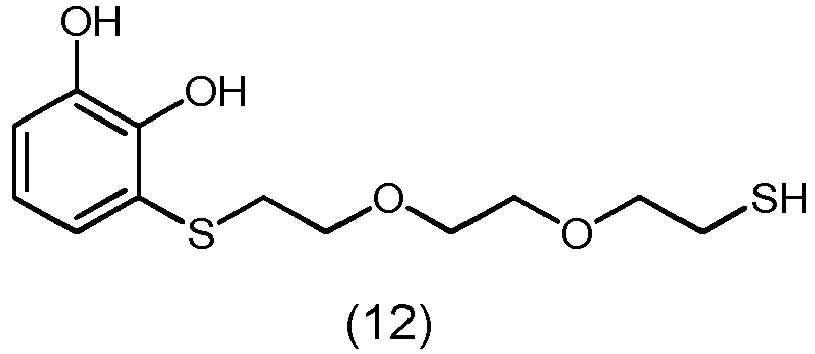
- The
products 10 and 12 can be synthesized by two procedures (A and B), as detailed below. - A solution of the monoacetylated derivative of the corresponding catechol-thiol (products 9, or 11, 1 mmol) in 15 mL of MeOH was prepared, and 400 µl of concentrated HCl (37% in water) was added. The mixture was stirred, refluxing for at least 15 hours. After this time, the solvent was evaporated in vacuo to give the corresponding thiol (10, or 12) in a yield of ≥98%. Characterization of 10: 1H-NMR (400 MHz, CDCl3) δ 6.99 (dd, J1 = 1.5 Hz, J2 = 7.8 Hz, 1H), 6.92 (dd, J 1 = 1.5 Hz, J2 = 8.0 Hz, 1H), 6.79 (t, J= 7.8 Hz, 1H), 2.70 (t, J=7.4, 2H), 2.50 (q, J= 7.3, 2H), 1.57 (m, 4H), 1.33 (t, J= 7.6, 1H), 1.31 (m, 4H); 13C-NMR (400 MHz, CDCl3) δ 144.44, 144.06, 126.86, 121.04, 119.44, 116.59, 36.79, 34.01, 29.79, 28.25, 28.05, 24.78;MS/ESI- [M-H]- 257.068 Da. Characterization of 12: 1H-NMR (400 MHz, CDCl3) δ 7.59 (broad, 1H), 6.99 (dd, J1 = 1.5 Hz, J2 = 7.8 Hz, 1H), 6.92 (dd, J1 = 1.5 Hz, J2 = 8.0 Hz, 1H), 6.73 (t, J= 8.0 Hz, 1H), 5.79 (broad, 1H), 3.67 (s, 4H), 3.64 (t, J = 6.2 Hz, 2H), 3.56 (t, J = 5.8 Hz, 2H), 2.92 (t, J = 5.8 Hz, 2H), 2.72 (q, J=6.5 Hz, 2H).3C-NMR (400 MHz, CDCl3) δ 145.70, 144.85, 127.61, 120.86, 118.74, 116.76, 73.21, 70.39, 70.21, 69.03, 36.85, 24.57; MS/ESI- [M-H]- 290.065 Da.
- From the reaction between the catechol and the corresponding dithiol (see synthesis of compounds of formula II and synthesis of compound 16) the corresponding catechol-thiol was obtained as a by-product of the reaction in a single step, with yields of 21% (in the case of catechol-thiol 10) and 39% (catechol-thiol 12).
-

- In a round bottom flask 55 mg of compound 10 (0.21 mmol) was weighed and dissolved in 4 mL of acetone. Once dissolved, 83 mg of fluorescein isothiocyanate (0.21 mmol) was added and the mixture was refluxed under magnetic stirring for 24 hours. After this time, the solvent was removed under reduced pressure to give the reaction crude, which was purified using a chromatography column with a 6/4 hexane/ethyl acetate eluent mixture in a total yield of 60% of compound 22. Characterization of 22:1H-NMR (360 MHz, CDCl3) δ 10.96 (broad, 1H), 8.90 (broad, 1H), 8.58 (s, 1H), 8.11 (dd, J1 = 1.8 Hz, J 2= 8.4 Hz, 1H), 7.30 (dd, J1 = 0.6 Hz, J 2= 8.4 Hz, 1H), 6.86 (dd, J1 = 1.6 Hz, J2 = 7.8 Hz, 1H), 6.78 (dd, J1 =1.2 Hz, J 2= 8.0 Hz, 1H), 6.75 (d, J= 2.4 Hz, 2H), 6.71 (d, J= 8.4 Hz, 2H), 6.68 (t, J= 8.0 Hz, 1H), 6.64 (dd, J1 = 2.4 Hz, J2 = 8.4 Hz, 2H), 3.32 (t, J = 7.6 Hz, 2H), 3.22 (broad, 3H), 2.84 (t, J = 7.6 Hz, 2H), 1.72 (q, J = 7.0 Hz, 2H), 1.60 (q, J = 7.0 Hz, 2H), 1.47 (m, 4H); 13C-NMR (400 MHz, CDCl3) δ 199.14, 160.33, 153.30, 150.70, 145.73, 145.39, 142.20, 131.15, 130.11, 128.31, 125.20, 124.14, 122.19, 120.63, 119.13, 115.43, 113.33, 111.37, 103.34, 35.72, 34.29, 28.81-30.60; MS [M+H]-648.1162 Da.
- In a 250 mL volume bottom flask, a solution of 234 mg of NaIO4 (1 mmol) in 38 mL of H2O was prepared and cooled in an ice bath. The corresponding catechol (1 mmol) dissolved in 1 mL of Et2O was then added and left stirring vigorously for 15 min. After this time, extraction of the corresponding formed quinone with the addition of dichloromethane (DCM, 4x8 mL) was carried out. Thereafter, it was dried over anhydrous sodium sulfate and filtered. On the other hand, a solution of the corresponding dithiol (0.5 mmol) in 2 mL of dichloromethane was prepared in an inert atmosphere in a Schlenk flask. To this solution 229.5 µl of trifluoroacetic acid (TFA, 3 mmol) was further added. Finally, the solution of the corresponding quinone in DCM was added to the solution containing the dithiol, further protecting the mixture from light and leaving it under magnetic stirring under an inert atmosphere for six hours. After this time, both the solvent and the TFA were removed under vacuum to give the reaction crude containing a mixture of bipodal and monopodal derivatives. This mixture was purified using a chromatography column.
-

- In a 250 mL volume bottom flask, a solution of 234 mg of NaIO4 (1 mmol) in 38 mL of H2O was prepared and cooled in an ice bath. 110 mg of pyrocatechol (1 mmol) dissolved in 1 mL of Et2O was then added and left stirring vigorously for 15 min. After this time, extraction of the formed o-quinone with the addition of dichloromethane (DCM, 4x8mL) was carried out. Thereafter, it was dried over anhydrous sodium sulfate and filtered. On the other hand, a solution of 73 mg of 2,2'-(ethylenedioxy) diethanethiol (0.5 mmol) in 2 mL of dichloromethane was prepared in an inert atmosphere in a Schlenk flask. To this solution 229.5 µl of trifluoroacetic acid (TFA, 3 mmol) was further added. Finally, the solution of the o-quinone in DCM was added to the solution containing the dithiol, further protecting the mixture from light and leaving it under magnetic stirring under an inert atmosphere for six hours. After this time, both the solvent and the TFA were removed in vacuo to obtain crude with products 16 and 12. The product mixture was purified using a chromatography column with a 7/3 hexane/ethyl acetate elution mixture with a total yield of 51% (37.3% of the bipodal derivative 16 and 20.7% of the monopodal product 12). Characterization of 16: 1H-NMR (400 MHz, CDCl3) δ 7.65 (broad, 1H), 7.01 (dd, J1 = 1.5 Hz, J 2= 7.8 Hz, 2H), 6.93 (dd, J1 = 1.5 Hz, J 2= 8.0 Hz, 2H), 6.76 (t, J= 7.8 Hz, 2H), 5.85 (broad, 1H), 3.70 (s, 4H), 3.57 (t, J = 5.8 Hz, 2H), 2.94 (t, J = 5.8 Hz, 2H).13C-NMR (400 MHz, CDCl3) δ 145.77, 144.84, 127.75, 121.04, 118.65, 117.01, 70.23, 68.98, 36.96; MS/ESI- [M-H]- 398.086 Da.
- In a 250 mL volume bottom flask, a solution of 234 mg of NaIO4 (1 mmol) in 38 mL of H2O was prepared and cooled in an ice bath. The corresponding catechol (1 mmol) dissolved in 1 mL of Et2O was then added and left stirring vigorously for 15 min. After this time, extraction of the corresponding formed quinone by the addition of dichloromethane (DCM, 4x8 mL) was carried out. Thereafter, it was dried over anhydrous sodium sulfate and filtered. On the other hand, a solution of the corresponding trithiol (between 0.33 mmol and 1.2 mmol) in 2 mL of dichloromethane was prepared in an inert atmosphere in a Schlenk flask. To this solution 229.5 µl of trifluoroacetic acid (TFA, 3 mmol) was further added. Finally, the solution of the corresponding quinone in DCM was added to the solution containing the trithiol, further protecting the mixture from light and leaving it under magnetic stirring under an inert atmosphere for six hours. After this time, both the solvent and the TFA were removed in vacuo to give the reaction crude which was purified using a chromatography column.
-

- In a 250 mL volume bottom flask, a solution of 234 mg of NaIO4 (1 mmol) in 38 mL of H2O was prepared and cooled in an ice bath. The corresponding catechol (1 mmol) dissolved in 1 mL of Et2O was then added and left stirring vigorously for 15 min. After this time, extraction of the corresponding formed quinone with the addition of dichloromethane (DCM, 4x8 mL) was carried out. Thereafter, it was dried over anhydrous sodium sulfate and filtered. On the other hand, a solution of tri-methylolpropane tri(3-mercapto-propionate) (1.2 mmol) in 2 mL of dichloromethane was prepared in an inert atmosphere in a Schlenk flask. To this solution 229.5 µl of trifluoroacetic acid (TFA, 3 mmol) was further added. Finally, the solution of the corresponding quinone in DCM was added to the solution containing the trithiol, further protecting the mixture from light and leaving it under magnetic stirring under an inert atmosphere for six hours. After this time, both the solvent and the TFA were removed under vacuum to obtain the reaction crude. The product mixture was purified using a chromatography column with a 4/6 hexane/diethyl ether eluent mixture with a total yield of 45% of
product 20. Characterization of 20: 1H-NMR (360 MHz, CDCl3) δ 6.99 (dd, J1 = 1.8 Hz, J2 = 7.8 Hz, 1H), 6.94 (dd, J1 = 1.8 Hz, J2 = 7.8 Hz, 1H), 6.79 (t, J= 7.8 Hz, 1H), 4.09 (s, 6H), 2.97 (t, J= 6.5 Hz, 2H), 2.77 (q, J= 6.7 Hz, 4H), 2.67 (t, J= 6.2 Hz, 4H), 2.55 (t, J= 6.7 Hz, 2H), 1.63 (t, J= 8.1 Hz, 2H), 1.50 (q, J= 7.7 Hz, 2H), 0.91 (t, J= 7.6 Hz, 3H); 13C-NMR (400 MHz, CDCl3) δ 172.10, 171.82, 145.16, 144.67, 127.13, 121.32, 118.00, 117.15, 64.44, 64.12, 41.03, 38.68, 34.02, 31.23, 23.19, 19.99, 7.67; MS/ESI- [M-H]- 505.103 Da. -

- In a 250 mL volume bottom flask, a solution of 234 mg of NaIO4 (1 mmol) in 38 mL of H2O was prepared and cooled in an ice bath. The corresponding catechol (1 mmol) dissolved in 1 mL of Et2O was then added and left stirring vigorously for 15 min. After this time, extraction of the corresponding formed quinone with the addition of dichloromethane (DCM, 4x8 mL) was carried out. Thereafter, it was dried over anhydrous sodium sulfate and filtered. On the other hand, a solution of tri-methylolpropane tri(3-mercapto-propionate) (0.33 mmol) in 2 mL of dichloromethane was prepared in an inert atmosphere in a Schlenk flask. To this solution 229.5 µl of trifluoroacetic acid (TFA, 3 mmol) was further added. Finally, the solution of the corresponding quinone in DCM was added to the solution containing the trithiol, further protecting the mixture from light and leaving it under magnetic stirring under an inert atmosphere for six hours. After this time, both the solvent and the TFA were removed under vacuum to obtain the reaction crude. The product mixture was purified using a chromatography column with a 7/3 hexane/ethyl acetate eluent mixture with a total yield of 14% of product 21. Characterization of 21: 1H-NMR (360 MHz, CDCl3) δ 7.00 (dd, J1 = 1.6 Hz, J2 = 7.7 Hz, 1H), 6.94 (dd, J1 = 1.6 Hz, J2 = 7.9 Hz, 1H), 6.78 (t, J= 7.9 Hz, 1H), 4.09 (s, 6H), 2.97 (t, J= 6.6 Hz, 4H), 2.77 (q, J= 6.5 Hz, 2H), 2.67 (t, J= 6.6 Hz, 2H), 2.57 (t, J= 6.7 Hz, 4H), 1.63 (t, J= 8.2 Hz, 1H), 1.50 (q, J= 7.6 Hz, 2H), 0.91 (t, J= 7.4 Hz, 3H); 13C-NMR (400 MHz, CDCl3) δ 171.03, 170.79, 143.92, 143.47, 125.93, 120.15, 116.88, 115.99, 63.26, 62.96, 39.87, 37.51, 32.92, 30.45, 22.04, 18.78, 6.49; FT-IR (ATR) ν(cm-1) 3404, 2968, 2944, 1727, 1602, 1587, 1459, 1354, 1245, 1222, 1189, 1138, 1056, 1002, 935, 899, 823, 777, 728, 674, 639, 567; MS/ESI-[M-H]- 613.125 Da.
- In a 250 mL volume bottom flask, a solution of 234 mg of NaIO4 (1 mmol) in 38 mL of H2O was prepared and cooled in an ice bath. The corresponding catechol (1 mmol) dissolved in 1 mL of Et2O was then added and left stirring vigorously for 15 min. After this time, extraction of the corresponding formed quinone by the addition of dichloromethane (DCM, 4x8 mL) was carried out. Thereafter, it was dried over anhydrous sodium sulfate and filtered. On the other hand, a solution of the corresponding tetrathiol (between 0.25 mmol and 1.1 mmol) in 2 mL of dichloromethane was prepared in an inert atmosphere in a Schlenk flask. To this solution 229.5 µl of trifluoroacetic acid (TFA, 3 mmol) was further added. Finally, the solution of the corresponding quinone in DCM was added to the solution containing the tetrathiol, further protecting the mixture from light and leaving it under magnetic stirring under an inert atmosphere for six hours. After this time, both the solvent and the TFA were removed in vacuo to give the reaction crude which was purified using a chromatography column.
-

- In a 250 mL volume bottom flask, a solution of 234 mg of NaIO4 (1 mmol) in 38 mL of H2O was prepared and cooled in an ice bath. The pyrocatechol (1 mmol) dissolved in 1 mL of Et2O was then added and left stirring vigorously for 15 min. After this time, extraction of the corresponding formed quinone with the addition of dichloromethane (DCM, 4x8 mL) was carried out. Thereafter, it was dried over anhydrous sodium sulfate and filtered. On the other hand, a solution of pentaerythritol tetrakis (3-mercaptopropionate) (1.1 mmol) in 2 mL of dichloromethane was prepared in an inert atmosphere in a Schlenk flask. To this solution 229.5 µl of trifluoroacetic acid (TFA, 3 mmol) was further added. Finally, the solution of the corresponding quinone in DCM was added to the solution containing the tetrathiol, further protecting the mixture from light and leaving it under magnetic stirring under an inert atmosphere for six hours. After this time, both the solvent and the TFA were removed under vacuum to obtain the reaction crude. The product mixture was purified using a chromatography column with a 6/4 hexane/ethyl acetate eluent mixture in a total yield of 50% of product 24, obtaining compound 25 in 20% yield as a by-product. Characterization of 24: 1H-NMR (360 MHz, CDCl3) δ 6.99 (dd, J1 = 1.7 Hz, J2 = 7.8 Hz, 1H), 6.93 (dd, J1 = 1.7 Hz, J2 = 8.0 Hz, 1H), 6.79 (t, J= 7.8 Hz, 1H), 4.19 (s, 8H), 6.99 (dd, J1 = 1.8 Hz, J2 = 7.8 Hz, 1H), 2.97 (t, J= 6.4 Hz, 2H), 2.77 (m, 6H), 2.68 (t, J= 6.3 Hz, 6H), 2.55 (t, J= 6.4 Hz, 2H), 1.64 (t, J= 8.1 Hz, 1H); 13C-NMR(400 MHz, CDCl3) δ 171.92, 171.57, 145.12, 144.63, 127.05, 121.40, 117.91, 117.22, 62.45, 62.66, 42.32, 38.54, 33.91, 31.55, 19.91; MS/ESI- [M-H]- 595.081 Da.
-


- A solution of 330 mg of PEG-acrylate (MW: 2000, k ∼ 45) (0.17 mmol) in 2 mL of anhydrous toluene was prepared under an inert atmosphere in a 10 mL volume long neck Schlenk flask and heated to form a clear solution. Subsequently, 16 mg of AIBN (0.06 mmol) and a solution of 200 mg of the catechol derivative 24 (0.34 mmol) in 2.6 mL of anhydrous toluene were added in three portions over a 24 hour period. The reaction was carried out at reflux temperature and was followed by nuclear magnetic resonance until the complete disappearance of the proton characteristic signals of the acrylate double bond. After the reaction was complete, it was allowed to cool to room temperature and the reaction mixture was concentrated in vacuo. An oil was obtained which was re-dissolved in a minimum amount of dichloromethane. Finally, diethyl ether was added until a whitish turbidity was observed. The mixture was left in the freezer overnight and the white precipitate which was formed was filtered, washed several times with cold diethyl ether and dried under vacuum to provide compound 31 in 67% yield. Characterization of 31: 1H-NMR (400 MHz, CDCl3) δ 7.20-6.63 (broad, 3H), 4.22 (broad, 2H), 4.16 broad, 8H), 4.05-3.47 (broad, >150H), 3.36 (s, 3H), 3.22-2.44 (broad, 20H), 1.64 (t, J= 8.22 Hz, 2H); 13C-NMR (400 MHz, CDCl3) δ 171.92, 171.57, 145.12, 144.63, 127.05, 122.64, 121.40, 72.20, 70.80, 69.41, 64.02, 62.66, 62.45, 59.03, 43.78, 42.32, 42.03, 38.54, 37.63, 36.62, 35.51, 34.53, 33.81, 31.55, 28.17, 27.88, 26.86, 26.47, 25.79, 25.54, 23.70, 23.15, 19.91; MALDI-MS (matrix: dithranol), m/z (M+Na+) 1411, 1455, 1499, 1543, 1587, 1631, 1675, 1719, 1763, 1807, 1851, 1895, 1939, 1983, 2027, 2071, 2115, 2159, 2203, 2247, 2291, 2335, 2379, 2423, 2467, 2512, 2556, 2600, 2644, 2688, 2732, 2777, 2821, 2865, corresponding to k=15-48.
- In a 10 mL volume long neck Schlenk flask, a solution of 150 mg offluorescein o-acrylate (0.39 mmol) in 12 mL of anhydrous acetonitrile was prepared under an inert atmosphere and heated to form a clear solution. 36 mg of AIBN (0.22 mmol) and a solution of 450 mg of the catechol derivative 24 (0.75 mmol) in 5 mL of anhydrous acetonitrile were then added in three portions over a period of 24 hours. The reaction was carried out at reflux temperature and was followed by nuclear magnetic resonance until the complete disappearance of the proton characteristic signals of the acrylate double bond. After the reaction was complete, it was allowed to cool to room temperature and the reaction mixture was concentrated in vacuo. An oil was obtained which was purified by column chromatography using the gradient hexane:ethyl acetate 3:7 to 100% ethyl acetate and 100% acetone. The fraction with the product of interest turned out to be an oil which was crystallized from diethyl ether. The formed orange colored solid was filtered and washed repeatedly with diethyl ether. Finally, the solid was treated with hexane, filtered, washed and dried, yielding the product 32 in 31% yield. Characterization of 32: 1H-NMR (400 MHz, (CD3)2CO) δ 8.01 (m, 1H), 7.82 (td, J 1 = 1.32 Hz, J 2 = 7.41 Hz, 1H), 7.75 (td, J 1 = 1.01 Hz, J 2 = 7.41 Hz, 1H), 7.39-7.16 (broad, 2H), 6.95-6.87 (broad, 5H), 6.81 (s, 1H), 6.77 (d, J = 2.30 Hz, 1H), 6.72-6.65 (broad, 1H), 4.26 (s, 8H), 3.17-2.61 (broad, 20 H), 1.61 (t, J = 7.99 Hz, 2H); 13C-NMR (400 MHz, (CD3)2CO) δ 170.84, 168.8, 159.6, 153.1, 152.9, 152.5, 152.3, 155.2, 151.7, 135.4, 135.2, 130.1, 129.3, 129.1, 127.0, 126.5, 124.7, 124.1, 118.0, 112.8, 112.4, 110.8, 110.3, 102.5, 102.4, 69.1, 65.4, 62.6, 46.2, 43.4, 42.3, 33.7, 27.6, 27.2, 25.7; MS/ESI-[M-H]- 981.160 Da.
- By the following approach, examples of polymers were synthesized by coupling thiols to form polydisulfides. They are two classes (homo- and heteropolymers):
- 1 mmol of the corresponding catechol of formula IIIa, IVa or IVb were weighed into a round bottom flask dissolving it in a minimum necessary amount of ethanol. On the other hand, a solution of molecular iodine was prepared keeping a stoichiometry of 2 to 1 between each thiol and iodine respectively (1 mmol of I2 for one dithiol, as products IIIa or IVb, 1.5 mmol of I2 for one trithiol, as the product of formula IVa) in a minimum amount of ethanol. This second solution, which contained molecular iodine (bright orange) was added dropwise under magnetic stirring over the first solution containing the corresponding catechol-thiol (colorless solution) until it had persistently the typical orange color of the molecular iodine. At this point it was estimated that all thiol groups had reacted and there was excess molecular iodine. The appearance of a precipitate of different texture was observed according to the starting catechol. The supernatant liquid was removed, and the precipitate was washed repeatedly with ethanol.
-

- 1 mmol of the
catechol 20 was weighed into a round bottom flask by dissolving it in a minimum necessary amount of ethanol (approx. 0.5 mL). On the other hand, a solution of molecular iodine was prepared by weighing 253 mg (1 mmol) and dissolving them in 1.5 mL of ethanol. This second solution, which contained molecular iodine (bright orange) was added dropwise under magnetic stirring over the first solution containing the catechol 20 (colorless solution) until it had persistently the typical bright orange color of the molecular iodine. The appearance of a viscous precipitate was observed in parallel. The supernatant liquid was removed, and the precipitate was washed repeatedly with ethanol, obtaining compound 26 in 53% yield. The obtained solid could be re-dissolved in organic solvents such as dichloromethane or chloroform. Characterization of 26: 1H-NMR (360 MHz, CDCl3) δ 6.97 (d, J= 7.2 Hz, 1H), 6.92 (d, J= 7.2 Hz, 1H), 6.78 (t, J= 7.2 Hz, 1H), 4.07 (s, 6H), 2.96 (t, J= 6.2 Hz, 2H), 2.90 (m, 4H), 2.76 (t, 4H), 2.55 (t, J= 6.1 Hz, 2H), 1.50 (m, 2H), 0.91 (t, J= ∼6 Hz, 3H).13C-NMR (400 MHz, CDCl3) δ 172.14, 171.95, 145.25, 144.72, 127.05, 121.27, 118.23, 117.16, 64.50, 64.30, 41.05, 34.26, 34.12, 33.12, 31.56, 23.22, 7.73;FR-IR (ATR) ν(cm-1) 3409, 2969, 2928, 1727, 1602, 1587, 1459, 1352, 1218, 1132, 1056, 1015, 991, 929, 899, 851, 824, 750, 728, 666, 640, 567; MALDI-MS (matrix: dithranol) (Figure 5 ), m/z (M+Na+) 1032, 1537, 2042, 2547, 3051, 3556, 4061, 4565, 5070, 5576, 6080, 6586, corresponding to n=2-13. -

- In a 20 mL vial, 0.04 mmol of the catecholic monomer 31 was weighed and dissolved in a minimum necessary amount of methanol (1 mL approx.). On the other hand, a solution of molecular iodine was prepared by weighing 19 mg (0.07 mmol) and dissolving them in 0.2 mL of methanol. This second solution, which contained molecular iodine (bright orange) was added dropwise under magnetic stirring over the first solution containing the catechol derivative until it had persistently the orange color of the molecular iodine. The reaction crude was allowed to stir for one hour. Finally, diethyl ether was added to the final solution until a precipitate appeared. The precipitate was left overnight in the freezer and the next day the precipitate was filtered and repeatedly washed first with cold diethyl ether and then with ethanol, obtaining
compound 33 in 45% yield. Characterization of 33: 1H-NMR (250 MHz, CDCl3) δ 7.1-6.6 (broad, 3H), 4.1-4.4 (broad, 10H), 4.05-3.42 (broad, > 150H), 3.38 (s, 3H), 3.26-2.44 (broad, 20H). -

- 1 mmol of catechol 24 was weighed into a round bottom flask by dissolving it in a minimum necessary amount of ethanol (approx. 0.5 mL). On the other hand, a solution of molecular iodine was prepared by weighing 380 mg (1.5 mmol) and dissolving them in 2 ml of ethanol. This second solution, which contained molecular iodine (bright orange) was added dropwise under magnetic stirring over the first solution containing the catechol 24 (colorless solution) until it had persistently the typical orange color of the molecular iodine. At this point it was estimated that all thiol groups had reacted and there was excess molecular iodine. The appearance of a solid white precipitate was observed. The supernatant liquid was removed and the precipitate was washed repeatedly with ethanol, obtaining product 28 in 18% yield. The obtained white solid was insoluble in usual organic solvents (alcohols, acetone, ethyl acetate, chlorinated solvents, DMF), as corresponding to a fully crosslinked-structure polymer. Characterization of 28: FR-IR (ATR) ν(cm-1) 3402, 2963, 2927, 1726, 1602, 1587, 1459, 1350, 1227, 1127, 1021, 982, 929, 899, 852, 822, 775, 728, 666, 639, 567.
- 1 mmol of the corresponding catechol of formula IIIa, IVa or IVb, and a variable amount of another compound containing two or more thiol groups were weighed into a round bottom flask, which additionally kept the desired stoichiometry with the above compound, dissolving said mixture in a minimum necessary amount of ethanol. On the other hand, a solution of molecular iodine was prepared keeping a stoichiometry of 2 to 1 between each thiol and iodine, respectively, in a minimum amount of ethanol. This second solution, which contained molecular iodine (bright orange color) was added dropwise under vigorous magnetic stirring over the first solution containing the product mixture (colorless solution) until it had persistently the typical orange molecular of the molecular iodine. At this point it was estimated that all thiol groups had reacted and there was excess molecular iodine. The appearance of a precipitate of different texture was observed according to the starting mixture. The liquid supernatant was removed and the precipitate was washed repeatedly with ethanol, leaving a precipitate identified with the corresponding heteropolymer.
-

- 253 mg of catechol 20 (0.5 mmol) and 91 mg of 2,2'-(ethylenedioxy) diethanethiol (0.5 mmol) were weighed into a round bottom flask by dissolving them in a minimum necessary amount of ethanol (0.5 mL approx.). On the other hand, a solution of molecular iodine was prepared by weighing 253 mg (1 mmol) and dissolving them in 1.5 ml of ethanol. This second solution, which contained molecular iodine (bright orange color) was added dropwise under magnetic stirring over the first solution containing the mixture of
catechol 20 with 2,2'-(ethylenedioxy) diethanethiol (colorless solution) until it had persistently the typical orange color of the molecular iodine. At this point it was estimated that all thiol groups had reacted and there was excess molecular iodine. The appearance of a viscous precipitate was observed. The liquid supernatant was removed and the precipitate was washed repeatedly with ethanol, and suspended in chlorinated solvents such as dichloromethane or chloroform, identified with polymer 27. Characterization of 27: 1H-NMR (360 MHz, CDCl3) δ 6.97 (1H), 6.91 (1H), 6.77 (1H), 4.06 (6H), 3.76 (4H), 3.66 (4H), 2.98 (2H), 2.90 (4H), 2.88 (4H), 2.76 (4H), 2.57 (2H), 1.49 (2H), 0.89 (3H);13C-NMR (400 MHz, CDCl3) δ 172.02, 171.90, 145.22, 144.67, 126.99, 121.23, 118.17, 117.12, 70.60, 69.86, 64.43, 64.23, 41.00, 38.56, 34.06, 33.31, 33.06, 31.51, 23.16, 7.70.MALDI-MS (matrix: dithranol) (Figure 5 ), m/z (M+Na+)1031, 1535, 2040, 2546 (n-x=0; x=2-5), 1211, 1716, 2219, 2725 (n-x=1; x=1-5), 1391, 1895, 2401 (n-x=2; x=2-4), 1067, 1571 (n-x=3; x=1-2), 1247 (n-x=4; x=1) - A rectangular surface of approx. 4 cm2 coated with TiO2 was immersed for 3 hours in a 10mM solution of a mono- or bi-substituted catechol in an appropriate solvent (1b or 2b in dichloromethane, 4 or 5 in THF), obtained by the general procedure described in section A. After this time, the substrate was washed thoroughly with MeOH and dried by N2 flow. To verify the hydrophobicity provided by the catecholic coating to the substrate, contact angle measurements were performed (see
Fig. 1 ). - 300 µl of a suspension of magnetite nanoparticles in hexane stabilized with oleic acid (approx. 20 mg/mL) was added to a solution containing 15 mg of catechol 6 (approx. 0.017 mmol) in 1 mL dichloromethane, shaking for 15 hours. After this time, the sample was centrifuged, washing once with dichloromethane and 4 times with hexane. In
figure 4 two vials are shown with the magnetite nanoparticles stabilized with oleic acid and the nanoparticles after the coating stabilized by the catechol 6.Figure 4a shows a vial with water (bottom) and a stable suspension of magnetite stabilized with oleic acid in hexane (top).Figure 4b shows a vial with hexane (top) and a stable suspension of magnetite stabilized with catechol 6 in hexane (bottom). - Synthesis of the polymers derived from catechols of formula (I) by oxidative polymerization in the presence of ammonia was carried out analogously to that disclosed in
EP2589578 . For this, 1 mmol of the corresponding catechol of formula (I) was dissolved in 70 mL of isopropanol and 7.55 mL of NH3 (aq., 25%, 100 mmol) was added. The mixture was stirred for 6 hours by heating to 55°C. After this time, 60 mL of H2O was added. The remaining solvent was then evaporated, and HCl (conc.) was added dropwise to a pH of 5. At that time the mixture was extracted with an appropriate solvent (3 x 20 mL), dried over anhydrous NaSO4 and the solvent was removed under reduced pressure. The corresponding polymer was thus obtained. - 0.4 grams (1 mmol) of compound 1 b (obtained as described in example 1.1) was dissolved in 70 mL of isopropanol and 7.55 mL of NH3 (aq., 25%, 100 mmol) was added. The mixture was stirred for 6 hours by heating to 55°C. After this time, 60 mL of H2O was added. The remaining solvent was then evaporated, and HCl (conc.) was added dropwise to pH of 5. At that time the mixture was extracted with hexane (3 x 20 mL), dried over anhydrous NaSO4 and the hexane was removed under reduced pressure. 350 mg of a very viscous black oil was thus obtained, identified as compound p2.
- 588 mg (1 mmol) of catechol 4 (obtained by the general procedure described in section A) was dissolved in 70 mL of isopropanol and 7.55 mL of NH3 (aq., 25%, 100 mmol) was added. The mixture was stirred for 6 hours by heating to 55°C. After this time, 60 mL of H2O was added. The remaining solvent was then evaporated, and HCl (conc.) was added dropwise to a pH of 5. At that time the mixture was extracted with tetrahydrofuran (THF, 3 x 20 mL), dried over anhydrous NaSO4 and THF was removed under reduced pressure. 505 mg of a black solid (p4) was thus obtained.
- Once the corresponding polymer was obtained, it was solubilized in an appropriate solvent and said solution was used to carry out the ex situ coatings. Macroscopic objects, in particular cotton fabric, glass, or titanium oxide, of about 4 cm2 were immersed for times ranging from 2 min to 3 hours in a solution with an appropriate solvent at a concentration of 10 mM of the corresponding catechol derivative, or 1-5% by mass of the polymer formed by reaction with ammonia, as indicated above. After this time, each material was washed thoroughly with MeOH and dried by N2 flow.
- A piece of cotton cloth of about 4 cm2 was immersed for 2 min in a 1 % by mass solution of p2 in hexane. After this time, it was washed thoroughly with MeOH and dried by N2 flow. In order to check the hydrophobicity provided by the polymer, contact angle measurements were made. For this purpose, a drop of water was added to the cotton fabric with and without coating and the contact angle was measured. In uncoated cotton the drop was absorbed instantly, however in the coated fabric the contact angle was 149.8° for p2 (
Fig. 2 ). The material was observed for more than one hour without appreciable absorption by the fabric. - A piece of cotton cloth of about 4 cm2 was immersed for 2 min in a 1 % by mass solution of p4 in THF. After this time, it was washed thoroughly with MeOH and dried by N2 flow. In order to check the hydrophobicity and oleophobicity provided by the polymer, contact angle measurements were performed. For this purpose, a drop of water was first added to the cotton fabric with and without coating and the contact angle was measured (
Fig. 3a ). In the uncoated cotton the drop was absorbed instantly, however in the coated fabric the contact angle was 135°. The material was observed for more than one hour, without appreciable absorption by the fabric. Secondly, in order to check the oleophobicity of the coated tissue, a drop of tetradecane was added, in this case a contact angle of 130° was observed (Fig. 3.b ). - 10 mg of silica nanoparticles (∅ = 150-250 nm) were dispersed in 1 mL of anhydrous dichloromethane under an inert atmosphere. To this suspension a solution of 40 mg of the PEGylated catechol compound 31 in 1 mL of anhydrous dichloromethane was added and allowed to stir at 300 rpm overnight at room temperature. After this time, the supernatant was discarded and the nanoparticles were washed three times with dichloromethane. The treated nanoparticles were air-dried, re-suspended in ethanol and observed at STEM, and an ultrafine coating of a few nanometers could be observed by contrast on the surface (
Fig. 7 ). - 5 mg of silica nanoparticles (∅ = 150-250 nm) were dispersed in 0.5 mL of acetone under an inert atmosphere. To this suspension a solution of 10 mg of the fluorescent catecholic compound 32 in 0.5 mL of acetone was added and left under magnetic stirring at 250 rpm for 16 h at room temperature. After this time, the supernatant was discarded and the nanoparticles were washed three times with HPLC grade acetone. The treated nanoparticles were air-dried, re-suspended in ethanol and observed at STEM, and an ultrafine coating of a few nanometers could be observed by contrast on the surface (
Fig. 9 ). The same coated nanoparticles were observed under fluorescence optical microscopy (Xe lamp, λex = 450 - 490 nm) observing an intense fluorescent signal (Fig. 10). - 10 mg of silica nanoparticles (∅ = 150-250 nm) were dispersed in 2 mL of dichloromethane. To this suspension a solution of 40 mg of the
PEGylated catecholic polymer 33 in 1 mL of anhydrous dichloromethane was added and left under magnetic stirring at 250 rpm for 16 h at room temperature. After this time, the supernatant was discarded and the nanoparticles were washed three times with dichloromethane. The treated nanoparticles were air-dried, re-suspended in ethanol and observed at STEM, and an ultrafine coating of a few nanometers could be observed by contrast on the surface (Fig. 8 ). - Aliquots of 10 mg of compound 26 were dissolved in 1 mL of dichloromethane. In parallel, the substrates in the form of rectangular plates (glass: 75 mm x 25 mm x 1 mm, copper: 100 mm x 25 mm x 1.5 mm) were washed in an ultrasonic bath and, in succession, with mili Q water, ethanol and finally acetone for ten minutes in each solvent. The substrates were dried under a stream of nitrogen. Then 40 µL of the polymer solution were spread over an approximate 25 × 20 mm area of one plate, and a second plate of the same material was overlapped over the first one in the opposite direction, covering the indicated area of adhesion. The joining of the substrates was secured with metal clips for 24 hours. The adhesion strength tests were performed according to ISO 4587 at a separation rate of 0.02 mm/s.
Substrate Adhesion/MPa Elongation at breakage/mm Glass/glass 0.24 0.40 Cupper/cupper 0.25 0.16
Claims (15)
- Catechol-derivative compound of formula (I):
 X1 is selected from the group consisting of hydrogen and a substituent -SR2 ,X2 and X3 are hydrogen atoms,R1 and R2 are independently selected from the group consisting of:• a moiety FUNC, which is selected from the group consisting of:o an alkyl moiety of formula -CnH2n+1, wherein n ranges between 12 and 18;∘ an alkenyl moiety of formula -CnH2n-1, wherein n ranges between 2 and 6;∘ an alkynyl moiety of formula -CnH2n-3, wherein n ranges between 2 and 6;∘ a polyfluoroalkyl moiety of formula -(CH2)p1-CnF2n+1, wherein p1 is comprised between 0 and 3, and n is comprised between 5 and 8;∘ a moiety of formula -(CHRCH2O)qR', wherein R is a hydrogen atom or a methyl group, and R' is selected from a hydrogen atom, a C1-C10 alkyl group, terminal C1-C18 alkenyl, terminal C1-C18 alkynyl, -COOH, -NH2,-N3 or N-maleimido, and q is a value comprised between 5 and 300;∘ a fluorescent tag;∘ an oligopeptide selected from glutathione and an oligopeptide comprised of 5-25 amino acids, from which from 20% to 100% are arginine; and• a moiety -R3-S-Z, wherein,∘ S is a sulfur atom,∘ R3 is selected from the group consisting of:▪ an alkandiyl moiety of formula -(Cn'H2n')-, wherein n' is comprised between 2 and 18;▪ a (polyalkylenoxy)alkyl moiety of formula - (CHR"CH2O)q1(CHR"CH2)-, wherein R" is selected from the group consisting of a hydrogen atom and a methyl moiety, and q1 is comprised between 2 and 300;∘ Z is selected from the group consisting of:▪ a hydrogen atom;▪ a -COCH3 moiety;▪ a -CH2-CH2-Y-FUNC moiety, wherein Y is selected from the group consisting of -O-, -COO-, -CONH-, -(CH2)rO-, being r a value comprised between 1 and 10; and FUNC is the moiety as previously defined;▪ a moiety of structure (J*):
 • a moiety of the type (BRANCH*):
 ∘ R12 is a moiety of formula -(CH2-O-Q-CH2-W)-, wherein Q is selected from the group consisting of -CO-, and -(CkH2kO)q1-, wherein k is a value comprised between 2 and 4, and q1 is a value comprised between 2 and 300; and wherein W is selected from the group consisting of - CHR"'-, and -CH(OH)CH2-, wherein R'" is a hydrogen atom or a methyl group.∘ R13 is a moiety of formula -(W-CH2-Q-O-CH2)-, wherein Q and W are defined in the same way as for R12;∘ Z1 and Z2 are independently selected from the group consisting of:▪ a hydrogen atom;▪ a -COCH3 group;▪ a moiety of structure (J*);▪ a -CH2-CH2-Y-FUNC moiety, wherein Y is selected from the group consisting of -O-, -COO-, -CONH-, -(CH2)rO-, being r a value comprised between 1 and 10; and FUNC is the moiety as previously defined;▪ a moiety of structure FUNC, as previously defined.∘ R14 is selected from the group consisting of a hydrogen atom, a methyl moiety, an ethyl moiety and a -R12 -S-Z3 moiety, wherein Z3 is independently selected from the same group as Z1 and Z2.
 - Compound of formula(I), according to claim 1, whereinX1 is a hydrogen atom;Z is a hydrogen atom or an acetyl (-COCH3) moiety.
- Compound of formula(I), according to claim 1, whereinX1 is a hydrogen atom;R 1 is a -R3-S-Z moiety, wherein Z is a -CH2-CH2-Y-FUNC moiety, wherein Y is selected from the group consisting of -O-, -COO-, -(CH2)rO-, being r a value comprised between 1 and 10 and FUNC is as defined in claim 1.
- Compound offormula(I), according to claim 1, wherein,X1 is a hydrogen atom;R 1 is a -R3-S-Z moiety, wherein Z is a moiety of structure (J*) wherein X 1, is a hydrogen atom.
- Compound of formula(I), according to claim 1, wherein,X1 is a hydrogen atom;R 1 is a moiety of the type (BRANCH*), as defined in claim 1, wherein,• Z1 and Z2 are independently selected from the group consisting of:∘ a hydrogen atom;∘ a -COCH3 group;∘ a moiety of structure (J*), wherein X 1, is a hydrogen atom.∘ a moiety of structure FUNC, as defined in claim 1.• R14 is an ethyl moiety.
- Compound of formula (I), according to claim 5, wherein Z1 and Z2 are independently selected from the group consisting of• a hydrogen atom;• a moiety of structure (J*), wherein X 1, is a hydrogen atom.
- Compound of formula (I), according to claim 5, wherein Z1 is a moiety of formula - (CH2CH2O)qR', wherein R' is a hydrogen atom or a methyl group and q is a value comprised between 5 and 300.
- Compound of formula (I), according to claim 5, wherein Z1 is a fluorescent tag.
- Compound of formula (I), according to claim 1, whereinX1 is a hydrogen atom;R 1 is a moiety of the type (BRANCH*), as defined in claim 1,
wherein,• Z1 and Z2 are independently selected from the group consisting of:∘ a hydrogen atom;∘ a -COCH3 group;∘ a moiety of structure (J*), wherein X 1, is a hydrogen atom.∘ a moiety of structure FUNC, as defined in claim 1.• R14 is a -R12 -S-Z3 moiety, wherein Z 3 is independently selected from the same group as Z1 and Z2. - Compound of formula (I), according to claim 9, wherein Z1 , Z2 and Z3 are independently selected from the group consisting of• a hydrogen atom;• a moiety of structure (J*), wherein X 1, is a hydrogen atom.
- Compound of formula (I), according to claim 9, whereinZ1 and Z2 are hydrogen atoms, andZ3 is a moiety of formula -(CH2CH2O)qR', wherein R' is a hydrogen atom or a methyl group and q is a value comprised between 5 and 300.
- Compound of formula (I), according to claim 9, whereinZ1 and Z2 are hydrogen atoms, andZ3 is a fluorescent tag.
- Polymeric catecholic compound obtained by condensation of at least one monomer of the type (III) or of the type (IV), or a combination thereof;

 wherein Z1 and Z2 are hydrogen atoms;X1, X2, X3, R12, R13, R14 and Z3 are as defined in claim 1;the polymerization degree is comprised between 2 and 10.000; and the molar fraction of said monomer of the type (III) or of the type (IV) is comprised between 0,01 and 1.
 - Use of a catechol-derivative compound or a polymeric catecholic compound according to any of claims 1-13 for preparing a functional coating.
- Use of a catecholic compound according to claim 13 as an adhesive substance.
Priority Applications (6)
| Application Number | Priority Date | Filing Date | Title |
|---|---|---|---|
| ES17382539T ES2834994T3 (en) | 2017-08-03 | 2017-08-03 | Catechol derived compounds and their use |
| EP17382539.9A EP3438093B1 (en) | 2017-08-03 | 2017-08-03 | Catechol-derivative compounds and their use |
| US16/636,102 US20200181076A1 (en) | 2017-08-03 | 2018-08-01 | Catechol-derivative compounds and their use |
| KR1020207006055A KR20200090144A (en) | 2017-08-03 | 2018-08-01 | Catechol-derivative compounds and uses thereof |
| JP2020505800A JP2020529426A (en) | 2017-08-03 | 2018-08-01 | Catechol derivative compounds and their use |
| PCT/EP2018/070887 WO2019025498A1 (en) | 2017-08-03 | 2018-08-01 | Catechol-derivative compounds and their use |
Applications Claiming Priority (1)
| Application Number | Priority Date | Filing Date | Title |
|---|---|---|---|
| EP17382539.9A EP3438093B1 (en) | 2017-08-03 | 2017-08-03 | Catechol-derivative compounds and their use |
Publications (2)
| Publication Number | Publication Date |
|---|---|
| EP3438093A1 true EP3438093A1 (en) | 2019-02-06 |
| EP3438093B1 EP3438093B1 (en) | 2020-07-01 |
Family
ID=59969105
Family Applications (1)
| Application Number | Title | Priority Date | Filing Date |
|---|---|---|---|
| EP17382539.9A Active EP3438093B1 (en) | 2017-08-03 | 2017-08-03 | Catechol-derivative compounds and their use |
Country Status (6)
| Country | Link |
|---|---|
| US (1) | US20200181076A1 (en) |
| EP (1) | EP3438093B1 (en) |
| JP (1) | JP2020529426A (en) |
| KR (1) | KR20200090144A (en) |
| ES (1) | ES2834994T3 (en) |
| WO (1) | WO2019025498A1 (en) |
Cited By (1)
| Publication number | Priority date | Publication date | Assignee | Title |
|---|---|---|---|---|
| WO2025015230A3 (en) * | 2023-07-12 | 2025-02-13 | Prc-Desoto International, Inc. | Functionalized catechol adducts and compositions thereof |
Families Citing this family (2)
| Publication number | Priority date | Publication date | Assignee | Title |
|---|---|---|---|---|
| WO2022086209A1 (en) * | 2020-10-21 | 2022-04-28 | 서울대학교산학협력단 | Adhesive graft for engraftment enhancement |
| WO2025015228A1 (en) * | 2023-07-12 | 2025-01-16 | Prc-Desoto International, Inc. | Thiol-functionalized catechol adducts and compositions thereof |
Citations (2)
| Publication number | Priority date | Publication date | Assignee | Title |
|---|---|---|---|---|
| WO2008049108A1 (en) | 2006-10-19 | 2008-04-24 | Northwestern University | Surface-independent, surface-modifying, multifunctional coatings and applications thereof |
| EP2589578A1 (en) | 2011-11-02 | 2013-05-08 | Universitat Autònoma de Barcelona | A process for preparing a material having hydrophobic and/or oleophobic properties and material thus obtained |
Family Cites Families (5)
| Publication number | Priority date | Publication date | Assignee | Title |
|---|---|---|---|---|
| EP1735456A4 (en) * | 2004-02-27 | 2011-11-16 | Univ Northwestern | POYLMERIC COMPOSITIONS AND ASSOCIATED METHODS OF USE |
| KR101103423B1 (en) * | 2009-09-04 | 2012-01-06 | 아주대학교산학협력단 | Bio-injectable tissue adhesive hydrogels and their biomedical uses |
| DE102014226098A1 (en) * | 2014-12-16 | 2016-06-16 | Fraunhofer-Gesellschaft zur Förderung der angewandten Forschung e.V. | Multi-component adhesive for the production of an adhesive hydrogel |
| US10611927B2 (en) * | 2015-05-26 | 2020-04-07 | Japan Science And Technology Agency | Catechol-containing adhesive hydrogel, composition for preparing adhesive hydrogel, and compositions each including said adhesive hydrogel |
| CN106750462B (en) * | 2016-12-19 | 2019-11-08 | 大连理工大学 | A surface modification method for polymerizing and crosslinking curing of dopamine and its derivatives |
-
2017
- 2017-08-03 ES ES17382539T patent/ES2834994T3/en active Active
- 2017-08-03 EP EP17382539.9A patent/EP3438093B1/en active Active
-
2018
- 2018-08-01 WO PCT/EP2018/070887 patent/WO2019025498A1/en not_active Ceased
- 2018-08-01 KR KR1020207006055A patent/KR20200090144A/en not_active Ceased
- 2018-08-01 US US16/636,102 patent/US20200181076A1/en not_active Abandoned
- 2018-08-01 JP JP2020505800A patent/JP2020529426A/en active Pending
Patent Citations (2)
| Publication number | Priority date | Publication date | Assignee | Title |
|---|---|---|---|---|
| WO2008049108A1 (en) | 2006-10-19 | 2008-04-24 | Northwestern University | Surface-independent, surface-modifying, multifunctional coatings and applications thereof |
| EP2589578A1 (en) | 2011-11-02 | 2013-05-08 | Universitat Autònoma de Barcelona | A process for preparing a material having hydrophobic and/or oleophobic properties and material thus obtained |
Non-Patent Citations (2)
| Title |
|---|
| CHEMICAL ABSTRACTS, Columbus, Ohio, US; abstract no. 33007-83-9 |
| CHEMICAL ABSTRACTS, Columbus, Ohio, US; abstract no. 7575-23-7 |
Cited By (1)
| Publication number | Priority date | Publication date | Assignee | Title |
|---|---|---|---|---|
| WO2025015230A3 (en) * | 2023-07-12 | 2025-02-13 | Prc-Desoto International, Inc. | Functionalized catechol adducts and compositions thereof |
Also Published As
| Publication number | Publication date |
|---|---|
| WO2019025498A1 (en) | 2019-02-07 |
| KR20200090144A (en) | 2020-07-28 |
| EP3438093B1 (en) | 2020-07-01 |
| US20200181076A1 (en) | 2020-06-11 |
| ES2834994T8 (en) | 2021-06-28 |
| ES2834994T3 (en) | 2021-06-21 |
| JP2020529426A (en) | 2020-10-08 |
Similar Documents
| Publication | Publication Date | Title |
|---|---|---|
| EP3438093B1 (en) | Catechol-derivative compounds and their use | |
| JP4741505B2 (en) | Asymmetric gelling agent | |
| AU779887B2 (en) | Valency platform molecules comprising aminooxy groups | |
| Kudera et al. | Analysis of Metallo‐Supramolecular Systems Using Single‐Molecule Force Spectroscopy | |
| EP2820067B1 (en) | Biodegradable polymers with pendant functional groups attached through amide bonds | |
| US20080249315A1 (en) | Multifunctional amine capture agents | |
| JP2006520840A (en) | Activated form of water-soluble polymer | |
| EP2014698A1 (en) | Polymers and their use as fluorescent labels | |
| EP2081965A1 (en) | Method for preparing cyclodextrin oligomers or polymers, products obtained and uses | |
| JP2011225569A (en) | Aromatic terminal group-bearing amide gelatinizing compound | |
| US8222443B2 (en) | Phosphorylcholine group-containing compound, method of manufacturing a phosphorylcholine group-containing compound, surface-modifying agent, and a method of modifying a surface using a surface-modifying agent | |
| JP2012162534A (en) | Multifunctional amine capture agent | |
| US6664408B2 (en) | Process for preparing organically-substituted polyoxometalates | |
| Zong et al. | Sequential and parallel dual labeling of nanoparticles using click chemistry | |
| Ruiz Molina et al. | Catechol-derivative compounds and their use | |
| CN109912528B (en) | A kind of peptoid monomer and its polymer and application | |
| EP3584318A1 (en) | Polymer bead | |
| US20190338080A1 (en) | Dendrimeric metallacrowns | |
| JP7848180B2 (en) | Method for preparing hydroxyl group-functionalized thioethers | |
| JP2002128889A (en) | Ester of mercaptofatty acid and polyoxyalkylene compound and preparation thereof | |
| US8263639B2 (en) | Multifunctional metal-chelating ligands | |
| US20240287131A1 (en) | Peptide | |
| JP4376540B2 (en) | Metal surface modifiers and new sulfur-containing compounds | |
| CN109020856A (en) | Thiocarbamide polyether-bridged chiral molecular tweezer and its preparation and application | |
| WO2020006340A1 (en) | Compositions and methods for protein labeling, modification, analysis, and targeted delivery |
Legal Events
| Date | Code | Title | Description |
|---|---|---|---|
| PUAI | Public reference made under article 153(3) epc to a published international application that has entered the european phase |
Free format text: ORIGINAL CODE: 0009012 |
|
| STAA | Information on the status of an ep patent application or granted ep patent |
Free format text: STATUS: THE APPLICATION HAS BEEN PUBLISHED |
|
| AK | Designated contracting states |
Kind code of ref document: A1 Designated state(s): AL AT BE BG CH CY CZ DE DK EE ES FI FR GB GR HR HU IE IS IT LI LT LU LV MC MK MT NL NO PL PT RO RS SE SI SK SM TR |
|
| AX | Request for extension of the european patent |
Extension state: BA ME |
|
| STAA | Information on the status of an ep patent application or granted ep patent |
Free format text: STATUS: REQUEST FOR EXAMINATION WAS MADE |
|
| 17P | Request for examination filed |
Effective date: 20190802 |
|
| RBV | Designated contracting states (corrected) |
Designated state(s): AL AT BE BG CH CY CZ DE DK EE ES FI FR GB GR HR HU IE IS IT LI LT LU LV MC MK MT NL NO PL PT RO RS SE SI SK SM TR |
|
| GRAP | Despatch of communication of intention to grant a patent |
Free format text: ORIGINAL CODE: EPIDOSNIGR1 |
|
| STAA | Information on the status of an ep patent application or granted ep patent |
Free format text: STATUS: GRANT OF PATENT IS INTENDED |
|
| INTG | Intention to grant announced |
Effective date: 20200127 |
|
| GRAS | Grant fee paid |
Free format text: ORIGINAL CODE: EPIDOSNIGR3 |
|
| GRAA | (expected) grant |
Free format text: ORIGINAL CODE: 0009210 |
|
| STAA | Information on the status of an ep patent application or granted ep patent |
Free format text: STATUS: THE PATENT HAS BEEN GRANTED |
|
| AK | Designated contracting states |
Kind code of ref document: B1 Designated state(s): AL AT BE BG CH CY CZ DE DK EE ES FI FR GB GR HR HU IE IS IT LI LT LU LV MC MK MT NL NO PL PT RO RS SE SI SK SM TR |
|
| REG | Reference to a national code |
Ref country code: CH Ref legal event code: EP Ref country code: AT Ref legal event code: REF Ref document number: 1286077 Country of ref document: AT Kind code of ref document: T Effective date: 20200715 |
|
| REG | Reference to a national code |
Ref country code: IE Ref legal event code: FG4D |
|
| REG | Reference to a national code |
Ref country code: DE Ref legal event code: R096 Ref document number: 602017018973 Country of ref document: DE |
|
| REG | Reference to a national code |
Ref country code: LT Ref legal event code: MG4D |
|
| PG25 | Lapsed in a contracting state [announced via postgrant information from national office to epo] |
Ref country code: BG Free format text: LAPSE BECAUSE OF FAILURE TO SUBMIT A TRANSLATION OF THE DESCRIPTION OR TO PAY THE FEE WITHIN THE PRESCRIBED TIME-LIMIT Effective date: 20201001 |
|
| REG | Reference to a national code |
Ref country code: NL Ref legal event code: MP Effective date: 20200701 |
|
| REG | Reference to a national code |
Ref country code: AT Ref legal event code: MK05 Ref document number: 1286077 Country of ref document: AT Kind code of ref document: T Effective date: 20200701 |
|
| PG25 | Lapsed in a contracting state [announced via postgrant information from national office to epo] |
Ref country code: PT Free format text: LAPSE BECAUSE OF FAILURE TO SUBMIT A TRANSLATION OF THE DESCRIPTION OR TO PAY THE FEE WITHIN THE PRESCRIBED TIME-LIMIT Effective date: 20201102 Ref country code: AT Free format text: LAPSE BECAUSE OF FAILURE TO SUBMIT A TRANSLATION OF THE DESCRIPTION OR TO PAY THE FEE WITHIN THE PRESCRIBED TIME-LIMIT Effective date: 20200701 Ref country code: HR Free format text: LAPSE BECAUSE OF FAILURE TO SUBMIT A TRANSLATION OF THE DESCRIPTION OR TO PAY THE FEE WITHIN THE PRESCRIBED TIME-LIMIT Effective date: 20200701 Ref country code: LT Free format text: LAPSE BECAUSE OF FAILURE TO SUBMIT A TRANSLATION OF THE DESCRIPTION OR TO PAY THE FEE WITHIN THE PRESCRIBED TIME-LIMIT Effective date: 20200701 Ref country code: NO Free format text: LAPSE BECAUSE OF FAILURE TO SUBMIT A TRANSLATION OF THE DESCRIPTION OR TO PAY THE FEE WITHIN THE PRESCRIBED TIME-LIMIT Effective date: 20201001 Ref country code: GR Free format text: LAPSE BECAUSE OF FAILURE TO SUBMIT A TRANSLATION OF THE DESCRIPTION OR TO PAY THE FEE WITHIN THE PRESCRIBED TIME-LIMIT Effective date: 20201002 Ref country code: FI Free format text: LAPSE BECAUSE OF FAILURE TO SUBMIT A TRANSLATION OF THE DESCRIPTION OR TO PAY THE FEE WITHIN THE PRESCRIBED TIME-LIMIT Effective date: 20200701 Ref country code: SE Free format text: LAPSE BECAUSE OF FAILURE TO SUBMIT A TRANSLATION OF THE DESCRIPTION OR TO PAY THE FEE WITHIN THE PRESCRIBED TIME-LIMIT Effective date: 20200701 Ref country code: CZ Free format text: LAPSE BECAUSE OF FAILURE TO SUBMIT A TRANSLATION OF THE DESCRIPTION OR TO PAY THE FEE WITHIN THE PRESCRIBED TIME-LIMIT Effective date: 20200701 |
|
| PG25 | Lapsed in a contracting state [announced via postgrant information from national office to epo] |
Ref country code: LV Free format text: LAPSE BECAUSE OF FAILURE TO SUBMIT A TRANSLATION OF THE DESCRIPTION OR TO PAY THE FEE WITHIN THE PRESCRIBED TIME-LIMIT Effective date: 20200701 Ref country code: RS Free format text: LAPSE BECAUSE OF FAILURE TO SUBMIT A TRANSLATION OF THE DESCRIPTION OR TO PAY THE FEE WITHIN THE PRESCRIBED TIME-LIMIT Effective date: 20200701 Ref country code: PL Free format text: LAPSE BECAUSE OF FAILURE TO SUBMIT A TRANSLATION OF THE DESCRIPTION OR TO PAY THE FEE WITHIN THE PRESCRIBED TIME-LIMIT Effective date: 20200701 Ref country code: IS Free format text: LAPSE BECAUSE OF FAILURE TO SUBMIT A TRANSLATION OF THE DESCRIPTION OR TO PAY THE FEE WITHIN THE PRESCRIBED TIME-LIMIT Effective date: 20201101 |
|
| PG25 | Lapsed in a contracting state [announced via postgrant information from national office to epo] |
Ref country code: NL Free format text: LAPSE BECAUSE OF FAILURE TO SUBMIT A TRANSLATION OF THE DESCRIPTION OR TO PAY THE FEE WITHIN THE PRESCRIBED TIME-LIMIT Effective date: 20200701 Ref country code: MC Free format text: LAPSE BECAUSE OF FAILURE TO SUBMIT A TRANSLATION OF THE DESCRIPTION OR TO PAY THE FEE WITHIN THE PRESCRIBED TIME-LIMIT Effective date: 20200701 |
|
| REG | Reference to a national code |
Ref country code: DE Ref legal event code: R097 Ref document number: 602017018973 Country of ref document: DE |
|
| PG25 | Lapsed in a contracting state [announced via postgrant information from national office to epo] |
Ref country code: DK Free format text: LAPSE BECAUSE OF FAILURE TO SUBMIT A TRANSLATION OF THE DESCRIPTION OR TO PAY THE FEE WITHIN THE PRESCRIBED TIME-LIMIT Effective date: 20200701 Ref country code: RO Free format text: LAPSE BECAUSE OF FAILURE TO SUBMIT A TRANSLATION OF THE DESCRIPTION OR TO PAY THE FEE WITHIN THE PRESCRIBED TIME-LIMIT Effective date: 20200701 Ref country code: LU Free format text: LAPSE BECAUSE OF NON-PAYMENT OF DUE FEES Effective date: 20200803 Ref country code: EE Free format text: LAPSE BECAUSE OF FAILURE TO SUBMIT A TRANSLATION OF THE DESCRIPTION OR TO PAY THE FEE WITHIN THE PRESCRIBED TIME-LIMIT Effective date: 20200701 Ref country code: IT Free format text: LAPSE BECAUSE OF FAILURE TO SUBMIT A TRANSLATION OF THE DESCRIPTION OR TO PAY THE FEE WITHIN THE PRESCRIBED TIME-LIMIT Effective date: 20200701 Ref country code: SM Free format text: LAPSE BECAUSE OF FAILURE TO SUBMIT A TRANSLATION OF THE DESCRIPTION OR TO PAY THE FEE WITHIN THE PRESCRIBED TIME-LIMIT Effective date: 20200701 |
|
| REG | Reference to a national code |
Ref country code: CH Ref legal event code: NV Representative=s name: BOHEST AG, CH |
|
| PLBE | No opposition filed within time limit |
Free format text: ORIGINAL CODE: 0009261 |
|
| STAA | Information on the status of an ep patent application or granted ep patent |
Free format text: STATUS: NO OPPOSITION FILED WITHIN TIME LIMIT |
|
| REG | Reference to a national code |
Ref country code: BE Ref legal event code: MM Effective date: 20200831 |
|
| PG25 | Lapsed in a contracting state [announced via postgrant information from national office to epo] |
Ref country code: AL Free format text: LAPSE BECAUSE OF FAILURE TO SUBMIT A TRANSLATION OF THE DESCRIPTION OR TO PAY THE FEE WITHIN THE PRESCRIBED TIME-LIMIT Effective date: 20200701 |
|
| 26N | No opposition filed |
Effective date: 20210406 |
|
| REG | Reference to a national code |
Ref country code: ES Ref legal event code: FG2A Ref document number: 2834994 Country of ref document: ES Kind code of ref document: T3 Effective date: 20210621 |
|
| PG25 | Lapsed in a contracting state [announced via postgrant information from national office to epo] |
Ref country code: SK Free format text: LAPSE BECAUSE OF FAILURE TO SUBMIT A TRANSLATION OF THE DESCRIPTION OR TO PAY THE FEE WITHIN THE PRESCRIBED TIME-LIMIT Effective date: 20200701 |
|
| PG25 | Lapsed in a contracting state [announced via postgrant information from national office to epo] |
Ref country code: SI Free format text: LAPSE BECAUSE OF FAILURE TO SUBMIT A TRANSLATION OF THE DESCRIPTION OR TO PAY THE FEE WITHIN THE PRESCRIBED TIME-LIMIT Effective date: 20200701 Ref country code: IE Free format text: LAPSE BECAUSE OF NON-PAYMENT OF DUE FEES Effective date: 20200803 Ref country code: BE Free format text: LAPSE BECAUSE OF NON-PAYMENT OF DUE FEES Effective date: 20200831 |
|
| PGFP | Annual fee paid to national office [announced via postgrant information from national office to epo] |
Ref country code: FR Payment date: 20210714 Year of fee payment: 5 |
|
| PGFP | Annual fee paid to national office [announced via postgrant information from national office to epo] |
Ref country code: CH Payment date: 20210816 Year of fee payment: 5 Ref country code: GB Payment date: 20210826 Year of fee payment: 5 Ref country code: DE Payment date: 20210706 Year of fee payment: 5 Ref country code: ES Payment date: 20210921 Year of fee payment: 5 |
|
| PG25 | Lapsed in a contracting state [announced via postgrant information from national office to epo] |
Ref country code: TR Free format text: LAPSE BECAUSE OF FAILURE TO SUBMIT A TRANSLATION OF THE DESCRIPTION OR TO PAY THE FEE WITHIN THE PRESCRIBED TIME-LIMIT Effective date: 20200701 Ref country code: MT Free format text: LAPSE BECAUSE OF FAILURE TO SUBMIT A TRANSLATION OF THE DESCRIPTION OR TO PAY THE FEE WITHIN THE PRESCRIBED TIME-LIMIT Effective date: 20200701 Ref country code: CY Free format text: LAPSE BECAUSE OF FAILURE TO SUBMIT A TRANSLATION OF THE DESCRIPTION OR TO PAY THE FEE WITHIN THE PRESCRIBED TIME-LIMIT Effective date: 20200701 |
|
| PG25 | Lapsed in a contracting state [announced via postgrant information from national office to epo] |
Ref country code: MK Free format text: LAPSE BECAUSE OF FAILURE TO SUBMIT A TRANSLATION OF THE DESCRIPTION OR TO PAY THE FEE WITHIN THE PRESCRIBED TIME-LIMIT Effective date: 20200701 |
|
| REG | Reference to a national code |
Ref country code: DE Ref legal event code: R119 Ref document number: 602017018973 Country of ref document: DE |
|
| REG | Reference to a national code |
Ref country code: CH Ref legal event code: PL |
|
| GBPC | Gb: european patent ceased through non-payment of renewal fee |
Effective date: 20220803 |
|
| PG25 | Lapsed in a contracting state [announced via postgrant information from national office to epo] |
Ref country code: LI Free format text: LAPSE BECAUSE OF NON-PAYMENT OF DUE FEES Effective date: 20220831 Ref country code: CH Free format text: LAPSE BECAUSE OF NON-PAYMENT OF DUE FEES Effective date: 20220831 |
|
| PG25 | Lapsed in a contracting state [announced via postgrant information from national office to epo] |
Ref country code: FR Free format text: LAPSE BECAUSE OF NON-PAYMENT OF DUE FEES Effective date: 20220831 Ref country code: DE Free format text: LAPSE BECAUSE OF NON-PAYMENT OF DUE FEES Effective date: 20230301 |
|
| REG | Reference to a national code |
Ref country code: ES Ref legal event code: FD2A Effective date: 20230926 |
|
| PG25 | Lapsed in a contracting state [announced via postgrant information from national office to epo] |
Ref country code: GB Free format text: LAPSE BECAUSE OF NON-PAYMENT OF DUE FEES Effective date: 20220803 Ref country code: ES Free format text: LAPSE BECAUSE OF NON-PAYMENT OF DUE FEES Effective date: 20220804 |