EP3436054B2 - Stabilized non-protein clostridial toxin compositions - Google Patents
Stabilized non-protein clostridial toxin compositions Download PDFInfo
- Publication number
- EP3436054B2 EP3436054B2 EP17784058.4A EP17784058A EP3436054B2 EP 3436054 B2 EP3436054 B2 EP 3436054B2 EP 17784058 A EP17784058 A EP 17784058A EP 3436054 B2 EP3436054 B2 EP 3436054B2
- Authority
- EP
- European Patent Office
- Prior art keywords
- pharmaceutical composition
- sites
- poloxamer
- trehalose
- methionine
- Prior art date
- Legal status (The legal status is an assumption and is not a legal conclusion. Google has not performed a legal analysis and makes no representation as to the accuracy of the status listed.)
- Active
Links
Classifications
-
- A—HUMAN NECESSITIES
- A61—MEDICAL OR VETERINARY SCIENCE; HYGIENE
- A61K—PREPARATIONS FOR MEDICAL, DENTAL OR TOILETRY PURPOSES
- A61K38/00—Medicinal preparations containing peptides
- A61K38/16—Peptides having more than 20 amino acids; Gastrins; Somatostatins; Melanotropins; Derivatives thereof
- A61K38/43—Enzymes; Proenzymes; Derivatives thereof
- A61K38/46—Hydrolases (3)
- A61K38/48—Hydrolases (3) acting on peptide bonds (3.4)
- A61K38/4886—Metalloendopeptidases (3.4.24), e.g. collagenase
- A61K38/4893—Botulinum neurotoxin (3.4.24.69)
-
- A—HUMAN NECESSITIES
- A61—MEDICAL OR VETERINARY SCIENCE; HYGIENE
- A61K—PREPARATIONS FOR MEDICAL, DENTAL OR TOILETRY PURPOSES
- A61K38/00—Medicinal preparations containing peptides
- A61K38/16—Peptides having more than 20 amino acids; Gastrins; Somatostatins; Melanotropins; Derivatives thereof
- A61K38/43—Enzymes; Proenzymes; Derivatives thereof
- A61K38/46—Hydrolases (3)
- A61K38/48—Hydrolases (3) acting on peptide bonds (3.4)
-
- A—HUMAN NECESSITIES
- A61—MEDICAL OR VETERINARY SCIENCE; HYGIENE
- A61K—PREPARATIONS FOR MEDICAL, DENTAL OR TOILETRY PURPOSES
- A61K38/00—Medicinal preparations containing peptides
- A61K38/16—Peptides having more than 20 amino acids; Gastrins; Somatostatins; Melanotropins; Derivatives thereof
- A61K38/164—Peptides having more than 20 amino acids; Gastrins; Somatostatins; Melanotropins; Derivatives thereof from bacteria
-
- A—HUMAN NECESSITIES
- A61—MEDICAL OR VETERINARY SCIENCE; HYGIENE
- A61K—PREPARATIONS FOR MEDICAL, DENTAL OR TOILETRY PURPOSES
- A61K47/00—Medicinal preparations characterised by the non-active ingredients used, e.g. carriers or inert additives; Targeting or modifying agents chemically bound to the active ingredient
- A61K47/02—Inorganic compounds
-
- A—HUMAN NECESSITIES
- A61—MEDICAL OR VETERINARY SCIENCE; HYGIENE
- A61K—PREPARATIONS FOR MEDICAL, DENTAL OR TOILETRY PURPOSES
- A61K47/00—Medicinal preparations characterised by the non-active ingredients used, e.g. carriers or inert additives; Targeting or modifying agents chemically bound to the active ingredient
- A61K47/06—Organic compounds, e.g. natural or synthetic hydrocarbons, polyolefins, mineral oil, petrolatum or ozokerite
- A61K47/08—Organic compounds, e.g. natural or synthetic hydrocarbons, polyolefins, mineral oil, petrolatum or ozokerite containing oxygen, e.g. ethers, acetals, ketones, quinones, aldehydes, peroxides
- A61K47/10—Alcohols; Phenols; Salts thereof, e.g. glycerol; Polyethylene glycols [PEG]; Poloxamers; PEG/POE alkyl ethers
-
- A—HUMAN NECESSITIES
- A61—MEDICAL OR VETERINARY SCIENCE; HYGIENE
- A61K—PREPARATIONS FOR MEDICAL, DENTAL OR TOILETRY PURPOSES
- A61K47/00—Medicinal preparations characterised by the non-active ingredients used, e.g. carriers or inert additives; Targeting or modifying agents chemically bound to the active ingredient
- A61K47/06—Organic compounds, e.g. natural or synthetic hydrocarbons, polyolefins, mineral oil, petrolatum or ozokerite
- A61K47/16—Organic compounds, e.g. natural or synthetic hydrocarbons, polyolefins, mineral oil, petrolatum or ozokerite containing nitrogen, e.g. nitro-, nitroso-, azo-compounds, nitriles, cyanates
- A61K47/18—Amines; Amides; Ureas; Quaternary ammonium compounds; Amino acids; Oligopeptides having up to five amino acids
-
- A—HUMAN NECESSITIES
- A61—MEDICAL OR VETERINARY SCIENCE; HYGIENE
- A61K—PREPARATIONS FOR MEDICAL, DENTAL OR TOILETRY PURPOSES
- A61K47/00—Medicinal preparations characterised by the non-active ingredients used, e.g. carriers or inert additives; Targeting or modifying agents chemically bound to the active ingredient
- A61K47/06—Organic compounds, e.g. natural or synthetic hydrocarbons, polyolefins, mineral oil, petrolatum or ozokerite
- A61K47/16—Organic compounds, e.g. natural or synthetic hydrocarbons, polyolefins, mineral oil, petrolatum or ozokerite containing nitrogen, e.g. nitro-, nitroso-, azo-compounds, nitriles, cyanates
- A61K47/18—Amines; Amides; Ureas; Quaternary ammonium compounds; Amino acids; Oligopeptides having up to five amino acids
- A61K47/183—Amino acids, e.g. glycine, EDTA or aspartame
-
- A—HUMAN NECESSITIES
- A61—MEDICAL OR VETERINARY SCIENCE; HYGIENE
- A61K—PREPARATIONS FOR MEDICAL, DENTAL OR TOILETRY PURPOSES
- A61K47/00—Medicinal preparations characterised by the non-active ingredients used, e.g. carriers or inert additives; Targeting or modifying agents chemically bound to the active ingredient
- A61K47/06—Organic compounds, e.g. natural or synthetic hydrocarbons, polyolefins, mineral oil, petrolatum or ozokerite
- A61K47/20—Organic compounds, e.g. natural or synthetic hydrocarbons, polyolefins, mineral oil, petrolatum or ozokerite containing sulfur, e.g. dimethyl sulfoxide [DMSO], docusate, sodium lauryl sulfate or aminosulfonic acids
-
- A—HUMAN NECESSITIES
- A61—MEDICAL OR VETERINARY SCIENCE; HYGIENE
- A61K—PREPARATIONS FOR MEDICAL, DENTAL OR TOILETRY PURPOSES
- A61K47/00—Medicinal preparations characterised by the non-active ingredients used, e.g. carriers or inert additives; Targeting or modifying agents chemically bound to the active ingredient
- A61K47/06—Organic compounds, e.g. natural or synthetic hydrocarbons, polyolefins, mineral oil, petrolatum or ozokerite
- A61K47/26—Carbohydrates, e.g. sugar alcohols, amino sugars, nucleic acids, mono-, di- or oligo-saccharides; Derivatives thereof, e.g. polysorbates, sorbitan fatty acid esters or glycyrrhizin
-
- A—HUMAN NECESSITIES
- A61—MEDICAL OR VETERINARY SCIENCE; HYGIENE
- A61K—PREPARATIONS FOR MEDICAL, DENTAL OR TOILETRY PURPOSES
- A61K47/00—Medicinal preparations characterised by the non-active ingredients used, e.g. carriers or inert additives; Targeting or modifying agents chemically bound to the active ingredient
- A61K47/30—Macromolecular organic or inorganic compounds, e.g. inorganic polyphosphates
- A61K47/34—Macromolecular compounds obtained otherwise than by reactions only involving carbon-to-carbon unsaturated bonds, e.g. polyesters, polyamino acids, polysiloxanes, polyphosphazines, copolymers of polyalkylene glycol or poloxamers
-
- A—HUMAN NECESSITIES
- A61—MEDICAL OR VETERINARY SCIENCE; HYGIENE
- A61K—PREPARATIONS FOR MEDICAL, DENTAL OR TOILETRY PURPOSES
- A61K47/00—Medicinal preparations characterised by the non-active ingredients used, e.g. carriers or inert additives; Targeting or modifying agents chemically bound to the active ingredient
- A61K47/30—Macromolecular organic or inorganic compounds, e.g. inorganic polyphosphates
- A61K47/36—Polysaccharides; Derivatives thereof, e.g. gums, starch, alginate, dextrin, hyaluronic acid, chitosan, inulin, agar or pectin
-
- A—HUMAN NECESSITIES
- A61—MEDICAL OR VETERINARY SCIENCE; HYGIENE
- A61K—PREPARATIONS FOR MEDICAL, DENTAL OR TOILETRY PURPOSES
- A61K8/00—Cosmetics or similar toiletry preparations
- A61K8/18—Cosmetics or similar toiletry preparations characterised by the composition
- A61K8/30—Cosmetics or similar toiletry preparations characterised by the composition containing organic compounds
- A61K8/40—Cosmetics or similar toiletry preparations characterised by the composition containing organic compounds containing nitrogen
- A61K8/44—Aminocarboxylic acids or derivatives thereof, e.g. aminocarboxylic acids containing sulfur; Salts; Esters or N-acylated derivatives thereof
-
- A—HUMAN NECESSITIES
- A61—MEDICAL OR VETERINARY SCIENCE; HYGIENE
- A61K—PREPARATIONS FOR MEDICAL, DENTAL OR TOILETRY PURPOSES
- A61K8/00—Cosmetics or similar toiletry preparations
- A61K8/18—Cosmetics or similar toiletry preparations characterised by the composition
- A61K8/30—Cosmetics or similar toiletry preparations characterised by the composition containing organic compounds
- A61K8/60—Sugars; Derivatives thereof
-
- A—HUMAN NECESSITIES
- A61—MEDICAL OR VETERINARY SCIENCE; HYGIENE
- A61K—PREPARATIONS FOR MEDICAL, DENTAL OR TOILETRY PURPOSES
- A61K8/00—Cosmetics or similar toiletry preparations
- A61K8/18—Cosmetics or similar toiletry preparations characterised by the composition
- A61K8/30—Cosmetics or similar toiletry preparations characterised by the composition containing organic compounds
- A61K8/64—Proteins; Peptides; Derivatives or degradation products thereof
- A61K8/66—Enzymes
-
- A—HUMAN NECESSITIES
- A61—MEDICAL OR VETERINARY SCIENCE; HYGIENE
- A61K—PREPARATIONS FOR MEDICAL, DENTAL OR TOILETRY PURPOSES
- A61K8/00—Cosmetics or similar toiletry preparations
- A61K8/18—Cosmetics or similar toiletry preparations characterised by the composition
- A61K8/72—Cosmetics or similar toiletry preparations characterised by the composition containing organic macromolecular compounds
- A61K8/73—Polysaccharides
-
- A—HUMAN NECESSITIES
- A61—MEDICAL OR VETERINARY SCIENCE; HYGIENE
- A61K—PREPARATIONS FOR MEDICAL, DENTAL OR TOILETRY PURPOSES
- A61K8/00—Cosmetics or similar toiletry preparations
- A61K8/18—Cosmetics or similar toiletry preparations characterised by the composition
- A61K8/72—Cosmetics or similar toiletry preparations characterised by the composition containing organic macromolecular compounds
- A61K8/84—Cosmetics or similar toiletry preparations characterised by the composition containing organic macromolecular compounds obtained by reactions otherwise than those involving only carbon-carbon unsaturated bonds
- A61K8/86—Polyethers
-
- A—HUMAN NECESSITIES
- A61—MEDICAL OR VETERINARY SCIENCE; HYGIENE
- A61K—PREPARATIONS FOR MEDICAL, DENTAL OR TOILETRY PURPOSES
- A61K9/00—Medicinal preparations characterised by special physical form
- A61K9/0012—Galenical forms characterised by the site of application
- A61K9/0019—Injectable compositions; Intramuscular, intravenous, arterial, subcutaneous administration; Compositions to be administered through the skin in an invasive manner
-
- A—HUMAN NECESSITIES
- A61—MEDICAL OR VETERINARY SCIENCE; HYGIENE
- A61K—PREPARATIONS FOR MEDICAL, DENTAL OR TOILETRY PURPOSES
- A61K9/00—Medicinal preparations characterised by special physical form
- A61K9/08—Solutions
-
- A—HUMAN NECESSITIES
- A61—MEDICAL OR VETERINARY SCIENCE; HYGIENE
- A61K—PREPARATIONS FOR MEDICAL, DENTAL OR TOILETRY PURPOSES
- A61K9/00—Medicinal preparations characterised by special physical form
- A61K9/14—Particulate form, e.g. powders, Processes for size reducing of pure drugs or the resulting products, Pure drug nanoparticles
- A61K9/19—Particulate form, e.g. powders, Processes for size reducing of pure drugs or the resulting products, Pure drug nanoparticles lyophilised, i.e. freeze-dried, solutions or dispersions
-
- A—HUMAN NECESSITIES
- A61—MEDICAL OR VETERINARY SCIENCE; HYGIENE
- A61P—SPECIFIC THERAPEUTIC ACTIVITY OF CHEMICAL COMPOUNDS OR MEDICINAL PREPARATIONS
- A61P1/00—Drugs for disorders of the alimentary tract or the digestive system
- A61P1/10—Laxatives
-
- A—HUMAN NECESSITIES
- A61—MEDICAL OR VETERINARY SCIENCE; HYGIENE
- A61P—SPECIFIC THERAPEUTIC ACTIVITY OF CHEMICAL COMPOUNDS OR MEDICINAL PREPARATIONS
- A61P13/00—Drugs for disorders of the urinary system
-
- A—HUMAN NECESSITIES
- A61—MEDICAL OR VETERINARY SCIENCE; HYGIENE
- A61P—SPECIFIC THERAPEUTIC ACTIVITY OF CHEMICAL COMPOUNDS OR MEDICINAL PREPARATIONS
- A61P13/00—Drugs for disorders of the urinary system
- A61P13/10—Drugs for disorders of the urinary system of the bladder
-
- A—HUMAN NECESSITIES
- A61—MEDICAL OR VETERINARY SCIENCE; HYGIENE
- A61P—SPECIFIC THERAPEUTIC ACTIVITY OF CHEMICAL COMPOUNDS OR MEDICINAL PREPARATIONS
- A61P17/00—Drugs for dermatological disorders
-
- A—HUMAN NECESSITIES
- A61—MEDICAL OR VETERINARY SCIENCE; HYGIENE
- A61P—SPECIFIC THERAPEUTIC ACTIVITY OF CHEMICAL COMPOUNDS OR MEDICINAL PREPARATIONS
- A61P17/00—Drugs for dermatological disorders
- A61P17/08—Antiseborrheics
-
- A—HUMAN NECESSITIES
- A61—MEDICAL OR VETERINARY SCIENCE; HYGIENE
- A61P—SPECIFIC THERAPEUTIC ACTIVITY OF CHEMICAL COMPOUNDS OR MEDICINAL PREPARATIONS
- A61P17/00—Drugs for dermatological disorders
- A61P17/10—Anti-acne agents
-
- A—HUMAN NECESSITIES
- A61—MEDICAL OR VETERINARY SCIENCE; HYGIENE
- A61P—SPECIFIC THERAPEUTIC ACTIVITY OF CHEMICAL COMPOUNDS OR MEDICINAL PREPARATIONS
- A61P21/00—Drugs for disorders of the muscular or neuromuscular system
-
- A—HUMAN NECESSITIES
- A61—MEDICAL OR VETERINARY SCIENCE; HYGIENE
- A61P—SPECIFIC THERAPEUTIC ACTIVITY OF CHEMICAL COMPOUNDS OR MEDICINAL PREPARATIONS
- A61P25/00—Drugs for disorders of the nervous system
- A61P25/24—Antidepressants
-
- A—HUMAN NECESSITIES
- A61—MEDICAL OR VETERINARY SCIENCE; HYGIENE
- A61P—SPECIFIC THERAPEUTIC ACTIVITY OF CHEMICAL COMPOUNDS OR MEDICINAL PREPARATIONS
- A61P29/00—Non-central analgesic, antipyretic or antiinflammatory agents, e.g. antirheumatic agents; Non-steroidal antiinflammatory drugs [NSAID]
-
- A—HUMAN NECESSITIES
- A61—MEDICAL OR VETERINARY SCIENCE; HYGIENE
- A61P—SPECIFIC THERAPEUTIC ACTIVITY OF CHEMICAL COMPOUNDS OR MEDICINAL PREPARATIONS
- A61P9/00—Drugs for disorders of the cardiovascular system
- A61P9/06—Antiarrhythmics
-
- A—HUMAN NECESSITIES
- A61—MEDICAL OR VETERINARY SCIENCE; HYGIENE
- A61Q—SPECIFIC USE OF COSMETICS OR SIMILAR TOILETRY PREPARATIONS
- A61Q19/00—Preparations for care of the skin
-
- C—CHEMISTRY; METALLURGY
- C12—BIOCHEMISTRY; BEER; SPIRITS; WINE; VINEGAR; MICROBIOLOGY; ENZYMOLOGY; MUTATION OR GENETIC ENGINEERING
- C12Y—ENZYMES
- C12Y304/00—Hydrolases acting on peptide bonds, i.e. peptidases (3.4)
- C12Y304/24—Metalloendopeptidases (3.4.24)
- C12Y304/24069—Bontoxilysin (3.4.24.69), i.e. botulinum neurotoxin
-
- A—HUMAN NECESSITIES
- A61—MEDICAL OR VETERINARY SCIENCE; HYGIENE
- A61K—PREPARATIONS FOR MEDICAL, DENTAL OR TOILETRY PURPOSES
- A61K2800/00—Properties of cosmetic compositions or active ingredients thereof or formulation aids used therein and process related aspects
- A61K2800/40—Chemical, physico-chemical or functional or structural properties of particular ingredients
- A61K2800/52—Stabilizers
- A61K2800/522—Antioxidants; Radical scavengers
-
- A—HUMAN NECESSITIES
- A61—MEDICAL OR VETERINARY SCIENCE; HYGIENE
- A61K—PREPARATIONS FOR MEDICAL, DENTAL OR TOILETRY PURPOSES
- A61K2800/00—Properties of cosmetic compositions or active ingredients thereof or formulation aids used therein and process related aspects
- A61K2800/80—Process related aspects concerning the preparation of the cosmetic composition or the storage or application thereof
- A61K2800/84—Products or compounds obtained by lyophilisation, freeze-drying
-
- Y—GENERAL TAGGING OF NEW TECHNOLOGICAL DEVELOPMENTS; GENERAL TAGGING OF CROSS-SECTIONAL TECHNOLOGIES SPANNING OVER SEVERAL SECTIONS OF THE IPC; TECHNICAL SUBJECTS COVERED BY FORMER USPC CROSS-REFERENCE ART COLLECTIONS [XRACs] AND DIGESTS
- Y02—TECHNOLOGIES OR APPLICATIONS FOR MITIGATION OR ADAPTATION AGAINST CLIMATE CHANGE
- Y02A—TECHNOLOGIES FOR ADAPTATION TO CLIMATE CHANGE
- Y02A50/00—TECHNOLOGIES FOR ADAPTATION TO CLIMATE CHANGE in human health protection, e.g. against extreme weather
- Y02A50/30—Against vector-borne diseases, e.g. mosquito-borne, fly-borne, tick-borne or waterborne diseases whose impact is exacerbated by climate change
Definitions
- the present invention relates to a method of manufacturing a liquid pharmaceutical compositions comprising a botulinum toxin active ingredient and non-protein excipients as defined in the claims.
- a pharmaceutical composition is a formulation which contains at least one active ingredient (such as a Clostridial toxin) as well as, for example, one or more excipients, buffers, carriers, stabilizers, preservatives and/or bulking agents, and is suitable for administration to a patient to achieve a desired diagnostic result or therapeutic effect.
- active ingredient such as a Clostridial toxin
- excipients such as a Clostridial toxin
- a pharmaceutical composition can be formulated as a lyophilized (i.e. freeze dried) or vacuum dried powder which can be reconstituted with a suitable fluid, such as saline or water, prior to administration to a patient.
- the pharmaceutical composition can be formulated as an aqueous solution or suspension.
- a pharmaceutical composition can contain a proteinaceous active ingredient.
- a protein active ingredient can be very difficult to stabilize (i.e. maintained in a state where loss of biological activity is minimized), thereby resulting in a loss of protein and/or loss of protein activity during the formulation, reconstitution (if required) and storage of the pharmaceutical composition prior to use.
- Stability problems can arise due to surface adsorption of a protein active ingredient, physical instability, such as, e.g ., denaturation or aggregation, or chemical instability, such as, e.g ., crosslinking, deamidation, isomerization, oxidation, formation of acidic or basic species, Maillard reaction, and fragmentation.
- physical instability such as, e.g ., denaturation or aggregation
- chemical instability such as, e.g ., crosslinking, deamidation, isomerization, oxidation, formation of acidic or basic species, Maillard reaction, and fragmentation.
- albumin and gelatin have been used to stabilize a protein active ingredient present in a pharmaceutical composition.
- protein excipients such as albumin or gelatin
- albumin and gelatin are expensive and increasingly difficult to obtain.
- blood products or animal derived products such as albumin and gelatin, when administered to a patient can subject the patient to a potential risk of receiving blood borne pathogens or infectious agents.
- an animal-derived protein excipient in a pharmaceutical composition can result in inadvertent incorporation of infectious elements into the pharmaceutical composition.
- human serum albumin may transmit prions into a pharmaceutical composition.
- suitable non-protein excipients such as, e.g ., stabilizers, cryo-protectants and lyo-protectants, which can be used to stabilize the protein active ingredient present in a pharmaceutical composition.
- Clostridial toxins further constrain and hinder the selection of suitable non-protein excipients for a pharmaceutical composition comprising a Clostridial toxin active ingredient.
- Clostridial toxins are large proteins having an average molecular weight of approximately 150 kDa, and are further complexed with non-toxin associated proteins that increase the size to approximately 300-900-kDa.
- the size of a Clostridial toxin complex makes it much more fragile and labile than smaller, less complex proteins, thereby compounding the formulation and handling difficulties if Clostridial toxin stability is to be maintained.
- non-protein excipients such as, e.g ., stabilizers, cryo-protectants and lyo-protectants must be able to interact with the Clostridial toxin active ingredient in a manner which does not denature, fragment or otherwise inactivate the toxin or cause disassociation of the non-toxin associated proteins present in the toxin complex.
- Clostridial toxin active ingredient Another problem associated with a Clostridial toxin active ingredient, is the exceptional safety, precision, and accuracy that is necessary for at all steps of the formulation process. Thus, a non-protein excipient should not itself be toxic or difficult to handle so as to not exacerbate the already extremely stringent requirements.
- Clostridial toxin active ingredient is the enormous low amounts of Clostridial toxin that is used in a pharmaceutical composition.
- the biological activities of the Clostridial toxins are dependant, at least in part, upon their three dimensional conformation.
- a Clostridial toxin is detoxified by heat, various chemicals, surface stretching, and surface drying.
- dilution of a Clostridial toxin complex obtained by the known culturing, fermentation and purification methods results in rapid inactivation of the toxin.
- Clostridial toxin active ingredient that is used in a pharmaceutical composition, makes this active ingredient very susceptible to adsorption to, e.g ., the surfaces of laboratory glassware, vessels, to the vial in which the pharmaceutical composition is reconstituted and to the inside surface of a syringe used to inject the pharmaceutical composition.
- adsorption of a Clostridial toxin active ingredient to surfaces can lead to a loss of active ingredient and to denaturation of the remaining Clostridial toxin active ingredient, both of which reduce the total activity of the active ingredient present in the pharmaceutical composition.
- non-protein excipients such as, e.g ., stabilizers, cryo-protectants and lyo-protectants must be able to act as surface blockers to prevent the adsorption of a Clostridial toxin active ingredient to a surface.
- the pH-sensitivity associates with complex formation is known to be soluble in dilute aqueous solutions at pH 3.5-6.8.
- the non-toxic associated proteins dissociate from the 150-kDa neurotoxin, resulting in a loss of toxicity, particularly as the pH rises above pH 8.0.
- Edward J. Schantz et al., pp. 44-45 Preparation and characterization of botulinum toxin type A for human treatment , in Jankovic, J., et al., Therapy with Botulinum Toxin (Marcel Dekker, Inc., 1994 ).
- non-protein excipients useful to formulate a pharmaceutical composition comprising a Clostridial toxin active ingredient must be able to operate within the confines of a pH level necessary to maintain the activity a Clostridial toxin active ingredient.
- WO 2010/090677 discloses animal protein-free, solid-form Clostridial toxin pharmaceutical compositions comprising a Clostridial toxin active ingredient and at least two excipients.
- US 2016/0250302 discloses methods for treating rhinitis comprising intranasal administration of a topical composition comprising a purified botulinum neurotoxin, a carrier and a viscosity modifier to one or more inner surfaces of the nose.
- WO 2007/041664 discloses Clostridial toxin pharmaceutical compositions comprising a Clostridial toxin, such as a botulinum toxin, wherein the Clostridial toxin present in the pharmaceutical composition is stabilized by a non-protein excipient such as a polyvinylpyrrolidone, a disaccharide, a trisaccharide, a polysaccharide, an alcohol, a metal, an amino acid, a surfactant and/or a polyethylene glycol.
- US 2010/0330123 discloses botulinum toxin formulations that are stabilized without the use of any proteinaceous excipients.
- Clostridial toxin pharmaceutical composition wherein a Clostridial toxin active ingredient (such as a botulinum toxin) is stabilized by a non-protein excipient.
- the present invention relates to a method of manufacturing a liquid botulinum toxin pharmaceutical compositions with non-protein excipients which function to stabilize the botulinum toxin active ingredient present in the liquid pharmaceutical composition.
- the pharmaceutical composition comprises sodium chloride.
- the composition of the invention comprises a poloxamer and may additionally comprise a polysorbate.
- the composition comprises poloxamer 188 and polysorbate 20.
- the antioxidant is methionine.
- the liquid pharmaceutical composition further comprises EDTA or an EDTA analog.
- the relative weight amount of EDTA ranges from about 0.01% to about 0.05%.
- the relative weight amount of poloxamer 188 ranges from about 2% to about 5%.
- the present invention provides a method of manufacturing a stable liquid pharmaceutical composition as defined in the claims.
- compositions for use in methods for the treatment of various diseases, disorders, and conditions including, for example, depression (e.g. major depressive disorder), headache (e.g. migraine, tension headache, and the like), pain, atrial fibrillation, hyperhidrosis, muscle spasticity, cervical dystonia, blepherospasm, overactive bladder (e.g. neurogenic detrusor overactivity, and idiopathic overactive bladder), bladder pain (e.g. interstitial cystitis, bladder pain syndrome), skin conditions (e.g. wrinkles, fine wrinkles, excess sebum production, acne, rosacea), irregularities, and the like using the compositions provided according to the method of the present invention.
- Embodiments can include various administration techniques, including, for example, injection, such as intramusclular, intracutaneous, subcutaneous, or the like, instillation, intravenous, transdermal, and topical.
- an element means one element or more than one element.
- ABSOR or “approximately” as used herein means within an acceptable error range for the particular value as determined by one of ordinary skill in the art, which will depend in part on how the value is measured or determined, ( i.e ., the limitations of the measurement system). For example, “about” can mean within 1 or more than 1 standard deviations, per practice in the art. Where particular values are described in the application and claims, unless otherwise stated, the term “about” means within an acceptable error range for the particular value.
- administering means the step of giving ( i.e . administering) a pharmaceutical composition to a subject, or alternatively a subject receiving a pharmaceutical composition.
- the pharmaceutical compositions disclosed herein can be locally administered by various methods. For example, intramuscular, intradermal, subcutaneous administration, intrathecal administration, intraperitoneal administration, topical (transdermal), instillation, and implantation (for example, of a slow-release device such as polymeric implant or miniosmotic pump) can all be appropriate routes of administration.
- “Alleviating” means a reduction in the occurrence of a pain, of a headache, or of any symptom or cause of a condition or disorder. Thus, alleviating includes some reduction, significant reduction, near total reduction, and total reduction.
- an animal protein free pharmaceutical composition can include a botulinum neurotoxin.
- an "animal protein free” pharmaceutical composition means a pharmaceutical composition which is either substantially free or essentially free or entirely free of a serum derived albumin, gelatin and other animal derived proteins, such as immunoglobulins.
- An example of an animal protein free pharmaceutical composition is a pharmaceutical composition which comprises or which consists of a botulinum toxin (as the active ingredient) and a suitable polysaccharide as a stabilizer or excipient.
- Antioxidant refers to any compound which protects an active ingredient from reaction with oxygen.
- Antioxidants can be broadly divided into three categories: (i) sacrificial antioxidants, which react with oxygen more readily than a particular active ingredient and therefore can scavenge oxygen, e.g., ascorbic acid and sulfites; (ii) chain terminators, which are molecules that form stable radicals due to weak bonds to hydrogen atoms that are attacked in a propagation of radical chains by consumption of oxygen, e.g., methionine, NAC, glutathionine, lipoic acid, butylated hydroxytoluene (BHT), and cysteine, (iii) chelating agents, which reduce catalytic activity of transition metals by forming complexes with the metals, e.g., EDTA, EGTA and DTPA and analogs thereof.
- sacrificial antioxidants which react with oxygen more readily than a particular active ingredient and therefore can scavenge oxygen, e
- Bio activity describes the beneficial or adverse effects of a drug on living matter. When a drug is a complex chemical mixture, this activity is exerted by the substance's active ingredient but can be modified by the other constituents. Biological activity can be assessed as potency or as toxicity by an in vivo LD 50 or ED 50 assay, or through an in vitro assay such as, for example, cell-based potency assays (CBPAs) as described in U.S. 20100203559 and U.S. 20100233802 . The activities of the compositions of the invention may be measured using any sutiable assay and are not limited to activities measured by CBPA. The potency described in the examples also encompasses potency when measured using LD50.
- CBPAs cell-based potency assays
- Botulinum toxin means a neurotoxin produced by Clostridium botulinum, as well as a botulinum toxin (or the light chain or the heavy chain thereof) made recombinantly by a non-Clostridial species.
- botulinum toxin encompasses the botulinum toxin serotypes A, B, C, D, E, F and G, and their subtypes and any other types of subtypes thereof, or any re-engineered proteins, analogs, derivatives, homologs, parts, sub-parts, variants, or versions, in each case, of any of the foregoing.
- botulinum toxin also encompasses a “modified botulinum toxin”. Further “botulinum toxin” as used herein also encompasses a botulinum toxin complex, (for example, the 300, 600 and 900kDa complexes), as well as the neurotoxic component of the botulinum toxin (150 kDa) that is unassociated with the complex proteins.
- Clostridial toxin refers to any toxin produced by a Clostridial toxin strain that can execute the overall cellular mechanism whereby a Clostridial toxin intoxicates a cell and encompasses the binding of a Clostridial toxin to a low or high affinity Clostridial toxin receptor, the internalization of the toxin/receptor complex, the translocation of the Clostridial toxin light chain into the cytoplasm and the enzymatic modification of a Clostridial toxin substrate.
- Clostridial toxins include a Botulinum toxin like BoNT/A, a BoNT/B, a BoNT/C 1 , a BoNT/D, a BoNT/E, a BoNT/F, a BoNT/G, a Tetanus toxin (TeNT), a Baratii toxin (BaNT), and a Butyricum toxin (BuNT).
- Clostridial toxin includes, without limitation, naturally occurring Clostridial toxin variants, such as, e.g ., Clostridial toxin isoforms and Clostridial toxin subtypes; non-naturally occurring Clostridial toxin variants, such as, e.g ., conservative Clostridial toxin variants, non-conservative Clostridial toxin variants, Clostridial toxin chimeric variants and active Clostridial toxin fragments thereof, or any combination thereof.
- a Clostridial toxin disclosed herein also includes a Clostridial toxin complex.
- Clostridial toxin complex refers to a complex comprising a Clostridial toxin and non-toxin associated proteins (NAPs), such as, e.g ., a Botulinum toxin complex, a Tetanus toxin complex, a Baratii toxin complex, and a Butyricum toxin complex.
- NAPs non-toxin associated proteins
- Non-limiting examples of Clostridial toxin complexes include those produced by a Clostridium botulinum, such as, e.g ., a 900-kDa BoNT/A complex, a 500-kDa BoNT/A complex, a 300-kDa BoNT/A complex, a 500-kDa BoNT/B complex, a 500-kDa BoNT/C 1 complex, a 500-kDa BoNT/D complex, a 300-kDa BoNT/D complex, a 300-kDa BoNT/E complex, and a 300-kDa BoNT/F complex.
- a Clostridium botulinum such as, e.g ., a 900-kDa BoNT/A complex, a 500-kDa BoNT/A complex, a 300-kDa BoNT/A complex, a 500-kDa BoNT/B complex, a 500-kDa BoNT/C 1 complex, a 500-k
- Clostridial toxin active ingredient refers to a molecule which contains any part of a clostridial toxin that exerts an effect upon or after administration to a subject or patient.
- the term "clostridial toxin active ingredient” encompasses a Clostridial toxin complex comprising the approximately 150-kDa Clostridial toxin and other proteins collectively called non-toxin associated proteins (NAPs), the approximately 150-kDa Clostridial toxin alone, or a modified Clostridial toxin, such as, e.g ., a re-targeted Clostridial toxins.
- NAPs non-toxin associated proteins
- Deformity means a cosmetic, physical or functional irregularity, defect, abnormality, imperfection, malformation, depression, or distortion.
- Effective amount as applied to the biologically active ingredient means that amount of the ingredient which is generally sufficient to effect a desired change in the subject. For example, where the desired effect is a reduction in an autoimmune disorder symptom, an effective amount of the ingredient is that amount which causes at least a substantial reduction of the autoimmune disorder symptom, and without resulting in significant toxicity.
- Effective amount when used in reference to the amount of an excipient or specific combination of excipients added to a Clostridial toxin composition, refers to the amount of each excipient that is necessary to achieve the desired initial recovered potency of a Clostridial toxin active ingredient.
- an effective amount of an excipient or combination of excipients results in an initial recovered potency of, e.g., at least 10%, at least 20%, at least 30%, at least 40%, at least 50%, at least 60%, at least 70%, at least 80%, at least 90% or at least 100%.
- a therapeutically effective concentration of a Clostridial toxin active ingredient reduces a symptom associated with the aliment being treated by, e.g., at most 10%, at most 20%,at most 30%, at most 40%, at most 50%, at most 60%, at most 70%, at most 80%, at most 90% or at most 100%.
- Heavy chain means the heavy chain of a botulinum neurotoxin. It has a molecular weight of about 100kDa and can be referred to as the H chain, or as H.
- H C means a fragment (about 50kDa) derived from the H chain of a botulinum neurotoxin which is approximately equivalent to the carboxyl end segment of the H chain, or the portion corresponding to that fragment in the intact H chain. It is believed to be immunogenic and to contain the portion of the natural or wild type botulinum neurotoxin involved in high affinity, presynaptic binding to motor neurons.
- H N means a fragment (about 50kDa) derived from the H chain of a botulinum neurotoxin which is approximately equivalent to the amino end segment of the H chain, or the portion corresponding to that fragment in the intact in the H chain. It is believed to contain the portion of the natural or wild type botulinum neurotoxin involved in the translocation of the L chain across an intracellular endosomal membrane.
- Light chain means the light chain of a clostridial neurotoxin. It has a molecular weight of about 50kDa, and can be referred to as the L chain, L, or as the proteolytic domain (amino acid sequence) of a botulinum neurotoxin.
- LH N or L-H N means a fragment derived from a clostridial neurotoxin that contains the L chain, or a functional fragment thereof coupled to the H N domain It can be obtained from the intact clostridial neurotoxin by proteolysis, so as to remove or to modify the H C domain.
- Implant means a controlled release (e.g., pulsatile or continuous) composition or drug delivery system.
- the implant can be, for example, injected, inserted or implanted into a human body.
- Liquid composition refers to a pharmaceutically active preparation of drug or biologically active ingredient which is capable of being stored in a liquid pharmaceutical excipient, such as a buffering agent, for an extended period of time, such that it can be ready-to-use as needed by a clinician.
- the liquid pharmaceutical composition is manufactured without a lyophilization process.
- Local administration means direct administration of a pharmaceutical at or to the vicinity of a site on or within an animal body, at which site a biological effect of the pharmaceutical is desired, such as via, for example, intramuscular or intra- or subdermal injection or topical administration.
- Local administration excludes systemic routes of administration, such as intravenous or oral administration.
- Topical administration is a type of local administration in which a pharmaceutical agent is applied to a patient's skin.
- Lyoprotector or “lyoprotectant” means a substance that is included in a lyophilized formulation to protect a Clostridial toxin active ingredient during the freeze-drying process.
- Lyoprotectors include for example polyhydroxy compounds such as sugars (mono-, di-, and polysaccharides), polyalcohols, and their derivatives.
- Exemplary lyoprotectors which can be used with the lyophilized formulations disclosed herein include sucrose, trehalose, mannitol, sorbitol, glucose, raffinose, maltose, glycerol, lactose, fructose, galactose, and combinations thereof.
- “Lyophilized composition”, “lyophilized pharmaceutical composition”, “lyophilized formulation”, or “solid composition” refers to a formulation containing a Clostridial toxin active ingredient which has been subjected to a lyophilization, freeze-drying or vacuum-drying process; and can be reconstituted with a reconstitution vehicle, such as for example saline or water, prior to administration to a patient.
- the lyophilized composition can be a freeze-dried composition or a vacuum-dried composition.
- Modified botulinum toxin means a botulinum toxin that has had at least one of its amino acids deleted, modified, or replaced, as compared to a native botulinum toxin. Additionally, the modified botulinum toxin can be a recombinantly produced neurotoxin, or a derivative or fragment of a recombinantly made neurotoxin. A modified botulinum toxin retains at least one biological activity of the native botulinum toxin, such as, the ability to bind to a botulinum toxin receptor, or the ability to inhibit neurotransmitter release from a neuron.
- modified botulinum toxin is a botulinum toxin that has a light chain from one botulinum toxin serotype (such as serotype A), and a heavy chain from a different botulinum toxin serotype (such as serotype B).
- a modified botulinum toxin is a botulinum toxin coupled to a neurotransmitter, such as substance P.
- “Mutation” means a structural modification of a naturally occurring protein or nucleic acid sequence.
- a mutation can be a deletion, addition or substitution of one or more nucleotides in the DNA sequence.
- the mutation can be a deletion, addition or substitution of one or more amino acids in a protein sequence.
- a specific amino acid comprising a protein sequence can be substituted for another amino acid, for example, an amino acid selected from a group which includes the amino acids alanine, aspargine, cysteine, aspartic acid, glutamic acid, phenylalanine, glycine, histidine, isoleucine, lysine, leucine, methionine, proline, glutamine, arginine, serine, threonine, valine, tryptophan, tyrosine or any other natural or non-naturally occurring amino acid or chemically modified amino acids.
- Mutations to a protein sequence can be the result of mutations to DNA sequences that when transcribed, and the resulting mRNA translated, produce the mutated protein sequence. Mutations to a protein sequence can also be created by fusing a peptide sequence containing the desired mutation to a desired protein sequence.
- Patient means a human or non-human subject receiving medical or veterinary care. Accordingly, the compositions as disclosed herein can be used in treating any animal, such as, for example, mammals, or the like.
- Peripherally administering or “peripheral administration” means subdermal, intradermal, transdermal, or subcutaneous administration, but excludes intramuscular administration.
- Peripheral means in a subdermal location, and excludes visceral sites.
- “Pharmaceutical composition” means a composition comprising an active pharmaceutical ingredient, such as, for example, a clostridial toxin active ingredient such as a botulinum toxin, and at least one additional ingredient, such as, for example, a stabilizer or excipient or the like.
- a pharmaceutical composition is therefore a formulation which is suitable for diagnostic or therapeutic administration to a subject, such as a human patient.
- the pharmaceutical composition can be, for example, in a lyophilized or vacuum dried condition, a solution formed after reconstitution of the lyophilized or vacuum dried pharmaceutical composition, or as a solution or solid which does not require reconstitution.
- “Pharmacologically acceptable excipient” is synonymous with “pharmacological excipient” or “excipient” and refers to any excipient that has substantially no long term or permanent detrimental effect when administered to mammal and encompasses compounds such as, e.g ., stabilizing agent, a bulking agent, a cryo-protectant, a lyo-protectant, an additive, a vehicle, a carrier, a diluent, or an auxiliary.
- An excipient generally is mixed with an active ingredient, or permitted to dilute or enclose the active ingredient and can be a solid, semi-solid, or liquid agent.
- a pharmaceutical composition comprising a Clostridial toxin active ingredient can include pharmaceutically acceptable excipients that facilitate processing of an active ingredient into pharmaceutically acceptable compositions.
- pharmaceutically acceptable excipients that facilitate processing of an active ingredient into pharmaceutically acceptable compositions.
- any pharmacologically acceptable excipient is not incompatible with the Clostridial toxin active ingredient, its use in pharmaceutically acceptable compositions is contemplated.
- Non-limiting examples of pharmacologically acceptable excipients can be found in, e.g ., Pharmaceutical Dosage Forms and Drug Delivery Systems (Howard C. Ansel et al., eds., Lippincott Williams & Wilkins Publishers, 7th ed. 1999 ); Remington: The Science and Practice of Pharmacy (Alfonso R.
- the constituent ingredients of a pharmaceutical composition can be included in a single composition (that is, all the constituent ingredients, except for any required reconstitution fluid, are present at the time of initial compounding of the pharmaceutical composition) or as a two-component system, for example a vacuum-dried composition reconstituted with a reconstitution vehicle which can, for example, contain an ingredient not present in the initial compounding of the pharmaceutical composition.
- a two-component system can provide several benefits, including that of allowing incorporation of ingredients which are not sufficiently compatible for long-term shelf storage with the first component of the two component system.
- the reconstitution vehicle may include a preservative which provides sufficient protection against microbial growth for the use period, for example one-week of refrigerated storage, but is not present during the two-year freezer storage period during which time it might degrade the toxin.
- Other ingredients which may not be compatible with a botulinum toxin or other ingredients for long periods of time, can be incorporated in this manner; that is, added in a second vehicle ( e.g . in the reconstitution vehicle) at the approximate time of use.
- a pharmaceutical composition can also include preservative agents such as benzyl alcohol, benzoic acid, phenol, parabens and sorbic acid.
- compositions can include, for example, excipients, such as surface active agents; dispersing agents; inert diluents; granulating and disintegrating agents; binding agents; lubricating agents; preservatives; physiologically degradable compositions such as gelatin; aqueous vehicles and solvents; oily vehicles and solvents; suspending agents; dispersing or wetting agents; emulsifying agents, demulcents; buffers; salts; thickening agents; fillers; antioxidants; stabilizing agents; and pharmaceutically acceptable polymeric or hydrophobic materials and other ingredients known in the art and described, for example in Genaro, ed., 1985, Remington's Pharmaceutical Sciences, Mack Publishing Co., Easton, Pa ..
- Polysaccharide means a polymer of more than two saccharide molecule monomers.
- the monomers can be identical or different.
- Stabilizing agent means a substance that acts to stabilize a Clostridial toxin active ingredient such that the potency of the pharmaceutical composition is increased relative to an unstabilized composition.
- Stabilizers can include excipients, and can include protein and non-protein molecules.
- surfactant refers to a natural or synthetic amphiphilic compound.
- a surfactant can be non-ionic, zwitterionic, or ionic.
- Non-limiting examples of surfactants include a poloxamer, a polysorbate, and combinations thereof.
- Therapeutic formulation means a formulation can be used to treat and thereby alleviate a disorder or a disease, such as, for example, a disorder or a disease characterized by hyperactivity (i.e . spasticity) of a peripheral muscle.
- TEM as used herein, is synonymous with "Targeted Exocytosis Modulator” or "retargeted endopeptidase.”
- a TEM comprises an enzymatic domain from a Clostridial toxin light chain, a translocation domain from a Clostridial toxin heavy chain, and a targeting domain.
- the targeting domain of a TEM provides an altered cell targeting capability that targets the molecule to a receptor other than the native Clostridial toxin receptor utilized by a naturally-occurring Clostridial toxin.
- This re-targeted capability is achieved by replacing the naturally-occurring binding domain of a Clostridial toxin with a targeting domain having a binding activity for a non-Clostridial toxin receptor.
- a TEM undergoes all the other steps of the intoxication process including internalization of the TEM/receptor complex into the cytoplasm, formation of the pore in the vesicle membrane and di-chain molecule, translocation of the enzymatic domain into the cytoplasm, and exerting a proteolytic effect on a component of the SNARE complex of the target cell.
- Tonicity agent or “isotonic agent” means a low molecular weight excipient which is included in a lyophilized or liquid formulation to provide isotonicity.
- a disaccharide such as trehalose or sucrose
- a polyalcohol such as sorbitol or mannitol
- a monosaccharide such as glucose
- a salt such as sodium chloride
- Topical administration excludes systemic administration of the neurotoxin. In other words, and unlike conventional therapeutic transdermal methods, topical administration of botulinum toxin does not result in significant amounts, such as the majority of, the neurotoxin passing into the circulatory system of the patient.
- Treating means to alleviate (or to eliminate) at least one symptom of a condition or disorder, such as, for example, wrinkles, spasticity, depression, pain (such as, for example, headache pain), bladder overactivity, or the like, either temporarily or permanently.
- the term "unit” or “U” refers to the LD 50 dose or the dose determined by a cell based potency assay (CBPA).
- the LD 50 dose is defined as the amount of a Clostridial toxin active ingredient, Clostridial toxin complex or modified Clostridial toxin that killed 50% of the mice injected with the Clostridial toxin, Clostridial toxin complex or modified Clostridial toxin.
- the CBPA dose is determined as described in US Patent No. 8,618,261 .
- Variant means a clostridial neurotoxin, such as wild-type botulinum toxin serotype A, B, C, D, E, F or G, that has been modified by the replacement, modification, addition or deletion of at least one amino acid relative to wild-type botulinum toxin, which is recognized by a target cell, internalized by the target cell, and catalytically cleaves a SNARE (SNAP (Soluble NSF Attachment Protein) Receptor) protein in the target cell.
- SNARE Soluble NSF Attachment Protein
- a variant neurotoxin component can comprise a variant light chain of a botulinum toxin having one or more amino acids substituted, modified, deleted and/or added.
- This variant light chain may have the same or better ability to prevent exocytosis, for example, the release of neurotransmitter vesicles.
- the biological effect of a variant may be decreased compared to the parent chemical entity.
- a variant light chain of a botulinum toxin type A having an amino acid sequence removed may have a shorter biological persistence than that of the parent (or native) botulinum toxin type A light chain.
- polyalcohol is synonymous with “sugar alcohol,” “polyhydric alcohol,” and “polyol” and refers to a sugar derivative having an alcohol group (CH2OH) instead of the aldehyde group (CHO), such as, e.g., mannitol from mannose, xylitol from xylose, and lactitol from lactulose.
- CH2OH aldehyde group
- Non-limiting examples of polyols include, glycol, glycerol, arabitol, erythritol, xylitol, maltitol, sorbitol (gluctiol), mannitol, inositol, lactitol, galactitol (iditol), isomalt.
- Other non-limiting examples of sugar excipients can be found in, e.g., Ansel, supra, (1999); Gennaro, supra, (2000); Hardman, supra, (2001); and Rowe, supra, (2003).
- Certain embodiments of the present invention include a method of manufacturing a liquid pharmaceutical composition as defined in claim 5.
- a therapeutically effective concentration is synonymous with “therapeutically effective amount,” “effective amount,” “effective dose,” and “therapeutically effective dose” and refers to the minimum dose of a botulinum toxin necessary to achieve the desired therapeutic effect and includes a dose sufficient to reduce a symptom associated with aliment being treated.
- a therapeutically effective concentration of a botulinum toxin reduces a symptom associated with the aliment being treated by, e.g., at least 10%, at least 20%, at least 30%, at least 40%, at least 50%, at least 60%, at least 70%, at least 80%, at least 90% or at least 100%.
- a therapeutically effective concentration of a botulinum toxin reduces a symptom associated with the aliment being treated by, e.g., at most 10%, at most 20%, at most 30%, at most 40%, at most 50%, at most 60%, at most 70%, at most 80%, at most 90% or at most 100%.
- any amount of botulinum toxin can be added in formulating the pharmaceutical compositions disclosed in the present specification, with the proviso that a therapeutically effective amount of the toxin active ingredient is recoverable.
- the amount of botulinum toxin added to the formulation is at least 0.1 U/ml, at least 1.0 U/ml, at least 10 U/ml, at least 50 U/ml, at least 100 U/ml, at least 200 U/ml, or at least 1000 U/ml.
- the amount of botulinum toxin added to the formulation is at most 0.1 U/ml, at most 1.0 U/ml, at most 10 U/ml, at most 50 U/ml, at most 100 U/ml, at most 200 U/ml, or at most 1000 U/ml. In yet other aspects of this embodiment, the amount of botulinum toxin added to the formulation is from about 0.1 U/ml to about 1000 U/ml, or about 1.0 U/ml to about 1000 U/ml.
- the amount of botulinum toxin added to the formulation is from about 0.001 U/ml to about 100 U/ml, about 0.01 U/ml to about 100 U/ml, about 0.1 U/ml to about 100 U/ml, or about 1.0 U/ml to about 100 U/ml.
- the amount of botulinum toxin added to the formulation is at least 1.0 pg, at least 10 pg, at least 100 pg, at least 1.0 ng, at least 10 ng, at least 100 ng, at least 1.0 ⁇ g, at least 10 ⁇ g, at least 100 ⁇ g, or at least 1.0 mg.
- the amount of botulinum toxin added to the formulation is at most 1.0 pg, at most 10 pg, at most 100 pg, at most 1.0 ng, at most 10 ng, at most 100 ng, at most 1.0 ⁇ g, at most 10 ⁇ g, at most 100 ⁇ g, or at most 1.0 mg.
- the amount of botulinum toxin added to the formulation is about 1.0 pg to about 10 ⁇ g, about 10 pg to about 10 ⁇ g, about 100 pg to about 10 ⁇ g, about 1.0 ng to about 10 ⁇ g, about 10 ng to about 10 ⁇ g, or about 100 ng to about 10 ⁇ g.
- the amount of botulinum toxin added to the formulation is about 1.0 pg to about 1.0 ⁇ g, about 10 pg to about 1.0 ⁇ g, about 100 pg to about 1.0 ⁇ g, about 1.0 ng to about 1.0 ⁇ g, about 10 ng to about 1.0 ⁇ g, or about 100 ng to about 1.0 ⁇ g.
- the amount of botulinum toxin added to the formulation is about 1.0 pg to about 5.0 ⁇ g, about 10 pg to about 5.0 ⁇ g, about 100 pg to about 5.0 ⁇ g, about 1.0 ng to about 5.0 ⁇ g, about 10 ng to about 5.0 ⁇ g, or about 100 ng to about 5.0 ⁇ g.
- the amount of botulinum toxin added to the formulation is about 1.0 pg to about 10 ⁇ g, about 10 pg to about 10 ⁇ g, about 100 pg to about 10 ⁇ g, about 1.0 ng to about 10 ⁇ g, about 10 ng to about 10 ⁇ g, or about 100 ng to about 10 ⁇ g.
- the toxin pharmaceutical composition comprises a BoNT/A, a BoNT/B, a BoNT/C 1 , a BoNT/D, a BoNT/E, a BoNT/F, a BoNT/G, or a BoNT mosaic, such as BoNT/DC, BoNT/CD and BoNT/FA.
- a pharmaceutical composition comprises a toxin variant as the toxin active ingredient.
- a toxin pharmaceutical composition comprises naturally-occurring toxin variant or a non-naturally-occurring toxin variant.
- a toxin pharmaceutical composition comprises a BoNT/A variant, a BoNT/B variant, a BoNT/C 1 variant, a BoNT/D variant, a BoNT/E variant, a BoNT/F variant, or a BoNT/G variant, where the variant is either a naturally-occurring variant or a non-naturally-occurring variant.
- botulinum toxin complex refers to a complex comprising a botulinum toxin and associated NAPs as a Botulinum toxin complex.
- Non-limiting examples of toxin complexes include those produced by a Clostridium botulinum, such as, e.g., a 900-kDa BoNT/A complex, a 500-kDa BoNT/A complex, a 300-kDa BoNT/A complex, a 500-kDa BoNT/B complex, a 500-kDa BoNT/C1 complex, a 500-kDa BoNT/D complex, a 300-kDa BoNT/D complex, a 300-kDa BoNT/E complex, and a 300-kDa BoNT/F complex.
- a Clostridium botulinum such as, e.g., a 900-kDa BoNT/A complex, a 500-kDa BoNT/A complex, a 300-kDa
- Toxin complexes can be purified using the methods described in Schantz, supra, (1992); Hui Xiang et al., Animal Product Free System and Process for Purifying a Botulinum Toxin, U.S. Patent 7,354,740 .
- Toxin complexes can be obtained from, e.g., List Biological Laboratories, Inc. (Campbell, California), the Centre for Applied Microbiology and Research (Porton Down, U.K), Wako (Osaka, Japan), and Sigma Chemicals (St Louis, Missouri).
- non-protein excipient refers to any excipient that is not a polypeptide comprising at least fifteen amino acids. It is envisioned that any non-protein excipient is useful in formulating the toxin pharmaceutical compositions disclosed in the present specification, with the proviso that a therapeutically effective amount of the botulinum toxin is recovered using this non-protein excipient.
- the term "sugar” refers to a compound comprising one to 10 monosaccharide units, e.g., a monosaccharide, a disaccharide, a trisaccharide, and an oligosaccharide comprising four to ten monosaccharide units.
- Trehalose is present in the liquid composition manufactured according to the invention, and it is envisioned that any further sugar is useful in formulating the pharmaceutical compositions disclosed in the present specification, with the proviso that a therapeutically effective amount of the botulinum toxin is recovered using this sugar.
- the sugar can function as a tonicity agent.
- Monosaccharides are polyhydroxy aldehydes or polyhydroxy ketones with three or more carbon atoms, including aldoses, dialdoses, aldoketoses, ketoses and diketoses, as well as cyclic forms, deoxy sugars and amino sugars, and their derivatives, provided that the parent monosaccharide has a (potential) carbonyl group.
- Monosacchrides include trioses, like glyceraldehyde and dihydroxyacetone; tetroses, like erythrose, erythrulose and threose; pentoses, like arabinose, lyxose, ribose, ribulose, xylose, xylulose; hexoses, like allose, altrose, fructose, fucose,galactose, glucose, gulose, idose, mannose, psicose, rhamnose, sorbose, tagatose, talose and trehalose; heptoses, like sedoheptulose and mannoheptulose; octooses, like octulose and 2-keto-3-deoxy-manno-octonate; nonoses like sialose; and decose.
- trioses like glyceraldehyde and dihydroxyacetone
- Oligosaccharides are compounds in which at least two monosaccharide units are joined by glycosidic linkages. According to the number of units, they are called disaccharides, trisaccharides, tetrasaccharides, pentasaccharides, hexoaccharides, heptoaccharides, octoaccharides, nonoaccharides, decoaccharides, etc.
- An oligosaccharide can be unbranched, branched or cyclic.
- Common disaccharides include, without limitation, sucrose, lactose, maltose, trehalose, cellobiose, gentiobiose, kojibiose, laminaribiose, mannobiose, melibiose, nigerose, rutinose, and xylobiose.
- Common trisaccharides include, without limitation, raffinose, acarbose, maltotriose, and melezitose.
- Other non-limiting examples of specific uses of sugar excipients can be found in, e.g., Ansel, supra, (1999); Gennaro, supra, (2000); Hardman, supra, (2001); and Rowe, supra, (2003).
- the pharmaceutical composition manufactured according to the invention comprises trehalose.
- the toxin pharmaceutical composition further comprises a monosaccharide.
- the pharmaceutical composition further comprises a further disaccharide, a trisaccharide, a tetrasaccharide, a pentasaccharide, a hexoaccharide, a heptoaccharide, an octoaccharide, a nonoaccharide, or a decoaccharide.
- the toxin pharmaceutical composition comprises an oligosaccharide comprising two to ten monosaccharide units. Trehalose is used in the invention, and sucrose is a particularly preferred further sugars for use in the invention.
- the amount of sugar, which is preferably trehalose, added to the formulation is about 1.0% (w/w), about 1.5% (w/w), about 2.0% (w/w), about 2.5% (w/w), about 3.0% (w/w), about 3.5% (w/w), about 4.0% (w/w), about 4.5% (w/w), about 5.0% (w/w), about 5.5% (w/w), about 6.0% (w/w), about 6.5% (w/w), about 7.0% (w/w), about 7.5% (w/w), about 8.0% (w/w), about 8.5% (w/w), about 9.0% (w/w), about 9.5% (w/w), about 10% (w/w).
- the amount of sugar, which is trehalose, added to the formulation is at least 1.5% (w/w), at least 2.0% (w/w), at least 2.5% (w/w), at least 3.0% (w/w), at least 3.5% (w/w), at least 4.0% (w/w), at least 4.5% (w/w), at least 5.0% (w/w), at least 5.5% (w/w), at least 6.0% (w/w), at least 6.5% (w/w), at least 7.0% (w/w), at least 7.5% (w/w), at least 8.0% (w/w), at least 8.5% (w/w), at least 9.0% (w/w), at least 9.5% (w/w) however not more than 10% (w/w).
- the amount of sugar, which is trehalose, added to the formulation is at most 1.5% (w/w), at most 2.0% (w/w), at most 2.5% (w/w), at most 3.0% (w/w), at most 3.5% (w/w), at most 4.0% (w/w), at most 4.5% (w/w), at most 5.0% (w/w), at most 5.5% (w/w), at most 6.0% (w/w), at most 6.5% (w/w), at most 7.0% (w/w), at most 7.5% (w/w), at most 8.0% (w/w), at most 8.5% (w/w), at most 9.0% (w/w), at most 9.5% (w/w), however not less than 1% (w/w).
- Common disaccharides include, without limitation, sucrose, lactose, maltose, trehalose, cellobiose, gentiobiose, kojibiose, laminaribiose, mannobiose, melibiose, nigerose, rutinose, and xylobiose.
- surfactant refers to a natural or synthetic amphiphilic compound.
- a surfactant can be non-ionic, zwitterionic, or ionic.
- Poloxamer 188 PLURONIC ® F68 is used in the present invention.
- surfactants include polysorbates like polysorbate 20 (TWEEN ® 20), polysorbate 40 (TWEEN ® 40), polysorbate 60 (TWEEN ® 60), polysorbate 61 (TWEEN ® 61), polysorbate 65 (TWEEN ® 65), polysorbate 80 (TWEEN ® 80), and polysorbate 81 (TWEEN ® 81); poloxamers (polyethylene-polypropylene copolymers), like Poloxamer 124 (PLURONIC ® L44), Poloxamer 181 (PLURONIC ® L61), Poloxamer 182 (PLURONIC ® L62), Poloxamer 184 (PLURONIC ® L64), Poloxamer 237 (PLURONIC ® F87), Poloxamer 338 (PLURONIC ® L108), Poloxamer 407 (PLURONIC ® F127), polyoxyethyleneglycol dodecyl ethers, like BRIJ ® 30, and
- a pharmaceutical composition comprises a surfactant, which is Poloxamer 188.
- Poloxamer 188 is useful in formulating the toxin pharmaceutical compositions disclosed in the present specification, with the proviso that a therapeutically effective amount of the botulinum toxin is recovered using this surfactant amount.
- the amount of Poloxamer 188 added to the formulation is about 0.5% (w/w), about 1.0% (w/w), about 1.5% (w/w), about 2.0% (w/w), about 2.5% (w/w), about 3.0% (w/w), about 3.5% (w/w), about 4.0% (w/w), about 4.5% (w/w), about 5.0% (w/w).
- the amount of Poloxamer 188 added to the formulation is at least 0.5% (w/w), at least 1.0% (w/w), at least 1.5% (w/w), at least 2.0% (w/w), at least 2.5% (w/w), at least 3.0% (w/w), at least 3.5% (w/w), at least 4.0% (w/w), at least 4.5% (w/w), however no more than 5% (w/w).
- the amount of Poloxamer 188 added to the formulation is at most 1.0% (w/w), at most 1.5% (w/w), at most 2.0% (w/w), at most 2.5% (w/w), at most 3.0% (w/w), at most 3.5% (w/w), at most 4.0% (w/w), at most 4.5% (w/w), at most 5.0% (w/w), however no less than 0.5 % (w/w).
- the present pharmaceutical compositions manufactured according to the invention comprise the antioxidant methionine.
- antioxidant include, without limitation, cysteine, N-acetyl-cysteine (NAC), sodium metabisulfite, sodium thiosulfate, butylated hydroxyanisole, butylated hydroxytoluene, vitamin E and analogs including Trolox C; chelators such as EDTA (ethylene diamine tetraacetic acid sodium salt), EGTA (ethylene glycol-bis(2-aminoethylether)-N,N,N',N'-tetraacetic acid), DTPA (diethylenetriaminepentaacetic acid),analogs or derivatives thereof, and combinations thereof.
- methionine is the sole antioxidant used.
- the amount of methionine added to the formulation ranges from 0.1% (w/w) to 0.3% (w/w).
- a pharmaceutical composition disclosed in the present specification can optionally include, without limitation, other pharmaceutically acceptable components (or pharmaceutical components), including, without limitation, preservatives, tonicity adjusters, salts, antioxidants, osmolality adjusting agents, emulsifying agents, sweetening or flavoring agents, and the like.
- the buffer is histidine in the invention. It is understood that acids or bases can be used to adjust the pH of a pharmaceutical composition as needed.
- the buffered pH level used in formulating the pharmaceutical composition with the proviso that a therapeutically effective amount of the toxin active ingredient, which is a botulinum toxin, is recovered using this effective pH level.
- an effective pH level is at least about pH 5.5, at least about pH 6.0, at least about pH 6.5, but is no more than 7.
- an effective pH level is at most about pH 5.0, at most about pH 5.5, at most about pH 6.0, at most about pH 6,5, or at most about pH 7.0, but is no less than 5.
- an effective pH level is about pH 5.0 to about pH 6.0, an effective pH level is about pH 5.5 to about pH 7.0, an effective pH level is about pH 5.5 to about pH 5.0, an effective pH level is about pH 5.5 to about pH 6.5.
- An effective pH of 5.5 to 6.0 is particularly preferred.
- the composition manufactured according to the invention will have a pH of, for example, 7.0, or 6.9, or 6.8, or 6.7, or 6.6, or 6.5, or 6.4, or 6.3, or 6.2, or 6.1, or 6.0, or 5.9, or 5.8, or 5.7, or 5.6, or 5.5, or 5.4, or 5.3, or 5.2, or 5.1.
- a pH of 5.5 to 6.5 is preferred and a pH of 5.5 to 6.0 is particularly preferred.
- an effective concentration of buffer, which is histidine is at least 0.1 mM, at least 0.2 mM, at least 0.3 mM, at least 0.4 mM, at least 0.5 mM, at least 0.6 mM, at least 0.7 mM, at least 0.8 mM, or at least 0.9 mM.
- an effective concentration of buffer, which is histidine is at least 1.0 mM, at least 2.0 mM, at least 3.0 mM, at least 4.0 mM, at least 5.0 mM, at least 6.0 mM, at least 7.0 mM, at least 8.0 mM, or at least 9.0 mM.
- an effective concentration of buffer, which is histidine is at least 10 mM, at least 20 mM, at least 30 mM, at least 40 mM, at least 50 mM, at least 60 mM, at least 70 mM, at least 80 mM, or at least 90 mM.
- an effective concentration of buffer, which is histidine is at least 100 mM, at least 200 mM, at least 300 mM, at least 400 mM, at least 500 mM, at least 600 mM, at least 700 mM, at least 800 mM, or at least 900 mM.
- an effective concentration of buffer, which is histidine is at most 0.1 mM, at most 0.2 mM, at most 0.3 mM, at most 0.4 mM, at most 0.5 mM, at most 0.6 mM, at most 0.7 mM, at most 0.8 mM, or at most 0.9 mM.
- an effective concentration of buffer, which is histidine is at most 1.0 mM, at most 2.0 mM, at most 3.0 mM, at most 4.0 mM, at most 5.0 mM, at most 6.0 mM, at most 7.0 mM, at most 8.0 mM, or at most 9.0 mM.
- an effective concentration of buffer, which is histidine is at most 10 mM, at most 20 mM, at most 30 mM, at most 40 mM, at most 50 mM, at most 60 mM, at most 70 mM, at most 80 mM, or at most 90 mM.
- an effective concentration of buffer which is histidine, is at most 100 mM, at most 200 mM, at most 300 mM, at most 400 mM, at most 500 mM, at most 600 mM, at most 700 mM, at most 800 mM, or at most 900 mM.
- an effective concentration of buffer which is histidine, is about 0.1 mM to about 900 mM, 0.1 mM to about 500 mM, 0.1 mM to about 100 mM, 0.1 mM to about 90 mM, 0.1 mM to about 50 mM, 1.0 mM to about 900 mM, 1.0 mM to about 500 mM, 1.0 mM to about 100 mM, 1.0 mM to about 90 mM, or 1.0 mM to about 50 mM.
- the concentration of the buffer, which is histidine is preferably 20 mM.
- Embodiments of the invention can be practiced with a composition that comprises a plurality of botulinum toxin serotypes, such as botulinum toxin serotypes selected from the group consisting of botulinum toxin serotypes A, B, C 1 D, E, F, G and mosaic.
- botulinum toxin serotypes selected from the group consisting of botulinum toxin serotypes A, B, C 1 D, E, F, G and mosaic.
- purified botulinum toxins can be used.
- modified botulinum toxins may be used.
- the pharmaceutical composition can be formulated as an aqueous solution or suspension.
- the combination of poloxamer 188 with methionine in the present invention is used because of the synergistic effect on the stability of the compositions caused by the combination of this particular surfactant with methionine.
- composition manufactured by the method of the invention comprises trehalose.
- composition manufactured by the method of the invention may optionally also include NaCl.
- NaCl may particularly preferably be included in compositions comprising botulinum toxin, trehalose, poloxamer 188, and methionine, and is particularly preferably included in liquid compositions comprising botulinum toxin, trehalose , poloxamer 188, and methionine.
- the composition may optionally include EDTA, EGTA, DTPA, or analogs thereof.
- EDTA may be included in compositions comprising botulinum toxin, trehalose, poloxamer 188 and methionine, and is preferably included in liquid compositions comprising botulinum toxin, trehalose, poloxamer 188 and methionine.
- the relative weight amounts (%, w/w) of trehalose, poloxamer 188, methionine, and NaCl where present, and EDTA where present are within the following ranges:
- compositions comprise a buffer.
- the buffer is histidine, and the concentration of histidine is preferably 20 mM.
- the pH is in the range 5-7, the pH is more preferably in the range 5.5-6.5, and the pH is most preferably in the range 5.5-6.
- the relative weight amounts (%, w/w) of trehalose, poloxamer 188, and methionine are: a) trehalose 7 to 9 poloxamer 188 3.5 to 4.5 methionine 0.15 to 0.25; and are preferably trehalose 7 to 9 poloxamer 188 3.5 to 4.5 methionine 0.15 to 0.25;
- the composition labelled as a) is a liquid composition manufactured according to the method of the invention.
- the composition comprises a buffer, wherein the buffer is histidine.
- the concentration of histidine is preferably 20 mM, and the pH is in the range 5-7, more preferably in the range 5.5-6.5, and the pH is yet more preferably in the range 5.5-6, and is most preferably 6.
- the composition manufactured according to the method of the invention is a liquid composition consisting of one or more botulinum toxins, trehalose, poloxamer 188, methionine, and a buffer, wherein these components are present in the amounts defined in the claims.
- the relative weight amounts (%, w/w) of trehalose, poloxamer 188 and methionine are: b) trehalose 7 to 9 poloxamer 188 0.5 to 0.7 methionine 0.15 to 0.25; and are preferably trehalose 8 poloxamer 188 0.6 methionine 0.2
- the composition labelled as b) above is a liquid composition.
- the composition comprises a buffer, wherein the buffer is histidine.
- the concentration of histidine is preferably 20 mM, and the pH is in the range 5-7, the pH is more preferably in the range 5.5-6.5, and the pH is yet more preferably in the range 5.5-6, and is most preferably 5.5.
- the composition is a liquid composition consisting of one or more botulinum toxins, trehalose, poloxamer 188, methionine, and a buffer, wherein these components are present in the amounts defined in the claims.
- the relative weight amounts (%, w/w) of trehalose, poloxamer 188, methionine, and NaCl are: c) trehalose 1 to 3 poloxamer 188 3.5 to 4.5 methionine 0.15 to 0.25 NaCl 0.4 to 0.8; and are preferably trehalose 2 poloxamer 188 4 methionine 0.2 NaCl 0.6
- the composition labelled as c) above is a liquid composition.
- the composition comprises a buffer, wherein the buffer is histidine.
- the concentration of histidine is preferably 20 mM, and the pH is in the range 5-7, and the pH is more preferably in the range 5.5-6.5, the pH is yet more preferably in the range 5.5-6, and is most preferably 5.5.
- the composition is a liquid composition consisting of one or more botulinum toxins, trehalose, poloxamer 188, methionine, NaCl and a buffer, wherein these components are present in the amounts defined in the claims.
- the relative weight amounts (%, w/w) of trehalose, poloxamer 188, methionine, and EDTA are: d) trehalose 7 to 9 poloxamer 188 3.5 to 4.5 methionine 0.15 to 0.25 EDTA 0.01 to 0.05; and are preferably trehalose 8 poloxamer 188 4 methionine 0.2 EDTA 0.03.
- the composition labelled as d) above is a liquid composition.
- the composition comprises a buffer, wherein the buffer is histidine.
- the concentration of histidine is preferably 20 mM, and the pH is in the range 5-7, the pH is more preferably in the range 5.5-6.5, and the pH is yet more preferably in the range 5.5-6, and is most preferably 6.
- the composition is a liquid composition consisting of one or more botulinum toxins, trehalose, poloxamer 188, methionine, EDTA and a buffer, wherein these components are present in the amounts defined in the claims.
- compositions of the invention are liquid compositions, in which case the composition comprises a buffer.
- This buffer is histidine, and the concentration of histidine is preferably 20 mM.
- the pH is in the range 5-7, the pH is more preferably in the range 5.5-6.5, and is most preferably in the range 5.5-6.
- composition of the invention comprises no animal-derived protein.
- compositions comprising a botulinum toxin, poloxamer 188, and methionine may also further comprise ethylene diamine tetraacetic acid sodium salt (EDTA) or an EDTA analog.
- EDTA ethylene diamine tetraacetic acid sodium salt
- the relative weight amount (%, w/w) of EDTA in these compositions may be in the range from about 0.01 to 0.10.
- Antioxidant refers to any compound which protects an active ingredient from reaction with oxygen. Antioxidants can be broadly divided into three categories:
- compositions for use in methods of treatment are provided.
- compositions for use in methods of treating diseases, disorders, conditions, and the like comprising the step of administering a pharmaceutical formulation of the invention to a subject in need thereof in an amount sufficient to produce improved patient function.
- the diseases are of a neuromuscular nature, such as, for example, those diseases that affect muscles and nerve control thereof, such as, for example, overactive bladder, and the like.
- the compositions of the invention are used in the treatment of cardiac arrhythmia.
- Certain embodiments relate to the treatment of pain, such as, for example, treatment of headache pain, or back pain, or muscle pain, or the like.
- compositions for use in methods of the invention encompass the treatment of psychological disorders, including, for example, depression, anxiety, and the like.
- the compositions of the invention are used in the treatment of depression.
- composition is used in the treatment of depression, it is preferably used to treat adults with moderate to severe major depressive disorder (MDD) either single episode or recurrent, wherein this diagnosis is based upon the Diagnostic and Statistical Manual of Mental Disorders Text Edition, published in 2000 (DSM-IV-TR).
- MDD moderate to severe major depressive disorder
- DSM-IV-TR Diagnostic and Statistical Manual of Mental Disorders Text Edition
- Table A Table A Raw Material (Ingredient) Concentration Quantity per vial Function Botulinum toxin type A 1200 U/mL 200U Drug Substance Trehalose 80 mg/mL 16 mg Lyo Protectant P188 40 mg/mL 8 mg Surfactant L-methionine 2 mg/mL 0.4 mg Antioxidant L-Histidine 1.430 mg/mL 0.286 mg Buffer L-Histidine HCl, Monohydrate 2.263 mg/mL 0.453 mg Buffer Water QS Adjust QS Adjust Solvent, removed by freeze-drying
- the composition is reconstituted with a reconstitution vehicle comprising NaCl prior to administration to a patient.
- NaCl may be present in an amount of 0.9% (w/w) in the reconstitution vehicle.
- the composition is preferably administered in a single treatment session.
- the dosage is preferably a total dose of 30 Units or 50 Units. These dosages are preferably administered in divided injection into 6 (for the 30 units dosage) or 8 (for the 50 Units dosage) injection sites into the glabellar region of the forehead, preferably into the procerus and corrugator muscles.This treatment may be repeated in 3 to 6 months intervals.
- One advantage of the use of this method is that the patients treated with this composition show an improvement in the clinic Montgomery-Asberg Depression Rating scale. In addition, these patients also have improved clinic CGI-S scores (Clinical Global Impression of Change scores), and clinic HAM-D17 total scores (Hamilton Rating Scale for Depression).
- compositions and compositions for use in methods of the present disclosure can be useful for the treatment, reduction of symptoms, and/or prevention of, for example, achalasia, anal fissure, anismus, blepharospasm, cerebral palsy, cervical dystonia, cervicogenic headache, hemifacial spasm, dyshidrotic eczema, dysphagia, dysphonia, esophageal dysmotility, esophageal muscular ring, esotropia (infantile), eyelift, facial myokemia, gait disturbances (idiopathic toe-walking), generalized dystonia, hemifacial spasm, hyperfunctional facial lines (glabellar, forehead, crows' feet, downturned angles of the mouth), hyperhidrosis, incontinence (idiopathic or neurogenic), medication overuse headache, migraine headache, myoclonus, muscle mass or activity reduction, involving, for example, the masseter or the like, myofascial pain syndrome,
- compositions of the invention may be any of the compositions of the invention.
- Table A does not form part of the invention.
- Table A Table A Raw Material (Ingredient) Concentration Quantity per vial Function Botulinum toxin type A 1200 U/mL 200U Drug Substance Trehalose 80 mg/mL 16 mg Lyo Protectant P188 40 mg/mL 8 mg Surfactant L-methionine 2 mg/mL 0.4 mg Antioxidant L-Histidine 1,430 mg/mL 0.286 mg Buffer L-Histidine HCl, Monohydrate 2.263 mg/mL 0.453 mg Buffer Water QS Adjust QS Adjust Solvent, removed by freeze-drying
- the composition is reconstituted with a reconstitution vehicle comprising NaCl prior to administration to a patient.
- NaCl may be present in an amount of 0.9% (w/w) in the reconstitution vehicle.
- the mode of administration of the composition is by one time injection into the major epicardial fat pads of the heart.
- the dosage used is 25 U per epicardial fat pad (125 U total dose) or 50 U per epicardial fat pad (250 U total dose).
- One advantage of the use of this method is that the incidence of atrial fibrillation (AF) as measured by ECG through week 4 can be reduced.
- Other advantages include: a reduction in the length of hospital stay; reduction in the length of stay in ICU; reduced rehospitalization rate of patients; reduced anticoagulant medication use; and reduced need for interventional procedures for Post Operative Atrial fibrillation (POAF), such as ablation, pacemaker implantation, electrical or pharmacologic cardioversion.
- POAF Post Operative Atrial fibrillation
- patients are limited to a maximum of 360U of botulinum toxin administered over any 90-day period.
- the neuromuscular disease is hyperhidrosis.
- a subject suffering from hyperhidrosis receives about 59U per axilla, or about 58U per axilla, or about 57U per axilla, or about 56U per axilla, or about 55U per axilla, or about 54U per axilla, or about 53U per axilla, or about 52U per axilla, or about 51U per axilla, or about 50U per axilla, or about 49U per axilla, or about 48U per axilla, or about 47U per axilla, or about 46U per axilla, or about 45U per axilla, or about 44U per axilla, or about 43U per axilla, or about 42U per axilla, or about 41U per axilla, or about 40U per axilla, or about 39U per axilla, or about 38U per axilla, or about 37U
- the neuromuscular disease is hemifacial spasm.
- a subject suffering from hemifacial spasm for example receives between about 1.5 to 15U per treatment of the pharmaceutical formulation of the present invention.
- the subject receives between about 1.5 to 3U, 1.5 to 5U, 1.5 to 7U, 1.5 to 10U, 1.5 to 12U, 1.5 to 15U, 5 to 10U, 5 to 15U, or 10 to 15U per treatment are administered to a patient with hemifacial spasm.
- the subject receives about 1.5U, about 2U, about 2.5U, about 3U, about 3.5U, about 4U, about 4.5U about 5U, about 5.5U, about 6U, about 6.5U, about 7U, about 7.5U, about 8U, about 8.5U, about 9U, about 9.5U, about 10U, about 10.5U, about 11U, about 11.5U, about 12U, about 12.5U, about 13U, about 13.5U, about 14U, about 14.5U, or about 15U per treatment are administered to a patient with hemifacial spasm. Dosages greater than 15U per treatment may also be administered to patients with hemifacial spasm to achieve a therapeutic response.
- a treatment session can comprise multiple treatments.
- the neuromuscular disease is cervical dystonia.
- a subject suffering from cervical dystonia receives between about 15 to 300U per treatment of a pharmaceutical formulation of the present invention.
- the subject receives between about 35 to 250U, 65 to 200U, 85 to 175U, 105 to 160U, or 125 to 145U are administered to a patient with cervical dystonia.
- dosages to the sternocleidomastoid muscle are limited to 100U or less. Dosages greater than 300U per treatment may also be administered to patients with cervical dystonia to achieve a therapeutic response.
- a treatment session can comprise multiple treatments.
- the neuromuscular disease is blepharospasm.
- a subject suffering from blepharospasm receives between about 1.25 to 2.5U of a pharmaceutical formulation of the present invention injected into the medial and lateral pretarsal orbicularis oculi of the upper lid and into the lateral pretarsal orbicularis oculi of the lower lid.
- the subject receives about 1.5U, about 1.6U, about 1.7U, about 1.8U, about 1.9U, about 2.0U, about 2.1 U, about 2.2U, about 2.3U, about 2.4U, about 2.5U, or more, per injection site.
- a treatment session can comprise multiple treatments.
- the neuromuscular disease is strabismus.
- a subject suffering from strabismus receives between about 1.25 to 2.5U per injection site of a pharmaceutical formulation of the present invention.
- the subject recieves about 1.5U, , about 1.6U, about 1.7U, about 1.8U, about 1.9U, about 2.0U, about 2.1U, about 2.2U, about 2.3U, about 2.4U, about 2.5U, or more, per injection site to achieve a therapeutic response.
- lower doses are used for treatment of small deviations.
- vertical muscles and horizontal strabismus of less than 20 prism diameters can be treated with 1.25 to 2.5U per injection site.
- a treatment session can comprise multiple treatments.
- the neuromuscular disease is muscle spasticity.
- a subject suffering from muscle spasticity for example, receives between about 20 to 200U per treatment of a pharmaceutical formulation of the present invention.
- the subject receives between about 20 to 30U, 20 to 40U, 20 to 60U, 20 to 80U, 20 to 100U, 20 to 125U, 20 to 150U, or 20 to 175U per treatment are administered to a patient with muscle spasticity.
- the subject receives about 20U, about 25U, about 30U, about 35U, about 40U, about 45U, about 50U, about 55U, about 60U, about 65U, about 70U, about 75U, about 80U, about 85U, about 90U, about 95U, about 100U, about 105U, about 110U, about 115U, about 120U, about 125U, about 130U, about 135U, about 140U, about 145U, about 150U, about 155U, about 160U, about 165U, about 170U, about 175U, about 180U, about 185U, about 190U, about 195U, or about 200U per treatment are administered to a patient with muscle spasticity.
- the biceps brachii can be injected with between 100U and 200U divided into 4 injection sites.
- the flexor carpi radialis can be injected with between 12.5U and 50U in 1 injection site.
- the flexor carpi ulnaris can be injected with between 12.5U and 50U in 1 injection site.
- the flexor digitorum profundus can be injected with between 30U and 50U in one injection site.
- the flexor digitorum sublimis can be injected with between 30U and 50 in a single injection site. Dosages greater than 200U per treatment may also be administered to patients with muscle spasticity to achieve a therapeutic response.
- a treatment session can comprise multiple treatments.
- the present disclosure provides compositions for use in methods for treating pain comprising the step of administering a pharmaceutical formulation of the present invention to a subject in need thereof in an amount sufficient to reduce pain.
- the patient suffers from myofascial pain, migraine headache pain, tension headache pain, neuropathic pain, facial pain, lower-back pain, sinusheadache pain, pain associated with temporomandibular joint disease, pain associated with spasticity or cervical dystonia, post-surgical wound pain, or neuralgia.
- a treatment session can comprise multiple treatments.
- the patient suffers from facial pain.
- a subject suffering from facial pain for example, receives between about 4 to 40U per treatment of a pharmaceutical formulation of the present invention.
- the subject receives between about 4 to 10U, 4 to 15U, 4 to 20U, 4 to 25U, 4 to 30U, 4 to 35U, 7 to 15U, 7 to 20U, 7 to 25U, 7 to 30U, 7 to 35U, or 7 to 40U per treatment are administered to a patient suffering from facial pain.
- the subject receives about 4U, about 5U, about 7.5U, about 10U, about 12.5U, about 15U, about 17.5U, about 20.0U, about 22.5U, about 25.0U, about 27.5U, about 30.0U, about 32.5U, about 35U, about 37.5U, or about 40U per treatment are administered to a patient with facial pain. Dosages greater than 40U per treatment may also be administered to patients with facial pain to achieve a therapeutic response.
- a treatment session can comprise multiple treatments.
- the patient suffers from myofascial pain.
- a subject suffering from myofascial pain receives between about 5 to 100U per treatment of a pharmaceutical formulation of the present invention.
- the subject recieves between about 5 to 10U, 5 to 20U, 5 to 30U, 5 to 40 Units, 5 to 50 Units, 5 to 60 Units, 5 to 70 Units, 5 to 80 Units, 5 to 90U, 10 to 20U, 10 to 30U, 10 to 50U, or 10 to 60U, or 10 to 70U, or 10 to 80U, 10 to 90U, or 10 to 100U per treatment are administered to a patient suffering from myofascial pain.
- the subject receives about 5U, about 10U, about 15U, about 20U, about 25U, about 30U, about 35U, about 40U, about 45U, about 50U, about 55U, about 60U, about 65U, about 70U, about 75U, about 80U, about 85U, about 90U, about 95U, or about 100U per treatment are administered to a patient with myofascial pain. Dosages greater than 100U per treatment may also be administered to patients with myofascial pain to achieve a therapeutic response.
- a treatment session can comprise multiple treatments.
- the subject suffers from lower-back pain.
- a subject suffering from lower-back pain for example, receives between about 15 to 150U per treatment of a pharmaceutical formulation of the present invention.
- the subject receives between about 15 to 30U, 15 to 50U, 15 to 75U, 15 to 100U, 15 to 125U, 15 to 150U, 20 to 100U, 20 to 150U, or 100 to 150U per treatment are administered to a patient with lower-back pain.
- the subject receives about 15U, about 20U, about 25U, about 30U, about 35U, about 40U, about 45U, about 50U, about 55U, about 60U, about 65U, about 70U, about 75U, about 80U, about 85U, about 90U, about 95U, about 100U, about 105U, about 110U, about 115U, about 120U, about 125U, about 130U, about 135U, about 140U, about 145U, or about 150U per treatment are administered to a patient with lower-back pain. Dosages greater than 150U per treatment may also be administered to patients with lower-back pain to achieve a therapeutic response.
- a treatment session can comprise multiple treatments.
- the patient suffers from migraine headache pain, including wherein the patient suffers from migraine headaches of 4 hours or more 15 or more days per month.
- a subject suffering from migraine-headache pain for example, receives between about 0.5 to 200U per treatment of a pharmaceutical formulation of the present invention. In a further example, the subject receives between about 5 to 190U, 15 to 180U, 25 to 170U, 35 to 160U, 45 to 150U, 55 to 140U, 65 to 130U, 75 to 120U, 85 to 110U, or 95 to 105U per treatment are administered to a patient suffering from migraine-headache pain.
- a treatment session can comprise multiple treatments.
- about 0.5U, about 1.0U, about 1.5U, about 2.0U, about 2.5U, about 3.0U, about 3.5U, about 4.0U, about 4.5U, about 5.0U, about 5.5U, about 6.0U, about 6.5U, about 7.0U, about 7.5U, about 8.0U, about 8.5U, about 9.0U, about 9.5U, about 10.0U, about 12U, about 15U, about 17U, about 20U, about 22U, about 25U, about 27U, about 30U, about 32U, about 35U, about 37U, about 40U, about 42U, about 45U, about 47U, or about 50U per treatment site are administered to a patient with migraine-headache pain.
- a patient can be treated at multiple sites, such as, for example, 2 sites, 3 sites, 4 sites, 5 sites, 6 sites, 7 sites, 8 sites, 9 sites, 10 sites, 11 sites, 12 sites, 13 sites, 14 sites, 15 sites, 16 sites, 17 sites, 18 sites, 19 sites, 20 sites, 21 sites, 22 sites, 23 sites, 24 sites, 25 sites, 26 sites, 27 sites, 28 sites, 29 sites, 30 sites, 31 sites, 32 sites, or more, or the like.
- a patient suffering from migraine is injected 31 times with 5U per 0.1mL injection, across the corrugator (2 injections of 5U each), procerus (1 injection of 5U), frontalis (4 injections of 5U each), temporalis (8 injections of 5U each), occipitalis (6 injections of 5U each), cervical paraspinal (4 injections of 5U each), and trapezius (6 injections of 5U each) muscles.
- procerus muscle which can be injected at the midline, all muscles can, in certain embodiments, be injected bilaterally with half of the injection sites to the left and half to the right side of the head and neck. Dosages greater than 200U per treatment may also be administered to patients with migraine-headache pain to achieve a therapeutic response.
- a treatment session can comprise multiple treatments.
- the patient suffers from sinus-headache pain.
- a subject suffering from sinus-headache pain for example, receives between about 4 to 40U per treatment of a pharmaceutical formulation of the present invention.
- the subject receives between about 4 to 10U, 4 to 15U, 4 to 20U, 4 to 25U, 4 to 30U, 4 to 35U, 7 to 15U, 7 to 20U, 7 to 25U, 7 to 30U, 7 to 35U, or 7 to 40U per treatment are administered to a patient suffering from sinus-headache pain.
- the subject receives about 4U, about 5U, about 7.5U, about 10U, about 12.5U, about 15U, about 17.5U, about 20.0U, about 22.5U, about 25.0U, about 27.5U, about 30.0U, about 32.5U, about 35U, about 37.5U, or about 40U per treatment are administered to a patient with sinus-headache pain. Dosages greater than 40U per treatment may also be administered to patients with sinus headache-pain to achieve a therapeutic response.
- a treatment session can comprise multiple treatments.
- the patient suffers from tension-headache pain.
- a subject suffering from tension-headache pain for example, receives between about 5 to 50U per treatment of a pharmaceutical formulation of the present invention.
- the subject receives between about 5 to 10U, 5 to 15U, 5 to 20U, 5 to 25U, 5 to 30U, 5 to 35U, 5 to 40U, 5 to 45U, 10 to 20U, 10 to 25U, 10 to 30U, 10 to 35U, 10 to 40U, or 10 to 45U per treatment are administered to a patient with tension-headache pain.
- the subject receives about 5U, about 10U, about 20U, about 25U, about 30U, about 35U, about 40U, about 45U, or about 50U per treatment are administered to a patient with tension-headache pain.
- a patient suffering from tension headache is injected 31 times with 5U per 0.1mL injection, across the corrugator (2 injections of 5U each), procerus (1 injection of 5U), frontalis (4 injections of 5U each), temporalis (8 injections of 5U each), occipitalis (6 injections of 5U each), cervical paraspinal (4 injections of 5U each), and trapezius (6 injections of 5U each) muscles.
- all muscles can, in certain embodiments, be injected bilaterally with half of the injection sites to the left and half to the right side of the head and neck. Dosages greater than 200U per treatment may also be administered to patients with tension headache pain to achieve a therapeutic response.
- a treatment session can comprise multiple treatments.
- the patient suffers from sinus headache pain or facial pain associated with acute or recurrent chronic sinusitis.
- a pharmaceutical formulation of the present invention can be administered to the nasal mucosa or to the subcutaneous structures overlying the sinuses, wherein the administration of the formulation reduces the headache and/or facial pain associated with acute recurrent or chronic sinusitis.
- any of the pharmaceutical formulations of the present invention can be administered to the nasal mucosa or to the subcutaneous structures overlying the sinuses, such as over one or more of the sinuses selected from the group consisting of: ethmoid; maxillary; mastoid; frontal; and sphenoid.
- subcutaneous structures overlying the sinuses lie within one or more of the areas selected from the group consisting of: forehead; malar; temporal; post auricular; and lip.
- multiple injections of 5U each are administered to treat the sinus headache pain orfacial pain associated with acute or recurrent chronic sinusitis.
- a patient suffering from sinus headache pain or facial pain associated with acute or recurrent chronic sinusitis is treated by administering any of the pharmaceutical formulations of the present invention to an afflicted area of the patient.
- the pharmaceutical formulations disclosed herein are administered to the projections of a trigeminal nerve innervating a sinus.
- Patients suffering from sinus headache pain or facial pain associated with acute or recurrent chronic sinusitis often exhibit symptoms including rhinitis, sinus hypersecretion and/or purulent nasal discharge.
- patients treated with the pharmaceutical formulations of the present invention exhibit symptoms of sinus hypersecretion and purulent nasal discharge.
- Embodiments of the present invention also provide compositions for use in methods for treating a patient suffering from sinus headache pain orfacial pain associated with acute or recurrent chronic sinusitis, wherein the subject suffers from neuralgia.
- the neuralgia is trigeminal neuralgia.
- the neuralgia is: associated with compressive forces on a sensory nerve; associated with intrinsic nerve damage, demyelinating disease, or a genetic disorder; associated with a metabolic disorder; associated with central neurologic vascular disease; or associated with trauma.
- the pain is associated with dental extraction or reconstruction.
- the invention also provide compositions for use in methods for treating a patient suffering from overactive bladder (OAB), such as, for example, that due to a neurologic condition (NOAB), or idiopathic OAB (IOAB).
- OAB overactive bladder
- NOAB neurologic condition
- IOAB idiopathic OAB
- pharmaceutical formulations of the present invention can be administered to the bladder or its vicinity, e.g. the detrusor, wherein the administration of the formulation reduces the urge incontinence associated with overactive bladder.
- the dosage can be, for example, 200U, or more, or less, or the like.
- the dosage can be about 15U, about 20U, about 25U, about 30U, about 35U, about 40U, about 45U, about 50U, about 55U, about 60U, about 65U, about 70U, about 75U, about 80U, about 85U, about 90U, about 95U, about 100U, about 105U, about 110U, about 115U, about 120U, about 125U, about 130U, about 135U, about 140U, about 145U, about 150U, about 160U, about 170U, about 180U, about 190U, about 200U, about 210U, about 220, about 230U, about 240U, or more, or the like, per treatment.
- a patient can be injected at multiple sites, such as, for example, 2 sites, 3 sites, 4 sites, 5 sites, 6 sites, 7 sites, 8 sites, 9 sites, 10 sites, 11 sites, 12 sites, 13 sites, 14 sites, 15 sites, 16 sites, 17 sites, 18 sites, 19 sites, 20 sites, 21 sites, 22 sites, 23 sites, 24 sites, 25 sites, 26 sites, 27 sites, 28 sites, 29 sites, 30 sites, 31 sites, 32 sites, 33 sites, 34 sites, 35 sites, 36 sites, 37 sites, 38 sites, or more, or the like.
- patients suffering from OAB are treated with 30 1mL injections of approximately 6.7U per injection into the detrusor muscle.
- the invention also provides compositions for use in methods for treating a patient suffering from neurogenic detrusor overactivity (NDO), such as that due to a neurologic condition.
- NDO neurogenic detrusor overactivity
- pharmaceutical formulations of the present invention can be administered to the bladder or its vicinity, e.g. the detrusor, wherein the administration of the formulation reduces the urge incontinence associated with overactive bladder.
- the dosage can be, for example, 200U, or more, or less, or the like.
- the dosage can be about 15U, about 20U, about 25U, about 30U, about 35U, about 40U, about 45U, about 50U, about 55U, about 60U, about 65U, about 70U, about 75U, about 80U, about 85U, about 90U, about 95U, about 100U, about 105U, about 110U, about 115U, about 120U, about 125U, about 130U, about 135U, about 140U, about 145U, about 150U, about 160U, about 170U, about 180U, about 190U, about 200U, about 210U, about 220, about 230U, about 240U, or more, or the like, per treatment.
- a patient can be injected at multiple sites, such as, for example, 2 sites, 3 sites, 4 sites, 5 sites, 6 sites, 7 sites, 8 sites, 9 sites, 10 sites, 11 sites, 12 sites, 13 sites, 14 sites, 15 sites, 16 sites, 17 sites, 18 sites, 19 sites, 20 sites, 21 sites, 22 sites, 23 sites, 24 sites, 25 sites, 26 sites, 27 sites, 28 sites, 29 sites, 30 sites, 31 sites, 32 sites, or more, or the like.
- patients suffering from NDO are treated with 30 1mL injections of approximately 6.7U per injection into the detrusor muscle.
- the present invention provides methods for cosmetically modifying soft-tissue features comprising the step of administering at least one pharmaceutical formulation of the present invention to a subject in need thereof in an amount sufficient to modify said features.
- the pharmaceutical formulation is administered via transcutaneous or transmucosal injection either at a single focus or multiple foci.
- pharmaceutical formulations of the present invention are administered to the face or neck of the subject.
- the pharmaceutical formulations of the present invention are administered to the subject in an amount sufficient to reduce rhytides.
- the formulation can be administered between eyebrows of the subject in an amount sufficient to reduce vertical lines between the eyebrows and on a bridge of a nose.
- the pharmaceutical formulations can also be administered near either one or both eyes of the subject in an amount sufficient to reduce lines at corners of the eyes.
- compositions of the invention can be injected locally to smooth skin.
- the pharmaceutical formulations of the present invention can also be administered to a forehead of the subject in an amount sufficient to reduce horizontal lines on said forehead.
- the pharmaceutical formulation is administered to the neck of the subject in an amount sufficient to reduce muscle bands in the neck.
- a pharmaceutical composition is applied to the masseter muscle to relax the muscle and / or decerase masseter mass.
- the patient suffers from facial wrinkles.
- a subject suffering from facial wrinkles can receive between about 1 to 100U per treatment of a pharmaceutical formulation of the present invention.
- the subject receives between about 1 to 10U, 1 to 20U, 1 to 30U, 1 to 40U, 1 to 50U, 1 to 60U, 1 to 70U, 1 to 80U, 1 to 90U, 5 to 20U, 5 to 30U, 5 to 40U, 5 to 50U, 5 to 60U, 5 to 70U, 5 to 80U, 5 to 90U, or 5 to 100U per treatment are administered to a patient with an inflammatory disorder.
- about 1U, about 10U, about 20U, about 30U, about 40U, about 50U, about 60U, about 70U, about 80U, about 90U, or about 100U per treatment are administered to a patient. Dosages greater than 100U per treatment may also be administered to patients suffering from inflammation or an inflammatory disorder to achieve a therapeutic response.
- the present invention provides compositions for use in methods for treating inflammation comprising the step of administering a pharmaceutical formulation of the present invention to a subject in need thereof in an amount sufficient to reduce inflammation.
- pharmaceutical formulations of the present invention are administered to a patient without producing muscle weakness.
- the pharmaceutical formulations of the present invention are administered to patients with an inflammatory condition.
- the inflammatory condition is neurogenic inflammation.
- the subject suffers from rheumatoid arthritis or a gastro-intestinal inflammatory disease.
- the patient suffers from an inflammatory disorder.
- a subject suffering from an inflammatory disorder for example, receives between about 1 to 100U per treatment of a pharmaceutical formulation of the present invention.
- the subject receivesbetween about 1 to 10U, 1 to 20U, 1 to 30U, 1 to 40U, 1 to 50U, 1 to 60U, 1 to 70U, 1 to 80U, 1 to 90U, 5 to 20U, 5 to 30U, 5 to 40U, 5 to 50U, 5 to 60U, 5 to 70U, 5 to 80U, 5 to 90U, or 5 to 100U per treatment are administered to a patient with an inflammatory disorder.
- about 1U, about 10U, about 20U, about 30U, about 40U, about 50U, about 60U, about 70U, about 80U, about 90U, or about 100U per treatment are administered to a patient. Dosages greater than 100U per treatment may also be administered to patients suffering from inflammation or an inflammatory disorder to achieve a therapeutic response.
- a composition for use in a method within the scope of the present invention for treating a skin disorder can have the step of local administration of a botulinum neurotoxin to a location of a skin disorder of a patient, such as to a face, hand or foot of a patient.
- the neurotoxin can be locally administered in an amount of between about 10-3 units/kg of patient weight and about 35 units/kg of patient weight.
- the neurotoxin is locally administered in an amount of between about 10-2 U/kg and about 25 U/kg of patient weight.
- the neurotoxin is administered in an amount of between about 10-1 U/kg and about 15 U/kg.
- the neurotoxin is locally administered in an amount of between about 1 U/kg and about 10 U/kg.
- a neurotoxin such as botulinum toxin type A or B
- a skin disorder location by topical application or by subdermal administration, to effectively treat the skin disorder.
- Administration of botulinum toxin can be carried out at multiple sites in the skin, wherein the sites of adjacent injections are separated by about 0.1 to 10cm, or about 0.5 to about 5cm, for example, by about 1.5 to about 3cm.
- the toxins may be any of the botulinum toxins A, B, C, D, E, F or G.
- the amounts administered may vary between 0.1 and 1000U, or about 1 to about 40, or from about 5 to about 10U, depending on the manufactures specifications, the class of the toxin and the mode of administration.
- the repeat time range for these administrations for maintenance of the desired change varies substantially according to the location of the injection, the condition to be adjusted and the condition of the patient. Thus the repeat time may vary from about 1 week to about 50 weeks, however a common range is about 4 to about 25 weeks, or even about 12 weeks to about 16 weeks.
- the distances between administrations can vary from about 1 mm to about 10cm, suitably from about 5mm to about 5cm, and more usually from about 1cm to about 3cm.
- botulinum A may be suitably administered by intradermal injection between about 0.1 to about 10U at a separation of from about 0.5 to about 10cm.
- the present invention provides compositions for use in methods for treating cutaneous disorders comprising the step of administering a pharmaceutical formulation of the present invention to a subject in need thereof in an amount sufficient to reduce a sebaceous or mucous secretion.
- the pharmaceutical formulations of the present invention are administered to a patient without producing muscle weakness.
- the pharmaceutical formulations of the present invention are injected into one or more sites of an eyelid or conjunctiva.
- the formulations of the present invention are administered to a body surface.
- the pharmaceutical formulations are administered in an amount sufficient to reduce cutaneous bacterial or fungal growth, including but not limited to Staphylococcus; Streptococcus and Moraxella.
- the pharmaceutical formulations of the present invention are administered to an area selected from the group consisting of: eyelid; scalp; feet; groin; and armpit to reduce cutaneous infection.
- Bulk drug product solutions were prepared by mixing an appropriate aliquot of a botulinum toxin type A with three different vehicle solutions as shown in Table 4. All three formulations contained 8% w/w trehalose, 4% w/w P188 and 20 mM Histidine buffer at pH 6.0. The target potency was 100units/mL. Formulation 10 contained no antioxidant. Formulations 11 and 12 contained NAC and methionine, respectively. The bulk solutions were filled into 2 mL glass vials (1.25 mL fill), and sealed with rubber stopper and aluminum shell.
- N-acetyl-L-cysteine accelerated loss of potency as compared with the antioxidant-free formulation, demonstrating that N-acetyl-L-cysteine acted as pro-oxidant in this formulation.
- the liquid composition comprising NAC lost over 50% potency after storage for 1 month at 25 °C and lost essentially all activity (i.e., complete inactivation of the toxin) after storage for 1 month at 40 °C.
- Bulk drug product solutions were prepared by mixing an appropriate aliquot of a botulinum toxin type A with different antioxidants as shown in Table 5. All formulations contained 8% w/w trehalose, 4% w/w P188, 20 mM Histidine buffer at pH 6.0 and one or more antioxidants as listed. Target potency was 100 U/mL. The bulk solutions were filled into 2 mL glass vials (1.25 mL fill), and sealed with rubber stopper and aluminum shell. Potency of the formulations was tested by a cell based potency assay (CBPA) after filling (time zero, t0) and storage for two weeks and 1 month at 40°C. Potency test results are given in Table 5.
- CBPA cell based potency assay
- Liquid compositions comprising NAC and EDTA sodium salt retained full potency after storage at 40 °C for 2 weeks and 1 month, as did a composition comprising NAC, EDTA sodium salt and tryptophan (Formulation 27).
- a composition comprising NAC, EDTA sodium salt and tryptophan As shown in Table 5, liquid compositions comprising NAC but not EDTA (Formulation 25) lost essentially all potency after 2 weeks storage at 40 °C.
- a chelating agent e.g., EDTA, EGTA or DTPA
- a chain terminator antioxidant e.g., methionine, cysteine, NAC and BHT
- Table 5 Liquid formulations Antioxidant 2 Potency U/mL Formulation No. 1 NAC % Met % TRP % GSH % NaSul % PrpGal % EDTA % T0 2 wks 40 °C 1 mo.
- NAC N-acetyl-L-cysteine
- Met L-methionine
- TRP L-tryptophan
- GSH L-glutathione
- NaSul sodium sulfite
- PrpGal propyl gallate
- EDTA ethylene diamine tetraacetic acid, sodium salt.
- 3 NT not tested *these formulations do not form part of the invention and are provided for information only
- Bulk drug product solutions were prepared by mixing an appropriate aliquot of a botulinum toxin type A with a poloxamer or a polysorbate as shown in Table 6. All formulations contained 8% w/w trehalose, 0.2% w/w methionine in 20 mM Histidine buffer at pH 6.0 and 4% w/w P188 or 0.04% w/w Tween-20 as listed. Target potency was 100 U/mL. The bulk solutions were filled into 2 mL glass vials (1.25 mL fill), and sealed with rubber stopper and aluminum shell. Potency of the formulations was tested by a cell based potency assay (CBPA) after filling to give an initial potency.
- CBPA cell based potency assay
- Bulk drug product solutions were prepared by mixing an appropriate aliquot of a botulinum toxin type A with different components as shown in Tables 7 and 8. The amounts of components contained were 0% or 8% w/w trehalose, 0% or 0.2% w/w methionine, 0% or 4% w/w P188, all of which were formulated in 20 mM Histidine buffer at pH 6.0. Target potency was 100, 150, or 200 U/mL. The bulk solutions were filled into 2 mL glass vials (1.25 mL fill), and sealed with rubber stopper and aluminum shell. Potency of the formulations was tested by a cell based potency assay (CBPA) after filling to give an initial potency.
- CBPA cell based potency assay
- Bulk drug product solutions were prepared by mixing an appropriate aliquot of a botulinum toxin type A with vehicle solutions, containing different stabilizers and surfactants as shown in Table 9. All formulations contained 8% or 0% w/w trehalose or sucrose, 4% w/w P188 or 0.04% w/w PS-20, optionally 20 mM Histidine buffer at pH 6.0, 0.2% w/w methionine, and optionally 0.9% w/w NaCl. Target potency was 100 U/mL. The bulk solutions were filled into 2 mL glass vials (1.25 mL fill), and sealed with rubber stopper and aluminum shell. Potency of the formulations was tested by cell based potency assay (CBPA) after filling (time zero, t0) and storage at 5°C. Potency test results are given in Table 10.
- CBPA cell based potency assay
- Bulk solutions of botulinum toxin were prepared by mixing an appropriate aliquot of a botulinum toxin type A with several vehicle solutions as described in Table 11.
- the amounts of components contained were 0% or 8% w/w trehalose or sucrose, 0.2% w/w methionine, 0% or 4% w/w P188, 0% or 0.04% w/w Tween 20 all of which were formulated in 20 mM Histidine buffer at pH 6.0.
- Target potency was 200 U/mL. These amounts are shown in Table 11 below.
- the solutions were filled into glass vials and lyophilized using conventional freeze-drying conditions.
- a 58-year-old college professor presents symptoms of depression.
- Her physician diagnoses recurrent moderate to severe major depressive disorder (MDD) based upon the DSM-IV-TR criteria.
- the physician administers by intramuscular injection a botulinum toxin solution made using the composition shown in Table A reconstituted in saline into the procerus and corrugator muscles in a single treatment session. 30 units in total are administered at 6 injection sites. The procerus and corrugator muscles are paralysed. It is later confirmed using the Montgomery-Asberg Depression Rating scale that the treatment has alleviated the depression. Additional efficacy measures including the clinic CGI-S score (Clinical Global Impression of Change scores), and the clinic HAM-D17 total score (Hamilton Rating Scale for Depression) further confirm this. The treatment is repeated after 3 months.
- MDD major depressive disorder
- a 41-year-old teacher undergoing cardiac surgery shows symptoms of cardiac arrhythmia.
- the surgeon administers a botulinum toxin solution made using the composition shown in Table A reconstituted in saline into the major epicardial fat pads of the heart of the patient. 50 U is administered per epicardial fat pad, up to a total of 250 U.
- the patient is followed by ECG for a four week period following the injection. The indcidence of atrial fibrillation is reduced.
- the length of hospital stay is reduced, length of stay in ICU is reduced, anticoagulant medication use is reduced, and the need for interventional procedures for Post Operative Atrial fibrillation(POAF) such as ablation, pacemaker implantation, electrical or pharmacologic cardioversion are reduced.
- POAF Post Operative Atrial fibrillation
- Reference Example 12 treatment of cardiac arrhythmia with exemplary compositions.
- a 66-year-old pensioner undergoing cardiac surgery shows symptoms of cardiac arrhythmia.
- the surgeon administers a botulinum toxin solution made using the composition shown in Table A reconstituted in saline into the major epicardial fat pads of the heart of the patient. 25 U is administered per epicardial fat pad, up to a total of 125 U.
- the patient is followed by ECG for a four week period following the injection. The indcidence of atrial fibrillation is reduced.
- the length of hospital stay is reduced, length of stay in ICU is reduced, anticoagulant medication use is reduced, and the need for interventional procedures for Post Operative Atrial fibrillation(POAF) such as ablation, pacemaker implantation, electrical or pharmacologic cardioversion are reduced.
- POAF Post Operative Atrial fibrillation
Landscapes
- Health & Medical Sciences (AREA)
- Life Sciences & Earth Sciences (AREA)
- Chemical & Material Sciences (AREA)
- General Health & Medical Sciences (AREA)
- Veterinary Medicine (AREA)
- Public Health (AREA)
- Animal Behavior & Ethology (AREA)
- Pharmacology & Pharmacy (AREA)
- Medicinal Chemistry (AREA)
- Engineering & Computer Science (AREA)
- Epidemiology (AREA)
- General Chemical & Material Sciences (AREA)
- Chemical Kinetics & Catalysis (AREA)
- Bioinformatics & Cheminformatics (AREA)
- Organic Chemistry (AREA)
- Nuclear Medicine, Radiotherapy & Molecular Imaging (AREA)
- Oil, Petroleum & Natural Gas (AREA)
- Proteomics, Peptides & Aminoacids (AREA)
- Dermatology (AREA)
- Immunology (AREA)
- Gastroenterology & Hepatology (AREA)
- Birds (AREA)
- Neurology (AREA)
- Pain & Pain Management (AREA)
- Biochemistry (AREA)
- Molecular Biology (AREA)
- Urology & Nephrology (AREA)
- Inorganic Chemistry (AREA)
- Biomedical Technology (AREA)
- Psychiatry (AREA)
- Neurosurgery (AREA)
- Cardiology (AREA)
- Heart & Thoracic Surgery (AREA)
- Rheumatology (AREA)
- Orthopedic Medicine & Surgery (AREA)
- Physical Education & Sports Medicine (AREA)
- Toxicology (AREA)
- General Engineering & Computer Science (AREA)
- Genetics & Genomics (AREA)
- Wood Science & Technology (AREA)
Description
- The present invention relates to a method of manufacturing a liquid pharmaceutical compositions comprising a botulinum toxin active ingredient and non-protein excipients as defined in the claims.
- A pharmaceutical composition is a formulation which contains at least one active ingredient (such as a Clostridial toxin) as well as, for example, one or more excipients, buffers, carriers, stabilizers, preservatives and/or bulking agents, and is suitable for administration to a patient to achieve a desired diagnostic result or therapeutic effect. The pharmaceutical compositions disclosed herein have diagnostic, therapeutic and/or research utility.
- For storage stability and convenience of handling, a pharmaceutical composition can be formulated as a lyophilized (i.e. freeze dried) or vacuum dried powder which can be reconstituted with a suitable fluid, such as saline or water, prior to administration to a patient. Alternately, the pharmaceutical composition can be formulated as an aqueous solution or suspension. A pharmaceutical composition can contain a proteinaceous active ingredient. Unfortunately, a protein active ingredient can be very difficult to stabilize (i.e. maintained in a state where loss of biological activity is minimized), thereby resulting in a loss of protein and/or loss of protein activity during the formulation, reconstitution (if required) and storage of the pharmaceutical composition prior to use. Stability problems can arise due to surface adsorption of a protein active ingredient, physical instability, such as, e.g., denaturation or aggregation, or chemical instability, such as, e.g., crosslinking, deamidation, isomerization, oxidation, formation of acidic or basic species, Maillard reaction, and fragmentation. To prevent such instability, various protein-based excipients, such as albumin and gelatin, have been used to stabilize a protein active ingredient present in a pharmaceutical composition.
- Unfortunately, despite their known stabilizing effects, significant drawbacks exist to the use of protein excipients, such as albumin or gelatin, in a pharmaceutical composition. For example albumin and gelatin are expensive and increasingly difficult to obtain. Furthermore, blood products or animal derived products such as albumin and gelatin, when administered to a patient can subject the patient to a potential risk of receiving blood borne pathogens or infectious agents. Thus, it is known that the possibility exists that the presence of an animal-derived protein excipient in a pharmaceutical composition can result in inadvertent incorporation of infectious elements into the pharmaceutical composition. For example, it has been reported that use of human serum albumin may transmit prions into a pharmaceutical composition. Thus, it is desirable to find suitable non-protein excipients, such as, e.g., stabilizers, cryo-protectants and lyo-protectants, which can be used to stabilize the protein active ingredient present in a pharmaceutical composition.
- The unique characteristics of Clostridial toxins further constrain and hinder the selection of suitable non-protein excipients for a pharmaceutical composition comprising a Clostridial toxin active ingredient. For example, Clostridial toxins are large proteins having an average molecular weight of approximately 150 kDa, and are further complexed with non-toxin associated proteins that increase the size to approximately 300-900-kDa. The size of a Clostridial toxin complex makes it much more fragile and labile than smaller, less complex proteins, thereby compounding the formulation and handling difficulties if Clostridial toxin stability is to be maintained. Hence, the use of non-protein excipients, such as, e.g., stabilizers, cryo-protectants and lyo-protectants must be able to interact with the Clostridial toxin active ingredient in a manner which does not denature, fragment or otherwise inactivate the toxin or cause disassociation of the non-toxin associated proteins present in the toxin complex.
- Another problem associated with a Clostridial toxin active ingredient, is the exceptional safety, precision, and accuracy that is necessary for at all steps of the formulation process. Thus, a non-protein excipient should not itself be toxic or difficult to handle so as to not exacerbate the already extremely stringent requirements.
- Still another difficulty linked with a Clostridial toxin active ingredient, is the incredible low amounts of Clostridial toxin that is used in a pharmaceutical composition. As with enzymes generally, the biological activities of the Clostridial toxins are dependant, at least in part, upon their three dimensional conformation. Thus, a Clostridial toxin is detoxified by heat, various chemicals, surface stretching, and surface drying. Additionally, it is known that dilution of a Clostridial toxin complex obtained by the known culturing, fermentation and purification methods to the much lower concentration used in a pharmaceutical composition results in rapid inactivation of the toxin. The extremely low amount of a Clostridial toxin active ingredient that is used in a pharmaceutical composition, makes this active ingredient very susceptible to adsorption to, e.g., the surfaces of laboratory glassware, vessels, to the vial in which the pharmaceutical composition is reconstituted and to the inside surface of a syringe used to inject the pharmaceutical composition. Such adsorption of a Clostridial toxin active ingredient to surfaces can lead to a loss of active ingredient and to denaturation of the remaining Clostridial toxin active ingredient, both of which reduce the total activity of the active ingredient present in the pharmaceutical composition. Hence, the use of non-protein excipients, such as, e.g., stabilizers, cryo-protectants and lyo-protectants must be able to act as surface blockers to prevent the adsorption of a Clostridial toxin active ingredient to a surface.
- Yet another problem connected to a Clostridial toxin active ingredient, is the pH-sensitivity associates with complex formation. For example, the 900-kDa BoNT/A complex is known to be soluble in dilute aqueous solutions at pH 3.5-6.8. However, at a pH above about 7 the non-toxic associated proteins dissociate from the 150-kDa neurotoxin, resulting in a loss of toxicity, particularly as the pH rises above pH 8.0. See Edward J. Schantz et al., pp. 44-45, Preparation and characterization of botulinum toxin type A for human treatment, in Jankovic, J., et al., Therapy with Botulinum Toxin (Marcel Dekker, Inc., 1994). As the non-toxic associated proteins are believed to preserve or help stabilize the secondary and tertiary structures upon which toxicity is depends, the dissociation of these proteins results in a more unstable Clostridial toxin active ingredient. Thus, non-protein excipients useful to formulate a pharmaceutical composition comprising a Clostridial toxin active ingredient must be able to operate within the confines of a pH level necessary to maintain the activity a Clostridial toxin active ingredient.
-
WO 2010/090677 discloses animal protein-free, solid-form Clostridial toxin pharmaceutical compositions comprising a Clostridial toxin active ingredient and at least two excipients.US 2016/0250302 discloses methods for treating rhinitis comprising intranasal administration of a topical composition comprising a purified botulinum neurotoxin, a carrier and a viscosity modifier to one or more inner surfaces of the nose.WO 2007/041664 discloses Clostridial toxin pharmaceutical compositions comprising a Clostridial toxin, such as a botulinum toxin, wherein the Clostridial toxin present in the pharmaceutical composition is stabilized by a non-protein excipient such as a polyvinylpyrrolidone, a disaccharide, a trisaccharide, a polysaccharide, an alcohol, a metal, an amino acid, a surfactant and/or a polyethylene glycol.US 2010/0330123 discloses botulinum toxin formulations that are stabilized without the use of any proteinaceous excipients. - What is needed therefore is a Clostridial toxin pharmaceutical composition wherein a Clostridial toxin active ingredient (such as a botulinum toxin) is stabilized by a non-protein excipient. The present invention relates to a method of manufacturing a liquid botulinum toxin pharmaceutical compositions with non-protein excipients which function to stabilize the botulinum toxin active ingredient present in the liquid pharmaceutical composition.
- In one aspect of the invention, there is provided a method of manufacturing a liquid pharmaceutical composition as defined in claim 1. In some embodiments, the pharmaceutical composition comprises sodium chloride. The composition of the invention comprises a poloxamer and may additionally comprise a polysorbate. In some embodiments, the composition comprises poloxamer 188 and polysorbate 20. In the invention, the antioxidant is methionine.
- In some embodiments, the liquid pharmaceutical composition further comprises EDTA or an EDTA analog. In some embodiments, the relative weight amount of EDTA ranges from about 0.01% to about 0.05%. In some embodiments, the relative weight amount of poloxamer 188 ranges from about 2% to about 5%.
- The present invention provides a method of manufacturing a stable liquid pharmaceutical composition as defined in the claims.
- Certain embodiments of the present disclosure also provide compositions for use in methods for the treatment of various diseases, disorders, and conditions, including, for example, depression (e.g. major depressive disorder), headache (e.g. migraine, tension headache, and the like), pain, atrial fibrillation, hyperhidrosis, muscle spasticity, cervical dystonia, blepherospasm, overactive bladder (e.g. neurogenic detrusor overactivity, and idiopathic overactive bladder), bladder pain (e.g. interstitial cystitis, bladder pain syndrome), skin conditions (e.g. wrinkles, fine wrinkles, excess sebum production, acne, rosacea), irregularities, and the like using the compositions provided according to the method of the present invention. Embodiments can include various administration techniques, including, for example, injection, such as intramusclular, intracutaneous, subcutaneous, or the like, instillation, intravenous, transdermal, and topical.
- As used herein, the words or terms set forth below have the following definitions:
- The articles "a" and "an" are used herein to refer to one or to more than one (i.e., to at least one) of the grammatical object of the article. By way of example, "an element" means one element or more than one element.
- "About" or "approximately" as used herein means within an acceptable error range for the particular value as determined by one of ordinary skill in the art, which will depend in part on how the value is measured or determined, (i.e., the limitations of the measurement system). For example, "about" can mean within 1 or more than 1 standard deviations, per practice in the art. Where particular values are described in the application and claims, unless otherwise stated, the term "about" means within an acceptable error range for the particular value.
- "Administration", or "to administer" means the step of giving (i.e. administering) a pharmaceutical composition to a subject, or alternatively a subject receiving a pharmaceutical composition. The pharmaceutical compositions disclosed herein can be locally administered by various methods. For example, intramuscular, intradermal, subcutaneous administration, intrathecal administration, intraperitoneal administration, topical (transdermal), instillation, and implantation (for example, of a slow-release device such as polymeric implant or miniosmotic pump) can all be appropriate routes of administration.
- "Alleviating" means a reduction in the occurrence of a pain, of a headache, or of any symptom or cause of a condition or disorder. Thus, alleviating includes some reduction, significant reduction, near total reduction, and total reduction.
- "Animal protein free" means the absence of blood derived, blood pooled and other animal derived products or compounds. "Animal" means a mammal (such as a human), bird, reptile, fish, insect, spider or other animal species. "Animal" excludes microorganisms, such as bacteria. Thus, an animal protein free pharmaceutical composition can include a botulinum neurotoxin. For example, an "animal protein free" pharmaceutical composition means a pharmaceutical composition which is either substantially free or essentially free or entirely free of a serum derived albumin, gelatin and other animal derived proteins, such as immunoglobulins. An example of an animal protein free pharmaceutical composition is a pharmaceutical composition which comprises or which consists of a botulinum toxin (as the active ingredient) and a suitable polysaccharide as a stabilizer or excipient.
- "Antioxidant" refers to any compound which protects an active ingredient from reaction with oxygen. Antioxidants can be broadly divided into three categories: (i) sacrificial antioxidants, which react with oxygen more readily than a particular active ingredient and therefore can scavenge oxygen, e.g., ascorbic acid and sulfites; (ii) chain terminators, which are molecules that form stable radicals due to weak bonds to hydrogen atoms that are attacked in a propagation of radical chains by consumption of oxygen, e.g., methionine, NAC, glutathionine, lipoic acid, butylated hydroxytoluene (BHT), and cysteine, (iii) chelating agents, which reduce catalytic activity of transition metals by forming complexes with the metals, e.g., EDTA, EGTA and DTPA and analogs thereof.
- "Biological activity" describes the beneficial or adverse effects of a drug on living matter. When a drug is a complex chemical mixture, this activity is exerted by the substance's active ingredient but can be modified by the other constituents. Biological activity can be assessed as potency or as toxicity by an in vivo LD50 or ED50 assay, or through an in vitro assay such as, for example, cell-based potency assays (CBPAs) as described in
U.S. 20100203559 andU.S. 20100233802 . The activities of the compositions of the invention may be measured using any sutiable assay and are not limited to activities measured by CBPA. The potency described in the examples also encompasses potency when measured using LD50. - "Botulinum toxin" means a neurotoxin produced by Clostridium botulinum, as well as a botulinum toxin (or the light chain or the heavy chain thereof) made recombinantly by a non-Clostridial species. The phrase "botulinum toxin", as used herein, encompasses the botulinum toxin serotypes A, B, C, D, E, F and G, and their subtypes and any other types of subtypes thereof, or any re-engineered proteins, analogs, derivatives, homologs, parts, sub-parts, variants, or versions, in each case, of any of the foregoing. "Botulinum toxin", as used herein, also encompasses a "modified botulinum toxin". Further "botulinum toxin" as used herein also encompasses a botulinum toxin complex, (for example, the 300, 600 and 900kDa complexes), as well as the neurotoxic component of the botulinum toxin (150 kDa) that is unassociated with the complex proteins.
- "Clostridial toxin" refers to any toxin produced by a Clostridial toxin strain that can execute the overall cellular mechanism whereby a Clostridial toxin intoxicates a cell and encompasses the binding of a Clostridial toxin to a low or high affinity Clostridial toxin receptor, the internalization of the toxin/receptor complex, the translocation of the Clostridial toxin light chain into the cytoplasm and the enzymatic modification of a Clostridial toxin substrate. Non-limiting examples of Clostridial toxins include a Botulinum toxin like BoNT/A, a BoNT/B, a BoNT/C1, a BoNT/D, a BoNT/E, a BoNT/F, a BoNT/G, a Tetanus toxin (TeNT), a Baratii toxin (BaNT), and a Butyricum toxin (BuNT). The BoNT/C2 cytotoxin and BoNT/C3 cytotoxin, not being neurotoxins, are excluded from the term "Clostridial toxin." A Clostridial toxin disclosed herein includes, without limitation, naturally occurring Clostridial toxin variants, such as, e.g., Clostridial toxin isoforms and Clostridial toxin subtypes; non-naturally occurring Clostridial toxin variants, such as, e.g., conservative Clostridial toxin variants, non-conservative Clostridial toxin variants, Clostridial toxin chimeric variants and active Clostridial toxin fragments thereof, or any combination thereof. A Clostridial toxin disclosed herein also includes a Clostridial toxin complex. As used herein, the term "Clostridial toxin complex" refers to a complex comprising a Clostridial toxin and non-toxin associated proteins (NAPs), such as, e.g., a Botulinum toxin complex, a Tetanus toxin complex, a Baratii toxin complex, and a Butyricum toxin complex. Non-limiting examples of Clostridial toxin complexes include those produced by a Clostridium botulinum, such as, e.g., a 900-kDa BoNT/A complex, a 500-kDa BoNT/A complex, a 300-kDa BoNT/A complex, a 500-kDa BoNT/B complex, a 500-kDa BoNT/C1 complex, a 500-kDa BoNT/D complex, a 300-kDa BoNT/D complex, a 300-kDa BoNT/E complex, and a 300-kDa BoNT/F complex.
- "Clostridial toxin active ingredient" refers to a molecule which contains any part of a clostridial toxin that exerts an effect upon or after administration to a subject or patient. As used herein, the term "clostridial toxin active ingredient" encompasses a Clostridial toxin complex comprising the approximately 150-kDa Clostridial toxin and other proteins collectively called non-toxin associated proteins (NAPs), the approximately 150-kDa Clostridial toxin alone, or a modified Clostridial toxin, such as, e.g., a re-targeted Clostridial toxins.
- "Deformity" means a cosmetic, physical or functional irregularity, defect, abnormality, imperfection, malformation, depression, or distortion.
- "Effective amount" as applied to the biologically active ingredient means that amount of the ingredient which is generally sufficient to effect a desired change in the subject. For example, where the desired effect is a reduction in an autoimmune disorder symptom, an effective amount of the ingredient is that amount which causes at least a substantial reduction of the autoimmune disorder symptom, and without resulting in significant toxicity.
- "Effective amount" when used in reference to the amount of an excipient or specific combination of excipients added to a Clostridial toxin composition, refers to the amount of each excipient that is necessary to achieve the desired initial recovered potency of a Clostridial toxin active ingredient. In aspects of this embodiment, an effective amount of an excipient or combination of excipients results in an initial recovered potency of, e.g., at least 10%, at least 20%, at least 30%, at least 40%, at least 50%, at least 60%, at least 70%, at least 80%, at least 90% or at least 100%. In other aspects of this embodiment, a therapeutically effective concentration of a Clostridial toxin active ingredient reduces a symptom associated with the aliment being treated by, e.g., at most 10%, at most 20%,at most 30%, at most 40%, at most 50%, at most 60%, at most 70%, at most 80%, at most 90% or at most 100%.
- "Heavy chain" means the heavy chain of a botulinum neurotoxin. It has a molecular weight of about 100kDa and can be referred to as the H chain, or as H.
- HC means a fragment (about 50kDa) derived from the H chain of a botulinum neurotoxin which is approximately equivalent to the carboxyl end segment of the H chain, or the portion corresponding to that fragment in the intact H chain. It is believed to be immunogenic and to contain the portion of the natural or wild type botulinum neurotoxin involved in high affinity, presynaptic binding to motor neurons.
- HN means a fragment (about 50kDa) derived from the H chain of a botulinum neurotoxin which is approximately equivalent to the amino end segment of the H chain, or the portion corresponding to that fragment in the intact in the H chain. It is believed to contain the portion of the natural or wild type botulinum neurotoxin involved in the translocation of the L chain across an intracellular endosomal membrane.
- "Light chain" means the light chain of a clostridial neurotoxin. It has a molecular weight of about 50kDa, and can be referred to as the L chain, L, or as the proteolytic domain (amino acid sequence) of a botulinum neurotoxin.
- LHN or L-HN means a fragment derived from a clostridial neurotoxin that contains the L chain, or a functional fragment thereof coupled to the HN domain It can be obtained from the intact clostridial neurotoxin by proteolysis, so as to remove or to modify the HC domain.
- "Implant" means a controlled release (e.g., pulsatile or continuous) composition or drug delivery system. The implant can be, for example, injected, inserted or implanted into a human body.
- "Liquid composition", "liquid pharmaceutical composition", or "liquid formulation" refers to a pharmaceutically active preparation of drug or biologically active ingredient which is capable of being stored in a liquid pharmaceutical excipient, such as a buffering agent, for an extended period of time, such that it can be ready-to-use as needed by a clinician. The liquid pharmaceutical composition is manufactured without a lyophilization process.
- "Local administration" means direct administration of a pharmaceutical at or to the vicinity of a site on or within an animal body, at which site a biological effect of the pharmaceutical is desired, such as via, for example, intramuscular or intra- or subdermal injection or topical administration. Local administration excludes systemic routes of administration, such as intravenous or oral administration. Topical administration is a type of local administration in which a pharmaceutical agent is applied to a patient's skin.
- "Lyoprotector" or "lyoprotectant" means a substance that is included in a lyophilized formulation to protect a Clostridial toxin active ingredient during the freeze-drying process. Lyoprotectors include for example polyhydroxy compounds such as sugars (mono-, di-, and polysaccharides), polyalcohols, and their derivatives. Exemplary lyoprotectors which can be used with the lyophilized formulations disclosed herein include sucrose, trehalose, mannitol, sorbitol, glucose, raffinose, maltose, glycerol, lactose, fructose, galactose, and combinations thereof.
- "Lyophilized composition", "lyophilized pharmaceutical composition", "lyophilized formulation", or "solid composition" refers to a formulation containing a Clostridial toxin active ingredient which has been subjected to a lyophilization, freeze-drying or vacuum-drying process; and can be reconstituted with a reconstitution vehicle, such as for example saline or water, prior to administration to a patient. The lyophilized composition can be a freeze-dried composition or a vacuum-dried composition.
- "Modified botulinum toxin" means a botulinum toxin that has had at least one of its amino acids deleted, modified, or replaced, as compared to a native botulinum toxin. Additionally, the modified botulinum toxin can be a recombinantly produced neurotoxin, or a derivative or fragment of a recombinantly made neurotoxin. A modified botulinum toxin retains at least one biological activity of the native botulinum toxin, such as, the ability to bind to a botulinum toxin receptor, or the ability to inhibit neurotransmitter release from a neuron. One example of a modified botulinum toxin is a botulinum toxin that has a light chain from one botulinum toxin serotype (such as serotype A), and a heavy chain from a different botulinum toxin serotype (such as serotype B). Another example of a modified botulinum toxin is a botulinum toxin coupled to a neurotransmitter, such as substance P.
- "Mutation" means a structural modification of a naturally occurring protein or nucleic acid sequence. For example, in the case of nucleic acid mutations, a mutation can be a deletion, addition or substitution of one or more nucleotides in the DNA sequence. In the case of a protein sequence mutation, the mutation can be a deletion, addition or substitution of one or more amino acids in a protein sequence. For example, a specific amino acid comprising a protein sequence can be substituted for another amino acid, for example, an amino acid selected from a group which includes the amino acids alanine, aspargine, cysteine, aspartic acid, glutamic acid, phenylalanine, glycine, histidine, isoleucine, lysine, leucine, methionine, proline, glutamine, arginine, serine, threonine, valine, tryptophan, tyrosine or any other natural or non-naturally occurring amino acid or chemically modified amino acids. Mutations to a protein sequence can be the result of mutations to DNA sequences that when transcribed, and the resulting mRNA translated, produce the mutated protein sequence. Mutations to a protein sequence can also be created by fusing a peptide sequence containing the desired mutation to a desired protein sequence.
- "Patient" means a human or non-human subject receiving medical or veterinary care. Accordingly, the compositions as disclosed herein can be used in treating any animal, such as, for example, mammals, or the like.
- "Peripherally administering" or "peripheral administration" means subdermal, intradermal, transdermal, or subcutaneous administration, but excludes intramuscular administration. "Peripheral" means in a subdermal location, and excludes visceral sites.
- "Pharmaceutical composition" means a composition comprising an active pharmaceutical ingredient, such as, for example, a clostridial toxin active ingredient such as a botulinum toxin, and at least one additional ingredient, such as, for example, a stabilizer or excipient or the like. A pharmaceutical composition is therefore a formulation which is suitable for diagnostic or therapeutic administration to a subject, such as a human patient. The pharmaceutical composition can be, for example, in a lyophilized or vacuum dried condition, a solution formed after reconstitution of the lyophilized or vacuum dried pharmaceutical composition, or as a solution or solid which does not require reconstitution.
- "Pharmacologically acceptable excipient" is synonymous with "pharmacological excipient" or "excipient" and refers to any excipient that has substantially no long term or permanent detrimental effect when administered to mammal and encompasses compounds such as, e.g., stabilizing agent, a bulking agent, a cryo-protectant, a lyo-protectant, an additive, a vehicle, a carrier, a diluent, or an auxiliary. An excipient generally is mixed with an active ingredient, or permitted to dilute or enclose the active ingredient and can be a solid, semi-solid, or liquid agent. It is also envisioned that a pharmaceutical composition comprising a Clostridial toxin active ingredient can include pharmaceutically acceptable excipients that facilitate processing of an active ingredient into pharmaceutically acceptable compositions. Insofar as any pharmacologically acceptable excipient is not incompatible with the Clostridial toxin active ingredient, its use in pharmaceutically acceptable compositions is contemplated. Non-limiting examples of pharmacologically acceptable excipients can be found in, e.g., Pharmaceutical Dosage Forms and Drug Delivery Systems (Howard C. Ansel et al., eds., Lippincott Williams & Wilkins Publishers, 7th ed. 1999); Remington: The Science and Practice of Pharmacy (Alfonso R. Gennaro ed., Lippincott, Williams & Wilkins, 20th ed. 2000); Goodman & Gilman's The Pharmacological Basis of Therapeutics (Joel G. Hardman et al., eds., McGraw-Hill Professional, 10th ed. 2001); and Handbook of Pharmaceutical Excipients (Raymond C. Rowe et al., APhA Publications, 4th edition 2003).
- The constituent ingredients of a pharmaceutical composition can be included in a single composition (that is, all the constituent ingredients, except for any required reconstitution fluid, are present at the time of initial compounding of the pharmaceutical composition) or as a two-component system, for example a vacuum-dried composition reconstituted with a reconstitution vehicle which can, for example, contain an ingredient not present in the initial compounding of the pharmaceutical composition. A two-component system can provide several benefits, including that of allowing incorporation of ingredients which are not sufficiently compatible for long-term shelf storage with the first component of the two component system. For example, the reconstitution vehicle may include a preservative which provides sufficient protection against microbial growth for the use period, for example one-week of refrigerated storage, but is not present during the two-year freezer storage period during which time it might degrade the toxin. Other ingredients, which may not be compatible with a botulinum toxin or other ingredients for long periods of time, can be incorporated in this manner; that is, added in a second vehicle (e.g. in the reconstitution vehicle) at the approximate time of use. A pharmaceutical composition can also include preservative agents such as benzyl alcohol, benzoic acid, phenol, parabens and sorbic acid. Pharmaceutical compositions can include, for example, excipients, such as surface active agents; dispersing agents; inert diluents; granulating and disintegrating agents; binding agents; lubricating agents; preservatives; physiologically degradable compositions such as gelatin; aqueous vehicles and solvents; oily vehicles and solvents; suspending agents; dispersing or wetting agents; emulsifying agents, demulcents; buffers; salts; thickening agents; fillers; antioxidants; stabilizing agents; and pharmaceutically acceptable polymeric or hydrophobic materials and other ingredients known in the art and described, for example in Genaro, ed., 1985, Remington's Pharmaceutical Sciences, Mack Publishing Co., Easton, Pa..
- "Polysaccharide" means a polymer of more than two saccharide molecule monomers. The monomers can be identical or different.
- "Stabilizing agent", "stabilization agent" or "stabilizer" means a substance that acts to stabilize a Clostridial toxin active ingredient such that the potency of the pharmaceutical composition is increased relative to an unstabilized composition.
- "Stabilizers" can include excipients, and can include protein and non-protein molecules.
- "Surfactant" refers to a natural or synthetic amphiphilic compound. A surfactant can be non-ionic, zwitterionic, or ionic. Non-limiting examples of surfactants include a poloxamer, a polysorbate, and combinations thereof.
- "Therapeutic formulation" means a formulation can be used to treat and thereby alleviate a disorder or a disease, such as, for example, a disorder or a disease characterized by hyperactivity (i.e. spasticity) of a peripheral muscle.
- "TEM" as used herein, is synonymous with "Targeted Exocytosis Modulator" or "retargeted endopeptidase." Generally, a TEM comprises an enzymatic domain from a Clostridial toxin light chain, a translocation domain from a Clostridial toxin heavy chain, and a targeting domain. The targeting domain of a TEM provides an altered cell targeting capability that targets the molecule to a receptor other than the native Clostridial toxin receptor utilized by a naturally-occurring Clostridial toxin. This re-targeted capability is achieved by replacing the naturally-occurring binding domain of a Clostridial toxin with a targeting domain having a binding activity for a non-Clostridial toxin receptor. Although binding to a non-Clostridial toxin receptor, a TEM undergoes all the other steps of the intoxication process including internalization of the TEM/receptor complex into the cytoplasm, formation of the pore in the vesicle membrane and di-chain molecule, translocation of the enzymatic domain into the cytoplasm, and exerting a proteolytic effect on a component of the SNARE complex of the target cell.
- "Tonicity agent" or "isotonic agent" means a low molecular weight excipient which is included in a lyophilized or liquid formulation to provide isotonicity. For example, a disaccharide such as trehalose or sucrose, a polyalcohol such as sorbitol or mannitol, a monosaccharide such as glucose, and a salt such as sodium chloride, can serve as a tonicity agent.
- "Topical administration" excludes systemic administration of the neurotoxin. In other words, and unlike conventional therapeutic transdermal methods, topical administration of botulinum toxin does not result in significant amounts, such as the majority of, the neurotoxin passing into the circulatory system of the patient.
- "Treating" means to alleviate (or to eliminate) at least one symptom of a condition or disorder, such as, for example, wrinkles, spasticity, depression, pain (such as, for example, headache pain), bladder overactivity, or the like, either temporarily or permanently.
- As used herein, the term "unit" or "U" refers to the LD50 dose or the dose determined by a cell based potency assay (CBPA). The LD50 dose is defined as the amount of a Clostridial toxin active ingredient, Clostridial toxin complex or modified Clostridial toxin that killed 50% of the mice injected with the Clostridial toxin, Clostridial toxin complex or modified Clostridial toxin. The CBPA dose is determined as described in
US Patent No. 8,618,261 . - "Variant" means a clostridial neurotoxin, such as wild-type botulinum toxin serotype A, B, C, D, E, F or G, that has been modified by the replacement, modification, addition or deletion of at least one amino acid relative to wild-type botulinum toxin, which is recognized by a target cell, internalized by the target cell, and catalytically cleaves a SNARE (SNAP (Soluble NSF Attachment Protein) Receptor) protein in the target cell.
- An example of a variant neurotoxin component can comprise a variant light chain of a botulinum toxin having one or more amino acids substituted, modified, deleted and/or added. This variant light chain may have the same or better ability to prevent exocytosis, for example, the release of neurotransmitter vesicles. Additionally, the biological effect of a variant may be decreased compared to the parent chemical entity. For example, a variant light chain of a botulinum toxin type A having an amino acid sequence removed may have a shorter biological persistence than that of the parent (or native) botulinum toxin type A light chain.
- Sugar is defined in the next section. As used herein, the term "polyalcohol" is synonymous with "sugar alcohol," "polyhydric alcohol," and "polyol" and refers to a sugar derivative having an alcohol group (CH2OH) instead of the aldehyde group (CHO), such as, e.g., mannitol from mannose, xylitol from xylose, and lactitol from lactulose. Non-limiting examples of polyols include, glycol, glycerol, arabitol, erythritol, xylitol, maltitol, sorbitol (gluctiol), mannitol, inositol, lactitol, galactitol (iditol), isomalt. Other non-limiting examples of sugar excipients can be found in, e.g., Ansel, supra, (1999); Gennaro, supra, (2000); Hardman, supra, (2001); and Rowe, supra, (2003).
- Certain embodiments of the present invention include a method of manufacturing a liquid pharmaceutical composition as defined in claim 5.
- As used herein, the term "therapeutically effective concentration" is synonymous with "therapeutically effective amount," "effective amount," "effective dose," and "therapeutically effective dose" and refers to the minimum dose of a botulinum toxin necessary to achieve the desired therapeutic effect and includes a dose sufficient to reduce a symptom associated with aliment being treated. In aspects of this embodiment, a therapeutically effective concentration of a botulinum toxin reduces a symptom associated with the aliment being treated by, e.g., at least 10%, at least 20%, at least 30%, at least 40%, at least 50%, at least 60%, at least 70%, at least 80%, at least 90% or at least 100%. In other aspects of this embodiment, a therapeutically effective concentration of a botulinum toxin reduces a symptom associated with the aliment being treated by, e.g., at most 10%, at most 20%, at most 30%, at most 40%, at most 50%, at most 60%, at most 70%, at most 80%, at most 90% or at most 100%.
- It is envisioned that any amount of botulinum toxin can be added in formulating the pharmaceutical compositions disclosed in the present specification, with the proviso that a therapeutically effective amount of the toxin active ingredient is recoverable. In aspects of this embodiment, the amount of botulinum toxin added to the formulation is at least 0.1 U/ml, at least 1.0 U/ml, at least 10 U/ml, at least 50 U/ml, at least 100 U/ml, at least 200 U/ml, or at least 1000 U/ml. In other aspects of this embodiment, the amount of botulinum toxin added to the formulation is at most 0.1 U/ml, at most 1.0 U/ml, at most 10 U/ml, at most 50 U/ml, at most 100 U/ml, at most 200 U/ml, or at most 1000 U/ml. In yet other aspects of this embodiment, the amount of botulinum toxin added to the formulation is from about 0.1 U/ml to about 1000 U/ml, or about 1.0 U/ml to about 1000 U/ml. In still other aspects of this embodiment, the amount of botulinum toxin added to the formulation is from about 0.001 U/ml to about 100 U/ml, about 0.01 U/ml to about 100 U/ml, about 0.1 U/ml to about 100 U/ml, or about 1.0 U/ml to about 100 U/ml.
- In other aspects of this embodiment, the amount of botulinum toxin added to the formulation is at least 1.0 pg, at least 10 pg, at least 100 pg, at least 1.0 ng, at least 10 ng, at least 100 ng, at least 1.0 µg, at least 10 µg, at least 100 µg, or at least 1.0 mg. In still other aspects of this embodiment, the amount of botulinum toxin added to the formulation is at most 1.0 pg, at most 10 pg, at most 100 pg, at most 1.0 ng, at most 10 ng, at most 100 ng, at most 1.0 µg, at most 10 µg, at most 100 µg, or at most 1.0 mg. In still other aspects of this embodiment, the amount of botulinum toxin added to the formulation is about 1.0 pg to about 10 µg, about 10 pg to about 10 µg, about 100 pg to about 10 µg, about 1.0 ng to about 10 µg, about 10 ng to about 10 µg, or about 100 ng to about 10 µg. In still other aspects of this embodiment, the amount of botulinum toxin added to the formulation is about 1.0 pg to about 1.0 µg, about 10 pg to about 1.0 µg, about 100 pg to about 1.0 µg, about 1.0 ng to about 1.0 µg, about 10 ng to about 1.0 µg, or about 100 ng to about 1.0 µg. In further aspects of this embodiment, the amount of botulinum toxin added to the formulation is about 1.0 pg to about 5.0 µg, about 10 pg to about 5.0 µg, about 100 pg to about 5.0 µg, about 1.0 ng to about 5.0 µg, about 10 ng to about 5.0 µg, or about 100 ng to about 5.0 µg. In further aspects of this embodiment, the amount of botulinum toxin added to the formulation is about 1.0 pg to about 10 µg, about 10 pg to about 10 µg, about 100 pg to about 10 µg, about 1.0 ng to about 10 µg, about 10 ng to about 10 µg, or about 100 ng to about 10 µg.
- In aspects of this embodiment, the toxin pharmaceutical composition comprises a BoNT/A, a BoNT/B, a BoNT/C1, a BoNT/D, a BoNT/E, a BoNT/F, a BoNT/G, or a BoNT mosaic, such as BoNT/DC, BoNT/CD and BoNT/FA. In another embodiment, a pharmaceutical composition comprises a toxin variant as the toxin active ingredient. In aspects of this embodiment, a toxin pharmaceutical composition comprises naturally-occurring toxin variant or a non-naturally-occurring toxin variant. In other aspects of this embodiment, a toxin pharmaceutical composition comprises a BoNT/A variant, a BoNT/B variant, a BoNT/C1 variant, a BoNT/D variant, a BoNT/E variant, a BoNT/F variant, or a BoNT/G variant, , where the variant is either a naturally-occurring variant or a non-naturally-occurring variant.
- As used herein, the term "botulinum toxin complex" refers to a complex comprising a botulinum toxin and associated NAPs as a Botulinum toxin complex. Non-limiting examples of toxin complexes include those produced by a Clostridium botulinum, such as, e.g., a 900-kDa BoNT/A complex, a 500-kDa BoNT/A complex, a 300-kDa BoNT/A complex, a 500-kDa BoNT/B complex, a 500-kDa BoNT/C1 complex, a 500-kDa BoNT/D complex, a 300-kDa BoNT/D complex, a 300-kDa BoNT/E complex, and a 300-kDa BoNT/F complex. Toxin complexes can be purified using the methods described in Schantz, supra, (1992); Hui Xiang et al., Animal Product Free System and Process for Purifying a Botulinum Toxin,
U.S. Patent 7,354,740 . Toxin complexes can be obtained from, e.g., List Biological Laboratories, Inc. (Campbell, California), the Centre for Applied Microbiology and Research (Porton Down, U.K), Wako (Osaka, Japan), and Sigma Chemicals (St Louis, Missouri). - As used herein, the term "non-protein excipient" refers to any excipient that is not a polypeptide comprising at least fifteen amino acids. It is envisioned that any non-protein excipient is useful in formulating the toxin pharmaceutical compositions disclosed in the present specification, with the proviso that a therapeutically effective amount of the botulinum toxin is recovered using this non-protein excipient.
- As used herein, the term "sugar" refers to a compound comprising one to 10 monosaccharide units, e.g., a monosaccharide, a disaccharide, a trisaccharide, and an oligosaccharide comprising four to ten monosaccharide units. Trehalose is present in the liquid composition manufactured according to the invention, and it is envisioned that any further sugar is useful in formulating the pharmaceutical compositions disclosed in the present specification, with the proviso that a therapeutically effective amount of the botulinum toxin is recovered using this sugar. In some embodiments, the sugar can function as a tonicity agent. Monosaccharides are polyhydroxy aldehydes or polyhydroxy ketones with three or more carbon atoms, including aldoses, dialdoses, aldoketoses, ketoses and diketoses, as well as cyclic forms, deoxy sugars and amino sugars, and their derivatives, provided that the parent monosaccharide has a (potential) carbonyl group. Monosacchrides include trioses, like glyceraldehyde and dihydroxyacetone; tetroses, like erythrose, erythrulose and threose; pentoses, like arabinose, lyxose, ribose, ribulose, xylose, xylulose; hexoses, like allose, altrose, fructose, fucose,galactose, glucose, gulose, idose, mannose, psicose, rhamnose, sorbose, tagatose, talose and trehalose; heptoses, like sedoheptulose and mannoheptulose; octooses, like octulose and 2-keto-3-deoxy-manno-octonate; nonoses like sialose; and decose. Oligosaccharides are compounds in which at least two monosaccharide units are joined by glycosidic linkages. According to the number of units, they are called disaccharides, trisaccharides, tetrasaccharides, pentasaccharides, hexoaccharides, heptoaccharides, octoaccharides, nonoaccharides, decoaccharides, etc. An oligosaccharide can be unbranched, branched or cyclic. Common disaccharides include, without limitation, sucrose, lactose, maltose, trehalose, cellobiose, gentiobiose, kojibiose, laminaribiose, mannobiose, melibiose, nigerose, rutinose, and xylobiose. Common trisaccharides include, without limitation, raffinose, acarbose, maltotriose, and melezitose. Other non-limiting examples of specific uses of sugar excipients can be found in, e.g., Ansel, supra, (1999); Gennaro, supra, (2000); Hardman, supra, (2001); and Rowe, supra, (2003).
- The pharmaceutical composition manufactured according to the invention comprises trehalose. In aspects of this embodiment, the toxin pharmaceutical composition further comprises a monosaccharide. In other aspects of this embodiment, the pharmaceutical composition further comprises a further disaccharide, a trisaccharide, a tetrasaccharide, a pentasaccharide, a hexoaccharide, a heptoaccharide, an octoaccharide, a nonoaccharide, or a decoaccharide. In yet other aspects of this embodiment, the toxin pharmaceutical composition comprises an oligosaccharide comprising two to ten monosaccharide units. Trehalose is used in the invention, and sucrose is a particularly preferred further sugars for use in the invention.
- Trehalose is useful in the method for manufacturing the liquid pharmaceutical compositions disclosed in the present specification, with the proviso that a therapeutically effective amount of the botulinum toxin is recovered using this sugar amount. In aspects of this embodiment, the amount of sugar, which is preferably trehalose, added to the formulation is about 1.0% (w/w), about 1.5% (w/w), about 2.0% (w/w), about 2.5% (w/w), about 3.0% (w/w), about 3.5% (w/w), about 4.0% (w/w), about 4.5% (w/w), about 5.0% (w/w), about 5.5% (w/w), about 6.0% (w/w), about 6.5% (w/w), about 7.0% (w/w), about 7.5% (w/w), about 8.0% (w/w), about 8.5% (w/w), about 9.0% (w/w), about 9.5% (w/w), about 10% (w/w). In other aspects of this embodiment, the amount of sugar, which is trehalose, added to the formulation is at least 1.5% (w/w), at least 2.0% (w/w), at least 2.5% (w/w), at least 3.0% (w/w), at least 3.5% (w/w), at least 4.0% (w/w), at least 4.5% (w/w), at least 5.0% (w/w), at least 5.5% (w/w), at least 6.0% (w/w), at least 6.5% (w/w), at least 7.0% (w/w), at least 7.5% (w/w), at least 8.0% (w/w), at least 8.5% (w/w), at least 9.0% (w/w), at least 9.5% (w/w) however not more than 10% (w/w). In yet other aspects of this embodiment, the amount of sugar, which is trehalose, added to the formulation is at most 1.5% (w/w), at most 2.0% (w/w), at most 2.5% (w/w), at most 3.0% (w/w), at most 3.5% (w/w), at most 4.0% (w/w), at most 4.5% (w/w), at most 5.0% (w/w), at most 5.5% (w/w), at most 6.0% (w/w), at most 6.5% (w/w), at most 7.0% (w/w), at most 7.5% (w/w), at most 8.0% (w/w), at most 8.5% (w/w), at most 9.0% (w/w), at most 9.5% (w/w), however not less than 1% (w/w).
- Common disaccharides include, without limitation, sucrose, lactose, maltose, trehalose, cellobiose, gentiobiose, kojibiose, laminaribiose, mannobiose, melibiose, nigerose, rutinose, and xylobiose.
- As used hereon, the term "surfactant" refers to a natural or synthetic amphiphilic compound. A surfactant can be non-ionic, zwitterionic, or ionic. Poloxamer 188 (PLURONIC® F68) is used in the present invention. Other examples of surfactants include polysorbates like polysorbate 20 (TWEEN® 20), polysorbate 40 (TWEEN® 40), polysorbate 60 (TWEEN® 60), polysorbate 61 (TWEEN® 61), polysorbate 65 (TWEEN® 65), polysorbate 80 (TWEEN® 80), and polysorbate 81 (TWEEN® 81); poloxamers (polyethylene-polypropylene copolymers), like Poloxamer 124 (PLURONIC® L44), Poloxamer 181 (PLURONIC® L61), Poloxamer 182 (PLURONIC® L62), Poloxamer 184 (PLURONIC® L64), Poloxamer 237 (PLURONIC® F87), Poloxamer 338 (PLURONIC® L108), Poloxamer 407 (PLURONIC® F127), polyoxyethyleneglycol dodecyl ethers, like BRIJ® 30, and BRIJ® 35; 2-dodecoxyethanol (LUBROL®-PX); polyoxyethylene octyl phenyl ether (TRITON® X-100); sodium dodecyl sulfate (SDS); solutol HS15; 3-[(3-Cholamidopropyl)dimethylammonio]-1-propanesulfonate (CHAPS); 3-[(3-Cholamidopropyl)dimethylammonio]-2-hydroxy- 1-propanesulfonate (CHAPSO); sucrose monolaurate; and sodium cholate. Other non-limiting examples of surfactant excipients can be found in, e.g., Ansel, supra, (1999); Gennaro, supra, (2000); Hardman, supra, (2001); and Rowe, supra, (2003).
- Thus in the invention, a pharmaceutical composition comprises a surfactant, which is Poloxamer 188.
- Poloxamer 188 is useful in formulating the toxin pharmaceutical compositions disclosed in the present specification, with the proviso that a therapeutically effective amount of the botulinum toxin is recovered using this surfactant amount. In aspects of this embodiment, the amount of Poloxamer 188 added to the formulation is about 0.5% (w/w), about 1.0% (w/w), about 1.5% (w/w), about 2.0% (w/w), about 2.5% (w/w), about 3.0% (w/w), about 3.5% (w/w), about 4.0% (w/w), about 4.5% (w/w), about 5.0% (w/w). In other aspects of this embodiment, the amount of Poloxamer 188 added to the formulation is at least 0.5% (w/w), at least 1.0% (w/w), at least 1.5% (w/w), at least 2.0% (w/w), at least 2.5% (w/w), at least 3.0% (w/w), at least 3.5% (w/w), at least 4.0% (w/w), at least 4.5% (w/w), however no more than 5% (w/w). In yet other aspects of this embodiment, the amount of Poloxamer 188 added to the formulation is at most 1.0% (w/w), at most 1.5% (w/w), at most 2.0% (w/w), at most 2.5% (w/w), at most 3.0% (w/w), at most 3.5% (w/w), at most 4.0% (w/w), at most 4.5% (w/w), at most 5.0% (w/w), however no less than 0.5 % (w/w).
- The present pharmaceutical compositions manufactured according to the invention comprise the antioxidant methionine. Other examples of antioxidant include, without limitation, cysteine, N-acetyl-cysteine (NAC), sodium metabisulfite, sodium thiosulfate, butylated hydroxyanisole, butylated hydroxytoluene, vitamin E and analogs including Trolox C; chelators such as EDTA (ethylene diamine tetraacetic acid sodium salt), EGTA (ethylene glycol-bis(2-aminoethylether)-N,N,N',N'-tetraacetic acid), DTPA (diethylenetriaminepentaacetic acid),analogs or derivatives thereof, and combinations thereof. In formulations of the invention, methionine is the sole antioxidant used. In the invention, the amount of methionine added to the formulation ranges from 0.1% (w/w) to 0.3% (w/w).
- It is further envisioned that a pharmaceutical composition disclosed in the present specification can optionally include, without limitation, other pharmaceutically acceptable components (or pharmaceutical components), including, without limitation, preservatives, tonicity adjusters, salts, antioxidants, osmolality adjusting agents, emulsifying agents, sweetening or flavoring agents, and the like. The buffer is histidine in the invention. It is understood that acids or bases can be used to adjust the pH of a pharmaceutical composition as needed. The buffered pH level used in formulating the pharmaceutical composition, with the proviso that a therapeutically effective amount of the toxin active ingredient, which is a botulinum toxin, is recovered using this effective pH level. In an aspect of this embodiment, an effective pH level is at least about pH 5.5, at least about pH 6.0, at least about pH 6.5, but is no more than 7. In another aspect of this embodiment, an effective pH level is at most about pH 5.0, at most about pH 5.5, at most about pH 6.0, at most about pH 6,5, or at most about pH 7.0, but is no less than 5. In yet another aspect of this embodiment, an effective pH level is about pH 5.0 to about pH 6.0, an effective pH level is about pH 5.5 to about pH 7.0, an effective pH level is about pH 5.5 to about pH 5.0, an effective pH level is about pH 5.5 to about pH 6.5. An effective pH of 5.5 to 6.0 is particularly preferred.
- In certain embodiments the composition manufactured according to the invention will have a pH of, for example, 7.0, or 6.9, or 6.8, or 6.7, or 6.6, or 6.5, or 6.4, or 6.3, or 6.2, or 6.1, or 6.0, or 5.9, or 5.8, or 5.7, or 5.6, or 5.5, or 5.4, or 5.3, or 5.2, or 5.1. A pH of 5.5 to 6.5 is preferred and a pH of 5.5 to 6.0 is particularly preferred.
- It is envisioned that any concentration of a buffer can be useful in formulating the pharmaceutical composition, with the proviso that a therapeutically effective amount of the botulinum toxin is recovered using this effective concentration of buffer, which is histidine. In aspects of this embodiment, an effective concentration of buffer, which is histidine, is at least 0.1 mM, at least 0.2 mM, at least 0.3 mM, at least 0.4 mM, at least 0.5 mM, at least 0.6 mM, at least 0.7 mM, at least 0.8 mM, or at least 0.9 mM. In other aspects of this embodiment, an effective concentration of buffer, which is histidine, is at least 1.0 mM, at least 2.0 mM, at least 3.0 mM, at least 4.0 mM, at least 5.0 mM, at least 6.0 mM, at least 7.0 mM, at least 8.0 mM, or at least 9.0 mM. In yet other aspects of this embodiment, an effective concentration of buffer, which is histidine, is at least 10 mM, at least 20 mM, at least 30 mM, at least 40 mM, at least 50 mM, at least 60 mM, at least 70 mM, at least 80 mM, or at least 90 mM. In still other aspects of this embodiment, an effective concentration of buffer, which is histidine, is at least 100 mM, at least 200 mM, at least 300 mM, at least 400 mM, at least 500 mM, at least 600 mM, at least 700 mM, at least 800 mM, or at least 900 mM. In further aspects of this embodiment, an effective concentration of buffer, which is histidine, is at most 0.1 mM, at most 0.2 mM, at most 0.3 mM, at most 0.4 mM, at most 0.5 mM, at most 0.6 mM, at most 0.7 mM, at most 0.8 mM, or at most 0.9 mM. In still other aspects of this embodiment, an effective concentration of buffer, which is histidine, is at most 1.0 mM, at most 2.0 mM, at most 3.0 mM, at most 4.0 mM, at most 5.0 mM, at most 6.0 mM, at most 7.0 mM, at most 8.0 mM, or at most 9.0 mM. In yet other aspects of this embodiment, an effective concentration of buffer, which is histidine, is at most 10 mM, at most 20 mM, at most 30 mM, at most 40 mM, at most 50 mM, at most 60 mM, at most 70 mM, at most 80 mM, or at most 90 mM. In still other aspects of this embodiment, an effective concentration of buffer, which is histidine, is at most 100 mM, at most 200 mM, at most 300 mM, at most 400 mM, at most 500 mM, at most 600 mM, at most 700 mM, at most 800 mM, or at most 900 mM. In still further aspects of this embodiment, an effective concentration of buffer, which is histidine, is about 0.1 mM to about 900 mM, 0.1 mM to about 500 mM, 0.1 mM to about 100 mM, 0.1 mM to about 90 mM, 0.1 mM to about 50 mM, 1.0 mM to about 900 mM, 1.0 mM to about 500 mM, 1.0 mM to about 100 mM, 1.0 mM to about 90 mM, or 1.0 mM to about 50 mM. The concentration of the buffer, which is histidine, is preferably 20 mM.
- Embodiments of the invention can be practiced with a composition that comprises a plurality of botulinum toxin serotypes, such as botulinum toxin serotypes selected from the group consisting of botulinum toxin serotypes A, B, C1 D, E, F, G and mosaic. In certain embodiments, purified botulinum toxins, can be used. In other embodiments, modified botulinum toxins may be used.
- In the invention, the pharmaceutical composition can be formulated as an aqueous solution or suspension.
- The combination of poloxamer 188 with methionine in the present invention is used because of the synergistic effect on the stability of the compositions caused by the combination of this particular surfactant with methionine.
- The composition manufactured by the method of the invention comprises trehalose.
- In addition, the composition manufactured by the method of the invention may optionally also include NaCl. NaCl may particularly preferably be included in compositions comprising botulinum toxin, trehalose, poloxamer 188, and methionine, and is particularly preferably included in liquid compositions comprising botulinum toxin, trehalose , poloxamer 188, and methionine.
- In addition to or instead of NaCl, the composition may optionally include EDTA, EGTA, DTPA, or analogs thereof. EDTA may be included in compositions comprising botulinum toxin, trehalose, poloxamer 188 and methionine, and is preferably included in liquid compositions comprising botulinum toxin, trehalose, poloxamer 188 and methionine.
- The relative weight amounts (%, w/w) of trehalose, poloxamer 188, methionine, and NaCl where present, and EDTA where present are within the following ranges:
- Trehalose or sucrose 1 to 10
- poloxamer 188 0.5 to 5
- methionine 0.1 to 0.3
- NaCl 0.1 to 10
- EDTA 0.01 to 0.1. Such compositions are liquid formulations.
- In addition, these compositions comprise a buffer. In compositions of the invention, the buffer is histidine, and the concentration of histidine is preferably 20 mM. In these compositions, the pH is in the range 5-7, the pH is more preferably in the range 5.5-6.5, and the pH is most preferably in the range 5.5-6.
- More preferably, the relative weight amounts (%, w/w) of trehalose, poloxamer 188, and methionine are:
a) trehalose 7 to 9 poloxamer 188 3.5 to 4.5 methionine 0.15 to 0.25; and are preferably trehalose 7 to 9 poloxamer 188 3.5 to 4.5 methionine 0.15 to 0.25; - In the invention, the composition labelled as a) is a liquid composition manufactured according to the method of the invention. In this case, the composition comprises a buffer, wherein the buffer is histidine. The concentration of histidine is preferably 20 mM, and the pH is in the range 5-7, more preferably in the range 5.5-6.5, and the pH is yet more preferably in the range 5.5-6, and is most preferably 6.
- In the invention, the composition manufactured according to the method of the invention is a liquid composition consisting of one or more botulinum toxins, trehalose, poloxamer 188, methionine, and a buffer, wherein these components are present in the amounts defined in the claims.
- Also more preferably, the relative weight amounts (%, w/w) of trehalose, poloxamer 188 and methionine are:
b) trehalose 7 to 9 poloxamer 188 0.5 to 0.7 methionine 0.15 to 0.25; and are preferably trehalose 8 poloxamer 188 0.6 methionine 0.2 - In the invention, the composition labelled as b) above is a liquid composition. In this case, the composition comprises a buffer, wherein the buffer is histidine. The concentration of histidine is preferably 20 mM, and the pH is in the range 5-7, the pH is more preferably in the range 5.5-6.5, and the pH is yet more preferably in the range 5.5-6, and is most preferably 5.5.
- In one embodiment of the invention, the composition is a liquid composition consisting of one or more botulinum toxins, trehalose, poloxamer 188, methionine, and a buffer, wherein these components are present in the amounts defined in the claims.
- Also more preferably, the relative weight amounts (%, w/w) of trehalose, poloxamer 188, methionine, and NaCl are:
c) trehalose 1 to 3 poloxamer 188 3.5 to 4.5 methionine 0.15 to 0.25 NaCl 0.4 to 0.8; and are preferably trehalose 2 poloxamer 188 4 methionine 0.2 NaCl 0.6 - In the invention, the composition labelled as c) above is a liquid composition. In this case, the composition comprises a buffer, wherein the buffer is histidine. The concentration of histidine is preferably 20 mM, and the pH is in the range 5-7, and the pH is more preferably in the range 5.5-6.5, the pH is yet more preferably in the range 5.5-6, and is most preferably 5.5.
- In one embodiment of the invention, the composition is a liquid composition consisting of one or more botulinum toxins, trehalose, poloxamer 188, methionine, NaCl and a buffer, wherein these components are present in the amounts defined in the claims.
- Also more preferably, the relative weight amounts (%, w/w) of trehalose, poloxamer 188, methionine, and EDTA are:
d) trehalose 7 to 9 poloxamer 188 3.5 to 4.5 methionine 0.15 to 0.25 EDTA 0.01 to 0.05; and are preferably trehalose 8 poloxamer 188 4 methionine 0.2 EDTA 0.03. - In the invention, the composition labelled as d) above is a liquid composition. In this case, the composition comprises a buffer, wherein the buffer is histidine. The concentration of histidine is preferably 20 mM, and the pH is in the range 5-7, the pH is more preferably in the range 5.5-6.5, and the pH is yet more preferably in the range 5.5-6, and is most preferably 6.
- In one embodiment of the invention, the composition is a liquid composition consisting of one or more botulinum toxins, trehalose, poloxamer 188, methionine, EDTA and a buffer, wherein these components are present in the amounts defined in the claims.
- The compositions of the invention are liquid compositions, in which case the composition comprises a buffer. This buffer is histidine, and the concentration of histidine is preferably 20 mM. The pH is in the range 5-7, the pH is more preferably in the range 5.5-6.5, and is most preferably in the range 5.5-6.
- It is particularly preferred that the composition of the invention comprises no animal-derived protein.
- Any of the foregoing compositions comprising a botulinum toxin, poloxamer 188, and methionine may also further comprise ethylene diamine tetraacetic acid sodium salt (EDTA) or an EDTA analog. The relative weight amount (%, w/w) of EDTA in these compositions may be in the range from about 0.01 to 0.10.
- In the present invention, the term "Antioxidant" refers to any compound which protects an active ingredient from reaction with oxygen. Antioxidants can be broadly divided into three categories:
- (i) sacrificial antioxidants, which react with oxygen more readily than a particular active ingredient and therefore can scavenge oxygen. In the invention, this type of antioxidant is preferably ascorbic acid;
- (ii) chain terminators, which react with free radicals and peroxides to prevent propagation of radical chains. In the invention, methionine is used as a chain terminator; and
- (iii) chelating agents, which reduce catalytic activity of transition metals by forming complexes with the metals. In the invention, EDTA, EGTA, and DTPA are preferred chelating agents.
- In embodiments of the present disclosure, compositions for use in methods of treating diseases, disorders, conditions, and the like are provided, comprising the step of administering a pharmaceutical formulation of the invention to a subject in need thereof in an amount sufficient to produce improved patient function. In certain embodiments, the diseases are of a neuromuscular nature, such as, for example, those diseases that affect muscles and nerve control thereof, such as, for example, overactive bladder, and the like. In preferred compositions for use in a method, the compositions of the invention are used in the treatment of cardiac arrhythmia. Certain embodiments relate to the treatment of pain, such as, for example, treatment of headache pain, or back pain, or muscle pain, or the like. In certain embodiments, compositions for use in methods of the invention encompass the treatment of psychological disorders, including, for example, depression, anxiety, and the like. In preferred compositions for use in a method, the compositions of the invention are used in the treatment of depression.
- Where the composition is used in the treatment of depression, it is preferably used to treat adults with moderate to severe major depressive disorder (MDD) either single episode or recurrent, wherein this diagnosis is based upon the Diagnostic and Statistical Manual of Mental Disorders Text Edition, published in 2000 (DSM-IV-TR). Any of the compositions of the invention can be used. The following composition in Table A does not form part of the invention. Table A:
Table A Raw Material (Ingredient) Concentration Quantity per vial Function Botulinum toxin type A 1200 U/mL 200U Drug Substance Trehalose 80 mg/mL 16 mg Lyo Protectant P188 40 mg/mL 8 mg Surfactant L-methionine 2 mg/mL 0.4 mg Antioxidant L-Histidine 1.430 mg/mL 0.286 mg Buffer L-Histidine HCl, Monohydrate 2.263 mg/mL 0.453 mg Buffer Water QS Adjust QS Adjust Solvent, removed by freeze-drying - In one embodiment according to the present disclosure, the composition is reconstituted with a reconstitution vehicle comprising NaCl prior to administration to a patient. In one embodiment according to the present disclosure, NaCl may be present in an amount of 0.9% (w/w) in the reconstitution vehicle.
- The composition is preferably administered in a single treatment session. The dosage is preferably a total dose of 30 Units or 50 Units. These dosages are preferably administered in divided injection into 6 (for the 30 units dosage) or 8 (for the 50 Units dosage) injection sites into the glabellar region of the forehead, preferably into the procerus and corrugator muscles.This treatment may be repeated in 3 to 6 months intervals. One advantage of the use of this method is that the patients treated with this composition show an improvement in the clinic Montgomery-Asberg Depression Rating scale. In addition, these patients also have improved clinic CGI-S scores (Clinical Global Impression of Change scores), and clinic HAM-D17 total scores (Hamilton Rating Scale for Depression).
- Compositions and compositions for use in methods of the present disclosure can be useful for the treatment, reduction of symptoms, and/or prevention of, for example, achalasia, anal fissure, anismus, blepharospasm, cerebral palsy, cervical dystonia, cervicogenic headache, hemifacial spasm, dyshidrotic eczema, dysphagia, dysphonia, esophageal dysmotility, esophageal muscular ring, esotropia (infantile), eyelift, facial myokemia, gait disturbances (idiopathic toe-walking), generalized dystonia, hemifacial spasm, hyperfunctional facial lines (glabellar, forehead, crows' feet, downturned angles of the mouth), hyperhidrosis, incontinence (idiopathic or neurogenic), medication overuse headache, migraine headache, myoclonus, muscle mass or activity reduction, involving, for example, the masseter or the like, myofascial pain syndrome, obstructive urinary symptoms, pancreas divisum pancreatitis, Parkinson's disease, puborectalis syndrome, reduction of surgical scar tension, salivary hypersecretion, sialocele, sixth nerve palsy, spasticity, speech/voice disorders, strabismus, surgery adjunct (ophthalmic), tardive dyskinesia, temporomandibular joint disorders, tension headache, thoracic outlet syndrome, torsion dystonia, torticolis, Tourette's syndrome, tremor, whiplash-associated neck pain, pain, itching, inflammation, allergy, cancer and benign tumors, fever, obesity, infectious diseases, viral and bacterial, hypertension, cardiac arrhythmias, vasospasm, atherosclerosis, endothelial hyperplasia, venous thrombosis, varicose veins, apthous stomatitis, hypersalivation, temporomandibular joint syndrome, hyperhidrosis, bromhidrosis, acne, rosacea, hyperpigmention, hypertrophic scars, keloids, calluses and corns, skin wrinkling, excessive sebum production, psoriasis, dermatitis, allergic rhinitis, nasal congestion, post nasal drip, sneezing, ear wax, serous and suppurative otitis media, tonsil and adenoid hypertrophy, tinnitus, dizziness, vertigo, hoarseness, cough, sleep apnea, snoring, glaucoma, conjunctivitis, uveitis, strabismus, Grave's disease, excessive hair growth, hair loss, asthma, bronchitis, emphysema, mucus production, pleuritis, coagulation disorders, myeloproliferative disorders, disorders involving eosinophils, neutrophils, macrophages and lymphocytes, immune tolerance and transplantation, autoimmune disorders, dysphagia, acid reflux, hiatal hernia, gastritis and hyperacidity, diarrhea and constipation, hemorrhoids, urinary incontinence, prostatic hypertrophy, erectile dysfunction, priapism and Peyronie's disease, epididymitis, contraception, menstrual cramps, preventing premature delivery, endometriosis and fibroids, arthritis, osteoarthritis, rheumatoid, bursitis, tendonitis, tenosynovitis, fibromyalgia, seizure disorders, spasticity, headache, and neuralgias. In preferred compositions for use in a method, the compositions of the invention are used in the treatment of cardiac arrhythmia.
- Where the composition is used in the treatment of cardiac arrhythmia, the patient is typically undergoing cardiac surgery. The formulation used in the treatment may be any of the compositions of the invention. The following composition in Table A does not form part of the invention. Table A:
Table A Raw Material (Ingredient) Concentration Quantity per vial Function Botulinum toxin type A 1200 U/mL 200U Drug Substance Trehalose 80 mg/mL 16 mg Lyo Protectant P188 40 mg/mL 8 mg Surfactant L-methionine 2 mg/mL 0.4 mg Antioxidant L-Histidine 1,430 mg/mL 0.286 mg Buffer L-Histidine HCl, Monohydrate 2.263 mg/mL 0.453 mg Buffer Water QS Adjust QS Adjust Solvent, removed by freeze-drying - In one embodiment according to the present disclosure, the composition is reconstituted with a reconstitution vehicle comprising NaCl prior to administration to a patient. In one embodiment according to the present disclosure, NaCl may be present in an amount of 0.9% (w/w) in the reconstitution vehicle.
- The mode of administration of the composition is by one time injection into the major epicardial fat pads of the heart. The dosage used is 25 U per epicardial fat pad (125 U total dose) or 50 U per epicardial fat pad (250 U total dose). One advantage of the use of this method is that the incidence of atrial fibrillation (AF) as measured by ECG through week 4 can be reduced. Other advantages include: a reduction in the length of hospital stay; reduction in the length of stay in ICU; reduced rehospitalization rate of patients; reduced anticoagulant medication use; and reduced need for interventional procedures for Post Operative Atrial fibrillation (POAF), such as ablation, pacemaker implantation, electrical or pharmacologic cardioversion.
- In certain embodiments according to the present disclosure, patients are limited to a maximum of 360U of botulinum toxin administered over any 90-day period.
- The following serves to illustrate a use of the pharmaceutical composition manufactured according to the method of the invention.
- In an embodiment, the neuromuscular disease is hyperhidrosis. A subject suffering from hyperhidrosis, for example, receives about 59U per axilla, or about 58U per axilla, or about 57U per axilla, or about 56U per axilla, or about 55U per axilla, or about 54U per axilla, or about 53U per axilla, or about 52U per axilla, or about 51U per axilla, or about 50U per axilla, or about 49U per axilla, or about 48U per axilla, or about 47U per axilla, or about 46U per axilla, or about 45U per axilla, or about 44U per axilla, or about 43U per axilla, or about 42U per axilla, or about 41U per axilla, or about 40U per axilla, or about 39U per axilla, or about 38U per axilla, or about 37U per axilla, or about 36U per axilla, or less, per treatment of a pharmaceutical formulation of the present invention. In an embodiment, 50U total are injected intradermally into 10-15 sites spaced approximately 1-2cm apart.
- In an embodiment, the neuromuscular disease is hemifacial spasm. A subject suffering from hemifacial spasm, for example receives between about 1.5 to 15U per treatment of the pharmaceutical formulation of the present invention. In a further example, the subject receives between about 1.5 to 3U, 1.5 to 5U, 1.5 to 7U, 1.5 to 10U, 1.5 to 12U, 1.5 to 15U, 5 to 10U, 5 to 15U, or 10 to 15U per treatment are administered to a patient with hemifacial spasm. In a still further example, the subject receives about 1.5U, about 2U, about 2.5U, about 3U, about 3.5U, about 4U, about 4.5U about 5U, about 5.5U, about 6U, about 6.5U, about 7U, about 7.5U, about 8U, about 8.5U, about 9U, about 9.5U, about 10U, about 10.5U, about 11U, about 11.5U, about 12U, about 12.5U, about 13U, about 13.5U, about 14U, about 14.5U, or about 15U per treatment are administered to a patient with hemifacial spasm. Dosages greater than 15U per treatment may also be administered to patients with hemifacial spasm to achieve a therapeutic response. A treatment session can comprise multiple treatments.
- In an embodiment, the neuromuscular disease is cervical dystonia. A subject suffering from cervical dystonia, for example, receives between about 15 to 300U per treatment of a pharmaceutical formulation of the present invention. In a further example, the subject receives between about 35 to 250U, 65 to 200U, 85 to 175U, 105 to 160U, or 125 to 145U are administered to a patient with cervical dystonia. In an embodiment, dosages to the sternocleidomastoid muscle are limited to 100U or less. Dosages greater than 300U per treatment may also be administered to patients with cervical dystonia to achieve a therapeutic response. A treatment session can comprise multiple treatments.
- In an embodiment, the neuromuscular disease is blepharospasm. A subject suffering from blepharospasm, for example, receives between about 1.25 to 2.5U of a pharmaceutical formulation of the present invention injected into the medial and lateral pretarsal orbicularis oculi of the upper lid and into the lateral pretarsal orbicularis oculi of the lower lid. In a further example, the subject receives about 1.5U, about 1.6U, about 1.7U, about 1.8U, about 1.9U, about 2.0U, about 2.1 U, about 2.2U, about 2.3U, about 2.4U, about 2.5U, or more, per injection site. A treatment session can comprise multiple treatments.
- In an embodiment, the neuromuscular disease is strabismus. A subject suffering from strabismus, for example, receives between about 1.25 to 2.5U per injection site of a pharmaceutical formulation of the present invention. In a further example, the subject recieves about 1.5U, , about 1.6U, about 1.7U, about 1.8U, about 1.9U, about 2.0U, about 2.1U, about 2.2U, about 2.3U, about 2.4U, about 2.5U, or more, per injection site to achieve a therapeutic response. In embodiments, lower doses are used for treatment of small deviations. In embodiments, vertical muscles and horizontal strabismus of less than 20 prism diameters can be treated with 1.25 to 2.5U per injection site. A treatment session can comprise multiple treatments.
- In an embodiment, the neuromuscular disease is muscle spasticity. A subject suffering from muscle spasticity, for example, receives between about 20 to 200U per treatment of a pharmaceutical formulation of the present invention. In a further example, the subject receives between about 20 to 30U, 20 to 40U, 20 to 60U, 20 to 80U, 20 to 100U, 20 to 125U, 20 to 150U, or 20 to 175U per treatment are administered to a patient with muscle spasticity. In a still further example, the subject receives about 20U, about 25U, about 30U, about 35U, about 40U, about 45U, about 50U, about 55U, about 60U, about 65U, about 70U, about 75U, about 80U, about 85U, about 90U, about 95U, about 100U, about 105U, about 110U, about 115U, about 120U, about 125U, about 130U, about 135U, about 140U, about 145U, about 150U, about 155U, about 160U, about 165U, about 170U, about 175U, about 180U, about 185U, about 190U, about 195U, or about 200U per treatment are administered to a patient with muscle spasticity. In an embodiment, the biceps brachii can be injected with between 100U and 200U divided into 4 injection sites. In an embodiment, the flexor carpi radialis can be injected with between 12.5U and 50U in 1 injection site. In an embodiment, the flexor carpi ulnaris can be injected with between 12.5U and 50U in 1 injection site. In an embodiment, the flexor digitorum profundus can be injected with between 30U and 50U in one injection site. In an embodiment, the flexor digitorum sublimis can be injected with between 30U and 50 in a single injection site. Dosages greater than 200U per treatment may also be administered to patients with muscle spasticity to achieve a therapeutic response. A treatment session can comprise multiple treatments.
- The following serves to illustrate a use of the pharmaceutical composition manufactured according to the method of the invention.
- In another embodiment, the present disclosure provides compositions for use in methods for treating pain comprising the step of administering a pharmaceutical formulation of the present invention to a subject in need thereof in an amount sufficient to reduce pain. In another embodiment, the patient suffers from myofascial pain, migraine headache pain, tension headache pain, neuropathic pain, facial pain, lower-back pain, sinusheadache pain, pain associated with temporomandibular joint disease, pain associated with spasticity or cervical dystonia, post-surgical wound pain, or neuralgia. A treatment session can comprise multiple treatments.
- In an embodiment, the patient suffers from facial pain. A subject suffering from facial pain, for example, receives between about 4 to 40U per treatment of a pharmaceutical formulation of the present invention. In a further example, the subject receives between about 4 to 10U, 4 to 15U, 4 to 20U, 4 to 25U, 4 to 30U, 4 to 35U, 7 to 15U, 7 to 20U, 7 to 25U, 7 to 30U, 7 to 35U, or 7 to 40U per treatment are administered to a patient suffering from facial pain. In a still further example, the subject receives about 4U, about 5U, about 7.5U, about 10U, about 12.5U, about 15U, about 17.5U, about 20.0U, about 22.5U, about 25.0U, about 27.5U, about 30.0U, about 32.5U, about 35U, about 37.5U, or about 40U per treatment are administered to a patient with facial pain. Dosages greater than 40U per treatment may also be administered to patients with facial pain to achieve a therapeutic response. A treatment session can comprise multiple treatments.
- In an embodiment, the patient suffers from myofascial pain. A subject suffering from myofascial pain, for example, receives between about 5 to 100U per treatment of a pharmaceutical formulation of the present invention. In a further example, the subject recieves between about 5 to 10U, 5 to 20U, 5 to 30U, 5 to 40 Units, 5 to 50 Units, 5 to 60 Units, 5 to 70 Units, 5 to 80 Units, 5 to 90U, 10 to 20U, 10 to 30U, 10 to 50U, or 10 to 60U, or 10 to 70U, or 10 to 80U, 10 to 90U, or 10 to 100U per treatment are administered to a patient suffering from myofascial pain. In a further example, the subject receives about 5U, about 10U, about 15U, about 20U, about 25U, about 30U, about 35U, about 40U, about 45U, about 50U, about 55U, about 60U, about 65U, about 70U, about 75U, about 80U, about 85U, about 90U, about 95U, or about 100U per treatment are administered to a patient with myofascial pain. Dosages greater than 100U per treatment may also be administered to patients with myofascial pain to achieve a therapeutic response. A treatment session can comprise multiple treatments.
- In an embodiment, the subject suffers from lower-back pain. A subject suffering from lower-back pain, for example, receives between about 15 to 150U per treatment of a pharmaceutical formulation of the present invention. In a further example, the subject receives between about 15 to 30U, 15 to 50U, 15 to 75U, 15 to 100U, 15 to 125U, 15 to 150U, 20 to 100U, 20 to 150U, or 100 to 150U per treatment are administered to a patient with lower-back pain. In a still further example, the subject receives about 15U, about 20U, about 25U, about 30U, about 35U, about 40U, about 45U, about 50U, about 55U, about 60U, about 65U, about 70U, about 75U, about 80U, about 85U, about 90U, about 95U, about 100U, about 105U, about 110U, about 115U, about 120U, about 125U, about 130U, about 135U, about 140U, about 145U, or about 150U per treatment are administered to a patient with lower-back pain. Dosages greater than 150U per treatment may also be administered to patients with lower-back pain to achieve a therapeutic response. A treatment session can comprise multiple treatments.
- In an embodiment, the patient suffers from migraine headache pain, including wherein the patient suffers from migraine headaches of 4 hours or more 15 or more days per month. A subject suffering from migraine-headache pain, for example, receives between about 0.5 to 200U per treatment of a pharmaceutical formulation of the present invention. In a further example, the subject receives between about 5 to 190U, 15 to 180U, 25 to 170U, 35 to 160U, 45 to 150U, 55 to 140U, 65 to 130U, 75 to 120U, 85 to 110U, or 95 to 105U per treatment are administered to a patient suffering from migraine-headache pain. A treatment session can comprise multiple treatments.
- For example, about 0.5U, about 1.0U, about 1.5U, about 2.0U, about 2.5U, about 3.0U, about 3.5U, about 4.0U, about 4.5U, about 5.0U, about 5.5U, about 6.0U, about 6.5U, about 7.0U, about 7.5U, about 8.0U, about 8.5U, about 9.0U, about 9.5U, about 10.0U, about 12U, about 15U, about 17U, about 20U, about 22U, about 25U, about 27U, about 30U, about 32U, about 35U, about 37U, about 40U, about 42U, about 45U, about 47U, or about 50U per treatment site are administered to a patient with migraine-headache pain. A patient can be treated at multiple sites, such as, for example, 2 sites, 3 sites, 4 sites, 5 sites, 6 sites, 7 sites, 8 sites, 9 sites, 10 sites, 11 sites, 12 sites, 13 sites, 14 sites, 15 sites, 16 sites, 17 sites, 18 sites, 19 sites, 20 sites, 21 sites, 22 sites, 23 sites, 24 sites, 25 sites, 26 sites, 27 sites, 28 sites, 29 sites, 30 sites, 31 sites, 32 sites, or more, or the like. In an embodiment, a patient suffering from migraine is injected 31 times with 5U per 0.1mL injection, across the corrugator (2 injections of 5U each), procerus (1 injection of 5U), frontalis (4 injections of 5U each), temporalis (8 injections of 5U each), occipitalis (6 injections of 5U each), cervical paraspinal (4 injections of 5U each), and trapezius (6 injections of 5U each) muscles. With the exception of the procerus muscle which can be injected at the midline, all muscles can, in certain embodiments, be injected bilaterally with half of the injection sites to the left and half to the right side of the head and neck. Dosages greater than 200U per treatment may also be administered to patients with migraine-headache pain to achieve a therapeutic response. A treatment session can comprise multiple treatments.
- In an embodiment, the patient suffers from sinus-headache pain. A subject suffering from sinus-headache pain, for example, receives between about 4 to 40U per treatment of a pharmaceutical formulation of the present invention. In a further example, the subject receives between about 4 to 10U, 4 to 15U, 4 to 20U, 4 to 25U, 4 to 30U, 4 to 35U, 7 to 15U, 7 to 20U, 7 to 25U, 7 to 30U, 7 to 35U, or 7 to 40U per treatment are administered to a patient suffering from sinus-headache pain. In a still further example, the subject receives about 4U, about 5U, about 7.5U, about 10U, about 12.5U, about 15U, about 17.5U, about 20.0U, about 22.5U, about 25.0U, about 27.5U, about 30.0U, about 32.5U, about 35U, about 37.5U, or about 40U per treatment are administered to a patient with sinus-headache pain. Dosages greater than 40U per treatment may also be administered to patients with sinus headache-pain to achieve a therapeutic response. A treatment session can comprise multiple treatments.
- In an embodiment, the patient suffers from tension-headache pain. A subject suffering from tension-headache pain, for example, receives between about 5 to 50U per treatment of a pharmaceutical formulation of the present invention. In a further example, the subject receives between about 5 to 10U, 5 to 15U, 5 to 20U, 5 to 25U, 5 to 30U, 5 to 35U, 5 to 40U, 5 to 45U, 10 to 20U, 10 to 25U, 10 to 30U, 10 to 35U, 10 to 40U, or 10 to 45U per treatment are administered to a patient with tension-headache pain. In a still further example, the subject receives about 5U, about 10U, about 20U, about 25U, about 30U, about 35U, about 40U, about 45U, or about 50U per treatment are administered to a patient with tension-headache pain. In an embodiment, a patient suffering from tension headache is injected 31 times with 5U per 0.1mL injection, across the corrugator (2 injections of 5U each), procerus (1 injection of 5U), frontalis (4 injections of 5U each), temporalis (8 injections of 5U each), occipitalis (6 injections of 5U each), cervical paraspinal (4 injections of 5U each), and trapezius (6 injections of 5U each) muscles. With the exception of the procerus muscle which can be injected at the midline, all muscles can, in certain embodiments, be injected bilaterally with half of the injection sites to the left and half to the right side of the head and neck. Dosages greater than 200U per treatment may also be administered to patients with tension headache pain to achieve a therapeutic response. A treatment session can comprise multiple treatments.
- In an embodiment, the patient suffers from sinus headache pain or facial pain associated with acute or recurrent chronic sinusitis. For example a pharmaceutical formulation of the present invention can be administered to the nasal mucosa or to the subcutaneous structures overlying the sinuses, wherein the administration of the formulation reduces the headache and/or facial pain associated with acute recurrent or chronic sinusitis. In further embodiments, any of the pharmaceutical formulations of the present invention can be administered to the nasal mucosa or to the subcutaneous structures overlying the sinuses, such as over one or more of the sinuses selected from the group consisting of: ethmoid; maxillary; mastoid; frontal; and sphenoid. In another embodiment, subcutaneous structures overlying the sinuses lie within one or more of the areas selected from the group consisting of: forehead; malar; temporal; post auricular; and lip. In embodiments, multiple injections of 5U each are administered to treat the sinus headache pain orfacial pain associated with acute or recurrent chronic sinusitis.
- In another embodiment, a patient suffering from sinus headache pain or facial pain associated with acute or recurrent chronic sinusitis is treated by administering any of the pharmaceutical formulations of the present invention to an afflicted area of the patient. In a further embodiment, the pharmaceutical formulations disclosed herein are administered to the projections of a trigeminal nerve innervating a sinus.
- Patients suffering from sinus headache pain or facial pain associated with acute or recurrent chronic sinusitis often exhibit symptoms including rhinitis, sinus hypersecretion and/or purulent nasal discharge. In one embodiment, patients treated with the pharmaceutical formulations of the present invention exhibit symptoms of sinus hypersecretion and purulent nasal discharge.
- Embodiments of the present invention also provide compositions for use in methods for treating a patient suffering from sinus headache pain orfacial pain associated with acute or recurrent chronic sinusitis, wherein the subject suffers from neuralgia. In certain embodiments the neuralgia is trigeminal neuralgia. In another embodiment, the neuralgia is: associated with compressive forces on a sensory nerve; associated with intrinsic nerve damage, demyelinating disease, or a genetic disorder; associated with a metabolic disorder; associated with central neurologic vascular disease; or associated with trauma. In another embodiment of the present invention, the pain is associated with dental extraction or reconstruction.
- The following serves to illustrate a use of the pharmaceutical composition manufactured according to the method of the invention.
- In an embodiment, the invention also provide compositions for use in methods for treating a patient suffering from overactive bladder (OAB), such as, for example, that due to a neurologic condition (NOAB), or idiopathic OAB (IOAB). For example, pharmaceutical formulations of the present invention can be administered to the bladder or its vicinity, e.g. the detrusor, wherein the administration of the formulation reduces the urge incontinence associated with overactive bladder. In certain embodiments, the dosage can be, for example, 200U, or more, or less, or the like. For example, the dosage can be about 15U, about 20U, about 25U, about 30U, about 35U, about 40U, about 45U, about 50U, about 55U, about 60U, about 65U, about 70U, about 75U, about 80U, about 85U, about 90U, about 95U, about 100U, about 105U, about 110U, about 115U, about 120U, about 125U, about 130U, about 135U, about 140U, about 145U, about 150U, about 160U, about 170U, about 180U, about 190U, about 200U, about 210U, about 220, about 230U, about 240U, or more, or the like, per treatment. A patient can be injected at multiple sites, such as, for example, 2 sites, 3 sites, 4 sites, 5 sites, 6 sites, 7 sites, 8 sites, 9 sites, 10 sites, 11 sites, 12 sites, 13 sites, 14 sites, 15 sites, 16 sites, 17 sites, 18 sites, 19 sites, 20 sites, 21 sites, 22 sites, 23 sites, 24 sites, 25 sites, 26 sites, 27 sites, 28 sites, 29 sites, 30 sites, 31 sites, 32 sites, 33 sites, 34 sites, 35 sites, 36 sites, 37 sites, 38 sites, or more, or the like. In an embodiment, patients suffering from OAB are treated with 30 1mL injections of approximately 6.7U per injection into the detrusor muscle.
- In an embodiment, the invention also provides compositions for use in methods for treating a patient suffering from neurogenic detrusor overactivity (NDO), such as that due to a neurologic condition. For example, pharmaceutical formulations of the present invention can be administered to the bladder or its vicinity, e.g. the detrusor, wherein the administration of the formulation reduces the urge incontinence associated with overactive bladder. In certain embodiments, the dosage can be, for example, 200U, or more, or less, or the like. For example, the dosage can be about 15U, about 20U, about 25U, about 30U, about 35U, about 40U, about 45U, about 50U, about 55U, about 60U, about 65U, about 70U, about 75U, about 80U, about 85U, about 90U, about 95U, about 100U, about 105U, about 110U, about 115U, about 120U, about 125U, about 130U, about 135U, about 140U, about 145U, about 150U, about 160U, about 170U, about 180U, about 190U, about 200U, about 210U, about 220, about 230U, about 240U, or more, or the like, per treatment. A patient can be injected at multiple sites, such as, for example, 2 sites, 3 sites, 4 sites, 5 sites, 6 sites, 7 sites, 8 sites, 9 sites, 10 sites, 11 sites, 12 sites, 13 sites, 14 sites, 15 sites, 16 sites, 17 sites, 18 sites, 19 sites, 20 sites, 21 sites, 22 sites, 23 sites, 24 sites, 25 sites, 26 sites, 27 sites, 28 sites, 29 sites, 30 sites, 31 sites, 32 sites, or more, or the like. In an embodiment, patients suffering from NDO are treated with 30 1mL injections of approximately 6.7U per injection into the detrusor muscle.
- The following serves to illustrate a use of the pharmaceutical composition manufactured according to the method of the invention.
- In another embodiment, the present invention provides methods for cosmetically modifying soft-tissue features comprising the step of administering at least one pharmaceutical formulation of the present invention to a subject in need thereof in an amount sufficient to modify said features. In a further embodiment, the pharmaceutical formulation is administered via transcutaneous or transmucosal injection either at a single focus or multiple foci.
- In embodiments, pharmaceutical formulations of the present invention are administered to the face or neck of the subject. In a further embodiment, the pharmaceutical formulations of the present invention are administered to the subject in an amount sufficient to reduce rhytides. For example, the formulation can be administered between eyebrows of the subject in an amount sufficient to reduce vertical lines between the eyebrows and on a bridge of a nose. The pharmaceutical formulations can also be administered near either one or both eyes of the subject in an amount sufficient to reduce lines at corners of the eyes. In an embodiment, compositions of the invention can be injected locally to smooth skin. In another embodiment, the pharmaceutical formulations of the present invention can also be administered to a forehead of the subject in an amount sufficient to reduce horizontal lines on said forehead. In yet another embodiment of the present invention the pharmaceutical formulation is administered to the neck of the subject in an amount sufficient to reduce muscle bands in the neck. In an embodiment, a pharmaceutical composition is applied to the masseter muscle to relax the muscle and / or decerase masseter mass.
- In a further embodiment, the patient suffers from facial wrinkles. A subject suffering from facial wrinkles, for example, can receive between about 1 to 100U per treatment of a pharmaceutical formulation of the present invention. In a further example, the subject receives between about 1 to 10U, 1 to 20U, 1 to 30U, 1 to 40U, 1 to 50U, 1 to 60U, 1 to 70U, 1 to 80U, 1 to 90U, 5 to 20U, 5 to 30U, 5 to 40U, 5 to 50U, 5 to 60U, 5 to 70U, 5 to 80U, 5 to 90U, or 5 to 100U per treatment are administered to a patient with an inflammatory disorder. In a still further example, about 1U, about 10U, about 20U, about 30U, about 40U, about 50U, about 60U, about 70U, about 80U, about 90U, or about 100U per treatment are administered to a patient. Dosages greater than 100U per treatment may also be administered to patients suffering from inflammation or an inflammatory disorder to achieve a therapeutic response.
- The following serves to illustrate a use of the pharmaceutical composition manufactured according to the method of the invention.
- In another embodiment, the present invention provides compositions for use in methods for treating inflammation comprising the step of administering a pharmaceutical formulation of the present invention to a subject in need thereof in an amount sufficient to reduce inflammation. In certain embodiments, pharmaceutical formulations of the present invention are administered to a patient without producing muscle weakness. In an embodiment, the pharmaceutical formulations of the present invention are administered to patients with an inflammatory condition. In certain embodiments the inflammatory condition is neurogenic inflammation. In another embodiment, the subject suffers from rheumatoid arthritis or a gastro-intestinal inflammatory disease.
- In a further embodiment, the patient suffers from an inflammatory disorder. A subject suffering from an inflammatory disorder, for example, receives between about 1 to 100U per treatment of a pharmaceutical formulation of the present invention. In a further example, the subject receivesbetween about 1 to 10U, 1 to 20U, 1 to 30U, 1 to 40U, 1 to 50U, 1 to 60U, 1 to 70U, 1 to 80U, 1 to 90U, 5 to 20U, 5 to 30U, 5 to 40U, 5 to 50U, 5 to 60U, 5 to 70U, 5 to 80U, 5 to 90U, or 5 to 100U per treatment are administered to a patient with an inflammatory disorder. In a still further example, about 1U, about 10U, about 20U, about 30U, about 40U, about 50U, about 60U, about 70U, about 80U, about 90U, or about 100U per treatment are administered to a patient. Dosages greater than 100U per treatment may also be administered to patients suffering from inflammation or an inflammatory disorder to achieve a therapeutic response.
- The following serves to illustrate a use of the pharmaceutical composition manufactured according to the method of the invention.
- A composition for use in a method within the scope of the present invention for treating a skin disorder can have the step of local administration of a botulinum neurotoxin to a location of a skin disorder of a patient, such as to a face, hand or foot of a patient. The neurotoxin can be locally administered in an amount of between about 10-3 units/kg of patient weight and about 35 units/kg of patient weight. For example, the neurotoxin is locally administered in an amount of between about 10-2 U/kg and about 25 U/kg of patient weight. In a further example, the neurotoxin is administered in an amount of between about 10-1 U/kg and about 15 U/kg. In one composition for use in a method within the scope of the present invention, the neurotoxin is locally administered in an amount of between about 1 U/kg and about 10 U/kg. In a clinical setting it can be advantageous to administer from 1U to 3000U of a neurotoxin, such as botulinum toxin type A or B, to a skin disorder location by topical application or by subdermal administration, to effectively treat the skin disorder.
- Administration of botulinum toxin can be carried out at multiple sites in the skin, wherein the sites of adjacent injections are separated by about 0.1 to 10cm, or about 0.5 to about 5cm, for example, by about 1.5 to about 3cm. The toxins may be any of the botulinum toxins A, B, C, D, E, F or G. The amounts administered may vary between 0.1 and 1000U, or about 1 to about 40, or from about 5 to about 10U, depending on the manufactures specifications, the class of the toxin and the mode of administration. The repeat time range for these administrations for maintenance of the desired change varies substantially according to the location of the injection, the condition to be adjusted and the condition of the patient. Thus the repeat time may vary from about 1 week to about 50 weeks, however a common range is about 4 to about 25 weeks, or even about 12 weeks to about 16 weeks.
- The distances between administrations, for example, injections, can vary from about 1 mm to about 10cm, suitably from about 5mm to about 5cm, and more usually from about 1cm to about 3cm. Thus for example botulinum A may be suitably administered by intradermal injection between about 0.1 to about 10U at a separation of from about 0.5 to about 10cm.
- In another embodiment, the present invention provides compositions for use in methods for treating cutaneous disorders comprising the step of administering a pharmaceutical formulation of the present invention to a subject in need thereof in an amount sufficient to reduce a sebaceous or mucous secretion. In further embodiments, the pharmaceutical formulations of the present invention are administered to a patient without producing muscle weakness. In certain embodiments the pharmaceutical formulations of the present invention are injected into one or more sites of an eyelid or conjunctiva. In another embodiment, the formulations of the present invention are administered to a body surface.
- In another embodiment, the pharmaceutical formulations are administered in an amount sufficient to reduce cutaneous bacterial or fungal growth, including but not limited to Staphylococcus; Streptococcus and Moraxella. For example, the pharmaceutical formulations of the present invention are administered to an area selected from the group consisting of: eyelid; scalp; feet; groin; and armpit to reduce cutaneous infection.
- Bulk solutions of botulinum toxin were prepared by mixing an appropriate aliquot of a botulinum toxin type A with several vehicle solutions as described in the following Tables 1-3. The solutions were filled into glass vials and lyophilized using conventional freeze-drying conditions. Potency of the lyophilized formulations was tested by a cell based potency assay (CBPA) after reconstitution of the lyophiles with saline. Potency recovery results after freeze-drying and after storage at indicated temperatures are provided in the tables and normalized to target potency. The potencies of the solid compositions prepared according to aspects of the present invention were compared to three comparative formulations as shown in Tables 1-3.
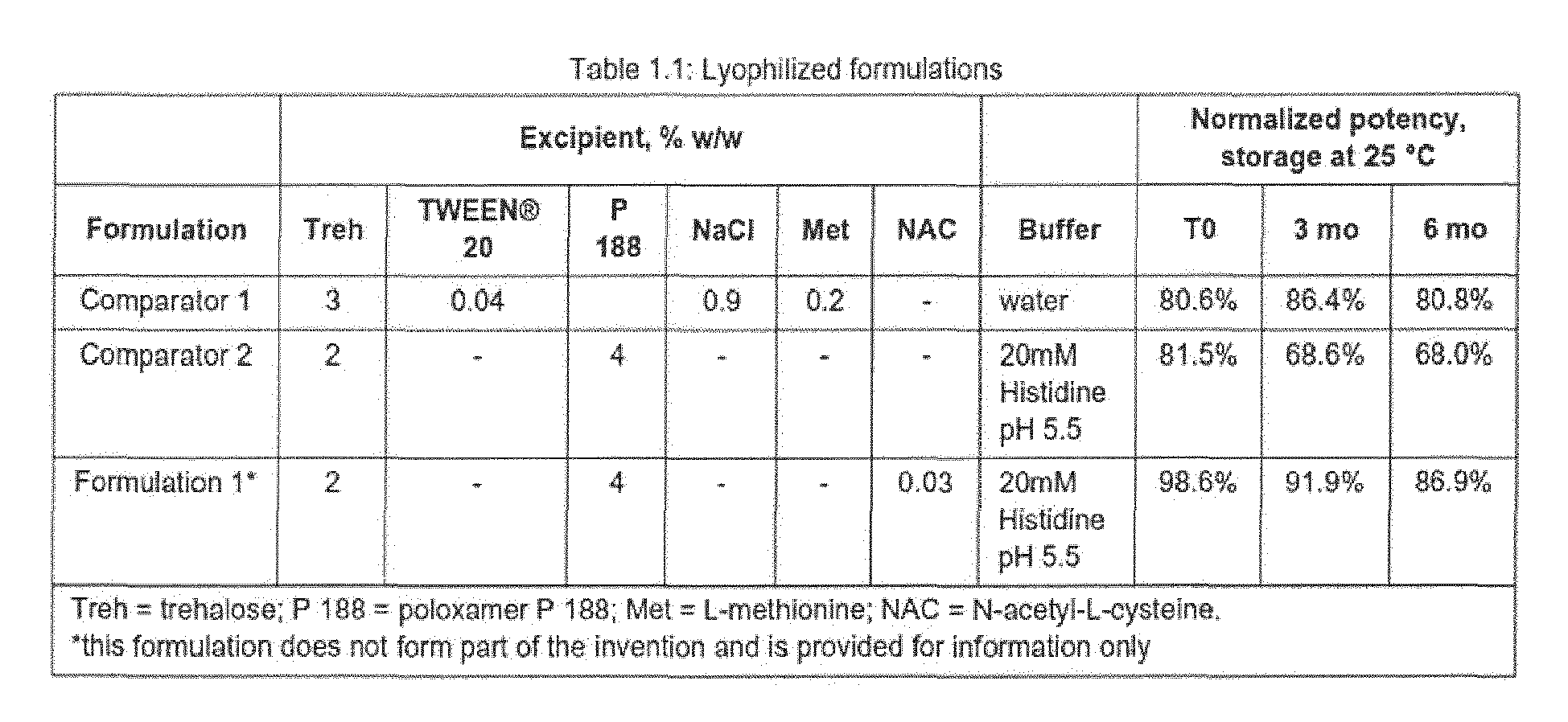


- Bulk drug product solutions were prepared by mixing an appropriate aliquot of a botulinum toxin type A with three different vehicle solutions as shown in Table 4. All three formulations contained 8% w/w trehalose, 4% w/w P188 and 20 mM Histidine buffer at pH 6.0. The target potency was 100units/mL. Formulation 10 contained no antioxidant. Formulations 11 and 12 contained NAC and methionine, respectively. The bulk solutions were filled into 2 mL glass vials (1.25 mL fill), and sealed with rubber stopper and aluminum shell. Potency of the formulations was tested by a cell based potency assay (CBPA) after filling (time zero, t0) and storage for one month at four temperatures (-70, 5, 25, and 40°C). Potency test results are given in Table 4. Briefly, methionine-containing formulation (#12) retained its potency after one month storage at all four temperatures, including 40°C, whereas the formulation w/o an antioxidant lost approx. 17 % potency at 25°C and lost essentially all activity (i.e., complete inactivation) at 40°C. A second antioxidant tested, N-acetyl-L-cysteine, accelerated loss of potency as compared with the antioxidant-free formulation, demonstrating that N-acetyl-L-cysteine acted as pro-oxidant in this formulation. The liquid composition comprising NAC lost over 50% potency after storage for 1 month at 25 °C and lost essentially all activity (i.e., complete inactivation of the toxin) after storage for 1 month at 40 °C. In contrast, as shown in Table 1, the lyophilized compositions comprising NAC lost 7% ((98.6%-91.9%)/98.6%) potency after storage for 3 months at 25 °C and lost 12% ((98.6%-86.5%)/98.6%) potency after storage for 1 month at 40 °C, This demonstrates that NAC can function as a stabilizer in the lyophilized compositions.

- Bulk drug product solutions were prepared by mixing an appropriate aliquot of a botulinum toxin type A with different antioxidants as shown in Table 5. All formulations contained 8% w/w trehalose, 4% w/w P188, 20 mM Histidine buffer at pH 6.0 and one or more antioxidants as listed. Target potency was 100 U/mL. The bulk solutions were filled into 2 mL glass vials (1.25 mL fill), and sealed with rubber stopper and aluminum shell. Potency of the formulations was tested by a cell based potency assay (CBPA) after filling (time zero, t0) and storage for two weeks and 1 month at 40°C. Potency test results are given in Table 5. Liquid compositions comprising NAC and EDTA sodium salt (Formulation 26) retained full potency after storage at 40 °C for 2 weeks and 1 month, as did a composition comprising NAC, EDTA sodium salt and tryptophan (Formulation 27). In contrast, as shown in Table 5, liquid compositions comprising NAC but not EDTA (Formulation 25) lost essentially all potency after 2 weeks storage at 40 °C. This demonstrates that the combination of antioxidants - a chelating agent (e.g., EDTA, EGTA or DTPA) and/or a chain terminator antioxidant (e.g., methionine, cysteine, NAC and BHT) provides a stabilizing effect on the botulinum toxin.
Table 5: Liquid formulations Antioxidant2 Potency U/mL Formulation No.1 NAC % Met % TRP % GSH % NaSul % PrpGal % EDTA % T0 2 wks 40 °C 1 mo. 40 °C Formulation 20 0.2 126 129 130 Formulation 21* 0.2 127 13.71 NT3 Formulation 22* 0.2 123 3.76 NT Formulation 23* 0.2 23.7 0.161 NT Formulation 24* 0.2 0.164 0.150 NT Formulation 25* 0.2 0.2 133 0.253 NT Formulation 26* 0.2 0.03 129 127 127 Formulation 27* 0.2 0.2 0.03 129 125 122 Formulation 28* 0.2 0.2 126 2.45 NT 1 Each formulation contained 100 U/mL botulinum toxin, 8 w/w% trehalose, and 4 w/w% poloxamer P188 in 20 mM histidine buffer, pH 6.0 and the specified antioxidant. 2 NAC = N-acetyl-L-cysteine; Met = L-methionine; TRP = L-tryptophan; GSH = L-glutathione; NaSul = sodium sulfite; PrpGal = propyl gallate; EDTA = ethylene diamine tetraacetic acid, sodium salt. 3 NT=not tested *these formulations do not form part of the invention and are provided for information only - Bulk drug product solutions were prepared by mixing an appropriate aliquot of a botulinum toxin type A with a poloxamer or a polysorbate as shown in Table 6. All formulations contained 8% w/w trehalose, 0.2% w/w methionine in 20 mM Histidine buffer at pH 6.0 and 4% w/w P188 or 0.04% w/w Tween-20 as listed. Target potency was 100 U/mL. The bulk solutions were filled into 2 mL glass vials (1.25 mL fill), and sealed with rubber stopper and aluminum shell. Potency of the formulations was tested by a cell based potency assay (CBPA) after filling to give an initial potency. Potency was measured again after storage for 1 month at 40°C. Potency test results are given in Table 6. As is evident from the results in table 6, the liquid formulation comprising poloxamer provided improved stability after storage at 40°C for one month relative to the corresponding formulation comprising polysorbate.
Table 6: Liquid formulations Formulation no. Tre Tw-20 P188 Met Buffer Storage time (Months) Storage Temp. CBPA (U/mL) Initial CBPA(U/mL) 1 month 29 8 0 4 0.2 20 mM His pH 6.0 1 40°C 133 138 30* 8 0.04 0 0.2 20 mM His, pH 6.0 1 40°C 114 9 Tre = Trehalose; P-188 = Poloxamer-188; Tw-20 = Tween-20; Met = L-Methionine; His = L-Histidine. CBPA gives the residual activity expressed in U/ml *this formulation does not form part of the invention and is provided for information only - Bulk drug product solutions were prepared by mixing an appropriate aliquot of a botulinum toxin type A with different components as shown in Tables 7 and 8. The amounts of components contained were 0% or 8% w/w trehalose, 0% or 0.2% w/w methionine, 0% or 4% w/w P188, all of which were formulated in 20 mM Histidine buffer at pH 6.0. Target potency was 100, 150, or 200 U/mL. The bulk solutions were filled into 2 mL glass vials (1.25 mL fill), and sealed with rubber stopper and aluminum shell. Potency of the formulations was tested by a cell based potency assay (CBPA) after filling to give an initial potency. Potency was measured again after storage for 1 month at -70°C and 40°C. Potency test results are given in Tables 7 and 8. As is evident from the results in these tables, liquid formulations comprising poloxamer and no tonicity agent provide excellent stability after storage for one month at -70°C and 40°C. This is supported by the results in table 10 below for formulation 40. Meanwhile, liquid formulations comprising polysorbate and no tonicity agent provide some stability after storage for one month at -70°C.


- Bulk drug product solutions were prepared by mixing an appropriate aliquot of a botulinum toxin type A with vehicle solutions, containing different stabilizers and surfactants as shown in Table 9. All formulations contained 8% or 0% w/w trehalose or sucrose, 4% w/w P188 or 0.04% w/w PS-20, optionally 20 mM Histidine buffer at pH 6.0, 0.2% w/w methionine, and optionally 0.9% w/w NaCl. Target potency was 100 U/mL. The bulk solutions were filled into 2 mL glass vials (1.25 mL fill), and sealed with rubber stopper and aluminum shell. Potency of the formulations was tested by cell based potency assay (CBPA) after filling (time zero, t0) and storage at 5°C. Potency test results are given in Table 10.
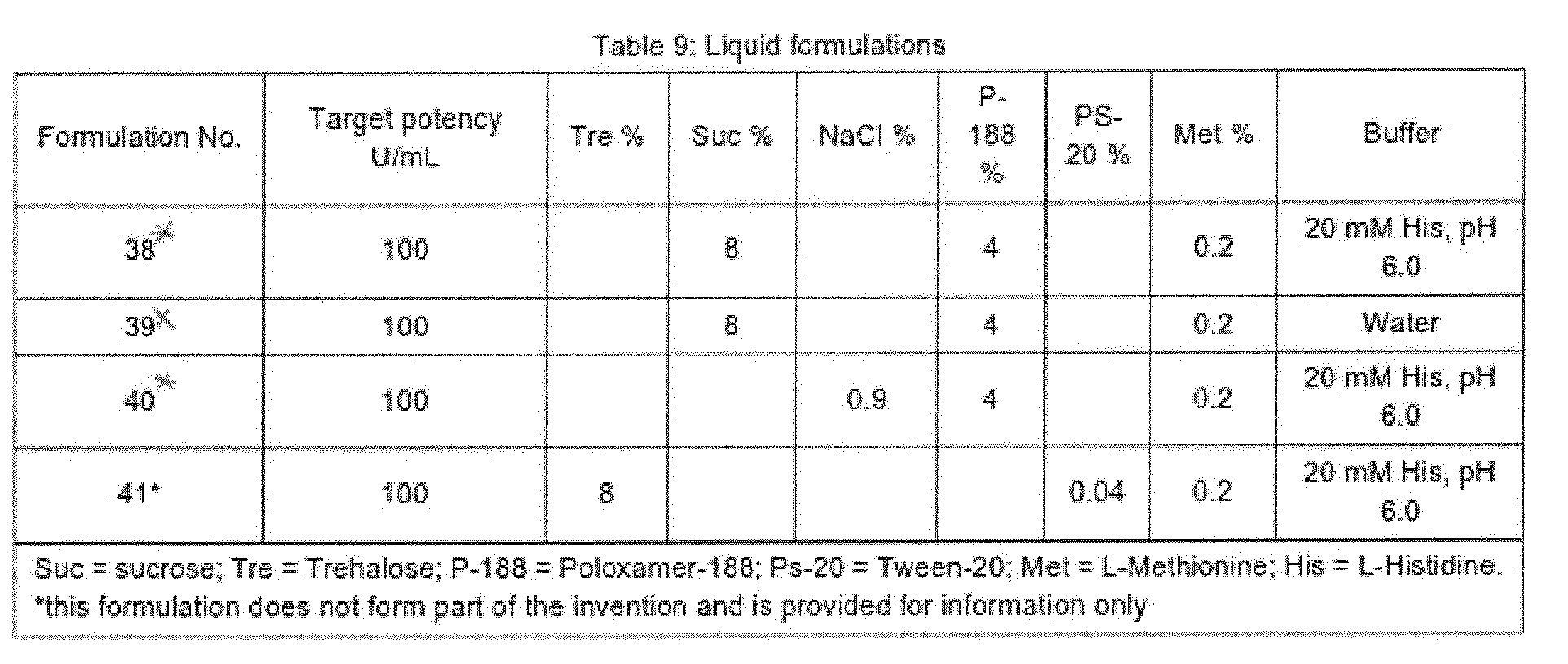

- Bulk solutions of botulinum toxin were prepared by mixing an appropriate aliquot of a botulinum toxin type A with several vehicle solutions as described in Table 11. The amounts of components contained were 0% or 8% w/w trehalose or sucrose, 0.2% w/w methionine, 0% or 4% w/w P188, 0% or 0.04% w/w Tween 20 all of which were formulated in 20 mM Histidine buffer at pH 6.0. Target potency was 200 U/mL. These amounts are shown in Table 11 below. The solutions were filled into glass vials and lyophilized using conventional freeze-drying conditions. Potency of the lyophilized formulations was tested by a cell based potency assay (CBPA) after reconstitution of the lyophilized compositions after storage for 2 weeks at -70°C or 40°C. Potency recovery results are given in Table 12. By comparing Formulation No. 42 with Formulation No. 44 and Formulation No. 43 with Formulation No. 45, the impact of the type of sugar on these lyophilized formuations can be derived. The potency of the botulinum toxin in Formulation 42 and in Formulation 44 after 2 weeks of storage at -20 °C and at 40 °C reveals a higher potency recovery was achieved in lyophilized compositions comprising trehalose, as compared to lyophilized compositions comprising sucrose.

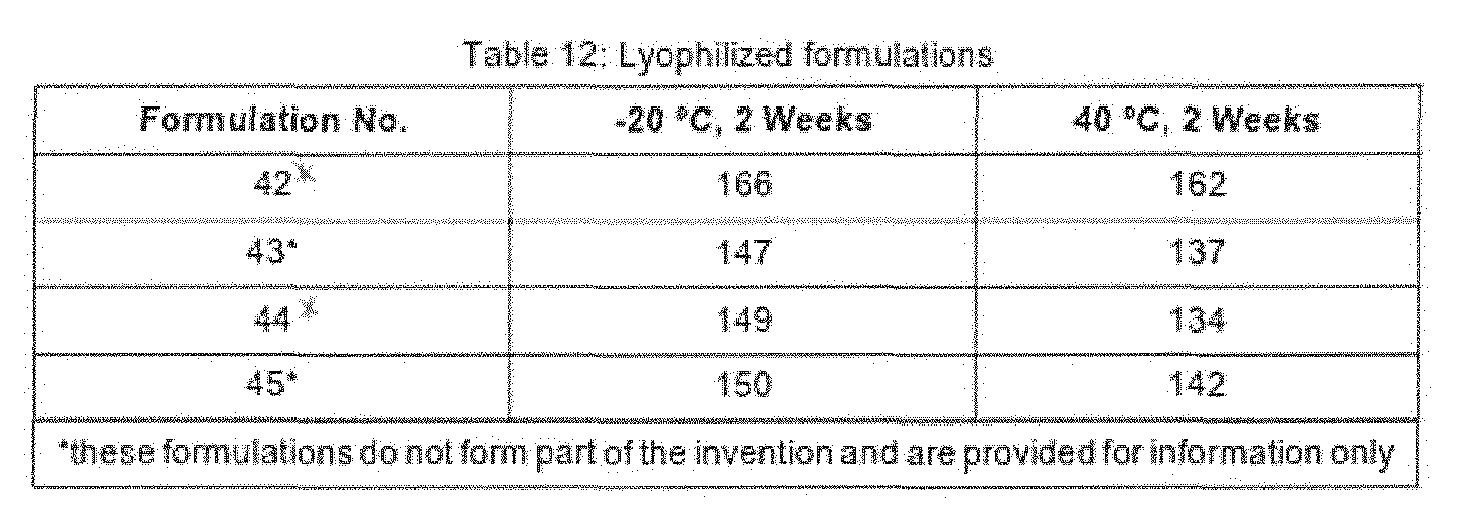
- The results in Tables 11 and 12 also demonstrate the impact of the choice of surfactant on the stability of certain lyophilized compositions. By comparing Formulation No. 42 with Formulation No. 43 and Formulation No. 44 with Formulation No. 45, the impact of the type of surfactant on these lyophilized formuations can be derived. The potency of the botulinum toxin in Formulation 43 and in Formulation 45 after 2 weeks of storage at -20 °C and at 40 °C reveals a higher potency recovery was achieved in lyophilized compositions comprising a poloxamer surfactant, as compared to lyophilized compositions comprising a polysorbate surfactant.
- A 58-year-old college professor presents symptoms of depression. Her physician diagnoses recurrent moderate to severe major depressive disorder (MDD) based upon the DSM-IV-TR criteria. The physician administers by intramuscular injection a botulinum toxin solution made using the composition shown in Table A reconstituted in saline into the procerus and corrugator muscles in a single treatment session. 30 units in total are administered at 6 injection sites. The procerus and corrugator muscles are paralysed. It is later confirmed using the Montgomery-Asberg Depression Rating scale that the treatment has alleviated the depression. Additional efficacy measures including the clinic CGI-S score (Clinical Global Impression of Change scores), and the clinic HAM-D17 total score (Hamilton Rating Scale for Depression) further confirm this. The treatment is repeated after 3 months.
- A 21-year-old student presents symptoms of depression. His physician diagnoses single episode moderate to severe major depressive disorder (MDD) based upon the DSM-IV-TR criteria. The physician administers by intramuscular injection a botulinum toxin solution made using the composition shown in Table A reconstituted in saline to the procerus and corrugator muscles in a single treatment session. 50 units in total are administered at 8 injection sites. The procerus and corrugator muscles are paralysed. It is later confirmed using the Montgomery-Asberg Depression Rating scale that the treatment has alleviated the depression. Additional efficacy measures including the clinic CGI-S score (Clinical Global Impression of Change scores), and the clinic HAM-D17 total score (Hamilton Rating Scale for Depression) further confirm this. The treatment is repeated after 6 months.
- A 41-year-old teacher undergoing cardiac surgery shows symptoms of cardiac arrhythmia. The surgeon administers a botulinum toxin solution made using the composition shown in Table A reconstituted in saline into the major epicardial fat pads of the heart of the patient. 50 U is administered per epicardial fat pad, up to a total of 250 U. The patient is followed by ECG for a four week period following the injection. The indcidence of atrial fibrillation is reduced. In addition, the following improvements are noted for this patient: the length of hospital stay is reduced, length of stay in ICU is reduced, anticoagulant medication use is reduced, and the need for interventional procedures for Post Operative Atrial fibrillation(POAF) such as ablation, pacemaker implantation, electrical or pharmacologic cardioversion are reduced.
- A 66-year-old pensioner undergoing cardiac surgery shows symptoms of cardiac arrhythmia. The surgeon administers a botulinum toxin solution made using the composition shown in Table A reconstituted in saline into the major epicardial fat pads of the heart of the patient. 25 U is administered per epicardial fat pad, up to a total of 125 U. The patient is followed by ECG for a four week period following the injection. The indcidence of atrial fibrillation is reduced. In addition, the following improvements are noted for this patient: the length of hospital stay is reduced, length of stay in ICU is reduced, anticoagulant medication use is reduced, and the need for interventional procedures for Post Operative Atrial fibrillation(POAF) such as ablation, pacemaker implantation, electrical or pharmacologic cardioversion are reduced.
- Many alterations and modifications may be made by those having ordinary skill in the art, without departing from the scope of the disclosure.
Claims (7)
- A method of manufacturing a liquid pharmaceutical composition without a lyophilisation process, wherein the liquid pharmaceutical composition comprises:(i) a botulinum toxin;(ii) poloxamer 188;(iii) methionine; and(iv) trehalosewherein the composition comprises a buffer, wherein the buffer is histidine, and wherein the pH is in the range 5-7,wherein the relative weight amounts (%, w/w) of trehalose, poloxamer 188, methionine are within the following ranges:
trehalose 1 to 10 poloxamer 188 0.5 to 5 methionine 0.1 to 0.3. - The method of manufacturing a liquid pharmaceutical composition according to claim 1, wherein the liquid pharmaceutical composition further comprises NaCl and/or EDTA,
wherein the relative weight amounts (%, w/w) of NaCl and EDTA are optionally within the following ranges:NaCl 0.1 to 10 and/or EDTA 0.01 to 0.1. - The method of manufacturing a liquid pharmaceutical composition according to claim 1, wherein the relative weight amounts (%, w/w) of trehalose, poloxamer 188, methionine, and optionally NaCl, and optionally EDTA in the liquid pharmaceutical composition are:a)
trehalose- 7 to 9 poloxamer 188 3.5 to 4.5 methionine 0.15 to 0.25; trehalose 8 poloxamer 188 4 methionine 0.2; or b)trehalose 7 to 9 poloxamer 188 0.5 to 0.7 methionine 0.15 to 0.25; trehalose 8 poloxamer 188 0.6 methionine 0.2; or c)trehalose 1 to 3 poloxamer 188 3.5 to 4.5 methionine 0.15 to 0.25 NaCl 0.4 to 0.8; trehalose 2 poloxamer 188 4 methionine 0.2 NaCl 0.6; or d)trehalose 7 to 9 poloxamer 188 3.5 to 4.5 methionine 0.15 to 0.25 EDTA 0.01 to 0.05; trehalose 8 poloxamer 188 4 methionine 0.2 EDTA 0.03. - The method of manufacturing a liquid pharmaceutical composition according to any one of claims 1 - 3,
wherein in the liquid pharmaceutical composition the concentration of histidine is 20 mM, and wherein in the liquid pharmaceutical composition the pH is preferably in the range 5.5-6. - The method of manufacturing a liquid pharmaceutical composition according to any one of claims 1 to 4, wherein the liquid pharmaceutical composition consists of one or more botulinum toxins, trehalose, poloxamer 188, methionine, a buffer wherein the buffer is histidine, and optionally NaCl, and optionally EDTA
- The method of manufacturing a liquid pharmaceutical composition according to any previous claim, wherein the liquid pharmaceutical composition comprises no animalderived protein.
- The method of manufacturing a liquid pharmaceutical composition according to any one of claims 1 to 6, wherein the liquid pharmaceutical composition comprises ethylene diamine tetraacetic acid sodium salt (EDTA) or an EDTA analog, wherein the relative weight amount (%, w/w) of EDTA optionally ranges from about 0.01 to 0.10.
Priority Applications (7)
| Application Number | Priority Date | Filing Date | Title |
|---|---|---|---|
| PL17784058.4T PL3436054T5 (en) | 2016-09-13 | 2017-09-13 | NON-PROTEIN STABILIZED COMPOSITIONS OF CLOSTRIDIUM TOXIN |
| SM20190625T SMT201900625T1 (en) | 2016-09-13 | 2017-09-13 | Stabilized non-protein clostridial toxin compositions |
| EP19190978.7A EP3639848A3 (en) | 2016-09-13 | 2017-09-13 | Stabilized non-protein clostridial toxin compositions |
| HRP20191966TT HRP20191966T4 (en) | 2016-09-13 | 2017-09-13 | Stabilized non-protein clostridial toxin compositions |
| RS20191431A RS59600B2 (en) | 2016-09-13 | 2017-09-13 | STABILIZED COMPOSITIONS OF NON-PROTEIN TOXIN OF CLOSTRIDIA |
| EP25213249.3A EP4699601A3 (en) | 2016-09-13 | 2017-09-13 | Non-protein clostridial toxin compositions |
| SI201730128T SI3436054T2 (en) | 2016-09-13 | 2017-09-13 | Stabilized non-proteinaceous compositions of clostridial toxins |
Applications Claiming Priority (2)
| Application Number | Priority Date | Filing Date | Title |
|---|---|---|---|
| US201662394009P | 2016-09-13 | 2016-09-13 | |
| PCT/US2017/051369 WO2018053004A2 (en) | 2016-09-13 | 2017-09-13 | Non-protein clostridial toxin compositions |
Related Child Applications (3)
| Application Number | Title | Priority Date | Filing Date |
|---|---|---|---|
| EP19190978.7A Division EP3639848A3 (en) | 2016-09-13 | 2017-09-13 | Stabilized non-protein clostridial toxin compositions |
| EP19190978.7A Division-Into EP3639848A3 (en) | 2016-09-13 | 2017-09-13 | Stabilized non-protein clostridial toxin compositions |
| EP25213249.3A Division EP4699601A3 (en) | 2016-09-13 | 2017-09-13 | Non-protein clostridial toxin compositions |
Publications (3)
| Publication Number | Publication Date |
|---|---|
| EP3436054A2 EP3436054A2 (en) | 2019-02-06 |
| EP3436054B1 EP3436054B1 (en) | 2019-08-14 |
| EP3436054B2 true EP3436054B2 (en) | 2022-07-27 |
Family
ID=59974865
Family Applications (6)
| Application Number | Title | Priority Date | Filing Date |
|---|---|---|---|
| EP19190979.5A Withdrawn EP3626259A1 (en) | 2016-09-13 | 2017-09-13 | Stabilized non-protein clostridial toxin compositions |
| EP17777119.3A Active EP3432916B1 (en) | 2016-09-13 | 2017-09-13 | Stabilized non-protein clostridial toxin compositions |
| EP25213249.3A Pending EP4699601A3 (en) | 2016-09-13 | 2017-09-13 | Non-protein clostridial toxin compositions |
| EP19190978.7A Pending EP3639848A3 (en) | 2016-09-13 | 2017-09-13 | Stabilized non-protein clostridial toxin compositions |
| EP17784058.4A Active EP3436054B2 (en) | 2016-09-13 | 2017-09-13 | Stabilized non-protein clostridial toxin compositions |
| EP25213227.9A Pending EP4699599A3 (en) | 2016-09-13 | 2017-09-13 | Non-protein clostridial toxin compositions |
Family Applications Before (4)
| Application Number | Title | Priority Date | Filing Date |
|---|---|---|---|
| EP19190979.5A Withdrawn EP3626259A1 (en) | 2016-09-13 | 2017-09-13 | Stabilized non-protein clostridial toxin compositions |
| EP17777119.3A Active EP3432916B1 (en) | 2016-09-13 | 2017-09-13 | Stabilized non-protein clostridial toxin compositions |
| EP25213249.3A Pending EP4699601A3 (en) | 2016-09-13 | 2017-09-13 | Non-protein clostridial toxin compositions |
| EP19190978.7A Pending EP3639848A3 (en) | 2016-09-13 | 2017-09-13 | Stabilized non-protein clostridial toxin compositions |
Family Applications After (1)
| Application Number | Title | Priority Date | Filing Date |
|---|---|---|---|
| EP25213227.9A Pending EP4699599A3 (en) | 2016-09-13 | 2017-09-13 | Non-protein clostridial toxin compositions |
Country Status (28)
| Country | Link |
|---|---|
| US (10) | US20190247476A1 (en) |
| EP (6) | EP3626259A1 (en) |
| JP (4) | JP7217700B2 (en) |
| KR (6) | KR20240023684A (en) |
| CN (3) | CN109803673A (en) |
| AU (4) | AU2017327369A1 (en) |
| BR (2) | BR112019004929A2 (en) |
| CA (2) | CA3035473A1 (en) |
| CL (1) | CL2019000586A1 (en) |
| CO (1) | CO2019003630A2 (en) |
| CY (2) | CY1122263T1 (en) |
| DK (2) | DK3432916T3 (en) |
| ES (2) | ES2755815T3 (en) |
| HR (1) | HRP20191966T4 (en) |
| HU (2) | HUE046449T2 (en) |
| IL (3) | IL265109B2 (en) |
| LT (1) | LT3436054T (en) |
| MX (2) | MX2019002835A (en) |
| PH (1) | PH12019500501A1 (en) |
| PL (2) | PL3436054T5 (en) |
| PT (2) | PT3436054T (en) |
| RS (1) | RS59600B2 (en) |
| RU (2) | RU2019110875A (en) |
| SA (1) | SA519401298B1 (en) |
| SI (2) | SI3436054T2 (en) |
| SM (1) | SMT201900625T1 (en) |
| TW (2) | TWI773686B (en) |
| WO (2) | WO2018053021A1 (en) |
Families Citing this family (27)
| Publication number | Priority date | Publication date | Assignee | Title |
|---|---|---|---|---|
| US8168206B1 (en) | 2005-10-06 | 2012-05-01 | Allergan, Inc. | Animal protein-free pharmaceutical compositions |
| IL265109B2 (en) | 2016-09-13 | 2024-05-01 | Allergan Inc | Stabilized Clostridium toxin preparations without protein |
| KR102649069B1 (en) | 2018-05-31 | 2024-03-19 | 주식회사 엑소코바이오 | Composition for improving face redness comprising an exosome derived from stem cell as an active ingredient |
| WO2020027466A1 (en) | 2018-07-28 | 2020-02-06 | 주식회사 엑소코바이오 | Method for lyophilizing exosome |
| KR102163806B1 (en) | 2018-07-30 | 2020-10-07 | 주식회사 엑소코바이오 | Composition for reducing sebum release comprising an exosome derived from stem cell as an active ingredient |
| MX2021002992A (en) * | 2018-09-13 | 2021-11-12 | Allergan Inc | Clostridial toxin-hyaluronic acid compositions. |
| KR102259423B1 (en) * | 2018-11-30 | 2021-06-02 | 주식회사 휴온스바이오파마 | The composition for stability of Botulinum Toxin |
| WO2020231700A1 (en) * | 2019-05-11 | 2020-11-19 | Youngsuk Yi | Neurotoxin compositions and methods |
| TW202112348A (en) * | 2019-06-07 | 2021-04-01 | 英商益普生生物製藥有限公司 | Treatment of moderate to very severe glabellar lines and lateral canthal lines |
| US10987411B1 (en) | 2019-10-18 | 2021-04-27 | Penland Foundation | Treatment of chronic obstructive pulmonary disease using botulinum toxin |
| US10973873B1 (en) | 2019-10-18 | 2021-04-13 | Penland Foundation | Treatment of asthma using botulinum toxin |
| US11090371B1 (en) | 2019-10-18 | 2021-08-17 | Penland Foundation | Treatment of cirrhosis using botulinum toxin |
| AU2020365148B2 (en) | 2019-10-18 | 2022-10-27 | Penland Foundation | Botulinum toxin for use in treatment |
| US11241479B2 (en) | 2019-10-18 | 2022-02-08 | Penland Foundation | Treatment methods using botulinum toxins |
| US10960060B1 (en) * | 2019-10-18 | 2021-03-30 | Penland Foundation | Treatment of cardiac arrhythmia using botulinum toxin |
| US10967052B1 (en) | 2019-10-18 | 2021-04-06 | Penland Foundation | Treatment of dyslexia using botulinum toxin |
| WO2021231669A1 (en) * | 2020-05-15 | 2021-11-18 | Penland Foundation | Treatment of cardiac arrhythmia using botulinum toxin |
| US10960061B1 (en) | 2019-10-18 | 2021-03-30 | Penland Foundation | Treatment of amyotrophic lateral sclerosis using botulinum toxin |
| WO2021231666A1 (en) | 2020-05-15 | 2021-11-18 | Penland Foundation | Treatment of asthma using botulinum toxin |
| RU2746035C1 (en) * | 2020-06-30 | 2021-04-06 | Государственное бюджетное учреждение Санкт-Петербургский научно-исследовательский институт скорой помощи им. И.И. Джанелидзе | Method for pain syndrome alleviation after breast endoproshetics |
| WO2023287728A1 (en) | 2021-07-12 | 2023-01-19 | Penland Foundation | Treatment of diabetes and chronic pancreatitis using botulinum toxin |
| WO2023287729A1 (en) | 2021-07-12 | 2023-01-19 | Penland Foundation | Treatment of acute and chronic kidney disease |
| CN119789848A (en) * | 2022-09-02 | 2025-04-08 | 玫帝托克斯股份有限公司 | Botulinum toxin formulations with reduced expression of tolerance and methods relating thereto |
| EP4615489A1 (en) | 2022-11-07 | 2025-09-17 | Allergan, Inc. | Prevention of post-operative atrial fibrillation with a botulinum toxin |
| GB202318884D0 (en) * | 2023-12-11 | 2024-01-24 | Ipsen Biopharm Ltd | Formulation |
| CN118697853B (en) * | 2024-06-27 | 2025-05-02 | 河北封章生物科技有限公司 | Botulinum toxin formulations with improved stability |
| KR102823973B1 (en) * | 2024-09-27 | 2025-06-24 | 주식회사 휴온스바이오파마 | liquid composition for stabilizing botulinum toxin |
Citations (2)
| Publication number | Priority date | Publication date | Assignee | Title |
|---|---|---|---|---|
| WO2009008595A1 (en) † | 2007-07-10 | 2009-01-15 | Medy-Tox, Inc. | Pharmaceutical liquid composition of botulinum toxin with improved stability |
| AU2009339292B2 (en) † | 2008-12-10 | 2016-01-21 | Allergan, Inc. | Clostridial toxin pharmaceutical compositions |
Family Cites Families (447)
| Publication number | Priority date | Publication date | Assignee | Title |
|---|---|---|---|---|
| ATE68524T1 (en) | 1985-07-09 | 1991-11-15 | Quadrant Bioresources Ltd | PROTECTION OF PROTEINS AND THE LIKE. |
| US4958257A (en) | 1989-03-29 | 1990-09-18 | Hughes Aircraft Company | Heat conducting interface for electronic module |
| US5945098A (en) | 1990-02-01 | 1999-08-31 | Baxter International Inc. | Stable intravenously-administrable immune globulin preparation |
| IL101007A (en) | 1992-02-18 | 1997-08-14 | Pharmos Ltd | Dry stable compositions prepared by lyophilization |
| CA2131709C (en) * | 1992-03-13 | 2004-11-23 | Terry R. Beardsley | Immune-enhancing agent for therapeutic use in immunocompromised hosts |
| WO1994000481A1 (en) | 1992-06-23 | 1994-01-06 | Associated Synapse Biologics | Pharmaceutical composition containing botulinum b complex |
| EP1488803B1 (en) * | 1993-12-28 | 2008-03-26 | Allergan, Inc. | Neurotoxic component of botulinum toxins for treating cervical dystonia |
| EP1086702B1 (en) | 1994-05-09 | 2005-04-13 | BINDER, William J. | Presynaptic neurotoxins for treatment of migraine headache |
| ES2138740T3 (en) | 1994-05-31 | 2000-01-16 | Allergan Inc | MODIFICATION OF CLOSTRIDIUM TOXINS USED AS TRANSPORT PROTEINS. |
| GB9411138D0 (en) | 1994-06-03 | 1994-07-27 | Microbiological Res Authority | Toxin assay |
| US5962637A (en) | 1994-06-03 | 1999-10-05 | Microbiological Research Authority | Toxin assay |
| US6586006B2 (en) | 1994-08-04 | 2003-07-01 | Elan Drug Delivery Limited | Solid delivery systems for controlled release of molecules incorporated therein and methods of making same |
| US5756468A (en) | 1994-10-13 | 1998-05-26 | Wisconsin Alumni Research Foundation | Pharmaceutical compositions of botulinum toxin or botulinum neurotoxin and methods of preparation |
| US5512547A (en) | 1994-10-13 | 1996-04-30 | Wisconsin Alumni Research Foundation | Pharmaceutical composition of botulinum neurotoxin and method of preparation |
| US5556771A (en) | 1995-02-10 | 1996-09-17 | Gen-Probe Incorporated | Stabilized compositions of reverse transcriptase and RNA polymerase for nucleic acid amplification |
| GB9508204D0 (en) | 1995-04-21 | 1995-06-07 | Speywood Lab Ltd | A novel agent able to modify peripheral afferent function |
| ES2198484T3 (en) | 1995-06-06 | 2004-02-01 | L. Bruce Pearce | COMPOSITIONS AND IMPROVED PROCEDURES FOR CHEMICALDERVATION USING NEUROTOXINS. |
| WO1996039166A1 (en) | 1995-06-06 | 1996-12-12 | Wisconsin Alumni Research Foundation | Analogs of botulinum toxin and pharmaceutical compositions of botulinum toxin |
| GB9617671D0 (en) | 1996-08-23 | 1996-10-02 | Microbiological Res Authority | Recombinant toxin fragments |
| US8828432B2 (en) | 1996-10-28 | 2014-09-09 | General Mills, Inc. | Embedding and encapsulation of sensitive components into a matrix to obtain discrete controlled release particles |
| TW518235B (en) | 1997-01-15 | 2003-01-21 | Akzo Nobel Nv | A gonadotropin-containing pharmaceutical composition with improved stability on prolong storage |
| US6777196B2 (en) | 1997-02-18 | 2004-08-17 | Genentech, Inc. | Neurturin receptor |
| DE69841291D1 (en) | 1997-07-15 | 2009-12-31 | Univ Colorado | Use of botulinum toxin for the treatment of renal bladder voiding disorder |
| US9066943B2 (en) | 1997-07-15 | 2015-06-30 | The Regents Of The University Of Colorado | Use of botulinum toxin therapy for treatment of urological neurological conditions |
| US6638621B2 (en) | 2000-08-16 | 2003-10-28 | Lyotropic Therapeutics, Inc. | Coated particles, methods of making and using |
| CN1073626C (en) | 1997-10-18 | 2001-10-24 | 卫生部兰州生物制品研究所 | Productive technology for A type botulism crystalline toxin and frozen-dried protective liquid needed for producing said toxin |
| SE510813C2 (en) | 1997-12-08 | 1999-06-28 | Arla Ekonomisk Foerening | Bacterial strain of the species Lactobacillus Paracasei subsp. paracasei, its composition for use in food, and product containing the strain |
| GB9818548D0 (en) | 1998-08-25 | 1998-10-21 | Microbiological Res Authority | Treatment of mucas hypersecretion |
| TW574036B (en) * | 1998-09-11 | 2004-02-01 | Elan Pharm Inc | Stable liquid compositions of botulinum toxin |
| US20050147690A1 (en) | 1998-09-25 | 2005-07-07 | Masters David B. | Biocompatible protein particles, particle devices and methods thereof |
| EP1031346B1 (en) | 1999-01-27 | 2002-05-02 | Idea Ag | Noninvasive vaccination through the skin |
| PT1031347E (en) | 1999-01-27 | 2002-09-30 | Idea Ag | TRANSNATIONAL TRANSMISSION / IMMUNIZATION WITH MOST ADAPTABLE VEHICLES |
| US6776990B2 (en) | 1999-04-08 | 2004-08-17 | Allergan, Inc. | Methods and compositions for the treatment of pancreatitis |
| US6573244B1 (en) | 1999-05-17 | 2003-06-03 | The United States Of America As Represented By The Secretary Of The Army | Previns as specific inhibitors and therapeutic agents for Botulinum toxin B and Tetanus neurotoxins |
| DE19925739A1 (en) | 1999-06-07 | 2000-12-21 | Biotecon Ges Fuer Biotechnologische Entwicklung & Consulting Mbh | Therapeutic with a botulinum neurotoxin |
| US6977080B1 (en) | 1999-08-10 | 2005-12-20 | Allergan, Inc. | Intrapericardial botulinum toxin treatment for bradycardia |
| DE60032367T3 (en) | 1999-08-25 | 2011-03-10 | Allergan, Inc., Irvine | ACTIVE RECOMBINANT NEUROTOXINE |
| US20030180289A1 (en) | 1999-09-23 | 2003-09-25 | Foster Keith Alan | Inhibition of secretion from non-neuronal cells |
| EP1221968B1 (en) | 1999-10-13 | 2010-01-13 | Novartis Vaccines and Diagnostics, Inc. | Method of obtaining cellular immune responses from proteins |
| IL149778A0 (en) | 1999-11-22 | 2002-11-10 | Universal Preservation Technologies Inc | Preservation of sensitive biological material |
| US6500436B2 (en) | 2000-01-19 | 2002-12-31 | Allergan, Inc. | Clostridial toxin derivatives and methods for treating pain |
| US7780967B2 (en) | 2000-02-08 | 2010-08-24 | Allergan, Inc. | Reduced toxicity Clostridial toxin pharmaceutical compositions |
| US20060269575A1 (en) | 2000-02-08 | 2006-11-30 | Allergan, Inc. | Botulinum toxin pharmaceutical compositions formulated with recombinant albumin |
| US20030118598A1 (en) | 2000-02-08 | 2003-06-26 | Allergan, Inc. | Clostridial toxin pharmaceutical compositions |
| US20030138460A1 (en) | 2000-02-08 | 2003-07-24 | Allergan, Inc | Methods of treating animals with botulinum toxin pharmaceutical compositions |
| US8632785B2 (en) | 2000-02-08 | 2014-01-21 | Allergan, Inc. | Clostridial toxin pharmaceutical composition containing a gelatin fragment |
| JP2003522154A (en) | 2000-02-08 | 2003-07-22 | アラーガン、インコーポレイテッド | Botulinum toxin pharmaceutical composition |
| US6306423B1 (en) | 2000-06-02 | 2001-10-23 | Allergan Sales, Inc. | Neurotoxin implant |
| US20040033241A1 (en) | 2000-06-02 | 2004-02-19 | Allergan, Inc. | Controlled release botulinum toxin system |
| US7491799B2 (en) | 2000-07-21 | 2009-02-17 | Allergan, Inc. | Modified botulinum neurotoxins |
| US6653062B1 (en) | 2000-07-26 | 2003-11-25 | Wisconsin Alumni Research Foundation | Preservation and storage medium for biological materials |
| US6630330B1 (en) | 2000-08-02 | 2003-10-07 | Biopolo S.C.A.R.L. | Ascorbic acid production from yeast |
| EA006759B1 (en) | 2000-10-31 | 2006-04-28 | Бёрингер Ингельхайм Фармасьютиклз, Инк. | Oral self-emulsifying formulations of pyranone protease inhibitors |
| US7223577B2 (en) | 2000-11-17 | 2007-05-29 | Allergan, Inc. | Post-translational modifications and Clostridial neurotoxins |
| US7273722B2 (en) | 2000-11-29 | 2007-09-25 | Allergan, Inc. | Neurotoxins with enhanced target specificity |
| US7255865B2 (en) | 2000-12-05 | 2007-08-14 | Allergan, Inc. | Methods of administering botulinum toxin |
| ITUD20010002A1 (en) | 2001-01-05 | 2002-07-05 | Univ Degli Studi Udine | USE OF BOTULIN TOXIN FOR THE SOLUTION OF JOINT PATHOLOGIES, IN PARTICULAR OF COXARTROSIS, EPICONDYLITIS AND PATHOLUS |
| US7442686B2 (en) | 2001-04-12 | 2008-10-28 | Bioaxone Therapeutique Inc. | Treatment of macular degeneration with ADP-ribosyl transferase fusion protein therapeutic compositions |
| US20060134140A1 (en) | 2001-04-12 | 2006-06-22 | Dana Lasko | Compositions and methods for treating tumor spreading |
| AU2002338436A1 (en) | 2001-04-25 | 2002-11-05 | Hernan F. Acevedo | Hcg formulation |
| US9157875B2 (en) | 2001-05-16 | 2015-10-13 | Benjamin P. Warner | Drug development and manufacturing |
| US7332567B2 (en) | 2001-08-28 | 2008-02-19 | Allergan, Inc. | Fret protease assays for clostridial toxins |
| US7208285B2 (en) | 2001-08-28 | 2007-04-24 | Allergan, Inc. | Fret protease assays for botulinum serotype A/E toxins |
| US8022172B2 (en) | 2001-08-28 | 2011-09-20 | Allergan, Inc. | Luminescence resonance energy transfer (LRET) assays for clostridial toxin activity |
| US20030104996A1 (en) | 2001-08-30 | 2003-06-05 | Tiansheng Li | L-methionine as a stabilizer for NESP/EPO in HSA-free formulations |
| US7214660B2 (en) | 2001-10-10 | 2007-05-08 | Neose Technologies, Inc. | Erythropoietin: remodeling and glycoconjugation of erythropoietin |
| US20040161776A1 (en) | 2001-10-23 | 2004-08-19 | Maddon Paul J. | PSMA formulations and uses thereof |
| US20050215472A1 (en) | 2001-10-23 | 2005-09-29 | Psma Development Company, Llc | PSMA formulations and uses thereof |
| MXPA01011542A (en) | 2001-11-13 | 2003-05-22 | Alcon Inc | Regeneration of articular cartilage damaged by osteoarthritis i and ii, by means of intra-articular application of sodium hyaluronate and chondroitin sulphate in a gel carrier. |
| US7691394B2 (en) | 2002-05-28 | 2010-04-06 | Botulinum Toxin Research Associates, Inc. | High-potency botulinum toxin formulations |
| US20040009180A1 (en) | 2002-07-11 | 2004-01-15 | Allergan, Inc. | Transdermal botulinum toxin compositions |
| US7183066B2 (en) | 2002-09-27 | 2007-02-27 | Allergan, Inc. | Cell-based fluorescence resonance energy transfer (FRET) assays for clostridial toxins |
| BR0314558A (en) | 2002-10-10 | 2005-08-09 | Diversa Corp | Proteases, nucleic acids encoding them and processes for preparing and using them |
| ES2532906T5 (en) | 2002-10-25 | 2022-03-23 | Foamix Pharmaceuticals Ltd | Cosmetic and pharmaceutical foam |
| US20040086532A1 (en) | 2002-11-05 | 2004-05-06 | Allergan, Inc., | Botulinum toxin formulations for oral administration |
| US20040143213A1 (en) | 2002-11-12 | 2004-07-22 | Collegium Pharmaceutical, Inc. | Inertial drug delivery system |
| US20060074014A1 (en) | 2002-11-18 | 2006-04-06 | Vicuron Pharmaceuticals Inc. | Dalbavancin compositions for treatment of bacterial infections |
| US20060002862A1 (en) | 2002-12-17 | 2006-01-05 | Medimmune Vaccines, Inc. | High pressure spray-dry of bioactive materials |
| ATE426408T1 (en) | 2002-12-20 | 2009-04-15 | Botulinum Toxin Res Ass Inc | PHARMACEUTICAL COMPOSITIONS CONTAINING BOTULINUM TOXIN AND HUMAN SERUM ALBUMINE |
| GB0300427D0 (en) | 2003-01-09 | 2003-02-05 | Univ Strathclyde | Pharmaceutical composition |
| CA2512639C (en) | 2003-01-16 | 2012-10-30 | Acadia Pharmaceuticals Inc. | Selective serotonin 2a/2c receptor inverse agonists as therapeutics for neurodegenerative diseases |
| US7758872B1 (en) | 2003-02-07 | 2010-07-20 | Eric Finzi | Method of treating depression |
| US20060153876A1 (en) | 2003-02-24 | 2006-07-13 | Ira Sanders | Cell membrane translocation of regulated snare inhibitors, compositions therefor, and methods for treatment of disease |
| US7767429B2 (en) | 2003-03-05 | 2010-08-03 | Halozyme, Inc. | Soluble hyaluronidase glycoprotein (sHASEGP), process for preparing the same, uses and pharmaceutical compositions comprising thereof |
| US7871607B2 (en) | 2003-03-05 | 2011-01-18 | Halozyme, Inc. | Soluble glycosaminoglycanases and methods of preparing and using soluble glycosaminoglycanases |
| WO2004093870A1 (en) | 2003-03-20 | 2004-11-04 | Pharmacia Corporation | Treatment and prevention of otic disorders |
| US20040214753A1 (en) | 2003-03-20 | 2004-10-28 | Britten Nancy Jean | Dispersible pharmaceutical composition for treatment of mastitis and otic disorders |
| US9006388B2 (en) | 2003-03-26 | 2015-04-14 | Sudhir Paul | Covalent attachment of ligands to nucleophilic proteins guided by non-covalent |
| WO2005030119A2 (en) | 2003-04-11 | 2005-04-07 | Allergan, Inc. | Botulinum toxin a peptides and methods of predicting and reducing immunoresistance to botulinum toxin therapy |
| US7396535B2 (en) | 2003-04-25 | 2008-07-08 | Ackerman Alan H | Therapy for obsessive compulsive head banging |
| US7393537B2 (en) | 2003-04-25 | 2008-07-01 | Allergan, Inc. | Botulinum toxin for treatment of obsessive compulsive finger biting disorder |
| AU2004253571A1 (en) | 2003-07-02 | 2005-01-13 | Alza Corporation | Microprojection array immunization patch and method |
| DE10333317A1 (en) * | 2003-07-22 | 2005-02-17 | Biotecon Therapeutics Gmbh | Formulation for protein medicines without the addition of human serum albumin (HSA) |
| US20050042775A1 (en) | 2003-08-21 | 2005-02-24 | Nicholas Pomato | Botulinum antitoxin compositions and methods |
| US8153591B2 (en) | 2003-08-26 | 2012-04-10 | Gel-Del Technologies, Inc. | Protein biomaterials and biocoacervates and methods of making and using thereof |
| US7160699B2 (en) | 2003-09-25 | 2007-01-09 | Allergan, Inc. | Media for clostridium bacterium and processes for obtaining a clostridial toxin |
| US7354740B2 (en) | 2003-09-25 | 2008-04-08 | Allergan, Inc. | Animal product free system and process for purifying a botulinum toxin |
| US7148041B2 (en) | 2003-09-25 | 2006-12-12 | Allergan, Inc. | Animal product free media and processes for obtaining a botulinum toxin |
| US8609112B2 (en) | 2003-10-29 | 2013-12-17 | Allergan, Inc. | Botulinum toxin treatments of depression |
| US8734810B2 (en) | 2003-10-29 | 2014-05-27 | Allergan, Inc. | Botulinum toxin treatments of neurological and neuropsychiatric disorders |
| JP2007509704A (en) | 2003-10-31 | 2007-04-19 | アルザ・コーポレーシヨン | Systems and methods for transdermal vaccine delivery |
| BRPI0416822A (en) | 2003-11-21 | 2007-03-06 | Alza Corp | Transdermal Ultrasound Vaccine Release Method and System |
| GB0328060D0 (en) | 2003-12-04 | 2004-01-07 | Sod Conseils Rech Applic | Botulinum toxin treatment |
| WO2005055945A2 (en) | 2003-12-08 | 2005-06-23 | Gel-Del Technologies, Inc. | Mucoadhesive drug delivery devices and methods of making and using thereof |
| BRPI0418147A (en) | 2003-12-23 | 2007-04-17 | Infinity Pharmaceuticals Inc | benzoquinone-containing ansamycin analogs and their methods of use |
| MXPA06007832A (en) | 2004-01-09 | 2007-01-26 | Johnson & Johnson | Frequency assisted transdermal agent delivery method and system. |
| FR2865131B1 (en) | 2004-01-15 | 2007-08-24 | Gattefosse Ets Sa | USE OF AN EXTRACT OF ACMELLA OLERACEA FOR ITS BOTOX LIKE EFFECT IN AN ANTI-WRINKLE COSMETIC COMPOSITION |
| DK1718756T3 (en) | 2004-02-24 | 2012-02-27 | Allergan Inc | Botulinumtoksinscreeningassays |
| US20050191321A1 (en) | 2004-02-26 | 2005-09-01 | Allergan, Inc. | Methods for treating headache |
| US20100266638A1 (en) | 2004-02-26 | 2010-10-21 | Allergan, Inc. | Headache treatment method |
| US9078892B2 (en) | 2004-02-26 | 2015-07-14 | Allergan, Inc. | Methods for treating pain and for treating a medication overuse disorder |
| CA2558408C (en) | 2004-03-03 | 2014-11-18 | Essentia Biosystems, Inc. | Compositions and methods for topical application and transdermal delivery of botulinum toxins |
| US9211248B2 (en) | 2004-03-03 | 2015-12-15 | Revance Therapeutics, Inc. | Compositions and methods for topical application and transdermal delivery of botulinum toxins |
| US7674454B2 (en) | 2004-03-06 | 2010-03-09 | Innovata Limited | Enzyme-prodrug therapy for prosthetic joint repair |
| US20050214325A1 (en) | 2004-03-26 | 2005-09-29 | Vvii Newco 2003, Inc. | Compositions and methods to increase the effect of a neurotoxin treatment |
| CA2562932A1 (en) | 2004-04-01 | 2005-10-27 | Alza Corporation | Apparatus and method for transdermal delivery of influenza vaccine |
| ES2535310T3 (en) | 2004-04-09 | 2015-05-07 | Wyeth Llc | Synergistic attenuation of vesicular stomatitis virus, vectors thereof and immunogenic compositions thereof |
| CA2562642A1 (en) | 2004-04-13 | 2005-11-03 | Alza Corporation | Apparatus and method for transdermal delivery of multiple vaccines |
| CA2565678C (en) | 2004-05-05 | 2013-07-09 | Pharmaleads | Peptide substrates recognisable by a botulinum toxin a, bont/a and the use thereof |
| US7591806B2 (en) | 2004-05-18 | 2009-09-22 | Bai Xu | High-aspect-ratio microdevices and methods for transdermal delivery and sampling of active substances |
| JP2008507590A (en) | 2004-05-19 | 2008-03-13 | アルザ コーポレイション | Methods and formulations for transdermal delivery of immunoactive agents |
| DE102004026152A1 (en) | 2004-05-28 | 2005-12-15 | Basf Ag | Fermentative production of fine chemicals |
| EP1765385A4 (en) | 2004-06-16 | 2008-08-27 | Smart Drug Systems Inc | Sustained release vaccine composition |
| KR101352299B1 (en) | 2004-06-28 | 2014-02-17 | 벨로시스 파마슈티컬스 에이/에스 | Porous tablets as carriers for liquid formulations |
| EP1761558A1 (en) | 2004-06-30 | 2007-03-14 | Allergan, Inc. | Optimizing expression of active botulinum toxin type e |
| US7514088B2 (en) | 2005-03-15 | 2009-04-07 | Allergan, Inc. | Multivalent Clostridial toxin derivatives and methods of their use |
| US20060004185A1 (en) | 2004-07-01 | 2006-01-05 | Leese Richard A | Peptide antibiotics and peptide intermediates for their prepartion |
| GB2416122A (en) | 2004-07-12 | 2006-01-18 | Ipsen Ltd | Botulinum neurotoxin composition |
| KR100852824B1 (en) | 2004-07-26 | 2008-08-18 | 메르츠 파마 게엠베하 운트 코. 카가아 | Therapeutic composition comprising botulinum neurotoxin |
| ES2526912T3 (en) | 2004-08-04 | 2015-01-16 | Ipsen Biopharm Limited | Pharmaceutical composition containing botulinum neurotoxin A2 |
| US20080057575A1 (en) | 2004-08-04 | 2008-03-06 | Allergan, Inc. | Optimizing Expression of Active Botulinum Toxin Type A |
| GB2419527A (en) | 2004-10-28 | 2006-05-03 | Ipsen Ltd | Pharmaceutical composition containing botulinum neurotoxin |
| DE602005011458D1 (en) | 2004-09-01 | 2009-01-15 | Allergan Inc | DEGRADABLE CLOSTRIDIENT OXINS |
| DK1797109T3 (en) | 2004-09-09 | 2016-04-11 | Yeda Res & Dev | MIXTURES OF POLYPEPTIDES, compositions containing them and methods for their preparation, and uses thereof |
| US20060057165A1 (en) | 2004-09-10 | 2006-03-16 | Dimitrios Dimitrakoudis | Clostridium botulinum toxin formulation and method for reducing weight |
| US7399607B2 (en) | 2004-09-22 | 2008-07-15 | Allergan, Inc. | Fluorescence polarization assays for determining clostridial toxin activity |
| EP3173072A1 (en) | 2004-10-01 | 2017-05-31 | Ramscor, Inc. | Conveniently implantable sustained release drug compositions |
| US20070258992A1 (en) | 2004-10-06 | 2007-11-08 | Atassi M Zouhair | Determining and Reducing Immunoresistance to Botulinum Toxin Therapy Using Botulinum Toxin a Peptides |
| US7205018B2 (en) | 2004-10-07 | 2007-04-17 | Next Proteins, Inc. | Carbonated protein drink and method of making |
| US8309077B2 (en) | 2004-11-02 | 2012-11-13 | Chr. Hansen A/S | Stabilized bacteriophage formulations |
| CA2598204C (en) | 2004-11-09 | 2015-01-13 | Board Of Regents, The University Of Texas System | Stabilized hme composition with small drug particles |
| GB0426394D0 (en) | 2004-12-01 | 2005-01-05 | Health Prot Agency | Fusion proteins |
| AU2005311098B2 (en) | 2004-12-01 | 2011-08-11 | Allergan, Inc. | Non-cytotoxic protein conjugates |
| CA2595115C (en) | 2004-12-01 | 2014-01-21 | Health Protection Agency | Fusion proteins for treating, preventing or ameliorating pain |
| US8192979B2 (en) | 2005-01-03 | 2012-06-05 | Botulinum Toxin Research Associates, Inc. | Compositions, methods and devices for preparing less painful Botulinum toxin formulations |
| US20080220021A1 (en) | 2005-02-14 | 2008-09-11 | Pankaj Modi | Topical Botulinum Toxin Compositions for the Treatment of Hyperhidrosis |
| US7727537B2 (en) | 2005-02-14 | 2010-06-01 | Dpm Therapeutics Corp. | Stabilized compositions for topical administration and methods of making same |
| US7838011B2 (en) | 2005-02-14 | 2010-11-23 | Pankaj Modi | Stabilized protein compositions for topical administration and methods of making same |
| WO2006094263A2 (en) | 2005-03-03 | 2006-09-08 | Revance Therapeutics, Inc. | Compositions and methods for topical application and transdermal delivery of botulinum toxins |
| WO2006099590A2 (en) | 2005-03-15 | 2006-09-21 | Allergan, Inc. | Modified clostridial toxins with altered targeting capabilities for clostridial toxin target cells |
| EP2270226B1 (en) | 2005-03-31 | 2016-05-18 | Two Cells Co., Ltd | Method for distinguishing mesenchymal stem cell using molecular marker and use thereof |
| ATE552500T1 (en) | 2005-04-05 | 2012-04-15 | Allergan Inc | LIPOPHILIC, DYE-BASED FRET ASSAYS FOR CLOSTRIDIAL TOXINACTIVITY |
| US20070029252A1 (en) | 2005-04-12 | 2007-02-08 | Dunson James B Jr | System and process for biomass treatment |
| US20090214466A1 (en) | 2005-05-09 | 2009-08-27 | Levin Bruce H | Methods of Alleviating Disorders and Their Associated Pain |
| US8926991B2 (en) | 2005-06-14 | 2015-01-06 | Botulinum Toxin Research Associates, Inc. | Botulinum toxin and the treatment of primary disorders of mood and affect |
| LT2351578T (en) | 2005-06-27 | 2017-04-10 | Glaxosmithkline Biologicals S.A. | METHOD OF RECEIVING VACCINES |
| US8323666B2 (en) | 2005-08-01 | 2012-12-04 | Allergan, Inc. | Botulinum toxin compositions |
| CA2618974C (en) | 2005-08-09 | 2014-01-28 | Nanobio Corporation | Nanoemulsion compositions having anti-inflammatory activity |
| ATE523207T1 (en) | 2005-09-16 | 2011-09-15 | Merial Ltd | STABILIZERS FOR FREEZE-DRIED VACCINES |
| AU2006339490B2 (en) | 2005-09-19 | 2011-12-08 | Allergan, Inc. | Clostridial toxin activatable clostridial toxins |
| AU2013202329B2 (en) * | 2005-10-06 | 2016-04-14 | Allergan, Inc. | Non-protein stabilized clostridial toxin pharmaceutical compositions |
| US8168206B1 (en) | 2005-10-06 | 2012-05-01 | Allergan, Inc. | Animal protein-free pharmaceutical compositions |
| US8137677B2 (en) * | 2005-10-06 | 2012-03-20 | Allergan, Inc. | Non-protein stabilized clostridial toxin pharmaceutical compositions |
| CN101175478A (en) * | 2005-10-06 | 2008-05-07 | 阿勒根公司 | Non-protein stable Clostridial toxin pharmaceutical composition |
| US20090324647A1 (en) | 2005-10-11 | 2009-12-31 | Borodic Gary E | Albumin-Free Botulinum Toxin Based Pharmaceutical Compositions Containing a Hyaluronidase and Methods of Use |
| DE102005051789B4 (en) | 2005-10-28 | 2014-08-07 | Toxogen Gmbh | The botulinum neurotoxin A protein receptor and its applications |
| US9486408B2 (en) | 2005-12-01 | 2016-11-08 | University Of Massachusetts Lowell | Botulinum nanoemulsions |
| EP2546359A1 (en) | 2005-12-08 | 2013-01-16 | Novartis AG | Effects of inhibitors of FGFR3 on gene transcription |
| AU2006334020B2 (en) | 2005-12-30 | 2012-07-05 | Mor Research Applications Ltd. | Device and method for treating the anal sphincter |
| US7429575B2 (en) | 2006-01-10 | 2008-09-30 | Yu Ruey J | N-(phosphonoalkyl)-amino acids, derivatives thereof and compositions and methods of use |
| EP1981483A1 (en) | 2006-01-24 | 2008-10-22 | Nexbio, Inc. | Technology for preparation of macromolecular microspheres |
| US7666912B2 (en) | 2006-03-23 | 2010-02-23 | Massachusetts Eye And Ear Infirmary | Compositions and methods for reducing body fat |
| EP2105500A1 (en) | 2008-03-26 | 2009-09-30 | Pharmazell GmbH | New 12alpha-hydroxysteroiddehydrogenases, method for their manufacture and application thereof |
| US7473559B2 (en) | 2006-04-05 | 2009-01-06 | Charles Lee | Method for measuring the content of a botulinum toxin in a formulation |
| US7309602B2 (en) | 2006-04-13 | 2007-12-18 | Ambrozea, Inc. | Compositions and methods for producing fermentation products and residuals |
| ITTO20060282A1 (en) | 2006-04-14 | 2007-10-15 | Univ Degli Studi Torino | MEDIUM OF CULTURE AND PHARMACEUTICAL COMPOSITION FOR THE REGENERATION OF THE RELATIVE PAPER FABRIC PROCEDURE RELATED TO USES AND PRODUCTS |
| EP2505592A1 (en) | 2006-07-11 | 2012-10-03 | Allergan, Inc. | Modified clostridial toxins with enhanced translocation capability and enhanced targeting activity |
| CA2658260A1 (en) | 2006-07-11 | 2008-01-17 | Allergan, Inc. | Modified clostridial toxins with enhanced translocation capabilities and altered targeting activity for clostridial toxin target cells |
| DE102006035618A1 (en) | 2006-07-31 | 2008-02-07 | Curevac Gmbh | Nucleic acid of the formula (I): GlXmGn, in particular as immunostimulating adjuvant |
| WO2008021210A2 (en) | 2006-08-11 | 2008-02-21 | Combinatorx, Incorporated | Methods and compositions for the treatment of neurodegenerative disorders |
| US9061025B2 (en) | 2006-08-31 | 2015-06-23 | Allergan, Inc. | Methods for selecting headache patients responsive to botulinum toxin therapy |
| US8043845B2 (en) | 2006-09-20 | 2011-10-25 | American Sterilizer Company | Sterilization indicator |
| JP5143841B2 (en) | 2006-10-10 | 2013-02-13 | ロス アラモス ナショナル セキュリティー,エルエルシー | Advanced drug development and manufacturing |
| EP1917971A1 (en) | 2006-10-27 | 2008-05-07 | Société de Conseils de Recherches et d'Applications Scientifiques ( S.C.R.A.S.) | Substained release formulations comprising very low molecular weight polymers |
| EP1921149A1 (en) | 2006-11-13 | 2008-05-14 | AEterna Zentaris GmbH | Microorganisms as carriers of nucleotide sequences coding for antigens and protein toxins, process of manufacturing and uses thereof |
| WO2008070538A2 (en) | 2006-12-01 | 2008-06-12 | Anterios, Inc. | Micellar nanoparticles comprising botulinum toxin |
| TWI433674B (en) | 2006-12-28 | 2014-04-11 | Infinity Discovery Inc | Cyclopamine analogs |
| GB0700523D0 (en) | 2007-01-11 | 2007-02-21 | Insense Ltd | The Stabilisation Of Proteins |
| EP2829282B1 (en) | 2007-03-22 | 2017-10-25 | The Regents of The University of Colorado, A Body Corporate | Method of preparing an immunologically-active adjuvant-bound dried vaccine composition |
| TW200848063A (en) | 2007-04-23 | 2008-12-16 | Combinatorx Inc | Methods and compositions for the treatment of neurodegenerative disorders |
| EP1985276A1 (en) | 2007-04-26 | 2008-10-29 | Merz Pharma GmbH & Co. KGaA | Treatment of movement disorders by a combined use of a chemodenervating agent and automated movement therapy |
| EP2198007B1 (en) | 2007-09-14 | 2017-10-25 | Sanofi Pasteur Biologics, LLC | Pharmaceutical compositions containing clostridium difficile toxoids a and b |
| US8486467B1 (en) | 2007-09-20 | 2013-07-16 | Albert G. Prescott | Dermal filler and method of using same |
| CA2917512C (en) | 2007-10-12 | 2025-08-05 | President And Fellows Of Harvard College | Vaccine nanotechnology |
| US8883146B2 (en) | 2007-11-30 | 2014-11-11 | Abbvie Inc. | Protein formulations and methods of making same |
| EP2222833A4 (en) | 2007-11-30 | 2011-05-18 | Univ California | MAJOR MANUFACTURE OF ORGANIC COMPOUNDS USING METHYL HALOGENIDE TRANSFERASE EXPRESSIVE RECOMBINANT ORGANISMS |
| KR20210049186A (en) | 2007-11-30 | 2021-05-04 | 애브비 바이오테크놀로지 리미티드 | Protein formulations and methods of making same |
| US9044477B2 (en) | 2007-12-12 | 2015-06-02 | Allergan, Inc. | Botulinum toxin formulation |
| US9161970B2 (en) | 2007-12-12 | 2015-10-20 | Allergan, Inc. | Dermal filler |
| JP2011510059A (en) | 2008-01-25 | 2011-03-31 | ビー アンド ティー エッセ.エッレ.エッレ. | Use of transesterified olive oil in the cosmetics field |
| CN101932707B (en) | 2008-01-31 | 2013-08-21 | 库瑞瓦格有限责任公司 | Nucleic acids of formula (I) (NuGlXmGnNv)a and derivatives thereof as immunostimulants/adjuvants |
| US9107815B2 (en) | 2008-02-22 | 2015-08-18 | Allergan, Inc. | Sustained release poloxamer containing pharmaceutical compositions |
| KR101604515B1 (en) | 2008-03-14 | 2016-03-17 | 알러간, 인코포레이티드 | Immuno-Based Botulinum Toxin Serotype A Activity Assays |
| US8198034B2 (en) | 2008-03-14 | 2012-06-12 | Allergan, Inc. | Immuno-based botulinum toxin serotype A activity assays |
| US9233080B2 (en) | 2008-03-27 | 2016-01-12 | Agigma, Inc. | Compositions and methods for the delivery of agents |
| US8617571B2 (en) | 2008-04-03 | 2013-12-31 | Allergan, Inc. | Suture line administration technique using botulinum toxin |
| US9119866B2 (en) | 2008-04-08 | 2015-09-01 | Huiru Wang | Glycan-based drugs, therapies and biomarkers |
| WO2009128644A2 (en) | 2008-04-14 | 2009-10-22 | 한국과학기술원 | Genome-scale butanol-producing microorganism metabolic network model and methods using the same for analysis of metabolic characteristics of butanol-producing microorganisms and for screening deletion targets |
| BR122018010009B1 (en) | 2008-04-30 | 2021-05-04 | Xyleco, Inc | METHODS OF PREPARING A MATERIAL |
| KR20090120222A (en) | 2008-05-19 | 2009-11-24 | (주)메디톡스 | Method for producing Clostridium botulinum toxin using a plant-derived component-containing medium and a flexible closed container |
| WO2009143524A2 (en) | 2008-05-23 | 2009-11-26 | The Regents Of The University Of Michigan | Nanoemulsion vaccines |
| KR102080429B1 (en) | 2008-06-26 | 2020-02-21 | 안테리오스, 인코퍼레이티드 | Dermal delivery |
| US8697155B2 (en) | 2008-07-22 | 2014-04-15 | Mayo Foundation For Medical Education And Research | Treatment of obesity and related disorders |
| WO2010037402A1 (en) | 2008-10-02 | 2010-04-08 | Dako Denmark A/S | Molecular vaccines for infectious disease |
| CN103725717A (en) | 2008-10-17 | 2014-04-16 | 焦耳无限科技公司 | Method of producing Microbiological ethyl alcohol |
| US9072688B2 (en) | 2008-10-31 | 2015-07-07 | The Invention Science Fund I, Llc | Compositions and methods for therapeutic delivery with frozen particles |
| EP4241767B1 (en) | 2008-11-10 | 2024-10-23 | Arbutus Biopharma Corporation | Novel lipids and compositions for the delivery of therapeutics |
| EP2364168A1 (en) | 2008-12-04 | 2011-09-14 | Botulinum Toxin Research Associates, Inc. | Extended length botulinum toxin formulation for human or mammalian use |
| WO2010066203A1 (en) | 2008-12-10 | 2010-06-17 | Anhui Zhongren Technology Co., Ltd. | Controlled releasing composition |
| WO2010071817A2 (en) | 2008-12-19 | 2010-06-24 | Momenta Pharmaceuticals, Inc. | Characterization of o-linked glycans |
| ES2669020T3 (en) | 2008-12-31 | 2018-05-23 | Revance Therapeutics, Inc. | Botulinum toxin injectable formulations |
| US9744237B2 (en) | 2009-01-29 | 2017-08-29 | Kambiz Thomas Moazed | Method and system for effecting changes in pigmented tissue |
| CA3045436C (en) | 2009-01-29 | 2025-10-07 | Forsight Vision4, Inc. | Posterior segment drug delivery |
| CA2751311C (en) | 2009-02-19 | 2019-08-06 | Merz Pharma Gmbh & Co. Kgaa | Means and methods for manufacturing highly pure neurotoxin |
| WO2010105236A1 (en) | 2009-03-13 | 2010-09-16 | Allergan, Inc. | Immuno-based retargeted endopeptidase activity assays |
| CN102439138B (en) | 2009-03-13 | 2018-03-30 | 阿勒根公司 | Available for the cell based on immune botulin toxin serum A type determinations of activity |
| WO2010114828A1 (en) | 2009-04-01 | 2010-10-07 | Revance Therapeutics, Inc. | Methods and compositions for treating skin conditions associated with vascular hyper-reactivity |
| EP2248518B1 (en) | 2009-04-17 | 2013-01-16 | Merz Pharma GmbH & Co. KGaA | Formulation for stabilizing proteins, peptides or mixtures thereof. |
| US20180027833A1 (en) | 2009-04-24 | 2018-02-01 | Nestec S.A. | Shelf-stable fermented dairy products and methods of making same |
| CN105145818A (en) | 2009-04-24 | 2015-12-16 | 雀巢产品技术援助有限公司 | Shelf-stable fermented dairy products and methods of making same |
| US9539233B2 (en) | 2009-05-04 | 2017-01-10 | Aridis Pharmaceuticals Inc. | Gallium formulation for the treatment and prevention of infectious diseases |
| SG176553A1 (en) | 2009-05-05 | 2012-01-30 | Muthiah Manoharan | Lipid compositions |
| TR201811076T4 (en) | 2009-06-10 | 2018-08-27 | Arbutus Biopharma Corp | Improved lipid formulation. |
| EP2445481B1 (en) | 2009-06-18 | 2017-03-22 | Rdd Pharma Ltd. | Methods and devices for delivery of pharmaceutical agents within orifices of the body |
| ES2615281T3 (en) | 2009-06-24 | 2017-06-06 | Charles N.S. Soparkar | Zinc supplementation to increase the responsiveness to metalloprotease treatment |
| JP6043627B2 (en) * | 2009-06-25 | 2016-12-14 | ルバンス セラピュティックス インク.Revance Therapeutics,Inc. | Botulinum toxin preparation without albumin |
| WO2011002179A2 (en) | 2009-06-30 | 2011-01-06 | (주)아모레퍼시픽 | Cosmetic composition containing a rubus coreanus extract for diminishing skin wrinkles |
| US9458536B2 (en) | 2009-07-02 | 2016-10-04 | Sio2 Medical Products, Inc. | PECVD coating methods for capped syringes, cartridges and other articles |
| US8129139B2 (en) | 2009-07-13 | 2012-03-06 | Allergan, Inc. | Process for obtaining botulinum neurotoxin |
| IN2012DN00345A (en) | 2009-07-24 | 2015-05-08 | Univ California | |
| BR112012002963A2 (en) | 2009-08-12 | 2017-10-24 | Sigmoid Pharma Ltd | immunomodulatory compositions comprising a polymer matrix and an oil phase |
| US8821879B2 (en) | 2009-09-04 | 2014-09-02 | Xoma Technology Ltd. | Anti-botulism antibody coformulations |
| US20110059079A1 (en) | 2009-09-04 | 2011-03-10 | Xoma Technology Ltd. | Antibody Coformulations |
| CN102597252A (en) | 2009-09-14 | 2012-07-18 | Gs加特克斯公司 | Process for the preparation of biofuel substances and biochemical substances |
| CA2783432A1 (en) | 2009-12-15 | 2011-06-23 | Stratley Ag | Method for recovery of organic components from dilute aqueous solutions |
| CN102933200B (en) | 2009-12-18 | 2015-11-25 | 莱迪杜德制药公司 | Comprise the single-phase gels compositions of phospholipid |
| US10471150B2 (en) | 2010-01-20 | 2019-11-12 | Urogen Pharma Ltd. | Material and method for treating internal cavities |
| EP2525777B1 (en) | 2010-01-20 | 2019-05-29 | UroGen Pharma Ltd. | Material and method for treating internal cavities |
| US8916162B2 (en) | 2010-02-20 | 2014-12-23 | Alexey Gennadievich Zdanovsky | Botulinum neurotoxin antigenic compositions and methods |
| GB201004072D0 (en) | 2010-03-11 | 2010-04-28 | Turzi Antoine | Process, tube and device for the preparation of wound healant composition |
| US9327105B2 (en) | 2010-03-26 | 2016-05-03 | Itrace Biomedical Inc. | Active transdermal drug delivery system and the method thereof |
| US8940308B2 (en) | 2010-03-30 | 2015-01-27 | Allergan, Inc. | Methods for treating depression |
| CN102905728B (en) | 2010-05-26 | 2015-11-25 | 西莱克塔生物科技公司 | Nanocarrier compositions with uncoupled adjuvants |
| BRPI1002601E2 (en) | 2010-06-01 | 2020-06-30 | Embrapa Pesquisa Agropecuaria | nanostructured composition for veterinary use for drug administration |
| KR101209266B1 (en) | 2010-06-30 | 2012-12-06 | 한국과학기술연구원 | Biodegradable and thermosensitive poly(phosphazene)-superparamagnetic nano-particle complex, preparation method and use thereof |
| ES2678204T3 (en) | 2010-07-30 | 2018-08-09 | Medimmune, Llc | Method for purifying immunoconjugates |
| AU2011316111B2 (en) | 2010-10-12 | 2015-05-28 | Merz Pharma Gmbh & Co. Kgaa | Formulation suitable for stabilizing proteins, which is free of mammalian excipients |
| US8685381B2 (en) | 2010-10-23 | 2014-04-01 | Joel Schlessinger | Topical base and active agent-containing compositions, and methods for improving and treating skin |
| KR20130113476A (en) | 2010-10-27 | 2013-10-15 | ?티백트 에이/에스 | Capture of target dna and rna by probes comprising intercalator molecules |
| US9284566B2 (en) | 2010-11-03 | 2016-03-15 | The Regents Of The University Of California | Biofuel and chemical production by recombinant microorganisms via fermentation of proteinaceous biomass |
| FR2967913B1 (en) | 2010-11-29 | 2026-05-08 | Vetalis | Pharmaceutical composition adapted for administration to a non-human animal, its uses and associated methods |
| ES2641068T3 (en) | 2011-01-07 | 2017-11-07 | Revance Therapeutics, Inc. | Topical composition comprising a botulinum toxin and a dye |
| JP5943258B2 (en) | 2011-01-24 | 2016-07-05 | アンテリオス, インコーポレイテッド | Nanoparticle composition, formulation thereof and use thereof |
| EP3527222B1 (en) | 2011-02-15 | 2021-04-07 | Vaxiion Therapeutics, LLC | Therapeutic compositions and methods for antibody and fc-containing targeting molecule-based targeted delivery of bioactive molecules by bacterial minicells |
| EP2678068A4 (en) | 2011-02-23 | 2014-10-01 | Ams Res Corp | METHOD AND SYSTEM FOR PELVIC TREATMENT BY RELEASE OF A MEDICINAL PRODUCT |
| US20120222979A1 (en) | 2011-03-04 | 2012-09-06 | Elwha LLC, a limited liability company of the State of Delaware | Glassy compositions |
| CN105853348B (en) * | 2011-03-10 | 2019-08-30 | Xeris药物公司 | Parenteral injection stablizing solution |
| ES2636680T5 (en) * | 2011-03-31 | 2023-10-31 | Medy Tox Inc | Lyophilized preparation of botulinum toxin |
| CN103458887A (en) | 2011-03-31 | 2013-12-18 | 雀巢产品技术援助有限公司 | Nutritional compositions for increasing arginine levels and methods of using same |
| GB2524906B8 (en) | 2011-04-07 | 2016-12-07 | Virdia Ltd | Lignocellulose conversion processes and products |
| PH12013501892A1 (en) | 2011-04-12 | 2013-10-14 | Nestec Sa | Nutritional compositions including branched chain fatty acids for wound healing |
| JP2014519483A (en) | 2011-04-18 | 2014-08-14 | ネステク ソシエテ アノニム | Nutritional composition containing α-hydroxyisocaproic acid |
| US20120308584A1 (en) | 2011-05-08 | 2012-12-06 | Legochem Biosciences, Inc. | Protein-active agent conjugates and method for preparing the same |
| US20130309273A1 (en) | 2012-05-17 | 2013-11-21 | Kimberly Hassett | Thermostable Vaccine Compositions and Methods of Preparing Same |
| DK2709657T3 (en) | 2011-05-17 | 2019-01-14 | Soligenix Inc | Thermostable vaccine compositions and methods for their preparation |
| WO2012174478A2 (en) | 2011-06-17 | 2012-12-20 | Halozyme, Inc. | Stable formulations of a hyaluronan-degrading enzyme |
| US8586020B2 (en) | 2011-06-30 | 2013-11-19 | Korea Institute Of Science And Technology | Poly(organophosphazene) composition for biomaterials |
| US8951996B2 (en) | 2011-07-28 | 2015-02-10 | Lipocine Inc. | 17-hydroxyprogesterone ester-containing oral compositions and related methods |
| US20130053792A1 (en) | 2011-08-24 | 2013-02-28 | Ablative Solutions, Inc. | Expandable catheter system for vessel wall injection and muscle and nerve fiber ablation |
| KR20130022923A (en) | 2011-08-26 | 2013-03-07 | 삼성전자주식회사 | Apparatus and method for encoding/decoding using virtual view synthesis prediction |
| US11707408B2 (en) | 2011-10-25 | 2023-07-25 | Corning Incorporated | Delamination resistant pharmaceutical glass containers containing active pharmaceutical ingredients |
| KR20150000461A (en) | 2011-10-27 | 2015-01-02 | 메사추세츠 인스티튜트 오브 테크놀로지 | Amino acid derivatives functionalized on the n-terminal capable of forming drug incapsulating microspheres |
| US9283217B2 (en) | 2011-11-10 | 2016-03-15 | Allergan, Inc. | Pharmaceutical compositions comprising 7-(1 H-imidazol-4-ylmethyl)-5,6,7,8-tetrahydro-quinoline for treating skin diseases and conditions |
| CN103930595A (en) | 2011-11-11 | 2014-07-16 | Sio2医药产品公司 | Passivation, ph protective or lubricity coating for pharmaceutical package, coating process and apparatus |
| BR112014014329A2 (en) | 2011-12-15 | 2017-06-13 | Nestec Sa | extensional viscosity to promote safe swallowing of food cakes |
| ES2891026T3 (en) | 2011-12-15 | 2022-01-25 | Nestle Sa | Cohesive low-density liquids to stimulate safe swallowing in dysphagic patients |
| WO2013102144A2 (en) | 2011-12-30 | 2013-07-04 | Halozyme, Inc. | Ph20 polypeptede variants, formulations and uses thereof |
| EP2634190A1 (en) | 2012-03-01 | 2013-09-04 | Lead Discovery Center GmbH | Pyrazolo-triazine derivatives as selective cyclin-dependent kinase inhinitors |
| EP2841584B1 (en) | 2012-04-26 | 2021-03-17 | Adisseo France S.A.S. | A method of production of 2,4-dihydroxybutyric acid |
| CA2887352A1 (en) | 2012-05-09 | 2013-11-14 | Sio2 Medical Products, Inc. | Saccharide protective coating for pharmaceutical package |
| EP3673930B1 (en) | 2012-06-29 | 2024-10-30 | Cytosorbents Corporation | Biocompatible sorbent |
| CN106170582A (en) | 2012-07-03 | 2016-11-30 | Sio2医药产品公司 | SiOx barriers and coating methods for pharmaceutical packaging |
| US20150297800A1 (en) | 2012-07-03 | 2015-10-22 | Sio2 Medical Products, Inc. | SiOx BARRIER FOR PHARMACEUTICAL PACKAGE AND COATING PROCESS |
| ITBO20120368A1 (en) | 2012-07-06 | 2014-01-07 | Alfa Wassermann Spa | COMPOSITIONS INCLUDING RIFAXIMINA AND AMINO ACIDS, RIFAXIMINE CRYSTALS DERIVING FROM SUCH COMPOSITIONS AND THEIR USE. |
| US11180572B2 (en) | 2012-07-06 | 2021-11-23 | Genmab B.V. | Dimeric protein with triple mutations |
| ES2609654T3 (en) | 2012-07-31 | 2017-04-21 | Nestec S.A. | Nutritive composition to promote the health of the musculoskeletal system of patients suffering from inflammatory bowel disease (IBD) |
| CN104603274B (en) | 2012-08-05 | 2020-08-18 | Absci有限责任公司 | Inducible coexpression system |
| US10980865B2 (en) | 2012-08-10 | 2021-04-20 | Aquavit Pharmaceuticals, Inc. | Direct application system and method for the delivery of bioactive compositions and formulations |
| US10894062B2 (en) | 2012-08-10 | 2021-01-19 | Aquavit Pharmaceuticals, Inc. | Vitamin supplement compositions for injection |
| WO2015020982A2 (en) | 2013-08-04 | 2015-02-12 | Aquavit Pharmaceuticals, Inc. | Direct application system and method for the delivery of bioactive compositions and formulations |
| FR2996855B1 (en) | 2012-10-16 | 2016-11-11 | Lesaffre & Cie | YEAST STRAINS FOR THE PRODUCTION OF BIOMASS ON A SUBSTRATE COMPRISING C5 SUGAR, METHODS FOR OBTAINING THEM AND USES OF THE BIOMASS PRODUCED |
| MX370929B (en) | 2012-10-28 | 2020-01-08 | Revance Therapeutics Inc | Compositions and methods for safe treatment of rhinitis. |
| GB201219602D0 (en) | 2012-10-31 | 2012-12-12 | Syntaxin Ltd | Recombinant clostridium botulinum neurotoxins |
| CN111454931A (en) | 2012-11-21 | 2020-07-28 | 益普生生物创新有限公司 | Method for producing proteolytically processed polypeptide |
| JP2016501852A (en) | 2012-11-26 | 2016-01-21 | トーマス・ジュリアス・ボロディ | Compositions for the recovery of fecal microbiota and methods for making and using them |
| CN110118871A (en) | 2012-12-28 | 2019-08-13 | 塞尔雷斯蒂斯有限公司 | Cell-mediated immune response test |
| BR112015016651A2 (en) | 2013-01-11 | 2017-07-11 | Impossible Foods Inc | non-dairy cheese replica comprising a coacervado |
| WO2014124096A1 (en) | 2013-02-06 | 2014-08-14 | Perosphere Inc. | Stable glucagon formulations |
| US9650608B2 (en) | 2013-02-22 | 2017-05-16 | Medivet America, Llc | Activating adipose-derived stem cells for transplantation |
| EP2961858B1 (en) | 2013-03-01 | 2022-09-07 | Si02 Medical Products, Inc. | Coated syringe. |
| US9937099B2 (en) | 2013-03-11 | 2018-04-10 | Sio2 Medical Products, Inc. | Trilayer coated pharmaceutical packaging with low oxygen transmission rate |
| CN105392916B (en) | 2013-03-11 | 2019-03-08 | Sio2医药产品公司 | Coated Packaging Materials |
| KR20150131244A (en) | 2013-03-13 | 2015-11-24 | 프레지던트 앤드 펠로우즈 오브 하바드 칼리지 | Stapled and stitched polypeptides and uses thereof |
| PT2970389T (en) | 2013-03-15 | 2020-10-21 | Rhythm Pharmaceuticals Inc | Pharmaceutical compositions |
| JP2016516405A (en) | 2013-03-15 | 2016-06-09 | ニューサート サイエンシーズ, インコーポレイテッド | Compositions, methods and kits for the treatment of pets |
| US9603799B2 (en) | 2013-03-15 | 2017-03-28 | Htd Biosystems Inc. | Liposomal vaccine adjuvants and methods of making and using same |
| US20160000737A1 (en) | 2013-03-15 | 2016-01-07 | Nusirt Sciences, Inc. | Treatment of pets with sirtuin activators |
| AU2014242565A1 (en) | 2013-03-26 | 2015-10-15 | Premier Nutrition Corporation | Methods for enhancing muscle protein synthesis following concurrent training |
| US20160151482A1 (en) | 2013-04-02 | 2016-06-02 | Stc. Unm | Mesoporous alum nanoparticles as a universal platform for antigen adsorption, presentation, and delivery |
| US20160073650A1 (en) | 2013-04-16 | 2016-03-17 | Nestec S.A. | Shelf-stable fermented dairy products and methods of making same |
| RU2535115C1 (en) | 2013-05-15 | 2014-12-10 | Бости Трейдинг Лтд | Pharmaceutical formulation containing botulinum neurotoxin |
| WO2014186754A2 (en) | 2013-05-16 | 2014-11-20 | Board Of Regents The University Of Texas System | Dry solid aluminum adjuvant-containing vaccines and related methods thereof |
| CN103257233B (en) | 2013-05-31 | 2015-08-05 | 南京祥中生物科技有限公司 | The biochip of Visual retrieval Multiple Classes of Antibiotics while of a kind of, illegal adjuvant and biotoxin and method |
| BR112015032918B1 (en) | 2013-07-02 | 2021-09-28 | Austrianova Singapore Pte Ltd | METHODS FOR PREPARATION OF ENCAPSULATED CELLS FOR LYOPHILLIZATION, COMPOSITION AND THEIR USES |
| US11753656B2 (en) | 2013-08-15 | 2023-09-12 | Lallemand Hungary Liquidity Management Llc | Methods for the improvement of product yield and production in a microorganism through glycerol recycling |
| US9480731B2 (en) | 2013-12-12 | 2016-11-01 | Medy-Tox, Inc. | Long lasting effect of new botulinum toxin formulations |
| CN103705913A (en) * | 2013-12-27 | 2014-04-09 | 柳州市工人医院 | Application of botulinum neurotoxin serotype A in preparing medicine for treating raynaud syndrome |
| US20170130211A1 (en) | 2014-01-02 | 2017-05-11 | Trelys, Inc. | Compositions and methods for biological production of amino acids in hydrogenotrophic microorganisms |
| US10260111B1 (en) | 2014-01-20 | 2019-04-16 | Brett Eric Etchebarne | Method of detecting sepsis-related microorganisms and detecting antibiotic-resistant sepsis-related microorganisms in a fluid sample |
| MX394441B (en) | 2014-01-29 | 2025-03-24 | Vyome Therapeutics Ltd | A BESIFLOXACIN-BASED FORMULATION FOR USE IN THE TREATMENT OF DRUG-RESISTANT ACNE |
| EP3102184B1 (en) | 2014-02-06 | 2019-01-30 | Xeris Pharmaceuticals, Inc. | Stable peptide formulations and methods for preparation |
| RU2673341C2 (en) | 2014-02-14 | 2018-11-26 | Везаль Фарма Са | Use of compositions containing bifidobacterium animalis ssp. lactis lmg p-28149 |
| TW201613864A (en) | 2014-02-20 | 2016-04-16 | Takeda Pharmaceutical | Novel compounds |
| US9389162B2 (en) | 2014-04-10 | 2016-07-12 | City University Of Hong Kong | Detection of analyte using coffee-ring effect |
| SMT201900160T1 (en) | 2014-04-11 | 2019-05-10 | Medimmune Llc | Conjugated compounds comprising cysteine-engineered antibodies |
| US10689674B2 (en) | 2014-04-15 | 2020-06-23 | Industrial Microbes, Inc. | Synthetic methanotrophic and methylotrophic microorganism and method thereof |
| GB201407525D0 (en) | 2014-04-29 | 2014-06-11 | Syntaxin Ltd | Manufacture of recombinant clostridium botulinum neurotoxins |
| CA2947006A1 (en) * | 2014-04-30 | 2015-11-05 | Eric A. Forssen | Formulations of biologics for intravesical instillation |
| EP3149187B1 (en) | 2014-05-30 | 2020-04-29 | Braskem S.A. | Modified microorganisms comprising an optimized system for oligosaccharide utilization and methods of using same |
| US11484580B2 (en) | 2014-07-18 | 2022-11-01 | Revance Therapeutics, Inc. | Topical ocular preparation of botulinum toxin for use in ocular surface disease |
| US9901627B2 (en) | 2014-07-18 | 2018-02-27 | Revance Therapeutics, Inc. | Topical ocular preparation of botulinum toxin for use in ocular surface disease |
| EP4474002A3 (en) | 2014-07-23 | 2025-04-02 | Landy Toth | Precision chemical ablation and treatment of tissues |
| BR112017002858B1 (en) | 2014-08-13 | 2022-01-18 | Akeso Biomedical, Inc | NON-THERAPEUTIC METHOD FOR INCREASE THE GROWTH OF AN ANIMAL, NON-THERAPEUTIC USE OF ONE OR MORE COMPOUNDS, ONE OR MORE COMPOUNDS, NON-HUMAN ANIMAL OR ANIMAL PRODUCT, SUITABLE ANIMAL FOOD AND SUPPLY OF ANIMALS DRINKING WATER SUITABLE FOR USE |
| US10913736B2 (en) | 2014-08-22 | 2021-02-09 | University Of Washington | Specific inhibitors of methionyl-tRNA synthetase |
| US10729896B2 (en) | 2014-09-23 | 2020-08-04 | Avidas Pharmaceuticals Llc | Delivery and induction of therapeutic agents and uses thereof |
| US9710606B2 (en) | 2014-10-21 | 2017-07-18 | uBiome, Inc. | Method and system for microbiome-derived diagnostics and therapeutics for neurological health issues |
| US10357157B2 (en) | 2014-10-21 | 2019-07-23 | uBiome, Inc. | Method and system for microbiome-derived characterization, diagnostics and therapeutics for conditions associated with functional features |
| US10410749B2 (en) | 2014-10-21 | 2019-09-10 | uBiome, Inc. | Method and system for microbiome-derived characterization, diagnostics and therapeutics for cutaneous conditions |
| US10325685B2 (en) | 2014-10-21 | 2019-06-18 | uBiome, Inc. | Method and system for characterizing diet-related conditions |
| US10366793B2 (en) | 2014-10-21 | 2019-07-30 | uBiome, Inc. | Method and system for characterizing microorganism-related conditions |
| US10381112B2 (en) | 2014-10-21 | 2019-08-13 | uBiome, Inc. | Method and system for characterizing allergy-related conditions associated with microorganisms |
| US9815886B2 (en) | 2014-10-28 | 2017-11-14 | Adma Biologics, Inc. | Compositions and methods for the treatment of immunodeficiency |
| BR102014028009B1 (en) | 2014-11-10 | 2023-04-18 | Universidade Federal De Pelotas | FILMOGEN COMPOSITIONS FOR TOPICAL ANESTHETIC BIOADHESIVES (BATS) FOR CONTROLLED RELEASE OF ACTIVE PRINCIPLES AND TOPICAL ANESTHETIC BIOADHESIVES |
| GB201421013D0 (en) | 2014-11-26 | 2015-01-07 | Turzi Antoine | New standardizations & medical devices for the preparation of platelet rich plasma (PRP) or bone marrow centrate (BMC) |
| CN107205964A (en) | 2014-12-03 | 2017-09-26 | 威力塞帕特治疗股份有限公司 | Compositions and methods using modified release sorabegron for lower urinary tract symptoms |
| WO2016092365A1 (en) | 2014-12-08 | 2016-06-16 | JJSK R&D Pte Ltd | Carrier molecule compositions and related methods |
| AU2015371319B2 (en) | 2014-12-26 | 2021-10-21 | Atterx Biotherapeutics, Inc. | Methods and compositions for growth, storage, and use of bacterial preparations for wound and surface treatments |
| US11040022B2 (en) | 2015-02-05 | 2021-06-22 | William H. Cross, III | Compositions and methods for pain relief |
| CN107922418A (en) | 2015-03-11 | 2018-04-17 | 梅琳塔治疗公司 | Antimicrobial compounds and methods of making and using same |
| CN107847533A (en) | 2015-03-13 | 2018-03-27 | 进化生物系统股份有限公司 | Compositions for metabolizing or sequestering free sugar monomers and uses thereof |
| WO2016154112A1 (en) | 2015-03-20 | 2016-09-29 | Children's National Medical Center | Generating virus or other antigen-specific t cells from a naive t cell population |
| CN114099793A (en) | 2015-04-10 | 2022-03-01 | 哈佛学院院长等 | Immune cell capture device and methods of making and using same |
| WO2016172658A2 (en) | 2015-04-23 | 2016-10-27 | Kaleido Biosciences, Inc. | Microbiome regulators and related uses thereof |
| MA43362A (en) | 2015-05-26 | 2018-10-10 | Advaxis Inc | IMMUNOTHERAPY BASED ON PERSONALIZED ADMINISTRATION VECTORS, AND THEIR USES |
| WO2017027738A1 (en) | 2015-08-11 | 2017-02-16 | Akeso Biomedical, Inc. | Antimicrobial preparation and uses thereof |
| CA2994304A1 (en) | 2015-08-20 | 2017-02-23 | Genomatica, Inc. | Compositions and multiplexed systems for coupled cell-free transcription-translation and protein synthesis and methods for using them |
| WO2017051254A1 (en) | 2015-09-25 | 2017-03-30 | Legochem Biosciences, Inc. | Compositions and methods related to anti-egfr antibody drug conjugates |
| US11185361B2 (en) | 2015-10-12 | 2021-11-30 | Landy Toth | Controlled and precise treatment of cardiac tissues |
| LT3380124T (en) | 2015-11-25 | 2024-06-25 | Ligachem Biosciences Inc. | CONJUGATES CONTAINING SELF-LEAVING GROUPS AND RELATED METHODS |
| CN107847605B (en) | 2015-11-25 | 2021-12-24 | 乐高化学生物科学股份有限公司 | Antibody-drug conjugates comprising branched linkers and methods related thereto |
| US11167040B2 (en) | 2015-11-25 | 2021-11-09 | Legochem Biosciences, Inc. | Conjugates comprising peptide groups and methods related thereto |
| CN105363018B (en) | 2015-12-02 | 2019-08-30 | 南京碧迪可医药科技有限公司 | A kind of new application of sulphur peptide ring element |
| CN108700864B (en) | 2016-01-11 | 2021-05-07 | 西门子股份公司 | Program Randomization for Cyber Attack Resilience Control in Programmable Logic Controllers |
| EP3405585B1 (en) | 2016-01-21 | 2021-03-03 | Selux Diagnostics, Inc. | Methods for rapid antimicrobial susceptibility testing |
| US20170209553A1 (en) | 2016-01-22 | 2017-07-27 | Transderm, Inc. | Delivery of botulinum with microneedle arrays |
| US11268124B2 (en) | 2016-01-25 | 2022-03-08 | Bio-Rad Europe Gmbh | Digital microbiology |
| US11771752B2 (en) | 2016-03-09 | 2023-10-03 | Prime Bio, Inc. | Composition for oral or nasal delivery of tetanus, diphtheria, and pertussis vaccine alone or in combination using neurotoxin associated proteins |
| CA3221941A1 (en) | 2016-03-16 | 2017-09-21 | Spogen Biotech Inc. | Methods for promoting plant health using free enzymes and microorganisms that overexpress enzymes |
| BR112018068719A2 (en) | 2016-03-16 | 2019-01-22 | Spogen Biotech Inc | Methods for Producing an Immunogenic Response in an Aquatic Animal and Pharmaceutical Composition |
| WO2017179775A1 (en) | 2016-04-12 | 2017-10-19 | Hugel Inc. | Microstructure formulation techniques for botulinum toxin |
| KR20190022476A (en) | 2016-04-12 | 2019-03-06 | 일루스트리스 파마슈티컬즈 인코포레이티드 | Composition for topical application of compounds |
| EP3448399A4 (en) | 2016-04-25 | 2020-05-13 | Ubiome, Inc. | METHOD AND SYSTEM FOR CHARACTERIZING SKIN-RELATED CONDITIONS |
| IL285190B (en) | 2016-05-27 | 2022-07-01 | Galderma Holding SA | Liquid neurotoxin formulation stabilized with tryptophan or tyrosine |
| US20170348263A1 (en) | 2016-06-03 | 2017-12-07 | Velicept Therapeutics, Inc. | Compositions and methods of using modified release solabegron for lower urinary tract symptoms |
| TWI737742B (en) | 2016-06-22 | 2021-09-01 | 德商梅茲製藥有限兩合公司 | Botulinum toxin prefilled syringe system, kit having the same and use thereof |
| AU2017291975B2 (en) | 2016-07-08 | 2021-06-03 | Metabolic Explorer | Method for the fermentative production of molecules of interest by microorganisms comprising genes coding sugar phosphotransferase system (PPS) |
| US10925837B2 (en) | 2016-08-26 | 2021-02-23 | Akina, Inc. | Biodegradable polymer formulations for extended efficacy of botulinum toxin |
| WO2018038301A1 (en) | 2016-08-26 | 2018-03-01 | Hugel Inc. | Stabilized liquid formulation of botulinum toxin and preparation method thereof |
| WO2018038585A1 (en) | 2016-08-26 | 2018-03-01 | 주식회사 에이비바이오 | Liquid formulation containing botulinum toxin and stabilizing agent, and preparation method therefor |
| US11554108B2 (en) | 2016-08-29 | 2023-01-17 | Xeropedix, Inc. | Methods and compositions for treating cutaneous fungal infections |
| IL265109B2 (en) | 2016-09-13 | 2024-05-01 | Allergan Inc | Stabilized Clostridium toxin preparations without protein |
| KR102463881B1 (en) | 2016-10-04 | 2022-11-07 | (주)메디톡스 | Method for isolating botulinum toxin from a solution containing botulinum toxin |
| RU2019110798A (en) | 2016-10-26 | 2020-11-27 | Окси Солюшнз Ас | DOSAGE FORMS |
| WO2018083692A1 (en) | 2016-11-01 | 2018-05-11 | Tamar Levin | Novel methods for modulating protein expression in microorganisms |
| AU2016429272A1 (en) | 2016-11-14 | 2019-05-02 | Hangzhou Dac Biotech Co., Ltd. | Conjugation linkers, cell binding molecule-drug conjugates containing the likers, methods of making and uses such conjugates with the linkers |
| US20180147357A1 (en) | 2016-11-29 | 2018-05-31 | Amir Marashi | Delivery method for preparation and administration of pharmaceutical compositions |
| US11040090B2 (en) | 2016-12-08 | 2021-06-22 | Prime Bio, Inc | Botulinum neurotoxin compositions |
| EP3768851A4 (en) | 2016-12-15 | 2022-03-09 | Psomagen, Inc. | Method and system for characterizing diet-related conditions |
| US20190321355A1 (en) | 2016-12-15 | 2019-10-24 | Sharon Anavi-Goffer | Treatment of mental, movement and behavioral disorders |
| WO2018125891A1 (en) | 2016-12-27 | 2018-07-05 | IMB Inc. | Processing human milk for generating compositions of fortified human milk products |
| CN108322936B (en) | 2017-01-16 | 2023-06-02 | 中兴通讯股份有限公司 | Method and device for data retransmission |
| EP3570682A4 (en) | 2017-01-17 | 2021-03-03 | White Dog Labs, Inc. | Proteinic biomass preparation comprising a non-native organism of the clostridia class |
| EP3570856A2 (en) | 2017-01-18 | 2019-11-27 | Evelo Biosciences, Inc. | Methods of treating cancer |
| KR101744900B1 (en) | 2017-01-20 | 2017-06-08 | 주식회사 대웅 | Stable Liquid Composition Comprising Botulinum Toxin |
| KR101776659B1 (en) | 2017-02-27 | 2017-09-11 | 주식회사 쿼드메디슨 | Micro-needles and methof of mamufacture |
| US11642319B2 (en) | 2017-03-24 | 2023-05-09 | The Regents Of The University Of Colorado | Targeted nanogels for urinary bladder therapies |
| CN110709093A (en) | 2017-04-17 | 2020-01-17 | 加利福尼亚大学董事会 | Engineered bacteria and methods of use |
| JOP20190245A1 (en) | 2017-04-20 | 2019-10-15 | Novartis Ag | Sustained release delivery systems comprising traceless linkers |
| US11221337B2 (en) | 2017-05-11 | 2022-01-11 | Immundiagnostik Ag | Method and test kit for the quantitative determination of biomarkers in fecal samples |
| US11623000B2 (en) | 2017-05-24 | 2023-04-11 | Atgc Co., Ltd. | Pharmaceutical composition for treating foot pain disease including botulinum toxin and hyaluronic acid, and foot pain disease treatment method using same |
| WO2018222652A1 (en) | 2017-05-31 | 2018-12-06 | Allergan, Inc. | Botulinum neurotoxin for treatment of disorders associated with melanocyte hyperactivity and/or excess melanin |
| FR3067928B1 (en) | 2017-06-23 | 2020-02-28 | Fondation Mediterranee Infection | METHOD FOR PRESERVING A SAMPLE OF BACTERIA |
| US20210145955A1 (en) | 2017-06-26 | 2021-05-20 | Bonti, Inc. | Clostridial neurotoxin formulations and use |
| TW201906620A (en) | 2017-07-05 | 2019-02-16 | 美商艾弗洛生物科技股份有限公司 | Composition and method for treating cancer using BIFIDOBACTERIUM ANIMALIS SSP. LACTIS |
| JP7208223B2 (en) | 2017-08-14 | 2023-01-18 | プソマーゲン, インコーポレイテッド | Disease-associated microbiome characterization process |
| WO2019046311A1 (en) | 2017-08-28 | 2019-03-07 | Revance Therapeutics, Inc. | Transmucosal botulinum toxin compositions, kits, and methods for treating bladder disorders |
| WO2019046529A1 (en) | 2017-08-30 | 2019-03-07 | Aobiome Llc | Ammonia oxidizing microorganisms for the treatment of diaper rash, athlete's foot, contact dermatitis, perspiration, and body odor |
| CN111148531A (en) | 2017-09-08 | 2020-05-12 | 伊夫罗生物科学公司 | bacterial extracellular vesicles |
| WO2019051204A1 (en) | 2017-09-08 | 2019-03-14 | The United States Of America, As Represented By The Secretary, Department Of Health And Human Services | Synergistic combination of il4 receptor targeted agents, interferon gamma, and interferon alpha for use in treating ovarian cancer |
| CN111526881A (en) | 2017-09-08 | 2020-08-11 | 伊夫罗生物科学公司 | Extracellular vesicles from Prevotella |
| KR20200064112A (en) | 2017-10-03 | 2020-06-05 | 크리티테크, 인크. | Local delivery of anti-neoplastic particles in combination with systemic delivery of immunotherapeutics for the treatment of cancer |
| US10525111B2 (en) | 2017-10-12 | 2020-01-07 | Hugel, Inc. | Microstructure formulation techniques for botulinum toxin |
| WO2019075452A1 (en) | 2017-10-13 | 2019-04-18 | Evelo Biosciences, Inc. | Identification of bacteria for cancer therapy |
| JP2021502422A (en) | 2017-11-13 | 2021-01-28 | エクストレモチェム・エルディーエー.Extremochem,Lda. | Neutral glycosylated amides and dianionic glucuron-oxidized acids as biomolecular stabilizers |
| US10493113B2 (en) | 2017-11-14 | 2019-12-03 | Evelo Biosciences, Inc. | Compositions and methods for treating disease using a Blautia strain |
| WO2019104135A1 (en) | 2017-11-22 | 2019-05-31 | Aobiome Llc | Topical use and delivery of ammonia oxidizing microorganisms |
| US20210361560A1 (en) | 2017-11-22 | 2021-11-25 | Aobiome Llc | Topical use and delivery of ammonia oxidizing microorganisms |
| US11918646B2 (en) | 2017-12-11 | 2024-03-05 | Board Of Regents, The University Of Texas System | Dry adjuvanted immune stimulating compositions and use thereof for mucosal administration |
| CN108205008B (en) | 2017-12-28 | 2020-04-21 | 深圳大学 | A toxin sensor based on organic photoelectrochemical transistor and preparation method thereof |
| EP3735285A4 (en) | 2018-01-07 | 2021-10-27 | Avraham Amir | HIGH DUTY MICRON NEEDLES AND COMPOSITIONS FOR SKIN AUGMENTATION |
| WO2019147799A1 (en) | 2018-01-24 | 2019-08-01 | Omnigen Research, Llc | Bacillus combination for administration to animals |
| EP3746121A1 (en) | 2018-01-31 | 2020-12-09 | Evelo Biosciences, Inc. | Compositions and methods for treating immune disorders using lachnospiraceae bacteria |
| US12251397B2 (en) | 2018-02-06 | 2025-03-18 | Regen Lab Sa | Cross-linked hyaluronic acids and combinations with PRP/BMC |
| KR20200118100A (en) | 2018-02-06 | 2020-10-14 | 에벨로 바이오사이언시즈, 인크. | Compositions and methods for treating cancer and immune disorders using Baylonella bacteria |
| KR102063475B1 (en) | 2018-02-22 | 2020-01-09 | 주식회사 에이비바이오 | The stabilized liquid formulations comprising a botulinum toxin, a stabilizer, and a local anesthetic, and a method of producing thereof |
| EP3758513A1 (en) | 2018-02-28 | 2021-01-06 | c-LEcta GmbH | Enzymatic in-situ fortification of food with functional carbohydrates |
| WO2019178055A1 (en) | 2018-03-12 | 2019-09-19 | Evelo Biosciences, Inc. | Extracellular vesicles from burkholderia |
| US20210015844A1 (en) | 2018-03-14 | 2021-01-21 | Beacon Medcare (Hk) Limited | Composition for purification of biofluids |
| WO2019178494A1 (en) | 2018-03-15 | 2019-09-19 | Evelo Biosciences, Inc. | Compositions and methods for treating cancer and inflammation using tyzzerella nexilis |
| WO2019178490A1 (en) | 2018-03-15 | 2019-09-19 | Evelo Biosciences, Inc. | Compositions and methods for treating cancer and inflammation using klebsiella oxytoca |
| EP3764988A4 (en) | 2018-03-15 | 2022-04-20 | Adepthera LLC | GEL-FORMING POLYPEPTIDES |
| WO2019178487A2 (en) | 2018-03-15 | 2019-09-19 | Evelo Biosciences, Inc. | Compositions and methods for treating disease using klebsiella quasipneumoniae subsp. similipneumoniae |
| US20190321427A1 (en) | 2018-04-18 | 2019-10-24 | G&S Laboratories, Inc. | Compositions to Treat Anal Fissures |
| EP4295902A3 (en) | 2018-05-03 | 2024-06-19 | Crigasseni AG | Probiotic bacterial strains producing antimicrobial proteins and compositions comprising these for use in the treatment of clostridium difficile infection |
| WO2019226599A1 (en) | 2018-05-22 | 2019-11-28 | Alkalidx, Inc. | Diagnostics and treatments of anesthetic insensitive subjects |
| US11464858B2 (en) | 2018-06-23 | 2022-10-11 | University Of Wyoming | Magnetic nanoparticle delivery system for pain therapy |
| MX2021002992A (en) | 2018-09-13 | 2021-11-12 | Allergan Inc | Clostridial toxin-hyaluronic acid compositions. |
-
2017
- 2017-09-13 IL IL265109A patent/IL265109B2/en unknown
- 2017-09-13 HU HUE17784058A patent/HUE046449T2/en unknown
- 2017-09-13 SI SI201730128T patent/SI3436054T2/en unknown
- 2017-09-13 RU RU2019110875A patent/RU2019110875A/en unknown
- 2017-09-13 DK DK17777119T patent/DK3432916T3/en active
- 2017-09-13 ES ES17777119T patent/ES2755815T3/en active Active
- 2017-09-13 CN CN201780063116.1A patent/CN109803673A/en active Pending
- 2017-09-13 EP EP19190979.5A patent/EP3626259A1/en not_active Withdrawn
- 2017-09-13 EP EP17777119.3A patent/EP3432916B1/en active Active
- 2017-09-13 SM SM20190625T patent/SMT201900625T1/en unknown
- 2017-09-13 BR BR112019004929-0A patent/BR112019004929A2/en active Search and Examination
- 2017-09-13 RU RU2019110912A patent/RU2762607C2/en active
- 2017-09-13 WO PCT/US2017/051394 patent/WO2018053021A1/en not_active Ceased
- 2017-09-13 EP EP25213249.3A patent/EP4699601A3/en active Pending
- 2017-09-13 RS RS20191431A patent/RS59600B2/en unknown
- 2017-09-13 CN CN202410133706.9A patent/CN117959415A/en active Pending
- 2017-09-13 EP EP19190978.7A patent/EP3639848A3/en active Pending
- 2017-09-13 CA CA3035473A patent/CA3035473A1/en active Pending
- 2017-09-13 BR BR112019004935-5A patent/BR112019004935A2/en active Search and Examination
- 2017-09-13 KR KR1020247004403A patent/KR20240023684A/en not_active Ceased
- 2017-09-13 JP JP2019513907A patent/JP7217700B2/en active Active
- 2017-09-13 KR KR1020227044818A patent/KR102635959B1/en active Active
- 2017-09-13 PT PT177840584T patent/PT3436054T/en unknown
- 2017-09-13 JP JP2019513915A patent/JP2019526611A/en not_active Abandoned
- 2017-09-13 PL PL17784058.4T patent/PL3436054T5/en unknown
- 2017-09-13 PL PL17777119T patent/PL3432916T3/en unknown
- 2017-09-13 IL IL308091A patent/IL308091B2/en unknown
- 2017-09-13 SI SI201730125T patent/SI3432916T1/en unknown
- 2017-09-13 EP EP17784058.4A patent/EP3436054B2/en active Active
- 2017-09-13 CN CN201780061279.6A patent/CN109803672A/en active Pending
- 2017-09-13 EP EP25213227.9A patent/EP4699599A3/en active Pending
- 2017-09-13 TW TW106131403A patent/TWI773686B/en active
- 2017-09-13 AU AU2017327369A patent/AU2017327369A1/en not_active Abandoned
- 2017-09-13 US US16/332,923 patent/US20190247476A1/en not_active Abandoned
- 2017-09-13 LT LT17784058T patent/LT3436054T/en unknown
- 2017-09-13 TW TW111129473A patent/TW202247855A/en unknown
- 2017-09-13 KR KR1020227031629A patent/KR102558892B1/en active Active
- 2017-09-13 US US15/703,527 patent/US10369190B2/en active Active
- 2017-09-13 PT PT177771193T patent/PT3432916T/en unknown
- 2017-09-13 KR KR1020197010226A patent/KR102444230B1/en active Active
- 2017-09-13 WO PCT/US2017/051369 patent/WO2018053004A2/en not_active Ceased
- 2017-09-13 HU HUE17777119A patent/HUE046290T2/en unknown
- 2017-09-13 DK DK17784058.4T patent/DK3436054T4/en active
- 2017-09-13 ES ES17784058T patent/ES2755816T5/en active Active
- 2017-09-13 IL IL324882A patent/IL324882A/en unknown
- 2017-09-13 MX MX2019002835A patent/MX2019002835A/en unknown
- 2017-09-13 KR KR1020257007508A patent/KR20250038828A/en active Pending
- 2017-09-13 CA CA3036095A patent/CA3036095A1/en active Pending
- 2017-09-13 KR KR1020197010225A patent/KR102480965B1/en active Active
- 2017-09-13 HR HRP20191966TT patent/HRP20191966T4/en unknown
- 2017-09-13 AU AU2017326253A patent/AU2017326253B2/en active Active
-
2019
- 2019-03-07 PH PH12019500501A patent/PH12019500501A1/en unknown
- 2019-03-08 CL CL2019000586A patent/CL2019000586A1/en unknown
- 2019-03-11 MX MX2023004911A patent/MX2023004911A/en unknown
- 2019-03-13 SA SA519401298A patent/SA519401298B1/en unknown
- 2019-04-11 CO CONC2019/0003630A patent/CO2019003630A2/en unknown
- 2019-08-05 US US16/531,800 patent/US10973890B2/en active Active
- 2019-11-06 CY CY20191101156T patent/CY1122263T1/en unknown
- 2019-11-11 CY CY20191101178T patent/CY1122276T1/en unknown
-
2021
- 2021-02-25 US US17/185,312 patent/US20210290739A1/en not_active Abandoned
- 2021-05-17 US US17/322,195 patent/US20210369821A1/en not_active Abandoned
- 2021-12-10 AU AU2021282546A patent/AU2021282546B2/en active Active
-
2022
- 2022-07-01 US US17/856,121 patent/US20230173041A1/en not_active Abandoned
- 2022-09-09 JP JP2022143910A patent/JP7675053B2/en active Active
-
2023
- 2023-04-18 US US18/136,048 patent/US12144847B2/en active Active
- 2023-04-18 US US18/136,090 patent/US12171816B2/en active Active
-
2024
- 2024-02-09 US US18/437,633 patent/US20240299509A1/en active Pending
- 2024-04-08 US US18/629,715 patent/US12409211B2/en active Active
-
2025
- 2025-04-25 JP JP2025072942A patent/JP2025121944A/en active Pending
- 2025-06-19 AU AU2025204621A patent/AU2025204621A1/en active Pending
Patent Citations (2)
| Publication number | Priority date | Publication date | Assignee | Title |
|---|---|---|---|---|
| WO2009008595A1 (en) † | 2007-07-10 | 2009-01-15 | Medy-Tox, Inc. | Pharmaceutical liquid composition of botulinum toxin with improved stability |
| AU2009339292B2 (en) † | 2008-12-10 | 2016-01-21 | Allergan, Inc. | Clostridial toxin pharmaceutical compositions |
Also Published As
Similar Documents
| Publication | Publication Date | Title |
|---|---|---|
| AU2021282546B2 (en) | Stabilized non-protein clostridial toxin compositions | |
| HK40026309A (en) | Stabilized non-protein clostridial toxin compositions | |
| HK40112145A (en) | Non-protein clostridial toxin compositions | |
| NZ792036A (en) | Stabilized non-protein clostridial toxin compositions | |
| HK40003855B (en) | Stabilized non-protein clostridial toxin compositions | |
| HK40003855A (en) | Stabilized non-protein clostridial toxin compositions | |
| HK40009378A (en) | Non-protein clostridial toxin compositions |
Legal Events
| Date | Code | Title | Description |
|---|---|---|---|
| STAA | Information on the status of an ep patent application or granted ep patent |
Free format text: STATUS: UNKNOWN |
|
| STAA | Information on the status of an ep patent application or granted ep patent |
Free format text: STATUS: THE INTERNATIONAL PUBLICATION HAS BEEN MADE |
|
| PUAI | Public reference made under article 153(3) epc to a published international application that has entered the european phase |
Free format text: ORIGINAL CODE: 0009012 |
|
| STAA | Information on the status of an ep patent application or granted ep patent |
Free format text: STATUS: REQUEST FOR EXAMINATION WAS MADE |
|
| 17P | Request for examination filed |
Effective date: 20181030 |
|
| AK | Designated contracting states |
Kind code of ref document: A2 Designated state(s): AL AT BE BG CH CY CZ DE DK EE ES FI FR GB GR HR HU IE IS IT LI LT LU LV MC MK MT NL NO PL PT RO RS SE SI SK SM TR |
|
| AX | Request for extension of the european patent |
Extension state: BA ME |
|
| GRAP | Despatch of communication of intention to grant a patent |
Free format text: ORIGINAL CODE: EPIDOSNIGR1 |
|
| STAA | Information on the status of an ep patent application or granted ep patent |
Free format text: STATUS: GRANT OF PATENT IS INTENDED |
|
| DAX | Request for extension of the european patent (deleted) | ||
| INTG | Intention to grant announced |
Effective date: 20190227 |
|
| GRAS | Grant fee paid |
Free format text: ORIGINAL CODE: EPIDOSNIGR3 |
|
| GRAA | (expected) grant |
Free format text: ORIGINAL CODE: 0009210 |
|
| STAA | Information on the status of an ep patent application or granted ep patent |
Free format text: STATUS: THE PATENT HAS BEEN GRANTED |
|
| AK | Designated contracting states |
Kind code of ref document: B1 Designated state(s): AL AT BE BG CH CY CZ DE DK EE ES FI FR GB GR HR HU IE IS IT LI LT LU LV MC MK MT NL NO PL PT RO RS SE SI SK SM TR |
|
| DAV | Request for validation of the european patent (deleted) | ||
| REG | Reference to a national code |
Ref country code: GB Ref legal event code: FG4D |
|
| REG | Reference to a national code |
Ref country code: AT Ref legal event code: REF Ref document number: 1166213 Country of ref document: AT Kind code of ref document: T Effective date: 20190815 Ref country code: CH Ref legal event code: EP |
|
| REG | Reference to a national code |
Ref country code: IE Ref legal event code: FG4D |
|
| REG | Reference to a national code |
Ref country code: DE Ref legal event code: R096 Ref document number: 602017006202 Country of ref document: DE |
|
| REG | Reference to a national code |
Ref country code: HR Ref legal event code: TUEP Ref document number: P20191966T Country of ref document: HR |
|
| REG | Reference to a national code |
Ref country code: DK Ref legal event code: T3 Effective date: 20191108 |
|
| REG | Reference to a national code |
Ref country code: RO Ref legal event code: EPE |
|
| REG | Reference to a national code |
Ref country code: PT Ref legal event code: SC4A Ref document number: 3436054 Country of ref document: PT Date of ref document: 20191119 Kind code of ref document: T Free format text: AVAILABILITY OF NATIONAL TRANSLATION Effective date: 20191107 |
|
| REG | Reference to a national code |
Ref country code: NL Ref legal event code: FP |
|
| REG | Reference to a national code |
Ref country code: SE Ref legal event code: TRGR |
|
| REG | Reference to a national code |
Ref country code: HR Ref legal event code: ODRP Ref document number: P20191966T Country of ref document: HR Payment date: 20191031 Year of fee payment: 3 |
|
| REG | Reference to a national code |
Ref country code: NO Ref legal event code: T2 Effective date: 20190814 |
|
| REG | Reference to a national code |
Ref country code: EE Ref legal event code: FG4A Ref document number: E018362 Country of ref document: EE Effective date: 20191111 |
|
| REG | Reference to a national code |
Ref country code: HR Ref legal event code: T1PR Ref document number: P20191966 Country of ref document: HR |
|
| REG | Reference to a national code |
Ref country code: SK Ref legal event code: T3 Ref document number: E 32648 Country of ref document: SK |
|
| REG | Reference to a national code |
Ref country code: CH Ref legal event code: NV Representative=s name: VALIPAT S.A. C/O BOVARD SA NEUCHATEL, CH Ref country code: GR Ref legal event code: EP Ref document number: 20190403466 Country of ref document: GR Effective date: 20200213 |
|
| REG | Reference to a national code |
Ref country code: HU Ref legal event code: AG4A Ref document number: E046449 Country of ref document: HU |
|
| REG | Reference to a national code |
Ref country code: ES Ref legal event code: FG2A Ref document number: 2755816 Country of ref document: ES Kind code of ref document: T3 Effective date: 20200423 |
|
| REG | Reference to a national code |
Ref country code: DE Ref legal event code: R026 Ref document number: 602017006202 Country of ref document: DE |
|
| PLBI | Opposition filed |
Free format text: ORIGINAL CODE: 0009260 |
|
| REG | Reference to a national code |
Ref country code: FI Ref legal event code: MDE Opponent name: IPSEN PHARMA S.A.S. |
|
| 26 | Opposition filed |
Opponent name: IPSEN PHARMA S.A.S. Effective date: 20200512 |
|
| PLAX | Notice of opposition and request to file observation + time limit sent |
Free format text: ORIGINAL CODE: EPIDOSNOBS2 |
|
| REG | Reference to a national code |
Ref country code: HR Ref legal event code: ODRP Ref document number: P20191966 Country of ref document: HR Payment date: 20200820 Year of fee payment: 4 |
|
| PLBB | Reply of patent proprietor to notice(s) of opposition received |
Free format text: ORIGINAL CODE: EPIDOSNOBS3 |
|
| REG | Reference to a national code |
Ref country code: AT Ref legal event code: UEP Ref document number: 1166213 Country of ref document: AT Kind code of ref document: T Effective date: 20190814 |
|
| PG25 | Lapsed in a contracting state [announced via postgrant information from national office to epo] |
Ref country code: SM Free format text: LAPSE BECAUSE OF FAILURE TO SUBMIT A TRANSLATION OF THE DESCRIPTION OR TO PAY THE FEE WITHIN THE PRESCRIBED TIME-LIMIT Effective date: 20190814 |
|
| REG | Reference to a national code |
Ref country code: HR Ref legal event code: ODRP Ref document number: P20191966 Country of ref document: HR Payment date: 20210819 Year of fee payment: 5 |
|
| PUAH | Patent maintained in amended form |
Free format text: ORIGINAL CODE: 0009272 |
|
| STAA | Information on the status of an ep patent application or granted ep patent |
Free format text: STATUS: PATENT MAINTAINED AS AMENDED |
|
| 27A | Patent maintained in amended form |
Effective date: 20220727 |
|
| AK | Designated contracting states |
Kind code of ref document: B2 Designated state(s): AL AT BE BG CH CY CZ DE DK EE ES FI FR GB GR HR HU IE IS IT LI LT LU LV MC MK MT NL NO PL PT RO RS SE SI SK SM TR |
|
| REG | Reference to a national code |
Ref country code: DE Ref legal event code: R102 Ref document number: 602017006202 Country of ref document: DE |
|
| REG | Reference to a national code |
Ref country code: DK Ref legal event code: T4 Effective date: 20220822 |
|
| REG | Reference to a national code |
Ref country code: EE Ref legal event code: LD4A Ref document number: E018362 Country of ref document: EE |
|
| REG | Reference to a national code |
Ref country code: HR Ref legal event code: T4IZ Ref document number: P20191966 Country of ref document: HR |
|
| REG | Reference to a national code |
Ref country code: SE Ref legal event code: RPEO |
|
| REG | Reference to a national code |
Ref country code: NL Ref legal event code: FP Ref country code: SK Ref legal event code: T5 Ref document number: E 32648 Country of ref document: SK |
|
| REG | Reference to a national code |
Ref country code: HR Ref legal event code: ODRP Ref document number: P20191966 Country of ref document: HR Payment date: 20220908 Year of fee payment: 6 |
|
| REG | Reference to a national code |
Ref country code: NO Ref legal event code: TB2 |
|
| REG | Reference to a national code |
Ref country code: ES Ref legal event code: DC2A Ref document number: 2755816 Country of ref document: ES Kind code of ref document: T5 Effective date: 20221024 |
|
| REG | Reference to a national code |
Ref country code: GR Ref legal event code: EP Ref document number: 20220401697 Country of ref document: GR Effective date: 20221010 |
|
| P01 | Opt-out of the competence of the unified patent court (upc) registered |
Effective date: 20230331 |
|
| REG | Reference to a national code |
Ref country code: HR Ref legal event code: ODRP Ref document number: P20191966 Country of ref document: HR Payment date: 20230810 Year of fee payment: 7 |
|
| REG | Reference to a national code |
Ref country code: AT Ref legal event code: UEP Ref document number: 1166213 Country of ref document: AT Kind code of ref document: T Effective date: 20220727 |
|
| REG | Reference to a national code |
Ref country code: HR Ref legal event code: ODRP Ref document number: P20191966 Country of ref document: HR Payment date: 20240816 Year of fee payment: 8 |
|
| PGFP | Annual fee paid to national office [announced via postgrant information from national office to epo] |
Ref country code: SM Payment date: 20250627 Year of fee payment: 9 |
|
| PGFP | Annual fee paid to national office [announced via postgrant information from national office to epo] |
Ref country code: PL Payment date: 20250618 Year of fee payment: 9 |
|
| PGFP | Annual fee paid to national office [announced via postgrant information from national office to epo] |
Ref country code: RS Payment date: 20250624 Year of fee payment: 9 |
|
| PGFP | Annual fee paid to national office [announced via postgrant information from national office to epo] |
Ref country code: PT Payment date: 20250625 Year of fee payment: 9 |
|
| PGFP | Annual fee paid to national office [announced via postgrant information from national office to epo] |
Ref country code: MT Payment date: 20250624 Year of fee payment: 9 Ref country code: BG Payment date: 20250623 Year of fee payment: 9 |
|
| PGFP | Annual fee paid to national office [announced via postgrant information from national office to epo] |
Ref country code: SK Payment date: 20250630 Year of fee payment: 9 |
|
| PGFP | Annual fee paid to national office [announced via postgrant information from national office to epo] |
Ref country code: LU Payment date: 20250811 Year of fee payment: 9 Ref country code: NL Payment date: 20250812 Year of fee payment: 9 |
|
| REG | Reference to a national code |
Ref country code: HR Ref legal event code: ODRP Ref document number: P20191966 Country of ref document: HR Payment date: 20250812 Year of fee payment: 9 |
|
| REG | Reference to a national code |
Ref country code: CH Ref legal event code: U11 Free format text: ST27 STATUS EVENT CODE: U-0-0-U10-U11 (AS PROVIDED BY THE NATIONAL OFFICE) Effective date: 20251001 |
|
| PGFP | Annual fee paid to national office [announced via postgrant information from national office to epo] |
Ref country code: FI Payment date: 20250828 Year of fee payment: 9 |
|
| PGFP | Annual fee paid to national office [announced via postgrant information from national office to epo] |
Ref country code: LT Payment date: 20250825 Year of fee payment: 9 Ref country code: DK Payment date: 20250828 Year of fee payment: 9 Ref country code: DE Payment date: 20250808 Year of fee payment: 9 |
|
| PGFP | Annual fee paid to national office [announced via postgrant information from national office to epo] |
Ref country code: MC Payment date: 20250828 Year of fee payment: 9 Ref country code: GR Payment date: 20250827 Year of fee payment: 9 Ref country code: NO Payment date: 20250827 Year of fee payment: 9 |
|
| PGFP | Annual fee paid to national office [announced via postgrant information from national office to epo] |
Ref country code: TR Payment date: 20250820 Year of fee payment: 9 Ref country code: IT Payment date: 20250911 Year of fee payment: 9 |
|
| PGFP | Annual fee paid to national office [announced via postgrant information from national office to epo] |
Ref country code: BE Payment date: 20250812 Year of fee payment: 9 Ref country code: HU Payment date: 20250904 Year of fee payment: 9 Ref country code: GB Payment date: 20250814 Year of fee payment: 9 |
|
| PGFP | Annual fee paid to national office [announced via postgrant information from national office to epo] |
Ref country code: HR Payment date: 20250812 Year of fee payment: 9 |
|
| PGFP | Annual fee paid to national office [announced via postgrant information from national office to epo] |
Ref country code: AL Payment date: 20250903 Year of fee payment: 9 Ref country code: AT Payment date: 20250827 Year of fee payment: 9 Ref country code: FR Payment date: 20250808 Year of fee payment: 9 |
|
| PGFP | Annual fee paid to national office [announced via postgrant information from national office to epo] |
Ref country code: SE Payment date: 20250908 Year of fee payment: 9 |
|
| PGFP | Annual fee paid to national office [announced via postgrant information from national office to epo] |
Ref country code: CZ Payment date: 20250813 Year of fee payment: 9 Ref country code: IE Payment date: 20250808 Year of fee payment: 9 Ref country code: EE Payment date: 20250815 Year of fee payment: 9 |
|
| PGFP | Annual fee paid to national office [announced via postgrant information from national office to epo] |
Ref country code: RO Payment date: 20250829 Year of fee payment: 9 |
|
| PGFP | Annual fee paid to national office [announced via postgrant information from national office to epo] |
Ref country code: IS Payment date: 20250910 Year of fee payment: 9 |
|
| PGFP | Annual fee paid to national office [announced via postgrant information from national office to epo] |
Ref country code: LV Payment date: 20250811 Year of fee payment: 9 |
|
| PGFP | Annual fee paid to national office [announced via postgrant information from national office to epo] |
Ref country code: SI Payment date: 20250811 Year of fee payment: 9 |
|
| PGFP | Annual fee paid to national office [announced via postgrant information from national office to epo] |
Ref country code: MK Payment date: 20240813 Year of fee payment: 8 |
|
| PGFP | Annual fee paid to national office [announced via postgrant information from national office to epo] |
Ref country code: CH Payment date: 20251001 Year of fee payment: 9 |
|
| PGFP | Annual fee paid to national office [announced via postgrant information from national office to epo] |
Ref country code: CY Payment date: 20250813 Year of fee payment: 9 |
|
| PGFP | Annual fee paid to national office [announced via postgrant information from national office to epo] |
Ref country code: ES Payment date: 20251003 Year of fee payment: 9 |