EP3435709A1 - Method and apparatus for controlling access technology selection - Google Patents
Method and apparatus for controlling access technology selection Download PDFInfo
- Publication number
- EP3435709A1 EP3435709A1 EP18195735.8A EP18195735A EP3435709A1 EP 3435709 A1 EP3435709 A1 EP 3435709A1 EP 18195735 A EP18195735 A EP 18195735A EP 3435709 A1 EP3435709 A1 EP 3435709A1
- Authority
- EP
- European Patent Office
- Prior art keywords
- application
- preferences
- terminal
- network
- access
- Prior art date
- Legal status (The legal status is an assumption and is not a legal conclusion. Google has not performed a legal analysis and makes no representation as to the accuracy of the status listed.)
- Granted
Links
Images


Classifications
-
- H—ELECTRICITY
- H04—ELECTRIC COMMUNICATION TECHNIQUE
- H04W—WIRELESS COMMUNICATION NETWORKS
- H04W48/00—Access restriction; Network selection; Access point selection
- H04W48/16—Discovering, processing access restriction or access information
-
- H—ELECTRICITY
- H04—ELECTRIC COMMUNICATION TECHNIQUE
- H04W—WIRELESS COMMUNICATION NETWORKS
- H04W8/00—Network data management
- H04W8/18—Processing of user or subscriber data, e.g. subscribed services, user preferences or user profiles; Transfer of user or subscriber data
-
- H—ELECTRICITY
- H04—ELECTRIC COMMUNICATION TECHNIQUE
- H04L—TRANSMISSION OF DIGITAL INFORMATION, e.g. TELEGRAPHIC COMMUNICATION
- H04L12/00—Data switching networks
- H04L12/54—Store-and-forward switching systems
- H04L12/56—Packet switching systems
- H04L12/5691—Access to open networks; Ingress point selection, e.g. ISP selection
- H04L12/5692—Selection among different networks
-
- H—ELECTRICITY
- H04—ELECTRIC COMMUNICATION TECHNIQUE
- H04W—WIRELESS COMMUNICATION NETWORKS
- H04W48/00—Access restriction; Network selection; Access point selection
- H04W48/18—Selecting a network or a communication service
Definitions
- the invention relates generally to the field of communication network management and, more specifically but not exclusively, to management of wireless communication networks.
- Access devices such as smart phones, net books, laptops with wireless access and the like may be capable of using different types of access technologies, such as WiFi (IEEE 802.11), UMTS (3GPP), WiMax (IEEE 802.16), GPRS (3GPP), EV-DO (3GPP2) or LTE (3GPP)
- WiFi IEEE 802.11
- UMTS 3GPP
- WiMax IEEE 802.16
- GPRS 3GPP
- EV-DO 3GPP2
- LTE LTE
- the specific access network and technology used by the access device is selected according to a fixed preference list stored in the device, or according to a preference list transmitted by the access provider.
- the preferences are typically meant to ensure that service is provided via the subscriber's access provider or a partner provider.
- the access technology is selected primarily according to signal strength (coverage) considerations and, after being selected, is used to support all services requested by the user.
- Access devices may select a different access technology in response to an event trigger based upon changing connectivity conditions at the access device (e.g., such as when the access device moves from an area in which a selected first access technology has good coverage to an area in which a second access technology has good coverage).
- event triggers are defined by 3GPP, 3GPP2, 802.21 and other standards.
- QoS quality of service
- VoIP voice over IP
- the voice calls may be served on a WiFi network even if the access provider prefers to have all voice calls served via a 3GPP based technology (e.g., UMTS/LTE) because of the superior capability of the 3GPP based technology to handle mobility for conversation class services.
- a 3GPP based technology e.g., UMTS/LTE
- a device is accessing a specific technology (e.g., EV-DO, LTE, WiFi, etc.), for packet based services, there is little to no control provided over the conditions under which an application may use that technology. This makes it impossible to establish flexible policies that control selection of an access technology according to criteria important to the application provider, content provider and access provider.
- a method comprises selecting at least one of a plurality of available access networks, both wireless and wired, for use with an application invoked at a terminal according to a preference associated with the application, where the preference takes into account at least one a network service provider preference, a subscriber preference, a subscriber subscription preference and an application content provider preference.
- the wired access includes all access methods that maintain a physical connection between the access device and the network.
- the selecting may be constrained by an Application Policy received from a network service provider.
- the selecting may be performed in response to a user invoking an application at a terminal, an application server initiating a transaction or a peer triggering a transaction. Additional actions may be performed in response to a trigger condition, such as an indication of network congestion or changes in subscriber, application content provider or service provider preferences.
- a system comprises network provider equipment (PE) including a control function server adapted to formulate an Application Policy and forward the Application Policy towards terminals capable of communicating with a plurality of access networks; wherein the Application Policy defines allowable access technology selections, and the conditions under which each may be selected, associated with applications invoked within multiple access network terminal devices.
- PE network provider equipment
- a method comprises:
- the method further comprises: in response to a trigger condition, performing at least one of a plurality of additional actions at a terminal, said additional actions comprise searching for an additional access network, searching for an alternative access network, selecting for use with the wireless application one or both of an additional or alternative access network, and adapting one or more operating parameters associated with a additional or alternative access network.
- the said trigger condition comprises one or more of an indication of network congestion above a threshold level, a change in access provider policy, a change in subscriber preference, a change in subscriber subscription preference and a change in application preference.
- multiple access networks are selected to support a single wireless application, the method further comprising:
- the method further comprising: adapting bearer handling components of a terminal to wrap packets for transmission via a tunnel supported by the single access network.
- said plurality of available access networks comprises at least two of WiFi, GPRS, UMTS, WiMax, EV-DO, LTE and wired based access networks.
- a system comprises:
- the system further comprises: user equipment (UE) with a control function adapted to receive the Application Policy from the control function server and adapt bearer handling components in response to the Application Policy and an access network preference associated with the wireless application.
- UE user equipment
- the system further comprises: application equipment (AE) including a control function agent adapted to receive the Application Policy from the control function server and adapt bearer handling components in response to the Application Policy and an access network preference associated with the wireless application.
- AE application equipment
- a computer readable storage medium storing instructions which, when executed by a processor, cause the processor to perform a method for determining a path of a mobile session of a user equipment (UE) having an identifier associated therewith, the method comprising: selecting at least one of a plurality of available access networks for use with a wireless application invoked at a terminal according to at least one of a preference associated with the wireless application, the network service provider, the subscriber, the subscriber subscription and application content provider preferences.
- UE user equipment
- the invention will be primarily described within the context of a wireless access device capable of communicating via a plurality of access technologies, where the wireless access device selects specific access technologies for communication based upon the specific application invoked as well as other factors.
- the invention is also applicable to any communication device in which multiple means of communications are available and different applications having different communication requirements may be invoked.
- FIG. 1 depicts a high-level block diagram of a system according to one embodiment.
- the system 100 FIG. 1 depicts a single terminal 110 in communication with each of a plurality of access networks 115A, 115B (collectively access networks 115), an access network multi-connectivity (ANMC) server 120, a Home Subscriber System (HSS) and Subscription Profile Repository (SPR) 130, a plurality (illustratively three) of application servers 140, a core network 150 and one or more network managers 160 to manage the various network elements and links forming the various networks discussed herein.
- ANMC access network multi-connectivity
- HSS Home Subscriber System
- SPR Subscription Profile Repository
- each terminal 110 represents the user equipment (UE) associated with a user or subscriber of a wireless network access provider.
- the terminals 110 and other user equipment interact with provider equipment (PE) associated with the wireless network access provider, such as eNodeBs, routers, gateways, subnets, servers, managers and the like.
- PE provider equipment
- the specific access provider equipment used depends upon many factors, including the number and types of access technologies used, the size of the access provider network, the number of subscribers serviced by the access provider, the number of applications supported by the access provider, the geographic scope of the access provider network and so on.
- control signals as well as bearer traffic are communicated between the terminal 110 and ANMC server 120 via one or both of the access networks 115.
- the ANMC server 120 communicates with the application servers 140 via a server-side network (not shown) associated with the wireless service access provider, or via the core network 150.
- control signals are generally denoted as dashed lines, while bearer signals are generally denoted as solid lines.
- the terminal 110 comprises a wireless network access device capable of using different types of access technologies, such as a smart phone (e.g., iPhone, Blackberry and the like), a net book, a laptop computer, a network access device within an automobile and so on.
- a smart phone e.g., iPhone, Blackberry and the like
- the terminal 110 may be implemented using any type of wireless device capable of communicating via multiple types of access technologies, such as provided by access networks 115.
- the access networks 115 may comprise any type of access network technology, such as WiFi, UMTS, WiMax, EV-DO, LTE and so on. Each of the access networks 115 facilitate communication between at least the terminal 110 and a core network 150 and/or other network elements and communications with the access networks 115.
- the terminal 110 includes a plurality of user equipment (UE) application clients 112, an access network multi-conductivity (ANMC) control function client (CFC) 114, and user equipment bearer handling components (UE-BH) 116. It will be appreciated that the functions indicated herein as separate clients in the Terminal may also be implemented as functional components within a single client.
- UE user equipment
- ANMC access network multi-conductivity
- CFC control function client
- UE-BH user equipment bearer handling components
- the UE application clients 112 comprise software executed at the terminal 110 to invoke a specific application, such as a GPS location application, a VoIP application, a video over IP application, a remote television programming application and so on. Each application typically requires interaction between the terminal 110 and various servers, gateways, routers, network elements, other terminals and so on to implement its respective function.
- the ANMC Control Function Client 114 and the bearer handling components (UE-BH) 116 may be implemented as distinct clients in the UE, as a functional entities within the UE Application Client 112, or incorporated in the IP and lower layers within the Operating System kernel.
- the ANMC control functions client (CFC) 114 receives control signaling from an ANMC control functions server (CFS) 122 within the ANMC server 120.
- the received control signaling includes an Application Policy that is used to determine one or more of the following: (1) the specific access networks 115 (or group of access networks 115) used to support a particular application client 112 and/or application server 140, or type of UE application client 112; (2) the QOS level, permissions or other criteria associated with one of more of the UE application clients 112; (3) interactions adapted to change the service level associated with a particular subscriber to meet Service Level Agreement (SLA) criteria; and (4) other aspects of the operation of applications within the terminal 110.
- SLA Service Level Agreement
- the ANMC control functions client (CFC) 114 adapts the operation of the terminal 110 and/or applications invoked within terminal 110 in conformance with service provider policies specific to the application as determined in the CFS 122 within the ANMC server 120.
- the UE-BH function 116 comprises the hardware/software within the terminal 110 operable to receive and transmit information via the access networks 115.
- the UE-BH function 116 conveys control signaling and bearer traffic between the functional elements within the terminal 110 and the external functional elements, such as the ANMC server 120 and application servers 140. It is responsible for bearer handling functions to execute the Application Policy, including the mapping of application packets to and from the correct access network 115 as determined by Application Policy.
- the access network multi-connectivity (ANMC) server 120 includes an ANMC control functions server (CFS) operable to control the operation of the terminal 110 and/or applications invoked within terminal 110 in response to an Application Policy associated with the terminal 110 that reflects, the subscriber preferences associated with the terminal 110, the needs, applications invoked within the terminal 110 or other criteria.
- CFS ANMC control functions server
- Each of the application servers 140-1, 140-2 and 140-3 comprises the hardware/software associated with a corresponding application capable of being invoked by an application client 112 in the terminal 110.
- Application servers 140 may be located with provider equipment (PE) such as the ANMC server 120, located at a network operation center of an application provider or content provider, at each of the plurality of mirror sites serving a user community or specific provider network and so on.
- PE provider equipment
- the application servers 140 comprise the equipment, software and firmware necessary to interact with the user via a network to provide thereby application services, content delivery, VoIP services and so on.
- Each application server 140 is depicted as including an ANMC control function agent (CFA) 142, an application instance 144 and an application equipment bearer handling function (AE-BH) 146.
- the ANMC Control Function Agent 142 and Application equipment bearer handling function 146 may be implemented as distinct application components within the Application Server 140, as functional entities within the application 144 providing service to the UE 110 or incorporated in the IP and lower layers within the Operating System kernel on the Application server.
- the application 144 interacts with the application client 112 of the terminal 110 to deliver the services associated with the specific application (e.g., location services, VoIP, video and the like).
- the application equipment bearer handling function (AE-BH) 146 maps packets associated with the traffic flows of the application to the appropriate bearer channels, such as to one or more of access networks 115.
- the ANMC control function agent (CFA) 142 controls the operation of the application 144 and AE-BH function 146 in conformance with an Application Policy received from the ANMC server 120.
- the ANMC server 120 distributes an Application Policy to the terminal 110 via a corresponding Application Policy distribution path (APD-T), illustratively via a control channel or bearer channel within any of the access networks 115 compatible with the terminal 110.
- APD-T Application Policy distribution path
- each of the multiple terminals 110 receives from the ANMC server 120 a corresponding Application Policy.
- Different terminals 110 may have the same Application Policy or different Application Policies, depending upon the service level agreement associated with the terminal, the applications invoked by the terminal and/or other factors discussed herein.
- the application policy may be formulated using criteria from an application policy source 125, such as a service level agreement (SLA), network operator criteria/guidelines and so on.
- SLA service level agreement
- Information used to define the Application Policy for access technology selection is received from a variety of sources, including one or more of the access provider associated with one or more of the access networks 115, subscriber information preferences, application information board preferences, network operating parameters (e.g., network congestion indicators, QoS indicators etc.) and so on.
- the information used to define the Application Policy is hierarchical in nature in various embodiments. For example, access provider policies may constrain subscriber and application provider requested policies in view of service-level agreements, network congestion indicators, QOS indicators and the like.
- Access provider policies define the behavior of terminals and applications within the access provider's network in accordance with the goals of the access provider in managing its network(s).
- the Access provider policies are reflected in the Application Policy used to determine bearer availability for an application.
- a separate Application Policy may be provided for each application or service that the access provider wishes to control. Additionally, separate Application Policy may be provided for each user according to user subscription information known to the access provider. The policy may be periodically updated according to changing network conditions or other criteria important to the access provider.
- a default Application Policy may be invoked for applications for which an explicit policy has not been established.
- aspects of the Application Policy sent to the terminal may be modified by the subscriber, as allowed by the access provider. This allows the end-user to personalize aspects of their service in a manner permitted by the Access Provider.
- aspects of the Application Policy sent to the terminal may be modified by one or more applications, as allowed by the access provider. This allows the application provider to personalize or optimize aspects of its service to the end-user in a manner permitted by the Access Provider.
- the Access provider determines which aspects of the Application Policy may be modified by the terminal/application, when such modifications may be made, under what conditions such modifications may be made, the extent to which such modifications may be made and so on.
- An access provider policy is a stipulation that during busy hours of the day (or when network congestion metrics are above a threshold level), certain applications will not be allowed to use 3GPP based access. For example, the video applications may be prohibited during certain critical hours or as a response to network congestion. In this manner, access network enforcement of QoS levels associated with the access providers' subscriber community may be maintained for at least the allowed applications.
- an access provider policy is a stipulation that under predefined circumstances certain application requests will be honored, while other application requests will be over-ridden.
- an access provider may wish to always support VoIP service on a specific 3GPP technology platform, irrespective of the technology platform requested by the application (i.e., a VoIP application requesting use of an available WiFi technologies will instead be forced to use and available 3GPP access technology). In this manner, QoS levels associated with individual subscribers or subscriber applications may be maintained, irrespective of subscriber or application request.
- An access provider policy is a hierarchical stipulation of the access technology to be used by an application when the Terminal establishes multiple connectivity options. This controls whether an application will switch to a newly available access option or maintain service on a previously available access. Hence a streaming application may switch to WiFi when it becomes available due to mobility induced coverage changes, whereas an active VoIP call may be maintained on 3GPP access.
- Subscriber preferences and subscriber subscription preferences may be stored at the ANMC server or other service equipment (SE), such as at HSS/SPR 130. Subscriber preferences may also be stored at the terminal 110.
- SE service equipment
- the Home Subscriber System (HSS) and Subscription Profile Repository (SPR) 130 contain per-subscriber subscription information for specific services/applications. In one embodiment, this information is used to alter the Application Policy according to the services authorized for the subscriber. This allows access providers to charge subscribers for enhanced delivery of a service. For example, an access provider may wish to stipulate that a video service will only be available via WiFi, unless the subscriber pays an additional fee to receive the service via LTE. The per-subscriber authorization to support this may be obtained from the HSS/SPR.
- Application preferences may be provided/received via an application programming interface (API) supporting one or more of the application client 112 in the terminal 110 and the Application Server 140.
- API application programming interface
- Application preferences may be communicated by other means (e.g., via signaling/control channels or bearer channels).
- Applications may be offered to subscribers directly from the access provider (so-called “walled garden” applications) or from third party providers (so-called “over-the-top” applications). In either case, the specific application offered to the subscriber may have requirements supportable by relatively low cost or low bit rate networks, requirements necessitating the use of relatively high cost or high bit rate networks, asymmetrical forward/backward bandwidth requirements and the like.
- Network operating parameters may be received via an API or other means from, illustratively, access network Operations, Administration and Maintenance (OAM) systems (not shown) or network monitoring appliances (not shown).
- OAM Operations, Administration and Maintenance
- the ANMC Server 120 aggregates congestion information and/or other network operator parameter information from one or more of the available access networks. Based on this information, the Application Policy which determines the network(s) to be selected may be updated to reflect the changes in access network conditions.
- the ANMC Control Function Server (CFS) 122 gathers the information relevant to the formulation of and Application Policy, formulates an Application Policy for each terminal and/or application, and distributes the formulated application policies to one or more of the appropriate ANMC Control Function Clients (CFC) 114 in the terminals 110, and to the appropriate ANMC control function application (CFA) 142 within the application server 140.
- these Application Policy distribution paths may be supported by any control channels or bearer channels supported by the access networks 115, core network 150 or other communication mechanism.
- An Application Policy may be distributed when an application is invoked, or it may be pre-loaded and stored in a terminal 110. In either case the Application Policy may be subsequently updated at any time.
- the CFC 114 in the terminal 110 is responsible for receiving the policy, and directing bearer handling components of the invention to use a selected access technology. It may also trigger scanning for additional access options if the current access options are not consistent with those in the Application Policy.
- the bearer handling components of the UE-BH function 116 are responsible for mapping packets to the correct access technology when more than one access technology is available. This mapping they be accomplished using one or more of the following mechanisms: (1) Mobile IPv4/IPv6 extensions that permit flow binding to a Care-of-address associated with the access network; (2) Use of a Traffic Flow Template (TFT) to map traffic to a desired interface; (3) Use of operating specific APIs that permit Source Routing to an interface associated with the Source IP address; (4) Use of APIs that allow routing table default route modifications to associate packets with the desired interface; and/or (5) other mechanisms.
- TFT Traffic Flow Template
- the UE-BH function 116 maps packets received from the UE Application Client 112 to only one of either Access Network A (115A) or Access Network B (115B).
- the UE-BH function 116 wraps each packet (or group of packets) received from the Application Client 112 for transmission via a tunnel that terminates at the ANMC server 120.
- the ANMC server 120 then unwraps/extracts the packet or group of packets from the tunnel, and forwards the packet or group of packets to the corresponding Application.
- a bearer handling control function may be included within one or more of the application invoked at the terminal, network adapters, network device drivers and the terminal operating system.
- the UE-BH function 116 may be incorporated within the Application Client 112.
- the application client 112 receives a directive from the control function client (CFC) 114 indicating the access network to use for an application.
- the access network may be identified using one or more of the following mechanisms: (1) The IP address of the access network interface; (2) The Network Identifier (e.g., SSID/PLMN ID) of the access network; (3) A MIP agent advertisement identifying an available network; (4) A Network Name; and/or (5) Other mechanisms that identify the access network.
- the UE-BH function 116 maps packets to Access Network A 115A and/or Access Network B 115B accordingly. In this case no bearer tunnel through the ANMC Server is required.
- the Control Function Application (CFA) within the application server 140 performs a function similar to that of the control function client (CFC) within the terminals 110; namely, informing the corresponding bearer handling component (AE-BH function 146) in the Application Server 120 to map packets to the appropriate access network 115.
- the CFA function may be incorporated into the Application. In this case no tunnel is required and packets are sent directly between the Application and Terminal Client via the chosen access network.
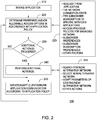
- FIG. 2 depicts a flow diagram of a method according to one embodiment. Specifically, FIG. 2 depicts a flow diagram of a method suitable for use in a terminal 110.
- an application is invoked by the wireless access device or terminal 110.
- the application may comprise, illustratively, a VoIP application, a browser application, a GPS/mapping application, a video over IP application and so on.
- the Application Policy is controlled by the access provider and, referring to box 225, takes into consideration one or more of the following criteria:
- any triggered additional actions are performed.
- additional actions may comprise searching for an additional access network, searching for an alternative access network, selecting for use by the application an additional access network, selecting for use by the application an alternative access network, adapting the use of parameters associated with one or more access networks and/or other actions.
- the Application Policy may trigger the terminal to make access network selection changes, access network usage changes and the like.
- a search for additional and/or alternative access technology may be triggered when, illustratively, the access options currently in use by the device are either insufficient to meet the QOS needs of the invoked application or, conversely, excessive with respect to the QOS needs of the invoked application.
- no access option may be selected, a single access option may be selected, or multiple access options may be selected.
- the application may use multiple simultaneous bearers established in the access networks to support the application (e.g., allowing a VoIP service via UMTS with simultaneous video via WiFi).
- the wireless access device or terminal 110 initiates new communications or adapts existing communications with the application server 140 supporting the invoked application in accordance with the Application Policy.
- the Application Policy may define one or more access networks to be used in support of the application, the specific loading imparted to a network by the application, any time periods during which the application loading of an access network may be constrained and so on.
- the selection of the one or more access networks 115 is made according to the Application Policy criteria and, in the embodiment of FIG. 1 , supported by the user equipment bearer handling components (UE-BH) 116.
- UE-BH user equipment bearer handling components
- step 220 a determination with respect to the preferred and or allowable access options may be made in accordance with any changes that occurred with respect to the Application Policy, such as with respect to time of day, network congestion and/or other criteria.
- FIG. 3 depicts a high-level block diagram of a computer (computing element) suitable for use in performing the functions described herein.
- the computer 300 depicted in FIG. 3 provides a general architecture and functionality suitable for implementing at least portions of user equipment (such as terminal 110), provider equipment (such as ANMC server 120 and HSS/SPR 130) and application equipment (such as application servers 140).
- user equipment such as terminal 110
- provider equipment such as ANMC server 120 and HSS/SPR 130
- application equipment such as application servers 140.
- computing element 300 includes various cooperating elements, including a processor element 302 (e.g., a central processing unit (CPU) and/or other suitable processor(s)), a memory 304 (e.g., random access memory (RAM), read only memory (ROM), and the like) and various input/output devices 306 (e.g., a user input device (such as a keyboard, a keypad, a mouse, and the like), a user output device (such as a display, a speaker, and the like), an input port, an output port, a receiver/ transmitter (e.g., an air card or other suitable type of receiver/transmitter), and storage devices (e.g., a hard disk drive, a compact disk drive, an optical disk drive, and the like)).
- processor element 302 e.g., a central processing unit (CPU) and/or other suitable processor(s)
- memory 304 e.g., random access memory (RAM), read only memory (ROM), and the like
- FIG. 3 also depicts a further cooperating element 305 that may be used to augment the functionality of the processor(s) 302, memory 304 and I/O devices 306 or to implement any of the various or additional functions as described herein.
- cooperating element 305 may comprise a control function client, control function server, control function agent, bearer function, management function and the like.
- the above-described invention provides a mechanism to control access methods used by terminals on a per-application basis, while enhancing the ability of service providers to control how applications are supported on their networks.
- the various embodiments enable wireless service providers to offer new services in 3G/4G/WiFi networks by minimizing the impact of applications on the more band-limited access options.
- wireless service providers utilizing various embodiments may offer application/content providers access to the API to request access network services. Additionally, wireless service providers will thereby generate additional revenue from end-users by offering them enhanced access options associated with preferred services.
Landscapes
- Engineering & Computer Science (AREA)
- Computer Networks & Wireless Communication (AREA)
- Signal Processing (AREA)
- Computer Security & Cryptography (AREA)
- Databases & Information Systems (AREA)
- Mobile Radio Communication Systems (AREA)
- Telephone Function (AREA)
Abstract
Description
- This application is related to simultaneously filed United States Patent Applications Serial No.
12/705203 - The invention relates generally to the field of communication network management and, more specifically but not exclusively, to management of wireless communication networks.
- Access devices such as smart phones, net books, laptops with wireless access and the like may be capable of using different types of access technologies, such as WiFi (IEEE 802.11), UMTS (3GPP), WiMax (IEEE 802.16), GPRS (3GPP), EV-DO (3GPP2) or LTE (3GPP)
- The specific access network and technology used by the access device is selected according to a fixed preference list stored in the device, or according to a preference list transmitted by the access provider. The preferences are typically meant to ensure that service is provided via the subscriber's access provider or a partner provider. The access technology is selected primarily according to signal strength (coverage) considerations and, after being selected, is used to support all services requested by the user.
- Access devices may select a different access technology in response to an event trigger based upon changing connectivity conditions at the access device (e.g., such as when the access device moves from an area in which a selected first access technology has good coverage to an area in which a second access technology has good coverage). These types of triggers are defined by 3GPP, 3GPP2, 802.21 and other standards.
- Within a specific access technology, quality of service (QoS) differentiation based upon the needs of a requesting application may be provided. For example, a voice over IP (VoIP) application may be accorded preference in an access network according to a business needs and application requirements.
- Unfortunately, at times the initial access technology selected by the access device is not best choice for a subsequently invoked application.
- For example, when a subscriber invokes a VoIP application on a dual mode 3GPP/WiFi capable device, the voice calls may be served on a WiFi network even if the access provider prefers to have all voice calls served via a 3GPP based technology (e.g., UMTS/LTE) because of the superior capability of the 3GPP based technology to handle mobility for conversation class services. Similarly when a device is accessing a specific technology (e.g., EV-DO, LTE, WiFi, etc.), for packet based services, there is little to no control provided over the conditions under which an application may use that technology. This makes it impossible to establish flexible policies that control selection of an access technology according to criteria important to the application provider, content provider and access provider.
- Various deficiencies of the prior art are addressed by the present invention of a method, system and apparatus for controlling access technology selection by a wireless access device capable of communicating via multiple access technologies.
- A method according to one embodiment comprises selecting at least one of a plurality of available access networks, both wireless and wired, for use with an application invoked at a terminal according to a preference associated with the application, where the preference takes into account at least one a network service provider preference, a subscriber preference, a subscriber subscription preference and an application content provider preference. The wired access includes all access methods that maintain a physical connection between the access device and the network. The selecting may be constrained by an Application Policy received from a network service provider. The selecting may be performed in response to a user invoking an application at a terminal, an application server initiating a transaction or a peer triggering a transaction. Additional actions may be performed in response to a trigger condition, such as an indication of network congestion or changes in subscriber, application content provider or service provider preferences.
- A system according to one embodiment comprises network provider equipment (PE) including a control function server adapted to formulate an Application Policy and forward the Application Policy towards terminals capable of communicating with a plurality of access networks; wherein the Application Policy defines allowable access technology selections, and the conditions under which each may be selected, associated with applications invoked within multiple access network terminal devices.
- In an example, a method comprises:
- selecting at least one of a plurality of available access networks for use with an application invoked at a terminal according to preferences associated with the application, the preferences comprising one or more of network service provider preferences, subscriber preferences, subscriber subscription preferences and application content provider preferences;
- wherein said selecting is constrained by an Application Policy received from a network service provider.
- In an example, the method further comprises:
in response to a trigger condition, performing at least one of a plurality of additional actions at a terminal, said additional actions comprise searching for an additional access network, searching for an alternative access network, selecting for use with the wireless application one or both of an additional or alternative access network, and adapting one or more operating parameters associated with a additional or alternative access network. - In an example, the said trigger condition comprises one or more of an indication of network congestion above a threshold level, a change in access provider policy, a change in subscriber preference, a change in subscriber subscription preference and a change in application preference.
- In an example, multiple access networks are selected to support a single wireless application, the method further comprising:
- adapting bearer handling components of a terminal to map packets associated with the single wireless application to each of the multiple selected access networks;
- wherein a bearer handling control function is included within one or more of the application invoked at the terminal, network adapters, network device drivers and the terminal operating system.
- In an example, wherein a single access network is selected to support a single wireless application, the method further comprising:
adapting bearer handling components of a terminal to wrap packets for transmission via a tunnel supported by the single access network. - In an example, said plurality of available access networks comprises at least two of WiFi, GPRS, UMTS, WiMax, EV-DO, LTE and wired based access networks.
- In an example, a system comprises:
- network provider equipment (PE) including a control function server adapted to formulate an Application Policy and forward the Application Policy towards terminals capable of communicating with a plurality of wireless access networks;
- the Application Policy defining allowable access technology selections associated with applications invoked within multiple access network terminal devices.
- In an example, the system further comprises:
user equipment (UE) with a control function adapted to receive the Application Policy from the control function server and adapt bearer handling components in response to the Application Policy and an access network preference associated with the wireless application. - In an example, the system further comprises:
application equipment (AE) including a control function agent adapted to receive the Application Policy from the control function server and adapt bearer handling components in response to the Application Policy and an access network preference associated with the wireless application. - In an example, a computer readable storage medium storing instructions which, when executed by a processor, cause the processor to perform a method for determining a path of a mobile session of a user equipment (UE) having an identifier associated therewith, the method comprising:
selecting at least one of a plurality of available access networks for use with a wireless application invoked at a terminal according to at least one of a preference associated with the wireless application, the network service provider, the subscriber, the subscriber subscription and application content provider preferences. - The teachings of the present invention can be readily understood by considering the following detailed description in conjunction with the accompanying drawings, in which:
-
FIG. 1 depicts a high-level block diagram of a system according to one embodiment; -
FIG. 2 depicts a flow diagram of a method according to one embodiment; and -
FIG. 3 depicts a high-level block diagram of a computer suitable for use in performing the functions described herein. - To facilitate understanding, identical reference numerals have been used, where possible, to designate identical elements that are common to the figures.
- The invention will be primarily described within the context of a wireless access device capable of communicating via a plurality of access technologies, where the wireless access device selects specific access technologies for communication based upon the specific application invoked as well as other factors. However, those skilled in the art and informed by the teachings herein will realize that the invention is also applicable to any communication device in which multiple means of communications are available and different applications having different communication requirements may be invoked.
-
FIG. 1 depicts a high-level block diagram of a system according to one embodiment. Specifically, thesystem 100FIG. 1 depicts asingle terminal 110 in communication with each of a plurality ofaccess networks server 120, a Home Subscriber System (HSS) and Subscription Profile Repository (SPR) 130, a plurality (illustratively three) of application servers 140, acore network 150 and one ormore network managers 160 to manage the various network elements and links forming the various networks discussed herein. - It will be appreciated that while a
single terminal 110 is depicted in thesystem 100FIG. 1 , a typical implementation of such a system would includemany terminals 110, where eachterminal 110 represents the user equipment (UE) associated with a user or subscriber of a wireless network access provider. Theterminals 110 and other user equipment interact with provider equipment (PE) associated with the wireless network access provider, such as eNodeBs, routers, gateways, subnets, servers, managers and the like. The specific access provider equipment used depends upon many factors, including the number and types of access technologies used, the size of the access provider network, the number of subscribers serviced by the access provider, the number of applications supported by the access provider, the geographic scope of the access provider network and so on. - Moreover, it will be appreciated that discussion herein relating to control signaling, bearer traffic and the like is simplified for purposes of clarity. Generally speaking, control signals as well as bearer traffic are communicated between the
terminal 110 and ANMCserver 120 via one or both of the access networks 115. Generally speaking, the ANMCserver 120 communicates with the application servers 140 via a server-side network (not shown) associated with the wireless service access provider, or via thecore network 150. InFIG. 1 , control signals are generally denoted as dashed lines, while bearer signals are generally denoted as solid lines. - The terminal 110 comprises a wireless network access device capable of using different types of access technologies, such as a smart phone (e.g., iPhone, Blackberry and the like), a net book, a laptop computer, a network access device within an automobile and so on. Generally speaking, the terminal 110 may be implemented using any type of wireless device capable of communicating via multiple types of access technologies, such as provided by access networks 115.
- The access networks 115 may comprise any type of access network technology, such as WiFi, UMTS, WiMax, EV-DO, LTE and so on. Each of the access networks 115 facilitate communication between at least the terminal 110 and a
core network 150 and/or other network elements and communications with the access networks 115. - The terminal 110 includes a plurality of user equipment (UE)
application clients 112, an access network multi-conductivity (ANMC) control function client (CFC) 114, and user equipment bearer handling components (UE-BH) 116. It will be appreciated that the functions indicated herein as separate clients in the Terminal may also be implemented as functional components within a single client. - The
UE application clients 112 comprise software executed at the terminal 110 to invoke a specific application, such as a GPS location application, a VoIP application, a video over IP application, a remote television programming application and so on. Each application typically requires interaction between the terminal 110 and various servers, gateways, routers, network elements, other terminals and so on to implement its respective function. The ANMCControl Function Client 114 and the bearer handling components (UE-BH) 116 may be implemented as distinct clients in the UE, as a functional entities within theUE Application Client 112, or incorporated in the IP and lower layers within the Operating System kernel. - The ANMC control functions client (CFC) 114 receives control signaling from an ANMC control functions server (CFS) 122 within the
ANMC server 120. The received control signaling includes an Application Policy that is used to determine one or more of the following: (1) the specific access networks 115 (or group of access networks 115) used to support aparticular application client 112 and/or application server 140, or type ofUE application client 112; (2) the QOS level, permissions or other criteria associated with one of more of theUE application clients 112; (3) interactions adapted to change the service level associated with a particular subscriber to meet Service Level Agreement (SLA) criteria; and (4) other aspects of the operation of applications within theterminal 110. Generally speaking, the ANMC control functions client (CFC) 114 adapts the operation of the terminal 110 and/or applications invoked withinterminal 110 in conformance with service provider policies specific to the application as determined in theCFS 122 within theANMC server 120. - The UE-
BH function 116 comprises the hardware/software within the terminal 110 operable to receive and transmit information via the access networks 115. The UE-BH function 116 conveys control signaling and bearer traffic between the functional elements within the terminal 110 and the external functional elements, such as theANMC server 120 and application servers 140. It is responsible for bearer handling functions to execute the Application Policy, including the mapping of application packets to and from the correct access network 115 as determined by Application Policy. - The access network multi-connectivity (ANMC)
server 120 includes an ANMC control functions server (CFS) operable to control the operation of the terminal 110 and/or applications invoked withinterminal 110 in response to an Application Policy associated with the terminal 110 that reflects, the subscriber preferences associated with the terminal 110, the needs, applications invoked within the terminal 110 or other criteria. - Each of the application servers 140-1, 140-2 and 140-3 (collectively application servers 140) comprises the hardware/software associated with a corresponding application capable of being invoked by an
application client 112 in theterminal 110. Application servers 140 may be located with provider equipment (PE) such as theANMC server 120, located at a network operation center of an application provider or content provider, at each of the plurality of mirror sites serving a user community or specific provider network and so on. Generally speaking, the application servers 140 comprise the equipment, software and firmware necessary to interact with the user via a network to provide thereby application services, content delivery, VoIP services and so on. - Each application server 140 is depicted as including an ANMC control function agent (CFA) 142, an
application instance 144 and an application equipment bearer handling function (AE-BH) 146. The ANMCControl Function Agent 142 and Application equipmentbearer handling function 146 may be implemented as distinct application components within the Application Server 140, as functional entities within theapplication 144 providing service to theUE 110 or incorporated in the IP and lower layers within the Operating System kernel on the Application server. - The
application 144 interacts with theapplication client 112 of the terminal 110 to deliver the services associated with the specific application (e.g., location services, VoIP, video and the like). The application equipment bearer handling function (AE-BH) 146 maps packets associated with the traffic flows of the application to the appropriate bearer channels, such as to one or more of access networks 115. The ANMC control function agent (CFA) 142 controls the operation of theapplication 144 and AE-BH function 146 in conformance with an Application Policy received from theANMC server 120. - The
ANMC server 120 distributes an Application Policy to the terminal 110 via a corresponding Application Policy distribution path (APD-T), illustratively via a control channel or bearer channel within any of the access networks 115 compatible with the terminal 110. In the case ofmultiple terminals 110, each of themultiple terminals 110 receives from the ANMC server 120 a corresponding Application Policy.Different terminals 110 may have the same Application Policy or different Application Policies, depending upon the service level agreement associated with the terminal, the applications invoked by the terminal and/or other factors discussed herein. The application policy may be formulated using criteria from anapplication policy source 125, such as a service level agreement (SLA), network operator criteria/guidelines and so on. - Information used to define the Application Policy for access technology selection is received from a variety of sources, including one or more of the access provider associated with one or more of the access networks 115, subscriber information preferences, application information board preferences, network operating parameters (e.g., network congestion indicators, QoS indicators etc.) and so on. The information used to define the Application Policy is hierarchical in nature in various embodiments. For example, access provider policies may constrain subscriber and application provider requested policies in view of service-level agreements, network congestion indicators, QOS indicators and the like.
- Access provider policies define the behavior of terminals and applications within the access provider's network in accordance with the goals of the access provider in managing its network(s). The Access provider policies are reflected in the Application Policy used to determine bearer availability for an application. A separate Application Policy may be provided for each application or service that the access provider wishes to control. Additionally, separate Application Policy may be provided for each user according to user subscription information known to the access provider. The policy may be periodically updated according to changing network conditions or other criteria important to the access provider. A default Application Policy may be invoked for applications for which an explicit policy has not been established.
- Aspects of the Application Policy sent to the terminal may be modified by the subscriber, as allowed by the access provider. This allows the end-user to personalize aspects of their service in a manner permitted by the Access Provider.
- Aspects of the Application Policy sent to the terminal may be modified by one or more applications, as allowed by the access provider. This allows the application provider to personalize or optimize aspects of its service to the end-user in a manner permitted by the Access Provider.
- While the Application Policy may be modified in response to terminal requests, application requests and/or other information from various sources, the limits of such modifications are ultimately constrained by the access provider through the access provider policies included within the Application Policy. That is, the access provider determines which aspects of the Application Policy may be modified by the terminal/application, when such modifications may be made, under what conditions such modifications may be made, the extent to which such modifications may be made and so on.
- One example of an access provider policy is a stipulation that during busy hours of the day (or when network congestion metrics are above a threshold level), certain applications will not be allowed to use 3GPP based access. For example, the video applications may be prohibited during certain critical hours or as a response to network congestion. In this manner, access network enforcement of QoS levels associated with the access providers' subscriber community may be maintained for at least the allowed applications.
- Another example of an access provider policy is a stipulation that under predefined circumstances certain application requests will be honored, while other application requests will be over-ridden. For example, an access provider may wish to always support VoIP service on a specific 3GPP technology platform, irrespective of the technology platform requested by the application (i.e., a VoIP application requesting use of an available WiFi technologies will instead be forced to use and available 3GPP access technology). In this manner, QoS levels associated with individual subscribers or subscriber applications may be maintained, irrespective of subscriber or application request.
- Another example of an access provider policy is a hierarchical stipulation of the access technology to be used by an application when the Terminal establishes multiple connectivity options. This controls whether an application will switch to a newly available access option or maintain service on a previously available access. Hence a streaming application may switch to WiFi when it becomes available due to mobility induced coverage changes, whereas an active VoIP call may be maintained on 3GPP access.
- Subscriber preferences and subscriber subscription preferences may be stored at the ANMC server or other service equipment (SE), such as at HSS/
SPR 130. Subscriber preferences may also be stored at the terminal 110. - The Home Subscriber System (HSS) and Subscription Profile Repository (SPR) 130 contain per-subscriber subscription information for specific services/applications. In one embodiment, this information is used to alter the Application Policy according to the services authorized for the subscriber. This allows access providers to charge subscribers for enhanced delivery of a service. For example, an access provider may wish to stipulate that a video service will only be available via WiFi, unless the subscriber pays an additional fee to receive the service via LTE. The per-subscriber authorization to support this may be obtained from the HSS/SPR.
- Application preferences may be provided/received via an application programming interface (API) supporting one or more of the
application client 112 in the terminal 110 and the Application Server 140. Application preferences may be communicated by other means (e.g., via signaling/control channels or bearer channels). Applications may be offered to subscribers directly from the access provider (so-called "walled garden" applications) or from third party providers (so-called "over-the-top" applications). In either case, the specific application offered to the subscriber may have requirements supportable by relatively low cost or low bit rate networks, requirements necessitating the use of relatively high cost or high bit rate networks, asymmetrical forward/backward bandwidth requirements and the like. - Network operating parameters (e.g., congestion state and/or other indicators) may be received via an API or other means from, illustratively, access network Operations, Administration and Maintenance (OAM) systems (not shown) or network monitoring appliances (not shown). The
ANMC Server 120 aggregates congestion information and/or other network operator parameter information from one or more of the available access networks. Based on this information, the Application Policy which determines the network(s) to be selected may be updated to reflect the changes in access network conditions. - Referring to
FIG. 1 , the ANMC Control Function Server (CFS) 122 gathers the information relevant to the formulation of and Application Policy, formulates an Application Policy for each terminal and/or application, and distributes the formulated application policies to one or more of the appropriate ANMC Control Function Clients (CFC) 114 in theterminals 110, and to the appropriate ANMC control function application (CFA) 142 within the application server 140. As previously noted, these Application Policy distribution paths may be supported by any control channels or bearer channels supported by the access networks 115,core network 150 or other communication mechanism. - An Application Policy may be distributed when an application is invoked, or it may be pre-loaded and stored in a
terminal 110. In either case the Application Policy may be subsequently updated at any time. - The
CFC 114 in the terminal 110 is responsible for receiving the policy, and directing bearer handling components of the invention to use a selected access technology. It may also trigger scanning for additional access options if the current access options are not consistent with those in the Application Policy. - The bearer handling components of the UE-
BH function 116 are responsible for mapping packets to the correct access technology when more than one access technology is available. This mapping they be accomplished using one or more of the following mechanisms: (1) Mobile IPv4/IPv6 extensions that permit flow binding to a Care-of-address associated with the access network; (2) Use of a Traffic Flow Template (TFT) to map traffic to a desired interface; (3) Use of operating specific APIs that permit Source Routing to an interface associated with the Source IP address; (4) Use of APIs that allow routing table default route modifications to associate packets with the desired interface; and/or (5) other mechanisms. - When
UE application clients 112 and their associated applications are capable of supporting only one access network option (e.g., a single IP address), the UE-BH function 116 maps packets received from theUE Application Client 112 to only one of either Access Network A (115A) or Access Network B (115B). In this embodiment, the UE-BH function 116 wraps each packet (or group of packets) received from theApplication Client 112 for transmission via a tunnel that terminates at theANMC server 120. TheANMC server 120 then unwraps/extracts the packet or group of packets from the tunnel, and forwards the packet or group of packets to the corresponding Application. - In various embodiments, a bearer handling control function may be included within one or more of the application invoked at the terminal, network adapters, network device drivers and the terminal operating system.
- When
UE application clients 112 and their associatedapplications 144 are capable of supporting multiple access network options (e.g., multiple simultaneous IP addresses), the UE-BH function 116 may be incorporated within theApplication Client 112. In this embodiment, theapplication client 112 receives a directive from the control function client (CFC) 114 indicating the access network to use for an application. The access network may be identified using one or more of the following mechanisms: (1) The IP address of the access network interface; (2) The Network Identifier (e.g., SSID/PLMN ID) of the access network; (3) A MIP agent advertisement identifying an available network; (4) A Network Name; and/or (5) Other mechanisms that identify the access network. In response, the UE-BH function 116 maps packets toAccess Network A 115A and/orAccess Network B 115B accordingly. In this case no bearer tunnel through the ANMC Server is required. - The Control Function Application (CFA) within the application server 140 performs a function similar to that of the control function client (CFC) within the
terminals 110; namely, informing the corresponding bearer handling component (AE-BH function 146) in theApplication Server 120 to map packets to the appropriate access network 115. In another embodiment, the CFA function may be incorporated into the Application. In this case no tunnel is required and packets are sent directly between the Application and Terminal Client via the chosen access network. -
FIG. 2 depicts a flow diagram of a method according to one embodiment. Specifically,FIG. 2 depicts a flow diagram of a method suitable for use in aterminal 110. - At
step 210, an application is invoked by the wireless access device orterminal 110. The application may comprise, illustratively, a VoIP application, a browser application, a GPS/mapping application, a video over IP application and so on. - At
step 220, a determination is made as to the preferred and/or allowable access technology options associated with the application in accordance with an Application Policy previously received by the access device via the access network. As previously noted, the Application Policy is controlled by the access provider and, referring tobox 225, takes into consideration one or more of the following criteria: - Requests from Applications for a specified access technology;
- Network Congestion state;
- Per-subscriber subscription to specific services/applications;
- Access Provider policies for how they wish to manage their network;
- Subscriber Subscription Preference
- Subscriber preferences; and
- Other factors.
- At
step 230, a determination is made as to whether the examination of the Application Policy triggers a need to perform one or more additional actions. - At
step 240, any triggered additional actions are performed. Referring tobox 245, such additional actions may comprise searching for an additional access network, searching for an alternative access network, selecting for use by the application an additional access network, selecting for use by the application an alternative access network, adapting the use of parameters associated with one or more access networks and/or other actions. - Generally speaking, the Application Policy may trigger the terminal to make access network selection changes, access network usage changes and the like. A search for additional and/or alternative access technology may be triggered when, illustratively, the access options currently in use by the device are either insufficient to meet the QOS needs of the invoked application or, conversely, excessive with respect to the QOS needs of the invoked application.
- Depending upon the stipulations in the Application Policy, no access option may be selected, a single access option may be selected, or multiple access options may be selected. In one embodiment, if multiple access options are selected then the application may use multiple simultaneous bearers established in the access networks to support the application (e.g., allowing a VoIP service via UMTS with simultaneous video via WiFi).
- At
step 250, the wireless access device or terminal 110 initiates new communications or adapts existing communications with the application server 140 supporting the invoked application in accordance with the Application Policy. In this manner, the Application Policy may define one or more access networks to be used in support of the application, the specific loading imparted to a network by the application, any time periods during which the application loading of an access network may be constrained and so on. The selection of the one or more access networks 115 is made according to the Application Policy criteria and, in the embodiment ofFIG. 1 , supported by the user equipment bearer handling components (UE-BH) 116. - The
method 200 then proceeds to step 220, where a determination with respect to the preferred and or allowable access options may be made in accordance with any changes that occurred with respect to the Application Policy, such as with respect to time of day, network congestion and/or other criteria. -
FIG. 3 depicts a high-level block diagram of a computer (computing element) suitable for use in performing the functions described herein. Specifically, thecomputer 300 depicted inFIG. 3 provides a general architecture and functionality suitable for implementing at least portions of user equipment (such as terminal 110), provider equipment (such asANMC server 120 and HSS/SPR 130) and application equipment (such as application servers 140). - As depicted in
FIG. 3 ,computing element 300 includes various cooperating elements, including a processor element 302 (e.g., a central processing unit (CPU) and/or other suitable processor(s)), a memory 304 (e.g., random access memory (RAM), read only memory (ROM), and the like) and various input/output devices 306 (e.g., a user input device (such as a keyboard, a keypad, a mouse, and the like), a user output device (such as a display, a speaker, and the like), an input port, an output port, a receiver/ transmitter (e.g., an air card or other suitable type of receiver/transmitter), and storage devices (e.g., a hard disk drive, a compact disk drive, an optical disk drive, and the like)).FIG. 3 also depicts a further cooperatingelement 305 that may be used to augment the functionality of the processor(s) 302,memory 304 and I/O devices 306 or to implement any of the various or additional functions as described herein. In various alternate embodiments, cooperatingelement 305 may comprise a control function client, control function server, control function agent, bearer function, management function and the like. - It should be noted that functions depicted and described herein may be implemented in software and/or in a combination of software and hardware, e.g., using a general purpose computer, one or more application specific integrated circuits (ASIC), and/or any other hardware equivalents. In one embodiment, software implementing methodology or mechanisms supporting the various embodiments is loaded into
memory 304 and executed by processor(s) 302 to implement the functions as discussed herein. Thus, various methodologies and functions (including associated data structures) can be stored on a computer readable storage medium, e.g., RAM memory, magnetic or optical drive or diskette, and the like. - It is contemplated that some of the steps discussed herein as software methods may be implemented within hardware, for example, as circuitry that cooperates with the processor to perform various method steps. Portions of the functions/elements described herein may be implemented as a computer program product wherein computer instructions, when processed by a computer, adapt the operation of the computer such that the methods and/or techniques described herein are invoked or otherwise provided. Instructions for invoking the inventive methods may be stored in tangible fixed or removable media, transmitted via a data stream in a tangible or intangible broadcast or other signal bearing medium, and/or stored within a memory within a computing device operating according to the instructions.
- The above-described invention provides a mechanism to control access methods used by terminals on a per-application basis, while enhancing the ability of service providers to control how applications are supported on their networks. The various embodiments enable wireless service providers to offer new services in 3G/4G/WiFi networks by minimizing the impact of applications on the more band-limited access options. Thus, wireless service providers utilizing various embodiments may offer application/content providers access to the API to request access network services. Additionally, wireless service providers will thereby generate additional revenue from end-users by offering them enhanced access options associated with preferred services.
- The above-described teachings and embodiments provided herein, such as methods, apparatus, systems and the like for controlling access technology selection, may be adapted in various combinations with the teachings and embodiments such as methods, apparatus, systems and the like for providing network aware presence disclosed in United States Patent Applications Serial No. (Attorney Docket No. ALU/806373), which is entitled "Method And Apparatus Providing Access Network Aware Presence To Applications," and which is herein incorporated by reference in its entirety.
- While the foregoing is directed to various embodiments of the present invention, other and further embodiments of the invention may be devised without departing from the basic scope thereof. As such, the appropriate scope of the invention is to be determined according to the claims, which follow.
Claims (15)
- A method, comprising:selecting at least one of a plurality of available access networks (115A, 115B) for use with an application invoked at a terminal (110) according to preferences associated with the application (144), the preferences comprising one or more preferences from any of network service provider preferences, subscriber preferences, subscriber subscription preferences and application content provider preferences;wherein said selecting is constrained by an Application Policy received from a network service provider;wherein a single access network (115A, 115B) is selected to support a single wireless application (144), the method further comprising:adapting bearer handling components (116) of the terminal (110) to wrap packets for transmission via a tunnel supported by the single access network (115A, 115B).
- The method of claim 1,
wherein said selecting is performed in response to a user invoking an application at the terminal (110). - The method of claim 1, wherein subscriber preferences are entered and stored on the terminal (110).
- The method of claim 1, wherein subscriber subscription preferences are obtained at a Home Subscriber System, HSS, and Subscription Profile Repository, SPR.
- The method of claim 1, wherein said step of selecting is performed for each of a plurality of applications invoked at the terminal (110).
- The method of claim 1, wherein multiple access networks (115A, 115B) are selected to support a second wireless application (144), the method further comprising:adapting bearer handling components (116) of the terminal (110) to map packets associated with the second wireless application (144) to each of the multiple selected access networks (115A, 115B).
- The method of claim 6, wherein a bearer handling control function is included within one or more of the application invoked at the terminal (110), network adapters, network device drivers, and the terminal operating system.
- A non-transitory computer-readable storage medium (304) storing instructions which, when executed by a processor (302), cause the processor (302) to perform a method, the method, comprising:selecting at least one of a plurality of available access networks (115A, 115B) for use with an application invoked at a terminal (110) according to preferences associated with the application (144), the preferences comprising one or more preferences from any of network service provider preferences, subscriber preferences, subscriber subscription preferences and application content provider preferences;wherein said selecting is constrained by an Application Policy received from a network service provider;wherein a single access network (115A, 115B) is selected to support a single wireless application (144), the method further comprising:adapting bearer handling components (116) of the terminal (110) to wrap packets for transmission via a tunnel supported by the single access network (115A, 115B).
- The non-transitory computer-readable storage medium (304) of claim 8, wherein said selecting is performed in response to a user invoking an application at the terminal (110).
- The non-transitory computer-readable storage medium (304) of claim 8, wherein subscriber preferences are entered and stored on the terminal (110).
- The non-transitory computer-readable storage medium (304) of claim 8, wherein subscriber subscription preferences are obtained at a Home Subscriber System, HSS, and Subscription Profile Repository, SPR.
- The non-transitory computer-readable storage medium (304) of claim 8, wherein said step of selecting is performed for each of a plurality of applications invoked at the terminal (110).
- The non-transitory computer-readable storage medium (304) of claim 8, wherein multiple access networks (115A, 115B) are selected to support a second wireless application (144), the method further comprising:adapting bearer handling components (116) of the terminal (110) to map packets associated with the second wireless application (144) to each of the multiple selected access networks (115A, 115B).
- The non-transitory computer-readable storage medium (304) of claim 13, wherein a bearer handling control function is included within one or more of the application invoked at the terminal (110), network adapters, network device drivers, and the terminal operating system.
- An apparatus (300), comprising:a processor (302) and a memory (304), the memory (304) communicatively connected to the processor (302), the processor (302) configured to:select at least one of a plurality of available access networks (115A, 115B) for use with an application invoked at a terminal (110) according to preferences associated with the application (144), the preferences comprising one or more preferences from any of network service provider preferences, subscriber preferences, subscriber subscription preferences and application content provider preferences;wherein the selection is constrained by an Application Policy received from a network service provider;wherein a single access network (115A, 115B) is selected to support a single wireless application (144), the processor (302) being further configured to:adapt bearer handling components (116) of the terminal (110) to wrap packets for transmission via a tunnel supported by the single access network (115A, 115B).
Applications Claiming Priority (3)
| Application Number | Priority Date | Filing Date | Title |
|---|---|---|---|
| US12/705,212 US8320272B2 (en) | 2010-02-12 | 2010-02-12 | Method and apparatus for controlling access technology selection |
| EP20110704890 EP2534890A1 (en) | 2010-02-12 | 2011-02-09 | Method and apparatus for controlling access technology selection |
| PCT/US2011/024119 WO2011100269A1 (en) | 2010-02-12 | 2011-02-09 | Method and apparatus for controlling access technology selection |
Related Parent Applications (1)
| Application Number | Title | Priority Date | Filing Date |
|---|---|---|---|
| EP20110704890 Division EP2534890A1 (en) | 2010-02-12 | 2011-02-09 | Method and apparatus for controlling access technology selection |
Publications (2)
| Publication Number | Publication Date |
|---|---|
| EP3435709A1 true EP3435709A1 (en) | 2019-01-30 |
| EP3435709B1 EP3435709B1 (en) | 2025-11-05 |
Family
ID=44072581
Family Applications (2)
| Application Number | Title | Priority Date | Filing Date |
|---|---|---|---|
| EP20110704890 Ceased EP2534890A1 (en) | 2010-02-12 | 2011-02-09 | Method and apparatus for controlling access technology selection |
| EP18195735.8A Active EP3435709B1 (en) | 2010-02-12 | 2011-02-09 | Method and apparatus for controlling access technology selection |
Family Applications Before (1)
| Application Number | Title | Priority Date | Filing Date |
|---|---|---|---|
| EP20110704890 Ceased EP2534890A1 (en) | 2010-02-12 | 2011-02-09 | Method and apparatus for controlling access technology selection |
Country Status (6)
| Country | Link |
|---|---|
| US (3) | US8320272B2 (en) |
| EP (2) | EP2534890A1 (en) |
| JP (1) | JP5542969B2 (en) |
| KR (1) | KR101435732B1 (en) |
| CN (1) | CN102812758B (en) |
| WO (1) | WO2011100269A1 (en) |
Families Citing this family (43)
| Publication number | Priority date | Publication date | Assignee | Title |
|---|---|---|---|---|
| US8972541B2 (en) * | 2010-02-12 | 2015-03-03 | Alcatel Lucent | Method and apparatus providing access network aware presence to applications |
| US8320272B2 (en) | 2010-02-12 | 2012-11-27 | Alcatel Lucent | Method and apparatus for controlling access technology selection |
| US9210528B2 (en) | 2010-07-21 | 2015-12-08 | Tksn Holdings, Llc | System and method for control and management of resources for consumers of information |
| US9232046B2 (en) | 2010-07-21 | 2016-01-05 | Tksn Holdings, Llc | System and method for controlling mobile services using sensor information |
| US20120021770A1 (en) | 2010-07-21 | 2012-01-26 | Naqvi Shamim A | System and method for control and management of resources for consumers of information |
| US9246764B2 (en) * | 2010-12-14 | 2016-01-26 | Verizon Patent And Licensing Inc. | Network service admission control using dynamic network topology and capacity updates |
| US20130121214A1 (en) * | 2011-07-27 | 2013-05-16 | Vonage Network, Llc | Systems and methods of providing communications services |
| US8811187B2 (en) * | 2011-08-17 | 2014-08-19 | Verizon Patent And Licensing Inc. | Radio access network technology optimization based on application type |
| US8797875B2 (en) * | 2011-09-16 | 2014-08-05 | Telefonaktiebolaget Lm Ericsson (Publ) | Policy controlled offloading among neighboring networks |
| US8705490B2 (en) | 2011-12-23 | 2014-04-22 | Verizon Patent And Licensing Inc. | Handing over a user device from one technology to another |
| US9270772B2 (en) * | 2012-02-29 | 2016-02-23 | Blackberry Limited | System and method for providing access to presence status for mobile devices |
| US9264504B2 (en) * | 2012-02-29 | 2016-02-16 | Blackberry Limited | System and method for providing access to presence status for mobile devices |
| EP2637380B1 (en) * | 2012-03-07 | 2018-08-22 | Harman Becker Automotive Systems GmbH | Telematic system |
| US9107049B2 (en) * | 2012-05-11 | 2015-08-11 | D2 Technologies, Inc. | Advanced real-time IP communication in a mobile terminal |
| EP2853061B1 (en) * | 2012-05-21 | 2019-08-14 | Nokia Technologies Oy | Method and apparatus for application behavior policies |
| IL221667A0 (en) * | 2012-08-27 | 2012-12-31 | Univ Ben Gurion | Network selection and traffic offloading module |
| WO2014047942A1 (en) * | 2012-09-29 | 2014-04-03 | 华为技术有限公司 | Data transmission method, user equipment, and network side device |
| US9271254B2 (en) * | 2012-10-22 | 2016-02-23 | Qualcomm Incorporated | Network directed system selection using wireless device input |
| GB2509959B (en) * | 2013-01-18 | 2015-09-23 | Broadcom Corp | Offloading data communications between Radio Access Networks |
| EP2779702A1 (en) * | 2013-03-12 | 2014-09-17 | Alcatel Lucent | Optimization of application layer traffic carried by an IP connection over a mobile network |
| DE102013215730A1 (en) * | 2013-08-09 | 2015-02-12 | Bayerische Motoren Werke Aktiengesellschaft | Method for optimized choice of a wireless communication channel in hybrid vehicle-based communication systems |
| WO2015027199A2 (en) | 2013-08-22 | 2015-02-26 | Naqvi Shamim A | Method and system for addressing the problem of discovering relevant services and applications that are available over the internet or other communcations network |
| US9369916B2 (en) | 2013-08-23 | 2016-06-14 | Alcatel Lucent | Congestion and analytics based access selection control |
| US9544202B2 (en) | 2013-08-29 | 2017-01-10 | Oracle International Corporation | Dynamic assignment and enforcement of application-driven per-connection service level agreements |
| US9497088B2 (en) | 2013-08-29 | 2016-11-15 | Oracle International Corporation | Method and system for end-to-end classification of level 7 application flows in networking endpoints and devices |
| US10111146B2 (en) | 2013-10-04 | 2018-10-23 | Lg Electronics Inc. | Method and device for selecting access network in wireless communication system |
| WO2015065051A1 (en) * | 2013-10-29 | 2015-05-07 | 엘지전자 주식회사 | Method for controlling transmission power and transmission delay, and communication terminal using same |
| JP6202999B2 (en) * | 2013-11-08 | 2017-09-27 | 株式会社東芝 | Information processing apparatus, control method, and program |
| EP3062563A4 (en) * | 2013-11-21 | 2016-12-14 | Huawei Tech Co Ltd | TERMINAL AND METHOD FOR SELECTING ACCESS TO A NETWORK |
| US9408067B1 (en) * | 2013-12-02 | 2016-08-02 | Taqua, Llc | Selectively disallowing use of media over data calling in a segment based on segment characteristics |
| KR102155754B1 (en) | 2014-02-10 | 2020-09-14 | 삼성전자 주식회사 | Method and apparatus for controlling of accessibility to network according to user equipment capability and subscription information |
| US9621735B2 (en) | 2014-06-25 | 2017-04-11 | Textnow, Inc. | Mobile electronic communications combining voice-over-IP and mobile network services |
| US10390289B2 (en) | 2014-07-11 | 2019-08-20 | Sensoriant, Inc. | Systems and methods for mediating representations allowing control of devices located in an environment having broadcasting devices |
| US9552587B2 (en) | 2014-07-11 | 2017-01-24 | Sensoriant, Inc. | System and method for mediating representations with respect to preferences of a party not located in the environment |
| US10824440B2 (en) | 2014-08-22 | 2020-11-03 | Sensoriant, Inc. | Deriving personalized experiences of smart environments |
| US9794266B2 (en) * | 2014-09-05 | 2017-10-17 | Qualcomm Incorporated | Using multiple credentials for access and traffic differentiation |
| EP2996402B1 (en) * | 2014-09-12 | 2017-08-23 | Harman Becker Automotive Systems GmbH | Telematic system with multiple network access devices in a multi-network environment |
| US10701165B2 (en) | 2015-09-23 | 2020-06-30 | Sensoriant, Inc. | Method and system for using device states and user preferences to create user-friendly environments |
| KR102207135B1 (en) * | 2017-06-23 | 2021-01-25 | 주식회사 케이티 | Method for transmitting data of terminal, the terminal and control method of data transmission |
| US10750028B2 (en) | 2017-06-29 | 2020-08-18 | Textnow, Inc. | Mobile communications with quality of service |
| CN113342356B (en) * | 2021-05-18 | 2023-03-28 | 浪潮软件股份有限公司 | Client framework operation and management configuration method |
| EP4466886A1 (en) * | 2022-01-21 | 2024-11-27 | Telefonaktiebolaget LM Ericsson (publ) | Technique enabling selection of core domain qos policies in a content provider domain |
| CN122397241A (en) * | 2023-12-14 | 2026-07-14 | 华为技术有限公司 | Apparatus and method for multi-connection traffic data stream distribution |
Citations (3)
| Publication number | Priority date | Publication date | Assignee | Title |
|---|---|---|---|---|
| FR2882487A1 (en) * | 2005-02-18 | 2006-08-25 | Bouygues Telecom Sa | Communication session establishing method for subscriber of e.g. GSM type cellular telecommunication network, involves determining, using communication routing rule downloaded on terminal, one channel to be utilized for effectuating session |
| EP1708526A1 (en) * | 2005-03-29 | 2006-10-04 | BRITISH TELECOMMUNICATIONS public limited company | Network selection |
| US20100003975A1 (en) * | 2006-10-13 | 2010-01-07 | Delphin Barankanira | Method for accessing a service from a user's terminal via a heterogeneous network in which several types of access are available |
Family Cites Families (31)
| Publication number | Priority date | Publication date | Assignee | Title |
|---|---|---|---|---|
| US7181218B2 (en) | 2001-04-10 | 2007-02-20 | Telefonaktiebolaget Lm Ericsson (Publ) | Commanding handover between differing radio access technologies |
| US7733904B1 (en) * | 2002-01-28 | 2010-06-08 | 3Com Corporation | System and method for roaming between wireless networks |
| DE60210240T2 (en) | 2002-12-30 | 2006-12-28 | France Telecom | Passing between mobile networks of different technologies |
| JP2004272563A (en) * | 2003-03-07 | 2004-09-30 | Fujitsu Ltd | Communication control program, content distribution program, terminal device, and content server |
| KR100601886B1 (en) | 2004-07-12 | 2006-07-19 | 삼성전자주식회사 | Handover control method between heterogeneous networks |
| GB0421114D0 (en) | 2004-09-22 | 2004-10-27 | Orange Personal Comm Serv Ltd | Radio access data packet network and method |
| US20060062202A1 (en) * | 2004-09-22 | 2006-03-23 | General Motors Corporation. | Method and system for controlling continuous reception of streaming audio using telematics |
| EP1670273A1 (en) | 2004-12-08 | 2006-06-14 | France Telecom | Handover of a mobile node between access networks of different technologies in a mobile IP telecommunications system |
| EP1701487A1 (en) | 2005-03-07 | 2006-09-13 | France Telecom | Bandwidth adaptation according to network load |
| US8554916B2 (en) * | 2005-04-11 | 2013-10-08 | Accenture Global Services Gmbh | Service delivery platform and development of new client business models |
| US8151321B2 (en) * | 2005-10-13 | 2012-04-03 | Nokia Corporation | Modular network-assisted policy resolution |
| WO2007043180A1 (en) | 2005-10-14 | 2007-04-19 | Fujitsu Limited | Access network selecting method |
| JP2009528743A (en) | 2006-03-02 | 2009-08-06 | ノキア コーポレイション | Support access to connected network via wireless access network |
| EP2070379B1 (en) * | 2006-09-29 | 2013-04-03 | Telecom Italia S.p.A. | Services for mobile users through distinct electronic apparatuses |
| EP1912459A1 (en) | 2006-10-09 | 2008-04-16 | France Telecom | System and method for mobility management |
| US9124650B2 (en) * | 2006-12-13 | 2015-09-01 | Quickplay Media Inc. | Digital rights management in a mobile environment |
| JP4943901B2 (en) | 2007-03-06 | 2012-05-30 | Kddi株式会社 | Edge router apparatus and program for mobile radio communication for handover |
| US7856226B2 (en) | 2007-04-17 | 2010-12-21 | Aylus Networks, Inc. | Systems and methods for IMS user sessions with dynamic service selection |
| US20080311912A1 (en) * | 2007-06-15 | 2008-12-18 | Qualcomm Incorporated | System selection based on application requirements and preferences |
| WO2009011623A1 (en) * | 2007-07-13 | 2009-01-22 | Telefonaktiebolaget Lm Ericsson (Publ) | Matching used and allowed radio access technology types |
| US8209728B2 (en) | 2007-08-31 | 2012-06-26 | At&T Intellectual Property I, L.P. | System and method of delivering video content |
| US20090141683A1 (en) * | 2007-11-30 | 2009-06-04 | Edward Grinshpun | Method of best effort handoff to maintain radio bearer and mip session continuity for multi-mode mobile units |
| KR20090065775A (en) * | 2007-12-18 | 2009-06-23 | 삼성전자주식회사 | How to configure and run the function of the application and a mobile terminal therefor |
| JP5093671B2 (en) * | 2008-03-31 | 2012-12-12 | 独立行政法人情報通信研究機構 | Communication network system, network communication method, and communication management device |
| CN101605381B (en) * | 2008-06-13 | 2012-12-12 | 华为技术有限公司 | Method, device and system for called access |
| WO2010045302A1 (en) * | 2008-10-14 | 2010-04-22 | Starent Networks, Corp | Flow balancing in communications networks |
| US8351898B2 (en) * | 2009-01-28 | 2013-01-08 | Headwater Partners I Llc | Verifiable device assisted service usage billing with integrated accounting, mediation accounting, and multi-account |
| CN101562843B (en) * | 2009-05-25 | 2011-06-01 | 北京邮电大学 | Network Selection Method in Heterogeneous Networks |
| BRPI1011396B1 (en) * | 2009-06-29 | 2021-05-11 | Blackberry Limited | method to enable services and communication system supporting at least one domain |
| US8423629B2 (en) * | 2009-09-16 | 2013-04-16 | Avaya Inc. | Network framework associating non-enterprise phone with enterprise users |
| US8320272B2 (en) | 2010-02-12 | 2012-11-27 | Alcatel Lucent | Method and apparatus for controlling access technology selection |
-
2010
- 2010-02-12 US US12/705,212 patent/US8320272B2/en active Active
-
2011
- 2011-02-09 EP EP20110704890 patent/EP2534890A1/en not_active Ceased
- 2011-02-09 EP EP18195735.8A patent/EP3435709B1/en active Active
- 2011-02-09 KR KR1020127021150A patent/KR101435732B1/en active Active
- 2011-02-09 WO PCT/US2011/024119 patent/WO2011100269A1/en not_active Ceased
- 2011-02-09 JP JP2012552934A patent/JP5542969B2/en active Active
- 2011-02-09 CN CN201180009183.8A patent/CN102812758B/en active Active
-
2012
- 2012-08-07 US US13/568,305 patent/US9113316B2/en active Active
-
2015
- 2015-08-17 US US14/827,652 patent/US9813892B2/en active Active
Patent Citations (3)
| Publication number | Priority date | Publication date | Assignee | Title |
|---|---|---|---|---|
| FR2882487A1 (en) * | 2005-02-18 | 2006-08-25 | Bouygues Telecom Sa | Communication session establishing method for subscriber of e.g. GSM type cellular telecommunication network, involves determining, using communication routing rule downloaded on terminal, one channel to be utilized for effectuating session |
| EP1708526A1 (en) * | 2005-03-29 | 2006-10-04 | BRITISH TELECOMMUNICATIONS public limited company | Network selection |
| US20100003975A1 (en) * | 2006-10-13 | 2010-01-07 | Delphin Barankanira | Method for accessing a service from a user's terminal via a heterogeneous network in which several types of access are available |
Non-Patent Citations (1)
| Title |
|---|
| VENKITARAMAN N ET AL: "Session aware network controlled interface selection for multi-homed hosts", WIRELESS COMMUNICATIONS AND NETWORKING CONFERENCE, 2004. WCNC. 2004 IE EE ATLANTA, GA, USA 21-25 MARCH 2004, PISCATAWAY, NJ, USA,IEEE, vol. 4, 21 March 2004 (2004-03-21), pages 1963 - 1968, XP010708294, ISBN: 978-0-7803-8344-9, DOI: 10.1109/WCNC.2004.1311386 * |
Also Published As
| Publication number | Publication date |
|---|---|
| WO2011100269A1 (en) | 2011-08-18 |
| US9813892B2 (en) | 2017-11-07 |
| US20120300706A1 (en) | 2012-11-29 |
| US20110199962A1 (en) | 2011-08-18 |
| CN102812758A (en) | 2012-12-05 |
| KR20120115399A (en) | 2012-10-17 |
| US9113316B2 (en) | 2015-08-18 |
| CN102812758B (en) | 2016-08-17 |
| US8320272B2 (en) | 2012-11-27 |
| EP3435709B1 (en) | 2025-11-05 |
| US20150358901A1 (en) | 2015-12-10 |
| JP5542969B2 (en) | 2014-07-09 |
| EP2534890A1 (en) | 2012-12-19 |
| KR101435732B1 (en) | 2014-09-01 |
| JP2013520082A (en) | 2013-05-30 |
Similar Documents
| Publication | Publication Date | Title |
|---|---|---|
| US9813892B2 (en) | Method and apparatus for controlling access technology selection | |
| US12452661B2 (en) | Communication method, device, and system, and storage medium | |
| US8917658B2 (en) | Matching used and allowed radio access technology types | |
| US7948990B2 (en) | Control decisions in a communication system | |
| US11516706B2 (en) | Usage of pre-authorized QoS | |
| US9591556B2 (en) | Methods, systems, and computer readable media for access network discovery and selection | |
| EP2875662B1 (en) | Methods, systems and computer readable media for distributing policy rules to the mobile edge | |
| CN104584630B (en) | According to the service quality of access service to the method and apparatus of the roaming management in communication network | |
| EP2875696B1 (en) | Methods, systems, and computer readable media for dynamically configuring customer premises equipment (cpe) in a converged network | |
| JP2015501094A (en) | Communication between MME / S4-SGSN and PCRF | |
| KR102155754B1 (en) | Method and apparatus for controlling of accessibility to network according to user equipment capability and subscription information | |
| WO2015033580A1 (en) | Communication device, control device, communication method, control method, and program | |
| WO2020109853A1 (en) | Optimized resource management based on predictive analytics | |
| US9173133B2 (en) | Mobile device with guaranteed QoS | |
| CN104541552B (en) | Management of Roaming in Communication Networks Based on Call Charge Usage | |
| EP3804289B1 (en) | Method and system for implementing user defined policies in an intelligent network | |
| CN115606242A (en) | Method and device for determining service quality indication, communication equipment and storage medium | |
| KR101680920B1 (en) | Wireless Communication Terminal and Method therefor | |
| Corici et al. | Enhanced access network discovery and selection in 3GPP Evolved Packet Core | |
| KR20130019961A (en) | Dynamic pcc provisioning control system, apparatus and method |
Legal Events
| Date | Code | Title | Description |
|---|---|---|---|
| PUAI | Public reference made under article 153(3) epc to a published international application that has entered the european phase |
Free format text: ORIGINAL CODE: 0009012 |
|
| STAA | Information on the status of an ep patent application or granted ep patent |
Free format text: STATUS: THE APPLICATION HAS BEEN PUBLISHED |
|
| AC | Divisional application: reference to earlier application |
Ref document number: 2534890 Country of ref document: EP Kind code of ref document: P |
|
| AK | Designated contracting states |
Kind code of ref document: A1 Designated state(s): AL AT BE BG CH CY CZ DE DK EE ES FI FR GB GR HR HU IE IS IT LI LT LU LV MC MK MT NL NO PL PT RO RS SE SI SK SM TR |
|
| STAA | Information on the status of an ep patent application or granted ep patent |
Free format text: STATUS: REQUEST FOR EXAMINATION WAS MADE |
|
| 17P | Request for examination filed |
Effective date: 20190724 |
|
| RBV | Designated contracting states (corrected) |
Designated state(s): AL AT BE BG CH CY CZ DE DK EE ES FI FR GB GR HR HU IE IS IT LI LT LU LV MC MK MT NL NO PL PT RO RS SE SI SK SM TR |
|
| STAA | Information on the status of an ep patent application or granted ep patent |
Free format text: STATUS: EXAMINATION IS IN PROGRESS |
|
| 17Q | First examination report despatched |
Effective date: 20200130 |
|
| GRAP | Despatch of communication of intention to grant a patent |
Free format text: ORIGINAL CODE: EPIDOSNIGR1 |
|
| STAA | Information on the status of an ep patent application or granted ep patent |
Free format text: STATUS: GRANT OF PATENT IS INTENDED |
|
| RIC1 | Information provided on ipc code assigned before grant |
Ipc: H04W 48/18 20090101AFI20250616BHEP Ipc: H04W 8/18 20090101ALI20250616BHEP Ipc: H04L 12/54 20130101ALI20250616BHEP |
|
| INTG | Intention to grant announced |
Effective date: 20250707 |
|
| GRAS | Grant fee paid |
Free format text: ORIGINAL CODE: EPIDOSNIGR3 |
|
| GRAA | (expected) grant |
Free format text: ORIGINAL CODE: 0009210 |
|
| STAA | Information on the status of an ep patent application or granted ep patent |
Free format text: STATUS: THE PATENT HAS BEEN GRANTED |
|
| AC | Divisional application: reference to earlier application |
Ref document number: 2534890 Country of ref document: EP Kind code of ref document: P |
|
| AK | Designated contracting states |
Kind code of ref document: B1 Designated state(s): AL AT BE BG CH CY CZ DE DK EE ES FI FR GB GR HR HU IE IS IT LI LT LU LV MC MK MT NL NO PL PT RO RS SE SI SK SM TR |
|
| REG | Reference to a national code |
Ref country code: CH Ref legal event code: F10 Free format text: ST27 STATUS EVENT CODE: U-0-0-F10-F00 (AS PROVIDED BY THE NATIONAL OFFICE) Effective date: 20251105 Ref country code: GB Ref legal event code: FG4D |
|
| REG | Reference to a national code |
Ref country code: DE Ref legal event code: R096 Ref document number: 602011075527 Country of ref document: DE |
|
| REG | Reference to a national code |
Ref country code: IE Ref legal event code: FG4D |
|
| REG | Reference to a national code |
Ref country code: NL Ref legal event code: MP Effective date: 20251105 |
|
| PGFP | Annual fee paid to national office [announced via postgrant information from national office to epo] |
Ref country code: GB Payment date: 20260106 Year of fee payment: 16 |
|
| PG25 | Lapsed in a contracting state [announced via postgrant information from national office to epo] |
Ref country code: ES Free format text: LAPSE BECAUSE OF FAILURE TO SUBMIT A TRANSLATION OF THE DESCRIPTION OR TO PAY THE FEE WITHIN THE PRESCRIBED TIME-LIMIT Effective date: 20251105 |
|
| REG | Reference to a national code |
Ref country code: LT Ref legal event code: MG9D |
|
| PG25 | Lapsed in a contracting state [announced via postgrant information from national office to epo] |
Ref country code: NO Free format text: LAPSE BECAUSE OF FAILURE TO SUBMIT A TRANSLATION OF THE DESCRIPTION OR TO PAY THE FEE WITHIN THE PRESCRIBED TIME-LIMIT Effective date: 20260205 |
|
| PGFP | Annual fee paid to national office [announced via postgrant information from national office to epo] |
Ref country code: DE Payment date: 20251230 Year of fee payment: 16 |
|
| PG25 | Lapsed in a contracting state [announced via postgrant information from national office to epo] |
Ref country code: HR Free format text: LAPSE BECAUSE OF FAILURE TO SUBMIT A TRANSLATION OF THE DESCRIPTION OR TO PAY THE FEE WITHIN THE PRESCRIBED TIME-LIMIT Effective date: 20251105 Ref country code: FI Free format text: LAPSE BECAUSE OF FAILURE TO SUBMIT A TRANSLATION OF THE DESCRIPTION OR TO PAY THE FEE WITHIN THE PRESCRIBED TIME-LIMIT Effective date: 20251105 Ref country code: AT Free format text: LAPSE BECAUSE OF FAILURE TO SUBMIT A TRANSLATION OF THE DESCRIPTION OR TO PAY THE FEE WITHIN THE PRESCRIBED TIME-LIMIT Effective date: 20251105 |
|
| REG | Reference to a national code |
Ref country code: AT Ref legal event code: MK05 Ref document number: 1855792 Country of ref document: AT Kind code of ref document: T Effective date: 20251105 |
|
| PG25 | Lapsed in a contracting state [announced via postgrant information from national office to epo] |
Ref country code: NL Free format text: LAPSE BECAUSE OF FAILURE TO SUBMIT A TRANSLATION OF THE DESCRIPTION OR TO PAY THE FEE WITHIN THE PRESCRIBED TIME-LIMIT Effective date: 20251105 |
|
| PG25 | Lapsed in a contracting state [announced via postgrant information from national office to epo] |
Ref country code: RS Free format text: LAPSE BECAUSE OF FAILURE TO SUBMIT A TRANSLATION OF THE DESCRIPTION OR TO PAY THE FEE WITHIN THE PRESCRIBED TIME-LIMIT Effective date: 20260205 |
|
| PG25 | Lapsed in a contracting state [announced via postgrant information from national office to epo] |
Ref country code: IS Free format text: LAPSE BECAUSE OF FAILURE TO SUBMIT A TRANSLATION OF THE DESCRIPTION OR TO PAY THE FEE WITHIN THE PRESCRIBED TIME-LIMIT Effective date: 20260305 |
|
| PG25 | Lapsed in a contracting state [announced via postgrant information from national office to epo] |
Ref country code: PT Free format text: LAPSE BECAUSE OF FAILURE TO SUBMIT A TRANSLATION OF THE DESCRIPTION OR TO PAY THE FEE WITHIN THE PRESCRIBED TIME-LIMIT Effective date: 20260305 |
|
| PG25 | Lapsed in a contracting state [announced via postgrant information from national office to epo] |
Ref country code: PL Free format text: LAPSE BECAUSE OF FAILURE TO SUBMIT A TRANSLATION OF THE DESCRIPTION OR TO PAY THE FEE WITHIN THE PRESCRIBED TIME-LIMIT Effective date: 20251105 |
|
| PG25 | Lapsed in a contracting state [announced via postgrant information from national office to epo] |
Ref country code: LV Free format text: LAPSE BECAUSE OF FAILURE TO SUBMIT A TRANSLATION OF THE DESCRIPTION OR TO PAY THE FEE WITHIN THE PRESCRIBED TIME-LIMIT Effective date: 20251105 |
|
| PG25 | Lapsed in a contracting state [announced via postgrant information from national office to epo] |
Ref country code: BG Free format text: LAPSE BECAUSE OF FAILURE TO SUBMIT A TRANSLATION OF THE DESCRIPTION OR TO PAY THE FEE WITHIN THE PRESCRIBED TIME-LIMIT Effective date: 20251105 |
|
| PG25 | Lapsed in a contracting state [announced via postgrant information from national office to epo] |
Ref country code: LT Free format text: LAPSE BECAUSE OF FAILURE TO SUBMIT A TRANSLATION OF THE DESCRIPTION OR TO PAY THE FEE WITHIN THE PRESCRIBED TIME-LIMIT Effective date: 20251105 |
|
| PG25 | Lapsed in a contracting state [announced via postgrant information from national office to epo] |
Ref country code: SM Free format text: LAPSE BECAUSE OF FAILURE TO SUBMIT A TRANSLATION OF THE DESCRIPTION OR TO PAY THE FEE WITHIN THE PRESCRIBED TIME-LIMIT Effective date: 20251105 |
|
| PG25 | Lapsed in a contracting state [announced via postgrant information from national office to epo] |
Ref country code: DK Free format text: LAPSE BECAUSE OF FAILURE TO SUBMIT A TRANSLATION OF THE DESCRIPTION OR TO PAY THE FEE WITHIN THE PRESCRIBED TIME-LIMIT Effective date: 20251105 |
|
| PG25 | Lapsed in a contracting state [announced via postgrant information from national office to epo] |
Ref country code: IT Free format text: LAPSE BECAUSE OF FAILURE TO SUBMIT A TRANSLATION OF THE DESCRIPTION OR TO PAY THE FEE WITHIN THE PRESCRIBED TIME-LIMIT Effective date: 20251105 |
|
| PG25 | Lapsed in a contracting state [announced via postgrant information from national office to epo] |
Ref country code: EE Free format text: LAPSE BECAUSE OF FAILURE TO SUBMIT A TRANSLATION OF THE DESCRIPTION OR TO PAY THE FEE WITHIN THE PRESCRIBED TIME-LIMIT Effective date: 20251105 |
|
| PG25 | Lapsed in a contracting state [announced via postgrant information from national office to epo] |
Ref country code: CZ Free format text: LAPSE BECAUSE OF FAILURE TO SUBMIT A TRANSLATION OF THE DESCRIPTION OR TO PAY THE FEE WITHIN THE PRESCRIBED TIME-LIMIT Effective date: 20251105 |
|
| PG25 | Lapsed in a contracting state [announced via postgrant information from national office to epo] |
Ref country code: SK Free format text: LAPSE BECAUSE OF FAILURE TO SUBMIT A TRANSLATION OF THE DESCRIPTION OR TO PAY THE FEE WITHIN THE PRESCRIBED TIME-LIMIT Effective date: 20251105 |
|
| PG25 | Lapsed in a contracting state [announced via postgrant information from national office to epo] |
Ref country code: SE Free format text: LAPSE BECAUSE OF FAILURE TO SUBMIT A TRANSLATION OF THE DESCRIPTION OR TO PAY THE FEE WITHIN THE PRESCRIBED TIME-LIMIT Effective date: 20251105 |