EP3435590A1 - Identity registration method and device - Google Patents
Identity registration method and device Download PDFInfo
- Publication number
- EP3435590A1 EP3435590A1 EP17769389.2A EP17769389A EP3435590A1 EP 3435590 A1 EP3435590 A1 EP 3435590A1 EP 17769389 A EP17769389 A EP 17769389A EP 3435590 A1 EP3435590 A1 EP 3435590A1
- Authority
- EP
- European Patent Office
- Prior art keywords
- biometric feature
- feature information
- verified
- identifier
- server
- Prior art date
- Legal status (The legal status is an assumption and is not a legal conclusion. Google has not performed a legal analysis and makes no representation as to the accuracy of the status listed.)
- Granted
Links
Images



Classifications
-
- H—ELECTRICITY
- H04—ELECTRIC COMMUNICATION TECHNIQUE
- H04L—TRANSMISSION OF DIGITAL INFORMATION, e.g. TELEGRAPHIC COMMUNICATION
- H04L9/00—Cryptographic mechanisms or cryptographic arrangements for secret or secure communications; Network security protocols
- H04L9/32—Cryptographic mechanisms or cryptographic arrangements for secret or secure communications; Network security protocols including means for verifying the identity or authority of a user of the system or for message authentication, e.g. authorization, entity authentication, data integrity or data verification, non-repudiation, key authentication or verification of credentials
- H04L9/3226—Cryptographic mechanisms or cryptographic arrangements for secret or secure communications; Network security protocols including means for verifying the identity or authority of a user of the system or for message authentication, e.g. authorization, entity authentication, data integrity or data verification, non-repudiation, key authentication or verification of credentials using a predetermined code, e.g. password, passphrase or PIN
- H04L9/3231—Biological data, e.g. fingerprint, voice or retina
-
- H—ELECTRICITY
- H04—ELECTRIC COMMUNICATION TECHNIQUE
- H04L—TRANSMISSION OF DIGITAL INFORMATION, e.g. TELEGRAPHIC COMMUNICATION
- H04L63/00—Network architectures or network communication protocols for network security
- H04L63/04—Network architectures or network communication protocols for network security for providing a confidential data exchange among entities communicating through data packet networks
- H04L63/0428—Network architectures or network communication protocols for network security for providing a confidential data exchange among entities communicating through data packet networks wherein the data content is protected, e.g. by encrypting or encapsulating the payload
- H04L63/0442—Network architectures or network communication protocols for network security for providing a confidential data exchange among entities communicating through data packet networks wherein the data content is protected, e.g. by encrypting or encapsulating the payload wherein the sending and receiving network entities apply asymmetric encryption, i.e. different keys for encryption and decryption
-
- H—ELECTRICITY
- H04—ELECTRIC COMMUNICATION TECHNIQUE
- H04L—TRANSMISSION OF DIGITAL INFORMATION, e.g. TELEGRAPHIC COMMUNICATION
- H04L63/00—Network architectures or network communication protocols for network security
- H04L63/08—Network architectures or network communication protocols for network security for authentication of entities
- H04L63/0823—Network architectures or network communication protocols for network security for authentication of entities using certificates
-
- H—ELECTRICITY
- H04—ELECTRIC COMMUNICATION TECHNIQUE
- H04L—TRANSMISSION OF DIGITAL INFORMATION, e.g. TELEGRAPHIC COMMUNICATION
- H04L63/00—Network architectures or network communication protocols for network security
- H04L63/08—Network architectures or network communication protocols for network security for authentication of entities
- H04L63/0861—Network architectures or network communication protocols for network security for authentication of entities using biometrical features, e.g. fingerprint, retina-scan
-
- H—ELECTRICITY
- H04—ELECTRIC COMMUNICATION TECHNIQUE
- H04L—TRANSMISSION OF DIGITAL INFORMATION, e.g. TELEGRAPHIC COMMUNICATION
- H04L9/00—Cryptographic mechanisms or cryptographic arrangements for secret or secure communications; Network security protocols
- H04L9/08—Key distribution or management, e.g. generation, sharing or updating, of cryptographic keys or passwords
- H04L9/0816—Key establishment, i.e. cryptographic processes or cryptographic protocols whereby a shared secret becomes available to two or more parties, for subsequent use
- H04L9/0819—Key transport or distribution, i.e. key establishment techniques where one party creates or otherwise obtains a secret value, and securely transfers it to the other(s)
- H04L9/0825—Key transport or distribution, i.e. key establishment techniques where one party creates or otherwise obtains a secret value, and securely transfers it to the other(s) using asymmetric-key encryption or public key infrastructure [PKI], e.g. key signature or public key certificates
-
- H—ELECTRICITY
- H04—ELECTRIC COMMUNICATION TECHNIQUE
- H04L—TRANSMISSION OF DIGITAL INFORMATION, e.g. TELEGRAPHIC COMMUNICATION
- H04L9/00—Cryptographic mechanisms or cryptographic arrangements for secret or secure communications; Network security protocols
- H04L9/08—Key distribution or management, e.g. generation, sharing or updating, of cryptographic keys or passwords
- H04L9/0861—Generation of secret information including derivation or calculation of cryptographic keys or passwords
- H04L9/0866—Generation of secret information including derivation or calculation of cryptographic keys or passwords involving user or device identifiers, e.g. serial number, physical or biometrical information, DNA, hand-signature or measurable physical characteristics
-
- H—ELECTRICITY
- H04—ELECTRIC COMMUNICATION TECHNIQUE
- H04L—TRANSMISSION OF DIGITAL INFORMATION, e.g. TELEGRAPHIC COMMUNICATION
- H04L9/00—Cryptographic mechanisms or cryptographic arrangements for secret or secure communications; Network security protocols
- H04L9/08—Key distribution or management, e.g. generation, sharing or updating, of cryptographic keys or passwords
- H04L9/0894—Escrow, recovery or storing of secret information, e.g. secret key escrow or cryptographic key storage
- H04L9/0897—Escrow, recovery or storing of secret information, e.g. secret key escrow or cryptographic key storage involving additional devices, e.g. trusted platform module [TPM], smartcard or USB
-
- H—ELECTRICITY
- H04—ELECTRIC COMMUNICATION TECHNIQUE
- H04L—TRANSMISSION OF DIGITAL INFORMATION, e.g. TELEGRAPHIC COMMUNICATION
- H04L9/00—Cryptographic mechanisms or cryptographic arrangements for secret or secure communications; Network security protocols
- H04L9/32—Cryptographic mechanisms or cryptographic arrangements for secret or secure communications; Network security protocols including means for verifying the identity or authority of a user of the system or for message authentication, e.g. authorization, entity authentication, data integrity or data verification, non-repudiation, key authentication or verification of credentials
- H04L9/3247—Cryptographic mechanisms or cryptographic arrangements for secret or secure communications; Network security protocols including means for verifying the identity or authority of a user of the system or for message authentication, e.g. authorization, entity authentication, data integrity or data verification, non-repudiation, key authentication or verification of credentials involving digital signatures
-
- H—ELECTRICITY
- H04—ELECTRIC COMMUNICATION TECHNIQUE
- H04L—TRANSMISSION OF DIGITAL INFORMATION, e.g. TELEGRAPHIC COMMUNICATION
- H04L63/00—Network architectures or network communication protocols for network security
- H04L63/08—Network architectures or network communication protocols for network security for authentication of entities
- H04L63/083—Network architectures or network communication protocols for network security for authentication of entities using passwords
Definitions
- the present application relates to the field of computer technologies, and in particular, to an identity registration method and device.
- the user needs to register a user identity in advance for the service before using the service. Later, when using the service through the network, the user identity needs to be verified. The user can use the service only after the verification succeeds. For example, if fingerprint information is used to represent the user identity, the fingerprint information of the user needs to be registered in advance.
- fingerprint information recognition in actual applications is increasingly popular in terminal devices, for example, fingerprint information of a user is used to unlock a locked screen interface.
- a process in which a server of the service registers a user identity by using the fingerprint information of the user, and later verifies the user identity by using the fingerprint information of the user can be completed by using a terminal device.
- a plurality of fingerprint information of a user can be stored in a terminal device at the same time.
- the terminal device first needs to verify whether the fingerprint information is one of the plurality of fingerprint information stored in the terminal device. If yes, the terminal device can register the user identity with a server based on the fingerprint information, and if no, the terminal device directly notifies the user that the identity registration fails.
- FIG. 1 a process of registering fingerprint information of a user is shown in FIG. 1 .
- a terminal device receives a registration operation of a user.
- S102 Collect fingerprint information of the user.
- S103 Determine whether the fingerprint information has been pre-stored in the terminal device, and if yes, perform S104, or otherwise, perform S105.
- S104 Query an identifier corresponding to the pre-stored fingerprint information in the terminal device, generate a private key and a public key corresponding to the identifier, store a mapping relationship between the private key and the identifier corresponding to the fingerprint information in the terminal device, and send a mapping relationship between the public key and the identifier corresponding to the fingerprint information to a server for storage.
- FIG. 2 a process of a user using a service is shown in FIG. 2 .
- a terminal device receives fingerprint information of a user.
- Implementations of the present application provide an identity registration method and device, to resolve existing-technology problems: a user forgets which fingerprint is entered and consequently it causes inconvenience to the user to use a service; and if a user's finger used for registration is injured in daily life, the user cannot be authenticated to use the service.
- An implementation of the present application provides an identity registration method, and the method includes the following: receiving, by a terminal device, biometric feature information of a user that is to be verified; matching standard biometric feature information consistent with the biometric feature information to be verified in pre-stored biometric feature information; searching for a private key corresponding to an identifier based on the identifier corresponding to the standard biometric feature information after the matching succeeds; and registering a user identity with a server based on the biometric feature information to be verified when the private key corresponding to the identifier is not identified, so the server stores a public key corresponding to the biometric feature information to be verified.
- An implementation of the present application provides an identity registration device, and the device includes the following: a receiving module, configured to receive biometric feature information of a user that is to be verified; a matching module, configured to match standard biometric feature information consistent with the biometric feature information to be verified in pre-stored biometric feature information; a search module, configured to search for a private key corresponding to an identifier based on the identifier corresponding to the standard biometric feature information after the matching succeeds; and a registration module, configured to register a user identity with a server based on the biometric feature information to be verified when the private key corresponding to the identifier is not identified, so the server stores a public key corresponding to the biometric feature information to be verified.
- the implementations of the present application disclose an identity registration method and device.
- the terminal device receives the biometric feature information of the user that is to be verified, and matches the standard biometric feature information consistent with the biometric feature information to be verified. After the matching succeeds, the terminal device searches for the private key corresponding to the identifier based on the identifier corresponding to the standard biometric feature information, and registers the user identity with the server based on the biometric feature information to be verified when the private key corresponding to the identifier is not identified. As such, the server stores the public key corresponding to the biometric feature information to be verified.
- the terminal device can identify standard biometric feature information consistent with biometric feature information to be verified, even if a private key corresponding to an identifier is not identified in the terminal device based on the identifier corresponding to the standard biometric feature information, the terminal device can directly register the user identity based on the biometric feature information to be verified, to complete service processing, provide great convenience for the user to use a service, and also effectively improve the success rate of using the service.
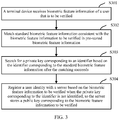
- FIG. 3 shows an identity registration process, according to an implementation of the present application. The process includes the following steps.
- a terminal device receives biometric feature information of a user that is to be verified.
- an identity of the current user first needs to be verified to confirm that the identity of the current user is valid.
- the biometric feature information of the user that is to be verified is first received. Because biometric feature information recognition is increasingly popular in terminal devices (for example, mobile phones) in actual applications, the biometric feature information of the user that is to be verified can be received by a terminal device. After receiving the biometric feature information, the terminal device makes a corresponding response.
- the biometric feature information indicates a physical sign of the user, and it can be an iris of an eye or a fingerprint of a finger, and is mainly used to uniquely represent a user identity.
- biometric feature information is fingerprint information is used as an example for detailed description below.
- a certain forum provides an information query service only for a user who has registered an account, and the user can log in by using fingerprint information. Therefore, when the user needs to query information in the forum, the user opens an application corresponding to the forum on a mobile phone (that is, the terminal device) and presses with a fingerprint. Later, the mobile phone (that is, the terminal device) receives the fingerprint information of the user that is to be verified, and performs step S302.
- fingerprint information that is, biometric feature information
- fingerprint information of a user is used to unlock a locked screen interface.
- a process in which a server of the service registers a user identity by using the fingerprint information of the user, and later verifies the user identity by using the fingerprint information of the user can be completed by using fingerprint information that has been stored in a terminal device.
- fingerprint information can be used to complete the entire service processing in the present application.
- the fingerprint information stored in the terminal device can be entered by the user when the user uses another function of the terminal device, and is not the fingerprint information used by the user for identity registration for using a service.
- the terminal device can locally store the fingerprint information.
- the stored fingerprint information can be used as standard fingerprint information (that is, standard biometric feature information), and is mainly used to check whether the user can be authenticated in a process of using the service and to provide service processing for the user.
- the terminal device after receiving the fingerprint information (that is, the biometric feature information) of the user that is to be verified, the terminal device directly matches locally stored standard fingerprint information (that is, the standard biometric feature information) consistent with the fingerprint information to be verified.
- the mobile phone After receiving the fingerprint information of the user that is to be verified, the mobile phone matches the locally stored standard fingerprint information consistent with the fingerprint information to be verified. Assume that the standard fingerprint information consistent with the fingerprint information to be verified is identified.
- the terminal device can allocate a fingerprint information identifier (that is, a biometric feature information identifier) to each piece of fingerprint information when storing the fingerprint information.
- a fingerprint information identifier that is, a biometric feature information identifier
- the server corresponding to the service needs to know the user who uses the service.
- a private key and a public key corresponding to an identifier need to be generated based on the identifier.
- the identifier is corresponding to fingerprint information used for registration.
- the private key and the public key represent a user identity.
- the generated private key is stored in the terminal device.
- the terminal device after identifying the standard fingerprint information consistent with the fingerprint information to be verified, the terminal device needs to search for the private key corresponding to the identifier based on the identifier corresponding to the standard fingerprint information.
- the mobile phone after identifying the standard fingerprint information consistent with the fingerprint information to be verified, the mobile phone searches for the private key corresponding to the identifier based on the identifier corresponding to the standard fingerprint information.
- the terminal device if the terminal device identifies the standard fingerprint information consistent with the fingerprint information to be verified in step S302, but the terminal device does not identify the private key corresponding to the identifier based on the identifier corresponding to the standard fingerprint information, it indicates that the fingerprint information to be verified belongs to the user, but is not the fingerprint information used during registration.
- the user identity can be directly registered with the server based on the fingerprint information (that is, the biometric feature information) that is to be verified.
- the present application provides a specific process of registering a user identity below:
- the private key and the public key corresponding to the identifier are generated based on the identifier corresponding to the standard biometric feature information that matches the biometric feature information to be verified; a mapping relationship between the identifier and the generated private key is stored in the terminal device; and a mapping relationship between the identifier and the generated public key is sent to the server for storage.
- the standard biometric feature information uniquely corresponds to a standard biometric feature information identifier
- a standard biometric feature information identifier corresponds to a unique private key and public key.
- the standard biometric feature information and the standard biometric feature information identifier are in a one-to-one mapping relationship with a private key and a public key.
- sending the mapping relationship between the identifier and the generated public key to the server for storage can also be storing, by the server, the public key corresponding to the biometric feature information to be verified.
- the fingerprint information may not be fingerprint information of the user.
- the user can be prompted to enter a password for the service.
- the terminal device verifies whether the password is correct. If the password is correct, the user identity can be registered with the server based on the biometric feature information to be verified. If the password is incorrect, the user identity is not registered with the server based on the biometric feature information to be verified, and the user is notified that service processing fails.
- the terminal device can directly notify the user that service processing fails.
- the user can enter a password for the service to continue to use the service.
- the terminal device can receive the password entered by the user and verify whether the password is correct, and if yes, registers the user identity with the server based on the biometric feature information to be verified.
- the mobile phone has not identified the private key corresponding to the identifier.
- the mobile phone prompts the user to use a password for the information query service. Assume that the user enters the password xxxx. After receiving the password xxxx that is entered by the user, if the terminal device verifies that the password is correct, the terminal device generates the private key and the public key corresponding to the identifier, where the identifier is corresponding to the standard fingerprint information that matches the fingerprint information to be verified based on the identifier, stores a mapping relationship between the identifier and the generated private key in the mobile phone, and sends a mapping relationship between the identifier and the generated public key to the server for storage.
- the terminal device can identify standard biometric feature information consistent with biometric feature information to be verified, even if a private key corresponding to an identifier is not identified in the terminal device based on the identifier corresponding to the standard biometric feature information, the terminal device can directly register the user identity based on the biometric feature information to be verified, to complete service processing, provide great convenience for the user to use a service, and also effectively improve the success rate of using the service.
- a service processing request can be sent to the server based on the biometric feature information to be verified after the user identity is registered with the server.
- the server performs service processing based on the public key corresponding to the biometric feature information to be verified.
- step S304 the private key and the public key corresponding to the identifier of the fingerprint information (that is, the biometric feature information) have been re-generated based on the fingerprint information to be verified, and the public key is sent to the server for storage. Therefore, in a process of sending a service processing request to the server based on the fingerprint information to be verified, the present application can include the following: signing service information based on the generated private key and sending the service processing request that includes the signed service information and the identifier to the server, so the server determines the public key corresponding to the identifier included in the service processing request based on the identifier, verifies the signature of the service information included in the service processing request based on the determined public key to verify the user identity, and performs service processing on the service information.
- the mobile phone signs login information based on the generated private key of the identifier, and sends a login processing request that includes the signed login information and the identifier to the server.
- the server identifies a public key corresponding to the identifier based on the identifier included in the login processing request, verifies the signature of the login information included in the login processing request by using the public key, and completes login of the user.
- user A has registered fingerprint information (that is, identity information) in a payment application.
- fingerprint information that is, identity information
- user A pays for purchased merchandise by using the payment application
- user A opens the payment application on the mobile phone (that is, the terminal device) and presses with a fingerprint.
- the mobile phone After receiving fingerprint information of the user that is to be verified, the mobile phone locally matches standard fingerprint information consistent with the fingerprint information to be verified. Assume that the standard fingerprint information consistent with the fingerprint information to be verified is identified.
- the mobile phone searches for a private key corresponding to an identifier based on the identifier corresponding to the standard fingerprint information. If the mobile phone does not identify the private key corresponding to the identifier, the mobile phone directly prompts the user to enter a payment password.
- the mobile phone receives the payment password cccc entered by the user and verifies whether the password is correct. If yes, the mobile phone generates the private key and a public key corresponding to an identifier, where the identifier is corresponding to the standard fingerprint information that matches the fingerprint information to be verified based on the identifier, stores a mapping relationship between the identifier and the generated private key in the mobile phone, and sends a mapping relationship between the identifier and the generated public key to the server for storage.
- the mobile phone signs payment information based on the generated private key corresponding to the identifier and sends a payment processing request that includes the signed payment information and the identifier to the server.
- the server identifies the public key corresponding to the identifier based on the identifier included in the payment processing request, verifies the signature of the payment information by using the public key, and successfully completes payment.
- the present application further provides a corresponding identity registration device.
- FIG. 4 is a schematic structural diagram illustrating an identity registration device, according to an implementation of the present application.
- the device includes the following: a receiving module 401, configured to receive biometric feature information of a user that is to be verified; a matching module 402, configured to match standard biometric feature information consistent with the biometric feature information to be verified in pre-stored biometric feature information; a search module 403, configured to search for a private key corresponding to an identifier based on the identifier corresponding to the standard biometric feature information after the matching succeeds; and a registration module 404, configured to register a user identity with a server based on the biometric feature information to be verified when the search module 403 does not identify the private key corresponding to the identifier, so the server stores a public key corresponding to the biometric feature information to be verified.
- a receiving module 401 configured to receive biometric feature information of a user that is to be verified
- a matching module 402 configured to match standard biometric feature information consistent with the biometric feature information to be verified
- the device further includes the following: a password verification module 405, configured to receive a password entered by the user and verify that the password is correct before the registration module 404 registers the user identity with the server based on the biometric feature information to be verified.
- a password verification module 405 configured to receive a password entered by the user and verify that the password is correct before the registration module 404 registers the user identity with the server based on the biometric feature information to be verified.
- the registration module 404 is configured to generate the private key and the public key corresponding to the identifier based on the identifier corresponding to the standard biometric feature information that matches the biometric feature information to be verified; store a mapping relationship between the identifier and the generated private key in a terminal device; and send a mapping relationship between the identifier and the generated public key to the server for storage.
- the device further includes the following: a processing module 406, configured to send a service processing request to the server based on the biometric feature information to be verified after the registration module 404 registers the user identity with the server, so the server performs service processing based on the public key corresponding to the biometric feature information to be verified.
- a processing module 406 configured to send a service processing request to the server based on the biometric feature information to be verified after the registration module 404 registers the user identity with the server, so the server performs service processing based on the public key corresponding to the biometric feature information to be verified.
- the processing module 406 is configured to sign service information based on the generated private key and send the service processing request that includes the signed service information and the identifier to the server, so the server determines the public key corresponding to the identifier included in the received service processing request and performs service processing based on the determined public key and the signed service information.
- the service processing request includes a payment request.
- a computing device includes one or more processors (CPU), an input/output interface, a network interface, and a memory.
- the memory can include a non-persistent memory, a random access memory (RAM), and/or a nonvolatile memory, etc. in a computer readable medium, such as a read-only memory (ROM) or a flash memory (flash RAM).
- ROM read-only memory
- flash RAM flash memory
- the computer readable medium includes persistent, non-persistent, movable, and unmovable media that can store information by using any method or technology.
- the information can be a computer readable instruction, a data structure, a program module, or other data.
- Examples of a computer storage medium include but are not limited to a phase change random access memory (PRAM), a static RAM (SRAM), a dynamic RAM (DRAM), a RAM of another type, a read-only memory (ROM), an electrically erasable programmable read-only memory (EEPROM), a flash memory or another memory technology, a compact disc read-only memory (CD-ROM), a digital versatile disc (DVD) or another optical storage, a magnetic tape, a magnetic disk storage, another magnetic storage device, or any other non-transmission medium.
- the computer storage medium can be used to store information that can be accessed by a computing device. As described in the present specification, the computer readable medium does not include transitory media, for example, a modulated data signal and a carrier
- the term "include”, “contain”, or any other variant is intended to cover non-exclusive inclusion so that a process, a method, a product, or a device that includes a series of elements not only includes these elements, but also includes other elements that are not expressly listed, or further includes elements inherent to such a process, method, product, or device.
- An element preceded by "includes a " does not, without more constraints, exclude the existence of additional identical elements in the process, method, product, or device that includes the element.
- the implementations of the present application can be provided as a method, a system, or a computer program product. Therefore, the present application can use a form of hardware only implementations, software only implementations, or implementations with a combination of software and hardware. In addition, the present application can use a form of a computer program product implemented on one or more computer-usable storage media (including but not limited to a magnetic disk memory, a CD-ROM, and an optical memory) that include computer-usable program code.
- a computer-usable storage media including but not limited to a magnetic disk memory, a CD-ROM, and an optical memory
Landscapes
- Engineering & Computer Science (AREA)
- Computer Security & Cryptography (AREA)
- Computer Networks & Wireless Communication (AREA)
- Signal Processing (AREA)
- Computing Systems (AREA)
- General Engineering & Computer Science (AREA)
- Computer Hardware Design (AREA)
- Health & Medical Sciences (AREA)
- Biomedical Technology (AREA)
- General Health & Medical Sciences (AREA)
- Life Sciences & Earth Sciences (AREA)
- Biodiversity & Conservation Biology (AREA)
- Collating Specific Patterns (AREA)
- Mobile Radio Communication Systems (AREA)
Abstract
Description
- The present application claims priority to Chinese Patent Application No.
201610180030.4, filed on March 25, 2016 - The present application relates to the field of computer technologies, and in particular, to an identity registration method and device.
- With the continuous development of network technologies, using services through the network has become an integral part of people's life, for example, people use a weather forecast service through the network.
- Currently, to improve information security when a user uses a service, the user needs to register a user identity in advance for the service before using the service. Later, when using the service through the network, the user identity needs to be verified. The user can use the service only after the verification succeeds. For example, if fingerprint information is used to represent the user identity, the fingerprint information of the user needs to be registered in advance.
- Because fingerprint information recognition in actual applications is increasingly popular in terminal devices, for example, fingerprint information of a user is used to unlock a locked screen interface. For any service, a process in which a server of the service registers a user identity by using the fingerprint information of the user, and later verifies the user identity by using the fingerprint information of the user can be completed by using a terminal device.
- Further, with the continuous improvement of the computer technologies, a plurality of fingerprint information of a user can be stored in a terminal device at the same time. For any service, when a user identity is registered by using the fingerprint information uploaded by the user, the terminal device first needs to verify whether the fingerprint information is one of the plurality of fingerprint information stored in the terminal device. If yes, the terminal device can register the user identity with a server based on the fingerprint information, and if no, the terminal device directly notifies the user that the identity registration fails.
- In the existing technology, a process of registering fingerprint information of a user is shown in
FIG. 1 . - S101. A terminal device receives a registration operation of a user.
- S102. Collect fingerprint information of the user.
- S103. Determine whether the fingerprint information has been pre-stored in the terminal device, and if yes, perform S104, or otherwise, perform S105.
- S104. Query an identifier corresponding to the pre-stored fingerprint information in the terminal device, generate a private key and a public key corresponding to the identifier, store a mapping relationship between the private key and the identifier corresponding to the fingerprint information in the terminal device, and send a mapping relationship between the public key and the identifier corresponding to the fingerprint information to a server for storage.
- S105. Notify the user that registration fails.
- Later, a process of a user using a service is shown in
FIG. 2 . - S201. A terminal device receives fingerprint information of a user.
- S202. Match standard biometric feature information consistent with the fingerprint information.
- S203. Search for a private key corresponding to an identifier based on the identifier corresponding to the standard biometric feature information.
- S204. When the private key corresponding to the identifier is identified, sign service information by using the private key, and add the signed service information and the identifier corresponding to the fingerprint information to a service processing request and send the request to a server, so the server determines a public key corresponding to the identifier included in the received service processing request and performs service processing based on the public key and the service information. Alternatively, when the private key corresponding to the identifier is not identified, notify the user that the service processing fails.
- However, in actual applications, if a user forgets which fingerprint is entered, the user needs to perform fingerprint verification for a plurality of times. It causes great inconvenience to the user to use a service, and reduces the success rate of using the service. In addition, if a user's finger used for registration is injured in daily life, the user cannot be authenticated to use the service.
- Implementations of the present application provide an identity registration method and device, to resolve existing-technology problems: a user forgets which fingerprint is entered and consequently it causes inconvenience to the user to use a service; and if a user's finger used for registration is injured in daily life, the user cannot be authenticated to use the service.
- An implementation of the present application provides an identity registration method, and the method includes the following: receiving, by a terminal device, biometric feature information of a user that is to be verified; matching standard biometric feature information consistent with the biometric feature information to be verified in pre-stored biometric feature information; searching for a private key corresponding to an identifier based on the identifier corresponding to the standard biometric feature information after the matching succeeds; and registering a user identity with a server based on the biometric feature information to be verified when the private key corresponding to the identifier is not identified, so the server stores a public key corresponding to the biometric feature information to be verified.
- An implementation of the present application provides an identity registration device, and the device includes the following: a receiving module, configured to receive biometric feature information of a user that is to be verified; a matching module, configured to match standard biometric feature information consistent with the biometric feature information to be verified in pre-stored biometric feature information; a search module, configured to search for a private key corresponding to an identifier based on the identifier corresponding to the standard biometric feature information after the matching succeeds; and a registration module, configured to register a user identity with a server based on the biometric feature information to be verified when the private key corresponding to the identifier is not identified, so the server stores a public key corresponding to the biometric feature information to be verified.
- The implementations of the present application disclose an identity registration method and device. In the method, the terminal device receives the biometric feature information of the user that is to be verified, and matches the standard biometric feature information consistent with the biometric feature information to be verified. After the matching succeeds, the terminal device searches for the private key corresponding to the identifier based on the identifier corresponding to the standard biometric feature information, and registers the user identity with the server based on the biometric feature information to be verified when the private key corresponding to the identifier is not identified. As such, the server stores the public key corresponding to the biometric feature information to be verified. According to the previous method, regardless of biometric feature information used by the user for registration, provided that the terminal device can identify standard biometric feature information consistent with biometric feature information to be verified, even if a private key corresponding to an identifier is not identified in the terminal device based on the identifier corresponding to the standard biometric feature information, the terminal device can directly register the user identity based on the biometric feature information to be verified, to complete service processing, provide great convenience for the user to use a service, and also effectively improve the success rate of using the service.
- The accompanying drawings described here are intended to provide a further understanding of the present application, and constitute a part of the present application. The illustrative implementations of the present application and descriptions of the implementations are intended to describe the present application, and do not constitute limitations on the present application. In the accompanying drawings:
-
FIG. 1 is a schematic diagram illustrating a process of registering fingerprint information of a user in the existing technology, according to an implementation of the present application; -
FIG. 2 is a schematic diagram illustrating a process of using a service by a user in the existing technology, according to an implementation of the present application; -
FIG. 3 is a schematic diagram illustrating an identity registration process, according to an implementation of the present application; and -
FIG. 4 is a schematic structural diagram illustrating an identity registration device, according to an implementation of the present application. - To make the objectives, technical solutions, and advantages of the present application clearer, the following describes the technical solutions of the present application with reference to specific implementations of the present application and corresponding accompanying drawings. Apparently, the described implementations are merely some rather than all of the implementations of the present application. Other implementations obtained by a person of ordinary skill in the art based on the implementations of the present application without creative efforts shall fall within the protection scope of the present application.
-
FIG. 3 shows an identity registration process, according to an implementation of the present application. The process includes the following steps. - S301. A terminal device receives biometric feature information of a user that is to be verified.
- In actual applications, to improve information security when a user uses a service, in a process of using the service, an identity of the current user first needs to be verified to confirm that the identity of the current user is valid.
- Therefore, in the present application, the biometric feature information of the user that is to be verified is first received. Because biometric feature information recognition is increasingly popular in terminal devices (for example, mobile phones) in actual applications, the biometric feature information of the user that is to be verified can be received by a terminal device. After receiving the biometric feature information, the terminal device makes a corresponding response. The biometric feature information indicates a physical sign of the user, and it can be an iris of an eye or a fingerprint of a finger, and is mainly used to uniquely represent a user identity.
- In addition, in actual applications, for verifying the identity of the current user, fingerprint information verification is increasingly popular and the technology is relatively mature. Therefore, that the biometric feature information is fingerprint information is used as an example for detailed description below.
- For example, assume that a certain forum provides an information query service only for a user who has registered an account, and the user can log in by using fingerprint information. Therefore, when the user needs to query information in the forum, the user opens an application corresponding to the forum on a mobile phone (that is, the terminal device) and presses with a fingerprint. Later, the mobile phone (that is, the terminal device) receives the fingerprint information of the user that is to be verified, and performs step S302.
- S302. Match standard biometric feature information consistent with the biometric feature information to be verified in pre-stored biometric feature information.
- Because fingerprint information (that is, biometric feature information) recognition in actual applications is increasingly popular in terminal devices, for example, fingerprint information of a user is used to unlock a locked screen interface. For any service, a process in which a server of the service registers a user identity by using the fingerprint information of the user, and later verifies the user identity by using the fingerprint information of the user can be completed by using fingerprint information that has been stored in a terminal device. In other words, provided that fingerprint information is stored in a terminal device, the fingerprint information can be used to complete the entire service processing in the present application.
- It is worthwhile to note here that the fingerprint information stored in the terminal device can be entered by the user when the user uses another function of the terminal device, and is not the fingerprint information used by the user for identity registration for using a service. For example, when the user uses a function of the terminal device to unlock a locked screen interface by using the fingerprint information, the terminal device can locally store the fingerprint information.
- In addition, in the present application, to distinguish between the stored fingerprint information and fingerprint information received by the terminal device when the user uses the service, the stored fingerprint information can be used as standard fingerprint information (that is, standard biometric feature information), and is mainly used to check whether the user can be authenticated in a process of using the service and to provide service processing for the user.
- Therefore, in the present application, after receiving the fingerprint information (that is, the biometric feature information) of the user that is to be verified, the terminal device directly matches locally stored standard fingerprint information (that is, the standard biometric feature information) consistent with the fingerprint information to be verified.
- Continuing with the earlier described example, after receiving the fingerprint information of the user that is to be verified, the mobile phone matches the locally stored standard fingerprint information consistent with the fingerprint information to be verified. Assume that the standard fingerprint information consistent with the fingerprint information to be verified is identified.
- S303. Search for a private key corresponding to an identifier based on the identifier corresponding to the standard biometric feature information after the matching succeeds.
- In the present application, to distinguish each piece of fingerprint information (that is, biometric feature information) that has been stored in the terminal device, the terminal device can allocate a fingerprint information identifier (that is, a biometric feature information identifier) to each piece of fingerprint information when storing the fingerprint information.
- In addition, for verifying a user identity by a server corresponding to a future service, to be specific, the server corresponding to the service needs to know the user who uses the service. In the present application, a private key and a public key corresponding to an identifier need to be generated based on the identifier. The identifier is corresponding to fingerprint information used for registration. The private key and the public key represent a user identity. The generated private key is stored in the terminal device. When sending a service processing request to the server, the terminal device needs to use the private key to sign the service processing request, and sends the signed service processing request to the server.
- Therefore, in the present application, after identifying the standard fingerprint information consistent with the fingerprint information to be verified, the terminal device needs to search for the private key corresponding to the identifier based on the identifier corresponding to the standard fingerprint information.
- Continuing with the earlier described example, after identifying the standard fingerprint information consistent with the fingerprint information to be verified, the mobile phone searches for the private key corresponding to the identifier based on the identifier corresponding to the standard fingerprint information.
- S304. Register a user identity with a server based on the biometric feature information to be verified when the private key corresponding to the identifier is not identified, so the server stores a public key corresponding to the biometric feature information to be verified.
- In the present application, if the terminal device identifies the standard fingerprint information consistent with the fingerprint information to be verified in step S302, but the terminal device does not identify the private key corresponding to the identifier based on the identifier corresponding to the standard fingerprint information, it indicates that the fingerprint information to be verified belongs to the user, but is not the fingerprint information used during registration. To continue to provide the required service for the user, the user identity can be directly registered with the server based on the fingerprint information (that is, the biometric feature information) that is to be verified.
- In addition, the present application provides a specific process of registering a user identity below:
- The private key and the public key corresponding to the identifier are generated based on the identifier corresponding to the standard biometric feature information that matches the biometric feature information to be verified; a mapping relationship between the identifier and the generated private key is stored in the terminal device; and a mapping relationship between the identifier and the generated public key is sent to the server for storage.
- It is worthwhile to note here that the standard biometric feature information uniquely corresponds to a standard biometric feature information identifier, and a standard biometric feature information identifier corresponds to a unique private key and public key. In other words, the standard biometric feature information and the standard biometric feature information identifier are in a one-to-one mapping relationship with a private key and a public key. In the present application, if the biometric feature information to be verified exists in the terminal device, in step S302, only one piece of standard biometric feature information can be identified. In other words, sending the mapping relationship between the identifier and the generated public key to the server for storage can also be storing, by the server, the public key corresponding to the biometric feature information to be verified.
- Although the private key corresponding to the fingerprint information (that is, biometric feature information) is not found locally in the terminal device, the fingerprint information may not be fingerprint information of the user. To further improve information security when the user uses the service, in the present application, before the user identity is registered with the server based on the biometric feature information to be verified, the user can be prompted to enter a password for the service. When the password entered by the user is received, the terminal device verifies whether the password is correct. If the password is correct, the user identity can be registered with the server based on the biometric feature information to be verified. If the password is incorrect, the user identity is not registered with the server based on the biometric feature information to be verified, and the user is notified that service processing fails.
- In addition, it is worthwhile to note here that when the terminal device does not identify the private key corresponding to the identifier, the terminal device can directly notify the user that service processing fails. In such case, the user can enter a password for the service to continue to use the service. The terminal device can receive the password entered by the user and verify whether the password is correct, and if yes, registers the user identity with the server based on the biometric feature information to be verified.
- Continuing with the earlier described example, assume that the mobile phone has not identified the private key corresponding to the identifier. The mobile phone prompts the user to use a password for the information query service. Assume that the user enters the password xxxx. After receiving the password xxxx that is entered by the user, if the terminal device verifies that the password is correct, the terminal device generates the private key and the public key corresponding to the identifier, where the identifier is corresponding to the standard fingerprint information that matches the fingerprint information to be verified based on the identifier, stores a mapping relationship between the identifier and the generated private key in the mobile phone, and sends a mapping relationship between the identifier and the generated public key to the server for storage.
- According to the previous method, regardless of biometric feature information used by the user for registration, provided that the terminal device can identify standard biometric feature information consistent with biometric feature information to be verified, even if a private key corresponding to an identifier is not identified in the terminal device based on the identifier corresponding to the standard biometric feature information, the terminal device can directly register the user identity based on the biometric feature information to be verified, to complete service processing, provide great convenience for the user to use a service, and also effectively improve the success rate of using the service.
- Further, in actual applications, a service processing request can be sent to the server based on the biometric feature information to be verified after the user identity is registered with the server. As such, the server performs service processing based on the public key corresponding to the biometric feature information to be verified.
- In step S304, the private key and the public key corresponding to the identifier of the fingerprint information (that is, the biometric feature information) have been re-generated based on the fingerprint information to be verified, and the public key is sent to the server for storage. Therefore, in a process of sending a service processing request to the server based on the fingerprint information to be verified, the present application can include the following: signing service information based on the generated private key and sending the service processing request that includes the signed service information and the identifier to the server, so the server determines the public key corresponding to the identifier included in the service processing request based on the identifier, verifies the signature of the service information included in the service processing request based on the determined public key to verify the user identity, and performs service processing on the service information.
- Continuing with the earlier described example, the mobile phone signs login information based on the generated private key of the identifier, and sends a login processing request that includes the signed login information and the identifier to the server. The server identifies a public key corresponding to the identifier based on the identifier included in the login processing request, verifies the signature of the login information included in the login processing request by using the public key, and completes login of the user.
- In actual applications, paying for purchased merchandise by using a payment application has become increasingly popular. In the present application, the following describes the present disclosure in detail by using an example in which a service processing request is a payment request.
- For example, assume that user A has registered fingerprint information (that is, identity information) in a payment application. When user A pays for purchased merchandise by using the payment application, user A opens the payment application on the mobile phone (that is, the terminal device) and presses with a fingerprint. After receiving fingerprint information of the user that is to be verified, the mobile phone locally matches standard fingerprint information consistent with the fingerprint information to be verified. Assume that the standard fingerprint information consistent with the fingerprint information to be verified is identified. The mobile phone searches for a private key corresponding to an identifier based on the identifier corresponding to the standard fingerprint information. If the mobile phone does not identify the private key corresponding to the identifier, the mobile phone directly prompts the user to enter a payment password. The mobile phone receives the payment password cccc entered by the user and verifies whether the password is correct. If yes, the mobile phone generates the private key and a public key corresponding to an identifier, where the identifier is corresponding to the standard fingerprint information that matches the fingerprint information to be verified based on the identifier, stores a mapping relationship between the identifier and the generated private key in the mobile phone, and sends a mapping relationship between the identifier and the generated public key to the server for storage.
- In a later process of processing a payment service, the mobile phone signs payment information based on the generated private key corresponding to the identifier and sends a payment processing request that includes the signed payment information and the identifier to the server. The server identifies the public key corresponding to the identifier based on the identifier included in the payment processing request, verifies the signature of the payment information by using the public key, and successfully completes payment.
- What is described above is the identity registration method provided in the implementation of the present application. As shown in
FIG. 4 , based on the same idea, the present application further provides a corresponding identity registration device. -
FIG. 4 is a schematic structural diagram illustrating an identity registration device, according to an implementation of the present application. The device includes the following: a receivingmodule 401, configured to receive biometric feature information of a user that is to be verified; amatching module 402, configured to match standard biometric feature information consistent with the biometric feature information to be verified in pre-stored biometric feature information; asearch module 403, configured to search for a private key corresponding to an identifier based on the identifier corresponding to the standard biometric feature information after the matching succeeds; and aregistration module 404, configured to register a user identity with a server based on the biometric feature information to be verified when thesearch module 403 does not identify the private key corresponding to the identifier, so the server stores a public key corresponding to the biometric feature information to be verified. - The device further includes the following: a
password verification module 405, configured to receive a password entered by the user and verify that the password is correct before theregistration module 404 registers the user identity with the server based on the biometric feature information to be verified. - The
registration module 404 is configured to generate the private key and the public key corresponding to the identifier based on the identifier corresponding to the standard biometric feature information that matches the biometric feature information to be verified; store a mapping relationship between the identifier and the generated private key in a terminal device; and send a mapping relationship between the identifier and the generated public key to the server for storage. - The device further includes the following: a
processing module 406, configured to send a service processing request to the server based on the biometric feature information to be verified after theregistration module 404 registers the user identity with the server, so the server performs service processing based on the public key corresponding to the biometric feature information to be verified. - The
processing module 406 is configured to sign service information based on the generated private key and send the service processing request that includes the signed service information and the identifier to the server, so the server determines the public key corresponding to the identifier included in the received service processing request and performs service processing based on the determined public key and the signed service information. - The service processing request includes a payment request.
- In typical configuration, a computing device includes one or more processors (CPU), an input/output interface, a network interface, and a memory.
- The memory can include a non-persistent memory, a random access memory (RAM), and/or a nonvolatile memory, etc. in a computer readable medium, such as a read-only memory (ROM) or a flash memory (flash RAM). The memory is an example of the computer readable medium.
- The computer readable medium includes persistent, non-persistent, movable, and unmovable media that can store information by using any method or technology. The information can be a computer readable instruction, a data structure, a program module, or other data. Examples of a computer storage medium include but are not limited to a phase change random access memory (PRAM), a static RAM (SRAM), a dynamic RAM (DRAM), a RAM of another type, a read-only memory (ROM), an electrically erasable programmable read-only memory (EEPROM), a flash memory or another memory technology, a compact disc read-only memory (CD-ROM), a digital versatile disc (DVD) or another optical storage, a magnetic tape, a magnetic disk storage, another magnetic storage device, or any other non-transmission medium. The computer storage medium can be used to store information that can be accessed by a computing device. As described in the present specification, the computer readable medium does not include transitory media, for example, a modulated data signal and a carrier.
- It is worthwhile to further note that, the term "include", "contain", or any other variant is intended to cover non-exclusive inclusion so that a process, a method, a product, or a device that includes a series of elements not only includes these elements, but also includes other elements that are not expressly listed, or further includes elements inherent to such a process, method, product, or device. An element preceded by "includes a ..." does not, without more constraints, exclude the existence of additional identical elements in the process, method, product, or device that includes the element.
- A person skilled in the art should understand that the implementations of the present application can be provided as a method, a system, or a computer program product. Therefore, the present application can use a form of hardware only implementations, software only implementations, or implementations with a combination of software and hardware. In addition, the present application can use a form of a computer program product implemented on one or more computer-usable storage media (including but not limited to a magnetic disk memory, a CD-ROM, and an optical memory) that include computer-usable program code.
- The previous descriptions are merely implementations of the present application, and are not intended to limit the present application. A person skilled in the art can make various modifications and changes to the present application. Any modifications, equivalent replacements, improvements, etc. made within the spirit and principle of the present application shall fall within the protection scope of the claims of the present application.
Claims (12)
- An identity registration method, wherein the method comprises:receiving, by a terminal device, biometric feature information of a user that is to be verified;matching standard biometric feature information consistent with the biometric feature information to be verified in pre-stored biometric feature information;searching for a private key corresponding to an identifier based on the identifier corresponding to the standard biometric feature information after the matching succeeds; andregistering a user identity with a server based on the biometric feature information to be verified when the private key corresponding to the identifier is not identified, so the server stores a public key corresponding to the biometric feature information to be verified.
- The method according to claim 1, wherein before the registering a user identity with a server based on the biometric feature information to be verified, the method further comprises:receiving a password entered by the user; andverifying that the password is correct.
- The method according to claim 1, wherein the registering a user identity with a server based on the biometric feature information to be verified comprises:generating the private key and the public key corresponding to the identifier based on the identifier corresponding to the standard biometric feature information that matches the biometric feature information to be verified;storing a mapping relationship between the identifier and the generated private key in the terminal device; andsending a mapping relationship between the identifier and the generated public key to the server for storage.
- The method according to claim 1, wherein after the registering a user identity with a server, the method further comprises:
sending a service processing request to the server based on the biometric feature information to be verified, so the server performs service processing based on the public key corresponding to the biometric feature information to be verified. - The method according to claim 4, wherein the sending a service processing request to the server based on the biometric feature information to be verified comprises:
signing service information based on the generated private key and sending the service processing request that comprises the signed service information and the identifier to the server, so the server determines the public key corresponding to the identifier comprised in the received service processing request and performs service processing based on the determined public key and the signed service information. - The method according to claim 4 or 5, wherein the service processing request comprises a payment request.
- An identity registration device, wherein the device comprises:a receiving module, configured to receive biometric feature information of a user that is to be verified;a matching module, configured to match standard biometric feature information consistent with the biometric feature information to be verified in pre-stored biometric feature information;a search module, configured to search for a private key corresponding to an identifier based on the identifier corresponding to the standard biometric feature information after the matching succeeds; anda registration module, configured to register a user identity with a server based on the biometric feature information to be verified when the search module does not identify the private key corresponding to the identifier, so the server stores a public key corresponding to the biometric feature information to be verified.
- The device according to claim 7, wherein the device further comprises:
a password verification module, configured to receive a password entered by the user and verify that the password is correct before the registration module registers the user identity with the server based on the biometric feature information to be verified. - The device according to claim 7, wherein the registration module is configured to generate the private key and the public key corresponding to the identifier based on the identifier corresponding to the standard biometric feature information that matches the biometric feature information to be verified; store a mapping relationship between the identifier and the generated private key in a terminal device; and send a mapping relationship between the identifier and the generated public key to the server for storage.
- The device according to claim 7, wherein the device further comprises:
a processing module, configured to send a service processing request to the server based on the biometric feature information to be verified after the registration module registers the user identity with the server, so the server performs service processing based on the public key corresponding to the biometric feature information to be verified. - The device according to claim 10, wherein the processing module is configured to sign service information based on the generated private key and send the service processing request that comprises the signed service information and the identifier to the server, so the server determines the public key corresponding to the identifier comprised in the received service processing request and performs service processing based on the determined public key and the signed service information.
- The device according to claim 10 or 11, wherein the service processing request comprises a payment request.
Priority Applications (1)
| Application Number | Priority Date | Filing Date | Title |
|---|---|---|---|
| PL17769389T PL3435590T3 (en) | 2016-03-25 | 2017-03-20 | Identity registration method and device |
Applications Claiming Priority (2)
| Application Number | Priority Date | Filing Date | Title |
|---|---|---|---|
| CN201610180030.4A CN107231234B (en) | 2016-03-25 | 2016-03-25 | Identity registration method and device |
| PCT/CN2017/077247 WO2017162112A1 (en) | 2016-03-25 | 2017-03-20 | Identity registration method and device |
Publications (3)
| Publication Number | Publication Date |
|---|---|
| EP3435590A1 true EP3435590A1 (en) | 2019-01-30 |
| EP3435590A4 EP3435590A4 (en) | 2019-09-11 |
| EP3435590B1 EP3435590B1 (en) | 2021-03-03 |
Family
ID=59899281
Family Applications (1)
| Application Number | Title | Priority Date | Filing Date |
|---|---|---|---|
| EP17769389.2A Active EP3435590B1 (en) | 2016-03-25 | 2017-03-20 | Identity registration method and device |
Country Status (17)
| Country | Link |
|---|---|
| US (2) | US10833862B2 (en) |
| EP (1) | EP3435590B1 (en) |
| JP (1) | JP6929496B2 (en) |
| KR (1) | KR102242766B1 (en) |
| CN (1) | CN107231234B (en) |
| AU (1) | AU2017239211B2 (en) |
| BR (1) | BR112018069442B8 (en) |
| CA (1) | CA3018409C (en) |
| ES (1) | ES2874192T3 (en) |
| MX (1) | MX383373B (en) |
| MY (1) | MY194973A (en) |
| PH (1) | PH12018502002B1 (en) |
| PL (1) | PL3435590T3 (en) |
| RU (1) | RU2732507C2 (en) |
| SG (1) | SG11201808007XA (en) |
| TW (1) | TWI668589B (en) |
| WO (1) | WO2017162112A1 (en) |
Families Citing this family (31)
| Publication number | Priority date | Publication date | Assignee | Title |
|---|---|---|---|---|
| US8600120B2 (en) | 2008-01-03 | 2013-12-03 | Apple Inc. | Personal computing device control using face detection and recognition |
| US8638385B2 (en) | 2011-06-05 | 2014-01-28 | Apple Inc. | Device, method, and graphical user interface for accessing an application in a locked device |
| US9898642B2 (en) | 2013-09-09 | 2018-02-20 | Apple Inc. | Device, method, and graphical user interface for manipulating user interfaces based on fingerprint sensor inputs |
| CN107231234B (en) | 2016-03-25 | 2020-06-09 | 创新先进技术有限公司 | Identity registration method and device |
| DK179471B1 (en) | 2016-09-23 | 2018-11-26 | Apple Inc. | Image data for enhanced user interactions |
| CN107026836B (en) * | 2016-10-28 | 2020-03-06 | 阿里巴巴集团控股有限公司 | Service implementation method and device |
| KR102185854B1 (en) | 2017-09-09 | 2020-12-02 | 애플 인크. | Implementation of biometric authentication |
| JP7091057B2 (en) * | 2017-11-22 | 2022-06-27 | キヤノン株式会社 | Information processing equipment, methods in information processing equipment, and programs |
| KR102483830B1 (en) * | 2018-02-20 | 2023-01-03 | 삼성전자주식회사 | Electronic apparatus and operating method thereof |
| US11170085B2 (en) | 2018-06-03 | 2021-11-09 | Apple Inc. | Implementation of biometric authentication |
| US10491404B1 (en) * | 2018-09-12 | 2019-11-26 | Hotpyp, Inc. | Systems and methods for cryptographic key generation and authentication |
| US10860096B2 (en) | 2018-09-28 | 2020-12-08 | Apple Inc. | Device control using gaze information |
| US11100349B2 (en) | 2018-09-28 | 2021-08-24 | Apple Inc. | Audio assisted enrollment |
| CN109583165A (en) * | 2018-10-12 | 2019-04-05 | 阿里巴巴集团控股有限公司 | A kind of biological information processing method, device, equipment and system |
| CN109246156B (en) * | 2018-10-30 | 2021-03-02 | 佛山中科芯蔚科技有限公司 | Login authentication method and device, login method and device, and login authentication system |
| CN109992680A (en) * | 2018-12-13 | 2019-07-09 | 阿里巴巴集团控股有限公司 | Information processing method, device, electronic equipment and computer readable storage medium |
| CN110266480B (en) * | 2019-06-13 | 2022-05-20 | 腾讯科技(深圳)有限公司 | Data transmission method, device and storage medium |
| CN110601827B (en) * | 2019-09-12 | 2022-09-02 | 腾讯科技(深圳)有限公司 | Block chain-based identity recognition method, device and system and storage medium |
| CN111931146B (en) * | 2020-07-24 | 2024-01-19 | 捷德(中国)科技有限公司 | Identity verification methods, devices, equipment and storage media |
| FR3114891B3 (en) * | 2020-10-05 | 2022-09-30 | Amadeus | Biometric identification system |
| US11727127B2 (en) * | 2020-10-16 | 2023-08-15 | Micron Technology, Inc. | Secure storage device verification with multiple computing devices |
| RU2756336C1 (en) * | 2020-12-25 | 2021-09-29 | Ринат Муратович Мухамадиев | Toy “sword in stone” |
| CN112784238B (en) * | 2021-01-21 | 2024-04-05 | 百度在线网络技术(北京)有限公司 | Data processing method, device, electronic equipment and medium |
| EP4264460B1 (en) | 2021-01-25 | 2025-12-24 | Apple Inc. | Implementation of biometric authentication |
| US12210603B2 (en) * | 2021-03-04 | 2025-01-28 | Apple Inc. | User interface for enrolling a biometric feature |
| US11831754B2 (en) * | 2021-04-21 | 2023-11-28 | Aetna Inc. | Systems and methods for device binding across multiple domains using an authentication domain |
| US12216754B2 (en) | 2021-05-10 | 2025-02-04 | Apple Inc. | User interfaces for authenticating to perform secure operations |
| US11451402B1 (en) | 2021-07-29 | 2022-09-20 | IPAssets Technology Holdings Inc. | Cold storage cryptographic authentication apparatus and system |
| US12277205B2 (en) | 2021-09-20 | 2025-04-15 | Apple Inc. | User interfaces for digital identification |
| CN114491460A (en) * | 2022-01-05 | 2022-05-13 | 合肥美的智能科技有限公司 | User registration method and device, storage medium, unmanned retail cabinet and server |
| US12608079B2 (en) | 2023-04-20 | 2026-04-21 | Apple Inc. | Devices, methods, and graphical user interfaces for user enrollment and authentication |
Family Cites Families (28)
| Publication number | Priority date | Publication date | Assignee | Title |
|---|---|---|---|---|
| ATE299322T1 (en) * | 1999-04-22 | 2005-07-15 | Veridicom Inc | HIGH SECURITY BIOMETRIC AUTHENTICATION USING PRIVATE AND PUBLIC KEY PAIR |
| AU2002248604A1 (en) * | 2001-03-09 | 2002-09-24 | Pascal Brandys | System and method of user and data verification |
| KR20050083594A (en) * | 2002-07-03 | 2005-08-26 | 오로라 와이어리스 테크놀로지즈 리미티드 | Biometric private key infrastructure |
| CN101340285A (en) * | 2007-07-05 | 2009-01-07 | 杭州中正生物认证技术有限公司 | Method and system for identity authentication by finger print USBkey |
| US8438385B2 (en) * | 2008-03-13 | 2013-05-07 | Fujitsu Limited | Method and apparatus for identity verification |
| US20090320125A1 (en) * | 2008-05-08 | 2009-12-24 | Eastman Chemical Company | Systems, methods, and computer readable media for computer security |
| US9832019B2 (en) * | 2009-11-17 | 2017-11-28 | Unho Choi | Authentication in ubiquitous environment |
| US20110142234A1 (en) * | 2009-12-15 | 2011-06-16 | Michael Leonard Rogers | Multi-Factor Authentication Using a Mobile Phone |
| US8935532B2 (en) * | 2010-10-21 | 2015-01-13 | Qumu Corporation | Content distribution and aggregation |
| EP2512061A1 (en) * | 2011-04-15 | 2012-10-17 | Hanscan IP B.V. | System for conducting remote biometric operations |
| CN104253818B (en) * | 2011-12-13 | 2017-10-17 | 华为终端有限公司 | Server, terminal authentication method and server, terminal |
| CN102523213B (en) * | 2011-12-13 | 2014-09-17 | 华为终端有限公司 | Server, terminal authentication method and server, terminal |
| US8694771B2 (en) * | 2012-02-10 | 2014-04-08 | Connect In Private Panama Corp. | Method and system for a certificate-less authenticated encryption scheme using identity-based encryption |
| US9235697B2 (en) * | 2012-03-05 | 2016-01-12 | Biogy, Inc. | One-time passcodes with asymmetric keys |
| WO2013134832A1 (en) * | 2012-03-15 | 2013-09-19 | Mikoh Corporation | A biometric authentication system |
| KR20140050322A (en) * | 2012-10-19 | 2014-04-29 | 삼성전자주식회사 | Method and apparatus for providing unique identifier of user device |
| US9165130B2 (en) * | 2012-11-21 | 2015-10-20 | Ca, Inc. | Mapping biometrics to a unique key |
| US9461992B2 (en) * | 2013-01-09 | 2016-10-04 | Chris Outwater | Smartphone based identification, access control, testing, and evaluation |
| WO2014141263A1 (en) * | 2013-03-13 | 2014-09-18 | Biothent Security Ltd. | Asymmetric otp authentication system |
| US9330513B2 (en) * | 2013-05-31 | 2016-05-03 | Microsoft Technology Licensing, Llc | Resource management based on biometric data |
| GB2517775B (en) | 2013-08-30 | 2016-04-06 | Cylon Global Technology Inc | Apparatus and methods for identity verification |
| KR20150044614A (en) * | 2013-10-17 | 2015-04-27 | 중소기업은행 | System and method for user identity authentication using bio information |
| US9473494B2 (en) * | 2014-01-09 | 2016-10-18 | Fujitsu Limited | Access credentials using biometrically generated public/private key pairs |
| PL2966605T3 (en) * | 2014-07-07 | 2018-01-31 | Finpin Tech Gmbh | Method and system for authenticating a user |
| CN104507086A (en) * | 2014-12-02 | 2015-04-08 | 上海斐讯数据通信技术有限公司 | Intelligent terminal for replacing solid SIM (Subscriber Identity Module) card with biological identity recognition and implementation method thereof |
| CN104540129B (en) * | 2014-12-29 | 2018-08-03 | 广州品唯软件有限公司 | The registering and logging method and system of third-party application |
| CN105376233A (en) * | 2015-11-20 | 2016-03-02 | 宇龙计算机通信科技(深圳)有限公司 | Soft SIM parameter management method, soft SIM parameter management device, terminal and network side server |
| CN107231234B (en) | 2016-03-25 | 2020-06-09 | 创新先进技术有限公司 | Identity registration method and device |
-
2016
- 2016-03-25 CN CN201610180030.4A patent/CN107231234B/en active Active
-
2017
- 2017-01-20 TW TW106102208A patent/TWI668589B/en active
- 2017-03-20 KR KR1020187029758A patent/KR102242766B1/en active Active
- 2017-03-20 CA CA3018409A patent/CA3018409C/en active Active
- 2017-03-20 BR BR112018069442A patent/BR112018069442B8/en not_active IP Right Cessation
- 2017-03-20 PL PL17769389T patent/PL3435590T3/en unknown
- 2017-03-20 MY MYPI2018703340A patent/MY194973A/en unknown
- 2017-03-20 SG SG11201808007XA patent/SG11201808007XA/en unknown
- 2017-03-20 WO PCT/CN2017/077247 patent/WO2017162112A1/en not_active Ceased
- 2017-03-20 EP EP17769389.2A patent/EP3435590B1/en active Active
- 2017-03-20 MX MX2018011482A patent/MX383373B/en unknown
- 2017-03-20 RU RU2018137487A patent/RU2732507C2/en active
- 2017-03-20 AU AU2017239211A patent/AU2017239211B2/en not_active Ceased
- 2017-03-20 ES ES17769389T patent/ES2874192T3/en active Active
- 2017-03-20 JP JP2018550394A patent/JP6929496B2/en active Active
-
2018
- 2018-09-18 US US16/134,750 patent/US10833862B2/en active Active
- 2018-09-18 PH PH12018502002A patent/PH12018502002B1/en unknown
-
2019
- 2019-12-20 US US16/722,284 patent/US11012238B2/en active Active
Also Published As
Similar Documents
| Publication | Publication Date | Title |
|---|---|---|
| EP3435590B1 (en) | Identity registration method and device | |
| US10893044B2 (en) | Biometric identity registration and authentication | |
| US11068575B2 (en) | Authentication system | |
| US10904241B2 (en) | Digital certificate management | |
| CA3061783C (en) | Resource transfer method, fund payment method, and electronic device | |
| US10887321B2 (en) | Techniques to verify message authenticity | |
| CN107196901A (en) | Method and device for identity registration and authentication | |
| HK1245523A1 (en) | Identity registering method and device | |
| HK1245523B (en) | Identity registering method and device | |
| HK1244598A1 (en) | Method and device for identity registration and authentication | |
| HK40037728A (en) | Identity registration and authentication method and device | |
| KR20170124451A (en) | Method for issuing public transportation ticket |
Legal Events
| Date | Code | Title | Description |
|---|---|---|---|
| STAA | Information on the status of an ep patent application or granted ep patent |
Free format text: STATUS: THE INTERNATIONAL PUBLICATION HAS BEEN MADE |
|
| PUAI | Public reference made under article 153(3) epc to a published international application that has entered the european phase |
Free format text: ORIGINAL CODE: 0009012 |
|
| STAA | Information on the status of an ep patent application or granted ep patent |
Free format text: STATUS: REQUEST FOR EXAMINATION WAS MADE |
|
| 17P | Request for examination filed |
Effective date: 20181024 |
|
| AK | Designated contracting states |
Kind code of ref document: A1 Designated state(s): AL AT BE BG CH CY CZ DE DK EE ES FI FR GB GR HR HU IE IS IT LI LT LU LV MC MK MT NL NO PL PT RO RS SE SI SK SM TR |
|
| AX | Request for extension of the european patent |
Extension state: BA ME |
|
| DAV | Request for validation of the european patent (deleted) | ||
| DAX | Request for extension of the european patent (deleted) | ||
| REG | Reference to a national code |
Ref country code: DE Ref legal event code: R079 Ref document number: 602017033876 Country of ref document: DE Free format text: PREVIOUS MAIN CLASS: H04L0009320000 Ipc: H04L0009080000 |
|
| A4 | Supplementary search report drawn up and despatched |
Effective date: 20190809 |
|
| RIC1 | Information provided on ipc code assigned before grant |
Ipc: H04L 9/32 20060101ALI20190805BHEP Ipc: H04L 9/08 20060101AFI20190805BHEP Ipc: H04L 29/06 20060101ALI20190805BHEP |
|
| GRAP | Despatch of communication of intention to grant a patent |
Free format text: ORIGINAL CODE: EPIDOSNIGR1 |
|
| STAA | Information on the status of an ep patent application or granted ep patent |
Free format text: STATUS: GRANT OF PATENT IS INTENDED |
|
| INTG | Intention to grant announced |
Effective date: 20200817 |
|
| GRAJ | Information related to disapproval of communication of intention to grant by the applicant or resumption of examination proceedings by the epo deleted |
Free format text: ORIGINAL CODE: EPIDOSDIGR1 |
|
| STAA | Information on the status of an ep patent application or granted ep patent |
Free format text: STATUS: REQUEST FOR EXAMINATION WAS MADE |
|
| STAA | Information on the status of an ep patent application or granted ep patent |
Free format text: STATUS: GRANT OF PATENT IS INTENDED |
|
| RAP1 | Party data changed (applicant data changed or rights of an application transferred) |
Owner name: ADVANCED NEW TECHNOLOGIES CO., LTD. |
|
| GRAS | Grant fee paid |
Free format text: ORIGINAL CODE: EPIDOSNIGR3 |
|
| INTC | Intention to grant announced (deleted) | ||
| GRAA | (expected) grant |
Free format text: ORIGINAL CODE: 0009210 |
|
| STAA | Information on the status of an ep patent application or granted ep patent |
Free format text: STATUS: THE PATENT HAS BEEN GRANTED |
|
| AK | Designated contracting states |
Kind code of ref document: B1 Designated state(s): AL AT BE BG CH CY CZ DE DK EE ES FI FR GB GR HR HU IE IS IT LI LT LU LV MC MK MT NL NO PL PT RO RS SE SI SK SM TR |
|
| REG | Reference to a national code |
Ref country code: GB Ref legal event code: FG4D |
|
| REG | Reference to a national code |
Ref country code: CH Ref legal event code: EP Ref country code: AT Ref legal event code: REF Ref document number: 1368415 Country of ref document: AT Kind code of ref document: T Effective date: 20210315 |
|
| REG | Reference to a national code |
Ref country code: DE Ref legal event code: R096 Ref document number: 602017033876 Country of ref document: DE |
|
| REG | Reference to a national code |
Ref country code: IE Ref legal event code: FG4D |
|
| REG | Reference to a national code |
Ref country code: FI Ref legal event code: FGE |
|
| REG | Reference to a national code |
Ref country code: NL Ref legal event code: FP |
|
| REG | Reference to a national code |
Ref country code: NO Ref legal event code: T2 Effective date: 20210303 |
|
| REG | Reference to a national code |
Ref country code: LT Ref legal event code: MG9D |
|
| PG25 | Lapsed in a contracting state [announced via postgrant information from national office to epo] |
Ref country code: BG Free format text: LAPSE BECAUSE OF FAILURE TO SUBMIT A TRANSLATION OF THE DESCRIPTION OR TO PAY THE FEE WITHIN THE PRESCRIBED TIME-LIMIT Effective date: 20210603 Ref country code: LT Free format text: LAPSE BECAUSE OF FAILURE TO SUBMIT A TRANSLATION OF THE DESCRIPTION OR TO PAY THE FEE WITHIN THE PRESCRIBED TIME-LIMIT Effective date: 20210303 Ref country code: HR Free format text: LAPSE BECAUSE OF FAILURE TO SUBMIT A TRANSLATION OF THE DESCRIPTION OR TO PAY THE FEE WITHIN THE PRESCRIBED TIME-LIMIT Effective date: 20210303 Ref country code: GR Free format text: LAPSE BECAUSE OF FAILURE TO SUBMIT A TRANSLATION OF THE DESCRIPTION OR TO PAY THE FEE WITHIN THE PRESCRIBED TIME-LIMIT Effective date: 20210604 |
|
| REG | Reference to a national code |
Ref country code: AT Ref legal event code: MK05 Ref document number: 1368415 Country of ref document: AT Kind code of ref document: T Effective date: 20210303 |
|
| PG25 | Lapsed in a contracting state [announced via postgrant information from national office to epo] |
Ref country code: RS Free format text: LAPSE BECAUSE OF FAILURE TO SUBMIT A TRANSLATION OF THE DESCRIPTION OR TO PAY THE FEE WITHIN THE PRESCRIBED TIME-LIMIT Effective date: 20210303 Ref country code: LV Free format text: LAPSE BECAUSE OF FAILURE TO SUBMIT A TRANSLATION OF THE DESCRIPTION OR TO PAY THE FEE WITHIN THE PRESCRIBED TIME-LIMIT Effective date: 20210303 Ref country code: SE Free format text: LAPSE BECAUSE OF FAILURE TO SUBMIT A TRANSLATION OF THE DESCRIPTION OR TO PAY THE FEE WITHIN THE PRESCRIBED TIME-LIMIT Effective date: 20210303 |
|
| PG25 | Lapsed in a contracting state [announced via postgrant information from national office to epo] |
Ref country code: AT Free format text: LAPSE BECAUSE OF FAILURE TO SUBMIT A TRANSLATION OF THE DESCRIPTION OR TO PAY THE FEE WITHIN THE PRESCRIBED TIME-LIMIT Effective date: 20210303 Ref country code: SM Free format text: LAPSE BECAUSE OF FAILURE TO SUBMIT A TRANSLATION OF THE DESCRIPTION OR TO PAY THE FEE WITHIN THE PRESCRIBED TIME-LIMIT Effective date: 20210303 Ref country code: CZ Free format text: LAPSE BECAUSE OF FAILURE TO SUBMIT A TRANSLATION OF THE DESCRIPTION OR TO PAY THE FEE WITHIN THE PRESCRIBED TIME-LIMIT Effective date: 20210303 Ref country code: EE Free format text: LAPSE BECAUSE OF FAILURE TO SUBMIT A TRANSLATION OF THE DESCRIPTION OR TO PAY THE FEE WITHIN THE PRESCRIBED TIME-LIMIT Effective date: 20210303 |
|
| PG25 | Lapsed in a contracting state [announced via postgrant information from national office to epo] |
Ref country code: IS Free format text: LAPSE BECAUSE OF FAILURE TO SUBMIT A TRANSLATION OF THE DESCRIPTION OR TO PAY THE FEE WITHIN THE PRESCRIBED TIME-LIMIT Effective date: 20210703 Ref country code: PT Free format text: LAPSE BECAUSE OF FAILURE TO SUBMIT A TRANSLATION OF THE DESCRIPTION OR TO PAY THE FEE WITHIN THE PRESCRIBED TIME-LIMIT Effective date: 20210705 Ref country code: RO Free format text: LAPSE BECAUSE OF FAILURE TO SUBMIT A TRANSLATION OF THE DESCRIPTION OR TO PAY THE FEE WITHIN THE PRESCRIBED TIME-LIMIT Effective date: 20210303 Ref country code: SK Free format text: LAPSE BECAUSE OF FAILURE TO SUBMIT A TRANSLATION OF THE DESCRIPTION OR TO PAY THE FEE WITHIN THE PRESCRIBED TIME-LIMIT Effective date: 20210303 |
|
| REG | Reference to a national code |
Ref country code: DE Ref legal event code: R097 Ref document number: 602017033876 Country of ref document: DE |
|
| REG | Reference to a national code |
Ref country code: BE Ref legal event code: MM Effective date: 20210331 |
|
| PLBE | No opposition filed within time limit |
Free format text: ORIGINAL CODE: 0009261 |
|
| STAA | Information on the status of an ep patent application or granted ep patent |
Free format text: STATUS: NO OPPOSITION FILED WITHIN TIME LIMIT |
|
| PG25 | Lapsed in a contracting state [announced via postgrant information from national office to epo] |
Ref country code: AL Free format text: LAPSE BECAUSE OF FAILURE TO SUBMIT A TRANSLATION OF THE DESCRIPTION OR TO PAY THE FEE WITHIN THE PRESCRIBED TIME-LIMIT Effective date: 20210303 Ref country code: DK Free format text: LAPSE BECAUSE OF FAILURE TO SUBMIT A TRANSLATION OF THE DESCRIPTION OR TO PAY THE FEE WITHIN THE PRESCRIBED TIME-LIMIT Effective date: 20210303 Ref country code: LU Free format text: LAPSE BECAUSE OF NON-PAYMENT OF DUE FEES Effective date: 20210320 Ref country code: MC Free format text: LAPSE BECAUSE OF FAILURE TO SUBMIT A TRANSLATION OF THE DESCRIPTION OR TO PAY THE FEE WITHIN THE PRESCRIBED TIME-LIMIT Effective date: 20210303 Ref country code: IE Free format text: LAPSE BECAUSE OF NON-PAYMENT OF DUE FEES Effective date: 20210320 |
|
| 26N | No opposition filed |
Effective date: 20211206 |
|
| PG25 | Lapsed in a contracting state [announced via postgrant information from national office to epo] |
Ref country code: SI Free format text: LAPSE BECAUSE OF FAILURE TO SUBMIT A TRANSLATION OF THE DESCRIPTION OR TO PAY THE FEE WITHIN THE PRESCRIBED TIME-LIMIT Effective date: 20210303 |
|
| PG25 | Lapsed in a contracting state [announced via postgrant information from national office to epo] |
Ref country code: IS Free format text: LAPSE BECAUSE OF FAILURE TO SUBMIT A TRANSLATION OF THE DESCRIPTION OR TO PAY THE FEE WITHIN THE PRESCRIBED TIME-LIMIT Effective date: 20210703 |
|
| PGFP | Annual fee paid to national office [announced via postgrant information from national office to epo] |
Ref country code: TR Payment date: 20220308 Year of fee payment: 6 |
|
| PG25 | Lapsed in a contracting state [announced via postgrant information from national office to epo] |
Ref country code: BE Free format text: LAPSE BECAUSE OF NON-PAYMENT OF DUE FEES Effective date: 20210331 |
|
| P01 | Opt-out of the competence of the unified patent court (upc) registered |
Effective date: 20230521 |
|
| PG25 | Lapsed in a contracting state [announced via postgrant information from national office to epo] |
Ref country code: CY Free format text: LAPSE BECAUSE OF FAILURE TO SUBMIT A TRANSLATION OF THE DESCRIPTION OR TO PAY THE FEE WITHIN THE PRESCRIBED TIME-LIMIT Effective date: 20210303 |
|
| PG25 | Lapsed in a contracting state [announced via postgrant information from national office to epo] |
Ref country code: HU Free format text: LAPSE BECAUSE OF FAILURE TO SUBMIT A TRANSLATION OF THE DESCRIPTION OR TO PAY THE FEE WITHIN THE PRESCRIBED TIME-LIMIT; INVALID AB INITIO Effective date: 20170320 |
|
| PGFP | Annual fee paid to national office [announced via postgrant information from national office to epo] |
Ref country code: FI Payment date: 20231226 Year of fee payment: 8 |
|
| PG25 | Lapsed in a contracting state [announced via postgrant information from national office to epo] |
Ref country code: MK Free format text: LAPSE BECAUSE OF FAILURE TO SUBMIT A TRANSLATION OF THE DESCRIPTION OR TO PAY THE FEE WITHIN THE PRESCRIBED TIME-LIMIT Effective date: 20210303 |
|
| PGFP | Annual fee paid to national office [announced via postgrant information from national office to epo] |
Ref country code: NO Payment date: 20240222 Year of fee payment: 8 Ref country code: IT Payment date: 20240212 Year of fee payment: 8 |
|
| PGFP | Annual fee paid to national office [announced via postgrant information from national office to epo] |
Ref country code: CH Payment date: 20240401 Year of fee payment: 8 |
|
| PGFP | Annual fee paid to national office [announced via postgrant information from national office to epo] |
Ref country code: ES Payment date: 20240401 Year of fee payment: 8 |
|
| PG25 | Lapsed in a contracting state [announced via postgrant information from national office to epo] |
Ref country code: MT Free format text: LAPSE BECAUSE OF FAILURE TO SUBMIT A TRANSLATION OF THE DESCRIPTION OR TO PAY THE FEE WITHIN THE PRESCRIBED TIME-LIMIT Effective date: 20210303 |
|
| PGFP | Annual fee paid to national office [announced via postgrant information from national office to epo] |
Ref country code: PL Payment date: 20240320 Year of fee payment: 8 |
|
| PG25 | Lapsed in a contracting state [announced via postgrant information from national office to epo] |
Ref country code: FI Free format text: LAPSE BECAUSE OF NON-PAYMENT OF DUE FEES Effective date: 20250320 |
|
| REG | Reference to a national code |
Ref country code: CH Ref legal event code: H13 Free format text: ST27 STATUS EVENT CODE: U-0-0-H10-H13 (AS PROVIDED BY THE NATIONAL OFFICE) Effective date: 20251023 |
|
| PG25 | Lapsed in a contracting state [announced via postgrant information from national office to epo] |
Ref country code: NO Free format text: LAPSE BECAUSE OF NON-PAYMENT OF DUE FEES Effective date: 20250331 |
|
| PG25 | Lapsed in a contracting state [announced via postgrant information from national office to epo] |
Ref country code: IT Free format text: LAPSE BECAUSE OF NON-PAYMENT OF DUE FEES Effective date: 20250320 |
|
| PGFP | Annual fee paid to national office [announced via postgrant information from national office to epo] |
Ref country code: FR Payment date: 20251231 Year of fee payment: 10 |
|
| PG25 | Lapsed in a contracting state [announced via postgrant information from national office to epo] |
Ref country code: CH Free format text: LAPSE BECAUSE OF NON-PAYMENT OF DUE FEES Effective date: 20250331 |
|
| PGFP | Annual fee paid to national office [announced via postgrant information from national office to epo] |
Ref country code: NL Payment date: 20260106 Year of fee payment: 10 |
|
| PGFP | Annual fee paid to national office [announced via postgrant information from national office to epo] |
Ref country code: GB Payment date: 20260106 Year of fee payment: 10 |
|
| PGFP | Annual fee paid to national office [announced via postgrant information from national office to epo] |
Ref country code: DE Payment date: 20260102 Year of fee payment: 10 |
|
| PG25 | Lapsed in a contracting state [announced via postgrant information from national office to epo] |
Ref country code: PL Free format text: LAPSE BECAUSE OF NON-PAYMENT OF DUE FEES Effective date: 20250320 |