EP3435469A1 - Electrolyte and electrochemical energy storage device comprising the same - Google Patents
Electrolyte and electrochemical energy storage device comprising the same Download PDFInfo
- Publication number
- EP3435469A1 EP3435469A1 EP18185399.5A EP18185399A EP3435469A1 EP 3435469 A1 EP3435469 A1 EP 3435469A1 EP 18185399 A EP18185399 A EP 18185399A EP 3435469 A1 EP3435469 A1 EP 3435469A1
- Authority
- EP
- European Patent Office
- Prior art keywords
- group
- electrolyte
- substituent
- quaternary ammonium
- substituted
- Prior art date
- Legal status (The legal status is an assumption and is not a legal conclusion. Google has not performed a legal analysis and makes no representation as to the accuracy of the status listed.)
- Withdrawn
Links
- 239000003792 electrolyte Substances 0.000 title claims abstract description 107
- 238000012983 electrochemical energy storage Methods 0.000 title claims abstract description 32
- -1 ester cyclic quaternary ammonium salt Chemical class 0.000 claims abstract description 48
- 150000002391 heterocyclic compounds Chemical class 0.000 claims abstract description 43
- 239000000654 additive Substances 0.000 claims abstract description 11
- 230000000996 additive effect Effects 0.000 claims abstract description 11
- 150000003839 salts Chemical class 0.000 claims abstract description 11
- 125000001424 substituent group Chemical group 0.000 claims description 56
- 150000001875 compounds Chemical class 0.000 claims description 19
- 125000005843 halogen group Chemical group 0.000 claims description 17
- 125000006539 C12 alkyl group Chemical group [H]C([H])([H])C([H])([H])C([H])([H])C([H])([H])C([H])([H])C([H])([H])C([H])([H])C([H])([H])C([H])([H])C([H])([H])C([H])([H])C([H])([H])* 0.000 claims description 8
- 125000004093 cyano group Chemical group *C#N 0.000 claims description 8
- 125000002947 alkylene group Chemical group 0.000 claims description 6
- 239000005518 polymer electrolyte Substances 0.000 claims description 6
- 125000002091 cationic group Chemical group 0.000 claims description 5
- 239000011244 liquid electrolyte Substances 0.000 claims description 5
- 125000003178 carboxy group Chemical group [H]OC(*)=O 0.000 claims description 4
- 239000007787 solid Substances 0.000 claims description 3
- 229910017048 AsF6 Inorganic materials 0.000 claims description 2
- 229910005143 FSO2 Inorganic materials 0.000 claims description 2
- 150000001450 anions Chemical class 0.000 claims description 2
- 239000007773 negative electrode material Substances 0.000 abstract description 7
- 238000007254 oxidation reaction Methods 0.000 abstract description 6
- 238000006722 reduction reaction Methods 0.000 abstract description 6
- 230000003647 oxidation Effects 0.000 abstract description 5
- 230000002301 combined effect Effects 0.000 abstract description 3
- 229910001416 lithium ion Inorganic materials 0.000 description 62
- HBBGRARXTFLTSG-UHFFFAOYSA-N Lithium ion Chemical compound [Li+] HBBGRARXTFLTSG-UHFFFAOYSA-N 0.000 description 61
- 230000000052 comparative effect Effects 0.000 description 26
- 125000001183 hydrocarbyl group Chemical group 0.000 description 15
- ABRVLXLNVJHDRQ-UHFFFAOYSA-N [2-pyridin-3-yl-6-(trifluoromethyl)pyridin-4-yl]methanamine Chemical compound FC(C1=CC(=CC(=N1)C=1C=NC=CC=1)CN)(F)F ABRVLXLNVJHDRQ-UHFFFAOYSA-N 0.000 description 13
- 150000001923 cyclic compounds Chemical class 0.000 description 13
- 125000000217 alkyl group Chemical group 0.000 description 12
- 125000004051 hexyl group Chemical group [H]C([H])([H])C([H])([H])C([H])([H])C([H])([H])C([H])([H])C([H])([H])* 0.000 description 8
- UJORPFQWUKFXIE-UHFFFAOYSA-N 2-[1-[(4-ethoxy-2,6-difluorophenyl)methyl]-5,6-dihydro-4h-cyclopenta[c]pyrazol-3-yl]-5-methoxy-n-pyridin-4-ylpyrimidin-4-amine Chemical compound FC1=CC(OCC)=CC(F)=C1CN1C(CCC2)=C2C(C=2N=C(NC=3C=CN=CC=3)C(OC)=CN=2)=N1 UJORPFQWUKFXIE-UHFFFAOYSA-N 0.000 description 7
- 229910052801 chlorine Inorganic materials 0.000 description 7
- 229910052731 fluorine Inorganic materials 0.000 description 7
- 239000011230 binding agent Substances 0.000 description 6
- 125000004432 carbon atom Chemical group C* 0.000 description 6
- 230000006872 improvement Effects 0.000 description 6
- 238000000034 method Methods 0.000 description 6
- 239000003960 organic solvent Substances 0.000 description 6
- 239000007774 positive electrode material Substances 0.000 description 6
- 239000006258 conductive agent Substances 0.000 description 5
- 229910003002 lithium salt Inorganic materials 0.000 description 5
- 159000000002 lithium salts Chemical class 0.000 description 5
- 238000002360 preparation method Methods 0.000 description 5
- 230000008569 process Effects 0.000 description 5
- 238000012360 testing method Methods 0.000 description 5
- KMTRUDSVKNLOMY-UHFFFAOYSA-N Ethylene carbonate Chemical compound O=C1OCCO1 KMTRUDSVKNLOMY-UHFFFAOYSA-N 0.000 description 4
- 150000001721 carbon Chemical group 0.000 description 4
- 229910052799 carbon Inorganic materials 0.000 description 4
- 238000000354 decomposition reaction Methods 0.000 description 4
- 125000002704 decyl group Chemical group [H]C([H])([H])C([H])([H])C([H])([H])C([H])([H])C([H])([H])C([H])([H])C([H])([H])C([H])([H])C([H])([H])C([H])([H])* 0.000 description 4
- 239000011267 electrode slurry Substances 0.000 description 4
- 229910052739 hydrogen Inorganic materials 0.000 description 4
- 125000004435 hydrogen atom Chemical group [H]* 0.000 description 4
- 229910000625 lithium cobalt oxide Inorganic materials 0.000 description 4
- BFZPBUKRYWOWDV-UHFFFAOYSA-N lithium;oxido(oxo)cobalt Chemical compound [Li+].[O-][Co]=O BFZPBUKRYWOWDV-UHFFFAOYSA-N 0.000 description 4
- 230000014759 maintenance of location Effects 0.000 description 4
- RUOJZAUFBMNUDX-UHFFFAOYSA-N propylene carbonate Chemical compound CC1COC(=O)O1 RUOJZAUFBMNUDX-UHFFFAOYSA-N 0.000 description 4
- XEKOWRVHYACXOJ-UHFFFAOYSA-N Ethyl acetate Chemical compound CCOC(C)=O XEKOWRVHYACXOJ-UHFFFAOYSA-N 0.000 description 3
- 229910001290 LiPF6 Inorganic materials 0.000 description 3
- 229910052782 aluminium Inorganic materials 0.000 description 3
- 229910052794 bromium Inorganic materials 0.000 description 3
- 229910052740 iodine Inorganic materials 0.000 description 3
- 239000011356 non-aqueous organic solvent Substances 0.000 description 3
- 159000000000 sodium salts Chemical class 0.000 description 3
- 239000007784 solid electrolyte Substances 0.000 description 3
- YEJRWHAVMIAJKC-UHFFFAOYSA-N 4-Butyrolactone Chemical compound O=C1CCCO1 YEJRWHAVMIAJKC-UHFFFAOYSA-N 0.000 description 2
- OKTJSMMVPCPJKN-UHFFFAOYSA-N Carbon Chemical group [C] OKTJSMMVPCPJKN-UHFFFAOYSA-N 0.000 description 2
- BVKZGUZCCUSVTD-UHFFFAOYSA-L Carbonate Chemical compound [O-]C([O-])=O BVKZGUZCCUSVTD-UHFFFAOYSA-L 0.000 description 2
- RYGMFSIKBFXOCR-UHFFFAOYSA-N Copper Chemical compound [Cu] RYGMFSIKBFXOCR-UHFFFAOYSA-N 0.000 description 2
- OIFBSDVPJOWBCH-UHFFFAOYSA-N Diethyl carbonate Chemical compound CCOC(=O)OCC OIFBSDVPJOWBCH-UHFFFAOYSA-N 0.000 description 2
- 229910001305 LiMPO4 Inorganic materials 0.000 description 2
- SECXISVLQFMRJM-UHFFFAOYSA-N N-Methylpyrrolidone Chemical compound CN1CCCC1=O SECXISVLQFMRJM-UHFFFAOYSA-N 0.000 description 2
- 239000002033 PVDF binder Substances 0.000 description 2
- 239000004743 Polypropylene Substances 0.000 description 2
- WYURNTSHIVDZCO-UHFFFAOYSA-N Tetrahydrofuran Chemical compound C1CCOC1 WYURNTSHIVDZCO-UHFFFAOYSA-N 0.000 description 2
- 125000003342 alkenyl group Chemical group 0.000 description 2
- 125000000304 alkynyl group Chemical group 0.000 description 2
- 229910045601 alloy Inorganic materials 0.000 description 2
- 239000000956 alloy Substances 0.000 description 2
- XAGFODPZIPBFFR-UHFFFAOYSA-N aluminium Chemical compound [Al] XAGFODPZIPBFFR-UHFFFAOYSA-N 0.000 description 2
- 229910021383 artificial graphite Inorganic materials 0.000 description 2
- 230000009286 beneficial effect Effects 0.000 description 2
- 239000011889 copper foil Substances 0.000 description 2
- 238000001035 drying Methods 0.000 description 2
- 238000004146 energy storage Methods 0.000 description 2
- 238000005516 engineering process Methods 0.000 description 2
- 150000002148 esters Chemical class 0.000 description 2
- FKRCODPIKNYEAC-UHFFFAOYSA-N ethyl propionate Chemical compound CCOC(=O)CC FKRCODPIKNYEAC-UHFFFAOYSA-N 0.000 description 2
- 239000011888 foil Substances 0.000 description 2
- 229910052748 manganese Inorganic materials 0.000 description 2
- 239000011572 manganese Substances 0.000 description 2
- 239000000463 material Substances 0.000 description 2
- 239000002931 mesocarbon microbead Substances 0.000 description 2
- 229910052751 metal Inorganic materials 0.000 description 2
- 239000002184 metal Substances 0.000 description 2
- TZIHFWKZFHZASV-UHFFFAOYSA-N methyl formate Chemical compound COC=O TZIHFWKZFHZASV-UHFFFAOYSA-N 0.000 description 2
- 238000012986 modification Methods 0.000 description 2
- 230000004048 modification Effects 0.000 description 2
- 229920001155 polypropylene Polymers 0.000 description 2
- 229920002981 polyvinylidene fluoride Polymers 0.000 description 2
- 238000003825 pressing Methods 0.000 description 2
- 230000008961 swelling Effects 0.000 description 2
- XOLBLPGZBRYERU-UHFFFAOYSA-N tin dioxide Chemical compound O=[Sn]=O XOLBLPGZBRYERU-UHFFFAOYSA-N 0.000 description 2
- 125000000391 vinyl group Chemical group [H]C([*])=C([H])[H] 0.000 description 2
- XLYOFNOQVPJJNP-UHFFFAOYSA-N water Chemical compound O XLYOFNOQVPJJNP-UHFFFAOYSA-N 0.000 description 2
- ZZXUZKXVROWEIF-UHFFFAOYSA-N 1,2-butylene carbonate Chemical compound CCC1COC(=O)O1 ZZXUZKXVROWEIF-UHFFFAOYSA-N 0.000 description 1
- PPMCFKAXXHZLMX-UHFFFAOYSA-N 1,3-dioxocan-2-one Chemical compound O=C1OCCCCCO1 PPMCFKAXXHZLMX-UHFFFAOYSA-N 0.000 description 1
- UHOPWFKONJYLCF-UHFFFAOYSA-N 2-(2-sulfanylethyl)isoindole-1,3-dione Chemical compound C1=CC=C2C(=O)N(CCS)C(=O)C2=C1 UHOPWFKONJYLCF-UHFFFAOYSA-N 0.000 description 1
- 125000003903 2-propenyl group Chemical group [H]C([*])([H])C([H])=C([H])[H] 0.000 description 1
- 125000004975 3-butenyl group Chemical group C(CC=C)* 0.000 description 1
- SBLRHMKNNHXPHG-UHFFFAOYSA-N 4-fluoro-1,3-dioxolan-2-one Chemical compound FC1COC(=O)O1 SBLRHMKNNHXPHG-UHFFFAOYSA-N 0.000 description 1
- 229910001148 Al-Li alloy Inorganic materials 0.000 description 1
- 229920002134 Carboxymethyl cellulose Polymers 0.000 description 1
- SNRUBQQJIBEYMU-UHFFFAOYSA-N Dodecane Natural products CCCCCCCCCCCC SNRUBQQJIBEYMU-UHFFFAOYSA-N 0.000 description 1
- 229910008365 Li-Sn Inorganic materials 0.000 description 1
- 229910008410 Li-Sn-O Inorganic materials 0.000 description 1
- 229910013188 LiBOB Inorganic materials 0.000 description 1
- 229910013462 LiC104 Inorganic materials 0.000 description 1
- 229910013426 LiN(SO2F)2 Inorganic materials 0.000 description 1
- 229910012265 LiPO2F2 Inorganic materials 0.000 description 1
- 229910006759 Li—Sn Inorganic materials 0.000 description 1
- 229910006763 Li—Sn—O Inorganic materials 0.000 description 1
- 229910018905 NaN(FSO2)2 Inorganic materials 0.000 description 1
- 229910019398 NaPF6 Inorganic materials 0.000 description 1
- 239000004698 Polyethylene Substances 0.000 description 1
- XBDQKXXYIPTUBI-UHFFFAOYSA-M Propionate Chemical compound CCC([O-])=O XBDQKXXYIPTUBI-UHFFFAOYSA-M 0.000 description 1
- 229910006095 SO2F Inorganic materials 0.000 description 1
- XUIMIQQOPSSXEZ-UHFFFAOYSA-N Silicon Chemical compound [Si] XUIMIQQOPSSXEZ-UHFFFAOYSA-N 0.000 description 1
- FKNQFGJONOIPTF-UHFFFAOYSA-N Sodium cation Chemical compound [Na+] FKNQFGJONOIPTF-UHFFFAOYSA-N 0.000 description 1
- 229910010248 TiO2—Li4Ti5O12 Inorganic materials 0.000 description 1
- PTFCDOFLOPIGGS-UHFFFAOYSA-N Zinc dication Chemical compound [Zn+2] PTFCDOFLOPIGGS-UHFFFAOYSA-N 0.000 description 1
- FBDMJGHBCPNRGF-UHFFFAOYSA-M [OH-].[Li+].[O-2].[Mn+2] Chemical compound [OH-].[Li+].[O-2].[Mn+2] FBDMJGHBCPNRGF-UHFFFAOYSA-M 0.000 description 1
- DPXJVFZANSGRMM-UHFFFAOYSA-N acetic acid;2,3,4,5,6-pentahydroxyhexanal;sodium Chemical compound [Na].CC(O)=O.OCC(O)C(O)C(O)C(O)C=O DPXJVFZANSGRMM-UHFFFAOYSA-N 0.000 description 1
- 239000006230 acetylene black Substances 0.000 description 1
- 230000009471 action Effects 0.000 description 1
- 230000002411 adverse Effects 0.000 description 1
- 125000002820 allylidene group Chemical group [H]C(=[*])C([H])=C([H])[H] 0.000 description 1
- 125000001204 arachidyl group Chemical group [H]C([*])([H])C([H])([H])C([H])([H])C([H])([H])C([H])([H])C([H])([H])C([H])([H])C([H])([H])C([H])([H])C([H])([H])C([H])([H])C([H])([H])C([H])([H])C([H])([H])C([H])([H])C([H])([H])C([H])([H])C([H])([H])C([H])([H])C([H])([H])[H] 0.000 description 1
- 239000012300 argon atmosphere Substances 0.000 description 1
- 125000004429 atom Chemical group 0.000 description 1
- 230000009172 bursting Effects 0.000 description 1
- 235000010948 carboxy methyl cellulose Nutrition 0.000 description 1
- 239000001768 carboxy methyl cellulose Substances 0.000 description 1
- 150000007942 carboxylates Chemical class 0.000 description 1
- 238000006243 chemical reaction Methods 0.000 description 1
- 239000003153 chemical reaction reagent Substances 0.000 description 1
- 239000002131 composite material Substances 0.000 description 1
- 125000006165 cyclic alkyl group Chemical group 0.000 description 1
- 125000004122 cyclic group Chemical group 0.000 description 1
- 125000000582 cycloheptyl group Chemical group [H]C1([H])C([H])([H])C([H])([H])C([H])([H])C([H])(*)C([H])([H])C1([H])[H] 0.000 description 1
- 125000000113 cyclohexyl group Chemical group [H]C1([H])C([H])([H])C([H])([H])C([H])(*)C([H])([H])C1([H])[H] 0.000 description 1
- 125000000640 cyclooctyl group Chemical group [H]C1([H])C([H])([H])C([H])([H])C([H])([H])C([H])(*)C([H])([H])C([H])([H])C1([H])[H] 0.000 description 1
- 125000001511 cyclopentyl group Chemical group [H]C1([H])C([H])([H])C([H])([H])C([H])(*)C1([H])[H] 0.000 description 1
- 125000001559 cyclopropyl group Chemical group [H]C1([H])C([H])([H])C1([H])* 0.000 description 1
- 238000009831 deintercalation Methods 0.000 description 1
- 239000008367 deionised water Substances 0.000 description 1
- 229910021641 deionized water Inorganic materials 0.000 description 1
- 230000002542 deteriorative effect Effects 0.000 description 1
- IEJIGPNLZYLLBP-UHFFFAOYSA-N dimethyl carbonate Chemical compound COC(=O)OC IEJIGPNLZYLLBP-UHFFFAOYSA-N 0.000 description 1
- VUPKGFBOKBGHFZ-UHFFFAOYSA-N dipropyl carbonate Chemical compound CCCOC(=O)OCCC VUPKGFBOKBGHFZ-UHFFFAOYSA-N 0.000 description 1
- 125000003438 dodecyl group Chemical group [H]C([H])([H])C([H])([H])C([H])([H])C([H])([H])C([H])([H])C([H])([H])C([H])([H])C([H])([H])C([H])([H])C([H])([H])C([H])([H])C([H])([H])* 0.000 description 1
- 230000000694 effects Effects 0.000 description 1
- 239000007772 electrode material Substances 0.000 description 1
- 238000003912 environmental pollution Methods 0.000 description 1
- 125000001495 ethyl group Chemical group [H]C([H])([H])C([H])([H])* 0.000 description 1
- JBTWLSYIZRCDFO-UHFFFAOYSA-N ethyl methyl carbonate Chemical compound CCOC(=O)OC JBTWLSYIZRCDFO-UHFFFAOYSA-N 0.000 description 1
- WBJINCZRORDGAQ-UHFFFAOYSA-N formic acid ethyl ester Natural products CCOC=O WBJINCZRORDGAQ-UHFFFAOYSA-N 0.000 description 1
- 239000002803 fossil fuel Substances 0.000 description 1
- 239000007789 gas Substances 0.000 description 1
- 229910021385 hard carbon Inorganic materials 0.000 description 1
- 125000003187 heptyl group Chemical group [H]C([*])([H])C([H])([H])C([H])([H])C([H])([H])C([H])([H])C([H])([H])C([H])([H])[H] 0.000 description 1
- 229910052742 iron Inorganic materials 0.000 description 1
- XEEYBQQBJWHFJM-UHFFFAOYSA-N iron Substances [Fe] XEEYBQQBJWHFJM-UHFFFAOYSA-N 0.000 description 1
- 125000000959 isobutyl group Chemical group [H]C([H])([H])C([H])(C([H])([H])[H])C([H])([H])* 0.000 description 1
- 125000004491 isohexyl group Chemical group C(CCC(C)C)* 0.000 description 1
- 125000001972 isopentyl group Chemical group [H]C([H])([H])C([H])(C([H])([H])[H])C([H])([H])C([H])([H])* 0.000 description 1
- 125000001449 isopropyl group Chemical group [H]C([H])([H])C([H])(*)C([H])([H])[H] 0.000 description 1
- 238000006138 lithiation reaction Methods 0.000 description 1
- 229910052744 lithium Inorganic materials 0.000 description 1
- 229910003473 lithium bis(trifluoromethanesulfonyl)imide Inorganic materials 0.000 description 1
- 229910001547 lithium hexafluoroantimonate(V) Inorganic materials 0.000 description 1
- 229910001540 lithium hexafluoroarsenate(V) Inorganic materials 0.000 description 1
- 229910001496 lithium tetrafluoroborate Inorganic materials 0.000 description 1
- QSZMZKBZAYQGRS-UHFFFAOYSA-N lithium;bis(trifluoromethylsulfonyl)azanide Chemical compound [Li+].FC(F)(F)S(=O)(=O)[N-]S(=O)(=O)C(F)(F)F QSZMZKBZAYQGRS-UHFFFAOYSA-N 0.000 description 1
- VROAXDSNYPAOBJ-UHFFFAOYSA-N lithium;oxido(oxo)nickel Chemical compound [Li+].[O-][Ni]=O VROAXDSNYPAOBJ-UHFFFAOYSA-N 0.000 description 1
- 125000002960 margaryl group Chemical group [H]C([*])([H])C([H])([H])C([H])([H])C([H])([H])C([H])([H])C([H])([H])C([H])([H])C([H])([H])C([H])([H])C([H])([H])C([H])([H])C([H])([H])C([H])([H])C([H])([H])C([H])([H])C([H])([H])C([H])([H])[H] 0.000 description 1
- 230000007246 mechanism Effects 0.000 description 1
- 230000003446 memory effect Effects 0.000 description 1
- 229910021645 metal ion Inorganic materials 0.000 description 1
- 125000002496 methyl group Chemical group [H]C([H])([H])* 0.000 description 1
- 238000002156 mixing Methods 0.000 description 1
- 125000001421 myristyl group Chemical group [H]C([*])([H])C([H])([H])C([H])([H])C([H])([H])C([H])([H])C([H])([H])C([H])([H])C([H])([H])C([H])([H])C([H])([H])C([H])([H])C([H])([H])C([H])([H])C([H])([H])[H] 0.000 description 1
- 125000004108 n-butyl group Chemical group [H]C([H])([H])C([H])([H])C([H])([H])C([H])([H])* 0.000 description 1
- 125000001280 n-hexyl group Chemical group C(CCCCC)* 0.000 description 1
- 125000000740 n-pentyl group Chemical group [H]C([H])([H])C([H])([H])C([H])([H])C([H])([H])C([H])([H])* 0.000 description 1
- 125000004123 n-propyl group Chemical group [H]C([H])([H])C([H])([H])C([H])([H])* 0.000 description 1
- 229910021382 natural graphite Inorganic materials 0.000 description 1
- 125000001971 neopentyl group Chemical group [H]C([*])([H])C(C([H])([H])[H])(C([H])([H])[H])C([H])([H])[H] 0.000 description 1
- 229910052759 nickel Inorganic materials 0.000 description 1
- PXHVJJICTQNCMI-UHFFFAOYSA-N nickel Substances [Ni] PXHVJJICTQNCMI-UHFFFAOYSA-N 0.000 description 1
- 125000001196 nonadecyl group Chemical group [H]C([*])([H])C([H])([H])C([H])([H])C([H])([H])C([H])([H])C([H])([H])C([H])([H])C([H])([H])C([H])([H])C([H])([H])C([H])([H])C([H])([H])C([H])([H])C([H])([H])C([H])([H])C([H])([H])C([H])([H])C([H])([H])C([H])([H])[H] 0.000 description 1
- 125000001400 nonyl group Chemical group [H]C([*])([H])C([H])([H])C([H])([H])C([H])([H])C([H])([H])C([H])([H])C([H])([H])C([H])([H])C([H])([H])[H] 0.000 description 1
- 125000002347 octyl group Chemical group [H]C([*])([H])C([H])([H])C([H])([H])C([H])([H])C([H])([H])C([H])([H])C([H])([H])C([H])([H])[H] 0.000 description 1
- 125000000913 palmityl group Chemical group [H]C([*])([H])C([H])([H])C([H])([H])C([H])([H])C([H])([H])C([H])([H])C([H])([H])C([H])([H])C([H])([H])C([H])([H])C([H])([H])C([H])([H])C([H])([H])C([H])([H])C([H])([H])C([H])([H])[H] 0.000 description 1
- 125000002958 pentadecyl group Chemical group [H]C([*])([H])C([H])([H])C([H])([H])C([H])([H])C([H])([H])C([H])([H])C([H])([H])C([H])([H])C([H])([H])C([H])([H])C([H])([H])C([H])([H])C([H])([H])C([H])([H])C([H])([H])[H] 0.000 description 1
- 125000005010 perfluoroalkyl group Chemical group 0.000 description 1
- 229920000573 polyethylene Polymers 0.000 description 1
- 238000006479 redox reaction Methods 0.000 description 1
- 230000009467 reduction Effects 0.000 description 1
- 125000002914 sec-butyl group Chemical group [H]C([H])([H])C([H])([H])C([H])(*)C([H])([H])[H] 0.000 description 1
- 238000007493 shaping process Methods 0.000 description 1
- 229910052710 silicon Inorganic materials 0.000 description 1
- 239000010703 silicon Substances 0.000 description 1
- 239000002153 silicon-carbon composite material Substances 0.000 description 1
- 235000019812 sodium carboxymethyl cellulose Nutrition 0.000 description 1
- 229920001027 sodium carboxymethylcellulose Polymers 0.000 description 1
- 229910001542 sodium hexafluoroarsenate(V) Inorganic materials 0.000 description 1
- 229910001415 sodium ion Inorganic materials 0.000 description 1
- BAZAXWOYCMUHIX-UHFFFAOYSA-M sodium perchlorate Chemical compound [Na+].[O-]Cl(=O)(=O)=O BAZAXWOYCMUHIX-UHFFFAOYSA-M 0.000 description 1
- 229910001488 sodium perchlorate Inorganic materials 0.000 description 1
- 229910001495 sodium tetrafluoroborate Inorganic materials 0.000 description 1
- 229910021384 soft carbon Inorganic materials 0.000 description 1
- 239000002904 solvent Substances 0.000 description 1
- 125000004079 stearyl group Chemical group [H]C([*])([H])C([H])([H])C([H])([H])C([H])([H])C([H])([H])C([H])([H])C([H])([H])C([H])([H])C([H])([H])C([H])([H])C([H])([H])C([H])([H])C([H])([H])C([H])([H])C([H])([H])C([H])([H])C([H])([H])C([H])([H])[H] 0.000 description 1
- 229920003048 styrene butadiene rubber Polymers 0.000 description 1
- 125000000999 tert-butyl group Chemical group [H]C([H])([H])C(*)(C([H])([H])[H])C([H])([H])[H] 0.000 description 1
- YLQBMQCUIZJEEH-UHFFFAOYSA-N tetrahydrofuran Natural products C=1C=COC=1 YLQBMQCUIZJEEH-UHFFFAOYSA-N 0.000 description 1
- 239000002562 thickening agent Substances 0.000 description 1
- 125000002889 tridecyl group Chemical group [H]C([*])([H])C([H])([H])C([H])([H])C([H])([H])C([H])([H])C([H])([H])C([H])([H])C([H])([H])C([H])([H])C([H])([H])C([H])([H])C([H])([H])C([H])([H])[H] 0.000 description 1
- 125000002948 undecyl group Chemical group [H]C([*])([H])C([H])([H])C([H])([H])C([H])([H])C([H])([H])C([H])([H])C([H])([H])C([H])([H])C([H])([H])C([H])([H])C([H])([H])[H] 0.000 description 1
- 238000009461 vacuum packaging Methods 0.000 description 1
- 229910052720 vanadium Inorganic materials 0.000 description 1
- 230000003313 weakening effect Effects 0.000 description 1
Classifications
-
- H—ELECTRICITY
- H01—ELECTRIC ELEMENTS
- H01M—PROCESSES OR MEANS, e.g. BATTERIES, FOR THE DIRECT CONVERSION OF CHEMICAL ENERGY INTO ELECTRICAL ENERGY
- H01M10/00—Secondary cells; Manufacture thereof
- H01M10/05—Accumulators with non-aqueous electrolyte
- H01M10/056—Accumulators with non-aqueous electrolyte characterised by the materials used as electrolytes, e.g. mixed inorganic/organic electrolytes
- H01M10/0564—Accumulators with non-aqueous electrolyte characterised by the materials used as electrolytes, e.g. mixed inorganic/organic electrolytes the electrolyte being constituted of organic materials only
- H01M10/0566—Liquid materials
- H01M10/0567—Liquid materials characterised by the additives
-
- H—ELECTRICITY
- H01—ELECTRIC ELEMENTS
- H01G—CAPACITORS; CAPACITORS, RECTIFIERS, DETECTORS, SWITCHING DEVICES, LIGHT-SENSITIVE OR TEMPERATURE-SENSITIVE DEVICES OF THE ELECTROLYTIC TYPE
- H01G11/00—Hybrid capacitors, i.e. capacitors having different positive and negative electrodes; Electric double-layer [EDL] capacitors; Processes for the manufacture thereof or of parts thereof
- H01G11/54—Electrolytes
- H01G11/58—Liquid electrolytes
- H01G11/64—Liquid electrolytes characterised by additives
-
- H—ELECTRICITY
- H01—ELECTRIC ELEMENTS
- H01M—PROCESSES OR MEANS, e.g. BATTERIES, FOR THE DIRECT CONVERSION OF CHEMICAL ENERGY INTO ELECTRICAL ENERGY
- H01M10/00—Secondary cells; Manufacture thereof
- H01M10/05—Accumulators with non-aqueous electrolyte
- H01M10/052—Li-accumulators
-
- H—ELECTRICITY
- H01—ELECTRIC ELEMENTS
- H01M—PROCESSES OR MEANS, e.g. BATTERIES, FOR THE DIRECT CONVERSION OF CHEMICAL ENERGY INTO ELECTRICAL ENERGY
- H01M10/00—Secondary cells; Manufacture thereof
- H01M10/05—Accumulators with non-aqueous electrolyte
- H01M10/052—Li-accumulators
- H01M10/0525—Rocking-chair batteries, i.e. batteries with lithium insertion or intercalation in both electrodes; Lithium-ion batteries
-
- H—ELECTRICITY
- H01—ELECTRIC ELEMENTS
- H01M—PROCESSES OR MEANS, e.g. BATTERIES, FOR THE DIRECT CONVERSION OF CHEMICAL ENERGY INTO ELECTRICAL ENERGY
- H01M10/00—Secondary cells; Manufacture thereof
- H01M10/05—Accumulators with non-aqueous electrolyte
- H01M10/056—Accumulators with non-aqueous electrolyte characterised by the materials used as electrolytes, e.g. mixed inorganic/organic electrolytes
- H01M10/0564—Accumulators with non-aqueous electrolyte characterised by the materials used as electrolytes, e.g. mixed inorganic/organic electrolytes the electrolyte being constituted of organic materials only
- H01M10/0565—Polymeric materials, e.g. gel-type or solid-type
-
- H—ELECTRICITY
- H01—ELECTRIC ELEMENTS
- H01M—PROCESSES OR MEANS, e.g. BATTERIES, FOR THE DIRECT CONVERSION OF CHEMICAL ENERGY INTO ELECTRICAL ENERGY
- H01M10/00—Secondary cells; Manufacture thereof
- H01M10/05—Accumulators with non-aqueous electrolyte
- H01M10/056—Accumulators with non-aqueous electrolyte characterised by the materials used as electrolytes, e.g. mixed inorganic/organic electrolytes
- H01M10/0564—Accumulators with non-aqueous electrolyte characterised by the materials used as electrolytes, e.g. mixed inorganic/organic electrolytes the electrolyte being constituted of organic materials only
- H01M10/0566—Liquid materials
- H01M10/0569—Liquid materials characterised by the solvents
-
- H—ELECTRICITY
- H01—ELECTRIC ELEMENTS
- H01M—PROCESSES OR MEANS, e.g. BATTERIES, FOR THE DIRECT CONVERSION OF CHEMICAL ENERGY INTO ELECTRICAL ENERGY
- H01M10/00—Secondary cells; Manufacture thereof
- H01M10/42—Methods or arrangements for servicing or maintenance of secondary cells or secondary half-cells
- H01M10/4235—Safety or regulating additives or arrangements in electrodes, separators or electrolyte
-
- H—ELECTRICITY
- H01—ELECTRIC ELEMENTS
- H01M—PROCESSES OR MEANS, e.g. BATTERIES, FOR THE DIRECT CONVERSION OF CHEMICAL ENERGY INTO ELECTRICAL ENERGY
- H01M10/00—Secondary cells; Manufacture thereof
- H01M10/42—Methods or arrangements for servicing or maintenance of secondary cells or secondary half-cells
- H01M10/48—Accumulators combined with arrangements for measuring, testing or indicating the condition of cells, e.g. the level or density of the electrolyte
-
- H—ELECTRICITY
- H01—ELECTRIC ELEMENTS
- H01M—PROCESSES OR MEANS, e.g. BATTERIES, FOR THE DIRECT CONVERSION OF CHEMICAL ENERGY INTO ELECTRICAL ENERGY
- H01M4/00—Electrodes
- H01M4/02—Electrodes composed of, or comprising, active material
- H01M4/36—Selection of substances as active materials, active masses, active liquids
- H01M4/48—Selection of substances as active materials, active masses, active liquids of inorganic oxides or hydroxides
- H01M4/50—Selection of substances as active materials, active masses, active liquids of inorganic oxides or hydroxides of manganese
- H01M4/505—Selection of substances as active materials, active masses, active liquids of inorganic oxides or hydroxides of manganese of mixed oxides or hydroxides containing manganese for inserting or intercalating light metals, e.g. LiMn2O4 or LiMn2OxFy
-
- H—ELECTRICITY
- H01—ELECTRIC ELEMENTS
- H01M—PROCESSES OR MEANS, e.g. BATTERIES, FOR THE DIRECT CONVERSION OF CHEMICAL ENERGY INTO ELECTRICAL ENERGY
- H01M4/00—Electrodes
- H01M4/02—Electrodes composed of, or comprising, active material
- H01M4/36—Selection of substances as active materials, active masses, active liquids
- H01M4/48—Selection of substances as active materials, active masses, active liquids of inorganic oxides or hydroxides
- H01M4/52—Selection of substances as active materials, active masses, active liquids of inorganic oxides or hydroxides of nickel, cobalt or iron
- H01M4/525—Selection of substances as active materials, active masses, active liquids of inorganic oxides or hydroxides of nickel, cobalt or iron of mixed oxides or hydroxides containing iron, cobalt or nickel for inserting or intercalating light metals, e.g. LiNiO2, LiCoO2 or LiCoOxFy
-
- H—ELECTRICITY
- H01—ELECTRIC ELEMENTS
- H01M—PROCESSES OR MEANS, e.g. BATTERIES, FOR THE DIRECT CONVERSION OF CHEMICAL ENERGY INTO ELECTRICAL ENERGY
- H01M4/00—Electrodes
- H01M4/02—Electrodes composed of, or comprising, active material
- H01M4/36—Selection of substances as active materials, active masses, active liquids
- H01M4/58—Selection of substances as active materials, active masses, active liquids of inorganic compounds other than oxides or hydroxides, e.g. sulfides, selenides, tellurides, halogenides or LiCoFy; of polyanionic structures, e.g. phosphates, silicates or borates
- H01M4/583—Carbonaceous material, e.g. graphite-intercalation compounds or CFx
-
- H—ELECTRICITY
- H01—ELECTRIC ELEMENTS
- H01M—PROCESSES OR MEANS, e.g. BATTERIES, FOR THE DIRECT CONVERSION OF CHEMICAL ENERGY INTO ELECTRICAL ENERGY
- H01M4/00—Electrodes
- H01M4/02—Electrodes composed of, or comprising, active material
- H01M2004/026—Electrodes composed of, or comprising, active material characterised by the polarity
- H01M2004/027—Negative electrodes
-
- H—ELECTRICITY
- H01—ELECTRIC ELEMENTS
- H01M—PROCESSES OR MEANS, e.g. BATTERIES, FOR THE DIRECT CONVERSION OF CHEMICAL ENERGY INTO ELECTRICAL ENERGY
- H01M4/00—Electrodes
- H01M4/02—Electrodes composed of, or comprising, active material
- H01M2004/026—Electrodes composed of, or comprising, active material characterised by the polarity
- H01M2004/028—Positive electrodes
-
- H—ELECTRICITY
- H01—ELECTRIC ELEMENTS
- H01M—PROCESSES OR MEANS, e.g. BATTERIES, FOR THE DIRECT CONVERSION OF CHEMICAL ENERGY INTO ELECTRICAL ENERGY
- H01M2300/00—Electrolytes
- H01M2300/0017—Non-aqueous electrolytes
- H01M2300/0025—Organic electrolyte
-
- H—ELECTRICITY
- H01—ELECTRIC ELEMENTS
- H01M—PROCESSES OR MEANS, e.g. BATTERIES, FOR THE DIRECT CONVERSION OF CHEMICAL ENERGY INTO ELECTRICAL ENERGY
- H01M2300/00—Electrolytes
- H01M2300/0017—Non-aqueous electrolytes
- H01M2300/0065—Solid electrolytes
- H01M2300/0082—Organic polymers
-
- Y—GENERAL TAGGING OF NEW TECHNOLOGICAL DEVELOPMENTS; GENERAL TAGGING OF CROSS-SECTIONAL TECHNOLOGIES SPANNING OVER SEVERAL SECTIONS OF THE IPC; TECHNICAL SUBJECTS COVERED BY FORMER USPC CROSS-REFERENCE ART COLLECTIONS [XRACs] AND DIGESTS
- Y02—TECHNOLOGIES OR APPLICATIONS FOR MITIGATION OR ADAPTATION AGAINST CLIMATE CHANGE
- Y02E—REDUCTION OF GREENHOUSE GAS [GHG] EMISSIONS, RELATED TO ENERGY GENERATION, TRANSMISSION OR DISTRIBUTION
- Y02E60/00—Enabling technologies; Technologies with a potential or indirect contribution to GHG emissions mitigation
- Y02E60/10—Energy storage using batteries
Definitions
- the present invention relates to the field of energy storage device, and more specifically relates to an electrolyte and an electrochemical energy storage device.
- lithium-ion battery is talent showing itself due to its high energy density, no memory effect and high operating voltage, which makes the lithium-ion battery become a first choice for a power supply of the new energy vehicles at present.
- an effective method is to increase voltage and press density of an electrode active material and select appropriate electrolyte.
- the energy density of the lithium-ion battery is increased in order to meet requirements of use (such as improve the voltage of the lithium-ion battery), it is equivalent to increase an uncertainty of safety performance of the lithium-ion battery.
- oxidation and reduction reactions of the electrolyte will occurred acutely on the positive electrode film and negative electrode film and a large amount of gas will be generated, which will cause expansion of the lithium-ion battery.
- an object of the present invention is to provide an electrolyte and an electrochemical energy storage device, the electrochemical energy storage device has excellent high temperature storage performance and high temperature cycle performance.
- the present invention provides an electrolyte.
- the electrolyte comprises an electrolyte salt and an additive.
- the additive comprises a sulfonic ester cyclic quaternary ammonium salt and a dioxide heterocyclic compound.
- the present invention provides an electrochemical energy storage device which comprises the electrolyte according to the first aspect of the present invention.
- the additive of the electrolyte of the present invention comprises the sulfonic ester cyclic quaternary ammonium salt and the dioxide heterocyclic compound
- the additive can form a dense, uniform and stable passive film on a surface of each of the positive electrode film and the negative electrode film of the electrochemical energy storage device, particularly the additive can form a dense solid electrolyte interface film (SEI film) with low impedance on the surface of the negative electrode film, thereby reducing the contact between the positive, negative electrode films and the electrolyte, thus avoiding the occurrence of continuous oxidation and reduction reaction of the electrolyte on the surface of each of the positive electrode film and the negative electrode film, and further reducing decomposition of the electrolyte and increase of the internal resistance of the electrochemical energy storage device, so as to make the electrochemical energy storage device have excellent high temperature storage performance and high temperature cycle performance.
- SEI film dense solid electrolyte interface film
- the electrolyte according to the first aspect of the present invention comprises an electrolyte salt and an additive.
- the additive comprises a sulfonic ester cyclic quaternary ammonium salt and a dioxide heterocyclic compound.
- the sulfonic ester cyclic quaternary ammonium salt is one or more selected from a group consisting of compounds represented by formula 1; in the formula 1, R 11 is one selected from a group consisting of -CN, C1 ⁇ C12 alkyl group, C1 ⁇ C12 alkyl group substituted with a substituent, C2 ⁇ C12 alkenyl group, C2 ⁇ C12 alkenyl group substituted with the substituent, C2 ⁇ C12 alkynyl group, C2 ⁇ C12 alkynyl group substituted with the substituent, C1 ⁇ C12 alkoxy group, C1 ⁇ C12 alkoxy group substituted with the substituent, C1 ⁇ C12 acyloxy group and C1 ⁇ C12 acyloxy group substituted with the substituent; R 12 is one selected from a group consisting of C1 ⁇ C12 alkylene group, C1 ⁇ C12 alkylene group substituted with the substituent, C2 ⁇ C12
- X ⁇ represents an anion
- X ⁇ is one selected from a group consisting of F - , NO3 - , SO 4 2- , PF 6 - , PF 4 - , AsF 6 - , (FSO 2 ) 2 N - ,
- the dioxide heterocyclic compound may be one selected from a group consisting of five-membered cyclic compound, six-membered cyclic compound, seven-membered cyclic compound and eight-membered cyclic compound.
- the dioxide heterocyclic compound may be one selected from a group consisting of five-membered cyclic compound, six-membered cyclic compound and seven-membered cyclic compound.
- the dioxide heterocyclic compound may be one selected from a group consisting of five-membered cyclic compound and six-membered cyclic compound.
- the dioxide heterocyclic compound may be one or more selected from a group consisting of compounds represented by formula 2 and formula 3; in formula 2, a is an integer of 1 ⁇ 3, R 21 , R 22 , R 23 and R 24 each independently are one selected from a group consisting of H, halogen atom, cyano group, carboxyl group, sulfonic group, C1 ⁇ C20 alkyl group, halogenated C1 ⁇ C20 alkyl group, C2 ⁇ C20 unsaturated hydrocarbyl group and halogenated C2 ⁇ C20 unsaturated hydrocarbyl group; in formula 3, b is an integer of 1 ⁇ 3, R 31 , R 32 , R 33 , R 34 and R 35 each independently are one selected from a group consisting of H,
- the electrolyte may be a liquid electrolyte, a solid polymer electrolyte or a gel polymer electrolyte.
- the sulfonic ester cyclic quaternary ammonium salt and the dioxide heterocyclic compound can form a dense, uniform and stable passive film on a surface of each of positive electrode film and negative electrode film of an electrochemical energy storage device, particularly the sulfonic ester cyclic quaternary ammonium salt and the dioxide heterocyclic compound can form a dense solid electrolyte interface film (SEI film) with low impedance on the surface of the negative electrode film, thereby reducing a contact between a positive active material and a negative electrode active material of the positive electrode film and the negative electrode film and the electrolyte, thus avoiding a continuous oxidation reaction and reduction reaction of the electrolyte on the surface of each of the positive electrode film and the negative electrode film, thereby weakening decomposition of the electrolyte and preventing internal resistance from increasing, and making the electrochemical energy storage device have excellent high temperature storage performance and high temperature cycle performance.
- SEI film dense solid electrolyte interface film
- a passive film can be formed on the surface of each of the positive electrode film and the negative electrode film, when the electrolyte comprises the sulfonic ester cyclic quaternary ammonium salt, a cationic group of the sulfonic ester cyclic quaternary ammonium salt has a special structure (that is the cationic group of the sulfonic ester cyclic quaternary ammonium salt is composed of a cyclic quaternary ammonium head with unit positive charge and a functional sulfonic ester tail connected through an organic carbon chain therebetween), when reduction potential is 1.5V, the cyclic quaternary ammonium head with unit positive charge can bring whole cationic entire proactively close to the negative electrode film and can preferentially be reduction-decomposed to break bond and release the functional sulfonic ester tail, which can preferentially form a SEI film composed of alkyl sulfonic metal salt
- the dioxide heterocyclic compound can be oxidized at the positive electrode film, thus can form a passive film on the surface of the positive electrode film with dense and uniform structure and excellent high temperature performance, which can further improve high temperature storage performance and high temperature cycle performance of the electrochemical energy storage device. Therefore, when the sulfonic ester cyclic quaternary ammonium salt and the dioxide heterocyclic compound are added into the electrolyte at the same time, under the combined effect of the sulfonic ester cyclic quaternary ammonium salt and the dioxide heterocyclic compound, the electrochemical energy storage device has excellent high temperature storage performance and high temperature cycle performance.
- R 11 is one selected from a group consisting of C1 ⁇ C6 alkyl group, C1 ⁇ C6 alkyl group substituted with the substituent, halogenated C1 ⁇ C6 alkyl group, halogenated C1 ⁇ C6 alkyl group substituted with the substituent
- R 12 is one selected from a group consisting of C1 ⁇ C12 alkylene group, C1 ⁇ C12 alkylene group substituted with the substituent
- R 13 is one selected from a group consisting of C1 ⁇ C6 alkyl group, C1 ⁇ C6 alkyl group substituted with the substituent, halogenated C1 ⁇ C6 alkyl group, halogenated C1 ⁇ C6 alkyl group substituted with the substituent
- R 14 is one selected from a group consisting of C1 ⁇ C2 alkylene group and C1 ⁇ C2 alkylene group substituted with the substituent.
- the cationic group of the sulfonic ester cyclic quaternary ammonium salt is one selected from a group consisting of and
- the sulfonic ester cyclic quaternary ammonium salt is one or more selected from the following compounds; but the present invention is not limited to that:
- a is an integer of 1 ⁇ 2.
- R 21 and R 22 may be different from each other, R 21 and R 22 also may be identical from each other.
- substituents at the rest carbon atom may be identical, or may be completely different, or two or more substituents may be identical, and the substituents are not limited to specific reference numeral.
- substituents on the rest two carbon atoms may be completely identical, or may be completely different, or any two or more of the four substituents may be identical.
- b is an integer of 1 ⁇ 2.
- R 31 , R 32 and R 35 may be different from each other, and also may be identical with each other, or two of R 31 , R 32 and R 35 maybe identical.
- substituents on rest carbon atom may be identical, or may be completely different, or two or more substituents may be identical, and the substituents are not limited to specific reference numerals.
- substituents on substituent group of R 31 , R 32 and R 35 for substituents on the rest two carbon atoms may be completely identical, or may be completely different, or any two or more of the four substituents may be identical.
- C1 ⁇ C20 alkyl group may be chain alkyl group, or may be cyclic alkyl group.
- the chain alkyl group further comprises straight chain alkyl group and branched chain alkyl group, C1 ⁇ C20 alkyl group preferably is selected from straight chain alkyl group.
- C1 ⁇ C20 alkyl group is selected from C1 ⁇ C10 alkyl group, further preferably, C1 ⁇ C20 alkyl group is selected from C1 ⁇ C5 alkyl group, more preferably, C1 ⁇ C20 alkyl group is selected from C1 ⁇ C3 alkyl group.
- C1 ⁇ C20 alkyl group may be one selected from a group consisting of methyl, ethyl, n-propyl, isopropyl, cyclopropyl, n-butyl, isobutyl, sec-butyl, tert-butyl, n-pentyl, isopentyl, neopentyl, cyclopentyl, n-hexyl, isohexyl, cyclohexyl, heptyl, cycloheptyl, octyl, cyclooctyl, nonyl, decyl, undecyl, dodecyl, tridecyl, tetradecyl, pentadecyl, hexadecyl, heptadecyl, octadecyl, nonadecyl and eicosyl.
- the number and location of the halogen atom in halogenated C1 ⁇ C20 alkyl group are not particularly limited and some hydrogen atoms or all hydrogen atoms of the C1 ⁇ C20 alkyl group may be substituted according to actual demand.
- the number of the halogen atom of halogenated C1 ⁇ C20 alkyl group may be 1, 2, 3 or 4.
- the types of the halogen atoms may be identical, or may be completely different, or some may be identical.
- halogenated C1 ⁇ C20 alkyl group may be one selected from a group consisting of where, X is one selected from F, Cl, Br and I, preferably, X is selected from F or Cl.
- C2 ⁇ C20 unsaturated hydrocarbyl group may comprise chain unsaturated hydrocarbyl group and cyclic unsaturated hydrocarbyl group, specific type thereof is not particularly limited and is selected according to actual demand, preferably, C2 ⁇ C20 unsaturated hydrocarbyl group is selected from chain unsaturated hydrocarbyl group, further preferably, C2 ⁇ C20 unsaturated hydrocarbyl group is selected from alkenyl group and alkynyl group.
- the number of unsaturated bond and position of unsaturated bond of the unsaturated hydrocarbyl group are not particularly limited and is selected according to actual situation. For example, the number of the unsaturated bond may be 1, 2, 3 or 4.
- the unsaturated bond is located at terminus of C2 ⁇ C20 unsaturated hydrocarbyl group, here, the terminus of the unsaturated hydrocarbyl group is away from the position where C2 ⁇ C20 unsaturated hydrocarbyl group is connected with the dioxide heterocyclic compound.
- the number of the unsaturated bond is 1, the unsaturated bond is located at terminus of the unsaturated hydrocarbyl group.
- the number of carbon atom of C2 ⁇ C20 unsaturated hydrocarbyl group is greater than 3, carbon atom of unsaturated bond is not connected with the dioxide heterocyclic compound.
- C2 ⁇ C20 unsaturated hydrocarbyl group is selected from C2 ⁇ C10 unsaturated hydrocarbyl group, further preferably, C2 ⁇ C20 unsaturated hydrocarbyl group is selected from C2 ⁇ C5 unsaturated hydrocarbyl group, more preferably, C2 ⁇ C20 unsaturated hydrocarbyl group is selected from C2 ⁇ C3 unsaturated hydrocarbyl group.
- the number and location of halogen atom are not particularly limited and some hydrogen atoms or all hydrogen atoms of C2 ⁇ 20 unsaturated hydrocarbyl group may be substituted according to actual demand.
- the number of halogen atom may be 1, 2, 3 or 4.
- types of the halogen atoms may be identical, or may be completely different, or some may be identical.
- halogenated C2 ⁇ 20 unsaturated hydrocarbyl group may be one selected from a group consisting of -C ⁇ C-X, -CH 2 -C ⁇ C-X, -CH 2 CH 2 -C ⁇ C-X, -CH 2 CH 2 CH 2 -C ⁇ C-X, where, X is one selected from F, Cl, Br and I, preferably, X is selected from F or Cl.
- R 21 , R 22 , R 23 , R 24 , R 31 , R 32 , R 33 , R 34 and R 35 each independently are one selected from a group consisting of H, F, Cl, C1 ⁇ C10 alkyl group, halogenated C1 ⁇ C10 alkyl group, C2 ⁇ C10 unsaturated hydrocarbyl group and halogenated C2 ⁇ C10 unsaturated hydrocarbyl group, where the halogen atom is selected from F or C1.
- R 21 , R 22 , R 23 , R 24 , R 31 , R 32 , R 33 , R 34 and R 35 each independently are one selected from a group consisting of H, C1 ⁇ C5 alkyl group, halogenated C1 ⁇ C5 alkyl group, C2 ⁇ C5 unsaturated hydrocarbyl group and halogenated C2 ⁇ C5 unsaturated hydrocarbyl group, where the halogen atom is selected from F or Cl.
- R 21 , R 22 , R 23 , R 24 , R 31 , R 32 , R 33 , R 34 and R 35 each independently are one selected from H, C1 ⁇ C3 alkyl group, C2 ⁇ C3 alkenyl group and C2 ⁇ C3 alkynyl group.
- the dioxide heterocyclic compound is one or more selected from a group consisting of following compounds, but the present invention is not limited to that;
- the passive film formed on the positive electrode film and the passive film formed on the negative electrode film are insufficient to avoid further reaction of the electrolyte and improvement of performance of the electrochemical energy storage device is not obvious; if the content of the sulfonic ester cyclic quaternary ammonium salt is too high, impedance of the passive film formed on the positive electrode film and impedance of the passive film formed on the negative electrode film will be increased, thus deteriorating performance of the electrochemical energy storage device.
- the content of the sulfonic ester cyclic quaternary ammonium salt is 0.05% ⁇ 10% of the total mass of the electrolyte. Further preferably, the content of the sulfonic ester cyclic quaternary ammonium salt is 0.1% ⁇ 5% of the total mass of the electrolyte.
- the passive film formed on the positive electrode film by the dioxide heterocyclic compound is not dense enough and cannot effectively inhibit oxidation and reduction reaction between the electrolyte and the positive electrode active material, and in turn cannot further improve high temperature storage performance of the electrochemical energy storage device; if the content of the dioxide heterocyclic compound is too high, the passive film formed on the positive electrode film by the dioxide heterocyclic compound may be too thick and impede normal intercalation-deintercalation process of active metal ion, therefore, capacity of the electrochemical energy storage device will be adversely affected and high temperature cycle performance of the electrochemical energy storage device will be seriously affected.
- the content of the dioxide heterocyclic compound is 0.05% ⁇ 10% of the total mass of the electrolyte. Further preferably, the content of the dioxide heterocyclic compound is 0.5% ⁇ 5% of the total mass of the electrolyte.
- liquid electrolyte because liquid electrolyte, solid polymer electrolyte and gel polymer electrolyte are similar in action mechanism, only the liquid electrolyte is taken as an example for description in the present invention, that is in the following description, the electrolytes all refer to the liquid electrolyte.
- a concentration of the electrolyte salt is not particularly limited and may be selected according to actual demand. Specifically, a content of the electrolyte salt is 6% ⁇ 25% of the total mass of the electrolyte. Preferably, the content of the electrolyte salt is 6% ⁇ 20% of the total mass of the electrolyte. Further preferably, the content of the electrolyte salt is 10% ⁇ 15% of the total mass of the electrolyte.
- the electrolyte salt of the electrolyte may be selected from lithium salt or sodium salt.
- a type of the lithium salt is not particularly limited and may be selected according to actual demand.
- the lithium salt at least comprises LiPF 6
- a type of the sodium salt is not particularly limited and may be selected according to actual demand.
- the sodium salt may be one or more selected from a group consisting of NaPF 6 , NaBF 4 , NaClO 4 , NaAsF 6 , NaCF 3 SO 3 , NaN(CF 3 SO 2 ) 2 , NaN(C 2 F 5 SO 2 ) 2 and NaN(FSO 2 ) 2 .
- the electrolyte further comprises an organic solvent, a type of the organic solvent is not particularly limited and may be selected according to actual demand.
- the organic solvent is non-aqueous organic solvent.
- the non-aqueous organic solvent may comprise any kind of carbonate and/or carboxylate.
- the carbonate may comprise cyclic carbonate ester or chain carbonate ester.
- the non-aqueous organic solvent may further comprise halogenated carbonate ester.
- the organic solvent may be one or more selected from a group consisting of ethylene carbonate, propylene carbonate, butylene carbonate, pentylene carbonate, fluoroethylene carbonate, dimethyl carbonate, diethyl carbonate, dipropyl carbonate, ethyl methyl carbonate, methyl formate, ethyl formate, ethyl acetate, propyl propionate, ethyl propionate, ⁇ -butyrolactone and tetrahydrofuran.
- the electrochemical energy storage device comprises the electrolyte according to the first aspect of the present invention.
- the electrochemical energy storage device further comprises a positive electrode plate, a negative electrode plate, a separator and a package case.
- the electrochemical energy storage device may be a lithium-ion battery, a sodium-ion battery, a zinc-ion battery or a supercapacitor.
- the described electrochemical energy storage device is a lithium-ion battery, but the present invention is not limited to that.
- the positive electrode plate comprises a positive electrode current collector and a positive electrode film provided on the positive electrode current collector.
- the positive electrode film comprises a positive electrode active material, the positive electrode film further comprises a conductive agent and a binder.
- the positive electrode active material may be one or more selected from a group consisting of lithium cobalt oxide (LiCoO 2 ), lithium nickel oxide (LiNiO 2 ), spinel-type lithium manganese dioxide (LiMn 2 O 4 ), olivine-type LiMPO 4 and Li a Ni x A y B (1-x-y) O 2 .
- M is one or more selected from a group consisting of Co, Ni, Fe, Mn and V;
- a and B each independently are one selected from a group consisting of Co, Al and Mn, and A and B is different, 0.95 ⁇ a ⁇ 1.2, 0 ⁇ x ⁇ 1, 0 ⁇ y ⁇ 1, and x+y ⁇ 1.
- a type of the conductive agent and the binder is not particularly limited and may be selected according to actual demand.
- the negative electrode plate comprises a negative electrode current collector and a negative electrode film provided on negative electrode current collector.
- the negative electrode film comprises a negative electrode active material, the negative electrode film further comprises a conductive agent and a binder.
- the negative electrode active material may be selected from materials that lithium-ion can be intercalated under voltage less then 2V (vs. Li/Li + ).
- the negative electrode active material may be one or more selected from a group consisting of natural graphite, artificial graphite, mesocarbon microbead (abbreviated as MCMB), hard carbon, soft carbon, silicon, silicon-carbon composite, Li-Sn alloy, Li-Sn-O alloy, Sn, SnO, SnO 2 , spinel-type lithiation TiO 2 -Li 4 Ti 5 O 12 and Li-Al alloy.
- a type of the conductive agent and the binder is not particularly limited and may be selected according to actual demand.
- the negative electrode plate can also directly use lithium metal plate.
- a type of the separator is not particularly limited and may be selected according to actual demand, specifically, the separator may be selected from a polyethylene film, a polypropylene film, a polyvinylidene fluoride film and a multilayer composite films thereof.
- sulfonic ester cyclic quaternary ammonium salt used may refer to Chinese patent application publication No. CN105845981A published in August 10, 2016 .
- the lithium-ion batteries of examples 1 ⁇ 11 and comparative examples 1 ⁇ 7 were all prepared as follows.
- the lithium-ion battery was firstly charged to a voltage of 4.4V at a constant current of 1C, then the lithium-ion battery was further charged to a current of 0.05C at a constant voltage of 4.4V, next the lithium-ion battery was discharged to a voltage of 3.0V at a constant current of 1C, this was a charge-discharge cycle process, the discharge capacity this time was the discharge capacity of the first cycle. Then the cycle process was repeated for 300 times, the discharge capacity of 300 th cycle was tested and obtained.
- the lithium-ion battery had excellent high temperature storage performance and high temperature cycle performance.
- the lithium-ion battery had excellent high temperature storage performance and high temperature cycle performance meanwhile.
- too low or too high content of the sulfonic ester cyclic quaternary ammonium salt and too low or too high content of the dioxide heterocyclic compound were not beneficial to improve performance of the lithium-ion battery generally, but for some non-high requirements, they could also improve high temperature storage performance and high temperature cycle performance of the lithium-ion battery to a certain extent.
Landscapes
- Chemical & Material Sciences (AREA)
- Chemical Kinetics & Catalysis (AREA)
- Electrochemistry (AREA)
- Engineering & Computer Science (AREA)
- General Chemical & Material Sciences (AREA)
- Manufacturing & Machinery (AREA)
- Inorganic Chemistry (AREA)
- Physics & Mathematics (AREA)
- General Physics & Mathematics (AREA)
- Condensed Matter Physics & Semiconductors (AREA)
- Power Engineering (AREA)
- Materials Engineering (AREA)
- Microelectronics & Electronic Packaging (AREA)
- Dispersion Chemistry (AREA)
- Secondary Cells (AREA)
Abstract
The present invention provides an electrolyte and an electrochemical energy storage device. The electrolyte comprises an electrolyte salt and an additive. The additive comprises a sulfonic ester cyclic quaternary ammonium salt and a dioxide heterocyclic compound. Under the combined effect of the sulfonic ester cyclic quaternary ammonium salt and the dioxide heterocyclic compound, a dense, uniform and stable passive film on a surface of each of the positive electrode film and the negative electrode film of the electrochemical energy storage device, thereby reducing the contact between the positive, negative electrode active materials and the electrolyte, thus avoiding the occurrence of continuous oxidation and reduction reaction of the electrolyte on the surface of each of the positive electrode film and the negative electrode film, so as to make the electrochemical energy storage device has excellent high temperature storage performance and high temperature cycle performance.
Description
- The present application claims priority to Chinese patent application No.
CN201710624391.8, filed on July 27, 2017 - The present invention relates to the field of energy storage device, and more specifically relates to an electrolyte and an electrochemical energy storage device.
- With the increasing depletion of fossil fuels and increasing pressure on environmental pollution, automotive industry urgently needs a new type energy resource to provide driving force for automobiles, and lithium-ion battery is talent showing itself due to its high energy density, no memory effect and high operating voltage, which makes the lithium-ion battery become a first choice for a power supply of the new energy vehicles at present. However, with expansion of the market demand for electronic products and development of power device and energy storage device, people's demand for the lithium-ion battery is continuously increasing, developing high energy density and fast charge-discharge lithium-ion battery becomes an urgent matter. At present, an effective method is to increase voltage and press density of an electrode active material and select appropriate electrolyte.
- When the energy density of the lithium-ion battery is increased in order to meet requirements of use (such as improve the voltage of the lithium-ion battery), it is equivalent to increase an uncertainty of safety performance of the lithium-ion battery. For example, when lithium-ion battery is used under high temperature, oxidation and reduction reactions of the electrolyte will occurred acutely on the positive electrode film and negative electrode film and a large amount of gas will be generated, which will cause expansion of the lithium-ion battery. This will not only lead to damage of the lithium-ion battery, but also lead to damage of a device using the lithium-ion battery, even seriously, due to the expansion and deformation of the lithium-ion battery, a short circuit inside the lithium-ion battery will occur, or the electrolyte which is flammable will be leaked due to the swelling and bursting of the lithium-ion battery case, which will lead to a risk of fire and other safety accidents. Therefore, an effective technology is required to solve the problem of decomposition of the electrolyte and the problem of swelling of the lithium-ion battery.
- In view of the problem existing in the background, an object of the present invention is to provide an electrolyte and an electrochemical energy storage device, the electrochemical energy storage device has excellent high temperature storage performance and high temperature cycle performance.
- In order to achieve the above object, in a first aspect of the present invention, the present invention provides an electrolyte. The electrolyte comprises an electrolyte salt and an additive. The additive comprises a sulfonic ester cyclic quaternary ammonium salt and a dioxide heterocyclic compound.
- In order to achieve the above object, in a second aspect of the present invention, the present invention provides an electrochemical energy storage device which comprises the electrolyte according to the first aspect of the present invention.
- Compared to the technology in the background, the present invention has the following beneficial effects: the additive of the electrolyte of the present invention comprises the sulfonic ester cyclic quaternary ammonium salt and the dioxide heterocyclic compound, the additive can form a dense, uniform and stable passive film on a surface of each of the positive electrode film and the negative electrode film of the electrochemical energy storage device, particularly the additive can form a dense solid electrolyte interface film (SEI film) with low impedance on the surface of the negative electrode film, thereby reducing the contact between the positive, negative electrode films and the electrolyte, thus avoiding the occurrence of continuous oxidation and reduction reaction of the electrolyte on the surface of each of the positive electrode film and the negative electrode film, and further reducing decomposition of the electrolyte and increase of the internal resistance of the electrochemical energy storage device, so as to make the electrochemical energy storage device have excellent high temperature storage performance and high temperature cycle performance.
- Hereinafter an electrolyte and an electrochemical energy storage device according to the present invention will be described in detail.
- Firstly, an electrolyte of a first aspect of the present invention will be described.
- The electrolyte according to the first aspect of the present invention comprises an electrolyte salt and an additive. The additive comprises a sulfonic ester cyclic quaternary ammonium salt and a dioxide heterocyclic compound.
- In the electrolyte according to the first aspect of the present invention, the sulfonic ester cyclic quaternary ammonium salt is one or more selected from a group consisting of compounds represented by formula 1; in the formula 1, R11 is one selected from a group consisting of -CN, C1∼C12 alkyl group, C1∼C12 alkyl group substituted with a substituent, C2∼C12 alkenyl group, C2∼C12 alkenyl group substituted with the substituent, C2∼C12 alkynyl group, C2∼ C12 alkynyl group substituted with the substituent, C1∼C12 alkoxy group, C1∼C12 alkoxy group substituted with the substituent, C1∼C12 acyloxy group and C1∼C12 acyloxy group substituted with the substituent; R12 is one selected from a group consisting of C1∼C12 alkylene group, C1∼C12 alkylene group substituted with the substituent, C2∼C12 alkenylene group, C2∼C12 alkenylene group substituted with the substituent, C2∼C12 alkynylene group, C2∼ C12 alkynylene group substituted with the substituent, C1∼C12 alkylenoyl group and C1∼C12 alkylenoyl group substituted with the substituent; R13 is one selected from a group consisting of C1∼C12 alkyl group, C1∼C12 alkyl group substituted with the substituent, C2∼C12 alkenyl group, C2∼C12 alkenyl group substituted with the substituent, C2∼C12 alkynyl group, C2∼ C12 alkynyl group substituted with the substituent, C1∼C12 alkoxy group, C1∼C12 alkoxy group substituted with the substituent, C1∼C12 acyloxy group, C1∼C12 acyloxy group substituted with the substituent, C6∼C22 aryl group, C6∼C22 aryl group substituted with the substituent, C5∼C22 heteroaryl group and C5∼C22 heteroaryl group substituted with the substituent; R14 is selected from a group consisting of C1∼C3 alkylene group and C1∼C3 alkylene group substituted with the substituent; the substituent is one or more selected from a group consisting of -CN and halogen atom.


- In the electrolyte according to the first aspect of the present invention, the dioxide heterocyclic compound may be one selected from a group consisting of five-membered cyclic compound, six-membered cyclic compound, seven-membered cyclic compound and eight-membered cyclic compound. Preferably, the dioxide heterocyclic compound may be one selected from a group consisting of five-membered cyclic compound, six-membered cyclic compound and seven-membered cyclic compound. Further preferably, the dioxide heterocyclic compound may be one selected from a group consisting of five-membered cyclic compound and six-membered cyclic compound. Here, nomenclature of five-membered cyclic compound, six-membered cyclic compound, seven-membered cyclic compound and eight-membered cyclic compound depends on the atom number on the cycle of the dioxide heterocyclic compound. Specifically, the dioxide heterocyclic compound may be one or more selected from a group consisting of compounds represented by formula 2 and formula 3; in formula 2, a is an integer of 1∼3, R21, R22, R23 and R24 each independently are one selected from a group consisting of H, halogen atom, cyano group, carboxyl group, sulfonic group, C1∼C20 alkyl group, halogenated C1∼C20 alkyl group, C2∼C20 unsaturated hydrocarbyl group and halogenated C2∼C20 unsaturated hydrocarbyl group; in formula 3, b is an integer of 1∼3, R31, R32, R33, R34 and R35 each independently are one selected from a group consisting of H, halogen atom, cyano group, carboxyl group, sulfonic group, C1∼C20 alkyl group, halogenated C1∼C20 alkyl group, C2∼C20 unsaturated hydrocarbyl group and halogenated C2∼C20 unsaturated hydrocarbyl group, where, the halogen atom is F, Cl, Br or I.

- In the electrolyte according to the first aspect of the present invention, the electrolyte may be a liquid electrolyte, a solid polymer electrolyte or a gel polymer electrolyte.
- In the electrolyte according to the first aspect of the present invention, the sulfonic ester cyclic quaternary ammonium salt and the dioxide heterocyclic compound can form a dense, uniform and stable passive film on a surface of each of positive electrode film and negative electrode film of an electrochemical energy storage device, particularly the sulfonic ester cyclic quaternary ammonium salt and the dioxide heterocyclic compound can form a dense solid electrolyte interface film (SEI film) with low impedance on the surface of the negative electrode film, thereby reducing a contact between a positive active material and a negative electrode active material of the positive electrode film and the negative electrode film and the electrolyte, thus avoiding a continuous oxidation reaction and reduction reaction of the electrolyte on the surface of each of the positive electrode film and the negative electrode film, thereby weakening decomposition of the electrolyte and preventing internal resistance from increasing, and making the electrochemical energy storage device have excellent high temperature storage performance and high temperature cycle performance. The reason is that during the forming process of the electrochemical energy storage device, a passive film can be formed on the surface of each of the positive electrode film and the negative electrode film, when the electrolyte comprises the sulfonic ester cyclic quaternary ammonium salt, a cationic group of the sulfonic ester cyclic quaternary ammonium salt has a special structure (that is the cationic group of the sulfonic ester cyclic quaternary ammonium salt is composed of a cyclic quaternary ammonium head with unit positive charge and a functional sulfonic ester tail connected through an organic carbon chain therebetween), when reduction potential is 1.5V, the cyclic quaternary ammonium head with unit positive charge can bring whole cationic entire proactively close to the negative electrode film and can preferentially be reduction-decomposed to break bond and release the functional sulfonic ester tail, which can preferentially form a SEI film composed of alkyl sulfonic metal salt (RSO3X) and the like on the surface of the negative electrode film, due to high intrinsic ionic conductivity and high thermal stability of the alkyl sulfonic metal salt, the SEI film thus formed on the surface of the negative electrode film has dense and uniform internal structure, low impedance and excellent high temperature performance, which can improve high temperature storage performance and high temperature cycle performance of the electrochemical energy storage device. The dioxide heterocyclic compound can be oxidized at the positive electrode film, thus can form a passive film on the surface of the positive electrode film with dense and uniform structure and excellent high temperature performance, which can further improve high temperature storage performance and high temperature cycle performance of the electrochemical energy storage device. Therefore, when the sulfonic ester cyclic quaternary ammonium salt and the dioxide heterocyclic compound are added into the electrolyte at the same time, under the combined effect of the sulfonic ester cyclic quaternary ammonium salt and the dioxide heterocyclic compound, the electrochemical energy storage device has excellent high temperature storage performance and high temperature cycle performance.
- In the electrolyte according to the first aspect of the present invention, in the formula 1, preferably, R11 is one selected from a group consisting of C1∼C6 alkyl group, C1∼C6 alkyl group substituted with the substituent, halogenated C1∼C6 alkyl group, halogenated C1∼C6 alkyl group substituted with the substituent, R12 is one selected from a group consisting of C1∼ C12 alkylene group, C1∼C12 alkylene group substituted with the substituent, R13 is one selected from a group consisting of C1∼C6 alkyl group, C1∼C6 alkyl group substituted with the substituent, halogenated C1∼C6 alkyl group, halogenated C1∼C6 alkyl group substituted with the substituent, R14 is one selected from a group consisting of C1∼C2 alkylene group and C1∼C2 alkylene group substituted with the substituent.
- In the electrolyte according to the first aspect of the present invention, the cationic group of the sulfonic ester cyclic quaternary ammonium salt is one selected from a group consisting of


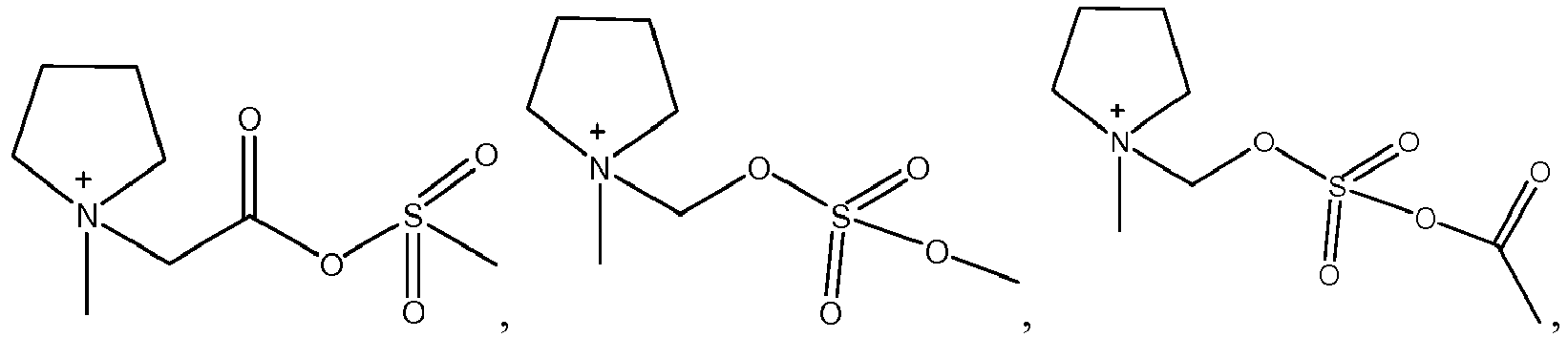


- In the electrolyte according to the first aspect of the present invention, specifically, the sulfonic ester cyclic quaternary ammonium salt is one or more selected from the following compounds; but the present invention is not limited to that:


- In the electrolyte according to the first aspect of the present invention, in formula 2, preferably, a is an integer of 1∼2.
- In the electrolyte according to the first aspect of the present invention, in formula 2, R21 and R22 may be different from each other, R21 and R22 also may be identical from each other.
- In the electrolyte according to the first aspect of the present invention, in formula 2, when a is an integer equal to or greater than 2, except carbon atoms attached to substituents of R21 and R22, substituents at the rest carbon atom may be identical, or may be completely different, or two or more substituents may be identical, and the substituents are not limited to specific reference numeral. For example, when a is 2, except the carbon atoms attached to substituents of R21 and R22, four substituents on the rest two carbon atoms may be completely identical, or may be completely different, or any two or more of the four substituents may be identical.
- In the electrolyte according to the first aspect of the present invention, in formula 3, preferably, b is an integer of 1∼2.
- In the electrolyte according to the first aspect of the present invention, in formula 3, R31, R32 and R35 may be different from each other, and also may be identical with each other, or two of R31, R32 and R35 maybe identical.
- In the electrolyte according to the first aspect of the present invention, in formula 3, when b is an integer greater than 2,except carbon atoms attached to substituents of R31, R32 and R35, substituents on rest carbon atom may be identical, or may be completely different, or two or more substituents may be identical, and the substituents are not limited to specific reference numerals. For example, when b is 2, except carbon atoms attached to substituent group of R31, R32 and R35, for substituents on the rest two carbon atoms may be completely identical, or may be completely different, or any two or more of the four substituents may be identical.
- In the electrolyte according to the first aspect of the present invention, in formula 2 and formula 3, C1∼C20 alkyl group may be chain alkyl group, or may be cyclic alkyl group. The chain alkyl group further comprises straight chain alkyl group and branched chain alkyl group, C1∼C20 alkyl group preferably is selected from straight chain alkyl group. Preferably, C1∼C20 alkyl group is selected from C1∼C10 alkyl group, further preferably, C1∼C20 alkyl group is selected from C1∼C5 alkyl group, more preferably, C1∼C20 alkyl group is selected from C1~ C3 alkyl group. Specifically, C1∼C20 alkyl group may be one selected from a group consisting of methyl, ethyl, n-propyl, isopropyl, cyclopropyl, n-butyl, isobutyl, sec-butyl, tert-butyl, n-pentyl, isopentyl, neopentyl, cyclopentyl, n-hexyl, isohexyl, cyclohexyl, heptyl, cycloheptyl, octyl, cyclooctyl, nonyl, decyl, undecyl, dodecyl, tridecyl, tetradecyl, pentadecyl, hexadecyl, heptadecyl, octadecyl, nonadecyl and eicosyl.
- In the electrolyte according to the first aspect of the present invention, in formula 2 and formula 3, the number and location of the halogen atom in halogenated C1∼C20 alkyl group are not particularly limited and some hydrogen atoms or all hydrogen atoms of the C1∼C20 alkyl group may be substituted according to actual demand. For example, the number of the halogen atom of halogenated C1∼C20 alkyl group may be 1, 2, 3 or 4. When the number of the halogen atom is more than 1, the types of the halogen atoms may be identical, or may be completely different, or some may be identical. Preferably, halogenated C1∼C20 alkyl group may be one selected from a group consisting of


- In the electrolyte according to the first aspect of the present invention, in formula 2 and formula 3, C2∼C20 unsaturated hydrocarbyl group may comprise chain unsaturated hydrocarbyl group and cyclic unsaturated hydrocarbyl group, specific type thereof is not particularly limited and is selected according to actual demand, preferably, C2∼C20 unsaturated hydrocarbyl group is selected from chain unsaturated hydrocarbyl group, further preferably, C2∼C20 unsaturated hydrocarbyl group is selected from alkenyl group and alkynyl group. The number of unsaturated bond and position of unsaturated bond of the unsaturated hydrocarbyl group are not particularly limited and is selected according to actual situation. For example, the number of the unsaturated bond may be 1, 2, 3 or 4. Preferably, the unsaturated bond is located at terminus of C2∼C20 unsaturated hydrocarbyl group, here, the terminus of the unsaturated hydrocarbyl group is away from the position where C2∼C20 unsaturated hydrocarbyl group is connected with the dioxide heterocyclic compound. For example, when the number of the unsaturated bond is 1, the unsaturated bond is located at terminus of the unsaturated hydrocarbyl group. When the number of carbon atom of C2∼C20 unsaturated hydrocarbyl group is greater than 3, carbon atom of unsaturated bond is not connected with the dioxide heterocyclic compound. Preferably, C2∼C20 unsaturated hydrocarbyl group is selected from C2∼C10 unsaturated hydrocarbyl group, further preferably, C2∼C20 unsaturated hydrocarbyl group is selected from C2∼C5 unsaturated hydrocarbyl group, more preferably, C2∼C20 unsaturated hydrocarbyl group is selected from C2∼C3 unsaturated hydrocarbyl group. Specifically, C2∼C20 unsaturated hydrocarbyl group may be one selected from a group consisting of -CH=CH2, -CH2-CH=CH2, -CH2CH2-CH=CH2, -CH2CH2CH2-CH=CH2, -C≡CH, -CH2-C≡CH, -CH2CH2-C≡CH,-CH2CH2CH2-C≡CH and -CH=CH-CH=CH2.
- In the electrolyte according to the first aspect of the present invention, in formula 2 and formula 3, in halogenated C2∼C20 unsaturated hydrocarbyl group, the number and location of halogen atom are not particularly limited and some hydrogen atoms or all hydrogen atoms of C2∼20 unsaturated hydrocarbyl group may be substituted according to actual demand. For example, the number of halogen atom may be 1, 2, 3 or 4. When the number of halogen atom is greater than 1, types of the halogen atoms may be identical, or may be completely different, or some may be identical. Preferably, halogenated C2∼20 unsaturated hydrocarbyl group may be one selected from a group consisting of -C≡C-X, -CH2-C≡C-X, -CH2CH2-C≡C-X, -CH2CH2CH2-C≡C-X,


- In the electrolyte according to the first aspect of the present invention, in formula 2 and formula 3, preferably, R21, R22, R23, R24, R31, R32, R33, R34 and R35 each independently are one selected from a group consisting of H, F, Cl, C1∼C10 alkyl group, halogenated C1∼C10 alkyl group, C2∼C10 unsaturated hydrocarbyl group and halogenated C2∼C10 unsaturated hydrocarbyl group, where the halogen atom is selected from F or C1. Further preferably, R21, R22, R23, R24, R31, R32, R33, R34 and R35 each independently are one selected from a group consisting of H, C1∼C5 alkyl group, halogenated C1∼C5 alkyl group, C2∼C5 unsaturated hydrocarbyl group and halogenated C2∼C5 unsaturated hydrocarbyl group, where the halogen atom is selected from F or Cl. More preferably, R21, R22, R23, R24, R31, R32, R33, R34 and R35 each independently are one selected from H, C1∼C3 alkyl group, C2∼C3 alkenyl group and C2∼ C3 alkynyl group.
- In the electrolyte according to the first aspect of the present invention, specifically, the dioxide heterocyclic compound is one or more selected from a group consisting of following compounds, but the present invention is not limited to that;


- In the electrolyte according to the first aspect of the present invention, if a content of the sulfonic ester cyclic quaternary ammonium salt is too low, the passive film formed on the positive electrode film and the passive film formed on the negative electrode film are insufficient to avoid further reaction of the electrolyte and improvement of performance of the electrochemical energy storage device is not obvious; if the content of the sulfonic ester cyclic quaternary ammonium salt is too high, impedance of the passive film formed on the positive electrode film and impedance of the passive film formed on the negative electrode film will be increased, thus deteriorating performance of the electrochemical energy storage device. Preferably, the content of the sulfonic ester cyclic quaternary ammonium salt is 0.05%∼10% of the total mass of the electrolyte. Further preferably, the content of the sulfonic ester cyclic quaternary ammonium salt is 0.1%∼5% of the total mass of the electrolyte.
- In the electrolyte according to the first aspect of the present invention, if a content of the dioxide heterocyclic compound is too low, the passive film formed on the positive electrode film by the dioxide heterocyclic compound is not dense enough and cannot effectively inhibit oxidation and reduction reaction between the electrolyte and the positive electrode active material, and in turn cannot further improve high temperature storage performance of the electrochemical energy storage device; if the content of the dioxide heterocyclic compound is too high, the passive film formed on the positive electrode film by the dioxide heterocyclic compound may be too thick and impede normal intercalation-deintercalation process of active metal ion, therefore, capacity of the electrochemical energy storage device will be adversely affected and high temperature cycle performance of the electrochemical energy storage device will be seriously affected. Preferably, the content of the dioxide heterocyclic compound is 0.05%∼10% of the total mass of the electrolyte. Further preferably, the content of the dioxide heterocyclic compound is 0.5%∼5% of the total mass of the electrolyte.
- In the electrolyte according to the first aspect of the present invention, because liquid electrolyte, solid polymer electrolyte and gel polymer electrolyte are similar in action mechanism, only the liquid electrolyte is taken as an example for description in the present invention, that is in the following description, the electrolytes all refer to the liquid electrolyte.
- In the electrolyte according to the first aspect of the present invention, a concentration of the electrolyte salt is not particularly limited and may be selected according to actual demand. Specifically, a content of the electrolyte salt is 6%∼25% of the total mass of the electrolyte. Preferably, the content of the electrolyte salt is 6%∼20% of the total mass of the electrolyte. Further preferably, the content of the electrolyte salt is 10%∼15% of the total mass of the electrolyte.
- In the electrolyte according to the first aspect of the present invention, the electrolyte salt of the electrolyte may be selected from lithium salt or sodium salt.
- In the electrolyte according to the first aspect of the present invention, a type of the lithium salt is not particularly limited and may be selected according to actual demand. Preferably, the lithium salt at least comprises LiPF6, the lithium salt may further comprise one or more selected from a group consisting of LiBF4, LiC104, LiAsF6, LiSbF6, LiBOB, LiDFOB, LiN(SO2F)2, LiTFSI, LiPO2F2, LiTFOP, LiN(SO2RF)2 and LiN(SO2F)(SO2RF), where RF=CnF2n+1, that is RF represents saturated perfluoroalkyl group, n is an integer of 1∼10.
- In the electrolyte according to the first aspect of the present invention, a type of the sodium salt is not particularly limited and may be selected according to actual demand. Specifically, the sodium salt may be one or more selected from a group consisting of NaPF6, NaBF4, NaClO4, NaAsF6, NaCF3SO3, NaN(CF3SO2)2, NaN(C2F5SO2)2 and NaN(FSO2)2.
- In the electrolyte according to the first aspect of the present invention, the electrolyte further comprises an organic solvent, a type of the organic solvent is not particularly limited and may be selected according to actual demand. Preferably, the organic solvent is non-aqueous organic solvent. The non-aqueous organic solvent may comprise any kind of carbonate and/or carboxylate. The carbonate may comprise cyclic carbonate ester or chain carbonate ester. The non-aqueous organic solvent may further comprise halogenated carbonate ester. Specifically, the organic solvent may be one or more selected from a group consisting of ethylene carbonate, propylene carbonate, butylene carbonate, pentylene carbonate, fluoroethylene carbonate, dimethyl carbonate, diethyl carbonate, dipropyl carbonate, ethyl methyl carbonate, methyl formate, ethyl formate, ethyl acetate, propyl propionate, ethyl propionate, γ-butyrolactone and tetrahydrofuran.
- Next an electrochemical energy storage device according to a second aspect of the present invention is described.
- The electrochemical energy storage device according to the second aspect of the present invention comprises the electrolyte according to the first aspect of the present invention.
- In the electrochemical energy storage device according to the second aspect of the present invention, the electrochemical energy storage device further comprises a positive electrode plate, a negative electrode plate, a separator and a package case.
- It should be noted that, the electrochemical energy storage device may be a lithium-ion battery, a sodium-ion battery, a zinc-ion battery or a supercapacitor. In examples of the present invention, the described electrochemical energy storage device is a lithium-ion battery, but the present invention is not limited to that.
- In the lithium-ion battery, the positive electrode plate comprises a positive electrode current collector and a positive electrode film provided on the positive electrode current collector. The positive electrode film comprises a positive electrode active material, the positive electrode film further comprises a conductive agent and a binder. The positive electrode active material may be one or more selected from a group consisting of lithium cobalt oxide (LiCoO2), lithium nickel oxide (LiNiO2), spinel-type lithium manganese dioxide (LiMn2O4), olivine-type LiMPO4 and LiaNixAyB(1-x-y)O2. Here, in olivine-type LiMPO4, M is one or more selected from a group consisting of Co, Ni, Fe, Mn and V; In LiaNixAyB(1-x-y)O2, A and B each independently are one selected from a group consisting of Co, Al and Mn, and A and B is different, 0.95≤a≤1.2, 0<x<1, 0<y<1, and x+y<1. A type of the conductive agent and the binder is not particularly limited and may be selected according to actual demand.
- In the lithium-ion battery, the negative electrode plate comprises a negative electrode current collector and a negative electrode film provided on negative electrode current collector. The negative electrode film comprises a negative electrode active material, the negative electrode film further comprises a conductive agent and a binder. The negative electrode active material may be selected from materials that lithium-ion can be intercalated under voltage less then 2V (vs. Li/Li+). Specifically, the negative electrode active material may be one or more selected from a group consisting of natural graphite, artificial graphite, mesocarbon microbead (abbreviated as MCMB), hard carbon, soft carbon, silicon, silicon-carbon composite, Li-Sn alloy, Li-Sn-O alloy, Sn, SnO, SnO2, spinel-type lithiation TiO2-Li4Ti5O12 and Li-Al alloy. A type of the conductive agent and the binder is not particularly limited and may be selected according to actual demand. The negative electrode plate can also directly use lithium metal plate.
- In the lithium-ion battery, a type of the separator is not particularly limited and may be selected according to actual demand, specifically, the separator may be selected from a polyethylene film, a polypropylene film, a polyvinylidene fluoride film and a multilayer composite films thereof.
- Hereinafter the present invention will be described in detail in combination with examples. It should be noted that, the examples described in the present invention are only used for explaining the present invention, and are not intended to limit the present invention. In the examples, only a lithium-ion battery as the electrochemical energy storage device is described, but the present invention is not limited to that.
- In the following example, the reagents, materials and instruments used are commercially available unless otherwise specified. The sulfonic ester cyclic quaternary ammonium salt used may refer to Chinese patent application publication No.
CN105845981A published in August 10, 2016 . - The lithium-ion batteries of examples 1∼11 and comparative examples 1∼7 were all prepared as follows.
- (1) Preparation of a positive electrode plate: lithium cobalt oxide (positive electrode active material, LiCoO2), acetylene black (conductive agent), polyvinylidene fluoride (binder) according to a mass ratio of 98:1:1 were mixed with N-methyl-2-pyrrolidone (solvent) under vacuum mixer to form a stable and uniform positive electrode slurry; then the positive electrode slurry was uniformly coated on an aluminum foil (positive electrode current collector) with a thickness of 12µm; drying under room temperature was then performed, which was followed by moving the aluminum foil to an oven for baking 1h under 120°C, then after cold-pressing and slitting, the positive the electrode plate was obtained.
- (2) Preparation of a negative electrode plate: artificial graphite (negative electrode active material), sodium carboxymethylcellulose (thickening agent, CMC), styrene butadiene rubber (binder) according to a mass ratio of 98:1:1 were mixed with deionized water under vacuum mixer to form a negative electrode slurry; then the negative electrode slurry was uniformly coated on a copper foil (negative electrode current collector) with a thickness of 8µm; drying under room temperature was then performed, which was followed by moving the copper foil to an oven for baking 1h under120°C, then after cold-pressing and slitting, the negative electrode plate was obtained.
- (3) Preparation of an electrolyte: in an argon atmosphere glove box in which the water content was less than 10ppm, ethylene carbonate (EC), propylene carbonate (PC), diethyl carbonate(DEC) according to a volum ratio of EC:PC:DEC=1:1:1 were mixed as a mixed organic solvent, then fully dried lithium salt LiPF6 was dissolved into the mixed organic solvent, next the sulfonic ester cyclic quaternary ammonium salt and the dioxide heterocyclic compound were added, after uniformly mixing, the electrolyte was obtained. Here, a content of LiPF6 was 12.5% of the total mass of the electrolyte. The type and the content of the sulfonic ester cyclic quaternary ammonium salt and the dioxide heterocyclic compound of the electrolyte was shown in table 1, and in table 1, the contents of the sulfonic ester cyclic quaternary ammonium salt and the dioxide heterocyclic compound were mass percent based on the total mass of the electrolyte.
- (4) Preparation of a separator: a polypropylene separator with a thickness of 16µm (model A273, provided by Celgard Company) was used as the separator.
- (5) Preparation of a lithium-ion battery: the positive electrode plate, the separator, the negative electrode plate were laminated in order so as to make the separator positioned between the positive electrode plate and the negative electrode plate and separate the positive electrode film and negative electrode film, then were wound to form an electrode assembly and placed in a package case, next the prepared electrolyte was injected into the dried electrode assembly, after vacuum packaging, standing-by, forming, shaping and the like, the lithium-ion battery was obtained.
- Finally, test processes and test results of the lithium-ion batteries were described
- At 25°C, the lithium-ion battery was charged to a voltage of 4.4V at a constant current of 0.5C, then the lithium-ion battery was charged to a current of 0.05C at a constant voltage of 4.4V, a thickness of the lithium-ion battery this time was tested and marked as h0; after the lithium-ion battery being stored in a thermotank for 30 days under 60°C, the lithium-ion battery was taken out to test the thickness and the thickness was marked as h1. Fifteen lithium-ion batteries were tested in each group to take an average value.

- At 45°C, the lithium-ion battery was firstly charged to a voltage of 4.4V at a constant current of 1C, then the lithium-ion battery was further charged to a current of 0.05C at a constant voltage of 4.4V, next the lithium-ion battery was discharged to a voltage of 3.0V at a constant current of 1C, this was a charge-discharge cycle process, the discharge capacity this time was the discharge capacity of the first cycle. Then the cycle process was repeated for 300 times, the discharge capacity of 300th cycle was tested and obtained.

Table 2 Test results of examples 1∼11 and comparative examples 1~7 Thickness expansion rate after stored for 30 days under 60°C Capacity retention after 300 cycle under 45°C Example 1 15.57% 64.66% Example 2 14.12% 66.88% Example 3 12.19% 72.35% Example 4 9.91% 63.90% Example 5 35.11% 70.13% Example 6 17.15% 70.15% Example 7 12.79% 70.19% Example 8 8.95% 65.13% Example 9 16.89% 71.81% Example 10 17.98% 69.96% Example 11 17.08% 68.72% Comparative example 1 42.50% 63.70% Comparative example 2 38.70% 70.10% Comparative example 3 19.54% 63.77% Comparative example 4 19.52% 63.78% Comparative example 5 8.93% 60.50% Comparative example 6 38.02% 70.12% Comparative example 7 5.40% 61.34% - It could be seen from related data in table 2, under the combined effect of the sulfonic ester cyclic quaternary ammonium salt and the dioxide heterocyclic compound, the lithium-ion battery had excellent high temperature storage performance and high temperature cycle performance.
- In comparative examples 1∼3, the sulfonic ester cyclic quaternary ammonium salt and the dioxide heterocyclic compound were not added into the electrolyte of comparative example 1, high temperature storage performance and high temperature cycle performance of the lithium-ion battery were both poor; when only the sulfonic ester cyclic quaternary ammonium salt was added into the electrolyte (comparative example 2), high temperature cycle performance and high temperature storage performance of the lithium-ion battery could both be improved to a certain extent, here, the improvement of high temperature cycle performance of the lithium-ion battery was more obvious, but the improvement of high temperature storage performance was relatively not obvious; when only the dioxide heterocyclic compound was added into the electrolyte (comparative example 3), high temperature storage performance of the lithium-ion battery could be improved significantly, and high temperature cycle performance of the lithium-ion battery could be improved slightly at the same time.
- In examples 1∼11 and comparative examples 4∼7, the sulfonic ester cyclic quaternary ammonium salt and the dioxide heterocyclic compound were added into the electrolyte at the same time, the lithium-ion battery had excellent high temperature storage performance and high temperature cycle performance meanwhile. This was because of the sulfonic ester cyclic quaternary ammonium salt and the dioxide heterocyclic compound could form a dense, uniform and stable passive film on the surface of each of the positive electrode film and the negative electrode film, particularly a dense solid electrolyte interface film with low impedance could be formed on the surface of the negative electrode film, thereby reducing the contact between the positive electrode active material and the negative electrode active material of the positive electrode film and negative electrode film and the electrolyte, therefore the occurrence of oxidation and reduction reaction of the electrolyte on the surface of each of the positive electrode film and negative electrode film could be avoided, and then the decomposition of the electrolyte and the increase of internal impedance of lithium-ion battery could be weaken, so as to make the lithium-ion battery has excellent high temperature storage performance and high temperature cycle performance at the same time. It could be understood that, changes of specific type and specific content of the sulfonic ester cyclic quaternary ammonium salt and the dioxide heterocyclic compound would directly impact performance of the electrolyte, thereby would affect improvement effects of the lithium-ion battery.
- In comparative example 4, the content of the sulfonic ester cyclic quaternary ammonium salt was insufficient, the improvement of high temperature cycle performance of the lithium-ion battery was not obvious. In examples 1∼4 and example 6, as the content of the sulfonic ester cyclic quaternary ammonium salt increased, thickness expansion rate of high temperature storage of the lithium-ion battery was maintained lower and relatively stable, capacity retention of high temperature cycle of the lithium-ion battery could be improved. When the content of the sulfonic ester cyclic quaternary ammonium salt was too high, for example in comparative example 5, high temperature cycle performance of the lithium-ion battery was obviously deteriorated.
- In comparative example 6, the content of the dioxide heterocyclic compound was insufficient, the improvement of high temperature storage performance of the lithium-ion battery was relatively weak. In example 5∼8, as the content of the dioxide heterocyclic compound content increased, capacity retention of high temperature cycle of the lithium-ion battery was maintained stable substantially, thickness expansion rate of high temperature storage of the lithium-ion battery was improved significantly. But when the content the dioxide heterocyclic compound was too high, for example in comparative example 7, high temperature cycle performance of the lithium-ion battery was obviously deteriorated.
- Therefore, too low or too high content of the sulfonic ester cyclic quaternary ammonium salt and too low or too high content of the dioxide heterocyclic compound were not beneficial to improve performance of the lithium-ion battery generally, but for some non-high requirements, they could also improve high temperature storage performance and high temperature cycle performance of the lithium-ion battery to a certain extent.
- According to the revelations of the present invention, a person skilled in the art may also make appropriate variations and modifications to the above embodiments. Therefore, the present invention is not limited to the specific embodiments disclosed and described in the above, modifications and variations of the present invention will also be fallen within the scope of the appended claims of the present invention.
| Sulfonic ester cyclic quaternary ammonium salt | Dioxide heterocyclic compound | |||
| Type | Content /% | Type | Content /% | |
| Example 1 | Compound 1-1 | 0.05 | Compound 2-1 | 1 |
| Example 2 | Compound 1-1 | 0.1 | Compound 2-1 | 1 |
| Example 3 | Compound 1-1 | 5 | Compound 2-1 | 1 |
| Example 4 | Compound 1-1 | 10 | Compound 2-1 | 1 |
| Example 5 | Compound 1-1 | 1 | Compound 2-1 | 0.05 |
| Example 6 | Compound 1-1 | 1 | Compound 2-1 | 1 |
| Example 7 | Compound 1-1 | 1 | Compound 2-1 | 5 |
| Example 8 | Compound 1-1 | 1 | Compound 2-1 | 10 |
| Example 9 | Compound 1-3 | 1 | Compound 2-9 | 1 |
| Example 10 | Compound 1-3 | 1 | Compound 2-11 | 1 |
| Example 11 | Compound 1-3 | 1 | Compound 2-12 | 1 |
| Comparative example 1 | ||||
| Comparative example 2 | Compound 1-1 | 1 | - | - |
| Comparative example 3 | - | - | Compound 2-1 | 1 |
| Comparative example 4 | Compound 1-1 | 0.03 | Compound 2-1 | 1 |
| Comparative example 5 | Compound 1-1 | 11 | Compound 2-1 | 1 |
| Comparative example 6 | Compound 1-1 | 1 | Compound 2-1 | 0.03 |
| Comparative example 7 | Compound 1-1 | 1 | Compound 2-1 | 11 |
Claims (12)
- An electrolyte, comprising:an electrolyte salt; andan additive;wherein the additive comprises a sulfonic ester cyclic quaternary ammonium salt and a dioxide heterocyclic compound.
- The electrolyte according to Claim 1, wherein the sulfonic ester cyclic quaternary ammonium salt is one or more selected from a group consisting of compounds represent by formula 1;
 R11 is one selected from a group consisting of -CN, C1∼C12 alkyl group, C1∼C12 alkyl group substituted with a substituent, C2∼C12 alkenyl group, C2∼C12 alkenyl group substituted with the substituent, C2∼C12 alkynyl group, C2∼C12 alkynyl group substituted with the substituent, C1∼C12 alkoxy group, C1∼C12 alkoxy group substituted with the substituent, C1∼C12 acyloxy group and C1∼C12 acyloxy group substituted with the substituent;R12 is one selected from a group consisting of C1∼C12 alkylene group, C1∼C12 alkylene group substituted with the substituent, C2∼C12 alkenylene group, C2∼C12 alkenylene group substituted with the substituent, C2∼C12 alkynylene group, C2∼C12 alkynylene group substituted with the substituent, C1∼C12 alkylenoyl group and C1∼C12 alkylenoyl group substituted with the substituent;R13 is one selected from a group consisting of C1∼C12 alkyl group, C1∼C12 alkyl group substituted with the substituent, C2∼C12 alkenyl group, C2∼C12 alkenyl group substituted with the substituent, C2∼C12 alkynyl group, C2∼C12 alkynyl group substituted with the substituent, C1∼C12 alkoxy group, C1∼C12 alkoxy group substituted with the substituent, C1∼C12 acyloxy group, C1∼C12 acyloxy group substituted with the substituent, C6∼C22 aryl group, C6∼C22 aryl group substituted with the substituent, C5∼C22 heteroaryl group and C5∼C22 heteroaryl group substituted with the substituent;R14 is selected from a group consisting of C1∼C3 alkylene group and C1∼C3 alkylene group substituted with the substituent;the substituent is one or more selected from a group consisting of -CN and halogen atom;X⊖ represents an anion, X⊖ is selected from a group consisting of F-, NO3 -, SO4 2-, PF6 -, PF4 -, AsF6 -, (FSO2)2N-,


- The electrolyte according to Claim 2, wherein a cationic group of the sulfonic ester cyclic quaternary ammonium salt is one selected from a group consisting of


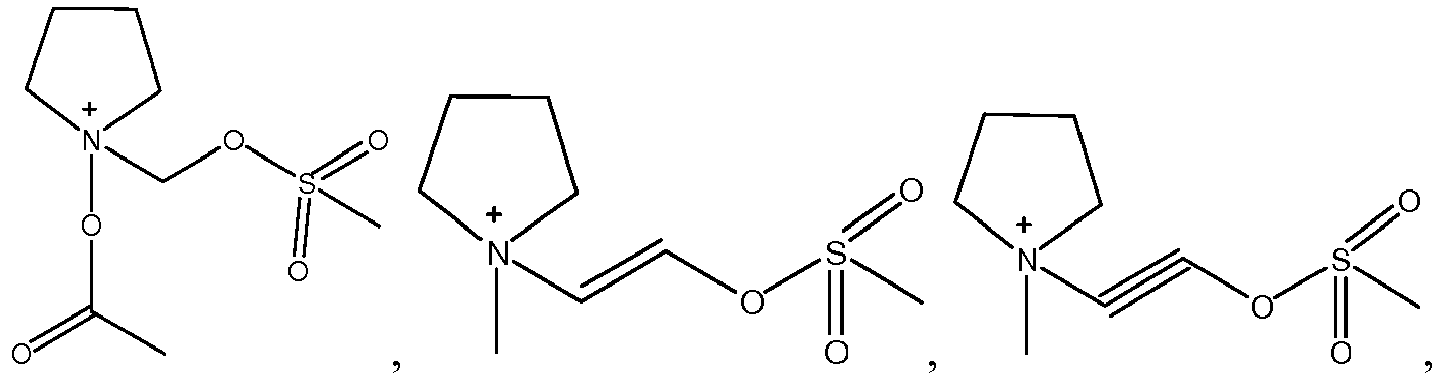


- The electrolyte according to Claim 3, wherein the sulfonic ester cyclic quaternary ammonium salt is one or more selected from a group consisting of following compounds

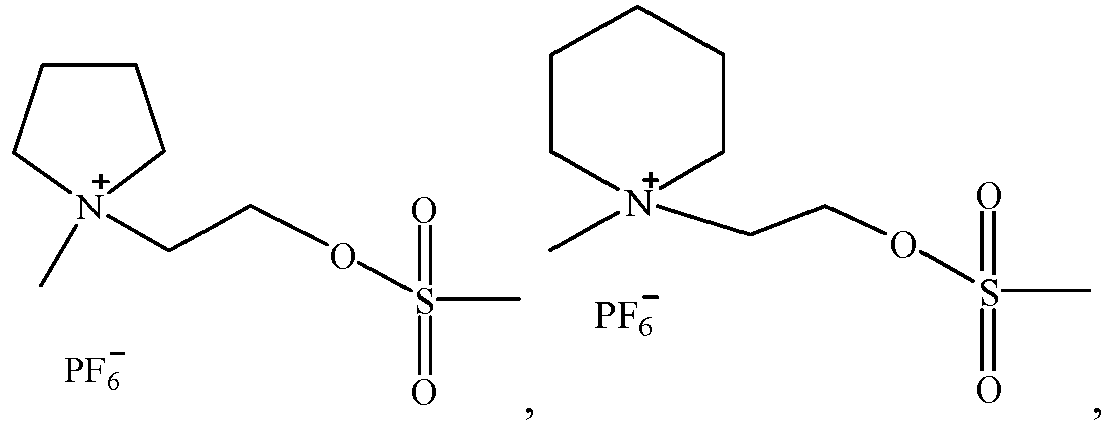

- The electrolyte according to Claim 1, wherein the dioxide heterocyclic compound is one or more selected from a group consisting of compounds represented by formula 2 and formula 3;

in formula 3, b is an integer of 1∼3, R31, R32, R33, R34 and R35 each independently are one selected from H, halogen atom, cyano group, carboxyl group, sulfonic group, C1∼C20 alkyl group, halogenated C1∼C20 alkyl group, C2∼C20 unsaturated hydrocarbyl group, and halogenated C2∼C20 unsaturated hydrocarbyl group. - The electrolyte according to Claim 5, wherein the dioxide heterocyclic compound is one or more selected from a group consisting of following compounds;


- The electrolyte according to Claim 1, wherein a content of the sulfonic ester cyclic quaternary ammonium salt is 0.05%∼10% of a total mass of electrolyte.
- The electrolyte according to Claim 7, wherein the content of the sulfonic ester cyclic quaternary ammonium salt is 0.1%∼5% of the total mass of the electrolyte.
- The electrolyte according to Claim 1, wherein a content of the dioxide heterocyclic compound is 0.05%∼10% of a total mass of the electrolyte.
- The electrolyte according to Claim 9, wherein the content of the dioxide heterocyclic compound is 0.5%∼5% of the total mass of the electrolyte.
- The electrolyte according to Claim 1, wherein the electrolyte is a liquid electrolyte, a solid polymer electrolyte or a gel polymer electrolyte.
- An electrochemical energy storage device, wherein the electrochemical energy storage device comprises the electrolyte according to any one of Claims 1-11.
Applications Claiming Priority (1)
| Application Number | Priority Date | Filing Date | Title |
|---|---|---|---|
| CN201710624391.8A CN109309245A (en) | 2017-07-27 | 2017-07-27 | Electrolyte and electrochemical energy storage device |
Publications (1)
| Publication Number | Publication Date |
|---|---|
| EP3435469A1 true EP3435469A1 (en) | 2019-01-30 |
Family
ID=63047165
Family Applications (1)
| Application Number | Title | Priority Date | Filing Date |
|---|---|---|---|
| EP18185399.5A Withdrawn EP3435469A1 (en) | 2017-07-27 | 2018-07-25 | Electrolyte and electrochemical energy storage device comprising the same |
Country Status (3)
| Country | Link |
|---|---|
| US (1) | US10686221B2 (en) |
| EP (1) | EP3435469A1 (en) |
| CN (1) | CN109309245A (en) |
Cited By (1)
| Publication number | Priority date | Publication date | Assignee | Title |
|---|---|---|---|---|
| WO2021069923A1 (en) * | 2019-10-10 | 2021-04-15 | Mexichem Fluor S.A. De C.V. | Composition |
Families Citing this family (4)
| Publication number | Priority date | Publication date | Assignee | Title |
|---|---|---|---|---|
| CN111943984A (en) * | 2020-08-17 | 2020-11-17 | 常德市大度新材料有限公司 | A kind of difluorobisoxalate phosphate and its preparation method and its application in non-aqueous electrolyte |
| KR102917427B1 (en) * | 2021-06-03 | 2026-01-23 | 주식회사 엘지에너지솔루션 | Electrolyte for lithium-sulfur battery and lithium-sulfur battery comprising the same |
| CN113948318B (en) * | 2021-09-27 | 2022-12-09 | 西安交通大学 | High-pressure water system electrolyte and preparation method and application thereof |
| CN114725517A (en) * | 2022-05-05 | 2022-07-08 | 珠海市赛纬电子材料股份有限公司 | Sodium ion battery electrolyte and sodium ion battery |
Citations (4)
| Publication number | Priority date | Publication date | Assignee | Title |
|---|---|---|---|---|
| WO2013026854A1 (en) * | 2011-08-24 | 2013-02-28 | Basf Se | Sulfur-containing additives for electrochemical or optoelectronic devices |
| WO2015150390A1 (en) * | 2014-04-03 | 2015-10-08 | Basf Se | Use of reactive ionic liquids as additives for electrolytes in secondary lithium ion batteries |
| US20160036092A1 (en) * | 2014-07-31 | 2016-02-04 | Ningde Amperex Technology Limited | Lithium-ion battery and electrolyte thereof |
| CN105845981A (en) | 2016-03-30 | 2016-08-10 | 宁德新能源科技有限公司 | Non-aqueous electrolyte and lithium-ion battery employing same |
Family Cites Families (9)
| Publication number | Priority date | Publication date | Assignee | Title |
|---|---|---|---|---|
| EP2023434B1 (en) * | 2007-07-23 | 2016-09-07 | Litarion GmbH | Electrolyte preparations for energy storage devices based on ionic fluids |
| KR20090050951A (en) * | 2007-11-16 | 2009-05-20 | 산요덴키가부시키가이샤 | Nonaqueous Electrolyte Secondary Battery |
| US20120328960A1 (en) * | 2011-06-24 | 2012-12-27 | Semiconductor Energy Laboratory Co., Ltd. | Nonaqueous solvent and power storage device |
| CN102904599A (en) * | 2011-07-29 | 2013-01-30 | 深圳富泰宏精密工业有限公司 | Radio-frequency circuit |
| WO2015144834A1 (en) * | 2014-03-28 | 2015-10-01 | Basf Se | Overcharge protection electrolyte additive for lithium ion batteries |
| CN104979586B (en) * | 2014-04-10 | 2017-08-25 | 宁德时代新能源科技股份有限公司 | Lithium ion secondary battery and electrolyte thereof |
| JP6723074B2 (en) * | 2015-06-01 | 2020-07-15 | マクセルホールディングス株式会社 | Lithium ion secondary battery |
| CN105932332A (en) | 2016-06-28 | 2016-09-07 | 宁德新能源科技有限公司 | Electrolytic solution and lithium-ion battery comprising same |
| CN106099184A (en) * | 2016-06-28 | 2016-11-09 | 宁德新能源科技有限公司 | A kind of electrolyte and use the lithium ion battery of this electrolyte |
-
2017
- 2017-07-27 CN CN201710624391.8A patent/CN109309245A/en active Pending
-
2018
- 2018-07-03 US US16/027,009 patent/US10686221B2/en active Active
- 2018-07-25 EP EP18185399.5A patent/EP3435469A1/en not_active Withdrawn
Patent Citations (4)
| Publication number | Priority date | Publication date | Assignee | Title |
|---|---|---|---|---|
| WO2013026854A1 (en) * | 2011-08-24 | 2013-02-28 | Basf Se | Sulfur-containing additives for electrochemical or optoelectronic devices |
| WO2015150390A1 (en) * | 2014-04-03 | 2015-10-08 | Basf Se | Use of reactive ionic liquids as additives for electrolytes in secondary lithium ion batteries |
| US20160036092A1 (en) * | 2014-07-31 | 2016-02-04 | Ningde Amperex Technology Limited | Lithium-ion battery and electrolyte thereof |
| CN105845981A (en) | 2016-03-30 | 2016-08-10 | 宁德新能源科技有限公司 | Non-aqueous electrolyte and lithium-ion battery employing same |
Cited By (3)
| Publication number | Priority date | Publication date | Assignee | Title |
|---|---|---|---|---|
| WO2021069923A1 (en) * | 2019-10-10 | 2021-04-15 | Mexichem Fluor S.A. De C.V. | Composition |
| CN114555575A (en) * | 2019-10-10 | 2022-05-27 | 墨西哥氟石股份公司 | Composition comprising a metal oxide and a metal oxide |
| CN114555575B (en) * | 2019-10-10 | 2024-08-20 | 墨西哥氟石股份公司 | Composition |
Also Published As
| Publication number | Publication date |
|---|---|
| US20190036169A1 (en) | 2019-01-31 |
| CN109309245A (en) | 2019-02-05 |
| US10686221B2 (en) | 2020-06-16 |
Similar Documents
| Publication | Publication Date | Title |
|---|---|---|
| EP3537519B1 (en) | Method for pre-lithiating silicon oxide anode for secondary battery | |
| CN112216822B (en) | A kind of lithium ion secondary battery and preparation method thereof | |
| CN111048840B (en) | Lithium-ion battery electrolyte and lithium-ion battery | |
| KR101678798B1 (en) | Method for producing nonaqueous electrolyte secondary battery | |
| KR101073233B1 (en) | Non-aqueous electrolyte and electrochemical device comprising the same | |
| US10886565B2 (en) | Electrolyte and electrochemical energy storage device | |
| EP3944391A1 (en) | Electrolyte solution, lithium-ion battery, and device containing lithium-ion battery | |
| EP3422458B1 (en) | Electrolyte and lithium-ion battery | |
| US10686221B2 (en) | Electrolyte and electrochemical energy storage device | |
| CN108140895A (en) | Secondary lithium batteries or lithium-ion capacitor nonaqueous electrolytic solution and the lithium secondary battery or lithium-ion capacitor for having used it | |
| EP2919314B1 (en) | Electrode laminate comprising electrodes having different areas and secondary battery comprising same | |
| EP4343897A1 (en) | Lithium-ion battery | |
| CN103730688A (en) | Lithium ion battery and electrolyte thereof | |
| EP4024552A1 (en) | Electrolyte of lithium-ion secondary battery and application thereof | |
| CN119181852B (en) | Electrolyte additive, electrolyte and lithium ion battery | |
| CN109309255A (en) | Electrolyte and electrochemical energy storage device | |
| JP4423277B2 (en) | Lithium secondary battery | |
| CN116845370A (en) | Lithium ion battery | |
| EP3567668B1 (en) | Non-aqueous electrolyte for secondary battery and secondary battery having the same | |
| EP3435471B1 (en) | Electrolyte and electrochemical energy storage device comprising the same | |
| JP2001057234A (en) | Non-aqueous electrolyte and non-aqueous electrolyte secondary battery | |
| CN106602139A (en) | Nonaqueous electrolyte solution and lithium ion battery containing the same | |
| JP6003086B2 (en) | Lithium secondary battery | |
| CN109309253A (en) | Electrolyte and electrochemical energy storage device | |
| CN100429822C (en) | Electrode core of lithium ion battery and lithium ion battery containing the electrode core |
Legal Events
| Date | Code | Title | Description |
|---|---|---|---|
| PUAI | Public reference made under article 153(3) epc to a published international application that has entered the european phase |
Free format text: ORIGINAL CODE: 0009012 |
|
| STAA | Information on the status of an ep patent application or granted ep patent |
Free format text: STATUS: REQUEST FOR EXAMINATION WAS MADE |
|
| 17P | Request for examination filed |
Effective date: 20180725 |
|
| AK | Designated contracting states |
Kind code of ref document: A1 Designated state(s): AL AT BE BG CH CY CZ DE DK EE ES FI FR GB GR HR HU IE IS IT LI LT LU LV MC MK MT NL NO PL PT RO RS SE SI SK SM TR |
|
| AX | Request for extension of the european patent |
Extension state: BA ME |
|
| STAA | Information on the status of an ep patent application or granted ep patent |
Free format text: STATUS: THE APPLICATION IS DEEMED TO BE WITHDRAWN |
|
| 18D | Application deemed to be withdrawn |
Effective date: 20190731 |