EP3434748B1 - Method for preparing a zeolite l material hosting at least one type of guest molecule - Google Patents
Method for preparing a zeolite l material hosting at least one type of guest molecule Download PDFInfo
- Publication number
- EP3434748B1 EP3434748B1 EP17183382.5A EP17183382A EP3434748B1 EP 3434748 B1 EP3434748 B1 EP 3434748B1 EP 17183382 A EP17183382 A EP 17183382A EP 3434748 B1 EP3434748 B1 EP 3434748B1
- Authority
- EP
- European Patent Office
- Prior art keywords
- zeolite
- crystals
- guest
- guest molecules
- channels
- Prior art date
- Legal status (The legal status is an assumption and is not a legal conclusion. Google has not performed a legal analysis and makes no representation as to the accuracy of the status listed.)
- Active
Links
Images

Classifications
-
- C—CHEMISTRY; METALLURGY
- C09—DYES; PAINTS; POLISHES; NATURAL RESINS; ADHESIVES; COMPOSITIONS NOT OTHERWISE PROVIDED FOR; APPLICATIONS OF MATERIALS NOT OTHERWISE PROVIDED FOR
- C09K—MATERIALS FOR MISCELLANEOUS APPLICATIONS, NOT PROVIDED FOR ELSEWHERE
- C09K11/00—Luminescent materials, e.g. electroluminescent or chemiluminescent
- C09K11/06—Luminescent materials, e.g. electroluminescent or chemiluminescent containing organic luminescent materials
-
- C—CHEMISTRY; METALLURGY
- C01—INORGANIC CHEMISTRY
- C01B—NON-METALLIC ELEMENTS; COMPOUNDS THEREOF; METALLOIDS OR COMPOUNDS THEREOF NOT COVERED BY SUBCLASS C01C
- C01B39/00—Compounds having molecular sieve and base-exchange properties, e.g. crystalline zeolites; Their preparation; After-treatment, e.g. ion-exchange or dealumination
- C01B39/02—Crystalline aluminosilicate zeolites; Isomorphous compounds thereof; Direct preparation thereof; Preparation thereof starting from a reaction mixture containing a crystalline zeolite of another type, or from preformed reactants; After-treatment thereof
- C01B39/32—Type L
-
- C—CHEMISTRY; METALLURGY
- C09—DYES; PAINTS; POLISHES; NATURAL RESINS; ADHESIVES; COMPOSITIONS NOT OTHERWISE PROVIDED FOR; APPLICATIONS OF MATERIALS NOT OTHERWISE PROVIDED FOR
- C09B—ORGANIC DYES OR CLOSELY-RELATED COMPOUNDS FOR PRODUCING DYES, e.g. PIGMENTS; MORDANTS; LAKES
- C09B67/00—Influencing the physical, e.g. the dyeing or printing properties of dyestuffs without chemical reactions, e.g. by treating with solvents grinding or grinding assistants, coating of pigments or dyes; Process features in the making of dyestuff preparations; Dyestuff preparations of a special physical nature, e.g. tablets, films
-
- C—CHEMISTRY; METALLURGY
- C09—DYES; PAINTS; POLISHES; NATURAL RESINS; ADHESIVES; COMPOSITIONS NOT OTHERWISE PROVIDED FOR; APPLICATIONS OF MATERIALS NOT OTHERWISE PROVIDED FOR
- C09K—MATERIALS FOR MISCELLANEOUS APPLICATIONS, NOT PROVIDED FOR ELSEWHERE
- C09K11/00—Luminescent materials, e.g. electroluminescent or chemiluminescent
- C09K11/02—Use of particular materials as binders, particle coatings or suspension media therefor
-
- C—CHEMISTRY; METALLURGY
- C09—DYES; PAINTS; POLISHES; NATURAL RESINS; ADHESIVES; COMPOSITIONS NOT OTHERWISE PROVIDED FOR; APPLICATIONS OF MATERIALS NOT OTHERWISE PROVIDED FOR
- C09K—MATERIALS FOR MISCELLANEOUS APPLICATIONS, NOT PROVIDED FOR ELSEWHERE
- C09K2211/00—Chemical nature of organic luminescent or tenebrescent compounds
- C09K2211/10—Non-macromolecular compounds
- C09K2211/1018—Heterocyclic compounds
Definitions
- the present invention relates to a method for preparing a zeolite L host-guest material hosting at least one type of guest molecule.
- Zeolite L crystals having straight through channels can act as hosts for the supramolecular organization of molecules, complexes, clusters and quantum-size particles. These properties can be used, for example, in the development of devices such as infrared plastic light-emitting diodes for use in telecommunications, dye nanostructured materials for optical data storage or for improvement of the chemical-physical properties of a polymer.
- EP 1 873 202 discloses a transparent zeolite-polymer hybrid material comprising zeolite L crystals containing guest molecules dispersed in a polymer which can be used in optical devices.
- Dye loaded zeolite L materials are known to be suitable for a wide variety of applications.
- WO 02/36490 discloses the use of dye loaded zeolite L material as luminescent dye pigments with extremely high brilliance and stability, as scintillation material with extremely high sensitivity and versatility and as luminescent optical devices, such as dye lasers with dimensions of a few hundred nanometers, needles for scanning near field microscopes and other highly integrated optical devices.
- dye loaded zeolite L pigment and dye loaded zeolite L antenna systems are well suited as pigments in luminescence concentrators or luminescence dispersers as described in WO2010/009560 .
- the channels of the zeolite L should preferably contain only the guest molecules during the insertion process and no further molecules.
- the presence of oxygen, water and organic solvents, such as ethanol or methanol can lead to the decomposition of organic dyes at high temperature during the insertion process.
- organic solvents such as methanol and ethanol occupy a large amount of space within the channel and therefore prevent the dyes from entering into the channels of the zeolite L.
- zeolite L host-guest material hosting at least one type of guest molecule can be produced in a very efficient, fast and inexpensive way.
- the method according to the present invention includes the following steps:
- cyclic siloxanes can dissolve at least partly the at least one type of guest molecules at the insertion temperature but at the same time is not able to enter into the channels of the zeolite L crystals.
- the cyclic siloxane that is present in a liquid state transports the at least partly solubilized guest molecule to the opening of the zeolite L channels which then absorb the guest molecule. Due to the presence of the cyclic siloxane, which can at least partly dissolve the guest molecule at the insertion temperature, the complicated and time-consuming gas phase absorption process in a glass ampoule can be avoided.
- zeolite L crystals are understood as aluminosilicates having parallel channels and/or cavities inside the crystal and a crystal length of 20 to 7000 nm, preferably 30 to 3000 nm.
- Zeolite L is preferably a cylindrically shaped, porous aluminosilicates. Preferably, dependent on the diameter of the crystals it comprises from hundreds to hundreds of thousands of strictly parallel channels.
- the zeolite L channels look like a pile of tires ( Figures 1a and 1b ).
- the diameter of the channel opening is about 0.7 nm and the largest free diameter is about 1.3 nm, making zeolite L an ideal host material for the supramolecular organisation of guest molecules, in particular of organic dyes.
- Zeolite L is commercially available, for example, under the name HSZ-500KOA from TOSOH Corporation.
- zeolite L crystals may be easily prepared following the synthesis disclosed in Pengpeng Cao et al., Chem. Eur. J. 2016, 22, 4046-4060, "supramolecular organization of dye molecules in zeolite L channels: synthesis, properties and composite materials ", in particular pages 64 and 65, "SI1.4 Synthesis and Post-Synthetic Treatment of ZL (Zeolite L, LTL Type)".
- the cyclic siloxane is a compound of the formula I wherein R 1 and R 2 are, independently from each other, hydrogen, linear or branched substituted or unsubstitued C 1 to C 8 alkyl residues, substituted or unsubstitued C 2 to C 8 alkene residues, substituted or unsubstitued C 2 to C 8 alkine residues, substituted or unsubstitued C 5 to C 10 cycloalkyl residues, substituted or unsubstitued C 5 to C 10 aryl, which may optionally contain at least one heteroatom like O, N, S, Si, and n is a whole integer from 3 to about 20, preferably 4 to 10.
- R 1 and R 2 are independently from each other methyl, ethyl, fluoropropyl or phenyl. Most preferably, R 1 and R 2 are methyl or phenyl.
- cyclic siloxane may be also a compound of the formula II
- R 4 , R 5 , R 6 , R 7 , R 8 , R 9 , R 10 , R 11 , R 12 , R 13 , R 14 , R 15 , R 16 , R 17 , and R 18 may all be methyl
- R 3 may be phenyl and a, b, c, d and e may be all 1.
- the cyclic siloxane is a compound of formula I. Most preferably it is selected from the group consisting of 1,3,5-trimethylcyclotrisiloxane, 1,3,5-triethylcyclotrisiloxane, 1,3,5-trivinylcyclotrisiloxane, 1,3,5-triphenylcyclotrisiloxane, hexamethylcyclotrisiloxane, hexaethylcyclotrisiloxane, hexavinylcyclotrisiloxane, hexaphenylcyclotrisiloxane, 1,3,5-trivinyl-1,3,5-trimethylcyclotrisiloxane, 1,3,5-trimethyl-1,3,5-triphenylcyclotrisiloxane, 1,3,5-tris(3,3,3-trifluoropropyl)-1,3,5-trimethylcyclotrisiloxane, 1,3,5,7-tetramethylcycl
- the cyclic siloxane is octaphenylcyclotetrasiloxane, decamethylcyclopentasiloxane and dodecamethylcyclohexasiloxane or a mixture thereof.
- the at least one type of guest molecule can be any kind of uncharged or charged, organic or inorganic molecule which has to be hosted in the cavities of zeolite L, such as dyes or medicaments.
- the guest molecule is an uncharged organic guest molecule. It may be natural (for example from plant sources) or synthetic. Geometrical constraints of the zeolite L crystal lead to supramolecular organization of the guest molecules in the channels.
- the guest molecules have a size that they can enter the channels of zeolite L but they cannot overlap or form dimers inside the channels.
- dyes preferably fluorescent dyes. The loading of the channels with the fluorescent dyes allows the creation of strongly luminescent materials.
- UV absorbers preferably selected from the group consisting of benzophenones, oxalanilides, benzotriazoles and triazines.
- the fluorescent dye is selected from the group consisting of perylene diimide dyes, terrylene diimide dyes, quaterrylene diimide dyes, biphenyls , terphenyls, quaterphenyls, tetracenes, perylenes, triphendioxazines, acridines, stilbenes, azobenzenes, oxazolyl benzenes, styryl benzenes, fluorenone, isoviolanthrones, H-anthra(2,1,9-mna)thioxanthen-on (C.I.
- Solvent Orange 63 1H-thioxantheno2,1,9-defisoquinoline-1,3(2H)-dione (C.I. Solvent Yellow 98), 36-amino-2-(2,4-dimethylphenyl)-1H-benz[de]isoquinoline-1,3(2H)-dione (C.I. Solvent Yellow 44), diisobutyl perylene-3,9-dicarboxylate, diisobutyl 3,9-perylenedicarboxylate (C.I.
- Solvent Green 5 thioindigo compounds, 14H-anthra[2,1,9- mna]thioxanthen-14-one (Hostasol Red GG), 1,4-Bis(4-methyl-5-phenyl-2-oxazolyl)benzene (Dimethyl-POPOP), 1,4-Bis(5-phenyl-2-oxazolyl)benzene (POPOP), spiropyrans, naphthopyrans, carotenoids, carotenes, xanthenophylles, flavines, pyronines, oxazines, thionines, resorufine, squaraine dyes, boron-dipyrromethene dyes (BODIPY-dyes), methylviologen and carbocyanines.
- fluorescent perylene diimide dyes examples are mentioned in the list below: 1 2 3 4 5 6 7 8 9 10 11 12 13 14 15 16 17
- cyclic siloxanes are solid at room temperature.
- the mixture in step b) of the method according to the present invention has to be heated to or, preferably above the melting temperature of the cyclic siloxane in order to make sure that the cyclic siloxane can act as transport agent.
- transport agent within the context of the present invention means that the transport agent can dissolve at least a small part, preferably at least 2% by weight, of the guest molecules at the insertion temperature and transport it to the channel opening of the zeolite L crystal, where the guest molecule is absorbed inside the channels.
- the temperature used in step b) is depending on the insertion temperature of the guest molecules into the host, and if the cyclic siloxane is solid at room temperature on the melting temperature of the cyclic siloxane.
- the insertion temperature is preferably more than 150°C, most preferably between 150°C and 350°C, and ideally between 200°C and 250°C. These temperatures allow to solubilize part of the guest molecules better in the cyclic siloxanes and to induce vibrational deformations of the host and guest materials and therefore facilitates the loading of the guest molecules in the zeolite L channels.
- the incorporation of the guest molecules in the channels of the zeolite L crystals takes place in about 1 to 5 hours.
- the mixture is preferably stirred.
- the temperature is preferably kept at the necessary insertion temperature.
- the incorporation process in step b) is done under vacuum or an inert gas like nitrogen, argon or the like.
- the composition comprising the zeolite L host-guest material with the incorporated guest molecules is cooled and washed to remove guest molecules which are adsorbed on the outer surface of the zeolite L crystals.
- Guest molecules on the surface of the crystals are not oriented, can form dimers and can therefore negatively influence the chemical-physical properties of the zeolite L host-guest material.
- a mixture of the guest molecule and the zeolite L crystal has to be provided.
- the guest molecule is adsorbed on the outer surface of the zeolite L crystal. This can be obtained for example
- these two types of fluorescent dyes are precisely tuned to each other, which means that the second fluorescent dye is able to accept excitation energy from the first fluorescent dye inside the channel, but cannot pass it back.
- the second fluorescent dye can re-emit this energy as fluorescence from the crystal surface, from the interior or exterior of the channel entrances or from the inside of the channels or, in a more advanced setup, transfer it radiationlessly to a photoelectronic or a photochemical device.
- a "receiving antenna” can alternatively be turned into a “transmitter” if the positions of the two fluorescent dyes are reversed.
- the second fluorescent dye captures energy from the outside and transfers it to the molecules located inside the crystals. The principle of such systems is described in detail in WO 2010/009560 .
- a zeolite L host-guest material hosting at least two types of different guest molecules is prepared by a method including the following steps:
- This procedure may be repeated as often as necessary.
- Suitable solvents for the washing procedure are solvents in which the guest molecules are soluble. Such solvents are known to the skilled person.
- two or more different types of guest molecule can be inserted as a mixture into the channels of zeolite L in one step.
- the amount of guest molecules in the channels of zeolite L crystals can be described by the occupation probability p, as described in the literature ( Efficient and Robust Host-Guest Antenna Composite for Light Harvesting, Andre Devaux, Gion Calzaferri, Peter Belser, Pengpeng Cao, Dominik Brühwiler, Andreas Kunzmann Chem. Mater., ACS, Chem. Mater. 2014, 26, 6878-6885 ).
- the value of p ranges from 0 for an empty zeolite L to 1 for a fully loaded one.
- An occupation probability p between 0 to about 0.5, in some cases up to 1 can be obtained by the method according to the present invention.
- the loaded zeolite L host-guest material may be processed further as known in the art.
- the surface of the loaded zeolite L crystals can be coated with a polymerizable silane, which can then be dispersed in a liquid monomer, followed by polymerizing the polymerizable silane and the liquid monomer to form a polymer wherein said zeolite L crystals are dispersed.
- a polymerizable silane such as described in detail in EP 1 873 202 .
- the zeolite L host-guest material obtained by the method according to the present invention can be used for developing optical devices such as lenses, eye glasses, special mirrors, filters, polarizers, grids, optical storages, monitors, window panes, float glass, or for coating of organic and inorganic surfaces for antireflection properties or light wavelength transformation, or for fluorescent or non-fluorescent pigments, luminescence concentrators or luminescence dispersers.
- optical devices such as lenses, eye glasses, special mirrors, filters, polarizers, grids, optical storages, monitors, window panes, float glass, or for coating of organic and inorganic surfaces for antireflection properties or light wavelength transformation, or for fluorescent or non-fluorescent pigments, luminescence concentrators or luminescence dispersers.
- organic UV absorbers as guest molecules in the channels of zeolite L, preferably UV absorbers from the class of benzophenones, oxalanilides, benzotriazoles or triazines, a very stable UV absorbing host-guest material can be prepared. This kind of material can be used as UV stabilizing agent in plastics, adhesives, sealants or in cosmetics and personal care products like sun cream.
- the present invention relates also to the use of a cyclic siloxane as a transfer agent for the preparation of zeolite L crystals comprising guest molecules in their channels.
- zeolite L (HSZ-500KOA, TOSOH Corporation) was used for all the experiments ( P. Cao, O. Khorev, A. Devaux, L. polegesser, A. Kunzmann, A. Ecker, R. Häner, D. Brühwiler, G. Calzaferri, P. Belser, Chem. Eur. J. 2016, 22, 4046-4060 ).
- 3 g of HSZ-500KOA zeolite L was suspended in 30 ml 0.5 M KNO 3 (Sigma-Aldrich) in deionized water and stirred at room temperature for 3 hours. The suspension was centrifuged and washed two times with deionized water; the supernatant was discharged. Amorphous impurities, which may be present in commercial zeolite L, was eliminated in the supernatants.
- K + ions were further exchanged with 1-ethyl-3-methylimidazolium (IMZ + ) to control the pH inside the channels as some dyes inserted into the channels might be susceptible to acidic pH.
- IMZ + 1-ethyl-3-methylimidazolium
- K + exchanged zeolite L HSZ-500KOA 2 g was suspended in 3.6 ml of 1-ethyl-3-methylimidazolium bromide solution (Sigma-Aldrich) (0.1 M in deionized water) and 20 ml of deionized water.
- the suspension was homogenized in an ultrasonic bath and stirred under reflux at 80°C for 16 hours. Afterwards, the suspension was centrifuged, the supernatant was discharged and the K + /IMZ + - zeolite L was dried in an oven at 80°C for 12h.
- UV-VIS spectroscopy of the combined supernatants showed an insertion efficiency of 75-80% of Hostasol Red GG and tb-DXP into the channels of zeolite L.
- the mixture was heated to the melting point of OPCTS and the teflon valve was closed. The mixture was stirred for 3 hours at 210°C. After cooling, the mixture was washed several times with dichloromethane and centrifuged to remove molecules which were adsorbed on the outer surface of the zeolite L and not inside the channels. UV-VIS spectroscopy of the combined supernatants showed an insertion efficiency of >98% of Hostasol Red GG and tb-DXP into the channels of zeolite L.
- CM-50 decamethylcyclopentasiloxane
- CM-50 from BRB International b.v.
- the suspension was homogenized in an ultrasonic bath.
- the suspension was heated to 200°C under nitrogen for 3 hours.
- dichloromethane was washed several times with dichloromethane and centrifuged to remove molecules which were adsorbed on the outer surface of the zeolite L and not inside the channels.
- UV-VIS spectroscopy of the combined supernatants showed an insertion efficiency of 94% of Hostasol Red GG and tb-DXP into the channels of zeolite L.
Landscapes
- Chemical & Material Sciences (AREA)
- Organic Chemistry (AREA)
- Engineering & Computer Science (AREA)
- Materials Engineering (AREA)
- Life Sciences & Earth Sciences (AREA)
- General Life Sciences & Earth Sciences (AREA)
- Geology (AREA)
- Chemical Kinetics & Catalysis (AREA)
- Inorganic Chemistry (AREA)
- Silicates, Zeolites, And Molecular Sieves (AREA)
- Electroluminescent Light Sources (AREA)
Description
- The present invention relates to a method for preparing a zeolite L host-guest material hosting at least one type of guest molecule.
- Zeolite L crystals having straight through channels can act as hosts for the supramolecular organization of molecules, complexes, clusters and quantum-size particles. These properties can be used, for example, in the development of devices such as infrared plastic light-emitting diodes for use in telecommunications, dye nanostructured materials for optical data storage or for improvement of the chemical-physical properties of a polymer. For example,
EP 1 873 202 - Dye loaded zeolite L materials are known to be suitable for a wide variety of applications.
WO 02/36490 - Because of the higher stability of fluorescent dyes in the channels of zeolite L compared to the dye itself in solution or in a plastic composite, dye loaded zeolite L pigment and dye loaded zeolite L antenna systems are well suited as pigments in luminescence concentrators or luminescence dispersers as described in
WO2010/009560 . - However, it is rather difficult to find suitable loading conditions since the channels of the zeolite L should preferably contain only the guest molecules during the insertion process and no further molecules. In particular, the presence of oxygen, water and organic solvents, such as ethanol or methanol, can lead to the decomposition of organic dyes at high temperature during the insertion process. Furthermore, organic solvents such as methanol and ethanol occupy a large amount of space within the channel and therefore prevent the dyes from entering into the channels of the zeolite L.
- In particular, large organic dye molecules, which are of great commercial interest, are very difficult to be inserted into the cavities of zeolite L. Pengpeng Cao et al. disclose in Chem. Eur. J. 2016, 22, 4046-4060, "supramolecular organization of dye molecules in zeolite L channels: synthesis, properties and composite materials", a method for preparing such dye loaded zeolites. According to this method, the dyes are inserted into the zeolite channels through absorption in an evacuated and heated ampoule. Dye insertion takes place under vacuum at temperatures between 180°C and 260°C with time periods ranging from 24 h to 72 h, depending on the dye molecules and desired loading. However, due to the use of ampoules only a few hundred mg of the product can be obtained. Further, the insertion time is very long and the insertion efficiency is low, which increases the production costs further.
- Therefore, it is a problem of the present invention to provide a method which allows a fast and effective production of zeolite L crystals hosting at least one type of guest molecule in a large scale.
- The problem is solved by the method according to
claim 1. Further preferred embodiments are subject of the dependent claims. - Surprisingly, it was found that zeolite L host-guest material hosting at least one type of guest molecule can be produced in a very efficient, fast and inexpensive way. The method according to the present invention includes the following steps:
- a) obtaining a composition comprising at least one cyclic siloxane and a mixture of at least one type of guest molecule and zeolite L crystals having straight through channels,
- b) heating the composition obtained in step a) to at least 100°C to incorporate the guest molecules in the channels of the zeolite L crystals.
- It has been found that cyclic siloxanes can dissolve at least partly the at least one type of guest molecules at the insertion temperature but at the same time is not able to enter into the channels of the zeolite L crystals. The cyclic siloxane that is present in a liquid state, transports the at least partly solubilized guest molecule to the opening of the zeolite L channels which then absorb the guest molecule. Due to the presence of the cyclic siloxane, which can at least partly dissolve the guest molecule at the insertion temperature, the complicated and time-consuming gas phase absorption process in a glass ampoule can be avoided.
- In the present invention, zeolite L crystals are understood as aluminosilicates having parallel channels and/or cavities inside the crystal and a crystal length of 20 to 7000 nm, preferably 30 to 3000 nm. Zeolite L is preferably a cylindrically shaped, porous aluminosilicates. Preferably, dependent on the diameter of the crystals it comprises from hundreds to hundreds of thousands of strictly parallel channels. The zeolite L channels look like a pile of tires (
Figures 1a and 1b ). The diameter of the channel opening is about 0.7 nm and the largest free diameter is about 1.3 nm, making zeolite L an ideal host material for the supramolecular organisation of guest molecules, in particular of organic dyes. Zeolite L is commercially available, for example, under the name HSZ-500KOA from TOSOH Corporation. - Furthermore, zeolite L crystals may be easily prepared following the synthesis disclosed in Pengpeng Cao et al., Chem. Eur. J. 2016, 22, 4046-4060, "supramolecular organization of dye molecules in zeolite L channels: synthesis, properties and composite materials", in particular pages 64 and 65, "SI1.4 Synthesis and Post-Synthetic Treatment of ZL (Zeolite L, LTL Type)".
- A method for the preparation of inter alia cyclic siloxanes using a zeolite as a catalyst is described in
US 3,169,942 . - Preferably, the cyclic siloxane is a compound of the formula I

- Alternatively, the cyclic siloxane may be also a compound of the formula II

- wherein R3, R4, R5, R6, R7, R8, R9, R10, R11, R12, R13, R14, R15, R16, R17, and R18 are, independently from each other, hydrogen, linear or branched substituted or unsubstitued C1 to C8 alkyl residues, substituted or unsubstitued C2 to C8 alkene residues, substituted or unsubstitued C2 to C8 alkine residues, substituted or unsubstitued C5 to C10 cycloalkyl residues, substituted or unsubstitued C5 to C10 aryl, which may contain at least one heteroatom like O, N, S, Si, and
- a, b, c, d and e are 0 or 1, and
- at least one of R3, R5, R7, R9, R11, R13, R15 and R17 and/or
- at least one of R4, R6, R8, R10, R12, R14, R16 and R18 are different from each other.
- For example, in such a cyclic siloxane R4, R5, R6, R7, R8, R9, R10, R11, R12, R13, R14, R15, R16, R17, and R18 may all be methyl, R3 may be phenyl and a, b, c, d and e may be all 1.
- Preferably, the cyclic siloxane is a compound of formula I. Most preferably it is selected from the group consisting of 1,3,5-trimethylcyclotrisiloxane, 1,3,5-triethylcyclotrisiloxane, 1,3,5-trivinylcyclotrisiloxane, 1,3,5-triphenylcyclotrisiloxane, hexamethylcyclotrisiloxane, hexaethylcyclotrisiloxane, hexavinylcyclotrisiloxane, hexaphenylcyclotrisiloxane, 1,3,5-trivinyl-1,3,5-trimethylcyclotrisiloxane, 1,3,5-trimethyl-1,3,5-triphenylcyclotrisiloxane, 1,3,5-tris(3,3,3-trifluoropropyl)-1,3,5-trimethylcyclotrisiloxane, 1,3,5,7-tetramethylcyclotetrasiloxane, 1,3,5,7-tetraethylcyclotetrasiloxane, 1,3,5,7-tetravinylcyclotetrasiloxane, 1,3,5,7-tetraphenylcyclotetrasiloxane, octamethylcyclotetrasiloxane, octaethylcyclotetrasiloxane, octavinylcyclotetrasiloxane, octaphenylcyclotetrasiloxane, 1,3,5,7-tetravinyl-1,3,5,7-tetramethylcyclotetrasiloxane, 1,3,5,7-tetramethyl-1,3,5,7-tetraphenylcyclotetrasiloxane, 1,3,5,7-tetrakis(3,3,3-trifluoropropyl)-1,3,5,7-tetramethylcyclotetrasiloxane, 1,3,5,7,9-pentamethylcyclopentasiloxane, 1,3,5,7,9-pentaethylcyclopentasiloxane, 1,3,5,7,9-pentavinylcyclopentasiloxane, 1,3,5,7,9-pentaphenylcyclopentasiloxane, decamethylcyclopentasiloxane, decaphenylcyclopentasiloxane, 1,3,5,7,9-pentavinyl-1,3,5,7,9-pentamethylcyclopentasiloxane, 1,3,5,7,9-pentamethyl-1,3,5,7,9-pentaphenylcyclopentasiloxane, 1,3,5,7,9,11-hexamethylcyclohexasiloxane, 1,3,5,7,9,11-hexavinylcyclohexasiloxane, 1,3,5,7,9,11-hexaphenylcyclohexasiloxane, dodecamethylcyclohexasiloxane, dodecavinylcyclohexasiloxane and dodecaphenylcyclohexasiloxane or mixtures thereof. Most preferably, the cyclic siloxane is octaphenylcyclotetrasiloxane, decamethylcyclopentasiloxane and dodecamethylcyclohexasiloxane or a mixture thereof.
- The at least one type of guest molecule can be any kind of uncharged or charged, organic or inorganic molecule which has to be hosted in the cavities of zeolite L, such as dyes or medicaments. Preferably, the guest molecule is an uncharged organic guest molecule. It may be natural (for example from plant sources) or synthetic. Geometrical constraints of the zeolite L crystal lead to supramolecular organization of the guest molecules in the channels. Preferably, the guest molecules have a size that they can enter the channels of zeolite L but they cannot overlap or form dimers inside the channels. Of particular interest are dyes, preferably fluorescent dyes. The loading of the channels with the fluorescent dyes allows the creation of strongly luminescent materials. Due to the geometrical constraints, very high concentrations of monomeric fluorescent dye molecules can be realized. The short distances between them lead to fast radiationless Förster type energy migration where the excitation energy is directly transferred from molecule to molecule. This phenomenon is known to those skilled in the art (Förster-Type Energy Transfer along a Specified Axis, Claudia Minkowski and Gion Calzaferri, Angew. Chem.Int. Ed. 2005, 44, 5325-5329). Further preferred guest molecules are UV absorbers, preferably selected from the group consisting of benzophenones, oxalanilides, benzotriazoles and triazines.
- Preferably, the fluorescent dye is selected from the group consisting of perylene diimide dyes, terrylene diimide dyes, quaterrylene diimide dyes, biphenyls , terphenyls, quaterphenyls, tetracenes, perylenes, triphendioxazines, acridines, stilbenes, azobenzenes, oxazolyl benzenes, styryl benzenes, fluorenone, isoviolanthrones, H-anthra(2,1,9-mna)thioxanthen-on (C.I. Solvent Orange 63), 1H-thioxantheno2,1,9-defisoquinoline-1,3(2H)-dione (C.I. Solvent Yellow 98), 36-amino-2-(2,4-dimethylphenyl)-1H-benz[de]isoquinoline-1,3(2H)-dione (C.I. Solvent Yellow 44), diisobutyl perylene-3,9-dicarboxylate, diisobutyl 3,9-perylenedicarboxylate (C.I. Solvent Green 5), thioindigo compounds, 14H-anthra[2,1,9- mna]thioxanthen-14-one (Hostasol Red GG), 1,4-Bis(4-methyl-5-phenyl-2-oxazolyl)benzene (Dimethyl-POPOP), 1,4-Bis(5-phenyl-2-oxazolyl)benzene (POPOP), spiropyrans, naphthopyrans, carotenoids, carotenes, xanthenophylles, flavines, pyronines, oxazines, thionines, resorufine, squaraine dyes, boron-dipyrromethene dyes (BODIPY-dyes), methylviologen and carbocyanines. Especially preferred are perylene diimide based fluorescent dyes and terrylene diimide dyes, quaterrylene diimide dyes and thioxanthene benzanthrone dyes.
- Examples of such fluorescent perylene diimide dyes are mentioned in the list below:
1 
2 
3 
4 
5 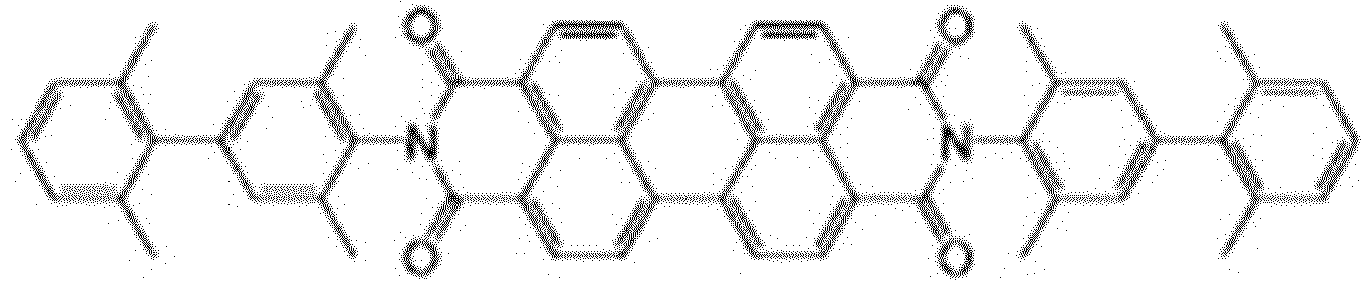
6 
7 
8 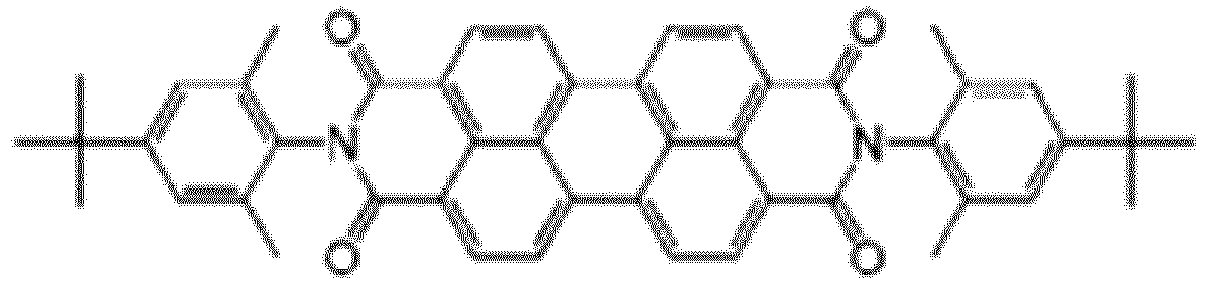
9 
10 
11 
12 
13 
14 
15 
16 
17 
- Some cyclic siloxanes are solid at room temperature. In case the cyclic siloxanes are solid at room temperature, the mixture in step b) of the method according to the present invention has to be heated to or, preferably above the melting temperature of the cyclic siloxane in order to make sure that the cyclic siloxane can act as transport agent. The term transport agent within the context of the present invention means that the transport agent can dissolve at least a small part, preferably at least 2% by weight, of the guest molecules at the insertion temperature and transport it to the channel opening of the zeolite L crystal, where the guest molecule is absorbed inside the channels.
- The temperature used in step b) is depending on the insertion temperature of the guest molecules into the host, and if the cyclic siloxane is solid at room temperature on the melting temperature of the cyclic siloxane. The insertion temperature is preferably more than 150°C, most preferably between 150°C and 350°C, and ideally between 200°C and 250°C. These temperatures allow to solubilize part of the guest molecules better in the cyclic siloxanes and to induce vibrational deformations of the host and guest materials and therefore facilitates the loading of the guest molecules in the zeolite L channels.
- Preferably, the incorporation of the guest molecules in the channels of the zeolite L crystals takes place in about 1 to 5 hours. During the incorporation process the mixture is preferably stirred. The temperature is preferably kept at the necessary insertion temperature. Preferably, the incorporation process in step b) is done under vacuum or an inert gas like nitrogen, argon or the like.
- Preferably, after finalizing the loading of the guest molecules in the crystal channels, the composition comprising the zeolite L host-guest material with the incorporated guest molecules is cooled and washed to remove guest molecules which are adsorbed on the outer surface of the zeolite L crystals. Guest molecules on the surface of the crystals are not oriented, can form dimers and can therefore negatively influence the chemical-physical properties of the zeolite L host-guest material.
- As a starting material for the method according to the present invention, a mixture of the guest molecule and the zeolite L crystal has to be provided. Preferably, the guest molecule is adsorbed on the outer surface of the zeolite L crystal. This can be obtained for example
- i. dissolving the guest molecules in a solvent,
- ii. mixing the zeolite L crystals and the solvent comprising the guest molecules and
- iii. drying the mixture obtained in step ii), preferably under vacuum, to receiving a dry, solvent- and oxygen-free mixture of the zeolite L crystals and the guest molecules.
- This procedure results in zeolite L crystals, wherein the outer surface of the crystals is approximately homogenous covered by the guest molecules. Such crystals comprising the guest molecules on its outer surface is a preferred starting material for the method according to the present invention.
- It is also possible to load more than one type of guest molecules in the zeolite L crystal by the method according to the present invention. In particular, it is possible, to create a so-called antenna system by loading, in a first step, a first type of fluorescent dye, and, in a second step, a second type of fluorescent dye. Preferably, these two types of fluorescent dyes are precisely tuned to each other, which means that the second fluorescent dye is able to accept excitation energy from the first fluorescent dye inside the channel, but cannot pass it back. The second fluorescent dye can re-emit this energy as fluorescence from the crystal surface, from the interior or exterior of the channel entrances or from the inside of the channels or, in a more advanced setup, transfer it radiationlessly to a photoelectronic or a photochemical device. Such a "receiving antenna" can alternatively be turned into a "transmitter" if the positions of the two fluorescent dyes are reversed. In this case, the second fluorescent dye captures energy from the outside and transfers it to the molecules located inside the crystals. The principle of such systems is described in detail in
WO 2010/009560 . - Preferably, a zeolite L host-guest material hosting at least two types of different guest molecules is prepared by a method including the following steps:
- a) obtaining a composition comprising at least one cyclic siloxane and a mixture of a first type of guest molecule and zeolite L crystals having straight through channels,
- b) heating the composition obtained in step a) to at least 100°C to incorporate the first type of guest molecules in the channels of the zeolite L crystals,
- c) washing the zeolite host-guest material obtained in step b) hosting the first type of guest molecules,
- d) providing a second type of guest molecule on the surface of the zeolite L crystals,
- e) obtaining a composition comprising at least one cyclic siloxane and the zeolite L host-guest material comprising the second type of guest molecule on its surface as obtained in step d),
- f) heating the composition obtained in step e) to at least 100°C to incorporate the second type of guest molecules in the channels of the zeolite L crystals.
- This procedure may be repeated as often as necessary.
- Suitable solvents for the washing procedure are solvents in which the guest molecules are soluble. Such solvents are known to the skilled person.
- Alternatively, two or more different types of guest molecule can be inserted as a mixture into the channels of zeolite L in one step.
- The amount of guest molecules in the channels of zeolite L crystals can be described by the occupation probability p, as described in the literature (Efficient and Robust Host-Guest Antenna Composite for Light Harvesting, Andre Devaux, Gion Calzaferri, Peter Belser, Pengpeng Cao, Dominik Brühwiler, Andreas Kunzmann Chem. Mater., ACS, Chem. Mater. 2014, 26, 6878-6885). The value of p ranges from 0 for an empty zeolite L to 1 for a fully loaded one. An occupation probability p between 0 to about 0.5, in some cases up to 1 can be obtained by the method according to the present invention.
- After preparation of the zeolite L host-guest material by the process according to the present invention, the loaded zeolite L host-guest material may be processed further as known in the art. For example, the surface of the loaded zeolite L crystals can be coated with a polymerizable silane, which can then be dispersed in a liquid monomer, followed by polymerizing the polymerizable silane and the liquid monomer to form a polymer wherein said zeolite L crystals are dispersed. Such a method is described in detail in
EP 1 873 202 - The zeolite L host-guest material obtained by the method according to the present invention can be used for developing optical devices such as lenses, eye glasses, special mirrors, filters, polarizers, grids, optical storages, monitors, window panes, float glass, or for coating of organic and inorganic surfaces for antireflection properties or light wavelength transformation, or for fluorescent or non-fluorescent pigments, luminescence concentrators or luminescence dispersers.
- Using organic UV absorbers as guest molecules in the channels of zeolite L, preferably UV absorbers from the class of benzophenones, oxalanilides, benzotriazoles or triazines, a very stable UV absorbing host-guest material can be prepared. This kind of material can be used as UV stabilizing agent in plastics, adhesives, sealants or in cosmetics and personal care products like sun cream.
- The present invention relates also to the use of a cyclic siloxane as a transfer agent for the preparation of zeolite L crystals comprising guest molecules in their channels.
-
-
Figure 1a shows a projection of the framework along the c-axis -
Figure 1b shows a framework side view of a zeolite L crystal channel along the c-axis -
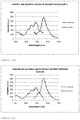
Figure 2a shows fluorescence and excitation spectra of a zeolite L crystal according to the present invention -
Figure 2b shows fluorescence and excitation spectra of a reference sample - Commercial zeolite L (HSZ-500KOA, TOSOH Corporation) was used for all the experiments (P. Cao, O. Khorev, A. Devaux, L. Sägesser, A. Kunzmann, A. Ecker, R. Häner, D. Brühwiler, G. Calzaferri, P. Belser, Chem. Eur. J. 2016, 22, 4046-4060). To ensure that the composition of charge compensating cations inside the zeolite L channel is well defined, 3 g of HSZ-500KOA zeolite L was suspended in 30 ml 0.5 M KNO3 (Sigma-Aldrich) in deionized water and stirred at room temperature for 3 hours. The suspension was centrifuged and washed two times with deionized water; the supernatant was discharged. Amorphous impurities, which may be present in commercial zeolite L, was eliminated in the supernatants.
- Some of the K+ ions were further exchanged with 1-ethyl-3-methylimidazolium (IMZ+) to control the pH inside the channels as some dyes inserted into the channels might be susceptible to acidic pH.
- 2 g of K+ exchanged zeolite L HSZ-500KOA was suspended in 3.6 ml of 1-ethyl-3-methylimidazolium bromide solution (Sigma-Aldrich) (0.1 M in deionized water) and 20 ml of deionized water. The suspension was homogenized in an ultrasonic bath and stirred under reflux at 80°C for 16 hours. Afterwards, the suspension was centrifuged, the supernatant was discharged and the K+/IMZ+ - zeolite L was dried in an oven at 80°C for 12h.
- Reference Example: insertion of Hostasol Red GG (HR, obtained from Clariant)(14H-anthra[2,1,9-mna]thioxanthen-14-one) and tb-DXP N,N'-Bis(4-tert-Butyl-2,6-dimethylphenyl)-3,4,9,10-perylenetetracarboxylic diimide (synthesized according to literature) into the channels of K+/IMZ+ zeolite L.
- 400mg of K+/IMZ+ zeolite L was mixed with 0.95 mg of Hostasol Red GG and 7.5 mg of tb-DXP and crushed to a fine powder in an agate mortar. The powder was suspended in ethanol and homogenized in an ultrasonic bath. Ethanol was removed under reduced pressure and the powder was filled in a glass ampoule. The powder was dried in the ampoule for 16 hours at a pressure <0.1 mbar and the ampoule was sealed. The sealed ampoule was put in an oven and stored at 210°C for 3 days. After cooling, the ampoule was opened and the powder was washed several times with dichloromethane and centrifuged to remove molecules which were adsorbed on the outer surface of the zeolite L and not inside the channels. UV-VIS spectroscopy of the combined supernatants showed an insertion efficiency of 75-80% of Hostasol Red GG and tb-DXP into the channels of zeolite L.
- 800 mg of K+/IMZ+ zeolite L was mixed with 1.9 mg of Hostasol Red GG and 15 mg of tb-DXP and crushed to a fine powder in an agate mortar. The powder was suspended in ethanol and homogenized in an ultrasonic bath. Ethanol was removed under reduced pressure and the powder was put into a Schlenk flask equipped with a teflon valve. 5 g of octaphenylcyclotetrasiloxane (OPCTS) (from Alfa Aesar) was added and the Schlenk flask was evacuated to a pressure of <0.1 mbar and the mixture was dried for 2h at 150°. The mixture was heated to the melting point of OPCTS and the teflon valve was closed. The mixture was stirred for 3 hours at 210°C. After cooling, the mixture was washed several times with dichloromethane and centrifuged to remove molecules which were adsorbed on the outer surface of the zeolite L and not inside the channels. UV-VIS spectroscopy of the combined supernatants showed an insertion efficiency of >98% of Hostasol Red GG and tb-DXP into the channels of zeolite L.
- 800 mg of K+/IMZ+ zeolite L was mixed with 1.9 mg of Hostasol Red GG and 15 mg of tb-DXP and crushed to a fine powder in an agate mortar. The powder was suspended in ethanol and homogenized in an ultrasonic bath. Ethanol was removed under reduced pressure and the powder was put into a Schlenk flask equipped with a teflon valve. The flask was evacuated to a pressure of <0.1mbar and the powder was dried for 2 hours at 150°C, and after cooling the flask was flushed with nitrogen. 5 ml of decamethylcyclopentasiloxane (CM-50 from BRB International b.v.) was added under nitrogen atmosphere and the suspension was homogenized in an ultrasonic bath. The suspension was heated to 200°C under nitrogen for 3 hours. After cooling, the mixture was washed several times with dichloromethane and centrifuged to remove molecules which were adsorbed on the outer surface of the zeolite L and not inside the channels. UV-VIS spectroscopy of the combined supernatants showed an insertion efficiency of 94% of Hostasol Red GG and tb-DXP into the channels of zeolite L.
- Successful insertion of both molecules into the channels of zeolite L was proven by fluorescence spectroscopy (
Figures 2a and 2b ). Due to alignment and the distances of the molecules in the channels, Förster type resonance energy transfer occurs between tb-DXP molecules and from tb-DXP to HR. Excitation measurements at the emission wavelength of HR (640 nm) and emission spectra with excitation of tb-DXP at 490 nm both show substantial amount of Förster type resonance energy transfer from tb-DXP to HR.
Claims (13)
- Method for preparing a zeolite L material hosting at least one type of guest molecules including the steps ofa) obtaining a composition comprising at least one cyclic siloxane and a mixture of at least one type of guest molecule and zeolite L crystals having straight through channels, andb) heating the composition obtained in step a) to at least 100°C to incorporate the guest molecules in the channels of the zeolite L crystals.
- Method according to claim 1, wherein the at least one cyclic siloxane is a compound of the formula I

- Method according to any of the preceding claims, wherein the cyclic siloxane is selected from the group 1,3,5-trimethylcyclotrisiloxane, 1,3,5-triethylcyclotrisiloxane, 1,3,5-trivinylcyclotrisiloxane, 1,3,5-triphenylcyclotrisiloxane, hexamethylcyclotrisiloxane, hexaethylcyclotrisiloxane, hexavinylcyclotrisiloxane, hexaphenylcyclotrisiloxane, 1,3,5-trivinyl-1,3,5-trimethylcyclotrisiloxane, 1,3,5-trimethyl-1,3,5-triphenylcyclotrisiloxane, 1,3,5-tris(3,3,3-trifluoropropyl)-1,3,5-trimethylcyclotrisiloxane, 1,3,5,7-tetramethylcyclotetrasiloxane, 1,3,5,7-tetraethylcyclotetrasiloxane, 1,3,5,7-tetravinylcyclotetrasiloxane, 1,3,5,7-tetraphenylcyclotetrasiloxane, octamethylcyclotetrasiloxane, octaethylcyclotetrasiloxane, octavinylcyclotetrasiloxane, octaphenylcyclotetrasiloxane, 1,3,5,7-tetravinyl-1,3,5,7-tetramethylcyclotetrasiloxane, 1,3,5,7-tetramethyl-1,3,5,7-tetraphenylcyclotetrasiloxane, 1,3,5,7-tetrakis(3,3,3-trifluoropropyl)-1,3,5,7-tetramethylcyclotetrasiloxane, 1,3,5,7,9-pentamethylcyclopentasiloxane, 1,3,5,7,9-pentaethylcyclopentasiloxane, 1,3,5,7,9-pentavinylcyclopentasiloxane, 1,3,5,7,9-pentaphenylcyclopentasiloxane, decamethylcyclopentasiloxane, decaphenylcyclopentasiloxane, 1,3,5,7,9-pentavinyl-1,3,5,7,9-pentamethylcyclopentasiloxane, 1,3,5,7,9-pentamethyl-1,3,5,7,9-pentaphenylcyclopentasiloxane, 1,3,5,7,9,11-hexamethylcyclohexasiloxane, 1,3,5,7,9,11-hexavinylcyclohexasiloxane, 1,3,5,7,9,11-hexaphenylcyclohexasiloxane, dodecamethylcyclohexasiloxane, dodecavinylcyclohexasiloxane and dodecaphenylcyclohexasiloxane or mixtures thereof.
- Method according to any of the preceding claims wherein the cyclic siloxane is selected from the group consisting of octaphenylcyclotetrasiloxane, decamethylcyclopentasiloxane and dodecamethylcyclohexasiloxane or a mixture thereof.
- Method according to any of the preceding claims, wherein the at least one type of guest molecules is an uncharged organic guest molecule, preferably a dye or an UV absorber, and most preferably a fluorescent dye.
- Method according to claim 5, wherein the fluorescent dye is preferably selected from the group consisting of perylene diimide dyes, terrylene diimide dyes and quaterrylene diimide dyes.
- Method according to any of the preceding claims, wherein the temperature in step b) is between 150°C and 350°C, preferably between 200°C and 250°C.
- Method according to any of the preceding claims, wherein the composition in step b) is stirred for 1 to 5 hours.
- Method according to any of the preceding claims, wherein the composition in step b) is heated under vacuum or in an inert gas.
- Method according to any of the preceding claims, wherein the composition comprising the zeolite L host-guest material with the incorporated guest molecules is cooled and washed to remove guest molecules which are adsorbed on the outer surface of the zeolite L crystals.
- Method according to any of the preceding claims, wherein the mixture of the at least one type guest molecules and the zeolite L crystals is obtained byi. dissolving the at least one type of guest molecules in a solvent,ii. mixing the zeolite L crystals and the solvent comprising the guest molecules andiii. drying the mixture obtained in step ii) to receiving a dry, solvent- and oxygen-free mixture of the zeolite L crystals and the at least one type of guest molecules.
- Method according to claim 11, wherein the mixture in step iii) is dried under vacuum.
- Use of a cyclic siloxane as a transfer agent for the preparation of zeolite L crystals comprising guest molecules in their channels.
Priority Applications (7)
| Application Number | Priority Date | Filing Date | Title |
|---|---|---|---|
| EP17183382.5A EP3434748B1 (en) | 2017-07-26 | 2017-07-26 | Method for preparing a zeolite l material hosting at least one type of guest molecule |
| ES17183382T ES2789579T3 (en) | 2017-07-26 | 2017-07-26 | Method of preparing a zeolite L material that houses at least one type of host molecule |
| US16/634,536 US11268018B2 (en) | 2017-07-26 | 2018-07-25 | Method for preparing a zeolite L material hosting at least one type of guest molecule |
| JP2020503820A JP7214710B2 (en) | 2017-07-26 | 2018-07-25 | Method for preparing zeolite L material accepting at least one type of guest molecule |
| CN201880049363.0A CN111183203B (en) | 2017-07-26 | 2018-07-25 | Method for preparing L zeolite materials containing at least one type of guest molecule |
| KR1020207005328A KR102670494B1 (en) | 2017-07-26 | 2018-07-25 | Method for preparing zeolite L materials hosting at least one type of guest molecule |
| PCT/CH2018/000033 WO2019018951A1 (en) | 2017-07-26 | 2018-07-25 | Method for preparing a zeolite l material hosting at least one type of guest molecule |
Applications Claiming Priority (1)
| Application Number | Priority Date | Filing Date | Title |
|---|---|---|---|
| EP17183382.5A EP3434748B1 (en) | 2017-07-26 | 2017-07-26 | Method for preparing a zeolite l material hosting at least one type of guest molecule |
Publications (2)
| Publication Number | Publication Date |
|---|---|
| EP3434748A1 EP3434748A1 (en) | 2019-01-30 |
| EP3434748B1 true EP3434748B1 (en) | 2020-03-11 |
Family
ID=59579388
Family Applications (1)
| Application Number | Title | Priority Date | Filing Date |
|---|---|---|---|
| EP17183382.5A Active EP3434748B1 (en) | 2017-07-26 | 2017-07-26 | Method for preparing a zeolite l material hosting at least one type of guest molecule |
Country Status (7)
| Country | Link |
|---|---|
| US (1) | US11268018B2 (en) |
| EP (1) | EP3434748B1 (en) |
| JP (1) | JP7214710B2 (en) |
| KR (1) | KR102670494B1 (en) |
| CN (1) | CN111183203B (en) |
| ES (1) | ES2789579T3 (en) |
| WO (1) | WO2019018951A1 (en) |
Cited By (1)
| Publication number | Priority date | Publication date | Assignee | Title |
|---|---|---|---|---|
| EP4516875A1 (en) | 2023-09-04 | 2025-03-05 | Optical Additives GmbH | Dye-loaded zeolite composite materials |
Families Citing this family (3)
| Publication number | Priority date | Publication date | Assignee | Title |
|---|---|---|---|---|
| JP6770492B2 (en) * | 2017-08-10 | 2020-10-14 | 信越化学工業株式会社 | Cosmetics |
| CN118183780B (en) * | 2022-12-12 | 2026-03-10 | 中国科学院大连化学物理研究所 | Solvent-free preparation method of L molecular sieve |
| WO2025133002A1 (en) | 2023-12-20 | 2025-06-26 | Merz + Benteli Ag | Microporous sio2 particles |
Family Cites Families (13)
| Publication number | Priority date | Publication date | Assignee | Title |
|---|---|---|---|---|
| US3169942A (en) * | 1959-12-08 | 1965-02-16 | Union Carbide Corp | Zeolite catalyzed condensation of hydroxyl and/or alkoxy containing silicon compositions |
| ZA974712B (en) * | 1996-05-29 | 1998-11-17 | Exxon Chemical Patents Inc | Zeolite catalyst and use for hydrocarbon conversion |
| CA2256525C (en) * | 1996-05-29 | 2006-07-25 | Johannes P. Verduijn (Deceased) | Zeolite catalyst and its use in hydrocarbon conversion |
| BR9714831B1 (en) * | 1996-10-17 | 2010-07-27 | hydrocarbon conversion using zeolite crystal catalyst. | |
| US6699811B1 (en) * | 1999-05-05 | 2004-03-02 | Exxon Mobil Chemical Patents Inc. | Tailored zeolite bound zeolite catalyst and its use for hydrocarbon conversion |
| EP1335879B1 (en) | 2000-11-03 | 2007-01-03 | Universitaet Bern | Dye loaded zeolite material |
| JP2009502558A (en) | 2005-07-29 | 2009-01-29 | ウニベルズィテート ベルン | Oriented zeolite material and method for producing the same |
| WO2007118812A1 (en) * | 2006-04-13 | 2007-10-25 | L'oréal | Composition for dyeing keratin fibres, comprising an electrophilic monomer, a hydrophobic direct dye and a liquid organic solvent |
| EP1873202B1 (en) | 2006-06-29 | 2009-02-11 | Clariant Finance (BVI) Limited | Transparent zeolite-polymer hybrid material with tunable properties |
| CH698333B1 (en) | 2008-07-01 | 2009-07-15 | Em Gion Calzaferri Dr Prof | Lumineszenzkonzentratoren and Lumineszenzdispergatoren based oriented dye-zeolite antennas. |
| GB2461686A (en) | 2008-07-03 | 2010-01-13 | Univ Twente | Zeolite L crystal intercalated with chromophores |
| CN103987807B (en) * | 2011-12-12 | 2016-03-30 | 吉翁·卡尔扎费利 | Partially J-Coupled Dye-Zeolite Antenna Composites |
| EP3225590A1 (en) * | 2016-03-31 | 2017-10-04 | Université de Strasbourg | Highly selective artificial neurotransmitter receptors |
-
2017
- 2017-07-26 ES ES17183382T patent/ES2789579T3/en active Active
- 2017-07-26 EP EP17183382.5A patent/EP3434748B1/en active Active
-
2018
- 2018-07-25 WO PCT/CH2018/000033 patent/WO2019018951A1/en not_active Ceased
- 2018-07-25 US US16/634,536 patent/US11268018B2/en active Active
- 2018-07-25 JP JP2020503820A patent/JP7214710B2/en active Active
- 2018-07-25 KR KR1020207005328A patent/KR102670494B1/en active Active
- 2018-07-25 CN CN201880049363.0A patent/CN111183203B/en active Active
Non-Patent Citations (1)
| Title |
|---|
| None * |
Cited By (2)
| Publication number | Priority date | Publication date | Assignee | Title |
|---|---|---|---|---|
| EP4516875A1 (en) | 2023-09-04 | 2025-03-05 | Optical Additives GmbH | Dye-loaded zeolite composite materials |
| WO2025051780A1 (en) | 2023-09-04 | 2025-03-13 | Optical Additives Gmbh | Dye-loaded zeolite composite materials |
Also Published As
| Publication number | Publication date |
|---|---|
| KR102670494B1 (en) | 2024-05-28 |
| US11268018B2 (en) | 2022-03-08 |
| JP2020528041A (en) | 2020-09-17 |
| CN111183203B (en) | 2023-10-20 |
| US20210087461A1 (en) | 2021-03-25 |
| ES2789579T3 (en) | 2020-10-26 |
| KR20200032725A (en) | 2020-03-26 |
| CN111183203A (en) | 2020-05-19 |
| EP3434748A1 (en) | 2019-01-30 |
| WO2019018951A1 (en) | 2019-01-31 |
| JP7214710B2 (en) | 2023-01-30 |
Similar Documents
| Publication | Publication Date | Title |
|---|---|---|
| Wang et al. | Organic composite crystal with persistent room-temperature luminescence above 650 nm by combining triplet–triplet energy transfer with thermally activated delayed fluorescence | |
| Rodrigues et al. | Aggregation-induced emission: From small molecules to polymers—historical background, mechanisms and Photophysics | |
| US11268018B2 (en) | Method for preparing a zeolite L material hosting at least one type of guest molecule | |
| Ma et al. | Supramolecular pins with ultralong efficient phosphorescence | |
| Rettig et al. | Competing adiabatic photoreaction channels in stilbene derivatives | |
| Jiang et al. | Triplet–triplet annihilation photon upconversion in polymer thin film: sensitizer design | |
| US8222592B2 (en) | Dye loaded zeolite material | |
| Pauchard et al. | Time‐and Space‐Resolved Luminescence of a Photonic Dye–Zeolite Antenna | |
| Huang et al. | Utilizing host–guest interaction enables the simultaneous enhancement of the quantum yield and Stokes shift in organosilane-functionalized, nitrogen-containing carbon dots for laminated luminescent solar concentrators | |
| Law | Squaraine chemistry. A study of the solute-solvent complexation of squaraine in solvents by proton NMR spectroscopy | |
| Busby et al. | Interactions of perylene bisimide in the one-dimensional channels of zeolite L | |
| Sun et al. | Visible‐near‐infrared luminescent lanthanide ternary complexes based on beta‐diketonate using visible‐light excitation | |
| Cheng et al. | Water-assisted synthesis of highly stable CsPbX 3 perovskite quantum dots embedded in zeolite-Y | |
| Zhao et al. | Efficient persistent luminescence tuning using a cyclodextrin inclusion complex as efficient light conversion materials | |
| US10604698B2 (en) | Light up-conversion material | |
| Sani et al. | Turning weak emitters into outstanding luminescent materials using rigid host media | |
| Wang et al. | Precise tuning on the luminescence of electrostatic self-assembly of asphaltene units for ultraviolet and high-energy blue light shielding | |
| Loftus et al. | Formulation-dependent optical properties of hybrid sol-gel glasses containing diphenylamine–fluorene–benzothiazole dyes | |
| EP4516875A1 (en) | Dye-loaded zeolite composite materials | |
| Du et al. | High-PLQY and efficient upconverted fluorescence of the TAPC/PBD exciplex with fluorescent guests | |
| Žabenská et al. | Solid-state and aggregation-induced emission of novel bicyclic and tricyclic difluoroboron heterocycles | |
| Cunha et al. | Photophysics and Excited State Decay Mechanism of AIEgens: The Case of Diphenyldibenzofulvene Derivatives (DPBFs) | |
| Fang et al. | Triplet Excitons Harvesting in Host–Guest Doped Organic Glassy Scintillators for High‐Resolution X‐Ray Imaging | |
| JP2022050340A (en) | Composition, organic stimulable light-emitting device, light-emitting method, and design method of stimulable light-emitting composition | |
| Brankov et al. | Photostability testing for coumarin-153 doped ZnO thin films prepared with spin-coating technique |
Legal Events
| Date | Code | Title | Description |
|---|---|---|---|
| PUAI | Public reference made under article 153(3) epc to a published international application that has entered the european phase |
Free format text: ORIGINAL CODE: 0009012 |
|
| STAA | Information on the status of an ep patent application or granted ep patent |
Free format text: STATUS: THE APPLICATION HAS BEEN PUBLISHED |
|
| AK | Designated contracting states |
Kind code of ref document: A1 Designated state(s): AL AT BE BG CH CY CZ DE DK EE ES FI FR GB GR HR HU IE IS IT LI LT LU LV MC MK MT NL NO PL PT RO RS SE SI SK SM TR |
|
| AX | Request for extension of the european patent |
Extension state: BA ME |
|
| STAA | Information on the status of an ep patent application or granted ep patent |
Free format text: STATUS: REQUEST FOR EXAMINATION WAS MADE |
|
| 17P | Request for examination filed |
Effective date: 20190718 |
|
| RBV | Designated contracting states (corrected) |
Designated state(s): AL AT BE BG CH CY CZ DE DK EE ES FI FR GB GR HR HU IE IS IT LI LT LU LV MC MK MT NL NO PL PT RO RS SE SI SK SM TR |
|
| GRAP | Despatch of communication of intention to grant a patent |
Free format text: ORIGINAL CODE: EPIDOSNIGR1 |
|
| STAA | Information on the status of an ep patent application or granted ep patent |
Free format text: STATUS: GRANT OF PATENT IS INTENDED |
|
| INTG | Intention to grant announced |
Effective date: 20191001 |
|
| GRAS | Grant fee paid |
Free format text: ORIGINAL CODE: EPIDOSNIGR3 |
|
| GRAA | (expected) grant |
Free format text: ORIGINAL CODE: 0009210 |
|
| STAA | Information on the status of an ep patent application or granted ep patent |
Free format text: STATUS: THE PATENT HAS BEEN GRANTED |
|
| AK | Designated contracting states |
Kind code of ref document: B1 Designated state(s): AL AT BE BG CH CY CZ DE DK EE ES FI FR GB GR HR HU IE IS IT LI LT LU LV MC MK MT NL NO PL PT RO RS SE SI SK SM TR |
|
| REG | Reference to a national code |
Ref country code: GB Ref legal event code: FG4D |
|
| REG | Reference to a national code |
Ref country code: CH Ref legal event code: EP |
|
| REG | Reference to a national code |
Ref country code: AT Ref legal event code: REF Ref document number: 1243138 Country of ref document: AT Kind code of ref document: T Effective date: 20200315 |
|
| RAP2 | Party data changed (patent owner data changed or rights of a patent transferred) |
Owner name: MERZ+BENTELI AG |
|
| REG | Reference to a national code |
Ref country code: FI Ref legal event code: FGE |
|
| REG | Reference to a national code |
Ref country code: IE Ref legal event code: FG4D |
|
| REG | Reference to a national code |
Ref country code: DE Ref legal event code: R096 Ref document number: 602017012823 Country of ref document: DE |
|
| REG | Reference to a national code |
Ref country code: SE Ref legal event code: TRGR |
|
| REG | Reference to a national code |
Ref country code: NL Ref legal event code: FP |
|
| REG | Reference to a national code |
Ref country code: CH Ref legal event code: NV Representative=s name: PATENTANWAELTE SCHAAD, BALASS, MENZL AND PARTN, CH |
|
| PG25 | Lapsed in a contracting state [announced via postgrant information from national office to epo] |
Ref country code: NO Free format text: LAPSE BECAUSE OF FAILURE TO SUBMIT A TRANSLATION OF THE DESCRIPTION OR TO PAY THE FEE WITHIN THE PRESCRIBED TIME-LIMIT Effective date: 20200611 Ref country code: RS Free format text: LAPSE BECAUSE OF FAILURE TO SUBMIT A TRANSLATION OF THE DESCRIPTION OR TO PAY THE FEE WITHIN THE PRESCRIBED TIME-LIMIT Effective date: 20200311 |
|
| PG25 | Lapsed in a contracting state [announced via postgrant information from national office to epo] |
Ref country code: BG Free format text: LAPSE BECAUSE OF FAILURE TO SUBMIT A TRANSLATION OF THE DESCRIPTION OR TO PAY THE FEE WITHIN THE PRESCRIBED TIME-LIMIT Effective date: 20200611 Ref country code: GR Free format text: LAPSE BECAUSE OF FAILURE TO SUBMIT A TRANSLATION OF THE DESCRIPTION OR TO PAY THE FEE WITHIN THE PRESCRIBED TIME-LIMIT Effective date: 20200612 Ref country code: LV Free format text: LAPSE BECAUSE OF FAILURE TO SUBMIT A TRANSLATION OF THE DESCRIPTION OR TO PAY THE FEE WITHIN THE PRESCRIBED TIME-LIMIT Effective date: 20200311 Ref country code: HR Free format text: LAPSE BECAUSE OF FAILURE TO SUBMIT A TRANSLATION OF THE DESCRIPTION OR TO PAY THE FEE WITHIN THE PRESCRIBED TIME-LIMIT Effective date: 20200311 |
|
| REG | Reference to a national code |
Ref country code: LT Ref legal event code: MG4D |
|
| REG | Reference to a national code |
Ref country code: ES Ref legal event code: FG2A Ref document number: 2789579 Country of ref document: ES Kind code of ref document: T3 Effective date: 20201026 |
|
| PG25 | Lapsed in a contracting state [announced via postgrant information from national office to epo] |
Ref country code: IS Free format text: LAPSE BECAUSE OF FAILURE TO SUBMIT A TRANSLATION OF THE DESCRIPTION OR TO PAY THE FEE WITHIN THE PRESCRIBED TIME-LIMIT Effective date: 20200711 Ref country code: PT Free format text: LAPSE BECAUSE OF FAILURE TO SUBMIT A TRANSLATION OF THE DESCRIPTION OR TO PAY THE FEE WITHIN THE PRESCRIBED TIME-LIMIT Effective date: 20200805 Ref country code: LT Free format text: LAPSE BECAUSE OF FAILURE TO SUBMIT A TRANSLATION OF THE DESCRIPTION OR TO PAY THE FEE WITHIN THE PRESCRIBED TIME-LIMIT Effective date: 20200311 Ref country code: CZ Free format text: LAPSE BECAUSE OF FAILURE TO SUBMIT A TRANSLATION OF THE DESCRIPTION OR TO PAY THE FEE WITHIN THE PRESCRIBED TIME-LIMIT Effective date: 20200311 Ref country code: RO Free format text: LAPSE BECAUSE OF FAILURE TO SUBMIT A TRANSLATION OF THE DESCRIPTION OR TO PAY THE FEE WITHIN THE PRESCRIBED TIME-LIMIT Effective date: 20200311 Ref country code: SK Free format text: LAPSE BECAUSE OF FAILURE TO SUBMIT A TRANSLATION OF THE DESCRIPTION OR TO PAY THE FEE WITHIN THE PRESCRIBED TIME-LIMIT Effective date: 20200311 Ref country code: EE Free format text: LAPSE BECAUSE OF FAILURE TO SUBMIT A TRANSLATION OF THE DESCRIPTION OR TO PAY THE FEE WITHIN THE PRESCRIBED TIME-LIMIT Effective date: 20200311 Ref country code: SM Free format text: LAPSE BECAUSE OF FAILURE TO SUBMIT A TRANSLATION OF THE DESCRIPTION OR TO PAY THE FEE WITHIN THE PRESCRIBED TIME-LIMIT Effective date: 20200311 |
|
| REG | Reference to a national code |
Ref country code: AT Ref legal event code: MK05 Ref document number: 1243138 Country of ref document: AT Kind code of ref document: T Effective date: 20200311 |
|
| REG | Reference to a national code |
Ref country code: DE Ref legal event code: R097 Ref document number: 602017012823 Country of ref document: DE |
|
| PLBE | No opposition filed within time limit |
Free format text: ORIGINAL CODE: 0009261 |
|
| STAA | Information on the status of an ep patent application or granted ep patent |
Free format text: STATUS: NO OPPOSITION FILED WITHIN TIME LIMIT |
|
| PG25 | Lapsed in a contracting state [announced via postgrant information from national office to epo] |
Ref country code: DK Free format text: LAPSE BECAUSE OF FAILURE TO SUBMIT A TRANSLATION OF THE DESCRIPTION OR TO PAY THE FEE WITHIN THE PRESCRIBED TIME-LIMIT Effective date: 20200311 Ref country code: AT Free format text: LAPSE BECAUSE OF FAILURE TO SUBMIT A TRANSLATION OF THE DESCRIPTION OR TO PAY THE FEE WITHIN THE PRESCRIBED TIME-LIMIT Effective date: 20200311 |
|
| 26N | No opposition filed |
Effective date: 20201214 |
|
| PG25 | Lapsed in a contracting state [announced via postgrant information from national office to epo] |
Ref country code: MC Free format text: LAPSE BECAUSE OF FAILURE TO SUBMIT A TRANSLATION OF THE DESCRIPTION OR TO PAY THE FEE WITHIN THE PRESCRIBED TIME-LIMIT Effective date: 20200311 Ref country code: PL Free format text: LAPSE BECAUSE OF FAILURE TO SUBMIT A TRANSLATION OF THE DESCRIPTION OR TO PAY THE FEE WITHIN THE PRESCRIBED TIME-LIMIT Effective date: 20200311 Ref country code: SI Free format text: LAPSE BECAUSE OF FAILURE TO SUBMIT A TRANSLATION OF THE DESCRIPTION OR TO PAY THE FEE WITHIN THE PRESCRIBED TIME-LIMIT Effective date: 20200311 |
|
| REG | Reference to a national code |
Ref country code: BE Ref legal event code: MM Effective date: 20200731 |
|
| PG25 | Lapsed in a contracting state [announced via postgrant information from national office to epo] |
Ref country code: LU Free format text: LAPSE BECAUSE OF NON-PAYMENT OF DUE FEES Effective date: 20200726 |
|
| PG25 | Lapsed in a contracting state [announced via postgrant information from national office to epo] |
Ref country code: BE Free format text: LAPSE BECAUSE OF NON-PAYMENT OF DUE FEES Effective date: 20200731 |
|
| PG25 | Lapsed in a contracting state [announced via postgrant information from national office to epo] |
Ref country code: IE Free format text: LAPSE BECAUSE OF NON-PAYMENT OF DUE FEES Effective date: 20200726 |
|
| PG25 | Lapsed in a contracting state [announced via postgrant information from national office to epo] |
Ref country code: TR Free format text: LAPSE BECAUSE OF FAILURE TO SUBMIT A TRANSLATION OF THE DESCRIPTION OR TO PAY THE FEE WITHIN THE PRESCRIBED TIME-LIMIT Effective date: 20200311 Ref country code: MT Free format text: LAPSE BECAUSE OF FAILURE TO SUBMIT A TRANSLATION OF THE DESCRIPTION OR TO PAY THE FEE WITHIN THE PRESCRIBED TIME-LIMIT Effective date: 20200311 Ref country code: CY Free format text: LAPSE BECAUSE OF FAILURE TO SUBMIT A TRANSLATION OF THE DESCRIPTION OR TO PAY THE FEE WITHIN THE PRESCRIBED TIME-LIMIT Effective date: 20200311 |
|
| PG25 | Lapsed in a contracting state [announced via postgrant information from national office to epo] |
Ref country code: MK Free format text: LAPSE BECAUSE OF FAILURE TO SUBMIT A TRANSLATION OF THE DESCRIPTION OR TO PAY THE FEE WITHIN THE PRESCRIBED TIME-LIMIT Effective date: 20200311 Ref country code: AL Free format text: LAPSE BECAUSE OF FAILURE TO SUBMIT A TRANSLATION OF THE DESCRIPTION OR TO PAY THE FEE WITHIN THE PRESCRIBED TIME-LIMIT Effective date: 20200311 |
|
| PGFP | Annual fee paid to national office [announced via postgrant information from national office to epo] |
Ref country code: NL Payment date: 20250721 Year of fee payment: 9 |
|
| PGFP | Annual fee paid to national office [announced via postgrant information from national office to epo] |
Ref country code: FI Payment date: 20250725 Year of fee payment: 9 Ref country code: ES Payment date: 20250826 Year of fee payment: 9 |
|
| PGFP | Annual fee paid to national office [announced via postgrant information from national office to epo] |
Ref country code: DE Payment date: 20250722 Year of fee payment: 9 |
|
| PGFP | Annual fee paid to national office [announced via postgrant information from national office to epo] |
Ref country code: IT Payment date: 20250724 Year of fee payment: 9 |
|
| PGFP | Annual fee paid to national office [announced via postgrant information from national office to epo] |
Ref country code: GB Payment date: 20250722 Year of fee payment: 9 |
|
| PGFP | Annual fee paid to national office [announced via postgrant information from national office to epo] |
Ref country code: FR Payment date: 20250725 Year of fee payment: 9 |
|
| PGFP | Annual fee paid to national office [announced via postgrant information from national office to epo] |
Ref country code: CH Payment date: 20250801 Year of fee payment: 9 Ref country code: SE Payment date: 20250722 Year of fee payment: 9 |