EP3432648A1 - A communication device for communicating over a communication network - Google Patents
A communication device for communicating over a communication network Download PDFInfo
- Publication number
- EP3432648A1 EP3432648A1 EP17181895.8A EP17181895A EP3432648A1 EP 3432648 A1 EP3432648 A1 EP 3432648A1 EP 17181895 A EP17181895 A EP 17181895A EP 3432648 A1 EP3432648 A1 EP 3432648A1
- Authority
- EP
- European Patent Office
- Prior art keywords
- communication device
- communication
- relay
- data
- mode
- Prior art date
- Legal status (The legal status is an assumption and is not a legal conclusion. Google has not performed a legal analysis and makes no representation as to the accuracy of the status listed.)
- Granted
Links
Images



Classifications
-
- H—ELECTRICITY
- H04—ELECTRIC COMMUNICATION TECHNIQUE
- H04W—WIRELESS COMMUNICATION NETWORKS
- H04W52/00—Power management, e.g. Transmission Power Control [TPC] or power classes
- H04W52/02—Power saving arrangements
- H04W52/0209—Power saving arrangements in terminal devices
- H04W52/0261—Power saving arrangements in terminal devices managing power supply demand, e.g. depending on battery level
- H04W52/0274—Power saving arrangements in terminal devices managing power supply demand, e.g. depending on battery level by switching on or off the equipment or parts thereof
- H04W52/028—Power saving arrangements in terminal devices managing power supply demand, e.g. depending on battery level by switching on or off the equipment or parts thereof switching on or off only a part of the equipment circuit blocks
-
- Y—GENERAL TAGGING OF NEW TECHNOLOGICAL DEVELOPMENTS; GENERAL TAGGING OF CROSS-SECTIONAL TECHNOLOGIES SPANNING OVER SEVERAL SECTIONS OF THE IPC; TECHNICAL SUBJECTS COVERED BY FORMER USPC CROSS-REFERENCE ART COLLECTIONS [XRACs] AND DIGESTS
- Y02—TECHNOLOGIES OR APPLICATIONS FOR MITIGATION OR ADAPTATION AGAINST CLIMATE CHANGE
- Y02D—CLIMATE CHANGE MITIGATION TECHNOLOGIES IN INFORMATION AND COMMUNICATION TECHNOLOGIES [ICT], I.E. INFORMATION AND COMMUNICATION TECHNOLOGIES AIMING AT THE REDUCTION OF THEIR OWN ENERGY USE
- Y02D30/00—Reducing energy consumption in communication networks
- Y02D30/70—Reducing energy consumption in communication networks in wireless communication networks
Definitions
- the invention relates to the field of wireless communication networks. More specifically, the invention relates to communication devices, methods and communication systems based on Low-Power Wide-Area (LPWA) technology, in particular Narrowband IoT (NB IoT) technology.
- LPWA Low-Power Wide-Area
- NB IoT Narrowband IoT
- Narrowband IoT is a new technology standard, designed to broaden the future of IoT connectivity. Ratified by the 3GPP, NB IoT is starting to be deployed by mobile network operators across the globe. NB IoT is a Low-Power Wide-Area (LPWA) technology, developed to enable efficient communication for massively distributed communication devices across wide geographical areas and deep within urban infrastructure. NB IoT technology is ideal for communication devices that generate low data traffic, rely on batteries and typically have a long life cycle. A battery life of more than 10 years may be supported for a wide range of use cases.
- LPWA Low-Power Wide-Area
- NB IoT technology significantly improves the system capacity and spectrum efficiency, especially in deep coverage.
- NB IoT technology can be used to connect simple communication devices, such as sensors, to drive new data streams, reduce operational costs and create new business models.
- Smart meters, smart bins, environmental monitoring and precision agriculture are just a few exemplary applications of NB IoT technology. Due to the limited hardware resources of communication devices based on LPWA technology and, in particular, NB IoT technology, established mechanisms known, for instance, from smartphones may typically not be used for such communication devices.
- the invention is based on the finding, that an application processor of a communication device may not be involved in specific regular operations of a communication interface of the communication device, such as relaying of relay data or transmission of management data.
- the application processor may be configured to remain in a power save mode (PSM) during these kinds of operations; thereby increasing an energy-efficiency of the communication device, which is particularly advantageous using LPWA and/or NB IoT technology.
- PSM power save mode
- the invention relates to a communication device for communicating over a communication network.
- the communication device comprises a memory comprising an application data portion for storing application data, and a relay data portion for storing relay data.
- the communication device further comprises an application processor configured to operate in one of an execution mode and a power save mode, wherein, in the execution mode, the application processor is configured to execute an application program based on the application data.
- the communication device further comprises a communication interface configured to operate in a relay mode, wherein, in the relay mode, the communication interface is configured to receive the relay data from a first neighboring communication device over the communication network, to store the relay data in the relay data portion, to read the relay data from the relay data portion, and to transmit the relay data to a second neighboring communication device over the communication network.
- the application processor is configured to maintain operation in the power save mode during operation of the communication interface in the relay mode.
- the communication device allows for an increased energy-efficiency during operation of the communication device within the communication network.
- the application processor may not be involved in any operations performed by the communication interface in the relay mode. Consequently, the application processor may not be waked up from the power save mode during operation of the communication interface in the relay mode.
- the memory further comprises a management data portion for storing management data
- the communication interface is further configured to operate in a management data transmission mode, wherein, in the management data transmission mode, the communication interface is configured to read the management data from the management data portion, and to transmit the management data to the second neighboring communication device over the communication network, and wherein the application processor is configured to maintain operation in the power save mode during operation of the communication interface in the management data transmission mode.
- the management data may be associated with the communication device.
- the application processor may not be involved in any operations performed by the communication interface in the management data transmission mode. Consequently, the application processor may not be waked up from the power save mode during operation of the communication interface in the management data transmission mode.
- the management data comprises a routing table
- the communication interface is configured to transmit the relay data or the management data to the second neighboring communication device based on the routing table.
- the routing table may indicate a respective communication address of the first neighboring communication device and/or the second neighboring communication device within the communication network.
- the management data comprises a data counter indicating a data volume of the relay data or the management data transmitted by the communication interface to the second neighboring communication device.
- the data volume may e.g. be represented by a number of bits or bytes.
- the communication device comprises a battery configured to supply the communication device with electrical energy
- the management data comprises a battery status indicator indicating a battery status of the battery.
- the battery status may e.g. represent a health parameter of the battery, or an energy level of energy stored within the battery.
- the communication device comprises a global navigation satellite system receiver configured to determine a geographic position of the communication device, wherein the management data comprises a position indicator indicating the geographic position of the communication device.
- the geographic position of the communication device may e.g. be represented by a latitude and a longitude of the communication device.
- the global navigation satellite system receiver is configured to operate in a position acquisition mode
- the application processor is configured to maintain operation in the power save mode during operation of the global navigation satellite system receiver in the position acquisition mode.
- the global navigation satellite system receiver acquires the geographic position of the communication device in the position acquisition mode.
- the application processor may not be waked up from the power save mode during operation of the global navigation satellite system receiver in the position acquisition mode.
- the communication device comprises a sensor configured to sense a physical parameter in a surrounding of the communication device, wherein the management data comprises the physical parameter.
- the physical parameter may e.g. indicate a temperature or an air pressure in the surrounding of the communication device.
- the senor is configured to operate in a sensing mode
- the application processor is configured to maintain operation in the power save mode during operation of the sensor in the sensing mode.
- the sensor senses the physical parameter in the surrounding of the communication device in the sensing mode.
- the application processor may not be waked up from the power save mode during operation of the sensor in the sensing mode.
- the communication interface is further configured to operate in a deactivated mode.
- the communication interface is configured to switch from the relay mode or the management data transmission mode to the deactivated mode, if the transmission of the relay data or the transmission of the management data to the second neighboring communication device is finished.
- the application processor is configured to initiate a change between the execution mode and the power save mode based on a mode change indicator provided by the application program.
- the mode change indicator may e.g. be provided by the application program, if execution of the application program may be halted temporarily.
- the communication device further comprises a security enclave configured to authenticate the communication device within the communication network, wherein the security enclave comprises the memory of the communication device.
- the security enclave can allow for a reliable and secure implementation of the memory of the communication device.
- the security enclave may hold or store network authentication credentials for registering and/or authenticating the communication device within the communication network.
- the security enclave may further be configured to identify the communication device within the communication network.
- the invention relates to a communication system for communicating over a communication network.
- the communication system comprises a communication device according to the first aspect of the invention, a first neighboring communication device configured to transmit relay data to the communication device over the communication network, and a second neighboring communication device configured to receive the relay data from the communication device over the communication network.
- the communication system further comprises a third neighboring communication device, wherein the second neighboring communication device is configured to transmit the relay data to the third neighboring communication device over the communication network.
- the first neighboring communication device, the second neighboring communication device and/or the third neighboring communication device may have the same features and/or the same functionality as the communication device according to the first aspect of the invention.
- the communication network is a multi-hop device-to-device communication network, in particular an LPWA communication network or a NB IoT communication network.
- the invention relates to a method of operating a communication device for communicating over a communication network, wherein the communication device comprises a memory, an application processor and a communication interface.
- the memory comprises an application data portion for storing application data, and a relay data portion for storing relay data.
- the application processor is configured to operate in one of an execution mode and a power save mode.
- the communication interface is configured to operate in a relay mode.
- the application processor is configured to maintain operation in the power save mode during operation of the communication interface in the relay mode.
- the method comprises executing, in the execution mode, by the application processor, an application program based on the application data, receiving, in the relay mode, by the communication interface, the relay data from a first neighboring communication device over the communication network, storing, in the relay mode, by the communication interface, the relay data in the relay data portion, reading, in the relay mode, by the communication interface, the relay data from the relay data portion, and transmitting, in the relay mode, by the communication interface, the relay data to a second neighboring communication device over the communication network.
- the method may be performed by the communication device. Further features of the method directly result from the features and/or the functionality of the communication device.
- the invention relates to a computer program for performing the method according to the third aspect of the invention when executed on a communication device.
- the invention can be implemented in hardware and/or software.
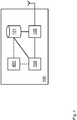
- Fig. 1 shows a schematic diagram of a communication device 100 for communicating over a communication network.
- the communication device 100 comprises a memory 101 comprising an application data portion for storing application data, and a relay data portion for storing relay data.
- the communication device 100 further comprises an application processor 103 configured to operate in one of an execution mode and a power save mode, wherein, in the execution mode, the application processor 103 is configured to execute an application program based on the application data.
- the communication device 100 further comprises a communication interface 105 configured to operate in a relay mode, wherein, in the relay mode, the communication interface 105 is configured to receive the relay data from a first neighboring communication device over the communication network, to store the relay data in the relay data portion, to read the relay data from the relay data portion, and to transmit the relay data to a second neighboring communication device over the communication network.
- the application processor 103 is configured to maintain operation in the power save mode during operation of the communication interface 105 in the relay mode.
- Fig. 2 shows a schematic diagram of a communication system 200 for communicating over a communication network.
- the communication system 200 comprises a communication device 100, a first neighboring communication device 201 configured to transmit relay data to the communication device 100 over the communication network, a second neighboring communication device 203 configured to receive the relay data from the communication device 100 over the communication network, and a third neighboring communication device 205.
- the second neighboring communication device 203 is configured to transmit the relay data to the third neighboring communication device 205 over the communication network.
- Fig. 3 shows a schematic diagram of a method 300 of operating a communication device for communicating over a communication network.
- the communication device comprises a memory, an application processor and a communication interface.
- the memory comprises an application data portion for storing application data, and a relay data portion for storing relay data.
- the application processor is configured to operate in one of an execution mode and a power save mode.
- the communication interface is configured to operate in a relay mode.
- the application processor is configured to maintain operation in the power save mode during operation of the communication interface in the relay mode.
- the method 300 comprises executing 301, in the execution mode, by the application processor, an application program based on the application data, receiving 303, in the relay mode, by the communication interface, the relay data from a first neighboring communication device over the communication network, storing 305, in the relay mode, by the communication interface, the relay data in the relay data portion, reading 307, in the relay mode, by the communication interface, the relay data from the relay data portion, and transmitting 309, in the relay mode, by the communication interface, the relay data to a second neighboring communication device over the communication network.
- Fig. 4 shows a schematic diagram of a communication device 100 for communicating over a communication network.
- the communication device 100 comprises a memory 101 comprising an application data portion for storing application data, a relay data portion for storing relay data, and a management data portion for storing management data.
- the memory 101 may be comprised by a security enclave, e.g. a subscriber identity module (SIM), of the communication device 100.
- SIM subscriber identity module
- the communication device 100 further comprises an application processor 103 configured to operate in one of an execution mode and a power save mode, wherein, in the execution mode, the application processor 103 is configured to execute an application program based on the application data.
- the communication device 100 further comprises a communication interface 105 configured to operate in a relay mode, wherein, in the relay mode, the communication interface 105 is configured to receive the relay data from a first neighboring communication device over the communication network, to store the relay data in the relay data portion, to read the relay data from the relay data portion, and to transmit the relay data to a second neighboring communication device over the communication network.
- the application processor 103 is configured to maintain operation in the power save mode during operation of the communication interface 105 in the relay mode.
- the communication interface 105 may further be configured to operate in a management data transmission mode, wherein, in the management data transmission mode, the communication interface 105 is configured to read the management data from the management data portion, and to transmit the management data to the second neighboring communication device over the communication network.
- the application processor 103 may be configured to maintain operation in the power save mode during operation of the communication interface 105 in the management data transmission mode.
- the communication device 100 may further comprise a sensor 401 for sensing physical parameters, such as a temperature or an air pressure, in the surrounding of the communication device 100.
- the management data stored in the management data portion of the memory 101 may comprise the physical parameter.
- the sensor 401 may further be connected to the application processor 103 for direct interaction with the application program during operation of the application processor 103 in the execution mode.
- the concept allows for an energy-efficient and secure storage and transmission of relay data and/or management data using LPWA technology and/or NB IoT technology.
- IoT Internet-of-Things
- Main characteristics are low data rates (usually some 100bit/s to 250 kbit/s), wide coverage and/or deep indoor penetration, long battery lifetime of the communication devices, standardization by the 3GPP, operation within a licensed spectrum of a mobile network operator, identification and authentication within a communication network using an IMSI via a security enclave, e.g. a subscriber identity module (SIM).
- SIM subscriber identity module
- Such communication devices usually transmit a low amount of data within long time intervals and therefore only require a low data rate.
- Most of such communication devices are equipped with a battery.
- Exemplary applications of such devices are smart water meters, sensors for detecting unused parking lots, i.e. smart parking, etc.
- the battery lifetime is particularly relevant for the base functionality of the communication devices as well as for the application scenarios intended by the manufacturer of the communication devices.
- the increased battery lifetime may e.g. be achieved using an improved power save mode (PSM) and extended discontinuous reception (eDRX).
- PSM power save mode
- eDRX extended discontinuous reception
- a plurality of components of such communication devices e.g. a communication interface and an application processor / an application data portion
- This may lead to an increased power consumption, particularly if relay data or management data is transmitted multiple times or if the communication devices are used as a hub in a multi-hop device-to-device (D2D) communication network.
- the relay data and the management data may not be stored securely.
- the application processor / the application data portion may be waked up, although an interaction with these components may actually not be required.
- D2D device-to-device
- the application data, the management data, and the relay data may be stored within the memory 101 of a security enclave, e.g. a subscriber identity module (SIM), of the communication device 100.
- the memory 101 of the security enclave may provide an increased security for storing data within the communication device 100.
- the application processor 103 / the application data portion may not be waked up. Only relevant components of the communication device 100, i.e. the communication interface 105 and possibly the memory 101 of the security enclave, e.g. the subscriber identity module (SIM), may be turned on for the communication. All other components of the communication device 100 may remain in a power save mode or a deactivated mode for an increased energy-efficiency of the communication device 100.
- SIM subscriber identity module
- the energy-efficiency may be increased by only partially using the components of the communication device 100. Therefore, the lifetime of the communication device 100 may positively be affected.
- the data may be separated into three kinds of data: application data associated with the communication device 100, management data associated with the communication device 100, and relay data associated with another communication device.
- the management data may e.g. indicate a battery status, a number of previous transmissions, i.e. own transmissions or multi-hop transmissions, a geographic position provided by the GNSS receiver, wherein a synchronization with the application processor 103 may be performed in the execution mode of the application processor 103, a routing table comprising information relating to the neighboring communication devices 201, 203, 205, wake-up times for multi-hop communications and last valid routing information for reachable communication devices 201, 203, 205.
- relay data transmitted from other communication devices to the communication device 100 as a host may be securely stored until relaying the relay data. Therefore, external access as well as access by the communication device 100 on the relay data may be impeded.
- the application data may be stored in a secure portion of the memory 101 of the security enclave, e.g. the subscriber identity module (SIM), and may be protected against external attacks.
- the management data may be stored in a secure portion of the memory 101 of the security enclave and may be protected against external attacks. Furthermore, the energy-efficiency of the communication device 100 may be improved.
- the application processor 103 / the application data portion may not be waked up or turned on for receiving and transmitting the relay data or for transmitting the management data; thereby positively affecting the energy-efficiency of the communication device 100.
- the application data may be securely stored and may only be transmitted using the communication interface 105 and the memory 101 of the security enclave, e.g. the subscriber identity module (SIM), if both components wake up e.g. using extended discontinuous reception (eDRX) or responsive to the end of the power save mode (PSM) and interact with the communication network.
- SIM subscriber identity module
- the application processor 103 / the application data portion may not be waked up for the communication.
- Fig. 5 shows a schematic diagram of a communication system 200 for communicating over a communication network.
- the communication system 200 comprises a communication device 100, a first neighboring communication device (not shown), a second neighboring communication device 203, a third neighboring communication device 205, and a base station BS.
- the first neighboring communication device (not shown) is configured to transmit relay data to the communication device 100 over the communication network.
- the second neighboring communication device 203 is configured to receive the relay data from the communication device 100 over the communication network, and to transmit the relay data to the third neighboring communication device 205.
- the third neighboring communication device 205 configured to receive the relay data from the second neighboring communication device 203 over the communication network, and to transmit the relay data to the base station BS over the communication network.
- the third neighboring communication device 205 may be configured to receive further relay data from another communication device over the communication network, and to transmit the further relay data to the base station BS over the communication network.
- the second neighboring communication device 203 and the third neighboring communication device 205 may be used as host devices within the communication network.
- the communication network may be realized as a multi-hop device-to-device communication network, in particular an LPWA communication network or a NB IoT communication network.
Landscapes
- Engineering & Computer Science (AREA)
- Computer Networks & Wireless Communication (AREA)
- Signal Processing (AREA)
- Mobile Radio Communication Systems (AREA)
Abstract
Description
- In general, the invention relates to the field of wireless communication networks. More specifically, the invention relates to communication devices, methods and communication systems based on Low-Power Wide-Area (LPWA) technology, in particular Narrowband IoT (NB IoT) technology.
- Narrowband IoT (NB IoT) is a new technology standard, designed to broaden the future of IoT connectivity. Ratified by the 3GPP, NB IoT is starting to be deployed by mobile network operators across the globe. NB IoT is a Low-Power Wide-Area (LPWA) technology, developed to enable efficient communication for massively distributed communication devices across wide geographical areas and deep within urban infrastructure. NB IoT technology is ideal for communication devices that generate low data traffic, rely on batteries and typically have a long life cycle. A battery life of more than 10 years may be supported for a wide range of use cases.
- Moreover, NB IoT technology significantly improves the system capacity and spectrum efficiency, especially in deep coverage. Thus, NB IoT technology can be used to connect simple communication devices, such as sensors, to drive new data streams, reduce operational costs and create new business models. Smart meters, smart bins, environmental monitoring and precision agriculture are just a few exemplary applications of NB IoT technology. Due to the limited hardware resources of communication devices based on LPWA technology and, in particular, NB IoT technology, established mechanisms known, for instance, from smartphones may typically not be used for such communication devices.
- Thus, there is a need for improved communication devices, methods and communication systems based on LPWA technology, in particular NB IoT technology.
- It is an object of the invention to provide improved communication devices, methods and communication systems for communicating over a communication network, in particular for relaying data over a communication network based on LPWA and/or NB IoT technology.
- The foregoing and other objects are achieved by the subject matter of the independent claims. Further implementation forms are apparent from the dependent claims, the description and the figures.
- The invention is based on the finding, that an application processor of a communication device may not be involved in specific regular operations of a communication interface of the communication device, such as relaying of relay data or transmission of management data. The application processor may be configured to remain in a power save mode (PSM) during these kinds of operations; thereby increasing an energy-efficiency of the communication device, which is particularly advantageous using LPWA and/or NB IoT technology.
- According to a first aspect, the invention relates to a communication device for communicating over a communication network. The communication device comprises a memory comprising an application data portion for storing application data, and a relay data portion for storing relay data. The communication device further comprises an application processor configured to operate in one of an execution mode and a power save mode, wherein, in the execution mode, the application processor is configured to execute an application program based on the application data. The communication device further comprises a communication interface configured to operate in a relay mode, wherein, in the relay mode, the communication interface is configured to receive the relay data from a first neighboring communication device over the communication network, to store the relay data in the relay data portion, to read the relay data from the relay data portion, and to transmit the relay data to a second neighboring communication device over the communication network. The application processor is configured to maintain operation in the power save mode during operation of the communication interface in the relay mode. The communication device allows for an increased energy-efficiency during operation of the communication device within the communication network.
- The application processor may not be involved in any operations performed by the communication interface in the relay mode. Consequently, the application processor may not be waked up from the power save mode during operation of the communication interface in the relay mode.
- In an implementation form, the memory further comprises a management data portion for storing management data, wherein the communication interface is further configured to operate in a management data transmission mode, wherein, in the management data transmission mode, the communication interface is configured to read the management data from the management data portion, and to transmit the management data to the second neighboring communication device over the communication network, and wherein the application processor is configured to maintain operation in the power save mode during operation of the communication interface in the management data transmission mode. The management data may be associated with the communication device.
- The application processor may not be involved in any operations performed by the communication interface in the management data transmission mode. Consequently, the application processor may not be waked up from the power save mode during operation of the communication interface in the management data transmission mode.
- In an implementation form, wherein the management data comprises a routing table, wherein the communication interface is configured to transmit the relay data or the management data to the second neighboring communication device based on the routing table. The routing table may indicate a respective communication address of the first neighboring communication device and/or the second neighboring communication device within the communication network.
- In an implementation form, the management data comprises a data counter indicating a data volume of the relay data or the management data transmitted by the communication interface to the second neighboring communication device. The data volume may e.g. be represented by a number of bits or bytes.
- In an implementation form, the communication device comprises a battery configured to supply the communication device with electrical energy, wherein the management data comprises a battery status indicator indicating a battery status of the battery. The battery status may e.g. represent a health parameter of the battery, or an energy level of energy stored within the battery.
- In an implementation form, the communication device comprises a global navigation satellite system receiver configured to determine a geographic position of the communication device, wherein the management data comprises a position indicator indicating the geographic position of the communication device. The geographic position of the communication device may e.g. be represented by a latitude and a longitude of the communication device.
- In an implementation form, the global navigation satellite system receiver is configured to operate in a position acquisition mode, wherein the application processor is configured to maintain operation in the power save mode during operation of the global navigation satellite system receiver in the position acquisition mode.
- The global navigation satellite system receiver acquires the geographic position of the communication device in the position acquisition mode. The application processor may not be waked up from the power save mode during operation of the global navigation satellite system receiver in the position acquisition mode.
- In an implementation form, the communication device comprises a sensor configured to sense a physical parameter in a surrounding of the communication device, wherein the management data comprises the physical parameter. The physical parameter may e.g. indicate a temperature or an air pressure in the surrounding of the communication device.
- In an implementation form, the sensor is configured to operate in a sensing mode, wherein the application processor is configured to maintain operation in the power save mode during operation of the sensor in the sensing mode.
- The sensor senses the physical parameter in the surrounding of the communication device in the sensing mode. The application processor may not be waked up from the power save mode during operation of the sensor in the sensing mode.
- In an implementation form, the communication interface is further configured to operate in a deactivated mode. The communication interface is configured to switch from the relay mode or the management data transmission mode to the deactivated mode, if the transmission of the relay data or the transmission of the management data to the second neighboring communication device is finished.
- In an implementation form, the application processor is configured to initiate a change between the execution mode and the power save mode based on a mode change indicator provided by the application program. The mode change indicator may e.g. be provided by the application program, if execution of the application program may be halted temporarily.
- In an implementation form, the communication device further comprises a security enclave configured to authenticate the communication device within the communication network, wherein the security enclave comprises the memory of the communication device. The security enclave can allow for a reliable and secure implementation of the memory of the communication device. The security enclave may hold or store network authentication credentials for registering and/or authenticating the communication device within the communication network. The security enclave may further be configured to identify the communication device within the communication network.
- According to a second aspect, the invention relates to a communication system for communicating over a communication network. The communication system comprises a communication device according to the first aspect of the invention, a first neighboring communication device configured to transmit relay data to the communication device over the communication network, and a second neighboring communication device configured to receive the relay data from the communication device over the communication network.
- In an implementation form, the communication system further comprises a third neighboring communication device, wherein the second neighboring communication device is configured to transmit the relay data to the third neighboring communication device over the communication network.
- The first neighboring communication device, the second neighboring communication device and/or the third neighboring communication device may have the same features and/or the same functionality as the communication device according to the first aspect of the invention.
- In an implementation form, the communication network is a multi-hop device-to-device communication network, in particular an LPWA communication network or a NB IoT communication network.
- According to a third aspect, the invention relates to a method of operating a communication device for communicating over a communication network, wherein the communication device comprises a memory, an application processor and a communication interface. The memory comprises an application data portion for storing application data, and a relay data portion for storing relay data. The application processor is configured to operate in one of an execution mode and a power save mode. The communication interface is configured to operate in a relay mode. The application processor is configured to maintain operation in the power save mode during operation of the communication interface in the relay mode. The method comprises executing, in the execution mode, by the application processor, an application program based on the application data, receiving, in the relay mode, by the communication interface, the relay data from a first neighboring communication device over the communication network, storing, in the relay mode, by the communication interface, the relay data in the relay data portion, reading, in the relay mode, by the communication interface, the relay data from the relay data portion, and transmitting, in the relay mode, by the communication interface, the relay data to a second neighboring communication device over the communication network.
- The method may be performed by the communication device. Further features of the method directly result from the features and/or the functionality of the communication device.
- According to a fourth aspect, the invention relates to a computer program for performing the method according to the third aspect of the invention when executed on a communication device.
- The invention can be implemented in hardware and/or software.
- Implementation forms of the invention will be described with respect to the following figures, in which:
-
Fig. 1 shows a schematic diagram of a communication device for communicating over a communication network; -
Fig. 2 shows a schematic diagram of a communication system for communicating over a communication network; -
Fig. 3 shows a schematic diagram of a method of operating a communication device for communicating over a communication network; -
Fig. 4 shows a schematic diagram of a communication device for communicating over a communication network; and -
Fig. 5 shows a schematic diagram of a communication system for communicating over a communication network. -
Fig. 1 shows a schematic diagram of acommunication device 100 for communicating over a communication network. Thecommunication device 100 comprises amemory 101 comprising an application data portion for storing application data, and a relay data portion for storing relay data. Thecommunication device 100 further comprises anapplication processor 103 configured to operate in one of an execution mode and a power save mode, wherein, in the execution mode, theapplication processor 103 is configured to execute an application program based on the application data. Thecommunication device 100 further comprises acommunication interface 105 configured to operate in a relay mode, wherein, in the relay mode, thecommunication interface 105 is configured to receive the relay data from a first neighboring communication device over the communication network, to store the relay data in the relay data portion, to read the relay data from the relay data portion, and to transmit the relay data to a second neighboring communication device over the communication network. Theapplication processor 103 is configured to maintain operation in the power save mode during operation of thecommunication interface 105 in the relay mode. -
Fig. 2 shows a schematic diagram of acommunication system 200 for communicating over a communication network. Thecommunication system 200 comprises acommunication device 100, a firstneighboring communication device 201 configured to transmit relay data to thecommunication device 100 over the communication network, a secondneighboring communication device 203 configured to receive the relay data from thecommunication device 100 over the communication network, and a thirdneighboring communication device 205. The secondneighboring communication device 203 is configured to transmit the relay data to the thirdneighboring communication device 205 over the communication network. -
Fig. 3 shows a schematic diagram of amethod 300 of operating a communication device for communicating over a communication network. The communication device comprises a memory, an application processor and a communication interface. The memory comprises an application data portion for storing application data, and a relay data portion for storing relay data. The application processor is configured to operate in one of an execution mode and a power save mode. The communication interface is configured to operate in a relay mode. The application processor is configured to maintain operation in the power save mode during operation of the communication interface in the relay mode. Themethod 300 comprises executing 301, in the execution mode, by the application processor, an application program based on the application data, receiving 303, in the relay mode, by the communication interface, the relay data from a first neighboring communication device over the communication network, storing 305, in the relay mode, by the communication interface, the relay data in the relay data portion, reading 307, in the relay mode, by the communication interface, the relay data from the relay data portion, and transmitting 309, in the relay mode, by the communication interface, the relay data to a second neighboring communication device over the communication network. -
Fig. 4 shows a schematic diagram of acommunication device 100 for communicating over a communication network. Thecommunication device 100 comprises amemory 101 comprising an application data portion for storing application data, a relay data portion for storing relay data, and a management data portion for storing management data. Thememory 101 may be comprised by a security enclave, e.g. a subscriber identity module (SIM), of thecommunication device 100. Thecommunication device 100 further comprises anapplication processor 103 configured to operate in one of an execution mode and a power save mode, wherein, in the execution mode, theapplication processor 103 is configured to execute an application program based on the application data. Thecommunication device 100 further comprises acommunication interface 105 configured to operate in a relay mode, wherein, in the relay mode, thecommunication interface 105 is configured to receive the relay data from a first neighboring communication device over the communication network, to store the relay data in the relay data portion, to read the relay data from the relay data portion, and to transmit the relay data to a second neighboring communication device over the communication network. Theapplication processor 103 is configured to maintain operation in the power save mode during operation of thecommunication interface 105 in the relay mode. - The
communication interface 105 may further be configured to operate in a management data transmission mode, wherein, in the management data transmission mode, thecommunication interface 105 is configured to read the management data from the management data portion, and to transmit the management data to the second neighboring communication device over the communication network. Theapplication processor 103 may be configured to maintain operation in the power save mode during operation of thecommunication interface 105 in the management data transmission mode. - The
communication device 100 may further comprise asensor 401 for sensing physical parameters, such as a temperature or an air pressure, in the surrounding of thecommunication device 100. The management data stored in the management data portion of thememory 101 may comprise the physical parameter. Thesensor 401 may further be connected to theapplication processor 103 for direct interaction with the application program during operation of theapplication processor 103 in the execution mode. - The concept allows for an energy-efficient and secure storage and transmission of relay data and/or management data using LPWA technology and/or NB IoT technology. These technologies have specifically been designed to meet the needs of the Internet-of-Things (IoT). Main characteristics are low data rates (usually some 100bit/s to 250 kbit/s), wide coverage and/or deep indoor penetration, long battery lifetime of the communication devices, standardization by the 3GPP, operation within a licensed spectrum of a mobile network operator, identification and authentication within a communication network using an IMSI via a security enclave, e.g. a subscriber identity module (SIM). These technologies are well suited for communication devices for Internet-of-Things (IoT) applications. Such communication devices usually transmit a low amount of data within long time intervals and therefore only require a low data rate. Most of such communication devices are equipped with a battery. Exemplary applications of such devices are smart water meters, sensors for detecting unused parking lots, i.e. smart parking, etc. The battery lifetime is particularly relevant for the base functionality of the communication devices as well as for the application scenarios intended by the manufacturer of the communication devices. The increased battery lifetime may e.g. be achieved using an improved power save mode (PSM) and extended discontinuous reception (eDRX).
- Typically, a plurality of components of such communication devices, e.g. a communication interface and an application processor / an application data portion, have to be waked up for the transmission of relay data or management data by the communication interface. This may lead to an increased power consumption, particularly if relay data or management data is transmitted multiple times or if the communication devices are used as a hub in a multi-hop device-to-device (D2D) communication network. Furthermore, the relay data and the management data may not be stored securely. Also for transmitting the management data, indicating e.g. a coverage class, a geographic position, or a battery status, the application processor / the application data portion may be waked up, although an interaction with these components may actually not be required. Furthermore, it may be difficult to transmit different kinds of data, e.g. application data associated with a communication device, management data associated with the communication device, and relay data associated with another communication device, within a multi-hop device-to-device (D2D) communication network as energy-efficient and as secure as possible.
- For this purpose, the application data, the management data, and the relay data may be stored within the
memory 101 of a security enclave, e.g. a subscriber identity module (SIM), of thecommunication device 100. Thememory 101 of the security enclave may provide an increased security for storing data within thecommunication device 100. For communicating using thecommunication interface 105, theapplication processor 103 / the application data portion may not be waked up. Only relevant components of thecommunication device 100, i.e. thecommunication interface 105 and possibly thememory 101 of the security enclave, e.g. the subscriber identity module (SIM), may be turned on for the communication. All other components of thecommunication device 100 may remain in a power save mode or a deactivated mode for an increased energy-efficiency of thecommunication device 100. - In particular in multi-hop device-to-device (D2D) communication networks, if the
communication device 100 is used as a host, the energy-efficiency may be increased by only partially using the components of thecommunication device 100. Therefore, the lifetime of thecommunication device 100 may positively be affected. - For this purpose, the data may be separated into three kinds of data: application data associated with the
communication device 100, management data associated with thecommunication device 100, and relay data associated with another communication device. - The management data may e.g. indicate a battery status, a number of previous transmissions, i.e. own transmissions or multi-hop transmissions, a geographic position provided by the GNSS receiver, wherein a synchronization with the
application processor 103 may be performed in the execution mode of theapplication processor 103, a routing table comprising information relating to the neighboringcommunication devices reachable communication devices - Different advantages may be achieved by the concept. Within a multi-hop device-to-device (D2D) communication network, relay data transmitted from other communication devices to the
communication device 100 as a host may be securely stored until relaying the relay data. Therefore, external access as well as access by thecommunication device 100 on the relay data may be impeded. The application data may be stored in a secure portion of thememory 101 of the security enclave, e.g. the subscriber identity module (SIM), and may be protected against external attacks. The management data may be stored in a secure portion of thememory 101 of the security enclave and may be protected against external attacks. Furthermore, the energy-efficiency of thecommunication device 100 may be improved. - Within a multi-hop device-to-device (D2D) communication network, the
application processor 103 / the application data portion may not be waked up or turned on for receiving and transmitting the relay data or for transmitting the management data; thereby positively affecting the energy-efficiency of thecommunication device 100. The application data may be securely stored and may only be transmitted using thecommunication interface 105 and thememory 101 of the security enclave, e.g. the subscriber identity module (SIM), if both components wake up e.g. using extended discontinuous reception (eDRX) or responsive to the end of the power save mode (PSM) and interact with the communication network. Theapplication processor 103 / the application data portion may not be waked up for the communication. -
Fig. 5 shows a schematic diagram of acommunication system 200 for communicating over a communication network. Thecommunication system 200 comprises acommunication device 100, a first neighboring communication device (not shown), a secondneighboring communication device 203, a thirdneighboring communication device 205, and a base station BS. The first neighboring communication device (not shown) is configured to transmit relay data to thecommunication device 100 over the communication network. The secondneighboring communication device 203 is configured to receive the relay data from thecommunication device 100 over the communication network, and to transmit the relay data to the thirdneighboring communication device 205. The thirdneighboring communication device 205 configured to receive the relay data from the secondneighboring communication device 203 over the communication network, and to transmit the relay data to the base station BS over the communication network. The thirdneighboring communication device 205 may be configured to receive further relay data from another communication device over the communication network, and to transmit the further relay data to the base station BS over the communication network. The secondneighboring communication device 203 and the thirdneighboring communication device 205 may be used as host devices within the communication network. The communication network may be realized as a multi-hop device-to-device communication network, in particular an LPWA communication network or a NB IoT communication network. -
- 100
- Communication device
- 101
- Memory
- 103
- Application processor
- 105
- Communication interface
- 200
- Communication system
- 201
- First neighboring communication device
- 203
- Second neighboring communication device
- 205
- Third neighboring communication device
- 300
- Method
- 301
- Executing
- 303
- Receiving
- 305
- Storing
- 307
- Reading
- 309
- Transmitting
- 401
- Sensor
- BS
- Base station
Claims (15)
- A communication device (100) for communicating over a communication network, the communication device (100) comprising:a memory (101) comprising an application data portion for storing application data, and a relay data portion for storing relay data;an application processor (103) configured to operate in one of an execution mode and a power save mode (PSM), wherein, in the execution mode, the application processor (103) is configured to execute an application program based on the application data; anda communication interface (105) configured to operate in a relay mode, wherein, in the relay mode, the communication interface (105) is configured to receive the relay data from a first neighboring communication device (201) over the communication network, to store the relay data in the relay data portion, to read the relay data from the relay data portion, and to transmit the relay data to a second neighboring communication device (203) over the communication network;wherein the application processor (103) is configured to maintain operation in the power save mode (PSM) during operation of the communication interface (105) in the relay mode.
- The communication device (100) of claim 1, wherein the memory (101) further comprises a management data portion for storing management data, wherein the communication interface (105) is further configured to operate in a management data transmission mode, wherein, in the management data transmission mode, the communication interface (105) is configured to read the management data from the management data portion, and to transmit the management data to the second neighboring communication device (203) over the communication network, and wherein the application processor (103) is configured to maintain operation in the power save mode (PSM) during operation of the communication interface (105) in the management data transmission mode.
- The communication device (100) of claim 2, wherein the management data comprises a routing table, and wherein the communication interface (105) is configured to transmit the relay data or the management data to the second neighboring communication device (203) based on the routing table.
- The communication device (100) of any one of the claims 2 or 3, wherein the management data comprises a data counter indicating a data volume of the relay data or the management data transmitted by the communication interface (105) to the second neighboring communication device (203).
- The communication device (100) of any one of the claims 2 to 4, wherein the communication device (100) comprises a battery configured to supply the communication device (100) with electrical energy, wherein the management data comprises a battery status indicator indicating a battery status of the battery.
- The communication device (100) of any one of the claims 2 to 5, wherein the communication device (100) comprises a global navigation satellite system (GNSS) receiver configured to determine a geographic position of the communication device (100), wherein the management data comprises a position indicator indicating the geographic position of the communication device (100).
- The communication device (100) of claim 6, wherein the global navigation satellite system (GNSS) receiver is configured to operate in a position acquisition mode, and wherein the application processor (103) is configured to maintain operation in the power save mode (PSM) during operation of the global navigation satellite system (GNSS) receiver in the position acquisition mode.
- The communication device (100) of any one of the claims 2 to 7, wherein the communication device (100) comprises a sensor (401) configured to sense a physical parameter in a surrounding of the communication device (100), and wherein the management data comprises the physical parameter.
- The communication device (100) of any one of the preceding claims, wherein the application processor (103) is configured to initiate a change between the execution mode and the power save mode (PSM) based on a mode change indicator provided by the application program.
- The communication device (100) of any one of the preceding claims, further comprising:a security enclave configured to authenticate the communication device (100) within the communication network;wherein the security enclave comprises the memory (101) of the communication device (100).
- A communication system (200) for communicating over a communication network, the communication system (200) comprising:a communication device (100) of any one of the claims 1 to 10;a first neighboring communication device (201) configured to transmit relay data to the communication device (100) over the communication network; anda second neighboring communication device (203) configured to receive the relay data from the communication device (100) over the communication network.
- The communication system (200) of claim 11, further comprising:a third neighboring communication device (205);wherein the second neighboring communication device (203) is configured to transmit the relay data to the third neighboring communication device (205) over the communication network.
- The communication system (200) of any one of the claims 11 or 12, wherein the communication network is a multi-hop device-to-device (D2D) communication network.
- A method (300) of operating a communication device (100) for communicating over a communication network, wherein the communication device (100) comprises a memory (101), an application processor (103) and a communication interface (105), wherein the memory (101) comprises an application data portion for storing application data, and a relay data portion for storing relay data, wherein the application processor (103) is configured to operate in one of an execution mode and a power save mode (PSM), wherein the communication interface (105) is configured to operate in a relay mode, wherein the application processor (103) is configured to maintain operation in the power save mode (PSM) during operation of the communication interface (105) in the relay mode, the method (300) comprising:executing (301), in the execution mode, by the application processor (103), an application program based on the application data;receiving (303), in the relay mode, by the communication interface (105), the relay data from a first neighboring communication device (201) over the communication network;storing (305), in the relay mode, by the communication interface (105), the relay data in the relay data portion;reading (307), in the relay mode, by the communication interface (105), the relay data from the relay data portion; andtransmitting (309), in the relay mode, by the communication interface (105), the relay data to a second neighboring communication device (203) over the communication network.
- A computer program for performing the method (300) of claim 14 when executed on a communication device (100).
Priority Applications (1)
| Application Number | Priority Date | Filing Date | Title |
|---|---|---|---|
| EP17181895.8A EP3432648B1 (en) | 2017-07-18 | 2017-07-18 | A communication device for communicating over a communication network |
Applications Claiming Priority (1)
| Application Number | Priority Date | Filing Date | Title |
|---|---|---|---|
| EP17181895.8A EP3432648B1 (en) | 2017-07-18 | 2017-07-18 | A communication device for communicating over a communication network |
Publications (2)
| Publication Number | Publication Date |
|---|---|
| EP3432648A1 true EP3432648A1 (en) | 2019-01-23 |
| EP3432648B1 EP3432648B1 (en) | 2020-04-29 |
Family
ID=59381125
Family Applications (1)
| Application Number | Title | Priority Date | Filing Date |
|---|---|---|---|
| EP17181895.8A Active EP3432648B1 (en) | 2017-07-18 | 2017-07-18 | A communication device for communicating over a communication network |
Country Status (1)
| Country | Link |
|---|---|
| EP (1) | EP3432648B1 (en) |
Citations (2)
| Publication number | Priority date | Publication date | Assignee | Title |
|---|---|---|---|---|
| US20040217881A1 (en) * | 2003-04-29 | 2004-11-04 | Innovative Technology Licensing, Llc | Modular wireless integrated network sensor (WINS) node with a dual bus architecture |
| EP2999276A1 (en) * | 2013-12-02 | 2016-03-23 | Huawei Device Co., Ltd. | Method and terminal for reporting sensor data |
-
2017
- 2017-07-18 EP EP17181895.8A patent/EP3432648B1/en active Active
Patent Citations (2)
| Publication number | Priority date | Publication date | Assignee | Title |
|---|---|---|---|---|
| US20040217881A1 (en) * | 2003-04-29 | 2004-11-04 | Innovative Technology Licensing, Llc | Modular wireless integrated network sensor (WINS) node with a dual bus architecture |
| EP2999276A1 (en) * | 2013-12-02 | 2016-03-23 | Huawei Device Co., Ltd. | Method and terminal for reporting sensor data |
Also Published As
| Publication number | Publication date |
|---|---|
| EP3432648B1 (en) | 2020-04-29 |
Similar Documents
| Publication | Publication Date | Title |
|---|---|---|
| US11864101B2 (en) | Method and apparatus for multi-SIM selection | |
| US11382036B2 (en) | Method and mobile transceiver for asset tracking | |
| US10659922B2 (en) | Method and mobile transceiver for asset tracking | |
| CN108702587B (en) | Method and apparatus for detecting anomalous antenna conditions | |
| RU2016117169A (en) | ACCESS MANAGEMENT USING PORTABLE ELECTRONIC DEVICES | |
| KR101467681B1 (en) | Time synchronization method for energy-efficient in wireless network and network adopting same | |
| US9775053B2 (en) | Method for localizing the position of a wireless device in an environment comprising a wireless network having at least one access point | |
| EP3249985B1 (en) | Wireless communication device, communication system, and information processing method and program | |
| CN106717029B (en) | Beacons with multiple communication interfaces | |
| EP3432648B1 (en) | A communication device for communicating over a communication network | |
| KR101599905B1 (en) | Wireless communication module and method for providing automatic configuration of network | |
| EP4564918A1 (en) | Communication method and related apparatus | |
| CN105282689A (en) | Low-power-consumption Bluetooth triggering ad-hoc network system | |
| CN113727270A (en) | Uplink transmission method and device | |
| CN103826324A (en) | System and method for interacting information based on Bluetooth capturing mobile intelligent terminal | |
| WO2025251092A1 (en) | Dual mode asset management with disconnected command mode | |
| JP2016092443A (en) | Radio telemeter system and radio communication device | |
| Chen et al. | Usd card: A plug&play solution for mobile device to access wireless sensor networks | |
| EP3435647A1 (en) | A communication device for controlling transmissions over a low-power wide-area (lpwa) communication network | |
| HK40016856A (en) | Method and apparatus for multi-sim selection | |
| HK40016856B (en) | Method and apparatus for multi-sim selection | |
| BR112018013630B1 (en) | METHOD OF OPERATION OF A MOBILE TRANSCEIVER, MOBILE TRANSCEIVER AND NON-TRANSITORY MACHINE READABLE MEDIA | |
| HK1237577A1 (en) | Beacon having multiple communication interfaces |
Legal Events
| Date | Code | Title | Description |
|---|---|---|---|
| STAA | Information on the status of an ep patent application or granted ep patent |
Free format text: STATUS: EXAMINATION IS IN PROGRESS |
|
| PUAI | Public reference made under article 153(3) epc to a published international application that has entered the european phase |
Free format text: ORIGINAL CODE: 0009012 |
|
| 17P | Request for examination filed |
Effective date: 20180710 |
|
| AK | Designated contracting states |
Kind code of ref document: A1 Designated state(s): AL AT BE BG CH CY CZ DE DK EE ES FI FR GB GR HR HU IE IS IT LI LT LU LV MC MK MT NL NO PL PT RO RS SE SI SK SM TR |
|
| AX | Request for extension of the european patent |
Extension state: BA ME |
|
| GRAP | Despatch of communication of intention to grant a patent |
Free format text: ORIGINAL CODE: EPIDOSNIGR1 |
|
| STAA | Information on the status of an ep patent application or granted ep patent |
Free format text: STATUS: GRANT OF PATENT IS INTENDED |
|
| INTG | Intention to grant announced |
Effective date: 20191115 |
|
| GRAS | Grant fee paid |
Free format text: ORIGINAL CODE: EPIDOSNIGR3 |
|
| GRAA | (expected) grant |
Free format text: ORIGINAL CODE: 0009210 |
|
| STAA | Information on the status of an ep patent application or granted ep patent |
Free format text: STATUS: THE PATENT HAS BEEN GRANTED |
|
| AK | Designated contracting states |
Kind code of ref document: B1 Designated state(s): AL AT BE BG CH CY CZ DE DK EE ES FI FR GB GR HR HU IE IS IT LI LT LU LV MC MK MT NL NO PL PT RO RS SE SI SK SM TR |
|
| REG | Reference to a national code |
Ref country code: GB Ref legal event code: FG4D |
|
| REG | Reference to a national code |
Ref country code: CH Ref legal event code: EP |
|
| REG | Reference to a national code |
Ref country code: AT Ref legal event code: REF Ref document number: 1265208 Country of ref document: AT Kind code of ref document: T Effective date: 20200515 |
|
| REG | Reference to a national code |
Ref country code: DE Ref legal event code: R096 Ref document number: 602017015534 Country of ref document: DE |
|
| REG | Reference to a national code |
Ref country code: IE Ref legal event code: FG4D |
|
| REG | Reference to a national code |
Ref country code: NL Ref legal event code: MP Effective date: 20200429 |
|
| REG | Reference to a national code |
Ref country code: LT Ref legal event code: MG4D |
|
| PG25 | Lapsed in a contracting state [announced via postgrant information from national office to epo] |
Ref country code: SE Free format text: LAPSE BECAUSE OF FAILURE TO SUBMIT A TRANSLATION OF THE DESCRIPTION OR TO PAY THE FEE WITHIN THE PRESCRIBED TIME-LIMIT Effective date: 20200429 Ref country code: GR Free format text: LAPSE BECAUSE OF FAILURE TO SUBMIT A TRANSLATION OF THE DESCRIPTION OR TO PAY THE FEE WITHIN THE PRESCRIBED TIME-LIMIT Effective date: 20200730 Ref country code: PT Free format text: LAPSE BECAUSE OF FAILURE TO SUBMIT A TRANSLATION OF THE DESCRIPTION OR TO PAY THE FEE WITHIN THE PRESCRIBED TIME-LIMIT Effective date: 20200831 Ref country code: IS Free format text: LAPSE BECAUSE OF FAILURE TO SUBMIT A TRANSLATION OF THE DESCRIPTION OR TO PAY THE FEE WITHIN THE PRESCRIBED TIME-LIMIT Effective date: 20200829 Ref country code: FI Free format text: LAPSE BECAUSE OF FAILURE TO SUBMIT A TRANSLATION OF THE DESCRIPTION OR TO PAY THE FEE WITHIN THE PRESCRIBED TIME-LIMIT Effective date: 20200429 Ref country code: NO Free format text: LAPSE BECAUSE OF FAILURE TO SUBMIT A TRANSLATION OF THE DESCRIPTION OR TO PAY THE FEE WITHIN THE PRESCRIBED TIME-LIMIT Effective date: 20200729 Ref country code: LT Free format text: LAPSE BECAUSE OF FAILURE TO SUBMIT A TRANSLATION OF THE DESCRIPTION OR TO PAY THE FEE WITHIN THE PRESCRIBED TIME-LIMIT Effective date: 20200429 |
|
| REG | Reference to a national code |
Ref country code: AT Ref legal event code: MK05 Ref document number: 1265208 Country of ref document: AT Kind code of ref document: T Effective date: 20200429 |
|
| PG25 | Lapsed in a contracting state [announced via postgrant information from national office to epo] |
Ref country code: LV Free format text: LAPSE BECAUSE OF FAILURE TO SUBMIT A TRANSLATION OF THE DESCRIPTION OR TO PAY THE FEE WITHIN THE PRESCRIBED TIME-LIMIT Effective date: 20200429 Ref country code: BG Free format text: LAPSE BECAUSE OF FAILURE TO SUBMIT A TRANSLATION OF THE DESCRIPTION OR TO PAY THE FEE WITHIN THE PRESCRIBED TIME-LIMIT Effective date: 20200729 Ref country code: RS Free format text: LAPSE BECAUSE OF FAILURE TO SUBMIT A TRANSLATION OF THE DESCRIPTION OR TO PAY THE FEE WITHIN THE PRESCRIBED TIME-LIMIT Effective date: 20200429 Ref country code: HR Free format text: LAPSE BECAUSE OF FAILURE TO SUBMIT A TRANSLATION OF THE DESCRIPTION OR TO PAY THE FEE WITHIN THE PRESCRIBED TIME-LIMIT Effective date: 20200429 |
|
| PG25 | Lapsed in a contracting state [announced via postgrant information from national office to epo] |
Ref country code: NL Free format text: LAPSE BECAUSE OF FAILURE TO SUBMIT A TRANSLATION OF THE DESCRIPTION OR TO PAY THE FEE WITHIN THE PRESCRIBED TIME-LIMIT Effective date: 20200429 Ref country code: AL Free format text: LAPSE BECAUSE OF FAILURE TO SUBMIT A TRANSLATION OF THE DESCRIPTION OR TO PAY THE FEE WITHIN THE PRESCRIBED TIME-LIMIT Effective date: 20200429 |
|
| PG25 | Lapsed in a contracting state [announced via postgrant information from national office to epo] |
Ref country code: RO Free format text: LAPSE BECAUSE OF FAILURE TO SUBMIT A TRANSLATION OF THE DESCRIPTION OR TO PAY THE FEE WITHIN THE PRESCRIBED TIME-LIMIT Effective date: 20200429 Ref country code: EE Free format text: LAPSE BECAUSE OF FAILURE TO SUBMIT A TRANSLATION OF THE DESCRIPTION OR TO PAY THE FEE WITHIN THE PRESCRIBED TIME-LIMIT Effective date: 20200429 Ref country code: SM Free format text: LAPSE BECAUSE OF FAILURE TO SUBMIT A TRANSLATION OF THE DESCRIPTION OR TO PAY THE FEE WITHIN THE PRESCRIBED TIME-LIMIT Effective date: 20200429 Ref country code: IT Free format text: LAPSE BECAUSE OF FAILURE TO SUBMIT A TRANSLATION OF THE DESCRIPTION OR TO PAY THE FEE WITHIN THE PRESCRIBED TIME-LIMIT Effective date: 20200429 Ref country code: DK Free format text: LAPSE BECAUSE OF FAILURE TO SUBMIT A TRANSLATION OF THE DESCRIPTION OR TO PAY THE FEE WITHIN THE PRESCRIBED TIME-LIMIT Effective date: 20200429 Ref country code: ES Free format text: LAPSE BECAUSE OF FAILURE TO SUBMIT A TRANSLATION OF THE DESCRIPTION OR TO PAY THE FEE WITHIN THE PRESCRIBED TIME-LIMIT Effective date: 20200429 Ref country code: AT Free format text: LAPSE BECAUSE OF FAILURE TO SUBMIT A TRANSLATION OF THE DESCRIPTION OR TO PAY THE FEE WITHIN THE PRESCRIBED TIME-LIMIT Effective date: 20200429 Ref country code: CZ Free format text: LAPSE BECAUSE OF FAILURE TO SUBMIT A TRANSLATION OF THE DESCRIPTION OR TO PAY THE FEE WITHIN THE PRESCRIBED TIME-LIMIT Effective date: 20200429 |
|
| REG | Reference to a national code |
Ref country code: DE Ref legal event code: R097 Ref document number: 602017015534 Country of ref document: DE |
|
| PG25 | Lapsed in a contracting state [announced via postgrant information from national office to epo] |
Ref country code: SK Free format text: LAPSE BECAUSE OF FAILURE TO SUBMIT A TRANSLATION OF THE DESCRIPTION OR TO PAY THE FEE WITHIN THE PRESCRIBED TIME-LIMIT Effective date: 20200429 Ref country code: PL Free format text: LAPSE BECAUSE OF FAILURE TO SUBMIT A TRANSLATION OF THE DESCRIPTION OR TO PAY THE FEE WITHIN THE PRESCRIBED TIME-LIMIT Effective date: 20200429 Ref country code: MC Free format text: LAPSE BECAUSE OF FAILURE TO SUBMIT A TRANSLATION OF THE DESCRIPTION OR TO PAY THE FEE WITHIN THE PRESCRIBED TIME-LIMIT Effective date: 20200429 |
|
| REG | Reference to a national code |
Ref country code: CH Ref legal event code: PL |
|
| PLBE | No opposition filed within time limit |
Free format text: ORIGINAL CODE: 0009261 |
|
| STAA | Information on the status of an ep patent application or granted ep patent |
Free format text: STATUS: NO OPPOSITION FILED WITHIN TIME LIMIT |
|
| 26N | No opposition filed |
Effective date: 20210201 |
|
| REG | Reference to a national code |
Ref country code: BE Ref legal event code: MM Effective date: 20200731 |
|
| PG25 | Lapsed in a contracting state [announced via postgrant information from national office to epo] |
Ref country code: CH Free format text: LAPSE BECAUSE OF NON-PAYMENT OF DUE FEES Effective date: 20200731 Ref country code: LU Free format text: LAPSE BECAUSE OF NON-PAYMENT OF DUE FEES Effective date: 20200718 Ref country code: LI Free format text: LAPSE BECAUSE OF NON-PAYMENT OF DUE FEES Effective date: 20200731 |
|
| PG25 | Lapsed in a contracting state [announced via postgrant information from national office to epo] |
Ref country code: SI Free format text: LAPSE BECAUSE OF FAILURE TO SUBMIT A TRANSLATION OF THE DESCRIPTION OR TO PAY THE FEE WITHIN THE PRESCRIBED TIME-LIMIT Effective date: 20200429 Ref country code: BE Free format text: LAPSE BECAUSE OF NON-PAYMENT OF DUE FEES Effective date: 20200731 |
|
| PG25 | Lapsed in a contracting state [announced via postgrant information from national office to epo] |
Ref country code: IE Free format text: LAPSE BECAUSE OF NON-PAYMENT OF DUE FEES Effective date: 20200718 |
|
| PG25 | Lapsed in a contracting state [announced via postgrant information from national office to epo] |
Ref country code: TR Free format text: LAPSE BECAUSE OF FAILURE TO SUBMIT A TRANSLATION OF THE DESCRIPTION OR TO PAY THE FEE WITHIN THE PRESCRIBED TIME-LIMIT Effective date: 20200429 Ref country code: MT Free format text: LAPSE BECAUSE OF FAILURE TO SUBMIT A TRANSLATION OF THE DESCRIPTION OR TO PAY THE FEE WITHIN THE PRESCRIBED TIME-LIMIT Effective date: 20200429 Ref country code: CY Free format text: LAPSE BECAUSE OF FAILURE TO SUBMIT A TRANSLATION OF THE DESCRIPTION OR TO PAY THE FEE WITHIN THE PRESCRIBED TIME-LIMIT Effective date: 20200429 |
|
| PG25 | Lapsed in a contracting state [announced via postgrant information from national office to epo] |
Ref country code: MK Free format text: LAPSE BECAUSE OF FAILURE TO SUBMIT A TRANSLATION OF THE DESCRIPTION OR TO PAY THE FEE WITHIN THE PRESCRIBED TIME-LIMIT Effective date: 20200429 |
|
| PGFP | Annual fee paid to national office [announced via postgrant information from national office to epo] |
Ref country code: DE Payment date: 20250728 Year of fee payment: 9 |
|
| PGFP | Annual fee paid to national office [announced via postgrant information from national office to epo] |
Ref country code: GB Payment date: 20250724 Year of fee payment: 9 |
|
| PGFP | Annual fee paid to national office [announced via postgrant information from national office to epo] |
Ref country code: FR Payment date: 20250723 Year of fee payment: 9 |
|
| REG | Reference to a national code |
Ref country code: DE Ref legal event code: R082 Ref document number: 602017015534 Country of ref document: DE Representative=s name: KARO IP PATENTANWAELTE PARTG MBB, DE |