EP3432630A1 - Communication terminal device, terrestrial cellular base station, and mobile communication system - Google Patents
Communication terminal device, terrestrial cellular base station, and mobile communication system Download PDFInfo
- Publication number
- EP3432630A1 EP3432630A1 EP17766093.3A EP17766093A EP3432630A1 EP 3432630 A1 EP3432630 A1 EP 3432630A1 EP 17766093 A EP17766093 A EP 17766093A EP 3432630 A1 EP3432630 A1 EP 3432630A1
- Authority
- EP
- European Patent Office
- Prior art keywords
- mobile communication
- satellite
- communication system
- terrestrial
- terminal apparatus
- Prior art date
- Legal status (The legal status is an assumption and is not a legal conclusion. Google has not performed a legal analysis and makes no representation as to the accuracy of the status listed.)
- Withdrawn
Links
Images




Classifications
-
- H—ELECTRICITY
- H04—ELECTRIC COMMUNICATION TECHNIQUE
- H04W—WIRELESS COMMUNICATION NETWORKS
- H04W16/00—Network planning, e.g. coverage or traffic planning tools; Network deployment, e.g. resource partitioning or cells structures
- H04W16/02—Resource partitioning among network components, e.g. reuse partitioning
- H04W16/04—Traffic adaptive resource partitioning
-
- H—ELECTRICITY
- H04—ELECTRIC COMMUNICATION TECHNIQUE
- H04B—TRANSMISSION
- H04B7/00—Radio transmission systems, i.e. using radiation field
- H04B7/14—Relay systems
- H04B7/15—Active relay systems
- H04B7/185—Space-based or airborne stations; Stations for satellite systems
- H04B7/1851—Systems using a satellite or space-based relay
- H04B7/18513—Transmission in a satellite or space-based system
-
- H—ELECTRICITY
- H04—ELECTRIC COMMUNICATION TECHNIQUE
- H04B—TRANSMISSION
- H04B7/00—Radio transmission systems, i.e. using radiation field
- H04B7/14—Relay systems
- H04B7/15—Active relay systems
- H04B7/185—Space-based or airborne stations; Stations for satellite systems
- H04B7/1853—Satellite systems for providing telephony service to a mobile station, i.e. mobile satellite service
- H04B7/18539—Arrangements for managing radio, resources, i.e. for establishing or releasing a connection
-
- H—ELECTRICITY
- H04—ELECTRIC COMMUNICATION TECHNIQUE
- H04B—TRANSMISSION
- H04B7/00—Radio transmission systems, i.e. using radiation field
- H04B7/14—Relay systems
- H04B7/15—Active relay systems
- H04B7/204—Multiple access
- H04B7/2041—Spot beam multiple access
-
- H—ELECTRICITY
- H04—ELECTRIC COMMUNICATION TECHNIQUE
- H04W—WIRELESS COMMUNICATION NETWORKS
- H04W72/00—Local resource management
- H04W72/04—Wireless resource allocation
- H04W72/044—Wireless resource allocation based on the type of the allocated resource
- H04W72/0446—Resources in time domain, e.g. slots or frames
-
- H—ELECTRICITY
- H04—ELECTRIC COMMUNICATION TECHNIQUE
- H04W—WIRELESS COMMUNICATION NETWORKS
- H04W72/00—Local resource management
- H04W72/50—Allocation or scheduling criteria for wireless resources
- H04W72/52—Allocation or scheduling criteria for wireless resources based on load
-
- H—ELECTRICITY
- H04—ELECTRIC COMMUNICATION TECHNIQUE
- H04W—WIRELESS COMMUNICATION NETWORKS
- H04W84/00—Network topologies
- H04W84/02—Hierarchically pre-organised networks, e.g. paging networks, cellular networks, WLAN [Wireless Local Area Network] or WLL [Wireless Local Loop]
- H04W84/04—Large scale networks; Deep hierarchical networks
- H04W84/042—Public Land Mobile systems, e.g. cellular systems
-
- H—ELECTRICITY
- H04—ELECTRIC COMMUNICATION TECHNIQUE
- H04W—WIRELESS COMMUNICATION NETWORKS
- H04W84/00—Network topologies
- H04W84/02—Hierarchically pre-organised networks, e.g. paging networks, cellular networks, WLAN [Wireless Local Area Network] or WLL [Wireless Local Loop]
- H04W84/04—Large scale networks; Deep hierarchical networks
- H04W84/06—Airborne or Satellite Networks
Definitions
- the present invention relates to a mobile communication system, and a communication terminal apparatus and a terrestrial cellular base station in the mobile communication system.
- a communication terminal apparatus is conventionally known, which is capable of using a terrestrial cellular mobile communication system (hereinafter abbreviated as “terrestrial system” as appropriate) via a cellular base station located on the ground and a satellite mobile communication system (hereinafter abbreviated as “satellite system” as appropriate) via an artificial satellite in a same area (for example, refer to Non-Patent Literature 1 and Patent Literature 1).
- terrestrial system a terrestrial cellular mobile communication system
- satellite system hereinafter abbreviated as “satellite system” as appropriate
- Patent Literature 1 Japanese Unexamined Patent Application Publication No. 2014-064219 .
- Non-Patent Literature 1 Tadashi Minowa and six others, "Satellite/Terrestrial Integrated Mobile Communication System for Security and Safety", The Transactions of the Institute of Electronics, Information and Communication Engineers B, Vol. J91-B, No. 12, pp. 1629-1640, 2008/12 .
- a communication terminal apparatus which is a communication terminal apparatus shared in a terrestrial cellular mobile communication system and a satellite mobile communication system, comprises memory means for memorizing allocation information on time slots of radio resources allocated to the terrestrial cellular mobile communication system and the satellite mobile communication system in which a same frequency band is used, so as not to overlap with each other on a time axis between the systems, transceiving means for performing a radio communication by selecting one of a terrestrial cellular mobile communication method and a satellite mobile communication method according to an area in which the communication terminal apparatus is located, and control means for controlling so as to use all of time slots allocated to the terrestrial cellular mobile communication system and at least a part of time slots allocated to the satellite mobile communication system in a downlink to the communication terminal apparatus, and so as to use all of time slots allocated to the terrestrial cellular mobile communication system and none of time slots allocated to the satellite mobile communication system in an uplink from the communication terminal apparatus, based on the allocation information on the time slots of radio resources, when the communication terminal apparatus is located in an area of the terrestrial
- a terrestrial cellular base station which is a terrestrial cellular base station capable of communicating with a communication terminal apparatus in a mobile communication system including a terrestrial cellular mobile communication system and a satellite mobile communication system, comprises memory means for memorizing allocation information on time slots of radio resources allocated to the terrestrial cellular mobile communication system and the satellite mobile communication system in which a same frequency band is used, so as not to overlap with each other on a time axis between the systems, transceiving means for performing a radio communication with a communication terminal apparatus located in an area of an own base station by the terrestrial cellular mobile communication method, and control means for controlling so as to use all of time slots allocated to the terrestrial cellular mobile communication system and at least a part of time slots allocated to the satellite mobile communication system in a downlink to the communication terminal apparatus located in the area of the own base station, and so as to use all of time slots allocated to the terrestrial cellular mobile communication system and none of time slots allocated to the satellite mobile communication system in a uplink from the communication terminal apparatus located in the area of the own station
- the communication terminal apparatus and the terrestrial cellular base station in the downlink in the area of the terrestrial cellular mobile communication system, not only all of the time slots allocated to the terrestrial cellular mobile communication system but also at least a part of the time slots allocated to the satellite mobile communication system are used. Accordingly, it is capable of improving a spectral efficiency of the downlink in the terrestrial cellular mobile communication system. Moreover, in the downlink in the area of the terrestrial cellular mobile communication system, since strength of a signal from the terrestrial cellular mobile communication system is much weaker than strength of a signal from the satellite mobile communication system, even if the time slots allocated to the satellite mobile communication system are used, an influence of interference from the satellite mobile communication system can be reduced to a negligible level.
- the uplink in the area of the terrestrial cellular mobile communication system all of the time slots allocated to the terrestrial cellular mobile communication system are used, and the time slots allocated to the satellite mobile communication system are not used. Accordingly, it is capable of avoiding an interference of an uplink signal of the terrestrial cellular mobile communication system with an uplink signal of the satellite mobile communication system.
- the radio resources of the satellite mobile communication system which are controlled so as to switch between the uplink and the downlink in the area of the terrestrial cellular mobile communication system, are time slots that are easy to control, the control for switching the radio resources is easier than when frequencies of the radio resources are controlled to be switched.
- control means may control to use all of the time slots allocated to the terrestrial cellular mobile communication system and all of the time slots allocated to the satellite mobile communication system in the downlink to the communication terminal apparatus when the communication terminal apparatus is located in the area of the terrestrial cellular mobile communication system.
- control means may control to use all of the time slots allocated to the terrestrial cellular mobile communication system and all of the time slots allocated to the satellite mobile communication system in the downlink to the communication terminal apparatus located in the area of the own station.
- the communication terminal apparatus and the terrestrial cellular base station in the downlink in the area of the terrestrial cellular mobile communication system, by using all of the time slots allocated to the satellite mobile communication system, it is capable of further increasing the spectral efficiency in the downlink of the terrestrial cellular mobile communication system.
- control means may control so as to change the number of time slots allocated to the satellite mobile communication system, which are used in the downlink to the communication terminal apparatus in the area of the terrestrial cellular mobile communication system, according to a traffic amount of the downlink in the area of the terrestrial cellular mobile communication system.
- control means may control so as to change the number of time slots allocated to the satellite mobile communication system, which are used in the downlink to the communication terminal apparatus in the area of the own station, according to a traffic amount of the downlink to the communication terminal apparatus in the area of the own base station.
- the communication terminal apparatus and the terrestrial cellular base station when the downlink traffic amount in the area of the terrestrial cellular mobile communication system is large, by increasing the number of time slots allocated to the satellite mobile communication system used in that area, it is capable of increasing the spectral efficiency in the downlink of the terrestrial cellular mobile communication system so as to comply with an increase of the traffic amount. Moreover, when the downlink traffic amount in the area of the terrestrial cellular mobile communication system is small, by decreasing the number of time slots allocated to the satellite mobile communication system used in that area, it is capable of reducing the influence of the downlink signal of the satellite mobile communication system to the downlink of the terrestrial cellular mobile communication system.
- a mobile communication system which is a mobile communication system including a terrestrial cellular mobile communication system and a satellite mobile communication system, comprises a terrestrial cellular base station capable of performing a radio communication with a communication terminal apparatus, a satellite base station capable of performing a radio communication with a communication terminal apparatus via a communication relay apparatus of an artificial satellite, and a base-station control apparatus that controls the terrestrial cellular base station and the satellite base station.
- the terrestrial cellular base station is any one of the terrestrial cellular base stations in the above-described aspects.
- the present invention is capable of sharing the terrestrial cellular mobile communication system and the satellite mobile communication system, and improving the spectral efficiency of the downlink in the terrestrial cellular mobile communication system while avoiding an interference between both systems by a simple switching control of radio resources.
- FIG. 1 is an illustration showing an example of an overall configuration of a mobile communication system (mobile phone system) using a communication terminal apparatus according to an embodiment of the present invention.
- the communication terminal apparatus 10 of the present embodiment can use a terrestrial system (terrestrial cellular mobile communication system) via a terrestrial cellular base station and a satellite system (satellite mobile communication system) via an artificial geostationary satellite.
- a terrestrial system terrestrial cellular mobile communication system
- satellite system satellite mobile communication system
- a communication operation mode when the communication terminal apparatus 10 communicates by using the terrestrial system is called a "terrestrial communication mode", and a communication operation mode when the communication terminal apparatus 10 is communicates by using the satellite system is called a "satellite communication mode”.
- the artificial satellite used in the satellite mobile communication system is a geostationary satellite (hereinafter called as “artificial geostationary satellite")
- an artificial satellite such as a non-geostationary satellites and a quasi-zenith satellite other than the artificial geostationary satellite may be used in the satellite mobile communication system.
- the mobile communication system of the present embodiment is provided with a base station 20 (hereinafter called as "terrestrial cellular base station") capable of performing a radio communication with the communication terminal apparatus 10 via the terrestrial system, and a satellite base station 30 capable of performing a radio communication with the communication terminal apparatus 10 via a communication relay apparatus 41 of an artificial geostationary satellite 40 as a satellite relay station.
- a base station apparatus 21 of the terrestrial cellular base station 20, a base station apparatus 31 of the satellite base station 30 and a base-station control apparatus 50 for controlling each of the base stations are respectively connected to a core network 60 via a wired communication line consisting of a leased line, a general-purpose line, etc.
- the same radio transmission method and the same frequency band are used for the radio communication between the communication terminal apparatus 10 and each of the terrestrial cellular base station 20 and the communication relay apparatus 41 of the artificial geostationary satellite 40.
- a radio transmission method for example, a communication method of the third generation mobile communication system (3G) such as a WCDMA (registered trademark) (Wideband Code Division Multiple Access) and a CDMA-2000, a communication method of LTE (Long Term Evolution) and LTE-Advanced, a communication method of the fourth generation mobile telephone, etc. can be adopted.
- a frequency band of radio communication (service link) with the communication terminal apparatus 10 for example, a frequency band of a predetermined band (for example, 30 MHz) in the MSS band (1,980 to 2,010 MHz for uplink and 2,170 to 2,200 MHz for downlink) that is standardized by the IMT (International Mobile Telecommunication) -2000 can be allocated.
- a frequency band of radio communication (feeder link) between the communication relay apparatus 41 of the artificial geostationary satellite 40 and the satellite base station 30 on the ground for example, a frequency band of a predetermined band in the Ku band (14 GHz for uplink and 12 GHz for downlink) can be allocated.
- the communication terminal apparatus 10 is a mobile telephone, a smart-phone or a portable personal computer, etc. having a mobile communication function, and is also called as a user equipment (UE), a mobile apparatus, a mobile station apparatus or a portable communication terminal.
- UE user equipment
- the communication terminal apparatus 10 is located in an area where the area (hereinafter called as "terrestrial station area") 200 in which a radio communication can be performed with the terrestrial cellular base station 20and the area (hereinafter called as "satellite station area”) 400 in which a radio communication can be performed with the communication relay apparatus 41 of the artificial geostationary satellite 40 are overlapped, the communication terminal apparatus 10 can use the terrestrial system and the satellite system.
- the communication terminal apparatus 10 preferentially uses the terrestrial system. Moreover, when the communication terminal apparatus 10 is located in an area outside the terrestrial station area 200 and within the satellite station area 400, the communication terminal apparatus 10 can use the satellite system.
- the terrestrial cellular base station 20 is provided with the base station apparatus 21 and an antenna, etc. and is capable of communicating with the communication terminal apparatus 10 at the frequency f0 within the aforementioned predetermined frequency band by using a predetermined radio transmission method (modulation method).
- a macro base station for wide area which covers a macro cell being as a normal wide area with a radius from about several hundred meters to several kilometers and a small base station provided to cover a smaller area (for example, pico cell and femto cell) than the area covered by the wide area macro base station
- the macro base station may be referred to as "macro-cell base station", “Macro e-Node B", or the like, and the small base station may also be referred to as "small-cell base station", "Micro-cell base station”.
- the satellite base station 30 is provided with a base station apparatus 31 similar to the base station apparatus 21 of the terrestrial cellular base station 20, a frequency converting apparatus 32, and an antenna, etc. and may also be referred to as "feeder link station".
- the satellite base station 30 can communicate with the communication relay apparatus 41 of the artificial geostationary satellite 40 by converting the frequency f0 to the frequency fc for the satellite communication.
- the frequency converting apparatus 32 When relaying a communication between the base station apparatus 31 and the communication relay apparatus 41 of the artificial geostationary satellite 40, the frequency converting apparatus 32 functions as frequency converting means for performing a conversion between the frequency f0 used in the base station apparatus 31 and the frequency fc for satellite communication used for communication of the communication relay apparatus 41 of the artificial geostationary satellite 40.
- the communication relay apparatus 41 of the artificial geostationary satellite 40 has frequency converting means for performing a non-regenerative frequency conversion relay.
- the frequency converting means performs a conversion between the frequency f0 used for communication with the communication terminal apparatus 10 and the frequency fc for satellite communication used for communication with the satellite base station 30.
- the communication relay apparatus 41 can communicate with the communication terminal apparatus 10 at the frequency f0 by converting the frequency fc of the signal received from the satellite base station 30 to the frequency f0.
- the base-station control apparatus 50 may control an allocation of radio resources (frequency, time slot) with respect to the terrestrial cellular base station 20 and the satellite base station 30 corresponding to a common area to which at least a part of areas capable of performing a radio communication with the communication terminal apparatus 10. That is, the base-station control apparatus 50 performs a control to allocate radio resources used in the terrestrial cellular base station 20 and radio resources used in the satellite base station 30 so that they do not overlap with each other. Moreover, in an emergent condition in which a failure occurs in some of the terrestrial cellular base stations 20 due to a disaster or the like, the base-station control apparatus 50 may also control to increase the radio resource (for example, time slot) allocated for the satellite base station 30 so as to be more than that in a normal condition.
- radio resource for example, time slot
- the base-station control apparatus 50 controls to increase an allocation rate of radio resources (for example, time slots) allocated to the satellite base station 30 so as to be more than that in a normal condition. These controls may be performed, for example, by transmitting a predetermined control data from the base-station control apparatus 50 to the terrestrial cellular base station 20 and the satellite base station 30.
- the "allocation rate" of radio resources allocated to the satellite base station 30 is a ratio of radio resources allocated to the satellite base station 30 in radio resources allocated to all of the terrestrial cellular base station 20 and the satellite base station 30 in the common area.
- the base-station control apparatus 50 performs a control to allocate time slots of the radio resource used in the terrestrial cellular base station 20 and time slots of the radio resource used in the satellite base station 30 so that they do not overlap with each other.
- the time slot of radio resource is a time interval obtained by dividing a radio communication frame of a predetermined time length by a predetermined number, and a basic unit of temporal allocation control of the radio resources. For example, when a radio communication frame of the radio resource allocated to all of the terrestrial cellular base station 20 and the satellite base station 30 is divided into 8 or 10, the 8 or 10 time slots in the radio communication frame are allocated so that the time slots do not overlap between the terrestrial cellular base station 20 and the satellite base station 30.
- Allocation information on the radio resource (time slot) allocated to each of the terrestrial system and the satellite system is sent from the base-station control apparatus 50 to the terrestrial cellular base station 20 and the satellite base station 30 respectively, and memorized in a memory device of each base station 20 and 30.
- Each of the terrestrial cellular base station 20 and the satellite base station 30 performs downlink and uplink communications with the communication terminal apparatus 10 based on the allocation information on the radio resource (time slot).
- the allocation information on the radio resource (time slot) is sent, for example, from the terrestrial cellular base station 20 and the satellite base station 30 to the communication terminal apparatus 10, and memorized in the memory device of the communication terminal apparatus 10.
- the communication terminal apparatus 10 performs downlink and uplink communications with the terrestrial cellular base station 20 and the satellite base station 30 respectively based on the allocation information on the radio resource (time slot).
- the communication terminal apparatus 10 is configured with, for example, hardware such as a computer apparatus having a CPU, a memory, etc., and a radio communication section, and can perform a radio communication with the terrestrial cellular base station 20 and the satellite base station 30, by executing a predetermined program.
- the terrestrial cellular base station 20 and the satellite base station 30 are configured with, for example, hardware such as a computer apparatus having a CPU, a memory, etc., an external communication interface section for the core network 60, and a radio communication section, and can perform a radio communication with the communication terminal apparatus 10 and a communication with the core network 60 side, by executing a predetermined program.
- the base-station control apparatus 50 is configured with, for example, hardware such as a computer apparatus having a CPU, a memory, etc., an external communication interface section for the core network 60, and can perform a control of the terrestrial cellular base station 20 and the satellite base station 30, by executing a predetermined program.
- the communication terminal apparatus 10, the terrestrial cellular base station 20 and the satellite base station 30 in the present embodiment are timely synchronized with each other with a predetermined time accuracy (for example, 1 ⁇ s or less) so as to comply with the foregoing allocation control of the time slots of radio resource.
- This time synchronization may be performed, for example, by accessing a predetermined time server or receiving a signal from a GPS satellite.
- FIG. 2 is a block diagram showing a configuration example of the communication terminal apparatus 10 according to the present embodiment. It is noted that, the configuration of the communication terminal apparatus 10 is not limited to the configuration of FIG. 2 , however, may be any configuration as long as it can be used in the terrestrial system and the satellite system and can comply with an allocation control of time slots of the radio resource in the terrestrial system and the satellite system.
- the communication terminal apparatus 10 is provided with a first antenna 11 used for a radio communication with the terrestrial cellular base station 20 in the terrestrial system, a second antenna 12 used for a radio communication with the artificial geostationary satellite 40 in the satellite system, and an antenna changeover switch (sw) 181 as antenna switching means.
- the first antenna 11 is, for example, a linear antenna corresponding to a vertically polarized wave of the terrestrial system
- the second antenna 12 is a helical antenna or a patch antenna corresponding to a circular polarized wave of the satellite system.
- the antenna changeover switch 181 switches between the first antenna 11 and the second antenna 12 depending on the selected terrestrial system or satellite system.
- the communication terminal apparatus 10 is provided with a baseband unit 13 as shared baseband processing means, and a memory device 14 as memory means for memorizing a system parameter group used for the baseband unit 13.
- the baseband unit 13 performs a process of a downlink received signal R and an uplink transmission signal T based on the system parameter group consisting of a preset value for each of multiple types of system parameters that are commonly defined for the terrestrial system and the satellite system.
- the baseband unit 13 performs a process of generating the uplink transmission signal T by modulating a transmission data of a predetermined time slot, and acquiring a data by demodulating the downlink received signal R of a predetermined time slot, based on a predetermined radio transmission method (for example, a radio transmission method specified by the 3GPP LTE or LTE-Advanced).
- a predetermined radio transmission method for example, a radio transmission method specified by the 3GPP LTE or LTE-Advanced.
- the memory device 14 memories the first system parameter group optimized for the terrestrial system and the second system parameter group optimized for the satellite system as a system parameter group used for the baseband unit 13.
- the multiple types of system parameters are, for example, a modulation method, a code rate of error correction code, a maximum number of retransmissions during a retransmission control, and transceiving buffer amount for accumulating a transceiving data.
- the memory device 14 memories the aforementioned allocation information on the radio resources (time slots) allocated to the terrestrial system and the satellite system respectively.
- the communication terminal apparatus 10 is provided with power amplification means 15 for amplifying power of the received signal R to be input to the baseband unit 13 and the transmission signal T outputted from the baseband unit 13 respectively.
- the power amplification means 15 of the present configuration example is provided with a shared low noise reception power amplifier (hereinafter called as "reception power amplifier") 151 used for power amplification of the received signal R of the terrestrial system and the satellite system respectively, a first transmission power amplifier 152 used for power amplification of the transmission signal T of the terrestrial system, and a second transmission power amplifier 153 used for power amplification of the transmission signal T of the satellite system.
- reception power amplifier shared low noise reception power amplifier
- the first transmission power amplifier 152 amplifies the power of the transmission signal T of the terrestrial system so that the transmission power becomes, for example, 0.2 [W].
- the second transmission power amplifier 153 amplifies the power of the transmission signal T of the satellite system so that the transmission power becomes, for example, 1 [W].
- the first antenna 11 and the first transmission power amplifier 152 are components 10A dedicated to the terrestrial system
- the second antenna 12 and the second transmission power amplifier 153 are components 10B dedicated to the satellite system.
- the path of received signal R received by the antennas 11 and 12 and the path of transmission signal T to the antennas 11 and 12 are separated by the DUP (Duplexer) 171. Moreover, the path of the transmission signal T passing through the first transmission power amplifier 152 and the path of the transmission signal T passing through the second transmission power amplifier 153 are switched by the transmission path changeover switches (SW) 182 and 183.
- SW transmission path changeover switches
- the communication terminal apparatus 10 is provided with a selection means for selecting any one of the terrestrial system or the satellite system, and a control apparatus 16 as control means for controlling to use the first system parameter group or the second system parameter group memorized in the memory device 14 for the baseband unit 13 according to the terrestrial system or the satellite system selected by the selection means.
- the control apparatus 16 is configured with, for example, CPU, and memory such as a RAM, a ROM, etc., and functions as the control means, by loading and executing a predetermined control program.
- the control apparatus 16 according to the present embodiment also functions as selection means for selecting any one of the terrestrial system or the satellite system based on a base station identifier included in the common control signal described below and the received power.
- the communication terminal apparatus 10 may be provided with a display section such as a liquid crystal panel having a touch panel function connected to the control apparatus 16, and an operation section such as an operation button.
- the display section or the operation section may be used as selection means so that a user can arbitrarily select any one of the terrestrial system and the satellite system.
- the received signal R of the predetermined time slot of the downlink from the terrestrial cellular base station 20 received by the first antenna 11 is amplified with the reception power amplifier 151, and then the received signal R is processed to obtain the original data based on the first system parameter group in the baseband unit 13.
- the transmission signal T of the predetermined time slot of the uplink generated from a transmission-target data based on the first system parameter group is amplified to predetermined power (for example, 0.2 [W]) by the first transmission power amplifier 152 for the terrestrial system, and then the transmission signal T is transmitted from the first antenna 11 to the terrestrial cellular base station 20 by the predetermined time slot.
- the received signal R of the predetermined time slot of the downlink from the artificial geostationary satellite 40 received by the second antenna 12 is amplified with the reception power amplifier 151, and then the received signal R is processed to obtain the original data based on the second system parameter group in the baseband unit 13.
- the transmission signal T of the predetermined time slot of the uplink generated from the transmission-target data based on the second system parameter group is amplified to predetermined power (for example, 0.1 [W]) by the second transmission power amplifier 153 for the satellite system, and then the transmission signal T is transmitted from the second antenna 12 to the artificial geostationary satellite 40 by the predetermined time slot.
- the dedicated antennas 11 and 12 are used and the optimized first or second system parameter groups can be used in the baseband unit 13 according to the mobile communication system selected from the terrestrial system and the satellite system, it is capable of performing the radio communication corresponding to the radio transmission environment of the selected mobile communication system. Moreover, by switching the antennas 11 and 12 and the system parameter groups, the terrestrial system and the satellite system can be easily switched. Further, since the baseband unit 13 for processing the received signal R and the transmission signal T based on the system parameter groups can be shared in the terrestrial system and the satellite system, it is possible to have a simple configuration as compared with a configuration in which a dedicated baseband unit is provided for each of the terrestrial system and the satellite system.
- the dedicated transmission power amplifier 152 and 153 can be used according to the mobile communication system selected from the terrestrial system and the satellite system, it is capable of amplifying the power of transmission signal T corresponding to the radio transmission environment of the selected mobile communication system without adjusting the gain of the amplifier, and the optimal power amplifier with low power consumption can be used in consideration of power efficiency.
- the reception power amplifier 151 can be shared in both of the terrestrial system and the satellite system, a simpler configuration can be achieved.
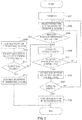
- FIG. 3 is a flowchart showing an example of the selection/switching process of the terrestrial system and the satellite system in the communication terminal apparatus according to the present embodiment.
- the communication terminal apparatus 10 is powered on (S101)
- the terrestrial system is selected (S102) and it is switched to the antenna 11 and the first system parameter group for the terrestrial system.
- Pth1 a predetermined first threshold value
- step S103 when the received power of the terrestrial system is larger than the first threshold value Pth1 (YES in S103), the reception by the terrestrial system is continued (S109).
- the base station identifier in the common control signal included in the received signal is received (S110), it is determined whether or not the received signal is the received signal of the terrestrial system based on the base station identifier (S111).
- the reception by the terrestrial system is continued (S112).
- the terrestrial system with more stable radio transmission environment in the normal condition can be used preferentially, and it is capable of automatically switching to the satellite system when the received signal from the terrestrial system become weak for some reason.
- step S103 it is determined whether or not the received power received from the terrestrial cellular base station 20 of the terrestrial system is larger than the first threshold value Pth1, however, it may be determined whether or not the received power is equal to or larger than the first threshold value Pth1.
- step S105 it is determined whether or not the received power received from the artificial geostationary satellite 40 of the satellite system is larger than the second threshold value Pth2, however, it may be determined whether or not the received power is equal to or larger than the second threshold value Pth2.
- the satellite system of the present embodiment is an example of a case where the artificial geostationary satellite 40 has a single beam antenna configuration.
- the satellite station area 400 where the communication relay apparatus 41 of the artificial geostationary satellite 40 can communicate with the communication terminal apparatus 10 is a single beam area corresponding to the beam 410 indicating the orientated direction of the antenna of the communication relay apparatus 41. It is noted that, in the satellite system, the artificial geostationary satellite 40 may have a multi-beam antenna configuration.
- the satellite station area 400 where the communication relay apparatus 41 of the artificial geostationary satellite 40 can communicate with the communication terminal apparatus 10 becomes a plurality of beam areas, which are spatially offset from each other, corresponding to the beams indicating a plurality of mutually different oriented directions of the antenna of the communication relay apparatus 41.
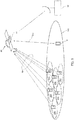
- FIG. 4A is an illustration showing a state of interference from the satellite system to the terrestrial system when the communication terminal apparatus 10 performs a downlink communication
- FIG. 4B is a graph showing an example of change in the received power from the terrestrial system and the satellite system respectively with respect to the position of the communication terminal apparatus 10 of FIG. 4A
- Sgd and Psgd in the figure indicate a terrestrial desired wave from the terrestrial cellular base station 20 to the communication terminal apparatus 10 in the terrestrial communication mode in the terrestrial station area 200 and its received power respectively
- Igd and Pigd indicate a terrestrial interference wave from the terrestrial cellular base station 20 to the communication terminal apparatus 10 of the satellite communication mode in the satellite station area 400 and its received power respectively.
- Ssd and Pssd in the figure indicate a satellite desired wave from the communication relay apparatus 41 of the artificial geostationary satellite 40 to the communication terminal apparatus 10 of the satellite communication mode in the satellite station area 400 and its received power respectively
- Isd and Pisd indicate a satellite interference wave from the communication relay apparatus 41 to the communication terminal apparatus 10 of the terrestrial communication mode in the terrestrial station area 200 and its received power respectively.
- propagation loss between the communication relay apparatus 41 of the artificial geostationary satellite 40 and the communication terminal apparatus 10 is much larger than propagation loss between the terrestrial cellular base station 20 and the communication terminal apparatus 10 (for example, 50 dB or more larger). Accordingly, in the terrestrial station area 200, the received power Pis of the satellite interference wave Is received from the communication relay apparatus 41 of the artificial geostationary satellite 40 is extremely small. For example, the received power Pis of the satellite interference wave Is from the communication relay apparatus 41 of the artificial geostationary satellite 40 is slightly larger than a thermal noise power Pn.
- the reception quality for example, SINR: desired signal power (thermal noise power Pn + interference signal power Pisd) ratio
- SINR desired signal power (thermal noise power Pn + interference signal power Pisd) ratio
- FIG. 5 is an illustration showing a state of interference from the terrestrial system to the satellite system when the communication terminal apparatus 10 performs an uplink communication.
- Ssu in the figure is a uplink satellite desired wave from the communication terminal apparatus 10 of the satellite communication mode to the communication relay apparatus 41 of the artificial geostationary satellite 40
- Igu is an uplink terrestrial interference wave from the communication terminal apparatus 10 in the terrestrial station area 200 to the communication relay apparatus 41 of the artificial geostationary satellite 40.
- the number of the communication terminal apparatuses 10, which are in the terrestrial communication mode and simultaneously communicate using the terrestrial system corresponds to the number of the terrestrial cellular base station 20 existing in the satellite station area 400.
- the uplink interference power from the terrestrial system received by the communication relay apparatus 41 of the artificial geostationary satellite 40 is the sum of the power of the terrestrial interference wave Igu from a plurality of the communication terminal apparatus 10 simultaneously using the terrestrial system.
- the uplink interference power received from the communication relay apparatus 41 becomes a much larger value than the electric power of the uplink satellite desired wave Ssu from the communication terminal apparatus 10 using the satellite system, and the uplink reception quality (for example, SINR: desired signal power Pssu pair (thermal noise power Pn + interference signal power Pigu) ratio) greatly deteriorates, so the uplink communication of the satellite system can not be performed. Accordingly, in the uplink, the same time slot cannot be used for the terrestrial system and the satellite system.
- SINR desired signal power Pssu pair (thermal noise power Pn + interference signal power Pigu) ratio
- all of the time slots allocated to the terrestrial system and at least a part of the time slots allocated to the satellite system are used in the downlink to the communication terminal apparatus 10, and all of the time slots allocated to the terrestrial system are used so as not to use the time slots allocated to the satellite system in the uplink from the communication terminal apparatus 10.
- FIG. 6 is an illustration showing an example of time-slot allocation and proper use of the allocated time slot in downlink and uplink according to the mobile communication system of the present embodiment. It is noted that, in the example of FIG. 6 and the example of FIG. 7 described below respectively, although the case where the number of time slots allocated by time division of the radio frame is 8 is illustrated, the number of division of the radio frame (number of time slots per radio frame) may be equal to 7 or less, or equal to 9 or more. Moreover, in an example shown in the figure, although time slots T1 to T3, T5 and T6 are allocated to the terrestrial system and other time slots T4, T7 and T8 are allocated to the satellite system, the allocation of the time slots is not limited to the illustrated example.
- time slots T4, T7 and T8 allocated to the satellite system are used.
- time slots T1 to T3, T5 and T6 allocated to the terrestrial system are used.
- all of the time slots T1 to T3, T5 and T6 allocated to the terrestrial system and a part of the time slots T4, T7 and T8 (in the illustrated example, time slots T7 and T8) allocated to the satellite system are used.
- the downlink radio communication of the terrestrial system of FIG. 6 it may be controlled so as to use a part of the time slots allocated to the satellite system, depending on the traffic amount of the downlink. For example, when the downlink traffic amount is small, it may be controlled to use the time slots T1 to T3, T5 and T6 allocated to the terrestrial system without using time slots allocated to the satellite system, and when the downlink traffic amount increases, it may be controlled to further use a part of the time slots T4, T7 and T8 allocated to the satellite system.
- the uplink in the terrestrial station area 200 all of the time slots T1 to T3, T5 and T6 allocated to the terrestrial system are used, and the time slots T4, T7 and T8 allocated to the satellite system are not used. Accordingly, it is possible to avoid that the signal of the uplink of the terrestrial system interferes with the signal of the uplink of the satellite system.
- the radio resources of the satellite system which are controlled to be switched between the uplink and the downlink in the terrestrial station area 200 are time slots that are easy to be controlled, the switching control of the radio resources is easy compared with the case of controlling to switch frequencies.
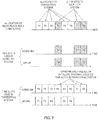
- FIG. 7 is an illustration showing another example of time slot allocation and proper use of the allocated time slot in downlink and uplink according to the mobile communication system of the present embodiment.
- FIG. 7 in downlink and uplink radio communications between the satellite base station 30 of the satellite system and the communication terminal apparatus 10, all of the time slots T4, T7 and T8 allocated to the satellite system are used.
- the uplink radio communication from the communication terminal apparatus 10 of the terrestrial system to the terrestrial cellular base station 20 all of the time slots T1 to T3, T5 and T6 allocated to the terrestrial system are used.
- the downlink radio communication of the terrestrial system of FIG. 7 it may be controlled so as to use the time slots allocated to the satellite system, depending on the traffic amount of the downlink. For example, when the downlink traffic amount is small, it may be controlled to use the time slots T1 to T3, T5 and T6 allocated to the terrestrial system without using time slots allocated to the satellite system, and when the downlink traffic amount increases, it may be controlled to further use all of the time slots T4, T7 and T8 allocated to the satellite system.
- the influence of interference from the satellite system can be reduced to a negligible level, and it is possible to avoid that the uplink signal of the terrestrial system interferes with the uplink signal of the satellite system, and the switching control of the radio resources is easy compared with the case of controlling to switch frequencies.
- the present embodiment it is possible to share the communication terminal apparatus 10 for the terrestrial system and the satellite system, and it is possible to improve the spectral efficiency (throughput) of the downlink in the terrestrial system while avoiding an interference between both systems by simple switching control of radio resources.
- process steps and configuration elements in the mobile communication system, the base station, the communication terminal apparatus (user terminal equipment, mobile station) and the components of the router device described in the present specification can be implemented with various means.
- these process steps and configuration elements may be implemented with hardware, firmware, software, or a combination thereof.
- means such as processing units or the like used for establishing the foregoing steps and configuration elements in entities may be implemented in one or more of an application-specific IC (ASIC), a digital signal processor (DSP), a digital signal processing apparatus (DSPD), a programmable logic device (PLD), a field programmable gate array (FPGA), a processor, a controller, a microcontroller, a microprocessor, a electronic device, other electronic unit, computer, or a combination thereof, which are designed so as to perform a function described in the present specification.
- ASIC application-specific IC
- DSP digital signal processor
- DSPD digital signal processing apparatus
- PLD programmable logic device
- FPGA field programmable gate array
- processor a controller, a microcontroller, a microprocessor, a electronic device, other electronic unit, computer, or a combination thereof, which are designed so as to perform a function described in the present specification.
- means such as processing units or the like for establishing the foregoing configuration elements may be implemented with a program (for example, code such as procedure, function, module, instruction, etc.) for performing a function described in the present specification.
- a program for example, code such as procedure, function, module, instruction, etc.
- any computer/processor readable medium of materializing the code of firmware and/or software may be used for implementation of means such as processing units and so on for establishing the foregoing steps and configuration elements described in the present specification.
- the firmware and/or software code may be stored in a memory and executed by a computer or processor.
- the memory may be implemented within the computer or processor, or outside the processor.
- firmware and/or software code may be stored in, for example, a medium capable being read by a computer or processor, such as a random-access memory (RAM), a read-only memory (ROM), a non-volatility random-access memory (NVRAM), a programmable read-only memory (PROM), an electrically erasable PROM (EEPROM), a FLASH memory, a floppy (registered trademark) disk, a compact disk (CD), a digital versatile disk (DVD), a magnetic or optical data storage unit, or the like.
- RAM random-access memory
- ROM read-only memory
- NVRAM non-volatility random-access memory
- PROM programmable read-only memory
- EEPROM electrically erasable PROM
- FLASH memory a FLASH memory
- floppy (registered trademark) disk a compact disk (CD), a digital versatile disk (DVD)
- CD compact disk
- DVD digital versatile disk
- magnetic or optical data storage unit or the like.
Landscapes
- Engineering & Computer Science (AREA)
- Computer Networks & Wireless Communication (AREA)
- Signal Processing (AREA)
- Physics & Mathematics (AREA)
- Astronomy & Astrophysics (AREA)
- General Physics & Mathematics (AREA)
- Aviation & Aerospace Engineering (AREA)
- Mobile Radio Communication Systems (AREA)
- Radio Relay Systems (AREA)
Abstract
Description
- The present invention relates to a mobile communication system, and a communication terminal apparatus and a terrestrial cellular base station in the mobile communication system.
- A communication terminal apparatus is conventionally known, which is capable of using a terrestrial cellular mobile communication system (hereinafter abbreviated as "terrestrial system" as appropriate) via a cellular base station located on the ground and a satellite mobile communication system (hereinafter abbreviated as "satellite system" as appropriate) via an artificial satellite in a same area (for example, refer to Non-Patent Literature 1 and Patent Literature 1).
- Patent Literature 1: Japanese Unexamined Patent Application Publication No.
2014-064219 - Non-Patent Literature 1: Tadashi Minowa and six others, "Satellite/Terrestrial Integrated Mobile Communication System for Security and Safety", The Transactions of the Institute of Electronics, Information and Communication Engineers B, Vol. J91-B, No. 12, pp. 1629-1640, 2008/12.
- In the communication terminal apparatus that can be shared in the terrestrial system and the satellite system, there is a problem to improve a spectral efficiency in a downlink of the terrestrial system while avoiding an interference between both systems by a simple switching control of radio resources.
- A communication terminal apparatus according to an aspect of the present invention, which is a communication terminal apparatus shared in a terrestrial cellular mobile communication system and a satellite mobile communication system, comprises memory means for memorizing allocation information on time slots of radio resources allocated to the terrestrial cellular mobile communication system and the satellite mobile communication system in which a same frequency band is used, so as not to overlap with each other on a time axis between the systems, transceiving means for performing a radio communication by selecting one of a terrestrial cellular mobile communication method and a satellite mobile communication method according to an area in which the communication terminal apparatus is located, and control means for controlling so as to use all of time slots allocated to the terrestrial cellular mobile communication system and at least a part of time slots allocated to the satellite mobile communication system in a downlink to the communication terminal apparatus, and so as to use all of time slots allocated to the terrestrial cellular mobile communication system and none of time slots allocated to the satellite mobile communication system in an uplink from the communication terminal apparatus, based on the allocation information on the time slots of radio resources, when the communication terminal apparatus is located in an area of the terrestrial cellular mobile communication system.
- A terrestrial cellular base station according to another aspect of the present invention, which is a terrestrial cellular base station capable of communicating with a communication terminal apparatus in a mobile communication system including a terrestrial cellular mobile communication system and a satellite mobile communication system, comprises memory means for memorizing allocation information on time slots of radio resources allocated to the terrestrial cellular mobile communication system and the satellite mobile communication system in which a same frequency band is used, so as not to overlap with each other on a time axis between the systems, transceiving means for performing a radio communication with a communication terminal apparatus located in an area of an own base station by the terrestrial cellular mobile communication method, and control means for controlling so as to use all of time slots allocated to the terrestrial cellular mobile communication system and at least a part of time slots allocated to the satellite mobile communication system in a downlink to the communication terminal apparatus located in the area of the own base station, and so as to use all of time slots allocated to the terrestrial cellular mobile communication system and none of time slots allocated to the satellite mobile communication system in a uplink from the communication terminal apparatus located in the area of the own station, based on the allocation information on the time slots of radio resource.
- According to the communication terminal apparatus and the terrestrial cellular base station, in the downlink in the area of the terrestrial cellular mobile communication system, not only all of the time slots allocated to the terrestrial cellular mobile communication system but also at least a part of the time slots allocated to the satellite mobile communication system are used. Accordingly, it is capable of improving a spectral efficiency of the downlink in the terrestrial cellular mobile communication system. Moreover, in the downlink in the area of the terrestrial cellular mobile communication system, since strength of a signal from the terrestrial cellular mobile communication system is much weaker than strength of a signal from the satellite mobile communication system, even if the time slots allocated to the satellite mobile communication system are used, an influence of interference from the satellite mobile communication system can be reduced to a negligible level.
- On the other hand, in the uplink in the area of the terrestrial cellular mobile communication system, all of the time slots allocated to the terrestrial cellular mobile communication system are used, and the time slots allocated to the satellite mobile communication system are not used. Accordingly, it is capable of avoiding an interference of an uplink signal of the terrestrial cellular mobile communication system with an uplink signal of the satellite mobile communication system.
- Furthermore, since the radio resources of the satellite mobile communication system, which are controlled so as to switch between the uplink and the downlink in the area of the terrestrial cellular mobile communication system, are time slots that are easy to control, the control for switching the radio resources is easier than when frequencies of the radio resources are controlled to be switched.
- In the foregoing communication terminal apparatus, the control means may control to use all of the time slots allocated to the terrestrial cellular mobile communication system and all of the time slots allocated to the satellite mobile communication system in the downlink to the communication terminal apparatus when the communication terminal apparatus is located in the area of the terrestrial cellular mobile communication system.
- Moreover, in the foregoing terrestrial cellular base station, the control means may control to use all of the time slots allocated to the terrestrial cellular mobile communication system and all of the time slots allocated to the satellite mobile communication system in the downlink to the communication terminal apparatus located in the area of the own station.
- According to the communication terminal apparatus and the terrestrial cellular base station, in the downlink in the area of the terrestrial cellular mobile communication system, by using all of the time slots allocated to the satellite mobile communication system, it is capable of further increasing the spectral efficiency in the downlink of the terrestrial cellular mobile communication system.
- In the foregoing communication terminal apparatus, the control means may control so as to change the number of time slots allocated to the satellite mobile communication system, which are used in the downlink to the communication terminal apparatus in the area of the terrestrial cellular mobile communication system, according to a traffic amount of the downlink in the area of the terrestrial cellular mobile communication system.
- Moreover, in the foregoing terrestrial cellular base station, the control means may control so as to change the number of time slots allocated to the satellite mobile communication system, which are used in the downlink to the communication terminal apparatus in the area of the own station, according to a traffic amount of the downlink to the communication terminal apparatus in the area of the own base station.
- According to the communication terminal apparatus and the terrestrial cellular base station, when the downlink traffic amount in the area of the terrestrial cellular mobile communication system is large, by increasing the number of time slots allocated to the satellite mobile communication system used in that area, it is capable of increasing the spectral efficiency in the downlink of the terrestrial cellular mobile communication system so as to comply with an increase of the traffic amount. Moreover, when the downlink traffic amount in the area of the terrestrial cellular mobile communication system is small, by decreasing the number of time slots allocated to the satellite mobile communication system used in that area, it is capable of reducing the influence of the downlink signal of the satellite mobile communication system to the downlink of the terrestrial cellular mobile communication system.
- A mobile communication system according to still another aspect of the present invention, which is a mobile communication system including a terrestrial cellular mobile communication system and a satellite mobile communication system, comprises a terrestrial cellular base station capable of performing a radio communication with a communication terminal apparatus, a satellite base station capable of performing a radio communication with a communication terminal apparatus via a communication relay apparatus of an artificial satellite, and a base-station control apparatus that controls the terrestrial cellular base station and the satellite base station. The terrestrial cellular base station is any one of the terrestrial cellular base stations in the above-described aspects.
- According to the present invention, it is capable of sharing the terrestrial cellular mobile communication system and the satellite mobile communication system, and improving the spectral efficiency of the downlink in the terrestrial cellular mobile communication system while avoiding an interference between both systems by a simple switching control of radio resources.
-
- [
FIG. 1] FIG. 1 is an illustration showing an example of an overall configuration of a mobile communication system using a communication terminal apparatus according to an embodiment of the present invention. - [
FIG. 2] FIG. 2 is a block diagram showing a configuration example of a communication terminal apparatus according to the present embodiment. - [
FIG. 3] FIG. 3 is a flowchart showing an example of a selection/switching process of a terrestrial system and a satellite system in a communication terminal apparatus according to the present embodiment. - [
FIG. 4A] FIG. 4A is an illustration showing a state of interference from a satellite system to a terrestrial system when a communication terminal apparatus performs a downlink communication. - [
FIG. 4B] FIG. 4B is a graph showing an example of change of a received power from a terrestrial system and a satellite system respectively with respect to the position of the communication terminal apparatus inFIG. 4A . - [
FIG. 5] FIG. 5 is an illustration showing a state of interference from a terrestrial system to a satellite system when a communication terminal apparatus performs an uplink communication. - [
FIG. 6] FIG. 6 is an illustration showing an example of time-slot allocation and proper use of the allocated time slots in downlink and uplink according to the mobile communication system of the present embodiment. - [
FIG. 7] FIG. 7 is an illustration showing another example of time-slot allocation and proper use of the allocated time slots in downlink and uplink according to the mobile communication system of the present embodiment. - Hereinafter, various embodiments of the present invention will be described with reference to the drawings.
-
FIG. 1 is an illustration showing an example of an overall configuration of a mobile communication system (mobile phone system) using a communication terminal apparatus according to an embodiment of the present invention. Thecommunication terminal apparatus 10 of the present embodiment can use a terrestrial system (terrestrial cellular mobile communication system) via a terrestrial cellular base station and a satellite system (satellite mobile communication system) via an artificial geostationary satellite. - It is noted that, in the present embodiment, a communication operation mode when the
communication terminal apparatus 10 communicates by using the terrestrial system is called a "terrestrial communication mode", and a communication operation mode when thecommunication terminal apparatus 10 is communicates by using the satellite system is called a "satellite communication mode". In the present embodiment, although cases where the artificial satellite used in the satellite mobile communication system is a geostationary satellite (hereinafter called as "artificial geostationary satellite") will be described, an artificial satellite such as a non-geostationary satellites and a quasi-zenith satellite other than the artificial geostationary satellite may be used in the satellite mobile communication system. - In
FIG. 1 , the mobile communication system of the present embodiment is provided with a base station 20 (hereinafter called as "terrestrial cellular base station") capable of performing a radio communication with thecommunication terminal apparatus 10 via the terrestrial system, and asatellite base station 30 capable of performing a radio communication with thecommunication terminal apparatus 10 via acommunication relay apparatus 41 of an artificialgeostationary satellite 40 as a satellite relay station. Abase station apparatus 21 of the terrestrialcellular base station 20, abase station apparatus 31 of thesatellite base station 30 and a base-station control apparatus 50 for controlling each of the base stations are respectively connected to acore network 60 via a wired communication line consisting of a leased line, a general-purpose line, etc. - The same radio transmission method and the same frequency band are used for the radio communication between the
communication terminal apparatus 10 and each of the terrestrialcellular base station 20 and thecommunication relay apparatus 41 of the artificialgeostationary satellite 40. As a radio transmission method, for example, a communication method of the third generation mobile communication system (3G) such as a WCDMA (registered trademark) (Wideband Code Division Multiple Access) and a CDMA-2000, a communication method of LTE (Long Term Evolution) and LTE-Advanced, a communication method of the fourth generation mobile telephone, etc. can be adopted. Moreover, as a frequency band of radio communication (service link) with thecommunication terminal apparatus 10, for example, a frequency band of a predetermined band (for example, 30 MHz) in the MSS band (1,980 to 2,010 MHz for uplink and 2,170 to 2,200 MHz for downlink) that is standardized by the IMT (International Mobile Telecommunication) -2000 can be allocated. Furthermore, as a frequency band of radio communication (feeder link) between thecommunication relay apparatus 41 of the artificialgeostationary satellite 40 and thesatellite base station 30 on the ground, for example, a frequency band of a predetermined band in the Ku band (14 GHz for uplink and 12 GHz for downlink) can be allocated. - The
communication terminal apparatus 10 is a mobile telephone, a smart-phone or a portable personal computer, etc. having a mobile communication function, and is also called as a user equipment (UE), a mobile apparatus, a mobile station apparatus or a portable communication terminal. For example, when thecommunication terminal apparatus 10 is located in an area where the area (hereinafter called as "terrestrial station area") 200 in which a radio communication can be performed with the terrestrial cellular base station 20and the area (hereinafter called as "satellite station area") 400 in which a radio communication can be performed with thecommunication relay apparatus 41 of the artificialgeostationary satellite 40 are overlapped, thecommunication terminal apparatus 10 can use the terrestrial system and the satellite system. It is noted that, in this overlapping area, since strength (received power) of signal received from the terrestrialcellular base station 20 is high, thecommunication terminal apparatus 10 preferentially uses the terrestrial system. Moreover, when thecommunication terminal apparatus 10 is located in an area outside theterrestrial station area 200 and within thesatellite station area 400, thecommunication terminal apparatus 10 can use the satellite system. - The terrestrial
cellular base station 20 is provided with thebase station apparatus 21 and an antenna, etc. and is capable of communicating with thecommunication terminal apparatus 10 at the frequency f0 within the aforementioned predetermined frequency band by using a predetermined radio transmission method (modulation method). As the terrestrialcellular base station 20, for example, a macro base station for wide area which covers a macro cell being as a normal wide area with a radius from about several hundred meters to several kilometers and a small base station provided to cover a smaller area (for example, pico cell and femto cell) than the area covered by the wide area macro base station can be exemplified. The macro base station may be referred to as "macro-cell base station", "Macro e-Node B", or the like, and the small base station may also be referred to as "small-cell base station", "Micro-cell base station". - The
satellite base station 30 is provided with abase station apparatus 31 similar to thebase station apparatus 21 of the terrestrialcellular base station 20, afrequency converting apparatus 32, and an antenna, etc. and may also be referred to as "feeder link station". Using the predetermined radio transmission method (modulation method) similar to the terrestrialcellular base station 20, thesatellite base station 30 can communicate with thecommunication relay apparatus 41 of the artificialgeostationary satellite 40 by converting the frequency f0 to the frequency fc for the satellite communication. When relaying a communication between thebase station apparatus 31 and thecommunication relay apparatus 41 of the artificialgeostationary satellite 40, thefrequency converting apparatus 32 functions as frequency converting means for performing a conversion between the frequency f0 used in thebase station apparatus 31 and the frequency fc for satellite communication used for communication of thecommunication relay apparatus 41 of the artificialgeostationary satellite 40. - The
communication relay apparatus 41 of the artificialgeostationary satellite 40 has frequency converting means for performing a non-regenerative frequency conversion relay. When relaying a communication between thecommunication terminal apparatus 10 and thesatellite base station 30, the frequency converting means performs a conversion between the frequency f0 used for communication with thecommunication terminal apparatus 10 and the frequency fc for satellite communication used for communication with thesatellite base station 30. For example, thecommunication relay apparatus 41 can communicate with thecommunication terminal apparatus 10 at the frequency f0 by converting the frequency fc of the signal received from thesatellite base station 30 to the frequency f0. - The base-
station control apparatus 50 may control an allocation of radio resources (frequency, time slot) with respect to the terrestrialcellular base station 20 and thesatellite base station 30 corresponding to a common area to which at least a part of areas capable of performing a radio communication with thecommunication terminal apparatus 10. That is, the base-station control apparatus 50 performs a control to allocate radio resources used in the terrestrialcellular base station 20 and radio resources used in thesatellite base station 30 so that they do not overlap with each other. Moreover, in an emergent condition in which a failure occurs in some of the terrestrialcellular base stations 20 due to a disaster or the like, the base-station control apparatus 50 may also control to increase the radio resource (for example, time slot) allocated for thesatellite base station 30 so as to be more than that in a normal condition. For example, in an emergent condition in which a failure occurs in some of the terrestrialcellular base stations 20 due to a disaster or the like, the base-station control apparatus 50 controls to increase an allocation rate of radio resources (for example, time slots) allocated to thesatellite base station 30 so as to be more than that in a normal condition. These controls may be performed, for example, by transmitting a predetermined control data from the base-station control apparatus 50 to the terrestrialcellular base station 20 and thesatellite base station 30. Here, the "allocation rate" of radio resources allocated to thesatellite base station 30 is a ratio of radio resources allocated to thesatellite base station 30 in radio resources allocated to all of the terrestrialcellular base station 20 and thesatellite base station 30 in the common area. - In particular, in the present embodiment, the base-
station control apparatus 50 performs a control to allocate time slots of the radio resource used in the terrestrialcellular base station 20 and time slots of the radio resource used in thesatellite base station 30 so that they do not overlap with each other. The time slot of radio resource is a time interval obtained by dividing a radio communication frame of a predetermined time length by a predetermined number, and a basic unit of temporal allocation control of the radio resources. For example, when a radio communication frame of the radio resource allocated to all of the terrestrialcellular base station 20 and thesatellite base station 30 is divided into 8 or 10, the 8 or 10 time slots in the radio communication frame are allocated so that the time slots do not overlap between the terrestrialcellular base station 20 and thesatellite base station 30. - Allocation information on the radio resource (time slot) allocated to each of the terrestrial system and the satellite system is sent from the base-
station control apparatus 50 to the terrestrialcellular base station 20 and thesatellite base station 30 respectively, and memorized in a memory device of eachbase station cellular base station 20 and thesatellite base station 30 performs downlink and uplink communications with thecommunication terminal apparatus 10 based on the allocation information on the radio resource (time slot). The allocation information on the radio resource (time slot) is sent, for example, from the terrestrialcellular base station 20 and thesatellite base station 30 to thecommunication terminal apparatus 10, and memorized in the memory device of thecommunication terminal apparatus 10. Thecommunication terminal apparatus 10 performs downlink and uplink communications with the terrestrialcellular base station 20 and thesatellite base station 30 respectively based on the allocation information on the radio resource (time slot). - The
communication terminal apparatus 10 is configured with, for example, hardware such as a computer apparatus having a CPU, a memory, etc., and a radio communication section, and can perform a radio communication with the terrestrialcellular base station 20 and thesatellite base station 30, by executing a predetermined program. The terrestrialcellular base station 20 and thesatellite base station 30 are configured with, for example, hardware such as a computer apparatus having a CPU, a memory, etc., an external communication interface section for thecore network 60, and a radio communication section, and can perform a radio communication with thecommunication terminal apparatus 10 and a communication with thecore network 60 side, by executing a predetermined program. The base-station control apparatus 50 is configured with, for example, hardware such as a computer apparatus having a CPU, a memory, etc., an external communication interface section for thecore network 60, and can perform a control of the terrestrialcellular base station 20 and thesatellite base station 30, by executing a predetermined program. - The
communication terminal apparatus 10, the terrestrialcellular base station 20 and thesatellite base station 30 in the present embodiment are timely synchronized with each other with a predetermined time accuracy (for example, 1 µs or less) so as to comply with the foregoing allocation control of the time slots of radio resource. This time synchronization may be performed, for example, by accessing a predetermined time server or receiving a signal from a GPS satellite. -
FIG. 2 is a block diagram showing a configuration example of thecommunication terminal apparatus 10 according to the present embodiment. It is noted that, the configuration of thecommunication terminal apparatus 10 is not limited to the configuration ofFIG. 2 , however, may be any configuration as long as it can be used in the terrestrial system and the satellite system and can comply with an allocation control of time slots of the radio resource in the terrestrial system and the satellite system. - In
FIG. 2 , thecommunication terminal apparatus 10 is provided with afirst antenna 11 used for a radio communication with the terrestrialcellular base station 20 in the terrestrial system, asecond antenna 12 used for a radio communication with the artificialgeostationary satellite 40 in the satellite system, and an antenna changeover switch (sw) 181 as antenna switching means. Thefirst antenna 11 is, for example, a linear antenna corresponding to a vertically polarized wave of the terrestrial system, and thesecond antenna 12 is a helical antenna or a patch antenna corresponding to a circular polarized wave of the satellite system. Theantenna changeover switch 181 switches between thefirst antenna 11 and thesecond antenna 12 depending on the selected terrestrial system or satellite system. - Furthermore, the
communication terminal apparatus 10 is provided with abaseband unit 13 as shared baseband processing means, and amemory device 14 as memory means for memorizing a system parameter group used for thebaseband unit 13. Thebaseband unit 13 performs a process of a downlink received signal R and an uplink transmission signal T based on the system parameter group consisting of a preset value for each of multiple types of system parameters that are commonly defined for the terrestrial system and the satellite system. - The
baseband unit 13 performs a process of generating the uplink transmission signal T by modulating a transmission data of a predetermined time slot, and acquiring a data by demodulating the downlink received signal R of a predetermined time slot, based on a predetermined radio transmission method (for example, a radio transmission method specified by the 3GPP LTE or LTE-Advanced). For this processing in thebaseband unit 13, the first system parameter group optimized for the terrestrial system or the second system parameter group optimized for the satellite system is used. - The
memory device 14 memories the first system parameter group optimized for the terrestrial system and the second system parameter group optimized for the satellite system as a system parameter group used for thebaseband unit 13. The multiple types of system parameters are, for example, a modulation method, a code rate of error correction code, a maximum number of retransmissions during a retransmission control, and transceiving buffer amount for accumulating a transceiving data. Moreover, thememory device 14 memories the aforementioned allocation information on the radio resources (time slots) allocated to the terrestrial system and the satellite system respectively. - Moreover, the
communication terminal apparatus 10 is provided with power amplification means 15 for amplifying power of the received signal R to be input to thebaseband unit 13 and the transmission signal T outputted from thebaseband unit 13 respectively. The power amplification means 15 of the present configuration example is provided with a shared low noise reception power amplifier (hereinafter called as "reception power amplifier") 151 used for power amplification of the received signal R of the terrestrial system and the satellite system respectively, a firsttransmission power amplifier 152 used for power amplification of the transmission signal T of the terrestrial system, and a secondtransmission power amplifier 153 used for power amplification of the transmission signal T of the satellite system. The firsttransmission power amplifier 152 amplifies the power of the transmission signal T of the terrestrial system so that the transmission power becomes, for example, 0.2 [W]. The secondtransmission power amplifier 153 amplifies the power of the transmission signal T of the satellite system so that the transmission power becomes, for example, 1 [W]. - In the configuration example of
FIG. 2 , thefirst antenna 11 and the firsttransmission power amplifier 152 arecomponents 10A dedicated to the terrestrial system, and thesecond antenna 12 and the secondtransmission power amplifier 153 arecomponents 10B dedicated to the satellite system. - The path of received signal R received by the
antennas antennas transmission power amplifier 152 and the path of the transmission signal T passing through the secondtransmission power amplifier 153 are switched by the transmission path changeover switches (SW) 182 and 183. - Moreover, the
communication terminal apparatus 10 is provided with a selection means for selecting any one of the terrestrial system or the satellite system, and acontrol apparatus 16 as control means for controlling to use the first system parameter group or the second system parameter group memorized in thememory device 14 for thebaseband unit 13 according to the terrestrial system or the satellite system selected by the selection means. Thecontrol apparatus 16 is configured with, for example, CPU, and memory such as a RAM, a ROM, etc., and functions as the control means, by loading and executing a predetermined control program. Thecontrol apparatus 16 according to the present embodiment also functions as selection means for selecting any one of the terrestrial system or the satellite system based on a base station identifier included in the common control signal described below and the received power. - It is noted that, the
communication terminal apparatus 10 may be provided with a display section such as a liquid crystal panel having a touch panel function connected to thecontrol apparatus 16, and an operation section such as an operation button. In this case, the display section or the operation section may be used as selection means so that a user can arbitrarily select any one of the terrestrial system and the satellite system. - In the
communication terminal apparatus 10 of the configuration example ofFIG. 2 , when the terrestrial system is selected, the received signal R of the predetermined time slot of the downlink from the terrestrialcellular base station 20 received by thefirst antenna 11 is amplified with thereception power amplifier 151, and then the received signal R is processed to obtain the original data based on the first system parameter group in thebaseband unit 13. Moreover, in thebaseband unit 13, the transmission signal T of the predetermined time slot of the uplink generated from a transmission-target data based on the first system parameter group is amplified to predetermined power (for example, 0.2 [W]) by the firsttransmission power amplifier 152 for the terrestrial system, and then the transmission signal T is transmitted from thefirst antenna 11 to the terrestrialcellular base station 20 by the predetermined time slot. - On the other hand, when the satellite system is selected, the received signal R of the predetermined time slot of the downlink from the artificial
geostationary satellite 40 received by thesecond antenna 12 is amplified with thereception power amplifier 151, and then the received signal R is processed to obtain the original data based on the second system parameter group in thebaseband unit 13. Moreover, in thebaseband unit 13, the transmission signal T of the predetermined time slot of the uplink generated from the transmission-target data based on the second system parameter group is amplified to predetermined power (for example, 0.1 [W]) by the secondtransmission power amplifier 153 for the satellite system, and then the transmission signal T is transmitted from thesecond antenna 12 to the artificialgeostationary satellite 40 by the predetermined time slot. - As described above, in the
communication terminal apparatus 10 of the configuration example ofFIG. 2 , since thededicated antennas baseband unit 13 according to the mobile communication system selected from the terrestrial system and the satellite system, it is capable of performing the radio communication corresponding to the radio transmission environment of the selected mobile communication system. Moreover, by switching theantennas baseband unit 13 for processing the received signal R and the transmission signal T based on the system parameter groups can be shared in the terrestrial system and the satellite system, it is possible to have a simple configuration as compared with a configuration in which a dedicated baseband unit is provided for each of the terrestrial system and the satellite system. - Especially, in the
communication terminal apparatus 10 of the configuration example ofFIG. 2 , since the dedicatedtransmission power amplifier reception power amplifier 151 can be shared in both of the terrestrial system and the satellite system, a simpler configuration can be achieved. -
FIG. 3 is a flowchart showing an example of the selection/switching process of the terrestrial system and the satellite system in the communication terminal apparatus according to the present embodiment. InFIG. 3 , when thecommunication terminal apparatus 10 is powered on (S101), the terrestrial system is selected (S102) and it is switched to theantenna 11 and the first system parameter group for the terrestrial system. Next, it is determined whether or not the power (received power) of the received signal received from the terrestrialcellular base station 20 of the terrestrial system is larger than a predetermined first threshold value Pth1 (S103). When the received power of the terrestrial system is smaller than or equal to the first threshold value Pth1 (NO in S103), the terrestrial system is switched to the satellite system (S104), and it is switched to theantenna 12 and the second system parameter group for the satellite system. - Next, it is determined whether or not the received power received from the artificial
geostationary satellite 40 of the satellite system is larger than a predetermined second threshold value Pth2 (S105). When the received power of the satellite system is larger than the second threshold value Pth2 (YES in S105), a base station identifier in the common control signal included in the received signal is received (S106), and it is determined whether or not the received signal is the received signal of the satellite system based on the base station identifier (S107). Herein, when it is determined that the received signal is the received signal of the satellite system (YES in S107), the reception by the satellite system is continued (S108). On the other hand, when it is determined that the received signal is not the received signal of the satellite system (NO in S107), it is switched to the terrestrial system (S102). - In the step S103, when the received power of the terrestrial system is larger than the first threshold value Pth1 (YES in S103), the reception by the terrestrial system is continued (S109). Next, the base station identifier in the common control signal included in the received signal is received (S110), it is determined whether or not the received signal is the received signal of the terrestrial system based on the base station identifier (S111). Herein, when it is determined that the received signal is the received signal of the terrestrial system (YES in S111), the reception by the terrestrial system is continued (S112). On the other hand, when it is determined that the received signal is not the received signal of the terrestrial system (NO in S111), it is switched to the satellite system (S104).
- According to the selection/switching process of the terrestrial system and the satellite system in
FIG. 3 , the terrestrial system with more stable radio transmission environment in the normal condition can be used preferentially, and it is capable of automatically switching to the satellite system when the received signal from the terrestrial system become weak for some reason. - It is noted that, in the selection/switching process of the terrestrial system and the satellite system in
FIG. 3 , in the step S103, it is determined whether or not the received power received from the terrestrialcellular base station 20 of the terrestrial system is larger than the first threshold value Pth1, however, it may be determined whether or not the received power is equal to or larger than the first threshold value Pth1. Moreover, in the step S105, it is determined whether or not the received power received from the artificialgeostationary satellite 40 of the satellite system is larger than the second threshold value Pth2, however, it may be determined whether or not the received power is equal to or larger than the second threshold value Pth2. - The satellite system of the present embodiment is an example of a case where the artificial
geostationary satellite 40 has a single beam antenna configuration. Thesatellite station area 400 where thecommunication relay apparatus 41 of the artificialgeostationary satellite 40 can communicate with thecommunication terminal apparatus 10 is a single beam area corresponding to thebeam 410 indicating the orientated direction of the antenna of thecommunication relay apparatus 41. It is noted that, in the satellite system, the artificialgeostationary satellite 40 may have a multi-beam antenna configuration. In this case, thesatellite station area 400 where thecommunication relay apparatus 41 of the artificialgeostationary satellite 40 can communicate with thecommunication terminal apparatus 10 becomes a plurality of beam areas, which are spatially offset from each other, corresponding to the beams indicating a plurality of mutually different oriented directions of the antenna of thecommunication relay apparatus 41. - As a result of an experiments and studies, which are conducted by the inventors of the present application, on the mobile communication system including the terrestrial system and the satellite system of the above-described configuration, it was found that the interference between the terrestrial system and the satellite system is different between the case of performing a downlink radio communication and the case of performing an uplink radio communication.
-
FIG. 4A is an illustration showing a state of interference from the satellite system to the terrestrial system when thecommunication terminal apparatus 10 performs a downlink communication, andFIG. 4B is a graph showing an example of change in the received power from the terrestrial system and the satellite system respectively with respect to the position of thecommunication terminal apparatus 10 ofFIG. 4A . Sgd and Psgd in the figure indicate a terrestrial desired wave from the terrestrialcellular base station 20 to thecommunication terminal apparatus 10 in the terrestrial communication mode in theterrestrial station area 200 and its received power respectively, and Igd and Pigd indicate a terrestrial interference wave from the terrestrialcellular base station 20 to thecommunication terminal apparatus 10 of the satellite communication mode in thesatellite station area 400 and its received power respectively. Moreover, Ssd and Pssd in the figure indicate a satellite desired wave from thecommunication relay apparatus 41 of the artificialgeostationary satellite 40 to thecommunication terminal apparatus 10 of the satellite communication mode in thesatellite station area 400 and its received power respectively, and Isd and Pisd indicate a satellite interference wave from thecommunication relay apparatus 41 to thecommunication terminal apparatus 10 of the terrestrial communication mode in theterrestrial station area 200 and its received power respectively. - In
FIG. 4 , propagation loss between thecommunication relay apparatus 41 of the artificialgeostationary satellite 40 and thecommunication terminal apparatus 10 is much larger than propagation loss between the terrestrialcellular base station 20 and the communication terminal apparatus 10 (for example, 50 dB or more larger). Accordingly, in theterrestrial station area 200, the received power Pis of the satellite interference wave Is received from thecommunication relay apparatus 41 of the artificialgeostationary satellite 40 is extremely small. For example, the received power Pis of the satellite interference wave Is from thecommunication relay apparatus 41 of the artificialgeostationary satellite 40 is slightly larger than a thermal noise power Pn. Therefore, even when time slots of the radio resources allocated to the satellite system are used on the downlink from the terrestrial system in theterrestrial station area 200, the reception quality (for example, SINR: desired signal power (thermal noise power Pn + interference signal power Pisd) ratio) of the downlink is slightly deteriorated. -
FIG. 5 is an illustration showing a state of interference from the terrestrial system to the satellite system when thecommunication terminal apparatus 10 performs an uplink communication. Ssu in the figure is a uplink satellite desired wave from thecommunication terminal apparatus 10 of the satellite communication mode to thecommunication relay apparatus 41 of the artificialgeostationary satellite 40, and Igu is an uplink terrestrial interference wave from thecommunication terminal apparatus 10 in theterrestrial station area 200 to thecommunication relay apparatus 41 of the artificialgeostationary satellite 40. - In
FIG. 5 , the number of thecommunication terminal apparatuses 10, which are in the terrestrial communication mode and simultaneously communicate using the terrestrial system, corresponds to the number of the terrestrialcellular base station 20 existing in thesatellite station area 400. The uplink interference power from the terrestrial system received by thecommunication relay apparatus 41 of the artificialgeostationary satellite 40 is the sum of the power of the terrestrial interference wave Igu from a plurality of thecommunication terminal apparatus 10 simultaneously using the terrestrial system. Accordingly, the uplink interference power received from thecommunication relay apparatus 41 becomes a much larger value than the electric power of the uplink satellite desired wave Ssu from thecommunication terminal apparatus 10 using the satellite system, and the uplink reception quality (for example, SINR: desired signal power Pssu pair (thermal noise power Pn + interference signal power Pigu) ratio) greatly deteriorates, so the uplink communication of the satellite system can not be performed. Accordingly, in the uplink, the same time slot cannot be used for the terrestrial system and the satellite system. - Therefore, in the present embodiment, when the
communication terminal apparatus 10 is located in theterrestrial station area 200 of the terrestrial system, all of the time slots allocated to the terrestrial system and at least a part of the time slots allocated to the satellite system are used in the downlink to thecommunication terminal apparatus 10, and all of the time slots allocated to the terrestrial system are used so as not to use the time slots allocated to the satellite system in the uplink from thecommunication terminal apparatus 10. -
FIG. 6 is an illustration showing an example of time-slot allocation and proper use of the allocated time slot in downlink and uplink according to the mobile communication system of the present embodiment. It is noted that, in the example ofFIG. 6 and the example ofFIG. 7 described below respectively, although the case where the number of time slots allocated by time division of the radio frame is 8 is illustrated, the number of division of the radio frame (number of time slots per radio frame) may be equal to 7 or less, or equal to 9 or more. Moreover, in an example shown in the figure, although time slots T1 to T3, T5 and T6 are allocated to the terrestrial system and other time slots T4, T7 and T8 are allocated to the satellite system, the allocation of the time slots is not limited to the illustrated example. - In
FIG. 6 , in downlink and uplink radio communication between thesatellite base station 30 of the satellite system and thecommunication terminal apparatus 10, time slots T4, T7 and T8 allocated to the satellite system are used. Moreover, in the uplink radio communication from thecommunication terminal apparatus 10 of the terrestrial system to the terrestrialcellular base station 20, time slots T1 to T3, T5 and T6 allocated to the terrestrial system are used. On the contrary, in the downlink radio communication from the terrestrialcellular base station 20 of the terrestrial system to thecommunication terminal apparatus 10, all of the time slots T1 to T3, T5 and T6 allocated to the terrestrial system and a part of the time slots T4, T7 and T8 (in the illustrated example, time slots T7 and T8) allocated to the satellite system are used. As a result, it is possible to improve the spectral efficiency (throughput) of the downlink of the terrestrial system having a large traffic amount. - It is noted that, in the downlink radio communication of the terrestrial system of
FIG. 6 , it may be controlled so as to use a part of the time slots allocated to the satellite system, depending on the traffic amount of the downlink. For example, when the downlink traffic amount is small, it may be controlled to use the time slots T1 to T3, T5 and T6 allocated to the terrestrial system without using time slots allocated to the satellite system, and when the downlink traffic amount increases, it may be controlled to further use a part of the time slots T4, T7 and T8 allocated to the satellite system. - As mentioned above, by separately using in the downlink and the uplink of the time slot when using the terrestrial system shown in
FIG. 6 , in the down link of theterrestrial station area 200 of the terrestrial system, not only all of the time slots T1 to T3, T5 and T6 allocated to the terrestrial system but also a part of the time slots T4, T7 and T8 allocated to the satellite system are used. Accordingly, it is possible to improve the spectral efficiency of the downlink in the terrestrial system. Moreover, in the downlink in theterrestrial station area 200, since the strength of the signal from the satellite system is much weaker than that of the signal from the terrestrial system, even when the time slots allocated to the satellite system is used, the influence of interference from the satellite system can be reduced to a negligible level. - On the other hand, in the uplink in the
terrestrial station area 200, all of the time slots T1 to T3, T5 and T6 allocated to the terrestrial system are used, and the time slots T4, T7 and T8 allocated to the satellite system are not used. Accordingly, it is possible to avoid that the signal of the uplink of the terrestrial system interferes with the signal of the uplink of the satellite system. - Moreover, since the radio resources of the satellite system, which are controlled to be switched between the uplink and the downlink in the
terrestrial station area 200 are time slots that are easy to be controlled, the switching control of the radio resources is easy compared with the case of controlling to switch frequencies. -
FIG. 7 is an illustration showing another example of time slot allocation and proper use of the allocated time slot in downlink and uplink according to the mobile communication system of the present embodiment. InFIG. 7 , in downlink and uplink radio communications between thesatellite base station 30 of the satellite system and thecommunication terminal apparatus 10, all of the time slots T4, T7 and T8 allocated to the satellite system are used. Moreover, in the uplink radio communication from thecommunication terminal apparatus 10 of the terrestrial system to the terrestrialcellular base station 20, all of the time slots T1 to T3, T5 and T6 allocated to the terrestrial system are used. On the contrary, in the downlink radio communication from the terrestrialcellular base station 20 of the terrestrial system to thecommunication terminal apparatus 10, all of the time slots T1 to T3, T5 and T6 allocated to the terrestrial system and all of the time slots T4, T7 and T8 allocated to the satellite system are used. Accordingly, it is possible to improve the spectral efficiency (throughput) of the downlink of the terrestrial system having a large traffic amount. - It is noted that, in the downlink radio communication of the terrestrial system of
FIG. 7 , it may be controlled so as to use the time slots allocated to the satellite system, depending on the traffic amount of the downlink. For example, when the downlink traffic amount is small, it may be controlled to use the time slots T1 to T3, T5 and T6 allocated to the terrestrial system without using time slots allocated to the satellite system, and when the downlink traffic amount increases, it may be controlled to further use all of the time slots T4, T7 and T8 allocated to the satellite system. - As mentioned above, by separately using in the downlink and the uplink of the time slot shown in
FIG. 7 , in the downlink of theterrestrial station area 200 of the terrestrial system, not only all of the time slots T1 to T3, T5 and T6 allocated to the terrestrial system but also all of the time slots T4, T7 and T8 allocated to the satellite system are used. Accordingly, it is possible to improve the spectral efficiency (throughput) of the downlink in the terrestrial system. - Moreover, as in the example of
FIG. 6 , even when the time slots allocated to the satellite system is used, the influence of interference from the satellite system can be reduced to a negligible level, and it is possible to avoid that the uplink signal of the terrestrial system interferes with the uplink signal of the satellite system, and the switching control of the radio resources is easy compared with the case of controlling to switch frequencies. - Especially in the example of
FIG. 7 , in the downlink of the terrestrial system area, by using all of the time slots T4, T7 and T8 allocated to the satellite system, it is possible to further increase the spectral efficiency (throughput) in the downlink of the terrestrial system. - As described above, according to the present embodiment, it is possible to share the
communication terminal apparatus 10 for the terrestrial system and the satellite system, and it is possible to improve the spectral efficiency (throughput) of the downlink in the terrestrial system while avoiding an interference between both systems by simple switching control of radio resources. - It is noted that, the process steps and configuration elements in the mobile communication system, the base station, the communication terminal apparatus (user terminal equipment, mobile station) and the components of the router device described in the present specification can be implemented with various means. For example, these process steps and configuration elements may be implemented with hardware, firmware, software, or a combination thereof.
- With respect to hardware implementation, means such as processing units or the like used for establishing the foregoing steps and configuration elements in entities (for example, various wireless communication apparatuses, Node B, communication terminal apparatus, hard disk drive apparatus, or optical disk drive apparatus) may be implemented in one or more of an application-specific IC (ASIC), a digital signal processor (DSP), a digital signal processing apparatus (DSPD), a programmable logic device (PLD), a field programmable gate array (FPGA), a processor, a controller, a microcontroller, a microprocessor, a electronic device, other electronic unit, computer, or a combination thereof, which are designed so as to perform a function described in the present specification.
- With respect to the firmware and/or software implementation, means such as processing units or the like for establishing the foregoing configuration elements may be implemented with a program (for example, code such as procedure, function, module, instruction, etc.) for performing a function described in the present specification. In general, any computer/processor readable medium of materializing the code of firmware and/or software may be used for implementation of means such as processing units and so on for establishing the foregoing steps and configuration elements described in the present specification. For example, in a control apparatus, the firmware and/or software code may be stored in a memory and executed by a computer or processor. The memory may be implemented within the computer or processor, or outside the processor. Further, the firmware and/or software code may be stored in, for example, a medium capable being read by a computer or processor, such as a random-access memory (RAM), a read-only memory (ROM), a non-volatility random-access memory (NVRAM), a programmable read-only memory (PROM), an electrically erasable PROM (EEPROM), a FLASH memory, a floppy (registered trademark) disk, a compact disk (CD), a digital versatile disk (DVD), a magnetic or optical data storage unit, or the like. The code may be executed by one or more of computers and processors, and a certain aspect of functionalities described in the present specification may by executed by a computer or processor.
- The description of embodiments disclosed in the present specification is provided so that the present disclosures can be produced or used by those skilled in the art. Various modifications of the present disclosures will be readily apparent to those skilled in the art and general principles defined in the present specification can be applied to other variations without departing from the spirit and scope of the present disclosures. Therefore, the present disclosures should not be limited to examples and designs described in the present specification and should be recognized to be in the broadest scope corresponding to principles and novel features disclosed in the present specification.
-
- 10
- communication terminal apparatus
- 20
- terrestrial cellular base station
- 30
- satellite base station
- 40
- artificial geostationary satellite
- 41
- communication relay apparatus
- 50
- base-station control apparatus
- 60
- core network
- 200
- terrestrial station area
- 400
- satellite station area
- 410
- beam
Claims (7)
- A communication terminal apparatus shared in a terrestrial cellular mobile communication system and a satellite mobile communication system, comprising:memory means for memorizing allocation information on time slots of radio resources allocated to the terrestrial cellular mobile communication system and the satellite mobile communication system in which a same frequency band is used, so as not to overlap with each other on a time axis between the systems;transceiving means for performing a radio communication by selecting one of a terrestrial cellular mobile communication method and a satellite mobile communication method according to an area in which the communication terminal apparatus is located; andcontrol means for controlling so as to use all of time slots allocated to the terrestrial cellular mobile communication system and at least a part of time slots allocated to the satellite mobile communication system in a downlink to the communication terminal apparatus, and so as to use all of time slots allocated to the terrestrial cellular mobile communication system and none of time slots allocated to the satellite mobile communication system in an uplink from the communication terminal apparatus, based on the allocation information on the time slots of radio resources, when the communication terminal apparatus is located in an area of the terrestrial cellular mobile communication system.
- The communication terminal apparatus according to claim 1,
wherein the control means controls to use all of the time slots allocated to the terrestrial cellular mobile communication system and all of the time slots allocated to the satellite mobile communication system in downlink to the communication terminal apparatus when the communication terminal apparatus is located in the area of the terrestrial cellular mobile communication system. - The communication terminal apparatus according to claim 1,
wherein the control means controls so as to change the number of time slots allocated to the satellite mobile communication system, the time slots being used in the downlink to the communication terminal apparatus in the area of the terrestrial cellular mobile communication system, according to a traffic amount of the downlink in the area of the terrestrial cellular mobile communication system. - A terrestrial cellular base station capable of communicating with a communication terminal apparatus in a mobile communication system including terrestrial cellular mobile communication system and satellite mobile communication system, and
wherein the terrestrial cellular base station comprises:memory means for memorizing allocation information on time slots of radio resources allocated to the terrestrial cellular mobile communication system and the satellite mobile communication system in which a same frequency band is used, so as not to overlap with each other on a time axis between the systems;transceiving means for performing a radio communication with a communication terminal apparatus located in an area of an own base station by terrestrial cellular mobile communication method; andcontrol means for controlling to use all of time slots allocated to the terrestrial cellular mobile communication system and at least a part of time slots allocated to the satellite mobile communication system in a downlink to the communication terminal apparatus located in the area of the own station, and so as to use all of time slots allocated to the terrestrial cellular mobile communication system and none of time slots allocated to the satellite mobile communication system in an uplink from the communication terminal apparatus located in the area of the own station, based on the allocation information on the time slots of radio resources. - The terrestrial cellular base station according to claim 4,
wherein the control means controls to use all of the time slots allocated to the terrestrial cellular mobile communication system and all of the time slots allocated to the satellite mobile communication system in the downlink to the communication terminal apparatus located in the area of the own base station. - The terrestrial cellular base station according to claim 4,
wherein the control means controls so as to change the number of time slots allocated to the satellite mobile communication system, the time slots being used in the downlink to the communication terminal apparatus in the area of the own station, according to traffic amount of the downlink to the communication terminal apparatus in the area of the own station. - A mobile communication system including a terrestrial cellular mobile communication system and a satellite mobile communication system, comprising:a terrestrial cellular base station capable of performing a radio communication with a communication terminal apparatus;a satellite base station capable of performing a radio communication with a communication terminal apparatus via a communication relay apparatus of an artificial satellite; anda base-station control apparatus that controls the terrestrial cellular base station and the satellite base station, andwherein the terrestrial cellular base station is the terrestrial cellular base station according to any one of claims 4 to 6.
Applications Claiming Priority (2)
| Application Number | Priority Date | Filing Date | Title |
|---|---|---|---|
| JP2016049568A JP2017168897A (en) | 2016-03-14 | 2016-03-14 | Communication terminal device, ground cellular base station and mobile communication system |
| PCT/JP2017/003465 WO2017159085A1 (en) | 2016-03-14 | 2017-01-31 | Communication terminal device, terrestrial cellular base station, and mobile communication system |
Publications (2)
| Publication Number | Publication Date |
|---|---|
| EP3432630A1 true EP3432630A1 (en) | 2019-01-23 |
| EP3432630A4 EP3432630A4 (en) | 2019-10-09 |
Family
ID=59850914
Family Applications (1)
| Application Number | Title | Priority Date | Filing Date |
|---|---|---|---|
| EP17766093.3A Withdrawn EP3432630A4 (en) | 2016-03-14 | 2017-01-31 | TERMINAL COMMUNICATION DEVICE, GROUND CELL BASE STATION, AND MOBILE COMMUNICATION SYSTEM |
Country Status (5)
| Country | Link |
|---|---|
| US (1) | US10659965B2 (en) |
| EP (1) | EP3432630A4 (en) |
| JP (1) | JP2017168897A (en) |
| CN (1) | CN109076348B (en) |
| WO (1) | WO2017159085A1 (en) |
Cited By (1)
| Publication number | Priority date | Publication date | Assignee | Title |
|---|---|---|---|---|
| WO2021038012A1 (en) * | 2019-08-29 | 2021-03-04 | Fraunhofer-Gesellschaft zur Förderung der angewandten Forschung e.V. | Method for controlling resources of at least two different radio access technology networks and controller |
Families Citing this family (17)
| Publication number | Priority date | Publication date | Assignee | Title |
|---|---|---|---|---|
| US11082903B2 (en) * | 2018-12-03 | 2021-08-03 | Electronics And Telecommunications Research Institute | Method for handover in non-terrestrial network, and apparatus for the same |
| CN110012503B (en) * | 2019-04-11 | 2022-06-10 | 厦门大学嘉庚学院 | Method for managing interference between high-altitude communication platform and ground honeycomb |
| JP7472908B2 (en) * | 2019-06-26 | 2024-04-23 | ソニーグループ株式会社 | Communication device and communication method |
| JP7220168B2 (en) * | 2020-02-19 | 2023-02-09 | Hapsモバイル株式会社 | Discontinuous coverage detection in overlay cell configuration and wireless network design based on the detection |
| CN111615127B (en) * | 2020-05-22 | 2022-08-05 | 海南大学 | Cooperative scheduling method for coexistence of fixed satellite service system and 5G cellular network |
| KR102642546B1 (en) * | 2020-06-30 | 2024-03-05 | 한국전자통신연구원 | Ultra low power data transmission method and apparatus |
| JP2023156536A (en) * | 2020-08-31 | 2023-10-25 | 株式会社Nttドコモ | Terminal, wireless communication method, and base station |
| CN112737662B (en) * | 2020-12-22 | 2022-08-02 | 中国电子科技集团公司第五十四研究所 | A UAV pipeline inspection system and multi-station relay method |
| JP7395528B2 (en) * | 2021-03-03 | 2023-12-11 | Kddi株式会社 | Base station switching method and system for accommodating communication terminals under a terrestrial base station using a satellite base station |
| CN118199706A (en) * | 2021-03-05 | 2024-06-14 | 北京小米移动软件有限公司 | Interference processing method and device, communication equipment and storage medium |
| WO2022205395A1 (en) * | 2021-04-02 | 2022-10-06 | Apple Inc. | Enhancement in ntn mobility |
| CN117099410A (en) * | 2021-04-12 | 2023-11-21 | 乐天移动株式会社 | Communication control device, communication control method, communication control program |
| US12395946B2 (en) | 2021-08-02 | 2025-08-19 | Rakuten Mobile, Inc. | Power control for flying base station |
| CN116014457A (en) * | 2021-10-21 | 2023-04-25 | 深圳富泰宏精密工业有限公司 | Antenna system and wireless communication device with the antenna system |
| CN114745737B (en) * | 2022-04-29 | 2023-01-13 | 爱浦路网络技术(北京)有限公司 | Flow control method, device and storage medium |
| CN118696570A (en) * | 2022-07-22 | 2024-09-24 | 乐天移动株式会社 | Transition of communication equipment to connected state based on operation plan of base station |
| JP7546110B1 (en) | 2023-06-22 | 2024-09-05 | ソフトバンク株式会社 | Mobile communication systems |
Family Cites Families (11)
| Publication number | Priority date | Publication date | Assignee | Title |
|---|---|---|---|---|
| US8121605B2 (en) * | 2002-06-27 | 2012-02-21 | Globalstar, Inc. | Resource allocation to terrestrial and satellite services |
| WO2008118593A1 (en) * | 2007-03-27 | 2008-10-02 | Telcom Ventures, Llc | Method and system for improving the spectral efficiency of a data communication link |
| GB0721307D0 (en) * | 2007-10-30 | 2007-12-12 | Nokia Siemens Networks Oy | Measuring apparatus |
| JP5396637B2 (en) * | 2009-05-29 | 2014-01-22 | 独立行政法人情報通信研究機構 | Terrestrial / satellite mobile phone system |
| US20110064017A1 (en) * | 2009-09-11 | 2011-03-17 | Electronics And Telecommunications Research Institute | Resource allocation method for mbms in an integrated communication system and a resource allocation controller therefor |
| US20130315112A1 (en) | 2012-05-25 | 2013-11-28 | Eden Rock Communications, Llc | System and methods for cellular/satellite network coexistence |
| JP5478688B2 (en) | 2012-09-22 | 2014-04-23 | ソフトバンクモバイル株式会社 | Mobile communication system and base station controller |
| FR2997253B1 (en) * | 2012-10-24 | 2014-10-31 | Thales Sa | METHOD FOR DYNAMIC ALLOCATION OF SHARED RESOURCES IN A TIME-FREQUENCY PLAN AND ASSOCIATED DEVICE |
| US20150079977A1 (en) * | 2013-09-16 | 2015-03-19 | Electronics And Telecommunications Research Institute | Apparatus and method of dynamically managing resources for interference control of satellite and terrestrial integrated communication system |
| US10149176B2 (en) * | 2014-01-28 | 2018-12-04 | Softbank Corp. | Mobile communication system and base station control apparatus |
| US20160267527A1 (en) * | 2015-03-10 | 2016-09-15 | Linkedin Corporation | Dynamic resource allocation |
-
2016
- 2016-03-14 JP JP2016049568A patent/JP2017168897A/en active Pending
-
2017
- 2017-01-31 EP EP17766093.3A patent/EP3432630A4/en not_active Withdrawn
- 2017-01-31 CN CN201780017254.6A patent/CN109076348B/en active Active
- 2017-01-31 WO PCT/JP2017/003465 patent/WO2017159085A1/en not_active Ceased
- 2017-01-31 US US16/084,685 patent/US10659965B2/en active Active
Cited By (2)
| Publication number | Priority date | Publication date | Assignee | Title |
|---|---|---|---|---|
| WO2021038012A1 (en) * | 2019-08-29 | 2021-03-04 | Fraunhofer-Gesellschaft zur Förderung der angewandten Forschung e.V. | Method for controlling resources of at least two different radio access technology networks and controller |
| EP4022798A1 (en) * | 2019-08-29 | 2022-07-06 | Fraunhofer-Gesellschaft zur Förderung der angewandten Forschung e.V. | Method for controlling resources of at least two different radio access technology networks and controller |
Also Published As
| Publication number | Publication date |
|---|---|
| US20190075468A1 (en) | 2019-03-07 |
| EP3432630A4 (en) | 2019-10-09 |
| CN109076348B (en) | 2023-05-16 |
| US10659965B2 (en) | 2020-05-19 |
| JP2017168897A (en) | 2017-09-21 |
| WO2017159085A1 (en) | 2017-09-21 |
| CN109076348A (en) | 2018-12-21 |
Similar Documents
| Publication | Publication Date | Title |
|---|---|---|
| US10659965B2 (en) | Communication terminal apparatus, terrestrial cellular base station and mobile communication system | |
| EP3432631B1 (en) | Communication terminal device, satellite base station, base station control device, and mobile communication system | |
| US10582459B2 (en) | User equipment transmission management for dynamically varying transmission emission requirements | |
| US10149176B2 (en) | Mobile communication system and base station control apparatus | |
| US8774014B2 (en) | Method for avoiding interference | |
| CN106575991B (en) | Apparatus, system, and method for relay backhaul using millimeter wave carrier aggregation | |
| CN114731674B (en) | System and method for determining a cancellation timeline for a user device with hybrid processing capabilities | |
| US20230071751A1 (en) | Management of default data subscription (dds) in multi-subscriber identity module devices | |
| EP4085713B1 (en) | Method for improving pn-npn coexistence | |
| US20230354279A1 (en) | Systems and methods to include demodulation reference signal bundling in multi-subscriber identity module devices | |
| US20200029257A1 (en) | Coordinated Cell Determining Method And Network Device | |
| JP6251705B2 (en) | Communication terminal device and router device | |
| US20250088259A1 (en) | Communication method, device and system | |
| US20250088260A1 (en) | Communication method, device and system | |
| JP2013046398A (en) | Radio relay device and radio communication method | |
| US11350447B2 (en) | Method and apparatus for operations in different frequency bands within a radio device | |
| US20260032655A1 (en) | Information transmitting method, information receiving method, repeater and network device | |
| US20240322897A1 (en) | Wireless communication apparatus and method | |
| WO2024031346A1 (en) | Harq-ack feedback for network-controlled repeaters | |
| CN112715014A (en) | Wireless communication method, network equipment and terminal equipment | |
| KR20200037770A (en) | Wireless communication method, terminal device, network device and network node |
Legal Events
| Date | Code | Title | Description |
|---|---|---|---|
| STAA | Information on the status of an ep patent application or granted ep patent |
Free format text: STATUS: THE INTERNATIONAL PUBLICATION HAS BEEN MADE |
|
| PUAI | Public reference made under article 153(3) epc to a published international application that has entered the european phase |
Free format text: ORIGINAL CODE: 0009012 |
|
| STAA | Information on the status of an ep patent application or granted ep patent |
Free format text: STATUS: REQUEST FOR EXAMINATION WAS MADE |
|
| 17P | Request for examination filed |
Effective date: 20181005 |
|
| AK | Designated contracting states |
Kind code of ref document: A1 Designated state(s): AL AT BE BG CH CY CZ DE DK EE ES FI FR GB GR HR HU IE IS IT LI LT LU LV MC MK MT NL NO PL PT RO RS SE SI SK SM TR |
|
| AX | Request for extension of the european patent |
Extension state: BA ME |
|
| DAV | Request for validation of the european patent (deleted) | ||
| DAX | Request for extension of the european patent (deleted) | ||
| RIC1 | Information provided on ipc code assigned before grant |
Ipc: H04W 84/06 20090101ALI20190829BHEP Ipc: H04W 16/06 20090101AFI20190829BHEP Ipc: H04W 16/04 20090101ALI20190829BHEP |
|
| A4 | Supplementary search report drawn up and despatched |
Effective date: 20190905 |
|
| STAA | Information on the status of an ep patent application or granted ep patent |
Free format text: STATUS: THE APPLICATION IS DEEMED TO BE WITHDRAWN |
|
| 18D | Application deemed to be withdrawn |
Effective date: 20200603 |