EP3432537A1 - Secured authentication in lpwa communication networks - Google Patents
Secured authentication in lpwa communication networks Download PDFInfo
- Publication number
- EP3432537A1 EP3432537A1 EP17181887.5A EP17181887A EP3432537A1 EP 3432537 A1 EP3432537 A1 EP 3432537A1 EP 17181887 A EP17181887 A EP 17181887A EP 3432537 A1 EP3432537 A1 EP 3432537A1
- Authority
- EP
- European Patent Office
- Prior art keywords
- security
- communication device
- security domains
- memory
- processor
- Prior art date
- Legal status (The legal status is an assumption and is not a legal conclusion. Google has not performed a legal analysis and makes no representation as to the accuracy of the status listed.)
- Granted
Links
Images
Classifications
-
- H—ELECTRICITY
- H04—ELECTRIC COMMUNICATION TECHNIQUE
- H04W—WIRELESS COMMUNICATION NETWORKS
- H04W12/00—Security arrangements; Authentication; Protecting privacy or anonymity
- H04W12/06—Authentication
-
- H—ELECTRICITY
- H04—ELECTRIC COMMUNICATION TECHNIQUE
- H04W—WIRELESS COMMUNICATION NETWORKS
- H04W12/00—Security arrangements; Authentication; Protecting privacy or anonymity
- H04W12/08—Access security
- H04W12/086—Access security using security domains
-
- H—ELECTRICITY
- H04—ELECTRIC COMMUNICATION TECHNIQUE
- H04L—TRANSMISSION OF DIGITAL INFORMATION, e.g. TELEGRAPHIC COMMUNICATION
- H04L63/00—Network architectures or network communication protocols for network security
- H04L63/08—Network architectures or network communication protocols for network security for authentication of entities
- H04L63/0869—Network architectures or network communication protocols for network security for authentication of entities for achieving mutual authentication
-
- H—ELECTRICITY
- H04—ELECTRIC COMMUNICATION TECHNIQUE
- H04L—TRANSMISSION OF DIGITAL INFORMATION, e.g. TELEGRAPHIC COMMUNICATION
- H04L63/00—Network architectures or network communication protocols for network security
- H04L63/10—Network architectures or network communication protocols for network security for controlling access to devices or network resources
- H04L63/104—Grouping of entities
-
- H—ELECTRICITY
- H04—ELECTRIC COMMUNICATION TECHNIQUE
- H04W—WIRELESS COMMUNICATION NETWORKS
- H04W84/00—Network topologies
- H04W84/18—Self-organising networks, e.g. ad-hoc networks or sensor networks
-
- Y—GENERAL TAGGING OF NEW TECHNOLOGICAL DEVELOPMENTS; GENERAL TAGGING OF CROSS-SECTIONAL TECHNOLOGIES SPANNING OVER SEVERAL SECTIONS OF THE IPC; TECHNICAL SUBJECTS COVERED BY FORMER USPC CROSS-REFERENCE ART COLLECTIONS [XRACs] AND DIGESTS
- Y02—TECHNOLOGIES OR APPLICATIONS FOR MITIGATION OR ADAPTATION AGAINST CLIMATE CHANGE
- Y02D—CLIMATE CHANGE MITIGATION TECHNOLOGIES IN INFORMATION AND COMMUNICATION TECHNOLOGIES [ICT], I.E. INFORMATION AND COMMUNICATION TECHNOLOGIES AIMING AT THE REDUCTION OF THEIR OWN ENERGY USE
- Y02D30/00—Reducing energy consumption in communication networks
- Y02D30/70—Reducing energy consumption in communication networks in wireless communication networks
Definitions
- the invention relates to wireless communication networks. More specifically, the invention relates to secure devices, methods and systems for wireless communication networks based on Low-Power Wide-Area (LPWA) technology, in particular narrowband IoT communication networks.
- LPWA Low-Power Wide-Area
- Narrowband IoT is a new technology standard, designed to broaden the future of IoT connectivity. Ratified by the 3GPP, NB IoT is starting to being deployed by mobile network operators across the globe. NB IoT is a Low-Power Wide-Area (LPWA) network technology, developed to enable efficient communication for mass distributed NB IoT communication devices across wide geographical footprints as well in scenarios with deep indoor penetration, e.g. within urban infrastructure. It's ideal for devices that generate low data traffic, rely on batteries and typically have a long device life cycle. A battery life of more than 10 years can be supported for a wide range of use cases. Moreover, NB IoT significantly improves the system capacity and spectrum efficiency, especially in deep coverage.
- LPWA Low-Power Wide-Area
- NB IoT can be used to connect simple communication devices, such as sensors, to drive new data streams, reduce operational costs and create new business models.
- simple communication devices such as sensors
- Smart Meters, Smart Bins, environmental monitoring and precision agriculture are just a few applications of NB loT.
- Such devices are also referred to as NB IoT cellular devices. More information about NB IoT can be found in the 3GPP technical report TR 45.820.
- Embodiments of the present invention relate to communication devices that use NB IoT technology.
- NB IoT Global System for Mobile communications
- GERAN GSM EDGE radio access Network
- GRPS General Packet Radio Service
- UMTS Universal Mobile Telecommunication System
- W-CDMA basic wideband-code division multiple access
- HSPA high-speed packet access
- LTE Long Term Evolution
- LTE-Advanced Long Term Evolution-Advanced
- 5G system NB IoT technology
- NB IoT technology can comprises, for instance, narrowband LTE, narrowband M2M, and narrowband OFDMA techniques.
- communication devices may be capable of communicating content, data, information and/or signals via a wireless medium or channel.
- the wireless medium may include, for example, a radio channel, a cellular channel, an RF channel, a WiFi channel, an IR channel, a Bluetooth (BT) channel, a Global Navigation Satellite System (GNSS) channel, and the like.
- communication devices may include one or more radio modules (or short radios) including circuitry and/or logic to perform wireless communication between the communication devices.
- the radio modules may include one or more wireless receivers (Rx) including circuitry and/or logic to receive wireless communication signals, RF signals, frames, blocks, transmission streams, packets, messages, data items, and/or data.
- the radio modules may include one or more wireless transmitters (Tx) including circuitry and/or logic to transmit wireless communication signals, RF signals, frames, blocks, transmission streams, packets, messages, data items, and/or data.
- the radio modules may include Radio Frequency (RF) elements, baseband elements, modulation elements, demodulation elements, amplifiers, analog to digital and/or digital to analog converters, filters and the like, which can be implemented in hardware and/or software.
- RF Radio Frequency
- the radio modules may be configured to communicate according to an OFDM scheme and/or an FDMA scheme in an uplink direction and/or a downlink direction.
- the radios of the communication devices may be configured to communicate according to any other additional or alternative modulation scheme.
- the radios may include, or may be associated with, one or more antennas.
- a communication device may include a single antenna.
- a communication device may include two or more antennas.
- Such antennas may include any type of antennas suitable for transmitting and/or receiving wireless communication signals, blocks, frames, transmission streams, packets, messages and/or data.
- the antennas may include, for example, antennas suitable for directional communication, e.g., using beamforming techniques.
- the antennas may include a phased array antenna, a multiple element antenna, a set of switched beam antennas, and/or the like.
- the antennas may implement transmit and receive functionalities using separate transmit and receive antenna elements.
- the antennas may implement transmit and receive functionalities using common and/or integrated transmit/receive elements.
- a communication device may include a processor.
- the processor may be configured to perform and/or to trigger, cause, instruct and/or control the communication device to perform, one or more communications, to generate and/or communicate one or more messages and/or transmissions, and/or to perform one or more functionalities, operations and/or procedures.
- the processor control unit may include circuitry and/or logic, Media-Access Control (MAC) circuitry and/or logic, Physical Layer (PHY) circuitry and/or logic, and/or any other circuitry and/or logic, configured to perform the functionality of the processor.
- MAC Media-Access Control
- PHY Physical Layer
- the functionality of the processor may be implemented by an integrated circuit, for example, a chip, e.g., a System on Chip (SoC).
- SoC System on Chip
- the chip or SoC may be configured to perform one or more functionalities of the radio as well.
- the chip or SoC may include one or more elements of the processor and/or one or more elements of the radio.
- the processor and the radio may be implemented as part of the chip or SoC.
- the communication device can be a wearable device, a sensor, small device, a mobile device, and/or any other device, which may be, for example, powered by a battery and/or any other power source having a limited capacity.
- the communication device can be configured to communicate over one or more narrowband channels, for example, channels with a channel bandwidth of about 200 Kilohertz (KHz).
- KHz Kilohertz
- a minimum system bandwidth of 200 kHz on both downlink and uplink can be used.
- the 200 kHz channel can be divided into narrow bandwidth subcarriers, for instance, 48 on the downlink and 36 on the uplink.
- OFDMA Orthogonal Frequency Division Multiple Access
- FDMA Frequency Division Multiple Access
- the invention relates to a communication device for communicating data over a low power wide area, LPWA, communication network
- the communication device comprises: an application processor configured to process data, for instance, by running an application; a memory configured to store data; a radio configured to transmit and/or receive data over the LPWA communication network; and a security system.
- the security system is configured to operate one or more logically separated sets of security domains, including a first set of security domains, on the processor and the memory.
- Each set of security domains comprises a processor security domain and a memory security domain, which are configured to interact with each other to provide at least one respective security function.
- the security system is further configured to restrict access to the radio to one or more selected sets of the one or more sets of security domains, including the first set of security domains, and wherein the processor security domain and the memory security domain of the first set of security domains are configured to interact with each other for authenticating the communication device within the LPWA communication network.
- the security system can be configured to operate the first set of security domains to be accessible by the operator of the LPWA communication network only. Thus, the security system can restrict access to the authentication function provided by the processor security domain and the memory security domain of the first set of security domains to the operator of the LPWA communication network only.
- the one or more sets of security domains can comprise a second set of security domains for providing a second security function.
- the security system can be implemented in hardware and/or software. In an embodiment, the security system can be implemented using virtualization techniques.
- the processor is configured to implement a real-time execution environment based on a real-time operating system and wherein the security system is configured to operate the respective processor security domains of the one or more sets of security domains in parallel to the real-time execution environment.
- the memory comprises in addition to the respective memory security domains of the one or more sets of security domains a real-time memory portion that is configured to be accessible from the real-time execution environment, for instance, from an application running therein, and the respective processor security domains of the one or more sets of security domains, for instance, from respective applications running therein.
- the memory can comprise a RAM, a ROM and/or a Flash memory.
- the memory security domain of the first set of security domains comprises a cryptographic authentication key for authenticating the communication device within the LPWA communication network.
- At least one of the memory security domains of the one or more sets of security domains comprises a cryptographic encryption key for encrypting data.
- the one or more sets of security domains further comprises a second set of security domains and wherein the security system is configured to restrict access to the first set of security domains to a first entity and to restrict access to the second set of security domains to a second entity, wherein the security system is further configured to operate a further memory security domain to be accessible by both the first entity and the second entity.
- the security system is configured to restrict access to the first set of security domains to the first entity on the basis of a first set of access control rules and to restrict access to the second set of security domains to the second entity on the basis of a second set of access control rules, wherein the second set of access rules differs from the first set of access rules.
- the processor, the memory and the radio are implemented as a system on a chip.
- the communication device further comprises a communication bus, wherein the communication bus is configured to exchange data between the processor, the memory and the radio.
- the communication device further comprises a sensor configured to collect data, wherein the security system is further configured to restrict access to the sensor to one or more selected sets of the one or more sets of security domains.
- the communication device further comprises an actuator, wherein the security system is further configured to restrict access to the actuator to one or more selected sets of the one or more sets of security domains.
- the communication device is configured to communicate over a narrowband IoT communication network.
- the invention relates to a corresponding method of operating a communication device for communicating data over a low power wide area, LPWA, communication network
- the communication device comprising a processor configured to process data, a memory configured to store data and a radio configured to transmit and/or receive data over the LPWA communication network
- the method comprises the step of operating one or more sets of logically separated security domains, including a first set of security domains, on the processor and the memory, wherein each set of security domains comprises a processor security domain and a memory security domain, which are configured to interact with each other to provide at least one respective security function
- the security system is further configured to restrict access to the radio to one or more selected sets of the one or more sets of security domains, including the first set of security domains, and wherein the processor security domain and the memory security domain of the first set of security domains are configured to interact with each other for authenticating the communication device with the LPWA communication network.
- the invention relates to a computer program product comprising program code for performing the method according to the second aspect of the invention, when executed on a computer or a processor.
- Embodiments of the invention can be implemented in hardware and/or software.
- a disclosure in connection with a described method may also hold true for a corresponding device or system configured to perform the method and vice versa.
- a corresponding device may include a unit to perform the described method step, even if such unit is not explicitly described or illustrated in the figures.
- the features of the various exemplary aspects described herein may be combined with each other, unless specifically noted otherwise.
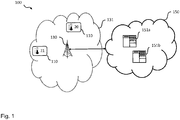
- FIG. 1 shows a schematic diagram of a cellular communication network 100.
- the cellular communication network 100 is a low-power wide-area (LPWA) communication network 100, in particular a LPWA communication network 100 based on narrowband (NB) IoT technology, as described, for instance, in the 3GPP technical report TR 45.820.
- LPWA low-power wide-area
- NB narrowband IoT technology
- the cellular communication network 100 comprises a radio access network 131, a core network 150 and a plurality of NB IoT communication devices 110.
- the plurality of NB IoT communication devices 110 are smart temperature sensors configured to monitor temperature data and to provide the temperature data via the core network 150 of the NB IoT communication network 100 to a remote server 151 a configured to collect and analyze the temperature data from the plurality of NB IoT communication devices 110.
- figure 1 shows only a single exemplary base station 130, which is part of the radio access network 131.
- the radio access network 131 can comprises a plurality of base stations similar to the exemplary base station 130 shown in figure 1 .
- the core network 150 comprises entities or functions for operating the NB IoT communication network 100.
- the core network 150 comprises an authentication entity 151 b configured to perform an authentication procedure with each of the NB IoT communication devices 110 before granting full access to the NB IoT communication network 100.
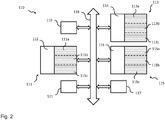
- the communication device 110 comprises a processor 111 configured to process data and running applications providing one or more security functions, a memory comprising a RAM 113 and a Flash memory 115 configured to store volatile and non-volatile data (in particular executable application code), respectively, and a radio 117 configured to transmit and/or receive data over the NB IoT communication network 100.
- the radio 117 can be configured to use one or more subcarriers of a channel bandwidth of about 200 Kilohertz (KHz) to communicate with the base station on the basis of an OFDMA scheme in the downlink direction and on the basis of a FDMA scheme in the uplink direction.
- the communication device 110a can comprise a ROM as well.
- the processor 111, the RAM 113, the Flash memory 115 and/or the radio 117 can be implemented as a system on a chip.
- the communication device 110 further comprises a communication bus system 118 configured to provide for the flow of data between the processor 111, the RAM 113, the Flash memory 115 and the radio 117.
- the communication device 110a further comprises a sensor 119 configured to collect data, wherein the security system of the communication device 110a is further configured to restrict access to the sensor 119 to one or more selected sets of the three sets of security domains 111a-c, 113a-c, 115a-c.
- the security system can be configured to restrict access to the sensor 119 to the first set of security domains 111a, 113a, 115a and/or the second set of security domains 111b, 113b, 115b.
- the communication device 110a further comprises an actuator 121, wherein the security system of the communication device is further configured to restrict access to the actuator 121 to one or more selected sets of the three sets of security domains 111a-c, 113a-c, 115a-c.
- the security system can be configured to restrict access to the actuator 121 to the first set of security domains 111a, 113a, 115a and/or the third set of security domains 111c, 113c, 115c.
- the communication device 110 further comprises a security system configured to operate one or more sets of logically separated security domains 111a-c, 113a-c, 115a-c on the processor 111, the volatile RAM 113 and the non-volatile Flash memory 115.
- a security system configured to operate one or more sets of logically separated security domains 111a-c, 113a-c, 115a-c on the processor 111, the volatile RAM 113 and the non-volatile Flash memory 115.
- the security system of the communication device 110 operates three different sets of security domains, namely a first set of security domains, comprising a processor security domain 111a, a RAM security domain 113a and a Flash memory security domain 115a, a second set of security domains, comprising a processor security domain 111b, a RAM security domain 113b and a Flash memory security domain 115b, and a third set of security domains, comprising a processor security domain 111c, a RAM security domain 113c and a Flash memory security domain 115c.
- a first set of security domains comprising a processor security domain 111a, a RAM security domain 113a and a Flash memory security domain 115a
- a second set of security domains comprising a processor security domain 111b, a RAM security domain 113b and a Flash memory security domain 115b
- a third set of security domains comprising a processor security domain 111c, a RAM security domain 113c and a Flash memory security domain 115c
- the respective security domains of a set of security domains for instance, the processor security domain 111a, the RAM security domain 113a and the Flash memory security domain 115a of the first set of security domains are logically separated from the security domains of other sets of security domains and are configured to interact with each other to provide at least one respective security function.
- the processor security domain 111a, the RAM security domain 113a and the Flash memory security domain 115a of the first set of security domains are configured to interact with each other for providing a seceurity function in the form of an authentication function, i.e. for authenticating the communication device 110 with the authentication entity 151b of the core network 150 of the NB IoT communication network 100.
- the security system of the communication device 110 shown in figure 2 is further configured to restrict access to the radio 117 to one or more selected sets of the one or more sets of security domains.
- the security system is configured to restrict access to the radio 117 to the first set of security domains only, i.e. only the processor security domain 111 a of the first set of security domains can access the radio 117 and interact therewith, for instance, for transmitting sensor data collected by the sensor 119 over the NB IoT communication network 100.
- the security system of the communication device 110 shown in figure 2 can be configured to allow the first and the second set of security domains access to the radio 117, but not the third set of security domains.
- the security system of the communication device 110 shown in figure 2 can be implemented in hardware and/or software.
- the security system can be implemented using virtualization techniques.
- the different RAM security domains 113a-c can be provided by different partitions of the RAM 113.
- the data in the different RAM security domains 113a-c are accessible using "memory mapped I/O".
- the main purpose of the security system of the communication device 110a and its security domains is to isolate the processing of security critical tasks from standard processing in the real-time execution environment 112. This can be achieved by using a single processor-core having two execution modes, one secure mode and another mode for standard processes.
- the RAM and registers assigned to the single core are duplicated and one set is assigned to the normal mode, i.e. the real-time execution environment 112, and the other set to the secure execution mode, i.e. the secure execution environment.
- the security system of the communication device 110a and its security domains can be implemented using a multi-processor-core architecture with at least one secure-core with an own RAM, which is dedicated to executing only security-critical processes.
- the processor 111 can be configured to implement a real-time execution environment 112 based on a real-time operating system.
- An application running in the real-time execution environment 112 can access the security functions provided by the different sets of security domains, if the application has the corresponding access rights.
- the security system of the communication device 110 is configured to operate the respective processor security domains 111a-c of the three sets of security domains in parallel to the real-time execution environment 112.
- both the RAM 113 and the Flash memory 115 can comprises in addition to the respective RAM security domains 113a-c and the Flash memory security domains 115a-c a real-time RAM portion 114 and a real-time Flash memory portion 116, which can be accessed from the real-time execution environment 112 of the processor and the respective processor security domains 111a-c of the three sets of security domains.
- the Flash memory security domain 115a of the first set of security domains can store a cryptographic authentication key for authenticating the communication device 110 within the NB IoT communication network 100, i.e. with the authentication entity 151b of the core network 150 of the NB IoT communication network 100.
- the security system of the communication device 110 is configured such that only the corresponding processor security domain 111a (i.e. a secure application running therein) can retrieve the cryptographic authentication key stored in the Flash memory security domain 115a of the first set of security domains.
- one or more of the sets of security domains operated by the security domains can be configured to provide additional security functions besides the authentication function provided by the first set of security domains.
- one or more of the sets of security domains could be configured to provide a security function in form of an end-to-end encryption of the data collected by the sensor 119 of the communication device 110a and/or a security function in form of a firewall configured to filter data being received and/or being transmitted via the radio 117 on the basis of a set of filter rules.
- the Flash memory security domain 115b of the second set of security domains could store a cryptographic encryption key used by a secure application running in the processor security domain 111b of the second set of security domains for providing an end-to-end data encryption.
- the Flash memory security domain 115c of the third set of security domains could store a set of filter rules used by a secure application running in the processor security domain 111c of the third set of security domains for filtering data being received and/or being transmitted via the radio 117.
- the security system of the communication device 110 can be configured to restrict access to the first set of security domains 111a, 113a, 115a to a first entity only, for instance, the operator of the NB IoT communication network 100, and to restrict access to the second set of security domains 111b, 113b, 115b to a second entity only, for instance, the user of the communication device 110.
- the security system can comprise for each set of security domains a corresponding set of access control rules, which can differ from set to set.
- the access control rules could allow access to the third set of security domains 111c, 113c, 115c to both the first entity and the second entity.
- a set of security domains, for instance, the third set of security domains 111c, 113c, 115c can be shared by the first entity and the second entity.
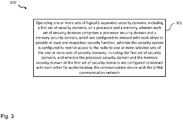
- FIG. 3 shows a diagram illustrating a corresponding method 300 of operating the communication device 110.
- the method 300 comprises the step 301 of operating the one or more sets of logically separated security domains 111a-c, 113a-c, 115a-c, including the first set of security domains 111a, 113a, 115a, on the processor 111 and the memory 113, 115, wherein each set of security domains 111a-c, 113a-c, 115a-c comprises a processor security domain 111a-c and a memory security domain 113a-c, 115a-c, which are configured to interact with each other to provide at least one respective security function, wherein the security system is further configured to restrict access to the radio 117 to one or more selected sets of the one or more sets of security domains 111a-c, 113a-c, 115a-c, including the first set of security domains 111a, 113a, 115a, and wherein the processor security domain 111a and the memory security
Landscapes
- Engineering & Computer Science (AREA)
- Computer Security & Cryptography (AREA)
- Computer Networks & Wireless Communication (AREA)
- Signal Processing (AREA)
- Mobile Radio Communication Systems (AREA)
Abstract
Description
- In general, the invention relates to wireless communication networks. More specifically, the invention relates to secure devices, methods and systems for wireless communication networks based on Low-Power Wide-Area (LPWA) technology, in particular narrowband IoT communication networks.
- Narrowband IoT (NB IoT) is a new technology standard, designed to broaden the future of IoT connectivity. Ratified by the 3GPP, NB IoT is starting to being deployed by mobile network operators across the globe. NB IoT is a Low-Power Wide-Area (LPWA) network technology, developed to enable efficient communication for mass distributed NB IoT communication devices across wide geographical footprints as well in scenarios with deep indoor penetration, e.g. within urban infrastructure. It's ideal for devices that generate low data traffic, rely on batteries and typically have a long device life cycle. A battery life of more than 10 years can be supported for a wide range of use cases. Moreover, NB IoT significantly improves the system capacity and spectrum efficiency, especially in deep coverage. Thus, NB IoT can be used to connect simple communication devices, such as sensors, to drive new data streams, reduce operational costs and create new business models. Smart Meters, Smart Bins, environmental monitoring and precision agriculture are just a few applications of NB loT. Such devices are also referred to as NB IoT cellular devices. More information about NB IoT can be found in the 3GPP technical report TR 45.820.
- Due to the generally limited hardware resources of a communication device based on LPWA technology and, in particular, NB IoT technology, security mechanisms known, for instance, from smart phones cannot be used for such a communication device. Thus, there is a need for improved devices, methods and systems for wireless communication networks based on LPWA technology, in particular narrowband IoT networks.
- It is an object of the invention to provide improved devices, methods and systems for wireless communication networks based on LPWA technology, in particular narrowband IOT networks.
- The foregoing and other objects are achieved by the subject matter of the independent claims. Further implementation forms are apparent from the dependent claims, the description and the figures.
- Embodiments of the present invention relate to communication devices that use NB IoT technology. Although the description is written by using the NB IoT as the access technology, the embodiments are applicable also for communication devices that use other wireless communication technologies as well, such as Global System for Mobile communications (GSM, 2G), GSM EDGE radio access Network (GERAN), General Packet Radio Service (GRPS), Universal Mobile Telecommunication System (UMTS, 3G) based on basic wideband-code division multiple access (W-CDMA), high-speed packet access (HSPA), Long Term Evolution (LTE), LTE-Advanced, and/or 5G system. As used herein, NB IoT technology can comprises, for instance, narrowband LTE, narrowband M2M, and narrowband OFDMA techniques.
- In embodiments of the present invention communication devices may be capable of communicating content, data, information and/or signals via a wireless medium or channel. In some embodiments, the wireless medium may include, for example, a radio channel, a cellular channel, an RF channel, a WiFi channel, an IR channel, a Bluetooth (BT) channel, a Global Navigation Satellite System (GNSS) channel, and the like.
- In embodiments of the present invention communication devices may include one or more radio modules (or short radios) including circuitry and/or logic to perform wireless communication between the communication devices. In embodiments of the present invention the radio modules may include one or more wireless receivers (Rx) including circuitry and/or logic to receive wireless communication signals, RF signals, frames, blocks, transmission streams, packets, messages, data items, and/or data. In embodiments of the present invention the radio modules may include one or more wireless transmitters (Tx) including circuitry and/or logic to transmit wireless communication signals, RF signals, frames, blocks, transmission streams, packets, messages, data items, and/or data. In embodiments of the present invention, the radio modules may include Radio Frequency (RF) elements, baseband elements, modulation elements, demodulation elements, amplifiers, analog to digital and/or digital to analog converters, filters and the like, which can be implemented in hardware and/or software.
- In embodiments of the present invention the radio modules may be configured to communicate according to an OFDM scheme and/or an FDMA scheme in an uplink direction and/or a downlink direction. In other embodiments, the radios of the communication devices may be configured to communicate according to any other additional or alternative modulation scheme. In embodiments of the present invention, the radios may include, or may be associated with, one or more antennas. In one example, a communication device may include a single antenna. In another example, a communication device may include two or more antennas. Such antennas may include any type of antennas suitable for transmitting and/or receiving wireless communication signals, blocks, frames, transmission streams, packets, messages and/or data. The antennas may include, for example, antennas suitable for directional communication, e.g., using beamforming techniques. For example, the antennas may include a phased array antenna, a multiple element antenna, a set of switched beam antennas, and/or the like. In some embodiments, the antennas may implement transmit and receive functionalities using separate transmit and receive antenna elements. In some embodiments, the antennas may implement transmit and receive functionalities using common and/or integrated transmit/receive elements.
- In embodiments of the present invention a communication device may include a processor. The processor may be configured to perform and/or to trigger, cause, instruct and/or control the communication device to perform, one or more communications, to generate and/or communicate one or more messages and/or transmissions, and/or to perform one or more functionalities, operations and/or procedures. In embodiments of the present invention the processor control unit may include circuitry and/or logic, Media-Access Control (MAC) circuitry and/or logic, Physical Layer (PHY) circuitry and/or logic, and/or any other circuitry and/or logic, configured to perform the functionality of the processor.
- In embodiments of the present invention, at least part of the functionality of the processor may be implemented by an integrated circuit, for example, a chip, e.g., a System on Chip (SoC). In one example, the chip or SoC may be configured to perform one or more functionalities of the radio as well. For example, the chip or SoC may include one or more elements of the processor and/or one or more elements of the radio. In one example, the processor and the radio may be implemented as part of the chip or SoC.
- In embodiments of the present invention, the communication device can be a wearable device, a sensor, small device, a mobile device, and/or any other device, which may be, for example, powered by a battery and/or any other power source having a limited capacity.
- In embodiments of the present invention, the communication device can be configured to communicate over one or more narrowband channels, for example, channels with a channel bandwidth of about 200 Kilohertz (KHz). In embodiments of the invention a minimum system bandwidth of 200 kHz on both downlink and uplink can be used. In each direction, the 200 kHz channel can be divided into narrow bandwidth subcarriers, for instance, 48 on the downlink and 36 on the uplink. In the downlink direction, Orthogonal Frequency Division Multiple Access (OFDMA) can be used. In the uplink direction Frequency Division Multiple Access (FDMA) can be used.
- More specifically, according to a first aspect the invention relates to a communication device for communicating data over a low power wide area, LPWA, communication network, wherein the communication device comprises: an application processor configured to process data, for instance, by running an application; a memory configured to store data; a radio configured to transmit and/or receive data over the LPWA communication network; and a security system. The security system is configured to operate one or more logically separated sets of security domains, including a first set of security domains, on the processor and the memory. Each set of security domains comprises a processor security domain and a memory security domain, which are configured to interact with each other to provide at least one respective security function. The security system is further configured to restrict access to the radio to one or more selected sets of the one or more sets of security domains, including the first set of security domains, and wherein the processor security domain and the memory security domain of the first set of security domains are configured to interact with each other for authenticating the communication device within the LPWA communication network.
- The security system can be configured to operate the first set of security domains to be accessible by the operator of the LPWA communication network only. Thus, the security system can restrict access to the authentication function provided by the processor security domain and the memory security domain of the first set of security domains to the operator of the LPWA communication network only. The one or more sets of security domains can comprise a second set of security domains for providing a second security function. The security system can be implemented in hardware and/or software. In an embodiment, the security system can be implemented using virtualization techniques.
- In a further possible embodiment of the communication device according to the first aspect, the processor is configured to implement a real-time execution environment based on a real-time operating system and wherein the security system is configured to operate the respective processor security domains of the one or more sets of security domains in parallel to the real-time execution environment.
- In a further possible embodiment of the communication device the memory comprises in addition to the respective memory security domains of the one or more sets of security domains a real-time memory portion that is configured to be accessible from the real-time execution environment, for instance, from an application running therein, and the respective processor security domains of the one or more sets of security domains, for instance, from respective applications running therein.
- In a further possible embodiment of the communication device the memory can comprise a RAM, a ROM and/or a Flash memory.
- In a further possible embodiment of the communication device the memory security domain of the first set of security domains comprises a cryptographic authentication key for authenticating the communication device within the LPWA communication network.
- In a further possible embodiment of the communication device at least one of the memory security domains of the one or more sets of security domains comprises a cryptographic encryption key for encrypting data.
- In a further possible embodiment of the communication device the one or more sets of security domains further comprises a second set of security domains and wherein the security system is configured to restrict access to the first set of security domains to a first entity and to restrict access to the second set of security domains to a second entity, wherein the security system is further configured to operate a further memory security domain to be accessible by both the first entity and the second entity.
- In a further possible embodiment of the communication device the security system is configured to restrict access to the first set of security domains to the first entity on the basis of a first set of access control rules and to restrict access to the second set of security domains to the second entity on the basis of a second set of access control rules, wherein the second set of access rules differs from the first set of access rules.
- In a further possible embodiment of the communication device the processor, the memory and the radio are implemented as a system on a chip.
- In a further possible embodiment the communication device further comprises a communication bus, wherein the communication bus is configured to exchange data between the processor, the memory and the radio.
- In a further possible embodiment the communication device further comprises a sensor configured to collect data, wherein the security system is further configured to restrict access to the sensor to one or more selected sets of the one or more sets of security domains.
- In a further possible embodiment the communication device further comprises an actuator, wherein the security system is further configured to restrict access to the actuator to one or more selected sets of the one or more sets of security domains.
- In a further possible embodiment the communication device is configured to communicate over a narrowband IoT communication network.
- According to a second aspect the invention relates to a corresponding method of operating a communication device for communicating data over a low power wide area, LPWA, communication network, the communication device comprising a processor configured to process data, a memory configured to store data and a radio configured to transmit and/or receive data over the LPWA communication network, wherein the method comprises the step of operating one or more sets of logically separated security domains, including a first set of security domains, on the processor and the memory, wherein each set of security domains comprises a processor security domain and a memory security domain, which are configured to interact with each other to provide at least one respective security function, wherein the security system is further configured to restrict access to the radio to one or more selected sets of the one or more sets of security domains, including the first set of security domains, and wherein the processor security domain and the memory security domain of the first set of security domains are configured to interact with each other for authenticating the communication device with the LPWA communication network.
- According to a third aspect the invention relates to a computer program product comprising program code for performing the method according to the second aspect of the invention, when executed on a computer or a processor.
- Embodiments of the invention can be implemented in hardware and/or software.
- Further embodiments of the invention will be described with respect to the following figures, wherein:
-
Fig. 1 shows a schematic diagram illustrating a NB IoT communication network comprising several communication devices according to an embodiment; -
Fig. 2 shows a more detailed schematic diagram of a communication device according to an embodiment; and -
Fig. 3 shows a diagram illustrating a method for operating a communication device according to an embodiment. - In the various figures, identical reference signs will be used for identical or at least functionally equivalent features.
- In the following detailed description, reference is made to the accompanying drawings, which form part of the disclosure, and in which are shown, by way of illustration, specific aspects in which the present invention may be placed. It is understood that other aspects may be utilized and structural or logical changes may be made without departing from the scope of the present invention. The following detailed description, therefore, is not to be taken in a limiting sense, as the scope of the present invention is defined by the appended claims.
- For instance, it is understood that a disclosure in connection with a described method may also hold true for a corresponding device or system configured to perform the method and vice versa. For example, if a specific method step is described, a corresponding device may include a unit to perform the described method step, even if such unit is not explicitly described or illustrated in the figures. Further, it is understood that the features of the various exemplary aspects described herein may be combined with each other, unless specifically noted otherwise.
-
Figure 1 shows a schematic diagram of acellular communication network 100. Thecellular communication network 100 is a low-power wide-area (LPWA)communication network 100, in particular aLPWA communication network 100 based on narrowband (NB) IoT technology, as described, for instance, in the 3GPP technical report TR 45.820. - The
cellular communication network 100 comprises aradio access network 131, acore network 150 and a plurality of NBIoT communication devices 110. In the exemplary embodiment shown infigure 1 , the plurality of NBIoT communication devices 110 are smart temperature sensors configured to monitor temperature data and to provide the temperature data via thecore network 150 of the NBIoT communication network 100 to aremote server 151 a configured to collect and analyze the temperature data from the plurality of NBIoT communication devices 110. - For the sake of clarity
figure 1 shows only a singleexemplary base station 130, which is part of theradio access network 131. In other embodiments theradio access network 131 can comprises a plurality of base stations similar to theexemplary base station 130 shown infigure 1 . - The
core network 150 comprises entities or functions for operating the NBIoT communication network 100. In the exemplary embodiment, shown infigure 1 thecore network 150 comprises anauthentication entity 151 b configured to perform an authentication procedure with each of the NBIoT communication devices 110 before granting full access to the NBIoT communication network 100. - Under further reference to
figure 2 in the following an embodiment of the NBIoT communication device 110 will be described. Thecommunication device 110 comprises aprocessor 111 configured to process data and running applications providing one or more security functions, a memory comprising aRAM 113 and aFlash memory 115 configured to store volatile and non-volatile data (in particular executable application code), respectively, and aradio 117 configured to transmit and/or receive data over the NBIoT communication network 100. In an embodiment, theradio 117 can be configured to use one or more subcarriers of a channel bandwidth of about 200 Kilohertz (KHz) to communicate with the base station on the basis of an OFDMA scheme in the downlink direction and on the basis of a FDMA scheme in the uplink direction. Alternatively to or in addition to theFlash memory 115 the communication device 110a can comprise a ROM as well. - In an embodiment, the
processor 111, theRAM 113, theFlash memory 115 and/or theradio 117 can be implemented as a system on a chip. As illustrated infigure 2 , in an embodiment thecommunication device 110 further comprises acommunication bus system 118 configured to provide for the flow of data between theprocessor 111, theRAM 113, theFlash memory 115 and theradio 117. - In an embodiment, the communication device 110a further comprises a
sensor 119 configured to collect data, wherein the security system of the communication device 110a is further configured to restrict access to thesensor 119 to one or more selected sets of the three sets ofsecurity domains 111a-c, 113a-c, 115a-c. For example, the security system can be configured to restrict access to thesensor 119 to the first set ofsecurity domains security domains - In addition or alternatively, in an embodiment the communication device 110a further comprises an
actuator 121, wherein the security system of the communication device is further configured to restrict access to theactuator 121 to one or more selected sets of the three sets ofsecurity domains 111a-c, 113a-c, 115a-c. For example, the security system can be configured to restrict access to theactuator 121 to the first set ofsecurity domains security domains - The
communication device 110 further comprises a security system configured to operate one or more sets of logically separatedsecurity domains 111a-c, 113a-c, 115a-c on theprocessor 111, thevolatile RAM 113 and thenon-volatile Flash memory 115. By way of example, in the embodiment shown infigure 2 the security system of thecommunication device 110 operates three different sets of security domains, namely a first set of security domains, comprising aprocessor security domain 111a, aRAM security domain 113a and a Flashmemory security domain 115a, a second set of security domains, comprising aprocessor security domain 111b, aRAM security domain 113b and a Flashmemory security domain 115b, and a third set of security domains, comprising aprocessor security domain 111c, aRAM security domain 113c and a Flashmemory security domain 115c. - The respective security domains of a set of security domains, for instance, the
processor security domain 111a, theRAM security domain 113a and the Flashmemory security domain 115a of the first set of security domains are logically separated from the security domains of other sets of security domains and are configured to interact with each other to provide at least one respective security function. - In the embodiment shown in
figure 2 theprocessor security domain 111a, theRAM security domain 113a and the Flashmemory security domain 115a of the first set of security domains are configured to interact with each other for providing a seceurity function in the form of an authentication function, i.e. for authenticating thecommunication device 110 with theauthentication entity 151b of thecore network 150 of the NBIoT communication network 100. - The security system of the
communication device 110 shown infigure 2 is further configured to restrict access to theradio 117 to one or more selected sets of the one or more sets of security domains. In the embodiment shown infigure 2 the security system is configured to restrict access to theradio 117 to the first set of security domains only, i.e. only theprocessor security domain 111 a of the first set of security domains can access theradio 117 and interact therewith, for instance, for transmitting sensor data collected by thesensor 119 over the NBIoT communication network 100. In another embodiment, the security system of thecommunication device 110 shown infigure 2 can be configured to allow the first and the second set of security domains access to theradio 117, but not the third set of security domains. - The security system of the
communication device 110 shown infigure 2 can be implemented in hardware and/or software. In an embodiment, the security system can be implemented using virtualization techniques. In an embodiment, the differentRAM security domains 113a-c can be provided by different partitions of theRAM 113. In an embodiment, the data in the differentRAM security domains 113a-c are accessible using "memory mapped I/O". As will be appreciated, the main purpose of the security system of the communication device 110a and its security domains is to isolate the processing of security critical tasks from standard processing in the real-time execution environment 112. This can be achieved by using a single processor-core having two execution modes, one secure mode and another mode for standard processes. In this case the RAM and registers assigned to the single core are duplicated and one set is assigned to the normal mode, i.e. the real-time execution environment 112, and the other set to the secure execution mode, i.e. the secure execution environment. According to another embodiment, the security system of the communication device 110a and its security domains can be implemented using a multi-processor-core architecture with at least one secure-core with an own RAM, which is dedicated to executing only security-critical processes. - As illustrated in
figure 2 , theprocessor 111 can be configured to implement a real-time execution environment 112 based on a real-time operating system. An application running in the real-time execution environment 112 can access the security functions provided by the different sets of security domains, if the application has the corresponding access rights. In the embodiment shown infigure 2 , the security system of thecommunication device 110 is configured to operate the respectiveprocessor security domains 111a-c of the three sets of security domains in parallel to the real-time execution environment 112. - In an embodiment, both the
RAM 113 and theFlash memory 115 can comprises in addition to the respectiveRAM security domains 113a-c and the Flashmemory security domains 115a-c a real-time RAM portion 114 and a real-timeFlash memory portion 116, which can be accessed from the real-time execution environment 112 of the processor and the respectiveprocessor security domains 111a-c of the three sets of security domains. - For providing the authentication security function the Flash
memory security domain 115a of the first set of security domains can store a cryptographic authentication key for authenticating thecommunication device 110 within the NBIoT communication network 100, i.e. with theauthentication entity 151b of thecore network 150 of the NBIoT communication network 100. In an embodiment, the security system of thecommunication device 110 is configured such that only the correspondingprocessor security domain 111a (i.e. a secure application running therein) can retrieve the cryptographic authentication key stored in the Flashmemory security domain 115a of the first set of security domains. - As already mentioned above, one or more of the sets of security domains operated by the security domains can be configured to provide additional security functions besides the authentication function provided by the first set of security domains. For instance, one or more of the sets of security domains could be configured to provide a security function in form of an end-to-end encryption of the data collected by the
sensor 119 of the communication device 110a and/or a security function in form of a firewall configured to filter data being received and/or being transmitted via theradio 117 on the basis of a set of filter rules. For instance, the Flashmemory security domain 115b of the second set of security domains could store a cryptographic encryption key used by a secure application running in theprocessor security domain 111b of the second set of security domains for providing an end-to-end data encryption. By way of example, the Flashmemory security domain 115c of the third set of security domains could store a set of filter rules used by a secure application running in theprocessor security domain 111c of the third set of security domains for filtering data being received and/or being transmitted via theradio 117. - In a further embodiment, the security system of the
communication device 110 can be configured to restrict access to the first set ofsecurity domains IoT communication network 100, and to restrict access to the second set ofsecurity domains communication device 110. To this end, the security system can comprise for each set of security domains a corresponding set of access control rules, which can differ from set to set. In an embodiment, the access control rules could allow access to the third set ofsecurity domains security domains -
Figure 3 shows a diagram illustrating acorresponding method 300 of operating thecommunication device 110. Themethod 300 comprises thestep 301 of operating the one or more sets of logically separatedsecurity domains 111a-c, 113a-c, 115a-c, including the first set ofsecurity domains processor 111 and thememory security domains 111a-c, 113a-c, 115a-c comprises aprocessor security domain 111a-c and amemory security domain 113a-c, 115a-c, which are configured to interact with each other to provide at least one respective security function, wherein the security system is further configured to restrict access to theradio 117 to one or more selected sets of the one or more sets ofsecurity domains 111a-c, 113a-c, 115a-c, including the first set ofsecurity domains processor security domain 111a and thememory security domain security domains IoT communication network 100. - While a particular feature or aspect of the disclosure may have been disclosed with respect to only one of several implementations or embodiments, such feature or aspect may be combined with one or more other features or aspects of the other implementations or embodiments as may be desired and advantageous for any given or particular application. Furthermore, to the extent that the terms "include", "have", "with", or other variants thereof are used in either the detailed description or the claims, such terms are intended to be inclusive in a manner similar to the term "comprise". Also, the terms "exemplary", "for example" and "e.g." are merely meant as an example, rather than the best or optimal. The terms "coupled" and "connected", along with derivatives may have been used. It should be understood that these terms may have been used to indicate that two elements cooperate or interact with each other regardless whether they are in direct physical or electrical contact, or they are not in direct contact with each other.
- Although specific aspects have been illustrated and described herein, it will be appreciated by those of ordinary skill in the art that a variety of alternate and/or equivalent implementations may be substituted for the specific aspects shown and described without departing from the scope of the present disclosure. This application is intended to cover any adaptations or variations of the specific aspects discussed herein.
- Although the elements in the following claims are recited in a particular sequence, unless the claim recitations otherwise imply a particular sequence for implementing some or all of those elements, those elements are not necessarily intended to be limited to being implemented in that particular sequence.
- Many alternatives, modifications, and variations will be apparent to those skilled in the art in light of the above teachings. Of course, those skilled in the art readily recognize that there are numerous applications of the invention beyond those described herein. While the present invention has been described with reference to one or more particular embodiments, those skilled in the art recognize that many changes may be made thereto without departing from the scope of the present invention. It is therefore to be understood that within the scope of the appended claims and their equivalents, the invention may be practiced otherwise than as specifically described herein.
Claims (15)
- A communication device (110) for communicating data over a low power wide area, LPWA, communication network (100), wherein the communication device (110) comprises:a processor (111) configured to process data;a memory (113, 115) configured to store data;a radio (117) configured to transmit and/or receive data over the LPWA communication network (100); anda security system configured to operate one or more logically separated sets of security domains (111a-c, 113a-c, 115a-c), including a first set of security domains (111a, 113a, 115a), on the processor (111) and the memory (113, 115), wherein each set of security domains comprises a processor security domain (111a-c) and a memory security domain (113a-c, 115a-c), which are configured to interact with each other to provide at least one respective security function, wherein the security system is further configured to restrict access to the radio (117) to one or more selected sets of the one or more sets of security domains (111a-c, 113a-c, 115a-c), including the first set of security domains (111a, 113a, 115a), and wherein the processor security domain (111a) and the memory security domain (113a, 115a) of the first set of security domains (111a, 113a, 115a) are configured to interact with each other for authenticating the communication device (110a-d) within the LPWA communication network (100).
- The communication device (110) of claim 1, wherein the processor (111) is configured to implement a real-time execution environment (112) based on a real-time operating system and wherein the security system is configured to operate the respective processor security domains (111a-c) of the one or more sets of security domains (111a-c, 113a-c, 115a-c) in parallel to the real-time execution environment (112).
- The communication device (110) of claim 2, wherein the memory (113, 115) comprises in addition to the respective memory security domains (113a-c, 115a-c) of the one or more sets of security domains (111a-c, 113a-c, 115a-c) a real-time memory portion (114, 116) that is configured to be accessible from the real-time execution environment (112) and the respective processor security domains (111a-c) of the one or more sets of security domains (111a-c, 113a-c, 115a-c).
- The communication device (110) of any one of the preceding claims, wherein the memory (113, 115) comprises a RAM (113), a ROM and/or a Flash memory (115).
- The communication device (110) of any one of the preceding claims, wherein the memory security domain (113a, 115a) of the first set of security domains (111a, 113a, 115a) comprises a cryptographic authentication key for authenticating the communication device (110a-d) within the LPWA communication network (100).
- The communication device (110) of any one of the preceding claims, wherein at least one of the memory security domains (113a-c, 115a-c) of the one or more sets of security domains (111a-c, 113a-c, 115a-c) comprises a cryptographic encryption key for encrypting data.
- The communication device (110) of any one of the preceding claims, wherein the one or more sets of security domains (111a-c, 113a-c, 115a-c) further comprises a second set of security domains (111b, 113b, 115b) and wherein the security system is configured to restrict access to the first set of security domains (111a, 113a, 115a) to a first entity and to restrict access to the second set of security domains (111 b, 113b, 115b) to a second entity, wherein the security system is further configured to operate a further memory security domain (113c, 115c) to be accessible by both the first entity and the second entity.
- The communication device (110) of any one of the preceding claims, wherein the security system is configured to restrict access to the first set of security domains (111a, 113a, 115a) to the first entity on the basis of a first set of access control rules and to restrict access to the second set of security domains (111b, 113b, 115b) to the second entity on the basis of a second set of access control rules, wherein the second set of access control rules differs from the first set of access control rules.
- The communication device (110) of any one of the preceding claims, wherein the processor (111), the memory (113, 115) and the radio (117) are implemented as a system on a chip.
- The communication device (110) of any one of the preceding claims, wherein the communication device (110) further comprises a communication bus (118), wherein the communication bus (118) is configured to exchange data between the processor (111), the memory (113, 115) and the radio (117).
- The communication device (110) of any one of the preceding claims, wherein the communication device (110) further comprises a sensor (119) configured to collect data and wherein the security system is further configured to restrict access to the sensor (119) to one or more selected sets of the one or more sets of security domains (111a-c, 113a-c, 115a-c).
- The communication device (110) of any one of the preceding claims, wherein the communication device (110) further comprises an actuator (121) and wherein the security system is further configured to restrict access to the actuator (121) to one or more selected sets of the one or more sets of security domains (111a-c, 113a-c, 115a-c).
- The communication device (110) of any one of the preceding claims, wherein the communication device (110) is configured to communicate over a narrowband IoT communication network (100).
- A method (300) of operating a communication device (110) for communicating data over a low power wide area, LPWA, communication network (100), the communication device (110) comprising a processor (111) configured to process data, a memory (113, 115) configured to store data and a radio (117) configured to transmit and/or receive data over the LPWA communication network (100), wherein the method (300) comprises:operating (301) one or more logically separated sets of security domains (111a-c, 113a-c, 115a-c), including a first set of security domains (111a, 113a, 115a), on the processor (111) and the memory (113, 115), wherein each set of security domains (111a-c, 113a-c, 115a-c) comprises a processor security domain (111a-c) and a memory security domain (113a-c, 115a-c), which are configured to interact with each other to provide at least one respective security function, wherein the security system is further configured to restrict access to the radio (117) to one or more selected sets of the one or more sets of security domains (111a-c, 113a-c, 115a-c), including the first set of security domains (111a, 113a, 115a), and wherein the processor security domain (111a) and the memory security domain (113a, 115a) of the first set of security domains (111a, 113a, 115a) are configured to interact with each other for authenticating the communication device (110a-d) within the LPWA communication network (100).
- A computer program product comprising program code for performing the method (300) of claim 14, when executed on a computer or a processor.
Priority Applications (1)
| Application Number | Priority Date | Filing Date | Title |
|---|---|---|---|
| EP17181887.5A EP3432537B1 (en) | 2017-07-18 | 2017-07-18 | Secured authentication in lpwa communication networks |
Applications Claiming Priority (1)
| Application Number | Priority Date | Filing Date | Title |
|---|---|---|---|
| EP17181887.5A EP3432537B1 (en) | 2017-07-18 | 2017-07-18 | Secured authentication in lpwa communication networks |
Publications (2)
| Publication Number | Publication Date |
|---|---|
| EP3432537A1 true EP3432537A1 (en) | 2019-01-23 |
| EP3432537B1 EP3432537B1 (en) | 2021-09-01 |
Family
ID=59381121
Family Applications (1)
| Application Number | Title | Priority Date | Filing Date |
|---|---|---|---|
| EP17181887.5A Active EP3432537B1 (en) | 2017-07-18 | 2017-07-18 | Secured authentication in lpwa communication networks |
Country Status (1)
| Country | Link |
|---|---|
| EP (1) | EP3432537B1 (en) |
Citations (3)
| Publication number | Priority date | Publication date | Assignee | Title |
|---|---|---|---|---|
| US8458800B1 (en) * | 2010-10-01 | 2013-06-04 | Viasat, Inc. | Secure smartphone |
| WO2015099956A1 (en) * | 2013-12-27 | 2015-07-02 | Intel Corporation | Apparatus, system and method of protecting domains of a multimode wireless radio transceiver |
| GB2536509A (en) * | 2015-05-06 | 2016-09-21 | Vodafone Ip Licensing Ltd | Efficient cellular network security configuration |
-
2017
- 2017-07-18 EP EP17181887.5A patent/EP3432537B1/en active Active
Patent Citations (3)
| Publication number | Priority date | Publication date | Assignee | Title |
|---|---|---|---|---|
| US8458800B1 (en) * | 2010-10-01 | 2013-06-04 | Viasat, Inc. | Secure smartphone |
| WO2015099956A1 (en) * | 2013-12-27 | 2015-07-02 | Intel Corporation | Apparatus, system and method of protecting domains of a multimode wireless radio transceiver |
| GB2536509A (en) * | 2015-05-06 | 2016-09-21 | Vodafone Ip Licensing Ltd | Efficient cellular network security configuration |
Non-Patent Citations (2)
| Title |
|---|
| ASSADERAGHI FARI ET AL: "Privacy and security: Key requirements for sustainable IoT growth", 2017 SYMPOSIUM ON VLSI TECHNOLOGY, JSAP, 5 June 2017 (2017-06-05), XP033135103, DOI: 10.23919/VLSIT.2017.7998185 * |
| TSAO R ALEXANDER COOPER POWER SYSTEMS M DOHLER CTTC V DAZA A LOZANO UNIVERSITAT POMPEU FABRA T: "A Security Threat Analysis for Routing over Low-Power and Lossy Networks; draft-ietf-roll-security-threats-03.txt", A SECURITY THREAT ANALYSIS FOR ROUTING OVER LOW-POWER AND LOSSY NETWORKS; DRAFT-IETF-ROLL-SECURITY-THREATS-03.TXT, INTERNET ENGINEERING TASK FORCE, IETF; STANDARDWORKINGDRAFT, INTERNET SOCIETY (ISOC) 4, RUE DES FALAISES CH- 1205 GENEVA, SWITZERLAND, 26 June 2013 (2013-06-26), pages 1 - 48, XP015094881 * |
Also Published As
| Publication number | Publication date |
|---|---|
| EP3432537B1 (en) | 2021-09-01 |
Similar Documents
| Publication | Publication Date | Title |
|---|---|---|
| Rahman et al. | 5G evolution toward 5G advanced: An overview of 3GPP releases 17 and 18 | |
| JP7075897B2 (en) | Subframe multiplexing with different subcarrier spacing | |
| CN111565440B (en) | Method and communication device for wireless communication | |
| CN107465497B (en) | Method and device for transmitting positioning reference signal | |
| CN111490816B (en) | Method and communication device for wireless communication | |
| EP4436246A1 (en) | Method and device for supporting qos configuration control for sidelink in wireless communication system | |
| CN116746073A (en) | Network-indicated precoder sequence for uplink transmission | |
| KR20200135389A (en) | Methods and devices for transmitting information | |
| EP4205476B1 (en) | Reporting channel state information for multi-trp operation | |
| EP3432628B1 (en) | Secure devices and methods for lpwa communication networks | |
| EP3544345B1 (en) | Method and apparatus for wireless communication | |
| EP3432644B1 (en) | Secure devices and methods for lpwa communication networks | |
| EP3432535B1 (en) | Applying filter rules in lpwa communication networks | |
| US20250385843A1 (en) | Artificial intelligence in wireless communications | |
| EP3432537B1 (en) | Secured authentication in lpwa communication networks | |
| EP3432625B1 (en) | Secure devices and methods for lpwa communication networks | |
| EP3432627B1 (en) | Secure devices and methods for lpwa communication networks | |
| Sanaullah | Coverage measurements of NB-IoT technology | |
| EP3432624B1 (en) | Secure devices and methods for lpwa communication networks | |
| EP3432626B1 (en) | Secure devices and methods for lpwa communication networks | |
| EP3432623B1 (en) | Secure devices and methods for lpwa communication networks | |
| EP3432622B1 (en) | Secure devices and methods for lpwa communication networks | |
| CN118901254A (en) | Time division duplex framework for wireless energy and information transfer | |
| WO2022067859A1 (en) | Receiving channel state information from a ue for multi-trp operation | |
| EP3432536B1 (en) | Communication device for communicating data via a first communication network with a second communication network using a cryptographic token |
Legal Events
| Date | Code | Title | Description |
|---|---|---|---|
| PUAI | Public reference made under article 153(3) epc to a published international application that has entered the european phase |
Free format text: ORIGINAL CODE: 0009012 |
|
| STAA | Information on the status of an ep patent application or granted ep patent |
Free format text: STATUS: REQUEST FOR EXAMINATION WAS MADE |
|
| 17P | Request for examination filed |
Effective date: 20180704 |
|
| AK | Designated contracting states |
Kind code of ref document: A1 Designated state(s): AL AT BE BG CH CY CZ DE DK EE ES FI FR GB GR HR HU IE IS IT LI LT LU LV MC MK MT NL NO PL PT RO RS SE SI SK SM TR |
|
| AX | Request for extension of the european patent |
Extension state: BA ME |
|
| STAA | Information on the status of an ep patent application or granted ep patent |
Free format text: STATUS: EXAMINATION IS IN PROGRESS |
|
| 17Q | First examination report despatched |
Effective date: 20191126 |
|
| GRAP | Despatch of communication of intention to grant a patent |
Free format text: ORIGINAL CODE: EPIDOSNIGR1 |
|
| STAA | Information on the status of an ep patent application or granted ep patent |
Free format text: STATUS: GRANT OF PATENT IS INTENDED |
|
| INTG | Intention to grant announced |
Effective date: 20210401 |
|
| GRAS | Grant fee paid |
Free format text: ORIGINAL CODE: EPIDOSNIGR3 |
|
| GRAA | (expected) grant |
Free format text: ORIGINAL CODE: 0009210 |
|
| STAA | Information on the status of an ep patent application or granted ep patent |
Free format text: STATUS: THE PATENT HAS BEEN GRANTED |
|
| AK | Designated contracting states |
Kind code of ref document: B1 Designated state(s): AL AT BE BG CH CY CZ DE DK EE ES FI FR GB GR HR HU IE IS IT LI LT LU LV MC MK MT NL NO PL PT RO RS SE SI SK SM TR |
|
| REG | Reference to a national code |
Ref country code: GB Ref legal event code: FG4D |
|
| REG | Reference to a national code |
Ref country code: CH Ref legal event code: EP Ref country code: AT Ref legal event code: REF Ref document number: 1427430 Country of ref document: AT Kind code of ref document: T Effective date: 20210915 |
|
| REG | Reference to a national code |
Ref country code: DE Ref legal event code: R096 Ref document number: 602017045050 Country of ref document: DE |
|
| REG | Reference to a national code |
Ref country code: IE Ref legal event code: FG4D |
|
| REG | Reference to a national code |
Ref country code: DE Ref legal event code: R079 Ref document number: 602017045050 Country of ref document: DE Free format text: PREVIOUS MAIN CLASS: H04L0029060000 Ipc: H04L0065000000 |
|
| REG | Reference to a national code |
Ref country code: LT Ref legal event code: MG9D |
|
| REG | Reference to a national code |
Ref country code: NL Ref legal event code: MP Effective date: 20210901 |
|
| PG25 | Lapsed in a contracting state [announced via postgrant information from national office to epo] |
Ref country code: SE Free format text: LAPSE BECAUSE OF FAILURE TO SUBMIT A TRANSLATION OF THE DESCRIPTION OR TO PAY THE FEE WITHIN THE PRESCRIBED TIME-LIMIT Effective date: 20210901 Ref country code: RS Free format text: LAPSE BECAUSE OF FAILURE TO SUBMIT A TRANSLATION OF THE DESCRIPTION OR TO PAY THE FEE WITHIN THE PRESCRIBED TIME-LIMIT Effective date: 20210901 Ref country code: LT Free format text: LAPSE BECAUSE OF FAILURE TO SUBMIT A TRANSLATION OF THE DESCRIPTION OR TO PAY THE FEE WITHIN THE PRESCRIBED TIME-LIMIT Effective date: 20210901 Ref country code: BG Free format text: LAPSE BECAUSE OF FAILURE TO SUBMIT A TRANSLATION OF THE DESCRIPTION OR TO PAY THE FEE WITHIN THE PRESCRIBED TIME-LIMIT Effective date: 20211201 Ref country code: NO Free format text: LAPSE BECAUSE OF FAILURE TO SUBMIT A TRANSLATION OF THE DESCRIPTION OR TO PAY THE FEE WITHIN THE PRESCRIBED TIME-LIMIT Effective date: 20211201 Ref country code: HR Free format text: LAPSE BECAUSE OF FAILURE TO SUBMIT A TRANSLATION OF THE DESCRIPTION OR TO PAY THE FEE WITHIN THE PRESCRIBED TIME-LIMIT Effective date: 20210901 Ref country code: FI Free format text: LAPSE BECAUSE OF FAILURE TO SUBMIT A TRANSLATION OF THE DESCRIPTION OR TO PAY THE FEE WITHIN THE PRESCRIBED TIME-LIMIT Effective date: 20210901 Ref country code: ES Free format text: LAPSE BECAUSE OF FAILURE TO SUBMIT A TRANSLATION OF THE DESCRIPTION OR TO PAY THE FEE WITHIN THE PRESCRIBED TIME-LIMIT Effective date: 20210901 |
|
| REG | Reference to a national code |
Ref country code: AT Ref legal event code: MK05 Ref document number: 1427430 Country of ref document: AT Kind code of ref document: T Effective date: 20210901 |
|
| PG25 | Lapsed in a contracting state [announced via postgrant information from national office to epo] |
Ref country code: PL Free format text: LAPSE BECAUSE OF FAILURE TO SUBMIT A TRANSLATION OF THE DESCRIPTION OR TO PAY THE FEE WITHIN THE PRESCRIBED TIME-LIMIT Effective date: 20210901 Ref country code: LV Free format text: LAPSE BECAUSE OF FAILURE TO SUBMIT A TRANSLATION OF THE DESCRIPTION OR TO PAY THE FEE WITHIN THE PRESCRIBED TIME-LIMIT Effective date: 20210901 Ref country code: GR Free format text: LAPSE BECAUSE OF FAILURE TO SUBMIT A TRANSLATION OF THE DESCRIPTION OR TO PAY THE FEE WITHIN THE PRESCRIBED TIME-LIMIT Effective date: 20211202 |
|
| PG25 | Lapsed in a contracting state [announced via postgrant information from national office to epo] |
Ref country code: AT Free format text: LAPSE BECAUSE OF FAILURE TO SUBMIT A TRANSLATION OF THE DESCRIPTION OR TO PAY THE FEE WITHIN THE PRESCRIBED TIME-LIMIT Effective date: 20210901 |
|
| PG25 | Lapsed in a contracting state [announced via postgrant information from national office to epo] |
Ref country code: IS Free format text: LAPSE BECAUSE OF FAILURE TO SUBMIT A TRANSLATION OF THE DESCRIPTION OR TO PAY THE FEE WITHIN THE PRESCRIBED TIME-LIMIT Effective date: 20220101 Ref country code: SM Free format text: LAPSE BECAUSE OF FAILURE TO SUBMIT A TRANSLATION OF THE DESCRIPTION OR TO PAY THE FEE WITHIN THE PRESCRIBED TIME-LIMIT Effective date: 20210901 Ref country code: SK Free format text: LAPSE BECAUSE OF FAILURE TO SUBMIT A TRANSLATION OF THE DESCRIPTION OR TO PAY THE FEE WITHIN THE PRESCRIBED TIME-LIMIT Effective date: 20210901 Ref country code: RO Free format text: LAPSE BECAUSE OF FAILURE TO SUBMIT A TRANSLATION OF THE DESCRIPTION OR TO PAY THE FEE WITHIN THE PRESCRIBED TIME-LIMIT Effective date: 20210901 Ref country code: PT Free format text: LAPSE BECAUSE OF FAILURE TO SUBMIT A TRANSLATION OF THE DESCRIPTION OR TO PAY THE FEE WITHIN THE PRESCRIBED TIME-LIMIT Effective date: 20220103 Ref country code: NL Free format text: LAPSE BECAUSE OF FAILURE TO SUBMIT A TRANSLATION OF THE DESCRIPTION OR TO PAY THE FEE WITHIN THE PRESCRIBED TIME-LIMIT Effective date: 20210901 Ref country code: EE Free format text: LAPSE BECAUSE OF FAILURE TO SUBMIT A TRANSLATION OF THE DESCRIPTION OR TO PAY THE FEE WITHIN THE PRESCRIBED TIME-LIMIT Effective date: 20210901 Ref country code: CZ Free format text: LAPSE BECAUSE OF FAILURE TO SUBMIT A TRANSLATION OF THE DESCRIPTION OR TO PAY THE FEE WITHIN THE PRESCRIBED TIME-LIMIT Effective date: 20210901 Ref country code: AL Free format text: LAPSE BECAUSE OF FAILURE TO SUBMIT A TRANSLATION OF THE DESCRIPTION OR TO PAY THE FEE WITHIN THE PRESCRIBED TIME-LIMIT Effective date: 20210901 |
|
| REG | Reference to a national code |
Ref country code: DE Ref legal event code: R097 Ref document number: 602017045050 Country of ref document: DE |
|
| PLBE | No opposition filed within time limit |
Free format text: ORIGINAL CODE: 0009261 |
|
| STAA | Information on the status of an ep patent application or granted ep patent |
Free format text: STATUS: NO OPPOSITION FILED WITHIN TIME LIMIT |
|
| PG25 | Lapsed in a contracting state [announced via postgrant information from national office to epo] |
Ref country code: IT Free format text: LAPSE BECAUSE OF FAILURE TO SUBMIT A TRANSLATION OF THE DESCRIPTION OR TO PAY THE FEE WITHIN THE PRESCRIBED TIME-LIMIT Effective date: 20210901 Ref country code: DK Free format text: LAPSE BECAUSE OF FAILURE TO SUBMIT A TRANSLATION OF THE DESCRIPTION OR TO PAY THE FEE WITHIN THE PRESCRIBED TIME-LIMIT Effective date: 20210901 |
|
| 26N | No opposition filed |
Effective date: 20220602 |
|
| PG25 | Lapsed in a contracting state [announced via postgrant information from national office to epo] |
Ref country code: SI Free format text: LAPSE BECAUSE OF FAILURE TO SUBMIT A TRANSLATION OF THE DESCRIPTION OR TO PAY THE FEE WITHIN THE PRESCRIBED TIME-LIMIT Effective date: 20210901 |
|
| PG25 | Lapsed in a contracting state [announced via postgrant information from national office to epo] |
Ref country code: MC Free format text: LAPSE BECAUSE OF FAILURE TO SUBMIT A TRANSLATION OF THE DESCRIPTION OR TO PAY THE FEE WITHIN THE PRESCRIBED TIME-LIMIT Effective date: 20210901 |
|
| REG | Reference to a national code |
Ref country code: CH Ref legal event code: PL |
|
| REG | Reference to a national code |
Ref country code: BE Ref legal event code: MM Effective date: 20220731 |
|
| PG25 | Lapsed in a contracting state [announced via postgrant information from national office to epo] |
Ref country code: LU Free format text: LAPSE BECAUSE OF NON-PAYMENT OF DUE FEES Effective date: 20220718 Ref country code: LI Free format text: LAPSE BECAUSE OF NON-PAYMENT OF DUE FEES Effective date: 20220731 Ref country code: CH Free format text: LAPSE BECAUSE OF NON-PAYMENT OF DUE FEES Effective date: 20220731 |
|
| PG25 | Lapsed in a contracting state [announced via postgrant information from national office to epo] |
Ref country code: BE Free format text: LAPSE BECAUSE OF NON-PAYMENT OF DUE FEES Effective date: 20220731 |
|
| PG25 | Lapsed in a contracting state [announced via postgrant information from national office to epo] |
Ref country code: IE Free format text: LAPSE BECAUSE OF NON-PAYMENT OF DUE FEES Effective date: 20220718 |
|
| PG25 | Lapsed in a contracting state [announced via postgrant information from national office to epo] |
Ref country code: HU Free format text: LAPSE BECAUSE OF FAILURE TO SUBMIT A TRANSLATION OF THE DESCRIPTION OR TO PAY THE FEE WITHIN THE PRESCRIBED TIME-LIMIT; INVALID AB INITIO Effective date: 20170718 |
|
| PG25 | Lapsed in a contracting state [announced via postgrant information from national office to epo] |
Ref country code: MK Free format text: LAPSE BECAUSE OF FAILURE TO SUBMIT A TRANSLATION OF THE DESCRIPTION OR TO PAY THE FEE WITHIN THE PRESCRIBED TIME-LIMIT Effective date: 20210901 Ref country code: CY Free format text: LAPSE BECAUSE OF FAILURE TO SUBMIT A TRANSLATION OF THE DESCRIPTION OR TO PAY THE FEE WITHIN THE PRESCRIBED TIME-LIMIT Effective date: 20210901 |
|
| PG25 | Lapsed in a contracting state [announced via postgrant information from national office to epo] |
Ref country code: MT Free format text: LAPSE BECAUSE OF FAILURE TO SUBMIT A TRANSLATION OF THE DESCRIPTION OR TO PAY THE FEE WITHIN THE PRESCRIBED TIME-LIMIT Effective date: 20210901 |
|
| PGFP | Annual fee paid to national office [announced via postgrant information from national office to epo] |
Ref country code: DE Payment date: 20250728 Year of fee payment: 9 |
|
| PGFP | Annual fee paid to national office [announced via postgrant information from national office to epo] |
Ref country code: GB Payment date: 20250724 Year of fee payment: 9 |
|
| PGFP | Annual fee paid to national office [announced via postgrant information from national office to epo] |
Ref country code: FR Payment date: 20250723 Year of fee payment: 9 |
|
| PG25 | Lapsed in a contracting state [announced via postgrant information from national office to epo] |
Ref country code: TR Free format text: LAPSE BECAUSE OF FAILURE TO SUBMIT A TRANSLATION OF THE DESCRIPTION OR TO PAY THE FEE WITHIN THE PRESCRIBED TIME-LIMIT Effective date: 20210901 |
|
| REG | Reference to a national code |
Ref country code: DE Ref legal event code: R082 Ref document number: 602017045050 Country of ref document: DE Representative=s name: KARO IP PATENTANWAELTE PARTG MBB, DE |