EP3432230A1 - Learning device, learning method, and learning program - Google Patents
Learning device, learning method, and learning program Download PDFInfo
- Publication number
- EP3432230A1 EP3432230A1 EP17785925.3A EP17785925A EP3432230A1 EP 3432230 A1 EP3432230 A1 EP 3432230A1 EP 17785925 A EP17785925 A EP 17785925A EP 3432230 A1 EP3432230 A1 EP 3432230A1
- Authority
- EP
- European Patent Office
- Prior art keywords
- learning
- order gradient
- gradient
- moving average
- statistic
- Prior art date
- Legal status (The legal status is an assumption and is not a legal conclusion. Google has not performed a legal analysis and makes no representation as to the accuracy of the status listed.)
- Ceased
Links
Images



Classifications
-
- G—PHYSICS
- G06—COMPUTING OR CALCULATING; COUNTING
- G06N—COMPUTING ARRANGEMENTS BASED ON SPECIFIC COMPUTATIONAL MODELS
- G06N3/00—Computing arrangements based on biological models
- G06N3/02—Neural networks
- G06N3/08—Learning methods
- G06N3/084—Backpropagation, e.g. using gradient descent
-
- G—PHYSICS
- G06—COMPUTING OR CALCULATING; COUNTING
- G06N—COMPUTING ARRANGEMENTS BASED ON SPECIFIC COMPUTATIONAL MODELS
- G06N20/00—Machine learning
-
- G—PHYSICS
- G06—COMPUTING OR CALCULATING; COUNTING
- G06F—ELECTRIC DIGITAL DATA PROCESSING
- G06F17/00—Digital computing or data processing equipment or methods, specially adapted for specific functions
- G06F17/10—Complex mathematical operations
-
- G—PHYSICS
- G06—COMPUTING OR CALCULATING; COUNTING
- G06N—COMPUTING ARRANGEMENTS BASED ON SPECIFIC COMPUTATIONAL MODELS
- G06N3/00—Computing arrangements based on biological models
- G06N3/02—Neural networks
- G06N3/08—Learning methods
- G06N3/09—Supervised learning
Definitions
- the present invention relates to a learning apparatus, a learning method, and a learning program.
- Machine learning is applied to a field of performing parameter learning of a model so as to lower an error function based on observation data for a problem to be solved such as discrimination, regression, and clustering and performing prediction onto unknown data.
- models are created from past observation data to predict future data.
- models need to be created with less deviation (error) between predicted data and measured data.
- machine learning is expected to create models with small errors and in a short time.
- a stochastic gradient descent method is established as one of general-purpose learning algorithms.
- the stochastic gradient descent method is a method of iteratively performing operation of randomly selecting learning data to calculate an error function and correcting a parameter in a gradient direction of decreasing the error function.
- various learning algorithms based on the stochastic gradient descent method have been proposed to implement efficient learning. Note that efficient means that the error function can be lowered by the less number of times of parameter updates than in the conventional stochastic gradient descent method.
- AdaGrad an algorithm referred to as AdaGrad to implement efficient learning by automatically adjusting the learning rate based on the stochastic gradient descent method (refer to Non Patent Document 1, for example).
- the learning rate is a hyperparameter for controlling an update amount of a parameter at the time of model learning. The setting of this learning rate determines how quickly the error function can be minimized.
- RMSProp is an algorithm that applies automatic adjustment of the learning rate also to learning complex models such as deep learning.
- algorithms including one referred to as AdaDelta (for example, refer to Non Patent Document 2) having convergence faster than AdaGrad and capable of easily obtaining local optimal solution, and an efficient learning algorithm referred to as Adam (for example, refer to Non Patent Document 3).
- AdaDelta for example, refer to Non Patent Document 2
- Adam an efficient learning algorithm referred to as Adam
- experiments have indicated that Adam has the highest efficiency among the algorithms that automatically adjust learning rates.
- AdaGrad RMSProp
- AdaDelta AdaDelta
- Adam automatically adjust the learning rate by dividing a learning rate by a moving average of an absolute value of past first-order gradient.
- first-order gradient refers to differentiation associated with parameters in an error function.
- This first-order gradient is information that defines a direction of parameter update. Therefore, it can be speculated that information indicating the direction of the first-order gradient is important in adjusting the learning rate.
- AdaGrad, RMSProp, AdaDelta, and Adam use an absolute value of the first-order gradient, information related to the direction of the first-order gradient is lost in the learning rate, and efficient learning is estimated to have limitations.
- the present invention has been made in view of the above, and aims to provide a learning apparatus, a learning method, and a learning program capable of achieving efficient learning.
- a learning apparatus that performs learning using a stochastic gradient descent method in machine learning, and includes: a gradient calculation unit that calculates a first-order gradient in the stochastic gradient descent method; a statistic calculation unit that calculates a statistic of the first-order gradient; an initialization bias removing unit that removes an initialization bias when the statistic calculation unit calculates the statistic of the first-order gradient from the statistic of the first-order gradient calculated by the statistic calculation unit; a learning rate adjustment unit that adjusts a learning rate by dividing the learning rate by standard deviation of the first-order gradient based on the statistic of the first-order gradient; and a parameter updating unit that updates a parameter of a learning model using the learning rate adjusted by the learning rate adjustment unit.
- m i,t Approximate value of moving average of i-th first-order gradient in t-th repetition.
- m ⁇ i,t Value obtained by removing initialization bias from m i,t .
- c i,t Moving average of variance of i-th first-order gradient in t-th repetition.
- ⁇ i,t Value obtained by removing initialization bias from c i,t . ⁇ 2 Weight in calculating moving average of variance of first-order gradient.
- Machine learning is basically a technique of learning a model from observation data so as to minimize an error function of a problem to be solved and performing prediction onto unknown data using the learned model.
- Examples of the problems to be solved include data classification, regression, and clustering.
- Examples of the error function include a square error and cross entropy.
- Examples of models include logistic regression and neural network.
- the stochastic gradient descent method is a widely used algorithm among various types of algorithms for learning.
- learning is performed by repeatedly applying the following Formula (1).
- ⁇ i , t ⁇ i , t ⁇ 1 ⁇ ⁇ ⁇ f ⁇ i , t ⁇ 1 ; x t ⁇ 1
- ⁇ is one of hyperparameters manually set in order to define an update range of the parameter and is referred to as a learning rate. Since the learning rate defines the update range, it greatly affects efficiency of learning. With appropriate setting of the learning rate, it is possible to continue learning with high efficiency. In recent years, researches to achieve high efficiency with automatic adjustment of the learning rate based on various types of information are ongoing. Note that high efficiency means that the error function can be lowered by the less number of times of parameter updates than in the conventional stochastic gradient descent method.
- the learning algorithm referred to as Adam automatically adjusts the learning rate by dividing the learning rate by the moving average of the absolute value of the past first-order gradient.
- First-order gradient refers to differentiation with respect to parameters in the error function and includes information that defines the direction of parameter update.
- Adam uses an absolute value of the first-order gradient for the learning rate, information on the direction of the first-order gradient is lost, and efficient learning is also expected to be limited.
- the present embodiment automatically adjusts the learning rate based on information indicating the direction of the gradient in the stochastic gradient descent method.
- the present embodiment repeats application of the following series of Formulas (2) to (7) instead of Formula (1), thereby implementing adjustment of the learning rate based on the information indicating the direction of the gradient.
- a repetitive calculation count is denoted by t.
- each of variables used in Formulas (2) to (7) described below is initialized, hyperparameters ⁇ , ⁇ 1 , and ⁇ 2 are set to empirically obtained standard values.
- ⁇ 1 and ⁇ 2 are weights in calculating the statistics of the first-order gradient in the stochastic gradient descent method.
- ⁇ 1 is a weight in calculating an approximation of a moving average of the first-order gradient
- ⁇ 2 is a weight in calculating a moving average of a variance of the first-order gradient.
- the present embodiment executes calculation using the following Formula (2).
- Formula (2) indicates that the first-order gradient of the i-th parameter in the (t-1)th repetition is denoted by a symbol g i,t .
- g i , t ⁇ f ⁇ i , t ⁇ 1 ; x t ⁇ 1
- ⁇ f ( ⁇ i,t -1 ; x t -1 ) is a first - order gradient of an i - th parameter in (t-1)th repetition.
- an approximate value of the moving average of the i-th first-order gradient g i,t in the t-th repetition is obtained using the following Formula (3).
- m i , t ⁇ 1 m i , t ⁇ 1 + 1 ⁇ ⁇ 1 g i , t ⁇ m i , t ⁇ 1
- the approximate value m i,t of the moving average of the first-order gradient g i,t in Formula (3) is an approximation of the moving average of the first-order gradient over the past time.
- the approximate value m i,t of the moving average of the first-order gradient is a statistic related to the first-order gradient g i,t .
- the present embodiment uses the following Formula (4) onto the approximate value m i,t of the moving average of the first-order gradient g i,t to remove an initialization bias.
- the present embodiment uses Formula (4) to remove the initialization bias from the approximate value m i,t of the moving average of the first-order gradient g i,t .
- m ⁇ i , t m i , t 1 ⁇ ⁇ 1 t m ⁇ i,t is a value obtained by removingan initialization bias from m i,t .
- the present embodiment uses the following Formula (5) to obtain a moving average of the variance of the i-th first-order gradient g i,t in the t-th repetition.
- c i , t ⁇ 2 c i , t ⁇ 1 + ⁇ 2 1 ⁇ ⁇ 2 g i , t ⁇ m i , t ⁇ 1 2
- a moving average c i,t of the variance of the i-th first-order gradient g i,t in Formula (5) is a moving average of the variance of the first-order gradient over the past time.
- the moving average c i,t of the variance of this first-order gradient g i,t is a statistic of the first-order gradient g i,t .
- the moving average c i,t of the variance of the first-order gradient g i,t is a value determined by the dispersion in the past direction of the first-order gradient g i,t , and includes information indicating the direction of the first-order gradient g i,t .
- the present embodiment uses the following Formula (6) onto the moving average c i,t of the variance of the first-order gradient g i,t to remove an initialization bias.
- the present embodiment uses Formula (6) to remove the initialization bias from the moving average c i,t of the variance of the first-order gradient g i,t .
- c ⁇ i , t c i , t 1 ⁇ ⁇ 2 t ⁇ i,t is a value obtained by removing an initialization bias from c i,t .
- the present embodiment uses the following Formula (7) to adjust the learning rate.
- ⁇ i , t ⁇ i , t ⁇ 1 ⁇ ⁇ m ⁇ i , t c ⁇ i , t + ⁇
- ⁇ is a small value to stabilize calculation, for example, 10 -8 .
- the present embodiment repeats the calculation of Formulas (2) to (7) until a parameter ⁇ t of the learning model converges.
- the present embodiment uses formulation of automatically adjusting the learning rate by dividing the learning rate by a square root of the moving average c i,t of the variance of the first-order gradient g i,t after bias removal, that is, dividing by standard deviation of the first-order gradient.
- the variance is determined by the dispersion of the first-order gradient in the past direction.
- the present embodiment enables execution of adjustment of the learning rate based on the information of the direction of the first-order gradient, making it possible to lower the error function. That is, according to the present embodiment, it is possible to achieve efficient learning.
- a learning apparatus or the like according to the present embodiment will be described based on the mathematical background of the embodiment described above. Note that the following embodiments are given as an example.
- FIG. 1 is a block diagram illustrating an exemplary configuration of a learning apparatus 10 according to the present embodiment.
- the learning apparatus 10 performs learning using a stochastic gradient descent method in machine learning.
- the learning apparatus 10 takes standard values of hyperparameters ⁇ , ⁇ 1 , and ⁇ 2 as inputs. Inputs of ⁇ , ⁇ 1 , and ⁇ 2 are performed merely at the first time.
- the learning apparatus 10 outputs the converged parameter ⁇ t , for example.
- the learning apparatus 10 according to the present embodiment includes a gradient calculation unit 11, a statistic calculation unit 12, an initialization bias removing unit 13, a learning rate adjustment unit 14, and a parameter updating unit 15.
- the gradient calculation unit 11 calculates a first-order gradient in the stochastic gradient descent method. Specifically, the gradient calculation unit 11 takes ⁇ t updated by the parameter updating unit 15 as input. Furthermore, the gradient calculation unit 11 takes input data x t from the external apparatus as input. The gradient calculation unit 11 calculates a first-order gradient g t for t representing the repetitive calculation count and outputs a calculation result to the statistic calculation unit 12.
- the gradient calculation unit 11 takes inputs of the input data x t and the parameter ⁇ t . Subsequently, the gradient calculation unit 11 increments t by +1. Due to this +1 increment, the approximate value m t of the moving average of the first-order gradient and the moving average c t of the variance of the first-order gradient from each of which the initialization bias described below has been removed are going to be an approximate value m t-1 of the moving average of the first-order gradient and a moving average c t-1 of the variance of the first-order gradient.
- the gradient calculation unit 11 uses Formula (2) to calculate the first-order gradient g t and outputs the result to the statistic calculation unit 12.
- the statistic calculation unit 12 calculates the statistics of the first-order gradient. Specifically, the statistic calculation unit 12 takes the first-order gradient g t output from the gradient calculation unit 11 and the standard values of hyperparameters ⁇ , ⁇ 1 , and ⁇ 2 as inputs and calculates the approximate value m t of the moving average of the first-order gradient g t and the moving average c t of variance of the first-order gradient g t as statistics. The statistic calculation unit 12 uses Formula (3) to calculate the approximate value m t of the moving average of the first-order gradient g t . Then, the statistic calculation unit 12 uses Formula (5) to calculate the moving average c t of the variance of the first-order gradient g t . The statistic calculation unit 12 outputs the approximate value m t of the moving average of the first-order gradient g t and the moving average c t of the variance of the first-order gradient g t to the initialization bias removing unit 13.
- the initialization bias removing unit 13 removes the initialization bias from the statistic of the first-order gradient calculated by the statistic calculation unit 12. Specifically, the initialization bias removing unit 13 uses Formula (4) onto the approximate value m t of the moving average of the first-order gradient g t to remove the initialization bias. Then, the initialization bias removing unit 13 uses Formula (6) onto the moving average c t of the variance of the first-order gradient g t to remove the initialization bias. Note that the calculation described in Non Patent Document 3 may be used for calculation to remove the initialization bias, for example.
- the learning rate adjustment unit 14 adjusts the learning rate by dividing the learning rate by the standard deviation of the first-order gradient based on the statistic of the first-order gradient. Specifically, the learning rate adjustment unit 14 uses Formula (7) to adjust the learning rate based on the approximate value m t of the moving average of the first-order gradient g t and the moving average c t of the variance of the first-order gradient g t from each of which the initialization bias has been removed by the initialization bias removing unit 13. Specifically, the learning rate adjustment unit 14 adjusts the learning rate by dividing the learning rate by the standard deviation of the first-order gradient based on the statistic from which the initialization bias has been removed.
- the parameter updating unit 15 updates the parameters of the learning model using the learning rate adjusted by the learning rate adjustment unit 14. Specifically, the parameter updating unit 15 updates the model parameter ⁇ t based on the calculation result of the learning rate adjustment unit 14. In a case where the parameter ⁇ t converges, the parameter updating unit 15 finishes the calculation processing. In contrast, in a case where the parameter ⁇ t does not converge, the parameter ⁇ t is output to the gradient calculation unit 11. This causes the gradient calculation unit 11 to increment t by +1. Then, the gradient calculation unit 11, the statistic calculation unit 12, the initialization bias removing unit 13, and the learning rate adjustment unit 14 repeat calculation of Formulas (2) to (7).
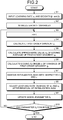
- FIG. 2 is a flowchart illustrating a processing procedure of learning processing executed by the learning apparatus 10 illustrated in FIG. 1 .
- the gradient calculation unit 11 in the learning apparatus 10 receives inputs of standard values of hyperparameters ⁇ , ⁇ 1 , and ⁇ 2 (Step S1). Subsequently, the gradient calculation unit 11 initializes each of variables (Step S2).
- the gradient calculation unit 11 takes inputs of input data x t and the parameter ⁇ t and increments t by +1 (Step S3). Subsequently, the gradient calculation unit 11 uses Formula (2) to calculate the first-order gradient g t (Step S4) and outputs the result to the statistic calculation unit 12.
- the statistic calculation unit 12 takes the first-order gradient g t output from the gradient calculation unit 11 and the standard values of hyperparameters ⁇ , ⁇ 1 , and ⁇ 2 as inputs, and uses Formula (3) to calculate the approximate value m t of the moving average of the first-order gradient g t (Step S5). In addition, the statistic calculation unit 12 uses Formula (5) to calculate the moving average c t of the variance of the first-order gradient g t (Step S6).
- the initialization bias removing unit 13 removes the initialization bias with respect to the approximate value m t of the moving average of the first-order gradient g t and the moving average c t of the variance of the first-order gradient g t calculated by the statistic calculation unit 12 (Step S7).
- the initialization bias removing unit 13 uses Formula (4) onto the approximate value m t of the moving average of the first-order gradient g t to remove the initialization bias.
- the initialization bias removing unit 13 uses Formula (6) onto the moving average c t of the variance of the first-order gradient g t to remove the initialization bias.
- the learning rate adjustment unit 14 adjusts the learning rate (Step S8) using a second term of Formula (7) based on the approximate value m t of the moving average of the first-order gradient g t and the moving average c t of the variance of the first-order gradient g t , from each of which the initialization bias has been removed by the initialization bias removing unit 13.
- the learning rate is adjusted by calculating a product of the learning rate and the value obtained by dividing the approximate value of the moving average of the first-order gradient by the standard deviation of the first-order gradient that is a square root of the moving average of the variance of the first-order gradient.
- Step S10 the parameter updating unit 15 updates the parameter ⁇ t of the model based on the calculation result of Step S8 (Step S9). Thereafter, the parameter updating unit 15 determines whether the parameter ⁇ t of the model has converged (Step S10). In a case where the parameter updating unit 15 determines that the parameter ⁇ t has converged (Step S10: Yes), the learning apparatus 10 finishes the processing. In contrast, in a case where the parameter updating unit 15 determines that the parameter ⁇ t has not converged (Step S10: No), the learning apparatus 10 returns to Step S3. That is, the gradient calculation unit 11 increments t by +1 and executes the processing from Step S4 onward again.
- the above-described learning processing adjusts the learning rate by dividing the learning rate by the standard deviation of the first-order gradient.
- the above-described learning processing adjusts the learning rate using the standard deviation of the first-order gradient including information defining the direction of parameter update. Therefore, according to the learning processing described above, it is possible to achieve efficient learning.
- FIG. 3 is a diagram illustrating a learning algorithm used by the learning apparatus 10 illustrated in FIG. 1 .
- the learning algorithm illustrated in FIG. 3 corresponds to the processing indicated by the flowchart of the learning processing in FIG. 2 .
- the learning algorithm increments t by +1 (third line in FIG. 3 ).
- the third line of FIG. 3 corresponds to Step S3 illustrated in FIG. 2 .
- the learning algorithm calculates the first-order gradient g t using Formula (2) (fourth line in FIG. 3 ).
- the fourth line of FIG. 3 corresponds to Step S4 illustrated in FIG. 2 .
- the learning algorithm uses Formula (3) to calculate the approximate value m t of the moving average of the first-order gradient g t (fifth line in FIG. 3 ).
- the fifth line of FIG. 3 corresponds to Step S5 illustrated in FIG. 2 .
- the learning algorithm uses Formula (5) to calculate the moving average c t of the variance of the first-order gradient g t (sixth line of FIG. 3 ).
- the sixth line of FIG. 3 corresponds to Step S6 illustrated in FIG. 2 .
- the learning algorithm uses Formula (4) onto the approximate value m t of the moving average of the first-order gradient g t to remove the initialization bias (seventh line in FIG. 3 ).
- the learning algorithm uses Formula (6) onto the moving average c t of the variance of the first-order gradient g t to remove the initialization bias (eighth line in FIG. 3 ).
- the seventh line and the eighth line in FIG. 3 correspond to Step S7 illustrated in FIG. 2 .
- the learning algorithm uses Formula (7) to adjust the learning rate based on the approximate value m t of the moving average of the first-order gradient g t and the moving average c t of the variance of the first-order gradient g t from each of which the initialization bias has been removed, and updates the parameter ⁇ t (ninth line in FIG. 3 ).
- the ninth line of FIG. 3 corresponds to Steps S8 and S9 illustrated in FIG. 2 .
- the learning algorithm repeats the processing from the second line to the seventh line in FIG. 3 (tenth line in FIG. 3 ) until the parameter ⁇ t converges.
- the tenth line of FIG. 3 corresponds to Step S10 illustrated in FIG. 2 .
- the learning rate is adjusted by dividing the learning rate by the standard deviation of the first-order gradient instead of by the absolute value of the first-order gradient in the stochastic gradient descent method, making it possible to execute more efficient learning than in conventional methods.
- the learning rate is adjusted by dividing the learning rate by the standard deviation of the first-order gradient, making it possible to achieve a greater error decrease in a case where the repetitive calculation count t is incremented by one, compared with conventional Adam (refer to Non Patent Document 3, for example). That is, according to the present embodiment, the parameter ⁇ t can be converged by the learning with less repetitive calculation count t than the conventional Adam. Therefore, according to the present embodiment, it is possible to achieve more efficient learning as compared with the conventional Adam.
- the standard deviation of the first-order gradient including the information defining the direction of updating the parameter is used to adjust the learning rate, making it possible to obtain a smaller error function of the learned model than by Adam, leading to acquisition of experimental results with high accuracy.
- the present embodiment does not need a learning rate attenuation schedule necessary in conventional learning (e.g., AdaGrad (refer to Non Patent Document 1, for example), it is also unnecessary to perform manual tuning on the learning rate attenuation schedule, enabling the reduction in the tuning cost.
- a learning rate attenuation schedule necessary in conventional learning (e.g., AdaGrad (refer to Non Patent Document 1, for example)
- some conventional algorithms need to perform manual tuning for a gradient clipping threshold in order to avoid a failure in learning due to extremely large update of parameters in a case where the gradient becomes extremely large. That is, in a conventional case where the gradient becomes extremely large and exceeds the threshold, calculation is performed using a threshold instead of an actual gradient value to reduce learning failures. Conventionally, it was necessary to manually tune this threshold.
- the present embodiment divides the learning rate by the standard deviation of the first-order gradient in Formula (7) that is an arithmetic expression to obtain the parameter ⁇ t .
- the variance of the gradient also increases accordingly. Therefore, in the embodiment, even when the gradient included in the numerator of Formula (7) becomes extremely large, the variance of the gradient included in the denominator also increases, and thus, the parameter ⁇ t would not become extremely large.
- the update amount of the parameter ⁇ t does not become extremely large, it can be said that the likelihood of occurrence of a learning failure is low. For this reason, in the present embodiment, since the calculation proceeds without providing a gradient clipping threshold, manual tuning itself with respect to the gradient clipping threshold becomes unnecessary, leading to the reduction of the tuning cost.
- the learning rate is automatically adjusted based on information indicating the direction of the gradient in the stochastic gradient descent method.
- the present modification repeats application of the following series of Formulas (8) to (12) instead of Formulas (2) to (7), thereby implementing adjustment of the learning rate based on the information indicating the direction of the gradient.
- the repetitive calculation count is denoted by t.
- each of variables used in Formulas (8) to (12) described below is initialized, and hyperparameters ⁇ and ⁇ 1 are set to empirically obtained standard values.
- ⁇ 1 is a weight in calculating the statistic of the first-order gradient in the stochastic gradient descent method.
- ⁇ 1 is a weight in calculating the moving average of the first-order gradient and the moving average of the variance of the first-order gradient.
- Formula (8) indicates that the first-order gradient of the i-th parameter in the (t-1)th repetition is denoted by a symbol g i,t .
- g i , t ⁇ f ⁇ i , t ⁇ 1 ; x t ⁇ 1 ⁇ f ( ⁇ i,t -1 ; x t -1 ) is a first - order gradient of an i - th parameter in (t-1)th repetition.
- a moving average of the i-th first-order gradient g i,t in the t-th repetition is obtained using the following Formula (9).
- m i , t ⁇ 1 m i , t ⁇ 1 + 1 ⁇ ⁇ 1 g i , t
- the moving average m i,t of the first-order gradient g i,t in Formula (9) is a moving average of the first-order gradient over the past time.
- the moving average m i,t of this first-order gradient is the statistic related to the first-order gradient g i,t .
- a moving average of the variance of the i-th first-order gradient g i,t in the t-th repetition is obtained using the following Formula (10).
- c i , t ⁇ 1 c i , t ⁇ 1 + ⁇ 1 1 ⁇ ⁇ 1 g i , t ⁇ m i , t ⁇ 1 2
- the moving average c i,t of the variance of the i-th first-order gradient g i,t in Formula (10) is a moving average of the variance of the first-order gradient over the past time.
- the moving average c i,t of the variance of this first-order gradient g i,t is a statistic of the first-order gradient g i,t .
- the moving average c i,t of the variance of the first-order gradient g i,t is a value determined by the dispersion in the past direction of the first-order gradient g i,t , and includes information indicating the direction of the first-order gradient g i,t .
- the present modification uses the following Formula (11) onto the moving average c i,t of the variance of the first-order gradient g i,t to remove an initialization bias.
- the present modification uses Formula (11) to remove the initialization bias from the moving average c i,t of the variance of the first-order gradient g i,t .
- c ⁇ i , t c i , t 1 ⁇ ⁇ 1 t
- ⁇ i,t is a value obtained by removing an initialization bias from c i,t .
- the present embodiment uses the following Formula (12) to adjust the learning rate.
- ⁇ i , t ⁇ i , t ⁇ 1 ⁇ ⁇ g i , t c ⁇ i , t + ⁇
- ⁇ is a small value to stabilize calculation, for example, 10 -8 .
- the calculation of Formulas (8) to (12) is repeated until the parameter ⁇ t of the learning model converges.
- the present modification uses formulation of automatically adjusting the learning rate by dividing the learning rate by a square root of the moving average c i,t of the variance of the first-order gradient g i,t after bias removal, that is, dividing by standard deviation of the first-order gradient.
- the variance is determined by the dispersion of the first-order gradient in the past direction.
- the learning apparatus according to the present modification has a configuration similar to that of the learning apparatus 10 illustrated in FIG. 1 . Therefore, the learning processing according to the present modification will be described.
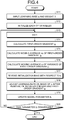
- FIG. 4 is a flowchart illustrating a processing procedure of learning processing according to a modification of the embodiment.
- the gradient calculation unit 11 in the learning apparatus 10 receives inputs of standard values of hyperparameters ⁇ and ⁇ 1 (Step S11).
- Steps S12 and S13 illustrated in FIG. 4 respectively correspond to Steps S2 and S3 illustrated in FIG. 1 .
- the gradient calculation unit 11 uses Formula (8) to calculate the first-order gradient g t (Step S14) and outputs the result to the statistic calculation unit 12.
- the statistic calculation unit 12 takes the first-order gradient g t output from the gradient calculation unit 11 and the standard values of hyperparameters ⁇ and ⁇ 1 as inputs, and uses Formula (9) to calculate the moving average m t of the first-order gradient g t (Step S15).
- the statistic calculation unit 12 uses Formula (10) to calculate the moving average c t of the variance of the first-order gradient g t (Step S16).
- the initialization bias removing unit 13 removes the initialization bias from the moving average c t of the variance of the first-order gradient g t calculated by the statistic calculation unit 12 (Step S17).
- the initialization bias removing unit 13 uses Formula (11) onto the moving average c t of the variance of the first-order gradient g t to remove the initialization bias.
- the learning rate adjustment unit 14 adjusts the learning rate using the second term of Formula (12) based on the first-order gradient g t and the moving average c t of the variance of the first-order gradient g t from which the initialization bias has been removed (Step S18).
- the learning rate is adjusted by calculating a product of the learning rate and the value obtained by dividing the first-order gradient by the standard deviation of the first-order gradient that is a square root of the moving average of the variance of the first-order gradient.
- Steps S19 and S20 illustrated in FIG. 4 respectively correspond to Steps S9 and S10 illustrated in FIG. 2 .
- FIG. 5 is a diagram illustrating a learning algorithm 2 according to the present modification.
- the learning algorithm 2 illustrated in FIG. 5 corresponds to the processing indicated by the flowchart of the learning processing in FIG. 4 .
- the learning algorithm increments t by +1 (third line in FIG. 5 ).
- the third line in FIG. 5 corresponds to Step S13 illustrated in FIG. 4 .
- the learning algorithm uses Formula (8) to calculate the first-order gradient g t (fourth line in FIG. 5 ).
- the fourth line in FIG. 5 corresponds to Step S14 illustrated in FIG. 4 .
- the learning algorithm uses Formula (9) to calculate the moving average m t of the first-order gradient g t (fifth line in FIG. 5 ).
- the fifth line of FIG. 5 corresponds to Step S15 illustrated in FIG. 4 .
- the learning algorithm uses Formula (10) to calculate the moving average c t of the variance of the first-order gradient g t (sixth line of FIG. 5 ).
- the sixth line of FIG. 5 corresponds to Step S16 illustrated in FIG. 4 .
- the learning algorithm uses Formula (11) onto the moving average c t of the variance of the first-order gradient g t to remove the initialization bias (seventh line in FIG. 5 ).
- the seventh line in FIG. 5 corresponds to Step S17 illustrated in FIG. 4 .
- the learning algorithm uses Formula (12) to adjust the learning rate based on the first-order gradient g t and the moving average c t of the variance of the first-order gradient g t , and updates the parameter ⁇ t (eighth line in FIG. 5 ).
- the eighth line in FIG. 5 corresponds to Steps S18 and S19 illustrated in FIG. 4 .
- the learning algorithm repeats the processing from the second line to the eighth line in FIG. 5 (ninth line in FIG. 5 ) until the parameter ⁇ t converges.
- the ninth line in FIG. 5 corresponds to Step S20 illustrated in FIG. 4 .
- FIG. 1 Individual components of the learning apparatus 10 illustrated in FIG. 1 are functionally conceptual and need not necessarily be physically configured as illustrated. That is, the specific form of the dispersion and integration of the functions of the learning apparatus 10 is not limited to those illustrated in the drawings, and whole or a part of the apparatus may be functionally or physically configured in dispersion or integration in arbitrary units in accordance with various loads, usage conditions, or the like.
- each of processing performed in the learning apparatus 10 may be implemented by a central processing unit (CPU) or a program analyzed and executed by the CPU.
- each of the processing performed in the learning apparatus 10 may be implemented as hardware using wired logic.
- all or a part of the processing described as being automatically performed can also be performed manually.
- all or a part of the processing described as being performed manually can be automatically performed by a known method.
- information including the processing procedure, control procedure, specific nomenclature, various data, and parameters as described above or in the drawings can be appropriately changed unless otherwise noted.
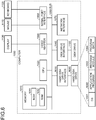
- FIG. 6 is a diagram illustrating an example of a computer that implements the learning apparatus 10 by execution of a program.
- a computer 1000 includes a memory 1010 and a CPU 1020, for example.
- the computer 1000 also includes a hard disk drive interface 1030, a disk drive interface 1040, a serial port interface 1050, a video adapter 1060, and a network interface 1070. These components are connected by a bus 1080.
- the memory 1010 includes a read only memory (ROM) 1011 and a RAM 1012.
- the ROM 1011 stores, for example, a boot program such as basic input output system (BIOS).
- BIOS basic input output system
- the hard disk drive interface 1030 is connected to a hard disk drive 1090.
- the disk drive interface 1040 is connected to a disk drive 1100.
- a detachable storage medium such as a magnetic disk or an optical disk is inserted into the disk drive 1100.
- the serial port interface 1050 is connected to a mouse 1110 and a keyboard 1120, for example.
- the video adapter 1060 is connected to a display 1130, for example.
- the hard disk drive 1090 stores an OS 1091, an application program 1092, a program module 1093, and program data 1094, for example. That is, the program that defines each of processing of the learning apparatus 10 is implemented as a program module 1093 describing codes executable by the computer 1000.
- the program module 1093 is stored in the hard disk drive 1090, for example.
- the program module 1093 for executing processing similar to functional configurations of the learning apparatus 10 is stored in the hard disk drive 1090.
- the hard disk drive 1090 may be replaced by a solid state drive (SSD).
- the setting data used in the processing of the above-described embodiment is stored as program data 1094 in the memory 1010 and the hard disk drive 1090, for example. Then, the CPU 1020 reads the program module 1093 and the program data 1094 stored in the memory 1010 and the hard disk drive 1090 onto the RAM 1012 as necessary for execution.
- the program module 1093 and the program data 1094 is not necessary stored in the hard disk drive 1090, but may be stored in a detachable storage medium and read out by the CPU 1020 via the disk drive 1100, for example.
- the program module 1093 and the program data 1094 may be stored in another computer connected via a network (LAN, WAN, or the like).
- the program module 1093 and the program data 1094 may be read out from the other computer by the CPU 1020 via the network interface 1070.
Landscapes
- Engineering & Computer Science (AREA)
- Theoretical Computer Science (AREA)
- Physics & Mathematics (AREA)
- Software Systems (AREA)
- Mathematical Physics (AREA)
- Data Mining & Analysis (AREA)
- General Physics & Mathematics (AREA)
- General Engineering & Computer Science (AREA)
- Evolutionary Computation (AREA)
- Artificial Intelligence (AREA)
- Computing Systems (AREA)
- Health & Medical Sciences (AREA)
- Life Sciences & Earth Sciences (AREA)
- Molecular Biology (AREA)
- General Health & Medical Sciences (AREA)
- Computational Linguistics (AREA)
- Biophysics (AREA)
- Biomedical Technology (AREA)
- Mathematical Analysis (AREA)
- Medical Informatics (AREA)
- Databases & Information Systems (AREA)
- Pure & Applied Mathematics (AREA)
- Mathematical Optimization (AREA)
- Computer Vision & Pattern Recognition (AREA)
- Computational Mathematics (AREA)
- Algebra (AREA)
- Complex Calculations (AREA)
Abstract
Description
- The present invention relates to a learning apparatus, a learning method, and a learning program.
- Machine learning is applied to a field of performing parameter learning of a model so as to lower an error function based on observation data for a problem to be solved such as discrimination, regression, and clustering and performing prediction onto unknown data. In machine learning, models are created from past observation data to predict future data. In this machine learning, models need to be created with less deviation (error) between predicted data and measured data. Furthermore, machine learning is expected to create models with small errors and in a short time.
- Among the existing algorithms applied to the learning of parameters of a model, a stochastic gradient descent method is established as one of general-purpose learning algorithms. The stochastic gradient descent method is a method of iteratively performing operation of randomly selecting learning data to calculate an error function and correcting a parameter in a gradient direction of decreasing the error function. Recently, various learning algorithms based on the stochastic gradient descent method have been proposed to implement efficient learning. Note that efficient means that the error function can be lowered by the less number of times of parameter updates than in the conventional stochastic gradient descent method.
- For example, there is proposed an algorithm referred to as AdaGrad to implement efficient learning by automatically adjusting the learning rate based on the stochastic gradient descent method (refer to
Non Patent Document 1, for example). Note that the learning rate is a hyperparameter for controlling an update amount of a parameter at the time of model learning. The setting of this learning rate determines how quickly the error function can be minimized. - In addition, the algorithm referred to as RMSProp is an algorithm that applies automatic adjustment of the learning rate also to learning complex models such as deep learning. In addition, there are proposed algorithms including one referred to as AdaDelta (for example, refer to Non Patent Document 2) having convergence faster than AdaGrad and capable of easily obtaining local optimal solution, and an efficient learning algorithm referred to as Adam (for example, refer to Non Patent Document 3). Among them, experiments have indicated that Adam has the highest efficiency among the algorithms that automatically adjust learning rates.
- The above-described AdaGrad, RMSProp, AdaDelta, and Adam automatically adjust the learning rate by dividing a learning rate by a moving average of an absolute value of past first-order gradient. Note that the first-order gradient refers to differentiation associated with parameters in an error function.
-
- Non Patent Document 1: J. Duchi, E. Hazan, and Y. Singer, "Adaptive Subgradient Methods for Online Learning and Stochastic Optimization," The Journal of Machine Learning Research, 12, 2121-2159, 2011
- Non Patent Document 2: M. D. Zeiler, "ADADELTA: AN ADAPTIVE LEARNING RATE METHOD," arXiv preprint arXiv: 1212.5701, 2012
- Non Patent Document 3: D. Kingma, and J. Ba, "ADAM: A METHOD FOR STOCHASTIC OPTIMIZATION," arXiv preprint arXiv:1412.6980, 2014
- This first-order gradient is information that defines a direction of parameter update. Therefore, it can be speculated that information indicating the direction of the first-order gradient is important in adjusting the learning rate. However, since AdaGrad, RMSProp, AdaDelta, and Adam use an absolute value of the first-order gradient, information related to the direction of the first-order gradient is lost in the learning rate, and efficient learning is estimated to have limitations.
- The present invention has been made in view of the above, and aims to provide a learning apparatus, a learning method, and a learning program capable of achieving efficient learning.
- To solve the above problem and attain the object, a learning apparatus according to the present invention is a learning apparatus that performs learning using a stochastic gradient descent method in machine learning, and includes: a gradient calculation unit that calculates a first-order gradient in the stochastic gradient descent method; a statistic calculation unit that calculates a statistic of the first-order gradient; an initialization bias removing unit that removes an initialization bias when the statistic calculation unit calculates the statistic of the first-order gradient from the statistic of the first-order gradient calculated by the statistic calculation unit; a learning rate adjustment unit that adjusts a learning rate by dividing the learning rate by standard deviation of the first-order gradient based on the statistic of the first-order gradient; and a parameter updating unit that updates a parameter of a learning model using the learning rate adjusted by the learning rate adjustment unit.
- According to the present invention, it is possible to achieve efficient learning.
-
-
FIG. 1 is a block diagram illustrating an exemplary configuration of a learning apparatus according to the present embodiment. -
FIG. 2 is a flowchart illustrating a processing procedure of learning processing executed by the learning apparatus illustrated inFIG. 1 . -
FIG. 3 is a diagram illustrating a learning algorithm used by the learning apparatus illustrated inFIG. 1 . -
FIG. 4 is a flowchart illustrating a processing procedure of learning processing according to a modification of an embodiment. -
FIG. 5 is a diagram illustrating a learning algorithm according to a modification of an embodiment. -
FIG. 6 is a diagram illustrating an example of a computer that implements a learning apparatus by execution of a program. - Hereinafter, an embodiment of the present invention will be described in detail with reference to the drawings. Note that the present invention is not limited by the present embodiment. Furthermore, same portions are denoted by same reference numerals in the description of the drawings.
- Main symbols used in the embodiments are illustrated in a table below. Hereinafter, the same symbols are used in a mathematical background of the conventional technology, a mathematical background of the embodiments, and individual descriptions of the embodiments.
Symbol Definition f(·) Error function, cost function, objective function θ Model parameter f(θ) Error function when model parameter is given θi,t i-th parameter in t-th repetition α Learning rate xt Input data in t-th repetition ∇f(θ i,t-1;x t-1) First-order gradient of i-th parameter in (t-1)th repetition gi,t Same as ∇f(θ i,t-1;x t-1). Symbol for simplification. mi,t Approximate value of moving average of i-th first-order gradient in t-th repetition. m̂i,t Value obtained by removing initialization bias from mi,t. β1 Weight in calculating approximation of moving average of first-order gradient. ci,t Moving average of variance of i-th first-order gradient in t-th repetition. ĉi,t Value obtained by removing initialization bias from ci,t. β2 Weight in calculating moving average of variance of first-order gradient. ε Small value to stabilize calculation. For example, 10-8 - First, the background knowledge to be the basis of the following description will be explained. Machine learning is basically a technique of learning a model from observation data so as to minimize an error function of a problem to be solved and performing prediction onto unknown data using the learned model. Examples of the problems to be solved include data classification, regression, and clustering. Examples of the error function include a square error and cross entropy. Examples of models include logistic regression and neural network.
- Here, when an error function is f(·) and a parameter of a learning model is θ, learning is a problem of finding θ that minimizes f(θ). The stochastic gradient descent method is a widely used algorithm among various types of algorithms for learning. In the stochastic gradient descent method, learning is performed by repeatedly applying the following Formula (1).

- α is one of hyperparameters manually set in order to define an update range of the parameter and is referred to as a learning rate. Since the learning rate defines the update range, it greatly affects efficiency of learning. With appropriate setting of the learning rate, it is possible to continue learning with high efficiency. In recent years, researches to achieve high efficiency with automatic adjustment of the learning rate based on various types of information are ongoing. Note that high efficiency means that the error function can be lowered by the less number of times of parameter updates than in the conventional stochastic gradient descent method.
- For example, the learning algorithm referred to as Adam automatically adjusts the learning rate by dividing the learning rate by the moving average of the absolute value of the past first-order gradient. First-order gradient refers to differentiation with respect to parameters in the error function and includes information that defines the direction of parameter update. However, since Adam uses an absolute value of the first-order gradient for the learning rate, information on the direction of the first-order gradient is lost, and efficient learning is also expected to be limited.
- The present embodiment automatically adjusts the learning rate based on information indicating the direction of the gradient in the stochastic gradient descent method. The present embodiment repeats application of the following series of Formulas (2) to (7) instead of Formula (1), thereby implementing adjustment of the learning rate based on the information indicating the direction of the gradient. In the present embodiment, a repetitive calculation count is denoted by t.
- First, in the present embodiment, each of variables used in Formulas (2) to (7) described below is initialized, hyperparameters α, β1, and β2 are set to empirically obtained standard values. β1 and β2 are weights in calculating the statistics of the first-order gradient in the stochastic gradient descent method. β1 is a weight in calculating an approximation of a moving average of the first-order gradient and β2 is a weight in calculating a moving average of a variance of the first-order gradient. Subsequently, the present embodiment executes calculation using the following Formula (2). Formula (2) indicates that the first-order gradient of the i-th parameter in the (t-1)th repetition is denoted by a symbol gi,t.

- In addition, in the present embodiment, an approximate value of the moving average of the i-th first-order gradient gi,t in the t-th repetition is obtained using the following Formula (3).

- where mi,t is an approximate value of moving average of i - th first - order gradient in t - th repetition, and
- β1 is a weight in calculating an approximation of a moving average of the first - order gradient.
- The approximate value mi,t of the moving average of the first-order gradient gi,t in Formula (3) is an approximation of the moving average of the first-order gradient over the past time. The approximate value mi,t of the moving average of the first-order gradient is a statistic related to the first-order gradient gi,t.
- Subsequently, the present embodiment uses the following Formula (4) onto the approximate value mi,t of the moving average of the first-order gradient gi,t to remove an initialization bias. In other words, the present embodiment uses Formula (4) to remove the initialization bias from the approximate value mi,t of the moving average of the first-order gradient gi,t.

- In addition, the present embodiment uses the following Formula (5) to obtain a moving average of the variance of the i-th first-order gradient gi,t in the t-th repetition.

- where ci,t is a moving average of the variance of the i - th first - order gradient in the t - th repetition, and
- β2 is a weight in calculating a moving average of variance of the first - order gradient.
- A moving average ci,t of the variance of the i-th first-order gradient gi,t in Formula (5) is a moving average of the variance of the first-order gradient over the past time. The moving average ci,t of the variance of this first-order gradient gi,t is a statistic of the first-order gradient gi,t. The moving average ci,t of the variance of the first-order gradient gi,t is a value determined by the dispersion in the past direction of the first-order gradient gi,t, and includes information indicating the direction of the first-order gradient gi,t.
- Subsequently, the present embodiment uses the following Formula (6) onto the moving average ci,t of the variance of the first-order gradient gi,t to remove an initialization bias. In other words, the present embodiment uses Formula (6) to remove the initialization bias from the moving average ci,t of the variance of the first-order gradient gi,t.

- In addition, the present embodiment uses the following Formula (7) to adjust the learning rate.

- The present embodiment repeats the calculation of Formulas (2) to (7) until a parameter θt of the learning model converges. As illustrated in Formula (7), the present embodiment uses formulation of automatically adjusting the learning rate by dividing the learning rate by a square root of the moving average ci,t of the variance of the first-order gradient gi,t after bias removal, that is, dividing by standard deviation of the first-order gradient. Here, the variance is determined by the dispersion of the first-order gradient in the past direction.
- Therefore, the present embodiment enables execution of adjustment of the learning rate based on the information of the direction of the first-order gradient, making it possible to lower the error function. That is, according to the present embodiment, it is possible to achieve efficient learning.
- A learning apparatus or the like according to the present embodiment will be described based on the mathematical background of the embodiment described above. Note that the following embodiments are given as an example.
-
FIG. 1 is a block diagram illustrating an exemplary configuration of alearning apparatus 10 according to the present embodiment. Thelearning apparatus 10 performs learning using a stochastic gradient descent method in machine learning. Thelearning apparatus 10 takes standard values of hyperparameters α, β1, and β2 as inputs. Inputs of α, β1, and β2 are performed merely at the first time. In addition, thelearning apparatus 10 outputs the converged parameter θt, for example. As illustrated inFIG. 1 , thelearning apparatus 10 according to the present embodiment includes agradient calculation unit 11, astatistic calculation unit 12, an initializationbias removing unit 13, a learningrate adjustment unit 14, and aparameter updating unit 15. - The
gradient calculation unit 11 calculates a first-order gradient in the stochastic gradient descent method. Specifically, thegradient calculation unit 11 takes θt updated by theparameter updating unit 15 as input. Furthermore, thegradient calculation unit 11 takes input data xt from the external apparatus as input. Thegradient calculation unit 11 calculates a first-order gradient gt for t representing the repetitive calculation count and outputs a calculation result to thestatistic calculation unit 12. - First, the
gradient calculation unit 11 initializes each of the variables. In this case, thegradient calculation unit 11 sets t = 0 for the repetitive calculation count t. Then, thegradient calculation unit 11 sets mt = m0 for the approximate value mt of the moving average of the first-order gradient gt, and sets ct = cC for the moving average ct of the variance of the first-order gradient gt. In a similar manner, the initial value is also set for mt after removal of an initialization bias and ct after removal of the initialization bias. This initialization is performed merely at the first time. - Then, the
gradient calculation unit 11 takes inputs of the input data xt and the parameter θt. Subsequently, thegradient calculation unit 11 increments t by +1. Due to this +1 increment, the approximate value mt of the moving average of the first-order gradient and the moving average ct of the variance of the first-order gradient from each of which the initialization bias described below has been removed are going to be an approximate value mt-1 of the moving average of the first-order gradient and a moving average ct-1 of the variance of the first-order gradient. Accordingly, in a case where initialization is performed for each of variables, t = 1 is established due to this +1 increment, and then, the approximate value mt-1 of the moving average of the first-order gradient and the moving average ct-1 of the variance of the first-order gradient from each of which the initialization bias has been removed are going to be the approximate value mt-1 of the moving average of the first-order gradient and the moving average ct-1 of the variance of the first-order gradient from each of which the initialization bias has been removed. - Then, the
gradient calculation unit 11 uses Formula (2) to calculate the first-order gradient gt and outputs the result to thestatistic calculation unit 12. - The
statistic calculation unit 12 calculates the statistics of the first-order gradient. Specifically, thestatistic calculation unit 12 takes the first-order gradient gt output from thegradient calculation unit 11 and the standard values of hyperparameters α, β1, and β2 as inputs and calculates the approximate value mt of the moving average of the first-order gradient gt and the moving average ct of variance of the first-order gradient gt as statistics. Thestatistic calculation unit 12 uses Formula (3) to calculate the approximate value mt of the moving average of the first-order gradient gt. Then, thestatistic calculation unit 12 uses Formula (5) to calculate the moving average ct of the variance of the first-order gradient gt. Thestatistic calculation unit 12 outputs the approximate value mt of the moving average of the first-order gradient gt and the moving average ct of the variance of the first-order gradient gt to the initializationbias removing unit 13. - The initialization
bias removing unit 13 removes the initialization bias from the statistic of the first-order gradient calculated by thestatistic calculation unit 12. Specifically, the initializationbias removing unit 13 uses Formula (4) onto the approximate value mt of the moving average of the first-order gradient gt to remove the initialization bias. Then, the initializationbias removing unit 13 uses Formula (6) onto the moving average ct of the variance of the first-order gradient gt to remove the initialization bias. Note that the calculation described in Non Patent Document 3 may be used for calculation to remove the initialization bias, for example. - The learning
rate adjustment unit 14 adjusts the learning rate by dividing the learning rate by the standard deviation of the first-order gradient based on the statistic of the first-order gradient. Specifically, the learningrate adjustment unit 14 uses Formula (7) to adjust the learning rate based on the approximate value mt of the moving average of the first-order gradient gt and the moving average ct of the variance of the first-order gradient gt from each of which the initialization bias has been removed by the initializationbias removing unit 13. Specifically, the learningrate adjustment unit 14 adjusts the learning rate by dividing the learning rate by the standard deviation of the first-order gradient based on the statistic from which the initialization bias has been removed. - The
parameter updating unit 15 updates the parameters of the learning model using the learning rate adjusted by the learningrate adjustment unit 14. Specifically, theparameter updating unit 15 updates the model parameter θt based on the calculation result of the learningrate adjustment unit 14. In a case where the parameter θt converges, theparameter updating unit 15 finishes the calculation processing. In contrast, in a case where the parameter θt does not converge, the parameter θt is output to thegradient calculation unit 11. This causes thegradient calculation unit 11 to increment t by +1. Then, thegradient calculation unit 11, thestatistic calculation unit 12, the initializationbias removing unit 13, and the learningrate adjustment unit 14 repeat calculation of Formulas (2) to (7). - Next, learning processing executed by the
learning apparatus 10 will be described.FIG. 2 is a flowchart illustrating a processing procedure of learning processing executed by thelearning apparatus 10 illustrated inFIG. 1 . First, thegradient calculation unit 11 in thelearning apparatus 10 receives inputs of standard values of hyperparameters α, β1, and β2 (Step S1). Subsequently, thegradient calculation unit 11 initializes each of variables (Step S2). - Then, the
gradient calculation unit 11 takes inputs of input data xt and the parameter θt and increments t by +1 (Step S3). Subsequently, thegradient calculation unit 11 uses Formula (2) to calculate the first-order gradient gt (Step S4) and outputs the result to thestatistic calculation unit 12. - Then, the
statistic calculation unit 12 takes the first-order gradient gt output from thegradient calculation unit 11 and the standard values of hyperparameters α, β1, and β2 as inputs, and uses Formula (3) to calculate the approximate value mt of the moving average of the first-order gradient gt (Step S5). In addition, thestatistic calculation unit 12 uses Formula (5) to calculate the moving average ct of the variance of the first-order gradient gt (Step S6). - Then, the initialization
bias removing unit 13 removes the initialization bias with respect to the approximate value mt of the moving average of the first-order gradient gt and the moving average ct of the variance of the first-order gradient gt calculated by the statistic calculation unit 12 (Step S7). The initializationbias removing unit 13 uses Formula (4) onto the approximate value mt of the moving average of the first-order gradient gt to remove the initialization bias. Then, the initializationbias removing unit 13 uses Formula (6) onto the moving average ct of the variance of the first-order gradient gt to remove the initialization bias. - Subsequently, the learning
rate adjustment unit 14 adjusts the learning rate (Step S8) using a second term of Formula (7) based on the approximate value mt of the moving average of the first-order gradient gt and the moving average ct of the variance of the first-order gradient gt, from each of which the initialization bias has been removed by the initializationbias removing unit 13. In Formula (7), the learning rate is adjusted by calculating a product of the learning rate and the value obtained by dividing the approximate value of the moving average of the first-order gradient by the standard deviation of the first-order gradient that is a square root of the moving average of the variance of the first-order gradient. - Then, the
parameter updating unit 15 updates the parameter θt of the model based on the calculation result of Step S8 (Step S9). Thereafter, theparameter updating unit 15 determines whether the parameter θt of the model has converged (Step S10). In a case where theparameter updating unit 15 determines that the parameter θt has converged (Step S10: Yes), thelearning apparatus 10 finishes the processing. In contrast, in a case where theparameter updating unit 15 determines that the parameter θt has not converged (Step S10: No), thelearning apparatus 10 returns to Step S3. That is, thegradient calculation unit 11 increments t by +1 and executes the processing from Step S4 onward again. - The above-described learning processing adjusts the learning rate by dividing the learning rate by the standard deviation of the first-order gradient. In other words, the above-described learning processing adjusts the learning rate using the standard deviation of the first-order gradient including information defining the direction of parameter update. Therefore, according to the learning processing described above, it is possible to achieve efficient learning.
- Next, a learning algorithm used by the
learning apparatus 10 will be described.FIG. 3 is a diagram illustrating a learning algorithm used by thelearning apparatus 10 illustrated inFIG. 1 . The learning algorithm illustrated inFIG. 3 corresponds to the processing indicated by the flowchart of the learning processing inFIG. 2 . As illustrated inFIG. 3 , the learning algorithm firstly illustrates an empirical standard setting of hyperparameters. For example, learning rates α = 0.001, β1 = 0.7, β2 = 0.99 are illustrated as empirical standard settings. - First, the learning algorithm inputs α, β1, β2, and θ0. This corresponds to Step S1 illustrated in
FIG. 2 . Subsequently, the learning algorithm initializes each of variables. More specifically, the repetitive calculation count is set as t = 0, the approximate value mt of the moving average of the first-order gradient is set as mt = m0, the moving average ct of the variance of the first-order gradient is set as ct = c0, and the mt after initialization bias removal and ct after initialization bias removal are set to their initial values (first line inFIG. 3 ). The first line ofFIG. 3 corresponds to Step S2 illustrated inFIG. 2 . - The learning algorithm increments t by +1 (third line in
FIG. 3 ). The third line ofFIG. 3 corresponds to Step S3 illustrated inFIG. 2 . The learning algorithm calculates the first-order gradient gt using Formula (2) (fourth line inFIG. 3 ). The fourth line ofFIG. 3 corresponds to Step S4 illustrated inFIG. 2 . - The learning algorithm uses Formula (3) to calculate the approximate value mt of the moving average of the first-order gradient gt (fifth line in
FIG. 3 ). The fifth line ofFIG. 3 corresponds to Step S5 illustrated inFIG. 2 . Then, the learning algorithm uses Formula (5) to calculate the moving average ct of the variance of the first-order gradient gt (sixth line ofFIG. 3 ). The sixth line ofFIG. 3 corresponds to Step S6 illustrated inFIG. 2 . - Then, the learning algorithm uses Formula (4) onto the approximate value mt of the moving average of the first-order gradient gt to remove the initialization bias (seventh line in
FIG. 3 ). The learning algorithm uses Formula (6) onto the moving average ct of the variance of the first-order gradient gt to remove the initialization bias (eighth line inFIG. 3 ). The seventh line and the eighth line inFIG. 3 correspond to Step S7 illustrated inFIG. 2 . - The learning algorithm uses Formula (7) to adjust the learning rate based on the approximate value mt of the moving average of the first-order gradient gt and the moving average ct of the variance of the first-order gradient gt from each of which the initialization bias has been removed, and updates the parameter θt (ninth line in
FIG. 3 ). The ninth line ofFIG. 3 corresponds to Steps S8 and S9 illustrated inFIG. 2 . - The learning algorithm repeats the processing from the second line to the seventh line in
FIG. 3 (tenth line inFIG. 3 ) until the parameter θt converges. The tenth line ofFIG. 3 corresponds to Step S10 illustrated inFIG. 2 . - In the present embodiment, the learning rate is adjusted by dividing the learning rate by the standard deviation of the first-order gradient instead of by the absolute value of the first-order gradient in the stochastic gradient descent method, making it possible to execute more efficient learning than in conventional methods.
- Specifically, it was experimentally found that, in the present embodiment, the learning rate is adjusted by dividing the learning rate by the standard deviation of the first-order gradient, making it possible to achieve a greater error decrease in a case where the repetitive calculation count t is incremented by one, compared with conventional Adam (refer to Non Patent Document 3, for example). That is, according to the present embodiment, the parameter θt can be converged by the learning with less repetitive calculation count t than the conventional Adam. Therefore, according to the present embodiment, it is possible to achieve more efficient learning as compared with the conventional Adam.
- Furthermore, in the present embodiment, the standard deviation of the first-order gradient including the information defining the direction of updating the parameter is used to adjust the learning rate, making it possible to obtain a smaller error function of the learned model than by Adam, leading to acquisition of experimental results with high accuracy.
- In addition, the present embodiment does not need a learning rate attenuation schedule necessary in conventional learning (e.g., AdaGrad (refer to
Non Patent Document 1, for example), it is also unnecessary to perform manual tuning on the learning rate attenuation schedule, enabling the reduction in the tuning cost. - Here, some conventional algorithms need to perform manual tuning for a gradient clipping threshold in order to avoid a failure in learning due to extremely large update of parameters in a case where the gradient becomes extremely large. That is, in a conventional case where the gradient becomes extremely large and exceeds the threshold, calculation is performed using a threshold instead of an actual gradient value to reduce learning failures. Conventionally, it was necessary to manually tune this threshold.
- In contrast, the present embodiment divides the learning rate by the standard deviation of the first-order gradient in Formula (7) that is an arithmetic expression to obtain the parameter θt. Here, when the gradient becomes extremely large, the variance of the gradient also increases accordingly. Therefore, in the embodiment, even when the gradient included in the numerator of Formula (7) becomes extremely large, the variance of the gradient included in the denominator also increases, and thus, the parameter θt would not become extremely large. In this manner, in the present embodiment, since the update amount of the parameter θt does not become extremely large, it can be said that the likelihood of occurrence of a learning failure is low. For this reason, in the present embodiment, since the calculation proceeds without providing a gradient clipping threshold, manual tuning itself with respect to the gradient clipping threshold becomes unnecessary, leading to the reduction of the tuning cost.
- A modification according to the present embodiment will be described. Also in the modification, the learning rate is automatically adjusted based on information indicating the direction of the gradient in the stochastic gradient descent method. The present modification repeats application of the following series of Formulas (8) to (12) instead of Formulas (2) to (7), thereby implementing adjustment of the learning rate based on the information indicating the direction of the gradient. Also in this modification, the repetitive calculation count is denoted by t.
- First, in this modification, each of variables used in Formulas (8) to (12) described below is initialized, and hyperparameters α and β1 are set to empirically obtained standard values. β1 is a weight in calculating the statistic of the first-order gradient in the stochastic gradient descent method. β1 is a weight in calculating the moving average of the first-order gradient and the moving average of the variance of the first-order gradient. Subsequently, in this modification, the calculation is executed using the following Formula (8). Formula (8) indicates that the first-order gradient of the i-th parameter in the (t-1)th repetition is denoted by a symbol gi,t.

- In this modification, a moving average of the i-th first-order gradient gi,t in the t-th repetition is obtained using the following Formula (9).

- where mi,t is a moving average of i - th first - order gradient in t - th repetition, and
- β1 is a weight in calculating a moving average of the first - order gradient.
- The moving average mi,t of the first-order gradient gi,t in Formula (9) is a moving average of the first-order gradient over the past time. The moving average mi,t of this first-order gradient is the statistic related to the first-order gradient gi,t.
- In the present embodiment, a moving average of the variance of the i-th first-order gradient gi,t in the t-th repetition is obtained using the following Formula (10).

- where ci,t is a moving average of the variance of the i - th first - order gradient in the t - th repetition, and
- β1 is a weight in calculating a moving average of the variance of the first - order gradient.
- The moving average ci,t of the variance of the i-th first-order gradient gi,t in Formula (10) is a moving average of the variance of the first-order gradient over the past time. The moving average ci,t of the variance of this first-order gradient gi,t is a statistic of the first-order gradient gi,t. The moving average ci,t of the variance of the first-order gradient gi,t is a value determined by the dispersion in the past direction of the first-order gradient gi,t, and includes information indicating the direction of the first-order gradient gi,t.
- Subsequently, the present modification uses the following Formula (11) onto the moving average ci,t of the variance of the first-order gradient gi,t to remove an initialization bias. In other words, the present modification uses Formula (11) to remove the initialization bias from the moving average ci,t of the variance of the first-order gradient gi,t.

- In addition, the present embodiment uses the following Formula (12) to adjust the learning rate.

- In the present modification, the calculation of Formulas (8) to (12) is repeated until the parameter θt of the learning model converges. As illustrated in Formula (12), the present modification uses formulation of automatically adjusting the learning rate by dividing the learning rate by a square root of the moving average ci,t of the variance of the first-order gradient gi,t after bias removal, that is, dividing by standard deviation of the first-order gradient. Here, the variance is determined by the dispersion of the first-order gradient in the past direction.
- Therefore, also in this modification, adjustment of the learning rate based on the information of the direction of the first-order gradient can be executed, making it possible to lower the error function. The learning apparatus according to the present modification has a configuration similar to that of the
learning apparatus 10 illustrated inFIG. 1 . Therefore, the learning processing according to the present modification will be described. -
FIG. 4 is a flowchart illustrating a processing procedure of learning processing according to a modification of the embodiment. First, thegradient calculation unit 11 in thelearning apparatus 10 receives inputs of standard values of hyperparameters α and β1 (Step S11). Steps S12 and S13 illustrated inFIG. 4 respectively correspond to Steps S2 and S3 illustrated inFIG. 1 . - Subsequently, the
gradient calculation unit 11 uses Formula (8) to calculate the first-order gradient gt (Step S14) and outputs the result to thestatistic calculation unit 12. Then, thestatistic calculation unit 12 takes the first-order gradient gt output from thegradient calculation unit 11 and the standard values of hyperparameters α and β1 as inputs, and uses Formula (9) to calculate the moving average mt of the first-order gradient gt (Step S15). In addition, thestatistic calculation unit 12 uses Formula (10) to calculate the moving average ct of the variance of the first-order gradient gt (Step S16). - Then, the initialization
bias removing unit 13 removes the initialization bias from the moving average ct of the variance of the first-order gradient gt calculated by the statistic calculation unit 12 (Step S17). The initializationbias removing unit 13 uses Formula (11) onto the moving average ct of the variance of the first-order gradient gt to remove the initialization bias. - Subsequently, the learning
rate adjustment unit 14 adjusts the learning rate using the second term of Formula (12) based on the first-order gradient gt and the moving average ct of the variance of the first-order gradient gt from which the initialization bias has been removed (Step S18). In Formula (12), the learning rate is adjusted by calculating a product of the learning rate and the value obtained by dividing the first-order gradient by the standard deviation of the first-order gradient that is a square root of the moving average of the variance of the first-order gradient. - Steps S19 and S20 illustrated in
FIG. 4 respectively correspond to Steps S9 and S10 illustrated inFIG. 2 . - Next, a learning algorithm according to the present modification will be described.
FIG. 5 is a diagram illustrating alearning algorithm 2 according to the present modification. Thelearning algorithm 2 illustrated inFIG. 5 corresponds to the processing indicated by the flowchart of the learning processing inFIG. 4 . - As illustrated in
FIG. 5 , the learning algorithm inputs α, β1, and θ0 first. This corresponds to Step S11 illustrated inFIG. 4 . Subsequently, the learning algorithm initializes each of variables. More specifically, with the setting of the repetitive calculation count t = 0, the moving average mt of the first-order gradient as mt = m0, the moving average ct of the variance of the first-order gradient as ct = c0, the ct after initialization bias removal is set to the initial value (first line inFIG. 5 ). The first line ofFIG. 5 corresponds to Step S12 illustrated inFIG. 4 . - The learning algorithm increments t by +1 (third line in
FIG. 5 ). The third line inFIG. 5 corresponds to Step S13 illustrated inFIG. 4 . The learning algorithm uses Formula (8) to calculate the first-order gradient gt (fourth line inFIG. 5 ). The fourth line inFIG. 5 corresponds to Step S14 illustrated inFIG. 4 . - The learning algorithm uses Formula (9) to calculate the moving average mt of the first-order gradient gt (fifth line in
FIG. 5 ). The fifth line ofFIG. 5 corresponds to Step S15 illustrated inFIG. 4 . Then, the learning algorithm uses Formula (10) to calculate the moving average ct of the variance of the first-order gradient gt (sixth line ofFIG. 5 ). The sixth line ofFIG. 5 corresponds to Step S16 illustrated inFIG. 4 . The learning algorithm uses Formula (11) onto the moving average ct of the variance of the first-order gradient gt to remove the initialization bias (seventh line inFIG. 5 ). The seventh line inFIG. 5 corresponds to Step S17 illustrated inFIG. 4 . - The learning algorithm uses Formula (12) to adjust the learning rate based on the first-order gradient gt and the moving average ct of the variance of the first-order gradient gt, and updates the parameter θt (eighth line in
FIG. 5 ). The eighth line inFIG. 5 corresponds to Steps S18 and S19 illustrated inFIG. 4 . - The learning algorithm repeats the processing from the second line to the eighth line in
FIG. 5 (ninth line inFIG. 5 ) until the parameter θt converges. The ninth line inFIG. 5 corresponds to Step S20 illustrated inFIG. 4 . - Individual components of the
learning apparatus 10 illustrated inFIG. 1 are functionally conceptual and need not necessarily be physically configured as illustrated. That is, the specific form of the dispersion and integration of the functions of thelearning apparatus 10 is not limited to those illustrated in the drawings, and whole or a part of the apparatus may be functionally or physically configured in dispersion or integration in arbitrary units in accordance with various loads, usage conditions, or the like. - In addition, all or a certain part of each of processing performed in the
learning apparatus 10 may be implemented by a central processing unit (CPU) or a program analyzed and executed by the CPU. In addition, each of the processing performed in thelearning apparatus 10 may be implemented as hardware using wired logic. - In addition, among all the processing described in the embodiments, all or a part of the processing described as being automatically performed can also be performed manually. Alternatively, all or a part of the processing described as being performed manually can be automatically performed by a known method. Besides this, information including the processing procedure, control procedure, specific nomenclature, various data, and parameters as described above or in the drawings can be appropriately changed unless otherwise noted.
-
FIG. 6 is a diagram illustrating an example of a computer that implements thelearning apparatus 10 by execution of a program. Acomputer 1000 includes amemory 1010 and aCPU 1020, for example. Thecomputer 1000 also includes a harddisk drive interface 1030, adisk drive interface 1040, aserial port interface 1050, avideo adapter 1060, and anetwork interface 1070. These components are connected by a bus 1080. - The
memory 1010 includes a read only memory (ROM) 1011 and aRAM 1012. TheROM 1011 stores, for example, a boot program such as basic input output system (BIOS). The harddisk drive interface 1030 is connected to ahard disk drive 1090. Thedisk drive interface 1040 is connected to adisk drive 1100. For example, a detachable storage medium such as a magnetic disk or an optical disk is inserted into thedisk drive 1100. Theserial port interface 1050 is connected to amouse 1110 and akeyboard 1120, for example. Thevideo adapter 1060 is connected to adisplay 1130, for example. - The
hard disk drive 1090 stores anOS 1091, anapplication program 1092, aprogram module 1093, andprogram data 1094, for example. That is, the program that defines each of processing of thelearning apparatus 10 is implemented as aprogram module 1093 describing codes executable by thecomputer 1000. Theprogram module 1093 is stored in thehard disk drive 1090, for example. For example, theprogram module 1093 for executing processing similar to functional configurations of thelearning apparatus 10 is stored in thehard disk drive 1090. Note that thehard disk drive 1090 may be replaced by a solid state drive (SSD). - In addition, the setting data used in the processing of the above-described embodiment is stored as
program data 1094 in thememory 1010 and thehard disk drive 1090, for example. Then, theCPU 1020 reads theprogram module 1093 and theprogram data 1094 stored in thememory 1010 and thehard disk drive 1090 onto theRAM 1012 as necessary for execution. - The
program module 1093 and theprogram data 1094 is not necessary stored in thehard disk drive 1090, but may be stored in a detachable storage medium and read out by theCPU 1020 via thedisk drive 1100, for example. Alternatively, theprogram module 1093 and theprogram data 1094 may be stored in another computer connected via a network (LAN, WAN, or the like). In addition, theprogram module 1093 and theprogram data 1094 may be read out from the other computer by theCPU 1020 via thenetwork interface 1070. - The embodiments of the present invention made by the present inventors have been described above, while the present invention is not limited by description and drawing according to the present embodiment, which form a part of the disclosure of the present invention. That is, other embodiments, examples, operation techniques, or the like that are performed by those skilled in the art based on the present embodiments are all included in the scope of the present invention.
-
- 10
- LEARNING APPARATUS
- 11
- GRADIENT CALCULATION UNIT
- 12
- STATISTIC CALCULATION UNIT
- 13
- INITIALIZATION BIAS REMOVING UNIT
- 14
- LEARNING RATE ADJUSTMENT UNIT
- 15
- PARAMETER UPDATING UNIT
Claims (7)
- A learning apparatus that performs learning using a stochastic gradient descent method in machine learning, the learning apparatus comprising:a gradient calculation unit that calculates a first-order gradient in the stochastic gradient descent method;a statistic calculation unit that calculates a statistic of the first-order gradient;an initialization bias removing unit that removes an initialization bias when the statistic calculation unit calculates the statistic of the first-order gradient from the statistic of the first-order gradient calculated by the statistic calculation unit;a learning rate adjustment unit that adjusts a learning rate by dividing the learning rate by standard deviation of the first-order gradient based on the statistic of the first-order gradient; anda parameter updating unit that updates a parameter of a learning model using the learning rate adjusted by the learning rate adjustment unit.
- The learning apparatus according to claim 1,
wherein the statistic calculation unit calculates an approximate value of a moving average of the first-order gradient and a moving average of variance of the first-order gradient as the statistics of the first-order gradient, and
the learning rate adjustment unit adjusts the learning rate by calculating a product of the learning rate and a value obtained by dividing the approximate value of the moving average of the first-order gradient by the standard deviation of the first-order gradient that is a square root of the moving average of the variance of the first-order gradient. - The learning apparatus according to claim 1,
wherein the statistic calculation unit calculates a moving average of the first-order gradient and a moving average of variance of the first-order gradient as the statistics of the first-order gradient, and
the learning rate adjustment unit adjusts the learning rate by calculating a product of the learning rate and a value obtained by dividing the first-order gradient by the standard deviation of the first-order gradient that is a square root of the moving average of the variance of the first-order gradient. - The learning apparatus according to claim 2,
wherein the initialization bias removing unit
removes an initialization bias of the approximate value of the moving average of the first-order gradient by dividing the approximate value of the moving average of the first-order gradient by a value obtained by subtracting a weight in calculating the moving average of the first-order gradient from one, and
removes an initialization bias of the approximate value of the moving average of the variance of the first-order gradient by dividing the moving average of the variance of the first-order gradient by a value obtained by subtracting a weight in calculating the moving average of the variance of the first-order gradient from one. - The learning apparatus according to claim 3, wherein the initialization bias removing unit removes the initialization bias of the approximate value of the moving average of the variance of the first-order gradient by dividing the moving average of the variance of the first-order gradient by a value obtained by subtracting a weight in calculating the moving average of the variance of the first-order gradient from one.
- A learning method executed by a learning apparatus that performs learning using a stochastic gradient descent method in machine learning, the learning method comprising:calculating a first-order gradient in the stochastic gradient descent method;calculating a statistic of the first-order gradient;removing an initialization bias when calculating the statistic of the first-order gradient in calculation of the statistic from the statistic of the first-order gradient;adjusting a learning rate by dividing the learning rate by standard deviation of the first-order gradient based on the statistic of the first-order gradient; andupdating a parameter of a learning model using the learning rate adjusted in the adjustment.
- A learning program that causes a computer to execute:a step of calculating a first-order gradient in a stochastic gradient descent method in a case where learning is executed using the stochastic gradient descent method in machine learning;a step of calculating a statistic of the first-order gradient;a step of removing an initialization bias used in calculating the statistic of the first-order gradient in the step of calculating the statistic from the statistic of the first-order gradient;a step of adjusting a learning rate by dividing the learning rate by standard deviation of the first-order gradient based on the statistic of the first-order gradient; anda step of updating a parameter of a learning model using the learning rate adjusted in the step of adjustment.
Applications Claiming Priority (2)
| Application Number | Priority Date | Filing Date | Title |
|---|---|---|---|
| JP2016083141 | 2016-04-18 | ||
| PCT/JP2017/015337 WO2017183587A1 (en) | 2016-04-18 | 2017-04-14 | Learning device, learning method, and learning program |
Publications (2)
| Publication Number | Publication Date |
|---|---|
| EP3432230A1 true EP3432230A1 (en) | 2019-01-23 |
| EP3432230A4 EP3432230A4 (en) | 2019-11-20 |
Family
ID=60115964
Family Applications (1)
| Application Number | Title | Priority Date | Filing Date |
|---|---|---|---|
| EP17785925.3A Ceased EP3432230A4 (en) | 2016-04-18 | 2017-04-14 | LEARNING DEVICE, LEARNING METHOD, AND LEARNING PROGRAM |
Country Status (4)
| Country | Link |
|---|---|
| US (1) | US20190156240A1 (en) |
| EP (1) | EP3432230A4 (en) |
| JP (1) | JP6417075B2 (en) |
| WO (1) | WO2017183587A1 (en) |
Cited By (2)
| Publication number | Priority date | Publication date | Assignee | Title |
|---|---|---|---|---|
| CN110992432A (en) * | 2019-10-28 | 2020-04-10 | 北京大学 | Depth neural network-based minimum variance gradient quantization compression and image processing method |
| CN116569187A (en) * | 2021-12-03 | 2023-08-08 | 三菱电机株式会社 | Learned model generation system, learned model generation method, information processing device, program, learned model, and estimation device |
Families Citing this family (11)
| Publication number | Priority date | Publication date | Assignee | Title |
|---|---|---|---|---|
| US11126893B1 (en) * | 2018-05-04 | 2021-09-21 | Intuit, Inc. | System and method for increasing efficiency of gradient descent while training machine-learning models |
| JP6927425B2 (en) * | 2018-05-15 | 2021-08-25 | 日本電気株式会社 | Stochastic optimizer, stochastic optimization method, and stochastic optimization program |
| JP7301801B2 (en) * | 2018-10-09 | 2023-07-03 | 株式会社Preferred Networks | Hyperparameter tuning method, device and program |
| JP6699702B2 (en) * | 2018-10-17 | 2020-05-27 | トヨタ自動車株式会社 | INTERNAL COMBUSTION ENGINE CONTROL DEVICE AND ITS CONTROL METHOD, LEARNING MODEL FOR CONTROLLING INTERNAL COMBUSTION ENGINE, AND LEARNING METHOD THEREOF |
| JP6548243B1 (en) * | 2018-10-30 | 2019-07-24 | 株式会社キャンサースキャン | Health checkup examination probability calculation method and medical checkup recommendation notice support system |
| AU2019461061B2 (en) * | 2019-08-14 | 2023-03-30 | Ntt, Inc. | Secure gradient descent computation method, secure deep learning method, secure gradient descent computation system, secure deep learning system, secure computation apparatus, and program |
| US11966203B2 (en) * | 2019-08-21 | 2024-04-23 | Kla Corporation | System and method to adjust a kinetics model of surface reactions during plasma processing |
| US11631030B2 (en) * | 2020-02-11 | 2023-04-18 | International Business Machines Corporation | Learning with moment estimation using different time constants |
| US20240202569A1 (en) * | 2020-03-16 | 2024-06-20 | Nec Corporation | Learning device, learning method, and recording medium |
| JP7436830B2 (en) * | 2020-04-06 | 2024-02-22 | 富士通株式会社 | Learning programs, learning methods, and learning devices |
| CN112884160B (en) * | 2020-12-31 | 2024-03-12 | 北京爱笔科技有限公司 | A meta-learning method and related devices |
Family Cites Families (1)
| Publication number | Priority date | Publication date | Assignee | Title |
|---|---|---|---|---|
| EP3427195B1 (en) * | 2016-03-11 | 2024-05-01 | Telecom Italia S.p.A. | Convolutional neural networks, particularly for image analysis |
-
2017
- 2017-04-14 US US16/092,135 patent/US20190156240A1/en not_active Abandoned
- 2017-04-14 WO PCT/JP2017/015337 patent/WO2017183587A1/en not_active Ceased
- 2017-04-14 EP EP17785925.3A patent/EP3432230A4/en not_active Ceased
- 2017-04-14 JP JP2018513164A patent/JP6417075B2/en active Active
Cited By (3)
| Publication number | Priority date | Publication date | Assignee | Title |
|---|---|---|---|---|
| CN110992432A (en) * | 2019-10-28 | 2020-04-10 | 北京大学 | Depth neural network-based minimum variance gradient quantization compression and image processing method |
| CN116569187A (en) * | 2021-12-03 | 2023-08-08 | 三菱电机株式会社 | Learned model generation system, learned model generation method, information processing device, program, learned model, and estimation device |
| EP4443344A4 (en) * | 2021-12-03 | 2025-02-12 | Mitsubishi Electric Corporation | SYSTEM FOR GENERATING TRAINED MODELS, METHOD FOR GENERATING TRAINED MODELS, INFORMATION PROCESSING DEVICE, PROGRAM, TRAINED MODEL AND ESTIMATION DEVICE |
Also Published As
| Publication number | Publication date |
|---|---|
| WO2017183587A1 (en) | 2017-10-26 |
| JP6417075B2 (en) | 2018-10-31 |
| EP3432230A4 (en) | 2019-11-20 |
| JPWO2017183587A1 (en) | 2018-08-30 |
| US20190156240A1 (en) | 2019-05-23 |
Similar Documents
| Publication | Publication Date | Title |
|---|---|---|
| US20190156240A1 (en) | Learning apparatus, learning method, and recording medium | |
| EP3405843B1 (en) | Model adaption and online learning for unstable environments | |
| US11307562B2 (en) | Application of simple random search approach for reinforcement learning to controller tuning parameters | |
| US20210223765A1 (en) | Malfunction detection device, malfunction detection method, malfunction detection program, and recording medium | |
| US20110029469A1 (en) | Information processing apparatus, information processing method and program | |
| US10635078B2 (en) | Simulation system, simulation method, and simulation program | |
| CN108068294B (en) | Plastic extrusion process control method and parameter adjustment system | |
| US20200394550A1 (en) | Quantum Circuit Learning Device, Quantum Circuit Learning Method, and Recording Medium | |
| US11550274B2 (en) | Information processing apparatus and information processing method | |
| CN119310895B (en) | A fully automatic online PAT continuous crystallization control method, medium and system | |
| WO2017130835A1 (en) | Production device, production method, and production program | |
| CN120220846A (en) | A method and system for optimizing heparin production process based on environmental analysis | |
| WO2021066194A1 (en) | Learning device, learning method, and learning program | |
| CN111047016A (en) | Model training method and device | |
| Derumigny et al. | A classification point-of-view about conditional Kendall’s tau | |
| US12265609B2 (en) | Training device, detection system, training method, and training program | |
| JP5816387B1 (en) | Nonlinear optimal solution search system | |
| CN115023711A (en) | Learning device, learning method, and learning program | |
| Yarahmadian et al. | Phase transition analysis of the dynamic instability of microtubules | |
| KR102265361B1 (en) | Method and apparatus for deep-learning using smoothing | |
| CN114138025A (en) | Method, device and related equipment for controlling opening degree of desulfurization slurry valve | |
| Whitbeck et al. | Fast adaptive neural control of resonant extraction at Fermilab | |
| Rigas et al. | A Dynamic Framework for Grid Adaptation in Kolmogorov-Arnold Networks | |
| Forgione et al. | Batch-to-batch strategies for cooling crystallization | |
| Wang et al. | The graph-guided group lasso for genome-wide association studies |
Legal Events
| Date | Code | Title | Description |
|---|---|---|---|
| STAA | Information on the status of an ep patent application or granted ep patent |
Free format text: STATUS: THE INTERNATIONAL PUBLICATION HAS BEEN MADE |
|
| PUAI | Public reference made under article 153(3) epc to a published international application that has entered the european phase |
Free format text: ORIGINAL CODE: 0009012 |
|
| STAA | Information on the status of an ep patent application or granted ep patent |
Free format text: STATUS: REQUEST FOR EXAMINATION WAS MADE |
|
| 17P | Request for examination filed |
Effective date: 20181015 |
|
| AK | Designated contracting states |
Kind code of ref document: A1 Designated state(s): AL AT BE BG CH CY CZ DE DK EE ES FI FR GB GR HR HU IE IS IT LI LT LU LV MC MK MT NL NO PL PT RO RS SE SI SK SM TR |
|
| AX | Request for extension of the european patent |
Extension state: BA ME |
|
| DAV | Request for validation of the european patent (deleted) | ||
| DAX | Request for extension of the european patent (deleted) | ||
| A4 | Supplementary search report drawn up and despatched |
Effective date: 20191018 |
|
| RIC1 | Information provided on ipc code assigned before grant |
Ipc: G06N 99/00 20190101AFI20191014BHEP Ipc: G06N 3/08 20060101ALI20191014BHEP |
|
| STAA | Information on the status of an ep patent application or granted ep patent |
Free format text: STATUS: EXAMINATION IS IN PROGRESS |
|
| 17Q | First examination report despatched |
Effective date: 20200525 |
|
| APBK | Appeal reference recorded |
Free format text: ORIGINAL CODE: EPIDOSNREFNE |
|
| APBN | Date of receipt of notice of appeal recorded |
Free format text: ORIGINAL CODE: EPIDOSNNOA2E |
|
| APBR | Date of receipt of statement of grounds of appeal recorded |
Free format text: ORIGINAL CODE: EPIDOSNNOA3E |
|
| APAF | Appeal reference modified |
Free format text: ORIGINAL CODE: EPIDOSCREFNE |
|
| REG | Reference to a national code |
Ref country code: DE Ref legal event code: R003 |
|
| APBT | Appeal procedure closed |
Free format text: ORIGINAL CODE: EPIDOSNNOA9E |
|
| STAA | Information on the status of an ep patent application or granted ep patent |
Free format text: STATUS: THE APPLICATION HAS BEEN REFUSED |
|
| 18R | Application refused |
Effective date: 20240228 |