EP3432153A1 - Classification of xml elements according to attributes - Google Patents
Classification of xml elements according to attributes Download PDFInfo
- Publication number
- EP3432153A1 EP3432153A1 EP18181890.7A EP18181890A EP3432153A1 EP 3432153 A1 EP3432153 A1 EP 3432153A1 EP 18181890 A EP18181890 A EP 18181890A EP 3432153 A1 EP3432153 A1 EP 3432153A1
- Authority
- EP
- European Patent Office
- Prior art keywords
- text data
- pieces
- piece
- file
- attributes
- Prior art date
- Legal status (The legal status is an assumption and is not a legal conclusion. Google has not performed a legal analysis and makes no representation as to the accuracy of the status listed.)
- Ceased
Links
Images







Classifications
-
- G—PHYSICS
- G06—COMPUTING OR CALCULATING; COUNTING
- G06F—ELECTRIC DIGITAL DATA PROCESSING
- G06F16/00—Information retrieval; Database structures therefor; File system structures therefor
- G06F16/30—Information retrieval; Database structures therefor; File system structures therefor of unstructured textual data
- G06F16/35—Clustering; Classification
- G06F16/355—Creation or modification of classes or clusters
-
- G—PHYSICS
- G06—COMPUTING OR CALCULATING; COUNTING
- G06F—ELECTRIC DIGITAL DATA PROCESSING
- G06F16/00—Information retrieval; Database structures therefor; File system structures therefor
- G06F16/10—File systems; File servers
- G06F16/13—File access structures, e.g. distributed indices
-
- G—PHYSICS
- G06—COMPUTING OR CALCULATING; COUNTING
- G06F—ELECTRIC DIGITAL DATA PROCESSING
- G06F16/00—Information retrieval; Database structures therefor; File system structures therefor
- G06F16/20—Information retrieval; Database structures therefor; File system structures therefor of structured data, e.g. relational data
- G06F16/28—Databases characterised by their database models, e.g. relational or object models
- G06F16/284—Relational databases
- G06F16/285—Clustering or classification
-
- G—PHYSICS
- G06—COMPUTING OR CALCULATING; COUNTING
- G06F—ELECTRIC DIGITAL DATA PROCESSING
- G06F40/00—Handling natural language data
- G06F40/10—Text processing
- G06F40/12—Use of codes for handling textual entities
- G06F40/131—Fragmentation of text files, e.g. creating reusable text-blocks; Linking to fragments, e.g. using XInclude; Namespaces
-
- G—PHYSICS
- G06—COMPUTING OR CALCULATING; COUNTING
- G06Q—INFORMATION AND COMMUNICATION TECHNOLOGY [ICT] SPECIALLY ADAPTED FOR ADMINISTRATIVE, COMMERCIAL, FINANCIAL, MANAGERIAL OR SUPERVISORY PURPOSES; SYSTEMS OR METHODS SPECIALLY ADAPTED FOR ADMINISTRATIVE, COMMERCIAL, FINANCIAL, MANAGERIAL OR SUPERVISORY PURPOSES, NOT OTHERWISE PROVIDED FOR
- G06Q10/00—Administration; Management
- G06Q10/10—Office automation; Time management
Definitions
- the embodiments discussed herein are related to a storage control program, a storage control apparatus, and a storage control method.
- extensible business reporting language that is a language based on the extensible markup language (XML) standard has been used to smoothly distribute pieces of financial information, such as a financial statement.
- XBRL is composed of a concept called an instance and a concept called a taxonomy.
- An instance and a taxonomy are set for every piece of numerical information to be disclosed. More specifically, in XBRL, a piece of data, such as a sales figure or an operating profit, itself is set as an instance, and definition elements indicating a presentation structure, a presentation method, and the like are set as a taxonomy (see, for example, Japanese Laid-open Patent Publication Nos. 2011-197898 and 2016-145861 ).
- management may be performed by, for example, performing classification such that definition elements having the same attribute fall into the same group and storing definition elements in each group in a different file.
- the embodiments are intended to provide a storage control program, a storage control apparatus, and a storage control method capable of easily classifying definition elements included in a taxonomy.
- a storage control method comprising steps of; accepting a file that includes a plurality of pieces of text data and a piece of information indicating a correspondence between each of the plurality of pieces of text data and attributes of the piece of text data; classifying the plurality of pieces of text data into a plurality of groups in accordance with the plurality of attributes that are each associated with any one of the plurality of pieces of text data, based on the piece of information indicating the correspondence included in the accepted file; generating, for each of the plurality of groups, a file that stores one or a plurality of pieces of text data included in the group; and storing the generated file in a storage destination corresponding to the attributes of the one or plurality of pieces of text data included in the file.
- FIG. 1 is a diagram illustrating a configuration of an information processing system 10.
- the information processing system 10 illustrated in FIG. 1 includes, for example, an information processing apparatus 1 (hereinafter also referred to as the storage control apparatus 1), a storage device 1a, and an operation terminal 3.
- the operation terminal 3 illustrated in FIG. 1 is connected to the information processing apparatus 1 via a network NW, such as the Internet.
- NW such as the Internet
- the operation terminal 3 is, for example, a terminal which is used by a person in charge of finance (hereinafter, also simply referred to as a person in charge) of a company.
- the person in charge for example, generates a new taxonomy or updates a taxonomy already stored in the storage device 1a via the operation terminal 3. More specifically, the person in charge inputs a piece of information (a piece of financial information, for example) desired to generate a new taxonomy or update the taxonomy already stored in the storage device 1a to the information processing apparatus 1.
- the information processing apparatus 1 For example, if a desired piece of information is transmitted from the operation terminal 3, the information processing apparatus 1 generates a new taxonomy or updates the taxonomy already stored in the storage device 1a based on the transmitted piece of information.
- a taxonomy A specific example of a taxonomy will be described below.
- FIG. 2 is a diagram for explaining the specific example of the taxonomy.
- a taxonomy 131 illustrated in FIG. 2 includes an XML schema 141 and linkbases 142.
- the XML schema 141 defines names of items used in the taxonomy 131.
- Each linkbase 142 defines a relationship (link) between items used in the taxonomy 131.
- the linkbases 142 include a definition link 142a which describes a logical relationship (a parent-child relationship, for example) between items, a presentation link 142b which describes presentation levels and a presentation order of the items, and a calculation link 142c which describes methods for totalization (addition and subtraction, for example) of the items and data checking.
- a definition link 142a which describes a logical relationship (a parent-child relationship, for example) between items
- a presentation link 142b which describes presentation levels and a presentation order of the items
- a calculation link 142c which describes methods for totalization (addition and subtraction, for example) of the items and data checking.
- the linkbases 142 also include a label link 142d which describes labels for displaying item names (a plurality of labels for languages, for example), a reference link 142e which describes authorities (provisions of a commercial law, for example) for the items, and a footnote link 142f which describes a footnote at the time of data entry and creation.
- the linkbases 142 further include a formula link 142g which describes methods for totalization (four arithmetic operations, for example) of the items and advanced data checking, and a versioning link 142h which describes XBRL data and taxonomy version management.
- management may be performed by performing classification such that definition elements having the same attribute fall into the same group and storing definition elements in each group in a different file.
- the number of types of definition elements included in the taxonomy 131 as described above is increasing yearly. For this reason, for example, if classification and the like of the definition elements included in the taxonomy 131 generated by the information processing apparatus 1 are manually performed, the work burden may become immerse.
- the information processing apparatus 1 accepts a file which includes a plurality of definition elements (hereinafter also referred to as pieces of text data) included in the linkbase 142 and a piece of information (hereinafter also referred to as a piece of property information) indicating a correspondence between each of the plurality of definition elements and attributes of the definition element. More specifically, the information processing apparatus 1 acquires a file (files) storing definition elements of one or more linkbases 142 corresponding to details of designation among files of the taxonomy 131 stored in the storage device 1a in response to the designation (designation of the linkbase(s) 142 as a target for a storage control process) that is performed by the person in charge via the operation terminal 3.
- a file which includes a plurality of definition elements (hereinafter also referred to as pieces of text data) included in the linkbase 142 and a piece of information (hereinafter also referred to as a piece of property information) indicating a correspondence between each of the plurality of definition elements and attributes of the definition element
- the information processing apparatus 1 then classifies the plurality of definition elements into a plurality of groups in accordance with the plurality of attributes that are each associated with any one of the plurality of definition elements, based on the accepted pieces of information indicating the correspondences. After that, the information processing apparatus 1 generates, for each of the plurality of groups, a file which stores one or more definition elements included in the group and stores the generated file in a storage destination corresponding to attributes of the definition element(s) included in the file.
- the information processing apparatus 1 performs classification of each definition element included in the linkbase 142 by referring to the content of a piece of property information corresponding to the definition element.
- the above-described configuration allows the information processing apparatus 1 to automatically classify each definition element included in the linkbase 142.
- the information processing apparatus 1 is thus capable of reducing the work burden of manual classification of definition elements.
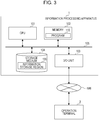
- FIG. 3 is a diagram illustrating an example of the hardware configuration of the information processing apparatus 1.
- the information processing apparatus 1 includes a CPU 101 as a processor, a memory 102, an external interface (I/O unit) 103, and a storage medium 104.
- the units are connected to one another via a bus 105.
- the storage medium 104 stores a program 110 for performing a process (hereinafter also referred to as a storage control process) of classifying each definition element included in the linkbase 142 in, for example, a program storage region (not illustrated) inside the storage medium 104.
- the storage medium 104 also includes, for example, an information storage region 130 (hereinafter also referred to as the storage unit 130) which stores information used to perform the storage control process. Note that the information storage region 130 corresponds to the storage device 1a described with reference to FIG. 1 .
- the CPU 101 loads the program 110 from the storage medium 104 onto the memory 102 at the time of execution of the program 110 and performs the storage control process in cooperation with the program 110.
- the external interface 103 communicates with the operation terminal 3 via, for example, the network NW.
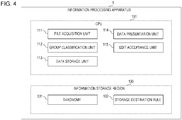
- FIG. 4 is a functional block diagram of the information processing apparatus 1.
- the CPU 101 of the information processing apparatus 1 operates as, for example, a file acquisition unit 111 (hereinafter also referred to as the file acceptance unit 111), a group classification unit 112, a data storage unit 113, a data presentation unit 114, and an edit acceptance unit 115 by working in cooperation with the program 110.
- the taxonomy 131 and a storage destination rule 132 are stored in the information storage region 130.
- the data storage unit 113 is assumed to include a file generation unit 113a and a file storage unit 113b in the following description.
- the file acquisition unit 111 acquires a file which includes a plurality of definition elements included in the linkbase 142 and a piece of information (a piece of property information) indicating a correspondence between each of the plurality of definition elements and attributes of the definition element.
- the information processing apparatus 1 acquires a file (files) storing definition elements of one or more linkbases 142 corresponding to details of designation among files of the taxonomy 131 stored in the storage device 1a in response to the designation (designation of the linkbase(s) 142 to be subjected to the storage control process) that is performed by the person in charge via the operation terminal 3.
- the group classification unit 112 classifies the plurality of definition elements included in the file(s) acquired by the file acquisition unit 111 into a plurality of groups in accordance with a plurality of attributes which are each associated with any one of the plurality of definition elements, based on pieces of information indicating correspondences included in the file(s) acquired by the file acquisition unit 111.
- the group classification unit 112 classifies the plurality of definition elements in accordance with the content of the storage destination rule 132 stored in the information storage region 130.
- the storage destination rule 132 may be, for example, generated in advance by the person in charge of the company and stored in the information storage region 130.
- the file generation unit 113a generates, for each of the plurality of groups, a classification into which is made by the group classification unit 112, a file which stores one or more definition elements in the group.
- the file generation unit 113a generates a file which stores one or more definition elements included in each group in accordance with the content of the storage destination rule 132 stored in the information storage region 130.
- the file storage unit 113b stores each file generated by the file generation unit 113a in a storage destination corresponding to attributes of a definition element (definition elements) included in the file.
- the data presentation unit 114 associates each of the plurality of definition elements included in each file acquired by the file acquisition unit 111 with attributes of the definition element, based on the pieces of information indicating the correspondences included in the file acquired by the file acquisition unit 111, and presents the plurality of definition elements on a display unit (a display device of the operation terminal 3, for example).
- the edit acceptance unit 115 accepts an edit which changes a correspondence between any one of the plurality of definition elements presented by the data presentation unit 114 and attributes of the definition element.
- the group classification unit 112 classifies the plurality of definition elements presented by the data presentation unit 114 into a plurality of groups in accordance with the plurality of attributes that are each associated with any one of the plurality of definition elements, based on the pieces of information indicating the correspondences after the edit accepted by the edit acceptance unit 115.
- FIG. 5 is a flowchart for explaining an overview of a storage control process according to the first embodiment.
- an information processing apparatus 1 waits for a start time for the storage control process (NO in S1).
- a start time for the storage control process may be, for example, a time when a person in charge gives an instruction to start the storage control process via an operation terminal 3.
- the information processing apparatus 1 acquires a file which includes a plurality of definition elements included in a linkbase 142 and a piece of information indicating a correspondence between each of the plurality of definition elements and attributes of the definition element (S2).
- the information processing apparatus 1 then classifies the plurality of definition elements included in the file acquired in the process in S2 into a plurality of groups in accordance with the plurality of attributes that are each associated with any one of the plurality of definition elements, based on the pieces of information indicating the correspondences included in the file acquired in the process in S2 (S3).
- the information processing apparatus 1 After that, the information processing apparatus 1 generates, for each of the plurality of groups, a classification into which is made in the process in S3, a file which stores one or more definition elements included in the group and stores the generated file in a storage destination corresponding to attributes of the definition element(s) included in the file (S4).
- the information processing apparatus 1 classifies each definition element included in the linkbase 142 by referring to the content of a piece of property information corresponding to the definition element.
- the above-described configuration allows the information processing apparatus 1 to automatically classify each definition element included in the linkbase 142.
- the information processing apparatus 1 is thus capable of reducing the work burden of manual classification of definition elements.
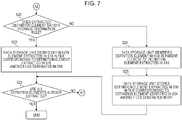
- FIGs. 6 and 7 are flowcharts for explaining details of the storage control process according to the first embodiment.
- FIGs. 8 to 16 are charts for explaining the details of the storage control process according to the first embodiment. The details of the storage control process in FIGs. 6 and 7 will be described with reference to FIGs. 8 to 16 .
- FIG. 8 is a diagram for explaining the specific example of the data model for the definition elements included in the linkbase 142. Note that a description will be given below on the assumption that the definition elements include resources which are included in the linkbase 142 and a relation which defines a correspondence between resources. A description will be given below, taking as an example definition elements included in a formula link 142g described with reference to FIG. 2 .
- the definition elements included in the formula link 142g include va:valueAssertion (hereinafter, also simply referred to as resource (1)), variable:factVariable (hereinafter, also simply referred to as resource (2)), cf:conceptName (hereinafter, also simply referred to as resource (3)), msg:message (hereinafter, also simply referred to as resource (4)), and label:label (hereinafter, also simply referred to as resource (5)) as resources.
- the definition elements included in the formula link 142g also include relation (a) that is a definition of a correspondence between resource (1) and resource (2), relation (b) that is a definition of a correspondence between resource (2) and resource (3), relation (c) that is a definition of a correspondence between resource (1) and resource (4), and relation (d) that is a definition of a correspondence between resource (1) and resource (5) as relations.
- FIG. 9 is a view for explaining the specific example of the pieces of data corresponding to the definition elements included in the linkbase 142. More specifically, FIG. 9 is a view for explaining a specific example of a case where the pieces of data corresponding to the definition elements included in the linkbase 142 are stored in one file.
- pieces of data surrounded by broken lines (1), (2), (3), (4), and (5) among the pieces of data corresponding to the definition elements included in the formula link 142g are pieces of data corresponding to resources (1), (2), (3), (4), and (5), respectively, described with reference to FIG. 8 .
- pieces of data surrounded by broken lines (a), (b), (c), and (d) among the pieces of data corresponding to the definition elements included in the formula link 142g are pieces of data corresponding to relations (a), (b), (c), and (d), respectively, described with reference to FIG. 8 .
- a piece of data surrounded by broken line (0) among the pieces of data corresponding to the definition elements included in the formula link 142g is a piece of data corresponding to resources (1) to (5) and relations (a) to (d) in common.
- the pieces of data surrounded by broken lines (1), (2), (3), (4), and (5) in the example in FIG. 9 will also hereinafter be referred to as data (1), data (2), data (3), data (4), and data (5), respectively.
- the pieces of data surrounded by broken lines (a), (b), (c), and (d) in the example in FIG. 9 will also hereinafter be referred to as data (a), data (b), data (c), and data (d), respectively.
- the piece of data surrounded by broken line (0) in the example in FIG. 9 will also hereinafter be referred to as data (0).
- FIG. 10 is a chart for explaining a specific example of the property information 151.
- FIG. 11 is a chart for explaining a specific example of the property information 152.
- the property information 151 is a piece of information which is generated by extracting parts of pieces of data on the resources among the pieces of data corresponding to the definition elements described with reference to FIG. 9 .
- the property information 152 is a piece of information which is generated by extracting parts of pieces of data on the relations among the pieces of data corresponding to the definition elements described with reference to FIG. 9 .
- the property information 151 illustrated in FIG. 10 has, as items, a piece number for identification of each resource, information on which is included in the property information 151, a link type, as which the type of the linkbase 142 including the resource is set, an element name, as which an element name of the resource is set, and an ID, as which an attribute of the resource is set.
- the property information 151 illustrated in FIG. 10 also has, as items, a language, as which a language corresponding to the resource is set, a resource role, as which an address of a piece of information indicating a role of the resource, and an extended link role, as which an address of a piece of information indicating a role of an extended link corresponding to the resource is set.
- generic and http://link1 are set as a link type and an extended link role, respectively, for each of pieces of information with piece numbers of 1 to 5 in the property information 151 illustrated in FIG. 10 .
- va:valueAssertion and rule1 are set as an element name and an ID, respectively, for the piece of information with the piece number of 1 in the property information 151 illustrated in FIG. 10 .
- "-" indicating that there is no piece of information is set as each of a language and a resource role for the piece of information with the piece number of 1 in the property information 151 illustrated in FIG. 10 .
- msg:message, m1, en, and http://www.xbrl.org/2010/role/message are set as an element name, an ID, a language, and a resource role, respectively, for the piece of information with the piece number of 4 in the property information 151 illustrated in FIG. 10 .
- a description of other pieces of information included in FIG. 10 will be omitted.
- the property information 152 illustrated in FIG. 11 has, as items, a piece number for identification of each relation, information on which is included in the property information 152, a link type, as which the type of the linkbase 142 including the relation is set, and an element name, as which an element name of the relation is set.
- the property information 152 illustrated in FIG. 11 has, as items, a piece number for identification of each relation, information on which is included in the property information 152, a link type, as which the type of the linkbase 142 including the relation is set, and an element name, as which an element name of the relation is set.
- 11 also has, as items, a parent element name, as which a name of a parent element resource of resources corresponding to the relation is set, a child element name, as which a name of a child element resource of the resources corresponding to the relation is set, an arc role, as which an address of a piece of information indicating a role of the relation, and an extended link role, as which an address of a piece of information indicating a role of an extended link corresponding to the relation is set.
- a parent element name as which a name of a parent element resource of resources corresponding to the relation is set
- a child element name as which a name of a child element resource of the resources corresponding to the relation is set
- an arc role as which an address of a piece of information indicating a role of the relation
- an extended link role as which an address of a piece of information indicating a role of an extended link corresponding to the relation is set.
- generic and http://link1 are set as a link type and an extended link role, respectively, for each of pieces of information with piece numbers of 1 to 4 in the property information 152 illustrated in FIG. 11 .
- variable:variableArc, va:valueAssertion, variable:factVariable, and http://xbrl.org/arcrole/2008/variable-set are set as an element name, a parent element name, a child element name, and an arc role, respectively, for the piece of information with the piece number of 1 in the property information 152 illustrated in FIG. 11 .
- a description of other pieces of information included in FIG. 11 will be omitted.
- FIGs. 6 and 7 are flowcharts for explaining the details of the first embodiment.
- the file acquisition unit 111 of the information processing apparatus 1 waits for a start time for the storage control process (NO in S11).
- the file acquisition unit 111 acquires a file which includes a plurality of definition elements included in the linkbase 142 and a piece of information (a piece of property information) indicating a correspondence between each of the plurality of definition elements and attributes of the definition element (S12).
- a group classification unit 112 of the information processing apparatus 1 refers to the pieces of information (the pieces of property information) indicating the correspondences acquired in the process in S12 and identifies, for each of rules included in a storage destination rule 132 stored in an information storage region 130, one or more definition elements, the piece(s) of information indicating the correspondence(s) acquired in the process in S12 for which satisfies (satisfy) the rule, among the plurality of definition elements acquired in the process in S12.
- the group classification unit 112 further classifies the plurality of definition elements acquired in the process in S12 into a plurality of groups such that the identified one or more definition elements fall into the same group (S13).
- a specific example of the storage destination rule 132 will be described below.
- FIGs. 12 and 13 are charts for explaining specific examples of the storage destination rule 132. More specifically, FIG. 12 is a chart for explaining a specific example of a storage destination rule 132a for resources. FIG. 13 is a chart for explaining a specific example of a storage destination rule 132b for relations.
- the storage destination rule 132a will be described first.
- the storage destination rule 132a illustrated in FIG. 12 has, as items, a piece number for identification of each piece of information included in the storage destination rule 132a, a rule, as which rules for determining a storage destination of a resource concerned are set, and a storage destination, as which a storage destination where a resource which satisfies the rules set as the rule is stored is set.
- the rule that is an item in the storage destination rule 132a illustrated in FIG. 12 has, as subitems, a link type, an element name, an ID, a language, a resource role, and an extended link role, like the property information 151 described with reference to FIG. 10 .
- the storage destination that is an item in the storage destination rule 132a illustrated in FIG. 12 has, as subitems, a linkbase, as which a filename of the linkbase 142 as a storage destination is set, and a schema location, as which a storage location and a filename of an XML schema 141 (a file) that refers to the linkbase 142 (a file) set as the linkbase are set.
- $ ⁇ schemaLocation ⁇ /$ ⁇ schemaFileName ⁇ -rule-$ ⁇ resourceID ⁇ .xml and val ⁇ schema1.xsd are set as a linkbase and a schema location, respectively, for the piece of information with the piece number of 1. A description of other pieces of information included in FIG. 12 will be omitted.
- $ ⁇ schemaLocation ⁇ is a variable, in which the storage location of the XML schema 141 (a file) that refers to the linkbase 142 including a resource concerned is set
- $ ⁇ schemaFileName ⁇ is a variable, in which a filename without an extension of the XML schema 141 that refers to the linkbase 142 (a file) including the resource is set.
- $ ⁇ resourceID ⁇ is a variable, in which a piece of information set as an ID of the resource is set
- $ ⁇ parentResourceID ⁇ is a variable, in which a piece of information set as an ID of a parent element resource of the resource is set.
- $ ⁇ lang ⁇ is a variable, in which a piece of information set as a language of the resource is set.
- the storage destination rule 132b will be described.
- the storage destination rule 132b illustrated in FIG. 13 has, as items, a piece number, a rule, and a storage destination, like the storage destination rule 132a described with reference to FIG. 12 .
- the rule that is an item in the storage destination rule 132b illustrated in FIG. 13 has, as subitems, a link type, an element name, a parent element name, a child element name, an arc role, and an extended link role, like the property information 152 described with reference to FIG. 11 .
- a linkbase as which a filename of the linkbase 142 as a storage destination of a resource whose name is set as a child element name is set
- a schema location as which a storage location and a filename of the XML schema 141 (a file) that refers to the linkbase 142 (a file) set as the linkbase are set.
- generic and variable:variableArc are set as a link type and an element name, respectively, for a piece of information with a piece number of 1.
- any indicating any type of information is set as each of a parent element name, a child element name, an arc role, and an extended link role for the piece of information with the piece number of 1.
- a storage destination of a child element and "-" are set as a linkbase and a schema location, respectively, for the piece of information with the piece number of 1.
- the piece of information with the piece number of 1 in the property information 151 described with reference to FIG. 10 satisfies a rule for the piece number of 1 in the storage destination rule 132a illustrated in FIG. 12 .
- the piece of information with the piece number of 4 in the property information 151 described with reference to FIG. 10 satisfies a rule for a piece number of 2 in the storage destination rule 132a illustrated in FIG. 12 .
- the piece of information with the piece number of 5 in the property information 151 described with reference to FIG. 10 satisfies a rule for a piece number of 3 in the storage destination rule 132a illustrated in FIG. 12 .
- the group classification unit 112 generates a group which includes data (1) alone corresponding to the piece of information with the piece number of 1 in the property information 151 described with reference to FIG. 10 in the process in S13.
- the group classification unit 112 also generates a group which includes data (4) alone corresponding to the piece of information with the piece number of 4 in the property information 151 described with reference to FIG. 10 .
- the group classification unit 112 further generates a group which includes data (5) alone corresponding to the piece of information with the piece number of 5 in the property information 151 described with reference to FIG. 10 .
- the piece of information with the piece number of 1 in the property information 152 described with reference to FIG. 11 satisfies a rule for the piece number of 1 in the storage destination rule 132b illustrated in FIG. 13 .
- the group classification unit 112 generates a group which includes data (a) alone corresponding to the piece of information with the piece number of 1 in the property information 152 described with reference to FIG. 11 in the process in S13. Note that a description will be given below on the assumption that a group which includes data (b) alone, a group which includes data (c) alone, and a group which includes data (d) alone are generated in the process in S13.
- a data storage unit 113 (a file generation unit 113a) of the information processing apparatus 1 generates, for each of the groups, into which the definition elements are classified in the process in S13, a file which stores one or more definition elements included in the group such that definition elements, particular attributes of which have different values, are stored in different storage destinations (S14).
- a portion corresponding to a filename ($ ⁇ schemaFileName ⁇ -rule-$ ⁇ resourceID ⁇ .xml) includes the variables $ ⁇ schemaFileName ⁇ and $ ⁇ resourceID ⁇ .
- the file generation unit 113a for example, generates a file for each of combinations of a filename of the XML schema 141 that refers to the linkbase 142 corresponding to the groups and pieces of information set as IDs in the property information 151 for resources included in the groups in the process in S14.
- the file generation unit 113a generates a file using the filename of the XML schema 141 that refers to the linkbase 142 corresponding to each group and a piece of information set as an ID in the property information 151 for a resource included in the group as a particular attribute.
- a storage destination of a child element is set as a linkbase in the storage destination rule 132b described with reference to FIG. 13 . That is, in this case, each relation is stored in the same file as a child element resource among resources corresponding to the relation. For this reason, the file generation unit 113a may generate a file solely for a group which includes a resource in the process in S14. A description will be given below on the assumption that a file is generated solely for a group which includes a resource.
- the data storage unit 113 (a file storage unit 113b) stores each of the files generated in the process in S14 in a storage destination corresponding to attributes of a definition element (definition elements) included in the file (S15).
- the file storage unit 113b refers to a portion corresponding to a pathname ($ ⁇ schemaLocation ⁇ ) of a piece of information set as a linkbase in the storage destination rule 132a described with reference to FIG. 12 and identifies a storage destination for each of the files generated in the process in S14.
- the file storage unit 113b stores the file generated in the process in S14 in the identified storage destination.
- the data storage unit 113 extracts one of the plurality of definition elements acquired in the process in S12 (S16). That is, the data storage unit 113 starts storing the plurality of definition elements acquired in the process in S12 in the files in response to the storage of the files in the storage destinations in the process in S15.
- the data storage unit 113 judges whether the definition element extracted in S16 is a definition element which satisfies any one of the rules included in the storage destination rule 132 (S21). That is, the data storage unit 113 judges whether the definition element extracted in the process in S16 is a definition element which is classified into any one of the groups in the process in S13.
- the data storage unit 113 stores the definition element extracted in the process in S16 in a file corresponding to the definition element extracted in the process in S16 among the files generated in the process in S14 (S22).
- the data storage unit 113 identifies $ ⁇ schemaLocation ⁇ /$ ⁇ schemaFileName ⁇ -rule-$ ⁇ resourceID ⁇ .xml that is a piece of information set as a linkbase for the piece of information with the piece number of 1 in the storage destination rule 132a described with reference to FIG. 12 .
- val and schema1 that are pieces of information set in a schema location for the piece of information with the piece number of 1 in the storage destination rule 132a described with reference to FIG.
- rule1 that is a piece of information set as an ID for the piece of information with the piece number of 1 in the property information 151 described with reference to FIG. 10 is substituted for $ ⁇ resourceID ⁇ .
- the data storage unit 113 stores the definition element (the definition element extracted in the process in S16) corresponding to the piece of information with the piece number of 1 in the property information 151 described with reference to FIG. 10 in, for example, to a file with a filename of val/schema1-rule-rule1.xml.
- the data storage unit 113 identifies a definition element which is a parent element of the definition element extracted in the process in S16 (S24).
- the data storage unit 113 refers to the property information 152 (property information on relations) described with reference to FIG. 11 and identifies the definition element that is the parent element of the definition element extracted in the process in S16 by identifying a piece of information which is set as a parent element name of a piece of information, a child element name of which is set to an element name of the definition element extracted in the process in S16. That is, if the definition element extracted in the process in S16 is a resource, the data storage unit 113 identifies a parent element resource of the extracted resource. If the definition element extracted in the process in S16 is a relation, the data storage unit 113 identifies a parent element resource among resources corresponding to the extracted relation.
- the data storage unit 113 may repeat identification of a parent element of a parent element identified in the process in S24 until the identified parent element satisfies any of the rules included in the storage destination rule 132.
- the data storage unit 113 stores the definition element extracted in the process in S16 in a file corresponding to the definition element identified in the process in S24 among the files generated in the process in S14 (S25).
- a definition element corresponding to the piece of information with the piece number of 2 in the property information 151 described with reference to FIG. 10 satisfies none of the rules included in the storage destination rule 132. For this reason, if the definition element corresponding to the piece of information with the piece number of 2 in the property information 151 described with reference to FIG. 10 is extracted in the process in S16, the data storage unit 113 identifies a piece of information, a child element name of which is set to a piece of information set as an element name of the piece of information with the piece number of 2 in the property information 151 described with reference to FIG. 10 , from the property information 152 described with reference to FIG. 11 . The data storage unit 113 identifies va:valueAssertion that is a piece of information set as a parent element name of the identified piece of information (the piece of information with the piece number of 1).
- the data storage unit 113 then refers to the storage destination rule 132a described with reference to FIG. 12 and identifies a piece of information, an element name of which is set to va:valueAssertion.
- the data storage unit 113 identifies $ ⁇ schemaLocation ⁇ /$ ⁇ schemaFileName ⁇ -rule-$ ⁇ resourceID ⁇ .xml that is a piece of information set as a linkbase for the identified piece of information (the piece of information with the piece number of 1).
- val and schema1 that are pieces of information set in the schema location for the piece of information with the piece number of 1 in the storage destination rule 132a described with reference to FIG.
- rule1 that is a piece of information set as the ID for the piece of information with the piece number of 1 in the property information 151 described with reference to FIG. 10 is substituted for $ ⁇ resourceID ⁇ .
- the data storage unit 113 stores the definition element (the definition element extracted in the process in S16) corresponding to the piece of information with the piece number of 2 in the property information 151 described with reference to FIG. 10 in the file with the filename of val/schema1-rule-rule1.xml.
- the data storage unit 113 judges whether all of the definition elements are extracted in the process in S16 (S23).
- the data storage unit 113 performs the processes in S16 and steps subsequent thereto again.
- the information processing apparatus 1 ends the storage control process.
- the information processing apparatus 1 executes the storage control process, thereby generating, for example, a file which includes data (1), data (2), data (a), data (3), and data (b) among the pieces of data described with reference to FIG. 9 , as illustrated in FIG. 14 .
- the information processing apparatus 1 also generates, for example, a file which includes data (4) and data (c) among the pieces of data described with reference to FIG. 9 , as illustrated in FIG. 15 .
- the information processing apparatus 1 further generates, for example, a file which includes data (5) and data (d) among the pieces of data described with reference to FIG. 9 , as illustrated in FIG. 16 .
- the information processing apparatus 1 accepts a file which includes a plurality of definition elements included in the linkbase 142 and a piece of information (a piece of property information) indicating a correspondence between each of the plurality of definition elements and attributes of the definition element.
- the information processing apparatus 1 classifies the plurality of definition elements into a plurality of groups in accordance with the plurality of attributes that are each associated with any one of the plurality of definition elements, based on the accepted pieces of information indicating the correspondences. After that, the information processing apparatus 1 generates, for each of the plurality of groups, a file which stores one or more definition elements included in the group and stores the generated file in a storage destination corresponding to attributes of the definition element(s) included in the file.
- the information processing apparatus 1 classifies each definition element included in the linkbase 142 by referring to the content of a piece of property information corresponding to the definition element.
- the above-described configuration allows the information processing apparatus 1 to automatically classify each definition element included in the linkbase 142.
- the information processing apparatus 1 is thus capable of reducing the work burden of manual classification of definition elements.
- FIGs. 17 to 19 are flowcharts for explaining a storage control process according to the second embodiment.
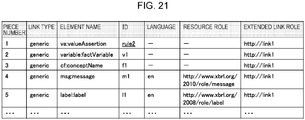
- FIGs. 20 and 21 are charts for explaining the storage control process according to the second embodiment. An overview of the storage control process in FIGs. 17 to 19 will be described with reference to FIGs. 20 and 21 .
- the storage control process according to the second embodiment is a process which is to be performed in a case where property information 151 or property information 152 for each definition element included in a linkbase 142 is desired to be updated before storage of the definition element included in the linkbase 142.
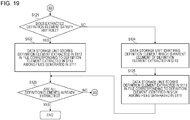
- FIGs. 17 to 19 are flowcharts for explaining the details of the second embodiment.
- a file acquisition unit 111 waits for a start time for the storage control process (NO in S101).
- the file acquisition unit 111 acquires a file which includes a plurality of definition elements included in the linkbase 142 and a piece of information (a piece of property information) indicating a correspondence between each of the plurality of definition elements and attributes of the definition element (S102).
- a data presentation unit 114 of an information processing apparatus 1 then refers to the pieces of information (the pieces of property information) indicating the correspondences acquired in the process in S102, associates each of the plurality of definition elements acquired in the process in S102 with the attributes of the definition element acquired in the process in S102, and presents the plurality of definition elements on a display unit (S103). More specifically, the data presentation unit 114 associates pieces of data included in the linkbase 142 described with reference to FIG. 9 with the property information 151 and the property information 152 described with reference to FIGs. 10 and 11 and presents the pieces of data on an operation terminal 3.
- an edit acceptance unit 115 of the information processing apparatus 1 waits until an edit instruction to change the correspondences presented in the process in S103 or an instruction not to change the correspondences presented in the process in S103 is accepted (NO in S104). More specifically, the edit acceptance unit 115 waits until a person in charge gives any instruction via the operation terminal 3.
- a group classification unit 112 refers to the pieces of information (the pieces of property information) indicating the correspondences, an edit to which is accepted in the process in S104, and identifies, for each of rules included in a storage destination rule 132 which is stored in an information storage region 130, one or more definition elements, the piece(s) of information indicating the correspondence(s) after the edit accepted in the process in S104 for which satisfies (satisfy) the rule, among the plurality of definition elements acquired in the process in S102.
- the group classification unit 112 classifies, for each of the rules included in the storage destination rule 132 stored in the information storage region 130, the plurality of definition elements such that the identified one or more definition elements fall into the same group (S105).
- a data storage unit 113 (a file generation unit 113a) generates, for each of groups, into which the definition elements are classified in the process in S105, a file which stores one or more definition elements included in the group such that definition elements, particular attributes of which have different values, are stored in different storage destinations (S111), as illustrated in FIG. 18 .
- the data storage unit 113 (a file storage unit 113b) stores each of the files generated in the process in S111 in a storage destination corresponding to attributes of the definition element(s) included in the file (S112).
- the data storage unit 113 then extracts one of the plurality of definition elements acquired in the process in S102 (S113). As illustrated in FIG. 19 , the data storage unit 113 judges whether the definition element extracted in S113 is a definition element which satisfies any of the rules included in the storage destination rule 132 (S121).
- the data storage unit 113 stores the definition element extracted in the process in S113 in a file corresponding to the definition element extracted in the process in S113 among the files generated in the process in S111 (S122).
- the data storage unit 113 identifies a definition element which is a parent element of the definition element extracted in the process in S113 (S124).
- the data storage unit 113 stores the definition element extracted in the process in S113 in a file corresponding to the definition element identified in the process in S124 among the files generated in the process in S111 (S125).
- the data storage unit 113 judges whether all of the definition elements are extracted in the process in S113 (S123).
- the data storage unit 113 performs the processes in S113 and steps subsequent thereto again. On the other hand, if it is judged that all of the definition elements are extracted in the process in S113 (YES in S123), the information processing apparatus 1 ends the storage control process.
- the data presentation unit 114 presents the pieces of data described with reference to FIG. 9 and the property information 151 and the property information 152 described with reference to FIGs. 10 and 11 on a display device of the operation terminal 3 (S103).
- the group classification unit 112 performs, for example, generation of a group which includes data (5) alone among the pieces of data described with reference to FIG. 9 (YES in S104 and S105).
- the data storage unit 113 After that, the data storage unit 113, for example, generates a file with a filename of val/schema1-rule-rule1-lab-ja.xml for the group including data (5) alone (S111). The data storage unit 113 then stores data (5) and data (d) among the pieces of data described with reference to FIG. 9 in the file with the filename of val/schema1-rule-rule1-lab-ja.xml (S122).
- the data presentation unit 114 presents the pieces of data described with reference to FIG. 9 and the property information 151 and the property information 152 described with reference to FIGs. 10 and 11 on the display device of the operation terminal 3 (S103).
- the group classification unit 112 performs, for example, generation of a group which includes data (1) alone among the pieces of data described with reference to FIG. 9 (YES in S104 and S105).
- the data storage unit 113 After that, the data storage unit 113, for example, generates a file with a filename of val/schema1-rule-rule2.xml for the group including data (1) alone (S111).
- the data storage unit 113 stores data (1), data (2), data (a), data (3), and data (b) among the pieces of data described with reference to FIG. 9 in the file with the filename of val/schema1-rule-rule2.xml (S122 and S125).
- the information processing apparatus 1 is capable of performing the storage control process while performing the updating.
- the data presentation unit 114 may, for example, present a data model for the linkbase 142 on the display device of the operation terminal 3 in the process in S103. More specifically, the data presentation unit 114 may, for example, present a data model described with reference to FIG. 8 and accept a change to the presented data model. If a change is made to the presented data model, the edit acceptance unit 115 may change the property information 151 and the property information 152 described with reference to FIGs. 10 and 11 such that the property information 151 and the property information 152 correspond to the data model after the change.
- the above-described configuration allows the information processing apparatus 1 to cause the person in charge to easily change the property information 151 or the property information 152.
- the information processing apparatus 1 is thus capable of reducing the burden on the person in charge associated with change of the property information 151 or the property information 152.
Landscapes
- Engineering & Computer Science (AREA)
- Theoretical Computer Science (AREA)
- Physics & Mathematics (AREA)
- Databases & Information Systems (AREA)
- General Physics & Mathematics (AREA)
- Data Mining & Analysis (AREA)
- General Engineering & Computer Science (AREA)
- Business, Economics & Management (AREA)
- Entrepreneurship & Innovation (AREA)
- Human Resources & Organizations (AREA)
- Strategic Management (AREA)
- Tourism & Hospitality (AREA)
- General Business, Economics & Management (AREA)
- Quality & Reliability (AREA)
- Operations Research (AREA)
- Health & Medical Sciences (AREA)
- Artificial Intelligence (AREA)
- Audiology, Speech & Language Pathology (AREA)
- Computational Linguistics (AREA)
- General Health & Medical Sciences (AREA)
- Marketing (AREA)
- Economics (AREA)
- Information Retrieval, Db Structures And Fs Structures Therefor (AREA)
Abstract
Description
- The embodiments discussed herein are related to a storage control program, a storage control apparatus, and a storage control method.
- In recent years, extensible business reporting language (XBRL) that is a language based on the extensible markup language (XML) standard has been used to smoothly distribute pieces of financial information, such as a financial statement.
- XBRL is composed of a concept called an instance and a concept called a taxonomy. An instance and a taxonomy are set for every piece of numerical information to be disclosed. More specifically, in XBRL, a piece of data, such as a sales figure or an operating profit, itself is set as an instance, and definition elements indicating a presentation structure, a presentation method, and the like are set as a taxonomy (see, for example, Japanese Laid-open Patent Publication Nos.
2011-197898 2016-145861 - In a taxonomy as described above, management may be performed by, for example, performing classification such that definition elements having the same attribute fall into the same group and storing definition elements in each group in a different file.
- However, the number of types of definition elements included in the taxonomy is increasing yearly. For this reason, for example, if classification and the like of the definition elements included in the taxonomy are manually performed, the work burden may become immense.
- Under the circumstances, in one aspect, the embodiments are intended to provide a storage control program, a storage control apparatus, and a storage control method capable of easily classifying definition elements included in a taxonomy.
- According to an aspect of the invention, a storage control method comprising steps of; accepting a file that includes a plurality of pieces of text data and a piece of information indicating a correspondence between each of the plurality of pieces of text data and attributes of the piece of text data; classifying the plurality of pieces of text data into a plurality of groups in accordance with the plurality of attributes that are each associated with any one of the plurality of pieces of text data, based on the piece of information indicating the correspondence included in the accepted file; generating, for each of the plurality of groups, a file that stores one or a plurality of pieces of text data included in the group; and storing the generated file in a storage destination corresponding to the attributes of the one or plurality of pieces of text data included in the file.
-
-
FIG. 1 is a diagram illustrating a configuration of an information processing system; -
FIG. 2 is a diagram for explaining a specific example of a taxonomy; -
FIG. 3 is a diagram illustrating an example of a hardware configuration of an information processing apparatus; -
FIG. 4 is a functional block diagram of the information processing apparatus; -
FIG. 5 is a flowchart for explaining an overview of a storage control process according to a first embodiment; -
FIG. 6 is a flowchart for explaining details of the storage control process according to the first embodiment; -
FIG. 7 is a flowchart for explaining the details of the storage control process according to the first embodiment; -
FIG. 8 is a diagram for explaining a specific example of a data model for definition elements included in a linkbase; -
FIG. 9 is a view for explaining a specific example of pieces of data corresponding to the definition elements included in the linkbase; -
FIG. 10 is a chart for explaining a specific example of property information; -
FIG. 11 is a chart for explaining a specific example of property information; -
FIG. 12 is a chart for explaining a specific example of a storage destination rule; -
FIG. 13 is a chart for explaining a specific example of the storage destination rule; -
FIG. 14 is a view for explaining the details of the storage control process according to the first embodiment; -
FIG. 15 is a view for explaining the details of the storage control process according to the first embodiment; -
FIG. 16 is a view for explaining the details of the storage control process according to the first embodiment; -
FIG. 17 is a flowchart for explaining a storage control process according to a second embodiment; -
FIG. 18 is a flowchart for explaining the storage control process according to the second embodiment; -
FIG. 19 is a flowchart for explaining the storage control process according to the second embodiment; -
FIG. 20 is a chart for explaining the storage control process according to the second embodiment; and -
FIG. 21 is a chart for explaining the storage control process according to the second embodiment. -
FIG. 1 is a diagram illustrating a configuration of aninformation processing system 10. Theinformation processing system 10 illustrated inFIG. 1 includes, for example, an information processing apparatus 1 (hereinafter also referred to as the storage control apparatus 1), astorage device 1a, and anoperation terminal 3. Theoperation terminal 3 illustrated inFIG. 1 is connected to theinformation processing apparatus 1 via a network NW, such as the Internet. - The
operation terminal 3 is, for example, a terminal which is used by a person in charge of finance (hereinafter, also simply referred to as a person in charge) of a company. The person in charge, for example, generates a new taxonomy or updates a taxonomy already stored in thestorage device 1a via theoperation terminal 3. More specifically, the person in charge inputs a piece of information (a piece of financial information, for example) desired to generate a new taxonomy or update the taxonomy already stored in thestorage device 1a to theinformation processing apparatus 1. - For example, if a desired piece of information is transmitted from the
operation terminal 3, theinformation processing apparatus 1 generates a new taxonomy or updates the taxonomy already stored in thestorage device 1a based on the transmitted piece of information. A specific example of a taxonomy will be described below. -
FIG. 2 is a diagram for explaining the specific example of the taxonomy. - A
taxonomy 131 illustrated inFIG. 2 includes an XMLschema 141 andlinkbases 142. The XMLschema 141 defines names of items used in thetaxonomy 131. Eachlinkbase 142 defines a relationship (link) between items used in thetaxonomy 131. - More specifically, in the example illustrated in
FIG. 2 , thelinkbases 142 include adefinition link 142a which describes a logical relationship (a parent-child relationship, for example) between items, apresentation link 142b which describes presentation levels and a presentation order of the items, and acalculation link 142c which describes methods for totalization (addition and subtraction, for example) of the items and data checking. In the example illustrated inFIG. 2 , thelinkbases 142 also include alabel link 142d which describes labels for displaying item names (a plurality of labels for languages, for example), areference link 142e which describes authorities (provisions of a commercial law, for example) for the items, and afootnote link 142f which describes a footnote at the time of data entry and creation. In the example illustrated inFIG. 2 , thelinkbases 142 further include aformula link 142g which describes methods for totalization (four arithmetic operations, for example) of the items and advanced data checking, and aversioning link 142h which describes XBRL data and taxonomy version management. - In the taxonomy 131 (each
linkbase 142 included in thetaxonomy 131, for example) as described above, management may be performed by performing classification such that definition elements having the same attribute fall into the same group and storing definition elements in each group in a different file. - However, the number of types of definition elements included in the
taxonomy 131 as described above is increasing yearly. For this reason, for example, if classification and the like of the definition elements included in thetaxonomy 131 generated by theinformation processing apparatus 1 are manually performed, the work burden may become immerse. - Under the circumstances, the
information processing apparatus 1 according to the present embodiment accepts a file which includes a plurality of definition elements (hereinafter also referred to as pieces of text data) included in thelinkbase 142 and a piece of information (hereinafter also referred to as a piece of property information) indicating a correspondence between each of the plurality of definition elements and attributes of the definition element. More specifically, theinformation processing apparatus 1 acquires a file (files) storing definition elements of one ormore linkbases 142 corresponding to details of designation among files of thetaxonomy 131 stored in thestorage device 1a in response to the designation (designation of the linkbase(s) 142 as a target for a storage control process) that is performed by the person in charge via theoperation terminal 3. - The
information processing apparatus 1 then classifies the plurality of definition elements into a plurality of groups in accordance with the plurality of attributes that are each associated with any one of the plurality of definition elements, based on the accepted pieces of information indicating the correspondences. After that, theinformation processing apparatus 1 generates, for each of the plurality of groups, a file which stores one or more definition elements included in the group and stores the generated file in a storage destination corresponding to attributes of the definition element(s) included in the file. - That is, the
information processing apparatus 1 performs classification of each definition element included in thelinkbase 142 by referring to the content of a piece of property information corresponding to the definition element. - The above-described configuration allows the
information processing apparatus 1 to automatically classify each definition element included in thelinkbase 142. Theinformation processing apparatus 1 is thus capable of reducing the work burden of manual classification of definition elements. - A hardware configuration of the
information processing apparatus 1 will be described.FIG. 3 is a diagram illustrating an example of the hardware configuration of theinformation processing apparatus 1. - The
information processing apparatus 1 includes aCPU 101 as a processor, amemory 102, an external interface (I/O unit) 103, and astorage medium 104. The units are connected to one another via abus 105. - The
storage medium 104 stores aprogram 110 for performing a process (hereinafter also referred to as a storage control process) of classifying each definition element included in thelinkbase 142 in, for example, a program storage region (not illustrated) inside thestorage medium 104. Thestorage medium 104 also includes, for example, an information storage region 130 (hereinafter also referred to as the storage unit 130) which stores information used to perform the storage control process. Note that theinformation storage region 130 corresponds to thestorage device 1a described with reference toFIG. 1 . - As illustrated in
FIG. 3 , theCPU 101 loads theprogram 110 from thestorage medium 104 onto thememory 102 at the time of execution of theprogram 110 and performs the storage control process in cooperation with theprogram 110. - The
external interface 103 communicates with theoperation terminal 3 via, for example, the network NW. - Functions of the
information processing apparatus 1 will be described.FIG. 4 is a functional block diagram of theinformation processing apparatus 1. - The
CPU 101 of theinformation processing apparatus 1 operates as, for example, a file acquisition unit 111 (hereinafter also referred to as the file acceptance unit 111), agroup classification unit 112, adata storage unit 113, adata presentation unit 114, and anedit acceptance unit 115 by working in cooperation with theprogram 110. Thetaxonomy 131 and astorage destination rule 132 are stored in theinformation storage region 130. Note that thedata storage unit 113 is assumed to include a file generation unit 113a and a file storage unit 113b in the following description. - The
file acquisition unit 111 acquires a file which includes a plurality of definition elements included in thelinkbase 142 and a piece of information (a piece of property information) indicating a correspondence between each of the plurality of definition elements and attributes of the definition element. - More specifically, the
information processing apparatus 1 acquires a file (files) storing definition elements of one or more linkbases 142 corresponding to details of designation among files of thetaxonomy 131 stored in thestorage device 1a in response to the designation (designation of the linkbase(s) 142 to be subjected to the storage control process) that is performed by the person in charge via theoperation terminal 3. - The
group classification unit 112 classifies the plurality of definition elements included in the file(s) acquired by thefile acquisition unit 111 into a plurality of groups in accordance with a plurality of attributes which are each associated with any one of the plurality of definition elements, based on pieces of information indicating correspondences included in the file(s) acquired by thefile acquisition unit 111. - More specifically, the
group classification unit 112 classifies the plurality of definition elements in accordance with the content of thestorage destination rule 132 stored in theinformation storage region 130. Thestorage destination rule 132 may be, for example, generated in advance by the person in charge of the company and stored in theinformation storage region 130. - The file generation unit 113a generates, for each of the plurality of groups, a classification into which is made by the
group classification unit 112, a file which stores one or more definition elements in the group. - More specifically, the file generation unit 113a generates a file which stores one or more definition elements included in each group in accordance with the content of the
storage destination rule 132 stored in theinformation storage region 130. - The file storage unit 113b stores each file generated by the file generation unit 113a in a storage destination corresponding to attributes of a definition element (definition elements) included in the file.
- The
data presentation unit 114 associates each of the plurality of definition elements included in each file acquired by thefile acquisition unit 111 with attributes of the definition element, based on the pieces of information indicating the correspondences included in the file acquired by thefile acquisition unit 111, and presents the plurality of definition elements on a display unit (a display device of theoperation terminal 3, for example). - The
edit acceptance unit 115 accepts an edit which changes a correspondence between any one of the plurality of definition elements presented by thedata presentation unit 114 and attributes of the definition element. In this case, thegroup classification unit 112 classifies the plurality of definition elements presented by thedata presentation unit 114 into a plurality of groups in accordance with the plurality of attributes that are each associated with any one of the plurality of definition elements, based on the pieces of information indicating the correspondences after the edit accepted by theedit acceptance unit 115. - An overview of a first embodiment will be described.
FIG. 5 is a flowchart for explaining an overview of a storage control process according to the first embodiment. - As illustrated in
FIG. 5 , aninformation processing apparatus 1 waits for a start time for the storage control process (NO in S1). A start time for the storage control process may be, for example, a time when a person in charge gives an instruction to start the storage control process via anoperation terminal 3. - When a start time comes (YES in S1), the
information processing apparatus 1 acquires a file which includes a plurality of definition elements included in alinkbase 142 and a piece of information indicating a correspondence between each of the plurality of definition elements and attributes of the definition element (S2). - The
information processing apparatus 1 then classifies the plurality of definition elements included in the file acquired in the process in S2 into a plurality of groups in accordance with the plurality of attributes that are each associated with any one of the plurality of definition elements, based on the pieces of information indicating the correspondences included in the file acquired in the process in S2 (S3). - After that, the
information processing apparatus 1 generates, for each of the plurality of groups, a classification into which is made in the process in S3, a file which stores one or more definition elements included in the group and stores the generated file in a storage destination corresponding to attributes of the definition element(s) included in the file (S4). - That is, the
information processing apparatus 1 classifies each definition element included in thelinkbase 142 by referring to the content of a piece of property information corresponding to the definition element. - The above-described configuration allows the
information processing apparatus 1 to automatically classify each definition element included in thelinkbase 142. Theinformation processing apparatus 1 is thus capable of reducing the work burden of manual classification of definition elements. - Details of the first embodiment will be described.
FIGs. 6 and7 are flowcharts for explaining details of the storage control process according to the first embodiment.FIGs. 8 to 16 are charts for explaining the details of the storage control process according to the first embodiment. The details of the storage control process inFIGs. 6 and7 will be described with reference toFIGs. 8 to 16 . - [Specific example of data model for definition element included in linkbase]
- A specific example (an image) of a data model for definition elements included in the
linkbase 142 will be described first.FIG. 8 is a diagram for explaining the specific example of the data model for the definition elements included in thelinkbase 142. Note that a description will be given below on the assumption that the definition elements include resources which are included in thelinkbase 142 and a relation which defines a correspondence between resources. A description will be given below, taking as an example definition elements included in aformula link 142g described with reference toFIG. 2 . - In the example illustrated in
FIG. 8 , the definition elements included in theformula link 142g include va:valueAssertion (hereinafter, also simply referred to as resource (1)), variable:factVariable (hereinafter, also simply referred to as resource (2)), cf:conceptName (hereinafter, also simply referred to as resource (3)), msg:message (hereinafter, also simply referred to as resource (4)), and label:label (hereinafter, also simply referred to as resource (5)) as resources. - In the example illustrated in
FIG. 8 , the definition elements included in theformula link 142g also include relation (a) that is a definition of a correspondence between resource (1) and resource (2), relation (b) that is a definition of a correspondence between resource (2) and resource (3), relation (c) that is a definition of a correspondence between resource (1) and resource (4), and relation (d) that is a definition of a correspondence between resource (1) and resource (5) as relations. - A specific example of pieces of data corresponding to the definition elements included in the
linkbase 142 will be described.FIG. 9 is a view for explaining the specific example of the pieces of data corresponding to the definition elements included in thelinkbase 142. More specifically,FIG. 9 is a view for explaining a specific example of a case where the pieces of data corresponding to the definition elements included in thelinkbase 142 are stored in one file. - In the example illustrated in
FIG. 9 , pieces of data surrounded by broken lines (1), (2), (3), (4), and (5) among the pieces of data corresponding to the definition elements included in theformula link 142g are pieces of data corresponding to resources (1), (2), (3), (4), and (5), respectively, described with reference toFIG. 8 . - In the example illustrated in
FIG. 9 , pieces of data surrounded by broken lines (a), (b), (c), and (d) among the pieces of data corresponding to the definition elements included in theformula link 142g are pieces of data corresponding to relations (a), (b), (c), and (d), respectively, described with reference toFIG. 8 . - In the example illustrated in
FIG. 9 , a piece of data surrounded by broken line (0) among the pieces of data corresponding to the definition elements included in theformula link 142g is a piece of data corresponding to resources (1) to (5) and relations (a) to (d) in common. - Note that the pieces of data surrounded by broken lines (1), (2), (3), (4), and (5) in the example in
FIG. 9 will also hereinafter be referred to as data (1), data (2), data (3), data (4), and data (5), respectively. The pieces of data surrounded by broken lines (a), (b), (c), and (d) in the example inFIG. 9 will also hereinafter be referred to as data (a), data (b), data (c), and data (d), respectively. The piece of data surrounded by broken line (0) in the example inFIG. 9 will also hereinafter be referred to as data (0). - Specific examples of property information 151 and property information 152 will be described.
FIG. 10 is a chart for explaining a specific example of the property information 151.FIG. 11 is a chart for explaining a specific example of the property information 152. - The property information 151 is a piece of information which is generated by extracting parts of pieces of data on the resources among the pieces of data corresponding to the definition elements described with reference to
FIG. 9 . The property information 152 is a piece of information which is generated by extracting parts of pieces of data on the relations among the pieces of data corresponding to the definition elements described with reference toFIG. 9 . - The property information 151 illustrated in
FIG. 10 has, as items, a piece number for identification of each resource, information on which is included in the property information 151, a link type, as which the type of thelinkbase 142 including the resource is set, an element name, as which an element name of the resource is set, and an ID, as which an attribute of the resource is set. The property information 151 illustrated inFIG. 10 also has, as items, a language, as which a language corresponding to the resource is set, a resource role, as which an address of a piece of information indicating a role of the resource, and an extended link role, as which an address of a piece of information indicating a role of an extended link corresponding to the resource is set. - More specifically, data (0) in the pieces of data described with reference to
FIG. 9 includes a piece of data composed of the string gen:link and a piece of data composed of the string xlink:role="http://link1". For this reason, for example, generic and http://link1 are set as a link type and an extended link role, respectively, for each of pieces of information with piece numbers of 1 to 5 in the property information 151 illustrated inFIG. 10 . - For example, data (1) in the pieces of data described with reference to
FIG. 9 includes a piece of data composed of the string va:valueAssertion and a piece of data composed of the string id="rule1". For this reason, for example, va:valueAssertion and rule1 are set as an element name and an ID, respectively, for the piece of information with the piece number of 1 in the property information 151 illustrated inFIG. 10 . Note that "-" indicating that there is no piece of information is set as each of a language and a resource role for the piece of information with the piece number of 1 in the property information 151 illustrated inFIG. 10 . - For example, data (4) in the pieces of data described with reference to
FIG. 9 includes a piece of data composed of the string msg:message, a piece of data composed of the string label="m1", a piece of data composed of the string lang="en", and a piece of data composed of the string role="http://www.xbrl.org/2010/role/message". For this reason, for example, msg:message, m1, en, and http://www.xbrl.org/2010/role/message are set as an element name, an ID, a language, and a resource role, respectively, for the piece of information with the piece number of 4 in the property information 151 illustrated inFIG. 10 . A description of other pieces of information included inFIG. 10 will be omitted. - The property information 152 illustrated in
FIG. 11 has, as items, a piece number for identification of each relation, information on which is included in the property information 152, a link type, as which the type of thelinkbase 142 including the relation is set, and an element name, as which an element name of the relation is set. The property information 152 illustrated inFIG. 11 also has, as items, a parent element name, as which a name of a parent element resource of resources corresponding to the relation is set, a child element name, as which a name of a child element resource of the resources corresponding to the relation is set, an arc role, as which an address of a piece of information indicating a role of the relation, and an extended link role, as which an address of a piece of information indicating a role of an extended link corresponding to the relation is set. - More specifically, data (0) in the pieces of data described with reference to
FIG. 9 includes the piece of data composed of the string gen:link and the piece of data composed of the string xlink:role="http://link1". For this reason, for example, generic and http://link1 are set as a link type and an extended link role, respectively, for each of pieces of information with piece numbers of 1 to 4 in the property information 152 illustrated inFIG. 11 . - For example, data (a) in the pieces of data described with reference to
FIG. 9 includes a piece of data composed of the string variable:variableArc, a piece of data composed of the string from="rule1", a piece of data composed of the string to="v1", and a piece of data composed of the string arcrole="http://xbrl.org/arcrole/2008/variable-set". For this reason, for example, variable:variableArc, va:valueAssertion, variable:factVariable, and http://xbrl.org/arcrole/2008/variable-set are set as an element name, a parent element name, a child element name, and an arc role, respectively, for the piece of information with the piece number of 1 in the property information 152 illustrated inFIG. 11 . A description of other pieces of information included inFIG. 11 will be omitted. - Flowcharts for explaining the details of the first embodiment will be described.
FIGs. 6 and7 are flowcharts for explaining the details of the first embodiment. - As illustrated in
FIG. 6 , thefile acquisition unit 111 of theinformation processing apparatus 1 waits for a start time for the storage control process (NO in S11). - When a start time comes (YES in S11), the
file acquisition unit 111 acquires a file which includes a plurality of definition elements included in thelinkbase 142 and a piece of information (a piece of property information) indicating a correspondence between each of the plurality of definition elements and attributes of the definition element (S12). - A
group classification unit 112 of theinformation processing apparatus 1 refers to the pieces of information (the pieces of property information) indicating the correspondences acquired in the process in S12 and identifies, for each of rules included in astorage destination rule 132 stored in aninformation storage region 130, one or more definition elements, the piece(s) of information indicating the correspondence(s) acquired in the process in S12 for which satisfies (satisfy) the rule, among the plurality of definition elements acquired in the process in S12. Thegroup classification unit 112 further classifies the plurality of definition elements acquired in the process in S12 into a plurality of groups such that the identified one or more definition elements fall into the same group (S13). A specific example of thestorage destination rule 132 will be described below. -
FIGs. 12 and13 are charts for explaining specific examples of thestorage destination rule 132. More specifically,FIG. 12 is a chart for explaining a specific example of a storage destination rule 132a for resources.FIG. 13 is a chart for explaining a specific example of a storage destination rule 132b for relations. - The storage destination rule 132a will be described first. The storage destination rule 132a illustrated in
FIG. 12 has, as items, a piece number for identification of each piece of information included in the storage destination rule 132a, a rule, as which rules for determining a storage destination of a resource concerned are set, and a storage destination, as which a storage destination where a resource which satisfies the rules set as the rule is stored is set. The rule that is an item in the storage destination rule 132a illustrated inFIG. 12 has, as subitems, a link type, an element name, an ID, a language, a resource role, and an extended link role, like the property information 151 described with reference toFIG. 10 . The storage destination that is an item in the storage destination rule 132a illustrated inFIG. 12 has, as subitems, a linkbase, as which a filename of thelinkbase 142 as a storage destination is set, and a schema location, as which a storage location and a filename of an XML schema 141 (a file) that refers to the linkbase 142 (a file) set as the linkbase are set. - More specifically, in the storage destination rule 132a illustrated in
FIG. 12 , generic and va:valueAssertion are set as a link type and an element name, respectively, for a piece of information with a piece number of 1. In the storage destination rule 132a illustrated inFIG. 12 , ANY indicating any type of information is set as each of an ID, a language, a resource role, and an extended link role for the piece of information with the piece number of 1. In the storage destination rule 132a illustrated inFIG. 12 , ${schemaLocation}/${schemaFileName}-rule-${resourceID}.xml and val\schema1.xsd are set as a linkbase and a schema location, respectively, for the piece of information with the piece number of 1. A description of other pieces of information included inFIG. 12 will be omitted. - Note that, in the example illustrated in
FIG. 12 , ${schemaLocation} is a variable, in which the storage location of the XML schema 141 (a file) that refers to thelinkbase 142 including a resource concerned is set, and that ${schemaFileName} is a variable, in which a filename without an extension of theXML schema 141 that refers to the linkbase 142 (a file) including the resource is set. In the example illustrated inFIG. 12 , ${resourceID} is a variable, in which a piece of information set as an ID of the resource is set, and ${parentResourceID} is a variable, in which a piece of information set as an ID of a parent element resource of the resource is set. In the example illustrated inFIG. 12 , ${lang} is a variable, in which a piece of information set as a language of the resource is set. - The storage destination rule 132b will be described. The storage destination rule 132b illustrated in
FIG. 13 has, as items, a piece number, a rule, and a storage destination, like the storage destination rule 132a described with reference toFIG. 12 . The rule that is an item in the storage destination rule 132b illustrated inFIG. 13 has, as subitems, a link type, an element name, a parent element name, a child element name, an arc role, and an extended link role, like the property information 152 described with reference toFIG. 11 . The storage destination that is an item in the storage destination rule 132b illustrated inFIG. 13 has, as subitems, a linkbase, as which a filename of thelinkbase 142 as a storage destination of a resource whose name is set as a child element name is set, and a schema location, as which a storage location and a filename of the XML schema 141 (a file) that refers to the linkbase 142 (a file) set as the linkbase are set. - More specifically, in the storage destination rule 132b illustrated in
FIG. 13 , generic and variable:variableArc are set as a link type and an element name, respectively, for a piece of information with a piece number of 1. In the storage destination rule 132b illustrated inFIG. 13 , ANY indicating any type of information is set as each of a parent element name, a child element name, an arc role, and an extended link role for the piece of information with the piece number of 1. In the storage destination rule 132b illustrated inFIG. 13 , a storage destination of a child element and "-" are set as a linkbase and a schema location, respectively, for the piece of information with the piece number of 1. - The piece of information with the piece number of 1 in the property information 151 described with reference to
FIG. 10 satisfies a rule for the piece number of 1 in the storage destination rule 132a illustrated inFIG. 12 . The piece of information with the piece number of 4 in the property information 151 described with reference toFIG. 10 satisfies a rule for a piece number of 2 in the storage destination rule 132a illustrated inFIG. 12 . The piece of information with the piece number of 5 in the property information 151 described with reference toFIG. 10 satisfies a rule for a piece number of 3 in the storage destination rule 132a illustrated inFIG. 12 . - For this reason, the
group classification unit 112 generates a group which includes data (1) alone corresponding to the piece of information with the piece number of 1 in the property information 151 described with reference toFIG. 10 in the process in S13. Thegroup classification unit 112 also generates a group which includes data (4) alone corresponding to the piece of information with the piece number of 4 in the property information 151 described with reference toFIG. 10 . Thegroup classification unit 112 further generates a group which includes data (5) alone corresponding to the piece of information with the piece number of 5 in the property information 151 described with reference toFIG. 10 . - The piece of information with the piece number of 1 in the property information 152 described with reference to
FIG. 11 satisfies a rule for the piece number of 1 in the storage destination rule 132b illustrated inFIG. 13 . - For this reason, the
group classification unit 112 generates a group which includes data (a) alone corresponding to the piece of information with the piece number of 1 in the property information 152 described with reference toFIG. 11 in the process in S13. Note that a description will be given below on the assumption that a group which includes data (b) alone, a group which includes data (c) alone, and a group which includes data (d) alone are generated in the process in S13. - Referring back to
FIG. 6 , a data storage unit 113 (a file generation unit 113a) of theinformation processing apparatus 1 generates, for each of the groups, into which the definition elements are classified in the process in S13, a file which stores one or more definition elements included in the group such that definition elements, particular attributes of which have different values, are stored in different storage destinations (S14). - More specifically, of a piece of information set as the linkbase of the piece of information with the piece number of 1 in the storage destination rule 132a described with reference to
FIG. 12 , a portion corresponding to a filename (${schemaFileName}-rule-${resourceID}.xml) includes the variables ${schemaFileName} and ${resourceID}. For this reason, the file generation unit 113a, for example, generates a file for each of combinations of a filename of theXML schema 141 that refers to thelinkbase 142 corresponding to the groups and pieces of information set as IDs in the property information 151 for resources included in the groups in the process in S14. That is, in this case, the file generation unit 113a generates a file using the filename of theXML schema 141 that refers to thelinkbase 142 corresponding to each group and a piece of information set as an ID in the property information 151 for a resource included in the group as a particular attribute. - Note that a storage destination of a child element is set as a linkbase in the storage destination rule 132b described with reference to
FIG. 13 . That is, in this case, each relation is stored in the same file as a child element resource among resources corresponding to the relation. For this reason, the file generation unit 113a may generate a file solely for a group which includes a resource in the process in S14. A description will be given below on the assumption that a file is generated solely for a group which includes a resource. - The data storage unit 113 (a file storage unit 113b) stores each of the files generated in the process in S14 in a storage destination corresponding to attributes of a definition element (definition elements) included in the file (S15).
- More specifically, the file storage unit 113b refers to a portion corresponding to a pathname (${schemaLocation}) of a piece of information set as a linkbase in the storage destination rule 132a described with reference to
FIG. 12 and identifies a storage destination for each of the files generated in the process in S14. The file storage unit 113b stores the file generated in the process in S14 in the identified storage destination. - After that, the
data storage unit 113 extracts one of the plurality of definition elements acquired in the process in S12 (S16). That is, thedata storage unit 113 starts storing the plurality of definition elements acquired in the process in S12 in the files in response to the storage of the files in the storage destinations in the process in S15. - As illustrated in
FIG. 7 , thedata storage unit 113 judges whether the definition element extracted in S16 is a definition element which satisfies any one of the rules included in the storage destination rule 132 (S21). That is, thedata storage unit 113 judges whether the definition element extracted in the process in S16 is a definition element which is classified into any one of the groups in the process in S13. - If it is judged as a result that the definition element extracted in S16 is a definition element satisfying any one of the rules included in the storage destination rule 132 (YES in S21), the
data storage unit 113 stores the definition element extracted in the process in S16 in a file corresponding to the definition element extracted in the process in S16 among the files generated in the process in S14 (S22). - More specifically, if a definition element corresponding to the piece of information with the piece number of 1 in the property information 151 described with reference to
FIG. 10 is extracted in the process in S16, thedata storage unit 113 identifies ${schemaLocation}/${schemaFileName}-rule-${resourceID}.xml that is a piece of information set as a linkbase for the piece of information with the piece number of 1 in the storage destination rule 132a described with reference toFIG. 12 . In this case, val and schema1 that are pieces of information set in a schema location for the piece of information with the piece number of 1 in the storage destination rule 132a described with reference toFIG. 12 are substituted for ${schemaLocation} and ${schemaFileName}. In this case, rule1 that is a piece of information set as an ID for the piece of information with the piece number of 1 in the property information 151 described with reference toFIG. 10 is substituted for ${resourceID}. - For this reason, the
data storage unit 113 stores the definition element (the definition element extracted in the process in S16) corresponding to the piece of information with the piece number of 1 in the property information 151 described with reference toFIG. 10 in, for example, to a file with a filename of val/schema1-rule-rule1.xml. - On the other hand, if it is judged that the definition element extracted in S16 is a definition element which satisfies none of the rules included in the storage destination rule 132 (NO in S21), the
data storage unit 113 identifies a definition element which is a parent element of the definition element extracted in the process in S16 (S24). - More specifically, the
data storage unit 113 refers to the property information 152 (property information on relations) described with reference toFIG. 11 and identifies the definition element that is the parent element of the definition element extracted in the process in S16 by identifying a piece of information which is set as a parent element name of a piece of information, a child element name of which is set to an element name of the definition element extracted in the process in S16. That is, if the definition element extracted in the process in S16 is a resource, thedata storage unit 113 identifies a parent element resource of the extracted resource. If the definition element extracted in the process in S16 is a relation, thedata storage unit 113 identifies a parent element resource among resources corresponding to the extracted relation. - Note that, if the parent element identified in the process in S24 satisfies none of the rules included in the
storage destination rule 132, thedata storage unit 113 may repeat identification of a parent element of a parent element identified in the process in S24 until the identified parent element satisfies any of the rules included in thestorage destination rule 132. - The
data storage unit 113 stores the definition element extracted in the process in S16 in a file corresponding to the definition element identified in the process in S24 among the files generated in the process in S14 (S25). - More specifically, a definition element corresponding to the piece of information with the piece number of 2 in the property information 151 described with reference to
FIG. 10 satisfies none of the rules included in thestorage destination rule 132. For this reason, if the definition element corresponding to the piece of information with the piece number of 2 in the property information 151 described with reference toFIG. 10 is extracted in the process in S16, thedata storage unit 113 identifies a piece of information, a child element name of which is set to a piece of information set as an element name of the piece of information with the piece number of 2 in the property information 151 described with reference toFIG. 10 , from the property information 152 described with reference toFIG. 11 . Thedata storage unit 113 identifies va:valueAssertion that is a piece of information set as a parent element name of the identified piece of information (the piece of information with the piece number of 1). - The
data storage unit 113 then refers to the storage destination rule 132a described with reference toFIG. 12 and identifies a piece of information, an element name of which is set to va:valueAssertion. Thedata storage unit 113 identifies ${schemaLocation}/${schemaFileName}-rule-${resourceID}.xml that is a piece of information set as a linkbase for the identified piece of information (the piece of information with the piece number of 1). In this case, val and schema1 that are pieces of information set in the schema location for the piece of information with the piece number of 1 in the storage destination rule 132a described with reference toFIG. 12 are substituted for ${schemaLocation} and ${schemaFileName}. In this case, rule1 that is a piece of information set as the ID for the piece of information with the piece number of 1 in the property information 151 described with reference toFIG. 10 is substituted for ${resourceID}. - For this reason, the
data storage unit 113 stores the definition element (the definition element extracted in the process in S16) corresponding to the piece of information with the piece number of 2 in the property information 151 described with reference toFIG. 10 in the file with the filename of val/schema1-rule-rule1.xml. - Referring back to
FIG. 7 , thedata storage unit 113 judges whether all of the definition elements are extracted in the process in S16 (S23). - If it is judged as a result that not all of the definition elements are extracted in the process in S16 (NO in S23), the
data storage unit 113 performs the processes in S16 and steps subsequent thereto again. - On the other hand, if it is judged that all of the definition elements are extracted in the process in S16 (YES in S23), the
information processing apparatus 1 ends the storage control process. - Note that the
information processing apparatus 1 executes the storage control process, thereby generating, for example, a file which includes data (1), data (2), data (a), data (3), and data (b) among the pieces of data described with reference toFIG. 9 , as illustrated inFIG. 14 . Theinformation processing apparatus 1 also generates, for example, a file which includes data (4) and data (c) among the pieces of data described with reference toFIG. 9 , as illustrated inFIG. 15 . Theinformation processing apparatus 1 further generates, for example, a file which includes data (5) and data (d) among the pieces of data described with reference toFIG. 9 , as illustrated inFIG. 16 . - As described above, the
information processing apparatus 1 according to the present embodiment accepts a file which includes a plurality of definition elements included in thelinkbase 142 and a piece of information (a piece of property information) indicating a correspondence between each of the plurality of definition elements and attributes of the definition element. - The
information processing apparatus 1 classifies the plurality of definition elements into a plurality of groups in accordance with the plurality of attributes that are each associated with any one of the plurality of definition elements, based on the accepted pieces of information indicating the correspondences. After that, theinformation processing apparatus 1 generates, for each of the plurality of groups, a file which stores one or more definition elements included in the group and stores the generated file in a storage destination corresponding to attributes of the definition element(s) included in the file. - That is, the
information processing apparatus 1 classifies each definition element included in thelinkbase 142 by referring to the content of a piece of property information corresponding to the definition element. - The above-described configuration allows the
information processing apparatus 1 to automatically classify each definition element included in thelinkbase 142. Theinformation processing apparatus 1 is thus capable of reducing the work burden of manual classification of definition elements. - A second embodiment will be described.
FIGs. 17 to 19 are flowcharts for explaining a storage control process according to the second embodiment.FIGs. 20 and21 are charts for explaining the storage control process according to the second embodiment. An overview of the storage control process inFIGs. 17 to 19 will be described with reference toFIGs. 20 and21 . - The storage control process according to the second embodiment is a process which is to be performed in a case where property information 151 or property information 152 for each definition element included in a
linkbase 142 is desired to be updated before storage of the definition element included in thelinkbase 142. - Flowcharts for explaining details of the second embodiment will be described.
FIGs. 17 to 19 are flowcharts for explaining the details of the second embodiment. - As illustrated in
FIG. 17 , afile acquisition unit 111 waits for a start time for the storage control process (NO in S101). - When a start time comes (YES in S101), the
file acquisition unit 111 acquires a file which includes a plurality of definition elements included in thelinkbase 142 and a piece of information (a piece of property information) indicating a correspondence between each of the plurality of definition elements and attributes of the definition element (S102). - A
data presentation unit 114 of aninformation processing apparatus 1 then refers to the pieces of information (the pieces of property information) indicating the correspondences acquired in the process in S102, associates each of the plurality of definition elements acquired in the process in S102 with the attributes of the definition element acquired in the process in S102, and presents the plurality of definition elements on a display unit (S103). More specifically, thedata presentation unit 114 associates pieces of data included in thelinkbase 142 described with reference toFIG. 9 with the property information 151 and the property information 152 described with reference toFIGs. 10 and11 and presents the pieces of data on anoperation terminal 3. - After that, an
edit acceptance unit 115 of theinformation processing apparatus 1 waits until an edit instruction to change the correspondences presented in the process in S103 or an instruction not to change the correspondences presented in the process in S103 is accepted (NO in S104). More specifically, theedit acceptance unit 115 waits until a person in charge gives any instruction via theoperation terminal 3. - When an edit instruction to change the correspondences presented in the process in S103 or an instruction not to change the correspondences presented in the process in S103 is accepted (YES in S104), a
group classification unit 112 refers to the pieces of information (the pieces of property information) indicating the correspondences, an edit to which is accepted in the process in S104, and identifies, for each of rules included in astorage destination rule 132 which is stored in aninformation storage region 130, one or more definition elements, the piece(s) of information indicating the correspondence(s) after the edit accepted in the process in S104 for which satisfies (satisfy) the rule, among the plurality of definition elements acquired in the process in S102. Thegroup classification unit 112 classifies, for each of the rules included in thestorage destination rule 132 stored in theinformation storage region 130, the plurality of definition elements such that the identified one or more definition elements fall into the same group (S105). - After that, a data storage unit 113 (a file generation unit 113a) generates, for each of groups, into which the definition elements are classified in the process in S105, a file which stores one or more definition elements included in the group such that definition elements, particular attributes of which have different values, are stored in different storage destinations (S111), as illustrated in
FIG. 18 . The data storage unit 113 (a file storage unit 113b) stores each of the files generated in the process in S111 in a storage destination corresponding to attributes of the definition element(s) included in the file (S112). - The
data storage unit 113 then extracts one of the plurality of definition elements acquired in the process in S102 (S113). As illustrated inFIG. 19 , thedata storage unit 113 judges whether the definition element extracted in S113 is a definition element which satisfies any of the rules included in the storage destination rule 132 (S121). - If it is judged as a result that the definition element extracted in S113 is a definition element which satisfies any one of the rules included in the storage destination rule 132 (YES in S121), the
data storage unit 113 stores the definition element extracted in the process in S113 in a file corresponding to the definition element extracted in the process in S113 among the files generated in the process in S111 (S122). - On the other hand, if it is judged that the definition element extracted in S113 is a definition element which satisfies none of the rules included in the storage destination rule 132 (NO in S121), the
data storage unit 113 identifies a definition element which is a parent element of the definition element extracted in the process in S113 (S124). - The
data storage unit 113 stores the definition element extracted in the process in S113 in a file corresponding to the definition element identified in the process in S124 among the files generated in the process in S111 (S125). - After that, the
data storage unit 113 judges whether all of the definition elements are extracted in the process in S113 (S123). - If it is judged as a result that not all of the definition elements are extracted in the process in S113 (NO in S123), the
data storage unit 113 performs the processes in S113 and steps subsequent thereto again. On the other hand, if it is judged that all of the definition elements are extracted in the process in S113 (YES in S123), theinformation processing apparatus 1 ends the storage control process. - A specific example of the storage control process according to the second embodiment will be described.
- The
data presentation unit 114, for example, presents the pieces of data described with reference toFIG. 9 and the property information 151 and the property information 152 described with reference toFIGs. 10 and11 on a display device of the operation terminal 3 (S103). - If an edit which updates a piece of information set as a language of a piece of information with a piece number of 5 in the property information 151 described with reference to
FIG. 10 with ja is made, as indicated by an underlined portion inFIG. 20 , thegroup classification unit 112 performs, for example, generation of a group which includes data (5) alone among the pieces of data described with reference toFIG. 9 (YES in S104 and S105). - After that, the
data storage unit 113, for example, generates a file with a filename of val/schema1-rule-rule1-lab-ja.xml for the group including data (5) alone (S111). Thedata storage unit 113 then stores data (5) and data (d) among the pieces of data described with reference toFIG. 9 in the file with the filename of val/schema1-rule-rule1-lab-ja.xml (S122). - Another specific example of the storage control process according to the second embodiment will be described.
- The
data presentation unit 114, for example, presents the pieces of data described with reference toFIG. 9 and the property information 151 and the property information 152 described with reference toFIGs. 10 and11 on the display device of the operation terminal 3 (S103). - If an edit which updates a piece of information set as an ID of a piece of information with a piece number of 1 in the property information 151 described with reference to
FIG. 10 with rule2 is made, as indicated by an underlined portion inFIG. 21 , thegroup classification unit 112 performs, for example, generation of a group which includes data (1) alone among the pieces of data described with reference toFIG. 9 (YES in S104 and S105). - After that, the
data storage unit 113, for example, generates a file with a filename of val/schema1-rule-rule2.xml for the group including data (1) alone (S111). Thedata storage unit 113 stores data (1), data (2), data (a), data (3), and data (b) among the pieces of data described with reference toFIG. 9 in the file with the filename of val/schema1-rule-rule2.xml (S122 and S125). - With the above-described configuration, even if the property information 151 or the property information 152 for each definition element included in the
linkbase 142 is desired to be updated before storage of the definition element included in thelinkbase 142, theinformation processing apparatus 1 is capable of performing the storage control process while performing the updating. - Note that the
data presentation unit 114 may, for example, present a data model for thelinkbase 142 on the display device of theoperation terminal 3 in the process in S103. More specifically, thedata presentation unit 114 may, for example, present a data model described with reference toFIG. 8 and accept a change to the presented data model. If a change is made to the presented data model, theedit acceptance unit 115 may change the property information 151 and the property information 152 described with reference toFIGs. 10 and11 such that the property information 151 and the property information 152 correspond to the data model after the change. - The above-described configuration allows the
information processing apparatus 1 to cause the person in charge to easily change the property information 151 or the property information 152. Theinformation processing apparatus 1 is thus capable of reducing the burden on the person in charge associated with change of the property information 151 or the property information 152.
Claims (13)
- A computer-readable storage medium storing a storage control program which causes a computer to execute a process comprising:accepting a file that includes a plurality of pieces of text data and a piece of information indicating a correspondence between each of the plurality of pieces of text data and attributes of the piece of text data;classifying the plurality of pieces of text data into a plurality of groups in accordance with the plurality of attributes that are each associated with any one of the plurality of pieces of text data, based on the piece of information indicating the correspondence included in the accepted file;generating, for each of the plurality of groups, a file that stores one or a plurality of pieces of text data included in the group; andstoring the generated file in a storage destination corresponding to the attributes of the one or plurality of pieces of text data included in the file.
- The storage medium according to claim 1, wherein
the classifying includes referring to the piece of information indicating the correspondence, identifying, for each of a plurality of rules defined in advance, one or a plurality of pieces of text data, the piece of information indicating the correspondence for which satisfy the rule, among the plurality of pieces of text data, and classifying the plurality of pieces of text data such that the identified one or plurality of pieces of text data fall into a same one of the plurality of groups. - The storage medium according to claim 1, wherein
the generating includes generating, for each of the plurality of groups, the file that stores the one or plurality of pieces of text data included in the group such that ones of the plurality of pieces of text data, particular ones of the plurality of attributes of which have different values, are stored in different ones of the plurality of files. - A computer-readable storage medium storing a storage control program which causes a computer to execute a process comprising:accepting a file that includes a plurality of pieces of text data and a piece of information indicating a correspondence between each of the plurality of pieces of text data and attributes of the piece of text data;associating each of the plurality of pieces of text data included in the accepted file with the attributes of the piece of text data, based on the piece of information indicating the correspondence included in the file, and presenting the plurality of pieces of text data on a display unit;classifying the presented plurality of pieces of text data into a plurality of groups in accordance with the plurality of attributes that are each associated with any one of the plurality of pieces of text data, based on the piece of information indicating the correspondence after an edit that changes the correspondence between any one of the presented plurality of pieces of text data and the attributes of the piece of text data, when the edit is accepted;generating, for each of the plurality of groups, a file that stores one or a plurality of pieces of text data included in the group; andstoring the generated file in a storage destination corresponding to the attributes of the one or plurality of pieces of text data included in the file.
- The storage medium according to claim 4, wherein
the classifying includes referring to the piece of information indicating the correspondence after the edit, identifying, for each of a plurality of rules defined in advance, one or a plurality of pieces of text data, the piece of information indicating the correspondence after the edit for which satisfy the rule, among the plurality of pieces of text data, and classifying the plurality of pieces of text data such that the identified one or plurality of pieces of text data fall into a same one of the plurality of groups. - A storage control apparatus comprising;
an accepting unit for accepting a file that includes a plurality of pieces of text data and a piece of information indicating a correspondence between each of the plurality of pieces of text data and attributes of the piece of text data;
a classifying unit for classifying the plurality of pieces of text data into a plurality of groups in accordance with the plurality of attributes that are each associated with any one of the plurality of pieces of text data, based on the piece of information indicating the correspondence included in the accepted file;
a generating unit for generating, for each of the plurality of groups, a file that stores one or a plurality of pieces of text data included in the group; and
a storing unit for storing the generated file in a storage destination corresponding to the attributes of the one or plurality of pieces of text data included in the file. - The storage control apparatus according to claim 6, wherein
the classifying unit refers to the piece of information indicating the correspondence, identifies, for each of a plurality of rules defined in advance, one or a plurality of pieces of text data, the piece of information indicating the correspondence for which satisfy the rule, among the plurality of pieces of text data, and classifies the plurality of pieces of text data such that the identified one or plurality of pieces of text data fall into a same one of the plurality of groups. - The storage control apparatus according to claim 6, wherein the generating unit generates, for each of the plurality of groups, the file that stores the one or plurality of pieces of text data included in the group such that ones of the plurality of pieces of text data, particular ones of the plurality of attributes of which have different values, are stored in different ones of the plurality of files.
- A storage control apparatus comprising;
an accepting unit for accepting a file that includes a plurality of pieces of text data and a piece of information indicating a correspondence between each of the plurality of pieces of text data and attributes of the piece of text data;
a display unit for displaying the plurality of pieces of text data included in the accepted file with associating each piece of text data with one of the attributes, based on the piece of information indicating the correspondence included in the file;
a classifying unit for classifying, after an edit that changes the correspondence between any one of the displayed plurality of pieces of text data and the attributes of the piece of text data is accepted, the plurality of pieces of text data into a plurality of groups in accordance with the plurality of attributes that are each associated with any one of the plurality of pieces of text data, based on the piece of information indicating the correspondence after the edit;
a generating unit for generating, for each of the plurality of groups, a file that stores one or a plurality of pieces of text data included in the group; and
a storing unit for storing the generated file in a storage destination corresponding to the attributes of the one or plurality of pieces of text data included in the file. - A storage control method performed by a computer, the method comprising;
accepting a file that includes a plurality of pieces of text data and a piece of information indicating a correspondence between each of the plurality of pieces of text data and attributes of the piece of text data;
classifying the plurality of pieces of text data into a plurality of groups in accordance with the plurality of attributes that are each associated with any one of the plurality of pieces of text data, based on the piece of information indicating the correspondence included in the accepted file;
generating, for each of the plurality of groups, a file that stores one or a plurality of pieces of text data included in the group; and
storing the generated file in a storage destination corresponding to the attributes of the one or plurality of pieces of text data included in the file. - The storage control method according to claim 10, wherein
the classifying includes referring to the piece of information indicating the correspondence, identifying, for each of a plurality of rules defined in advance, one or a plurality of pieces of text data, the piece of information indicating the correspondence for which satisfy the rule, among the plurality of pieces of text data, and classifying the plurality of pieces of text data such that the identified one or plurality of pieces of text data fall into a same one of the plurality of groups. - The storage control method according to claim 10, wherein
the generating includes generating, for each of the plurality of groups, the file that stores the one or plurality of pieces of text data included in the group such that ones of the plurality of pieces of text data, particular ones of the plurality of attributes of which have different values, are stored in different ones of the plurality of files. - A storage control method performed by a computer, the method comprising;
accepting a file that includes a plurality of pieces of text data and a piece of information indicating a correspondence between each of the plurality of pieces of text data and attributes of the piece of text data;
associating each of the plurality of pieces of text data included in the accepted file with the attributes of the piece of text data, based on the piece of information indicating the correspondence included in the file, and presenting the plurality of pieces of text data on a display unit;
classifying the presented plurality of pieces of text data into a plurality of groups in accordance with the plurality of attributes that are each associated with any one of the plurality of pieces of text data, based on the piece of information indicating the correspondence after an edit that changes the correspondence between any one of the presented plurality of pieces of text data and the attributes of the piece of text data, when the edit is accepted;
generating, for each of the plurality of groups, a file that stores one or a plurality of pieces of text data included in the group; and
storing the generated file in a storage destination corresponding to the attributes of the one or plurality of pieces of text data included in the file.
Applications Claiming Priority (1)
| Application Number | Priority Date | Filing Date | Title |
|---|---|---|---|
| JP2017142083A JP7044967B2 (en) | 2017-07-21 | 2017-07-21 | Storage control program, storage control device and storage control method |
Publications (1)
| Publication Number | Publication Date |
|---|---|
| EP3432153A1 true EP3432153A1 (en) | 2019-01-23 |
Family
ID=63012790
Family Applications (1)
| Application Number | Title | Priority Date | Filing Date |
|---|---|---|---|
| EP18181890.7A Ceased EP3432153A1 (en) | 2017-07-21 | 2018-07-05 | Classification of xml elements according to attributes |
Country Status (3)
| Country | Link |
|---|---|
| US (1) | US11321377B2 (en) |
| EP (1) | EP3432153A1 (en) |
| JP (1) | JP7044967B2 (en) |
Citations (5)
| Publication number | Priority date | Publication date | Assignee | Title |
|---|---|---|---|---|
| WO2003107174A1 (en) * | 2002-06-13 | 2003-12-24 | Cerisent Corporation | Xml database mixed structural-textual classification system |
| US20050198060A1 (en) * | 2004-03-04 | 2005-09-08 | Tsuneyuki Imaki | XML document classifying method for storage system |
| US20070282787A1 (en) * | 2006-04-26 | 2007-12-06 | Sony Corporation | Information processing apparatus, information processing method, and program |
| US20110231750A1 (en) * | 2010-03-18 | 2011-09-22 | Fujitsu Limited | Effect detection device, effect detection method and computer readable medium |
| JP2016145861A (en) | 2015-02-06 | 2016-08-12 | 学びing株式会社 | Finance practice problem distribution system, finance practice problem distribution method, and finance practice problem distribution program |
Family Cites Families (9)
| Publication number | Priority date | Publication date | Assignee | Title |
|---|---|---|---|---|
| US5926812A (en) * | 1996-06-20 | 1999-07-20 | Mantra Technologies, Inc. | Document extraction and comparison method with applications to automatic personalized database searching |
| JP3842576B2 (en) | 2001-03-30 | 2006-11-08 | 株式会社東芝 | Structured document editing method and structured document editing system |
| JP3673189B2 (en) | 2001-05-21 | 2005-07-20 | 株式会社東芝 | Write control method, structured document management apparatus, structured document editing apparatus, and program |
| JP3725084B2 (en) | 2002-02-22 | 2005-12-07 | 株式会社東芝 | Structured document editing system, structured document editing method and program |
| US8126914B2 (en) * | 2005-03-23 | 2012-02-28 | International Business Machines Corporation | Selecting a resource manager to satisfy a service request |
| JP5043735B2 (en) * | 2008-03-28 | 2012-10-10 | インターナショナル・ビジネス・マシーンズ・コーポレーション | Information classification system, information processing apparatus, information classification method, and program |
| US8285681B2 (en) * | 2009-06-30 | 2012-10-09 | Commvault Systems, Inc. | Data object store and server for a cloud storage environment, including data deduplication and data management across multiple cloud storage sites |
| US8676772B2 (en) * | 2011-12-09 | 2014-03-18 | Telduráðgevin Sp/f | Systems and methods for improving database performance |
| US10599626B2 (en) * | 2016-10-25 | 2020-03-24 | International Business Machines Corporation | Organization for efficient data analytics |
-
2017
- 2017-07-21 JP JP2017142083A patent/JP7044967B2/en active Active
-
2018
- 2018-07-05 EP EP18181890.7A patent/EP3432153A1/en not_active Ceased
- 2018-07-06 US US16/028,624 patent/US11321377B2/en active Active
Patent Citations (6)
| Publication number | Priority date | Publication date | Assignee | Title |
|---|---|---|---|---|
| WO2003107174A1 (en) * | 2002-06-13 | 2003-12-24 | Cerisent Corporation | Xml database mixed structural-textual classification system |
| US20050198060A1 (en) * | 2004-03-04 | 2005-09-08 | Tsuneyuki Imaki | XML document classifying method for storage system |
| US20070282787A1 (en) * | 2006-04-26 | 2007-12-06 | Sony Corporation | Information processing apparatus, information processing method, and program |
| US20110231750A1 (en) * | 2010-03-18 | 2011-09-22 | Fujitsu Limited | Effect detection device, effect detection method and computer readable medium |
| JP2011197898A (en) | 2010-03-18 | 2011-10-06 | Fujitsu Ltd | Apparatus, program and method for detecting influence |
| JP2016145861A (en) | 2015-02-06 | 2016-08-12 | 学びing株式会社 | Finance practice problem distribution system, finance practice problem distribution method, and finance practice problem distribution program |
Also Published As
| Publication number | Publication date |
|---|---|
| JP7044967B2 (en) | 2022-03-31 |
| US11321377B2 (en) | 2022-05-03 |
| US20190026289A1 (en) | 2019-01-24 |
| JP2019021266A (en) | 2019-02-07 |
Similar Documents
| Publication | Publication Date | Title |
|---|---|---|
| EP3552092B1 (en) | Differencing of executable dataflow graphs | |
| US10606572B2 (en) | Apparatus and method for assisting preparation of flow using visual programming tool | |
| US20070220055A1 (en) | Automatic generation of data models and accompanying user interfaces | |
| US9424168B2 (en) | System and method for automatic generation of software test | |
| US10901699B2 (en) | Data analysis process assistance device and data analysis process assistance method | |
| EP3113016A1 (en) | Tracing dependencies between development artifacts in a development project | |
| US20030115025A1 (en) | Method and apparatus for wrapping existing procedure oriented program into component based system | |
| JP2017041171A (en) | Test scenario generation support device and test scenario generation support method | |
| JP6048957B2 (en) | Information processing apparatus, program, and information processing method | |
| JPH10254689A (en) | Application configuration design support method for client / server system | |
| US9507592B2 (en) | Analysis of data integration job | |
| US20170293475A1 (en) | User Interface Event Orchestration | |
| JP6336922B2 (en) | Business impact location extraction method and business impact location extraction device based on business variations | |
| EP3432153A1 (en) | Classification of xml elements according to attributes | |
| JPWO2013054581A1 (en) | Method, program and system for generating a workflow from business specifications | |
| JP7064128B2 (en) | Judgment program, judgment device and judgment method | |
| US11650814B1 (en) | Generating customized documentation for applications | |
| Herold et al. | Feature-oriented reflexion modelling | |
| US20130265326A1 (en) | Discovering a reporting model from an existing reporting environment | |
| JP7502216B2 (en) | PROGRAM GENERATION SUPPORT DEVICE, PROGRAM GENERATION SUPPORT METHOD, AND PROGRAM GENERATION SUPPORT PROGRAM | |
| US20250348297A1 (en) | Static dataflow analysis for build pipelines | |
| EP4647929A1 (en) | Improvements in data product development | |
| JP4683535B2 (en) | Job net management system | |
| JP2021096593A (en) | Distributed development assisting system | |
| JP4403826B2 (en) | Integrated document management program, integrated document management method, and integrated document management apparatus |
Legal Events
| Date | Code | Title | Description |
|---|---|---|---|
| PUAI | Public reference made under article 153(3) epc to a published international application that has entered the european phase |
Free format text: ORIGINAL CODE: 0009012 |
|
| STAA | Information on the status of an ep patent application or granted ep patent |
Free format text: STATUS: THE APPLICATION HAS BEEN PUBLISHED |
|
| AK | Designated contracting states |
Kind code of ref document: A1 Designated state(s): AL AT BE BG CH CY CZ DE DK EE ES FI FR GB GR HR HU IE IS IT LI LT LU LV MC MK MT NL NO PL PT RO RS SE SI SK SM TR |
|
| AX | Request for extension of the european patent |
Extension state: BA ME |
|
| RIC1 | Information provided on ipc code assigned before grant |
Ipc: G06F 17/22 20060101AFI20181113BHEP Ipc: G06Q 10/10 20120101ALI20181113BHEP Ipc: G06F 17/30 20060101ALI20181113BHEP |
|
| STAA | Information on the status of an ep patent application or granted ep patent |
Free format text: STATUS: REQUEST FOR EXAMINATION WAS MADE |
|
| 17P | Request for examination filed |
Effective date: 20190308 |
|
| RBV | Designated contracting states (corrected) |
Designated state(s): AL AT BE BG CH CY CZ DE DK EE ES FI FR GB GR HR HU IE IS IT LI LT LU LV MC MK MT NL NO PL PT RO RS SE SI SK SM TR |
|
| STAA | Information on the status of an ep patent application or granted ep patent |
Free format text: STATUS: EXAMINATION IS IN PROGRESS |
|
| 17Q | First examination report despatched |
Effective date: 20210507 |
|
| STAA | Information on the status of an ep patent application or granted ep patent |
Free format text: STATUS: THE APPLICATION HAS BEEN REFUSED |
|
| 18R | Application refused |
Effective date: 20220721 |