EP3429124A1 - Optimizing video-call quality of service - Google Patents
Optimizing video-call quality of service Download PDFInfo
- Publication number
- EP3429124A1 EP3429124A1 EP18191958.0A EP18191958A EP3429124A1 EP 3429124 A1 EP3429124 A1 EP 3429124A1 EP 18191958 A EP18191958 A EP 18191958A EP 3429124 A1 EP3429124 A1 EP 3429124A1
- Authority
- EP
- European Patent Office
- Prior art keywords
- video
- link quality
- call
- call session
- characteristic
- Prior art date
- Legal status (The legal status is an assumption and is not a legal conclusion. Google has not performed a legal analysis and makes no representation as to the accuracy of the status listed.)
- Granted
Links
Images



Classifications
-
- H—ELECTRICITY
- H04—ELECTRIC COMMUNICATION TECHNIQUE
- H04N—PICTORIAL COMMUNICATION, e.g. TELEVISION
- H04N7/00—Television systems
- H04N7/14—Systems for two-way working
- H04N7/141—Systems for two-way working between two video terminals, e.g. videophone
- H04N7/147—Communication arrangements, e.g. identifying the communication as a video-communication, intermediate storage of the signals
-
- H—ELECTRICITY
- H04—ELECTRIC COMMUNICATION TECHNIQUE
- H04L—TRANSMISSION OF DIGITAL INFORMATION, e.g. TELEGRAPHIC COMMUNICATION
- H04L12/00—Data switching networks
- H04L12/02—Details
- H04L12/16—Arrangements for providing special services to substations
- H04L12/18—Arrangements for providing special services to substations for broadcast or conference, e.g. multicast
- H04L12/1813—Arrangements for providing special services to substations for broadcast or conference, e.g. multicast for computer conferences, e.g. chat rooms
- H04L12/1827—Network arrangements for conference optimisation or adaptation
-
- H—ELECTRICITY
- H04—ELECTRIC COMMUNICATION TECHNIQUE
- H04L—TRANSMISSION OF DIGITAL INFORMATION, e.g. TELEGRAPHIC COMMUNICATION
- H04L65/00—Network arrangements, protocols or services for supporting real-time applications in data packet communication
- H04L65/1066—Session management
- H04L65/1083—In-session procedures
-
- H—ELECTRICITY
- H04—ELECTRIC COMMUNICATION TECHNIQUE
- H04L—TRANSMISSION OF DIGITAL INFORMATION, e.g. TELEGRAPHIC COMMUNICATION
- H04L65/00—Network arrangements, protocols or services for supporting real-time applications in data packet communication
- H04L65/60—Network streaming of media packets
- H04L65/75—Media network packet handling
- H04L65/762—Media network packet handling at the source
-
- H—ELECTRICITY
- H04—ELECTRIC COMMUNICATION TECHNIQUE
- H04L—TRANSMISSION OF DIGITAL INFORMATION, e.g. TELEGRAPHIC COMMUNICATION
- H04L65/00—Network arrangements, protocols or services for supporting real-time applications in data packet communication
- H04L65/80—Responding to QoS
Definitions
- a user is able to create a communications connection with one or more other users with electronic multimedia terminals, and transmit and receive both voice data and video data to those users.
- the video data will be of the user, but alternatively could be a video camera view of some other object, as is common with multi-camera smart phones.
- the video may be of a static document, such as a text document or a spreadsheet.
- Such mobile terminals are typically wireless devices with less bandwidth than non-mobile clients with fixed networks.
- Wireless mobile terminals may make use of unlicensed spectrum such as Wi-Fi or make use of licensed spectrum such as the air interface to cellular carriers.
- a particular communications link's bandwidth may fluctuate based on changing conditions. For example, a wireless network may have less bandwidth for a particular communications link during peak hours as opposed to the middle of the night. Alternatively, a wireless network may have less bandwidth due to a temporary router outage.
- video-call software clients may adapt their data transmission rate based on available link quality capabilities, by capturing the video data from a client device video camera, and then using in-software transformations to change the resolution of the transmitted video data to match available bandwidth. Specifically, where there is less link quality capability, the video-call software client decreases the resolution of the transmitted video and where there is more link quality capability, the video-call software increases the resolution.
- present video-call adaptation techniques are based on measuring link quality capability for a call.
- present video-call adaptation techniques are optimized for wired communications, rather than wireless communications. Accordingly, present video-call adaptation techniques do not take into account link quality fluctuations caused by interruptions in the wireless communications stack, resulting in sub-optimal adaption.
- Video-calls are calls from one terminal to another, where each party may both hear and see the other parties communicate. Video-calls between consumers may be between only two parties and limited to audio and video of the parties themselves. Video-calls in an enterprise context may be of more than two parties and may be supplemented with multi-media presentations. Multi-media presentations may include office documents, videos of content other than the speakers, and still images. Audio may be of greater quality than voice quality, and may be high fidelity sufficient for accurate music reproduction. Multi-media, multi-party calls are called video conferencing.
- Link quality may relate simply to bandwidth capacity. Alternatively, link quality may relate to non bandwidth capacity measures such as network congestion. Link quality may relate to radio signal quality including radio signal quality parameters such as signal strength, variance, and reliability.
- a video-call may require a higher link quality than available on the video-call session channel.
- the link quality capability of a video-call communications connection may be sufficient under peak conditions, the link quality may periodically undergo temporary drops. Accordingly, to provide an acceptable quality of service (“QoS”) or quality of user experience (“QoE”) a communications terminal in a video-call may adapt the amount or rate of data to send in over the communications link.
- QoS quality of service
- QoE quality of user experience
- Present video-call data rate adaptation has two key limitations.
- the video-call adaptation relies on software techniques to change the data rate. With this technique, much processing resources are used to reduce or adapt the video-call data rate.
- the power draw is relatively high.
- This disclosure describes reducing the amount of data captured, where link quality capability is lower, and describes increasing the amount of data captured when there is higher link quality capability. Since the video camera does not capture the data in the first place, it need not be removed via software, saving processing time and power.
- the efficacy of video-call adaptation relies on the accuracy of the information used to characterize the communications link.
- Present communications link characterization is based on wired communication links rather than wireless communications links. Accordingly, communications link characterization is missing valuable information specific to wireless communications.
- user and communications terminal specific information either from the caller or the receiver, is not presently utilized to characterize video-call requirements.
- a communications terminal could conceivably utilize information from the sending communications terminal, server information about the characteristics of the communications link, and the local communications terminal characteristics, all to provide an extremely accurate picture of the video-call link quality capability and link quality requirements. This information would enable a superior video-call data rate adaptation capability.
- Figure 1 illustrates an exemplary environment 100 for the disclosed video-call optimizations.
- Party A 102 is participating in a video-call session.
- Party A 102 comprises user A 104 and client device A 106, a communications terminal.
- Client device 106 is equipped to support video-calls. Accordingly, it may have a video camera 108 and a microphone 110.
- Controller 112 controls the various parameter settings for a video camera 108 and a microphone 110. For example, controller 112 can specify the data capture frame rate and the operating resolution of video camera 108, and may modify these parameters dynamically during run time. Where there are additional video cameras and transducers, controller 112 may also select which ones are active.
- Client device 106 also has a transcoder 114 to convert raw data captured by the video camera 108 and/or microphone 110 into a data format amenable for data processing and transmission. Client device 106 is discussed in more detail with respect to Figure 3 .
- Party B 116 is also participating in the video-call. As with party A 102, party B 116 comprises user B 118 and client device B 120. Note that the client device B 120 need not be the same type of client as client device A 106.
- client device A 106 may be a smart phone and client device B 120 may be a laptop computer.
- Client devices may be any communications terminal capable of supporting a video-call, and may include personal computers, tablet computers, and other handheld communications terminals.
- client device A may communicate via air interface 122 to a cellular tower in cell sector 124.
- Client device A 106 may access air interface 122 in any number of ways.
- client device A 106 may access air interface 122 via a data connection via a cellular radio.
- client device A 106 may receive data via Wi-Fi and forward the data to the data connection via the cellular radio by tethering.
- cell sector 124 may forward video-call data to a cellular core network via backhaul 126.
- Cellular core network examples may include implementations conforming to 3GPP and 3GPP2 standards.
- the core network 126 then forwards video-call data to party B's 116 local cell sector 128, which then transmits the video-call data to client device B 120 via air interface 130.
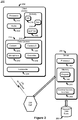
- Figure 2 illustrates one possible embodiment of a hardware environment 200 for video-call optimization. Specifically Figure 2 illustrates a client device 202 configured to adapt the data collection rate from various inputs during a video-call session.
- Client device 202 is any computing device with a processor 212 and a memory 214.
- Client device 202's memory 214 is any computer-readable media which may store several programs including an operating system 216, a video-call application or service 218, and a video-call optimizer 220. In this way, client device 202 has software support for video-calls and video-call optimization. Memory 214 may additionally store non-executable data such as video-call communications measurements and video-call metadata.
- Computer-readable media includes, at least, two types of computer-readable media, namely computer storage media and communications media.
- Computer storage media includes volatile and nonvolatile, removable and non-removable media implemented in any method or technology for storage of information such as computer readable instructions, data structures, program modules, or other data.
- Computer storage media includes, but is not limited to, RAM, ROM, EEPROM, flash memory or other memory technology, CD-ROM, digital versatile disks (DVD) or other optical storage, magnetic cassettes, magnetic tape, magnetic disk storage or other magnetic storage devices, or any other non-transmission medium that can be used to store information for access by a computing device.
- communication media may embody computer readable instructions, data structures, program modules, or other data in a modulated data signal, such as a carrier wave, or other transmission mechanism. As defined herein, computer storage media does not include communication media.
- Programs 216, 218, 220 comprise computer-readable instructions including an operating system 216 and other system functionality as well as user applications such as a video-call client 218 and a video-call optimizer 220.
- the operating system may support the ability to trap application events and communications performance. Trapping application events enables a program to capture observable data. Examples include, but are not limited to journaling hooks and trampoline functions.
- a trapped application event may be associated with a programmatic handler which in turn stores input and/or output parameter data associated with the operation of the event. In this way, an arbitrary software event, may be monitored and then stored.
- Client device 202 will have a wireless communications interface in the form of a radio 222.
- Radio 222 may support unlicensed spectrum communications such as Wi-Fi, or licensed spectrum such as WCDMA and CDMA2000.
- client device 202 may have multiple radios to support both unlicensed and licensed spectrum communications.
- Client device 202 has a data capture facility 224 to provide hardware support for video-calls and video-call optimization.
- Data capture facility 224 may have either a single video camera 226 or a plurality of video cameras 226, 228 for video input.
- Data capture facility 224 may have a microphone 230 for audio input.
- Data capture facility 224 may also have any number of non-video and non-audio sensors as potential inputs. All inputs 226, 228, 230 may be dynamically controlled via one or more controllers 232.
- Controller 232 may control various parameters for the input devices such as frame capture rate and resolution. Controller 232 may perform analogous increases and decreases to data flow rates from the other inputs without loss of generality. Controller 232 may buffer or store raw data in memory 214.
- Client device 202 may also have a transcoder 234 to translate the stored raw data into a format amenable for further processing and transmission via radio 222.
- Client device 202 communicates via an air interface 236 to a cellular tower in its local cell sector 238.
- the local cell sector 238 is constantly measuring, tracking and storing cellular conditions for the air interface 236 and for the towers in the local cell sector 238.
- the client device and/or the local servers may modify operation according to a static profile, a statistical profile, or via dynamically reacting substantially in real time to the measured cellular conditions.
- the frequency of the modifications may be optimized. For example, instead of polling with a fixed linear period, such as every 2 seconds, the polling may be interpolated. If the present poll is substantially similar to the previous poll, the next polling period may be increased to 3 seconds. However, if the present poll is substantially different to the previous poll, the next polling period may be decreased to 1 second.
- the interpolation may be by percentage, or by a fixed amount of time to modify. In the previous example, there may have been a 50% increase/decrease, or a 1 second linear change, some minimum polling time specified.
- Cell sector 238 then forwards the video-call data and associated metadata via a backhaul to the core network.
- the communications link and associated profiles are described in more detail with respect to Figure 3 .
- Server 240 is any computing device capable of support video-call sessions and to support video-call optimizations.
- the server 240 comprises processor 242, memory 244 and communications interface 246.
- memory 244 is any computer-readable media including both computer storage media and communication media.
- memory 244 store programs 246 which may include an operating system and computer-readable instructions to support video-call sessions and video-call optimizations.
- Memory 244 may also store programs 246 that may include a database management system if data store 250 is configured as a database.
- Data store 250 may be configured as a relational database, an object-oriented database, a columnar database, or any configuration supporting queries of present and historical video-call communications link characteristics.
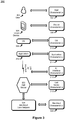
- Figure 3 illustrates an exemplary wireless communications stack 300 that may be used for a video-call session.
- the communications stack 300 illustrates a chain of communications links where each layer has its own specific characteristics, and may be instrumented separately to measure those characteristics. Those characteristics may then be shared up and down the stack or chain to optimize the video-call.
- Characteristics may be static, statistical or dynamic. Specifically, characteristics may be stored in a static profile and accessed by other layers, such as the optimizer in a communications terminal.
- the static profile may reside on a communications terminal in memory, or alternatively may be accessible on a remote server.
- Characteristics may be dynamically determined. Specifically, characteristics can be measured in real time or substantially in real time. As those characteristics are measured, they can be communicated up and down the stack or chain to optimize the video call.
- Characteristics may also be stored in a knowledge base. As various measurements are made by various participants in the communications stack or chain, those measurements may be stored in a server or database. Once stored, those measurements may be indexed to different classes of video-calls. Specifically, an algorithm to measure the similarity between various video-calls may be applied, and those similar video-call's correlated together. For example, some video-calls might be characterized as peak calls. Other video-calls might be characterized as conference calls. Once correlated, the statistical analysis may be applied to the data relating to a class of video-calls. For example, one might calculate the average carrier to interference ratio for video-calls of a particular cell sector during a peak time window. Once calculated, this statistic data may be periodically recalculated and propagated up and down the communications stack or chain.
- the communications chain or stack may start with user 302.
- User 302 is the video-call participant that initiates and responds to video-calls and responds to calls.
- a user profile 304 Corresponding to user 302 is a user profile 304.
- Example user characteristics may include static user preferences such as expected QoS or QoE settings.
- user characteristics may include dynamic or statistical measurements of how often the user participates in video-calls, the duration of the video-calls, and the likelihood that additional material, such as office documents are shared.
- Client device 306 Corresponding to client device 306 is client device profile 308.
- Client device characteristics may include static information such as the make and model of the client device, the number of video cameras on the client device and their respective resolution capabilities.
- Dynamic characteristics may include power utilization curves, and frequency of transmission/reception errors as measured on the device.
- Client device 306 runs an operating system 310.
- Operating system characteristics may include name, version number and build of the operating system.
- Dynamic characteristics may include number of background processes running, and the identity of services running concurrently.
- video-call application profile 316 Corresponding to video-call application 314 is video-call application profile 316.
- Static characteristics may include the name and build of the video-call application.
- Dynamic characteristics may include the identity of system services used by the video-call application 314, the type of video-call of the video-call applications, and the type of content transmitted over the video-call.
- Example types of content may include, whether the content is enterprise data including office documents, or adult content, or video-conference data,
- Client side characteristics including user characteristics, client device characteristics, operating system characteristics, and video-call application characteristics may be measured and detected on the client device. These characteristics generally relate to the link quality requirements for a video-call session, but may also relate to the link quality capability of a communications link for a video-call. These characteristics may be polled, or measured upon detection of an event. The characteristics may also be collected upon a user directive, such as a button push in an application.
- the client device may periodically push an archive of stored characteristics to a server on the network for later analysis. Alternatively, the client device may periodically push an archive of stored characteristics to another communications terminal in the video-call session for that communications terminal to perform other optimizations.
- Air interface characteristics may include channel quality information ("CQI") characteristics, a carrier to interference ratio, a discontinuous reception metric ("DRX”) and a discontinuation transmission metric ("DTX").
- Air interface characteristics 320 may be detected by a client device or alternatively by the base station. When detected by the base station, the base station may periodically push air interface characteristics 320 to the client device.
- CQI channel quality information
- DRX discontinuous reception metric
- DTX discontinuation transmission metric
- Air-interface 320 connects to a cellular tower and cellular base station in a local cellular sector 322.
- cellular sector 322 is cellular sector profile 324.
- Example cellular sector 322 characteristics may include sector load, geographical information and mobility.
- a base station in the cellular sector may average call load by time.
- a base station may note that the sector contains a highway, and most calls include a larger than usual amount of roaming calls.
- Cellular sector 324 forwards video call data via backhaul to the core network 326.
- backhaul/core network 326 Corresponding to backhaul/core network 326 is backhaul/core network profile 328.
- Example backhaul/core network characteristics 328 may include processing load over time and load from processing billing and metering.
- measurements can be made on servers in the base station or the core network. These characteristics generally relate to the link quality capability of a video call session. These characteristics may be periodically pushed to one or more communications terminals participating in a video-call session. In this way, those communications terminals may optimize video-calls using wireless radio communications characteristics.
- Figure 4 illustrates an exemplary process 400 of how a client device might adapt its data capture rate during a video call.
- a client device receives a characteristic relating to the video-call session communications link.
- the characteristic may be affirmatively pushed by the cell sector or by the backhaul/core network.
- the characteristic may be polled by the client device from the cell sector or backhaul/core network.
- the characteristic may be directly sampled by the client device, such as in locally measuring an air interface characteristic.
- the optimizer on the client device or alternatively on a remote server may determine a link quality capability for a video-call session to be initiated, or in progress. Alternatively, the optimizer may periodically perform a link quality capability determination without waiting for a characteristic to be received.
- the client device measures a characteristic relating to the client side characteristics of the video-call.
- Characteristics may include user characteristics, client device characteristics, operating system characteristics, video-call application characteristics. For example, a particular video-call application favored by the user may have a particularly high power draw. Alternatively, the user may demand high resolution video in his or her profile.
- the optimizer determines the link quality requirement for the video call using the characteristics collected in block 406.
- the optimizer makes a determination as to whether the video data capture rate needs to adapt. If the bandwidth at the time of the call is sufficient for the video-call link quality requirements, then no adaptation may be necessary. In the alternative, the optimizer may perform optimizations not specific to QoS or QoE, but may optimize to lengthen battery lifetime or minimize power draw. In another alternative, the optimizer may see to increase the video-call data captured to provide increased corresponding QoS and QoE. If the link quality capability is not sufficient for the video-call link quality requirement, the optimizer will determine by how much the video-call data captured is to be decreased. Whether increasing or decreasing, the optimizer will make a determination of the amount to adapt the data capture rate.
- the various characteristics collected, the link quality capability determination, the link quality requirement and other video-call characteristics may be stored locally or on a server. If stored locally, the client device may periodically upload this data in an archive to a server. The data may be affirmatively pushed, or affirmatively requested by the server. In this way, a knowledge base of various video-calls and their characteristics may be later analyzed and queried.
- the controller of the video cameras may dynamically adapt the video camera configuration accordingly.
- the raw video data is then captured.
- the controller may perform the captured data rate adaptation by changing a video-capture parameter. For example, the controller may change the resolution from XVGA to VGA. By way of another example, the controller may change the sampling time from 60 frames per second to 42 frames per second. Note that these changes occur before transcoding. Because the data is eliminated prior to transcoding, there is no need to use processor resources or additional power to adapt the data capture rate. Furthermore, because no processor resources are used to adapt the data capture rate via software, lag time to stream the captured video data is decreased.
- the video-capture parameter may be specific to the hardware itself. For example, where a client device has multiple cameras, each with a different resolution, the user might switch from a high resolution camera such as a camera pointed to an item other than the user, to a second low resolution camera such as one pointed to the user. In this case, the optimizer may increase resolution or data capture frame rate since a lower resolution camera is being used.
- the raw data captured in block 416 is transformed into a format for further processing or for transmission over wireless networks.
- the transcoded data is then transmitted over the air interface.
- the optimizer may reside on either the client device or the server.
- an optimizer might reside on a server, and directives to the video camera controller might be sent remotely.
- the optimizer resides on a server in the base station or in the core network, other parts of the communications stack might be adapted as well. For example, packets may be affirmatively dropped to save on the volume of data to be transmitted.
- FIG. 5 illustrates an example of a video teleconference 500 that might be optimized.
- Party A 502 comprises user A 504 and client device A 506.
- Party B 508 comprises user B 510 and client device B 512.
- Party C 514 comprises user C 516 and client device C 518. All three parties A 502, B 508 and C 514 are connected to video-call server 520.
- the client devices need not be the same.
- one party may be in a fixed location with a large television monitor, whereas another party may be on a smart phone. The party with the smart phone will have a lower link quality requirement than the party with the television monitor.
- the party in a fixed location may have a much higher link quality capability than a mobile party.
- a roaming mobile party may have a lower link quality capability as a non-moving mobile party. Note that if the mobile party is roaming, video might even be shut off if the optimizer determines that the user might be distracted while driving.
- the video-call capture data rate is adapted by increasing or decreasing the amount of data to be streamed.
- Figure 6 illustrates an example embodiment of video conference optimization 600 using these techniques.
- a client device 506 receives a video conference link quality requirement from the server 520.
- Server 520 has received characteristics of the communications network by direct measurement, and has received characteristics of the video-conference parties 502, 508, 514. Accordingly, the server 520 may make a link quality requirement determination for the video conference. Server 520 then propagates this link quality requirement determination to the video conference parties 502, 508, 514.
- server 520 makes a determination of the link quality capability of the communications link between client device 506 and server 520.
- server 520 may propagate the determination of the link quality capability to the client device 506.
- the client device 506 then adapts the video capture data rate based on the link quality requirement and the link quality capability. Upon doing so, in block 608, client device 506 changes a video-capture parameter to adapt to the determined video capture data rate. Upon capture, in block 610 the raw data is transcoded and then streamed to the server 520. This process is as described with respect to Figure 4 .
- the server may track these characteristics and forward to the parties 502, 508, and 514 for use in video conference optimization.
- Server 520 receives video streams from Party B 508 and Party C 514. The server 520 can then forward the received video streams Party A 502. In block 612, Client Device A 506 receives the forwarded video streams and may make a determination on how best to render or present the video streams. In block 614, Client Device A 506 renders the video streams.
- Parties A 502, B 508, and C 514 affirmatively adapt their data rates based on information about the communications link as stored in the server 520, client processing is minimized, and QoS and QoE is optimized. Further note that QoS and QoE optimizations may be balanced with other optimization decisions, such as to extend power for mobile clients. For example, mobile clients may have frame rates decreased affirmatively while fixed clients maintain a high frame rate. Since lower frame rates use less processing resources, mobile clients will conserve power.
Landscapes
- Engineering & Computer Science (AREA)
- Multimedia (AREA)
- Signal Processing (AREA)
- Computer Networks & Wireless Communication (AREA)
- Business, Economics & Management (AREA)
- General Business, Economics & Management (AREA)
- General Engineering & Computer Science (AREA)
- Telephonic Communication Services (AREA)
- Mobile Radio Communication Systems (AREA)
- Two-Way Televisions, Distribution Of Moving Picture Or The Like (AREA)
Abstract
Description
- This patent application claims priority to U.S. Utility patent application entitled "Optimizing Video-Call Quality of Service" with Serial No.
13/658,745 filed October 23, 2012 61/550,871 filed October 24, 2011 - Increasing numbers of user have come to make video-calls on electronic multimedia terminals such as personal computers with web cameras ("webcams") and microphones. Specifically, a user is able to create a communications connection with one or more other users with electronic multimedia terminals, and transmit and receive both voice data and video data to those users. Typically the video data will be of the user, but alternatively could be a video camera view of some other object, as is common with multi-camera smart phones. In other scenarios, such as video conferencing, the video may be of a static document, such as a text document or a spreadsheet.
- As mobile terminals, including smart phones and mobile tablets have acquired multimedia capabilities; those mobile terminals have come to support video-calls as well. Such mobile terminals are typically wireless devices with less bandwidth than non-mobile clients with fixed networks. Wireless mobile terminals may make use of unlicensed spectrum such as Wi-Fi or make use of licensed spectrum such as the air interface to cellular carriers. In addition to potentially having less bandwidth, a particular communications link's bandwidth may fluctuate based on changing conditions. For example, a wireless network may have less bandwidth for a particular communications link during peak hours as opposed to the middle of the night. Alternatively, a wireless network may have less bandwidth due to a temporary router outage.
- To adapt to fluctuating wireless communication bandwidth, and in general to fluctuating link quality capabilities, video-call software clients may adapt their data transmission rate based on available link quality capabilities, by capturing the video data from a client device video camera, and then using in-software transformations to change the resolution of the transmitted video data to match available bandwidth. Specifically, where there is less link quality capability, the video-call software client decreases the resolution of the transmitted video and where there is more link quality capability, the video-call software increases the resolution.
- However, in-software transformations to throttle data throughput for video-calls makes extensive use of processor resources and battery power. Accordingly, there is an opportunity to optimize video calls by adapting data transmission rates without processor intensive in-software transformations, and thereby preserving processor cycles and battery lifetime.
- Furthermore, the efficacy of present video-call adaptation techniques is based on measuring link quality capability for a call. However present video-call adaptation techniques are optimized for wired communications, rather than wireless communications. Accordingly, present video-call adaptation techniques do not take into account link quality fluctuations caused by interruptions in the wireless communications stack, resulting in sub-optimal adaption.
- The Detailed Description is set forth with reference to the accompanying figures. In the figures, the left-most digit(s) of a reference use of the same reference numbers in different figures indicates similar or identical items.
-
FIG. 1 is a top-level diagram illustrating the context of video-call adaptive camera resolution. -
FIG. 2 is a diagram of an example hardware platform for video-call adaptive camera resolution. -
FIG. 3 is a diagram of an example communications stack with instrumentation to support video-call adaptive camera resolution. -
FIG. 4 is an exemplary flow chart of video-call adaptive camera resolution. -
FIG. 5 is an illustration of some example video-call optimizations for video-conferencing. -
FIG. 6 is an exemplary flow chart of video-call optimization for video-conferencing. - Video-calls are calls from one terminal to another, where each party may both hear and see the other parties communicate. Video-calls between consumers may be between only two parties and limited to audio and video of the parties themselves. Video-calls in an enterprise context may be of more than two parties and may be supplemented with multi-media presentations. Multi-media presentations may include office documents, videos of content other than the speakers, and still images. Audio may be of greater quality than voice quality, and may be high fidelity sufficient for accurate music reproduction. Multi-media, multi-party calls are called video conferencing.
- Video and multi-media communications require significantly higher link quality than voice communications. Link quality may relate simply to bandwidth capacity. Alternatively, link quality may relate to non bandwidth capacity measures such as network congestion. Link quality may relate to radio signal quality including radio signal quality parameters such as signal strength, variance, and reliability.
- Even though wireless communications channels have increasingly higher and higher link quality capabilities, a video-call may require a higher link quality than available on the video-call session channel. Furthermore, although the link quality capability of a video-call communications connection may be sufficient under peak conditions, the link quality may periodically undergo temporary drops. Accordingly, to provide an acceptable quality of service ("QoS") or quality of user experience ("QoE") a communications terminal in a video-call may adapt the amount or rate of data to send in over the communications link.
- Present video-call data rate adaptation has two key limitations. First, the video-call adaptation relies on software techniques to change the data rate. With this technique, much processing resources are used to reduce or adapt the video-call data rate. Correspondingly, the power draw is relatively high. As a result, for mobile communications terminals, battery life is compromised. This disclosure describes reducing the amount of data captured, where link quality capability is lower, and describes increasing the amount of data captured when there is higher link quality capability. Since the video camera does not capture the data in the first place, it need not be removed via software, saving processing time and power.
- Second, the efficacy of video-call adaptation relies on the accuracy of the information used to characterize the communications link. Present communications link characterization is based on wired communication links rather than wireless communications links. Accordingly, communications link characterization is missing valuable information specific to wireless communications. Furthermore, user and communications terminal specific information, either from the caller or the receiver, is not presently utilized to characterize video-call requirements. In the latter scenario, a communications terminal could conceivably utilize information from the sending communications terminal, server information about the characteristics of the communications link, and the local communications terminal characteristics, all to provide an extremely accurate picture of the video-call link quality capability and link quality requirements. This information would enable a superior video-call data rate adaptation capability.
-
Figure 1 illustrates anexemplary environment 100 for the disclosed video-call optimizations. - Party A 102 is participating in a video-call session. Party A 102 comprises
user A 104 andclient device A 106, a communications terminal.Client device 106 is equipped to support video-calls. Accordingly, it may have avideo camera 108 and amicrophone 110.Controller 112 controls the various parameter settings for avideo camera 108 and amicrophone 110. For example,controller 112 can specify the data capture frame rate and the operating resolution ofvideo camera 108, and may modify these parameters dynamically during run time. Where there are additional video cameras and transducers,controller 112 may also select which ones are active.Client device 106 also has atranscoder 114 to convert raw data captured by thevideo camera 108 and/ormicrophone 110 into a data format amenable for data processing and transmission.Client device 106 is discussed in more detail with respect toFigure 3 . -
Party B 116 is also participating in the video-call. As withparty A 102,party B 116 comprisesuser B 118 andclient device B 120. Note that theclient device B 120 need not be the same type of client asclient device A 106. For example,client device A 106 may be a smart phone andclient device B 120 may be a laptop computer. Client devices may be any communications terminal capable of supporting a video-call, and may include personal computers, tablet computers, and other handheld communications terminals. - Both
party A 102 andparty B 116 communicate via a wireless video-call session. Inexemplary environment 100, client device A may communicate viaair interface 122 to a cellular tower incell sector 124.Client device A 106 may accessair interface 122 in any number of ways. In one example,client device A 106 may accessair interface 122 via a data connection via a cellular radio. Alternatively,client device A 106 may receive data via Wi-Fi and forward the data to the data connection via the cellular radio by tethering. - In a cellular communications embodiment,
cell sector 124 may forward video-call data to a cellular core network viabackhaul 126. Cellular core network examples may include implementations conforming to 3GPP and 3GPP2 standards. - The
core network 126 then forwards video-call data to party B's 116local cell sector 128, which then transmits the video-call data toclient device B 120 viaair interface 130. -
Figure 2 illustrates one possible embodiment of ahardware environment 200 for video-call optimization. SpecificallyFigure 2 illustrates aclient device 202 configured to adapt the data collection rate from various inputs during a video-call session. -
Client device 202 is any computing device with aprocessor 212 and amemory 214. -
Client device 202'smemory 214 is any computer-readable media which may store several programs including anoperating system 216, a video-call application orservice 218, and a video-call optimizer 220. In this way,client device 202 has software support for video-calls and video-call optimization.Memory 214 may additionally store non-executable data such as video-call communications measurements and video-call metadata. - Computer-readable media includes, at least, two types of computer-readable media, namely computer storage media and communications media. Computer storage media includes volatile and nonvolatile, removable and non-removable media implemented in any method or technology for storage of information such as computer readable instructions, data structures, program modules, or other data. Computer storage media includes, but is not limited to, RAM, ROM, EEPROM, flash memory or other memory technology, CD-ROM, digital versatile disks (DVD) or other optical storage, magnetic cassettes, magnetic tape, magnetic disk storage or other magnetic storage devices, or any other non-transmission medium that can be used to store information for access by a computing device. In contrast, communication media may embody computer readable instructions, data structures, program modules, or other data in a modulated data signal, such as a carrier wave, or other transmission mechanism. As defined herein, computer storage media does not include communication media.
-
Programs operating system 216 and other system functionality as well as user applications such as a video-call client 218 and a video-call optimizer 220. The operating system may support the ability to trap application events and communications performance. Trapping application events enables a program to capture observable data. Examples include, but are not limited to journaling hooks and trampoline functions. In general, a trapped application event may be associated with a programmatic handler which in turn stores input and/or output parameter data associated with the operation of the event. In this way, an arbitrary software event, may be monitored and then stored. -
Client device 202 will have a wireless communications interface in the form of aradio 222.Radio 222 may support unlicensed spectrum communications such as Wi-Fi, or licensed spectrum such as WCDMA and CDMA2000. Alternatively,client device 202 may have multiple radios to support both unlicensed and licensed spectrum communications. -
Client device 202 has adata capture facility 224 to provide hardware support for video-calls and video-call optimization.Data capture facility 224 may have either asingle video camera 226 or a plurality ofvideo cameras Data capture facility 224 may have amicrophone 230 for audio input.Data capture facility 224 may also have any number of non-video and non-audio sensors as potential inputs. Allinputs more controllers 232.Controller 232 may control various parameters for the input devices such as frame capture rate and resolution.Controller 232 may perform analogous increases and decreases to data flow rates from the other inputs without loss of generality.Controller 232 may buffer or store raw data inmemory 214. -
Client device 202 may also have atranscoder 234 to translate the stored raw data into a format amenable for further processing and transmission viaradio 222. -
Client device 202 communicates via anair interface 236 to a cellular tower in itslocal cell sector 238. Thelocal cell sector 238 is constantly measuring, tracking and storing cellular conditions for theair interface 236 and for the towers in thelocal cell sector 238. The client device and/or the local servers may modify operation according to a static profile, a statistical profile, or via dynamically reacting substantially in real time to the measured cellular conditions. The frequency of the modifications may be optimized. For example, instead of polling with a fixed linear period, such as every 2 seconds, the polling may be interpolated. If the present poll is substantially similar to the previous poll, the next polling period may be increased to 3 seconds. However, if the present poll is substantially different to the previous poll, the next polling period may be decreased to 1 second. The interpolation may be by percentage, or by a fixed amount of time to modify. In the previous example, there may have been a 50% increase/decrease, or a 1 second linear change, some minimum polling time specified. -
Cell sector 238 then forwards the video-call data and associated metadata via a backhaul to the core network. The communications link and associated profiles are described in more detail with respect toFigure 3 . - Both
local cell sector 238 and backhaul/core network have a number ofservers 240.Server 240 is any computing device capable of support video-call sessions and to support video-call optimizations. Theserver 240 comprisesprocessor 242,memory 244 andcommunications interface 246. As per the precedingdiscussion regarding client 202,memory 244 is any computer-readable media including both computer storage media and communication media. - In particular,
memory 244store programs 246 which may include an operating system and computer-readable instructions to support video-call sessions and video-call optimizations. -
Memory 244 may also storeprograms 246 that may include a database management system ifdata store 250 is configured as a database.Data store 250 may be configured as a relational database, an object-oriented database, a columnar database, or any configuration supporting queries of present and historical video-call communications link characteristics. -
Figure 3 illustrates an exemplary wireless communications stack 300 that may be used for a video-call session. In effect, the communications stack 300 illustrates a chain of communications links where each layer has its own specific characteristics, and may be instrumented separately to measure those characteristics. Those characteristics may then be shared up and down the stack or chain to optimize the video-call. - Characteristics may be static, statistical or dynamic. Specifically, characteristics may be stored in a static profile and accessed by other layers, such as the optimizer in a communications terminal. The static profile may reside on a communications terminal in memory, or alternatively may be accessible on a remote server.
- Characteristics may be dynamically determined. Specifically, characteristics can be measured in real time or substantially in real time. As those characteristics are measured, they can be communicated up and down the stack or chain to optimize the video call.
- Characteristics may also be stored in a knowledge base. As various measurements are made by various participants in the communications stack or chain, those measurements may be stored in a server or database. Once stored, those measurements may be indexed to different classes of video-calls. Specifically, an algorithm to measure the similarity between various video-calls may be applied, and those similar video-call's correlated together. For example, some video-calls might be characterized as peak calls. Other video-calls might be characterized as conference calls. Once correlated, the statistical analysis may be applied to the data relating to a class of video-calls. For example, one might calculate the average carrier to interference ratio for video-calls of a particular cell sector during a peak time window. Once calculated, this statistic data may be periodically recalculated and propagated up and down the communications stack or chain.
- The communications chain or stack may start with user 302. User 302 is the video-call participant that initiates and responds to video-calls and responds to calls. Corresponding to user 302 is a
user profile 304. Example user characteristics may include static user preferences such as expected QoS or QoE settings. Alternatively, user characteristics may include dynamic or statistical measurements of how often the user participates in video-calls, the duration of the video-calls, and the likelihood that additional material, such as office documents are shared. - The user 302 uses a
client device 306. Corresponding toclient device 306 isclient device profile 308. Client device characteristics may include static information such as the make and model of the client device, the number of video cameras on the client device and their respective resolution capabilities. Dynamic characteristics may include power utilization curves, and frequency of transmission/reception errors as measured on the device. -
Client device 306 runs anoperating system 310. Corresponding tooperating system 310 is operatingsystem profile 312. Operating system characteristics may include name, version number and build of the operating system. Dynamic characteristics may include number of background processes running, and the identity of services running concurrently. - Operating system runs video-
call application 314. Corresponding to video-call application 314 is video-call application profile 316. Static characteristics may include the name and build of the video-call application. Dynamic characteristics may include the identity of system services used by the video-call application 314, the type of video-call of the video-call applications, and the type of content transmitted over the video-call. Example types of content may include, whether the content is enterprise data including office documents, or adult content, or video-conference data, - Client side characteristics, including user characteristics, client device characteristics, operating system characteristics, and video-call application characteristics may be measured and detected on the client device. These characteristics generally relate to the link quality requirements for a video-call session, but may also relate to the link quality capability of a communications link for a video-call. These characteristics may be polled, or measured upon detection of an event. The characteristics may also be collected upon a user directive, such as a button push in an application. The client device may periodically push an archive of stored characteristics to a server on the network for later analysis. Alternatively, the client device may periodically push an archive of stored characteristics to another communications terminal in the video-call session for that communications terminal to perform other optimizations.
- Video-
call application 314 transports video-call data overair interface 318. Corresponding toair interface 318 isair interface profile 320. Air interface characteristics may include channel quality information ("CQI") characteristics, a carrier to interference ratio, a discontinuous reception metric ("DRX") and a discontinuation transmission metric ("DTX").Air interface characteristics 320 may be detected by a client device or alternatively by the base station. When detected by the base station, the base station may periodically pushair interface characteristics 320 to the client device. - Air-
interface 320 connects to a cellular tower and cellular base station in a local cellular sector 322. Corresponding to cellular sector 322 iscellular sector profile 324. Example cellular sector 322 characteristics may include sector load, geographical information and mobility. For example, a base station in the cellular sector may average call load by time. Alternatively, a base station may note that the sector contains a highway, and most calls include a larger than usual amount of roaming calls. -
Cellular sector 324 forwards video call data via backhaul to thecore network 326. Corresponding to backhaul/core network 326 is backhaul/core network profile 328. Example backhaul/core network characteristics 328 may include processing load over time and load from processing billing and metering. - For network side characteristics including
air interface characteristics 320,cell sector characteristics 324 and backhaul/core network 328, measurements can be made on servers in the base station or the core network. These characteristics generally relate to the link quality capability of a video call session. These characteristics may be periodically pushed to one or more communications terminals participating in a video-call session. In this way, those communications terminals may optimize video-calls using wireless radio communications characteristics. - The foregoing discussion relates to an infrastructure to obtain and propagate characteristics that would impact a video-call up and down the communications stack and chain.
Figure 4 illustrates anexemplary process 400 of how a client device might adapt its data capture rate during a video call. - In
block 402, a client device receives a characteristic relating to the video-call session communications link. The characteristic may be affirmatively pushed by the cell sector or by the backhaul/core network. In the alternative, the characteristic may be polled by the client device from the cell sector or backhaul/core network. In other alternative, the characteristic may be directly sampled by the client device, such as in locally measuring an air interface characteristic. - Upon receiving the characteristic, in
block 404, the optimizer on the client device or alternatively on a remote server may determine a link quality capability for a video-call session to be initiated, or in progress. Alternatively, the optimizer may periodically perform a link quality capability determination without waiting for a characteristic to be received. - In
block 406, the client device measures a characteristic relating to the client side characteristics of the video-call. Characteristics may include user characteristics, client device characteristics, operating system characteristics, video-call application characteristics. For example, a particular video-call application favored by the user may have a particularly high power draw. Alternatively, the user may demand high resolution video in his or her profile. - In
block 408, the optimizer determines the link quality requirement for the video call using the characteristics collected inblock 406. - Once the link quality capability is determined as in
block 404 and the video-call link quality requirements is determined as inblock 406, the optimizer makes a determination as to whether the video data capture rate needs to adapt. If the bandwidth at the time of the call is sufficient for the video-call link quality requirements, then no adaptation may be necessary. In the alternative, the optimizer may perform optimizations not specific to QoS or QoE, but may optimize to lengthen battery lifetime or minimize power draw. In another alternative, the optimizer may see to increase the video-call data captured to provide increased corresponding QoS and QoE. If the link quality capability is not sufficient for the video-call link quality requirement, the optimizer will determine by how much the video-call data captured is to be decreased. Whether increasing or decreasing, the optimizer will make a determination of the amount to adapt the data capture rate. - In embodiments where statistical analysis is to be applied to video-call data, in
block 412, the various characteristics collected, the link quality capability determination, the link quality requirement and other video-call characteristics may be stored locally or on a server. If stored locally, the client device may periodically upload this data in an archive to a server. The data may be affirmatively pushed, or affirmatively requested by the server. In this way, a knowledge base of various video-calls and their characteristics may be later analyzed and queried. - Once the amount to change the data capture rate or volume is known, in
block 414, the controller of the video cameras may dynamically adapt the video camera configuration accordingly. Inblock 416, the raw video data is then captured. - The controller may perform the captured data rate adaptation by changing a video-capture parameter. For example, the controller may change the resolution from XVGA to VGA. By way of another example, the controller may change the sampling time from 60 frames per second to 42 frames per second. Note that these changes occur before transcoding. Because the data is eliminated prior to transcoding, there is no need to use processor resources or additional power to adapt the data capture rate. Furthermore, because no processor resources are used to adapt the data capture rate via software, lag time to stream the captured video data is decreased.
- The video-capture parameter may be specific to the hardware itself. For example, where a client device has multiple cameras, each with a different resolution, the user might switch from a high resolution camera such as a camera pointed to an item other than the user, to a second low resolution camera such as one pointed to the user. In this case, the optimizer may increase resolution or data capture frame rate since a lower resolution camera is being used.
- In
block 418, the raw data captured inblock 416 is transformed into a format for further processing or for transmission over wireless networks. Inblock 420, the transcoded data is then transmitted over the air interface. - It is to be emphasized that the optimizer may reside on either the client device or the server. In the latter embodiment, to save processing on the client device, an optimizer might reside on a server, and directives to the video camera controller might be sent remotely. Furthermore, where the optimizer resides on a server in the base station or in the core network, other parts of the communications stack might be adapted as well. For example, packets may be affirmatively dropped to save on the volume of data to be transmitted.
- One example of a client device and a server acting in concert to optimize a video-call is video teleconferencing. In video-teleconferencing, two or more parties communicate with video and audio data. Additionally, other data, such as document data may be shared. Often video cameras are used to point at items of discussion other than the parties.
Figure 5 illustrates an example of avideo teleconference 500 that might be optimized. - Party A 502 comprises user A 504 and
client device A 506.Party B 508 comprises user B 510 andclient device B 512.Party C 514 comprises user C 516 andclient device C 518. All three parties A 502,B 508 andC 514 are connected to video-call server 520. Again note that the client devices need not be the same. For example, one party may be in a fixed location with a large television monitor, whereas another party may be on a smart phone. The party with the smart phone will have a lower link quality requirement than the party with the television monitor. Similarly, the party in a fixed location may have a much higher link quality capability than a mobile party. By way of another example, a roaming mobile party may have a lower link quality capability as a non-moving mobile party. Note that if the mobile party is roaming, video might even be shut off if the optimizer determines that the user might be distracted while driving. - In the foregoing descriptions, the video-call capture data rate is adapted by increasing or decreasing the amount of data to be streamed.
Figure 6 illustrates an example embodiment ofvideo conference optimization 600 using these techniques. - In block 602 a
client device 506 receives a video conference link quality requirement from theserver 520.Server 520 has received characteristics of the communications network by direct measurement, and has received characteristics of the video-conference parties server 520 may make a link quality requirement determination for the video conference.Server 520 then propagates this link quality requirement determination to thevideo conference parties - In
block 604, theclient device 506, or alternativelyserver 520 makes a determination of the link quality capability of the communications link betweenclient device 506 andserver 520. In the latter embodiment,server 520 may propagate the determination of the link quality capability to theclient device 506. - In
block 606, theclient device 506 then adapts the video capture data rate based on the link quality requirement and the link quality capability. Upon doing so, inblock 608,client device 506 changes a video-capture parameter to adapt to the determined video capture data rate. Upon capture, inblock 610 the raw data is transcoded and then streamed to theserver 520. This process is as described with respect toFigure 4 . - Note that some optimizations may be specific to video conferencing. For example, where a static document is being shown, the frame rate may be greatly reduced. Similarly, if the display of the video conference is dominated by documents, the resolution and the frame rate of the video streams of the parties may be reduced. Accordingly, the server may track these characteristics and forward to the
parties -
Server 520 receives video streams fromParty B 508 andParty C 514. Theserver 520 can then forward the received videostreams Party A 502. Inblock 612,Client Device A 506 receives the forwarded video streams and may make a determination on how best to render or present the video streams. Inblock 614,Client Device A 506 renders the video streams. - Note that because Parties A 502,
B 508, andC 514 affirmatively adapt their data rates based on information about the communications link as stored in theserver 520, client processing is minimized, and QoS and QoE is optimized. Further note that QoS and QoE optimizations may be balanced with other optimization decisions, such as to extend power for mobile clients. For example, mobile clients may have frame rates decreased affirmatively while fixed clients maintain a high frame rate. Since lower frame rates use less processing resources, mobile clients will conserve power. - Although the subject matter has been described in language specific to structural features and/or methodological acts, it is to be understood that the subject matter defined in the appended claims is not necessarily limited to the specific features or acts described above. Rather, the specific features and acts described above are disclosed as example forms of implementing the claims.
-
-
Embodiment 1. A method of optimizing video-call quality substantively in real time, comprising:- determining at a communications terminal engaged in a video-call session, a link quality capability of a communications channel for the video-call session and a link quality requirement for the video-call session;
- based on the link quality capability determination and the link quality requirement determination, changing at least one video-capture parameter;
- based on the at least one video-capture parameter, capturing video data for the video-call with at least one video-camera;
- transcoding the captured video data; and
- transmitting the captured video data as part of the video-call session.
-
Embodiment 2. The method ofembodiment 1, wherein the determining of the link quality capability and the link quality requirement occurs at a time determined by any one of:- a sampling time whose period is linear,
- a sampling time whose period is interpolated, and
- a sampling time which is dynamically set.
- Embodiment 3. The method of
embodiment 1, wherein the determining of the link quality capability and the link quality requirement is triggered by and one of:- an application event trigger,
- radio signal quality, and
- a notification of communications network congestion.
- Embodiment 4. The method of
embodiment 1, wherein the video-call has a plurality of video-cameras that may capture video data for the video-call session, and at least one of the video-cameras has a different capture resolution than the other video-cameras; and
the determining of the link quality requirement for the video-call is based on which video-cameras is used to capture video data for the video-call. - Embodiment 5. The method of
embodiment 1, wherein the video-capture parameter to be changed is any one of:- video capture resolution, and
- number of frames per second to capture.
- Embodiment 6. The method of
embodiment 1, wherein the video-call link quality requirement determination is based in part on optimizing power draw on the communications terminal. -
Embodiment 7. The method ofembodiment 1, wherein the determination of the link quality capability or the link quality requirement is manually triggered by a user. -
Embodiment 8. A method of optimizing video-call quality substantively in real time, comprising:- determining a link quality capability of a communications channel for a wireless video-call session for a plurality of parties, wherein the determining is based on at least one of the following characteristics:
- a characteristic of a user participating as a party on the video-call session,
- a characteristic of a client device used for the video-call session,
- a characteristic of an operating system of a client device used for the video-call session,
- a characteristic of a video-call application used for the video-call session,
- a characteristic of a local cell sector in the wireless communications chain used for the video-call session,
- a characteristic of an air interface between the client device in the wireless communications chain used for the video-call session, and
- a characteristic of a backhaul communications infrastructure in the wireless communications chain used for the video-call session;
- based on the link quality capability determination, adapting the data capture rate for at least one party in the video call-session.
- determining a link quality capability of a communications channel for a wireless video-call session for a plurality of parties, wherein the determining is based on at least one of the following characteristics:
- Embodiment 9. The method of
embodiment 8 wherein the at least one characteristic used to determine the link quality capability of a communications channel for a wireless video-call session is retrieved from a static profile. - Embodiment 10. The method of
embodiment 8 wherein the at least one characteristic used to determine the link quality capability of a communications channel for a wireless video-call session is obtained via calculating a statistical summary of a set of samplings of the at least one characteristic. - Embodiment 11. The method of
embodiment 8 wherein the at least one characteristic used to determine the link quality capability of a communications channel for a wireless video-call session is dynamically determined substantially in real time. - Embodiment 12. The method of
embodiment 8 wherein the at least one characteristic used to determine the link quality capability of a communications channel for a wireless video-call session is any one of:- a channel quality information (CQI) characteristic,
- a sector load characteristic,
- a carrier to interference ratio,
- a discontinuous reception metric (DRX), and
- a discontinuation transmission metric (DTX).
- Embodiment 13. The method of
embodiment 8, wherein the video-call link quality capability determination is based in part on optimizing power draw on a communications terminal participating in the video-call session. - Embodiment 14. A method of optimizing video-call quality for a video-call with a plurality of users substantively in real time, comprising:
- receiving at a communications terminal of a party engaged in a video-call session at least one characteristic of another party engaged in the video-call session;
- determining at a communications terminal engaged in a video-call session, a link quality capability of a communications channel for the video-call session and a link quality requirement for the video-call session based on the received at least one characteristic; and
- based on the link quality capability determination, adapting the data capture rate for at least one party in the video call-session.
- Embodiment 15. The method of embodiment 14, wherein the at least one characteristic is any one of:
- load percentage, and
- measured achievable bitrate.
- Embodiment 16. The method of embodiment 14, wherein the video-call link quality capability determination is based in part on optimizing power draw on a communications terminal participating in the video-call session.
- Embodiment 17. A method of sampling video-call characteristics substantively in real time comprising:
- measuring a link quality capability characteristic of a communications channel for a wireless video-call session for a plurality of parties, wherein the characteristic is one of the following:
- a characteristic of a user participating as a party on the video-call session,
- a characteristic of a client device used for the video-call session,
- a characteristic of an operating system of a client device used for the video-call session,
- a characteristic of a video-call application used for the video-call session,
- a characteristic of a local cell sector in the wireless communications chain used for the video-call session,
- a characteristic of an air interface between the client device in the wireless communications chain used for the video-call session, and
- a characteristic of a backhaul communications infrastructure in the wireless communications chain used for the video-call session;
- measuring a link quality requirement for the video-call;
- determining an amount that the video-call data capture rate should adapt based on the characteristic measurement and the link quality requirement measurement; and
- storing the characteristic measurement, the link quality requirement measurement and the amount of the video call data capture rate adaptation in a knowledge base according to a correlation routine.
- measuring a link quality capability characteristic of a communications channel for a wireless video-call session for a plurality of parties, wherein the characteristic is one of the following:
- Embodiment 18. The method of embodiment 17, further comprising:
- sending a query to the knowledge base;
- retrieving at least one stored characteristic measurement, at least one link quality requirement measurement, and at least one video call data capture rate adaptation from the knowledge base, based on the query; and
- performing statistical analysis on the retrieved at least one stored characteristic measurement, at least one link quality requirement measurement, and at least one video call data capture rate adaptation.
- Embodiment 19. A method to optimize a video conference substantively in real time, comprising:
- receiving a video conference link quality requirement;
- determining at a communications terminal engaged in a video conference session, a link quality capability of a communications channel for the video conference session;
- based on the link quality capability determination and the received link quality requirement determination, changing at least one video-capture parameter;
- based on the at least one video-capture parameter, capturing video data for the video-call with at least one video-camera;
- streaming the captured video data to a server;
- receiving from the server a first and a second captured video data stream from a first other communications terminal and a second other communications terminal both engaged in the video conference session; and
- presenting a composite of the received first captured video data stream and the received second captured video data stream.
- Embodiment 20. A system for optimizing video-call quality substantively in real time, comprising:
- receiving a characteristic relating to a the wireless communications link for a video-call session;
- determining at a communications terminal engaged in a video-call session, a link quality capability of a communications channel for the video-call session based at least on the received characteristic relating to the wireless communications link;
- measuring a characteristic relating to the communications terminal;
- determining at the communications terminal, a link quality requirement of the video-call session, based on the measured characteristic relating to the communications terminal;
- based on the link quality capability determination and the link quality requirement determination, changing at least one video-capture parameter;
- based on the at least one video-capture parameter, capturing video data for the video-call with at least one video-camera;
- transcoding the captured video data; and
- transmitting the captured video data as part of the video-call session.
Claims (15)
- A method of optimizing video-call quality for a video-call with a plurality of users substantially in real time, comprising:receiving, at a communications terminal of a party engaged in a video-call session at least one characteristic of another party engaged in the video-call session;determining, at the communications terminal, a link quality capability of a communications channel for the video-call session based at least in part on the at least one characteristic of the another party engaged in the video-call session;measuring a characteristic relating to the communication terminal;determining, at the communication terminal, a link quality requirement for the video-call session based at least in part on the characteristic relating to the communication terminal; andbased on the determining the link quality capability, adapting a data capture rate for at least one party engaged in the video-call session.
- The method of claim 1, wherein the at least one characteristic of the another party engaged in the video-call session includes at least one of:a load percentage, ora measured achievable bitrate.
- The method of claim 1, wherein the characteristic relating to the communication terminal includes at least one of:a load percentage, ora measured achievable bitrate.
- The method of claim 1, wherein the determining the link quality capability is based in part on optimizing power draw on the communications terminal.
- The method of claim 1, wherein the determining of the link quality capability and the link quality requirement occurs at a time determined by any one of:a sampling time whose period is linear,a sampling time whose period is interpolated, ora sampling time which is dynamically set.
- The method of claim 1, wherein the determining of the link quality capability and the link quality requirement is triggered by any one of:an application event trigger,a radio signal quality, ora notification of communications network congestion.
- The method of claim 1, wherein the communications terminal has a plurality of video cameras that may capture video data for the video-call session, and at least one of the video cameras has a different capture resolution than the other video cameras; and
the determining of the link quality requirement for the video-call session is based on which of the video cameras is used to capture the video data for the video-call session. - The method of claim 1, wherein determining the link quality capability or the link quality requirement is manually triggered by a user.
- The method of claim 1, wherein the at least one characteristic of the another party engaged in the video-call session used to determine the link quality capability of the communications channel for the video-call session is retrieved from a static profile.
- The method of claim 1, wherein the at least one characteristic of the another party engaged in the video-call session used to determine the link quality capability of the communications channel for the video-call session is obtained via calculating a statistical summary of a set of samplings of the at least one characteristic of the another party engaged in the video-call session.
- The method of claim 1, wherein the at least one characteristic of the another party engaged in the video-call session used to determine the link quality capability of the communications channel for the video-call session is dynamically determined substantially in real time.
- The method of claim 1, wherein the at least one characteristic of the another party engaged in the video-call session used to determine the link quality capability of the communications channel for the video-call session includes at least one of:a channel quality information (CQI) characteristic,a sector load characteristic,a carrier to interference ratio,a discontinuous reception metric (DRX), ora discontinuation transmission metric (DTX).
- A system comprising a processor configured to implement a method according to any one of claims 1 to 12.
- A computer program product comprising coded instruction that, when run on a computer, implement a method as claimed in any one of claims 1 to 12.
- One or more computer readable media on which a computer program product according to claim 14 is recorded.
Applications Claiming Priority (4)
| Application Number | Priority Date | Filing Date | Title |
|---|---|---|---|
| US201161550871P | 2011-10-24 | 2011-10-24 | |
| US13/658,745 US9118801B2 (en) | 2011-10-24 | 2012-10-23 | Optimizing video-call quality of service |
| EP12844332.2A EP2772010B1 (en) | 2011-10-24 | 2012-10-24 | Optimizing video-call quality of service |
| PCT/US2012/061608 WO2013063056A1 (en) | 2011-10-24 | 2012-10-24 | Optimizing video-call quality of service |
Related Parent Applications (1)
| Application Number | Title | Priority Date | Filing Date |
|---|---|---|---|
| EP12844332.2A Division EP2772010B1 (en) | 2011-10-24 | 2012-10-24 | Optimizing video-call quality of service |
Publications (2)
| Publication Number | Publication Date |
|---|---|
| EP3429124A1 true EP3429124A1 (en) | 2019-01-16 |
| EP3429124B1 EP3429124B1 (en) | 2020-10-21 |
Family
ID=48168418
Family Applications (2)
| Application Number | Title | Priority Date | Filing Date |
|---|---|---|---|
| EP18191958.0A Active EP3429124B1 (en) | 2011-10-24 | 2012-10-24 | Optimizing video-call quality of service |
| EP12844332.2A Active EP2772010B1 (en) | 2011-10-24 | 2012-10-24 | Optimizing video-call quality of service |
Family Applications After (1)
| Application Number | Title | Priority Date | Filing Date |
|---|---|---|---|
| EP12844332.2A Active EP2772010B1 (en) | 2011-10-24 | 2012-10-24 | Optimizing video-call quality of service |
Country Status (3)
| Country | Link |
|---|---|
| EP (2) | EP3429124B1 (en) |
| CN (1) | CN104012040B (en) |
| WO (1) | WO2013063056A1 (en) |
Families Citing this family (13)
| Publication number | Priority date | Publication date | Assignee | Title |
|---|---|---|---|---|
| MY173871A (en) * | 2013-11-27 | 2020-02-25 | Mimos Berhad | System and method for screen capturing based on computing and communication resources |
| US9420178B2 (en) | 2013-12-20 | 2016-08-16 | Qualcomm Incorporated | Thermal and power management |
| JP2016167656A (en) | 2015-03-09 | 2016-09-15 | 株式会社リコー | Transmission management system, transmission system, transmission management method, and program |
| JP2016167657A (en) | 2015-03-09 | 2016-09-15 | 株式会社リコー | Transmission management system, transmission system, transmission management method and program |
| US10630835B2 (en) | 2016-03-08 | 2020-04-21 | T-Mobile Usa, Inc. | Content sharing between related devices |
| US10356745B2 (en) | 2016-06-08 | 2019-07-16 | T-Mobile Usa, Inc. | Device and/or line event awareness and smart synchronization |
| CN105959304A (en) * | 2016-06-30 | 2016-09-21 | 宇龙计算机通信科技(深圳)有限公司 | Frame rate adjustment method and device |
| CN109565566A (en) * | 2016-07-18 | 2019-04-02 | T移动美国公司 | Cross-platform video conversation between relevant device |
| CN108574840B (en) * | 2017-03-10 | 2020-03-10 | 华为技术有限公司 | A method and device for evaluating video experience quality |
| US10701310B2 (en) | 2017-06-23 | 2020-06-30 | T-Mobile Usa, Inc. | Video call continuity between devices via a telecommunications network |
| CN111147362B (en) * | 2020-01-16 | 2021-05-25 | 腾讯科技(深圳)有限公司 | Multi-person instant communication method, system, device and electronic device |
| JP7377352B2 (en) | 2020-01-16 | 2023-11-09 | テンセント・テクノロジー・(シェンジェン)・カンパニー・リミテッド | Multi-member instant messaging method, system, device, electronic device, and computer program |
| WO2023155084A1 (en) * | 2022-02-17 | 2023-08-24 | Citrix Systems, Inc. | Quality issue management for online meetings |
Citations (3)
| Publication number | Priority date | Publication date | Assignee | Title |
|---|---|---|---|---|
| US20080267069A1 (en) * | 2007-04-30 | 2008-10-30 | Jeffrey Thielman | Method for signal adjustment through latency control |
| US20100229210A1 (en) * | 2009-03-06 | 2010-09-09 | Sharp Ronald L | Real-time multi-media streaming bandwidth management |
| US20110249073A1 (en) * | 2010-04-07 | 2011-10-13 | Cranfill Elizabeth C | Establishing a Video Conference During a Phone Call |
Family Cites Families (4)
| Publication number | Priority date | Publication date | Assignee | Title |
|---|---|---|---|---|
| IL162075A0 (en) * | 2004-05-19 | 2005-11-20 | Surf Comm Solutions Ltd | Video conferencing over public network |
| US8713105B2 (en) * | 2006-01-03 | 2014-04-29 | Cisco Technology, Inc. | Method and apparatus for transcoding and transrating in distributed video systems |
| US7898950B2 (en) * | 2006-08-18 | 2011-03-01 | Microsoft Corporation | Techniques to perform rate matching for multimedia conference calls |
| US8155090B2 (en) * | 2007-11-01 | 2012-04-10 | Telefonaktiebolaget L M Ericsson (Publ) | Method and apparatus for efficient multimedia delivery in a wireless packet network |
-
2012
- 2012-10-24 EP EP18191958.0A patent/EP3429124B1/en active Active
- 2012-10-24 CN CN201280052038.2A patent/CN104012040B/en active Active
- 2012-10-24 WO PCT/US2012/061608 patent/WO2013063056A1/en not_active Ceased
- 2012-10-24 EP EP12844332.2A patent/EP2772010B1/en active Active
Patent Citations (3)
| Publication number | Priority date | Publication date | Assignee | Title |
|---|---|---|---|---|
| US20080267069A1 (en) * | 2007-04-30 | 2008-10-30 | Jeffrey Thielman | Method for signal adjustment through latency control |
| US20100229210A1 (en) * | 2009-03-06 | 2010-09-09 | Sharp Ronald L | Real-time multi-media streaming bandwidth management |
| US20110249073A1 (en) * | 2010-04-07 | 2011-10-13 | Cranfill Elizabeth C | Establishing a Video Conference During a Phone Call |
Also Published As
| Publication number | Publication date |
|---|---|
| EP3429124B1 (en) | 2020-10-21 |
| EP2772010B1 (en) | 2018-09-05 |
| EP2772010A1 (en) | 2014-09-03 |
| CN104012040A (en) | 2014-08-27 |
| CN104012040B (en) | 2017-07-18 |
| WO2013063056A1 (en) | 2013-05-02 |
| EP2772010A4 (en) | 2015-07-29 |
Similar Documents
| Publication | Publication Date | Title |
|---|---|---|
| US9118801B2 (en) | Optimizing video-call quality of service | |
| EP2772010B1 (en) | Optimizing video-call quality of service | |
| US11503307B2 (en) | System and method for automatic encoder adjustment based on transport data | |
| US9538220B2 (en) | Video streaming quality of experience degradation control using a video quality metric | |
| US8681629B2 (en) | System and method for adjusting transmission data rates to a device in a communication network | |
| US20130290492A1 (en) | State management for video streaming quality of experience degradation control and recovery using a video quality metric | |
| US20130298170A1 (en) | Video streaming quality of experience recovery using a video quality metric | |
| WO2020005610A1 (en) | Uplink and downlink methods for efficient operation of live uplink streaming services | |
| CA2953422C (en) | Server side adaptive bit rate control for http streaming clients | |
| US8737803B2 (en) | Method and apparatus for storing and streaming audiovisual content | |
| US9826260B2 (en) | Video encoding device and video encoding method | |
| EP3416335B1 (en) | Optimization method and system on basis of network status of push terminal and push terminal | |
| US20120303797A1 (en) | Scalable audiovisual streaming method and apparatus | |
| AU2021200428B2 (en) | System and method for automatic encoder adjustment based on transport data | |
| WO2014209493A1 (en) | State management for video streaming quality of experience degradation control and recovery using a video quality metric | |
| WO2014209494A1 (en) | Video streaming quality of experience degradation control using a video quality metric | |
| WO2014209495A1 (en) | Video streaming quality of experience recovery using a video quality metric | |
| Li et al. | Smartphone-assisted smooth live video broadcast on wearable cameras | |
| EP2716039A2 (en) | Scalable audiovisual streaming method and apparatus | |
| US20120304232A1 (en) | Method and apparatus for adjusting encoding of audiovisual stream | |
| AU2012262734A1 (en) | Scalable audiovisual streaming method and apparatus |
Legal Events
| Date | Code | Title | Description |
|---|---|---|---|
| 17P | Request for examination filed |
Effective date: 20180831 |
|
| AC | Divisional application: reference to earlier application |
Ref document number: 2772010 Country of ref document: EP Kind code of ref document: P |
|
| AK | Designated contracting states |
Kind code of ref document: A1 Designated state(s): AL AT BE BG CH CY CZ DE DK EE ES FI FR GB GR HR HU IE IS IT LI LT LU LV MC MK MT NL NO PL PT RO RS SE SI SK SM TR |
|
| PUAI | Public reference made under article 153(3) epc to a published international application that has entered the european phase |
Free format text: ORIGINAL CODE: 0009012 |
|
| STAA | Information on the status of an ep patent application or granted ep patent |
Free format text: STATUS: THE APPLICATION HAS BEEN PUBLISHED |
|
| GRAP | Despatch of communication of intention to grant a patent |
Free format text: ORIGINAL CODE: EPIDOSNIGR1 |
|
| STAA | Information on the status of an ep patent application or granted ep patent |
Free format text: STATUS: GRANT OF PATENT IS INTENDED |
|
| INTG | Intention to grant announced |
Effective date: 20200602 |
|
| GRAS | Grant fee paid |
Free format text: ORIGINAL CODE: EPIDOSNIGR3 |
|
| GRAA | (expected) grant |
Free format text: ORIGINAL CODE: 0009210 |
|
| STAA | Information on the status of an ep patent application or granted ep patent |
Free format text: STATUS: THE PATENT HAS BEEN GRANTED |
|
| AC | Divisional application: reference to earlier application |
Ref document number: 2772010 Country of ref document: EP Kind code of ref document: P |
|
| AK | Designated contracting states |
Kind code of ref document: B1 Designated state(s): AL AT BE BG CH CY CZ DE DK EE ES FI FR GB GR HR HU IE IS IT LI LT LU LV MC MK MT NL NO PL PT RO RS SE SI SK SM TR |
|
| REG | Reference to a national code |
Ref country code: GB Ref legal event code: FG4D |
|
| REG | Reference to a national code |
Ref country code: CH Ref legal event code: EP |
|
| REG | Reference to a national code |
Ref country code: IE Ref legal event code: FG4D |
|
| REG | Reference to a national code |
Ref country code: DE Ref legal event code: R096 Ref document number: 602012072947 Country of ref document: DE |
|
| REG | Reference to a national code |
Ref country code: AT Ref legal event code: REF Ref document number: 1326943 Country of ref document: AT Kind code of ref document: T Effective date: 20201115 |
|
| REG | Reference to a national code |
Ref country code: AT Ref legal event code: MK05 Ref document number: 1326943 Country of ref document: AT Kind code of ref document: T Effective date: 20201021 |
|
| REG | Reference to a national code |
Ref country code: NL Ref legal event code: MP Effective date: 20201021 |
|
| PG25 | Lapsed in a contracting state [announced via postgrant information from national office to epo] |
Ref country code: FI Free format text: LAPSE BECAUSE OF FAILURE TO SUBMIT A TRANSLATION OF THE DESCRIPTION OR TO PAY THE FEE WITHIN THE PRESCRIBED TIME-LIMIT Effective date: 20201021 Ref country code: RS Free format text: LAPSE BECAUSE OF FAILURE TO SUBMIT A TRANSLATION OF THE DESCRIPTION OR TO PAY THE FEE WITHIN THE PRESCRIBED TIME-LIMIT Effective date: 20201021 Ref country code: PT Free format text: LAPSE BECAUSE OF FAILURE TO SUBMIT A TRANSLATION OF THE DESCRIPTION OR TO PAY THE FEE WITHIN THE PRESCRIBED TIME-LIMIT Effective date: 20210222 Ref country code: GR Free format text: LAPSE BECAUSE OF FAILURE TO SUBMIT A TRANSLATION OF THE DESCRIPTION OR TO PAY THE FEE WITHIN THE PRESCRIBED TIME-LIMIT Effective date: 20210122 Ref country code: NO Free format text: LAPSE BECAUSE OF FAILURE TO SUBMIT A TRANSLATION OF THE DESCRIPTION OR TO PAY THE FEE WITHIN THE PRESCRIBED TIME-LIMIT Effective date: 20210121 |
|
| REG | Reference to a national code |
Ref country code: LT Ref legal event code: MG4D |
|
| PG25 | Lapsed in a contracting state [announced via postgrant information from national office to epo] |
Ref country code: BG Free format text: LAPSE BECAUSE OF FAILURE TO SUBMIT A TRANSLATION OF THE DESCRIPTION OR TO PAY THE FEE WITHIN THE PRESCRIBED TIME-LIMIT Effective date: 20210121 Ref country code: PL Free format text: LAPSE BECAUSE OF FAILURE TO SUBMIT A TRANSLATION OF THE DESCRIPTION OR TO PAY THE FEE WITHIN THE PRESCRIBED TIME-LIMIT Effective date: 20201021 Ref country code: LV Free format text: LAPSE BECAUSE OF FAILURE TO SUBMIT A TRANSLATION OF THE DESCRIPTION OR TO PAY THE FEE WITHIN THE PRESCRIBED TIME-LIMIT Effective date: 20201021 Ref country code: IS Free format text: LAPSE BECAUSE OF FAILURE TO SUBMIT A TRANSLATION OF THE DESCRIPTION OR TO PAY THE FEE WITHIN THE PRESCRIBED TIME-LIMIT Effective date: 20210221 Ref country code: SE Free format text: LAPSE BECAUSE OF FAILURE TO SUBMIT A TRANSLATION OF THE DESCRIPTION OR TO PAY THE FEE WITHIN THE PRESCRIBED TIME-LIMIT Effective date: 20201021 Ref country code: ES Free format text: LAPSE BECAUSE OF FAILURE TO SUBMIT A TRANSLATION OF THE DESCRIPTION OR TO PAY THE FEE WITHIN THE PRESCRIBED TIME-LIMIT Effective date: 20201021 Ref country code: AT Free format text: LAPSE BECAUSE OF FAILURE TO SUBMIT A TRANSLATION OF THE DESCRIPTION OR TO PAY THE FEE WITHIN THE PRESCRIBED TIME-LIMIT Effective date: 20201021 |
|
| REG | Reference to a national code |
Ref country code: CH Ref legal event code: PL |
|
| PG25 | Lapsed in a contracting state [announced via postgrant information from national office to epo] |
Ref country code: HR Free format text: LAPSE BECAUSE OF FAILURE TO SUBMIT A TRANSLATION OF THE DESCRIPTION OR TO PAY THE FEE WITHIN THE PRESCRIBED TIME-LIMIT Effective date: 20201021 Ref country code: LU Free format text: LAPSE BECAUSE OF NON-PAYMENT OF DUE FEES Effective date: 20201024 Ref country code: NL Free format text: LAPSE BECAUSE OF FAILURE TO SUBMIT A TRANSLATION OF THE DESCRIPTION OR TO PAY THE FEE WITHIN THE PRESCRIBED TIME-LIMIT Effective date: 20201021 |
|
| REG | Reference to a national code |
Ref country code: BE Ref legal event code: MM Effective date: 20201031 |
|
| REG | Reference to a national code |
Ref country code: DE Ref legal event code: R097 Ref document number: 602012072947 Country of ref document: DE |
|
| PG25 | Lapsed in a contracting state [announced via postgrant information from national office to epo] |
Ref country code: EE Free format text: LAPSE BECAUSE OF FAILURE TO SUBMIT A TRANSLATION OF THE DESCRIPTION OR TO PAY THE FEE WITHIN THE PRESCRIBED TIME-LIMIT Effective date: 20201021 Ref country code: CZ Free format text: LAPSE BECAUSE OF FAILURE TO SUBMIT A TRANSLATION OF THE DESCRIPTION OR TO PAY THE FEE WITHIN THE PRESCRIBED TIME-LIMIT Effective date: 20201021 Ref country code: SM Free format text: LAPSE BECAUSE OF FAILURE TO SUBMIT A TRANSLATION OF THE DESCRIPTION OR TO PAY THE FEE WITHIN THE PRESCRIBED TIME-LIMIT Effective date: 20201021 Ref country code: SK Free format text: LAPSE BECAUSE OF FAILURE TO SUBMIT A TRANSLATION OF THE DESCRIPTION OR TO PAY THE FEE WITHIN THE PRESCRIBED TIME-LIMIT Effective date: 20201021 Ref country code: RO Free format text: LAPSE BECAUSE OF FAILURE TO SUBMIT A TRANSLATION OF THE DESCRIPTION OR TO PAY THE FEE WITHIN THE PRESCRIBED TIME-LIMIT Effective date: 20201021 Ref country code: MC Free format text: LAPSE BECAUSE OF FAILURE TO SUBMIT A TRANSLATION OF THE DESCRIPTION OR TO PAY THE FEE WITHIN THE PRESCRIBED TIME-LIMIT Effective date: 20201021 Ref country code: LT Free format text: LAPSE BECAUSE OF FAILURE TO SUBMIT A TRANSLATION OF THE DESCRIPTION OR TO PAY THE FEE WITHIN THE PRESCRIBED TIME-LIMIT Effective date: 20201021 |
|
| PLBE | No opposition filed within time limit |
Free format text: ORIGINAL CODE: 0009261 |
|
| STAA | Information on the status of an ep patent application or granted ep patent |
Free format text: STATUS: NO OPPOSITION FILED WITHIN TIME LIMIT |
|
| PG25 | Lapsed in a contracting state [announced via postgrant information from national office to epo] |
Ref country code: LI Free format text: LAPSE BECAUSE OF NON-PAYMENT OF DUE FEES Effective date: 20201031 Ref country code: BE Free format text: LAPSE BECAUSE OF NON-PAYMENT OF DUE FEES Effective date: 20201031 Ref country code: CH Free format text: LAPSE BECAUSE OF NON-PAYMENT OF DUE FEES Effective date: 20201031 Ref country code: DK Free format text: LAPSE BECAUSE OF FAILURE TO SUBMIT A TRANSLATION OF THE DESCRIPTION OR TO PAY THE FEE WITHIN THE PRESCRIBED TIME-LIMIT Effective date: 20201021 |
|
| 26N | No opposition filed |
Effective date: 20210722 |
|
| PG25 | Lapsed in a contracting state [announced via postgrant information from national office to epo] |
Ref country code: IT Free format text: LAPSE BECAUSE OF FAILURE TO SUBMIT A TRANSLATION OF THE DESCRIPTION OR TO PAY THE FEE WITHIN THE PRESCRIBED TIME-LIMIT Effective date: 20201021 Ref country code: IE Free format text: LAPSE BECAUSE OF NON-PAYMENT OF DUE FEES Effective date: 20201024 Ref country code: FR Free format text: LAPSE BECAUSE OF NON-PAYMENT OF DUE FEES Effective date: 20201221 Ref country code: AL Free format text: LAPSE BECAUSE OF FAILURE TO SUBMIT A TRANSLATION OF THE DESCRIPTION OR TO PAY THE FEE WITHIN THE PRESCRIBED TIME-LIMIT Effective date: 20201021 |
|
| PG25 | Lapsed in a contracting state [announced via postgrant information from national office to epo] |
Ref country code: SI Free format text: LAPSE BECAUSE OF FAILURE TO SUBMIT A TRANSLATION OF THE DESCRIPTION OR TO PAY THE FEE WITHIN THE PRESCRIBED TIME-LIMIT Effective date: 20201021 |
|
| PG25 | Lapsed in a contracting state [announced via postgrant information from national office to epo] |
Ref country code: IS Free format text: LAPSE BECAUSE OF FAILURE TO SUBMIT A TRANSLATION OF THE DESCRIPTION OR TO PAY THE FEE WITHIN THE PRESCRIBED TIME-LIMIT Effective date: 20210221 Ref country code: TR Free format text: LAPSE BECAUSE OF FAILURE TO SUBMIT A TRANSLATION OF THE DESCRIPTION OR TO PAY THE FEE WITHIN THE PRESCRIBED TIME-LIMIT Effective date: 20201021 Ref country code: MT Free format text: LAPSE BECAUSE OF FAILURE TO SUBMIT A TRANSLATION OF THE DESCRIPTION OR TO PAY THE FEE WITHIN THE PRESCRIBED TIME-LIMIT Effective date: 20201021 Ref country code: CY Free format text: LAPSE BECAUSE OF FAILURE TO SUBMIT A TRANSLATION OF THE DESCRIPTION OR TO PAY THE FEE WITHIN THE PRESCRIBED TIME-LIMIT Effective date: 20201021 |
|
| PG25 | Lapsed in a contracting state [announced via postgrant information from national office to epo] |
Ref country code: MK Free format text: LAPSE BECAUSE OF FAILURE TO SUBMIT A TRANSLATION OF THE DESCRIPTION OR TO PAY THE FEE WITHIN THE PRESCRIBED TIME-LIMIT Effective date: 20201021 |
|
| PGFP | Annual fee paid to national office [announced via postgrant information from national office to epo] |
Ref country code: GB Payment date: 20250923 Year of fee payment: 14 |
|
| PGFP | Annual fee paid to national office [announced via postgrant information from national office to epo] |
Ref country code: DE Payment date: 20250923 Year of fee payment: 14 |