EP3428172A1 - Thiocarbamatoalkyl-silanoles as adhesion improvers - Google Patents
Thiocarbamatoalkyl-silanoles as adhesion improvers Download PDFInfo
- Publication number
- EP3428172A1 EP3428172A1 EP18186241.8A EP18186241A EP3428172A1 EP 3428172 A1 EP3428172 A1 EP 3428172A1 EP 18186241 A EP18186241 A EP 18186241A EP 3428172 A1 EP3428172 A1 EP 3428172A1
- Authority
- EP
- European Patent Office
- Prior art keywords
- organosilicon compound
- independently
- compound
- formula
- defined above
- Prior art date
- Legal status (The legal status is an assumption and is not a legal conclusion. Google has not performed a legal analysis and makes no representation as to the accuracy of the status listed.)
- Granted
Links
- 0 BOC(N*(C)*(C)C)=O Chemical compound BOC(N*(C)*(C)C)=O 0.000 description 7
Classifications
-
- C—CHEMISTRY; METALLURGY
- C07—ORGANIC CHEMISTRY
- C07F—ACYCLIC, CARBOCYCLIC OR HETEROCYCLIC COMPOUNDS CONTAINING ELEMENTS OTHER THAN CARBON, HYDROGEN, HALOGEN, OXYGEN, NITROGEN, SULFUR, SELENIUM OR TELLURIUM
- C07F7/00—Compounds containing elements of Groups 4 or 14 of the Periodic Table
- C07F7/02—Silicon compounds
- C07F7/08—Compounds having one or more C—Si linkages
- C07F7/0834—Compounds having one or more O-Si linkage
-
- C—CHEMISTRY; METALLURGY
- C07—ORGANIC CHEMISTRY
- C07F—ACYCLIC, CARBOCYCLIC OR HETEROCYCLIC COMPOUNDS CONTAINING ELEMENTS OTHER THAN CARBON, HYDROGEN, HALOGEN, OXYGEN, NITROGEN, SULFUR, SELENIUM OR TELLURIUM
- C07F7/00—Compounds containing elements of Groups 4 or 14 of the Periodic Table
- C07F7/02—Silicon compounds
- C07F7/08—Compounds having one or more C—Si linkages
- C07F7/18—Compounds having one or more C—Si linkages as well as one or more C—O—Si linkages
- C07F7/1804—Compounds having Si-O-C linkages
-
- C—CHEMISTRY; METALLURGY
- C07—ORGANIC CHEMISTRY
- C07D—HETEROCYCLIC COMPOUNDS
- C07D251/00—Heterocyclic compounds containing 1,3,5-triazine rings
- C07D251/02—Heterocyclic compounds containing 1,3,5-triazine rings not condensed with other rings
- C07D251/12—Heterocyclic compounds containing 1,3,5-triazine rings not condensed with other rings having three double bonds between ring members or between ring members and non-ring members
- C07D251/26—Heterocyclic compounds containing 1,3,5-triazine rings not condensed with other rings having three double bonds between ring members or between ring members and non-ring members with only hetero atoms directly attached to ring carbon atoms
- C07D251/30—Only oxygen atoms
-
- C—CHEMISTRY; METALLURGY
- C07—ORGANIC CHEMISTRY
- C07F—ACYCLIC, CARBOCYCLIC OR HETEROCYCLIC COMPOUNDS CONTAINING ELEMENTS OTHER THAN CARBON, HYDROGEN, HALOGEN, OXYGEN, NITROGEN, SULFUR, SELENIUM OR TELLURIUM
- C07F7/00—Compounds containing elements of Groups 4 or 14 of the Periodic Table
- C07F7/02—Silicon compounds
- C07F7/08—Compounds having one or more C—Si linkages
-
- C—CHEMISTRY; METALLURGY
- C07—ORGANIC CHEMISTRY
- C07F—ACYCLIC, CARBOCYCLIC OR HETEROCYCLIC COMPOUNDS CONTAINING ELEMENTS OTHER THAN CARBON, HYDROGEN, HALOGEN, OXYGEN, NITROGEN, SULFUR, SELENIUM OR TELLURIUM
- C07F7/00—Compounds containing elements of Groups 4 or 14 of the Periodic Table
- C07F7/02—Silicon compounds
- C07F7/08—Compounds having one or more C—Si linkages
- C07F7/0803—Compounds with Si-C or Si-Si linkages
-
- C—CHEMISTRY; METALLURGY
- C07—ORGANIC CHEMISTRY
- C07F—ACYCLIC, CARBOCYCLIC OR HETEROCYCLIC COMPOUNDS CONTAINING ELEMENTS OTHER THAN CARBON, HYDROGEN, HALOGEN, OXYGEN, NITROGEN, SULFUR, SELENIUM OR TELLURIUM
- C07F7/00—Compounds containing elements of Groups 4 or 14 of the Periodic Table
- C07F7/02—Silicon compounds
- C07F7/08—Compounds having one or more C—Si linkages
- C07F7/10—Compounds having one or more C—Si linkages containing nitrogen having a Si-N linkage
-
- C—CHEMISTRY; METALLURGY
- C08—ORGANIC MACROMOLECULAR COMPOUNDS; THEIR PREPARATION OR CHEMICAL WORKING-UP; COMPOSITIONS BASED THEREON
- C08K—Use of inorganic or non-macromolecular organic substances as compounding ingredients
- C08K5/00—Use of organic ingredients
- C08K5/36—Sulfur-, selenium-, or tellurium-containing compounds
- C08K5/41—Compounds containing sulfur bound to oxygen
-
- C—CHEMISTRY; METALLURGY
- C08—ORGANIC MACROMOLECULAR COMPOUNDS; THEIR PREPARATION OR CHEMICAL WORKING-UP; COMPOSITIONS BASED THEREON
- C08K—Use of inorganic or non-macromolecular organic substances as compounding ingredients
- C08K5/00—Use of organic ingredients
- C08K5/36—Sulfur-, selenium-, or tellurium-containing compounds
- C08K5/43—Compounds containing sulfur bound to nitrogen
- C08K5/44—Sulfenamides
-
- C—CHEMISTRY; METALLURGY
- C08—ORGANIC MACROMOLECULAR COMPOUNDS; THEIR PREPARATION OR CHEMICAL WORKING-UP; COMPOSITIONS BASED THEREON
- C08K—Use of inorganic or non-macromolecular organic substances as compounding ingredients
- C08K9/00—Use of pretreated ingredients
- C08K9/04—Ingredients treated with organic substances
- C08K9/06—Ingredients treated with organic substances with silicon-containing compounds
Definitions
- This invention relates to novel organosilicon compounds, methods for preparing and using the same, and an adhesion improver comprising the same as an active ingredient.
- Mercapto-containing organosilicon compounds are widely used as adhesion improvers for resins to inorganic substrates such as glass and metal materials. As described in JP 4692885 , for example, mercapto-containing organosilicon compounds are added to epoxy resins for the purpose of improving the adhesion of the epoxy resin to a lead frame. Among mercapto-containing organosilicon compounds, 3-mercaptopropyltrimethoxysilane and 3-mercaptopropylmethyldimethoxysilane are commonly used.
- these mercapto-containing organosilicon compounds have low boiling points, they will volatilize off during high-temperature coating. Thus the mercapto-containing organosilicon compounds must be added more than the necessity. In addition, the surrounding equipment can be contaminated with the volatilizing compounds.
- Patent Document 1 JP 4692885 ( WO 2004/074344 )
- An object of the invention is to provide a mercapto-containing organosilicon compound which is low volatile and has high adhesion to inorganic substrates, a method for preparing the same, and an adhesion improver comprising the same.
- mercapto-containing or mercapto-derived organosilicon compounds having thiourethane and hydrolysable silyl group are low volatile and have high adhesion to inorganic substrates.
- the invention provides organosilicon compounds, methods for preparing the same, and an adhesion improver, defined below.
- the organosilicon compound of the invention has (1) a hydrolysable silyl group, (2) a thiourethane structure, and preferably also (3) a mercapto group in a molecule, it can afford high adhesion to inorganic substrates. Since the organosilicon compound is low volatile, it causes least contamination to the surrounding equipment when used as the adhesion improver. An improvement in productivity is expectable therefrom. An economical advantage is obtained in that an improvement in adhesion is achievable with a necessary minimum amount of the compound.
- Cn-Cm means a group containing from n to m carbon atoms per group.
- silane coupling agent is encompassed in the “organosilicon compound.”
- One aspect of the invention is directed to organosilicon compounds having the general formulae (1), (2), and (3).
- A is independently a straight or branched C 1 -C 8 alkylene group
- B is independently a straight or branched C 1 -C 8 alkylene group
- D is independently a straight or branched C 1 -C 8 alkylene group
- R is independently a hydrolysable group
- R' is independently a C 1 -C 4 alkyl group
- a is a number of 1 to 4
- b is a number of 0 to 3
- c is 0 or 1
- a+b+c is 4
- m is an integer of 1 to 3.
- E is independently hydrogen or a substituent group of the general formula (4): wherein D, R, R', and m are as defined above, at least one E being a substituent group of formula (4).
- suitable straight or branched C 1 -C 8 alkylene groups represented by A include CH 2 , C 2 H 4 , C 3 H 6 , C 4 H 8 , C 5 H 10 , C 6 H 12 , C 7 H 14 , and C 8 H 16 .
- Suitable straight or branched C 1 -C 8 alkylene groups represented by B include CH 2 , C 2 H 4 , C 3 H 6 , C 4 H 8 , C 5 H 10 , C 6 H 12 , C 7 H 14 , and C 8 H 16 .
- Suitable straight or branched C 1 -C 8 alkylene groups represented by D include CH 2 , C 2 H 4 , C 3 H 6 , C 4 H 8 , C 5 H 10 , C 6 H 12 , C 7 H 14 , and C 8 H 16 . It is preferred for availability of starting reactants that A be C 2 H 4 , B be C 2 H 4 or CH 2 , D be C 3 H 6 , preferably all of these.
- Suitable hydrolysable groups represented by R include halogen atoms such as chlorine and bromine, and alkoxy groups such as methoxy and ethoxy. Of these, alkoxy groups are preferred, with methoxy being most preferred.
- Suitable C 1 -C 4 alkyl groups represented by R' include methyl, ethyl, and propyl, with methyl being preferred.
- m is an integer of 1 to 3, preferably 3, a is a number of 1 to 4, preferably 1 to 2, b is a number of 0 to 3, preferably 2 to 3, c is 0 or 1, and a+b+c is equal to 4.
- a' is a number of 0 to 3, preferably 1 to 2
- b' is a number of 0 to 3, preferably 2 to 3
- c' is 0 or 1
- a'+b'+c' is equal to 3
- a" is a number of 0 to 3, preferably 1 to 2
- b" is a number of 0 to 3, preferably 2 to 3
- c" is 0 or 1
- a"+b"+c" is equal to 3
- a'+a" is a number of 1 to 6, preferably 1 to 3.
- the preferred organosilicon compound of formula (1) has the general formula (5): wherein R, R', m, a, b, c, and a+b+c are as defined above.
- the preferred organosilicon compound of formula (2) has the general formula (6): wherein R, R', m, a', b', c', a'+b'+c', a", b", c", a"+b"+c", and a'+a" are as defined above.
- the preferred organosilicon compound of formula (3) has the general formula (7): wherein E is as defined above.
- organosilicon compound of formula (1) Exemplary structures of the organosilicon compound of formula (1) are shown below, but not limited thereto.
- organosilicon compound of formula (2) An exemplary structure of the organosilicon compound of formula (2) is shown below, but not limited thereto.
- organosilicon compound of formula (3) An exemplary structure of the organosilicon compound of formula (3) is shown below, but not limited thereto.
- the organosilicon compound of formula (1) is prepared by reacting a mercapto compound having the general formula (8) : wherein A and B are as defined above, d is 3 or 4, e is 0 or 1, d+e is 4, with an isocyanate-containing organosilicon compound having the general formula (a): wherein D, R, R', and m are as defined above.
- Examples of the mercapto compound of formula (8) include trimethylolpropane tris(3-mercaptopropionate) and pentaerythritol tetrakis(3-mercaptopropionate), but are not limited thereto.
- Examples of the isocyanate-containing organosilicon compound of formula (a) include, but are not limited to, 3-isocyanatopropyltrimethoxysilane, 3-isocyanatopropylmethyldimethoxysilane, 3-isocyanatopropyltriethoxysilane, and 3-isocyanatopropylmethyldiethoxysilane. Of these, 3-isocyanatopropyltrimethoxysilane and 3-isocyanatopropyltriethoxysilane are preferred for availability of starting reactant.
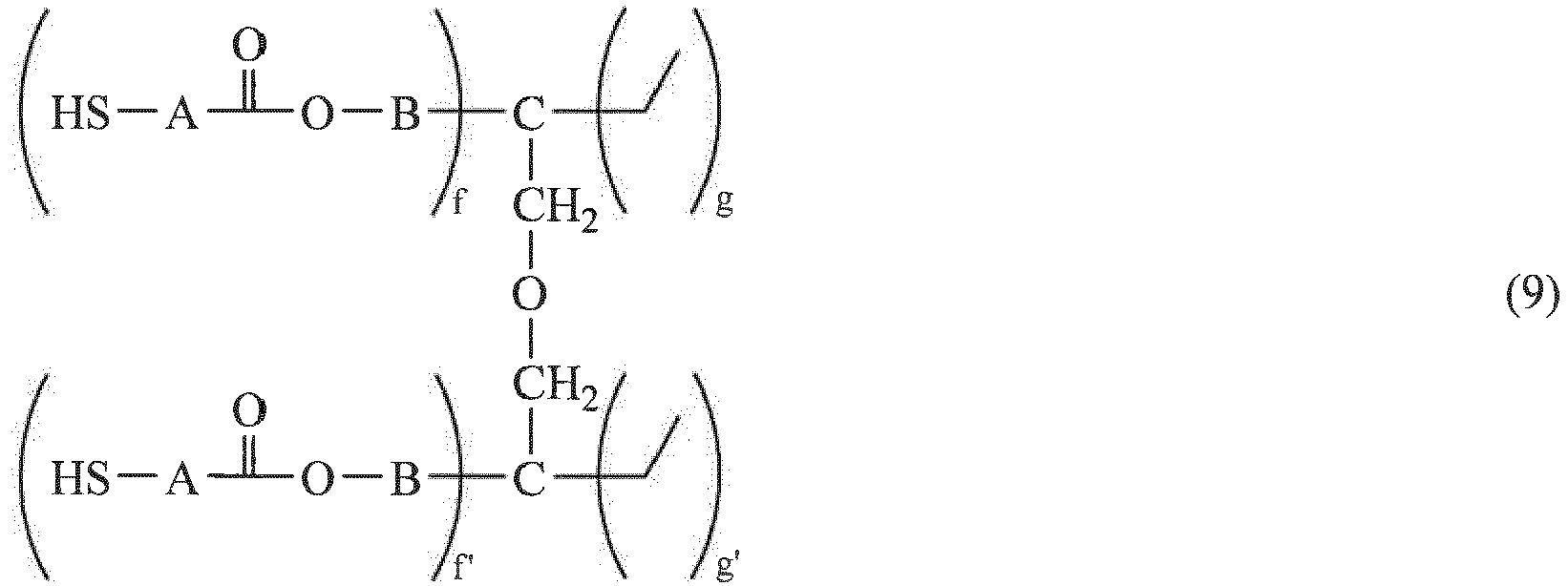
- the organosilicon compound of formula (2) is prepared by reacting a mercapto compound having the general formula (9): wherein A and B are as defined above, f is 3 or 4, g is 0 or 1, f+g is 4, f' is 3 or 4, g' is 0 or 1, f'+g' is 4, with an isocyanate-containing organosilicon compound having the general formula (a): wherein D, R, R', and m are as defined above.
- Exemplary of the mercapto compound of formula (9) is dipentaerythritol hexakis(3-mercaptopropionate).
- Examples of the isocyanate-containing organosilicon compound of formula (a) are as illustrated above, but not limited thereto.
- organosilicon compound of formula (3) is prepared by reacting a mercapto compound having the general formula (10): wherein A and B are as defined above, with an isocyanate-containing organosilicon compound having the general formula (a): wherein D, R, R', and m are as defined above.
- Exemplary of the mercapto compound of formula (10) is tris[(3-mercaptopropionyloxy)ethyl]isocyanurate.
- Examples of the isocyanate-containing organosilicon compound of formula (a) are as illustrated above, but not limited thereto.
- the organosilicon compounds of the invention may be prepared by reaction of a polyfunctional mercapto compound with an organosilicon compound having an isocyanate group.
- a plurality of reaction sites are involved in the reaction.
- a tetra-substituted mercapto compound is reacted with an organosilicon compound having an isocyanate group, there is produced a mixture of zero, mono, di, tri and tetra-substituted compounds, as shown by the general formula (15).
- Y is a residue of the polyfunctional mercapto compound
- Z is a residue of the isocyanate-containing organosilicon compound.
- a solvent may be used if necessary.
- the solvent used herein is not particularly limited as long as it is inert to the reactants, mercapto compound and isocyanate-containing organosilicon compound.
- Suitable solvents include aliphatic hydrocarbon solvents such as pentane, hexane, heptane and decane, ether solvents such as diethyl ether, tetrahydrofuran, and 1,4-dioxane, amide solvents such as formamide, dimethylformamide, and N-methylpyrrolidone, and aromatic hydrocarbon solvents such as benzene, toluene, and xylene.
- the reaction is exothermic. Side reactions may occur at unnecessarily high temperatures. Therefore, the reaction temperature is preferably controlled to a range of 20 to 150°C, more preferably 30 to 130°C, and even more preferably 40 to 110°C. Temperatures below 20°C may lead to a low reaction rate and low productivity. At temperatures above 150°C, side reactions, typically polymerization reaction of the isocyanate-containing organosilicon compound may take place.
- the reaction time required until the organosilicon compound is obtained is not particularly limited as long as the temperature control is possible despite exothermic reaction and exothermic reaction is completed within the time.
- the reaction time is 10 minutes to 24 hours, more preferably 1 to 10 hours.
- the organosilicon compound of the invention finds use as an adhesion improver for adhesion e.g. to inorganic substrates such as glass and metal materials.
- Conventional mercapto-containing organosilicon compounds are adherent to inorganic substrates such as glass and metal materials.
- organosilicon compounds disclosed herein can have a plurality of mercapto groups per hydrolysable group and a urethane bond and ester bond as the polar group, they can exhibit higher adhesion than the conventional mercapto-containing organosilicon compounds.
- adhesion improvers they may be added to resins, especially epoxy, urethane, acrylic and polyimide resins, e.g. in an amount of 0.1 to 20% by weight.
- the organosilicon compounds (11) to (14) obtained above that is, Silanes A to D and Silane E (described below) were evaluated for volatility.
- 1 g of the compound was dropped on an aluminum dish, which was allowed to stand in an open constant-temperature chamber at 105°C for 3 hours, after which the residue was evaluated as the nonvolatile content. A greater nonvolatile content indicates lower volatility.
- Table 1 The results are shown in Table 1.
- Silane E 3-mercaptopropyltrimethoxysilane (KBM-803 by Shin-Etsu Chemical Co., Ltd.)
- the epoxy resin composition was evaluated for adhesion.
- the epoxy resin composition consisted of an epoxy resin YDPN638 (Nippon Steel & Sumikin Chemical Co., Ltd.), 2-methylimidazole as a catalyst, and Silane A, B, C, D or E (identified above).
- the composition was applied onto a glass plate to a coating thickness of 10 ⁇ m by means of a bar coater, cured at 150°C for 1 hour, and examined by a cross-hatch adhesion test according to JIS K-5400.
- the formulation (in parts by weight) of the composition is shown in Table 2 together with the test results.
- the organosilicon compounds within the scope of the invention are effective for improving the adhesion of epoxy resin compositions to glass substrates even in a minimal amount of addition.
Landscapes
- Chemical & Material Sciences (AREA)
- Organic Chemistry (AREA)
- Health & Medical Sciences (AREA)
- Chemical Kinetics & Catalysis (AREA)
- Medicinal Chemistry (AREA)
- Polymers & Plastics (AREA)
- Paints Or Removers (AREA)
Abstract
Description
- This invention relates to novel organosilicon compounds, methods for preparing and using the same, and an adhesion improver comprising the same as an active ingredient.
- Mercapto-containing organosilicon compounds are widely used as adhesion improvers for resins to inorganic substrates such as glass and metal materials. As described in
JP 4692885 - Since these mercapto-containing organosilicon compounds have low boiling points, they will volatilize off during high-temperature coating. Thus the mercapto-containing organosilicon compounds must be added more than the necessity. In addition, the surrounding equipment can be contaminated with the volatilizing compounds.
- Patent Document 1:
JP 4692885 WO 2004/074344 ) - An object of the invention is to provide a mercapto-containing organosilicon compound which is low volatile and has high adhesion to inorganic substrates, a method for preparing the same, and an adhesion improver comprising the same.
- The inventor has found that mercapto-containing or mercapto-derived organosilicon compounds having thiourethane and hydrolysable silyl group, of the general formulae (1) to (3), are low volatile and have high adhesion to inorganic substrates.
- The invention provides organosilicon compounds, methods for preparing the same, and an adhesion improver, defined below.
- [1] An organosilicon compound having the general formula (1):

- [2] An organosilicon compound having the general formula (2):

- [3] An organosilicon compound having the general formula (3) :


- [4] The organosilicon compound of [1], having the general formula (5):

- [5] The organosilicon compound of [2], having the general formula (6):

- [6] The organosilicon compound of [3], having the general formula (7):

- [7] A method for preparing the organosilicon compound of [1], comprising the step of reacting a mercapto compound having the general formula (8):


- [8] A method for preparing the organosilicon compound of [2], comprising the step of reacting a mercapto compound having the general formula (9):

- [9] A method for preparing the organosilicon compound of [3], comprising the step of reacting a mercapto compound having the general formula (10):


- [10] The method of any one of [7] to [9] wherein the isocyanate-containing organosilicon compound is 3-isocyanatopropyltrimethoxysilane,
3-isocyanatopropylmethyldimethoxysilane,
3-isocyanatopropyltriethoxysilane, or
3-isocyanatopropylmethyldiethoxysilane. - [11] An adhesion improver for improving adhesion to inorganic substrates, comprising the organosilicon compound of any one of [1] to [6] as an active ingredient.
- Since the organosilicon compound of the invention has (1) a hydrolysable silyl group, (2) a thiourethane structure, and preferably also (3) a mercapto group in a molecule, it can afford high adhesion to inorganic substrates. Since the organosilicon compound is low volatile, it causes least contamination to the surrounding equipment when used as the adhesion improver. An improvement in productivity is expectable therefrom. An economical advantage is obtained in that an improvement in adhesion is achievable with a necessary minimum amount of the compound.
- Throughout the specification, Me stands for methyl. The notation "Cn-Cm" means a group containing from n to m carbon atoms per group. Herein, the "silane coupling agent" is encompassed in the "organosilicon compound."
- One aspect of the invention is directed to organosilicon compounds having the general formulae (1), (2), and (3).

- Herein A is independently a straight or branched C1-C8 alkylene group, B is independently a straight or branched C1-C8 alkylene group, D is independently a straight or branched C1-C8 alkylene group, R is independently a hydrolysable group, R' is independently a C1-C4 alkyl group, a is a number of 1 to 4, b is a number of 0 to 3, c is 0 or 1, a+b+c is 4, and m is an integer of 1 to 3.

- Herein A, B, D, R, R' and m are as defined above, a' is a number of 0 to 3, b' is a number of 0 to 3, c' is 0 or 1, a'+b'+c' is 3, a" is a number of 0 to 3, b" is a number of 0 to 3, c" is 0 or 1, a"+b"+c" is 3, and a'+a" is a number of 1 to 6.

- Herein A and B are as defined above, E is independently hydrogen or a substituent group of the general formula (4):

- Specifically, suitable straight or branched C1-C8 alkylene groups represented by A include CH2, C2H4, C3H6, C4H8, C5H10, C6H12, C7H14, and C8H16. Suitable straight or branched C1-C8 alkylene groups represented by B include CH2, C2H4, C3H6, C4H8, C5H10, C6H12, C7H14, and C8H16. Suitable straight or branched C1-C8 alkylene groups represented by D include CH2, C2H4, C3H6, C4H8, C5H10, C6H12, C7H14, and C8H16. It is preferred for availability of starting reactants that A be C2H4, B be C2H4 or CH2, D be C3H6, preferably all of these. Suitable hydrolysable groups represented by R include halogen atoms such as chlorine and bromine, and alkoxy groups such as methoxy and ethoxy. Of these, alkoxy groups are preferred, with methoxy being most preferred. Suitable C1-C4 alkyl groups represented by R' include methyl, ethyl, and propyl, with methyl being preferred.
- The subscript m is an integer of 1 to 3, preferably 3, a is a number of 1 to 4, preferably 1 to 2, b is a number of 0 to 3, preferably 2 to 3, c is 0 or 1, and a+b+c is equal to 4. The subscript a' is a number of 0 to 3, preferably 1 to 2, b' is a number of 0 to 3, preferably 2 to 3, c' is 0 or 1, a'+b'+c' is equal to 3, a" is a number of 0 to 3, preferably 1 to 2, b" is a number of 0 to 3, preferably 2 to 3, c" is 0 or 1, a"+b"+c" is equal to 3, and a'+a" is a number of 1 to 6, preferably 1 to 3.
- The preferred organosilicon compound of formula (1) has the general formula (5):

- The preferred organosilicon compound of formula (2) has the general formula (6):

- The preferred organosilicon compound of formula (3) has the general formula (7):

- Exemplary structures of the organosilicon compound of formula (1) are shown below, but not limited thereto.

- An exemplary structure of the organosilicon compound of formula (2) is shown below, but not limited thereto.

- An exemplary structure of the organosilicon compound of formula (3) is shown below, but not limited thereto.

- Another aspect of the invention is directed to methods for preparing the organosilicon compounds of formulae (1) to (3). The organosilicon compound of formula (1) is prepared by reacting a mercapto compound having the general formula (8) :


- Examples of the mercapto compound of formula (8) include trimethylolpropane tris(3-mercaptopropionate) and pentaerythritol tetrakis(3-mercaptopropionate), but are not limited thereto.
- Examples of the isocyanate-containing organosilicon compound of formula (a) include, but are not limited to, 3-isocyanatopropyltrimethoxysilane, 3-isocyanatopropylmethyldimethoxysilane, 3-isocyanatopropyltriethoxysilane, and 3-isocyanatopropylmethyldiethoxysilane. Of these, 3-isocyanatopropyltrimethoxysilane and 3-isocyanatopropyltriethoxysilane are preferred for availability of starting reactant.
- In the reaction of the mercapto compound of formula (8) with the isocyanate-containing organosilicon compound of formula (a), it is preferred to use 1 to 3 moles, especially 1 to 2 moles of the organosilicon compound per mole of the mercapto compound.
- Also, the organosilicon compound of formula (2) is prepared by reacting a mercapto compound having the general formula (9):


- Exemplary of the mercapto compound of formula (9) is dipentaerythritol hexakis(3-mercaptopropionate). Examples of the isocyanate-containing organosilicon compound of formula (a) are as illustrated above, but not limited thereto.
- In the reaction of the mercapto compound of formula (9) with the isocyanate-containing organosilicon compound of formula (a), it is preferred to use 1 to 6 moles, especially 1 to 2 moles of the organosilicon compound per mole of the mercapto compound.
- Further, the organosilicon compound of formula (3) is prepared by reacting a mercapto compound having the general formula (10):


- Exemplary of the mercapto compound of formula (10) is tris[(3-mercaptopropionyloxy)ethyl]isocyanurate. Examples of the isocyanate-containing organosilicon compound of formula (a) are as illustrated above, but not limited thereto.
- In the reaction of the mercapto compound of formula (10) with the isocyanate-containing organosilicon compound of formula (a), it is preferred to use 1 to 3 moles, especially 1 to 2 moles of the organosilicon compound per mole of the mercapto compound.
- As illustrated above, the organosilicon compounds of the invention may be prepared by reaction of a polyfunctional mercapto compound with an organosilicon compound having an isocyanate group. A plurality of reaction sites are involved in the reaction. In an example where a tetra-substituted mercapto compound is reacted with an organosilicon compound having an isocyanate group, there is produced a mixture of zero, mono, di, tri and tetra-substituted compounds, as shown by the general formula (15).

- Since the organosilicon compound herein may be available as a mixture of a plurality of compounds as indicated above, the foregoing formulae (1) to (14) can each represent an average composition. Therefore, even when the reaction product is a mono-substituted compound as the average composition, otherwise substituted compounds are usually in admixture therewith.
- In preparing the organosilicon compound, a solvent may be used if necessary. The solvent used herein is not particularly limited as long as it is inert to the reactants, mercapto compound and isocyanate-containing organosilicon compound. Suitable solvents include aliphatic hydrocarbon solvents such as pentane, hexane, heptane and decane, ether solvents such as diethyl ether, tetrahydrofuran, and 1,4-dioxane, amide solvents such as formamide, dimethylformamide, and N-methylpyrrolidone, and aromatic hydrocarbon solvents such as benzene, toluene, and xylene.
- In preparing the organosilicon compound, a catalyst may be used if necessary. Although the catalyst used herein may be any of the catalysts commonly used in isocyanate reaction, tin compounds and amine catalysts are preferred. As the tin catalyst, salts of tin(II) with carboxylic acids such as dioctyltin oxide are preferred for catalytic activity. Preferred amine catalysts are tertiary amines such as triethylamine, tributylamine and N-ethyldiisopropylamine. Preferably the catalyst may be used in an amount of 0.0000001 to 1 mole, more preferably 0.000001 to 0.01 mole per mole of the isocyanate-containing organosilicon compound. More than 1 mole of the catalyst may be uneconomical because the catalytic effect is saturated. Less than 0.0000001 mole of the catalyst may lead to a short catalytic effect, a low reaction rate, and low productivity.
- In preparing the organosilicon compound, the reaction is exothermic. Side reactions may occur at unnecessarily high temperatures. Therefore, the reaction temperature is preferably controlled to a range of 20 to 150°C, more preferably 30 to 130°C, and even more preferably 40 to 110°C. Temperatures below 20°C may lead to a low reaction rate and low productivity. At temperatures above 150°C, side reactions, typically polymerization reaction of the isocyanate-containing organosilicon compound may take place.
- The reaction time required until the organosilicon compound is obtained is not particularly limited as long as the temperature control is possible despite exothermic reaction and exothermic reaction is completed within the time. Preferably the reaction time is 10 minutes to 24 hours, more preferably 1 to 10 hours.
- The organosilicon compound of the invention finds use as an adhesion improver for adhesion e.g. to inorganic substrates such as glass and metal materials. Conventional mercapto-containing organosilicon compounds are adherent to inorganic substrates such as glass and metal materials.
- Since organosilicon compounds disclosed herein can have a plurality of mercapto groups per hydrolysable group and a urethane bond and ester bond as the polar group, they can exhibit higher adhesion than the conventional mercapto-containing organosilicon compounds. For use as adhesion improvers they may be added to resins, especially epoxy, urethane, acrylic and polyimide resins, e.g. in an amount of 0.1 to 20% by weight.
- Examples of the invention are given below by way of illustration and not by way of limitation. In the Examples Me stands for methyl and IR stands for infrared.
- A 1-L separable flask equipped with a stirrer, reflux condenser, dropping funnel and thermometer was charged with 399 g (1 mol) of trimethylolpropane tris(3-mercaptopropionate) (TMMP by Sakai Chemical Industry Co., Ltd.) and 0.06 g of dioctyltin oxide and heated at 80°C. To the flask, 205 g (1 mol) of 3-isocyanatopropyltrimethoxysilane was added dropwise, followed by 2 hours of stirring at 80°C. The reaction was terminated when the complete extinction of absorption peaks assigned to the isocyanate group in the reactant was confirmed by IR spectrometry. On purification by filtration, the product was a colorless clear liquid. The mercapto equivalent was measured to be 303, which was substantially equal to the theoretical value of 301. This organosilicon compound is designated Silane A.

- A 1-L separable flask equipped with a stirrer, reflux condenser, dropping funnel and thermometer was charged with 489 g (1 mol) of pentaerythritol tetrakis(3-mercaptopropionate) (PEMP by Sakai Chemical Industry Co., Ltd.) and 0.06 g of dioctyltin oxide and heated at 80°C. To the flask, 205 g (1 mol) of 3-isocyanatopropyltrimethoxysilane was added dropwise, followed by 2 hours of stirring at 80°C. The reaction was terminated when the complete extinction of absorption peaks assigned to the isocyanate group in the reactant was confirmed by IR spectrometry. The product was a colorless clear liquid. The mercapto equivalent was measured to be 233, which was substantially equal to the theoretical value of 231. This organosilicon compound is designated Silane B.

- A 2-L separable flask equipped with a stirrer, reflux condenser, dropping funnel and thermometer was charged with 783 g (1 mol) of dipentaerythritol hexakis(3-mercaptopropionate) (DPMP by Sakai Chemical Industry Co., Ltd.) and 0.06 g of dioctyltin oxide and heated at 80°C. To the flask, 205 g (1 mol) of 3-isocyanatopropyltrimethoxysilane was added dropwise, followed by 2 hours of stirring at 80°C. The reaction was terminated when the complete extinction of absorption peaks assigned to the isocyanate group in the reactant was confirmed by IR spectrometry. The product was a colorless clear liquid. The mercapto equivalent was measured to be 201, which was substantially equal to the theoretical value of 197. This organosilicon compound is designated Silane C.

- A 1-L separable flask equipped with a stirrer, reflux condenser, dropping funnel and thermometer was charged with 526 g (1 mol) of tris[(3-mercaptopropionyloxy)ethyl] isocyanurate (TEMPIC by Sakai Chemical Industry Co., Ltd.) and 0.06 g of dioctyltin oxide and heated at 80°C. To the flask, 205 g (1 mol) of 3-isocyanatopropyltrimethoxysilane was added dropwise, followed by 2 hours of stirring at 80°C. The reaction was terminated when the complete extinction of absorption peaks assigned to the isocyanate group in the reactant was confirmed by IR spectrometry. The product was a colorless clear liquid. The mercapto equivalent was measured to be 370, which was substantially equal to the theoretical value of 365. This organosilicon compound is designated Silane D.

- The organosilicon compounds (11) to (14) obtained above, that is, Silanes A to D and Silane E (described below) were evaluated for volatility. In the test, 1 g of the compound was dropped on an aluminum dish, which was allowed to stand in an open constant-temperature chamber at 105°C for 3 hours, after which the residue was evaluated as the nonvolatile content. A greater nonvolatile content indicates lower volatility. The results are shown in Table 1.
-
Table 1 Compound Nonvolatile content (%) Example 5 Silane A 98 Silane B 99 Silane C 99 Silane D 99 Comparative Example 1 Silane E 0 - As seen from the data, the organosilicon compounds within the scope of the invention are least volatile. Thus the volatilization of the compound during high-temperature application is fully suppressed. The compound exerts its desired effect when added in a necessary minimum amount, with an economical advantage. In addition, contamination of the surrounding equipment is suppressed, and an improvement in productivity is expectable.
- An epoxy resin composition to which the organosilicon compound was added was evaluated for adhesion. Specifically, the epoxy resin composition consisted of an epoxy resin YDPN638 (Nippon Steel & Sumikin Chemical Co., Ltd.), 2-methylimidazole as a catalyst, and Silane A, B, C, D or E (identified above). The composition was applied onto a glass plate to a coating thickness of 10 µm by means of a bar coater, cured at 150°C for 1 hour, and examined by a cross-hatch adhesion test according to JIS K-5400. The formulation (in parts by weight) of the composition is shown in Table 2 together with the test results.
Table 2 Formulation (pbw) Example Comparative Example 6 7 8 9 2 3 4 Epoxy resin 98 98 98 98 98 98 98 Catalyst 2 2 2 2 2 2 2 Silane A 0.5 Silane B 0.5 Silane C 0.5 Silane D 0.5 Silane E 2.0 0.5 Test results Adhesion 100/100 100/100 100/100 100/100 90/100 70/100 50/100 - As seen from the test results, the organosilicon compounds within the scope of the invention are effective for improving the adhesion of epoxy resin compositions to glass substrates even in a minimal amount of addition.
- For the avoidance of doubt it is confirmed that in the general description above, in the usual way the proposal of general preferences and options in respect of different features of the organosilicon compound, method of making and method of use constitutes the proposal of general combinations of those general preferences and options for the different features, insofar as they are combinable and compatible and are put forward in the same context.
- In respect of numerical ranges disclosed in the present description it will of course be understood that in the normal way the technical criterion for the upper limit is different from the technical criterion for the lower limit, i.e. the upper and lower limits are intrinsically distinct proposals.
- The following numbered clauses, corresponding to the claims of the parent application, are part of the description.
- 1. Organosilicon compound having at least one group of the general formula (4):

the organosilicon compound being- (i) compound of formula

- (ii) compound of formula (2):

- (iii) compound of formula (3):

- (i) compound of formula
- 2. Organosilicon compound of clause 1 in which in formula (1) a is 1 or 2 or in formula (2) a'+a" is 1 to 3.
- 3. Organosilicon compound of clause 1 or 2 in which in formula (1) b is 2 or 3, or in formula (2) b' is 2 or 3 and/or b" is 2 or 3.
- 4. Organosilicon compound of any one of the preceding clauses in which A is C2H4.
- 5. Organosilicon compound of any one of the preceding clauses in which B is C2H4 or CH2.
- 6. Organosilicon compound of any one of the preceding clauses in which D is C3H6.
- 7. Organosilicon compound of clause 1 of formula (5):

- 8. Organosilicon compound of clause 1 of general formula (6):

- 9. Organosilicon compound of clause 1, having the general formula (7):

- 10. A method for preparing organosilicon compound of any one of clauses 1 to 7, comprising the step of reacting a mercapto compound having the general formula (8):


- 11. A method for preparing organosilicon compound of any one of clauses to 6, or clause 8, comprising the step of reacting a mercapto compound having the general formula (9):


- 12. A method for preparing organosilicon compound of any one of clauses 1 to 6, or clause 9, comprising the step of reacting a mercapto compound having the general formula (10):


- 13. A method of any one of clauses 10 to 12 wherein the isocyanate-containing organosilicon compound is 3-isocyanatopropyltrimethoxysilane, 3-isocyanatopropylmethyldimethoxysilane, 3-isocyanatopropyltriethoxysilane, or 3-isocyanatopropylmethyldiethoxysilane.
- 14. An adhesion improver for inorganic substrates, comprising organosilicon compound of any one of clauses 1 to 9 as active ingredient.
- 15. Use of organosilicon compound of any one of clauses 1 to 9 as adhesion improver for improving the adhesion of a resin to inorganic substrates, in which use preferably the organosilicon compound is added to the resin, e.g. epoxy, urethane, acrylic or polyimide resin, in an amount of 0.1 to 20% by weight.
Claims (15)
- Organosilicon compound of formula (2):
 each A independently is a straight or branched C1-C8 alkylene group, each B independently is a straight or branched C1-C8 alkylene group and each D independently is a straight or branched C1-C8 alkylene group;each R independently is a hydrolysable group, each R' independently is a C1-C4 alkyl group, and m is an integer of 1 to 3;a' is 0 to 3, b' is 0 to 3, c' is 0 or 1, a'+b'+c' is 3, a" is 0 to 3, b" is 0 to 3, c" is 0 or 1, a"+b"+c" is 3, and a'+a" is 1 to 6.
 - Organosilicon compound of claim 1 in which, in formula (2), a'+a" is 1 to 3.
- Organosilicon compound of claim 1 or 2 in which, in formula (2), each of a' and a" is 1 to 2 and each of b' and b" is 2 to 3.
- Organosilicon compound of any one of the preceding claims in which, in formula (2), m is 3.
- Organosilicon compound of any one of the preceding claims in which A is C2H4.
- Organosilicon compound of any one of the preceding claims in which B is C2H4 or CH2.
- Organosilicon compound of any one of the preceding claims in which D is C3H6.
- Organosilicon compound of any one of claims 1 to 4 having the general formula (6):

- A method for preparing organosilicon compound of any one of claims 1 to 8, comprising the step of reacting
mercapto compound having the general formula (9):
isocyanate-containing organosilicon compound having the general formula (a):
- A method of claim 9 wherein the isocyanate-containing organosilicon compound is
3-isocyanatopropyltrimethoxysilane,
3-isocyanatopropylmethyldimethoxysilane,
3-isocyanatopropyltriethoxysilane, or
3-isocyanatopropylmethyldiethoxysilane. - An adhesion improver for inorganic substrates, comprising organosilicon compound of any one of claims 1 to 8 as active ingredient.
- Use of organosilicon compound of any one of claims 1 to 8 as adhesion improver for improving the adhesion of a resin to inorganic substrates.
- Use according to claim 12 in which the organosilicon compound is added to the resin in an amount of 0.1 to 20% by weight.
- Use according to claim 12 or 13 in which the resin is epoxy, urethane, acrylic or polyimide resin.
- Use according to any one of claims 12 to 14 in which the inorganic substrate is glass or metal material.
Applications Claiming Priority (2)
| Application Number | Priority Date | Filing Date | Title |
|---|---|---|---|
| JP2013123638A JP5949674B2 (en) | 2013-06-12 | 2013-06-12 | Novel organosilicon compound, process for producing the same and adhesion improver |
| EP14165664.5A EP2813510B1 (en) | 2013-06-12 | 2014-04-23 | Thiocarbamatoalky-silanoles as adhesion improvers |
Related Parent Applications (2)
| Application Number | Title | Priority Date | Filing Date |
|---|---|---|---|
| EP14165664.5A Division EP2813510B1 (en) | 2013-06-12 | 2014-04-23 | Thiocarbamatoalky-silanoles as adhesion improvers |
| EP14165664.5A Division-Into EP2813510B1 (en) | 2013-06-12 | 2014-04-23 | Thiocarbamatoalky-silanoles as adhesion improvers |
Publications (2)
| Publication Number | Publication Date |
|---|---|
| EP3428172A1 true EP3428172A1 (en) | 2019-01-16 |
| EP3428172B1 EP3428172B1 (en) | 2020-05-13 |
Family
ID=50513172
Family Applications (3)
| Application Number | Title | Priority Date | Filing Date |
|---|---|---|---|
| EP14165664.5A Active EP2813510B1 (en) | 2013-06-12 | 2014-04-23 | Thiocarbamatoalky-silanoles as adhesion improvers |
| EP18186240.0A Withdrawn EP3424933A1 (en) | 2013-06-12 | 2014-04-23 | Thiocarbamatoalkyl-substituted 2,4,6-trioxo-1,3,5-triazines as adhesion improvers |
| EP18186241.8A Ceased EP3428172B1 (en) | 2013-06-12 | 2014-04-23 | Mercapto-containing organosilicon compounds as adhesion-improvers |
Family Applications Before (2)
| Application Number | Title | Priority Date | Filing Date |
|---|---|---|---|
| EP14165664.5A Active EP2813510B1 (en) | 2013-06-12 | 2014-04-23 | Thiocarbamatoalky-silanoles as adhesion improvers |
| EP18186240.0A Withdrawn EP3424933A1 (en) | 2013-06-12 | 2014-04-23 | Thiocarbamatoalkyl-substituted 2,4,6-trioxo-1,3,5-triazines as adhesion improvers |
Country Status (5)
| Country | Link |
|---|---|
| US (3) | US9120828B2 (en) |
| EP (3) | EP2813510B1 (en) |
| JP (1) | JP5949674B2 (en) |
| KR (3) | KR102140571B1 (en) |
| CN (2) | CN107987099A (en) |
Families Citing this family (2)
| Publication number | Priority date | Publication date | Assignee | Title |
|---|---|---|---|---|
| JPWO2016117385A1 (en) * | 2015-01-20 | 2017-10-26 | 日油株式会社 | Curable resin composition |
| CN111269258B (en) * | 2020-03-19 | 2022-08-19 | 厦门威亮光学涂层技术有限公司 | Sulfur-containing organic silicon compound and preparation method and application thereof |
Citations (3)
| Publication number | Priority date | Publication date | Assignee | Title |
|---|---|---|---|---|
| WO2003014248A2 (en) * | 2001-08-07 | 2003-02-20 | National Starch And Chemical Investment Holding Corporation | Adhesion promoting resins with cross-linking properties |
| WO2004074344A1 (en) | 2003-02-18 | 2004-09-02 | Sumitomo Bakelite Company Limited | Epoxy resin composition and semiconductor device |
| JP2009256662A (en) * | 2008-03-26 | 2009-11-05 | Nagase Chemtex Corp | Silsesquioxane derivative and method for producing the same |
Family Cites Families (12)
| Publication number | Priority date | Publication date | Assignee | Title |
|---|---|---|---|---|
| US4692885A (en) | 1985-12-27 | 1987-09-08 | United States Of America As Represented By The Secretary Of The Navy | Optical floating-point matrix-vector multiplier |
| EP0991687B1 (en) * | 1998-04-24 | 2006-12-27 | Chemtura Corporation | Powder coatings or adhesives employing silanes or silane treated fillers |
| JP2006052168A (en) * | 2004-08-12 | 2006-02-23 | Konishi Co Ltd | New mercaptosilane compound, curable resin using the same and curable resin composition using the same |
| US10040947B2 (en) * | 2008-03-10 | 2018-08-07 | Mitsui Chemicals, Inc. | Primer composition |
| ATE526042T1 (en) * | 2008-07-21 | 2011-10-15 | Essilor Int | ABRASION-RESISTANT OPTICAL ARTICLE AND PRODUCTION METHOD THEREOF |
| EP2430075A2 (en) * | 2009-04-29 | 2012-03-21 | Henkel Corporation | Moisture curable polydisulfides |
| KR101552026B1 (en) * | 2010-11-25 | 2015-09-09 | 니치유 가부시키가이샤 | Thioether-containing alkoxysilane derivative and use thereof |
| KR20140010092A (en) * | 2011-04-20 | 2014-01-23 | 가부시키가이샤 아데카 | Novel compound having a-cyanoacrylate structure, dye, and coloring photosensitive composition |
| JP2012240924A (en) | 2011-05-16 | 2012-12-10 | Shin-Etsu Chemical Co Ltd | Organosilicon compound and method for producing the same, compounding agent for rubber, rubber composition, and tire |
| JP5831354B2 (en) * | 2011-05-16 | 2015-12-09 | 信越化学工業株式会社 | Rubber compounding agent, rubber composition and tire |
| JP5790155B2 (en) * | 2011-05-30 | 2015-10-07 | 日油株式会社 | Curable resin composition |
| JP6326875B2 (en) * | 2014-03-11 | 2018-05-23 | 日油株式会社 | Thioether-containing (meth) acrylate derivative and adhesion improver containing the same |
-
2013
- 2013-06-12 JP JP2013123638A patent/JP5949674B2/en active Active
-
2014
- 2014-04-22 US US14/258,105 patent/US9120828B2/en active Active
- 2014-04-23 EP EP14165664.5A patent/EP2813510B1/en active Active
- 2014-04-23 EP EP18186240.0A patent/EP3424933A1/en not_active Withdrawn
- 2014-04-23 EP EP18186241.8A patent/EP3428172B1/en not_active Ceased
- 2014-05-27 CN CN201711344469.7A patent/CN107987099A/en active Pending
- 2014-05-27 CN CN201410226153.8A patent/CN104230976B/en not_active Expired - Fee Related
- 2014-06-09 KR KR1020140069074A patent/KR102140571B1/en active Active
-
2015
- 2015-05-12 US US14/709,808 patent/US9243005B2/en active Active
- 2015-05-12 US US14/709,727 patent/US9238663B2/en active Active
-
2020
- 2020-02-26 KR KR1020200023728A patent/KR102214901B1/en not_active Expired - Fee Related
- 2020-02-26 KR KR1020200023729A patent/KR102111629B1/en not_active Expired - Fee Related
Patent Citations (4)
| Publication number | Priority date | Publication date | Assignee | Title |
|---|---|---|---|---|
| WO2003014248A2 (en) * | 2001-08-07 | 2003-02-20 | National Starch And Chemical Investment Holding Corporation | Adhesion promoting resins with cross-linking properties |
| WO2004074344A1 (en) | 2003-02-18 | 2004-09-02 | Sumitomo Bakelite Company Limited | Epoxy resin composition and semiconductor device |
| JP4692885B2 (en) | 2003-02-18 | 2011-06-01 | 住友ベークライト株式会社 | Epoxy resin composition and semiconductor device |
| JP2009256662A (en) * | 2008-03-26 | 2009-11-05 | Nagase Chemtex Corp | Silsesquioxane derivative and method for producing the same |
Non-Patent Citations (2)
| Title |
|---|
| DATABASE CHEMABS [online] CHEMICAL ABSTRACTS SERVICE, COLUMBUS, OHIO, US; 2008, "10,10-diethoxy-5-oxo-3-(3-mercapto-1-oxopropoxy)-2,2-bis[(3-mercapto-1-oxopropoxy)methyl]propyl-11-Oxa-4-thia-6-aza-10-silatridecanoic acid", XP002729733, retrieved from STN Database accession no. 1026450-44-1 * |
| DATABASE CHEMABS [online] CHEMICAL ABSTRACTS SERVICE, COLUMBUS, OHIO, US; 2009, KANETANI, SHINGO: "Silsesquioxane derivatives for optical materials, their manufacture, and their compositions", XP002786940, retrieved from STN Database accession no. 2009:1365861 * |
Also Published As
| Publication number | Publication date |
|---|---|
| US20140371447A1 (en) | 2014-12-18 |
| CN107987099A (en) | 2018-05-04 |
| US9243005B2 (en) | 2016-01-26 |
| KR102111629B1 (en) | 2020-05-15 |
| KR102214901B1 (en) | 2021-02-10 |
| US9120828B2 (en) | 2015-09-01 |
| EP3428172B1 (en) | 2020-05-13 |
| KR20140145072A (en) | 2014-12-22 |
| KR102140571B1 (en) | 2020-08-03 |
| KR20200024811A (en) | 2020-03-09 |
| US20150239914A1 (en) | 2015-08-27 |
| CN104230976A (en) | 2014-12-24 |
| US20150239913A1 (en) | 2015-08-27 |
| EP3424933A1 (en) | 2019-01-09 |
| US9238663B2 (en) | 2016-01-19 |
| JP2014240367A (en) | 2014-12-25 |
| KR20200024812A (en) | 2020-03-09 |
| CN104230976B (en) | 2018-06-08 |
| EP2813510B1 (en) | 2019-07-31 |
| JP5949674B2 (en) | 2016-07-13 |
| EP2813510A1 (en) | 2014-12-17 |
Similar Documents
| Publication | Publication Date | Title |
|---|---|---|
| EP2142558B1 (en) | Hydrolyzable silanes of low voc-generating potential and resinous compositions containing same | |
| US5354880A (en) | Cyclic silylureas and process of preparation | |
| US20170114082A1 (en) | Isocyanatosilanes with thiourethane structure | |
| TWI659037B (en) | Urea-containing decane and preparation method and use thereof | |
| US20170240780A1 (en) | Hydroxy silane as an adhesion promoter or cross-linking agent | |
| US5010202A (en) | Novel silicon-organic compounds, containing an oxazolidine group | |
| JP4605810B2 (en) | Organosilicon compounds having masked isocyanate groups | |
| EP2813510B1 (en) | Thiocarbamatoalky-silanoles as adhesion improvers | |
| JP2008531634A (en) | Process for producing alkoxysilylmethyl isocyanurate | |
| US12545691B2 (en) | Tertiary hydroxyl functional alkoxysilanes and methods for preparing thereof | |
| JP6036944B2 (en) | Novel organosilicon compound, process for producing the same and adhesion improver | |
| JP6036943B2 (en) | Novel organosilicon compound, process for producing the same and adhesion improver | |
| EP4067403B1 (en) | Blocked isocyanate, thermosetting composition and cured product |
Legal Events
| Date | Code | Title | Description |
|---|---|---|---|
| PUAI | Public reference made under article 153(3) epc to a published international application that has entered the european phase |
Free format text: ORIGINAL CODE: 0009012 |
|
| STAA | Information on the status of an ep patent application or granted ep patent |
Free format text: STATUS: THE APPLICATION HAS BEEN PUBLISHED |
|
| AC | Divisional application: reference to earlier application |
Ref document number: 2813510 Country of ref document: EP Kind code of ref document: P |
|
| AK | Designated contracting states |
Kind code of ref document: A1 Designated state(s): AL AT BE BG CH CY CZ DE DK EE ES FI FR GB GR HR HU IE IS IT LI LT LU LV MC MK MT NL NO PL PT RO RS SE SI SK SM TR |
|
| STAA | Information on the status of an ep patent application or granted ep patent |
Free format text: STATUS: REQUEST FOR EXAMINATION WAS MADE |
|
| 17P | Request for examination filed |
Effective date: 20190327 |
|
| RBV | Designated contracting states (corrected) |
Designated state(s): AL AT BE BG CH CY CZ DE DK EE ES FI FR GB GR HR HU IE IS IT LI LT LU LV MC MK MT NL NO PL PT RO RS SE SI SK SM TR |
|
| GRAP | Despatch of communication of intention to grant a patent |
Free format text: ORIGINAL CODE: EPIDOSNIGR1 |
|
| STAA | Information on the status of an ep patent application or granted ep patent |
Free format text: STATUS: GRANT OF PATENT IS INTENDED |
|
| INTG | Intention to grant announced |
Effective date: 20191216 |
|
| RIN1 | Information on inventor provided before grant (corrected) |
Inventor name: HIROKAMI, MUNENAO |
|
| GRAS | Grant fee paid |
Free format text: ORIGINAL CODE: EPIDOSNIGR3 |
|
| GRAA | (expected) grant |
Free format text: ORIGINAL CODE: 0009210 |
|
| STAA | Information on the status of an ep patent application or granted ep patent |
Free format text: STATUS: THE PATENT HAS BEEN GRANTED |
|
| RBV | Designated contracting states (corrected) |
Designated state(s): DE FR GB |
|
| AC | Divisional application: reference to earlier application |
Ref document number: 2813510 Country of ref document: EP Kind code of ref document: P |
|
| AK | Designated contracting states |
Kind code of ref document: B1 Designated state(s): DE FR GB |
|
| REG | Reference to a national code |
Ref country code: GB Ref legal event code: FG4D |
|
| REG | Reference to a national code |
Ref country code: DE Ref legal event code: R096 Ref document number: 602014065604 Country of ref document: DE |
|
| REG | Reference to a national code |
Ref country code: DE Ref legal event code: R097 Ref document number: 602014065604 Country of ref document: DE |
|
| PLBE | No opposition filed within time limit |
Free format text: ORIGINAL CODE: 0009261 |
|
| STAA | Information on the status of an ep patent application or granted ep patent |
Free format text: STATUS: NO OPPOSITION FILED WITHIN TIME LIMIT |
|
| 26N | No opposition filed |
Effective date: 20210216 |
|
| PGFP | Annual fee paid to national office [announced via postgrant information from national office to epo] |
Ref country code: GB Payment date: 20240229 Year of fee payment: 11 |
|
| PGFP | Annual fee paid to national office [announced via postgrant information from national office to epo] |
Ref country code: FR Payment date: 20240308 Year of fee payment: 11 |
|
| PGFP | Annual fee paid to national office [announced via postgrant information from national office to epo] |
Ref country code: DE Payment date: 20240227 Year of fee payment: 11 |
|
| REG | Reference to a national code |
Ref country code: DE Ref legal event code: R119 Ref document number: 602014065604 Country of ref document: DE |
|
| GBPC | Gb: european patent ceased through non-payment of renewal fee |
Effective date: 20250423 |
|
| PG25 | Lapsed in a contracting state [announced via postgrant information from national office to epo] |
Ref country code: DE Free format text: LAPSE BECAUSE OF NON-PAYMENT OF DUE FEES Effective date: 20251104 |
|
| PG25 | Lapsed in a contracting state [announced via postgrant information from national office to epo] |
Ref country code: GB Free format text: LAPSE BECAUSE OF NON-PAYMENT OF DUE FEES Effective date: 20250423 |
|
| PG25 | Lapsed in a contracting state [announced via postgrant information from national office to epo] |
Ref country code: FR Free format text: LAPSE BECAUSE OF NON-PAYMENT OF DUE FEES Effective date: 20250430 |