EP3428157A1 - Selective organic cation transporters inhibitors for the treatment of depressive disorders - Google Patents
Selective organic cation transporters inhibitors for the treatment of depressive disorders Download PDFInfo
- Publication number
- EP3428157A1 EP3428157A1 EP17305935.3A EP17305935A EP3428157A1 EP 3428157 A1 EP3428157 A1 EP 3428157A1 EP 17305935 A EP17305935 A EP 17305935A EP 3428157 A1 EP3428157 A1 EP 3428157A1
- Authority
- EP
- European Patent Office
- Prior art keywords
- halo
- formula
- pharmaceutically acceptable
- haloalkyl
- alkoxy
- Prior art date
- Legal status (The legal status is an assumption and is not a legal conclusion. Google has not performed a legal analysis and makes no representation as to the accuracy of the status listed.)
- Withdrawn
Links
- 208000020401 Depressive disease Diseases 0.000 title claims abstract description 23
- 108091006764 Organic cation transporters Proteins 0.000 title claims abstract description 23
- 239000003112 inhibitor Substances 0.000 title claims abstract description 15
- 238000011282 treatment Methods 0.000 title claims description 39
- 150000003839 salts Chemical class 0.000 claims abstract description 68
- 239000012453 solvate Substances 0.000 claims abstract description 48
- 239000008194 pharmaceutical composition Substances 0.000 claims abstract description 7
- 150000001875 compounds Chemical class 0.000 claims description 163
- 125000005843 halogen group Chemical group 0.000 claims description 53
- 125000001188 haloalkyl group Chemical group 0.000 claims description 39
- 239000001257 hydrogen Substances 0.000 claims description 38
- 229910052739 hydrogen Inorganic materials 0.000 claims description 38
- 125000003545 alkoxy group Chemical group 0.000 claims description 37
- 125000004453 alkoxycarbonyl group Chemical group 0.000 claims description 32
- 125000003282 alkyl amino group Chemical group 0.000 claims description 32
- 125000004103 aminoalkyl group Chemical group 0.000 claims description 32
- 125000004438 haloalkoxy group Chemical group 0.000 claims description 32
- 125000002924 primary amino group Chemical group [H]N([H])* 0.000 claims description 32
- 125000003178 carboxy group Chemical group [H]OC(*)=O 0.000 claims description 31
- 125000002887 hydroxy group Chemical group [H]O* 0.000 claims description 31
- 125000000217 alkyl group Chemical group 0.000 claims description 28
- GPOKWCNTQXCKHK-UHFFFAOYSA-M [I-].C(C)(C)[N+]1=CC=C(C2=CC=CC=C12)\C=C\1/N(C2=CC=C(C=C2CC/1)OC)C(C)C Chemical compound [I-].C(C)(C)[N+]1=CC=C(C2=CC=CC=C12)\C=C\1/N(C2=CC=C(C=C2CC/1)OC)C(C)C GPOKWCNTQXCKHK-UHFFFAOYSA-M 0.000 claims description 27
- 238000000034 method Methods 0.000 claims description 25
- 125000003118 aryl group Chemical group 0.000 claims description 23
- 208000019901 Anxiety disease Diseases 0.000 claims description 22
- 125000000623 heterocyclic group Chemical group 0.000 claims description 20
- 150000002431 hydrogen Chemical class 0.000 claims description 20
- 125000000753 cycloalkyl group Chemical group 0.000 claims description 19
- 125000004432 carbon atom Chemical group C* 0.000 claims description 18
- 125000001424 substituent group Chemical group 0.000 claims description 18
- QTBSBXVTEAMEQO-UHFFFAOYSA-M Acetate Chemical group CC([O-])=O QTBSBXVTEAMEQO-UHFFFAOYSA-M 0.000 claims description 15
- UFHFLCQGNIYNRP-UHFFFAOYSA-N Hydrogen Chemical compound [H][H] UFHFLCQGNIYNRP-UHFFFAOYSA-N 0.000 claims description 15
- 125000006570 (C5-C6) heteroaryl group Chemical group 0.000 claims description 12
- 239000003814 drug Substances 0.000 claims description 12
- 125000004429 atom Chemical group 0.000 claims description 11
- QAOWNCQODCNURD-UHFFFAOYSA-L Sulfate Chemical compound [O-]S([O-])(=O)=O QAOWNCQODCNURD-UHFFFAOYSA-L 0.000 claims description 9
- 230000009467 reduction Effects 0.000 claims description 9
- AFVFQIVMOAPDHO-UHFFFAOYSA-N Methanesulfonic acid Chemical compound CS(O)(=O)=O AFVFQIVMOAPDHO-UHFFFAOYSA-N 0.000 claims description 8
- 230000015572 biosynthetic process Effects 0.000 claims description 8
- 125000001072 heteroaryl group Chemical group 0.000 claims description 8
- 238000003786 synthesis reaction Methods 0.000 claims description 8
- JOXIMZWYDAKGHI-UHFFFAOYSA-N toluene-4-sulfonic acid Chemical compound CC1=CC=C(S(O)(=O)=O)C=C1 JOXIMZWYDAKGHI-UHFFFAOYSA-N 0.000 claims description 8
- DTQVDTLACAAQTR-UHFFFAOYSA-M Trifluoroacetate Chemical group [O-]C(=O)C(F)(F)F DTQVDTLACAAQTR-UHFFFAOYSA-M 0.000 claims description 7
- 230000008878 coupling Effects 0.000 claims description 7
- 238000010168 coupling process Methods 0.000 claims description 7
- 238000005859 coupling reaction Methods 0.000 claims description 7
- JVBXVOWTABLYPX-UHFFFAOYSA-L sodium dithionite Chemical compound [Na+].[Na+].[O-]S(=O)S([O-])=O JVBXVOWTABLYPX-UHFFFAOYSA-L 0.000 claims description 7
- 230000002265 prevention Effects 0.000 claims description 6
- 230000008569 process Effects 0.000 claims description 6
- ITMCEJHCFYSIIV-UHFFFAOYSA-M triflate Chemical group [O-]S(=O)(=O)C(F)(F)F ITMCEJHCFYSIIV-UHFFFAOYSA-M 0.000 claims description 6
- IQHSEKDJXVMKHF-UHFFFAOYSA-M [I-].C(C)(C)[N+]1=CC=C(C2=CC=CC=C12)/C(/OC)=C\1/N(C2=CC=C(C=C2CC/1)OC)C(C)C Chemical compound [I-].C(C)(C)[N+]1=CC=C(C2=CC=CC=C12)/C(/OC)=C\1/N(C2=CC=C(C=C2CC/1)OC)C(C)C IQHSEKDJXVMKHF-UHFFFAOYSA-M 0.000 claims description 5
- 239000003937 drug carrier Substances 0.000 claims description 5
- 238000004519 manufacturing process Methods 0.000 claims description 5
- 229910004878 Na2S2O4 Inorganic materials 0.000 claims description 4
- BECMNKFMFZBHCL-UHFFFAOYSA-M [I-].C(C)(C)[N+]1=CC=C(C2=CC=CC=C12)\C=C\1/N(C2=CC=C(C=C2C=C/1)OC)C(C)C Chemical compound [I-].C(C)(C)[N+]1=CC=C(C2=CC=CC=C12)\C=C\1/N(C2=CC=C(C=C2C=C/1)OC)C(C)C BECMNKFMFZBHCL-UHFFFAOYSA-M 0.000 claims description 4
- RSYGFWFSOIIJQY-UHFFFAOYSA-M [I-].C(C)(C)[N+]1=CC=C(C2=CC=CC=C12)/C(/OC)=C\1/N(C2=CC=C(C=C2C=C/1)OC)C(C)C Chemical compound [I-].C(C)(C)[N+]1=CC=C(C2=CC=CC=C12)/C(/OC)=C\1/N(C2=CC=C(C=C2C=C/1)OC)C(C)C RSYGFWFSOIIJQY-UHFFFAOYSA-M 0.000 claims description 3
- 208000037265 diseases, disorders, signs and symptoms Diseases 0.000 abstract description 24
- 230000036651 mood Effects 0.000 abstract description 11
- RTHCYVBBDHJXIQ-MRXNPFEDSA-N (R)-fluoxetine Chemical compound O([C@H](CCNC)C=1C=CC=CC=1)C1=CC=C(C(F)(F)F)C=C1 RTHCYVBBDHJXIQ-MRXNPFEDSA-N 0.000 description 63
- -1 hydrocarbyl radical Chemical class 0.000 description 54
- 229960002464 fluoxetine Drugs 0.000 description 37
- 230000000694 effects Effects 0.000 description 25
- OKKJLVBELUTLKV-UHFFFAOYSA-N Methanol Chemical compound OC OKKJLVBELUTLKV-UHFFFAOYSA-N 0.000 description 24
- 241000699670 Mus sp. Species 0.000 description 24
- 238000012360 testing method Methods 0.000 description 24
- OMFXVFTZEKFJBZ-UHFFFAOYSA-N Corticosterone Natural products O=C1CCC2(C)C3C(O)CC(C)(C(CC4)C(=O)CO)C4C3CCC2=C1 OMFXVFTZEKFJBZ-UHFFFAOYSA-N 0.000 description 21
- OMFXVFTZEKFJBZ-HJTSIMOOSA-N corticosterone Chemical compound O=C1CC[C@]2(C)[C@H]3[C@@H](O)C[C@](C)([C@H](CC4)C(=O)CO)[C@@H]4[C@@H]3CCC2=C1 OMFXVFTZEKFJBZ-HJTSIMOOSA-N 0.000 description 21
- 239000000203 mixture Substances 0.000 description 20
- IAZDPXIOMUYVGZ-WFGJKAKNSA-N Dimethyl sulfoxide Chemical compound [2H]C([2H])([2H])S(=O)C([2H])([2H])[2H] IAZDPXIOMUYVGZ-WFGJKAKNSA-N 0.000 description 18
- WEVYAHXRMPXWCK-UHFFFAOYSA-N Acetonitrile Chemical compound CC#N WEVYAHXRMPXWCK-UHFFFAOYSA-N 0.000 description 16
- ZMANZCXQSJIPKH-UHFFFAOYSA-N Triethylamine Chemical compound CCN(CC)CC ZMANZCXQSJIPKH-UHFFFAOYSA-N 0.000 description 16
- XMBWDFGMSWQBCA-UHFFFAOYSA-N hydrogen iodide Chemical compound I XMBWDFGMSWQBCA-UHFFFAOYSA-N 0.000 description 16
- YMWUJEATGCHHMB-UHFFFAOYSA-N Dichloromethane Chemical compound ClCCl YMWUJEATGCHHMB-UHFFFAOYSA-N 0.000 description 15
- LFQSCWFLJHTTHZ-UHFFFAOYSA-N Ethanol Chemical compound CCO LFQSCWFLJHTTHZ-UHFFFAOYSA-N 0.000 description 15
- 239000000935 antidepressant agent Substances 0.000 description 15
- 229940005513 antidepressants Drugs 0.000 description 15
- 239000000543 intermediate Substances 0.000 description 15
- IJGRMHOSHXDMSA-UHFFFAOYSA-N Atomic nitrogen Chemical compound N#N IJGRMHOSHXDMSA-UHFFFAOYSA-N 0.000 description 12
- CZMRCDWAGMRECN-UGDNZRGBSA-N Sucrose Chemical compound O[C@H]1[C@H](O)[C@@H](CO)O[C@@]1(CO)O[C@@H]1[C@H](O)[C@@H](O)[C@H](O)[C@@H](CO)O1 CZMRCDWAGMRECN-UGDNZRGBSA-N 0.000 description 12
- 229930006000 Sucrose Natural products 0.000 description 12
- 230000001430 anti-depressive effect Effects 0.000 description 12
- 208000035475 disorder Diseases 0.000 description 12
- 239000005720 sucrose Substances 0.000 description 12
- XLYOFNOQVPJJNP-UHFFFAOYSA-N water Substances O XLYOFNOQVPJJNP-UHFFFAOYSA-N 0.000 description 12
- 230000009471 action Effects 0.000 description 11
- 210000004556 brain Anatomy 0.000 description 11
- 201000010099 disease Diseases 0.000 description 11
- UUFQTNFCRMXOAE-UHFFFAOYSA-N 1-methylmethylene Chemical compound C[CH] UUFQTNFCRMXOAE-UHFFFAOYSA-N 0.000 description 10
- 101100167062 Caenorhabditis elegans chch-3 gene Proteins 0.000 description 10
- RTZKZFJDLAIYFH-UHFFFAOYSA-N Diethyl ether Chemical compound CCOCC RTZKZFJDLAIYFH-UHFFFAOYSA-N 0.000 description 10
- 239000000243 solution Substances 0.000 description 10
- 239000002904 solvent Substances 0.000 description 10
- CSCPPACGZOOCGX-UHFFFAOYSA-N Acetone Chemical compound CC(C)=O CSCPPACGZOOCGX-UHFFFAOYSA-N 0.000 description 9
- 230000036506 anxiety Effects 0.000 description 9
- 230000006742 locomotor activity Effects 0.000 description 9
- 230000003997 social interaction Effects 0.000 description 9
- 239000002253 acid Substances 0.000 description 8
- 238000000132 electrospray ionisation Methods 0.000 description 8
- 125000004435 hydrogen atom Chemical group [H]* 0.000 description 8
- 108090000623 proteins and genes Proteins 0.000 description 8
- 208000024891 symptom Diseases 0.000 description 8
- 241001465754 Metazoa Species 0.000 description 7
- PUGZMTLHDXERNU-UHFFFAOYSA-M [I-].C(C)(C)[N+]1=C(C=CC2=CC(=CC=C12)OC)C Chemical compound [I-].C(C)(C)[N+]1=C(C=CC2=CC(=CC=C12)OC)C PUGZMTLHDXERNU-UHFFFAOYSA-M 0.000 description 7
- 238000004896 high resolution mass spectrometry Methods 0.000 description 7
- 102000004169 proteins and genes Human genes 0.000 description 7
- 239000007787 solid Substances 0.000 description 7
- 239000000126 substance Substances 0.000 description 7
- 238000001644 13C nuclear magnetic resonance spectroscopy Methods 0.000 description 6
- BDAGIHXWWSANSR-UHFFFAOYSA-N Formic acid Chemical compound OC=O BDAGIHXWWSANSR-UHFFFAOYSA-N 0.000 description 6
- 241000699666 Mus <mouse, genus> Species 0.000 description 6
- WYURNTSHIVDZCO-UHFFFAOYSA-N Tetrahydrofuran Chemical compound C1CCOC1 WYURNTSHIVDZCO-UHFFFAOYSA-N 0.000 description 6
- 230000003542 behavioural effect Effects 0.000 description 6
- 210000004369 blood Anatomy 0.000 description 6
- 239000008280 blood Substances 0.000 description 6
- 238000006243 chemical reaction Methods 0.000 description 6
- 235000019253 formic acid Nutrition 0.000 description 6
- 125000005842 heteroatom Chemical group 0.000 description 6
- 125000000956 methoxy group Chemical group [H]C([H])([H])O* 0.000 description 6
- 229910052757 nitrogen Inorganic materials 0.000 description 6
- 238000010149 post-hoc-test Methods 0.000 description 6
- 239000011541 reaction mixture Substances 0.000 description 6
- 238000005160 1H NMR spectroscopy Methods 0.000 description 5
- 108060003345 Adrenergic Receptor Proteins 0.000 description 5
- 102000017910 Adrenergic receptor Human genes 0.000 description 5
- 208000007415 Anhedonia Diseases 0.000 description 5
- IAZDPXIOMUYVGZ-UHFFFAOYSA-N Dimethylsulphoxide Chemical compound CS(C)=O IAZDPXIOMUYVGZ-UHFFFAOYSA-N 0.000 description 5
- 102100032417 Solute carrier family 22 member 2 Human genes 0.000 description 5
- QFVVRRCCRAHGCD-UHFFFAOYSA-M [I-].ClC1=CC=[N+](C2=CC=CC=C12)C(C)C Chemical compound [I-].ClC1=CC=[N+](C2=CC=CC=C12)C(C)C QFVVRRCCRAHGCD-UHFFFAOYSA-M 0.000 description 5
- 239000004480 active ingredient Substances 0.000 description 5
- 230000004071 biological effect Effects 0.000 description 5
- 125000004122 cyclic group Chemical group 0.000 description 5
- 230000002354 daily effect Effects 0.000 description 5
- 238000002474 experimental method Methods 0.000 description 5
- 238000004128 high performance liquid chromatography Methods 0.000 description 5
- 239000000546 pharmaceutical excipient Substances 0.000 description 5
- 239000000651 prodrug Substances 0.000 description 5
- 229940002612 prodrug Drugs 0.000 description 5
- 238000000746 purification Methods 0.000 description 5
- 230000002829 reductive effect Effects 0.000 description 5
- 125000002023 trifluoromethyl group Chemical group FC(F)(F)* 0.000 description 5
- XKRFYHLGVUSROY-UHFFFAOYSA-N Argon Chemical compound [Ar] XKRFYHLGVUSROY-UHFFFAOYSA-N 0.000 description 4
- 238000000540 analysis of variance Methods 0.000 description 4
- 229910052799 carbon Inorganic materials 0.000 description 4
- 230000006721 cell death pathway Effects 0.000 description 4
- 239000003085 diluting agent Substances 0.000 description 4
- 238000011156 evaluation Methods 0.000 description 4
- 238000003818 flash chromatography Methods 0.000 description 4
- 238000001727 in vivo Methods 0.000 description 4
- 230000003993 interaction Effects 0.000 description 4
- 230000000670 limiting effect Effects 0.000 description 4
- 238000001310 location test Methods 0.000 description 4
- 238000001543 one-way ANOVA Methods 0.000 description 4
- 239000000047 product Substances 0.000 description 4
- 238000001228 spectrum Methods 0.000 description 4
- 238000004809 thin layer chromatography Methods 0.000 description 4
- 238000001262 western blot Methods 0.000 description 4
- HZAXFHJVJLSVMW-UHFFFAOYSA-N 2-Aminoethan-1-ol Chemical compound NCCO HZAXFHJVJLSVMW-UHFFFAOYSA-N 0.000 description 3
- 108060000903 Beta-catenin Proteins 0.000 description 3
- 102000015735 Beta-catenin Human genes 0.000 description 3
- 108010078791 Carrier Proteins Proteins 0.000 description 3
- 101001094700 Homo sapiens POU domain, class 5, transcription factor 1 Proteins 0.000 description 3
- 101000869716 Homo sapiens Solute carrier family 22 member 2 Proteins 0.000 description 3
- 101000713275 Homo sapiens Solute carrier family 22 member 3 Proteins 0.000 description 3
- VEXZGXHMUGYJMC-UHFFFAOYSA-N Hydrochloric acid Chemical compound Cl VEXZGXHMUGYJMC-UHFFFAOYSA-N 0.000 description 3
- CKLJMWTZIZZHCS-REOHCLBHSA-N L-aspartic acid Chemical compound OC(=O)[C@@H](N)CC(O)=O CKLJMWTZIZZHCS-REOHCLBHSA-N 0.000 description 3
- 208000019022 Mood disease Diseases 0.000 description 3
- 102100036929 Solute carrier family 22 member 3 Human genes 0.000 description 3
- 238000000692 Student's t-test Methods 0.000 description 3
- YXFVVABEGXRONW-UHFFFAOYSA-N Toluene Chemical compound CC1=CC=CC=C1 YXFVVABEGXRONW-UHFFFAOYSA-N 0.000 description 3
- 150000007513 acids Chemical class 0.000 description 3
- 230000001154 acute effect Effects 0.000 description 3
- 230000001539 anorectic effect Effects 0.000 description 3
- 229910052786 argon Inorganic materials 0.000 description 3
- 230000006399 behavior Effects 0.000 description 3
- 229910052801 chlorine Inorganic materials 0.000 description 3
- 230000003247 decreasing effect Effects 0.000 description 3
- 230000007267 depressive like behavior Effects 0.000 description 3
- WGLUMOCWFMKWIL-UHFFFAOYSA-N dichloromethane;methanol Chemical compound OC.ClCCl WGLUMOCWFMKWIL-UHFFFAOYSA-N 0.000 description 3
- 229940079593 drug Drugs 0.000 description 3
- 229910052731 fluorine Inorganic materials 0.000 description 3
- 238000009472 formulation Methods 0.000 description 3
- 125000001183 hydrocarbyl group Chemical group 0.000 description 3
- 238000011534 incubation Methods 0.000 description 3
- 239000007788 liquid Substances 0.000 description 3
- 238000011866 long-term treatment Methods 0.000 description 3
- 230000007774 longterm Effects 0.000 description 3
- 230000001404 mediated effect Effects 0.000 description 3
- 239000012528 membrane Substances 0.000 description 3
- 125000002496 methyl group Chemical group [H]C([H])([H])* 0.000 description 3
- VLKZOEOYAKHREP-UHFFFAOYSA-N n-Hexane Chemical compound CCCCCC VLKZOEOYAKHREP-UHFFFAOYSA-N 0.000 description 3
- 238000012346 open field test Methods 0.000 description 3
- 239000012071 phase Substances 0.000 description 3
- 239000000843 powder Substances 0.000 description 3
- 238000002360 preparation method Methods 0.000 description 3
- 208000020016 psychiatric disease Diseases 0.000 description 3
- 230000001225 therapeutic effect Effects 0.000 description 3
- 125000000876 trifluoromethoxy group Chemical group FC(F)(F)O* 0.000 description 3
- 238000007492 two-way ANOVA Methods 0.000 description 3
- 0 **(C(CC1)=Cc2c(*)c(*)*(*)c3c(*)c(*)c(*)c(*)c23)c2c1c(*)c(*)c(*)c2* Chemical compound **(C(CC1)=Cc2c(*)c(*)*(*)c3c(*)c(*)c(*)c(*)c23)c2c1c(*)c(*)c(*)c2* 0.000 description 2
- IRFSXVIRXMYULF-UHFFFAOYSA-N 1,2-dihydroquinoline Chemical compound C1=CC=C2C=CCNC2=C1 IRFSXVIRXMYULF-UHFFFAOYSA-N 0.000 description 2
- KNDOFJFSHZCKGT-UHFFFAOYSA-N 4-chloroquinoline Chemical compound C1=CC=C2C(Cl)=CC=NC2=C1 KNDOFJFSHZCKGT-UHFFFAOYSA-N 0.000 description 2
- QTBSBXVTEAMEQO-UHFFFAOYSA-N Acetic acid Chemical compound CC(O)=O QTBSBXVTEAMEQO-UHFFFAOYSA-N 0.000 description 2
- 108010085238 Actins Proteins 0.000 description 2
- 102000007469 Actins Human genes 0.000 description 2
- QGZKDVFQNNGYKY-UHFFFAOYSA-N Ammonia Chemical compound N QGZKDVFQNNGYKY-UHFFFAOYSA-N 0.000 description 2
- NLXLAEXVIDQMFP-UHFFFAOYSA-N Ammonia chloride Chemical compound [NH4+].[Cl-] NLXLAEXVIDQMFP-UHFFFAOYSA-N 0.000 description 2
- USFZMSVCRYTOJT-UHFFFAOYSA-N Ammonium acetate Chemical compound N.CC(O)=O USFZMSVCRYTOJT-UHFFFAOYSA-N 0.000 description 2
- 239000005695 Ammonium acetate Substances 0.000 description 2
- 206010063659 Aversion Diseases 0.000 description 2
- CPELXLSAUQHCOX-UHFFFAOYSA-M Bromide Chemical compound [Br-] CPELXLSAUQHCOX-UHFFFAOYSA-M 0.000 description 2
- VEXZGXHMUGYJMC-UHFFFAOYSA-M Chloride anion Chemical compound [Cl-] VEXZGXHMUGYJMC-UHFFFAOYSA-M 0.000 description 2
- KRKNYBCHXYNGOX-UHFFFAOYSA-K Citrate Chemical compound [O-]C(=O)CC(O)(CC([O-])=O)C([O-])=O KRKNYBCHXYNGOX-UHFFFAOYSA-K 0.000 description 2
- DHMQDGOQFOQNFH-UHFFFAOYSA-N Glycine Chemical compound NCC(O)=O DHMQDGOQFOQNFH-UHFFFAOYSA-N 0.000 description 2
- 101100298185 Homo sapiens POU2F2 gene Proteins 0.000 description 2
- 101100476504 Homo sapiens SLC22A2 gene Proteins 0.000 description 2
- CPELXLSAUQHCOX-UHFFFAOYSA-N Hydrogen bromide Chemical compound Br CPELXLSAUQHCOX-UHFFFAOYSA-N 0.000 description 2
- CSNNHWWHGAXBCP-UHFFFAOYSA-L Magnesium sulfate Chemical compound [Mg+2].[O-][S+2]([O-])([O-])[O-] CSNNHWWHGAXBCP-UHFFFAOYSA-L 0.000 description 2
- 241000124008 Mammalia Species 0.000 description 2
- YNAVUWVOSKDBBP-UHFFFAOYSA-N Morpholine Chemical compound C1COCCN1 YNAVUWVOSKDBBP-UHFFFAOYSA-N 0.000 description 2
- JGFZNNIVVJXRND-UHFFFAOYSA-N N,N-Diisopropylethylamine (DIPEA) Chemical compound CCN(C(C)C)C(C)C JGFZNNIVVJXRND-UHFFFAOYSA-N 0.000 description 2
- 238000005481 NMR spectroscopy Methods 0.000 description 2
- 229910002651 NO3 Inorganic materials 0.000 description 2
- NHNBFGGVMKEFGY-UHFFFAOYSA-N Nitrate Chemical compound [O-][N+]([O-])=O NHNBFGGVMKEFGY-UHFFFAOYSA-N 0.000 description 2
- JUJWROOIHBZHMG-UHFFFAOYSA-N Pyridine Chemical compound C1=CC=NC=C1 JUJWROOIHBZHMG-UHFFFAOYSA-N 0.000 description 2
- 108091006735 SLC22A2 Proteins 0.000 description 2
- 206010041243 Social avoidant behaviour Diseases 0.000 description 2
- 206010041250 Social phobia Diseases 0.000 description 2
- NINIDFKCEFEMDL-UHFFFAOYSA-N Sulfur Chemical group [S] NINIDFKCEFEMDL-UHFFFAOYSA-N 0.000 description 2
- XSQUKJJJFZCRTK-UHFFFAOYSA-N Urea Chemical compound NC(N)=O XSQUKJJJFZCRTK-UHFFFAOYSA-N 0.000 description 2
- KRVLMDVEWLHGQS-UHFFFAOYSA-M [I-].C(C)(C)[N+]1=CC=CC2=CC(=CC=C12)OC Chemical compound [I-].C(C)(C)[N+]1=CC=CC2=CC(=CC=C12)OC KRVLMDVEWLHGQS-UHFFFAOYSA-M 0.000 description 2
- XJLXINKUBYWONI-DQQFMEOOSA-N [[(2r,3r,4r,5r)-5-(6-aminopurin-9-yl)-3-hydroxy-4-phosphonooxyoxolan-2-yl]methoxy-hydroxyphosphoryl] [(2s,3r,4s,5s)-5-(3-carbamoylpyridin-1-ium-1-yl)-3,4-dihydroxyoxolan-2-yl]methyl phosphate Chemical compound NC(=O)C1=CC=C[N+]([C@@H]2[C@H]([C@@H](O)[C@H](COP([O-])(=O)OP(O)(=O)OC[C@@H]3[C@H]([C@@H](OP(O)(O)=O)[C@@H](O3)N3C4=NC=NC(N)=C4N=C3)O)O2)O)=C1 XJLXINKUBYWONI-DQQFMEOOSA-N 0.000 description 2
- 239000002671 adjuvant Substances 0.000 description 2
- 229940043376 ammonium acetate Drugs 0.000 description 2
- 235000019257 ammonium acetate Nutrition 0.000 description 2
- 230000004642 autophagic pathway Effects 0.000 description 2
- 125000002619 bicyclic group Chemical group 0.000 description 2
- QAOWNCQODCNURD-UHFFFAOYSA-M bisulphate group Chemical group S([O-])(O)(=O)=O QAOWNCQODCNURD-UHFFFAOYSA-M 0.000 description 2
- 239000000969 carrier Substances 0.000 description 2
- 210000004027 cell Anatomy 0.000 description 2
- 210000004978 chinese hamster ovary cell Anatomy 0.000 description 2
- 230000001684 chronic effect Effects 0.000 description 2
- DDRJAANPRJIHGJ-UHFFFAOYSA-N creatinine Chemical compound CN1CC(=O)NC1=N DDRJAANPRJIHGJ-UHFFFAOYSA-N 0.000 description 2
- 230000003292 diminished effect Effects 0.000 description 2
- 239000008157 edible vegetable oil Substances 0.000 description 2
- 239000003480 eluent Substances 0.000 description 2
- 239000012467 final product Substances 0.000 description 2
- 238000012048 forced swim test Methods 0.000 description 2
- 239000007789 gas Substances 0.000 description 2
- 231100000334 hepatotoxic Toxicity 0.000 description 2
- 210000001320 hippocampus Anatomy 0.000 description 2
- 230000006872 improvement Effects 0.000 description 2
- 238000000338 in vitro Methods 0.000 description 2
- 238000000099 in vitro assay Methods 0.000 description 2
- 125000003387 indolinyl group Chemical group N1(CCC2=CC=CC=C12)* 0.000 description 2
- 238000001802 infusion Methods 0.000 description 2
- 230000002401 inhibitory effect Effects 0.000 description 2
- 230000005764 inhibitory process Effects 0.000 description 2
- 125000002346 iodo group Chemical group I* 0.000 description 2
- 239000003446 ligand Substances 0.000 description 2
- HQKMJHAJHXVSDF-UHFFFAOYSA-L magnesium stearate Chemical compound [Mg+2].CCCCCCCCCCCCCCCCCC([O-])=O.CCCCCCCCCCCCCCCCCC([O-])=O HQKMJHAJHXVSDF-UHFFFAOYSA-L 0.000 description 2
- 208000024714 major depressive disease Diseases 0.000 description 2
- 238000004949 mass spectrometry Methods 0.000 description 2
- 210000001589 microsome Anatomy 0.000 description 2
- 238000012986 modification Methods 0.000 description 2
- 230000004048 modification Effects 0.000 description 2
- 125000002950 monocyclic group Chemical group 0.000 description 2
- PVWOIHVRPOBWPI-UHFFFAOYSA-N n-propyl iodide Chemical compound CCCI PVWOIHVRPOBWPI-UHFFFAOYSA-N 0.000 description 2
- 125000001624 naphthyl group Chemical group 0.000 description 2
- QJGQUHMNIGDVPM-UHFFFAOYSA-N nitrogen group Chemical group [N] QJGQUHMNIGDVPM-UHFFFAOYSA-N 0.000 description 2
- 231100000252 nontoxic Toxicity 0.000 description 2
- 230000003000 nontoxic effect Effects 0.000 description 2
- 239000003921 oil Substances 0.000 description 2
- 235000019198 oils Nutrition 0.000 description 2
- 210000000056 organ Anatomy 0.000 description 2
- 208000019906 panic disease Diseases 0.000 description 2
- 239000000137 peptide hydrolase inhibitor Substances 0.000 description 2
- 230000002085 persistent effect Effects 0.000 description 2
- 239000000825 pharmaceutical preparation Substances 0.000 description 2
- 125000001997 phenyl group Chemical group [H]C1=C([H])C([H])=C(*)C([H])=C1[H] 0.000 description 2
- 125000003386 piperidinyl group Chemical group 0.000 description 2
- 230000008092 positive effect Effects 0.000 description 2
- 230000003389 potentiating effect Effects 0.000 description 2
- 239000002243 precursor Substances 0.000 description 2
- 210000002442 prefrontal cortex Anatomy 0.000 description 2
- 230000002035 prolonged effect Effects 0.000 description 2
- 230000026938 proteasomal ubiquitin-dependent protein catabolic process Effects 0.000 description 2
- 230000004044 response Effects 0.000 description 2
- 239000000523 sample Substances 0.000 description 2
- 229920006395 saturated elastomer Polymers 0.000 description 2
- 239000011734 sodium Substances 0.000 description 2
- 125000004434 sulfur atom Chemical group 0.000 description 2
- 229910021653 sulphate ion Inorganic materials 0.000 description 2
- 239000000829 suppository Substances 0.000 description 2
- CZDYPVPMEAXLPK-UHFFFAOYSA-N tetramethylsilane Chemical compound C[Si](C)(C)C CZDYPVPMEAXLPK-UHFFFAOYSA-N 0.000 description 2
- 229940124597 therapeutic agent Drugs 0.000 description 2
- VZCYOOQTPOCHFL-UHFFFAOYSA-N trans-butenedioic acid Natural products OC(=O)C=CC(O)=O VZCYOOQTPOCHFL-UHFFFAOYSA-N 0.000 description 2
- 238000012546 transfer Methods 0.000 description 2
- 125000005871 1,3-benzodioxolyl group Chemical group 0.000 description 1
- 125000000355 1,3-benzoxazolyl group Chemical group O1C(=NC2=C1C=CC=C2)* 0.000 description 1
- JPRPJUMQRZTTED-UHFFFAOYSA-N 1,3-dioxolanyl Chemical group [CH]1OCCO1 JPRPJUMQRZTTED-UHFFFAOYSA-N 0.000 description 1
- 125000005940 1,4-dioxanyl group Chemical group 0.000 description 1
- HKDFRDIIELOLTJ-UHFFFAOYSA-N 1,4-dithianyl Chemical group [CH]1CSCCS1 HKDFRDIIELOLTJ-UHFFFAOYSA-N 0.000 description 1
- TYFOKKOWQOKKCH-UHFFFAOYSA-N 1-propan-2-yl-2-[(1-propan-2-ylquinolin-1-ium-4-yl)methylidene]quinoline Chemical compound C1=CC2=CC=CC=C2N(C(C)C)\C1=C\C1=CC=[N+](C(C)C)C2=CC=CC=C12 TYFOKKOWQOKKCH-UHFFFAOYSA-N 0.000 description 1
- 125000002152 1H-pyrrolizinyl group Chemical group C1(C=CN2C=CC=C12)* 0.000 description 1
- YGTUPRIZNBMOFV-UHFFFAOYSA-N 2-(4-hydroxybenzoyl)benzoic acid Chemical compound OC(=O)C1=CC=CC=C1C(=O)C1=CC=C(O)C=C1 YGTUPRIZNBMOFV-UHFFFAOYSA-N 0.000 description 1
- KKFDCBRMNNSAAW-UHFFFAOYSA-N 2-(morpholin-4-yl)ethanol Chemical compound OCCN1CCOCC1 KKFDCBRMNNSAAW-UHFFFAOYSA-N 0.000 description 1
- BFSVOASYOCHEOV-UHFFFAOYSA-N 2-diethylaminoethanol Chemical compound CCN(CC)CCO BFSVOASYOCHEOV-UHFFFAOYSA-N 0.000 description 1
- AUVALWUPUHHNQV-UHFFFAOYSA-N 2-hydroxy-3-propylbenzoic acid Chemical class CCCC1=CC=CC(C(O)=O)=C1O AUVALWUPUHHNQV-UHFFFAOYSA-N 0.000 description 1
- 125000004638 2-oxopiperazinyl group Chemical group O=C1N(CCNC1)* 0.000 description 1
- 125000004637 2-oxopiperidinyl group Chemical group O=C1N(CCCC1)* 0.000 description 1
- 125000006087 2-oxopyrrolodinyl group Chemical group 0.000 description 1
- 125000001698 2H-pyranyl group Chemical group O1C(C=CC=C1)* 0.000 description 1
- 125000004364 3-pyrrolinyl group Chemical group [H]C1=C([H])C([H])([H])N(*)C1([H])[H] 0.000 description 1
- 125000001826 4H-pyranyl group Chemical group O1C(=CCC=C1)* 0.000 description 1
- 125000002471 4H-quinolizinyl group Chemical group C=1(C=CCN2C=CC=CC12)* 0.000 description 1
- ODHCTXKNWHHXJC-VKHMYHEASA-N 5-oxo-L-proline Chemical compound OC(=O)[C@@H]1CCC(=O)N1 ODHCTXKNWHHXJC-VKHMYHEASA-N 0.000 description 1
- 102100031126 6-phosphogluconolactonase Human genes 0.000 description 1
- 108010029731 6-phosphogluconolactonase Proteins 0.000 description 1
- ZCYVEMRRCGMTRW-UHFFFAOYSA-N 7553-56-2 Chemical compound [I] ZCYVEMRRCGMTRW-UHFFFAOYSA-N 0.000 description 1
- HBAQYPYDRFILMT-UHFFFAOYSA-N 8-[3-(1-cyclopropylpyrazol-4-yl)-1H-pyrazolo[4,3-d]pyrimidin-5-yl]-3-methyl-3,8-diazabicyclo[3.2.1]octan-2-one Chemical class C1(CC1)N1N=CC(=C1)C1=NNC2=C1N=C(N=C2)N1C2C(N(CC1CC2)C)=O HBAQYPYDRFILMT-UHFFFAOYSA-N 0.000 description 1
- 244000215068 Acacia senegal Species 0.000 description 1
- 235000006491 Acacia senegal Nutrition 0.000 description 1
- 208000008811 Agoraphobia Diseases 0.000 description 1
- GUBGYTABKSRVRQ-XLOQQCSPSA-N Alpha-Lactose Chemical compound O[C@@H]1[C@@H](O)[C@@H](O)[C@@H](CO)O[C@H]1O[C@@H]1[C@@H](CO)O[C@H](O)[C@H](O)[C@H]1O GUBGYTABKSRVRQ-XLOQQCSPSA-N 0.000 description 1
- 239000004475 Arginine Substances 0.000 description 1
- 241000416162 Astragalus gummifer Species 0.000 description 1
- BVKZGUZCCUSVTD-UHFFFAOYSA-M Bicarbonate Chemical compound OC([O-])=O BVKZGUZCCUSVTD-UHFFFAOYSA-M 0.000 description 1
- BTBUEUYNUDRHOZ-UHFFFAOYSA-N Borate Chemical compound [O-]B([O-])[O-] BTBUEUYNUDRHOZ-UHFFFAOYSA-N 0.000 description 1
- OYPRJOBELJOOCE-UHFFFAOYSA-N Calcium Chemical compound [Ca] OYPRJOBELJOOCE-UHFFFAOYSA-N 0.000 description 1
- BVKZGUZCCUSVTD-UHFFFAOYSA-L Carbonate Chemical compound [O-]C([O-])=O BVKZGUZCCUSVTD-UHFFFAOYSA-L 0.000 description 1
- UDIPTWFVPPPURJ-UHFFFAOYSA-M Cyclamate Chemical compound [Na+].[O-]S(=O)(=O)NC1CCCCC1 UDIPTWFVPPPURJ-UHFFFAOYSA-M 0.000 description 1
- FBPFZTCFMRRESA-FSIIMWSLSA-N D-Glucitol Natural products OC[C@H](O)[C@H](O)[C@@H](O)[C@H](O)CO FBPFZTCFMRRESA-FSIIMWSLSA-N 0.000 description 1
- NBSCHQHZLSJFNQ-GASJEMHNSA-N D-Glucose 6-phosphate Chemical compound OC1O[C@H](COP(O)(O)=O)[C@@H](O)[C@H](O)[C@H]1O NBSCHQHZLSJFNQ-GASJEMHNSA-N 0.000 description 1
- FBPFZTCFMRRESA-KVTDHHQDSA-N D-Mannitol Chemical compound OC[C@@H](O)[C@@H](O)[C@H](O)[C@H](O)CO FBPFZTCFMRRESA-KVTDHHQDSA-N 0.000 description 1
- DSLZVSRJTYRBFB-LLEIAEIESA-N D-glucaric acid Chemical compound OC(=O)[C@@H](O)[C@@H](O)[C@H](O)[C@@H](O)C(O)=O DSLZVSRJTYRBFB-LLEIAEIESA-N 0.000 description 1
- FBPFZTCFMRRESA-JGWLITMVSA-N D-glucitol Chemical compound OC[C@H](O)[C@@H](O)[C@H](O)[C@H](O)CO FBPFZTCFMRRESA-JGWLITMVSA-N 0.000 description 1
- RGHNJXZEOKUKBD-SQOUGZDYSA-M D-gluconate Chemical compound OC[C@@H](O)[C@@H](O)[C@H](O)[C@@H](O)C([O-])=O RGHNJXZEOKUKBD-SQOUGZDYSA-M 0.000 description 1
- AEMOLEFTQBMNLQ-AQKNRBDQSA-N D-glucopyranuronic acid Chemical compound OC1O[C@H](C(O)=O)[C@@H](O)[C@H](O)[C@H]1O AEMOLEFTQBMNLQ-AQKNRBDQSA-N 0.000 description 1
- JNCMHMUGTWEVOZ-UHFFFAOYSA-N F[CH]F Chemical compound F[CH]F JNCMHMUGTWEVOZ-UHFFFAOYSA-N 0.000 description 1
- BDAGIHXWWSANSR-UHFFFAOYSA-M Formate Chemical compound [O-]C=O BDAGIHXWWSANSR-UHFFFAOYSA-M 0.000 description 1
- 108010010803 Gelatin Proteins 0.000 description 1
- 208000011688 Generalised anxiety disease Diseases 0.000 description 1
- VFRROHXSMXFLSN-UHFFFAOYSA-N Glc6P Natural products OP(=O)(O)OCC(O)C(O)C(O)C(O)C=O VFRROHXSMXFLSN-UHFFFAOYSA-N 0.000 description 1
- WQZGKKKJIJFFOK-GASJEMHNSA-N Glucose Natural products OC[C@H]1OC(O)[C@H](O)[C@@H](O)[C@@H]1O WQZGKKKJIJFFOK-GASJEMHNSA-N 0.000 description 1
- 108010018962 Glucosephosphate Dehydrogenase Proteins 0.000 description 1
- 239000004471 Glycine Substances 0.000 description 1
- 229920000084 Gum arabic Polymers 0.000 description 1
- HTTJABKRGRZYRN-UHFFFAOYSA-N Heparin Chemical compound OC1C(NC(=O)C)C(O)OC(COS(O)(=O)=O)C1OC1C(OS(O)(=O)=O)C(O)C(OC2C(C(OS(O)(=O)=O)C(OC3C(C(O)C(O)C(O3)C(O)=O)OS(O)(=O)=O)C(CO)O2)NS(O)(=O)=O)C(C(O)=O)O1 HTTJABKRGRZYRN-UHFFFAOYSA-N 0.000 description 1
- 206010019851 Hepatotoxicity Diseases 0.000 description 1
- DGAQECJNVWCQMB-PUAWFVPOSA-M Ilexoside XXIX Chemical compound C[C@@H]1CC[C@@]2(CC[C@@]3(C(=CC[C@H]4[C@]3(CC[C@@H]5[C@@]4(CC[C@@H](C5(C)C)OS(=O)(=O)[O-])C)C)[C@@H]2[C@]1(C)O)C)C(=O)O[C@H]6[C@@H]([C@H]([C@@H]([C@H](O6)CO)O)O)O.[Na+] DGAQECJNVWCQMB-PUAWFVPOSA-M 0.000 description 1
- ODKSFYDXXFIFQN-BYPYZUCNSA-P L-argininium(2+) Chemical compound NC(=[NH2+])NCCC[C@H]([NH3+])C(O)=O ODKSFYDXXFIFQN-BYPYZUCNSA-P 0.000 description 1
- KDXKERNSBIXSRK-YFKPBYRVSA-N L-lysine Chemical compound NCCCC[C@H](N)C(O)=O KDXKERNSBIXSRK-YFKPBYRVSA-N 0.000 description 1
- FEWJPZIEWOKRBE-JCYAYHJZSA-L L-tartrate(2-) Chemical compound [O-]C(=O)[C@H](O)[C@@H](O)C([O-])=O FEWJPZIEWOKRBE-JCYAYHJZSA-L 0.000 description 1
- JVTAAEKCZFNVCJ-UHFFFAOYSA-M Lactate Chemical compound CC(O)C([O-])=O JVTAAEKCZFNVCJ-UHFFFAOYSA-M 0.000 description 1
- GUBGYTABKSRVRQ-QKKXKWKRSA-N Lactose Natural products OC[C@H]1O[C@@H](O[C@H]2[C@H](O)[C@@H](O)C(O)O[C@@H]2CO)[C@H](O)[C@@H](O)[C@H]1O GUBGYTABKSRVRQ-QKKXKWKRSA-N 0.000 description 1
- WHXSMMKQMYFTQS-UHFFFAOYSA-N Lithium Chemical compound [Li] WHXSMMKQMYFTQS-UHFFFAOYSA-N 0.000 description 1
- KDXKERNSBIXSRK-UHFFFAOYSA-N Lysine Natural products NCCCCC(N)C(O)=O KDXKERNSBIXSRK-UHFFFAOYSA-N 0.000 description 1
- 239000004472 Lysine Substances 0.000 description 1
- FYYHWMGAXLPEAU-UHFFFAOYSA-N Magnesium Chemical compound [Mg] FYYHWMGAXLPEAU-UHFFFAOYSA-N 0.000 description 1
- OFOBLEOULBTSOW-UHFFFAOYSA-L Malonate Chemical compound [O-]C(=O)CC([O-])=O OFOBLEOULBTSOW-UHFFFAOYSA-L 0.000 description 1
- 229930195725 Mannitol Natural products 0.000 description 1
- 229920000168 Microcrystalline cellulose Polymers 0.000 description 1
- 206010028403 Mutism Diseases 0.000 description 1
- MBBZMMPHUWSWHV-BDVNFPICSA-N N-methylglucamine Chemical compound CNC[C@H](O)[C@@H](O)[C@H](O)[C@H](O)CO MBBZMMPHUWSWHV-BDVNFPICSA-N 0.000 description 1
- PVNIIMVLHYAWGP-UHFFFAOYSA-N Niacin Chemical compound OC(=O)C1=CC=CN=C1 PVNIIMVLHYAWGP-UHFFFAOYSA-N 0.000 description 1
- 239000000020 Nitrocellulose Substances 0.000 description 1
- 241000283973 Oryctolagus cuniculus Species 0.000 description 1
- MUBZPKHOEPUJKR-UHFFFAOYSA-N Oxalic acid Chemical compound OC(=O)C(O)=O MUBZPKHOEPUJKR-UHFFFAOYSA-N 0.000 description 1
- 229910019142 PO4 Inorganic materials 0.000 description 1
- 206010033664 Panic attack Diseases 0.000 description 1
- 206010034912 Phobia Diseases 0.000 description 1
- 229940122907 Phosphatase inhibitor Drugs 0.000 description 1
- NBIIXXVUZAFLBC-UHFFFAOYSA-L Phosphate ion(2-) Chemical compound OP([O-])([O-])=O NBIIXXVUZAFLBC-UHFFFAOYSA-L 0.000 description 1
- 102000004160 Phosphoric Monoester Hydrolases Human genes 0.000 description 1
- 108090000608 Phosphoric Monoester Hydrolases Proteins 0.000 description 1
- 229920005372 Plexiglas® Polymers 0.000 description 1
- 239000002202 Polyethylene glycol Substances 0.000 description 1
- 229920001213 Polysorbate 20 Polymers 0.000 description 1
- ZLMJMSJWJFRBEC-UHFFFAOYSA-N Potassium Chemical compound [K] ZLMJMSJWJFRBEC-UHFFFAOYSA-N 0.000 description 1
- 208000027030 Premenstrual dysphoric disease Diseases 0.000 description 1
- 229940124158 Protease/peptidase inhibitor Drugs 0.000 description 1
- SMWDFEZZVXVKRB-UHFFFAOYSA-N Quinoline Chemical class N1=CC=CC2=CC=CC=C21 SMWDFEZZVXVKRB-UHFFFAOYSA-N 0.000 description 1
- 241000283984 Rodentia Species 0.000 description 1
- 238000004639 Schlenk technique Methods 0.000 description 1
- 206010039917 Selective mutism Diseases 0.000 description 1
- 208000000810 Separation Anxiety Diseases 0.000 description 1
- VYPSYNLAJGMNEJ-UHFFFAOYSA-N Silicium dioxide Chemical compound O=[Si]=O VYPSYNLAJGMNEJ-UHFFFAOYSA-N 0.000 description 1
- 229920002472 Starch Polymers 0.000 description 1
- 101710164184 Synaptic vesicular amine transporter Proteins 0.000 description 1
- 102100034333 Synaptic vesicular amine transporter Human genes 0.000 description 1
- 229920002253 Tannate Polymers 0.000 description 1
- 238000008050 Total Bilirubin Reagent Methods 0.000 description 1
- 229920001615 Tragacanth Polymers 0.000 description 1
- 239000013504 Triton X-100 Substances 0.000 description 1
- 229920004890 Triton X-100 Polymers 0.000 description 1
- BFHMEKOUILAHCE-UHFFFAOYSA-M [I-].C(C)(C)[N+]1=CC=C(C2=CC=CC=C12)\C=C\1/N(C2C=CC(=CC2C=C/1)OC)C(C)C Chemical compound [I-].C(C)(C)[N+]1=CC=C(C2=CC=CC=C12)\C=C\1/N(C2C=CC(=CC2C=C/1)OC)C(C)C BFHMEKOUILAHCE-UHFFFAOYSA-M 0.000 description 1
- 239000003070 absorption delaying agent Substances 0.000 description 1
- 235000010489 acacia gum Nutrition 0.000 description 1
- CSCPPACGZOOCGX-WFGJKAKNSA-N acetone d6 Chemical compound [2H]C([2H])([2H])C(=O)C([2H])([2H])[2H] CSCPPACGZOOCGX-WFGJKAKNSA-N 0.000 description 1
- 230000002378 acidificating effect Effects 0.000 description 1
- 239000013543 active substance Substances 0.000 description 1
- WNLRTRBMVRJNCN-UHFFFAOYSA-L adipate(2-) Chemical compound [O-]C(=O)CCCCC([O-])=O WNLRTRBMVRJNCN-UHFFFAOYSA-L 0.000 description 1
- 230000002411 adverse Effects 0.000 description 1
- 239000000443 aerosol Substances 0.000 description 1
- 235000010443 alginic acid Nutrition 0.000 description 1
- 229920000615 alginic acid Polymers 0.000 description 1
- 230000000172 allergic effect Effects 0.000 description 1
- 102000004305 alpha Adrenergic Receptors Human genes 0.000 description 1
- 108090000861 alpha Adrenergic Receptors Proteins 0.000 description 1
- 102000030619 alpha-1 Adrenergic Receptor Human genes 0.000 description 1
- 108020004102 alpha-1 Adrenergic Receptor Proteins 0.000 description 1
- 102000030484 alpha-2 Adrenergic Receptor Human genes 0.000 description 1
- 108020004101 alpha-2 Adrenergic Receptor Proteins 0.000 description 1
- XAGFODPZIPBFFR-UHFFFAOYSA-N aluminium Chemical compound [Al] XAGFODPZIPBFFR-UHFFFAOYSA-N 0.000 description 1
- 229910052782 aluminium Inorganic materials 0.000 description 1
- 239000004411 aluminium Substances 0.000 description 1
- 235000010210 aluminium Nutrition 0.000 description 1
- 229910021529 ammonia Inorganic materials 0.000 description 1
- 235000019270 ammonium chloride Nutrition 0.000 description 1
- 239000003708 ampul Substances 0.000 description 1
- 238000010171 animal model Methods 0.000 description 1
- 239000003242 anti bacterial agent Substances 0.000 description 1
- 230000000844 anti-bacterial effect Effects 0.000 description 1
- 229940121375 antifungal agent Drugs 0.000 description 1
- 239000003429 antifungal agent Substances 0.000 description 1
- 230000000338 anxiogenic effect Effects 0.000 description 1
- ODKSFYDXXFIFQN-UHFFFAOYSA-N arginine Natural products OC(=O)C(N)CCCNC(N)=N ODKSFYDXXFIFQN-UHFFFAOYSA-N 0.000 description 1
- 235000009697 arginine Nutrition 0.000 description 1
- 229940009098 aspartate Drugs 0.000 description 1
- 238000003556 assay Methods 0.000 description 1
- 239000012298 atmosphere Substances 0.000 description 1
- QVGXLLKOCUKJST-UHFFFAOYSA-N atomic oxygen Chemical compound [O] QVGXLLKOCUKJST-UHFFFAOYSA-N 0.000 description 1
- 208000010668 atopic eczema Diseases 0.000 description 1
- 230000003935 attention Effects 0.000 description 1
- 125000002393 azetidinyl group Chemical group 0.000 description 1
- 125000004069 aziridinyl group Chemical group 0.000 description 1
- JUHORIMYRDESRB-UHFFFAOYSA-N benzathine Chemical compound C=1C=CC=CC=1CNCCNCC1=CC=CC=C1 JUHORIMYRDESRB-UHFFFAOYSA-N 0.000 description 1
- SRSXLGNVWSONIS-UHFFFAOYSA-M benzenesulfonate Chemical compound [O-]S(=O)(=O)C1=CC=CC=C1 SRSXLGNVWSONIS-UHFFFAOYSA-M 0.000 description 1
- 125000003785 benzimidazolyl group Chemical group N1=C(NC2=C1C=CC=C2)* 0.000 description 1
- 125000000499 benzofuranyl group Chemical group O1C(=CC2=C1C=CC=C2)* 0.000 description 1
- WPYMKLBDIGXBTP-UHFFFAOYSA-N benzoic acid Chemical compound OC(=O)C1=CC=CC=C1 WPYMKLBDIGXBTP-UHFFFAOYSA-N 0.000 description 1
- 125000004196 benzothienyl group Chemical group S1C(=CC2=C1C=CC=C2)* 0.000 description 1
- 125000003354 benzotriazolyl group Chemical group N1N=NC2=C1C=CC=C2* 0.000 description 1
- WQZGKKKJIJFFOK-VFUOTHLCSA-N beta-D-glucose Chemical compound OC[C@H]1O[C@@H](O)[C@H](O)[C@@H](O)[C@@H]1O WQZGKKKJIJFFOK-VFUOTHLCSA-N 0.000 description 1
- 230000002146 bilateral effect Effects 0.000 description 1
- OWMVSZAMULFTJU-UHFFFAOYSA-N bis-tris Chemical compound OCCN(CCO)C(CO)(CO)CO OWMVSZAMULFTJU-UHFFFAOYSA-N 0.000 description 1
- 238000004820 blood count Methods 0.000 description 1
- 230000036772 blood pressure Effects 0.000 description 1
- 210000001218 blood-brain barrier Anatomy 0.000 description 1
- 238000010504 bond cleavage reaction Methods 0.000 description 1
- 125000001246 bromo group Chemical group Br* 0.000 description 1
- 239000004067 bulking agent Substances 0.000 description 1
- 125000000484 butyl group Chemical group [H]C([*])([H])C([H])([H])C([H])([H])C([H])([H])[H] 0.000 description 1
- 235000001465 calcium Nutrition 0.000 description 1
- 239000011575 calcium Substances 0.000 description 1
- 229910052791 calcium Inorganic materials 0.000 description 1
- 239000001506 calcium phosphate Substances 0.000 description 1
- 229910000389 calcium phosphate Inorganic materials 0.000 description 1
- 235000011010 calcium phosphates Nutrition 0.000 description 1
- 239000000378 calcium silicate Substances 0.000 description 1
- 229910052918 calcium silicate Inorganic materials 0.000 description 1
- 229960003340 calcium silicate Drugs 0.000 description 1
- 235000012241 calcium silicate Nutrition 0.000 description 1
- OYACROKNLOSFPA-UHFFFAOYSA-N calcium;dioxido(oxo)silane Chemical compound [Ca+2].[O-][Si]([O-])=O OYACROKNLOSFPA-UHFFFAOYSA-N 0.000 description 1
- 238000004364 calculation method Methods 0.000 description 1
- MIOPJNTWMNEORI-UHFFFAOYSA-N camphorsulfonic acid Chemical compound C1CC2(CS(O)(=O)=O)C(=O)CC1C2(C)C MIOPJNTWMNEORI-UHFFFAOYSA-N 0.000 description 1
- 239000004202 carbamide Substances 0.000 description 1
- 150000003943 catecholamines Chemical class 0.000 description 1
- 239000001913 cellulose Substances 0.000 description 1
- 235000010980 cellulose Nutrition 0.000 description 1
- 229920002678 cellulose Polymers 0.000 description 1
- 210000003169 central nervous system Anatomy 0.000 description 1
- 238000005119 centrifugation Methods 0.000 description 1
- 230000008859 change Effects 0.000 description 1
- 239000003795 chemical substances by application Substances 0.000 description 1
- 125000001309 chloro group Chemical group Cl* 0.000 description 1
- OEYIOHPDSNJKLS-UHFFFAOYSA-N choline Chemical compound C[N+](C)(C)CCO OEYIOHPDSNJKLS-UHFFFAOYSA-N 0.000 description 1
- 229960001231 choline Drugs 0.000 description 1
- 238000004587 chromatography analysis Methods 0.000 description 1
- 125000000259 cinnolinyl group Chemical group N1=NC(=CC2=CC=CC=C12)* 0.000 description 1
- 238000000576 coating method Methods 0.000 description 1
- 230000001149 cognitive effect Effects 0.000 description 1
- 229940109239 creatinine Drugs 0.000 description 1
- 239000013078 crystal Substances 0.000 description 1
- 229940109275 cyclamate Drugs 0.000 description 1
- 125000006165 cyclic alkyl group Chemical group 0.000 description 1
- 125000001995 cyclobutyl group Chemical group [H]C1([H])C([H])([H])C([H])(*)C1([H])[H] 0.000 description 1
- 125000000113 cyclohexyl group Chemical group [H]C1([H])C([H])([H])C([H])([H])C([H])(*)C([H])([H])C1([H])[H] 0.000 description 1
- 125000001511 cyclopentyl group Chemical group [H]C1([H])C([H])([H])C([H])([H])C([H])(*)C1([H])[H] 0.000 description 1
- 125000001559 cyclopropyl group Chemical group [H]C1([H])C([H])([H])C1([H])* 0.000 description 1
- 230000003111 delayed effect Effects 0.000 description 1
- 230000002939 deleterious effect Effects 0.000 description 1
- 239000007933 dermal patch Substances 0.000 description 1
- 238000001514 detection method Methods 0.000 description 1
- 238000011161 development Methods 0.000 description 1
- 239000008121 dextrose Substances 0.000 description 1
- 229910003460 diamond Inorganic materials 0.000 description 1
- 239000010432 diamond Substances 0.000 description 1
- ZBCBWPMODOFKDW-UHFFFAOYSA-N diethanolamine Chemical compound OCCNCCO ZBCBWPMODOFKDW-UHFFFAOYSA-N 0.000 description 1
- HPNMFZURTQLUMO-UHFFFAOYSA-N diethylamine Chemical compound CCNCC HPNMFZURTQLUMO-UHFFFAOYSA-N 0.000 description 1
- 238000009792 diffusion process Methods 0.000 description 1
- NBIIXXVUZAFLBC-UHFFFAOYSA-M dihydrogenphosphate Chemical compound OP(O)([O-])=O NBIIXXVUZAFLBC-UHFFFAOYSA-M 0.000 description 1
- IJKVHSBPTUYDLN-UHFFFAOYSA-N dihydroxy(oxo)silane Chemical compound O[Si](O)=O IJKVHSBPTUYDLN-UHFFFAOYSA-N 0.000 description 1
- 229950010286 diolamine Drugs 0.000 description 1
- 125000000597 dioxinyl group Chemical group 0.000 description 1
- LOKCTEFSRHRXRJ-UHFFFAOYSA-I dipotassium trisodium dihydrogen phosphate hydrogen phosphate dichloride Chemical compound P(=O)(O)(O)[O-].[K+].P(=O)(O)([O-])[O-].[Na+].[Na+].[Cl-].[K+].[Cl-].[Na+] LOKCTEFSRHRXRJ-UHFFFAOYSA-I 0.000 description 1
- 238000007598 dipping method Methods 0.000 description 1
- 229940042399 direct acting antivirals protease inhibitors Drugs 0.000 description 1
- 239000002270 dispersing agent Substances 0.000 description 1
- 239000002612 dispersion medium Substances 0.000 description 1
- 238000006073 displacement reaction Methods 0.000 description 1
- 239000002552 dosage form Substances 0.000 description 1
- 239000006196 drop Substances 0.000 description 1
- 230000004064 dysfunction Effects 0.000 description 1
- 230000008482 dysregulation Effects 0.000 description 1
- 208000024732 dysthymic disease Diseases 0.000 description 1
- 238000002001 electrophysiology Methods 0.000 description 1
- 230000007831 electrophysiology Effects 0.000 description 1
- 230000002996 emotional effect Effects 0.000 description 1
- 239000003995 emulsifying agent Substances 0.000 description 1
- 230000001804 emulsifying effect Effects 0.000 description 1
- 239000000839 emulsion Substances 0.000 description 1
- CCIVGXIOQKPBKL-UHFFFAOYSA-M ethanesulfonate Chemical compound CCS([O-])(=O)=O CCIVGXIOQKPBKL-UHFFFAOYSA-M 0.000 description 1
- 125000001495 ethyl group Chemical group [H]C([H])([H])C([H])([H])* 0.000 description 1
- 238000001704 evaporation Methods 0.000 description 1
- 230000008020 evaporation Effects 0.000 description 1
- 230000003203 everyday effect Effects 0.000 description 1
- 239000000284 extract Substances 0.000 description 1
- 210000003414 extremity Anatomy 0.000 description 1
- 235000013861 fat-free Nutrition 0.000 description 1
- 239000000945 filler Substances 0.000 description 1
- 239000000706 filtrate Substances 0.000 description 1
- 238000001914 filtration Methods 0.000 description 1
- 239000000796 flavoring agent Substances 0.000 description 1
- 125000001153 fluoro group Chemical group F* 0.000 description 1
- VUWZPRWSIVNGKG-UHFFFAOYSA-N fluoromethane Chemical compound F[CH2] VUWZPRWSIVNGKG-UHFFFAOYSA-N 0.000 description 1
- 235000013355 food flavoring agent Nutrition 0.000 description 1
- 235000003599 food sweetener Nutrition 0.000 description 1
- 210000004744 fore-foot Anatomy 0.000 description 1
- 229940044170 formate Drugs 0.000 description 1
- 229940050411 fumarate Drugs 0.000 description 1
- VZCYOOQTPOCHFL-OWOJBTEDSA-L fumarate(2-) Chemical compound [O-]C(=O)\C=C\C([O-])=O VZCYOOQTPOCHFL-OWOJBTEDSA-L 0.000 description 1
- 230000006870 function Effects 0.000 description 1
- 125000002541 furyl group Chemical group 0.000 description 1
- 239000000499 gel Substances 0.000 description 1
- 239000008273 gelatin Substances 0.000 description 1
- 229920000159 gelatin Polymers 0.000 description 1
- 229940014259 gelatin Drugs 0.000 description 1
- 239000007903 gelatin capsule Substances 0.000 description 1
- 235000019322 gelatine Nutrition 0.000 description 1
- 235000011852 gelatine desserts Nutrition 0.000 description 1
- 208000029364 generalized anxiety disease Diseases 0.000 description 1
- 229960001731 gluceptate Drugs 0.000 description 1
- KWMLJOLKUYYJFJ-VFUOTHLCSA-N glucoheptonic acid Chemical compound OC[C@@H](O)[C@@H](O)[C@H](O)[C@@H](O)[C@@H](O)C(O)=O KWMLJOLKUYYJFJ-VFUOTHLCSA-N 0.000 description 1
- 229940050410 gluconate Drugs 0.000 description 1
- 229940097042 glucuronate Drugs 0.000 description 1
- 229960002449 glycine Drugs 0.000 description 1
- 230000003370 grooming effect Effects 0.000 description 1
- 229910052736 halogen Inorganic materials 0.000 description 1
- 150000002367 halogens Chemical class 0.000 description 1
- 238000010438 heat treatment Methods 0.000 description 1
- 229960002897 heparin Drugs 0.000 description 1
- 229920000669 heparin Polymers 0.000 description 1
- 230000002440 hepatic effect Effects 0.000 description 1
- 230000003082 hepatotoxic effect Effects 0.000 description 1
- 231100000304 hepatotoxicity Toxicity 0.000 description 1
- 230000007686 hepatotoxicity Effects 0.000 description 1
- 125000003187 heptyl group Chemical group [H]C([*])([H])C([H])([H])C([H])([H])C([H])([H])C([H])([H])C([H])([H])C([H])([H])[H] 0.000 description 1
- IPCSVZSSVZVIGE-UHFFFAOYSA-M hexadecanoate Chemical compound CCCCCCCCCCCCCCCC([O-])=O IPCSVZSSVZVIGE-UHFFFAOYSA-M 0.000 description 1
- 125000004051 hexyl group Chemical group [H]C([H])([H])C([H])([H])C([H])([H])C([H])([H])C([H])([H])C([H])([H])* 0.000 description 1
- 229950000177 hibenzate Drugs 0.000 description 1
- 238000000589 high-performance liquid chromatography-mass spectrometry Methods 0.000 description 1
- 210000000548 hind-foot Anatomy 0.000 description 1
- 230000001077 hypotensive effect Effects 0.000 description 1
- 125000002883 imidazolyl group Chemical group 0.000 description 1
- 238000003119 immunoblot Methods 0.000 description 1
- 239000007943 implant Substances 0.000 description 1
- 238000005462 in vivo assay Methods 0.000 description 1
- 239000012073 inactive phase Substances 0.000 description 1
- 125000003453 indazolyl group Chemical group N1N=C(C2=C1C=CC=C2)* 0.000 description 1
- 125000003406 indolizinyl group Chemical group C=1(C=CN2C=CC=CC12)* 0.000 description 1
- 125000001041 indolyl group Chemical group 0.000 description 1
- 230000036512 infertility Effects 0.000 description 1
- 238000003331 infrared imaging Methods 0.000 description 1
- 238000002329 infrared spectrum Methods 0.000 description 1
- 239000004615 ingredient Substances 0.000 description 1
- 238000002347 injection Methods 0.000 description 1
- 239000007924 injection Substances 0.000 description 1
- 230000031146 intracellular signal transduction Effects 0.000 description 1
- 238000010255 intramuscular injection Methods 0.000 description 1
- 239000007927 intramuscular injection Substances 0.000 description 1
- 238000001990 intravenous administration Methods 0.000 description 1
- 238000010253 intravenous injection Methods 0.000 description 1
- 229910052740 iodine Inorganic materials 0.000 description 1
- 239000011630 iodine Substances 0.000 description 1
- 238000005342 ion exchange Methods 0.000 description 1
- 150000002500 ions Chemical class 0.000 description 1
- SUMDYPCJJOFFON-UHFFFAOYSA-N isethionic acid Chemical compound OCCS(O)(=O)=O SUMDYPCJJOFFON-UHFFFAOYSA-N 0.000 description 1
- 125000001977 isobenzofuranyl group Chemical group C=1(OC=C2C=CC=CC12)* 0.000 description 1
- 125000004594 isoindolinyl group Chemical group C1(NCC2=CC=CC=C12)* 0.000 description 1
- 125000000904 isoindolyl group Chemical group C=1(NC=C2C=CC=CC12)* 0.000 description 1
- 238000002955 isolation Methods 0.000 description 1
- 125000001449 isopropyl group Chemical group [H]C([H])([H])C([H])(*)C([H])([H])[H] 0.000 description 1
- 125000002183 isoquinolinyl group Chemical group C1(=NC=CC2=CC=CC=C12)* 0.000 description 1
- 125000004628 isothiazolidinyl group Chemical group S1N(CCC1)* 0.000 description 1
- 125000001786 isothiazolyl group Chemical group 0.000 description 1
- 239000007951 isotonicity adjuster Substances 0.000 description 1
- 125000003965 isoxazolidinyl group Chemical group 0.000 description 1
- 125000003971 isoxazolinyl group Chemical group 0.000 description 1
- 125000000842 isoxazolyl group Chemical group 0.000 description 1
- 230000000366 juvenile effect Effects 0.000 description 1
- 150000003951 lactams Chemical class 0.000 description 1
- 150000002596 lactones Chemical class 0.000 description 1
- 239000008101 lactose Substances 0.000 description 1
- 239000010410 layer Substances 0.000 description 1
- 150000002611 lead compounds Chemical class 0.000 description 1
- 238000010150 least significant difference test Methods 0.000 description 1
- 231100000225 lethality Toxicity 0.000 description 1
- 239000004973 liquid crystal related substance Substances 0.000 description 1
- 229910052744 lithium Inorganic materials 0.000 description 1
- 210000001853 liver microsome Anatomy 0.000 description 1
- 230000007787 long-term memory Effects 0.000 description 1
- 239000006210 lotion Substances 0.000 description 1
- 239000007937 lozenge Substances 0.000 description 1
- 239000000314 lubricant Substances 0.000 description 1
- 229960003646 lysine Drugs 0.000 description 1
- 239000011777 magnesium Substances 0.000 description 1
- 229910052749 magnesium Inorganic materials 0.000 description 1
- 235000019359 magnesium stearate Nutrition 0.000 description 1
- 229910052943 magnesium sulfate Inorganic materials 0.000 description 1
- 229940091250 magnesium supplement Drugs 0.000 description 1
- NXPHGHWWQRMDIA-UHFFFAOYSA-M magnesium;carbanide;bromide Chemical compound [CH3-].[Mg+2].[Br-] NXPHGHWWQRMDIA-UHFFFAOYSA-M 0.000 description 1
- 229940049920 malate Drugs 0.000 description 1
- BJEPYKJPYRNKOW-UHFFFAOYSA-L malate(2-) Chemical compound [O-]C(=O)C(O)CC([O-])=O BJEPYKJPYRNKOW-UHFFFAOYSA-L 0.000 description 1
- VZCYOOQTPOCHFL-UPHRSURJSA-N maleic acid Chemical compound OC(=O)\C=C/C(O)=O VZCYOOQTPOCHFL-UPHRSURJSA-N 0.000 description 1
- 239000000594 mannitol Substances 0.000 description 1
- 235000010355 mannitol Nutrition 0.000 description 1
- 238000001819 mass spectrum Methods 0.000 description 1
- 239000000463 material Substances 0.000 description 1
- 230000007246 mechanism Effects 0.000 description 1
- 239000002609 medium Substances 0.000 description 1
- 229960003194 meglumine Drugs 0.000 description 1
- 206010027175 memory impairment Diseases 0.000 description 1
- 230000002503 metabolic effect Effects 0.000 description 1
- 239000002207 metabolite Substances 0.000 description 1
- 229920000609 methyl cellulose Polymers 0.000 description 1
- JZMJDSHXVKJFKW-UHFFFAOYSA-M methyl sulfate(1-) Chemical compound COS([O-])(=O)=O JZMJDSHXVKJFKW-UHFFFAOYSA-M 0.000 description 1
- 239000001923 methylcellulose Substances 0.000 description 1
- 235000019813 microcrystalline cellulose Nutrition 0.000 description 1
- 239000008108 microcrystalline cellulose Substances 0.000 description 1
- 229940016286 microcrystalline cellulose Drugs 0.000 description 1
- 230000003228 microsomal effect Effects 0.000 description 1
- 239000008267 milk Substances 0.000 description 1
- 235000013336 milk Nutrition 0.000 description 1
- 210000004080 milk Anatomy 0.000 description 1
- PQLXHQMOHUQAKB-UHFFFAOYSA-N miltefosine Chemical compound CCCCCCCCCCCCCCCCOP([O-])(=O)OCC[N+](C)(C)C PQLXHQMOHUQAKB-UHFFFAOYSA-N 0.000 description 1
- 239000002480 mineral oil Substances 0.000 description 1
- 239000002808 molecular sieve Substances 0.000 description 1
- ODLHGICHYURWBS-FOSILIAISA-N molport-023-220-444 Chemical compound CC(O)COC[C@@H]([C@@H]([C@H]([C@@H]1O)O)O[C@@H]2O[C@H]([C@H](O[C@@H]3O[C@@H](COCC(C)O)[C@@H]([C@H]([C@@H]3O)O)O[C@@H]3O[C@@H](COCC(C)O)[C@@H]([C@H]([C@@H]3O)O)O[C@@H]3O[C@@H](COCC(C)O)[C@@H]([C@H]([C@@H]3O)O)O[C@@H]3O[C@@H](COCC(C)O)[C@@H]([C@H]([C@@H]3O)O)O3)[C@@H](O)[C@@H]2O)COCC(O)C)O[C@H]1O[C@@H]1[C@@H](O)[C@H](O)[C@H]3O[C@H]1COCC(C)O ODLHGICHYURWBS-FOSILIAISA-N 0.000 description 1
- 125000004573 morpholin-4-yl group Chemical group N1(CCOCC1)* 0.000 description 1
- 230000008450 motivation Effects 0.000 description 1
- 125000005487 naphthalate group Chemical group 0.000 description 1
- 229930027945 nicotinamide-adenine dinucleotide Natural products 0.000 description 1
- 235000001968 nicotinic acid Nutrition 0.000 description 1
- 239000011664 nicotinic acid Substances 0.000 description 1
- FEMOMIGRRWSMCU-UHFFFAOYSA-N ninhydrin Chemical compound C1=CC=C2C(=O)C(O)(O)C(=O)C2=C1 FEMOMIGRRWSMCU-UHFFFAOYSA-N 0.000 description 1
- 229920001220 nitrocellulos Polymers 0.000 description 1
- 125000004433 nitrogen atom Chemical group N* 0.000 description 1
- 238000000655 nuclear magnetic resonance spectrum Methods 0.000 description 1
- QIQXTHQIDYTFRH-UHFFFAOYSA-N octadecanoic acid Chemical compound CCCCCCCCCCCCCCCCCC(O)=O QIQXTHQIDYTFRH-UHFFFAOYSA-N 0.000 description 1
- 125000002347 octyl group Chemical group [H]C([*])([H])C([H])([H])C([H])([H])C([H])([H])C([H])([H])C([H])([H])C([H])([H])C([H])([H])[H] 0.000 description 1
- 239000002674 ointment Substances 0.000 description 1
- 229950004864 olamine Drugs 0.000 description 1
- 230000003287 optical effect Effects 0.000 description 1
- 150000002894 organic compounds Chemical class 0.000 description 1
- 239000012044 organic layer Substances 0.000 description 1
- PXQPEWDEAKTCGB-UHFFFAOYSA-N orotic acid Chemical compound OC(=O)C1=CC(=O)NC(=O)N1 PXQPEWDEAKTCGB-UHFFFAOYSA-N 0.000 description 1
- 125000001715 oxadiazolyl group Chemical group 0.000 description 1
- 125000000160 oxazolidinyl group Chemical group 0.000 description 1
- 125000002971 oxazolyl group Chemical group 0.000 description 1
- 125000003566 oxetanyl group Chemical group 0.000 description 1
- 230000003647 oxidation Effects 0.000 description 1
- 238000007254 oxidation reaction Methods 0.000 description 1
- 125000000466 oxiranyl group Chemical group 0.000 description 1
- 239000001301 oxygen Substances 0.000 description 1
- 229910052760 oxygen Inorganic materials 0.000 description 1
- 125000004430 oxygen atom Chemical group O* 0.000 description 1
- 238000007911 parenteral administration Methods 0.000 description 1
- 230000001575 pathological effect Effects 0.000 description 1
- 235000019371 penicillin G benzathine Nutrition 0.000 description 1
- 125000001147 pentyl group Chemical group C(CCCC)* 0.000 description 1
- 230000002093 peripheral effect Effects 0.000 description 1
- 235000021317 phosphate Nutrition 0.000 description 1
- NBIIXXVUZAFLBC-UHFFFAOYSA-K phosphate Chemical compound [O-]P([O-])([O-])=O NBIIXXVUZAFLBC-UHFFFAOYSA-K 0.000 description 1
- 239000010452 phosphate Substances 0.000 description 1
- 239000002953 phosphate buffered saline Substances 0.000 description 1
- DHRLEVQXOMLTIM-UHFFFAOYSA-N phosphoric acid;trioxomolybdenum Chemical compound O=[Mo](=O)=O.O=[Mo](=O)=O.O=[Mo](=O)=O.O=[Mo](=O)=O.O=[Mo](=O)=O.O=[Mo](=O)=O.O=[Mo](=O)=O.O=[Mo](=O)=O.O=[Mo](=O)=O.O=[Mo](=O)=O.O=[Mo](=O)=O.O=[Mo](=O)=O.OP(O)(O)=O DHRLEVQXOMLTIM-UHFFFAOYSA-N 0.000 description 1
- 239000006187 pill Substances 0.000 description 1
- 125000004193 piperazinyl group Chemical group 0.000 description 1
- 229920001223 polyethylene glycol Polymers 0.000 description 1
- 239000004926 polymethyl methacrylate Substances 0.000 description 1
- 239000000256 polyoxyethylene sorbitan monolaurate Substances 0.000 description 1
- 235000010486 polyoxyethylene sorbitan monolaurate Nutrition 0.000 description 1
- 229920000036 polyvinylpyrrolidone Polymers 0.000 description 1
- 239000001267 polyvinylpyrrolidone Substances 0.000 description 1
- 235000013855 polyvinylpyrrolidone Nutrition 0.000 description 1
- 239000011591 potassium Substances 0.000 description 1
- 229910052700 potassium Inorganic materials 0.000 description 1
- 229960003975 potassium Drugs 0.000 description 1
- 239000012286 potassium permanganate Substances 0.000 description 1
- 239000008057 potassium phosphate buffer Substances 0.000 description 1
- IENZQIKPVFGBNW-UHFFFAOYSA-N prazosin Chemical compound N=1C(N)=C2C=C(OC)C(OC)=CC2=NC=1N(CC1)CCN1C(=O)C1=CC=CO1 IENZQIKPVFGBNW-UHFFFAOYSA-N 0.000 description 1
- 239000002244 precipitate Substances 0.000 description 1
- 239000003755 preservative agent Substances 0.000 description 1
- 230000000069 prophylactic effect Effects 0.000 description 1
- 125000001436 propyl group Chemical group [H]C([*])([H])C([H])([H])C([H])([H])[H] 0.000 description 1
- 125000006239 protecting group Chemical group 0.000 description 1
- 125000000561 purinyl group Chemical group N1=C(N=C2N=CNC2=C1)* 0.000 description 1
- 125000003373 pyrazinyl group Chemical group 0.000 description 1
- 125000003226 pyrazolyl group Chemical group 0.000 description 1
- 125000002098 pyridazinyl group Chemical group 0.000 description 1
- UMJSCPRVCHMLSP-UHFFFAOYSA-N pyridine Natural products COC1=CC=CN=C1 UMJSCPRVCHMLSP-UHFFFAOYSA-N 0.000 description 1
- 125000004076 pyridyl group Chemical group 0.000 description 1
- 125000000714 pyrimidinyl group Chemical group 0.000 description 1
- 239000002510 pyrogen Substances 0.000 description 1
- 229940043131 pyroglutamate Drugs 0.000 description 1
- 125000000719 pyrrolidinyl group Chemical group 0.000 description 1
- 125000000168 pyrrolyl group Chemical group 0.000 description 1
- 125000002294 quinazolinyl group Chemical group N1=C(N=CC2=CC=CC=C12)* 0.000 description 1
- UCFSULAKAYDAAE-UHFFFAOYSA-N quinolin-1-ium;iodide Chemical compound I.N1=CC=CC2=CC=CC=C21 UCFSULAKAYDAAE-UHFFFAOYSA-N 0.000 description 1
- 125000002943 quinolinyl group Chemical group N1=C(C=CC2=CC=CC=C12)* 0.000 description 1
- 125000001567 quinoxalinyl group Chemical group N1=C(C=NC2=CC=CC=C12)* 0.000 description 1
- 230000001105 regulatory effect Effects 0.000 description 1
- 230000003938 response to stress Effects 0.000 description 1
- 238000007142 ring opening reaction Methods 0.000 description 1
- 125000006413 ring segment Chemical group 0.000 description 1
- 239000012723 sample buffer Substances 0.000 description 1
- 208000025874 separation anxiety disease Diseases 0.000 description 1
- 238000000926 separation method Methods 0.000 description 1
- 230000006403 short-term memory Effects 0.000 description 1
- 229940083542 sodium Drugs 0.000 description 1
- 229910052708 sodium Inorganic materials 0.000 description 1
- URGAHOPLAPQHLN-UHFFFAOYSA-N sodium aluminosilicate Chemical compound [Na+].[Al+3].[O-][Si]([O-])=O.[O-][Si]([O-])=O URGAHOPLAPQHLN-UHFFFAOYSA-N 0.000 description 1
- 238000002415 sodium dodecyl sulfate polyacrylamide gel electrophoresis Methods 0.000 description 1
- 238000000527 sonication Methods 0.000 description 1
- 239000000600 sorbitol Substances 0.000 description 1
- 235000010356 sorbitol Nutrition 0.000 description 1
- 241000894007 species Species 0.000 description 1
- 201000001716 specific phobia Diseases 0.000 description 1
- 239000007921 spray Substances 0.000 description 1
- 238000010186 staining Methods 0.000 description 1
- 235000019698 starch Nutrition 0.000 description 1
- 239000007858 starting material Substances 0.000 description 1
- 230000000707 stereoselective effect Effects 0.000 description 1
- 239000012058 sterile packaged powder Substances 0.000 description 1
- 238000010254 subcutaneous injection Methods 0.000 description 1
- 239000007929 subcutaneous injection Substances 0.000 description 1
- 239000000758 substrate Substances 0.000 description 1
- KDYFGRWQOYBRFD-UHFFFAOYSA-L succinate(2-) Chemical compound [O-]C(=O)CCC([O-])=O KDYFGRWQOYBRFD-UHFFFAOYSA-L 0.000 description 1
- 239000006228 supernatant Substances 0.000 description 1
- 239000000375 suspending agent Substances 0.000 description 1
- 239000000725 suspension Substances 0.000 description 1
- 230000002459 sustained effect Effects 0.000 description 1
- 239000003765 sweetening agent Substances 0.000 description 1
- 230000005062 synaptic transmission Effects 0.000 description 1
- 239000006188 syrup Substances 0.000 description 1
- 235000020357 syrup Nutrition 0.000 description 1
- 239000003826 tablet Substances 0.000 description 1
- 239000000454 talc Substances 0.000 description 1
- 229910052623 talc Inorganic materials 0.000 description 1
- 229940095064 tartrate Drugs 0.000 description 1
- YLQBMQCUIZJEEH-UHFFFAOYSA-N tetrahydrofuran Natural products C=1C=COC=1 YLQBMQCUIZJEEH-UHFFFAOYSA-N 0.000 description 1
- 125000003718 tetrahydrofuranyl group Chemical group 0.000 description 1
- 125000004263 tetrahydroisoquinolin-1-yl group Chemical group [H]N1C([H])([H])C([H])([H])C2=C([H])C([H])=C([H])C([H])=C2C1([H])* 0.000 description 1
- 125000001412 tetrahydropyranyl group Chemical group 0.000 description 1
- 125000000147 tetrahydroquinolinyl group Chemical group N1(CCCC2=CC=CC=C12)* 0.000 description 1
- 125000003507 tetrahydrothiofenyl group Chemical group 0.000 description 1
- 125000003831 tetrazolyl group Chemical group 0.000 description 1
- 125000001113 thiadiazolyl group Chemical group 0.000 description 1
- 125000005307 thiatriazolyl group Chemical group S1N=NN=C1* 0.000 description 1
- 125000004305 thiazinyl group Chemical group S1NC(=CC=C1)* 0.000 description 1
- 125000001984 thiazolidinyl group Chemical group 0.000 description 1
- 125000000335 thiazolyl group Chemical group 0.000 description 1
- 125000001544 thienyl group Chemical group 0.000 description 1
- 125000002053 thietanyl group Chemical group 0.000 description 1
- 125000001730 thiiranyl group Chemical group 0.000 description 1
- 125000004571 thiomorpholin-4-yl group Chemical group N1(CCSCC1)* 0.000 description 1
- 238000011200 topical administration Methods 0.000 description 1
- 231100000331 toxic Toxicity 0.000 description 1
- 230000002588 toxic effect Effects 0.000 description 1
- 231100000419 toxicity Toxicity 0.000 description 1
- 230000001988 toxicity Effects 0.000 description 1
- 235000010487 tragacanth Nutrition 0.000 description 1
- 239000000196 tragacanth Substances 0.000 description 1
- 229940116362 tragacanth Drugs 0.000 description 1
- 125000004306 triazinyl group Chemical group 0.000 description 1
- 125000001425 triazolyl group Chemical group 0.000 description 1
- QORWJWZARLRLPR-UHFFFAOYSA-H tricalcium bis(phosphate) Chemical compound [Ca+2].[Ca+2].[Ca+2].[O-]P([O-])([O-])=O.[O-]P([O-])([O-])=O QORWJWZARLRLPR-UHFFFAOYSA-H 0.000 description 1
- LENZDBCJOHFCAS-UHFFFAOYSA-N tris Chemical compound OCC(N)(CO)CO LENZDBCJOHFCAS-UHFFFAOYSA-N 0.000 description 1
- 239000003656 tris buffered saline Substances 0.000 description 1
- 229960000281 trometamol Drugs 0.000 description 1
- 238000004704 ultra performance liquid chromatography Methods 0.000 description 1
- 235000015112 vegetable and seed oil Nutrition 0.000 description 1
- 230000003442 weekly effect Effects 0.000 description 1
- 239000000080 wetting agent Substances 0.000 description 1
- 230000003936 working memory Effects 0.000 description 1
- 150000003751 zinc Chemical class 0.000 description 1
Images



Classifications
-
- C—CHEMISTRY; METALLURGY
- C07—ORGANIC CHEMISTRY
- C07D—HETEROCYCLIC COMPOUNDS
- C07D401/00—Heterocyclic compounds containing two or more hetero rings, having nitrogen atoms as the only ring hetero atoms, at least one ring being a six-membered ring with only one nitrogen atom
- C07D401/02—Heterocyclic compounds containing two or more hetero rings, having nitrogen atoms as the only ring hetero atoms, at least one ring being a six-membered ring with only one nitrogen atom containing two hetero rings
- C07D401/06—Heterocyclic compounds containing two or more hetero rings, having nitrogen atoms as the only ring hetero atoms, at least one ring being a six-membered ring with only one nitrogen atom containing two hetero rings linked by a carbon chain containing only aliphatic carbon atoms
Definitions
- the present invention relates to novel quinolinium derivatives of Formula (I), including pharmaceutically acceptable tautomers, salts or solvates thereof.
- Compounds of the invention are inhibitors of organic cation transporters (OCTs) and are useful as therapeutic compounds, particularly in the treatment and/or prevention of depressive disorders and other mood-related disorders such as anxiety-related disorders.
- OCTs organic cation transporters
- Mood disorders represent widespread and invalidating disorders, with up to 16% of the world population affected by various symptoms of the depression spectrum.
- current treatments which mainly act on monoamine neurotransmission, have major drawbacks, such as slow speed of action, poor efficacy and unwanted side-effects.
- these treatments do not provide positive treatment outcomes for an important fraction of patients (so called "resistant depression”).
- OCTs organic cation transporters
- Two OCT subtypes, OCT2 and OCT3 are expressed in the central nervous system where they contribute to shape mood-related functions such as anxiety, response to stress and antidepressant efficacy ( Bacq et al., Mol. Psychiatry, 2012, 17, 926-939 ; Couroussé et al., Pharmacol. Therapeutics, 2015, 146, 94-103 ). Contrasting with the high-affinity transporters gathered in aminergic terminals, OCT2 and OCT3 are also found throughout the brain in the principal regions receiving aminergic projections.
- the Applicant selected a known potent OCT inhibitor, disprocynium 24 (D24), as lead compound for pharmacomodulation studies.
- D24 presents some important limitations while used in vivo in preclinical or clinical studies. D24 inhibits ⁇ 1 and ⁇ 2-adrenoreceptors ( Amphoux et al., Eur. J. Pharmacol., 2010, 634, 1-9 ), therefore it leads to important effects on peripheral organs. Especially, D24 was evidenced to have hypotensive effects by decreasing blood pressure markedly after injection in rabbits ( Russ et al., Arch Pharmacol;, 1996, 354, 268-274 ). Furthermore, this type of compound is believed to diffuse poorly across the brain blood barrier, and could target uptake 2 , an OCT-mediated catecholamine clearance system found in sympathetically-innervated organs and tissues ( Iversen, Brit. J. Pharmacol., 1965, 25, 18-33 ; Wilson et al., Arch. Pharmacol., 1988, 337, 397-405 ).
- the Applicant provides analogs of D24 and prodrugs thereof.
- the prodrugs of the invention which are reduced forms of the active analogs of D24, should be able to readily diffuse into the brain parenchyma and be activated therein by oxidation.
- the activated drugs (oxidized forms) corresponding to the prodrugs of the invention (reduced form) have an improved affinity for OCTs and an improved selectivity for OCTs over adrenergic receptors, compared to D24.
- the compounds of the invention display limited, if any, toxic and/or side effects and no lethality at high doses.
- the compounds of the invention were evaluated in vivo in mice for behavioral effects, in particular for antidepressant efficacy in a validated chronic depression model.
- the compounds of the invention show antidepressant efficacy with rapid positive effects.
- the Applicant evidenced a strong efficacy for compounds tested alone, an improved speed of action on anhedonia and better action on anxiety, compared to one commonly used antidepressant, fluoxetine.
- the compounds of the invention appear to be less hepatotoxic than fluoxetine and could have less anorectic effects.
- This invention thus relates to a compound of Formula (I) or a pharmaceutically acceptable tautomer, salt or solvate thereof, wherein: X , R , R B R C , R 1 , R 2 , R 3 , R 4 , R 1 ' , R 2 ' , R 3 ' , R 4 ' , R 5 ' and R 6 ' are as defined hereafter.
- the compound of Formula (I) is of Formula (Ia) or (Ib) as defined hereafter. According to one embodiment, the compound of Formula (I) is of Formula (I-1) as defined hereafter. According to one embodiment, the compound of Formula (I) is Formula (Ia-1) or (Ib-1) as defined hereafter.
- the compound of Formula (I) is selected from the group consisting of:
- the invention also relates to a pharmaceutical composition
- a pharmaceutical composition comprising a compound of Formula (I), or a pharmaceutically acceptable tautomer, salt or solvate thereof, and at least one pharmaceutically acceptable carrier.
- the invention also relates to a medicament comprising a compound of Formula (I), or a pharmaceutically acceptable tautomer, salt or solvate thereof.
- the invention further relates to a compound of Formula (I), or a pharmaceutically acceptable tautomer, salt or solvate thereof for use in the treatment and/or prevention of depressive disorders and anxiety disorders.
- the invention also relates to a compound of Formula (I), or a pharmaceutically acceptable tautomer, salt or solvate thereof for use as organic cation transporters (OCTs) inhibitor.
- OCTs organic cation transporters
- the process of the invention comprises a preliminary step of synthesis of intermediate of Formula (II) comprising the coupling between intermediate of Formula (III) and intermediate of Formula (IV), in presence of a base:
- the invention also relates to a compound of Formula (II) or a pharmaceutically acceptable tautomer, salt or solvate thereof, wherein: X , R A , R B R C , R 1 , R 2 , R 3 , R 4 R 1 , R 2 ' , R 3 ' , R 4 ' , R 5 ' and R 6 ' are as defined hereafter.
- the compound of Formula (II) is selected from the group consisting of:
- alkyl refers to a hydrocarbyl radical of formula C n H 2n +1 wherein n is a number greater than or equal to 1.
- alkyl groups of this invention comprise from 1 to 8 carbon atoms, more preferably, alkyl groups of this invention comprise from 1 to 6 carbon atoms.
- Alkyl groups may be linear or branched. Suitable alkyl groups include methyl, ethyl, propyl, butyl, pentyl, hexyl, heptyl and octyl.
- alkylamino refers to a group -NH-alkyl wherein alkyl is as herein defined.
- amino refers to a group -NH 2 .
- aminoalkyl refers to a group -alkyl-NH 2 wherein alkyl is as herein defined.
- aryl refers to a polyunsaturated, aromatic hydrocarbyl group having a single ring (i.e. phenyl) or multiple aromatic rings fused together (e.g. naphtyl), typically containing 5 to 12 atoms; preferably 5 to 10; more preferably the aryl is a 5- or 6-membered aryl.
- Non-limiting examples of aryl comprise phenyl, naphthalenyl.
- cycloalkyl refers to a cyclic alkyl group, that is to say, a monovalent, saturated, or unsaturated hydrocarbyl group having 1 or 2 cyclic structures.
- Cycloalkyl includes monocyclic or bicyclic hydrocarbyl groups. Cycloalkyl groups may comprise 3 or more carbon atoms in the ring and generally, according to this invention comprise from 3 to 10, more preferably from 3 to 8 carbon atoms; still more preferably more preferably the cycloalkyl is a 5- or 6-membered cycloalkyl. Examples of cycloalkyl groups include but are not limited to cyclopropyl, cyclobutyl, cyclopentyl, cyclohexyl.
- halo or halogen refers to fluoro, chloro, bromo, or iodo.
- haloalkyl refers to any alkyl group substituted by one or more halo group. Examples of preferred haloalkyl groups are CF 3 , CHF 2 and CH 2 F.
- haloalkyloxy refers to a group -O-haloalkyl wherein haloalkyl is as herein defined.
- heteroaryl refers to an aryl group as herein defined wherein at least one carbon atom is replaced with a heteroatom. In other words, it refers to 5 to 12 carbon-atom aromatic single rings or ring systems containing 2 rings which are fused together, typically containing 5 to 6 atoms; in which one or more carbon atoms is replaced by oxygen, nitrogen and/or sulfur atoms where the nitrogen and sulfur heteroatoms may optionally be oxidized and the nitrogen heteroatoms may optionally be quaternized. Such rings may be fused to an aryl, cycloalkyl, heteroaryl or heterocyclyl ring.
- Non-limiting examples of such heteroaryl include: pyrrolyl, furanyl, thiophenyl, pyrazolyl, imidazolyl, oxazolyl, isoxazolyl, thiazolyl, isothiazolyl, triazolyl, oxadiazolyl, thiadiazolyl, tetrazolyl, oxatriazolyl, thiatriazolyl, pyridinyl, pyrimidyl, pyrazinyl, pyridazinyl, oxazinyl, dioxinyl, thiazinyl, triazinyl, imidazo[2,1-b][1 ,3]thiazolyl, thieno[3,2-b]furanyl, thieno[3,2- b]thiophenyl, thieno[2,3-d][1 ,3]thiazolyl, thieno[2,3-d]imidazolyl
- heterocyclyl refers to non-aromatic, fully saturated or partially unsaturated cyclic groups (for example, 3 to 7 member monocyclic, 7 to 11 member bicyclic, or containing a total of 3 to 10 ring atoms) which have at least one heteroatom in at least one carbon atom-containing ring.
- the heterocyclyl is a 5- or 6-membered heterocyclyl.
- Each ring of the heterocyclic group containing a heteroatom may have 1, 2, 3 or 4 heteroatoms selected from nitrogen atoms, oxygen atoms and/or sulfur atoms, where the nitrogen and sulfur heteroatoms may optionally be oxidized and the nitrogen heteroatoms may optionally be quaternized.
- the heterocyclic group may be attached at any heteroatom or carbon atom of the ring or ring system, where valence allows.
- the rings of multi-ring heterocycles may be fused, bridged and/or joined through one or more spiro atoms.
- Non limiting exemplary heterocyclic groups include aziridinyl, oxiranyl, thiiranyl, piperidinyl, azetidinyl, 2-imidazolinyl, pyrazolidinyl imidazolidinyl, isoxazolinyl, oxazolidinyl, isoxazolidinyl, thiazolidinyl, isothiazolidinyl, piperidinyl, succinimidyl, 3H-indolyl, indolinyl, isoindolinyl, 2H-pyrrolyl, 1-pyrrolinyl, 2-pyrrolinyl, 3-pyrrolinyl, pyrrolidinyl, 4H-
- tautomer refers to constitutional isomers of organic compounds that readily interconvert in a rapid equilibrium by the relocation of a proton.
- Formula (I') represented below is a tautomeric form of Formula (I):
- administration means providing the active agent or active ingredient (e.g. an inhibitor of organic cation transporters (OCTs)), alone or as part of a pharmaceutically acceptable composition, to the patient in whom/which the condition, symptom, or disease is to be treated or prevented.
- OCTs organic cation transporters
- IC 50 or "half maximal inhibitory concentration” represent the concentration of an inhibitor that is required for 50% inhibition in vitro.
- inhibitor refers to a natural or synthetic compound that has a biological effect to inhibit or significantly reduce or down-regulate the expression of a gene and/or a protein or that has a biological effect to inhibit or significantly reduce the biological activity of a protein. Consequently, an "OCT inhibitor” refers to a compound that has a biological effect to inhibit or significantly reduce or down-regulate the biological activity of OCTs transporters.
- human refers to a subject of both genders and at any stage of development (i.e. neonate, infant, juvenile, adolescent, adult).
- patient refers to a warm-blooded animal, more preferably a human, who/which is awaiting the receipt of, or is receiving medical care or is/will be the object of a medical procedure.
- pharmaceutically acceptable refers to the ingredients of a pharmaceutical composition are compatible with each other and not deleterious to the subject to which it is administered.
- pharmaceutically acceptable carrier refers to an excipient that does not produce an adverse, allergic or other untoward reaction when administered to an animal, preferably a human. It includes any and all solvents, dispersion media, coatings, antibacterial and antifungal agents, isotonic and absorption delaying agents and the like.
- preparations should meet sterility, pyrogenicity, general safety and purity standards as required by regulatory offices, such as, e.g., FDA Office or EMA.
- prevent refers to a method of delaying or precluding the onset of a condition or disease and/or its attendant symptoms, barring a patient from acquiring a condition or disease, or reducing a patient's risk of acquiring a condition or disease.
- treating refers to both therapeutic treatment and prophylactic or preventative measures; wherein the object is to prevent or slow down the targeted pathologic condition or disease.
- Those in need of treatment include those already with the disease as well as those prone to have the disease or those in whom the disease is to be prevented.
- a subject or mammal is successfully "treated” for a disease or affection or condition if, after receiving the treatment according to the present invention, the subject or mammal shows observable and/or measurable reduction in or absence of one or more of the following: reduction of depression symptoms; and/or relief to some extent, for one or more of the symptoms associated with the specific disease or condition; reduced morbidity and mortality, and improvement in quality of life issues.
- the above parameters for assessing successful treatment and improvement in the disease are readily measurable by routine procedures familiar to a physician.
- depressive disorders refers to disorders including disruptive mood dysregulation disorder, major depressive disorder (including major depressive episode), persistent depressive disorder (dysthymia), premenstrual dysphoric disorder, substance/medication-induced depressive disorder, depressive disorder due to another medical condition, other specified depressive disorder, and unspecified depressive disorder (Diagnostic and Statistical Manual of Mental Disorders , Fifth Edition).
- anxiety disorders refers to disorders including separation anxiety disorder, selective mutism, specific phobia, social anxiety disorder (Social phobia), panic disorder, panic attack specifier, agoraphobia, generalized anxiety disorder, substance or medication-induced anxiety disorder, anxiety disorder due to a medical condition, other specified anxiety disorder, unspecified anxiety disorder (Diagnostic and Statistical Manual of Mental Disorders, Fifth Edition).
- This invention relates to compounds of general Formula (A) or a pharmaceutically acceptable tautomer, salt or solvate thereof, wherein:
- the invention especially relates to compounds of Formula (I) and of Formula (II) as described below: or a pharmaceutically acceptable tautomer, salt or solvate thereof, wherein X , R A , R B , R C , R 1 , R 2 , R 3 , R 4 , R 1 ' , R 2 ' , R 3 ' , R 4 ' , R 5 ' and R 6 ' are as defined in Formula (A).
- Compounds of Formula (I) correspond to the reduced form of compounds of Formula (II).
- Compounds of Formula (II) are deemed to be the active forms in vivo, while reduced compounds of Formula (I) correspond to prodrugs thereof which enable diffusion into the brain after administration.
- This invention thus relates to compounds of Formula (I) or a pharmaceutically acceptable tautomer, salt or solvate thereof, wherein:
- X represents a halo, acetate, trifluoroacetate or triflate. In a specific embodiment, X represents halo, preferably iodo.
- R A and R B are identical. In another embodiment, R A and R B are different. In a specific embodiment, R A and R B both represent isopropyl.
- R C represents hydrogen, methyl, methoxy or trifluoromethyl, preferably R C represents hydrogen.
- R 1 , R 2 , R 3 and R 4 are independently selected from hydrogen, hydroxyl, alkoxy, halo, haloalkyl, haloalkyloxy, amino, alkylamino, aminoalkyl, alkyloxycarbonyl and COOH.
- R 1 , R 2 , R 3 and R 4 are independently selected from H, -OH, -OCH 3 , F, Cl, -CF 3 , -OCF 3 , -NHR or-COOR, wherein R represents hydrogen or alkyl.
- R 4 is H.
- R 1 , R 3 and R 4 are H and R 2 is selected from hydrogen, hydroxyl, alkoxy, halo, haloalkyl, haloalkyloxy, amino, alkylamino, aminoalkyl, alkyloxycarbonyl and COOH.
- R 1 , R 3 and R 4 are H and R 2 is selected from H, -OH, -OCH 3 , F, Cl, -CF 3 ,-OCF 3 , -NHR or -COOR, wherein R represents hydrogen or alkyl.
- R 1 , R 2 , R 3 and R 4 are all hydrogen atoms, when at least one of R 1' , R 2 ' , R 3 ' , R 4 ' , R 5' and R 6 ' is other than hydrogen.
- R 1 and R 2 , or R 2 and R 3 , or R 3 and R 4 form together with the atoms to which they are attached a 5- or 6-membered aryl ring, a 5- or 6-membered heteroaryl ring, a 5- or 6-membered cycloalkyl ring, a 5- or 6-membered heterocyclyl ring, said rings being optionally substituted by one or more substituent selected from hydroxyl, alkoxy, halo, haloalkyl, haloalkyloxy, amino, alkylamino, aminoalkyl, alkyloxycarbonyl and COOH.
- R C and R 2 form together with the atoms to which they are attached a 5- or 6-membered aryl ring, a 5- or 6-membered heteroaryl ring, a 5- or 6-membered cycloalkyl ring, a 5- or 6-membered heterocyclyl ring, said rings being optionally substituted by one or more substituent selected from hydroxyl, alkoxy, halo, haloalkyl, haloalkyloxy, amino, alkylamino, aminoalkyl, alkyloxycarbonyl and COOH, and R 3 and R 4 are H.
- R 1 and R 2 form together with the atoms to which they are attached a 6-membered aryl ring optionally substituted by one or more substituent selected from hydrogen, hydroxyl, alkoxy, halo, haloalkyl, haloalkyloxy, amino, alkylamino, aminoalkyl, alkyloxycarbonyl and COOH, and R 3 and R 4 are H.
- R 1' , R 2 ' , R 3 ' , R 4 ' , R 5 ' and R 6 ' are independently selected from hydrogen, hydroxyl, alkoxy, halo, haloalkyl, haloalkyloxy, amino, alkylamino, aminoalkyl, alkyloxycarbonyl and COOH.
- R 1' , R 2 ' , R 3 ' , R 4 ' , R 5 ' and R 6 ' are independently selected from H, -OH, -OCH 3 , F, Cl, -CF 3 ,-OCF 3 , -NHR or -COOR, wherein R represents hydrogen or alkyl.
- R 1' , R 2 ' , R 3' , R 4 ' , R 5 ' and R 6 ' and R 7' are hydrogen atoms when at least one of R 1 , R 2 , R 3 and R 4 is other than hydrogen.
- the compounds of the invention may exist as mixture of Z- and E-diastereoisomers.
- preferred compounds of Formula (I) are those of Formulae (Ia) and (Ib): or a pharmaceutically acceptable tautomer, salt or solvate thereof, wherein X, R A , R B , R C , R 1 , R 2 , R 3 , R 4 , R 1' , R 2' , R 3 ' , R 4 ' , R 5 ' , and R 6 ' are as defined in Formula (I).
- preferred compounds of Formulae (Ia) and (Ib) are those wherein R 1 , R 3 , R 4 , R 1' , R 2 ' , R 3' , R 4' , R 5 ' and R 6 ' are hydrogen atoms and R 2 is as defined in formula (I).
- preferred compounds of Formulae (Ia) and (Ib) are those wherein R 1 , R 2 , R 3 , R 4 , R 1 ' , R 3 ' , R 4 ' , R 5 ' and R 6 ' are hydrogen atoms, and R 2' is as defined in formula (I).
- preferred compounds of Formula (I) are those of Formula (I-1) or a pharmaceutically acceptable tautomer, salt or solvate thereof, wherein X, R A , R B , R C and R 2 are as defined in Formula (I).
- preferred compounds of Formula (Ia-1) are those of Formulae (Ia-1) and (Ib-1): or a pharmaceutically acceptable tautomer, salt or solvate thereof, wherein X, R A , R B , R C and R 2 are as defined in Formula (I).
- Particularly preferred compounds of Formula I of the invention are those listed in Table 1 hereafter. TABLE 1 Cpd No . Structure Chemical name MW I-1 (Z)-1-isopropyl-4-((1-isopropyl-6-methoxy-3,4-dihydroquinolin-2(1H)-ylidene)methyl)quinolin-1-ium iodide 514.45 I-2 (Z)-1-isopropyl-4-((1-isopropyl-6-methoxy-3,4-dihydroquinolin-2(1H)-ylidene)(methoxy)methyl)q uinolin-1-ium iodide 544.47 and pharmaceutically acceptable tautomers, salts and solvates thereof.
- This invention also relates to compounds of Formula (II), which are oxidized forms of compounds of Formula (I): or a pharmaceutically acceptable tautomer, salt or solvate thereof, wherein:
- Formula (II) of the invention are those listed in Table 2 hereafter. TABLE 2 Cpd No . Structure Chemical name MW II-1 (Z)-1-isopropyl-4-((1-isopropyl-6-methoxyquinolin-2(1H)-ylidene)methyl)quinolin-1-ium iodide 512.43 I-2 (Z)-1-isopropyl-4-((1-isopropyl-6-methoxyquinolin-2(1H)-ylidene)(methoxy)methyl)qui nolin-1-ium iodide 544.47 and pharmaceutically acceptable tautomers, salts and solvates thereof.
- references to compounds of Formulae (A), (I), (II) and subformulae thereof include references to isomers (including optical, geometric and tautomeric isomers) salts, solvates, isotopically-labeled compounds, polymorphs, crystals, multi-component complexes and liquid crystals thereof.
- the compounds of Formulae (A), (I), (II) and subformulae thereof may contain an asymmetric center and thus may exist as different stereoisomeric forms, especially the Z and E diastereoisomers of the double bond linking the two rings. Accordingly, the present invention includes all possible stereoisomers and includes not only racemic compounds but the individual enantiomers and their non-racemic mixtures as well.
- a compound is desired as a single enantiomer, such may be obtained by stereospecific synthesis, by resolution of the final product or any convenient intermediate, or by chiral chromatographic methods as each are known in the art. Resolution of the final product, an intermediate, or a starting material may be performed by any suitable method known in the art.
- the compounds of the invention may be in the form of pharmaceutically acceptable salts.
- Pharmaceutically salts of the compounds of Formulae (A), (I), (II) and subformulae thereof include the acid addition and base salts thereof. Suitable acid addition salts are formed from acids which form non-toxic salts.
- Examples include the acetate, adipate, aspartate, benzoate, besylate, bicarbonate/carbonate, bisulphate/sulphate, borate, camsylate, citrate, cyclamate, edisylate, esylate, formate, fumarate, gluceptate, gluconate, glucuronate, hexafluorophosphate, hibenzate, hydrochloride/chloride, hydrobromide/bromide, hydroiodide/iodide, isethionate, lactate, malate, maleate, malonate, mesylate, methylsulphate, naphthylate, 2-napsylate, nicotinate, nitrate, orotate, oxalate, palmitate, pamoate, phosphate/hydrogen phosphate/dihydrogen phosphate, pyroglutamate, saccharate, stearate, succinate, tannate, tartrate, tosy
- Suitable base salts are formed from bases which form non-toxic salts. Examples include the aluminium, arginine, benzathine, calcium, choline, diethylamine, diolamine, glycine, lysine, magnesium, meglumine, olamine, potassium, sodium, tromethamine, 2-(diethylamino)ethanol, ethanolamine, morpholine, 4-(2-hydroxyethyl)morpholine and zinc salts. Hemisalts of acids and bases may also be formed, for example, hemisulphate and hemicalcium salts.
- pharmaceutically acceptable salts include hydrochloride/chloride, hydrobromide/bromide, bisulphate/sulphate, nitrate, citrate, and acetate.
- the compounds of the invention may also form internal salts, and such compounds are within the scope of the invention.
- the compounds of the invention contain a hydrogen-donating heteroatom (e.g. NH)
- the invention also covers salts and/or isomers formed by transfer of said hydrogen atom to a basic group or atom within the molecule.
- compositions of Formulae (A), (I), (II) and subformulae thereof may be prepared by one or more of these methods:
- the salt may precipitate from solution and be collected by filtration or may be recovered by evaporation of the solvent.
- the degree of ionization in the salt may vary from completely ionized to almost non-ionized.
- salts of the compounds of the invention are preferred, it should be noted that the invention in its broadest sense also included non-pharmaceutically acceptable salts, which may for example be used in the isolation and/or purification of the compounds of the invention.
- non-pharmaceutically acceptable salts which may for example be used in the isolation and/or purification of the compounds of the invention.
- salts formed with optically active acids or bases may be used to form diastereoisomeric salts that can facilitate the separation of optically active isomers of the compounds of the invention.
- the compounds of the invention may be in the form of pharmaceutically acceptable solvates.
- Pharmaceutically acceptable solvates of the compounds of For Formulae (A), (I), (II) and subformulae thereof contains stoichiometric or sub-stoichiometric amounts of one or more pharmaceutically acceptable solvent molecule such as ethanol or water.
- the term "hydrate" refers to when the said solvent is water.
- the compounds of Formula (I) can be prepared by different ways with reactions known to a person skilled in the art.
- the invention further relates to a process for manufacturing of compounds of Formula (I) or a pharmaceutically acceptable tautomer, salt or solvate thereof, characterized in that it comprises the regioselective reduction of compound of Formula (II) wherein X, R A , R B , R C , R 1 , R 2 , R 3 , R 4 , R 1 ' , R 2 ' , R 3' , R 4 R 5 ' , and R 6' X are as defined in Formula (I).
- the regioselective reduction may be performed in the presence of sodium dithionite (Na 2 S 2 O 4 ).
- the regioselective reduction may be performed in the presence of one or more suitable deaerated solvents such as, but not limited to, water, CH 3 CN, methanol, ethanol or mixture thereof; preferably in a mixture of water and CH 3 CN; even more preferably in a mixture of water and CH 3 CN (1:1).
- suitable deaerated solvents such as, but not limited to, water, CH 3 CN, methanol, ethanol or mixture thereof; preferably in a mixture of water and CH 3 CN; even more preferably in a mixture of water and CH 3 CN (1:1).
- the regioselective reduction is preferably performed at room temperature, for a period ranging from 0.1 to 48 hours, preferably at room temperature for 4 h.
- the regioselective reduction may be performed under inert atmosphere, preferably under nitrogen.
- the process of the invention comprises a preliminary step of synthesis of intermediate of Formula (II), comprising the coupling between the intermediate of Formula (III) and intermediate of Formula (IV):
- leaving group it is herein referred to groups that are able to depart from the molecule with a pair of electrons in heterolytic bond cleavage.
- examples of leaving groups are preferably selected from halo, acetate, tosylate, mesylate and sulfate groups.
- the coupling is performed in the presence of base, preferably a base selected from triethylamine, diisopropylethylamine and pyridine; preferably the base is triethylamine (Et 3 N).
- base preferably a base selected from triethylamine, diisopropylethylamine and pyridine; preferably the base is triethylamine (Et 3 N).
- the coupling may be performed in the presence of a suitable solvent such as but not limited to DCM, acetonitrile or methanol, or neat; preferably in DCM.
- a suitable solvent such as but not limited to DCM, acetonitrile or methanol, or neat; preferably in DCM.
- the coupling is preferably performed at room temperature for 16 h.
- the invention is further directed to the use of the compounds of the invention or pharmaceutically acceptable tautomers, salts and solvates thereof as OCT inhibitors.
- the invention relates to the use of these compounds or tautomers, salts and solvates thereof for the synthesis of pharmaceutical active ingredients, such as OCT inhibitors.
- a method for modulating OCTs activity in a patient, preferably a warm-blooded animal, and even more preferably a human, in need of such treatment, which comprises administering to said patient an effective amount of compound of the present invention, or a pharmaceutically acceptable tautomer, salt and solvate thereof.
- a compound of the invention or a pharmaceutically acceptable tautomer, salt and solvate thereof for the manufacture of a medicament for modulating OCTs activity in a patient, in need of such treatment, which comprises administering to said patient an effective amount of compound of the present invention, or a pharmaceutically acceptable tautomer, salt and solvate thereof.
- the invention relates to the use of compounds of the invention, or pharmaceutically acceptable tautomers, salts and solvates thereof, for their antidepressant activity.
- the compounds of the invention are therefore useful as medicaments, in particular for the prevention and/or treatment of mood-related disorders such as depressive disorders and anxiety disorders.
- the invention further relates to a method for treatment and/or prevention of mood-related disorders such as depressive disorders and anxiety disorders; which comprises administering to a mammalian species in need thereof a therapeutically effective amount of the compound according to the invention or a pharmaceutically acceptable tautomer, salt or solvate thereof.
- the invention further provides the use of a compound of the invention or a pharmaceutically acceptable tautomer, salt and solvate thereof for the manufacture of a medicament for treating and/or preventing mood-related disorders such as depressive disorders and anxiety disorders.
- the invention also provides for a method for delaying in patient the onset of mood-related disorders such depressive disorders and anxiety disorders; comprising the administration of a pharmaceutically effective amount of a compound of the invention or pharmaceutically acceptable tautomer, salt and solvate thereof to a patient in need thereof.
- the patient is a warm-blooded animal, more preferably a human.
- Mood-related disorders are for example depressive disorders and anxiety disorders.
- the invention also provides pharmaceutical compositions comprising a compound of the invention or a pharmaceutically acceptable tautomer, salt and solvate thereof and at least one pharmaceutically acceptable carrier, diluent, excipient and/or adjuvant.
- compositions which contain, in addition to a compound of the present invention, a pharmaceutically acceptable tautomer, salt and solvate thereof as active ingredient, additional therapeutic agents and/or active ingredients.
- Another object of this invention is a medicament comprising at least one compound of the invention, or a pharmaceutically acceptable tautomer, salt and solvate thereof, as active ingredient.
- the compounds of the invention may be formulated as a pharmaceutical preparation comprising at least one compound of the invention and at least one pharmaceutically acceptable carrier, diluent, excipient and/or adjuvant, and optionally one or more further pharmaceutically active compounds.
- such a formulation may be in a form suitable for oral administration, for parenteral administration (such as by intravenous, intramuscular or subcutaneous injection or intravenous infusion), for topical administration (including ocular), for administration by inhalation, by a skin patch, by an implant, by a suppository, etc.
- parenteral administration such as by intravenous, intramuscular or subcutaneous injection or intravenous infusion
- topical administration including ocular
- suitable administration forms - which may be solid, semi-solid or liquid, depending on the manner of administration - as well as methods and carriers, diluents and excipients for use in the preparation thereof, will be clear to the skilled person; reference is made to the latest edition of Remington's Pharmaceutical Sciences.
- Such preparations include tablets, pills, powders, lozenges, sachets, cachets, elixirs, suspensions, emulsions, solutions, syrups, aerosols, ointments, cremes, lotions, soft and hard gelatin capsules, suppositories, drops, sterile injectable solutions and sterile packaged powders (which are usually reconstituted prior to use) for administration as a bolus and/or for continuous administration, which may be formulated with carriers, excipients, and diluents that are suitable per se for such formulations, such as lactose, dextrose, sucrose, sorbitol, mannitol, starches, gum acacia, calcium phosphate, alginates, tragacanth, gelatin, calcium silicate, microcrystalline cellulose, polyvinylpyrrolidone, polyethylene glycol, cellulose, (sterile) water, methylcellulose, methyl- and propy
- the formulations can optionally contain other substances that are commonly used in pharmaceutical formulations, such as lubricating agents, wetting agents, emulsifying and suspending agents, dispersing agents, desintegrants, bulking agents, fillers, preserving agents, sweetening agents, flavoring agents, flow regulators, release agents, etc.
- the compositions may also be formulated so as to provide rapid, sustained or delayed release of the active compound(s) contained therein.
- the pharmaceutical preparations of the invention are preferably in a unit dosage form, and may be suitably packaged, for example in a box, blister, vial, bottle, sachet, ampoule or in any other suitable single-dose or multi-dose holder or container (which may be properly labeled); optionally with one or more leaflets containing product information and/or instructions for use.
- the active compound of the invention may be administered as a single daily dose, divided over one or more daily doses, or essentially continuously, e.g. using a drip infusion.
- Analytical thin layer chromatography was performed with Merck SIL G/UV254 plates. Compounds were visualized by exposure to UV light or by dipping the plates in solutions of phosphomolybdic acid, ninhydrin or potassium permanganate followed by heating. Flash column chromatography was performed in air with silica gel 60 (Fluka).
- NMR spectra were recorded on an ARX 250 or an Avance II 400 Bruker or an Avance II 500 Bruker spectrometers in the solvent indicated. 1H- and 13C-NMR chemical shifts ( ⁇ ) are quoted in parts per million (ppm) relative to the TMS scale. Coupling constants ( J ) are reported in Hertz (Hz). The following abbreviations are used for the proton spectra multiplicities: s: singulet, d: doublet, t: triplet, q: quartet, qt: quintuplet, m: multiplet, br.: broad, dd: double doublet, dt: double triplet.
- Step 1 1-isopropyl-6-methoxyquinolin-1-ium iodide
- the oil was purified by flash chromatography using DCM-MeOH (95/5) to give a hygroscopic red solid, which was lyophilized in an acetone/water mixture (1/10) to obtain a red powder (73 mg, 84%) which was stored at 5 °C under Ar.
- Compound (1-2) may be obtained by the same method as described for compound (I-1).
- This assay aims at showing that the prodrugs of Formula (I) of the invention can be converted into their active form, i.e. oxidized compounds of Formula (II), through exposure to biological medium.
- Rat liver microsomes (pool, 10 mg protein/mL) were obtained from BD-Gentest (Le Pont de Claix, France). Typical incubations were performed in 200 ⁇ L of potassium phosphate buffer (0.1M, pH 7.4) containing microsomes (1 mg protein/mL), compounds (I-1) or ( II-1 ) (100 ⁇ M) and a NADPH generating system (1 mM NADP, 20mM glucose-6-phosphate, 2 u/mL of glucose-6-phosphate dehydrogenase) at 37 °C for 30 min. The reactions were stopped by adding one-half volume of CH3CN containing 8% CH 3 COOH and the proteins were removed by centrifugation at 13000g.
- Mass spectra were obtained by electrospray ionization (ESI) in positive ionization mode detection under the following conditions: source parameters, sheeth gas, 15; auxiliary gas, 5; spray voltage, 3.2 kV; capillary temperature, 275 °C; and m/z range for MS recorded generally between 150 and 900.
- ESI electrospray ionization
- the antidepressant-promoting action of the compounds of the invention was evaluated in vivo in mice using a chronic depression model or social defeat model, upon administration, either alone or in combination with a classical antidepressant, fluoxetine.
- Corticosterone-induced depression To induce a chronic depression-like state, individually housed mice were administered corticosterone (35 mg ml-1; Sigma-Aldrich) dissolved in 0.45% (wt/vol) hydroxypropyl-b-cyclodextrin (Sigma-Aldrich) as in ( Bacq et al., Mol. Psychiatry, 2012, 17, 926-939 ). Fluoxetine (LKT laboratories; 15 mg per kg per day), or compound (I-1) (0.1 mg per kg per day) or a combination of both was administered intraperitoneally daily during the last 3 weeks of the corticosterone regimen. The mice were tested successively for coat sate, sucrose consumption, elevated O-maze, object location test and social interaction, before antidepressant treatment, and after 10 days and 3 weeks of treatment. The experimental scheme is represented on Figure 1A .
- Coat state The coat state of each animal was assessed weekly as a measure of motivation toward self-care. It was evaluated as the sum of the score of different parts of the body, ranging between 0 for a well-groomed coat and 1 for an unkempt coat for head, neck, dorsal/ventral coat, tail and forepaws/hindpaws ( Figure 1B ).
- Sucrose reference test Singled-house mice were first habituated for 48 h to drink water from two bottles. On the following 3 days, the mice could choose between a water bottle and a 1% (wt/vol) sucrose solution bottle, switched daily. Sucrose solution intake for 24 h was measured during the last 2 days and expressed as a percentage of the total amount of liquid ingested ( Figure 1C ).
- Elevated O-maze test The elevated O-maze consisted of an annular runway positioned 40cm above the floor and divided into two opposing 90° closed sectors and two 90° open sectors. The mice were individually placed in the closed sector and their behavior recorded over a 5-min period. The time spent in each sector and the number of sector entries (a sector entry was defined as all four of the paws being placed in a sector) were determined by video tracking (Viewpoint, Lyon, France) ( Figures 1D and 1E ).
- the social interaction test was performed in a white open-field (42 x 42 cm) containing an empty wire mesh cage (10 x 6.5 cm) located at an extremity of the field in a low luminosity environment (25 lux). Each test mouse was allowed to explore the openfield for two consecutive sessions of 2.5 min. During the second session, an unfamiliar mouse was introduced into the cage. Between the two sessions, the test mouse was placed back into its home cage for approximately one minute. The time spent by the test mouse in the interaction zone, defined as an 8-cm-wide region surrounding the mesh cage, was measured in both sessions by video tracking (Viewpoint, Lyon, France) ( Figures 1G and 1I ).
- Open-field test The open field consisted of a white Plexiglas field (100x100x30 cm) with the center brightly illuminated (500 lux). General locomotor activity in the center and periphery of the open field were scored for 9 min. The time and number of entries in the center zone (60x60 cm) were evaluated as an index of anxiety-related response ( Figure 2B ).
- Acute behavioral despair tests such as the forced-swim test (or Porsolt) are useful to screen antidepressants, but are not paradigms of depression, since they do not address the complete spectrum of cognitive and emotional dysfunctions found in this disorder.
- mice Symptom Modeling in mice Anhedonia (i.e. diminished interest or pleasure in everyday activities Response to positive reward (sucrose preference test)
- Social withdrawal Social interaction test Anxiety Aversion for exposed places (elevated O-maze test) Difficulty in performing minor tasks Grooming, poor coat condition (coat state) Diminished attention or thinking capacities Attention, working or long-term memory tests (object location (OLT) and novel object recognition (NOR) tests)
- the persistent behavioral anomalies induced by corticosterone can be improved by long-term, but not acute, antidepressant treatment, a characteristic shared with human depression.
- the compound (I-1) shows rapid positive effects, as robust as classical antidepressants, on several behaviors such as sucrose preference, time in the anxiogenic zones of the open-field and elevated O-maze, social interaction and short-term memory (object location and novel object test), with a more rapid/faster action on anhedonia and better action on anxiety than fluoxetine ( Figures 1 and 2 ).
- the compound (I-1) also restored normal locomotor activity as fluoxetine, and did not decrease weight, as did fluoxetine, potentially because it may have less or no anorectic effects compared to fluoxetine ( Figure 2 ).
- Blood parameters evaluation Blood was collected in lithium heparin after the 3 weeks of treatment. Hemograms were performed with a Siemens ADVIAZ 120 apparatus. For biochemistry, blood was centrifuged at 2000g for 10 min at +4°C and supernatant was analyzed with a COBAS 6000 (Roche) apparatus.
- Protein concentrations were determined by Bradford's method. Proteins samples (15 ⁇ g) suspended in NuPage LDS sample buffer (Invitrogen, Carlsbad, CA, USA) were separated by Bis-Tris sodium dodecyl sulfate polyacrylamide gel electrophoresis (10% gels) and transferred onto nitrocellulose membranes (Invitrogen). Transfer efficacy was controlled by Ponceau S staining. Unspecific binding sites were blocked in Tris-buffered saline containing 0.1% Tween-20 and 5% nonfat milk and membranes were immunoprobed with antibodies against ⁇ -actin (1/2500) and ⁇ -catenin (1/300) from Sigma-Aldrich or LC3B (1/5000) from Abcam.
- Membranes were incubated with infrared-labeled secondary antibodies (IRDye 700DX and IRDye 800CW; 1/5000; Rockland, Gilbertsvillle, PA, USA). Immunoblotting was quantified with the Odyssey Infrared Imaging System and Application Software version 3.0 (LI-COR Biosciences, Lincoln, NE, USA).
- compound (I-1) affects similar intracellular signaling pathways than fluoxetine in the brain, and does not alter autophagy and proteasome pathways in the brain ( Figure 3 ).
- the compounds of the invention thus could provide an effective and safe therapeutic alternative for depressive disorders including resistant depression as well as for other mood disturbances such as anxiety disorders.
Landscapes
- Chemical & Material Sciences (AREA)
- Organic Chemistry (AREA)
- Pharmaceuticals Containing Other Organic And Inorganic Compounds (AREA)
Abstract
The invention relates to organic cation transporters (OCTs) inhibitors of Formula (A), as well as their pharmaceutically acceptable tautomers, salts or solvates. The invention is also directed to pharmaceutical compositions comprising such OCTs inhibitor of Formula (A) and their use for treating and/or preventing mood-related disorders such as depressive disorders.
Description
- The present invention relates to novel quinolinium derivatives of Formula (I), including pharmaceutically acceptable tautomers, salts or solvates thereof. Compounds of the invention are inhibitors of organic cation transporters (OCTs) and are useful as therapeutic compounds, particularly in the treatment and/or prevention of depressive disorders and other mood-related disorders such as anxiety-related disorders.
- Mood disorders represent widespread and invalidating disorders, with up to 16% of the world population affected by various symptoms of the depression spectrum. However current treatments, which mainly act on monoamine neurotransmission, have major drawbacks, such as slow speed of action, poor efficacy and unwanted side-effects. Moreover, these treatments do not provide positive treatment outcomes for an important fraction of patients (so called "resistant depression").
- Consequently, there is a need to develop novel antidepressant compounds, in the field of mood disorders treatments.
- Fundamental and preclinical studies have identified the importance of a category of monoamine transporters, organic cation transporters (OCTs), in mood-related behaviors. Two OCT subtypes, OCT2 and OCT3, are expressed in the central nervous system where they contribute to shape mood-related functions such as anxiety, response to stress and antidepressant efficacy (Bacq et al., Mol. Psychiatry, 2012, 17, 926-939; Couroussé et al., Pharmacol. Therapeutics, 2015, 146, 94-103). Contrasting with the high-affinity transporters gathered in aminergic terminals, OCT2 and OCT3 are also found throughout the brain in the principal regions receiving aminergic projections.
- The Applicant speculated that manipulation of central OCT-mediated transport activity could exert antidepressant effects by engaging different mechanisms than those resulting from high-affinity transporter blockade.
- In this context, the Applicant selected a known potent OCT inhibitor, disprocynium 24 (D24), as lead compound for pharmacomodulation studies.

- D24 is the most selective among the potent inhibitors of OCTs identified to date (Ki=14 nM for OCT3) (Russ et al., Arch. Pharmacol., 1993, 348, 458-465), interacting with a putative high-affinity binding site of these transporters (Gorbunov et al., Molecular Pharmacol., 2008, 73, 50-61).
- However, D24 presents some important limitations while used in vivo in preclinical or clinical studies. D24 inhibits α1 and α2-adrenoreceptors (Amphoux et al., Eur. J. Pharmacol., 2010, 634, 1-9), therefore it leads to important effects on peripheral organs. Especially, D24 was evidenced to have hypotensive effects by decreasing blood pressure markedly after injection in rabbits (Russ et al., Arch Pharmacol;, 1996, 354, 268-274). Furthermore, this type of compound is believed to diffuse poorly across the brain blood barrier, and could target uptake2, an OCT-mediated catecholamine clearance system found in sympathetically-innervated organs and tissues (Iversen, Brit. J. Pharmacol., 1965, 25, 18-33; Wilson et al., Arch. Pharmacol., 1988, 337, 397-405).
- In the present invention, the Applicant provides analogs of D24 and prodrugs thereof. The prodrugs of the invention, which are reduced forms of the active analogs of D24, should be able to readily diffuse into the brain parenchyma and be activated therein by oxidation.
- The activated drugs (oxidized forms) corresponding to the prodrugs of the invention (reduced form) have an improved affinity for OCTs and an improved selectivity for OCTs over adrenergic receptors, compared to D24.
- Besides, the compounds of the invention display limited, if any, toxic and/or side effects and no lethality at high doses.
- The compounds of the invention were evaluated in vivo in mice for behavioral effects, in particular for antidepressant efficacy in a validated chronic depression model. As evidenced in the experimental part below, the compounds of the invention show antidepressant efficacy with rapid positive effects. Especially, the Applicant evidenced a strong efficacy for compounds tested alone, an improved speed of action on anhedonia and better action on anxiety, compared to one commonly used antidepressant, fluoxetine. In addition, the compounds of the invention appear to be less hepatotoxic than fluoxetine and could have less anorectic effects.
- This invention thus relates to a compound of Formula (I)


- According to one embodiment, the compound of Formula (I) is of Formula (Ia) or (Ib) as defined hereafter. According to one embodiment, the compound of Formula (I) is of Formula (I-1) as defined hereafter. According to one embodiment, the compound of Formula (I) is Formula (Ia-1) or (Ib-1) as defined hereafter.
- According to one embodiment, the compound of Formula (I) is selected from the group consisting of:
- (Z)-1-isopropyl-4-((1-isopropyl-6-methoxy-3,4-dihydroquinolin-2(1H)-ylidene)methyl)quinolin-1-ium iodide;
- (Z)-1-isopropyl-4-((1-isopropyl-6-methoxy-3,4-dihydroquinolin-2(1H)-ylidene)(methoxy)methyl)quinolin-1-ium iodide;
- The invention also relates to a pharmaceutical composition comprising a compound of Formula (I), or a pharmaceutically acceptable tautomer, salt or solvate thereof, and at least one pharmaceutically acceptable carrier.
- The invention also relates to a medicament comprising a compound of Formula (I), or a pharmaceutically acceptable tautomer, salt or solvate thereof.
- The invention further relates to a compound of Formula (I), or a pharmaceutically acceptable tautomer, salt or solvate thereof for use in the treatment and/or prevention of depressive disorders and anxiety disorders.
- The invention also relates to a compound of Formula (I), or a pharmaceutically acceptable tautomer, salt or solvate thereof for use as organic cation transporters (OCTs) inhibitor.
- It is also an object of the invention to provide a process for manufacturing a compound of Formula (I) or a pharmaceutically acceptable tautomer, salt or solvate thereof, characterized in that it comprises the regioselective reduction of intermediate of Formula (II)


in presence of sodium dithionite (Na2S2O4). - According to one embodiment, the process of the invention comprises a preliminary step of synthesis of intermediate of Formula (II) comprising the coupling between intermediate of Formula (III) and intermediate of Formula (IV), in presence of a base:

- wherein RA , RB , R1 , R2 , R3 , R4 , R 1', R 2', R 3', R 4', R 5' and R 6' are as defined in
claim 1; and - YA is -CH2RC, wherein R C is as defined in Formula (I); and YB is hydrogen or a leaving group preferably selected from halo, acetate, tosylate, mesylate and sulfate; preferably in such case YB is halo; more preferably, YB is Cl;
or - YA is hydrogen or a leaving group preferably selected from halo, acetate, tosylate, mesylate and sulfate; and YB is -CH2RC, wherein RC is as defined in Formula (I); preferably in such case YA is halo; more preferably YA is Cl.
- The invention also relates to a compound of Formula (II)


- According to one embodiment, the compound of Formula (II) is selected from the group consisting of:
- (Z)-1-isopropyl-4-((1-isopropyl-6-methoxyquinolin-2(1H)-ylidene)methyl)quinolin-1-ium iodide;
- (Z)-1-isopropyl-4-((1-isopropyl-6-methoxyquinolin-2(1H)-ylidene)(methoxy)methyl)quinolin-1-ium iodide;
- In the present invention, the following terms have the following meanings:
- The term "alkoxy" refers to a group -O-alkyl wherein alkyl is as herein defined.
- The term "alkyl" refers to a hydrocarbyl radical of formula CnH2n+1 wherein n is a number greater than or equal to 1. Generally, alkyl groups of this invention comprise from 1 to 8 carbon atoms, more preferably, alkyl groups of this invention comprise from 1 to 6 carbon atoms. Alkyl groups may be linear or branched. Suitable alkyl groups include methyl, ethyl, propyl, butyl, pentyl, hexyl, heptyl and octyl.
- The term "alkylamino" refers to a group -NH-alkyl wherein alkyl is as herein defined.
- The term "alkyloxycarbonyl" refers to a group -(C=O)-O-alkyl wherein alkyl is as herein defined.
- The term "amino" refers to a group -NH2.
- The term "aminoalkyl" refers to a group -alkyl-NH2 wherein alkyl is as herein defined.
- The term "aryl" refers to a polyunsaturated, aromatic hydrocarbyl group having a single ring (i.e. phenyl) or multiple aromatic rings fused together (e.g. naphtyl), typically containing 5 to 12 atoms; preferably 5 to 10; more preferably the aryl is a 5- or 6-membered aryl. Non-limiting examples of aryl comprise phenyl, naphthalenyl.
- The term "cycloalkyl" refers to a cyclic alkyl group, that is to say, a monovalent, saturated, or unsaturated hydrocarbyl group having 1 or 2 cyclic structures. Cycloalkyl includes monocyclic or bicyclic hydrocarbyl groups. Cycloalkyl groups may comprise 3 or more carbon atoms in the ring and generally, according to this invention comprise from 3 to 10, more preferably from 3 to 8 carbon atoms; still more preferably more preferably the cycloalkyl is a 5- or 6-membered cycloalkyl. Examples of cycloalkyl groups include but are not limited to cyclopropyl, cyclobutyl, cyclopentyl, cyclohexyl.
- The term "halo" or "halogen" refers to fluoro, chloro, bromo, or iodo.
- The term "haloalkyl" refers to any alkyl group substituted by one or more halo group. Examples of preferred haloalkyl groups are CF3, CHF2 and CH2F.
- The term "haloalkyloxy" refers to a group -O-haloalkyl wherein haloalkyl is as herein defined.
- The term "heteroaryl" refers to an aryl group as herein defined wherein at least one carbon atom is replaced with a heteroatom. In other words, it refers to 5 to 12 carbon-atom aromatic single rings or ring systems containing 2 rings which are fused together, typically containing 5 to 6 atoms; in which one or more carbon atoms is replaced by oxygen, nitrogen and/or sulfur atoms where the nitrogen and sulfur heteroatoms may optionally be oxidized and the nitrogen heteroatoms may optionally be quaternized. Such rings may be fused to an aryl, cycloalkyl, heteroaryl or heterocyclyl ring. Non-limiting examples of such heteroaryl, include: pyrrolyl, furanyl, thiophenyl, pyrazolyl, imidazolyl, oxazolyl, isoxazolyl, thiazolyl, isothiazolyl, triazolyl, oxadiazolyl, thiadiazolyl, tetrazolyl, oxatriazolyl, thiatriazolyl, pyridinyl, pyrimidyl, pyrazinyl, pyridazinyl, oxazinyl, dioxinyl, thiazinyl, triazinyl, imidazo[2,1-b][1 ,3]thiazolyl, thieno[3,2-b]furanyl, thieno[3,2- b]thiophenyl, thieno[2,3-d][1 ,3]thiazolyl, thieno[2,3-d]imidazolyl, tetrazolo[1,5-a]pyridinyl, indolyl, indolizinyl, isoindolyl, benzofuranyl, isobenzofuranyl, benzothiophenyl, isobenzothiophenyl, indazolyl, benzimidazolyl, 1,3-benzoxazolyl, 1,2-benzisoxazolyl, 2,1- benzisoxazolyl, 1,3-benzothiazolyl, 1 ,2-benzoisothiazolyl, 2,1-benzoisothiazolyl, benzotriazolyl, 1,2,3-benzoxadiazolyl, 2,1 ,3-benzoxadiazolyl, 1,2,3-benzothiadiazolyl, 2,1,3-benzothiadiazolyl, thienopyridinyl, purinyl, imidazo[1,2-a]pyridinyl, 6-oxo-pyridazin-1(6H)-yl, 2-oxopyridin-1 (2H)-yl, 6-oxo-pyrudazin-1(6H)-yl, 2-oxopyridin-1(2H)-yl, 1,3- benzodioxolyl, quinolinyl, isoquinolinyl, cinnolinyl, quinazolinyl, quinoxalinyl.
- The term "heterocyclyl" refers to non-aromatic, fully saturated or partially unsaturated cyclic groups (for example, 3 to 7 member monocyclic, 7 to 11 member bicyclic, or containing a total of 3 to 10 ring atoms) which have at least one heteroatom in at least one carbon atom-containing ring. Preferably the heterocyclyl is a 5- or 6-membered heterocyclyl. Each ring of the heterocyclic group containing a heteroatom may have 1, 2, 3 or 4 heteroatoms selected from nitrogen atoms, oxygen atoms and/or sulfur atoms, where the nitrogen and sulfur heteroatoms may optionally be oxidized and the nitrogen heteroatoms may optionally be quaternized. The heterocyclic group may be attached at any heteroatom or carbon atom of the ring or ring system, where valence allows. The rings of multi-ring heterocycles may be fused, bridged and/or joined through one or more spiro atoms. Non limiting exemplary heterocyclic groups include aziridinyl, oxiranyl, thiiranyl, piperidinyl, azetidinyl, 2-imidazolinyl, pyrazolidinyl imidazolidinyl, isoxazolinyl, oxazolidinyl, isoxazolidinyl, thiazolidinyl, isothiazolidinyl, piperidinyl, succinimidyl, 3H-indolyl, indolinyl, isoindolinyl, 2H-pyrrolyl, 1-pyrrolinyl, 2-pyrrolinyl, 3-pyrrolinyl, pyrrolidinyl, 4H-quinolizinyl, 2-oxopiperazinyl, piperazinyl, homopiperazinyl, 2-pyrazolinyl, 3-pyrazolinyl, tetrahydro-2H- pyranyl, 2H-pyranyl, 4H-pyranyl, 3,4-dihydro-2H-pyranyl, oxetanyl, thietanyl, 3-dioxolanyl, 1,4-dioxanyl, 2,5-dioximidazolidinyl, 2-oxopiperidinyl, 2-oxopyrrolodinyl, indolinyl, tetrahydropyranyl, tetrahydrofuranyl, tetrahydrothiophenyl, tetrahydroquinolinyl, tetrahydroisoquinolin-1 -yl, tetrahydroisoquinolin-2-yl, tetrahydroisoquinolin-3-yl, tetrahydroisoquinolin-4-yl, thiomorpholin-4-yl, 1-oxido-1-thiomorpholin-4-yl, 1-dioxido-1-thiomorpholin-4-yl, 1,3-dioxolanyl, 1,4-oxathianyl, 1,4-dithianyl, 1,3,5-trioxanyl, 1H-pyrrolizinyl, tetrahydro-1,1-dioxothiophenyl, N-formylpiperazinyl, and morpholin-4-yl.
- The term "tautomer" refers to constitutional isomers of organic compounds that readily interconvert in a rapid equilibrium by the relocation of a proton. For example, Formula (I') represented below is a tautomeric form of Formula (I):

- The term "administration", or a variant thereof (e.g. "administering"), means providing the active agent or active ingredient (e.g. an inhibitor of organic cation transporters (OCTs)), alone or as part of a pharmaceutically acceptable composition, to the patient in whom/which the condition, symptom, or disease is to be treated or prevented.
- The terms "IC50 " or "half maximal inhibitory concentration" represent the concentration of an inhibitor that is required for 50% inhibition in vitro.
- The term "inhibitor" refers to a natural or synthetic compound that has a biological effect to inhibit or significantly reduce or down-regulate the expression of a gene and/or a protein or that has a biological effect to inhibit or significantly reduce the biological activity of a protein. Consequently, an "OCT inhibitor" refers to a compound that has a biological effect to inhibit or significantly reduce or down-regulate the biological activity of OCTs transporters.
- The term "human" refers to a subject of both genders and at any stage of development (i.e. neonate, infant, juvenile, adolescent, adult).
- The term "patient" refers to a warm-blooded animal, more preferably a human, who/which is awaiting the receipt of, or is receiving medical care or is/will be the object of a medical procedure.
- The expression "pharmaceutically acceptable" refers to the ingredients of a pharmaceutical composition are compatible with each other and not deleterious to the subject to which it is administered.
- The expression "pharmaceutically acceptable carrier" refers to an excipient that does not produce an adverse, allergic or other untoward reaction when administered to an animal, preferably a human. It includes any and all solvents, dispersion media, coatings, antibacterial and antifungal agents, isotonic and absorption delaying agents and the like. For human administration, preparations should meet sterility, pyrogenicity, general safety and purity standards as required by regulatory offices, such as, e.g., FDA Office or EMA.
- The terms "prevent", "preventing" and "prevention", as used herein, refer to a method of delaying or precluding the onset of a condition or disease and/or its attendant symptoms, barring a patient from acquiring a condition or disease, or reducing a patient's risk of acquiring a condition or disease.
- The terms "treating" or "treatment" refer to both therapeutic treatment and prophylactic or preventative measures; wherein the object is to prevent or slow down the targeted pathologic condition or disease. Those in need of treatment include those already with the disease as well as those prone to have the disease or those in whom the disease is to be prevented. A subject or mammal is successfully "treated" for a disease or affection or condition if, after receiving the treatment according to the present invention, the subject or mammal shows observable and/or measurable reduction in or absence of one or more of the following: reduction of depression symptoms; and/or relief to some extent, for one or more of the symptoms associated with the specific disease or condition; reduced morbidity and mortality, and improvement in quality of life issues. The above parameters for assessing successful treatment and improvement in the disease are readily measurable by routine procedures familiar to a physician.
- The expression "depressive disorders" refers to disorders including disruptive mood dysregulation disorder, major depressive disorder (including major depressive episode), persistent depressive disorder (dysthymia), premenstrual dysphoric disorder, substance/medication-induced depressive disorder, depressive disorder due to another medical condition, other specified depressive disorder, and unspecified depressive disorder (Diagnostic and Statistical Manual of Mental Disorders , Fifth Edition).
- The expression "anxiety disorders" refers to disorders including separation anxiety disorder, selective mutism, specific phobia, social anxiety disorder (Social phobia), panic disorder, panic attack specifier, agoraphobia, generalized anxiety disorder, substance or medication-induced anxiety disorder, anxiety disorder due to a medical condition, other specified anxiety disorder, unspecified anxiety disorder (Diagnostic and Statistical Manual of Mental Disorders, Fifth Edition).
- This invention relates to compounds of general Formula (A)

-
-

- X represents halo, acetate, trifluoroacetate or triflate;
- RA and RB are independently selected from alkyl;
- RC represents hydrogen, alkyl, alkoxy or haloalkyl;
- R1 , R2 , R3 and R4 are independently selected from hydrogen, hydroxyl, alkoxy, halo, haloalkyl, haloalkyloxy, amino, alkylamino, aminoalkyl, alkyloxycarbonyl and COOH; or R1 and R2 , or R2 and R3 , or R3 and R4 form together with the carbon atoms to which they are attached a 5- or 6-membered aryl ring, a 5- or 6-membered heteroaryl ring, a 5- or 6-membered cycloalkyl ring, a 5- or 6-membered heterocyclyl ring, said rings being optionally substituted by one or more substituent selected from hydroxyl, alkoxy, halo, haloalkyl, haloalkyloxy, amino, alkylamino, aminoalkyl, alkyloxycarbonyl and COOH;
- R1' , R2' R 3', R 4', R 5' and R 6' are independently either absent or selected from hydrogen, hydroxyl, alkoxy, halo, haloalkyl, haloalkyloxy, amino, alkylamino, aminoalkyl, alkyloxycarbonyl and COOH; or R1' and R 2', or R2' and R 3', or R3' and R 4', or R 5' and R6' , form together with the carbon atoms to which they are attached a 5- or 6-membered aryl ring, a 5- or 6-membered heteroaryl ring, a 5- or 6-membered cycloalkyl ring, a 5- or 6-membered heterocyclyl ring, said rings being optionally substituted by one or more substituent selected from hydroxyl, alkoxy, halo, haloalkyl, haloalkyloxy, amino, alkylamino, aminoalkyl, alkyloxycarbonyl and COOH;
- or RA and R5' form together with atoms to which they are attached a 6-membered heteroaryl ring optionally substituted by one or more substituent selected from alkyl, hydroxyl, alkoxy, halo, haloalkyl, haloalkyloxy, amino, alkylamino, aminoalkyl, alkyloxycarbonyl and COOH;
- wherein at least one of R1 , R2 , R3, R4 , R1' , R 2', R3 , R 4', R 5' or R 6' is other than hydrogen.
- The invention especially relates to compounds of Formula (I) and of Formula (II) as described below:


- Compounds of Formula (I) correspond to the reduced form of compounds of Formula (II). Compounds of Formula (II) are deemed to be the active forms in vivo, while reduced compounds of Formula (I) correspond to prodrugs thereof which enable diffusion into the brain after administration.
- This invention thus relates to compounds of Formula (I)

-

- X represents halo, acetate, trifluoroacetate or triflate;
- RA and RB are independently selected from alkyl;
- RC represents hydrogen, alkyl, alkoxy or haloalkyl;
- R1 , R2 , R3 and R4 are independently selected from hydrogen, hydroxyl, alkoxy, halo, haloalkyl, haloalkyloxy, amino, alkylamino, aminoalkyl, alkyloxycarbonyl and COOH; or R1 and R2 , or R2 and R3 , or R3 and R4 form together with the carbon atoms to which they are attached a 5- or 6-membered aryl ring, a 5- or 6-membered heteroaryl ring, a 5- or 6-membered cycloalkyl ring, a 5- or 6-membered heterocyclyl ring, said rings being optionally substituted by one or more substituent selected from hydroxyl, alkoxy, halo, haloalkyl, haloalkyloxy, amino, alkylamino, aminoalkyl, alkyloxycarbonyl and COOH;
- R1' , R2' R 3', R 4', R 5' and R 6' are independently either absent or selected from hydrogen, hydroxyl, alkoxy, halo, haloalkyl, haloalkyloxy, amino, alkylamino, aminoalkyl, alkyloxycarbonyl and COOH; or R1' and R 2', or R2' and R 3', or R3' and R 4', or R 5' and R6' , form together with the carbon atoms to which they are attached a 5- or 6-membered aryl ring, a 5- or 6-membered heteroaryl ring, a 5- or 6-membered cycloalkyl ring, a 5- or 6-membered heterocyclyl ring, said rings being optionally substituted by one or more substituent selected from hydroxyl, alkoxy, halo, haloalkyl, haloalkyloxy, amino, alkylamino, aminoalkyl, alkyloxycarbonyl and COOH;
- or RA and R5' form together with atoms to which they are attached a 6-membered heteroaryl ring optionally substituted by one or more substituent selected from alkyl, hydroxyl, alkoxy, halo, haloalkyl, haloalkyloxy, amino, alkylamino, aminoalkyl, alkyloxycarbonyl and COOH;
- wherein at least one of R1 , R2 , R3, R4 , R1' , R 2', R3 , R 4', R 5' or R 6' is other than hydrogen.
- In one embodiment of the invention, X represents a halo, acetate, trifluoroacetate or triflate. In a specific embodiment, X represents halo, preferably iodo.
- In one embodiment of the invention, RA and RB are identical. In another embodiment, RA and RB are different. In a specific embodiment, RA and RB both represent isopropyl.
- In a specific embodiment of the invention, RC represents hydrogen, methyl, methoxy or trifluoromethyl, preferably RC represents hydrogen.
- In one embodiment of the invention, R1 , R2 , R3 and R4 are independently selected from hydrogen, hydroxyl, alkoxy, halo, haloalkyl, haloalkyloxy, amino, alkylamino, aminoalkyl, alkyloxycarbonyl and COOH. In a preferred embodiment, R1 , R2 , R3 and R4 are independently selected from H, -OH, -OCH3, F, Cl, -CF3, -OCF3, -NHR or-COOR, wherein R represents hydrogen or alkyl.
- In a specific embodiment, R4 is H. In a preferred embodiment, R1 , R3 and R4 are H and R2 is selected from hydrogen, hydroxyl, alkoxy, halo, haloalkyl, haloalkyloxy, amino, alkylamino, aminoalkyl, alkyloxycarbonyl and COOH. In a more a preferred embodiment, R1 , R3 and R4 are H and R2 is selected from H, -OH, -OCH3, F, Cl, -CF3,-OCF3, -NHR or -COOR, wherein R represents hydrogen or alkyl.
- In an alternative embodiment, R1 , R2 , R3 and R4 are all hydrogen atoms, when at least one of R1' , R 2', R 3', R 4', R5' and R 6' is other than hydrogen.
- In another embodiment of the invention, R1 and R2 , or R2 and R3 , or R3 and R4 form together with the atoms to which they are attached a 5- or 6-membered aryl ring, a 5- or 6-membered heteroaryl ring, a 5- or 6-membered cycloalkyl ring, a 5- or 6-membered heterocyclyl ring, said rings being optionally substituted by one or more substituent selected from hydroxyl, alkoxy, halo, haloalkyl, haloalkyloxy, amino, alkylamino, aminoalkyl, alkyloxycarbonyl and COOH. In a preferred embodiment, RC and R2 form together with the atoms to which they are attached a 5- or 6-membered aryl ring, a 5- or 6-membered heteroaryl ring, a 5- or 6-membered cycloalkyl ring, a 5- or 6-membered heterocyclyl ring, said rings being optionally substituted by one or more substituent selected from hydroxyl, alkoxy, halo, haloalkyl, haloalkyloxy, amino, alkylamino, aminoalkyl, alkyloxycarbonyl and COOH, and R3 and R4 are H. In another preferred embodiment, R1 and R2 form together with the atoms to which they are attached a 6-membered aryl ring optionally substituted by one or more substituent selected from hydrogen, hydroxyl, alkoxy, halo, haloalkyl, haloalkyloxy, amino, alkylamino, aminoalkyl, alkyloxycarbonyl and COOH, and R3 and R4 are H.
- In one embodiment of the invention, R1' , R 2', R 3', R 4', R 5' and R 6' are independently selected from hydrogen, hydroxyl, alkoxy, halo, haloalkyl, haloalkyloxy, amino, alkylamino, aminoalkyl, alkyloxycarbonyl and COOH. In a preferred embodiment, R1' , R 2', R 3', R 4', R 5' and R 6' are independently selected from H, -OH, -OCH3, F, Cl, -CF3,-OCF3, -NHR or -COOR, wherein R represents hydrogen or alkyl.
- In a specific embodiment, R1' , R 2', R3' , R 4', R 5' and R 6' and R7' are hydrogen atoms when at least one of R1 , R2, R3 and R4 is other than hydrogen.
- According to one embodiment, the compounds of the invention may exist as mixture of Z- and E-diastereoisomers. In a specific embodiment of the invention, preferred compounds of Formula (I) are those of Formulae (Ia) and (Ib):

- According to another specific embodiment, preferred compounds of Formulae (Ia) and (Ib) are those wherein R1 , R3 , R4 , R1' , R 2', R 3', R 4', R 5' and R 6' are hydrogen atoms and R2 is as defined in formula (I).
- According to another specific embodiment, preferred compounds of Formulae (Ia) and (Ib) are those wherein R1 , R2 , R3 , R4 , R 1', R 3', R 4', R 5' and R 6' are hydrogen atoms, and R2' is as defined in formula (I).
- In one embodiment of the invention, preferred compounds of Formula (I) are those of Formula (I-1)


- In a specific embodiment of the invention, preferred compounds of Formula (Ia-1) are those of Formulae (Ia-1) and (Ib-1):

- Particularly preferred compounds of Formula I of the invention are those listed in Table 1 hereafter.
TABLE 1 Cpd No. Structure Chemical name MW I-1 
(Z)-1-isopropyl-4-((1-isopropyl-6-methoxy-3,4-dihydroquinolin-2(1H)-ylidene)methyl)quinolin-1-ium iodide 514.45 I-2 
(Z)-1-isopropyl-4-((1-isopropyl-6-methoxy-3,4-dihydroquinolin-2(1H)-ylidene)(methoxy)methyl)q uinolin-1-ium iodide 544.47 - In Table 1, the term "Cpd" means compound. The compounds of Table 1 were named using ChemBioDraw® Ultra version 12.0 (PerkinElmer).
- This invention also relates to compounds of Formula (II), which are oxidized forms of compounds of Formula (I):

-
- X represents halo, acetate, trifluoroacetate or triflate;
- RA and RB are independently selected from alkyl;
- RC represents hydrogen, alkyl, alkoxy or haloalkyl;
- R1 , R2 , R3 and R4 are independently selected from hydrogen, hydroxyl, alkoxy, halo, haloalkyl, haloalkyloxy, amino, alkylamino, aminoalkyl, alkyloxycarbonyl and COOH; or R1 and R2 , or R2 and R3 , or R3 and R4 form together with the carbon atoms to which they are attached a 5- or 6-membered aryl ring, a 5- or 6-membered heteroaryl ring, a 5- or 6-membered cycloalkyl ring, a 5- or 6-membered heterocyclyl ring, said rings being optionally substituted by one or more substituent selected from hydroxyl, alkoxy, halo, haloalkyl, haloalkyloxy, amino, alkylamino, aminoalkyl, alkyloxycarbonyl and COOH;
- R1' , R 2', R3' , R4' , R 5' and R 6' are independently either absent or selected from hydrogen, hydroxyl, alkoxy, halo, haloalkyl, haloalkyloxy, amino, alkylamino, aminoalkyl, alkyloxycarbonyl and COOH; or R1' and R 2', or R2' and R 3', or R3' and R 4', or R 5' and R6' , form together with the carbon atoms to which they are attached a 5- or 6-membered aryl ring, a 5- or 6-membered heteroaryl ring, a 5- or 6-membered cycloalkyl ring, a 5- or 6-membered heterocyclyl ring, said rings being optionally substituted by one or more substituent selected from hydroxyl, alkoxy, halo, haloalkyl, haloalkyloxy, amino, alkylamino, aminoalkyl, alkyloxycarbonyl and COOH;
- or RA and R5' form together with atoms to which they are attached a 6-membered heteroaryl ring optionally substituted by one or more substituent selected from alkyl, hydroxyl, alkoxy, halo, haloalkyl, haloalkyloxy, amino, alkylamino, aminoalkyl, alkyloxycarbonyl and COOH;
- wherein at least one of R1 , R2 , R3, R4 , R5 R 2', R3' , R 4', R 5' or R 6' is other than hydrogen.
- Preferred embodiments defined above with respect to Formula (I) also apply for compounds of Formula (II). Especially, the compounds of Formula (II) may exist as mixture of Z- and E-diastereoisomers.
- Particularly preferred of Formula (II) of the invention are those listed in Table 2 hereafter.
TABLE 2 Cpd No. Structure Chemical name MW II-1 
(Z)-1-isopropyl-4-((1-isopropyl-6-methoxyquinolin-2(1H)-ylidene)methyl)quinolin-1-ium iodide 512.43 I-2 
(Z)-1-isopropyl-4-((1-isopropyl-6-methoxyquinolin-2(1H)-ylidene)(methoxy)methyl)qui nolin-1-ium iodide 544.47 - All references to compounds of Formulae (A), (I), (II) and subformulae thereof include references to isomers (including optical, geometric and tautomeric isomers) salts, solvates, isotopically-labeled compounds, polymorphs, crystals, multi-component complexes and liquid crystals thereof.
- The compounds of Formulae (A), (I), (II) and subformulae thereof may contain an asymmetric center and thus may exist as different stereoisomeric forms, especially the Z and E diastereoisomers of the double bond linking the two rings. Accordingly, the present invention includes all possible stereoisomers and includes not only racemic compounds but the individual enantiomers and their non-racemic mixtures as well. When a compound is desired as a single enantiomer, such may be obtained by stereospecific synthesis, by resolution of the final product or any convenient intermediate, or by chiral chromatographic methods as each are known in the art. Resolution of the final product, an intermediate, or a starting material may be performed by any suitable method known in the art.
- The compounds of the invention may be in the form of pharmaceutically acceptable salts. Pharmaceutically salts of the compounds of Formulae (A), (I), (II) and subformulae thereof include the acid addition and base salts thereof. Suitable acid addition salts are formed from acids which form non-toxic salts. Examples include the acetate, adipate, aspartate, benzoate, besylate, bicarbonate/carbonate, bisulphate/sulphate, borate, camsylate, citrate, cyclamate, edisylate, esylate, formate, fumarate, gluceptate, gluconate, glucuronate, hexafluorophosphate, hibenzate, hydrochloride/chloride, hydrobromide/bromide, hydroiodide/iodide, isethionate, lactate, malate, maleate, malonate, mesylate, methylsulphate, naphthylate, 2-napsylate, nicotinate, nitrate, orotate, oxalate, palmitate, pamoate, phosphate/hydrogen phosphate/dihydrogen phosphate, pyroglutamate, saccharate, stearate, succinate, tannate, tartrate, tosylate, trifluoroacetate and xinofoate salts. Suitable base salts are formed from bases which form non-toxic salts. Examples include the aluminium, arginine, benzathine, calcium, choline, diethylamine, diolamine, glycine, lysine, magnesium, meglumine, olamine, potassium, sodium, tromethamine, 2-(diethylamino)ethanol, ethanolamine, morpholine, 4-(2-hydroxyethyl)morpholine and zinc salts. Hemisalts of acids and bases may also be formed, for example, hemisulphate and hemicalcium salts. Preferred, pharmaceutically acceptable salts include hydrochloride/chloride, hydrobromide/bromide, bisulphate/sulphate, nitrate, citrate, and acetate.
- When the compounds of the invention contain an acidic group as well as a basic group the compounds of the invention may also form internal salts, and such compounds are within the scope of the invention. When the compounds of the invention contain a hydrogen-donating heteroatom (e.g. NH), the invention also covers salts and/or isomers formed by transfer of said hydrogen atom to a basic group or atom within the molecule.
- Pharmaceutically acceptable salts of compounds of Formulae (A), (I), (II) and subformulae thereof may be prepared by one or more of these methods:
- (i) by reacting the compound with the desired acid;
- (ii) by reacting the compound with the desired base;
- (iii) by removing an acid- or base-labile protecting group from a suitable precursor of the compound or by ring-opening a suitable cyclic precursor, for example, a lactone or lactam, using the desired acid; or
- (iv) by converting one salt of the compound to another by reaction with an appropriate acid or by means of a suitable ion exchange column.
- All these reactions are typically carried out in solution. The salt, may precipitate from solution and be collected by filtration or may be recovered by evaporation of the solvent. The degree of ionization in the salt may vary from completely ionized to almost non-ionized.
- In addition, although generally, with respect to the salts of the compounds of the invention, pharmaceutically acceptable salts are preferred, it should be noted that the invention in its broadest sense also included non-pharmaceutically acceptable salts, which may for example be used in the isolation and/or purification of the compounds of the invention. For example, salts formed with optically active acids or bases may be used to form diastereoisomeric salts that can facilitate the separation of optically active isomers of the compounds of the invention.
- The compounds of the invention may be in the form of pharmaceutically acceptable solvates. Pharmaceutically acceptable solvates of the compounds of For Formulae (A), (I), (II) and subformulae thereof contains stoichiometric or sub-stoichiometric amounts of one or more pharmaceutically acceptable solvent molecule such as ethanol or water. The term "hydrate" refers to when the said solvent is water.
- The compounds of Formula (I) can be prepared by different ways with reactions known to a person skilled in the art.
- The invention further relates to a process for manufacturing of compounds of Formula (I) or a pharmaceutically acceptable tautomer, salt or solvate thereof, characterized in that it comprises the regioselective reduction of compound of Formula (II)


- According to one embodiment, the regioselective reduction may be performed in the presence of sodium dithionite (Na2S2O4).
- According to one embodiment, the regioselective reduction may be performed in the presence of one or more suitable deaerated solvents such as, but not limited to, water, CH3CN, methanol, ethanol or mixture thereof; preferably in a mixture of water and CH3CN; even more preferably in a mixture of water and CH3CN (1:1).
- According to one embodiment, the regioselective reduction is preferably performed at room temperature, for a period ranging from 0.1 to 48 hours, preferably at room temperature for 4 h.
- According to one embodiment, the regioselective reduction may be performed under inert atmosphere, preferably under nitrogen.
- According to one embodiment, the process of the invention comprises a preliminary step of synthesis of intermediate of Formula (II), comprising the coupling between the intermediate of Formula (III) and intermediate of Formula (IV):

- wherein

- YA is -CH2RC, wherein R C is as defined in Formula (I); and YB is hydrogen or a leaving group preferably selected from halo, acetate, tosylate, mesylate and sulfate; preferably in such case YB is halo; more preferably, YB is Cl;
or - YA is hydrogen or a leaving group preferably selected from halo, acetate, tosylate, mesylate and sulfate; and YB is -CH2RC, wherein R C is as defined in Formula (I); preferably in such case YA is halo; more preferably YA is Cl.
- By "leaving group", it is herein referred to groups that are able to depart from the molecule with a pair of electrons in heterolytic bond cleavage. According to a preferred embodiment, examples of leaving groups are preferably selected from halo, acetate, tosylate, mesylate and sulfate groups.
- According to one embodiment, the coupling is performed in the presence of base, preferably a base selected from triethylamine, diisopropylethylamine and pyridine; preferably the base is triethylamine (Et3N).
- According to one embodiment, the coupling may be performed in the presence of a suitable solvent such as but not limited to DCM, acetonitrile or methanol, or neat; preferably in DCM.
- According to one embodiment, the coupling is preferably performed at room temperature for 16 h.
- The invention is further directed to the use of the compounds of the invention or pharmaceutically acceptable tautomers, salts and solvates thereof as OCT inhibitors.
- Accordingly, in another aspect, the invention relates to the use of these compounds or tautomers, salts and solvates thereof for the synthesis of pharmaceutical active ingredients, such as OCT inhibitors.
- According to a further feature of the present invention there is provided a method for modulating OCTs activity, in a patient, preferably a warm-blooded animal, and even more preferably a human, in need of such treatment, which comprises administering to said patient an effective amount of compound of the present invention, or a pharmaceutically acceptable tautomer, salt and solvate thereof.
- According to a further feature of the present invention there is provided the use of a compound of the invention or a pharmaceutically acceptable tautomer, salt and solvate thereof for the manufacture of a medicament for modulating OCTs activity in a patient, in need of such treatment, which comprises administering to said patient an effective amount of compound of the present invention, or a pharmaceutically acceptable tautomer, salt and solvate thereof.
- In one embodiment, the invention relates to the use of compounds of the invention, or pharmaceutically acceptable tautomers, salts and solvates thereof, for their antidepressant activity.
- The compounds of the invention are therefore useful as medicaments, in particular for the prevention and/or treatment of mood-related disorders such as depressive disorders and anxiety disorders.
- The invention further relates to a method for treatment and/or prevention of mood-related disorders such as depressive disorders and anxiety disorders; which comprises administering to a mammalian species in need thereof a therapeutically effective amount of the compound according to the invention or a pharmaceutically acceptable tautomer, salt or solvate thereof.
- The invention further provides the use of a compound of the invention or a pharmaceutically acceptable tautomer, salt and solvate thereof for the manufacture of a medicament for treating and/or preventing mood-related disorders such as depressive disorders and anxiety disorders.
- The invention also provides for a method for delaying in patient the onset of mood-related disorders such depressive disorders and anxiety disorders; comprising the administration of a pharmaceutically effective amount of a compound of the invention or pharmaceutically acceptable tautomer, salt and solvate thereof to a patient in need thereof.
- Preferably, the patient is a warm-blooded animal, more preferably a human.
- Mood-related disorders are for example depressive disorders and anxiety disorders.
- The invention also provides pharmaceutical compositions comprising a compound of the invention or a pharmaceutically acceptable tautomer, salt and solvate thereof and at least one pharmaceutically acceptable carrier, diluent, excipient and/or adjuvant.
- The invention also covers pharmaceutical compositions which contain, in addition to a compound of the present invention, a pharmaceutically acceptable tautomer, salt and solvate thereof as active ingredient, additional therapeutic agents and/or active ingredients.
- Another object of this invention is a medicament comprising at least one compound of the invention, or a pharmaceutically acceptable tautomer, salt and solvate thereof, as active ingredient.
- Generally, for pharmaceutical use, the compounds of the invention may be formulated as a pharmaceutical preparation comprising at least one compound of the invention and at least one pharmaceutically acceptable carrier, diluent, excipient and/or adjuvant, and optionally one or more further pharmaceutically active compounds.
- By means of non-limiting examples, such a formulation may be in a form suitable for oral administration, for parenteral administration (such as by intravenous, intramuscular or subcutaneous injection or intravenous infusion), for topical administration (including ocular), for administration by inhalation, by a skin patch, by an implant, by a suppository, etc. Such suitable administration forms - which may be solid, semi-solid or liquid, depending on the manner of administration - as well as methods and carriers, diluents and excipients for use in the preparation thereof, will be clear to the skilled person; reference is made to the latest edition of Remington's Pharmaceutical Sciences.
- Some preferred, but non-limiting examples of such preparations include tablets, pills, powders, lozenges, sachets, cachets, elixirs, suspensions, emulsions, solutions, syrups, aerosols, ointments, cremes, lotions, soft and hard gelatin capsules, suppositories, drops, sterile injectable solutions and sterile packaged powders (which are usually reconstituted prior to use) for administration as a bolus and/or for continuous administration, which may be formulated with carriers, excipients, and diluents that are suitable per se for such formulations, such as lactose, dextrose, sucrose, sorbitol, mannitol, starches, gum acacia, calcium phosphate, alginates, tragacanth, gelatin, calcium silicate, microcrystalline cellulose, polyvinylpyrrolidone, polyethylene glycol, cellulose, (sterile) water, methylcellulose, methyl- and propylhydroxybenzoates, talc, magnesium stearate, edible oils, vegetable oils and mineral oils or suitable mixtures thereof. The formulations can optionally contain other substances that are commonly used in pharmaceutical formulations, such as lubricating agents, wetting agents, emulsifying and suspending agents, dispersing agents, desintegrants, bulking agents, fillers, preserving agents, sweetening agents, flavoring agents, flow regulators, release agents, etc. The compositions may also be formulated so as to provide rapid, sustained or delayed release of the active compound(s) contained therein.
- The pharmaceutical preparations of the invention are preferably in a unit dosage form, and may be suitably packaged, for example in a box, blister, vial, bottle, sachet, ampoule or in any other suitable single-dose or multi-dose holder or container (which may be properly labeled); optionally with one or more leaflets containing product information and/or instructions for use.
- Depending on the condition to be prevented or treated and the route of administration, the active compound of the invention may be administered as a single daily dose, divided over one or more daily doses, or essentially continuously, e.g. using a drip infusion.
-
-
Figure 1 is a combination of graph showing the repercussions of a long-term treatment with compound (I-1), fluoxetine or both compounds on depression-like behaviors, evaluated in mice in a validated chronic depression model. Experimental schemes for the corticosterone-induced depression (Figure 1A ) and social defeat (Figure 1H ) model are reported, wherein vertical arrows indicate the time points of behavioral testing. In the corticosterone depression model,Figure 1B presents the score of coat state;Figure 1C presents the sucrose preference as a percentage of the total amount of liquid ingested;Figures 1D and 1E present the result of elevated O-maze test with respectively the time in open zone and the latency to enter into open zone; Figure IF presents the exploration time of the objects in object location test;Figure1 G presents the interaction time in social interaction test. In the social defeat model,Figure 1I presents the time in interaction zone with target. -
Figure 2 is a combination of graphs showing the repercussions of a long-term treatment with compound (I-1), fluoxetine or both compounds on locomotor activity, depression-like behaviors and weight, evaluated in mice. Experimental scheme for the corticosterone-induced depression model (Figure 2A ) is reported, wherein vertical arrows indicate the time points of behavioral testing.Figure 2B reports results for open-field test regarding locomotor activity at periphery or in center as well as time in center.Figure 2C provides the exploration time in novel object recognition test.Figure 2D reports the evolution of mice weight over time. -
Figure 3 is a combination of graphs showing the effects on cell death pathways in the brain of treatment with compound (I-1) or fluoxetine treatment, in a corticosterone-induced depression model. Quantitative Western blot are reported for LC3II and LC3I (top) and β-catenin and β-actin (bottom), in prefrontal cortex and hippocampus, as well as corresponding ratios. - The present invention will be better understood with reference to the following examples. These examples are intended to representative of specific embodiments of the invention, and are not intended as limiting the scope of the invention.
- The following abbreviations are used:
- Å: angstrom,
- Ar: Argon,
- ArH: Aromatic hydrogen,
- Calcd.: Calculated
- Cpd: Compound,
- Conc.: concentrated,
- DCM: Dichloromethane,
- DMSO: Dimethyl sulfoxide,
- eq.: Equivalent(s),
- Et2O: Diethyl ether,
- EtOH: Ethanol,
- g: Gram(s),
- h: Hour(s),
- HPLC: High Performance Liquid Chromatography,
- HR-MS: High Resolution Mass Spectrometry,
- L: Liter(s),
- M: mol.L-1,
- MeOH: Methanol,
- µL: Microliter(s),
- mg: Milligram(s),
- mL: Milliliter(s),
- mmol: Millimole(s),
- mM: mmol.L-1,
- min: Minute(s),
- mol: Mole(s),
- NMR: Nuclear magnetic resonance spectroscopy,
- TEA: Triethylamine,
- THF: Tetrahydrofuran,
- TLC: Thin layer chromatography,
- TMS: Tetramethylsilane,
- UV: Ultra Violet.
- All air and moisture sensitive manipulations were performed either under nitrogen or in vacuo using standard Schlenk techniques. Anhydrous solvents (Et2O, THF, toluene and hexane) were purchased from Sigma Aldrich. In addition, MeOH was stored over oven dried 4 Å molecular sieves under argon for at least 16 hours prior to use. All chemicals were purchased from Alfa Aesar, Sigma Aldrich and TCI Europe and were used without further purification unless otherwise stated.
- Analytical thin layer chromatography (TLC) was performed with Merck SIL G/UV254 plates. Compounds were visualized by exposure to UV light or by dipping the plates in solutions of phosphomolybdic acid, ninhydrin or potassium permanganate followed by heating. Flash column chromatography was performed in air with silica gel 60 (Fluka).
- NMR spectra were recorded on an
ARX 250 or anAvance II 400 Bruker or anAvance II 500 Bruker spectrometers in the solvent indicated. 1H- and 13C-NMR chemical shifts (δ) are quoted in parts per million (ppm) relative to the TMS scale. Coupling constants (J) are reported in Hertz (Hz). The following abbreviations are used for the proton spectra multiplicities: s: singulet, d: doublet, t: triplet, q: quartet, qt: quintuplet, m: multiplet, br.: broad, dd: double doublet, dt: double triplet. - All mass spectrometry was carried out by the University of Paris Descartes mass spectrometry service. Infrared spectra (bands in cm-1) were recorded on a Perkin-Elmer Spectrum one spectrophotometer using a diamond ATR Golden Gate accessory. HPLC purification was done using a Gilson analytical instrument.
- The intermediates and compounds described below were named using ChemBioDraw® Ultra version 12.0 (PerkinElmer).
-

- 4-chloroquinoline (1.7 g, 10.39 mmol) was refluxed with iodopropane (7 mL, 70.12 mmol) for 48 h. The reaction mixture was cooled to room temperature and Et2O was added. The mixture was triturated then filtered. The residue was washed successively with dry acetone (2 x 15 mL) and with Et2O (4 x 25 mL) to give the title compound (1.1 g, 31%) as a brown solid. The product (III-1) is 83% pure and was used without further purification. 1H-NMR (500 MHz, DMSO-d6) δH: 9.17 (d, 1 H, J = 6.5 Hz, ArH), 8.85 (d, 1 H, J = 6.5 Hz, ArH), 8.71 (d, 1 H, J = 9.1 Hz, ArH), 8.45 (d, 1 H, J = 8.2 Hz, ArH), 8.32 (dd, 1 H, J = 7.1, 9.1 Hz, ArH), 8.12 (dd, 1 H, J = 7.1, 8.2 Hz, ArH), 5.83 (q, 1 H, J = 6.6 Hz, CHCH3), 1.71 (d, 6 H, J = 6.6 Hz, CHCH3). 13C-NMR (500 MHz, DMSO-d6) δC: 144.1, 136.6, 136.2, 134.5, 133.7, 132, 131.4, 119.3, 116.6, 57.4, 22 (×2). HR-MS (ESI(+), m/z, MeOH): calcd. for C12H13NI [M]+ 298.0087; found: 298.0086.
-

- 4-chloroquinoline (5 g, 31.40 mmol) was refluxed with iodopropane (15.6 mL, 157 mmol) for 48 h. The reaction mixture was cooled to room temperature and Et2O was added. The mixture was triturated then the residue was washed with Et2O to give the title compound (9.4 g, 93%) as a solid. 1H-NMR (500 MHz, DMSO-d6) δH : 9.44 (dd, 1 H, J = 1.5, 6.0 Hz, ArH), 9.11 (d, 1 H, J = 8.4 Hz, ArH), 8.67 (d, 1 H, J = 9.9 Hz, ArH), 8.15 (dd, 1 H, J = 6.0, 8.3 Hz, ArH), 9.44 (dd, 1 H, J = 1.5, 6.0 Hz, ArH), 7.95 (d, 1 H, J = 3.0 Hz, ArH), 7.90 (dd, 1 H, J = 7.3, 9.0 Hz, ArH), 5.86 (md, 1 H, J = 6.1, 6.6 Hz, CHCH3), 1.71 (d, 6 H, J = 6.5 Hz, CHCH3). 13C-NMR (250 MHz, DMSO-d6) δC: 158.9, 145.1, 143.1, 133.2, 131.8, 127.5, 122.6, 120.2, 108.6, 57.3, 56.4, 22.2 (×2). HR-MS (ESI(+), m/z, MeOH): calcd. for C13H16NO [M]+ 202.1226; found: 202.1224.
-

- Following a procedure of Bradley and Jeffrey (Bradley, W. and Jeffrey, S. J., Chem. Soc., 1954, 2770-2778), 1-isopropyl-6-methoxyquinolin-1-ium iodide (10 g, 29.15 mmol) was added over 5 min to a solution of MeMgBr (3 M in DCM, 19.43 mL, 58.3 mmol) at 0 °C. The reaction mixture was stirred at this temperature for 1 h and an additional 2 h at room temperature. Water was added slowly, followed by a solution of conc. HCl until two layers resulted then ammonium chloride and finally sufficient ammonia was added to make the solution alkaline. The organic layer was washed with water, dried over MgSO4 and concentrated in vacuo to give the dihydroquinoline (6.02 g) which was directly engaged for the next step without purification. The dihydroquinoline was refluxed in EtOH (40 mL) with iodine (9.6 g) for 15 min, the reaction mixture was then cooled to room temperature. The resulting residue was filtered was washed with EtOH and Et2O to give the title compound (IV-1) (9.2 g, 88%). 1H-NMR (500 MHz, DMSO-d6) δH: 8.93 (d, 1 H, J = 8.6 Hz, ArH), 8.65 (d, 1 H, J = 9.9 Hz, ArH), 8.04 (d, 1 H, J = 8.5 Hz, ArH), 7.85 (d, 1 H, J = 3.1 Hz, ArH), 7.74 (d, 1 H, J = 8.5 Hz, ArH), 5.65 (t, 1 H, J = 6.0 Hz, CHCH3), 3.99 (s, 3 H, CH3), 1.85 (d, 6 H, J = 6.5 Hz, CHCH3). 13C-NMR (250 MHz, DMSO-d6) δC: 157.9 (×2), 144.2, 132.7, 131.3, 126.2, 125.3, 122.2, 109.0, 57.9, 56.1, 23.4, 20.4 (×2). HR-MS (ESI(+), m/z, MeOH): calcd. for C14H18NO [M]+ 216.1383; found: 216.1381.
-

- This compound was prepared following a procedure previously described by Lartia et al. (Lartia et al., Chem. Eur. J., 2006, 12, 2270-2281) with some modifications. Triethylamine (89.4 µL, 0.64 mmol, 2.2 eq) was added to 1-isopropyl-6-methoxy-2-methylquinolin-1-ium iodide (IV-1) (0.1 g, 0.29 mmol) solubilized in DCM (10 mL) and the mixture was stirred 15 min until color change (yellow to orange). 4-chloro-1-isopropylquinolin-1-ium iodide (III-1) (106 mg, 0.32 mmol) in DCM (5 mL, very slightly soluble) was added. The mixture turned blue purple rapidly and stirred was continued at room temperature for 16 h. The reaction mixture was concentrated until 5 mL and the residue was purified by flash chromatography using DCM-MeOH step gradient solvent system as an eluent to give a violet solid (198 mg, 92%). 1H-NMR (500 MHz, Acetone-d6) δH : 8.41 (dd, 1 H, J = 1.5, 8.4 Hz, ArH), 8.22 (d, 1 H, J = 9.4 Hz, ArH), 8.18 (m, 2 H, ArH), 8.15 (d, 1 H, J = 7.6 Hz, ArH), 8.07 (d, 1 H, J = 8.9 Hz, ArH), 7.87 (ddd, 1 H, J = 1.5, 7.0, 8.9 Hz, ArH), 7.58 (dd, 1 H, J = 7.0, 8.4 Hz, ArH), 7.52 (d, 1 H, J = 3.0 Hz, ArH), 7.46 (dd, 1 H, J = 3.0, 9.4 Hz, ArH), 7.44 (d, 1 H, J = 7.5 Hz, ArH), 6.53 (s, 1 H, CH), 5.6 (hept, 1 H, J = 7.1 Hz, CH), 5.31 (hept, 1 H, J = 6.6 Hz, CH), 3.97 (s, 3 H, OCH3), 1.93 (d, 6 H, J = 7.1 Hz, CHCH3), 1.66 (d, 6 H, J = 6.6 Hz, CHCH3). 13C-NMR (250 MHz, DMSO-d6) δC: 156.3, 154.3, 146.7, 137.8, 137.7, 136.9, 133.2, 132.5, 127.9, 125.8, 125.5, 123.7, 123.1, 121.3, 120.1, 116.5, 109.8, 107.7, 95.4, 56.1, 55.7, 51.1, 21.5 (×2), 20.2 (×2). HR-MS (ESI(+), m/z, H2O/CH3CN): calcd. for C26H29N2O [M]+ 385.2274; found: 385.2261. HPLC (ACE Excel 2C18-Amide 0.2 mL/min) CH3CN 0.01%HCOOH / CH3C02 -NH4 + 10mM pH=4.6.
-

- This compound was obtained as a secondary product of the synthesis used to obtain compound (II-1) described above. It was purified by flash chromatography using DCM-MeOH step gradient solvent system as an eluent to give a violet solid (90 mg, 42%). MS (ESI(+), m/z, H2O/CH3CN):415.
-

- This compound was prepared following a procedure previously described by Foucout et al. (Foucout et al., Org. Biomol. Chem., 2009, 7, 3666-3673) with some modifications. (Z)-1-isopropyl-4-((1-isopropyl-6-methoxy-4a,8a-dihydroquinolin -2(1H)-ylidene) methyl)quinolin-1-ium iodide (II-1) with Et3NHI salts (75 mg, 0.1 mmol, 1 eq.) was dissolved in a mixture of water (4 mL) and CH3CN (4 mL) deaerated with nitrogen. Na2S2O4 (88 mg, 0.5 mmol) was added and the mixture was stirred in darkness, at room temperature for 2 h until the color turn red. The same amounts of Na2S2Oa (88 mg, 0.5 mmol) were added and the mixture was stirred 2 h more. The reaction mixture was first concentrated to eliminate CH3CN then lyophilized. The red powder was solubilized in dry acetone, filtered under celite S45 and filtrate was concentrated to give red oil. The oil was purified by flash chromatography using DCM-MeOH (95/5) to give a hygroscopic red solid, which was lyophilized in an acetone/water mixture (1/10) to obtain a red powder (73 mg, 84%) which was stored at 5 °C under Ar. 1H-NMR (500 MHz, DMSO-d6) δH) δH : 8.8 (d, 1 H, J = 7.1 Hz, ArH), 8.65 (dd, 2 H, J = 1.7, 8.8 Hz, ArH), 8.41 (d, 1 H, J = 8.9 Hz, ArH), 8.07 (ddd, 1 H, J = 1.7, 7, 8.9 Hz, ArH), 7.83 (dd, 1 H, J = 7, 8.8 Hz, ArH), 7.42 (d, 1 H, J = 7.1 Hz, ArH), 7.34 (d, 1 H, J = 8.9 Hz, ArH), 6.9 (d, 1 H, J = 2.9 Hz, ArH), 6.84 (dd, 1 H, J = 2.9, 8.9 Hz, ArH), 6.55 (s, 1 H, CH), 5.54 (hept, 1 H, J = 6.4 Hz, CH), 5.03 (hept, 1 H, J = 6.8 Hz, CH), 3.77 (s, 3 H, OCH3), 3.11 (q, 4.5H, J = 7.3 Hz, 3eq +NH(CH2CH3)3), 3.1 (q, 4.5H, J = 7.3 Hz, 3eq +NH(CH2CH3)3), 3.06 (d, 1 H, J = 6.7 Hz, CH), 2.67 (dd, 2H, J = 5.8, 6.7 Hz,CH2), 1.62 (d, 6 H, J = 6.4 Hz, CHCH3), 1.55 (d, 6 H, J = 6.8 Hz, CHCH3), 1.18 (t, 13.5H, J = 7.3 Hz, 1.5eq +NH(CH2CH3)3). 13C-NMR (500 MHz, DMSO-d6) δC: 159.6, 155.5, 153.4, 140, 137.4, 133.7, 133.4, 131.7, 127.4, 127, 126.3, 120.3, 117.7, 116.5, 112.7, 111.6, 92.9, 55.3, 53.7, 51.3, 45.8 (+NH(CH2CH3)3), 29.4, 25.1, 21.8 (×2), 20.4 (×2), 8.6 (+NH(CH2CH3)3). HR-MS (ESI(+), m/z, H2O/CH3CN): calcd. for C26H31N2O [M]+ 387.2431; found: 387.2410. HPLC (ACE Excel 2C18-Amide 0.2 mL/min) CH3CN 0.01%HCOOH / CH3CO2 -NH4 + 10 mM pH=4.6.
-

- Compound (1-2) may be obtained by the same method as described for compound (I-1).
- Statistics. PRISM (GraphPad Software, San Diego, CA, USA) 6.0 (SAS Institute, Cary, NC, USA) were used for statistical calculations. For coat state, sucrose preference, O-maze, object location test, social interaction, microiontophoretic electrophysiology and Western blot experiments, data were analyzed using two-way or three-way analysis of variance (ANOVA) followed by Fisher's Protected LSD test. Statistical significance was set at P < 0.05.
- Purpose . This assay aims at showing that the prodrugs of Formula (I) of the invention can be converted into their active form, i.e. oxidized compounds of Formula (II), through exposure to biological medium.
- Method . Rat liver microsomes (pool, 10 mg protein/mL) were obtained from BD-Gentest (Le Pont de Claix, France). Typical incubations were performed in 200 µL of potassium phosphate buffer (0.1M, pH 7.4) containing microsomes (1 mg protein/mL), compounds (I-1) or (II-1) (100 µM) and a NADPH generating system (1 mM NADP, 20mM glucose-6-phosphate, 2 u/mL of glucose-6-phosphate dehydrogenase) at 37 °C for 30 min. The reactions were stopped by adding one-half volume of CH3CN containing 8% CH3COOH and the proteins were removed by centrifugation at 13000g. HPLC-MS studies were performed on a Nexera X2 UPLC instrument (Shimadzu, Marne La Vallée, France) coupled to an EXACTIVE Orbitrap mass spectrometer (Thermo, Les Ulis, France), using an ACE Excel 2C18-Amide column (150 × 2.1 mm, 2.3 µm) with a gradient A + B starting at 20% B for 5 min then increasing linearly to 100% B in 15 min (A = 10 mM ammonium acetate plus 0.1 % HCOOH, pH 4.6, and B = CH3CN /HCOOH (999:1)) at 200 µL/min, with a gradient from 80% A for 5 min then increasing linearly to 100% B in 15 min (A = 10 mM ammonium acetate plus 0.1 % HCOOH, pH 4.6; B = CH3CN /HCOOH (999:1)) at 200 µL/min.
- Mass spectra were obtained by electrospray ionization (ESI) in positive ionization mode detection under the following conditions: source parameters, sheeth gas, 15; auxiliary gas, 5; spray voltage, 3.2 kV; capillary temperature, 275 °C; and m/z range for MS recorded generally between 150 and 900. For all products, the indicated parent ions corresponded to [M + H]+.
- Results . Incubation with microsomes led to the metabolisation of compounds (I-1). Among obtained metabolites, compound (II-1) was identified after only 5 min of incubation.
- Purpose . Evaluation of affinity of the active compounds of the invention, especially compound (II-1), at human OCT2.
- Method . Uptake of [3H]ASP+ (5 µM) in COS cells transfected with human OCT2 was evaluated for 20 min at 37 °C in the presence of increasing concentrations of compound (II-1). Tested concentrations: 1.10-9; 3.10-9; 1.10-8; 3.10-9; 1.10-7; 3. 10-7; 1.10-6; 3.10-6 mol.L-1.
- Results and Discussion. (II-1): IC50 = 82 nM. This experiment showed that compound (II-1) of the invention has an inhibitory effect on the hOCT2-mediated transport of the model substrate ASP+. Affinity at hOCT2 appeared even improved compared to that of D24, with an IC50 of of 82 nM, a
value 3 to 4-fold less than that of D24 on human and rodent OCTs (Amphoux et al., Eur. J. Pharmacol., 2010, 634, 1-9), indicating that this category of compound is effective to target human OCTs. - Purpose . Evaluation of the affinity of active compounds of the invention, especially compound (II-1), at alpha-adrenoceptors.
- Method . The displacement by compound (II-1) of binding of selective ligands of alpha adrenergic receptors 1D and 2C (0.2 nM [3H]Prazosin and 2 nM [3H]RX 821002, respectively) was evaluated for 60 min at 22°C in CHO cells expressing the human recombinant adrenoceptors (Eurofins).
- Results. These binding experiments on CHO cells expressing specific adrenoceptors subtypes showed that 1 µM of compound (II-1) inhibits 69 % and 66 % of binding of specific ligands at alpha 1D and alpha 2C adrenoceptors, respectively.
- Based on Ki values for D24 established in previous studies (Amphoux et al., Eur. J. Pharmacol., 2010, 634, 1-9), these results suggest that the derivatives of the present invention markedly increased affinity and selectivity at hOCT2 compared to D24, while decreasing affinity for human adrenoceptors.
- Purpose . The antidepressant-promoting action of the compounds of the invention was evaluated in vivo in mice using a chronic depression model or social defeat model, upon administration, either alone or in combination with a classical antidepressant, fluoxetine.
- Material. Male C57BL6/J mice were used for the experiments. Most behavioral studies were performed during the inactive phase (09:00-13:00) with age-matched (8-16 weeks) mice. Animal care and experiments were conducted in accordance with the European Communities Council Directive for the Care and the Use of Laboratory Animals (2010/63/UE) and approved by the French ethical committee.
- Corticosterone-induced depression. To induce a chronic depression-like state, individually housed mice were administered corticosterone (35 mg ml-1; Sigma-Aldrich) dissolved in 0.45% (wt/vol) hydroxypropyl-b-cyclodextrin (Sigma-Aldrich) as in (Bacq et al., Mol. Psychiatry, 2012, 17, 926-939). Fluoxetine (LKT laboratories; 15 mg per kg per day), or compound (I-1) (0.1 mg per kg per day) or a combination of both was administered intraperitoneally daily during the last 3 weeks of the corticosterone regimen. The mice were tested successively for coat sate, sucrose consumption, elevated O-maze, object location test and social interaction, before antidepressant treatment, and after 10 days and 3 weeks of treatment. The experimental scheme is represented on
Figure 1A . - Social defeat model. For social defeat, 8-week-old C57B1/6J mice were submitted to social defeat stress for 10 consecutive days as described (Berton et al., Science, 2006, 311(5762), 864-8). Social interaction tests were performed 1 d after the last day of defeat and after 3 weeks of treatment with fluoxetine (15 mg per kg per day) or (I-1) (0.2 mg per kg per day). The experimental scheme is represented on
Figure 1H . - Coat state. The coat state of each animal was assessed weekly as a measure of motivation toward self-care. It was evaluated as the sum of the score of different parts of the body, ranging between 0 for a well-groomed coat and 1 for an unkempt coat for head, neck, dorsal/ventral coat, tail and forepaws/hindpaws (
Figure 1B ). - Sucrose reference test. Singled-house mice were first habituated for 48 h to drink water from two bottles. On the following 3 days, the mice could choose between a water bottle and a 1% (wt/vol) sucrose solution bottle, switched daily. Sucrose solution intake for 24 h was measured during the last 2 days and expressed as a percentage of the total amount of liquid ingested (
Figure 1C ). - Elevated O-maze test. The elevated O-maze consisted of an annular runway positioned 40cm above the floor and divided into two opposing 90° closed sectors and two 90° open sectors. The mice were individually placed in the closed sector and their behavior recorded over a 5-min period. The time spent in each sector and the number of sector entries (a sector entry was defined as all four of the paws being placed in a sector) were determined by video tracking (Viewpoint, Lyon, France) (
Figures 1D and 1E ). - Object location (OLT) and novel object recognition (NOR) tests. The mice were habituated during two successive days to an open-field containing (OLT) or not (NOR) an intra-field cue (one wall covered with black and white stripes). Each mouse was allowed to freely explore the open-field for a 30-min period on
day 1 and for two 10-min sessions separated by 5 h onday 2. On the third day, the test mouse was allowed to explore for 5 min two identical objects (5 x 2.5 cm) positioned in two adjacent corners of the open-field (acquisition phase) then returned to its home cage for 1 h. For the sample phase trial of the OLT, one of the two objects was displaced to the opposite corner of the open-field. For the sample phase trial of the NOR, one of the two objects was replaced by a novel object. The time spent exploring both objects was recorded over a 5-min session by video tracking (Figures IF and 2C). - Social interaction, test. The social interaction test was performed in a white open-field (42 x 42 cm) containing an empty wire mesh cage (10 x 6.5 cm) located at an extremity of the field in a low luminosity environment (25 lux). Each test mouse was allowed to explore the openfield for two consecutive sessions of 2.5 min. During the second session, an unfamiliar mouse was introduced into the cage. Between the two sessions, the test mouse was placed back into its home cage for approximately one minute. The time spent by the test mouse in the interaction zone, defined as an 8-cm-wide region surrounding the mesh cage, was measured in both sessions by video tracking (Viewpoint, Lyon, France) (
Figures 1G and1I ). - Open-field test. The open field consisted of a white Plexiglas field (100x100x30 cm) with the center brightly illuminated (500 lux). General locomotor activity in the center and periphery of the open field were scored for 9 min. The time and number of entries in the center zone (60x60 cm) were evaluated as an index of anxiety-related response (
Figure 2B ). - Effect on weight. The weight of tested mice was measured daily in the morning (
Figure 2D ). - The repercussions of a long-term treatment with compound (I-1), fluoxetine or both compounds on depression-like behaviors were evaluated in mice. The experimental schemes for the corticosterone-induced depression and social defeat model are represented on
Figures 1A /2A and1H respectively. - In the corticosterone depression model, one-way analysis of variance (ANOVA) (n = 8-29) shows a significant effect of treatment on coat state (
Figure 1B , F7,106 = 68.86; P < 0.0001), sucrose preference (Figure 1C , F7,76 = 7.724; P < 0.0001), time (Figure 1D , F7,66 = 9.408; P <0.0001) and latency (Figure 1E , F4,45 ; P= 0.0005) to enter the open zone of the elevated O-maze Fisher's post hoc tests which reveal significant differences between mice before and after corticosterone treatment (**P < 0.001, ***P < 0.001; ****P < 0.0001). - Compound (I-1), fluoxetine or their combination improved coat state at both time points (
Figure 1B ), compound (I-1) alone and combined with fluoxetine, but not fluoxetine alone, significantly increased sucrose preference at 11 days (Figure 1C ). Only compound (I-1) and fluoxetine, but not their combination, significantly increased sucrose preference at 21 days (Figure 1C ). Compound (I-1) and fluoxetine, but not their combination increased the time in the open zone of the elevated O-maze (Figure 1D ), and decreased the latency to enter this zone (Figure 1E ) after 21 days. Fisher's post-hoc test, #P < 0.05, ##P < 0.01, ###P < 0.001, ####P < 0.0001. - For the object location test (Figure IF), two-way ANOVA (n=8-10) show significant main effects of object on exploration time of the objects (F1,84 = 68.88; P < 0.0001). Fisher's post-hoc test reveals significant differences in exploration time of the displaced object (hatched) compared with the non-displaced object (full) before corticosterone as well as after all three treatments (###P < 0.001, ####P < 0.0001).
- For the social interaction test (
Figure 1G ), unpaired two-tailed Student's t-test (n= 9-14) reveals significant effects on interaction time for corticosterone compared to basal state (**P < 0.001, for fluoxetine at 11 days of treatment and for compound (I-1) and fluoxetine, but not their combination, at 21 days of treatment (#P < 0.05). - For the open-field test (
Figure 2B ), one-way analysis of variance (ANOVA) (n = 9-11) reveals a significant effect of treatment on locomotor activity at periphery (F4,45 = 4.191; P = 0.0057), and locomotor activity (F4,45 = 11.18; P< 0.0001) and time (F4,45 = 20.81; P < 0.0001) in the center. Fisher's post hoc tests reveal an effect of corticosterone on locomotor activity at periphery and time in the center (*P < 0.05, **P < 0.01). They also reveal a significant effect of compound (I-1), fluoxetine or both on locomotor activity at the periphery, and a significant increase in the compound (I-1) -treated group in time and activity in the center in the open field, compared to both fluoxetine-treated or to fluoxetine plus compound (I-1) treated groups, respectively (##P < 0.01, ###P < 0.001 compared to corticosterone). - For the novel object recognition test (
Figure 2C ), one-way ANOVA (n = 8-9) reveals similar performance after compound (I-1), fluoxetine, or the combination of both compounds (F5,46 = 12.12; P < 0.0001) after 21 days of treatment. Fisher's post hoc test reveals significant differences in the exploration time of the novel object compared with the familiar object after all three treatments (##P < 0.01, ####P < 0.0001). - In the corticosterone depression model, one-way ANOVA (n = 8-10) reveals no significant effect of compound (I-1) (F11,108 = 0,2686; P=0,9902) or fluoxetine (F11,105 = 1.671; P =0,0902 but significant effect of the combination of both compounds (F11,93=2.059 P=0,0312) on weight (
Figure 2D ). - Social defeat stress (Figure H) induced a profound social aversion (Mann-Whitney, P < 0.01), which was reversed only by fluoxetine (17mg/kg, n=8-9, main effect of treatment: two-way ANOVA F1,12=22.06; P < 0.001) and not by compound(I-1) (0.1 mg/kg, n=8-9, two-way ANOVA F1,13=11.04; P < 0.001). Fisher's post hoc tests reveal significant differences between mice before and after fluoxetine treatment (###P < 0.001) and not after compound (I-1) treatment (
Figure 1I ). All values are given as mean ± s.e.m. - Acute behavioral despair tests such as the forced-swim test (or Porsolt) are useful to screen antidepressants, but are not paradigms of depression, since they do not address the complete spectrum of cognitive and emotional dysfunctions found in this disorder.
- Instead, a validated chronic depression model induced by corticosterone exposure was used, which models distinct symptoms of depression including anhedonia, anxiety, social withdrawal and memory impairment. Especially, the following symptoms may be assessed in mice:
Symptom Modeling in mice Anhedonia (i.e. diminished interest or pleasure in everyday activities Response to positive reward (sucrose preference test) Social withdrawal Social interaction test Anxiety Aversion for exposed places (elevated O-maze test) Difficulty in performing minor tasks Grooming, poor coat condition (coat state) Diminished attention or thinking capacities Attention, working or long-term memory tests (object location (OLT) and novel object recognition (NOR) tests) - Importantly, in this model, the persistent behavioral anomalies induced by corticosterone can be improved by long-term, but not acute, antidepressant treatment, a characteristic shared with human depression.
- In this chronic model of depression, the compound (I-1) shows rapid positive effects, as robust as classical antidepressants, on several behaviors such as sucrose preference, time in the anxiogenic zones of the open-field and elevated O-maze, social interaction and short-term memory (object location and novel object test), with a more rapid/faster action on anhedonia and better action on anxiety than fluoxetine (
Figures 1 and2 ). - In this chronic model of depression, the compound (I-1) also restored normal locomotor activity as fluoxetine, and did not decrease weight, as did fluoxetine, potentially because it may have less or no anorectic effects compared to fluoxetine (
Figure 2 ). - In contrast to its long-term effects, acute administration of compound (I-1) had no effect on locomotor activity or anxiety level, and a moderate but reproducible lowering (antidepressant-like) action on immobility time in the forced swim test.
- Purpose. Evaluation of blood parameters and cell death pathways in the brain in mice submitted to corticosterone-induced depression followed by a 3-week treatment with compound (I-1) as described in example II.4 above.
- Blood parameters evaluation. Blood was collected in lithium heparin after the 3 weeks of treatment. Hemograms were performed with a Siemens ADVIAZ 120 apparatus. For biochemistry, blood was centrifuged at 2000g for 10 min at +4°C and supernatant was analyzed with a COBAS 6000 (Roche) apparatus.
- Cell death pathways in the brain - Western blots. Whole tissue extracts were prepared from bilateral punches (1-1.5mm diameter; Miltex, York, PA, USA) of brain regions from adult mice at basal state, submitted to corticosterone plus compound (I-1) or to corticosterone plus fluoxetine (as described in example II.4). Samples were homogenized by sonication in 2 vol of ice-cold phosphate-buffered saline containing 1% Triton X-100, protease inhibitors (Complete Protease Inhibitor Cocktail, Roche Diagnostics, Basel, Switzerland) and phosphatase inhibitors (
Phosphatase Inhibitor Cocktail 3; Sigma-Aldrich). Protein concentrations were determined by Bradford's method. Proteins samples (15 µg) suspended in NuPage LDS sample buffer (Invitrogen, Carlsbad, CA, USA) were separated by Bis-Tris sodium dodecyl sulfate polyacrylamide gel electrophoresis (10% gels) and transferred onto nitrocellulose membranes (Invitrogen). Transfer efficacy was controlled by Ponceau S staining. Unspecific binding sites were blocked in Tris-buffered saline containing 0.1% Tween-20 and 5% nonfat milk and membranes were immunoprobed with antibodies against β-actin (1/2500) and β-catenin (1/300) from Sigma-Aldrich or LC3B (1/5000) from Abcam. Membranes were incubated with infrared-labeled secondary antibodies (IRDye 700DX and IRDye 800CW; 1/5000; Rockland, Gilbertsvillle, PA, USA). Immunoblotting was quantified with the Odyssey Infrared Imaging System and Application Software version 3.0 (LI-COR Biosciences, Lincoln, NE, USA). - Measured blood parameters are reported in table 3 for control mice and for mice treated with fluoxetine, compound (I-1) or combination of both. Data are expressed as means ± SEM (n=6). Significant effect of genotype (Student t test, * p < 0.05, ** p < 0.01, ***p < 0.001).
TABLE 3 Control Fluoxetine H2-CYANOME Fluoxetine + H2-CYANOME Platelets 182.5 ± 8.0 357 ± 57.2 254.1 ± 56.5 693.3 ± 336* Leucocytes (g/L) 5.47 ± 0.5 2.99 ± 0.08*** 2.89 ± 0.4*** 2.95 ± 0.3*** Hematies (T/L) 10.46 ± 0.4 8.5 ± 0.3** 8.96 ± 0.5* 8.49 ± 0.5* Creatinine (mg/dl) 0.38 ± 0.025 0.5 ± 0.04 0.43 ± 0.06 0.4 ± 0 Urea (mg/dl) 58 ± 2.3 64.2 ± 4.1 61.7 ± 1.9 78.2 ± 7.1* AST (U/L) 151.3 ± 14.4 584.2 ±87.6** 164.8 ± 6.2 227.7 ± 32.9 ALT (U/L) 39 ± 1.7 75.1± 49.5 ± 4.2 58 ± 4,7 12.4**** ALP (U/L) 66.7 ± 11.5 47.4 ± 6.2 53.3 ± 2.2 59.3 ± 2.2 Total bilirubin (mg/dL) 0.11 ± 0.02 0.12 ± 0.01 0.12 ± 0.01 0.1 ± 0.02 Data are expressed as means ± SEM (n=6). Significant effect of genotype (Student t test, * p < 0.05, ** p < 0.01, ***p < 0.001). - Regarding cell death pathways in the brain, effects of compound (I-1) and of fluoxetine treatment on autophagy and proteasome pathways in the brain in the corticosterone induced depression model are reported in
Figure 3 . Quantitative Western blot analysis show comparable LC3II/LC3I ratios (top) and β-catenin levels (bottom) after treatment with compound (I-1) or with fluoxetine, in prefrontal cortex and hippocampus. Results are given as mean ± s.e.m. - As evidenced with the blood parameters shows in table 3, prolonged administration of compound (I-1) shows similar effects than fluoxetine on blood cell counts, and hepatic and renal parameters with less hepatotoxicity.
- Moreover, prolonged administration of compound (I-1) affects similar intracellular signaling pathways than fluoxetine in the brain, and does not alter autophagy and proteasome pathways in the brain (
Figure 3 ). - Altogether, the compounds of the invention thus could provide an effective and safe therapeutic alternative for depressive disorders including resistant depression as well as for other mood disturbances such as anxiety disorders.
- Current antidepressants treatment shows important limitations in term of efficacy and speed of action. None of these currently existing antidepressants have as main target the OCTs, which represent novel targets for developing therapeutic agents for mood disorders. The compounds of the invention show strong efficacy when tested alone, improved speed of action on anhedonia and better action on anxiety compared to one of these common antidepressant, fluoxetine. Interestingly, the compounds of the invention appear to be less hepatoxic than fluoxetine, and may have less anorectic effects.
Claims (13)
- A compound of Formula (I)

 X represents halo, acetate, trifluoroacetate or triflate;RA and RB are independently selected from alkyl;RC represents hydrogen, alkyl, alkoxy or haloalkyl;R1 , R2 , R3 and R4 are independently selected from hydrogen, hydroxyl, alkoxy, halo, haloalkyl, haloalkyloxy, amino, alkylamino, aminoalkyl, alkyloxycarbonyl and COOH; or R1 and R2 , or R2 and R3 , or R3 and R4 form together with the carbon atoms to which they are attached a 5- or 6-membered aryl ring, a 5- or 6-membered heteroaryl ring, a 5- or 6-membered cycloalkyl ring, a 5- or 6-membered heterocyclyl ring, said rings being optionally substituted by one or more substituent selected from hydroxyl, alkoxy, halo, haloalkyl, haloalkyloxy, amino, alkylamino, aminoalkyl, alkyloxycarbonyl and COOH;R1' , R2' R 3', R 4', R 5' and R 6' are independently either absent or selected from hydrogen, hydroxyl, alkoxy, halo, haloalkyl, haloalkyloxy, amino, alkylamino, aminoalkyl, alkyloxycarbonyl and COOH; or R1' and R 2', or R2' and R 3', or R3' and R 4', or R 5' and R6' , form together with the carbon atoms to which they are attached a 5- or 6-membered aryl ring, a 5- or 6-membered heteroaryl ring, a 5- or 6-membered cycloalkyl ring, a 5- or 6-membered heterocyclyl ring, said rings being optionally substituted by one or more substituent selected from hydroxyl, alkoxy, halo, haloalkyl, haloalkyloxy, amino, alkylamino, aminoalkyl, alkyloxycarbonyl and COOH;or RA and R 5' form together with atoms to which they are attached a 6-membered heteroaryl ring optionally substituted by one or more substituent selected from alkyl, hydroxyl, alkoxy, halo, haloalkyl, haloalkyloxy, amino, alkylamino, aminoalkyl, alkyloxycarbonyl and COOH;wherein at least one of R1 , R2 , R3 , R4 , R1' , R 2', R 3', R 4', R5' or R 6' is other than hydrogen.
 - The compound according to claim 1, of Formula (Ia) or (Ib)

- The compound according to claim 1 or claim 2, of Formula (I-1)


- The compound according to claims 1 to 3, of Formula (Ia-1) or (Ib-1):
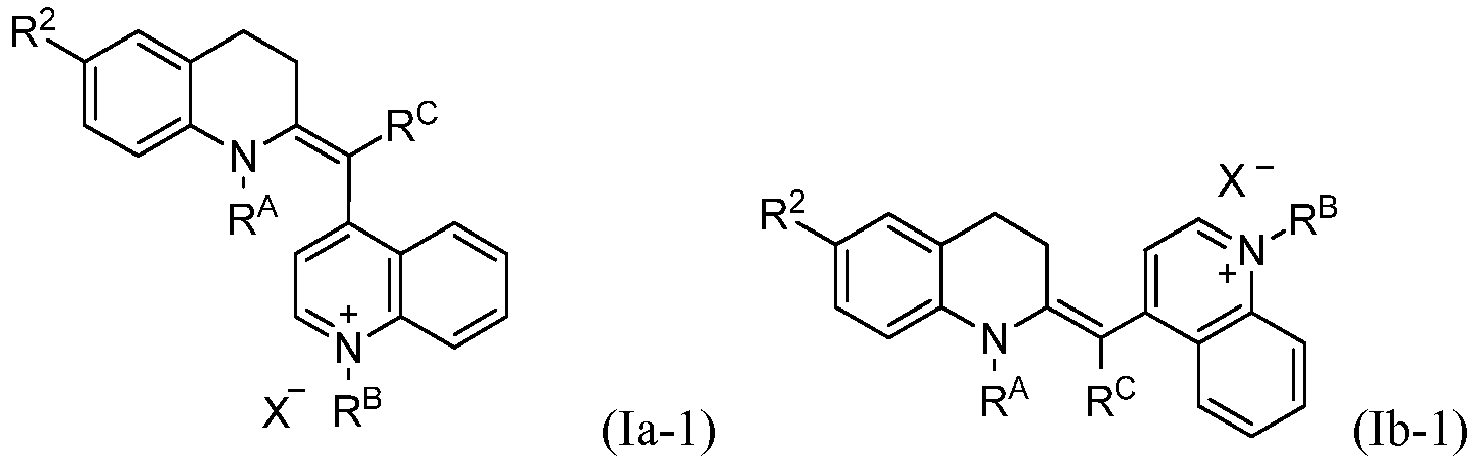
- The compound according to anyone of claims 1 to 4, selected from the group consisting of:(Z)-1-isopropyl-4-((1-isopropyl-6-methoxy-3,4-dihydroquinolin-2(1H)-ylidene)methyl)quinolin-1-ium iodide;(Z)-1-isopropyl-4-((1-isopropyl-6-methoxy-3,4-dihydroquinolin-2(1H)-ylidene)(methoxy)methyl)quinolin-1-ium iodide;and pharmaceutically acceptable tautomers, salts and solvates thereof.
- A pharmaceutical composition comprising a compound according to anyone of claims 1 to 5, or a pharmaceutically acceptable tautomer, salt or solvate thereof, and at least one pharmaceutically acceptable carrier.
- Medicament comprising a compound according to anyone of claims 1 to 5, or a pharmaceutically acceptable tautomer, salt or solvate thereof.
- A compound according to anyone of claims 1 to 5 or a pharmaceutically acceptable tautomer, salt or solvate thereof for use in the treatment and/or prevention of depressive disorders and anxiety disorders.
- A compound according to anyone of claims 1 to 5 or a pharmaceutically acceptable tautomer, salt or solvate thereof for use as organic cation transporters (OCTs) inhibitor.
- Process for manufacturing a compound of Formula (I) according to claims 1 to 5 or a pharmaceutically acceptable tautomer, salt or solvate thereof, characterized in that it comprises the regioselective reduction of intermediate of Formula (II)
 wherein
 in presence of sodium dithionite (Na2S2O4).
 - The process according to claim 10, comprising a preliminary step of synthesis of intermediate of Formula (II) comprising the coupling between intermediate of Formula (III) and intermediate of Formula (IV), in presence of a base:
 wherein RA, RB, R1, R2, R3, R4, R1', R2', R3', R4', R5' and R6' are as defined in claim 1; andYA is -CH2RC, wherein RC is as defined in Formula (I); and YB is hydrogen or a leaving group preferably selected from halo, acetate, tosylate, mesylate and sulfate; preferably in such case YB is halo; more preferably, YB is Cl;
orYA is hydrogen or a leaving group preferably selected from halo, acetate, tosylate, mesylate and sulfate; and YB is -CH2RC, wherein RC is as defined in Formula (I); preferably in such case YA is halo; more preferably YA is Cl. - A compound of Formula (II)

 X represents halo, acetate, trifluoroacetate or triflate;RA and RB are independently selected from alkyl;R C represents hydrogen, alkyl, alkoxy or haloalkyl;R1, R2, R3 and R4 are independently selected from hydrogen, hydroxyl, alkoxy, halo, haloalkyl, haloalkyloxy, amino, alkylamino, aminoalkyl, alkyloxycarbonyl and COOH; or R1 and R2, or R2 and R3, or R3 and R4 form together with the carbon atoms to which they are attached a 5- or 6-membered aryl ring, a 5- or 6-membered heteroaryl ring, a 5- or 6-membered cycloalkyl ring, a 5- or 6-membered heterocyclyl ring, said rings being optionally substituted by one or more substituent selected from hydroxyl, alkoxy, halo, haloalkyl, haloalkyloxy, amino, alkylamino, aminoalkyl, alkyloxycarbonyl and COOH;R1', R2', R3', R4', R5' and R6' are independently either absent or selected from hydrogen, hydroxyl, alkoxy, halo, haloalkyl, haloalkyloxy, amino, alkylamino, aminoalkyl, alkyloxycarbonyl and COOH; or R1' and R2', or R2' and R3', or R3' and R4', or R5' and R6', form together with the carbon atoms to which they are attached a 5- or 6-membered aryl ring, a 5- or 6-membered heteroaryl ring, a 5- or 6-membered cycloalkyl ring, a 5- or 6-membered heterocyclyl ring, said rings being optionally substituted by one or more substituent selected from hydroxyl, alkoxy, halo, haloalkyl, haloalkyloxy, amino, alkylamino, aminoalkyl, alkyloxycarbonyl and COOH;or RA and R5' form together with atoms to which they are attached a 6-membered heteroaryl ring optionally substituted by one or more substituent selected from alkyl, hydroxyl, alkoxy, halo, haloalkyl, haloalkyloxy, amino, alkylamino, aminoalkyl, alkyloxycarbonyl and COOH;wherein at least one of R1, R2, R3, R4, R1', R2', R3', R4', R5' or R6' is other than hydrogen.
 - The compound according to claim 12, selected from the group consisting of:(Z)-1-isopropyl-4-((1-isopropyl-6-methoxyquinolin-2(1H)-ylidene)methyl)quinolin-1-ium iodide;(Z)-1-isopropyl-4-((1-isopropyl-6-methoxyquinolin-2(1H)-ylidene)(methoxy)methyl)quinolin-1-ium iodide;and pharmaceutically acceptable tautomers, salts and solvates thereof.
Priority Applications (4)
| Application Number | Priority Date | Filing Date | Title |
|---|---|---|---|
| EP17305935.3A EP3428157A1 (en) | 2017-07-13 | 2017-07-13 | Selective organic cation transporters inhibitors for the treatment of depressive disorders |
| US16/630,082 US11414398B2 (en) | 2017-07-13 | 2018-07-13 | Selective organic cation transporters inhibitors for the treatment of depressive disorders |
| PCT/EP2018/069179 WO2019012150A1 (en) | 2017-07-13 | 2018-07-13 | Selective organic cation transporters inhibitors for the treatment of depressive disorders |
| EP18737646.2A EP3652163B1 (en) | 2017-07-13 | 2018-07-13 | Selective organic cation transporters inhibitors for the treatment of depressive disorders |
Applications Claiming Priority (1)
| Application Number | Priority Date | Filing Date | Title |
|---|---|---|---|
| EP17305935.3A EP3428157A1 (en) | 2017-07-13 | 2017-07-13 | Selective organic cation transporters inhibitors for the treatment of depressive disorders |
Publications (1)
| Publication Number | Publication Date |
|---|---|
| EP3428157A1 true EP3428157A1 (en) | 2019-01-16 |
Family
ID=59384112
Family Applications (2)
| Application Number | Title | Priority Date | Filing Date |
|---|---|---|---|
| EP17305935.3A Withdrawn EP3428157A1 (en) | 2017-07-13 | 2017-07-13 | Selective organic cation transporters inhibitors for the treatment of depressive disorders |
| EP18737646.2A Active EP3652163B1 (en) | 2017-07-13 | 2018-07-13 | Selective organic cation transporters inhibitors for the treatment of depressive disorders |
Family Applications After (1)
| Application Number | Title | Priority Date | Filing Date |
|---|---|---|---|
| EP18737646.2A Active EP3652163B1 (en) | 2017-07-13 | 2018-07-13 | Selective organic cation transporters inhibitors for the treatment of depressive disorders |
Country Status (3)
| Country | Link |
|---|---|
| US (1) | US11414398B2 (en) |
| EP (2) | EP3428157A1 (en) |
| WO (1) | WO2019012150A1 (en) |
Families Citing this family (1)
| Publication number | Priority date | Publication date | Assignee | Title |
|---|---|---|---|---|
| FR3161349B1 (en) | 2024-04-17 | 2026-04-10 | Univ Sorbonne | New inhibitors of organic cation transporters for the treatment of mood disorders |
Citations (3)
| Publication number | Priority date | Publication date | Assignee | Title |
|---|---|---|---|---|
| US3909275A (en) * | 1970-01-15 | 1975-09-30 | Minnesota Mining & Mfg | Cyanine dye salts, merocyanine dyes, and their use in silver halide photographic emulsions |
| DE4137009A1 (en) * | 1991-11-11 | 1993-05-13 | Schoemig Edgar Priv Doz Dr | New inhibitors of cellular transport systems for organic cations - useful in improving effectiveness of hormones and neuro-transmitters |
| WO2009134877A2 (en) * | 2008-04-29 | 2009-11-05 | Board Of Regents, The University Of Texas System | Therapeutics for treatment resistant mental disorders |
-
2017
- 2017-07-13 EP EP17305935.3A patent/EP3428157A1/en not_active Withdrawn
-
2018
- 2018-07-13 US US16/630,082 patent/US11414398B2/en active Active
- 2018-07-13 WO PCT/EP2018/069179 patent/WO2019012150A1/en not_active Ceased
- 2018-07-13 EP EP18737646.2A patent/EP3652163B1/en active Active
Patent Citations (3)
| Publication number | Priority date | Publication date | Assignee | Title |
|---|---|---|---|---|
| US3909275A (en) * | 1970-01-15 | 1975-09-30 | Minnesota Mining & Mfg | Cyanine dye salts, merocyanine dyes, and their use in silver halide photographic emulsions |
| DE4137009A1 (en) * | 1991-11-11 | 1993-05-13 | Schoemig Edgar Priv Doz Dr | New inhibitors of cellular transport systems for organic cations - useful in improving effectiveness of hormones and neuro-transmitters |
| WO2009134877A2 (en) * | 2008-04-29 | 2009-11-05 | Board Of Regents, The University Of Texas System | Therapeutics for treatment resistant mental disorders |
Non-Patent Citations (15)
| Title |
|---|
| "Diagnostic and Statistical Manual of Mental Disorders" |
| "Remington's Pharmaceutical Sciences" |
| AMPHOUX ET AL., EUR. J. PHARMACOL., vol. 634, 2010, pages 1 - 9 |
| ANNE AMPHOUX ET AL: "Inhibitory and facilitory actions of isocyanine derivatives at human and rat organic cation transporters 1, 2 and 3: A comparison to human [alpha]1- and [alpha]2-adrenoceptor subtypes", EUROPEAN JOURNAL OF PHARMACOLOGY, vol. 634, no. 1-3, 1 May 2010 (2010-05-01), NL, pages 1 - 9, XP055436669, ISSN: 0014-2999, DOI: 10.1016/j.ejphar.2010.02.012 * |
| BACQ ET AL., MOL. PSYCHIATRY, vol. 17, 2012, pages 926 - 939 |
| BERTON ET AL., SCIENCE, vol. 311, no. 5762, 2006, pages 864 - 8 |
| BRADLEY, W.; JEFFREY, S. J., CHEM. SOC., 1954, pages 2770 - 2778 |
| COUROUSSE ET AL., PHARMACOL. THERAPEUTICS, vol. 146, 2015, pages 94 - 103 |
| FOUCOUT ET AL., ORG. BIOMOL. CHEM., vol. 7, 2009, pages 3666 - 3673 |
| GORBUNOV ET AL., MOLECULAR PHARMACOL., vol. 73, 2008, pages 50 - 61 |
| IVERSEN, BRIT. J. PHARMACOL., vol. 25, 1965, pages 18 - 33 |
| LARTIA ET AL., CHEM. EUR. J., vol. 12, 2006, pages 2270 - 2281 |
| RUSS ET AL., ARCH PHARMACOL, vol. 354, 1996, pages 268 - 274 |
| RUSS ET AL., ARCH. PHARMACOL., vol. 348, 1993, pages 458 - 465 |
| WILSON ET AL., ARCH. PHARMACOL., vol. 337, 1988, pages 397 - 405 |
Also Published As
| Publication number | Publication date |
|---|---|
| EP3652163A1 (en) | 2020-05-20 |
| US20200199100A1 (en) | 2020-06-25 |
| US11414398B2 (en) | 2022-08-16 |
| EP3652163B1 (en) | 2023-09-06 |
| WO2019012150A1 (en) | 2019-01-17 |
Similar Documents
| Publication | Publication Date | Title |
|---|---|---|
| AU2019404934B2 (en) | Macrocyclic compounds and their use in the treatment of disease | |
| EP3720858B1 (en) | Modulators of the beta-3 adrenergic receptor useful for the treatment or prevention of heart failure and disorders related thereto | |
| WO2021007378A1 (en) | Compounds for use in treating huntington's disease | |
| MXPA06014572A (en) | Amido compounds and their use as pharmaceuticals. | |
| AU2019237992A1 (en) | Oxadiazole transient receptor potential channel inhibitors | |
| CA2878006C (en) | Carbamate/urea derivatives | |
| EP4218934A1 (en) | Inhibiting ubiquitin-specific protease 30 (usp30) | |
| CA3111649A1 (en) | Tricyclic compounds acting on crbn proteins | |
| AU2023211370B2 (en) | Aromatic ring-fused heterocyclic ring compound as potassium channel regulator, and preparation therefor and use thereof | |
| MX2014004254A (en) | Carbamate/ urea derivatives containing piperidin and piperazin rings as h3 receptor inhibitors. | |
| KR20240054264A (en) | HETEROARYL COMPOUNDS FOR TREATING HUNTINGTON'S DISEASE | |
| EP4608829A2 (en) | Novel ergolines and methods of treating mood disorders | |
| EA028673B1 (en) | PYRIMIDO[4,5-b]QUINOLINE-4,5-(3H,10H)DIONES AS NONSENSE MUTATION SUPPRESSORS | |
| CN114149424B (en) | Heterocyclic compounds for the treatment of diseases | |
| JP2012532127A (en) | Substituted 4-hydroxypyrimidine-5-carboxamide | |
| EP3652163B1 (en) | Selective organic cation transporters inhibitors for the treatment of depressive disorders | |
| CN118119625A (en) | Pyrimidine-2 (1H) -keto bicyclic compounds with MAT2A inhibitory activity and application thereof | |
| CN102802628A (en) | Substituted 4-hydroxypyrimidine-5-carboxamides | |
| KR20250019650A (en) | compound | |
| KR20130103617A (en) | Substituted [(5h-pyrrolo[2,1-c][1,4]benzodiazepin-11-yl)piperazin-1-yl]-2,2-dimethylpropanoic acid compounds as dual activity h1 inverse agonists/5-ht2a antagonists | |
| US12030867B2 (en) | Hsp90β selective inhibitors | |
| KR20260025059A (en) | Novel pyridine derivatives, preparing method thereof, and pharmaceutical composition for preventing or treating respiratory diseases containing the same as an active ingredient | |
| CN106065018A (en) | Substituted benzazolyl compounds and using method thereof and purposes | |
| TW202502752A (en) | Pyrimidine compounds and their use as USP1 inhibitors | |
| HK40039344B (en) | Modulators of the beta-3 adrenergic receptor useful for the treatment or prevention of heart failure and disorders related thereto |
Legal Events
| Date | Code | Title | Description |
|---|---|---|---|
| PUAI | Public reference made under article 153(3) epc to a published international application that has entered the european phase |
Free format text: ORIGINAL CODE: 0009012 |
|
| AK | Designated contracting states |
Kind code of ref document: A1 Designated state(s): AL AT BE BG CH CY CZ DE DK EE ES FI FR GB GR HR HU IE IS IT LI LT LU LV MC MK MT NL NO PL PT RO RS SE SI SK SM TR |
|
| AX | Request for extension of the european patent |
Extension state: BA ME |
|
| STAA | Information on the status of an ep patent application or granted ep patent |
Free format text: STATUS: THE APPLICATION IS DEEMED TO BE WITHDRAWN |
|
| 18D | Application deemed to be withdrawn |
Effective date: 20190717 |