EP3428064A1 - System and method for rotorcraft blade storage - Google Patents
System and method for rotorcraft blade storage Download PDFInfo
- Publication number
- EP3428064A1 EP3428064A1 EP17193350.0A EP17193350A EP3428064A1 EP 3428064 A1 EP3428064 A1 EP 3428064A1 EP 17193350 A EP17193350 A EP 17193350A EP 3428064 A1 EP3428064 A1 EP 3428064A1
- Authority
- EP
- European Patent Office
- Prior art keywords
- pillar
- shelves
- shelf
- main rotor
- coupled
- Prior art date
- Legal status (The legal status is an assumption and is not a legal conclusion. Google has not performed a legal analysis and makes no representation as to the accuracy of the status listed.)
- Granted
Links
Images










Classifications
-
- B—PERFORMING OPERATIONS; TRANSPORTING
- B64—AIRCRAFT; AVIATION; COSMONAUTICS
- B64F—GROUND OR AIRCRAFT-CARRIER-DECK INSTALLATIONS SPECIALLY ADAPTED FOR USE IN CONNECTION WITH AIRCRAFT; DESIGNING, MANUFACTURING, ASSEMBLING, CLEANING, MAINTAINING OR REPAIRING AIRCRAFT, NOT OTHERWISE PROVIDED FOR; HANDLING, TRANSPORTING, TESTING OR INSPECTING AIRCRAFT COMPONENTS, NOT OTHERWISE PROVIDED FOR
- B64F5/00—Designing, manufacturing, assembling, cleaning, maintaining or repairing aircraft, not otherwise provided for; Handling, transporting, testing or inspecting aircraft components, not otherwise provided for
- B64F5/50—Handling or transporting aircraft components
-
- B—PERFORMING OPERATIONS; TRANSPORTING
- B64—AIRCRAFT; AVIATION; COSMONAUTICS
- B64C—AEROPLANES; HELICOPTERS
- B64C27/00—Rotorcraft; Rotors peculiar thereto
-
- B—PERFORMING OPERATIONS; TRANSPORTING
- B64—AIRCRAFT; AVIATION; COSMONAUTICS
- B64C—AEROPLANES; HELICOPTERS
- B64C27/00—Rotorcraft; Rotors peculiar thereto
- B64C27/32—Rotors
- B64C27/46—Blades
- B64C27/473—Constructional features
- B64C27/48—Root attachment to rotor head
-
- B—PERFORMING OPERATIONS; TRANSPORTING
- B64—AIRCRAFT; AVIATION; COSMONAUTICS
- B64F—GROUND OR AIRCRAFT-CARRIER-DECK INSTALLATIONS SPECIALLY ADAPTED FOR USE IN CONNECTION WITH AIRCRAFT; DESIGNING, MANUFACTURING, ASSEMBLING, CLEANING, MAINTAINING OR REPAIRING AIRCRAFT, NOT OTHERWISE PROVIDED FOR; HANDLING, TRANSPORTING, TESTING OR INSPECTING AIRCRAFT COMPONENTS, NOT OTHERWISE PROVIDED FOR
- B64F5/00—Designing, manufacturing, assembling, cleaning, maintaining or repairing aircraft, not otherwise provided for; Handling, transporting, testing or inspecting aircraft components, not otherwise provided for
- B64F5/10—Manufacturing or assembling aircraft, e.g. jigs therefor
-
- B—PERFORMING OPERATIONS; TRANSPORTING
- B64—AIRCRAFT; AVIATION; COSMONAUTICS
- B64F—GROUND OR AIRCRAFT-CARRIER-DECK INSTALLATIONS SPECIALLY ADAPTED FOR USE IN CONNECTION WITH AIRCRAFT; DESIGNING, MANUFACTURING, ASSEMBLING, CLEANING, MAINTAINING OR REPAIRING AIRCRAFT, NOT OTHERWISE PROVIDED FOR; HANDLING, TRANSPORTING, TESTING OR INSPECTING AIRCRAFT COMPONENTS, NOT OTHERWISE PROVIDED FOR
- B64F5/00—Designing, manufacturing, assembling, cleaning, maintaining or repairing aircraft, not otherwise provided for; Handling, transporting, testing or inspecting aircraft components, not otherwise provided for
- B64F5/40—Maintaining or repairing aircraft
-
- B—PERFORMING OPERATIONS; TRANSPORTING
- B64—AIRCRAFT; AVIATION; COSMONAUTICS
- B64U—UNMANNED AERIAL VEHICLES [UAV]; EQUIPMENT THEREFOR
- B64U80/00—Transport or storage specially adapted for UAVs
-
- B—PERFORMING OPERATIONS; TRANSPORTING
- B65—CONVEYING; PACKING; STORING; HANDLING THIN OR FILAMENTARY MATERIAL
- B65G—TRANSPORT OR STORAGE DEVICES, e.g. CONVEYORS FOR LOADING OR TIPPING, SHOP CONVEYOR SYSTEMS OR PNEUMATIC TUBE CONVEYORS
- B65G1/00—Storing articles, individually or in orderly arrangement, in warehouses or magazines
- B65G1/02—Storage devices
-
- A—HUMAN NECESSITIES
- A47—FURNITURE; DOMESTIC ARTICLES OR APPLIANCES; COFFEE MILLS; SPICE MILLS; SUCTION CLEANERS IN GENERAL
- A47B—TABLES; DESKS; OFFICE FURNITURE; CABINETS; DRAWERS; GENERAL DETAILS OF FURNITURE
- A47B81/00—Cabinets or racks specially adapted for other particular purposes, e.g. for storing guns or skis
- A47B81/005—Devices for storing or displaying rifles, guns, pistols or elongated objects such as fishing rods storing fishing rods
-
- B—PERFORMING OPERATIONS; TRANSPORTING
- B60—VEHICLES IN GENERAL
- B60P—VEHICLES ADAPTED FOR LOAD TRANSPORTATION OR TO TRANSPORT, TO CARRY, OR TO COMPRISE SPECIAL LOADS OR OBJECTS
- B60P3/00—Vehicles adapted to transport, to carry or to comprise special loads or objects
- B60P3/06—Vehicles adapted to transport, to carry or to comprise special loads or objects for carrying vehicles
- B60P3/11—Vehicles adapted to transport, to carry or to comprise special loads or objects for carrying vehicles for carrying aircraft
-
- B—PERFORMING OPERATIONS; TRANSPORTING
- B62—LAND VEHICLES FOR TRAVELLING OTHERWISE THAN ON RAILS
- B62B—HAND-PROPELLED VEHICLES, e.g. HAND CARTS OR PERAMBULATORS; SLEDGES
- B62B3/00—Hand carts having more than one axis carrying transport wheels; Steering devices therefor; Equipment therefor
- B62B3/10—Hand carts having more than one axis carrying transport wheels; Steering devices therefor; Equipment therefor characterised by supports specially adapted to objects of definite shape
- B62B3/102—Hand carts having more than one axis carrying transport wheels; Steering devices therefor; Equipment therefor characterised by supports specially adapted to objects of definite shape the objects being of elongated shape, e.g. rods or golf clubs
-
- B—PERFORMING OPERATIONS; TRANSPORTING
- B62—LAND VEHICLES FOR TRAVELLING OTHERWISE THAN ON RAILS
- B62B—HAND-PROPELLED VEHICLES, e.g. HAND CARTS OR PERAMBULATORS; SLEDGES
- B62B5/00—Accessories or details specially adapted for hand carts
- B62B5/0083—Wheeled supports connected to the transported object
-
- B—PERFORMING OPERATIONS; TRANSPORTING
- B64—AIRCRAFT; AVIATION; COSMONAUTICS
- B64U—UNMANNED AERIAL VEHICLES [UAV]; EQUIPMENT THEREFOR
- B64U10/00—Type of UAV
- B64U10/10—Rotorcrafts
Definitions
- the present invention relates generally to rotorcraft, and, in particular embodiments, to a system and method for rotorcraft blade storage.
- a rotorcraft may include one or more rotor systems including one or more main rotor systems.
- a main rotor system generates aerodynamic lift to support the weight of the rotorcraft in flight, and thrust to move the rotorcraft in forward flight.
- Another example of a rotorcraft rotor system is a tail rotor system.
- a tail rotor system may generate thrust in the same direction as the main rotor system's rotation to counter the torque effect created by the main rotor system.
- a device includes: a first pillar including: a bottom portion having an opening; a top portion coupled to the bottom portion by a middle portion, the top portion including a plurality of shelves stacked along a common axis intersecting the bottom portion, each of the shelves having a respective recess; a plurality of clamps, each of the shelves having a respective clamp of the clamps, where each respective clamp and respective recess of the shelves forms an airfoil cross-sectional shape; and a plurality of locks, each of the shelves having a respective lock of the locks, where each of the locks has a first locking portion on respective shelves and a second locking portion on respective clamps of the shelves.
- a system and method for rotorcraft blade storage is provided, according to some embodiments.
- the main rotor blades may be removed from the rotorcraft and stored in a rotor blade storage rack that is attached to the rotorcraft.
- the blade storage rack is detachable. Storing the rotor blades using a storage rack on the rotorcraft allows the main rotor blades to be stored in the same space as the rotorcraft.
- the rotor blades of a rotorcraft may be fragile and heavy.
- the storage rack includes clamps and soft material for holding the rotor blades, which protects them during storage and transportation.
- rotor blade storage rack allows the main rotor blades to be transported on the same vehicle as the rotorcraft. Remove the main rotor blades and storing them with the rotorcraft may also allow the main rotor blades to be stored without undue stress being exerted on components of the rotor system, which are flight-critical components.
- Figure 1 illustrates a rotorcraft 101, according to an embodiment.
- the rotorcraft 101 has a main rotor system 103, which includes a plurality of main rotor blades 105.
- the main rotor system 103 has a longitudinal tilt ⁇ R with respect to a longitudinal axis of the rotorcraft 101.
- the longitudinal tilt ⁇ R is about 5 degrees.
- the longitudinal tilt ⁇ R allows the rotorcraft 101 to remain relatively level when the rotorcraft 101 is moving forward in a longitudinal direction.
- the pitch of each main rotor blade 105 may be controlled by a swashplate 107 in order to selectively control the attitude, altitude, and movement of the rotorcraft 101.
- the swashplate 107 may be used to collectively and/or cyclically change the pitch of the main rotor blades 105.
- the rotorcraft 101 also has an anti-torque system, which may include a tail rotor 109, no-tail-rotor (NOTAR), or dual main rotor system. In rotorcraft with a tail rotor 109, the pitch of each tail rotor blade 111 is collectively changed in order to vary thrust of the anti-torque system, providing directional control of the rotorcraft 101.
- the pitch of the tail rotor blades 111 is changed by one or more tail rotor actuators.
- a fly-by-wire (FBW) control system sends electrical signals to the tail rotor actuators or main rotor actuators to control flight of the rotorcraft.
- FBW fly-by-wire
- Power is supplied to the main rotor system 103 and the anti-torque system by engines 115.
- engines 115 There may be one or more engines 115, which may be controlled according to signals from the FBW system.
- the output of the engines 115 is provided to a driveshaft 117, which is mechanically and operatively coupled to the main rotor system 103 and the anti-torque system through a main rotor transmission 119 and a tail rotor transmission, respectively.
- the rotorcraft 101 further includes a fuselage 123 and a tail section 125.
- the tail section 125 may have other flight control devices such as horizontal or vertical stabilizers, rudder, elevators, or other control or stabilizing surfaces that are used to control or stabilize flight of the rotorcraft 101.
- the fuselage 123 includes a cockpit 127, which includes displays, controls, and instruments.
- a rotor blade storage rack 129 may be attached to the fuselage 123 and the tail section 125.
- One or more of the main rotor blades 105 may be removed from the main rotor system 103 and stored on the rotor blade storage rack 129 when the rotorcraft 101 is not in use.
- main rotor blades 105 may be removed and stored in the rotor blade storage rack 129.
- some of the main rotor blades 105 may be removed and stored in the rotor blade storage rack 129, while others are attached to the rotorcraft 101.
- the rotorcraft 101 may have a variety of implementation-specific configurations.
- the cockpit 127 is configured to accommodate a pilot or a pilot and co-pilot, as illustrated.
- rotorcraft 101 maybe operated remotely, in which case the cockpit 127 could be configured as a fully functioning cockpit to accommodate a pilot (and possibly a co-pilot as well) to provide for greater flexibility of use, or could be configured with a cockpit having limited functionality (e.g., a cockpit with accommodations for only one person who would function as the pilot operating perhaps with a remote co-pilot or who would function as a co-pilot or back-up pilot with the primary piloting functions being performed remotely).
- rotorcraft 101 could be configured as an unmanned vehicle, in which case the cockpit 127 could be eliminated entirely in order to save space and cost.
- FIG. 2 illustrates a cross-sectional view of one of the main rotor blades 105, according to an embodiment.
- the main rotor blades 105 include a leading edge 201 and a trailing edge 203 that collectively form an airfoil cross-sectional shape.
- the leading edge 201 may be made of one or more composite materials, and is thicker than the trailing edge 203.
- the trailing edge 203 may be made from a stronger material than the leading edge 201, such as carbon tape, and may be thin.
- the trailing edge 203 may make up a fragile portion of the main rotor blade 105. Due to the length of the main rotor blades 105, they may be heavy. In an embodiment, each of the main rotor blades 105 weighs 175 pounds. The weight and fragility of the main rotor blades 105 may make proper and safe storage difficult.
- the rotor blade storage rack 129 includes features (discussed below) to protect the trailing edge 203 of the main rot
- FIG. 3 illustrates a top-down view of the main rotor system 103, according to an embodiment.
- a rotor hub 301 at the center of the main rotor system 103 includes a yoke 303 holding each of the main rotor blades 105.
- the yoke 303 is mechanically coupled to the main rotor transmission 119 through a mast 305.
- the main rotor transmission 119 rotates the main rotor system 103 through the mast 305 and the yoke 303 during operation.
- Rotor grips 307 are physically and mechanically coupled to the yoke 303.
- Bolts 309 secure the main rotor blades 105 to respective ones of the rotor grips 307 through bolt holes in the rotor grips 307 and the main rotor blades 105.
- the main rotor blades 105, the yoke 303, the rotor grips 307, and the bolts 309 are flight-critical parts. Failure of any of these parts may result in failure of the rotorcraft 101.
- the main rotor system 103 may have a relatively wide wingspan.
- the main rotor system 103 includes five main rotor blades 105 and has a radius R B of 27.25 feet. When fully assembled with all five blades, the wingspan W 5 of the main rotor system 103 may be relatively wide.
- the main rotor blades 105 may be stored by removing some of the bolts 309 and folding the rotor blades 105 about the yoke 303 to collapse them.
- the rotor blades 105 may be collapsed in pairs and fastened to the body of the rotorcraft 101. For example, one pair of blades may be fastened to the tail section 125 and the other pair of blades may be fastened to the cockpit 127.
- the rotorcraft 101 may have an odd quantity of main rotor blades 105, such as five. An odd quantity of blades may not fasten to the rotorcraft 101 in pairs.
- the longitudinal tilt ⁇ R of the rotorcraft 101 and the heavy weight of the main rotor blades 105 may make folding of the main rotor blades 105 about the yoke 303 difficult.
- folding the main rotor blades 105 about the yoke 303 towards the tail section 125 requires folding the rotor blades 105 slightly upward (e.g., against gravity). This motion may result in shear stress being exerted on the bolts 309, and torsion being exerted on the main rotor blades 105 and the rotor grips 307. As noted above, these are flight-critical parts.
- a system and method for rotorcraft blade storage is provided, according to some embodiments.
- the main rotor blades 105 may be removed from the main rotor system 103 and stored in the rotor blade storage rack 129. Storing the main rotor blades 105 in the rotor blade storage rack 129 allows the main rotor blades 105 to be stored in the same space as the rotorcraft 101. Further, when the rotorcraft 101 is transported, the rotor blade storage rack 129 allows the main rotor blades 105 to be transported on the same vehicle as the rotorcraft 101.
- the rotor blade storage rack 129 is detachable, and may be removed when the rotorcraft 101 is in use.
- Removing the main rotor blades 105 and storing them with the rotorcraft 101 may also allow the main rotor blades 105 to be stored without undue stress being exerted on the main rotor blades 105, the rotor grips 307, and/or the bolts 309.
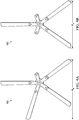
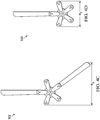
- FIGS 4A through 4D illustrate various views of the main rotor system 103 when one or more of the main rotor blades 105 are removed, according to an embodiment.
- one main rotor blade 105 is removed, thereby reducing the wingspan W 4 of the main rotor system 103 to a width less than the wingspan W 5 .
- FIG 4B two main rotor blades 105 are removed, thereby reducing the wingspan W 3 of the main rotor system 103 to a width less than the wingspan W 4 .
- Figure 4C three main rotor blades 105 are removed, thereby reducing the wingspan W2 of the main rotor system 103 to a width less than the wingspan W 3 .
- Figure 4D four main rotor blades 105 are removed, thereby reducing the wingspan W 1 of the main rotor system 103 to a width less than the wingspan W 2 .
- the wingspan W 1 of the main rotor system 103 with four main rotor blades 105 removed is equal to the combined width of the yoke 303 and rotor grips 307.
- the wingspan of the main rotor system 103 may be reduced to the wingspan W 1 with one main rotor blade 105 left intact.
- the wingspan of the rotorcraft 101 may be minimized by reducing four main rotor blades 105 and rotating the fifth blade such that it is aligned with a longitudinal axis of the rotorcraft 101.
- the wingspan of the rotorcraft 101 may be adjusted by removing an appropriate quantity of main rotor blades 105.
- main rotor blades 105 may be removed.
- main rotor blades 105 may be removed if the rotorcraft 101 need only be reduced to fit in a given space. Conversely, if the rotorcraft 101 need only be reduced to fit in a given space, then a lesser quantity of main rotor blades 105 may be removed.
- Figures 5A through 5C show the rotor blade storage rack 129, according to an embodiment.
- Figure 5A shows a view along a latitudinal axis
- Figure 5B shows a view along a longitudinal axis
- Figure 5C shows a top-down view.
- the rotor blade storage rack 129 may include a first pillar 501 and a second pillar 503, which are the main support structures for the rotor blade storage rack 129.
- the rotor blade storage rack 129 may include more pillars.
- the first pillar 501 attaches to the fuselage 123, and the second pillar 503 attaches to the tail section 125.
- the pillars may attach to other portions of the rotorcraft 101.
- the fuselage 123 and the tail section 125 may not be level.
- the height H 1 of the first pillar 501 and the height H2 of the second pillar 503 may be different.
- the height H 1 is less than the height H2.
- the main rotor blades 105 are stored by fastening them to the first pillar 501 and the second pillar 503.
- the first pillar 501 and the second pillar 503 each include a side brace 505, a bottom portion 507, a middle portion 509, and a top portion 511.
- the side brace 505 and the bottom portion 507 have an opening 513 with a width W 6 that is wide enough to accommodate the width of the fuselage 123 and the tail section 125, respectively.
- the side brace 505 has a first end attached to the bottom portion 507, and extends away from the bottom portion 507 in a diagonal direction.
- the side brace 505 and the bottom portion 507 each have fasteners 515 that attach the side brace 505 and the bottom portion 507, respectively, to the fuselage 123 and the tail section 125.
- the fasteners 515 are protrusions or pins that are inserted into respective holes in the fuselage 123 and the tail section 125.
- the fasteners 515 bear the weight of the first pillar 501 and second pillar 503.
- the bottom portion 507 includes a first vertical beam, a second vertical beam, and a horizontal beam that attach end-to-end to form the opening 513.
- the bottom portion 507 includes trusses 517 that support the bottom portion 507 and prevent the opening 513 from collapsing.
- the trusses 517 extend from the first vertical beam to the second vertical beam.
- each of the first and second vertical beams have a first end and a second end. The first and second ends are coupled to the horizontal beam and the respective side braces 505; the second ends are coupled to the fasteners 515.
- the first and second vertical beams each form an acute angle with respective side braces 505.
- the middle portion 509 couples the bottom portion 507 to the top portion 511.
- a container 519 is attached to the middle portion 509 of the second pillar 503, and is used to hold the bolts 309 for the main rotor blades 105 stored on the rotor blade storage rack 129. Storing the bolts 309 with the main rotor blades 105 helps avoid loss of the bolts 309 when they are not attached to the rotorcraft 101.
- the middle portion 509 is omitted, and the top portion 111 is directly connected to the bottom portion 507.
- the top portion 511 includes shelves 521 that hold the main rotor blades 105.
- the shelves 521 are aligned along a common axis of each pillar.
- the shelves 521 have clamps 523 that secure the main rotor blades 105.
- the clamps 523 are fastened shut with locks 525.
- the shelves 521 have recesses 527 such that, when the clamps 523 are closed and fastened, the recesses 527 and the clamps 523 form an opening in the shape of the main rotor blades 105. That is, the openings may have an airfoil cross-sectional shape.
- the recesses 527 form the bottom of the airfoil shape
- the clamps 523 form the top of the airfoil shape.
- the airfoil shapes of the first pillar 501 and the second pillar 503 align along the longitudinal axis of the rotorcraft 101 when the rotor blade storage rack 129 is attached to the rotorcraft 101.
- the shelves 521 are removable, and may be fastened to the side braces of the top portion 511 with bolts, clips, or the like.
- the side braces and sides of the shelves 521 have openings for bolts, which extend through the openings and secure the shelves 521 in a vertical direction.
- the shelves 521 and clamps 523 may be covered with a conformal or soft material (shown below), such as foam.
- the soft material may conform to the airfoil shape of the main rotor blades 105, and form a tight seal around the main rotor blades 105 in the openings such that the main rotor blades 105 are protected and securely held.
- tightly forming the soft material around the main rotor blades 105 may protect the fragile trailing edge 203.
- the clamps 523 may not have an airfoil shape, and may have another shape such as a square, oval, etc. The soft material on the clamps 523 may form the opening in the airfoil shape.
- the clamps 523 may be formed of several types of material.
- the clamps 523 are rigid, and maintain their shape. As such, the clamps 523 may maintain their half of the airfoil cross-sectional shape even when they are not fastened with the locks 525.
- the clamps 523 may be formed of metal, plastic, a composite material, and the like.
- the clamps 523 are straps, and may not maintain their shape. In such embodiments, the clamps 523 may be formed of cloth, or other deformable material.
- the clamps 523 may attach to the shelves 521 in several manners.
- hinges (not shown) attach the clamps 523 to the shelves 521.
- the hinges may be on an opposite side of the shelves as the locks 525.
- the clamps 523 may be removable, and a plurality of locks 525 for each shelf 521 may fasten the clamps 523 to the shelves 521.
- the locks 525 may include several portions.
- the locks 525 include a first locking portion on the clamps 523, and a second locking portion on the shelves 521.
- the locking portions may be, e.g., holes that a pin, shackle, or the like is inserted into.
- the locks 525 may be latches or the like that secure the clamps 523 to the shelves 521.
- first pillar 501 and the second pillar 503 are shown are having discrete sections (with dotted lines), it should be appreciated that the side brace 505, bottom portion 507, middle portion 509, and top portion 511 may all be formed of a same material.
- the material may be a metal, a composite material, or the like.
- FIGS 6A and 6B are detailed views of a shelf 521 holding a main rotor blade 105, according to an embodiment.
- the clamps 523 extend over the main rotor blades 105 along the longitudinal axis of the airfoil cross-sectional shape.
- the clamps 523 have an airfoil shape, and conform to the shape of the main rotor blade 105.
- a small amount of soft material, or no soft material may be used.
- the clamps 523 may not conform directly to the shape of the main rotor blade 105 themselves, and may be a square frame on which a conformal material 601 such as foam, rubber, or the like is disposed on.
- the conformal material 601 conforms to the shape of the main rotor blade 105 and the clamps 523. It should be appreciated that the clamps 523 may have many shapes. The clamps 523, the soft material 601, or both may conform to the shape of the main rotor blades 105.
- FIG 7 is a flow diagram illustrating a method 701 for using the rotor blade storage rack 129 shown in Figures 5A through 5C .
- the first pillar 501 and the second pillar 503 are attached to the rotorcraft 101 (step 703).
- the first pillar 501 is positioned over the fuselage 123, and the fasteners 515 of the side brace 505 and the bottom portion 507 are inserted into holes on the sides of the fuselage 123.
- the second pillar 503 is positioned over the tail section 125, and the fasteners 515 of the side brace 505 and the bottom portion 507 are inserted into holes on the sides of the tail section 125.
- the main rotor system 103 is rotated until a main rotor blade 105 is positioned over the rotor blade storage rack 129 (step 705).
- the main rotor blade 105 is translated aft, e.g., towards the tail rotor 109 (step 707).
- Translating aft may include removing the bolts 309 for the main rotor blade 105, and removing the main rotor blade 105 from the rotor hub 301.
- the bolts 309 may optionally be stored in the container 519.
- the main rotor blade 105 is vertically lowered onto an open shelf 521 of the rotor blade storage rack 129 (step 709).
- Vertically lowering the main rotor blade 105 may include using a crane to lower the main rotor blade 105, which as noted above, may be heavy.
- the clamp 523 for the shelf 521 is closed around the main rotor blade 105 (step 711).
- the lock 525 is used to secure the clamp 523 such that it securely holds the main rotor blade 105 and protects the trailing edge 203.
- another shelf 521 may be added to the rotor blade storage rack 129 (step 715), and the method 701 may be repeated starting from step 705.
- the new shelf 521 provides a place for the next main rotor blades 105 to be lowered onto the rotor blade storage rack 129. More blades may be removed to further shrink the footprint of the rotorcraft 101.
- the method 701 concludes after all desired main rotor blades 105 are removed.
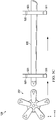
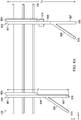
- Figures 8A through 8C show the rotor blade storage rack 129, according to another embodiment.
- Figure 8A shows a view along a latitudinal axis
- Figure 8B shows a view along a longitudinal axis
- Figure 8C shows a top-down view.
- the rotor blade storage rack 129 shown in Figures 8A through 8C stores the main rotor blades 105 on an elevator system that vertically raises and lowers the main rotor blades 105 during installation and removal.
- the first pillar 501 and the second pillar 503 include a blade elevator 801 in some embodiments.
- the blade elevator 801 includes pulleys 803 and a belt 805 that together form a blade elevator system.
- the pulleys 803 are driven by one or more motors 807 attached to the middle portion 509.
- the motors 807 are operable to turn the pulleys 803 such that the belt 805 raises and lower in the direction of the motion arrows.
- the rotor blade platforms 809 may be positioned on a first side of the blade elevator 801 when empty.
- the motors 807 drive the pulleys 803 such that the rotor blade platforms 809 are rotated from the first side of the blade elevator 801 (e.g., the left-hand side in Figure 8B ), over the top pulley 803, and to a second side of the blade elevator 801 (e.g., the right-hand side in Figure 8B ).
- Rotor blade platforms 809 are attached to the belt 805.
- the rotor blade platforms 809 include shelves 811that hold the main rotor blades 105.
- the shelves 811 have clamps 813 that secure the main rotor blades 105.
- the clamps 813 are fastened shut with locks 815.
- the shelves 811 have recesses 817 such that, when the clamps 813 are closed and fastened, the recesses 817 and the clamps 813 form an opening in the shape of the main rotor blades 105. That is, the openings have an airfoil cross-sectional shape. As such, when the main rotor blades 105 are fastened to the shelves 811 with the clamps 813, there are substantially no gaps around the main rotor blades 105.
- the shelves 811 and clamps 813 may be covered with a soft material, such as foam.
- the soft material may form a tight seal around the main rotor blades 105 in the openings such that the main rotor blades 105 are protected and securely held.
- the trailing edge 203 may be protected by the soft material and the airfoil shape of the openings.
- Figure 9 is a flow diagram illustrating a method 901 for using the rotor blade storage rack 129 shown in Figures 8A through 8C .
- the first pillar 501 and the second pillar 503 are attached to the rotorcraft 101 (step 903).
- the main rotor system 103 is rotated until a main rotor blade 105 is positioned over the rotor blade storage rack 129 (step 905).
- the main rotor blade 105 is translated aft and onto the first rotor blade platform 709 (step 907).
- the clamp 713 for the first rotor blade platform 709 is closed around the main rotor blade 105 (step 909).
- the first rotor blade platform 709 is lowered and the next rotor blade platform 709 is positioned to receive the next main rotor blade 105 (step 911).
- the motors 707 are used to drive the pulleys 703 which move the belt 705, thereby simultaneously lowering the first rotor blade platform 709 and positioning the next rotor blade platform 709. If more main rotor blades 105 are desired to be removed (step 913), the method 901 may be repeated starting from step 905.
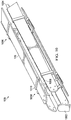
- FIG 10 shows a three-dimensional view of the rotor blade storage rack 129, according to another embodiment.
- the rotor blade storage rack 129 includes supports 1002 and a shaft 1004 connecting the supports 1002.
- the supports 1002 are the main support structures for the rotor blade storage rack 129.
- the supports 1002 attach to the fuselage 123 and the tail section 125. Although only one support 1002 is illustrated, it should be appreciated that another support 1002 is fastened at the opposing end of the shaft 1004.
- the shaft 1004 may be formed of metal such that it has sufficient strength to bear the weight of the main rotor blades 105.
- the supports 1002 may each have a bottom portion (not shown) similar to the bottom portion 507, and may attach to the rotorcraft 101 with fasteners 515 on a side brace 505.
- Black racks 1006 are attached to the shaft 1004.
- the shaft 1004 extends through opening in the centers of the black racks 1006.
- the black racks 1006 rotate around the shafts 1004, and may include bearings (not shown) so that they rotate easily.
- the black racks 1006 include a plurality of arms 1008, and the main rotor blades 105 are mounted to the arms 1008 using fasteners 1010.
- the quantity of arms 1008 may be the same as the quantity of main rotor blades 105 on the rotorcraft 101. For example, in embodiments where the rotorcraft 101 has five blades, the black racks 1006 may have five arms 1008.
- the fasteners 1010 are used to attach the main rotor blades 105 to the ends of the arms 1008 may be similar to the clamps 523 shown in Figures 6A and 6B .
- the fasteners 1010 maybe metal, plastic, or composite clamps, or may be straps.
- the fasteners 1010 may be formed of a rigid or deformable material, and may have soft material to conform to the shape of the main rotor blades 105.
- the openings in the fasteners 1010 may have an airfoil shape to accommodate the main rotor blades 105, and be closed shut with locks that are similar to the locks 525.
- FIG 11 is a flow diagram illustrating a method 1101 for using the rotor blade storage rack 129 shown in Figure 10 .
- the supports 1002 are attached to the rotorcraft 101 (step 1103).
- a first supports 1002 is positioned over the fuselage 123, and a second support 1002 is positioned over the tail section 125.
- the main rotor system 103 is rotated until a main rotor blade 105 is positioned over the rotor blade storage rack 129 (step 1105).
- the main rotor blade 105 is translated aft, e.g., towards the tail rotor 109 (step 1107).
- Translating aft may include removing the bolts 309 for the main rotor blade 105, and removing the main rotor blade 105 from the rotor hub 301.
- the main rotor blade 105 is vertically lowered onto an open set of fasteners 1010 on the arms 1008 (step 1109).
- Vertically lowering the main rotor blade 105 may include using a crane to lower the main rotor blade 105, which as noted above, may be heavy.
- the clamps for the fasteners are closed around the main rotor blade 105 (step 1111).
- the locks are used to secure the clamps such that they securely hold the main rotor blades 105 and protects the trailing edges 203.
- the rotor blade storage rack 129 maybe rotated until a free set of fasteners 1010 and arms 1008 are facing upward (towards the main rotor system 103), and the method 1101 may be repeated starting from step 1105. More blades may be removed to further shrink the footprint of the rotorcraft 101. The method 1101 concludes after all desired main rotor blades 105 are removed.
- Figure 12 shows a side view of the rotor blade storage rack 129, according to another embodiment.
- the embodiment shown in Figure 12 is similar to the embodiment shown in Figures 5A through 5C , except the storage rack 129 includes two side braces 505 connected by a support beam 1201.
- the two side braces 505 and the support beam 1201 are arranged to form a triangle.
- the bottom portion 507 includes a vertical beam of sufficient length to extend to the ground.
- the vertical beam is supported from the ground by a supporting wheel 1203, such as a caster wheel, although it should be appreciated that any type of mobile or stationary device could support the bottom portion 507 from the ground.
- a supporting wheel 1203 such as a caster wheel
- the second pillar 503 (e.g., attached to the tail section 125) may have a vertical beam extending to the ground, and the first pillar 501 may be attached to the fuselage 123.
- the second pillar 503 is substantially supported by the ground, and the side braces 505 fastening the second pillar 503 to the fuselage 123 laterally stabilize the second pillar 503.
- Embodiments may achieve advantages. Storing the main rotor blades 105 with the rotorcraft 101 may save storage and transportation costs. Removing the main rotor blades 105 for storage may reduce strain on flight-critical parts of the main rotor system 103. Removing the rotor blade storage rack 129 when not in use may reduce the weight of the rotorcraft 101.
- a device includes: a first pillar including: a bottom portion having an opening; a top portion coupled to the bottom portion by a middle portion, the top portion including a plurality of shelves stacked along a common axis intersecting the bottom portion, each of the shelves having a respective recess; a plurality of clamps, each of the shelves having a respective clamp of the clamps, where each respective clamp and respective recess of the shelves forms an airfoil cross-sectional shape; and a plurality of locks, each of the shelves having a respective lock of the locks, where each of the locks has a first locking portion on respective shelves and a second locking portion on respective clamps of the shelves.
- the device further includes a second pillar. In some embodiments, the second pillar is taller than the first pillar.
- the clamps are straps. In some embodiments, the clamps each include: a frame; and a conformal material on the frame, the conformal material forming, in use, a portion of the airfoil cross-sectional shape. In some embodiments, the clamps connect to the shelves on a first side and a second side, and the clamps extend from the first side to the second side along a longitudinal axis of the airfoil cross-sectional shape. In some embodiments, the device further includes a first fastener and a second fastener connected to the bottom portion.
- the first fastener and the second fastener are pins. In some embodiments, the opening extends between the first fastener and the second fastener.
- the top portion further includes a vertical beam coupled to a first side of each of the shelves. In some embodiments, the top portion further includes: a belt coupled to first side of each of the shelves; a plurality of pulleys coupled to the belt; and a motor configured to drive the pulleys.
- the middle portion includes: a vertical beam coupled to the bottom portion and the top portion; and a container coupled to the vertical beam.
- the first pillar further includes: a side brace coupled to the bottom portion, the side brace and the bottom portion forming an acute angle. In some embodiments, the first pillar further includes: a supporting wheel attached to the bottom portion.
- a system includes: a first pillar configured to be coupled to a tail section of a rotorcraft, the first pillar having a first shelf over the tail section, a first clamp fastened to the first shelf, the first shelf and the first clamp forming an airfoil cross-sectional shape; and a second pillar configured to be coupled to a fuselage of the rotorcraft, the second pillar having a second shelf over the fuselage, a second clamp fastened to the second shelf the second shelf and the second clamp forming the airfoil cross-sectional shape, where the airfoil cross-sectional shape of the first shelf and the first clamp is aligned with the airfoil cross-sectional shape of the second shelf and the second clamp along a longitudinal axis of the rotorcraft in use.
- the second pillar is taller than the first pillar.
- the first shelf is coupled to a first vertical beam, and the second shelf is coupled to a second vertical beam.
- the first shelf is coupled to a first blade elevator, and the second shelf is coupled to a second blade elevator.
- the first shelf is one of a plurality of first shelves extending along a first common axis intersecting the tail section, and the second shelf is one of a plurality of second shelves extending along a second common axis intersecting the fuselage.
- the first common axis and the second common axis are parallel.
- a method includes: attaching a first pillar of a rotor blade storage rack to a tail section of a rotorcraft, and a second pillar of the rotor blade storage rack to a fuselage of the rotorcraft, the first and the second pillar each having a plurality of shelves; rotating a main rotor system of the rotorcraft until a first rotor blade of the main rotor system is positioned over the rotor blade storage rack; translating the first rotor blade towards the tail section; and lowering the first rotor blade onto a first shelf of the shelves of the first and the second pillar.
- the method further includes fastening the first rotor blade to the first shelf with a first clamp. In some embodiments, the method further includes locking the first clamp with a lock coupled to the first shelf and the first clamp.
Landscapes
- Engineering & Computer Science (AREA)
- Aviation & Aerospace Engineering (AREA)
- Transportation (AREA)
- Manufacturing & Machinery (AREA)
- Mechanical Engineering (AREA)
- Remote Sensing (AREA)
- Toys (AREA)
- Turbine Rotor Nozzle Sealing (AREA)
Abstract
Description
- The present invention relates generally to rotorcraft, and, in particular embodiments, to a system and method for rotorcraft blade storage.
- A rotorcraft may include one or more rotor systems including one or more main rotor systems. A main rotor system generates aerodynamic lift to support the weight of the rotorcraft in flight, and thrust to move the rotorcraft in forward flight. Another example of a rotorcraft rotor system is a tail rotor system. A tail rotor system may generate thrust in the same direction as the main rotor system's rotation to counter the torque effect created by the main rotor system.
- In accordance with an embodiment, a device includes: a first pillar including: a bottom portion having an opening; a top portion coupled to the bottom portion by a middle portion, the top portion including a plurality of shelves stacked along a common axis intersecting the bottom portion, each of the shelves having a respective recess; a plurality of clamps, each of the shelves having a respective clamp of the clamps, where each respective clamp and respective recess of the shelves forms an airfoil cross-sectional shape; and a plurality of locks, each of the shelves having a respective lock of the locks, where each of the locks has a first locking portion on respective shelves and a second locking portion on respective clamps of the shelves.
- For a more complete understanding of the present invention, and the advantages thereof, reference is now made to the following descriptions taken in conjunction with the accompanying drawings, in which:
-
Figure 1 illustrates a rotorcraft, according to an embodiment; -
Figure 2 illustrates a cross-sectional view of a rotor blade, according to an embodiment; -
Figure 3 illustrates a top-down view of a main rotor system, according to an embodiment; -
Figures 4A through 4D illustrate various views of the main rotor system when one or more of the main rotor blades are removed, according to an embodiment; -
Figures 5A through 5C show a rotor blade storage rack, according to an embodiment; -
Figures 6A and 6B are detailed views of a shelf of the rotor blade storage rack, according to an embodiment; -
Figure 7 is a flow diagram illustrating a method for using the rotor blade storage rack, according to an embodiment; -
Figures 8A through 8C show a rotor blade storage rack, according to an embodiment; -
Figure 9 is a flow diagram illustrating a method for using the rotor blade storage rack, according to an embodiment; -
Figure 10 shows a rotor blade storage rack, according to an embodiment -
Figure 11 is a flow diagram illustrating a method for using the rotor blade storage rack, according to an embodiment; and -
Figure 12 shows a rotor blade storage rack, according to an embodiment. - Illustrative embodiments of the system and method of the present disclosure are described below. In the interest of clarity, all features of an actual implementation may not be described in this specification. It will of course be appreciated that in the development of any such actual embodiment, numerous implementation-specific decisions may be made to achieve the developer's specific goals, such as compliance with system-related and business-related constraints, which will vary from one implementation to another. Moreover, it should be appreciated that such a development effort might be complex and time-consuming but would nevertheless be a routine undertaking for those of ordinary skill in the art having the benefit of this disclosure.
- Reference may be made herein to the spatial relationships between various components and to the spatial orientation of various aspects of components as the devices are depicted in the attached drawings. However, as will be recognized by those skilled in the art after a complete reading of the present disclosure, the devices, members, apparatuses, etc. described herein may be positioned in any desired orientation. Thus, the use of terms such as "above," "below," "upper," "lower," or other like terms to describe a spatial relationship between various components or to describe the spatial orientation of aspects of such components should be understood to describe a relative relationship between the components or a spatial orientation of aspects of such components, respectively, as the device described herein may be oriented in any desired direction.
- A system and method for rotorcraft blade storage is provided, according to some embodiments. In particular, the main rotor blades may be removed from the rotorcraft and stored in a rotor blade storage rack that is attached to the rotorcraft. The blade storage rack is detachable. Storing the rotor blades using a storage rack on the rotorcraft allows the main rotor blades to be stored in the same space as the rotorcraft. The rotor blades of a rotorcraft may be fragile and heavy. The storage rack includes clamps and soft material for holding the rotor blades, which protects them during storage and transportation. Further, when the rotorcraft is transported, use of the rotor blade storage rack allows the main rotor blades to be transported on the same vehicle as the rotorcraft. Remove the main rotor blades and storing them with the rotorcraft may also allow the main rotor blades to be stored without undue stress being exerted on components of the rotor system, which are flight-critical components.
-
Figure 1 illustrates arotorcraft 101, according to an embodiment. Therotorcraft 101 has amain rotor system 103, which includes a plurality ofmain rotor blades 105. Themain rotor system 103 has a longitudinal tilt θR with respect to a longitudinal axis of therotorcraft 101. In an embodiment, the longitudinal tilt θR is about 5 degrees. The longitudinal tilt θR allows therotorcraft 101 to remain relatively level when therotorcraft 101 is moving forward in a longitudinal direction. - The pitch of each
main rotor blade 105 may be controlled by aswashplate 107 in order to selectively control the attitude, altitude, and movement of therotorcraft 101. Theswashplate 107 may be used to collectively and/or cyclically change the pitch of themain rotor blades 105. Therotorcraft 101 also has an anti-torque system, which may include atail rotor 109, no-tail-rotor (NOTAR), or dual main rotor system. In rotorcraft with atail rotor 109, the pitch of eachtail rotor blade 111 is collectively changed in order to vary thrust of the anti-torque system, providing directional control of therotorcraft 101. The pitch of thetail rotor blades 111 is changed by one or more tail rotor actuators. In some embodiments, a fly-by-wire (FBW) control system sends electrical signals to the tail rotor actuators or main rotor actuators to control flight of the rotorcraft. - Power is supplied to the
main rotor system 103 and the anti-torque system byengines 115. There may be one ormore engines 115, which may be controlled according to signals from the FBW system. The output of theengines 115 is provided to adriveshaft 117, which is mechanically and operatively coupled to themain rotor system 103 and the anti-torque system through amain rotor transmission 119 and a tail rotor transmission, respectively. - The
rotorcraft 101 further includes afuselage 123 and atail section 125. Thetail section 125 may have other flight control devices such as horizontal or vertical stabilizers, rudder, elevators, or other control or stabilizing surfaces that are used to control or stabilize flight of therotorcraft 101. Thefuselage 123 includes acockpit 127, which includes displays, controls, and instruments. A rotorblade storage rack 129 may be attached to thefuselage 123 and thetail section 125. One or more of themain rotor blades 105 may be removed from themain rotor system 103 and stored on the rotorblade storage rack 129 when therotorcraft 101 is not in use. For example, all of themain rotor blades 105 may be removed and stored in the rotorblade storage rack 129. Alternatively, some of themain rotor blades 105 may be removed and stored in the rotorblade storage rack 129, while others are attached to therotorcraft 101. It should be appreciated that even thoughrotorcraft 101 is depicted as having certain illustrated features, therotorcraft 101 may have a variety of implementation-specific configurations. For instance, in some embodiments, thecockpit 127 is configured to accommodate a pilot or a pilot and co-pilot, as illustrated. It is also contemplated, however, thatrotorcraft 101 maybe operated remotely, in which case thecockpit 127 could be configured as a fully functioning cockpit to accommodate a pilot (and possibly a co-pilot as well) to provide for greater flexibility of use, or could be configured with a cockpit having limited functionality (e.g., a cockpit with accommodations for only one person who would function as the pilot operating perhaps with a remote co-pilot or who would function as a co-pilot or back-up pilot with the primary piloting functions being performed remotely). In yet other contemplated embodiments, rotorcraft 101 could be configured as an unmanned vehicle, in which case thecockpit 127 could be eliminated entirely in order to save space and cost. -
Figure 2 illustrates a cross-sectional view of one of themain rotor blades 105, according to an embodiment. Themain rotor blades 105 include aleading edge 201 and a trailingedge 203 that collectively form an airfoil cross-sectional shape. Theleading edge 201 may be made of one or more composite materials, and is thicker than the trailingedge 203. The trailingedge 203 may be made from a stronger material than theleading edge 201, such as carbon tape, and may be thin. The trailingedge 203 may make up a fragile portion of themain rotor blade 105. Due to the length of themain rotor blades 105, they may be heavy. In an embodiment, each of themain rotor blades 105 weighs 175 pounds. The weight and fragility of themain rotor blades 105 may make proper and safe storage difficult. The rotorblade storage rack 129 includes features (discussed below) to protect the trailingedge 203 of themain rotor blades 105 when they are stored. -
Figure 3 illustrates a top-down view of themain rotor system 103, according to an embodiment. Arotor hub 301 at the center of themain rotor system 103 includes ayoke 303 holding each of themain rotor blades 105. Theyoke 303 is mechanically coupled to themain rotor transmission 119 through amast 305. Themain rotor transmission 119 rotates themain rotor system 103 through themast 305 and theyoke 303 during operation. Rotor grips 307 are physically and mechanically coupled to theyoke 303.Bolts 309 secure themain rotor blades 105 to respective ones of the rotor grips 307 through bolt holes in the rotor grips 307 and themain rotor blades 105. Themain rotor blades 105, theyoke 303, the rotor grips 307, and thebolts 309 are flight-critical parts. Failure of any of these parts may result in failure of therotorcraft 101. - The
main rotor system 103 may have a relatively wide wingspan. In an embodiment, themain rotor system 103 includes fivemain rotor blades 105 and has a radius RB of 27.25 feet. When fully assembled with all five blades, the wingspan W5 of themain rotor system 103 may be relatively wide. - In rotorcraft with an even quantity of
main rotor blades 105, such as four, themain rotor blades 105 may be stored by removing some of thebolts 309 and folding therotor blades 105 about theyoke 303 to collapse them. Therotor blades 105 may be collapsed in pairs and fastened to the body of therotorcraft 101. For example, one pair of blades may be fastened to thetail section 125 and the other pair of blades may be fastened to thecockpit 127. However, therotorcraft 101 may have an odd quantity ofmain rotor blades 105, such as five. An odd quantity of blades may not fasten to therotorcraft 101 in pairs. Further, the longitudinal tilt θR of therotorcraft 101 and the heavy weight of themain rotor blades 105 may make folding of themain rotor blades 105 about theyoke 303 difficult. In particular, due to the longitudinal tilt θR, folding themain rotor blades 105 about theyoke 303 towards thetail section 125 requires folding therotor blades 105 slightly upward (e.g., against gravity). This motion may result in shear stress being exerted on thebolts 309, and torsion being exerted on themain rotor blades 105 and the rotor grips 307. As noted above, these are flight-critical parts. - A system and method for rotorcraft blade storage is provided, according to some embodiments. In particular, the
main rotor blades 105 may be removed from themain rotor system 103 and stored in the rotorblade storage rack 129. Storing themain rotor blades 105 in the rotorblade storage rack 129 allows themain rotor blades 105 to be stored in the same space as therotorcraft 101. Further, when therotorcraft 101 is transported, the rotorblade storage rack 129 allows themain rotor blades 105 to be transported on the same vehicle as therotorcraft 101. The rotorblade storage rack 129 is detachable, and may be removed when therotorcraft 101 is in use. Removing themain rotor blades 105 and storing them with therotorcraft 101 may also allow themain rotor blades 105 to be stored without undue stress being exerted on themain rotor blades 105, the rotor grips 307, and/or thebolts 309. - Storing the
main rotor blades 105 by removing them from themain rotor system 103 allows the wingspan of themain rotor system 103 to be reduced as needed. It also allows the wingspan to be minimized without requiring all of themain rotor blades 105 be removed.Figures 4A through 4D illustrate various views of themain rotor system 103 when one or more of themain rotor blades 105 are removed, according to an embodiment. InFigure 4A , onemain rotor blade 105 is removed, thereby reducing the wingspan W4 of themain rotor system 103 to a width less than the wingspan W5. InFigure 4B , twomain rotor blades 105 are removed, thereby reducing the wingspan W3 of themain rotor system 103 to a width less than the wingspan W4. InFigure 4C , threemain rotor blades 105 are removed, thereby reducing the wingspan W2 of themain rotor system 103 to a width less than the wingspan W3. InFigure 4D , fourmain rotor blades 105 are removed, thereby reducing the wingspan W1 of themain rotor system 103 to a width less than the wingspan W2. Notably, the wingspan W1 of themain rotor system 103 with fourmain rotor blades 105 removed is equal to the combined width of theyoke 303 and rotor grips 307. In other words, the wingspan of themain rotor system 103 may be reduced to the wingspan W1 with onemain rotor blade 105 left intact. The wingspan of therotorcraft 101 may be minimized by reducing fourmain rotor blades 105 and rotating the fifth blade such that it is aligned with a longitudinal axis of therotorcraft 101. The wingspan of therotorcraft 101 may be adjusted by removing an appropriate quantity ofmain rotor blades 105. For example, if space savings need to be maximized, four of themain rotor blades 105 may be removed. Conversely, if therotorcraft 101 need only be reduced to fit in a given space, then a lesser quantity ofmain rotor blades 105 may be removed. -
Figures 5A through 5C show the rotorblade storage rack 129, according to an embodiment.Figure 5A shows a view along a latitudinal axis;Figure 5B shows a view along a longitudinal axis; andFigure 5C shows a top-down view. The rotorblade storage rack 129 may include afirst pillar 501 and asecond pillar 503, which are the main support structures for the rotorblade storage rack 129. In some embodiments, the rotorblade storage rack 129 may include more pillars. Thefirst pillar 501 attaches to thefuselage 123, and thesecond pillar 503 attaches to thetail section 125. In some embodiments, the pillars may attach to other portions of therotorcraft 101. As shown inFigure 1 , thefuselage 123 and thetail section 125 may not be level. As such, the height H1 of thefirst pillar 501 and the height H2 of thesecond pillar 503 may be different. In an embodiment, the height H1 is less than the height H2. Themain rotor blades 105 are stored by fastening them to thefirst pillar 501 and thesecond pillar 503. - The
first pillar 501 and thesecond pillar 503 each include aside brace 505, abottom portion 507, amiddle portion 509, and atop portion 511. Theside brace 505 and thebottom portion 507 have anopening 513 with a width W6 that is wide enough to accommodate the width of thefuselage 123 and thetail section 125, respectively. Theside brace 505 has a first end attached to thebottom portion 507, and extends away from thebottom portion 507 in a diagonal direction. Theside brace 505 and thebottom portion 507 each havefasteners 515 that attach theside brace 505 and thebottom portion 507, respectively, to thefuselage 123 and thetail section 125. In an embodiment, thefasteners 515 are protrusions or pins that are inserted into respective holes in thefuselage 123 and thetail section 125. In the embodiment shown inFigures 5A through 5C , thefasteners 515 bear the weight of thefirst pillar 501 andsecond pillar 503. Thebottom portion 507 includes a first vertical beam, a second vertical beam, and a horizontal beam that attach end-to-end to form theopening 513. Thebottom portion 507 includestrusses 517 that support thebottom portion 507 and prevent theopening 513 from collapsing. Thetrusses 517 extend from the first vertical beam to the second vertical beam. In an embodiment each of the first and second vertical beams have a first end and a second end. The first and second ends are coupled to the horizontal beam and the respective side braces 505; the second ends are coupled to thefasteners 515. The first and second vertical beams each form an acute angle with respective side braces 505. - The
middle portion 509 couples thebottom portion 507 to thetop portion 511. Acontainer 519 is attached to themiddle portion 509 of thesecond pillar 503, and is used to hold thebolts 309 for themain rotor blades 105 stored on the rotorblade storage rack 129. Storing thebolts 309 with themain rotor blades 105 helps avoid loss of thebolts 309 when they are not attached to therotorcraft 101. In some embodiments, themiddle portion 509 is omitted, and thetop portion 111 is directly connected to thebottom portion 507. - The
top portion 511 includesshelves 521 that hold themain rotor blades 105. Theshelves 521 are aligned along a common axis of each pillar. Theshelves 521 haveclamps 523 that secure themain rotor blades 105. Theclamps 523 are fastened shut withlocks 525. Theshelves 521 haverecesses 527 such that, when theclamps 523 are closed and fastened, therecesses 527 and theclamps 523 form an opening in the shape of themain rotor blades 105. That is, the openings may have an airfoil cross-sectional shape. In some embodiments, therecesses 527 form the bottom of the airfoil shape, and theclamps 523 form the top of the airfoil shape. As such, when themain rotor blades 105 are fastened to theshelves 521 with theclamps 523, there are substantially no gaps around themain rotor blades 105. The airfoil shapes of thefirst pillar 501 and thesecond pillar 503 align along the longitudinal axis of therotorcraft 101 when the rotorblade storage rack 129 is attached to therotorcraft 101. - The
shelves 521 are removable, and may be fastened to the side braces of thetop portion 511 with bolts, clips, or the like. In an embodiment, the side braces and sides of theshelves 521 have openings for bolts, which extend through the openings and secure theshelves 521 in a vertical direction. - The
shelves 521 and clamps 523 may be covered with a conformal or soft material (shown below), such as foam. The soft material may conform to the airfoil shape of themain rotor blades 105, and form a tight seal around themain rotor blades 105 in the openings such that themain rotor blades 105 are protected and securely held. In particular, tightly forming the soft material around themain rotor blades 105 may protect thefragile trailing edge 203. In some embodiments, theclamps 523 may not have an airfoil shape, and may have another shape such as a square, oval, etc. The soft material on theclamps 523 may form the opening in the airfoil shape. - The
clamps 523 may be formed of several types of material. In some embodiments, theclamps 523 are rigid, and maintain their shape. As such, theclamps 523 may maintain their half of the airfoil cross-sectional shape even when they are not fastened with thelocks 525. In such embodiments, theclamps 523 may be formed of metal, plastic, a composite material, and the like. In some embodiments, theclamps 523 are straps, and may not maintain their shape. In such embodiments, theclamps 523 may be formed of cloth, or other deformable material. - The
clamps 523 may attach to theshelves 521 in several manners. In some embodiments, hinges (not shown) attach theclamps 523 to theshelves 521. The hinges may be on an opposite side of the shelves as thelocks 525. In some embodiments, theclamps 523 may be removable, and a plurality oflocks 525 for eachshelf 521 may fasten theclamps 523 to theshelves 521. - The
locks 525 may include several portions. In an embodiment, thelocks 525 include a first locking portion on theclamps 523, and a second locking portion on theshelves 521. The locking portions may be, e.g., holes that a pin, shackle, or the like is inserted into. In some embodiments, thelocks 525 may be latches or the like that secure theclamps 523 to theshelves 521. - Although the
first pillar 501 and thesecond pillar 503 are shown are having discrete sections (with dotted lines), it should be appreciated that theside brace 505,bottom portion 507,middle portion 509, andtop portion 511 may all be formed of a same material. The material may be a metal, a composite material, or the like. -
Figures 6A and 6B are detailed views of ashelf 521 holding amain rotor blade 105, according to an embodiment. Theclamps 523 extend over themain rotor blades 105 along the longitudinal axis of the airfoil cross-sectional shape. In the embodiment shown inFigure 6A , theclamps 523 have an airfoil shape, and conform to the shape of themain rotor blade 105. As such, a small amount of soft material, or no soft material, may be used. In the embodiment shown inFigure 6B , theclamps 523 may not conform directly to the shape of themain rotor blade 105 themselves, and may be a square frame on which aconformal material 601 such as foam, rubber, or the like is disposed on. As such, theconformal material 601 conforms to the shape of themain rotor blade 105 and theclamps 523. It should be appreciated that theclamps 523 may have many shapes. Theclamps 523, thesoft material 601, or both may conform to the shape of themain rotor blades 105. -
Figure 7 is a flow diagram illustrating amethod 701 for using the rotorblade storage rack 129 shown inFigures 5A through 5C . Thefirst pillar 501 and thesecond pillar 503 are attached to the rotorcraft 101 (step 703). Thefirst pillar 501 is positioned over thefuselage 123, and thefasteners 515 of theside brace 505 and thebottom portion 507 are inserted into holes on the sides of thefuselage 123. Thesecond pillar 503 is positioned over thetail section 125, and thefasteners 515 of theside brace 505 and thebottom portion 507 are inserted into holes on the sides of thetail section 125. Themain rotor system 103 is rotated until amain rotor blade 105 is positioned over the rotor blade storage rack 129 (step 705). Themain rotor blade 105 is translated aft, e.g., towards the tail rotor 109 (step 707). Translating aft may include removing thebolts 309 for themain rotor blade 105, and removing themain rotor blade 105 from therotor hub 301. Thebolts 309 may optionally be stored in thecontainer 519. Themain rotor blade 105 is vertically lowered onto anopen shelf 521 of the rotor blade storage rack 129 (step 709). Vertically lowering themain rotor blade 105 may include using a crane to lower themain rotor blade 105, which as noted above, may be heavy. Theclamp 523 for theshelf 521 is closed around the main rotor blade 105 (step 711). Thelock 525 is used to secure theclamp 523 such that it securely holds themain rotor blade 105 and protects the trailingedge 203. If moremain rotor blades 105 are desired to be removed (step 713), then anothershelf 521 may be added to the rotor blade storage rack 129 (step 715), and themethod 701 may be repeated starting fromstep 705. Thenew shelf 521 provides a place for the nextmain rotor blades 105 to be lowered onto the rotorblade storage rack 129. More blades may be removed to further shrink the footprint of therotorcraft 101. Themethod 701 concludes after all desiredmain rotor blades 105 are removed. -
Figures 8A through 8C show the rotorblade storage rack 129, according to another embodiment.Figure 8A shows a view along a latitudinal axis;Figure 8B shows a view along a longitudinal axis; andFigure 8C shows a top-down view. The rotorblade storage rack 129 shown inFigures 8A through 8C stores themain rotor blades 105 on an elevator system that vertically raises and lowers themain rotor blades 105 during installation and removal. - The
first pillar 501 and thesecond pillar 503 include ablade elevator 801 in some embodiments. Theblade elevator 801 includespulleys 803 and abelt 805 that together form a blade elevator system. Thepulleys 803 are driven by one ormore motors 807 attached to themiddle portion 509. Themotors 807 are operable to turn thepulleys 803 such that thebelt 805 raises and lower in the direction of the motion arrows. Therotor blade platforms 809 may be positioned on a first side of theblade elevator 801 when empty. Themotors 807 drive thepulleys 803 such that therotor blade platforms 809 are rotated from the first side of the blade elevator 801 (e.g., the left-hand side inFigure 8B ), over thetop pulley 803, and to a second side of the blade elevator 801 (e.g., the right-hand side inFigure 8B ). -
Rotor blade platforms 809 are attached to thebelt 805. Therotor blade platforms 809 include shelves 811that hold themain rotor blades 105. Theshelves 811 haveclamps 813 that secure themain rotor blades 105. Theclamps 813 are fastened shut withlocks 815. Theshelves 811 haverecesses 817 such that, when theclamps 813 are closed and fastened, therecesses 817 and theclamps 813 form an opening in the shape of themain rotor blades 105. That is, the openings have an airfoil cross-sectional shape. As such, when themain rotor blades 105 are fastened to theshelves 811 with theclamps 813, there are substantially no gaps around themain rotor blades 105. Theshelves 811 and clamps 813 may be covered with a soft material, such as foam. The soft material may form a tight seal around themain rotor blades 105 in the openings such that themain rotor blades 105 are protected and securely held. The trailingedge 203 may be protected by the soft material and the airfoil shape of the openings. -
Figure 9 is a flow diagram illustrating amethod 901 for using the rotorblade storage rack 129 shown inFigures 8A through 8C . Thefirst pillar 501 and thesecond pillar 503 are attached to the rotorcraft 101 (step 903). Themain rotor system 103 is rotated until amain rotor blade 105 is positioned over the rotor blade storage rack 129 (step 905). Themain rotor blade 105 is translated aft and onto the first rotor blade platform 709 (step 907). Theclamp 713 for the firstrotor blade platform 709 is closed around the main rotor blade 105 (step 909). The firstrotor blade platform 709 is lowered and the nextrotor blade platform 709 is positioned to receive the next main rotor blade 105 (step 911). Themotors 707 are used to drive thepulleys 703 which move thebelt 705, thereby simultaneously lowering the firstrotor blade platform 709 and positioning the nextrotor blade platform 709. If moremain rotor blades 105 are desired to be removed (step 913), themethod 901 may be repeated starting fromstep 905. -
Figure 10 shows a three-dimensional view of the rotorblade storage rack 129, according to another embodiment. In the embodiment shown inFigure 10 , the rotorblade storage rack 129 includessupports 1002 and ashaft 1004 connecting thesupports 1002. Thesupports 1002 are the main support structures for the rotorblade storage rack 129. Thesupports 1002 attach to thefuselage 123 and thetail section 125. Although only onesupport 1002 is illustrated, it should be appreciated that anothersupport 1002 is fastened at the opposing end of theshaft 1004. Theshaft 1004 may be formed of metal such that it has sufficient strength to bear the weight of themain rotor blades 105. Thesupports 1002 may each have a bottom portion (not shown) similar to thebottom portion 507, and may attach to therotorcraft 101 withfasteners 515 on aside brace 505. -
Black racks 1006 are attached to theshaft 1004. Theshaft 1004 extends through opening in the centers of theblack racks 1006. Theblack racks 1006 rotate around theshafts 1004, and may include bearings (not shown) so that they rotate easily. Theblack racks 1006 include a plurality ofarms 1008, and themain rotor blades 105 are mounted to thearms 1008 usingfasteners 1010. The quantity ofarms 1008 may be the same as the quantity ofmain rotor blades 105 on therotorcraft 101. For example, in embodiments where therotorcraft 101 has five blades, theblack racks 1006 may have fivearms 1008. - The
fasteners 1010 are used to attach themain rotor blades 105 to the ends of thearms 1008 may be similar to theclamps 523 shown inFigures 6A and 6B . For example, thefasteners 1010 maybe metal, plastic, or composite clamps, or may be straps. Thefasteners 1010 may be formed of a rigid or deformable material, and may have soft material to conform to the shape of themain rotor blades 105. The openings in thefasteners 1010 may have an airfoil shape to accommodate themain rotor blades 105, and be closed shut with locks that are similar to thelocks 525. -
Figure 11 is a flow diagram illustrating amethod 1101 for using the rotorblade storage rack 129 shown inFigure 10 . Thesupports 1002 are attached to the rotorcraft 101 (step 1103). Afirst supports 1002 is positioned over thefuselage 123, and asecond support 1002 is positioned over thetail section 125. Themain rotor system 103 is rotated until amain rotor blade 105 is positioned over the rotor blade storage rack 129 (step 1105). Themain rotor blade 105 is translated aft, e.g., towards the tail rotor 109 (step 1107). Translating aft may include removing thebolts 309 for themain rotor blade 105, and removing themain rotor blade 105 from therotor hub 301. Themain rotor blade 105 is vertically lowered onto an open set offasteners 1010 on the arms 1008 (step 1109). Vertically lowering themain rotor blade 105 may include using a crane to lower themain rotor blade 105, which as noted above, may be heavy. The clamps for the fasteners are closed around the main rotor blade 105 (step 1111). The locks are used to secure the clamps such that they securely hold themain rotor blades 105 and protects the trailingedges 203. If moremain rotor blades 105 are desired to be removed (step 1113), then the rotorblade storage rack 129 maybe rotated until a free set offasteners 1010 andarms 1008 are facing upward (towards the main rotor system 103), and themethod 1101 may be repeated starting fromstep 1105. More blades may be removed to further shrink the footprint of therotorcraft 101. Themethod 1101 concludes after all desiredmain rotor blades 105 are removed. -
Figure 12 shows a side view of the rotorblade storage rack 129, according to another embodiment. The embodiment shown inFigure 12 is similar to the embodiment shown inFigures 5A through 5C , except thestorage rack 129 includes two side braces 505 connected by asupport beam 1201. The two side braces 505 and thesupport beam 1201 are arranged to form a triangle. Thebottom portion 507 includes a vertical beam of sufficient length to extend to the ground. The vertical beam is supported from the ground by a supportingwheel 1203, such as a caster wheel, although it should be appreciated that any type of mobile or stationary device could support thebottom portion 507 from the ground. In some embodiments, only some of the pillars are supported from the ground. For example, the second pillar 503 (e.g., attached to the tail section 125) may have a vertical beam extending to the ground, and thefirst pillar 501 may be attached to thefuselage 123. In such embodiments, thesecond pillar 503 is substantially supported by the ground, and the side braces 505 fastening thesecond pillar 503 to thefuselage 123 laterally stabilize thesecond pillar 503. - Embodiments may achieve advantages. Storing the
main rotor blades 105 with therotorcraft 101 may save storage and transportation costs. Removing themain rotor blades 105 for storage may reduce strain on flight-critical parts of themain rotor system 103. Removing the rotorblade storage rack 129 when not in use may reduce the weight of therotorcraft 101. - In accordance with an embodiment, a device includes: a first pillar including: a bottom portion having an opening; a top portion coupled to the bottom portion by a middle portion, the top portion including a plurality of shelves stacked along a common axis intersecting the bottom portion, each of the shelves having a respective recess; a plurality of clamps, each of the shelves having a respective clamp of the clamps, where each respective clamp and respective recess of the shelves forms an airfoil cross-sectional shape; and a plurality of locks, each of the shelves having a respective lock of the locks, where each of the locks has a first locking portion on respective shelves and a second locking portion on respective clamps of the shelves.
- In some embodiments, the device further includes a second pillar. In some embodiments, the second pillar is taller than the first pillar. In some embodiments, the clamps are straps. In some embodiments, the clamps each include: a frame; and a conformal material on the frame, the conformal material forming, in use, a portion of the airfoil cross-sectional shape. In some embodiments, the clamps connect to the shelves on a first side and a second side, and the clamps extend from the first side to the second side along a longitudinal axis of the airfoil cross-sectional shape. In some embodiments, the device further includes a first fastener and a second fastener connected to the bottom portion. In some embodiments, the first fastener and the second fastener are pins. In some embodiments, the opening extends between the first fastener and the second fastener. In some embodiments, the top portion further includes a vertical beam coupled to a first side of each of the shelves. In some embodiments, the top portion further includes: a belt coupled to first side of each of the shelves; a plurality of pulleys coupled to the belt; and a motor configured to drive the pulleys. In some embodiments, the middle portion includes: a vertical beam coupled to the bottom portion and the top portion; and a container coupled to the vertical beam. In some embodiments, the first pillar further includes: a side brace coupled to the bottom portion, the side brace and the bottom portion forming an acute angle. In some embodiments, the first pillar further includes: a supporting wheel attached to the bottom portion.
- In accordance with an embodiment, a system includes: a first pillar configured to be coupled to a tail section of a rotorcraft, the first pillar having a first shelf over the tail section, a first clamp fastened to the first shelf, the first shelf and the first clamp forming an airfoil cross-sectional shape; and a second pillar configured to be coupled to a fuselage of the rotorcraft, the second pillar having a second shelf over the fuselage, a second clamp fastened to the second shelf the second shelf and the second clamp forming the airfoil cross-sectional shape, where the airfoil cross-sectional shape of the first shelf and the first clamp is aligned with the airfoil cross-sectional shape of the second shelf and the second clamp along a longitudinal axis of the rotorcraft in use.
- In some embodiments, the second pillar is taller than the first pillar. In some embodiments, the first shelf is coupled to a first vertical beam, and the second shelf is coupled to a second vertical beam. In some embodiments, the first shelf is coupled to a first blade elevator, and the second shelf is coupled to a second blade elevator. In some embodiments, the first shelf is one of a plurality of first shelves extending along a first common axis intersecting the tail section, and the second shelf is one of a plurality of second shelves extending along a second common axis intersecting the fuselage. In some embodiments, the first common axis and the second common axis are parallel.
- In accordance with an embodiment, a method includes: attaching a first pillar of a rotor blade storage rack to a tail section of a rotorcraft, and a second pillar of the rotor blade storage rack to a fuselage of the rotorcraft, the first and the second pillar each having a plurality of shelves; rotating a main rotor system of the rotorcraft until a first rotor blade of the main rotor system is positioned over the rotor blade storage rack; translating the first rotor blade towards the tail section; and lowering the first rotor blade onto a first shelf of the shelves of the first and the second pillar.
- In some embodiments, the method further includes fastening the first rotor blade to the first shelf with a first clamp. In some embodiments, the method further includes locking the first clamp with a lock coupled to the first shelf and the first clamp.
- Although this invention has been described with reference to illustrative embodiments, this description is not intended to be construed in a limiting sense. Various modifications and combinations of the illustrative embodiments, as well as other embodiments of the invention, will be apparent to persons skilled in the art upon reference to the description. It is therefore intended that the appended claims encompass any such modifications or embodiments.
Claims (16)
- A device comprising:a first pillar comprising:a bottom portion having an opening;a top portion coupled to the bottom portion by a middle portion, the top portion comprising a plurality of shelves stacked along a common axis intersecting the bottom portion, each of the shelves having a respective recess;a plurality of clamps, each of the shelves having a respective clamp of the clamps, wherein each respective clamp and respective recess of the shelves forms an airfoil cross-sectional shape; anda plurality of locks, each of the shelves having a respective lock of the locks, wherein each of the locks has a first locking portion on respective shelves and a second locking portion on respective clamps of the shelves.
- The device of claim 1, further comprising a second pillar, and optionally or preferably wherein the second pillar is taller than the first pillar.
- The device of claim 1 or of claim 2, wherein the clamps are straps.
- The device of claim 1 or of claim 2 or of claim 3, wherein the clamps each comprise:a frame; anda conformal material on the frame, the conformal material forming, in use, a portion of the airfoil cross-sectional shape.
- The device of claim 1 or of any preceding claim, wherein the clamps connect to the shelves on a first side and a second side, and wherein the clamps extend from the first side to the second side along a longitudinal axis of the airfoil cross-sectional shape.
- The device of claim 1 or of any preceding claim, further comprising a first fastener and a second fastener connected to the bottom portion.
- The device of claim 6, wherein:(i) the first fastener and the second fastener are pins; and/or(ii) the opening extends between the first fastener and the second fastener.
- The device of claim 1 or of any preceding claim, wherein the top portion further comprises a vertical beam coupled to a first side of each of the shelves.
- The device of claim 1 or of any preceding claim, wherein the top portion further comprises:a belt coupled to first side of each of the shelves;a plurality of pulleys coupled to the belt; anda motor configured to drive the pulleys.
- The device of claim 1 or of any preceding claim, wherein the middle portion comprises:a vertical beam coupled to the bottom portion and the top portion; anda container coupled to the vertical beam.
- The device of claim 1 or of any preceding claim, wherein:(i) the first pillar further comprises:a side brace coupled to the bottom portion, the side brace and the bottom portion forming an acute angle; and/or(ii) the first pillar further comprises:a supporting wheel attached to the bottom portion.
- A system comprising:a first pillar configured to be coupled to a tail section of a rotorcraft, the first pillar having a first shelf over the tail section, a first clamp fastened to the first shelf, the first shelf and the first clamp forming an airfoil cross-sectional shape; anda second pillar configured to be coupled to a fuselage of the rotorcraft, the second pillar having a second shelf over the fuselage, a second clamp fastened to the second shelf, the second shelf and the second clamp forming the airfoil cross-sectional shape, wherein the airfoil cross-sectional shape of the first shelf and the first clamp is aligned with the airfoil cross-sectional shape of the second shelf and the second clamp along a longitudinal axis of the rotorcraft in use.
- The system of claim 12, wherein:(i) the second pillar is taller than the first pillar; and/or(ii) the first shelf is coupled to a first vertical beam, and wherein the second shelf is coupled to a second vertical beam.
- The system of claim 12, wherein:(i) the first shelf is coupled to a first blade elevator, and wherein the second shelf is coupled to a second blade elevator; and/or(ii) the first shelf is one of a plurality of first shelves extending along a first common axis intersecting the tail section, and wherein the second shelf is one of a plurality of second shelves extending along a second common axis intersecting the fuselage, and optionally or preferably, wherein the first common axis and the second common axis are parallel.
- A method comprising:attaching a first pillar of a rotor blade storage rack to a tail section of a rotorcraft, and a second pillar of the rotor blade storage rack to a fuselage of the rotorcraft, the first and the second pillar each having a plurality of shelves;rotating a main rotor system of the rotorcraft until a first rotor blade of the main rotor system is positioned over the rotor blade storage rack;translating the first rotor blade towards the tail section; andlowering the first rotor blade onto a first shelf of the shelves of the first and the second pillar.
- The method of claim 15, further comprising fastening the first rotor blade to the first shelf with a first clamp, and optionally or preferably, further comprising locking the first clamp with a lock coupled to the first shelf and the first clamp.
Applications Claiming Priority (1)
| Application Number | Priority Date | Filing Date | Title |
|---|---|---|---|
| US15/645,671 US10518905B2 (en) | 2017-07-10 | 2017-07-10 | System and method for rotorcraft blade storage |
Publications (2)
| Publication Number | Publication Date |
|---|---|
| EP3428064A1 true EP3428064A1 (en) | 2019-01-16 |
| EP3428064B1 EP3428064B1 (en) | 2020-05-06 |
Family
ID=59997137
Family Applications (1)
| Application Number | Title | Priority Date | Filing Date |
|---|---|---|---|
| EP17193350.0A Active EP3428064B1 (en) | 2017-07-10 | 2017-09-26 | System and method for rotorcraft blade storage |
Country Status (2)
| Country | Link |
|---|---|
| US (1) | US10518905B2 (en) |
| EP (1) | EP3428064B1 (en) |
Families Citing this family (1)
| Publication number | Priority date | Publication date | Assignee | Title |
|---|---|---|---|---|
| EP4070914A1 (en) * | 2021-04-09 | 2022-10-12 | LM Wind Power A/S | System for handling a structural member of a blade of a wind turbine |
Citations (5)
| Publication number | Priority date | Publication date | Assignee | Title |
|---|---|---|---|---|
| US3133715A (en) * | 1961-12-22 | 1964-05-19 | Sud Aviation | Apparatus for supporting and holding foldable rotor blades of helicopters |
| US5211538A (en) * | 1991-11-27 | 1993-05-18 | Bell Helicopter Textron Inc. | Method for folding helicopter main rotor blades |
| US6824151B1 (en) * | 2001-12-01 | 2004-11-30 | Lawrence P Tucei, Jr. | Fixture for transporting helicopter blades |
| US20110187083A1 (en) * | 2008-09-29 | 2011-08-04 | Vestas Wind Systems A/S | Telescopic vehicle and method for transporting a long object |
| US20140314576A1 (en) * | 2013-04-23 | 2014-10-23 | Siemens Aktiengesellschaft | Wind turbine blade holding arrangement |
Family Cites Families (10)
| Publication number | Priority date | Publication date | Assignee | Title |
|---|---|---|---|---|
| GB1316320A (en) * | 1970-12-18 | 1973-05-09 | Westland Aircraft Ltd | Rotary wing aircraft with folding rotor blades |
| US3802798A (en) * | 1973-01-30 | 1974-04-09 | Us Air Force | Rotor blade capturing assembly |
| GB1472540A (en) * | 1973-08-28 | 1977-05-04 | Westland Aircraft Ltd | Helicopters |
| ES2602462T3 (en) * | 2009-04-01 | 2017-02-21 | Vestas Wind Systems A/S | Transport system to transport a beam |
| EP2418376B1 (en) * | 2010-08-12 | 2016-04-06 | LM WP Patent Holding A/S | Transportation and storage system for wind turbine blades |
| EP2487363A1 (en) * | 2011-01-31 | 2012-08-15 | Siemens Aktiengesellschaft | Lifting system and method for lifting rotor blades of wind turbines |
| US8602700B2 (en) * | 2012-02-16 | 2013-12-10 | General Electric Company | Shipping fixture and method for transporting rotor blades |
| GB201219279D0 (en) * | 2012-10-26 | 2012-12-12 | Lm Wp Patent Holding As | Method and system for transporting and storing at least two wind turbine blades |
| EP2933187B1 (en) * | 2014-04-15 | 2017-01-11 | AIRBUS HELICOPTERS DEUTSCHLAND GmbH | Rotary wing aircraft with a multiple beam tail boom |
| US10710701B2 (en) * | 2016-12-19 | 2020-07-14 | Haoxiang Electric Energy (Kunshan) Co., Ltd. | Foldable multi-rotor UAV |
-
2017
- 2017-07-10 US US15/645,671 patent/US10518905B2/en active Active
- 2017-09-26 EP EP17193350.0A patent/EP3428064B1/en active Active
Patent Citations (5)
| Publication number | Priority date | Publication date | Assignee | Title |
|---|---|---|---|---|
| US3133715A (en) * | 1961-12-22 | 1964-05-19 | Sud Aviation | Apparatus for supporting and holding foldable rotor blades of helicopters |
| US5211538A (en) * | 1991-11-27 | 1993-05-18 | Bell Helicopter Textron Inc. | Method for folding helicopter main rotor blades |
| US6824151B1 (en) * | 2001-12-01 | 2004-11-30 | Lawrence P Tucei, Jr. | Fixture for transporting helicopter blades |
| US20110187083A1 (en) * | 2008-09-29 | 2011-08-04 | Vestas Wind Systems A/S | Telescopic vehicle and method for transporting a long object |
| US20140314576A1 (en) * | 2013-04-23 | 2014-10-23 | Siemens Aktiengesellschaft | Wind turbine blade holding arrangement |
Also Published As
| Publication number | Publication date |
|---|---|
| US10518905B2 (en) | 2019-12-31 |
| US20190009931A1 (en) | 2019-01-10 |
| EP3428064B1 (en) | 2020-05-06 |
Similar Documents
| Publication | Publication Date | Title |
|---|---|---|
| US11312487B2 (en) | Aircraft generating thrust in multiple directions | |
| US9205922B1 (en) | Systems and methods for implementing a payload distribution system | |
| US20180273164A1 (en) | Multirotor flying vehicle | |
| US10183746B2 (en) | Aircraft with independently controllable propulsion assemblies | |
| RU2196703C2 (en) | Flying vehicle with fuselage made in form of aerostatic lifting body, engine plant and method of control of flying vehicle | |
| US10232950B2 (en) | Aircraft having a fault tolerant distributed propulsion system | |
| JP7443365B2 (en) | Aircraft with separate degrees of freedom | |
| US9751619B1 (en) | Remotely controlled co-axial rotorcraft for heavy-lift aerial-crane operations | |
| US10457380B2 (en) | Articulated rotor systems with pitch independent damping | |
| Benedict et al. | Design, development, and open-loop flight-testing of a twin-rotor cyclocopter micro air vehicle | |
| CN106184739A (en) | The flight equipment that can take off vertically | |
| US10112707B1 (en) | Remotely controlled co-axial rotorcraft for heavy-lift aerial-crane operations | |
| US20100247312A1 (en) | Blade provided with a drag damper, and a rotor provided with such a blade | |
| US20230017711A1 (en) | Fractal Tetrahedron Unmanned Aircraft System Assembly | |
| US20220219815A1 (en) | Unmanned Aerial Drone Crane | |
| CA3050051A1 (en) | A compound helicopter with a fixed wing arrangement | |
| US12459639B2 (en) | Twin fan, redundantly configured vertical lift vehicle | |
| US10752333B2 (en) | Wing-fuselage integrated airframe beams for tiltrotor aircraft | |
| US10518905B2 (en) | System and method for rotorcraft blade storage | |
| US20190112028A1 (en) | Wing-Nacelle Splice Assemblies for Tiltrotor Aircraft | |
| US20220063841A1 (en) | Aerial system utilizing a tethered uni-rotor network of satellite vehicles. | |
| EP3498591A1 (en) | A composite truss beam with a sandwich web | |
| EP3385161B1 (en) | Teetering tail rotor yoke | |
| EP4100320A1 (en) | Rib mounting flanges for an unmanned aerial vehicle | |
| RU2830724C1 (en) | Unmanned aerial vehicle and method of its assembly |
Legal Events
| Date | Code | Title | Description |
|---|---|---|---|
| STAA | Information on the status of an ep patent application or granted ep patent |
Free format text: STATUS: EXAMINATION IS IN PROGRESS |
|
| PUAI | Public reference made under article 153(3) epc to a published international application that has entered the european phase |
Free format text: ORIGINAL CODE: 0009012 |
|
| 17P | Request for examination filed |
Effective date: 20170926 |
|
| AK | Designated contracting states |
Kind code of ref document: A1 Designated state(s): AL AT BE BG CH CY CZ DE DK EE ES FI FR GB GR HR HU IE IS IT LI LT LU LV MC MK MT NL NO PL PT RO RS SE SI SK SM TR |
|
| AX | Request for extension of the european patent |
Extension state: BA ME |
|
| RIC1 | Information provided on ipc code assigned before grant |
Ipc: B64F 5/50 20170101ALI20191001BHEP Ipc: B60P 3/11 20060101ALN20191001BHEP Ipc: B62B 3/10 20060101ALN20191001BHEP Ipc: B64F 5/40 20170101ALI20191001BHEP Ipc: B64C 27/00 20060101AFI20191001BHEP Ipc: B64F 5/10 20170101ALI20191001BHEP Ipc: A47B 96/02 20060101ALN20191001BHEP |
|
| RIC1 | Information provided on ipc code assigned before grant |
Ipc: B64F 5/10 20170101ALI20191015BHEP Ipc: A47B 96/02 20060101ALN20191015BHEP Ipc: B64F 5/50 20170101ALI20191015BHEP Ipc: B64F 5/40 20170101ALI20191015BHEP Ipc: B64C 27/00 20060101AFI20191015BHEP Ipc: B62B 3/10 20060101ALN20191015BHEP Ipc: B60P 3/11 20060101ALN20191015BHEP |
|
| GRAP | Despatch of communication of intention to grant a patent |
Free format text: ORIGINAL CODE: EPIDOSNIGR1 |
|
| STAA | Information on the status of an ep patent application or granted ep patent |
Free format text: STATUS: GRANT OF PATENT IS INTENDED |
|
| INTG | Intention to grant announced |
Effective date: 20191127 |
|
| RIC1 | Information provided on ipc code assigned before grant |
Ipc: B62B 3/10 20060101ALN20191119BHEP Ipc: B60P 3/11 20060101ALN20191119BHEP Ipc: B64C 27/00 20060101AFI20191119BHEP Ipc: B64F 5/40 20170101ALI20191119BHEP Ipc: A47B 96/02 20060101ALN20191119BHEP Ipc: B64F 5/10 20170101ALI20191119BHEP Ipc: B64F 5/50 20170101ALI20191119BHEP |
|
| GRAS | Grant fee paid |
Free format text: ORIGINAL CODE: EPIDOSNIGR3 |
|
| GRAA | (expected) grant |
Free format text: ORIGINAL CODE: 0009210 |
|
| STAA | Information on the status of an ep patent application or granted ep patent |
Free format text: STATUS: THE PATENT HAS BEEN GRANTED |
|
| AK | Designated contracting states |
Kind code of ref document: B1 Designated state(s): AL AT BE BG CH CY CZ DE DK EE ES FI FR GB GR HR HU IE IS IT LI LT LU LV MC MK MT NL NO PL PT RO RS SE SI SK SM TR |
|
| REG | Reference to a national code |
Ref country code: GB Ref legal event code: FG4D |
|
| REG | Reference to a national code |
Ref country code: CH Ref legal event code: EP Ref country code: AT Ref legal event code: REF Ref document number: 1266348 Country of ref document: AT Kind code of ref document: T Effective date: 20200515 |
|
| REG | Reference to a national code |
Ref country code: DE Ref legal event code: R096 Ref document number: 602017016098 Country of ref document: DE |
|
| REG | Reference to a national code |
Ref country code: IE Ref legal event code: FG4D |
|
| REG | Reference to a national code |
Ref country code: LT Ref legal event code: MG4D |
|
| REG | Reference to a national code |
Ref country code: NL Ref legal event code: MP Effective date: 20200506 |
|
| PG25 | Lapsed in a contracting state [announced via postgrant information from national office to epo] |
Ref country code: IS Free format text: LAPSE BECAUSE OF FAILURE TO SUBMIT A TRANSLATION OF THE DESCRIPTION OR TO PAY THE FEE WITHIN THE PRESCRIBED TIME-LIMIT Effective date: 20200906 Ref country code: GR Free format text: LAPSE BECAUSE OF FAILURE TO SUBMIT A TRANSLATION OF THE DESCRIPTION OR TO PAY THE FEE WITHIN THE PRESCRIBED TIME-LIMIT Effective date: 20200807 Ref country code: NO Free format text: LAPSE BECAUSE OF FAILURE TO SUBMIT A TRANSLATION OF THE DESCRIPTION OR TO PAY THE FEE WITHIN THE PRESCRIBED TIME-LIMIT Effective date: 20200806 Ref country code: LT Free format text: LAPSE BECAUSE OF FAILURE TO SUBMIT A TRANSLATION OF THE DESCRIPTION OR TO PAY THE FEE WITHIN THE PRESCRIBED TIME-LIMIT Effective date: 20200506 Ref country code: SE Free format text: LAPSE BECAUSE OF FAILURE TO SUBMIT A TRANSLATION OF THE DESCRIPTION OR TO PAY THE FEE WITHIN THE PRESCRIBED TIME-LIMIT Effective date: 20200506 Ref country code: FI Free format text: LAPSE BECAUSE OF FAILURE TO SUBMIT A TRANSLATION OF THE DESCRIPTION OR TO PAY THE FEE WITHIN THE PRESCRIBED TIME-LIMIT Effective date: 20200506 Ref country code: PT Free format text: LAPSE BECAUSE OF FAILURE TO SUBMIT A TRANSLATION OF THE DESCRIPTION OR TO PAY THE FEE WITHIN THE PRESCRIBED TIME-LIMIT Effective date: 20200907 |
|
| PG25 | Lapsed in a contracting state [announced via postgrant information from national office to epo] |
Ref country code: HR Free format text: LAPSE BECAUSE OF FAILURE TO SUBMIT A TRANSLATION OF THE DESCRIPTION OR TO PAY THE FEE WITHIN THE PRESCRIBED TIME-LIMIT Effective date: 20200506 Ref country code: LV Free format text: LAPSE BECAUSE OF FAILURE TO SUBMIT A TRANSLATION OF THE DESCRIPTION OR TO PAY THE FEE WITHIN THE PRESCRIBED TIME-LIMIT Effective date: 20200506 Ref country code: RS Free format text: LAPSE BECAUSE OF FAILURE TO SUBMIT A TRANSLATION OF THE DESCRIPTION OR TO PAY THE FEE WITHIN THE PRESCRIBED TIME-LIMIT Effective date: 20200506 Ref country code: BG Free format text: LAPSE BECAUSE OF FAILURE TO SUBMIT A TRANSLATION OF THE DESCRIPTION OR TO PAY THE FEE WITHIN THE PRESCRIBED TIME-LIMIT Effective date: 20200806 |
|
| REG | Reference to a national code |
Ref country code: AT Ref legal event code: MK05 Ref document number: 1266348 Country of ref document: AT Kind code of ref document: T Effective date: 20200506 |
|
| PG25 | Lapsed in a contracting state [announced via postgrant information from national office to epo] |
Ref country code: AL Free format text: LAPSE BECAUSE OF FAILURE TO SUBMIT A TRANSLATION OF THE DESCRIPTION OR TO PAY THE FEE WITHIN THE PRESCRIBED TIME-LIMIT Effective date: 20200506 Ref country code: NL Free format text: LAPSE BECAUSE OF FAILURE TO SUBMIT A TRANSLATION OF THE DESCRIPTION OR TO PAY THE FEE WITHIN THE PRESCRIBED TIME-LIMIT Effective date: 20200506 |
|
| PG25 | Lapsed in a contracting state [announced via postgrant information from national office to epo] |
Ref country code: DK Free format text: LAPSE BECAUSE OF FAILURE TO SUBMIT A TRANSLATION OF THE DESCRIPTION OR TO PAY THE FEE WITHIN THE PRESCRIBED TIME-LIMIT Effective date: 20200506 Ref country code: ES Free format text: LAPSE BECAUSE OF FAILURE TO SUBMIT A TRANSLATION OF THE DESCRIPTION OR TO PAY THE FEE WITHIN THE PRESCRIBED TIME-LIMIT Effective date: 20200506 Ref country code: RO Free format text: LAPSE BECAUSE OF FAILURE TO SUBMIT A TRANSLATION OF THE DESCRIPTION OR TO PAY THE FEE WITHIN THE PRESCRIBED TIME-LIMIT Effective date: 20200506 Ref country code: CZ Free format text: LAPSE BECAUSE OF FAILURE TO SUBMIT A TRANSLATION OF THE DESCRIPTION OR TO PAY THE FEE WITHIN THE PRESCRIBED TIME-LIMIT Effective date: 20200506 Ref country code: SM Free format text: LAPSE BECAUSE OF FAILURE TO SUBMIT A TRANSLATION OF THE DESCRIPTION OR TO PAY THE FEE WITHIN THE PRESCRIBED TIME-LIMIT Effective date: 20200506 Ref country code: EE Free format text: LAPSE BECAUSE OF FAILURE TO SUBMIT A TRANSLATION OF THE DESCRIPTION OR TO PAY THE FEE WITHIN THE PRESCRIBED TIME-LIMIT Effective date: 20200506 Ref country code: AT Free format text: LAPSE BECAUSE OF FAILURE TO SUBMIT A TRANSLATION OF THE DESCRIPTION OR TO PAY THE FEE WITHIN THE PRESCRIBED TIME-LIMIT Effective date: 20200506 |
|
| REG | Reference to a national code |
Ref country code: DE Ref legal event code: R097 Ref document number: 602017016098 Country of ref document: DE |
|
| PG25 | Lapsed in a contracting state [announced via postgrant information from national office to epo] |
Ref country code: PL Free format text: LAPSE BECAUSE OF FAILURE TO SUBMIT A TRANSLATION OF THE DESCRIPTION OR TO PAY THE FEE WITHIN THE PRESCRIBED TIME-LIMIT Effective date: 20200506 Ref country code: SK Free format text: LAPSE BECAUSE OF FAILURE TO SUBMIT A TRANSLATION OF THE DESCRIPTION OR TO PAY THE FEE WITHIN THE PRESCRIBED TIME-LIMIT Effective date: 20200506 |
|
| PLBE | No opposition filed within time limit |
Free format text: ORIGINAL CODE: 0009261 |
|
| STAA | Information on the status of an ep patent application or granted ep patent |
Free format text: STATUS: NO OPPOSITION FILED WITHIN TIME LIMIT |
|
| 26N | No opposition filed |
Effective date: 20210209 |
|
| REG | Reference to a national code |
Ref country code: CH Ref legal event code: PL |
|
| PG25 | Lapsed in a contracting state [announced via postgrant information from national office to epo] |
Ref country code: SI Free format text: LAPSE BECAUSE OF FAILURE TO SUBMIT A TRANSLATION OF THE DESCRIPTION OR TO PAY THE FEE WITHIN THE PRESCRIBED TIME-LIMIT Effective date: 20200506 |
|
| REG | Reference to a national code |
Ref country code: BE Ref legal event code: MM Effective date: 20200930 |
|
| PG25 | Lapsed in a contracting state [announced via postgrant information from national office to epo] |
Ref country code: LU Free format text: LAPSE BECAUSE OF NON-PAYMENT OF DUE FEES Effective date: 20200926 |
|
| PG25 | Lapsed in a contracting state [announced via postgrant information from national office to epo] |
Ref country code: BE Free format text: LAPSE BECAUSE OF NON-PAYMENT OF DUE FEES Effective date: 20200930 Ref country code: CH Free format text: LAPSE BECAUSE OF NON-PAYMENT OF DUE FEES Effective date: 20200930 Ref country code: LI Free format text: LAPSE BECAUSE OF NON-PAYMENT OF DUE FEES Effective date: 20200930 Ref country code: IE Free format text: LAPSE BECAUSE OF NON-PAYMENT OF DUE FEES Effective date: 20200926 |
|
| PG25 | Lapsed in a contracting state [announced via postgrant information from national office to epo] |
Ref country code: TR Free format text: LAPSE BECAUSE OF FAILURE TO SUBMIT A TRANSLATION OF THE DESCRIPTION OR TO PAY THE FEE WITHIN THE PRESCRIBED TIME-LIMIT Effective date: 20200506 Ref country code: MT Free format text: LAPSE BECAUSE OF FAILURE TO SUBMIT A TRANSLATION OF THE DESCRIPTION OR TO PAY THE FEE WITHIN THE PRESCRIBED TIME-LIMIT Effective date: 20200506 Ref country code: CY Free format text: LAPSE BECAUSE OF FAILURE TO SUBMIT A TRANSLATION OF THE DESCRIPTION OR TO PAY THE FEE WITHIN THE PRESCRIBED TIME-LIMIT Effective date: 20200506 |
|
| PG25 | Lapsed in a contracting state [announced via postgrant information from national office to epo] |
Ref country code: MK Free format text: LAPSE BECAUSE OF FAILURE TO SUBMIT A TRANSLATION OF THE DESCRIPTION OR TO PAY THE FEE WITHIN THE PRESCRIBED TIME-LIMIT Effective date: 20200506 Ref country code: MC Free format text: LAPSE BECAUSE OF FAILURE TO SUBMIT A TRANSLATION OF THE DESCRIPTION OR TO PAY THE FEE WITHIN THE PRESCRIBED TIME-LIMIT Effective date: 20200506 |
|
| P01 | Opt-out of the competence of the unified patent court (upc) registered |
Effective date: 20230602 |
|
| PGFP | Annual fee paid to national office [announced via postgrant information from national office to epo] |
Ref country code: DE Payment date: 20250929 Year of fee payment: 9 |
|
| PGFP | Annual fee paid to national office [announced via postgrant information from national office to epo] |
Ref country code: IT Payment date: 20250919 Year of fee payment: 9 |
|
| PGFP | Annual fee paid to national office [announced via postgrant information from national office to epo] |
Ref country code: GB Payment date: 20250929 Year of fee payment: 9 |
|
| PGFP | Annual fee paid to national office [announced via postgrant information from national office to epo] |
Ref country code: FR Payment date: 20250925 Year of fee payment: 9 |