EP3427821A1 - Catalytic composition for co2 conversion - Google Patents
Catalytic composition for co2 conversion Download PDFInfo
- Publication number
- EP3427821A1 EP3427821A1 EP17020309.5A EP17020309A EP3427821A1 EP 3427821 A1 EP3427821 A1 EP 3427821A1 EP 17020309 A EP17020309 A EP 17020309A EP 3427821 A1 EP3427821 A1 EP 3427821A1
- Authority
- EP
- European Patent Office
- Prior art keywords
- catalytic composition
- containing gas
- gas
- catalytic
- conversion
- Prior art date
- Legal status (The legal status is an assumption and is not a legal conclusion. Google has not performed a legal analysis and makes no representation as to the accuracy of the status listed.)
- Withdrawn
Links
Images

Classifications
-
- C—CHEMISTRY; METALLURGY
- C10—PETROLEUM, GAS OR COKE INDUSTRIES; TECHNICAL GASES CONTAINING CARBON MONOXIDE; FUELS; LUBRICANTS; PEAT
- C10G—CRACKING HYDROCARBON OILS; PRODUCTION OF LIQUID HYDROCARBON MIXTURES, e.g. BY DESTRUCTIVE HYDROGENATION, OLIGOMERISATION, POLYMERISATION; RECOVERY OF HYDROCARBON OILS FROM OIL-SHALE, OIL-SAND, OR GASES; REFINING MIXTURES MAINLY CONSISTING OF HYDROCARBONS; REFORMING OF NAPHTHA; MINERAL WAXES
- C10G2/00—Production of liquid hydrocarbon mixtures of undefined composition from oxides of carbon
-
- B—PERFORMING OPERATIONS; TRANSPORTING
- B01—PHYSICAL OR CHEMICAL PROCESSES OR APPARATUS IN GENERAL
- B01J—CHEMICAL OR PHYSICAL PROCESSES, e.g. CATALYSIS OR COLLOID CHEMISTRY; THEIR RELEVANT APPARATUS
- B01J21/00—Catalysts comprising the elements, oxides, or hydroxides of magnesium, boron, aluminium, carbon, silicon, titanium, zirconium, or hafnium
- B01J21/18—Carbon
-
- B—PERFORMING OPERATIONS; TRANSPORTING
- B01—PHYSICAL OR CHEMICAL PROCESSES OR APPARATUS IN GENERAL
- B01J—CHEMICAL OR PHYSICAL PROCESSES, e.g. CATALYSIS OR COLLOID CHEMISTRY; THEIR RELEVANT APPARATUS
- B01J23/00—Catalysts comprising metals or metal oxides or hydroxides, not provided for in group B01J21/00
-
- B—PERFORMING OPERATIONS; TRANSPORTING
- B01—PHYSICAL OR CHEMICAL PROCESSES OR APPARATUS IN GENERAL
- B01J—CHEMICAL OR PHYSICAL PROCESSES, e.g. CATALYSIS OR COLLOID CHEMISTRY; THEIR RELEVANT APPARATUS
- B01J23/00—Catalysts comprising metals or metal oxides or hydroxides, not provided for in group B01J21/00
- B01J23/002—Mixed oxides other than spinels, e.g. perovskite
-
- B—PERFORMING OPERATIONS; TRANSPORTING
- B01—PHYSICAL OR CHEMICAL PROCESSES OR APPARATUS IN GENERAL
- B01J—CHEMICAL OR PHYSICAL PROCESSES, e.g. CATALYSIS OR COLLOID CHEMISTRY; THEIR RELEVANT APPARATUS
- B01J27/00—Catalysts comprising the elements or compounds of halogens, sulfur, selenium, tellurium, phosphorus or nitrogen; Catalysts comprising carbon compounds
- B01J27/20—Carbon compounds
-
- B—PERFORMING OPERATIONS; TRANSPORTING
- B01—PHYSICAL OR CHEMICAL PROCESSES OR APPARATUS IN GENERAL
- B01J—CHEMICAL OR PHYSICAL PROCESSES, e.g. CATALYSIS OR COLLOID CHEMISTRY; THEIR RELEVANT APPARATUS
- B01J29/00—Catalysts comprising molecular sieves
- B01J29/04—Catalysts comprising molecular sieves having base-exchange properties, e.g. crystalline zeolites
- B01J29/06—Crystalline aluminosilicate zeolites; Isomorphous compounds thereof
- B01J29/061—Crystalline aluminosilicate zeolites; Isomorphous compounds thereof containing metallic elements added to the zeolite
-
- B—PERFORMING OPERATIONS; TRANSPORTING
- B01—PHYSICAL OR CHEMICAL PROCESSES OR APPARATUS IN GENERAL
- B01J—CHEMICAL OR PHYSICAL PROCESSES, e.g. CATALYSIS OR COLLOID CHEMISTRY; THEIR RELEVANT APPARATUS
- B01J35/00—Catalysts, in general, characterised by their form or physical properties
- B01J35/60—Catalysts, in general, characterised by their form or physical properties characterised by their surface properties or porosity
-
- C—CHEMISTRY; METALLURGY
- C01—INORGANIC CHEMISTRY
- C01B—NON-METALLIC ELEMENTS; COMPOUNDS THEREOF; METALLOIDS OR COMPOUNDS THEREOF NOT COVERED BY SUBCLASS C01C
- C01B3/00—Hydrogen; Gaseous mixtures containing hydrogen; Separation of hydrogen from mixtures containing it; Purification of hydrogen; Reversible storage of hydrogen
- C01B3/02—Production of hydrogen; Production of gaseous mixtures containing hydrogen
- C01B3/06—Production of hydrogen; Production of gaseous mixtures containing hydrogen by reaction of inorganic compounds containing electro-positively bound hydrogen with inorganic reducing agents
-
- B—PERFORMING OPERATIONS; TRANSPORTING
- B01—PHYSICAL OR CHEMICAL PROCESSES OR APPARATUS IN GENERAL
- B01J—CHEMICAL OR PHYSICAL PROCESSES, e.g. CATALYSIS OR COLLOID CHEMISTRY; THEIR RELEVANT APPARATUS
- B01J21/00—Catalysts comprising the elements, oxides, or hydroxides of magnesium, boron, aluminium, carbon, silicon, titanium, zirconium, or hafnium
- B01J21/16—Clays or other mineral silicates
-
- B—PERFORMING OPERATIONS; TRANSPORTING
- B01—PHYSICAL OR CHEMICAL PROCESSES OR APPARATUS IN GENERAL
- B01J—CHEMICAL OR PHYSICAL PROCESSES, e.g. CATALYSIS OR COLLOID CHEMISTRY; THEIR RELEVANT APPARATUS
- B01J2523/00—Constitutive chemical elements of heterogeneous catalysts
-
- C—CHEMISTRY; METALLURGY
- C01—INORGANIC CHEMISTRY
- C01B—NON-METALLIC ELEMENTS; COMPOUNDS THEREOF; METALLOIDS OR COMPOUNDS THEREOF NOT COVERED BY SUBCLASS C01C
- C01B2203/00—Integrated processes for the production of hydrogen or synthesis gas
- C01B2203/10—Catalysts for performing the hydrogen forming reactions
- C01B2203/1005—Arrangement or shape of catalyst
- C01B2203/1011—Packed bed of catalytic structures, e.g. particles, packing elements
- C01B2203/1017—Packed bed of catalytic structures, e.g. particles, packing elements characterised by the form of the structure
-
- C—CHEMISTRY; METALLURGY
- C01—INORGANIC CHEMISTRY
- C01B—NON-METALLIC ELEMENTS; COMPOUNDS THEREOF; METALLOIDS OR COMPOUNDS THEREOF NOT COVERED BY SUBCLASS C01C
- C01B2203/00—Integrated processes for the production of hydrogen or synthesis gas
- C01B2203/10—Catalysts for performing the hydrogen forming reactions
- C01B2203/1041—Composition of the catalyst
-
- C—CHEMISTRY; METALLURGY
- C01—INORGANIC CHEMISTRY
- C01B—NON-METALLIC ELEMENTS; COMPOUNDS THEREOF; METALLOIDS OR COMPOUNDS THEREOF NOT COVERED BY SUBCLASS C01C
- C01B2203/00—Integrated processes for the production of hydrogen or synthesis gas
- C01B2203/12—Feeding the process for making hydrogen or synthesis gas
- C01B2203/1205—Composition of the feed
-
- C—CHEMISTRY; METALLURGY
- C01—INORGANIC CHEMISTRY
- C01B—NON-METALLIC ELEMENTS; COMPOUNDS THEREOF; METALLOIDS OR COMPOUNDS THEREOF NOT COVERED BY SUBCLASS C01C
- C01B2203/00—Integrated processes for the production of hydrogen or synthesis gas
- C01B2203/16—Controlling the process
- C01B2203/1614—Controlling the temperature
-
- C—CHEMISTRY; METALLURGY
- C01—INORGANIC CHEMISTRY
- C01B—NON-METALLIC ELEMENTS; COMPOUNDS THEREOF; METALLOIDS OR COMPOUNDS THEREOF NOT COVERED BY SUBCLASS C01C
- C01B2203/00—Integrated processes for the production of hydrogen or synthesis gas
- C01B2203/16—Controlling the process
- C01B2203/1628—Controlling the pressure
-
- Y—GENERAL TAGGING OF NEW TECHNOLOGICAL DEVELOPMENTS; GENERAL TAGGING OF CROSS-SECTIONAL TECHNOLOGIES SPANNING OVER SEVERAL SECTIONS OF THE IPC; TECHNICAL SUBJECTS COVERED BY FORMER USPC CROSS-REFERENCE ART COLLECTIONS [XRACs] AND DIGESTS
- Y02—TECHNOLOGIES OR APPLICATIONS FOR MITIGATION OR ADAPTATION AGAINST CLIMATE CHANGE
- Y02E—REDUCTION OF GREENHOUSE GAS [GHG] EMISSIONS, RELATED TO ENERGY GENERATION, TRANSMISSION OR DISTRIBUTION
- Y02E60/00—Enabling technologies; Technologies with a potential or indirect contribution to GHG emissions mitigation
- Y02E60/30—Hydrogen technology
- Y02E60/36—Hydrogen production from non-carbon containing sources, e.g. by water electrolysis
Definitions
- the present invention relates to a method for the conversion of CO 2 to synthesis gas and hydrocarbon compounds and a catalytic composition.
- Fossil fuels have been playing an important role in the generation of energy. Energy consumption has increased constantly over the last decades. As consequence, the dependency on fossil fuels was reinforced and energy generation led to a dramatic increase in the release of the greenhouse gas CO 2 into the atmosphere. Enormous volumes in the range of billions of tons of CO 2 are emitted to the atmosphere and the trend is still increasing. Meanwhile, more and more evidence emerged that this man-made emission of CO 2 is at least partly influencing changes in climate and weather such as suddenly changing conditions, e.g. flood and drought. Furthermore, large amounts of CO 2 are emitted during iron smelting as well as the production of concrete. Therefore, it is highly desirable to uncouple economic growth from the fossil fuel based energy generation and CO 2 emissions caused thereby. This to avoid potentially dangerous climate and weather changes that may not be reversible. Multiple attempts have been made to capture and utilize carbon dioxide but they lack efficiency and / or require drastic conditions to obtain sufficient conversion of the little reactive CO 2 .
- CO 2 represents the conversion of CO 2 to useful chemicals. Indeed, this could be one of the best ways to reduce the global emissions on one side and produce valuable products on the other side.
- CO 2 represents an abundant and valuable source of carbon that can be used alternatively to usage of fossil fuels. This could potentially contribute to a significant reduction in the greenhouse gas CO 2 and thus obviate undesired changes in climate and weather.
- CO 2 utilization may reduce pertinent emissions are basically CO 2 capture and subsequent (longterm) storage, e.g. by mineralization or subsequent use of captured CO 2 as a source for carbon.
- the latter also decreases the need of using fossil fuel as a carbon source for base chemical compounds.
- a main focus in the CO 2 utilization field lies on the development of efficient chemical methods for capturing and subsequent using CO 2 .
- Catalysts are sought to be more efficient at lower costs, lower material consumption or waste production.
- Direct conversion of CO 2 into base chemicals or chemical building blocks is therefore of great importance since this allows exploiting a more sustainable and readily available carbon source such as CO 2 .
- Methane is the main component of natural gas and its significance as a fossil fuel increased due to its advantageously low carbon-hydrogen ratio and its versatility in possible end uses.
- Methane is the third most used fossil fuel at a global level employed for heating, in the energy sector and as a feedstock for the chemical sector. Further, it is more and more often used as a transport fuel.
- Methane is synthesized by Sabatier reaction from CO 2 or CO and H 2 at higher temperatures (300° to 700°C) in the presence of nickel or ruthenium containing metal catalysts and may be directly fed into the natural gas network where it can partly replace the fossil methane.
- the existing infrastructure for natural gas pipeline network, storage facilities and end use devices may be used without further modification.
- H 2 for the reduction of carbon dioxide calls for cheap and efficient sources of hydrogen.
- a variety of different technologies is at hand that may be used for hydrogen production, e.g. water electrolysis which is, however, costly.
- a cheap and efficient way for producing H 2 is of utmost importance.
- the development of an efficient catalyst allowing thermal reduction of both, dilute and non-purified CO 2 streams, e.g. into synthetic fuel and water vapor into H 2 and hence, the direct conversion of CO 2 into value-added chemicals within one operational device, promoted by a simple and cheap catalyst system and without the need of expensive separate electrolysis of water is highly desirable.
- DE 10 2006 035 893 describes a method for the conversion of combustion products into CO and subsequently by adding H 2 produced by electrolysis into methanol and further hydrogen carbon compounds.
- DE102009014728 describes the conversion of CO 2 with CH 4 to syngas under support of pulsed electrochemical energy at moderate temperatures. However, this process is classified as reforming process using CH 4 as reducing agent and requires additional electrochemical energy.
- DE69518550 describes the conversion of CO 2 with H 2 in presence of a Fe-K/Al 2 O 3 catalyst to generate C 2+ hydrocarbons at 1-100 bar, 200-500°C and 500-20000 h -1 volume velocity.
- this reaction requires the presence of separately produced hydrogen as reducing agent.
- DE 698 10 493 discloses a process for the manufacture of, inter alia, alcohols and hydrocarbons from syngas, and relates to metal catalysts based on manganese or magnesium and further alkaline earth metals or alkali metals for use in the process in which molecules having two or more, especially four or more, carbon atoms are provided from carbon monoxide and hydrogen.
- the production of syngas from CO 2 again requires separately produced hydrogen as reducing agent.
- the object of the present invention is to provide a highly efficient catalyst for the conversion of CO 2 into synthesis gas and further lower molecular organic compounds eliminating the drawbacks of prior art catalysts.
- a method for use of the catalyst is also provided.
- a catalytic composition according to the present invention comprises at least seven different elements.
- the elements are selected from the group consisting of the elements defined by the intersection of the second to the sixth period and the first to the sixteenth group of the periodic table of the elements, whereby technetium is excluded.
- the numbering of the periods corresponds to the current IUPAC standard.
- the catalytic composition further comprises a matrix component. It will be understood that in the catalyst the metallic elements may be in elemental form or they may be in the form of compounds, e.g., their oxides, or as mixtures of the metals in elemental form and compounds of the metals.
- the matrix is a porous matrix.
- a higher porosity increases the surface to weight ratio and thus the contact surface for the compounds reacting with the catalyst.
- the matrix of the catalytic composition has a surface to weight ratio of at least 40 m 2 /g.
- the at least one matrix component of the catalytic composition is selected from the group consisting of natural aluminosilicates, synthetic aluminosilicates, zeolites, vermiculite, activated carbon, obsidian, titanium oxide, aluminum oxide, and mixtures thereof. More preferred are the components vermiculite and obsidian, and most preferred mixtures thereof.
- the at least 7 elements of the catalytic composition are selected from the group consisting of Al, C, Cd, Ce, Co, Cr, Cu, Eu, Fe, Gd, Mo, Mo, Na, Nd, Ni, O, and Sm.
- the metal elements in the catalyst may be in elemental form or they may be in the form of compounds, e.g., their oxides, or as mixtures of the metals in elemental form and compounds of the metals. Catalytic compositions which comprise combinations of these elements achieve particularly good results in the conversion of CO 2 .
- Catalytic compositions according to the present invention can be regenerated when they have reached their lifetime which is approximately 10'000 hours. Regeneration of the catalytic composition is achieved by thermal treatment with dry gas steam at a temperature of 300°C or higher for one hour.
- a method for preparing synthesis gas and hydrocarbon compounds from a CO 2 -containing gas comprises the following steps: First, the CO 2 -containing gas is mixed with water vapor. Second the mixture of CO 2 -containing gas and water vapor are subsequently contacted with a catalytic composition according to the present invention. Usually, the catalytic composition is heated to the desired process temperature.
- Synthesis gas is a fuel gas mixture consisting primarily of hydrogen, carbon monoxide, and very often some carbon dioxide. Hydrocarbon compounds that are produced are mainly methane and ethane.
- the method is carried out at a temperature below 250°C, preferably a temperature in the range of 100°C to 180°C, preferably in the range of 120°C to 160°C and most preferably in the range of 130°C to 150°C.
- the method is advantageously carried out at lower temperatures as this decreases energy consumption required for the heating of the reaction mixture and the catalytic composition.
- the method is carried out at low pressure, preferably at below 10 bars, more preferably in the range of 0.1 to 2 bar. Carrying out the reaction at lower pressures simplifies requirements regarding the equipment, the apparatus used.
- the sources for the CO 2 -containing gas that may be used in the method according to the present invention are numerous and different.
- a preferred source for CO 2 -containing gas is exhaust gas of a combustion process.
- Other sources, such as exhaust gases of power plants or cement plants may also be used.
- the CO 2 -containing gas may be unpurified exhaust gas. Thus, no tedious purification steps, for instance the separation of sulfur or nitrogen containing compounds, is necessary.
- the CO 2 -containing gas can also be submitted to the reaction as gas mixture diluted with further gases such as nitrogen, oxygen, argon and sulfur oxides.
- the heat energy of the CO 2 -containing gas is employed to carry out the catalytic reaction.
- the heat energy of exhaust gases originating from combustion processes can be employed to heat the catalytic composition as well as the production of water vapor.
- the heat energy of such exhaust gases is also sufficient to maintain the required process temperature.
- the conversion rate for the conversion of CO 2 to flammable gases is more than 30%, more preferably more than 50% or even more preferably more than 95%.
- An apparatus for conducting the method according to the present invention comprises an inlet pipe for CO 2 -containing gas to the reaction system and a water inlet pipe. It further comprises an optionally heating device which is used for the generation of water vapor. In parallel the heating device also serves for heating the catalytic composition.
- a reaction vessel comprises the catalytic composition, and an outlet pipe serves for discharging the reaction products. The reaction vessel is flow-connected with the inlet pipes and the outlet pipe.
- the reaction vessel is a single chamber reactor or plug flow reactor.
- These different catalytic compositions are preferably arranged in series for instance in a plug flow reactor. It is further possible to arrange more than two different catalytic compositions in series. This serial arrangement of several different catalytic compositions advantageously allows to increase efficiency of the conversion and to direct the main products of the conversion.
- Fig. 1 shows a flow chart depicting the steps of the method.
- water is heated to generate water vapor.
- the water vapor is then mixed with the CO 2 -containing gas which mixture is subsequently contacted with the heated catalytic composition.
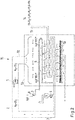
- Fig. 2 shows an apparatus for conducting the method according to the present invention.
- the apparatus 15 comprises a heater 10, said heater 10 is used for heating the catalytic composition 5 that is arranged at regular intervals in a plug flow reactor.
- the heater 10 is also used to heat water which is fed from a water barrel 8 to a spiral shaped pipe 9. By heating the water in the spiral shaped pipe 9 water vapor is generated.
- the exhaust pipe 12 collects the exhaust gases of the heater 10 that serve as a CO 2 -containing gas, said CO 2 -containing gas is pumped by mean of a gas pump 1 through pipes 2 and 3 where the gas stream passes a pressure controller 6 connected to the pipe 3 via a valve 4.
- the plug-flow reactor Before the CO 2 -containing gas enters the plug-flow reactor it passes an inlet where the generated water vapor is mixed with the CO 2 -containing gas. In the plug flow reactor, the mixture of CO 2 -containing gas and water vapor is contacted with the heated catalytic mixture. Finally, the reaction mixture comprising the product compounds passes to an outlet pipe 11 where it may be collected for further purification or use.
- the catalytic composition comprises the matrix components and the catalyst components. Amounts of the different compounds are given weight-% of the catalytic composition.
- Example 1 Example 2 Example 3 Example 4 Example 5 Al 2 O 3 12.0 15.0 8.0 4.0 0.0 C - - - 10.0 - Cd - - - 2.0 1.0 Ce - 5.0 - 3.0 2.0 Co - - 10.0 - 10.0 Cr 2 O 3 8.0 8.0 4.0 - 3.0 Cu 7.0 10.0 6.0 3.0 3.0 Eu 0.5 - - - - FeO - 6.0 - - - Fe 2 O 3 - - - - 20.0 Fe 3 O 4 - - - 12.0 - Gd 1.5 - - - - MoO 3 - 16.0 3.0 - - Mo 3 O 7 10.0 - - 3.0 - NaOH - - - 8.0 - Nd - - 2.0 - - Ni 5.0 - - - 10.0 NiO 5.0 10.0 18.0 5.0 - Sm 1.0 - 2.0 - 1.0 Obsidian 25.0 30.0 47.0 30.0 - Vermic
- Examples number 1 to 5 The catalytic compositions of examples number 1 to 5 were subsequently placed in a plug flow reactor and tested for their catalytic activity in converting CO2-containing gas streams into synthesis gas and/or other hydrocarbon compounds.
- the reactor was heated to 140°C.
- CO2-containing gas and water vapor were mixed in the reactor and subsequently contacted with the catalytic composition.
- Samples of the gas stream were collected at the outlet pipe and subsequently analyzed.
- Example Gas stream at outlet (components given in weight-%) H 2 CO CrO 2 H 2 O CH 4 C 2 H 4 1 70 10 14 3 2 1 2 11 11 65 10 2 1 3 16 8 42 29 4 1 4 46 16 10 15 12 1 5 63 7 15 10 4 1
- reaction products are found in various concentration. These additional products are for example, but not limited to Methanol, Ethanol, Acetylene, Benzene and Formaldehyde.
Landscapes
- Chemical & Material Sciences (AREA)
- Organic Chemistry (AREA)
- Engineering & Computer Science (AREA)
- Chemical Kinetics & Catalysis (AREA)
- Materials Engineering (AREA)
- Combustion & Propulsion (AREA)
- Inorganic Chemistry (AREA)
- General Health & Medical Sciences (AREA)
- Health & Medical Sciences (AREA)
- Oil, Petroleum & Natural Gas (AREA)
- Crystallography & Structural Chemistry (AREA)
- General Chemical & Material Sciences (AREA)
- Catalysts (AREA)
- Organic Low-Molecular-Weight Compounds And Preparation Thereof (AREA)
- Carbon And Carbon Compounds (AREA)
- Low-Molecular Organic Synthesis Reactions Using Catalysts (AREA)
Abstract
The present invention relates to a catalytic composition comprising at least 7 different elements selected from the group consisting of the elements defined by the intersection of the second to the sixth period and the first to the sixteenth group of the periodic table of the elements, whereby technetium is excluded, and a matrix component. A method for use of the catalytic composition is also provided.
Description
- The present invention relates to a method for the conversion of CO2 to synthesis gas and hydrocarbon compounds and a catalytic composition.
- Fossil fuels have been playing an important role in the generation of energy. Energy consumption has increased constantly over the last decades. As consequence, the dependency on fossil fuels was reinforced and energy generation led to a dramatic increase in the release of the greenhouse gas CO2 into the atmosphere. Enormous volumes in the range of billions of tons of CO2 are emitted to the atmosphere and the trend is still increasing. Meanwhile, more and more evidence emerged that this man-made emission of CO2 is at least partly influencing changes in climate and weather such as suddenly changing conditions, e.g. flood and drought. Furthermore, large amounts of CO2 are emitted during iron smelting as well as the production of concrete. Therefore, it is highly desirable to uncouple economic growth from the fossil fuel based energy generation and CO2 emissions caused thereby. This to avoid potentially dangerous climate and weather changes that may not be reversible. Multiple attempts have been made to capture and utilize carbon dioxide but they lack efficiency and / or require drastic conditions to obtain sufficient conversion of the little reactive CO2.
- One suitable way to reduce CO2 represents the conversion of CO2 to useful chemicals. Indeed, this could be one of the best ways to reduce the global emissions on one side and produce valuable products on the other side. CO2 represents an abundant and valuable source of carbon that can be used alternatively to usage of fossil fuels. This could potentially contribute to a significant reduction in the greenhouse gas CO2 and thus obviate undesired changes in climate and weather.
- Nowadays, fossil fuels still make up more than 80% of the world's energy sources. In addition, the chemical industry heavily uses fossil fuels as 95% of the organic-based chemicals are derived from non-renewable sources such as fossil fuels. Complete chemical industry branches solely rely on fossil raw materials, namely the petrochemical and synthetic polymers industry. There is an urgent need in transitioning chemical and energy industry primarily depending on fossil fuels away to non-fossil or at least less fossil fuel consuming resources. This is also a reason as to the increasing importance of readily available CO2 as a source for synthetic fuels and base chemicals and further chemical products. Most importantly, using CO2 as a source for carbon would allow reducing man-made CO2 emissions itself. The processes by which CO2 utilization may reduce pertinent emissions are basically CO2 capture and subsequent (longterm) storage, e.g. by mineralization or subsequent use of captured CO2 as a source for carbon. The latter also decreases the need of using fossil fuel as a carbon source for base chemical compounds. A main focus in the CO2 utilization field lies on the development of efficient chemical methods for capturing and subsequent using CO2.Catalysts are sought to be more efficient at lower costs, lower material consumption or waste production. There is a need for the development of highly efficient catalysts that allow conversion of preferably unpurified CO2 containing gas streams originating from industrial flue gases, such as cement, steel or further energy consuming industries, in the production of synthetic fuel or base chemicals that are further used in synthesis. As a very welcome consequence this would reduce the present dependency on fossil fuels. Direct conversion of CO2 into base chemicals or chemical building blocks is therefore of great importance since this allows exploiting a more sustainable and readily available carbon source such as CO2.
- Many catalysts employed in CO2 utilization are optimized in terms of good yields and accelerated reactions and thus improve the process of CO2 utilization. However, the development of catalysts which require less purified or non-purified CO2 streams, catalysts able to tolerate nitrogen, water, SOx and NOx compounds in a typical flue gas, and which are also efficient at low CO2 concentrations would specifically be highly beneficial. As the ability to utilize variable composition streams of CO2 directly from industrial processes without the need of purification of the gas streams prior to their use, would achieve a significant economic and environmental improvement of the overall process.
- Methane is the main component of natural gas and its significance as a fossil fuel increased due to its advantageously low carbon-hydrogen ratio and its versatility in possible end uses. In addition to oil and coal it is the third most used fossil fuel at a global level employed for heating, in the energy sector and as a feedstock for the chemical sector. Further, it is more and more often used as a transport fuel. Methane is synthesized by Sabatier reaction from CO2 or CO and H2 at higher temperatures (300° to 700°C) in the presence of nickel or ruthenium containing metal catalysts and may be directly fed into the natural gas network where it can partly replace the fossil methane. The existing infrastructure for natural gas (pipeline network, storage facilities and end use devices) may be used without further modification. The use of H2 for the reduction of carbon dioxide calls for cheap and efficient sources of hydrogen. Expensive or laborious methods for producing H2 significantly lower the benefits of CO2 or CO conversion processes into synthetic fuels and base or building block chemicals. A variety of different technologies is at hand that may be used for hydrogen production, e.g. water electrolysis which is, however, costly. Thus, a cheap and efficient way for producing H2 is of utmost importance. From an economic and ecologic point of view, the development of an efficient catalyst allowing thermal reduction of both, dilute and non-purified CO2 streams, e.g. into synthetic fuel and water vapor into H2, and hence, the direct conversion of CO2 into value-added chemicals within one operational device, promoted by a simple and cheap catalyst system and without the need of expensive separate electrolysis of water is highly desirable.
-
DE 10 2006 035 893 describes a method for the conversion of combustion products into CO and subsequently by adding H2 produced by electrolysis into methanol and further hydrogen carbon compounds. -
DE102009014728 describes the conversion of CO2 with CH4 to syngas under support of pulsed electrochemical energy at moderate temperatures. However, this process is classified as reforming process using CH4 as reducing agent and requires additional electrochemical energy. -
DE69518550 describes the conversion of CO2 with H2 in presence of a Fe-K/Al2O3 catalyst to generate C2+hydrocarbons at 1-100 bar, 200-500°C and 500-20000 h-1 volume velocity. However, this reaction requires the presence of separately produced hydrogen as reducing agent. -
DE 698 10 493 discloses a process for the manufacture of, inter alia, alcohols and hydrocarbons from syngas, and relates to metal catalysts based on manganese or magnesium and further alkaline earth metals or alkali metals for use in the process in which molecules having two or more, especially four or more, carbon atoms are provided from carbon monoxide and hydrogen. The production of syngas from CO2 again requires separately produced hydrogen as reducing agent. - Steinfeld et al., energy & fuels, 2012, 26, 7051 - 7059, report solar-driven thermochemical cycles on metal oxide redox reaction to split water and CO2 to produce H2 and CO at temperature far above 1000°C and require solar energy support.
- The object of the present invention is to provide a highly efficient catalyst for the conversion of CO2 into synthesis gas and further lower molecular organic compounds eliminating the drawbacks of prior art catalysts. A method for use of the catalyst is also provided.
- The object is achieved by a catalytic composition according to claim 1 and a method according to claim 6. Further preferred embodiments are subject to dependent claims.
- A catalytic composition according to the present invention comprises at least seven different elements. The elements are selected from the group consisting of the elements defined by the intersection of the second to the sixth period and the first to the sixteenth group of the periodic table of the elements, whereby technetium is excluded. The numbering of the periods corresponds to the current IUPAC standard. The catalytic composition further comprises a matrix component. It will be understood that in the catalyst the metallic elements may be in elemental form or they may be in the form of compounds, e.g., their oxides, or as mixtures of the metals in elemental form and compounds of the metals.
- In a preferred embodiment, the matrix is a porous matrix. A higher porosity increases the surface to weight ratio and thus the contact surface for the compounds reacting with the catalyst.
- In another preferred embodiment, the matrix of the catalytic composition has a surface to weight ratio of at least 40 m2/g.
- Preferably, the at least one matrix component of the catalytic composition is selected from the group consisting of natural aluminosilicates, synthetic aluminosilicates, zeolites, vermiculite, activated carbon, obsidian, titanium oxide, aluminum oxide, and mixtures thereof. More preferred are the components vermiculite and obsidian, and most preferred mixtures thereof.
- In another embodiment, the at least 7 elements of the catalytic composition are selected from the group consisting of Al, C, Cd, Ce, Co, Cr, Cu, Eu, Fe, Gd, Mo, Mo, Na, Nd, Ni, O, and Sm. Again, the metal elements in the catalyst may be in elemental form or they may be in the form of compounds, e.g., their oxides, or as mixtures of the metals in elemental form and compounds of the metals. Catalytic compositions which comprise combinations of these elements achieve particularly good results in the conversion of CO2.
- Catalytic compositions according to the present invention can be regenerated when they have reached their lifetime which is approximately 10'000 hours. Regeneration of the catalytic composition is achieved by thermal treatment with dry gas steam at a temperature of 300°C or higher for one hour.
- A method for preparing synthesis gas and hydrocarbon compounds from a CO2-containing gas comprises the following steps: First, the CO2-containing gas is mixed with water vapor. Second the mixture of CO2-containing gas and water vapor are subsequently contacted with a catalytic composition according to the present invention. Usually, the catalytic composition is heated to the desired process temperature. Synthesis gas, is a fuel gas mixture consisting primarily of hydrogen, carbon monoxide, and very often some carbon dioxide. Hydrocarbon compounds that are produced are mainly methane and ethane.
- In a preferred embodiment, the method is carried out at a temperature below 250°C, preferably a temperature in the range of 100°C to 180°C, preferably in the range of 120°C to 160°C and most preferably in the range of 130°C to 150°C. The method is advantageously carried out at lower temperatures as this decreases energy consumption required for the heating of the reaction mixture and the catalytic composition.
- In another embodiment, the method is carried out at low pressure, preferably at below 10 bars, more preferably in the range of 0.1 to 2 bar. Carrying out the reaction at lower pressures simplifies requirements regarding the equipment, the apparatus used.
- Advantageously, the sources for the CO2-containing gas that may be used in the method according to the present invention are numerous and different. A preferred source for CO2-containing gas is exhaust gas of a combustion process. Other sources, such as exhaust gases of power plants or cement plants may also be used. Most advantageously, the CO2-containing gas may be unpurified exhaust gas. Thus, no tedious purification steps, for instance the separation of sulfur or nitrogen containing compounds, is necessary.
- However, the CO2-containing gas can also be submitted to the reaction as gas mixture diluted with further gases such as nitrogen, oxygen, argon and sulfur oxides.
- In a further embodiment, the heat energy of the CO2-containing gas is employed to carry out the catalytic reaction. For instance, the heat energy of exhaust gases originating from combustion processes can be employed to heat the catalytic composition as well as the production of water vapor. In addition, the heat energy of such exhaust gases is also sufficient to maintain the required process temperature.
- Advantageously, the conversion rate for the conversion of CO2 to flammable gases is more than 30%, more preferably more than 50% or even more preferably more than 95%.
- An apparatus for conducting the method according to the present invention comprises an inlet pipe for CO2-containing gas to the reaction system and a water inlet pipe. It further comprises an optionally heating device which is used for the generation of water vapor. In parallel the heating device also serves for heating the catalytic composition. A reaction vessel comprises the catalytic composition, and an outlet pipe serves for discharging the reaction products. The reaction vessel is flow-connected with the inlet pipes and the outlet pipe.
- In a preferred embodiment, the reaction vessel is a single chamber reactor or plug flow reactor.
- In another embodiment, there are at least two catalytic compositions comprising different elements. These different catalytic compositions are preferably arranged in series for instance in a plug flow reactor. It is further possible to arrange more than two different catalytic compositions in series. This serial arrangement of several different catalytic compositions advantageously allows to increase efficiency of the conversion and to direct the main products of the conversion.
- The method for the conversion of CO2 and the apparatus for conducting the method according to the present invention are explained in more detail below with reference to exemplary embodiments in the drawings, in which, purely schematically:
-
Fig. 1 shows a flow chart of the method according to the present invention; -
Fig. 2 shows an apparatus for conducting the method according to the present invention; -
Fig. 1 shows a flow chart depicting the steps of the method. In a first step water is heated to generate water vapor. The water vapor is then mixed with the CO2-containing gas which mixture is subsequently contacted with the heated catalytic composition. -
Fig. 2 shows an apparatus for conducting the method according to the present invention. Theapparatus 15 comprises aheater 10, saidheater 10 is used for heating thecatalytic composition 5 that is arranged at regular intervals in a plug flow reactor. Theheater 10 is also used to heat water which is fed from a water barrel 8 to a spiral shapedpipe 9. By heating the water in the spiral shapedpipe 9 water vapor is generated. Theexhaust pipe 12 collects the exhaust gases of theheater 10 that serve as a CO2-containing gas, said CO2-containing gas is pumped by mean of a gas pump 1 throughpipes 2 and 3 where the gas stream passes a pressure controller 6 connected to the pipe 3 via a valve 4. Before the CO2-containing gas enters the plug-flow reactor it passes an inlet where the generated water vapor is mixed with the CO2-containing gas. In the plug flow reactor, the mixture of CO2-containing gas and water vapor is contacted with the heated catalytic mixture. Finally, the reaction mixture comprising the product compounds passes to an outlet pipe 11 where it may be collected for further purification or use. - In the following examples of the catalytic composition according to the present invention are described in more detail. The following examples show different catalyst compositions. All catalyst compositions were tested for their activity in converting CO2 in exhaust gases to synthesis gas and/or hydrocarbons. The catalytic composition comprises the matrix components and the catalyst components. Amounts of the different compounds are given weight-% of the catalytic composition.
Example 1 Example 2 Example 3 Example 4 Example 5 Al2O3 12.0 15.0 8.0 4.0 0.0 C - - - 10.0 - Cd - - - 2.0 1.0 Ce - 5.0 - 3.0 2.0 Co - - 10.0 - 10.0 Cr2O3 8.0 8.0 4.0 - 3.0 Cu 7.0 10.0 6.0 3.0 3.0 Eu 0.5 - - - - FeO - 6.0 - - - Fe2O3 - - - - 20.0 Fe3O4 - - - 12.0 - Gd 1.5 - - - - MoO3 - 16.0 3.0 - - Mo3O7 10.0 - - 3.0 - NaOH - - - 8.0 - Nd - - 2.0 - - Ni 5.0 - - - 10.0 NiO 5.0 10.0 18.0 5.0 - Sm 1.0 - 2.0 - 1.0 Obsidian 25.0 30.0 47.0 30.0 - Vermiculit e 25.0 - - 20.0 50.0 - The catalytic compositions of examples number 1 to 5 were subsequently placed in a plug flow reactor and tested for their catalytic activity in converting CO2-containing gas streams into synthesis gas and/or other hydrocarbon compounds. The reactor was heated to 140°C. CO2-containing gas and water vapor were mixed in the reactor and subsequently contacted with the catalytic composition. Samples of the gas stream were collected at the outlet pipe and subsequently analyzed.
Example Gas stream at outlet (components given in weight-%) H2 CO CrO2 H2O CH4 C2H4 1 70 10 14 3 2 1 2 11 11 65 10 2 1 3 16 8 42 29 4 1 4 46 16 10 15 12 1 5 63 7 15 10 4 1 - Yet in other experiments also further reaction products are found in various concentration. These additional products are for example, but not limited to Methanol, Ethanol, Acetylene, Benzene and Formaldehyde.
Claims (15)
- Catalytic composition comprising at least 7 different elements selected from the group consisting of the elements defined by the intersection of the second to the sixth period and the first to the sixteenth group of the periodic table of the elements, whereby technetium is excluded, and a matrix component.
- Catalytic composition according to claim 1, whereby the matrix is a porous matrix.
- Catalytic composition according to any of claim 1 or 2, whereby the matrix has a surface to weight ratio of at least 40 m2/g
- Catalytic composition according to any one of the preceding claims, whereby the at least one matrix component is selected from the group consisting of natural aluminosilicates, synthetic aluminosilicates, zeolites, vermiculite, activated carbon, obsidian, titanium oxide, aluminum oxide, and mixtures thereof.
- Catalytic composition according to any one of claims 1 to 4, whereby the at least 7 elements are selected from the group consisting of Al, C, Cd, Ce, Co, Cr, Cu, Eu, Fe, Gd, Mo, Mo, Na, Nd, Ni, O, and Sm.
- Method for preparing synthesis gas and hydrocarbon compounds from a CO2-containing gas comprising the steps of mixing the CO2-containing gas with water vapor and subsequently contacting the mixture with a catalytic composition according to any one of claims 1 to 5.
- Method according to claim 6, whereby the method is carried out at a temperature below 250°C, preferably a temperature in the range of 100°C to 180°C, preferably in the range of 120°C to 160°C and most preferably in the range of 130°C to 150°C.
- Method according to any of claims 6 or 7, whereby the method is carried out at low pressure, preferably at below 10 bars, more preferably in the range of 0.1 to 2 bar.
- Method according to any one of claims 6 to 8, whereby the CO2-containing gas is exhaust gas of a combustion.
- Method according to any one of claims 6 to 8, whereby the CO2-containing gas is exhaust gas of a power plant, smelting plant or cement plant.
- Method according to any one of claims 6 to 8, whereby the CO2-containing gas is unpurified exhaust gas.
- Method according to any one of claims 6 to 8, whereby the heat energy of the CO2-containing gas is employed to carry out the catalytic reaction.
- Method according to any one of claims 6 to 8 for conversion of CO2 to flammable gases wherein the conversion rate is more than 30%, more preferably more than 50% or even more preferably more than 95%.
- Apparatus for conducting the method according to any one of the claims 6 to 13 comprising an inlet pipe CO2-containing gas, a water inlet pipe, a heating mean for generating water vapor and heating a catalytic composition, a reaction vessel comprising the catalytic composition, and an outlet pipe for discharging the reaction products, whereby the reaction vessel is flow-connected with the inlet pipes and the outlet pipe.
- Apparatus according to claim 14, whereby the reaction vessel is a single chamber reactor or plug flow reactor.
Priority Applications (7)
| Application Number | Priority Date | Filing Date | Title |
|---|---|---|---|
| EP17020309.5A EP3427821A1 (en) | 2017-07-14 | 2017-07-14 | Catalytic composition for co2 conversion |
| CA3069058A CA3069058A1 (en) | 2017-07-14 | 2018-07-16 | Catalytic composition for co2 conversion |
| JP2020501545A JP2020526392A (en) | 2017-07-14 | 2018-07-16 | Catalyst composition for CO2 conversion |
| PCT/EP2018/069321 WO2019012160A1 (en) | 2017-07-14 | 2018-07-16 | Catalytic composition for co2 conversion |
| CN201880046849.9A CN111246940A (en) | 2017-07-14 | 2018-07-16 | Catalytic composition for CO2 conversion |
| EP18742772.9A EP3664930A1 (en) | 2017-07-14 | 2018-07-16 | Catalytic composition for co2 conversion |
| US16/629,680 US20200270128A1 (en) | 2017-07-14 | 2018-07-16 | Catalytic composition for co2 conversion |
Applications Claiming Priority (1)
| Application Number | Priority Date | Filing Date | Title |
|---|---|---|---|
| EP17020309.5A EP3427821A1 (en) | 2017-07-14 | 2017-07-14 | Catalytic composition for co2 conversion |
Publications (1)
| Publication Number | Publication Date |
|---|---|
| EP3427821A1 true EP3427821A1 (en) | 2019-01-16 |
Family
ID=59383395
Family Applications (2)
| Application Number | Title | Priority Date | Filing Date |
|---|---|---|---|
| EP17020309.5A Withdrawn EP3427821A1 (en) | 2017-07-14 | 2017-07-14 | Catalytic composition for co2 conversion |
| EP18742772.9A Withdrawn EP3664930A1 (en) | 2017-07-14 | 2018-07-16 | Catalytic composition for co2 conversion |
Family Applications After (1)
| Application Number | Title | Priority Date | Filing Date |
|---|---|---|---|
| EP18742772.9A Withdrawn EP3664930A1 (en) | 2017-07-14 | 2018-07-16 | Catalytic composition for co2 conversion |
Country Status (6)
| Country | Link |
|---|---|
| US (1) | US20200270128A1 (en) |
| EP (2) | EP3427821A1 (en) |
| JP (1) | JP2020526392A (en) |
| CN (1) | CN111246940A (en) |
| CA (1) | CA3069058A1 (en) |
| WO (1) | WO2019012160A1 (en) |
Cited By (1)
| Publication number | Priority date | Publication date | Assignee | Title |
|---|---|---|---|---|
| CN110560075A (en) * | 2019-09-25 | 2019-12-13 | 哈尔滨工业大学 | A kind of nano-Cu-Eu alloy catalyst with core-shell structure and its preparation method and application |
Families Citing this family (1)
| Publication number | Priority date | Publication date | Assignee | Title |
|---|---|---|---|---|
| KR20260024176A (en) * | 2024-08-13 | 2026-02-20 | 지에스칼텍스 주식회사 | Catalyst system for carbon dioxide conversion with improved selectivity of reaction products using zeolite |
Citations (14)
| Publication number | Priority date | Publication date | Assignee | Title |
|---|---|---|---|---|
| DE69518550T2 (en) | 1995-07-31 | 2001-01-11 | Korea Research Institute Of Chemical Technology, Daejon | METHOD FOR PREPARING HYDROCARBONS |
| DE69810493T2 (en) | 1997-09-26 | 2003-10-30 | Exxonmobil Chemical Patents Inc., Baytown | METHOD WITH A CATALYST |
| US20040254059A1 (en) * | 2001-10-23 | 2004-12-16 | Andreas Ansmann | Iron-containing material suitable for use as hydrogenation catalyst |
| US20050023190A1 (en) * | 2003-08-01 | 2005-02-03 | Welch Robert C. | Process to manufacture low sulfur fuels |
| US20050230285A1 (en) * | 2004-04-15 | 2005-10-20 | George Yaluris | Compositions and processes for reducing NOx emissions during fluid catalytic cracking |
| US20070043250A1 (en) * | 2005-08-18 | 2007-02-22 | Teng Xu | Catalytic conversion of oxygenates to olefins |
| DE102006035893A1 (en) | 2006-07-31 | 2008-02-07 | Wolf, Bodo M., Dr. | Process for the reprocessing of combustion products of fossil fuels |
| US20080281136A1 (en) * | 2007-04-25 | 2008-11-13 | Hrd Corp. | Catalyst and method for converting natural gas to higher carbon compounds |
| US20100174129A1 (en) * | 2006-12-29 | 2010-07-08 | Bauman Richard F | High throughput propylene from methanol catalytic process development method |
| DE102009014728A1 (en) | 2009-03-25 | 2010-09-30 | Siemens Aktiengesellschaft | Method of operating a fossil fuel power plant and fossil fuel power plant with reduced carbon dioxide emissions |
| WO2012119958A1 (en) * | 2011-03-04 | 2012-09-13 | Antecy B.V. | Catalytic process for converting carbon dioxide to a liquid fuel or platform chemical |
| EP2769765A1 (en) * | 2013-02-22 | 2014-08-27 | Centre National De La Recherche Scientifique | Use of compositions obtained by calcing particular metal-accumulating plants for implementing catalytical reactions |
| US20150174566A1 (en) * | 2012-07-23 | 2015-06-25 | Centre National De La Recherche Scientifique | Use of certain manganese-accumulating plants for carrying out organic chemistry reactions |
| US20150231608A1 (en) * | 2012-09-25 | 2015-08-20 | Haldor Topsoe A/S | Steam reforming catalyst and method of making thereof |
Family Cites Families (1)
| Publication number | Priority date | Publication date | Assignee | Title |
|---|---|---|---|---|
| US7071140B2 (en) * | 2002-12-02 | 2006-07-04 | The Standard Oil Company | Catalyst for the manufacture of acrylonitrile |
-
2017
- 2017-07-14 EP EP17020309.5A patent/EP3427821A1/en not_active Withdrawn
-
2018
- 2018-07-16 WO PCT/EP2018/069321 patent/WO2019012160A1/en not_active Ceased
- 2018-07-16 US US16/629,680 patent/US20200270128A1/en not_active Abandoned
- 2018-07-16 CA CA3069058A patent/CA3069058A1/en active Pending
- 2018-07-16 JP JP2020501545A patent/JP2020526392A/en active Pending
- 2018-07-16 CN CN201880046849.9A patent/CN111246940A/en active Pending
- 2018-07-16 EP EP18742772.9A patent/EP3664930A1/en not_active Withdrawn
Patent Citations (14)
| Publication number | Priority date | Publication date | Assignee | Title |
|---|---|---|---|---|
| DE69518550T2 (en) | 1995-07-31 | 2001-01-11 | Korea Research Institute Of Chemical Technology, Daejon | METHOD FOR PREPARING HYDROCARBONS |
| DE69810493T2 (en) | 1997-09-26 | 2003-10-30 | Exxonmobil Chemical Patents Inc., Baytown | METHOD WITH A CATALYST |
| US20040254059A1 (en) * | 2001-10-23 | 2004-12-16 | Andreas Ansmann | Iron-containing material suitable for use as hydrogenation catalyst |
| US20050023190A1 (en) * | 2003-08-01 | 2005-02-03 | Welch Robert C. | Process to manufacture low sulfur fuels |
| US20050230285A1 (en) * | 2004-04-15 | 2005-10-20 | George Yaluris | Compositions and processes for reducing NOx emissions during fluid catalytic cracking |
| US20070043250A1 (en) * | 2005-08-18 | 2007-02-22 | Teng Xu | Catalytic conversion of oxygenates to olefins |
| DE102006035893A1 (en) | 2006-07-31 | 2008-02-07 | Wolf, Bodo M., Dr. | Process for the reprocessing of combustion products of fossil fuels |
| US20100174129A1 (en) * | 2006-12-29 | 2010-07-08 | Bauman Richard F | High throughput propylene from methanol catalytic process development method |
| US20080281136A1 (en) * | 2007-04-25 | 2008-11-13 | Hrd Corp. | Catalyst and method for converting natural gas to higher carbon compounds |
| DE102009014728A1 (en) | 2009-03-25 | 2010-09-30 | Siemens Aktiengesellschaft | Method of operating a fossil fuel power plant and fossil fuel power plant with reduced carbon dioxide emissions |
| WO2012119958A1 (en) * | 2011-03-04 | 2012-09-13 | Antecy B.V. | Catalytic process for converting carbon dioxide to a liquid fuel or platform chemical |
| US20150174566A1 (en) * | 2012-07-23 | 2015-06-25 | Centre National De La Recherche Scientifique | Use of certain manganese-accumulating plants for carrying out organic chemistry reactions |
| US20150231608A1 (en) * | 2012-09-25 | 2015-08-20 | Haldor Topsoe A/S | Steam reforming catalyst and method of making thereof |
| EP2769765A1 (en) * | 2013-02-22 | 2014-08-27 | Centre National De La Recherche Scientifique | Use of compositions obtained by calcing particular metal-accumulating plants for implementing catalytical reactions |
Non-Patent Citations (1)
| Title |
|---|
| STEINFELD ET AL., ENERGY & FUELS, vol. 26, 2012, pages 7051 - 7059 |
Cited By (2)
| Publication number | Priority date | Publication date | Assignee | Title |
|---|---|---|---|---|
| CN110560075A (en) * | 2019-09-25 | 2019-12-13 | 哈尔滨工业大学 | A kind of nano-Cu-Eu alloy catalyst with core-shell structure and its preparation method and application |
| CN110560075B (en) * | 2019-09-25 | 2022-03-25 | 哈尔滨工业大学 | Nano Cu-Eu alloy catalyst with core-shell structure and preparation method and application thereof |
Also Published As
| Publication number | Publication date |
|---|---|
| CN111246940A (en) | 2020-06-05 |
| WO2019012160A1 (en) | 2019-01-17 |
| EP3664930A1 (en) | 2020-06-17 |
| US20200270128A1 (en) | 2020-08-27 |
| CA3069058A1 (en) | 2019-01-17 |
| JP2020526392A (en) | 2020-08-31 |
Similar Documents
| Publication | Publication Date | Title |
|---|---|---|
| Álvarez et al. | Challenges in the greener production of formates/formic acid, methanol, and DME by heterogeneously catalyzed CO2 hydrogenation processes | |
| Goeppert et al. | Recycling of carbon dioxide to methanol and derived products–closing the loop | |
| ZHANG | Recent advances in integrated carbon dioxide capture and methanation technology | |
| JP2024513288A (en) | Efficient two-step process for direct production of liquid fuels from carbon dioxide and hydrogen | |
| WO2015055349A1 (en) | Integrated process/plant for storage of co2 by conversion to synthetic natural gas | |
| WO2012119958A1 (en) | Catalytic process for converting carbon dioxide to a liquid fuel or platform chemical | |
| Yu et al. | High-quality utilization of raw coke oven gas for hydrogen production based on CO2 adsorption-enhanced reforming | |
| CN115485353A (en) | Improved catalyst and process for direct production of liquid fuels from carbon dioxide and hydrogen | |
| Cañada-Barcala et al. | CO2 methanation enhanced with a cyclic SERP process using a commercial Ni-based catalyst mixed with 3A zeolite as adsorbent | |
| CN204211707U (en) | Utilize the device of coke-oven gas and blast furnace gas combination producing Sweet natural gas and liquefied ammonia | |
| US20200270128A1 (en) | Catalytic composition for co2 conversion | |
| Yoosefdoost et al. | Toward Carbon‐Negative Methanol Production from Biogas: Intensified Membrane Reactor | |
| Ji et al. | Enhanced hydrogen production from ammonia decomposition by a silica membrane reactor | |
| WO2024043941A1 (en) | One-step process for the production of hydrocarbons from carbon dioxide | |
| Marinoiu et al. | Carbon dioxide conversion to methane over supported nickel base catalysts | |
| CN104447195B (en) | Method for producing chemical product methanol, natural gas or synthetic oil by using calcium carbide furnace tail gas | |
| RU2530066C1 (en) | Method of producing hydrogen-containing gas | |
| CN102464544A (en) | Hydrothermal treatment using porous nickel catalystReduction of CO2Or CO is methane | |
| Wei et al. | Sorption enhanced catalysis for CO2 hydrogenation towards fuels and chemicals with focus on methanation | |
| KR20180115113A (en) | Chemical Production and Power Generation System using Landfill Gas | |
| CN100439238C (en) | Metal magnesium and its mixture doped with other metals catalyze the decomposition of hydrocarbons to produce hydrogen | |
| CN1726077A (en) | Method for generation of a synthesis gas by catalytic partial oxidation | |
| Deng et al. | Hydrogen Production by Catalytic Conversion of Ammonia | |
| RU2290363C1 (en) | Hydrogen generation method | |
| Faria | Multifunctional Reactors for Co2Methanation: Power-to-Gas Concept |
Legal Events
| Date | Code | Title | Description |
|---|---|---|---|
| PUAI | Public reference made under article 153(3) epc to a published international application that has entered the european phase |
Free format text: ORIGINAL CODE: 0009012 |
|
| AK | Designated contracting states |
Kind code of ref document: A1 Designated state(s): AL AT BE BG CH CY CZ DE DK EE ES FI FR GB GR HR HU IE IS IT LI LT LU LV MC MK MT NL NO PL PT RO RS SE SI SK SM TR |
|
| AX | Request for extension of the european patent |
Extension state: BA ME |
|
| RAP1 | Party data changed (applicant data changed or rights of an application transferred) |
Owner name: AZAD PHARMA AG |
|
| STAA | Information on the status of an ep patent application or granted ep patent |
Free format text: STATUS: THE APPLICATION IS DEEMED TO BE WITHDRAWN |
|
| 18D | Application deemed to be withdrawn |
Effective date: 20190717 |