EP3426756B1 - Pourable detergent suspension comprising bleach catalyst granules - Google Patents
Pourable detergent suspension comprising bleach catalyst granules Download PDFInfo
- Publication number
- EP3426756B1 EP3426756B1 EP17709682.3A EP17709682A EP3426756B1 EP 3426756 B1 EP3426756 B1 EP 3426756B1 EP 17709682 A EP17709682 A EP 17709682A EP 3426756 B1 EP3426756 B1 EP 3426756B1
- Authority
- EP
- European Patent Office
- Prior art keywords
- water
- suspension
- detergent
- coating
- bleach catalyst
- Prior art date
- Legal status (The legal status is an assumption and is not a legal conclusion. Google has not performed a legal analysis and makes no representation as to the accuracy of the status listed.)
- Active
Links
Classifications
-
- C—CHEMISTRY; METALLURGY
- C11—ANIMAL OR VEGETABLE OILS, FATS, FATTY SUBSTANCES OR WAXES; FATTY ACIDS THEREFROM; DETERGENTS; CANDLES
- C11D—DETERGENT COMPOSITIONS; USE OF SINGLE SUBSTANCES AS DETERGENTS; SOAP OR SOAP-MAKING; RESIN SOAPS; RECOVERY OF GLYCEROL
- C11D3/00—Other compounding ingredients of detergent compositions covered in group C11D1/00
- C11D3/39—Organic or inorganic per-compounds
- C11D3/3947—Liquid compositions
-
- C—CHEMISTRY; METALLURGY
- C11—ANIMAL OR VEGETABLE OILS, FATS, FATTY SUBSTANCES OR WAXES; FATTY ACIDS THEREFROM; DETERGENTS; CANDLES
- C11D—DETERGENT COMPOSITIONS; USE OF SINGLE SUBSTANCES AS DETERGENTS; SOAP OR SOAP-MAKING; RESIN SOAPS; RECOVERY OF GLYCEROL
- C11D3/00—Other compounding ingredients of detergent compositions covered in group C11D1/00
- C11D3/16—Organic compounds
- C11D3/20—Organic compounds containing oxygen
- C11D3/2003—Alcohols; Phenols
- C11D3/2065—Polyhydric alcohols
-
- C—CHEMISTRY; METALLURGY
- C11—ANIMAL OR VEGETABLE OILS, FATS, FATTY SUBSTANCES OR WAXES; FATTY ACIDS THEREFROM; DETERGENTS; CANDLES
- C11D—DETERGENT COMPOSITIONS; USE OF SINGLE SUBSTANCES AS DETERGENTS; SOAP OR SOAP-MAKING; RESIN SOAPS; RECOVERY OF GLYCEROL
- C11D3/00—Other compounding ingredients of detergent compositions covered in group C11D1/00
- C11D3/16—Organic compounds
- C11D3/26—Organic compounds containing nitrogen
- C11D3/33—Amino carboxylic acids
-
- C—CHEMISTRY; METALLURGY
- C11—ANIMAL OR VEGETABLE OILS, FATS, FATTY SUBSTANCES OR WAXES; FATTY ACIDS THEREFROM; DETERGENTS; CANDLES
- C11D—DETERGENT COMPOSITIONS; USE OF SINGLE SUBSTANCES AS DETERGENTS; SOAP OR SOAP-MAKING; RESIN SOAPS; RECOVERY OF GLYCEROL
- C11D3/00—Other compounding ingredients of detergent compositions covered in group C11D1/00
- C11D3/39—Organic or inorganic per-compounds
- C11D3/3902—Organic or inorganic per-compounds combined with specific additives
- C11D3/3905—Bleach activators or bleach catalysts
- C11D3/3935—Bleach activators or bleach catalysts granulated, coated or protected
Definitions
- the present invention relates to a pourable detergent suspension according to claim 1 comprising a bleaching agent and bleach catalyst. More particularly, the invention relates to a pourable detergent according to claim 1 comprising:
- the detergent suspension of the present invention combines pourability with high stability, despite the presence of a bleach catalyst, bleaching agent and a substantial amount of water.
- Detergent formulations typically contain a number of different active components, including surfactants, builders, enzymes and bleaching agents.
- Bleaching agents are employed in detergent compositions to remove bleachable stains, such as those associated with tea, coffee, red wine, and various fruit and vegetable products, by oxidizing the components that make up these stains.
- Typical bleaching agents for use in detergent formulations are chlorine- and peroxygen-based compounds, such as hypochlorite and percarbonate bleach, respectively.
- Bleach catalysts are employed in detergent compositions to activate the bleaching agent, especially at lower temperatures.
- Builders are incorporated in detergent formulations to complex magnesium and calcium ions as well as to maintain alkaline pH conditions.
- Phosphorous based builders such as phosphates
- Phosphorous based builders have been used for many years in a wide variety of detergent compositions.
- alternative building agents have been developed and these alternative builders have found their way into commercial detergent products.
- the aminocarboxylate chelant L-glutamic-N,N-diacetate is an example of an environmentally friendly builder that is used in commercial detergent products.
- aminocarboxylate chelants are present in detergent formulations in the form of their (fully deprotonated) sodium salts.
- Aqueous solutions of aminocarboxylate salts are alkaline.
- Liquid detergent formulations have been developed as these products offer the advantage over powdered formulations that they are easy to dose, may contain higher concentrations of active ingredients, suffer less from moisture spoilage during storage and/or are more easily dispersed into aqueous cleaning liquid.
- liquid detergent compositions that deliver cleaning, spotting and filming performance similar to that of a powdered formulation it is necessary to include components that remain undissolved in the liquid product matrix. These undissolved components need to be homogeneously suspended throughout the product to guarantee a constant, optimum cleaning result. Although this may be achieved by instructing the user to shake the product before use, it is clearly preferable to provide the liquid detergent formulation in the form of a suspension that remains stable during the lifecycle of the product. This objective, however, is very difficult to achieve as suspensions demix over time because suspended particles are subject to sedimentation and creaming/floating phenomena.
- Bleaching agents are moisture-sensitive detergent ingredients that lose their activity over time if the water activity of a detergent composition is too high.
- Detergent compositions containing bleaching agent in combination with bleach catalyst are particularly sensitive to moisture.
- EP-A 1 129 160 describes liquid aqueous cleaning compositions containing water, glycerol, builder, enzyme and thickener.
- WO 2013/092276 describes detergent formulations containing GLDA, water, citric acid, nonionic surfactant, coated spray-dried percarbonate, Mn catalyst granule and other ingredients.
- WO 2014/107578 describes detergent compositions containing water, glycerol, polyaminocarboxylic acid (chelating agent), nonionic surfactant.
- WO 2008/064935 describes a method for producing bleach catalyst granules comprising, relative to the total weight of the granules,
- WO 2016/005392 describes a granule comprising
- the present inventors have developed a pourable detergent suspension that is easy to manufacture and that exhibits good storage stability despite the fact that it contains bleaching agent, bleach catalyst and a significant amount of water.
- the pourable detergent suspension of the present invention comprises:
- the hygroscopic component is capable or reducing the water activity of the detergent suspension to very low levels, despite the presence of at least 8 wt.% water.
- the detergent suspension contains a moisture sensitive bleaching system (bleaching agent and bleach catalyst)
- the suspension is very stable. Further contributing to this stability are the special bleach catalyst granules that contain particles of manganese bleach catalyst that are separated from other components of the pourable detergent suspension by a matrix of water-soluble alkali metal sulfate salt.
- the detergent compositions of the present invention further offer the advantage that a wide range of detergent ingredients can be incorporated therein in either dispersed or dissolved form.
- the bleach catalyst granules are homogeneously dispersed throughout the detergents suspension.
- the present invention provides a pourable detergent suspension comprising:
- pourable refers to a composition that is able to flow under ambient conditions.
- Thixotropic compositions that can be rendered pourable by shear thinning are also regarded as pourable.
- thixotropic refers to compositions (e.g. gels or fluids) that are viscous under quiescent conditions and that become less viscous when shaken, agitated, or otherwise stressed. In thixotropic compositions, this so called “shear thinning effect" is reversible, i.e. the composition will return to a more viscous state once it is no longer subjected to shear stress.
- aminocarboxylate chelant refers to compounds containing one or more nitrogen atoms connected through carbon atoms to one or more carboxyl groups, which form strong complexes with metal ions by donation of electron pairs from the nitrogen and oxygen atoms to the metal ion to form multiple chelate rings.
- water-soluble alkali metal sulfate salt refers to a alkali metal sulfate salt having a solubility in distilled water at 20°C of at least 10 g/l, preferably of at least 50 g/l.
- particle size or “particle diameter”, unless indicated otherwise, it refers to particle diameter determined by laser diffraction using a system (such as a MastersizerTM 2000 available from Malvern Instruments Ltd) meeting the requirements set out in ISO 13320:2009.
- water content includes unbound (free) as well as bound water.
- a parameter such as a concentration or a ratio
- a certain upper limit it should be understood that in the absence of a specified lower limit the lower limit for said parameter is 0.
- the quantified amount or quantified concentration relates to said component per se, even though it may be common practice to add such a component in the form of a solution or of a blend with one or more other ingredients
- the detergent suspension of the present invention is a homogenous product.
- the non-dissolved components such as the bleach catalyst granules are evenly dispersed throughout the detergent suspension.
- the detergent suspension preferably contains one or more aminocarboxylate chelants. More preferably, the detergent suspension contains water and the one or more aminocarboxylate chelants in a weight ratio of not more than 2:1, preferably of not more than 1.5:1, most preferably of not more than 1.2:1. Water and the one or more aminocarboxylate chelants are typically contained in the detergent suspension in a weight ratio of at least 1:3, more preferably of at least 1:2 and most preferably of at least 1:1.8.
- the detergent suspension preferably contains glycerol.
- Glycerol and water are preferably contained in the pourable detergent suspension in a weight ratio that lies within the range of 2:3 to 1:6, more preferably within the range of 1:2 to 1:5, most preferably within the range of 1:2.2 to 1:4.
- the pourable detergent suspension preferably contains 20-75 wt.%, more preferably 30-60 wt.% and most preferably 35-55 wt.% glycerol.
- the water content of the detergent suspension preferably is in the range of 10-22 wt.%, more preferably in the range of 11-20 wt.% and most preferably in the range of 12-18 wt.%.
- the detergent suspension typically has a water activity of 0.2 to 0.6 at 20°C. More preferably, the water activity of the detergent suspension at 20°C is in the range of 0.3 to 0.5, most preferably of 0.35 to 0.45
- the pourable detergent suspension preferably contains at least 8 wt.%, more preferably 10-40 wt.% and most preferably 12-30 wt.% of the one or more aminocarboxylate chelants.
- the one or more aminocarboxylate chelants are selected from glutamic acid N,N-diacetic acid (GLDA), methylglycinediacetic acid (MGDA), iminodisuccinic acid (IDS), ethylenediaminetetraacetic acid (EDTA), diethylenetriaminepentaacetic acid (DTPA), hydroxyethyliminodiacetic acid (HEIDA), Nitrilotriacetic acid (NTA), aspartic acid diethoxysuccinic acid (AES), aspartic acid-N, -diacetic acid (ASDA), hydroxyethylenediaminetetraacetic acid (HEDTA), hydroxyethylethylenediaminetriacetic acid (HEEDTA), iminodifumaric (IDF), iminoditartaric acid (IDT), iminodimaleic acid (IDMAL), iminodimalic acid (IDM), ethylenediaminedifumaric acid (EDDF), ethylenedi
- the one or more aminocarboxylate chelants are selected from GLDA, MGDA, IDS, HEIDA, EDDS and NTA, and their salts. In an even more preferred embodiment, the one or more aminocarboxylate chelants are selected from GLDA, MGDA, IDS and their salts. Most preferably, the the one or more aminocarboxylate chelants are selected from GLDA and salts thereof.
- the GLDA employed in the present suspension preferably is an alkali metal salt of glutamic-N,N-diacetic acid. More preferably, the GLDA employed is a sodium salt of glutamic-N,N-diacetic acid. Most preferably, the GLDA employed is a tetra sodium salt of glutamic-N,N-diacetic acid.
- the combination of glycerol, water and the one or more amincarboxylate chelants typically represent at least 45 wt.%, preferably at least 55 wt.% and most preferably at least 60 wt.% of the detergent suspension.
- the present detergent suspension preferably contains at least 1.5 wt.%, more preferably 1.8-15 wt.% and most preferably 2-12 wt.% of bleaching agent.
- the bleaching agent is preferably selected from peroxy compound bleaches, hydrogen peroxide liberating compounds, hydrogen peroxide generating systems, peroxyacids and their salts, peroxyacid bleach precursor systems and combinations thereof. Even more preferably, the bleaching agent is a hydrogen peroxide sources selected from alkali metal peroxides, organic peroxide bleaching compounds and inorganic persalt bleaching compounds and combinations thereof. Even more preferably, the bleaching agent is a peroxide.
- peroxides are acids and corresponding salts of monopersulfate, perborate monohydrate, perborate tetrahydrate, and percarbonate.
- Organic peracids useful herein include alkyl peroxy acids and aryl peroxyacids such as peroxybenzoic acid and ring substituted peroxybenzoic acids (e.g. peroxy-alpha- naphthoic acid), aliphatic and substituted aliphatic monoperoxy acids (e.g. peroxylauric acid and peroxystearic acid), and phthaloyl amido peroxy caproic acid (PAP).
- peroxybenzoic acid and ring substituted peroxybenzoic acids e.g. peroxy-alpha- naphthoic acid
- aliphatic and substituted aliphatic monoperoxy acids e.g. peroxylauric acid and peroxystearic acid
- PAP phthaloyl amido peroxy caproic acid
- Typical diperoxy acids useful herein include alkyl diperoxy acids and aryldiperoxy acids, such as 1,12 di-peroxy-dodecanedioic acid (DPDA), 1,9 diperoxyazelaic acid, diperoxybrassylic acid, diperoxysebacic acid and diperoxy-isophthalic acid, and 2 decyldiperoxybutane 1,4 dioic acid.
- DPDA 1,12 di-peroxy-dodecanedioic acid
- 1,9 diperoxyazelaic acid diperoxybrassylic acid
- diperoxysebacic acid and diperoxy-isophthalic acid diperoxy-isophthalic acid
- 2 decyldiperoxybutane 1,4 dioic acid 2,4 di-diperoxybutane 1,4 dioic acid.
- the bleaching agent is percarbonate.
- the detergent suspension of the present invention preferably contains bleaching agent in the form of particles. More preferably, the suspension contains 1-15 wt.%, more preferably 2-12 wt.% of particles comprising bleaching agent. Preferably, these particles contain at least 10 wt.%, more preferably at least 30 wt.% and most preferably at least 50 wt.% of bleaching agent.
- the particles of bleaching agent are coated particles comprising one or more core particles that contain the bleaching agent, which one or more core particles are enclosed by a water-soluble coating.
- the water-soluble coating advantageously comprises a coating agent selected from alkali sulfate, alkali carbonate or alkali chloride and combinations thereof.
- the particles of bleaching agent typically have a diameter in the range of 10-3000 ⁇ m, more preferably of 20-2000 ⁇ m and most preferably of 30-1500 ⁇ m.
- the a volume weighted mean particle size of the particles of bleaching agent preferably is in the range of 10 to 3000 ⁇ m, more preferably of 100 to 1500 ⁇ m and most preferably of 200 to 1000 ⁇ m.
- the pourable detergent suspension of the present invention typically contains 0.2-4 wt.%, more preferably 0.2-3 wt.% and most preferably 0.4-2.5 wt.% of the bleach catalyst granules.
- the bleach catalyst granules typically contain at least 0.5 wt.%, more preferably 0.8-10 wt.% and most preferably 1-8 wt.% of the manganese bleach catalyst.
- the bleach catalyst granules typically contain at least 40 wt.%, more preferably at least 50 wt.% and most preferably at least 60 wt.% of the water-soluble salt.
- the bleach catalyst granules typically have a diameter of at least 50 ⁇ m, more preferably of 100-1500 ⁇ m, even more preferably of 250-1200 ⁇ m and most preferably of 350-1000 ⁇ m.
- the bleach catalyst granules are preferably spherical particles.
- the catalyst particles in the bleach catalyst granules typically contain at least 50 wt.%, more preferably at least 80 wt.% of manganese bleach catalyst.
- the inventors have unexpectedly found that granules having particularly good stability can be prepared if the diameter of the catalyst particles is very small.
- at least 90 wt.% of the catalyst particles have a diameter in the range of 0.2 to 25 ⁇ m, more preferably in the range of 0.4 to 20 ⁇ m, even more preferably in the range of 0.5 to 18 ⁇ m and most preferably in the range of 0.6 to 15 ⁇ m.
- the catalyst particles have a volume weighted mean diameter in the range of 1-12 ⁇ m, most preferably of 1.5-10 ⁇ m.
- the water-soluble alkali metal sulfate salt in the bleach catalyst granules preferably has a constant humidity at 2°C above 85%, particularly above 90%.
- the water-soluble alkali metal sulfate salt may be in anhydrous form, or it may be a hydrated salt, i.e. a crystalline salt hydrate with bound water(s) of crystallization.
- a specific example is anhydrous sodium sulfate (Na 2 SO 4 ).
- the bleach catalyst granules preferably contain at least 35 wt.%, more preferably 40-80 wt.% wt.% and most preferably at least 45-75 wt.% of the one or more core particles.
- the bleach catalyst granules contain one single core particle.
- the one or more core particles in the bleach catalyst granules preferably have a diameter of 40-1500 ⁇ m, more preferably of 80-1200 ⁇ m, even more preferably of 200-1000 ⁇ m and most preferably of 300-900 ⁇ m..
- the core particle may consist of inert carrier material.
- the core may suitably contain functional detergent ingredient such as builders, bleach activators, dispersing polymers, silicates, anti-scaling agents, glass corrosion inhibitors, ant-tarnishing agents, surfactants and combinations thereof.
- the core particles contain at least 50 wt.%, more preferably at least 80 wt.% and most preferably at least 90 wt.% of an inert carrier material selected from water-soluble salt (e.g. sulfate salt and/or carbonate salt), cellulose fibers, dextrin, disaccharides and combinations thereof.
- the coating of the bleach catalyst granules preferably has a thickness in the range of 5 to 150 ⁇ m, more preferably in the range of 10 to 120 ⁇ m, even more preferably in the range of 12 to 80 ⁇ m and most preferably in the range of 15 to 50 ⁇ m.
- the coating typically represents not more than 65 wt.%, more preferably 20-60 wt.% and most preferably 25-55 wt.% of the bleach catalyst granules.
- the coating preferably contains 2-25%, more preferably 3-20% and most preferably 3.5-15% by weight of the coating of the catalyst particles comprising manganese bleach catalyst.
- bleach catalyst granules contain a single core particle and the size of the core particle, the thickness of the coating and the size of the catalyst particles have been selected to provide an optimum combination of storage stability, suspension stability and delivery of the activity of the bleach catalyst during use. Accordingly, the bleach catalyst granules preferably contain one core particle having and meet the following specifications:
- the bleach catalyst granules meet the following specifications:
- the thickness of the coating exceeds the volume weighted average diameter of the catalyst particles by at least 50%, more preferably at least 100% and most preferably by at least 200%.
- the coating of the bleach catalyst granules preferably contains 55-90 wt.%, more preferably 60-85 wt.% of the water-soluble salt.
- the coating of the bleach catalyst granules comprises at least two coating layers, including (i) a first coating layer comprising 30-90 wt.% of the catalyst particles and 10-70 wt.% of a water-soluble binder, and (ii) a second layer that surrounds the first coating layer, said second coating layer comprising at least 60 wt.%, more preferably at least 70 wt.%, even more preferably at least 80 wt.% and most preferably at least 90 wt.% of the water-soluble salt.
- the water-soluble binder is preferably selected from monosaccharides, disaccharides, trisaccharides, dextrin and combinations thereof. Most preferably, the water-soluble binder is selected from sucrose, lactose, dextrin and combinations thereof. Most preferably, the water-soluble binder is dextrin, e.g. maltodextrin.
- the combination of catalyst particles, water-soluble salt and water-soluble binder typically constitutes at least 60 wt.%, more preferably at least 70 wt.% and most preferably at least 75 wt.% of the coating of the bleach catalyst granules.
- the aforementioned first coating layer preferably has an average thickness of 2-50 ⁇ m, more preferably of 3-30 ⁇ m, even more preferably of 4-25 ⁇ m and most preferably of 5-20 ⁇ m.
- the first coating layer typically comprises the catalyst particles in an amount of 2-15%, more preferably of 3-10% by weight of the core.
- the first coating layer preferably contains the water-soluble binder in an amount of 1-20%, more preferably of 2-10% by weight of the core.
- the second coating layer of the bleach catalyst granules typically represents at least 5%, more preferably at least 10% and most preferably at least 20% by weight of the core.
- the second coating layer preferably represents at most 100%, more preferably at most 80%and most preferably at most 75% by weight of the core.
- the second coating layer preferably has an average thickness of at least 3-100 ⁇ m, more preferably of 5-80 ⁇ m, even more preferably of 8-60 ⁇ m and most preferably of 10-40 ⁇ m.
- the bleach catalyst granules may include an additional third coating layer that surrounds the second coating layer.
- This third coating layer preferably contains at least 20 wt.%, more preferably at least 25 wt.% and most preferably at least 30 wt.% of a film forming component selected from polyethylene glycol (PEG), hydroxypropyl methyl cellulose (HPMC), polyvinyl alcohol (PVA) and combinations thereof.
- the third coating layer has a thickness in the range of 1-50 ⁇ m, most preferably of 2-30 ⁇ m.
- the manganese bleach catalyst in the coating of the bleach catalyst granules is represented by formula (I): [L n Mn m X p ] z Y q (I) wherein:
- the coefficient p preferably is an integer from 3 to 6.
- each Mn independently has an oxidation state selected from III and IV.
- X in formula (I) preferably represents a coordination or bridging species selected from H 2 O, OH - , O 2- , S 2 - , HOO - , O 2 2- , O 2 1- , R-COO - , with R being H, alkyl, aryl, optionally substituted, NR 3 with R being H, alkyl, aryl, optionally substituted, Cl - , SCN - , N 3 - , etc. or a combination thereof.
- X represents O 2- or (OAc) - , more preferably O 2- .
- Ac signifies an acyl group.
- Y is a counter-ion, the type of which is dependent upon the charge z of the complex which can be positive, zero or negative. If z is positive, Y is an anion, such as Cl - , Br - , I - , NO 3 - , ClO 4 - , NCS - , PF 6 - , RSO 4 - , OAc - , BPh 4 - , CF 3 SO 3 - , RSO 3 - , RSO 4 - , etc., where R represents alkyl, or aryl. Preferably, Y is PF 6 - or ClO 4 - . If z is negative, Y is a cation, such as an alkali metal, alkaline earth metal or (alkyl)ammonium cation, etc.
- L in formula (I) is a ligand in the form of a macrocyclic organic molecule represented by general formula (II) wherein R 1 and R 2 can each be zero, H, alkyl or aryl; t and t' are each independent integers from 2 to 3; each D can independently be N, NR, PR, O, or S, wherein R is H, alkyl or aryl.
- the coefficient s in formula (II) preferably is 2, 3, or 4, even more preferably s is 2.
- Particularly preferred ligands are 1,4,7-trimethyl-1,4,7-triazacyclononane, coded as Me-TACN, 1,4,7-triazacyclononane, coded as TACN, 1,5,9-trimethyl-1,5,9-triazacyclododecane, coded as Me-TACD; 2-methyl-1,4,7-trimethyl-1,4,7-triazacyclononane, coded as Me/Me-TACN and 2-methyl-1,4,7-triazacyclononane, coded as Me/TACN.
- Me-TACN and Me/Me-TACN are the most preferred.
- Examples of suitable manganese bleach catalysts are provided in EP-A- 0 458 397 .
- the manganese bleach catalyst comprises one or more from [Mn III 2 ( ⁇ -O) 1 ( ⁇ -OAc) 2 (Me-TACN) 2 ] (ClO 4 ) 2 , [Mn III Mn IV ( ⁇ -O) 1 ( ⁇ -OAc) 2 (Me-TACN) 2 ] (ClO 4 ) 3 , [Mn III 2 ( ⁇ -O) 1 ( ⁇ -OAc) 2 (Me-TACN) 2 ] (PF 6 ) 2 , [Mn III 2 ( ⁇ -O) 1 ( ⁇ -OAc) 2 (Me/Me-TACN) 2 ] (PF 6 ) 2 , [Mn IV 2 ( ⁇ -O) 3 (Me-TACN) 2 ] (PF 6 ) 2 , and [Mn IV 2 ( ⁇ -O) 3 (Me/Me-TACN) 2 ] (PF 6 ) 2 , and [Mn IV 2 (
- the manganese bleach catalyst comprises one or more from [Mn IV 2 ( ⁇ -O) 3 (Me-TACN) 2 ] (PF 6 ) 2 , and [Mn IV 2 ( ⁇ -O) 3 (Me/Me-TACN) 2 ] (PF 6 ) 2 . It is still more preferred that the manganese bleach catalyst is [Mn IV 2 ( ⁇ -O) 3 (Me-TACN) 2 ] (PF 6 ) 2 .
- the bleach catalyst granules of the present invention may suitably be produced by fluid bed coating.
- the first coating layer is applied by spraying onto a fluidized bed of core particles an aqueous suspension of catalyst particles that contains dissolved binder.
- the coated particles so obtained are coated with the second coating layer by means of fluid bed coating by spraying an aqueous salt solution onto a fluidized bed of the coated particles.
- the detergent composition may contain one or more bleach activators such as peroxyacid bleach precursors.
- Peroxyacid bleach precursors are well known in the art. As non-limiting examples can be named N,N,N',N'-tetraacetyl ethylene diamine (TAED), sodium nonanoyloxybenzene sulfonate (SNOBS), sodium benzoyloxybenzene sulfonate (SBOBS) and the cationic peroxyacid precursor (SPCC) as described in US-A-4,751 ,015 .
- the present detergent suspension preferably contains one or more surfactants.
- Surfactants within the invention, are components within the classification as described in " Surfactant Science Series", Vol.82, Handbook of detergents, part A: Properties, chapter 2 (Surfactants, classification), G. Broze (ed .).
- the detergent composition contains 0.5-30 wt.%, preferably 1-20 wt.%,more preferably 1.3-10 wt.% of one or more surfactants.
- the surfactants are selected from one or more non-ionic surfactants.
- the composition contains 0.1-15 wt.%, more preferably 0.5-10 wt.% and most preferably 1-5 wt.% of a nonionic surfactant or a mixture of two or more non-ionic surfactants.
- nonionic surfactants that may be employed in the present composition include the condensation products of hydrophobic alkyl, alkenyl, or alkyl aromatic compounds bearing functional groups having free reactive hydrogen available for condensation with hydrophilic alkylene oxide, such as ethylene oxide, propylene oxide, butylene oxide, polyethylene oxide or polyethylene glycol to form nonionic surfactants.
- functional groups include hydroxy, carboxy, mercapto, amino or amido groups.
- Examples of useful hydrophobes of commercial nonionic surfactants include C8-C18 alkyl fatty alcohols, C8-C14 alkyl phenols, C8-C18 alkyl fatty acids, C8-C18 alkyl mercaptans, C8-C18 alkyl fatty amines, C8-C18 alkyl amides and C8-C18 alkyl fatty alkanolamides.
- suitable ethoxylated fatty alcohols may be chosen from ethoxylated cetyl alcohol, ethoxylated ketostearyl alcohol, ethoxylated isotridecyl alcohol, ethoxylated lauric alcohol, ethoxylated oleyl alcohol and mixtures thereof.
- suitable nonionic surfactants for use in the invention are found in the low- to non-foaming ethoxylated/ propoxylated straight-chain alcohols of the PlurafacTM LF series, supplied by the BASF and the SynperonicTM NCA series supplied by Croda.
- end-capped ethoxylated alcohols available as the SLF 18 series from BASF and the alkylpolyethylene glycol ethers made from a linear, saturated C16-C18 fatty alcohol of the LutensolTM AT series, supplied by BASF.
- suitable nonionics to apply in the composition of the invention are modified fatty alcohol polyglycolethers available as DehyponTM 3697 GRA or DehyponTM Wet from BASF/Cognis.
- nonionics from the LutensolTM TO series of BASF which are alkylpolyethylene glycol ethers made from a saturated iso-C13 alcohol.
- Amineoxide surfactants may also be used in the present invention as anti- redeposition surfactant.
- Suitable amineoxide surfactants are C10-C15 alkyl dimethylamine oxide and C10-C15 acylamido alkyl dimethylamine oxide.
- the inventors have found that, a detergent composition that is not only chemically but also physically very stable can be produced if the nonionic surfactant employed is solid at ambient temperature.
- the present composition contains 0.1 -30 wt.%, more preferably 0.5-20 wt.%, further preferred 1-10 wt.%, and most preferably 1 -5 wt.% of nonionic surfactant that is solid at 25°C.
- the total amount present preferably is less than 5 wt.%, and more preferably not more than 2 wt.%. Furthermore, if an anionic surfactant is present, it is preferred that an antifoam agent to suppress foaming is present.
- suitable anionic surfactants are methylester sulphonates or sodium lauryl sulphate. It is preferred that no anionic surfactant is present in the composition of the current invention.
- Silicates may be added to the formulation.
- Silicates can act as builder, buffering agent or article care agent.
- Preferred silicates are sodium silicate such as sodium disillicate, sodium metasilicate and crystalline phyllosilicates and mixtures thereof.
- Silicates are preferably used in the detergent suspension in a concentration of 0.5 to 8%, more preferably of 0.8 to 6% by weight of the suspension.
- enzymes suitable for use in the cleaning suspensions of this invention include lipases, cellulases, peroxidases, proteases (proteolytic enzymes), amylases (amylolytic enzymes) and others which degrade, alter or facilitate the degradation or alteration of biochemical soils and stains encountered in cleansing situations so as to remove more easily the soil or stain from the object being washed to make the soil or stain more removable in a subsequent cleansing step. Both degradation and alteration can improve soil removal.
- the one or more active enzymes contained in the present suspension are selected from protease, amylase, cellulase, peroxidase, mannanase, pectate lyase and lipase.
- the active enzyme is selected from protease, amylase and combinations thereof.
- the suspension of the present invention typically contains at least 10 mg/kg, more preferably at least 20 mg/kg, even more preferably at least 50 mg/kg and most preferably at least 100 mg/kg of active enzyme.
- the concentration of active enzyme preferably does not exceed 50 g/kg, more preferably it does not exceed 40 g/kg and most preferably it does not exceed 30 g/kg.
- the suspension contains at least 10 mg/kg, more preferably at least 20 mg/kg and most preferably at least 50 mg/kg of active amylase.
- the suspension contains at least 100 mg/kg, more preferably at least 200 mg/kg and most preferably at least 400 mg/kg of active protease.
- Enzymes may be added in liquid or in encapsulated form.
- encapsulated enzymes are enzyme granule types D, E and HS by Genencor and granule types , T, GT, TXT and EvityTM of Novozymes.
- proteolytic enzymes in this invention include metal loproteases and serine proteases, including neutral or alkaline microbial serine protease, such as subtilisins (EC 3.4.21 .62).
- the proteolytic enzymes for use in the present invention can be those derived from bacteria of fungi. Chemically or genetically modified mutants (variants) are included.
- Preferred proteolytic enzymes are those derived from
- Bacillus such as B. lentus, B. gibsonii, B. subtilis, B. licheniformis, B. alkalophilus, B. amyloliquefaciens and Bacillus pumilus, of which B. lentus and B. gibsonii are most preferred.
- proteolytic enzymes are ExcellaseTM, ProperaseTM, PurafectTM, PurafectTM Prime, PurafectTM Ox by Genencor; and those sold under the trade names BlazeTM, OvozymeTM, SavinaseTM, AlcalaseTM, EverlaseTM, EsperaseTM, RelaseTM, PolarzymeTM, LiquinaseTM and CoronaseTM by Novozymes.
- amylolytic enzymes for use in the present invention can be those derived from bacteria or fungi. Chemically or genetically modified mutants (variants) are included.
- Preferred amylolytic enzyme is an alpha-amylase derived from a strain of Bacillus, such as B. subtilis, B. licheniformis, B. amyloliquefaciens or B. stearothermophilus.
- Examples of such amylolytic enzymes are produced and distributed under the trade name of StainzymeTM, StainzymeTM Plus, TermamylTM, NatalaseTM and DuramylTM by Novozymes; as well as PoweraseTM, PurastarTM, PurastarTM Oxam by Genencor. StainzymeTM, StainzymeTM Plus and PoweraseTM are the preferred amylases.
- the suspension contains active protease and the protease activity of the freshly prepared suspension decreases by not more than 70%, more preferably by not more than 50% and most preferably by not more than 20% when the suspension is stored in a closed container for 8 weeks at 20 °C.
- Well known enzyme stabilizers such as polyalcohols/borax, calcium, formate or protease inhibitors like 4-formylphenyl boronic acid may also be present in the suspension.
- the detergent suspension may suitably contain one or more dispersing polymers.
- Dispersing polymers as referred to in this invention are chosen from the group of anti-spotting agents and/or anti-scaling agents.
- suitable anti-spotting polymeric agents include hydrophobically modified polycarboxylic acids such as AcusolTM 460 ND (ex Dow) and AlcosperseTM 747 by AkzoNobel, whereas also synthetic clays, and preferably those synthetic clays which have a high surface area are very useful to prevent spots, in particular those formed where soil and dispersed remnants are present at places where the water collects on the glass and spots formed when the water subsequently evaporates.
- hydrophobically modified polycarboxylic acids such as AcusolTM 460 ND (ex Dow) and AlcosperseTM 747 by AkzoNobel
- synthetic clays and preferably those synthetic clays which have a high surface area are very useful to prevent spots, in particular those formed where soil and dispersed remnants are present at places where the water collects on the glass and spots formed when the water subsequently evaporates.
- Suitable anti-scaling agents include organic phosphonates, amino carboxylates, polyfunctionally-substituted compounds, and mixtures thereof.
- anti-scaling agents are organic phosphonates such as alpha-hydroxy-2 phenyl ethyl diphosphonate, ethylene diphosphonate, hydroxy 1 ,1 - hexylidene, vinylidene 1 ,1 -diphosphonate, 1 ,2-dihydroxyethane 1 ,1 -diphosphonate and hydroxy-ethylene 1 ,1 - diphosphonate.
- organic phosphonates such as alpha-hydroxy-2 phenyl ethyl diphosphonate, ethylene diphosphonate, hydroxy 1 ,1 - hexylidene, vinylidene 1 ,1 -diphosphonate, 1 ,2-dihydroxyethane 1 ,1 -diphosphonate and hydroxy-ethylene 1 ,1 - diphosphonate.
- EDHP hydroxy-ethylene 1 ,1 - diphosphonate
- 2-phosphono-butane 1 ,2,4-tricarboxylic acid
- Suitable anti-scaling agents are water soluble dispersing polymers prepared from an allyloxybenzenesulfonic acid monomer, a methallyl sulfonic acid monomer, a copolymerizable nonionic monomer and a copolymerizable olefinically unsaturated carboxylic acid monomer as described in US 5 547 612 or known as acrylic sulfonated polymers as described in EP 851 022 .
- Polymers of this type include polyacrylate with methyl methacrylate, sodium methallyl sulfonate and sulfophenol methallyl ether such as AlcosperseTM 240 supplied (AkzoNobel).
- terpolymer containing polyacrylate with 2-acrylamido-2 methylpropane sulfonic acid such as Acumer 3100 supplied by Dow.
- polymers and co-polymers of acrylic acid having a molecular weight between 500 and 20,000 can also be used, such as homopolymeric polycarboxylic acid compounds with acrylic acid as the monomeric unit.
- the average weight of such homo-polymers in the acid form preferably ranges from 1,000 to 100,000 particularly from 3,000 to 10,000 e.g. SokolanTM PA 25 from BASF or AcusolTM 425 from Dow.
- polycarboxylates co-polymers derived from monomers of acrylic acid and maleic acid such as CP 5 from BASF.
- the average molecular weight of these polymers in the acid form preferably ranges from 4,000 to 70,000.
- Modified polycarboxylates like SokalanTMCP42, SokalanTM CP50 from BASF or AlcoguardTM 4160 from AkzoNobel may also be used.
- Mixture of anti-scaling agents may also be used. Particularly useful is a mixture of organic phosphonates and polymers of acrylic acid. It is preferable if the level of dispersing polymers ranges from 0.2 to 10 wt.% of the total suspension, preferably from 0.5 to 8 wt.%, and further preferred from 1 to 6 wt.%.
- Glass corrosion inhibitors can prevent the irreversible corrosion and iridescence of glass surfaces in machine dishwash detergents.
- the claimed suspension may suitably contain glass corrosion inhibitors.
- Suitable glass corrosion agents can be selected from the group the group consisting of salts of zinc, bismuth, aluminum, tin, magnesium, calcium, strontium, titanium, zirconium, manganese, lanthanum, mixtures thereof and precursors thereof. Most preferred are salts of bismuth, magnesium or zinc or combinations thereof.
- Preferred levels of glass corrosion inhibitors in the present suspension are 0.01 -2 wt.%, more preferably 0.01 - 0.5 wt.%.
- Anti-tarnishing agents may prevent or reduce the tarnishing, corrosion or oxidation of metals such as silver, copper, aluminium and stainless steel.
- Anti-tarnishing agents such as benzotriazole or bis-benzotriazole and substituted or substituted derivatives thereof and those described in EP 723 577 (Unilever) may also be included in the suspension.
- Other anti-tarnishing agents that may be included in the detergent suspension are mentioned in WO 94/26860 and WO 94/26859 .
- Suitable redox active agents are for example complexes chosen from the group of cerium, cobalt, hafnium, gallium, manganese, titanium, vanadium, zinc or zirconium, in which the metal are in the oxidation state of II, II, IV V or VI.
- the desired viscosity profile of the detergent suspension depends on the end use of the product. It may be a liquid, gel or a paste depending on the application.
- Another aspect of the present invention relates to a water-soluble sachet that is filled with a suspension as defined herein before.
- the detergent suspension is a thixotropic suspension.
- thixotropic means that the product is viscous under quiescent conditions and become less viscous when shaken, agitated, or otherwise stressed. In thixotropic suspensions, this so called “shear thinning effect" is reversible, i.e. the suspension will return to a more viscous state once it is no longer subjected to shear stress. This thixotropic behavior of the detergent suspension can be demonstrated by measuring the storage modulus (G') and the loss modulus (G") of the product as a function of angular frequency ( ⁇ ) on a rheometer in oscillatory mode.
- G' and G" of the fluid product increase as a function of angular frequency ( ⁇ ), be it that G" increases at a faster rate than G'.
- angular frequency ( ⁇ ) G" of the fluid product is lower than G', but at an ⁇ in the range of 0.05-50 rad/s G" surpasses G'.
- Both the storage modulus (G') and the loss modulus (G") of the fluid product are determined at 20°C using Anton Paar® MCR 302 rheometer, using plate-plate geometry, spindle PP50/S (sandblasted) and a gap size of 3mm.
- the program settings applied are as follows:
- oscillatory rheology it is possible to quantify both the viscous-like and the elastic-like properties of a material at different time scales.
- the basic principle of an oscillatory rheometer is to induce a sinusoidal shear deformation in the sample and measure the resultant stress response; the time scale probed is determined by the frequency of oscillation, ⁇ , of the shear deformation.
- the stress in the sample is proportional to the rate of strain deformation, where the proportionality constant is the viscosity of the fluid.
- Viscoelastic materials show a response that contains both in-phase and out-of-phase contributions. These contributions reveal the extents of solid-like and liquid-like behavior. As a consequence, the total stress response shows a phase shift ⁇ with respect to the applied strain deformation that lies between that of solids and liquids, 0 ⁇ /2.
- the viscoelastic behaviour of the system at ⁇ is characterised by the storage modulus, G'( ⁇ ), and the loss modulus, G"( ⁇ ), which respectively characterise the solid-like and fluid-like contributions to the measured stress response.
- the fluid product of the present invention has a loss modulus that is lower than the storage modulus, indicating solid-like behavior, while at the highest frequencies accessed the loss modulus dominates the response, indicating viscous-like behavior.
- the detergent suspension is a thixotropic suspension having a storage modulus at 20°C (G'( ⁇ )) and a loss modulus at 20°C (G" ( ⁇ )), both moduli measured as a function of angular frequency ( ⁇ ) on a rheometer in oscillatory mode operating at a strain of 0.1%, wherein:
- a detergent suspension having a storage modulus (G') and a loss modulus (G") that meet at least one of the following conditions:
- the pourable detergent suspension typically has a storage modulus (G') at 0.2 rad/s in the range of 1 to 100 Pa, more preferably in the range of 8 to 30 Pa, most preferably in the range of 10 to 20 Pa.
- G' storage modulus
- the loss modulus (G) of the pourable detergent suspension at 0.2 rad/s preferably is in the range of 1 to 100 Pa, more preferably in the range of 3 to 60 Pa, most preferably in the range of 8 to 30 Pa.
- a pourable, thixotropic machine dishwashing product was prepared on the basis of the recipe that is shown in Table 1.
- Table 1 Ingredients Wt.% Glycerol 48.67 Citric Acid (50%) 1.43 DissolvineTM GL 47-S 1 9.40 DissolvineTM PD-S 2 2 18.40 Process water 7.99 Xanthan Gum 0.21 Carbonate ash light 12.05 Percarbonate 3 1.10 Bleach catalyst granulate 1.2 LutensolTM AT80 (nonionic surfactant) 1.87 1 Contains appr. 48 wt.% GLDA and 45 wt.% water 2 Contains appr. 85 wt.% GLDA and 9 wt.% water 3 Coated percarbonate, 98 wt.% between 0.2 mm and 1.4 mm
- the bleach catalyst granulate had been prepared as follows:
- the composition of the bleach catalyst granulate is summarized in Table 2.
- the machine dishwashing product was prepared as follows. A liquid premix was made by mixing glycerol and xanthan gum to a homogeneous suspension. Next, water was added under constant stirring. After that DissolvineTM GL 47-S and citric acid were dosed at ambient temperature. Next, the DissolvineTM PD-S was mixed in. Finally the remaining ingredients were added to the mix under stirring. All ingredients were mixed in under vacuum to minimize formation of air bubbles.
- the detergent product so obtained was a stable suspension that did not suffer from phase separation or sedimentation when stored under ambient conditions. Bleach activity of the product did not significantly decrease during normal storage. The product was quite viscous but could be poured from a bottle without any problems.
- a pourable detergent suspension according to the present invention was compared with a pourable detergent composition that was identical, except that a different bleach catalyst granulate was used.
- This bleach catalyst granulate A was prepared on the basis of the formulation shown in Table 3.
- Table 3 Wt.% ManCat (MN-TACN crystals) Mncat 1033 4 Sodium carbonate (ash light monohydrate) 46.5 Sodium silicate (Britesil H20) 46.5 Polyacrylate (binder) (50% solution Pa 25 CL pH >8) 3
- Bleach catalyst granulate A was prepared as follows: Carbonate and silicate were put in a ploughshare mixer together with the ManCat crystals. While mixing 3% of binder was sprayed onto the powder bed with a single phase nozzle in 3 minutes. Mixing was continued for 10 minutes after the spray on was complete. Next, the granulate was discharged and sieved on a sieve deck 710 - 255 micron. The fraction >255 microns and ⁇ 710 microns was used for the experiment.
- the detergent suspension were prepared in batches of 3 kg in a Unimix (ex Haagen & Rinau) mixer, that was operated under vacuum at 70 rpm, whilst keeping the temperature of the mixer contents at 20°C.
- the mixing procedure used was as follows:
- suspension A contained oxidized catalyst particles and that the percarbonate in suspension A was prematurely decomposed, probably due to interaction with the manganese catalyst.
Landscapes
- Chemical & Material Sciences (AREA)
- Life Sciences & Earth Sciences (AREA)
- Engineering & Computer Science (AREA)
- Chemical Kinetics & Catalysis (AREA)
- Oil, Petroleum & Natural Gas (AREA)
- Wood Science & Technology (AREA)
- Organic Chemistry (AREA)
- Inorganic Chemistry (AREA)
- Health & Medical Sciences (AREA)
- Emergency Medicine (AREA)
- Detergent Compositions (AREA)
Description
- The present invention relates to a pourable detergent suspension according to claim 1 comprising a bleaching agent and bleach catalyst. More particularly, the invention relates to a pourable detergent according to claim 1 comprising:
- a hygroscopic component selected from aminocarboxylate chelant, glycerol and combinations thereof;
- water;
- bleaching agent; and
- bleach catalyst granules.
- The detergent suspension of the present invention combines pourability with high stability, despite the presence of a bleach catalyst, bleaching agent and a substantial amount of water.
- Detergent formulations typically contain a number of different active components, including surfactants, builders, enzymes and bleaching agents.
- Surfactants are employed to release stains and soil and to disperse the released components into the cleaning liquid. Enzymes help to remove stubborn stains of proteins, starch and lipids by hydrolyzing these components. Bleaching agents are employed in detergent compositions to remove bleachable stains, such as those associated with tea, coffee, red wine, and various fruit and vegetable products, by oxidizing the components that make up these stains. Typical bleaching agents for use in detergent formulations are chlorine- and peroxygen-based compounds, such as hypochlorite and percarbonate bleach, respectively. Bleach catalysts are employed in detergent compositions to activate the bleaching agent, especially at lower temperatures.
- Builders are incorporated in detergent formulations to complex magnesium and calcium ions as well as to maintain alkaline pH conditions. Phosphorous based builders, such as phosphates, have been used for many years in a wide variety of detergent compositions. However, as part of an increasing trend towards environmentally friendly detergent compositions, alternative building agents have been developed and these alternative builders have found their way into commercial detergent products. The aminocarboxylate chelant L-glutamic-N,N-diacetate is an example of an environmentally friendly builder that is used in commercial detergent products. Generally, aminocarboxylate chelants are present in detergent formulations in the form of their (fully deprotonated) sodium salts. Aqueous solutions of aminocarboxylate salts are alkaline.
- Liquid detergent formulations have been developed as these products offer the advantage over powdered formulations that they are easy to dose, may contain higher concentrations of active ingredients, suffer less from moisture spoilage during storage and/or are more easily dispersed into aqueous cleaning liquid. In order to provide liquid detergent compositions that deliver cleaning, spotting and filming performance similar to that of a powdered formulation it is necessary to include components that remain undissolved in the liquid product matrix. These undissolved components need to be homogeneously suspended throughout the product to guarantee a constant, optimum cleaning result. Although this may be achieved by instructing the user to shake the product before use, it is clearly preferable to provide the liquid detergent formulation in the form of a suspension that remains stable during the lifecycle of the product. This objective, however, is very difficult to achieve as suspensions demix over time because suspended particles are subject to sedimentation and creaming/floating phenomena.
- Bleaching agents are moisture-sensitive detergent ingredients that lose their activity over time if the water activity of a detergent composition is too high. Detergent compositions containing bleaching agent in combination with bleach catalyst are particularly sensitive to moisture.
-
EP-A 1 129 160 describes liquid aqueous cleaning compositions containing water, glycerol, builder, enzyme and thickener. -
WO 2013/092276 describes detergent formulations containing GLDA, water, citric acid, nonionic surfactant, coated spray-dried percarbonate, Mn catalyst granule and other ingredients. -
WO 2014/107578 describes detergent compositions containing water, glycerol, polyaminocarboxylic acid (chelating agent), nonionic surfactant. -
WO 2008/064935 describes a method for producing bleach catalyst granules comprising, relative to the total weight of the granules, - a) 0.1 to 30 wt.% of a bleach catalyst,
- b) between 40 and 95 wt.% of a support material,
- c) 0.1 to 5 wt.% of a binder from the group of organic polymers.
- a) the support material is initially introduced into a mixer, wherein the support material contains more than 70 wt.% of carbonate(s) and silicate(s) and the weight ratio of carbonate to silicate is in the range from 10:1 to 1:10 and
- b) a solution or a suspension comprising bleach catalyst and binder is sprayed on.
-
WO 2016/005392 describes a granule comprising - a core which comprises an enzyme, surrounded by
- a first coating which comprises a bleach catalyst comprising manganese and a ligand which is di- or trimethyl azacyclononane or a derivative thereof, which is surrounded by
- a second coating comprising at least 60% by weight of a water-soluble salt having a constant humidity at 20°C which is above 85%.
- The present inventors have developed a pourable detergent suspension that is easy to manufacture and that exhibits good storage stability despite the fact that it contains bleaching agent, bleach catalyst and a significant amount of water.
- The pourable detergent suspension of the present invention comprises:
- 30-80 wt.% of hygroscopic component selected from aminocarboxylate chelant, glycerol and combinations thereof;
- 8-25 wt.% of water;
- 1-30 wt.% of bleaching agent;
- 0.1-5 wt.% wt.% of bleach catalyst granules having a diameter in the range of 20 to 2000 µm, said bleach catalyst granules comprising:
- ∘ 30-90 wt.% of one or more core particles;
- ∘ 10-70 wt.% of a coating that envelops the one or more core particles, said coating being composed of one or more coating layers and containing:
- 1-30% by weight of the coating of catalyst particles containing at least 30 wt.% of manganese bleach catalyst; and
- 50-99% by weight of the coating of water-soluble alkali metal sulfate salt;
- Although the inventors do not wish to be bound by theory, it is believed that the hygroscopic component is capable or reducing the water activity of the detergent suspension to very low levels, despite the presence of at least 8 wt.% water. Thus, although the detergent suspension contains a moisture sensitive bleaching system (bleaching agent and bleach catalyst), the suspension is very stable. Further contributing to this stability are the special bleach catalyst granules that contain particles of manganese bleach catalyst that are separated from other components of the pourable detergent suspension by a matrix of water-soluble alkali metal sulfate salt.
- The detergent compositions of the present invention further offer the advantage that a wide range of detergent ingredients can be incorporated therein in either dispersed or dissolved form. The bleach catalyst granules are homogeneously dispersed throughout the detergents suspension.
- The present invention provides a pourable detergent suspension comprising:
- 30-80 wt.% of hygroscopic component selected from aminocarboxylate chelant, glycerol and combinations thereof;
- 8-25 wt.% of water;
- 1-30 wt.% of bleaching agent;
- 0.1-5 wt.% of a bleach catalyst granules having a diameter in the range of 20 to 2000 µm, said bleach catalyst granules comprising:
- ∘ 30-90 wt.% of one or more core particles;
- ∘ 10-70 wt.% of a coating that envelops the one or more core particles, said coating being composed of one or more coating layers and containing:
- 1-30% by weight of the coating of catalyst particles containing at least 30 wt.% of manganese bleach catalyst; and
- 50-99% by weight of the coating of water-soluble alkali metal sulfate salt;
- The term "pourable" as used herein refers to a composition that is able to flow under ambient conditions. Thixotropic compositions that can be rendered pourable by shear thinning are also regarded as pourable.
- The term "thixotropic" as used herein refers to compositions (e.g. gels or fluids) that are viscous under quiescent conditions and that become less viscous when shaken, agitated, or otherwise stressed. In thixotropic compositions, this so called "shear thinning effect" is reversible, i.e. the composition will return to a more viscous state once it is no longer subjected to shear stress.
- The term "aminocarboxylate chelant" as used herein refers to compounds containing one or more nitrogen atoms connected through carbon atoms to one or more carboxyl groups, which form strong complexes with metal ions by donation of electron pairs from the nitrogen and oxygen atoms to the metal ion to form multiple chelate rings.
- The term "water-soluble alkali metal sulfate salt" refers to a alkali metal sulfate salt having a solubility in distilled water at 20°C of at least 10 g/l, preferably of at least 50 g/l.
- Whenever reference is made herein to "particle size" or "particle diameter", unless indicated otherwise, it refers to particle diameter determined by laser diffraction using a system (such as a Mastersizer™ 2000 available from Malvern Instruments Ltd) meeting the requirements set out in ISO 13320:2009.
- Whenever reference is made herein to water content, unless indicated otherwise, said water content includes unbound (free) as well as bound water.
- Whenever a parameter, such as a concentration or a ratio, is said to be less than a certain upper limit it should be understood that in the absence of a specified lower limit the lower limit for said parameter is 0.
- Whenever an amount or concentration of a component is quantified herein, unless indicated otherwise, the quantified amount or quantified concentration relates to said component per se, even though it may be common practice to add such a component in the form of a solution or of a blend with one or more other ingredients
- The detergent suspension of the present invention is a homogenous product. Thus, the non-dissolved components, such as the bleach catalyst granules are evenly dispersed throughout the detergent suspension.
- The detergent suspension preferably contains one or more aminocarboxylate chelants. More preferably, the detergent suspension contains water and the one or more aminocarboxylate chelants in a weight ratio of not more than 2:1, preferably of not more than 1.5:1, most preferably of not more than 1.2:1. Water and the one or more aminocarboxylate chelants are typically contained in the detergent suspension in a weight ratio of at least 1:3, more preferably of at least 1:2 and most preferably of at least 1:1.8.
- The detergent suspension preferably contains glycerol. Glycerol and water are preferably contained in the pourable detergent suspension in a weight ratio that lies within the range of 2:3 to 1:6, more preferably within the range of 1:2 to 1:5, most preferably within the range of 1:2.2 to 1:4.
- The pourable detergent suspension preferably contains 20-75 wt.%, more preferably 30-60 wt.% and most preferably 35-55 wt.% glycerol.
- The water content of the detergent suspension preferably is in the range of 10-22 wt.%, more preferably in the range of 11-20 wt.% and most preferably in the range of 12-18 wt.%.
- The detergent suspension typically has a water activity of 0.2 to 0.6 at 20°C. More preferably, the water activity of the detergent suspension at 20°C is in the range of 0.3 to 0.5, most preferably of 0.35 to 0.45
The pourable detergent suspension preferably contains at least 8 wt.%, more preferably 10-40 wt.% and most preferably 12-30 wt.% of the one or more aminocarboxylate chelants. - Preferably the one or more aminocarboxylate chelants are selected from glutamic acid N,N-diacetic acid (GLDA), methylglycinediacetic acid (MGDA), iminodisuccinic acid (IDS), ethylenediaminetetraacetic acid (EDTA), diethylenetriaminepentaacetic acid (DTPA), hydroxyethyliminodiacetic acid (HEIDA), Nitrilotriacetic acid (NTA), aspartic acid diethoxysuccinic acid (AES), aspartic acid-N, -diacetic acid (ASDA), hydroxyethylenediaminetetraacetic acid (HEDTA), hydroxyethylethylenediaminetriacetic acid (HEEDTA), iminodifumaric (IDF), iminoditartaric acid (IDT), iminodimaleic acid (IDMAL), iminodimalic acid (IDM), ethylenediaminedifumaric acid (EDDF), ethylenediaminedimalic acid (EDDM), ethylenediamineditartaric acid (EDDT), ethylenediaminedisuccinic acid (EDDS), ethylenediaminedimaleic acid and (EDDMAL), dipicolinic acid, and their salts.
- More preferably, the one or more aminocarboxylate chelants are selected from GLDA, MGDA, IDS, HEIDA, EDDS and NTA, and their salts. In an even more preferred embodiment, the one or more aminocarboxylate chelants are selected from GLDA, MGDA, IDS and their salts. Most preferably, the the one or more aminocarboxylate chelants are selected from GLDA and salts thereof.
- The GLDA employed in the present suspension preferably is an alkali metal salt of glutamic-N,N-diacetic acid. More preferably, the GLDA employed is a sodium salt of glutamic-N,N-diacetic acid. Most preferably, the GLDA employed is a tetra sodium salt of glutamic-N,N-diacetic acid.
- The combination of glycerol, water and the one or more amincarboxylate chelants typically represent at least 45 wt.%, preferably at least 55 wt.% and most preferably at least 60 wt.% of the detergent suspension.
- The present detergent suspension preferably contains at least 1.5 wt.%, more preferably 1.8-15 wt.% and most preferably 2-12 wt.% of bleaching agent.
- The bleaching agent is preferably selected from peroxy compound bleaches, hydrogen peroxide liberating compounds, hydrogen peroxide generating systems, peroxyacids and their salts, peroxyacid bleach precursor systems and combinations thereof. Even more preferably, the bleaching agent is a hydrogen peroxide sources selected from alkali metal peroxides, organic peroxide bleaching compounds and inorganic persalt bleaching compounds and combinations thereof. Even more preferably, the bleaching agent is a peroxide.
- Examples of peroxides are acids and corresponding salts of monopersulfate, perborate monohydrate, perborate tetrahydrate, and percarbonate. Organic peracids useful herein include alkyl peroxy acids and aryl peroxyacids such as peroxybenzoic acid and ring substituted peroxybenzoic acids (e.g. peroxy-alpha- naphthoic acid), aliphatic and substituted aliphatic monoperoxy acids (e.g. peroxylauric acid and peroxystearic acid), and phthaloyl amido peroxy caproic acid (PAP).
- Typical diperoxy acids useful herein include alkyl diperoxy acids and aryldiperoxy acids, such as 1,12 di-peroxy-dodecanedioic acid (DPDA), 1,9 diperoxyazelaic acid, diperoxybrassylic acid, diperoxysebacic acid and diperoxy-isophthalic acid, and 2 decyldiperoxybutane 1,4 dioic acid.
- Most preferably, the bleaching agent is percarbonate.
- The detergent suspension of the present invention preferably contains bleaching agent in the form of particles. More preferably, the suspension contains 1-15 wt.%, more preferably 2-12 wt.% of particles comprising bleaching agent. Preferably, these particles contain at least 10 wt.%, more preferably at least 30 wt.% and most preferably at least 50 wt.% of bleaching agent.
- According to a preferred embodiment, the particles of bleaching agent (e.g. percarbonate) are coated particles comprising one or more core particles that contain the bleaching agent, which one or more core particles are enclosed by a water-soluble coating. The water-soluble coating advantageously comprises a coating agent selected from alkali sulfate, alkali carbonate or alkali chloride and combinations thereof.
- The particles of bleaching agent typically have a diameter in the range of 10-3000 µm, more preferably of 20-2000 µm and most preferably of 30-1500 µm.
- The a volume weighted mean particle size of the particles of bleaching agent preferably is in the range of 10 to 3000 µm, more preferably of 100 to 1500 µm and most preferably of 200 to 1000 µm.
- The pourable detergent suspension of the present invention typically contains 0.2-4 wt.%, more preferably 0.2-3 wt.% and most preferably 0.4-2.5 wt.% of the bleach catalyst granules.
- The bleach catalyst granules typically contain at least 0.5 wt.%, more preferably 0.8-10 wt.% and most preferably 1-8 wt.% of the manganese bleach catalyst.
- The bleach catalyst granules typically contain at least 40 wt.%, more preferably at least 50 wt.% and most preferably at least 60 wt.% of the water-soluble salt.
- The bleach catalyst granules typically have a diameter of at least 50 µm, more preferably of 100-1500 µm, even more preferably of 250-1200 µm and most preferably of 350-1000 µm. The bleach catalyst granules are preferably spherical particles.
- The catalyst particles in the bleach catalyst granules typically contain at least 50 wt.%, more preferably at least 80 wt.% of manganese bleach catalyst.
- The inventors have unexpectedly found that granules having particularly good stability can be prepared if the diameter of the catalyst particles is very small. Thus, according to another preferred embodiment, at least 90 wt.% of the catalyst particles have a diameter in the range of 0.2 to 25 µm, more preferably in the range of 0.4 to 20 µm, even more preferably in the range of 0.5 to 18 µm and most preferably in the range of 0.6 to 15 µm.
- Typically, the catalyst particles have a volume weighted mean diameter in the range of 1-12 µm, most preferably of 1.5-10 µm.
- The water-soluble alkali metal sulfate salt in the bleach catalyst granules preferably has a constant humidity at 2°C above 85%, particularly above 90%. Specific examples of suitable salts are Na2SO4 (CH20°c=93%), K2SO4 (CH20°c=98%), KHSO4 (CH20°c=86%). The water-soluble alkali metal sulfate salt may be in anhydrous form, or it may be a hydrated salt, i.e. a crystalline salt hydrate with bound water(s) of crystallization. A specific example is anhydrous sodium sulfate (Na2SO4).
- ∘ The bleach catalyst granules preferably contain at least 35 wt.%, more preferably 40-80 wt.% wt.% and most preferably at least 45-75 wt.% of the one or more core particles.
- According to a particularly preferred embodiment, the bleach catalyst granules contain one single core particle.
- The one or more core particles in the bleach catalyst granules preferably have a diameter of 40-1500 µm, more preferably of 80-1200 µm, even more preferably of 200-1000 µm and most preferably of 300-900 µm..
- The core particle may consist of inert carrier material. The core may suitably contain functional detergent ingredient such as builders, bleach activators, dispersing polymers, silicates, anti-scaling agents, glass corrosion inhibitors, ant-tarnishing agents, surfactants and combinations thereof. Preferably, the core particles contain at least 50 wt.%, more preferably at least 80 wt.% and most preferably at least 90 wt.% of an inert carrier material selected from water-soluble salt (e.g. sulfate salt and/or carbonate salt), cellulose fibers, dextrin, disaccharides and combinations thereof.
- The coating of the bleach catalyst granules preferably has a thickness in the range of 5 to 150 µm, more preferably in the range of 10 to 120 µm, even more preferably in the range of 12 to 80 µm and most preferably in the range of 15 to 50 µm.
- The coating typically represents not more than 65 wt.%, more preferably 20-60 wt.% and most preferably 25-55 wt.% of the bleach catalyst granules.
- The coating preferably contains 2-25%, more preferably 3-20% and most preferably 3.5-15% by weight of the coating of the catalyst particles comprising manganese bleach catalyst.
- In accordance with a particularly preferred embodiment, bleach catalyst granules contain a single core particle and the size of the core particle, the thickness of the coating and the size of the catalyst particles have been selected to provide an optimum combination of storage stability, suspension stability and delivery of the activity of the bleach catalyst during use. Accordingly, the bleach catalyst granules preferably contain one core particle having and meet the following specifications:
- diameter core particle: 200-1000 µm;
- diameter catalyst particles: 0.4-20 µm;
- thickness of coating: 10-150 µm.
- Even more preferably, the bleach catalyst granules meet the following specifications:
- diameter core particle: 300-900 µm;
- diameter catalyst particles: 0.5-18 µm;
- thickness of coating: 15-50 µm.
- Preferably, the thickness of the coating exceeds the volume weighted average diameter of the catalyst particles by at least 50%, more preferably at least 100% and most preferably by at least 200%.
- The coating of the bleach catalyst granules preferably contains 55-90 wt.%, more preferably 60-85 wt.% of the water-soluble salt.
- In accordance with a particularly preferred embodiment of the invention, the coating of the bleach catalyst granules comprises at least two coating layers, including (i) a first coating layer comprising 30-90 wt.% of the catalyst particles and 10-70 wt.% of a water-soluble binder, and (ii) a second layer that surrounds the first coating layer, said second coating layer comprising at least 60 wt.%, more preferably at least 70 wt.%, even more preferably at least 80 wt.% and most preferably at least 90 wt.% of the water-soluble salt.
- The water-soluble binder is preferably selected from monosaccharides, disaccharides, trisaccharides, dextrin and combinations thereof. Most preferably, the water-soluble binder is selected from sucrose, lactose, dextrin and combinations thereof. Most preferably, the water-soluble binder is dextrin, e.g. maltodextrin.
- The combination of catalyst particles, water-soluble salt and water-soluble binder typically constitutes at least 60 wt.%, more preferably at least 70 wt.% and most preferably at least 75 wt.% of the coating of the bleach catalyst granules.
- The aforementioned first coating layer preferably has an average thickness of 2-50 µm, more preferably of 3-30 µm, even more preferably of 4-25 µm and most preferably of 5-20 µm. The first coating layer typically comprises the catalyst particles in an amount of 2-15%, more preferably of 3-10% by weight of the core. The first coating layer preferably contains the water-soluble binder in an amount of 1-20%, more preferably of 2-10% by weight of the core.
- The second coating layer of the bleach catalyst granules typically represents at least 5%, more preferably at least 10% and most preferably at least 20% by weight of the core. The second coating layer preferably represents at most 100%, more preferably at most 80%and most preferably at most 75% by weight of the core.
- The second coating layer preferably has an average thickness of at least 3-100 µm, more preferably of 5-80 µm, even more preferably of 8-60 µm and most preferably of 10-40 µm.
- Optionally, the bleach catalyst granules may include an additional third coating layer that surrounds the second coating layer. This third coating layer preferably contains at least 20 wt.%, more preferably at least 25 wt.% and most preferably at least 30 wt.% of a film forming component selected from polyethylene glycol (PEG), hydroxypropyl methyl cellulose (HPMC), polyvinyl alcohol (PVA) and combinations thereof. Preferably, the third coating layer has a thickness in the range of 1-50 µm, most preferably of 2-30 µm.
- According to a particularly preferred embodiment, the manganese bleach catalyst in the coating of the bleach catalyst granules is represented by formula (I):
[LnMnmXp]zYq (I)
wherein: - Mn is manganese, each Mn independently having an oxidation state selected from II, III, IV and V;
- n and m are independent integers from 1 to 4;
- X represents a coordination or bridging species;
- p is an integer from 0 to 12;
- Y is a counter-ion, the type of which is dependent upon the charge z of the complex;
- q is the charge z divided by the charge of Y; and
- L is a ligand being a macrocyclic organic molecule of the general formula (II)

- ▪ R1 and R2 are each selected from H, alkyl and aryl;
- ▪ t and t' are each independent integers from 2 to 3;
- ▪ each D is independently selected from N, NR, PR, O, or S, wherein R is H, alkyl or aryl; and
- ▪ s is an integer from 2 to 5;
- The manganese bleach catalyst preferably is represented by formula (I), wherein both n and m are preferably 1 or 2, more preferably wherein n = m = 2. The coefficient p preferably is an integer from 3 to 6.
- According to another preferred embodiment, each Mn independently has an oxidation state selected from III and IV.
- X in formula (I) preferably represents a coordination or bridging species selected from H2O, OH-, O2-, S2 -, HOO-, O2 2-, O2 1-, R-COO-, with R being H, alkyl, aryl, optionally substituted, NR3 with R being H, alkyl, aryl, optionally substituted, Cl-, SCN-, N3 -, etc. or a combination thereof. Preferably X represents O2- or (OAc)-, more preferably O2-. Here, Ac signifies an acyl group.
- Y is a counter-ion, the type of which is dependent upon the charge z of the complex which can be positive, zero or negative. If z is positive, Y is an anion, such as Cl-, Br-, I-, NO3 -, ClO4 -, NCS-, PF6 -, RSO4 -, OAc-, BPh4 -, CF3SO3 -, RSO3 -, RSO4 -, etc., where R represents alkyl, or aryl. Preferably, Y is PF6 - or ClO4 -. If z is negative, Y is a cation, such as an alkali metal, alkaline earth metal or (alkyl)ammonium cation, etc.
- L in formula (I) is a ligand in the form of a macrocyclic organic molecule represented by general formula (II)
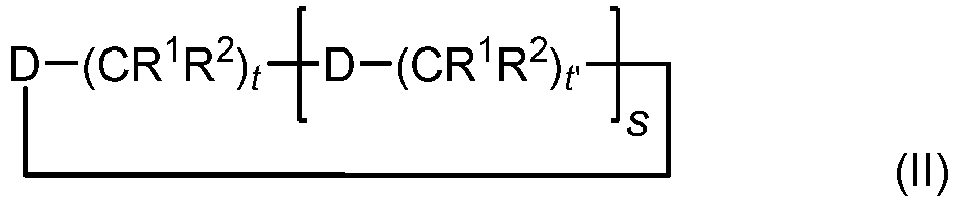
- D in formula (II) preferably is NR. If a D is N, one of the hetero-carbon bonds attached thereto may be unsaturated, e.g. giving rise to an -N=CR1- fragment, R2 being zero.
- The coefficient s in formula (II) preferably is 2, 3, or 4, even more preferably s is 2.
- Preferred ligands L are those in which each D is independently selected from NH or NR, t and t' are 2 or 3, s = 2 and R1 = R2 = H, more preferably wherein at least one D is NCH3 and t = t' = 2. Other preferred ligands L are those wherein each D is NCH3; t = t' = 2; s = 2 and R1 and R2 can each be H or alkyl. Examples of such preferred ligands are provided in
EP-A- 0 458 397 . - Particularly preferred ligands are 1,4,7-trimethyl-1,4,7-triazacyclononane, coded as Me-TACN, 1,4,7-triazacyclononane, coded as TACN, 1,5,9-trimethyl-1,5,9-triazacyclododecane, coded as Me-TACD; 2-methyl-1,4,7-trimethyl-1,4,7-triazacyclononane, coded as Me/Me-TACN and 2-methyl-1,4,7-triazacyclononane, coded as Me/TACN. Of these ligands, Me-TACN and Me/Me-TACN are the most preferred.
- Examples of suitable manganese bleach catalysts are provided in
EP-A- 0 458 397 . - It is preferred that the manganese bleach catalyst comprises one or more from
[MnIII 2(µ-O)1(µ-OAc)2 (Me-TACN)2] (ClO4)2,
[MnIIIMnIV(µ-O)1(µ-OAc)2 (Me-TACN)2] (ClO4)3,
[MnIII 2(µ-O)1(µ-OAc)2(Me-TACN)2] (PF6)2,
[MnIII 2(µ-O)1(µ-OAc)2(Me/Me-TACN)2] (PF6)2,
[MnIV 2(µ-O)3 (Me-TACN)2] (PF6)2,
and
[MnIV 2(µ-O)3 (Me/Me-TACN)2] (PF6)2
- It is even more preferred that the manganese bleach catalyst comprises one or more from [MnIV 2(µ-O)3 (Me-TACN)2] (PF6)2, and [MnIV 2(µ-O)3 (Me/Me-TACN)2] (PF6)2. It is still more preferred that the manganese bleach catalyst is [MnIV 2(µ-O)3 (Me-TACN)2] (PF6)2.
- The bleach catalyst granules of the present invention may suitably be produced by fluid bed coating. In accordance with a particularly preferred embodiment, the first coating layer is applied by spraying onto a fluidized bed of core particles an aqueous suspension of catalyst particles that contains dissolved binder. Next, the coated particles so obtained are coated with the second coating layer by means of fluid bed coating by spraying an aqueous salt solution onto a fluidized bed of the coated particles.
- The detergent composition may contain one or more bleach activators such as peroxyacid bleach precursors. Peroxyacid bleach precursors are well known in the art. As non-limiting examples can be named N,N,N',N'-tetraacetyl ethylene diamine (TAED), sodium nonanoyloxybenzene sulfonate (SNOBS), sodium benzoyloxybenzene sulfonate (SBOBS) and the cationic peroxyacid precursor (SPCC) as described in
US-A-4,751 ,015 . - The present detergent suspension preferably contains one or more surfactants. Surfactants, within the invention, are components within the classification as described in "Surfactant Science Series", Vol.82, Handbook of detergents, part A: Properties, chapter 2 (Surfactants, classification), G. Broze (ed.). Typically, the detergent composition contains 0.5-30 wt.%, preferably 1-20 wt.%,more preferably 1.3-10 wt.% of one or more surfactants. In a preferred embodiment, the surfactants are selected from one or more non-ionic surfactants.
- According to a particularly preferred embodiment, the composition contains 0.1-15 wt.%, more preferably 0.5-10 wt.% and most preferably 1-5 wt.% of a nonionic surfactant or a mixture of two or more non-ionic surfactants. Examples of nonionic surfactants that may be employed in the present composition include the condensation products of hydrophobic alkyl, alkenyl, or alkyl aromatic compounds bearing functional groups having free reactive hydrogen available for condensation with hydrophilic alkylene oxide, such as ethylene oxide, propylene oxide, butylene oxide, polyethylene oxide or polyethylene glycol to form nonionic surfactants. Examples of such functional groups include hydroxy, carboxy, mercapto, amino or amido groups.
- Examples of useful hydrophobes of commercial nonionic surfactants include C8-C18 alkyl fatty alcohols, C8-C14 alkyl phenols, C8-C18 alkyl fatty acids, C8-C18 alkyl mercaptans, C8-C18 alkyl fatty amines, C8-C18 alkyl amides and C8-C18 alkyl fatty alkanolamides. Accordingly, suitable ethoxylated fatty alcohols may be chosen from ethoxylated cetyl alcohol, ethoxylated ketostearyl alcohol, ethoxylated isotridecyl alcohol, ethoxylated lauric alcohol, ethoxylated oleyl alcohol and mixtures thereof. Examples of suitable nonionic surfactants for use in the invention are found in the low- to non-foaming ethoxylated/ propoxylated straight-chain alcohols of the Plurafac™ LF series, supplied by the BASF and the Synperonic™ NCA series supplied by Croda. Also of interest are the end-capped ethoxylated alcohols available as the SLF 18 series from BASF and the alkylpolyethylene glycol ethers made from a linear, saturated C16-C18 fatty alcohol of the Lutensol™ AT series, supplied by BASF. Other suitable nonionics to apply in the composition of the invention are modified fatty alcohol polyglycolethers available as Dehypon™ 3697 GRA or Dehypon™ Wet from BASF/Cognis. Also suitable for use herein are nonionics from the Lutensol™ TO series of BASF, which are alkylpolyethylene glycol ethers made from a saturated iso-C13 alcohol. Amineoxide surfactants may also be used in the present invention as anti- redeposition surfactant. Examples of suitable amineoxide surfactants are C10-C15 alkyl dimethylamine oxide and C10-C15 acylamido alkyl dimethylamine oxide. The inventors have found that, a detergent composition that is not only chemically but also physically very stable can be produced if the nonionic surfactant employed is solid at ambient temperature. Thus, advantageously, the present composition contains 0.1 -30 wt.%, more preferably 0.5-20 wt.%, further preferred 1-10 wt.%, and most preferably 1 -5 wt.% of nonionic surfactant that is solid at 25°C.
- If an anionic surfactant is used, the total amount present preferably is less than 5 wt.%, and more preferably not more than 2 wt.%. Furthermore, if an anionic surfactant is present, it is preferred that an antifoam agent to suppress foaming is present. Examples of suitable anionic surfactants are methylester sulphonates or sodium lauryl sulphate. It is preferred that no anionic surfactant is present in the composition of the current invention.
- Silicates may be added to the formulation. Silicates can act as builder, buffering agent or article care agent. Preferred silicates are sodium silicate such as sodium disillicate, sodium metasilicate and crystalline phyllosilicates and mixtures thereof. Silicates are preferably used in the detergent suspension in a concentration of 0.5 to 8%, more preferably of 0.8 to 6% by weight of the suspension.
- Examples of enzymes suitable for use in the cleaning suspensions of this invention include lipases, cellulases, peroxidases, proteases (proteolytic enzymes), amylases (amylolytic enzymes) and others which degrade, alter or facilitate the degradation or alteration of biochemical soils and stains encountered in cleansing situations so as to remove more easily the soil or stain from the object being washed to make the soil or stain more removable in a subsequent cleansing step. Both degradation and alteration can improve soil removal.
- Preferably, the one or more active enzymes contained in the present suspension are selected from protease, amylase, cellulase, peroxidase, mannanase, pectate lyase and lipase. Most preferably, the active enzyme is selected from protease, amylase and combinations thereof.
- The suspension of the present invention typically contains at least 10 mg/kg, more preferably at least 20 mg/kg, even more preferably at least 50 mg/kg and most preferably at least 100 mg/kg of active enzyme. The concentration of active enzyme preferably does not exceed 50 g/kg, more preferably it does not exceed 40 g/kg and most preferably it does not exceed 30 g/kg.
- According to a particularly preferred embodiment, the suspension contains at least 10 mg/kg, more preferably at least 20 mg/kg and most preferably at least 50 mg/kg of active amylase.
- According to another especially preferred embodiment, the suspension contains at least 100 mg/kg, more preferably at least 200 mg/kg and most preferably at least 400 mg/kg of active protease.
- Enzymes may be added in liquid or in encapsulated form. Examples of encapsulated enzymes are enzyme granule types D, E and HS by Genencor and granule types , T, GT, TXT and Evity™ of Novozymes.
- The proteolytic enzymes in this invention include metal loproteases and serine proteases, including neutral or alkaline microbial serine protease, such as subtilisins (EC 3.4.21 .62). The proteolytic enzymes for use in the present invention can be those derived from bacteria of fungi. Chemically or genetically modified mutants (variants) are included. Preferred proteolytic enzymes are those derived from
- Bacillus, such as B. lentus, B. gibsonii, B. subtilis, B. licheniformis, B. alkalophilus, B. amyloliquefaciens and Bacillus pumilus, of which B. lentus and B. gibsonii are most preferred. Examples of such proteolytic enzymes are Excellase™, Properase™, Purafect™, Purafect™ Prime, Purafect™ Ox by Genencor; and those sold under the trade names Blaze™, Ovozyme™, Savinase™, Alcalase™, Everlase™, Esperase™, Relase™, Polarzyme™, Liquinase™ and Coronase™ by Novozymes.
- The amylolytic enzymes for use in the present invention can be those derived from bacteria or fungi. Chemically or genetically modified mutants (variants) are included. Preferred amylolytic enzyme is an alpha-amylase derived from a strain of Bacillus, such as B. subtilis, B. licheniformis, B. amyloliquefaciens or B. stearothermophilus. Examples of such amylolytic enzymes are produced and distributed under the trade name of Stainzyme™, Stainzyme™ Plus, Termamyl™, Natalase™ and Duramyl™ by Novozymes; as well as Powerase™, Purastar™, Purastar™ Oxam by Genencor. Stainzyme™, Stainzyme™ Plus and Powerase™ are the preferred amylases.
- In accordance with a particularly preferred embodiment of the invention, the suspension contains active protease and the protease activity of the freshly prepared suspension decreases by not more than 70%, more preferably by not more than 50% and most preferably by not more than 20% when the suspension is stored in a closed container for 8 weeks at 20 °C. Well known enzyme stabilizers such as polyalcohols/borax, calcium, formate or protease inhibitors like 4-formylphenyl boronic acid may also be present in the suspension.
- The detergent suspension may suitably contain one or more dispersing polymers. Dispersing polymers as referred to in this invention are chosen from the group of anti-spotting agents and/or anti-scaling agents.
- Examples of suitable anti-spotting polymeric agents include hydrophobically modified polycarboxylic acids such as Acusol™ 460 ND (ex Dow) and Alcosperse™ 747 by AkzoNobel, whereas also synthetic clays, and preferably those synthetic clays which have a high surface area are very useful to prevent spots, in particular those formed where soil and dispersed remnants are present at places where the water collects on the glass and spots formed when the water subsequently evaporates.
- Examples of suitable anti-scaling agents include organic phosphonates, amino carboxylates, polyfunctionally-substituted compounds, and mixtures thereof.
- Particularly preferred anti-scaling agents are organic phosphonates such as alpha-hydroxy-2 phenyl ethyl diphosphonate, ethylene diphosphonate, hydroxy 1 ,1 - hexylidene, vinylidene 1 ,1 -diphosphonate, 1 ,2-dihydroxyethane 1 ,1 -diphosphonate and hydroxy-ethylene 1 ,1 - diphosphonate. Most preferred is hydroxy-ethylene 1 ,1 - diphosphonate (EDHP) and 2-phosphono-butane, 1 ,2,4-tricarboxylic acid (Bayhibit ex Bayer). Suitable anti-scaling agents are water soluble dispersing polymers prepared from an allyloxybenzenesulfonic acid monomer, a methallyl sulfonic acid monomer, a copolymerizable nonionic monomer and a copolymerizable olefinically unsaturated carboxylic acid monomer as described in
US 5 547 612 or known as acrylic sulfonated polymers as described inEP 851 022 - Also suitable are polycarboxylates co-polymers derived from monomers of acrylic acid and maleic acid, such as CP 5 from BASF. The average molecular weight of these polymers in the acid form preferably ranges from 4,000 to 70,000. Modified polycarboxylates like Sokalan™CP42, Sokalan™ CP50 from BASF or Alcoguard™ 4160 from AkzoNobel may also be used.
- Mixture of anti-scaling agents may also be used. Particularly useful is a mixture of organic phosphonates and polymers of acrylic acid. It is preferable if the level of dispersing polymers ranges from 0.2 to 10 wt.% of the total suspension, preferably from 0.5 to 8 wt.%, and further preferred from 1 to 6 wt.%.
- Glass corrosion inhibitors can prevent the irreversible corrosion and iridescence of glass surfaces in machine dishwash detergents. The claimed suspension may suitably contain glass corrosion inhibitors. Suitable glass corrosion agents can be selected from the group the group consisting of salts of zinc, bismuth, aluminum, tin, magnesium, calcium, strontium, titanium, zirconium, manganese, lanthanum, mixtures thereof and precursors thereof. Most preferred are salts of bismuth, magnesium or zinc or combinations thereof. Preferred levels of glass corrosion inhibitors in the present suspension are 0.01 -2 wt.%, more preferably 0.01 - 0.5 wt.%.
- Anti-tarnishing agents may prevent or reduce the tarnishing, corrosion or oxidation of metals such as silver, copper, aluminium and stainless steel. Anti-tarnishing agents such as benzotriazole or bis-benzotriazole and substituted or substituted derivatives thereof and those described in
EP 723 577 WO 94/26860 WO 94/26859 - Optionally other components may be added to the formulation such as perfume, colorant or preservatives. The desired viscosity profile of the detergent suspension depends on the end use of the product. It may be a liquid, gel or a paste depending on the application. Another aspect of the present invention relates to a water-soluble sachet that is filled with a suspension as defined herein before.
- According to a particularly preferred embodiment of the present invention the detergent suspension is a thixotropic suspension.
- The term "thixotropic" means that the product is viscous under quiescent conditions and become less viscous when shaken, agitated, or otherwise stressed. In thixotropic suspensions, this so called "shear thinning effect" is reversible, i.e. the suspension will return to a more viscous state once it is no longer subjected to shear stress. This thixotropic behavior of the detergent suspension can be demonstrated by measuring the storage modulus (G') and the loss modulus (G") of the product as a function of angular frequency (ω) on a rheometer in oscillatory mode. Both G' and G" of the fluid product increase as a function of angular frequency (ω), be it that G" increases at a faster rate than G'. At very low angular frequency (ω) G" of the fluid product is lower than G', but at an ω in the range of 0.05-50 rad/s G" surpasses G'.
- Both the storage modulus (G') and the loss modulus (G") of the fluid product are determined at 20°C using Anton Paar® MCR 302 rheometer, using plate-plate geometry, spindle PP50/S (sandblasted) and a gap size of 3mm. The program settings applied are as follows:
- A Strain γ is chosen in the Lineair Visco-elastic range of the product (LVER is determined by an Amplitude Sweep). The strain is kept constant on 0.1%.
- An increasing ramp log of angular frequency ω is set on the sample from low to high frequency, starting at 0.01 rad/s. The end ω is 100 rad/s unless the sample is very stiff.
- The setting in which the measuring points are gathered is the 'no time settings'. In this modus the apparatus waits for a steady state situation before it takes his measuring point.
- Every decade six measuring points are taken.
- Using oscillatory rheology, it is possible to quantify both the viscous-like and the elastic-like properties of a material at different time scales. The basic principle of an oscillatory rheometer is to induce a sinusoidal shear deformation in the sample and measure the resultant stress response; the time scale probed is determined by the frequency of oscillation, ω, of the shear deformation. A sample is placed between two plates. While the top plate remains stationary, a motor rotates the bottom plate, thereby imposing a time dependent strain γ(t)=γ·sin(ωt) on the sample. Simultaneously, the time dependent stress σ (t) is quantified by measuring the torque that the sample imposes on the top plate.
- Measuring this time dependent stress response at a single frequency immediately reveals key differences between materials. If the material is an ideal elastic solid, then the sample stress is proportional to the strain deformation, and the proportionality constant is the shear modulus of the material. The stress is always exactly in phase with the applied sinusoidal strain deformation.
- In contrast, if the material is a purely viscous fluid, the stress in the sample is proportional to the rate of strain deformation, where the proportionality constant is the viscosity of the fluid. The applied strain and the measured stress are out of phase, with a phase angle δ=π/2.
- Viscoelastic materials show a response that contains both in-phase and out-of-phase contributions. These contributions reveal the extents of solid-like and liquid-like behavior. As a consequence, the total stress response shows a phase shift δ with respect to the applied strain deformation that lies between that of solids and liquids, 0<δ<π/2. The viscoelastic behaviour of the system at ω is characterised by the storage modulus, G'(ω), and the loss modulus, G"(ω), which respectively characterise the solid-like and fluid-like contributions to the measured stress response. For a sinusoidal strain deformation γ (t)=γ 0 sin(ωt), the stress response of a viscoelastic material is given by σ(t)=G'(ω)γ 0sin(ωt)+G"(ω)γ0 cos(ωt).
- Whether the product behaves more solid-like or more liquid-like depends on the time scale at which it is deformed. At the lowest accessible frequencies the fluid product of the present invention has a loss modulus that is lower than the storage modulus, indicating solid-like behavior, while at the highest frequencies accessed the loss modulus dominates the response, indicating viscous-like behavior.
- In accordance with a particularly advantageous embodiment of the present invention the detergent suspension is a thixotropic suspension having a storage modulus at 20°C (G'(ω)) and a loss modulus at 20°C (G" (ω)), both moduli measured as a function of angular frequency (ω) on a rheometer in oscillatory mode operating at a strain of 0.1%, wherein:
- G"(ω) > G' (ω) at angular frequencies (ω) in the range of 50 to 100 rad/s, and
- G"(ω) < G' (ω) at angular frequencies (ω) in the range of 0.01-0.05 rad/s.
- Especially preferred is a detergent suspension having a storage modulus (G') and a loss modulus (G") that meet at least one of the following conditions:
- G"(ω) > G' (ω) at angular frequencies (ω) in the range of 30 to 100 rad/s, more preferably in the range of 10 to 100 rad/s;
- G"(ω) < G' (ω) at angular frequencies (ω) in the range of 0.01 to 0.2 rad/s, more preferably in the range of 0.01 to 0.5 rad/s.
- The pourable detergent suspension typically has a storage modulus (G') at 0.2 rad/s in the range of 1 to 100 Pa, more preferably in the range of 8 to 30 Pa, most preferably in the range of 10 to 20 Pa.
- The loss modulus (G") of the pourable detergent suspension at 0.2 rad/s preferably is in the range of 1 to 100 Pa, more preferably in the range of 3 to 60 Pa, most preferably in the range of 8 to 30 Pa.
- The invention is further illustrated by the following non-limiting examples.
- A pourable, thixotropic machine dishwashing product was prepared on the basis of the recipe that is shown in Table 1.
Table 1 Ingredients Wt.% Glycerol 48.67 Citric Acid (50%) 1.43 Dissolvine™ GL 47-S 1 9.40 Dissolvine™ PD-S 2 2 18.40 Process water 7.99 Xanthan Gum 0.21 Carbonate ash light 12.05 Percarbonate 3 1.10 Bleach catalyst granulate 1.2 Lutensol™ AT80 (nonionic surfactant) 1.87 1 Contains appr. 48 wt.% GLDA and 45 wt.% water
2 Contains appr. 85 wt.% GLDA and 9 wt.% water
3 Coated percarbonate, 98 wt.% between 0.2 mm and 1.4 mm - The bleach catalyst granulate had been prepared as follows:
- Core particles having a volume weighted mean diameter of approximately 600 µm were prepared by means of high shear granulation
- These core particles were coated with three coating layers by means of fluidized bed coating. The core particles were successively coated with an aqueous suspension of catalyst particles that additionally contained binder (dextrin), an aqueous suspension of sodium sulfate and titanium oxide, and an aqueous suspension of PEG 4000, titanium dioxide and Kaolin. The bleach catalyst granulate so obtained had a volume weighted mean diameter of approximately 700 µm.
- The composition of the bleach catalyst granulate is summarized in Table 2.
Table 2 Wt.% Core particle • Na2SO4 40 • Cellulose fibers 5 • Calcium carbonate 4 • Dextrin 3 • Sucrose 2 First coating • Catalyst particles 1 3 • Dextrin 2 Second coating • Na2SO4 34 • Titanium dioxide 2 Third coating • PEG 2 • Titanium dioxide 1 • Kaolin 2 1 particles of bleach catalyst (Manganesetrimethyl-1,4,7-triazacyclononanone; CAS no. 116633-52.4); D99 <25 µm, D10 ≥ 1 µm; D50 in the range of 5-10 µm. - The machine dishwashing product was prepared as follows. A liquid premix was made by mixing glycerol and xanthan gum to a homogeneous suspension. Next, water was added under constant stirring. After that Dissolvine™ GL 47-S and citric acid were dosed at ambient temperature. Next, the Dissolvine™ PD-S was mixed in. Finally the remaining ingredients were added to the mix under stirring. All ingredients were mixed in under vacuum to minimize formation of air bubbles.
- The detergent product so obtained was a stable suspension that did not suffer from phase separation or sedimentation when stored under ambient conditions. Bleach activity of the product did not significantly decrease during normal storage. The product was quite viscous but could be poured from a bottle without any problems.
- A pourable detergent suspension according to the present invention was compared with a pourable detergent composition that was identical, except that a different bleach catalyst granulate was used. This bleach catalyst granulate A was prepared on the basis of the formulation shown in Table 3.
Table 3 Wt.% ManCat (MN-TACN crystals) Mncat 1033 4 Sodium carbonate (ash light monohydrate) 46.5 Sodium silicate (Britesil H20) 46.5 Polyacrylate (binder) (50% solution Pa 25 CL pH >8) 3 - Bleach catalyst granulate A was prepared as follows:
Carbonate and silicate were put in a ploughshare mixer together with the ManCat crystals. While mixing 3% of binder was sprayed onto the powder bed with a single phase nozzle in 3 minutes. Mixing was continued for 10 minutes after the spray on was complete. Next, the granulate was discharged and sieved on a sieve deck 710 - 255 micron. The fraction >255 microns and <710 microns was used for the experiment. - Pourable detergent suspensions were prepared on the basis of the recipes shown in Table 4 (bleach catalyst granulate 1 is the bleach catalyst granulate described in Example 1). Detergent suspension 1 is a detergent suspension according to the invention, detergent suspension A is not.
Table 4 Wt.% Ingredients Suspension 1 Suspension A Glycerol 48.67 48.67 Citric Acid (50%) 1.43 1.43 Dissolvine™ GL 47-S 9.40 9.40 Dissolvine™ PD-S 2 18.40 18.40 Process water 7.99 7.99 Xanthan Gum 0.21 0.21 Carbonate ash light 12.05 12.05 Percarbonate 1 1.10 1.10 Bleach catalyst granulate 1 1.2 Bleach catalyst granulate A 1.2 Lutensol™ AT80 (nonionic surfactant) 1.87 1.87 - The detergent suspension were prepared in batches of 3 kg in a Unimix (ex Haagen & Rinau) mixer, that was operated under vacuum at 70 rpm, whilst keeping the temperature of the mixer contents at 20°C. The mixing procedure used was as follows:
- introduce glycerol and xanthan and mix for 20 minutes;
- add process water and continue mixing for 20 minutes;
- add citric acid solution and Dissolvine™ GL 47-S and continue mixing for 5 minutes;
- add Dissolvine™ PD-S 2 and continue mixing for 40 minutes;
- add Lutensol™ AT80 and carbonate, and continue mixing for 30 minutes;
- add percarbonate and bleach catalyst granulate, and continue mixing for 35 minutes.
- The characteristics of the two detergent suspensions are summarized in Table 5.
Table 5 Suspension 1 Suspension A Density (g/ml) 1.38 1.39 Water activity 0.38 0.37 pH 11.0 11.0 Appearance White Off-white with brown specks Normalised heat (J/g) 1 2.43 3.71 1 ATAM III system (ex TA Instruments) was used to measure the normalized heat (J/g) that was generated by samples of the suspensions when kept at 50°C for 40 hours - The above results indicate that suspension A contained oxidized catalyst particles and that the percarbonate in suspension A was prematurely decomposed, probably due to interaction with the manganese catalyst.
Claims (14)
- A pourable detergent suspension comprising:• 30-80 wt.% of hygroscopic component selected from aminocarboxylate chelant, glycerol and combinations thereof;• 8-25 wt.% of water;• 0.5-30 wt.% of bleaching agent;• 0.1-5 wt.% wt.% of bleach catalyst granules having a diameter in the range of 20 to 2000 µm, said bleach catalyst granules comprising:∘ 30-90 wt.% of one or more core particles;∘ 10-70 wt.% of a coating that envelops the one or more core particles, said coating being composed of one or more coating layers and containing:said bleach catalyst granules containing no enzyme, 0.3-20 wt.% of the catalyst particles and 30-99 wt.% of the water-soluble alkali metal sulfate salt.- 1-30% by weight of the coating of catalyst particles containing at least 30 wt.% of manganese bleach catalyst; and- 50-99% by weight of the coating of water-soluble alkali metal sulfate salt;
- Detergent suspension according to claim 1, wherein at least 90 wt.% of the catalyst particles has a diameter in the range of 0.2 to 25 µm.
- Detergent suspension according to claim 1 or 2, wherein the bleach catalyst granules contain one core particle and meet the following specifications:• diameter of the core particle: 200-1000 µm;• volume weighted mean diameter of the catalyst particles: 1-12 µm;• thickness of the coating: 10-150 µm.
- Detergent suspension according to claim 3, wherein the coating of the bleach catalyst granules comprises at least two coating layers, including (i) a first coating layer comprising 30-90 wt.% of the catalyst particles and 10-70 wt.% of a water-soluble binder, and (ii) a second layer that surrounds the first coating layer, said second coating layer comprising at least 60 wt.% of water-soluble salt.
- Detergent suspension according to claim 4, wherein the water-soluble binder is selected from monosaccharides, disaccharides, trisaccharides, dextrin and combinations thereof.
- Detergent suspension according to any one of the preceding claims, wherein the water-soluble alkali metal sulfate salt is sodium sulfate.
- Detergent suspension according to any one of the preceding claims, wherein the suspension comprises 8-40 wt.% of aminocarboxylate chelant.
- Detergent suspension according to any one of the preceding claims, wherein the suspension comprises 20-75 wt.% glycerol.
- Detergent suspension according to any one of the preceding claims, wherein the combination of glycerol, water and aminocarboxylate chelant represents at least 45 wt.% of the suspension.
- Detergent suspension according to any one of the preceding claims, wherein the suspension contains 10-22 wt.% water.
- Detergent suspension according to any one of the preceding claims, wherein the suspension has a water activity of 0.2 to 0.6 at 20°C.
- Detergent suspension according to any one of the preceding claims, wherein the suspension contains at least 0.1% of structuring biopolymer by weight of water.
- Detergent suspension according to claim 12, wherein the structuring biopolymer is selected from xanthan gum, locust bean gum, guar gum, gum Arabic, gellan gum, carrageenan, carboxymethyl cellulose, microcrystalline cellulose, microfibrous cellulose and combinations thereof.
- Detergent suspension according to any one of the preceding claims, wherein the suspension is a thixotropic suspension having a storage modulus at 20°C (G'(ω)) and a loss modulus at 20°C (G" (ω)), both moduli measured as a function of angular frequency (ω) on a rheometer in oscillatory mode operating at a strain of 0.1%, wherein:▪ G"(ω) > G' (ω) at angular frequencies (ω) in the range of 50 to 100 rad/s, and▪ G"(ω) < G' (ω) at angular frequencies (ω) in the range of 0.01 to 0.05 rad/s.
Priority Applications (1)
| Application Number | Priority Date | Filing Date | Title |
|---|---|---|---|
| PL17709682T PL3426756T3 (en) | 2016-03-11 | 2017-03-09 | Pourable detergent suspension comprising bleach catalyst granules |
Applications Claiming Priority (2)
| Application Number | Priority Date | Filing Date | Title |
|---|---|---|---|
| EP16159923 | 2016-03-11 | ||
| PCT/EP2017/055553 WO2017153528A1 (en) | 2016-03-11 | 2017-03-09 | Pourable detergent suspension comprising bleach catalyst granules |
Publications (2)
| Publication Number | Publication Date |
|---|---|
| EP3426756A1 EP3426756A1 (en) | 2019-01-16 |
| EP3426756B1 true EP3426756B1 (en) | 2019-07-03 |
Family
ID=55527420
Family Applications (1)
| Application Number | Title | Priority Date | Filing Date |
|---|---|---|---|
| EP17709682.3A Active EP3426756B1 (en) | 2016-03-11 | 2017-03-09 | Pourable detergent suspension comprising bleach catalyst granules |
Country Status (8)
| Country | Link |
|---|---|
| EP (1) | EP3426756B1 (en) |
| JP (1) | JP2019507808A (en) |
| CN (1) | CN109312267B (en) |
| AR (1) | AR107853A1 (en) |
| PL (1) | PL3426756T3 (en) |
| PT (1) | PT3426756T (en) |
| TR (1) | TR201911286T4 (en) |
| WO (1) | WO2017153528A1 (en) |
Families Citing this family (7)
| Publication number | Priority date | Publication date | Assignee | Title |
|---|---|---|---|---|
| GB2568867A (en) * | 2017-10-31 | 2019-06-05 | Mcbride Sa | Dishwashing detergent gel comprising bleach |
| GB201814981D0 (en) | 2018-09-14 | 2018-10-31 | Reckitt Benckiser Finish Bv | Granulate |
| JP2021080378A (en) * | 2019-11-20 | 2021-05-27 | 花王株式会社 | Starch stain adhesion inhibitor |
| EP3967742A1 (en) | 2020-09-15 | 2022-03-16 | WeylChem Performance Products GmbH | Compositions comprising bleaching catalyst, manufacturing process thereof, and bleaching and cleaning agent comprising same |
| JP7822167B2 (en) * | 2021-12-15 | 2026-03-02 | ライオン株式会社 | Liquid cleaning agents |
| WO2025191283A1 (en) | 2024-03-15 | 2025-09-18 | Catexel Gmbh | Oxidative method |
| EP4678725A1 (en) | 2024-07-11 | 2026-01-14 | Catexel GmbH | Co-granules comprising bleaching catalyst, bleaching activator, binder and zinc or bismuth salt, and bleaching and cleaning agent comprising same |
Citations (3)
| Publication number | Priority date | Publication date | Assignee | Title |
|---|---|---|---|---|
| WO2013092276A1 (en) | 2011-12-22 | 2013-06-27 | Unilever N.V. | Detergent composition comprising glutamic-n,n-diacetate, water and bleaching agent |
| WO2014107578A1 (en) | 2013-01-03 | 2014-07-10 | Basf Corporation | Homogeneous detergent composition |
| WO2016005392A1 (en) | 2014-07-08 | 2016-01-14 | Novozymes A/S | Co-granulate of enzyme and bleach catalyst |
Family Cites Families (10)
| Publication number | Priority date | Publication date | Assignee | Title |
|---|---|---|---|---|
| US4751015A (en) | 1987-03-17 | 1988-06-14 | Lever Brothers Company | Quaternary ammonium or phosphonium substituted peroxy carbonic acid precursors and their use in detergent bleach compositions |
| DE69125310T2 (en) | 1990-05-21 | 1997-07-03 | Unilever Nv | Bleach activation |
| CZ287850B6 (en) | 1993-05-08 | 2001-02-14 | Henkel Kgaa | Use of organic redox-active substances in dishwashing preparations and slightly alkaline preparation for machine washing of dishes |
| DE59405259D1 (en) | 1993-05-08 | 1998-03-19 | Henkel Kgaa | SILVER CORROSION PROTECTANT I |
| EP0723577B1 (en) | 1993-10-14 | 1998-09-02 | Unilever N.V. | Detergent compositions containing silver anti-tarnishing agents |
| US5547612A (en) | 1995-02-17 | 1996-08-20 | National Starch And Chemical Investment Holding Corporation | Compositions of water soluble polymers containing allyloxybenzenesulfonic acid monomer and methallyl sulfonic acid monomer and methods for use in aqueous systems |
| US6210600B1 (en) | 1996-12-23 | 2001-04-03 | Lever Brothers Company, Division Of Conopco, Inc. | Rinse aid compositions containing scale inhibiting polymers |
| DE19852135A1 (en) | 1998-11-12 | 2000-05-18 | Henkel Kgaa | Aqueous dishwashing detergent |
| DE102005035916A1 (en) * | 2005-07-28 | 2007-02-01 | Clariant Produkte (Deutschland) Gmbh | Process for the preparation of bleach catalyst granules |
| DE102007039651A1 (en) * | 2006-11-27 | 2009-02-26 | Henkel Ag & Co. Kgaa | Bleach catalyst granules |
-
2017
- 2017-03-09 PT PT177096823T patent/PT3426756T/en unknown
- 2017-03-09 EP EP17709682.3A patent/EP3426756B1/en active Active
- 2017-03-09 WO PCT/EP2017/055553 patent/WO2017153528A1/en not_active Ceased
- 2017-03-09 PL PL17709682T patent/PL3426756T3/en unknown
- 2017-03-09 TR TR2019/11286T patent/TR201911286T4/en unknown
- 2017-03-09 JP JP2018540153A patent/JP2019507808A/en not_active Withdrawn
- 2017-03-09 CN CN201780016161.1A patent/CN109312267B/en active Active
- 2017-03-10 AR ARP170100602A patent/AR107853A1/en active IP Right Grant
Patent Citations (3)
| Publication number | Priority date | Publication date | Assignee | Title |
|---|---|---|---|---|
| WO2013092276A1 (en) | 2011-12-22 | 2013-06-27 | Unilever N.V. | Detergent composition comprising glutamic-n,n-diacetate, water and bleaching agent |
| WO2014107578A1 (en) | 2013-01-03 | 2014-07-10 | Basf Corporation | Homogeneous detergent composition |
| WO2016005392A1 (en) | 2014-07-08 | 2016-01-14 | Novozymes A/S | Co-granulate of enzyme and bleach catalyst |
Also Published As
| Publication number | Publication date |
|---|---|
| CN109312267A (en) | 2019-02-05 |
| PL3426756T3 (en) | 2020-01-31 |
| EP3426756A1 (en) | 2019-01-16 |
| WO2017153528A1 (en) | 2017-09-14 |
| TR201911286T4 (en) | 2019-08-21 |
| PT3426756T (en) | 2019-10-18 |
| AR107853A1 (en) | 2018-06-13 |
| CN109312267B (en) | 2021-02-05 |
| JP2019507808A (en) | 2019-03-22 |
Similar Documents
| Publication | Publication Date | Title |
|---|---|---|
| EP3426756A1 (en) | Pourable detergent suspension comprising bleach catalyst granules | |
| EP2794836B1 (en) | Detergent composition comprising glutamic-n,n-diacetate, water and bleaching agent | |
| EP3013931B1 (en) | Composition comprising glutamic-n,n-diacetate (glda), water and enzyme | |
| CN101945988A (en) | cleaning composition | |
| JP2019512575A (en) | Encapsulated laundry cleaning composition | |
| JP2017528569A (en) | Encapsulated cleaning composition | |
| EP3167036B1 (en) | Co-granulate of enzyme and bleach catalyst | |
| AU2014301405B2 (en) | Hygroscopic detergent formulation comprising water, aminocarboxylate chelant and moisture-sensitive ingredients | |
| EP2997121B1 (en) | Machine dishwash detergent composition | |
| CN115151629A (en) | Dishwashing detergent products | |
| EP3423558B1 (en) | Detergent composition in the form of a suspension | |
| WO2017148985A1 (en) | Pourable detergent composition | |
| JP2005515297A5 (en) | ||
| EP1682647B1 (en) | Composition including one or more hydrolytically unstable components | |
| WO2017148989A1 (en) | Pourable detergent suspension comprising a dyed fluid phase and suspended particles | |
| JPH0586839B2 (en) |
Legal Events
| Date | Code | Title | Description |
|---|---|---|---|
| STAA | Information on the status of an ep patent application or granted ep patent |
Free format text: STATUS: UNKNOWN |
|
| STAA | Information on the status of an ep patent application or granted ep patent |
Free format text: STATUS: THE INTERNATIONAL PUBLICATION HAS BEEN MADE |
|
| PUAI | Public reference made under article 153(3) epc to a published international application that has entered the european phase |
Free format text: ORIGINAL CODE: 0009012 |
|
| STAA | Information on the status of an ep patent application or granted ep patent |
Free format text: STATUS: REQUEST FOR EXAMINATION WAS MADE |
|
| 17P | Request for examination filed |
Effective date: 20180713 |
|
| AK | Designated contracting states |
Kind code of ref document: A1 Designated state(s): AL AT BE BG CH CY CZ DE DK EE ES FI FR GB GR HR HU IE IS IT LI LT LU LV MC MK MT NL NO PL PT RO RS SE SI SK SM TR |
|
| AX | Request for extension of the european patent |
Extension state: BA ME |
|
| GRAP | Despatch of communication of intention to grant a patent |
Free format text: ORIGINAL CODE: EPIDOSNIGR1 |
|
| STAA | Information on the status of an ep patent application or granted ep patent |
Free format text: STATUS: GRANT OF PATENT IS INTENDED |
|
| INTG | Intention to grant announced |
Effective date: 20190308 |
|
| GRAS | Grant fee paid |
Free format text: ORIGINAL CODE: EPIDOSNIGR3 |
|
| GRAA | (expected) grant |
Free format text: ORIGINAL CODE: 0009210 |
|
| STAA | Information on the status of an ep patent application or granted ep patent |
Free format text: STATUS: THE PATENT HAS BEEN GRANTED |
|
| DAV | Request for validation of the european patent (deleted) | ||
| DAX | Request for extension of the european patent (deleted) | ||
| AK | Designated contracting states |
Kind code of ref document: B1 Designated state(s): AL AT BE BG CH CY CZ DE DK EE ES FI FR GB GR HR HU IE IS IT LI LT LU LV MC MK MT NL NO PL PT RO RS SE SI SK SM TR |
|
| REG | Reference to a national code |
Ref country code: GB Ref legal event code: FG4D |
|
| REG | Reference to a national code |
Ref country code: AT Ref legal event code: REF Ref document number: 1150993 Country of ref document: AT Kind code of ref document: T Effective date: 20190715 Ref country code: CH Ref legal event code: EP |
|
| REG | Reference to a national code |
Ref country code: DE Ref legal event code: R096 Ref document number: 602017005055 Country of ref document: DE |
|
| REG | Reference to a national code |
Ref country code: IE Ref legal event code: FG4D |
|
| REG | Reference to a national code |
Ref country code: NL Ref legal event code: FP |
|
| REG | Reference to a national code |
Ref country code: PT Ref legal event code: SC4A Ref document number: 3426756 Country of ref document: PT Date of ref document: 20191018 Kind code of ref document: T Free format text: AVAILABILITY OF NATIONAL TRANSLATION Effective date: 20190930 |
|
| REG | Reference to a national code |
Ref country code: LT Ref legal event code: MG4D |
|
| REG | Reference to a national code |
Ref country code: AT Ref legal event code: MK05 Ref document number: 1150993 Country of ref document: AT Kind code of ref document: T Effective date: 20190703 |
|
| PG25 | Lapsed in a contracting state [announced via postgrant information from national office to epo] |
Ref country code: LT Free format text: LAPSE BECAUSE OF FAILURE TO SUBMIT A TRANSLATION OF THE DESCRIPTION OR TO PAY THE FEE WITHIN THE PRESCRIBED TIME-LIMIT Effective date: 20190703 Ref country code: FI Free format text: LAPSE BECAUSE OF FAILURE TO SUBMIT A TRANSLATION OF THE DESCRIPTION OR TO PAY THE FEE WITHIN THE PRESCRIBED TIME-LIMIT Effective date: 20190703 Ref country code: HR Free format text: LAPSE BECAUSE OF FAILURE TO SUBMIT A TRANSLATION OF THE DESCRIPTION OR TO PAY THE FEE WITHIN THE PRESCRIBED TIME-LIMIT Effective date: 20190703 Ref country code: NO Free format text: LAPSE BECAUSE OF FAILURE TO SUBMIT A TRANSLATION OF THE DESCRIPTION OR TO PAY THE FEE WITHIN THE PRESCRIBED TIME-LIMIT Effective date: 20191003 Ref country code: SE Free format text: LAPSE BECAUSE OF FAILURE TO SUBMIT A TRANSLATION OF THE DESCRIPTION OR TO PAY THE FEE WITHIN THE PRESCRIBED TIME-LIMIT Effective date: 20190703 Ref country code: BG Free format text: LAPSE BECAUSE OF FAILURE TO SUBMIT A TRANSLATION OF THE DESCRIPTION OR TO PAY THE FEE WITHIN THE PRESCRIBED TIME-LIMIT Effective date: 20191003 Ref country code: AT Free format text: LAPSE BECAUSE OF FAILURE TO SUBMIT A TRANSLATION OF THE DESCRIPTION OR TO PAY THE FEE WITHIN THE PRESCRIBED TIME-LIMIT Effective date: 20190703 |
|
| PG25 | Lapsed in a contracting state [announced via postgrant information from national office to epo] |
Ref country code: AL Free format text: LAPSE BECAUSE OF FAILURE TO SUBMIT A TRANSLATION OF THE DESCRIPTION OR TO PAY THE FEE WITHIN THE PRESCRIBED TIME-LIMIT Effective date: 20190703 Ref country code: RS Free format text: LAPSE BECAUSE OF FAILURE TO SUBMIT A TRANSLATION OF THE DESCRIPTION OR TO PAY THE FEE WITHIN THE PRESCRIBED TIME-LIMIT Effective date: 20190703 Ref country code: GR Free format text: LAPSE BECAUSE OF FAILURE TO SUBMIT A TRANSLATION OF THE DESCRIPTION OR TO PAY THE FEE WITHIN THE PRESCRIBED TIME-LIMIT Effective date: 20191004 Ref country code: ES Free format text: LAPSE BECAUSE OF FAILURE TO SUBMIT A TRANSLATION OF THE DESCRIPTION OR TO PAY THE FEE WITHIN THE PRESCRIBED TIME-LIMIT Effective date: 20190703 Ref country code: IS Free format text: LAPSE BECAUSE OF FAILURE TO SUBMIT A TRANSLATION OF THE DESCRIPTION OR TO PAY THE FEE WITHIN THE PRESCRIBED TIME-LIMIT Effective date: 20191103 Ref country code: LV Free format text: LAPSE BECAUSE OF FAILURE TO SUBMIT A TRANSLATION OF THE DESCRIPTION OR TO PAY THE FEE WITHIN THE PRESCRIBED TIME-LIMIT Effective date: 20190703 |
|
| REG | Reference to a national code |
Ref country code: DE Ref legal event code: R026 Ref document number: 602017005055 Country of ref document: DE |
|
| PLBI | Opposition filed |
Free format text: ORIGINAL CODE: 0009260 |
|
| PG25 | Lapsed in a contracting state [announced via postgrant information from national office to epo] |
Ref country code: EE Free format text: LAPSE BECAUSE OF FAILURE TO SUBMIT A TRANSLATION OF THE DESCRIPTION OR TO PAY THE FEE WITHIN THE PRESCRIBED TIME-LIMIT Effective date: 20190703 Ref country code: DK Free format text: LAPSE BECAUSE OF FAILURE TO SUBMIT A TRANSLATION OF THE DESCRIPTION OR TO PAY THE FEE WITHIN THE PRESCRIBED TIME-LIMIT Effective date: 20190703 Ref country code: RO Free format text: LAPSE BECAUSE OF FAILURE TO SUBMIT A TRANSLATION OF THE DESCRIPTION OR TO PAY THE FEE WITHIN THE PRESCRIBED TIME-LIMIT Effective date: 20190703 |
|
| PGFP | Annual fee paid to national office [announced via postgrant information from national office to epo] |
Ref country code: NL Payment date: 20200319 Year of fee payment: 4 |
|
| 26 | Opposition filed |
Opponent name: HENKEL AG & CO. KGAA Effective date: 20200403 |
|
| PG25 | Lapsed in a contracting state [announced via postgrant information from national office to epo] |
Ref country code: SK Free format text: LAPSE BECAUSE OF FAILURE TO SUBMIT A TRANSLATION OF THE DESCRIPTION OR TO PAY THE FEE WITHIN THE PRESCRIBED TIME-LIMIT Effective date: 20190703 Ref country code: IS Free format text: LAPSE BECAUSE OF FAILURE TO SUBMIT A TRANSLATION OF THE DESCRIPTION OR TO PAY THE FEE WITHIN THE PRESCRIBED TIME-LIMIT Effective date: 20200224 Ref country code: SM Free format text: LAPSE BECAUSE OF FAILURE TO SUBMIT A TRANSLATION OF THE DESCRIPTION OR TO PAY THE FEE WITHIN THE PRESCRIBED TIME-LIMIT Effective date: 20190703 |
|
| PLAX | Notice of opposition and request to file observation + time limit sent |
Free format text: ORIGINAL CODE: EPIDOSNOBS2 |
|
| PG2D | Information on lapse in contracting state deleted |
Ref country code: IS |
|
| PGFP | Annual fee paid to national office [announced via postgrant information from national office to epo] |
Ref country code: PL Payment date: 20200303 Year of fee payment: 4 |
|
| PG25 | Lapsed in a contracting state [announced via postgrant information from national office to epo] |
Ref country code: MC Free format text: LAPSE BECAUSE OF FAILURE TO SUBMIT A TRANSLATION OF THE DESCRIPTION OR TO PAY THE FEE WITHIN THE PRESCRIBED TIME-LIMIT Effective date: 20190703 |
|
| PLBB | Reply of patent proprietor to notice(s) of opposition received |
Free format text: ORIGINAL CODE: EPIDOSNOBS3 |
|
| PG25 | Lapsed in a contracting state [announced via postgrant information from national office to epo] |
Ref country code: LU Free format text: LAPSE BECAUSE OF NON-PAYMENT OF DUE FEES Effective date: 20200309 |
|
| PG25 | Lapsed in a contracting state [announced via postgrant information from national office to epo] |
Ref country code: IE Free format text: LAPSE BECAUSE OF NON-PAYMENT OF DUE FEES Effective date: 20200309 |
|
| REG | Reference to a national code |
Ref country code: BE Ref legal event code: PD Owner name: UNILEVER IP HOLDINGS B.V.; NL Free format text: DETAILS ASSIGNMENT: CHANGE OF OWNER(S), ASSIGNMENT; FORMER OWNER NAME: UNILEVER N.V. Effective date: 20210607 |
|
| REG | Reference to a national code |
Ref country code: DE Ref legal event code: R081 Ref document number: 602017005055 Country of ref document: DE Owner name: UNILEVER GLOBAL IP LIMITED, WIRRAL, GB Free format text: FORMER OWNER: UNILEVER N.V., ROTTERDAM, NL |
|
| RAP2 | Party data changed (patent owner data changed or rights of a patent transferred) |
Owner name: UNILEVER IP HOLDINGS B.V. Owner name: UNILEVER GLOBAL IP LIMITED |
|
| REG | Reference to a national code |
Ref country code: NL Ref legal event code: MM Effective date: 20210401 |
|
| PLCK | Communication despatched that opposition was rejected |
Free format text: ORIGINAL CODE: EPIDOSNREJ1 |
|
| GBPC | Gb: european patent ceased through non-payment of renewal fee |
Effective date: 20210309 |
|
| REG | Reference to a national code |
Ref country code: DE Ref legal event code: R100 Ref document number: 602017005055 Country of ref document: DE |
|
| PG25 | Lapsed in a contracting state [announced via postgrant information from national office to epo] |
Ref country code: NL Free format text: LAPSE BECAUSE OF NON-PAYMENT OF DUE FEES Effective date: 20210401 Ref country code: GB Free format text: LAPSE BECAUSE OF NON-PAYMENT OF DUE FEES Effective date: 20210309 |
|
| RAP4 | Party data changed (patent owner data changed or rights of a patent transferred) |
Owner name: UNILEVER IP HOLDINGS B.V. Owner name: UNILEVER GLOBAL IP LIMITED |
|
| PLBN | Opposition rejected |
Free format text: ORIGINAL CODE: 0009273 |
|
| STAA | Information on the status of an ep patent application or granted ep patent |
Free format text: STATUS: OPPOSITION REJECTED |
|
| 27O | Opposition rejected |
Effective date: 20211203 |
|
| PG25 | Lapsed in a contracting state [announced via postgrant information from national office to epo] |
Ref country code: MT Free format text: LAPSE BECAUSE OF FAILURE TO SUBMIT A TRANSLATION OF THE DESCRIPTION OR TO PAY THE FEE WITHIN THE PRESCRIBED TIME-LIMIT Effective date: 20190703 Ref country code: CY Free format text: LAPSE BECAUSE OF FAILURE TO SUBMIT A TRANSLATION OF THE DESCRIPTION OR TO PAY THE FEE WITHIN THE PRESCRIBED TIME-LIMIT Effective date: 20190703 |
|
| PG25 | Lapsed in a contracting state [announced via postgrant information from national office to epo] |
Ref country code: MK Free format text: LAPSE BECAUSE OF FAILURE TO SUBMIT A TRANSLATION OF THE DESCRIPTION OR TO PAY THE FEE WITHIN THE PRESCRIBED TIME-LIMIT Effective date: 20190703 |
|
| PG25 | Lapsed in a contracting state [announced via postgrant information from national office to epo] |
Ref country code: PL Free format text: LAPSE BECAUSE OF NON-PAYMENT OF DUE FEES Effective date: 20210309 |
|
| PG25 | Lapsed in a contracting state [announced via postgrant information from national office to epo] |
Ref country code: SI Free format text: LAPSE BECAUSE OF FAILURE TO SUBMIT A TRANSLATION OF THE DESCRIPTION OR TO PAY THE FEE WITHIN THE PRESCRIBED TIME-LIMIT Effective date: 20190703 |
|
| PGFP | Annual fee paid to national office [announced via postgrant information from national office to epo] |
Ref country code: PT Payment date: 20250227 Year of fee payment: 9 Ref country code: DE Payment date: 20250319 Year of fee payment: 9 |
|
| PGFP | Annual fee paid to national office [announced via postgrant information from national office to epo] |
Ref country code: BE Payment date: 20250319 Year of fee payment: 9 |
|
| PGFP | Annual fee paid to national office [announced via postgrant information from national office to epo] |
Ref country code: FR Payment date: 20250326 Year of fee payment: 9 Ref country code: CZ Payment date: 20250303 Year of fee payment: 9 |
|
| PGFP | Annual fee paid to national office [announced via postgrant information from national office to epo] |
Ref country code: IT Payment date: 20250319 Year of fee payment: 9 |
|
| PGFP | Annual fee paid to national office [announced via postgrant information from national office to epo] |
Ref country code: TR Payment date: 20250303 Year of fee payment: 9 |
|
| PGFP | Annual fee paid to national office [announced via postgrant information from national office to epo] |
Ref country code: CH Payment date: 20250401 Year of fee payment: 9 |