EP3426649B1 - Indole derivatives and their use as protein kinase inhibitors - Google Patents
Indole derivatives and their use as protein kinase inhibitors Download PDFInfo
- Publication number
- EP3426649B1 EP3426649B1 EP17711736.3A EP17711736A EP3426649B1 EP 3426649 B1 EP3426649 B1 EP 3426649B1 EP 17711736 A EP17711736 A EP 17711736A EP 3426649 B1 EP3426649 B1 EP 3426649B1
- Authority
- EP
- European Patent Office
- Prior art keywords
- methyl
- phenyl
- amino
- carboxylate
- methylene
- Prior art date
- Legal status (The legal status is an assumption and is not a legal conclusion. Google has not performed a legal analysis and makes no representation as to the accuracy of the status listed.)
- Not-in-force
Links
- VPWJHKVHKZOWKO-RQZHXJHFSA-N CC(C)(C)OC(c(cc1)ccc1N/C(/c1ccccc1)=C(/c(c(N1C(C)=O)c2)cc(C)c2C(OC)=O)\C1=O)=O Chemical compound CC(C)(C)OC(c(cc1)ccc1N/C(/c1ccccc1)=C(/c(c(N1C(C)=O)c2)cc(C)c2C(OC)=O)\C1=O)=O VPWJHKVHKZOWKO-RQZHXJHFSA-N 0.000 description 1
- 0 CC(C)(C)OC(c1cc(NC(c2ccccc2)=C(c(c(N2C(C)=O)c3)cc(I)c3C(OC)=O)C2=O)ccc1*)=O Chemical compound CC(C)(C)OC(c1cc(NC(c2ccccc2)=C(c(c(N2C(C)=O)c3)cc(I)c3C(OC)=O)C2=O)ccc1*)=O 0.000 description 1
- LAXGXWKSHPDEGZ-UHFFFAOYSA-N CC(C)(N(C(C1)=O)c(cc2C(OC)=O)c1cc2I)O Chemical compound CC(C)(N(C(C1)=O)c(cc2C(OC)=O)c1cc2I)O LAXGXWKSHPDEGZ-UHFFFAOYSA-N 0.000 description 1
- WRFFGTGNLDIMTO-WUKNDPDISA-N CC(N(c(c(/C1=C(/c2ccccc2)\I)c2)cc(C(OC)=O)c2I)C1=O)=O Chemical compound CC(N(c(c(/C1=C(/c2ccccc2)\I)c2)cc(C(OC)=O)c2I)C1=O)=O WRFFGTGNLDIMTO-WUKNDPDISA-N 0.000 description 1
- WNIVBLZDCKCEBP-VHXPQNKSSA-N CC(N(c(cc(C(OC)=O)c(C)c1)c1/C1=C(\c2ccccc2)/Nc(cc2)ccc2C(O)=O)C1=O)=O Chemical compound CC(N(c(cc(C(OC)=O)c(C)c1)c1/C1=C(\c2ccccc2)/Nc(cc2)ccc2C(O)=O)C1=O)=O WNIVBLZDCKCEBP-VHXPQNKSSA-N 0.000 description 1
- PTMRLZVVTLYCDK-DQSJHHFOSA-N Cc(cc(c(NC1=O)c2)/C1=C(\c1ccccc1)/Nc(cc1)cc(F)c1C(NCCN(CCN1)CC1=O)=O)c2C(OC)=O Chemical compound Cc(cc(c(NC1=O)c2)/C1=C(\c1ccccc1)/Nc(cc1)cc(F)c1C(NCCN(CCN1)CC1=O)=O)c2C(OC)=O PTMRLZVVTLYCDK-DQSJHHFOSA-N 0.000 description 1
- OPFGGEANRKOGEG-FLWNBWAVSA-N Cc(cc(c(NC1=O)c2)/C1=C(\c1ccccc1)/Nc(cc1)ccc1C(NC1CCN(CCOC)CC1)=O)c2C(OC)=O Chemical compound Cc(cc(c(NC1=O)c2)/C1=C(\c1ccccc1)/Nc(cc1)ccc1C(NC1CCN(CCOC)CC1)=O)c2C(OC)=O OPFGGEANRKOGEG-FLWNBWAVSA-N 0.000 description 1
- OSKVLQNSYZYKLO-ZIADKAODSA-N Cc(cc(c(NC1=O)c2)/C1=C(\c1ccccc1)/Nc(cc1)ccc1C(NCCCN1CCOCC1)=O)c2C(OC)=O Chemical compound Cc(cc(c(NC1=O)c2)/C1=C(\c1ccccc1)/Nc(cc1)ccc1C(NCCCN1CCOCC1)=O)c2C(OC)=O OSKVLQNSYZYKLO-ZIADKAODSA-N 0.000 description 1
- LCSINNGGVIROLG-DQSJHHFOSA-N Cc(cc(c(NC1=O)c2)/C1=C(\c1ccccc1)/Nc(cc1)ccc1C(NCCN(CC1)CCS1(=O)=O)=O)c2C(OC)=O Chemical compound Cc(cc(c(NC1=O)c2)/C1=C(\c1ccccc1)/Nc(cc1)ccc1C(NCCN(CC1)CCS1(=O)=O)=O)c2C(OC)=O LCSINNGGVIROLG-DQSJHHFOSA-N 0.000 description 1
- LHZZZBFUJPHNCR-ZIADKAODSA-N Cc(cc(c(NC1=O)c2)/C1=C(\c1ccccc1)/Nc(cc1)ccc1C(NCCN(CCCN1)CC1=O)=O)c2C(OC)=O Chemical compound Cc(cc(c(NC1=O)c2)/C1=C(\c1ccccc1)/Nc(cc1)ccc1C(NCCN(CCCN1)CC1=O)=O)c2C(OC)=O LHZZZBFUJPHNCR-ZIADKAODSA-N 0.000 description 1
Images

Classifications
-
- C—CHEMISTRY; METALLURGY
- C07—ORGANIC CHEMISTRY
- C07D—HETEROCYCLIC COMPOUNDS
- C07D209/00—Heterocyclic compounds containing five-membered rings, condensed with other rings, with one nitrogen atom as the only ring hetero atom
- C07D209/02—Heterocyclic compounds containing five-membered rings, condensed with other rings, with one nitrogen atom as the only ring hetero atom condensed with one carbocyclic ring
- C07D209/04—Indoles; Hydrogenated indoles
- C07D209/30—Indoles; Hydrogenated indoles with hetero atoms or with carbon atoms having three bonds to hetero atoms with at the most one bond to halogen, directly attached to carbon atoms of the hetero ring
- C07D209/32—Oxygen atoms
- C07D209/34—Oxygen atoms in position 2
-
- A—HUMAN NECESSITIES
- A61—MEDICAL OR VETERINARY SCIENCE; HYGIENE
- A61K—PREPARATIONS FOR MEDICAL, DENTAL OR TOILETRY PURPOSES
- A61K31/00—Medicinal preparations containing organic active ingredients
- A61K31/33—Heterocyclic compounds
- A61K31/395—Heterocyclic compounds having nitrogen as a ring hetero atom, e.g. guanethidine or rifamycins
- A61K31/40—Heterocyclic compounds having nitrogen as a ring hetero atom, e.g. guanethidine or rifamycins having five-membered rings with one nitrogen as the only ring hetero atom, e.g. sulpiride, succinimide, tolmetin, buflomedil
- A61K31/403—Heterocyclic compounds having nitrogen as a ring hetero atom, e.g. guanethidine or rifamycins having five-membered rings with one nitrogen as the only ring hetero atom, e.g. sulpiride, succinimide, tolmetin, buflomedil condensed with carbocyclic rings, e.g. carbazole
- A61K31/404—Indoles, e.g. pindolol
- A61K31/4045—Indole-alkylamines; Amides thereof, e.g. serotonin, melatonin
-
- A—HUMAN NECESSITIES
- A61—MEDICAL OR VETERINARY SCIENCE; HYGIENE
- A61K—PREPARATIONS FOR MEDICAL, DENTAL OR TOILETRY PURPOSES
- A61K31/00—Medicinal preparations containing organic active ingredients
- A61K31/33—Heterocyclic compounds
- A61K31/395—Heterocyclic compounds having nitrogen as a ring hetero atom, e.g. guanethidine or rifamycins
- A61K31/435—Heterocyclic compounds having nitrogen as a ring hetero atom, e.g. guanethidine or rifamycins having six-membered rings with one nitrogen as the only ring hetero atom
- A61K31/44—Non condensed pyridines; Hydrogenated derivatives thereof
- A61K31/4412—Non condensed pyridines; Hydrogenated derivatives thereof having oxo groups directly attached to the heterocyclic ring
-
- A—HUMAN NECESSITIES
- A61—MEDICAL OR VETERINARY SCIENCE; HYGIENE
- A61K—PREPARATIONS FOR MEDICAL, DENTAL OR TOILETRY PURPOSES
- A61K31/00—Medicinal preparations containing organic active ingredients
- A61K31/33—Heterocyclic compounds
- A61K31/395—Heterocyclic compounds having nitrogen as a ring hetero atom, e.g. guanethidine or rifamycins
- A61K31/435—Heterocyclic compounds having nitrogen as a ring hetero atom, e.g. guanethidine or rifamycins having six-membered rings with one nitrogen as the only ring hetero atom
- A61K31/44—Non condensed pyridines; Hydrogenated derivatives thereof
- A61K31/445—Non condensed piperidines, e.g. piperocaine
- A61K31/4523—Non condensed piperidines, e.g. piperocaine containing further heterocyclic ring systems
- A61K31/454—Non condensed piperidines, e.g. piperocaine containing further heterocyclic ring systems containing a five-membered ring with nitrogen as a ring hetero atom, e.g. pimozide, domperidone
-
- A—HUMAN NECESSITIES
- A61—MEDICAL OR VETERINARY SCIENCE; HYGIENE
- A61K—PREPARATIONS FOR MEDICAL, DENTAL OR TOILETRY PURPOSES
- A61K31/00—Medicinal preparations containing organic active ingredients
- A61K31/33—Heterocyclic compounds
- A61K31/395—Heterocyclic compounds having nitrogen as a ring hetero atom, e.g. guanethidine or rifamycins
- A61K31/495—Heterocyclic compounds having nitrogen as a ring hetero atom, e.g. guanethidine or rifamycins having six-membered rings with two or more nitrogen atoms as the only ring heteroatoms, e.g. piperazine or tetrazines
- A61K31/496—Non-condensed piperazines containing further heterocyclic rings, e.g. rifampin, thiothixene or sparfloxacin
-
- A—HUMAN NECESSITIES
- A61—MEDICAL OR VETERINARY SCIENCE; HYGIENE
- A61K—PREPARATIONS FOR MEDICAL, DENTAL OR TOILETRY PURPOSES
- A61K31/00—Medicinal preparations containing organic active ingredients
- A61K31/33—Heterocyclic compounds
- A61K31/395—Heterocyclic compounds having nitrogen as a ring hetero atom, e.g. guanethidine or rifamycins
- A61K31/495—Heterocyclic compounds having nitrogen as a ring hetero atom, e.g. guanethidine or rifamycins having six-membered rings with two or more nitrogen atoms as the only ring heteroatoms, e.g. piperazine or tetrazines
- A61K31/505—Pyrimidines; Hydrogenated pyrimidines, e.g. trimethoprim
- A61K31/527—Pyrimidines; Hydrogenated pyrimidines, e.g. trimethoprim spiro-condensed
-
- A—HUMAN NECESSITIES
- A61—MEDICAL OR VETERINARY SCIENCE; HYGIENE
- A61K—PREPARATIONS FOR MEDICAL, DENTAL OR TOILETRY PURPOSES
- A61K31/00—Medicinal preparations containing organic active ingredients
- A61K31/33—Heterocyclic compounds
- A61K31/395—Heterocyclic compounds having nitrogen as a ring hetero atom, e.g. guanethidine or rifamycins
- A61K31/535—Heterocyclic compounds having nitrogen as a ring hetero atom, e.g. guanethidine or rifamycins having six-membered rings with at least one nitrogen and one oxygen as the ring hetero atoms, e.g. 1,2-oxazines
- A61K31/5375—1,4-Oxazines, e.g. morpholine
- A61K31/5377—1,4-Oxazines, e.g. morpholine not condensed and containing further heterocyclic rings, e.g. timolol
-
- A—HUMAN NECESSITIES
- A61—MEDICAL OR VETERINARY SCIENCE; HYGIENE
- A61K—PREPARATIONS FOR MEDICAL, DENTAL OR TOILETRY PURPOSES
- A61K31/00—Medicinal preparations containing organic active ingredients
- A61K31/33—Heterocyclic compounds
- A61K31/395—Heterocyclic compounds having nitrogen as a ring hetero atom, e.g. guanethidine or rifamycins
- A61K31/54—Heterocyclic compounds having nitrogen as a ring hetero atom, e.g. guanethidine or rifamycins having six-membered rings with at least one nitrogen and one sulfur as the ring hetero atoms, e.g. sulthiame
- A61K31/541—Non-condensed thiazines containing further heterocyclic rings
-
- A—HUMAN NECESSITIES
- A61—MEDICAL OR VETERINARY SCIENCE; HYGIENE
- A61K—PREPARATIONS FOR MEDICAL, DENTAL OR TOILETRY PURPOSES
- A61K31/00—Medicinal preparations containing organic active ingredients
- A61K31/33—Heterocyclic compounds
- A61K31/395—Heterocyclic compounds having nitrogen as a ring hetero atom, e.g. guanethidine or rifamycins
- A61K31/55—Heterocyclic compounds having nitrogen as a ring hetero atom, e.g. guanethidine or rifamycins having seven-membered rings, e.g. azelastine, pentylenetetrazole
- A61K31/551—Heterocyclic compounds having nitrogen as a ring hetero atom, e.g. guanethidine or rifamycins having seven-membered rings, e.g. azelastine, pentylenetetrazole having two nitrogen atoms, e.g. dilazep
-
- A—HUMAN NECESSITIES
- A61—MEDICAL OR VETERINARY SCIENCE; HYGIENE
- A61K—PREPARATIONS FOR MEDICAL, DENTAL OR TOILETRY PURPOSES
- A61K31/00—Medicinal preparations containing organic active ingredients
- A61K31/63—Compounds containing para-N-benzenesulfonyl-N-groups, e.g. sulfanilamide, p-nitrobenzenesulfonyl hydrazide
- A61K31/635—Compounds containing para-N-benzenesulfonyl-N-groups, e.g. sulfanilamide, p-nitrobenzenesulfonyl hydrazide having a heterocyclic ring, e.g. sulfadiazine
-
- A—HUMAN NECESSITIES
- A61—MEDICAL OR VETERINARY SCIENCE; HYGIENE
- A61P—SPECIFIC THERAPEUTIC ACTIVITY OF CHEMICAL COMPOUNDS OR MEDICINAL PREPARATIONS
- A61P11/00—Drugs for disorders of the respiratory system
-
- C—CHEMISTRY; METALLURGY
- C07—ORGANIC CHEMISTRY
- C07C—ACYCLIC OR CARBOCYCLIC COMPOUNDS
- C07C205/00—Compounds containing nitro groups bound to a carbon skeleton
- C07C205/49—Compounds containing nitro groups bound to a carbon skeleton the carbon skeleton being further substituted by carboxyl groups
- C07C205/57—Compounds containing nitro groups bound to a carbon skeleton the carbon skeleton being further substituted by carboxyl groups having nitro groups and carboxyl groups bound to carbon atoms of six-membered aromatic rings of the carbon skeleton
-
- C—CHEMISTRY; METALLURGY
- C07—ORGANIC CHEMISTRY
- C07D—HETEROCYCLIC COMPOUNDS
- C07D295/00—Heterocyclic compounds containing polymethylene-imine rings with at least five ring members, 3-azabicyclo [3.2.2] nonane, piperazine, morpholine or thiomorpholine rings, having only hydrogen atoms directly attached to the ring carbon atoms
- C07D295/04—Heterocyclic compounds containing polymethylene-imine rings with at least five ring members, 3-azabicyclo [3.2.2] nonane, piperazine, morpholine or thiomorpholine rings, having only hydrogen atoms directly attached to the ring carbon atoms with substituted hydrocarbon radicals attached to ring nitrogen atoms
- C07D295/14—Heterocyclic compounds containing polymethylene-imine rings with at least five ring members, 3-azabicyclo [3.2.2] nonane, piperazine, morpholine or thiomorpholine rings, having only hydrogen atoms directly attached to the ring carbon atoms with substituted hydrocarbon radicals attached to ring nitrogen atoms substituted by carbon atoms having three bonds to hetero atoms with at the most one bond to halogen, e.g. ester or nitrile radicals
- C07D295/145—Heterocyclic compounds containing polymethylene-imine rings with at least five ring members, 3-azabicyclo [3.2.2] nonane, piperazine, morpholine or thiomorpholine rings, having only hydrogen atoms directly attached to the ring carbon atoms with substituted hydrocarbon radicals attached to ring nitrogen atoms substituted by carbon atoms having three bonds to hetero atoms with at the most one bond to halogen, e.g. ester or nitrile radicals with the ring nitrogen atoms and the carbon atoms with three bonds to hetero atoms attached to the same carbon chain, which is not interrupted by carbocyclic rings
-
- C—CHEMISTRY; METALLURGY
- C07—ORGANIC CHEMISTRY
- C07D—HETEROCYCLIC COMPOUNDS
- C07D401/00—Heterocyclic compounds containing two or more hetero rings, having nitrogen atoms as the only ring hetero atoms, at least one ring being a six-membered ring with only one nitrogen atom
- C07D401/02—Heterocyclic compounds containing two or more hetero rings, having nitrogen atoms as the only ring hetero atoms, at least one ring being a six-membered ring with only one nitrogen atom containing two hetero rings
- C07D401/12—Heterocyclic compounds containing two or more hetero rings, having nitrogen atoms as the only ring hetero atoms, at least one ring being a six-membered ring with only one nitrogen atom containing two hetero rings linked by a chain containing hetero atoms as chain links
-
- C—CHEMISTRY; METALLURGY
- C07—ORGANIC CHEMISTRY
- C07D—HETEROCYCLIC COMPOUNDS
- C07D403/00—Heterocyclic compounds containing two or more hetero rings, having nitrogen atoms as the only ring hetero atoms, not provided for by group C07D401/00
- C07D403/02—Heterocyclic compounds containing two or more hetero rings, having nitrogen atoms as the only ring hetero atoms, not provided for by group C07D401/00 containing two hetero rings
- C07D403/12—Heterocyclic compounds containing two or more hetero rings, having nitrogen atoms as the only ring hetero atoms, not provided for by group C07D401/00 containing two hetero rings linked by a chain containing hetero atoms as chain links
-
- C—CHEMISTRY; METALLURGY
- C07—ORGANIC CHEMISTRY
- C07D—HETEROCYCLIC COMPOUNDS
- C07D405/00—Heterocyclic compounds containing both one or more hetero rings having oxygen atoms as the only ring hetero atoms, and one or more rings having nitrogen as the only ring hetero atom
- C07D405/02—Heterocyclic compounds containing both one or more hetero rings having oxygen atoms as the only ring hetero atoms, and one or more rings having nitrogen as the only ring hetero atom containing two hetero rings
- C07D405/12—Heterocyclic compounds containing both one or more hetero rings having oxygen atoms as the only ring hetero atoms, and one or more rings having nitrogen as the only ring hetero atom containing two hetero rings linked by a chain containing hetero atoms as chain links
-
- C—CHEMISTRY; METALLURGY
- C07—ORGANIC CHEMISTRY
- C07D—HETEROCYCLIC COMPOUNDS
- C07D471/00—Heterocyclic compounds containing nitrogen atoms as the only ring hetero atoms in the condensed system, at least one ring being a six-membered ring with one nitrogen atom, not provided for by groups C07D451/00 - C07D463/00
- C07D471/02—Heterocyclic compounds containing nitrogen atoms as the only ring hetero atoms in the condensed system, at least one ring being a six-membered ring with one nitrogen atom, not provided for by groups C07D451/00 - C07D463/00 in which the condensed system contains two hetero rings
- C07D471/10—Spiro-condensed systems
Definitions
- the invention relates inter alia to novel compounds which inhibit protein kinases and to their use in therapy, particularly for the treatment of fibrotic diseases or interstitial lung diseases, especially Idiopathic Pulmonary Fibrosis and respiratory diseases.
- the invention also extends to pharmaceutical compositions comprising the compounds.
- Interstitial lung diseases are characterized by scarring of the lung that leads to lung dysfunction, which can eventually lead to respiratory failure.
- ILDs Interstitial lung diseases
- IPF Idiopathic Pulmonary Fibrosis
- IPF affects about 170,000 people in Europe and 130,000 people in the United States, with approximately 48,000 new cases diagnosed each year in the US alone and 40,000 people dying in the US annually.
- IPF mortality rates are very high with median survival of 3-5 years from diagnosis and reported 5-year survival rates of less than 30%, on a par with the most lethal cancers.
- few treatment options other than lung transplantation have been shown to be effective and treatment for most patients has been symptom control and palliative care.
- IPF is a chronic and fatal disease primarily characterised by a progressive decline in lung function caused by the scarring of lung tissue which results in worsening dyspnea.
- Vascular endothelial growth factor (VEGF), fibroblast growth factor (FGF) and platelet derived growth factor (PDGF) are known potent mitogens for fibroblast cells, which then replace the normal tissue in lungs when fibrosis occurs.
- VEGF vascular endothelial growth factor
- FGF fibroblast growth factor
- PDGF platelet derived growth factor
- the disease process is believed to be initiated by a series of microinjuries to the alveolar epithelium in the lung. After the injury, increased vascular permeability leads to clot formation and resident epithelial cells proliferate in an attempt to replace those cells that died as a result of the injury. This process triggers the release of a variety of growth factors (eg, PDGF, VEGF, FGF, and transforming growth factor ⁇ (TGF ⁇ )), leading to the aberrant activation of the epithelial cells, abnormal vascular remodelling, and most notably, the proliferation and migration of fibroblasts into the lung.
- growth factors eg, PDGF, VEGF, FGF, and transforming growth factor ⁇ (TGF ⁇ )
- IPF interstitial pattern
- the pathologies that define the usual interstitial pattern (UIP) of fibrosis characteristic of IPF are a heterogeneous pattern of alternating areas of normal lung, interstitial inflammation, dense fibrosis, fibroblastic foci, and honeycombing, especially in the subpleural area of the lung ( Du Bois RM., Nat Rev Drug Discov., 2010, 9(2):129-40 ; Selman M, et al., Ann Intern Med., 2001, 16;134(2):136-51 ; King TE Jr, et al., Lancet, 2011, 3;378(9807):1949-61 ).
- nintedanib a protein kinase inhibitor
- WO2006/067165 teaches that inhibitors of VEGFR, FGFR and PDGFR, such as nintedanib, may be expected to be useful in treatment of fibrotic diseases, such as IPF. Fehrenbach. H., et al., Virchows Arch., 1999, 435(1):20-31 discloses that VEGFR is linked to the cause of pulmonary fibrosis. Lindroos.
- WO01/27081 shows that compounds that have inhibiting effects on kinases, including VEGFR, PDGFR and FGFR, are suitable for treating fibrotic diseases and discloses a series of 6-position substituted indolinones.
- WO2006/067165 and WO2006/067168 also disclose 6-position substituted indolinones for use as medicaments for the treatment or prevention of fibrotic diseases.
- Alkyl groups may be branched or straight chain.
- C 1-8 alkyl groups may for example represent C 1-6 alkyl, C 1-4 alkyl or C 1-3 alkyl.
- Exemplary alkyl groups include methyl, ethyl, n-propyl, i-propyl, n-butyl, t-butyl and CH 2 CHMe 2 .
- alkyl refers to straight chain alkyl.
- Alkylene is to be construed in the same way as alkyl except that it is a divalent group.
- Alkoxy as used herein means -Oalkyl and includes straight or branched chain alkoxy, for example methoxy, ethoxy, propoxy, butoxy.
- Hydroxyalkyl means alkyl with a hydroxyl substituent in any position. Examples include hydroxymethyl, 2-hydroxyethyl, 3-hydroxy-n-propyl and 4-hydroxy-n-butyl.
- Halogens may suitably be Br, Cl or F, especially Cl or F, particularly F.
- Examples of 4-8 membered aliphatic heterocyclic rings containing one or more heteroatoms independently selected from N, O and S include azetidine, pyrrolidine, piperidine, piperazine, morpholine, dioxane, tetrahydrofuran, thiomorpholine, tetrahydropyran and diazepane.
- the heterocyclic ring incudes 1 or 2, especially 1 heteroatom.
- Such rings may contain a carbonyl and examples include pyrrolidinone, piperazinone, diazepanone and piperidinone.
- Such rings that R 4 and R 5 may represent may contain a sulphone group such as 1,1-dioxo-1-thiomorpholin-1-yl.
- C 3 -C 8 cycloalkyl refers to an aliphatic carbocyclic ring containing typically 3 to 8 ring members with optional branching and containing 3 to 8 carbon atoms in total. Examples include cyclopropyl, cyclobutyl, cyclopentyl, cyclohexyl, methylcyclohexyl, cycloheptyl and cyclooctyl. In one embodiment the rings are not substituted. In another embodiment the ring bears one substituent, for example, dimethylamino.
- Example of a substituted cycloalkyl ring is 1-(dimethylamino)cyclobutyl.
- 4-8 membered aliphatic heterocyclic rings may optionally be substituted. In one embodiment the rings are not substituted. In another embodiment the ring bears one substituent. In another embodiment the ring bears two substituents. A substituent may be on a carbon or a nitrogen atom. Such rings that Het may represent or fall within the definition of spiro-C may be substituted by methyl. Examples include morpholinomethyl, pyrrolidin-1-ylmethyl, 4-methyl-1,4-diazepan-2-one and 4-methylpiperazin-2-one.
- substituted heterocyclic rings that R 4 and R 5 may represent include 1-methyl-piperazine, 1-methyl-piperidine, 1-methyl-1,4-diazepane, 4-dimethylamino-piperidine, 4-hydroxy-piperidine, 1-(2-hydroxyethyl)piperidine, 4-(hydroxymethyl)piperidine, 1-(2-methoxyethyl)piperidine, 4,4-difluoropiperidine, 4-fluoropiperidine, 1-acetylpiperazine, 4-methyl-1,4-diazepan-2-one, 1-acetyl-1,4-diazepane, 4-(dimethylamino)tetrahydro-2H-pyran, 4-(methylsulfonyl)piperazine and 3-hydroxy-1-methylpyrrolidine.
- Spiro-C refers to a quaternary carbon atom connecting two aliphatic heterocyclic rings together per the definition above to form a spiro bicyclic ring.
- spiro bicyclic rings include spiro[5.5]undecane and spiro[5.6]dodecane.
- substituted spiro bicyclic rings include 1-methyl-5-oxo-1,4,9-triazaspiro[5.5]undecane and 7-methyl-12-oxo-3,7,11-triazaspiro[5.6]dodecane.
- the compounds of the disclosure include those where the atom specified is a naturally occurring or non-naturally occurring isotope.
- the isotope is a stable isotope.
- the compounds of the disclosure include, for example those containing one or more deuterium atoms in place of hydrogen atoms and the like.
- the disclosure also extends to all polymorphic forms of the compounds herein defined including salts thereof.
- solvates include hydrates.
- R 1 represents Me.
- R 2 represents a group selected from H, -C 1 -C 6 alkyl, C 1 -C 6 alkoxy-, C 3 -C 8 cycloalkyl-, -CH 2 -(C 3 -C 8 cycloalkyl), halogen and cyano and R 3 represents the group -Z-R x .
- R 2 represents the group -Z-R x and R 3 represents a group selected from H, -C 1 -C 6 alkyl, C 1 -C 6 alkoxy-, -C 3 -C 8 Cycloalkyl, -CH 2 -(C 3 -C 8 cycloalkyl), halogen and cyano.
- R 2 or R 3 do not represent -Z-R x , they represent a group selected from H, C 1 -C 6 alkyl, C 1 -C 6 alkoxy-, C 3 -C 6 cycloalkyl, halogen and cyano, more suitably H, C 1 -C 4 alkyl or halogen, yet more suitably H, Me or halogen, most suitably H, Me or F, especially H.
- Z represents CO. In an alternative embodiment Z is SO 2 .
- R 1 represents Me.
- Z represents CO.
- R 3 represents -Z-R x .
- v represents 0 or 2
- n represents 1.
- v represents 0.
- m represents 1.
- X represents CH.
- Y represents N.
- W represents -C 1 -C 4 alkyl (especially Me) or NR 22 R 23 (especially NMe 2 ).
- the compounds of formula ( I ) may conveniently be prepared by a process comprising reacting a compound of formula ( II ), in which L is a leaving group, such as -OC 1 -C 4 alkyl, e.g. -Oethyl: or a protected derivative thereof with a compound of formula (III):
- compounds of formulae ( II ) and ( III ) may be reacted in the presence of a solvent, such as DMF, and heated to about 80 °C for approximately 18 hours.
- a deprotection step is performed to remove the protecting group, acetyl.
- the reaction mixture may be cooled to room temperature and a nucleophile, such as piperidine, added and stirred for 1 to 24 hours.
- Compounds of formula ( IV ) may be prepared by reacting a compound of formula ( VI ): with acetic anhydride. Typically the reaction is performed at about 110 °C.
- compounds of formula ( II ) in which L represents -Oethyl may be prepared directly from compounds of formula ( VI ) by treatment with a compound of formula ( V ) in the presence of acetic anhydride at a temperature of about 110 °C for approximately 4 hours.
- Compounds of formula ( VI ) may be prepared by reducing the -NO 2 group of a compound of formula ( VII ): to an -NH 2 group followed by an amide forming cyclisation, which is a well-known procedure in the field.
- Reduction and amide cyclisation conditions may typically include use of H 2 -Pd/C at room temperature, and hydrogenating at 5 bar pressure for about 36 hours in a solvent, such as acetic acid, which is a well-known procedure in the art.
- Compounds of formula ( VII ) may be prepared by reacting a compound of formula ( VIII ): with methylchloroacetate. Typically the reaction occurs in the presence of a polar organic solvent, such a DMF, and a base, such as KO t Bu, under a nitrogen atmosphere between approximately -20 to -10 °C.
- a polar organic solvent such as DMF
- a base such as KO t Bu
- compounds of formula ( Ia ), which are compounds of formula ( I ) in which Z is CO, may be prepared by reacting a compound of formula ( IXa ) or (IXb): or protected derivatives thereof with a compound of formula H-R x or a protected derivative thereof via a condensation reaction between the NH-amino group present in H-R x and the COOH in (IXa) and (IXb).
- the compounds may typically be reacted for about 2 to 18 hours at room temperature in the presence of a coupling agent, such as HATU and a base, such as Hünig's base (DIPEA), in a polar organic solvent such as DMF, although other polar organic solvents can be used. This process may be followed, where appropriate, by deprotection.
- Compounds of formulae ( IXa ) and ( IXb ) may be prepared by deprotection of compounds of formulae ( Xa ) and ( Xb ) respectively: Deprotection may be achieved using standard reagents in the art, such as TFA, and the compounds are typically stirred at room temperature for about 16 hours in a solvent, such as DCM.
- the compounds may be reacted in the presence of DMF for about 18 hours at 100 °C.
- Synthesis of compounds of formula ( III ) may be prepared by reacting a compound of formula H-R x with a compound of formula ( XIIa ) or ( XIIb ) respectively:
- the compounds may typically be reacted in the presence of Hünig's base (DIPEA) and DMF for about 16 hours at room temperature, followed by a deprotection step using standard reagents in the art, such as TFA.
- DIPEA Hünig's base
- TFA TFA
- Compounds of formula (I) may be prepared or employed in the form of a pharmaceutically acceptable salt, including the therapeutically active non-toxic acid addition salts that the compounds of formula (I) are able to form.
- These pharmaceutically acceptable acid addition salts can conveniently be obtained by treating the free base form with such appropriate acids in a suitable solvent or mixture of solvents.
- Appropriate acids comprise, for example, ethanesulfonic, maleic, malonic, L-tartaric, fumaric, citric, succinic, acetic, triphenyl acetic, hydrochloric, sulfuric, phosphoric, 1-hydroxy-2-naphthoic, hydrobromic, methanesulfonic, tartaric, palmitic, isethionic, pamoic, formic, cinnamic benzoic, ascorbic , galactaric , lactic, malic , oxalic, para- toluenesulfonic, benzenesulphonic, propionic, furoic, phosphonic and glutaric.
- said salt forms can be converted by treatment with an appropriate base into the free base form.
- the invention provides a compound of the invention for use as a pharmaceutical.
- the present invention provides a pharmaceutical composition
- a pharmaceutical composition comprising a compound according to the invention optionally in combination with one or more pharmaceutically acceptable diluents or carriers.
- Diluents and carriers may include those suitable for parenteral, oral, topical including by inhalation via the mouth into the lungs or inhalation via the nose, mucosal and rectal administration, and may be different depending on the route of administration.
- compositions may be prepared e.g. for parenteral administration e.g., subcutaneous, intramuscular, intravenous, intra-dermal, intra-articular or peri-articular administration, particularly in the form of liquid solutions or suspensions; for oral administration, particularly in the form of tablets,capsules, powder, granules, solid dispersions or in the form of liquid solutions or suspensions including nanosuspensions; for inhalation to the lungs or nose e.g.
- parenteral administration e.g., subcutaneous, intramuscular, intravenous, intra-dermal, intra-articular or peri-articular administration, particularly in the form of liquid solutions or suspensions
- oral administration particularly in the form of tablets,capsules, powder, granules, solid dispersions or in the form of liquid solutions or suspensions including nanosuspensions
- inhalation to the lungs or nose e.g.
- pulmonary or intranasal administration particularly in the form of dry powders, solutions, suspensions including nanosuspensions for nebulisation, nasal sprays or drops comprising solutions or suspensions or suspension or solution pressurised or non-pressurised aerosols; for topical or transdermal administration e.g. as creams, sprays, foams, gels, ointments, liquids, patches; for mucosal administration e.g. to buccal, sublingual or vaginal mucosa, and for rectal administration e.g. in the form of a foam or suppository.
- compositions may conveniently be administered in unit dosage form and may be prepared by any of the methods well-known in the pharmaceutical art, for example as described in Remington's Pharmaceutical Sciences, 17th ed., Mack Publishing Company, Easton, PA., (1985 ).
- the compositions may also conveniently be administered in multiple unit dosage form.
- Formulations for parenteral administration may contain as excipients sterile water or saline, buffers, tonicity-adjusting agents, preservatives, anti-oxidants, viscosity adjusting agents, alkylene glycols such as propylene glycol, polyalkylene glycols such as polyethylene glycol, oils of vegetable origin, hydrogenated naphthalenes and the like.
- compositions suitable for oral administration may comprise one or more physiologically compatible carriers and/or excipients and may be in solid or liquid form.
- Tablets and capsules may be prepared with binding agents, for example, syrup, acacia, gelatin, sorbitol, tragacanth, celluloses or polyvinylpyrrolidone; fillers, such as lactose, sucrose, corn starch, calcium phosphate, sorbitol, or glycine; lubricants, such as magnesium stearate, talc, polyethylene glycol, or silica; and surfactants, such as sodium lauryl sulfate.
- binding agents for example, syrup, acacia, gelatin, sorbitol, tragacanth, celluloses or polyvinylpyrrolidone
- fillers such as lactose, sucrose, corn starch, calcium phosphate, sorbitol, or glycine
- lubricants such as magnesium stearate, tal
- Liquid compositions may contain conventional additives such as suspending agents, for example sorbitol syrup, methyl cellulose, sugar syrup, gelatin, carboxymethyl-cellulose, or edible fats; emulsifying agents and surfactants such as lecithin, or acacia; vegetable oils such as almond oil, coconut oil, cod liver oil, or peanut oil; preservatives such as butylated hydroxyanisole (BHA) and butylated hydroxytoluene (BHT).
- suspending agents for example sorbitol syrup, methyl cellulose, sugar syrup, gelatin, carboxymethyl-cellulose, or edible fats
- emulsifying agents and surfactants such as lecithin, or acacia
- vegetable oils such as almond oil, coconut oil, cod liver oil, or peanut oil
- preservatives such as butylated hydroxyanisole (BHA) and butylated hydroxytoluene (BHT).
- Liquid compositions may be encapsulated in, for example,
- Solid oral dosage forms include tablets, two-piece hard shell capsules and soft elastic gelatin (SEG) capsules.
- SEG soft elastic gelatin
- Such two-piece hard shell capsules may be made from, for example, gelatin or hydroxypropyl methylcellulose (HPMC).
- a dry shell formulation typically comprises of about 40%-60% concentration of gelatin, about a 20%-30% concentration of plasticizer (such as glycerin, sorbitol or propylene glycol) and about a 30%-40% concentration of water. Other materials such as preservatives, dyes, opacifiers and flavours also may be present.
- the liquid fill material comprises a solid drug that has been dissolved, solubilized or dispersed (with suspending agents such as beeswax, hydrogenated castor oil or polyethylene glycol 4000) or a liquid drug in vehicles or combinations of vehicles such as mineral oil, vegetable oils, triglycerides, glycols, polyols and surface-active agents.
- Formulations for nasal administration may be powders and may contain excipients, for example, lactose or dextran, or may be aqueous or oily solutions for use in the form of nasal drops or metered spray. Formulations for nasal administration may also be in the form of aqueous suspensions or pressurised non-aqueous solutions or suspensions.
- excipients include sugars, calcium stearate, magnesium stearate, pregelatinated starch, and the like.
- the compound of formula ( I ) is administered topically to the lung.
- a pharmaceutical composition comprising a compound of the disclosure optionally in combination with one or more topically acceptable diluents or carriers.
- Topical administration to the lung may be achieved by use of a non-pressurised formulation such as an aqueous solution or suspension.
- a non-pressurised formulation such as an aqueous solution or suspension.
- These formulations may be administered by means of a nebuliser e.g. one that can be hand-held and portable or for home or hospital use (ie non-portable).
- the formulation may comprise excipients such as water, buffers, tonicity adjusting agents, pH adjusting agents, surfactants, preservatives, suspending agents, bulking agents and co-solvents.
- Suspension liquid and aerosol formulations (whether pressurised or unpressurised) will typically contain the compound of the invention in finely divided form suitable for deposition into the lung, for example with a D 50 of 0.5-10 ⁇ m e.g.
- Powders in finely divided form may be prepared by a micronization or milling process, by spray drying, by spray freezing, or by wet milling followed by spray drying. Micronization may be performed using a jet mill such as those manufactured by Hosokawa Alpine.
- the resultant particle size distribution may be measured using laser diffraction (e.g. with a Malvern Mastersizer 2000S or a Mastersizer 3000 instrument).
- Particle size distributions may be represented using D 10 , D 50 and D 90 values.
- the D 50 median value of particle size distributions is defined as the particle size that divides the distribution in half.
- the measurement derived from laser diffraction is more accurately described as a volume distribution, and consequently the D 50 value obtained using this procedure is more meaningfully referred to as a Dv 50 value
- composite particles of the compound of the disclosure and excipients for use in nebulisation of a suspension formulation may be formed by co-milling and / or co-spray drying the compound and excipients together, wherein the composite particles comprising both active and excipients have a D 50 of 1-10 ⁇ m.
- Aqueous suspension formulations for delivery to the lung could also comprise nanosuspensions or suspensions of composite particles containing nanoparticles.
- Aerosol formulations typically comprise the active ingredient suspended or dissolved in a suitable aerosol propellant, such as a chlorofluorocarbon (CFC) or a hydrofluorocarbon (HFC).
- a suitable aerosol propellant such as a chlorofluorocarbon (CFC) or a hydrofluorocarbon (HFC).
- CFC propellants include trichloromonofluoromethane (propellant 11), dichlorotetrafluoromethane (propellant 114), and dichlorodifluoromethane (propellant 12).
- Suitable HFC propellants include tetrafluoroethane (HFC-134a) and heptafluoropropane (HFC-227).
- the propellant typically comprises 40%-99.5% e.g.
- the formulation may comprise excipients including co-solvents (e.g. ethanol) and surfactants or stabilisers (e.g. lecithin, sorbitan trioleate and the like).
- excipients include polyethylene glycol, polyvinylpyrrolidone, glycerine and the like.
- Aerosol formulations are packaged in canisters and a suitable dose is delivered by means of a metering valve (e.g. as supplied by Bespak, Aptar or 3M or alternatively by Coster or Vari).
- Pressurised suspensions formulations for delivery to the lung could also comprise nanosuspensions or suspensions of composite particles containing nanoparticles.
- Topical administration to the lung may also be achieved by use of a dry-powder formulation.
- a dry powder formulation will contain the compound of the disclosure in finely divided form, typically with a D 50 of 0.5-10 ⁇ m e.g. around 1-5 ⁇ m.
- Powders in finely divided form may be prepared by a micronization or milling process, by spray drying, by spray freezing, or by wet milling followed by spray drying. Micronization may be performed using a jet mill such as those manufactured by Hosokawa Alpine.
- the resultant particle size distribution may be measured using laser diffraction (e.g. with a Malvern Mastersizer 2000S or a Mastersizer 3000 instrument).
- the formulation will typically contain one or more topically acceptable diluents such as lactose, glucose, trehalose or mannitol (preferably lactose), usually of comparatively large particle size e.g. a D 50 of 15-250 ⁇ m.
- topically acceptable diluents such as lactose, glucose, trehalose or mannitol (preferably lactose), usually of comparatively large particle size e.g. a D 50 of 15-250 ⁇ m.
- composite particles of the compound of the disclosure and excipients may also be formed by co-milling and / or co-spray drying the compound and excipients together, wherein the composite particles comprising both active and excipients have a D 50 of 1-10 ⁇ m.
- lactose refers to a lactose-containing component, including ⁇ -lactose monohydrate, ⁇ -lactose monohydrate, ⁇ -lactose anhydrous, ⁇ -lactose anhydrous and amorphous lactose. Lactose components may be processed by micronization, sieving, milling, compression, agglomeration or spray drying. Commercially available forms of lactose in various forms are also encompassed, for example Lactohale® (DFE Pharma), InhaLac® (Meggle), Pharmatose® (DFE Pharma) and Respitose® (DFE Pharma) products.
- DFE Pharma Lactohale®
- InhaLac® Meggle
- Pharmatose® DFE Pharma
- DFE Pharma Respitose®
- the lactose component is selected from the group consisting of ⁇ -lactose monohydrate, ⁇ -lactose anhydrous and amorphous lactose.
- the lactose is ⁇ -lactose monohydrate.
- Dry powder formulations may also contain other excipients such as leucine, sodium stearate, calcium stearate or magnesium stearate. Dry powder particles could be composite particles and could be comprised of nanoparticles in a composite matrix.
- a dry powder formulation is typically delivered using a dry powder inhaler (DPI) device.
- DPI dry powder inhaler
- This can either be a unit dose device where the formulation is presented in individual units, either as capsules or blisters, or in a multi-dose device where more than one dose of formulation is contained in a device, either in a bulk reservoir or as multiple containers within a device (eg multiple blisters or pockets).
- Example dry powder inhalers include SPINHALER, DISKHALER, TURBOHALER, DISKUS, ELLIPTA,CLICKHALER, ECLIPSE, ROTAHALER, HANDIHALER, AEROLISER, CYCLOHALER, MONODOSE, BREEZHALER/NEOHALER, FLOWCAPS, TWINCAPS, X-CAPS, TWISTER, TURBOSPIN, ELPENHALER, TURBUHALER, MIATHALER, NEXTHaler, TWISTHALER, NOVOLIZER, GENUAIR, SKYEHALER, ORIEL dry powder inhaler, MICRODOSE, ACCUHALER, PULVINAL, EASYHALER, ULTRAHALER, TAIFUN, PULMOJET, OMNIHALER, GYROHALER, TAPER, CONIX, XCELOVAIR and PROHALER.
- the compounds of the invention are expected to be useful in the treatment of fibrotic diseases such as lung fibrosis and pulmonary diseases with a fibrotic component e.g. selected from IPF, giant cell interstitial pneumonia, sarcoidosis, cystic fibrosis, respiratory distress syndrome, drug-induced lung fibrosis, granulomatosis, silicosis, asbestosis, systemic scleroderma, the virally induced hepatic cirrhosis selected from hepatitis C induced hepatic cirrhosis, or diseases of the skin with a fibrotic component e.g. selected from scleroderma, sarcoidosis and systemic lupus erythematosus, and especially IPF.
- a fibrotic component e.g. selected from IPF, giant cell interstitial pneumonia, sarcoidosis, cystic fibrosis, respiratory distress syndrome, drug-induced lung fibrosis, granulomatosis, silicos
- the compounds of the invention are expected to be useful in the treatment of interstitial lung diseases.
- the compounds of the invention are expected to be useful in the treatment of diseases characterized by hyperproliferation of cells, for example, cancer and wherein the compounds are delivered by inhalation, particularly lung cancer.
- the compounds of the invention may also be useful in the treatment of respiratory disorders including COPD (including chronic bronchitis and emphysema), asthma, paediatric asthma, allergic rhinitis, rhinitis, sinusitis, especially asthma, chronic bronchitis and COPD.
- COPD chronic bronchitis and emphysema
- the compounds of the invention are also expected to be useful in the treatment of other fibrotic diseases such as lung fibrosis associated with rheumatoid arthritis, respiratory distress syndrome including acute respiratory distress syndrome, acute lung injury, radiation induced lung fibrosis or pneumonitis, chronic hypersensitivity pneumonitis, systemic sclerosis, Sjogren's syndrome, interstitial lung diseases, pulmonary arterial hypertension (PAH), including the vascular component of PAH, or diseases of the skin with a fibrotic component e.g.
- other fibrotic diseases such as lung fibrosis associated with rheumatoid arthritis, respiratory distress syndrome including acute respiratory distress syndrome, acute lung injury, radiation induced lung fibrosis or pneumonitis, chronic hypersensitivity pneumonitis, systemic sclerosis, Sjogren's syndrome, interstitial lung diseases, pulmonary arterial hypertension (PAH), including the vascular component of PAH, or diseases of the skin with a fibrotic component e.g.
- fibrosis is a component including glaucoma, age related macular degeneration, diabetic macular edema, dry eye disease and diabetic retinopathy, or fibrosis in the gut e.g. associated with inflammatory bowel disease.
- the compounds of the invention are expected to be useful in the prevention of diseases characterized by hyperproliferation of cells, for example, cancer e.g. wherein the compounds are delivered by inhalation, particularly lung cancer.
- the invention provides a compound of the invention for use in the treatment of one or more of the above mentioned diseases.
- the invention also provides use of a compound of the invention in the manufacture of a medicament for the treatment of one or more of the above mentioned diseases.
- treatment is intended to embrace prophylaxis as well as therapeutic treatment.
- Compounds of the invention may be administered once, twice or thrice per day, especially once or twice per day.
- a suitable dosage amount may be determined by reference to the severity of the disease and the size of the subject. Typical dosage amounts are in the range 0.01 mg to 100 mg, e.g. 0.1 mg to 10 mg e.g. 0.25 mg to 5 mg per human dose to be delivered once, twice or thrice per day, especially once or twice per day.
- the compound of the disclosure may also be administered in combination with one or more other active ingredients e.g. active ingredients suitable for treating the above mentioned conditions.
- active ingredients include nintedanib or pirfenidone (these being known for treatment of IPF).
- Other active ingredients to be used in combination include substances with a secretolytic, broncholytic and/or anti-inflammatory activity, such as anticholinergic agents, beta-2 mimetics, steroids, PDE-IV inhibitors, p38 MAP kinase inhibitors, MK2 inhibitors, galectin inhibitors, NK 1 antagonists, LTD4 antagonists, EGFR inhibitors, VEGF inhibitors, PDGF inhibitors, FGF inhibitors, TGFbeta inhibitors, LPA1 antagonists, LOXL2 inhibitors, CTGF inhibitors, pentoxyfylline, N-acetylcysteine, anti-IL13 agents, anti IL4 agents, Alphav ⁇ 6 integrin inhibitors, IGF inhibitors, PI3K inhibitors
- active ingredients to be used in combination include substances with an antifibrotic activity, such as PDE-III inhibitors, combined anti-IL4/13 agents, combined PI3k/mTOR inhibitors, autotaxin inhibitors, P2X3 antagonists, CTGF antagonists, 5-LO antagonists, leukotriene antagonists and ROCK inhibitors.
- substances with an antifibrotic activity such as PDE-III inhibitors, combined anti-IL4/13 agents, combined PI3k/mTOR inhibitors, autotaxin inhibitors, P2X3 antagonists, CTGF antagonists, 5-LO antagonists, leukotriene antagonists and ROCK inhibitors.
- the combination of active ingredients are co-formulated.
- the combination of active ingredients is co-administered sequentially or simultaneously.
- the compounds of the invention are delivered by inhalation and the other possible active ingredients are delivered orally or parenterally.
- a compound of the invention for use as a medicament to be administered in combination with one or more further active ingredients (as mentioned above).
- Method 1 Waters XSelect CSH C18 2.5 ⁇ m (4.6 x 30 mm) at 40°C; flow rate 2.5-4.5 mL min -1 eluted with a H 2 O-MeCN gradient containing 0.1% v/v formic acid over 4 min employing UV detection at 254 and 215 nm.
- Method 2 Waters XBridge BEH C18, 2.5 ⁇ m (4.6 x 30 mm) at 40°C; flow rate 2.5-4.5 mL min -1 eluted with a H 2 O-MeCN gradient containing 10 mM ammonium bicarbonate over 4 min employing UV detection at 254 nm.
- Example 8 ( Z )-Methyl 5-methyl-3-(((4-((2-(4-methylpiperazin-1-yl)-2-oxoethyl)carbamoyl)phenyl)amino)(phenyl)methylene)-2-oxoindoline-6-carboxylate, 0.5 formate
- the mixture was stirred at rt for 3 h.
- the reaction mixture was partitioned between DCM (100 mL) and saturated aqueous NaHCO 3 solution (40 mL).
- the organic layer was washed with brine (40 mL) and the solvent was evaporated under reduced pressure.
- the enzyme inhibitory activities of compounds disclosed herein were determined using the ADP-GloTM assay (Promega, UK). Assays for FGFR1, PDGFR ⁇ , PDGFR ⁇ and VEGFR2 were performed in buffer containing 40 mM Tris pH 7.5, 20 mM MgCl 2 , 0.1 mg/mL BSA and 1 mM DTT; whilst assays for FGFR3 and VEGFR1 were performed in the above buffer supplemented with 2 mM MnCl 2 .
- the inhibitory activities of compounds of the invention against FGFR1 were evaluated by mixing the FGFR1 protein (3.12 ng/mL, 2 ⁇ L), substrate (Poly (4:1 Glu 4 , Tyr 1 ), 100 ng/mL, 2 ⁇ L) with the test compound (2 ⁇ L at either 3 ⁇ M, 0.67 ⁇ M, 0.15 ⁇ M, 0.033 ⁇ M, 0.0073 ⁇ M, 0.0016 ⁇ M, 0.0036 ⁇ M or 0.00008 ⁇ M) for 90 min at 25°C.
- the kinase reaction was then initiated by adding ATP (50 ⁇ M, 2 ⁇ L) and the mixture was incubated for 1 hr at 25°C.
- ADP-GloTM reagent was added for 40 min (8 ⁇ L) then development reagent (16 ⁇ L) was added for 40 min prior to detection in a microplate reader (EnVision® Multilabel Reader, Perkin Elmer).
- the inhibitory activities of compounds of the invention against FGFR3 were evaluated by mixing the FGFR3 protein (12.5 ng/mL, 2 ⁇ L), substrate (Poly (Ala 6 , Glu 2 , Lys 5 , Tyr 1 ), 100 ng/mL, 2 ⁇ L) with the test compound (2 ⁇ L at either 3 ⁇ M, 0.67 ⁇ M, 0.15 ⁇ M, 0.033 ⁇ M, 0.0073 ⁇ M, 0.0016 ⁇ M, 0.0036 ⁇ M or 0.00008 ⁇ M) for 90 min at 25°C.
- the kinase reaction was initiated by adding ATP (50 ⁇ M, 2 ⁇ L) and the mixture was incubated for 90 min at 25°C.
- ADP-GloTM reagent was added for 40 min (8 ⁇ L) then development reagent (16 ⁇ L) was added for 40 min prior to detection in a microplate reader (EnVision® Multilabel Reader, Perkin Elmer).
- the inhibitory activities of compounds of the invention against PDGFR ⁇ were evaluated by mixing the PDGFR ⁇ protein (12.5 ng/mL, 2 ⁇ L), substrate (Poly (4:1 Glu 4 , Tyr 1 ), 100 ng/mL, 2 ⁇ L) with the test compound (2 ⁇ L at either 3 ⁇ M, 0.67 ⁇ M, 0.15 ⁇ M, 0.033 ⁇ M, 0.0073 ⁇ M, 0.0016 ⁇ M, 0.0036 ⁇ M or 0.00008 ⁇ M) for 90 min at 25°C.
- the kinase reaction was initiated by adding ATP (25 ⁇ M, 2 ⁇ L) and the mixture was incubated for 1 hr at 25°C.
- ADP-GloTM reagent was added for 40 min (8 ⁇ L) then development reagent (16 ⁇ L) was added for 40 min prior to detection in a microplate reader (EnVision® Multilabel Reader, Perkin Elmer).
- the inhibitory activities of compounds of the invention against PDGFR ⁇ were evaluated by mixing the PDGFR ⁇ protein (6.25 ng/mL, 2 ⁇ L), substrate (Poly (4:1 Glu 4 , Tyr 1 ), 100 ng/mL, 2 ⁇ L) with the test compound (2 ⁇ L at either 3 ⁇ M, 0.67 ⁇ M, 0.15 ⁇ M, 0.033 ⁇ M, 0.0073 ⁇ M, 0.0016 ⁇ M, 0.0036 ⁇ M or 0.00008 ⁇ M) for 90 min at 25°C.
- the kinase reaction was initiated by adding ATP (25 ⁇ M, 2 ⁇ L) and the mixture was incubated for 1 hr at 25°C.
- ADP-GloTM reagent was added for 40 min (8 ⁇ L) then development reagent (16 ⁇ L) was added for 40 min prior to detection in a microplate reader (EnVision® Multilabel Reader, Perkin Elmer).
- VEGFR1 Enzyme Inhibition
- VEGFR1 Kinase Enzyme System Promega
- VEGFR1 protein 12.5 ng/mL, 2 ⁇ L
- substrate IGFR1 Rtide, 100 ng/mL, 2 ⁇ L
- test compound 2 ⁇ L at either 3 ⁇ M, 0.67 ⁇ M, 0.15 ⁇ M, 0.033 ⁇ M, 0.0073 ⁇ M, 0.0016 ⁇ M, 0.0036 ⁇ M or 0.00008 ⁇ M
- the kinase reaction was initiated by adding ATP (50 ⁇ M, 2 ⁇ L) and the mixture was incubated for 90 min at 25°C.
- ADP-GloTM reagent was added for 40 min (8 ⁇ L) then development reagent (16 ⁇ L) was added for 40 min prior to detection in a microplate reader (EnVision® Multilabel Reader, Perkin Elmer).
- VEGFR2 Enzyme Inhibition
- VEGFR2 Kinase Enzyme System Promega
- the kinase reaction was initiated by adding ATP (50 ⁇ M, 2 ⁇ L) and the mixture was incubated for 1 hr at 25°C.
- ADP-GloTM reagent was added for 40 min (8 ⁇ L) then development reagent (16 ⁇ L) was added for 40 min prior to detection in a microplate reader (EnVision® Multilabel Reader, Perkin Elmer).
- the kinase converts ATP to ADP and the ADP-GloTM reagent then depletes any remaining ATP.
- the detection reagent converts the ADP that has been produced back into ATP and generates luciferase which can be detected as luminescence. Therefore the luminescent signal is directly proportional to the amount of ADP produced by the enzyme reaction and a reduction in this signal after compound treatment demonstrates inhibition.
- Ki RIC 50 1 + S Km
- NHLF's are expanded up to 90% confluence in FGM-2 growth media supplemented with 2% FBS (plus SingleQuotTM growth factors; Lonza).
- Fibroblasts are harvested (Trypsin/EDTA), suspended at 25x10 3 per ml in growth media and 200 ⁇ l is added per well (5x10 3 cells/well) of a 96 well tissue culture plate. After 24 hr incubation (37 C/ 5%CO 2 /95%O 2 ), cells are serum starved (24 hr) by reducing the FBS concentration to 0.1% in the culture media.
- rhuPDGF-BB 100ng/ml, R&D Systems
- Cell proliferation is assessed by BrdU incorporation (Cell Proliferation colorimetric ELISA, Roche).
- the percent inhibition of rhuPDGF-BB-induced NHLF proliferation by test compound at each concentration is calculated as a percentage of that achieved by rhuPDGF-BB at each concentration of test compound by comparison against vehicle control (basal proliferation).
- the relative 50% inhibitory concentration (RIC 50 ) is determined from the resultant concentration-response curve.
- MRC-5 fibroblasts (LGC Standards) are expanded up to 90% confluence in DMEM media supplemented with 10% FBS.
- Cells are harvested (Trypsin/EDTA), suspended at 25x10 3 per ml in growth media and 200 ⁇ l is added per well (5x10 3 cells/well) of a 96 well tissue culture plate. After 24 hr incubation (37 C/ 5%CO 2 /95%O 2 ), cells are serum starved (3 hr) by replacing the growth media with media containing 0.1% FBS.
- rhuPDGF-BB 100ng/ml, R&D Systems
- rhuFGF-basic 5ng/ml; R&D Systems
- Cell proliferation is assessed by BrdU incorporation (Cell Proliferation colorimetric ELISA, Roche).
- the percent inhibition of rhuPDGF-BB/ rhuFGF -induced MRC-5 proliferation by test compound at each concentration is calculated as a percentage of that achieved by rhuPDGF-BB / FGF-basic at each concentration of test compound by comparison against vehicle control (basal proliferation).
- the relative 50% inhibitory concentration (RIC 50 ) is determined from the resultant concentration-response curve.
- TeloHAEC telomerase immortalized Human Aortic Endothelial Cells; ATCC
- ATCC telomerase immortalized Human Aortic Endothelial Cells
- endothelial cell starvation medium (0.5% FBS, without FGF and VEGF growth factors) and cultured for 3 hr (37 C/ 5%CO2/95%O2).
- Cells are pre-incubated with test compound for 1 hr followed by stimulation with rhuVEGF 165 (10 ng/ml, R&D Systems) or rhuFGF-basic (5ng/ml, R&D Systems) for 48 hr.
- Cell proliferation is assessed by BrdU incorporation (Cell Proliferation colorimetric ELISA, Roche).
- the percent inhibition of rhuVEGF 165 / rhuFGF-basic -induced TeloHAEC proliferation by test compound at each concentration is calculated as a percentage of that achieved by rhuVEGF 165 / FGF-basic at each concentration of test compound by comparison against vehicle control (basal proliferation).
- the relative 50% inhibitory concentration (RIC 50 ) is determined from the resultant concentration-response curve.
- MRC-5 / NHLF / NIH-3T3s (mouse embryonic fibroblasts, LGC Standards) were used to evaluate the inhibitory effect of test compound on PDGFR ⁇ phosphorylation using the HTRF (Homogeneous Time Resolved Fluorescence) phospho-PDGFR ⁇ (Tyr751) cellular assay kit (Cisbio).
- MRC-5 / NHLFs were seeded in to 96 well tissue culture plates at a cell density of 10000 cells per well in DMEM growth media (10% FBS) or FGM-2 growth media (2% FBS) respectively and cultured for 48 hr (37 C/5%CO 2 /95%O 2 ).
- NIH-3T3s were seeded in to 96 well tissue culture plates at a cell density of 7000 cells per well in DMEM growth media (10% FBS) and cultured for 48 hrs (37 C/ 5%CO 2 /95%O 2 ). Cell media was replaced with the respective starvation medium containing 0.1% FBS and plates further incubated for 24 hr (37 C/ 5%CO 2 /95%O 2 ) for MRC-5/ NHLFs and for 3 hr for NIH-3T3s.
- the percent inhibition of rPDGF-BB induced PDGFR ⁇ phosphorylation by test compound was calculated as a percentage of that achieved by rPDGF-BB at each concentration of test compound by comparison against vehicle control.
- the relative 50% inhibitory concentration (RIC 50 ) was determined from the resultant concentration-response curve.
- VEGF 165 induced phosphorylation of VEGFR2 in endothelial cells
- TeloHAECs telomerase immortalized Human Aortic Endothelial Cells; ATCC
- ATCC telomerase immortalized Human Aortic Endothelial Cells
- Cell media was replaced with starvation medium (without VEGF and FGF growth factors) containing 0.5% FBS and plates further incubated for 24 hr (37 C/ 5%CO 2 /95%O 2 ).
- Cells were pre-incubated with test compound for 1 hr followed by stimulation with rhuVEGF 165 (50 ng/ml, R&D Systems) for 5 min.
- Media was aspirated off and cells immediately lysed by addition of 50 ⁇ l lysis buffer provided in the HTRF assay kit. 16 ⁇ l of cell lysate from each well was transferred to a white low volume 384 well plate to which propriety kit reagents were added as per kit instructions.
- VEGFR2 Phosphorylation of the VEGFR2 was quantitated by calculating the ratio of fluorescence read at 665nm and 620nm. The percent inhibition of rhuVEGF 165 induced VEGFR2 phosphorylation by test compound was calculated as a percentage of that achieved by rhuVEGF 165 at each concentration of test compound by comparison against vehicle control. The relative 50% inhibitory concentration (RIC 50 ) was determined from the resultant concentration-response curve.
- NHLF's are expanded up to 90% confluence in FGM-2 growth media (Lonza) supplemented with 2% FBS (plus SingleQuotTM growth factors).
- Fibroblasts are harvested (Trypsin/EDTA) and suspended at 1x10 6 per ml in serum free media.
- a cell lattice is prepared by mixing 1 part cell suspension + 4 parts collagen gel solution as per kit instructions. 0.9ml aliquots of the collagen lattice is added to 1.5 ml centrifuge tubes and treated with final assay concentrations of test compound. 250 ⁇ l of compound treated lattice is then pipetted into each well of a 48 well tissue culture plate (triplicate per test concentration).
- the plate is incubated for 90 min (37 C/ 5%CO 2 /95%O 2 ) to allow the gels to polymerize. 250 ⁇ l of serum free media containing final assay concentrations of test compound are then added to each corresponding gel. After further 30 min incubation, the gels are stimulated with TGF ⁇ 1 (10ng/ml; R&D Systems). Following a 24 hr (37 C/ 5%CO 2 /95%O 2 ) incubation period, each individual gel is removed and weighed on a precision balance. The effect of the test compound at each concentration is expressed as the percent reversal of the TGF ⁇ 1 induced contraction relative to the vehicle treated basal contraction.
- NHLF's are expanded up to 90% confluence in FGM-2 growth media (Lonza) supplemented with 2% FBS (plus SingleQuotTM growth factors).
- Fibroblasts are harvested (Trypsin/EDTA), suspended at 50x10 3 per ml in growth media and 200 ⁇ l added per well (10x10 3 cells/well) of a 96 well tissue culture plate. After 24 hr incubation (37 C/ 5%CO 2 /95%O 2 ), cells are serum starved (24 hr) by reducing the media FBS concentration to 0.1%. Cells are pre-incubated with test compound for 1 hr, then stimulated with TGF ⁇ 1 (5ng/ml, R&D Systems) for 24 hr.
- TGF ⁇ 1 5ng/ml, R&D Systems
- IL-6 concentrations are recovered for determination of IL-6 concentrations by sandwich ELISA (Duo-set, R&D systems).
- the inhibition of IL-6 production is calculated as a percentage of that achieved by 5ng/ml TGF ⁇ 1 at each concentration of test compound by comparison against vehicle control.
- the relative 50% inhibitory concentration (RIC 50 ) is determined from the resultant concentration-response curve.
- Mast cells are differentiated from cord blood CD34+ cells (Lonza) for 8 weeks in growth media supplemented with 100 ng/ml SCF and 10 ng/ml IL-6. Mast cells are seeded in 384 well white clear bottom plates between 2500 to 10000 cells/well in growth media containing SCF (100 ng/ml). As a positive control for apoptosis, 8 wells are incubated in growth media without SCF. Cells are incubated with test compounds or vehicle for 24 hr (37 C/ 5%CO 2 /95%O 2 ).
- Caspase-3/7 luminogenic substrate (Caspase-Glo 3/7 Assay, Promega) is added to the cells and incubated at room temperature for 30 min, before reading the luminescence signal.
- the induction of apoptosis by test compounds is calculated as a percentage of that achieved by cells incubated in the absence of SCF (maximal apoptotic response) for each concentration of test compound compared to vehicle (baseline apoptosis).
- the relative 50% inhibitory concentration (RIC50) is determined from the resultant concentration-response curve.
- MRC-5 cells were seeded into white clear bottom (for fluorescence/ luminescence reads) or clear (for colorimetric reads) 96 well tissue culture plates at a cell density of 12 x 10 3 cells per well in DMEM growth media (10% FBS). After 24 hr incubation (37 C/ 5%CO 2 /95%O 2 ), the growth media was replaced with media containing 0.1% FBS plus test compound/ vehicle and incubated for a further 48 hrs. For the colorimetric MTT assay (assessment of cellular metabolic activity), supernatants from each well were aspirated off, replaced with 100 ⁇ l/well fresh media (0.1% FBS) and 10 ⁇ l/well of 5mg/ml MTT.
- the MultiTox-Fluor Multiplex Cytotoxicity assay is a single-reagent-addition fluorescent assay that simultaneously measures the relative number of live and dead cells in cell populations.
- the assay gives ratiometric, inversely correlated measures of cell viability and cytotoxicity.
- the ratio of viable cells to dead cells is independent of cell number and, therefore, can be used to normalize data.
- Addition of the single Caspase-Glo® 3/7 reagent in an "add-mix-measure" format results in cell lysis, followed by caspase cleavage of a substrate and generation of a "glow-type" luminescent signal.
- ⁇ SMA a marker of myofibroblast transition
- the output of the algorithm represents the staining intensity multiplied by the stained area (DxA levels).
- Co-staining of cell nuclei with 4',6-diamidino-2-phenylindole (DAPI) is performed in order to quantify cell number, as a measure of potential toxicity and/or to normalize ⁇ SMA for differences in cell density.
- isolated lung fibroblasts are seeded on 96-well plates at 5100 cells/well. After 24 hours, cells are refreshed with starve media for a further 24 hours. Test compounds or vehicle are added to the cells. After one (1) hour, TGF- ⁇ 1 (0.1 ng/mL) is added to induce fibroblast-to-myofibroblast transition.
- TGF- ⁇ 1 0.1 ng/mL
- ⁇ SMA a marker of myofibroblast transition
- the percent positive cells is used to evaluate ⁇ SMA staining and therefore the degree of fibroblast to myofibroblast transition.
- DAPI 4',6-diamidino-2-phenylindole
- a washout experiment is used utilising MRC-5 human fetal lung fibroblast cells and a Homogenous HTRF (Homogeneous Time Resolved Fluorescence) phospho-PDGFR ⁇ (Tyr751) cellular assay kit (Cisbio),that detects receptor modulation of the PDGF-BB induced phosphorylation of PDGFR ⁇ .
- Homogenous HTRF Homogeneous Time Resolved Fluorescence
- MRC-5 cells are initially dislodged with trypsin and neutralized with full media (DMEM growth media, 10% FBS).
- DMEM growth media 10% FBS
- 1.2x10 6 cells are placed into microfuge tubes, centrifuged at 10,000 rpm for 30 sec utilising a bench top centrifuge, supernatant is removed and cells are washed in 1ml of pre-warmed (37°C) wash buffer (HBSS pH7.4, 0.1% BSA and 0.04% Pluronic acid) to remove any residual FBS. Cells are then centrifuged again, supernatant removed and incubated with 500 ⁇ L of vehicle, test control compound and test compound (at concentration giving 70% inhibition) for 1 hr with gentle shaking at 37°C.
- cells are dispersed evenly and 100 ⁇ L aliquot is removed from each tube, for a no wash control. The remaining cells are then subjected to 5 repeated wash steps in which cells are centrifuged, supernatant removed and re-suspended in 1ml of fresh pre-warmed (37°C) wash buffer. To avoid effects of compound carry over due to sticking to plastic, cells are transferred to fresh tubes following each wash step and placed in a 37°C shaker (900 rpm) for 10 minutes incubation between washing to allow for re-equilibration between cells and buffer. Following the final wash step, the cells are re-suspended in 360ul of pre-warmed wash buffer.
- 5 ⁇ L from both no wash and washed tubes is placed into a 384 white polypropylene microtitre plate (Greiner) and incubated at 37°C for 15 minutes.
- the cells are then stimulated with 5 ⁇ L of rhuPDGF-BB (3ng/ml, R&D Systems) for 5 min, after which cells are immediately lysed by the addition of 10 ⁇ l of lysis buffer provided in the HTRF assay kit.
- the cells are placed on a plate shaker (rpm 1450) for 1 hr, after which the plate is briefly centrifuged for 30 sec (3000rpm) and the proprietary HTRF kit reagents added as per kit instructions.
- Phosphorylation of the PDGFR ⁇ is quantitated by calculating the ratio of fluorescence read at 665nm and 620nm.
- the percentage inhibition of rhuPDGF-BB induced PDGFR ⁇ phosphorylation by test compound is calculated as a percentage of that achieved at 3 ⁇ g/ml rhuPDGF-BB against the test vehicle control.
- This assay measures permeability across an artificial membrane and was performed by Cyprotex using a parallel artificial membrane permeability assay. It is an in vitro model of passive, transcellular permeation through an artificial hexadecane membrane, ( Wegsland F et al., Med. Chem., 2001 44; 923-930 ).
- the compounds can be categorised into low and high permeability. Generally, compounds which have a P app ⁇ 10 x 10 -6 cm/s are classified as low permeability and compounds with a P app > 10 x 10 -6 cm/s are classified as high permeability. Compounds which have low permeability are believed to be likely to have long residency time in the lung due to their slower absorption ( Tronde Ann et al., J Pharm. Sci., 2003, 92(6), 1216-33 ).
- Test compound is added to the donor side of a filter coated artificial PAMPA membrane, and permeability is measured by monitoring the appearance of the test compound on the acceptor side of the cell membrane using LC-MS/MS.
- a solution of hexadecane in hexane was prepared (5 % v/v) and an aliquot was added onto the membrane of each well in the filter (donor) plate (Multiscreen filter plate for permeability, Millipore). The donor plates were then allowed to dry to ensure evaporation of hexane. Buffer (pH 7) containing DMSO (5 %) was added to each well of the acceptor plates. Test compound solutions were prepared by diluting 10 mM DMSO concentrates in buffer which gave a final test compound concentration of 10 ⁇ M (final DMSO concentration 5 %). The fluorescent integrity marker lucifer yellow was also included in the test compound solution.
- the donor plate was inserted into the acceptor plate and the plates were then incubated at room temperature for 5 hr. Analytical standards were prepared from test compound solutions. Test compound permeability was assessed in quadruplicate. On each plate compounds of known permeability characteristics were run as controls.
- the donor plate was removed from the acceptor plate.
- the donor and acceptor samples for test and control compounds were quantified by LC-MS/MS cassette analysis using a 5 - point calibration with appropriate dilution of the samples. The experimental recovery was calculated from both donor and acceptor compartment concentrations.
- n 3, 2 or 1 results were reported.
- Papp C ⁇ ⁇ ln 1 ⁇ drug acceptor drug equilibriu m
- C V D ⁇ V A V D ⁇ V A
- Area ⁇ time where V D and V A are the volumes of the donor and acceptor compartments, respectively, area is surface area of the membrane multiplied by the porosity and the equilibrium drug concentration is the concentration of test compound in the total volume of the donor and acceptor compartments.
- mice a mouse model of lung fibrosis
- mice are dosed by the intra tracheal route with either vehicle or bleomycin sulphate (MP Biomedicals, 2 U/kg) on day 0.
- Compounds are administered intra-nasally (as aqueous solutions or suspensions, 25-50 ul) once daily from day 5 until day 20.
- the animals are anesthetized, their tracheas cannulated and animals are mechanically ventilated using a computer-controlled piston ventilator (flexiVent, SCIREQ Inc., Montreal, Canada).
- mice are exsanguinated and bronchoalveolar lavage fluid (BALF) extracted.
- BALF bronchoalveolar lavage fluid
- Total and differential white cell counts in the BALF samples are measured using a Neubaur haemocytometer.
- Cytospin smears of the BALF samples are prepared by centrifugation and stained using a DiffQuik stain system (Dade Behring). Cells are counted using oil immersion microscopy. Leftover BALF supernatants are saved for cytokine analysis.
- lungs are inflated under 25 cm H 2 O pressure with 10% neutral buffered formalin through the tracheal cannula and immersed in formalin for at least 24 h. After being processed into paraffin blocks, the lungs are sectioned (5 ⁇ m) and stained with either hematoxylin and eosin (H&E), picro-sirius red (PSR) or Masson's trichrome. A constant number of pictures are randomly taken of 4 transversal sections. Pictures are scored from 0 (no PF) to 8 (maximal PF) by 2 blinded investigators to assess fibrotic changes in the lungs.
- H&E hematoxylin and eosin
- PSR picro-sirius red
- Masson's trichrome Masson's trichrome.
- a constant number of pictures are randomly taken of 4 transversal sections. Pictures are scored from 0 (no PF) to 8 (maximal PF) by 2 blinded investigators to assess
- alpha-smooth muscle actin (Thermo Scientific, Freemont, CA) is done using standard methodologies. Soluble collagen in whole lung homogenate is assessed by Sircol collagen assay (Biocolor Ltd, Carrickfergus, UK).
- mice 7 to 12-week-old C57BL/6 mice (Charles River) are housed under a 12-hour light/dark cycle and receive food and water ad libitum. Aqueous solutions or suspensions of compounds are prepared to deliver indicated doses (mg/kg) based on the average weight of the mice in the groups.
- the animals are anesthetized and compounds or vehicles are administered intra-nasally (50 ul). After recovery at indicated time points, the animals are anesthetized again and recombinant mouse PDGF-BB (50 ug/animal, Cambridge Biosciences) or vehicle is administered intra-tracheally, and then, 5 to 30 minutes after PDGF-BB instillation, terminal blood samples are taken and whole lungs are excised.
- PDGF-BB 50 ug/animal, Cambridge Biosciences
- Plasma is isolated from the blood by centrifugation. Approximately one half of the left lobes are homogenised using a FastPrep-24 5G instrument in Matrix D lysing tubes (MP Biomedicals). Phosphorylation levels of PDGFR ⁇ are measured by Western blot using anti-phospho-PDGFR ⁇ (Y849)/ ⁇ (Y857), anti-total PDGFR ⁇ / ⁇ and anti GAPDH antibodies (Cell Signaling). Phosphorylation levels of PDGFR ⁇ are reported as ratios to Total PDGFR ⁇ levels or to GAPDH. The percentage inhibition of PDGFR ⁇ phosphorylation is calculated for each treatment relative to vehicle treatment. Measurements of compound levels in the plasma or lung homogenates are determined by LC-MS/MS.
- mice Male CD rats or C57BL/6J mice were used for pharmacokinetic studies where animals were dosed intra-tracheally, orally or intravenously for rats and intra-nasally, orally or intravenously for mice.
- Animals were dosed intravenously via the lateral tail vein. Animals dosed via the intra-tracheal or intra-nasal route were anaesthetised prior to dosing using isoflurane, and nitrous oxide in rat studies, or oxygen in mouse studies.
- mice were cannulated in the lateral tail vein and placed in a hot-box (37-40°C) approximately 5 minutes before each sampling time-point to dilate the tail veins.
- Compounds were formulated as solutions for intravenous administration and as solutions or suspensions for all other methods. Animals were weighed on the day of dosing and received a single administration of the formulation with the volume adjusted according to the individual's bodyweight (Table 3). For serial samples, 150-200 ⁇ l rat blood samples or 20 ⁇ l mouse blood samples (with same volume addition of water) were taken from the cannula port into K 2 EDTA-coated microtainers at pre-determined time-points over 24 hours. Plasma was isolated by centrifugation (8200rcf for 5 minutes), in rat studies only.
- Table 4 The inhibitory activities of compounds of the invention and nintedanib against FGFR1, FGFR3, PDGFR ⁇ , PDGFR ⁇ , VEGFR1 and VEGFR2.
- the compounds of the invention demonstrate inhibitory activity against FGFR1, FGFR3, PDGFR ⁇ , PDGFR ⁇ , VEGFR1 and VEGFR2 (Table 4 and Table 5 ) and nanomolar potency.
- a vast majority of the tested compounds show no adverse effects in the cell viability assays ( Table 6 ).
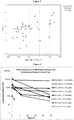
- the compounds generally have low permeability across membranes ( Table 7 and Figure 1 ).
- the pharmacokinetic measurements show that generally the compounds of the invention are found to have a higher relative content remaining in the lung 24 hours following topical delivery after the subject receives the dose than nintedanib ( Table 8 and Figures 2 and 3 ).
- the pharmacokinetic parameters also indicate that compounds of the invention maintain higher lung levels when delivered topically compared to equivalent doses delivered i.v. and generally these higher relative levels are higher than the corresponding levels for nintedanib particularly at the 24h timepoint.
- the low BAL levels noted together with the reducing amounts over a 24 h period indicate dissolution and absorption into the lung tissue is occurring with compounds of the invention.
- This profile indicates that compounds of the invention are expected to be suitable as medicines inter alia for the treatment of fibrotic diseases or interstitial lung diseases, such as IPF, or respiratory disorders, especially when delivered topically to the lung.
Landscapes
- Chemical & Material Sciences (AREA)
- Health & Medical Sciences (AREA)
- Organic Chemistry (AREA)
- Veterinary Medicine (AREA)
- Medicinal Chemistry (AREA)
- Pharmacology & Pharmacy (AREA)
- Life Sciences & Earth Sciences (AREA)
- Animal Behavior & Ethology (AREA)
- General Health & Medical Sciences (AREA)
- Public Health (AREA)
- Epidemiology (AREA)
- Engineering & Computer Science (AREA)
- Bioinformatics & Cheminformatics (AREA)
- Pulmonology (AREA)
- Chemical Kinetics & Catalysis (AREA)
- General Chemical & Material Sciences (AREA)
- Nuclear Medicine, Radiotherapy & Molecular Imaging (AREA)
- Pharmaceuticals Containing Other Organic And Inorganic Compounds (AREA)
- Organic Low-Molecular-Weight Compounds And Preparation Thereof (AREA)
- Plural Heterocyclic Compounds (AREA)
- Nitrogen Condensed Heterocyclic Rings (AREA)
- Indole Compounds (AREA)
Description
- The invention relates inter alia to novel compounds which inhibit protein kinases and to their use in therapy, particularly for the treatment of fibrotic diseases or interstitial lung diseases, especially Idiopathic Pulmonary Fibrosis and respiratory diseases. The invention also extends to pharmaceutical compositions comprising the compounds.
- Interstitial lung diseases (ILDs) are characterized by scarring of the lung that leads to lung dysfunction, which can eventually lead to respiratory failure. There are many ILDs with no known cause, which are termed idiopathic. Idiopathic Pulmonary Fibrosis (IPF) is the most common type of ILD. IPF affects about 170,000 people in Europe and 130,000 people in the United States, with approximately 48,000 new cases diagnosed each year in the US alone and 40,000 people dying in the US annually. IPF mortality rates are very high with median survival of 3-5 years from diagnosis and reported 5-year survival rates of less than 30%, on a par with the most lethal cancers. Until recently few treatment options other than lung transplantation have been shown to be effective and treatment for most patients has been symptom control and palliative care.
- IPF is a chronic and fatal disease primarily characterised by a progressive decline in lung function caused by the scarring of lung tissue which results in worsening dyspnea. Vascular endothelial growth factor (VEGF), fibroblast growth factor (FGF) and platelet derived growth factor (PDGF) are known potent mitogens for fibroblast cells, which then replace the normal tissue in lungs when fibrosis occurs. In ILDs, the evidence for a pathogenic role for PDGF, VEGF, and FGF has been demonstrated clinically. The primary site affected is the interstitium, the tissue between the air sacs in the lung, but it does also affect the airspaces, peripheral airways and vessels. The disease process is believed to be initiated by a series of microinjuries to the alveolar epithelium in the lung. After the injury, increased vascular permeability leads to clot formation and resident epithelial cells proliferate in an attempt to replace those cells that died as a result of the injury. This process triggers the release of a variety of growth factors (eg, PDGF, VEGF, FGF, and transforming growth factor β (TGFβ)), leading to the aberrant activation of the epithelial cells, abnormal vascular remodelling, and most notably, the proliferation and migration of fibroblasts into the lung. Growth factors also induce resident cells to transform into myofibroblasts, which together with fibroblasts organize into foci (King TE Jr, et al., Lancet, 2011, 3;378(9807):1949-61; Selman M, et al., Ann Intern Med., 2001, 16;134(2):136-51). These cellular changes result in the disruption of the basement membrane and excessive accumulation of extracellular matrix proteins in the interstitial space. The result is the eventual destruction of the normal architecture of the alveolar capillary unit and lung scarring. The pathologies that define the usual interstitial pattern (UIP) of fibrosis characteristic of IPF are a heterogeneous pattern of alternating areas of normal lung, interstitial inflammation, dense fibrosis, fibroblastic foci, and honeycombing, especially in the subpleural area of the lung (Du Bois RM., Nat Rev Drug Discov., 2010, 9(2):129-40; Selman M, et al., Ann Intern Med., 2001, 16;134(2):136-51; King TE Jr, et al., Lancet, 2011, 3;378(9807):1949-61). The loss of normal architecture and scarring of the interstitial space leads to a significant decline in gas exchange capacity leading to development of the classical symptoms of the disease namely dyspnea, chronic cough, inspiratory crackles on auscultation, and abnormal spirometry (Castriotta RJ, et al., Chest, 2010, 138(3):693-703). While the disease course is heterogeneous, the median survival is approximately 3-5 years and the most common cause of death is respiratory failure due to the progressive pathologies that disrupt normal lung functioning and gas-exchange.
- To achieve better tolerability and also better efficacy in treatment of lung disorders it can be advantageous to deliver a drug directly to the site of action in the lung. This enables higher concentrations of drug to be achieved at the site of action resulting in a lower overall dose consequently lowering systemic side effects.
- Nintedanib, a protein kinase inhibitor, was approved by the FDA for treatment of IPF in 2014 by oral administration. However, it is associated with significant systemic adverse events, including abdominal pain, vomiting and diarrhoea.
WO2006/067165 teaches that inhibitors of VEGFR, FGFR and PDGFR, such as nintedanib, may be expected to be useful in treatment of fibrotic diseases, such as IPF. Fehrenbach. H., et al., Virchows Arch., 1999, 435(1):20-31 discloses that VEGFR is linked to the cause of pulmonary fibrosis. Lindroos. P., Am J Physio Lung Cell Mol Physiol., 2001, 280:L354-L362 teaches that the upregulation of PDGF receptor is a mechanism of myofibroblast hyperplasia during pulmonary fibrosis.WO01/27081 WO2006/067165 andWO2006/067168 also disclose 6-position substituted indolinones for use as medicaments for the treatment or prevention of fibrotic diseases. - There remains a need in the art to develop further compounds, especially compounds that are better tolerated than nintedanib, for treating fibrotic diseases and interstitial lung diseases, such as IPF. Desirably such compounds would have low dose, long duration of action suitable for once, twice or three times daily dosing and good efficacy and tolerability especially when delivered topically to the lung. The compounds of formula (I) described herein address this issue.
- According to the invention, there is provided a compound of formula (I):

- R1 represents Me, Et, CH=CH2, C≡C-H or C≡C-Me;
- one of R2 and R3 represents a group selected from H, -C1-C6alkyl, C1-C6alkoxy, -C3-C8cycloalkyl, -CH2-(C3-C8cycloalkyl), halogen and cyano, and the other represents the group -Z-Rx;
- Z represents CO or SO2;
- wherein V represents CO;
- wherein v represents 0 or 1;
- wherein n represents 0, 1 or 2, except that when v represents 1, n represents 1 or 2;
- m represents 1 or 2;
- X represents CH or N, except that when n represents 0 or 1, X represents CH;
- Y represents CH or N;
- W represents a group selected from -C1-C4alkyl, -C1-C4hydroxyalkyl, C1-C4alkoxy(C1-C4)alkyl-, -C1-C4alkyleneCONR20R21, -C1-C4alkyleneNR20COR21, -SO2(C1-C4)alkyl, -CO(C1-C4)alkyl, halogen, CN, OH and NR22R23 except that when W represents NR22R23, -C1alkyleneNR20COR21 or halogen, Y represents CH;
- R20, R21, R22, R23, R24 and R25 independently represent H or -C1-C4alkyl;
-
-
Figure 1 : shows the artificial membrane permeability of representative examples (3-12, 17-22, 25-27, 29-40, 43-49) of the invention and nintedanib (see results of PAMPA permeability assay and Table 7: average values were used for compounds where the experiment was repeated) -
Figure 2 : shows the total lung exposure following intravenous and intra-tracheal administration of examples of the invention or nintedanib in rats (see results of pharmacokinetic measurements in rodents) -
Figure 3 : shows the total lung exposure following intravenous and intra-tracheal administration of examples of the invention or nintedanib in rats (see results of pharmacokinetic measurements in rodents) - Alkyl groups may be branched or straight chain. C1-8alkyl groups may for example represent C1-6alkyl, C1-4alkyl or C1-3alkyl. Exemplary alkyl groups include methyl, ethyl, n-propyl, i-propyl, n-butyl, t-butyl and CH2CHMe2. In one embodiment alkyl refers to straight chain alkyl. Alkylene is to be construed in the same way as alkyl except that it is a divalent group.
- Alkoxy as used herein means -Oalkyl and includes straight or branched chain alkoxy, for example methoxy, ethoxy, propoxy, butoxy.
- Hydroxyalkyl means alkyl with a hydroxyl substituent in any position. Examples include hydroxymethyl, 2-hydroxyethyl, 3-hydroxy-n-propyl and 4-hydroxy-n-butyl.
- Halogens may suitably be Br, Cl or F, especially Cl or F, particularly F.
- Examples of 4-8 membered aliphatic heterocyclic rings containing one or more heteroatoms independently selected from N, O and S include azetidine, pyrrolidine, piperidine, piperazine, morpholine, dioxane, tetrahydrofuran, thiomorpholine, tetrahydropyran and diazepane. Suitably the heterocyclic ring incudes 1 or 2, especially 1 heteroatom. Such rings may contain a carbonyl and examples include pyrrolidinone, piperazinone, diazepanone and piperidinone. Such rings that R4 and R5 may represent may contain a sulphone group such as 1,1-dioxo-1-thiomorpholin-1-yl.
- C3-C8cycloalkyl refers to an aliphatic carbocyclic ring containing typically 3 to 8 ring members with optional branching and containing 3 to 8 carbon atoms in total. Examples include cyclopropyl, cyclobutyl, cyclopentyl, cyclohexyl, methylcyclohexyl, cycloheptyl and cyclooctyl. In one embodiment the rings are not substituted. In another embodiment the ring bears one substituent, for example, dimethylamino. Example of a substituted cycloalkyl ring is 1-(dimethylamino)cyclobutyl.
- 4-8 membered aliphatic heterocyclic rings may optionally be substituted. In one embodiment the rings are not substituted. In another embodiment the ring bears one substituent. In another embodiment the ring bears two substituents. A substituent may be on a carbon or a nitrogen atom. Such rings that Het may represent or fall within the definition of spiro-C may be substituted by methyl. Examples include morpholinomethyl, pyrrolidin-1-ylmethyl, 4-methyl-1,4-diazepan-2-one and 4-methylpiperazin-2-one.
Such examples of substituted heterocyclic rings that R4 and R5 may represent include 1-methyl-piperazine, 1-methyl-piperidine, 1-methyl-1,4-diazepane, 4-dimethylamino-piperidine, 4-hydroxy-piperidine, 1-(2-hydroxyethyl)piperidine, 4-(hydroxymethyl)piperidine, 1-(2-methoxyethyl)piperidine, 4,4-difluoropiperidine, 4-fluoropiperidine, 1-acetylpiperazine, 4-methyl-1,4-diazepan-2-one, 1-acetyl-1,4-diazepane, 4-(dimethylamino)tetrahydro-2H-pyran, 4-(methylsulfonyl)piperazine and 3-hydroxy-1-methylpyrrolidine. - Spiro-C refers to a quaternary carbon atom connecting two aliphatic heterocyclic rings together per the definition above to form a spiro bicyclic ring. Examples of spiro bicyclic rings include spiro[5.5]undecane and spiro[5.6]dodecane. Examples of substituted spiro bicyclic rings include 1-methyl-5-oxo-1,4,9-triazaspiro[5.5]undecane and 7-methyl-12-oxo-3,7,11-triazaspiro[5.6]dodecane.
- In one embodiment there is provided a pharmaceutically acceptable salt of the compound of the invention.
- The compounds of the disclosure include those where the atom specified is a naturally occurring or non-naturally occurring isotope. In one embodiment the isotope is a stable isotope. Thus the compounds of the disclosure include, for example those containing one or more deuterium atoms in place of hydrogen atoms and the like.
- The disclosure also extends to all polymorphic forms of the compounds herein defined including salts thereof.
- The disclosure also extends to all solvates of the compounds herein defined. Examples of solvates include hydrates.
- Suitably R1 represents Me.
- In a preferred embodiment R2 represents a group selected from H, -C1-C6alkyl, C1-C6alkoxy-, C3-C8cycloalkyl-, -CH2-(C3-C8cycloalkyl), halogen and cyano and R3 represents the group -Z-Rx. In an alternative embodiment R2 represents the group -Z-Rx and R3 represents a group selected from H, -C1-C6alkyl, C1-C6alkoxy-, -C3-C8Cycloalkyl, -CH2-(C3-C8cycloalkyl), halogen and cyano.
Suitably when R2 or R3 do not represent -Z-Rx, they represent a group selected from H, C1-C6alkyl, C1-C6alkoxy-, C3-C6cycloalkyl, halogen and cyano, more suitably H, C1-C4alkyl or halogen, yet more suitably H, Me or halogen, most suitably H, Me or F, especially H. - In a preferred embodiment Z represents CO. In an alternative embodiment Z is SO2.
- Suitably R1 represents Me.
Suitably Z represents CO.
Suitably R3 represents -Z-Rx.
When v is 0, suitably n represents 0 or 2, especially 0.
When v is 1, suitably n represents 1.
Suitably v represents 0.
Suitably m represents 1.
Suitably X represents CH.
Suitably Y represents N.
Suitably W represents -C1-C4alkyl (especially Me) or NR22R23 (especially NMe2). - The compounds of formula (I) may conveniently be prepared by a process comprising reacting a compound of formula (II), in which L is a leaving group, such as -OC1-C4 alkyl, e.g. -Oethyl:


- Typically, compounds of formulae (II) and (III) may be reacted in the presence of a solvent, such as DMF, and heated to about 80 °C for approximately 18 hours. Following this step, a deprotection step is performed to remove the protecting group, acetyl. To achieve this, the reaction mixture may be cooled to room temperature and a nucleophile, such as piperidine, added and stirred for 1 to 24 hours.
- Compounds of formula (II) in which L represents -Oethyl may be prepared by reacting a compound of formula (IV):
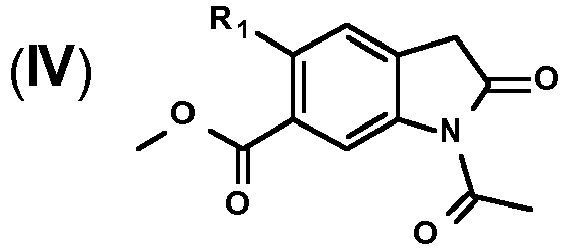

- Typically compounds of formulae (IV) and (V) may be reacted in the presence of acetic anhydride at a temperature of about 110 °C for approximately 4 hours. Other compounds of formula (II) may be prepared in an analogous manner.
- Compounds of formula (IV) may be prepared by reacting a compound of formula (VI):

- Compounds of formula (VI) may be prepared by reducing the -NO2 group of a compound of formula (VII):

- Compounds of formula (VII) may be prepared by reacting a compound of formula (VIII):

- Alternatively compounds of formula (Ia), which are compounds of formula (I) in which Z is CO, may be prepared by reacting a compound of formula (IXa) or (IXb):

- Compounds of formulae (IXa) and (IXb) may be prepared by deprotection of compounds of formulae (Xa) and (Xb) respectively:

- Compounds of formulae (Xa) and (Xb) may be prepared by reacting a compound of formula (II) with a compound of formula (XIa) and (XIb) respectively:

- The compounds may be reacted in the presence of DMF for about 18 hours at 100 °C.
- Synthesis of compounds of formula (III) may be prepared by reacting a compound of formula H-Rx with a compound of formula (XIIa) or (XIIb) respectively:

- The compounds may typically be reacted in the presence of Hünig's base (DIPEA) and DMF for about 16 hours at room temperature, followed by a deprotection step using standard reagents in the art, such as TFA.
- Novel intermediate compounds of formula (IXb), and (Xb) wherein R1 is Me, Et, CH=CH2, C≡C-H or C≡C-Me and salts thereof are claimed as an aspect of the invention.
- Compounds of formulae (V), (VIII), (XIa), (XIb), (XIIa), (XIIb), (XIV), NHR14R15, and H-Rx may be prepared by known methods, or methods analogous to those described herein.
- Compounds of formula (I) may be prepared or employed in the form of a pharmaceutically acceptable salt, including the therapeutically active non-toxic acid addition salts that the compounds of formula (I) are able to form. These pharmaceutically acceptable acid addition salts can conveniently be obtained by treating the free base form with such appropriate acids in a suitable solvent or mixture of solvents. Appropriate acids comprise, for example, ethanesulfonic, maleic, malonic, L-tartaric, fumaric, citric, succinic, acetic, triphenyl acetic, hydrochloric, sulfuric, phosphoric, 1-hydroxy-2-naphthoic, hydrobromic, methanesulfonic, tartaric, palmitic, isethionic, pamoic, formic, cinnamic benzoic, ascorbic , galactaric , lactic, malic , oxalic, para- toluenesulfonic, benzenesulphonic, propionic, furoic, phosphonic and glutaric. Conversely said salt forms can be converted by treatment with an appropriate base into the free base form.
- The invention provides a compound of the invention for use as a pharmaceutical.
- Further, the present invention provides a pharmaceutical composition comprising a compound according to the invention optionally in combination with one or more pharmaceutically acceptable diluents or carriers.
- Diluents and carriers may include those suitable for parenteral, oral, topical including by inhalation via the mouth into the lungs or inhalation via the nose, mucosal and rectal administration, and may be different depending on the route of administration.
- In one embodiment compositions may be prepared e.g. for parenteral administration e.g., subcutaneous, intramuscular, intravenous, intra-dermal, intra-articular or peri-articular administration, particularly in the form of liquid solutions or suspensions; for oral administration, particularly in the form of tablets,capsules, powder, granules, solid dispersions or in the form of liquid solutions or suspensions including nanosuspensions; for inhalation to the lungs or nose e.g. pulmonary or intranasal administration, particularly in the form of dry powders, solutions, suspensions including nanosuspensions for nebulisation, nasal sprays or drops comprising solutions or suspensions or suspension or solution pressurised or non-pressurised aerosols; for topical or transdermal administration e.g. as creams, sprays, foams, gels, ointments, liquids, patches; for mucosal administration e.g. to buccal, sublingual or vaginal mucosa, and for rectal administration e.g. in the form of a foam or suppository.
- The compositions may conveniently be administered in unit dosage form and may be prepared by any of the methods well-known in the pharmaceutical art, for example as described in Remington's Pharmaceutical Sciences, 17th ed., Mack Publishing Company, Easton, PA., (1985). The compositions may also conveniently be administered in multiple unit dosage form.
- Formulations for parenteral administration may contain as excipients sterile water or saline, buffers, tonicity-adjusting agents, preservatives, anti-oxidants, viscosity adjusting agents, alkylene glycols such as propylene glycol, polyalkylene glycols such as polyethylene glycol, oils of vegetable origin, hydrogenated naphthalenes and the like.
- Compositions suitable for oral administration may comprise one or more physiologically compatible carriers and/or excipients and may be in solid or liquid form. Tablets and capsules may be prepared with binding agents, for example, syrup, acacia, gelatin, sorbitol, tragacanth, celluloses or polyvinylpyrrolidone; fillers, such as lactose, sucrose, corn starch, calcium phosphate, sorbitol, or glycine; lubricants, such as magnesium stearate, talc, polyethylene glycol, or silica; and surfactants, such as sodium lauryl sulfate. Liquid compositions may contain conventional additives such as suspending agents, for example sorbitol syrup, methyl cellulose, sugar syrup, gelatin, carboxymethyl-cellulose, or edible fats; emulsifying agents and surfactants such as lecithin, or acacia; vegetable oils such as almond oil, coconut oil, cod liver oil, or peanut oil; preservatives such as butylated hydroxyanisole (BHA) and butylated hydroxytoluene (BHT). Liquid compositions may be encapsulated in, for example, gelatin to provide a unit dosage form.
- Solid oral dosage forms include tablets, two-piece hard shell capsules and soft elastic gelatin (SEG) capsules. Such two-piece hard shell capsules may be made from, for example, gelatin or hydroxypropyl methylcellulose (HPMC).
- A dry shell formulation typically comprises of about 40%-60% concentration of gelatin, about a 20%-30% concentration of plasticizer (such as glycerin, sorbitol or propylene glycol) and about a 30%-40% concentration of water. Other materials such as preservatives, dyes, opacifiers and flavours also may be present. The liquid fill material comprises a solid drug that has been dissolved, solubilized or dispersed (with suspending agents such as beeswax, hydrogenated castor oil or polyethylene glycol 4000) or a liquid drug in vehicles or combinations of vehicles such as mineral oil, vegetable oils, triglycerides, glycols, polyols and surface-active agents.
- Formulations for nasal administration may be powders and may contain excipients, for example, lactose or dextran, or may be aqueous or oily solutions for use in the form of nasal drops or metered spray. Formulations for nasal administration may also be in the form of aqueous suspensions or pressurised non-aqueous solutions or suspensions. For buccal administration typical excipients include sugars, calcium stearate, magnesium stearate, pregelatinated starch, and the like.
- Suitably the compound of formula (I) is administered topically to the lung. Hence in one embodiment there is provided a pharmaceutical composition comprising a compound of the disclosure optionally in combination with one or more topically acceptable diluents or carriers.
- Topical administration to the lung may be achieved by use of a non-pressurised formulation such as an aqueous solution or suspension. These formulations may be administered by means of a nebuliser e.g. one that can be hand-held and portable or for home or hospital use (ie non-portable). The formulation may comprise excipients such as water, buffers, tonicity adjusting agents, pH adjusting agents, surfactants, preservatives, suspending agents, bulking agents and co-solvents. Suspension liquid and aerosol formulations (whether pressurised or unpressurised) will typically contain the compound of the invention in finely divided form suitable for deposition into the lung, for example with a D50 of 0.5-10 µm e.g. around 1-5 µm. Powders in finely divided form may be prepared by a micronization or milling process, by spray drying, by spray freezing, or by wet milling followed by spray drying. Micronization may be performed using a jet mill such as those manufactured by Hosokawa Alpine. The resultant particle size distribution may be measured using laser diffraction (e.g. with a Malvern Mastersizer 2000S or a Mastersizer 3000 instrument). Particle size distributions may be represented using D10, D50 and D90 values. The D50 median value of particle size distributions is defined as the particle size that divides the distribution in half. The measurement derived from laser diffraction is more accurately described as a volume distribution, and consequently the D50 value obtained using this procedure is more meaningfully referred to as a Dv50 value
- (median for a volume distribution). As used herein Dv values refer to particle size distributions measured using laser diffraction. Similarly, D10 and D90 values, used in the context of laser diffraction, are taken to mean Dv10 and Dv90 values and refer to the particle size whereby 10% of the distribution lies below the D10 value, and 90% of the distribution lies below the D90 value, respectively. In another embodiment, composite particles of the compound of the disclosure and excipients for use in nebulisation of a suspension formulation may be formed by co-milling and / or co-spray drying the compound and excipients together, wherein the composite particles comprising both active and excipients have a D50 of 1-10 µm. Aqueous suspension formulations for delivery to the lung could also comprise nanosuspensions or suspensions of composite particles containing nanoparticles.
- Topical administration to the lung may also be achieved by use of a pressurised aerosol formulation. Aerosol formulations typically comprise the active ingredient suspended or dissolved in a suitable aerosol propellant, such as a chlorofluorocarbon (CFC) or a hydrofluorocarbon (HFC). Suitable CFC propellants include trichloromonofluoromethane (propellant 11), dichlorotetrafluoromethane (propellant 114), and dichlorodifluoromethane (propellant 12). Suitable HFC propellants include tetrafluoroethane (HFC-134a) and heptafluoropropane (HFC-227). The propellant typically comprises 40%-99.5% e.g. 40%-90% by weight of the total inhalation composition. The formulation may comprise excipients including co-solvents (e.g. ethanol) and surfactants or stabilisers (e.g. lecithin, sorbitan trioleate and the like). Other possible excipients include polyethylene glycol, polyvinylpyrrolidone, glycerine and the like. Aerosol formulations are packaged in canisters and a suitable dose is delivered by means of a metering valve (e.g. as supplied by Bespak, Aptar or 3M or alternatively by Coster or Vari). Pressurised suspensions formulations for delivery to the lung could also comprise nanosuspensions or suspensions of composite particles containing nanoparticles.
- Topical administration to the lung may also be achieved by use of a dry-powder formulation. A dry powder formulation will contain the compound of the disclosure in finely divided form, typically with a D50 of 0.5-10 µm e.g. around 1-5 µm. Powders in finely divided form may be prepared by a micronization or milling process, by spray drying, by spray freezing, or by wet milling followed by spray drying. Micronization may be performed using a jet mill such as those manufactured by Hosokawa Alpine. The resultant particle size distribution may be measured using laser diffraction (e.g. with a Malvern Mastersizer 2000S or a Mastersizer 3000 instrument). The formulation will typically contain one or more topically acceptable diluents such as lactose, glucose, trehalose or mannitol (preferably lactose), usually of comparatively large particle size e.g. a D50 of 15-250 µm. In another embodiment, composite particles of the compound of the disclosure and excipients may also be formed by co-milling and / or co-spray drying the compound and excipients together, wherein the composite particles comprising both active and excipients have a D50 of 1-10 µm. As used herein, the term "lactose" refers to a lactose-containing component, including α-lactose monohydrate, β-lactose monohydrate, α-lactose anhydrous, β-lactose anhydrous and amorphous lactose. Lactose components may be processed by micronization, sieving, milling, compression, agglomeration or spray drying. Commercially available forms of lactose in various forms are also encompassed, for example Lactohale® (DFE Pharma), InhaLac® (Meggle), Pharmatose® (DFE Pharma) and Respitose® (DFE Pharma) products. In one embodiment, the lactose component is selected from the group consisting of α-lactose monohydrate, α-lactose anhydrous and amorphous lactose. Preferably, the lactose is α-lactose monohydrate.
- Dry powder formulations may also contain other excipients such as leucine, sodium stearate, calcium stearate or magnesium stearate. Dry powder particles could be composite particles and could be comprised of nanoparticles in a composite matrix.
- A dry powder formulation is typically delivered using a dry powder inhaler (DPI) device. This can either be a unit dose device where the formulation is presented in individual units, either as capsules or blisters, or in a multi-dose device where more than one dose of formulation is contained in a device, either in a bulk reservoir or as multiple containers within a device (eg multiple blisters or pockets). Example dry powder inhalers include SPINHALER, DISKHALER, TURBOHALER, DISKUS, ELLIPTA,CLICKHALER, ECLIPSE, ROTAHALER, HANDIHALER, AEROLISER, CYCLOHALER, MONODOSE, BREEZHALER/NEOHALER, FLOWCAPS, TWINCAPS, X-CAPS, TWISTER, TURBOSPIN, ELPENHALER, TURBUHALER, MIATHALER, NEXTHaler, TWISTHALER, NOVOLIZER, GENUAIR, SKYEHALER, ORIEL dry powder inhaler, MICRODOSE, ACCUHALER, PULVINAL, EASYHALER, ULTRAHALER, TAIFUN, PULMOJET, OMNIHALER, GYROHALER, TAPER, CONIX, XCELOVAIR and PROHALER.
- The compounds of the invention are expected to be useful in the treatment of fibrotic diseases such as lung fibrosis and pulmonary diseases with a fibrotic component e.g. selected from IPF, giant cell interstitial pneumonia, sarcoidosis, cystic fibrosis, respiratory distress syndrome, drug-induced lung fibrosis, granulomatosis, silicosis, asbestosis, systemic scleroderma, the virally induced hepatic cirrhosis selected from hepatitis C induced hepatic cirrhosis, or diseases of the skin with a fibrotic component e.g. selected from scleroderma, sarcoidosis and systemic lupus erythematosus, and especially IPF. More generally, the compounds of the invention are expected to be useful in the treatment of interstitial lung diseases. In addition, the compounds of the invention are expected to be useful in the treatment of diseases characterized by hyperproliferation of cells, for example, cancer and wherein the compounds are delivered by inhalation, particularly lung cancer. Furthermore, the compounds of the invention may also be useful in the treatment of respiratory disorders including COPD (including chronic bronchitis and emphysema), asthma, paediatric asthma, allergic rhinitis, rhinitis, sinusitis, especially asthma, chronic bronchitis and COPD.
- The compounds of the invention are also expected to be useful in the treatment of other fibrotic diseases such as lung fibrosis associated with rheumatoid arthritis, respiratory distress syndrome including acute respiratory distress syndrome, acute lung injury, radiation induced lung fibrosis or pneumonitis, chronic hypersensitivity pneumonitis, systemic sclerosis, Sjogren's syndrome, interstitial lung diseases, pulmonary arterial hypertension (PAH), including the vascular component of PAH, or diseases of the skin with a fibrotic component e.g. selected from hypertrophic scarring and keloids, or eye diseases where fibrosis is a component including glaucoma, age related macular degeneration, diabetic macular edema, dry eye disease and diabetic retinopathy, or fibrosis in the gut e.g. associated with inflammatory bowel disease.
- In addition, the compounds of the invention are expected to be useful in the prevention of diseases characterized by hyperproliferation of cells, for example, cancer e.g. wherein the compounds are delivered by inhalation, particularly lung cancer.
- The invention provides a compound of the invention for use in the treatment of one or more of the above mentioned diseases. The invention also provides use of a compound of the invention in the manufacture of a medicament for the treatment of one or more of the above mentioned diseases.
- The word "treatment" is intended to embrace prophylaxis as well as therapeutic treatment.
- Compounds of the invention may be administered once, twice or thrice per day, especially once or twice per day. A suitable dosage amount may be determined by reference to the severity of the disease and the size of the subject. Typical dosage amounts are in the range 0.01 mg to 100 mg, e.g. 0.1 mg to 10 mg e.g. 0.25 mg to 5 mg per human dose to be delivered once, twice or thrice per day, especially once or twice per day.
- The compound of the disclosure may also be administered in combination with one or more other active ingredients e.g. active ingredients suitable for treating the above mentioned conditions. For example possible active ingredients include nintedanib or pirfenidone (these being known for treatment of IPF). Other active ingredients to be used in combination include substances with a secretolytic, broncholytic and/or anti-inflammatory activity, such as anticholinergic agents, beta-2 mimetics, steroids, PDE-IV inhibitors, p38 MAP kinase inhibitors, MK2 inhibitors, galectin inhibitors, NK1 antagonists, LTD4 antagonists, EGFR inhibitors, VEGF inhibitors, PDGF inhibitors, FGF inhibitors, TGFbeta inhibitors, LPA1 antagonists, LOXL2 inhibitors, CTGF inhibitors, pentoxyfylline, N-acetylcysteine, anti-IL13 agents, anti IL4 agents, Alphavβ6 integrin inhibitors, IGF inhibitors, PI3K inhibitors, mTOR inhibitors, JNK inhibitors, pentraxin2 and endothelin-antagonists.
- Other active ingredients to be used in combination include substances with an antifibrotic activity, such as PDE-III inhibitors, combined anti-IL4/13 agents, combined PI3k/mTOR inhibitors, autotaxin inhibitors, P2X3 antagonists, CTGF antagonists, 5-LO antagonists, leukotriene antagonists and ROCK inhibitors.
- In one embodiment the combination of active ingredients are co-formulated.
- In one embodiment the combination of active ingredients is co-administered sequentially or simultaneously.
- In one embodiment the compounds of the invention are delivered by inhalation and the other possible active ingredients are delivered orally or parenterally.
- In one embodiment there is provided a combination product comprising:
- (A) a compound of the invention; and
- (B) a further active ingredient (as mentioned above)
- In one embodiment there is provided a compound of the invention for use as a medicament to be administered in combination with one or more further active ingredients (as mentioned above).
- Compounds of the invention are expected to have one or more of the following advantageous properties:
- Good inhibitory activity of kinases selected from VEGFR (e.g. VEGFR1 and VEGFR2), FGFR and PDGFR;
- Good anti-fibrosis activity e.g. as determined in in vivo models (e.g. bleomycin fibrosis model) when delivered topically to the lung;
- Suitable physical and chemical properties and low dose for a medicinal product, particularly one intended to be delivered topically to the lung;
- Good residency time in the lung or duration of action when administered topically to the lung;
- Low permeability in the PAMPA permeability assay;
- Good duration of action e.g. as measured by inhibition of PDGF-BB induced phosphorylation of BDGFRβ in human fetal lung fibroblast cells;
- Good safety and tolerability when administered topically to the lung;
- Low oral bioavailability.
- Abbreviations used herein are defined below (Table 1). Any abbreviations not defined are intended to convey their generally accepted meaning.
Table 1: Abbreviations AcOH glacial acetic acid aq aqueous br broad BEH ethylene bridged hybrid Boc tert-butoxycarbonyl CSH charged surface hybrid conc concentrated d doublet δ chemical shift DCM dichloromethane DIAD diisopropyl azodicarboxylate DMF N,N-dimethylformamide DMSO dimethyl sulfoxide (ES+) electrospray ionization, positive mode (ES-) electrospray ionization, negative mode Et ethyl EtOAc ethyl acetate EtOH ethanol h hour(s) HATU 1-[bis(dimethylamino)methylene]-1H-1,2,3-triazolo[4,5-b]pyridinium 3-oxid hexafluorophosphate Hünig's base N,N-diisopropylethylamine M molar m multiplet (M+H)+ protonated molecular ion (M-H)- deprotonated molecular ion Me methyl MeCN acetonitrile MeOH methanol MHz megahertz min minute(s) m/z mass-to-charge ratio NMR nuclear magnetic resonance (spectroscopy) p pentuplet Ph phenyl Py pyridine q quartet rt room temperature HPLC high performance liquid chromatography s singlet sat saturated SAX solid supported anion exchange (resin) SCX solid supported cation exchange (resin) t triplet t Bu tert-butyl THF tetrahydrofuran TFA trifluoroacetic acid UV ultra-violet wt weight - All starting materials and solvents were obtained either from commercial sources or prepared according to the literature citation. Unless otherwise stated all reactions were stirred. Organic solutions were routinely dried over anhydrous magnesium sulfate. Hydrogenations were performed on a Thales H-cube flow reactor under the conditions stated or under pressure in a gas autoclave (bomb).
- Column chromatography was performed on pre-packed silica (230-400 mesh, 40-63 µm) cartridges using the amount indicated. SCX was purchased from Supelco and treated with 1 M hydrochloric acid prior to use. Unless stated otherwise the reaction mixture to be purified was first diluted with MeOH and made acidic with a few drops of AcOH. This solution was loaded directly onto the SCX and washed with MeOH. The desired material was then eluted by washing with 1% NH3 in MeOH.
- Performed using UV detection at 215 and 254 nm with either a Waters X-Select Prep-C18, 5 µm, 19x50 mm column eluting with a H2O-MeCN gradient containing 0.1% v/v formic acid over 10 min (Method A), or a Waters X-Bridge Prep-C18, 5 µm, 19x50 mm column eluting with a H2O-MeCN gradient containing 0.1% ammonium bicarbonate over 10 min (Method B).
- Method 1: Waters XSelect CSH C18 2.5 µm (4.6 x 30 mm) at 40°C; flow rate 2.5-4.5 mL min-1 eluted with a H2O-MeCN gradient containing 0.1% v/v formic acid over 4 min employing UV detection at 254 and 215 nm. Gradient information: 0-3.00 min, ramped from 95% H2O-5% MeCN to 5% H2O-95% MeCN; 3.00-3.01 min, held at 5% H2O-95% MeCN, flow rate increased to 4.5 mL min-1; 3.01-3.50 min, held at 5% H2O-95% MeCN; 3.50-3.60 min, returned to 95% H2O-5% MeCN, flow rate reduced to 3.50 mL min-1; 3.60-3.90 min, held at 95% H2O-5% MeCN; 3.90-4.00 min, held at 95% H2O-5% MeCN, flow rate reduced to 2.5 mL min-1.
- Method 2: Waters XBridge BEH C18, 2.5 µm (4.6 x 30 mm) at 40°C; flow rate 2.5-4.5 mL min-1 eluted with a H2O-MeCN gradient containing 10 mM ammonium bicarbonate over 4 min employing UV detection at 254 nm. Gradient information: 0-3.00 min, ramped from 95% H2O-5% MeCN to 5% H2O-95% MeCN; 3.00-3.01 min, held at 5% H2O-95% MeCN, flow rate increased to 4.5 mL min-1; 3.01- 3.50 min, held at 5% H2O-95% MeCN; 3.50-3.60 min, returned to 95% H2O-5% MeCN, flow rate reduced to 3.50 mL min-1; 3.60-3.90 min, held at 95% H2O-5% MeCN; 3.90-4.00 min, held at 95% H2O-5% MeCN, flow rate reduced to 2.5 mL min-1.
- 1H NMR spectra were acquired on a Bruker Avance III spectrometer at 400 MHz using residual undeuterated solvent as reference and unless specified otherwise were run in DMSO-d6.
- All chemical names have been generated using CambridgeSoft ENotebook 12.0.
-

- To a stirred solution of potassium tert-butoxide (35.9 g, 320 mmol) in DMF (350 mL), under a nitrogen atmosphere at -20 °C, was added a solution of methyl 2-methyl-5-nitrobenzoate (25.0 g, 128 mmol) and methyl 2-chloroacetate (16.9 mL, 192 mmol) in DMF (300 mL) dropwise over 40 minutes. The reaction mixture was warmed to -10 °C over 2 h and then poured onto an ice-HCl slurry (900 g ice, 500 mL 35 wt% aq HCI). The mixture was extracted with DCM (2 x 600 mL) and the combined organic layers washed with brine (2 x 400 mL) and then evaporated under reduced pressure. The crude product so obtained was purified by flash column chromatograhy (SiO2, 330 g, 0-10% EtOAc in DCM, gradient elution) to afford the subtitle compound methyl 4-(2-methoxy-2-oxoethyl)-2-methyl-5-nitrobenzoate as an orange syrup (31.0 g, 89%); Rt 2.06 min (Method 1); m/z 266 (M-H)- (ES-); 1H NMR δ: 2.61 (3H, s), 3.62 (3H, s), 3.88 (3H, s), 4.12 (2H, s), 7.59 (1H, s), 8.51 (1H, s).
-

- To a solution of methyl 4-(2-methoxy-2-oxoethyl)-2-methyl-5-nitrobenzoate (Intermediate A) (23.0 g, 86.0 mmol) in acetic acid (301 mL, 5.25 mol) was added palladium on carbon [5 wt%, 58% water, type 87L] (3.30 g, 1.55 mmol). The mixture was hydrogenated at rt under an atmosphere of H2 (5 bar) for 36 h and then filtered through a pad of celite. The filter cake was washed with EtOAc (500 mL) and the filtrate concentrated under reduced pressure. The crude residue was dissolved in hot refluxing MeOH (200 mL) and the mixture cooled to rt. The resultant solid was filtered, rinsing with MeOH (200 mL) and dried in vacuo to afford the subtitle compound methyl 5-methyl-2-oxoindoline-6-carboxylate as a brown powder (7.00 g, 39%); Rt 1.48 min (Method 1); m/z 206 (M+H)+ (ES+); 1H NMR δ: 2.45 (3H, s), 3.32 (2H, s), 3.81 (3H, s), 7.17 (1H, s), 7.22 (1H, s), 10.43 (1H, s).
-

- To a stirred solution of methyl 5-methyl-2-oxoindoline-6-carboxylate (Intermediate B) (5.00 g, 24.4 mmol) in acetic anhydride (50.6 mL, 536 mmol) was added (triethoxymethyl)benzene (22.1 mL, 97.0 mmol) and the mixture was stirred at 110 °C for 3 h. Thereafter, stirring was continued at rt for 18 h. The reaction mixture was concentrated under reduced pressure and the residue was triturated with MeOH (50 mL). The resultant solid was filtered, rinsing with MeOH (50 mL) and dried in vacuo to afford the subtitle compound (E)-methyl 1-acetyl-3-(ethoxy(phenyl)methylene)-5-methyl-2-oxoindoline-6-carboxylate as a yellow powder (4.50 g, 48%); Rt 2.70 min (Method 1); m/z 380 (M+H)+ (ES+); 1H NMR δ: 1.35 (3H, t), 2.42 (3H, s), 2.58 (3H, s), 3.84 (3H, s), 4.01 (2H, q), 7.45-7.62 (5H, overlapping m), 7.90 (1H, s), 8.64 (1H, s).
-

- A mixture of (E)-methyl 1-acetyl-3-(ethoxy(phenyl)methylene)-5-methyl-2-oxoindoline-6-carboxylate (Intermediate C) (100 mg, 0.264 mmol) and 4-amino-N-(2-(4-methylpiperazin-1-yl)ethyl)benzenesulfonamide, di-trifluoroacetate salt (387 mg, 0.316 mmol) in DMF (3 mL) was heated at 80 °C for 16 h. Piperidine (261 µl, 2.64 mmol) was added and the mixture was stirred at rt for 2 h. The solvent was removed under reduced pressure and the residue was dissolved in 10% MeOH in DCM solution (20 mL) and washed with water (20 mL). The layers were separated using a phase separator cartridge and the organic layer was concentrated under reduced pressure. The crude product was purified by preparative HPLC (Method A, 20-50% MeCN in water) to afford the title compound (Z)-methyl 5-methyl-3-(((4-(N-(2-(4-methylpiperazin-1-yl)ethyl)sulfamoyl)phenyl)amino)(phenyl)methylene)-2-oxoindoline-6-carboxylate, 0.8 formate as a light yellow solid (25 mg, 14%); Rt 1.58 min (Method 1); m/z 590 (M+H)+ (ES+); 1H NMR δ: 2.14 (6H, s), 2.17-2.35 (8H, overlapping m), 2.74-2.82 (2H, m), 3.76 (3H, s), 5.64 (1H, s), 6.96 (2H, m), 7.37 (1H, s), 7.41 (1H, m), 7.50-7.59 (4H, overlapping m), 7.60-7.73 (3H, overlapping m), 8.19 (0.8H, s), 10.92 (1H, s), 12.24 (1H, s). (Missing 2H-presumed obscured by solvent).
-

-

- To a solution of (Z)-methyl 1-acetyl-3-(((4-(tert-butoxycarbonyl)phenyl)amino)(phenyl)methylene)-5-methyl-2-oxoindoline-6-carboxylate (Intermediate D) (1.20 g, 2.28 mmol) in DCM (14 mL) was added TFA (1.76 mL, 22.8 mmol) and the mixture was stirred at rt for 72 h. The solvent was removed under reduced pressure to afford the subtitle compound (Z)-4-(((1-acetyl-6-(methoxycarbonyl)-5-methyl-2-oxoindolin-3-ylidene)(phenyl)methyl)amino)benzoic acid, trifluoroacetate adduct as a yellow solid (1.00 g, 72%); Rt 2.72 min (Method 1); m/z 471 (M+H)+ (ES+); 1H NMR δ: 2.13 (3H, s), 2.73 (3H, s), 3.78 (3H, s), 5.54 (1H, s), 7.04 (2H, m), 7.50 (2H, m), 7.57-7.76 (5H, overlapping m), 8.68 (1H, s), 11.89 (1H, s), 12.89 (1H, s).
-

- (Z)-4-(((1-Acetyl-6-(methoxycarbonyl)-5-methyl-2-oxoindolin-3-ylidene)(phenyl)methyl)amino)benzoic acid, trifluoroacetate adduct (Intermediate E) (75 mg, 0.128 mmol) and HATU (73.2 mg, 0.192 mmol) in DMF (2 mL) were stirred at rt for 10 min. Then Hünig's base (179 µl, 1.027 mmol) and N 1,N 1-dimethylethane-1,2-diamine (37.8 µl, 0.346 mmol) were added. The mixture was stirred at rt for 16 h. Piperidine (127 µl, 1.28 mmol) was added. The mixture was stirred at rt for 4 h and the reaction mixture was partitioned between DCM (25 mL) and saturated aqueous NaHCO3 solution (10 mL). The organic layer was washed with brine (10 mL) and the solvent was evaporated under reduced pressure. The crude product was purified by preparative HPLC (Method A, 20-50% MeCN in water) to afford the title compound (Z)-methyl-3-(((4-((2-(dimethylamino)ethyl)carbamoyl)phenyl)amino)(phenyl)methylene)-5-methyl-2-oxoindoline-6-carboxylate, formate as a light yellow solid (3.7 mg, 5%); Rt 1.53 min (Method 1); m/z 499 (M+H)+ (ES+); 1H NMR δ: 2.14 (3H, s), 2.80 (6H, s), 3.17-3.23 (2H, overlapping m), 3.50-3.56 (2H, overlapping m), 3.75 (3H, s), 5.63 (1H, s), 6.90 (2H, m), 7.37 (1H, s), 7.52 (2H, m), 7.56-7.72 (5H, overlapping m), 8.56 (1H, m), 10.89 (1H, s), 12.22 (1H, s).
-

- (Z)-4-(((1-Acetyl-6-(methoxycarbonyl)-5-methyl-2-oxoindolin-3-ylidene)(phenyl)methyl)amino)benzoic acid, trifluoroacetate adduct (Intermediate E) (75 mg, 0.128 mmol) and HATU (73.2 mg, 0.192 mmol) in DMF (2 mL) were stirred at rt for 10 min. Then Hünig's base (179 µl, 1.02 mmol) and (1-methylpiperidin-4-yl)methanamine (32.9 mg, 0.257 mmol) in DMF (0.2 mL) were added. The mixture was stirred at rt for 16 h. Piperidine (127 µl, 1.28 mmol) was added. The mixture was stirred at RT for 4 h and the reaction mixture was partitioned between DCM (25 mL) and saturated aqueous NaHCO3 solution (10 mL). The organic layer was washed with brine (10 mL) and the solvent was evaporated under reduced pressure. The crude product was purified by preparative HPLC (Method A, 20-50% MeCN in water) to afford the title compound (Z)-methyl 5-methyl-3-(((4-(((1-methylpiperidin-4-yl)methyl)carbamoyl)phenyl)amino)(phenyl)methylene)-2-oxoindoline-6-carboxylate, formate as a light yellow solid (19 mg, 25%); Rt 1.55 min (Method 1); m/z 539 (M+H)+ (ES+); 1H NMR δ: 1.11-1.28 (2H, overlapping m), 1.53 (1H, m), 1.60-1.73 (2H, overlapping m), 2.13 (3H, s), 2.15-2.24 (2H, overlapping m), 2.34 (3H, s), 2.89-3.00 (2H, overlapping m), 3.09 (2H, t), 3.75 (3H, s), 5.61 (1H, s), 6.87 (2H, m), 7.36 (1H, s), 7.52 (2H, m), 7.58-7.69 (5H, overlapping m), 8.17 (1H, s), 8.36 (1H, t), 10.88 (1H, s), 12.23 (1H, s).
-
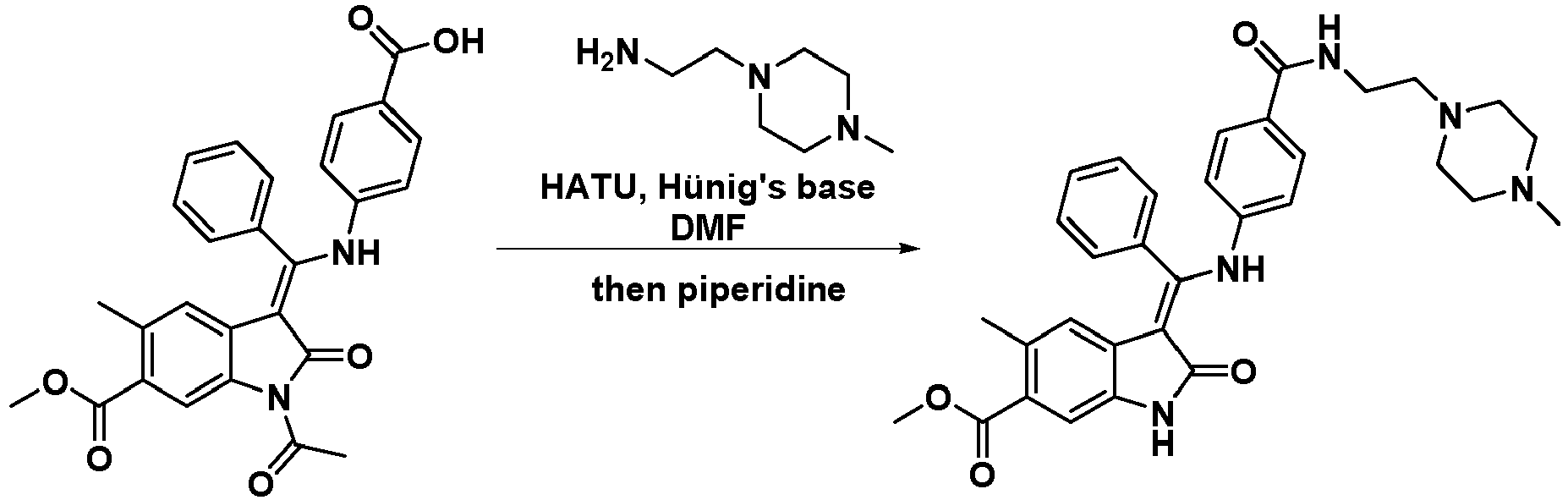
- (Z)-4-(((1-Acetyl-6-(methoxycarbonyl)-5-methyl-2-oxoindolin-3-ylidene)(phenyl)methyl)amino)benzoic acid, trifluoroacetate adduct (Intermediate E) (75 mg, 0.128 mmol), and HATU (73 mg, 0.192 mmol) in DMF (2 mL) were stirred at rt for 10 min then Hünig's base (179 µl, 1.03 mmol) and 2-(4-methylpiperazin-1-yl)ethanamine (50 mg, 0.346 mmol) in DMF (0.5 mL) were added. The mixture was stirred at rt for 3 h and piperidine (127 µl, 1.28 mmol) was added. The mixture was stirred at rt for 18 h. The reaction mixture was partitioned between DCM (25 mL) and saturated aqueous NaHCO3 solution (10 mL). The organic layer was washed with brine (10 mL) and the solvent was evaporated under reduced pressure. The crude product was purified by preparative HPLC (Method A, 20-50% MeCN in water) to afford the title compound (Z)-methyl 5-methyl-3-(((4-((2-(4-methylpiperazin-1-yl)ethyl)carbamoyl)phenyl)amino)(phenyl)methylene)-2-oxoindoline-6-carboxylate as a light yellow solid (19 mg, 25%); Rt 1.46 min (Method 1); m/z 554 (M+H)+ (ES+); 1H NMR δ: 2.13 (3H, s), 2.21 (3H, s), 2.32-2.46 (8H, overlapping m), 3.27-3.34 (4H, overlapping m), 3.75 (3H, s), 5.62 (1H, s), 6.87 (2H, m), 7.36 (1H, s), 7.52 (2H, m), 7.56-7.69 (5H, overlapping m), 8.26 (1H, t), 10.87 (1H, s), 12.22 (1H, s).
-

- (Z)-4-(((1-Acetyl-6-(methoxycarbonyl)-5-methyl-2-oxoindolin-3-ylidene)(phenyl)methyl)amino)benzoic acid, trifluoroacetate adduct (Intermediate E) (75 mg, 0.128 mmol), and HATU (73 mg, 0.192 mmol) in DMF (2 mL) were stirred at rt for 10 min then Hünig's base (179 µl, 1.03 mmol) and 2-(4-methyl-1,4-diazepan-1-yl)ethanamine (54.5 mg, 0.346 mmol) in DMF (0.5 mL) were added. The mixture was stirred at rt for 3 h and piperidine (127 µl, 1.28 mmol) was added. The mixture was stirred at rt for 18 h. The reaction mixture was partitioned between DCM (25 mL) and saturated aqueous NaHCO3 solution (10 mL). The organic layer was washed with brine (10 mL) and the solvent was evaporated under reduced pressure. The crude product was purified by preparative HPLC (Method A, 10-40% MeCN in water) to afford the title compound (Z)-methyl 5-methyl-3-(((4-((2-(4-methyl-1,4-diazepan-1-yl)ethyl)carbamoyl)phenyl)amino)(phenyl)methylene)-2-oxoindoline-6-carboxylate, formate as a light yellow solid (27 mg, 34%); Rt 1.29 min (Method 1); m/z 568 (M+H)+ (ES+); 1H NMR δ: 1.68-1.77 (2H, overlapping m), 2.13 (3H, s), 2.34 (3H, s), 2.58 (2H, t), 2.61-2.74 (8H, overlapping m), 3.23-3.32 (2H, overlapping m), 3.75 (3H, s), 5.62 (1H, s), 6.87 (2H, m), 7.36 (1H, s), 7.52 (2H, m), 7.56-7.71 (5H, overlapping m), 8.20 (1H, s), 8.24 (1H, t), 10.88 (1H, s), 12.22 (1H, s).
-

- (Z)-4-(((1-Acetyl-6-(methoxycarbonyl)-5-methyl-2-oxoindolin-3-ylidene)(phenyl)methyl)amino)benzoic acid, trifluoroacetate adduct (Intermediate E) (75 mg, 0.128 mmol), and HATU (73 mg, 0.192 mmol) in DMF (2 mL) were stirred at rt for 10 min then Hünig's base (179 µl, 1.03 mmol) and 1-(2-aminoethyl)-N,N-dimethylpiperidin-4-amine (59.3 mg, 0.346 mmol) in DMF (0.2 mL) were added. The mixture was stirred at rt for 3 h and piperidine (127 µl, 1.28 mmol) was added. The mixture was stirred at rt for 1 h. The reaction mixture was partitioned between DCM (25 mL) and saturated aqueous NaHCO3 solution (10 mL). The organic layer was washed with brine (10 mL) and the solvent was evaporated under reduced pressure. The crude product was purified by preparative HPLC (Method A, 10-40% MeCN in water) to afford the title compound (Z)-methyl 3-(((4-((2-(4-(dimethylamino)piperidin-1-yl)ethyl)carbamoyl)phenyl)amino)(phenyl)methylene)-5-methyl-2-oxoindoline-6-carboxylate, formate as a light yellow solid (20 mg, 24%); Rt 1.26 min (Method 1); m/z 582 (M+H)+ (ES+); 1H NMR δ: 1.29-1.44 (2H, overlapping m), 1.65-1.77 (2H, overlapping m), 1.86-1.98 (2H, overlapping m), 2.14 (3H, s), 2.24 (6H, s), 2.40 (2H, t), 2.85-2.95 (2H, overlapping m), 3.76 (3H, s), 5.62 (1H, s), 6.88 (2H, m), 7.37 (1H, s), 7.53 (2H, m), 7.57-7.70 (5H, overlapping m), 8.22 (1H, s), 8.28 (1H, t), 10.89 (1H, s), 12.23 (1H, s). (Missing 3H-presumed obscured by solvent).
-
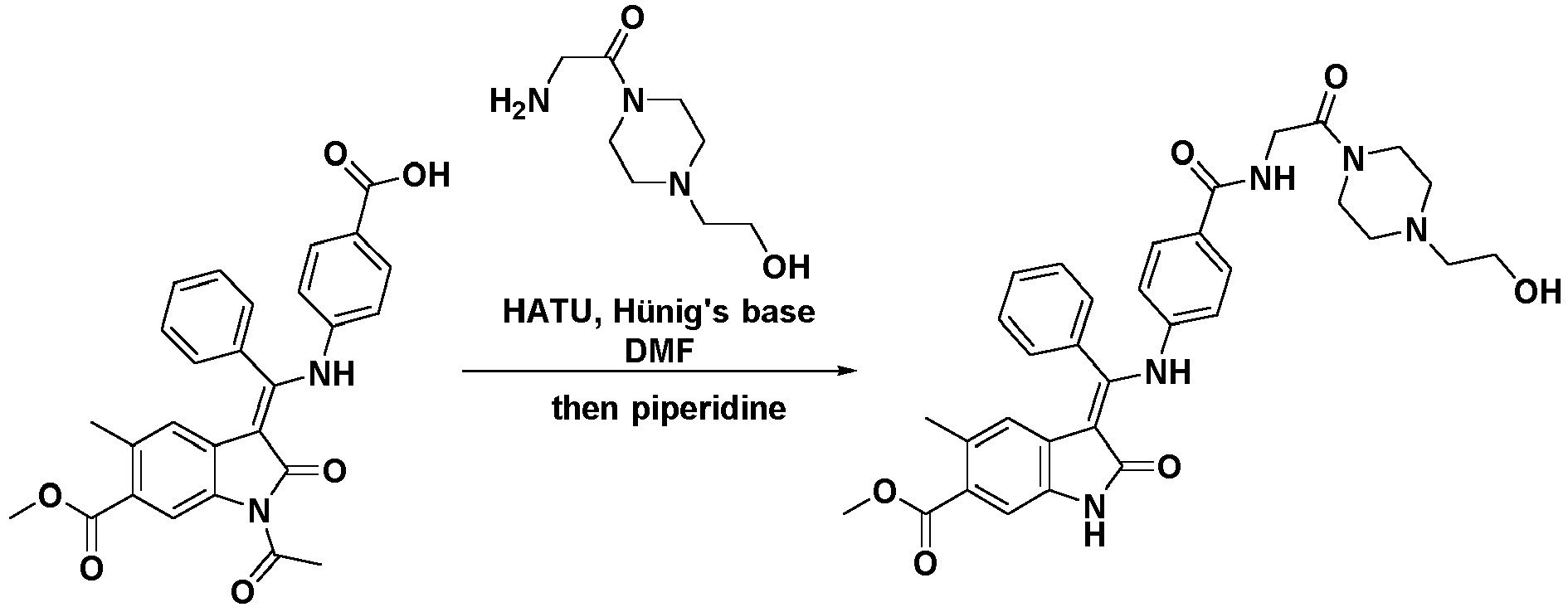
- (Z)-4-(((1-Acetyl-6-(methoxycarbonyl)-5-methyl-2-oxoindolin-3-ylidene)(phenyl)methyl)amino)benzoic acid, trifluoroacetate adduct (Intermediate E) (75 mg, 0.128 mmol), and HATU (73 mg, 0.192 mmol) in DMF (2 mL) were stirred at rt for 10 min then Hünig's base (179 µl, 1.03 mmol) and 2-amino-1-(4-(2-hydroxyethyl)piperazin-1-yl)ethanone, 2HCl (90 mg, 0.346 mmol) were added. The mixture was stirred at rt for 3 h and piperidine (127 µl, 1.28 mmol) was added. The mixture was stirred at rt for 18 h. The reaction mixture was partitioned between DCM (25 mL) and saturated aqueous NaHCO3 solution (10 mL). The organic layer was washed with brine (10 mL) and the solvent was evaporated under reduced pressure. The crude product was purified by preparative HPLC (Method A, 20-50% MeCN in water) to afford the title compound (Z)-methyl 3-(((4-((2-(4-(2-hydroxyethyl)piperazin-1-yl)-2-oxoethyl)carbamoyl)phenyl)amino)(phenyl)methylene)-5-methyl-2-oxoindoline-6-carboxylate, formate as a light yellow solid (24 mg, 27%); Rt 1.51 min (Method 1); m/z 598 (M+H)+ (ES+); 1H NMR δ: 2.14 (3H, s), 2.90-3.58 (8H, overlapping m), 3.68-3.79 (5H, overlapping m), 4.00-4.45 (4H, overlapping m), 5.40 (1H, br s), 5.63 (1H, s), 6.90 (2H, m), 7.37 (1H, s), 7.53 (2H, m), 7.57-7.70 (5H, overlapping m), 8.52 (1H, s), 9.63 (1H, br s), 10.89 (1H, s), 12.23 (1H, s).
-

- (Z)-4-(((1-Acetyl-6-(methoxycarbonyl)-5-methyl-2-oxoindolin-3-ylidene)(phenyl)methyl)amino)benzoic acid, trifluoroacetate adduct (Intermediate E) (75 mg, 0.128 mmol), and HATU (73 mg, 0.192 mmol) in DMF (2 mL) were stirred at rt for 10 min then Hünig's base (179 µl, 1.03 mmol) and 2-amino-1-(4-methylpiperazin-1-yl)ethanone, 2HCl (80 mg, 0.346 mmol) were added. The mixture was stirred at rt for 3 h and piperidine (127 µl, 1.28 mmol) was added. The mixture was stirred at rt for 18 h. The reaction mixture was partitioned between DCM (25 mL) and saturated aqueous NaHCO3 solution (10 mL). The organic layer was washed with brine (10 mL) and the solvent was evaporated under reduced pressure. The crude product was purified by preparative HPLC (Method A, 20-50% MeCN in water) to afford the title compound (Z)-methyl 5-methyl-3-(((4-((2-(4-methylpiperazin-1-yl)-2-oxoethyl)carbamoyl)phenyl)amino)(phenyl)methylene)-2-oxoindoline-6-carboxylate, 0.5 formate as a light yellow solid (28 mg, 36%); Rt 1.52 min (Method 1); m/z 568 (M+H)+ (ES+); 1H NMR δ: 2.14 (3H, s), 2.26 (3H, s), 2.31-2.46 (4H, overlapping m), 3.41-3.54 (4H, overlapping m), 3.76 (3H, s), 4.06 (2H, d), 5.64 (1H, s), 6.89 (2H, m), 7.37 (1H, s), 7.53 (2H, m), 7.57-7.70 (5H, overlapping m), 8.13 (0.5H, s), 8.46 (1H, t), 10.89 (1H, s), 12.23 (1H, s).
-

- (Z)-4-(((1-Acetyl-6-(methoxycarbonyl)-5-methyl-2-oxoindolin-3-ylidene)(phenyl)methyl)amino)benzoic acid, trifluoroacetate adduct (Intermediate E) (75 mg, 0.128 mmol), and HATU (73 mg, 0.192 mmol) in DMF (2 mL) were stirred at rt for 10 min then Hünig's base (179 µl, 1.03 mmol) and 4-(2-aminoethyl)piperazin-2-one (49.6 mg, 0.346 mmol) were added. The mixture was stirred at rt for 3 h and piperidine (127 µl, 1.28 mmol) was added. The mixture was stirred at rt for 18 h. The reaction mixture was partitioned between DCM (25 mL) and saturated aqueous NaHCO3 solution (10 mL). The organic layer was washed with brine (10 mL) and the solvent was evaporated under reduced pressure. The crude product was purified by preparative HPLC (Method A, 20-50% MeCN in water) to afford the title compound (Z)-methyl 5-methyl-2-oxo-3-(((4-((2-(3-oxopiperazin-1-yl)ethyl)carbamoyl)phenyl)amino)(phenyl)methylene)indoline-6-carboxylate as a light yellow solid (43 mg, 58%); Rt 1.59 min (Method 1); m/z 554 (M+H)+ (ES+); 1H NMR δ: 2.14 (3H, s), 2.40-2.63 (2H, overlapping m), 2.96 (1H, m), 3.13 (1H, m), 3.20-3.48 (4H, overlapping m), 3.58 (1H, m), 3.75 (3H, s), 3.99 (1H, m), 5.62 (1H, s), 6.89 (2H, m), 7.36 (1H, s), 7.53 (2H, m), 7.57-7.69 (5H, overlapping m), 8.27-8.63 (2H, overlapping m), 10.89 (1H, s), 12.23 (1H, s).
-

- (Z)-4-(((1-Acetyl-6-(methoxycarbonyl)-5-methyl-2-oxoindolin-3-ylidene)(phenyl)methyl)amino)benzoic acid, trifluoroacetate adduct (Intermediate E) (800 mg, 1.37 mmol), and HATU (781 mg, 2.05 mmol) in DMF (6 mL) were stirred at rt for 10 min then Hünig's base (1.43 ml, 8.21 mmol) and 3-amino-1-(4-methylpiperazin-1-yl)propan-1-one (223 mg, 1.30 mmol) was added. The mixture was stirred at rt for 3 h and piperidine (1.35 ml, 13.7 mmol) was added. The mixture was stirred at rt for 18 h. The reaction mixture was partitioned between 10% MeOH in DCM (25 mL) and saturated aqueous NaHCO3 solution (10 mL). The organic layer was washed with brine (10 mL) and the solvent was evaporated under reduced pressure. The material was loaded onto an SCX cartridge in MeOH (10 mL). The column was washed with MeOH (30 mL) and the filtrate was discarded. The product was eluted with 1% ammonia in MeOH. The solvent was evaporated and the residue was purified by flash column chromatography (SiO2, 80 g, 0-30% 1% ammonia in MeOH in DCM, gradient elution) to afford (Z)-methyl 5-methyl-3-(((4-((3-(4-methylpiperazin-1-yl)-3-oxopropyl)carbamoyl)phenyl)amino)(phenyl)methylene)-2-oxoindoline-6-carboxylate as a light yellow solid (386 mg, 48%); Rt 1.60 min (Method 1); m/z 582 (M+H)+ (ES+); 1H NMR δ: 2.13 (3H, s), 2.15 (3H, s), 2.21 (2H, t), 2.24 (2H, t), 2.53 (2H, t), 3.35-3.45 (6H, overlapping m), 3.75 (3H, s), 5.62 (1H, s), 6.87 (2H, m), 7.36 (1H, s), 7.51 (2H, m), 7.57-7.68 (5H, overlapping m), 8.37 (1H, t), 10.88 (1H, s), 12.21 (1H, s).
-

- (Z)-4-(((1-Acetyl-6-(methoxycarbonyl)-5-methyl-2-oxoindolin-3-ylidene)(phenyl)methyl)amino)benzoic acid, trifluoroacetate adduct (Intermediate E) (75 mg, 0.128 mmol), and HATU (73 mg, 0.192 mmol) in DMF (2 mL) were stirred at rt for 10 min then Hünig's base (179 µl, 1.03 mmol) and N-methyl-2-(piperazin-1-yl)acetamide (54.5 mg, 0.346 mmol) were added. The mixture was stirred at rt for 3 h and piperidine (127 µl, 1.28 mmol) was added. The mixture was stirred at rt for 18 h. The reaction mixture was partitioned between DCM (25 mL) and saturated aqueous NaHCO3 solution (10 mL). The organic layer was washed with brine (10 mL) and the solvent was evaporated under reduced pressure. The crude product was purified by preparative HPLC (Method A, 20-50% MeCN in water) to afford the title compound (Z)-methyl 5-methyl-3-(((4-(4-(2-(methylamino)-2-oxoethyl)piperazine-1-carbonyl)phenyl)amino)(phenyl)methylene)-2-oxoindoline-6-carboxylate as a light yellow solid (8.8 mg, 12%); Rt 1.59 min (Method 1); m/z 568 (M+H)+ (ES+); 1H NMR δ: 2.13 (3H, s), 2.61-2.70 (4H, overlapping m), 3.75 (3H, s), 5.60 (1H, s), 6.88 (2H, m), 7.24 (2H, m), 7.37 (1H, s), 7.53 (2H, m), 7.57-7.71 (3H, overlapping m), 8.26 (1H, br s), 10.87 (1H, s), 12.23 (1H, s). (Missing 9H-presumed obscured by solvent).
-

- (Z)-4-(((1-Acetyl-6-(methoxycarbonyl)-5-methyl-2-oxoindolin-3-ylidene)(phenyl)methyl)amino)benzoic acid, trifluoroacetate adduct (Intermediate E) (75 mg, 0.128 mmol), and HATU (73 mg, 0.192 mmol) in DMF (2 mL) were stirred at rt for 10 min then Hünig's base (179 µl, 1.03 mmol) and 1-(2-aminoethyl)piperidin-4-ol (50 mg, 0.346 mmol) were added. The mixture was stirred at rt for 3 h and piperidine (127 µl, 1.28 mmol) was added. The mixture was stirred at rt for 18 h. The reaction mixture was partitioned between DCM (25 mL) and saturated aqueous NaHCO3 solution (10 mL). The organic layer was washed with brine (10 mL) and the solvent was evaporated under reduced pressure. The crude product was purified by preparative HPLC (Method A, 20-50% MeCN in water) to afford the title compound (Z)-methyl 3-(((4-((2-(4-hydroxypiperidin-1-yl)ethyl)carbamoyl)phenyl)amino)(phenyl)methylene)-5-methyl-2-oxoindoline-6-carboxylate, 0.8 formate as a light yellow solid (9 mg, 11%); Rt 1.54 min (Method 1); m/z 555 (M+H)+ (ES+); 1H NMR δ: 1.28-1.42 (2H, overlapping m), 1.64-1.72 (2H, overlapping m), 2.02-2.11 (2H, overlapping m), 2.13 (3H, s), 2.42 (2H, t), 2.69-2.78 (2H, overlapping m), 3.75 (3H, s), 4.56 (1H, br s), 5.62 (1H, s), 6.87 (2H, m), 7.36 (1H, s), 7.52 (2H, m), 7.57-7.69 (5H, overlapping m), 8.16 (0.8H, s), 8.28 (1H, t), 10.88 (1H, s), 12.22 (1H, s). (Missing 3H-presumed obscured by solvent).
-

- (Z)-4-(((1-Acetyl-6-(methoxycarbonyl)-5-methyl-2-oxoindolin-3-ylidene)(phenyl)methyl)amino)benzoic acid, trifluoroacetate adduct (Intermediate E) (75 mg, 0.128 mmol), and HATU (73 mg, 0.192 mmol) in DMF (2 mL) were stirred at rt for 10 min then Hünig's base (179 µl, 1.03 mmol) and 2-(4-aminopiperidin-1-yl)ethanol, 2HCl (100 mg, 0.462 mmol) in DMF (1 mL) were added. The mixture was stirred at rt for 2 h and piperidine (127 µl, 1.28 mmol) was added. The mixture was stirred at rt for 18 h. The reaction mixture was partitioned between DCM (25 mL) and saturated aqueous NaHCO3 solution (10 mL). The organic layer was washed with brine (10 mL) and the solvent was evaporated under reduced pressure. The crude product was loaded onto a column of SCX (2 g) in 5% AcOH in MeOH (10 mL). The column was washed with MeOH (10 mL) and the filtrate was discarded. The product was eluted with 1% ammonia in MeOH (25 mL). The solvent was evaporated under reduced pressure and the product was purified by flash column chromatography (SiO2, 12 g, 0-30% MeOH in DCM, gradient elution) to afford (Z)-methyl 3-(((4-((1-(2-hydroxyethyl)piperidin-4-yl)carbamoyl)phenyl)amino)(phenyl)methylene)-5-methyl-2-oxoindoline-6-carboxylate as a light yellow solid (33 mg, 34%); Rt 1.56 min (Method 1); m/z 555 (M+H)+ (ES+); 1H NMR δ: 1.43-1.56 (2H, overlapping m), 1.65-1.74 (2H, overlapping m), 2.00 (2H, t), 2.13 (3H, s), 2.36 (2H, m), 2.85 (2H, m), 3.47 (2H, m), 3.66 (1H, m), 3.75 (3H, s), 4.37 (1H, m), 5.61 (1H, s), 6.86 (2H, m), 7.36 (1H, s), 7.52 (2H, m), 7.56-7.76 (5H, overlapping m), 8.09 (1H, d), 10.88 (1H, s), 12.23 (1H, s).
-

- (Z)-4-(((1-Acetyl-6-(methoxycarbonyl)-5-methyl-2-oxoindolin-3-ylidene)(phenyl)methyl)amino)benzoic acid, trifluoroacetate adduct (Intermediate E) (75 mg, 0.128 mmol), and HATU (73 mg, 0.192 mmol) in DMF (2 mL) were stirred at rt for 10 min then Hünig's base (179 µl, 1.03 mmol) and 2-(4-(aminomethyl)piperidin-1-yl)ethanol (73.1 mg, 0.462 mmol) were added. The mixture was stirred at rt for 3 h and piperidine (127 µl, 1.28 mmol) was added. The mixture was stirred at rt for 18 h. The reaction mixture was partitioned between DCM (25 mL) and saturated aqueous NaHCO3 solution (10 mL). The organic layer was washed with brine (10 mL) and the solvent was evaporated under reduced pressure. The crude product was loaded onto a column of SCX (2 g) in 5% AcOH in MeOH (10 mL). The column was washed with MeOH (10 mL) and the filtrte was discarded. Then the product was eluted with 1% ammonia in MeOH (25 mL). The solvent was evaporated under reduced pressure and the product was purified by flash column chromatography (SiO2, 12 g, 0-30% MeOH in DCM, gradient elution) to afford (Z)-methyl 3-(((4-(((1-(2-hydroxyethyl)piperidin-4-yl)methyl)carbamoyl)phenyl)amino)(phenyl)methylene)-5-methyl-2-oxoindoline-6-carboxylate as a light yellow solid (63 mg, 63%); Rt 1.56 min (Method 1); m/z 569 (M+H)+ (ES+); 1H NMR δ: 1.05-1.19 (2H, overlapping m), 1.47 (1H, m), 1.58 (2H, m), 1.81-1.94 (2H, overlapping m), 2.13 (3H, s), 2.28-2.40 (2H, overlapping m), 2.82 (2H, m), 3.07 (2H, t), 3.46 (2H, m), 3.75 (3H, s), 4.34 (1H, s), 5.61 (1H, s), 6.86 (2H, m), 7.36 (1H, s), 7.52 (2H, m), 7.57-7.70 (5H, m), 8.32 (1H, t), 10.88 (1H, s), 12.23 (1H, s).
-

- (Z)-4-(((1-Acetyl-6-(methoxycarbonyl)-5-methyl-2-oxoindolin-3-ylidene)(phenyl)methyl)amino)benzoic acid, trifluoroacetate adduct (Intermediate E) (500 mg, 0.855 mmol), and HATU (488 mg, 1.28 mmol) in DMF (5 mL) were stirred at rt for 10 min then Hünig's base (448 µl, 2.57 mmol) and tert-butyl 2-(piperazin-1-yl)acetate (171 mg, 0.855 mmol) in DMF (1 mL) were added. The mixture was stirred at rt for 3 h. The reaction mixture was partitioned between DCM (100 mL) and saturated aqueous NaHCO3 solution (40 mL). The organic layer was washed with brine (40 mL) and the solvent was evaporated under reduced pressure. The crude product was purified by flash column chromatograhy (SiO2, 12 g, 0-30% 1% ammonia in MeOH in DCM, gradient elution) to afford the subtitle compound (Z)-methyl 1-acetyl-3-(((4-(4-(2-(tert-butoxy)-2-oxoethyl)piperazine-1-carbonyl)phenyl)amino)(phenyl)methylene)-5-methyl-2-oxoindoline-6-carboxylate as a light yellow solid (483 mg, 83%); Rt 2.31 min (Method 1); m/z 653 (M+H)+ (ES+); 1H NMR δ: 1.40 (9H, s), 2.13 (3H, s), 2.73 (3H, s), 3.13 (2H, s), 3.17-3.30 (2H, overlapping m), 3.43-3.62 (2H, overlapping m), 3.77 (3H, s), 5.49 (1H, s), 7.03 (2H, m), 7.21 (2H, m), 7.50 (2H, m), 7.57-7.68 (3H, overlapping m), 8.68 (1H, s), 11.88 (1H, s). (Missing 4H-presumed obscured by solvent).
-

- To a solution of (Z)-methyl 1-acetyl-3-(((4-(4-(2-(tert-butoxy)-2-oxoethyl)piperazine-1-carbonyl)phenyl)amino)(phenyl)methylene)-5-methyl-2-oxoindoline-6-carboxylate (Intermediate F) (481 mg, 0.737 mmol) in DCM (4.8 mL) was added TFA (568 µl, 7.37 mmol) and the mixture was stirred at rt for 16 h. Another portion of TFA (1 mL, 13.0 mmol) was added and the reaction was stirred at rt for another 3 h after which another portion of TFA (0.5 mL, 7.50 mmol) was added and the reaction was stirred at rt for another hour. The reaction mixture was added dropwise to a saturated aqueous NaHCO3 solution (50 mL). The layers were separated and the organics were concentrated under reduced pressure. The solid formed in the aqueous was collected by filtration and dried under reduced pressure. Both solids were combined to afford (Z)-2-(4-(4-(((1-acetyl-6-(methoxycarbonyl)-5-methyl-2-oxoindolin-3-ylidene)(phenyl)methyl)amino)benzoyl)piperazin-1-yl)acetic acid (410 mg, 89%) as a light yellow solid; Rt 1.94 min (Method 1); m/z 597 (M+H)+ (ES+); 1H NMR δ: 2.13 (3H, s), 2.73 (3H, s), 3.17 (2H, s), 3.47-3.65 (2H, overlapping m), 3.77 (3H, s), 5.50 (1H, s), 7.03 (2H, m), 7.22 (2H, m), 7.50 (2H, m), 7.55-7.68 (4H, overlaping m), 8.68 (1H, s), 11.89 (1H, s). (Missing 6H-presumed obscured by solvent).
-

- (Z)-2-(4-(4-(((1-acetyl-6-(methoxycarbonyl)-5-methyl-2-oxoindolin-3-ylidene)(phenyl)methyl)amino)benzoyl)piperazin-1-yl)acetic acid (Intermediate G) (200 mg, 0.335 mmol), and HATU (191 mg, 0.503 mmol) in DMF (2 mL) were stirred at rt for 10 min then Hünig's base (176 µl, 1.00 mmol) and 2-aminoethanol (22.52 mg, 0.369 mmol) in DMF (1 mL) were added. The mixture was stirred at rt for 4 h and piperidine (332 µl, 3.35 mmol) was added. The mixture was stirred at rt for 18 h. The reaction mixture was partitioned between DCM (25 mL) and saturated aqueous NaHCO3 solution (10 mL). The organic layer was washed with brine (10 mL) and the solvent was evaporated under reduced pressure. The crude product was loaded onto an SCX cartridge in 5% AcOH in MeOH:MeOH:DCM (2:1:1, 20 mL). The column was washed with MeOH (30 mL) and the filtrate was discarded. The product was eluted with 1% ammonia in MeOH (25 mL). The solvent was evaporated under reduced pressure and the product was purified by flash column chromatograhy (SiO2, 12 g, 0-30% 1% ammonia in MeOH in DCM, gradient elution) to afford the subtitle compound (Z)-methyl 3-(((4-(4-(2-((2-hydroxyethyl)amino)-2-oxoethyl)piperazine-1-carbonyl)phenyl)amino)(phenyl)methylene)-5-methyl-2-oxoindoline-6-carboxylate (81 mg, 39%) was obtained as a light yellow solid; Rt 1.57 min (Method 1); m/z 598 (M+H)+ (ES+); 1H NMR δ: 2.13 (3H, s), 2.33-2.47 (4H, overlapping m), 2.93 (2H, s), 3.16 (2H, q), 3.39 (2H, q), 3.75 (3H, s), 4.68 (1H, t), 5.60 (1H, s), 6.87 (2H, m), 7.19 (2H, m), 7.36 (1H, s), 7.52 (2H, m), 7.57-7.68 (3H, overlapping m), 7.72 (1H, s), 10.85 (1H, s), 12.21 (1H, s). (Missing 4H-presumed obscured by solvent).
- The following compound examples (Table 2) may be prepared by similar synthetic methods to the aforementioned examples or by methods described elsewhere herein:
Table 2: Additional Compound Examples of the Invention *Route code index: Route 1A: see Example 1 Route 1B: see Examples 2 to 14 Route 1C: see Example 15 Example No., Structure, Name, Route code, LC-MS Analysis and 1H NMR Spectral Data Reference Example 16: 
Rt 1.59 min (Method 1); m/z 513 (M+H)+ (ES+); 1H NMR (mixture of rotamers) δ: 1.89 (3H, s), 2.13 (3H, s), 2.15-2.26 (4H, overlapping m), 2.34-2.44 (1H, m), 2.57 (1.5H, s), 2.87 (1.5H, s), 2.88-2.96 (1H, m), 3.39-3.49 (1H, m), 3.75 (3H, s), 5.57 (1H, s), 6.77 (0.5H, s), 6.85 (0.5H, s), 7.02 (2H, d), 7.26 (1 H, t), 7.36 (1H, s), 7.49-7.51 (2H, overlapping m), 7.54-7.66 (3H, overlapping m), 10.83 (1H, s), 12.13 (1H, s). (Z)-Methyl 3-(((3-((2-(dimethylamino)ethyl)(methyl)carbamoyl)phenyl)amino)(phenyl)methylene)-5-methyl-2-oxoindoline-6-carboxylate Route code*: 1B Example 17: 
Rt 1.56 min (Method 1); m/z 511 (M+H)+ (ES+); 1H NMR δ: 2.13 (3H, s), 2.16 (3H, s), 2.19-2.31 (4H, overlapping m), 3.75 (3H, s), 5.60 (1H, s), 6.87 (2H, m), 7.18 (2H, m), 7.36 (1H, s), 7.52 (2H, m), 7.56-7.68 (3H, overlapping m), 10.85 (1H, s), 12.21 (1H, s). (Missing 4H-presumed obscured by solvent). (Z)-Methyl 5-methyl-3-(((4-(4-methylpiperazine-1-carbonyl)phenyl)amino)(phenyl)methylene)-2-oxoindoline-6-carboxylate Route code*: 1B Example 18: 
Rt 1.54 min (Method 1); m/z 525 (M+H)+ (ES+); 1H NMR δ: 1.60-1.75 (2H, overlapping m), 1.91-2.02 (2H, overlapping m), 2.13 (3H, s), 2.71-2.79 (3H, overlapping m), 2.98-3.13 (2H, overlapping m), 3.40-3.47 (2H, overlapping m), 3.75 (3H, s), 3.94 (1H, m), 5.62 (1H, s), 6.86 (2H, m), 7.36 (1H, s), 7.54 (2H, m), 7.57-7.71 (5H, overlapping m), 8.30 (1H, d), 9.16 (1H, s), 10.89 (1H, s), 12.24 (1H, s). (Z)-Methyl-5-methyl-3-(((4-((1-methylpiperidin-4-yl)carbamoyl)phenyl)amino)(phenyl)methylene)-2-oxoindoline-6-carboxylate, formate Route code*: 1B Example 19: 
Rt 1.49 min (Method 1); m/z 541 (M+H)+ (ES+); 1H NMR δ: 2.14 (3H, s), 2.28-2.45 (6H, overlapping m), 3.49 (3H, t), 3.76 (3H, s), 4.43 (1H, s), 5.60 (1H, s), 6.80-6.91 (2H, overlapping m), 7.13-7.23 (2H, overlapping m), 7.37 (1H, s), 7.53 (2H, overlapping m), 7.57-7.70 (3H, overlapping m), 8.16 (0.5H, s), 10.86 (1H, s) 12.22 (1H, s). (Missing 3H-presumed obscured by solvent) (Z)-Methyl 3-(((4-(4-(2-hydroxyethyl)piperazine-1-carbonyl)phenyl)amino)(phenyl)methylene)-5-methyl-2-oxoindoline-6-carboxylate, 0.5 formate Route code*: 1B Example 20: 
Rt 1.58 min (Method 1); m/z 569 (M+H)+ (ES+); 1H NMR δ: 1.66-1.83 (2H, overlapping m), 1.89-2.03 (2H, overlapping m), 2.13 (3H, s), 2.99-3.14 (2H, overlapping m), 3.45-3.55 (2H, overlapping m), 3.65 (2H, t), 3.75 (3H, s), 3.94 (1H, m), 5.61 (1H, s), 6.87 (2H, m), 7.36 (1H, s), 7.53 (2H, m), 7.57-7.72 (5H, overlapping m), 8.33 (1H, d), 10.89 (1H, s), 12.23 (1H, s). (Missing 5H-presumed obscured by solvent). (Z)-Methyl 3-(((4-((1-(2-methoxyethyl)piperidin-4-yl)carbamoyl)phenyl)amino)(phenyl)methylene)-5-methyl-2-oxoindoline-6-carboxylate Route code*: 1B Example 21: 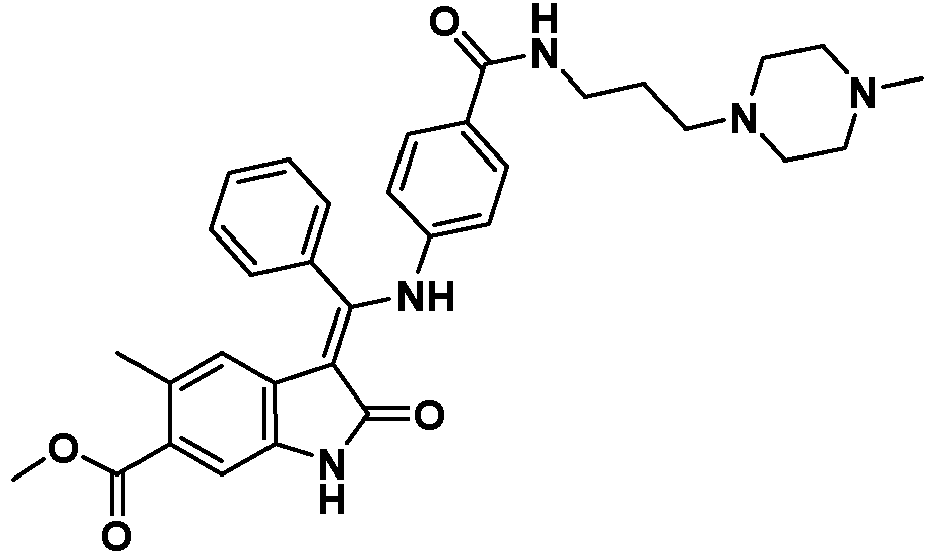
Rt 1.40 min (Method 1); m/z 568 (M+H)+ (ES+); 1H NMR δ: 1.54-1.68 (2H, overlapping m), 2.13 (3H, s), 2.14 (3H, s), 2.20-2.41 (8H, overlapping m), 3.16-3.25 (2H, overlapping m), 3.75 (3H, s), 5.61 (1H, s), 6.85 (2H, m), 7.36 (1H, s), 7.53 (2H, m), 7.56-7.70 (5H, overlapping m), 8.19 (1H, s), 8.35 (1H, t), 10.88 (1H, s), 12.23 (1H, s). (Missing 2H-presumed obscured by solvent). (Z)-Methyl-5-methyl-3-(((4-((3-(4-methylpiperazin-1-yl)propyl)carbamoyl)phenyl)amino)(phenyl)methylene)-2-oxoindoline-6-carboxylate, formate Route code*: 1B Reference Example 22: 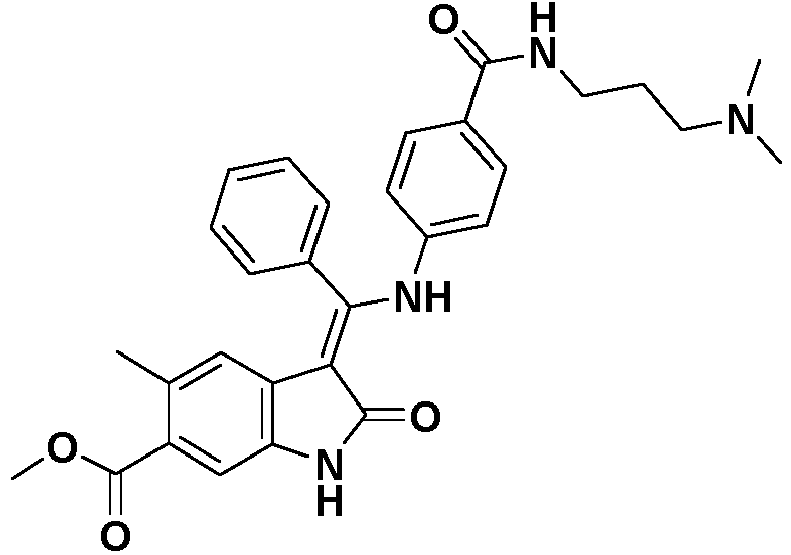
Rt 1.53 min (Method 1); m/z 513 (M+H)+ (ES+); 1H NMR δ: 1.65 (2H, m), 2.13 (3H, s), 2.30 (6H, s), 2.46 (2H, t), 3.22 (2H, m), 3.75 (3H, s), 5.61 (1H, s), 6.87 (2H, m), 7.36 (1H, s), 7.53 (2H, m), 7.58-7.70 (5H, overlapping m), 8.16 (0.5H, s), 8.39 (1H, t), 10.88 (1H, s), 12.23 (1H, s). (Z)-Methyl 3-(((4-((3-(dimethylamino)propyl)carbamoyl)phenyl)amino)(phenyl)methylene)-5-methyl-2-oxoindoline-6-carboxylate, 0.5 formate Route code*: 1B Example 23: 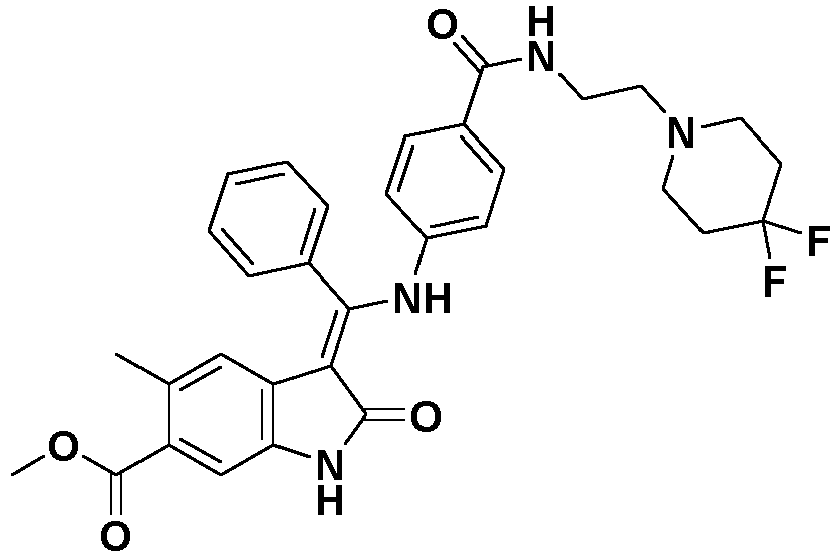
Rt 1.65 min (Method 1); m/z 575 (M+H)+ (ES+); 1H NMR δ: 1.93-2.32 (7H, overlapping m), 3.40-3.57 (2H, m), 3.75 (3H, s), 5.62 (1 H, s), 6.89 (2H, m), 7.36 (1H, s), 7.53 (2H, m), 7.57-7.71 (5H, overlapping m), 8.47 (1 H, m), 10.88 (1H, s), 12.23 (1H, s). (Missing 6H-presumed obscured by solvent). (Z)-Methyl 3-(((4-((2-(4,4-difluoropiperidin-1-yl)ethyl)carbamoyl)phenyl)amino)(phenyl)methylene)-5-methyl-2-oxoindoline-6-carboxylate Route code*: 1B Example 24: 
Rt 1.51 min (Method 1); m/z 582 (M+H)+ (ES+); 1H NMR δ: 2.05 (3H, s), 2.14 (3H, s), 3.76 (3H, s), 3.87-4.52 (4H, overlapping m), 5.63 (1H, s), 6.92 (2H, m), 7.37 (1H, s), 7.54 (2H, overlapping m), 7.58-7.72 (5H, overlapping m), 8.59 (1H, t), 10.90 (1H, s), 12.24 (1H, s). (Missing 8H-presumed obscured by solvent). (Z)-Methyl 3-(((4-((2-(4-acetylpiperazin-1-yl)ethyl)carbamoyl)phenyl)amino)(phenyl)methylene)-5-methyl-2-oxoindoline-6-carboxylate Route code*: 1B Reference Example 25: 
Rt 1.58 min (Method 1); m/z 535 (M+H)+ (ES+); 1H NMR δ: 2.13 (3H, s), 2.15 (6H, s), 2.35 (2H, t), 2.81 (2H, t), 3.76 (3H, s), 5.64 (1 H, s), 6.97 (2H, m), 7.37 (1H, s), 7.50-7.59 (4H, overlapping m), 7.60-7.71 (3H, overlapping m), 8.15 (1H, s), 10.92 (1H, s), 12.24 (1H, s). (Z)-Methyl 3-(((4-(N-(2-(dimethylamino)ethyl)sulfamoyl)phenyl)amino)(phenyl)methylene)-5-methyl-2-oxoindoline-6-carboxylate, formate Route code*: 1A Example 26: 
Rt 1.65 min (Method 1); m/z 577 (M+H)+ (ES+); 1H NMR δ: 2.14 (3H, s), 2.34 (2H, t), 2.37-2.47 (4H, overlapping m), 2.73-2.82 (4H, overlapping m), 3.41 (2H, t), 3.76 (3H, s), 4.38 (1H, s), 5.64 (1 H, s), 6.97 (2H, m), 7.36 (1H, s), 7.48 (2H, m), 7.56 (2H, m), 7.60-7.72 (3H, overlapping m), 8.14 (1H, s), 10.93 (1H, s), 12.28 (1H, s). (Z)-Methyl 3-(((4-((4-(2-hydroxyethyl)piperazin-1-yl)sulfonyl)phenyl)amino)(phenyl)methylene)-5-methyl-2 -oxoi n dol i n e-6-carboxylate, formate Route code*: 1A Reference Example 27: 
Rt 1.56 min (Method 1); m/z 525 (M+H)+ (ES+); 1H NMR δ: 1.27-1.64 (3H, overlapping m), 1.69-1.83 (2H, overlapping m), 2.13 (3H, s), 2.42 (3H, s), 2.82-3.09 (3H, overlapping m), 3.75 (3H, s), 3.95 (1H, s), 5.62 (1H, s), 6.87 (2H, m), 7.36 (1H, s), 7.52 (2H, m), 7.58-7.69 (5H, overlapping m), 8.14 (0.5H, s), 8.17 (1H, d), 10.89 (1H, s), 12.23 (1H, s). (S,Z)-Methyl 5-methyl-3-(((4-((1-methylpiperidin-3-yl)carbamoyl)phenyl)amino)(phenyl)methylene)-2-oxoindoline-6-carboxylate, 0.5 formate Route code*: 1B Example 28: 
Rt 1.60 min (Method 1); m/z 557 (M+H)+ (ES+); 1H NMR δ: 1.70-2.35 (4H, overlapping m), 2.14 (3H, s), 3.00-3.35 (4H, overlapping m), 3.46-3.65 (3H, overlapping m), 3.76 (3H, s), 5.63 (1H, s), 6.91 (2H, m), 7.37 (1H, s), 7.53 (2H, m), 7.58-7.73 (5H, overlapping m), 8.57 (1H, br s), 9.04 (1H, br s), 10.89 (1H, s), 12.23 (1H, s). (Missing 2H-presumed overlap with solvent). (Z)-Methyl 3-(((4-((2-(4-fluoropiperidin-1-yl)ethyl)carbamoyl)phenyl)amino)(phenyl)methylene)-5-methyl-2-oxoindoline-6-carboxylate, formate Route code*: 1B Example 29: 
Rt 1.55 min (Method 1); m/z 555 (M+H)+ (ES+); 1H NMR δ: 1.62 (2H, m), 2.13 (3H, s), 2.23-2.40 (6H, overlapping m), 3.22 (2H, m), 3.50-3.58 (4H, overlapping m), 3.75 (3H, s), 5.62 (1H, s), 6.87 (2H, m), 7.36 (1H, s), 7.52 (2H, m), 7.56-7.70 (5H, overlapping m), 8.34 (1H, t), 10.88 (1H, s), 12.23 (1H, s). (Z)-Methyl 5-methyl-3-(((4-((3-morpholinopropyl)carbamoyl)phenyl)amino)(phenyl)methylene)-2-oxoindoline-6-carboxylate Route code*: 1B Reference Example 30: 
Rt 1.57 min (Method 1); m/z 594 (M+H)+ (ES+); 1H NMR δ: 1.62-2.00 (4H, overlapping m), 2.13 (3H, s), 2.33 (3H, s), 2.92-3.04 (2H, overlapping m), 3.05-3.27 (2H, overlapping m), 3.75 (3H, s), 4.06 (1H, m), 5.59 (1H, s), 6.87 (2H, m), 7.19 (2H, m), 7.36 (1H, s), 7.47 (1H, s), 7.53 (2H, m), 7.57-7.70 (3H, overlapping m), 10.85 (1H, s), 12.22 (1H, s). (Missing 3H-presumed obscured by solvent). (Z)-Methyl 5-methyl-3-(((4-(1-methyl-5-oxo-1,4,9-triazaspiro[5.5]undecane-9-carbonyl)phenyl)amino)(phenyl)methylene)-2-oxoindoline-6-carboxylate Route code*: 1B Reference Example 31: 
Rt 1.53 min (Method 1); m/z 610 (M+H)+ (ES+); 1H NMR δ: 1.36-1.52 (2H, overlapping m), 1.59-1.78 (2H, overlapping m), 2.13 (3H, s), 2.34 (1H, m), 2.55 (6H, s), 2.70-3.02 (4H, overlapping m), 3.75 (3H, s), 5.60 (1H, s), 6.88 (2H, m), 7.18 (2H, m), 7.37 (1H, s), 7.53 (2H, m), 7.56-7.70 (3H, overlapping m), 7.95 (1H, d), 8.13 (0.4H, s), 10.86 (1H, s), 12.21 (1H, s). (Missing 4H-presumed obscured by solvent). (Z)-Methyl 3-(((4-(4-((2-(dimethylamino)ethyl)carbamoyl)piperidine-1-carbonyl)phenyl)amino)(phenyl)methylene)-5-methyl-2-oxoindoline-6-carboxylate, 0.4 formate Route code*: 1B Reference Example 32: 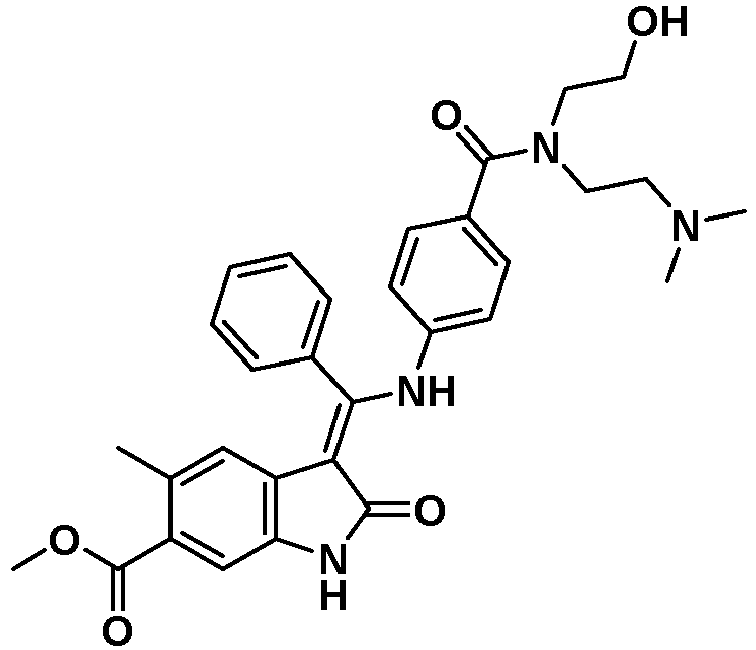
Rt 1.49 min (Method 1); m/z 543 (M+H)+ (ES+); 1H NMR δ: 2.13 (3H, s), 2.00-2.15 (2H, overlapping m), 2.65 (3H, br s), 3.04 (2H, m), 3.21-3.46 (2H, overlapping m), 3.66 (2H, m), 3.75 (3H, s), 5.61 (1H, s), 6.88 (2H, m), 7.23 (2H, m), 7.37 (1H, s), 7.47-7.67 (5H, overlapping m), 8.13 (0.3H, s), 10.85 (1H, s), 12.19 (1H, s). (Missing 3H-presumed obscured by solvent). (Z)-Methyl 3-(((4-((2-(dimethylamino)ethyl)(2-hydroxyethyl)carbamoyl)phenyl)amino)(phenyl)methylene)-5-methyl-2-oxoindoline-6-carboxylate, 0.3 formate Route code*: 1B Reference Example 33: 
Rt 1.54 min (Method 1); m/z 569 (M+H)+ (ES+); 1H NMR δ: 1.14 (1H, m), 1.74 (1H, m), 1.91 (1H, m), 2.13 (3H, s), 2.71-2.87 (6H, overlapping m), 2.98 (2H, m), 3.19-3.29 (3H, overlapping m), 3.75 (3H, s), 4.22-4.56 (2H, overlapping m), 5.60 (1H, s), 6.88 (2H, m), 7.19 (2H, m), 7.37 (1H, m), 7.48-7.72 (5H, overlapping m), 8.67 (1H, s), 10.86 (1H, s), 12.22 (1H, s). (Z)-Methyl 3-(((4-((3S,4S)-4-((dimethylamino)methyl)-3-hydroxypiperidine-1-carbonyl)phenyl)amino)(phenyl)methylene)-5-methyl-2-oxoindoline-6-carboxylate Route code*: 1B Example 34: 
Rt 1.55 min (Method 1); m/z 596 (M+H)+ (ES+); 1H NMR δ: 1.92-2.09 (5H, overlapping m), 2.14 (3H, s), 3.52 (6H, s), 3.76 (3H, s), 5.63 (1H, s), 6.90 (2H, m), 7.37 (1H, s), 7.53 (2H, m), 7.58-7.69 (5H, overlapping m), 8.56 (1H, s), 10.88 (1H, s), 12.23 (1H, s). (Missing 6H-presumed obscured by solvent). (Z)-Methyl 3-(((4-((2-(4-acetyl-1,4-diazepan-1-yl)ethyl)carbamoyl)phenyl)amino)(phenyl)methylene)-5-methyl-2-oxoindoline-6-carboxylate Route code*: 1B Reference Example 35: 
Rt 1.60 min (Method 1); m/z 543 (M+H)+ (ES+); 1H NMR δ: 2.13 (3H, s), 2.38 (3H, s), 2.61-2.83 (4H, overlapping m), 3.21 (3H, s), 3.45 (2H, t), 3.75 (3H, s), 5.62 (1 H, s), 6.87 (2H, m), 7.36 (1H, s), 7.52 (2H, m), 7.57-7.69 (5H, overlapping m), 8.13 (0.5 H, s), 8.30 (1H, s), 10.88 (1H, s), 12.22 (1H, s). (Missing 2H-presumed obscured by solvent.) (Z)-Methyl 3-(((4-((2-((2-methoxyethyl)(methyl)amino)ethyl)carbamoyl)phenyl)amino)(phenyl)methylene)-5-methyl-2-oxoindoline-6-carboxylate, 0.5 formate Route code*: 1B Reference Example 36: 
Rt 1.59 min (Method 1); m/z 569 (M+H)+ (ES+); 1H NMR δ: 1.64-1.90 (4H, overlapping m), 2.13 (3H, s), 2.62-2.86 (6H, overlapping m), 3.53-3.67 (2H, overlapping m), 3.76-3.89 (5H, overlapping m), 5.60 (1H, s), 6.91 (2H, m), 7.36 (1H, s), 7.54 (2H, m), 7.59-7.71 (5H, overlapping m), 8.43 (1H, m), 10.90 (1H, m), 12.25 (1H, s). (Missing 2H-presumed obscured by solvent). (Z)-Methyl 3-(((4-(((4-(dimethylamino)tetrahydro-2H-pyran-4-yl)methyl)carbamoyl)phenyl)amino)(phenyl)methylene)-5-methyl-2-oxoindoline-6-carboxylate Route code*: 1B Reference Example 37: 
Rt 1.54 min (Method 1); m/z 595 (M+H)+ (ES+); 1H NMR δ: 1.14-1.69 (4H, overlapping m), 1.75-1.91 (4H, overlapping m), 2.13 (3H, s), 2.84-3.20 (8H, overlapping m), 3.75 (3H, s), 4.11 (1H, br s), 5.60 (1H, s), 6.89 (2H, m), 7.18 (2H, m), 7.37 (1H, s), 7.53 (2H, m), 7.56-7.68 (3H, overlapping m), 8.13 (1H, s), 10.86 (1H, s), 12.21 (1H, s). (Missing 2H-assumed obscured by solvent). (Z)-Methyl -3-(((4-(4-hydroxy-4-(pyrrolidin-1-ylmethyl)piperidine-1-carbonyl)phenyl)amino)(phenyl)methylene)-5-methyl-2-oxoindoline-6-carboxylate, formate Route code*: 1B Reference Example 38: 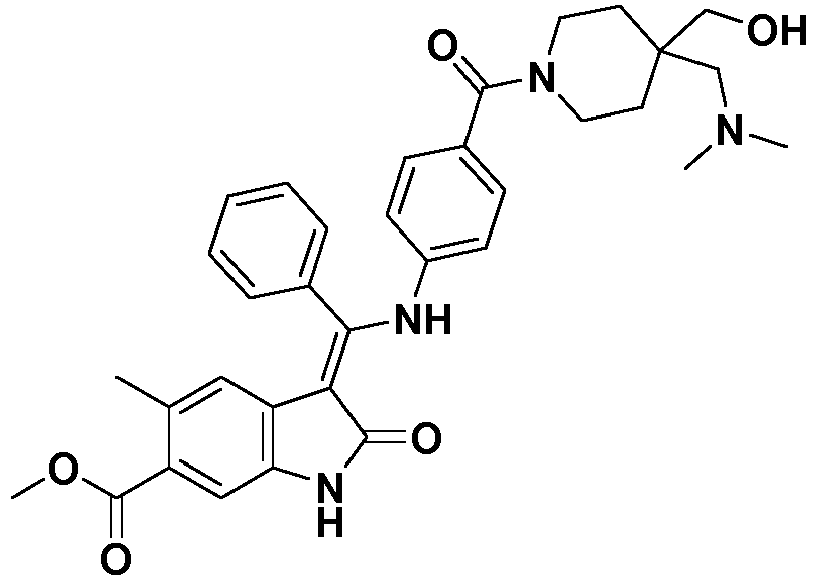
Rt 1.52 min (Method 1); m/z 583 (M+H)+ (ES+); 1H NMR δ: 1.36-1.60 (4H overlapping m), 2.13 (3H, s), 2.82 (6H, s), 3.12 (2H, s), 3.19-3.38 (4H, overlapping m), 3.56 (2H, s), 3.75 (3H, s), 5.44 (1H, br s), 5.60 (1H, s), 6.89 (2H, m), 7.19 (2H, m), 7.37 (1H, s), 7.53 (2H, m), 7.57-7.73 (3H, overlapping m), 10.85 (1H, s), 12.21 (1H, s). (Z)-Methyl-3-(((4-(4-((dimethylamino)methyl)-4-(hydroxymethyl)piperidine-1-carbonyl)phenyl)amino)(phenyl)methylene)-5-methyl-2-oxoindoline-6-carboxylate Route code*: 1B Reference Example 39: 
Rt 1.61 min (Method 1); m/z 612 (M+H)+ (ES+); 1H NMR δ: 2.13 (3H, s), 2.36-2.44 (4H, overlapping m), 2.93 (2H, s), 3.20-3.27 (5H, overlapping m), 3.75 (3H, s), 5.60 (1H, s), 6.84 (2H, m), 7.20 (2H, m), 7.36 (1H, s), 7.50 (2H, m), 7.57-7.69 (3H, overlapping m), 7.76 (1H, t), 10.85 (1H, m), 12.21 (1H, s). (Missing 6H-presumed obscured by solvent). (Z)-Methyl-3-(((4-(4-(2-((2-methoxyethyl)amino)-2-oxoethyl)piperazine-1-carbonyl)phenyl)amino)(phenyl)methylene)-5-methyl-2-oxoindoline-6-carboxylate Route code*: 1B Reference Example 40: 
Rt 1.66 min (Method 1); m/z 539 (M+H)+ (ES+); 1H NMR δ: 1.62-1.75 (2H, overlapping m), 2.00-2.12 (4H, overlapping m), 2.13 (3H, s), 3.62 (2H, d), 3.75 (3H, s), 5.60 (1H, s), 6.90 (2H, m), 7.36 (1H, s), 7.54 (2H, m), 7.58-7.72 (5H, overlapping m), 8.14 (0.3H, s), 8.47 (1H, s), 10.89 (1H, s), 12.25 (1H, s). (Missing 6H-presumed obscured by solvent). (Z)-Methyl 3-(((4-(((1-(dimethylamino)cyclobutyl)methyl)carbamoyl)phenyl)amino)(phenyl)methylene)-5-methyl-2-oxoindoline-6-carboxylate, 0.3 formate Route code*: 1B Reference Example 41: 
Rt 1.58 min (Method 1); m/z 569 (M+H)+ (ES+); 1H NMR δ: 1.59-1.84 (2H, overlapping m), 1.89-2.08 (2H, overlapping m), 2.14 (3H, s), 2.68-2.81 (3H, br s), 2.83-3.08 (2H, overlapping m), 3.55-3.71 (2H, m), 3.75 (3H, s), 4.43 (1H, br s), 5.14 (1H, br s), 5.62 (1H, s), 6.89 (2H, m), 7.20 (2H, m), 7.37 (1H, s), 7.51 (2H, m), 7.57-7.69 (3H, overlapping m), 8.13 (0.2H, s), 10.85 (1 H, s), 12.19 (1H, s). (Missing 4H-presumed obscured by solvent). (Z)-Methyl 3-(((4-((1-(2-hydroxyethyl)piperidin-4-yl)(methyl)carbamoyl)phenyl)amino)(phenyl)methylene)-5-methyl-2-oxoindoline-6-carboxylate, 0.2 formate Route code*: 1B Example 42: 
Rt 1.59 min (Method 1); m/z 569 (M+H)+ (ES+); 1H NMR δ: 1.22-1.38 (2H, overlapping m), 1.53 (1H, m), 1.74-1.78 (2H, overlapping m), 2.14 (3H, s), 2.57-2.82 (2H, overlapping m), 2.88-3.06 (2H, overlapping m), 3.26 (2H, t), 3.49 (2H, m), 3.75 (3H, s), 4.58 (1H, t), 5.62 (1H, s), 6.90 (2H, m), 7.36 (1H, s), 7.52 (2H, m), 7.57-7.69 (5H, overlapping m), 8.13 (0.2H, s), 8.47 (1H, t), 10.89 (1H, s), 12.23 (1H, s). (Missing 2H-presumed obscured by solvent). (Z)-Methyl 3-(((4-((2-(4-(hydroxymethyl)piperidin-1-yl)ethyl)carbamoyl)phenyl)amino)(phenyl)methylene)-5-methyl-2-oxoindoline-6-carboxylate, 0.2 formate Route code*: 1B Reference Example 43: 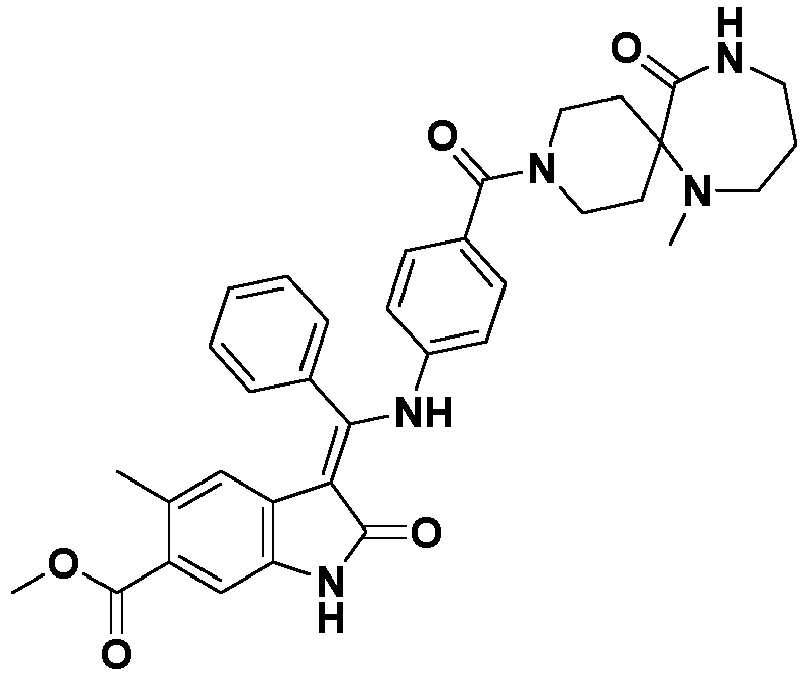
Rt 1.58 min (Method 1); m/z 608 (M+H)+ (ES+); 1H NMR δ: 1.46-1.66 (2H, overlapping m), 1.67-1.81 (2H, overlapping m), 2.13 (3H, s), 2.24 (3H, s), 2.96-3.18 (4H, overlapping m), 3.19-3.29 (3H, overlapping m), 3.75 (3H, s), 3.86 (1H, br s), 5.59 (1H, s), 6.87 (2H, m), 7.19 (2H, m), 7.36 (1H, s), 7.47-7.57 (3H, overlapping m), 7.57-7.72 (3H, overlapping m), 10.86 (1H, s), 12.22 (1H, s). (Missing 2H-presumed obscured by solvent). (Z)-Methyl-5-methyl-3-(((4-(7-methyl-12-oxo-3,7,11-triazaspiro[5.6]dodecane-3-carbonyl)phenyl)amino)(phenyl)methylene)-2-oxoindoline-6-carboxylate Route code*: 1B Example 44: 
Rt 1.59 min (Method 1); m/z 618 (M+H)+ (ES+); 1H NMR δ: 2.13 (3H, s), 2.85 (3H, s), 3.01-3.13 (4H, overlapping m), 3.75 (3H, s), 5.61 (1H, s), 6.87 (2H, m), 7.36 (1H, s), 7.52 (2H, m), 7.57- 7.71 (5H, overlapping m), 8.29 (1H, s), 10.88 (1H, s), 12.23 (1H, s). (Missing 8H-presumed obscured by solvent). (Z)-Methyl-5-methyl-3-(((4-((2-(4-(methylsulfonyl)piperazin-1-yl)ethyl)carbamoyl)phenyl)amino)(phenyl)methylene)-2-oxoindoline-6-carboxylate Route code*: 1B Reference Example 45: 
Rt 1.53 min (Method 1); m/z 611 (M+H)+ (ES+); 1H NMR δ: 1.32-1.61 (4H, overlapping m), 2.14 (3H, s), 2.24 (2H, s), 3.00-3.30 (4H, overlapping m), 3.50-3.56 (4H, overlapping m), 3.76 (3H, s), 4.03 (1H, br s), 4.29 (1H, s), 5.60 (1H, s), 6.88 (2H, m), 7.18 (2H, m), 7.37 (1H, s), 7.53 (2H, m), 7.56-7.73 (3H, overlapping m), 10.86 (1H, s), 12.21 (1H, s). (Missing 3H-presumed obscured by solvent). (Z)-Methyl-3-(((4-(4-hydroxy-4-(morpholinomethyl)piperidine-1-carbonyl)phenyl)amino)(phenyl)methylene)-5-methyl-2-oxoindoline-6-carboxylate Route code*: 1B Reference Example 46: 
Rt 1.51 min (Method 1); m/z 555 (M+H)+ (ES+); 1H NMR δ: 1.63 (1H, m), 1.75 (1H, m), 2.13 (3H, s), 2.53-2.92 (5H, overlapping m), 3.43-3.59 (7H, overlapping m), 3.75 (3H, s), 4.36 (1H, br s), 5.60 (1H, s), 6.87 (2H, m), 7.17 (2H, m), 7.36 (1H, s), 7.52 (2H, m), 7.57-7.68 (3H, overlapping m), 10.85 (1H, s), 12.19 (1H, s). (Z)-Methyl-3-(((4-(4-(2-hydroxyethyl)-1,4-diazepane-1-carbonyl)phenyl)amino)(phenyl)methylene)-5-methyl-2-oxoindoline-6-carboxylate Route code*: 1B Reference Example 47: 
Rt 1.58 min (Method 1); m/z 622 (M+H)+ (ES+); 1H NMR δ: 1.31-1.41 (2H, overlapping m), 1.41-1.51 (4H, overlapping m), 1.56-1.90 (4H, overlapping m), 2.13 (3H, s), 2.35-2.45 (4H, overlapping m), 3.75 (3H, s), 5.59 (1H, s), 6.87 (2H, m), 7.00 (1H, br s), 7.07 (1H, br s), 7.20 (2H, m), 7.36 (1H, s), 7.52 (2H, m), 7.58-7.68 (3H, overlapping m), 10.85 (1H, s), 12.21 (1H, s). (Missing 4H-presumed obscured by solvent). (Z)-Methyl 3-(((4-(4'-carbamoyl-[1,4'-bipiperidine]-1'-carbonyl)phenyl)amino)(phenyl)methylene)-5-methyl-2-oxoindoline-6-carboxylate Route code*: 1B Reference Example 48: 
Rt 1.52 min (Method 1); m/z 541 (M+H)+ (ES+); 1H NMR δ: 2.13 (3H, s), 2.19 (3H, br s), 2.65 (1H, m), 2.77-2.93 (4H, overlapping m), 3.75 (3H, s), 4.22 (1 H, m), 5.18 (1H, m), 5.60 (1H, s), 6.87 (2H, m), 7.20 (2H, m), 7.37 (1H, s), 7.53 (2H, m), 7.58-7.68 (3H, overlapping m), 8.14 (0.4H, s), 10.85 (1 H, s), 12.22 (1H, s). (Missing 3H-overlap with solvent). (Z)-Methyl 3-(((4-(((3S,4S)-4-hydroxy-1-methylpyrrolidin-3-n yl)(methyl)carbamoyl)phenyl)amino)(phenyl)methylene)-5-methyl-2-oxoindoline-6-carboxylate, 0.4 formate Route code*: 1B Example 49: 
Rt 1.60 min (Method 1); m/z 555 (M+H)+ (ES+); 1H NMR δ: 1.44-1.57 (2H, overlapping m), 1.65-1.74 (2H, overlapping m), 1.91-2.10 (2H, overlapping m), 2.13 (3H, s), 2.32-2.43 (2H, overlapping m), 2.79-2.93 (2H, overlapping m), 3.44-3.51 (2H, overlapping m), 3.68 (1H, m), 3.75 (3H, s), 4.38 (1H, s), 5.61 (1H, s), 6.85 (2H, m), 7.36 (1H, s), 7.51 (2H, m), 7.56-7.70 (5H, overlapping m), 8.10 (1H, d), 10.89 (1H, s), 12.23 (1H, s). (Z)-Methyl 3-(((4-((1-(2-hydroxyethyl)piperidin-4-yl)carbamoyl)phenyl)amino)(phenyl)methylene)-5-methyl-2-oxoindoline-6-carboxylate Route code*: 1B Example 50: 
Rt 1.54 min (Method 1); m/z 569 (M+H)+ (ES+); 1H NMR δ: 1.05-1.19 (2H, m), 1.46 (1H, m), 1.54-1.63 (2H, overlapping m), 1.81-1.94 (2H, overlapping m), 2.13 (3H, s), 2.28-2.40 (2H, overlapping m), 2.77-2.90 (2H, overlapping m), 3.07 (2H, t), 3.41-3.50 (2H, overlapping m), 3.75 (3H, s), 4.34 (1H, br s), 5.61 (1H, s), 6.86 (2H, m), 7.36 (1H, s), 7.52 (2H, m), 7.57-7.70 (5H, overlapping m), 8.32 (1H, t), 10.88 (1H, s), 12.23 (1H, s). (Z)-Methyl 3-(((4-(((1-(2-hydroxyethyl)piperidin-4-yl)methyl)carbamoyl)phenyl)amino)(phenyl)methylene)-5-methyl-2-oxoindoline-6-carboxylate Route code*: 1B Reference Example 51: 
Rt 1.51 min (Method 1); m/z 529 (M+H)+ (ES+); 1H NMR δ: 2.13 (3H, s), 2.21 (3H, s), 2.40-2.48 (2H, overlapping m), 3.24-3.32 (2H, overlapping m), 3.40-3.48 (2H, overlapping m), 3.75 (3H, s), 4.37 (1H, m), 5.61 (1H, s), 6.86 (2H, m), 7.36 (1H, s), 7.52 (2H, m), 7.57-7.69 (5H, overlapping m), 8.25 (1H, t), 10.88 (1H, s), 12.23 (1H, s). (Missing 2H-presumed obscured by solvent). (Z)-Methyl 3-(((4-((2-((2-hydroxyethyl)(methyl)amino)ethyl)carbamoyl)phenyl)amino)(phenyl)methylene)-5-methyl-2-oxoindoline-6-carboxylate Route code*: 1B Example 52: 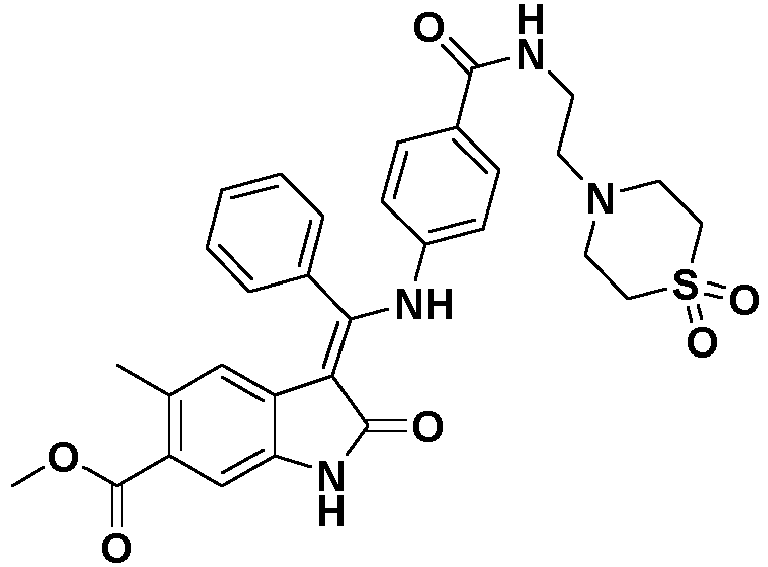
Rt 1.90 min (Method 1); m/z 589 (M+H)+ (ES+); 1H NMR δ: 2.14 (3H, s), 2.61 (2H, t), 2.89-2.96 (4H, overlapping m), 3.01-3.11 (4H, overlapping m), 3.28-3.34 (2H, overlapping m), 3.76 (3H, s), 5.62 (1H, s), 6.88 (2H, m), 7.37 (1H, s), 7.53 (2H, m), 7.58-7.70 (5H, overlapping m), 8.29 (1H, t), 10.89 (1H, s), 12.24 (1H, s). (Z)-Methyl 3-(((4-((2-(1,1-dioxidothiomorpholino)ethyl)carbamoyl)phenyl)amino)(phenyl)methylene)-5-methyl-2-oxoindoline-6-carboxylate Route code*: 1B Example 53: 
Rt 1.57 min (Method 1); m/z 568 (M+H)+ (ES+); 1H NMR δ: 2.14 (3H, s), 2.36-2.42 (2H, overlapping m), 2.53-2.59 (6H, overlapping m), 3.06-3.12 (2H, overlapping m), 3.27-3.34 (2H, overlapping m), 3.76 (3H, s), 5.62 (1H, s), 6.88 (2H, m), 7.37 (1H, s), 7.50-7.56 (3H, overlapping m), 7.58-7.71 (5H, overlapping m), 8.29 (1H, t), 10.90 (1H, s), 12.24 (1H, s). (Z)-Methyl 5-methyl-2-oxo-3-(((4-((2-(5-oxo-1,4-diazepan-1-yl)ethyl)carbamoyl)phenyl)amino)(phenyl)methylene)indoline-6-carboxylate Route code*: 1B Reference Example 54: 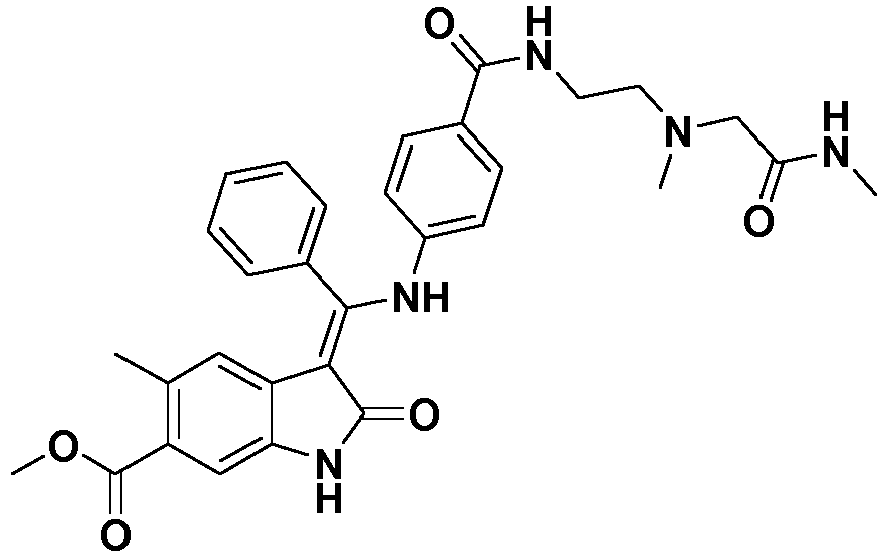
Rt 1.61 min (Method 1); m/z 556 (M+H)+ (ES+); 1H NMR δ: 2.13 (3H, s), 2.21 (3H, s), 2.92 (2H, s), 3.30 (2H, m), 3.75 (3H, s), 5.61 (1H, s), 6.87 (2H, m), 7.36 (1H, s), 7.52 (2H, m), 7.56-7.71 (6H, overlapping m), 8.35 (1H, t), 10.88 (1 H, s), 12.22 (1H, s). (Missing 5H-presumed obscured by solvent). (Z)-Methyl 5-methyl-3-(((4-((2-(methyl(2-(methylamino)-2-oxoethyl)amino)ethyl)carbamoyl)phenyl)amino)(phenyl)methylene)-2-oxoindoline-6-carboxylate Route code*: 1B Example 55: 
Rt 1.64 min (Method 1); m/z 572 (M+H)+ (ES+); 1H NMR δ: 2.13 (3H, s), 2.54-2.60 (2H, overlapping m), 2.95 (2H, br s), 3.06-3.15 (2H, overlapping m), 3.76 (3H, s), 5.64 (1H, s), 6.58 (1H, dd), 6.77 (1H, dd), 7.36 (1H, s), 7.45 (1 H, t), 7.55 (2H, m), 7.59-7.76 (4H, overlapping m), 8.07 (1H, s), 10.91 (1H, s), 12.16 (1H, s). (Missing 4H-presumed obscured by solvent). (Z)-Methyl 3-(((3-fluoro-4-((2-(3-oxopiperazin-1-yl)ethyl)carbamoyl)phenyl)amino)(phenyl)methylene)-5-methyl-2-oxoindoline-6-carboxylate Route code*: 1B Example 56: 
Rt 1.55 min (Method 1); m/z 568 (M+H)+ (ES+); 1H NMR δ: 2.13 (3H, s), 2.35-2.41 (2H, overlapping m), 3.03-3.11 (2H, overlapping m), 3.17 (2H, d), 3.26-3.33 (2H, overlapping m), 3.75 (3H, s), 5.61 (1H, s), 6.87 (2H, m), 7.36 (1H, s), 7.47-7.56 (3H, overlapping m), 7.55-7.70 (5H, overlapping m), 8.27 (1H, t), 10.88 (1H, s), 12.23 (1H, s). (Missing 4H-presumed obscured by solvent). (Z)-Methyl 5-methyl-2-oxo-3-(((4-((2-(3-oxo-1,4-diazepan-1-yl)ethyl)carbamoyl)phenyl)amino)(phenyl)methylene)indoline-6-carboxylate Route code*: 1B - An additional synthesis method for Example 18:
-

- Z)-4-(((1-acetyl-6-(methoxycarbonyl)-5-methyl-2-oxoindolin-3-ylidene)(phenyl)methyl)amino)benzoic acid (Intermediate E) (10 g, 17.54 mmol) and HATU (10.01 g, 26.3 mmol) were stirred at RT for 10 mins in DMF (200 mL) then Hunig's Base (18.38 ml, 105 mmol) and 1-methylpiperidin-4-amine (2.204 g, 19.30 mmol) in DMF (10mL) were added. The mixture was stirred at RT for 3 hours. Piperidine (17.37 ml, 175 mmol) was then added and the resulting mixture was stirred at RT for 3 h. The reaction mixture was partitioned between 10% MeOH in DCM (750 mL) and saturated sodium hydrogencarbonate solution (500 mL). The organic layer was washed with brine (300 mL) and the solvent was concentrated. The resulting solid was triturated with CH3CN, filtered and dried to give 7g of crude product.
- The reaction was repeated on the identical scale and the crude products combined and dissolved in 10% MeOH (1% Ammonia) in DCM and loaded onto a silica column (300g). The product was eluted with 30% MeOH (1% NH3) in DCM solution and the product containing fractions collected and the solvent then evaporated. The material was re-dissolved in 30% MeOH (1% NH3) in DCM solution (500 mL) and washed with water (200 mL). The organic layer was dried over MgSO4, filtered and the solvent was evaporated. The material was dried under reduced pressure, at 40 °C, overnight, to give (Z)-methyl 5-methyl-3-(((4-((1-methylpiperidin-4-yl)carbamoyl)phenyl)amino)(phenyl)methylene)-2-oxoindoline-6-carboxylate 1478-45-2 (12.8 g, 23.91 mmol, 68.1 % yield).
- The product was analysed by LCMS (Agilent, X-Select, Waters X-Select C18, 2.5 µm, 4.6x30 mm, Acidic (0.1% Formic acid) 4 min method, 5-95% MeCN/water): 1478-45-2-Fin, m/z 525(M+H)+ (ES+); at 1.57 min, 98% purity @ 254 nm. 1H NMR δ: Rt 1.57 min (Method 1); m/z 525 (M+H)+ (ES+); 1H NMR δ: 1.44-1.57 (2H, overlapping m), 1.65-1.72 (2H, overlapping m), 1.85-1.93 (2H, overlapping m), 2.13 (6H, s), 2.70-2.76 (2H, overlapping m), 3.64 (1H, m), 3.75 (3H, s), 5.61 (1H, s), 6.86 (2H, m), 7.36 (1H, s), 7.52 (2H, m), 7.57-7.68 (5H, overlapping m), 8.09 (1H, d), 10.88 (1H, s), 12.23 (1H, s).
- The enzyme inhibitory activities of compounds disclosed herein were determined using the ADP-Glo™ assay (Promega, UK). Assays for FGFR1, PDGFRα, PDGFRβ and VEGFR2 were performed in buffer containing 40 mM Tris pH 7.5, 20 mM MgCl2, 0.1 mg/mL BSA and 1 mM DTT; whilst assays for FGFR3 and VEGFR1 were performed in the above buffer supplemented with 2 mM MnCl2.
- The inhibitory activities of compounds of the invention against FGFR1 (FGFR1 Kinase Enzyme System: Promega), were evaluated by mixing the FGFR1 protein (3.12 ng/mL, 2 µL), substrate (Poly (4:1 Glu4, Tyr1), 100 ng/mL, 2 µL) with the test compound (2 µL at either 3 µM, 0.67 µM, 0.15 µM, 0.033 µM, 0.0073 µM, 0.0016 µM, 0.0036 µM or 0.00008 µM) for 90 min at 25°C. The kinase reaction was then initiated by adding ATP (50 µM, 2 µL) and the mixture was incubated for 1 hr at 25°C. ADP-Glo™ reagent was added for 40 min (8 µL) then development reagent (16 µL) was added for 40 min prior to detection in a microplate reader (EnVision® Multilabel Reader, Perkin Elmer).
- The inhibitory activities of compounds of the invention against FGFR3 (FGFR3 Kinase Enzyme System: Promega), were evaluated by mixing the FGFR3 protein (12.5 ng/mL, 2 µL), substrate (Poly (Ala6, Glu2, Lys5, Tyr1), 100 ng/mL, 2 µL) with the test compound (2 µL at either 3 µM, 0.67 µM, 0.15 µM, 0.033 µM, 0.0073 µM, 0.0016 µM, 0.0036 µM or 0.00008 µM) for 90 min at 25°C. The kinase reaction was initiated by adding ATP (50 µM, 2 µL) and the mixture was incubated for 90 min at 25°C. ADP-Glo™ reagent was added for 40 min (8 µL) then development reagent (16 µL) was added for 40 min prior to detection in a microplate reader (EnVision® Multilabel Reader, Perkin Elmer).
- The inhibitory activities of compounds of the invention against PDGFRα (PDGFRα Kinase Enzyme System: Promega), were evaluated by mixing the PDGFRα protein (12.5 ng/mL, 2 µL), substrate (Poly (4:1 Glu4, Tyr1), 100 ng/mL, 2 µL) with the test compound (2 µL at either 3 µM, 0.67 µM, 0.15 µM, 0.033 µM, 0.0073 µM, 0.0016 µM, 0.0036 µM or 0.00008 µM) for 90 min at 25°C. The kinase reaction was initiated by adding ATP (25 µM, 2 µL) and the mixture was incubated for 1 hr at 25°C. ADP-Glo™ reagent was added for 40 min (8 µL) then development reagent (16 µL) was added for 40 min prior to detection in a microplate reader (EnVision® Multilabel Reader, Perkin Elmer).
- The inhibitory activities of compounds of the invention against PDGFRβ (PDGFRβ Kinase Enzyme System: Promega), were evaluated by mixing the PDGFRβ protein (6.25 ng/mL, 2 µL), substrate (Poly (4:1 Glu4, Tyr1), 100 ng/mL, 2 µL) with the test compound (2 µL at either 3 µM, 0.67 µM, 0.15 µM, 0.033 µM, 0.0073 µM, 0.0016 µM, 0.0036 µM or 0.00008 µM) for 90 min at 25°C. The kinase reaction was initiated by adding ATP (25 µM, 2 µL) and the mixture was incubated for 1 hr at 25°C. ADP-Glo™ reagent was added for 40 min (8 µL) then development reagent (16 µL) was added for 40 min prior to detection in a microplate reader (EnVision® Multilabel Reader, Perkin Elmer).
- The inhibitory activities of compounds of the invention against VEGFR1 (VEGFR1 Kinase Enzyme System: Promega), were evaluated by mixing the VEGFR1 protein (12.5 ng/mL, 2 µL), substrate (IGFR1 Rtide, 100 ng/mL, 2 µL) with the test compound (2 µL at either 3 µM, 0.67 µM, 0.15 µM, 0.033 µM, 0.0073 µM, 0.0016 µM, 0.0036 µM or 0.00008 µM) for 90 min at 25°C. The kinase reaction was initiated by adding ATP (50 µM, 2 µL) and the mixture was incubated for 90 min at 25°C. ADP-Glo™ reagent was added for 40 min (8 µL) then development reagent (16 µL) was added for 40 min prior to detection in a microplate reader (EnVision® Multilabel Reader, Perkin Elmer).
- The inhibitory activities of compounds of the invention against VEGFR2 (VEGFR2 Kinase Enzyme System: Promega), were evaluated by mixing the VEGFR2 protein (1.56 ng/mL, 2 µL), substrate (Poly (4:1 Glu4, Tyr1), 100 ng/mL, 2 µL) with the test compound (2 µL at either 3 µM, 0.67 µM, 0.15 µM, 0.033 µM, 0.0073 µM, 0.0016 µM, 0.0036 µM or 0.00008 µM) for 90 min at 25°C. The kinase reaction was initiated by adding ATP (50 µM, 2 µL) and the mixture was incubated for 1 hr at 25°C. ADP-Glo™ reagent was added for 40 min (8 µL) then development reagent (16 µL) was added for 40 min prior to detection in a microplate reader (EnVision® Multilabel Reader, Perkin Elmer).
- In all cases, the kinase converts ATP to ADP and the ADP-Glo™ reagent then depletes any remaining ATP. The detection reagent converts the ADP that has been produced back into ATP and generates luciferase which can be detected as luminescence. Therefore the luminescent signal is directly proportional to the amount of ADP produced by the enzyme reaction and a reduction in this signal after compound treatment demonstrates inhibition. The percentage inhibition produced by each concentration of compound was calculated using the equation shown below:

- Percentage inhibition was then plotted against compound concentration, and the relative 50% inhibitory concentration (RIC50) was determined from the resultant concentration-response curve. Once this had been determined Ki was calculated using the equation below:
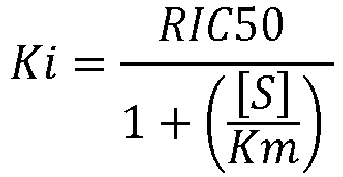
- NHLF's (Lonza group Ltd) are expanded up to 90% confluence in FGM-2 growth media supplemented with 2% FBS (plus SingleQuot™ growth factors; Lonza). Fibroblasts are harvested (Trypsin/EDTA), suspended at 25x103 per ml in growth media and 200µl is added per well (5x10³ cells/well) of a 96 well tissue culture plate. After 24 hr incubation (37 C/ 5%CO2/95%O2), cells are serum starved (24 hr) by reducing the FBS concentration to 0.1% in the culture media. Cells are pre-incubated with test compound for 1 hr, then stimulated with rhuPDGF-BB (100ng/ml, R&D Systems) for 48 hr. Cell proliferation is assessed by BrdU incorporation (Cell Proliferation colorimetric ELISA, Roche). The percent inhibition of rhuPDGF-BB-induced NHLF proliferation by test compound at each concentration is calculated as a percentage of that achieved by rhuPDGF-BB at each concentration of test compound by comparison against vehicle control (basal proliferation). The relative 50% inhibitory concentration (RIC50) is determined from the resultant concentration-response curve.
- MRC-5 fibroblasts (LGC Standards) are expanded up to 90% confluence in DMEM media supplemented with 10% FBS. Cells are harvested (Trypsin/EDTA), suspended at 25x103 per ml in growth media and 200µl is added per well (5x10³ cells/well) of a 96 well tissue culture plate. After 24 hr incubation (37 C/ 5%CO2/95%O2), cells are serum starved (3 hr) by replacing the growth media with media containing 0.1% FBS. Cells are then pre-incubated with test compound for 1 hr followed by stimulation with rhuPDGF-BB (100ng/ml, R&D Systems) or rhuFGF-basic (5ng/ml; R&D Systems) for 48 hr. Cell proliferation is assessed by BrdU incorporation (Cell Proliferation colorimetric ELISA, Roche). The percent inhibition of rhuPDGF-BB/ rhuFGF -induced MRC-5 proliferation by test compound at each concentration is calculated as a percentage of that achieved by rhuPDGF-BB / FGF-basic at each concentration of test compound by comparison against vehicle control (basal proliferation). The relative 50% inhibitory concentration (RIC50) is determined from the resultant concentration-response curve.
- TeloHAEC (telomerase immortalized Human Aortic Endothelial Cells; ATCC) are seeded in to 96 well tissue culture plates at a cell density of 4000 cells per well (100µl) in endothelial cell starvation medium (0.5% FBS, without FGF and VEGF growth factors) and cultured for 3 hr (37 C/ 5%CO2/95%O2). Cells are pre-incubated with test compound for 1 hr followed by stimulation with rhuVEGF165 (10 ng/ml, R&D Systems) or rhuFGF-basic (5ng/ml, R&D Systems) for 48 hr. Cell proliferation is assessed by BrdU incorporation (Cell Proliferation colorimetric ELISA, Roche). The percent inhibition of rhuVEGF165/ rhuFGF-basic -induced TeloHAEC proliferation by test compound at each concentration is calculated as a percentage of that achieved by rhuVEGF165/ FGF-basic at each concentration of test compound by comparison against vehicle control (basal proliferation). The relative 50% inhibitory concentration (RIC50) is determined from the resultant concentration-response curve.
- MRC-5 / NHLF / NIH-3T3s (mouse embryonic fibroblasts, LGC Standards) were used to evaluate the inhibitory effect of test compound on PDGFRβ phosphorylation using the HTRF (Homogeneous Time Resolved Fluorescence) phospho-PDGFRβ (Tyr751) cellular assay kit (Cisbio). MRC-5 / NHLFs were seeded in to 96 well tissue culture plates at a cell density of 10000 cells per well in DMEM growth media (10% FBS) or FGM-2 growth media (2% FBS) respectively and cultured for 48 hr (37 C/5%CO2/95%O2). NIH-3T3s were seeded in to 96 well tissue culture plates at a cell density of 7000 cells per well in DMEM growth media (10% FBS) and cultured for 48 hrs (37 C/ 5%CO2/95%O2). Cell media was replaced with the respective starvation medium containing 0.1% FBS and plates further incubated for 24 hr (37 C/ 5%CO2/95%O2) for MRC-5/ NHLFs and for 3 hr for NIH-3T3s. Cells were pre-incubated with test compound for 1 hr and then stimulated with rhuPDGF-BB (25-50 ng/ml, R&D Systems) for 5 min and rmPDGF-BB (25 ng/ml, Life Technologies) for NIH-3T3s. Media was aspirated off and cells immediately lysed by addition of 50µl lysis buffer provided in the HTRF assay kit. 16µl of cell lysate from each well was transferred to a white low volume 384 well plate to which propriety kit reagents were added as per kit instructions. Phosphorylation of the PDGFRβ was quantitated by calculating the ratio of fluorescence read at 665nm and 620nm. The percent inhibition of rPDGF-BB induced PDGFRβ phosphorylation by test compound was calculated as a percentage of that achieved by rPDGF-BB at each concentration of test compound by comparison against vehicle control. The relative 50% inhibitory concentration (RIC50) was determined from the resultant concentration-response curve.
- TeloHAECs (telomerase immortalized Human Aortic Endothelial Cells; ATCC) were used to evaluate the inhibitory effect of test compound on VEGFR2 phosphorylation using the HTRF (Homogeneous Time Resolved Fluorescence) phospho-VEGFR2 (Tyr1175) cellular assay kit (Cisbio). TeloHAECs were seeded in to 96 well tissue culture plates at a cell density of 12000 cells per well in endothelial growth medium (ATCC; 2% FBS) and cultured for 48 hr (37 C/ 5%CO2/95%O2). Cell media was replaced with starvation medium (without VEGF and FGF growth factors) containing 0.5% FBS and plates further incubated for 24 hr (37 C/ 5%CO2/95%O2). Cells were pre-incubated with test compound for 1 hr followed by stimulation with rhuVEGF165 (50 ng/ml, R&D Systems) for 5 min. Media was aspirated off and cells immediately lysed by addition of 50µl lysis buffer provided in the HTRF assay kit. 16µl of cell lysate from each well was transferred to a white low volume 384 well plate to which propriety kit reagents were added as per kit instructions. Phosphorylation of the VEGFR2 was quantitated by calculating the ratio of fluorescence read at 665nm and 620nm. The percent inhibition of rhuVEGF165 induced VEGFR2 phosphorylation by test compound was calculated as a percentage of that achieved by rhuVEGF165 at each concentration of test compound by comparison against vehicle control. The relative 50% inhibitory concentration (RIC50) was determined from the resultant concentration-response curve.
- NHLF's are expanded up to 90% confluence in FGM-2 growth media (Lonza) supplemented with 2% FBS (plus SingleQuot™ growth factors). Fibroblasts are harvested (Trypsin/EDTA) and suspended at 1x10⁶ per ml in serum free media. Based on the cell contraction assay kit (Cell Biolabs) a cell lattice is prepared by mixing 1 part cell suspension + 4 parts collagen gel solution as per kit instructions. 0.9ml aliquots of the collagen lattice is added to 1.5 ml centrifuge tubes and treated with final assay concentrations of test compound. 250µl of compound treated lattice is then pipetted into each well of a 48 well tissue culture plate (triplicate per test concentration). The plate is incubated for 90 min (37 C/ 5%CO2/95%O2) to allow the gels to polymerize. 250µl of serum free media containing final assay concentrations of test compound are then added to each corresponding gel. After further 30 min incubation, the gels are stimulated with TGFβ1 (10ng/ml; R&D Systems). Following a 24 hr (37 C/ 5%CO2/95%O2) incubation period, each individual gel is removed and weighed on a precision balance. The effect of the test compound at each concentration is expressed as the percent reversal of the TGFβ1 induced contraction relative to the vehicle treated basal contraction.
- NHLF's are expanded up to 90% confluence in FGM-2 growth media (Lonza) supplemented with 2% FBS (plus SingleQuot™ growth factors). Fibroblasts are harvested (Trypsin/EDTA), suspended at 50x103 per ml in growth media and 200µl added per well (10x103 cells/well) of a 96 well tissue culture plate. After 24 hr incubation (37 C/ 5%CO2/95%O2), cells are serum starved (24 hr) by reducing the media FBS concentration to 0.1%. Cells are pre-incubated with test compound for 1 hr, then stimulated with TGFβ1 (5ng/ml, R&D Systems) for 24 hr. Cell free supernatants are recovered for determination of IL-6 concentrations by sandwich ELISA (Duo-set, R&D systems). The inhibition of IL-6 production is calculated as a percentage of that achieved by 5ng/ml TGFβ1 at each concentration of test compound by comparison against vehicle control. The relative 50% inhibitory concentration (RIC50) is determined from the resultant concentration-response curve.
- Mast cells are differentiated from cord blood CD34+ cells (Lonza) for 8 weeks in growth media supplemented with 100 ng/ml SCF and 10 ng/ml IL-6. Mast cells are seeded in 384 well white clear bottom plates between 2500 to 10000 cells/well in growth media containing SCF (100 ng/ml). As a positive control for apoptosis, 8 wells are incubated in growth media without SCF. Cells are incubated with test compounds or vehicle for 24 hr (37 C/ 5%CO2/95%O2). Caspase-3/7 luminogenic substrate (Caspase-
Glo 3/7 Assay, Promega) is added to the cells and incubated at room temperature for 30 min, before reading the luminescence signal. The induction of apoptosis by test compounds is calculated as a percentage of that achieved by cells incubated in the absence of SCF (maximal apoptotic response) for each concentration of test compound compared to vehicle (baseline apoptosis). The relative 50% inhibitory concentration (RIC50) is determined from the resultant concentration-response curve. - MRC-5 cells were seeded into white clear bottom (for fluorescence/ luminescence reads) or clear (for colorimetric reads) 96 well tissue culture plates at a cell density of 12 x 103 cells per well in DMEM growth media (10% FBS). After 24 hr incubation (37 C/ 5%CO2/95%O2), the growth media was replaced with media containing 0.1% FBS plus test compound/ vehicle and incubated for a further 48 hrs. For the colorimetric MTT assay (assessment of cellular metabolic activity), supernatants from each well were aspirated off, replaced with 100 µl/well fresh media (0.1% FBS) and 10 µl/well of 5mg/ml MTT. After a 1 hr incubation (37 C/ 5%CO2/95%O2) period the media were aspirated off and 100% DMSO (100 µl) added to each well. The plates were lightly shaken for 15 minutes prior to reading the absorbance at 550 nm. The percentage loss of cell viability (represented by a reduction in absorbance values) was calculated for each compound concentration relative to vehicle (0.5% DMSO) treated cells. The MultiTox-Fluor Multiplex Cytotoxicity assay in conjunction with the Caspase-
Glo 3/7 assay (Promega) were used to measure cellular cytotoxicity/ viability and apoptosis. The MultiTox-Fluor Multiplex Cytotoxicity assay is a single-reagent-addition fluorescent assay that simultaneously measures the relative number of live and dead cells in cell populations. The assay gives ratiometric, inversely correlated measures of cell viability and cytotoxicity. The ratio of viable cells to dead cells is independent of cell number and, therefore, can be used to normalize data. Addition of the single Caspase-Glo® 3/7 reagent in an "add-mix-measure" format results in cell lysis, followed by caspase cleavage of a substrate and generation of a "glow-type" luminescent signal. For this multiplex cytotoxicity assay, 100µl of cell supernatants from the 48 hr compound treated cells were carefully removed from each well then 50µl MultiTox reagent added (working solution of proprietary MultiTox reagents were prepared by diluting 10µl of GF-AFC and bis AAF-R110 into 10ml assay buffer as per kit instructions). Cells were incubated in the dark for 30 minutes before taking two separate fluorescence readings at; 400Ex / 505Em (Live cell read) and 485Ex / 520Em (Dead cell read). Next, 100µl of supernatant was carefully removed from each well and 50µl ofCaspase 3/7 Glo reagent added to the cell plate and incubated for 30 minutes in the dark.Caspase 3/7 activity was quantitated by reading the luminescence signal. An increase in signal above the vehicle treated control cells represented an increase cell apoptosis. - To assess anti-fibrotic activity of test compounds, two alternate protocols were used. In the first, isolated lung fibroblasts are seeded on 96-well plates at 3000 cells/well. Five (5) days post-seeding, cells are refreshed and test compounds or vehicle are added to the cells. After one (1) hour, TGF-β1 (1.25 ng/mL) is added to induce fibroblast-to-myofibroblast transition. Expression of αSMA, a marker of myofibroblast transition, is measured after 72 hours by immunostaining, assessed by high content imaging on the IN Cell Analyzer 2200 (GE Healthcare) and quantified using a proprietary (BioFocus) algorithm with the IN Cell developer software (GE Healthcare). The output of the algorithm represents the staining intensity multiplied by the stained area (DxA levels). Co-staining of cell nuclei with 4',6-diamidino-2-phenylindole (DAPI) is performed in order to quantify cell number, as a measure of potential toxicity and/or to normalize αSMA for differences in cell density.
- In the alternate protocol, isolated lung fibroblasts are seeded on 96-well plates at 5100 cells/well. After 24 hours, cells are refreshed with starve media for a further 24 hours. Test compounds or vehicle are added to the cells. After one (1) hour, TGF-β1 (0.1 ng/mL) is added to induce fibroblast-to-myofibroblast transition. Expression of αSMA, a marker of myofibroblast transition, is measured after 48 hours by immunostaining, assessed by high content imaging on the ImageXpres micro (Molecular Devices) and quantified using MetaXpress software (Molecular Devices). The percent positive cells is used to evaluate αSMA staining and therefore the degree of fibroblast to myofibroblast transition. Co-staining of cell nuclei with 4',6-diamidino-2-phenylindole (DAPI) is performed in order to quantify cell number, as a measure of potential toxicity and/or to normalize αSMA for differences in cell density.
- To determine the relative persistence of the effects of drug exposure on PDGF-BB induced PDGFRβ phosphorylation, a washout experiment is used utilising MRC-5 human fetal lung fibroblast cells and a Homogenous HTRF (Homogeneous Time Resolved Fluorescence) phospho-PDGFRβ (Tyr751) cellular assay kit (Cisbio),that detects receptor modulation of the PDGF-BB induced phosphorylation of PDGFRβ.
- MRC-5 cells are initially dislodged with trypsin and neutralized with full media (DMEM growth media, 10% FBS). 1.2x10⁶ cells are placed into microfuge tubes, centrifuged at 10,000 rpm for 30 sec utilising a bench top centrifuge, supernatant is removed and cells are washed in 1ml of pre-warmed (37°C) wash buffer (HBSS pH7.4, 0.1% BSA and 0.04% Pluronic acid) to remove any residual FBS. Cells are then centrifuged again, supernatant removed and incubated with 500 µL of vehicle, test control compound and test compound (at concentration giving 70% inhibition) for 1 hr with gentle shaking at 37°C. Following incubation, cells are dispersed evenly and 100 µL aliquot is removed from each tube, for a no wash control. The remaining cells are then subjected to 5 repeated wash steps in which cells are centrifuged, supernatant removed and re-suspended in 1ml of fresh pre-warmed (37°C) wash buffer. To avoid effects of compound carry over due to sticking to plastic, cells are transferred to fresh tubes following each wash step and placed in a 37°C shaker (900 rpm) for 10 minutes incubation between washing to allow for re-equilibration between cells and buffer. Following the final wash step, the cells are re-suspended in 360ul of pre-warmed wash buffer. 5 µL from both no wash and washed tubes is placed into a 384 white polypropylene microtitre plate (Greiner) and incubated at 37°C for 15 minutes. The cells are then stimulated with 5 µL of rhuPDGF-BB (3ng/ml, R&D Systems) for 5 min, after which cells are immediately lysed by the addition of 10µl of lysis buffer provided in the HTRF assay kit. The cells are placed on a plate shaker (rpm 1450) for 1 hr, after which the plate is briefly centrifuged for 30 sec (3000rpm) and the proprietary HTRF kit reagents added as per kit instructions. Phosphorylation of the PDGFRβ is quantitated by calculating the ratio of fluorescence read at 665nm and 620nm. The percentage inhibition of rhuPDGF-BB induced PDGFRβ phosphorylation by test compound is calculated as a percentage of that achieved at 3 µg/ml rhuPDGF-BB against the test vehicle control.
- This assay measures permeability across an artificial membrane and was performed by Cyprotex using a parallel artificial membrane permeability assay. It is an in vitro model of passive, transcellular permeation through an artificial hexadecane membrane, (Wohnsland F et al., Med. Chem., 2001 44; 923-930). The compounds can be categorised into low and high permeability. Generally, compounds which have a Papp < 10 x 10-6cm/s are classified as low permeability and compounds with a Papp > 10 x 10-6cm/s are classified as high permeability. Compounds which have low permeability are believed to be likely to have long residency time in the lung due to their slower absorption (Tronde Ann et al., J Pharm. Sci., 2003, 92(6), 1216-33).
- Test compound is added to the donor side of a filter coated artificial PAMPA membrane, and permeability is measured by monitoring the appearance of the test compound on the acceptor side of the cell membrane using LC-MS/MS.
- A solution of hexadecane in hexane was prepared (5 % v/v) and an aliquot was added onto the membrane of each well in the filter (donor) plate (Multiscreen filter plate for permeability, Millipore). The donor plates were then allowed to dry to ensure evaporation of hexane. Buffer (pH 7) containing DMSO (5 %) was added to each well of the acceptor plates. Test compound solutions were prepared by diluting 10 mM DMSO concentrates in buffer which gave a final test compound concentration of 10 µM (
final DMSO concentration 5 %). The fluorescent integrity marker lucifer yellow was also included in the test compound solution. The donor plate was inserted into the acceptor plate and the plates were then incubated at room temperature for 5 hr. Analytical standards were prepared from test compound solutions. Test compound permeability was assessed in quadruplicate. On each plate compounds of known permeability characteristics were run as controls. - At the end of the incubation period the donor plate was removed from the acceptor plate. The donor and acceptor samples for test and control compounds were quantified by LC-MS/MS cassette analysis using a 5 - point calibration with appropriate dilution of the samples. The experimental recovery was calculated from both donor and acceptor compartment concentrations.
- If the lucifer yellow permeation was above QC limits for one, two or three individual test compound wells, then n = 3, 2 or 1 results were reported.
- The apparent permeability coefficient (Papp) for each compound was calculated from the following equation:


- C57BL6/J mice are dosed by the intra tracheal route with either vehicle or bleomycin sulphate (MP Biomedicals, 2 U/kg) on
day 0. Compounds are administered intra-nasally (as aqueous solutions or suspensions, 25-50 ul) once daily fromday 5 untilday 20. After a further 24 hr the animals are anesthetized, their tracheas cannulated and animals are mechanically ventilated using a computer-controlled piston ventilator (flexiVent, SCIREQ Inc., Montreal, Canada). Following lung function measurements, mice are exsanguinated and bronchoalveolar lavage fluid (BALF) extracted. Total and differential white cell counts in the BALF samples are measured using a Neubaur haemocytometer. Cytospin smears of the BALF samples are prepared by centrifugation and stained using a DiffQuik stain system (Dade Behring). Cells are counted using oil immersion microscopy. Leftover BALF supernatants are saved for cytokine analysis. - Whole lungs are inflated under 25 cm H2O pressure with 10% neutral buffered formalin through the tracheal cannula and immersed in formalin for at least 24 h. After being processed into paraffin blocks, the lungs are sectioned (5 µm) and stained with either hematoxylin and eosin (H&E), picro-sirius red (PSR) or Masson's trichrome. A constant number of pictures are randomly taken of 4 transversal sections. Pictures are scored from 0 (no PF) to 8 (maximal PF) by 2 blinded investigators to assess fibrotic changes in the lungs. Additionally, staining for alpha-smooth muscle actin (Thermo Scientific, Freemont, CA) is done using standard methodologies. Soluble collagen in whole lung homogenate is assessed by Sircol collagen assay (Biocolor Ltd, Carrickfergus, UK).
- 7 to 12-week-old C57BL/6 mice (Charles River) are housed under a 12-hour light/dark cycle and receive food and water ad libitum. Aqueous solutions or suspensions of compounds are prepared to deliver indicated doses (mg/kg) based on the average weight of the mice in the groups. The animals are anesthetized and compounds or vehicles are administered intra-nasally (50 ul). After recovery at indicated time points, the animals are anesthetized again and recombinant mouse PDGF-BB (50 ug/animal, Cambridge Biosciences) or vehicle is administered intra-tracheally, and then, 5 to 30 minutes after PDGF-BB instillation, terminal blood samples are taken and whole lungs are excised. Plasma is isolated from the blood by centrifugation. Approximately one half of the left lobes are homogenised using a FastPrep-24 5G instrument in Matrix D lysing tubes (MP Biomedicals). Phosphorylation levels of PDGFRβ are measured by Western blot using anti-phospho-PDGFRα(Y849)/β(Y857), anti-total PDGFRβ/α and anti GAPDH antibodies (Cell Signaling). Phosphorylation levels of PDGFRβ are reported as ratios to Total PDGFRβ levels or to GAPDH. The percentage inhibition of PDGFRβ phosphorylation is calculated for each treatment relative to vehicle treatment. Measurements of compound levels in the plasma or lung homogenates are determined by LC-MS/MS.
- Male CD rats or C57BL/6J mice were used for pharmacokinetic studies where animals were dosed intra-tracheally, orally or intravenously for rats and intra-nasally, orally or intravenously for mice.
- Animals were dosed intravenously via the lateral tail vein. Animals dosed via the intra-tracheal or intra-nasal route were anaesthetised prior to dosing using isoflurane, and nitrous oxide in rat studies, or oxygen in mouse studies.
- Animals were cannulated in the lateral tail vein and placed in a hot-box (37-40°C) approximately 5 minutes before each sampling time-point to dilate the tail veins. Compounds were formulated as solutions for intravenous administration and as solutions or suspensions for all other methods. Animals were weighed on the day of dosing and received a single administration of the formulation with the volume adjusted according to the individual's bodyweight (Table 3). For serial samples, 150-200µl rat blood samples or 20 µl mouse blood samples (with same volume addition of water) were taken from the cannula port into K2EDTA-coated microtainers at pre-determined time-points over 24 hours. Plasma was isolated by centrifugation (8200rcf for 5 minutes), in rat studies only.
- At termination, blood samples were collected through the descending vena cava into K2EDTA-coated microtainers and BAL fluid was obtained by flushing the lungs via the trachea with 3 x 4ml instillations of 4% BSA in PBS for rats and 3 x 0.4ml instillations of 4% BSA in PBS for mice. The lungs were excised, weighed and the weights recorded, and snap-frozen in liquid nitrogen.
- Measurements of compound levels in the plasma or blood, lung homogenates and BAL fluid were determined by LC-MS/MS. Drug was extracted by protein precipitation using an excess of solvent containing an appropriate internal standard. Drug concentrations were determined against an external matrix-matched standard curve.
- The drug concentrations were plotted against time on a semi-logarithmic plot (see
Figures 2 and3 ). Standard pharmacokinetic parameters were calculated using non-compartmental analysis. The concentrations in the lung and BAL fluid at each time point were expressed as the percentage of dose administered.Table 3. Volume of administration Route of administration Mouse Rat Intranasal (i.n.) 1.5ml/kg Not used Intra-tracheal (i.t.) Not used 0.5ml/kg Oral (p.o.) 10ml/kg 10ml/kg Intravenous (i.v.) 2ml/kg 1ml/kg - Results of testing in the enzyme inhibition assays and in the cellular and other in vitro assays are shown in Tables 4 to 8 below and
Figures 1 to 3 .Table 4 The inhibitory activities of compounds of the invention and nintedanib against FGFR1, FGFR3, PDGFRα, PDGFRβ, VEGFR1 and VEGFR2. Enzyme Assays Ki (nM) Example number FGFR1 FGFR3 PDGFRα PDGFRβ VEGFR1 VEGFR2 Nintedanib* 32 5.9 8.4 8.0 113 3.8 1 35 13.8 12.3 9.93 97.6 22.9 Ref 2 44.9 14.8 18.2 11.1 123 28.8 3 34.1 12.9 10.7 6.86 73.1 27.7 4 29.3 8.07 11.3 11.6 74 16.7 5 43.7 10.4 12.2 12.9 72.6 36 6 28.4 7.35 9.41 10.3 80.8 21.2 7 35 15.7 7.82 5.76 146 23 8 41.8 17.1 10.9 8.12 150 18.8 9 38.7 9.42 8.36 7.89 133 17.3 10 82.3 15.2 16.2 12.7 184 34.2 11 23.9 14.1 12.3 10.6 90.7 5.06 12 22.4 11.5 14.2 8.75 61.9 6.38 13 19.6 7.16 16.5 10.4 41.6 19.5 14 19.7 5.51 13.3 9.6 52.3 15.3 15 7.9 2.5 5.0 5.0 50 5.0 Ref 16 57.9 11.4 15.9 13 245 45.6 17 16.6 5.31 7.81 9.39 31.6 6.4 18 36.6 13.7 14.1 7.99 57.5 25.7 19 13.6 9.04 6.55 8.79 47.7 8.35 20 48.5 30 24.2 19.1 178 83.7 21 27.1 10.7 9.38 6.11 95.5 24.8 Ref 22 16.3 9.53 9.75 9.29 63.2 12.4 23 434 73.2 51.9 84.6 513 154 24 65.2 14.3 10.5 12.7 252 31.1 Ref 25 23.5 12.7 13 11.7 112 32.7 26 108 32.1 41 45 392 62.5 Ref 27 61 17.9 20.4 18 177 57.8 28 134 62.6 35.9 20 305 71.2 29 27.6 23.2 10.7 11.2 103 16.4 Ref 30 32.3 19.5 11 10 65.1 8 Ref 31 15.3 12.2 10.2 4.83 29.6 4.96 Ref 32 9.03 6.65 7.38 5.02 31.4 7.56 Ref 33 14.3 7.4 8.89 6.82 42.6 3.56 34 98.8 25.9 24.6 14.4 159 18.7 Ref 35 66.6 19.9 24.7 17 163 54.7 Ref 36 71.9 18.5 21.7 15.9 84.8 15 Ref 37 8.56 11.2 10.7 7.54 45.4 9.97 Ref 38 9.73 6.93 7.53 4.79 36.2 3.26 Ref 39 47.4 14.7 15.3 14.1 133 31.6 Ref 40 78.1 14.9 33.7 12.8 78.2 27 Ref 41 23.8 9.31 13.8 10.2 49.7 17.7 42 33.8 15.7 18.3 14.4 80.6 31.1 Ref 43 112 20.7 30.8 25.2 66.9 11.9 44 229 22 27.3 17.8 220 28.8 Ref 45 40.2 18.8 20 15.1 103 13 Ref 46 7.92 7.78 6.86 6.65 30.7 4.15 Ref 47 171 25.5 53.8 98.9 216 43.2 Ref 48 11.3 8.47 8.92 9.49 52.7 3.68 49 19.6 7.16 16.5 10.4 41.6 19.5 50 19.7 5.51 13.3 9.6 52.3 9.6 Ref 51 24.2 10.8 ND ND 79.3 20.8 52 50.8 19.2 ND ND 251 30.6 53 25.2 10.4 ND ND 71.5 20.8 Ref 54 100 39.8 25.1 15.8 316 50.1 55 79.4 15.8 25.1 25.1 316 39.8 56 39.8 12.6 12.6 12.6 126 15.8 ND: Not determined; n=2 unless otherwise indicated (mean); *n=34 Table 5 The inhibitory effects of the compounds of the invention and nintedanib on phosphorylation of PDGFRβ in fibroblasts induced by PDGFBB in MRC5 cells and on phosphorylation of VEGFR2 in endothelial cells induced by VEGF165. Receptor Phosphorylation (IC50 nM) Example number PDGFBB-induced PDGFRβ phosphorylation in MRC5 cells VEGF165-induced VEGFR2 phosphorylation in HAEC cells Nintedanib 7.07 (n=8) 0.594 (n=13) 1 25.6 (n=2) 2.47 (n=2) Ref 2 36.7 17.7 3 12.7 (n=2) 10.6 4 14 (n=2) 4.38 5 15 (n=2) 9.24 (n=2) 6 13.2 (n=2) 12.7 (n=2) 7 6.04 (n=2) 2.53 (n=2) 8 12 (n=2) 4.58 9 14.2 (n=2) 5.68 (n=2) 10 15.9 10.8 (n=2) 11 2.75 1.1 12 4.23 10.1 13 1.25 8.3 14 6.97 24.1 15 6.49 1.84 Ref 16 ND 8.89 17 4.48 3.11 18 16.8 (n=2) 8.15 (n=2) 19 5.04 0.765 20 38.9 17.1 21 35.1 23.6 Ref 22 12.3 31.9 23 22.6 942 24 12.3 4.96 Ref 25 24.2 10.8 26 18.1 4.08 Ref 27 43 16.7 28 51.3 14.9 29 3.65 3.46 Ref 30 6.02 0.204 Ref 31 5.52 2.99 Ref 32 4.53 3.88 Ref 33 2.32 ND 34 4.71 6.88 Ref 35 17.3 11.6 Ref 36 9.96 7.61 Ref 37 5.28 4.63 Ref 38 1.7 8.78 Ref 39 5.95 2.11 Ref 40 13.4 72.2 Ref 41 7.4 5.82 42 14.9 28.3 Ref 43 2.31 ND 44 3.33 6.99 Ref 45 2.42 3.16 Ref 46 2.49 1.5 Ref 47 3.67 3.17 Ref 48 2.29 ND 49 1.25 8.3 50 6.97 24.1 Ref 51 6.71 10.5 52 5.49 4.28 53 6.5 4.58 Ref 54 5.04 6.29 55 9.13 10.2 56 9.16 6.68 ND: Not determined; n=1 unless otherwise indicated Table 6 The effect of the compounds of the invention and nintedanib on cell viability of MRC5 cells (MTT assay). Cell viability assay in MRC5 cells (MTT) Example number Cell viability at 1000nM (%) Cell viability at 300nM (%) Cell viability at 100nM (%) Nintedanib (n=30) 92.7 105.6 104.6 1 (n=4) 68.7 89 103.6 Ref 2 68.5 91 94 3 (n=4) 79.5 86.1 88 4 (n=4) 70.9 83.2 80.6 5 (n=4) 84.8 81 91.5 6 (n=4) 91.2 98.9 102.3 7 (n=3) 67.5 97.2 102.9 8 (n=3) 77.7 108.2 110.4 9 (n=3) 97.5 103.6 102 10 108.4 118.9 85 11 28.5 67.8 82 12 93.4 105.5 92.2 13 102.1 93.2 84.3 14 61 107.9 116.2 15 85.6 109.9 91.3 Ref 16 70.6 104.3 103.2 17 (n=3) 34.1 63.6 76.2 18 (n=4) 91.8 97.3 98.2 19 21.9 71.8 85.5 20 87.2 91.7 92.6 21 98.8 127.3 139.6 Ref 22 48.8 58.8 72.3 23 62.1 100.5 90.7 24 45.9 74.4 125.2 Ref 25 55.4 74.7 83.2 26 57.6 91.6 84.4 Ref 27 82.9 112.6 106.5 28 83.6 97.6 149.4 29 60.8 72.5 116.9 Ref 30 16.4 85.3 107.2 Ref 31 34.3 47.3 69.3 Ref 32 49.4 129.3 99.3 Ref 33 19.8 63.1 86.6 34 16.2 74.4 82.9 Ref 35 99.1 122.5 99.8 Ref 36 69.6 77.2 87.3 Ref 37 18.4 83.4 93.6 Ref 38 4.2 63 70.7 Ref 39 36.7 73.3 96.2 Ref 40 82.9 88 95.4 Ref 41 6.2 56.8 68.5 42 60.7 83.4 82.5 Ref 43 6.4 58.8 72.2 44 60.4 78.4 98.4 Ref 45 62.8 71.7 80.1 Ref 46 18.2 80.2 87 Ref 47 58.5 123 143.1 Ref 48 14.1 74.4 84.4 49 102.1 93.2 84.3 50 61.0 107.9 116.2 Ref 51 83.8 95.5 113 52 85.9 81.2 81.3 53 95.3 92.9 89.1 Ref 54 92.4 105.5 110.2 55 101.7 101.5 79.4 56 102.0 104.9 100.0 n=1 unless otherwise indicated Table 7 Determination of Papp for compounds of the invention in the PAMPA permeability assay PAMPA assay data Example No Mean Papp (10-6 cm s-1) Papp SD Papp N % Recovery Nintedanib 0.277 0.151 4 83.5 Nintedanib (repeat) 0.129 0.0547 4 64.0 1 0.123 0.0586 4 92.0 Ref 2 ND ND ND ND 3 0.00775 0.00480 2 92.4 4 0.0216 0.00968 4 76.0 5 0.00254 0.000276 4 58.7 6 0.0120 0.00415 4 56.5 7 0.00653 0.00208 4 56.3 8 0.156 0.0925 4 87.8 9 0.0146 0.0144 3 72.7 10 0.0428 0.0207 3 70.4 11 0.0479 0.0136 4 93.2 12 0.00638 0.000688 2 87.7 13 0.0439 ND 1 76.3 14 ND ND ND ND 15 ND ND ND ND Ref 16 ND ND ND ND 17 24.6 6.76 4 59.8 18 0.00383 ND 1 84.5 19 0.589 0.189 4 61.8 20 0.0165 0.00927 4 104 21 0.0442 0.0182 4 76.0 Ref 22 0.0460 0.00625 4 101 23 ND ND ND ND 24 ND ND ND ND Ref 25 11.0 4.21 4 105 26 10.3 1.09 4 96.2 Ref 27 16.8 5.25 4 54.3 28 ND ND ND ND 29 0.373 0.0168 4 72.1 Ref 30 0.0235 0.00544 4 87.2 Ref 31 0.00531 0.00133 4 66.2 Ref 32 0.0217 0.00799 4 59.6 Ref 33 0.0269 0.0117 4 69.1 34 0.00748 0.00338 3 41.1 Ref 35 10.7 4.14 4 79.2 Ref 36 8.96 3.22 4 77.4 Ref 37 0.0542 0.0147 4 68.2 Ref 38 0.0269 0.0154 4 70.3 Ref 39 0.633 0.124 4 85.7 Ref 40 26.5 11.6 4 56.0 Ref 41 ND ND ND ND 42 ND ND ND ND Ref 43 0.865 0.211 2 72.2 44 0.00879 0.00701 2 71.7 Ref 45 0.0893 0.0140 2 77.0 Ref 46 ND ND ND ND Ref 47 ND ND ND ND Ref 48 ND ND ND ND 49 ND ND ND ND 50 ND ND ND ND Ref 51 ND ND ND ND 52 ND ND ND ND 53 ND ND ND ND Ref 54 ND ND ND ND 55 ND ND ND ND 56 ND ND ND ND ND = not determined Table 8 Pharmacokinetic measurements over a period of 24 hours in rats dosed intravenously (i.v.) and intra-tracheally (i.t.) with compounds of the invention or nintedanib. Example Number Nintedanib 3 4 5 6 7 9 18 i.v. dosing studies i.v. dose 0.42 0.1 0.1 0.1 0.1 0.1 0.1 0.1 CL (ml/min/kg) 124 ND ND ND ND 75 90 ND Vss (L/kg) 28 ND ND ND ND 3.4 7 ND t1/2 (h) 3.9 ND ND ND ND 0.6 1.1 5.1 MRT (h) 3.8 ND ND ND ND 0.7 1.1 ND lung concentration (nM) at time (h) 0.1 2304 761 959 765 1002 99 494 638 1.5 1392 700 641 330 949 44 174 306 6 ND 321 156 499 939 BQL 235 201 24 66 135 88 247 837 BQL 502 41 lung/ plasma ratio at time(h) 0.1 92 38 86 127 77 2 17 39 1.5 226 154 137 >188 >558 12 55 69 6 ND 120 58 >284 >552 NC >326 71 24 >80 >72 >50 >140 >492 NC >697 >21.5 BAL % administered dose at time (h) 0.1 0.06 0.1 0.07 BQL BQL 0.06 BQL 0.13 1.5 0.03 0.1 0.04 BQL BQL BQL BQL 0 6 ND 0.03 BQL BQL BQL BQL BQL BQL 24 BQL 0.02 BQL BQL BQL BQL BQL BQL i.t. dosing studies i.t. dose 0.42 0.1 0.1 0.1 0.1 0.1 0.1 0.1 i.t. BAV (%) 43 ND ND ND ND 35 <40 39 lung concentration (nM) at time (h) 0.1 12396 2605 3490 5506 9826 1532 5701 6533 1.5 7699 4986 1214 4022 7568 886 8813 5987 6 ND 4675 475 1067 7815 116 10466 2351 24 152 1863 370 1674 6438 27 10465 4523 lung/ plasma conc ratio at time(h) 0.1 1227 100 290 371 472 39 >7890 346 1.5 1607 1911 523 >2285 >4452 >265 >12197 2318 6 ND 2152 251 >606 >4597 >35 >14485 1197 24 >183 >1004 >206 >951 >3787 >8 >14483 >2373 BAL % administered dose at time (h) 0.1 2 14 3.4 13.6 14 3.5 13.7 6.7 1.5 1 1.2 0.4 0.9 0.9 0.6 5.2 2.2 6 ND 0.7 0.4 0.2 1.1 0.1 2.3 0.4 24 0.1 0.3 0.3 0.2 0.9 BQL 0.5 0.3 Lung conc i.t./ i.v. Ratio at time (h) 0.1 5.4 3 3.6 7 9.8 15.5 12 10 1.5 5.5 7 1.9 12 8.0 20.1 51 20 6 ND 15 3.0 2 8.3 >42 45 12 24 2.3 14 4.2 7 7.7 >10 21 110 Oral dosing studies Oral dose (mg/kg) - 3 3 3 3 3 3 3 Oral BAV (%) - ND ND ND ND <7 <2 ND ND: Not determined
NC: Not calculable due to one parameter being BLQ
BLQ: Below level of Quantitation
CL: Clearance
Vss: Volume of Distribution
MRT: Mean Residence Time
BAV: Bioavailability
BAL: Bronchoalveolar Lavage
Where a > or <value is reported the value is based on the Lower Limit of Quantification from the bioanalytical method. - The compounds of the invention, as disclosed herein, demonstrate inhibitory activity against FGFR1, FGFR3, PDGFRα, PDGFRβ, VEGFR1 and VEGFR2 (Table 4 and Table 5) and nanomolar potency. A vast majority of the tested compounds show no adverse effects in the cell viability assays (Table 6). Furthermore, the compounds generally have low permeability across membranes (Table 7 and
Figure 1 ). The pharmacokinetic measurements show that generally the compounds of the invention are found to have a higher relative content remaining in the lung 24 hours following topical delivery after the subject receives the dose than nintedanib (Table 8 andFigures 2 and3 ). The pharmacokinetic parameters also indicate that compounds of the invention maintain higher lung levels when delivered topically compared to equivalent doses delivered i.v. and generally these higher relative levels are higher than the corresponding levels for nintedanib particularly at the 24h timepoint. The low BAL levels noted together with the reducing amounts over a 24 h period indicate dissolution and absorption into the lung tissue is occurring with compounds of the invention. - This profile indicates that compounds of the invention are expected to be suitable as medicines inter alia for the treatment of fibrotic diseases or interstitial lung diseases, such as IPF, or respiratory disorders, especially when delivered topically to the lung.
-
- Castriotta RJ, et al., Chest, 2010, 138(3):693-703
- Du Bois RM., Nat Rev Drug Discov., 2010, 9(2):129-40
- Fehrenbach. H., et al., Virchows Arch., 1999, 435(1):20-31
- King TE Jr, et al., Lancet, 2011, 3;378(9807):1949-61
- Lindroos. P., Am J Physio Lung Cell Mol Physiol., 2001, 280:L354-L362
- Tronde Ann et al., J Pharm. Sci., 2003, 92(6), 1216-33
- Selman M, et al., Ann Intern Med., 2001, 16;134(2):136-51
- Wohnsland F et al., Med Chem., 2001, 44;923-930
- Throughout the specification and the claims which follow, unless the context requires otherwise, the word 'comprise', and variations such as 'comprises' and 'comprising', will be understood to imply the inclusion of a stated integer, step, group of integers or group of steps but not to the exclusion of any other integer, step, group of integers or group of steps.


(hereinafter "compounds of the invention" or "a compound of the invention").
Claims (15)
- A compound of formula (I):
 R1 represents Me, Et, CH=CH2, C≡C-H or C≡C-Me;one of R2 and R3 represents a group selected from H, -C1-C6alkyl, C1-C6alkoxy, -C3-C8cycloalkyl, -CH2-(C3-C8cycloalkyl), halogen and cyano, and the other represents the group -Z-Rx;Z represents CO or SO2;Rx represents formula (iv):
 wherein V represents CO;wherein v represents 0 or 1;wherein n represents 0, 1 or 2, except that when v represents 1, n represents 1 or 2;m represents 1 or 2;X represents CH or N, except that when n represents 0 or 1, X represents CH;Y represents CH or N;W represents a group selected from -C1-C4alkyl, -C1-C4hydroxyalkyl, C1-C4alkoxy(C1-C4)alkyl-, -C1-C4alkyleneCONR20R21, -C1-C4alkyleneNR20COR21, -SO2(C1-C4)alkyl, -CO(C1-C4)alkyl, halogen, CN, OH and NR22R23 except that when W represents NR22R23, -C1alkyleneNR20COR21 or halogen, Y represents CH;R20, R21, R22, R23, R24 and R25 independently represent H or -C1-C4alkyl;or a compound selected from the group consisting of:
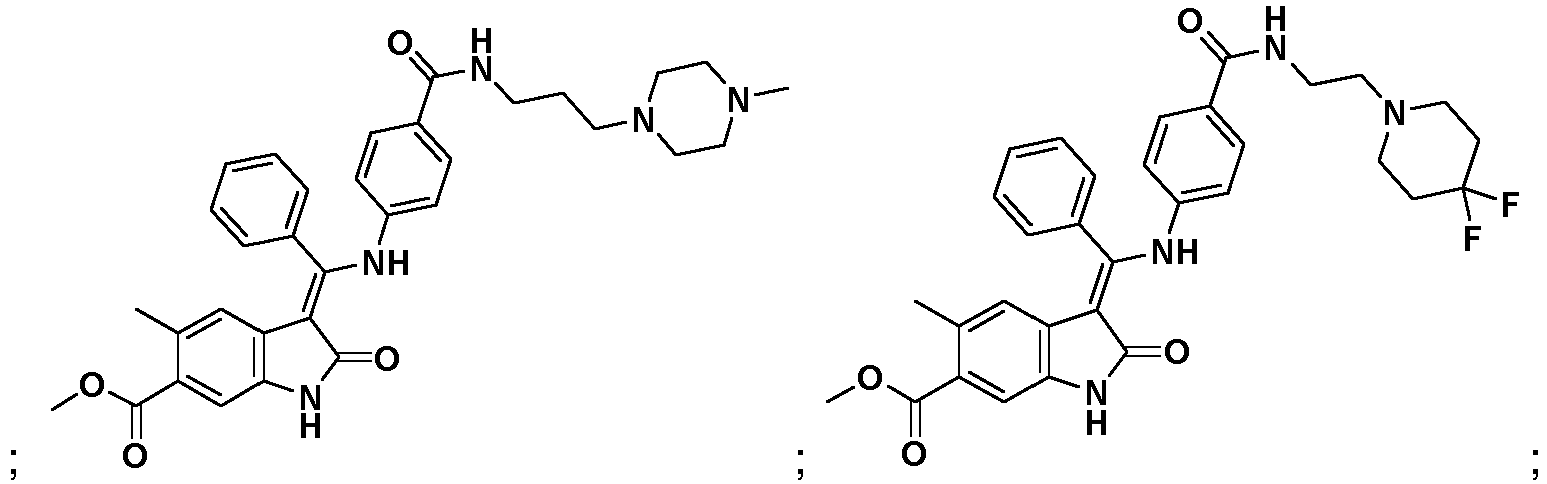


- The compound of claim 1 wherein R1 represents Me.
- The compound of either claim 1 or 2 wherein Z represents CO.
- The compound of any one of claims 1 to 3 wherein R3 represents -Z-Rx.
- The compound of any one of claims 1 to 4 wherein v represents 1, and n represents 1.
- The compound of any one of claims 1 to 5 wherein m represents 1.
- The compound of any one of claims 1 to 6 wherein X represents CH.
- The compound of any one of claims 1 to 7 wherein Y represents N.
- The compound of any one of claims 1 to 8 wherein W represents -C1-C4alkyl or NR22R23.
- A compound of formula (I) according to claim 1 which is selected from:(Z)-Methyl 5-methyl-3-(((4-(N-(2-(4-methylpiperazin-1-yl)ethyl)sulfamoyl)phenyl)amino)(phenyl)methylene)-2-oxoindoline-6-carboxylate;(Z)-Methyl 5-methyl-3-(((4-(((1-methylpiperidin-4-yl)methyl)carbamoyl)phenyl)amino)(phenyl)methylene)-2-oxoindoline-6-carboxylate;(Z)-Methyl 5-methyl-3-(((4-((2-(4-methylpiperazin-1-yl)ethyl)carbamoyl)phenyl)amino)(phenyl)methylene)-2-oxoindoline-6-carboxylate;(Z)-Methyl 5-methyl-3-(((4-((2-(4-methyl-1,4-diazepan-1-yl)ethyl)carbamoyl)phenyl)amino)(phenyl)methylene)-2-oxoindoline-6-carboxylate;(Z)-Methyl 3-(((4-((2-(4-(dimethylamino)piperidin-1-yl)ethyl)carbamoyl)phenyl)amino)(phenyl)methylene)-5-methyl-2-oxoindoline-6-carboxylate;(Z)-Methyl 3-(((4-((2-(4-(2-hydroxyethyl)piperazin-1-yl)-2-oxoethyl)carbamoyl)phenyl)amino)(phenyl)methylene)-5-methyl-2-oxoindoline-6-carboxylate;(Z)-Methyl 5-methyl-3-(((4-((2-(4-methylpiperazin-1-yl)-2-oxoethyl)carbamoyl)phenyl)amino)(phenyl)methylene)-2-oxoindoline-6-carboxylate;(Z)-Methyl 5-methyl-2-oxo-3-(((4-((2-(3-oxopiperazin-1-yl)ethyl)carbamoyl)phenyl)amino)(phenyl)methylene)indoline-6-carboxylate;(Z)-Methyl 5-methyl-3-(((4-((3-(4-methylpiperazin-1-yl)-3-oxopropyl)carbamoyl)phenyl)amino)(phenyl)methylene)-2-oxoindoline-6-carboxylate;(Z)-Methyl 3-(((4-((2-(4-hydroxypiperidin-1-yl)ethyl)carbamoyl)phenyl)amino)(phenyl)methylene)-5-methyl-2-oxoindoline-6-carboxylate;(Z)-Methyl 3-(((4-((1-(2-hydroxyethyl)piperidin-4-yl)carbamoyl)phenyl)amino)(phenyl)methylene)-5-methyl-2-oxoindoline-6-carboxylate;(Z)-Methyl 3-(((4-(((1-(2-hydroxyethyl)piperidin-4-yl)methyl)carbamoyl)phenyl)amino)(phenyl)methylene)-5-methyl-2-oxoindoline-6-carboxylate;(Z)-Methyl-5-methyl-3-(((4-((1-methylpiperidin-4-yl)carbamoyl)phenyl)amino)(phenyl)methylene)-2-oxoindoline-6-carboxylate;(Z)-Methyl 3-(((4-((1-(2-methoxyethyl)piperidin-4-yl)carbamoyl)phenyl)amino)(phenyl)methylene)-5-methyl-2-oxoindoline-6-carboxylate;(Z)-Methyl-5-methyl-3-(((4-((3-(4-methylpiperazin-1-yl)propyl)carbamoyl)phenyl)amino)(phenyl)methylene)-2-oxoindoline-6-carboxylate;(Z)-Methyl 3-(((4-((2-(4,4-difluoropiperidin-1-yl)ethyl)carbamoyl)phenyl)amino)(phenyl)methylene)-5-methyl-2-oxoindoline-6-carboxylate;(Z)-Methyl 3-(((4-((2-(4-acetylpiperazin-1-yl)ethyl)carbamoyl)phenyl)amino)(phenyl)methylene)-5-methyl-2-oxoindoline-6-carboxylate;(Z)-Methyl 3-(((4-((2-(4-fluoropiperidin-1-yl)ethyl)carbamoyl)phenyl)amino)(phenyl)methylene)-5-methyl-2-oxoindoline-6-carboxylate;(Z)-Methyl 5-methyl-3-(((4-((3-morpholinopropyl)carbamoyl)phenyl)amino)(phenyl)methylene)-2-oxoindoline-6-carboxylate;(Z)-Methyl 3-(((4-((2-(4-acetyl-1,4-diazepan-1-yl)ethyl)carbamoyl)phenyl)amino)(phenyl)methylene)-5-methyl-2-oxoindoline-6-carboxylate;(Z)-Methyl 3-(((4-((2-(4-(hydroxymethyl)piperidin-1-yl)ethyl)carbamoyl)phenyl)amino)(phenyl)methylene)-5-methyl-2-oxoindoline-6-carboxylate;(Z)-Methyl-5-methyl-3-(((4-((2-(4-(methylsulfonyl)piperazin-1-yl)ethyl)carbamoyl)phenyl)amino)(phenyl)methylene)-2-oxoindoline-6-carboxylate;(Z)-Methyl 3-(((4-((2-(1,1-dioxidothiomorpholino)ethyl)carbamoyl)phenyl)amino)(phenyl)methylene)-5-methyl-2-oxoindoline-6-carboxylate;(Z)-Methyl 5-methyl-2-oxo-3-(((4-((2-(5-oxo-1,4-diazepan-1-yl)ethyl)carbamoyl)phenyl)amino)(phenyl)methylene)indoline-6-carboxylate;(Z)-Methyl 3-(((3-fluoro-4-((2-(3-oxopiperazin-1-yl)ethyl)carbamoyl)phenyl)amino)(phenyl)methylene)-5-methyl-2-oxoindoline-6-carboxylate;(Z)-Methyl 5-methyl-2-oxo-3-(((4-((2-(3-oxo-1,4-diazepan-1-yl)ethyl)carbamoyl)phenyl)amino)(phenyl)methylene)indoline-6-carboxylate;
and pharmaceutically acceptable salts of any one thereof. - A pharmaceutical composition comprising a compound according to any one of claims 1 to 10, in combination with one or more pharmaceutically acceptable diluents or carriers.
- A compound of formula (I) according to any one of claims 1 to 10 for use as a medicament.
- A compound of formula (I) according to any one of claims 1 to 10 or a composition according to claim 11 for use in the treatment of fibrotic diseases or interstitial lung diseases e.g. selected from IPF, giant cell interstitial pneumonia, sarcoidosis, cystic fibrosis, respiratory distress syndrome, drug-induced lung fibrosis, granulomatosis, silicosis, asbestosis, systemic scleroderma, the virally induced hepatic cirrhosis selected from hepatitis C induced hepatic cirrhosis, or diseases of the skin with a fibrotic component e.g. selected from scleroderma, sarcoidosis and systemic lupus erythematosus, and IPF, or for use in the treatment of diseases characterized by hyperproliferation of cells, for example, cancer, particularly lung cancer or for use in the treatment of respiratory disorders including COPD (including chronic bronchitis and emphysema), asthma, paediatric asthma, allergic rhinitis, rhinitis, sinusitis; or a compound of formula (I) according to any one of claims 1 to 10 or a composition according to claim 11 for use in the treatment of fibrotic diseases such as lung fibrosis associated with rheumatoid arthritis, respiratory distress syndrome including acute respiratory distress syndrome, acute lung injury, radiation induced lung fibrosis or pneumonitis, chronic hypersensitivity pneumonitis, systemic sclerosis, Sjogren's syndrome, interstitial lung diseases, pulmonary arterial hypertension (PAH), including the vascular component of PAH, or diseases of the skin with a fibrotic component e.g. selected from hypertrophic scarring and keloids, or eye diseases where fibrosis is a component including glaucoma, age related macular degeneration, diabetic macular edema, dry eye disease and diabetic retinopathy, or fibrosis in the gut e.g. associated with inflammatory bowel disease; or
a compound of formula (I) according to any one of claims 1 to 10 or a composition according to claim 11 in combination with nintedanib or pirfenidone for use in the treatment of fibrotic diseases or interstitial lung diseases selected from IPF, giant cell interstitial pneumonia, sarcoidosis, cystic fibrosis, respiratory distress syndrome, drug-induced lung fibrosis, granulomatosis, silicosis, asbestosis, systemic scleroderma, the virally induced hepatic cirrhosis selected from hepatitis C induced hepatic cirrhosis, or diseases of the skin with a fibrotic component e.g. selected from scleroderma, sarcoidosis and systemic lupus erythematosus, and IPF, or for use in the treatment of diseases characterized by hyperproliferation of cells, for example, cancer, particularly lung cancer or for use in the treatment of respiratory disorders including COPD (including chronic bronchitis and emphysema), asthma, paediatric asthma, allergic rhinitis, rhinitis, sinusitis; or
a compound of formula (I) according to any one of claims 1 to 10 or a composition according to claim 11 in combination with nintedanib or pirfenidone for use in the treatment of fibrotic diseases such as lung fibrosis associated with rheumatoid arthritis, respiratory distress syndrome including acute respiratory distress syndrome, acute lung injury, radiation induced lung fibrosis or pneumonitis, chronic hypersensitivity pneumonitis, systemic sclerosis, Sjogren's syndrome, interstitial lung diseases, pulmonary arterial hypertension (PAH), including the vascular component of PAH, or diseases of the skin with a fibrotic component e.g. selected from hypertrophic scarring and keloids, or eye diseases where fibrosis is a component including glaucoma, age related macular degeneration, diabetic macular edema, dry eye disease and diabetic retinopathy, or fibrosis in the gut e.g. associated with inflammatory bowel disease. - A compound of formula (IXb):
 R1 represents Me, Et, CH=CH2, C≡C-H or C≡C-Me; andR3 independently represent H, C1-C6alkyl, C1-C6alkoxy, C3-C8cycloalkyl, -CH2-(C3-C8cycloalkyl), halogen or cyano;or salts thereof; or
a compound of formula (Xb): R1 represents Me, Et, CH=CH2, C≡C-H or C≡C-Me; andR3 independently represent H, C1-C6alkyl, C1-C6alkoxy, C3-C8cycloalkyl, -CH2-(C3-C8cycloalkyl), halogen or cyano;or salts thereof.
 - A process for preparing a compound of formula (I) or a pharmaceutically acceptable salt thereof according to any one of claims 1 to 10 which comprises reacting a compound of formula (II):

R1 is as defined in any one of claims 1 to 10 and L represents a leaving group; or a salt thereof;
with a compound of formula (III):
R2 and R3 are as defined in any one of claims 1 to 10;
or a salt thereof.
Applications Claiming Priority (2)
| Application Number | Priority Date | Filing Date | Title |
|---|---|---|---|
| EP16159231 | 2016-03-08 | ||
| PCT/GB2017/050619 WO2017153748A1 (en) | 2016-03-08 | 2017-03-08 | Indole derivatives and their use as protein kinase inhibitors |
Publications (2)
| Publication Number | Publication Date |
|---|---|
| EP3426649A1 EP3426649A1 (en) | 2019-01-16 |
| EP3426649B1 true EP3426649B1 (en) | 2020-07-22 |
Family
ID=55521584
Family Applications (1)
| Application Number | Title | Priority Date | Filing Date |
|---|---|---|---|
| EP17711736.3A Not-in-force EP3426649B1 (en) | 2016-03-08 | 2017-03-08 | Indole derivatives and their use as protein kinase inhibitors |
Country Status (10)
| Country | Link |
|---|---|
| US (2) | US10669235B2 (en) |
| EP (1) | EP3426649B1 (en) |
| JP (1) | JP7039480B2 (en) |
| CN (1) | CN109153666B (en) |
| AU (1) | AU2017231860C1 (en) |
| BR (1) | BR112018068213A2 (en) |
| CA (1) | CA3017308A1 (en) |
| EA (1) | EA038773B1 (en) |
| ES (1) | ES2836255T3 (en) |
| WO (1) | WO2017153748A1 (en) |
Families Citing this family (7)
| Publication number | Priority date | Publication date | Assignee | Title |
|---|---|---|---|---|
| MY195904A (en) | 2015-12-24 | 2023-02-27 | Respivert Ltd | Indolinones Compounds and Their use in the Treatment Of Fibrotic Diseases |
| JP7039480B2 (en) | 2016-03-08 | 2022-03-22 | レスピバート・リミテツド | Indole derivatives and their use as protein kinase inhibitors |
| KR20240052871A (en) | 2016-04-27 | 2024-04-23 | 애브비 인코포레이티드 | Methods of treatment of diseases in which il-13 activity is detrimental using anti-il-13 antibodies |
| CN112574094B (en) * | 2020-12-14 | 2022-07-01 | 成都大学 | Indolone derivatives and pharmaceutical use thereof |
| WO2023043473A1 (en) * | 2021-09-14 | 2023-03-23 | R-Pharm Overseas, Inc. | TGF-β INHIBITOR COMPOSITION AND USE THEREOF |
| CN117624014A (en) * | 2022-11-02 | 2024-03-01 | 徐诺药业(南京)有限公司 | 3-(Indolylamino)methylene indoline derivatives and their preparation methods and applications |
| CN121226225A (en) * | 2025-08-26 | 2025-12-30 | 沈阳兴齐眼药股份有限公司 | Ureidindolone compounds, their preparation methods and uses |
Family Cites Families (12)
| Publication number | Priority date | Publication date | Assignee | Title |
|---|---|---|---|---|
| UA75054C2 (en) | 1999-10-13 | 2006-03-15 | Бьорінгер Інгельхайм Фарма Гмбх & Ко. Кг | Substituted in position 6 indolinones, producing and use thereof as medicament |
| DE10117204A1 (en) * | 2001-04-06 | 2002-10-10 | Boehringer Ingelheim Pharma | Indolinones substituted in the 6-position, their preparation and their use as medicaments |
| JP2004182726A (en) | 2002-11-22 | 2004-07-02 | Yamanouchi Pharmaceut Co Ltd | 2-oxoindoline derivative |
| JP2005145928A (en) | 2003-11-19 | 2005-06-09 | Yamanouchi Pharmaceut Co Ltd | Pharmaceutical composition containing 3-quinolin-2(1h)-ylidene indolin-2-one derivative as active component |
| US20060154939A1 (en) * | 2004-12-24 | 2006-07-13 | Boehringer Ingelheim International Gmbh | Medicaments for the Treatment or Prevention of Fibrotic Diseases |
| PE20060777A1 (en) | 2004-12-24 | 2006-10-06 | Boehringer Ingelheim Int | INDOLINONE DERIVATIVES FOR THE TREATMENT OR PREVENTION OF FIBROTIC DISEASES |
| EP1902025A1 (en) | 2005-07-13 | 2008-03-26 | Allergan, Inc. | Kinase inhibitors |
| CA2728228A1 (en) | 2008-07-14 | 2010-01-21 | Gilead Sciences, Inc. | Oxindolyl inhibitor compounds |
| EP3604307A1 (en) | 2012-01-26 | 2020-02-05 | Angion Biomedica Corp. | Anti-fibrotic compounds and uses thereof |
| WO2015179436A1 (en) | 2014-05-19 | 2015-11-26 | Sanford-Burnham Medical Research Institute | Inflammation therapy using mekk3 inhibitors or blocking peptides |
| MY195904A (en) | 2015-12-24 | 2023-02-27 | Respivert Ltd | Indolinones Compounds and Their use in the Treatment Of Fibrotic Diseases |
| JP7039480B2 (en) | 2016-03-08 | 2022-03-22 | レスピバート・リミテツド | Indole derivatives and their use as protein kinase inhibitors |
-
2017
- 2017-03-08 JP JP2018547928A patent/JP7039480B2/en not_active Expired - Fee Related
- 2017-03-08 WO PCT/GB2017/050619 patent/WO2017153748A1/en not_active Ceased
- 2017-03-08 AU AU2017231860A patent/AU2017231860C1/en not_active Ceased
- 2017-03-08 CN CN201780023315.XA patent/CN109153666B/en not_active Expired - Fee Related
- 2017-03-08 ES ES17711736T patent/ES2836255T3/en active Active
- 2017-03-08 US US16/083,886 patent/US10669235B2/en active Active
- 2017-03-08 EP EP17711736.3A patent/EP3426649B1/en not_active Not-in-force
- 2017-03-08 CA CA3017308A patent/CA3017308A1/en not_active Abandoned
- 2017-03-08 BR BR112018068213A patent/BR112018068213A2/en not_active IP Right Cessation
- 2017-03-08 EA EA201892020A patent/EA038773B1/en unknown
-
2020
- 2020-06-01 US US16/889,780 patent/US11208381B2/en not_active Expired - Fee Related
Non-Patent Citations (1)
| Title |
|---|
| None * |
Also Published As
| Publication number | Publication date |
|---|---|
| EA038773B1 (en) | 2021-10-18 |
| AU2017231860A1 (en) | 2018-09-27 |
| EA201892020A1 (en) | 2019-02-28 |
| AU2017231860B2 (en) | 2021-06-10 |
| JP2019509294A (en) | 2019-04-04 |
| EP3426649A1 (en) | 2019-01-16 |
| WO2017153748A1 (en) | 2017-09-14 |
| ES2836255T3 (en) | 2021-06-24 |
| AU2017231860C1 (en) | 2022-01-20 |
| US20190071399A1 (en) | 2019-03-07 |
| CA3017308A1 (en) | 2017-09-14 |
| US20210114982A1 (en) | 2021-04-22 |
| CN109153666A (en) | 2019-01-04 |
| BR112018068213A2 (en) | 2019-01-29 |
| US11208381B2 (en) | 2021-12-28 |
| US10669235B2 (en) | 2020-06-02 |
| CN109153666B (en) | 2021-07-16 |
| JP7039480B2 (en) | 2022-03-22 |
Similar Documents
| Publication | Publication Date | Title |
|---|---|---|
| US11208381B2 (en) | Indole derivatives and their use as protein kinase inhibitors | |
| EP3394048B1 (en) | Indolinones compounds and their use in the treatment of fibrotic diseases | |
| CN113924146B (en) | New compounds and pharmaceutical compositions for treating diseases | |
| CN106573914B (en) | Pyrazolyl-ureas as kinase inhibitors | |
| EP2380891B1 (en) | Substituted piperidino-dihydrothienopyrimidines | |
| KR20180088462A (en) | 2-phenyl-3- (piperazinomethyl) imidazo [1,2-a] pyridine derivative as a TASK-1 and TASK-2 channel blocker for the treatment of sleep-related respiratory disorders | |
| EP3794002B1 (en) | Compounds | |
| EP2802586A1 (en) | Substituted imidazopyrazines as akt kinase inhibitors | |
| HK40003052B (en) | Indole derivatives and their use as protein kinase inhibitors | |
| HK40003052A (en) | Indole derivatives and their use as protein kinase inhibitors | |
| HK40039709A (en) | Indolinones compounds and their use in the treatment of fibrotic diseases | |
| HK40002827A (en) | Indole derivatives and their use as protein kinase inhibitors | |
| HK40002826A (en) | Indolinones compounds and their use in the treatment of fibrotic diseases |
Legal Events
| Date | Code | Title | Description |
|---|---|---|---|
| STAA | Information on the status of an ep patent application or granted ep patent |
Free format text: STATUS: UNKNOWN |
|
| STAA | Information on the status of an ep patent application or granted ep patent |
Free format text: STATUS: THE INTERNATIONAL PUBLICATION HAS BEEN MADE |
|
| PUAI | Public reference made under article 153(3) epc to a published international application that has entered the european phase |
Free format text: ORIGINAL CODE: 0009012 |
|
| STAA | Information on the status of an ep patent application or granted ep patent |
Free format text: STATUS: REQUEST FOR EXAMINATION WAS MADE |
|
| 17P | Request for examination filed |
Effective date: 20181002 |
|
| AK | Designated contracting states |
Kind code of ref document: A1 Designated state(s): AL AT BE BG CH CY CZ DE DK EE ES FI FR GB GR HR HU IE IS IT LI LT LU LV MC MK MT NL NO PL PT RO RS SE SI SK SM TR |
|
| AX | Request for extension of the european patent |
Extension state: BA ME |
|
| DAV | Request for validation of the european patent (deleted) | ||
| DAX | Request for extension of the european patent (deleted) | ||
| STAA | Information on the status of an ep patent application or granted ep patent |
Free format text: STATUS: EXAMINATION IS IN PROGRESS |
|
| 17Q | First examination report despatched |
Effective date: 20190807 |
|
| GRAP | Despatch of communication of intention to grant a patent |
Free format text: ORIGINAL CODE: EPIDOSNIGR1 |
|
| STAA | Information on the status of an ep patent application or granted ep patent |
Free format text: STATUS: GRANT OF PATENT IS INTENDED |
|
| INTG | Intention to grant announced |
Effective date: 20200214 |
|
| REG | Reference to a national code |
Ref country code: HK Ref legal event code: DE Ref document number: 40003052 Country of ref document: HK |
|
| GRAS | Grant fee paid |
Free format text: ORIGINAL CODE: EPIDOSNIGR3 |
|
| GRAA | (expected) grant |
Free format text: ORIGINAL CODE: 0009210 |
|
| STAA | Information on the status of an ep patent application or granted ep patent |
Free format text: STATUS: THE PATENT HAS BEEN GRANTED |
|
| AK | Designated contracting states |
Kind code of ref document: B1 Designated state(s): AL AT BE BG CH CY CZ DE DK EE ES FI FR GB GR HR HU IE IS IT LI LT LU LV MC MK MT NL NO PL PT RO RS SE SI SK SM TR |
|
| REG | Reference to a national code |
Ref country code: GB Ref legal event code: FG4D |
|
| REG | Reference to a national code |
Ref country code: CH Ref legal event code: EP |
|
| REG | Reference to a national code |
Ref country code: DE Ref legal event code: R096 Ref document number: 602017020151 Country of ref document: DE |
|
| REG | Reference to a national code |
Ref country code: AT Ref legal event code: REF Ref document number: 1293266 Country of ref document: AT Kind code of ref document: T Effective date: 20200815 |
|
| REG | Reference to a national code |
Ref country code: IE Ref legal event code: FG4D |
|
| REG | Reference to a national code |
Ref country code: LT Ref legal event code: MG4D |
|
| REG | Reference to a national code |
Ref country code: AT Ref legal event code: MK05 Ref document number: 1293266 Country of ref document: AT Kind code of ref document: T Effective date: 20200722 |
|
| PG25 | Lapsed in a contracting state [announced via postgrant information from national office to epo] |
Ref country code: GR Free format text: LAPSE BECAUSE OF FAILURE TO SUBMIT A TRANSLATION OF THE DESCRIPTION OR TO PAY THE FEE WITHIN THE PRESCRIBED TIME-LIMIT Effective date: 20201023 Ref country code: AT Free format text: LAPSE BECAUSE OF FAILURE TO SUBMIT A TRANSLATION OF THE DESCRIPTION OR TO PAY THE FEE WITHIN THE PRESCRIBED TIME-LIMIT Effective date: 20200722 Ref country code: NO Free format text: LAPSE BECAUSE OF FAILURE TO SUBMIT A TRANSLATION OF THE DESCRIPTION OR TO PAY THE FEE WITHIN THE PRESCRIBED TIME-LIMIT Effective date: 20201022 Ref country code: LT Free format text: LAPSE BECAUSE OF FAILURE TO SUBMIT A TRANSLATION OF THE DESCRIPTION OR TO PAY THE FEE WITHIN THE PRESCRIBED TIME-LIMIT Effective date: 20200722 Ref country code: PT Free format text: LAPSE BECAUSE OF FAILURE TO SUBMIT A TRANSLATION OF THE DESCRIPTION OR TO PAY THE FEE WITHIN THE PRESCRIBED TIME-LIMIT Effective date: 20201123 Ref country code: BG Free format text: LAPSE BECAUSE OF FAILURE TO SUBMIT A TRANSLATION OF THE DESCRIPTION OR TO PAY THE FEE WITHIN THE PRESCRIBED TIME-LIMIT Effective date: 20201022 Ref country code: FI Free format text: LAPSE BECAUSE OF FAILURE TO SUBMIT A TRANSLATION OF THE DESCRIPTION OR TO PAY THE FEE WITHIN THE PRESCRIBED TIME-LIMIT Effective date: 20200722 Ref country code: HR Free format text: LAPSE BECAUSE OF FAILURE TO SUBMIT A TRANSLATION OF THE DESCRIPTION OR TO PAY THE FEE WITHIN THE PRESCRIBED TIME-LIMIT Effective date: 20200722 Ref country code: SE Free format text: LAPSE BECAUSE OF FAILURE TO SUBMIT A TRANSLATION OF THE DESCRIPTION OR TO PAY THE FEE WITHIN THE PRESCRIBED TIME-LIMIT Effective date: 20200722 |
|
| PG25 | Lapsed in a contracting state [announced via postgrant information from national office to epo] |
Ref country code: LV Free format text: LAPSE BECAUSE OF FAILURE TO SUBMIT A TRANSLATION OF THE DESCRIPTION OR TO PAY THE FEE WITHIN THE PRESCRIBED TIME-LIMIT Effective date: 20200722 Ref country code: RS Free format text: LAPSE BECAUSE OF FAILURE TO SUBMIT A TRANSLATION OF THE DESCRIPTION OR TO PAY THE FEE WITHIN THE PRESCRIBED TIME-LIMIT Effective date: 20200722 Ref country code: PL Free format text: LAPSE BECAUSE OF FAILURE TO SUBMIT A TRANSLATION OF THE DESCRIPTION OR TO PAY THE FEE WITHIN THE PRESCRIBED TIME-LIMIT Effective date: 20200722 Ref country code: IS Free format text: LAPSE BECAUSE OF FAILURE TO SUBMIT A TRANSLATION OF THE DESCRIPTION OR TO PAY THE FEE WITHIN THE PRESCRIBED TIME-LIMIT Effective date: 20201122 |
|
| PG25 | Lapsed in a contracting state [announced via postgrant information from national office to epo] |
Ref country code: NL Free format text: LAPSE BECAUSE OF FAILURE TO SUBMIT A TRANSLATION OF THE DESCRIPTION OR TO PAY THE FEE WITHIN THE PRESCRIBED TIME-LIMIT Effective date: 20200722 |
|
| REG | Reference to a national code |
Ref country code: DE Ref legal event code: R097 Ref document number: 602017020151 Country of ref document: DE |
|
| PG25 | Lapsed in a contracting state [announced via postgrant information from national office to epo] |
Ref country code: SM Free format text: LAPSE BECAUSE OF FAILURE TO SUBMIT A TRANSLATION OF THE DESCRIPTION OR TO PAY THE FEE WITHIN THE PRESCRIBED TIME-LIMIT Effective date: 20200722 Ref country code: EE Free format text: LAPSE BECAUSE OF FAILURE TO SUBMIT A TRANSLATION OF THE DESCRIPTION OR TO PAY THE FEE WITHIN THE PRESCRIBED TIME-LIMIT Effective date: 20200722 Ref country code: CZ Free format text: LAPSE BECAUSE OF FAILURE TO SUBMIT A TRANSLATION OF THE DESCRIPTION OR TO PAY THE FEE WITHIN THE PRESCRIBED TIME-LIMIT Effective date: 20200722 Ref country code: DK Free format text: LAPSE BECAUSE OF FAILURE TO SUBMIT A TRANSLATION OF THE DESCRIPTION OR TO PAY THE FEE WITHIN THE PRESCRIBED TIME-LIMIT Effective date: 20200722 Ref country code: RO Free format text: LAPSE BECAUSE OF FAILURE TO SUBMIT A TRANSLATION OF THE DESCRIPTION OR TO PAY THE FEE WITHIN THE PRESCRIBED TIME-LIMIT Effective date: 20200722 |
|
| PGFP | Annual fee paid to national office [announced via postgrant information from national office to epo] |
Ref country code: IT Payment date: 20210211 Year of fee payment: 5 |
|
| PLBE | No opposition filed within time limit |
Free format text: ORIGINAL CODE: 0009261 |
|
| STAA | Information on the status of an ep patent application or granted ep patent |
Free format text: STATUS: NO OPPOSITION FILED WITHIN TIME LIMIT |
|
| PG25 | Lapsed in a contracting state [announced via postgrant information from national office to epo] |
Ref country code: AL Free format text: LAPSE BECAUSE OF FAILURE TO SUBMIT A TRANSLATION OF THE DESCRIPTION OR TO PAY THE FEE WITHIN THE PRESCRIBED TIME-LIMIT Effective date: 20200722 |
|
| REG | Reference to a national code |
Ref country code: ES Ref legal event code: FG2A Ref document number: 2836255 Country of ref document: ES Kind code of ref document: T3 Effective date: 20210624 |
|
| 26N | No opposition filed |
Effective date: 20210423 |
|
| PG25 | Lapsed in a contracting state [announced via postgrant information from national office to epo] |
Ref country code: SK Free format text: LAPSE BECAUSE OF FAILURE TO SUBMIT A TRANSLATION OF THE DESCRIPTION OR TO PAY THE FEE WITHIN THE PRESCRIBED TIME-LIMIT Effective date: 20200722 |
|
| PG25 | Lapsed in a contracting state [announced via postgrant information from national office to epo] |
Ref country code: SI Free format text: LAPSE BECAUSE OF FAILURE TO SUBMIT A TRANSLATION OF THE DESCRIPTION OR TO PAY THE FEE WITHIN THE PRESCRIBED TIME-LIMIT Effective date: 20200722 |
|
| PGFP | Annual fee paid to national office [announced via postgrant information from national office to epo] |
Ref country code: ES Payment date: 20210407 Year of fee payment: 5 |
|
| REG | Reference to a national code |
Ref country code: NL Ref legal event code: MP Effective date: 20200722 |
|
| PG25 | Lapsed in a contracting state [announced via postgrant information from national office to epo] |
Ref country code: MC Free format text: LAPSE BECAUSE OF FAILURE TO SUBMIT A TRANSLATION OF THE DESCRIPTION OR TO PAY THE FEE WITHIN THE PRESCRIBED TIME-LIMIT Effective date: 20200722 |
|
| REG | Reference to a national code |
Ref country code: CH Ref legal event code: PL |
|
| REG | Reference to a national code |
Ref country code: BE Ref legal event code: MM Effective date: 20210331 |
|
| PG25 | Lapsed in a contracting state [announced via postgrant information from national office to epo] |
Ref country code: IE Free format text: LAPSE BECAUSE OF NON-PAYMENT OF DUE FEES Effective date: 20210308 Ref country code: CH Free format text: LAPSE BECAUSE OF NON-PAYMENT OF DUE FEES Effective date: 20210331 Ref country code: LI Free format text: LAPSE BECAUSE OF NON-PAYMENT OF DUE FEES Effective date: 20210331 Ref country code: LU Free format text: LAPSE BECAUSE OF NON-PAYMENT OF DUE FEES Effective date: 20210308 |
|
| PG25 | Lapsed in a contracting state [announced via postgrant information from national office to epo] |
Ref country code: BE Free format text: LAPSE BECAUSE OF NON-PAYMENT OF DUE FEES Effective date: 20210331 |
|
| REG | Reference to a national code |
Ref country code: ES Ref legal event code: FD2A Effective date: 20230428 |
|
| PG25 | Lapsed in a contracting state [announced via postgrant information from national office to epo] |
Ref country code: IT Free format text: LAPSE BECAUSE OF NON-PAYMENT OF DUE FEES Effective date: 20220308 |
|
| PG25 | Lapsed in a contracting state [announced via postgrant information from national office to epo] |
Ref country code: CY Free format text: LAPSE BECAUSE OF FAILURE TO SUBMIT A TRANSLATION OF THE DESCRIPTION OR TO PAY THE FEE WITHIN THE PRESCRIBED TIME-LIMIT Effective date: 20200722 |
|
| PG25 | Lapsed in a contracting state [announced via postgrant information from national office to epo] |
Ref country code: HU Free format text: LAPSE BECAUSE OF FAILURE TO SUBMIT A TRANSLATION OF THE DESCRIPTION OR TO PAY THE FEE WITHIN THE PRESCRIBED TIME-LIMIT; INVALID AB INITIO Effective date: 20170308 Ref country code: ES Free format text: LAPSE BECAUSE OF NON-PAYMENT OF DUE FEES Effective date: 20220309 |
|
| PG25 | Lapsed in a contracting state [announced via postgrant information from national office to epo] |
Ref country code: MK Free format text: LAPSE BECAUSE OF FAILURE TO SUBMIT A TRANSLATION OF THE DESCRIPTION OR TO PAY THE FEE WITHIN THE PRESCRIBED TIME-LIMIT Effective date: 20200722 |
|
| PGFP | Annual fee paid to national office [announced via postgrant information from national office to epo] |
Ref country code: DE Payment date: 20240130 Year of fee payment: 8 Ref country code: GB Payment date: 20240201 Year of fee payment: 8 |
|
| PGFP | Annual fee paid to national office [announced via postgrant information from national office to epo] |
Ref country code: FR Payment date: 20240213 Year of fee payment: 8 |
|
| PG25 | Lapsed in a contracting state [announced via postgrant information from national office to epo] |
Ref country code: MT Free format text: LAPSE BECAUSE OF FAILURE TO SUBMIT A TRANSLATION OF THE DESCRIPTION OR TO PAY THE FEE WITHIN THE PRESCRIBED TIME-LIMIT Effective date: 20200722 |
|
| REG | Reference to a national code |
Ref country code: DE Ref legal event code: R119 Ref document number: 602017020151 Country of ref document: DE |
|
| GBPC | Gb: european patent ceased through non-payment of renewal fee |
Effective date: 20250308 |
|
| PG25 | Lapsed in a contracting state [announced via postgrant information from national office to epo] |
Ref country code: TR Free format text: LAPSE BECAUSE OF FAILURE TO SUBMIT A TRANSLATION OF THE DESCRIPTION OR TO PAY THE FEE WITHIN THE PRESCRIBED TIME-LIMIT Effective date: 20200722 |
|
| PG25 | Lapsed in a contracting state [announced via postgrant information from national office to epo] |
Ref country code: DE Free format text: LAPSE BECAUSE OF NON-PAYMENT OF DUE FEES Effective date: 20251001 |
|
| PG25 | Lapsed in a contracting state [announced via postgrant information from national office to epo] |
Ref country code: GB Free format text: LAPSE BECAUSE OF NON-PAYMENT OF DUE FEES Effective date: 20250308 |
|
| PG25 | Lapsed in a contracting state [announced via postgrant information from national office to epo] |
Ref country code: FR Free format text: LAPSE BECAUSE OF NON-PAYMENT OF DUE FEES Effective date: 20250331 |