EP3425931A1 - Bluetooth low energy devices - Google Patents
Bluetooth low energy devices Download PDFInfo
- Publication number
- EP3425931A1 EP3425931A1 EP17198693.8A EP17198693A EP3425931A1 EP 3425931 A1 EP3425931 A1 EP 3425931A1 EP 17198693 A EP17198693 A EP 17198693A EP 3425931 A1 EP3425931 A1 EP 3425931A1
- Authority
- EP
- European Patent Office
- Prior art keywords
- ble
- computing device
- service
- file
- attribute profile
- Prior art date
- Legal status (The legal status is an assumption and is not a legal conclusion. Google has not performed a legal analysis and makes no representation as to the accuracy of the status listed.)
- Granted
Links
Images


Classifications
-
- H—ELECTRICITY
- H04—ELECTRIC COMMUNICATION TECHNIQUE
- H04L—TRANSMISSION OF DIGITAL INFORMATION, e.g. TELEGRAPHIC COMMUNICATION
- H04L12/00—Data switching networks
- H04L12/28—Data switching networks characterised by path configuration, e.g. LAN [Local Area Networks] or WAN [Wide Area Networks]
- H04L12/2803—Home automation networks
-
- H—ELECTRICITY
- H04—ELECTRIC COMMUNICATION TECHNIQUE
- H04L—TRANSMISSION OF DIGITAL INFORMATION, e.g. TELEGRAPHIC COMMUNICATION
- H04L67/00—Network arrangements or protocols for supporting network services or applications
- H04L67/01—Protocols
- H04L67/12—Protocols specially adapted for proprietary or special-purpose networking environments, e.g. medical networks, sensor networks, networks in vehicles or remote metering networks
- H04L67/125—Protocols specially adapted for proprietary or special-purpose networking environments, e.g. medical networks, sensor networks, networks in vehicles or remote metering networks involving control of end-device applications over a network
-
- H—ELECTRICITY
- H04—ELECTRIC COMMUNICATION TECHNIQUE
- H04W—WIRELESS COMMUNICATION NETWORKS
- H04W52/00—Power management, e.g. Transmission Power Control [TPC] or power classes
- H04W52/02—Power saving arrangements
- H04W52/0209—Power saving arrangements in terminal devices
-
- H—ELECTRICITY
- H04—ELECTRIC COMMUNICATION TECHNIQUE
- H04B—TRANSMISSION
- H04B5/00—Near-field transmission systems, e.g. inductive or capacitive transmission systems
-
- H—ELECTRICITY
- H04—ELECTRIC COMMUNICATION TECHNIQUE
- H04L—TRANSMISSION OF DIGITAL INFORMATION, e.g. TELEGRAPHIC COMMUNICATION
- H04L12/00—Data switching networks
- H04L12/28—Data switching networks characterised by path configuration, e.g. LAN [Local Area Networks] or WAN [Wide Area Networks]
- H04L12/2803—Home automation networks
- H04L12/2816—Controlling appliance services of a home automation network by calling their functionalities
- H04L12/2818—Controlling appliance services of a home automation network by calling their functionalities from a device located outside both the home and the home network
-
- H—ELECTRICITY
- H04—ELECTRIC COMMUNICATION TECHNIQUE
- H04L—TRANSMISSION OF DIGITAL INFORMATION, e.g. TELEGRAPHIC COMMUNICATION
- H04L12/00—Data switching networks
- H04L12/28—Data switching networks characterised by path configuration, e.g. LAN [Local Area Networks] or WAN [Wide Area Networks]
- H04L12/2803—Home automation networks
- H04L12/283—Processing of data at an internetworking point of a home automation network
- H04L12/2834—Switching of information between an external network and a home network
-
- H—ELECTRICITY
- H04—ELECTRIC COMMUNICATION TECHNIQUE
- H04L—TRANSMISSION OF DIGITAL INFORMATION, e.g. TELEGRAPHIC COMMUNICATION
- H04L12/00—Data switching networks
- H04L12/28—Data switching networks characterised by path configuration, e.g. LAN [Local Area Networks] or WAN [Wide Area Networks]
- H04L12/2803—Home automation networks
- H04L12/283—Processing of data at an internetworking point of a home automation network
- H04L12/2836—Protocol conversion between an external network and a home network
-
- H—ELECTRICITY
- H04—ELECTRIC COMMUNICATION TECHNIQUE
- H04L—TRANSMISSION OF DIGITAL INFORMATION, e.g. TELEGRAPHIC COMMUNICATION
- H04L67/00—Network arrangements or protocols for supporting network services or applications
- H04L67/01—Protocols
- H04L67/02—Protocols based on web technology, e.g. hypertext transfer protocol [HTTP]
- H04L67/025—Protocols based on web technology, e.g. hypertext transfer protocol [HTTP] for remote control or remote monitoring of applications
-
- H—ELECTRICITY
- H04—ELECTRIC COMMUNICATION TECHNIQUE
- H04L—TRANSMISSION OF DIGITAL INFORMATION, e.g. TELEGRAPHIC COMMUNICATION
- H04L67/00—Network arrangements or protocols for supporting network services or applications
- H04L67/01—Protocols
- H04L67/08—Protocols specially adapted for terminal emulation, e.g. Telnet
-
- H—ELECTRICITY
- H04—ELECTRIC COMMUNICATION TECHNIQUE
- H04L—TRANSMISSION OF DIGITAL INFORMATION, e.g. TELEGRAPHIC COMMUNICATION
- H04L67/00—Network arrangements or protocols for supporting network services or applications
- H04L67/50—Network services
- H04L67/56—Provisioning of proxy services
-
- H—ELECTRICITY
- H04—ELECTRIC COMMUNICATION TECHNIQUE
- H04L—TRANSMISSION OF DIGITAL INFORMATION, e.g. TELEGRAPHIC COMMUNICATION
- H04L67/00—Network arrangements or protocols for supporting network services or applications
- H04L67/50—Network services
- H04L67/56—Provisioning of proxy services
- H04L67/562—Brokering proxy services
-
- H—ELECTRICITY
- H04—ELECTRIC COMMUNICATION TECHNIQUE
- H04W—WIRELESS COMMUNICATION NETWORKS
- H04W4/00—Services specially adapted for wireless communication networks; Facilities therefor
- H04W4/80—Services using short range communication, e.g. near-field communication [NFC], radio-frequency identification [RFID] or low energy communication
-
- H—ELECTRICITY
- H04—ELECTRIC COMMUNICATION TECHNIQUE
- H04L—TRANSMISSION OF DIGITAL INFORMATION, e.g. TELEGRAPHIC COMMUNICATION
- H04L12/00—Data switching networks
- H04L12/28—Data switching networks characterised by path configuration, e.g. LAN [Local Area Networks] or WAN [Wide Area Networks]
- H04L12/2803—Home automation networks
- H04L2012/284—Home automation networks characterised by the type of medium used
- H04L2012/2841—Wireless
Definitions
- BLE Bluetooth low energy
- BLE connections may allow for a user of a first device to control, from the first device, the functions of a second device.
- a peripheral BLE device may accept connections from other BLE devices and it may perform functions. These functions may be called services.
- a BLE light bulb may be characterized as a peripheral BLE device. It may have a function of providing light. Thus, it has a "light" service.
- a BLE door lock may also be characterized as a peripheral BLE device. It may have a function of locking a deadbolt and thus has a "lock" service.
- a central BLE device may connect to a peripheral BLE device and access or control the services provided by a peripheral BLE device. Accordingly, a central BLE device that is connected to a BLE light bulb may turn the light bulb's "light” service on or off. Similarly, a central BLE device that is connected to a BLE door lock may open or close the BLE door lock's "lock" service.
- a central BLE device may connect to numerous peripheral BLE devices at the same time, thus controlling multiple devices. Accordingly, a central BLE device may allow for a user of the central BLE device to control devices from the convenience of one central BLE device.
- BLE is used in point-to-point networks.
- two devices e.g., a central BLE device and a peripheral BLE device
- BLE communication range of each other devices that are out of BLE communication range of each other cannot communicate to each other using BLE.
- a central BLE device may not be able to control a peripheral BLE device using the BLE protocol.
- the typical control methods used by the central BLE device may not be able to be used.
- the services provided by the peripheral BLE device may not be controlled in situations where the central BLE device (or user of the central BLE device) is remote from the peripheral BLE device.
- situations where the central BLE device is out of BLE range are situations when control may be desired (e.g., a home owner desiring to turn off their lights when they are on vacation may not be able to do so using BLE).
- Examples disclosed herein address these technological difficulties by providing systems and methods to extend the BLE network using an intermediary network.
- the services offered by the BLE peripheral device is transcribed into a file that may be transmitted to an intermediary network (e.g., the Internet, etc.).
- the file is stored by a broker in a location that is accessible via the intermediary network.
- the data in the file may be used to allow a client device that is out of BLE range of the BLE peripheral device to control the BLE peripheral device.
- the control may be similar as though the client device is interacting directly with the BLE peripheral device. Accordingly, examples discussed herein allow for remote access to BLE peripheral devices.
- a computing device is provided with a non-transitory machine-readable storage medium comprising instructions, that, when executed, cause a processing resource to replicate an attribute profile of a remote BLE device.
- the attribute profile comprises a number of services and a number of characteristics executable by the remote BLE device.
- the instructions when executed, also cause the processing resource to broadcast a BLE signal, connect to a nearby Bluetooth device, receive a command for a characteristic out of the number of characteristics from the nearby Bluetooth device, and transmit the command to a Bluetooth broker.
- a computing device is provided with a non-transitory machine-readable storage medium comprising instructions, that, when executed, cause a processing resource to receive, from a first remote access device, a first file comprising an attribute profile of a first BLE device.
- the attribute profile comprises a service and a characteristic associated with the service.
- the instructions when executed, also cause the processing resource to store the first file in a manner associated with the first BLE device, provide a service that allows for a client device associated with the first BLE device to perform a number of operations on the characteristic in the attribute profile, receive a requested operation out of the number of operations on the characteristic, and transmit the requested operation to the first remote access device.
- a method including connecting, at a first location, to a BLE device via a first protocol; discovering, at the first location, an attribute profile for the BLE device via the first protocol, and generating, at the first location, a file comprising the attribute profile.
- the attribute profile may comprise a service associated with a characteristic.
- the method also includes transmitting the file from the first location to a second location via a second protocol that is different from the first protocol; providing a service based on data in the file that allows a client computing device to perform a number of operations on the characteristic; and receiving, at the second location, a requested operation for the characteristic. Additionally, the method includes transmitting the requested operation from the second location to the first location via the second protocol, and transmitting the requested operation from the first location to the BLE device via the first protocol.
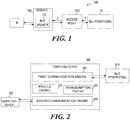
- FIG. 1 is a block diagram of a network 100 that comprises a BLE network and an intermediary network connected to the BLE.
- the BLE network is formed by the connection of a BLE peripheral device 10 with an access point 101.
- a BLE peripheral device may include an electronic device that accepts BLE connections and has functions that are executable by the electronic device.
- Non-limiting examples of a BLE peripheral device may be a door lock, a light bulb, a smartwatch, a sensor (e.g. heartrate), a mobile phone, etc.
- a BLE peripheral device may model its specific executable functions in an attribute profile.
- the attribute profile may include a number of services and a number of characteristics associated with the number of services.
- the attribute profile of a BLE peripheral may include two services, and three characteristics associated with each of the two services.
- a light bulb BLE peripheral may provide a "light” service.
- the "light” service may have a "brightness” characteristic and an "on/off' characteristic associated with the "light” service.
- the attribute profile may be a generic attribute (GATT) profile.
- the attribute profile may also comprise information regarding a broadcast signal of the remote BLE device (e.g., advertisement packets and/or scan response packets).
- a BLE peripheral 10 may form a BLE network with access point 101 using the BLE protocol. This is represented in FIG. 1 as numeral 1.
- access point 101 is directly connected to BLE peripheral 10 via BLE. Accordingly, access point 101 is in a physical location from BLE peripheral 10 such that it is in the BLE communication range of BLE peripheral 10.
- Access point 101 may act as a BLE central device.
- a BLE central device may include a computing device that is able to connect to a BLE peripheral device via BLE, discover the attribute profile of the BLE peripheral device, and communicate with the BLE peripheral device to issue commands with regard to the attribute profile. For example, in the example where BLE peripheral 10 is a lightbulb, access point 101 may issue a write command for the on/off characteristic such that BLE peripheral will turn the lightbulb on or off according to the command.
- access point 101 may transcribe the attribute profile into a file.
- the file may be in the JSON or XML format.
- Access point 101 may also act as a bridge between the BLE network and an intermediary network.
- the intermediary network may be a wireless network, a wired network, or a combination thereof.
- the intermediary network may be an individual network or a collection of many such individual networks interconnected with each other and functioning as a single large network (e.g., the Internet).
- the intermediary network may be implemented as a local area network (LAN), wide area network (WAN), etc. Accordingly, the intermediary network is a different type of network than the BLE network.
- the intermediary network uses different protocols than those used in the BLE protocol. Accordingly, the protocol which is used by access point 101 to connect to and communicate with the intermediary network is not BLE and comprises a second protocol that is different to the communication protocols used in BLE. This is represented by the numeral 2 in FIG. 1 . In some examples, protocols such as the Internet Protocol (IP), Transmission Control Protocol (TCP), or TCP/IP may be used. Access point 101 may send the transcribed file comprising the attribute profile of BLE peripheral device 10 to a server 102. BLE broker 112 may be an application that runs on server 102. Through the second protocol, access point 101 sends the file to BLE broker 112. BLE broker 112 stores the file in a manner that associates the file to the BLE peripheral 10.
- IP Internet Protocol
- TCP Transmission Control Protocol
- BLE broker 112 stores the file in a manner that associates the file to the BLE peripheral 10.
- BLE broker 112 may then accordingly provide data in the file to other devices, labeled as A in FIG. 1 such that those other devices may access the functions provided by BLE peripheral 10.
- the BLE network is extended by an intermediary network that allows access to the BLE peripheral 10. This extends the reach of the BLE peripheral such that a user that is not in BLE range of the BLE peripheral 10 may control the BLE peripheral 10.
- FIG. 1 shows access point 101 as forming a BLE network with one BLE peripheral 10
- the BLE network may include additional computing devices also connected via BLE.
- access point 101 may connect to two, three, or four BLE peripherals.
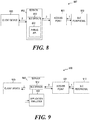
- FIG. 2 illustrates a block diagram of a computing device 200 to connect to a BLE peripheral device 210.
- a "computing device” may be a server, a computer networking device (e.g., a switch, a gateway, an access point, etc.), a storage device, chip set, or any other processing device or equipment).
- computing device 200 is an access point that may connect to BLE peripheral 210 and computing device 220.
- Computing device 200 includes a first communication engine 201, a profile engine 202, a transcription engine 203, and a second communication engine 204. Each of these aspects of computing device 200 will be described below. Other engines may be added to computing device 200 for additional or alternative functionality.
- Engines 201, 202, 203, and 204 may be any combination of hardware (e.g., a processor such as an integrated circuit or other circuitry) and software (e.g., machine or processor-executable instructions, commands, or code such as firmware, programming, or object code) to implement the functionalities of the respective engine.
- software e.g., machine or processor-executable instructions, commands, or code such as firmware, programming, or object code
- Such combinations of hardware and programming may be implemented in a number of different ways.
- a combination of hardware and software can include hardware (i.e., a hardware element with no software elements), software hosted on hardware (e.g., software that is stored in a memory and executed or interpreted by a processor), or by hardware and software hosted on hardware.
- the singular forms "a,” “an,” and “the” include plural referents unless the context clearly dictates otherwise.
- the term “engine” is intended to mean at least one engine or a combination of engines.
- Each engine of computing device 200 can include at least one machine-readable storage medium (for example, more than one) and at least one processing resource (for example, more than one).
- machine-readable storage medium may include a storage drive (e.g., a hard drive), flash memory, Random Access Memory (RAM), any type of storage disc (e.g., a Compact Disc Read Only Memory (CD-ROM), any other type of compact disc, a DVD, etc.) and the like, or a combination thereof.
- a storage medium may correspond to memory including a main memory, such as a Random Access Memory, where software may reside during runtime, and/or a secondary memory.
- the secondary memory can, for example, include a non-volatile memory where a copy of software or other data is stored.
- each engine of computing device 200 may include hardware in the form of a microprocessor on a single integrated circuit, related firmware, or other software for allowing the microprocessor to operatively communicate with other hardware of computing device 200.
- a processing resource may, for example, be in the form of a central processing unit (CPU), a semiconductor-based microprocessor, a digital signal processor (DSP) such as a digital image processing unit, or other hardware devices or processing elements suitable to retrieve and execute instructions stored in a storage medium, or suitable combinations thereof.
- the processing resource can, for example, include single or multiple cores on a chip, multiple cores across multiple chips, multiple cores across multiple devices, or suitable combinations thereof.
- First communication engine 201 is an engine of computing device 200 that includes a combination of hardware and software that allows computing device 200 to discover and connect to BLE peripheral device 210 that is within BLE communication range of computing device 200.
- first communication engine 201 may allow computing device 200 to observe to see if there is a BLE peripheral device 210 within communication range.
- the BLE peripheral device 210 may be broadcasting a BLE signal to advertise its presence.
- first communication engine 201 may send a connection request to BLE peripheral device 210.
- a connection is established between first communication engine 201 and the BLE peripheral device 210 when the BLE peripheral device accepts the request.
- computing device 200 may also be characterized as a central BLE device.
- First communication engine 201 may also allow computing device 200 to relay a requested operation originating from a client device regarding a characteristic and transmit an associated command to BLE peripheral such that BLE peripheral executes the requested operation.
- first communication engine may transmit a WRITE command to BLE peripheral device 210 on a characteristic of BLE peripheral device.
- Profile engine 202 is an engine of computing device 200 that includes a combination of hardware and software that allows computing device 200 to discover an attribute profile of BLE peripheral 210.
- a BLE peripheral may have certain functions that are executable by the BLE peripheral.
- An attribute profile may describe at least one of those functions in a logical data structure.
- the attribute profile may be in the form of a GATT profile.
- the hierarchy of a GATT profile may include a number of services to fulfill a use case of the BLE peripheral.
- a service may be comprised of a number of characteristics.
- a service may also include references to other services.
- a characteristic may include a value, a set of properties indicating the operations the characteristic supports, and descriptors in the form of metadata relating to the characteristic.
- an attribute profile may include one service out of the number of services, one characteristic out of the number of characteristics associated with a service, a portion of the services out of the number of services, a portion of the characteristics out of the number of characteristics, or every service and every characteristic associated with every service on BLE peripheral 210. Additionally, the attribute profile may also include information regarding a broadcast signal of BLE peripheral 210 (e.g., advertisement packets and/or scan response packets).
- a broadcast signal of BLE peripheral 210 e.g., advertisement packets and/or scan response packets.
- Transcription engine 203 is an engine of computing device 200 that includes a combination of hardware and software that allows computing device 200 to take the attribute profile discovered by profile engine 202 and transcribe it into a format that may be sent to another computing device, and stored.
- the format may be in a language-independent format such that it may be understood by another computing device.
- the file may be in a human-readable text format such as JavaScript Object Notation (JSON) or Extensible Markup Language (XML) format.
- JSON JavaScript Object Notation
- XML Extensible Markup Language
- Second communication engine 204 is an engine of computing device 200 that includes a combination of hardware and software that allows computing device 200 to connect to another computing device (e.g., a server) through an intermediary network.
- the intermediary network is different from the BLE network that is relied upon by first communication engine 201 to connect to BLE peripheral 210.
- the protocols used by second communication engine 204 are different from the protocols used by first communication engine 201.
- first communication engine 201 may rely on the BLE protocol while second communication engine 204 may use Internet protocols, such as TCP/IP, etc.
- Second communication engine 204 may also allow computing device 200 to transmit the file comprising the attribute profile of BLE peripheral device 210 to computing device 220.
- computing device 220 is a server that may provide a BLE broker, similar to that of server 102 described in FIG. 1 or computing device 300 described in FIG. 3 .
- access point 101 of FIG. 1 may have features and components as described herein in relation to computing device 200.
- Second communication engine 204 may also allow computing device 200 to receive a requested operation on a characteristic of BLE peripheral 210 that originates from a client device. This operation may then be relayed and sent to BLE peripheral 210 via first communication engine 201.
- FIG. 3 is a block diagram of a computing device 300 with instructions thereon to provide a service that allows a client device to control a remote BLE device, according to some examples.
- computing device 300 may be a server that interfaces with first remote access device 340 and client device 350.
- Computing device 300 includes a processing resource 301 and a machine-readable storage medium 310.
- Machine-readable storage medium 310 may be in the form of non-transitory machine-readable storage medium, such as suitable electronic, magnetic, optical, or other physical storage apparatus to contain or store information such as instructions 311, 312, 313, 314, 315, related data, and the like.
- instructions 311, 312, 313, 314, and 315 are stored (e.g., encoded) on storage medium 310 and are executable by processing resource 301 to implement functionalities described herein in relation to FIG. 3 .
- the processing resource 301 can be functional to fetch, decode, and execute instructions 311, 312, 313, 314, and 315 as described herein.
- the functionalities of any of the instructions of storage medium 310 may be implemented in the form of electronic circuitry, in the form of executable instructions encoded on machine-readable storage medium, or a combination thereof.
- Instructions 311 may be executable by processing resource 301 such that computing device 300 receives a first file comprising an attribute profile of a first BLE device. Attribute profile, as discussed above, is applicable here.
- the first file may come from a first remote access device 340.
- remote access device 340 is indirectly connected to computing device 300 via an intermediary network, such as the Internet. Accordingly, first remote access device 340 may communicate and send data to computing device 300 via TCP/IP protocols.
- the first BLE device may be a BLE peripheral device (e.g., similar to BLE peripheral 10 described in relation to FIG. 1 ) that is within BLE range of first remote access device 340.
- the remote access device 340 may discover the attribute profile of the BLE peripheral device and transcribe it into the first file. Instructions 311 allows computing device 300 to receive the first file from remote access device 340.
- the first file may be in the form of JSON or XML.
- Instructions 312 may be executable by processing resource 301 such that computing device 300 stores the first file received by instructions 311 in a manner that associates the first file with the first BLE device.
- the first BLE device may have a unique identifier that identifies it to computing device 300.
- Instructions 312 may store the first file associated to this unique identifier such that computing device 300 understands that the first file contains data representing the attribute profile of the particular BLE device from which the attribute profile came from.
- the unique identifier may also be used to identify the particular BLE device to other computing devices (such as a client device that wants to control the functions of the particular BLE device).
- the first file is stored in a manner that associates it with the remote access device 340 that sent the first file.
- the remote access device 340 may also have a unique identifier that identifies it to computing device 300. This is because computing device 300 may receive a first file comprising an attribute profile of a first BLE device and it may also receive a second file comprising an attribute profile of a second BLE device. The first file may come from first remote access device 340 and the second file may come from a second remote access device (not shown in FIG. 3 ). Identifiers may allow computing device 300 to relay any commands that it receives with regard to a specific BLE device to the appropriate remote access device that is connected via BLE to the specific BLE device.
- Instructions 313 may be executable by processing resource 301 such that computing device 300 provides a service that allows a client device to perform a number of operations on the characteristic in the attribute profile.
- the client device may be associated to the first BLE device.
- the client device may be running or accessing an application that is specific to the first BLE device.
- the first file comprises data that represents the attribute profile of the first BLE device.
- computing device 300 may provide a service that may increase the devices that may control the first BLE device.
- the service provided by computing device may allow a client device 350 that remote from the BLE device (i.e., not in the BLE range of the first BLE device) to perform a number of operations (e.g., issue a command, etc.) on the characteristic in the attribute profile.
- the service may be provided using data in the first file.
- the service that is provided may be a private application program interface (API).
- instructions 313 comprises instructions to provide a private API.
- the private API may be generated using data in the first file.
- a private API is an interface that is exposed to and accessible by authorized users and computing devices meeting the access requirements set by the private API.
- an enterprise may provide the functionalities described herein in relation to instructions 311-315.
- the enterprise may restrict access to its API by making it private, making so a select number of people and/or computing devices may interact with the API and use data provided by the API (e.g., internal developers, partner developers, computing devices provided by these internal and partner developers, etc.)
- the private API may provide operations that are operable on the characteristics in the first file (e.g., read operations, write operations, etc.).
- a computing device that is authorized to access the private API may access these operations.
- the computing device may be a third remote access device (e.g., an access point, a mobile cellphone, etc.) that is different from first remote access device 340 or second remote access device discussed above.
- a third remote access device e.g., an access point, a mobile cellphone, etc.
- the third remote access device may be the pathway through which client device 350 communicates to computing device 300.
- the third remote access device may have appropriate authorization to access and interact with the private API on computing device 300.
- the third remote access device may replicate the attribute profile represented on the private API.
- the attribute profile replicated on the third remote access device is identical to the attribute profile on the first BLE device.
- client device 350 may interact with the third remote access device as though it were the first BLE device.
- Third remote access device may then transmit these interactions to computing device 300.
- the connection between third remote access device and client device 350 is via BLE while the connection between third remote access device and computing device 300 is via the intermediary network that connects computing device 300 to first remote access device 340. This is discussed in relation to FIG. 5 .
- the service that is provided may be a public application program interface (API).
- instructions 313 comprises instructions to provide a public API.
- the public API may be generated using data in the first file.
- a public API is an interface that is exposed to and accessible by wide range of users and computing devices.
- an enterprise may provide the functionalities described herein in relation to instructions 311-315. The enterprise may make the API public, allowing users and computing devices outside of the enterprise to interact with the API and use data provided by the API.
- the public API may provide operations that are operable on the characteristics in the first file (e.g., read operations, write operations, etc.).
- the public API may be accessed by a web application running on a computing device (e.g. a server).
- the web application may be specifically for the first BLE device that has the first attribute profile.
- client device 350 may be another computing device (e.g., a personal computer, smartphone, etc.) that the client uses to access the web application.
- the client device 350 may issue operations to perform on the BLE device.
- the web application may then transmit these operations to computing device 300 via the public API.
- Computing device 300 may then transmit these operations to the first access device 340.
- the connection between client device 350 and the computing device that provides the web application is via an intermediary network and not a BLE network. Additionally, the connection between the computing device that provides the web application and the computing device 300 is via an intermediary network and not a BLE network. This is discussed in relation to FIG. 8 .
- the service by that is provided may be an application simulator.
- instructions 313 comprises instructions to provide an application simulator.
- an application simulator may create a virtual machine version of an application for a computing device (e.g. a personal computer) that accesses or runs the application simulator.
- the application simulator may be a mobile application simulator.
- a mobile application simulator may create a virtual machine version of a mobile computing device (e.g., an iPhone, an Android, a smartphone, etc.) on a computing device that is not the mobile computing device.
- the mobile application simulator also will simulate a virtual machine that includes BLE connectivity ability.
- client device 350 may be a personal computer.
- a mobile application simulator may create a virtual machine of an iPhone on the personal computer.
- client device 350 may be an iPhone smart phone.
- a mobile application simulator may also create a virtual machine of an Android on the iPhone. This may allow the computing device accessing the simulator to run applications that are designed for the environment simulated by the simulator.
- instructions 313 may include instructions that, when executed by processing resource 301 allow computing device 300 to load and run mobile applications on the mobile application simulator.
- an .apk file may be used and installed on the mobile application simulator.
- client device 350 may run a mobile application that is specific to the first BLE device with the first attribute profile. In other words, this allows for the client to run "off-the-shelf' mobile applications designed by the manufacturer or the first BLE device.
- the mobile application may then invoke commands related to a characteristic on the first attribute profile that are initiated by a requested operation on the client device 350.
- the requested operation may then be relayed by the service to different components of computing device 300, as is discussed below in relation to instructions 314 and 315. This is further discussed in relation to FIG. 9 .
- Instructions 314 may be executable by processing resource 301 such that computing device 300 receives a requested operation out of the number of operations on the characteristic.
- a requested operation includes an operation that is initiated by client device 350.
- client device 350 may initiate an operation that turns the lightbulb off.
- the characteristic may be light, and the operation may be off.
- this requested operation may not come directly from client device 350 but may be from the third remote access device, a computing device running a web application, or from computing device 300 itself (e.g., in examples where the service provided is a mobile application simulator).
- the requested operation may comprise a command for the characteristic, such as a WRITE or READ command.
- Instructions 315 may be executable by processing resource 301 such that computing device 300 transmits the requested operation to the first remote access device 340. This may be accomplished via the intermediary network that connects first remote access device 340 and computing device 300 via protocols such as TCP/IP. Accordingly, computing device 300 may allow a client device 350 that is out of BLE range from first BLE device to control and interact with the first BLE device.
- computing device 300 may interact with multiple remote access devices (such as second remote access device) that may send computing device 300 different attribute profiles for different BLE devices.
- Computing device 300 may store these different attribute profiles, provide services for these attribute profiles, and allow multiple client devices 350 to interact with the different BLE devices using these services. Accordingly, computing device 300 may allow additional client devices to interact with BLE devices that originally would not be able to control or interact with the BLE devices.
- server 102 may include some of the functionalities described herein in relation to computing device 300.
- FIG. 4 illustrates a block diagram of a computing device 400 with a service engine 402.
- computing device 400 may be a server that interfaces with remote access device 440A, remote access device 440B, client device 450A, and client device 450B.
- Computing device 400 includes a communication engine 401, a service engine 402, and a profile database 403. Other engines may be added to computing device 400 for additional or alternative functionality.
- Engines 401 and 402 may be any combination of hardware (e.g., a processor such as an integrated circuit or other circuitry) and software (e.g., machine or processor-executable instructions, commands, or code such as firmware, programming, or object code) to implement the functionalities of the respective engine.
- software e.g., machine or processor-executable instructions, commands, or code such as firmware, programming, or object code
- Such combinations of hardware and programming may be implemented in a number of different ways.
- a combination of hardware and software can include hardware (i.e., a hardware element with no software elements), software hosted on hardware (e.g., software that is stored in a memory and executed or interpreted by a processor), or by hardware and software hosted on hardware.
- Each engine of computing device 400 can include at least one machine-readable storage medium (for example, more than one) and at least one processing resource (for example, more than one).
- each engine of computing device 400 may include hardware in the form of a microprocessor on a single integrated circuit, related firmware, or other software for allowing the microprocessor to operatively communicate with other hardware of computing device 400.
- Profile database 403 may be implemented by a machine-readable storage medium of computing device 400.
- profile database 403 comprises a secondary memory portion as described above.
- Communication engine 401 and service engine 402 are in communication with profile database 403.
- profile database 403 may store files for attribute profiles that are sent to computing device 400 by remote access device 440A and/or remote access device 440B. As discussed above in relation to computing device 300, the files may be stored in a manner that associates the files with the BLE devices from which the attribute profiles came from and/or in a manner that associates the files with the remote access device that sent the file. While profile database is shown in example of FIG. 4 as being housed in computing device 400, profile database 403 may be separate from computing device 400 but accessible to computing device 400.
- Communication engine 401 is an engine of computing device 400 that includes a combination of hardware and software that allows computing device 400 to connect to and communicate with remote access device 440A and/or remote access device 440B.
- Communication engine 401 may allow computing device 400 to receive files from remote access device 440A and/or remote access device 440B. These files may comprise attribute profiles from BLE devices that are connected directly to remote access device A or remote access device B via BLE. As discussed above, the files may be in a format that is language-independent. Non-limiting examples for file formats may be JSON, XML, etc. These files may be stored in profile database 403, as discussed above.
- communication engine 401 may use protocols such as TCP/IP to communicate with remote access device A and/or remote access device B.
- Communication engine 401 may also allow computing device 400 to transmit a requested operation for a characteristic in a specific attribute profile to the appropriate remote access device. This requested operation may be initiated by client device 450A and/or client device 450B. The appropriate remote access device may then transmit that operation into a command that may be executed on the BLE device having the attribute profile.
- Service engine 402 is an engine of computing device 400 that includes a combination of hardware and software that allows computing device 400 to provide a service allowing client device 450A and/or client device 450B to perform a number of operations on the characteristic in the attribute profile.
- the service may use data in the file comprising the attribute profile that is received by communication engine 401 and stored in profile database 403.
- the service may be a public API that allows a wide range of users and computing devices to access the service.
- the public API may provide operations that are operable on the characteristics in the attribute profile captured in the specific file (e.g., read operations, write operations, etc.).
- the public API may be accessed by a web application running on a computing device (e.g. a server, not shown in FIG. 3 ).
- the web application may be specific for the BLE device that has the attribute profile captured in the file.
- client device 450A and or client device 450B may be another computing device (e.g., a personal computer, smartphone, etc.) that accesses the web application.
- the client device 450A and/or client device 450B may issue operations to perform on the BLE device with the attribute profile captured in the file.
- the web application may then transmit these operations to computing device 400 via the public API.
- Computing device 400 may then transmit these operations to the associated remote access device 440A or remote access device 440B via communication engine 401.
- the connection between client device 450A and/or client device 450B and the computing device that provides the web application is via an intermediary network and not a BLE network.
- the connection between the computing device that provides the web application and computing device 400 is via an intermediary network and not a BLE network. This is discussed in relation to FIG. 5 .
- the service may be a private API that allows authorized users and computing devices to access the service.
- the private API may provide operations that are operable on the characteristics in the attribute profile captured by the specific file (e.g., read operations, write operations, etc.).
- a computing device that is authorized to access the private API may access these operations.
- the computing device may be a remote access device (e.g., an access point, a mobile cellphone, etc.) that is different from remote access device 440A and remote access device 440B.
- a remote access device e.g., an access point, a mobile cellphone, etc.
- the third remote access device may be the pathway through which client device 450A and/or client device 450B communicates to computing device 400.
- the third remote access device may have appropriate authorization to access and interact with the private API on computing device 400.
- the third remote access device may replicate the attribute profile captured in the file.
- the attribute profile replicated on the third remote access device is identical to the attribute profile on the BLE device that originally provided the attribute profile. Accordingly, client device 450A and/or client device 450B may interact with the third remote access device as though it were the BLE device that originally provided the attribute profile. Third remote access device may then transmit these interactions to computing device 400 using communication engine 401.
- connection between third remote access device and client device 450A and/or 450B is via BLE while the connection between third remote access device and computing device 400 is via an intermediary network.
- the third remote access device may be characterized as a replicated BLE peripheral. This is discussed in relation to FIG. 5 .
- the service may be an application simulator that may simulate an environment compatible with a BLE device specific application to allow a user running an incompatible computing device to access the specific application.
- the application simulator may be a mobile application simulator for users using a client device that is a personal computer.
- the mobile application simulator may allow the user to access mobile applications designed for a specific mobile environment (e.g., Android).
- the client device 450A and client device 450B may launch a mobile application that is specific to the BLE device that provided the attribute profile.
- the mobile application may then invoke commands related to a characteristic on the attribute profile. This is done by the mobile application as if the mobile application were running on a mobile device. For example, a mobile application that is designed to run on an Android with BLE capabilities will run on the mobile application simulator as if it were on an Android with BLE capabilities, rather than the computing device that is accessing the mobile application simulator. Accordingly, the mobile application may invoke commands in BLE that are initiated by the client device 450A and/or client device 450B. These commands may then be relayed to the remote access device that is connected to the BLE device via communication engine 401.
- Computing device 400 of FIG. 4 which is described in terms of engines containing hardware and software may include one or more structural or functional aspects of computing device 300 of FIG. 3 , which is described in terms of processors and machine readable storage mediums.
- FIG. 5 is a block diagram of a network 400 that comprises two BLE networks and an intermediary network connecting the two BLE networks.
- FIG. 5 comprises a BLE peripheral device 510, an access point 501, a server 52, a replicated BLE peripheral device 503, and a client device 520.
- BLE peripheral 510 is similar to BLE peripheral 10, as discussed in relation to FIG. 1 .
- the first BLE network is between access point 501 and BLE peripheral 510, as represented by numeral 1.
- Access point 501, server 502, and replicated BLE peripheral device 503 are connected by an intermediary network. This is represented by numeral 2 in FIG. 4 .
- the second BLE network is between client device 520 and replicated BLE peripheral 503. This second BLE network is represented by numeral 1.
- Access point 501 is similar to access point 101 as discussed in relation to FIG. 1 . Accordingly, in some examples, access point 501 may implement the components as described with respect to computing device 200 of FIG. 2 .
- Sever 502 is similar to server 102 and BLE broker 512 is similar to BLE broker 122, as described in relation to FIG. 1 , except that the service provided by server 502 comprises a private API 522.
- a private API may provide an interface that is exposed to and accessible by authorized users and computing devices meeting the access requirements set by the private API.
- private API 522 may provide operations operable on at least one characteristic in the attribute profile of BLE peripheral device 510.
- server 502 may implement the functionalities described in relation to computing device 300 and/or computing device 400 in which the service comprises a private API.
- Replicated BLE peripheral device 503 is a computing device.
- replicated BLE peripheral device 503 is a mobile computing device (e.g., a smartphone, tablet, etc.)
- replicated BLE peripheral device 503 is a networking device (e.g., an access point, etc.).
- Replicated BLE peripheral device 503 is authorized to access private API 522 provided by server 502.
- private API 522 may use data in a file capturing a specific attribute profile to provide a number of operations on a characteristic on the specific attribute profile. Private API 522 may also present the data in the file to replicated BLE peripheral device 503.
- replicated BLE peripheral 503 may generate an attribute profile that is a replication of the attribute profile on BLE peripheral 510.
- the BLE peripheral 510 is a remote BLE peripheral in relation to replicated BLE peripheral 503. In other words, the BLE peripheral 510 is not within BLE range of replicated BLE peripheral 503.
- the BLE peripheral 510 is a remote BLE peripheral in relation to client device 520. In other words, the BLE peripheral 510 is not within BLE range of client device 520.
- Replicated BLE peripheral 503 may broadcast a BLE signal to announce its presence to a client device 520 that is within BLE range.
- the BLE signal broadcasted may depend on the broadcast information in the data in the file capturing the attribute profile of remote BLE peripheral 510.
- replicated BLE peripheral 503 broadcasts a BLE signal that is similar to the signal broadcasted by remote BLE peripheral 510.
- the client device 520 may be a computing device that has BLE capabilities (e.g., a personal computer, a mobile device, a smartphone, etc.)
- the client device 520 may receive the broadcast and request a BLE connection with replicated BLE peripheral 503.
- a BLE network is established between client device 520 and replicated BLE peripheral 503.
- Client device 520 may use BLE protocols to discover the attribute profile replicated on replicated BLE peripheral 503. Client device 520 may then request an operation on a characteristic in the attribute profile. The operation may comprise a command (e.g. a WRITE command). This may be done in a similar manner as if client device 520 were interacting directly with BLE peripheral 510.
- Replicated BLE peripheral 503 may then interface with private API to relay the operation to BLE broker 512 via the intermediary network.
- BLE broker 512 may then relay the requested operation to access point 501 also via the intermediary network.
- Access point 501 may then issue a command that is associated with the operation to BLE peripheral 510 such that the operation is executed in BLE peripheral 510 via the BLE network between access point 501 and BLE peripheral 510.
- replicated BLE peripheral may implement the functionalities as described with respect to computing device 600 and/or computing device 700.
- FIG. 6 illustrates a block diagram of a computing device 600 with a replication engine to replicate an attribute profile of a remote BLE low energy device (e.g., BLE peripheral 510).
- computing device 600 is a mobile device (e.g., a smartphone), a personal computer, etc. that interacts with client device 620 and server 610.
- Computing device 600 comprises a first communication engine 601, a replication engine 602, and a second communication engine 603.
- Other engines may be added to computing device 600 for additional or alternative functionality.
- Engines 601, 602, and 603 may be any combination of hardware (e.g., a processor such as an integrated circuit or other circuitry) and software (e.g., machine or processor-executable instructions, commands, or code such as firmware, programming, or object code) to implement the functionalities of the respective engine.
- software e.g., machine or processor-executable instructions, commands, or code such as firmware, programming, or object code
- Such combinations of hardware and programming may be implemented in a number of different ways.
- a combination of hardware and software can include hardware (i.e., a hardware element with no software elements), software hosted on hardware (e.g., software that is stored in a memory and executed or interpreted by a processor), or by hardware and software hosted on hardware.
- Each engine of computing device 600 can include at least one machine-readable storage medium (for example, more than one) and at least one processing resource (for example, more than one).
- each engine of computing device 600 may include hardware in the form of a microprocessor on a single integrated circuit, related firmware, or other software for allowing the microprocessor to operatively communicate with other hardware of computing device 600.
- First communication engine 601 is an engine of computing device 600 that includes a combination of hardware and software that allows computing device 600 to connect to another computing device (e.g., a server) through an intermediary network.
- the intermediary network is different from the BLE network that is relied upon by second communication engine 603 to connect to client device 620.
- the protocols used by first communication engine 601 may be different from the protocols used by second communication engine 603.
- first communication engine 601 may use Internet protocols, such as TCP/IP, etc. while second communication engine 603 may rely on the BLE protocol.
- First communication engine 601 may also allow computing device 600 to receive data in the file that captures an attribute profile and may also transmit a requested operation initiated from client device 620 to server 610.
- server 610 may provide a private API. Accordingly, first communication engine 601 may allow computing device 600 to access the private API. Thus, computing device 600 is a computing device that is authorized to access the private API. Accordingly, first communication engine 601 may allow computing device 600 to offer credentials to server 610 in order to allow it access to the private API provided by server 610.
- Replication engine 602 is an engine of computing device 600 that includes a combination of hardware and software that allows computing device 600 to generate an attribute profile that is a replication of a remote BLE device based on the data received by the first communication engine 601.
- the data is captured or transcribed into a file that is stored on server 610.
- the data is provided to computing device 600 via a private API on server 610.
- the replicated attribute profile may comprise the same services and/or characteristics that was captured in the file. Accordingly, in some examples, the replicated attribute profile may comprise a GATT profile of the remote BLE device. In other examples, the replicated attribute profile may be a portion of the GATT profile of the remote BLE device.
- Second communication engine 603 is an engine of computing device 600 that includes a combination of hardware and software that allows computing device 600 to connect to and communicate with the client device 620.
- second communication engine 603 may allow computing device 600 to broadcast a BLE signal to announce its presence to client device 620, to accept a connection request sent by client device 620, and to allow client device 620 to discover the replicated attribute profile according to BLE protocols.
- Second communication engine 603 may also allow computing device 600 to receive a requested operation on a characteristic that originates from the client device 620.
- the remote BLE device may issue a response signal in response to a command that it receives from the remote access device that it is connected to.
- the response may be transmitted to server 610 and then related to computing device 600.
- first communication engine 601 may allow computing device 600 to receive the response from the server 610.
- second communication engine 603 may transmit the response to client device 620.
- Computing device 600 of FIG. 6 which is described in terms of engines containing hardware and software may include one or more structural or functional aspects of computing system 700 of FIG. 7 , which is described in terms of processors and machine readable storage mediums.
- FIG. 7 is a block diagram of a computing device 700 with instructions thereon to replicate an attribute profile of a remote BLE device.
- computing device 700 may be a mobile device, a personal computer, etc. that interfaces with server 721 and client device 720.
- Sever 721 is similar to server 610 and/or server 502.
- Client device 720 may be similar to client device 620 and/or client device 520.
- Computing device 700 includes a processing resource 701 and a machine-readable storage medium 710.
- Machine-readable storage medium 710 may be in the form of non-transitory machine-readable storage medium, such as suitable electronic, magnetic, optical, or other physical storage apparatus to contain or store information such as instructions 711, 712, 713, 714, 715, related data, and the like.
- instructions 711, 712, 713, 714, and 715 are stored (e.g., encoded) on storage medium 710 and are executable by processing resource 701 to implement functionalities described herein in relation to FIG. 7 .
- the processing resource 701 can be functional to fetch, decode, and execute instructions 711, 712, 713, 714, and 715 as described herein.
- the functionalities of any of the instructions of storage medium 710 may be implemented in the form of electronic circuitry, in the form of executable instructions encoded on machine-readable storage medium, or a combination thereof.
- Instructions 711 may be executable by processing resource 701 such that computing device 700 replicates an attribute profile of a remote BLE device.
- the attribute profile may comprise a number of services and a number of characteristics executable by the remote BLE device.
- the attribute profile may also comprise advertisement packets and scan response packets of the remote BLE device. These packets may allow computing device 700 to broadcast a signal that is similar to the signal that would be broadcasted by the remote BLE device. Remote BLE device, as described above, is also applicable here.
- the replication of the attribute profile may be accomplished by receiving data from server 721 (that is from the file capturing the attribute profile). Instructions 711 may take this data and generate a data structure to describe the attribute profile.
- the attribute profile may take the hierarchal format similar to that of a GATT profile.
- the replicated profile includes what is captured in the file, and may not include the entirety of the GATT profile on the remote BLE device.
- the attribute profile replicated by computing device 700 may comprise a number of services and a number of characteristics, where a number may include any number, including one, two, three, etc. These characteristics may represent functions that are executable by the remote BLE device.
- computing device 700 and server 721 are connected by an intermediary network.
- instructions 711 may also include instructions that are executable by processing resource 701 such that computing device 700 connects to and communicates with server 721. This may be implemented using protocols such as TCP/IP.
- server 721 may provide a private API.
- instructions 711 may include instructions executable by processing resource 701 that allows computing device 700 to offer credentials to server 721 in order to allow it access to the private API provided by server 721.
- Instructions 712 may be executable by processing resource 701 such that computing device 700 broadcasts a BLE signal to announce its presence to nearby devices capable of BLE connection, like client device 720.
- a "nearby" Bluetooth device in relation to a first computing device is a Bluetooth device that is within BLE range of the first computing device.
- Instructions 713 may be executable by processing resource 701 such that computing device 700 connects to a nearby Bluetooth device, such as client device 720. In some examples, this may include receiving a connection request from client device 720 and accepting the connection request. Similar to instructions 712, this may be done using BLE protocols.
- instructions 712 may include instructions to respond to requests by client device 720 regarding discovery of the replicated attribute profile.
- Instructions 714 may be executable by processing resource 701 such that computing device 700 receives a command for a characteristic out of the number of characteristics from the nearby Bluetooth device (e.g., client device 720).
- a requested operation may be issued by the user on client device 720 (e.g., turn off the lightbulb).
- the client device 720 may transmit this operation to computing device.
- the operation may include a command for the characteristic, for example a WRITE command associated with the characteristic.
- Instructions 714 allows computing device to receive this command.
- Instructions 715 may be executable by processing resource 701 such that computing device 700 transmits the command to a Bluetooth broker.
- server 721 may provide the Bluetooth broker. Because the connection between server 721 and computing device 700 is not via a BLE network but via an intermediary network, instructions 715 may use protocols used in the intermediary network which are different from protocols used in the BLE network.
- remote BLE device may issue a response signal in response to a command that it receives from the remote access device that it is connected to.
- the response may be transmitted to server 721 and then relayed to computing device 700.
- machine-readable storage medium 710 may include instructions to receive the response to the command from server 721 and to transmit the response to the command to the client device 720.
- Computing device 700 of FIG. 7 which is described in terms of processors and machine readable storage mediums, may include one or more structural or functional aspects of computing system 600 of FIG. 6 , which are described in terms of engines containing hardware and software.
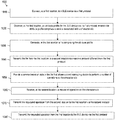
- FIG. 8 is a block diagram of a network 800 that comprises a BLE network and an intermediary network.
- Network 800 comprises a BLE peripheral 810, access point 801, server 802, and client device 820.
- BLE peripheral 810 is similar to BLE peripheral 10, as discussed in relation to FIG. 1 .
- the BLE network is between access point 801 and BLE peripheral 810, as represented by numeral 1.
- Access point 801, server 802, and client device 802 may be connected by an intermediary network. This is represented by numeral 2 linking access point 801 to server 802 and numeral 2 linking server 802 to client device 820.
- Access point 801 is similar to access point 101 as discussed in relation to FIG. 1 .
- Sever 802 is similar to server 102 and BLE broker 812 is similar to BLE broker 112, as described in relation to FIG. 1 , except that the service provided server 802 comprises a public API 822.
- a public API is an interface that is exposed to and accessible by wide range of users and computing devices. Using data in the file capturing the attribute profile of BLE peripheral 810, the public API may provide operations that are operable on the characteristics in the attribute (e.g., read operations, write operations, etc.). The public API may be accessed by a web application running on a computing device (e.g. a server). In some examples, the computing device running the web application is a different computing device than server 802.
- the web application may be specific for BLE peripheral 810.
- Client device 820 may be a computing device (e.g., a personal computer, a mobile device, a smartphone, etc.). Through the interface provided by the web application, client device 820 may issue operations to perform on BLE peripheral 810. The web application may then transmit these operations to BLE broker 812 via public API 822. BLE broker 812 may transmit the operation to access point 801, which may then issue a command to BLE peripheral 810 so that BLE peripheral 810 executes the operation.
- FIG. 9 is a block diagram of a network 900 that comprises a BLE network and an intermediary network.
- Network 900 comprises a BLE peripheral 910, access point 901, server 902, and client device 920.
- BLE peripheral 910 is similar to BLE peripheral 10, as discussed in relation to FIG. 1 .
- the BLE network is between access point 901 and BLE peripheral 910, as represented by numeral 1.
- Access point 901, server 902, and client device 920 may be connected by an intermediary network. This is represented by numeral 2 linking access point 901 to server 902 and numeral 2 linking server 902 to client device 920.
- Access point 901 is similar to access point 101 as discussed in relation to FIG. 1 .
- Sever 902 is similar to server 102 and BLE broker 912 is similar to BLE broker 122, as described in relation to FIG. 1 , except that the service provided by sever 902 comprises an application simulator 922.
- an application simulator may simulate a specific environment that allows application designed for the specific environment to run on environments differing from the specific environment.
- the application simulator is a mobile application simulator.
- the simulator also will simulate a virtual machine that includes BLE connectivity ability.
- the client device 920 may access the mobile application simulator service, and run a mobile application that is specific to BLE peripheral 910.
- the mobile application may then invoke commands related to a characteristic on the attribute profile of BLE peripheral 910 initiated by client device 920. These commands may then be relayed to BLE broker 912 via application simulator 922.
- BLE broker 912 may transmit the operation to access point 901, which may then issue a command to BLE peripheral 910 so that BLE peripheral executes the operation.
- FIG. 10 illustrates a flowchart for a method 1000 to a method of extending a BLE network with an intermediary network.
- execution of method 1000 is described below with reference to network 100, other suitable systems for execution of method 1000 may be utilized (e.g., network 500, network 800, or network 900). Additionally, implementation of method 1000 is not limited to such examples and it is appreciated that method 1000 may be used for any suitable device or system described herein or otherwise.
- access point 101 may connect to a BLE device (e.g., BLE peripheral 10) via a first protocol.
- this protocol may be BLE protocol (including GATT and GAP).
- Access point 101 may be located at a first physical location. In some examples, this first physical location is within BLE range of the location of BLE peripheral 10.
- access point 101 may discover an attribute profile of BLE peripheral 10. This may be done according to the first protocol.
- the attribute profile may comprise a service associated with a characteristic. Because this is done at access point 101, the discovery is done at the first location.
- access point 101 may generate a file that comprises the attribute profile discovered at 1020.
- the file may capture the attribute profile of BLE peripheral 10.
- the file may be in a language-independent format, such as JSON.
- the file may also be in a user-readable and machine-readable language such as XML. Because the file is generated by access point 101, the file is also generated at the same location as 1010 and 1020 are performed.
- access point 101 may transmit the file generated at 1030 to server 102.
- server 102 may be located in a physical location that is remote from access point 101.
- server 102 may also be located in a physical location that is remote from BLE peripheral 10.
- a computing device that is remote from BLE peripheral 10 is outside the BLE communication range of BLE peripheral 10. This location may be characterized as a second location.
- access point 101 and server 102 may use an intermediary network to communicate and not a BLE network. Accordingly, the protocol used to transmit the file is a second protocol that is different from the first protocol. This may include protocols used in Internet communication, such as TCP/IP.
- server 102 may provide a service that allows a client computing device (e.g. client device not shown in FIG. 1 ) to perform a number of operations on the characteristic.
- this may include BLE broker 112.
- the service may also include a private API, a public API, and/or an application simulator, as discussed in relation to FIG. 3 and/or FIG. 4 .
- the access service and the BLE broker 112 may be provided at the same location. For example, in situations where a private API or a public API is provided, the APIs may be provided by server 102.
- the BLE broker 112 and access service may be provided at different locations.
- the application simulator may be hosted by a different computing device than server 102. This computing device may be located at a different location than server 102 and may communicate to server 102 through the intermediary network.
- the service may be based on data in the file received at the second location in 1040.
- the service is based on the data because the functions of the service are impacted by data in the file.
- the APIs may present operations to perform on the characteristics captured in the file. These operations may change based on the characteristics captured in the file.
- application simulator may interact directly with the characteristics captured in the file. As discussed above, using these services allows a client device to perform a number of operations on the characteristic of the BLE peripheral 10.
- this service is provided at a different location or different locations than the first location of the access point. This allows for easier access to the service than if the service were provided at the access point.
- a service that is provided at a single access point may require that the single access point be functional and accessible at all times.
- FIG. 10 describes a single service for a single BLE peripheral, multiple services related to multiple BLE peripherals may be provided by server 102. This allows a client device to interact with multiple BLE peripherals, allowing for easier scalability. For example, a client device may interact only with server 102 to interact with multiple access points (thus allowing client device to access many BLE peripherals). Additionally, a single access point may be tied to a specific physical location due to its interaction with the BLE peripheral.
- server 102 and specifically BLE broker 112 may receive a requested operation for the characteristic. This requested operation may be initiated by a client device. This is received by BLE broker 112 and is thus at the second location as described above.
- server 102 transmits the requested operation to access point 101. This is from the second location, where server 102 is located, to the first location. Additionally, because access point 101 is connected to server 102 via an intermediary network and not BLE, the protocol that is used in communication is the second protocol and not the first protocol.
- method 1000 is not limited to that order.
- some of the functionalities shown in succession may be performed in a different order, may be executed concurrently or with partial concurrence, or a combination thereof.
- 1050 and 1060 may be performed concurrently.
- functionalities described herein in relation to FIG. 10 may be provided in combination with functionalities described herein in relation to any of FIGS. 1-9 .
- FIG. 10 discusses a specific amount of attribute profiles, services, and characteristics
- method 10 is not limited to the number of attribute profiles, services, and characteristics described. For example, two, three, etc. attribute profiles may be discovered for two, three, etc. BLE devices.
Landscapes
- Engineering & Computer Science (AREA)
- Computer Networks & Wireless Communication (AREA)
- Signal Processing (AREA)
- Automation & Control Theory (AREA)
- Computing Systems (AREA)
- Multimedia (AREA)
- Health & Medical Sciences (AREA)
- General Health & Medical Sciences (AREA)
- Medical Informatics (AREA)
- Computer And Data Communications (AREA)
- Mobile Radio Communication Systems (AREA)
- Information Transfer Between Computers (AREA)
Abstract
Description
- Bluetooth low energy (BLE) allows for devices to communicate to each other wirelessly. In some situations, BLE connections may allow for a user of a first device to control, from the first device, the functions of a second device.
- The following detailed description references the drawings, wherein:
-
FIG. 1 is a block diagram of a BLE network extended by an intermediary network, according to some examples. -
FIG. 2 is a block diagram of a computing device to connect to a BLE peripheral device, according to some examples. -
FIG. 3 is a block diagram of a computing device with instructions to provide a service allowing a client device to control a remote BLE device, according to some examples. -
FIG. 4 is a block diagram of a computing device with a service engine to provide a BLE broker, according to some examples. -
FIG. 5 is a block diagram of a BLE network using a replicated BLE peripheral and an intermediary network to extend the BLE network, according to some examples. -
FIG. 6 is a block diagram of a computing device with a replication engine to replicate an attribute profile of a remote BLE device, according to some examples. -
FIG. 7 is a block diagram of a computing device with instructions to replicate an attribute profile of a remote BLE device, according to some examples. -
FIG. 8 is a block diagram of a BLE network using an intermediary network and a public API to extend the BLE network, according to some examples. -
FIG. 9 is a block diagram of a BLE network using an intermediary network and an application simulator to extend the BLE network, according to some examples. -
FIG. 10 is a flowchart of a method of extending a BLE network via an intermediary network, according to some examples. - Computing devices may take on different roles when making Bluetooth low energy (BLE) connections. For example, a peripheral BLE device may accept connections from other BLE devices and it may perform functions. These functions may be called services. For example, a BLE light bulb may be characterized as a peripheral BLE device. It may have a function of providing light. Thus, it has a "light" service. As another example, a BLE door lock may also be characterized as a peripheral BLE device. It may have a function of locking a deadbolt and thus has a "lock" service.
- A central BLE device may connect to a peripheral BLE device and access or control the services provided by a peripheral BLE device. Accordingly, a central BLE device that is connected to a BLE light bulb may turn the light bulb's "light" service on or off. Similarly, a central BLE device that is connected to a BLE door lock may open or close the BLE door lock's "lock" service.
- The communication and commands for control between a central BLE device and a peripheral BLE device when connected via BLE may be guided by BLE protocols, defined by the BLE SIG. In some examples, a central BLE device may connect to numerous peripheral BLE devices at the same time, thus controlling multiple devices. Accordingly, a central BLE device may allow for a user of the central BLE device to control devices from the convenience of one central BLE device.
- However, BLE is used in point-to-point networks. Thus, two devices (e.g., a central BLE device and a peripheral BLE device) that are connected via BLE are in BLE communication range of each other. Devices that are out of BLE communication range of each other cannot communicate to each other using BLE. Without the BLE connection, a central BLE device may not be able to control a peripheral BLE device using the BLE protocol. Thus, when a central BLE device is out of range of the peripheral BLE device, the typical control methods used by the central BLE device may not be able to be used. Accordingly, the services provided by the peripheral BLE device may not be controlled in situations where the central BLE device (or user of the central BLE device) is remote from the peripheral BLE device. For some peripheral BLE devices, situations where the central BLE device is out of BLE range are situations when control may be desired (e.g., a home owner desiring to turn off their lights when they are on vacation may not be able to do so using BLE).
- Examples disclosed herein address these technological difficulties by providing systems and methods to extend the BLE network using an intermediary network. In some examples, the services offered by the BLE peripheral device is transcribed into a file that may be transmitted to an intermediary network (e.g., the Internet, etc.). The file is stored by a broker in a location that is accessible via the intermediary network. The data in the file may be used to allow a client device that is out of BLE range of the BLE peripheral device to control the BLE peripheral device. In some examples, the control may be similar as though the client device is interacting directly with the BLE peripheral device. Accordingly, examples discussed herein allow for remote access to BLE peripheral devices.
- In some examples, a computing device is provided with a non-transitory machine-readable storage medium comprising instructions, that, when executed, cause a processing resource to replicate an attribute profile of a remote BLE device. The attribute profile comprises a number of services and a number of characteristics executable by the remote BLE device. The instructions, when executed, also cause the processing resource to broadcast a BLE signal, connect to a nearby Bluetooth device, receive a command for a characteristic out of the number of characteristics from the nearby Bluetooth device, and transmit the command to a Bluetooth broker.
- In some examples, a computing device is provided with a non-transitory machine-readable storage medium comprising instructions, that, when executed, cause a processing resource to receive, from a first remote access device, a first file comprising an attribute profile of a first BLE device. The attribute profile comprises a service and a characteristic associated with the service. The instructions, when executed, also cause the processing resource to store the first file in a manner associated with the first BLE device, provide a service that allows for a client device associated with the first BLE device to perform a number of operations on the characteristic in the attribute profile, receive a requested operation out of the number of operations on the characteristic, and transmit the requested operation to the first remote access device.
- In some examples, a method is provided, including connecting, at a first location, to a BLE device via a first protocol; discovering, at the first location, an attribute profile for the BLE device via the first protocol, and generating, at the first location, a file comprising the attribute profile. The attribute profile may comprise a service associated with a characteristic. The method also includes transmitting the file from the first location to a second location via a second protocol that is different from the first protocol; providing a service based on data in the file that allows a client computing device to perform a number of operations on the characteristic; and receiving, at the second location, a requested operation for the characteristic. Additionally, the method includes transmitting the requested operation from the second location to the first location via the second protocol, and transmitting the requested operation from the first location to the BLE device via the first protocol.
- Referring now to the figures,
FIG. 1 is a block diagram of anetwork 100 that comprises a BLE network and an intermediary network connected to the BLE. As shown inFIG. 1 , the BLE network is formed by the connection of a BLEperipheral device 10 with anaccess point 101. A BLE peripheral device may include an electronic device that accepts BLE connections and has functions that are executable by the electronic device. Non-limiting examples of a BLE peripheral device may be a door lock, a light bulb, a smartwatch, a sensor (e.g. heartrate), a mobile phone, etc. A BLE peripheral device may model its specific executable functions in an attribute profile. The attribute profile may include a number of services and a number of characteristics associated with the number of services. As used herein, "a number" may include one, two, three, four, etc. Thus, the attribute profile of a BLE peripheral may include two services, and three characteristics associated with each of the two services. For example, a light bulb BLE peripheral may provide a "light" service. The "light" service may have a "brightness" characteristic and an "on/off' characteristic associated with the "light" service. In some examples, the attribute profile may be a generic attribute (GATT) profile. In some examples, the attribute profile may also comprise information regarding a broadcast signal of the remote BLE device (e.g., advertisement packets and/or scan response packets). - A BLE peripheral 10 may form a BLE network with
access point 101 using the BLE protocol. This is represented inFIG. 1 asnumeral 1. In other words,access point 101 is directly connected to BLE peripheral 10 via BLE. Accordingly,access point 101 is in a physical location from BLE peripheral 10 such that it is in the BLE communication range of BLE peripheral 10. -
Access point 101 may act as a BLE central device. A BLE central device may include a computing device that is able to connect to a BLE peripheral device via BLE, discover the attribute profile of the BLE peripheral device, and communicate with the BLE peripheral device to issue commands with regard to the attribute profile. For example, in the example where BLE peripheral 10 is a lightbulb,access point 101 may issue a write command for the on/off characteristic such that BLE peripheral will turn the lightbulb on or off according to the command. - Upon discovering the attribute profile of BLE peripheral 10,
access point 101 may transcribe the attribute profile into a file. For example, the file may be in the JSON or XML format.Access point 101 may also act as a bridge between the BLE network and an intermediary network. In some examples, the intermediary network may be a wireless network, a wired network, or a combination thereof. In some examples, the intermediary network may be an individual network or a collection of many such individual networks interconnected with each other and functioning as a single large network (e.g., the Internet). In some examples, the intermediary network may be implemented as a local area network (LAN), wide area network (WAN), etc. Accordingly, the intermediary network is a different type of network than the BLE network. Thus, the intermediary network uses different protocols than those used in the BLE protocol. Accordingly, the protocol which is used byaccess point 101 to connect to and communicate with the intermediary network is not BLE and comprises a second protocol that is different to the communication protocols used in BLE. This is represented by thenumeral 2 inFIG. 1 . In some examples, protocols such as the Internet Protocol (IP), Transmission Control Protocol (TCP), or TCP/IP may be used.Access point 101 may send the transcribed file comprising the attribute profile of BLEperipheral device 10 to aserver 102.BLE broker 112 may be an application that runs onserver 102. Through the second protocol,access point 101 sends the file toBLE broker 112.BLE broker 112 stores the file in a manner that associates the file to the BLE peripheral 10.BLE broker 112 may then accordingly provide data in the file to other devices, labeled as A inFIG. 1 such that those other devices may access the functions provided by BLE peripheral 10. Accordingly, the BLE network is extended by an intermediary network that allows access to the BLE peripheral 10. This extends the reach of the BLE peripheral such that a user that is not in BLE range of the BLE peripheral 10 may control the BLE peripheral 10. - While
FIG. 1 showsaccess point 101 as forming a BLE network with one BLE peripheral 10, the BLE network may include additional computing devices also connected via BLE. For example,access point 101 may connect to two, three, or four BLE peripherals. -
FIG. 2 illustrates a block diagram of acomputing device 200 to connect to a BLEperipheral device 210. As used herein, a "computing device" may be a server, a computer networking device (e.g., a switch, a gateway, an access point, etc.), a storage device, chip set, or any other processing device or equipment). In some examples,computing device 200 is an access point that may connect to BLE peripheral 210 andcomputing device 220. -
Computing device 200 includes afirst communication engine 201, aprofile engine 202, atranscription engine 203, and asecond communication engine 204. Each of these aspects ofcomputing device 200 will be described below. Other engines may be added tocomputing device 200 for additional or alternative functionality. -
Engines - Each engine of
computing device 200 can include at least one machine-readable storage medium (for example, more than one) and at least one processing resource (for example, more than one). As used herein, "machine-readable storage medium" may include a storage drive (e.g., a hard drive), flash memory, Random Access Memory (RAM), any type of storage disc (e.g., a Compact Disc Read Only Memory (CD-ROM), any other type of compact disc, a DVD, etc.) and the like, or a combination thereof. In some examples, a storage medium may correspond to memory including a main memory, such as a Random Access Memory, where software may reside during runtime, and/or a secondary memory. The secondary memory can, for example, include a non-volatile memory where a copy of software or other data is stored. - For example, software that provides the functionality of engines on
computing device 200 can be stored on a memory of a computer to be executed by a processing resource of the computer. In some examples, each engine ofcomputing device 200 may include hardware in the form of a microprocessor on a single integrated circuit, related firmware, or other software for allowing the microprocessor to operatively communicate with other hardware ofcomputing device 200. - A processing resource may, for example, be in the form of a central processing unit (CPU), a semiconductor-based microprocessor, a digital signal processor (DSP) such as a digital image processing unit, or other hardware devices or processing elements suitable to retrieve and execute instructions stored in a storage medium, or suitable combinations thereof. The processing resource can, for example, include single or multiple cores on a chip, multiple cores across multiple chips, multiple cores across multiple devices, or suitable combinations thereof.
-
First communication engine 201 is an engine ofcomputing device 200 that includes a combination of hardware and software that allowscomputing device 200 to discover and connect to BLEperipheral device 210 that is within BLE communication range ofcomputing device 200. In some examples,first communication engine 201 may allowcomputing device 200 to observe to see if there is a BLEperipheral device 210 within communication range. For example, the BLEperipheral device 210 may be broadcasting a BLE signal to advertise its presence. Upon determination that there is a BLE peripheral device in range,first communication engine 201 may send a connection request to BLEperipheral device 210. A connection is established betweenfirst communication engine 201 and the BLEperipheral device 210 when the BLE peripheral device accepts the request. In some examples, upon connection ofcomputing device 200 to the BLEperipheral device 210,computing device 200 may also be characterized as a central BLE device.First communication engine 201 may also allowcomputing device 200 to relay a requested operation originating from a client device regarding a characteristic and transmit an associated command to BLE peripheral such that BLE peripheral executes the requested operation. For example, first communication engine may transmit a WRITE command to BLEperipheral device 210 on a characteristic of BLE peripheral device. -
Profile engine 202 is an engine ofcomputing device 200 that includes a combination of hardware and software that allowscomputing device 200 to discover an attribute profile of BLE peripheral 210. As discussed above, a BLE peripheral may have certain functions that are executable by the BLE peripheral. An attribute profile may describe at least one of those functions in a logical data structure. In some examples, the attribute profile may be in the form of a GATT profile. The hierarchy of a GATT profile may include a number of services to fulfill a use case of the BLE peripheral. In some examples, a service may be comprised of a number of characteristics. A service may also include references to other services. A characteristic may include a value, a set of properties indicating the operations the characteristic supports, and descriptors in the form of metadata relating to the characteristic. Thus, an attribute profile may include one service out of the number of services, one characteristic out of the number of characteristics associated with a service, a portion of the services out of the number of services, a portion of the characteristics out of the number of characteristics, or every service and every characteristic associated with every service on BLE peripheral 210. Additionally, the attribute profile may also include information regarding a broadcast signal of BLE peripheral 210 (e.g., advertisement packets and/or scan response packets). -
Transcription engine 203 is an engine ofcomputing device 200 that includes a combination of hardware and software that allowscomputing device 200 to take the attribute profile discovered byprofile engine 202 and transcribe it into a format that may be sent to another computing device, and stored. In some examples, the format may be in a language-independent format such that it may be understood by another computing device. In some examples, the file may be in a human-readable text format such as JavaScript Object Notation (JSON) or Extensible Markup Language (XML) format. -
Second communication engine 204 is an engine ofcomputing device 200 that includes a combination of hardware and software that allowscomputing device 200 to connect to another computing device (e.g., a server) through an intermediary network. As discussed above, the intermediary network is different from the BLE network that is relied upon byfirst communication engine 201 to connect to BLE peripheral 210. Accordingly, the protocols used bysecond communication engine 204 are different from the protocols used byfirst communication engine 201. For example,first communication engine 201 may rely on the BLE protocol whilesecond communication engine 204 may use Internet protocols, such as TCP/IP, etc.Second communication engine 204 may also allowcomputing device 200 to transmit the file comprising the attribute profile of BLEperipheral device 210 tocomputing device 220. In some examples,computing device 220 is a server that may provide a BLE broker, similar to that ofserver 102 described inFIG. 1 orcomputing device 300 described inFIG. 3 . In some examples,access point 101 ofFIG. 1 may have features and components as described herein in relation tocomputing device 200.Second communication engine 204 may also allowcomputing device 200 to receive a requested operation on a characteristic of BLE peripheral 210 that originates from a client device. This operation may then be relayed and sent to BLE peripheral 210 viafirst communication engine 201. -
FIG. 3 is a block diagram of acomputing device 300 with instructions thereon to provide a service that allows a client device to control a remote BLE device, according to some examples. In some examples,computing device 300 may be a server that interfaces with firstremote access device 340 andclient device 350.Computing device 300 includes aprocessing resource 301 and a machine-readable storage medium 310. Machine-readable storage medium 310 may be in the form of non-transitory machine-readable storage medium, such as suitable electronic, magnetic, optical, or other physical storage apparatus to contain or store information such asinstructions - In the example of
FIG. 3 ,instructions storage medium 310 and are executable by processingresource 301 to implement functionalities described herein in relation toFIG. 3 . Theprocessing resource 301 can be functional to fetch, decode, and executeinstructions storage medium 310 may be implemented in the form of electronic circuitry, in the form of executable instructions encoded on machine-readable storage medium, or a combination thereof. -
Instructions 311 may be executable by processingresource 301 such thatcomputing device 300 receives a first file comprising an attribute profile of a first BLE device. Attribute profile, as discussed above, is applicable here. The first file may come from a firstremote access device 340. In some examples,remote access device 340 is indirectly connected tocomputing device 300 via an intermediary network, such as the Internet. Accordingly, firstremote access device 340 may communicate and send data tocomputing device 300 via TCP/IP protocols. The first BLE device may be a BLE peripheral device (e.g., similar to BLE peripheral 10 described in relation toFIG. 1 ) that is within BLE range of firstremote access device 340. Theremote access device 340 may discover the attribute profile of the BLE peripheral device and transcribe it into the first file.Instructions 311 allowscomputing device 300 to receive the first file fromremote access device 340. As discussed above, in some examples, the first file may be in the form of JSON or XML. -
Instructions 312 may be executable by processingresource 301 such thatcomputing device 300 stores the first file received byinstructions 311 in a manner that associates the first file with the first BLE device. For example, the first BLE device may have a unique identifier that identifies it tocomputing device 300.Instructions 312 may store the first file associated to this unique identifier such thatcomputing device 300 understands that the first file contains data representing the attribute profile of the particular BLE device from which the attribute profile came from. The unique identifier may also be used to identify the particular BLE device to other computing devices (such as a client device that wants to control the functions of the particular BLE device). In some examples, the first file is stored in a manner that associates it with theremote access device 340 that sent the first file. For example, theremote access device 340 may also have a unique identifier that identifies it tocomputing device 300. This is because computingdevice 300 may receive a first file comprising an attribute profile of a first BLE device and it may also receive a second file comprising an attribute profile of a second BLE device. The first file may come from firstremote access device 340 and the second file may come from a second remote access device (not shown inFIG. 3 ). Identifiers may allowcomputing device 300 to relay any commands that it receives with regard to a specific BLE device to the appropriate remote access device that is connected via BLE to the specific BLE device. -
Instructions 313 may be executable by processingresource 301 such thatcomputing device 300 provides a service that allows a client device to perform a number of operations on the characteristic in the attribute profile. In some examples, the client device may be associated to the first BLE device. For example, the client device may be running or accessing an application that is specific to the first BLE device. As discussed above, the first file comprises data that represents the attribute profile of the first BLE device. Thus,computing device 300 may provide a service that may increase the devices that may control the first BLE device. In other words, the service provided by computing device may allow aclient device 350 that remote from the BLE device (i.e., not in the BLE range of the first BLE device) to perform a number of operations (e.g., issue a command, etc.) on the characteristic in the attribute profile. In some examples, the service may be provided using data in the first file. - In some examples, the service that is provided may be a private application program interface (API). Thus, in these examples,
instructions 313 comprises instructions to provide a private API. The private API may be generated using data in the first file. As used herein, a private API is an interface that is exposed to and accessible by authorized users and computing devices meeting the access requirements set by the private API. For example, an enterprise may provide the functionalities described herein in relation to instructions 311-315. The enterprise may restrict access to its API by making it private, making so a select number of people and/or computing devices may interact with the API and use data provided by the API (e.g., internal developers, partner developers, computing devices provided by these internal and partner developers, etc.) In some examples, using data in the first file, the private API may provide operations that are operable on the characteristics in the first file (e.g., read operations, write operations, etc.). A computing device that is authorized to access the private API may access these operations. For example, the computing device may be a third remote access device (e.g., an access point, a mobile cellphone, etc.) that is different from firstremote access device 340 or second remote access device discussed above. In the example shown inFIG. 3 , the third remote access device may be the pathway through whichclient device 350 communicates tocomputing device 300. The third remote access device may have appropriate authorization to access and interact with the private API oncomputing device 300. Using the data provided by the private API, the third remote access device may replicate the attribute profile represented on the private API. The attribute profile replicated on the third remote access device is identical to the attribute profile on the first BLE device. Accordingly,client device 350 may interact with the third remote access device as though it were the first BLE device. Third remote access device may then transmit these interactions tocomputing device 300. In these examples, the connection between third remote access device andclient device 350 is via BLE while the connection between third remote access device andcomputing device 300 is via the intermediary network that connectscomputing device 300 to firstremote access device 340. This is discussed in relation toFIG. 5 . - In some examples, the service that is provided may be a public application program interface (API). Thus, in these examples,
instructions 313 comprises instructions to provide a public API. The public API may be generated using data in the first file. As used herein, a public API is an interface that is exposed to and accessible by wide range of users and computing devices. For example, an enterprise may provide the functionalities described herein in relation to instructions 311-315. The enterprise may make the API public, allowing users and computing devices outside of the enterprise to interact with the API and use data provided by the API. In some examples, using the data in the first file, the public API may provide operations that are operable on the characteristics in the first file (e.g., read operations, write operations, etc.). The public API may be accessed by a web application running on a computing device (e.g. a server). The web application may be specifically for the first BLE device that has the first attribute profile. In these examples,client device 350 may be another computing device (e.g., a personal computer, smartphone, etc.) that the client uses to access the web application. Through the interface provided by the web application, theclient device 350 may issue operations to perform on the BLE device. The web application may then transmit these operations tocomputing device 300 via the public API.Computing device 300 may then transmit these operations to thefirst access device 340. In these examples, the connection betweenclient device 350 and the computing device that provides the web application is via an intermediary network and not a BLE network. Additionally, the connection between the computing device that provides the web application and thecomputing device 300 is via an intermediary network and not a BLE network. This is discussed in relation toFIG. 8 . - In some examples, the service by that is provided may be an application simulator. Thus, in these examples,
instructions 313 comprises instructions to provide an application simulator. As used herein, an application simulator may create a virtual machine version of an application for a computing device (e.g. a personal computer) that accesses or runs the application simulator. In some examples, the application simulator may be a mobile application simulator. A mobile application simulator may create a virtual machine version of a mobile computing device (e.g., an iPhone, an Android, a smartphone, etc.) on a computing device that is not the mobile computing device. The mobile application simulator also will simulate a virtual machine that includes BLE connectivity ability. - For example, in some examples,
client device 350 may be a personal computer. A mobile application simulator may create a virtual machine of an iPhone on the personal computer. As another example,client device 350 may be an iPhone smart phone. A mobile application simulator may also create a virtual machine of an Android on the iPhone. This may allow the computing device accessing the simulator to run applications that are designed for the environment simulated by the simulator. - Accordingly, in these examples,
instructions 313 may include instructions that, when executed by processingresource 301 allowcomputing device 300 to load and run mobile applications on the mobile application simulator. For example, with an Android mobile simulator, an .apk file may be used and installed on the mobile application simulator. By accessing the mobile application simulator service provided bycomputing device 300,client device 350 may run a mobile application that is specific to the first BLE device with the first attribute profile. In other words, this allows for the client to run "off-the-shelf' mobile applications designed by the manufacturer or the first BLE device. The mobile application may then invoke commands related to a characteristic on the first attribute profile that are initiated by a requested operation on theclient device 350. The requested operation may then be relayed by the service to different components ofcomputing device 300, as is discussed below in relation toinstructions FIG. 9 . -
Instructions 314 may be executable by processingresource 301 such thatcomputing device 300 receives a requested operation out of the number of operations on the characteristic. As used herein, a requested operation includes an operation that is initiated byclient device 350. For example, with regard to a BLE device that is a light bulb, aclient device 350 may initiate an operation that turns the lightbulb off. The characteristic may be light, and the operation may be off. Depending on the service provided bycomputing device 300, this requested operation may not come directly fromclient device 350 but may be from the third remote access device, a computing device running a web application, or fromcomputing device 300 itself (e.g., in examples where the service provided is a mobile application simulator). In some examples, the requested operation may comprise a command for the characteristic, such as a WRITE or READ command. -
Instructions 315 may be executable by processingresource 301 such thatcomputing device 300 transmits the requested operation to the firstremote access device 340. This may be accomplished via the intermediary network that connects firstremote access device 340 andcomputing device 300 via protocols such as TCP/IP. Accordingly,computing device 300 may allow aclient device 350 that is out of BLE range from first BLE device to control and interact with the first BLE device. - As discussed above,
computing device 300 may interact with multiple remote access devices (such as second remote access device) that may sendcomputing device 300 different attribute profiles for different BLE devices.Computing device 300 may store these different attribute profiles, provide services for these attribute profiles, and allowmultiple client devices 350 to interact with the different BLE devices using these services. Accordingly,computing device 300 may allow additional client devices to interact with BLE devices that originally would not be able to control or interact with the BLE devices. In some examples,server 102 may include some of the functionalities described herein in relation tocomputing device 300. -
FIG. 4 illustrates a block diagram of acomputing device 400 with aservice engine 402. In some examples,computing device 400 may be a server that interfaces withremote access device 440A,remote access device 440B,client device 450A, andclient device 450B.Computing device 400 includes acommunication engine 401, aservice engine 402, and aprofile database 403. Other engines may be added tocomputing device 400 for additional or alternative functionality. -
Engines computing device 400 can include at least one machine-readable storage medium (for example, more than one) and at least one processing resource (for example, more than one). - For example, software that provides the functionality of engines on
computing device 400 can be stored on a memory of a computer to be executed by a processing resource of the computer. In some examples, each engine ofcomputing device 400 may include hardware in the form of a microprocessor on a single integrated circuit, related firmware, or other software for allowing the microprocessor to operatively communicate with other hardware ofcomputing device 400. -
Profile database 403 may be implemented by a machine-readable storage medium ofcomputing device 400. In some examples,profile database 403 comprises a secondary memory portion as described above.Communication engine 401 andservice engine 402 are in communication withprofile database 403. In some examples,profile database 403 may store files for attribute profiles that are sent tocomputing device 400 byremote access device 440A and/orremote access device 440B. As discussed above in relation tocomputing device 300, the files may be stored in a manner that associates the files with the BLE devices from which the attribute profiles came from and/or in a manner that associates the files with the remote access device that sent the file. While profile database is shown in example ofFIG. 4 as being housed incomputing device 400,profile database 403 may be separate fromcomputing device 400 but accessible tocomputing device 400. -
Communication engine 401 is an engine ofcomputing device 400 that includes a combination of hardware and software that allowscomputing device 400 to connect to and communicate withremote access device 440A and/orremote access device 440B.Communication engine 401 may allowcomputing device 400 to receive files fromremote access device 440A and/orremote access device 440B. These files may comprise attribute profiles from BLE devices that are connected directly to remote access device A or remote access device B via BLE. As discussed above, the files may be in a format that is language-independent. Non-limiting examples for file formats may be JSON, XML, etc. These files may be stored inprofile database 403, as discussed above. In some examples,communication engine 401 may use protocols such as TCP/IP to communicate with remote access device A and/or remote access deviceB. Communication engine 401 may also allowcomputing device 400 to transmit a requested operation for a characteristic in a specific attribute profile to the appropriate remote access device. This requested operation may be initiated byclient device 450A and/orclient device 450B. The appropriate remote access device may then transmit that operation into a command that may be executed on the BLE device having the attribute profile. -
Service engine 402 is an engine ofcomputing device 400 that includes a combination of hardware and software that allowscomputing device 400 to provide a service allowingclient device 450A and/orclient device 450B to perform a number of operations on the characteristic in the attribute profile. In some examples, the service may use data in the file comprising the attribute profile that is received bycommunication engine 401 and stored inprofile database 403. - As discussed above in relation to
FIG. 3 , in some examples, the service may be a public API that allows a wide range of users and computing devices to access the service. In some examples, using data in a specific file stored inprofile database 403, the public API may provide operations that are operable on the characteristics in the attribute profile captured in the specific file (e.g., read operations, write operations, etc.). The public API may be accessed by a web application running on a computing device (e.g. a server, not shown inFIG. 3 ). The web application may be specific for the BLE device that has the attribute profile captured in the file. In these examples,client device 450A and orclient device 450B may be another computing device (e.g., a personal computer, smartphone, etc.) that accesses the web application. Through the interface provided by the web application, theclient device 450A and/orclient device 450B may issue operations to perform on the BLE device with the attribute profile captured in the file. The web application may then transmit these operations tocomputing device 400 via the public API.Computing device 400 may then transmit these operations to the associatedremote access device 440A orremote access device 440B viacommunication engine 401. In these examples, the connection betweenclient device 450A and/orclient device 450B and the computing device that provides the web application is via an intermediary network and not a BLE network. Additionally, the connection between the computing device that provides the web application andcomputing device 400 is via an intermediary network and not a BLE network. This is discussed in relation toFIG. 5 . - In other examples, as discussed above in relation to
FIG. 3 , the service may be a private API that allows authorized users and computing devices to access the service. In some examples, using the data in a specific file stored onprofile database 403, the private API may provide operations that are operable on the characteristics in the attribute profile captured by the specific file (e.g., read operations, write operations, etc.). A computing device that is authorized to access the private API may access these operations. For example, the computing device may be a remote access device (e.g., an access point, a mobile cellphone, etc.) that is different fromremote access device 440A andremote access device 440B. In the example shown inFIG. 4 , the third remote access device may be the pathway through whichclient device 450A and/orclient device 450B communicates tocomputing device 400. The third remote access device may have appropriate authorization to access and interact with the private API oncomputing device 400. Using the data provided by the private API, the third remote access device may replicate the attribute profile captured in the file. The attribute profile replicated on the third remote access device is identical to the attribute profile on the BLE device that originally provided the attribute profile. Accordingly,client device 450A and/orclient device 450B may interact with the third remote access device as though it were the BLE device that originally provided the attribute profile. Third remote access device may then transmit these interactions tocomputing device 400 usingcommunication engine 401. In these examples, the connection between third remote access device andclient device 450A and/or 450B is via BLE while the connection between third remote access device andcomputing device 400 is via an intermediary network. The third remote access device may be characterized as a replicated BLE peripheral. This is discussed in relation toFIG. 5 . - In other examples, as discussed above in relation to
FIG. 3 , the service may be an application simulator that may simulate an environment compatible with a BLE device specific application to allow a user running an incompatible computing device to access the specific application. For example, the application simulator may be a mobile application simulator for users using a client device that is a personal computer. The mobile application simulator may allow the user to access mobile applications designed for a specific mobile environment (e.g., Android). Using simulator that is provided byservice engine 402, theclient device 450A andclient device 450B may launch a mobile application that is specific to the BLE device that provided the attribute profile. - The mobile application may then invoke commands related to a characteristic on the attribute profile. This is done by the mobile application as if the mobile application were running on a mobile device. For example, a mobile application that is designed to run on an Android with BLE capabilities will run on the mobile application simulator as if it were on an Android with BLE capabilities, rather than the computing device that is accessing the mobile application simulator. Accordingly, the mobile application may invoke commands in BLE that are initiated by the
client device 450A and/orclient device 450B. These commands may then be relayed to the remote access device that is connected to the BLE device viacommunication engine 401.Computing device 400 ofFIG. 4 , which is described in terms of engines containing hardware and software may include one or more structural or functional aspects ofcomputing device 300 ofFIG. 3 , which is described in terms of processors and machine readable storage mediums. -
FIG. 5 is a block diagram of anetwork 400 that comprises two BLE networks and an intermediary network connecting the two BLE networks.FIG. 5 comprises a BLEperipheral device 510, anaccess point 501, a server 52, a replicated BLEperipheral device 503, and aclient device 520. BLE peripheral 510 is similar to BLE peripheral 10, as discussed in relation toFIG. 1 . The first BLE network is betweenaccess point 501 and BLE peripheral 510, as represented bynumeral 1.Access point 501,server 502, and replicated BLEperipheral device 503 are connected by an intermediary network. This is represented by numeral 2 inFIG. 4 . The second BLE network is betweenclient device 520 and replicated BLE peripheral 503. This second BLE network is represented bynumeral 1. The use of the same numerals may represent that the networks are of the same type, and may not represent that they are the same exact network.Access point 501 is similar toaccess point 101 as discussed in relation toFIG. 1 . Accordingly, in some examples,access point 501 may implement the components as described with respect tocomputing device 200 ofFIG. 2 . -
Sever 502 is similar toserver 102 andBLE broker 512 is similar to BLE broker 122, as described in relation toFIG. 1 , except that the service provided byserver 502 comprises aprivate API 522. As discussed above in relation toFIG. 3 , a private API may provide an interface that is exposed to and accessible by authorized users and computing devices meeting the access requirements set by the private API. Using data in the file comprising the attribute profile that is received byserver 502 fromaccess point 501,private API 522 may provide operations operable on at least one characteristic in the attribute profile of BLEperipheral device 510. Accordingly,server 502 may implement the functionalities described in relation tocomputing device 300 and/orcomputing device 400 in which the service comprises a private API. - Replicated BLE
peripheral device 503 is a computing device. In some examples, replicated BLEperipheral device 503 is a mobile computing device (e.g., a smartphone, tablet, etc.) In some examples, replicated BLEperipheral device 503 is a networking device (e.g., an access point, etc.). Replicated BLEperipheral device 503 is authorized to accessprivate API 522 provided byserver 502. As discussed above,private API 522 may use data in a file capturing a specific attribute profile to provide a number of operations on a characteristic on the specific attribute profile.Private API 522 may also present the data in the file to replicated BLEperipheral device 503. Using the data presented byprivate API 522, replicated BLE peripheral 503 may generate an attribute profile that is a replication of the attribute profile on BLE peripheral 510. In some examples, the BLE peripheral 510 is a remote BLE peripheral in relation to replicated BLE peripheral 503. In other words, the BLE peripheral 510 is not within BLE range of replicated BLE peripheral 503. In some examples, the BLE peripheral 510 is a remote BLE peripheral in relation toclient device 520. In other words, the BLE peripheral 510 is not within BLE range ofclient device 520. - Replicated BLE peripheral 503 may broadcast a BLE signal to announce its presence to a
client device 520 that is within BLE range. The BLE signal broadcasted may depend on the broadcast information in the data in the file capturing the attribute profile of remote BLE peripheral 510. Thus, accordingly, replicated BLE peripheral 503 broadcasts a BLE signal that is similar to the signal broadcasted by remote BLE peripheral 510. Theclient device 520 may be a computing device that has BLE capabilities (e.g., a personal computer, a mobile device, a smartphone, etc.) Theclient device 520 may receive the broadcast and request a BLE connection with replicated BLE peripheral 503. Upon acceptance of the request, a BLE network is established betweenclient device 520 and replicated BLE peripheral 503. This is represented by thenumeral 1.Client device 520 may use BLE protocols to discover the attribute profile replicated on replicated BLE peripheral 503.Client device 520 may then request an operation on a characteristic in the attribute profile. The operation may comprise a command (e.g. a WRITE command). This may be done in a similar manner as ifclient device 520 were interacting directly with BLE peripheral 510. Replicated BLE peripheral 503 may then interface with private API to relay the operation toBLE broker 512 via the intermediary network.BLE broker 512 may then relay the requested operation to accesspoint 501 also via the intermediary network.Access point 501 may then issue a command that is associated with the operation to BLE peripheral 510 such that the operation is executed in BLE peripheral 510 via the BLE network betweenaccess point 501 and BLE peripheral 510. In some examples, replicated BLE peripheral may implement the functionalities as described with respect tocomputing device 600 and/orcomputing device 700. -
FIG. 6 illustrates a block diagram of acomputing device 600 with a replication engine to replicate an attribute profile of a remote BLE low energy device (e.g., BLE peripheral 510). In some examples,computing device 600 is a mobile device (e.g., a smartphone), a personal computer, etc. that interacts withclient device 620 andserver 610.Computing device 600 comprises afirst communication engine 601, areplication engine 602, and asecond communication engine 603. Other engines may be added tocomputing device 600 for additional or alternative functionality. -
Engines computing device 600 can include at least one machine-readable storage medium (for example, more than one) and at least one processing resource (for example, more than one). - For example, software that provides the functionality of engines on
computing device 600 can be stored on a memory of a computer to be executed by a processing resource of the computer. In some examples, each engine ofcomputing device 600 may include hardware in the form of a microprocessor on a single integrated circuit, related firmware, or other software for allowing the microprocessor to operatively communicate with other hardware ofcomputing device 600. -
First communication engine 601 is an engine ofcomputing device 600 that includes a combination of hardware and software that allowscomputing device 600 to connect to another computing device (e.g., a server) through an intermediary network. The intermediary network is different from the BLE network that is relied upon bysecond communication engine 603 to connect toclient device 620. Accordingly, the protocols used byfirst communication engine 601 may be different from the protocols used bysecond communication engine 603. For example,first communication engine 601 may use Internet protocols, such as TCP/IP, etc. whilesecond communication engine 603 may rely on the BLE protocol.First communication engine 601 may also allowcomputing device 600 to receive data in the file that captures an attribute profile and may also transmit a requested operation initiated fromclient device 620 toserver 610. As discussed above,server 610 may provide a private API. Accordingly,first communication engine 601 may allowcomputing device 600 to access the private API. Thus,computing device 600 is a computing device that is authorized to access the private API. Accordingly,first communication engine 601 may allowcomputing device 600 to offer credentials toserver 610 in order to allow it access to the private API provided byserver 610. -
Replication engine 602 is an engine ofcomputing device 600 that includes a combination of hardware and software that allowscomputing device 600 to generate an attribute profile that is a replication of a remote BLE device based on the data received by thefirst communication engine 601. As discussed above, the data is captured or transcribed into a file that is stored onserver 610. The data is provided tocomputing device 600 via a private API onserver 610. In some examples, the replicated attribute profile may comprise the same services and/or characteristics that was captured in the file. Accordingly, in some examples, the replicated attribute profile may comprise a GATT profile of the remote BLE device. In other examples, the replicated attribute profile may be a portion of the GATT profile of the remote BLE device. -
Second communication engine 603 is an engine ofcomputing device 600 that includes a combination of hardware and software that allowscomputing device 600 to connect to and communicate with theclient device 620. In some examples,second communication engine 603 may allowcomputing device 600 to broadcast a BLE signal to announce its presence toclient device 620, to accept a connection request sent byclient device 620, and to allowclient device 620 to discover the replicated attribute profile according to BLE protocols.Second communication engine 603 may also allowcomputing device 600 to receive a requested operation on a characteristic that originates from theclient device 620. - In some examples, the remote BLE device may issue a response signal in response to a command that it receives from the remote access device that it is connected to. The response may be transmitted to
server 610 and then related tocomputing device 600. Thus, in some examples,first communication engine 601 may allowcomputing device 600 to receive the response from theserver 610. Additionally,second communication engine 603 may transmit the response toclient device 620.Computing device 600 ofFIG. 6 , which is described in terms of engines containing hardware and software may include one or more structural or functional aspects ofcomputing system 700 ofFIG. 7 , which is described in terms of processors and machine readable storage mediums. -
FIG. 7 is a block diagram of acomputing device 700 with instructions thereon to replicate an attribute profile of a remote BLE device. In some examples,computing device 700 may be a mobile device, a personal computer, etc. that interfaces with server 721 andclient device 720. Sever 721 is similar toserver 610 and/orserver 502.Client device 720 may be similar toclient device 620 and/orclient device 520.Computing device 700 includes aprocessing resource 701 and a machine-readable storage medium 710. Machine-readable storage medium 710 may be in the form of non-transitory machine-readable storage medium, such as suitable electronic, magnetic, optical, or other physical storage apparatus to contain or store information such asinstructions - In the example of
FIG. 7 ,instructions storage medium 710 and are executable by processingresource 701 to implement functionalities described herein in relation toFIG. 7 . Theprocessing resource 701 can be functional to fetch, decode, and executeinstructions storage medium 710 may be implemented in the form of electronic circuitry, in the form of executable instructions encoded on machine-readable storage medium, or a combination thereof. -
Instructions 711 may be executable by processingresource 701 such thatcomputing device 700 replicates an attribute profile of a remote BLE device. In some examples, the attribute profile may comprise a number of services and a number of characteristics executable by the remote BLE device. In some examples, the attribute profile may also comprise advertisement packets and scan response packets of the remote BLE device. These packets may allowcomputing device 700 to broadcast a signal that is similar to the signal that would be broadcasted by the remote BLE device. Remote BLE device, as described above, is also applicable here. In some examples, the replication of the attribute profile may be accomplished by receiving data from server 721 (that is from the file capturing the attribute profile).Instructions 711 may take this data and generate a data structure to describe the attribute profile. In some examples, the attribute profile may take the hierarchal format similar to that of a GATT profile. However, the replicated profile includes what is captured in the file, and may not include the entirety of the GATT profile on the remote BLE device. Accordingly, the attribute profile replicated by computingdevice 700 may comprise a number of services and a number of characteristics, where a number may include any number, including one, two, three, etc. These characteristics may represent functions that are executable by the remote BLE device. Additionally, in the example ofFIG. 7 ,computing device 700 and server 721 are connected by an intermediary network. Accordingly,instructions 711 may also include instructions that are executable by processingresource 701 such thatcomputing device 700 connects to and communicates with server 721. This may be implemented using protocols such as TCP/IP. As discussed above, server 721 may provide a private API. Accordingly,instructions 711 may include instructions executable by processingresource 701 that allowscomputing device 700 to offer credentials to server 721 in order to allow it access to the private API provided by server 721. -
Instructions 712 may be executable by processingresource 701 such thatcomputing device 700 broadcasts a BLE signal to announce its presence to nearby devices capable of BLE connection, likeclient device 720. As used herein, a "nearby" Bluetooth device in relation to a first computing device is a Bluetooth device that is within BLE range of the first computing device.Instructions 713 may be executable by processingresource 701 such thatcomputing device 700 connects to a nearby Bluetooth device, such asclient device 720. In some examples, this may include receiving a connection request fromclient device 720 and accepting the connection request. Similar toinstructions 712, this may be done using BLE protocols. Onceclient device 720 andcomputing device 700 are connected via BLE,client device 720 andcomputing device 700 may engage in BLE protocols such thatclient device 720 discovers the attribute profile that is replicated by computingdevice 700. Accordingly, in some examples,instructions 712 may include instructions to respond to requests byclient device 720 regarding discovery of the replicated attribute profile. -
Instructions 714 may be executable by processingresource 701 such thatcomputing device 700 receives a command for a characteristic out of the number of characteristics from the nearby Bluetooth device (e.g., client device 720). In other words, a requested operation may be issued by the user on client device 720 (e.g., turn off the lightbulb). Theclient device 720 may transmit this operation to computing device. The operation may include a command for the characteristic, for example a WRITE command associated with the characteristic.Instructions 714 allows computing device to receive this command. -
Instructions 715 may be executable by processingresource 701 such thatcomputing device 700 transmits the command to a Bluetooth broker. For example, server 721 may provide the Bluetooth broker. Because the connection between server 721 andcomputing device 700 is not via a BLE network but via an intermediary network,instructions 715 may use protocols used in the intermediary network which are different from protocols used in the BLE network. - In some examples, remote BLE device may issue a response signal in response to a command that it receives from the remote access device that it is connected to. The response may be transmitted to server 721 and then relayed to
computing device 700. Thus, in some examples, machine-readable storage medium 710 may include instructions to receive the response to the command from server 721 and to transmit the response to the command to theclient device 720. -
Computing device 700 ofFIG. 7 , which is described in terms of processors and machine readable storage mediums, may include one or more structural or functional aspects ofcomputing system 600 ofFIG. 6 , which are described in terms of engines containing hardware and software. -
FIG. 8 is a block diagram of anetwork 800 that comprises a BLE network and an intermediary network.Network 800 comprises a BLE peripheral 810,access point 801,server 802, andclient device 820. BLE peripheral 810 is similar to BLE peripheral 10, as discussed in relation toFIG. 1 . The BLE network is betweenaccess point 801 and BLE peripheral 810, as represented bynumeral 1.Access point 801,server 802, andclient device 802 may be connected by an intermediary network. This is represented by numeral 2 linkingaccess point 801 toserver 802 and numeral 2 linkingserver 802 toclient device 820.Access point 801 is similar toaccess point 101 as discussed in relation toFIG. 1 . -
Sever 802 is similar toserver 102 andBLE broker 812 is similar toBLE broker 112, as described in relation toFIG. 1 , except that the service providedserver 802 comprises apublic API 822. As discussed above in relation toFIG. 3 , a public API is an interface that is exposed to and accessible by wide range of users and computing devices. Using data in the file capturing the attribute profile of BLE peripheral 810, the public API may provide operations that are operable on the characteristics in the attribute (e.g., read operations, write operations, etc.). The public API may be accessed by a web application running on a computing device (e.g. a server). In some examples, the computing device running the web application is a different computing device thanserver 802. In other examples, it may be the same computing device asserver 802. The web application may be specific for BLE peripheral 810.Client device 820 may be a computing device (e.g., a personal computer, a mobile device, a smartphone, etc.). Through the interface provided by the web application,client device 820 may issue operations to perform on BLE peripheral 810. The web application may then transmit these operations toBLE broker 812 viapublic API 822.BLE broker 812 may transmit the operation to accesspoint 801, which may then issue a command to BLE peripheral 810 so that BLE peripheral 810 executes the operation. -
FIG. 9 is a block diagram of anetwork 900 that comprises a BLE network and an intermediary network.Network 900 comprises a BLE peripheral 910,access point 901,server 902, andclient device 920. BLE peripheral 910 is similar to BLE peripheral 10, as discussed in relation toFIG. 1 . The BLE network is betweenaccess point 901 and BLE peripheral 910, as represented bynumeral 1.Access point 901,server 902, andclient device 920 may be connected by an intermediary network. This is represented by numeral 2 linkingaccess point 901 toserver 902 and numeral 2 linkingserver 902 toclient device 920.Access point 901 is similar toaccess point 101 as discussed in relation toFIG. 1 . -
Sever 902 is similar toserver 102 andBLE broker 912 is similar to BLE broker 122, as described in relation toFIG. 1 , except that the service provided bysever 902 comprises anapplication simulator 922. As discussed above in relation toFIG. 3 , an application simulator may simulate a specific environment that allows application designed for the specific environment to run on environments differing from the specific environment. In some examples, the application simulator is a mobile application simulator. The simulator also will simulate a virtual machine that includes BLE connectivity ability. Theclient device 920 may access the mobile application simulator service, and run a mobile application that is specific to BLE peripheral 910. The mobile application may then invoke commands related to a characteristic on the attribute profile of BLE peripheral 910 initiated byclient device 920. These commands may then be relayed toBLE broker 912 viaapplication simulator 922.BLE broker 912 may transmit the operation to accesspoint 901, which may then issue a command to BLE peripheral 910 so that BLE peripheral executes the operation. -
FIG. 10 illustrates a flowchart for amethod 1000 to a method of extending a BLE network with an intermediary network. Although execution ofmethod 1000 is described below with reference tonetwork 100, other suitable systems for execution ofmethod 1000 may be utilized (e.g.,network 500,network 800, or network 900). Additionally, implementation ofmethod 1000 is not limited to such examples and it is appreciated thatmethod 1000 may be used for any suitable device or system described herein or otherwise. - At 1010 of
method 1000,access point 101 may connect to a BLE device (e.g., BLE peripheral 10) via a first protocol. In some examples, this protocol may be BLE protocol (including GATT and GAP).Access point 101 may be located at a first physical location. In some examples, this first physical location is within BLE range of the location of BLE peripheral 10. At 1020 ofmethod 1000,access point 101 may discover an attribute profile of BLE peripheral 10. This may be done according to the first protocol. The attribute profile may comprise a service associated with a characteristic. Because this is done ataccess point 101, the discovery is done at the first location. - At 1030 of
method 1000,access point 101 may generate a file that comprises the attribute profile discovered at 1020. In other words, the file may capture the attribute profile of BLE peripheral 10. In some examples, the file may be in a language-independent format, such as JSON. In some examples, the file may also be in a user-readable and machine-readable language such as XML. Because the file is generated byaccess point 101, the file is also generated at the same location as 1010 and 1020 are performed. - At 1040 of
method 1000,access point 101 may transmit the file generated at 1030 toserver 102. In some examples,server 102 may be located in a physical location that is remote fromaccess point 101. In some examples,server 102 may also be located in a physical location that is remote from BLE peripheral 10. A computing device that is remote from BLE peripheral 10 is outside the BLE communication range of BLE peripheral 10. This location may be characterized as a second location. Additionally,access point 101 andserver 102 may use an intermediary network to communicate and not a BLE network. Accordingly, the protocol used to transmit the file is a second protocol that is different from the first protocol. This may include protocols used in Internet communication, such as TCP/IP. - At 1050 of
method 1000,server 102 may provide a service that allows a client computing device (e.g. client device not shown inFIG. 1 ) to perform a number of operations on the characteristic. In some examples, this may includeBLE broker 112. Additionally, the service may also include a private API, a public API, and/or an application simulator, as discussed in relation toFIG. 3 and/orFIG. 4 . In some examples, the access service and theBLE broker 112 may be provided at the same location. For example, in situations where a private API or a public API is provided, the APIs may be provided byserver 102. In some examples, theBLE broker 112 and access service may be provided at different locations. For example, in situations where the access service is an application simulator, the application simulator may be hosted by a different computing device thanserver 102. This computing device may be located at a different location thanserver 102 and may communicate toserver 102 through the intermediary network. In some examples, the service may be based on data in the file received at the second location in 1040. As used herein, the service is based on the data because the functions of the service are impacted by data in the file. For example, when the service includes a private API or a public API, the APIs may present operations to perform on the characteristics captured in the file. These operations may change based on the characteristics captured in the file. As another example, when the service includes an application simulator, application simulator may interact directly with the characteristics captured in the file. As discussed above, using these services allows a client device to perform a number of operations on the characteristic of the BLE peripheral 10. - Accordingly, this service is provided at a different location or different locations than the first location of the access point. This allows for easier access to the service than if the service were provided at the access point. A service that is provided at a single access point may require that the single access point be functional and accessible at all times. Additionally, while
FIG. 10 describes a single service for a single BLE peripheral, multiple services related to multiple BLE peripherals may be provided byserver 102. This allows a client device to interact with multiple BLE peripherals, allowing for easier scalability. For example, a client device may interact only withserver 102 to interact with multiple access points (thus allowing client device to access many BLE peripherals). Additionally, a single access point may be tied to a specific physical location due to its interaction with the BLE peripheral. - At 1060,
server 102 and specificallyBLE broker 112 may receive a requested operation for the characteristic. This requested operation may be initiated by a client device. This is received byBLE broker 112 and is thus at the second location as described above. At 1070,server 102 transmits the requested operation to accesspoint 101. This is from the second location, whereserver 102 is located, to the first location. Additionally, becauseaccess point 101 is connected toserver 102 via an intermediary network and not BLE, the protocol that is used in communication is the second protocol and not the first protocol. - Although the flowchart of
FIG. 10 shows a specific order of performance of certain functionalities,method 1000 is not limited to that order. For example, some of the functionalities shown in succession may be performed in a different order, may be executed concurrently or with partial concurrence, or a combination thereof. For example, 1050 and 1060 may be performed concurrently. In some examples, functionalities described herein in relation toFIG. 10 may be provided in combination with functionalities described herein in relation to any ofFIGS. 1-9 . Additionally, whileFIG. 10 discusses a specific amount of attribute profiles, services, and characteristics,method 10 is not limited to the number of attribute profiles, services, and characteristics described. For example, two, three, etc. attribute profiles may be discovered for two, three, etc. BLE devices. - All of the features disclosed in this specification (including any accompanying claims, abstract and drawings), and/or all of the elements of any method or process so disclosed, may be combined in any combination, except combinations where at least some of such features and/or elements are mutually exclusive.
-
- 1. A non-transitory machine-readable storage medium comprising instructions, that, when executed, cause a processing resource to:
- replicate an attribute profile of a remote Bluetooth low energy device, wherein the attribute profile comprises a number of services and a number of characteristics executable by the remote Bluetooth low energy device;
- broadcast a Bluetooth low energy signal;
- connect to a nearby Bluetooth device;
- receive a command for a characteristic out of the number of characteristics from the nearby Bluetooth device; and
- transmit the command to a Bluetooth broker.
- 2. The storage medium of
clause 1, comprising instructions, that, when executed, cause the processing resource to:- receive data comprising the attribute profile of the remote Bluetooth low energy device from the Bluetooth broker.
- 3. The storage medium of
clause 2, wherein the replication of the attribute profile is based on the data received from the Bluetooth broker. - 4. The storage medium of
clause 1, comprising instructions, that, when executed cause the processing resource to:- receive a response to the command from the Bluetooth broker; and
- transmit the response to the nearby Bluetooth low energy device.
Claims (15)
- An apparatus comprising a processing resource to:receive, from a first remote access device, a first file comprising an attribute profile of a first Bluetooth low energy device; wherein the attribute profile comprises a service and a characteristic associated with the service;store the first file in a manner associated with the first Bluetooth low energy device;provide a service that allows for a client device to perform a number of operations on the characteristic in the attribute profile, wherein the client device is remote from the first Bluetooth low energy device;receive a requested operation out of the number of operations; andtransmit the requested operation to the first remote access device.
- The apparatus of claim 1, comprising a processing resource to:receive a response to the requested operation from the first remote access device; andtransmit the response to client device.
- The apparatus of either of claims 1 and 2, wherein the service comprises a public application program interface.
- The apparatus of any preceding claim, wherein the service comprises a private application program interface.
- The apparatus of claim 4, wherein the private application program interface is accessible by an authenticated computing device.
- The apparatus of any preceding claim, wherein the service comprises an application simulator.
- The apparatus of any preceding claim, comprising a processing resource to:receive, from a second remote access device, a second file comprising a second attribute profile of a second Bluetooth low energy device; wherein the second attribute profile comprises a service and a characteristic associated with the service;store the second file in a manner associated with the second Bluetooth low energy device;provide a service that allows for a client device to perform a number of operations on the characteristic in the attribute profile of the second Bluetooth low energy device;receive a requested operation out of the number of operations on the characteristic; andtransmit the requested operation to the second remote access device.
- The apparatus of claim 7, comprising a processing resource to:receive a response to the requested operation from the second remote access device; andtransmit the response to client device associated with the second Bluetooth low energy device.
- An apparatus comprising processing resource to:connect, at a first location, to a Bluetooth low energy device via a first protocol;discover, at the first location, an attribute profile for the Bluetooth low energy device via the first protocol, wherein the attribute profile comprises a service associated with a characteristic;generate, at the first location, a file comprising the attribute profile;transmit the file from the first location to a second location via a second protocol different from the first protocol; andprovide, a service based on data in the file that allows a client computing device to perform a number of operations on the characteristic;receive, at the second location, characteristic requested operation for the characteristic;transmit the requested operation from the second location to the first location via the second protocol; andtransmit the requested operation from the first location to the Bluetooth low energy device via the first protocol.
- The apparatus of claim 9, wherein the Bluetooth low energy device is nearby to the first location.
- The apparatus of either of claims 9 and 10, comprising:storing the file at the second location in an attribute database that associates the file to the Bluetooth low energy device.
- The apparatus of any of claims 9 to 12, wherein the service comprises a public application program interface.
- The apparatus of any of claims 9 to 12, wherein the service comprises a private application program interface, optionally, wherein the private application program interface is accessible by an authenticated computing device.
- The apparatus of any of claims 9 to 13, comprising processing resource to:replicate the attribute profile of the Bluetooth low energy device at a third location;broadcast a Bluetooth low energy signal at the third location;connect, at the third location, to the client computing device;receive, at the third location, the requested operation from the client computing device; andtransmit the requested operation to the second location.
- The apparatus of any of claims 9 to 14, wherein service comprises an application simulator.
Applications Claiming Priority (1)
| Application Number | Priority Date | Filing Date | Title |
|---|---|---|---|
| US15/643,719 US10686883B2 (en) | 2017-07-07 | 2017-07-07 | Bluetooth low energy devices |
Publications (2)
| Publication Number | Publication Date |
|---|---|
| EP3425931A1 true EP3425931A1 (en) | 2019-01-09 |
| EP3425931B1 EP3425931B1 (en) | 2020-11-25 |
Family
ID=60201350
Family Applications (1)
| Application Number | Title | Priority Date | Filing Date |
|---|---|---|---|
| EP17198693.8A Active EP3425931B1 (en) | 2017-07-07 | 2017-10-26 | Bluetooth low energy devices |
Country Status (3)
| Country | Link |
|---|---|
| US (1) | US10686883B2 (en) |
| EP (1) | EP3425931B1 (en) |
| CN (1) | CN109219027B (en) |
Cited By (1)
| Publication number | Priority date | Publication date | Assignee | Title |
|---|---|---|---|---|
| CN118012440A (en) * | 2024-04-10 | 2024-05-10 | 深圳市爱都科技有限公司 | Processing method and device of APP watch function simulator and electronic equipment |
Families Citing this family (1)
| Publication number | Priority date | Publication date | Assignee | Title |
|---|---|---|---|---|
| US11991537B2 (en) * | 2021-06-21 | 2024-05-21 | Blackberry Limited | Method and system for cloud extended attribute profile |
Citations (3)
| Publication number | Priority date | Publication date | Assignee | Title |
|---|---|---|---|---|
| US20080125039A1 (en) * | 2006-11-28 | 2008-05-29 | Glinka Michael F | Virtual short range interface for long range wireless communication |
| WO2016123217A1 (en) * | 2015-01-30 | 2016-08-04 | Cassia Networks Inc. | Methods, devices and systems for supporting wireless communication |
| EP3128475A1 (en) * | 2015-08-05 | 2017-02-08 | Facebook Inc. | Managing a device cloud |
Family Cites Families (26)
| Publication number | Priority date | Publication date | Assignee | Title |
|---|---|---|---|---|
| US8743856B2 (en) * | 2011-02-23 | 2014-06-03 | Lg Electronics Inc. | Wireless charging of mobile device |
| US9431844B2 (en) * | 2012-04-03 | 2016-08-30 | Qualcomm Incorporated | System and method for wireless power control communication using bluetooth low energy |
| US9253587B2 (en) * | 2012-08-08 | 2016-02-02 | Golba Llc | Method and system for intelligently controlling propagation environments in distributed transceiver communications |
| JP6067120B2 (en) * | 2012-08-27 | 2017-01-25 | アンキ,インコーポレイテッド | Integration of robotic systems with one or more mobile computing devices |
| US8942632B2 (en) * | 2012-08-28 | 2015-01-27 | Qualcomm Incorporated | Processor-independent communication of network availability |
| US9349282B2 (en) * | 2013-03-15 | 2016-05-24 | Aliphcom | Proximity sensing device control architecture and data communication protocol |
| US20140286496A1 (en) * | 2013-03-15 | 2014-09-25 | Aliphcom | Proximity sensing device control architecture and data communication protocol |
| US20140351832A1 (en) * | 2013-05-21 | 2014-11-27 | Samsung Electronics Co., Ltd. | Electronic device using framework interface for communication |
| CN105284168B (en) * | 2013-06-09 | 2019-06-14 | 苹果公司 | Bluetooth Alert Notification Service |
| CA2924742A1 (en) * | 2013-09-20 | 2015-03-26 | Lucova Inc. | Systems and methods for facilitating mobile commerce interactions between customers and merchants |
| WO2015081125A1 (en) * | 2013-11-27 | 2015-06-04 | Mophie, Inc. | Battery pack with supplemental memory |
| US10193979B2 (en) * | 2014-03-17 | 2019-01-29 | General Electric Company | System architecture for wireless metrological devices |
| US10713686B2 (en) * | 2014-03-22 | 2020-07-14 | Retailmenot, Inc. | Peer-to-peer geotargeting content with ad-hoc mesh networks |
| US10070292B2 (en) * | 2014-03-25 | 2018-09-04 | Emmoco, Inc. | Providing multiple virtual bluetooth low energy devices |
| CN103929807A (en) * | 2014-04-28 | 2014-07-16 | 上海和视环境艺术工程有限公司 | Method for precisely positioning device coordinate based on low power consumption |
| US20150324810A1 (en) * | 2014-05-07 | 2015-11-12 | Ebay Inc. | Personal universal profile |
| US9633547B2 (en) | 2014-05-20 | 2017-04-25 | Ooma, Inc. | Security monitoring and control |
| US9565633B2 (en) * | 2014-07-03 | 2017-02-07 | Alcatel Lucent | Opportunistic information forwarding using wireless terminals in the internet-of-things |
| US9763063B2 (en) * | 2014-10-06 | 2017-09-12 | Derek D. Kumar | Secure broadcast beacon communications |
| US9510136B2 (en) * | 2014-10-31 | 2016-11-29 | Aruba Networks, Inc. | Access control in bluetooth® low energy devices |
| CN104540090B (en) * | 2014-12-25 | 2018-04-06 | 惠州Tcl移动通信有限公司 | A kind of networking interconnecting method and system based on low-power consumption bluetooth |
| BR112017016533A2 (en) * | 2015-02-25 | 2018-04-10 | Kimberly Clark Co | system and method for developing individual and collective sanitation adaptation practices |
| WO2016196577A1 (en) * | 2015-06-05 | 2016-12-08 | Apple Inc. | Call management between multiple user devices |
| US20170046023A1 (en) * | 2015-08-14 | 2017-02-16 | Samsung Electronics Co., Ltd. | Method and apparatus for processing managing multimedia content |
| US10623249B2 (en) * | 2016-05-09 | 2020-04-14 | Tile, Inc. | Dynamic tracking device reconfiguration |
| US10509778B2 (en) * | 2016-05-25 | 2019-12-17 | Google Llc | Real-time transactionally consistent change notifications |
-
2017
- 2017-07-07 US US15/643,719 patent/US10686883B2/en active Active
- 2017-10-26 EP EP17198693.8A patent/EP3425931B1/en active Active
- 2017-10-27 CN CN201711056879.1A patent/CN109219027B/en active Active
Patent Citations (3)
| Publication number | Priority date | Publication date | Assignee | Title |
|---|---|---|---|---|
| US20080125039A1 (en) * | 2006-11-28 | 2008-05-29 | Glinka Michael F | Virtual short range interface for long range wireless communication |
| WO2016123217A1 (en) * | 2015-01-30 | 2016-08-04 | Cassia Networks Inc. | Methods, devices and systems for supporting wireless communication |
| EP3128475A1 (en) * | 2015-08-05 | 2017-02-08 | Facebook Inc. | Managing a device cloud |
Cited By (1)
| Publication number | Priority date | Publication date | Assignee | Title |
|---|---|---|---|---|
| CN118012440A (en) * | 2024-04-10 | 2024-05-10 | 深圳市爱都科技有限公司 | Processing method and device of APP watch function simulator and electronic equipment |
Also Published As
| Publication number | Publication date |
|---|---|
| CN109219027A (en) | 2019-01-15 |
| US20190014179A1 (en) | 2019-01-10 |
| CN109219027B (en) | 2021-08-24 |
| EP3425931B1 (en) | 2020-11-25 |
| US10686883B2 (en) | 2020-06-16 |
Similar Documents
| Publication | Publication Date | Title |
|---|---|---|
| US12149406B2 (en) | Managing network connected devices | |
| US12117970B2 (en) | Systems and methods for providing access to a data file stored at a data storage system | |
| US10637724B2 (en) | Managing network connected devices | |
| US9712486B2 (en) | Techniques for the deployment and management of network connected devices | |
| KR101850879B1 (en) | Service enabler function | |
| EP2771803B1 (en) | File fetch from a remote client device | |
| CN111034156B (en) | Automatic service registration in machine-to-machine communication networks | |
| US20220123936A1 (en) | System And Method For Delegating Authority Through Coupled Devices | |
| US20150134727A1 (en) | Cloud-based data server providing home appliance management service and method thereof | |
| TW201826869A (en) | Method, system and device for connecting devices | |
| US11882154B2 (en) | Template representation of security resources | |
| US11936749B2 (en) | Cross-domain discovery between service layer systems and web of things systems | |
| US9128886B2 (en) | Computer implemented method, computer system, electronic interface, mobile computing device and computer readable medium | |
| CN107818268A (en) | The access control method and server of big data platform | |
| EP3425931B1 (en) | Bluetooth low energy devices | |
| EP3523946A1 (en) | Profile based content and services | |
| CN118312151A (en) | Service calling and publishing method, medium and computer equipment | |
| Sahni et al. | Web apis for internet of things | |
| US20230247081A1 (en) | Declarative rendering of hypertext transfer protocol headers | |
| WO2018144517A1 (en) | Semantic query processing with information asymmetry | |
| CN122069128A (en) | Registration method and device of equipment service, storage medium and electronic equipment | |
| CN119917399A (en) | Smart contract debugging method, device, computer equipment and storage medium | |
| Myat et al. | UBA: Ubiquitous Box Architecture | |
| WO2014092803A1 (en) | Generalized data services infrastructure |
Legal Events
| Date | Code | Title | Description |
|---|---|---|---|
| PUAI | Public reference made under article 153(3) epc to a published international application that has entered the european phase |
Free format text: ORIGINAL CODE: 0009012 |
|
| STAA | Information on the status of an ep patent application or granted ep patent |
Free format text: STATUS: REQUEST FOR EXAMINATION WAS MADE |
|
| 17P | Request for examination filed |
Effective date: 20171026 |
|
| AK | Designated contracting states |
Kind code of ref document: A1 Designated state(s): AL AT BE BG CH CY CZ DE DK EE ES FI FR GB GR HR HU IE IS IT LI LT LU LV MC MK MT NL NO PL PT RO RS SE SI SK SM TR |
|
| AX | Request for extension of the european patent |
Extension state: BA ME |
|
| RAP1 | Party data changed (applicant data changed or rights of an application transferred) |
Owner name: HEWLETT PACKARD ENTERPRISE DEVELOPMENT LP |
|
| STAA | Information on the status of an ep patent application or granted ep patent |
Free format text: STATUS: EXAMINATION IS IN PROGRESS |
|
| 17Q | First examination report despatched |
Effective date: 20200212 |
|
| REG | Reference to a national code |
Ref country code: DE Ref legal event code: R079 Ref document number: 602017028153 Country of ref document: DE Free format text: PREVIOUS MAIN CLASS: H04W0004000000 Ipc: H04W0004800000 |
|
| GRAP | Despatch of communication of intention to grant a patent |
Free format text: ORIGINAL CODE: EPIDOSNIGR1 |
|
| STAA | Information on the status of an ep patent application or granted ep patent |
Free format text: STATUS: GRANT OF PATENT IS INTENDED |
|
| RIC1 | Information provided on ipc code assigned before grant |
Ipc: H04W 4/80 20180101AFI20200617BHEP Ipc: H04L 12/28 20060101ALI20200617BHEP Ipc: H04L 29/08 20060101ALI20200617BHEP |
|
| INTG | Intention to grant announced |
Effective date: 20200707 |
|
| GRAS | Grant fee paid |
Free format text: ORIGINAL CODE: EPIDOSNIGR3 |
|
| GRAA | (expected) grant |
Free format text: ORIGINAL CODE: 0009210 |
|
| STAA | Information on the status of an ep patent application or granted ep patent |
Free format text: STATUS: THE PATENT HAS BEEN GRANTED |
|
| AK | Designated contracting states |
Kind code of ref document: B1 Designated state(s): AL AT BE BG CH CY CZ DE DK EE ES FI FR GB GR HR HU IE IS IT LI LT LU LV MC MK MT NL NO PL PT RO RS SE SI SK SM TR |
|
| REG | Reference to a national code |
Ref country code: GB Ref legal event code: FG4D |
|
| REG | Reference to a national code |
Ref country code: CH Ref legal event code: EP |
|
| REG | Reference to a national code |
Ref country code: AT Ref legal event code: REF Ref document number: 1339709 Country of ref document: AT Kind code of ref document: T Effective date: 20201215 |
|
| REG | Reference to a national code |
Ref country code: DE Ref legal event code: R096 Ref document number: 602017028153 Country of ref document: DE |
|
| REG | Reference to a national code |
Ref country code: IE Ref legal event code: FG4D |
|
| REG | Reference to a national code |
Ref country code: AT Ref legal event code: MK05 Ref document number: 1339709 Country of ref document: AT Kind code of ref document: T Effective date: 20201125 |
|
| REG | Reference to a national code |
Ref country code: NL Ref legal event code: MP Effective date: 20201125 |
|
| PG25 | Lapsed in a contracting state [announced via postgrant information from national office to epo] |
Ref country code: RS Free format text: LAPSE BECAUSE OF FAILURE TO SUBMIT A TRANSLATION OF THE DESCRIPTION OR TO PAY THE FEE WITHIN THE PRESCRIBED TIME-LIMIT Effective date: 20201125 Ref country code: PT Free format text: LAPSE BECAUSE OF FAILURE TO SUBMIT A TRANSLATION OF THE DESCRIPTION OR TO PAY THE FEE WITHIN THE PRESCRIBED TIME-LIMIT Effective date: 20210325 Ref country code: NO Free format text: LAPSE BECAUSE OF FAILURE TO SUBMIT A TRANSLATION OF THE DESCRIPTION OR TO PAY THE FEE WITHIN THE PRESCRIBED TIME-LIMIT Effective date: 20210225 Ref country code: FI Free format text: LAPSE BECAUSE OF FAILURE TO SUBMIT A TRANSLATION OF THE DESCRIPTION OR TO PAY THE FEE WITHIN THE PRESCRIBED TIME-LIMIT Effective date: 20201125 Ref country code: GR Free format text: LAPSE BECAUSE OF FAILURE TO SUBMIT A TRANSLATION OF THE DESCRIPTION OR TO PAY THE FEE WITHIN THE PRESCRIBED TIME-LIMIT Effective date: 20210226 |
|
| PG25 | Lapsed in a contracting state [announced via postgrant information from national office to epo] |
Ref country code: AT Free format text: LAPSE BECAUSE OF FAILURE TO SUBMIT A TRANSLATION OF THE DESCRIPTION OR TO PAY THE FEE WITHIN THE PRESCRIBED TIME-LIMIT Effective date: 20201125 Ref country code: BG Free format text: LAPSE BECAUSE OF FAILURE TO SUBMIT A TRANSLATION OF THE DESCRIPTION OR TO PAY THE FEE WITHIN THE PRESCRIBED TIME-LIMIT Effective date: 20210225 Ref country code: PL Free format text: LAPSE BECAUSE OF FAILURE TO SUBMIT A TRANSLATION OF THE DESCRIPTION OR TO PAY THE FEE WITHIN THE PRESCRIBED TIME-LIMIT Effective date: 20201125 Ref country code: IS Free format text: LAPSE BECAUSE OF FAILURE TO SUBMIT A TRANSLATION OF THE DESCRIPTION OR TO PAY THE FEE WITHIN THE PRESCRIBED TIME-LIMIT Effective date: 20210325 Ref country code: LV Free format text: LAPSE BECAUSE OF FAILURE TO SUBMIT A TRANSLATION OF THE DESCRIPTION OR TO PAY THE FEE WITHIN THE PRESCRIBED TIME-LIMIT Effective date: 20201125 Ref country code: SE Free format text: LAPSE BECAUSE OF FAILURE TO SUBMIT A TRANSLATION OF THE DESCRIPTION OR TO PAY THE FEE WITHIN THE PRESCRIBED TIME-LIMIT Effective date: 20201125 |
|
| REG | Reference to a national code |
Ref country code: LT Ref legal event code: MG9D |
|
| PG25 | Lapsed in a contracting state [announced via postgrant information from national office to epo] |
Ref country code: HR Free format text: LAPSE BECAUSE OF FAILURE TO SUBMIT A TRANSLATION OF THE DESCRIPTION OR TO PAY THE FEE WITHIN THE PRESCRIBED TIME-LIMIT Effective date: 20201125 |
|
| PG25 | Lapsed in a contracting state [announced via postgrant information from national office to epo] |
Ref country code: LT Free format text: LAPSE BECAUSE OF FAILURE TO SUBMIT A TRANSLATION OF THE DESCRIPTION OR TO PAY THE FEE WITHIN THE PRESCRIBED TIME-LIMIT Effective date: 20201125 Ref country code: CZ Free format text: LAPSE BECAUSE OF FAILURE TO SUBMIT A TRANSLATION OF THE DESCRIPTION OR TO PAY THE FEE WITHIN THE PRESCRIBED TIME-LIMIT Effective date: 20201125 Ref country code: EE Free format text: LAPSE BECAUSE OF FAILURE TO SUBMIT A TRANSLATION OF THE DESCRIPTION OR TO PAY THE FEE WITHIN THE PRESCRIBED TIME-LIMIT Effective date: 20201125 Ref country code: SM Free format text: LAPSE BECAUSE OF FAILURE TO SUBMIT A TRANSLATION OF THE DESCRIPTION OR TO PAY THE FEE WITHIN THE PRESCRIBED TIME-LIMIT Effective date: 20201125 Ref country code: RO Free format text: LAPSE BECAUSE OF FAILURE TO SUBMIT A TRANSLATION OF THE DESCRIPTION OR TO PAY THE FEE WITHIN THE PRESCRIBED TIME-LIMIT Effective date: 20201125 Ref country code: SK Free format text: LAPSE BECAUSE OF FAILURE TO SUBMIT A TRANSLATION OF THE DESCRIPTION OR TO PAY THE FEE WITHIN THE PRESCRIBED TIME-LIMIT Effective date: 20201125 |
|
| REG | Reference to a national code |
Ref country code: DE Ref legal event code: R097 Ref document number: 602017028153 Country of ref document: DE |
|
| PG25 | Lapsed in a contracting state [announced via postgrant information from national office to epo] |
Ref country code: DK Free format text: LAPSE BECAUSE OF FAILURE TO SUBMIT A TRANSLATION OF THE DESCRIPTION OR TO PAY THE FEE WITHIN THE PRESCRIBED TIME-LIMIT Effective date: 20201125 |
|
| PLBE | No opposition filed within time limit |
Free format text: ORIGINAL CODE: 0009261 |
|
| STAA | Information on the status of an ep patent application or granted ep patent |
Free format text: STATUS: NO OPPOSITION FILED WITHIN TIME LIMIT |
|
| PG25 | Lapsed in a contracting state [announced via postgrant information from national office to epo] |
Ref country code: IT Free format text: LAPSE BECAUSE OF FAILURE TO SUBMIT A TRANSLATION OF THE DESCRIPTION OR TO PAY THE FEE WITHIN THE PRESCRIBED TIME-LIMIT Effective date: 20201125 Ref country code: NL Free format text: LAPSE BECAUSE OF FAILURE TO SUBMIT A TRANSLATION OF THE DESCRIPTION OR TO PAY THE FEE WITHIN THE PRESCRIBED TIME-LIMIT Effective date: 20201125 Ref country code: AL Free format text: LAPSE BECAUSE OF FAILURE TO SUBMIT A TRANSLATION OF THE DESCRIPTION OR TO PAY THE FEE WITHIN THE PRESCRIBED TIME-LIMIT Effective date: 20201125 |
|
| 26N | No opposition filed |
Effective date: 20210826 |
|
| PG25 | Lapsed in a contracting state [announced via postgrant information from national office to epo] |
Ref country code: SI Free format text: LAPSE BECAUSE OF FAILURE TO SUBMIT A TRANSLATION OF THE DESCRIPTION OR TO PAY THE FEE WITHIN THE PRESCRIBED TIME-LIMIT Effective date: 20201125 |
|
| PG25 | Lapsed in a contracting state [announced via postgrant information from national office to epo] |
Ref country code: ES Free format text: LAPSE BECAUSE OF FAILURE TO SUBMIT A TRANSLATION OF THE DESCRIPTION OR TO PAY THE FEE WITHIN THE PRESCRIBED TIME-LIMIT Effective date: 20201125 |
|
| REG | Reference to a national code |
Ref country code: CH Ref legal event code: PL |
|
| PG25 | Lapsed in a contracting state [announced via postgrant information from national office to epo] |
Ref country code: IS Free format text: LAPSE BECAUSE OF FAILURE TO SUBMIT A TRANSLATION OF THE DESCRIPTION OR TO PAY THE FEE WITHIN THE PRESCRIBED TIME-LIMIT Effective date: 20210325 |
|
| REG | Reference to a national code |
Ref country code: BE Ref legal event code: MM Effective date: 20211031 |
|
| PG25 | Lapsed in a contracting state [announced via postgrant information from national office to epo] |
Ref country code: MC Free format text: LAPSE BECAUSE OF FAILURE TO SUBMIT A TRANSLATION OF THE DESCRIPTION OR TO PAY THE FEE WITHIN THE PRESCRIBED TIME-LIMIT Effective date: 20201125 |
|
| PG25 | Lapsed in a contracting state [announced via postgrant information from national office to epo] |
Ref country code: LU Free format text: LAPSE BECAUSE OF NON-PAYMENT OF DUE FEES Effective date: 20211026 Ref country code: BE Free format text: LAPSE BECAUSE OF NON-PAYMENT OF DUE FEES Effective date: 20211031 |
|
| PG25 | Lapsed in a contracting state [announced via postgrant information from national office to epo] |
Ref country code: LI Free format text: LAPSE BECAUSE OF NON-PAYMENT OF DUE FEES Effective date: 20211031 Ref country code: CH Free format text: LAPSE BECAUSE OF NON-PAYMENT OF DUE FEES Effective date: 20211031 |
|
| PG25 | Lapsed in a contracting state [announced via postgrant information from national office to epo] |
Ref country code: FR Free format text: LAPSE BECAUSE OF NON-PAYMENT OF DUE FEES Effective date: 20211031 |
|
| PG25 | Lapsed in a contracting state [announced via postgrant information from national office to epo] |
Ref country code: IE Free format text: LAPSE BECAUSE OF NON-PAYMENT OF DUE FEES Effective date: 20211026 |
|
| REG | Reference to a national code |
Ref country code: DE Ref legal event code: R082 Ref document number: 602017028153 Country of ref document: DE Representative=s name: PROCK, THOMAS, DR., GB |
|
| REG | Reference to a national code |
Ref country code: DE Ref legal event code: R081 Ref document number: 602017028153 Country of ref document: DE Owner name: HEWLETT PACKARD ENTERPRISE DEVELOPMENT LP, SPR, US Free format text: FORMER OWNER: HEWLETT PACKARD ENTERPRISE DEVELOPMENT LP, HOUSTON, TEX., US |
|
| PG25 | Lapsed in a contracting state [announced via postgrant information from national office to epo] |
Ref country code: CY Free format text: LAPSE BECAUSE OF FAILURE TO SUBMIT A TRANSLATION OF THE DESCRIPTION OR TO PAY THE FEE WITHIN THE PRESCRIBED TIME-LIMIT Effective date: 20201125 |
|
| PG25 | Lapsed in a contracting state [announced via postgrant information from national office to epo] |
Ref country code: HU Free format text: LAPSE BECAUSE OF FAILURE TO SUBMIT A TRANSLATION OF THE DESCRIPTION OR TO PAY THE FEE WITHIN THE PRESCRIBED TIME-LIMIT; INVALID AB INITIO Effective date: 20171026 |
|
| PG25 | Lapsed in a contracting state [announced via postgrant information from national office to epo] |
Ref country code: MK Free format text: LAPSE BECAUSE OF FAILURE TO SUBMIT A TRANSLATION OF THE DESCRIPTION OR TO PAY THE FEE WITHIN THE PRESCRIBED TIME-LIMIT Effective date: 20201125 |
|
| PG25 | Lapsed in a contracting state [announced via postgrant information from national office to epo] |
Ref country code: TR Free format text: LAPSE BECAUSE OF FAILURE TO SUBMIT A TRANSLATION OF THE DESCRIPTION OR TO PAY THE FEE WITHIN THE PRESCRIBED TIME-LIMIT Effective date: 20201125 |
|
| PG25 | Lapsed in a contracting state [announced via postgrant information from national office to epo] |
Ref country code: MT Free format text: LAPSE BECAUSE OF FAILURE TO SUBMIT A TRANSLATION OF THE DESCRIPTION OR TO PAY THE FEE WITHIN THE PRESCRIBED TIME-LIMIT Effective date: 20201125 |
|
| PGFP | Annual fee paid to national office [announced via postgrant information from national office to epo] |
Ref country code: DE Payment date: 20251028 Year of fee payment: 9 |
|
| PGFP | Annual fee paid to national office [announced via postgrant information from national office to epo] |
Ref country code: GB Payment date: 20251023 Year of fee payment: 9 |