EP3425523A1 - Application program classification method and apparatus - Google Patents
Application program classification method and apparatus Download PDFInfo
- Publication number
- EP3425523A1 EP3425523A1 EP17759124.5A EP17759124A EP3425523A1 EP 3425523 A1 EP3425523 A1 EP 3425523A1 EP 17759124 A EP17759124 A EP 17759124A EP 3425523 A1 EP3425523 A1 EP 3425523A1
- Authority
- EP
- European Patent Office
- Prior art keywords
- classification
- classified
- diagrams
- diagram
- applications
- Prior art date
- Legal status (The legal status is an assumption and is not a legal conclusion. Google has not performed a legal analysis and makes no representation as to the accuracy of the status listed.)
- Withdrawn
Links
Images




Classifications
-
- G—PHYSICS
- G06—COMPUTING OR CALCULATING; COUNTING
- G06F—ELECTRIC DIGITAL DATA PROCESSING
- G06F16/00—Information retrieval; Database structures therefor; File system structures therefor
- G06F16/90—Details of database functions independent of the retrieved data types
- G06F16/906—Clustering; Classification
-
- G—PHYSICS
- G06—COMPUTING OR CALCULATING; COUNTING
- G06F—ELECTRIC DIGITAL DATA PROCESSING
- G06F16/00—Information retrieval; Database structures therefor; File system structures therefor
-
- G—PHYSICS
- G06—COMPUTING OR CALCULATING; COUNTING
- G06F—ELECTRIC DIGITAL DATA PROCESSING
- G06F16/00—Information retrieval; Database structures therefor; File system structures therefor
- G06F16/90—Details of database functions independent of the retrieved data types
- G06F16/901—Indexing; Data structures therefor; Storage structures
- G06F16/9024—Graphs; Linked lists
-
- G—PHYSICS
- G06—COMPUTING OR CALCULATING; COUNTING
- G06F—ELECTRIC DIGITAL DATA PROCESSING
- G06F17/00—Digital computing or data processing equipment or methods, specially adapted for specific functions
- G06F17/10—Complex mathematical operations
- G06F17/15—Correlation function computation including computation of convolution operations
-
- G—PHYSICS
- G06—COMPUTING OR CALCULATING; COUNTING
- G06F—ELECTRIC DIGITAL DATA PROCESSING
- G06F18/00—Pattern recognition
- G06F18/20—Analysing
- G06F18/24—Classification techniques
- G06F18/243—Classification techniques relating to the number of classes
- G06F18/2431—Multiple classes
-
- G—PHYSICS
- G06—COMPUTING OR CALCULATING; COUNTING
- G06N—COMPUTING ARRANGEMENTS BASED ON SPECIFIC COMPUTATIONAL MODELS
- G06N5/00—Computing arrangements using knowledge-based models
- G06N5/01—Dynamic search techniques; Heuristics; Dynamic trees; Branch-and-bound
-
- G—PHYSICS
- G06—COMPUTING OR CALCULATING; COUNTING
- G06N—COMPUTING ARRANGEMENTS BASED ON SPECIFIC COMPUTATIONAL MODELS
- G06N5/00—Computing arrangements using knowledge-based models
- G06N5/02—Knowledge representation; Symbolic representation
- G06N5/022—Knowledge engineering; Knowledge acquisition
- G06N5/025—Extracting rules from data
-
- G—PHYSICS
- G06—COMPUTING OR CALCULATING; COUNTING
- G06F—ELECTRIC DIGITAL DATA PROCESSING
- G06F8/00—Arrangements for software engineering
- G06F8/60—Software deployment
Definitions
- the present application relates to the field of computer processing technologies, and in particular, to an application classification method and an application classification apparatus.
- embodiments of the present application are proposed to provide an application classification method and a corresponding application classification apparatus to overcome the foregoing problem or at least partially solve the foregoing problem.
- an application classification method including:
- the step of calculating a correlation coefficient between to-be-classified applications includes:
- the step of constructing a node diagram for the to-be-classified applications based on the correlation coefficient includes:
- the step of dividing the node diagram to obtain one or more classification diagrams includes:
- the step of dividing the new node diagram to obtain the one or more classification diagrams includes:
- the method further includes:
- the step of further dividing the one or more classification diagrams includes:
- an application classification apparatus including:
- the correlation coefficient calculation module includes:
- the node diagram construction module includes: a node diagram construction sub-module configured to use the correlation coefficient as a weight of a side between the to-be-classified applications, and construct the node diagram for the to-be-classified applications based on the weight of the side.
- the node diagram division module includes:
- the node diagram division sub-module includes:
- the apparatus further includes:
- the classification diagram division module includes:
- the embodiments of the present application have the following advantages:
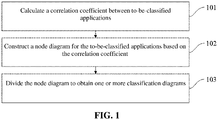
- a correlation coefficient between to-be-classified applications is calculated, a node diagram is constructed based on the correlation coefficient, and then the node diagram is divided to obtain one or more classification diagrams.
- full reference is made to experience of a plurality of currently known classification systems for integration, and no manual operation is required. Therefore, a subjective classification result obtained due to a manual operation or a risk that operation personnel fail to take adequate consideration can be avoided, and a new comprehensive application classification system can be provided.
- a new classification diagram may be further assessed depending on an actual need, and a merging or further division operation may be performed to ensure accuracy of final classification.
- the application classification method may specifically include the following steps: Step 101. A correlation coefficient between to-be-classified applications is calculated.
- the to-be-classified applications may be applications located in one or more known classification systems.
- a correlation coefficient between to-be-classified applications can be calculated first.
- the correlation coefficient reflects correlation between any two applications.
- a larger correlation coefficient means that two applications are more correlated.
- the step of calculating a correlation coefficient between to-be-classified applications may specifically include the following substeps: Substep 1011. A shortest path between any two to-be-classified applications in the one or more known classification systems is separately determined.
- FIG. 2 is a schematic diagram of application classification in an application store according to an existing technology.
- applications may be classified into categories such as Photo & Video, System Tools, Social Networking and the like.
- Each category may be further divided into different subcategories.
- a category of Online Shopping may be divided into different subcategories such as Malls, Group buying, Shopping guide, and Cross-border online shopping.
- Each subcategory may include specific applications such as Mobile TaobaoTM, Fanli.com, and Suning Tesco.
- a node diagram is used to represent a classification status in an application store, and nodes in the node diagram each represent a specific category or application.
- a shortest path between any two to-be-classified applications in the classification system can indicate a distance between two nodes.
- a shorter distance between nodes means higher correlation.
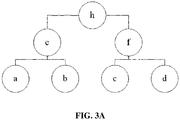
- FIG. 3A and FIG. 3B are schematic diagrams of two different classification systems A and B, wherein e, f, h, 1, m, and n represent different categories, and a, b, c, and d are to-be-classified applications.
- a shortest path Shortest_path(a,b) between the applications a and b in the classification system A is 2
- a shortest path Shortest_path(a,b) between the applications a and b in the classification system B is also 2.
- a shortest path Shortest_path(a,c) between the applications a and c in the classification system A is 4, while a shortest path Shortest_path(a,c) between the applications a and c in the classification system B is 2.
- shortest paths between different nodes in classification systems may be obtained by using a Dijkstra algorithm.
- Substep 1012 A correlation coefficient between the any two to-be-classified applications is calculated by using the shortest path.
- Step 102 A node diagram is constructed for the to-be-classified applications based on the correlation coefficient.
- a node diagram may be constructed for the to-be-classified applications based on the correlation coefficients.
- nodes represent different applications, and a connection line between nodes may represent a relationship between applications.
- the correlation coefficient between the applications that is obtained in step 101 can be used as a weight of a side between the to-be-classified applications, and a node diagram is constructed for the to-be-classified applications based on the weight of the side.
- a larger weight between nodes means that the nodes are more correlated in a plurality of classification systems. For example, if two applications keep belonging to the same subcategory in a plurality of classification systems, a weight between the two applications may have a maximum value of 1.
- Step 103 The node diagram is divided to obtain one or more classification diagrams.
- the step of dividing the node diagram to obtain one or more classification diagrams may specifically include the following substeps:
- a weight threshold can first be set depending on an actual classification requirement, and then it is judged whether a weight of a side in the node diagram is greater than the preset threshold. The corresponding side is retained if the weight of the side is greater than the preset threshold, or the corresponding side is deleted to obtain a new node diagram if the weight of the side is not greater than the preset threshold. For example, if the preset threshold is 0.5, all sides in the node diagram that have a weight value less than 0.5 may be first deleted to obtain a new node diagram, and then the new node diagram is further divided to obtain one or more classification diagrams.
- a correlation coefficient between to-be-classified applications is calculated, a node diagram is constructed based on the correlation coefficient, and then the node diagram is divided to obtain one or more classification diagrams.
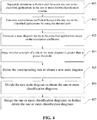
- the application classification method may specifically include the following steps: Step 401.
- a shortest path between any two to-be-classified applications in the one or more known classification systems is separately determined.
- a shortest path between any two to-be-classified applications in the classification system can indicate a distance between two nodes.
- a shorter distance between nodes means higher correlation. Therefore, for to-be-classified applications, a shortest path between any two to-be-classified applications in the one or more known classification systems can be separately determined first.
- FIG. 3A and FIG. 3B are schematic diagrams of two different classification systems A and B, wherein e, f, h, 1, m, and n represent different categories, and a, b, c, and d are to-be-classified applications.
- a shortest path Shortest_path(a,b) between the applications a and b in the classification system A is 2
- a shortest path Shortest_path(a,b) between the applications a and b in the classification system B is also 2.
- a shortest path Shortest_path(a,c) between the applications a and c in the classification system A is 4, while a shortest path Shortest_path(a,c) between the applications a and c in the classification system B is 2.
- shortest paths between different nodes in classification systems may be obtained by using a Dijkstra algorithm.
- Step 402. A correlation coefficient between the any two to-be-classified applications is calculated by using the shortest path.
- Step 403. A node diagram is constructed for the to-be-classified applications based on the correlation coefficient.
- the step of constructing a node diagram for the to-be-classified applications based on the correlation coefficient may specifically include the following substeps:
- the correlation coefficient may be used as a weight of a side for constructing a node diagram, that is, the any two applications are connected to obtain a side, thus constructing a node diagram.
- the correlation coefficient between the applications is used as a weight value of the corresponding side.
- a larger weight between nodes means that the nodes are more correlated in a plurality of classification systems. For example, if two applications keep belonging to the same subcategory in a plurality of classification systems, a weight between the two applications may have a maximum value of 1.
- Step 404 It is judged whether a weight of a side in the node diagram is greater than a preset threshold.
- a weight threshold may first be set depending on an actual classification requirement, and then it is judged whether a weight of a side in the node diagram is greater than the preset threshold. The corresponding side is retained if the weight of the side is greater than the preset threshold, or step 405 may be performed to delete the corresponding side to obtain a new node diagram if the weight of the side is not greater than the preset threshold. For example, if the preset threshold is 0.5, all sides in the node diagram that have a weight value less than 0.5 may be first deleted to obtain a new node diagram.
- Step 405. The corresponding side is deleted to obtain a new node diagram.
- Step 406 The new node diagram is divided to obtain the one or more classification diagrams.
- the new node diagram may be divided by means of a community division algorithm FastUnfolding.
- the step of dividing the new node diagram to obtain the one or more classification diagrams may specifically include the following sub steps: Substep 4061.
- a label is configured for each to-be-classified application in the new node diagram.
- the label may be a user ID of the to-be-classified application.
- the label may alternatively be a label configured in another manner, for example, configured randomly, as long as the label is unique. No limitation is set thereto in the embodiment of the present application.
- Substep 4062 The label of each to-be-classified application is transferred to a connected to-be-classified application.
- a label is selected, in labels received by each to-be-classified application, as an owned label based on the number of the labels.
- Substep 4064 It is judged, in the new node diagram, whether a label owned by a to-be-classified application changes, or whether the current number of iteration times is less than a preset maximum number of iteration times.
- Substep 4065 The step of transferring the label of each to-be-classified application to a connected to-be-classified application is returned to if the label owned by the to-be-classified application changes or the current number of iteration times is less than the preset maximum number of iteration times.
- Substep 4066 To-be-classified applications owning the same label are put to the same classification diagram to obtain the one or more classification diagrams if the label owned by the to-be-classified application does not change or the current number of iteration times is not less than the preset maximum number of iteration times.
- a label may be randomly selected. Because a core node is connected to many other peripheral nodes, a probability that a label of the core node is randomly selected is relatively high. In subsequent iteration processes, the number of labels of the core node increases and gradually becomes stable.
- nodes having the same label belong to the same user group, and the label of the node may be used as an identification label of the application.
- FIG. 5 is a schematic diagram of a node diagram according to the present application, wherein a name of a node is used as a label of the node, that is, labels of nodes R, S, T, and U are respectively R, S, T, and U.
- An iteration process of the labels is as follows: Iteration times Node Received label Selected label 1 R S, T, U U S R, T R T R, S S U R R R 2 R R, R, S R S S, U S T R, U R U R R 3 R R, R, S R S R, R R T R, S R U R R R
- labels owned by applications are all R, and do not change any more. Therefore, applications corresponding to the nodes R, S, T, and U belong to the same category, and may be put to the same classification diagram.
- Step 407. The one or more classification diagrams are merged; or the one or more classification diagrams are further divided.
- the new classification diagram may be further processed.
- the one or more classification diagrams are merged; or the one or more classification diagrams are further divided.
- the plurality of classification diagrams may be directly synthesized, and a hierarchical structure may be formed.
- two original classification diagrams A and B can be synthesized as subcategories of a category C.
- the step of further dividing the one or more classification diagrams may specifically include the following substeps:
- FIG. 6 is a schematic diagram of a classification diagram according to the present application, and based on the foregoing formula, betweenness values of sides may be obtained as follows:
- the side CD has a maximum betweenness value, and therefore the side CD is deleted; after the side CD is deleted, the original classification diagram is divided into two connected diagrams, that is, classification sub-diagrams ABC and DEF, and a division effect is achieved. Therefore, further division of the classification diagram may be stopped.
- a new classification diagram may be further assessed depending on an actual need, and a merging or further division operation may be performed to ensure accuracy of final classification.
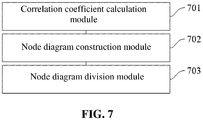
- the application classification apparatus may specifically include the following modules:
- the correlation coefficient calculation module 701 may specifically include the following sub-modules:
- the node diagram construction module 702 may specifically include the following sub-module: a node diagram construction sub-module 7021 configured to use the correlation coefficient as a weight of a side between the to-be-classified applications, and construct the node diagram for the to-be-classified applications based on the weight of the side.
- a node diagram construction sub-module 7021 configured to use the correlation coefficient as a weight of a side between the to-be-classified applications, and construct the node diagram for the to-be-classified applications based on the weight of the side.
- the node diagram division module 703 may specifically include the following sub-modules:
- the node diagram division sub-module 7033 may specifically include the following units:
- the apparatus may further include the following modules:
- the classification diagram division module 705 may specifically include the following sub-modules:
- the apparatus embodiment is basically similar to the method embodiments, and therefore is described briefly. For related parts, refer to partial descriptions in the method embodiments.
- the embodiments of the present application may be provided as a method, an apparatus, or a computer program product. Therefore, the embodiments of the present application may be implemented as a complete hardware embodiment, a complete software embodiment, or an embodiment combining software and hardware. Moreover, the embodiments of the present application may be a computer program product implemented on one or more computer usable storage media (including, but not limited to, a magnetic disk memory, a compact disk read-only memory (CD-ROM), an optical memory, and the like) including computer-usable program code.
- a computer usable storage media including, but not limited to, a magnetic disk memory, a compact disk read-only memory (CD-ROM), an optical memory, and the like
- the computer device includes one or more processors (CPUs), an input/output interface, a network interface, and a memory.
- the memory may include a volatile memory, a random access memory (RAM) and/or a non-volatile memory or the like in a computer-readable medium, for example, a read-only memory (ROM) or a flash RAM.
- RAM random access memory
- ROM read-only memory
- flash RAM flash RAM
- the memory is an example of the computer-readable medium.
- the computer-readable medium includes non-volatile and volatile media as well as movable and non-movable media, and can implement information storage by means of any method or technology.
- Information may be a computer-readable instruction, a data structure, and a module of a program or other data.
- a storage medium of a computer includes, but is not limited to, for example, a phase change memory (PRAM), a static random access memory (SRAM), a dynamic random access memory (DRAM), other types of RAMs, a ROM, an electrically erasable programmable read-only memory (EEPROM), a flash memory or other memory technologies, a CD-ROM, a digital versatile disc (DVD) or other optical storages, a cassette tape, a magnetic tape/magnetic disk storage or other magnetic storage devices, or any other non-transmission medium, and can be used to store information that can be accessed by a computing device.
- the computer-readable medium does not include computer-readable transitory media, such as a modulated data signal and a carrier.
- These computer program instructions may be provided for a general-purpose computer, a special-purpose computer, an embedded processor, or a processor of any other programmable data processing terminal device to generate a machine, so that the instructions executed by a computer or a processor of any other programmable data processing terminal device generate an apparatus for implementing a specified function in one or more procedures in the flowcharts and/or in one or more blocks in the block diagrams.
- These computer program instructions may be stored in a computer-readable memory that can instruct the computer or any other programmable data processing terminal device to work in a particular manner, so that the instructions stored in the computer-readable memory generate an artifact that includes an instruction apparatus.
- the instruction apparatus implements a specified function in one or more processes in the flowcharts and/or in one or more blocks in the block diagrams.
- These computer program instructions may be loaded onto a computer or another programmable data processing terminal device, so that a series of operations and steps are performed on the computer or the another programmable terminal device, thereby generating computer-implemented processing. Therefore, the instructions executed on the computer or the programmable terminal device provide steps for implementing a specified function in one or more processes in the flowcharts and/or in one or more blocks in the block diagrams.
Landscapes
- Engineering & Computer Science (AREA)
- Theoretical Computer Science (AREA)
- Physics & Mathematics (AREA)
- General Physics & Mathematics (AREA)
- Data Mining & Analysis (AREA)
- General Engineering & Computer Science (AREA)
- Databases & Information Systems (AREA)
- Software Systems (AREA)
- Mathematical Physics (AREA)
- Computing Systems (AREA)
- Evolutionary Computation (AREA)
- Artificial Intelligence (AREA)
- Mathematical Optimization (AREA)
- Pure & Applied Mathematics (AREA)
- Mathematical Analysis (AREA)
- Computational Mathematics (AREA)
- Computational Linguistics (AREA)
- Algebra (AREA)
- Bioinformatics & Cheminformatics (AREA)
- Life Sciences & Earth Sciences (AREA)
- Bioinformatics & Computational Biology (AREA)
- Computer Vision & Pattern Recognition (AREA)
- Evolutionary Biology (AREA)
- Information Retrieval, Db Structures And Fs Structures Therefor (AREA)
- Stored Programmes (AREA)
- Complex Calculations (AREA)
Applications Claiming Priority (2)
| Application Number | Priority Date | Filing Date | Title |
|---|---|---|---|
| CN201610113706.8A CN107133248B (zh) | 2016-02-29 | 2016-02-29 | 一种应用程序的分类方法和装置 |
| PCT/CN2017/073867 WO2017148273A1 (zh) | 2016-02-29 | 2017-02-17 | 一种应用程序的分类方法和装置 |
Publications (2)
| Publication Number | Publication Date |
|---|---|
| EP3425523A1 true EP3425523A1 (en) | 2019-01-09 |
| EP3425523A4 EP3425523A4 (en) | 2019-01-09 |
Family
ID=59721804
Family Applications (1)
| Application Number | Title | Priority Date | Filing Date |
|---|---|---|---|
| EP17759124.5A Withdrawn EP3425523A4 (en) | 2016-02-29 | 2017-02-17 | APPLICATION PROGRAM CLASSIFICATION METHOD AND DEVICE |
Country Status (6)
| Country | Link |
|---|---|
| US (1) | US20180365339A1 (enExample) |
| EP (1) | EP3425523A4 (enExample) |
| JP (1) | JP2019508814A (enExample) |
| CN (1) | CN107133248B (enExample) |
| TW (1) | TWI760325B (enExample) |
| WO (1) | WO2017148273A1 (enExample) |
Cited By (1)
| Publication number | Priority date | Publication date | Assignee | Title |
|---|---|---|---|---|
| CN111126465A (zh) * | 2019-12-14 | 2020-05-08 | 中国科学院深圳先进技术研究院 | 节点分类方法、装置、终端设备及计算机可读存储介质 |
Families Citing this family (6)
| Publication number | Priority date | Publication date | Assignee | Title |
|---|---|---|---|---|
| CN107798125B (zh) * | 2017-11-10 | 2021-03-16 | 携程旅游网络技术(上海)有限公司 | 基于亲密度模型的准入判定方法、系统、设备及存储介质 |
| CN108052983A (zh) * | 2017-12-28 | 2018-05-18 | 广州优视网络科技有限公司 | 应用聚类的方法、装置和设备 |
| CN108647201B (zh) * | 2018-04-04 | 2021-12-31 | 卓望数码技术(深圳)有限公司 | 一种基于移动应用的分类识别方法及系统 |
| CN109460467B (zh) * | 2018-09-28 | 2020-02-14 | 中国科学院电子学研究所苏州研究院 | 一种网络信息分类体系构建方法 |
| CN110222484B (zh) * | 2019-04-28 | 2023-05-23 | 五八有限公司 | 一种用户身份识别方法、装置、电子设备及存储介质 |
| CN118277914B (zh) * | 2023-11-07 | 2025-01-24 | 国家计算机网络与信息安全管理中心 | 一种基于动静结合多维度apk特征的移动应用分类方法 |
Family Cites Families (16)
| Publication number | Priority date | Publication date | Assignee | Title |
|---|---|---|---|---|
| WO2006029504A1 (en) * | 2004-09-13 | 2006-03-23 | Research In Motion Limited | Enabling category-based filtering |
| JP2007128389A (ja) * | 2005-11-07 | 2007-05-24 | Fujitsu Ltd | 単語クラス作成プログラム、単語クラス作成装置、及び単語クラス作成方法、並びに類似度算出プログラム、類似度算出装置、及び類似度算出方法 |
| US7788254B2 (en) * | 2007-05-04 | 2010-08-31 | Microsoft Corporation | Web page analysis using multiple graphs |
| JP2013029872A (ja) * | 2009-10-19 | 2013-02-07 | Nec Corp | 情報推薦システム、方法、及び、プログラム |
| US8818787B2 (en) * | 2011-01-31 | 2014-08-26 | Yahoo! Inc. | Method and system for predicting performance of software applications on prospective hardware architecture |
| US8818918B2 (en) * | 2011-04-28 | 2014-08-26 | International Business Machines Corporation | Determining the importance of data items and their characteristics using centrality measures |
| EP2710466A1 (en) * | 2011-05-09 | 2014-03-26 | Google, Inc. | Identifying applications of interest based on application metadata |
| CN102521275A (zh) * | 2011-11-24 | 2012-06-27 | 宇龙计算机通信科技(深圳)有限公司 | 一种应用程序的分类方法、装置及终端 |
| KR101522014B1 (ko) * | 2013-04-19 | 2015-05-20 | 인텔렉추얼디스커버리 주식회사 | 앱 아이콘을 관리하는 방법, 장치 및 기록매체 |
| US9152694B1 (en) * | 2013-06-17 | 2015-10-06 | Appthority, Inc. | Automated classification of applications for mobile devices |
| US9292884B2 (en) * | 2013-07-10 | 2016-03-22 | Facebook, Inc. | Network-aware product rollout in online social networks |
| US9569536B2 (en) * | 2013-12-17 | 2017-02-14 | Microsoft Technology Licensing, Llc | Identifying similar applications |
| US10229190B2 (en) * | 2013-12-31 | 2019-03-12 | Samsung Electronics Co., Ltd. | Latent semantic indexing in application classification |
| CN104965829B (zh) * | 2014-05-14 | 2019-01-29 | 腾讯科技(深圳)有限公司 | 终端应用分类方法、服务器及系统 |
| CN104281674B (zh) * | 2014-09-29 | 2017-07-11 | 同济大学 | 一种基于集聚系数的自适应聚类方法及系统 |
| CN104504140B (zh) * | 2015-01-04 | 2017-10-20 | 中国联合网络通信集团有限公司 | 终端桌面图标的分类方法和装置 |
-
2016
- 2016-02-29 CN CN201610113706.8A patent/CN107133248B/zh active Active
-
2017
- 2017-02-09 TW TW106104300A patent/TWI760325B/zh active
- 2017-02-17 EP EP17759124.5A patent/EP3425523A4/en not_active Withdrawn
- 2017-02-17 JP JP2018543709A patent/JP2019508814A/ja active Pending
- 2017-02-17 WO PCT/CN2017/073867 patent/WO2017148273A1/zh not_active Ceased
-
2018
- 2018-08-29 US US16/116,812 patent/US20180365339A1/en not_active Abandoned
Cited By (2)
| Publication number | Priority date | Publication date | Assignee | Title |
|---|---|---|---|---|
| CN111126465A (zh) * | 2019-12-14 | 2020-05-08 | 中国科学院深圳先进技术研究院 | 节点分类方法、装置、终端设备及计算机可读存储介质 |
| CN111126465B (zh) * | 2019-12-14 | 2023-01-24 | 中国科学院深圳先进技术研究院 | 节点分类方法、装置、终端设备及计算机可读存储介质 |
Also Published As
| Publication number | Publication date |
|---|---|
| WO2017148273A1 (zh) | 2017-09-08 |
| TWI760325B (zh) | 2022-04-11 |
| CN107133248A (zh) | 2017-09-05 |
| US20180365339A1 (en) | 2018-12-20 |
| EP3425523A4 (en) | 2019-01-09 |
| JP2019508814A (ja) | 2019-03-28 |
| TW201734775A (zh) | 2017-10-01 |
| CN107133248B (zh) | 2020-04-14 |
Similar Documents
| Publication | Publication Date | Title |
|---|---|---|
| EP3425523A1 (en) | Application program classification method and apparatus | |
| US9690843B2 (en) | Data classification | |
| CN105719033B (zh) | 用于识别客体风险的方法及装置 | |
| US10783005B2 (en) | Component logical threads quantity adjustment method and device | |
| CN110955846A (zh) | 传播路径图生成方法及装置 | |
| CN109426415B (zh) | 一种生成级联选择器的方法及装置 | |
| CN106209970B (zh) | 确定用户设备与路由设备间连接的网络状态的方法与设备 | |
| CN107220260B (zh) | 一种页面显示的方法及装置 | |
| US20150227530A1 (en) | Address Book Ranking Method and Apparatus | |
| CN105677677A (zh) | 一种信息分类方法及装置 | |
| US10565035B2 (en) | Modifying a device based on an annotated time series of sensor readings | |
| CN114051132A (zh) | Lsc数据的检测方法、装置、终端设备及介质 | |
| CN105550240B (zh) | 一种推荐的方法及装置 | |
| CN107154960B (zh) | 用于确定分布式存储系统的服务可用性信息的方法与设备 | |
| CN110086867B (zh) | 一种还车网点推送方法 | |
| CN108667893A (zh) | 数据推荐方法、装置和电子设备 | |
| CN117172316A (zh) | 一种基于实体对齐所得到的知识图谱进行任务执行的方法 | |
| CN108965578A (zh) | 信息推送方法及装置 | |
| CN106897331B (zh) | 用户关键位置数据获取方法及装置 | |
| CN112507193A (zh) | 数据更新方法、装置、设备和存储介质 | |
| CN112749229A (zh) | 数据转换方法、装置、存储介质及电子设备 | |
| CN103108068B (zh) | 一种微博中选择好友的方法及装置 | |
| CN114924674A (zh) | 一种多区域分栏导航交互方法、设备及介质 | |
| CN110536325B (zh) | 一种提高车载智能设备通信连接成功率的方法 | |
| CN113282823A (zh) | 一种基于人工智能的热点话题追踪方法及系统 |
Legal Events
| Date | Code | Title | Description |
|---|---|---|---|
| STAA | Information on the status of an ep patent application or granted ep patent |
Free format text: STATUS: THE INTERNATIONAL PUBLICATION HAS BEEN MADE |
|
| PUAI | Public reference made under article 153(3) epc to a published international application that has entered the european phase |
Free format text: ORIGINAL CODE: 0009012 |
|
| STAA | Information on the status of an ep patent application or granted ep patent |
Free format text: STATUS: REQUEST FOR EXAMINATION WAS MADE |
|
| 17P | Request for examination filed |
Effective date: 20180928 |
|
| A4 | Supplementary search report drawn up and despatched |
Effective date: 20181107 |
|
| AK | Designated contracting states |
Kind code of ref document: A1 Designated state(s): AL AT BE BG CH CY CZ DE DK EE ES FI FR GB GR HR HU IE IS IT LI LT LU LV MC MK MT NL NO PL PT RO RS SE SI SK SM TR |
|
| AX | Request for extension of the european patent |
Extension state: BA ME |
|
| DAV | Request for validation of the european patent (deleted) | ||
| DAX | Request for extension of the european patent (deleted) | ||
| STAA | Information on the status of an ep patent application or granted ep patent |
Free format text: STATUS: THE APPLICATION IS DEEMED TO BE WITHDRAWN |
|
| 18D | Application deemed to be withdrawn |
Effective date: 20190604 |