EP3425386A1 - Online apparatus for in-depth characterization of antibody drug conjugates - Google Patents
Online apparatus for in-depth characterization of antibody drug conjugates Download PDFInfo
- Publication number
- EP3425386A1 EP3425386A1 EP17180388.5A EP17180388A EP3425386A1 EP 3425386 A1 EP3425386 A1 EP 3425386A1 EP 17180388 A EP17180388 A EP 17180388A EP 3425386 A1 EP3425386 A1 EP 3425386A1
- Authority
- EP
- European Patent Office
- Prior art keywords
- outlet
- inlet
- valve
- molecules
- housing
- Prior art date
- Legal status (The legal status is an assumption and is not a legal conclusion. Google has not performed a legal analysis and makes no representation as to the accuracy of the status listed.)
- Granted
Links
Images


Classifications
-
- G—PHYSICS
- G01—MEASURING; TESTING
- G01N—INVESTIGATING OR ANALYSING MATERIALS BY DETERMINING THEIR CHEMICAL OR PHYSICAL PROPERTIES
- G01N30/00—Investigating or analysing materials by separation into components using adsorption, absorption or similar phenomena or using ion-exchange, e.g. chromatography or field flow fractionation
- G01N30/02—Column chromatography
- G01N30/62—Detectors specially adapted therefor
- G01N30/72—Mass spectrometers
- G01N30/7233—Mass spectrometers interfaced to liquid or supercritical fluid chromatograph
-
- G—PHYSICS
- G01—MEASURING; TESTING
- G01N—INVESTIGATING OR ANALYSING MATERIALS BY DETERMINING THEIR CHEMICAL OR PHYSICAL PROPERTIES
- G01N30/00—Investigating or analysing materials by separation into components using adsorption, absorption or similar phenomena or using ion-exchange, e.g. chromatography or field flow fractionation
- G01N30/02—Column chromatography
- G01N30/26—Conditioning of the fluid carrier; Flow patterns
- G01N30/38—Flow patterns
- G01N30/46—Flow patterns using more than one column
- G01N30/461—Flow patterns using more than one column with serial coupling of separation columns
- G01N30/462—Flow patterns using more than one column with serial coupling of separation columns with different eluents or with eluents in different states
-
- G—PHYSICS
- G01—MEASURING; TESTING
- G01N—INVESTIGATING OR ANALYSING MATERIALS BY DETERMINING THEIR CHEMICAL OR PHYSICAL PROPERTIES
- G01N30/00—Investigating or analysing materials by separation into components using adsorption, absorption or similar phenomena or using ion-exchange, e.g. chromatography or field flow fractionation
- G01N30/02—Column chromatography
- G01N30/84—Preparation of the fraction to be distributed
Definitions
- the present invention relates to the characterization of proteins such as antibody drug conjugates, in particular to an apparatus and a method for characterization of proteins.
- ADCs Antibody Drug Conjugates
- ADCs are tripartite molecules consisting of a monoclonal antibody onto which highly cytotoxic small molecules are conjugated by cleavable or non-cleavable linkers. They show better efficiency than canonical unconjugated monoclonal antibodies, due to the synergic effect of monoclonal antibody specificity for its target and the efficacy of the highly cytotoxic drug.
- the analytical characterization of monoclonal antibody-related compounds usually follows a multilevel workflow, where biopharmaceuticals are studied at the intact protein level (top level), after enzymatic digestion into smaller monoclonal antibody sub-domains (middle-up level), or after proteolytic digestion to generate peptides (bottom-up level).
- top level biopharmaceuticals are studied at the intact protein level
- middle-up level after enzymatic digestion into smaller monoclonal antibody sub-domains
- proteolytic digestion to generate peptides bottom-up level
- middle- and bottom-up levels require preliminary treatment that can affect the quality of the final product (increased deamidation, oxidation, generation of aggregates, etc.).
- Top level methods performed on intact monoclonal antibodies require less handling and are thus of utmost interest, even though still in their infancy.
- ADCs The development and optimization of ADCs rely on improving their analytical and bioanalytical characterization by assessing several critical quality attributes, namely the distribution and position of the cytotoxic drug, the amount of naked antibody, the average Drug to Antibody Ratio (DAR) and the residual drug-linker and related product proportions.
- the average DAR represents the amount of payloads that can be delivered to the tumor cell and thus is directly linked to the toxicity and the safety of the ADC.
- the distribution of drug-loads i.e. the fraction of antibodies containing zero, one, two, three, n drugs
- HIC Hydrophobic Interaction Chromatography
- IEX Ion Exchange Chromatography
- the first approach consists in a time consuming off-line coupling performed by peaks collection, manual desalting of the fractions and subsequent non-denaturing MS or Ion-Mobility spectrometry-Mass Spectrometry (IM-MS) analysis.
- IM-MS Ion-Mobility spectrometry-Mass Spectrometry
- the second approach was recently proposed and is based on the online combination of HIC and, using either fully comprehensive or heart-cutting 2D-Liquid Chromatography (2D-LC) strategies.
- 2D-LC 2D-Liquid Chromatography
- the Applicant surprisingly developed an apparatus meeting these requirements.
- This apparatus is based on the direct connection between non-denaturing chromatography and non-denaturing MS.
- the invention is thus an apparatus for in-depth characterization of molecules comprising:
- the method of the invention is carried out with the apparatus of the invention.
- the invention is an apparatus for in-depth characterization of molecules comprising:
- molecules refers to non-aggregated molecules or aggregates of molecules.
- the molecules may be large molecules such as proteins, in particular monoclonal antibody-related compounds like Antibody Drug Conjugates (ADCs), bispecific antibodies, antibody-dual-drug conjugates and protein complexes (protein/protein, protein/DNA, protein/RNA).
- ADCs Antibody Drug Conjugates
- bispecific antibodies bispecific antibodies
- antibody-dual-drug conjugates protein complexes
- Separateparative chromatography column refers to a column of chromatography loaded with a stationary phase adapted to carry out an on-line chromatographic method under non-denaturing conditions to separate totally or partially molecules of a solution from each other.
- salting chromatography column refers to a column of chromatography adapted to carry out a chromatographic method under non-denaturing condition to decrease the concentration of salt in a solution or change the nature of the salt of a solution.
- the separative chromatography column may be an hydrophobic interaction chromatography column (hereinafter referred to as HIC column) or a size exclusion chromatography column (hereinafter referred to as SEC column) or an ion exchange chromatography column (hereinafter referred to as IEX column).
- HIC column hydrophobic interaction chromatography column
- SEC column size exclusion chromatography column
- IEX column ion exchange chromatography column
- the desalting chromatography column may be a SEC column.
- HIC column refers to a column of chromatography adapted to carry out a Hydrophobic Interaction Chromatography (hereinafter referred to as HIC), i.e. a chromatographic method in which molecules are separated on the basis of their hydrophobicity.
- HIC Hydrophobic Interaction Chromatography
- the stationary phase of the HIC column is substituted with a limited number of hydrophobic groups and the separation of the molecules is based on the interaction between these hydrophobic groups and said molecules.
- HIC enables the separation of ADCs on the basis of the increased hydrophobicity imparted to said ADCs by the increased number of drug conjugates while preserving the structure of said ADCs.
- HIC thus enables the determination of the average Drug to Antibody Ratio (average DAR) of the ADCs and the relative proportion of the different drug loads.
- SEC column refers to a column of chromatography for carrying out a Size Exclusion Chromatography (hereinafter referred to as SEC), i.e. a chromatographic method in which molecules are separated by their size and not by another separation parameter such as molecular weight or polarity.
- SEC Size Exclusion Chromatography
- the pores of the stationary phase of the SEC column may trap the molecules based on their size thereby separating said molecules.
- SEC preserves the structure of the proteins, in particular ADCs.
- SEC may be used for fast separation of molecules from salts thanks to differences in hydrodynamic volumes.
- mass spectrometer refers to an apparatus adapted for carrying out mass spectrometry (hereinafter referred to as MS) under non-denaturing conditions, i.e. an analytical method used to measure the mass to charge ratio of charged molecules.
- non-denaturing MS may be used for providing a wealth of information on the biochemical and biophysical properties of proteins, in particular ADCs, therapeutic proteins, membrane proteins and protein complexes such as protein/protein, protein/DNA, protein/RNA, protein/small molecule,. More particularly, non-denaturing MS may be used for determining interacting stoichiometries and elucidating higher order structure of proteins, in particular ADCs, therapeutic proteins, membrane proteins and protein complexes such as protein/protein, protein/DNA, protein/RNA, protein/small molecule.
- MS may be electrospray ionization-mass spectrometry (hereinafter referred to as ESI-MS), or electrospray ionization-ion-mobility spectrometry-mass spectrometry (hereinafter referred to as IM-MS).
- ESI-MS electrospray ionization-mass spectrometry
- IM-MS electrospray ionization-ion-mobility spectrometry-mass spectrometry
- ESI-MS refers to a method wherein mass spectrometry is coupled to electrospray ionization.
- the mass spectrometer 3 comprises an ESI source applying a high voltage to a liquid to create the electrospray.
- ESI is especially useful in producing ions from proteins, because it overcomes the propensity of these molecules to fragment when ionized.
- IM-MS refers to an analytical method wherein gas phase ions are first separated on a millisecond timescale using ion-mobility spectrometry and wherein the components of said gas phase ions are identified using non-denaturing mass spectrometry analysis on a microsecond timescale.
- the IM-MS analysis is particularly adapted to the analysis of complex mixtures of molecules based on differing mobilities in an electric field.
- the mass spectrometer 3 is coupled to an ion-mobility separator.
- IM-MS analysis may be applied to large molecules such as proteins, in particular ADCs, therapeutic proteins, membrane proteins and protein complexes such as protein/protein, protein/DNA, protein/RNA, protein/small molecule.
- IM-MS analysis may be used to identify the proteins, in particular ADCs, therapeutic proteins, membrane proteins and protein complexes such protein/protein, protein/DNA, protein/RNA, protein/small molecule, separated by the HIC column, the IEX column or the SEC column of the first housing 1 and the SEC column of the second housing 2.
- IM-MS analysis may also be carried out to determine the conformational homogeneity/heterogeneity of proteins, in particular ADCs, therapeutic proteins, membrane proteins and protein complexes such as protein/protein, protein/DNA, protein/RNA, protein/small molecule.
- Non-denaturing conditions refers to conditions where proteins, (e.g., antibodies) do not lose their secondary, tertiary or quaternary structures and to conditions wherein protein complexes do not lose their interactions.
- Non-denaturing conditions differs from the denaturing conditions, said denaturing conditions include high temperatures causing thermal unfolding (e.g., 50°C or greater) or extreme pH (for example, below pH 5 and above pH 8), and organic solvent.
- the molecules to be characterized by the apparatus of the present invention are first added to a solution, in particular an aqueous solution, to obtain a solution of molecules.
- a solution in particular an aqueous solution
- This solution is then loaded onto the separative chromatography column of the first housing 1 so as to separate the molecules and to recover a flow-through sample from the outlet of the first housing 1.
- the solution typically comprises a separation salt such as non-volatile salt, a buffer salt or mixture thereof.
- the sample may thus comprise the separated molecules and the separation salt.
- the non-volatile salt may be potassium thiocyanate, sodium chloride, potassium chloride, ammonium chloride, sodium sulfate, potassium sulfate and ammonium sulfate or mixture thereof, in particular the non-volatile salt may be sodium chloride or ammonium acetate or mixture thereof.
- the buffer salt may be phosphate buffer, such as Na 2 HPO 4 or Na 2 HPO 4 and NaH 2 PO 4 .
- the separation salt is adapted to the separative chromatography column, however it may contaminate the mass spectrometer 3. Therefore the outlet of the first housing 1 cannot be directly fluidly connected to the inlet of the mass spectrometer 3.
- the Applicant has found that the desalting chromatography column of the second housing 2 between the separative chromatography column and the mass spectrometer 3 to carry out an on-line chromatographic method advantageously prevents the contamination of the mass spectrometer 3 by the separation salt.
- the sample is loaded onto the desalting chromatography column so as to desalt the sample and to recover a desalted flow-through sample (hereinafter referred to as desalted sample) from the outlet of the second housing 2.
- the desalted sample comprises the separated molecules and a mass spectrometer compatible salt.
- the desalted sample can then be loaded onto the mass spectrometer 3 to characterize the molecules.
- a mass spectrometer compatible salt refers to a salt which is compatible for use with a mass spectrometer or with a concentration in the desalted sample so low that the desalted sample is compatible for use with a mass spectrometer in non-denaturing conditions.
- a salt which is compatible for use with a mass spectrometer may be formic acid, acetic acid, trifluoroacetic acid.
- the concentration of salt in the desalted sample may be below 100mMol/l.
- the apparatus of the present invention enables an in-depth characterization of molecules without a slow, manual and thus non-reproducible desalting step between the separative chromatography column and the mass spectrometer 3. Therefore a fast, automated and reproducible in-depth characterization of molecules can be performed by the apparatus of the present invention.
- the apparatus of the present invention further comprises a detector 10, 20 at the outlet of the first housing 1 and/or at the outlet of the second housing 2.
- a detector refers to a device adapted to the characterization of the separated molecules by the detection of chromatographic peak characteristic of each separated molecule.
- the detector may be a wavelength UV detector, in particular a single wavelength UV detector, a diode array UV detector or fluorescence detector.
- the detector 10 at the outlet of the first housing 1 may be a wavelength UV detector, in particular a single wavelength UV detector, or a diode array UV detector.
- the wavelength UV detector or diode array UV detector are adapted to detect the chromatographic peak characteristic of the separated molecules of the sample so as to determine the relative intensities of the drug load peaks in a quantitative manner and the average DAR of ADCs by HIC.
- the detector 10 at the outlet of the first housing 1 may be a wavelength UV detector, in particular a single wavelength UV detector or a diode array UV detector.
- the detector 20 at the outlet of the second housing 2 is a wavelength UV detector, in particular a single wavelength UV detector, or a diode array UV detector.
- the UV detector is adapted to detect the chromatographic peak characteristic of the molecular weight of the separated molecules, the separation salt and the mass spectrometer compatible salt.
- the detection of the chromatographic peaks by the wavelength UV detector or a diode array UV detector enables the determination of the mass of the separated molecules by SEC.
- the apparatus of the present invention allows recovering the separated molecules from the outlet of the first housing 1 according to a specific sequence, and loading them onto the desalting chromatography column, recovering them from the outlet of the second housing 2, and loading them onto the mass spectrometer 3 according to the same specific sequence.
- the characterizations of the separated molecules performed by the detector 10 and/or the detector 20, and the mass spectrometer 3 can be easily and precisely correlated.
- the apparatus of the present invention is particularly adapted to the non-denaturing in-depth characterization of molecules such as proteins, in particular ADCs, monoclonal antibodies, therapeutic proteins, protein complexes (protein/protein, protein/DNA, protein/RNA, protein/small molecule).
- proteins in particular ADCs, monoclonal antibodies, therapeutic proteins, protein complexes (protein/protein, protein/DNA, protein/RNA, protein/small molecule).
- the apparatus of the present invention is advantageously adapted to determine the average DAR of ADCs by HIC and correlate said DAR to the mass of ADCs elucidated by MS or to the conformational homogeneity of ADCs determined by IM-MS analysis.
- the apparatus of the present invention is advantageously adapted to determine the molecular weight of the ADCs and its aggregates by SEC and correlate said molecular weight to the primary structure of ADCs elucidated by MS or to the conformational homogeneity of ADCs determined by IM-MS analysis.
- the stationary phase of the HIC column may be silica particles functionalized with short alkyl amide groups, Fractogel EMD propyl (Merck), Fractrogel EMD phenyl (Merck Millipore), Butyl-S sepharose (GE Healthcare), Octyl Sepharose (GE Healthcare), Capto Octyl (GE Healthcare), Capto Butyl (GE Healthcare), Capto Phenyl ImpRes (GE Healthcare), Capto Butyl ImpRes (GE Healthcare), Toyopearl PPG-600M (Tosoh Bioscience), Toyopearl Hexyl-650 (Tosoh Bioscience), Toyopearl Butyl-650 (Tosoh Bioscience), Toyopearl Phenyl-650 (Tosoh Bioscience), Toyopearl Ether-650 (Tosoh Bioscience), Macroprep t-Butyl (Bio-Rad), Macroprep phenyl (Bio-Rad), Cellufine But
- the size of the silica particles is from 1 ⁇ m to 20 ⁇ m, in particular from 2.5 ⁇ m to 10 ⁇ m, more particularly is 5 ⁇ m.
- the pore size of the silica particles is from 10 nm to 1000 nm, in particular from 50 nm to 500 nm, more particularly is 100 nm.
- the length of the HIC column is from 5 mm to 500 mm, in particular from 50 mm to 300 mm, more particularly is 100 mm.
- the diameter of the HIC column is from 1 mm to 10 mm, in particular from 2.5 mm to 7.5 mm, more particularly is from 4.5 mm to 5 mm.
- the maximum inlet pressure of the HIC column is from 200 bar to 1000 bar, in particular from 300 bar to 750 bar, more particularly is from 400 bar to 575 bar.
- the volume of the HIC column is from 50 ⁇ l to 5000 ⁇ l, in particular from 200 ⁇ l to 2000 ⁇ l, more particularly from 500 ⁇ l to 1500 ⁇ l.
- the HIC column is the MAbPac HIC-10 LC Column (ThermoFisher).
- the stationary phase of the SEC column is selected from polymer coated silica particles, crosslinked polystyrene, acrylic, hydroxylated acrylic, acrylic, agarose, or a polyhydroxyethyl- aspartamide backbone, in particular the stationary phase of the SEC column is polymer coated silica particles.
- the size of the silica particles is from 1 ⁇ m to 10 ⁇ m, in particular from 1.5 ⁇ m to 5 ⁇ m, more particularly from 2 ⁇ m to 3 ⁇ m.
- the pore size of the silica particles is from 10 nm to 1000 nm, in particular from 50 nm to 500 nm, more particularly is from 100 nm to 350 nm.
- the volume of the SEC column is from 30 ⁇ l to 3000 ⁇ l, in particular from 100 ⁇ l to 1000 ⁇ l, more particularly from 200 ⁇ l to 700 ⁇ l.
- the length of the SEC column is from 5 mm to 500 mm, in particular from 10 mm to 250 mm, more particularly is 50 mm to 150 mm.
- the diameter of the SEC column is from 1 mm to 10 mm, in particular from 2.5 mm to 7.5 mm, more particularly is from 4 mm to 5 mm.
- the maximum inlet pressure of the SEC column is from 50 bar to 1000 bar, in particular from 300 bar to 750 bar, more particularly is from 350 bar to 425 bar.
- the SEC column is the AdvanceBio SEC (Agilent Technologies).
- the apparatus of the present invention further comprises a first valve 6 and a second valve 7, said first valve 6 comprising an inlet, a first outlet and a second outlet, and said second valve 7 comprising a first inlet, a second inlet and an outlet, wherein:
- valve refers to a device with a moveable mean that opens and closes a passageway in order to allow, prevent or control the flow of a fluid.
- the valve may be a two-position switching valve.
- the first valve 6 and the second valve 7 may be a multi-way valve, in particular a multi-way valve comprising 2 to 10 ways, more particularly a multi-way valve comprising 3, 4, 5, 6, 7, 8 and 9 ways, even more particularly a 6-ways valve.
- a multi-way valve comprising 2 to 10 ways, more particularly a multi-way valve comprising 3, 4, 5, 6, 7, 8 and 9 ways, even more particularly a 6-ways valve.
- the skilled person will know how to determine the number of ways of the first valve 6 and the second valve 7.
- the apparatus of the present invention further comprises at least two flow-regulating lines 8 and 9, each flow-regulating lines 8 and 9 fluidly connecting the outlets of the first valve 6 to the inlets of the second valve 7.
- the number of flow-regulating lines 8 and 9 is 2 to 50, in particular 2 to 10, more particularly is 2. The skilled person will know how to determine the number of number of flow-regulating lines 8 and 9.
- the volume of each flow-regulating line 8 and 9 is from 10 ⁇ l to 1000 ⁇ l, in particular from 50 ⁇ l to 500 ⁇ l, more particularly from 150 ⁇ l to 250 ⁇ l.
- the skilled person will know how to determine the volume of each flow-regulating line 8 and 9.
- the first valve 6, the second valve 7 and the flow-regulating lines 8 and 9 defines a flow-regulating zone wherein fractions of the sample recovered from the first housing 1 are kept so as to regulate the loading of said fractions onto the desalting chromatography column.
- a first fraction of the sample is recovered from the first housing 1 and diverted by the first valve 6 toward one flow-regulating line 8 to fill the volume of said flow-regulating line 8.
- this first fraction of the sample is diverted by the second valve 7 toward the desalting chromatography column, and a second fraction of the sample is diverted by the first valve 6 toward another flow-regulating line 9 to fill the volume of said another flow-regulating line 9.
- the second fraction of the sample is diverted by the second valve 7 toward the desalting chromatography column.
- This sequence may be repeated as long as the sample is recovered from the outlet of the first housing 1.
- the flow-regulating zone avoids the mixing of the each fractions sample into the desalting chromatography column, thereby avoiding the mixing of the separated molecules comprised in said fractions into the desalting chromatography column.
- the flow-regulating zone thus enables to recover the separated molecules from the outlet of the first housing 1 according to a specific sequence, and then to load them onto the desalting chromatography column, to recover them from the outlet of the second housing 2, and to load them onto the mass spectrometer 3 according to the same specific sequence.
- the flow-regulating zone enables the easily and precise correlation between the characterizations of the separated molecules performed by the detector 10 and/or the detector 20, and the mass spectrometer 3.
- the flow-regulating zone also facilitates the desalting of each fractions of sample in the desalting chromatography column.
- one outlet of the second valve 7 is fluidly connected to a waste device 11 adapted to recover the separation salt.
- the first valve 6 is a 6-ways valve and comprises a first and a second inlets and a first and a second outlets
- the second valve 7 is a 6-ways valve and comprises a first and a second inlets and a first and a second outlets
- the apparatus of the present invention further comprises a multi-way valve, such as multi-way valve comprising 8, 10 or 12 ways, said multi-way valve comprising a first inlet, a second inlet and a third inlet, a first outlet, a second outlet and a third outlet, wherein:
- the second inlet is fluidly connected to the second outlet through a first loop line
- the third inlet is fluidly connected to the third outlet through a second loop line
- each loop line typically is from 10 ⁇ l to 100 ⁇ l, in particular from 50 ⁇ l to 500 ⁇ l, more particularly from 150 ⁇ l to 250 ⁇ l.
- the skilled person will know how to determine the volume of each loop line.
- the apparatus of the present invention further comprises a third valve 12 comprising one or more inlets and two or more outlets, wherein one inlet of the third valve 12 is fluidly connected to the outlet of the second housing 2 and one outlet of the third valve 12 is fluidly connected to the inlet of the mass spectrometer 3.
- One outlet of the third valve 12 may also be fluidly connected to a recovering device 13 adapted to recover the separation salt.
- the third valve 12 is a multi-way valve, in particular a multi-way valve comprising 2 to 10 ways, more particularly 3, 4, 5, 6, 7, 8 and 9 ways.
- the third valve 12 may only divert towards the mass spectrometer 3 the separated molecules or the separated aggregates thereby preventing the contamination of the mass spectrometer 3 with the separation salt.
- the apparatus of the present invention may comprise at least one pump and a programmable controller electrically connected to the at least one pump and adapted to control the at least one pump.
- the at least one pump is a first pump 4 fluidly connected to the first housing 1 and/or a second pump 5 fluidly connected to the second housing 2.
- the first pump 4 is fluidly connected to the inlet or the outlet of the first housing 1 and is adapted to insure a flow of a fluid in the separative chromatography column.
- fluid refers to a liquid mobile phase such as the solution comprising the molecules to be characterized, the flow-through sample or an eluent.
- the eluent may be a pure solvent or a mixture of solvents, it may comprise salt such as the buffer salt or the mass spectrometer compatible salt.
- the second pump 5 is fluidly connected to the inlet or the outlet of the second housing 2 and is adapted to insure a flow of fluid in the desalting chromatography column.
- the second pump 5 is fluidly connected to one inlet of the second valve 7 so that the second pump 5 is indirectly fluidly connected to the inlet of the second housing 2.
- the programmable controller may control the pump flow of the at least one pump.
- the programmable controller may also be electrically connected to the first valve 6, the second valve 7, the multi-ways valve and/or the third valve 12 and adapted to control valve switching of said first valve 6, said second valve 7, the multi-ways valve and/or said third valve 12 to insure a flow of fluid in the separative chromatography column and the desalting chromatography column, to regulate the flow of fluid in the flow-regulating lines 8 and 9, and to load the flow of fluid onto the mass spectrometer 3.
- the detector 20 may be adapted to emit a signal to the programmable controller when the separation is detected so that the programmable controller may control the third valve 12 to load the separated molecules onto the mass spectrometer 3 and to divert the separation salt to the recovering device 13.
- the detector 20 may thus avoid the contamination of the mass spectrometer 3 by the separation salt, in particular the mass spectrometer 3 comprising an ESI source.
- the molecules, the separative chromatography column, the desalting chromatography column, the flow-through sample, the desalted flow-through sample and the mass spectrometer are as defined or described in the section related to the apparatus.
- the solution of molecules provided at step a) may be an aqueous solution obtained by adding separation salt to an aqueous solution comprising molecules to be separated from each other and to be characterized.
- the separation salt, the non-volatile salt and the buffer salt are as defined or described in the section related to the apparatus.
- the concentration of non-volatile salt in the solution of molecules is 0.01 mol/l to 10 mol/l, in particular 0.05 mol/l to 5 mol/l, more particularly is 2.5 mol/l.
- buffer solution a solution comprising the buffer salt (hereinafter referred to as buffer solution) is added to the solution of molecules.
- the buffer solution may be buffered to a pH of 4 to 10, more preferably of 5 to 9, most preferably of 6.5 to 7.5.
- the pH of the buffer solution may be adjusted with phosphoric acid, sodium hydroxide solution, acetic acid or liquid ammonia.
- the concentration of buffer salt in the solution of molecules depends on the separative chromatography column used.
- the concentration of SEC buffer in the solution of molecules is 1 mmol/l to 500 mmol/l, in particular 50 mmol/l to 250 mmol/l, more particularly 90 mmol/l to 110 mmol/l.
- the concentration of buffer in the solution of molecules may 10 mmol/l to 1000 mmol/l, in particular 50 mmol/l to 500 mmol/l, more particularly is 100 mmol/l.
- the concentration of buffer in the solution of molecules may 1 mmol/l to 1000 mmol/l, in particular 5 mmol/l to 50 mmol/l, more particularly is 10 mmol/l.
- the solution of molecules comprises 2.5 mol/l of ammonium acetate and 0.1 mol/l of phosphate buffer (Na 2 HPO 4 ) buffered at pH of 7 (adjusted with phosphoric acid).
- phosphate buffer Na 2 HPO 4
- Step b) of the method of the present invention may be carried out by the separative chromatography column of the apparatus of the present invention.
- step b) The conditions of step b) depend on the separative chromatography column.
- the volume of solution of molecules loaded onto the HIC column during step b) is 10 ⁇ l to 100 ⁇ l, in particular 20 ⁇ l to 75 ⁇ l, more particularly is 40 ⁇ l.
- the flow rate is 10 ⁇ l/min to 500 ⁇ l/min, in particular 50 ⁇ l/min to 250 ⁇ l/min, more particularly is 100 ⁇ l/min.
- the temperature of the HIC column is 10°C to 50°C, in particular 20°C to 50°C, more particularly 25°C to 35°C.
- an eluent (hereinafter referred to as the "separative eluent”) may also be loaded onto the HIC column.
- the separative eluent may comprise a HIC buffer salt selected from phosphate buffer, such as Na 2 HPO 4 or Na 2 HPO 4 and NaH 2 PO 4
- the concentration of HIC buffer in the separative eluent may be 0.01 mol/l to 10 mol/l, in particular 0.05 mol/l to 1 mol/l, more particularly is 0.1 mol/l.
- the HIC buffer that may be used in the separative eluent in accordance may be buffered to a pH of 4 to 10, more preferably of 5 to 9, most preferably of 6.5 to about 7.5.
- the pH of the HIC buffer that may be used in the separative eluent is adjusted with phosphoric acid, sodium hydroxide solution, potassium hydroxide, ammonia or mixture thereof.
- the separative eluent comprises 0.1 mol/l of phosphate buffer (Na 2 HPO 4 and NaH 2 PO 4 ) buffered at pH of 7 (adjusted with sodium hydroxide solution).
- the ratio R V between the volume of solution of molecules and the volume of separative eluent loaded onto the HIC column during step b) may be constant or may vary, preferably the ratio may vary.
- the flow rate is 10 ⁇ l/min to 1000 ⁇ l/min, in particular 50 ⁇ l/min to 500 ⁇ l/min, more particularly is 100 ⁇ l/min to 250 ⁇ l/min.
- the temperature of the SEC column is 10°C to 50°C, in particular 20°C to 40°C, more particularly 20°C to 30°C.
- Step d) of the method of the present invention may be carried out by the desalting chromatography column of the apparatus of the present invention.
- step d) is carried out by also loading an eluent (hereinafter referred to as the "desalting eluent”) onto the desalting chromatography column.
- an eluent hereinafter referred to as the "desalting eluent”
- the desalting eluent may comprise a salt selected from potassium thiocyanate, sodium chloride, potassium chloride, ammonium chloride, sodium sulfate, potassium sulfate and ammonium sulfate, in particular the non-volatile salt is sodium chloride or ammonium acetate, more particularly the salt is ammonium acetate.
- the concentration of salt in the desalting eluent may be 10 mmol/l to 500 mmol/l, in particular 50 mmol/l to 250° mmol/l, more particularly is 100 mmol/l.
- step d) is carried out in isocratic mode with the third solution, in particular with the desalting eluent comprising 100 mmol/l of ammonium acetate.
- the flow rate of the desalting eluent and sample loaded onto the desalting chromatography column may be 1 ⁇ l/min to 1000 ⁇ l/min, in particular 250 ⁇ l/min to 900 ⁇ l/min, more particularly is 650 ⁇ l/min to 750 ⁇ l/min.
- step d) the temperature of the desalting chromatography column is 10°C to 150°C, in particular 15°C to 50°C, more particularly 20°C to 30°C.
- the desalted sample recovered during step e) comprises the separated molecules and a mass spectrometer compatible salt.
- Steps f) and g) of the method of the present invention may be carried out by the mass spectrometer 3 of the apparatus of the present invention.
- the method of the invention is particularly suited to the analysis of molecules such as proteins, in particular ADCs, monoclonal antibodies, therapeutic proteins, protein complexes such as protein/protein, protein/DNA, protein/RNA, protein/small molecule.
- Step g) of the method of the invention may then be used for elucidating the mass of proteins, in particular ADCs, monoclonal antibodies, therapeutic proteins and protein complexes such as protein/protein, protein/DNA, protein/RNA, protein/small molecule.
- the mass spectrometer of steps f) and g) is coupled to an ion-mobility separator and an ion-mobility spectrometry is also performed during step g).
- the ion-mobility spectrometry performed during step g) enables the determination of the conformational homogeneity of proteins.
- the method of the present invention may further comprise, between steps c) and d), a step h1) of calculating the average DAR of ADCs in the sample recovered during step c).
- the step h1) may be carried out through the detector 10 of the apparatus of the present invention, said detector 10 being a wavelength UV detector.
- the method of the present invention may advantageously enable the easy and precise correlation between the mass or the conformational homogeneity of ADCs elucidated in step g) to the average DAR of ADCs determined in step h1) during a step h3).
- the method of the invention may further comprise, between steps c) and d), a step h2) of determining the molecular weight of the molecules in the sample recovered during step c).
- This step h2) may be carried out through the detector 10 of the apparatus of the present invention, said detector 10 being a diode array detector.
- the method of the present invention may advantageously enable the correlation between the mass of the molecules measured in step g) to the molecular weight of the molecules determined in step h2) during a step h3).
- the method of the present invention may enable the correlation between the primary structure or the conformational homogeneity of proteins elucidated in step g) to the molecular weight of the proteins determined in step h2).
- the method of the present invention may further comprise a flow-regulating step i) between step c), h1) or h2) and step d).
- This step i) may be carried out by the first valve 6, the second valve 7 and the flow-regulating lines 8 and 9 of the apparatus of the present invention.
- step i) a first fraction of the sample recovered during step c) is diverted by the first valve 6 toward one flow-regulating line 8 to fill the volume of said flow-regulating line 8.
- the first fraction of the sample is diverted by the second valve 7 toward the desalting chromatography column of step d)
- a second fraction of the sample is diverted by the first valve 6 toward another flow-regulating line 9 to fill the volume of said another flow-regulating line 9.
- the second fraction of the sample is diverted by the second valve 7 toward the desalting chromatography column of step d).
- Step i) may be repeated as long as the sample is recovered during step c).
- step i) the loading of fractions of the sample onto the desalting chromatography column during step d) is advantageously regulated and thus the mixing of the each fractions of the sample into the desalting chromatography column during step e) is avoided, thereby avoiding also the mixing of the separated molecules comprised in said fractions into said desalting chromatography column during step e).
- step i) allows recovering the separated molecules according to a specific sequence during step c) and then loading them during step d), recovering them during step e) and loading them during step f) according to the same specific sequence.
- step i) allows an easy and precise correlation between the results from step h1) or step h2) with the results from step g).
- the primary structure or the conformational homogeneity of ADCs elucidated during step g) may be correlated with precision to the average DAR of ADCs determined during step h1).
- the fractions of the flow-through sample are diverted from the flow-regulating lines 8 or 9 by the second valve 7 toward the desalting chromatography column to be loaded onto said desalting chromatography column during step d) after a predetermined time.
- the predetermined time is from 10 seconds to 10 minutes, in particular from 30 seconds to 5 minutes, more particularly from 1 minute to 2 minutes.
- the method of the present invention may further comprise, between step e) and step f), a step j) of detecting the chromatographic peaks characteristic of the molecular weight of the separated molecules and the separation salt recovered after step e), and determining the molecular weight of the molecules in the desalted sample recovered during step e).
- This step j) may be carried out through the detector 20 of the apparatus of the present invention, said detector 20 being a second diode array detector.
- Step j) may thus enable the detection of the separation between the separated molecules and the separation salt thereby insuring that only the separated molecules are loaded onto the mass spectrometer during step f).
- the method of the present invention may further comprise an elimination step k) between steps e) or j) and step f).
- This step k) may be carried out by the third valve 12 of the apparatus of the present invention.
- step k the separated molecules are diverted towards the mass spectrometer of step f) while the separation salt are diverted to a dedicated recovering device 13.
- Step k) advantageously prevents the contamination of the mass spectrometer of step f) with the separation salt.
- step k) is triggered by step j). Therefore steps j) and k) may thus advantageously protect the mass spectrometer of step f) by the separation salt.
- the method of the invention is carried out with the apparatus of the invention.
- Example 1 Study of brentuximab vedotin (BV, Adcetris), reference cysteine-linked ADCs
- BV Brentuximab vedotin
- aqueous solutions were prepared using an ultra-pure water system (Sartorius, Göttingen, Germany).
- the brentuximab vedotin (BV) was purchased from Takeda.
- the apparatus of the present invention consists in a combination of H-Class liquid chromatography system comprising a first housing 1 adapted to receive a HIC column and I-Class liquid chromatography system comprising a second housing 2 adapted to receive a SEC column.
- the H-Class liquid chromatography system is fluidly connected to the I-Class liquid chromatography system which is fluidly connected to a TWIMS-MS Synapt G2 HDMS mass spectrometer 3, thus equipped with an ion-mobility separator and an ESI source.
- the systems and the mass spectrometer 3 are from Waters (Manchester, UK).
- the apparatus includes a high-pressure quaternary solvent delivery pump 4, an autosampler with a flow-through needle of 15 ⁇ L equipped with an extension loop of 50 ⁇ L (not represented).
- the apparatus also includes a high-pressure binary solvent delivery pump 5, a column manager composed of two independent column ovens (not represented), two 6-port high pressure two-position valves 6 and 7 and two flow-regulating lines 8 and 9 acting as interface between the HIC column and the SEC column.
- a high-pressure binary solvent delivery pump 5 a column manager composed of two independent column ovens (not represented), two 6-port high pressure two-position valves 6 and 7 and two flow-regulating lines 8 and 9 acting as interface between the HIC column and the SEC column.
- a wavelength UV detector 10 and a diode array detector 20 both equipped with 500 nL flow-cell were used for the HIC and the SEC, respectively.
- the measured dwell volumes were 160 ⁇ L and 300 ⁇ L for the HIC and the SEC, respectively.
- the dwell volume of the SEC includes the volume of flow-regulating lines 8 and 9 used at the interface ( i.e. 200 ⁇ L).
- Measured extra-column volumes were 12 ⁇ L and 17 ⁇ L for the HIC column and the SEC column, respectively.
- An external two position switching valve 12 (Vici Valco Instruments, Houston, USA) was also placed prior to the mass spectrometer 3.
- the HIC column received in the first housing 1 was a MabPac HIC-10 (100 mm x 4.6 mm, 5 ⁇ m, 1000 ⁇ ) from Thermo Scientific, Cheshire, UK.
- the SEC column employed in the second housing 2 was an AdvanceBio SEC (50 mm x 4.6 mm, 2.7 ⁇ m, 300 ⁇ ) from Agilent Technologies, Wilmington, DE, USA.
- the solution to be analyzed was composed of 2.5 mol/l of ammonium acetate and 0.1 mol/l phosphate buffer (Na 2 HPO 4 ), pH 7.0 (adjusted with phosphoric acid), while the separative eluent was composed of 0.1 M phosphate buffer (Na 2 HPO 4 and NaH 2 PO 4 ) with pH 7.0 (adjusted with sodium hydroxide solution).
- the following gradient was employed in HIC: 0 to 90% of the separative eluent in 36 min, 90 to 100% the separative eluent in 21 min, followed by an isocratic step at 100% the separative eluent for 8 min before re-equilibration during 25 minutes, for a total analysis time of 90 min.
- the HIC experiment was conducted at a flow-rate of 100 ⁇ L/min. Column temperature, wavelength and data acquisition rate were set at 30°C, 280 nm and 10 Hz respectively. The injection volume was 40 ⁇ L.
- the separation was carried out in isocratic mode with a third aqueous solution composed of 100 mmol/l ammonium acetate at a flow-rate of 700 ⁇ L/min.
- Column temperature, wavelength and data acquisition rate were set at 25 °C, 210 / 280 nm and 40 Hz respectively.
- the analysis time of the SEC corresponds to the sampling time of the HIC, namely 1.5 min.
- Only 0.45 min (from 0.42 to 0.87 min) of the SEC was sent to the mass spectrometer 3 thanks to the switching valve 12, to limit salt contamination of the ESI source.
- the flow-rate was divided by a factor 7 (i.e. 100 ⁇ L/min), prior to entering the mass spectrometer 3, using a flow-splitter.
- the mass spectrometer 3 was operated in sensitive mode and positive polarity with a capillary voltage of 3.0 kV. To avoid disruption of weak non-covalent interactions, the sample cone and pressure in the interface region were set to 160 V and 6 mbar, respectively. Source and desolvation temperature were set to 100 and 450°C, respectively. Desolvation and cone gas flows were set at 750 and 60 L/Hr, respectively. Acquisitions were performed in the m/z range of 1000-10000 with a 1.5 s scan time. External calibration was performed using singly charged ions produced by a 2 g/L solution of cesium iodide in 2-propanol/water (50/50 v/v).
- the sample cone voltage was set to 100 V and the backing pressure of the source was 6 mbar.
- the Ar flow rate was 5 mL/min and the trap collision energy was set at 4 V in the traveling-wave-based ion trap. Ions were thermalized with a constant He flow rate of 130 mL/min before IM separation.
- the height and the velocity of the periodic waveform in the pressurized ion mobility cell were 40 V and 923 m/s, respectively.
- N 2 was used as drift gas (45 mL/min) providing a constant pressure of 2.75 mbar. Transfer collision energy was fixed to 2 V to extract the ions from the IM cell to the TOF analyzer.
- the separation carried out by the HIC column in 80 min is represented in the top panel of Figure 3 .
- the successive fractions of the HIC sample of 1.5 min sent to SEC column are delimited from by vertical lines.
- the separation from the SEC column is represented in the middle panel used as fast desalting of each fraction of the HIC sample. Ion mobility and mass-spectrometry in non-denaturing conditions are represented in the low panel.
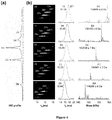
- Figure 4b presents the IMxMS contour plots of each individual HIC-detected species.
- TW CCS N2 values obtained by HICxSEC-IMxMS were obtained by off-line injection of manually desalted BV (Table 1), demonstrating that the 2D-HICxSEC configuration does not affect BV global conformation.
- HIC and SEC chromatographic and SEC
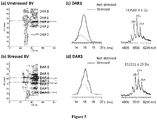
- mass spectrometric methods To highlight the possibilities and relevance of the apparatus and the method of the present invention involving chromatographic (HIC and SEC) and mass spectrometric methods, intact BV and temperature stressed BV were compared. A comparison of the HIC and SEC 2D plots of stressed and non-stressed BV is shown in Figures 5a and 5b , respectively.
- the 2D-HICxSEC contour plots of stressed BV clearly highlight increase in peak intensities of DAR0 species along with species eluted at retention times which are intermediate between DAR0 and DAR2, and between DAR2 and DAR4, respectively.
- the intensities of the DAR6 and DAR8 peaks significantly decrease, while the DAR0 peak increases (Table 1 and comparison of Figures 5a and 5b ) .
- the direct on-line coupling of non-denaturing MS to HICxSEC separation allowed first to accurately measure the molecular weights of all the compounds and to unambiguous identify DAR1 and DAR3 odd DARs as species formed upon thermal stress ( Figures 5c and 5d ).
Landscapes
- Physics & Mathematics (AREA)
- Health & Medical Sciences (AREA)
- Life Sciences & Earth Sciences (AREA)
- Chemical & Material Sciences (AREA)
- Analytical Chemistry (AREA)
- Biochemistry (AREA)
- General Health & Medical Sciences (AREA)
- General Physics & Mathematics (AREA)
- Immunology (AREA)
- Pathology (AREA)
- Other Investigation Or Analysis Of Materials By Electrical Means (AREA)
Abstract
Description
- The present invention relates to the characterization of proteins such as antibody drug conjugates, in particular to an apparatus and a method for characterization of proteins.
- Monoclonal antibodies and their related compounds make up the largest class in human therapeutics to treat various diseases. The success of monoclonal antibodies stems from their high specificity and affinity, long circulating half-lives, ability to induce immune cell effector response, and structural versatility. However, canonical monoclonal antibodies often show a limited efficacy or face resistance, so several families of either armed antibodies, called Antibody Drug Conjugates (ADCs), or bispecific monoclonal antibodies have been developed to overcome these limitations. ADCs are tripartite molecules consisting of a monoclonal antibody onto which highly cytotoxic small molecules are conjugated by cleavable or non-cleavable linkers. They show better efficiency than canonical unconjugated monoclonal antibodies, due to the synergic effect of monoclonal antibody specificity for its target and the efficacy of the highly cytotoxic drug.
- Many of these new monoclonal antibody formats, including ADCs, have emerged from a better understanding of structure-function relationships, which have mainly been achieved thanks to state-of-the art mass spectrometry and chromatographic methods. Indeed, ADCs are more complex than monoclonal antibodies, because of the increased inherent micro-variability imparted by the presence of the heterogeneous drug conjugates. Several recent papers have extensively reviewed the advantages, drawbacks and complementarity of such approaches. The analytical characterization of monoclonal antibody-related compounds usually follows a multilevel workflow, where biopharmaceuticals are studied at the intact protein level (top level), after enzymatic digestion into smaller monoclonal antibody sub-domains (middle-up level), or after proteolytic digestion to generate peptides (bottom-up level). To reduce the micro-heterogeneity of the monoclonal antibodies, middle- and bottom-up levels require preliminary treatment that can affect the quality of the final product (increased deamidation, oxidation, generation of aggregates, etc.). Top level methods performed on intact monoclonal antibodies require less handling and are thus of utmost interest, even though still in their infancy.
- The development and optimization of ADCs rely on improving their analytical and bioanalytical characterization by assessing several critical quality attributes, namely the distribution and position of the cytotoxic drug, the amount of naked antibody, the average Drug to Antibody Ratio (DAR) and the residual drug-linker and related product proportions. The average DAR represents the amount of payloads that can be delivered to the tumor cell and thus is directly linked to the toxicity and the safety of the ADC. The distribution of drug-loads (i.e. the fraction of antibodies containing zero, one, two, three, n drugs) is also an important characteristic, since the different isoforms may have different toxicological and pharmacological properties.
- As conjugation technologies may result in a highly heterogeneous ADC product, with respect to the loading of cytotoxic drug species, their position on the monoclonal antibody and the cleavability of the linker, there is no generic method allowing a complete ADC analytical characterization. The classical denaturing Reverse Phase Liquid Chromatography (RPLC) - Mass Spectrometry methods fail for characterization of cysteine ADCs, due to the harsh mobile phase conditions employed (acidic pH, high proportion of organic solvent, elevated mobile phase temperature), which disrupt the noncovalent associations between ADC sub-domains. The benchmark methods to characterize drug-load distribution and assess average DAR on ADCs are based on non-denaturing chromatography, and particularly Hydrophobic Interaction Chromatography (HIC) for cysteine ADCs or Ion Exchange Chromatography (IEX) for lysine ADCs. However, HIC or IEX, that would both separate individual species and preserve the structure of the ADC, are not directly connectable to online MS detection.
- Up to now, two unsatisfactory approaches were suggested to link HIC with non-denaturing MS. The first approach consists in a time consuming off-line coupling performed by peaks collection, manual desalting of the fractions and subsequent non-denaturing MS or Ion-Mobility spectrometry-Mass Spectrometry (IM-MS) analysis. The second approach was recently proposed and is based on the online combination of HIC and, using either fully comprehensive or heart-cutting 2D-Liquid Chromatography (2D-LC) strategies. The online addition of a RPLC step allows i) the elimination of the non-volatile salts contained in the HIC mobile phase and ii) the improvement of the resolving power due to the additional chromatographic dimension. However, the cysteine linked ADC are denaturated by the harsh RPLC conditions, leading to an indirect and more difficult characterization of the complex ADC.
- A robust, highly powerful, non-time consuming and non-denaturing analytical methods to answer ADCs requirements is thus required.
- The Applicant surprisingly developed an apparatus meeting these requirements. This apparatus is based on the direct connection between non-denaturing chromatography and non-denaturing MS.
- According to a first aspect, the invention is thus an apparatus for in-depth characterization of molecules comprising:
- a first housing having an inlet and an outlet and adapted to receive a separative chromatography column,
- a second housing having an inlet and an outlet and adapted to receive a desalting chromatography column, and
- a mass spectrometer having an inlet and an outlet,
- Another aspect of the invention is a method for in-depth characterization of molecules comprising the following steps:
- a) providing a solution of molecules;
- b) loading the solution onto a separative chromatography column;
- c) recovering a flow-through sample comprising separated molecules;
- d) loading the flow-through sample comprising separated molecules recovered during step c) onto a desalting chromatography column,
- e) recovering a desalted flow-through sample comprising separated molecules;
- f) loading the desalted flow-through sample comprising separated molecules recovered during step e) onto a mass spectrometer,
- g) performing a non-denaturing mass spectrometry analysis,
- According to an aspect of the invention, the method of the invention is carried out with the apparatus of the invention.
- Further objectives, features and advantages of the present invention will become apparent upon reading the following description with reference to the illustrative and non-limiting drawings, amongst which:
-
Figure 1 is an illustration of the apparatus of the present invention. -
Figure 2 represents the effect of injection volume on the SEC separation of brentuximab vedotin and ammonium acetate. -
Figure 3 is a flowchart of the HICxSEC-IMxMS analysis of brentuximab vedotin performed with the apparatus of the present invention. -
Figure 4 is the online HICxSEC-IMxMS analysis of brentuximab vedotin. -
Figure 5 is the 2D-HICxSEC contour plots of brentuximab vedotin with and without thermal stress and corresponding IM-MS structural characterization of odd DAR species of stressed and not stressed brentuximab vedotin. - According to a first aspect, the invention is an apparatus for in-depth characterization of molecules comprising:
- a
first housing 1 having an inlet and an outlet and adapted to receive a separative chromatography column, - a
second housing 2 having an inlet and an outlet and adapted to receive a desalting chromatography column, and - a
mass spectrometer 3 having an inlet and an outlet, - In the present application "molecules" refers to non-aggregated molecules or aggregates of molecules. Typically the molecules may be large molecules such as proteins, in particular monoclonal antibody-related compounds like Antibody Drug Conjugates (ADCs), bispecific antibodies, antibody-dual-drug conjugates and protein complexes (protein/protein, protein/DNA, protein/RNA).
- In the present application "separative chromatography column" refers to a column of chromatography loaded with a stationary phase adapted to carry out an on-line chromatographic method under non-denaturing conditions to separate totally or partially molecules of a solution from each other.
- In the present application "desalting chromatography column" refers to a column of chromatography adapted to carry out a chromatographic method under non-denaturing condition to decrease the concentration of salt in a solution or change the nature of the salt of a solution.
- Typically the separative chromatography column may be an hydrophobic interaction chromatography column (hereinafter referred to as HIC column) or a size exclusion chromatography column (hereinafter referred to as SEC column) or an ion exchange chromatography column (hereinafter referred to as IEX column).
- Typically the desalting chromatography column may be a SEC column.
- In the present application "HIC column" refers to a column of chromatography adapted to carry out a Hydrophobic Interaction Chromatography (hereinafter referred to as HIC), i.e. a chromatographic method in which molecules are separated on the basis of their hydrophobicity. In particular the stationary phase of the HIC column is substituted with a limited number of hydrophobic groups and the separation of the molecules is based on the interaction between these hydrophobic groups and said molecules.
- Advantageously HIC enables the separation of ADCs on the basis of the increased hydrophobicity imparted to said ADCs by the increased number of drug conjugates while preserving the structure of said ADCs. HIC thus enables the determination of the average Drug to Antibody Ratio (average DAR) of the ADCs and the relative proportion of the different drug loads.
- In the present application "SEC column" refers to a column of chromatography for carrying out a Size Exclusion Chromatography (hereinafter referred to as SEC), i.e. a chromatographic method in which molecules are separated by their size and not by another separation parameter such as molecular weight or polarity. In particular the pores of the stationary phase of the SEC column may trap the molecules based on their size thereby separating said molecules.
- Advantageously SEC preserves the structure of the proteins, in particular ADCs. According to the invention, SEC may be used for fast separation of molecules from salts thanks to differences in hydrodynamic volumes.
- In the present application "mass spectrometer" refers to an apparatus adapted for carrying out mass spectrometry (hereinafter referred to as MS) under non-denaturing conditions, i.e. an analytical method used to measure the mass to charge ratio of charged molecules.
- According to the invention, thanks to accurate mass measurement, non-denaturing MS may be used for providing a wealth of information on the biochemical and biophysical properties of proteins, in particular ADCs, therapeutic proteins, membrane proteins and protein complexes such as protein/protein, protein/DNA, protein/RNA, protein/small molecule,. More particularly, non-denaturing MS may be used for determining interacting stoichiometries and elucidating higher order structure of proteins, in particular ADCs, therapeutic proteins, membrane proteins and protein complexes such as protein/protein, protein/DNA, protein/RNA, protein/small molecule.
- Typically MS may be electrospray ionization-mass spectrometry (hereinafter referred to as ESI-MS), or electrospray ionization-ion-mobility spectrometry-mass spectrometry (hereinafter referred to as IM-MS).
- In the present application "ESI-MS" refers to a method wherein mass spectrometry is coupled to electrospray ionization. According to this method the
mass spectrometer 3 comprises an ESI source applying a high voltage to a liquid to create the electrospray. ESI is especially useful in producing ions from proteins, because it overcomes the propensity of these molecules to fragment when ionized. - In the present application "IM-MS" refers to an analytical method wherein gas phase ions are first separated on a millisecond timescale using ion-mobility spectrometry and wherein the components of said gas phase ions are identified using non-denaturing mass spectrometry analysis on a microsecond timescale. The IM-MS analysis is particularly adapted to the analysis of complex mixtures of molecules based on differing mobilities in an electric field. To carry out the IM-MS analysis, the
mass spectrometer 3 is coupled to an ion-mobility separator. - Typically IM-MS analysis may be applied to large molecules such as proteins, in particular ADCs, therapeutic proteins, membrane proteins and protein complexes such as protein/protein, protein/DNA, protein/RNA, protein/small molecule. Advantageously IM-MS analysis may be used to identify the proteins, in particular ADCs, therapeutic proteins, membrane proteins and protein complexes such protein/protein, protein/DNA, protein/RNA, protein/small molecule, separated by the HIC column, the IEX column or the SEC column of the
first housing 1 and the SEC column of thesecond housing 2. IM-MS analysis may also be carried out to determine the conformational homogeneity/heterogeneity of proteins, in particular ADCs, therapeutic proteins, membrane proteins and protein complexes such as protein/protein, protein/DNA, protein/RNA, protein/small molecule. - In the present application "under non-denaturing conditions" refers to conditions where proteins, (e.g., antibodies) do not lose their secondary, tertiary or quaternary structures and to conditions wherein protein complexes do not lose their interactions. Non-denaturing conditions differs from the denaturing conditions, said denaturing conditions include high temperatures causing thermal unfolding (e.g., 50°C or greater) or extreme pH (for example, below
pH 5 and above pH 8), and organic solvent. - Typically the molecules to be characterized by the apparatus of the present invention are first added to a solution, in particular an aqueous solution, to obtain a solution of molecules. This solution is then loaded onto the separative chromatography column of the
first housing 1 so as to separate the molecules and to recover a flow-through sample from the outlet of thefirst housing 1. - To promote the separation of the molecules by the stationary phase of the separative chromatography column, the solution typically comprises a separation salt such as non-volatile salt, a buffer salt or mixture thereof. The sample may thus comprise the separated molecules and the separation salt.
- Typically the non-volatile salt may be potassium thiocyanate, sodium chloride, potassium chloride, ammonium chloride, sodium sulfate, potassium sulfate and ammonium sulfate or mixture thereof, in particular the non-volatile salt may be sodium chloride or ammonium acetate or mixture thereof.
- Typically the buffer salt may be phosphate buffer, such as Na2HPO4 or Na2HPO4 and NaH2PO4.
- The separation salt is adapted to the separative chromatography column, however it may contaminate the
mass spectrometer 3. Therefore the outlet of thefirst housing 1 cannot be directly fluidly connected to the inlet of themass spectrometer 3. - Unexpectedly, the Applicant has found that the desalting chromatography column of the
second housing 2 between the separative chromatography column and themass spectrometer 3 to carry out an on-line chromatographic method advantageously prevents the contamination of themass spectrometer 3 by the separation salt. - According to the invention, the sample is loaded onto the desalting chromatography column so as to desalt the sample and to recover a desalted flow-through sample (hereinafter referred to as desalted sample) from the outlet of the
second housing 2. The desalted sample comprises the separated molecules and a mass spectrometer compatible salt. The desalted sample can then be loaded onto themass spectrometer 3 to characterize the molecules. - In the present application, "a mass spectrometer compatible salt" refers to a salt which is compatible for use with a mass spectrometer or with a concentration in the desalted sample so low that the desalted sample is compatible for use with a mass spectrometer in non-denaturing conditions.
- Typically a salt which is compatible for use with a mass spectrometer may be formic acid, acetic acid, trifluoroacetic acid.
- Typically the concentration of salt in the desalted sample may be below 100mMol/l.
- The apparatus of the present invention enables an in-depth characterization of molecules without a slow, manual and thus non-reproducible desalting step between the separative chromatography column and the
mass spectrometer 3. Therefore a fast, automated and reproducible in-depth characterization of molecules can be performed by the apparatus of the present invention. - According to one embodiment, the apparatus of the present invention further comprises a
detector first housing 1 and/or at the outlet of thesecond housing 2. - In the present application "a detector" refers to a device adapted to the characterization of the separated molecules by the detection of chromatographic peak characteristic of each separated molecule. Typically the detector may be a wavelength UV detector, in particular a single wavelength UV detector, a diode array UV detector or fluorescence detector.
- If the separative chromatography column is a HIC column, then the
detector 10 at the outlet of thefirst housing 1 may be a wavelength UV detector, in particular a single wavelength UV detector, or a diode array UV detector. - The wavelength UV detector or diode array UV detector are adapted to detect the chromatographic peak characteristic of the separated molecules of the sample so as to determine the relative intensities of the drug load peaks in a quantitative manner and the average DAR of ADCs by HIC.
- If the separative chromatography column is a SEC column, then the
detector 10 at the outlet of thefirst housing 1 may be a wavelength UV detector, in particular a single wavelength UV detector or a diode array UV detector. - According to one embodiment, the
detector 20 at the outlet of thesecond housing 2 is a wavelength UV detector, in particular a single wavelength UV detector, or a diode array UV detector. - The UV detector is adapted to detect the chromatographic peak characteristic of the molecular weight of the separated molecules, the separation salt and the mass spectrometer compatible salt. The detection of the chromatographic peaks by the wavelength UV detector or a diode array UV detector enables the determination of the mass of the separated molecules by SEC.
- Advantageously, the apparatus of the present invention allows recovering the separated molecules from the outlet of the
first housing 1 according to a specific sequence, and loading them onto the desalting chromatography column, recovering them from the outlet of thesecond housing 2, and loading them onto themass spectrometer 3 according to the same specific sequence. - Therefore the characterizations of the separated molecules performed by the
detector 10 and/or thedetector 20, and themass spectrometer 3 can be easily and precisely correlated. - Advantageously the apparatus of the present invention is particularly adapted to the non-denaturing in-depth characterization of molecules such as proteins, in particular ADCs, monoclonal antibodies, therapeutic proteins, protein complexes (protein/protein, protein/DNA, protein/RNA, protein/small molecule).
- According to the embodiment wherein the separative chromatography column is a HIC column, then the apparatus of the present invention is advantageously adapted to determine the average DAR of ADCs by HIC and correlate said DAR to the mass of ADCs elucidated by MS or to the conformational homogeneity of ADCs determined by IM-MS analysis.
- According to the embodiment wherein the separative chromatography column is a SEC column, then the apparatus of the present invention is advantageously adapted to determine the molecular weight of the ADCs and its aggregates by SEC and correlate said molecular weight to the primary structure of ADCs elucidated by MS or to the conformational homogeneity of ADCs determined by IM-MS analysis.
- Typically the stationary phase of the HIC column may be silica particles functionalized with short alkyl amide groups, Fractogel EMD propyl (Merck), Fractrogel EMD phenyl (Merck Millipore), Butyl-S sepharose (GE Healthcare), Octyl Sepharose (GE Healthcare), Capto Octyl (GE Healthcare), Capto Butyl (GE Healthcare), Capto Phenyl ImpRes (GE Healthcare), Capto Butyl ImpRes (GE Healthcare), Toyopearl PPG-600M (Tosoh Bioscience), Toyopearl Hexyl-650 (Tosoh Bioscience), Toyopearl Butyl-650 (Tosoh Bioscience), Toyopearl Phenyl-650 (Tosoh Bioscience), Toyopearl Ether-650 (Tosoh Bioscience), Macroprep t-Butyl (Bio-Rad), Macroprep phenyl (Bio-Rad), Cellufine Butyl (JNC Corporation), Cellufine Phenyl (JNC Corporation) or Poros HP2 (Applied Biosystems), Mabpac HIC-10 (Thermo), Propac HIC-10 (Thermo), Mabpac HIC-20 (Thermo) Mabpac HIC-Butyl (Thermo), Protein-pak Hi Res HIC (Waters), TSKgel Ether-5PW (Tosoh), in particular the stationary phase of the HIC column may be silica particles functionalized with short alkyl amide groups.
- If the stationary phase of the HIC column is silica particles functionalized with alkyl amide groups, then the size of the silica particles is from 1 µm to 20 µm, in particular from 2.5 µm to 10 µm, more particularly is 5 µm. Moreover, the pore size of the silica particles is from 10 nm to 1000 nm, in particular from 50 nm to 500 nm, more particularly is 100 nm.
- According to one embodiment, the length of the HIC column is from 5 mm to 500 mm, in particular from 50 mm to 300 mm, more particularly is 100 mm.
- According to one embodiment, the diameter of the HIC column is from 1 mm to 10 mm, in particular from 2.5 mm to 7.5 mm, more particularly is from 4.5 mm to 5 mm.
- According to one embodiment, the maximum inlet pressure of the HIC column is from 200 bar to 1000 bar, in particular from 300 bar to 750 bar, more particularly is from 400 bar to 575 bar.
- According to one embodiment, the volume of the HIC column is from 50 µl to 5000 µl, in particular from 200 µl to 2000 µl, more particularly from 500 µl to 1500 µl.
- According to a specific embodiment, the HIC column is the MAbPac HIC-10 LC Column (ThermoFisher).
- Typically, the stationary phase of the SEC column is selected from polymer coated silica particles, crosslinked polystyrene, acrylic, hydroxylated acrylic, acrylic, agarose, or a polyhydroxyethyl- aspartamide backbone, in particular the stationary phase of the SEC column is polymer coated silica particles.
- If the stationary phase of the SEC column is polymer coated silica particles, then the size of the silica particles is from 1 µm to 10 µm, in particular from 1.5 µm to 5 µm, more particularly from 2 µm to 3 µm. Moreover, the pore size of the silica particles is from 10 nm to 1000 nm, in particular from 50 nm to 500 nm, more particularly is from 100 nm to 350 nm.
- According to one embodiment, the volume of the SEC column is from 30 µl to 3000 µl, in particular from 100 µl to 1000 µl, more particularly from 200 µl to 700 µl.
- According to one embodiment, the length of the SEC column is from 5 mm to 500 mm, in particular from 10 mm to 250 mm, more particularly is 50 mm to 150 mm.
- According to one embodiment, the diameter of the SEC column is from 1 mm to 10 mm, in particular from 2.5 mm to 7.5 mm, more particularly is from 4 mm to 5 mm.
- According to one embodiment, the maximum inlet pressure of the SEC column is from 50 bar to 1000 bar, in particular from 300 bar to 750 bar, more particularly is from 350 bar to 425 bar.
- Advantageously, employing the SEC column, having a length in the above mentioned ranges, at a flow rate corresponding to the maximum recommended inlet pressure enable a very fast separation in the SEC column.
- According to one specific embodiment, the SEC column is the AdvanceBio SEC (Agilent Technologies).
- According to one embodiment, the apparatus of the present invention further comprises a
first valve 6 and asecond valve 7, saidfirst valve 6 comprising an inlet, a first outlet and a second outlet, and saidsecond valve 7 comprising a first inlet, a second inlet and an outlet, wherein: - the inlet of the
first valve 6 is fluidly connected to the outlet of thefirst housing 1, - the outlet of the
second valve 7 is fluidly connected to the inlet of thesecond housing 2, - the first outlet of the
first valve 6 is fluidly connected to the first inlet of thesecond valve 7, and - the second outlet of the
first valve 6 is fluidly connected to the second inlet of thesecond valve 7. - In the present application, "valve" refers to a device with a moveable mean that opens and closes a passageway in order to allow, prevent or control the flow of a fluid. In particular the valve may be a two-position switching valve.
- According to one embodiment, the
first valve 6 and thesecond valve 7 may be a multi-way valve, in particular a multi-way valve comprising 2 to 10 ways, more particularly a multi-way valve comprising 3, 4, 5, 6, 7, 8 and 9 ways, even more particularly a 6-ways valve. The skilled person will know how to determine the number of ways of thefirst valve 6 and thesecond valve 7. - According to one embodiment, the apparatus of the present invention further comprises at least two flow-regulating
lines lines first valve 6 to the inlets of thesecond valve 7. - According to one specific embodiment, the number of flow-regulating
lines lines - According to one embodiment, the volume of each flow-regulating
line line - Advantageously the
first valve 6, thesecond valve 7 and the flow-regulatinglines first housing 1 are kept so as to regulate the loading of said fractions onto the desalting chromatography column. - For example, a first fraction of the sample is recovered from the
first housing 1 and diverted by thefirst valve 6 toward one flow-regulatingline 8 to fill the volume of said flow-regulatingline 8. When the volume of this flow-regulatingline 8 is full or after a predetermined time, this first fraction of the sample is diverted by thesecond valve 7 toward the desalting chromatography column, and a second fraction of the sample is diverted by thefirst valve 6 toward another flow-regulatingline 9 to fill the volume of said another flow-regulatingline 9. When the volume of this another flow-regulatingline 9 is full or after a predetermined time, the second fraction of the sample is diverted by thesecond valve 7 toward the desalting chromatography column. This sequence may be repeated as long as the sample is recovered from the outlet of thefirst housing 1. - Advantageously the flow-regulating zone avoids the mixing of the each fractions sample into the desalting chromatography column, thereby avoiding the mixing of the separated molecules comprised in said fractions into the desalting chromatography column.
- The flow-regulating zone thus enables to recover the separated molecules from the outlet of the
first housing 1 according to a specific sequence, and then to load them onto the desalting chromatography column, to recover them from the outlet of thesecond housing 2, and to load them onto themass spectrometer 3 according to the same specific sequence. - Advantageously, the flow-regulating zone enables the easily and precise correlation between the characterizations of the separated molecules performed by the
detector 10 and/or thedetector 20, and themass spectrometer 3. - The flow-regulating zone also facilitates the desalting of each fractions of sample in the desalting chromatography column.
- According to one specific embodiment, one outlet of the
second valve 7 is fluidly connected to a waste device 11 adapted to recover the separation salt. - According to a very specific embodiment, the
first valve 6 is a 6-ways valve and comprises a first and a second inlets and a first and a second outlets, thesecond valve 7 is a 6-ways valve and comprises a first and a second inlets and a first and a second outlets, and - the first inlet of the
first valve 6 is fluidly connected to the outlet of thefirst housing 1, - a first flow-regulating
line 8 fluidly connects the first outlet of thefirst valve 6 to the first inlet of thesecond valve 7, - the first outlet of the
second valve 7 is fluidly connected to the waste device 11 adapted to recover the separation salt, - a second flow-regulating
line 9 fluidly connects the second outlet of thesecond valve 7 to the second inlet of thefirst valve 6, and - the second outlet of the
first valve 6 is fluidly connected to the inlet of thesecond housing 2. - According to a very specific embodiment, the apparatus of the present invention further comprises a multi-way valve, such as multi-way valve comprising 8, 10 or 12 ways, said multi-way valve comprising a first inlet, a second inlet and a third inlet, a first outlet, a second outlet and a third outlet, wherein:
- the first inlet is fluidly connected to the outlet of the
first housing 1, - the first outlet is fluidly connected to the inlet of the
second housing 2, - the second inlet is fluidly connected to the second outlet, and
- the third inlet is fluidly connected to the third outlet.
- Typically the second inlet is fluidly connected to the second outlet through a first loop line, and the third inlet is fluidly connected to the third outlet through a second loop line.
- Typically the volume of each loop line is from 10 µl to 100 µl, in particular from 50 µl to 500 µl, more particularly from 150 µl to 250 µl. The skilled person will know how to determine the volume of each loop line.
- According to one embodiment, the apparatus of the present invention further comprises a
third valve 12 comprising one or more inlets and two or more outlets, wherein one inlet of thethird valve 12 is fluidly connected to the outlet of thesecond housing 2 and one outlet of thethird valve 12 is fluidly connected to the inlet of themass spectrometer 3. One outlet of thethird valve 12 may also be fluidly connected to a recoveringdevice 13 adapted to recover the separation salt. - According to one embodiment, the
third valve 12 is a multi-way valve, in particular a multi-way valve comprising 2 to 10 ways, more particularly 3, 4, 5, 6, 7, 8 and 9 ways. - Advantageously the
third valve 12 may only divert towards themass spectrometer 3 the separated molecules or the separated aggregates thereby preventing the contamination of themass spectrometer 3 with the separation salt. - To insure a flow of fluid in the separative chromatography column and the desalting chromatography column, the apparatus of the present invention may comprise at least one pump and a programmable controller electrically connected to the at least one pump and adapted to control the at least one pump.
- According to one embodiment, the at least one pump is a
first pump 4 fluidly connected to thefirst housing 1 and/or asecond pump 5 fluidly connected to thesecond housing 2. - According to this embodiment, the
first pump 4 is fluidly connected to the inlet or the outlet of thefirst housing 1 and is adapted to insure a flow of a fluid in the separative chromatography column. - In the present application "fluid" refers to a liquid mobile phase such as the solution comprising the molecules to be characterized, the flow-through sample or an eluent. Typically the eluent may be a pure solvent or a mixture of solvents, it may comprise salt such as the buffer salt or the mass spectrometer compatible salt.
- According to this embodiment, the
second pump 5 is fluidly connected to the inlet or the outlet of thesecond housing 2 and is adapted to insure a flow of fluid in the desalting chromatography column. - According to a specific embodiment, the
second pump 5 is fluidly connected to one inlet of thesecond valve 7 so that thesecond pump 5 is indirectly fluidly connected to the inlet of thesecond housing 2. - The programmable controller may control the pump flow of the at least one pump.
- The programmable controller may also be electrically connected to the
first valve 6, thesecond valve 7, the multi-ways valve and/or thethird valve 12 and adapted to control valve switching of saidfirst valve 6, saidsecond valve 7, the multi-ways valve and/or saidthird valve 12 to insure a flow of fluid in the separative chromatography column and the desalting chromatography column, to regulate the flow of fluid in the flow-regulatinglines mass spectrometer 3. - According to this specific embodiment, the
detector 20 may be adapted to emit a signal to the programmable controller when the separation is detected so that the programmable controller may control thethird valve 12 to load the separated molecules onto themass spectrometer 3 and to divert the separation salt to the recoveringdevice 13. Advantageously, thedetector 20 may thus avoid the contamination of themass spectrometer 3 by the separation salt, in particular themass spectrometer 3 comprising an ESI source. - Another aspect of the invention is a method for in-depth characterization of molecules comprising the following steps:
- a) providing a solution of molecules;
- b) loading the solution onto a separative chromatography column;
- c) recovering a flow-through sample comprising separated molecules;
- d) loading the flow-through sample comprising separated molecules recovered during step c) onto a desalting chromatography column,
- e) recovering a desalted flow-through sample comprising separated molecules;
- f) loading the desalted flow-through sample comprising separated molecules recovered during step e) onto a mass spectrometer,
- g) performing a non-denaturing mass spectrometry analysis,
- The molecules, the separative chromatography column, the desalting chromatography column, the flow-through sample, the desalted flow-through sample and the mass spectrometer are as defined or described in the section related to the apparatus.
- Typically the solution of molecules provided at step a) may be an aqueous solution obtained by adding separation salt to an aqueous solution comprising molecules to be separated from each other and to be characterized.
- The separation salt, the non-volatile salt and the buffer salt are as defined or described in the section related to the apparatus.
- Typically the concentration of non-volatile salt in the solution of molecules is 0.01 mol/l to 10 mol/l, in particular 0.05 mol/l to 5 mol/l, more particularly is 2.5 mol/l.
- Typically a solution comprising the buffer salt (hereinafter referred to as buffer solution) is added to the solution of molecules.
- Typically the buffer solution may be buffered to a pH of 4 to 10, more preferably of 5 to 9, most preferably of 6.5 to 7.5.
- Typically the pH of the buffer solution may be adjusted with phosphoric acid, sodium hydroxide solution, acetic acid or liquid ammonia.
- The concentration of buffer salt in the solution of molecules depends on the separative chromatography column used.
- If the separative chromatography column is a SEC column, the concentration of SEC buffer in the solution of molecules is 1 mmol/l to 500 mmol/l, in particular 50 mmol/l to 250 mmol/l, more particularly 90 mmol/l to 110 mmol/l.
- If the separative chromatography column is a HIC column, the concentration of buffer in the solution of molecules may 10 mmol/l to 1000 mmol/l, in particular 50 mmol/l to 500 mmol/l, more particularly is 100 mmol/l.
- If the separative chromatography colums is a IEX column, the concentration of buffer in the solution of molecules may 1 mmol/l to 1000 mmol/l, in particular 5 mmol/l to 50 mmol/l, more particularly is 10 mmol/l.
- According to a very specific embodiment, the solution of molecules comprises 2.5 mol/l of ammonium acetate and 0.1 mol/l of phosphate buffer (Na2HPO4) buffered at pH of 7 (adjusted with phosphoric acid).
- Step b) of the method of the present invention may be carried out by the separative chromatography column of the apparatus of the present invention.
- The conditions of step b) depend on the separative chromatography column.
- According to the embodiment wherein the separative chromatography column is a HIC column, then the volume of solution of molecules loaded onto the HIC column during step b) is 10 µl to 100 µl, in particular 20 µl to 75 µl, more particularly is 40 µl.
- According to this embodiment, the flow rate is 10 µl/min to 500 µl/min, in particular 50 µl/min to 250 µl/min, more particularly is 100 µl/min.
- According to this embodiment, the temperature of the HIC column is 10°C to 50°C, in particular 20°C to 50°C, more particularly 25°C to 35°C.
- According to this embodiment, then an eluent (hereinafter referred to as the "separative eluent") may also be loaded onto the HIC column.
- Typically, the separative eluent may comprise a HIC buffer salt selected from phosphate buffer, such as Na2HPO4 or Na2HPO4 and NaH2PO4
- Typically the concentration of HIC buffer in the separative eluent may be 0.01 mol/l to 10 mol/l, in particular 0.05 mol/l to 1 mol/l, more particularly is 0.1 mol/l.
- The HIC buffer that may be used in the separative eluent in accordance may be buffered to a pH of 4 to 10, more preferably of 5 to 9, most preferably of 6.5 to about 7.5.
- Typically the pH of the HIC buffer that may be used in the separative eluent is adjusted with phosphoric acid, sodium hydroxide solution, potassium hydroxide, ammonia or mixture thereof.
- According to a specific embodiment, the separative eluent comprises 0.1 mol/l of phosphate buffer (Na2HPO4 and NaH2PO4) buffered at pH of 7 (adjusted with sodium hydroxide solution).
- Typically the ratio RV between the volume of solution of molecules and the volume of separative eluent loaded onto the HIC column during step b) may be constant or may vary, preferably the ratio may vary.
- Typically the ratio RV varies according to the following sequence:
- for 10 to 60 minutes, in particular for 20 to 50 minutes, more particularly for 33 to 38 minutes, even more particularly for 36 minutes, 100% v/v to 10% v/v of the mixture and 0% v/v to 90% v/v of the separative eluent are loaded,
- for 10 to 60 minutes, in particular for 25 to 30 minutes, more particularly for 20 to 25 minutes, even more particularly for 21 minutes, 10% v/v to 0% v/v of the mixture and 90% v/v to 100% v/v of the separative eluent are loaded, and
- for 1 to 60 minutes, in particular for 3 to 30 minutes, more particularly for 5 to 15 minutes, even more particularly for 8 minutes, an isocratic step at 100% v/v of the separative eluent is loaded.
- According to this specific embodiment, the flow rate is 10 µl/min to 1000 µl/min, in particular 50 µl/min to 500 µl/min, more particularly is 100 µl/min to 250 µl/min.
- According to this specific embodiment, the temperature of the SEC column is 10°C to 50°C, in particular 20°C to 40°C, more particularly 20°C to 30°C.
- Step d) of the method of the present invention may be carried out by the desalting chromatography column of the apparatus of the present invention.
- According to an embodiment, step d) is carried out by also loading an eluent (hereinafter referred to as the "desalting eluent") onto the desalting chromatography column.
- Typically, the desalting eluent may comprise a salt selected from potassium thiocyanate, sodium chloride, potassium chloride, ammonium chloride, sodium sulfate, potassium sulfate and ammonium sulfate, in particular the non-volatile salt is sodium chloride or ammonium acetate, more particularly the salt is ammonium acetate.
- Typically the concentration of salt in the desalting eluent may be 10 mmol/l to 500 mmol/l, in particular 50 mmol/l to 250° mmol/l, more particularly is 100 mmol/l.
- According to one specific embodiment, step d) is carried out in isocratic mode with the third solution, in particular with the desalting eluent comprising 100 mmol/l of ammonium acetate.
- During step d) the flow rate of the desalting eluent and sample loaded onto the desalting chromatography column may be 1 µl/min to 1000 µl/min, in particular 250 µl/min to 900 µl/min, more particularly is 650 µl/min to 750 µl/min.
- During step d) the temperature of the desalting chromatography column is 10°C to 150°C, in particular 15°C to 50°C, more particularly 20°C to 30°C.
- The desalted sample recovered during step e) comprises the separated molecules and a mass spectrometer compatible salt.
- Steps f) and g) of the method of the present invention may be carried out by the
mass spectrometer 3 of the apparatus of the present invention. - Advantageously the method of the invention is particularly suited to the analysis of molecules such as proteins, in particular ADCs, monoclonal antibodies, therapeutic proteins, protein complexes such as protein/protein, protein/DNA, protein/RNA, protein/small molecule. Step g) of the method of the invention may then be used for elucidating the mass of proteins, in particular ADCs, monoclonal antibodies, therapeutic proteins and protein complexes such as protein/protein, protein/DNA, protein/RNA, protein/small molecule.
- According to one embodiment, the mass spectrometer of steps f) and g) is coupled to an ion-mobility separator and an ion-mobility spectrometry is also performed during step g).
- Advantageously, if the molecules to be characterized by the method of the present invention are proteins, in particular ADCs, the ion-mobility spectrometry performed during step g) enables the determination of the conformational homogeneity of proteins.
- According to the embodiment wherein the separative chromatography column is a HIC column, the method of the present invention may further comprise, between steps c) and d), a step h1) of calculating the average DAR of ADCs in the sample recovered during step c).
- The step h1) may be carried out through the
detector 10 of the apparatus of the present invention, saiddetector 10 being a wavelength UV detector. - Since the separated molecules are recovered according to a specific sequence during step c) and are loaded during step d), recovered during step e) and loaded during step f) according to the same specific sequence, the method of the present invention may advantageously enable the easy and precise correlation between the mass or the conformational homogeneity of ADCs elucidated in step g) to the average DAR of ADCs determined in step h1) during a step h3).
- According to the embodiment wherein the separative chromatography column is a SEC column, the method of the invention may further comprise, between steps c) and d), a step h2) of determining the molecular weight of the molecules in the sample recovered during step c).
- This step h2) may be carried out through the
detector 10 of the apparatus of the present invention, saiddetector 10 being a diode array detector. - Since the separated molecules are recovered according to a specific sequence during step c) and are loaded during step d), recovered during step e) and loaded during step f) according to the same specific sequence, the method of the present invention may advantageously enable the correlation between the mass of the molecules measured in step g) to the molecular weight of the molecules determined in step h2) during a step h3).
- If the molecules to separate are proteins, in particular ADCs, the method of the present invention may enable the correlation between the primary structure or the conformational homogeneity of proteins elucidated in step g) to the molecular weight of the proteins determined in step h2).
- The method of the present invention may further comprise a flow-regulating step i) between step c), h1) or h2) and step d).
- This step i) may be carried out by the
first valve 6, thesecond valve 7 and the flow-regulatinglines - During step i), a first fraction of the sample recovered during step c) is diverted by the
first valve 6 toward one flow-regulatingline 8 to fill the volume of said flow-regulatingline 8. When the volume of this flow-regulatingline 8 is full or after a predetermined time, the first fraction of the sample is diverted by thesecond valve 7 toward the desalting chromatography column of step d), and a second fraction of the sample is diverted by thefirst valve 6 toward another flow-regulatingline 9 to fill the volume of said another flow-regulatingline 9. When the volume of this another flow-regulatingline 9 is full or after a predetermined time, the second fraction of the sample is diverted by thesecond valve 7 toward the desalting chromatography column of step d). Step i) may be repeated as long as the sample is recovered during step c). - During step i), the loading of fractions of the sample onto the desalting chromatography column during step d) is advantageously regulated and thus the mixing of the each fractions of the sample into the desalting chromatography column during step e) is avoided, thereby avoiding also the mixing of the separated molecules comprised in said fractions into said desalting chromatography column during step e).
- Moreover step i) allows recovering the separated molecules according to a specific sequence during step c) and then loading them during step d), recovering them during step e) and loading them during step f) according to the same specific sequence. Advantageously, step i) allows an easy and precise correlation between the results from step h1) or step h2) with the results from step g).
- In particular for the study of ADCs, the primary structure or the conformational homogeneity of ADCs elucidated during step g) may be correlated with precision to the average DAR of ADCs determined during step h1).
- According to one embodiment, the fractions of the flow-through sample are diverted from the flow-regulating
lines second valve 7 toward the desalting chromatography column to be loaded onto said desalting chromatography column during step d) after a predetermined time. - According to one specific embodiment, the predetermined time is from 10 seconds to 10 minutes, in particular from 30 seconds to 5 minutes, more particularly from 1 minute to 2 minutes.
- The method of the present invention may further comprise, between step e) and step f), a step j) of detecting the chromatographic peaks characteristic of the molecular weight of the separated molecules and the separation salt recovered after step e), and determining the molecular weight of the molecules in the desalted sample recovered during step e).
- This step j) may be carried out through the
detector 20 of the apparatus of the present invention, saiddetector 20 being a second diode array detector. - Step j) may thus enable the detection of the separation between the separated molecules and the separation salt thereby insuring that only the separated molecules are loaded onto the mass spectrometer during step f).
- The method of the present invention may further comprise an elimination step k) between steps e) or j) and step f).
- This step k) may be carried out by the
third valve 12 of the apparatus of the present invention. - During step k), the separated molecules are diverted towards the mass spectrometer of step f) while the separation salt are diverted to a dedicated recovering
device 13. - Step k) advantageously prevents the contamination of the mass spectrometer of step f) with the separation salt.
- According to one embodiment, step k) is triggered by step j). Therefore steps j) and k) may thus advantageously protect the mass spectrometer of step f) by the separation salt.
- According to an aspect of the invention, the method of the invention is carried out with the apparatus of the invention.
- Brentuximab vedotin (BV), the reference cysteine linked ADC, was studied on the apparatus of the present invention illustrated on
Figure 1 . - All chemicals were purchased from Sigma-Aldrich : ammonium acetate (A 1542), cesium iodide (21004), phosphoric acid (345245), 2-propanol (I9516), sodium chloride (S7653), sodium phosphate monobasic (S8282), sodium phosphate dibasic (S7907).
- All the aqueous solutions were prepared using an ultra-pure water system (Sartorius, Göttingen, Germany).
- The brentuximab vedotin (BV) was purchased from Takeda.
- The apparatus of the present invention consists in a combination of H-Class liquid chromatography system comprising a
first housing 1 adapted to receive a HIC column and I-Class liquid chromatography system comprising asecond housing 2 adapted to receive a SEC column. The H-Class liquid chromatography system is fluidly connected to the I-Class liquid chromatography system which is fluidly connected to a TWIMS-MS Synapt G2 HDMSmass spectrometer 3, thus equipped with an ion-mobility separator and an ESI source. The systems and themass spectrometer 3 are from Waters (Manchester, UK). - The apparatus includes a high-pressure quaternary
solvent delivery pump 4, an autosampler with a flow-through needle of 15 µL equipped with an extension loop of 50 µL (not represented). - The apparatus also includes a high-pressure binary
solvent delivery pump 5, a column manager composed of two independent column ovens (not represented), two 6-port high pressure two-position valves lines - A
wavelength UV detector 10 and adiode array detector 20 both equipped with 500 nL flow-cell were used for the HIC and the SEC, respectively. The measured dwell volumes were 160 µL and 300 µL for the HIC and the SEC, respectively. It should be noted that the dwell volume of the SEC includes the volume of flow-regulatinglines mass spectrometer 3. - Data acquisition and instrument control were performed with MassLynx V4.1 software (Waters). HIC and SEC data from the
wavelength UV detector 10 and thediode array detector 20 were exported to Matlab V7.12.0635 to construct 2D-contour plots via house-made calculation routines. MS data processing was done with MaxEnt, Masslynx 4.1. - The HIC column received in the
first housing 1 was a MabPac HIC-10 (100 mm x 4.6 mm, 5 µm, 1000 Å) from Thermo Scientific, Cheshire, UK. - The SEC column employed in the
second housing 2 was an AdvanceBio SEC (50 mm x 4.6 mm, 2.7 µm, 300 Å) from Agilent Technologies, Wilmington, DE, USA. - For the HIC, the solution to be analyzed was composed of 2.5 mol/l of ammonium acetate and 0.1 mol/l phosphate buffer (Na2HPO4), pH 7.0 (adjusted with phosphoric acid), while the separative eluent was composed of 0.1 M phosphate buffer (Na2HPO4 and NaH2PO4) with pH 7.0 (adjusted with sodium hydroxide solution). The following gradient was employed in HIC: 0 to 90% of the separative eluent in 36 min, 90 to 100% the separative eluent in 21 min, followed by an isocratic step at 100% the separative eluent for 8 min before re-equilibration during 25 minutes, for a total analysis time of 90 min. The HIC experiment was conducted at a flow-rate of 100 µL/min. Column temperature, wavelength and data acquisition rate were set at 30°C, 280 nm and 10 Hz respectively. The injection volume was 40 µL.
- For the SEC, the separation was carried out in isocratic mode with a third aqueous solution composed of 100 mmol/l ammonium acetate at a flow-rate of 700 µL/min. Column temperature, wavelength and data acquisition rate were set at 25 °C, 210 / 280 nm and 40 Hz respectively. The analysis time of the SEC corresponds to the sampling time of the HIC, namely 1.5 min. Only 0.45 min (from 0.42 to 0.87 min) of the SEC was sent to the
mass spectrometer 3 thanks to the switchingvalve 12, to limit salt contamination of the ESI source. The flow-rate was divided by a factor 7 (i.e. 100 µL/min), prior to entering themass spectrometer 3, using a flow-splitter. - The
mass spectrometer 3 was operated in sensitive mode and positive polarity with a capillary voltage of 3.0 kV. To avoid disruption of weak non-covalent interactions, the sample cone and pressure in the interface region were set to 160 V and 6 mbar, respectively. Source and desolvation temperature were set to 100 and 450°C, respectively. Desolvation and cone gas flows were set at 750 and 60 L/Hr, respectively. Acquisitions were performed in the m/z range of 1000-10000 with a 1.5 s scan time. External calibration was performed using singly charged ions produced by a 2 g/L solution of cesium iodide in 2-propanol/water (50/50 v/v). - For IM-MS analysis, the sample cone voltage was set to 100 V and the backing pressure of the source was 6 mbar. The Ar flow rate was 5 mL/min and the trap collision energy was set at 4 V in the traveling-wave-based ion trap. Ions were thermalized with a constant He flow rate of 130 mL/min before IM separation. The height and the velocity of the periodic waveform in the pressurized ion mobility cell were 40 V and 923 m/s, respectively. N2 was used as drift gas (45 mL/min) providing a constant pressure of 2.75 mbar. Transfer collision energy was fixed to 2 V to extract the ions from the IM cell to the TOF analyzer. A calibration based on three different proteins (concanavaline A, pyruvate kinase and alcohol dehydrogenase) in non-denaturing conditions was used to perform collision cross section (CCS) calculation as previously described (refs. Salbo et al. Rapid Commun. Mass Spectrom. 2012, 26, 1181-1193, and Bush et al. Anal. Chem. 2010, 82, 9557-9565).
- Average DAR values were calculated from HIC data, by using
Equation 1 below in which k is the number of drug loads.
- For the analysis of BV, the separation carried out by the HIC column in 80 min is represented in the top panel of
Figure 3 . The successive fractions of the HIC sample of 1.5 min sent to SEC column are delimited from by vertical lines. The separation from the SEC column is represented in the middle panel used as fast desalting of each fraction of the HIC sample. Ion mobility and mass-spectrometry in non-denaturing conditions are represented in the low panel. - As illustrated on
Figure 4a , five main peaks were detected after the 1D-HIC separation of BV, which were all unambiguously identified by non-denaturing MS intact mass measurement (Figure 4b right panel and Table 1). All detected species could be identified as drug load species (D0 to D8), with a mass accuracy between 100-160 ppm, which is classical for intact ADC analysis in non-denaturing conditions on Q-TOF instruments and very good, considering the short acquisition time of only 0.45 min. Of note, even minor HIC species like D0 or D8 were clearly identified by non-denaturing MS. Therefore, average DAR determination is not anymore performed on the basis of species identification from HIC retention times, but on more accurate MS identification. For BV, an average DAR of 4.0 was unambiguously determined (Table 1), which is in agreement with expected values.
- Table 1 summarizes the experimental values for the different DARs of non-stressed and stressed ADC: molecular weights obtained from mass spectra, experimental collision cross section (TWCCSHe), HIC peak area and average DAR calculation. Abbreviations are defined as ND for not detected. Experimental masses of DARs were compared to the theoretical ones. Experimental collision cross sections obtained from centroid IM drift times were compared with predicted CCSHe calculated through the equation CCS=2.435*M2/3 for spherical proteins.
- To add an on-line additional dimension for conformational characterization, we next turned on the ion mobility of our MS, resulting in comprehensive 2D-IM-MS analysis of BV in non-denaturing conditions (
Figure 4 , left panel). Arrival time distributions (ATDs) of each individual species could be isolated in the IM cell, allowing conformational characterization through TWCCSN2 calculations of each HICxSEC separated drug load species (Figure 4b , middle panel). IM analyses led to the determination of the conformational homogeneity of each individual fractions of the HIC sample. -
Figure 4b (left panel) presents the IMxMS contour plots of each individual HIC-detected species. A good agreement was obtained between TWCCSN2 values obtained by HICxSEC-IMxMS and those obtained by off-line injection of manually desalted BV (Table 1), demonstrating that the 2D-HICxSEC configuration does not affect BV global conformation. - These results demonstrate for the first time the ability to have a comprehensive analytical characterization of a cysteine-linked ADC within a single run, affording i) simultaneous drug load profile and quantitative average DAR assessment (HIC), ii) the unambiguous identification of the number of drug conjugations through accurate intact mass measurement (non-denaturing MS), along with iii) conformational homogeneity assessment of each drug load species (native IM).
- To highlight the possibilities and relevance of the apparatus and the method of the present invention involving chromatographic (HIC and SEC) and mass spectrometric methods, intact BV and temperature stressed BV were compared. A comparison of the HIC and
SEC 2D plots of stressed and non-stressed BV is shown inFigures 5a and 5b , respectively. - The 2D-HICxSEC contour plots of stressed BV clearly highlight increase in peak intensities of DAR0 species along with species eluted at retention times which are intermediate between DAR0 and DAR2, and between DAR2 and DAR4, respectively. In addition, the intensities of the DAR6 and DAR8 peaks significantly decrease, while the DAR0 peak increases (Table 1 and comparison of
Figures 5a and 5b ) . The direct on-line coupling of non-denaturing MS to HICxSEC separation allowed first to accurately measure the molecular weights of all the compounds and to unambiguous identify DAR1 and DAR3 odd DARs as species formed upon thermal stress (Figures 5c and 5d ). Thanks to MS identification of all the detected species, the average DAR calculated from the HIC chromatogram was reduced down to 2.8 in stressed conditions compared to 4.0 (Table 1), which is in agreement with previously published data (JCB 2016, 1032, 91-102). Simultaneously, on-line non-denaturing IM analysis allowed direct and unambiguous conformational characterization of odd DARs species (DAR1 and DAR3) through their TWCCSN2 calculations (Table 1). - Comparison of normalized extracted ATDs of unstressed versus stressed BV clearly highlights the intensity increase of odd DAR species in forced degradation conditions (
Figures 5c and 5d ). - These results provide a first proof-of-concept for using a comprehensive 4D HICxSEC-IMxMS methodology to assess the structure of hinge cysteine ADCs
wherein the inlet and the outlet of the second housing are adapted to be fluidly connected respectively to the inlet and the outlet of said desalting chromatography column,
characterized in that
the outlet of the first housing is fluidly connected to the inlet of the second housing and the outlet of the second housing is fluidly connected to the inlet of the mass spectrometer.
wherein the inlet and the outlet of the
characterized in that
the outlet of the
Claims (14)
- An apparatus for in-depth characterization of molecules comprising:- a first housing (1) having an inlet and an outlet and adapted to receive a separative chromatography column,- a second housing (2) having an inlet and an outlet and adapted to receive a desalting chromatography column, and- a mass spectrometer (3) having an inlet and an outlet,wherein the inlet and the outlet of the first housing (1) are adapted to be fluidly connected respectively to the inlet and the outlet of said separative chromatography column,
wherein the inlet and the outlet of the second housing (2) are adapted to be fluidly connected respectively to the inlet and the outlet of said desalting chromatography column,
characterized in that
the outlet of the first housing (1) is fluidly connected to the inlet of the second housing (2) and the outlet of the second housing (2) is fluidly connected to the inlet of the mass spectrometer (3). - The apparatus according to claim 1 further comprising a first valve (6) and a second valve (7), said first valve (6) comprising an inlet, a first outlet and a second outlet, and said second valve (7) comprising a first inlet, a second inlet and an outlet, wherein:- the inlet of the first valve (6) is fluidly connected to the outlet of the first housing (1),- the outlet of the second valve (7) is fluidly connected to the inlet of the second housing (2),- the first outlet of the first valve (6) is fluidly connected to the first inlet of the second valve (7), and- the second outlet of the first valve (6) is fluidly connected to the second inlet of the second valve (7).
- The apparatus according to claim 2, wherein the first valve (6) and the second valve (7) are a multi-way valve, in particular a multi-way valve comprising 2 to 10 ways, more particularly a multi-way valve comprising 3, 4, 5, 6, 7, 8 and 9 ways.
- The apparatus according to claim 1 further comprising a multi-way valve, such as multi-way valve comprising 8, 10 or 12 ways, said multi-way valve comprising a first inlet, a second inlet and a third inlet, a first outlet, a second outlet and a third outlet, wherein:- the first inlet is fluidly connected to the outlet of the first housing (1),- the first outlet is fluidly connected to the inlet of the second housing (2),- the second inlet is fluidly connected to the second outlet, and- the third inlet is fluidly connected to the third outlet.
- The apparatus according to any of claims 1 to 4, wherein the apparatus further comprises a third valve (12) comprising one or more inlets and two or more outlets,
wherein one inlet of the third valve (12) is fluidly connected to the outlet of the second housing (2) and one outlet of the third valve (12) is fluidly connected to the inlet of the mass spectrometer (3). - The apparatus according to any of claims 1 to 5, said apparatus further comprising a detector (10, 20) at the outlet of the first housing (1) and/or at the outlet of the second housing (2).
- The apparatus according to claim 6, wherein the detector (10, 20) is a wavelength UV detector, a diode array UV detector or fluorescence detector
- Method for in-depth characterization of molecules comprising the following steps:a) providing a solution of molecules;b) loading the solution onto a separative chromatography column;c) recovering a flow-through sample comprising separated molecules;d) loading the flow-through sample comprising separated molecules recovered during step c) onto a desalting chromatography column,e) recovering a desalted flow-through sample comprising separated molecules;f) loading the desalted flow-through sample comprising separated molecules recovered during step e) onto a mass spectrometer,g) performing a non-denaturing mass spectrometry analysis,wherein the separated molecules are recovered according to a specific sequence during step c) and are loaded during step d), recovered during step e) and loaded during step f) according to the same specific sequence.
- The method according to claim 8, wherein the molecules are proteins, in particular Antibody Drug Conjugates, monoclonal antibodies, therapeutic proteins and protein complexes.
- The method according to claim 9, wherein the proteins are Antibody Drug Conjugates and the separative chromatography column is a hydrophobic interaction chromatography column, said method further comprises, between steps c) and d), the following step:h1) calculating the average Drug to Antibody Ratio of Antibody Drug Conjugates in the flow-through sample recovered during step c).
- The method according to claim 8, wherein the separative chromatography column is a size exclusion chromatography column, said method further comprises, between steps c) and d), the following step:h2) determining the molecular weight of the molecules in the flow-through sample recovered during step c).
- The method according to anyone of claims 8 to 11, said method further comprising, between steps e) and f), the following step:h) determining the molecular weight of the molecules in the desalted sample recovered during step e).
- The method according to anyone of claims 8 to 12, said method further comprising, between step e) and step f), the following step:j) detecting the chromatographic peaks characteristic of the molecular weight of the separated molecules and the separation salt recovered after step e), and determining the molecular weight of the molecules in the desalted sample recovered during step e).
- The method according to anyone of claims 8 to 13, said method further comprising the following step:h3) correlating the average Drug to Antibody Ratio of Antibody Drug Conjugatescalculated during step h1) with the mass or the conformational homogeneity of Antibody Drug Conjugates elucidated in step g), and/orcorrelating the molecular weight of the molecules determined during step h2) with the mass of the molecules measured in step g), orcorrelating the molecular weight of the molecules determined during step j) with the mass of the molecules measured in step g).
Priority Applications (1)
| Application Number | Priority Date | Filing Date | Title |
|---|---|---|---|
| EP17180388.5A EP3425386B1 (en) | 2017-07-07 | 2017-07-07 | Online apparatus for in-depth characterization of antibody drug conjugates |
Applications Claiming Priority (1)
| Application Number | Priority Date | Filing Date | Title |
|---|---|---|---|
| EP17180388.5A EP3425386B1 (en) | 2017-07-07 | 2017-07-07 | Online apparatus for in-depth characterization of antibody drug conjugates |
Publications (2)
| Publication Number | Publication Date |
|---|---|
| EP3425386A1 true EP3425386A1 (en) | 2019-01-09 |
| EP3425386B1 EP3425386B1 (en) | 2022-04-13 |
Family
ID=59366224
Family Applications (1)
| Application Number | Title | Priority Date | Filing Date |
|---|---|---|---|
| EP17180388.5A Not-in-force EP3425386B1 (en) | 2017-07-07 | 2017-07-07 | Online apparatus for in-depth characterization of antibody drug conjugates |
Country Status (1)
| Country | Link |
|---|---|
| EP (1) | EP3425386B1 (en) |
Cited By (10)
| Publication number | Priority date | Publication date | Assignee | Title |
|---|---|---|---|---|
| US10704021B2 (en) | 2012-03-15 | 2020-07-07 | Flodesign Sonics, Inc. | Acoustic perfusion devices |
| US10785574B2 (en) | 2017-12-14 | 2020-09-22 | Flodesign Sonics, Inc. | Acoustic transducer driver and controller |
| US10975368B2 (en) | 2014-01-08 | 2021-04-13 | Flodesign Sonics, Inc. | Acoustophoresis device with dual acoustophoretic chamber |
| US11214789B2 (en) | 2016-05-03 | 2022-01-04 | Flodesign Sonics, Inc. | Concentration and washing of particles with acoustics |
| JP2022022958A (en) * | 2020-02-05 | 2022-02-07 | 東ソー株式会社 | Method for analyzing intact antibody |
| JP2022517776A (en) * | 2019-01-25 | 2022-03-10 | リジェネロン・ファーマシューティカルズ・インコーポレイテッド | Online Chromatography and Electrospray Ionization Mass Spectrometer |
| JP2022518254A (en) * | 2019-01-25 | 2022-03-14 | リジェネロン・ファーマシューティカルズ・インコーポレイテッド | Quantification and identification of dimers in the combination |
| US11377651B2 (en) | 2016-10-19 | 2022-07-05 | Flodesign Sonics, Inc. | Cell therapy processes utilizing acoustophoresis |
| JP2022549875A (en) * | 2019-09-27 | 2022-11-29 | リジェネロン・ファーマシューティカルズ・インコーポレイテッド | Hydrophobic Interaction Chromatography-Binding Native Mass Spectrometry for Antibody Analysis |
| US11708572B2 (en) | 2015-04-29 | 2023-07-25 | Flodesign Sonics, Inc. | Acoustic cell separation techniques and processes |
-
2017
- 2017-07-07 EP EP17180388.5A patent/EP3425386B1/en not_active Not-in-force
Non-Patent Citations (6)
| Title |
|---|
| BUSH ET AL., ANAL. CHEM., vol. 82, 2010, pages 9557 - 9565 |
| DWIGHT R. STOLL ET AL: "Direct Identification of Rituximab Main Isoforms and Subunit Analysis by Online Selective Comprehensive Two-Dimensional Liquid Chromatography-Mass Spectrometry", ANALYTICAL CHEMISTRY, vol. 87, no. 16, 6 July 2015 (2015-07-06), US, pages 8307 - 8315, XP055413704, ISSN: 0003-2700, DOI: 10.1021/acs.analchem.5b01578 * |
| JCB, vol. 1032, 2016, pages 91 - 102 |
| MELISSA ALVAREZ ET AL: "On-line characterization of monoclonal antibody variants by liquid chromatographymass spectrometry operating in a two-dimensional format", ANALYTICAL BIOCHEMISTRY, ELSEVIER, AMSTERDAM, NL, vol. 419, no. 1, 27 July 2011 (2011-07-27), pages 17 - 25, XP028391216, ISSN: 0003-2697, [retrieved on 20110802], DOI: 10.1016/J.AB.2011.07.033 * |
| MORGAN SARRUT ET AL: "Analysis of antibody-drug conjugates by comprehensive on-line two-dimensional hydrophobic interaction chromatography x reversed phase liquid chromatography hyphenated to high resolution mass spectrometry. I - Optimization of separation conditions", JOURNAL OF CHROMATOGRAPHY B: BIOMEDICAL SCIENCES & APPLICATIONS., vol. 1032, 28 June 2016 (2016-06-28), NL, pages 103 - 111, XP055414404, ISSN: 1570-0232, DOI: 10.1016/j.jchromb.2016.06.048 * |
| SALBO ET AL., RAPID COMMUN. MASS SPECTROM., vol. 26, 2012, pages 1181 - 1193 |
Cited By (13)
| Publication number | Priority date | Publication date | Assignee | Title |
|---|---|---|---|---|
| US10704021B2 (en) | 2012-03-15 | 2020-07-07 | Flodesign Sonics, Inc. | Acoustic perfusion devices |
| US10975368B2 (en) | 2014-01-08 | 2021-04-13 | Flodesign Sonics, Inc. | Acoustophoresis device with dual acoustophoretic chamber |
| US11708572B2 (en) | 2015-04-29 | 2023-07-25 | Flodesign Sonics, Inc. | Acoustic cell separation techniques and processes |
| US11214789B2 (en) | 2016-05-03 | 2022-01-04 | Flodesign Sonics, Inc. | Concentration and washing of particles with acoustics |
| US11377651B2 (en) | 2016-10-19 | 2022-07-05 | Flodesign Sonics, Inc. | Cell therapy processes utilizing acoustophoresis |
| US10785574B2 (en) | 2017-12-14 | 2020-09-22 | Flodesign Sonics, Inc. | Acoustic transducer driver and controller |
| JP2022517776A (en) * | 2019-01-25 | 2022-03-10 | リジェネロン・ファーマシューティカルズ・インコーポレイテッド | Online Chromatography and Electrospray Ionization Mass Spectrometer |
| JP2022518254A (en) * | 2019-01-25 | 2022-03-14 | リジェネロン・ファーマシューティカルズ・インコーポレイテッド | Quantification and identification of dimers in the combination |
| US11899023B2 (en) | 2019-01-25 | 2024-02-13 | Regeneron Pharmaceuticals, Inc. | Quantitation and identification of dimers in co-formulations |
| JP2025072419A (en) * | 2019-01-25 | 2025-05-09 | リジェネロン・ファーマシューティカルズ・インコーポレイテッド | On-line chromatography and electrospray ionization mass spectrometry |
| US12399182B2 (en) | 2019-01-25 | 2025-08-26 | Regeneron Pharmaceuticals, Inc. | Quantitation and identification of dimers in co-formulations |
| JP2022549875A (en) * | 2019-09-27 | 2022-11-29 | リジェネロン・ファーマシューティカルズ・インコーポレイテッド | Hydrophobic Interaction Chromatography-Binding Native Mass Spectrometry for Antibody Analysis |
| JP2022022958A (en) * | 2020-02-05 | 2022-02-07 | 東ソー株式会社 | Method for analyzing intact antibody |
Also Published As
| Publication number | Publication date |
|---|---|
| EP3425386B1 (en) | 2022-04-13 |
Similar Documents
| Publication | Publication Date | Title |
|---|---|---|
| EP3425386B1 (en) | Online apparatus for in-depth characterization of antibody drug conjugates | |
| Beck et al. | Cutting-edge multi-level analytical and structural characterization of antibody-drug conjugates: present and future | |
| Furey et al. | Ion suppression; a critical review on causes, evaluation, prevention and applications | |
| Yan et al. | Analysis of post-translational modifications in recombinant monoclonal antibody IgG1 by reversed-phase liquid chromatography/mass spectrometry | |
| Helfer et al. | Direct analysis of the mushroom poisons α-and β-amanitin in human urine using a novel on-line turbulent flow chromatography mode coupled to liquid chromatography–high resolution-mass spectrometry/mass spectrometry | |
| US8829429B2 (en) | Functional check and variance compensation in mass spectrometry | |
| Millet et al. | Quantification of nivolumab in human plasma by LC-MS/HRMS and LC-MS/MS, comparison with ELISA | |
| Iwamoto et al. | Validated LC–MS/MS analysis of immune checkpoint inhibitor Nivolumab in human plasma using a Fab peptide-selective quantitation method: nano-surface and molecular-orientation limited (nSMOL) proteolysis | |
| US20130102478A1 (en) | Internal standards and methods for use in quantitatively measuring analytes in a sample | |
| Duivelshof et al. | A generic workflow for the characterization of therapeutic monoclonal antibodies—application to daratumumab | |
| KR102835299B1 (en) | Analysis method using in-sample calibration curve by multi-isotope reaction monitoring | |
| Houde et al. | Conformational analysis of recombinant monoclonal antibodies with hydrogen/deuterium exchange mass spectrometry | |
| Fredriksson et al. | Identification of RIP-II toxins by affinity enrichment, enzymatic digestion and LC-MS | |
| Janvier et al. | Analysis of illegal peptide drugs via HILIC-DAD-MS | |
| EP3601336B1 (en) | Method for simultaneous quantification of alxn1210 and eculizumab in human serum or urine | |
| US20230266286A1 (en) | Platform for Native Liquid Chromatography-Mass Spectrometry | |
| US11536725B2 (en) | Quantitation and identification of dimers in co-formulations | |
| Wang et al. | Hydrophilic interaction liquid chromatography (HILIC) and advanced applications | |
| CN102147397A (en) | Method for detecting taurine in functional beer by adopting high performance liquid chromatography (HPLC) | |
| Jiang et al. | The effect of various S-alkylating agents on the chromatographic behavior of cysteine-containing peptides in reversed-phase chromatography | |
| Wan et al. | Rapid method for monitoring galactosylation levels during recombinant antibody production by electrospray mass spectrometry with selective-ion monitoring | |
| Legrand et al. | Structural identification and absolute quantification of monoclonal antibodies in suspected counterfeits using capillary electrophoresis and liquid chromatography-tandem mass spectrometry | |
| Sun et al. | Aptamer-based sample purification for mass spectrometric quantification of trastuzumab in human serum | |
| Prinston et al. | A target affinity enrichment workflow to characterize critical post-translational modifications within therapeutic antibodies | |
| Nazari et al. | Rapid conformational analysis of protein drugs in formulation by hydrogen/deuterium exchange mass spectrometry |
Legal Events
| Date | Code | Title | Description |
|---|---|---|---|
| PUAI | Public reference made under article 153(3) epc to a published international application that has entered the european phase |
Free format text: ORIGINAL CODE: 0009012 |
|
| STAA | Information on the status of an ep patent application or granted ep patent |
Free format text: STATUS: THE APPLICATION HAS BEEN PUBLISHED |
|
| AK | Designated contracting states |
Kind code of ref document: A1 Designated state(s): AL AT BE BG CH CY CZ DE DK EE ES FI FR GB GR HR HU IE IS IT LI LT LU LV MC MK MT NL NO PL PT RO RS SE SI SK SM TR |
|
| AX | Request for extension of the european patent |
Extension state: BA ME |
|
| STAA | Information on the status of an ep patent application or granted ep patent |
Free format text: STATUS: REQUEST FOR EXAMINATION WAS MADE |
|
| 17P | Request for examination filed |
Effective date: 20190708 |
|
| RBV | Designated contracting states (corrected) |
Designated state(s): AL AT BE BG CH CY CZ DE DK EE ES FI FR GB GR HR HU IE IS IT LI LT LU LV MC MK MT NL NO PL PT RO RS SE SI SK SM TR |
|
| GRAP | Despatch of communication of intention to grant a patent |
Free format text: ORIGINAL CODE: EPIDOSNIGR1 |
|
| STAA | Information on the status of an ep patent application or granted ep patent |
Free format text: STATUS: GRANT OF PATENT IS INTENDED |
|
| INTG | Intention to grant announced |
Effective date: 20211125 |
|
| GRAS | Grant fee paid |
Free format text: ORIGINAL CODE: EPIDOSNIGR3 |
|
| GRAA | (expected) grant |
Free format text: ORIGINAL CODE: 0009210 |
|
| STAA | Information on the status of an ep patent application or granted ep patent |
Free format text: STATUS: THE PATENT HAS BEEN GRANTED |
|
| AK | Designated contracting states |
Kind code of ref document: B1 Designated state(s): AL AT BE BG CH CY CZ DE DK EE ES FI FR GB GR HR HU IE IS IT LI LT LU LV MC MK MT NL NO PL PT RO RS SE SI SK SM TR |
|
| REG | Reference to a national code |
Ref country code: GB Ref legal event code: FG4D |
|
| REG | Reference to a national code |
Ref country code: CH Ref legal event code: EP |
|
| REG | Reference to a national code |
Ref country code: DE Ref legal event code: R096 Ref document number: 602017055816 Country of ref document: DE |
|
| REG | Reference to a national code |
Ref country code: IE Ref legal event code: FG4D |
|
| REG | Reference to a national code |
Ref country code: AT Ref legal event code: REF Ref document number: 1483782 Country of ref document: AT Kind code of ref document: T Effective date: 20220515 |
|
| PGFP | Annual fee paid to national office [announced via postgrant information from national office to epo] |
Ref country code: FR Payment date: 20220530 Year of fee payment: 6 |
|
| REG | Reference to a national code |
Ref country code: LT Ref legal event code: MG9D |
|
| REG | Reference to a national code |
Ref country code: NL Ref legal event code: MP Effective date: 20220413 |
|
| REG | Reference to a national code |
Ref country code: AT Ref legal event code: MK05 Ref document number: 1483782 Country of ref document: AT Kind code of ref document: T Effective date: 20220413 |
|
| PG25 | Lapsed in a contracting state [announced via postgrant information from national office to epo] |
Ref country code: NL Free format text: LAPSE BECAUSE OF FAILURE TO SUBMIT A TRANSLATION OF THE DESCRIPTION OR TO PAY THE FEE WITHIN THE PRESCRIBED TIME-LIMIT Effective date: 20220413 |
|
| PG25 | Lapsed in a contracting state [announced via postgrant information from national office to epo] |
Ref country code: SE Free format text: LAPSE BECAUSE OF FAILURE TO SUBMIT A TRANSLATION OF THE DESCRIPTION OR TO PAY THE FEE WITHIN THE PRESCRIBED TIME-LIMIT Effective date: 20220413 Ref country code: PT Free format text: LAPSE BECAUSE OF FAILURE TO SUBMIT A TRANSLATION OF THE DESCRIPTION OR TO PAY THE FEE WITHIN THE PRESCRIBED TIME-LIMIT Effective date: 20220816 Ref country code: NO Free format text: LAPSE BECAUSE OF FAILURE TO SUBMIT A TRANSLATION OF THE DESCRIPTION OR TO PAY THE FEE WITHIN THE PRESCRIBED TIME-LIMIT Effective date: 20220713 Ref country code: LT Free format text: LAPSE BECAUSE OF FAILURE TO SUBMIT A TRANSLATION OF THE DESCRIPTION OR TO PAY THE FEE WITHIN THE PRESCRIBED TIME-LIMIT Effective date: 20220413 Ref country code: HR Free format text: LAPSE BECAUSE OF FAILURE TO SUBMIT A TRANSLATION OF THE DESCRIPTION OR TO PAY THE FEE WITHIN THE PRESCRIBED TIME-LIMIT Effective date: 20220413 Ref country code: GR Free format text: LAPSE BECAUSE OF FAILURE TO SUBMIT A TRANSLATION OF THE DESCRIPTION OR TO PAY THE FEE WITHIN THE PRESCRIBED TIME-LIMIT Effective date: 20220714 Ref country code: FI Free format text: LAPSE BECAUSE OF FAILURE TO SUBMIT A TRANSLATION OF THE DESCRIPTION OR TO PAY THE FEE WITHIN THE PRESCRIBED TIME-LIMIT Effective date: 20220413 Ref country code: ES Free format text: LAPSE BECAUSE OF FAILURE TO SUBMIT A TRANSLATION OF THE DESCRIPTION OR TO PAY THE FEE WITHIN THE PRESCRIBED TIME-LIMIT Effective date: 20220413 Ref country code: BG Free format text: LAPSE BECAUSE OF FAILURE TO SUBMIT A TRANSLATION OF THE DESCRIPTION OR TO PAY THE FEE WITHIN THE PRESCRIBED TIME-LIMIT Effective date: 20220713 Ref country code: AT Free format text: LAPSE BECAUSE OF FAILURE TO SUBMIT A TRANSLATION OF THE DESCRIPTION OR TO PAY THE FEE WITHIN THE PRESCRIBED TIME-LIMIT Effective date: 20220413 |
|
| PGFP | Annual fee paid to national office [announced via postgrant information from national office to epo] |
Ref country code: GB Payment date: 20220718 Year of fee payment: 6 Ref country code: DE Payment date: 20220624 Year of fee payment: 6 |
|
| PG25 | Lapsed in a contracting state [announced via postgrant information from national office to epo] |
Ref country code: RS Free format text: LAPSE BECAUSE OF FAILURE TO SUBMIT A TRANSLATION OF THE DESCRIPTION OR TO PAY THE FEE WITHIN THE PRESCRIBED TIME-LIMIT Effective date: 20220413 Ref country code: PL Free format text: LAPSE BECAUSE OF FAILURE TO SUBMIT A TRANSLATION OF THE DESCRIPTION OR TO PAY THE FEE WITHIN THE PRESCRIBED TIME-LIMIT Effective date: 20220413 Ref country code: LV Free format text: LAPSE BECAUSE OF FAILURE TO SUBMIT A TRANSLATION OF THE DESCRIPTION OR TO PAY THE FEE WITHIN THE PRESCRIBED TIME-LIMIT Effective date: 20220413 Ref country code: IS Free format text: LAPSE BECAUSE OF FAILURE TO SUBMIT A TRANSLATION OF THE DESCRIPTION OR TO PAY THE FEE WITHIN THE PRESCRIBED TIME-LIMIT Effective date: 20220813 |
|
| REG | Reference to a national code |
Ref country code: DE Ref legal event code: R097 Ref document number: 602017055816 Country of ref document: DE |
|
| PG25 | Lapsed in a contracting state [announced via postgrant information from national office to epo] |
Ref country code: SM Free format text: LAPSE BECAUSE OF FAILURE TO SUBMIT A TRANSLATION OF THE DESCRIPTION OR TO PAY THE FEE WITHIN THE PRESCRIBED TIME-LIMIT Effective date: 20220413 Ref country code: SK Free format text: LAPSE BECAUSE OF FAILURE TO SUBMIT A TRANSLATION OF THE DESCRIPTION OR TO PAY THE FEE WITHIN THE PRESCRIBED TIME-LIMIT Effective date: 20220413 Ref country code: RO Free format text: LAPSE BECAUSE OF FAILURE TO SUBMIT A TRANSLATION OF THE DESCRIPTION OR TO PAY THE FEE WITHIN THE PRESCRIBED TIME-LIMIT Effective date: 20220413 Ref country code: EE Free format text: LAPSE BECAUSE OF FAILURE TO SUBMIT A TRANSLATION OF THE DESCRIPTION OR TO PAY THE FEE WITHIN THE PRESCRIBED TIME-LIMIT Effective date: 20220413 Ref country code: DK Free format text: LAPSE BECAUSE OF FAILURE TO SUBMIT A TRANSLATION OF THE DESCRIPTION OR TO PAY THE FEE WITHIN THE PRESCRIBED TIME-LIMIT Effective date: 20220413 Ref country code: CZ Free format text: LAPSE BECAUSE OF FAILURE TO SUBMIT A TRANSLATION OF THE DESCRIPTION OR TO PAY THE FEE WITHIN THE PRESCRIBED TIME-LIMIT Effective date: 20220413 |
|
| PLBE | No opposition filed within time limit |
Free format text: ORIGINAL CODE: 0009261 |
|
| STAA | Information on the status of an ep patent application or granted ep patent |
Free format text: STATUS: NO OPPOSITION FILED WITHIN TIME LIMIT |
|
| PG25 | Lapsed in a contracting state [announced via postgrant information from national office to epo] |
Ref country code: MC Free format text: LAPSE BECAUSE OF FAILURE TO SUBMIT A TRANSLATION OF THE DESCRIPTION OR TO PAY THE FEE WITHIN THE PRESCRIBED TIME-LIMIT Effective date: 20220413 |
|
| REG | Reference to a national code |
Ref country code: CH Ref legal event code: PL |
|
| 26N | No opposition filed |
Effective date: 20230116 |
|
| REG | Reference to a national code |
Ref country code: BE Ref legal event code: MM Effective date: 20220731 |
|
| PG25 | Lapsed in a contracting state [announced via postgrant information from national office to epo] |
Ref country code: AL Free format text: LAPSE BECAUSE OF FAILURE TO SUBMIT A TRANSLATION OF THE DESCRIPTION OR TO PAY THE FEE WITHIN THE PRESCRIBED TIME-LIMIT Effective date: 20220413 |
|
| PG25 | Lapsed in a contracting state [announced via postgrant information from national office to epo] |
Ref country code: LU Free format text: LAPSE BECAUSE OF NON-PAYMENT OF DUE FEES Effective date: 20220707 Ref country code: LI Free format text: LAPSE BECAUSE OF NON-PAYMENT OF DUE FEES Effective date: 20220731 Ref country code: CH Free format text: LAPSE BECAUSE OF NON-PAYMENT OF DUE FEES Effective date: 20220731 |
|
| PG25 | Lapsed in a contracting state [announced via postgrant information from national office to epo] |
Ref country code: SI Free format text: LAPSE BECAUSE OF FAILURE TO SUBMIT A TRANSLATION OF THE DESCRIPTION OR TO PAY THE FEE WITHIN THE PRESCRIBED TIME-LIMIT Effective date: 20220413 Ref country code: BE Free format text: LAPSE BECAUSE OF NON-PAYMENT OF DUE FEES Effective date: 20220731 |
|
| PG25 | Lapsed in a contracting state [announced via postgrant information from national office to epo] |
Ref country code: IE Free format text: LAPSE BECAUSE OF NON-PAYMENT OF DUE FEES Effective date: 20220707 |
|
| PG25 | Lapsed in a contracting state [announced via postgrant information from national office to epo] |
Ref country code: IT Free format text: LAPSE BECAUSE OF FAILURE TO SUBMIT A TRANSLATION OF THE DESCRIPTION OR TO PAY THE FEE WITHIN THE PRESCRIBED TIME-LIMIT Effective date: 20220413 |
|
| REG | Reference to a national code |
Ref country code: DE Ref legal event code: R119 Ref document number: 602017055816 Country of ref document: DE |
|
| GBPC | Gb: european patent ceased through non-payment of renewal fee |
Effective date: 20230707 |
|
| PG25 | Lapsed in a contracting state [announced via postgrant information from national office to epo] |
Ref country code: HU Free format text: LAPSE BECAUSE OF FAILURE TO SUBMIT A TRANSLATION OF THE DESCRIPTION OR TO PAY THE FEE WITHIN THE PRESCRIBED TIME-LIMIT; INVALID AB INITIO Effective date: 20170707 |
|
| PG25 | Lapsed in a contracting state [announced via postgrant information from national office to epo] |
Ref country code: MK Free format text: LAPSE BECAUSE OF FAILURE TO SUBMIT A TRANSLATION OF THE DESCRIPTION OR TO PAY THE FEE WITHIN THE PRESCRIBED TIME-LIMIT Effective date: 20220413 Ref country code: DE Free format text: LAPSE BECAUSE OF NON-PAYMENT OF DUE FEES Effective date: 20240201 Ref country code: CY Free format text: LAPSE BECAUSE OF FAILURE TO SUBMIT A TRANSLATION OF THE DESCRIPTION OR TO PAY THE FEE WITHIN THE PRESCRIBED TIME-LIMIT Effective date: 20220413 Ref country code: GB Free format text: LAPSE BECAUSE OF NON-PAYMENT OF DUE FEES Effective date: 20230707 |
|
| PG25 | Lapsed in a contracting state [announced via postgrant information from national office to epo] |
Ref country code: FR Free format text: LAPSE BECAUSE OF NON-PAYMENT OF DUE FEES Effective date: 20230731 |
|
| PG25 | Lapsed in a contracting state [announced via postgrant information from national office to epo] |
Ref country code: MT Free format text: LAPSE BECAUSE OF FAILURE TO SUBMIT A TRANSLATION OF THE DESCRIPTION OR TO PAY THE FEE WITHIN THE PRESCRIBED TIME-LIMIT Effective date: 20220413 |
|
| PG25 | Lapsed in a contracting state [announced via postgrant information from national office to epo] |
Ref country code: BG Free format text: LAPSE BECAUSE OF FAILURE TO SUBMIT A TRANSLATION OF THE DESCRIPTION OR TO PAY THE FEE WITHIN THE PRESCRIBED TIME-LIMIT Effective date: 20220413 |
|
| PG25 | Lapsed in a contracting state [announced via postgrant information from national office to epo] |
Ref country code: BG Free format text: LAPSE BECAUSE OF FAILURE TO SUBMIT A TRANSLATION OF THE DESCRIPTION OR TO PAY THE FEE WITHIN THE PRESCRIBED TIME-LIMIT Effective date: 20220413 |
|
| PG25 | Lapsed in a contracting state [announced via postgrant information from national office to epo] |
Ref country code: TR Free format text: LAPSE BECAUSE OF FAILURE TO SUBMIT A TRANSLATION OF THE DESCRIPTION OR TO PAY THE FEE WITHIN THE PRESCRIBED TIME-LIMIT Effective date: 20220413 |