EP3424594A1 - Photocatalytic system comprising a titanium-based mof - Google Patents
Photocatalytic system comprising a titanium-based mof Download PDFInfo
- Publication number
- EP3424594A1 EP3424594A1 EP17180055.0A EP17180055A EP3424594A1 EP 3424594 A1 EP3424594 A1 EP 3424594A1 EP 17180055 A EP17180055 A EP 17180055A EP 3424594 A1 EP3424594 A1 EP 3424594A1
- Authority
- EP
- European Patent Office
- Prior art keywords
- titanium
- mof
- acid
- photocatalytic
- mil
- Prior art date
- Legal status (The legal status is an assumption and is not a legal conclusion. Google has not performed a legal analysis and makes no representation as to the accuracy of the status listed.)
- Withdrawn
Links
Images




Classifications
-
- B—PERFORMING OPERATIONS; TRANSPORTING
- B01—PHYSICAL OR CHEMICAL PROCESSES OR APPARATUS IN GENERAL
- B01J—CHEMICAL OR PHYSICAL PROCESSES, e.g. CATALYSIS OR COLLOID CHEMISTRY; THEIR RELEVANT APPARATUS
- B01J35/00—Catalysts, in general, characterised by their form or physical properties
- B01J35/40—Catalysts, in general, characterised by their form or physical properties characterised by dimensions, e.g. grain size
- B01J35/45—Nanoparticles
-
- B—PERFORMING OPERATIONS; TRANSPORTING
- B01—PHYSICAL OR CHEMICAL PROCESSES OR APPARATUS IN GENERAL
- B01J—CHEMICAL OR PHYSICAL PROCESSES, e.g. CATALYSIS OR COLLOID CHEMISTRY; THEIR RELEVANT APPARATUS
- B01J35/00—Catalysts, in general, characterised by their form or physical properties
- B01J35/30—Catalysts, in general, characterised by their form or physical properties characterised by their physical properties
- B01J35/39—Photocatalytic properties
-
- B—PERFORMING OPERATIONS; TRANSPORTING
- B01—PHYSICAL OR CHEMICAL PROCESSES OR APPARATUS IN GENERAL
- B01J—CHEMICAL OR PHYSICAL PROCESSES, e.g. CATALYSIS OR COLLOID CHEMISTRY; THEIR RELEVANT APPARATUS
- B01J23/00—Catalysts comprising metals or metal oxides or hydroxides, not provided for in group B01J21/00
- B01J23/70—Catalysts comprising metals or metal oxides or hydroxides, not provided for in group B01J21/00 of the iron group metals or copper
- B01J23/74—Iron group metals
- B01J23/755—Nickel
-
- B—PERFORMING OPERATIONS; TRANSPORTING
- B01—PHYSICAL OR CHEMICAL PROCESSES OR APPARATUS IN GENERAL
- B01J—CHEMICAL OR PHYSICAL PROCESSES, e.g. CATALYSIS OR COLLOID CHEMISTRY; THEIR RELEVANT APPARATUS
- B01J27/00—Catalysts comprising the elements or compounds of halogens, sulfur, selenium, tellurium, phosphorus or nitrogen; Catalysts comprising carbon compounds
- B01J27/14—Phosphorus; Compounds thereof
- B01J27/185—Phosphorus; Compounds thereof with iron group metals or platinum group metals
- B01J27/1853—Phosphorus; Compounds thereof with iron group metals or platinum group metals with iron, cobalt or nickel
-
- B—PERFORMING OPERATIONS; TRANSPORTING
- B01—PHYSICAL OR CHEMICAL PROCESSES OR APPARATUS IN GENERAL
- B01J—CHEMICAL OR PHYSICAL PROCESSES, e.g. CATALYSIS OR COLLOID CHEMISTRY; THEIR RELEVANT APPARATUS
- B01J31/00—Catalysts comprising hydrides, coordination complexes or organic compounds
- B01J31/16—Catalysts comprising hydrides, coordination complexes or organic compounds containing coordination complexes
- B01J31/1691—Coordination polymers, e.g. metal-organic frameworks [MOF]
-
- B—PERFORMING OPERATIONS; TRANSPORTING
- B01—PHYSICAL OR CHEMICAL PROCESSES OR APPARATUS IN GENERAL
- B01J—CHEMICAL OR PHYSICAL PROCESSES, e.g. CATALYSIS OR COLLOID CHEMISTRY; THEIR RELEVANT APPARATUS
- B01J31/00—Catalysts comprising hydrides, coordination complexes or organic compounds
- B01J31/16—Catalysts comprising hydrides, coordination complexes or organic compounds containing coordination complexes
- B01J31/22—Organic complexes
- B01J31/2204—Organic complexes the ligands containing oxygen or sulfur as complexing atoms
- B01J31/2208—Oxygen, e.g. acetylacetonates
- B01J31/2226—Anionic ligands, i.e. the overall ligand carries at least one formal negative charge
-
- B—PERFORMING OPERATIONS; TRANSPORTING
- B01—PHYSICAL OR CHEMICAL PROCESSES OR APPARATUS IN GENERAL
- B01J—CHEMICAL OR PHYSICAL PROCESSES, e.g. CATALYSIS OR COLLOID CHEMISTRY; THEIR RELEVANT APPARATUS
- B01J35/00—Catalysts, in general, characterised by their form or physical properties
- B01J35/19—Catalysts containing parts with different compositions
-
- C—CHEMISTRY; METALLURGY
- C01—INORGANIC CHEMISTRY
- C01B—NON-METALLIC ELEMENTS; COMPOUNDS THEREOF; METALLOIDS OR COMPOUNDS THEREOF NOT COVERED BY SUBCLASS C01C
- C01B3/00—Hydrogen; Gaseous mixtures containing hydrogen; Separation of hydrogen from mixtures containing it; Purification of hydrogen; Reversible storage of hydrogen
- C01B3/02—Production of hydrogen; Production of gaseous mixtures containing hydrogen
- C01B3/04—Production of hydrogen; Production of gaseous mixtures containing hydrogen by decomposition of inorganic compounds
- C01B3/042—Decomposition of water
-
- B—PERFORMING OPERATIONS; TRANSPORTING
- B01—PHYSICAL OR CHEMICAL PROCESSES OR APPARATUS IN GENERAL
- B01J—CHEMICAL OR PHYSICAL PROCESSES, e.g. CATALYSIS OR COLLOID CHEMISTRY; THEIR RELEVANT APPARATUS
- B01J2531/00—Additional information regarding catalytic systems classified in B01J31/00
- B01J2531/02—Compositional aspects of complexes used, e.g. polynuclearity
- B01J2531/0213—Complexes without C-metal linkages
- B01J2531/0216—Bi- or polynuclear complexes, i.e. comprising two or more metal coordination centres, without metal-metal bonds, e.g. Cp(Lx)Zr-imidazole-Zr(Lx)Cp
-
- B—PERFORMING OPERATIONS; TRANSPORTING
- B01—PHYSICAL OR CHEMICAL PROCESSES OR APPARATUS IN GENERAL
- B01J—CHEMICAL OR PHYSICAL PROCESSES, e.g. CATALYSIS OR COLLOID CHEMISTRY; THEIR RELEVANT APPARATUS
- B01J2531/00—Additional information regarding catalytic systems classified in B01J31/00
- B01J2531/40—Complexes comprising metals of Group IV (IVA or IVB) as the central metal
- B01J2531/46—Titanium
-
- B—PERFORMING OPERATIONS; TRANSPORTING
- B01—PHYSICAL OR CHEMICAL PROCESSES OR APPARATUS IN GENERAL
- B01J—CHEMICAL OR PHYSICAL PROCESSES, e.g. CATALYSIS OR COLLOID CHEMISTRY; THEIR RELEVANT APPARATUS
- B01J2540/00—Compositional aspects of coordination complexes or ligands in catalyst systems
- B01J2540/10—Non-coordinating groups comprising only oxygen beside carbon or hydrogen
-
- B—PERFORMING OPERATIONS; TRANSPORTING
- B01—PHYSICAL OR CHEMICAL PROCESSES OR APPARATUS IN GENERAL
- B01J—CHEMICAL OR PHYSICAL PROCESSES, e.g. CATALYSIS OR COLLOID CHEMISTRY; THEIR RELEVANT APPARATUS
- B01J2540/00—Compositional aspects of coordination complexes or ligands in catalyst systems
- B01J2540/20—Non-coordinating groups comprising halogens
-
- B—PERFORMING OPERATIONS; TRANSPORTING
- B01—PHYSICAL OR CHEMICAL PROCESSES OR APPARATUS IN GENERAL
- B01J—CHEMICAL OR PHYSICAL PROCESSES, e.g. CATALYSIS OR COLLOID CHEMISTRY; THEIR RELEVANT APPARATUS
- B01J2540/00—Compositional aspects of coordination complexes or ligands in catalyst systems
- B01J2540/40—Non-coordinating groups comprising nitrogen
-
- Y—GENERAL TAGGING OF NEW TECHNOLOGICAL DEVELOPMENTS; GENERAL TAGGING OF CROSS-SECTIONAL TECHNOLOGIES SPANNING OVER SEVERAL SECTIONS OF THE IPC; TECHNICAL SUBJECTS COVERED BY FORMER USPC CROSS-REFERENCE ART COLLECTIONS [XRACs] AND DIGESTS
- Y02—TECHNOLOGIES OR APPLICATIONS FOR MITIGATION OR ADAPTATION AGAINST CLIMATE CHANGE
- Y02E—REDUCTION OF GREENHOUSE GAS [GHG] EMISSIONS, RELATED TO ENERGY GENERATION, TRANSMISSION OR DISTRIBUTION
- Y02E60/00—Enabling technologies; Technologies with a potential or indirect contribution to GHG emissions mitigation
- Y02E60/30—Hydrogen technology
- Y02E60/36—Hydrogen production from non-carbon containing sources, e.g. by water electrolysis
Definitions
- the present invention concerns a photocatalytic system for hydrogen generation using ultra-violet, visible light or solar radiation.
- the present invention concerns a photocatalytic system comprising a metal-organic framework (MOF) based on or including a photocatalyst that is a single ligand type or a plurality of different ligand types for generating photo-generated charge carriers upon irradiation and a co-catalyst to attract electrons, prevent recombination of the photo-generated charge carriers and allow electrons to drive a chemical reaction, in particular, the reduction of water.
- the present invention further relates to a method for producing a photocatalytic system, a Hydrogen generator and Hydrogen generating method.
- Hydrogen (H 2 ) gas is widely produced and used in industries, particularly in fossil fuel processing and ammonia synthesis. In addition, it is considered a clean energy carrier for a sustainable energy future since the combustion of H 2 results in the generation of water and no greenhouse gasses, which eliminates the risk of climate change and allows for a carbon-neutral energy cycle.
- Traditional methods for H 2 production include the methane steam reforming and coal gasification; however, these processes also produce carbon dioxide as a by-product that needs to be captured and sequestered.
- H 2 can also be generated from water electrolysis using electricity but the electricity must also be obtained from a renewable energy source such as solar, wind, hydroelectric, or hydrothermal energy.
- a superior method to generate H 2 is through artificial photosynthesis, which utilizes the inexhaustible solar energy to directly convert water into H 2 . Due to the sustainable nature of this procedure and the potential cost efficiency, many research efforts in materials science have been focused on developing novel photocatalytic systems that can enhance the rate of H 2 evolution and solar-to-hydrogen efficiency, with a 10% efficiency being the targeted lower limit for commercial applications.
- a photocatalytic system can comprise of: i. a photocatalyst which absorbs light and generates charges, the electrons and the holes (charge carriers), with the electrons being responsible for reducing H 2 O into H 2 , ii. a co-catalyst which can enhance the charge-carrier separation; iii. a photosensitizer that may be used to extend the light absorption into the visible region, since UV light only accounts for ⁇ 4 % of the incident solar energy; iv. a sacrificial reagent that is usually employed as an electron donor to scavenge the photogenerated holes in order to facilitate the charge transfer, and v.
- a redox shuttle which can expedite the charge transfer between the photocatalyst and the co-catalyst.
- a photocatalyst is combined with a co-catalyst and a sacrificial reagent to generate H 2 upon light irradiation, whilst the use of photosensitizers and redox shuttles is optional.
- the negligible absorptivity of traditional photocatalysts such as TiO 2 and SnO 2 toward visible light, the low stability of other alternatives such as CdS or GaAs in water, and the high cost of noble metal co-catalysts are the main reasons why no photocatalytic systems have been industrially applied.
- MOF metal-organic framework
- MOF-based photocatalytic systems for visible-light-driven H 2 production are either expensive (complicated ligand synthesis, high cost of metal salts and noble-metal co-catalysts), they possess extremely low stability in water, they are active only under UV light, or they are not efficient and so have low solar-to-hydrogen/quantum efficiencies.
- the present invention addresses the above-mentioned limitations by providing a photocatalytic system comprising or consisting of:
- the co-catalyst has a conduction band having an energy value or level that is (i) lower than or equal to that of a lowest unoccupied crystalline orbital LUCO of the titanium-based metal-organic framework MOF and (ii) higher than or equal to a reduction potential energy of H + to H 2 .
- the co-catalyst comprises or consists of particles or nanoparticles comprising or consisting of at least one transition metal phosphide or at least one transition metal oxide.
- the system further including means for preventing the production of O 2 , or means for removing produced O 2 .
- the titanium-based metal-organic framework MOF includes or consist of MIL-125-NH 2 or derivatives thereof.
- the transition metal phosphide is Ni 2 P, CoP or Fe 2 P, or the transition metal oxide is NiO.
- the means for preventing the production of O 2 includes triethylamine TEA, or triethanolamine TEOA, or ascorbic acid and related ascorbate anions, or ethylenediaminetetraacetic acid EDTA.
- the means for removing produced O 2 includes a gas separating membrane.
- the photocatalytic system is a noble-metal-free photocatalytic system.
- the photocatalytic system is a photosensitizer-free photocatalytic system.
- the ligand type is one of the following: 2-Aminoterephthalic acid, or 2,5-Diaminoterephthalic acid, or 2-Hydroxyterephthalic acid or 2,5-Dihydroxyterephthalic acid or 2-Bromoterephthalic acid or 2-Nitroterephthalic acid or 2,5-Dichloroterephthalic acid or 2-Methylterephthalic acid.
- the transition metal phosphide is Ni 2 P and the titanium-based metal-organic framework (MOF) includes or consists of MIL-125-NH 2 .
- Another aspect of the present disclosure concerns a mixture including the above-mentioned photocatalytic system and further including an organic solvent and water.
- the organic solvent is acetonitrile or methanol.
- Another aspect of the present disclosure relates to a hydrogen generator including the above-mentioned photocatalytic system or mixture.
- Another aspect of the present disclosure concerns a Hydrogen generating method including the steps of:
- Another aspect of the present disclosure concerns a method for producing a photocatalytic system, the method consisting of the steps of:
- the co-catalyst has a conduction band having an energy value or level that is (i) lower than or equal to that of a lowest unoccupied crystalline orbital LUCO of the titanium-based metal-organic framework MOF and (ii) higher than or equal to a reduction potential energy of H + to H 2 .
- the photocatalytic system according to the present invention simultaneously tackles these above mentioned challenges while exhibiting remarkable H 2 generation.
- the photocatalytic system according to the present invention can boost the H 2 evolution rate to, for example, an outstanding value of 894 ⁇ mol h -1 g -1 under visible light irradiation, which is one of the highest photocatalytic H 2 evolution rates reported for metal-organic frameworks (MOFs).
- MOFs metal-organic frameworks
- the system according to the present invention produces H 2 with an evolution rate of 3878 ⁇ mol h -1 g -1 under UV-Vis irradiation and outperforms known systems such as the Ni 2 P/TiO 2 system.
- the present invention showcases the potential of MOFs to photocatalytically split water and generate remarkable amounts of H 2 with high quantum efficiencies at 400 and 450 nm, and demonstrates a versatile, easily prepared, and cost effective photocatalytic system for H 2 generation.
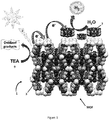
- FIG. 1 schematically shows hydrogen generation using an exemplary photocatalytic system 1 according to the present invention.
- the photocatalytic system 1 comprises a titanium-based metal-organic framework MOF based on or including a single ligand 3 type or a plurality of different ligand 3 types for generating photo-generated charge carriers upon irradiation by, for example, electro-magnetic radiation 5 in the UV and/or visible light region or with solar radiation.
- the titanium-metal-organic framework MOF can include or consist of MIL-125-NH 2 or derivatives of MIL-125-NH 2 .
- the ligand type can be, for example, 2-Aminoterephthalic acid, or 2,5-Diaminoterephthalic acid, or 2-Hydroxyterephthalic acid or 2,5-Dihydroxyterephthalic acid or 2-Bromoterephthalic acid or 2-Nitroterephthalic acid or 2,5-Dichloroterephthalic acid or 2-Methylterephthalic acid.
- the photocatalytic system 1 further includes a co-catalyst 7 to thwart recombination of the photo-generated charge carriers and allow electrons to drive a chemical reaction such as the reduction of water.
- the co-catalyst 7 can, for example, have a conduction band having an energy value or level that is (i) lower than or equal to that of a lowest unoccupied crystalline orbital LUCO of the titanium-based metal-organic framework MOF, and (ii) higher than or equal to a reduction potential energy of H + to H 2 .
- the energy level of the co-catalyst 7 is, for example, preferably lower than or equal to that of the lowest unoccupied crystalline orbital LUCO of the titanium-based metal-organic framework MOF so the photo generated electrons of the titanium-based metal-organic framework MOF which are in the conduction band can lose energy and move to a lower energy state of the conduction band of the co-catalyst 7 and then participate in the splitting of water to produce hydrogen.
- the co-catalyst 7 is preferably configured or able to trap protons, transfer electrons, bond the hydrogen atoms, and desorb the formed H 2 molecules.
- the co-catalyst 7 can comprise or consist of particles or nanoparticles NPs comprising or consisting of, for example, a transition metal phosphide or a transition metal oxide.
- the transition metal phosphide is preferably for example Ni 2 P, CoP or Fe 2 P.
- the transition metal oxide is, for example, NiO.
- the nanoparticles have an average diameter in the range of 10 to 200nm, or 10 to 100nm, 10 to 50 nm or 10 to 30nm as measured by TEM.
- the photocatalytic system 1 may further include a means or mechanism 9 for preventing the production of O 2 , or a means or mechanism for removing O 2 produced, for example, during the reduction of water.
- the means or mechanism 9 for preventing the production of O 2 includes, for example, triethylamine (TEA), or triethanolamine (TEOA), or ascorbic acid and related ascorbate anions, or ethylenediaminetetraacetic acid (EDTA).
- TAA triethylamine
- TEOA triethanolamine
- EDTA ethylenediaminetetraacetic acid
- the means or mechanism 9 for removing produced O 2 is, for example, a gas separating membrane configured to separate gases produced during the reduction of water.
- the photocatalytic system 1 can be a noble-metal-free photocatalytic system.
- the use of a photosensitizer in the photocatalytic system 1 is not necessary and is optional and the photocatalytic system 1 can be a photosensitizer-free photocatalytic system.
- a method for producing the photocatalytic system 1 can include or consist of providing the titanium-based metal-organic framework (MOF) based on or including a single ligand type or a plurality of different ligand types for generating photo-generated charge carriers upon irradiation; and mixing, with the titanium-based metal-organic framework (MOF), the co-catalyst 7 to thwart recombination of the photo-generated charge carriers and allow electrons to drive a chemical reaction, wherein the co-catalyst has a conduction band having an energy value or level that is (i) lower than or equal to that of a lowest unoccupied crystalline orbital (LUCO) of the titanium-based metal-organic framework (MOF) and (ii) higher than or equal to a reduction potential energy of H + to H 2 .
- MOF titanium-based metal-organic framework
- the simply mixing of the titanium-based metal-organic framework (MOF) and the co-catalyst 7 permits hydrogen generation.
- the mixture is a non-bonded mixture in that the titanium-based metal-organic framework (MOF) and the co-catalyst 7 are not required to be bonded to one another and are not bonded to one another but only mixed together.
- the photocatalytic system 1 can be a non-bonded mixture of the titanium-based metal-organic framework (MOF) and the co-catalyst 7.
- MOF titanium-based metal-organic framework
- the photocatalytic system is included in a mixture that also includes an organic solvent and water.
- the organic solvent can be, for example, acetonitrile or methanol.
- the photocatalytic system 1 can consist of the titanium-based metal-organic framework MOF and the co-catalyst 7 as described above and the mixture can include the means or mechanism 9 for preventing the production of O 2 (or a means or mechanism for removing O 2 produced), an organic solvent and water.
- the mixture can form part of a hydrogen generator in which hydrogen is generated by irradiating the mixture with electro-magnetic radiation 5 in the UV and/or visible light region or with solar radiation.
- An exemplary embodiment concerns a low-cost photocatalytic system 1 comprising an easily-prepared titanium-based metal-organic framework MOF that is the Ti-based MIL-125-NH 2 , active in the visible region, and earth abundant Ni 2 P nanoparticles as the co-catalyst 7.
- the photocatalytic performance of the system is presented and the exceptional synergy between titanium-based metal-organic frameworks and transition metal phosphides that leads to remarkable H 2 evolution rates and high quantum efficiency at 400 and 450 nm is discussed.
- MIL-125-NH 2 is a 3-dimensional framework based on the 2-aminobenzene-1,4-dicarboxylate (NH 2 -BDC) ligand and a Ti(IV)-oxo cluster (Ti 8 O 8 ).
- the materials used can be, for example, 2-Aminobenzene-1,4-dicarboxylic acid (NH 2 -BDC), Titanium isopropoxide (Ti[OCH(CH 3 ) 2 ] 4 ), nickel nitrate hexahydrate (Ni(NO 3 ) 2 ⁇ 6H 2 O), cobalt nitrate hexahydrate (Co(NO 3 ) 2 ⁇ 6H 2 O), iron(III) nitrate nonhydrate (Fe(NO 3 ) 3 ⁇ 9H 2 O), Sodium Hypophosphite (NaH 2 PO 2 ), anhydrous N'N-dimetylformanide (DMF; (CH 3 ) 2 NCHO), anhydrous methanol (CH 3 OH), acetonitrile (CH 3 CN) and TEA (Triethylamine) which can be purchased from Sigma Aldrich.
- Benzene-1,3,5-tricarboxylic acid C 6 H 3 (COOH) 3
- Nitrogen adsorption-desorption isotherms were collected by using a BEL-SORP mini (BEL Japan, Inc.) at 77 K. Prior to data collection, the samples were degassed at 423 K for 12 h. The BET surface areas were estimated from the amount of N 2 adsorption at 77 K using the BET (Brunauer-Emmett-Teller) equilibrium equation. UV-vis absorbance and diffuse reflectance were obtained with a PerkinElmer UV-Vis Spectrometer. PL spectra (excitation at 360 and 420 nm) was measured with a Fluorescence Spectrometer LS 55 (PerkinElmer). The solid catalyst was immersed in MeCN/TEA/H 2 O (9/1/0.1).
- MIL-125-NH 2 [Ti 8 O 8 (OH) 4 -(O 2 C-C 6 H 3 NH 2 -CO 2 ) 6 ]
- the MOF was synthesized by dissolving 0.286 g of 2-Aminobenzene-1,4-dicarboxylic acid (NH 2 -BDC) in a mixture of 4 mL of dry N,N-dimethylformamide (DMF) and 1mL of dry Methanol.
- 0.286 ml of Titanium isopropoxide was added in the mixture which was sonicated for 30 min and then heated up to 120 °C for 72h. The obtained product was washed several times with DMF and Methanol.
- Ni-BTC MOF MOF-derived Ni 2 P nanoparticles
- Ni 2 P nanoparticles For the preparation of Ni 2 P nanoparticles, 0.1 g of the as-prepared Ni-BTC and 0.3 g of Sodium Hypophosphite (NaH 2 PO 2 ) were mixed together, loaded into a ceramic crucible, and heated to 275 °C for 2 h in a furnace. After cooling to room temperature, the product was washed with water and ethanol and dried under vacuum at 60 °C for 6 h.
- NaH 2 PO 2 Sodium Hypophosphite
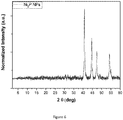
- Ni 2 P nanoparticles can be synthesized via a method described in reference 32, and the powder X-ray diffraction (PXRD) pattern of the bulk solid ( Figure 6 ) is in agreement with the reported pattern of reference 32.
- Their size is around 20 nm as illustrated in Figure 4a by Transmission Electron Microscopy (TEM) images and N 2 isotherm collected at 77 K reveals a BET surface area of 27.8 m 2 g -1 .
- the reactor was then irradiated with visible light by a 300 W Xe lamp using a long-pass cut-off filter allowing ⁇ > 420 nm, and the generated H 2 was analyzed by gas chromatography.
- the photocatalytic measurements were, for example, performed in a 25 mL Pyrex glass reactor, at room temperature under continuously visible light irradiation from a 300 W Xe lamp equipped with a UV cut-off filter ( ⁇ >420). 17 mg of the catalyst was suspended in 17 ml of a photocatalytic solution consisted of acetonitrile, triethylamine and deionized water in a ratio of 5 : 1: 0.1 respectively. Then, the suspension was purged with Nitrogen for 20 min under gentle stirring, in order to remove dissolved oxygen.
- the H 2 evolution rate increases since the co-catalyst 7 attracts the electrons efficiently and thus inhibits the charge carrier recombination.
- the H 2 evolution rate is maximized.
- the co-catalyst w.t.% is between 8.2 w.t.% and 9.7 w.t.%.
- Ni 2 P leads to the decrease in the H 2 production rate, as the interaction between MIL-125-NH 2 and the Ni 2 P is at its maximum, and the Ni 2 P nanoparticles simultaneously compete with MIL-125-NH 2 in light absorption, inhibiting the incident light from reaching the MOF, i.e. the shielding-effect.
- the Ni 2 P/MIL-125-NH 2 system exhibits a highly enhanced activity that is almost 300 times higher than that of the pristine MIL-125-NH 2 (2.249 ⁇ mol h -1 g -1 ), reaching a H 2 evolution rate of 648 ⁇ mol h -1 g -1 and 7865 ⁇ mols h -1 g -1 with respect to MIL-125-NH 2 and Ni 2 P, respectively.
- the performance of NI 2 P/MIL-125-NH 2 was examined by varying the solvent mixtures, the same amount of acetonitrile and TEA was kept, whereas the water content was varied from 1.63 v/v% to 8.19 v/v% ( Figure 3e ).
- the H 2 evolution rate also increases since more protons are available to be reduced.
- the photocatalytic system 1 reached a H 2 evolution rate of 894 ⁇ mol h -1 g -1 and 10134 ⁇ mol h -1 g -1 with respect to the MIL-125-NH 2 and Ni 2 P, respectively.
- the water content between 4 and 6.5 v/v% water.
- Ni 2 P/MIL-125-NH 2 and Ni 2 P/TiO 2 systems generated H 2 with a rate of 3878 and 1708 ⁇ mols g -1 h -1 , with respect to the MIL-125-NH 2 and TiO 2 , respectively as seen in Figure 3f .
- Ni 2 P/MIL-125-NH 2 outperforms Ni 2 P/TiO 2 even in the UV light region. This can be attributed to the high porosity of MIL-125-NH 2 that allows for easy light penetration compared to the solid TiO 2 , the high molar absorptivity of the ligand, and particularly the exceptional synergy between MIL-125-NH 2 and the Ni 2 P nanoparticles.
- Figure 10 shows the photocatalytic performance towards H 2 evolution of optimized Ni 2 P/TiO 2 and Ni 2 P/MIL-125-NH 2 , under UV-Vis light irradiation for 1.5mg and 1.8mg of Ni 2 P NPs in 17 mg of MOF and TiO 2 respectively, in a 17 mL acetonitrile-based solution of 13.4 v/v% Triethylamine and 8.2 v/v% Water.
- the NH 2 -BDC within MIL-125-NH 2 acts as an antenna that absorbs light and promotes an electron from the Highest Occupied Crystalline Orbitals (HOCOs) to the Lowest Unoccupied Crystalline Orbitals (LUCOs) of MIL-125-NH 2 .
- HOCOs Highest Occupied Crystalline Orbitals
- LUCOs Lowest Unoccupied Crystalline Orbitals
- the HOCOs comprise mainly the ⁇ orbitals of the ligand while the LUCOs are composed of the Ti 3d orbitals; therefore, the electron transitions represent a LMCT process.
- the photo-excited electron is transferred from the LUCOs of MIL-125-NH 2 to Ni 2 P and then to the protons of water molecules.
- This large negative energy difference between MIL-125-NH 2 and Ni 2 P stems from the discrete Ti 8 O 8 cluster on MIL-125-NH 2 being exceptionally reducing.
- a good co-catalyst should thus be able to trap protons, transfer electrons, bond the hydrogen atoms, and desorb the H 2 molecules formed.
- Ni 2 P with the presence of both Ni and P sites on the surface of the nanoparticles acting as hydride and proton-acceptor centers, should exhibit particular good behavior for H 2 generation.
- Figure 1 schematically shows the mechanism for photocatalytic H 2 evolution.
- the MOF acts as a photosensitizer, subsequently an electron is excited from the HOCO (Highest Occupied Crystalline Orbital) and comparable energy orbitals to the LUCO (Lowest Unoccupied Crystalline Orbital) and comparable energy orbitals. Then this electron is captured by the Ni 2 P NPs which act as catalytic centres, reducing the hydrogen cations to dihydrogen.
- HOCO Highest Occupied Crystalline Orbital
- LUCO Low Unoccupied Crystalline Orbital
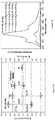
- the effectiveness of charge separation in the Ni 2 P/MIL-125-NH 2 was further verified by photoluminescence (PL) emission spectroscopy as shown in Figure 2b .
- the suspension of MIL-125-NH 2 exhibits fluorescencence with the maximum peak centered at ⁇ 560 nm when excited at 420 nm.
- the addition of the Ni 2 P nanoparticles diminishes the PL emission, indicating the electron transfer from MIL-125-NH 2 to Ni 2 P and depopulating the excited electrons in MIL-125-NH 2 .
- the mixture Ni 2 P/MIL-125-NH 2 shows no detectable photoluminescent intensity, illustrating the key role of the nanoparticles in eliminating the electron-hole recombination.
- transition metal phosphide co-catalyst 7 is Ni 2 P
- other transition metal phosphides or oxides can be used such as CoP or Fe 2 P or NiO (see for example Figure 11 ), or MoP or Cu 3 P or MnP or ZnP or Fe 2 O 3 or CoO or CuO or MoO 3 or MnO.
- the co-catalyst 7 may alternatively for example include a mix of different transition metal phosphide and/or oxide particles or nanoparticles. These co-catalysts provide higher efficiencies compared to conventional and expensive noble metal co-catalysts such as Pt/Rh co-catalysts.
- the present invention thus provides a low-cost, highly stable, and easily prepared (based on mixing) photocatalytic system comprising a titanium-based metal-organic framework MOF and transition metal phosphide particles or nanoparticles that exhibits remarkable H 2 generation.
- the system appreciably outperforms Ni 2 P/TiO 2 under UV irradiation and other visible-light-active MOF systems under visible irradiation, while maintains its integrity for a long time.
- This photocatalytic system opens a path to practical 'solar-driven' applications.
Landscapes
- Chemical & Material Sciences (AREA)
- Organic Chemistry (AREA)
- Engineering & Computer Science (AREA)
- Materials Engineering (AREA)
- Chemical Kinetics & Catalysis (AREA)
- Inorganic Chemistry (AREA)
- Health & Medical Sciences (AREA)
- General Health & Medical Sciences (AREA)
- Combustion & Propulsion (AREA)
- Catalysts (AREA)
Abstract
The present invention concerns a photocatalytic system comprising or consisting of:
a titanium-based metal-organic framework MOF based on or including a single ligand type or a plurality of different ligand types for generating photo-generated charge carriers upon irradiation; and
a co-catalyst to thwart recombination of the photo-generated charge carriers and allow electrons to drive a chemical reaction, wherein the co-catalyst has a conduction band having an energy value or level that is (i) lower than or equal to that of a lowest unoccupied crystalline orbital LUCO of the titanium-based metal-organic framework MOF and (ii) higher than or equal to a reduction potential energy of H+ to H2.
a titanium-based metal-organic framework MOF based on or including a single ligand type or a plurality of different ligand types for generating photo-generated charge carriers upon irradiation; and
a co-catalyst to thwart recombination of the photo-generated charge carriers and allow electrons to drive a chemical reaction, wherein the co-catalyst has a conduction band having an energy value or level that is (i) lower than or equal to that of a lowest unoccupied crystalline orbital LUCO of the titanium-based metal-organic framework MOF and (ii) higher than or equal to a reduction potential energy of H+ to H2.
Description
- The present invention concerns a photocatalytic system for hydrogen generation using ultra-violet, visible light or solar radiation. In particular, the present invention concerns a photocatalytic system comprising a metal-organic framework (MOF) based on or including a photocatalyst that is a single ligand type or a plurality of different ligand types for generating photo-generated charge carriers upon irradiation and a co-catalyst to attract electrons, prevent recombination of the photo-generated charge carriers and allow electrons to drive a chemical reaction, in particular, the reduction of water. The present invention further relates to a method for producing a photocatalytic system, a Hydrogen generator and Hydrogen generating method.
- 'Solar-driven' water splitting for hydrogen (H2) generation represents the 'Holy Grail' of energy science and technology. For decades, numerous photocatalytic systems have been developed but their low efficiency due to the limited sun-light absorptivity of the catalysts and their high cost and low water-stability, inhibits their use in industry.
- Hydrogen (H2) gas is widely produced and used in industries, particularly in fossil fuel processing and ammonia synthesis. In addition, it is considered a clean energy carrier for a sustainable energy future since the combustion of H2 results in the generation of water and no greenhouse gasses, which eliminates the risk of climate change and allows for a carbon-neutral energy cycle. Traditional methods for H2 production include the methane steam reforming and coal gasification; however, these processes also produce carbon dioxide as a by-product that needs to be captured and sequestered. H2 can also be generated from water electrolysis using electricity but the electricity must also be obtained from a renewable energy source such as solar, wind, hydroelectric, or hydrothermal energy. A superior method to generate H2 is through artificial photosynthesis, which utilizes the inexhaustible solar energy to directly convert water into H2. Due to the sustainable nature of this procedure and the potential cost efficiency, many research efforts in materials science have been focused on developing novel photocatalytic systems that can enhance the rate of H2 evolution and solar-to-hydrogen efficiency, with a 10% efficiency being the targeted lower limit for commercial applications.
- A photocatalytic system can comprise of: i. a photocatalyst which absorbs light and generates charges, the electrons and the holes (charge carriers), with the electrons being responsible for reducing H2O into H2, ii. a co-catalyst which can enhance the charge-carrier separation; iii. a photosensitizer that may be used to extend the light absorption into the visible region, since UV light only accounts for ∼4 % of the incident solar energy; iv. a sacrificial reagent that is usually employed as an electron donor to scavenge the photogenerated holes in order to facilitate the charge transfer, and v. a redox shuttle which can expedite the charge transfer between the photocatalyst and the co-catalyst. In most cases, a photocatalyst is combined with a co-catalyst and a sacrificial reagent to generate H2 upon light irradiation, whilst the use of photosensitizers and redox shuttles is optional. The negligible absorptivity of traditional photocatalysts such as TiO2 and SnO2 toward visible light, the low stability of other alternatives such as CdS or GaAs in water, and the high cost of noble metal co-catalysts are the main reasons why no photocatalytic systems have been industrially applied.
- A metal-organic framework (MOF) is an infinite network of metal ions or clusters bridged by organic ligands through coordination bonds into a porous extended structure. Depending on the metal geometry and functionality and directionality of the ligand used, MOFs with different structure topologies, pore sizes and shapes, and physical properties can be synthesised. MOFs offer the exciting possibility to integrate the light harvesting moiety (ligand), the catalytic component (reductive metal ions), and intrinsic porosity (higher compared to oxides with the potential to absorb more light) into a single structure; therefore, the utilization of MOFs can be a pioneering key for the field of photocatalytic H2 generation.
- However, known MOF-based photocatalytic systems for visible-light-driven H2 production are either expensive (complicated ligand synthesis, high cost of metal salts and noble-metal co-catalysts), they possess extremely low stability in water, they are active only under UV light, or they are not efficient and so have low solar-to-hydrogen/quantum efficiencies.
- The present invention addresses the above-mentioned limitations by providing a photocatalytic system comprising or consisting of:
- a titanium-based metal-organic framework MOF based on or including a single ligand type or a plurality of different ligand types for generating photo-generated charge carriers upon irradiation; and
- a co-catalyst to thwart recombination of the photo-generated charge carriers and allow electrons to drive a chemical reaction.
- According to another aspect of the present disclosure, the co-catalyst has a conduction band having an energy value or level that is (i) lower than or equal to that of a lowest unoccupied crystalline orbital LUCO of the titanium-based metal-organic framework MOF and (ii) higher than or equal to a reduction potential energy of H+ to H2.
- According to another aspect of the present disclosure, the co-catalyst comprises or consists of particles or nanoparticles comprising or consisting of at least one transition metal phosphide or at least one transition metal oxide.
- According to another aspect of the present disclosure, the system further including means for preventing the production of O2, or means for removing produced O2.
- According to another aspect of the present disclosure, the titanium-based metal-organic framework MOF includes or consist of MIL-125-NH2 or derivatives thereof.
- According to another aspect of the present disclosure, the transition metal phosphide is Ni2P, CoP or Fe2P, or the transition metal oxide is NiO.
- According to another aspect of the present disclosure, the means for preventing the production of O2 includes triethylamine TEA, or triethanolamine TEOA, or ascorbic acid and related ascorbate anions, or ethylenediaminetetraacetic acid EDTA.
- According to another aspect of the present disclosure, the means for removing produced O2 includes a gas separating membrane.
- According to another aspect of the present disclosure, the photocatalytic system is a noble-metal-free photocatalytic system.
- According to another aspect of the present disclosure, the photocatalytic system is a photosensitizer-free photocatalytic system.
- According to another aspect of the present disclosure, the ligand type is one of the following: 2-Aminoterephthalic acid, or 2,5-Diaminoterephthalic acid, or 2-Hydroxyterephthalic acid or 2,5-Dihydroxyterephthalic acid or 2-Bromoterephthalic acid or 2-Nitroterephthalic acid or 2,5-Dichloroterephthalic acid or 2-Methylterephthalic acid.
- According to another aspect of the present disclosure, the transition metal phosphide is Ni2P and the titanium-based metal-organic framework (MOF) includes or consists of MIL-125-NH2.
- Another aspect of the present disclosure concerns a mixture including the above-mentioned photocatalytic system and further including an organic solvent and water.
- According to another aspect of the present disclosure, the organic solvent is acetonitrile or methanol.
- Another aspect of the present disclosure relates to a hydrogen generator including the above-mentioned photocatalytic system or mixture.
- Another aspect of the present disclosure concerns a Hydrogen generating method including the steps of:
- providing the above-mentioned mixture; and
- irradiating the mixture with electro-magnetic radiation in the UV and/or visible light region or with solar radiation.
- Another aspect of the present disclosure concerns a method for producing a photocatalytic system, the method consisting of the steps of:
- providing a titanium-based metal-organic framework MOF based on or including a single ligand type or a plurality of different ligand types for generating photo-generated charge carriers upon irradiation;
and - mixing, with the titanium-based metal-organic framework MOF, a
co-catalyst 7 to thwart recombination of the photo-generated charge carriers and allow electrons to drive a chemical reaction. - According to another aspect of the present disclosure, the co-catalyst has a conduction band having an energy value or level that is (i) lower than or equal to that of a lowest unoccupied crystalline orbital LUCO of the titanium-based metal-organic framework MOF and (ii) higher than or equal to a reduction potential energy of H+ to H2.
- The photocatalytic system according to the present invention simultaneously tackles these above mentioned challenges while exhibiting remarkable H2 generation. The photocatalytic system according to the present invention can boost the H2 evolution rate to, for example, an outstanding value of 894 µmol h-1 g-1 under visible light irradiation, which is one of the highest photocatalytic H2 evolution rates reported for metal-organic frameworks (MOFs). Importantly, the system according to the present invention produces H2 with an evolution rate of 3878 µmol h-1 g-1 under UV-Vis irradiation and outperforms known systems such as the Ni2P/TiO2 system. The present invention showcases the potential of MOFs to photocatalytically split water and generate remarkable amounts of H2 with high quantum efficiencies at 400 and 450 nm, and demonstrates a versatile, easily prepared, and cost effective photocatalytic system for H2 generation.
- The above and other objects, features and advantages of the present invention and the manner of realizing them will become more apparent, and the invention itself will best be understood from a study of the following description with reference to the attached drawings showing some preferred embodiments of the invention.
-
-
Figure 1 schematically shows hydrogen generation using an exemplary photocatalytic system according to the present invention; -
Figure 2a shows an energy diagram for MIL-125-NH2, TiO2, Ni2P, cobaloxime and Pt; -
Figure 2b shows PL spectra (excited at 420 nm) for the suspensions of MIL-125-NH2 and MIL-125-NH2 with different loadings of Ni2P; -
Figure 3a shows a H2 evolution rate of a particular embodiment comprising MIL-125-NH2 against different loadings of Ni2P; -
Figure 3b shows photocatalytic H2 production of 9.2 w.t.% Ni2P/MIL-125-NH2 (diagonal), MIL-125-NH2 (approx. parallel with x-axis), Ni2P/H2BDC-NH2 (approx. parallel with x-axis) and Ni2P (approx. parallel with x-axis), under visible light irradiation (λ > 420 nm) over 8 hours; -
Figure 3c shows a Recycling performance of 8.9 w.t.% Ni2P/MIL-125-NH2; -
Figure 3d shows PXRD patterns of Ni2P/MIL-125-NH2 before and after photocatalytic test; -
Figure 3e shows a H2 evolution rate of an optimised Ni2P/MIL-125-NH2 system with different water contents; -
Figure 3f shows maximum H2 evolution rates of 9.41w.t. % Ni2P/MIL-125-NH2 and 10.58w.t. % Ni2P/TiO2; -
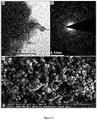
Figure 4a shows a High-Resolution TEM image of Ni2P nanoparticles; -
Figure 4b shows an Electron Diffraction pattern of Ni2P nanoparticles; -
Figure 4c is a SEM image of the as synthesized MIL-125-NH2; -
Figure 5a shows the UV-Visible absorbance of the ligand BDC-NH2; -
Figure 5b shows the UV-Visible Diffuse Reflectance of MIL-125-NH2; -
Figure 6 shows a Powder X-ray diffraction pattern of Ni2P nanoparticles, the data was collected at ambient temperature on a Bruker D8 Advance diffractometer at 40 kV, 40 mA for Cu Kα (λ= 1.5418 Å), with a step size of 0.02° in 2θ, and a 2θ range of ∼2 to 70°; -
Figure 7 shows the H2 evolution rate of 17 mg TiO2 against different loadings of Ni2P nanoparticles (NPs); -
Figure 8 shows powder X-ray diffraction patterns of Ni2P/MIL-125-NH2 after 24h visible light-driven Photocatalytic test in solutions containing different water content; -
Figure 9a shows a N2 adsorption-desorption isotherm of MIL-125-NH2; -
Figure 9b shows a N2 adsorption-desorption isotherm of Ni2P nanoparticles; -
Figure 10 shows the photocatalytic performance towards H2 evolution of optimized Ni2P/TiO2 and Ni2P/MIL-125-NH2, under UV-Vis light irradiation for 1.5mg and 1.8mg of Ni2P NPs in 17 mg of MOF and TiO2 respectively, in a 17 mL acetonitrile-based solution of 13.4 v/v% Triethylamine and 8.2 v/v% Water; and -
Figure 11 shows a Hydrogen production rate for Ni2P/MIL-125-NH2, CoP/MIL-125-NH2 and NiO/MIL-125-NH2 under visible light irradiation. - Herein, identical reference numerals are used, where possible, to designate identical elements that are common to the Figures.
-
Figure 1 schematically shows hydrogen generation using an exemplaryphotocatalytic system 1 according to the present invention. Thephotocatalytic system 1 comprises a titanium-based metal-organic framework MOF based on or including asingle ligand 3 type or a plurality ofdifferent ligand 3 types for generating photo-generated charge carriers upon irradiation by, for example, electro-magnetic radiation 5 in the UV and/or visible light region or with solar radiation. - The titanium-metal-organic framework MOF can include or consist of MIL-125-NH2 or derivatives of MIL-125-NH2.
- The ligand type can be, for example, 2-Aminoterephthalic acid, or 2,5-Diaminoterephthalic acid, or 2-Hydroxyterephthalic acid or 2,5-Dihydroxyterephthalic acid or 2-Bromoterephthalic acid or 2-Nitroterephthalic acid or 2,5-Dichloroterephthalic acid or 2-Methylterephthalic acid.
- The
photocatalytic system 1 further includes a co-catalyst 7 to thwart recombination of the photo-generated charge carriers and allow electrons to drive a chemical reaction such as the reduction of water. - The
co-catalyst 7 can, for example, have a conduction band having an energy value or level that is (i) lower than or equal to that of a lowest unoccupied crystalline orbital LUCO of the titanium-based metal-organic framework MOF, and (ii) higher than or equal to a reduction potential energy of H+ to H2. - The energy level of the
co-catalyst 7 is, for example, preferably lower than or equal to that of the lowest unoccupied crystalline orbital LUCO of the titanium-based metal-organic framework MOF so the photo generated electrons of the titanium-based metal-organic framework MOF which are in the conduction band can lose energy and move to a lower energy state of the conduction band of theco-catalyst 7 and then participate in the splitting of water to produce hydrogen. - The
co-catalyst 7 is preferably configured or able to trap protons, transfer electrons, bond the hydrogen atoms, and desorb the formed H2 molecules. - The
co-catalyst 7 can comprise or consist of particles or nanoparticles NPs comprising or consisting of, for example, a transition metal phosphide or a transition metal oxide. The transition metal phosphide is preferably for example Ni2P, CoP or Fe2P. The transition metal oxide is, for example, NiO. Preferably, the nanoparticles have an average diameter in the range of 10 to 200nm, or 10 to 100nm, 10 to 50 nm or 10 to 30nm as measured by TEM. - The
photocatalytic system 1 may further include a means ormechanism 9 for preventing the production of O2, or a means or mechanism for removing O2 produced, for example, during the reduction of water. The means ormechanism 9 for preventing the production of O2 includes, for example, triethylamine (TEA), or triethanolamine (TEOA), or ascorbic acid and related ascorbate anions, or ethylenediaminetetraacetic acid (EDTA). The means ormechanism 9 for removing produced O2 is, for example, a gas separating membrane configured to separate gases produced during the reduction of water. - The
photocatalytic system 1 can be a noble-metal-free photocatalytic system. The use of a photosensitizer in thephotocatalytic system 1 is not necessary and is optional and thephotocatalytic system 1 can be a photosensitizer-free photocatalytic system. - A method for producing the
photocatalytic system 1 can include or consist of providing the titanium-based metal-organic framework (MOF) based on or including a single ligand type or a plurality of different ligand types for generating photo-generated charge carriers upon irradiation; and mixing, with the titanium-based metal-organic framework (MOF), theco-catalyst 7 to thwart recombination of the photo-generated charge carriers and allow electrons to drive a chemical reaction, wherein the co-catalyst has a conduction band having an energy value or level that is (i) lower than or equal to that of a lowest unoccupied crystalline orbital (LUCO) of the titanium-based metal-organic framework (MOF) and (ii) higher than or equal to a reduction potential energy of H+ to H2. The simply mixing of the titanium-based metal-organic framework (MOF) and the co-catalyst 7 permits hydrogen generation. The mixture is a non-bonded mixture in that the titanium-based metal-organic framework (MOF) and theco-catalyst 7 are not required to be bonded to one another and are not bonded to one another but only mixed together. - The
photocatalytic system 1 can be a non-bonded mixture of the titanium-based metal-organic framework (MOF) and theco-catalyst 7. - To generate H2 from water, the photocatalytic system is included in a mixture that also includes an organic solvent and water. The organic solvent can be, for example, acetonitrile or methanol. Alternatively, the
photocatalytic system 1 can consist of the titanium-based metal-organic framework MOF and theco-catalyst 7 as described above and the mixture can include the means ormechanism 9 for preventing the production of O2 (or a means or mechanism for removing O2 produced), an organic solvent and water. - The mixture can form part of a hydrogen generator in which hydrogen is generated by irradiating the mixture with electro-
magnetic radiation 5 in the UV and/or visible light region or with solar radiation. - A non-limiting embodiment of the present invention is now described in further detail.
- An exemplary embodiment concerns a low-
cost photocatalytic system 1 comprising an easily-prepared titanium-based metal-organic framework MOF that is the Ti-based MIL-125-NH2, active in the visible region, and earth abundant Ni2P nanoparticles as theco-catalyst 7. The photocatalytic performance of the system is presented and the exceptional synergy between titanium-based metal-organic frameworks and transition metal phosphides that leads to remarkable H2 evolution rates and high quantum efficiency at 400 and 450 nm is discussed. - MIL-125-NH2 is a 3-dimensional framework based on the 2-aminobenzene-1,4-dicarboxylate (NH2-BDC) ligand and a Ti(IV)-oxo cluster (Ti8O8).
- It can be synthesized and characterized, for example, as described in reference 16 (listed below).
- The materials used can be, for example, 2-Aminobenzene-1,4-dicarboxylic acid (NH2-BDC), Titanium isopropoxide (Ti[OCH(CH3)2]4), nickel nitrate hexahydrate (Ni(NO3)2·6H2O), cobalt nitrate hexahydrate (Co(NO3)2·6H2O), iron(III) nitrate nonhydrate (Fe(NO3)3·9H2O), Sodium Hypophosphite (NaH2PO2), anhydrous N'N-dimetylformanide (DMF; (CH3)2NCHO), anhydrous methanol (CH3OH), acetonitrile (CH3CN) and TEA (Triethylamine) which can be purchased from Sigma Aldrich. Benzene-1,3,5-tricarboxylic acid (C6H3(COOH)3, BTC) can be purchased from TCI. All the materials were used as received.
- Nitrogen adsorption-desorption isotherms (
Figure 9 ) were collected by using a BEL-SORP mini (BEL Japan, Inc.) at 77 K. Prior to data collection, the samples were degassed at 423 K for 12 h. The BET surface areas were estimated from the amount of N2 adsorption at 77 K using the BET (Brunauer-Emmett-Teller) equilibrium equation. UV-vis absorbance and diffuse reflectance were obtained with a PerkinElmer UV-Vis Spectrometer. PL spectra (excitation at 360 and 420 nm) was measured with a Fluorescence Spectrometer LS 55 (PerkinElmer). The solid catalyst was immersed in MeCN/TEA/H2O (9/1/0.1). - For the synthesis of MIL-125-NH2, [Ti8O8(OH)4-(O2C-C6H3NH2-CO2)6], the MOF was synthesized by dissolving 0.286 g of 2-Aminobenzene-1,4-dicarboxylic acid (NH2-BDC) in a mixture of 4 mL of dry N,N-dimethylformamide (DMF) and 1mL of dry Methanol. 0.286 ml of Titanium isopropoxide was added in the mixture which was sonicated for 30 min and then heated up to 120 °C for 72h. The obtained product was washed several times with DMF and Methanol. Consequently, it was dispersed in DMF and kept under stirring for 12 h, in order to remove residual linker. This procedure was repeated twice using methanol, instead of DMF, in order to exchange the DMF within the pores. Finally, the as-synthesized powder was dried at room temperature.
- For the synthesis of the MOF-derived Ni2P nanoparticles (NPs), firstly the Ni-BTC MOF was synthesized by dissolving 0.255 g of nickel nitrate hexahydrate (Ni(NO3)2·6H2O) and 0.1024 g of benzene-1,3,5-tricarboxylic acid (C6H3(COOH)3, BTC) in 14 mL of methanol and then heating the mixture up to 150 °C for 24 h, using Teflon liners inserted in stainless steel autoclaves. The obtained solid was washed several times with methanol and then dried under vacuum at 60°C.
- For the preparation of Ni2P nanoparticles, 0.1 g of the as-prepared Ni-BTC and 0.3 g of Sodium Hypophosphite (NaH2PO2) were mixed together, loaded into a ceramic crucible, and heated to 275 °C for 2 h in a furnace. After cooling to room temperature, the product was washed with water and ethanol and dried under vacuum at 60 °C for 6 h.
- Scanning Electron Microscopy (SEM) images reveal that the morphology of the crystals is based upon circular plate (disc) shape with a mean particle size of 1 µm as can be seen in
Figure 4c . The diffuse reflectance spectrum of MIL-125-NH2 is red-shifted compared to the absorption spectrum of the NH2-H2BDC as seen inFigures 5a and 5b , indicating a ligand-to-metal charge transfer (LMCT). This results in a strong absorption in the range of 300-480 nm. The calculated optical gap of MIL-125-NH2 is ∼2.6 eV. The Ni2P nanoparticles can be synthesized via a method described in reference 32, and the powder X-ray diffraction (PXRD) pattern of the bulk solid (Figure 6 ) is in agreement with the reported pattern of reference 32. Their size is around 20 nm as illustrated inFigure 4a by Transmission Electron Microscopy (TEM) images and N2 isotherm collected at 77 K reveals a BET surface area of 27.8 m2 g-1. - To assess the performance and optimize the composition of the
photocatalytic system 1 toward H2 generation, different combinations of powders of MIL-125-NH2 and Ni2P were mixed in a container or reactor containing a solvent mixture of acetonitrile (CH3CN), triethylamine (TEA) as the sacrificial agent, and water. - The reactor was then irradiated with visible light by a 300 W Xe lamp using a long-pass cut-off filter allowing λ > 420 nm, and the generated H2 was analyzed by gas chromatography.
- The photocatalytic measurements were, for example, performed in a 25 mL Pyrex glass reactor, at room temperature under continuously visible light irradiation from a 300 W Xe lamp equipped with a UV cut-off filter (λ>420). 17 mg of the catalyst was suspended in 17 ml of a photocatalytic solution consisted of acetonitrile, triethylamine and deionized water in a ratio of 5 : 1: 0.1 respectively. Then, the suspension was purged with Nitrogen for 20 min under gentle stirring, in order to remove dissolved oxygen. 200 µL of the gaseous product was abstracted from the head space and analyzed by gas chromatography (PerkinElmer Clarus 480 GC, N2 carrier gas), equipped with a Thermal Conductivity Detector and a Molecular Sieve 5 A column.
- As can be seen in
Figure 1a , when the loadings of the Ni2P co-catalyst 7 increase while the amount of MIL-125-NH2 is kept constant, the H2 evolution rate increases since theco-catalyst 7 attracts the electrons efficiently and thus inhibits the charge carrier recombination. By reaching 9.2 w.t.% of Ni2P, the H2 evolution rate is maximized. At this ratio, there is an optimum level of interactions between Ni2P and MIL-125-NH2, promoting the electron transfer to the Ni2P. Preferably, the co-catalyst w.t.% is between 8.2 w.t.% and 9.7 w.t.%. - Further increasing the amount of Ni2P leads to the decrease in the H2 production rate, as the interaction between MIL-125-NH2 and the Ni2P is at its maximum, and the Ni2P nanoparticles simultaneously compete with MIL-125-NH2 in light absorption, inhibiting the incident light from reaching the MOF, i.e. the shielding-effect. As seen in
Figure 3b , even with a small amount of water added, the Ni2P/MIL-125-NH2 system exhibits a highly enhanced activity that is almost 300 times higher than that of the pristine MIL-125-NH2 (2.249 µmol h-1 g-1), reaching a H2 evolution rate of 648 µmol h-1g-1 and 7865 µmols h-1g-1 with respect to MIL-125-NH2 and Ni2P, respectively. - Blank photocatalytic experiments using solely Ni2P with and without the NH2-H2BDC resulted in no H2 generation, confirming the unique advantage of having MIL-125-NH2 as a photocatalyst within the system.
- Moreover, recycling experiments for the optimum ratio between Ni2P and MIL-125-NH2 revealed that the H2 evolution rate of this system remains stable for at least seven catalytic runs (each for 12 h,
Figure 3c ). The PXRD patterns of the pristine and post-exposed samples are comparable, confirming that the crystallinity of MIL-125-NH2 is retained even after 84 h of continuous irradiation (Figure 3d ).Figure 8 shows powder X-ray diffraction patterns of Ni2P/MIL-125-NH2 after 24h visible light-driven Photocatalytic test in solutions containing different water content. - In addition, the performance of NI2P/MIL-125-NH2 was examined by varying the solvent mixtures, the same amount of acetonitrile and TEA was kept, whereas the water content was varied from 1.63 v/v% to 8.19 v/v% (
Figure 3e ). By increasing the water content, at first, the H2 evolution rate also increases since more protons are available to be reduced. With the optimum photocatalytic solution of 4.87 v/v% water, thephotocatalytic system 1 reached a H2 evolution rate of 894 µmol h-1 g-1 and 10134 µmol h-1 g-1 with respect to the MIL-125-NH2 and Ni2P, respectively. Preferably, the water content between 4 and 6.5 v/v% water. - These values significantly surpass known photocatalytic systems containing MIL-125-NH2 and other co-catalysts as can be seen from Table 1 below:
Table 1: Comparison of the photocatalytic performance of systems utilizing MIL-125-NH2 as the photocatalyst with different co-catalysts under visible light irradiation. Co-catalyst Light Source λ (nm) HERP (µmol h-1 g-1) Quantum Efficiency (%) Stability (h) Ref. Pt NPs ≥ 420 *333 - > 9 17 Pt NPs ≥ 420 *525 > 9 15 CoIII oxime ≥ 408 *637 0.5 > 70 16 Ni2P NPs ≥ 420 894 6.6% (450nm) > 84 This Inv. HERp: H2 evolution rate with respect to the photocatalyst
* Calculated based on reported data - To compare the
photocatalytic MOF system 1 with TiO2, the parallel photocatalytic performance of Ni2P/MIL-125-NH2 and Ni2P/TiO2 toward H2 generation was investigated, under irradiations that include UV light since TiO2 is characterized by an overly large optical band gap (∼3 eV) and thus operates only under UV irradiation. - Commercial TiO2 (P25, Degausa), which is a standard material in the field of TiO2-photocatalyzed reactions with a relatively large surface area of 49 m2 g-1 was used, and the loadings of the Ni2P were first varied in order to determine the optimum system, which contains 10.6 w.t.% of Ni2P (
Figure 7 ). The best performing Ni2P/MIL-125-NH2 and Ni2P/TiO2 systems generated H2 with a rate of 3878 and 1708 µmols g-1 h-1, with respect to the MIL-125-NH2 and TiO2, respectively as seen inFigure 3f . It is apparent that by simple subtraction of the visible-light-driven H2 evolution rate previously obtained (894 µmol h-1 g-1), Ni2P/MIL-125-NH2 outperforms Ni2P/TiO2 even in the UV light region. This can be attributed to the high porosity of MIL-125-NH2 that allows for easy light penetration compared to the solid TiO2, the high molar absorptivity of the ligand, and particularly the exceptional synergy between MIL-125-NH2 and the Ni2P nanoparticles.Figure 10 shows the photocatalytic performance towards H2 evolution of optimized Ni2P/TiO2 and Ni2P/MIL-125-NH2, under UV-Vis light irradiation for 1.5mg and 1.8mg of Ni2P NPs in 17 mg of MOF and TiO2 respectively, in a 17 mL acetonitrile-based solution of 13.4 v/v% Triethylamine and 8.2 v/v% Water. - The NH2-BDC within MIL-125-NH2 acts as an antenna that absorbs light and promotes an electron from the Highest Occupied Crystalline Orbitals (HOCOs) to the Lowest Unoccupied Crystalline Orbitals (LUCOs) of MIL-125-NH2.
- The HOCOs comprise mainly the π orbitals of the ligand while the LUCOs are composed of the Ti 3d orbitals; therefore, the electron transitions represent a LMCT process.
- Upon illumination, electron-hole pairs are created and the hole localized in the MIL-125-type material and restricted in movement, whereas the electron is delocalized, and free to migrate to the Ti-3d orbitals thus allowing effective charge separation.
- Subsequently, in the
photocatalytic system 1, the photo-excited electron is transferred from the LUCOs of MIL-125-NH2 to Ni2P and then to the protons of water molecules. - From the energy diagram as shown in
Figure 2a , the conduction band of Ni2P has a lower reduction potential (Evac. = -4.50 eV) than the LUCOs of MIL-125-NH2 (E vac.= -3.80 eV), and is the same as the reduction potential of H+/H2 (Evac. = -4.50 eV, ENHE = 0 eV). This large negative energy difference between MIL-125-NH2 and Ni2P stems from the discrete Ti8O8 cluster on MIL-125-NH2 being exceptionally reducing. - This contrasts with TiO2 in which the extended structure conduction band is at the lower reduction potential of -4.25 eV, compared to the discrete cluster. Consequently, in TiO2, the lower reduction potential negates the reductive power of TiO2 compared to MIL-125-NH2, and therefore, decreases the effectiveness of the electron transfer to the Ni2P. The smaller thermodynamic driving force confirms the lower performance of Ni2P/TiO2 compared to the
photocatalytic system 1 of the present invention. Similarly, the cobaloxime complex (Evac. = -4.25 eV) has a higher reduction potential than that of Ni2P but lower that the LUCOs of MIL-125-NH2; hence, the energy difference is less - a key reason for its inferior performance compared to the Ni2P/MIL-125-NH2 system. - In the case of Pt nanoparticles, which have much higher work function compared to Ni2P (
Figure 2a ), the lower performance of Pt/MIL-125-NH2 compared to Ni2P/MIL-125-NH2 (Table 1) is in agreement with the results obtained when TiO2 is the photocatalyst. - A good co-catalyst should thus be able to trap protons, transfer electrons, bond the hydrogen atoms, and desorb the H2 molecules formed. Ni2P, with the presence of both Ni and P sites on the surface of the nanoparticles acting as hydride and proton-acceptor centers, should exhibit particular good behavior for H2 generation.
-
Figure 1 schematically shows the mechanism for photocatalytic H2 evolution. Upon visible light irradiation the MOF acts as a photosensitizer, subsequently an electron is excited from the HOCO (Highest Occupied Crystalline Orbital) and comparable energy orbitals to the LUCO (Lowest Unoccupied Crystalline Orbital) and comparable energy orbitals. Then this electron is captured by the Ni2P NPs which act as catalytic centres, reducing the hydrogen cations to dihydrogen. - The effectiveness of charge separation in the Ni2P/MIL-125-NH2 was further verified by photoluminescence (PL) emission spectroscopy as shown in
Figure 2b . The suspension of MIL-125-NH2 exhibits fluorescencence with the maximum peak centered at ∼560 nm when excited at 420 nm. The addition of the Ni2P nanoparticles diminishes the PL emission, indicating the electron transfer from MIL-125-NH2 to Ni2P and depopulating the excited electrons in MIL-125-NH2. When the amount of Ni2P is increased and reached 8.82 w.t. %, the mixture Ni2P/MIL-125-NH2 shows no detectable photoluminescent intensity, illustrating the key role of the nanoparticles in eliminating the electron-hole recombination. - While the above particular example of a transition
metal phosphide co-catalyst 7 is Ni2P, other transition metal phosphides or oxides can be used such as CoP or Fe2P or NiO (see for exampleFigure 11 ), or MoP or Cu3P or MnP or ZnP or Fe2O3 or CoO or CuO or MoO3 or MnO. - The
co-catalyst 7 may alternatively for example include a mix of different transition metal phosphide and/or oxide particles or nanoparticles. These co-catalysts provide higher efficiencies compared to conventional and expensive noble metal co-catalysts such as Pt/Rh co-catalysts. - The present invention thus provides a low-cost, highly stable, and easily prepared (based on mixing) photocatalytic system comprising a titanium-based metal-organic framework MOF and transition metal phosphide particles or nanoparticles that exhibits remarkable H2 generation. The system appreciably outperforms Ni2P/TiO2 under UV irradiation and other visible-light-active MOF systems under visible irradiation, while maintains its integrity for a long time.
- The absorptivity in the visible region, the charge separation in the titanium-based metal-organic framework MOF, the efficient attraction of electrons by transition metal phosphide particles or nanoparticles, or the inherent nature of the transition metal phosphide to catalyze the H2 generation significantly enhanced photocatalytic activity. With high quantum efficiency of 27 and 6.6 % (at 400 and 450 nm, respectively) and easy scale-up synthesis of the titanium-based metal-organic framework MOF and the transition metal phosphide, this photocatalytic system opens a path to practical 'solar-driven' applications.
- While the invention has been disclosed with reference to certain preferred embodiments, numerous modifications, alterations, and changes to the described embodiments, and equivalents thereof, are possible without departing from the sphere and scope of the invention. Accordingly, it is intended that the invention not be limited to the described embodiments, and be given the broadest reasonable interpretation in accordance with the language of the appended claims.
-
- (1) Ramachandran, R.; Menon, R. K. International Journal of Hydrogen Energy 1998, 23, 593.
- (2) Schoedel, A.; Ji, Z.; Yaghi, O. M. .
- (3) Chaubey, R.; Sahu, S.; James, O. O.; Maity, S. Renewable and Sustainable Energy Reviews 2013, 23, 443.
- (4) Lewis, N. S.; Nocera, D. G. Proceedings of the National Academy of Sciences 2006, 103, 15729.
- (5) Gao, W.-Z.; Xu, Y.; Chen, Y.; Fu, W.-F. Chem. Commun. 2015, 51, 13217.
- (6) Sun, Z.; Zheng, H.; Li, J.; Du, P. Energy & .
- (7) Chen, X.; Shen, S.; Guo, L.; Mao, S. S. Chem. Rev. 2010, 110, 6503.
- (8) Wang, S.; Wang, X. Small 2015, 11, 3097.
- (9) Rowsell, J. L. C.; Yaghi, O. M. Microporous and .
- (10) Li, B.; Wen, H.-M.; Cui, Y.; Zhou, W.; Qian, G.; Chen, B. Advanced Materials 2016, 28, 8819.
- (11) Nelson, A. P.; Farha, O. K.; Mulfort, K. L.; Hupp, J. T. Journal of the American Chemical Society 2009, 131,458.
- (12) Zhang, T.; Lin, W. Chem. Soc. Rev. 2014, 43, 5982.
- (13) Wang, J.-L.; Wang, C.; Lin, .
- (14) Meyer, K.; Bashir, S.; Llorca, J.; Idriss, H.; Ranocchiari, M.; van Bokhoven, J. A. Chemistry - A European Journal 2016, 22, 13894.
- (15) Toyao, T.; Saito, M.; Horiuchi, Y.; Mochizuki, K.; Iwata, M.; Higashimura, H.; Matsuoka, M. Catalysis Science & .
- (16) Nasalevich, M. A.; Becker, R.; Ramos-Fernandez, E. V.; Castellanos, S.; Veber, S. L.; Fedin, M. V.; Kapteijn, F.; Reek, J. N. H.; van der Vlugt, J. I.; Gascon, J. Energy & .
- (17) Horiuchi, Y.; Toyao, T.; Saito, M.; Mochizuki, K.; Iwata, M.; Higashimura, H.; Anpo, M.; Matsuoka, M. The Journal of Physical Chemistry C 2012, 116, 20848.
- (18) Gomes Silva, C.; Luz, I.; Llabrés i Xamena, F. X.; Corma, A.; García, H. Chemistry - .
- (19) Fateeva, A.; Chater, P. A.; Ireland, C. P.; Tahir, A. A.; Khimyak, Y. Z.; Wiper, P. V.; Darwent, J. R.; Rosseinsky, M. J. Angewandte .
- (20) Wang, C.; deKrafft, K. E.; Lin, W. J. Am. Chem. Soc.2012, 134, 7211.
- (21) Zhou, J.-J.; Wang, R.; Liu, X.-L.; Peng, F.-M.; Li, C.-H.; Teng, F.; Yuan, Y.-P. Applied Surface Science 2015, 346, 278.
- (22) He, J.; Wang, J.; Chen, Y.; Zhang, J.; Duan, D.; Wang, Y.; Yan, Z. .
- (23) Xiao, J.-D.; Shang, Q.; Xiong, Y.; Zhang, Q.; Luo, Y.; Yu, S.-H.; Jiang, H.-L. Angewandte Chemie 2016, 128, 9535.
- (24) Toyao, T.; Saito, M.; Dohshi, S.; Mochizuki, K.; Iwata, M.; Higashimura, H.; Horiuchi, Y.; Matsuoka, .
- (25) Sun, X.; Yu, Q.; Zhang, F.; Wei, J.; Yang, P. Catalysis Science & .
- (26) Ohno, T.; Sarukawa, K.; Tokieda, K.; Matsumura, M. Journal of Catalysis 2001, 203, 82.
- (27) Shi, Y.; Zhang, B. .
- (28) Zou, X.; Zhang, Y. Chem. Society Reviews 2015, 44, 5148.
- (29) Hansen, M. H.; Stern, L.-A.; Feng, L.; Rossmeisl, J.; Hu, X. Physical .
- (30) Chen, Y.; Qin, Z. Catalysis Science & .
- (31) Liu, P.; Rodriguez, J. A. J. Am. Chem. Soc. 2005, 127, 14871.
- (32) Kumar, D. P.; Choi, J.; Hong, S.; Reddy, D. A.; Lee, S.; Kim, T. K. ACS Sustainable Chemistry & .
- (33) Maeda, K.; Teramura, K.; Lu, D.; Takata, T.; Saito, N.; Inoue, Y.; Domen, K. Nature 2006, 440, 295.
- (34) Nasalevich, M. A.; Hendon, C. H.; Santaclara, J. G.; Svane, K.; van der Linden, B.; Veber, S. L.; Fedin, M. V.; Houtepen, A. J.; van der Veen, M. A.; Kapteijn, F.; Walsh, A.; Gascon, J. 2016, 6, 23676.
- (35) Hendon, C. H.; Tiana, D.; Fontecave, M.; Sanchez, C.; D'arras, L.; Sassoye, C.; Rozes, L.; Mellot-Draznieks, C.; Walsh, A. J. Am. Chem. Soc. 2013, 135, 10942.
Claims (15)
- Photocatalytic system (1) comprising or consisting of:- a titanium-based metal-organic framework (MOF) based on or including a single ligand type or a plurality of different ligand types for generating photo-generated charge carriers upon irradiation; and- a co-catalyst (7) to thwart recombination of the photo-generated charge carriers and allow electrons to drive a chemical reaction, wherein the co-catalyst has a conduction band having an energy value or level that is (i) lower than or equal to that of a lowest unoccupied crystalline orbital (LUCO) of the titanium-based metal-organic framework (MOF) and (ii) higher than or equal to a reduction potential energy of H+ to H2.
- System according to claim 1, wherein the co-catalyst (7) comprises or consists of particles or nanoparticles (NPs) comprising or consisting of at least one transition metal phosphide or at least one transition metal oxide.
- System according to claim 1 or 2, further including means (9) for preventing the production of O2, or means for removing produced O2.
- System according to any one of the previous claims, wherein the titanium-based metal-organic framework (MOF) includes or consist of MIL-125-NH2 or derivatives thereof.
- System according to any one of the previous claims 2 to 4, wherein the transition metal phosphide is Ni2P, CoP or Fe2P, or the transition metal oxide is NiO.
- System according to any one of previous claims 3 to 5, wherein the means (9) for preventing the production of O2 includes triethylamine (TEA), or triethanolamine (TEOA), or ascorbic acid and related ascorbate anions, or ethylenediaminetetraacetic acid (EDTA).
- System according to any one of previous claims 3 to 5, wherein the means (9) for removing produced O2 includes a gas separating membrane.
- System according to any one of the previous claims, wherein the photocatalytic system (1) is a noble-metal-free photocatalytic system; or wherein the photocatalytic system (1) is a photosensitizer-free photocatalytic system.
- System according to any previous claim, wherein the ligand type is one of the following: 2-Aminoterephthalic acid, or 2,5-Diaminoterephthalic acid, or 2-Hydroxyterephthalic acid or 2,5-Dihydroxyterephthalic acid or 2-Bromoterephthalic acid or 2-Nitroterephthalic acid or 2,5-Dichloroterephthalic acid or 2-Methylterephthalic acid.
- System according to any previous claim, wherein the transition metal phosphide is Ni2P and the titanium-based metal-organic framework (MOF) includes or consists of MIL-125-NH2.
- Mixture including the photocatalytic system (1) according to any one of the previous claims, and further including an organic solvent and water.
- Mixture according to the previous claim wherein the organic solvent is acetonitrile or methanol.
- Hydrogen generator including the photocatalytic system (1) or mixture according to any one of the previous claims.
- Hydrogen generating method including the steps of:- providing the mixture according to claim 11 or 12; and- irradiating the mixture with electro-magnetic radiation (5) in the UV and/or visible light region or with solar radiation.
- Method for producing a photocatalytic system (1), the method consisting of the steps of:- providing a titanium-based metal-organic framework (MOF) based on or including a single ligand type or a plurality of different ligand types for generating photo-generated charge carriers upon irradiation;
and- mixing, with the titanium-based metal-organic framework (MOF), a co-catalyst (7) to thwart recombination of the photo-generated charge carriers and allow electrons to drive a chemical reaction, wherein the co-catalyst has a conduction band having an energy value or level that is (i) lower than or equal to that of a lowest unoccupied crystalline orbital (LUCO) of the titanium-based metal-organic framework (MOF) and (ii) higher than or equal to a reduction potential energy of H+ to H2.
Priority Applications (2)
| Application Number | Priority Date | Filing Date | Title |
|---|---|---|---|
| EP17180055.0A EP3424594A1 (en) | 2017-07-06 | 2017-07-06 | Photocatalytic system comprising a titanium-based mof |
| PCT/IB2018/054997 WO2019038607A1 (en) | 2017-07-06 | 2018-07-06 | Photocatalytic system comprising a titanium-based mof |
Applications Claiming Priority (1)
| Application Number | Priority Date | Filing Date | Title |
|---|---|---|---|
| EP17180055.0A EP3424594A1 (en) | 2017-07-06 | 2017-07-06 | Photocatalytic system comprising a titanium-based mof |
Publications (1)
| Publication Number | Publication Date |
|---|---|
| EP3424594A1 true EP3424594A1 (en) | 2019-01-09 |
Family
ID=59337464
Family Applications (1)
| Application Number | Title | Priority Date | Filing Date |
|---|---|---|---|
| EP17180055.0A Withdrawn EP3424594A1 (en) | 2017-07-06 | 2017-07-06 | Photocatalytic system comprising a titanium-based mof |
Country Status (2)
| Country | Link |
|---|---|
| EP (1) | EP3424594A1 (en) |
| WO (1) | WO2019038607A1 (en) |
Cited By (20)
| Publication number | Priority date | Publication date | Assignee | Title |
|---|---|---|---|---|
| CN109755540A (en) * | 2019-03-07 | 2019-05-14 | 肇庆市华师大光电产业研究院 | A kind of lithium sulfur battery anode material and preparation method thereof |
| CN109908969A (en) * | 2019-04-08 | 2019-06-21 | 陕西科技大学 | A kind of preparation method of V-doped Ni2P electrocatalyst |
| CN110280316A (en) * | 2019-07-11 | 2019-09-27 | 广东工业大学 | A kind of metal phosphide and its preparation method and application based on MOF gel |
| CN110681403A (en) * | 2019-10-24 | 2020-01-14 | 吉林师范大学 | A kind of preparation method of titanium dioxide/nickel phosphide heterojunction visible light catalyst with defects |
| CN111250137A (en) * | 2020-02-20 | 2020-06-09 | 肇庆市华师大光电产业研究院 | Modified g-C for photocatalytic hydrogen production3N4Process for preparing catalyst |
| CN111321134A (en) * | 2020-02-27 | 2020-06-23 | 西南科技大学 | A kind of immobilized multi-enzyme system and preparation method thereof |
| CN111389465A (en) * | 2020-03-20 | 2020-07-10 | 华南理工大学 | A MOF@TiO2@PDVB photocatalyst and its preparation method and application |
| CN111686760A (en) * | 2020-07-01 | 2020-09-22 | 广东能创科技有限公司 | Preparation method of titanium-based methanation catalyst |
| CN112110488A (en) * | 2020-09-07 | 2020-12-22 | 广州大学 | A kind of metal sulfide and its preparation method and application |
| WO2021068570A1 (en) * | 2019-10-12 | 2021-04-15 | 湖南大学 | Composite photocatalyst for degrading tetracycline, preparation method therefor and use thereof |
| CN114685808A (en) * | 2022-04-22 | 2022-07-01 | 浙江工业大学 | Pseudo-three-dimensional titanium-carbon-based micro-complex with hydrogen bond association through one-dimensional pores and its preparation method and application |
| CN114703497A (en) * | 2022-04-26 | 2022-07-05 | 中南大学 | Plasma catalyst for photo-assisted electrocatalytic decomposition of water to produce hydrogen and preparation method thereof |
| CN114917960A (en) * | 2022-06-20 | 2022-08-19 | 浙江工商大学 | Preparation and application of MIL-100(Fe) -based composite photocatalyst |
| CN114950567A (en) * | 2022-06-27 | 2022-08-30 | 宁德师范学院 | Composite photocatalytic material with hindered Lewis acid-base pair structure and application thereof |
| CN115160893A (en) * | 2022-08-03 | 2022-10-11 | 重庆工商大学 | A kind of MOFs material modified epoxy composite coating and preparation method thereof |
| CN115613037A (en) * | 2022-09-28 | 2023-01-17 | 中国科学院海洋研究所 | A Ni2P/TiO2 S-type heterojunction photoanode material and its application |
| CN116983988A (en) * | 2023-07-10 | 2023-11-03 | 西安近代化学研究所 | Jujube stone MOF (Fe) and induced Fe2O3-HT catalyst, preparation method and application |
| CN117324044A (en) * | 2023-09-28 | 2024-01-02 | 中国矿业大学 | Photocatalysis adsorption synergistic heterojunction and preparation and application methods thereof |
| CN120330793A (en) * | 2025-06-20 | 2025-07-18 | 中南大学 | Cu/Cu3P@TiO2 nanomesh photoelectrode and its preparation and application in photoelectric reduction to ammonia and photoelectric oxidation |
| PL448194A1 (en) * | 2024-04-04 | 2025-10-06 | Uniwersytet Gdański | CuGaS2@NH2-MIL-125(Ti) nanocomposites, method of their preparation and use of CuGaS2@NH2-MIL-125(Ti) nanocomposites as photocatalytic material |
Families Citing this family (36)
| Publication number | Priority date | Publication date | Assignee | Title |
|---|---|---|---|---|
| CN112295866B (en) * | 2019-07-26 | 2022-03-22 | 中国科学院福建物质结构研究所 | Preparation method of all-metal organic framework van der Waals heterojunction layer film, film prepared by preparation method and application of film |
| CN111167521B (en) * | 2020-01-18 | 2023-02-17 | 河南师范大学 | Catalytic material and its preparation method, photocatalyst, electrocatalyst |
| CN111151305B (en) * | 2020-02-20 | 2022-06-14 | 辽宁大学 | Application of copper-doped ultrathin TiO2 nanosheets supported cobalt oxime complexes in photocatalytic water splitting for hydrogen production |
| CN111359664B (en) * | 2020-03-11 | 2022-12-30 | 浙江工商大学 | Ti-based MOF composite material and preparation method and application thereof |
| CN111809188B (en) * | 2020-06-24 | 2022-08-02 | 中国科学院海洋研究所 | NH (hydrogen sulfide) 2 -MIL-125/TiO 2 Composite photo-anode material and preparation method and application thereof |
| CN114436337B (en) * | 2020-10-19 | 2024-01-09 | 中国石油化工股份有限公司 | A kind of chemical ring hydrogen production oxygen carrier and its preparation method |
| CN114377710A (en) * | 2020-10-20 | 2022-04-22 | 武汉国创科光电装备有限公司 | Photocatalytic method and photocatalytic system |
| CN113322204B (en) * | 2021-07-02 | 2022-12-20 | 山东科技大学 | MOF-Ni/nano titanium dioxide microbial accelerant and preparation method thereof |
| CN113529131A (en) * | 2021-07-20 | 2021-10-22 | 安徽工业大学 | Electrocatalytic material for hydrogen evolution under high current density, preparation method and application thereof |
| CN114042476A (en) * | 2021-11-15 | 2022-02-15 | 杭州师范大学 | MOF-TiO2Preparation method of graphene quantum dot nano composite photocatalyst |
| CN114588946A (en) * | 2022-01-13 | 2022-06-07 | 河海大学 | Preparation method and application of ferrous iron-doped Fe-MOF-based composite material |
| CN114409052B (en) * | 2022-01-20 | 2023-04-07 | 合肥工业大学 | Preparation method and application of efficient and stable carbon-supported MnO @ C composite anode material |
| CN114471727B (en) * | 2022-02-10 | 2023-11-17 | 重庆工商大学 | An Au@NH2-MIL-125(Cu/Ti) photocatalyst and its preparation method and application |
| KR102798827B1 (en) * | 2022-03-11 | 2025-04-22 | 경북대학교 산학협력단 | Visible light reactive photocatalysts for treating organic pollutant |
| CN114643069A (en) * | 2022-03-25 | 2022-06-21 | 桂林电子科技大学 | CoP-NiCoP/NC composite material and preparation method and application thereof |
| CN114749167B (en) * | 2022-03-29 | 2023-06-13 | 北京化工大学 | N/S-TiO with block structure 2 Material, preparation method and application thereof |
| CN115487872B (en) * | 2022-04-02 | 2023-09-22 | 常州大学 | Preparation method and application of a composite photocatalyst with good performance |
| CN115501911A (en) * | 2022-04-28 | 2022-12-23 | 重庆工商大学 | A kind of defect NH2-MIL-125/EY photocatalyst and its preparation method and application |
| CN114950439B (en) * | 2022-05-16 | 2023-07-14 | 扬州大学 | A kind of high-efficiency photolysis water hydrogen production MOF TiO2-NiO material and its preparation method and application |
| CN114883705B (en) * | 2022-05-26 | 2025-03-28 | 吉林大学 | A light-assisted solid-state lithium-air battery and preparation method thereof |
| CN115041235A (en) * | 2022-06-22 | 2022-09-13 | 湖南师范大学 | A kind of titanium metal organic framework supported copper sulfide composite photocatalyst and its preparation method and application |
| CN115090330B (en) * | 2022-07-13 | 2024-07-16 | 曲阜师范大学 | Preparation of SNP-TiO2Method for preparing Cu-MOF composite photocatalyst and application thereof |
| CN115445663A (en) * | 2022-08-29 | 2022-12-09 | 山东万博环境治理有限公司 | NH (hydrogen sulfide) 2 -MIL-125 (Ti) @ CPB photocatalyst and preparation method thereof |
| CN116217950B (en) * | 2022-12-15 | 2023-08-11 | 天津大学 | A metal-organic framework eutectic material and its application in photocatalytic degradation |
| CN116082656B (en) * | 2023-02-09 | 2024-03-22 | 中原工学院 | Cadmium metal-organic framework materials, preparation methods and self-driven electrocatalytic applications |
| CN116747904B (en) * | 2023-03-01 | 2025-08-19 | 中国人民解放军火箭军工程大学 | Bi-Ti double-base metal organic framework photocatalytic material, preparation method and application |
| CN116288529A (en) * | 2023-03-08 | 2023-06-23 | 安徽大学 | A method and application of interface control based on metal nanoparticles/MOF composites |
| CN116925371A (en) * | 2023-06-06 | 2023-10-24 | 大连理工大学 | NH with different morphologies 2 Preparation method and application of MIL-125 (Ti) |
| CN117138840B (en) * | 2023-08-24 | 2025-12-19 | 中国科学院上海硅酸盐研究所 | MOF/TiO2Air purifying material and preparation method and application thereof |
| CN117427691B (en) * | 2023-10-10 | 2024-06-18 | 广东工业大学 | A Cu-modified Ti-based MOF material and its preparation method and application |
| CN117563637B (en) * | 2023-11-16 | 2026-02-10 | 淮北师范大学 | MoO2/MoP modified octahedral CdIn2S4 composite photocatalyst and its application |
| CN117816244B (en) * | 2023-11-17 | 2025-04-22 | 浙江师范大学 | A coenzyme NAD(P)H hydrogenation regeneration catalyst, and its preparation and application |
| CN118344609A (en) * | 2024-04-30 | 2024-07-16 | 南京工业大学 | Application of titanium-based metal-organic framework nanomaterials for adsorption of bromine |
| CN118851119B (en) * | 2024-07-03 | 2025-02-18 | 中国科学院广州能源研究所 | Method for catalytic separation and high-value utilization of fluorine-containing organic binder of retired new energy device |
| CN119327516B (en) * | 2024-12-17 | 2025-03-21 | 江西师范大学 | Ni/TiOx-NH2-MIL-101 nanocatalyst and its preparation method and application |
| CN119680648B (en) * | 2024-12-21 | 2025-10-21 | 中国科学技术大学 | Preparation of a metallic copper organic framework material and its application in photocatalytic dehydrogenation of alcohols to aldehydes |
Citations (2)
| Publication number | Priority date | Publication date | Assignee | Title |
|---|---|---|---|---|
| CN105903482A (en) * | 2016-05-20 | 2016-08-31 | 宁夏大学 | CoP/TiO2 composite photocatalyst as well as preparation and use thereof |
| CN106076365A (en) * | 2016-06-14 | 2016-11-09 | 福州大学 | A kind of composite photo-catalyst promoting photodissociation Aquatic product hydrogen |
-
2017
- 2017-07-06 EP EP17180055.0A patent/EP3424594A1/en not_active Withdrawn
-
2018
- 2018-07-06 WO PCT/IB2018/054997 patent/WO2019038607A1/en not_active Ceased
Patent Citations (2)
| Publication number | Priority date | Publication date | Assignee | Title |
|---|---|---|---|---|
| CN105903482A (en) * | 2016-05-20 | 2016-08-31 | 宁夏大学 | CoP/TiO2 composite photocatalyst as well as preparation and use thereof |
| CN106076365A (en) * | 2016-06-14 | 2016-11-09 | 福州大学 | A kind of composite photo-catalyst promoting photodissociation Aquatic product hydrogen |
Non-Patent Citations (41)
| Title |
|---|
| CHAUBEY, R.; SAHU, S.; JAMES, O. O.; MAITY, S., RENEWABLE AND SUSTAINABLE ENERGY REVIEWS, vol. 23, 2013, pages 443 |
| CHEN, X.; SHEN, S.; GUO, L.; MAO, S. S, CHEM. REV., vol. 110, 2010, pages 6503 |
| CHEN, Y.; QIN, Z., CATALYSIS SCIENCE & TECHNOLOGY, vol. 6, 2016, pages 8212 |
| DENGRONG SUN ET AL: "Robust Ti- and Zr-Based Metal-Organic Frameworks for Photocatalysis", CHINESE JOURNAL OF CHEMISTRY, vol. 35, no. 2, 13 February 2017 (2017-02-13), CN, pages 135 - 147, XP055438861, ISSN: 1001-604X, DOI: 10.1002/cjoc.201600647 * |
| FATEEVA, A.; CHATER, P. A.; IRELAND, C. P.; TAHIR, A. A.; KHIMYAK, Y. Z.; WIPER, P. V.; DARWENT, J. R.; ROSSEINSKY, M. J., ANGEWANDTE CHEMIE INTERNATIONAL EDITION, vol. 51, 2012, pages 7440 |
| GAO, W.-Z.; XU, Y.; CHEN, Y.; FU, W.-F., CHEM. COMMUN., vol. 51, 2015, pages 13217 |
| GOMES SILVA, C.; LUZ, I.; LLABRES I XAMENA, F. X.; CORMA, A.; GARCIA, H., CHEMISTRY - A EUROPEAN JOURNAL, vol. 16, 2010, pages 11133 |
| HANSEN, M. H.; STERN, L.-A.; FENG, L.; ROSSMEISL, J.; HU, X., PHYSICAL CHEMISTRY CHEMICAL PHYSICS, vol. 17, 2015, pages 10823 |
| HE, J.; WANG, J.; CHEN, Y.; ZHANG, J.; DUAN, D.; WANG, Y.; YAN, Z., CHEMICAL COMMUNICATIONS, vol. 50, 2014, pages 7063 |
| HENDON, C. H.; TIANA, D.; FONTECAVE, M.; SANCHEZ, C.; D'ARRAS, L.; SASSOYE, C.;; ROZES, L.; MELLOT-DRAZNIEKS, C.; WALSH, A., J. AM. CHEM. SOC., vol. 135, 2013, pages 10942 |
| HORIUCHI, Y.; TOYAO, T.; SAITO, M.; MOCHIZUKI, K.; IWATA, M.; HIGASHIMURA, H.; ANPO, M.; MATSUOKA, M., THE JOURNAL OF PHYSICAL CHEMISTRY C, vol. 116, 2012, pages 20848 |
| JIHA CHOI ET AL: "Modulation of charge carrier pathways in CdS nanospheres by integrating MoS 2 and Ni 2 P for improved migration and separation toward enhanced photocatalytic hydrogen evolution", CATALYSIS SCIENCE & TECHNOLOGY, vol. 7, no. 3, 26 December 2016 (2016-12-26), United Kingdom, pages 641 - 649, XP055438557, ISSN: 2044-4753, DOI: 10.1039/C6CY02145J * |
| KUMAR, D. P.; CHOI, J.; HONG, S.; REDDY, D. A.; LEE, S.; KIM, T. K., ACS SUSTAINABLE CHEMISTRY & ENGINEERING, vol. 4, 2016, pages 7158 |
| LE ZENG ET AL: "Metal-Organic Frameworks: Versatile Materials for Heterogeneous Photocatalysis", ACS CATALYSIS, vol. 6, no. 11, 13 October 2016 (2016-10-13), US, pages 7935 - 7947, XP055438749, ISSN: 2155-5435, DOI: 10.1021/acscatal.6b02228 * |
| LEWIS, N. S.; NOCERA, D. G., PROCEEDINGS OF THE NATIONAL ACADEMY OF SCIENCES, vol. 103, 2006, pages 15729 |
| LI, B.; WEN, H.-M.; CUI, Y.; ZHOU, W.; QIAN, G.; CHEN, B., ADVANCED MATERIALS, vol. 28, 2016, pages 8819 |
| LIU, P.; RODRIGUEZ, J. A., J. AM. CHEM. SOC, vol. 127, 2005, pages 14871 |
| M. A. NASALEVICH ET AL: "Co@NH 2 -MIL-125(Ti): cobaloxime-derived metal-organic framework-based composite for light-driven H 2 production", ENERGY & ENVIRONMENTAL SCIENCE, vol. 8, no. 1, 18 November 2014 (2014-11-18), pages 364 - 375, XP055438820, ISSN: 1754-5692, DOI: 10.1039/C4EE02853H * |
| MAEDA, K.; TERAMURA, K.; LU, D.; TAKATA, T.; SAITO, N.; INOUE, Y.; DOMEN, K., NATURE, vol. 440, 2006, pages 295 |
| MEYER, K.; BASHIR, S.; LLORCA, J.; IDRISS, H.; RANOCCHIARI, M.; VAN BOKHOVEN, J. A., CHEMISTRY - A EUROPEAN JOURNAL, vol. 22, 2016, pages 13894 |
| NASALEVICH, M. A.; BECKER, R.; RAMOS-FERNANDEZ, E. V.; CASTELLANOS, S.; VEBER, S. L.; FEDIN, M. V.; KAPTEIJN, F.; REEK, J. N. H.;, ENERGY & ENVIRONMENTAL SCIENCE, vol. 8, 2015, pages 364 |
| NASALEVICH, M. A.; HENDON, C. H.; SANTACLARA, J. G.; SVANE, K.; VAN DER LINDEN, B.; VEBER, S. L.; FEDIN, M. V.; HOUTEPEN, A. J.; V, GASCON, J., vol. 6, 2016, pages 23676 |
| NELSON, A. P.; FARHA, O. K; MULFORT, K. L.; HUPP, J. T, JOURNAL OF THE AMERICAN CHEMICAL SOCIETY, vol. 131, 2009, pages 458 |
| OHNO, T.; SARUKAWA, K.; TOKIEDA, K.; MATSUMURA, M., JOURNAL OF CATALYSIS, vol. 203, 2001, pages 82 |
| PING LIU ET AL: "Catalysts for Hydrogen Evolution from the [NiFe] Hydrogenase to the Ni 2 P(001) Surface: The Importance of Ensemble Effect", JOURNAL OF THE AMERICAN CHEMICAL SOCIETY, vol. 127, no. 42, 1 October 2005 (2005-10-01), US, pages 14871 - 14878, XP055438558, ISSN: 0002-7863, DOI: 10.1021/ja0540019 * |
| RAMACHANDRAN, R.; MENON, R. K., INTERNATIONAL JOURNAL OF HYDROGEN ENERGY, vol. 23, 1998, pages 593 |
| ROWSELL, J. L. C.; YAGHI, O. M., MICROPOROUS AND MESOPOROUS MATERIALS, vol. 73, 2004, pages 3 |
| SCHOEDEL, A.; JI, Z.; YAGHI, O. M., NAT ENERGY, 2016, pages 1 |
| SHI, Y.; ZHANG, B., CHEM. SOCIETY REVIEWS, vol. 45, 2016, pages 1529 |
| SONG RUI ET AL: "Highly efficient photocatalytic H2evolution using TiO2nanoparticles integrated with electrocatalytic metal phosphides as cocatalysts", APPLIED SURFACE SCIENCE, ELSEVIER, AMSTERDAM, NL, vol. 416, 30 April 2017 (2017-04-30), pages 957 - 964, XP085037973, ISSN: 0169-4332, DOI: 10.1016/J.APSUSC.2017.04.221 * |
| SUN, X.; YU, Q.; ZHANG, F.; WEI, J.; YANG, P., CATALYSIS SCIENCE & TECHNOLOGY, vol. 6, 2016, pages 3840 |
| SUN, Z.; ZHENG, H.; LI, J.; DU, P., ENERGY & ENVIRONMENTAL SCIENCE, vol. 8, 2015, pages 2668 |
| TOYAO, T.; SAITO, M.; ; HORIUCHI, Y.; MOCHIZUKI, K.; IWATA, M.; HIGASHIMURA, H.; MATSUOKA, M., CATALYSIS SCIENCE & TECHNOLOGY, vol. 3, 2013, pages 2092 |
| TOYAO, T.; SAITO, M.; DOHSHI, S.; MOCHIZUKI, K.; IWATA, M.; HIGASHIMURA, H.; HORIUCHI, Y.; MATSUOKA, M., CHEMICAL COMMUNICATIONS, vol. 50, 2014, pages 6779 |
| WANG, C.; DEKRAFFT, K. E.; LIN, W., J. AM. CHEM. SOC., vol. 134, 2012, pages 7211 |
| WANG, J.-L.; WANG, C.; LIN, W., ACS CATALYSIS, vol. 2, 2012, pages 2630 |
| WANG, S.; WANG, X., SMALL, vol. 11, 2015, pages 3097 |
| XIAO, J.-D.; SHANG, Q.; XIONG, Y.; ZHANG, Q.; LUO, Y.; YU, S.-H.; JIANG, H.-L., ANGEWANDTE CHEMIE, vol. 128, 2016, pages 9535 |
| ZHANG, T.; LIN, W., CHEM. SOC. REV., vol. 43, 2014, pages 5982 |
| ZHOU, J.-J.; WANG, R.; LIU, X.-L.; PENG, F.-M.; LI, C.-H.; TENG, F.; YUAN, Y.-P., APPLIED SURFACE SCIENCE, vol. 346, 2015, pages 278 |
| ZOU, X.; ZHANG, Y., CHEM. SOCIETY REVIEWS, vol. 44, 2015, pages 5148 |
Cited By (26)
| Publication number | Priority date | Publication date | Assignee | Title |
|---|---|---|---|---|
| CN109755540A (en) * | 2019-03-07 | 2019-05-14 | 肇庆市华师大光电产业研究院 | A kind of lithium sulfur battery anode material and preparation method thereof |
| CN109755540B (en) * | 2019-03-07 | 2020-11-27 | 肇庆市华师大光电产业研究院 | Lithium-sulfur battery positive electrode material and preparation method thereof |
| CN109908969A (en) * | 2019-04-08 | 2019-06-21 | 陕西科技大学 | A kind of preparation method of V-doped Ni2P electrocatalyst |
| CN110280316A (en) * | 2019-07-11 | 2019-09-27 | 广东工业大学 | A kind of metal phosphide and its preparation method and application based on MOF gel |
| WO2021068570A1 (en) * | 2019-10-12 | 2021-04-15 | 湖南大学 | Composite photocatalyst for degrading tetracycline, preparation method therefor and use thereof |
| CN110681403A (en) * | 2019-10-24 | 2020-01-14 | 吉林师范大学 | A kind of preparation method of titanium dioxide/nickel phosphide heterojunction visible light catalyst with defects |
| CN111250137A (en) * | 2020-02-20 | 2020-06-09 | 肇庆市华师大光电产业研究院 | Modified g-C for photocatalytic hydrogen production3N4Process for preparing catalyst |
| CN111321134A (en) * | 2020-02-27 | 2020-06-23 | 西南科技大学 | A kind of immobilized multi-enzyme system and preparation method thereof |
| CN111389465A (en) * | 2020-03-20 | 2020-07-10 | 华南理工大学 | A MOF@TiO2@PDVB photocatalyst and its preparation method and application |
| CN111686760B (en) * | 2020-07-01 | 2023-03-21 | 广东能创科技有限公司 | Preparation method of titanium-based methanation catalyst |
| CN111686760A (en) * | 2020-07-01 | 2020-09-22 | 广东能创科技有限公司 | Preparation method of titanium-based methanation catalyst |
| CN112110488B (en) * | 2020-09-07 | 2022-07-12 | 广州大学 | Metal sulfide and preparation method and application thereof |
| CN112110488A (en) * | 2020-09-07 | 2020-12-22 | 广州大学 | A kind of metal sulfide and its preparation method and application |
| CN114685808A (en) * | 2022-04-22 | 2022-07-01 | 浙江工业大学 | Pseudo-three-dimensional titanium-carbon-based micro-complex with hydrogen bond association through one-dimensional pores and its preparation method and application |
| CN114703497A (en) * | 2022-04-26 | 2022-07-05 | 中南大学 | Plasma catalyst for photo-assisted electrocatalytic decomposition of water to produce hydrogen and preparation method thereof |
| CN114917960A (en) * | 2022-06-20 | 2022-08-19 | 浙江工商大学 | Preparation and application of MIL-100(Fe) -based composite photocatalyst |
| CN114917960B (en) * | 2022-06-20 | 2023-05-16 | 浙江工商大学 | Preparation and application of MIL-100 (Fe) -based composite photocatalyst |
| CN114950567A (en) * | 2022-06-27 | 2022-08-30 | 宁德师范学院 | Composite photocatalytic material with hindered Lewis acid-base pair structure and application thereof |
| CN114950567B (en) * | 2022-06-27 | 2023-03-28 | 宁德师范学院 | Composite photocatalytic material with hindered Lewis acid-base pair structure and application thereof |
| CN115160893A (en) * | 2022-08-03 | 2022-10-11 | 重庆工商大学 | A kind of MOFs material modified epoxy composite coating and preparation method thereof |
| CN115160893B (en) * | 2022-08-03 | 2023-10-10 | 重庆工商大学 | A MOFs material modified epoxy composite coating and its preparation method |
| CN115613037A (en) * | 2022-09-28 | 2023-01-17 | 中国科学院海洋研究所 | A Ni2P/TiO2 S-type heterojunction photoanode material and its application |
| CN116983988A (en) * | 2023-07-10 | 2023-11-03 | 西安近代化学研究所 | Jujube stone MOF (Fe) and induced Fe2O3-HT catalyst, preparation method and application |
| CN117324044A (en) * | 2023-09-28 | 2024-01-02 | 中国矿业大学 | Photocatalysis adsorption synergistic heterojunction and preparation and application methods thereof |
| PL448194A1 (en) * | 2024-04-04 | 2025-10-06 | Uniwersytet Gdański | CuGaS2@NH2-MIL-125(Ti) nanocomposites, method of their preparation and use of CuGaS2@NH2-MIL-125(Ti) nanocomposites as photocatalytic material |
| CN120330793A (en) * | 2025-06-20 | 2025-07-18 | 中南大学 | Cu/Cu3P@TiO2 nanomesh photoelectrode and its preparation and application in photoelectric reduction to ammonia and photoelectric oxidation |
Also Published As
| Publication number | Publication date |
|---|---|
| WO2019038607A1 (en) | 2019-02-28 |
Similar Documents
| Publication | Publication Date | Title |
|---|---|---|
| Wang et al. | Recent advances of single-atom catalysts in CO 2 conversion | |
| WO2019038607A1 (en) | Photocatalytic system comprising a titanium-based mof | |
| Liu et al. | Rationally designed Mn0. 2Cd0. 8S@ CoAl LDH S-scheme heterojunction for efficient photocatalytic hydrogen production | |
| Chamanehpour et al. | A hierarchical graphitic carbon nitride supported by metal–organic framework and copper nanocomposite as a novel bifunctional catalyst with long-term stability for enhanced carbon dioxide photoreduction under solar light irradiation | |
| Dao et al. | Single-and mixed-metal–organic framework photocatalysts for carbon dioxide reduction | |
| Kampouri et al. | Photocatalytic hydrogen generation from a visible-light responsive metal–organic framework system: the impact of nickel phosphide nanoparticles | |
| Sadanandan et al. | Mesoporous C-doped C3N5 as a superior photocatalyst for CO2 reduction | |
| Karthik et al. | Efficient solar light-driven H 2 production: post-synthetic encapsulation of a Cu 2 O co-catalyst in a metal–organic framework (MOF) for boosting the effective charge carrier separation | |
| Lv et al. | Photocatalytic reduction of CO 2 with H2O over a graphene-modified NiO x–Ta 2 O 5 composite photocatalyst: coupling yields of methanol and hydrogen | |
| Tang et al. | Face-to-face engineering of ultrathin Pd nanosheets on amorphous carbon nitride for efficient photocatalytic hydrogen production | |
| Sun et al. | A dye-like ligand-based metal–organic framework for efficient photocatalytic hydrogen production from aqueous solution | |
| Lu et al. | High activity of hot electrons from bulk 3D graphene materials for efficient photocatalytic hydrogen production | |
| Nie et al. | Cu doped crystalline carbon nitride with increased carrier migration efficiency for uranyl photoreduction | |
| Maeda et al. | Photocatalytic activity of carbon nitride modified with a Ruthenium (II) complex having carboxylic-or phosphonic acid anchoring groups for visible-light CO2 reduction | |
| Yu et al. | Novel stable metal–organic framework photocatalyst for light-driven hydrogen production | |
| Ye et al. | Construction of ZnIn2S4/Sv-MoS2 photocatalysts with subtle atomic-level intimate contacts: Enhancing interfacial interactions to improve photocatalytic H2 evolution in visible light | |
| Fan et al. | Process coupling of CO 2 reduction and 5-HMF oxidation mediated by defect-enriched layered double hydroxides | |
| CN116463663B (en) | A kind of nanoparticle material and its preparation method and application | |
| WO2014040372A1 (en) | Cop2 loaded red phosphorus, preparation and use of the same | |
| CN114471655A (en) | Preparation method of composite photocatalyst for efficiently generating hydrogen peroxide under visible light without adding sacrificial agent | |
| Zhao et al. | Highly efficient and selective photocatalytic CO2 reduction to CO via molecular engineering of covalent organic framework | |
| Haroon et al. | Single‐atom based metal–organic framework photocatalysts for solar‐fuel generation | |
| Liu et al. | Boosting oxygen-resistant CO 2 electroreduction reaction in acidic media over conjugated frameworks | |
| Ma et al. | Covalent triazine framework featuring single electron Co2+ centered in intact porphyrin units for efficient CO2 photoreduction | |
| Jinguji et al. | Visible light driven hydrogen peroxide production by oxygen and phosphorus co-doped CoP-C3N4 photocatalyst |
Legal Events
| Date | Code | Title | Description |
|---|---|---|---|
| PUAI | Public reference made under article 153(3) epc to a published international application that has entered the european phase |
Free format text: ORIGINAL CODE: 0009012 |
|
| STAA | Information on the status of an ep patent application or granted ep patent |
Free format text: STATUS: THE APPLICATION HAS BEEN PUBLISHED |
|
| AK | Designated contracting states |
Kind code of ref document: A1 Designated state(s): AL AT BE BG CH CY CZ DE DK EE ES FI FR GB GR HR HU IE IS IT LI LT LU LV MC MK MT NL NO PL PT RO RS SE SI SK SM TR |
|
| AX | Request for extension of the european patent |
Extension state: BA ME |
|
| STAA | Information on the status of an ep patent application or granted ep patent |
Free format text: STATUS: THE APPLICATION IS DEEMED TO BE WITHDRAWN |
|
| 18D | Application deemed to be withdrawn |
Effective date: 20190710 |