EP3424432A1 - Systems and methods for detecting pulmonary abnormalities using lung sounds - Google Patents
Systems and methods for detecting pulmonary abnormalities using lung sounds Download PDFInfo
- Publication number
- EP3424432A1 EP3424432A1 EP18158526.6A EP18158526A EP3424432A1 EP 3424432 A1 EP3424432 A1 EP 3424432A1 EP 18158526 A EP18158526 A EP 18158526A EP 3424432 A1 EP3424432 A1 EP 3424432A1
- Authority
- EP
- European Patent Office
- Prior art keywords
- features
- sound signals
- spectral
- lung
- extracted
- Prior art date
- Legal status (The legal status is an assumption and is not a legal conclusion. Google has not performed a legal analysis and makes no representation as to the accuracy of the status listed.)
- Granted
Links
Images






Classifications
-
- A—HUMAN NECESSITIES
- A61—MEDICAL OR VETERINARY SCIENCE; HYGIENE
- A61B—DIAGNOSIS; SURGERY; IDENTIFICATION
- A61B7/00—Instruments for auscultation
- A61B7/003—Detecting lung or respiration noise
-
- A—HUMAN NECESSITIES
- A61—MEDICAL OR VETERINARY SCIENCE; HYGIENE
- A61B—DIAGNOSIS; SURGERY; IDENTIFICATION
- A61B5/00—Measuring for diagnostic purposes; Identification of persons
- A61B5/72—Signal processing specially adapted for physiological signals or for diagnostic purposes
- A61B5/7235—Details of waveform analysis
- A61B5/7264—Classification of physiological signals or data, e.g. using neural networks, statistical classifiers, expert systems or fuzzy systems
- A61B5/7267—Classification of physiological signals or data, e.g. using neural networks, statistical classifiers, expert systems or fuzzy systems involving training the classification device
-
- A—HUMAN NECESSITIES
- A61—MEDICAL OR VETERINARY SCIENCE; HYGIENE
- A61B—DIAGNOSIS; SURGERY; IDENTIFICATION
- A61B7/00—Instruments for auscultation
- A61B7/02—Stethoscopes
- A61B7/04—Electric stethoscopes
-
- A—HUMAN NECESSITIES
- A61—MEDICAL OR VETERINARY SCIENCE; HYGIENE
- A61B—DIAGNOSIS; SURGERY; IDENTIFICATION
- A61B5/00—Measuring for diagnostic purposes; Identification of persons
- A61B5/08—Measuring devices for evaluating the respiratory organs
- A61B5/0816—Measuring devices for examining respiratory frequency
Definitions
- the embodiments herein generally relate to detection and analyses of auscultation sound signals, and more particularly to systems and methods for detecting pulmonary abnormalities using lung sounds.
- Obstructive Airway Diseases like Asthma or Chronic Obstructive Pulmonary Disease (COPD), characterized by narrowing of the airways has emerged as reasons for major concern.
- Identification of abnormal lung sounds is a first step in diagnoses of such diseases. Auscultation to screen the presence of abnormality is an entirely manual process and lung sounds being inherently aperiodic signals, an abnormality may not surface throughout a recording for a subject, making diagnosis difficult. Further, skewed doctor-to-patient ratio in developing countries often leads to failure in timely diagnosis.
- Embodiments of the present disclosure present technological improvements as solutions to one or more of the above-mentioned technical problems recognized by the inventors in conventional systems.
- a processor implemented method comprising: receiving a plurality of auscultation sound signals to be classified from a plurality of subjects; pre-processing the received plurality of auscultation sound signals, wherein the pre-processing comprises resampling of the plurality of auscultation sound signals and removing heart sound signals to obtain a plurality of lung sound signals; extracting one or more of spectral features, spectrogram features, wavelet features and cepstral features from the plurality of lung sound signals; selecting a plurality of discriminative features from the extracted features; and classifying the plurality of lung sound signals based on the selected discriminative features.
- a system comprising: one or more data storage devices operatively coupled to the one or more processors and configured to store instructions configured for execution by the one or more processors to: receive a plurality of auscultation sound signals to be classified from a plurality of subjects; pre-process the received plurality of auscultation sound signals by resampling the plurality of auscultation sound signals and removing heart sound signals to obtain a plurality of lung sound signals; extract one or more of spectral features, spectrogram features, wavelet features and cepstral features from the plurality of lung sound signals; select a plurality of discriminative features from the extracted features; and classify the plurality of lung sound signals based on the selected discriminative features.
- a computer program product comprising a non-transitory computer readable medium having a computer readable program embodied therein, wherein the computer readable program, when executed on a computing device, causes the computing device to: receive a plurality of auscultation sound signals to be classified from a plurality of subjects; pre-process the received plurality of auscultation sound signals by resampling the plurality of auscultation sound signals and removing heart sound signals to obtain a plurality of lung sound signals; extract one or more of spectral features, spectrogram features, wavelet features and cepstral features from the plurality of lung sound signals; select a plurality of discriminative features from the extracted features; and classify the plurality of lung sound signals based on the selected discriminative features.
- the resampling comprises down-sampling the plurality of auscultation sound signals to a pre-defined frequency is based on a range of frequencies that provide optimum discrimination between healthy and abnormal lung sounds.
- the step of removing heart sound signals is based on Empirical Mode Decomposition method.
- the step of extracting features comprises dividing the plurality of lung sound signals into a plurality of overlapping windows.
- the step of extracting spectral features comprises: computing periodograms for each of the plurality of overlapping windows; and averaging the periodograms to obtain a Power Spectral Density (PSD) estimate curve for the plurality of lung sound signals.
- PSD Power Spectral Density
- the extracted spectral features are areas under a normalized Power Spectral Density (PSD) estimate curve corresponding to a pre-defined number of frequency bands from 0 - 1.5kHz ( PS 1 to PS 15 ), ratio of the spectral power below 500 Hz ( P 1 ) to that from 500 Hz to 1500 Hz ( P 2 ), spectral centroid ( S cent ), spectral flux ( S flux ), spectral rolloff ( S roll ) and spectral kurtosis ( S kurt ), wherein the pre-defined number of frequency bands is selected such that optimum discrimination between healthy and abnormal lung sounds is achieved.
- PSD Power Spectral Density
- the extracted spectrogram features are median spectral powers ( SP 1 to SP 58 ) across the plurality of overlapping windows, wherein the median spectral powers are computed for a pre-defined number of equally spaced frequencies between 0.15 kHz - 1.5 kHz of the plurality of lung sound signals, the pre-defined number of equally spaced frequencies being based on the computational complexity and frequency resolution.
- the step of extracting wavelet features comprises: selecting a best mother wavelet in each window of the plurality of overlapping windows based on maximum energy and minimum Shannon entropy criteria; decomposing the plurality of lung sound signals using the best mother wavelet into decomposition levels; and computing median of absolute values of approximation and detail coefficients for the decomposition levels.
- the extracted wavelet features ( W 1 to W 21 ) are (i) the median of absolute values of approximation and detail coefficients for the decomposition levels and (ii) ratios thereof across sub-bands of the plurality of overlapping windows.
- the extracted cepstral features are mean ( mfccm i and lfccm i ) and standard deviation ( mfccsd i and lfccsd i ) of Mel Frequency Cepstral Coefficients (MFCC) and Linear Frequency Cepstral Coefficients (LFCC).
- MFCC Mel Frequency Cepstral Coefficients
- LFCC Linear Frequency Cepstral Coefficients
- the step of selecting a plurality of discriminative features from the extracted features comprises: ranking the extracted features in decreasing order of importance; and selecting a plurality of discriminative features based on the optimal no. of features that result in a high performance value and a low standard deviation of a set of pre-defined performance metrics, wherein the set of pre-defined performance metrics comprise accuracy, sensitivity, specificity and area under the receiver operating characteristic curve.
- any block diagram herein represent conceptual views of illustrative systems embodying the principles of the present subject matter.
- any flow charts, flow diagrams, state transition diagrams, pseudo code, and the like represent various processes which may be substantially represented in computer readable medium and so executed by a computing device or processor, whether or not such computing device or processor is explicitly shown.
- the present invention deals with lung sound analysis for predicting pulmonary abnormalities.
- abnormal lung sounds such as wheezes, crackles, squeaks, stridors, etc. are present when breathing.
- Systems and methods of the present disclosure facilitate classifying whether a lung sound is abnormal or healthy (normal) based on certain characteristic features, particularly spectral and spectrogram features. No manual labeling of respiratory cycles or segmentation of lung sounds into respiratory cycles is necessary.
- FIGS. 1 through 7 where similar reference characters denote corresponding features consistently throughout the figures, there are shown preferred embodiments and these embodiments are described in the context of the following exemplary system and method.
- FIG.1 illustrates an exemplary block diagram of a system 100 for detecting pulmonary abnormalities using lung sounds, in accordance with an embodiment of the present disclosure.
- the system 100 includes one or more processors 104, communication interface device(s) or input/output (I/O) interface(s) 106, and one or more data storage devices or memory 102 operatively coupled to the one or more processors 104.
- the one or more processors 104 that are hardware processors can be implemented as one or more microprocessors, microcomputers, microcontrollers, digital signal processors, central processing units, state machines, graphics controllers, logic circuitries, and/or any devices that manipulate signals based on operational instructions.
- the processor(s) are configured to fetch and execute computer-readable instructions stored in the memory.
- the system 100 can be implemented in a variety of computing systems, such as laptop computers, notebooks, hand-held devices, workstations, mainframe computers, servers, a network cloud and the like.
- the I/O interface device(s) 106 can include a variety of software and hardware interfaces, for example, a web interface, a graphical user interface, and the like and can facilitate multiple communications within a wide variety of networks N/W and protocol types, including wired networks, for example, LAN, cable, etc., and wireless networks, such as WLAN, cellular, or satellite.
- the I/O interface device(s) can include one or more ports for connecting a number of devices to one another or to another server.
- the memory 102 may include any computer-readable medium known in the art including, for example, volatile memory, such as static random access memory (SRAM) and dynamic random access memory (DRAM), and/or non-volatile memory, such as read only memory (ROM), erasable programmable ROM, flash memories, hard disks, optical disks, and magnetic tapes.
- volatile memory such as static random access memory (SRAM) and dynamic random access memory (DRAM)
- non-volatile memory such as read only memory (ROM), erasable programmable ROM, flash memories, hard disks, optical disks, and magnetic tapes.
- ROM read only memory
- erasable programmable ROM erasable programmable ROM
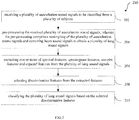
- FIG.2 is an exemplary flow diagram illustrating a computer implemented method 200 for detecting pulmonary abnormalities using lung sounds, in accordance with an embodiment of the present disclosure.
- the system 100 comprises one or more data storage devices or memory 102 operatively coupled to the one or more processors 104 and is configured to store instructions configured for execution of steps of the method 200 by the one or more processors 104.
- the one or more processors 104 are configured to receive, at step 202, a plurality of auscultation sound signals to be classified from a plurality of subjects.
- acquisition of auscultation sound signals involves using a digital stethoscope. Lung sounds are inherently contaminated with heart sounds. Also, different sampling rates exist when different sources (types of stethoscopes) are used.
- the one or more processors 104 are configured to pre-process the received plurality of auscultation sound signals at step 204.
- the step of pre-processing comprises resampling of the plurality of auscultation sound signals and removing undesired heart sound signals to obtain a plurality of lung sound signals.
- Heart sound signals may be removed by Empirical Mode Decomposition method.
- the resampling comprises down-sampling the plurality of auscultation sound signals to a pre-defined frequency based on a range of frequencies that provide optimum discrimination between healthy (normal) and abnormal lung sounds.
- the auscultation sound signals are downsampled to 4kHz (Nyquist theorem) as necessary information to classify lung sound signals into healthy and abnormal classes lies within 2kHz.
- the one or more processors 104 are configured to extract, at step 206, one or more of spectral features, spectrogram features, wavelet features and cepstral features from the plurality of lung sound signals.
- adding two or more feature types enhances accuracy of classification of the lung sound signals as explained herein after.
- the step of extracting features firstly comprises dividing the plurality of lung sound signals (session) into a plurality of overlapping windows or segments.
- spectral characteristics of lung sound signals may be used to discriminate healthy and abnormal classes. Firstly, periodograms are computed for each of the plurality of overlapping windows. In an embodiment, Welch method may be used for computing the periodograms. The periodograms are then averaged to obtain a Power Spectral Density (PSD) estimate curve for the plurality of lung sound signals.
- FIG.3 illustrates Power Spectral Density (PSD) estimate curves for healthy (normal) and abnormal data pertaining to lung sound signals, in accordance with an embodiment of the present disclosure. It may be noted that area under a normalized PSD curve is significantly higher for an abnormal sound compared to a healthy sound. However, the exact spread of the area varies with the degree and nature of the abnormality.
- a normalized Welch PSD curve is obtained using windows of 1024 samples and 50% overlap at 15 frequency bands with overlapping windows of 1 sec.
- the spectral features that may be extracted to aid classification of the lung sound signals are areas under a normalized Power Spectral Density (PSD) estimate curve corresponding to a pre-defined number of frequency bands from 0 - 1.5kHz ( PS 1 to PS 15 ), ratio of the spectral power below 500 Hz ( P 1 ) to that from 500 Hz to 1500 Hz ( P 2 ), spectral centroid ( S cent ), spectral flux ( S flux ), spectral rolloff ( S roll ) and spectral kurtosis ( S kurt ), wherein the pre-defined number of frequency bands is selected such that optimum discrimination between normal and abnormal lung sounds is achieved.
- PSD Power Spectral Density
- a spectrogram analysis reveals the change of frequency with time. For each session spectrograms with windows of length 512 and 480 point overlap were created using 512 point FFT. It is known that spectral power for lung sounds in the range of 0.15 kHz - 1.5 kHz is significantly higher in abnormal lung sounds compared to healthy lung sounds. However, the exact spread of the frequency is strongly correlated with the nature of the abnormality. From the spectrogram, 58 equally spaced frequencies between 0.15kHz - 1.5 kHz are selected ensuring a trade-off between computational complexity and higher frequency resolution, after checking the performance during validation.
- spectrogram features that may be extracted to aid classification of the lung sound signals are median spectral powers ( SP 1 to SP 58 ) across the plurality of overlapping windows, wherein the median spectral powers are computed for a pre-defined number of equally spaced frequencies between 0.15 kHz - 1.5 kHz of the plurality of lung sound signals, the pre-defined number of equally spaced frequencies being based on the computational complexity and frequency resolution.
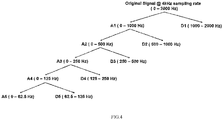
- Discrete Wavelet Transform represents a signal in multiple frequency bands by decomposing it into approximation and detail information.
- the decomposition level is determined by the frequency band of interest, wherein decomposing of the plurality of lung sound signals is done using a best mother wavelet selected in each window based on maximum energy and minimum Shannon entropy criteria
- a i the approximation
- D i detail
- a median of the absolute values of the D1, D2, D3, D4, D5 and A5 coefficients as illustrated in FIG.4 and their ratios over all windows are used as wavelet features ( W 1 to W 21 ).
- the values of the coefficients are normalized with respect to all sub-bands of all the windows and the ratios of the features between all sub-bands are taken.
- the cepstral features that may be extracted to aid classification of the lung sound signals are mean ( mfccm i and lfccm i ) and standard deviation ( mfccsd i and lfccsd i ) of Mel Frequency Cepstral Coefficients (MFCC) and Linear Frequency Cepstral Coefficients (LFCC).
- MFCC Mel Frequency Cepstral Coefficients
- LFCC Linear Frequency Cepstral Coefficients
- the signals are divided into windows of 50ms and 50% overlap and the signals are analyzed between 0-2000Hz.
- Table I herein below depicts all features and their respective indices used as reference in the present disclosure.
- Table I Description of features used Feature Index Description 1 to 20 Spectral features: PS 1 to PS 15 , P 1 / P 2 , S cent , S flux , S roll , S kurt 21 to 78 Spectrogram features: SP 1 to SP 58 79 to 99 Wavelet features: W 1 to W 21 100 to 179 Cepstral Features: mfccm 1 to mfccm 20 , mfccsd 1 to mfccsd 20 , lfccm 1 to lfccm 20 , lfccsd 1 to lfccsd 20
- the one or more processors (104) are configured to select, at step 208, a plurality of discriminative features from the extracted features of step 206.
- the step of selecting discriminative features is critical to avoid irrelevant or redundant features.
- the step of selecting a plurality of discriminative features from the extracted features comprises ranking the extracted features in decreasing order of importance; and selecting a plurality of discriminative features based on the optimal no. of features that result in a high performance value and a low standard deviation of a set of pre-defined performance metrics.
- Maximal Information Coefficient (MIC) based feature selection algorithm may be used.
- the set of pre-defined performance metrics comprise accuracy, sensitivity, specificity and area under the receiver operating characteristic curve.
- the one or more processors (104) are configured to classify, at step 210, the plurality of lung sound signals based on the selected discriminative features.
- a linear Support Vector Machine (SVM) classifier may be used to classify the lung sounds based on the selected discriminative features.
- the tolerance of termination criterion may be set to 0.001, though experimentations over a validation set revealed no major change in performance with slight variation in the tolerance.
- a lung sound dataset comprising 52 lung sound signals equally distributed among healthy and abnormal classes was created from different data sources.
- the abnormal lung sound signals were obtained from a) RALE Lung Sound Repository and b) Steven Lehrer Lung Sound Repository. Both these data sources have lung sounds labelled by physicians to be healthy or having some form of abnormality.
- the abnormalities include different forms of wheezes and crackles along with squawks, stridors, grunting, squeaks and pleural rub. These were collected from subjects of various age groups and from different chest locations.
- Some of the healthy sounds were collected from healthy individuals working in the lab using either an in-house digital stethoscope that records audio data at 8 kHz through an android application on a Nexus 5 smartphone or the 3M Littmann Electronic Stethoscope Model 32005 at 4 kHz. Some other normal sounds were acquired from the RALE Lung Sound Repository.
- the sampling rates of the RALE data and Steven Lehrer data are respectively 11.025 kHz and 44.1 kHz.
- the lab data were collected from either tracheal position or posterior chest walls.
- Performance metrics Standard classification metrics accuracy, sensitivity and specificity were used to evaluate the performance of the methods of the present disclosure along with area (AUC) under the Receiver Operating Characteristics (ROC) curve, that shows the variation of the true positive rate with the false positive rate.
- AUC area
- ROC Receiver Operating Characteristics
- FIG.5 illustrates a schematic representation of a supervised validation methodology, in accordance with an embodiment of the present disclosure.
- the dataset was separated into two subsets: a) for training and validation (validation phase -VP) and b) for testing (testing phase -TP).
- Validation phase -VP 70% of the data was randomly selected for training and the remaining 30% was used for evaluation.
- the training and evaluation subsets contain data with equally distributed samples from both healthy and abnormal classes.
- the validation process was repeated for 50 times as shown in FIG.5 .
- MIC was used to select the best features from the training subset only. Thereby the selected features and the training model were used to evaluate the performance of the evaluation set.
- features were sequentially added in order of decreasing importance and the performance was noted.
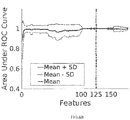
- FIG.6A through FIG.6D illustrate graphical representations of performance metrics viz., accuracy, Area under Receiver Operating Characteristics curve, sensitivity and specificity respectively during validation phase with sequential addition of features in accordance with an embodiment of the present disclosure.
- the Mean ⁇ SD values of the performance metrics over all 50 iterations are shown in FIG.6A through FIG.6D with the sequential addition of features.
- a final rank list showing the best 16 features obtained from their median ranks over the 50 iterations is provided in Table II, along with the Mean ⁇ SD values for the respective features for each class.
- Table II Best 16 features selected after validation phase Rank 1 2 3 4 5 6 7 8 Index 109 116 154 100 105 155 140 159 Mean ⁇ SD Healthy 6.5 2.9 -1.67 ⁇ 0.78 1.55 ⁇ 0.59 52.42 ⁇ 15.89 4.72 3.61 1.83 ⁇ 0.85 49.36 15.71 0.37 ⁇ 0.25 Abnormal -0.08 ⁇ 3.47 0.14 ⁇ 0.56 -0.4 ⁇ 1.2 25.89 ⁇ 30.24 -1.59 ⁇ 5.44 -0.08 ⁇ 0.95 24.67 29.62 -0.02 ⁇ 0.16 Rank 9 10 11 12 13 14 15 16 Index 19 143 54 63 64 12 62 65 Mean ⁇ SD Healthy 133.48 ⁇ 52.65 5.78 ⁇ 5.04 (37 ⁇ 15) x 10 -5 (22 ⁇ 9) x 10 -5 (21 ⁇ 9) x 10 -5 (19 ⁇ 13) x 10 -4 (23 9) x 10 -5 (20 ⁇ 9) x 10 -5 Abnormal 248.5
- the features proposed in accordance with the present disclosure provide clear evidence of discrimination between normal and abnormal lung sounds.
- 47 of the first 100 features are either the spectral or spectrogram features in accordance with the present disclosure which may be justified by the remarkable difference between the PSD estimates and spectrograms for the two classes of sound data (refer FIG. 3 ).
- a high performance value with a low standard deviation of the metrics is chosen.
- the standard deviation decreases and remains consistently low in the range of 100 - 150 features.
- the first 125 features from VP are selected..
- FIG.7A through FIG.7C illustrate graphical representations of performance metrics viz., accuracy, sensitivity and specificity respectively in accordance with an embodiment of the present disclosure when compared with methods known in the art. Results are reported for two test cases: (a) overlapping Test: VP and TP contain data from separate subjects but from overlapping data sources and (b) Non-overlapping Test: VP and TP contain data from separate subjects as well as non-overlapping data sources.
- the results in FIG.7A through FIG.7C show that though the prior arts produce decent performance for overlapping test, the performance drastically degrades for the non-overlapping Test.
- the sensitivity, and hence accuracy, for methods 2, 4 and 6 of FIG.7A through FIG.7C (prior art), drops for the non-overlapping test.
- the method of the present disclosure maintains a consistently high performance (accuracy of 85% and 80% for overlapping and non-overlapping test respectively).
- systems and methods described herein above provide an automated lung sound analysis platform to identify abnormal lung sounds without the use of any reference signal from a flowmeter or labelling of the respiratory phases.
- Particularly spectral and spectrogram features have been identified which when used along with wavelet and cepstral features enhance accuracy of the classification of lung sound signals.
- An automated feature selection on a validation set followed by evaluation on a separate test data source ensures elimination of overfitting but still yields a high performance. Accuracy of classification remains high with a balance in the sensitivity and specificity.
- the hardware device can be any kind of device which can be programmed including e.g. any kind of computer like a server or a personal computer, or the like, or any combination thereof.
- the device may also include means which could be e.g. hardware means like e.g. an application-specific integrated circuit (ASIC), a field-programmable gate array (FPGA), or a combination of hardware and software means, e.g.
- ASIC application-specific integrated circuit
- FPGA field-programmable gate array
- the means can include both hardware means and software means.
- the method embodiments described herein could be implemented in hardware and software.
- the device may also include software means.
- the embodiments of the present disclosure may be implemented on different hardware devices, e.g. using a plurality of CPUs.
- the embodiments herein can comprise hardware and software elements.
- the embodiments that are implemented in software include but are not limited to, firmware, resident software, microcode, etc.
- the functions performed by various modules comprising the system of the present disclosure and described herein may be implemented in other modules or combinations of other modules.
- a computer-usable or computer readable medium can be any apparatus that can comprise, store, communicate, propagate, or transport the program for use by or in connection with the instruction execution system, apparatus, or device.
- the various modules described herein may be implemented as software and/or hardware modules and may be stored in any type of non-transitory computer readable medium or other storage device.
- Some nonlimiting examples of non-transitory computer-readable media include CDs, DVDs, BLU-RAY, flash memory, and hard disk drives.
Landscapes
- Health & Medical Sciences (AREA)
- Life Sciences & Earth Sciences (AREA)
- Engineering & Computer Science (AREA)
- Physics & Mathematics (AREA)
- Veterinary Medicine (AREA)
- Heart & Thoracic Surgery (AREA)
- Medical Informatics (AREA)
- Molecular Biology (AREA)
- Surgery (AREA)
- Animal Behavior & Ethology (AREA)
- General Health & Medical Sciences (AREA)
- Public Health (AREA)
- Biomedical Technology (AREA)
- Artificial Intelligence (AREA)
- Acoustics & Sound (AREA)
- Pulmonology (AREA)
- Evolutionary Computation (AREA)
- Fuzzy Systems (AREA)
- Mathematical Physics (AREA)
- Computer Vision & Pattern Recognition (AREA)
- Physiology (AREA)
- Psychiatry (AREA)
- Signal Processing (AREA)
- Biophysics (AREA)
- Pathology (AREA)
- Measurement Of The Respiration, Hearing Ability, Form, And Blood Characteristics Of Living Organisms (AREA)
Abstract
Description
- The present application claims priority from: Indian Patent Application No.
201721023532, filed on 4th July, 2017 - The embodiments herein generally relate to detection and analyses of auscultation sound signals, and more particularly to systems and methods for detecting pulmonary abnormalities using lung sounds.
- There has been a massive increase in the occurrence of pulmonary diseases worldwide, due to increasing pollution, effect of burning biomass, human habits like smoking and the like. Obstructive Airway Diseases (OAD) like Asthma or Chronic Obstructive Pulmonary Disease (COPD), characterized by narrowing of the airways has emerged as reasons for major concern. Identification of abnormal lung sounds is a first step in diagnoses of such diseases. Auscultation to screen the presence of abnormality is an entirely manual process and lung sounds being inherently aperiodic signals, an abnormality may not surface throughout a recording for a subject, making diagnosis difficult. Further, skewed doctor-to-patient ratio in developing countries often leads to failure in timely diagnosis. Traditional known methods for identification of abnormal lung sounds use a reference flowmeter signal along with lung sounds to label the respiratory phases or manually separate them out. Some conventional methods involve deep learning to identify features for lung sound analysis. However, such features are often not physically interpretable and hence not relevant to the medical fraternity for screening pulmonary abnormalities.
- Embodiments of the present disclosure present technological improvements as solutions to one or more of the above-mentioned technical problems recognized by the inventors in conventional systems.
- In an aspect, there is provided a processor implemented method comprising: receiving a plurality of auscultation sound signals to be classified from a plurality of subjects; pre-processing the received plurality of auscultation sound signals, wherein the pre-processing comprises resampling of the plurality of auscultation sound signals and removing heart sound signals to obtain a plurality of lung sound signals; extracting one or more of spectral features, spectrogram features, wavelet features and cepstral features from the plurality of lung sound signals; selecting a plurality of discriminative features from the extracted features; and classifying the plurality of lung sound signals based on the selected discriminative features.
- In another aspect, there is provided a system comprising: one or more data storage devices operatively coupled to the one or more processors and configured to store instructions configured for execution by the one or more processors to: receive a plurality of auscultation sound signals to be classified from a plurality of subjects; pre-process the received plurality of auscultation sound signals by resampling the plurality of auscultation sound signals and removing heart sound signals to obtain a plurality of lung sound signals; extract one or more of spectral features, spectrogram features, wavelet features and cepstral features from the plurality of lung sound signals; select a plurality of discriminative features from the extracted features; and classify the plurality of lung sound signals based on the selected discriminative features.
- In yet another aspect, there is provided a computer program product comprising a non-transitory computer readable medium having a computer readable program embodied therein, wherein the computer readable program, when executed on a computing device, causes the computing device to: receive a plurality of auscultation sound signals to be classified from a plurality of subjects; pre-process the received plurality of auscultation sound signals by resampling the plurality of auscultation sound signals and removing heart sound signals to obtain a plurality of lung sound signals; extract one or more of spectral features, spectrogram features, wavelet features and cepstral features from the plurality of lung sound signals; select a plurality of discriminative features from the extracted features; and classify the plurality of lung sound signals based on the selected discriminative features.
- In an embodiment of the present disclosure, the resampling comprises down-sampling the plurality of auscultation sound signals to a pre-defined frequency is based on a range of frequencies that provide optimum discrimination between healthy and abnormal lung sounds.
- In an embodiment of the present disclosure, the step of removing heart sound signals is based on Empirical Mode Decomposition method.
- In an embodiment of the present disclosure, the step of extracting features comprises dividing the plurality of lung sound signals into a plurality of overlapping windows.
- In an embodiment of the present disclosure, the step of extracting spectral features comprises: computing periodograms for each of the plurality of overlapping windows; and averaging the periodograms to obtain a Power Spectral Density (PSD) estimate curve for the plurality of lung sound signals.
- In an embodiment of the present disclosure, the extracted spectral features are areas under a normalized Power Spectral Density (PSD) estimate curve corresponding to a pre-defined number of frequency bands from 0 - 1.5kHz (PS1 to PS15 ), ratio of the spectral power below 500 Hz (P1 ) to that from 500 Hz to 1500 Hz (P2 ), spectral centroid (Scent ), spectral flux (Sflux ), spectral rolloff (Sroll ) and spectral kurtosis (Skurt ), wherein the pre-defined number of frequency bands is selected such that optimum discrimination between healthy and abnormal lung sounds is achieved.
- In an embodiment of the present disclosure, the extracted spectrogram features are median spectral powers (SP1 to SP58 ) across the plurality of overlapping windows, wherein the median spectral powers are computed for a pre-defined number of equally spaced frequencies between 0.15 kHz - 1.5 kHz of the plurality of lung sound signals, the pre-defined number of equally spaced frequencies being based on the computational complexity and frequency resolution.
- In an embodiment of the present disclosure, the step of extracting wavelet features comprises: selecting a best mother wavelet in each window of the plurality of overlapping windows based on maximum energy and minimum Shannon entropy criteria; decomposing the plurality of lung sound signals using the best mother wavelet into decomposition levels; and computing median of absolute values of approximation and detail coefficients for the decomposition levels.
- In an embodiment of the present disclosure, the extracted wavelet features (W1 to W21 ) are (i) the median of absolute values of approximation and detail coefficients for the decomposition levels and (ii) ratios thereof across sub-bands of the plurality of overlapping windows.
- In an embodiment of the present disclosure, the extracted cepstral features are mean (mfccmi and lfccmi ) and standard deviation (mfccsdi and lfccsdi ) of Mel Frequency Cepstral Coefficients (MFCC) and Linear Frequency Cepstral Coefficients (LFCC).
- In an embodiment of the present disclosure, the step of selecting a plurality of discriminative features from the extracted features comprises: ranking the extracted features in decreasing order of importance; and selecting a plurality of discriminative features based on the optimal no. of features that result in a high performance value and a low standard deviation of a set of pre-defined performance metrics, wherein the set of pre-defined performance metrics comprise accuracy, sensitivity, specificity and area under the receiver operating characteristic curve.
- It is to be understood that both the foregoing general description and the following detailed description are exemplary and explanatory only and are not restrictive of the embodiments of the present disclosure, as claimed.
- The embodiments herein will be better understood from the following detailed description with reference to the drawings, in which:
-
FIG.1 illustrates an exemplary block diagram of a system for detecting pulmonary abnormalities using lung sounds, in accordance with an embodiment of the present disclosure; -
FIG.2 is an exemplary flow diagram illustrating a computer implemented method for detecting pulmonary abnormalities using lung sounds, in accordance with an embodiment of the present disclosure; -
FIG.3 illustrates Power Spectral Density (PSD) estimate curves for healthy and abnormal data pertaining to lung sound signals, in accordance with an embodiment of the present disclosure; -
FIG.4 illustrates wavelet decomposition showing regions of interest, in accordance with an embodiment of the present disclosure; -
FIG.5 illustrates a schematic representation of a supervised validation methodology, in accordance with an embodiment of the present disclosure; -
FIG.6A through FIG.6D illustrate graphical representations of performance metrics viz., accuracy, Area under Receiver Operating Characteristics curve, sensitivity and specificity respectively during validation phase with sequential addition of features in accordance with an embodiment of the present disclosure; and -
FIG.7A through FIG.7C illustrate graphical representations of performance metrics viz., accuracy, sensitivity and specificity respectively in accordance with an embodiment of the present disclosure when compared with methods known in the art. - It should be appreciated by those skilled in the art that any block diagram herein represent conceptual views of illustrative systems embodying the principles of the present subject matter. Similarly, it will be appreciated that any flow charts, flow diagrams, state transition diagrams, pseudo code, and the like represent various processes which may be substantially represented in computer readable medium and so executed by a computing device or processor, whether or not such computing device or processor is explicitly shown.
- Exemplary embodiments are described with reference to the accompanying drawings. In the figures, the left-most digit(s) of a reference number identifies the figure in which the reference number first appears. Wherever convenient, the same reference numbers are used throughout the drawings to refer to the same or like parts. While examples and features of disclosed principles are described herein, modifications, adaptations, and other implementations are possible without departing from the spirit and scope of the disclosed embodiments. It is intended that the following detailed description be considered as exemplary only, with the true scope and spirit being indicated by the following claims.
- Before setting forth the detailed explanation, it is noted that all of the discussion below, regardless of the particular implementation being described, is exemplary in nature, rather than limiting.
- The present invention deals with lung sound analysis for predicting pulmonary abnormalities. In case of pulmonary defects, abnormal lung sounds such as wheezes, crackles, squeaks, stridors, etc. are present when breathing. Systems and methods of the present disclosure facilitate classifying whether a lung sound is abnormal or healthy (normal) based on certain characteristic features, particularly spectral and spectrogram features. No manual labeling of respiratory cycles or segmentation of lung sounds into respiratory cycles is necessary.
- Referring now to the drawings, and more particularly to
FIGS. 1 through 7 , where similar reference characters denote corresponding features consistently throughout the figures, there are shown preferred embodiments and these embodiments are described in the context of the following exemplary system and method. -
FIG.1 illustrates an exemplary block diagram of asystem 100 for detecting pulmonary abnormalities using lung sounds, in accordance with an embodiment of the present disclosure. In an embodiment, thesystem 100 includes one ormore processors 104, communication interface device(s) or input/output (I/O) interface(s) 106, and one or more data storage devices ormemory 102 operatively coupled to the one ormore processors 104. The one ormore processors 104 that are hardware processors can be implemented as one or more microprocessors, microcomputers, microcontrollers, digital signal processors, central processing units, state machines, graphics controllers, logic circuitries, and/or any devices that manipulate signals based on operational instructions. Among other capabilities, the processor(s) are configured to fetch and execute computer-readable instructions stored in the memory. In an embodiment, thesystem 100 can be implemented in a variety of computing systems, such as laptop computers, notebooks, hand-held devices, workstations, mainframe computers, servers, a network cloud and the like. - The I/O interface device(s) 106 can include a variety of software and hardware interfaces, for example, a web interface, a graphical user interface, and the like and can facilitate multiple communications within a wide variety of networks N/W and protocol types, including wired networks, for example, LAN, cable, etc., and wireless networks, such as WLAN, cellular, or satellite. In an embodiment, the I/O interface device(s) can include one or more ports for connecting a number of devices to one another or to another server.
- The
memory 102 may include any computer-readable medium known in the art including, for example, volatile memory, such as static random access memory (SRAM) and dynamic random access memory (DRAM), and/or non-volatile memory, such as read only memory (ROM), erasable programmable ROM, flash memories, hard disks, optical disks, and magnetic tapes. In an embodiment, one or more modules (not shown) of thesystem 100 can be stored in thememory 102. -
FIG.2 is an exemplary flow diagram illustrating a computer implementedmethod 200 for detecting pulmonary abnormalities using lung sounds, in accordance with an embodiment of the present disclosure. In an embodiment, thesystem 100 comprises one or more data storage devices ormemory 102 operatively coupled to the one ormore processors 104 and is configured to store instructions configured for execution of steps of themethod 200 by the one ormore processors 104. - The steps of the
method 200 will now be explained in detail with reference to the components of thesystem 100 ofFIG.1 . In accordance with the present disclosure, the one ormore processors 104 are configured to receive, atstep 202, a plurality of auscultation sound signals to be classified from a plurality of subjects. In an embodiment, acquisition of auscultation sound signals involves using a digital stethoscope. Lung sounds are inherently contaminated with heart sounds. Also, different sampling rates exist when different sources (types of stethoscopes) are used. In an embodiment, the one ormore processors 104 are configured to pre-process the received plurality of auscultation sound signals atstep 204. The step of pre-processing comprises resampling of the plurality of auscultation sound signals and removing undesired heart sound signals to obtain a plurality of lung sound signals. Heart sound signals may be removed by Empirical Mode Decomposition method. The resampling comprises down-sampling the plurality of auscultation sound signals to a pre-defined frequency based on a range of frequencies that provide optimum discrimination between healthy (normal) and abnormal lung sounds. In an embodiment, the auscultation sound signals are downsampled to 4kHz (Nyquist theorem) as necessary information to classify lung sound signals into healthy and abnormal classes lies within 2kHz. - In an embodiment, the one or
more processors 104 are configured to extract, atstep 206, one or more of spectral features, spectrogram features, wavelet features and cepstral features from the plurality of lung sound signals. In accordance with the present disclosure, adding two or more feature types enhances accuracy of classification of the lung sound signals as explained herein after. The step of extracting features firstly comprises dividing the plurality of lung sound signals (session) into a plurality of overlapping windows or segments. - In accordance with the present disclosure, spectral characteristics of lung sound signals may be used to discriminate healthy and abnormal classes. Firstly, periodograms are computed for each of the plurality of overlapping windows. In an embodiment, Welch method may be used for computing the periodograms. The periodograms are then averaged to obtain a Power Spectral Density (PSD) estimate curve for the plurality of lung sound signals.
FIG.3 illustrates Power Spectral Density (PSD) estimate curves for healthy (normal) and abnormal data pertaining to lung sound signals, in accordance with an embodiment of the present disclosure. It may be noted that area under a normalized PSD curve is significantly higher for an abnormal sound compared to a healthy sound. However, the exact spread of the area varies with the degree and nature of the abnormality. In an embodiment, a normalized Welch PSD curve is obtained using windows of 1024 samples and 50% overlap at 15 frequency bands with overlapping windows of 1 sec. Accordingly, in accordance with the present disclosure, the spectral features that may be extracted to aid classification of the lung sound signals are areas under a normalized Power Spectral Density (PSD) estimate curve corresponding to a pre-defined number of frequency bands from 0 - 1.5kHz (PS1 to PS15 ), ratio of the spectral power below 500 Hz (P1 ) to that from 500 Hz to 1500 Hz (P2 ), spectral centroid (Scent ), spectral flux (Sflux ), spectral rolloff (Sroll ) and spectral kurtosis (Skurt ), wherein the pre-defined number of frequency bands is selected such that optimum discrimination between normal and abnormal lung sounds is achieved. - Lung sound being nonstationary in nature, a spectrogram analysis reveals the change of frequency with time. For each session spectrograms with windows of length 512 and 480 point overlap were created using 512 point FFT. It is known that spectral power for lung sounds in the range of 0.15 kHz - 1.5 kHz is significantly higher in abnormal lung sounds compared to healthy lung sounds. However, the exact spread of the frequency is strongly correlated with the nature of the abnormality. From the spectrogram, 58 equally spaced frequencies between 0.15kHz - 1.5 kHz are selected ensuring a trade-off between computational complexity and higher frequency resolution, after checking the performance during validation. For each such frequency, the median spectral power across all time windows are used, thereby getting spectral powers SP1 to SP58. The spectral power at each frequency is normalized with respect to the total spectral power at all frequencies. Thus, in accordance with the present disclosure, spectrogram features that may be extracted to aid classification of the lung sound signals are median spectral powers (SP1 to SP58 ) across the plurality of overlapping windows, wherein the median spectral powers are computed for a pre-defined number of equally spaced frequencies between 0.15 kHz - 1.5 kHz of the plurality of lung sound signals, the pre-defined number of equally spaced frequencies being based on the computational complexity and frequency resolution.
- Discrete Wavelet Transform (DWT) represents a signal in multiple frequency bands by decomposing it into approximation and detail information. The decomposition level is determined by the frequency band of interest, wherein decomposing of the plurality of lung sound signals is done using a best mother wavelet selected in each window based on maximum energy and minimum Shannon entropy criteria For a signal sampled at 4 kHz (i.e. maximum information content till 2 kHz), the approximation (Ai ) and detail (Di ) coefficients at the ith level, for all decomposition levels is illustrated in
FIG.4 . Based on the region of interest on the frequency domain (0 - 2000 Hz), a median of the absolute values of the D1, D2, D3, D4, D5 and A5 coefficients as illustrated inFIG.4 and their ratios over all windows are used as wavelet features (W1 to W21 ). In accordance with the present disclosure, the values of the coefficients are normalized with respect to all sub-bands of all the windows and the ratios of the features between all sub-bands are taken. - In accordance with the present disclosure, the cepstral features that may be extracted to aid classification of the lung sound signals are mean (mfccmi and lfccmi ) and standard deviation (mfccsdi and lfccsdi ) of Mel Frequency Cepstral Coefficients (MFCC) and Linear Frequency Cepstral Coefficients (LFCC). To extract these features, in an embodiment, the signals are divided into windows of 50ms and 50% overlap and the signals are analyzed between 0-2000Hz.
- Table I herein below depicts all features and their respective indices used as reference in the present disclosure.
Table I: Description of features used Feature Index Description 1 to 20 Spectral features: PS1 to PS15, P1 /P2 , Scent , Sflux, Sroll, Skurt 21 to 78 Spectrogram features: SP1 to SP58 79 to 99 Wavelet features: W1 to W 21100 to 179 Cepstral Features: mfccm1 to mfccm20, mfccsd1 to mfccsd20, lfccm1 to lfccm20, lfccsd1 to lfccsd20 - In an embodiment, the one or more processors (104) are configured to select, at
step 208, a plurality of discriminative features from the extracted features ofstep 206. The step of selecting discriminative features is critical to avoid irrelevant or redundant features. In an embodiment, the step of selecting a plurality of discriminative features from the extracted features comprises ranking the extracted features in decreasing order of importance; and selecting a plurality of discriminative features based on the optimal no. of features that result in a high performance value and a low standard deviation of a set of pre-defined performance metrics. In an embodiment, Maximal Information Coefficient (MIC) based feature selection algorithm may be used. In an embodiment, the set of pre-defined performance metrics comprise accuracy, sensitivity, specificity and area under the receiver operating characteristic curve. - In an embodiment, the one or more processors (104) are configured to classify, at
step 210, the plurality of lung sound signals based on the selected discriminative features. A linear Support Vector Machine (SVM) classifier may be used to classify the lung sounds based on the selected discriminative features. The tolerance of termination criterion may be set to 0.001, though experimentations over a validation set revealed no major change in performance with slight variation in the tolerance. - Dataset: A lung sound dataset comprising 52 lung sound signals equally distributed among healthy and abnormal classes was created from different data sources. The abnormal lung sound signals were obtained from a) RALE Lung Sound Repository and b) Steven Lehrer Lung Sound Repository. Both these data sources have lung sounds labelled by physicians to be healthy or having some form of abnormality. The abnormalities include different forms of wheezes and crackles along with squawks, stridors, grunting, squeaks and pleural rub. These were collected from subjects of various age groups and from different chest locations. Some of the healthy sounds were collected from healthy individuals working in the lab using either an in-house digital stethoscope that records audio data at 8 kHz through an android application on a Nexus 5 smartphone or the 3M Littmann Electronic Stethoscope Model 32005 at 4 kHz. Some other normal sounds were acquired from the RALE Lung Sound Repository. The sampling rates of the RALE data and Steven Lehrer data are respectively 11.025 kHz and 44.1 kHz. The lab data were collected from either tracheal position or posterior chest walls.
- Performance metrics: Standard classification metrics accuracy, sensitivity and specificity were used to evaluate the performance of the methods of the present disclosure along with area (AUC) under the Receiver Operating Characteristics (ROC) curve, that shows the variation of the true positive rate with the false positive rate.
- Results:
FIG.5 illustrates a schematic representation of a supervised validation methodology, in accordance with an embodiment of the present disclosure. The dataset was separated into two subsets: a) for training and validation (validation phase -VP) and b) for testing (testing phase -TP). In VP, 70% of the data was randomly selected for training and the remaining 30% was used for evaluation. The training and evaluation subsets contain data with equally distributed samples from both healthy and abnormal classes. To mitigate the problem of relatively small sample size, the validation process was repeated for 50 times as shown inFIG.5 . For each such iteration, MIC was used to select the best features from the training subset only. Thereby the selected features and the training model were used to evaluate the performance of the evaluation set. For each iteration, features were sequentially added in order of decreasing importance and the performance was noted. -
FIG.6A through FIG.6D illustrate graphical representations of performance metrics viz., accuracy, Area under Receiver Operating Characteristics curve, sensitivity and specificity respectively during validation phase with sequential addition of features in accordance with an embodiment of the present disclosure. The Mean ± SD values of the performance metrics over all 50 iterations are shown inFIG.6A through FIG.6D with the sequential addition of features. A final rank list showing the best 16 features obtained from their median ranks over the 50 iterations is provided in Table II, along with the Mean ± SD values for the respective features for each class.Table II: Best 16 features selected after validation phase Rank 1 2 3 4 5 6 7 8 Index 109 116 154 100 105 155 140 159 Mean ± SD Healthy 6.5 2.9 -1.67 ± 0.78 1.55 ± 0.59 52.42 ± 15.89 4.72 3.61 1.83 ± 0.85 49.36 15.71 0.37 ± 0.25 Abnormal -0.08 ± 3.47 0.14 ± 0.56 -0.4 ± 1.2 25.89 ± 30.24 -1.59 ± 5.44 -0.08 ± 0.95 24.67 29.62 -0.02 ± 0.16 Rank 9 10 11 12 13 14 15 16 Index 19 143 54 63 64 12 62 65 Mean ± SD Healthy 133.48 ± 52.65 5.78 ± 5.04 (37 ± 15) x 10-5 (22 ± 9) x 10-5 (21 ± 9) x 10-5 (19 ± 13) x 10-4 (23 9) x 10-5 (20 ± 9) x 10-5 Abnormal 248.52 ± 141.58 -0.4 ± 3.41 (15 ± 17) x 10-4 (11 ± 16) x 10-4 (11 ± 15) x 10-4 0.65 ± 2.82 (12 ± 20) x 10-4 (9 ± 13) x 10-4 - It may also be noted that the features proposed in accordance with the present disclosure provide clear evidence of discrimination between normal and abnormal lung sounds. In the final ordered feature list, 47 of the first 100 features are either the spectral or spectrogram features in accordance with the present disclosure which may be justified by the remarkable difference between the PSD estimates and spectrograms for the two classes of sound data (refer
FIG. 3 ). To freeze the number of features, a high performance value with a low standard deviation of the metrics is chosen. As evident inFIG.6B though performance value is high before the first 100 features, the standard deviation decreases and remains consistently low in the range of 100 - 150 features. As a tradeoff between the performance and computational requirements (which increases with the number of features) the first 125 features from VP are selected.. -
FIG.7A through FIG.7C illustrate graphical representations of performance metrics viz., accuracy, sensitivity and specificity respectively in accordance with an embodiment of the present disclosure when compared with methods known in the art. Results are reported for two test cases: (a) overlapping Test: VP and TP contain data from separate subjects but from overlapping data sources and (b) Non-overlapping Test: VP and TP contain data from separate subjects as well as non-overlapping data sources. The results inFIG.7A through FIG.7C show that though the prior arts produce decent performance for overlapping test, the performance drastically degrades for the non-overlapping Test. Particularly, the sensitivity, and hence accuracy, formethods 2, 4 and 6 ofFIG.7A through FIG.7C (prior art), drops for the non-overlapping test. However, the method of the present disclosure maintains a consistently high performance (accuracy of 85% and 80% for overlapping and non-overlapping test respectively). - Thus in accordance with the present disclosure, systems and methods described herein above provide an automated lung sound analysis platform to identify abnormal lung sounds without the use of any reference signal from a flowmeter or labelling of the respiratory phases. Particularly spectral and spectrogram features have been identified which when used along with wavelet and cepstral features enhance accuracy of the classification of lung sound signals. An automated feature selection on a validation set followed by evaluation on a separate test data source ensures elimination of overfitting but still yields a high performance. Accuracy of classification remains high with a balance in the sensitivity and specificity.
- The written description describes the subject matter herein to enable any person skilled in the art to make and use the embodiments of the present disclosure. The scope of the subject matter embodiments defined here may include other modifications that occur to those skilled in the art. Such other modifications are intended to be within the scope if they have similar elements that do not differ from the literal language of the claims or if they include equivalent elements with insubstantial differences from the literal language.
- The scope of the subject matter embodiments defined here may include other modifications that occur to those skilled in the art. Such other modifications are intended to be within the scope if they have similar elements that do not differ from the literal language of the claims or if they include equivalent elements with insubstantial differences from the literal language.
- It is, however to be understood that the scope of the protection is extended to such a program and in addition to a computer-readable means having a message therein; such computer-readable storage means contain program-code means for implementation of one or more steps of the method, when the program runs on a server or mobile device or any suitable programmable device. The hardware device can be any kind of device which can be programmed including e.g. any kind of computer like a server or a personal computer, or the like, or any combination thereof. The device may also include means which could be e.g. hardware means like e.g. an application-specific integrated circuit (ASIC), a field-programmable gate array (FPGA), or a combination of hardware and software means, e.g. an ASIC and an FPGA, or at least one microprocessor and at least one memory with software modules located therein. Thus, the means can include both hardware means and software means. The method embodiments described herein could be implemented in hardware and software. The device may also include software means. Alternatively, the embodiments of the present disclosure may be implemented on different hardware devices, e.g. using a plurality of CPUs.
- The embodiments herein can comprise hardware and software elements. The embodiments that are implemented in software include but are not limited to, firmware, resident software, microcode, etc. The functions performed by various modules comprising the system of the present disclosure and described herein may be implemented in other modules or combinations of other modules. For the purposes of this description, a computer-usable or computer readable medium can be any apparatus that can comprise, store, communicate, propagate, or transport the program for use by or in connection with the instruction execution system, apparatus, or device. The various modules described herein may be implemented as software and/or hardware modules and may be stored in any type of non-transitory computer readable medium or other storage device. Some nonlimiting examples of non-transitory computer-readable media include CDs, DVDs, BLU-RAY, flash memory, and hard disk drives.
- Further, although process steps, method steps, techniques or the like may be described in a sequential order, such processes, methods and techniques may be configured to work in alternate orders. In other words, any sequence or order of steps that may be described does not necessarily indicate a requirement that the steps be performed in that order. The steps of processes described herein may be performed in any order practical. Further, some steps may be performed simultaneously.
- The illustrated steps are set out to explain the exemplary embodiments shown, and it should be anticipated that ongoing technological development will change the manner in which particular functions are performed. These examples are presented herein for purposes of illustration, and not limitation. Further, the boundaries of the functional building blocks have been arbitrarily defined herein for the convenience of the description. Alternative boundaries can be defined so long as the specified functions and relationships thereof are appropriately performed. Alternatives (including equivalents, extensions, variations, deviations, etc., of those described herein) will be apparent to persons skilled in the relevant art(s) based on the teachings contained herein. Such alternatives fall within the scope and spirit of the disclosed embodiments. Also, the words "comprising," "having," "containing," and "including," and other similar forms are intended to be equivalent in meaning and be open ended in that an item or items following any one of these words is not meant to be an exhaustive listing of such item or items, or meant to be limited to only the listed item or items. It must also be noted that as used herein and in the appended claims, the singular forms "a," "an," and "the" include plural references unless the context clearly dictates otherwise.
- It is intended that the disclosure and examples be considered as exemplary only, with a true scope and spirit of disclosed embodiments being indicated by the following claims.
Claims (15)
- A processor implemented method (200) comprising:receiving a plurality of auscultation sound signals to be classified from a plurality of subjects (202);pre-processing the received plurality of auscultation sound signals, wherein the pre-processing comprises resampling of the plurality of auscultation sound signals and removing heart sound signals to obtain a plurality of lung sound signals (204);extracting one or more of spectral features, spectrogram features, wavelet features and cepstral features from the plurality of lung sound signals (206);selecting a plurality of discriminative features from the extracted features (208); andclassifying the plurality of lung sound signals based on the selected discriminative features (210).
- The processor implemented method of claim 1, wherein the resampling comprises down-sampling the plurality of auscultation sound signals to a pre-defined frequency based on a range of frequencies that provide optimum discrimination between healthy and abnormal lung sounds.
- The processor implemented method of claim 1, wherein the step of removing heart sound signals is based on Empirical Mode Decomposition method.
- The processor implemented method of claim 1, wherein the step of extracting comprises dividing the plurality of lung sound signals into a plurality of overlapping windows.
- The processor implemented method of claim 1, wherein the step of extracting spectral features comprises:computing periodograms for each of the plurality of overlapping windows; andaveraging the periodograms to obtain a Power Spectral Density (PSD) estimate curve for the plurality of lung sound signals.
- The processor implemented method of claim 5, wherein the extracted spectral features are areas under a normalized Power Spectral Density (PSD) estimate curve corresponding to a pre-defined number of frequency bands from 0 - 1.5kHz (PS1 to PS15 ), ratio of the spectral power below 500 Hz (P1 ) to that from 500 Hz to 1500 Hz (P2 ), spectral centroid (Scent ), spectral flux (Sflux ), spectral rolloff (Sroll ) and spectral kurtosis (Skurt ), wherein the pre-defined number of frequency bands is selected such that optimum discrimination between healthy and abnormal lung sounds is achieved.
- The processor implemented method of claim 4, wherein the extracted spectrogram features are median spectral powers (SP1 to SP58 ) across the plurality of overlapping windows, wherein the median spectral powers are computed for a pre-defined number of equally spaced frequencies between 0.15 kHz - 1.5 kHz of the plurality of lung sound signals, the pre-defined number of equally spaced frequencies being based on the computational complexity and frequency resolution.
- The processor implemented method of claim 4, wherein the step of extracting wavelet features comprises:selecting a best mother wavelet in each window of the plurality of overlapping windows based on maximum energy and minimum Shannon entropy criteria;decomposing the plurality of lung sound signals using the best mother wavelet into decomposition levels; andcomputing median of absolute values of approximation and detail coefficients for the decomposition levels.
- The processor implemented method of claim 8, wherein the extracted wavelet features (W1 to W21 ) are (i) the median of absolute values of approximation and detail coefficients for the decomposition levels and (ii) ratios thereof across sub-bands of the plurality of overlapping windows.
- The processor implemented method of claim 4, wherein the extracted cepstral features are mean (mfccmi and lfccmi ) and standard deviation (mfccsdi and lfccsdi ) of Mel Frequency Cepstral Coefficients (MFCC) and Linear Frequency Cepstral Coefficients (LFCC).
- The processor implemented method of claim 1, wherein the step of selecting a plurality of discriminative features from the extracted features comprises:ranking the extracted features in decreasing order of importance; andselecting a plurality of discriminative features based on the optimal no. of features that result in a high performance value and a low standard deviation of a set of pre-defined performance metrics.
- The processor implemented method of claim 11, wherein the set of pre-defined performance metrics comprise accuracy, sensitivity, specificity and area under the receiver operating characteristic curve.
- A system (100) comprising:one or more data storage devices (102) operatively coupled to one or more hardware processors (104) and configured to store instructions configured for execution by the one or more hardware processors to:receive a plurality of auscultation sound signals to be classified from a plurality of subjects;pre-process the received plurality of auscultation sound signals by resampling the plurality of auscultation sound signals and removing heart sound signals to obtain a plurality of lung sound signals, wherein the resampling is performed by down-sampling the plurality of auscultation sound signals to a pre-defined frequency based on a range of frequencies that provide optimum discrimination between healthy and abnormal lung sounds;extract one or more of spectral features, spectrogram features, wavelet features and cepstral features from the plurality of lung sound signals, wherein (i) the spectral features are areas under a normalized Power Spectral Density (PSD) estimate curve corresponding to a pre-defined number of frequency bands from 0 - 1.5kHz (PS1 to PS15 ), ratio of the spectral power below 500 Hz (P1 ) to that from 500 Hz to 1500 Hz (P2 ), spectral centroid (Scent ), spectral flux (Sflux ), spectral rolloff (Sroll ) and spectral kurtosis (Skurt ), wherein the pre-defined number of frequency bands is selected such that optimum discrimination between healthy and abnormal lung sounds is achieved; (ii) the spectrogram features are median spectral powers (SP1 to SP58 ) across a plurality of overlapping windows obtained by dividing the plurality of lung sound signals, wherein the median spectral powers are computed for pre-defined number of equally spaced frequencies between 0.15 kHz - 1.5 kHz of the plurality of lung sound signals, the pre-defined number of equally spaced frequencies being based on the computational complexity and frequency resolution; (iii) the extracted wavelet features (W1 to W21 ) are (a) median of absolute values of approximation and detail coefficients for decomposition levels obtained from the plurality of lung sound signals using a best mother wavelet and (b) ratios thereof across sub-bands of a plurality of overlapping windows obtained by dividing the plurality of lung sound signals; and (iv) the cepstral features are mean (mfccmi and lfccmi ) and standard deviation (mfccsdi and lfccsdi ) of Mel Frequency Cepstral Coefficients (MFCC) and Linear Frequency Cepstral Coefficients (LFCC);select a plurality of features from the extracted features; andclassify the plurality of lung sound signals based on the selected discriminative features.
- The system of claim 13, wherein the one or more hardware processors are further configured to select a plurality of discriminative features from the extracted features by:ranking the extracted features in decreasing order of importance; andselecting a plurality of discriminative features based on the optimal no. of features that result in a high performance value and a low standard deviation of a set of pre-defined performance metrics comprising accuracy, sensitivity, specificity and area under the receiver operating characteristic curve.
- A computer program product comprising a non-transitory computer readable medium having a computer readable program embodied therein, wherein the computer readable program, when executed on a computing device, causes the computing device to:receive a plurality of auscultation sound signals to be classified from a plurality of subjects;pre-process the received plurality of auscultation sound signals by resampling the plurality of auscultation sound signals and removing heart sound signals to obtain a plurality of lung sound signals;extract one or more of spectral features, spectrogram features, wavelet features and cepstral features from the plurality of lung sound signals;select a plurality of features from the extracted features; andclassify the plurality of lung sound signals based on the selected discriminative features.
Applications Claiming Priority (1)
| Application Number | Priority Date | Filing Date | Title |
|---|---|---|---|
| IN201721023532 | 2017-07-04 |
Publications (2)
| Publication Number | Publication Date |
|---|---|
| EP3424432A1 true EP3424432A1 (en) | 2019-01-09 |
| EP3424432B1 EP3424432B1 (en) | 2020-09-30 |
Family
ID=61283044
Family Applications (1)
| Application Number | Title | Priority Date | Filing Date |
|---|---|---|---|
| EP18158526.6A Active EP3424432B1 (en) | 2017-07-04 | 2018-02-26 | Systems and methods for detecting pulmonary abnormalities using lung sounds |
Country Status (2)
| Country | Link |
|---|---|
| US (1) | US10966681B2 (en) |
| EP (1) | EP3424432B1 (en) |
Cited By (4)
| Publication number | Priority date | Publication date | Assignee | Title |
|---|---|---|---|---|
| CN111789629A (en) * | 2020-06-29 | 2020-10-20 | 中南大学 | An intelligent diagnosis and treatment system and method for breath sounds based on deep learning |
| CN112932525A (en) * | 2021-01-27 | 2021-06-11 | 山东大学 | Lung sound abnormity intelligent diagnosis system, medium and equipment |
| KR20250100877A (en) * | 2023-12-26 | 2025-07-04 | 충남대학교병원 | Noise Reduction Method for Auscultation Sound |
| US12629100B2 (en) | 2023-06-21 | 2026-05-19 | Cornell University | Classifying biomedical acoustics based on image representation |
Families Citing this family (15)
| Publication number | Priority date | Publication date | Assignee | Title |
|---|---|---|---|---|
| GB201803805D0 (en) * | 2018-03-09 | 2018-04-25 | Cambridge Entpr Ltd | Smart Stethoscopes |
| US20210338154A1 (en) * | 2018-10-17 | 2021-11-04 | The University Of Queensland | A method and apparatus for diagnosis of maladies from patient sounds |
| JP7385381B2 (en) * | 2019-06-21 | 2023-11-22 | 株式会社日立製作所 | Abnormal sound detection system, pseudo sound generation system, and pseudo sound generation method |
| CN110532424A (en) * | 2019-09-26 | 2019-12-03 | 西南科技大学 | A kind of lungs sound tagsort system and method based on deep learning and cloud platform |
| CN111466947A (en) * | 2020-04-15 | 2020-07-31 | 哈尔滨工业大学 | Lung sound signal processing method for electronic auscultation |
| KR102186157B1 (en) * | 2020-04-22 | 2020-12-03 | 가천대학교 산학협력단 | Lung Sound Analysis Method and System Based on Neuro-fuzzy Network |
| US20230263423A1 (en) * | 2020-10-22 | 2023-08-24 | Respiri Limited | Processing recordings of a subject's breathing |
| CN112690823A (en) * | 2020-12-22 | 2021-04-23 | 海南力维科贸有限公司 | Method and system for identifying physiological sounds of lungs |
| CN112687281B (en) * | 2020-12-28 | 2022-08-30 | 广州医科大学附属第五医院 | Intelligent abnormal lung auscultation sound identification system |
| CN113081025B (en) * | 2021-03-10 | 2022-04-29 | 华中科技大学 | A New Coronary Pneumonia Intelligent Diagnosis System and Device Based on Lung Sounds |
| US12482560B2 (en) | 2021-04-23 | 2025-11-25 | Lasarrus Clinic And Research Center | Energy-efficient collection of wearable sensor data |
| US12476006B2 (en) | 2021-07-10 | 2025-11-18 | Lassarrus Clinic And Research Center Inc. | Smart multi-modal telehealth-IoT system for respiratory analysis |
| US12148525B2 (en) * | 2021-09-04 | 2024-11-19 | Lasarrus Clinic And Research Center Inc. | Wearable multi-modal system for remote monitoring of patients with chronic obstructive pulmonary disease |
| CN113537412B (en) * | 2021-09-15 | 2021-12-14 | 山东大学 | Lung disease auscultation system based on convolutional neural network, signal processing method and equipment |
| US12514465B2 (en) | 2023-04-07 | 2026-01-06 | Lasarrus Clinic and Research Center Inc | Bilateral acoustic sensing for predicting FEV1/FVC |
Citations (2)
| Publication number | Priority date | Publication date | Assignee | Title |
|---|---|---|---|---|
| CN106022258A (en) * | 2016-05-18 | 2016-10-12 | 成都济森科技有限公司 | Digital stethoscope and method for filtering heart sounds and extracting lung sounds |
| WO2017075601A1 (en) * | 2015-10-30 | 2017-05-04 | The Johns Hopkins University | Programmable electronic stethoscope devices, algorithms, systems, and methods |
Family Cites Families (13)
| Publication number | Priority date | Publication date | Assignee | Title |
|---|---|---|---|---|
| US6168568B1 (en) | 1996-10-04 | 2001-01-02 | Karmel Medical Acoustic Technologies Ltd. | Phonopneumograph system |
| US7025729B2 (en) * | 2001-09-14 | 2006-04-11 | Biancamed Limited | Apparatus for detecting sleep apnea using electrocardiogram signals |
| US7479115B2 (en) | 2006-08-25 | 2009-01-20 | Savic Research, Llc | Computer aided diagnosis of lung disease |
| US8758262B2 (en) | 2009-11-25 | 2014-06-24 | University Of Rochester | Respiratory disease monitoring system |
| US20120184825A1 (en) * | 2011-01-17 | 2012-07-19 | Meir Ben David | Method for detecting and analyzing sleep-related apnea, hypopnea, body movements, and snoring with non-contact device |
| US20150057512A1 (en) * | 2011-11-16 | 2015-02-26 | Rijuven Corporation | Wearable heart failure monitor patch |
| US20140276229A1 (en) | 2011-12-13 | 2014-09-18 | Sharp Kabushiki Kaisha | Information analyzing apparatus, digital stethoscope, information analyzing method, measurement system, control program, and recording medium |
| US9814438B2 (en) * | 2012-06-18 | 2017-11-14 | Breath Research, Inc. | Methods and apparatus for performing dynamic respiratory classification and tracking |
| WO2014120300A2 (en) * | 2012-10-24 | 2014-08-07 | The Johns Hopkins University | Acoustic monitoring system and methods |
| US9545219B2 (en) | 2012-11-16 | 2017-01-17 | University Of Manitoba | Acoustic system and methodology for identifying the risk of obstructive sleep apnea during wakefulness |
| US9060735B2 (en) * | 2012-12-14 | 2015-06-23 | Sharp Laboratories Of America, Inc. | Classification of segments of acoustic physiological signal captured during sleep using phase-locked loop array |
| EP3165164A4 (en) | 2014-07-01 | 2018-02-21 | Pioneer Corporation | Respiratory sound analysis device, respiratory sound analysis method, computer program, and recording medium |
| US10506969B2 (en) * | 2015-11-03 | 2019-12-17 | University Health Network | Acoustic upper airway assessment system and method, and sleep apnea assessment system and method relying thereon |
-
2018
- 2018-02-26 EP EP18158526.6A patent/EP3424432B1/en active Active
- 2018-03-05 US US15/912,234 patent/US10966681B2/en active Active
Patent Citations (2)
| Publication number | Priority date | Publication date | Assignee | Title |
|---|---|---|---|---|
| WO2017075601A1 (en) * | 2015-10-30 | 2017-05-04 | The Johns Hopkins University | Programmable electronic stethoscope devices, algorithms, systems, and methods |
| CN106022258A (en) * | 2016-05-18 | 2016-10-12 | 成都济森科技有限公司 | Digital stethoscope and method for filtering heart sounds and extracting lung sounds |
Non-Patent Citations (2)
| Title |
|---|
| JIN F ET AL: "New approaches for spectro-temporal feature extraction with applications to respiratory sound classification", NEUROCOMPUTING, vol. 123, 20 August 2013 (2013-08-20), pages 362 - 371, XP028757358, ISSN: 0925-2312, DOI: 10.1016/J.NEUCOM.2013.07.033 * |
| RAJKUMAR PALANIAPPAN ET AL: "A comparative study of the svm and k-nn machine learning algorithms for the diagnosis of respiratory pathologies using pulmonary acoustic signals", BMC BIOINFORMATICS, BIOMED CENTRAL, LONDON, GB, vol. 15, no. 1, 27 June 2014 (2014-06-27), pages 223, XP021189939, ISSN: 1471-2105, DOI: 10.1186/1471-2105-15-223 * |
Cited By (4)
| Publication number | Priority date | Publication date | Assignee | Title |
|---|---|---|---|---|
| CN111789629A (en) * | 2020-06-29 | 2020-10-20 | 中南大学 | An intelligent diagnosis and treatment system and method for breath sounds based on deep learning |
| CN112932525A (en) * | 2021-01-27 | 2021-06-11 | 山东大学 | Lung sound abnormity intelligent diagnosis system, medium and equipment |
| US12629100B2 (en) | 2023-06-21 | 2026-05-19 | Cornell University | Classifying biomedical acoustics based on image representation |
| KR20250100877A (en) * | 2023-12-26 | 2025-07-04 | 충남대학교병원 | Noise Reduction Method for Auscultation Sound |
Also Published As
| Publication number | Publication date |
|---|---|
| US20190008475A1 (en) | 2019-01-10 |
| US10966681B2 (en) | 2021-04-06 |
| EP3424432B1 (en) | 2020-09-30 |
Similar Documents
| Publication | Publication Date | Title |
|---|---|---|
| US10966681B2 (en) | Systems and methods for detecting pulmonary abnormalities using lung sounds | |
| JP7716075B2 (en) | Method for analyzing cough sounds using disease signatures to diagnose respiratory diseases - Patent Application 20070122999 | |
| US11432753B2 (en) | Parallel implementation of deep neural networks for classifying heart sound signals | |
| Serbes et al. | An automated lung sound preprocessing and classification system based onspectral analysis methods | |
| Clifford et al. | Recent advances in heart sound analysis | |
| Dibaj et al. | Fine-tuned variational mode decomposition for fault diagnosis of rotary machinery | |
| Abdollahpur et al. | Detection of pathological heart sounds | |
| EP3367908B1 (en) | Programmable electronic stethoscope devices, algorithms, systems, and methods | |
| Cortés et al. | Ambulatory assessment of phonotraumatic vocal hyperfunction using glottal airflow measures estimated from neck-surface acceleration | |
| CN113080907B (en) | Pulse wave signal processing method and device | |
| US20170193395A1 (en) | Optimizing performance of event detection by sensor data analytics | |
| Datta et al. | Automated lung sound analysis for detecting pulmonary abnormalities | |
| US11373731B2 (en) | System and method to classify cardiopulmonary fatigue | |
| EP4278351A1 (en) | Speech-analysis based automated physiological and pathological assessment | |
| Phipps et al. | Early adverse physiological event detection using commercial wearables: challenges and opportunities | |
| EP3605553B1 (en) | Systems and methods for unobtrusive digital health assessment | |
| Moosavi et al. | Segmentation and classification of lungs CT-scan for detecting COVID-19 abnormalities by deep learning technique: U-Net model | |
| EP3330974B1 (en) | System and method for physiological monitoring | |
| Mukherjee et al. | A novel U-Net architecture for denoising of real-world noise corrupted phonocardiogram signal | |
| US20120209620A1 (en) | Detecting unexpected healthcare utilization by constructing clinical models of dominant utilization groups | |
| Oishee et al. | Leveraging deep edge intelligence for real-time respiratory disease detection | |
| He et al. | Multifractal analysis on age-based discrimination in X-ray images for sensing the severity of COVID-19 disease | |
| US11490824B2 (en) | Method and system for heart rate estimation of a user | |
| US8473314B2 (en) | Method and system for determining precursors of health abnormalities from processing medical records | |
| Roquemen-Echeverri et al. | An AI-powered tool for automatic heart sound quality assessment and segmentation |
Legal Events
| Date | Code | Title | Description |
|---|---|---|---|
| PUAI | Public reference made under article 153(3) epc to a published international application that has entered the european phase |
Free format text: ORIGINAL CODE: 0009012 |
|
| STAA | Information on the status of an ep patent application or granted ep patent |
Free format text: STATUS: THE APPLICATION HAS BEEN PUBLISHED |
|
| AK | Designated contracting states |
Kind code of ref document: A1 Designated state(s): AL AT BE BG CH CY CZ DE DK EE ES FI FR GB GR HR HU IE IS IT LI LT LU LV MC MK MT NL NO PL PT RO RS SE SI SK SM TR |
|
| AX | Request for extension of the european patent |
Extension state: BA ME |
|
| STAA | Information on the status of an ep patent application or granted ep patent |
Free format text: STATUS: REQUEST FOR EXAMINATION WAS MADE |
|
| 17P | Request for examination filed |
Effective date: 20190709 |
|
| RBV | Designated contracting states (corrected) |
Designated state(s): AL AT BE BG CH CY CZ DE DK EE ES FI FR GB GR HR HU IE IS IT LI LT LU LV MC MK MT NL NO PL PT RO RS SE SI SK SM TR |
|
| STAA | Information on the status of an ep patent application or granted ep patent |
Free format text: STATUS: EXAMINATION IS IN PROGRESS |
|
| 17Q | First examination report despatched |
Effective date: 20191105 |
|
| GRAP | Despatch of communication of intention to grant a patent |
Free format text: ORIGINAL CODE: EPIDOSNIGR1 |
|
| STAA | Information on the status of an ep patent application or granted ep patent |
Free format text: STATUS: GRANT OF PATENT IS INTENDED |
|
| INTG | Intention to grant announced |
Effective date: 20200414 |
|
| GRAS | Grant fee paid |
Free format text: ORIGINAL CODE: EPIDOSNIGR3 |
|
| GRAA | (expected) grant |
Free format text: ORIGINAL CODE: 0009210 |
|
| STAA | Information on the status of an ep patent application or granted ep patent |
Free format text: STATUS: THE PATENT HAS BEEN GRANTED |
|
| AK | Designated contracting states |
Kind code of ref document: B1 Designated state(s): AL AT BE BG CH CY CZ DE DK EE ES FI FR GB GR HR HU IE IS IT LI LT LU LV MC MK MT NL NO PL PT RO RS SE SI SK SM TR |
|
| REG | Reference to a national code |
Ref country code: GB Ref legal event code: FG4D Ref country code: CH Ref legal event code: EP |
|
| REG | Reference to a national code |
Ref country code: AT Ref legal event code: REF Ref document number: 1317927 Country of ref document: AT Kind code of ref document: T Effective date: 20201015 |
|
| REG | Reference to a national code |
Ref country code: DE Ref legal event code: R096 Ref document number: 602018008177 Country of ref document: DE |
|
| REG | Reference to a national code |
Ref country code: IE Ref legal event code: FG4D |
|
| REG | Reference to a national code |
Ref country code: CH Ref legal event code: NV Representative=s name: ISLER AND PEDRAZZINI AG, CH |
|
| REG | Reference to a national code |
Ref country code: NL Ref legal event code: FP |
|
| PG25 | Lapsed in a contracting state [announced via postgrant information from national office to epo] |
Ref country code: NO Free format text: LAPSE BECAUSE OF FAILURE TO SUBMIT A TRANSLATION OF THE DESCRIPTION OR TO PAY THE FEE WITHIN THE PRESCRIBED TIME-LIMIT Effective date: 20201230 Ref country code: BG Free format text: LAPSE BECAUSE OF FAILURE TO SUBMIT A TRANSLATION OF THE DESCRIPTION OR TO PAY THE FEE WITHIN THE PRESCRIBED TIME-LIMIT Effective date: 20201230 Ref country code: GR Free format text: LAPSE BECAUSE OF FAILURE TO SUBMIT A TRANSLATION OF THE DESCRIPTION OR TO PAY THE FEE WITHIN THE PRESCRIBED TIME-LIMIT Effective date: 20201231 Ref country code: SE Free format text: LAPSE BECAUSE OF FAILURE TO SUBMIT A TRANSLATION OF THE DESCRIPTION OR TO PAY THE FEE WITHIN THE PRESCRIBED TIME-LIMIT Effective date: 20200930 Ref country code: HR Free format text: LAPSE BECAUSE OF FAILURE TO SUBMIT A TRANSLATION OF THE DESCRIPTION OR TO PAY THE FEE WITHIN THE PRESCRIBED TIME-LIMIT Effective date: 20200930 Ref country code: FI Free format text: LAPSE BECAUSE OF FAILURE TO SUBMIT A TRANSLATION OF THE DESCRIPTION OR TO PAY THE FEE WITHIN THE PRESCRIBED TIME-LIMIT Effective date: 20200930 |
|
| REG | Reference to a national code |
Ref country code: AT Ref legal event code: MK05 Ref document number: 1317927 Country of ref document: AT Kind code of ref document: T Effective date: 20200930 |
|
| PG25 | Lapsed in a contracting state [announced via postgrant information from national office to epo] |
Ref country code: RS Free format text: LAPSE BECAUSE OF FAILURE TO SUBMIT A TRANSLATION OF THE DESCRIPTION OR TO PAY THE FEE WITHIN THE PRESCRIBED TIME-LIMIT Effective date: 20200930 Ref country code: LV Free format text: LAPSE BECAUSE OF FAILURE TO SUBMIT A TRANSLATION OF THE DESCRIPTION OR TO PAY THE FEE WITHIN THE PRESCRIBED TIME-LIMIT Effective date: 20200930 |
|
| REG | Reference to a national code |
Ref country code: LT Ref legal event code: MG4D |
|
| PG25 | Lapsed in a contracting state [announced via postgrant information from national office to epo] |
Ref country code: SM Free format text: LAPSE BECAUSE OF FAILURE TO SUBMIT A TRANSLATION OF THE DESCRIPTION OR TO PAY THE FEE WITHIN THE PRESCRIBED TIME-LIMIT Effective date: 20200930 Ref country code: RO Free format text: LAPSE BECAUSE OF FAILURE TO SUBMIT A TRANSLATION OF THE DESCRIPTION OR TO PAY THE FEE WITHIN THE PRESCRIBED TIME-LIMIT Effective date: 20200930 Ref country code: PT Free format text: LAPSE BECAUSE OF FAILURE TO SUBMIT A TRANSLATION OF THE DESCRIPTION OR TO PAY THE FEE WITHIN THE PRESCRIBED TIME-LIMIT Effective date: 20210201 Ref country code: CZ Free format text: LAPSE BECAUSE OF FAILURE TO SUBMIT A TRANSLATION OF THE DESCRIPTION OR TO PAY THE FEE WITHIN THE PRESCRIBED TIME-LIMIT Effective date: 20200930 Ref country code: EE Free format text: LAPSE BECAUSE OF FAILURE TO SUBMIT A TRANSLATION OF THE DESCRIPTION OR TO PAY THE FEE WITHIN THE PRESCRIBED TIME-LIMIT Effective date: 20200930 Ref country code: LT Free format text: LAPSE BECAUSE OF FAILURE TO SUBMIT A TRANSLATION OF THE DESCRIPTION OR TO PAY THE FEE WITHIN THE PRESCRIBED TIME-LIMIT Effective date: 20200930 |
|
| PG25 | Lapsed in a contracting state [announced via postgrant information from national office to epo] |
Ref country code: IS Free format text: LAPSE BECAUSE OF FAILURE TO SUBMIT A TRANSLATION OF THE DESCRIPTION OR TO PAY THE FEE WITHIN THE PRESCRIBED TIME-LIMIT Effective date: 20210130 Ref country code: PL Free format text: LAPSE BECAUSE OF FAILURE TO SUBMIT A TRANSLATION OF THE DESCRIPTION OR TO PAY THE FEE WITHIN THE PRESCRIBED TIME-LIMIT Effective date: 20200930 Ref country code: AT Free format text: LAPSE BECAUSE OF FAILURE TO SUBMIT A TRANSLATION OF THE DESCRIPTION OR TO PAY THE FEE WITHIN THE PRESCRIBED TIME-LIMIT Effective date: 20200930 Ref country code: AL Free format text: LAPSE BECAUSE OF FAILURE TO SUBMIT A TRANSLATION OF THE DESCRIPTION OR TO PAY THE FEE WITHIN THE PRESCRIBED TIME-LIMIT Effective date: 20200930 Ref country code: ES Free format text: LAPSE BECAUSE OF FAILURE TO SUBMIT A TRANSLATION OF THE DESCRIPTION OR TO PAY THE FEE WITHIN THE PRESCRIBED TIME-LIMIT Effective date: 20200930 |
|
| PG25 | Lapsed in a contracting state [announced via postgrant information from national office to epo] |
Ref country code: SK Free format text: LAPSE BECAUSE OF FAILURE TO SUBMIT A TRANSLATION OF THE DESCRIPTION OR TO PAY THE FEE WITHIN THE PRESCRIBED TIME-LIMIT Effective date: 20200930 |
|
| REG | Reference to a national code |
Ref country code: DE Ref legal event code: R097 Ref document number: 602018008177 Country of ref document: DE |
|
| PLBE | No opposition filed within time limit |
Free format text: ORIGINAL CODE: 0009261 |
|
| STAA | Information on the status of an ep patent application or granted ep patent |
Free format text: STATUS: NO OPPOSITION FILED WITHIN TIME LIMIT |
|
| PG25 | Lapsed in a contracting state [announced via postgrant information from national office to epo] |
Ref country code: DK Free format text: LAPSE BECAUSE OF FAILURE TO SUBMIT A TRANSLATION OF THE DESCRIPTION OR TO PAY THE FEE WITHIN THE PRESCRIBED TIME-LIMIT Effective date: 20200930 |
|
| 26N | No opposition filed |
Effective date: 20210701 |
|
| PG25 | Lapsed in a contracting state [announced via postgrant information from national office to epo] |
Ref country code: MC Free format text: LAPSE BECAUSE OF FAILURE TO SUBMIT A TRANSLATION OF THE DESCRIPTION OR TO PAY THE FEE WITHIN THE PRESCRIBED TIME-LIMIT Effective date: 20200930 |
|
| REG | Reference to a national code |
Ref country code: BE Ref legal event code: MM Effective date: 20210228 |
|
| PG25 | Lapsed in a contracting state [announced via postgrant information from national office to epo] |
Ref country code: IT Free format text: LAPSE BECAUSE OF FAILURE TO SUBMIT A TRANSLATION OF THE DESCRIPTION OR TO PAY THE FEE WITHIN THE PRESCRIBED TIME-LIMIT Effective date: 20200930 Ref country code: LU Free format text: LAPSE BECAUSE OF NON-PAYMENT OF DUE FEES Effective date: 20210226 |
|
| PG25 | Lapsed in a contracting state [announced via postgrant information from national office to epo] |
Ref country code: SI Free format text: LAPSE BECAUSE OF FAILURE TO SUBMIT A TRANSLATION OF THE DESCRIPTION OR TO PAY THE FEE WITHIN THE PRESCRIBED TIME-LIMIT Effective date: 20200930 |
|
| PG25 | Lapsed in a contracting state [announced via postgrant information from national office to epo] |
Ref country code: IE Free format text: LAPSE BECAUSE OF NON-PAYMENT OF DUE FEES Effective date: 20210226 |
|
| PG25 | Lapsed in a contracting state [announced via postgrant information from national office to epo] |
Ref country code: IS Free format text: LAPSE BECAUSE OF FAILURE TO SUBMIT A TRANSLATION OF THE DESCRIPTION OR TO PAY THE FEE WITHIN THE PRESCRIBED TIME-LIMIT Effective date: 20210130 |
|
| PG25 | Lapsed in a contracting state [announced via postgrant information from national office to epo] |
Ref country code: BE Free format text: LAPSE BECAUSE OF NON-PAYMENT OF DUE FEES Effective date: 20210228 |
|
| PG25 | Lapsed in a contracting state [announced via postgrant information from national office to epo] |
Ref country code: CY Free format text: LAPSE BECAUSE OF FAILURE TO SUBMIT A TRANSLATION OF THE DESCRIPTION OR TO PAY THE FEE WITHIN THE PRESCRIBED TIME-LIMIT Effective date: 20200930 |
|
| P01 | Opt-out of the competence of the unified patent court (upc) registered |
Effective date: 20230526 |
|
| PG25 | Lapsed in a contracting state [announced via postgrant information from national office to epo] |
Ref country code: HU Free format text: LAPSE BECAUSE OF FAILURE TO SUBMIT A TRANSLATION OF THE DESCRIPTION OR TO PAY THE FEE WITHIN THE PRESCRIBED TIME-LIMIT; INVALID AB INITIO Effective date: 20180226 |
|
| PG25 | Lapsed in a contracting state [announced via postgrant information from national office to epo] |
Ref country code: MK Free format text: LAPSE BECAUSE OF FAILURE TO SUBMIT A TRANSLATION OF THE DESCRIPTION OR TO PAY THE FEE WITHIN THE PRESCRIBED TIME-LIMIT Effective date: 20200930 |
|
| PG25 | Lapsed in a contracting state [announced via postgrant information from national office to epo] |
Ref country code: TR Free format text: LAPSE BECAUSE OF FAILURE TO SUBMIT A TRANSLATION OF THE DESCRIPTION OR TO PAY THE FEE WITHIN THE PRESCRIBED TIME-LIMIT Effective date: 20200930 |
|
| PG25 | Lapsed in a contracting state [announced via postgrant information from national office to epo] |
Ref country code: MT Free format text: LAPSE BECAUSE OF FAILURE TO SUBMIT A TRANSLATION OF THE DESCRIPTION OR TO PAY THE FEE WITHIN THE PRESCRIBED TIME-LIMIT Effective date: 20200930 |
|
| REG | Reference to a national code |
Ref country code: CH Ref legal event code: U11 Free format text: ST27 STATUS EVENT CODE: U-0-0-U10-U11 (AS PROVIDED BY THE NATIONAL OFFICE) Effective date: 20260301 |
|
| PGFP | Annual fee paid to national office [announced via postgrant information from national office to epo] |
Ref country code: NL Payment date: 20260220 Year of fee payment: 9 |
|
| PGFP | Annual fee paid to national office [announced via postgrant information from national office to epo] |
Ref country code: GB Payment date: 20260223 Year of fee payment: 9 |
|
| PGFP | Annual fee paid to national office [announced via postgrant information from national office to epo] |
Ref country code: DE Payment date: 20260220 Year of fee payment: 9 |
|
| PGFP | Annual fee paid to national office [announced via postgrant information from national office to epo] |
Ref country code: FR Payment date: 20260227 Year of fee payment: 9 |
|
| PGFP | Annual fee paid to national office [announced via postgrant information from national office to epo] |
Ref country code: CH Payment date: 20260301 Year of fee payment: 9 |